Flying an Azerbaijan Airlines 787 Across Europe: Baku to London Heathrow

After two and a half hours spent hurtling through mostly Iranian skies, my first experience with Azerbaijan Airlines since 2018 came to an end as we made a silky smooth touchdown at Baku’s Heydar Aliyev International Airport (you can read my review here!). As someone who is never particularly keen on rushing, at first glance, my eighty-minute connection in Azerbaijan’s capital was a little worrying. However, Baku’s Terminal 1 most certainly fails to rival the likes of Beijing Capital or Doha Hamad in size, and with a fairly straightforward layout, I was confident that I would not end up hurriedly zigzagging and slaloming through the airport in a desperate rush to catch my flight to London. Further quelling my concerns, the Dreamliner that had transported me from Dubai pulled into its stand almost thirty minutes ahead of schedule, thereby further extending my short transit.
Seeing as many of those on my flight from Dubai took the form of Russian tourists, unsurprisingly, it seemed that most passengers were connecting in Baku onto Azerbaijan Airlines’ services to Moscow and St Petersburg. Fortunately, ending up near the very front of the Economy cabin and thus being amongst the first cohort of passengers to disembark, I hoped that I would not end up in any long queues. Fortunately, once in the terminal, it appeared that the Dreamliner had touched down during a lull, as this was almost completely deserted. As I wandered through the modern terminal building and followed signs for international transfers, most staff members there seemed to take the form of tough-looking security guards sporting military-esque attire. Thus, I thought it best to avoid snapping too many photos until I had safely made it through the transit checkpoint!
Thanks to the compact nature of the terminal, I arrived at the checkpoint no more than two minutes after stepping off the Dreamliner. There, I wandered up to the counter, which was staffed by three rather bored-looking Azerbaijan Airlines agents, two of whom seemed to be doing little other than spinning on their chairs and playing on their phones. One of these agents checked my boarding pass and passport before saying a few words in Russian and pointing me towards the small security checkpoint. Being the first transit passenger from the inbound flight, I was able to pass through this without queuing and had a quick and easy security experience. However, as I have found to be the case in several other former Soviet states, I was required to turn on my laptop before being permitted to continue onwards. Entering the airside departures area no more than ten minutes after disembarking the Dreamliner, I have to say that my transit experience in Baku was smooth and efficient, and other than the cold and stony-faced staff members, I was left with no complaints. However, I suspect that had I ended up being one of the last passengers to disembark or arrived at a busy time, then I may well have had a rather different experience. Once through, with over an hour to kill before boarding for my flight to London commenced, I had plenty of time to explore the nooks and crannies of Terminal 1.
Initially known as Baku Bina, the airport opened in 1933 and has long served as the main air gateway to the Azerbaijan Soviet Socialist Republic and, since 1991, Azerbaijan. Following the death of Azerbaijan’s third president and the father of the current leader, like many official buildings across the country, in 2004, the airport was renamed Heydar Aliyev International Airport. Today, Terminal 1 serves as the airport’s international terminal, whilst domestic flights operate from the detached Terminal 2, a short distance away. Designed by Britain’s Arup Group and welcoming its first customers in 2014, the terminal is modern, ornate and one of the more unique terminals that I have had the pleasure of passing through. Spread across four stories, this features high ceilings, large windows, trees and interesting oak veneer ‘cocoons’. Perhaps surprisingly, considering its infrastructural importance and its role as the main hub of Azerbaijan Airlines, the terminal is relatively small and covers an area of just 65,000 square metres. For comparison, this makes the terminal around 3.8% of the size of Dubai Airport’s Terminal 3.
Despite its small size, Terminal 1 features an ample number of facilities, with four eateries and sixteen shops. However, unfortunately, many of the latter take the form of luxury brand outlets targeting those passengers with plenty of cash to splash, rather than selling any sort of affordable goods. On that note, everything seemed to be rather expensive, and those looking for a bargain would have been resigned to the vending machines in the terminal, which sold a mixture of soft drinks and snacks. As many now expect, fast and complimentary wifi was on offer and worked well, whilst a good number of plug sockets could be found throughout the terminal for those needing to charge their devices. Crucially, I found the terminal to be clean and tidy, whilst plenty of seating was on offer, and I was therefore left with relatively little to complain about during my short stay.
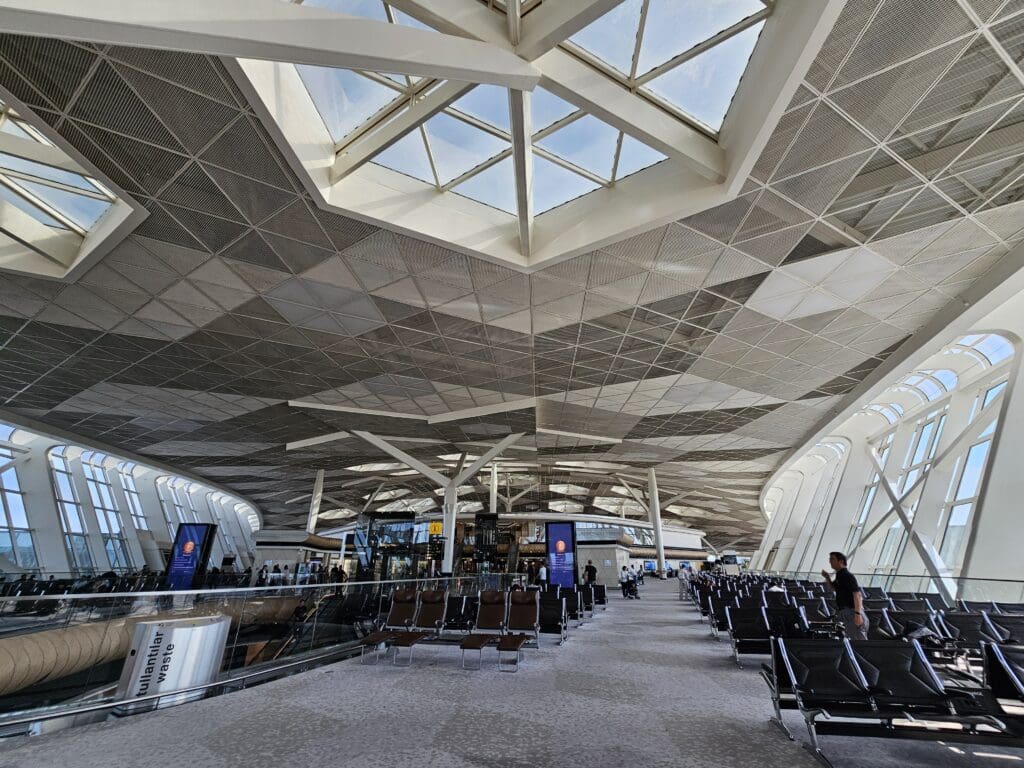
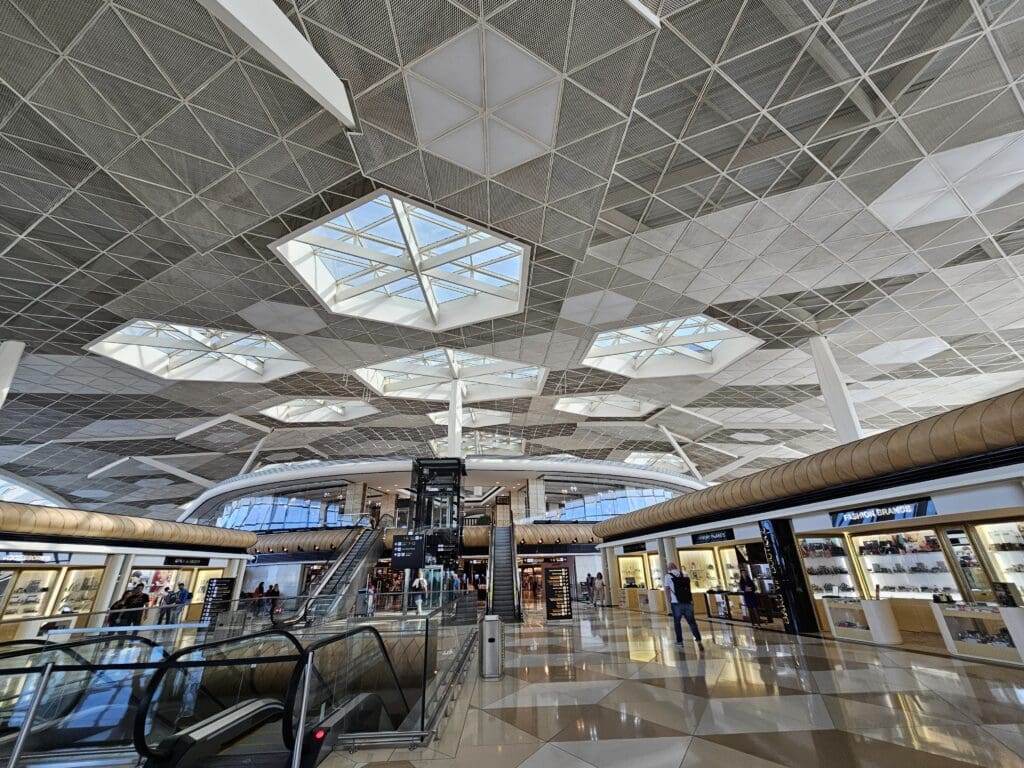
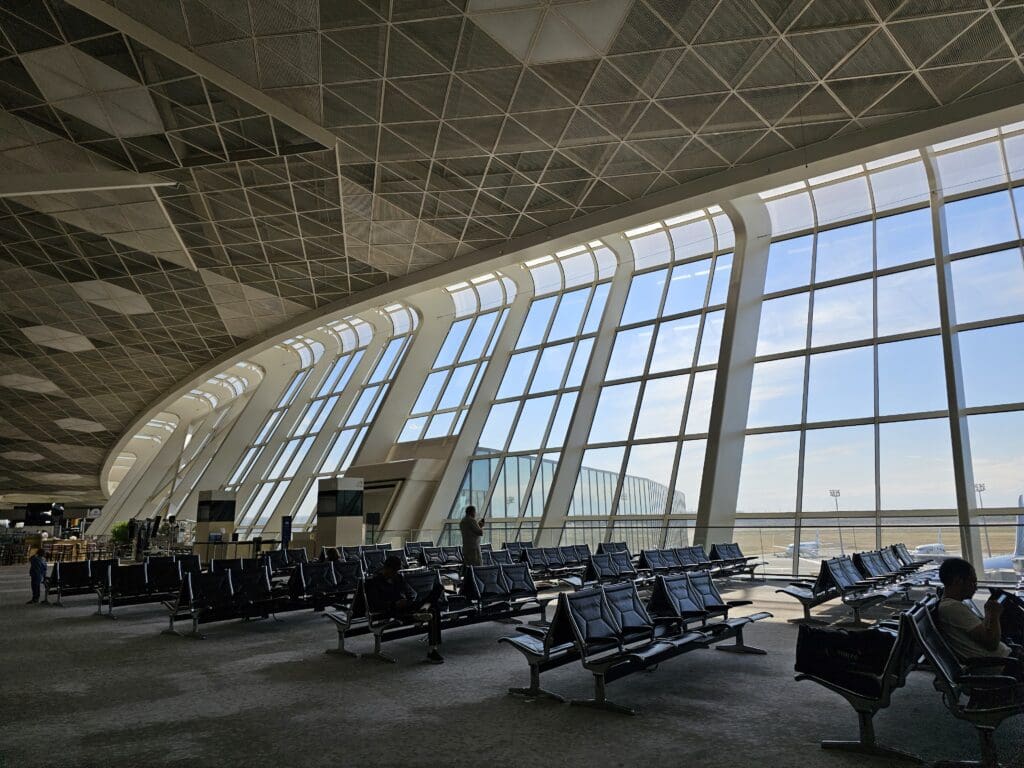
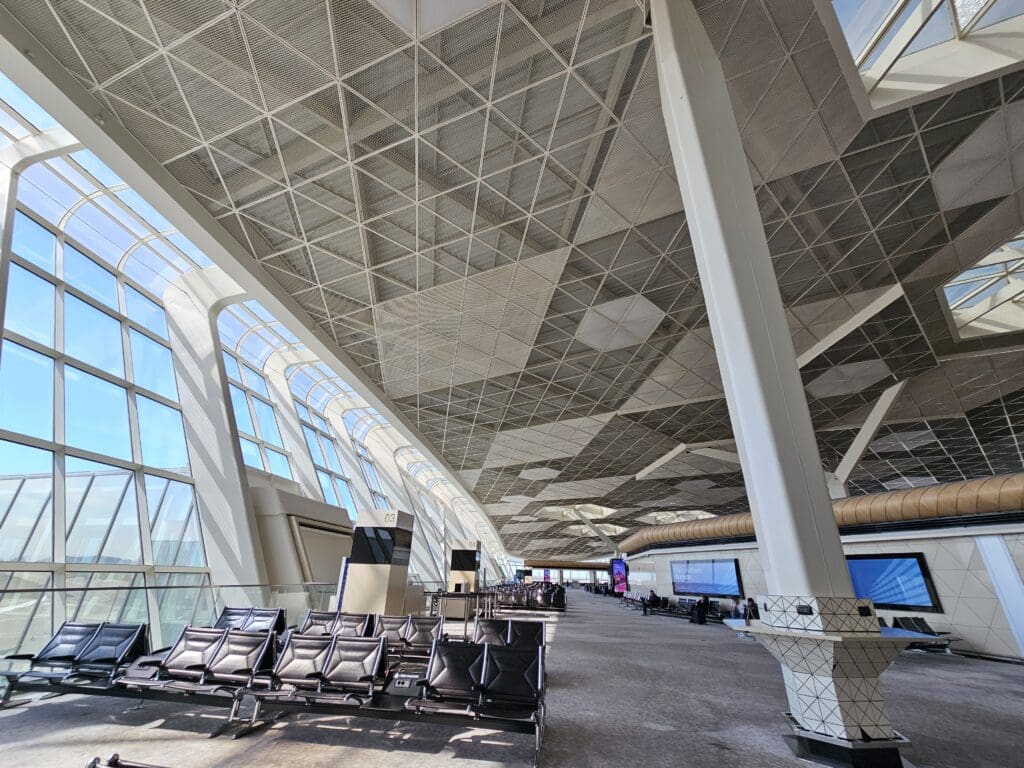
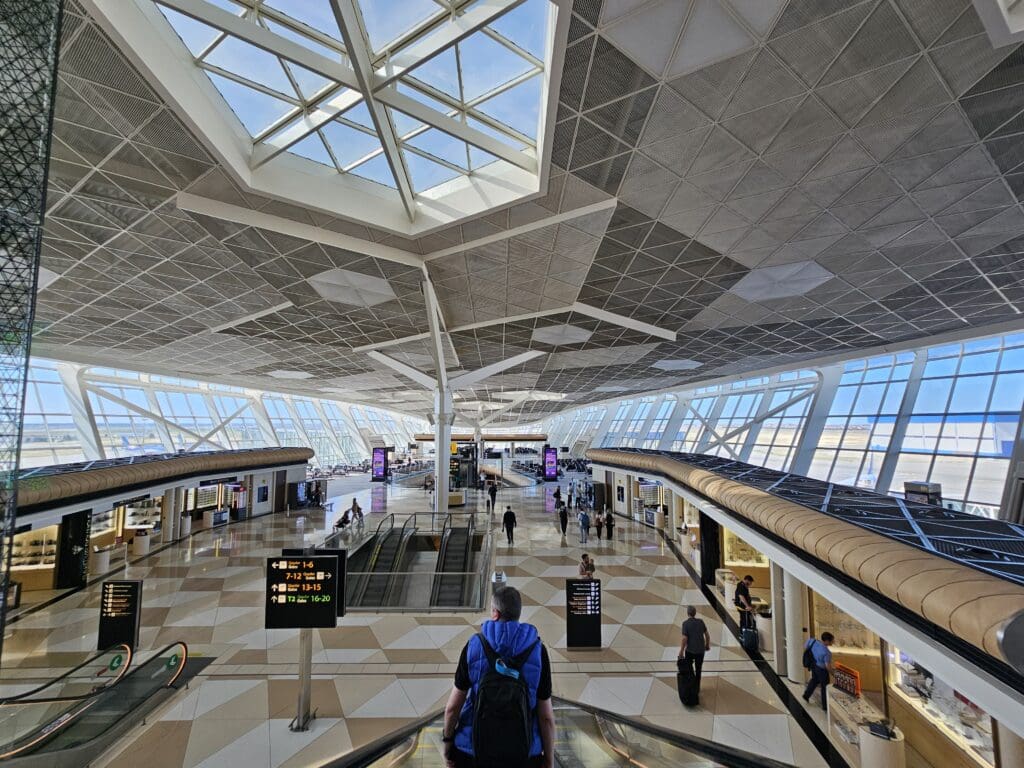
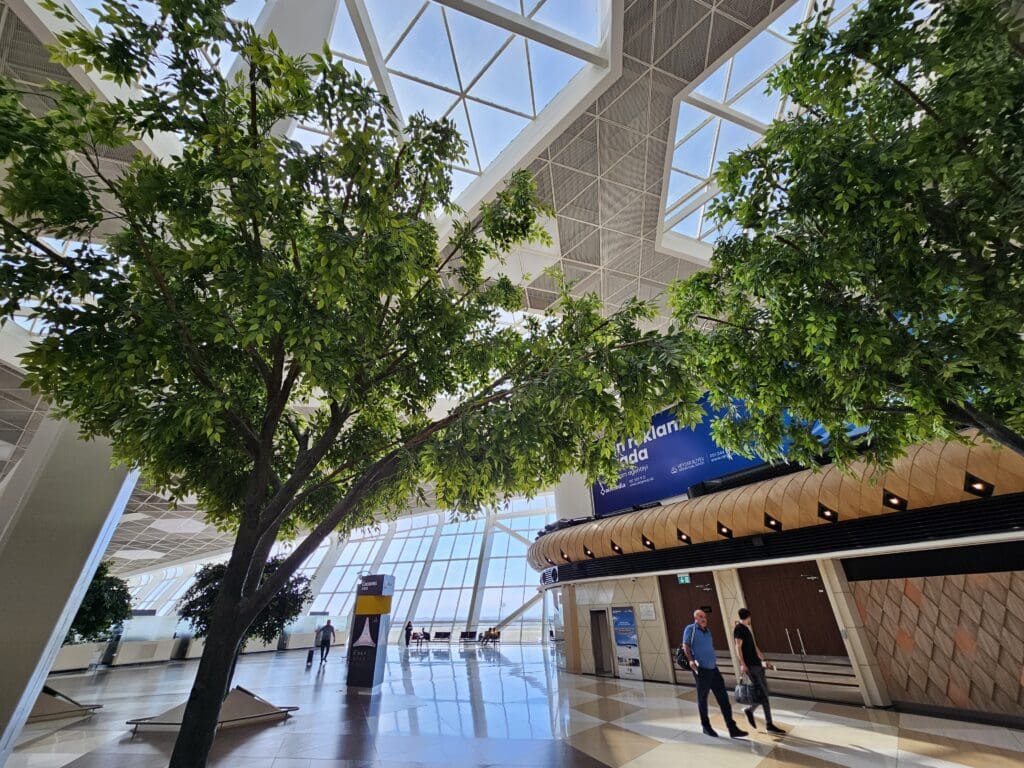
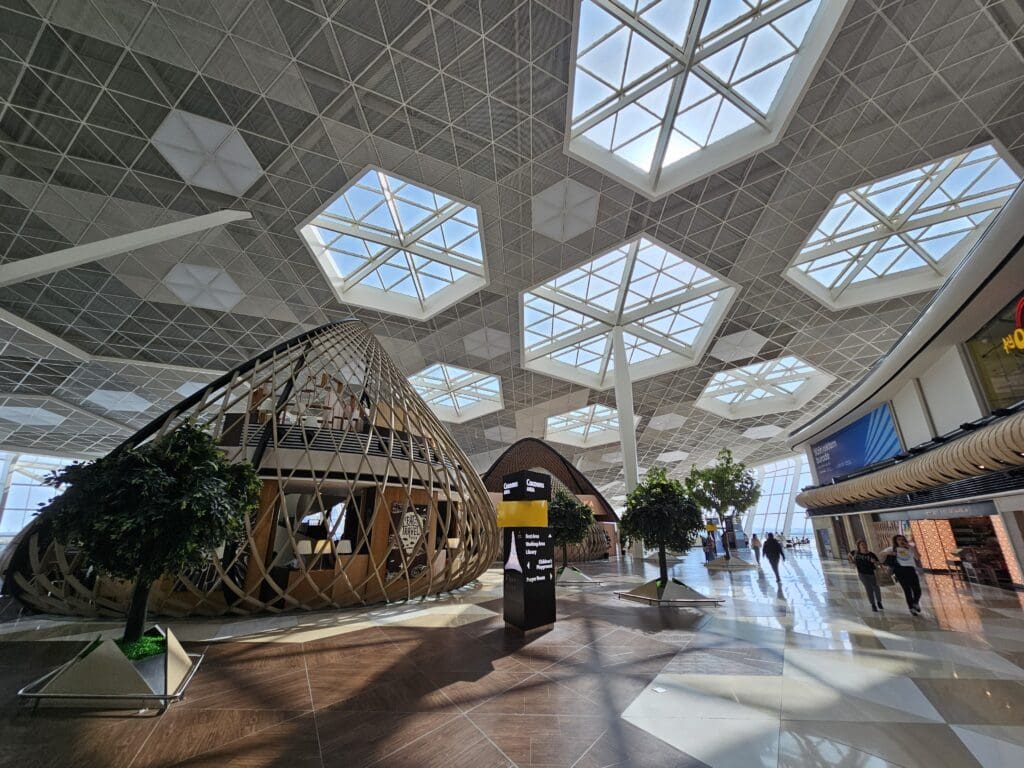
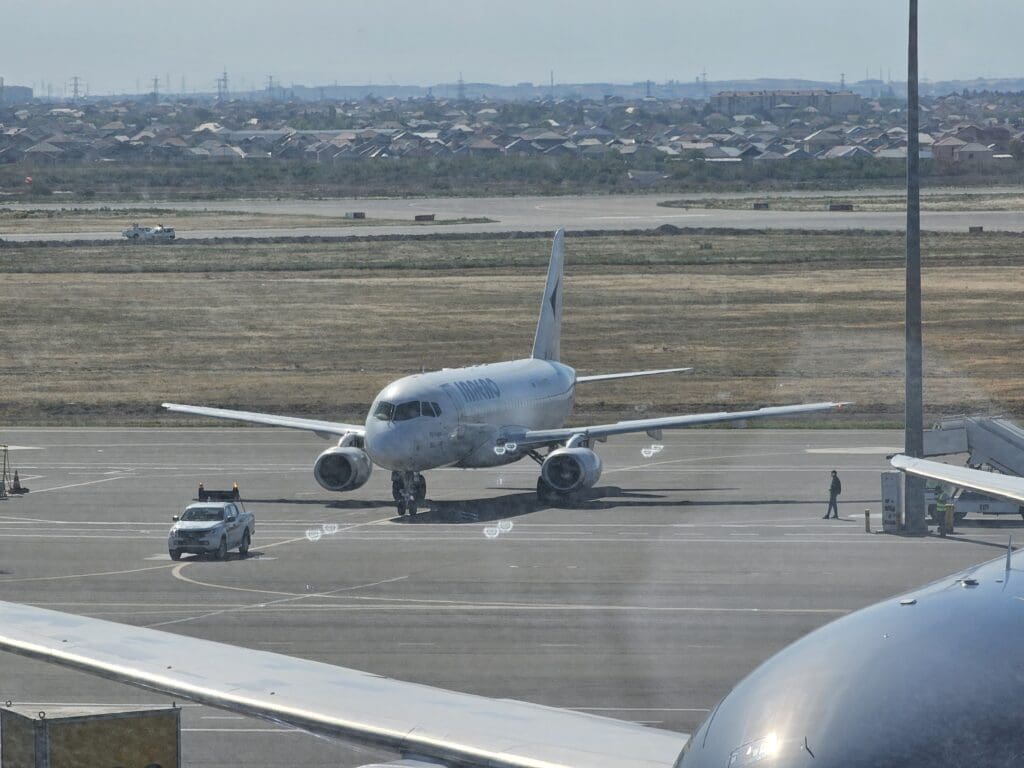
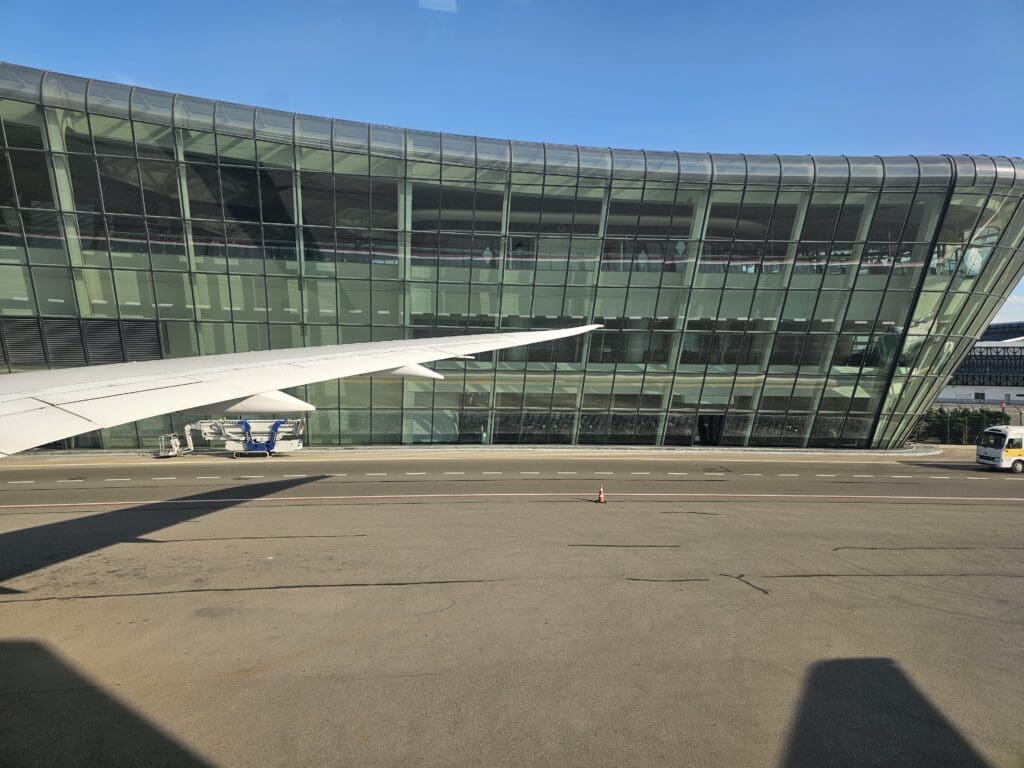
Unfortunately, Azerbaijan is not known to be the most spotter-friendly country, and many sources caution visitors against taking photos or videos of any strategically important sites, including airports. Therefore, as I wandered around, I tried to be somewhat covert when taking photos of both the terminal and the aircraft outside. For those who are simply content with watching the movements outside, large windows provided good views of the action; however, thanks to the layout of the terminal, any decent photographs of the aircraft would have proven to be a little difficult. Being Baku, as I had suspected, many aircraft outside took the form of the hometown airline’s jets and I managed to spot every single aircraft type in the airline’s fleet. Also in appearance were many Boeing 747-400 and Boeing 747-8 freighters operated by Silk Way West Airlines and a few Ilyushin Il-76s operated by their partner carrier, Silk Way Airlines. However, the unquestionable highlight of my stay took the form of an ultra-rare, locally based Beriev Be-200 operated by Azerbaijan’s Ministry of Emergency Situations. In addition, a couple of rare Sukhoi Superjets operated by Russian carrier IrAero could be seen, along with aircraft from Aeroflot, AirArabia, AnadoluJet, Turkish Airlines and UTair.
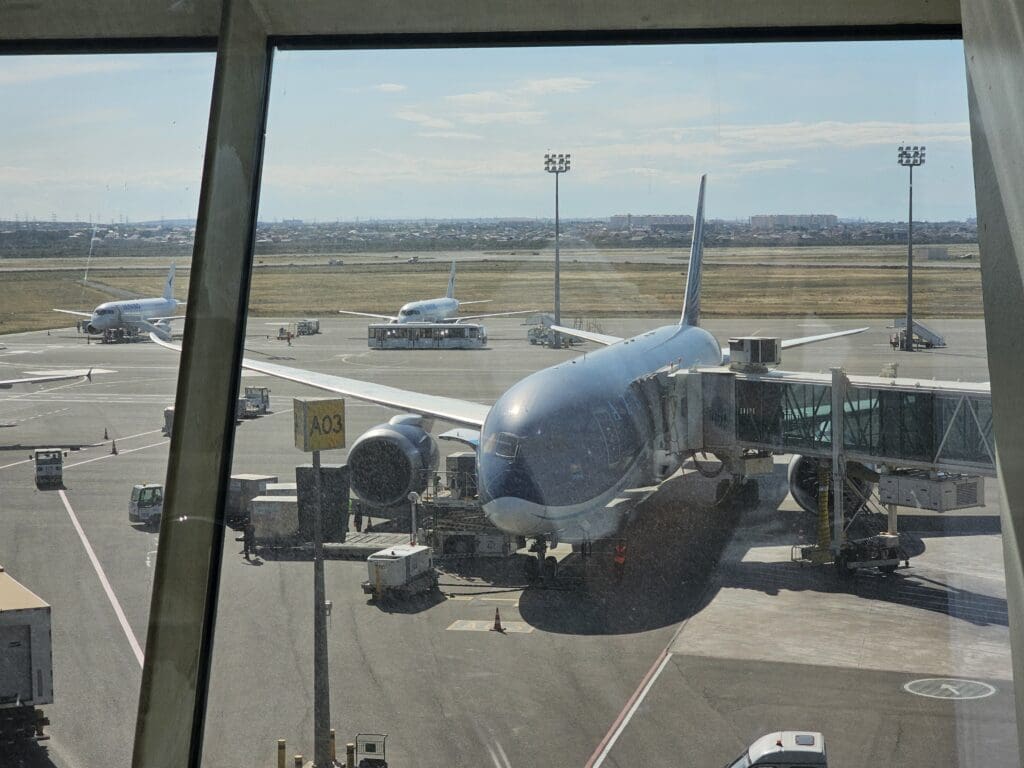
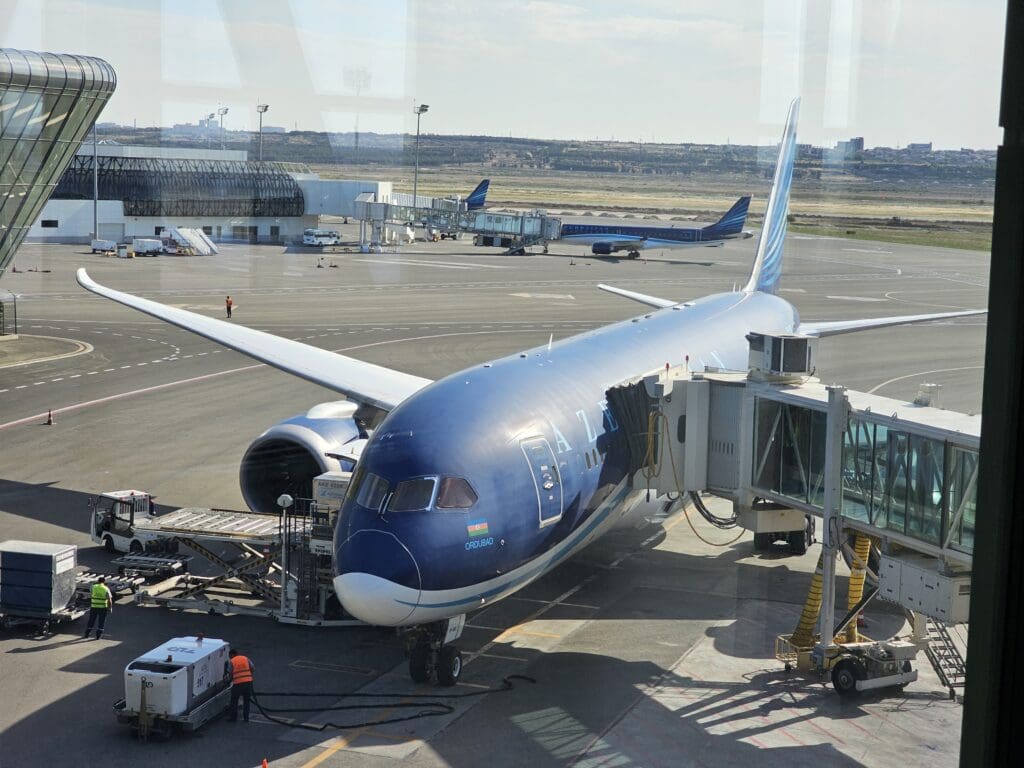
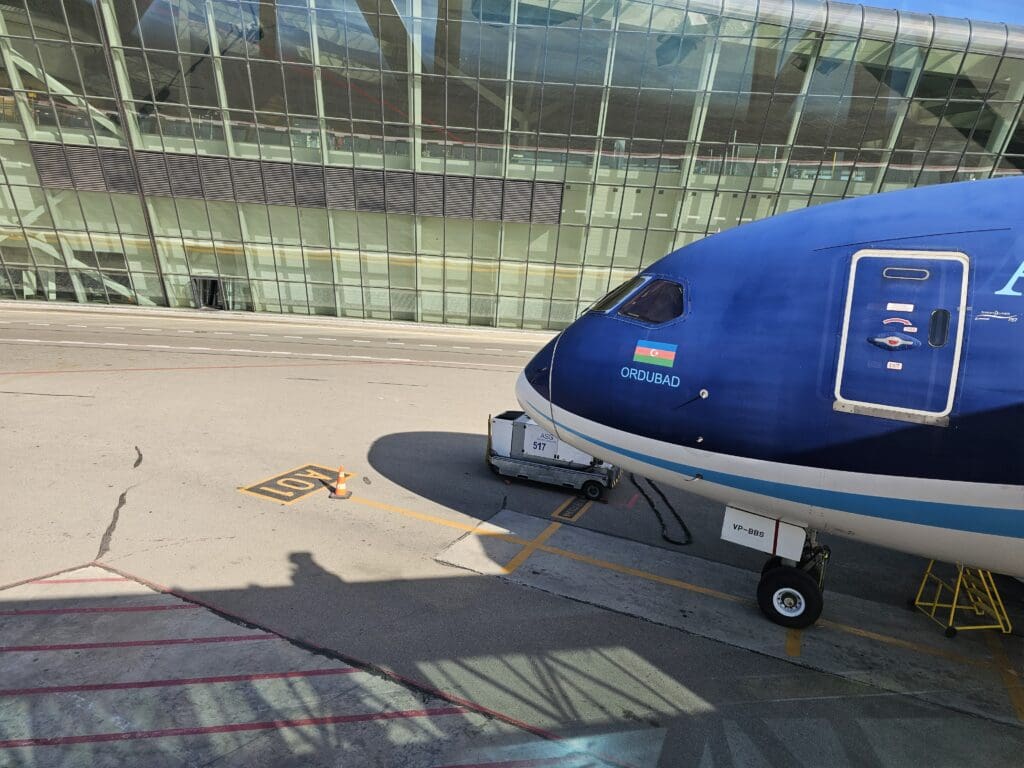
That afternoon, Azerbaijan Airlines’ two Boeing 787-8 Dreamliners were on the ground in Baku, and, being an enthusiast, I hoped to end up on the aircraft that had arrived from Istanbul rather than the one that I had just disembarked. However, upon checking the departure boards, I discovered that the flight would depart from Gate 1, and thus, I would be departing on the same aircraft on which I had arrived. This aircraft took the form of Boeing 787-8 Dreamliner, VP-BBS, named Ordubad after the small city in the Nakhchivan Autonomous Republic. Assembled at Boeing’s plant in Charleston, this aircraft carries the line number 247 and took to the skies for the first time in November 2014, making it around 9.5 years old at the time of my flight. Painted in Azerbaijan Airlines’ distinctive blue livery, the aircraft was ferried to Baku in December 2014 and has flown with the airline ever since. During its almost decade-long career, the aircraft has been deployed on a mixture of short, medium and long haul routes, with its furthest destination being the now ceased route to New York JFK. In the week before my flight, the aircraft had operated a total of 21 sectors, connecting Baku with Beijing, Dubai, Istanbul and London Heathrow, covering at least 37,000 miles during this period.
Having exhausted the sights of Baku Airport, I decided to wander over to Gate 1 with ten minutes to go until boarding was scheduled to commence. At that time, a reasonable cluster of London-bound passengers could be seen waiting and seemed to be an interesting smorgasbord of all sorts of passengers. These included a reasonable number of British oil and gas workers, connecting passengers from India (Azerbaijan Airlines seems to constantly offer one of the cheapest options between New Delhi and London), as well as of course, Azerbaijani travellers heading to the UK. In addition, I spotted several American Atlas Air pilots who seemed to be deadheading back to the US after flying in on a Boeing 747-8 Freighter that morning. I later discovered that this was Silk Way West Airlines’ latest delivery! At that time, an army of Azerbaijan Airlines employees could also be seen standing at the podium and preparing for boarding to commence. At 1650 on the dot, an announcement was made in Azerbaijani, English and Russian advising passengers of the commencement of boarding. Whilst those who were flying in Business or Premium Economy could head straight up to the podium, with two queues demarcated, there was no particular order to boarding, and all passengers were invited to head to the aircraft at the same time.
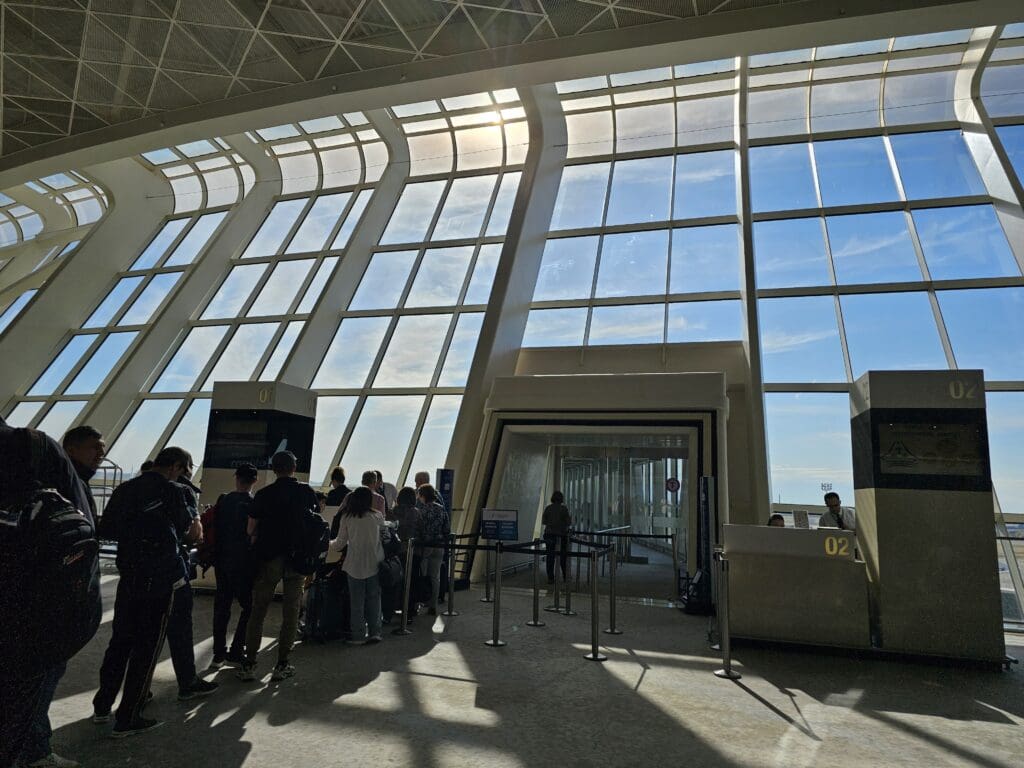
Joining the short queue, I shuffled along, and before I knew it, I had my boarding pass scanned and my passport checked before I was wished farewell in Russian. From there, I made the short walk to the jet bridge and covertly took a few photos of the waiting jet. Admittedly, whilst I am a fan of Azerbaijan Airlines’ livery, this did seem to be a little faded and worn in places, and the Dreamliner seemed to require a repaint. At the end of the jetbridge, a tray had been set up with several Azerbaijani newspapers for passengers to take and read during the flight, with this appearing to be guarded by several bulky security guards who eyed passengers, perhaps to identify potential troublemakers as they made their way to the aircraft.
Given the coldness of the crew on the first sector, I was positively taken aback by the warm and friendly greeting that I received from no fewer than three flight attendants in Russian and English as I stepped into the galley that separates the Dreamliner’s Business cabin from its Premium Economy section. Glancing left, I caught a quick glimpse of the slightly dated and privacy-lacking Business class cabin, which features three rows of lie-flat Zodiac Aura Lite seats arranged in a 2-2-2 configuration. Once one of the flight attendants had checked my boarding pass, I was instructed to head down the second aisle and soon entered the Dreamliner’s comparatively large Premium Economy cabin. Even though Azerbaijan Airlines’ Business class product may be a little outdated, their Premium Economy seats may be seen to be a cut above those of many other airlines. These take the form of five rows of spacious recliner seats in a 2-3-2 configuration and are the same Timco seats that many low cost and leisure airlines (such as Jetstar, Norse Atlantic Airways, Scoot and TUI Airways) market as a Business class product.
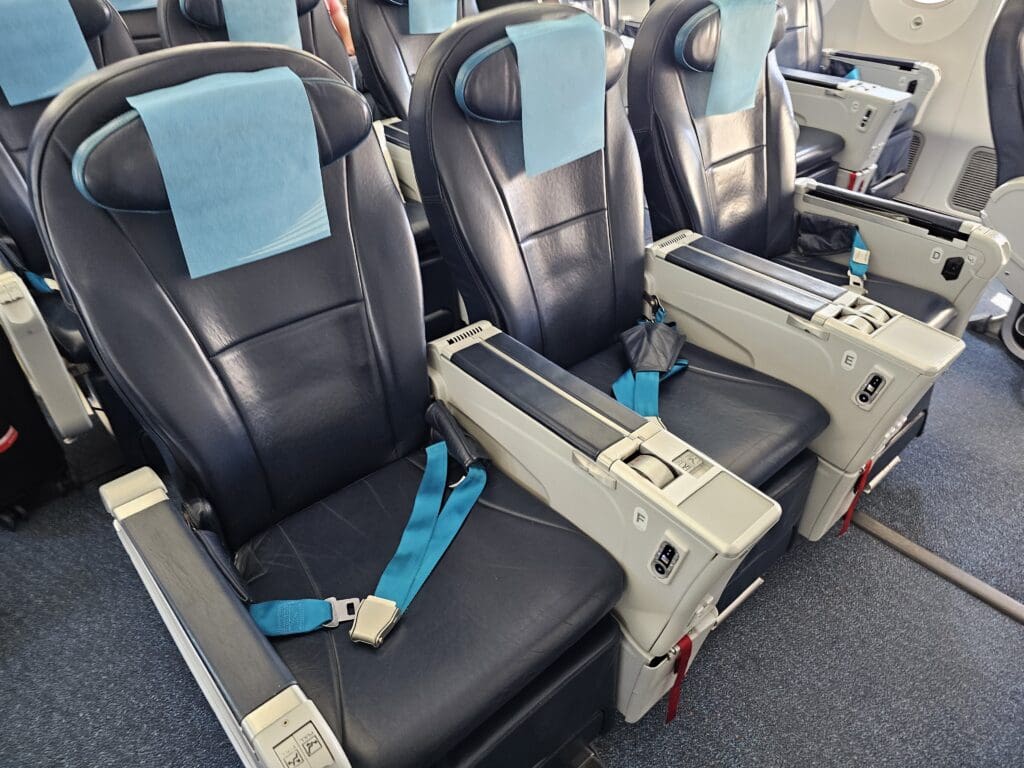
Contrasting with the great first impression that was created by the flight attendants at the L2 door, as I voyaged down the aircraft, I failed to receive so much as a single greeting from the three flight attendants I passed on this journey. Once through the Premium Economy section, I entered the Dreamliner’s small forward Economy cabin where seven rows of Economy seats could be seen in the standard 3-3-3 arrangement. Despite Azerbaijan Airlines’ unique and arguably regal livery, the interiors of their aircraft are far less exciting and those expecting some elements of Azerbaijani design would have been disappointed. In Economy, each seat sported a dark pleather cover and a turquoise pleather-covered adjustable headrest, whilst the bulkheads and cabin dividers were plain and simple, lacking in any designs or patterns. Each headrest was covered by a disposable fabric antimacassar, which was either light blue or in the case of extra legroom seats, white with a swirling pattern and accompanied by the phrase, ‘Have a nice flight’.
In Economy, each seat came with a coat hook, a fold-down footrest, a bifold tray table and a relatively modern Panasonic touchscreen inflight entertainment screen. Beneath each screen, a USB-A port could be found, whilst two universal plug sockets were provided for each bank of three seats, although I was disappointed to find that neither the USB-A port nor plug socket worked during the flight. Furthermore, whilst Azerbaijan Airlines’ service to London is one of the airline’s longer sectors, neither pillows nor blankets were provided as standard in Economy. However, I should note that the crew were willing to provide these to those who requested them during the flight. Unlike on the flight up from Dubai, no boarding music was played, and no montage of scenes from across Azerbaijan was broadcast on the inflight entertainment screens as passengers made their way onto the aircraft.
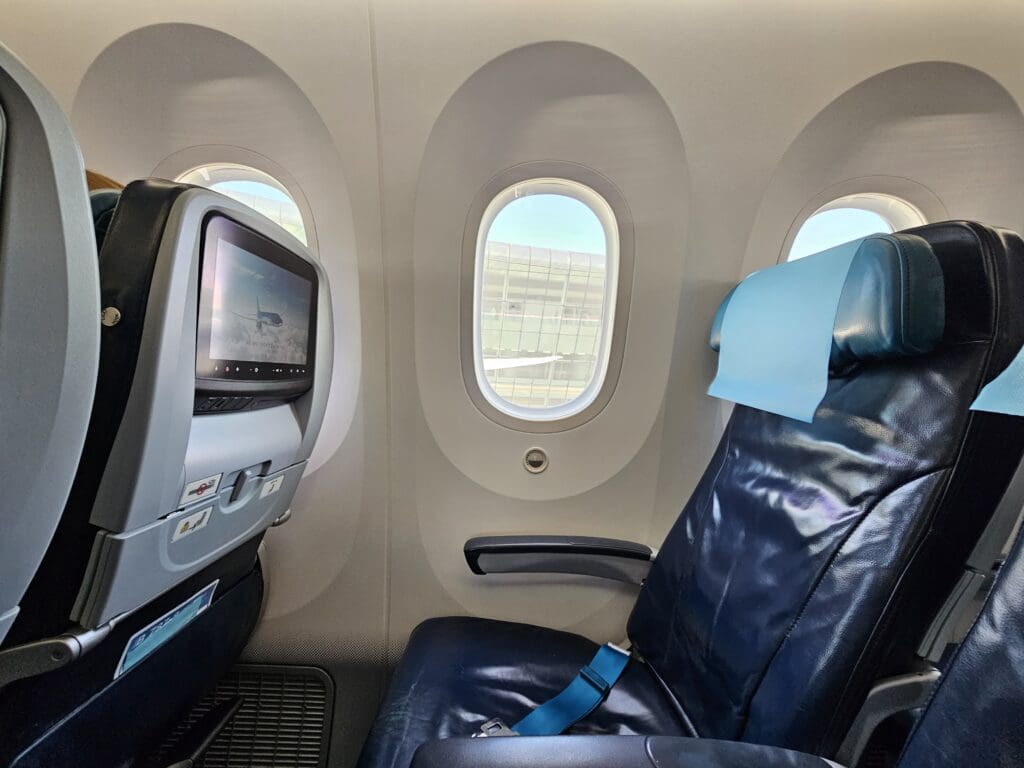
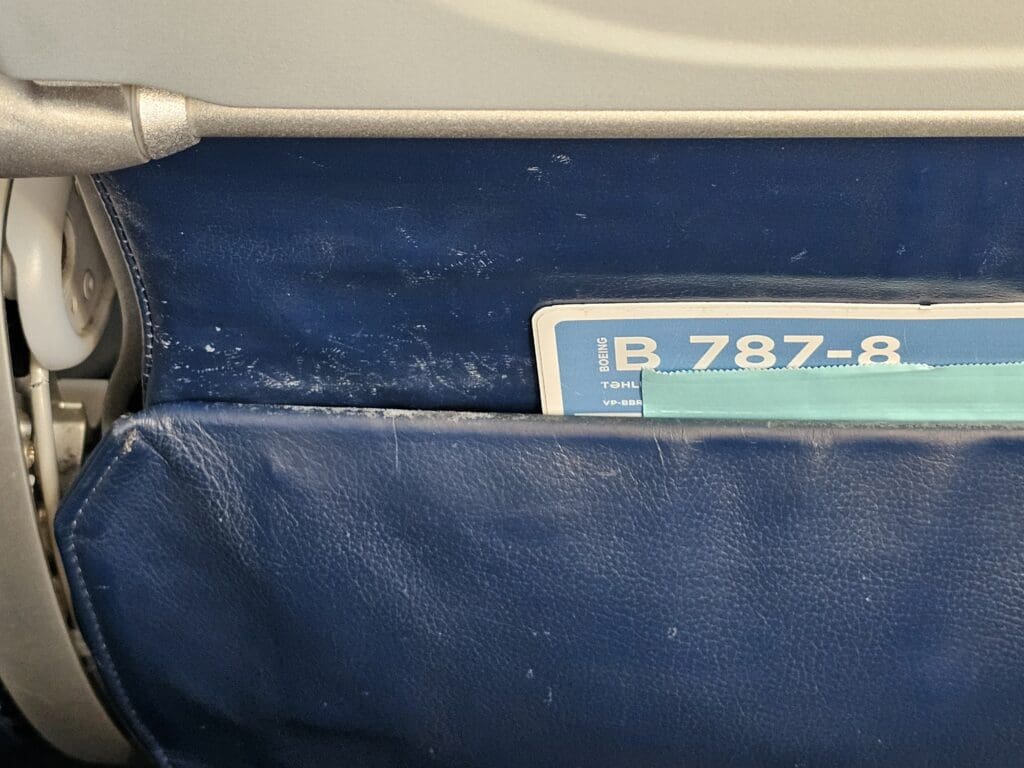
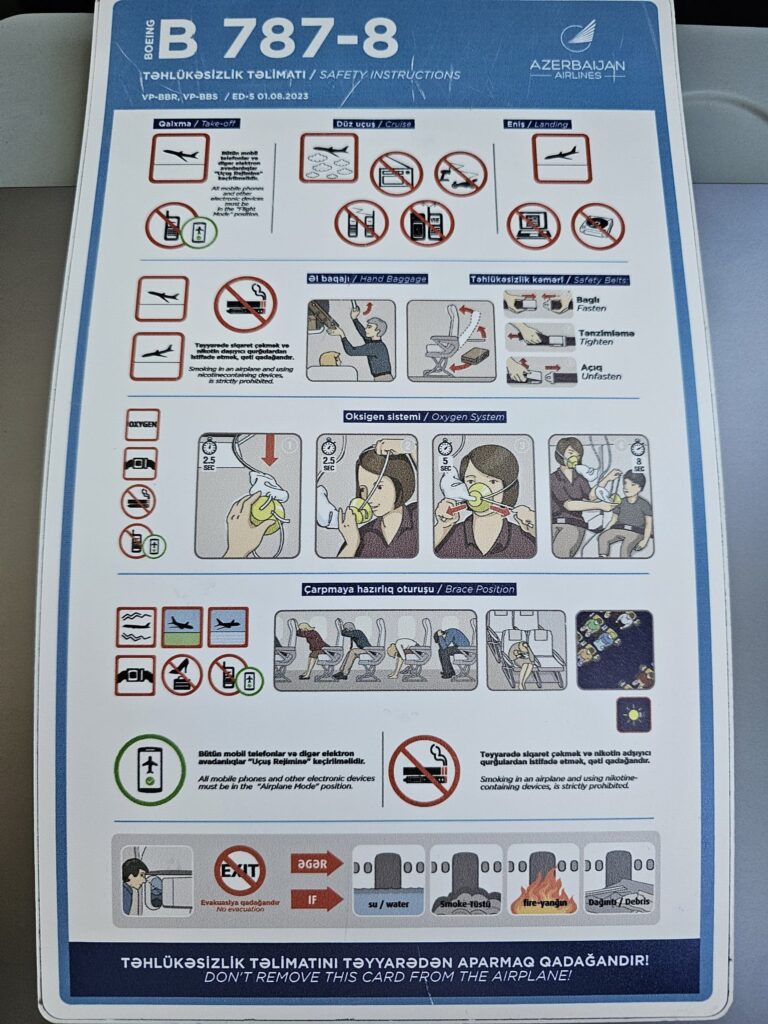
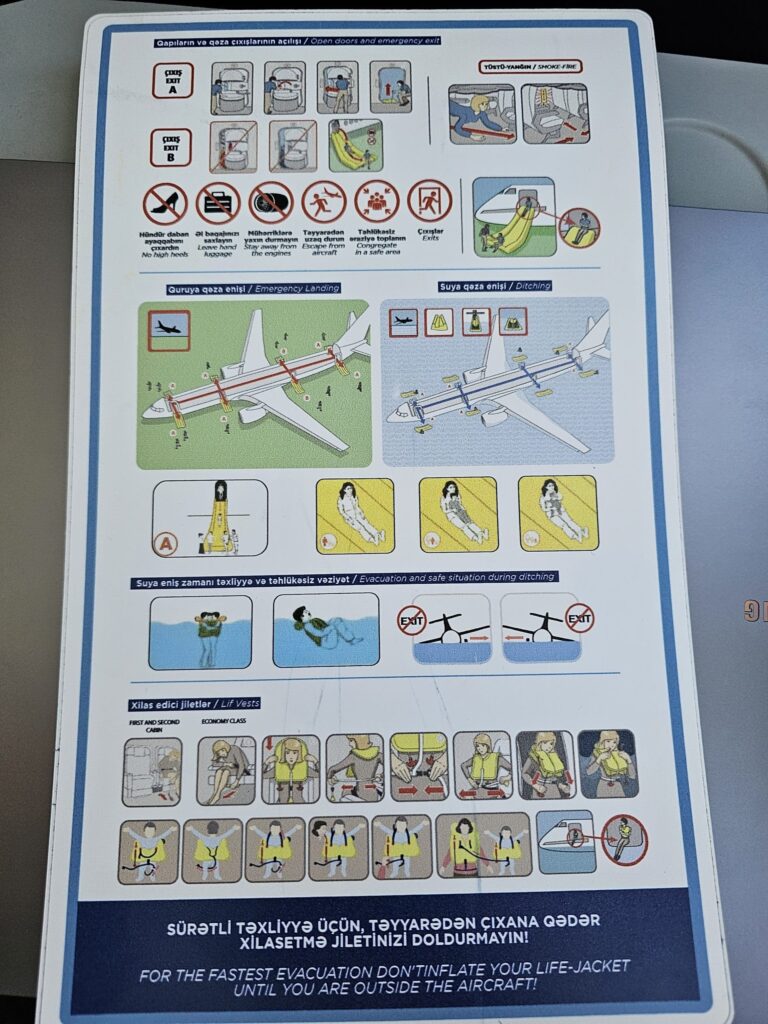
Once I had reached Row 25, I stowed my bag in one of the Dreamliner’s large overhead lockers and squeezed into Seat 25L. Having ended up a few rows ahead of the same seat that I had sat in on my journey up from Dubai, I knew what to expect from this. Indeed, my expectations were matched and I found my seat and the area around this to be rather tired-looking, with plenty of scratches, marks, frayed pleather and well-ingrained dirt and stains. However, going a slight way to redeem itself, the seat was comfortable and offered a very good amount of legroom. Turning to the seatback pocket, this contained a safety card and a sick bag, with Azerbaijan Airlines appearing to have halted the publication of their inflight magazine during the pandemic.
That evening, passengers appeared to board the aircraft quickly and efficiently, soon stowing their luggage and settling in for the flight to London. In the end, the final passenger made it onto the aircraft with about ten minutes to go until our scheduled departure time. As it turned out, the flight to London would not be particularly busy and it appeared as if no more than about 60% of the seats in Economy were filled. That evening, I ended up with an empty neighbouring middle seat, whilst the aisle seat was occupied by an oil worker who, like me, hailed from Yorkshire. In a kind Northern move, this passenger would later offer me a boiled sweet!
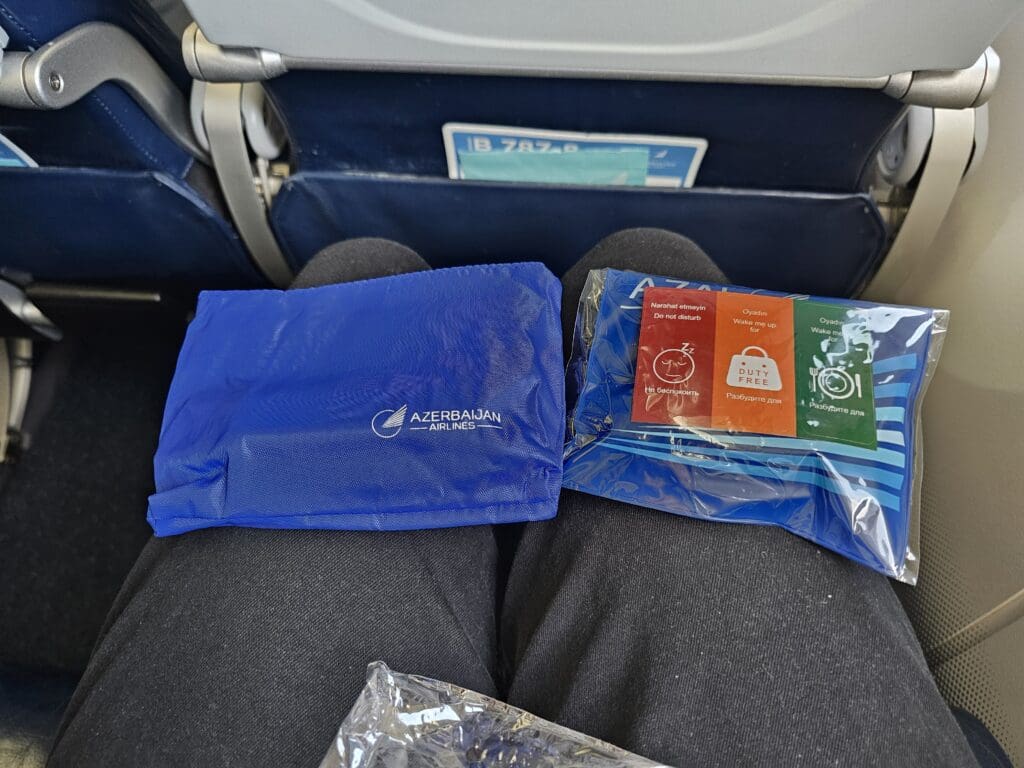
Wasting no time, once the final passenger had boarded the aircraft, the crew commenced their preparations for our departure. First up, several flight attendants walked down the aisles and distributed no fewer than two amenity pouches to each passenger. Given the relatively short nature of this non-overnight service, I was a little surprised by this, although I could most certainly find no reason to complain given the fact that amenity kits are quickly becoming a rarity. Opening these up, one contained a pack of cabin socks, a toothpaste-toothbrush set and stickers for those who wished to be woken up for meals or the duty free service, whilst the other contained an eye mask, Economy quality headphones and ear plugs. Admittedly, I was a little puzzled as to why they didn’t just combine the contents into a single amenity kit, but this was by no means a complaint! On a side note, as the crew passed through the cabin, I couldn’t help but notice that the female crew members all appeared to be very smart and presentable, whilst the male crew members were notably scruffy, with loose ties and unfastened top buttons making them similar in appearance to office workers heading home after a long day.
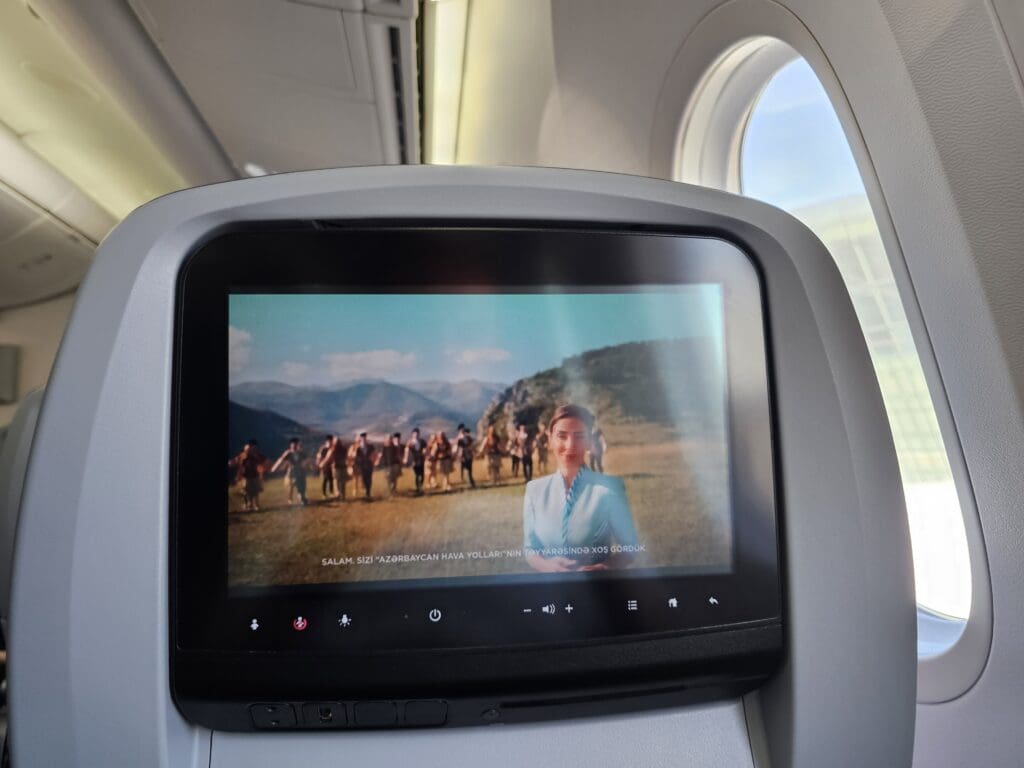
As we waited to depart, the Purser performed their pre-departure announcement in Azerbaijani, English and Russian, which featured the usual welcomes, warnings and thanks before the safety video was broadcast over the inflight entertainment screens. Released in late 2023, this took the form of a seemingly high-budget production filmed across Azerbaijan that went through the safety instructions whilst highlighting some of the country’s sights and culture. This was played first in Azerbaijani before being replayed in English, with subtitles in both languages offered. Whilst the safety video was underway, with three minutes to go until our scheduled departure time, the Dreamliner was pushed back away from its parking position. During this journey, the cacophony of modern humming, whirring and whining synonymous with the Boeing 787 filled the cabin as the aircraft’s two gigantic General Electric GEnx-1B engines powered up into life, ready to fling us 2,493 miles westwards to London.
Inside the cabin, once the safety video came to an end, several flight attendants passed through the aircraft undertaking their pre-departure checks and were expectedly proactive in telling off the small number of passengers who had already reclined their seats. Meanwhile, outside, the flaps soon whined as they were partially extended in preparation for our departure before the Dreamliner slowly and cautiously commenced its taxi to the active runway. That afternoon, the aircraft was to depart from Runway 34, and with this being the closest runway to the terminal, there was no long taxi in store in order to reach this. As we made our way to the runway, the Captain’s voice filled the cabin as they undertook their welcome announcement in Azerbaijani and English. This was comprised of a short message which detailed our 5H10 flight time, our cruising altitude and the weather in London, before thanking passengers and wishing all onboard a nice flight.
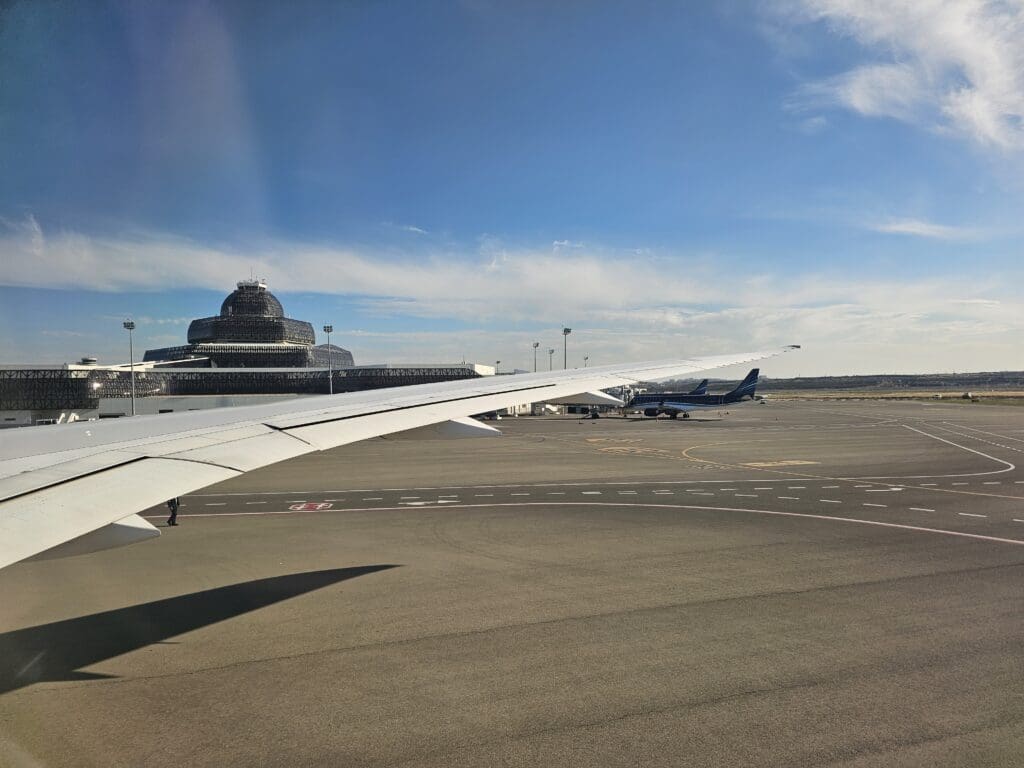
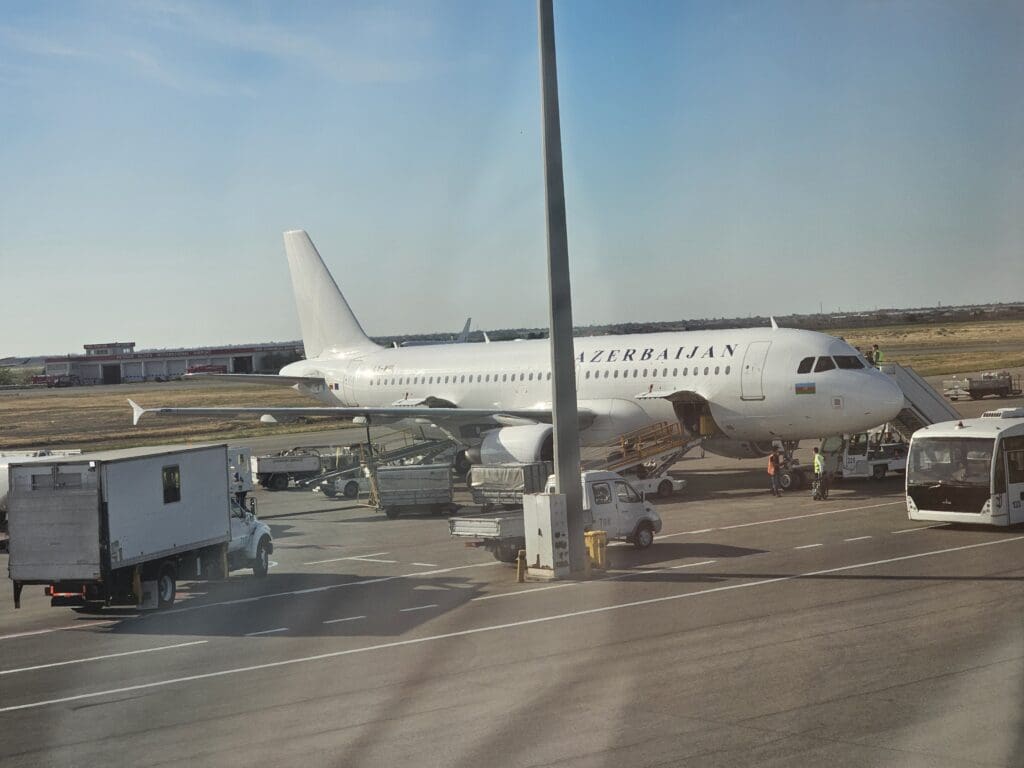
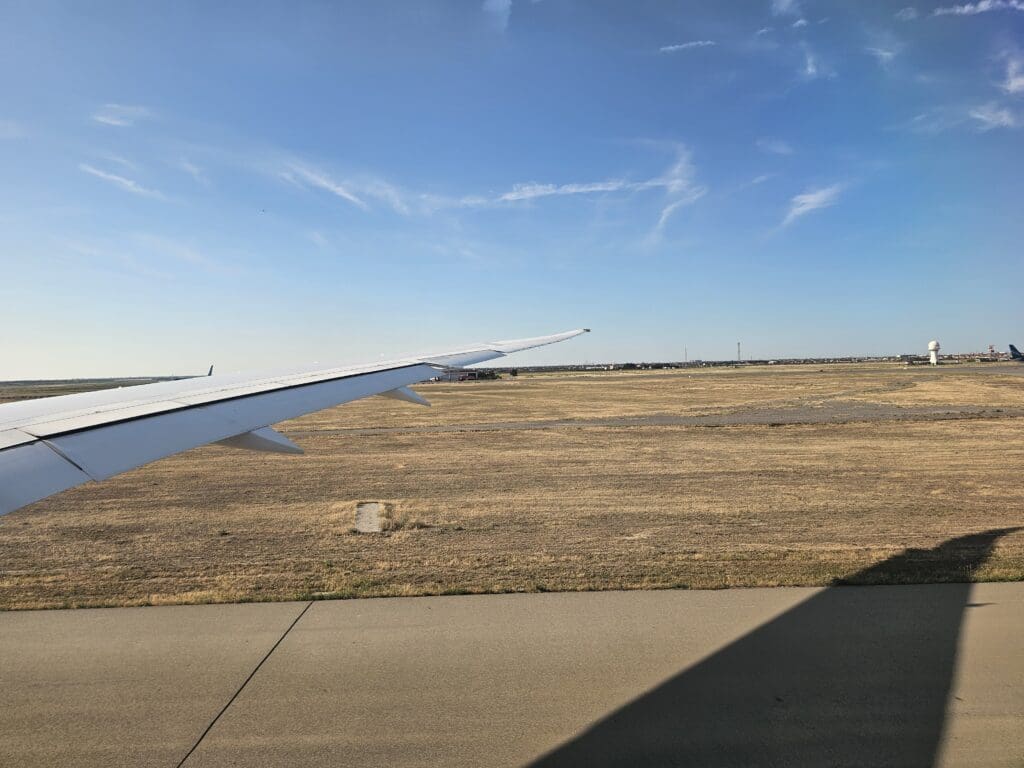
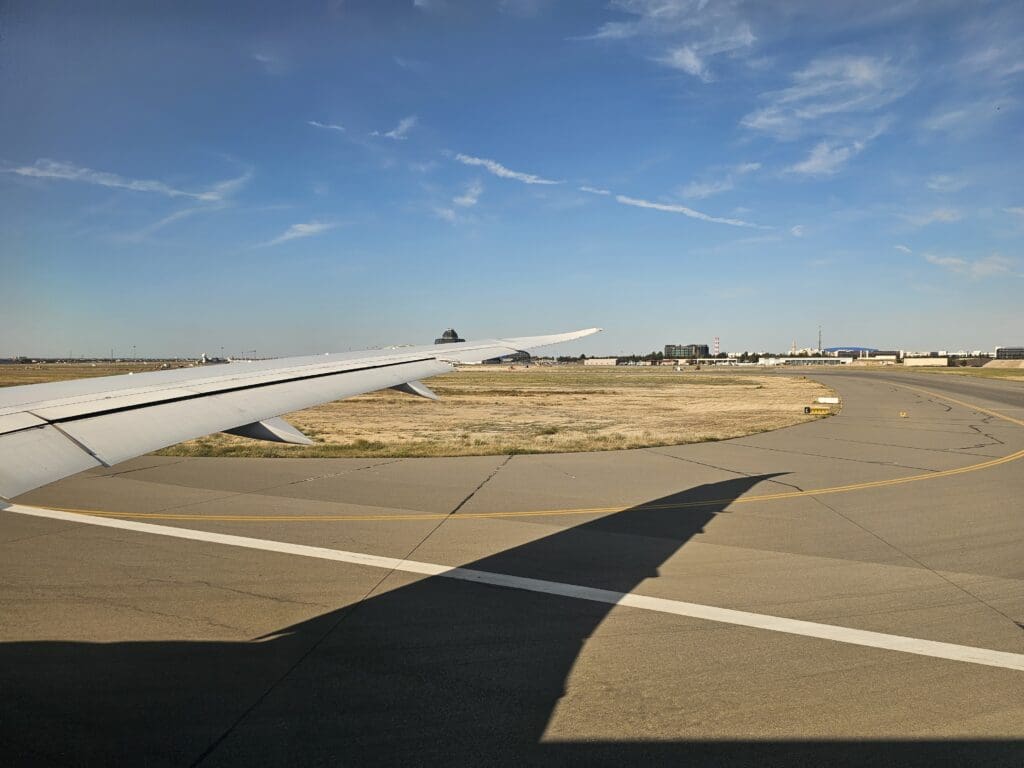
A few short minutes after commencing our taxi, the Boeing came to a halt at the end of the runway and waited there for a few minutes. Eventually, the reason for the delay became clear, with a sleek Embraer Legacy 650E soon whizzing past at the end of its flight from the Russian city of Yekaterinburg. This particular private jet was most certainly not one that I could expect to see back in Britain, coming in the form of a Russian-registered aircraft operated for the Russian Copper Mining Company. As soon as the Embraer had vacated the runway, the Dreamliner lumbered onto this and paused once again before its powerful engines spooled into life. Soon, we went bumping down the runway and performed a short and sporty takeoff before rocketing upwards into the mostly clear skies of Baku.
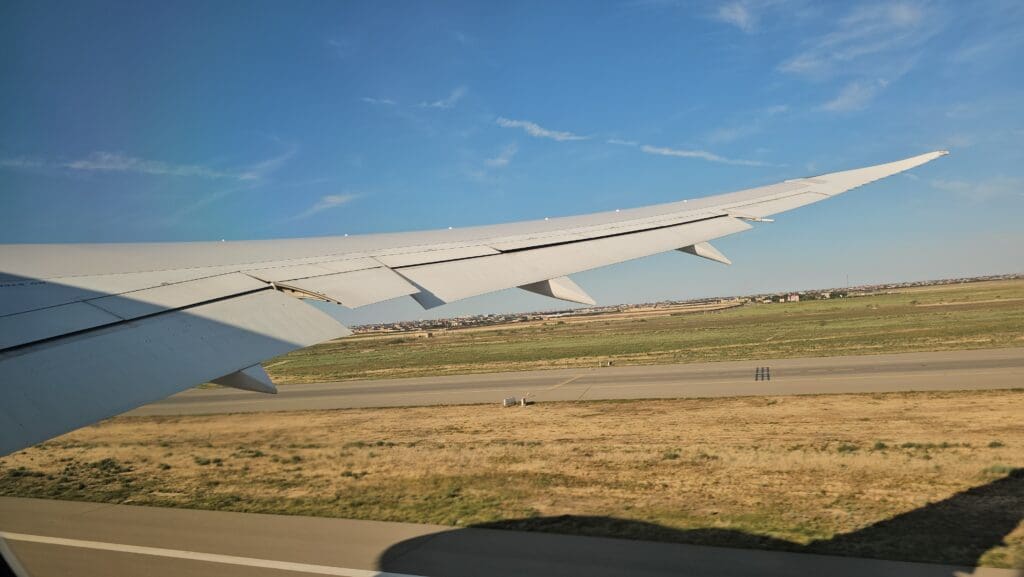
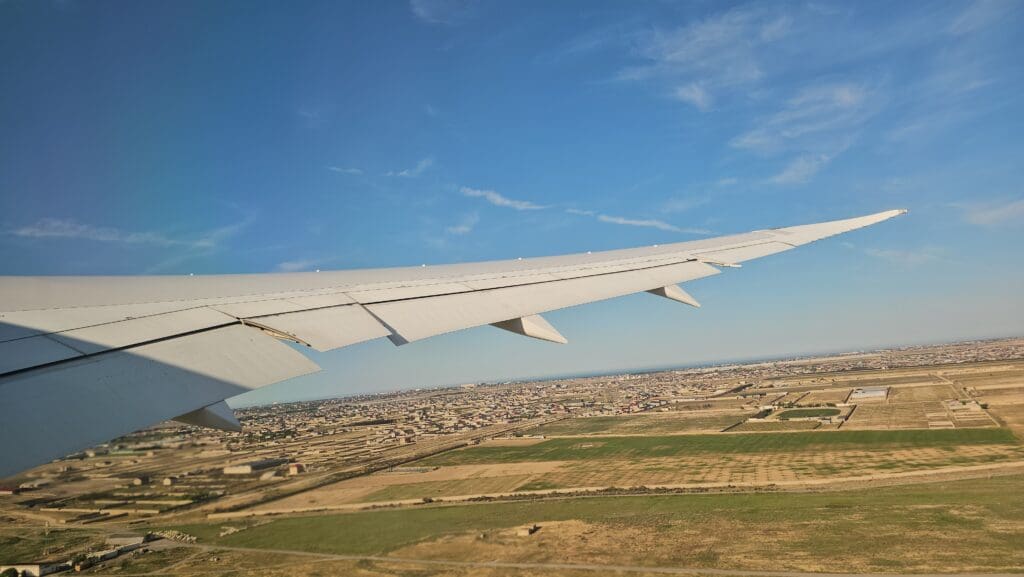
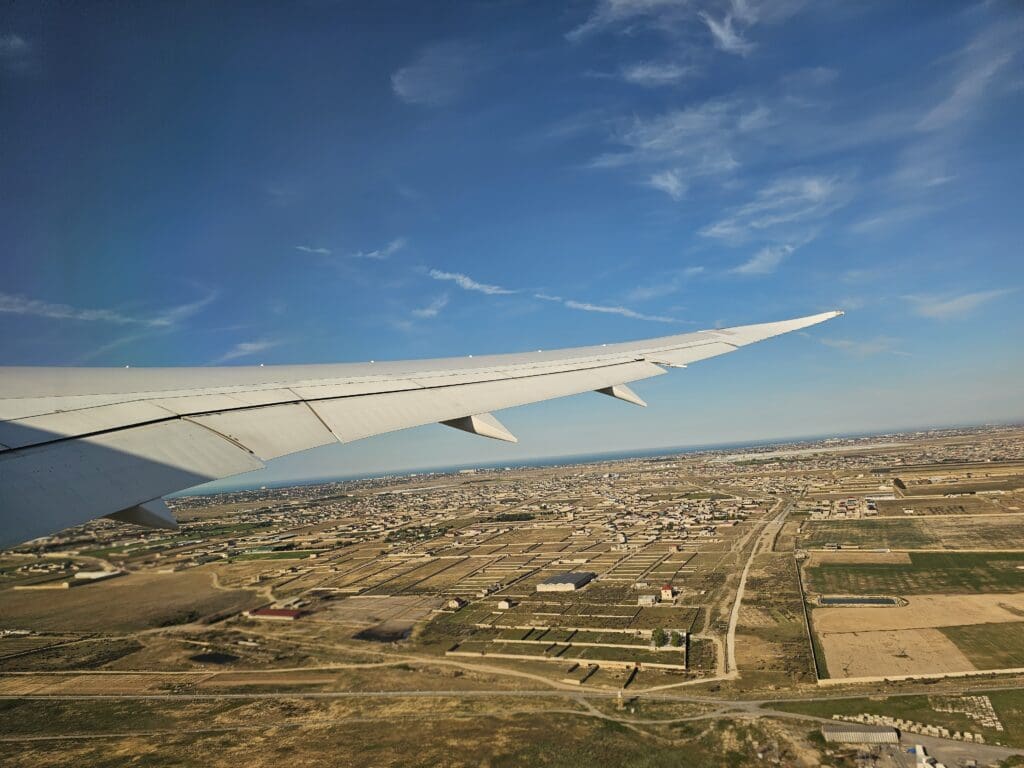
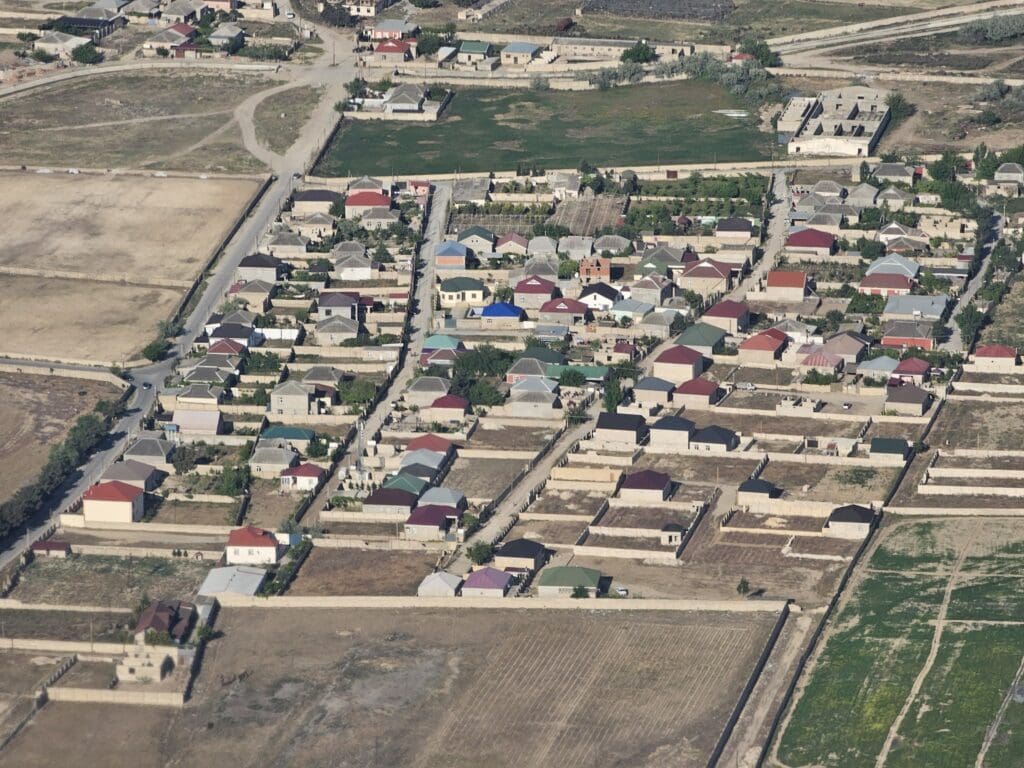
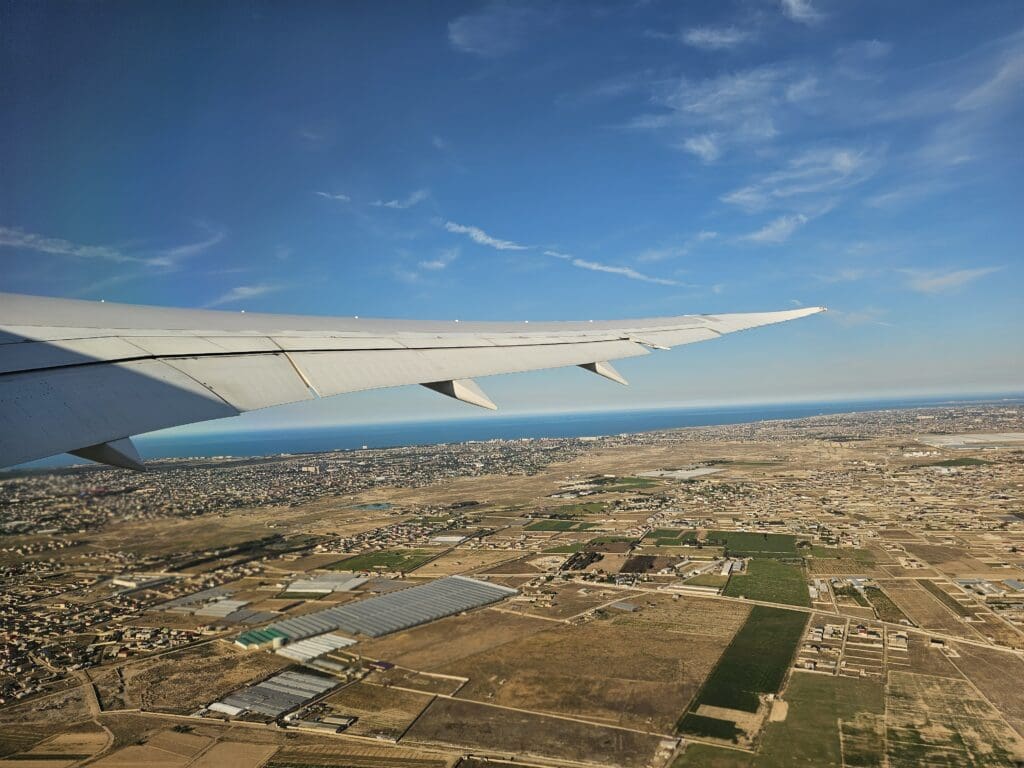
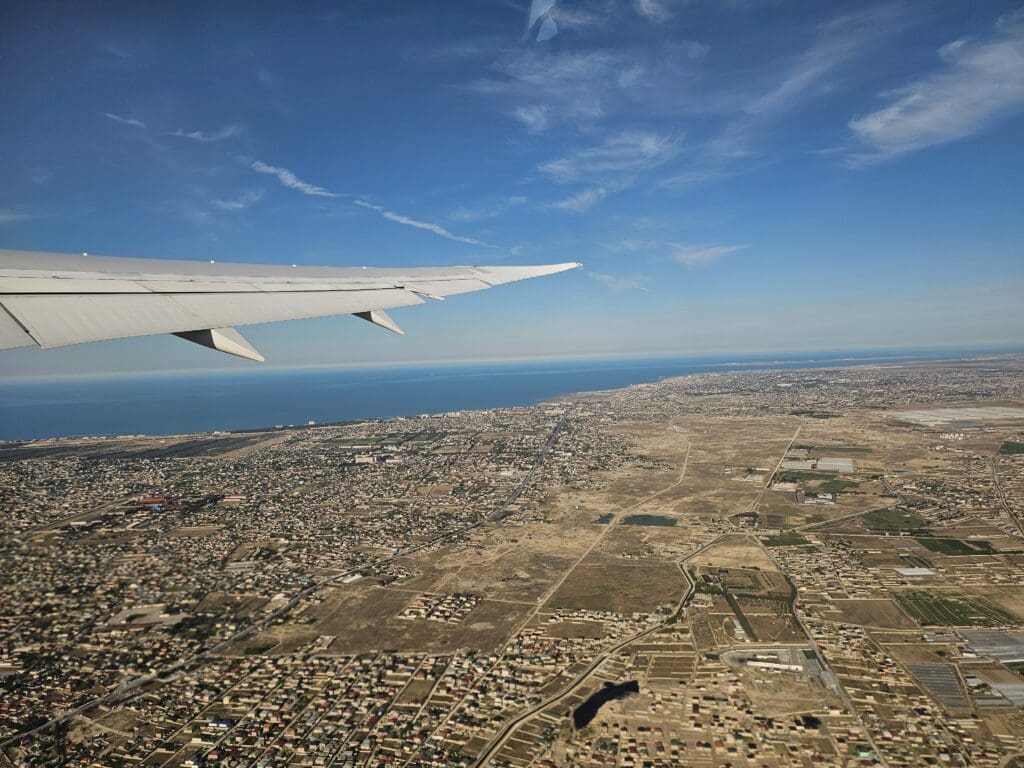
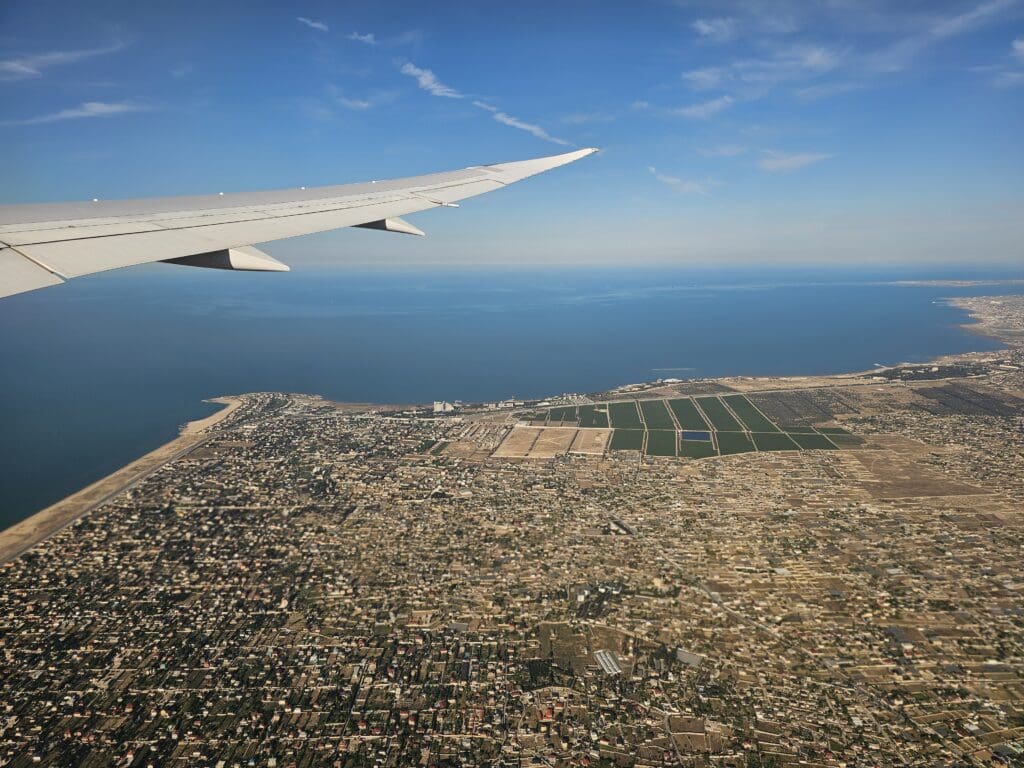
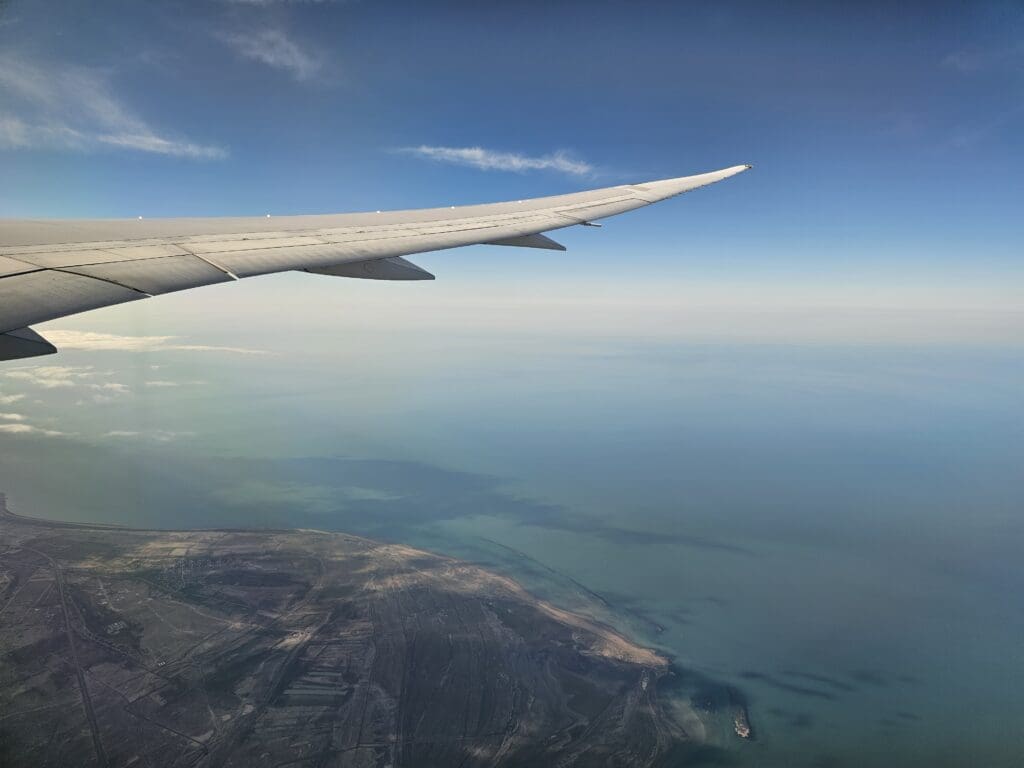
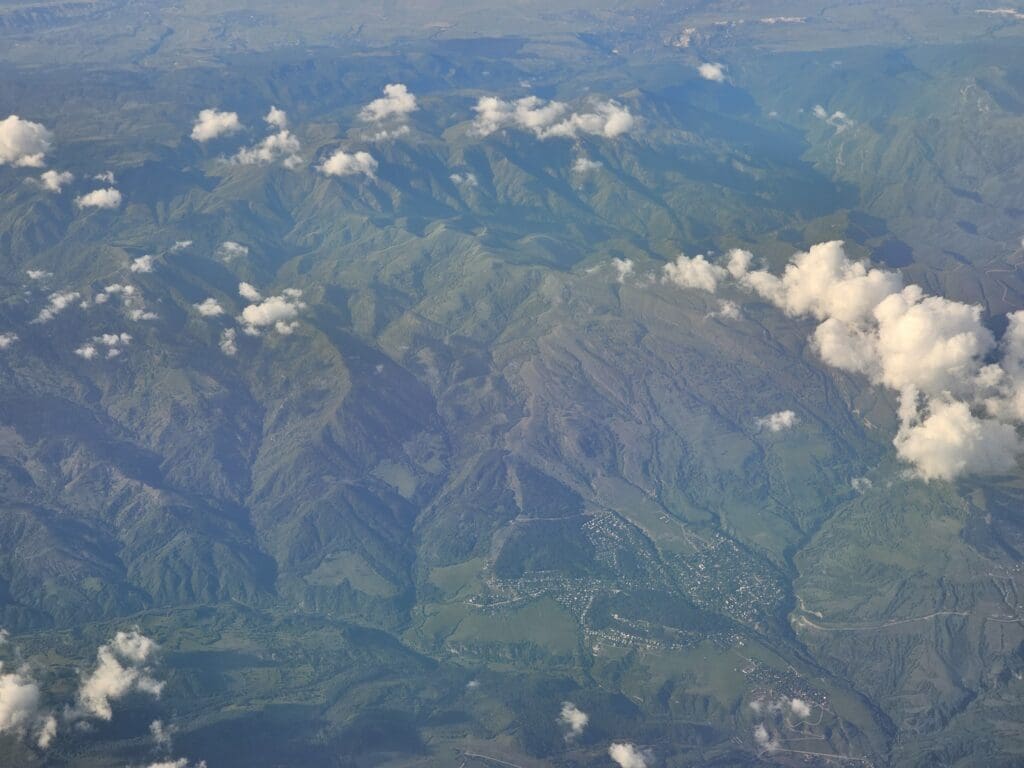
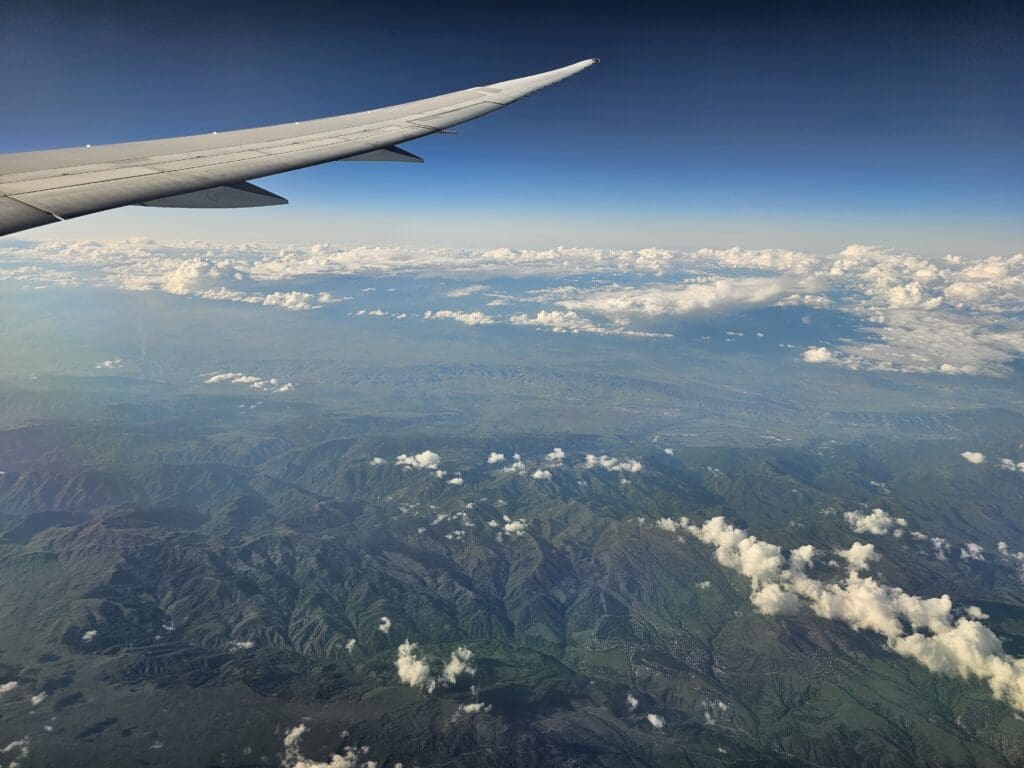
Within moments of taking to the skies, the Azerbaijani Dreamliner climbed out over the airport’s well-guarded perimeter and continued on a northerly heading, passing over the villages of the Absheron Peninsula before reaching the coastal town of Bilgah. From there, the jet headed out over the Caspian Sea before banking to the left and rolling out on a westerly heading that would take us across the Caucasus and over to Europe. A short time later, the Azerbaijani coastline appeared once again, and we crossed this just to the north of the city of Sumqayit. Unfortunately, at this point, the clouds rolled in below, which was a shame as it would mean that I would miss out on the fantastic scenery below as we cruised westward through the skies of Azerbaijan.
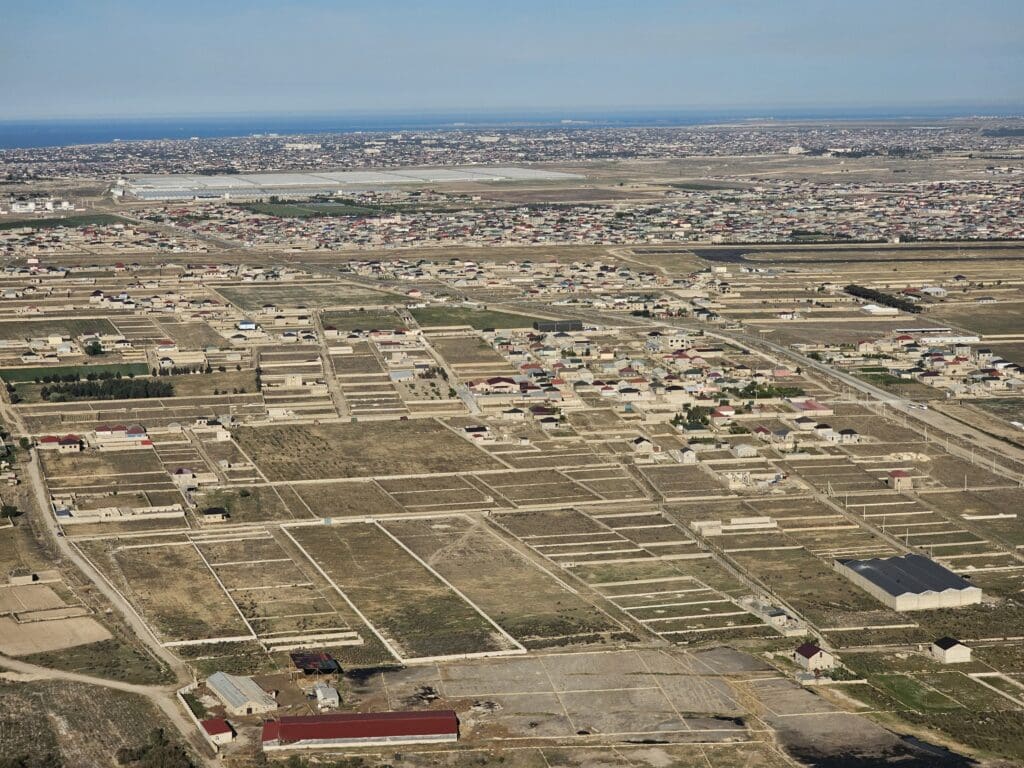
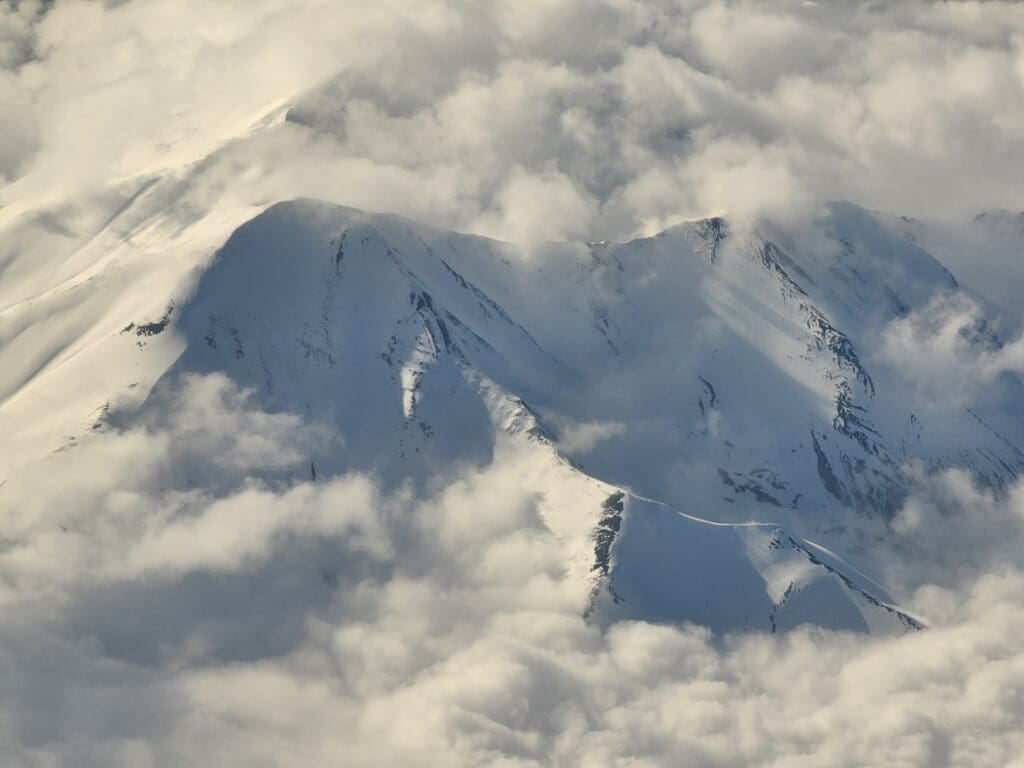
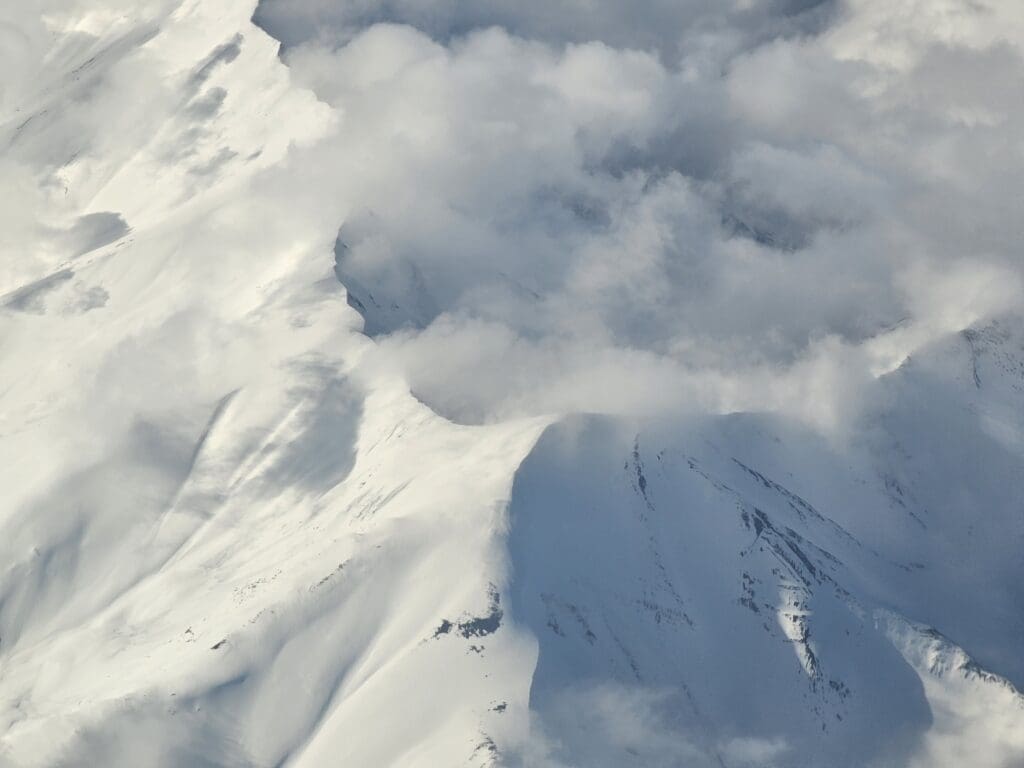
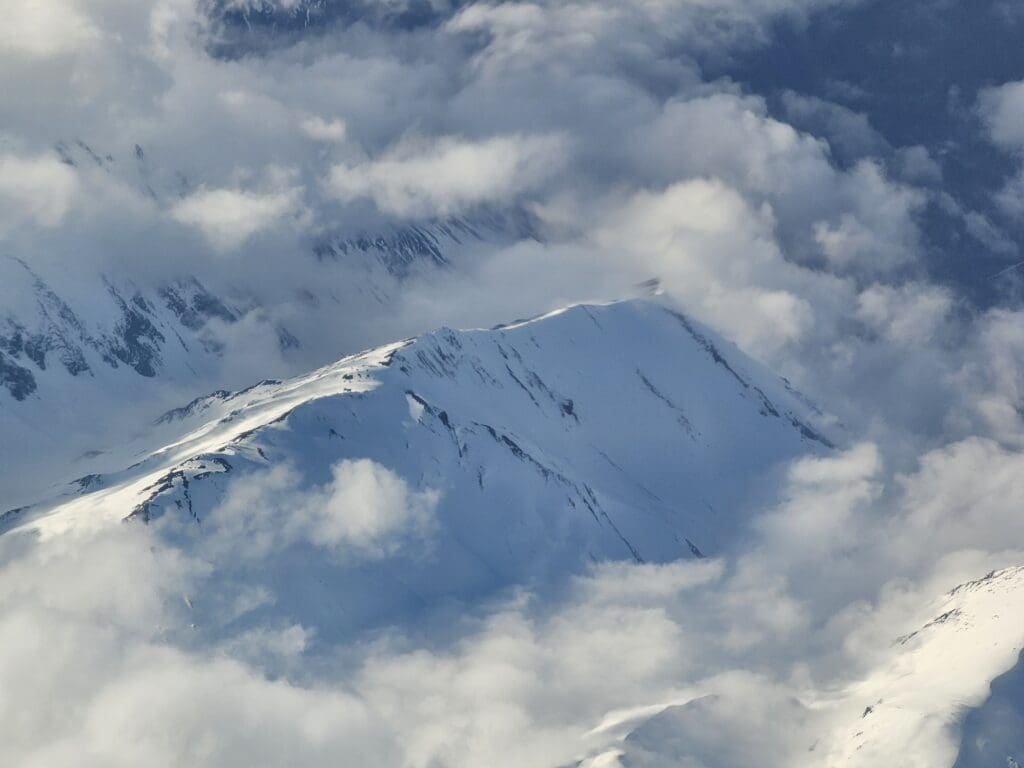
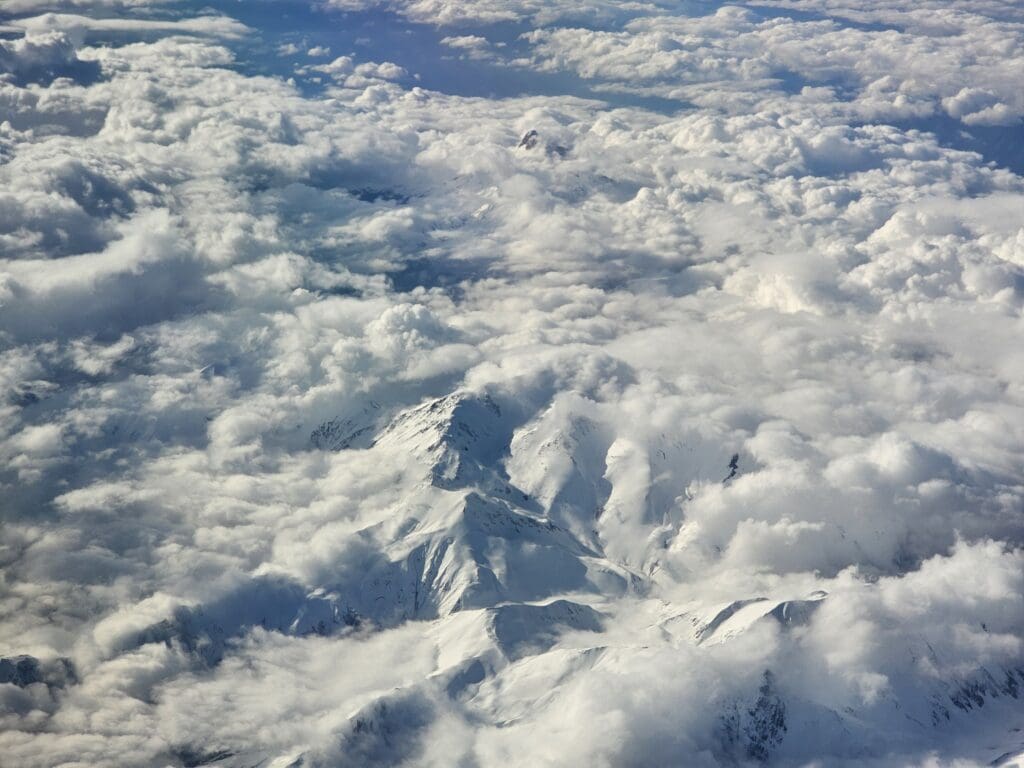
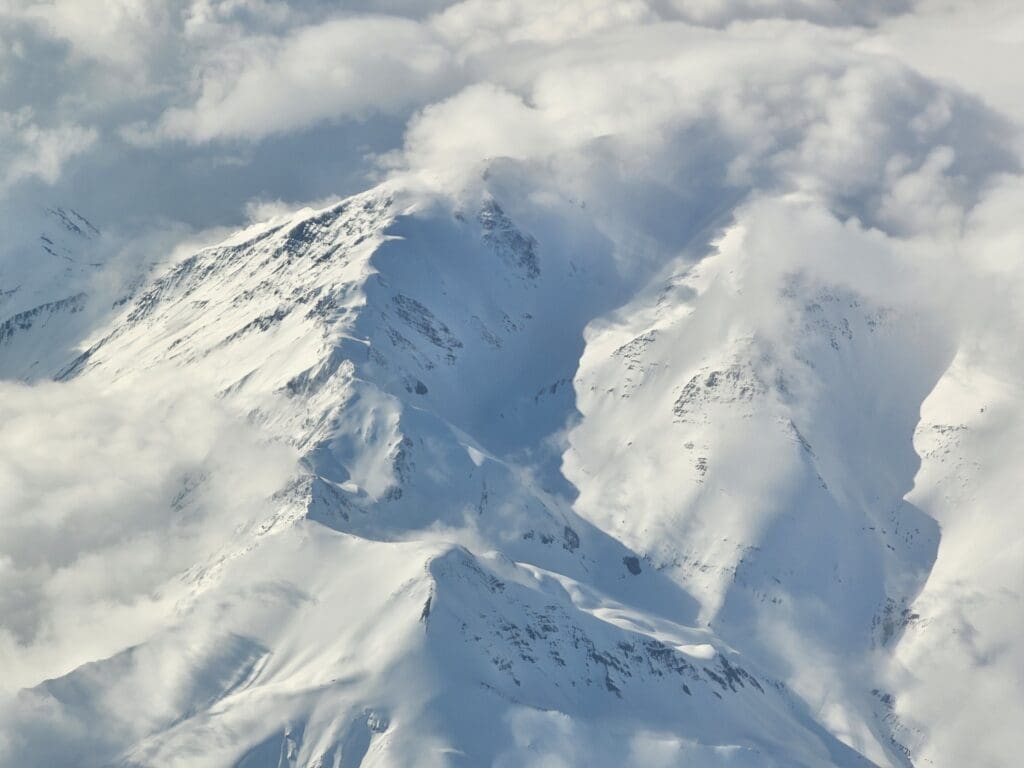
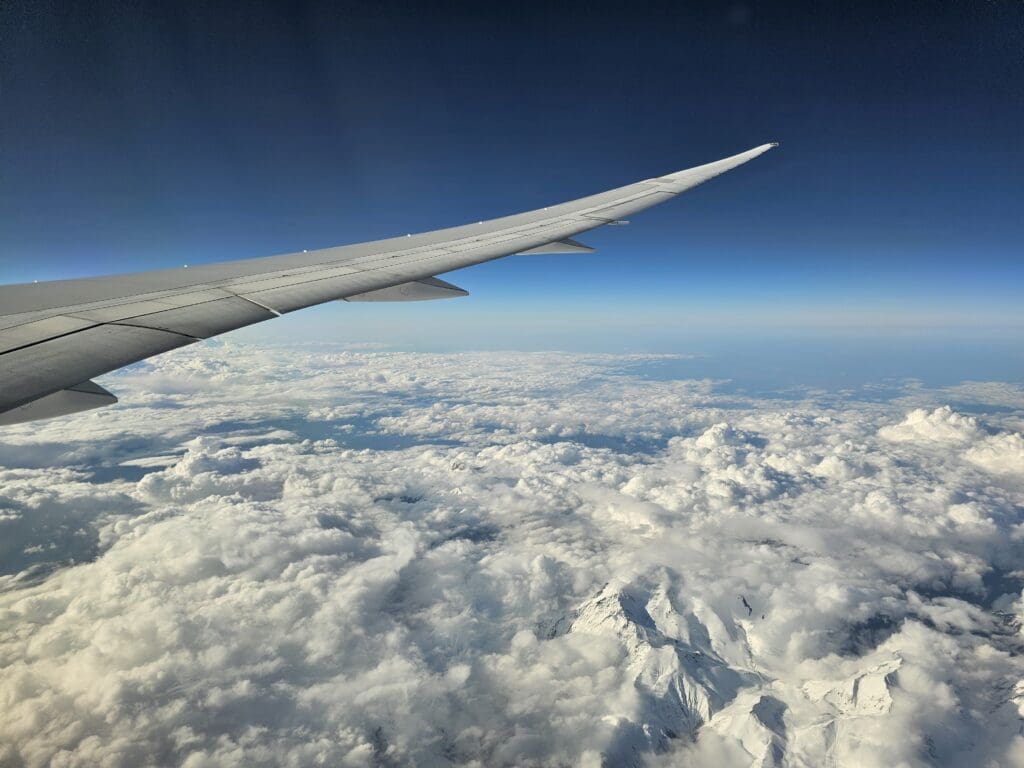
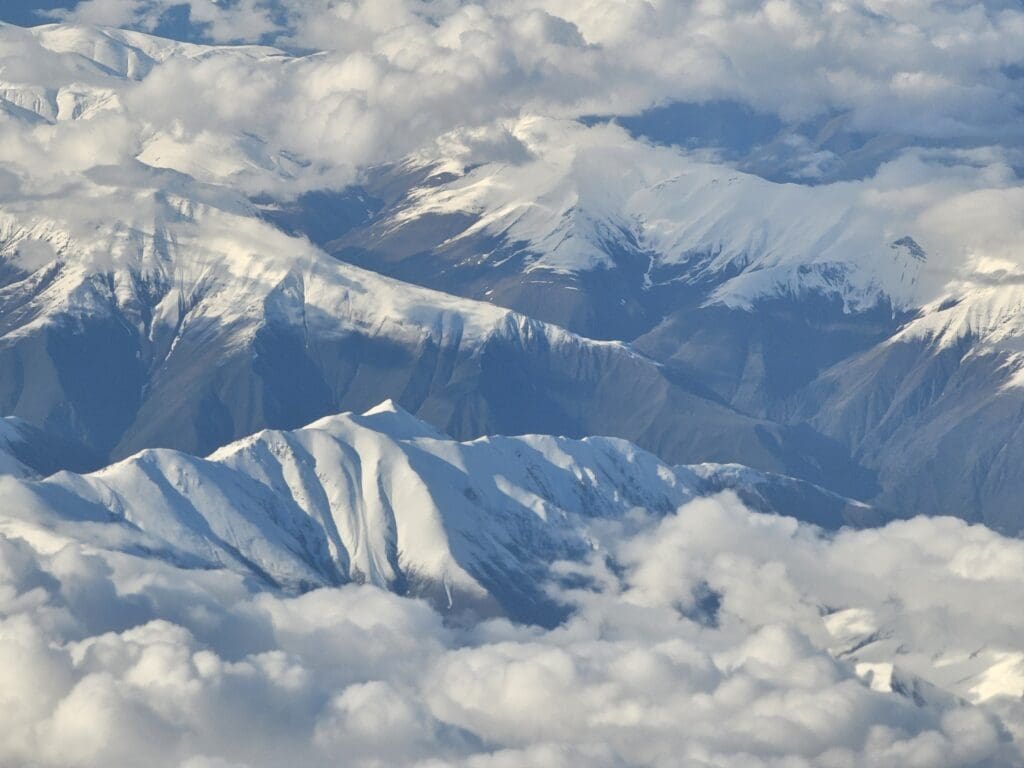
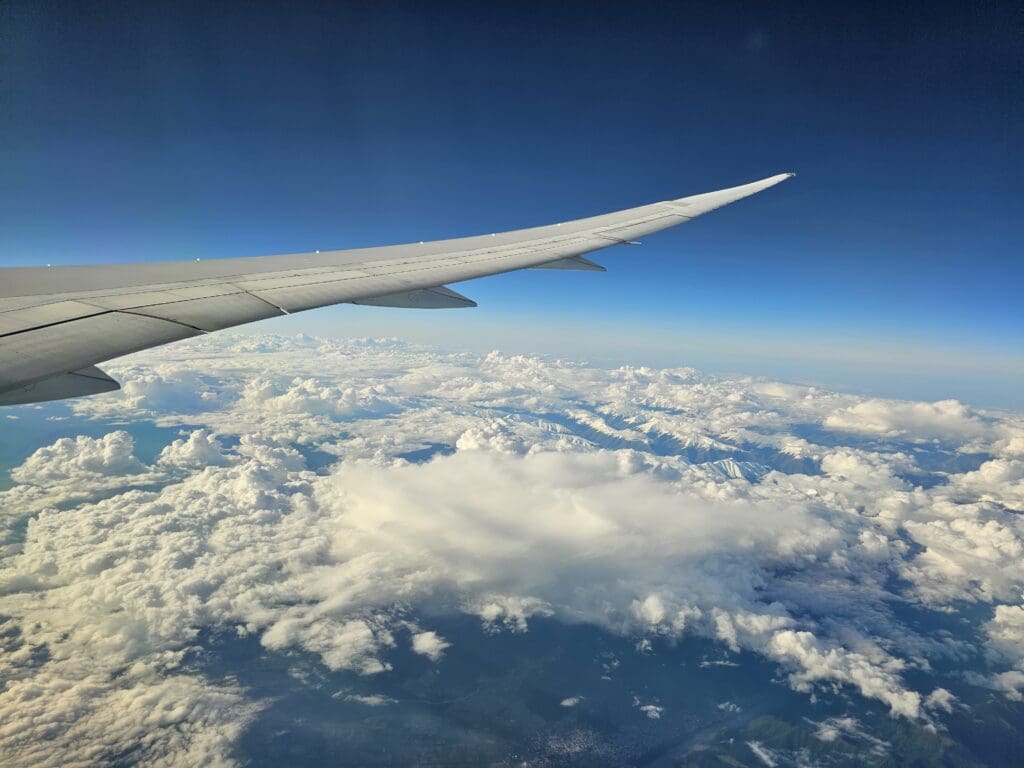
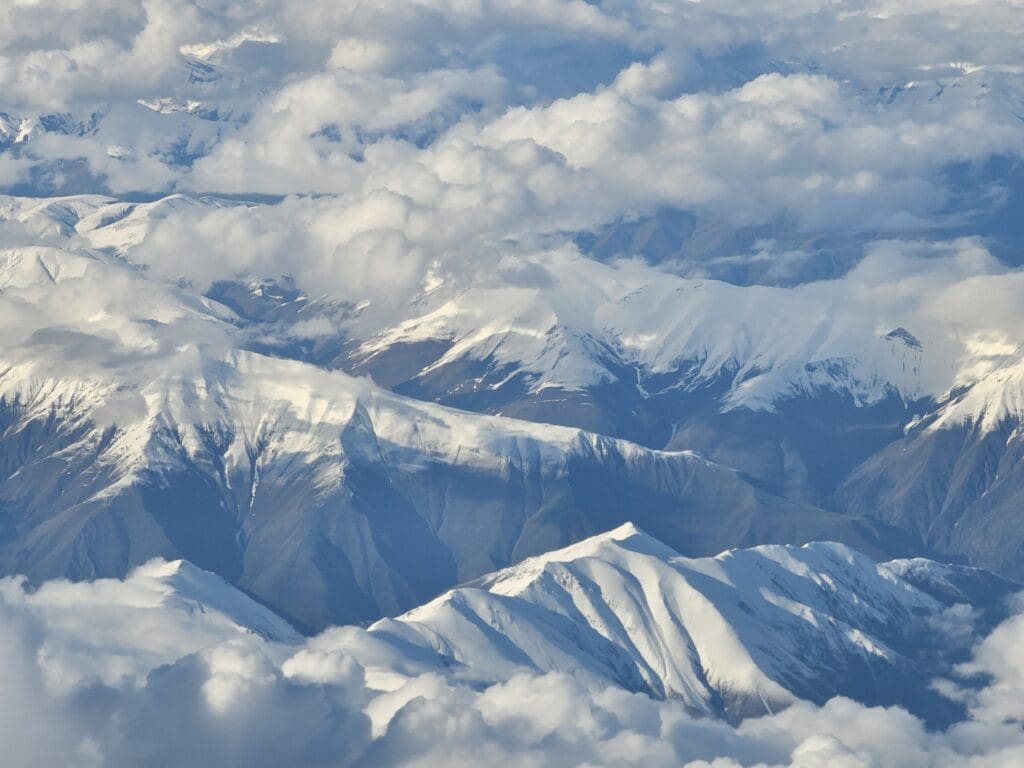
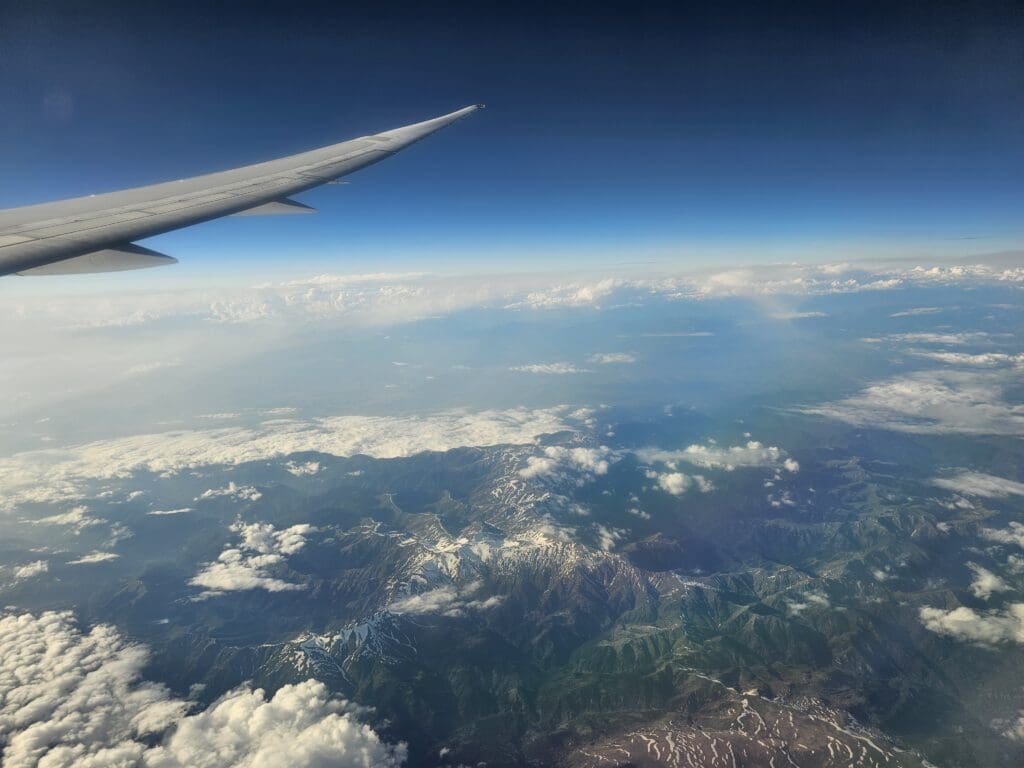
Inside the cabin, the seatbelt signs were extinguished as soon as we climbed through 10,000 feet, and the crew wasted no time in taking to the aisles and commencing the onboard service. First up was a round of hot towels, which, again, given the comparatively short flight time and the fact that these are becoming increasingly rare, I thought was a very nice touch. As I wiped my hands and face, the tall snow-capped peaks of the Azerbaijani and Russian Caucasus Mountains came into view, poking through the clouds, and whilst these were shrouded in clouds, they were still an impressive sight to see as we made our way towards the Georgian border. Although that day, the views of Azerbaijan were not quite as spectacular as those that I had been treated to back in 2018 when flying from Tbilisi to Baku onboard a Buta Airways Embraer 170.
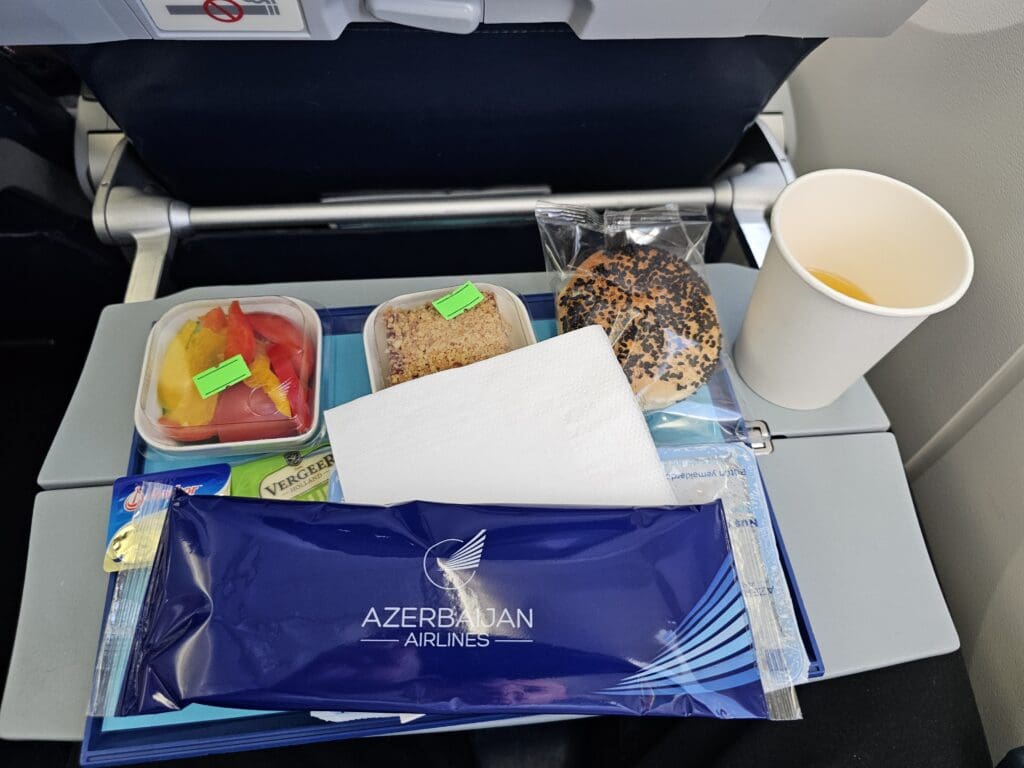
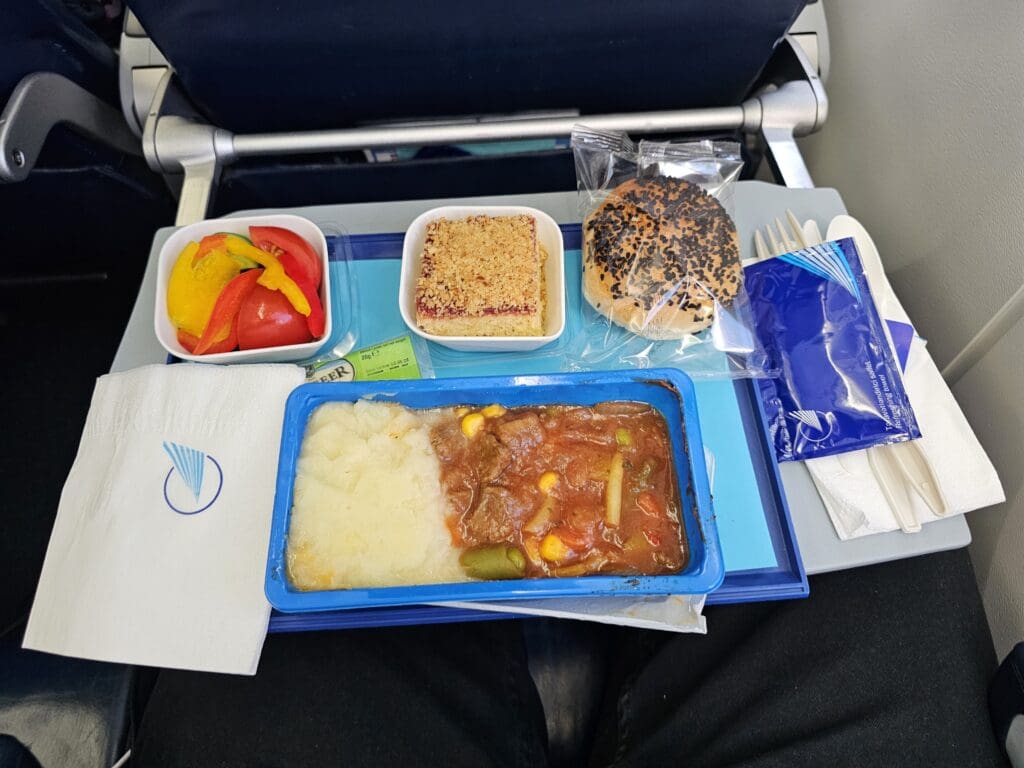
Within a few minutes, the used hot towels were collected, the service carts were rolled out and the meal service commenced. A short time later, one of the flight attendants asked me ‘drink?’ in a cold and brash manner, although I put this down to perhaps an unfamiliarity with the nuances of the English language. From what I could see, a decent array of soft and alcoholic drinks were offered, however, I decided to go for an unnaturally almost fluorescent orange-coloured orange juice which was poured into a plain paper cup and handed over to me. Seconds later, the other flight attendant manning the cart brashly asked the age-old question, “Chicken? Beef?’”. Deciding to go for the latter, I was soon passed the tray, and I wasted no time in getting to work and exploring the contents. As I lifted the lid of the main dish, this turned out to be some sort of beef stew, paired with a deliciously buttery mashed potato. This came with a plain salad comprised of peppers, tomato, cucumbers and olives, a packaged seeded bread roll, a square of cake, as well as butter and a chunk of gouda cheese. Meanwhile, eating utensils came in the form of plastic cutlery. Whilst the meal was by no means bad, it was also far from the pinnacle of inflight cuisine and was thus ultimately forgettable. I should also add that whilst sufficient, the quantity of food served was well below that that I had received when flying from Baku to Kyiv with the carrier back in June 2018!
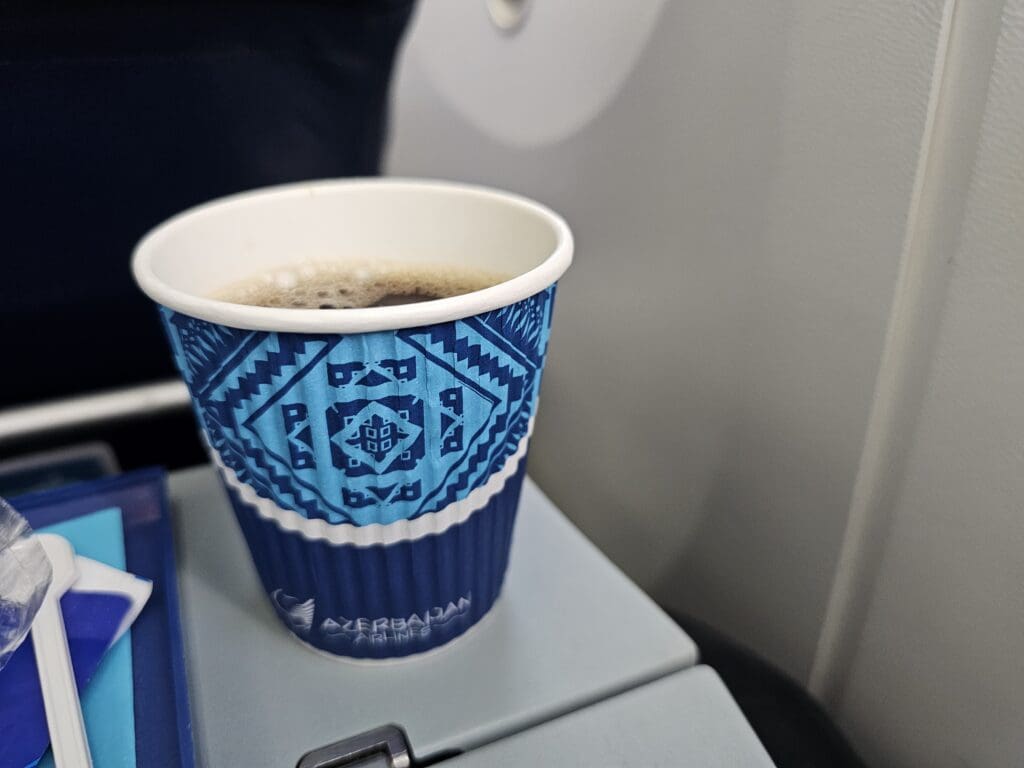
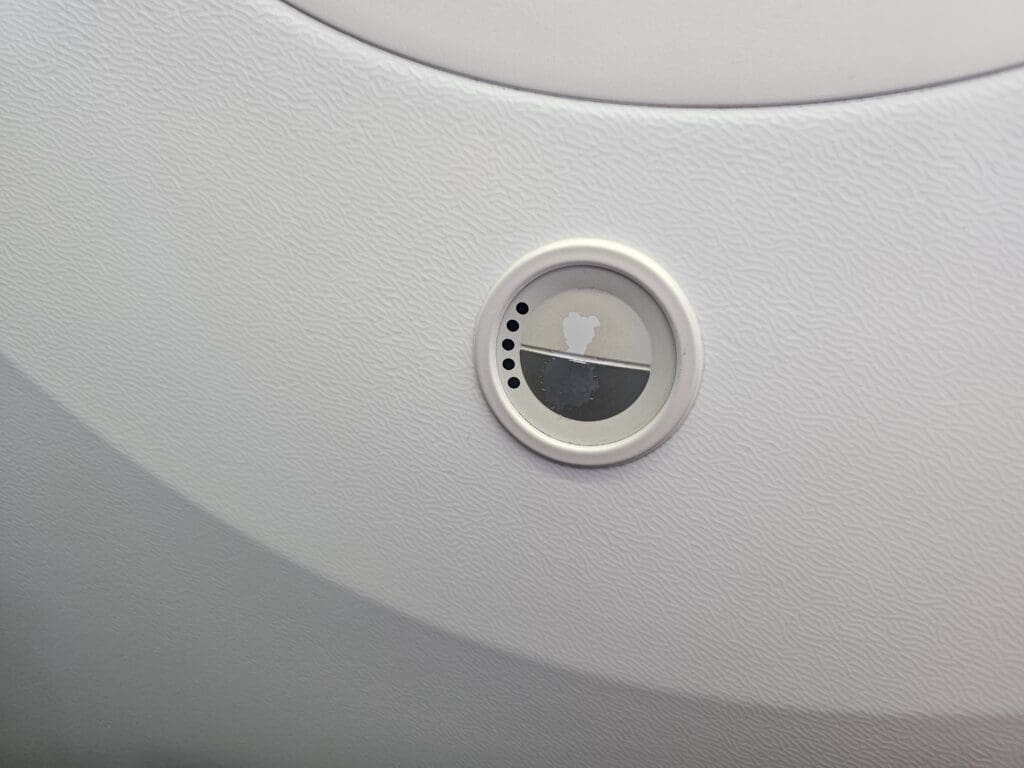
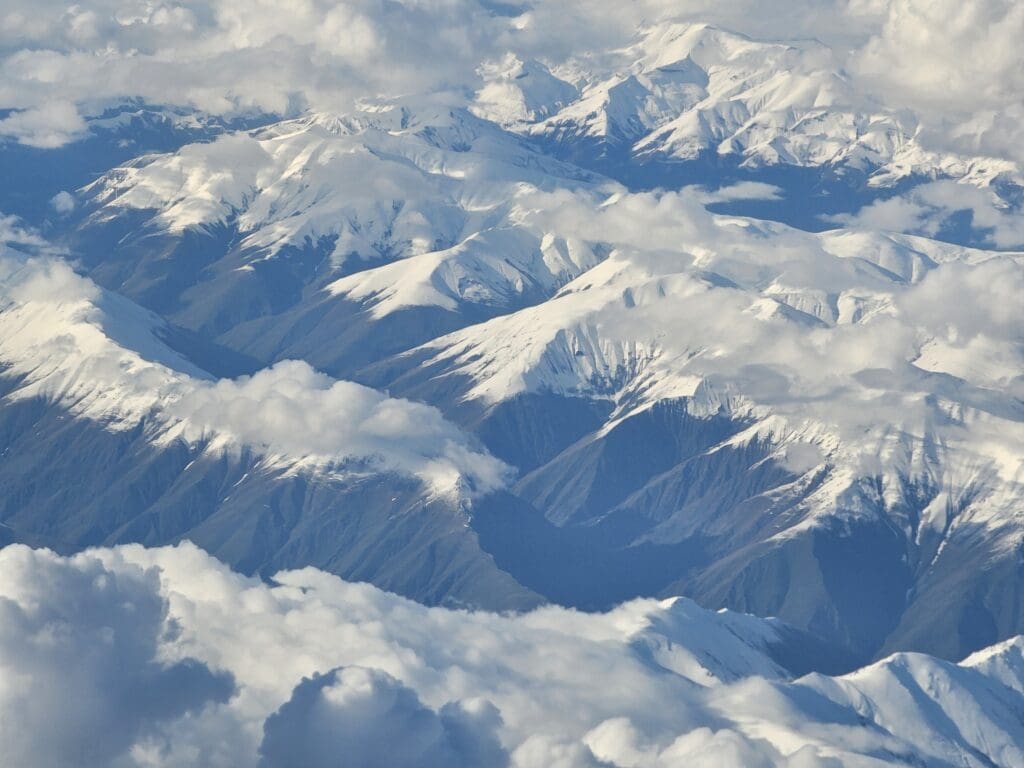
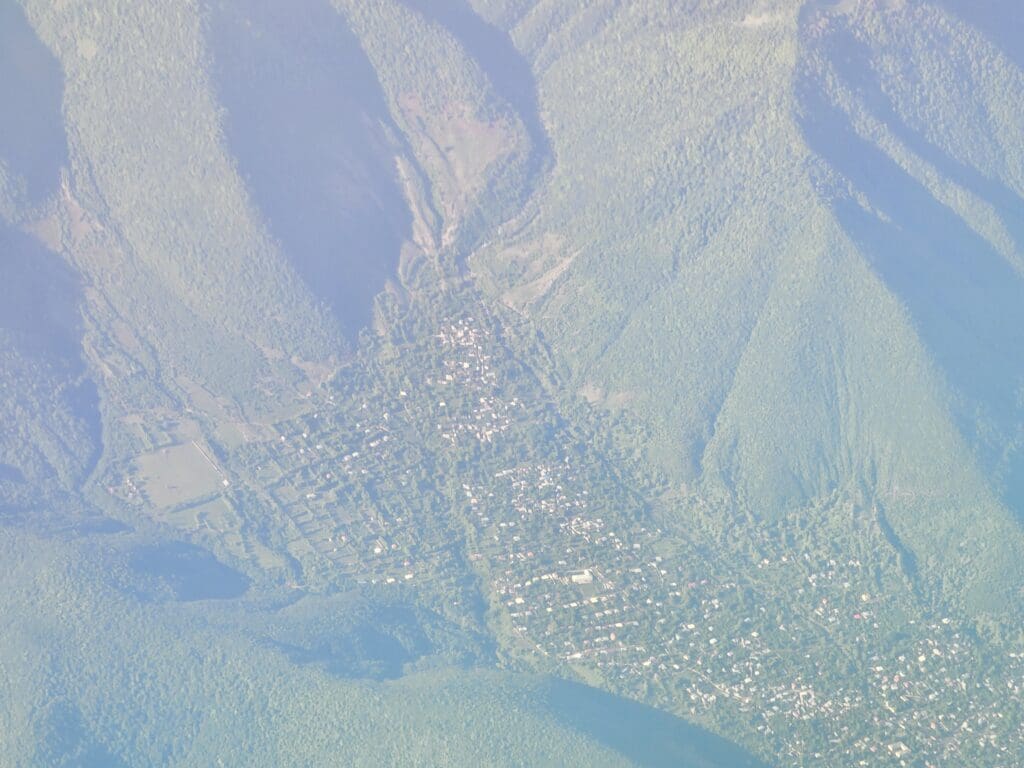
By the time I had polished off my meal, Georgia’s sprawling capital, Tbilisi, could be seen passing below before being replaced by the country’s luscious green landscapes. These soon rose up, and once again, the landscape of the snowcapped Caucasus Mountains appeared below. Meanwhile, inside the cabin, around fifteen minutes after handing out the meals, the crew passed through the cabin distributing tea and coffee, before returning to collect the remains of this service a short time later. From Tbilisi, the aircraft cut across Georgia from east to west and reached the country’s Black Sea coastline around thirty minutes after entering the skies of the country. Heading out to sea just to the south of Georgia’s largest city, Batumi, as we did so, the cabin lights were turned off, and the windows were forcibly tinted, although looking around, most passengers appeared to be wide awake for the duration of the journey.
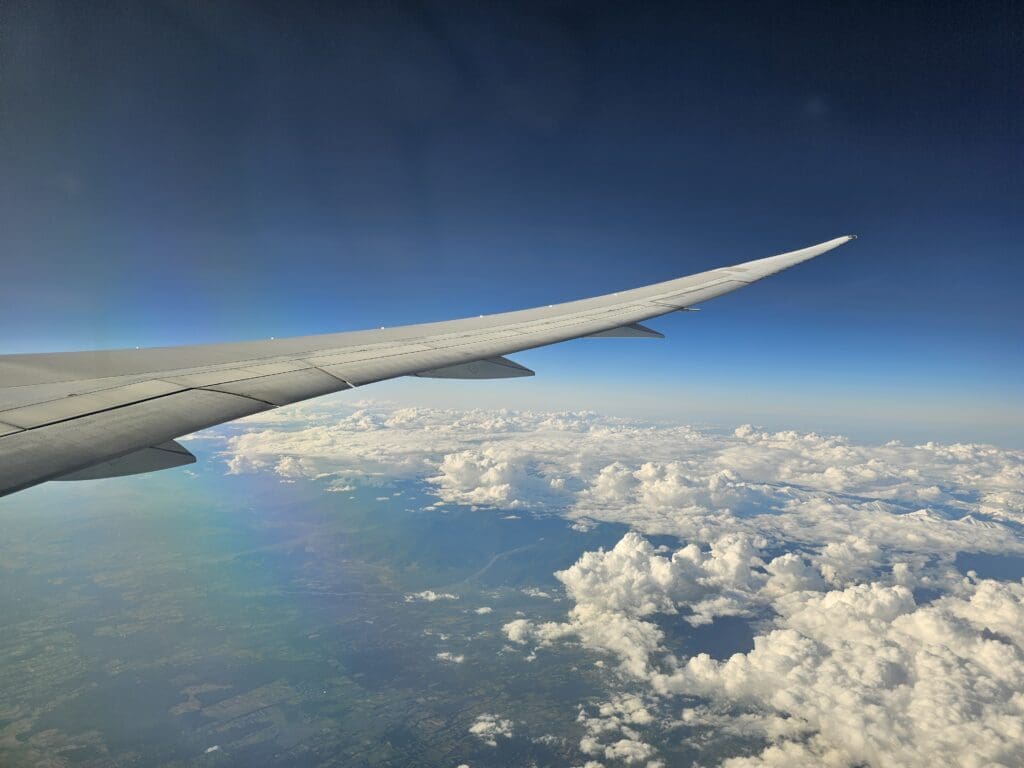
As we crossed the Black Sea at an altitude of 38,000 feet, the clouds parted, although not wanting to un-dim the window and potentially disturb those around me, I decided to pass the time by exploring the wondrous delights of Azerbaijan Airlines’ inflight entertainment. With no inflight magazine and no onboard wifi, this came in the form of the airline’s inflight entertainment system, which is available in two languages, Azerbaijani and English. Considering Azerbaijan Airlines’ fairly compact route network, I was most certainly not expecting the system to be accessible in a diverse smorgasbord of languages, however, I was a little surprised at the lack of a Russian language option. Seeing as the screen could only be controlled by touch, I was pleased to find that this was well-calibrated, however, this often took some time to transition between screens and ended up freezing on multiple occasions throughout the flight. However, returning to the positives, this was easy to navigate and featured a straightforward layout. This featured films, television programmes, music, games, a moving map, and a small section detailing the history of Azerbaijan Airlines, although this was lacking when it came to a kids’ section, with no separate section offered.
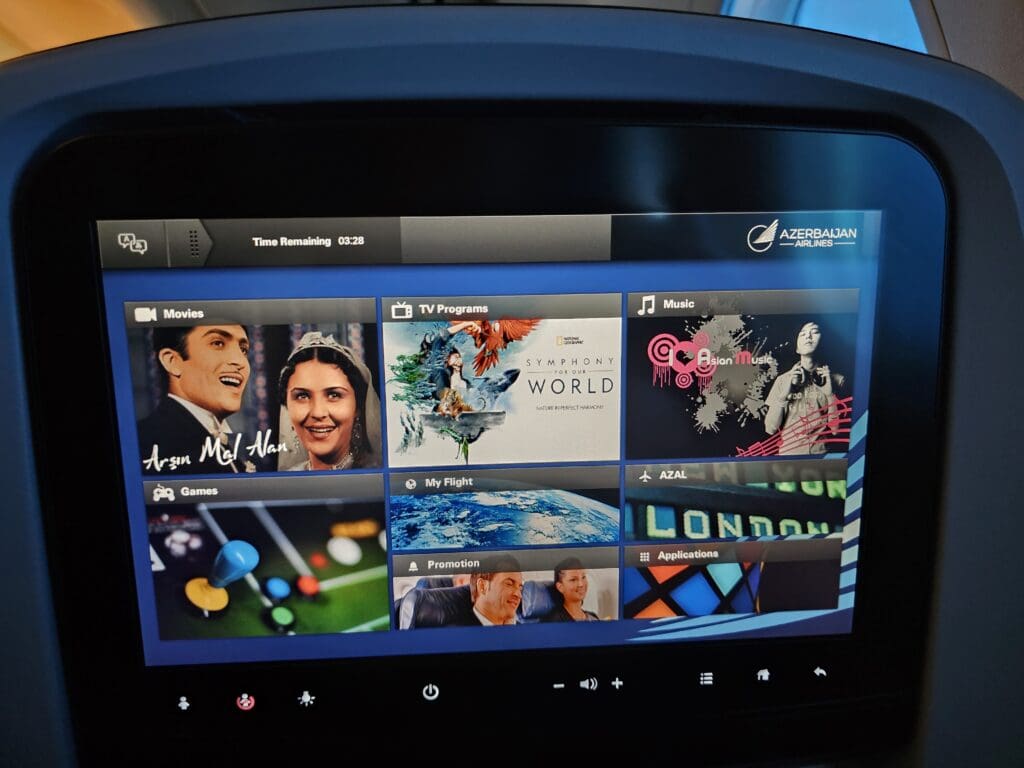
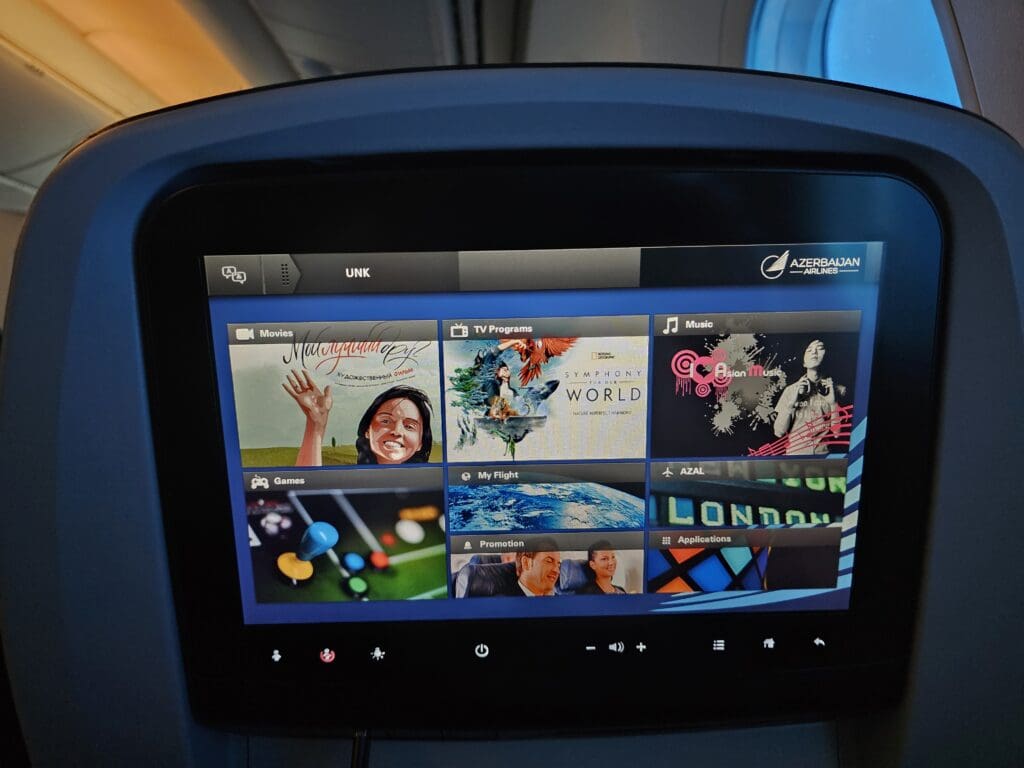
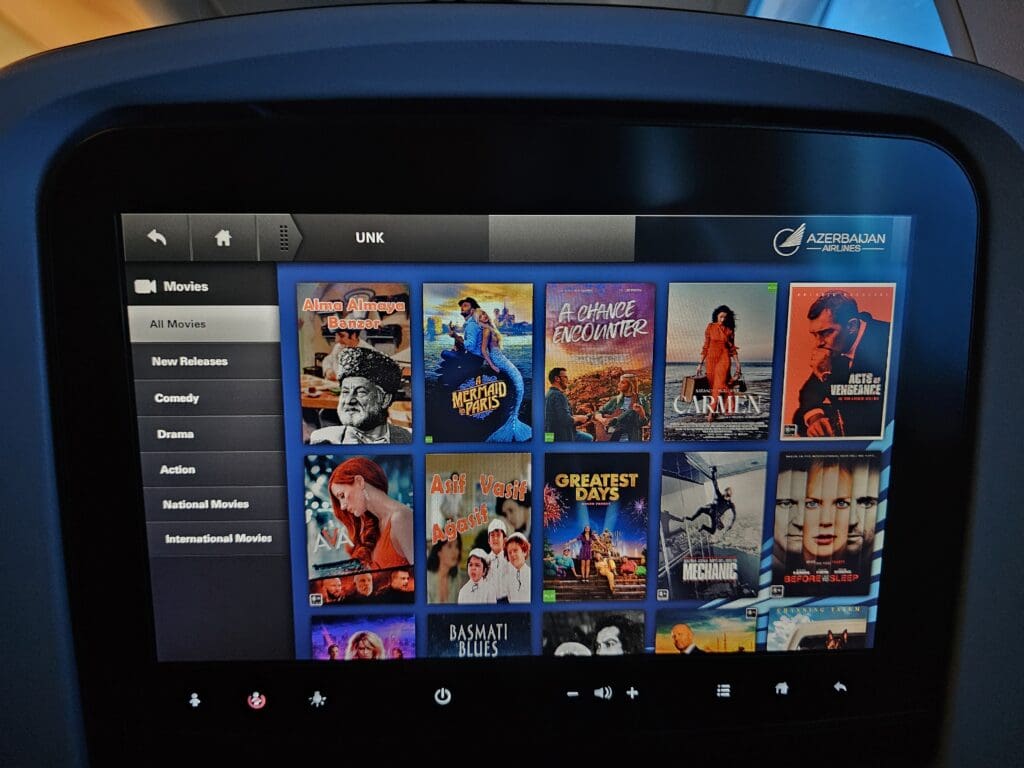
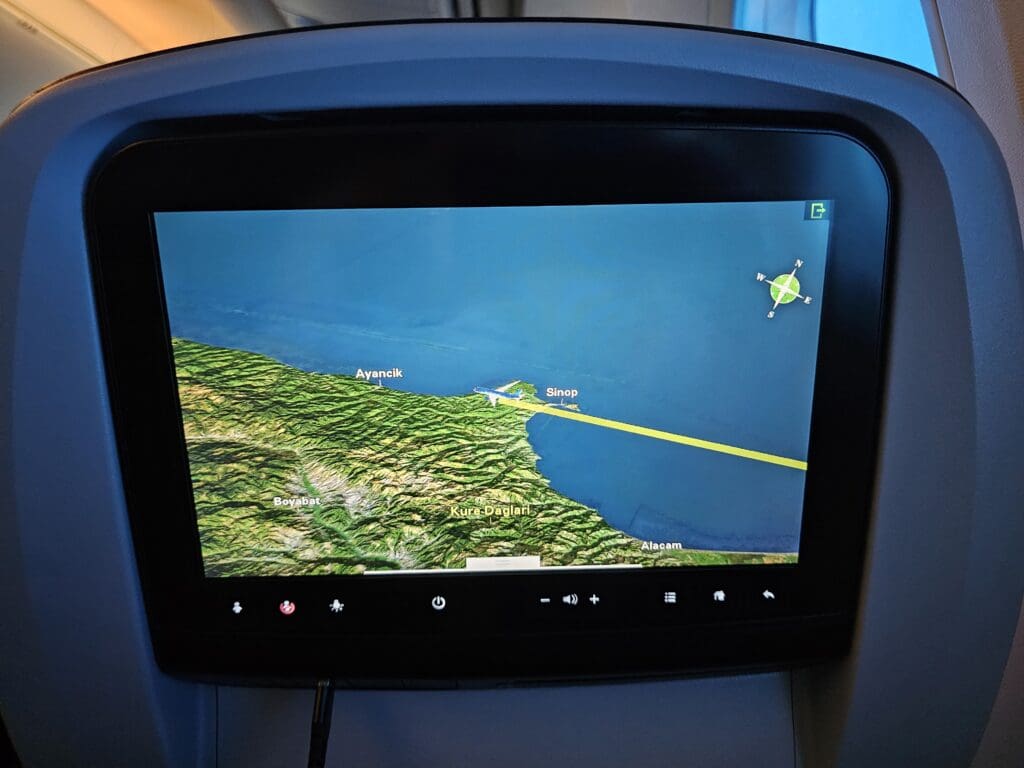
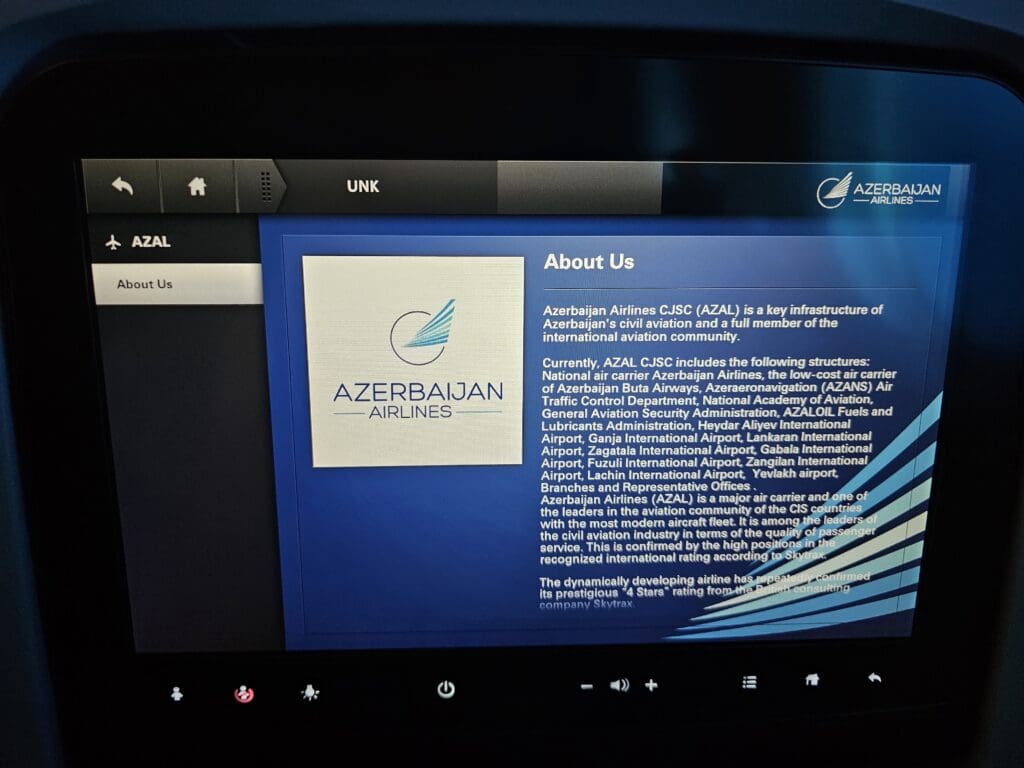
When it came to content, I found the array of films, programmes and music to be acceptable but by no means comparable to many of the world’s major airlines. As is always good to see, this featured plenty of local content, with a good number of local Azerbaijani films, television programmes and music, both old and new. Focusing more on the films, I counted 143 of these, with plenty of Hollywood and Russian productions alongside those from Azerbaijan. A similar story was in play when it came to television programmes, of which there were 203, and music, with 150 albums and playlists provided. In addition, an impressive selection of 25 games could be found on the system, and importantly, I found the GeoFusion moving map to work without issue for the flight. Finally, it is worth mentioning that no advertisements were played before the content started, which is always a nice touch!
By the time I had explored the inflight entertainment system, the aircraft had reached Turkey’s northern coastline and skirted along this for a while, with a clear view offered of Sinop’s Boztepe Peninsula. However, sitting on the wrong side of the aircraft, my views of Turkey were rather limited and after around ten minutes, the aircraft turned to fly northwestwards and voyaged out over the waters of the Black Sea once more for its sprint towards Europe.
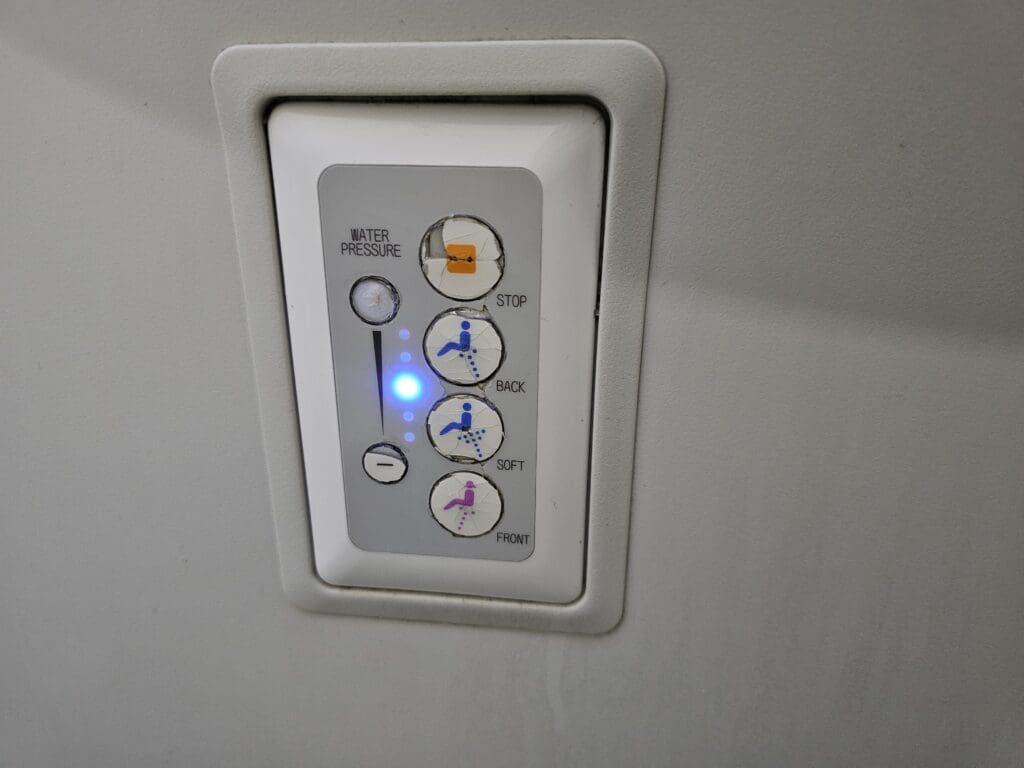
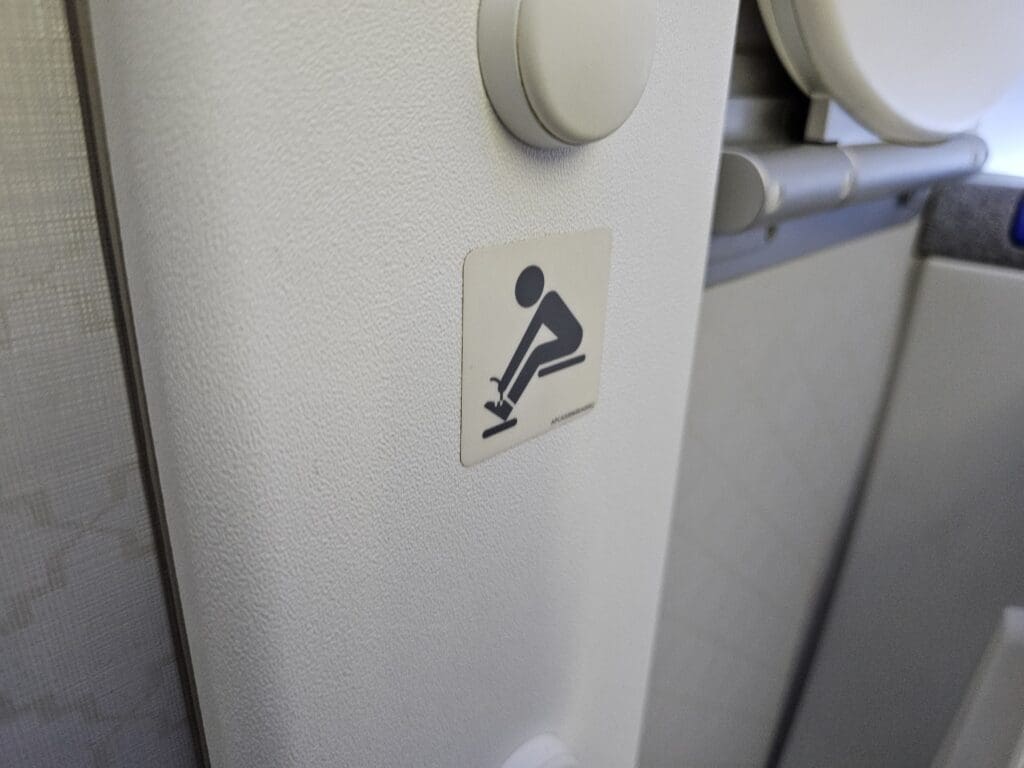
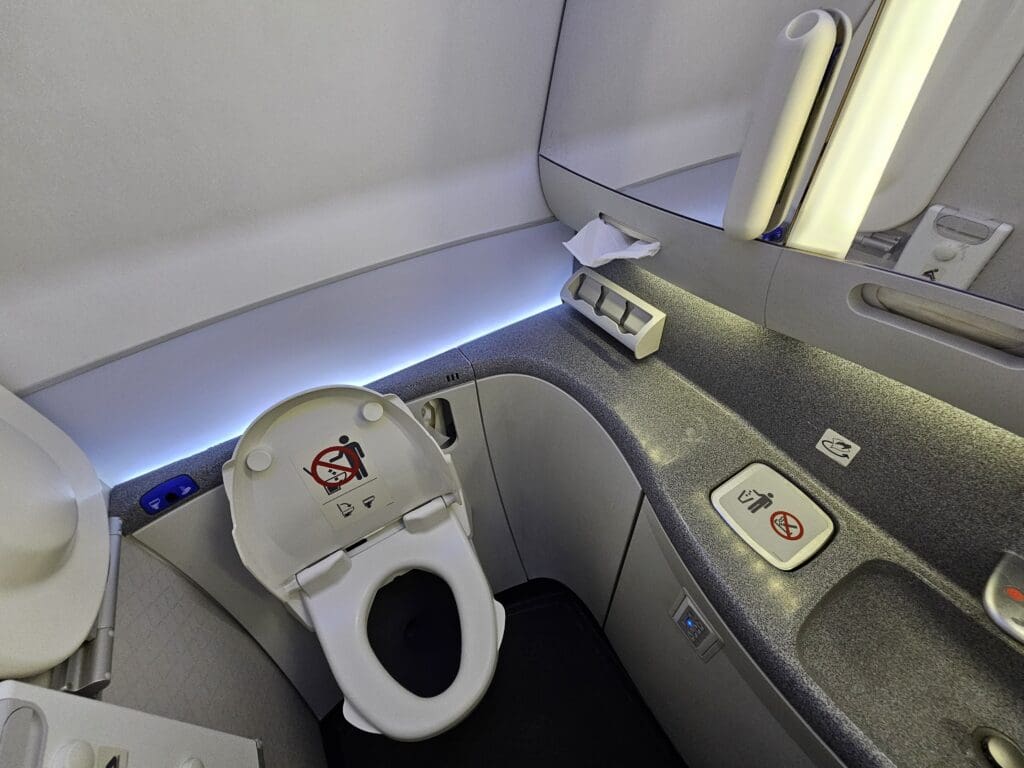
Seeing as my neighbour had stood up and was undertaking some stretches at the front of the rear cabin, I decided to pay a visit to one of the Dreamliner’s lavatories. Onboard, Azerbaijan Airlines’ Boeing 787s, all Economy lavatories are sandwiched between the two Economy cabins, with none at either the front or rear of these. However, with four of these on offer, equating to 39 passengers per lavatory (well below the ratio for a low cost Airbus A320 or Boeing 737!), there was definitely no lack of toilets onboard. Entering the largest of these on the port side of the aircraft, I was pleased to find this to be clean, tidy and in good condition. Much to my surprise, this even featured a bidet function (this was the first time that I had seen this on a non-Japanese carrier!) and a fold-out platform to enable passengers to easily tie their shoelaces! Other than this, the toilet was stocked with all the basics and ultimately left me with no complaints.
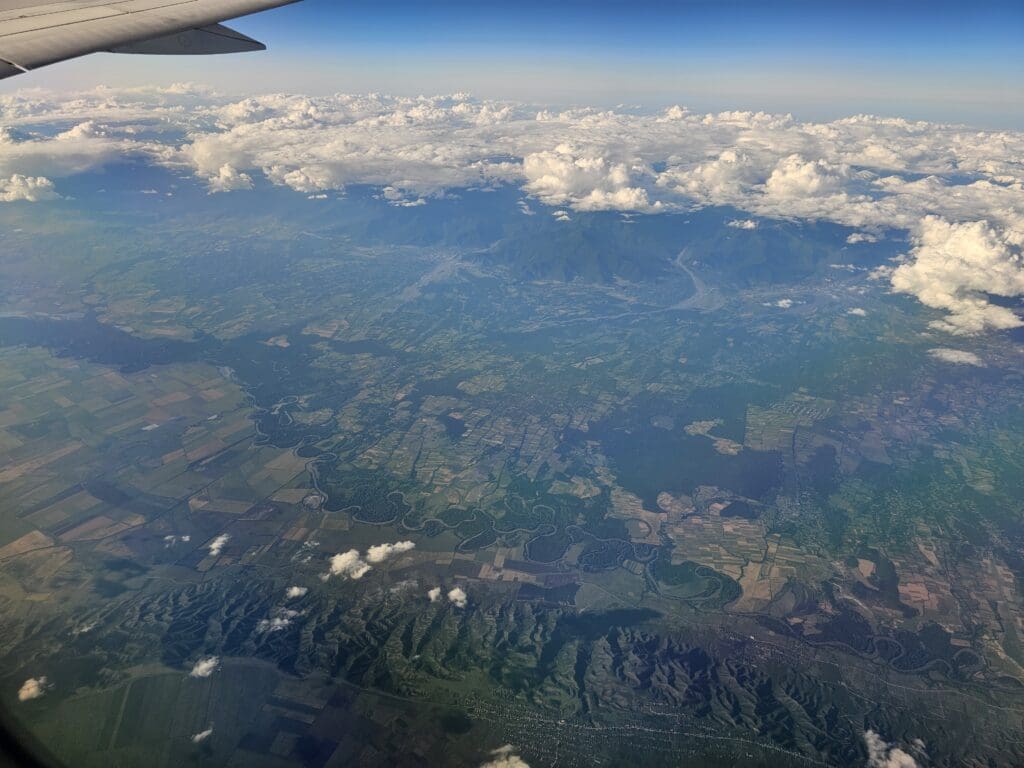
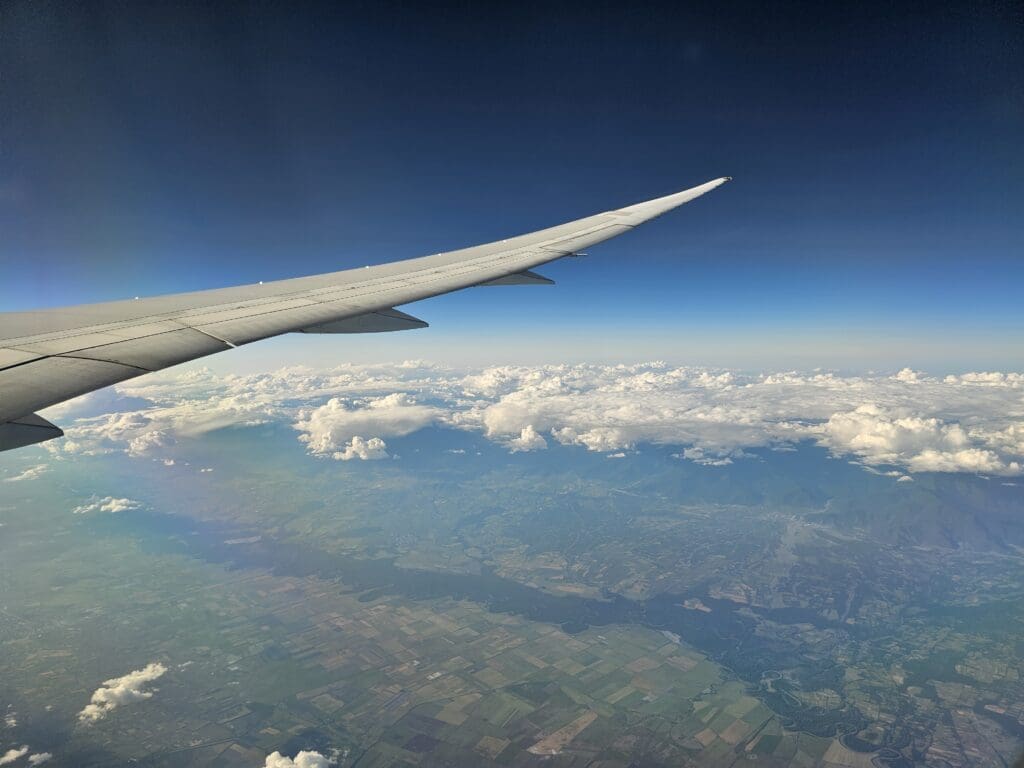
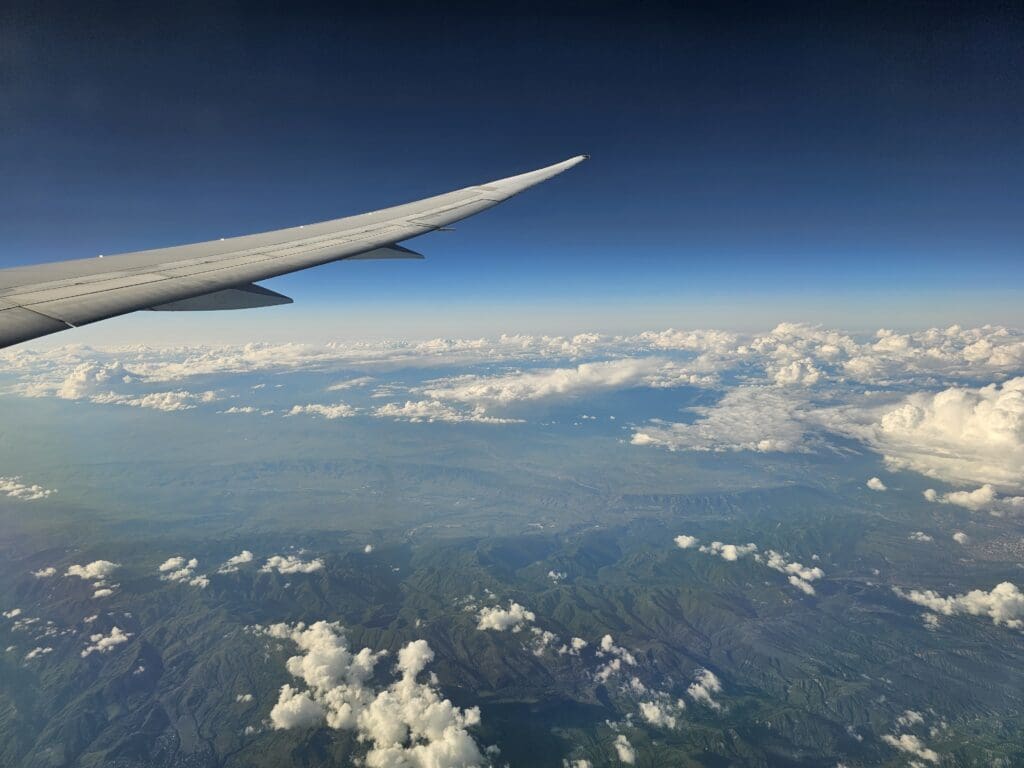
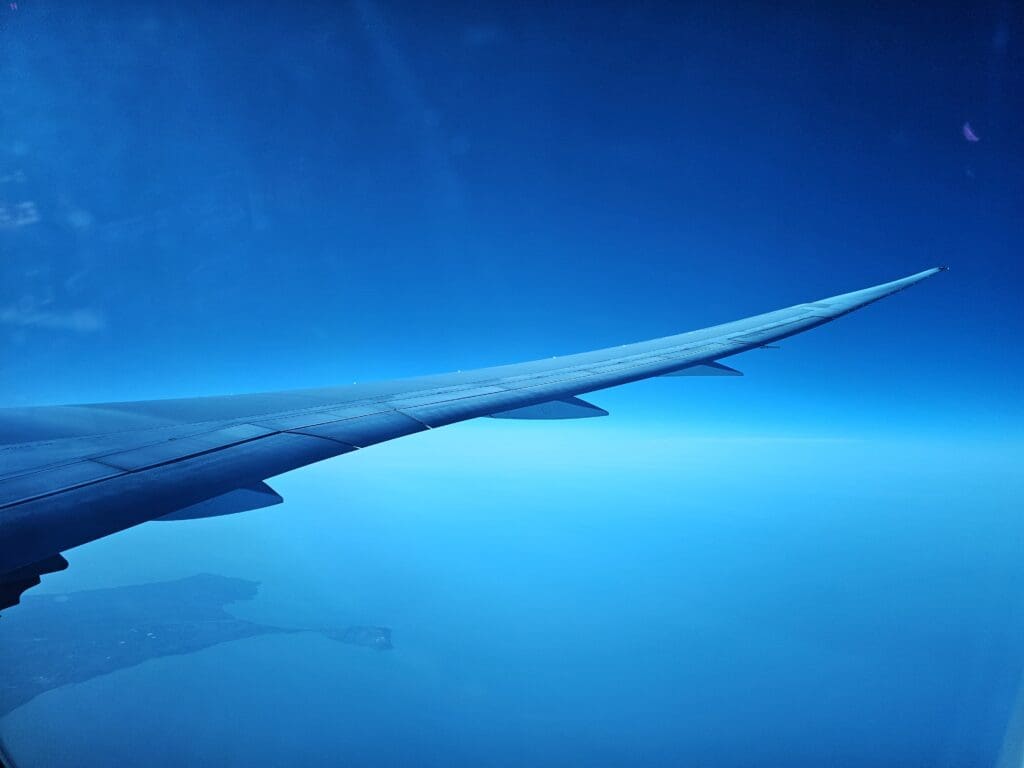
Following a successful trip, I returned to my seat, at which point my non-stop itinerary of the previous two days caught up with me, and I fell asleep for a solid twenty minutes. By the time I awoke, the Dreamliner was crossing over the Bulgarian coastline, a very short distance from the Romanian border, around two hours after departing from Baku. A minute or so later, the aircraft entered Romanian skies and cruised along the border between the two countries for around ten minutes before continuing onwards towards Bucharest. Unfortunately, thanks to the thick cloud which gathered below after crossing the Bulgarian coastline, little could be seen of Romania’s Carpathian Mountains as we trundled from Southeast to Central Europe. Indeed, that evening, clouds seemed to be omnipresent across Europe, making for a rather monotonous and boring trip across the continent! Around fifty minutes after entering Romanian airspace, the Dreamliner journeyed past the city of Arad and continued onwards into the skies of Hungary. Cutting across Hungary from the southeast to the northwest of the country, at this time, a fair number of lumps and bumps could be felt, and perhaps as a result, the Dreamliner climbed up to 40,000 feet.
As we cruised along, I was slightly disappointed to find that the cabin crew were almost entirely absent from the aisles for the duration of the flight. Rather than regularly patrolling the aisles, the flight attendants seemed to congregate in the rear galley and closed the curtain to this, blocking this off to passengers and giving off an overall unwelcoming impression. Whilst I did not expect a second meal or snack on this five-hour flight, I was disappointed to find that no second round of drinks was made before our arrival in London. Ending my complaints and returning to the route, after around thirty minutes, the aircraft passed from the skies of Hungary to Austria and cruised over the capital city, Vienna. With no views of the Alps on offer, we soon entered German skies and cruised across the state of Bavaria. In what is quite a familiar route, the aircraft journeyed roughly parallel to the Bundesautobahn 3 and passed the cities of Regensburg, Nuremberg, Würzburg, Frankfurt and Cologne during our forty-minute crossing of the southern portion of the country. Recognising that we were nearing the end of our voyage across Europe, as we passed from German to Belgian skies, I decided to make one final visit to one of the lavatories. Opting to use a different one, this proved to be somewhat more battered, although was for the most part, reasonably clean and left me with nothing to complain about.
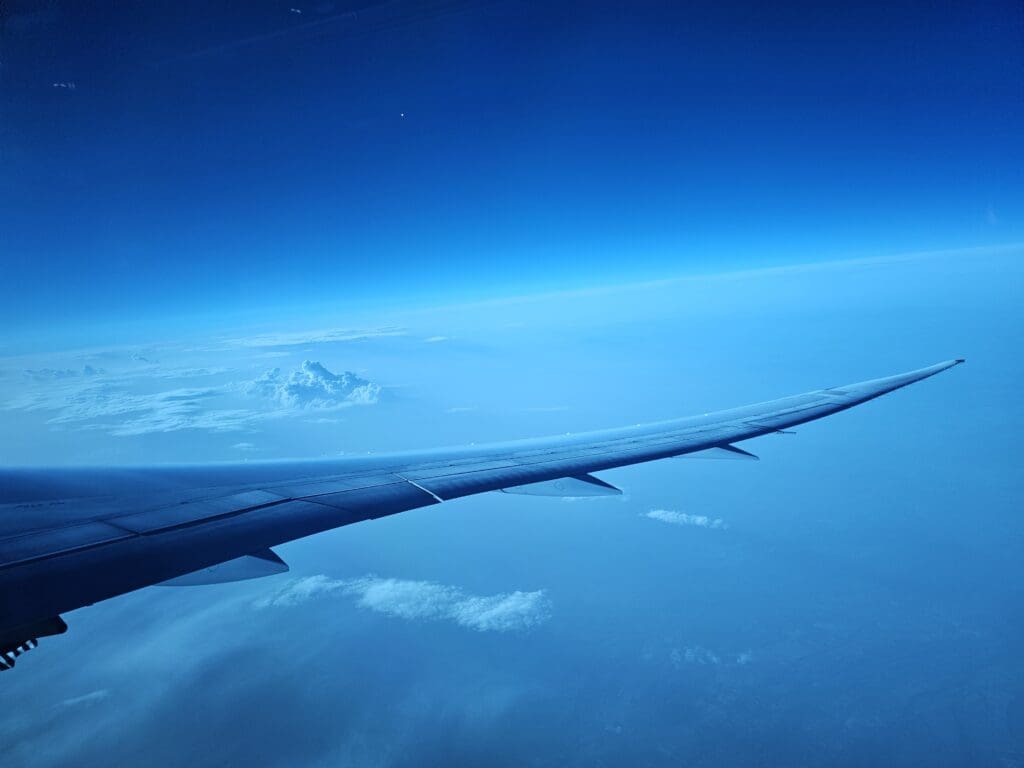
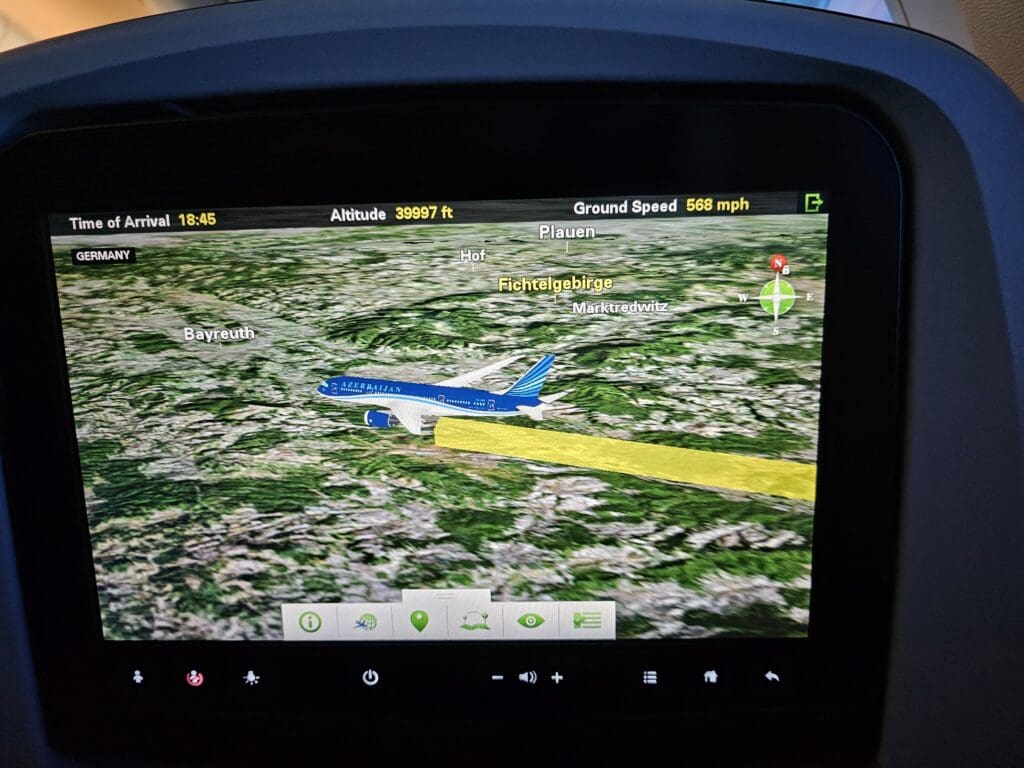
By the time I had returned to my seat, the aircraft was entering the final stages of its flight, and a few moments later, the cabin lights were turned back on, and the windows were transitioned back to their undimmed setting. As we neared the city of Antwerp, a pre-recorded announcement played in Azerbaijani, English and Russian which contained the usual pre-arrival warnings regarding seatbacks, seatbelts, tray tables and windows, and was immediately followed by another cautioning passengers about the UK’s rules on bringing raw products into the country. Upon reaching Antwerp, the aircraft could be felt descending and wasting no time, the seatbelt signs were soon illuminated in preparation for our arrival. A short time later, the crew passed through the cabin, although I have to say that I was a little dismayed by the lacklustre nature of their checks – specifically, many passengers around me continued to have their seats in a reclined position, whilst several tray tables remained extended until disembarkation!
Once away from the Belgian coastline, the Dreamliner crossed the cold waters of the North Sea, with our transoceanic voyage lasting all of thirteen minutes before we made landfall over Essex’s Dengie Nature Reserve. That evening, I had hoped for both an arrival on one of the 27 runways and reasonable weather conditions, and thus good views of Central London whilst on approach to Heathrow. Whilst we would end up arriving on Runway 27L, unfortunately, I was out of luck with the weather, with thick clouds lingering around the capital, preventing passengers from getting any decent welcome glimpses of Britain as we neared Heathrow.
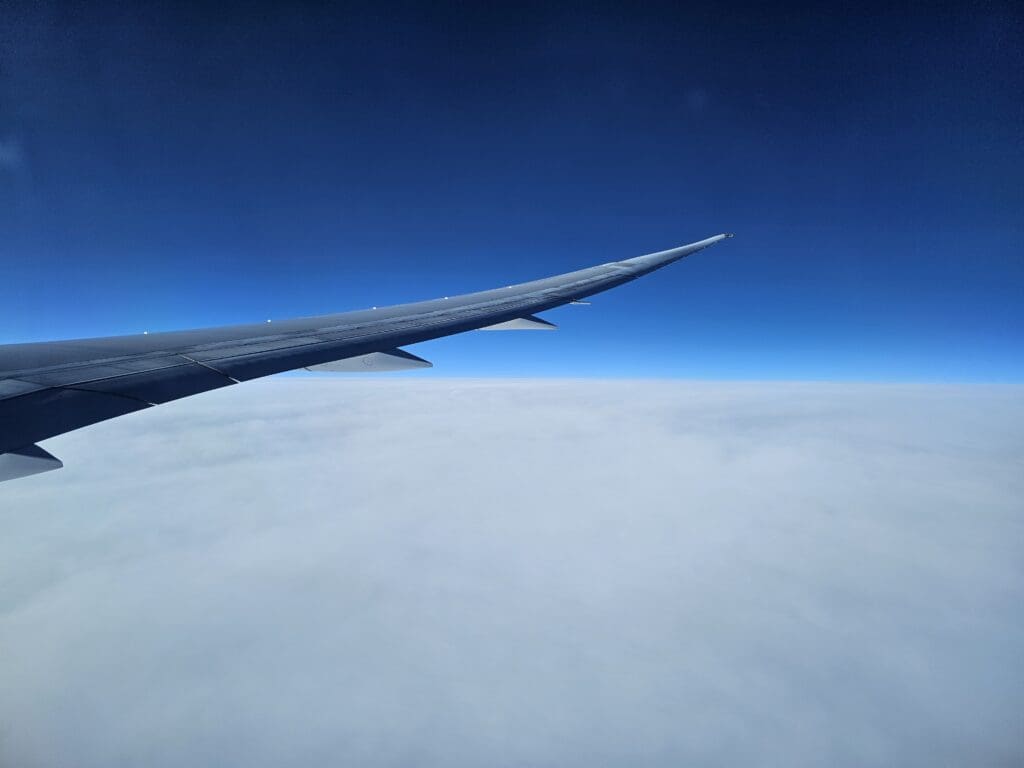
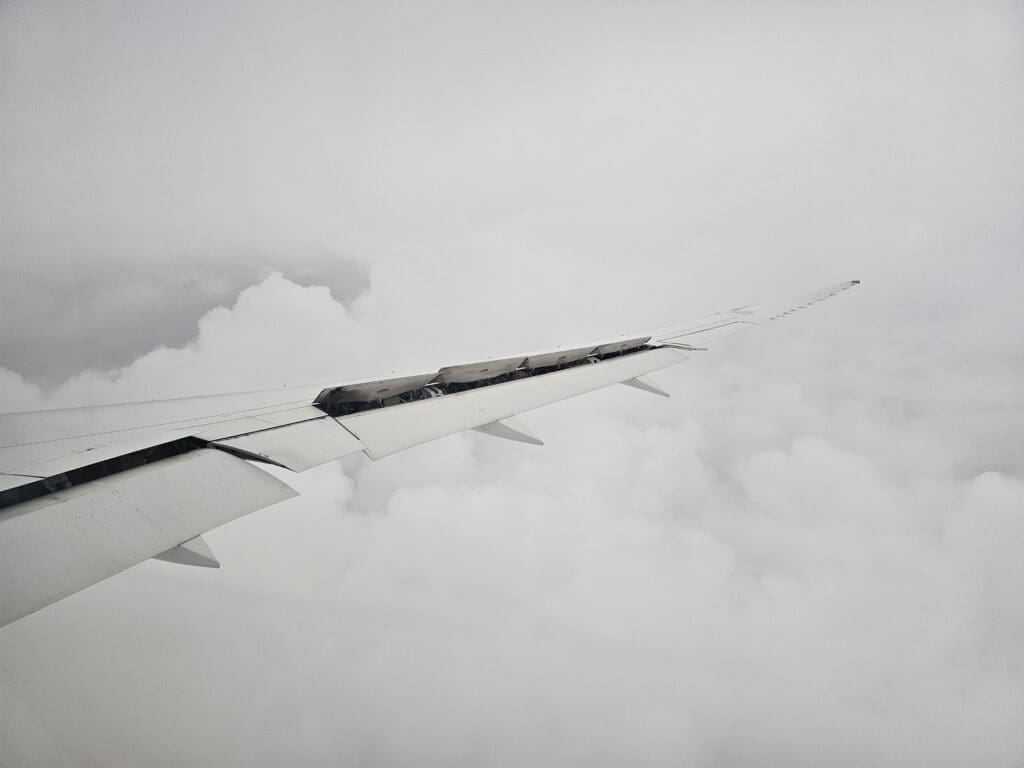
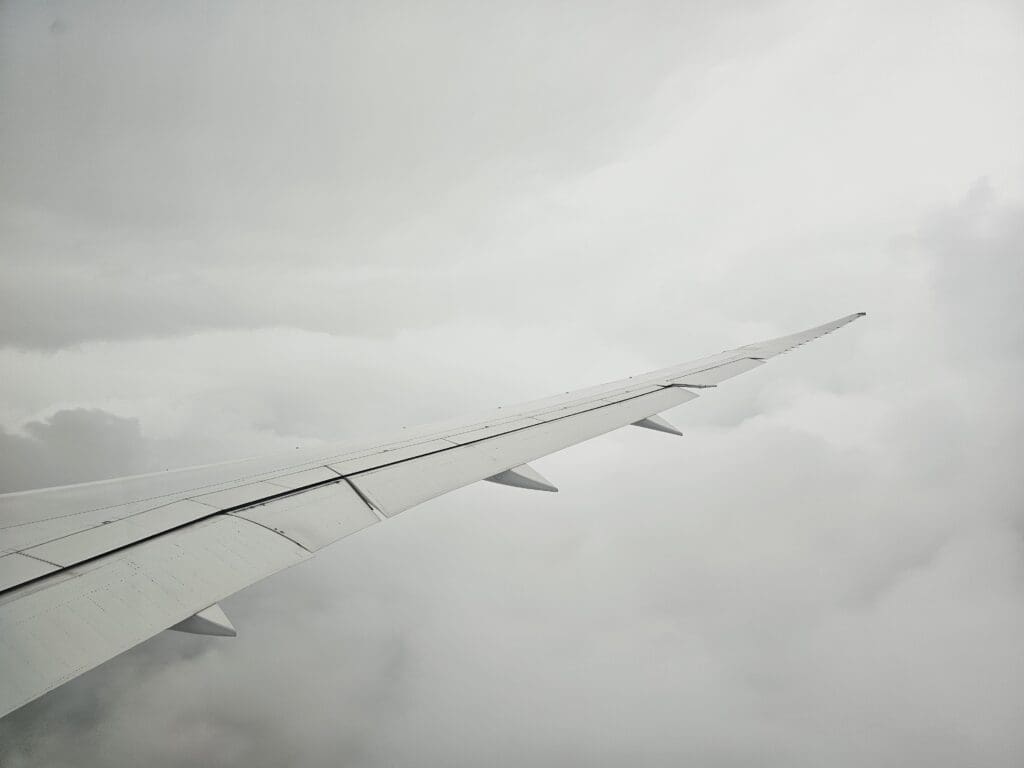
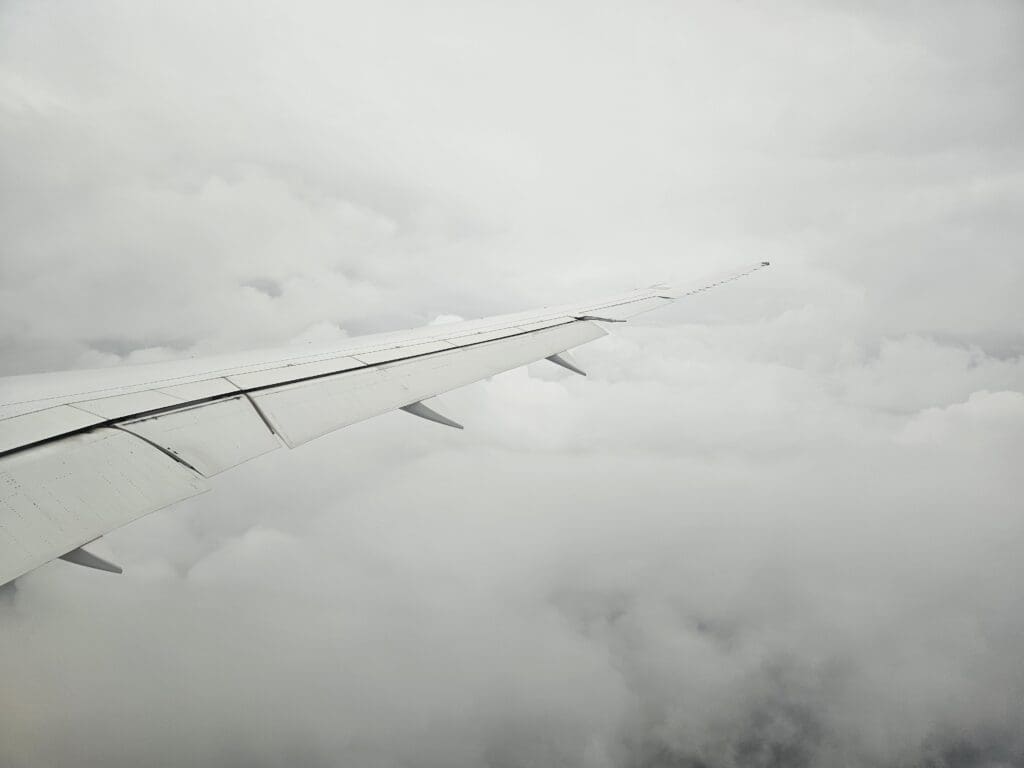
Whilst I was not in any particular rush, having plenty of time on my hands before I would have to catch a train up to Sheffield that evening, I was still pleased to find that no holding was required, even though we were well ahead of schedule. After crossing the M25 motorway, the Dreamliner turned southwards and voyaged over the suburbs of Northeast London. Passing over the likes of Epping, Chingford, Walthamstow and Stratford, the Dreamliner reached London City Airport, where we turned westwards to point us in the direction of Heathrow Airport. Bouncing around a little, the flaps were partially extended with a loud whine, whilst a few gaps in the clouds revealed the grey and rain-soaked rooftops of Peckham in South London as we followed the winding course of the Thames westwards towards Heathrow Airport. During the final couple of minutes of the flight, the Dreamliner broke free of the clouds for good whilst over Hounslow. By this point, we had of course missed London’s sights, and instead, the residential, commercial and industrial sprawl around Heathrow could be seen as we sank lower and lower towards Earth.
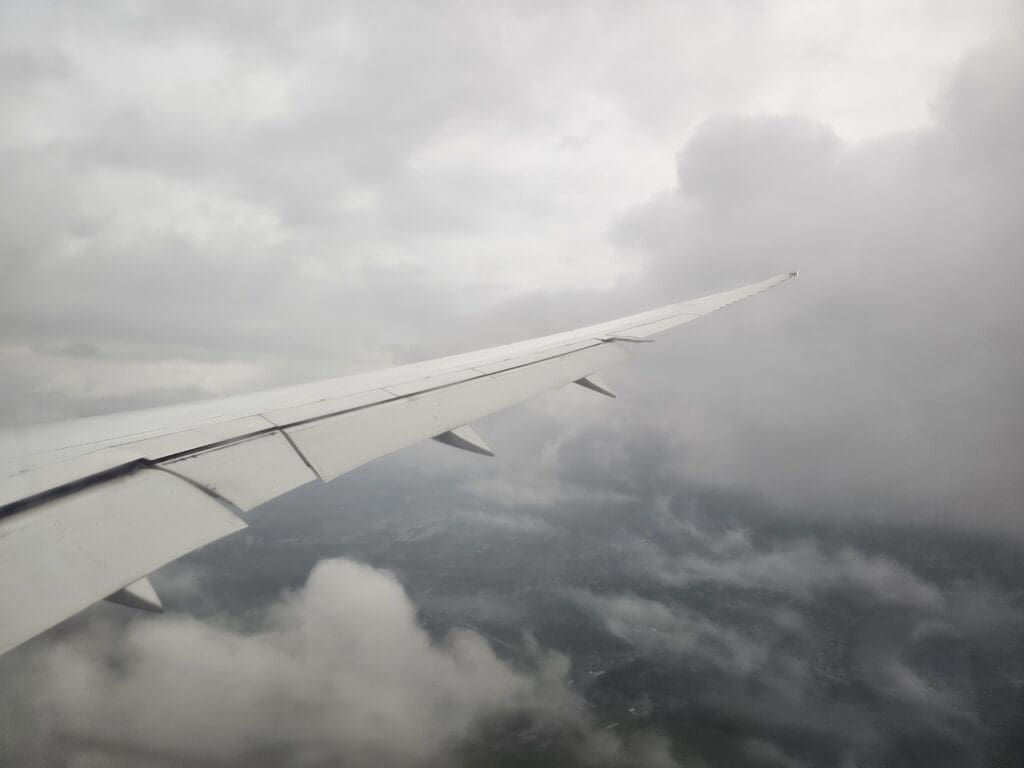
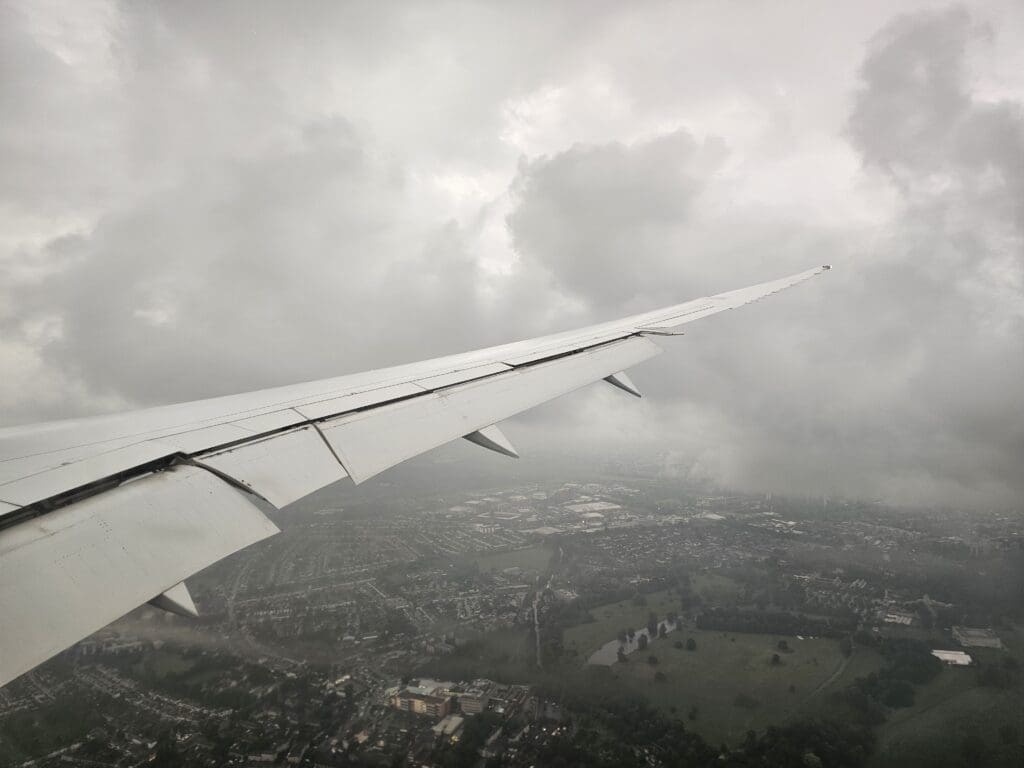
Soon, British Airways’ large hangars could be seen heralding the end of our flight as we crossed over the famous Myrtle Avenue spotting area and whizzed past Concorde and the rows of parked British Airways jets. At 1944, a total of 5H06 after taking to the skies of Azerbaijan, the Dreamliner made a soft touchdown on Runway 27L before decelerating rather quickly and throwing up plenty of spray. In the usual manner, once off the runway, the Purser welcomed all passengers to London, thanked passengers for flying with Azerbaijan Airlines and advised passengers to remain seated before upbeat traditional music rang out, providing an appropriate Azerbaijani end to our journey.
Given the massive size of Heathrow Airport, taxi times are not always short; however, seeing as Runway 27L is the most convenient for Terminal 4, no long trek nor any runway crossings were required in order to reach our stand. At that time of the evening, plenty of widebody jets could be seen waiting at Terminal 4, with these in the process of being readied for overnight slogs to destinations across Africa and Asia. There, I spotted a Korean Air Boeing 777-300ER, which, had I taken from Seoul Incheon instead of my roundabout route via Beijing, Dubai and Baku, would have enabled me to shave off more than 24 hours from my total journey time! Soon, the Dreamliner cautiously pulled into Stand 423, which was, coincidentally, the very same stand that I had departed from a little over two weeks earlier on a China Southern Airlines Airbus A350. Pulling in between a China Southern Airlines Boeing 787-9 Dreamliner and a RwandAir Airbus A330, bound for Guangzhou and Kigali respectively. As is unfortunately not always the norm at London Heathrow, a single jetbridge was moved into position almost as soon as the aircraft came to a halt, and it therefore did not take too long for disembarkation to commence.
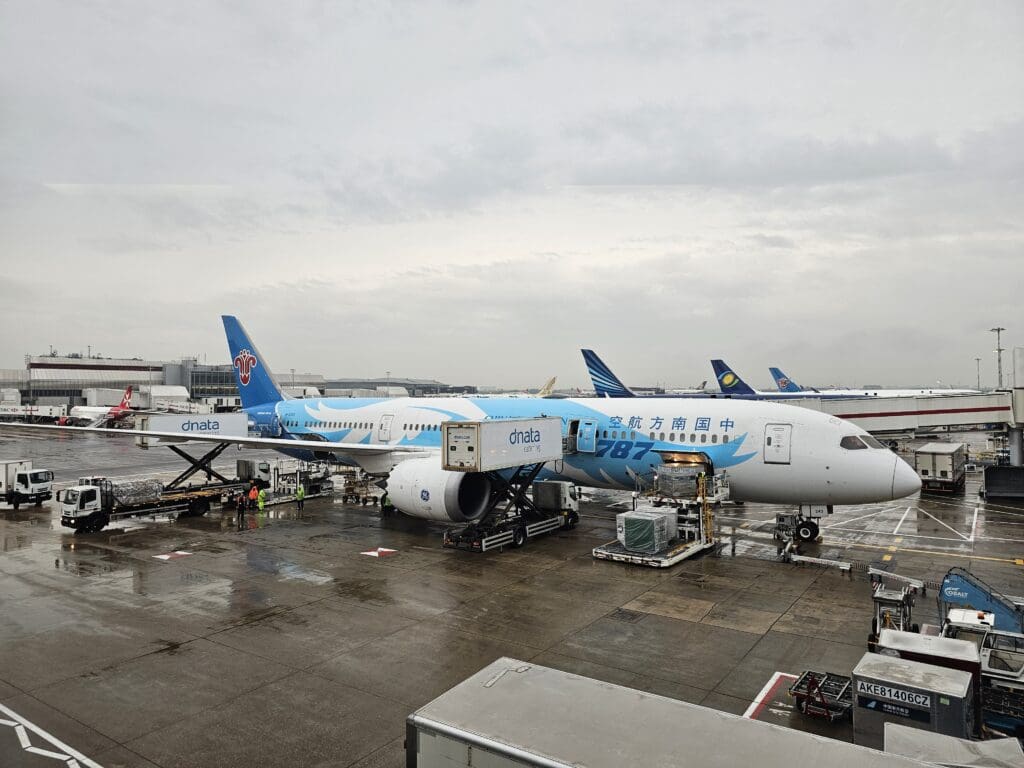
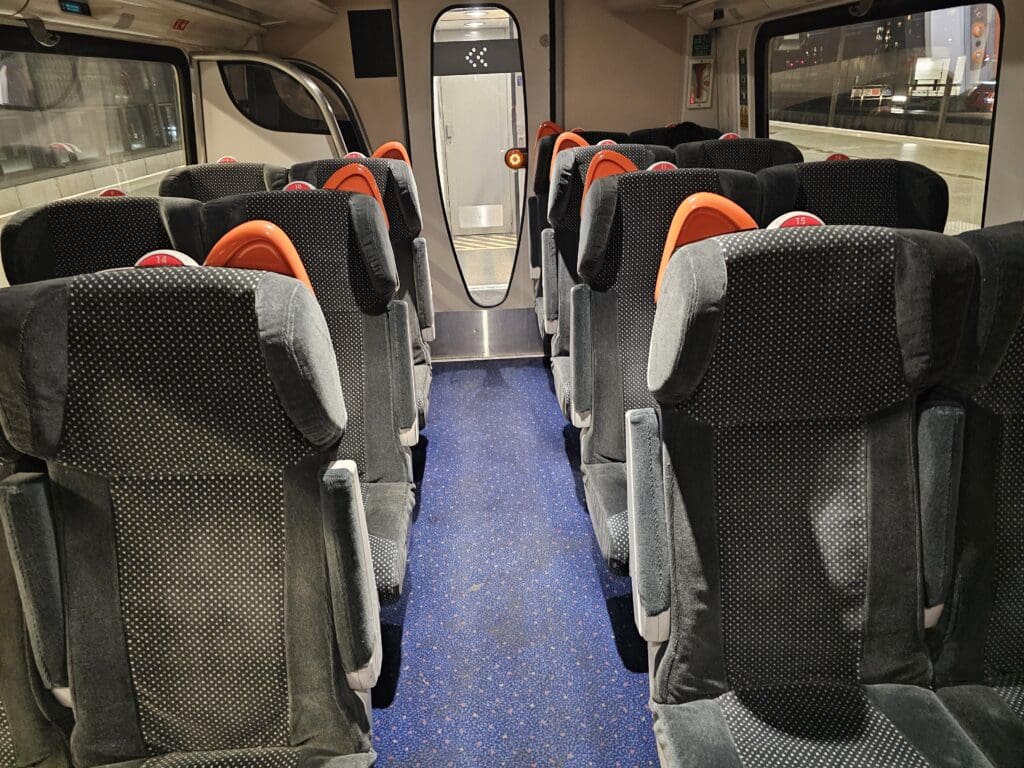
As I shuffled forward out of the cabin, I thanked several crew members and received a mixture of nods and verbal acknowledgements before I stepped off the aircraft and wandered up the old and slightly dated HSBC-sponsored jetbridge. This was decidedly less modern and glamorous than the one that I had boarded the aircraft via in Baku! Having arrived at Terminal 4’s satellite pier, a very long walk was in store before reaching immigration; however, once there, I was delighted to find that this was a breeze, with nothing other than minuscule queues leading up to the terminal’s automated immigration gates. From there, I headed down the escalators to the large baggage collection hall. Worryingly, my bag ended up being in the final cohort of bags to be delivered, and I was thus left lingering around for fifteen minutes, which I spent pondering the possibility of where in the world my bag could be! Fortunately, this appeared after around thirty minutes, and after picking this up, I headed through customs before wandering to the station for the long journey back north to Sheffield, ending my experience with Azerbaijan Airlines.
Summary
That day, my Azerbaijan Airlines experience left me with mixed feelings. Starting with the positives, I could not overlook the fact that the seat was spacious and comfortable, whilst the amenity kits were a positively unexpected addition to the journey, as was the hot towel that preceded the meal service. However, I felt that the battered state of the cabins, the largely cold and distant crew and the slow and laggy inflight entertainment system did let the carrier down somewhat. Thus, whilst I would say that the carrier does have the potential to be a very good one, my experience was very much middle-of-the-road and failed to provide any particularly lasting stand-out positive impressions. Thus, I would probably not go out of my way or pay any sort of premium to fly with Azerbaijan Airlines again, although they did get me from Dubai to London cheaply, ahead of schedule and in one piece!