Flying Korea’s Interestingly Named LCC: Seoul to Jeju on Air Seoul
Background
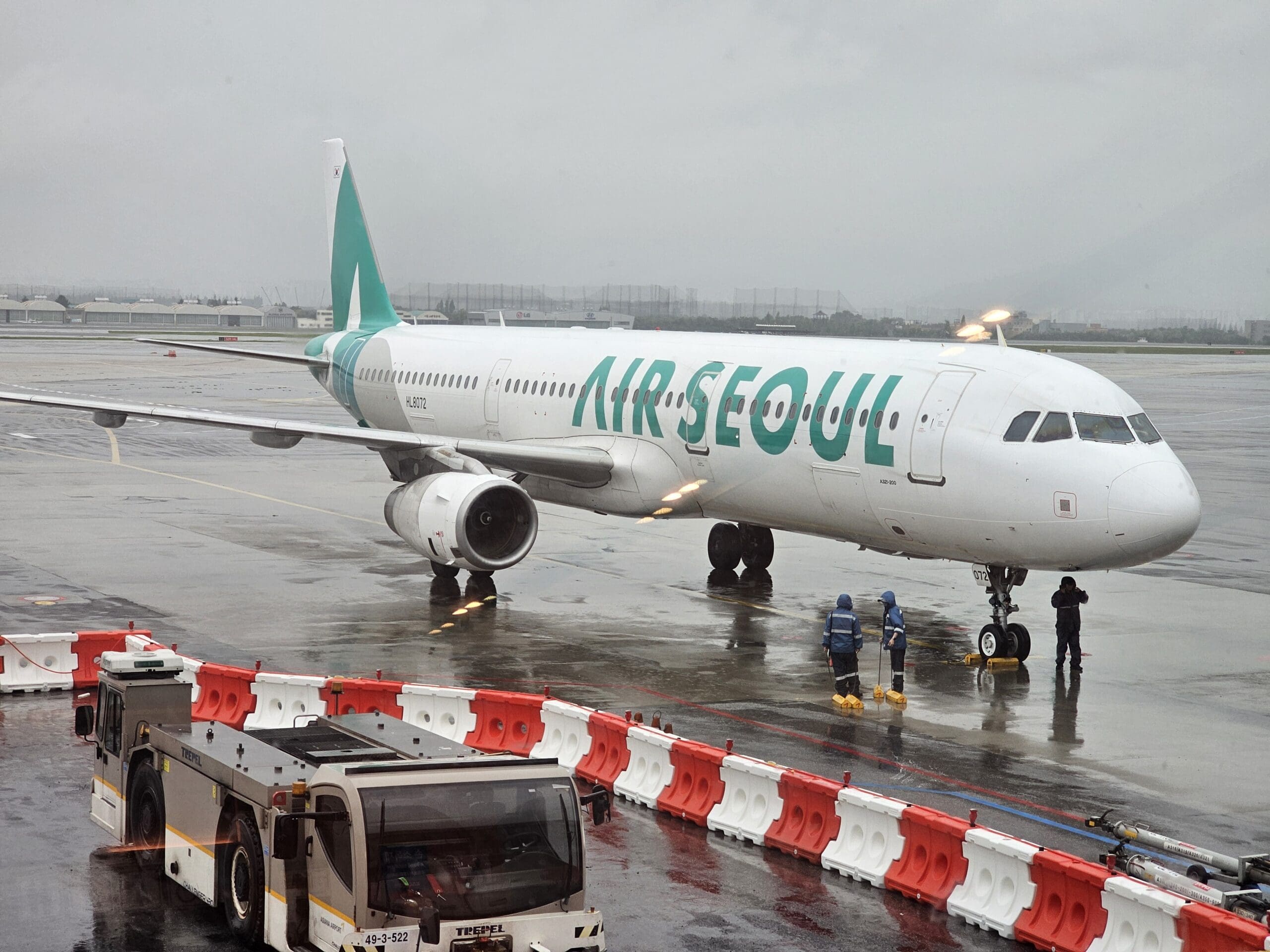
Operating just six Airbus A321s to 21 destinations across East Asia, Air Seoul is one of Korea’s smallest low cost carriers. Yet despite its comparatively small size, the airline has arguably been able to punch above its weight when it comes to making a name for itself in lands both near and far. Specifically, for better or worse, Air Seoul has become somewhat famous amongst the more immature members of the English-speaking world for the unintended cheekiness of its name!
Air Seoul can arguably trace its history back to Asiana Airlines’ establishment of its first low cost subsidiary, Air Busan, in 2007. Seeking to field a competitor in the growing arena of Korean low cost carriers, assisted by the strong backing and guidance of Korea’s second-largest airline, Air Busan enjoyed a reasonable amount of success. Today, the Busan based airline is Korea’s third largest low cost carrier and operates an extensive network of routes to destinations across East Asia. However, with this established in partnership with the Busan Metropolitan City government, as its name would suggest, Air Busan was very much focused on Busan and connecting Southeast Korea, rather than Seoul. Thus, wanting to enter the capital city market, in April 2015, Asiana Airlines established Air Seoul, which, having its primary base at Seoul Incheon, sought to replicate the successes of Air Busan.
Of course, this would throw up an array of new challenges. Namely, the Korean low cost carrier market in 2015 was far more saturated than in 2007, especially at Air Seoul’s hub, Seoul Incheon Airport. Furthermore, Air Seoul would also have to compete with a plethora of low cost carriers from overseas on many of its proposed routes, something that was not particularly true for Air Busan during its early years. Despite these challenges, Air Seoul’s first aircraft was delivered in June 2016 and came in the form of an Airbus A321 handed down from Asiana Airlines. Having undergone little reconfiguration, this retained its spacious 195-seat layout whilst each seat came with the rare luxury of inflight entertainment screens and thus offered a very different passenger experience compared to your typical low cost carrier.
In July 2016, Air Seoul operated its first commercial services, connecting Seoul Gimpo with Jeju. However, its domestic operation was to be temporary, ending in October of that year when the airline commenced its first international flights. By the end of 2016, an impressive total of ten destinations across Cambodia, Japan, Macau and Malaysia had been added to Air Seoul’s route network, whilst the airline’s fleet continued to grow with the addition of two more ex-Asiana Airlines jets. Since 2016, Air Seoul has built up a fairly good reputation within the Korean airline industry. Whilst it has failed to gain momentum and become the as large as Air Busan or many other low cost carriers, Air Seoul has proven to be reasonably popular amongst those who fly with the airline. Many comment on Air Seoul’s comfortable and spacious aircraft, the airline’s friendly crew and the inflight entertainment systems. However, it should be noted that the latter can only be found on those aircraft that previously operated for Asiana Airlines, equating to half of Air Seoul’s fleet.
Being an aviation enthusiast with an interest in Korea, naturally, I had wanted to fly with Air Seoul for quite some time. However, given the carrier specialises in international flying, quite simply, I had never stoked up the motivation to do so! Fortunately, in Summer 2024, I discovered that Air Seoul would be operating on the route between Seoul Gimpo and Jeju, thereby presenting me with a golden opportunity to sample the delights of Air Seoul cheaply and conveniently.
Booking
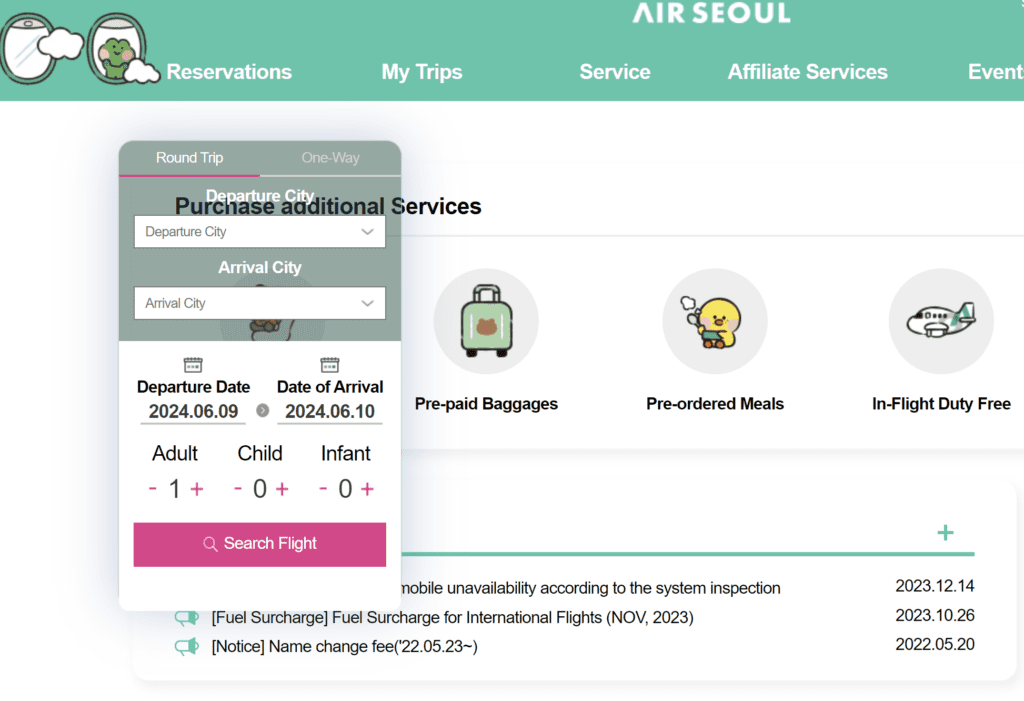
Considering Air Seoul’s status as a subsidiary of Asiana Airlines, I had been confident that booking tickets directly via the airline would not present too many issues. Indeed, I had never experienced any problems when booking tickets with parent airline Asiana Airlines, or its sibling Air Busan, and assumed that Air Seoul would use the same booking engine and website format. I was thus a little surprised to find Air Seoul’s website to be comparatively basic and clunky, being less stylish and well-designed than those of the two aforementioned carriers. Nevertheless, this still offered all the same functions and information as most airline websites, and was available in Chinese (simplified and traditional), English, Japanese and Korean.
Unfortunately, failing to get my Air Seoul experience off on the best foot, I soon ran into an issue. Specifically, upon making it to the flight search engine, I was unable to enter either a departure or arrival location. After trying on both the English and Korean versions of the website, as well as on Air Seoul’s app, I decided to give up. On a side note, I was accessing this from the UK, and, once in Korea I ended up having to book another Air Seoul ticket last minute (after I had taken this flight). That time, this worked, however, once back in the UK again I attempted to do so once more and this continued not to work. Thus this implies that those attempting to book Air Seoul tickets from outside Korea (perhaps excluding those countries on Air Seoul’s route network), may face some issues.
Determined to fly with Air Seoul, I resigned myself to booking via a third-party site. First up was Asiana Airlines, however, unlike previous trips between Seoul and Jeju, upon undertaking a search for flights between Seoul and Jeju, there seemed to be no mention of Air Seoul’s services. I did however manage to find these on Booking.com and thus went ahead and booked them for the slightly inflated price of £25 for a one-way ticket. Having booked via a third party, when it came to adding optional extras my options were limited, and any attempts to do this on Air Seoul’s site resulted in an error message advising me to contact the airline’s service centre to add these. Despite this slightly turbulent start, I was still happy to have finally booked a ride on Air Seoul!
Online check-in for Air Seoul’s services opens up 24 hours before departure, and upon navigating myself back to the airline’s app, I found that I could do this quickly and with ease, and I was able to select a seat across much of the cabin without any additional payment. Following a few taps, I received my boarding pass and was all set to head to Jeju.
The Journey
Seeing as I was not scheduled to depart Seoul Gimpo Airport until 1050, I was able to enjoy the luxury of a calm and peaceful morning before heading down to Jeju. Starting my journey in the western Seoul suburb of Gongdeok, I would not have a particularly long or arduous trek to reach the airport, with a grand total of just 13.4 kilometres separating me from Gimpo Airport’s domestic terminal. Furthermore, having passed through Gimpo Airport plenty of times, and well aware that passing through this can usually be done in a matter of minutes, I was confident that I would not have to turn up at the airport with hours to go until my flight. However, perhaps owing to the sheer excitement of sampling Air Seoul, or the fact that I had had early starts over the previous few days, I woke up at 0600 on the dot without an alarm and was unable to get back to sleep. Opening the curtains of the thirteenth-floor officetel I was greeted by a palette of grey apartment blocks and offices blending into an impenetrable grey sky. With June having transformed into July two days’ prior, Korea’s summer rains had well and truly arrived and heading for a walk around the neighbourhood to grab a coffee I was greeted by the light pitter patter of rain on my umbrella, with this forecast to worsen as the day progressed. Once back in the officetel, I had a quick shower and got everything ready for the day ahead before heading back down to the ground floor.
From Gongdeok, the easiest and quickest means of reaching Gimpo Airport involves hopping aboard Korail’s Airport Railroad Express train, more commonly known as AREX. This comes in both an express form that runs directly between Seoul Station and Seoul Incheon Airport, and an all-stop service that makes the same journey but stops at twelve intermediate stops, including Gimpo Airport, on the 63.8-kilometre journey to Incheon Airport Terminal 2. After heading down the busy main road, I arrived at the heart of Gongdeok, a crossroad flanked by modern skyscrapers on all sides, beneath which sits the subterranean sprawl of Gongdeok Station. Descending into this, I tapped my way through the barriers with my T-money card before battling through the crowds of stylish and smartly dressed commuters as I made the long walk through the station to the westbound AREX platform. Once there, I was in luck as I was welcomed by the sight of a Hyundai Rotem train ploughing into the station on the other side of the screen doors thus meaning that no wait was required! Granted, with trains running at intervals of every six minutes or so, had I missed this, then this still wouldn’t have proven to be a major disaster.
Squeezing onboard the packed train, I was greeted by the sight of an army of weary-looking commuters and unsurprisingly no seats were left so I jammed myself in near one of the doors and we soon sped off towards our next stop, Hongik University. Next up was Digital Media City before the train headed out into the open and whizzed across the Han River, before heading back underground towards Magoknaru, following which we made a final underground dash towards Gimpo Airport where we arrived no more than eighteen minutes after leaving Gongdeok. As soon as the doors slid open, a deluge of passengers poured out of the train and I began the very long ascent to the station’s atrium which involves no fewer than three long escalator rides. Eventually, I tapped my T-money card on the station barriers and had the very reasonable 1,600 won (£0.89) fare deducted from this before I began the walk over to the domestic terminal. Gimpo Airport Station sits conveniently between the airport’s detached international and domestic terminals and is connected to both via long underground passageways. Thankfully, speedy moving walkways, whilst a complimentary buggy service is offered to shuttle those requiring assistance to and from both terminals.
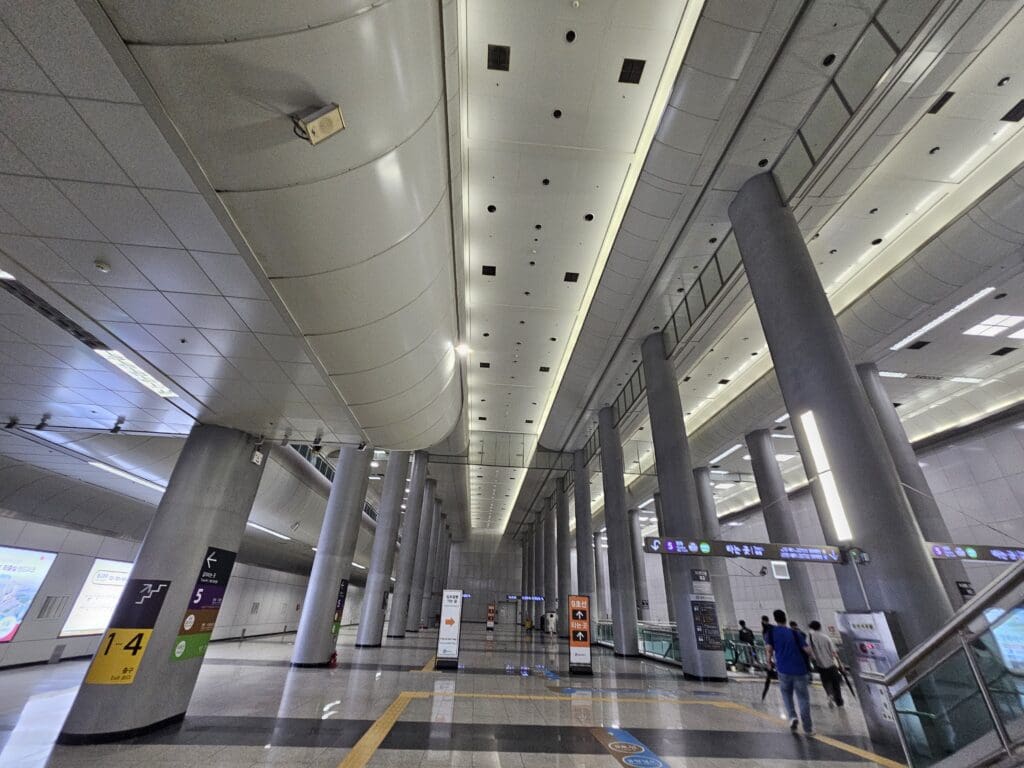
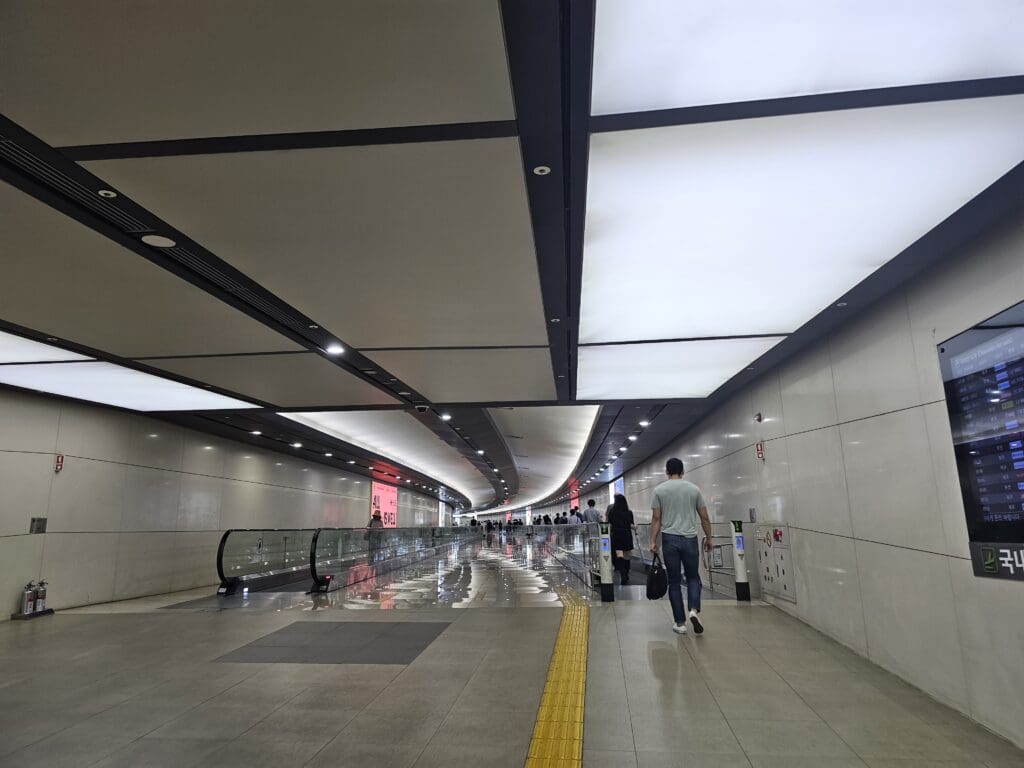
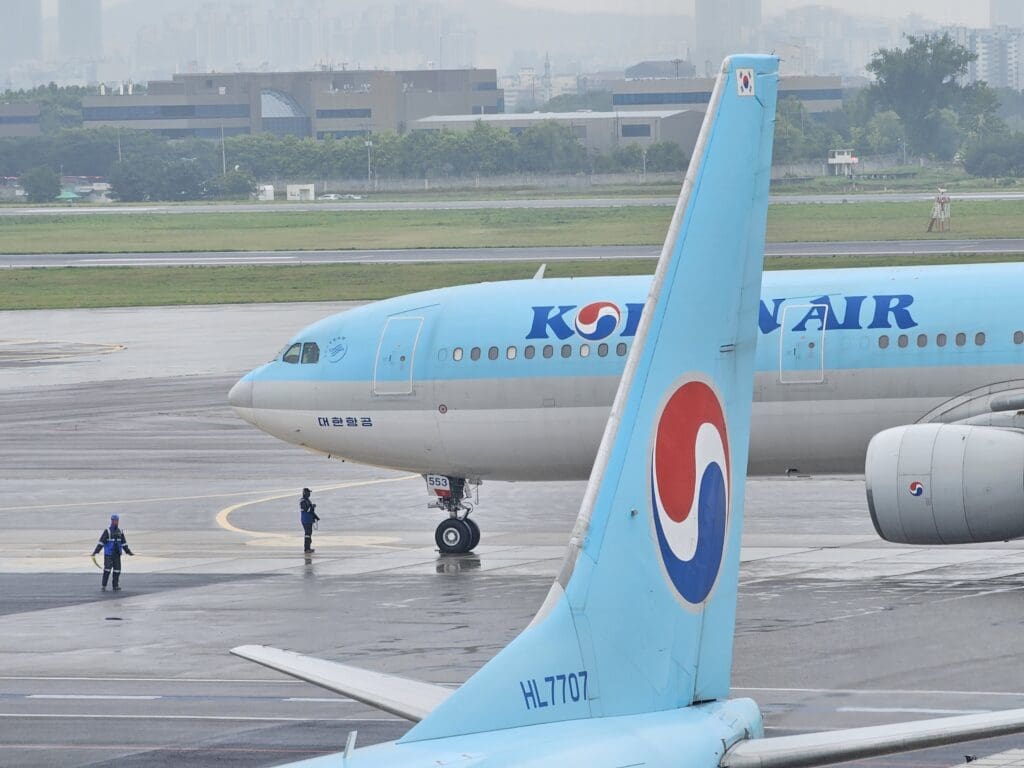
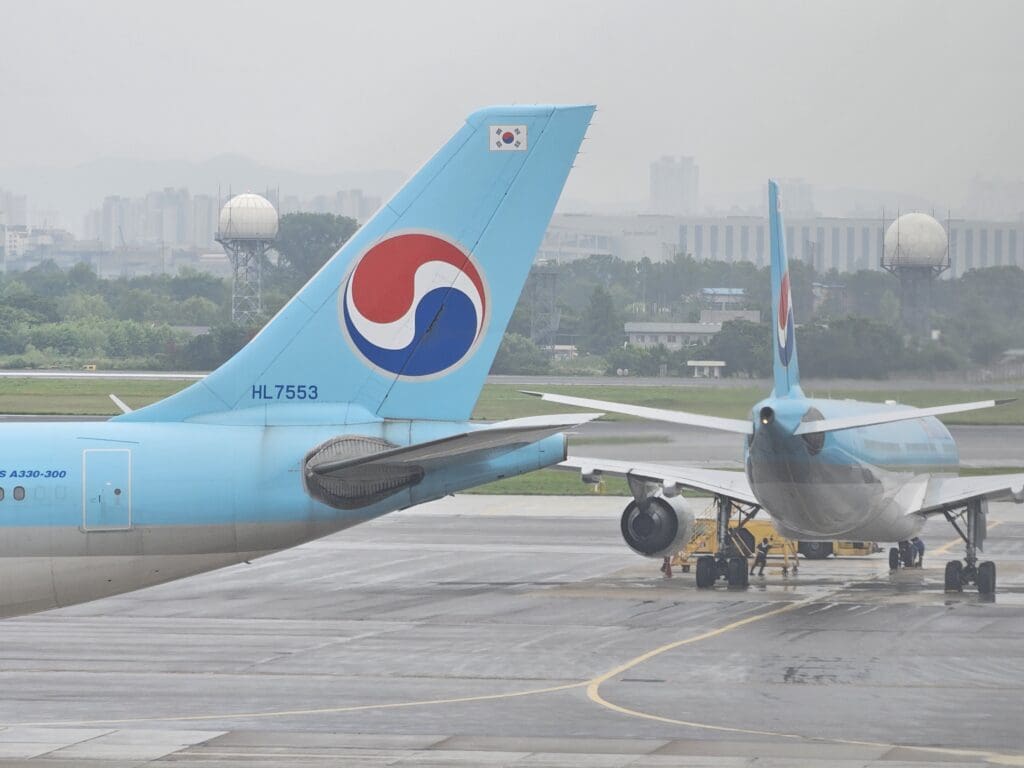
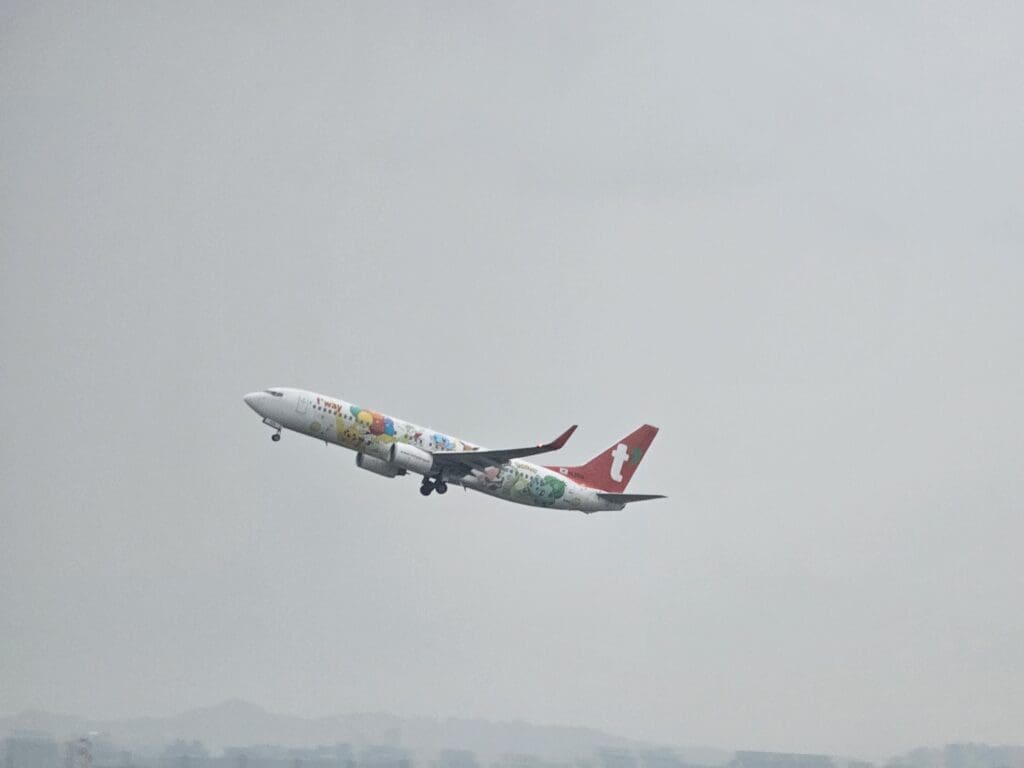
After trundling along the modern and well-polished passageway and admiring the many advertisements which seemed to promote investment into various rural regions across the country, I headed up two more escalators and arrived at the domestic terminal’s busy check-in hall. Seeing as I had arrived at Gimpo Airport with over two hours to go until departure, I was left with an abundance of time before I had to make my way to the airside portion of the terminal. Thus, I decided to continue up the escalators to the top floor of the terminal, passing through the busy food court before reaching the relatively new open-air observation deck. With the rain now having gotten slightly heavier, by the time I had watched a somewhat weathered-looking Korean Air Airbus A330-300 fire up its engines in preparation for its short hop to Jeju, I was suitably soaked and thus made my way back inside.
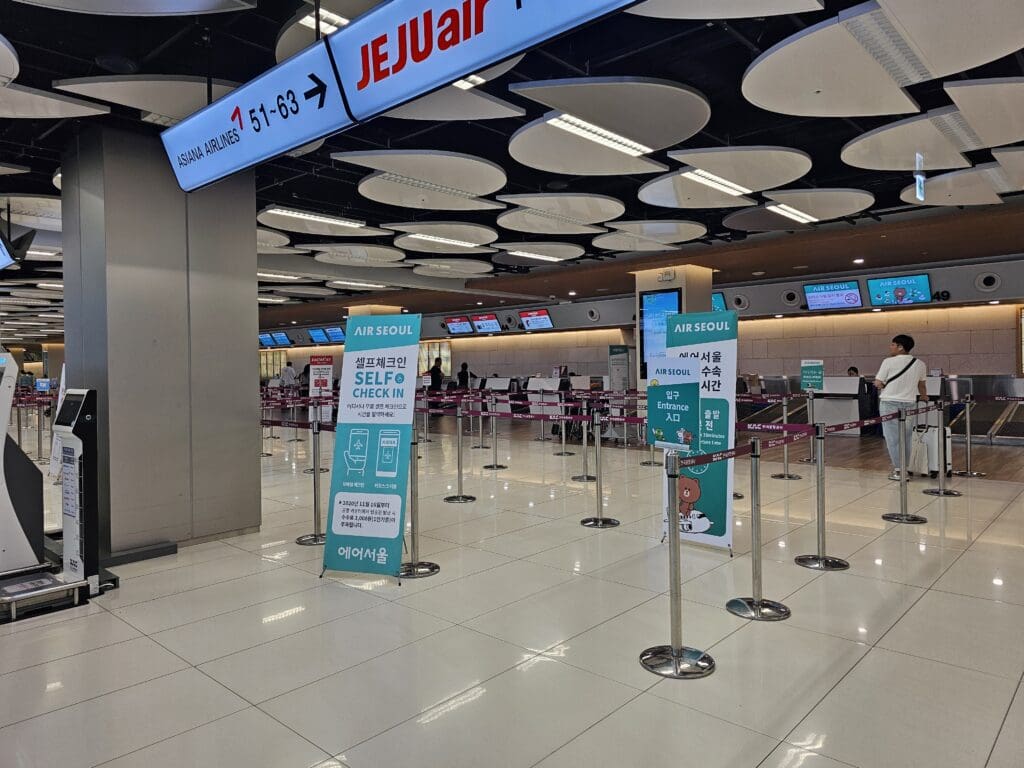
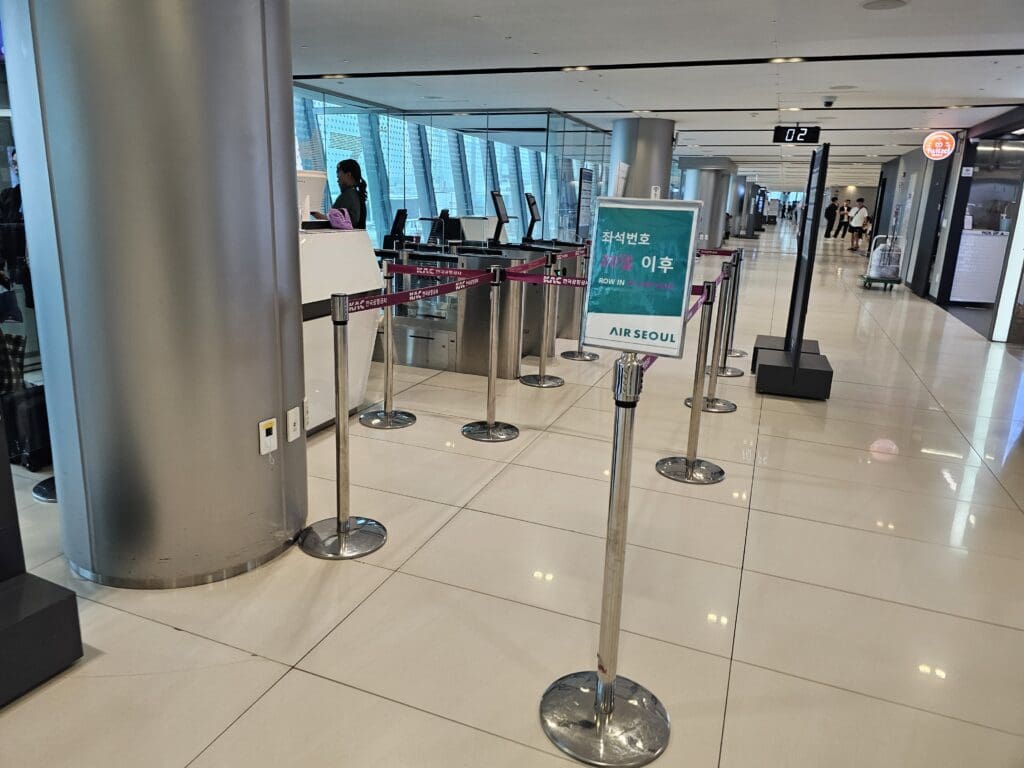
By this time, I needed my second coffee of the day so I decided to stop by the fast-food chain Lotteria which, alongside their burgers, offered perhaps the cheapest cappuccino anywhere in the terminal. With this in hand, I continued making my way down to the terminal’s check-in hall. Seeing as the morning rush was in full swing, the terminal was awash with activity, and all sorts of passengers heading off to destinations across the south of Korea and Jeju could be seen. Looking around, I spotted groups of joyful elderly tourists donned head to toe in the latest hiking gear, noisy school groups and smartly dressed business people, all in the space of a few seconds! Once in the check-in hall, I soon stumbled across Air Seoul’s check-in area. Given the fact that Air Seoul operates far fewer flights from Seoul Gimpo Airport compared to all other Korean carriers operating from this, unsurprisingly Air Seoul’s check-in area was rather compact, nevertheless, this was still relatively well branded and featured plenty of signage. Whilst I had checked in online, wanting to grab a paper boarding pass to keep as a souvenir from my first ever Air Seoul ride, with no queueing required I made my way straight up to the Air Seoul desk and once there I was greeted in Korean by the reasonably friendly agent. After explaining that I had checked in online but wanted a paper boarding pass, they typed away for a while before a receipt-style boarding pass was ejected from their printer. Once they had pointed out the gate and boarding time, I was free to continue on my journey.
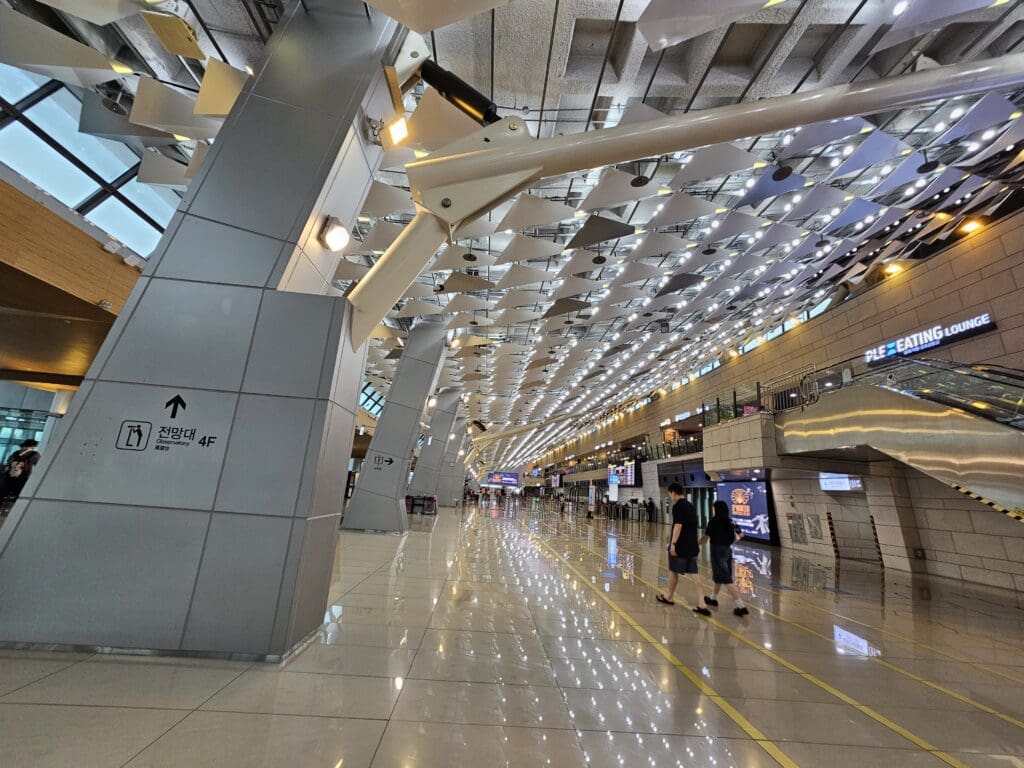
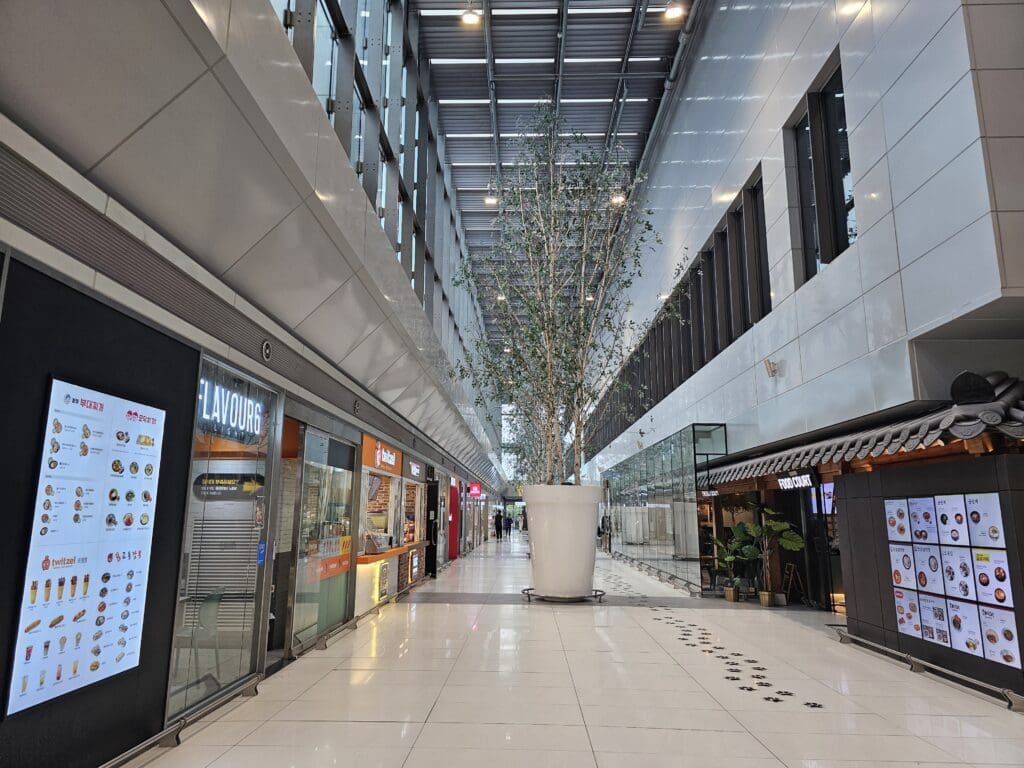
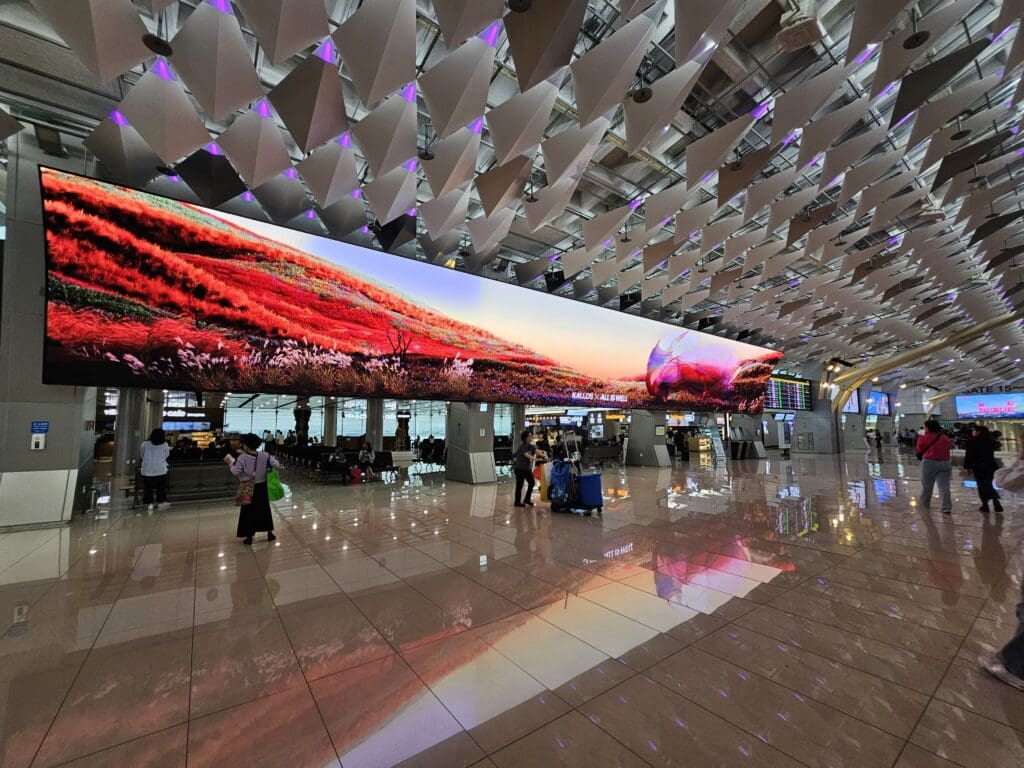
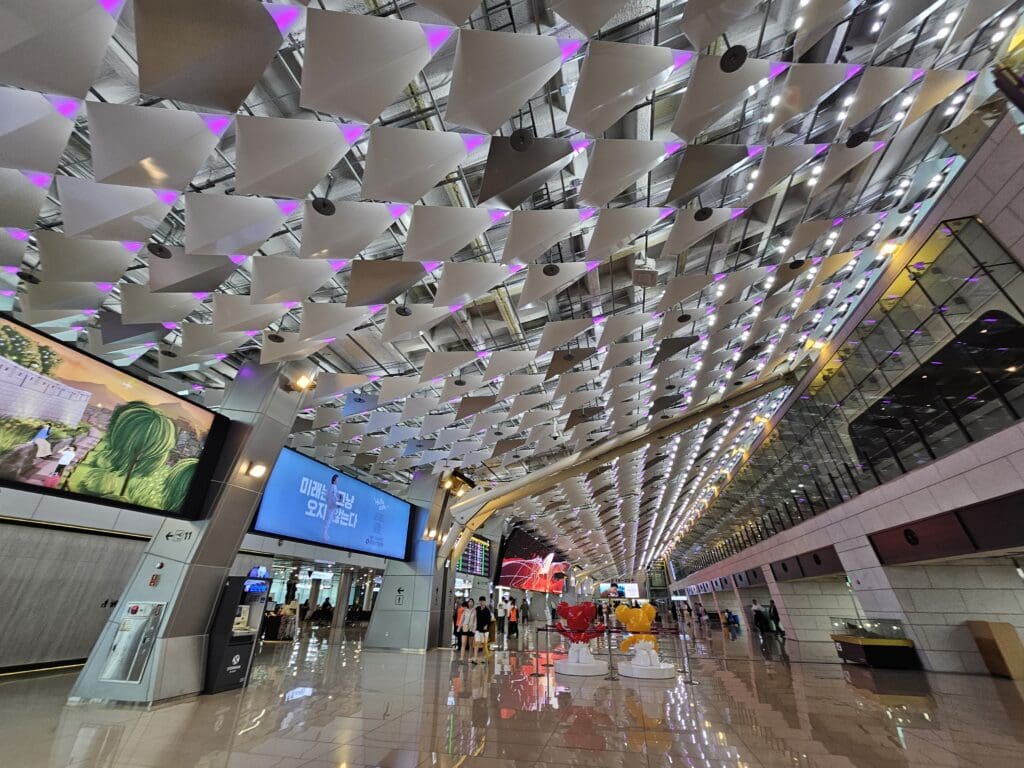
With the domestic terminal’s renovation work having long been completed, as I wandered around, I found the landside portion of the terminal to be bright, modern, clean and spacious. In addition, this part of the terminal is also home to an abundance of facilities. Hungry passengers and non-flyers alike can pick from twenty restaurants and eleven cafés, or satisfy their retail cravings with four shops and a pharmacy. Having already grabbed a coffee and not quite ready for lunch, once I had my boarding pass I made my way back up the escalators and voyaged over to the security check. Upon reaching this, I was delighted to find that there were no queues at the entrance and I thus made my way over to one of the staff members before I scanned my boarding pass on the scanner and handed over my passport. Once they had verified that the name on my boarding pass matched up with the name on my passport, I was cleared to proceed and entered the terminal’s relatively large security hall. As is delightfully often the case at Gimpo, I was able to walk straight up to a checkpoint and passed through this in about thirty seconds, leaving me with plenty of time to explore the delights of the airside area.
Once airside, Gimpo Airport’s domestic terminal isn’t particularly large and lacks the same array of facilities as its landside area, with this featuring a few cafés, fast food outlets and a convenience store. However, considering the fact that most passengers probably spend no more than an hour in this part of the terminal, this was nothing to complain about. Importantly, I found the terminal to be bright, modern, clean and spacious, with plenty of places to sit and wait, as well as a plethora of charging points and complimentary fast wifi. Turning to the terminal’s layout, this consists of a central hub with two wings that stretch out in either direction along the apron. In total, this features twelve jetbridge-equipped stands, along with a host of bus boarding gates to transfer passengers to remote stands. Perhaps seeking to prevent bust ups, Korean Air and its low cost subsidiary Jin Air usually operated from the eastern wing, and Asiana Airlines and its low cost subsidiaries Air Busan and Air Seoul operate from the western wing. Whilst Eastar Jet, Jeju Air and T’way Air seem to squeeze in where they can.
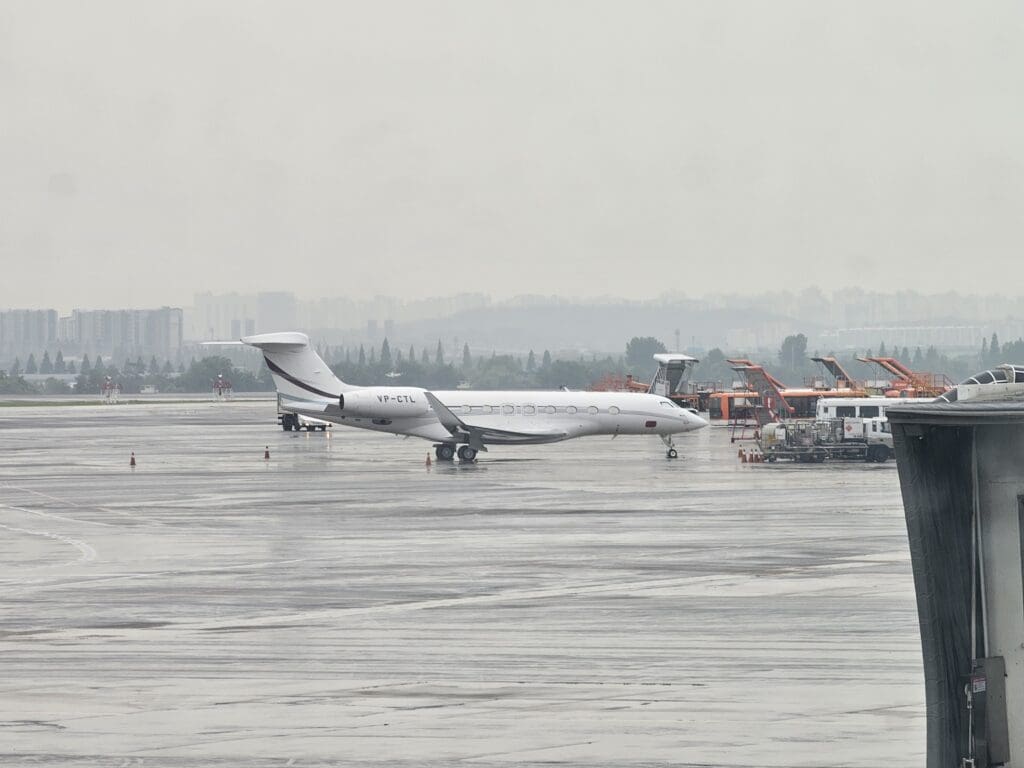
Aviation enthusiasts will be glad to hear that throughout the terminal floor-to-ceiling glass windows offer unobstructed views of most of the terminal’s stands, as well as of the easterly end of Gimpo Airport’s two runways. Whilst planespotting long suffered from a slightly precarious legal status in Korea, in recent years this no longer seems to be the case and in the past decade I have never had any issues when taking photographs of the aircraft outside. That morning, a constant stream of movements was provided as aircraft made their way back to Gimpo following their first Jeju rotations of that day. These took the form of the usual smorgasbord of airliners, with examples from each Korean airline (other than Aero K and Air Premia seen during my stay). These ranged in size from Korean Air’s Airbus A220-300s, right up to the Airbus A330-300. Meanwhile, international visitors could be seen in the form of an ANA Boeing 767-300, a China Eastern Airlines Airbus A330-300 and a Japan Airlines Boeing 787-9 Dreamliner.
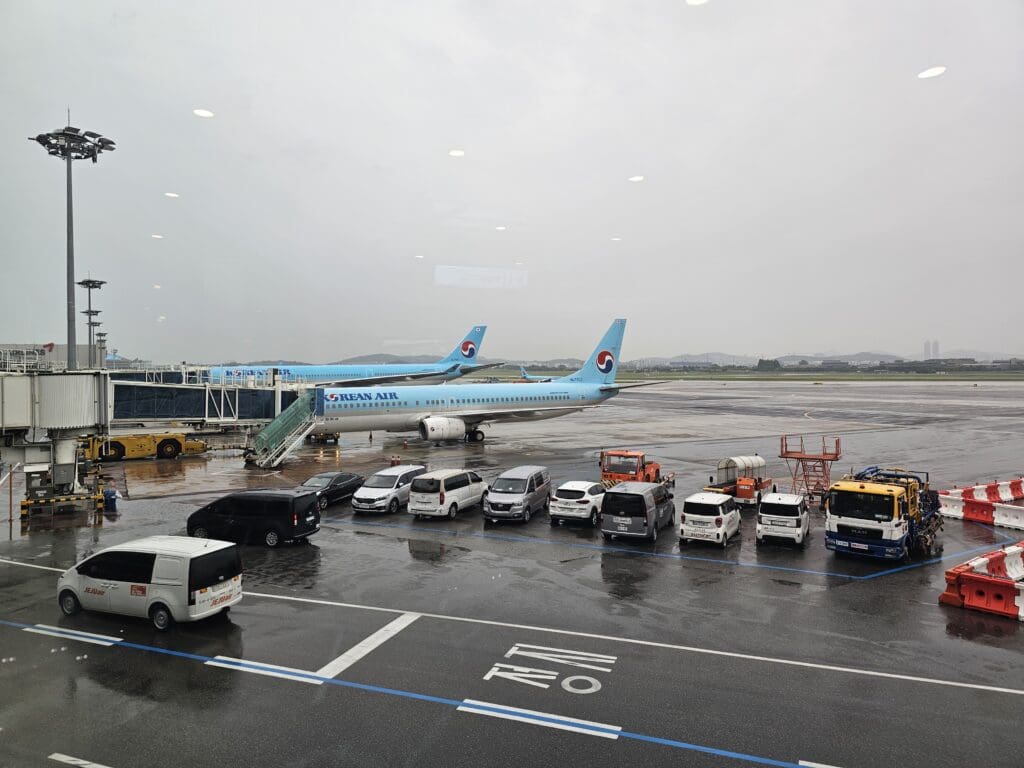
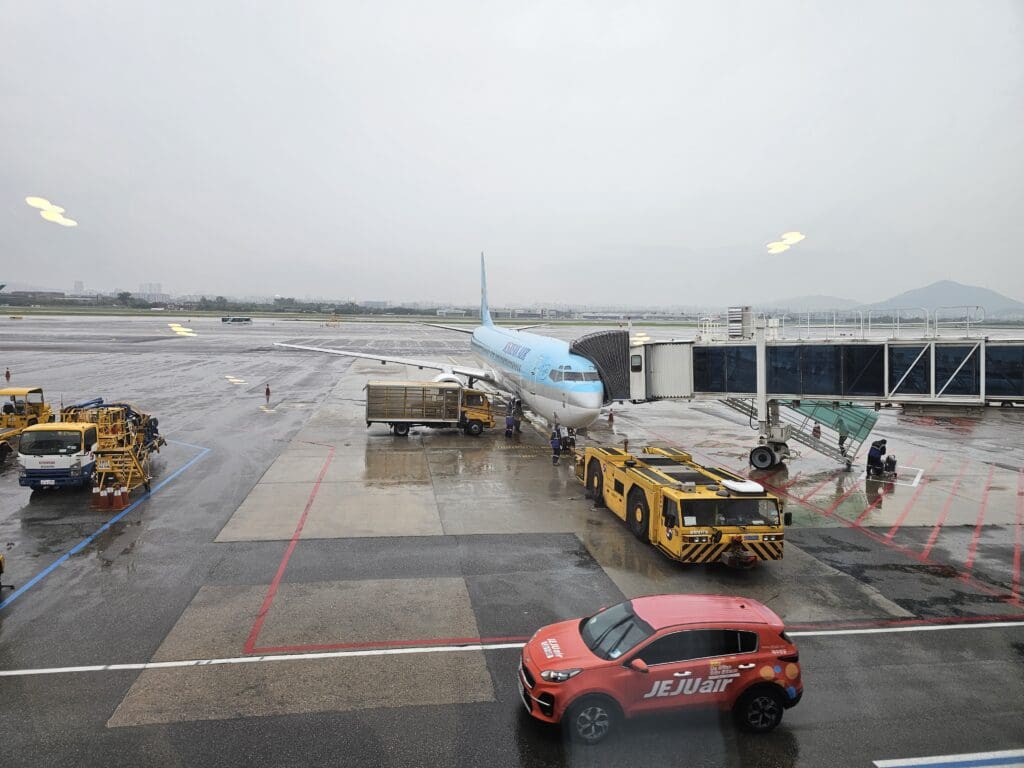
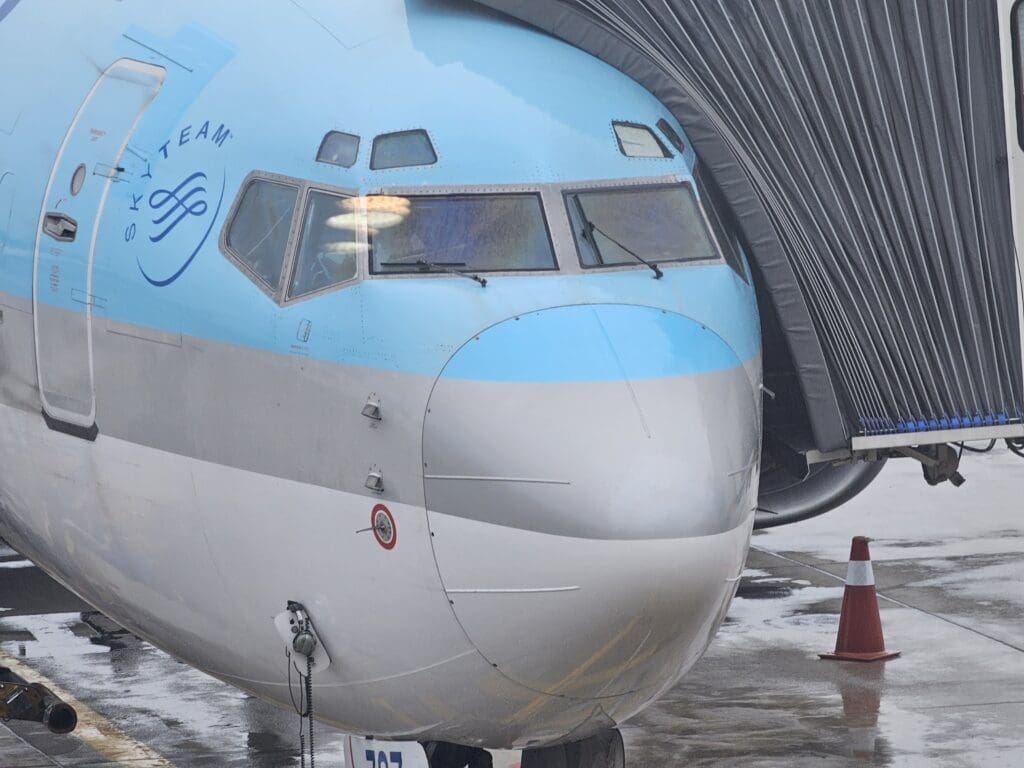
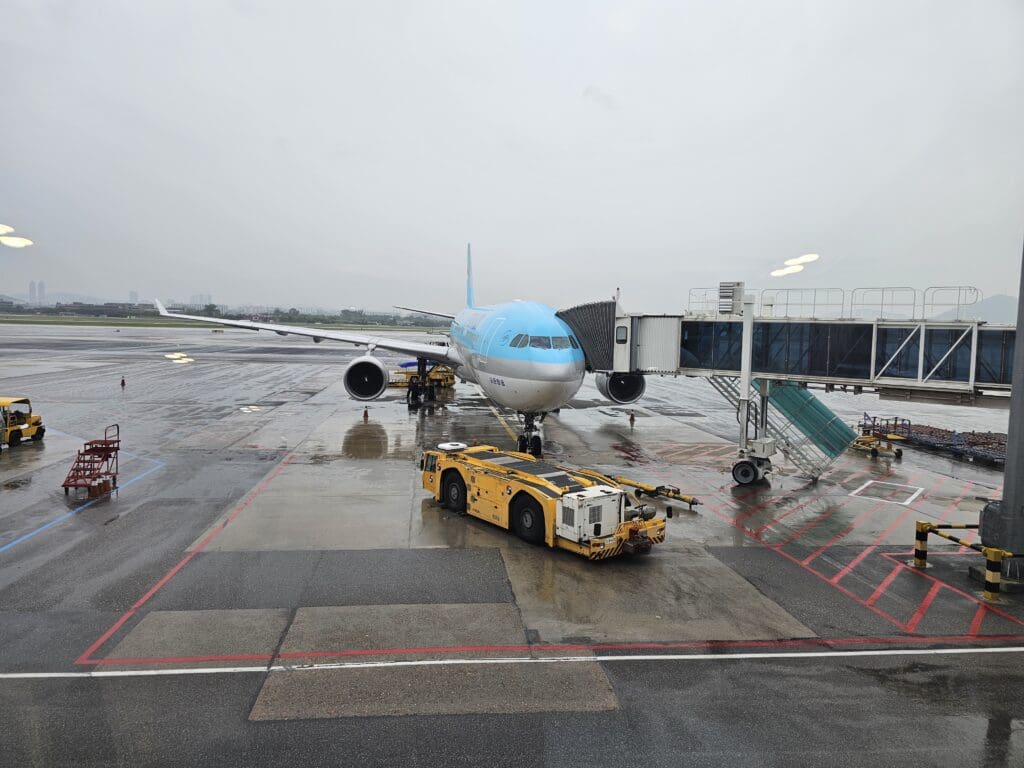
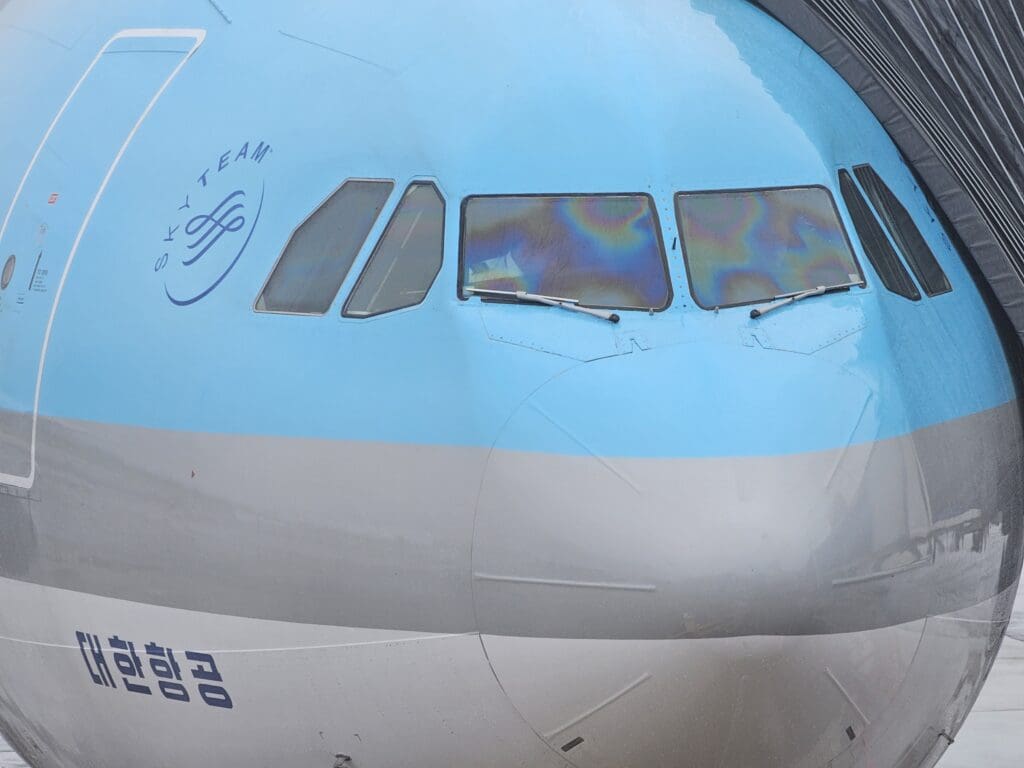
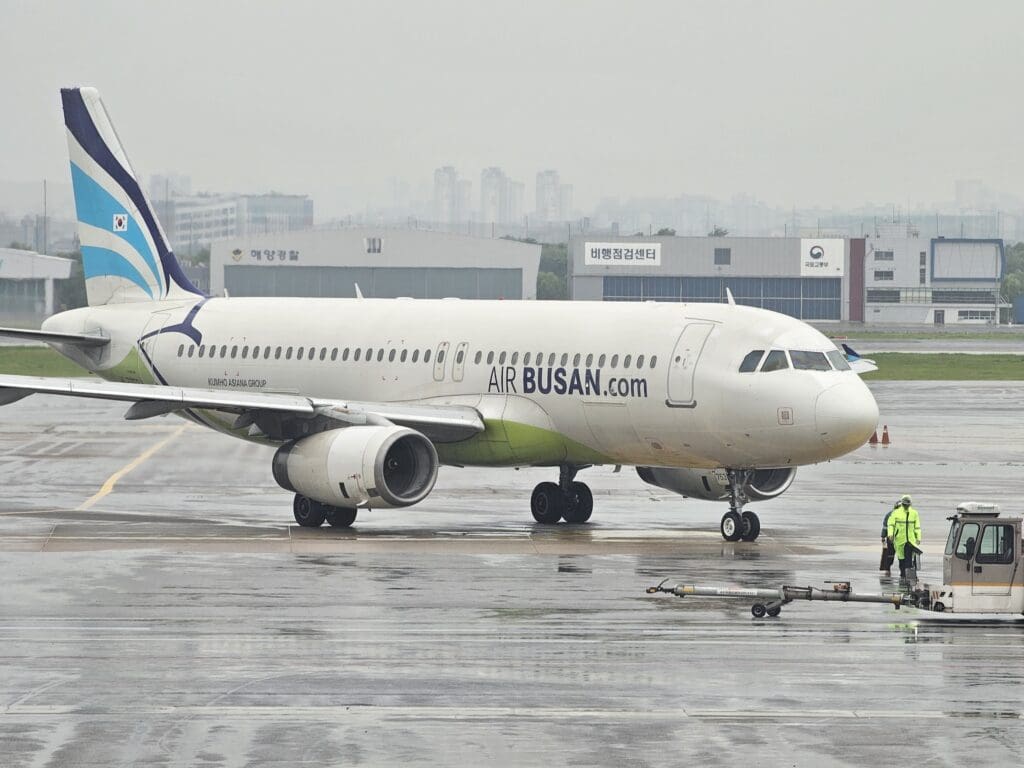
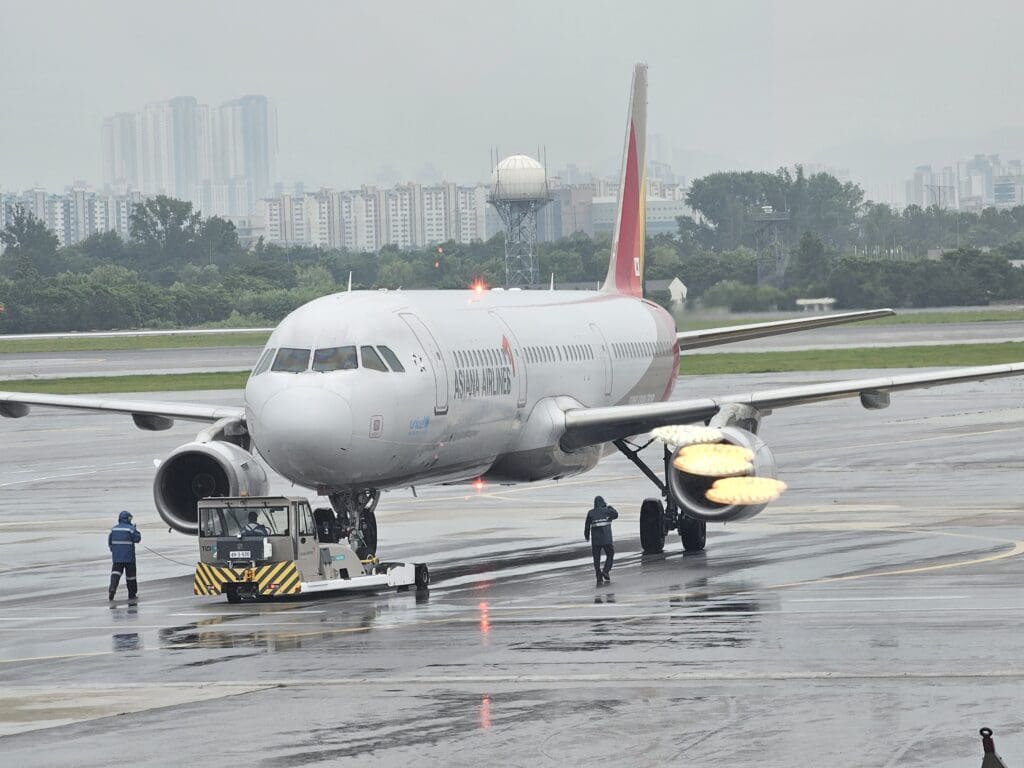
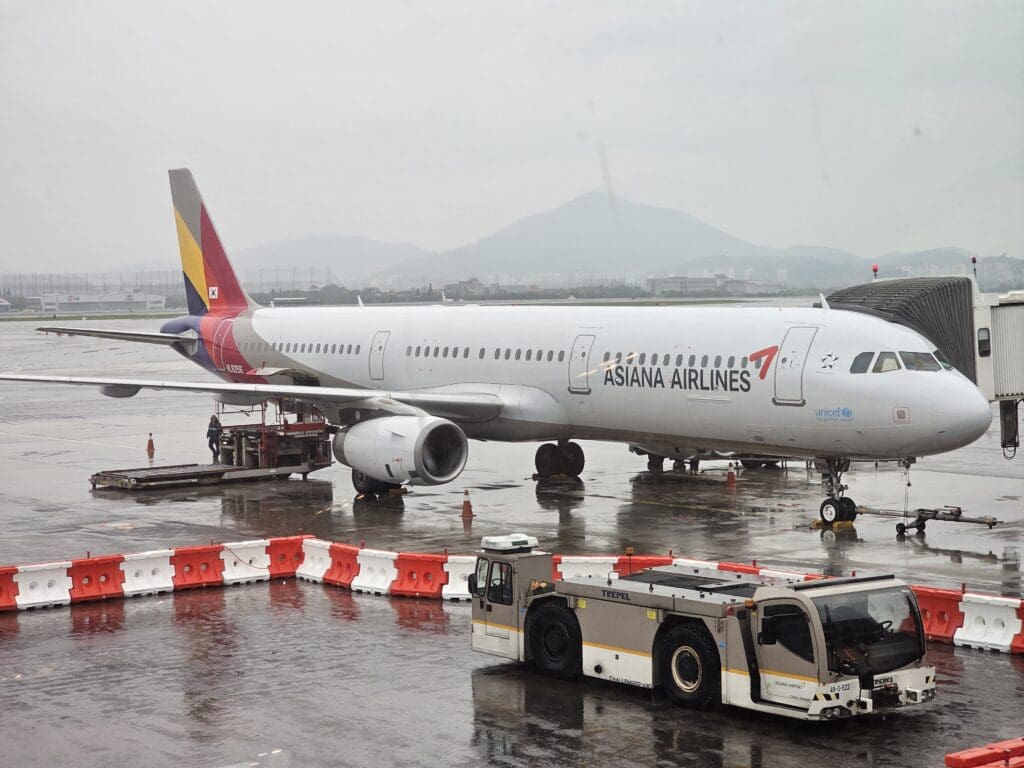
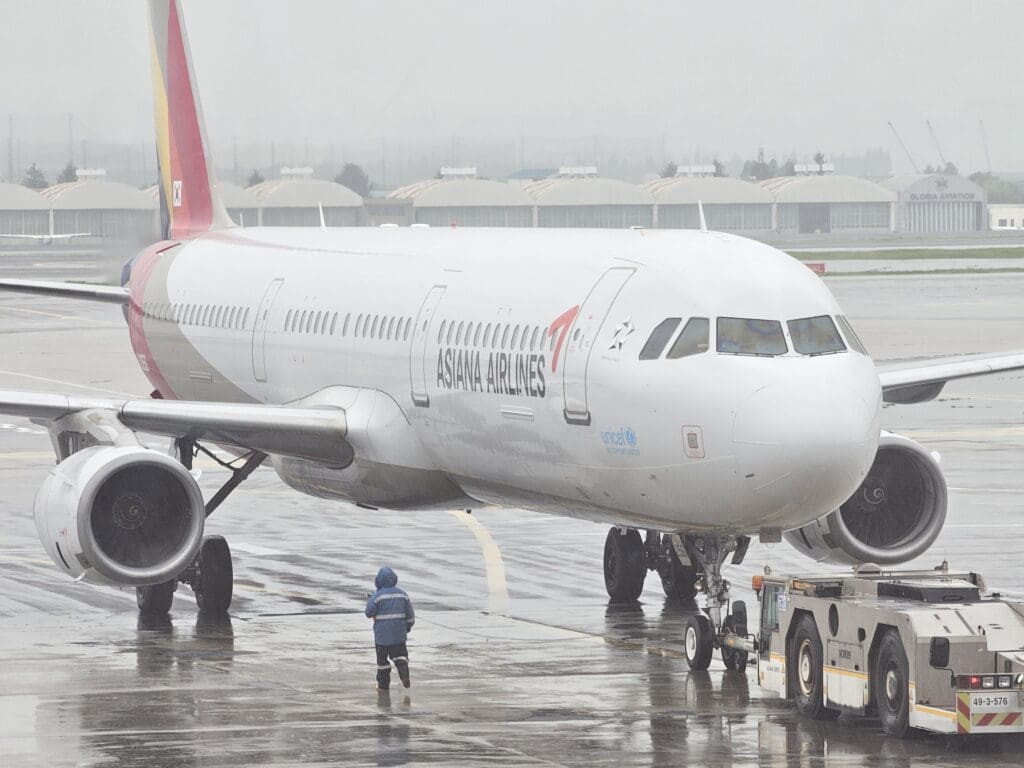
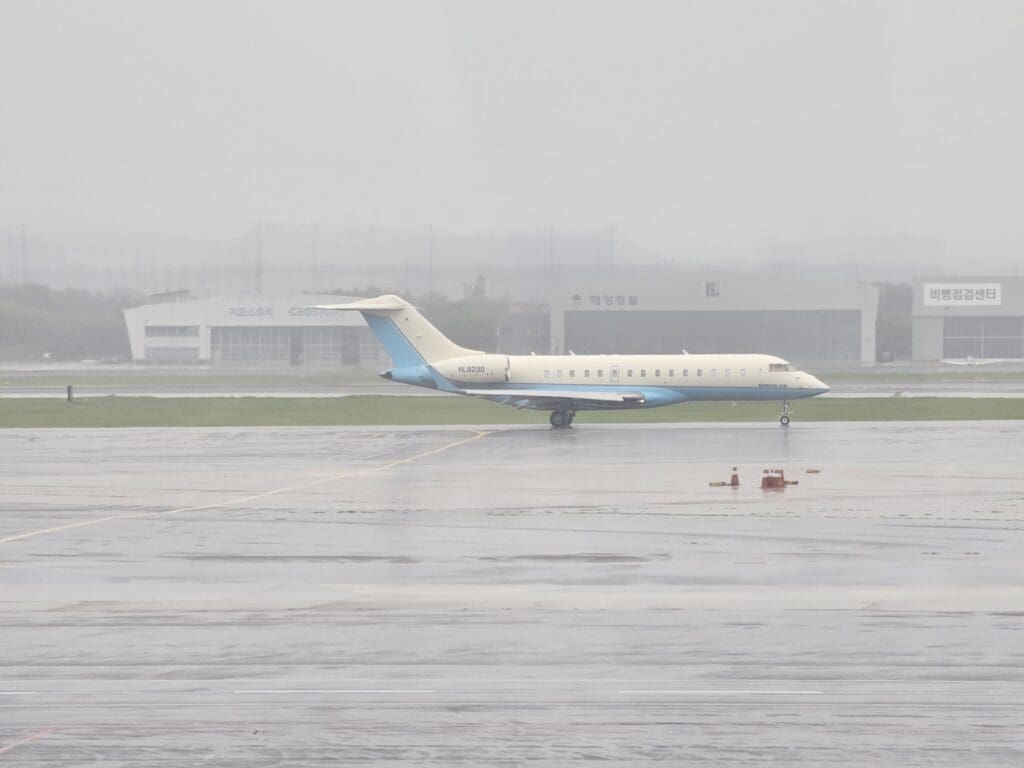
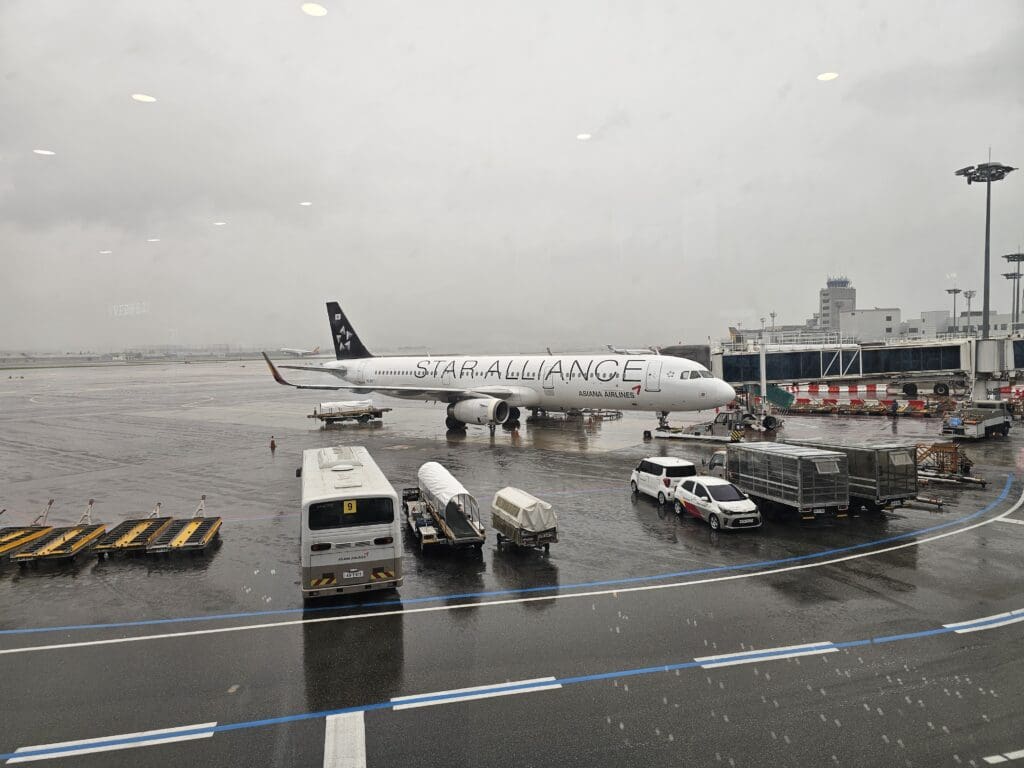
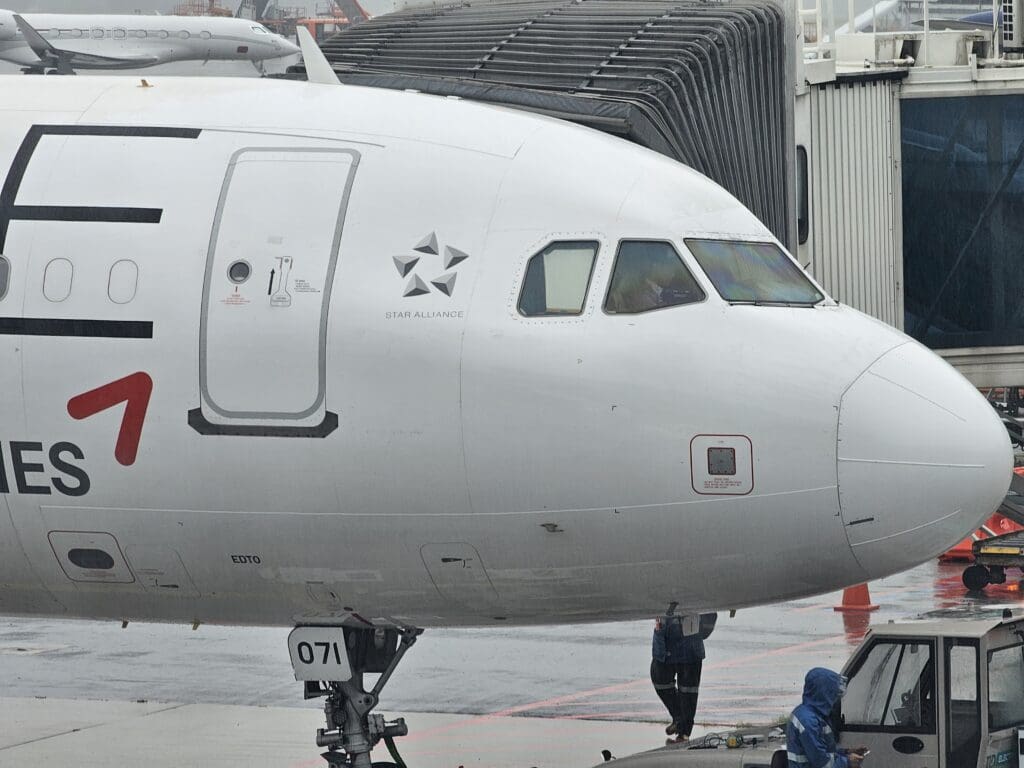
After wandering around and exhausting the not-so-plentiful sights of the airside portion of the terminal, I made my way to the gate and plonked myself down next to one of the large glass windows. Looking outside, I felt rather sorry for the soaked ramp staff who were having to endure the worst of the worsening meteorological conditions. Highlighting that day’s rubbish weather, as I waited, my phone flashed up multiple times with rain, flood and landslide warnings for Seoul and the surrounding area.
According to my boarding pass, boarding would commence twenty minutes prior to departure, with this being a very standard boarding time for Korean domestic flights, regardless of aircraft size. As mentioned, Air Seoul has a limited operation at Seoul Gimpo Airport, with only a single aircraft based there at any one time. Thus, it wasn’t too difficult to decipher which aircraft would be operating the late morning service to Jeju. Looking at FlightRadar24, I tracked this as it approached the capital following a short morning jaunt to Jeju and back. As it turned out, this aircraft departed Jeju late and did not appear at Stand 17 until 1023, coming to a halt in the soaking rain eight minutes behind schedule. With that considered, I was slightly sceptical that boarding would commence on time at 1040! Given Air Seoul’s status as a low cost subsidiary of Asiana Airlines, unsurprisingly their ramp handling was provided by Asiana Airport and once the aircraft came to a halt, an army of hardworking ramp staff sprung into action, with a jetbridge soon being connected and disembarkation commencing no more than two minutes after the Airbus came to a halt.
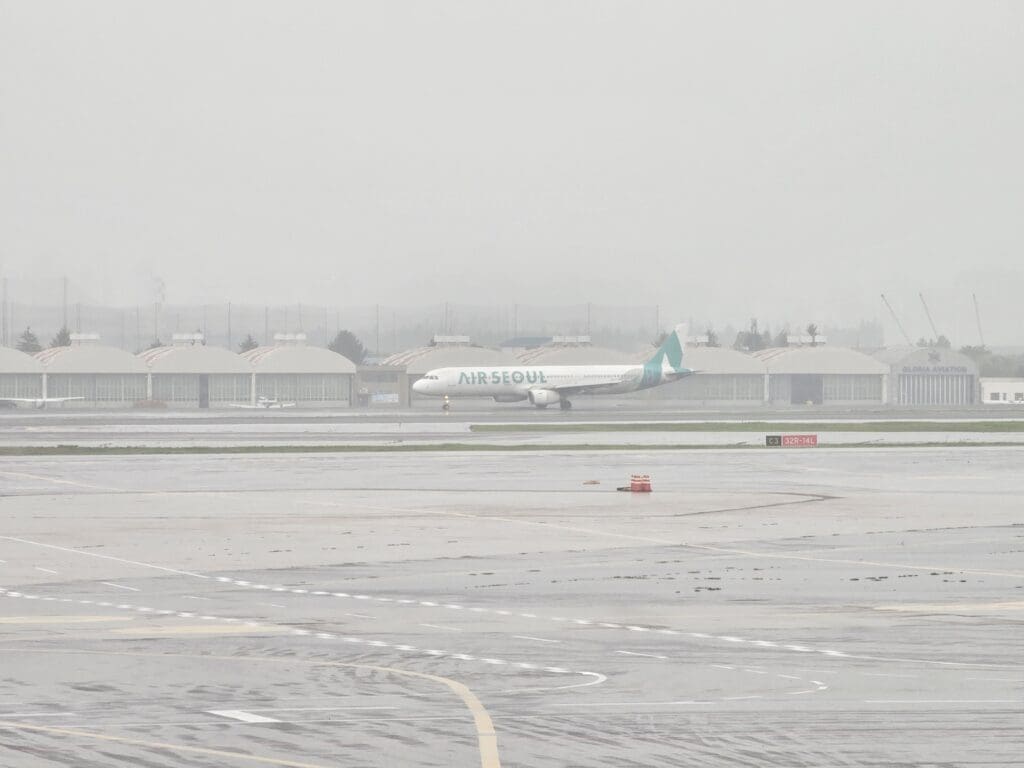
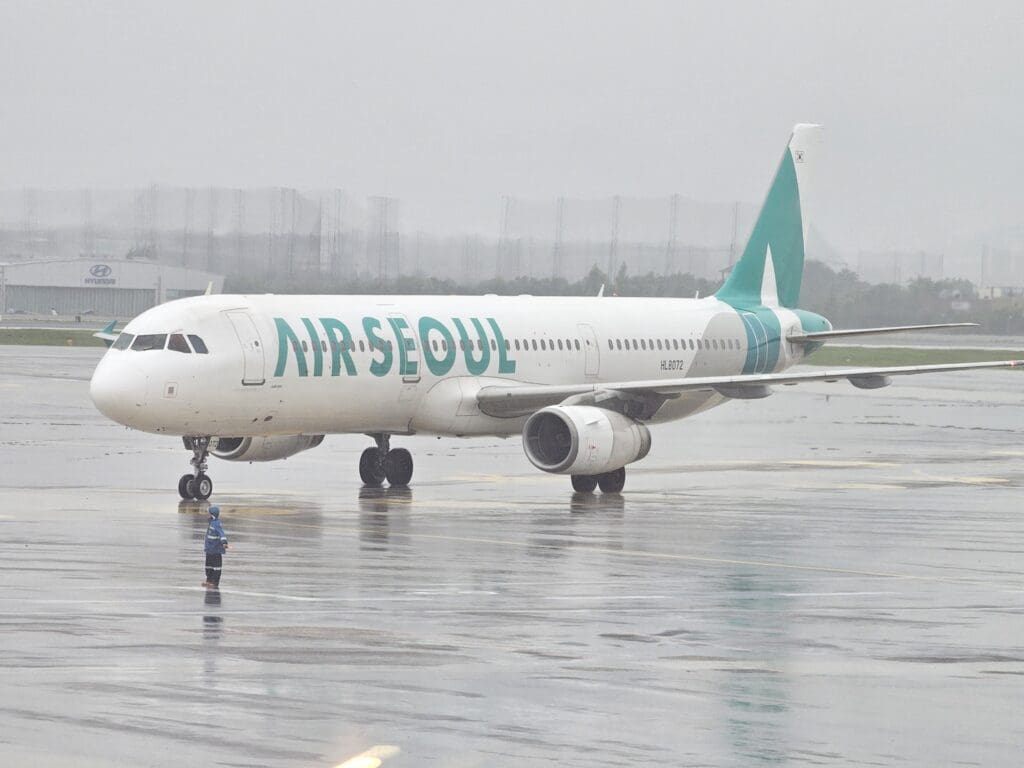
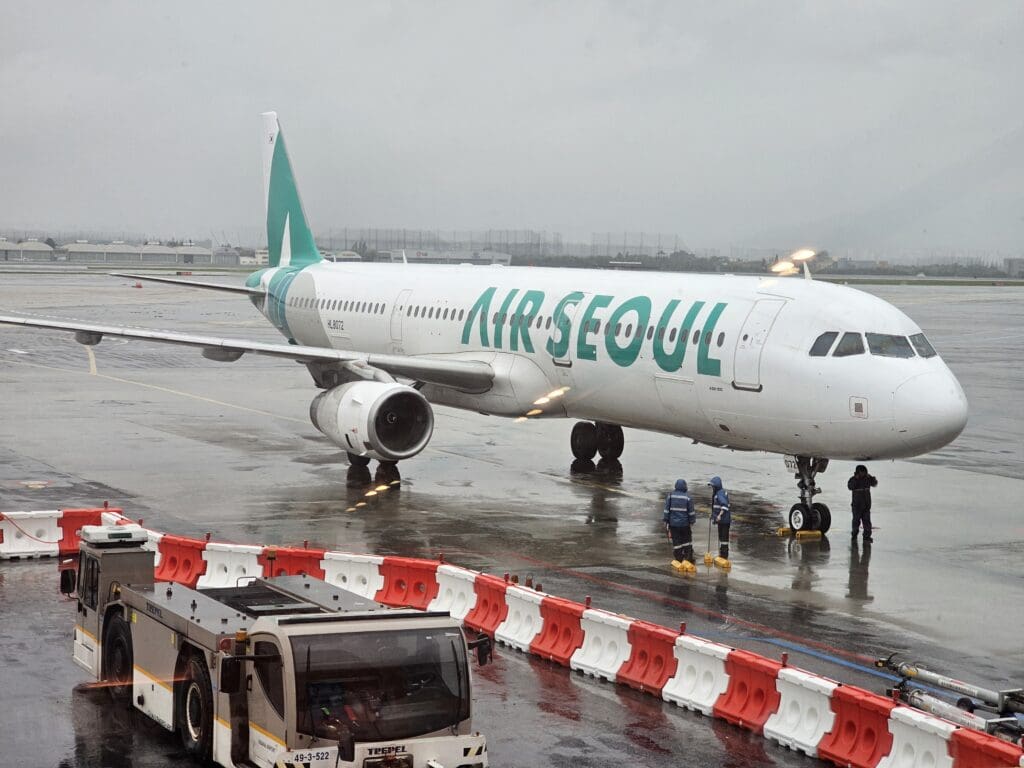
As expected, the aircraft operating the service to Jeju came in the form of Airbus A321-232 HL8072. Like sister airline Air Busan, Air Seoul operates a mixture of aircraft brand new jets delivered from Airbus, alongside both aircraft that had previously flown with Asiana Airlines and other carriers across the globe. That day, my jet fell into the latter category. Assembled at Airbus’ Hamburg Finkenwerder plant, this jet first took to the German skies with the test registration of D-AVZS in early November 2006. This made it about 17.7 years old at the time of my flight, and thus whilst not a vintage airliner, it was also far from a spring chicken! Later that month, the Airbus was given the registration of VT-KFR and ferried to India where it began its career with full service carrier Kingfisher Airlines. However, this tenure in India came to an end with the infamous bankruptcy of Kingfisher Airlines in October 2012, following which the aircraft entered storage in Mumbai until it was repossessed by its lessors, the Aviation Capital Group, in June 2013. Heading to the small airfield of Lasham in Southern England, the aircraft spent an extended period on the ground before heading eastwards to Russia in late 2013. There, the Airbus operated for leisure carrier Nordwind Airlines as VQ-BRU, although less than two years later, its time ferrying holidaymakers came to an end, with the aircraft being returned to the Aviation Capital Group less than two years later in November 2015. Following another period of prolonged storage, the aircraft received its current registration and was painted into the colours of Asiana Airlines’ other low cost carrier, Air Busan, in Budapest before venturing to Korea in December 2016. In March 2022, the aircraft was then passed onto Seoul-based Air Seoul for whom it has operated ever since. Whilst once sent to destinations across Air Seoul’s route network, for well over a month before my flight, the aircraft had operated exclusively on the short hop between Seoul Gimpo and Jeju. Indeed, unlike Air Seoul’s jets that were handed down from Asiana Airlines, this particular aircraft does not feature an inflight entertainment system and is thus from a passenger’s perspective, far better suited to short routes.
Despite the late arrival of the inbound aircraft, this appeared to have been turned around in record time and much to my surprise, a little before 1040 an announcement was made inviting those seated in rows 20 and above to make their way to the gate podium. Meanwhile, immediately after this, several Air Seoul ground staff members wandered around the gate area holding signs with this message. Catering more to the domestic market, this announcement and all subsequent boarding announcements were made in Korean only. Seeing as I would be travelling down to Jeju in Seat 32F, at this time, I joined the short queue of waiting passengers and at 1041, boarding commenced. As is the norm for a Korean domestic flight, there was no boarding pass check at the gate and I instead simply scanned my boarding pass on the scanner before being wished a nice flight.
From the terminal, I made the short journey down the glass jetbridge and caught a glimpse of the rain-soaked First Officer looking rather drenched as they undertook their walkaround before I reached the Airbus’ 1L door. As soon as I stepped into the forward galley I was welcomed onboard in Korean by two of the flight’s five flight attendants. As far as Korean cabin crew uniforms go, I have to say that I am somewhat of a fan of the uniforms of Air Seoul – these are stylish, yet lack the same level of ultra-formality as the majority of the country’s other airlines.
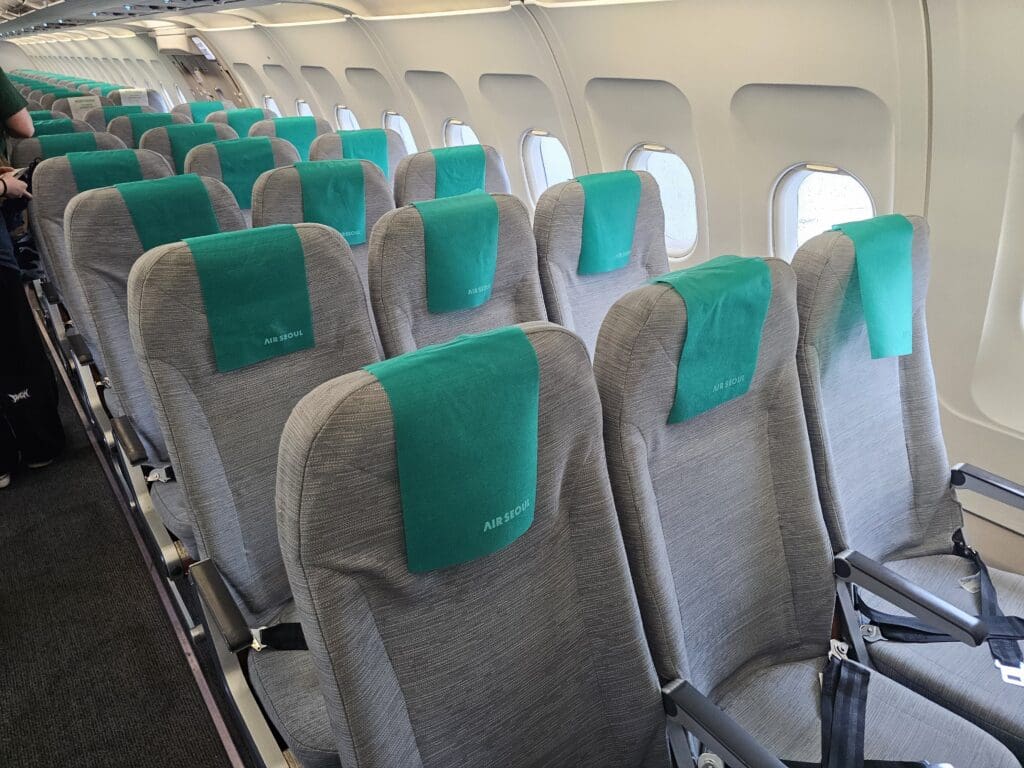
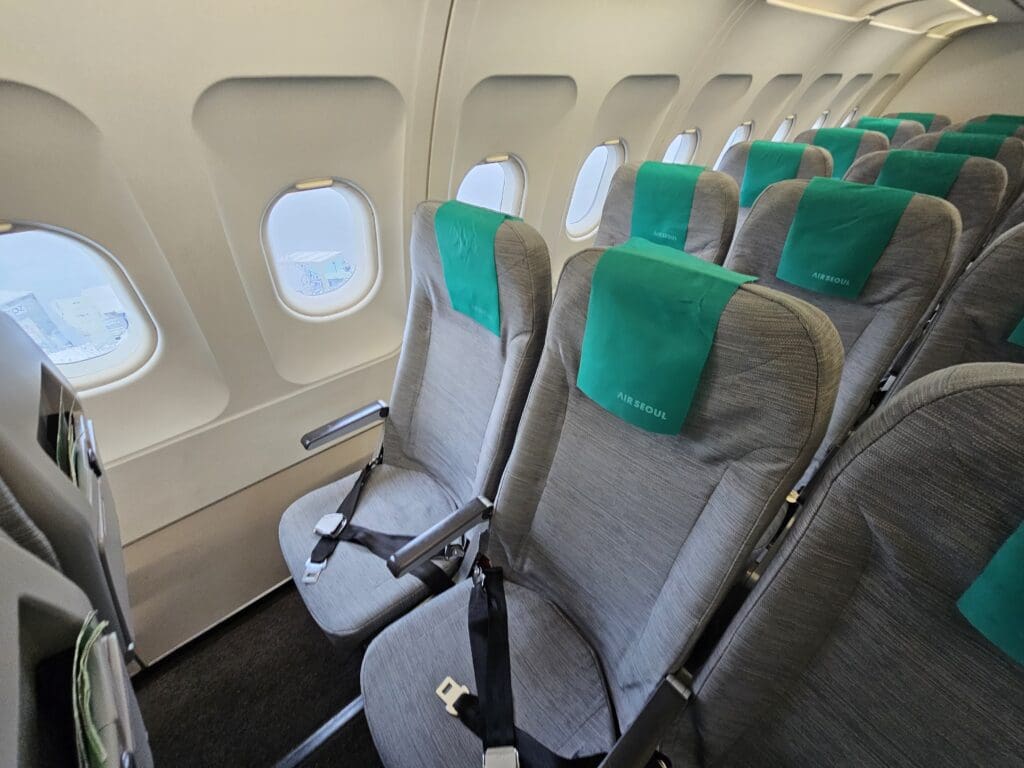
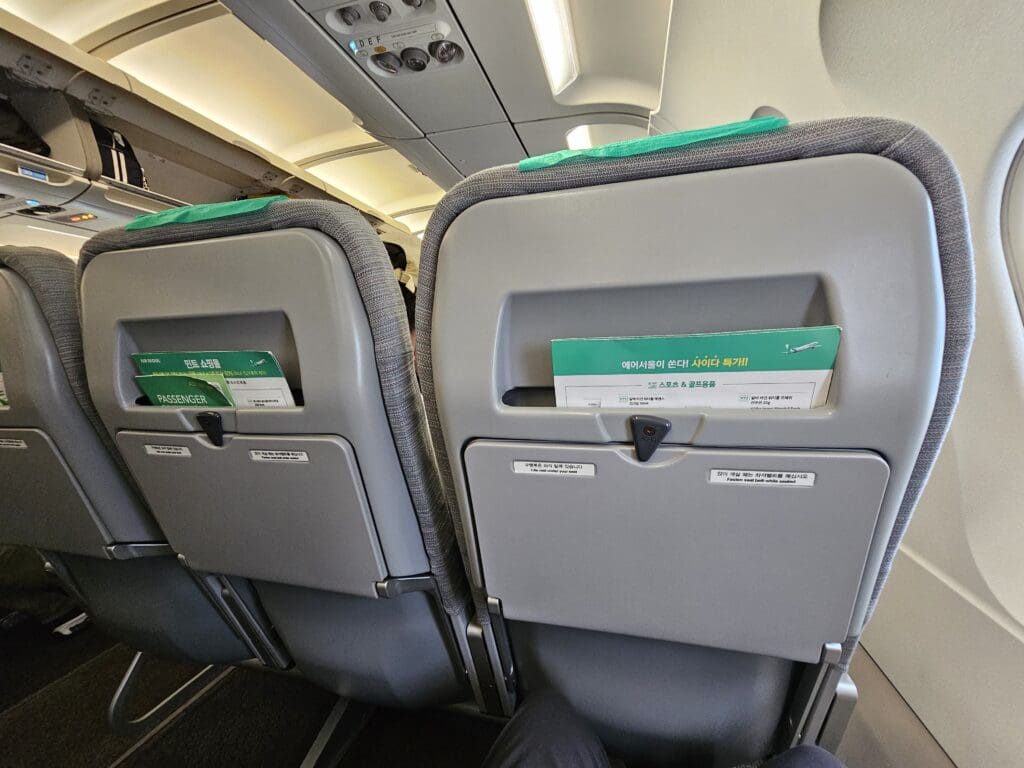
Given the variety of previous operators (or lack of these), Air Seoul’s aircraft feature a confusing myriad of configurations. Exactly half of the fleet features 195 comfortable ex-Asiana Airlines seats, whilst the other half features a more low cost configuration with 220 seats. Unsurprisingly, the aircraft that I would be flying on that morning featured 220 Acro seats, with each covered in a smart grey fabric that wasn’t too dissimilar to that of Finnair, if not a little darker and appropriately sporting a few smidgens of green. Meanwhile, each seat was topped with a mint green disposable antimacassar that featured Air Seoul’s logo, other than the paid reservable seats which featured a white headrest cover that sported text noting these to be Mintzone seats. Each seat came complete with a literature compartment, but were otherwise devoid of bells and whistles, with no in-seat power or the like, not that that would prove to be an issue given the length of the flight! As passengers boarded, classical music rang out, providing a sophisticated start to the journey and one that is a little more high class than your average LCC!
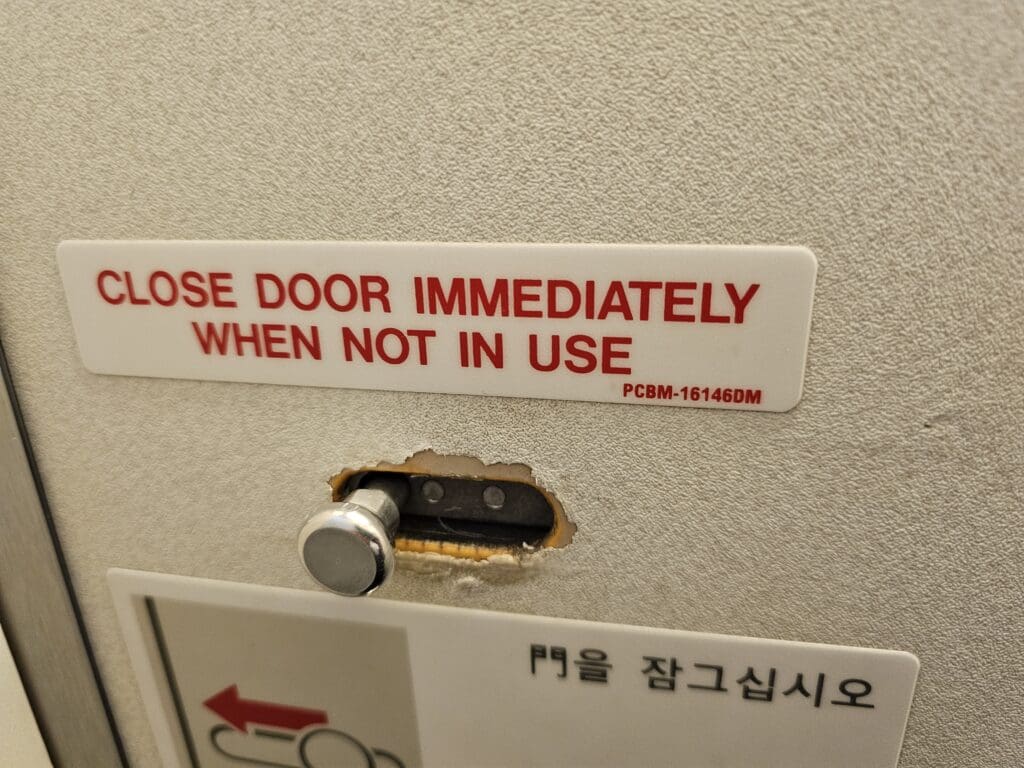
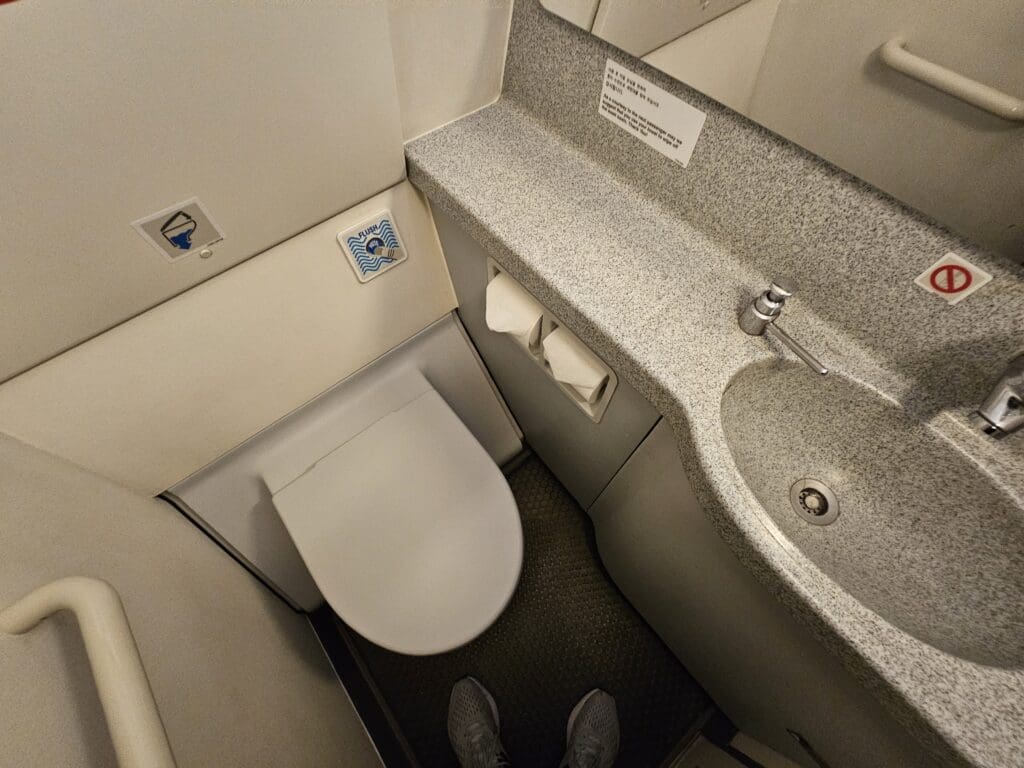
Making my way down the cabin, I received multiple welcomes in Korean from the other three flight attendants onboard as I journeyed to my seat. Realising that I may end up trapped in for the duration of the flight, once I had stowed my bag I decided to sample the delights of one of the two lavatories at the rear of the cabin. Opening this up, I found this to be clean and in good condition, stocked with the basics, thus leaving me with absolutely nothing to complain about.
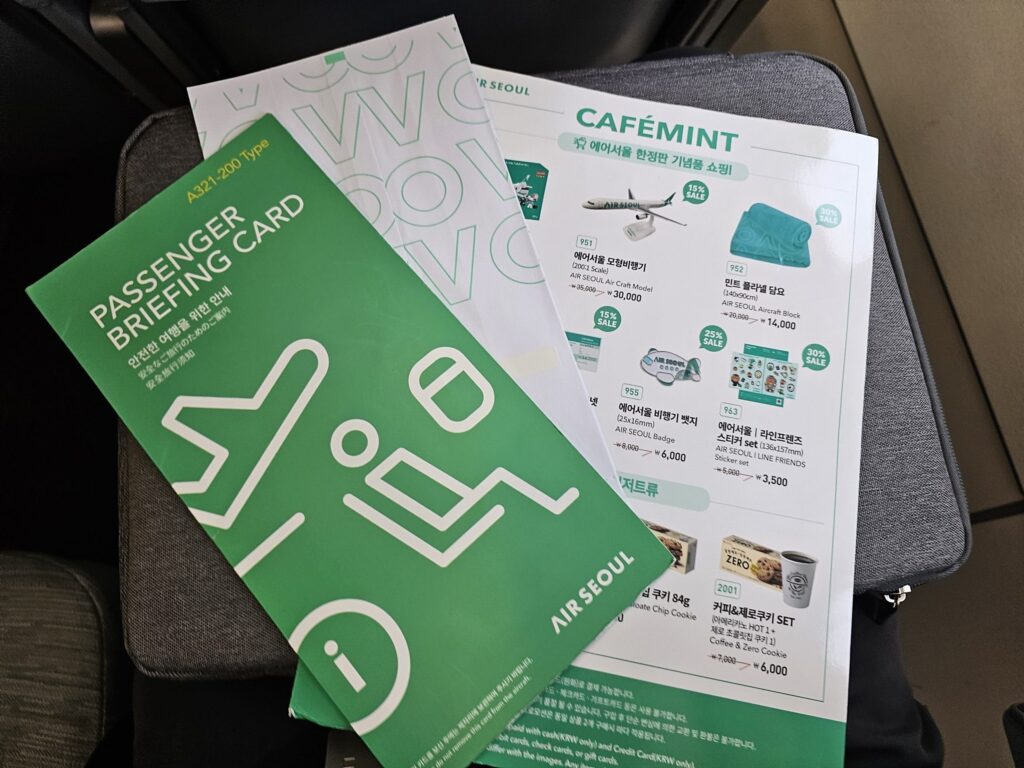
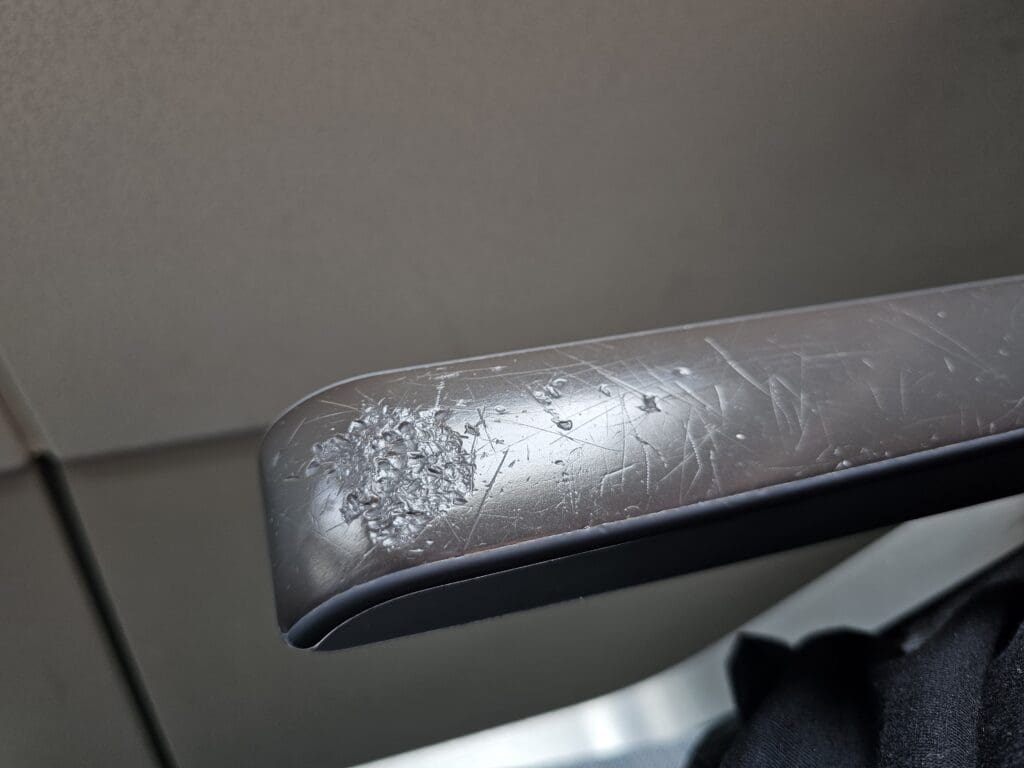
Once back in my seat, I settled in for the short journey ahead. Looking around, I was very pleased to find that barring some scratches on the armrest, my seat and the area around this was in tip-top condition, leaving me with no complaints. Furthermore, this was spotlessly clean, which, considering the very short turnaround, was great to see! When it came to comfort, I found the seat to be acceptable. Granted, this was a little firm, however, this featured a good amount of legroom for a low cost carrier and most certainly did not feel cramped. Turning to the literature compartment, this contained a safety card, or a ‘Passenger Briefing Card’ as the airline refers to it, Air Seoul’s onboard shopping catalogue, the buy-on-board Cafémint menu, and a nicely designed airsickness bag.
As I settled in for the short flight ahead, passengers continued to board although this flow soon transformed to a trickle with the final passenger making it onto the aircraft a minute or so after our scheduled departure time of 1050. As the last few passengers made their way down the aisle, the Captain’s voice filled the cabin as they performed a short welcome announcement in Korean and English. This consisted of the usual introduction, a word of thanks for flying with Air Seoul and a mention of our expected 55-minute flight time. Much to my delight, despite being a fairly busy flight, with around 80% of the seats taken, I lucked out and ended up with two vacant seats next to mine! As one would perhaps expect from a flight between Seoul and Jeju, the vast majority of my fellow passengers were Korean, with most appearing to be late middle-aged and elderly tourists heading southwards to escape the Seoul rain.
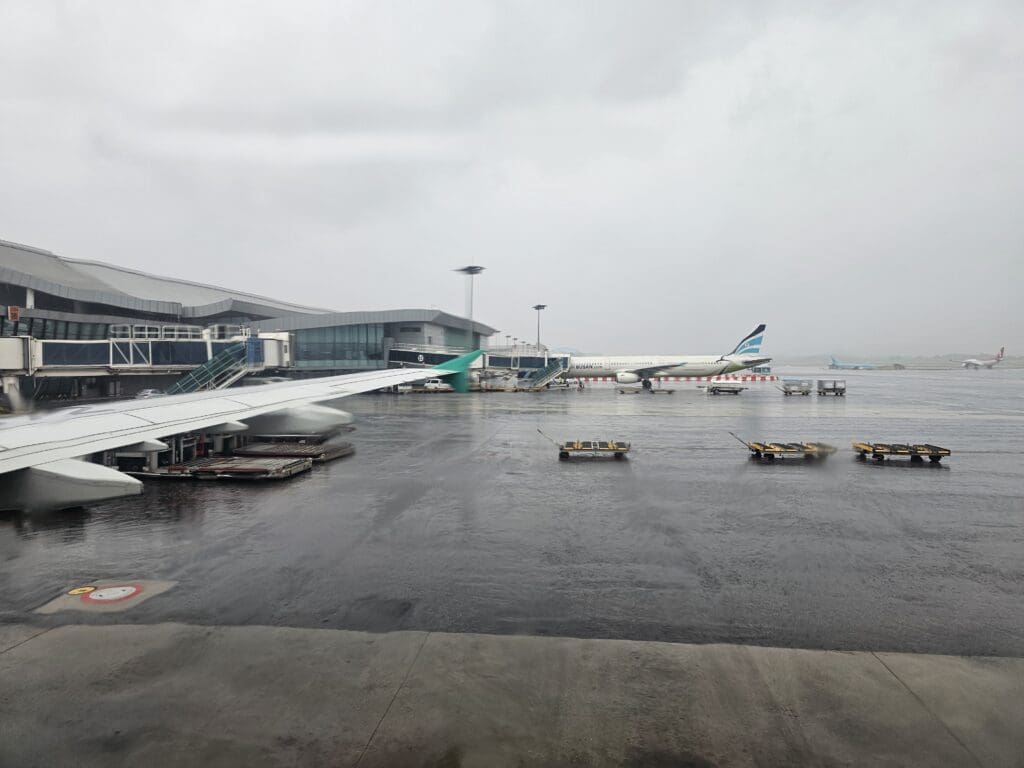
Once the final passengers were on board, the cabin door was closed although it seemed to take a little more time for the last bags to be loaded before any remaining ground equipment was backed away from the aircraft. Nine minutes behind our scheduled departure time, the Airbus was pushed back away from the gate at which point the Purser commenced their welcome announcement which was followed by the safety demonstration. This came in the form of the Purser going through the safety instructions in English and Korean, whilst several others stood at various points along the cabin undertaking the demonstration. By the time this had been completed, the two IAE V2530-A5 engines were spooling up in preparation for the 280-mile hop down to Jeju resulting in some hums and vibrations, but were otherwise fairly quiet. Meanwhile, as this was underway, the crew passed through the cabin ensuring everything was secure and in place for our departure. Following a short pause, the aircraft began its cautious taxi to the end of Runway 14L, leaving the domestic terminal behind and passing the international terminal where a selection of widebody visitors from ANA, China Eastern Airlines and Japan Airlines could be seen, along with a mystery business jet and the Hanwha Chemical Corporation’s luxury corporate transport, a Boeing Business Jet.
Once we had left the international terminal and its neighbouring apron behind, little could be seen other than the flat fields that surround much of Gimpo Airport, highlighting the airport’s location in the semi-rural area between the urban sprawls of Seoul and Incheon. Soon, the Airbus came to a halt at the end of the runway in order to allow for an Eastar Jet Boeing 737-800 to rocket off on its short hop to Jeju, throwing up plenty of spray in the process. Once this was up and away, the Air Seoul Airbus slowly taxied onto the runway and came to a halt. Upon making it there, some waiting was still in order as we held whilst an Eastar Jet Boeing 737-800 and an Asiana Airlines Airbus A330-300 touched down on the parallel runway. Once the latter was safely down, at 1118, the Airbus’ two engines spooled up and we began our short and powerful take-off roll. Thanks to the rain-streaked windows and poor visibility, sadly little could be seen as we powered down the runway and lifted off, reaching the cloudy skies in a matter of seconds after leaving the ground behind.
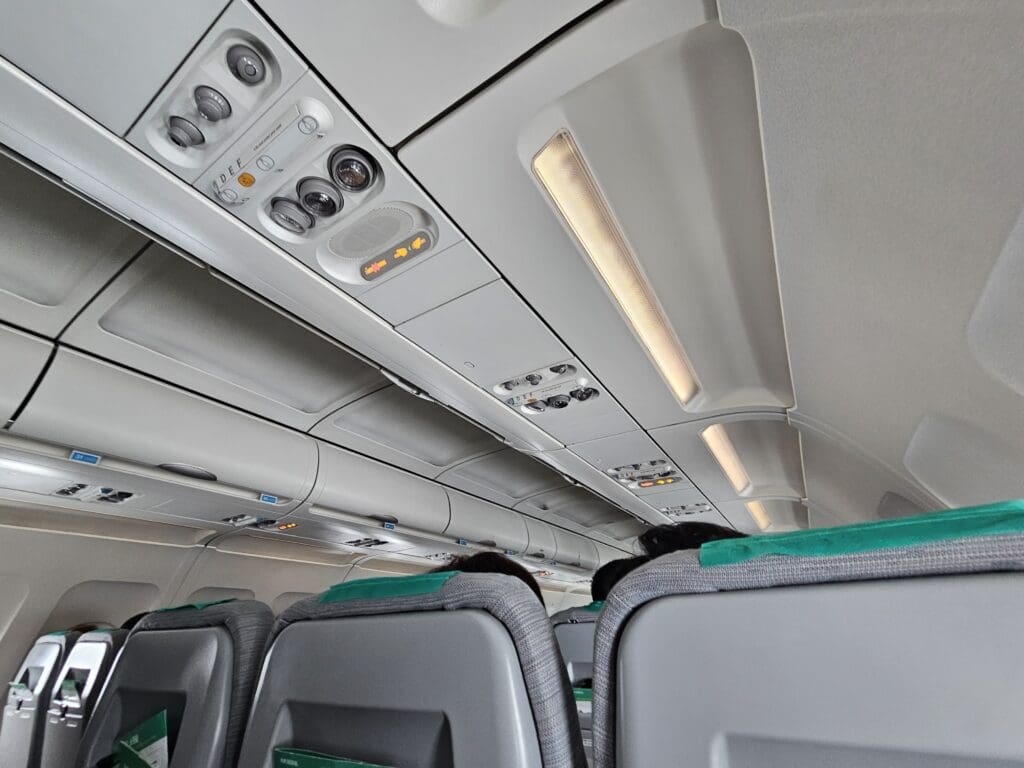
Once in the air, the Airbus bounced around and we experienced some fairly heavy turbulence as we left Seoul Gimpo Airport behind. Heading southwestwards, the Airbus climbed out over Seoul’s southern suburbs of Guro and Gasan, before passing into the skies of Gyeonggi Province and crossing over the cities of Gwangmyeong, Anyang, Gunpo and Suwon. That morning, it took quite some time to slice through the clouds and even once blue skies appeared, we continued to bounce around a fair bit. This meant that the seatbelt signs remained illuminated for seventeen minutes following our departure, by which time the aircraft was nearing its very low cruising altitude of 18,000 feet and passing just to the west of Korea’s fifth largest city, Daejeon.
As soon as the seatbelt signs were extinguished, the usual announcement was made in Korean and English which cautioned passengers against unfastening these and advertised the soon-to-commence buy-on-board service. As had been the case on my Jin Air service, no service cart was rolled out and once this announcement had been made, a crew member walked through the cabin displaying the Cafémint menu. Whilst I had no real intention of purchasing anything, I browsed through this and found it to be one of the most, if not the most, compact buy-on-board menu that I have ever come across! This offered nothing other than bottles of still water, Americano coffee and chocolate chip biscuits, with these items seeming to be priced in line with those of other Korean low cost carriers. However, I should mention that a much more expansive menu is offered for those on Air Seoul’s international services that includes the usual range of snacks, hot and cold, hard and soft drinks, as well as a selection of hot meals which can also be pre-ordered before departure.
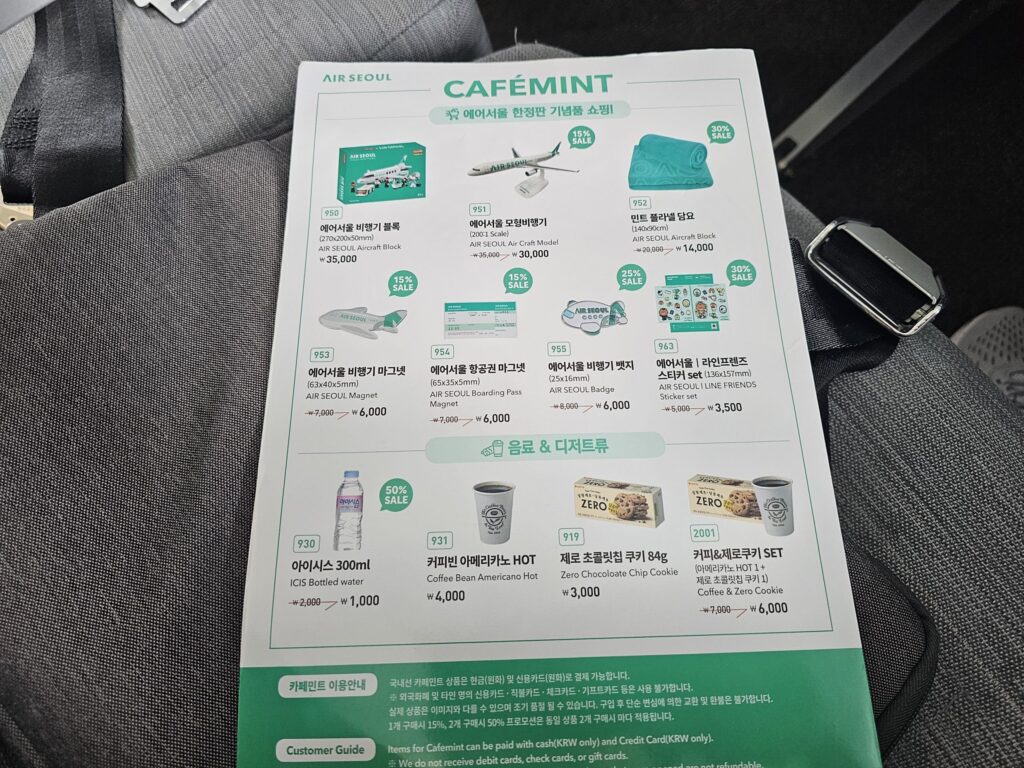
Perhaps unsurprisingly, there seemed to be no takers for the inflight service and once the crew had passed through the cabin, they made their way to the galleys and remained there for much of the flight. Returning to our route, heading down the western side of Korea, the Airbus passed from the skies of South Chungcheong to North Jeolla, in between the cities of Iksan and Gunsan. The latter is famous for its air base which hosts large squadrons of both Korean and American F-16 fighter jets. Heading southwards over Jeolla, we continued to bounce around a fair bit however this did not result in the seatbelt signs being reilluminated until we had commenced our descent. Nine minutes after passing Gunsan, the aircraft made its way past Korea’s sixth-largest city, Gwangju, which is well known for its brutally quashed pro-democracy demonstrations in 1980 and is around a two-hour KTX train ride south of Seoul. Moments later, whilst there was still a fair distance to go, the Airbus could be felt commencing its slow descent.
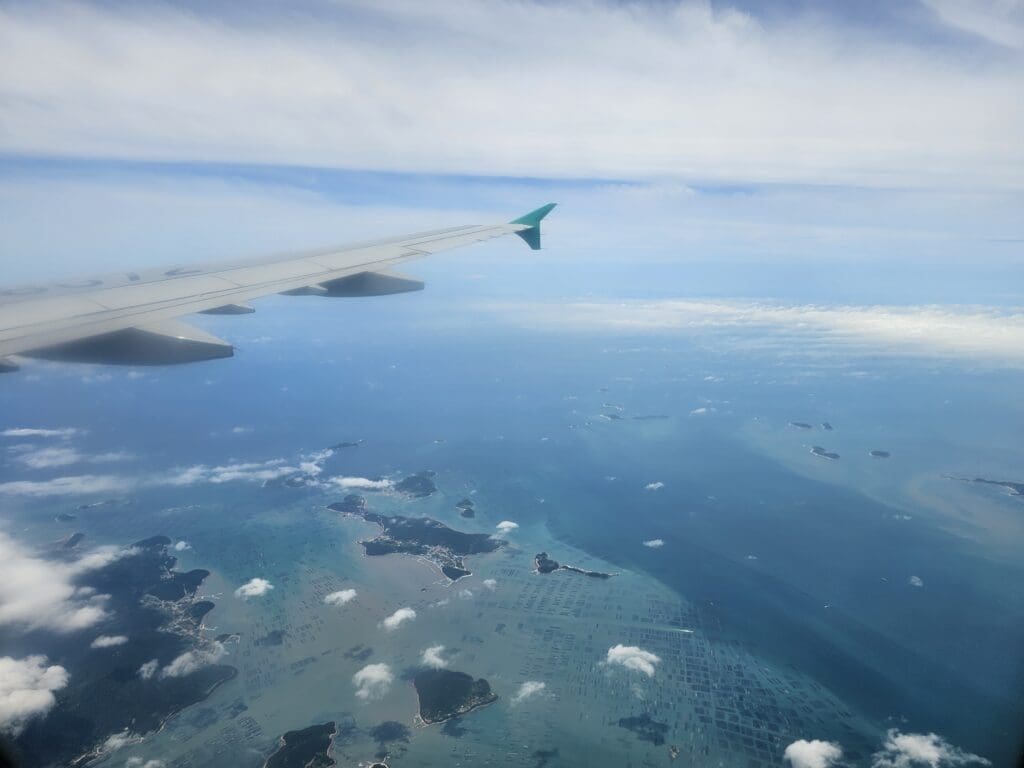
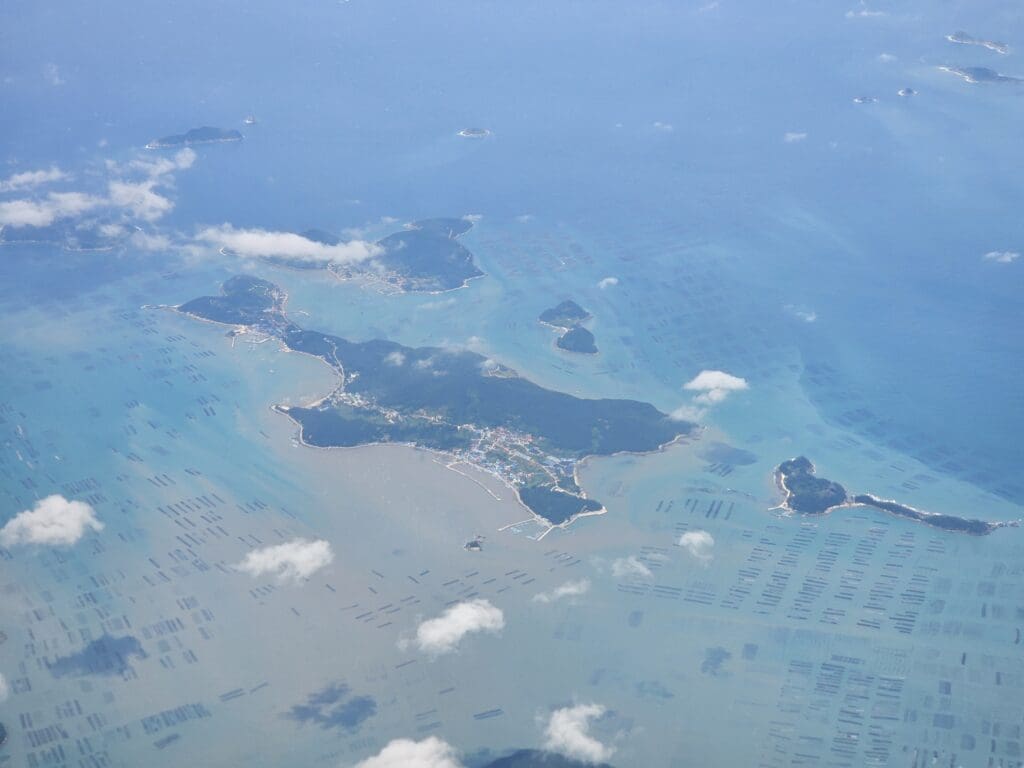
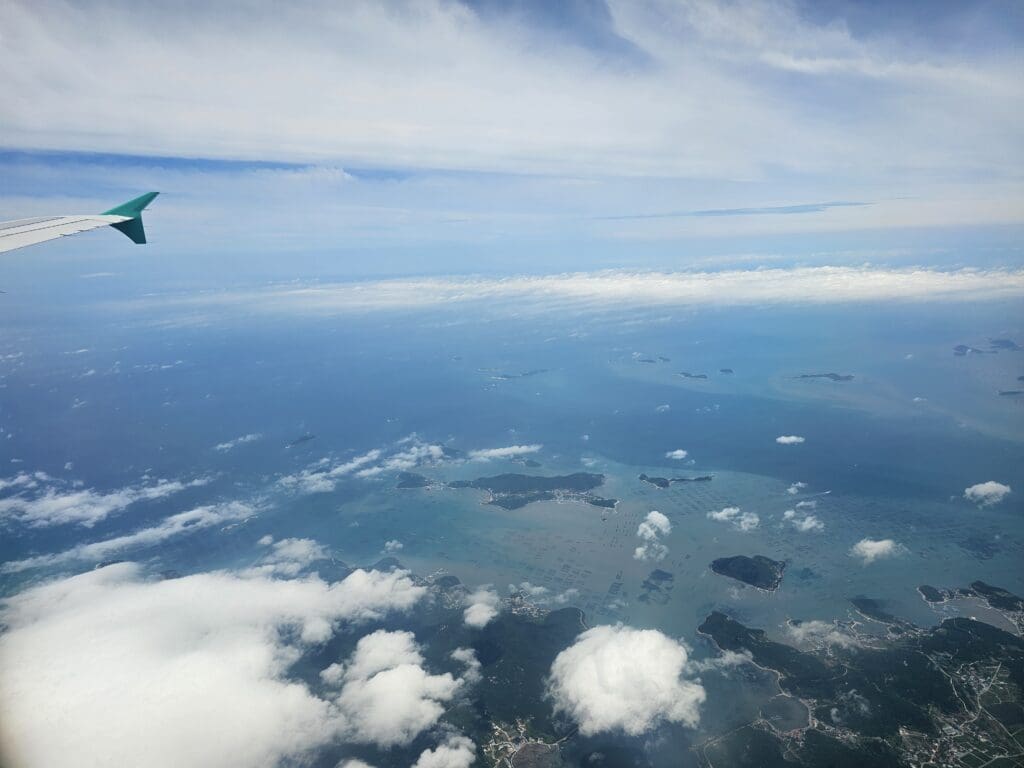
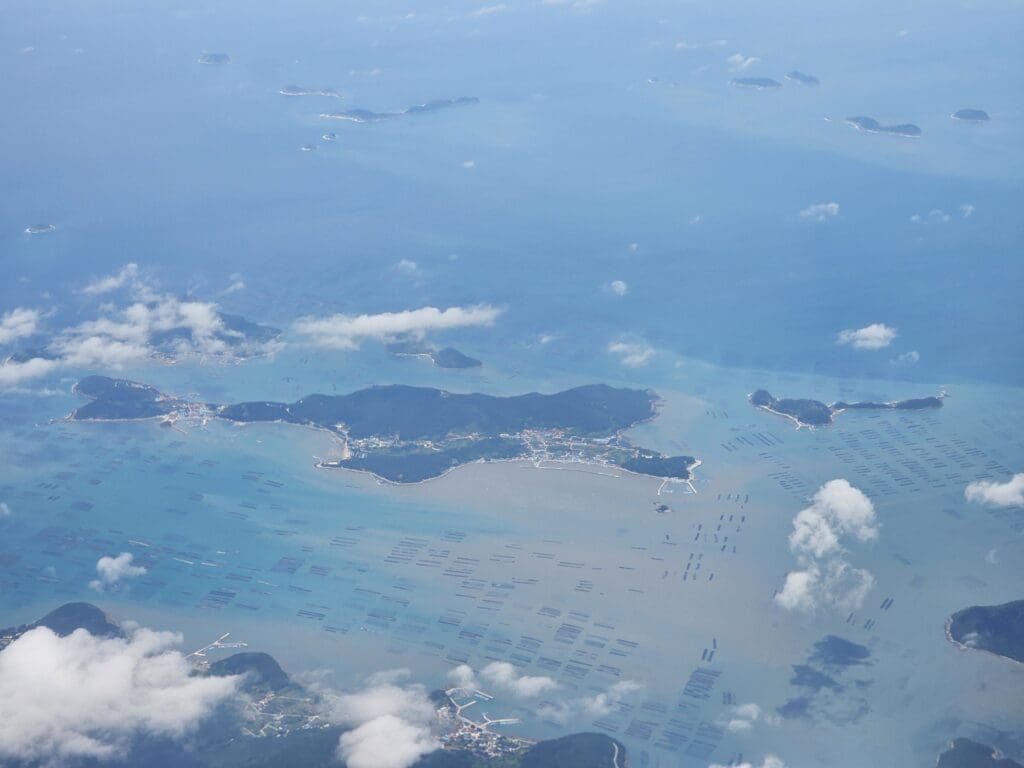
From Gwangju, the Airbus sped southwards towards South Jeolla’s coastline and as we neared this, a few gaps in the clouds revealed the region’s luscious green and mountainous countryside, soon followed by the coastline before several of the islands of Wando County appeared as we made our way out over the narrow stretch of sea that separates Jeju from the Korean mainland. As we headed out to sea, the clouds dissipated, allowing for a good view of the choppy blue waters. Continuing towards Jeju, despite there being a fair few lumps and bumps, the seatbelt signs were not re-illuminated until 1203 at which point the aircraft was descending through 10,000 feet. Wasting no time, as soon as these were turned back on, the cabin crew passed through the aircraft ensuring that all was secure and in place for our arrival before returning to the galleys and strapping themselves in.
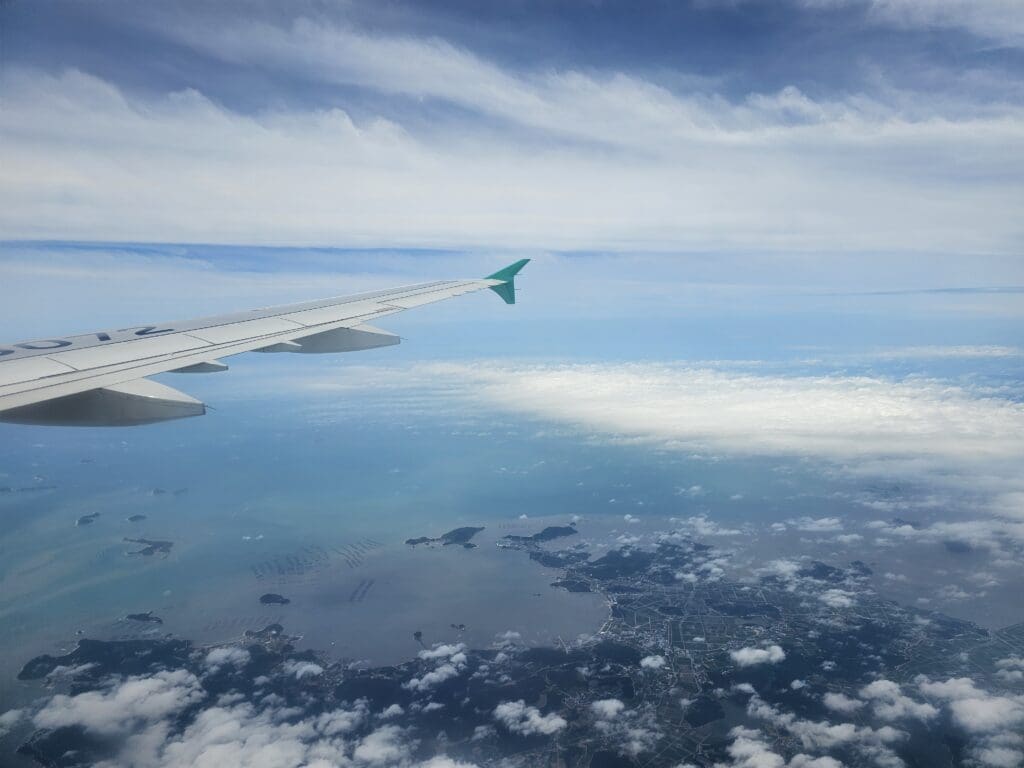
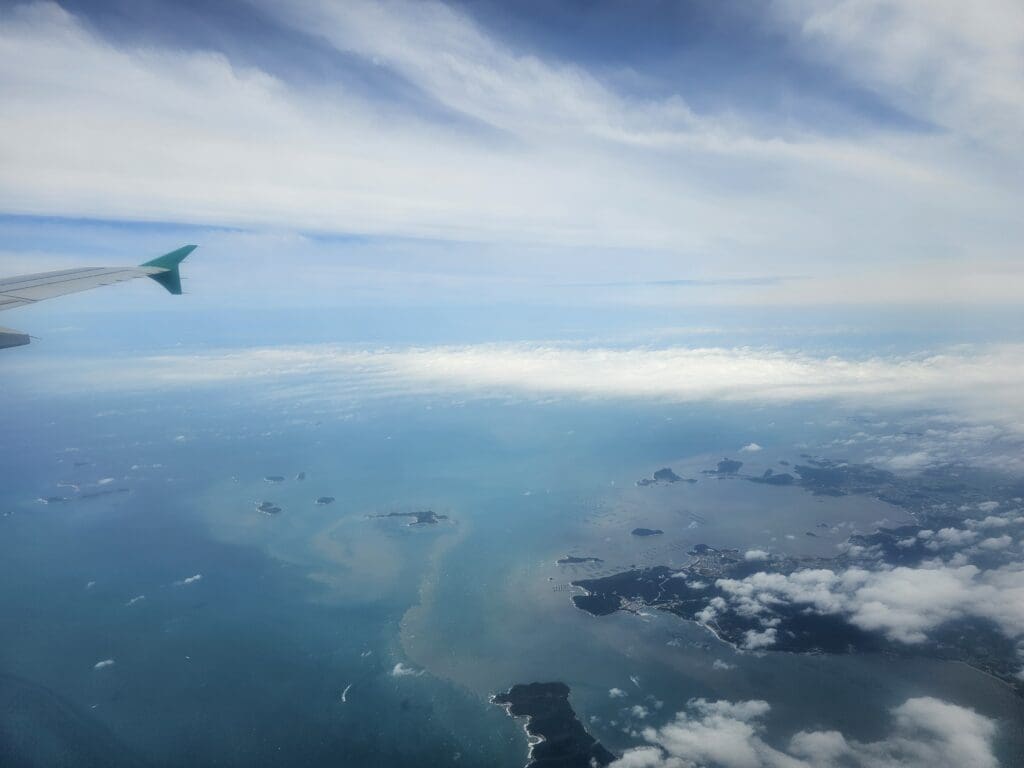
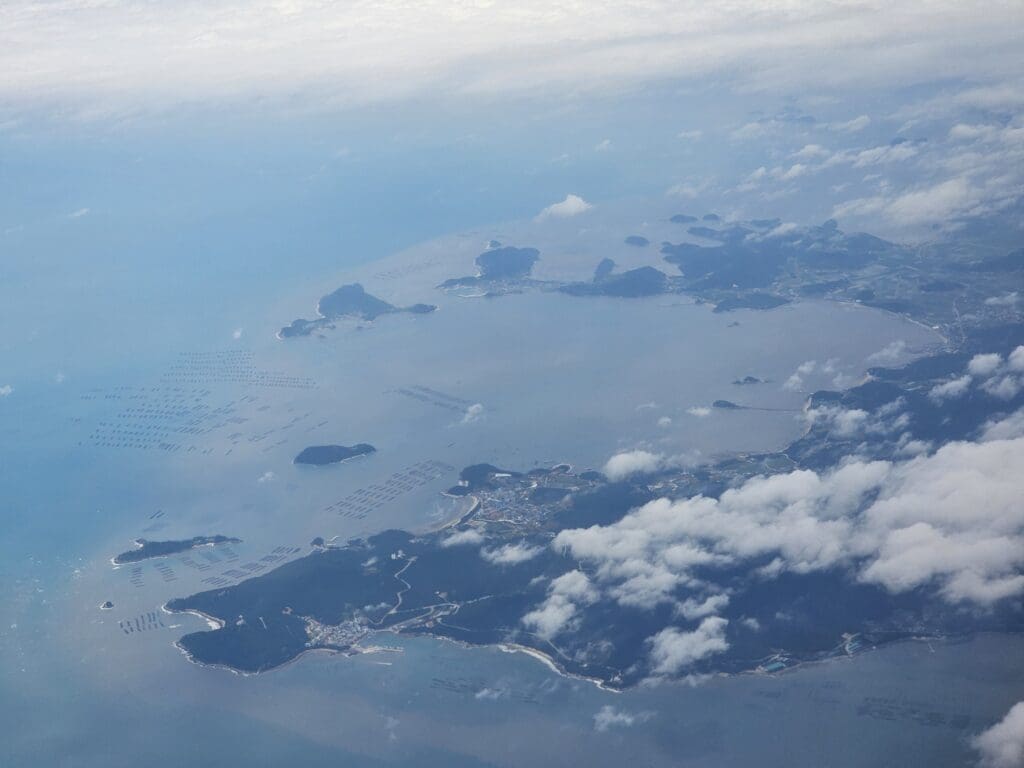
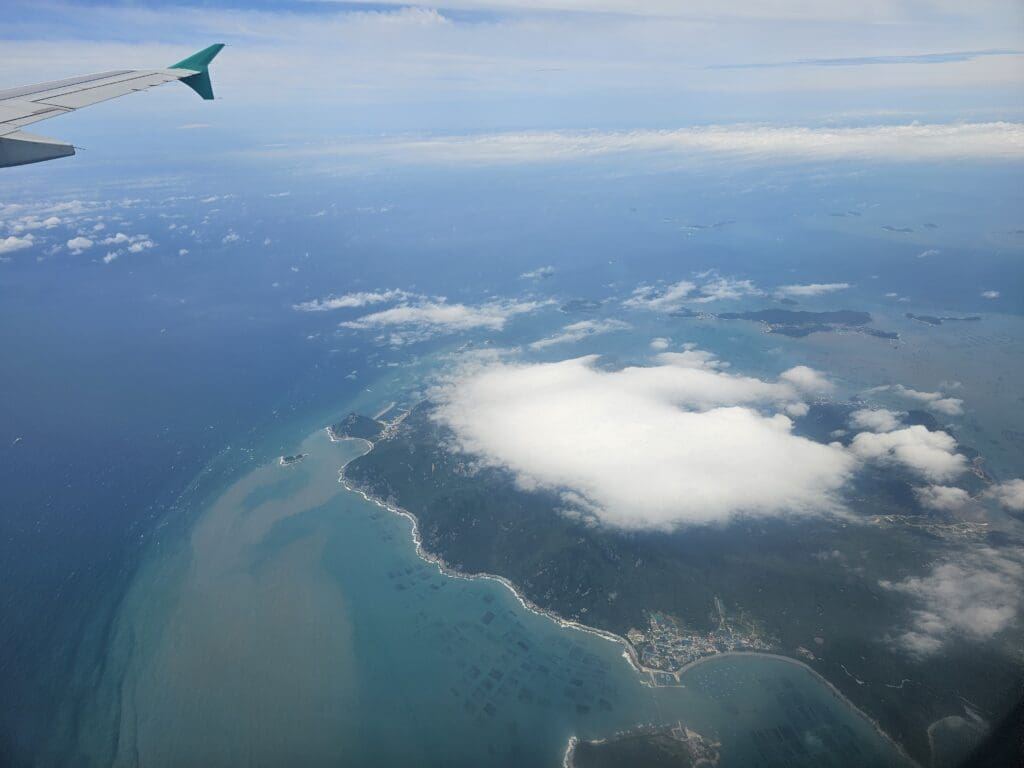
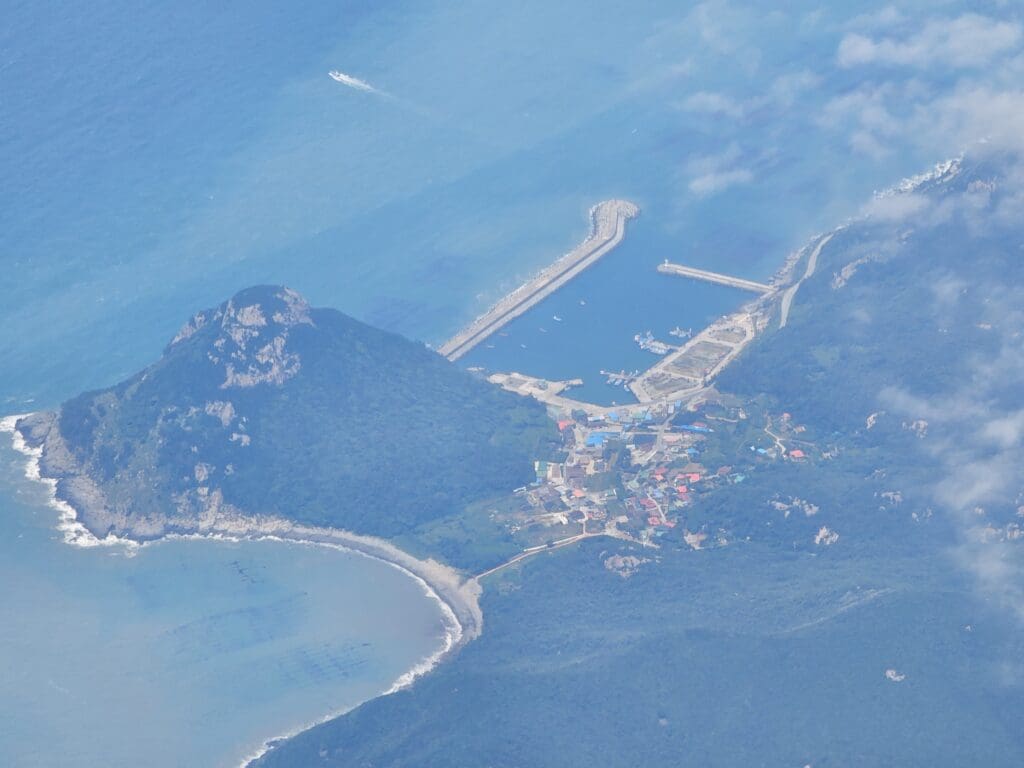
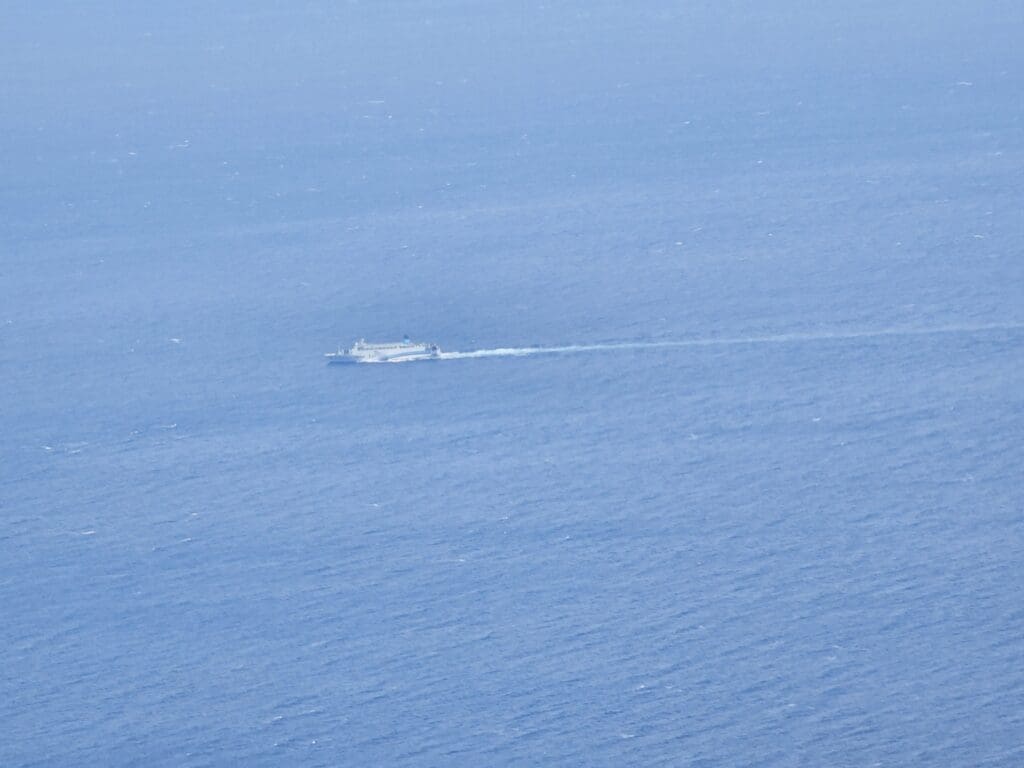
Once away from the mainland, the Airbus headed towards the seas that lie to the northeast of the island, with this serving as a clear indication that we would be landing into the west on Jeju Airport’s Runway 25. Whilst this approach typically offers a superb view of Jeju and its northern coastline, sitting on the right-hand side of the aircraft, I spotted absolutely nothing other than a few boats battling the seemingly rough seas until we were seconds away from landing.
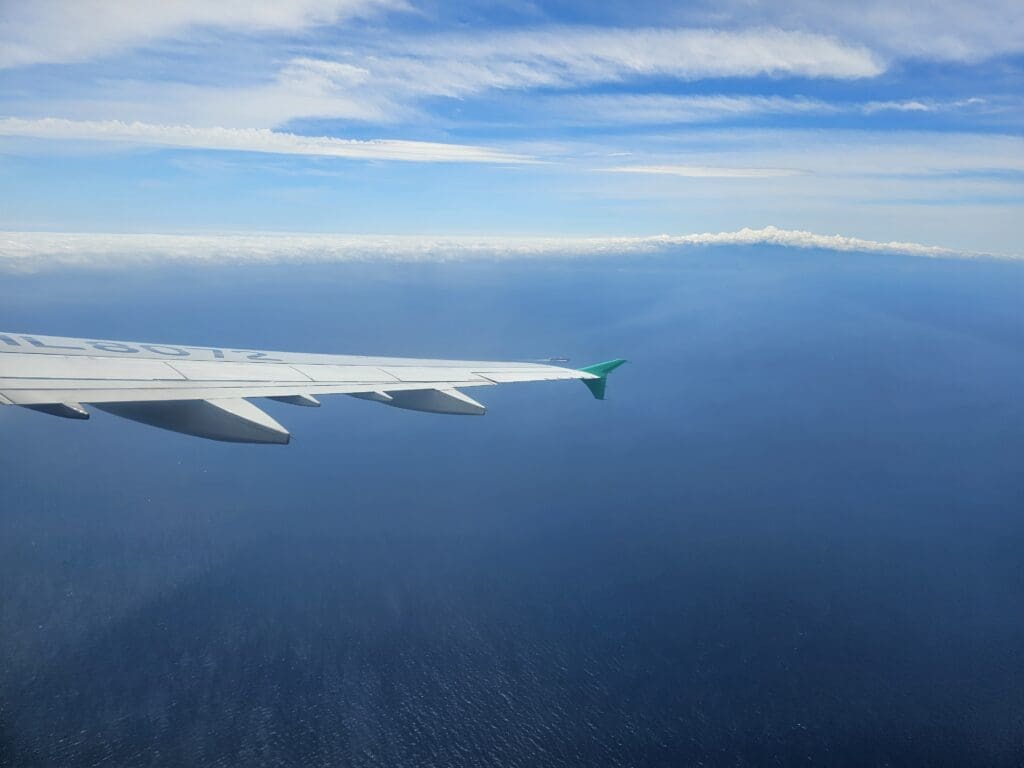
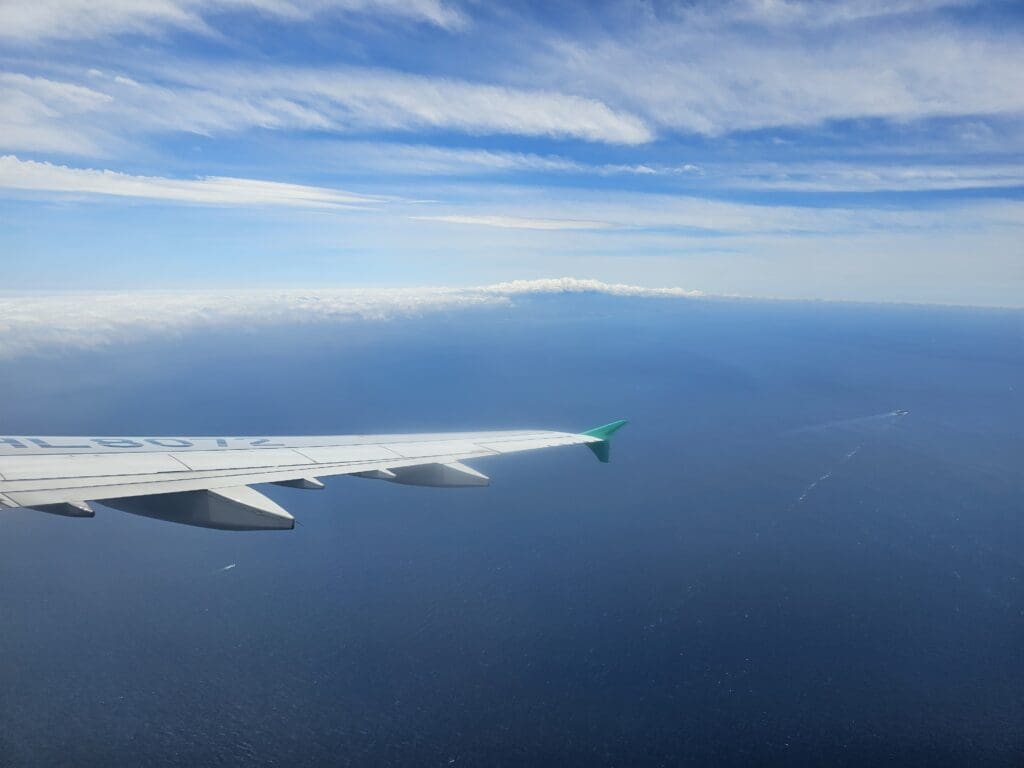
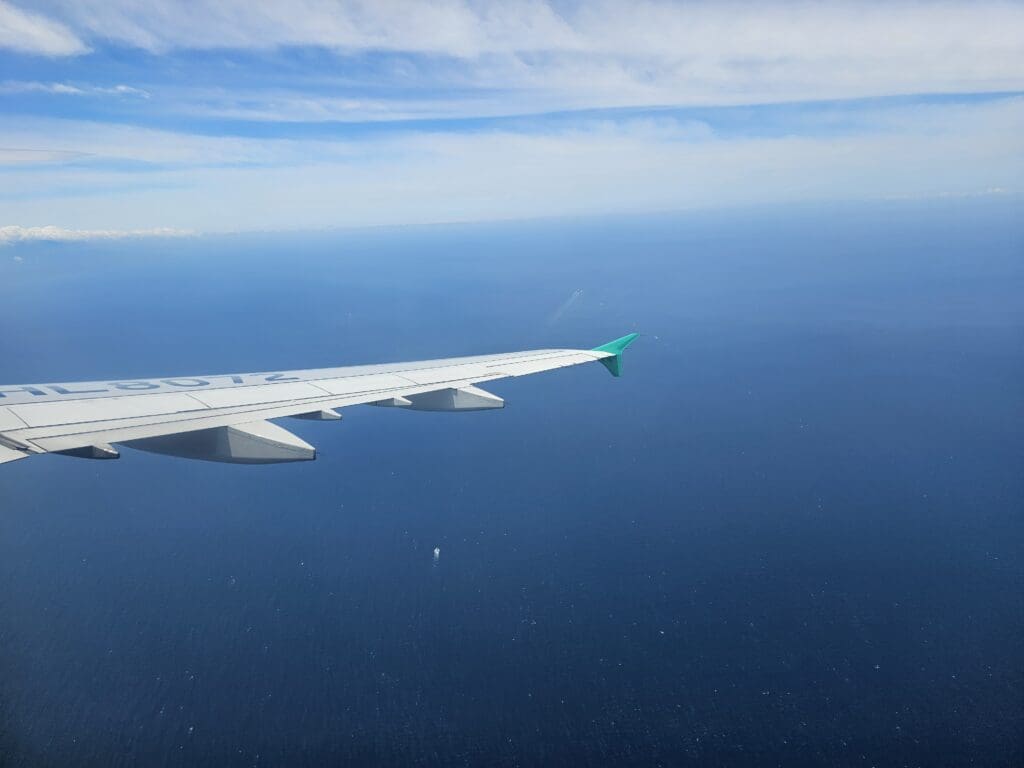
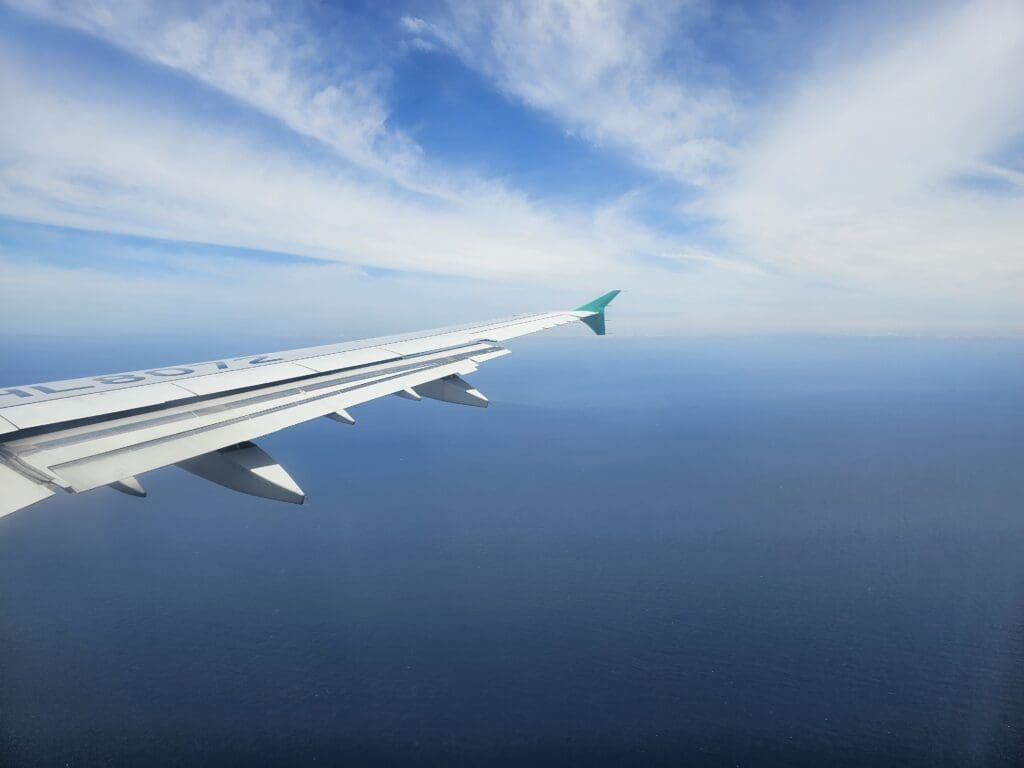
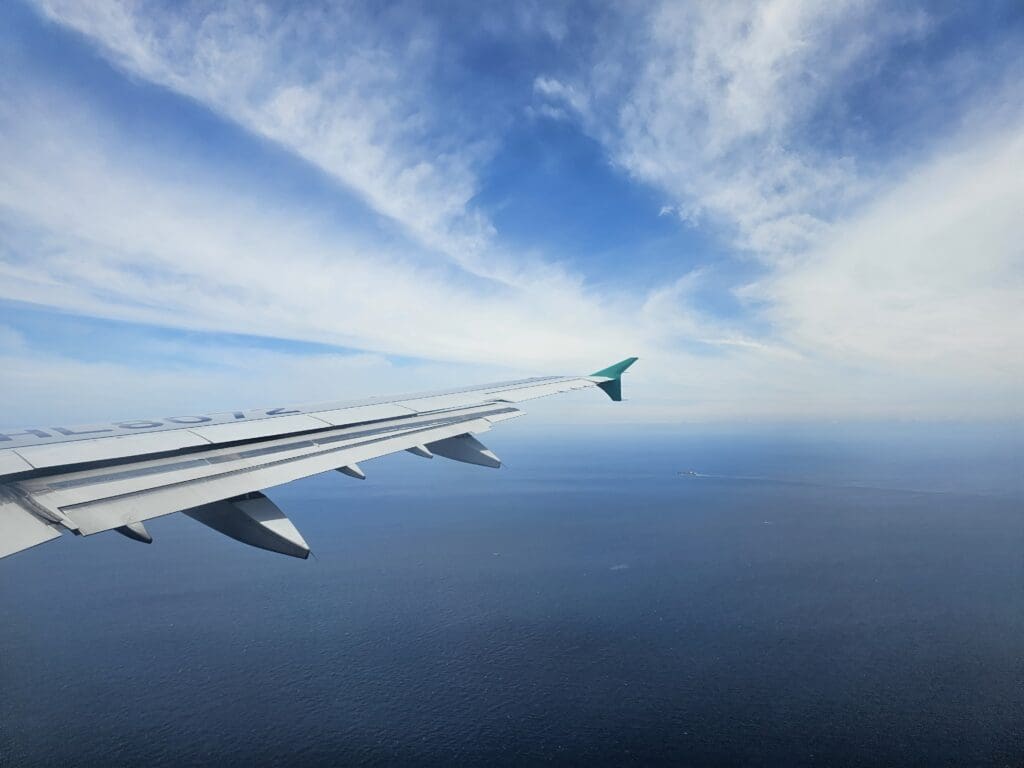
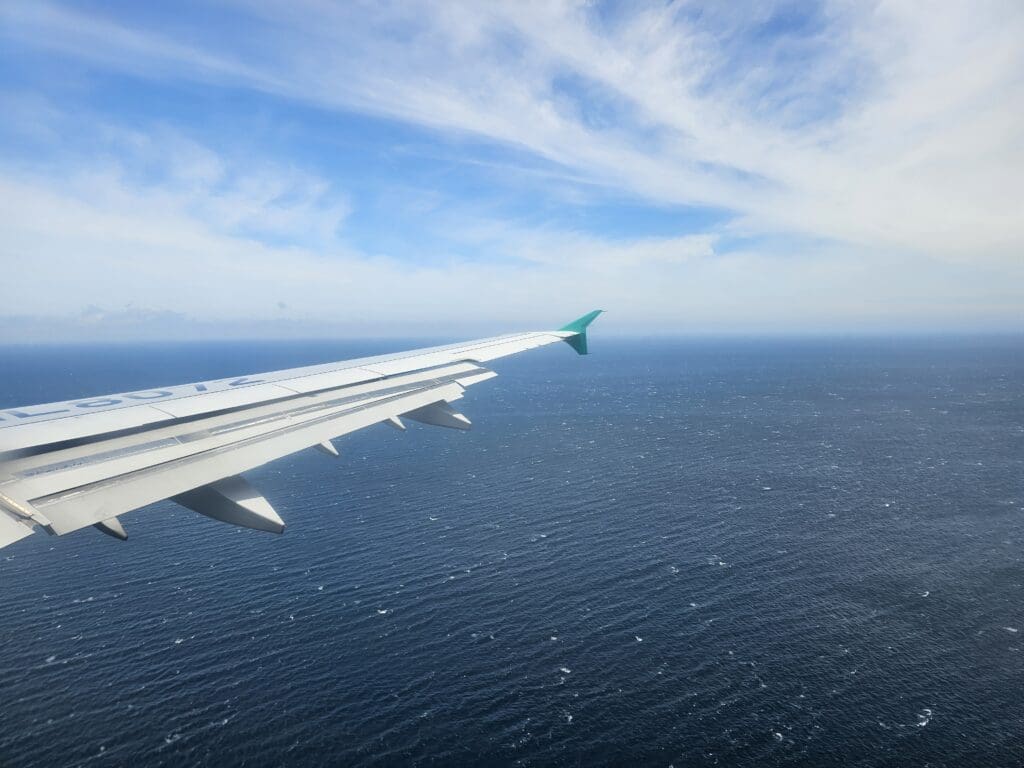
Once the Airbus had turned onto the runway heading for our approach and we sank lower and lower over the blue waters, the Airbus became one of those pirate ship rides as we swayed and dipped from side to side, causing plenty of audible gasps as we edged towards the airport. Despite being a regular flyer, this was some of the worst turbulence that I have ever experienced and was perhaps only eclipsed by my rough Beechcraft King Air ride from Stockholm to Sveg! Soon, the flaps and landing gear were lowered in preparation for our arrival and the turbulence continued unabated as we sank lower and lower. With this continuing during the final stages of our approach, I was somewhat convinced that we would have to undertake a go around however, I was soon proven wrong as at 1222, a grand total of an hour and four minutes after taking off, the Airbus was slammed down on the runway. This touchdown caused a very audible gasp to ring out throughout the cabin and was the roughest landing that I have experienced to date!
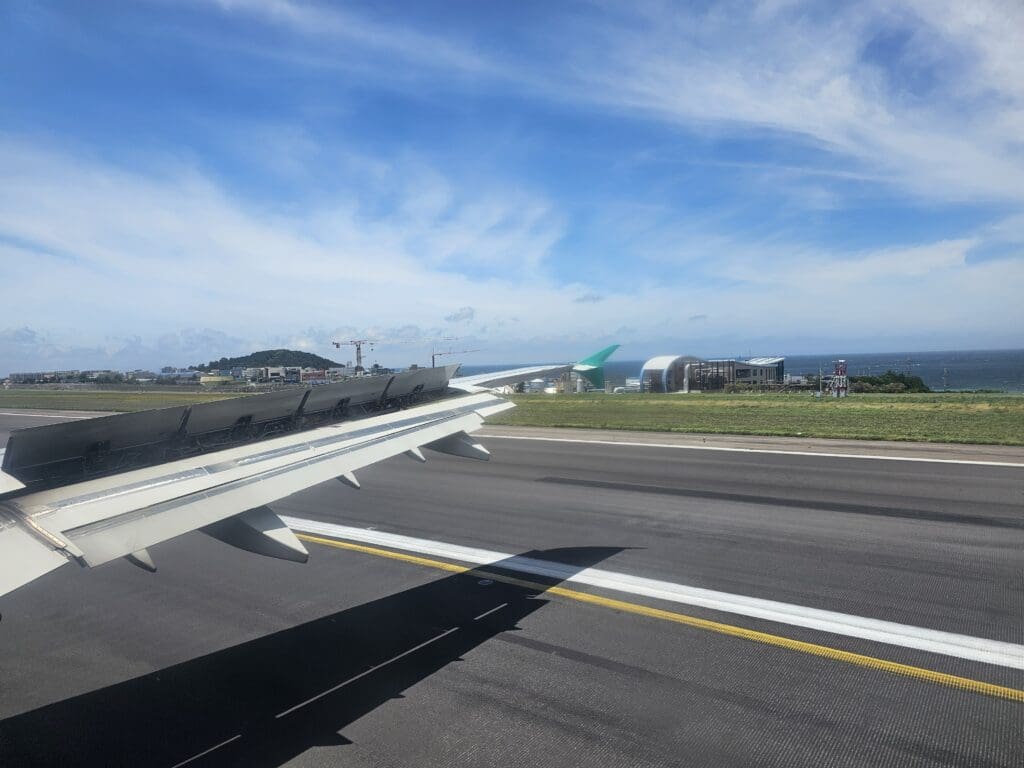
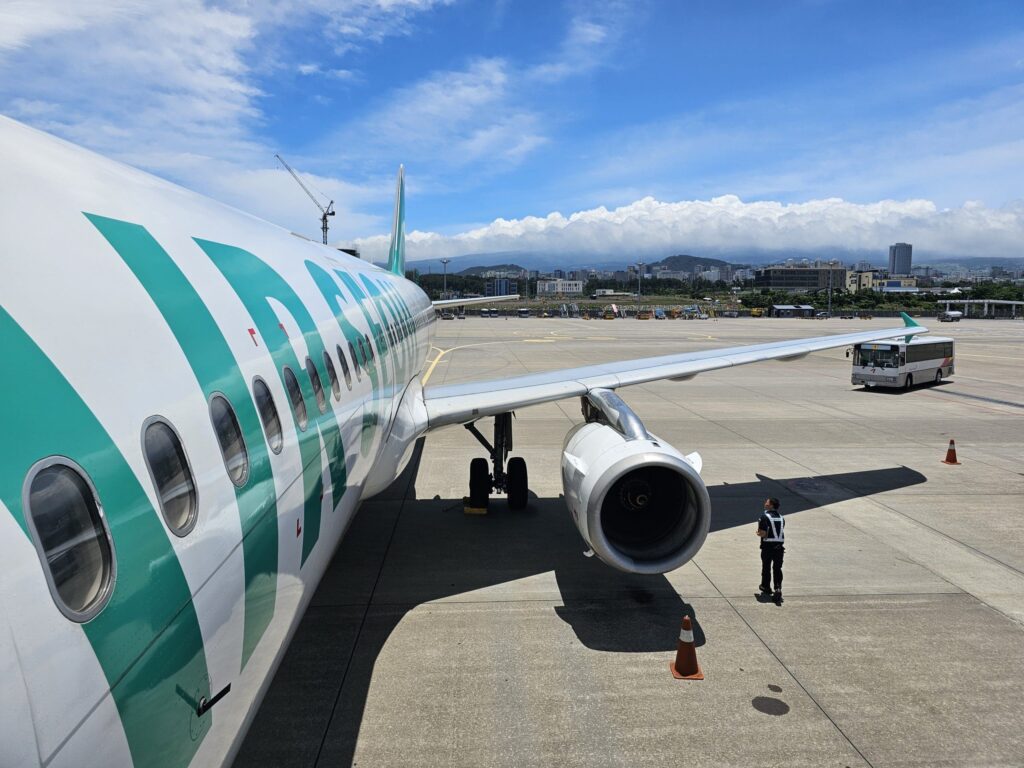
Decelerating rather rapidly, we soon vacated the runway to the left and commenced our journey over to one of the airport’s remote stands. In the usual manner, the Purser welcomed passengers to Jeju, thanked passengers for flying with Air Seoul and advised passengers to keep their seatbelts fastened, before the Captain’s voice filled the speakers during which they made a surprising apology for the hard landing, explaining this to be down to a change in wind speed during the final stages of our approach. A few minutes after touching down, the Airbus pulled into Stand 62, arriving there at 1228 and thus 28 minutes behind schedule. With a pair of Asiana Airport buses already waiting along with an army of ground crew, once the engines spooled down, it took hardly any time for the airstairs to be connected at which point disembarkation commenced. After a few minutes, I stood up and made my way through the cabin, thanking each flight attendant that I passed and receiving a friendly farewell in return before I stepped off the aircraft. Upon doing so, the wind hit me like a hot air dryer as I attempted to hold on to everything to ensure that this would not fly away.
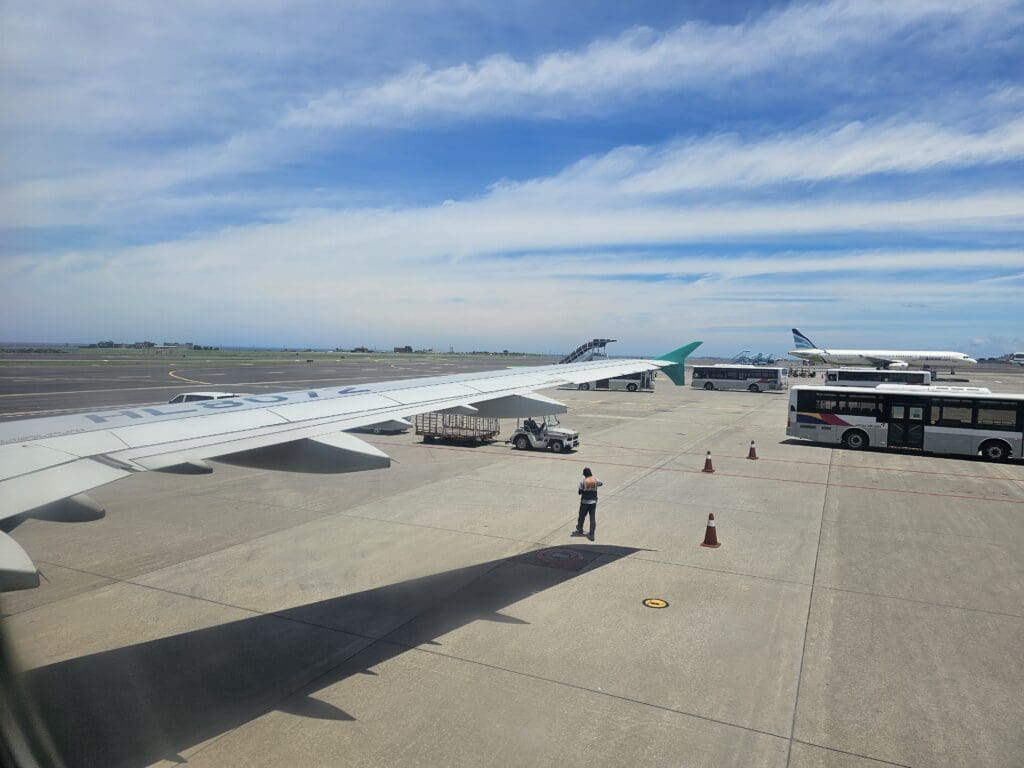
Once off the aircraft and on the waiting bus, I opened up FlightRadar24 which revealed that thanks to the wind, most jets were failing to land at Jeju and were instead heading back to the mainland, with the small number of aircraft arriving doing so on their second or third attempts! Being one of the last passengers to board the first bus, once safely onboard and out of the wind, we soon trundled off the short distance to the terminal building. Once there, with nothing to collect, I steamed through the baggage collection hall and made it to the landside area, bringing a close to my first-ever ride with Air Seoul.
Summary
That day, Air Seoul provided me with a comfortable and pleasant flight down to Jeju, with the aircraft being in good condition, and the crew were all polite and friendly. Thus, overall I was left with very little to complain about. Instead, the only gripe about my experience was my inability to book a ticket via Air Seoul’s website. With all things considered, I would be happy to consider flying with Air Seoul again and would have no issue with flying onone of their longer international services!