Sampling One of the World’s Shortest A380 Services: Seoul Incheon to Tokyo Narita with Asiana
Background
Living in the UK, it isn’t too hard to come across an Airbus A380. As of the Summer 2024 schedules, these can be seen at Birmingham, Glasgow, London Heathrow, London Gatwick and Manchester, with Etihad Airways, Qantas, Qatar Airways and Singapore Airlines operating their whales on aircraft to the UK. Not to mention British Airways’ twelve Heathrow-based Airbus A380s which are deployed on routes to Singapore, South Africa, and the USA. However, flying onboard the Airbus A380 usually necessitates at least a seven-hour slog over to the Gulf or the Eastern United States, as in Europe, such aircraft are virtually never utilised on short haul routes. The exceptions to this are Air France’s Airbus A380 familiarisation sectors between Paris CDG and London Heathrow in 2010, and more recently British Airways’ services to Frankfurt and Madrid following the return to service of the airline’s Airbus A380s.
In Asia, it is slightly less uncommon for the Airbus A380 to be seen operating on high-demand short haul routes. This is particularly true in the Middle East, where Emirates have previously sent their Airbus A380s from their Dubai mega-hub to the likes of Bahrain, Jeddah, Kuwait City, Riyadh and Muscat. Likewise, in East Asia, several carriers have operated their Airbus A380s on short routes between large cities. Unfortunately, Covid drastically changed the landscape of Airbus A380 operations, with China Southern Airlines, Malaysia Airlines and Thai Airways all prematurely returning the type, and others such as Asiana Airlines and Korean Air placing an end date on the aircraft’s operation. Fortunately, as of Summer 2024 schedules, Asiana Airlines continues to deploy their Airbus A380 on the short haul hop between Seoul Incheon and Tokyo Narita, and, finding myself in Korea for three weeks in July 2024, I could hardly pass on the opportunities to sample the delights of the whale on its shortest scheduled flight in the world at that time.
Korea and the Airbus A380
Alongside the United Arab Emirates, Korea is the only country in the world where two local rival carriers have both operated the Airbus A380. Taking a keen interest in the revolutionary project to develop the world’s largest airline, in 2005, Korean Air ordered five Airbus A380s, topping this up with a further five in 2008. Several years later as Korean Air readied itself for the arrival of their first Airbus A380, main rival Asiana Airlines placed an order for six such aircraft.
In May 2011, Korean Air’s first Airbus A380 touched down at Seoul Incheon to much celebration, whilst Asiana Airlines’ first whale arrived three years later in May 2014. By late 2016, all sixteen Korea-registered examples were in operation. In terms of deployment, both carriers seemed to adopt a similar strategy, logically deploying these on high-demand routes to a mixture of short, medium and long haul destinations, even being seen side-by-side at some airports abroad! Throughout the Airbus A380’s service in Korea, the type has been sent to destinations far and wide, including Atlanta, Bangkok, Frankfurt, Hong Kong, Honolulu, London Heathrow, Los Angeles, Osaka Kansai, Paris CDG, San Francisco, Sydney, Taipei and Tokyo Narita. In fact, I had previously had the pleasure of sampling the spacious comfort of one of Korean Air’s Airbus A380s from Seoul Incheon to Paris CDG back in November 2016 (you can read about this here!).
However, all was not plain sailing and the pandemic led both Asiana Airlines and Korean Air to reconsider their Airbus A380 operations. In the end, all sixteen examples ended up undergoing extended periods of storage at Seoul Incheon Airport. Eventually, with the gradual removal of quarantine restrictions in Korea and the uptick in international travel to and from the country, in Summer 2022, Asiana Airlines’ returned their Airbus A380 fleet to the skies, with Korean Air following suit several months later.
Sadly, by this time, it had already been decided that the return to service of Korean Air’s Airbus A380s was to be temporary, with the type having been earmarked for retirement by 2026. Unable to find another operator willing to take these off their hands, the scrapping of Korean Air’s Airbus A380s commenced in early 2024 at Incheon Airport. Meanwhile, adding a further layer of complication to Korea’s Airbus A380 operations is the merger of Asiana Airlines and Korean Air. With both airlines’ aircraft having wholly different engine types and configurations, keeping these would add an additional layer of compilation to the already fleet merger process. Thus, the fate of Asiana Airlines’ Airbus A380s is equally grim, with these also scheduled to be withdrawn from service in the next few years. Thus, I found there to be all the more reason to sample a short ride onboard an Asiana Airlines Airbus A380!
Booking
Wanting to book my outbound flight with Asiana Airlines and my inbound flight with Air Premia in one fell swoop, I decided against booking directly with Asiana Airlines and instead used Trip. However, having booked tickets with Asiana Airlines’ website plenty of times before, I can say that this usually provides me with a quick, easy and painless way to book tickets for the airline’s services. However, as with all Korean carriers bar Korean Air, this does not allow passengers to pay via American Express.
Once I had purchased my ticket and received my booking reference, I was able to manage my booking via Asiana Airlines’ website without issue. However, I did find that adding my Asiana Club number to my booking was an overly long and complicated process. Once I had finally managed to do this, I was able to pre-select my seat onboard the aircraft. As seems to be the norm in Northeast Asia, I was able to pre-reserve a seat across much of the main Economy cabin without paying an additional fee. Meanwhile, seats in the smaller Economy cabin at the rear of the upper deck could be selected for $19.00 (£14.68). Unfortunately, having booked at the last minute, no vacant window seats could be seen on the main deck, whilst the upper deck seats remained mostly vacant. Whilst tempted to splurge out on an upper deck window seat, I decided to hang around and try my luck at online check-in, hoping that more window seats would become available.
Online check-in for Asiana Airlines’ services opens up 48 hours before departure and upon reaching this window, I wasted no time in opening up the airline’s app and commencing check-in proceedings. Having already entered all my passport data, this was a quick and easy process, and I was soon taken to the seat selection page. Much to my delight, at this time, a fair number of vacant window seats could be spotted on the main deck. However, I was also given the option to select a seat on the upper deck at no additional cost, and I thus decided to settle for a window seat in this smaller and slightly more spacious cabin. Soon, I received my boarding pass and was all set to jet off to Japan.
The Journey
Whilst arguably an unfair comparison, Incheon Airport is to Seoul, what Narita is to Tokyo, or Hahn is to Frankfurt. In other words, the airport sits quite some distance away from the city it serves. Specifically, the airport is located around fifty kilometres west of downtown Seoul, and even further away from the likes of Dongdaemun and Gangnam. As its name would suggest, Seoul Incheon Airport sits within the boundaries of Korea’s third largest city, Incheon, and was constructed on reclaimed land between the islands of Yeongjong and Yongyu off the country’s western coastline. Thankfully, despite the distance and the airport’s seemingly remote location, there are a good number of ways to travel between Seoul and Seoul Incheon Airport. When travelling between the two, I usually end up taking the all-stop Airport Express train, more commonly known as the AREX. This is essentially a subway-like service, with subway-like comforts that runs between Seoul Station and Incheon Airport Terminal 2, making a total of thirteen stops and taking 68 minutes to undertake this 63.8-kilometre journey. With this paid for by a standard T-Money card, this sets passengers back a very reasonable 5,050 won (£2.84) and is the cheapest means of reaching the airport. Meanwhile, a faster Airport Express train runs between Seoul Station and Terminal 2, making just a single stop at Terminal 1 and costs 11,000 won (£6.13) for the 52-minute trip. This is more comfortable than the all-stop service as it is more akin to a ‘real’ train with pre-assigned airline style seats, along with complimentary water, wifi, plug sockets and toilets onboard. Furthermore, those utilising this train service and departing on Air Busan, Air Seoul, Asiana Airlines, Eastar Jet, Jeju Air, Jin Air, Korean Air, Lufthansa or T’way Air can check in at Seoul Station’s City Airport Terminal. Finally, there are an array of Airport Limousine buses running on various routes from locations throughout Seoul to the airport, typically costing up to 20,000 won.
Staying in the neighbourhood of Gongdeok on the western side of Central Seoul, reaching Incheon Airport in time for my 0900 flight to Tokyo would not prove to be an arduous or expensive task. Seeing as I was travelling with just a backpack, my first thought was to catch that day’s first Incheon Airport bound all-stop AREX train. Getting me to Terminal 1 with around two and a half hours to go until departure, this would provide me with a comfortable amount of time to head through immigration and security and explore the delights of the terminal before heading off. However, looking to mix things up a little, I decided to instead splurge out on my first-ever airport limousine bus ride, also departing from Gongdeok Station. Operated by K Limousine, who I believe used to be Korean Air’s KAL Limousine, this would set me back 18,000 won(£10.11) for a one-way ticket when purchased online, and was definitely one of the more expensive ways of reaching the airport by public transport. However, hoping that this would offer me a quicker and more comfortable ride than the all-stop train, I steamed ahead and booked my ticket with little hesitation.
Whilst my ticket would enable me to catch any bus between Gongdeok and Incheon Airport, having checked the schedules, I decided that I would aim to catch the 0505 service to the airport. I thus woke up bright and early at the ungodly hour of 0430. Fortunately, seeing as I had packed everything I would need for my two-day stay in Japan the evening before, I was in no major rush and once awake I had little to do other than wearily drag myself through the shower before putting on some comfortable clothes for the long day ahead. Soon, I left the officetel and speedily descended thirteen floors before heading out into the warm summer early morning air for the short walk over to the bus stop. Walking along the tree-lined main road, the streets were already rather busy with early morning lycra-clad exercisers and dog walkers, and a fair number of smart and stylishly dressed commuters heading off for another long day at the proverbial coal face.
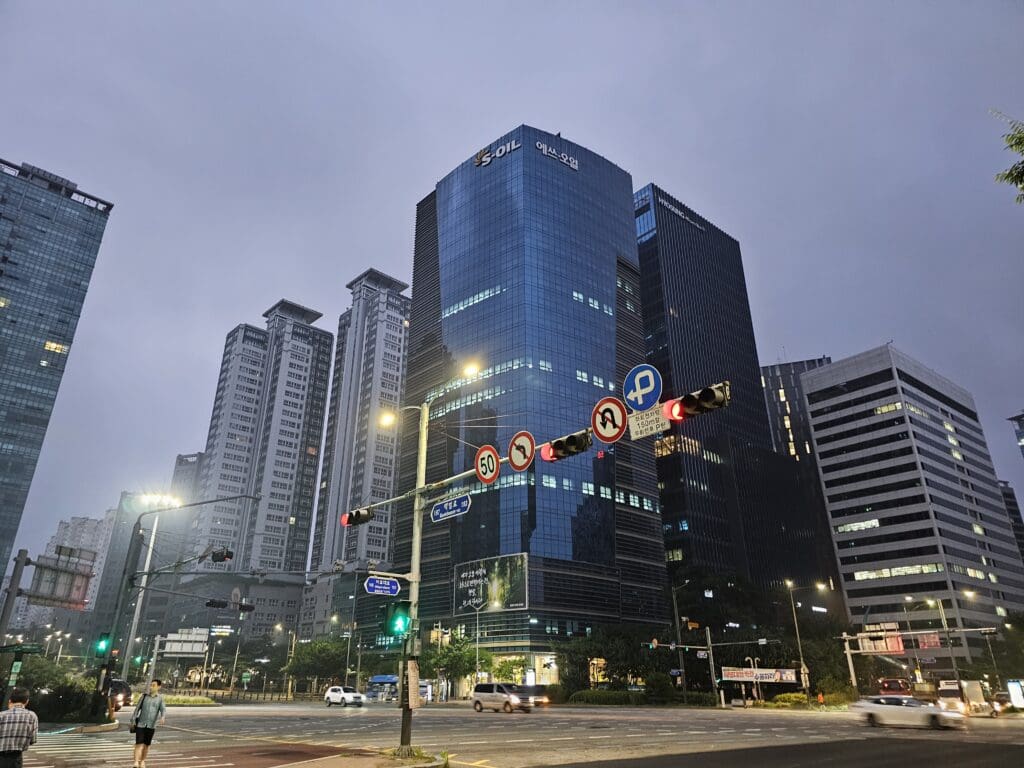
Making it to the bus stop with around five minutes to spare, I took a seat on the bench and right on time, the modern and shiny Kia Granbird bus pulled up on its journey from Seoul City Hall to Incheon Airport Terminal 2. Immediately after coming to a halt, the door slid open and I headed onboard where I was given a friendly greeting by the driver before my ticket’s QR code was scanned after which I was free to take a seat. Seeing as this route passes many of Central Seoul’s hotels, travelling in the early morning and with Gongdeok serving as the bus’ penultimate stop before it speeds out of Seoul, I was somewhat expecting the bus to be full of weary-looking morning flyers. However, much to my surprise, upon boarding the bus was almost totally empty and just three other passengers could be seen onboard! Inside, the bus features a virtually identical layout to most intercity Korean buses, albeit the front row of seats has been removed to allow for additional space for passengers’ bags. Specifically, the bus was arranged in a comfortable 1-2 layout, with each seat being chunky, spacious and featuring a decent amount of recline.
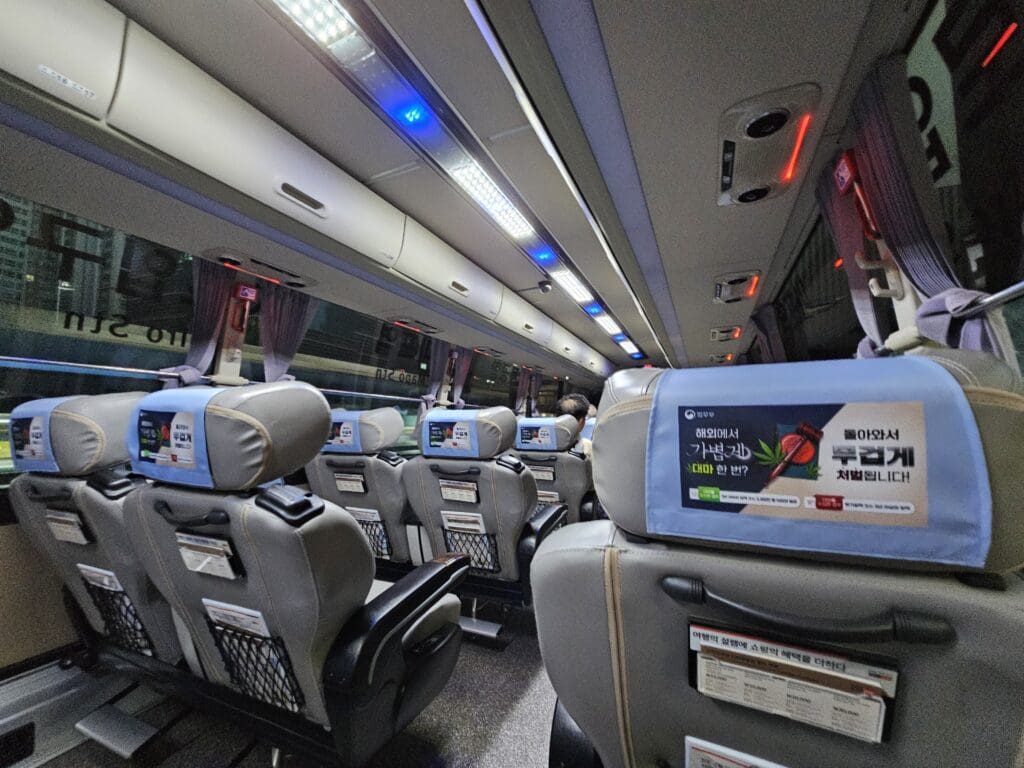
Once seated and strapped in, the bus took off and we continued down the main road before coming to a halt at our final stop before reaching the airport, Mapo Station. Picking up one final passenger, we then headed down the northern bank of the Han River before speeding westwards along this and venturing out of Seoul. As we left the sprawl of the capital city behind, the skies began to brighten revealing misty scenes without a single trace of any blue sky. Before I knew it, the bus crossed the Han River via the Haengju Bridge and passed Gimpo Airport. From there, we headed towards the coastline and soon crossed the 4.4-kilometre-long Yeongjong Bridge, which separates the mainland from the island of Yeongjong, home to Incheon Airport. Without encountering any traffic, just 45 minutes after leaving Gongdeok, the sight of Terminal 1 appeared as an automated announcement rang out in Korean, English, Japanese and Chinese advising us of our impending stop. Soon, the bus came to an abrupt halt outside the terminal’s check-in hall and I jumped off along with two other passengers before this continued around the airport to Terminal 2.
Having opened its doors in 2001, Terminal 1 is Incheon Airport’s original and, until 2018, sole terminal. Despite being almost a quarter-century old, this still gives off a bright, modern, airy and spacious aura, and is definitely one of my favourite terminals in the world. With Korean Air, its low cost subsidiary Jin Air, and a few Skyteam carriers having migrated to Terminal 2 in 2018, today, Asiana Airlines is Terminal 1’s largest user. Thus, once inside the large check-in hall, unsurprisingly it took me all of about thirty seconds to spot some Asiana Airlines branding! Seeing as I had checked in online and lacked any hold luggage, upon arriving at the airport, I could have made a beeline for one of the security and immigration checkpoints. However, falling into the peculiar demographic of ‘aviation enthusiast’ I instead decided to wander over to Asiana Airlines’ check-in area in the hope of obtaining a paper boarding pass which I would retain as a souvenir from this unique short Airbus A380 flight!
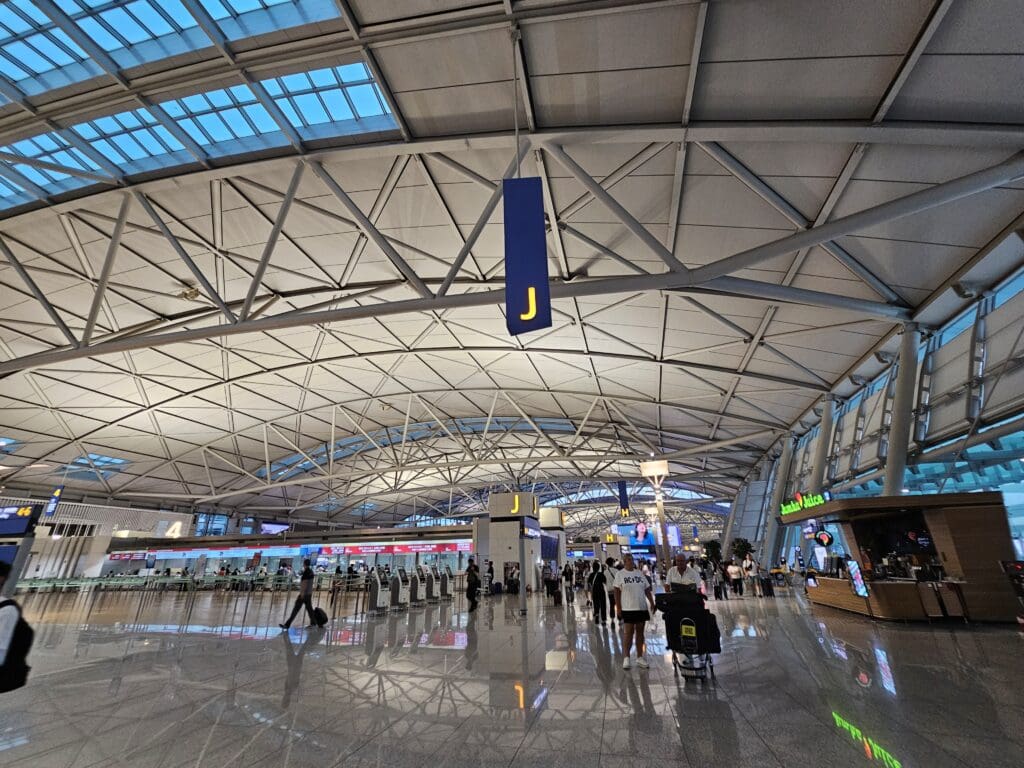
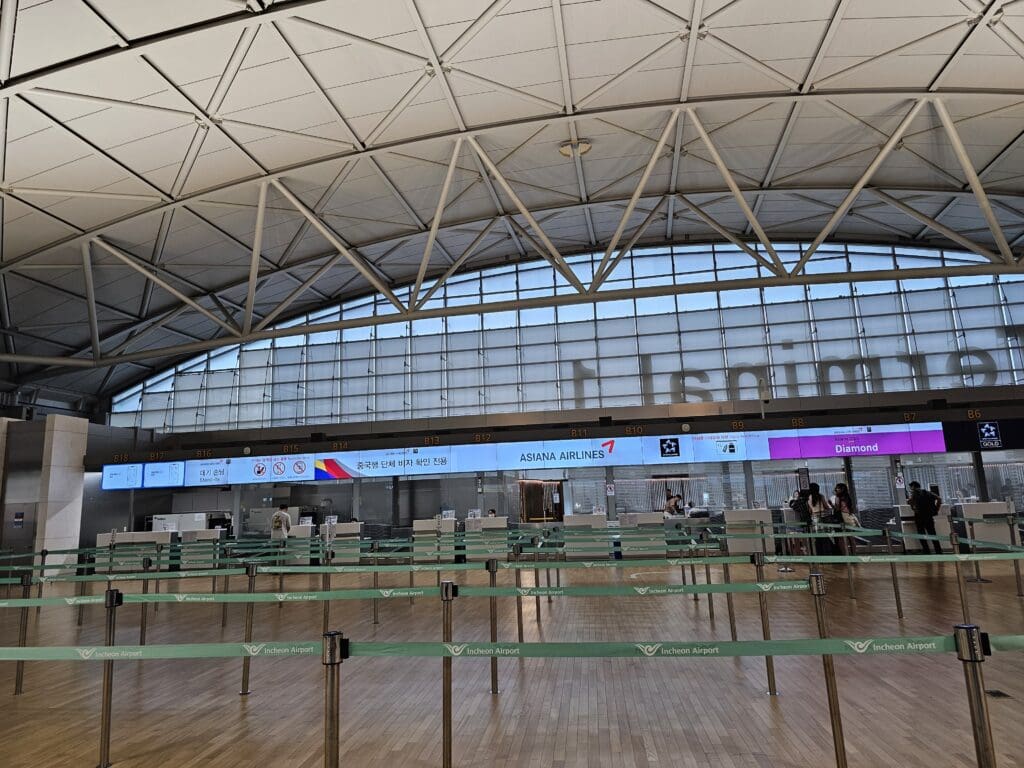
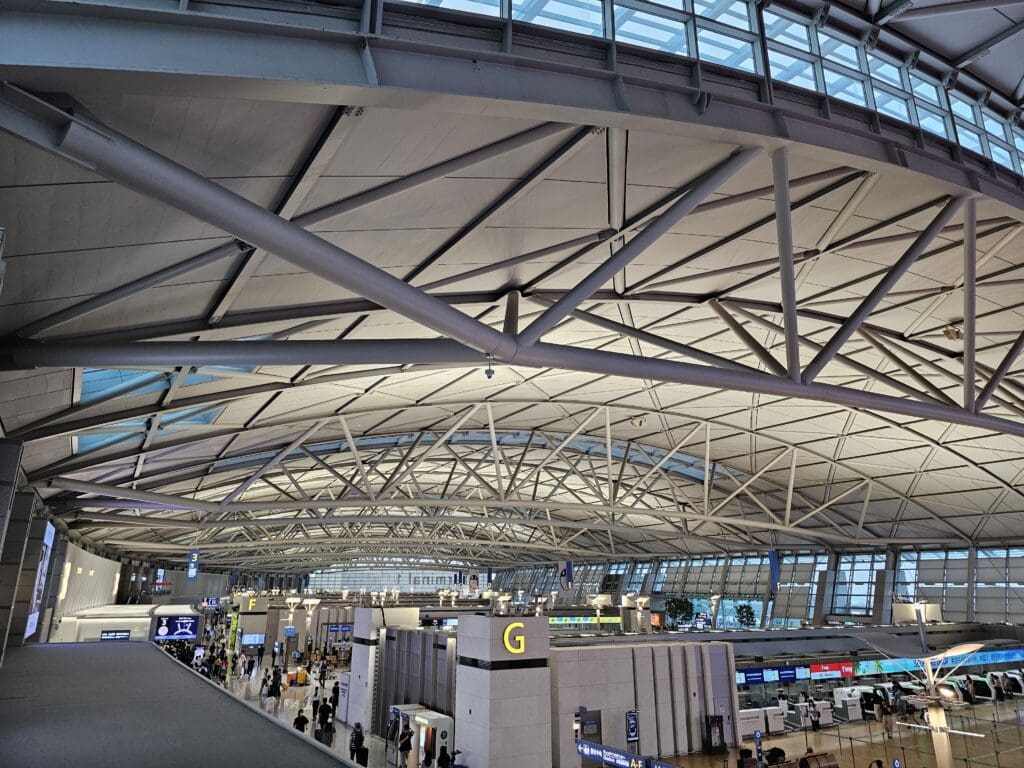
In total, Terminal 1’s check-in hall consists of thirteen check-in islands, logically named A to N, with Asiana Airlines occupying islands A to C at one end of this hall. Wandering around, the check-in hall appeared to be rather busy, with the early morning rush of departures to destinations across East and Southeast Asia in full swing. For those who either aren’t flying or require some refreshment before heading through security, an impressive total of 61 cafés and restaurants can be found in the landside portion of Terminal 1, ranging from proper sit down restaurants, to fast food outlets and kiosks. Meanwhile, those with some time on their hands may wish to head up to the floor above the check-in area which is home to a traditional Korean-style pavilion that offers a view out onto the apron. However, thanks to the terminal’s design, sadly this isn’t particularly great for any sort of photography. Finally, one more novel facility in Terminal 1 is the Korean sauna, located in the basement near the station. Available to all, this features both a jjimjilbang (saunas and public sleeping rooms) and a mogyoktang (baths), and provides a nice place to relax before your flight.
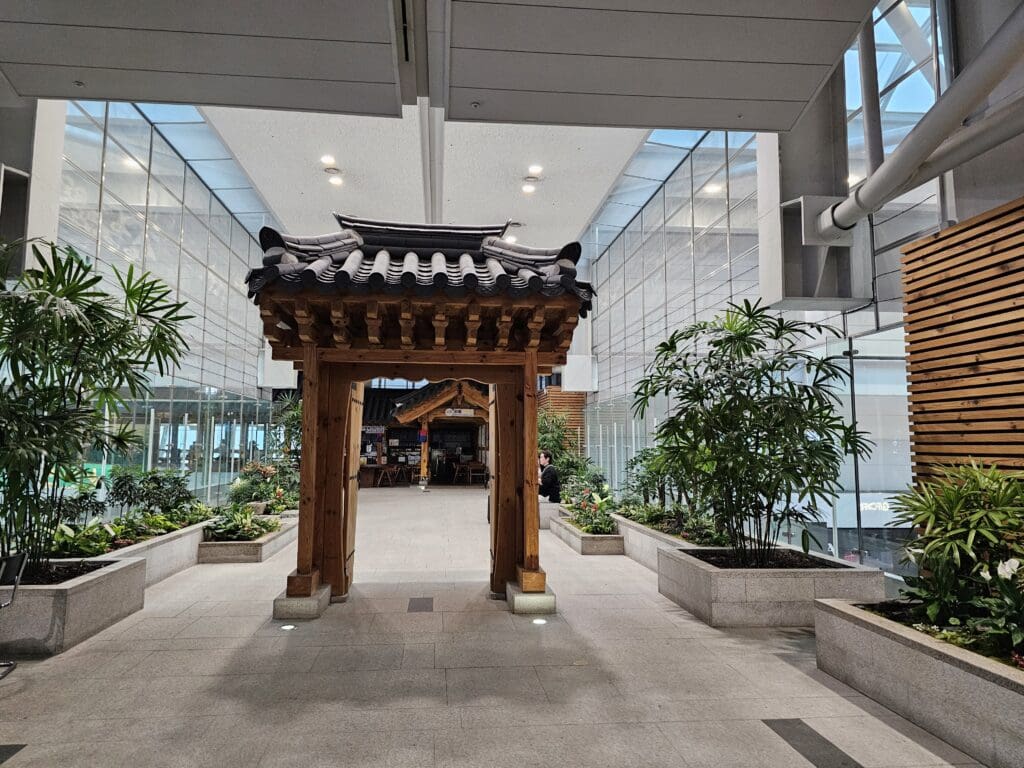
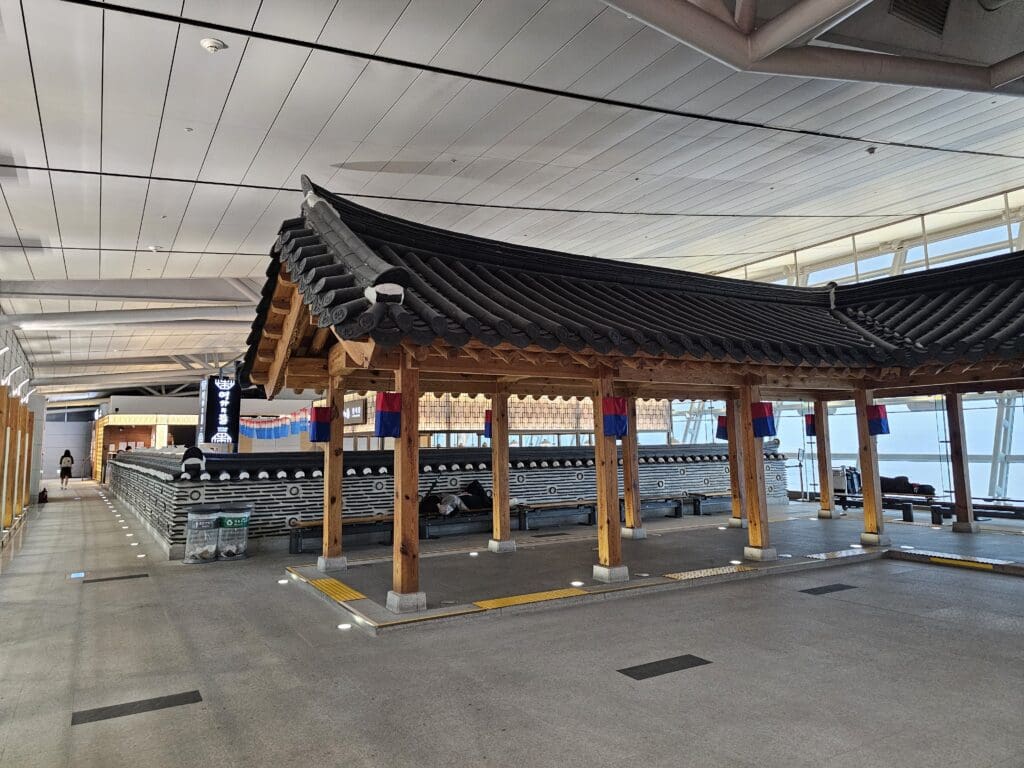
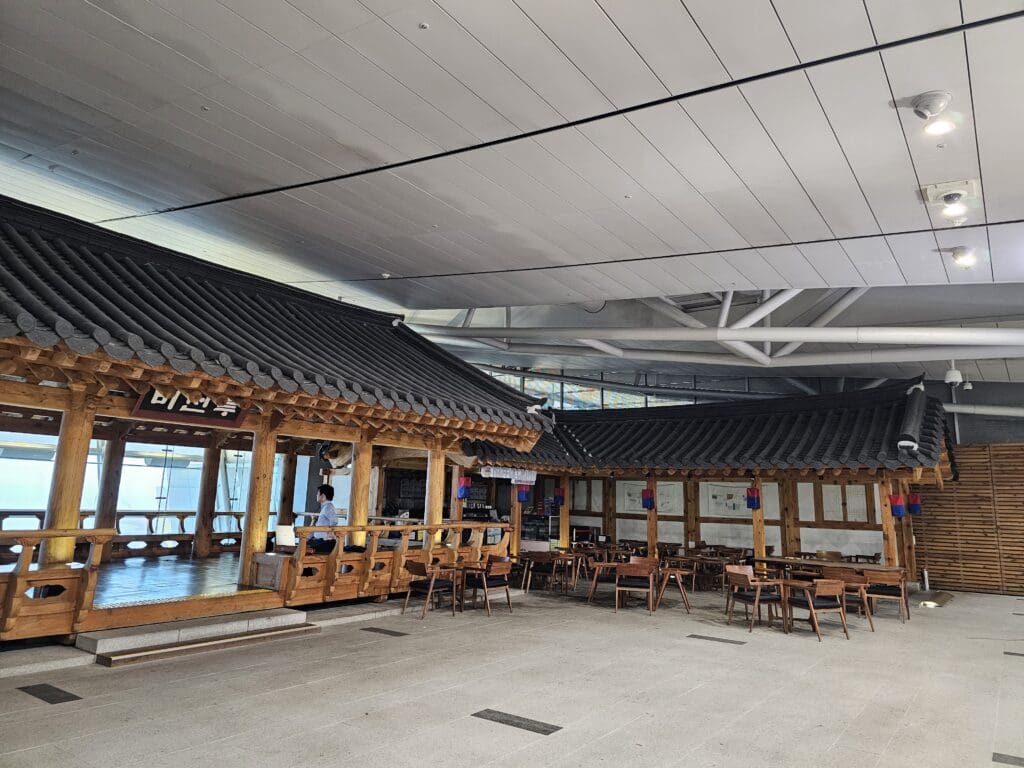
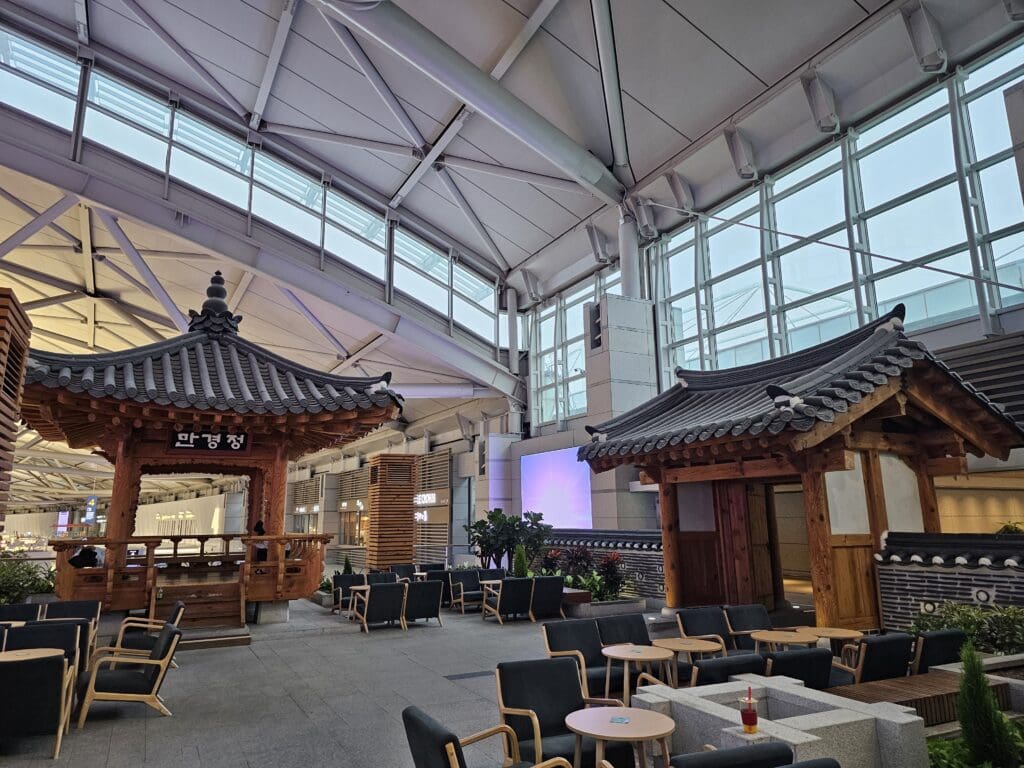
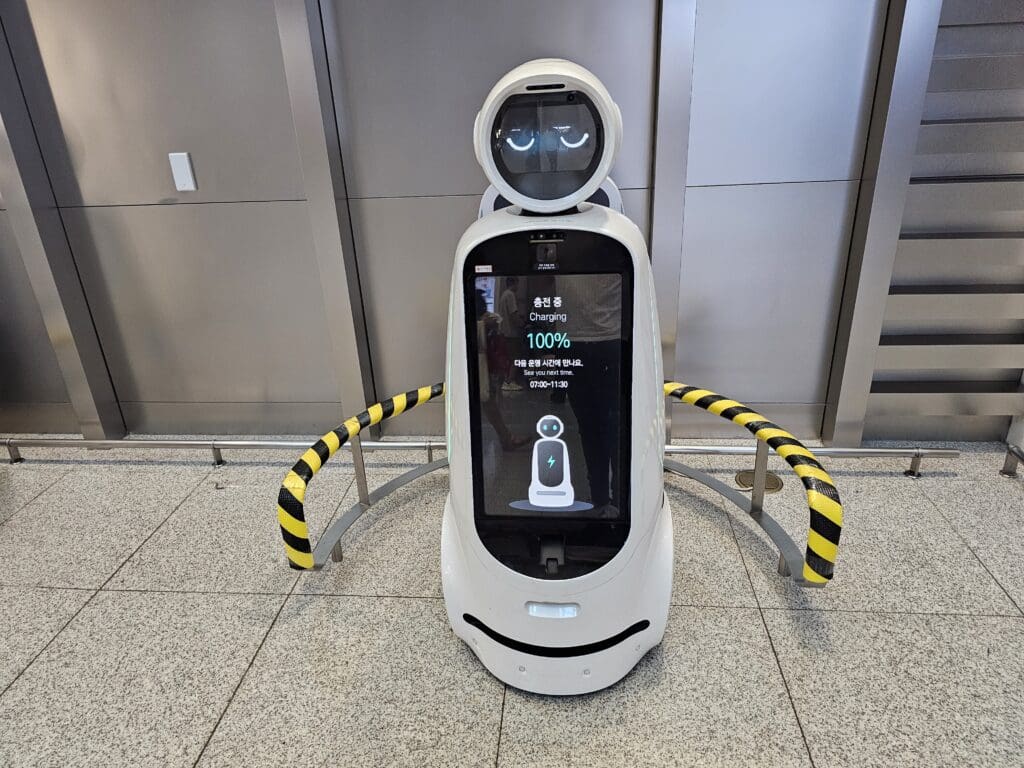
Returning to the journey, once I had arrived at Asiana Airlines’ check-in area, I was greeted by the sight of plenty of open desks; however, seeing as I had nothing to drop off, I made my way to one of the self check-in machines where I was able to print off my boarding pass without issue. With this in hand, I then turned to my next mission, security. At that time in the morning, just two of the six security and immigration checkpoints were open and reasonably long queues could be seen at both of these. Fearful of a long wait, I joined the queue for one of the checkpoints without delay. Thankfully, the queue shuffled along quickly and the wait was not as long as I had initially anticipated. After thirteen minutes of queuing, I reached the security checkpoint and passed through this quickly and without the need for any further checks to be undertaken. Next up was immigration, and since my last departure from Incheon Airport way back in 2018, there has been a shift towards automated immigration gates. However, holding a British passport and not residing in Korea, I was left with no option other than to head to the only manned counter. Fortunately, I was able to walk straight up to one of these without waiting and following the usual passport scanning and suspicious glances, I was free to enter the airside portion of the terminal.
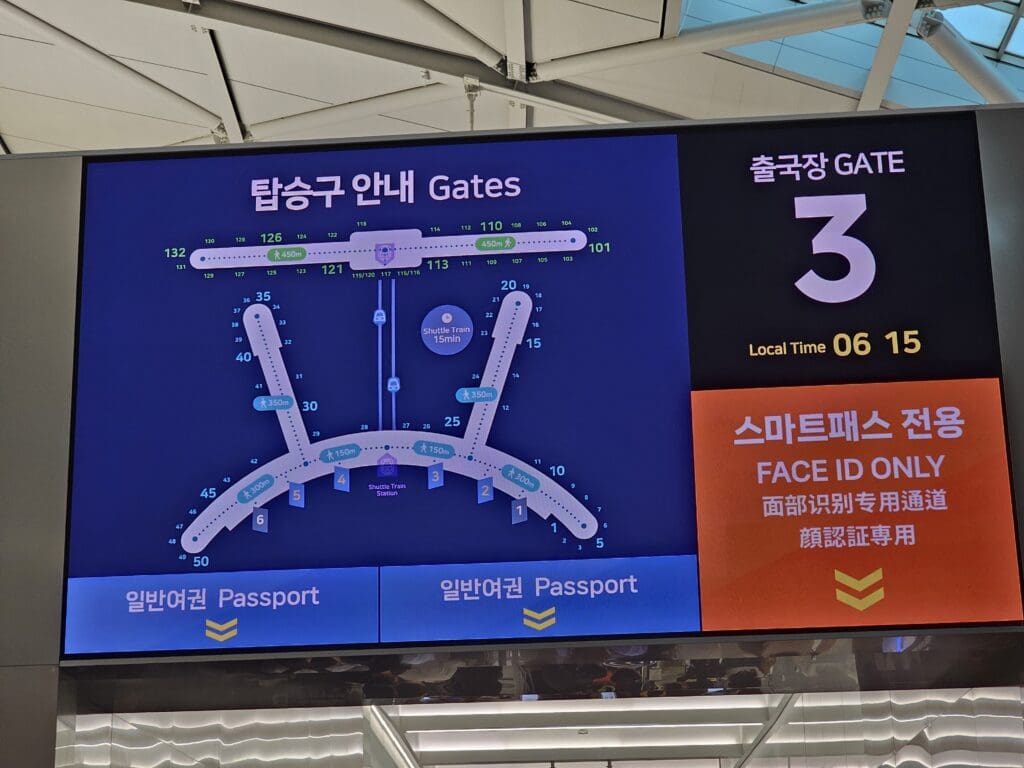
The airside portion of Terminal 1 consists of the main terminal, which, from the air appears to be in the shape of a smile complete with two long piers jutting out from this, and a satellite terminal that is located a short people mover ride away from the main terminal. Since Korean Air’s move to Terminal 2, Asiana Airlines’ aircraft almost always utilise the gates at the main terminal, whilst more often than not, the satellite terminal typically serves low cost carriers alongside a few full service airlines. As is the case with the landside portion of the terminal, the airside portion is spacious, airy and modern. Crucially, this appeared to be in a spotlessly clean condition and an omnipresent army of cleaning staff seemed to be hard at work for the duration of my stay. Meanwhile, I found the complimentary wifi to work without a glitch throughout the terminal and plenty of power sockets and USB-A ports could be found throughout for those needing to charge their devices.
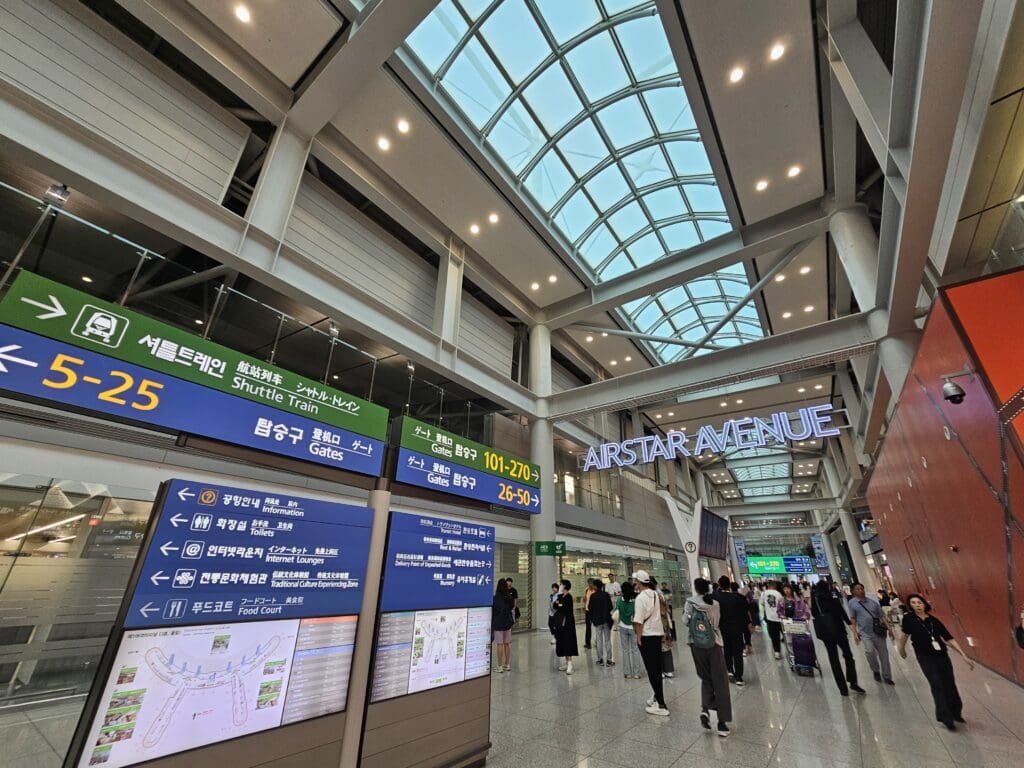
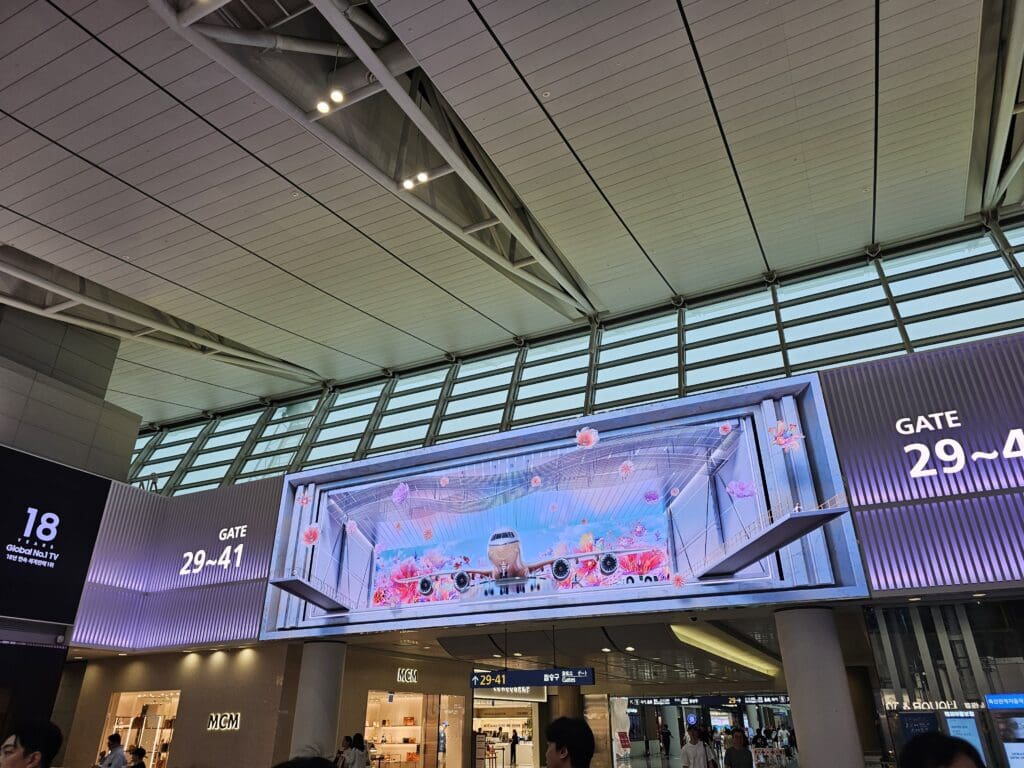
With Incheon Airport serving as the world’s seventh busiest airport for international flights (as of 2023 statistics), unsurprisingly I found the airside portion of the terminal to be rather busy. Meanwhile, I happened to pass through this at one of the busiest times of the day for transit passengers. Wandering around, I overheard plenty of North American passengers who had likely arrived on Asiana Airlines’ overnight flights from North America and were heading onward to destinations across East Asia.
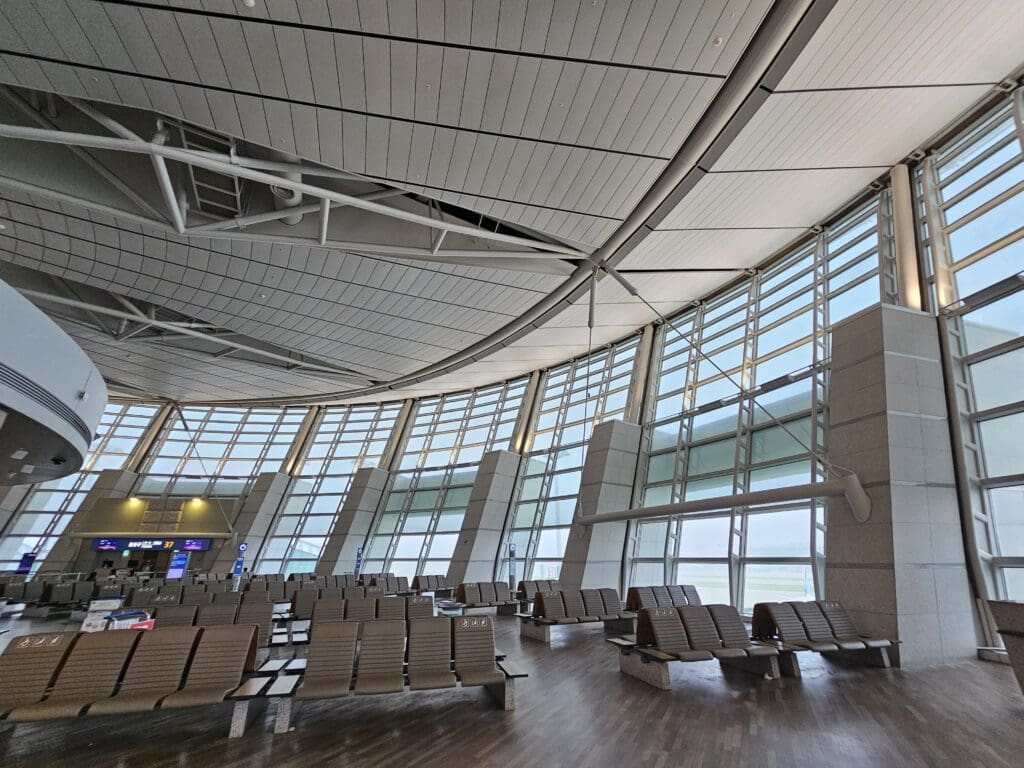
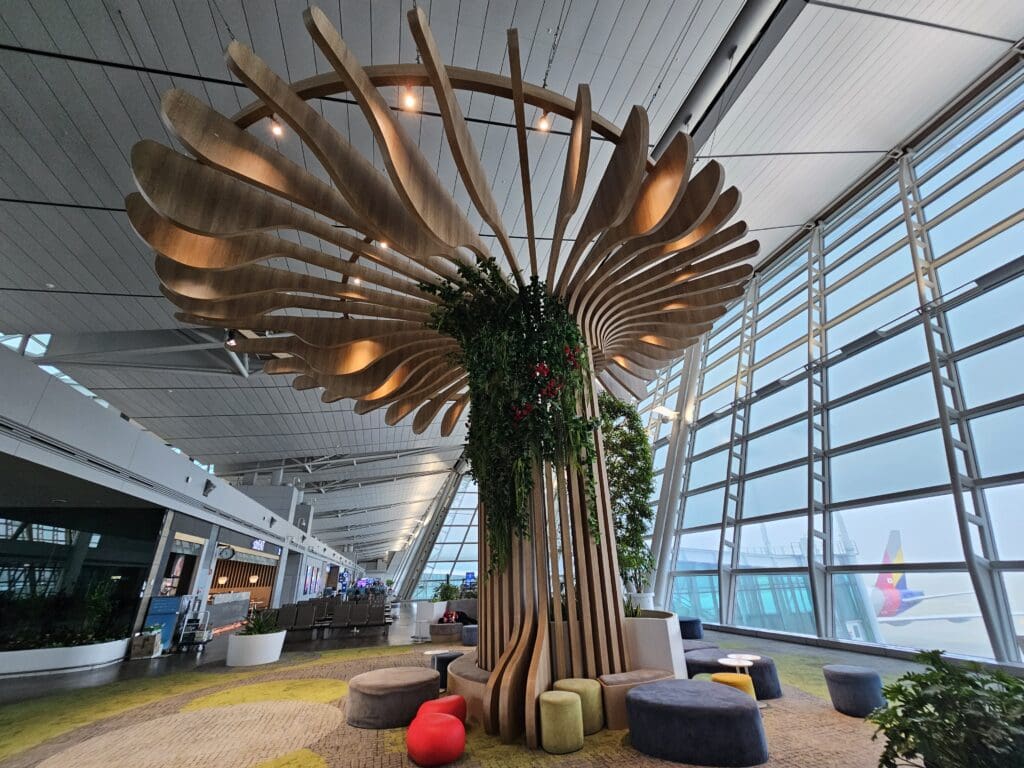
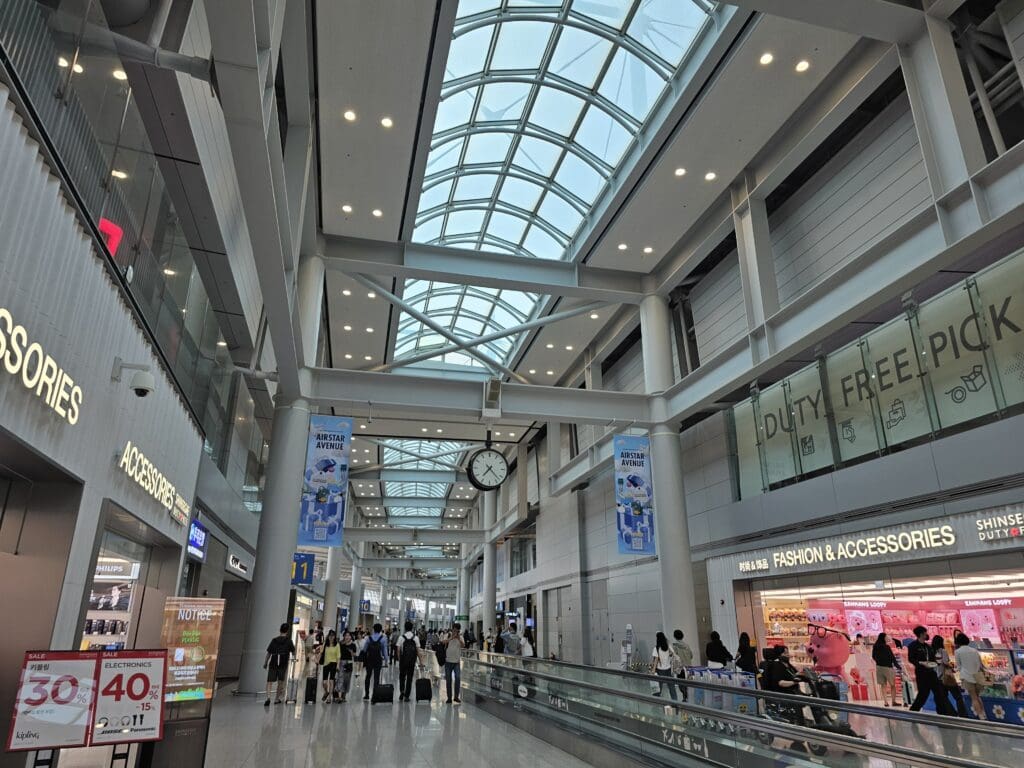
As with the landside area, the airside portion of Terminal 1 is most certainly not lacking in terms of facilities. For those looking to splash their cash, an impressive selection of no fewer than 26 luxury brand outlets are offered in the main portion of the terminal. These include the usual suspects such as Bvlgari, Chanel, Hermes, Louis Vuitton, Montblanc and many others. Meanwhile, plenty of duty free stores can be found selling a range of foods, drinks, cigarettes, electronics and souvenirs, with these operated by City Duty Free, FanFan Duty Free, Hyundai Duty Free, Kyung Bok Kung Duty Free, Shilla Duty Free and Shinsegae Duty Free. Of perhaps more interest to many will be the eateries, of which there are an impressive total of over 60 bars, cafés and restaurants offered in the airside portion of the terminal, with these selling a range of cuisines from across the world. However, saving myself for the culinary delights of Asiana Airlines, I decided to skip an airport breakfast and instead grabbed a coffee from the local Paris Baguette, a Korean café-bakery chain.
Historically, one of my gripes about Incheon Airport was the lack of convenience stores once airside, thereby limiting affordable refreshment options and being somewhat surprising for a country where convenience stores are virtually omnipresent. However, since my last trip through the airport, I was delighted to find that Terminal 1’s airside area is home to both a CU and GS25 which allow passengers to purchase an array of refreshments and other goods without paying inflated prices.
One of the more unique facets of the terminal is that it seems to attempt to provide travellers with either one final spoonful of Korean culture, or a brief glimpse of it to the many passengers who are only passing through on the way to somewhere else. Throughout much of the day, an array of traditional performances can be enjoyed, whilst it’s not too unusual to come across the odd procession of royals and their guards in full Joseon era costume. Sadly, given the early hour, none of these could be spotted that morning so I decided to turn my attention to the outside world.
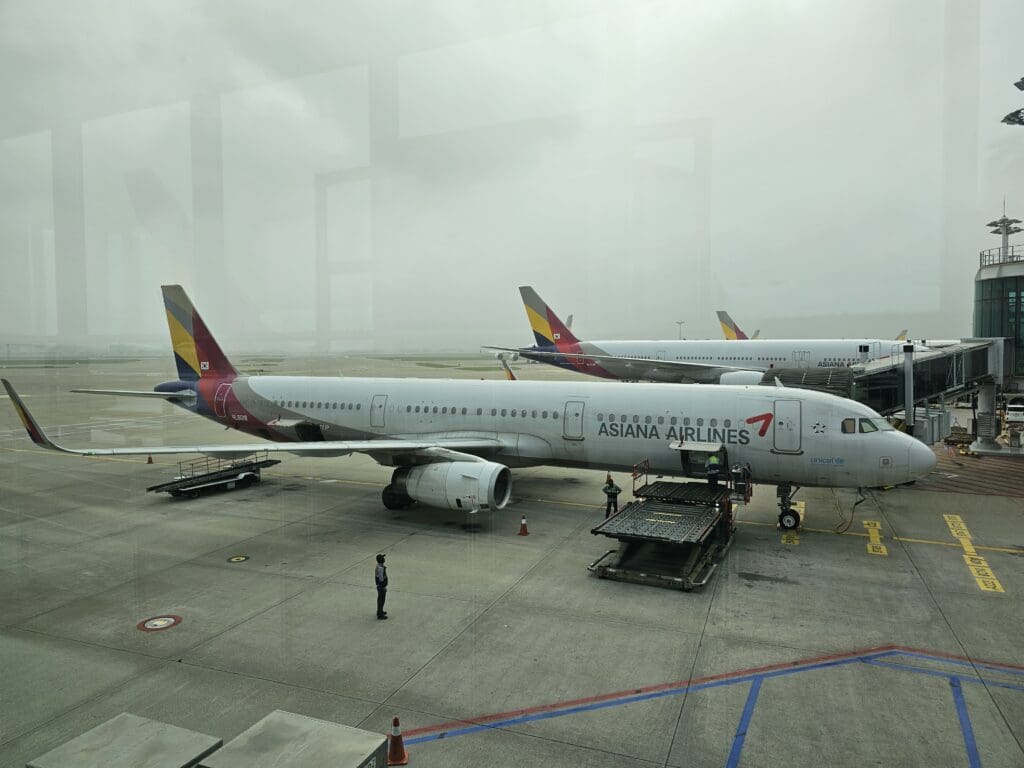
Aviation enthusiasts will be happy to hear that clear and unobstructed views of many of the stands and the southern ends of the Incheon Airport’s runways can be had throughout the terminal, enabling for some superb spotting and photography opportunities. As I had expected, many of the stands outside were occupied by Asiana Airlines jets, and it didn’t take me long to spot almost every single type in the airline’s passenger fleet. The exception to this was the carrier’s last remaining Boeing 767-300 which was based at Seoul Gimpo Airport and deployed exclusively on the short domestic hop to Jeju. However, Terminal 1 hosts far more than just Asiana Airlines, with a grand total of 57 airlines from across the world also utilising this, thereby almost always guaranteeing that at whatever time of day, an interesting smorgasbord of airlines and aircraft can be seen.
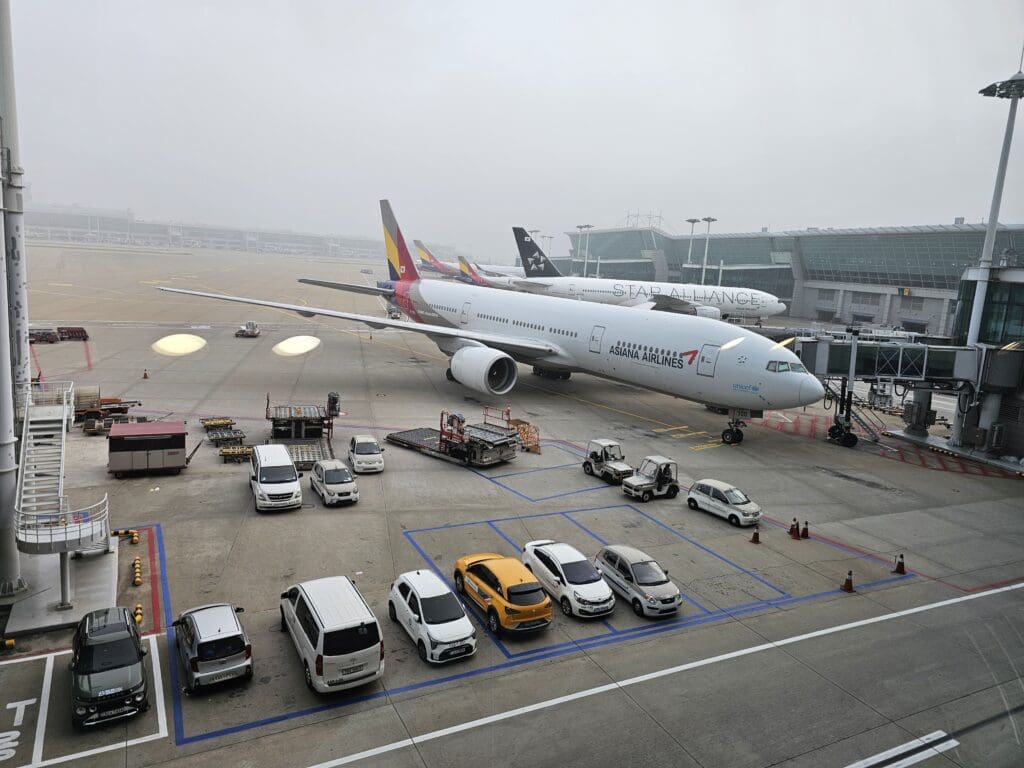
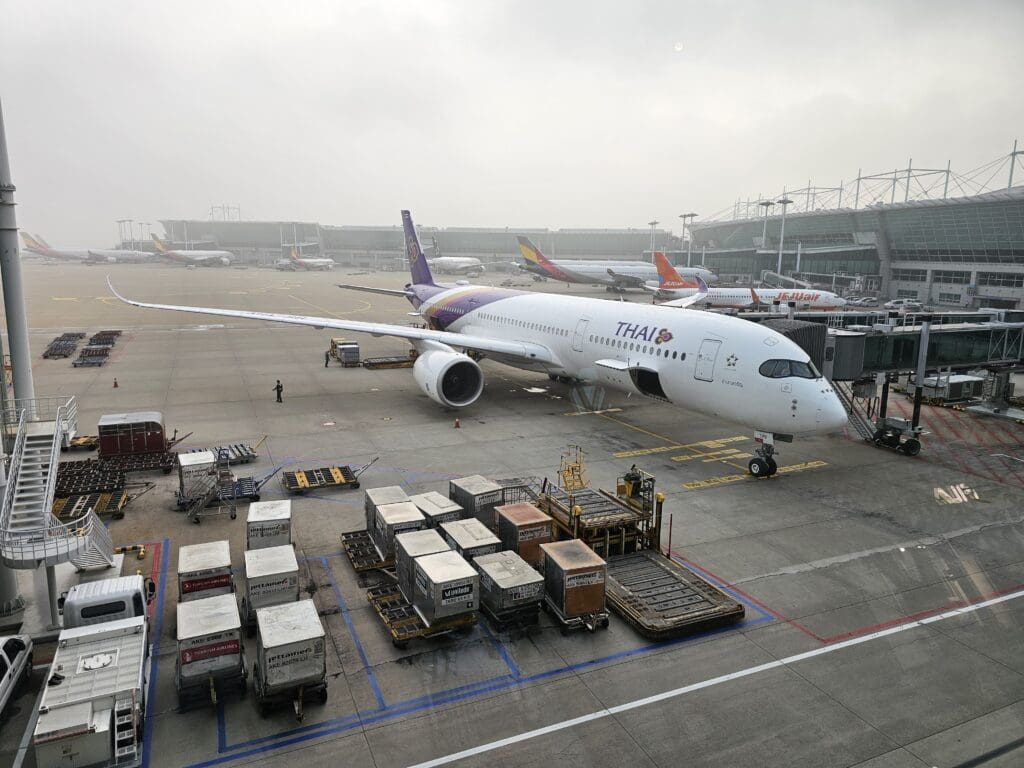
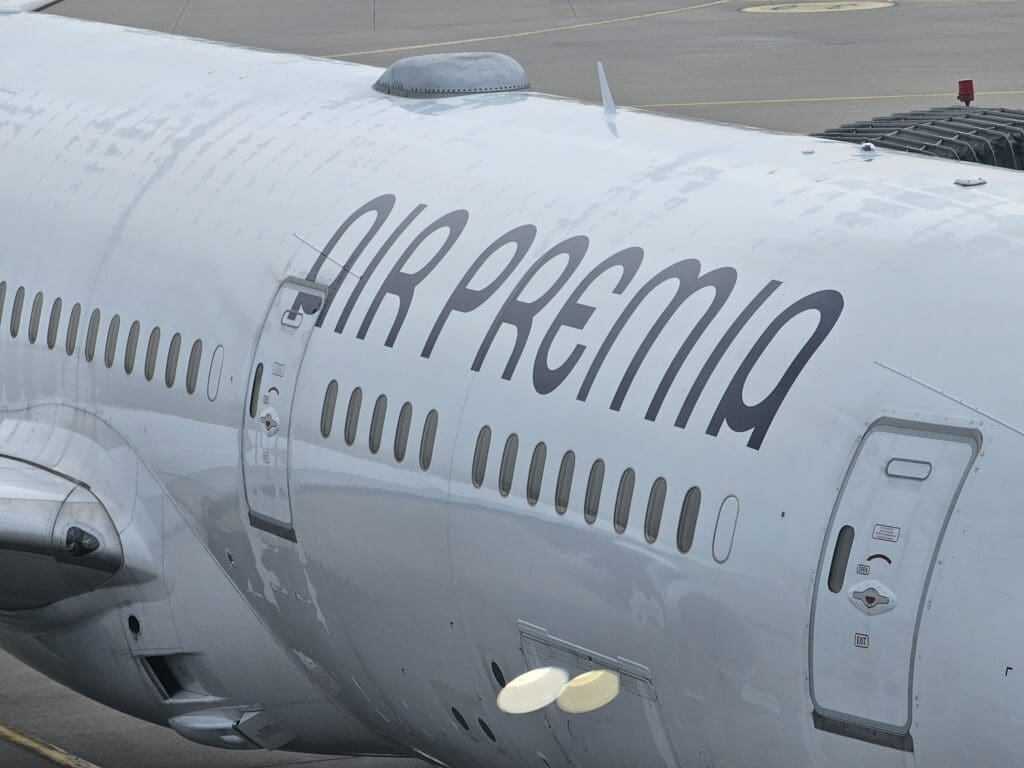
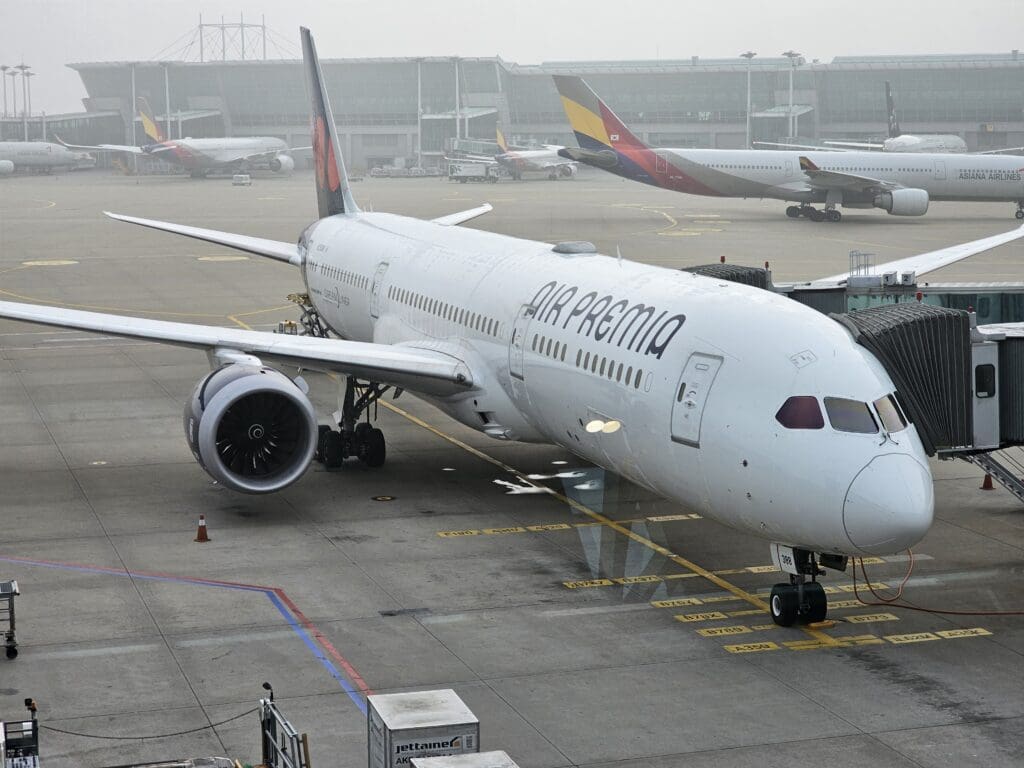
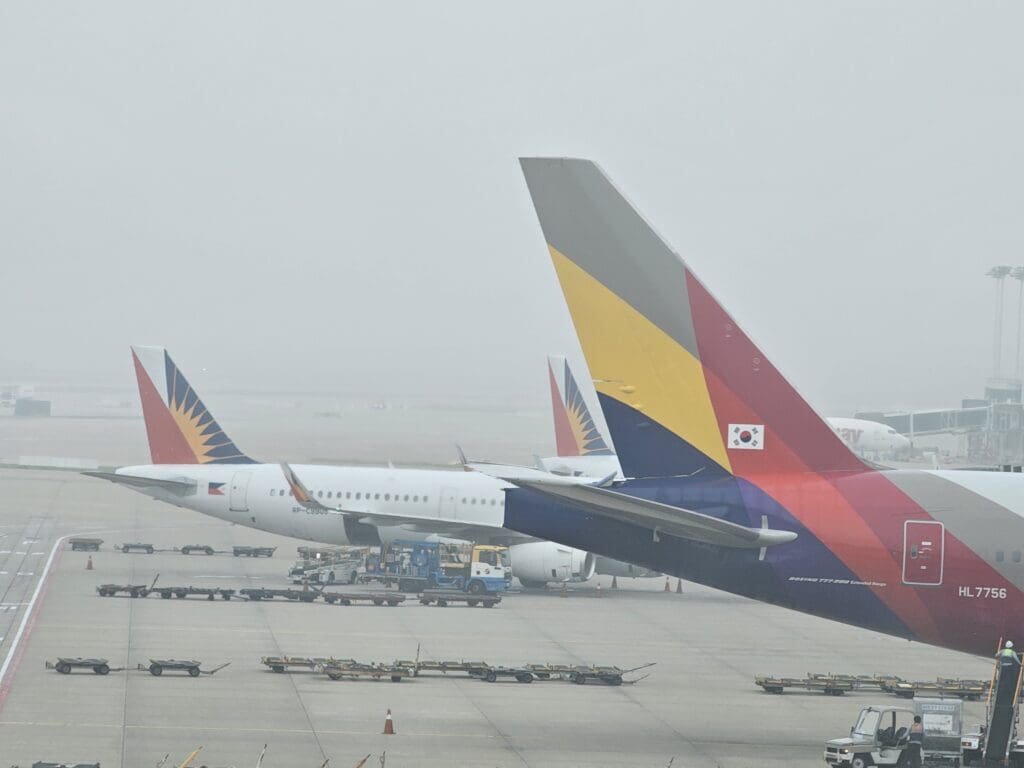
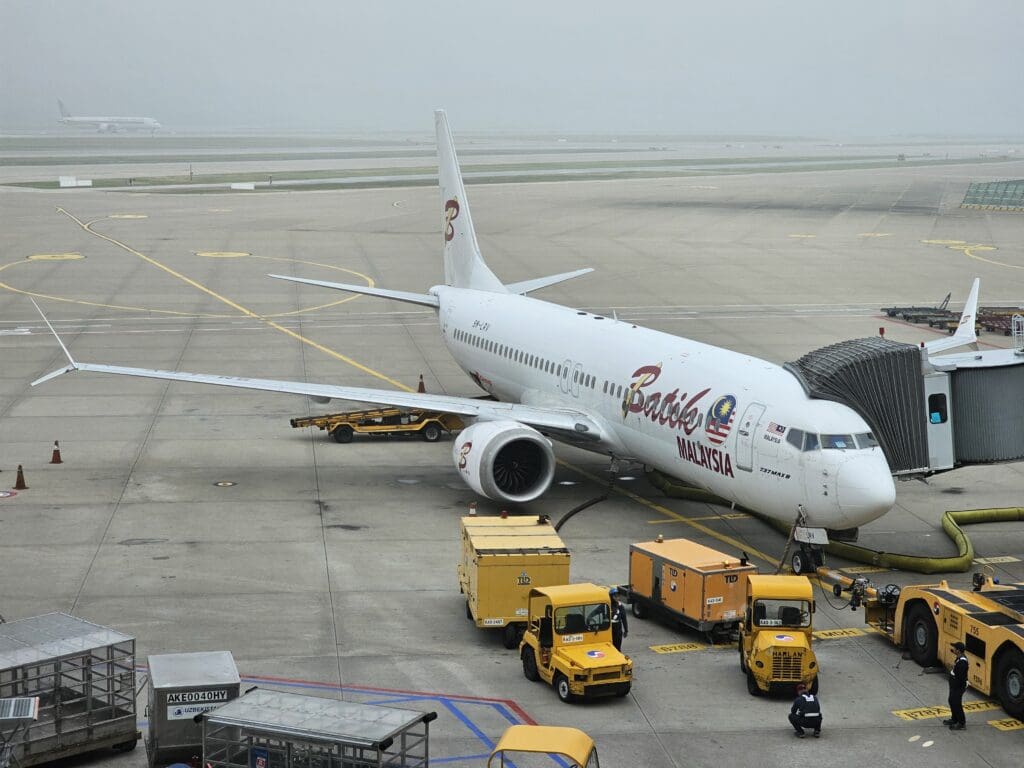
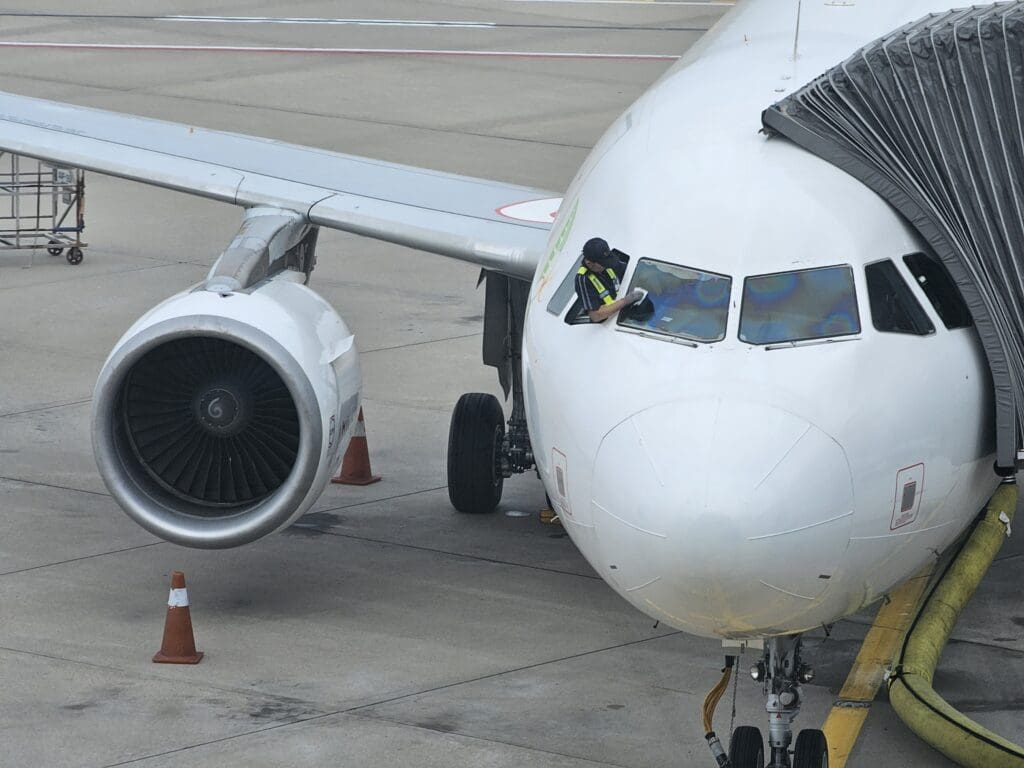
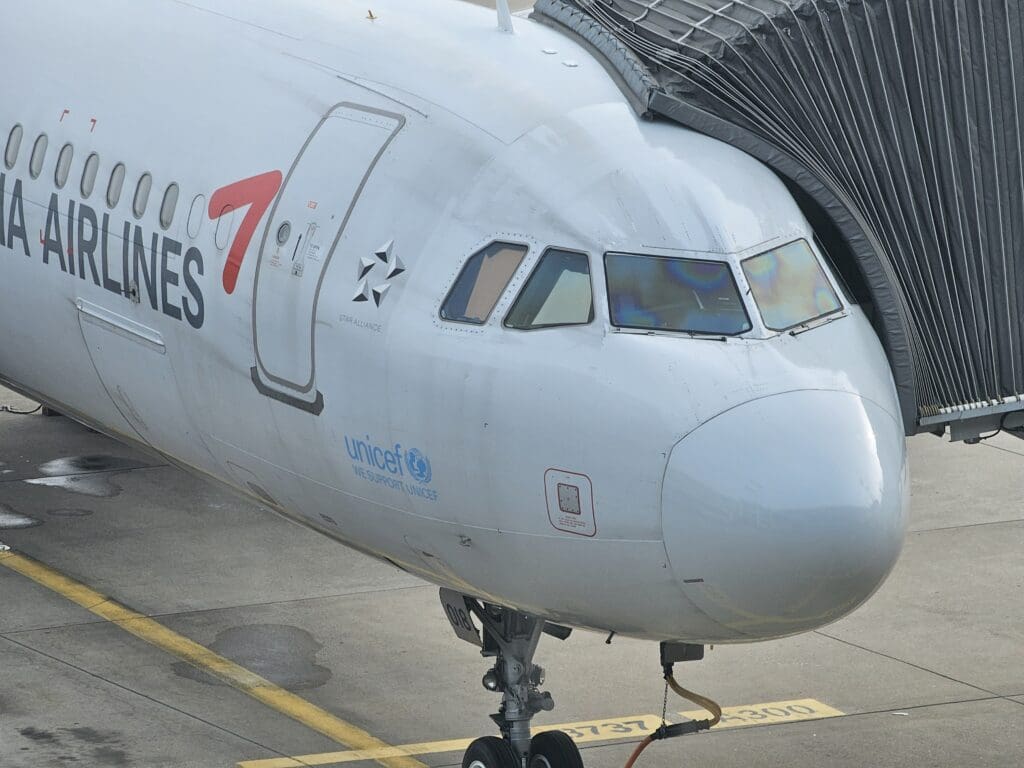
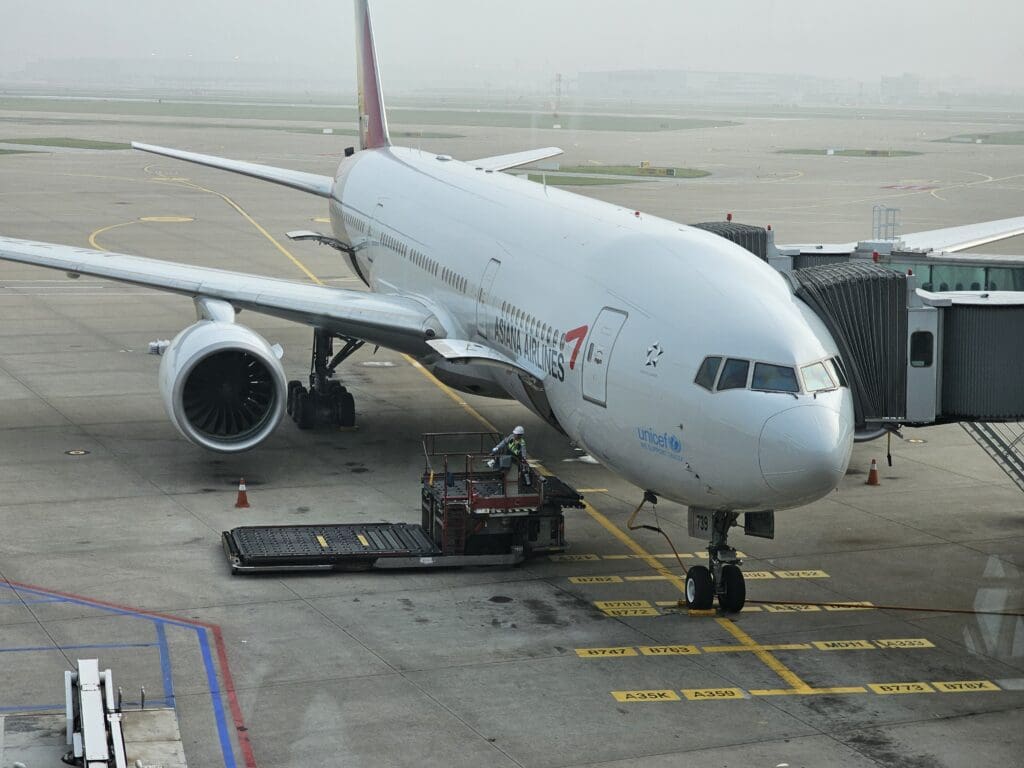
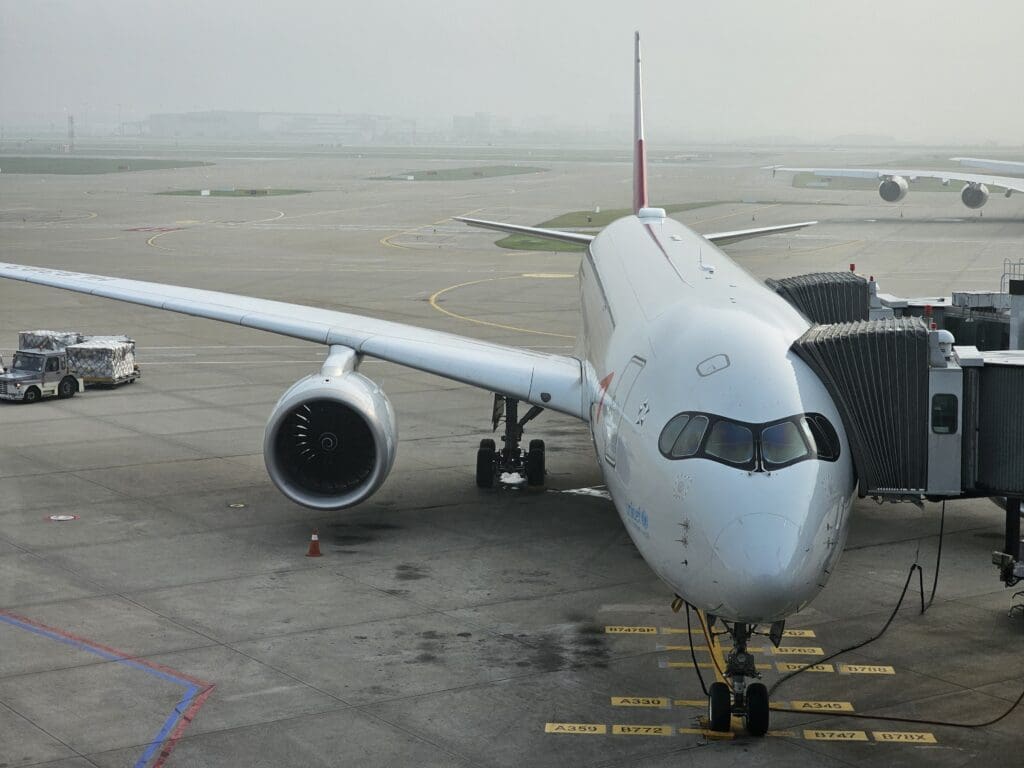
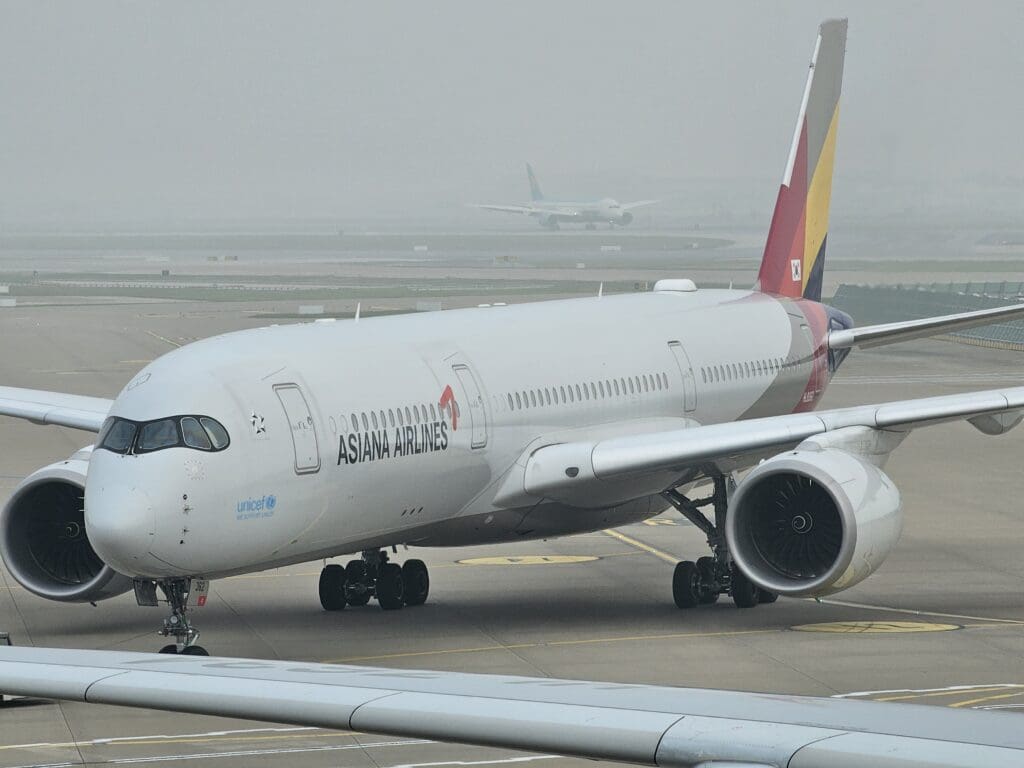
As I wandered around, I spotted aircraft from Korean carriers Air Busan, Air Premia, Air Seoul and Jeju Air waiting at the main terminal, whilst visitors from abroad came in the form of Air Astana, Batik Air Malaysia, Laos Airlines, LOT Polish Airlines, Philippine Airlines, Thai Airways International and Uzbekistan Airlines. Unfortunately, the thick fog meant that it was a little difficult to spot aircraft at the satellite terminal, however from what I could see, these seemed to consist of a mixture of low cost carriers’ aircraft and a host of airliners from Chinese giants such as Air China, China Eastern Airlines and China Southern Airlines.
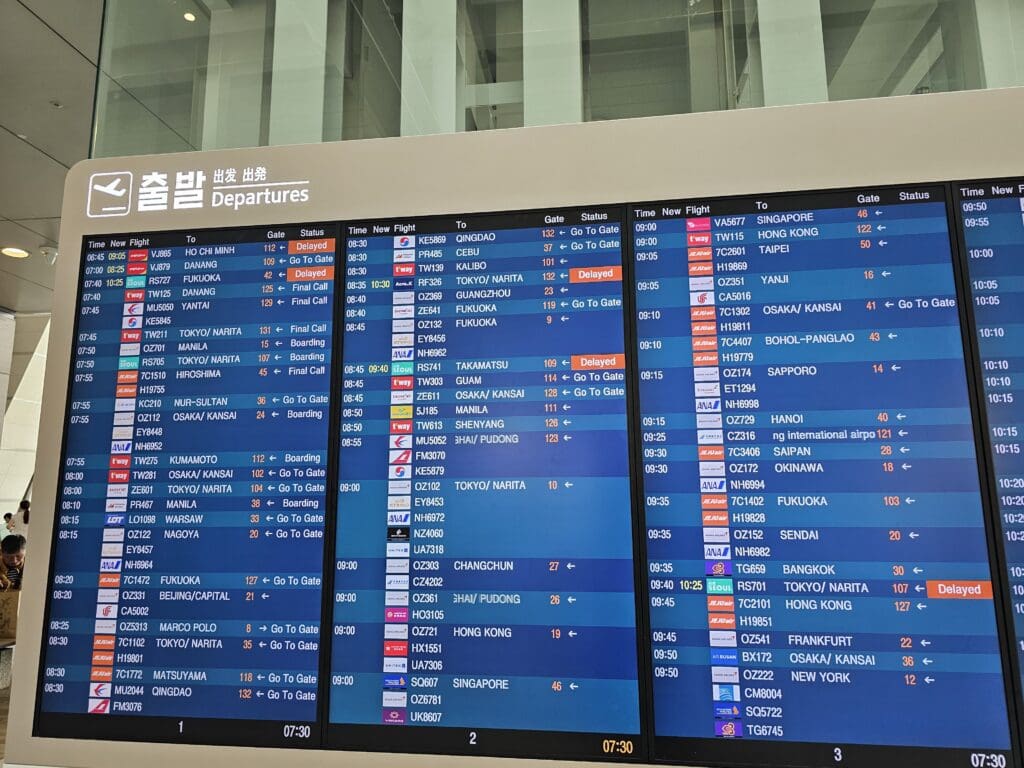
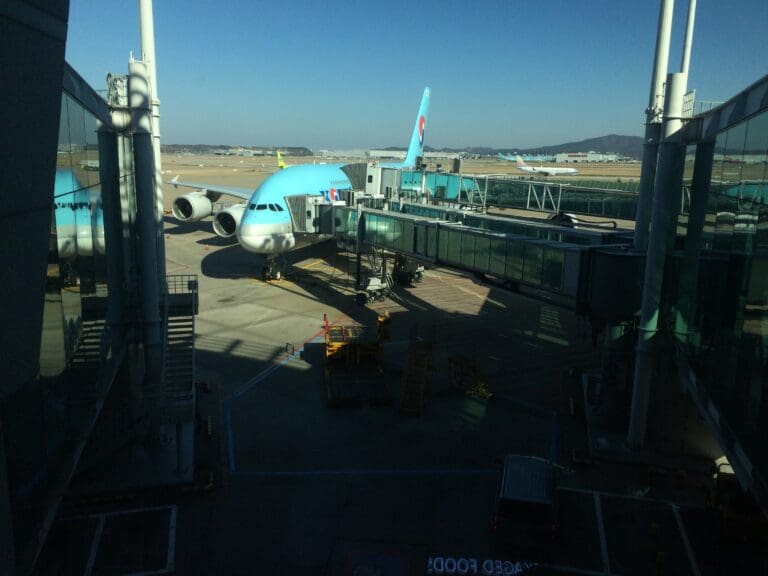
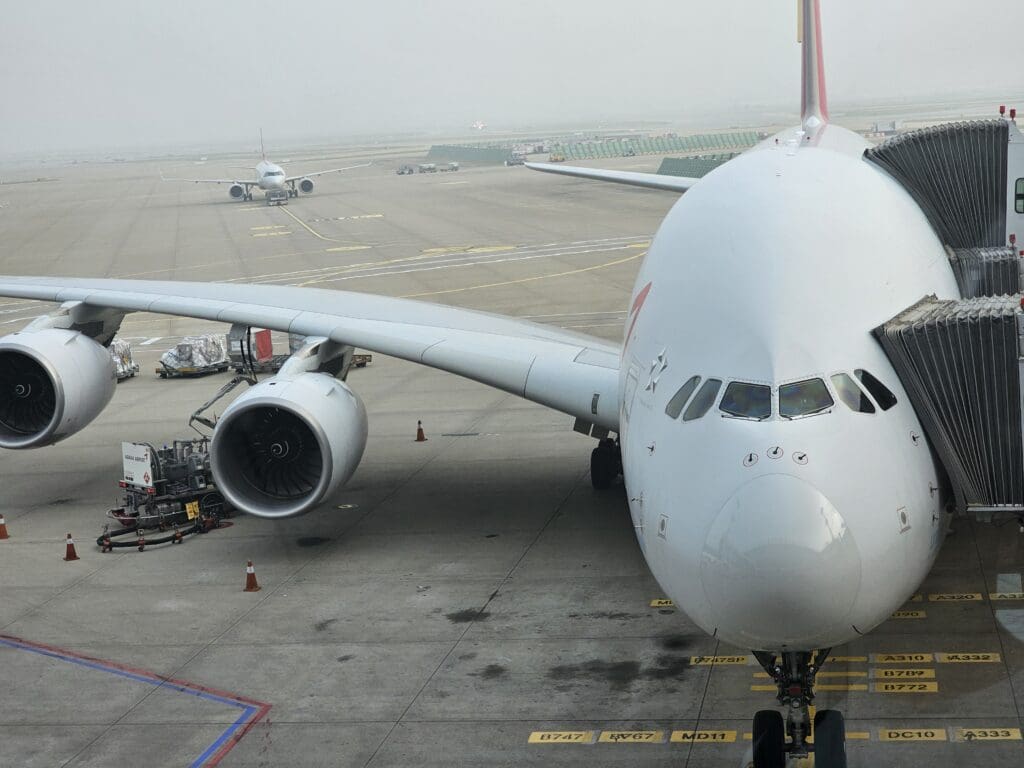
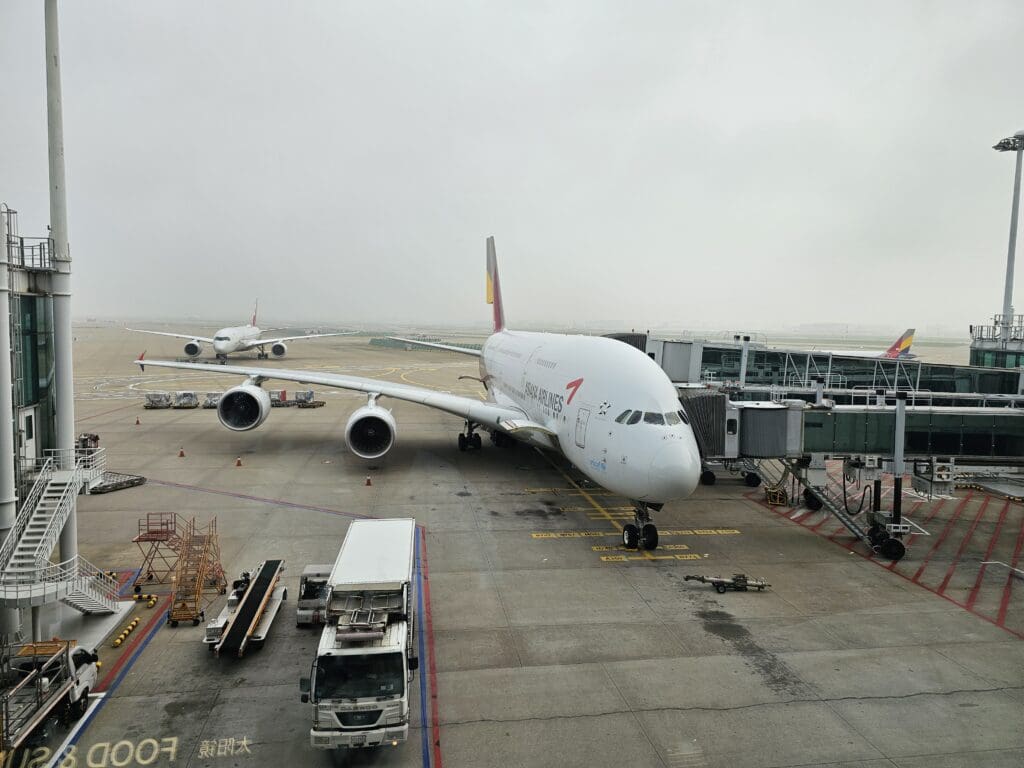
According to my boarding pass, boarding for the Tokyo service would commence forty minutes prior to departure at 0820. Whilst this may seem like a fairly short time for a 495 seat aircraft, as I neared Gate 10, three jet bridges could be seen connected to the aircraft whilst a fair amount of signage was already in place, indicating that boarding would be a quick and efficient affair. Upon arriving at the gate, I gazed out at the whale and watched as an army of Asiana Airport ground crew could be seen around this, readying the massive jet for its short eastward journey. Hinting at one of the reasons as to why such a large aircraft is deployed on this short route, a seemingly endless stream of cargo palettes could be seen being loaded into the Airbus’ holds. Indeed, Asiana Airlines has a massive cargo operation at Incheon Airport, and is a major player in the freight industry. Alongside their passenger jets, Asiana Airlines operates ten Boeing 747-400 and a single Boeing 767-300 freighter.
Inside the terminal, upon arriving at the gate, this seemed to be rather busy; however, with an Airbus A321 service to Fukuoka departing from the neighbouring gate, it was a little difficult to decipher just how busy the flight to Tokyo would be. Turning to the demographics, those waiting seemed to be a fair mixture of both Japanese and Korean passengers, many of whom were smartly dressed business people alongside tourists of all ages. Meanwhile, I also heard a fair number of North American accents and overhearing several conversations, it seemed like plenty of passengers had connected from Asiana Airlines’ overnight slogs from the United States.
That morning, the task of operating the Narita rotation had fallen to Airbus A380-841, HL7634. Like all Airbus A380s, whilst composed of components from across Europe and beyond, the aircraft was assembled at Airbus’ factory at Toulouse Blagnac Airport. Carrying the construction number 179, in mid-December 2014, the Airbus made its first test flight, flying around the skies of Southern France with the test registration F-WWAF, and was thus 9.55 years old at the time of my flight. Following extensive testing and cabin outfitting, the aircraft was handed over to Asiana Airlines in early May 2015, becoming the third Airbus A380 out of six to join the airline’s fleet. Once delivered, the aircraft was sent to destinations across Asiana Airlines’ route network, from short hops to Osaka and Tokyo to longer slogs to the likes of Frankfurt, Los Angeles, New York and Sydney. However, as with many Airbus A380 operators, Covid brought an abrupt end to the type’s operation and in late March 2020, the aircraft entered storage at Incheon Airport. Remaining parked for well over three years, despite initial opinions that the type would never return to Asiana Airlines service, following extensive preparation, in June 2023 these took to the skies once more. However, it should be said that the utilisation rate for the airline’s Airbus A380s remained low at the time of my flight in July 2024, with many of these undertaking just a small handful of rotations each week, and appearing to spend much of the time parked at remote stands. This included HL7634, which had operated just one single rotation in the week before my flight, which had taken the aircraft to Los Angeles and back.
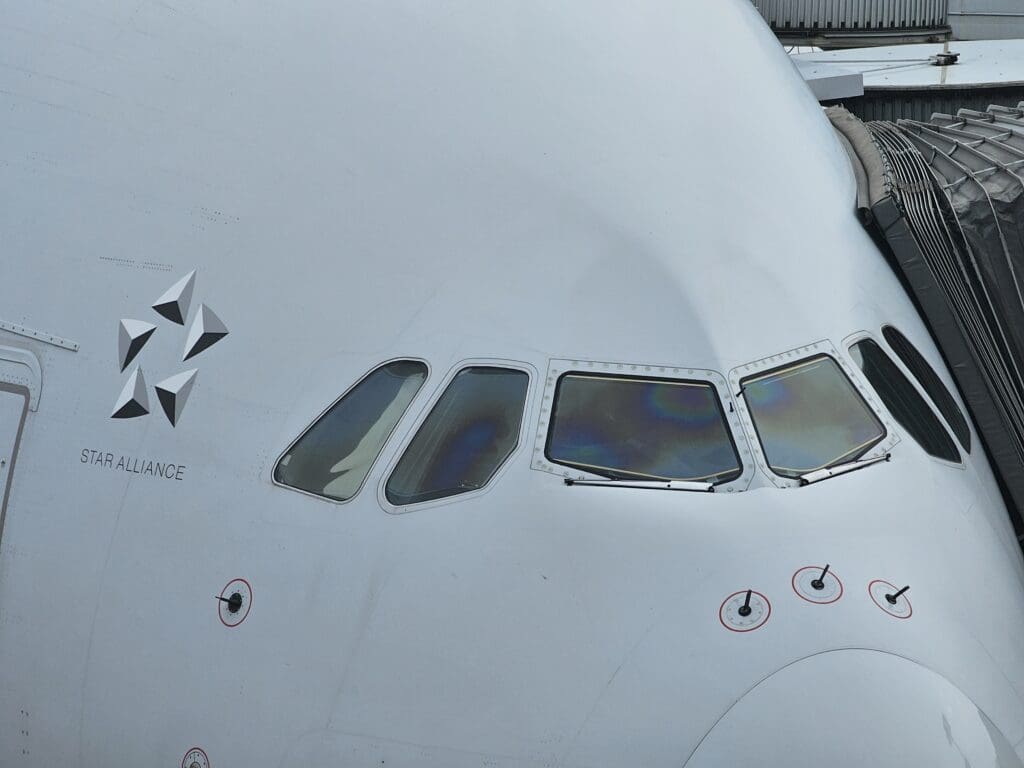
Onboard, Asiana Airlines’ six Airbus A380s features an identical configuration, with all featuring a total of 495 seats. Unlike some other airlines, other than a small onboard lounge, Asiana Airlines opted against installing any particularly luxurious gimmicks, and these aircraft lack an Emirates style bar or shower, an Etihad Airways style Residence suite or a Korean Air onboard shop. Turning to its layout, the cabin is divided into four classes. At the front of the main deck between the first and second doors sits Asiana Airlines’ former First Class product. Following the global trend, Asiana Airlines opted to cease offering a First Class in 2019, however, these highly private and spacious suites have been retained and are today marketed as Business Suites. However, the service provided to those who pay extra to sit in these seats is identical to that of Business, with the main Business cabin located on the upper deck. Behind the old First Class section sits the Airbus’ two main Economy cabins. There, seats are arranged in the bog-standard Airbus A380 bog standard configuration of 3-4-3. Meanwhile, thanks to the curvature of the fuselage, the upper deck Economy cabin features seats in 2-4-2 configuration.
Returning to the journey, still with some time to go until boarding, I plonked myself down near the gate and watched as more and more passengers began to arrive. At 0815 on the dot, the army of Asiana Airport gate agents sprung into action and wandered around the gate area, advising passengers in Korean and English that boarding for the Tokyo service would soon commence. This was followed by a pre-recorded announcement in Korean, English and Japanese which detailed the boarding order. Specifically, those requiring assistance, Business Class passengers and elite members of Asiana Club were invited to board first, followed by all those in Economy. Interestingly, those in Economy were not to be split into zones and all passengers in this class were invited to board at once. Once these announcements were made, two queues of passengers formed – one for those in Business and another for those in Economy, before boarding commenced right on time at 0820. As passengers waited, the gate staff made their way down the line, checking passengers’ passports and marking boarding passes to denote that their identity documents had been checked, thereby alleviating the need for a further check at the gate podium and serving to speed things up a little. After a few minutes of waiting whilst those in the Business line were processed, Economy passengers were invited to board the aircraft and I soon began to shuffle forward.
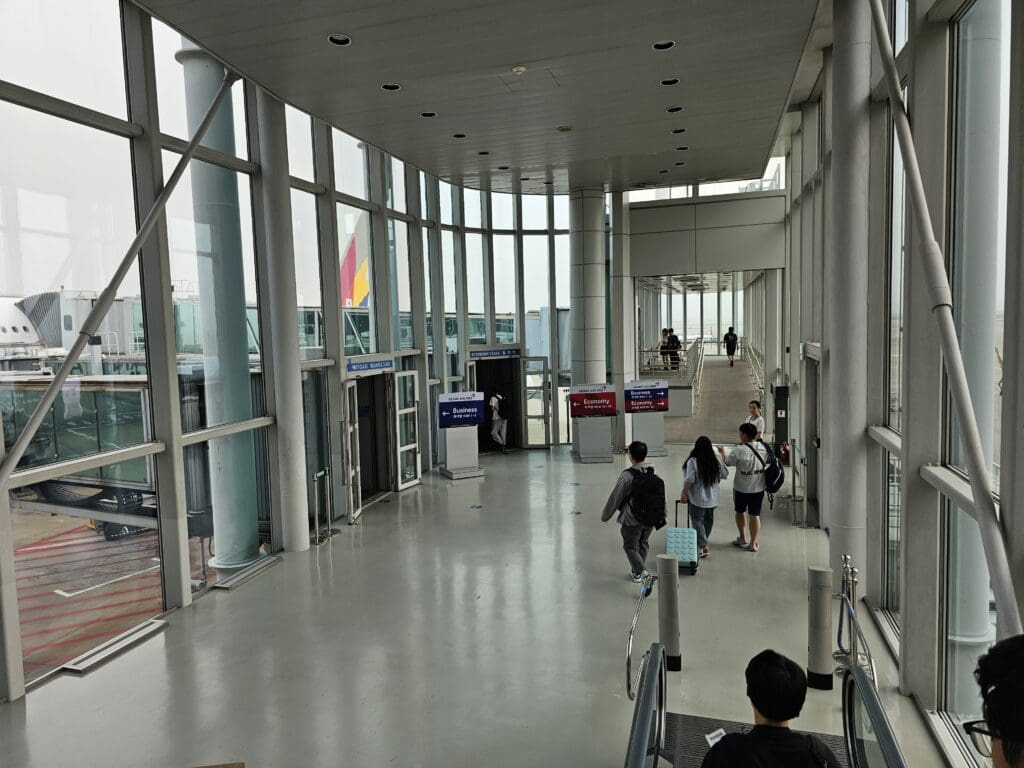
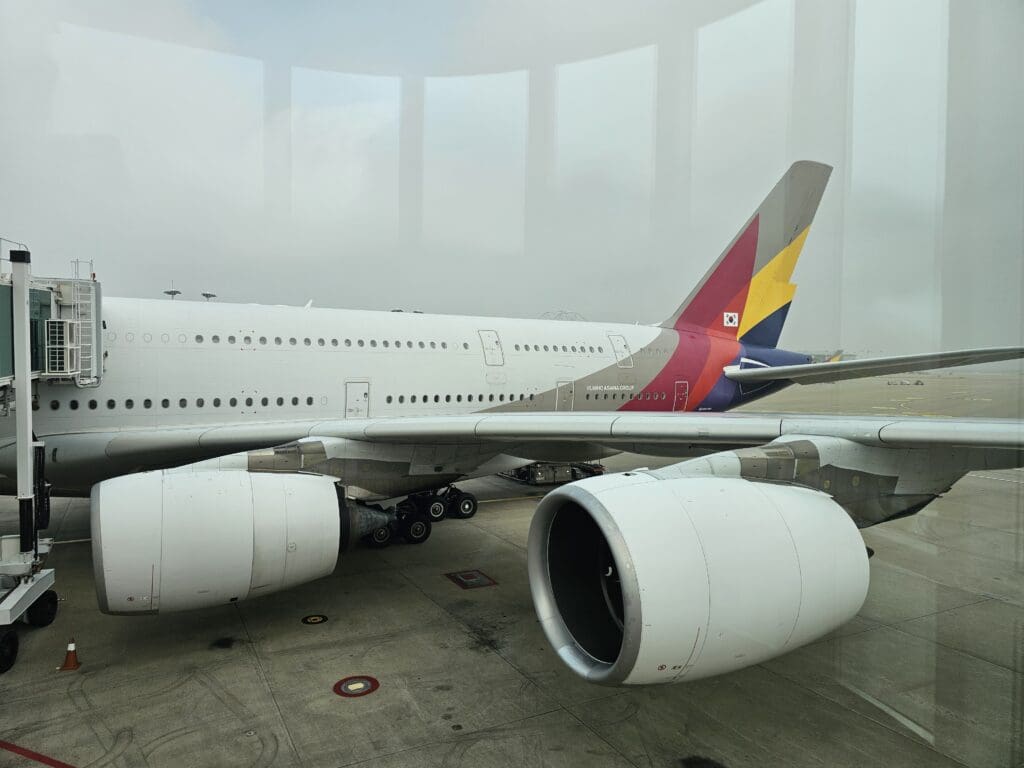
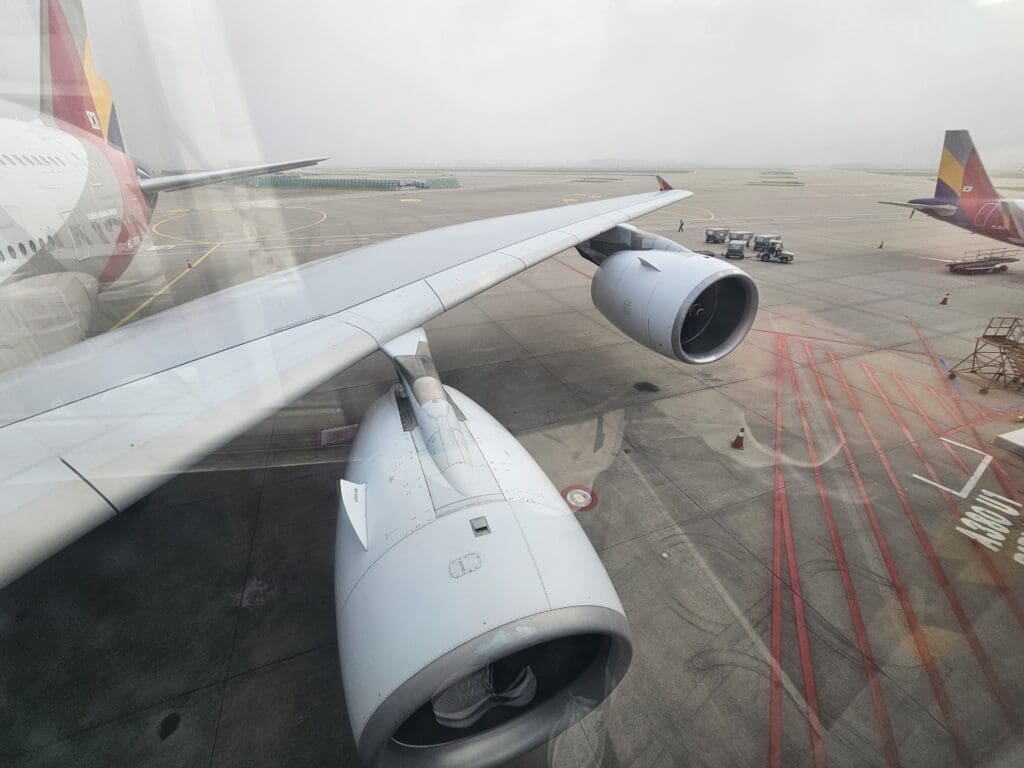
Being rather eager to jump onboard, I ended up near the front of the Economy queue and it thus took me no more than a minute to reach the gate podium. Once there, my boarding pass was scanned before the friendly gate agent wished me a nice flight. From there, I headed down the escalator before reaching the entrance to the three jetbridges where several signs had been erected advising passengers which jetbridge to head down as per their seat number. Meanwhile, two staff were on hand there to offer further assistance if required. Travelling on the upper deck, that morning I made my way down the single jetbridge connected to the upper deck. Whilst this was to be my sixth ride on an Airbus A380, and my second ride on the upper deck, this was the first time I had enjoyed the novelty of boarding via an upper deck door! As I trundled along, I stopped to take a few photos of the Airbus A380’s curved wing before reaching the cabin door where no queuing was required before stepping onboard.
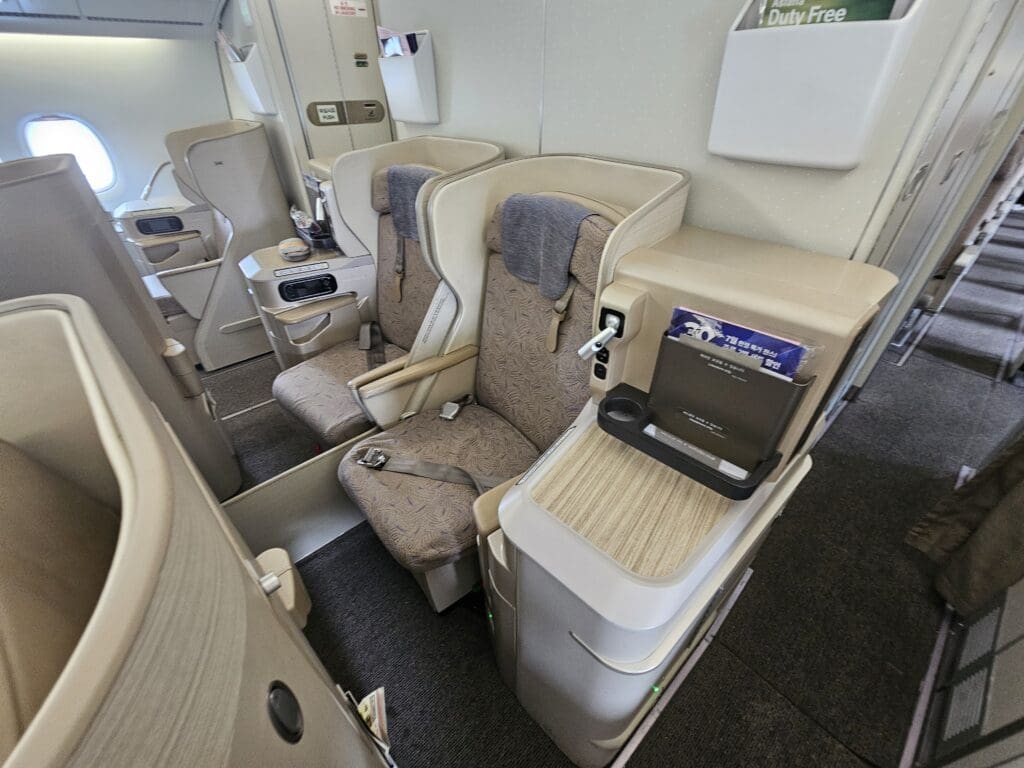
Leaving a very positive first impression of the crew, as soon as the two flight attendants standing at the door spotted me trundling down the jetbridge towards the aircraft, I received a warm and friendly greeting in Korean and English before I had even stepped aboard! Upon doing so, I displayed my boarding pass and was advised to head down the first aisle, where I almost immediately entered the larger of the Airbus A380’s two ‘regular’ Business Smartium cabins. The seats there are arranged in a 1-2-1 layout, taking the form of lie flat semi-suites. These seats are definitely luxurious and were perhaps top-of-the-range when the Airbus A380 first entered service with Asiana Airlines back in 2014, however upon first glance, they appeared to lack the same levels of privacy as is offered by several top Business class products today, including Korean Air’s Prestige Class Apex suites. Those who have flown with Asiana Airlines will know that their onboard colour palette revolves around a calming beige, and each seat in Business was covered in a beige fabric cover that sported a few dark blue swishes.
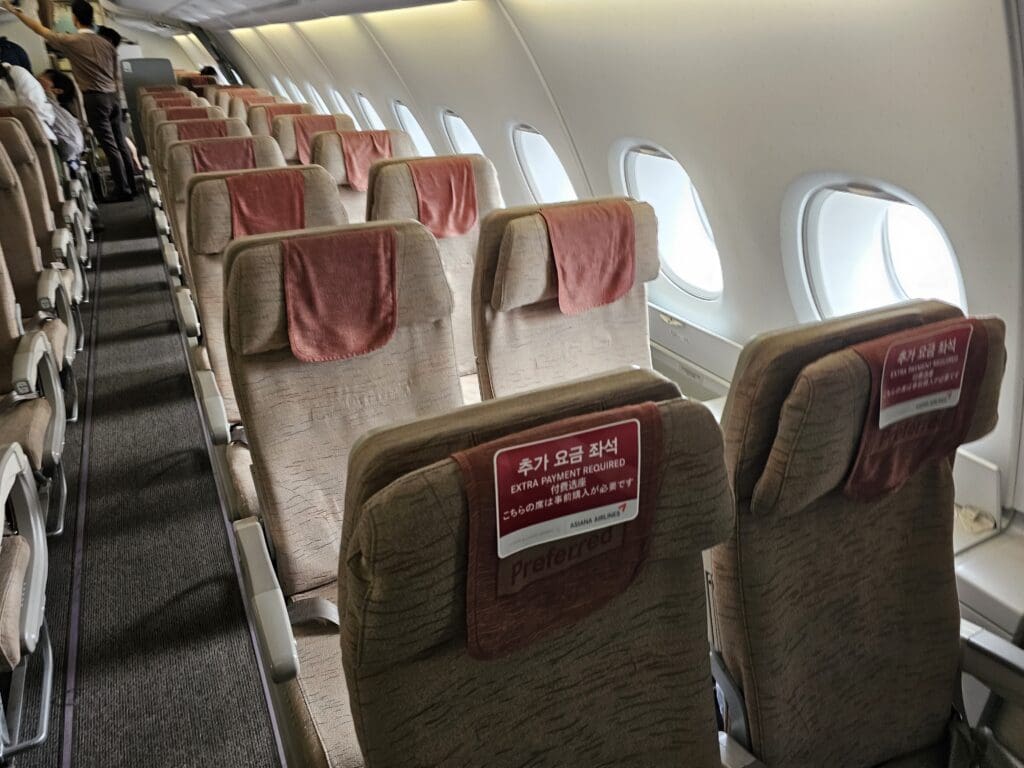
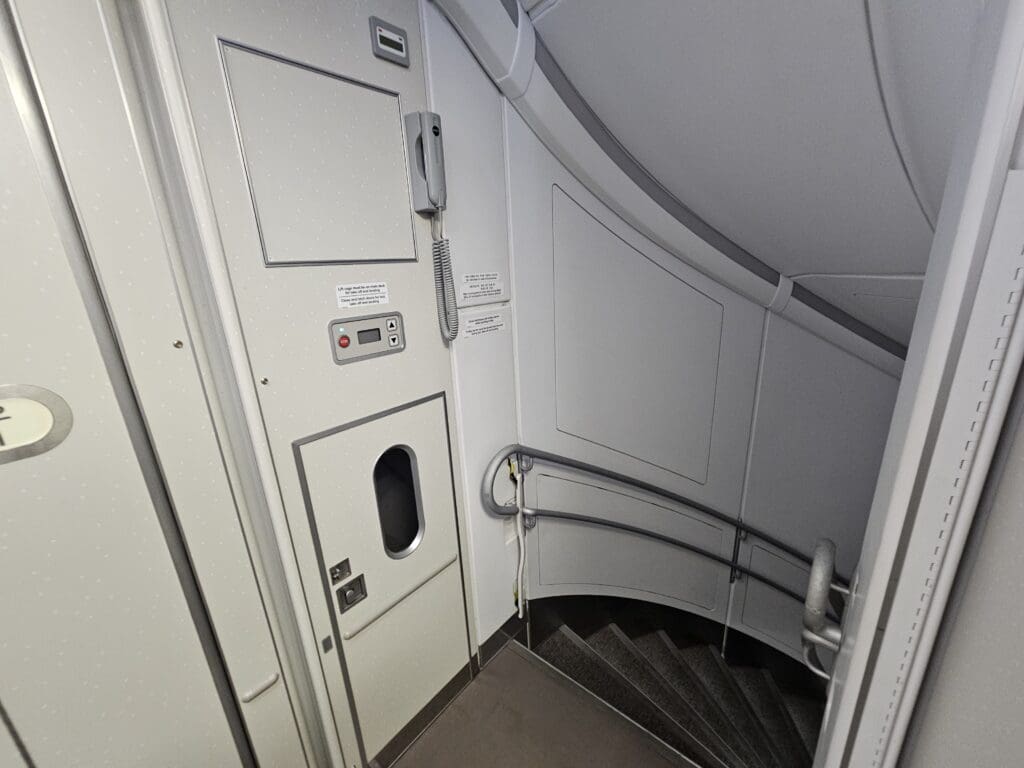
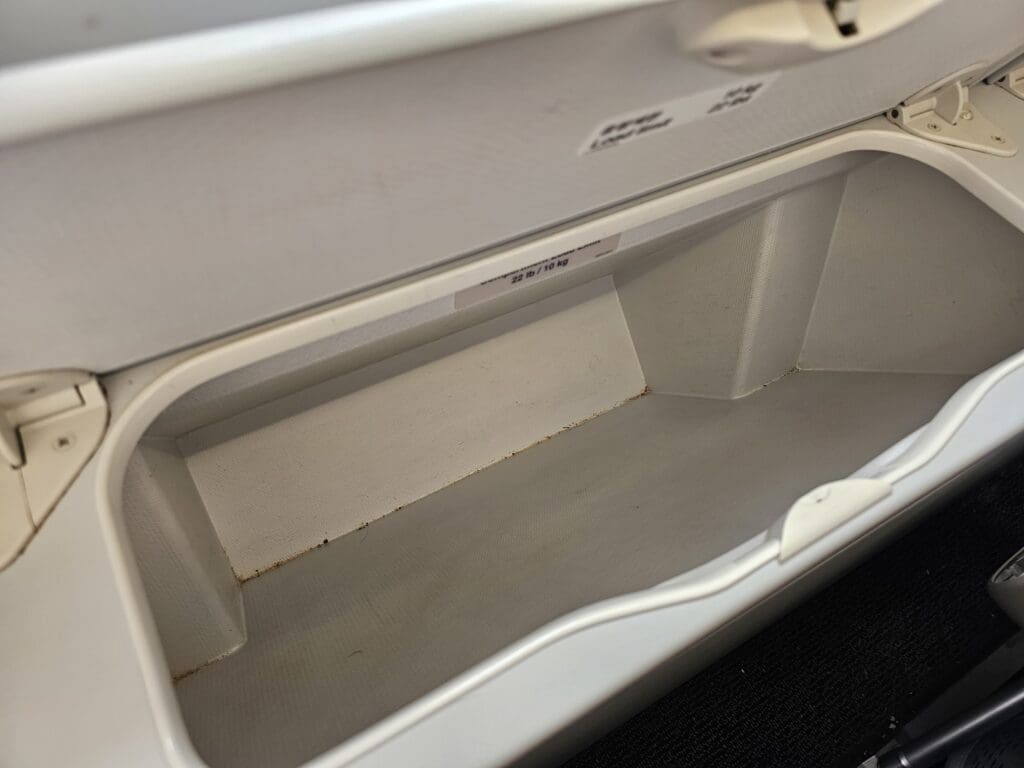
Without too much waiting, I made it through the Business class cabin and received a friendly greeting from each flight attendant that I passed in the process before I made my way through the line of lavatories that separates the Business cabin from the small Economy cabin at the rear of the upper deck. There, a total of 82 modern Zodiac Aerospace seats could be seen, each of which featured Asiana Airlines’ standard Economy class design, sporting beige fabric covers on which subtle multicoloured swirls could be seen, along with a red fabric antimacassar that partially covered each seat’s adjustable headrest. Examining these in slightly more detail, each seat came with a coat hook, a bifold tray table, a USB-A port, a seatback pocket, a universal power outlet and a pull-down footrest, whilst a large high-definition inflight entertainment screen and controller could be found on the rears of these. Additionally, those travelling in the window seats of the upper deck Economy cabin are also afforded the luxury of their own storage compartments beneath the windows.
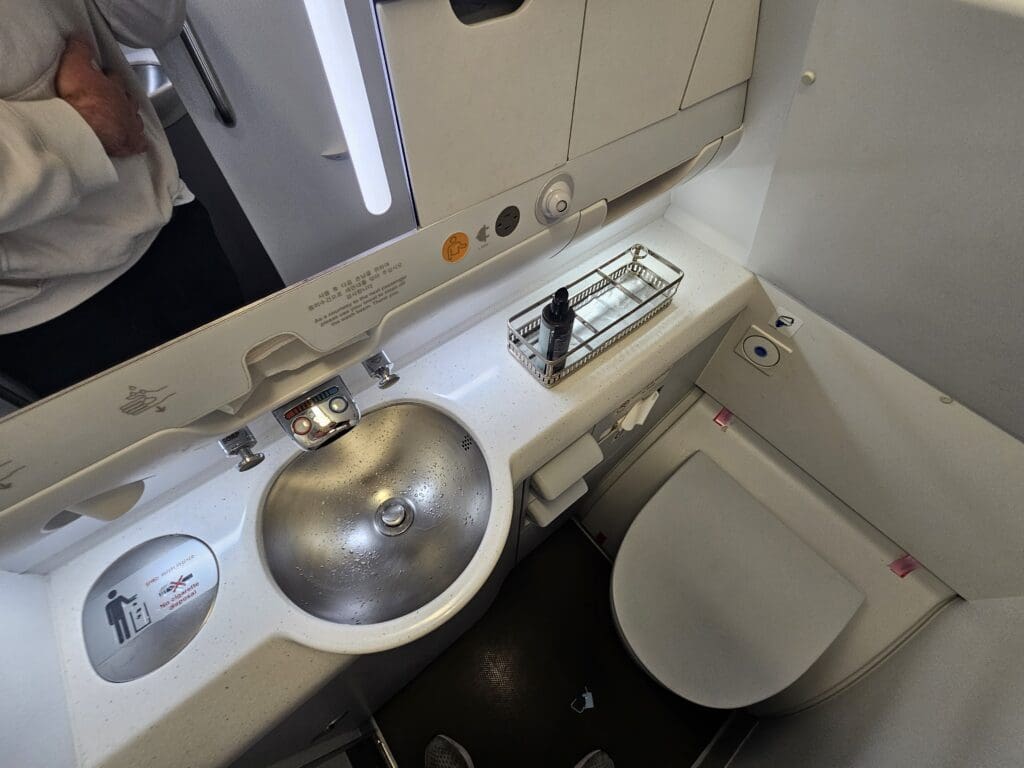
Moments after entering the Economy cabin, I reached my seat in the third row and after storing my bag in the overhead locker, I decided to head to the lavatory at the rear of the cabin. Opening this up, I found this to be in a clean and tidy condition and stocked with the basics thus leaving me with absolutely nothing to complain about.

Upon returning to my seat, I sat down and settled in for the short journey ahead. Despite the seat’s relatively thin appearance, I was pleased to find this to be well-padded, comfortable and highly spacious. This led me to conclude that I would have had absolutely no qualms with sitting in this for a long transpacific slog. Meanwhile, this was in good condition, with few signs of wear and tear, and crucially, other than some well-ingrained stains in the storage compartment, this appeared to have been cleaned up to a high standard. However, this was inevitably assisted by the Airbus’ low utilisation rate at the time of my flight. Turning to the seatback pocket, this featured the all-important safety card and sickbag, as well as a copy of Asiana Airlines’ chunky duty free catalogue, an order form and a laminated card advertising 30% off spirits when purchased as a pair. Finally, a packet of rather standard Economy-quality headphones had been placed in the seatback pocket for those who wished to use the inflight entertainment system.
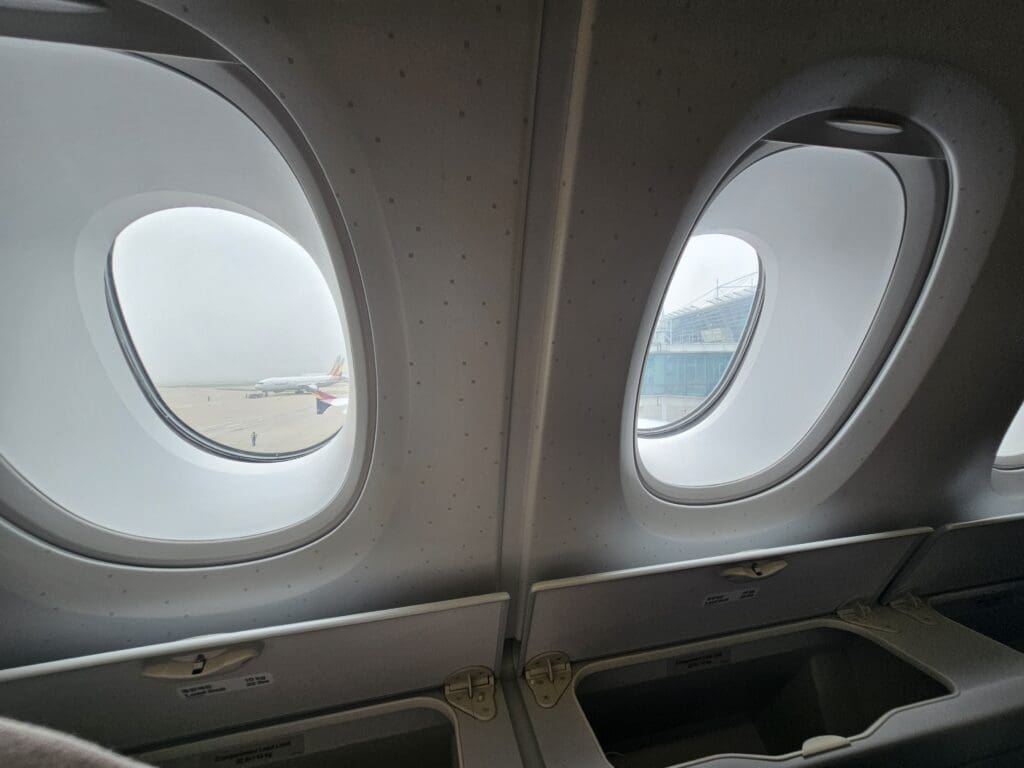
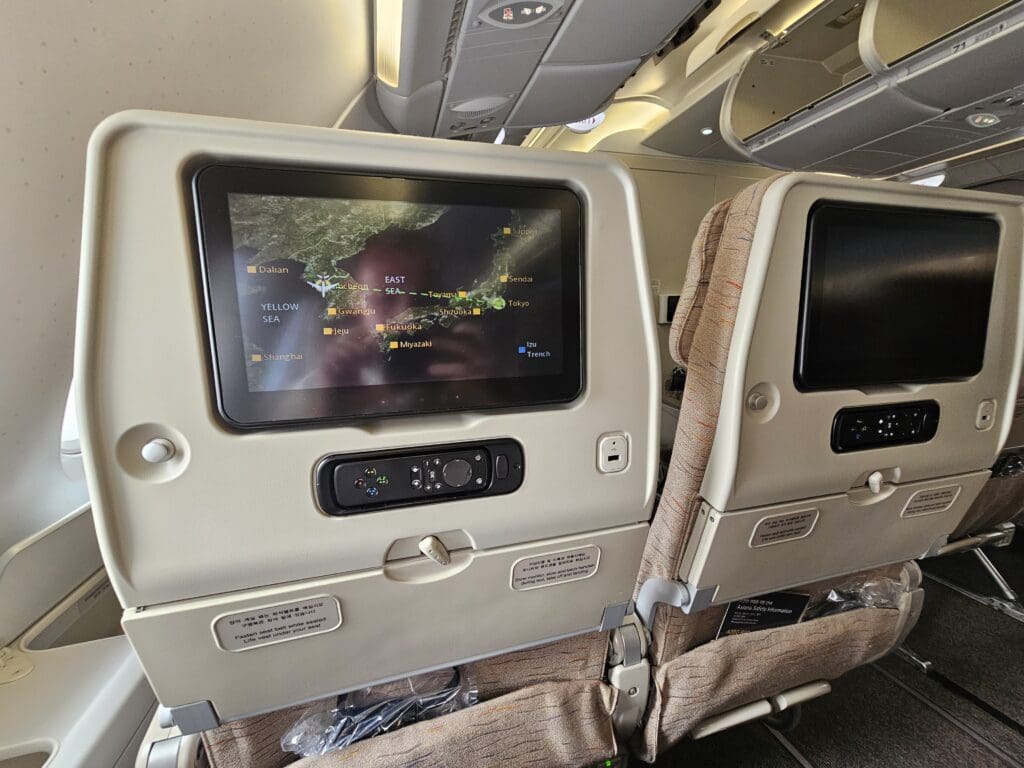
Once seated, I looked outside and watched as the Sharklet-equipped Airbus A321 at the neighbouring gate was pushed back at the start of its short journey to Fukuoka. Inside the cabin, upbeat piano music provided the soundtrack to boarding as passengers filtered onto the aircraft whilst the inflight entertainment screens were locked on the moving map channel and could not be used until after the safety video had been broadcast. As time passed, more and more passengers joined me in the rear cabin and once boarding had concluded, the cabin seemed to be about 70% full. As often seems to be the case, the neighbouring seat remained empty for quite some time, giving me hope that I would be in for an even more spacious ride over to Tokyo, however, this ended up being taken by one of the final passengers to board. Nevertheless, given the already spacious and comfortable seat, and the fact I was in for just a two-hour hop, this was no major disaster.
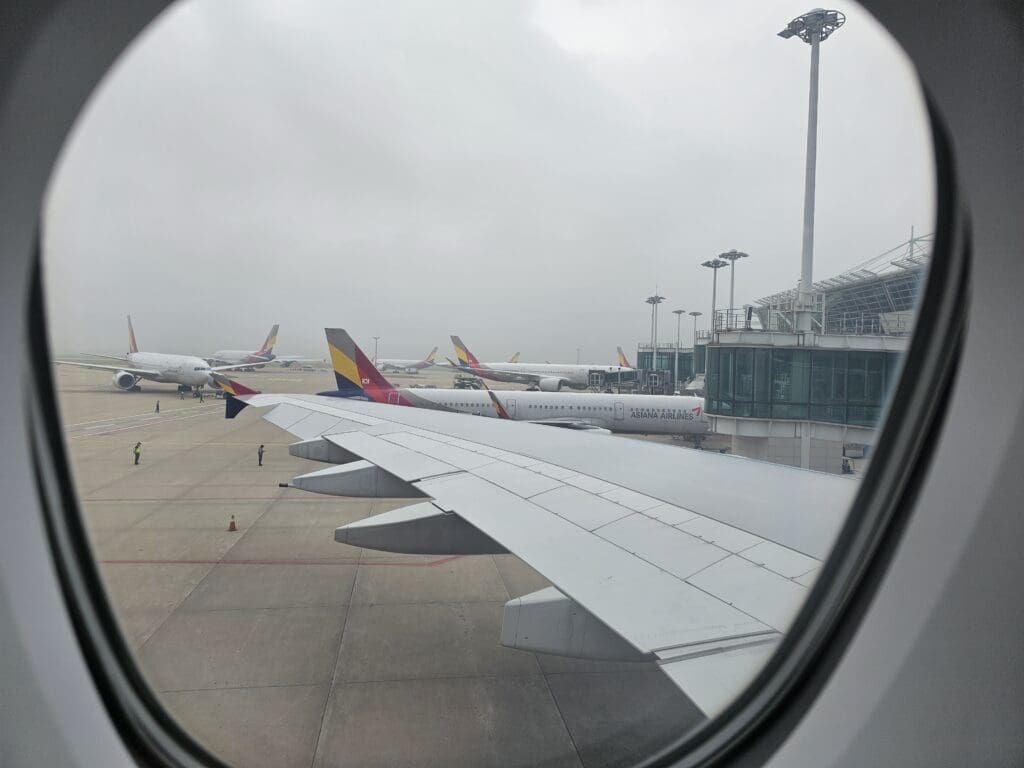
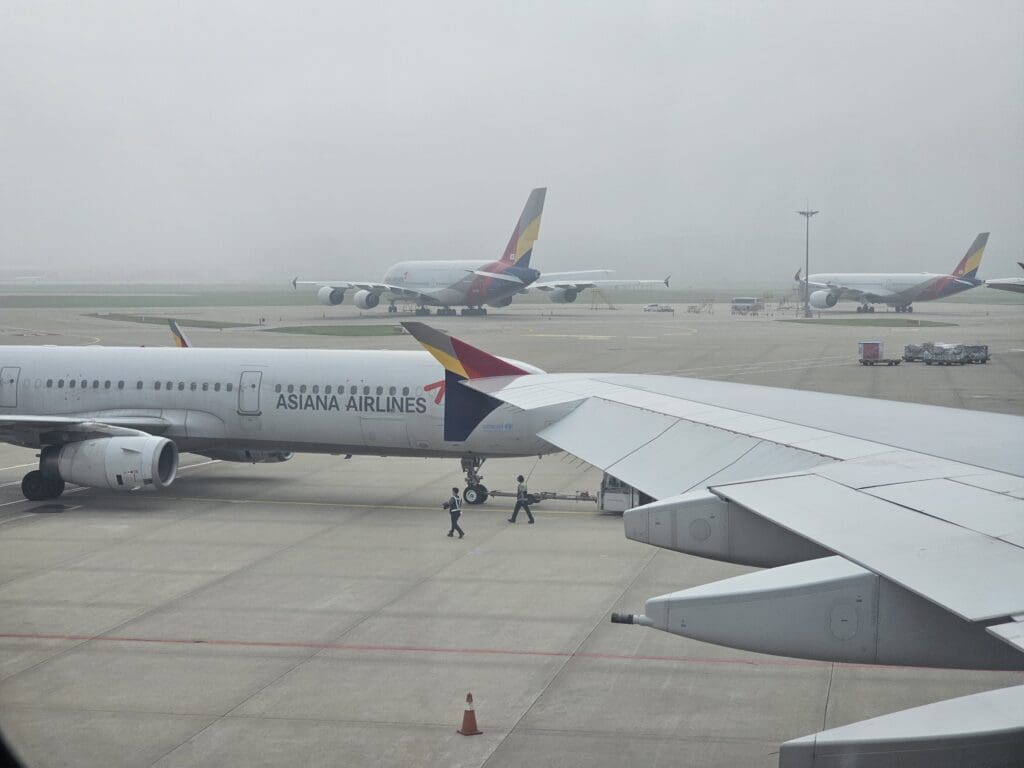
That morning, boarding was an efficient process and came to an end at 0847, a total of 27 minutes after this had commenced. Once all were onboard, one of the flight attendants performed the first short announcement of the flight which consisted of the usual welcomes, thanks and warnings regarding seat belts. This was performed in Korean and English before a Japanese-speaking crew member undertook this in Japanese. Once this had finished, Captain Im performed a short welcome announcement in Korean and English whereby they thanked passengers for flying with Asiana Airlines, noted our 1H50 flight time to Tokyo Narita and gave an update on the weather in the Japanese capital. Looking outside, as the Captain’s tones filled the cabin, ground staff could be seen some distance below removing the cones and last the of the ground service equipment from around the aircraft, indicating that we would make a punctual departure from Incheon that morning.
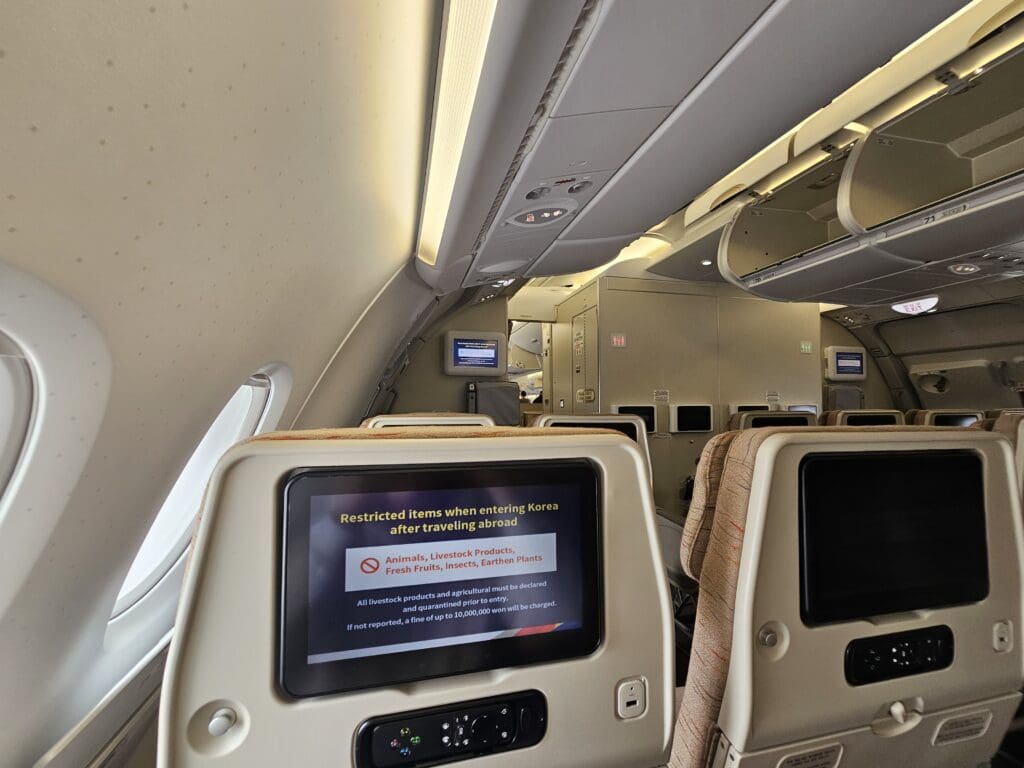
Following the Captain’s welcome, the Purser commenced a longer welcome announcement in Korean and slightly British-accented English, before the Japanese-speaking crew member translated this. This went through all the usual thanks, information and warnings, yet offered little by means of any sort of memorable speech to kick things off (not that this was expected or required! ). As the Purser undertook their welcome, the very polite and friendly middle-aged gent who appeared to be looking after my section of the cabin passed through this displaying a tablet that featured a QR code that linked to the online Japanese customs and immigration declaration forms, and they encouraged passengers to fill these online prior to departure. Interestingly, this was the first time that I have ever been asked to fill out an online immigration declaration rather than a paper one, this included when entering Japan on Japan Airlines two weeks before this trip! Nevertheless, religiously following the crews’ instructions, I opened this up on my phone and managed to submit all the required information and receive my QR code just before the safety video took over the inflight entertainment screens.
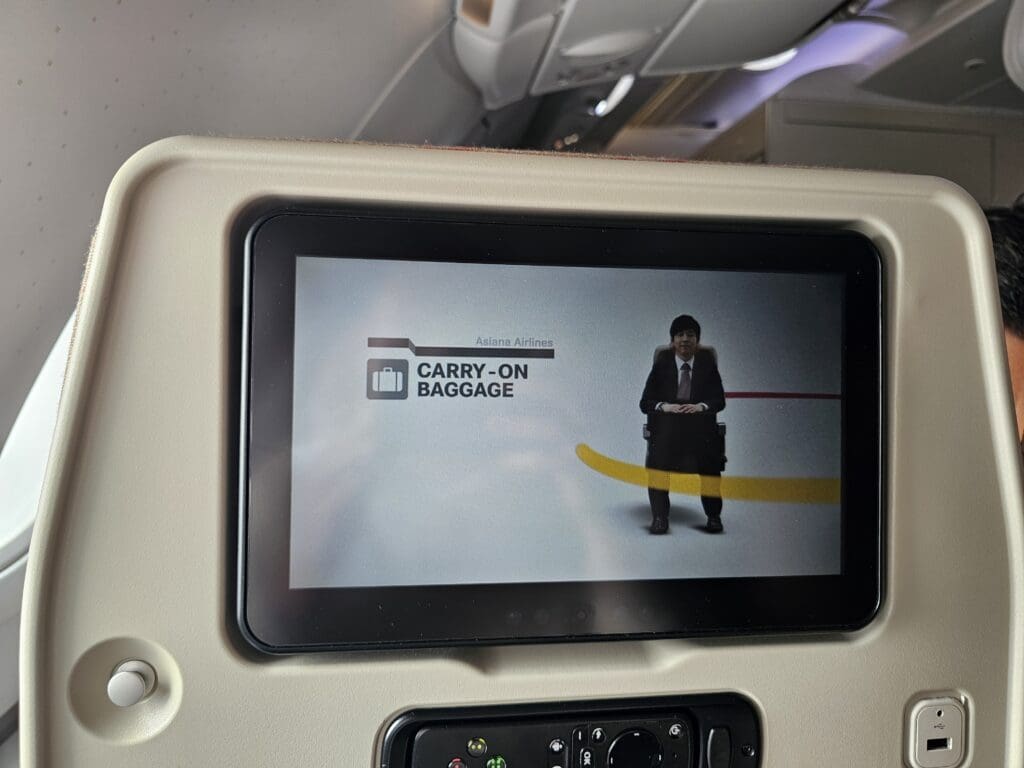
Those expecting any sort of actors or K-Pop stars to make an appearance in Asiana Airlines’ safety video will be disappointed, as this is a plain, simple and gimmick-free production that crucially highlights the vital safety instructions and does little else. However, this is by no means a complaint! That morning, this was broadcast in Korean and English, and accompanied by Japanese subtitles. Once this came to an end, the inflight entertainment system became usable and I decided to switch to the nose wheel camera which revealed the ground crew members undertaking their final preparations before the aircraft pushed back away from its stand.
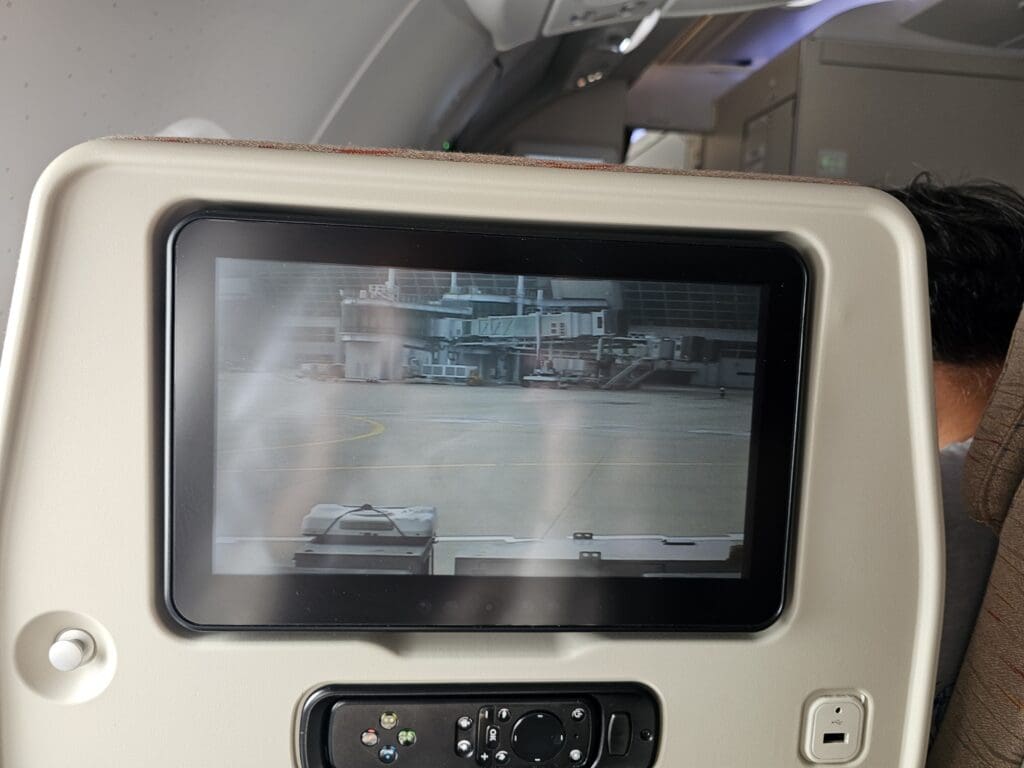
Keeping to schedule, as soon as the clock struck 0900, the Airbus jolted backwards and our pushback commenced. Whilst this was underway, the crew made their way through the cabin, taking their time to ensure that absolutely everything was safe and in place for our departure from Incheon. Upon coming to a halt, the tug was disconnected and one by one the Airbus’ four gigantic Rolls-Royce Trent 970 engines spooled into life without too much noise or vibration, however, this was perhaps explained by my position on the upper deck of the aircraft. After several minutes, with all four engines having successfully spooled up and the tug disconnected, the ground crew waved goodbye to the aircraft and we powered away from Terminal 1’s main terminal under our own steam and left the sea of Asiana Airlines aircraft behind. From our stand, the Airbus soon reached the satellite terminal, which at that time seemed to be a hub for Vietnam Airlines as a pair of Boeing 787 Dreamliners and a single Airbus A321 could be seen waiting for their next missions down to Southeast Asia.
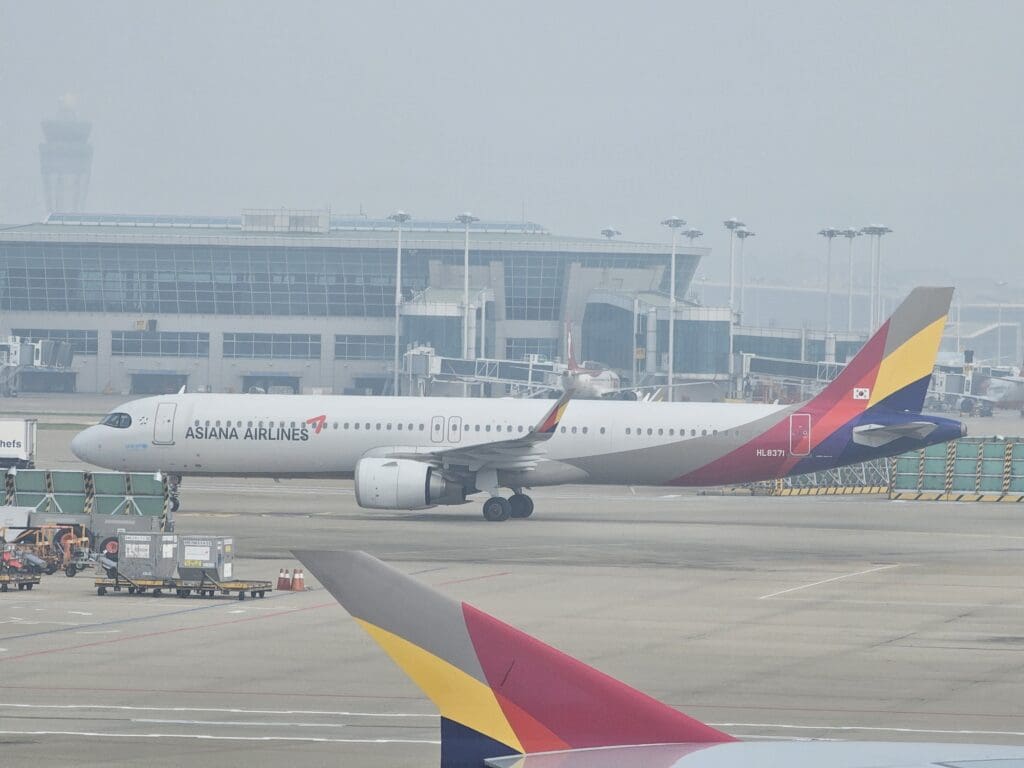
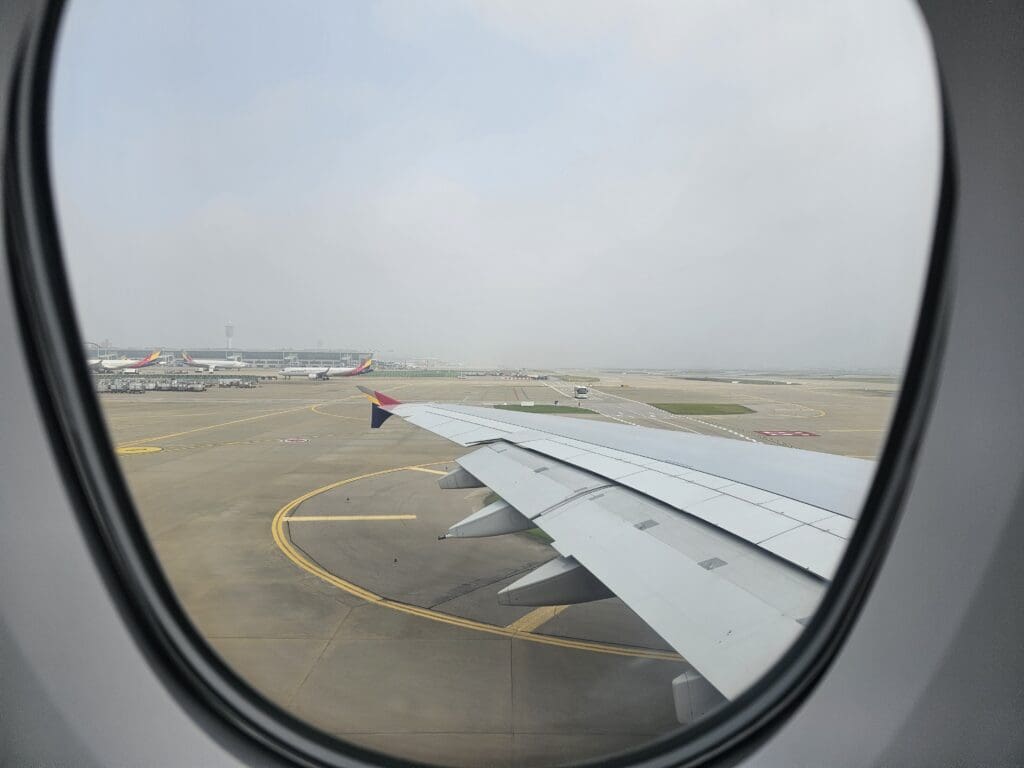
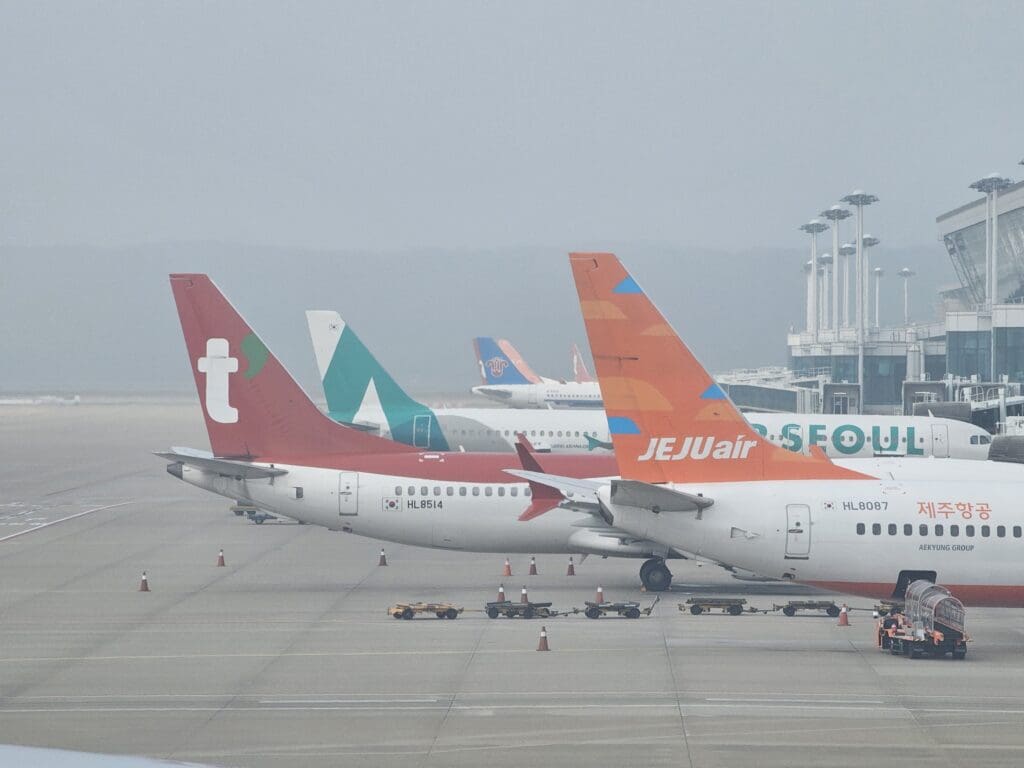
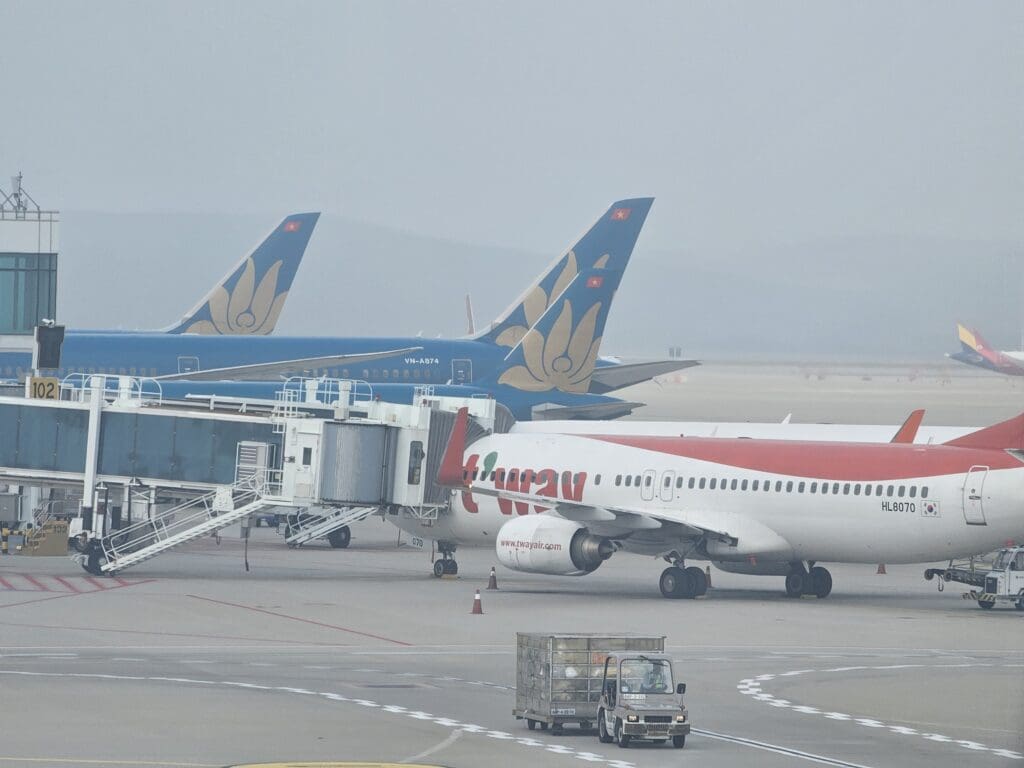
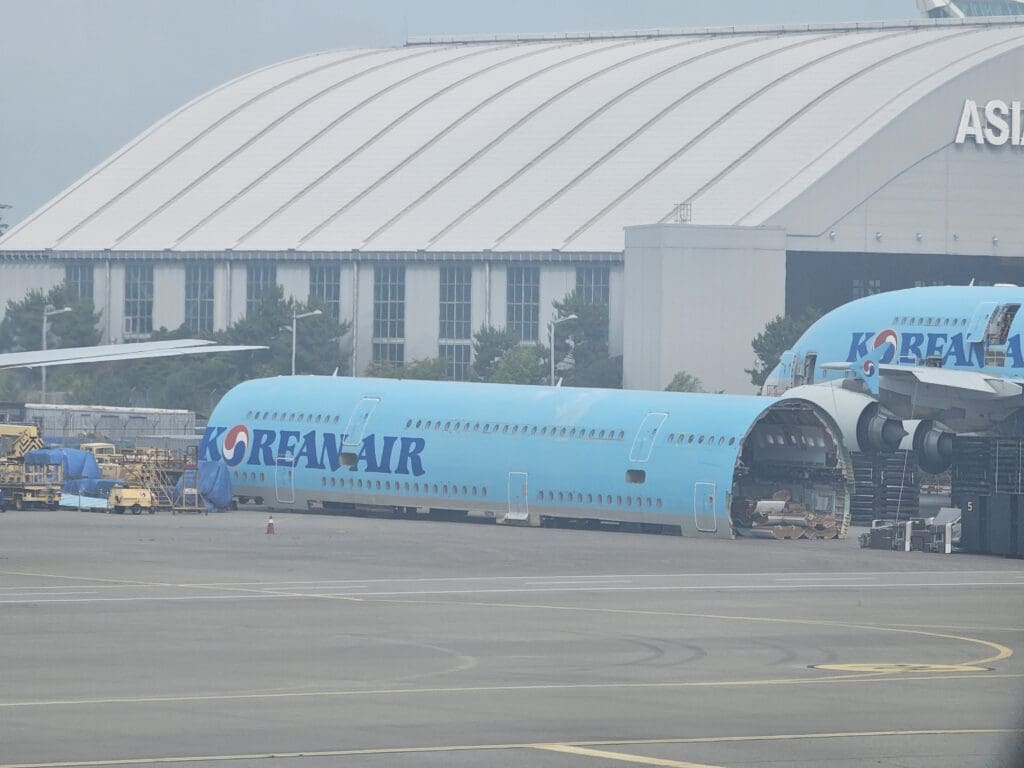
After passing the satellite terminal and the remote stands that sit in between this and Terminal 2, the Airbus trundled past Korean Air’s modern hub of operations. There, a sea of Korean Air jets could be seen along with a few silver and lime green Boeings operated by their low cost subsidiary, Jin Air. At that time of the morning, the most interesting aircraft there took the form of a couple of Boeing 747-8 jets, one of which would be following us to Tokyo Narita! Soon passing Terminal 2, the aircraft made its way past Korean Air’s maintenance area where I spotted the sad sight of a chopped-up Airbus A380, with another example standing next to this, in the midst of being parted out. Following a relatively short taxi, the Airbus made it to the end of Runway 15R and once there, without pausing, the aircraft taxied onto this before performing a powerful rolling take-off.
Sitting on the left-hand side of the aircraft, as we rolled down the 3.75-kilometre-long runway, Incheon Airport’s massive cargo terminals came into view. With the airport serving as the world’s fifth busiest for cargo traffic, as always seems to be the case, rows and rows of freighter aircraft from across the world could be seen waiting for their next missions. These ranged in size from Boeing 737-800Fs operated by lesser known Korean carrier Air Incheon, right up to Boeing 747 Freighters operated by Asiana Airlines Cargo, Atlas Air, Kalitta Air, Korean Air Cargo and UPS. Indeed, thanks to its high volume of freighter traffic, Incheon Airport is perhaps one of the best in the world to spot Boeing 747s! On my previous Airbus A380-operated flights, I have always found Airbus A380 takeoffs to be rather slow and gentle affairs. However, perhaps being lightly loaded for the short hop to Tokyo, that did not prove to be true that morning and we made a sporty and powerful take-off, soon rocketing into the misty skies. Once up in the air, thanks to the poor visibility, the ground faded away in a matter of seconds, even before we had left the coastline of Yeongjong Island behind.
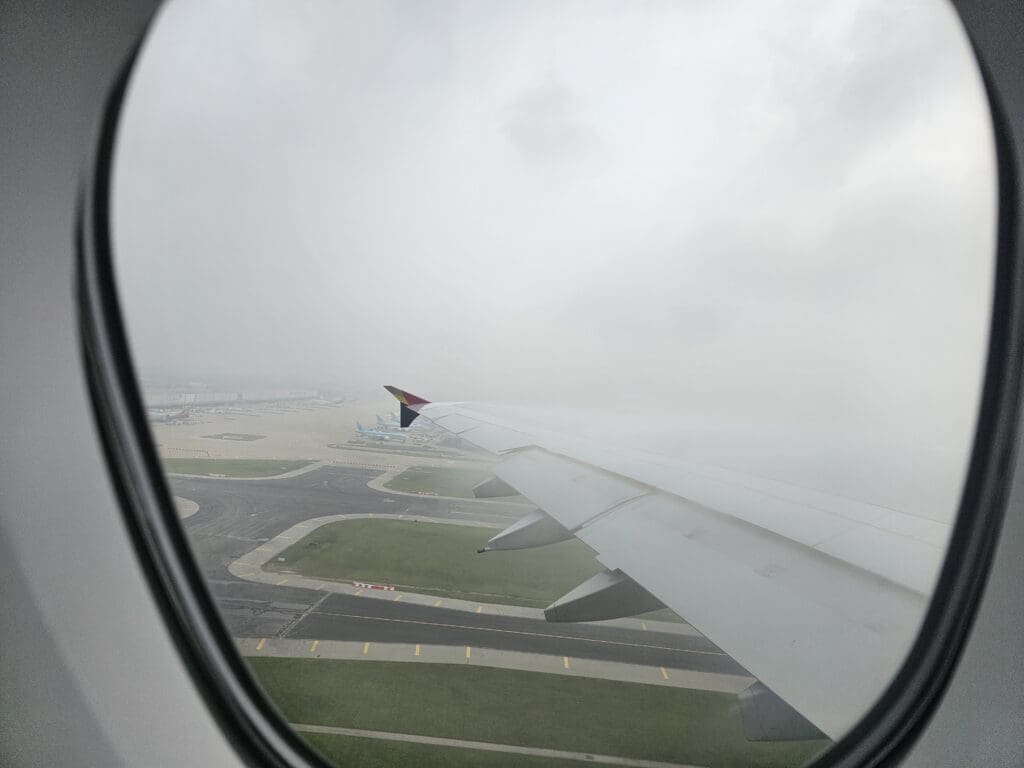
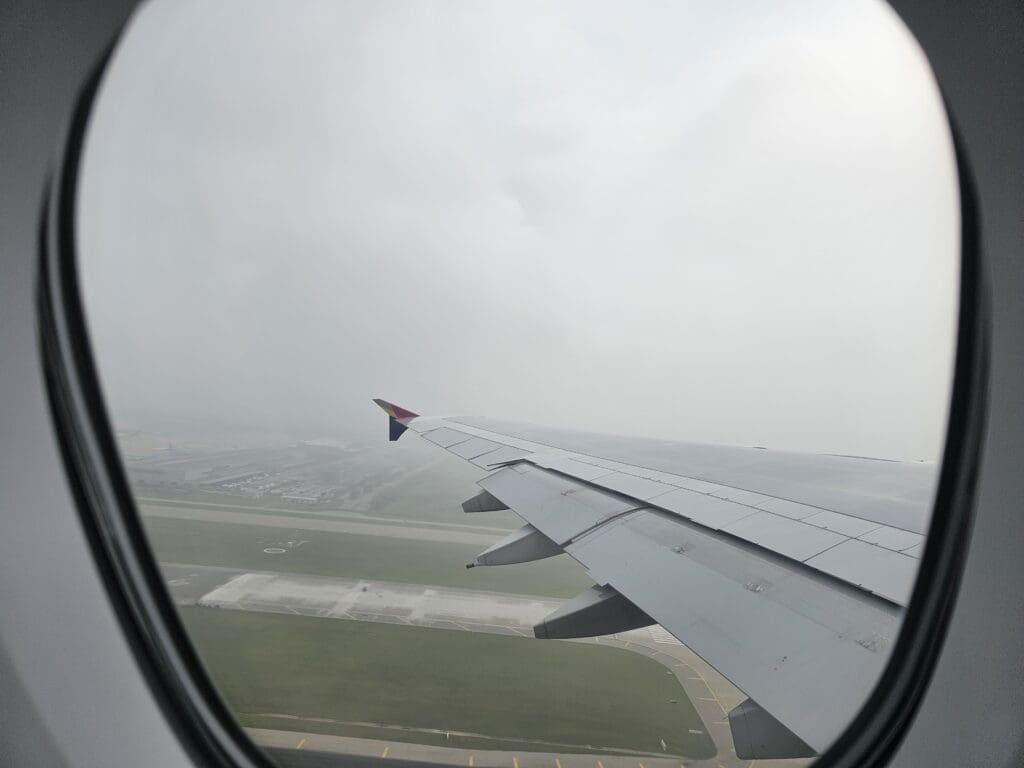
For the first three minutes or so, the aircraft was thrown about a little as we cut through the clouds; however, as soon as blue skies appeared above, things smoothed out and remained fairly calm with few bumps for the remainder of the flight. Had the weather conditions been better, sitting on the left-hand side of the aircraft I would have been treated to wonderful views of Seoul and the surrounding area for the first fifteen minutes or so of the flight, however, sadly, absolutely nothing of Korea’s capital, or indeed of the Korean Peninsula could be seen that morning. Examining our route, that morning the Airbus seemed to make an ENKA1K standard instrument departure from Incheon Airport. This meant that once away from Yeongjeong Island, the aircraft continued heading southwards until it reached the coastline of Ansan, just to the south of the city of Incheon. Once there, the aircraft turned onto an easterly course and we trundled anticlockwise through the skies of Gyeonggi Province, passing the historic city of Suwon, followed by Seongnam, home to Seoul Air Base.
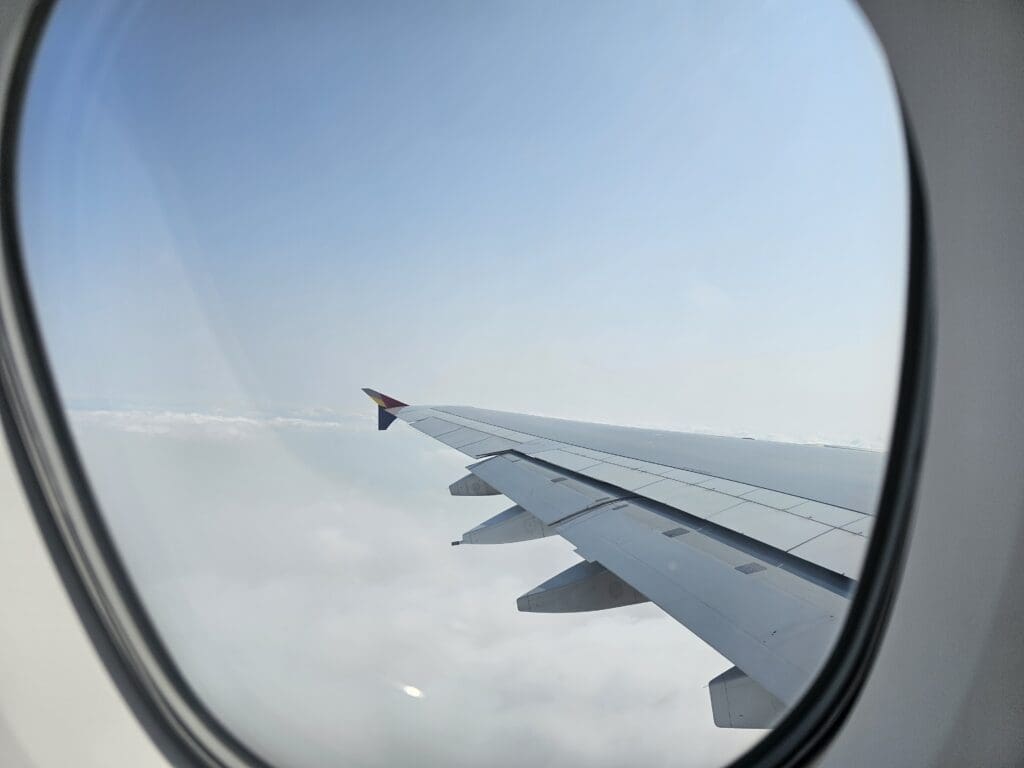
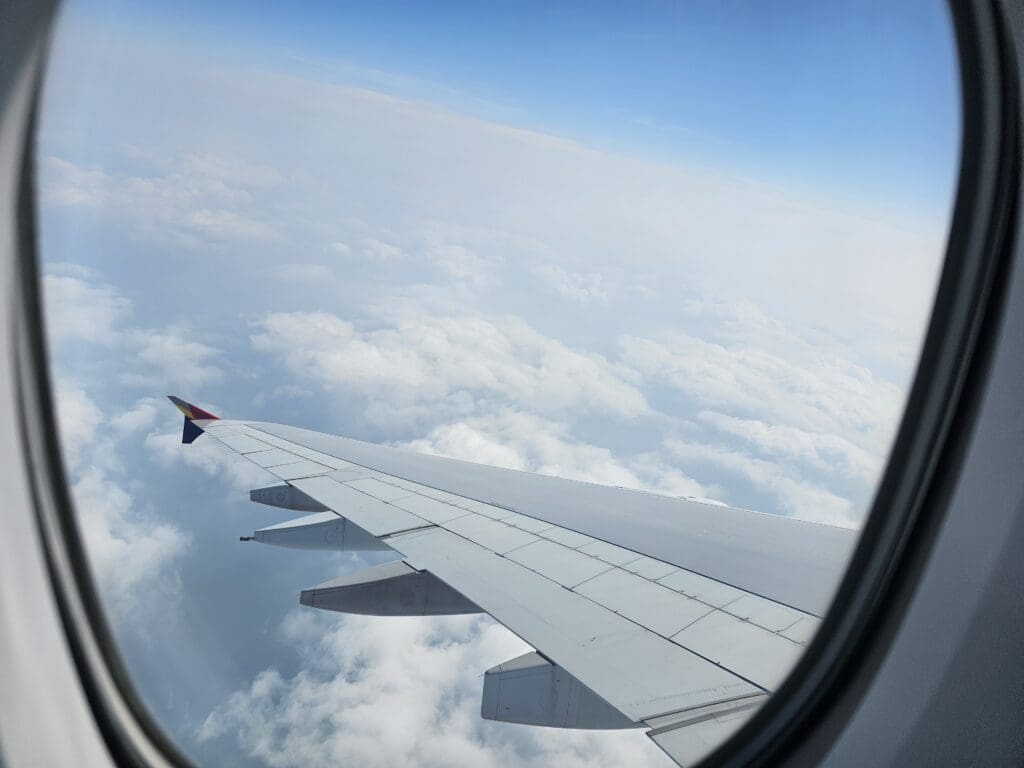
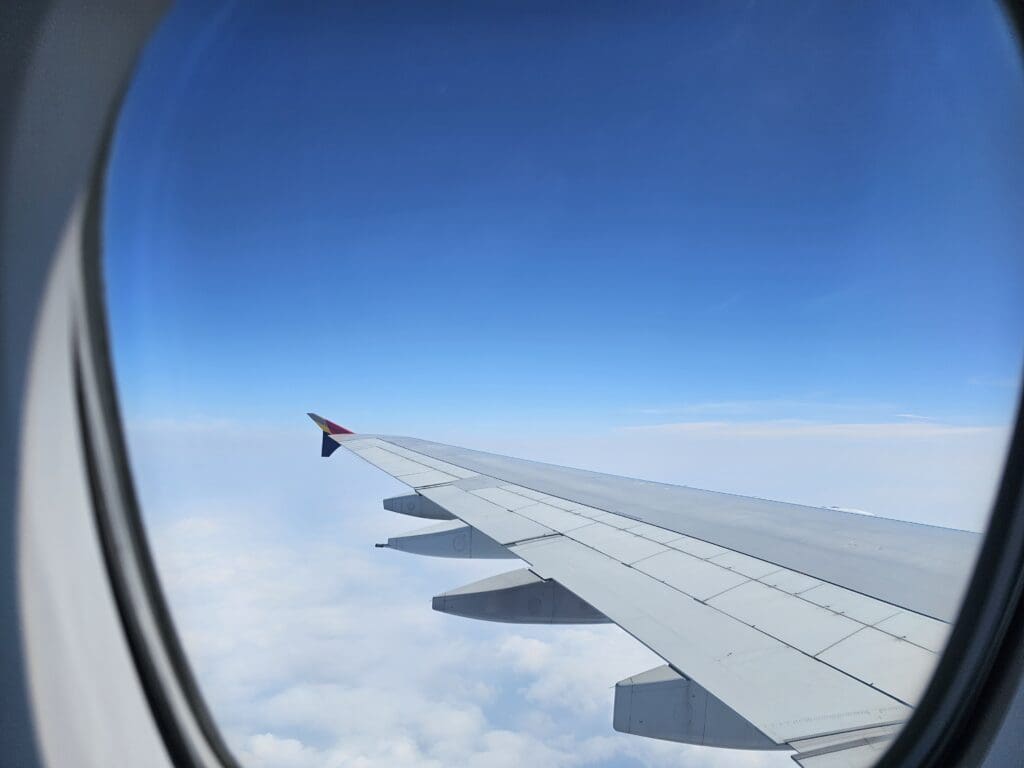
As we passed through 10,000 feet, the seatbelt signs were extinguished and the usual announcement about keeping these fastened was made in Korean, English and Japanese. After this, the inflight entertainment system was interrupted by a brief advertisement that promoted the onboard duty free service. Soon, the scent of warming food wafted through the cabin, indicating that it was almost time for breakfast! During my ride onboard a Japan Airlines Boeing 737-800 in the opposite direction (technically from Tokyo Haneda to Seoul Gimpo) two weeks before this trip, I had been served a snack bag containing a delicious sandwich, fruit juice and a few biscuits. Whilst this had not left me with too much to complain about, route competitors ANA, Asiana Airlines and Korean Air all offer a hot meal to passengers aboard these short flights, so I was looking forward to seeing what was in store for breakfast that morning.
From Seoul, the aircraft headed out over the green mountains of Gangwon Province, although thanks to the clouds, absolutely nothing of the tall peaks could be seen as we cut across the province, trundling past the city of Pyeongchang, famous for being the host city of the 2018 Winter Olympics. From there, the aircraft sped towards Korea’s eastern coastline and passed directly over the coastal city of Donghae around twenty minutes after taking off from Incheon Airport.
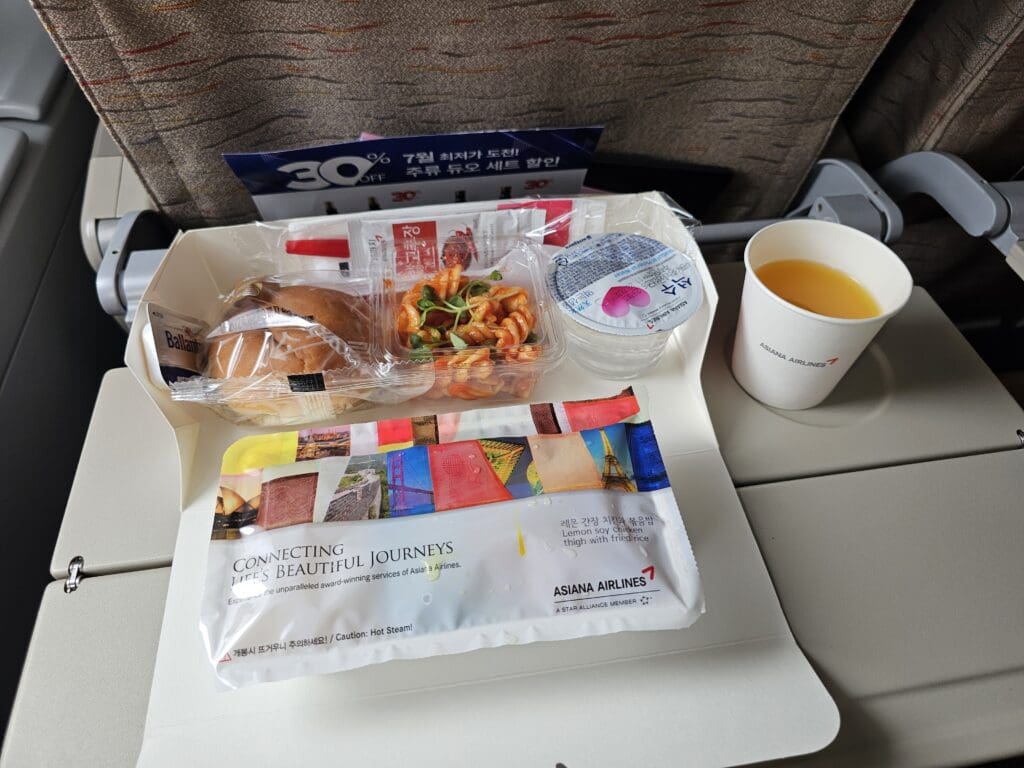
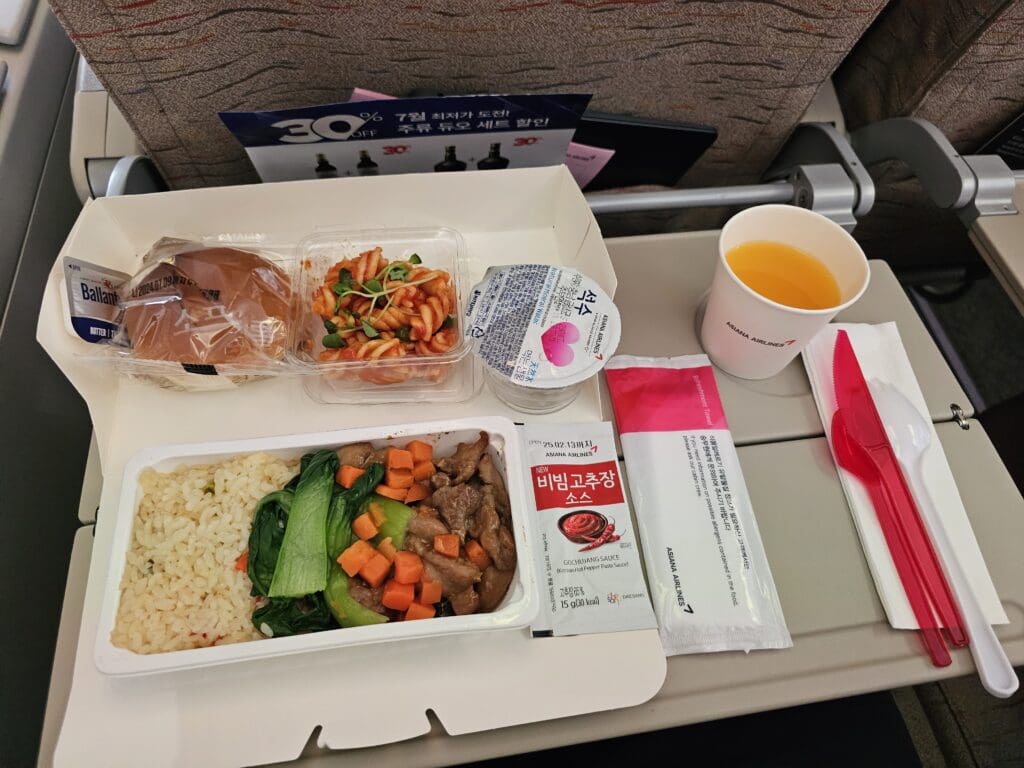
A short time after leaving the coast behind, and as we neared the end of our very slow climb up to 41,000 feet, the friendly flight attendant appeared and handed me a cardboard box containing a cold tomato penne pasta side dish, a tub of still mineral water, a bread roll and butter, as well as a sachet containing plastic cutlery, a wet wipe, a serviette, and of course a sachet of gochujang! A few moments later, the main dish was dished out and took the form of soy sauce-glazed chicken with rice and vegetables. Whilst just one option was available, given the length of the flight this was not a major complaint and far exceeded anything you could expect to receive on a two-hour flight with a European legacy carrier! Additionally, as is always a nice touch, the flight attendant went through the main dish with each passenger as they distributed this. Immediately after I had been handed the main meal, I was offered a cold drink from the surprisingly limited selection which consisted of just Coca Cola, orange juice and still water. Opting for an orange juice, this was poured out into an Asiana Airlines branded paper cup and cautiously handed over to me before I was requested to close my window shade. Soon getting to work, despite not being the most traditional breakfast food, I found the main dish to be delicious and of very good quantity, thereby leaving me with zero complaints that morning. Finally, this was soon followed by a round of hot tea and coffee. Opting for the latter, this was cautiously poured from a metal jug into an Asiana Airlines branded paper cup, and I found this to be of standard quality for an airline coffee.
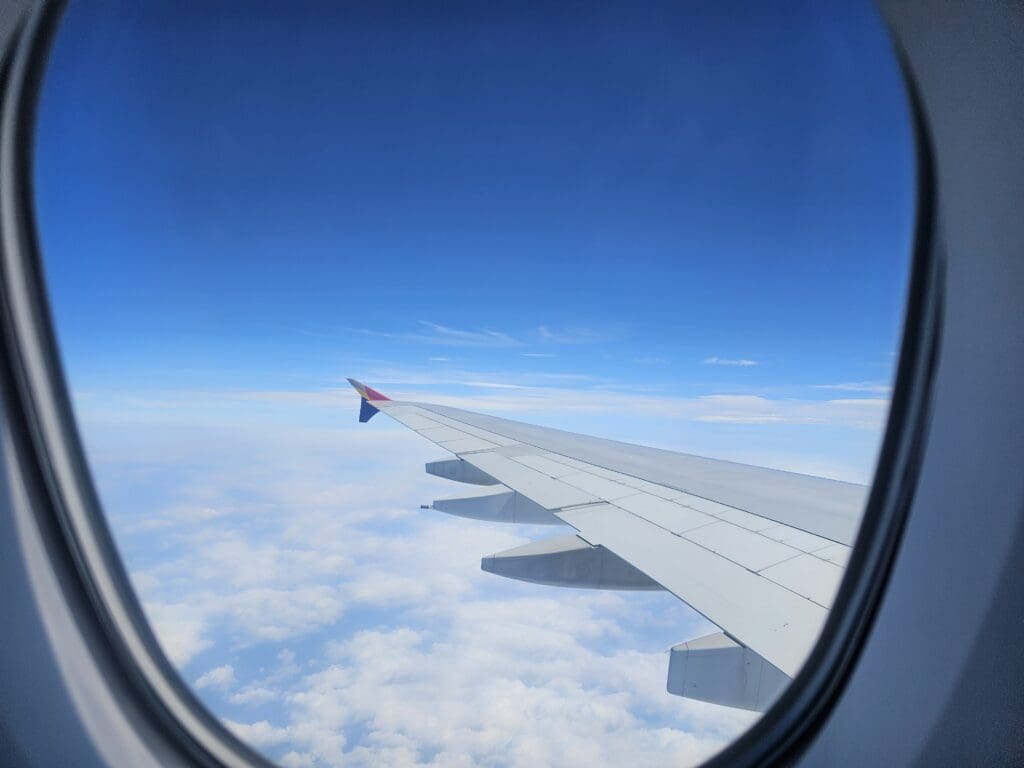
As passengers munched their morning meals, I was delighted to see that the crew were proactive in patrolling the cabin, offering coffee and tea top-ups for those in need of some additional caffeine, and removing the meal boxes of those who had already finished. Around thirty minutes after the meals had been distributed, the flight attendants made their way through the cabin collecting trays and any other rubbish, by which time the aircraft was high above the blue waters of the East Sea. Given the fact that this was a short two-hour morning hop over to Tokyo and not some mammoth overnight slog, I was somewhat surprised at the fact that the crew had requested passengers to close their window shades. However, dutifully obeying their orders, other than opening this for a quick peek which revealed nothing but clouds below, this remained shut for most of the cruise.
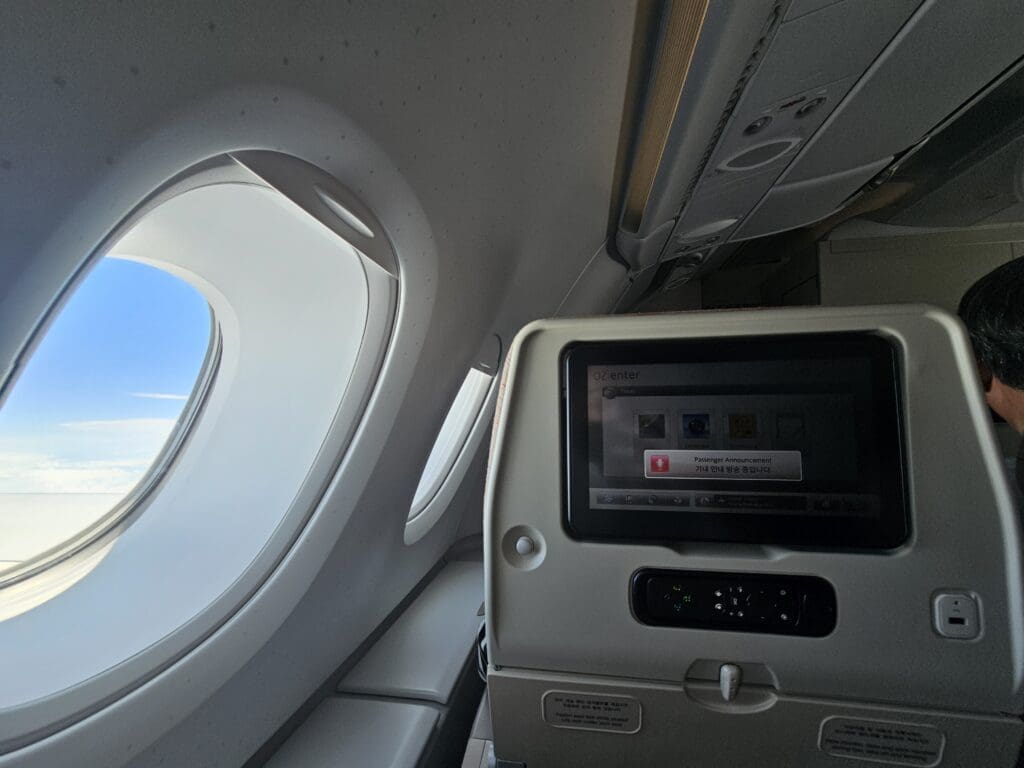
With nothing to see, I decided to turn my attention to Asiana Airlines’ OZ:Enter inflight entertainment system. Starting with the basics, as I had found to be the case on fellow highly regarded Northeast Asian carriers, Japan Airlines and Korean Air, the system was available in the usual smorgasbord of English and three Northeast Asian languages: Chinese, Japanese and Korean. Despite being the regional norm, it would have been nice if this selection had been slightly more representative of the wide variety of destinations served by Asiana Airlines. Once I had selected the English language version, I steamed onwards and began to have a comprehensive look around the system. Examining its layout, I couldn’t help but notice that this seemed to be a little clunky and dated in its appearance and was far behind the sleek and stylish Korean Air system that I had sampled on one of the airline’s Airbus A321neos two days earlier. Nevertheless, for all of its design faux pas, for the most part, the system worked well and was both responsive to touch and easy to navigate.
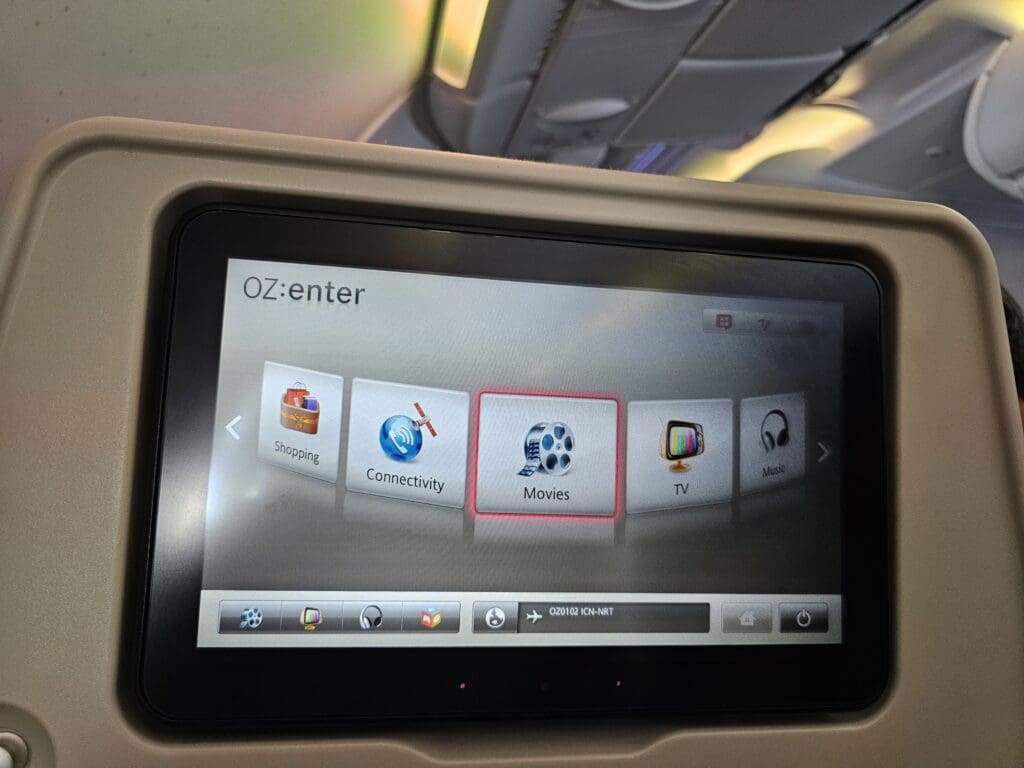
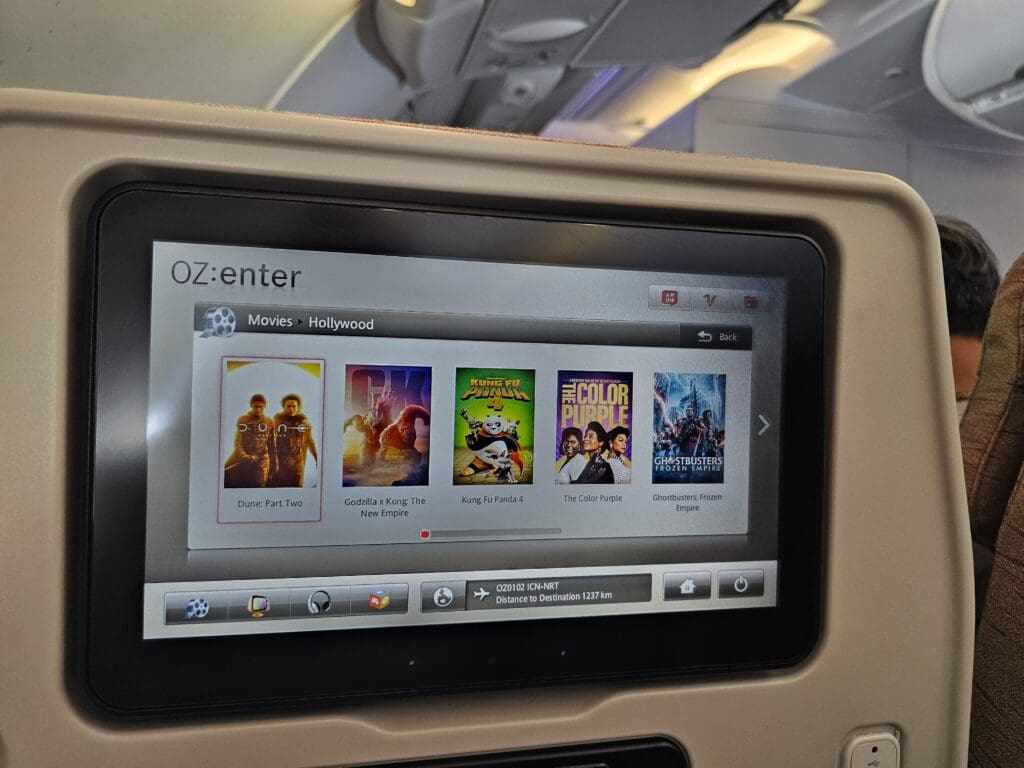
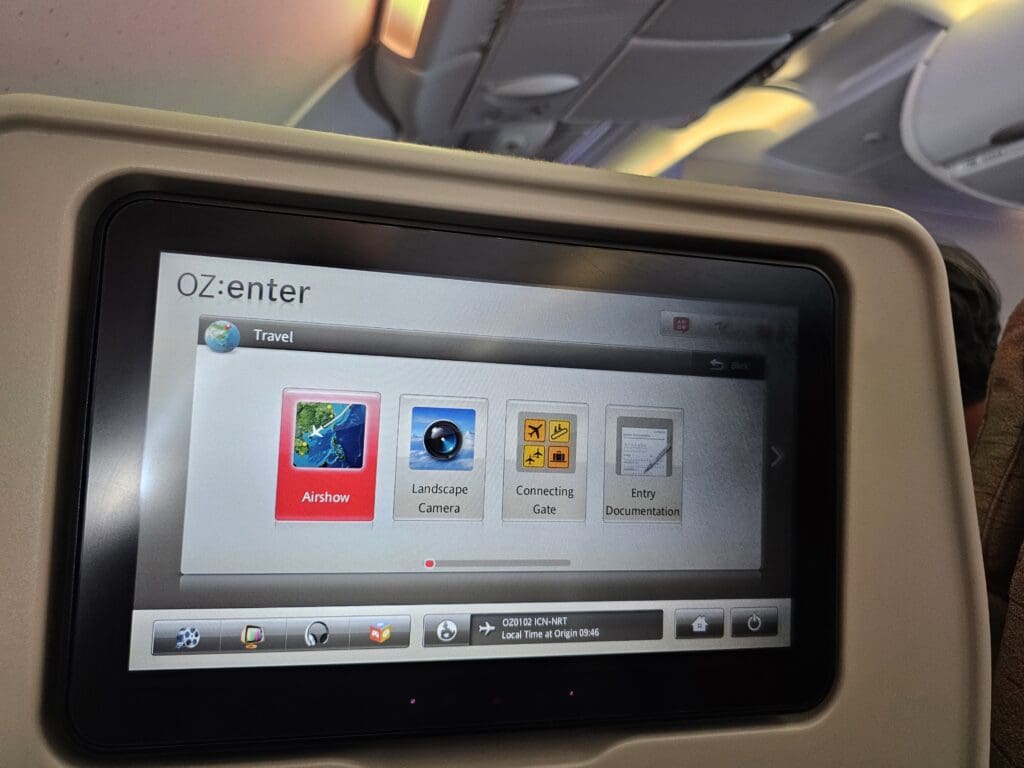
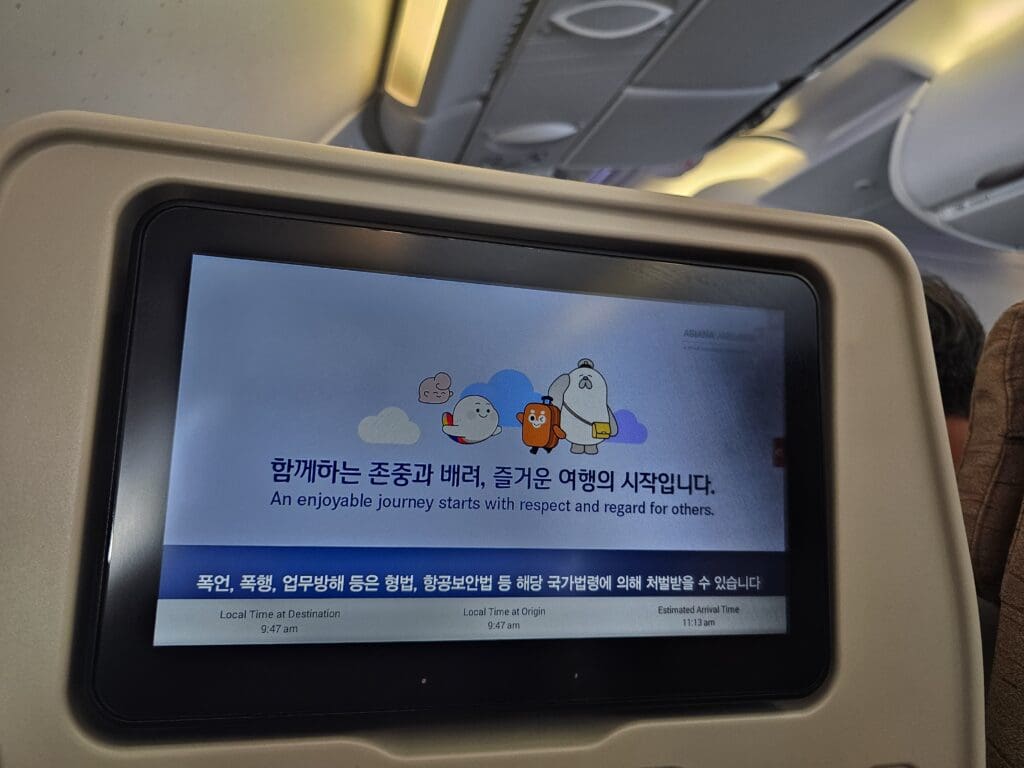
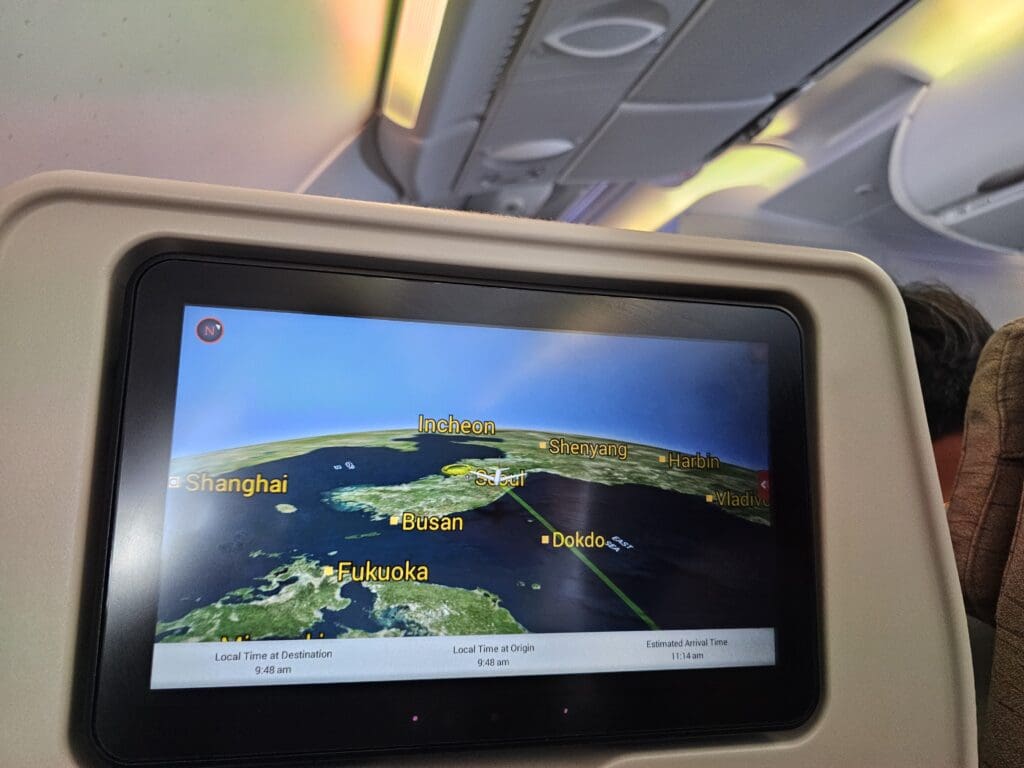
Having read a fair number of Asiana Airlines reviews, it seems that a common complaint (and often the most severe!) is the OZ:Enter system’s lack of content. Browsing this, I found this to come complete with a total of 65 Hollywood films, 38 Korean films, 5 Chinese films, 4 French films, 3 Japanese films and a single Telugu language film from India. These came in addition to 86 television programmes, which were primarily from either Korea or the US, and ten K-pop music videos. When it came to the audio selection, this featured 67 albums, plus 17 playlists covering a variety of genres from Chinese, Korean and Western pop, to 1980s Korean hits, calming ‘pillow music’ and a variety of classical music. Finally, this also contained fifteen audiobooks (although only two of these were in English) and a ‘Let’s Learn Korean’ playlist for those looking to brush up on the local lingo before touching down in Korea. Finally, nine games, as well as a separate kids section were offered, named ‘Asiana Littles’. To summarise, whilst Asiana Airlines’ system most certainly fails to rival those of major airlines such as the ME3 or direct competitor Korean Air, I found this to contain far from a poor selection of content and there is probably enough to keep most passengers entertained on even the airline’s longest services. To compare this to another system, I would say that Asiana Airlines’ inflight entertainment options were no worse than that of Japan Airlines.
I should also note that as is becoming increasingly rare, all content commenced without any sort of advertisement! Meanwhile, the moving map worked well throughout the entire flight although this was ‘old school’ and lacked any interactive functions. Ultimately, the system served its purpose and was acceptable, yet lacked any particularly distinguishing or memorable features. In addition, those looking to stay in contact with the outside world would have been out of luck, as wifi is only featured onboard Asiana Airlines’ Airbus A350 jets. Whilst I did not miss this, the inability to connect to the internet may prove to be an issue for those travelling on long slogs across the world for work, and its absence was a little surprising given Asiana Airlines’ good reputation and its status as a major airline. Finally, Asiana Airlines halted publication of their ASIANA: Culture, Style, View inflight magazine in December 2020, and so sadly other than the inflight shopping catalogue, no inflight reading material was provided.
By the time I had fully explored the highs and lows of the inflight entertainment system, the aircraft was nearing the shores of Ishikawa Prefecture in Honshu’s Chūbu region. Whilst East Sea crossings can be very short (specifically if you’re travelling to the island of Kyushu, that day, our crossing was relatively long and lasted exactly 43 minutes before we made landfall near the city of Kanazawa. Almost as soon as we crossed over the coastline, the Airbus could be felt leaving its cruising altitude and commencing its slow descent towards Earth. Meanwhile, as we descended, the aircraft cut across the prefectures of Toyama, Nagano, Niigata, Fukushima and Tochigi, however, like Korea, these were shrouded in clouds and thus nothing of the spectacular Japanese Alps could be seen as we cut across Honshu.
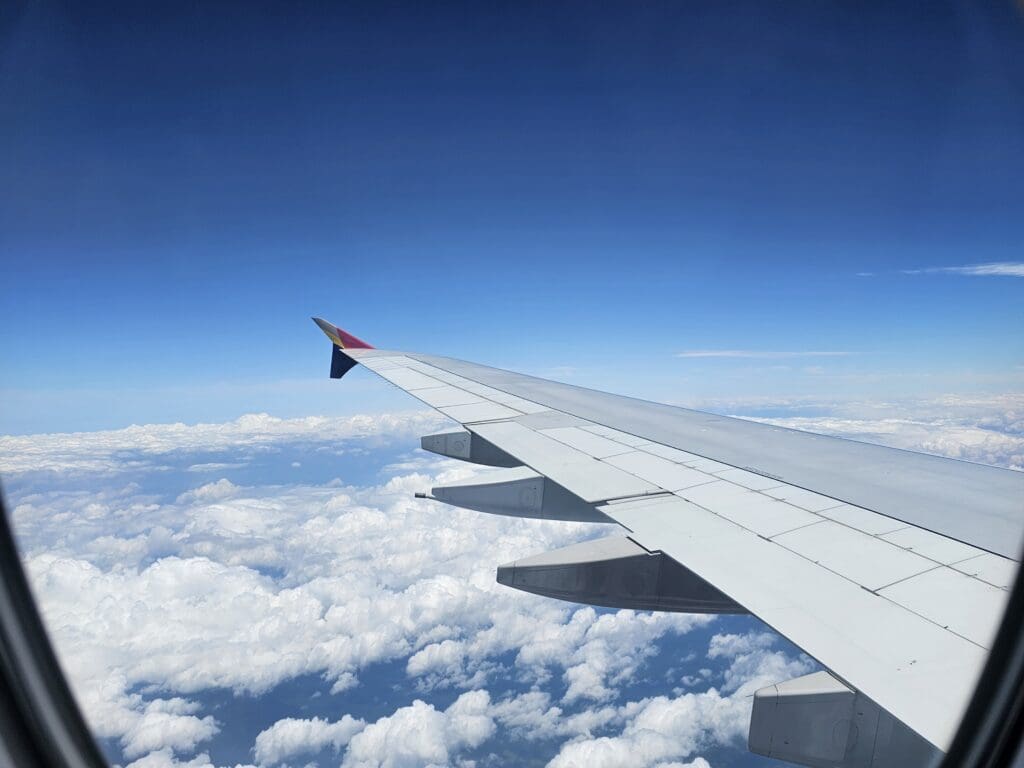
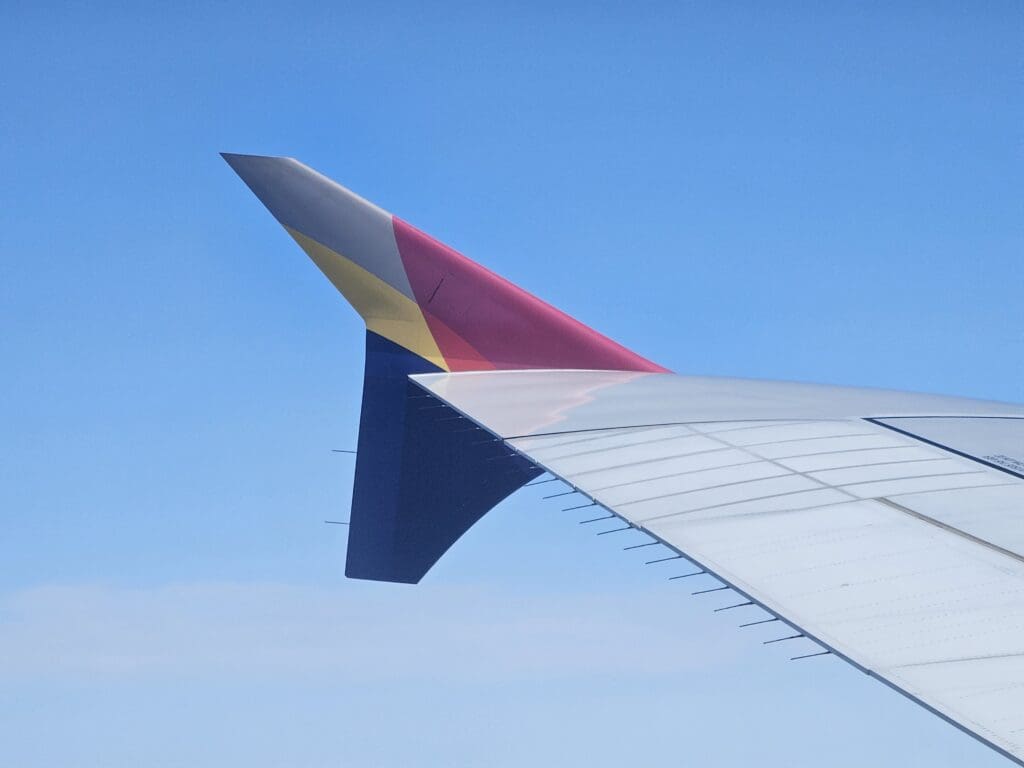
As the aircraft descended through 23,000 feet, a loud ding rang out through the cabin as the pilots switched the seatbelt signs back on and announced “Cabin Crew, prepare for landing”. At this stage of the flight, the Airbus was flying along the northern border of Tochigi Prefecture’s Nikko National Park and was still a fair distance away from Tokyo. A few short moments later, the Purser performed the usual announcement regarding seatbelts, seatbacks, tray tables and window shades before the army of cabin crew took to the aisles and performed the first of several comprehensive pre-arrival checks.
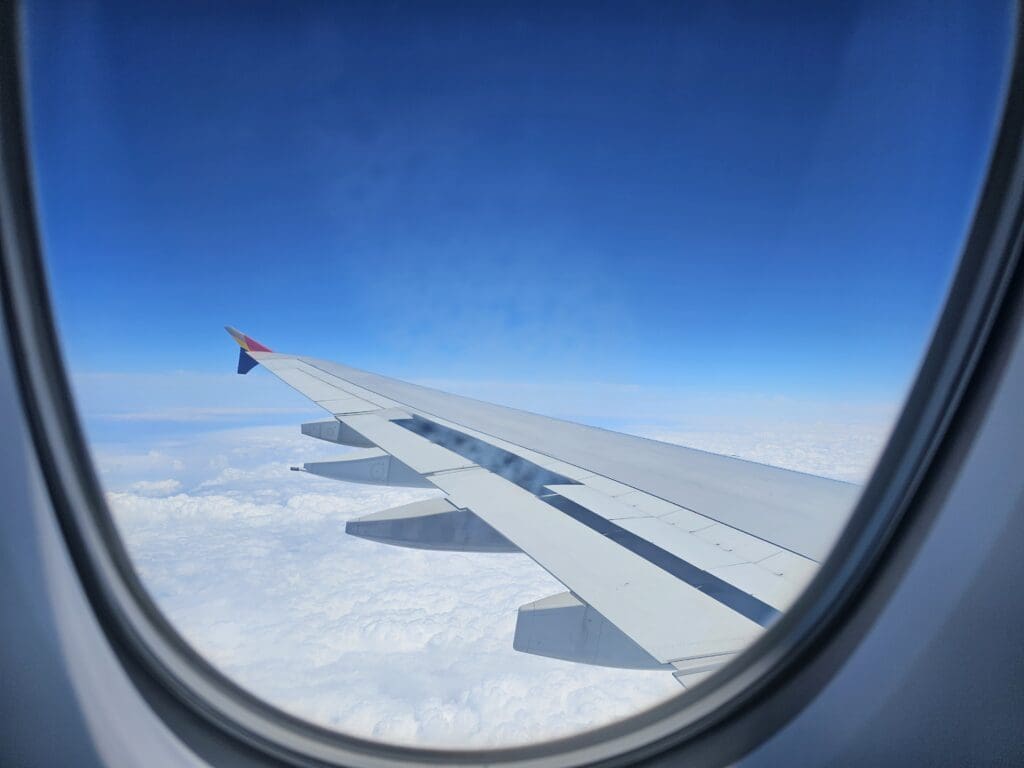
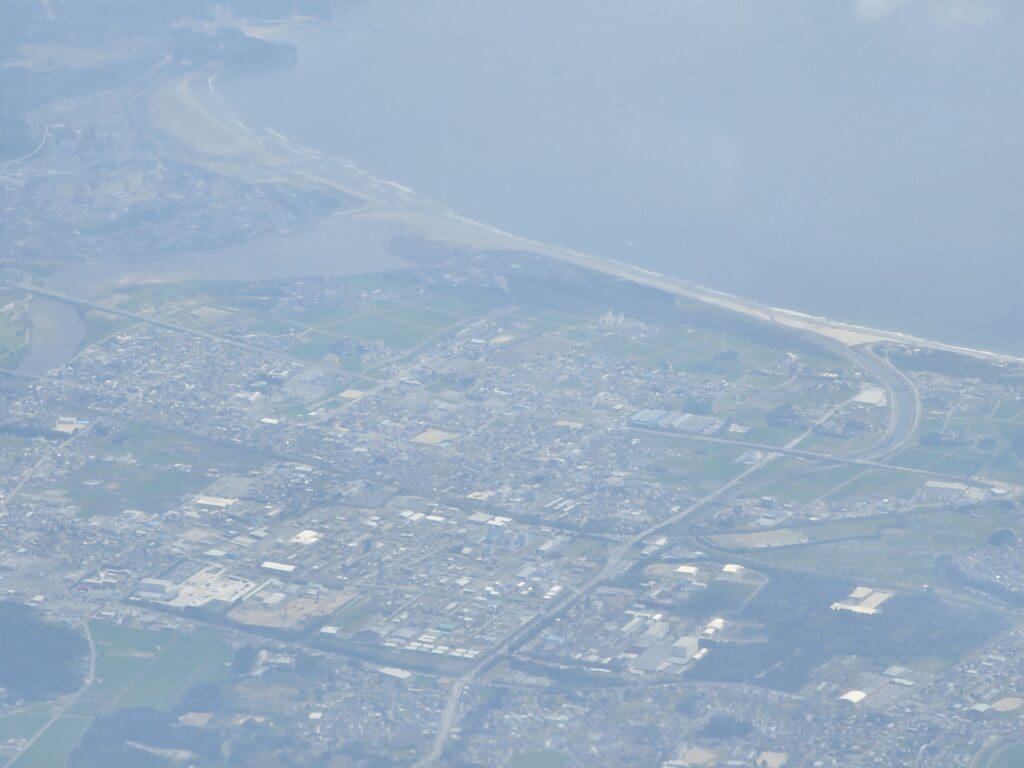
That morning, the Airbus flew a rather indirect approach path to Tokyo Narita. This took us to the southern portion of the Fukushima Prefecture, around ninety miles to the north of the airport. After passing over the town of Fukushima town of Ashikawa, the Airbus banked and flew southwards at which point the green fields and coastline of the region appeared. From there, the Airbus flew down the coastline of Ibaraki Prefecture and passed the coastal towns and cities of Kitaibaraki, Takahagi and Hitachi. The latter is the hometown of the conglomerate Hitachi, perhaps best known in the UK for their Azuma trains.
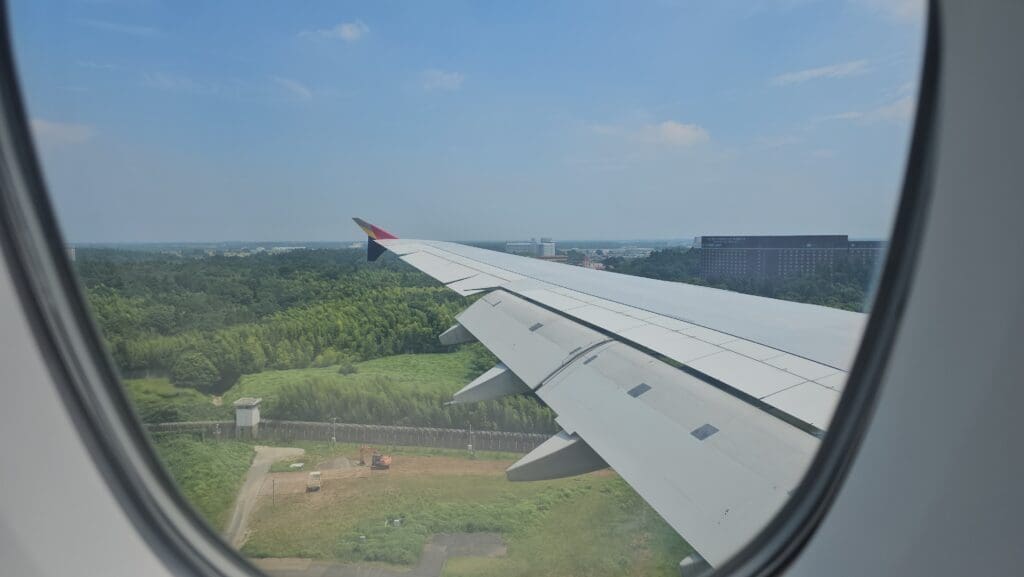
Continuing to skirt down the coastline of Ibaraki, after about eight minutes, the Airbus turned inland and crossed over the thin yet long Lake Kitaura, soon followed by Japan’s second-largest lake, Lake Kasumigaura. Upon crossing Kasumigaura’s western shoreline, the Airbus passed over the small city of Inashiki and turned towards Tokyo Narita, lining itself up for an approach to Runway 16R. Soon, a whine could be heard as the flaps were extended and the gear fell into position below. Sinking down, the aircraft passed over the Tone River which serves as the natural border between the prefectures of Ibaraki and Chiba. Looking outside a mixture of pleasant green fields and forests could be seen along with the odd town and industrial estate as we sank lower and lower.
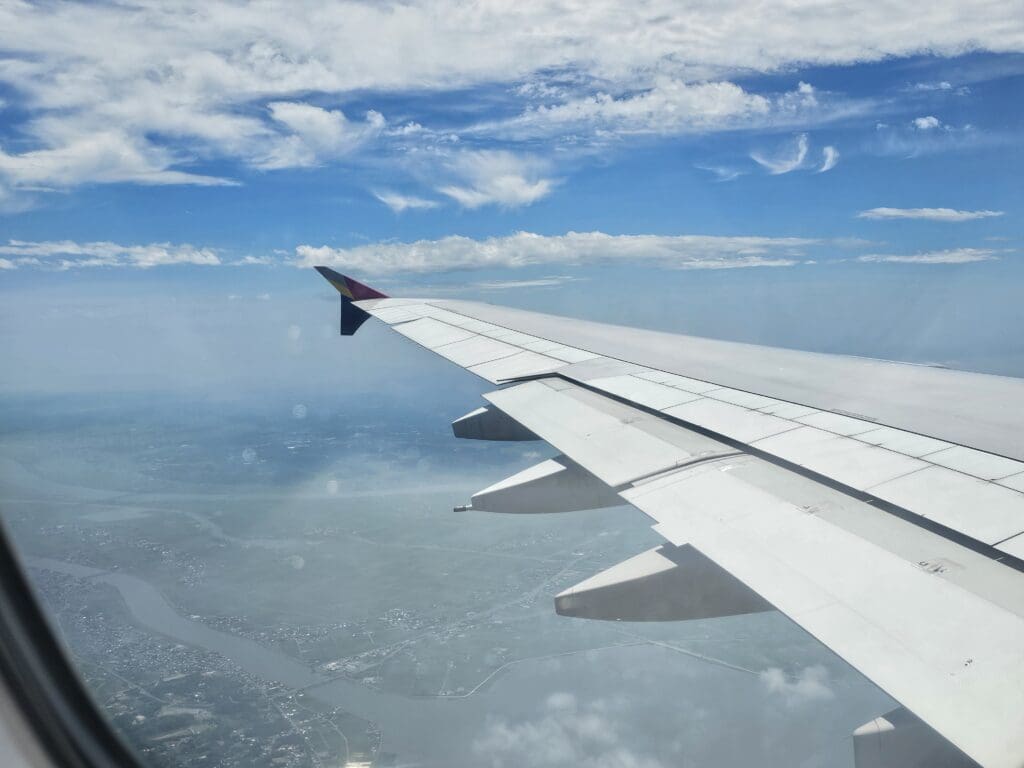
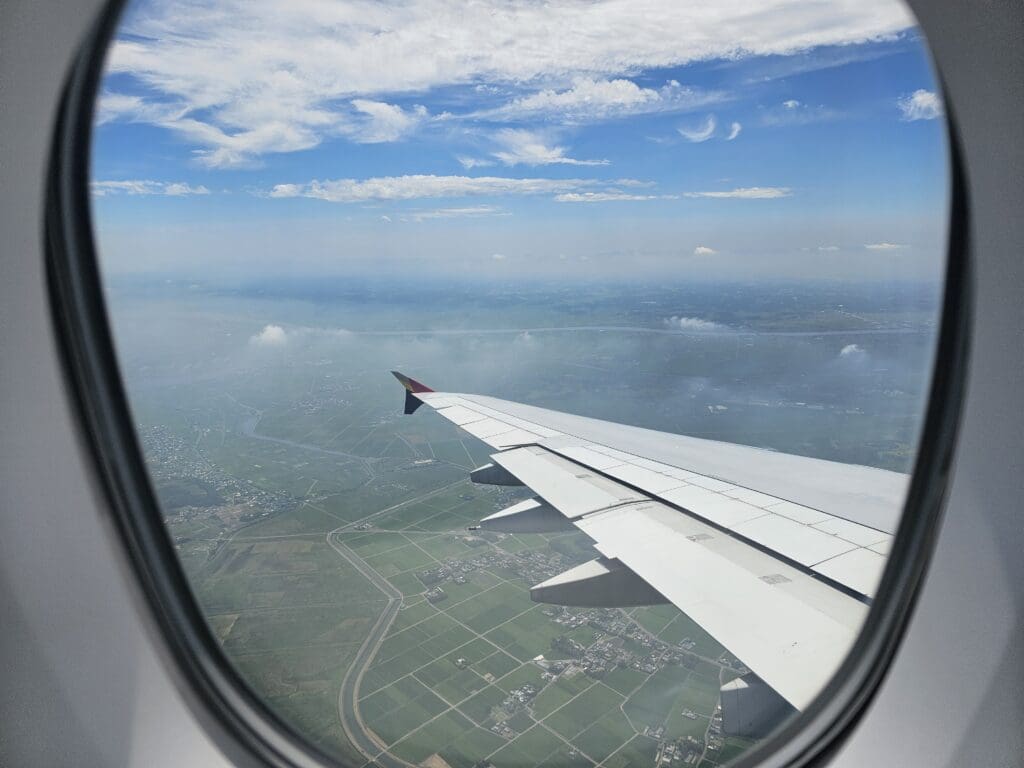
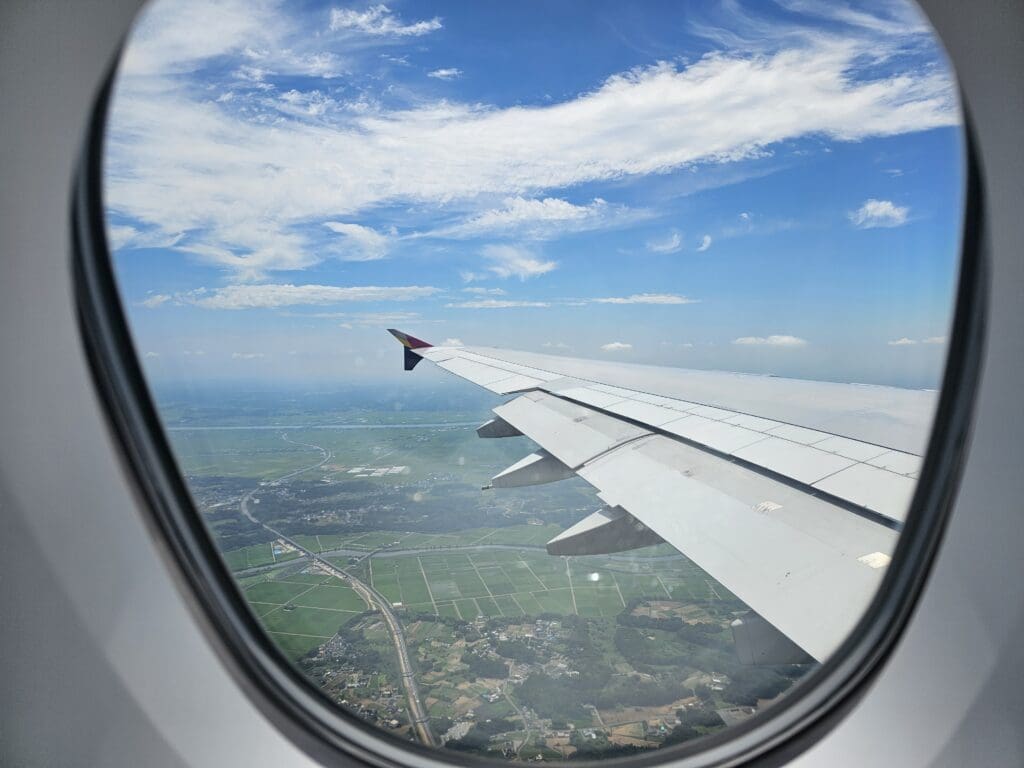
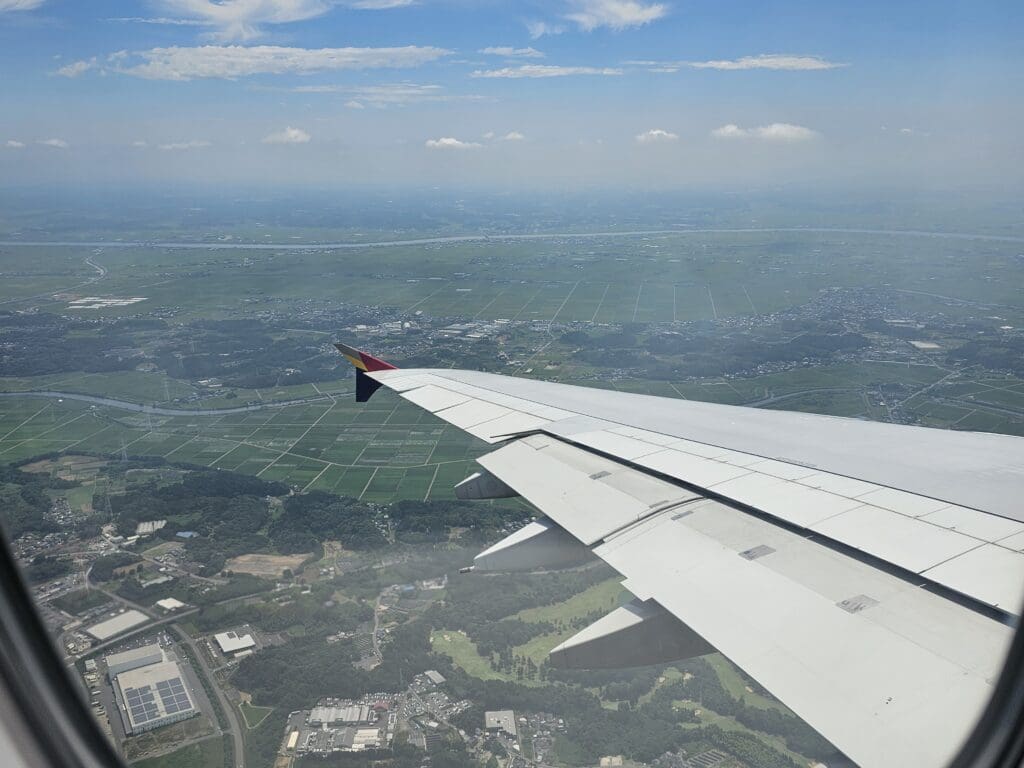
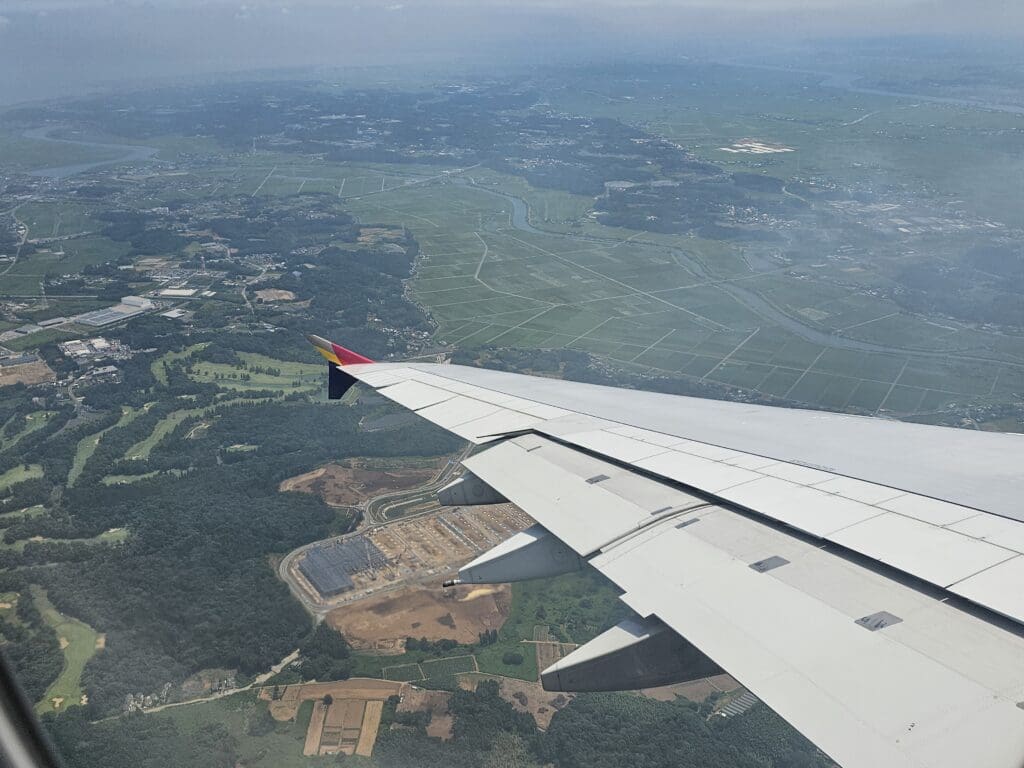
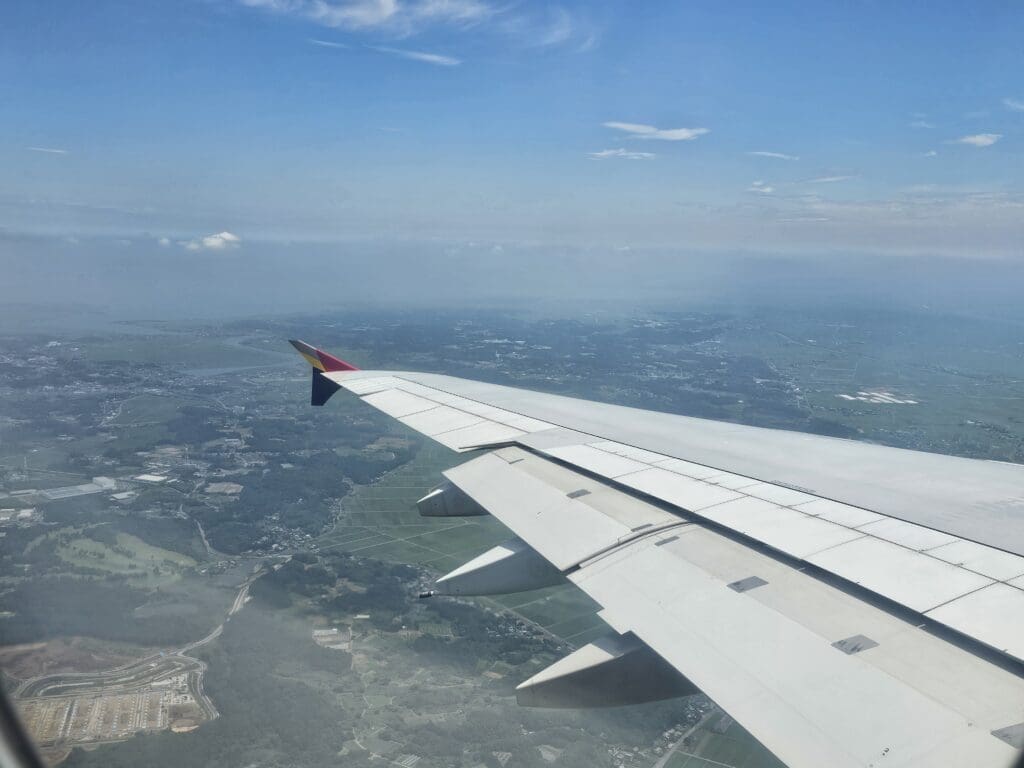
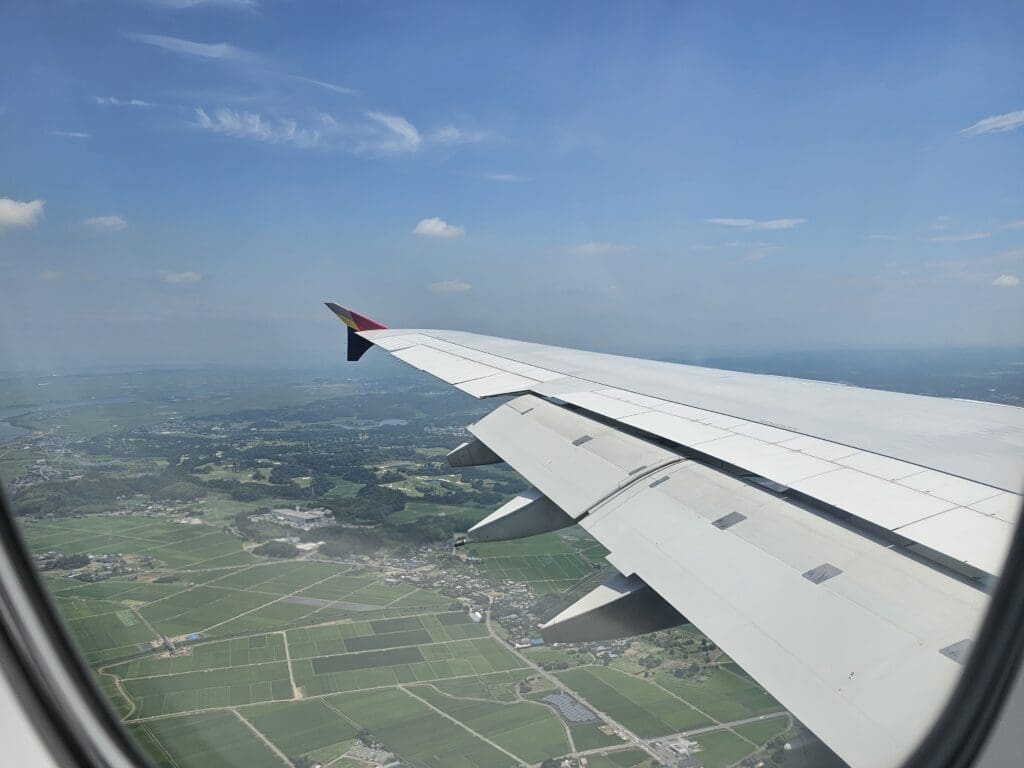
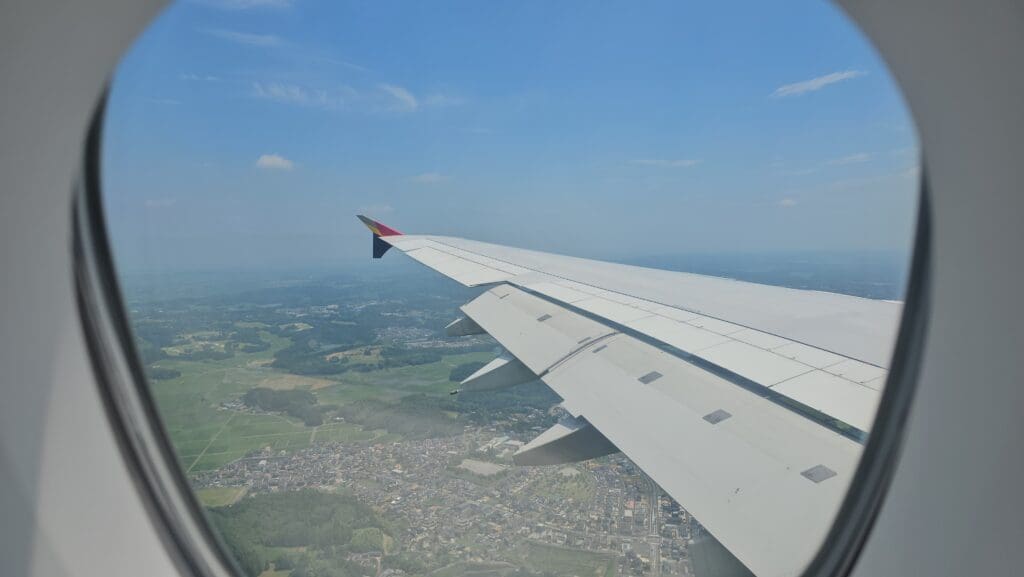
After passing the city of Narita, the Airbus whizzed past the rail line which connects the airport with the Japanese capital and the Shin-Kuko Expressway before crossing over the airport’s perimeter fence. During the final seconds of the flight, the Airbus whizzed past a Garuda Indonesia Airbus A330 waiting at the end of the runway at the start of its long trek down to Jakarta. True to the Captain’s pre-departure speech, a grand total of an hour and fifty minutes after taking to the skies, the Airbus made a gentle touchdown on Japanese soil before decelerating rather rapidly as if the pilots were in a rush to exit the runway. As we vacated this, I caught sight of one of All Nippon Airways’ colourful locally-based whales. These operate exclusively on the high-demand route between Tokyo Narita and Honolulu. In the usual manner, once off the runway, the Purser performed a standard post-arrival announcement welcoming all to Tokyo, thanking passengers for flying with Asiana Airlines and advising passengers to remain seated and buckled up for the time being. As with all other announcements during the flight, this was performed in Korean and English, before being repeated in Japanese by another crew member. Looking outside, I was reminded of just how many flights operate between Korea and Tokyo Narita. During the short journey to the terminal I spotted aircraft from Korean low cost carriers Air Busan, Air Seoul, Eastar Jet, Jeju Air and T’way Air, alongside a Korean Air Boeing 737-900ER that had just arrived from Busan. Indeed, at the time of my flight, literally every single Korean passenger airline operated services between Korea and Tokyo Narita, deploying aircraft ranging in size from the Airbus A220 right up to the Airbus A380 and Boeing 747-8.
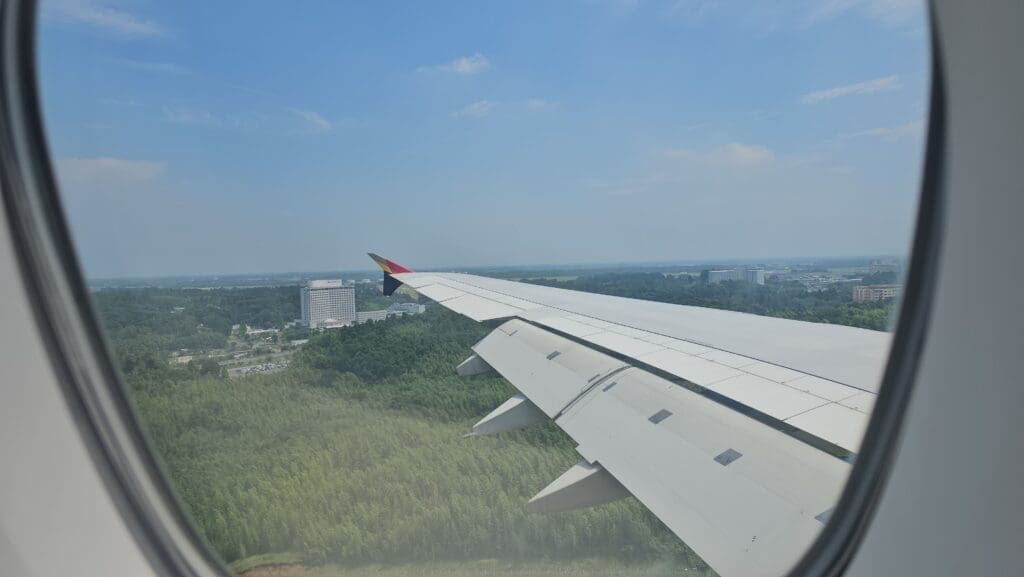
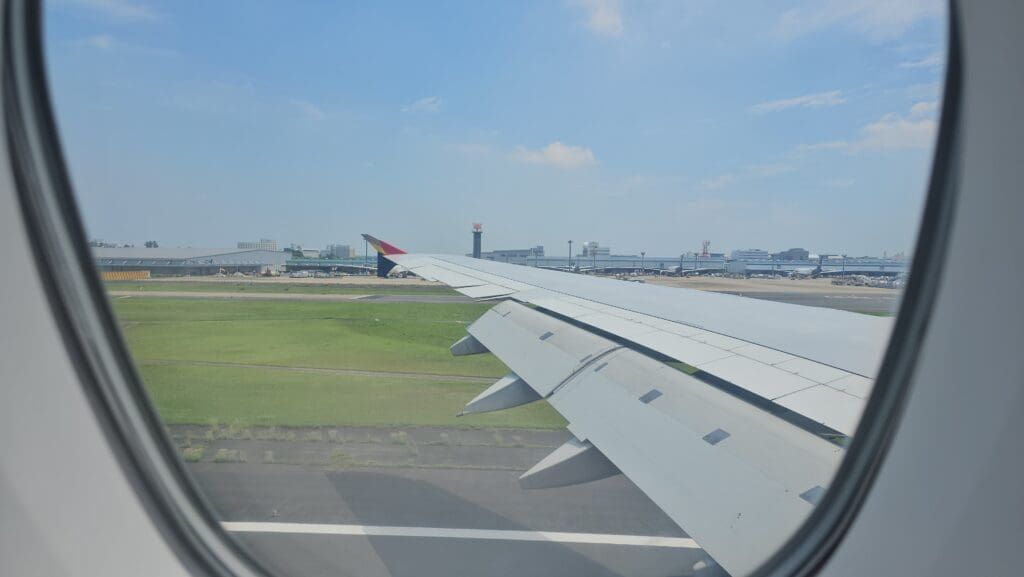
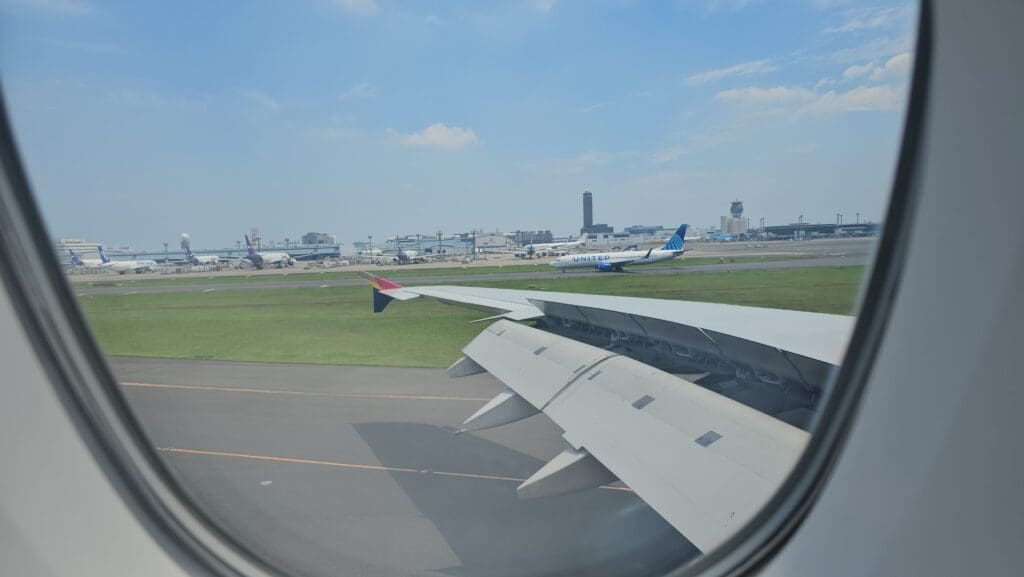
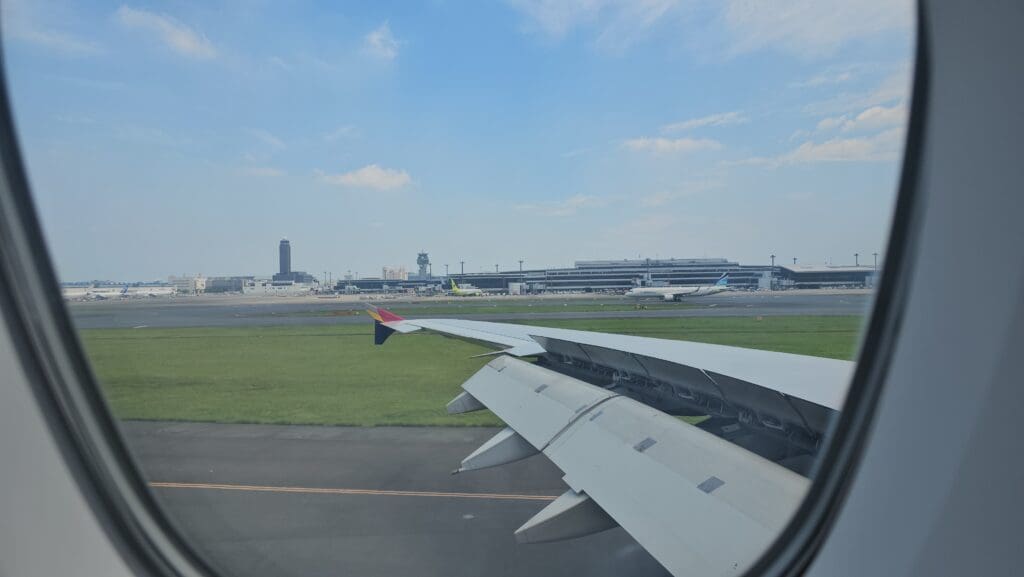
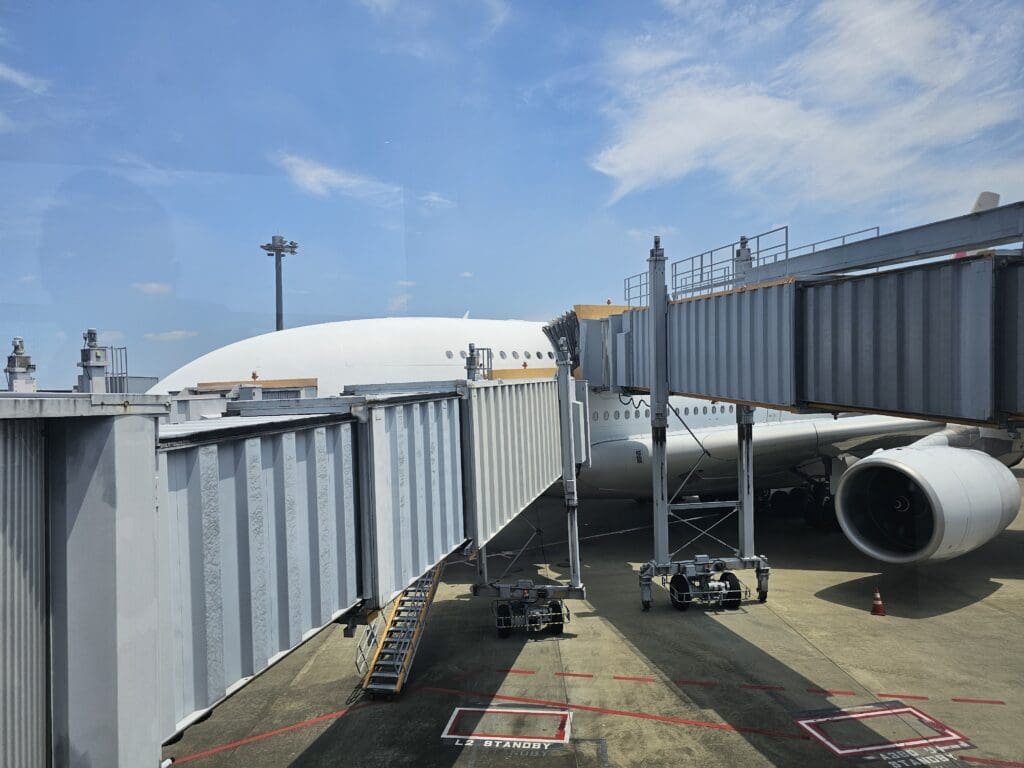
Given the size of the Airbus A380, this can only use a limited number of stands at Terminal 1 and that day, the flight had been assigned Stand 45 at the far southern tip of the terminal. Around seven minutes after touching down in Tokyo, the Airbus slowly and cautiously made its way into the stand before coming to a halt. Upon doing so, inside the cabin passengers jumped up and flooded the aisles as if ina desperate rush to escape. Thankfully, it didn’t take too long for a couple of jetbridges to be connected to the aircraft’s main and upper decks and once all those in Business had disembarked, the curtains at the front of the small cabin opened and passengers began to shuffle forward. Eventually, I stood up, retrieved my backpack and made my way forward, thanking each crew member that I passed and receiving a friendly farewell and thanks in exchange. Soon, I reached the galley where I received a final pair of farewells and thanks before I stepped off the aircraft and made my way up the glass jetbridge towards the terminal.
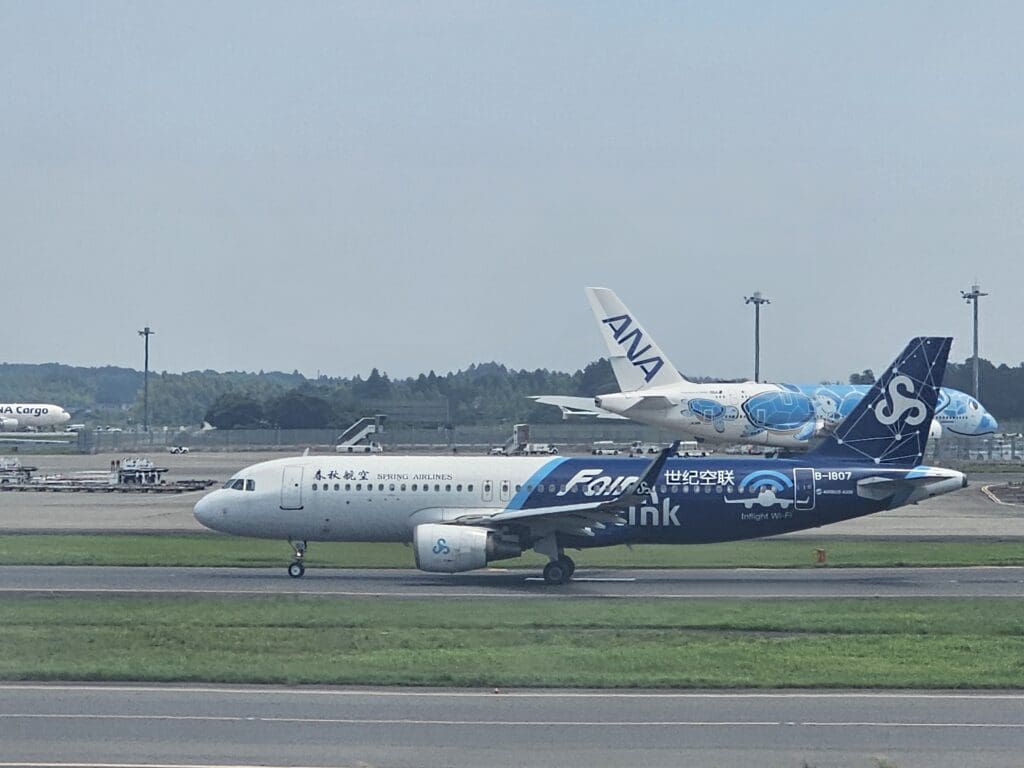
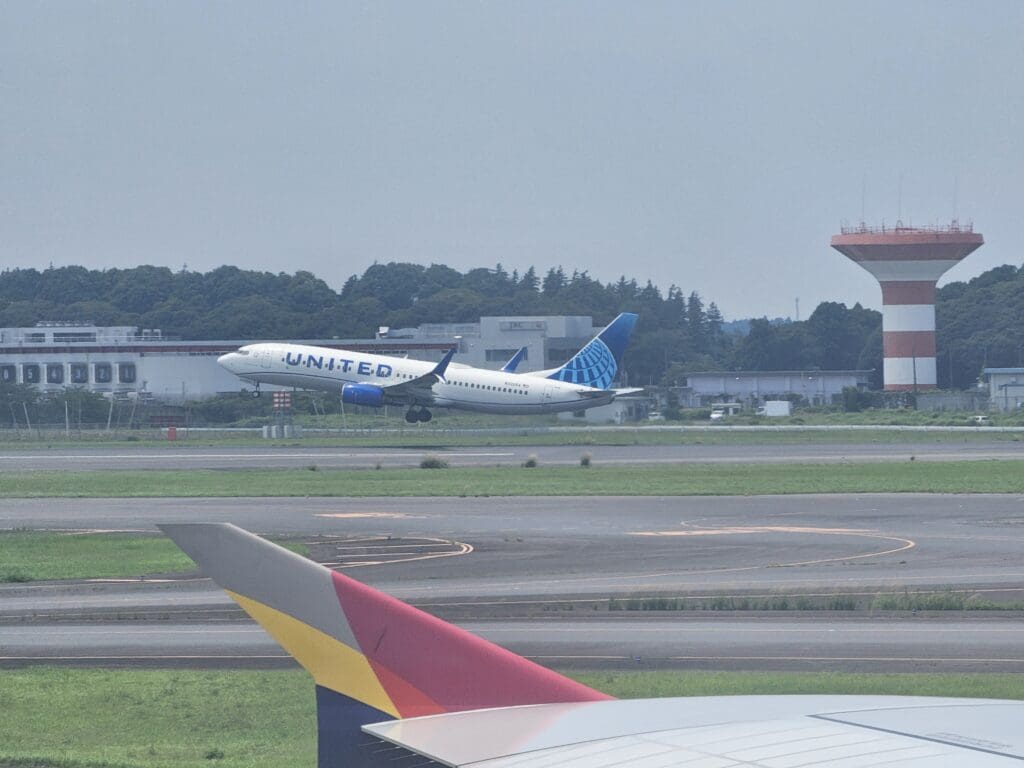
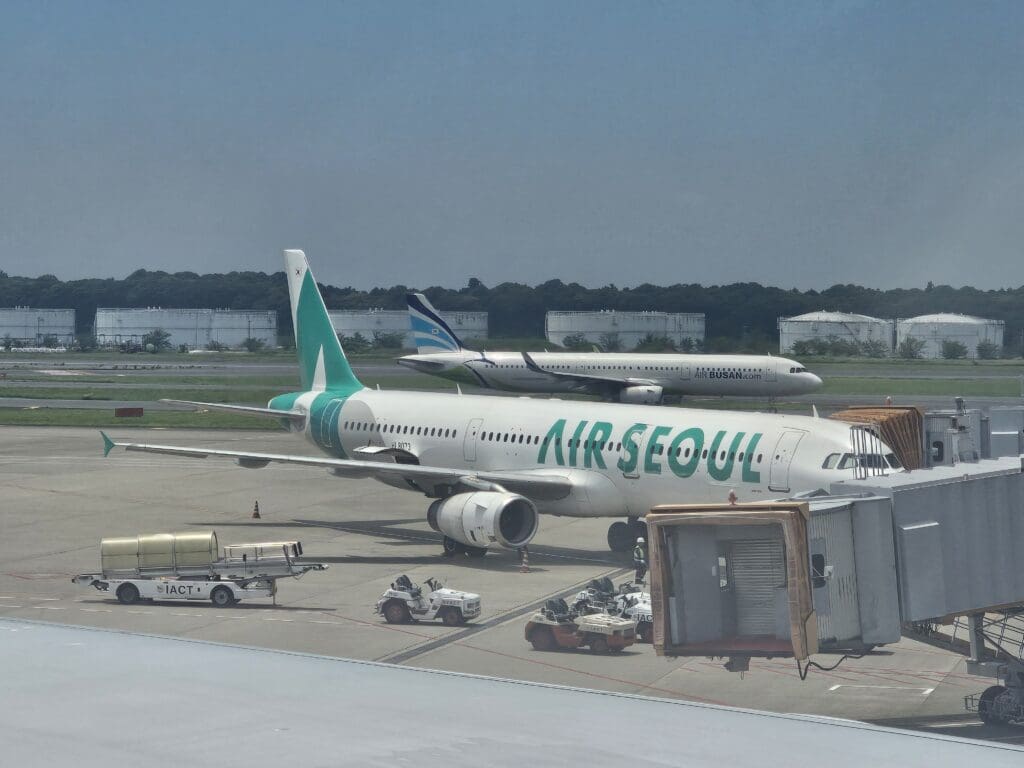
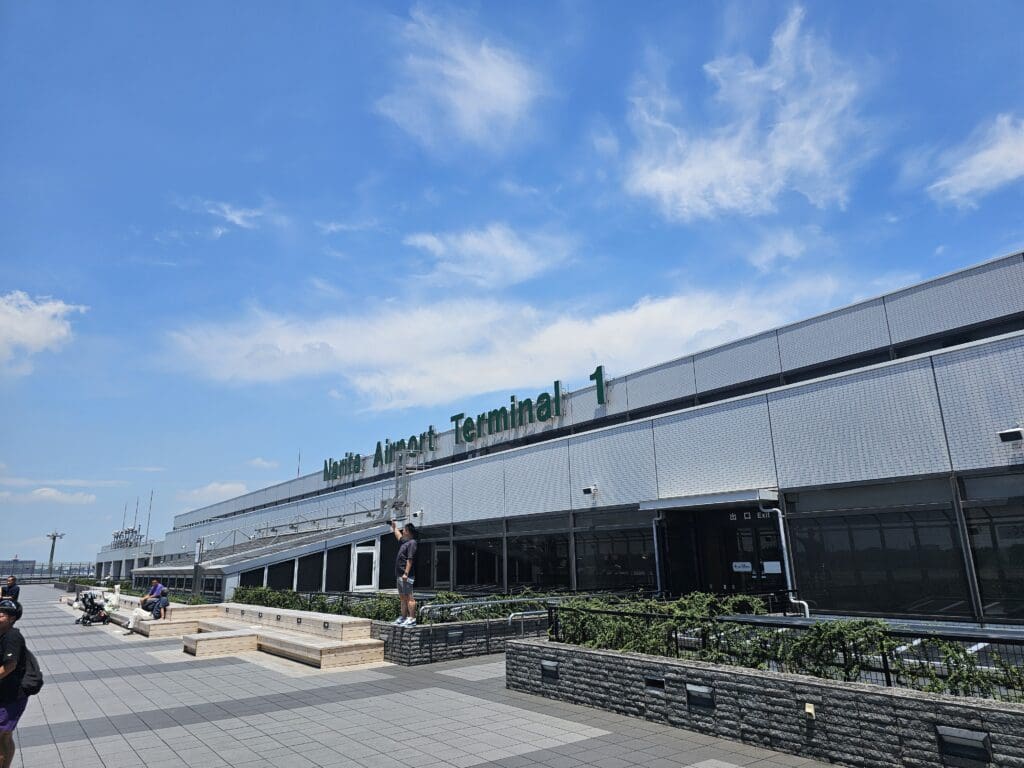
From our stand, a long walk through the very clean, pleasant and airy terminal was in order, however, not being in any urgent rush and with this walk offering some good views out over some of the terminal’s stands, I could hardly complain! Eventually, I reached the terminal’s relatively compact immigration hall. With all immigration booths appearing to be manned, I walked straight up to one of these with no queuing, and having my immigration QR code to hand, this was a very quick and easy experience and I was soon free to continue onwards to the customs checkpoint. After displaying my customs QR code to the polite and smartly dressed agents, no need for a further check was required and not travelling with any hold luggage I was able to head straight out into the landside arrivals area, ready for an afternoon of spotting – but not before I experienced (for the first time in my life) some fairly significant rocking as an earthquake struck just off the Chiba coastline!
Summary
Ignoring the slightly dated layout and design of the OZ@Enter inflight entertainment system, the lack of wifi and the stains in the storage compartment, my second-ever international experience with Asiana Airlines left me with nothing to complain about. Granted, some more seasoned travellers may argue that Asiana Airlines is not quite on the same level as some of the world’s other five-star airlines, however, personally, I was left with very few gripes. Onboard, I found the seat to be spacious, clean and comfortable, whilst every single crew member that I interacted with was polite and friendly. With that considered, I would most certainly be willing to fly with Asiana Airlines onboard one of their international services again in the future.