A Long Slog Across Eurasia: Seoul to Amsterdam on a KLM Boeing 777-300ER
Background
Koninklijke Luchtvaart Maatschappij, or as it’s more commonly known, KLM is an airline that, to most readers, will probably need no introduction. Established in 1919, the Netherlands’ flag carrier is the world’s oldest airline that continues to fly passengers across the world under its original name. Today, KLM and its regional subsidiary, KLM Cityhopper, serve over 160 destinations across the world from their sole hub at Amsterdam Schiphol, operating a fleet of aircraft ranging in size from the Embraer 175 to the Boeing 777-300ER. In fact, on this trip, I would have the pleasure of sampling both the airline’s smallest and largest aircraft.
Generally speaking, KLM is often regarded as being one of the better European legacy carriers. In an era of cost-cutting and slimmed-down service, KLM continues to offer the increasingly rare luxury of complimentary drinks and snacks to all passengers, even on their shortest hops to the likes of Dusseldorf and Norwich! Growing up as an aviation enthusiast in the UK (and being part-Dutch!) KLM was an airline I had been aware of from a very young age. With KLM acquiring majority ownership of British regional carrier AirUK in 1998, KLM UK and subsequently KLM Cityhopper came to operate an expansive network of routes between Amsterdam Schiphol and just about every British regional airport with scheduled services. As a child, I recall being taken for afternoons out to spot the airline’s distinctive liveried Fokker 50s at my local airport, the long-gone Sheffield City Airport. Today, the airline continues to maintain a significant number of routes across the UK, serving a whopping total of seventeen airports up and down the country!
Despite my early encounters with KLM as a spotter, it wasn’t until the age of twenty that I bagged my first flights with the airline. This took place in November 2016, when I flew on the now-impossible combination of a Fokker 70 followed by a Boeing 747-400 Combi from Humberside to Seoul Incheon with a quick stop in Amsterdam. Despite the Jumbo Jet’s dated cabin and the clear signs of wear and tear, I had enjoyed my first experience with KLM, having been pleased with both the friendly and lively crew and the generous onboard catering. Since then, I have sampled the delights of the airline multiple times on short hops within Europe with both KLM and KLM Cityhopper and have never been left with any major complaints.
KLM has long served plenty of destinations across East Asia, with the airline’s first scheduled flight to Korea touching down at Seoul Gimpo in 1984. As per summer 2024 schedules, a mixture of Boeing 777-200ERs and Boeing 777-300ERs connect Amsterdam Schiphol and Seoul Incheon Airport six times a week. With the inbound portion of these services departing Korea at 2305, KLM’s flight is one of the very few overnight flights from Korea to Europe and proves to be a popular option, allowing passengers to arrive at airports across Western Europe in time for breakfast. However, despite this, I had never intended to fly with KLM on this trip!
So how did I end up flying with KLM?
As I basked in the hot afternoon sunshine in the coastal city of Yeosu, I received an email informing me that my Air France service from Osaka Kansai to Paris CDG had been cancelled, thus throwing my journey to Manchester into jeopardy. As much as I wanted to stay in Korea, needing to make a timely return to the UK to start a new job, and with Air France failing to provide any suitable alternative dates, I needed to find an economical way to return to the UK. On the plus side, having booked this as a Virgin Atlantic Flying Club reward ticket, once I requested cancellation, I was promptly refunded the points and fees that I had paid for this.
These days Air China, China Eastern Airlines and China Southern Airlines seem to constantly offer the very cheapest tickets between Korea to London via Beijing, Guangzhou, Shanghai or Xi’an. At times, these come in at well over half the price of any competitor, sometimes being sold for as low as £160! However, needing to travel during the summer peak and in fifteen days, the cheapest one-stop one-way fare came in at £380. This was offered by Air China and involved a short stop in Beijing. Whilst beggars can’t be choosers, having experienced a very mediocre experience with Air China from Seoul Gimpo to Dubai via Beijing two months earlier, I wasn’t too taken by this option. Thus, before I booked this, I decided to see if I could redeem any Virgin Atlantic Flying Club points to return to the UK on one of the airline’s SkyTeam carriers.
If you are seeking to fly with a SkyTeam carrier from Korea to the UK, the logical choice would be to take Korean Air straight to London Heathrow. With this service operated by one of Korean Air’s shrinking number of Boeing 747-8s, as an aviation enthusiast, this was my top option. However, with no reward seats available, I soon examined other options and after a while, I found a one-stop itinerary with KLM. Whilst not quite as exciting as a ride on a Jumbo Jet, living in Leeds, this option would take me straight back to my local airport, Leeds Bradford. In total, this would set me back 31,000 Flying Club points and £140.30.
Booking
Unfortunately, booking a Virgin Atlantic Flying Club reward ticket for a flight with Air France or KLM isn’t a particularly straightforward task. Those who attempt to do so via Virgin Atlantic’s website or app will usually receive an error message. Upon receiving this, I contacted Virgin Atlantic’s Flying Club team via webchat and thankfully booking this ended up being a fairly straightforward process. Once I had been sent a payment link and paid for the ticket, my e-ticket soon arrived in my email inbox and I was all set to head back to Europe.
Despite booking with Virgin Atlantic, I encountered no issues when using my booking reference to manage my booking on KLM’s website. This gave me the option to add additional luggage or pay to pre-reserve a seat in advance. However, I decided to take my chances and select this during check-in instead. Check-in for most KLM services opens up 30 hours before departure, and upon hitting this window, I made my way over to KLM’s website and commenced proceedings. Soon, it was revealed that I had been automatically assigned an aisle seat for both flights (52H and 12C). Fortunately, I was able to change these without paying any sort of additional fee so I decided to move over to 16F for my second flight and keep 52H for my first flight, seeking to have direct aisle access on the long slog to Amsterdam. Other than this, I was also given the option of moving forward to Economy comfort for $139.84 (£108.78) or $12 (£9.33) on my first and second flights respectively or moving even further forward into Business for $74.90 (£58.26) on the short hop to Leeds. Rejecting these, I soon completed check-in and was left with absolutely nothing negative to say about my pre-flight experience with KLM.
The Journey
Following a fantastic three weeks in Korea, my time in the country was drawing to a close and I turned my attention to the long overnight slog back to the UK. Whilst I wasn’t too happy to swap Bongu Beer for Wetherspoons, E-Mart for Tesco, or Paris Baguette for Greggs, taking the edge off my departure was the fact that this would be my first time passing through Terminal 2. Despite welcoming its first passengers well over six years before my flight in January 2018, seeing as I usually depart Korea through Incheon Airport’s Terminal 1 or Seoul Gimpo Airport, I had yet to sample the delights of Korea’s newest airport terminal.
Thanks to KLM’s late departure time and seeing as I would be starting my journey in Seoul, I was able to enjoy a leisurely final day in Korea and decided to leave packing until the morning of my flight. My first task was waking up late and gathering my laundry before fighting with my suitcase as I attempted to squeeze in the skincare products and Hallasan soju I had bought for friends and family. By early lunchtime, I had successfully managed to zip up my suitcase and rewarded myself with a hearty plate of cheese donkatsu for lunch followed by a large coffee for dessert. Had I been travelling in spring or autumn, I would have probably made the most of my last day in Korea by doing some hiking or last-minute sightseeing. However, with Korea in the throes of summer, the intense heat and humidity dissuaded me from doing anything too exciting and I instead spent the afternoon relaxing and pottering around Gongdeok.
Eventually, evening dawned and I turned my attention towards getting to Incheon Airport. As many of those who have visited Korea will know, Seoul Incheon Airport is most definitely not in Seoul. Instead, this sits off Korea’s western coastline on reclaimed land between the islands of Yongyu and Yeongjeong, approximately fifty kilometres to the west of Seoul’s Namsan Tower. For comparison, this is over twice the distance between Central London and Heathrow Airport, and around twice that between New York and New York JFK. However, this is still far more conveniently located than many of Europe’s low-cost hubs such as Beauvais, Hahn and Stansted! Furthermore, given Seoul Incheon Airport’s status as Korea’s main international hub, you are unlikely to face any difficulties in reaching this on public transport.
For most of my time living in Korea, I took the form of a poor university student and thus almost always ended up taking Korail’s all-stop Airport Railroad Express (AREX) train to and from Incheon Airport. This service ploughs along a 63.8-kilometre route between Seoul Station and Incheon Airport Terminal 2, taking 66 minutes to complete the entire journey. Onboard, these trains are modern, yet for the most part are no different from regular Korean subway trains with narrow inward-facing seats and thus don’t provide the most comfortable ride in the world. Furthermore, these can get rather packed and I have made several journeys in which I have ended up standing between Incheon Airport and Seoul. Yet, this is by far the cheapest means of reaching Incheon Airport, with a one-way ride costing just 5,050 won (£2.84) when paid for via T-Money card. Furthermore, this enables passengers to connect to Seoul’s other subway lines and buses without paying a significant additional charge.
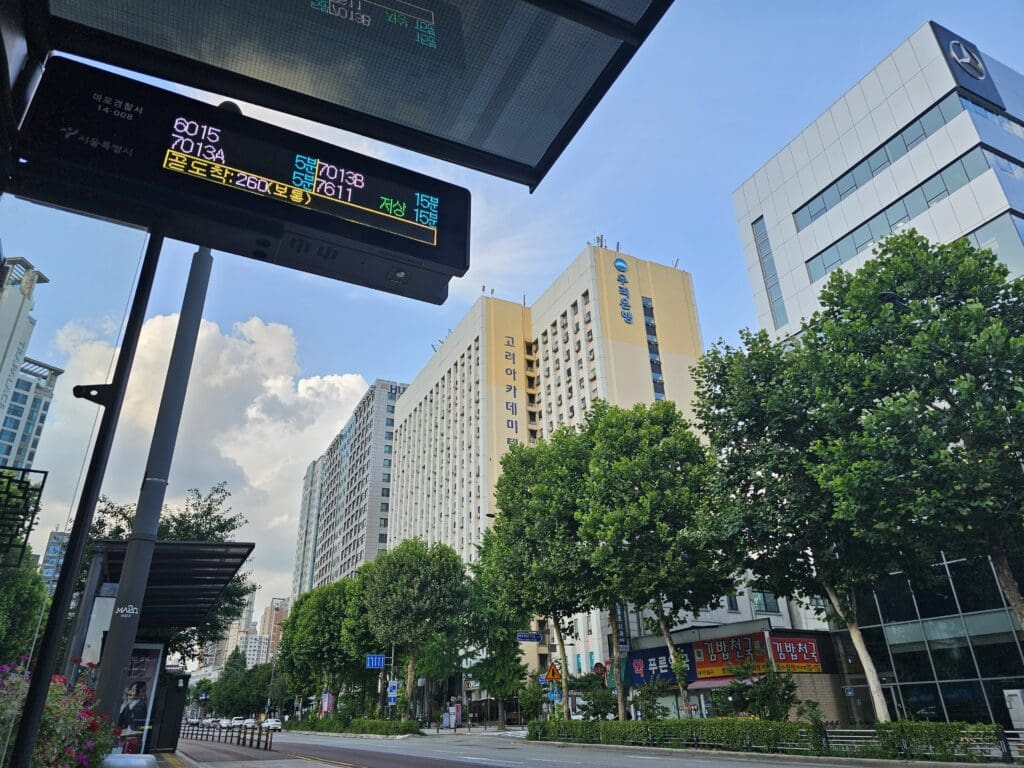
However, that evening I was not too enamoured by the prospect of lugging my heavy suitcase through the summer heat and humidity to Gongdeok Station, only to end up standing for the entire ride to the airport. I thus turned my attention to the network of limousine buses that run from points across Seoul to the airport. Offering a large and well-padded guaranteed seat, these provide the most comfortable means of reaching the airport by public transport. However, they are susceptible to Seoul’s traffic which can, if travelling during peak times, be nightmarish! Furthermore, these are priced at a premium, typically costing between 16,000 won (£9.18) and 20,000 won (£11.48), and are thus more expensive than both the all-stop and express airport train. However, with an airport limousine bus stop located right outside the officetel that I had called home for three weeks, this would be the most convenient and suitable option for me that evening. Checking the timetables, I discovered that the Number 6015 bus departed every twenty minutes or so and would set me back 17,000 won (£9.77). Whilst I could have cut things much finer, to be on the safe side and wanting plenty of time to explore the terminal, I decided to catch the 1840 bus, anticipating that the journey to the airport would take about an hour.
Following one final shower and a change of clothes, I lugged my suitcase down the corridor and into the lift, descending thirteen floors to street level before darting across to the bus stop. Tracking the progress of the bus online, this seemed to make good progress as it trundled over from Seoul City Hall and right on time, the modern black and gold liveried Kia Grandbird bus came to a sudden halt at the bus stop. As soon as it did so, the driver hopped out, asked me for my terminal and placed my suitcase in the correct hold for this. Wishing to pay via credit card, the driver took my card and advised that this would be possible, however, they would keep this with them until arriving at Terminal 1 where they would give it to one of the attendants to process my ticket. Granted, this was somewhat of a strange process and not something for any passenger with a trust issue, however, having faith in the process I obliged and climbed onboard.
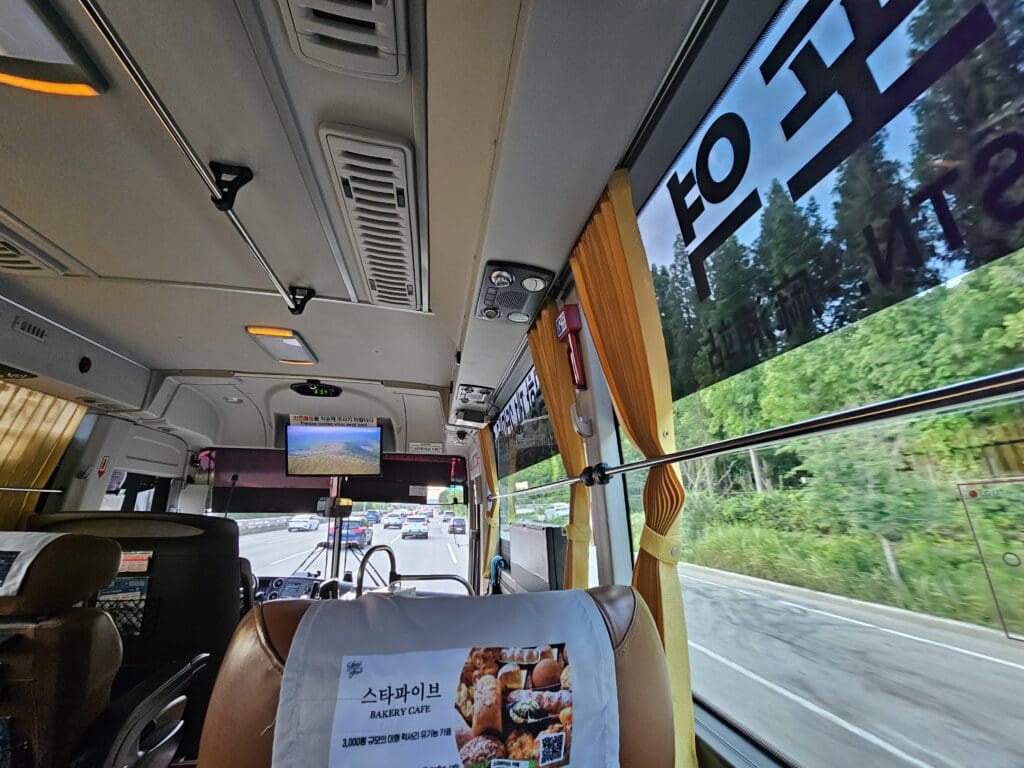
Credit card-less, I made my way onto the mostly empty bus and picked a seat. Onboard, the airport limousine buses are very similar to Korean intercity buses, featuring large seats in a 2-1 configuration. These were clean, and comfortable, with each coming with its own USB-A port for those needing to charge their devices. Once I had taken my seat, becoming the fifth passenger onboard, we sped off down the hill towards Gongdeok Station, stopping and starting a few times in the evening traffic before arriving at our last stop before the airport, Mapo Station. From there, the bus made its way down to the northern banks of the Han River before ploughing westwards out of the city. This road offers a great view of the Han River, with sights such as the capital’s former tallest building, the 63 Building and the National Assembly Building visible on the other side of the river. However, ending up on the wrong side of the bus, I failed to spot much other than the local incinerator and rows of apartment blocks as we sped out of the city.
Soon, the bus left Seoul behind and the traffic around us soon dissipated before we crossed the Han River, making our way past Gimpo Airport and towards the country’s west coast. With the airport being located on an island, the bus whizzed over the 4.4 kilometre-long Yeongjong Bridge at which point a good view of the mountains of the southern portion of Ganghwa Island was offered before the sight of aircraft rocketing up into the dusk skies popped into view indicating that we were nearing the end of our journey. Cutting across Yeongjong Island, it wasn’t long before Mu-kee Kim’s interestingly shaped Flying to the Future statue popped into view heralding our arrival at the airport. Inside, a pre-recorded announcement rang out in Korean, English, Chinese and Japanese advising passengers of the upcoming stop before we pulled up next to the doors to Terminal 1’s check-in hall. Once there, half of the passengers disembarked along with the driver who handed my credit card to the attendants. Thankfully, they returned about a minute later with both my card and receipt, and soon the door was closed before we began the journey around the airport to Terminal 2.
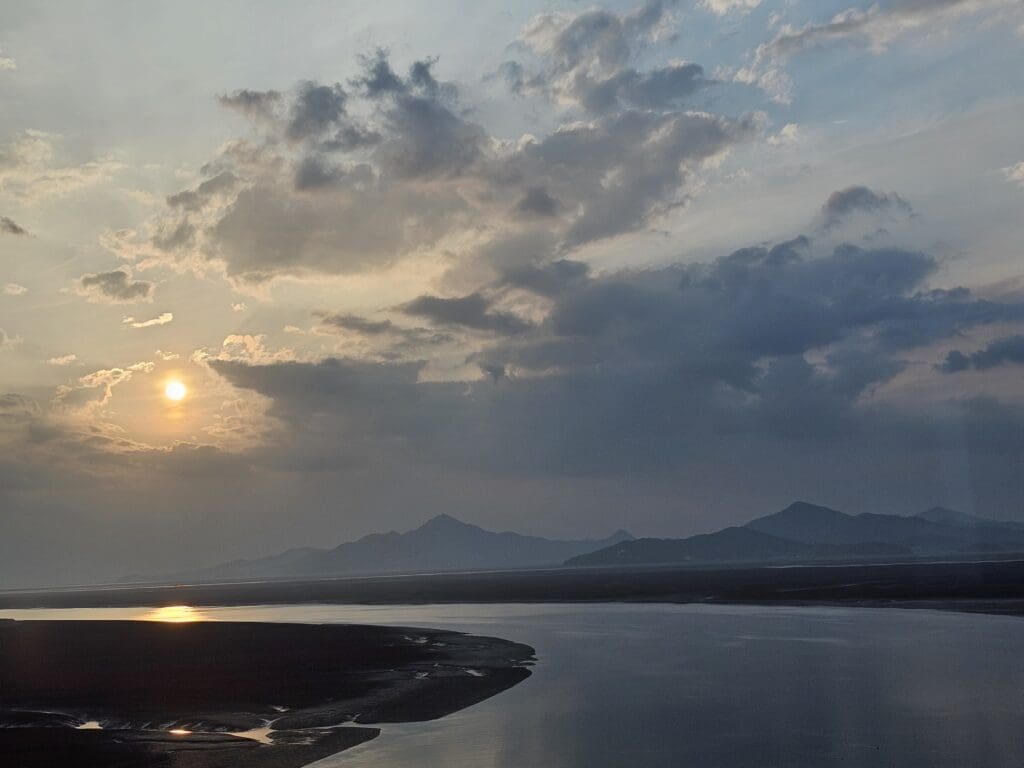
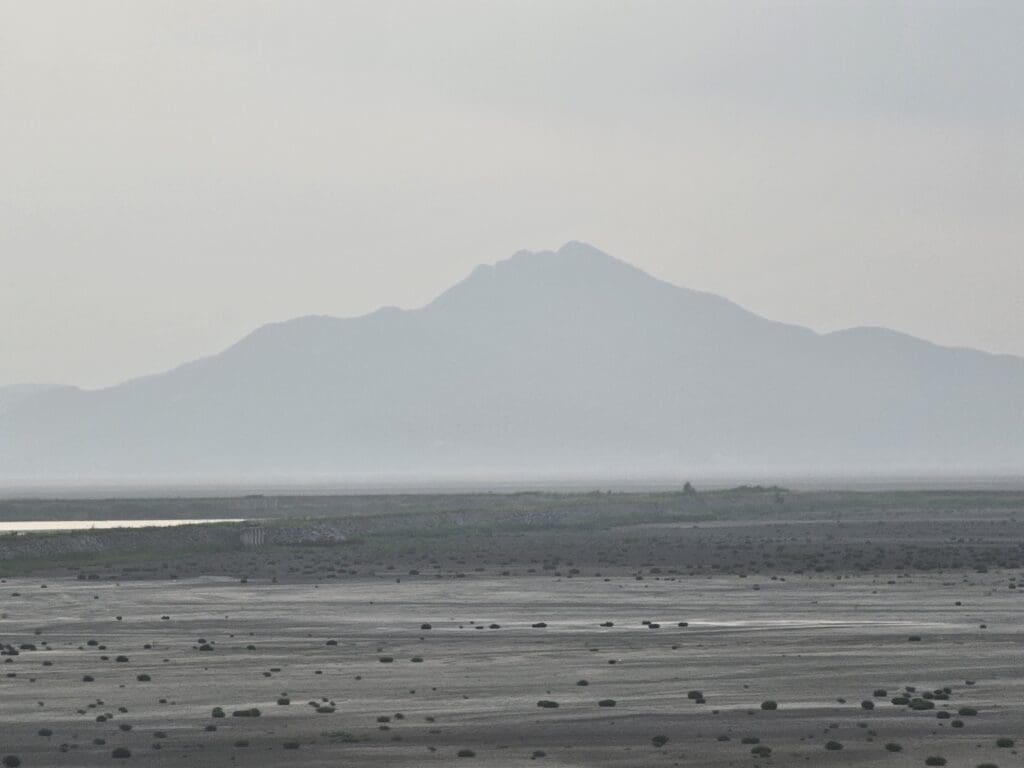
Moments after leaving the terminal, I spotted a Hawaiian Air Airbus A330, a regular visitor to Incheon Airport but a rare sight for me being based in the UK. Continuing around the perimeter, an unexpected aircraft could be spotted in the form of an Emirati Air Force Boeing C-17A Globemaster III, before a long line of mostly widebody aircraft came into view with these queuing up for departure from Runway 16L. Soon, Terminal 2 appeared and we whizzed past the sad sight of stored and weathered-looking Korean Air Airbus A330s, Airbus A380s and Boeing 777s, many of which looked as if they would never take to the skies again. Finally, a little over an hour after leaving Gongdeok, the bus came to a halt outside the surprisingly quiet façade of Terminal 2, stopping just outside one of the entrances to the terminal’s check-in hall.
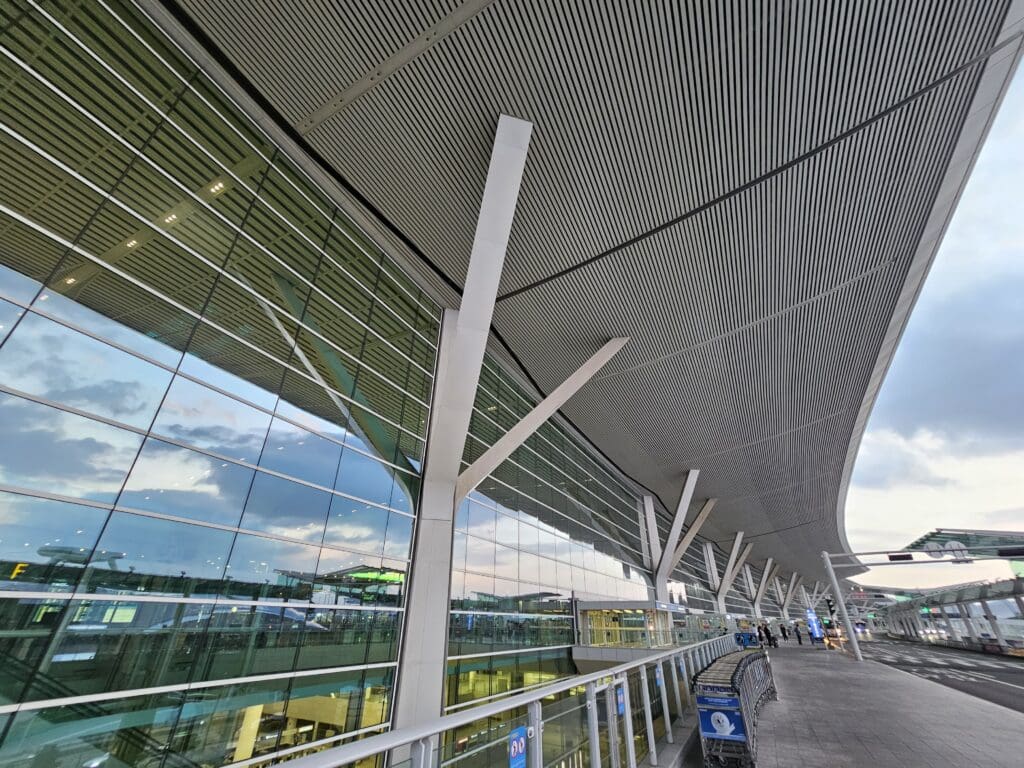
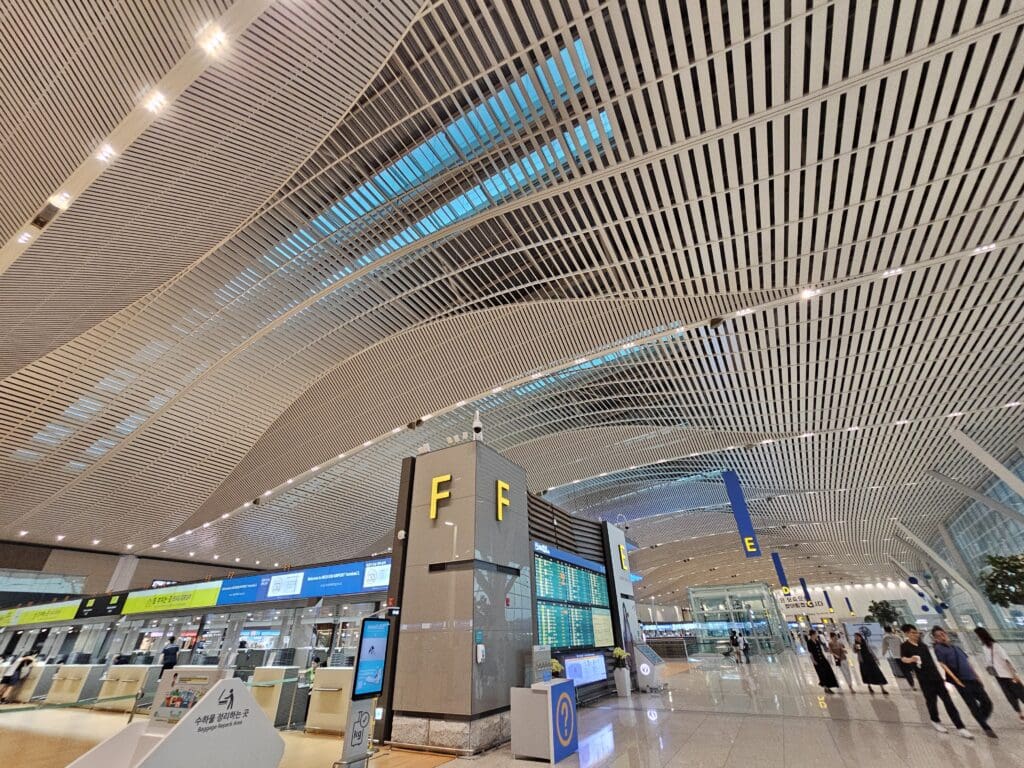
After thanking the driver and collecting my bag from one of the attendants, I headed straight into the check-in hall which at that time was eerily quiet with relatively few passengers and staff seen milling about. As I had expected, inside, the check-in hall appeared to be ultra-modern, sleek and nicely designed, whilst also being well-polished and in a spotlessly clean and tidy condition. This is a little smaller than that of Terminal 1, and a total of eight check-in islands could be seen as I wandered around, with a few fewer facilities offered than Incheon Airport’s older terminal. However, with 23 cafés and restaurants, and 8 shops, there was by no means a shortage of facilities in the landside portion of the terminal. Additionally, Terminal 2 features an observation and exhibition area on its top floor, and whilst not particularly great for photographs, it is the only part of the landside area that offers a view of the action outside. However sadly, this closes at 2000 and upon reaching this, this had just closed for the day.
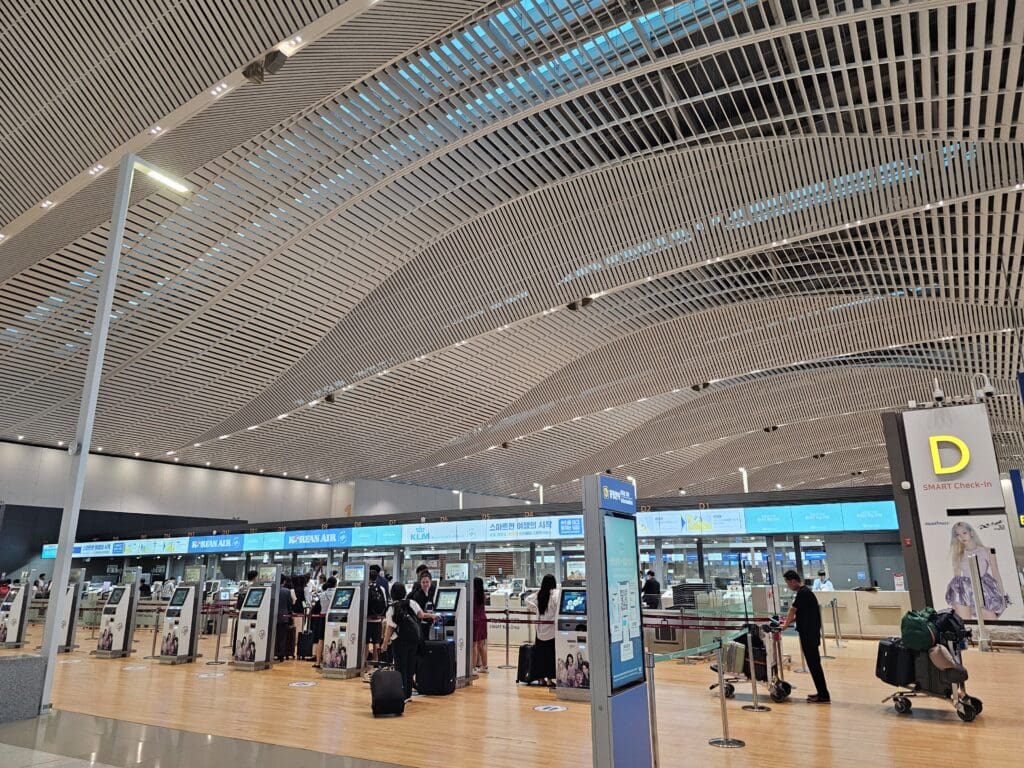
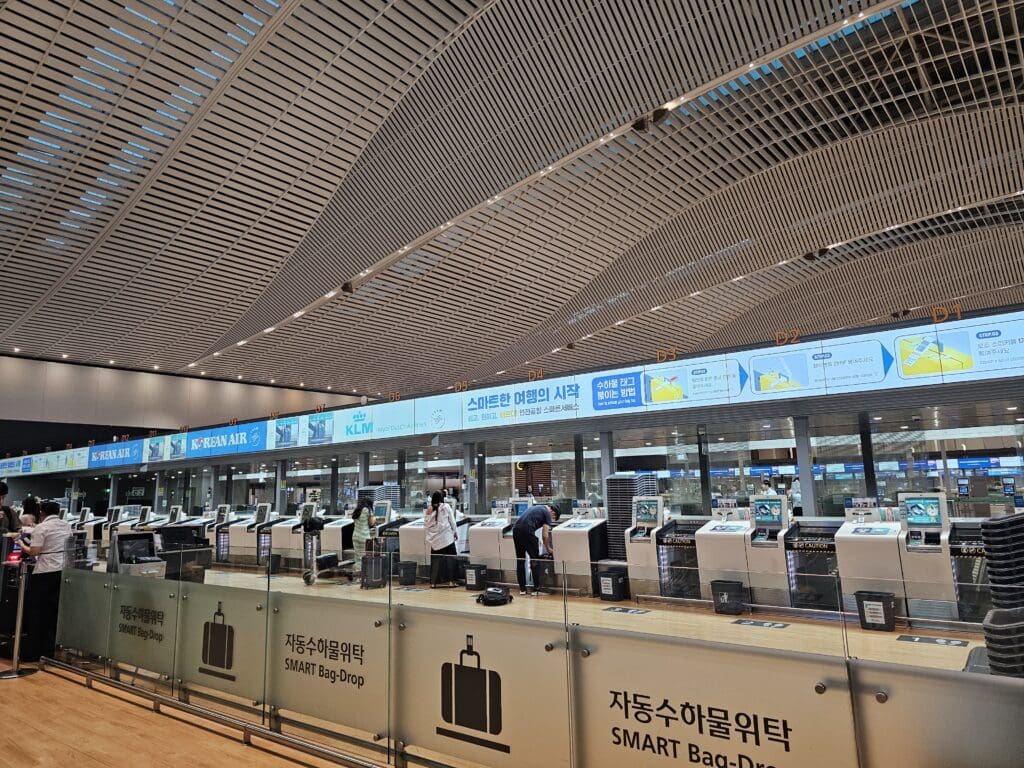
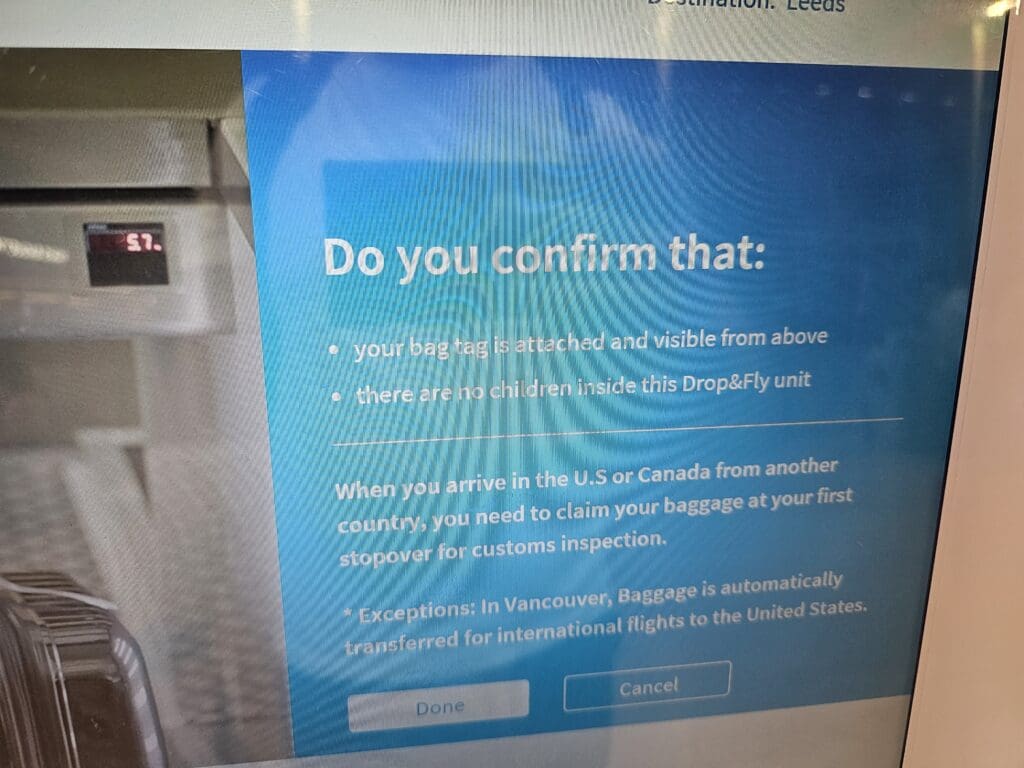
As I wandered around, it didn’t take long to spot KLM’s check-in area, with this featuring a fairly reasonable queue of passengers. This area consisted of a row of automated bag drop-off machines, whilst plenty of self-check-in machines could also be found. Whilst I assume that KLM did have a few manned desks somewhere, I failed to spot these, or they were perhaps not open at that time given the fact that I still had over three hours to go until my flight was scheduled to depart. Hoping that I wouldn’t have to queue up if I printed off my boarding passes and baggage tag using the self-check-in machines, unfortunately, whilst these machines claimed that the latter could be printed, this turned out not to be the case. Thus, with my boarding passes in hand, I was left with no option other than to join the ever-growing queue of passengers. Following fifteen minutes of slowly shuffling forward, I was greeted by one of the friendly Air France-KLM agents manning the check-in area. Upon scanning my passport, for whatever reason, they placed my check-in machine-printed boarding passes in the bin and instead gave me a single boarding pass for both my flight to Amsterdam and my onward hop to Leeds Bradford before pointing me in the direction of a kiosk. Unfortunately, the first machine that I used didn’t seem to like the look of my passport, however, shifting to the neighbouring machine, this worked without issue. Within a few seconds, a baggage tag was printed out and after carefully following the instructions on the screen, I affixed this to my suitcase before sending this off deep into the depths of Terminal 2.
With all check-in and baggage formalities complete, feeling rather parched I stopped by at the local GS25 convenience store for a bottle of water which I downed before continuing onwards to security and immigration. Terminal 2 features two immigration and security checkpoints, with these sitting at opposite ends of the security hall. Given the lack of passengers milling about that evening, I was not anticipating any major waits and thus made a beeline for the closest checkpoint. In the usual manner, my boarding pass was scanned and passport checked before I was permitted to enter this area and after no more than a minute of queuing, I parted with my belongings before being reunited with these about thirty seconds later after I had passed through a full body scanner. Overall, this was a quick and efficient security check, and I found the staff manning this to be polite and friendly, thereby leaving me with no complaints. With no need for any additional searches or checks, I then headed onward to immigration. Whilst passengers were first directed to the line of immigration e-gates, as is always the case when departing Korea, these took a dislike to my passport and I was thus directed towards the only manned counter. Fortunately, with no queuing, I walked straight up to this and handed over my passport, and within about thirty seconds I was free to continue onwards to the airside area.
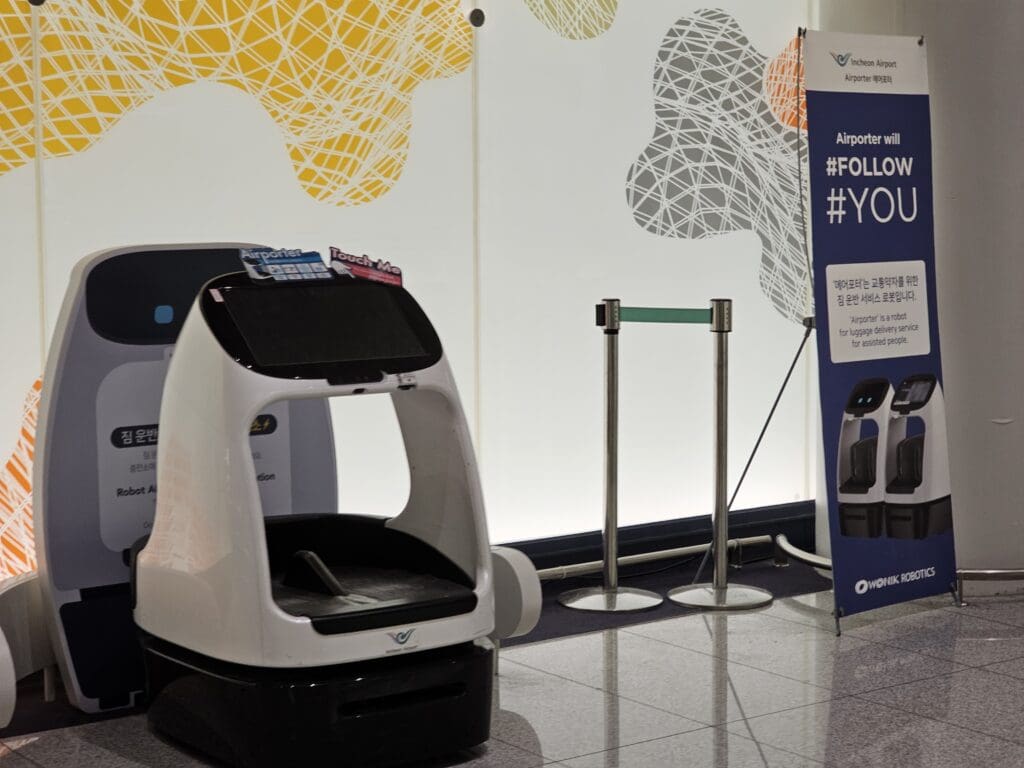
Thanks to the smooth journey from the landside to the airside portion of the terminal, upon making it through immigration I was left with plenty of time to comprehensively explore the nooks and crannies of Korea’s newest airport terminal. Focusing on its layout, the terminal is roughly staple shaped and features a main central hub where many of the terminal’s shops, cafés and restaurants are located, whilst two arms branch off this. In total, the terminal features 33 jetbridge equipped stands along with several bus boarding gates and whilst not being comparable to the likes of Doha Hamad or Singapore Changi in size, the terminal is by no means small and it does take a fair amount of time to trek from one side of the terminal to the other. Fortunately, moving walkways are virtually omnipresent throughout the terminal, whilst those needing assistance can ride one of the carts to their gate. As I wandered around, I came across several Airporters. These are smart robots that can carry passengers’ baggage to their gates, and it was my first time seeing such robots anywhere in the world!
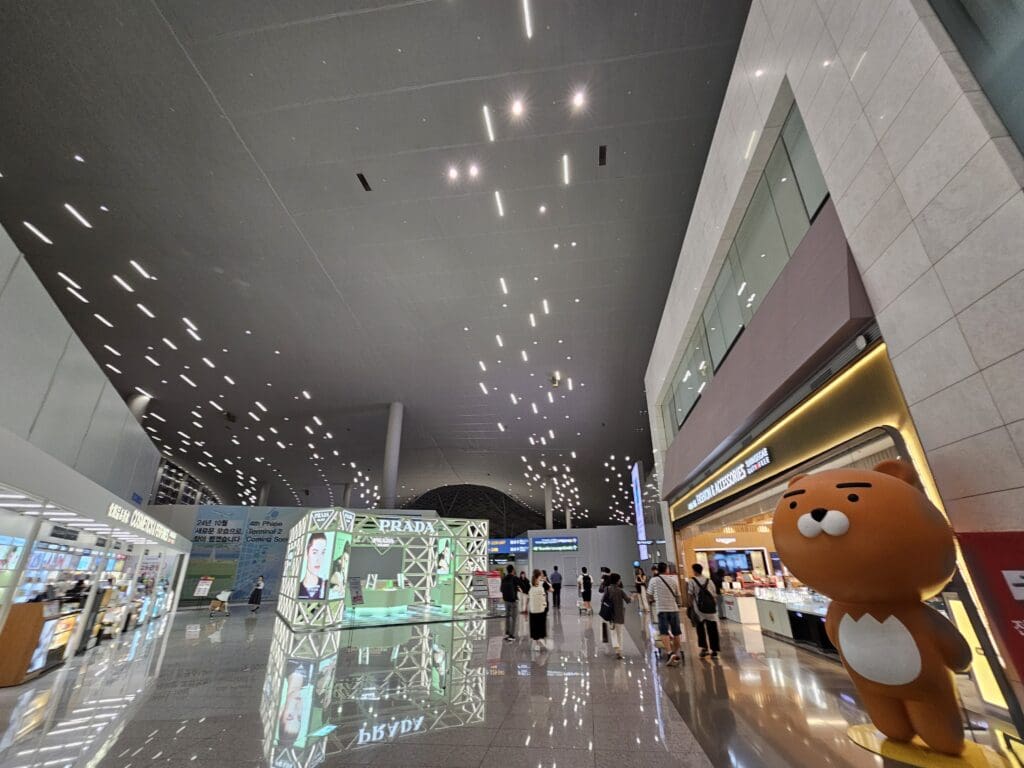
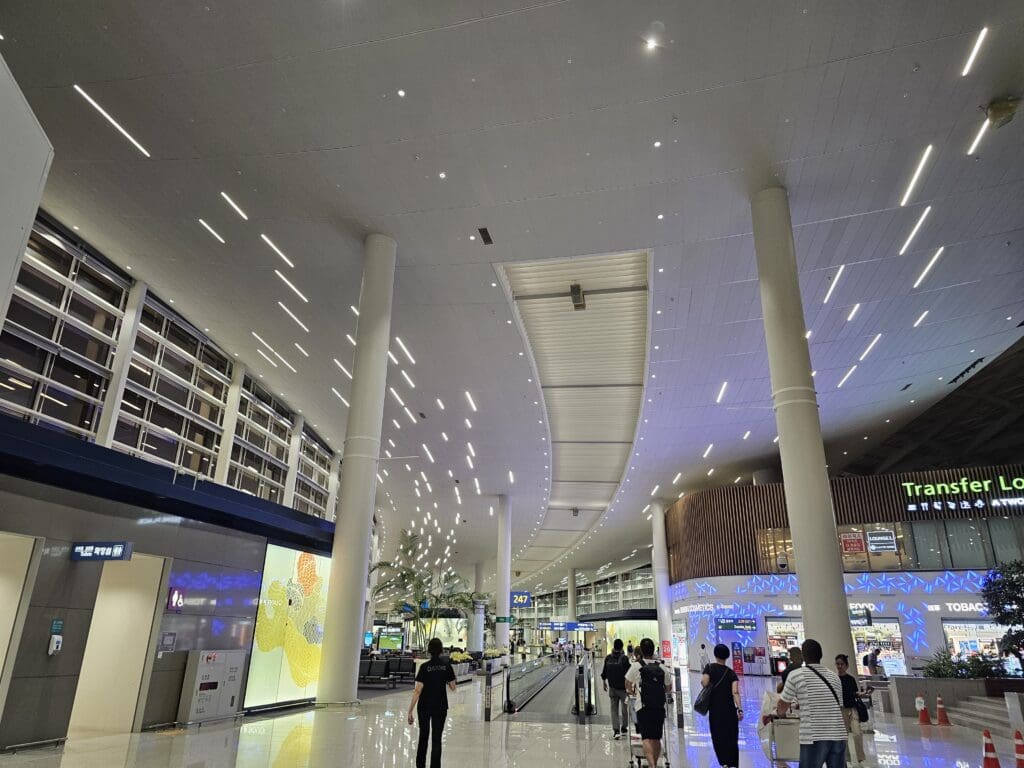
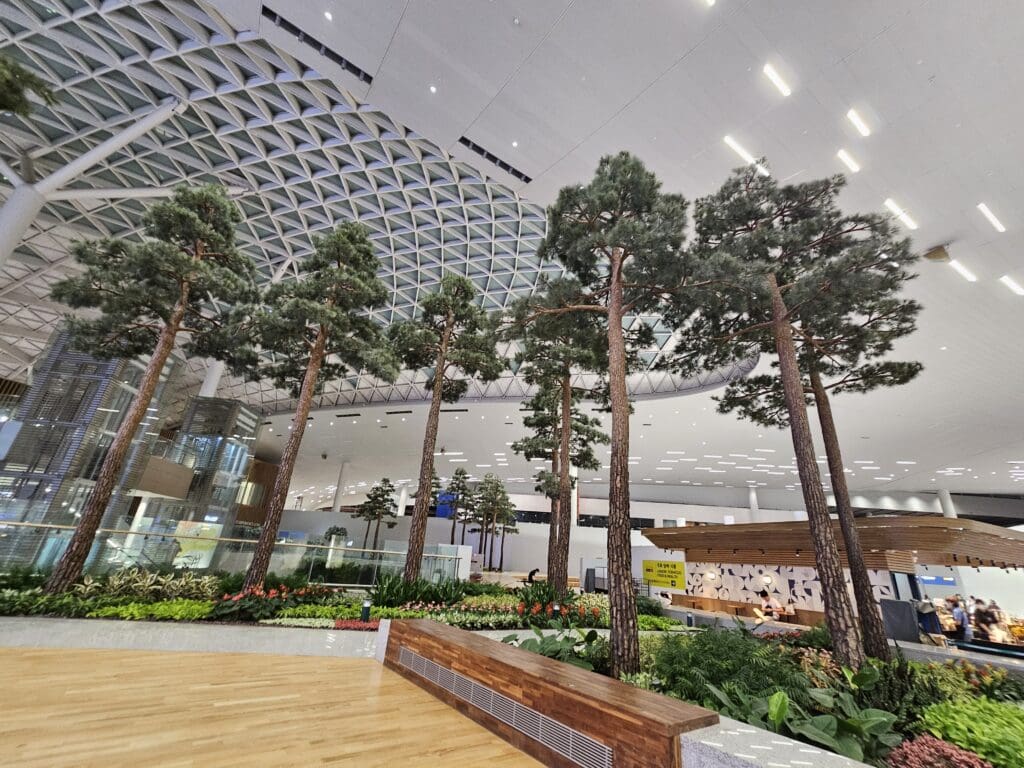
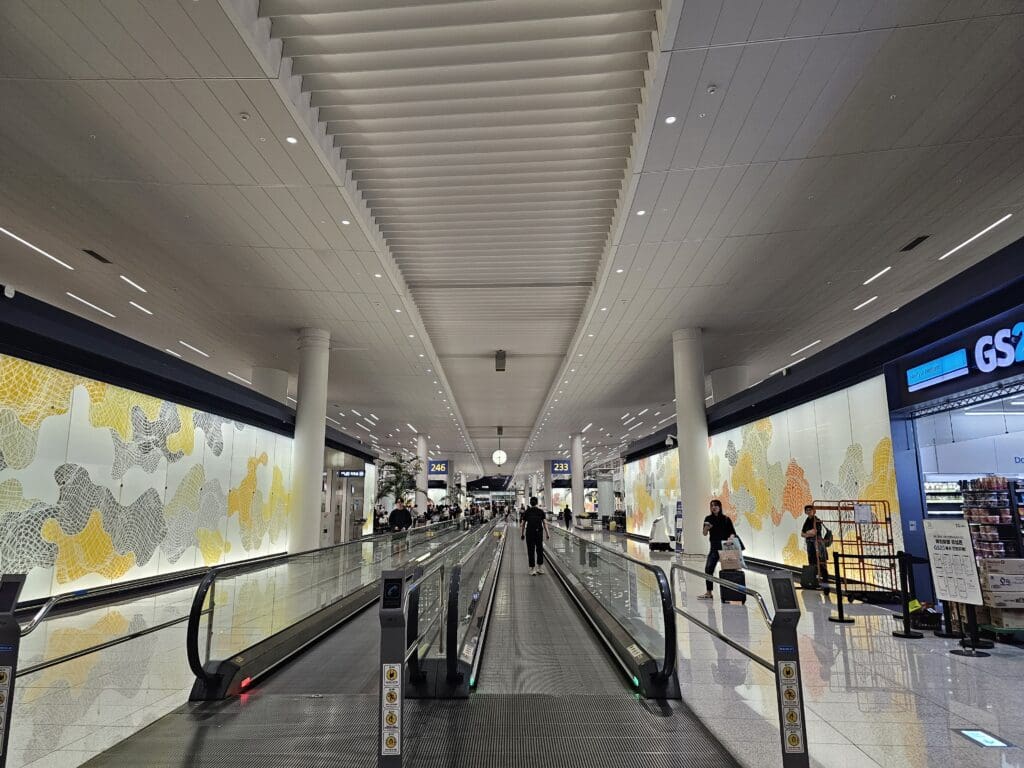
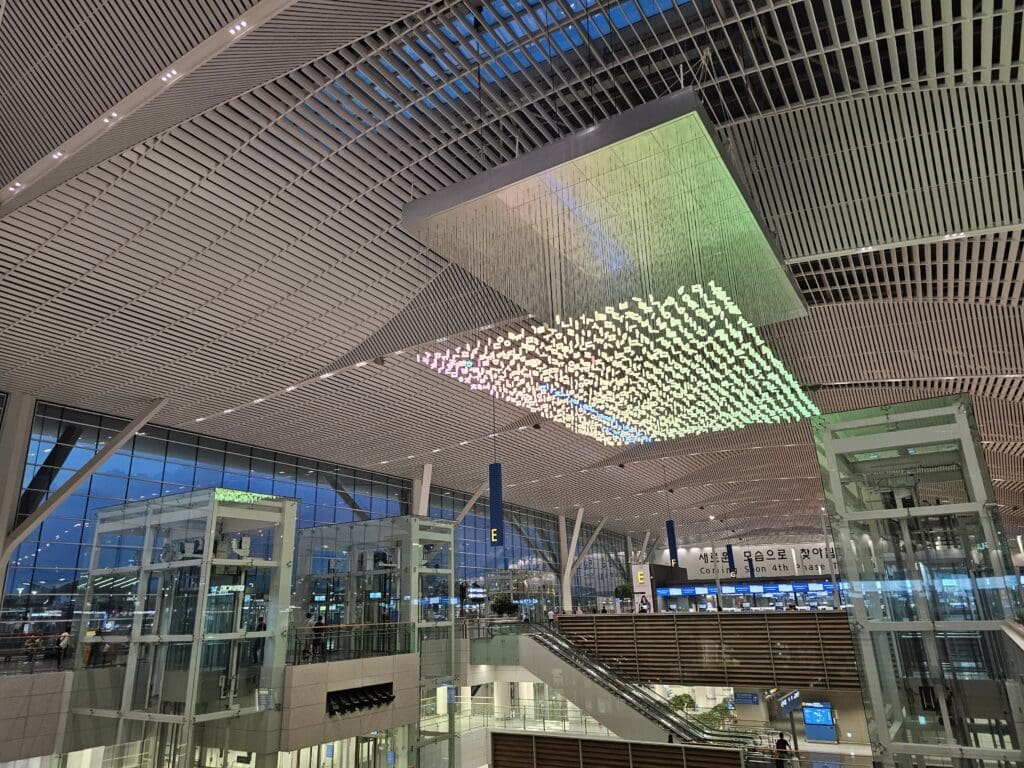
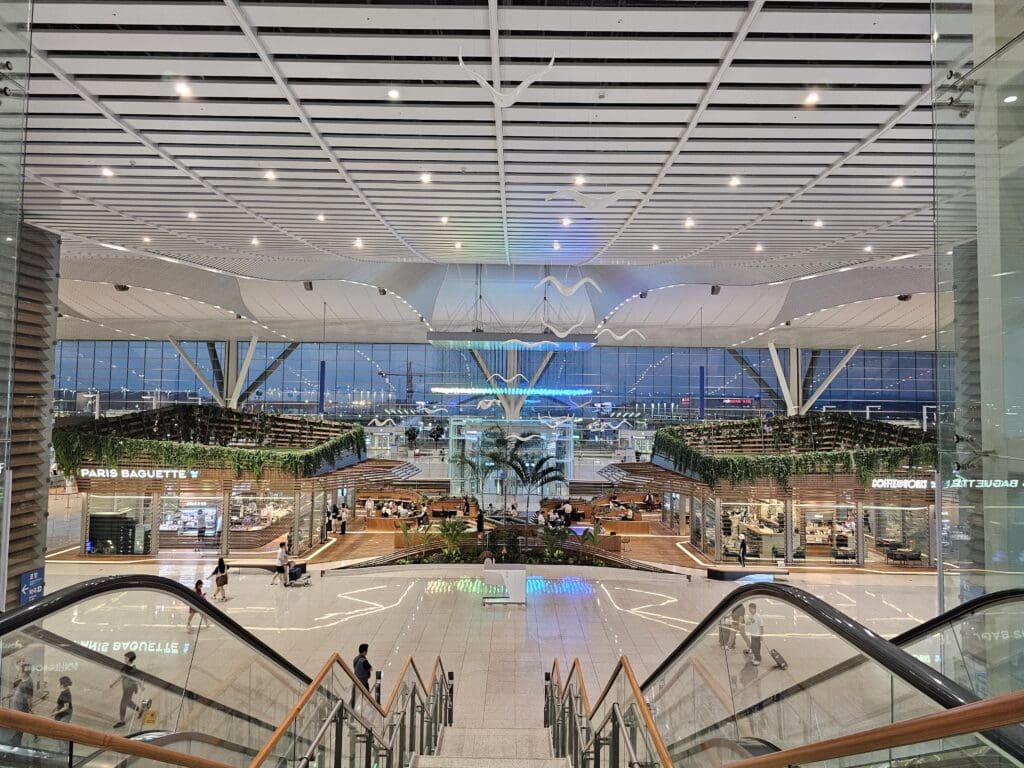
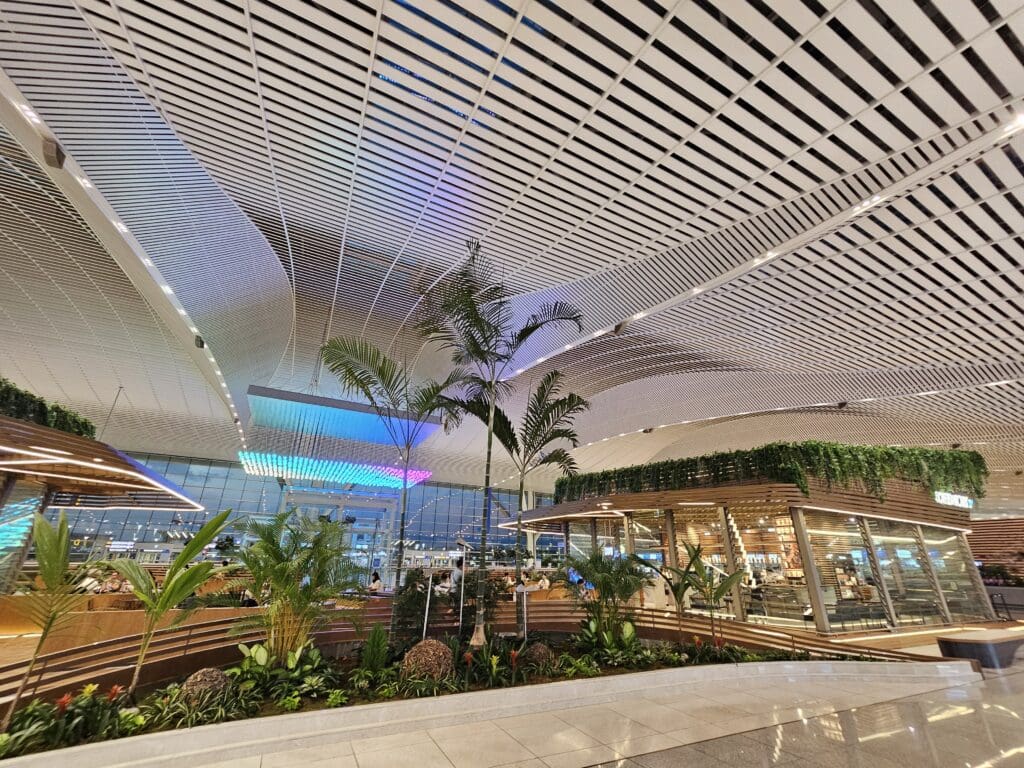
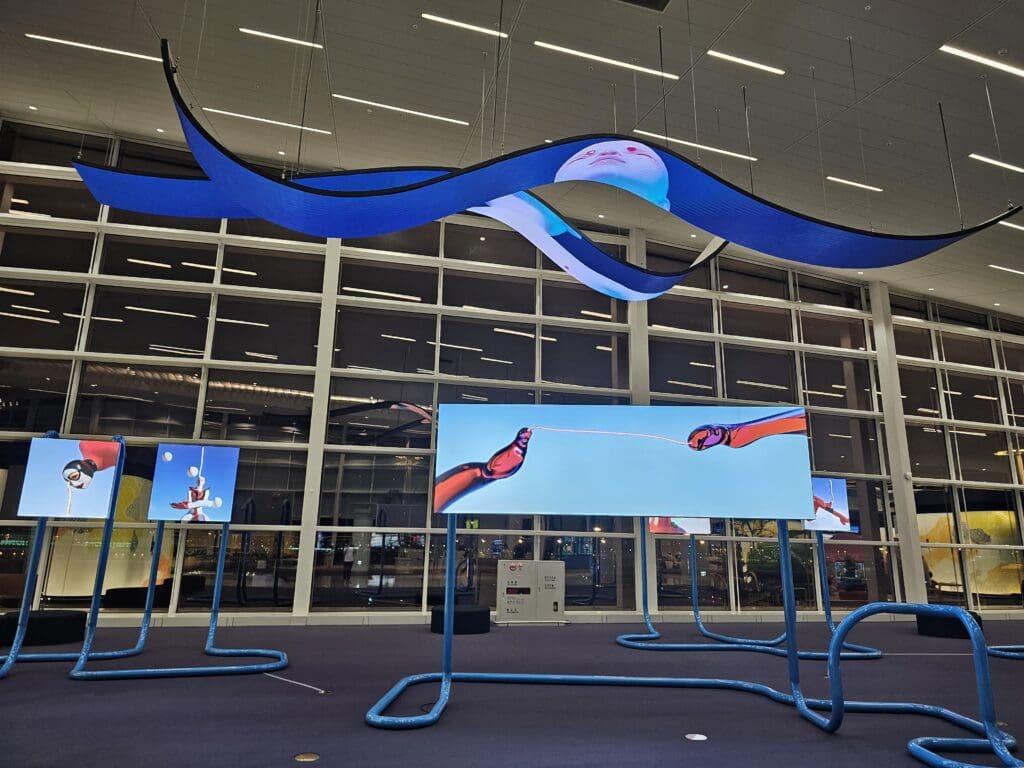
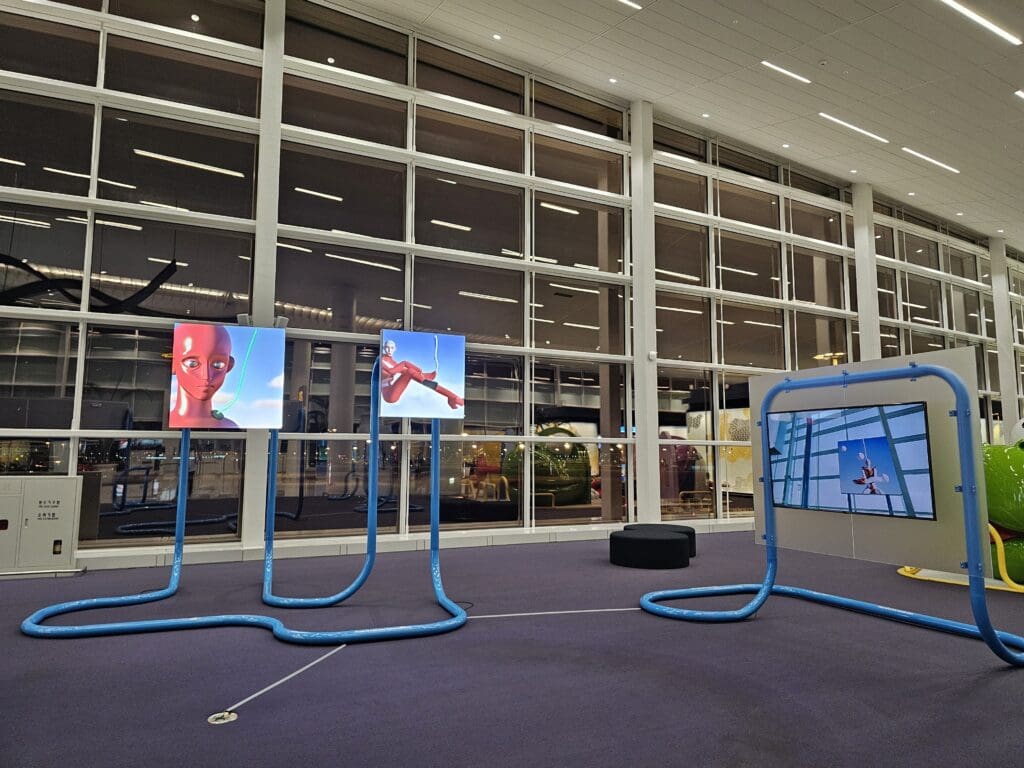
Turning to the terminal’s design, this was bright and modern inside, and one of the more architecturally impressive and stylish terminals that I have had the pleasure of passing through. Adding a welcoming touch of green, plenty of plants and even tall trees (which I believe were real) could be seen throughout the terminal. Meanwhile, this also featured a host of exhibition spaces where passengers can browse various installations by local artists before jetting off. Importantly, I found the terminal to be clean and tidy throughout and was left with relatively little to complain about. However, I should note that the terminal did seem to be surprisingly lacking in plug sockets and other charging points. Meanwhile, with various upgrade projects underway at that time, plenty of construction hoarding could be seen, accompanied by the sound of banging and sawing.
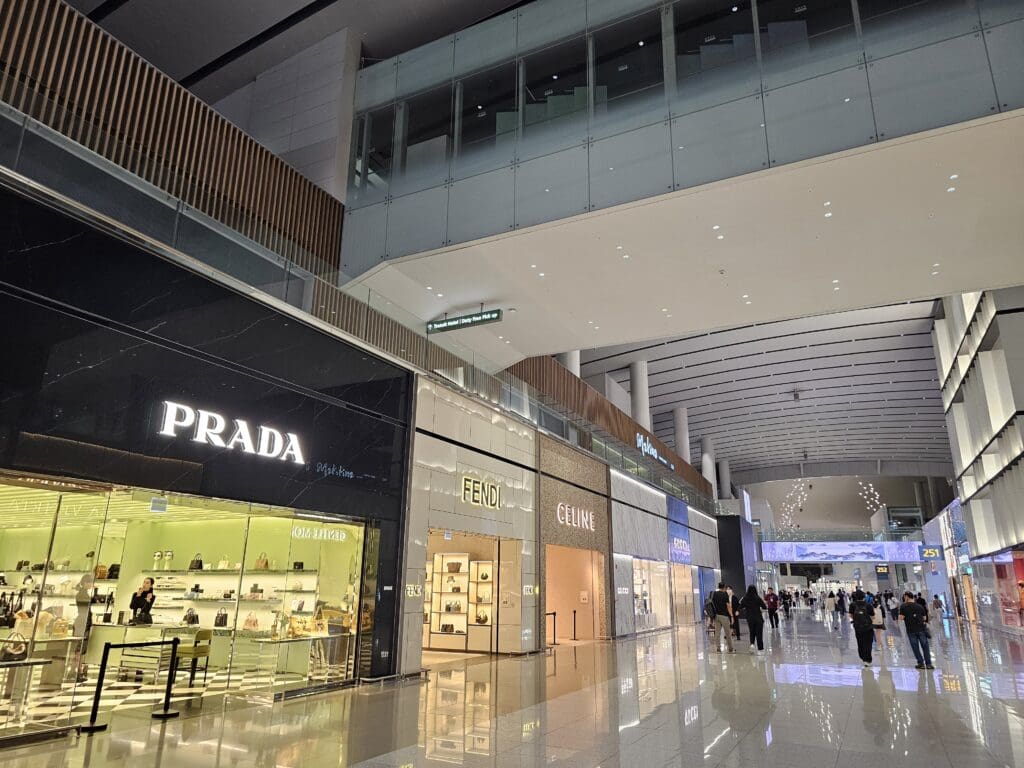
Being a major airport terminal, once airside Terminal 2 features no shortage of shops, cafés and restaurants. Those wanting to partake in some retail therapy can visit no fewer than six duty free outlets, whilst a bookstore, travel store and plenty of luxury brand shops can be found in the terminal. These come in addition to plenty of cafés and restaurants specialising in an array of cuisines from across the world. Meanwhile, those looking to purchase food and drink without paying inflated airport prices can instead head to the local branches of CU and GS25 convenience stores, with one branch of each located in the airside portion of the terminal.
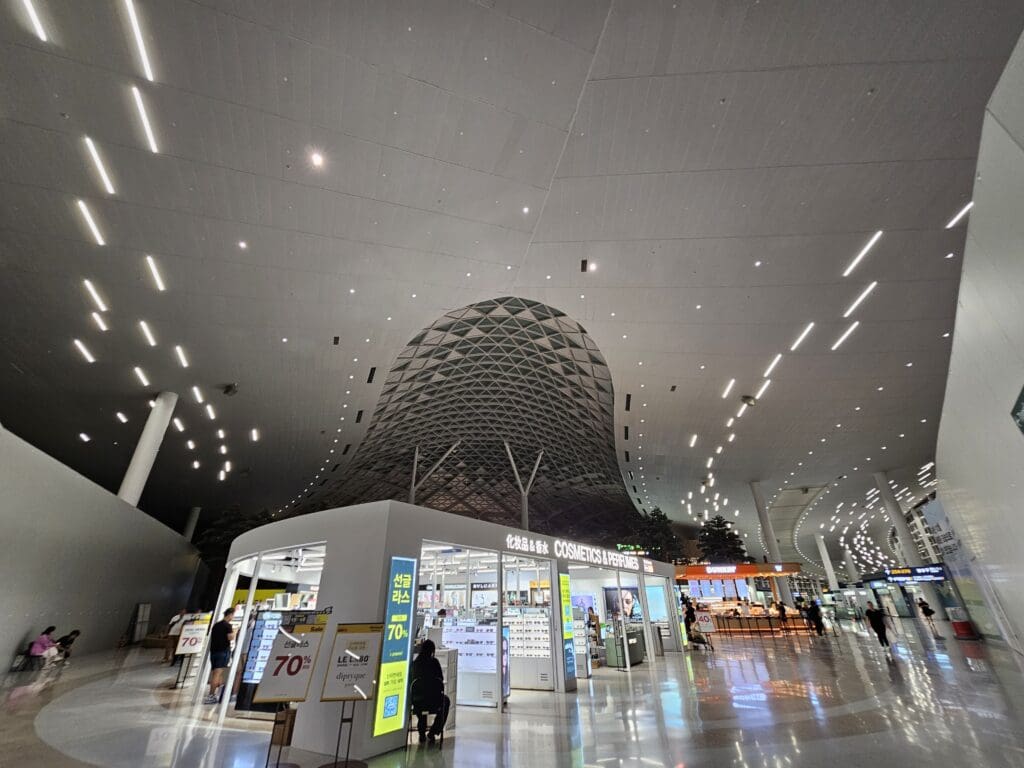
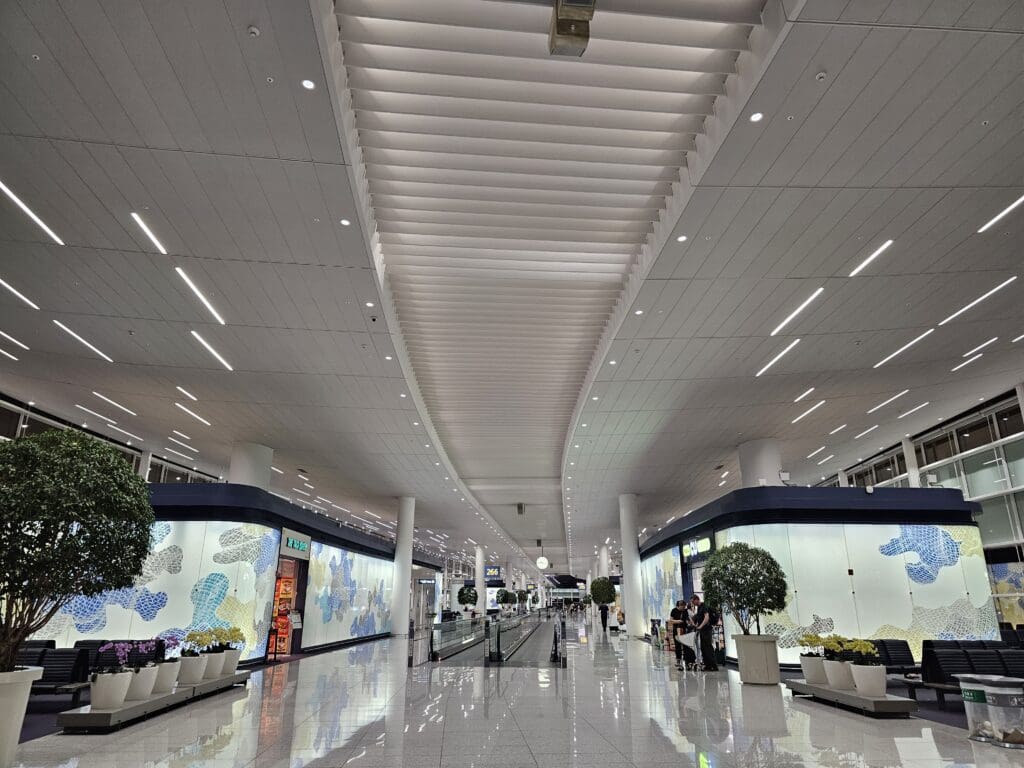
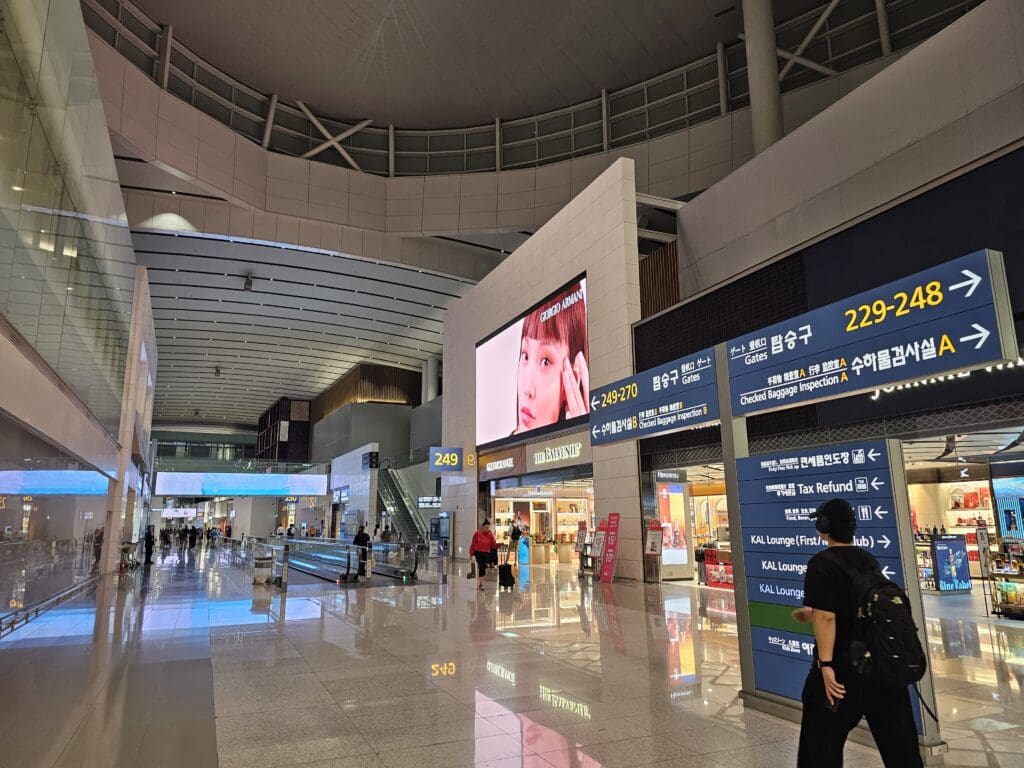
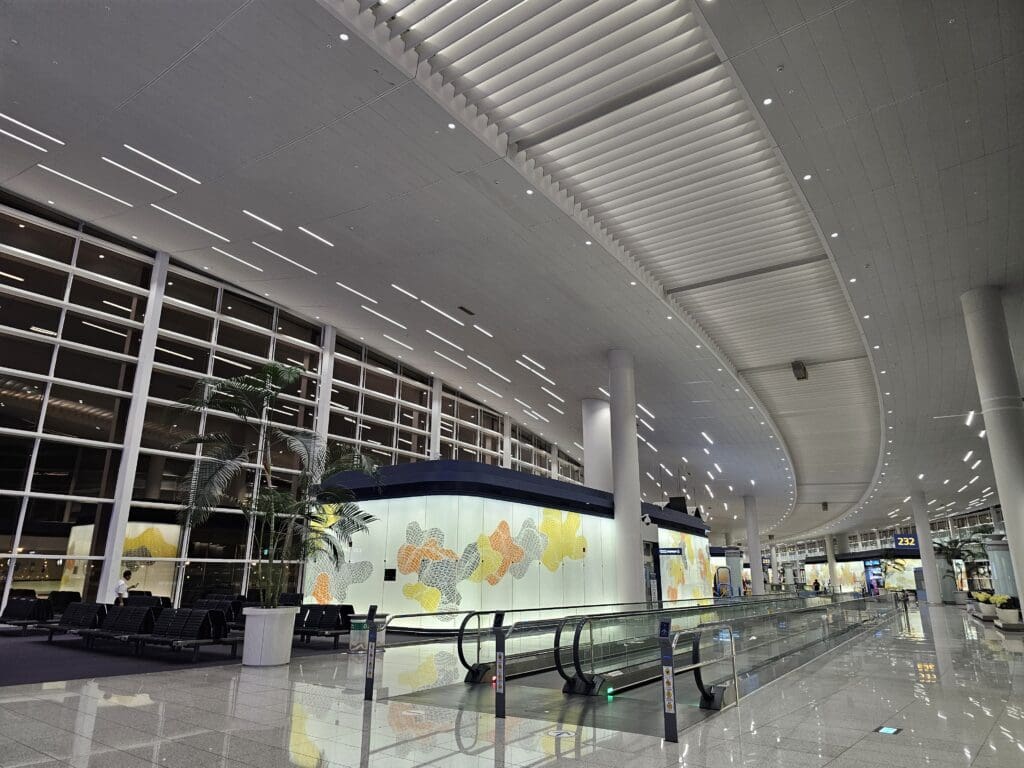
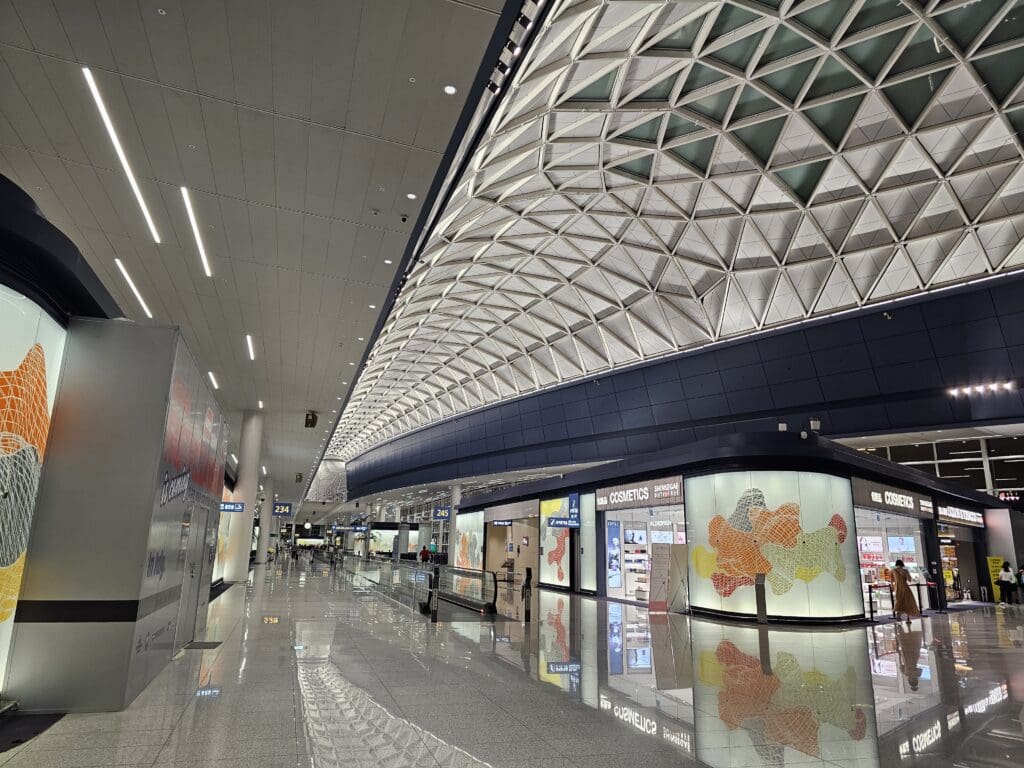
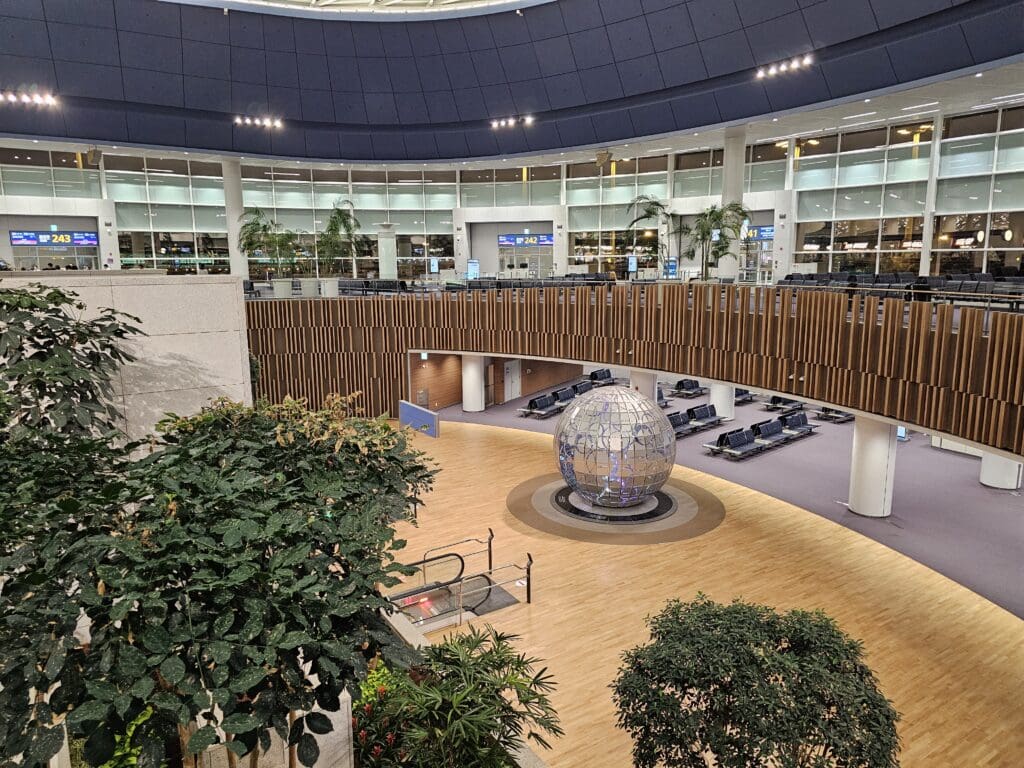
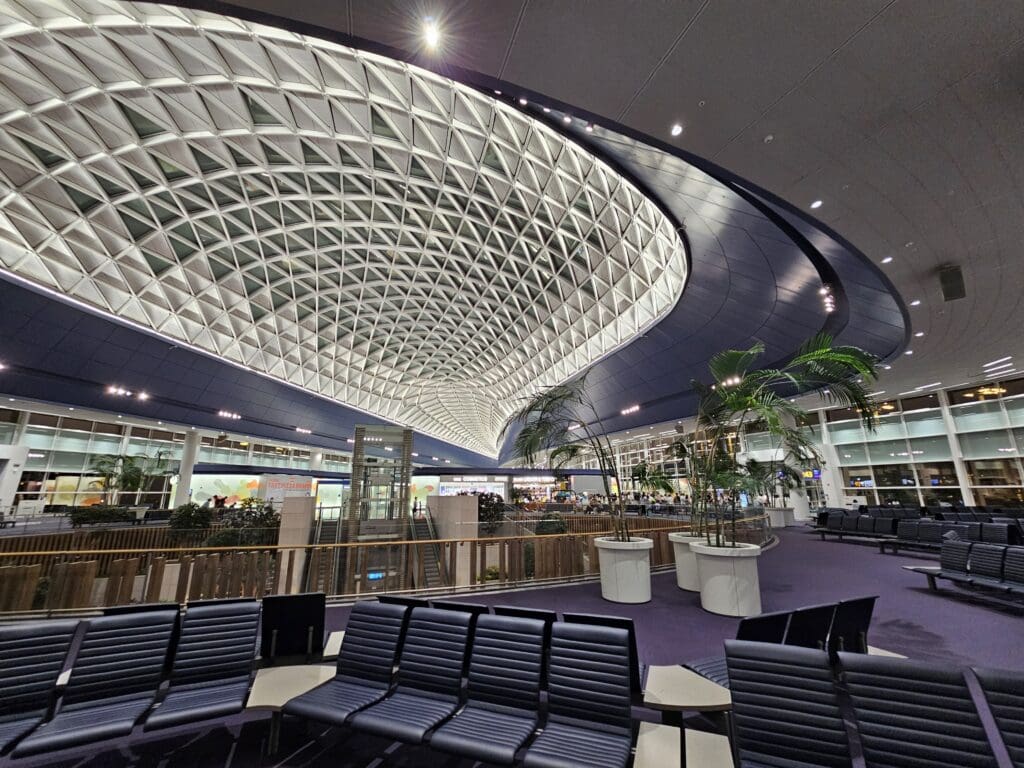
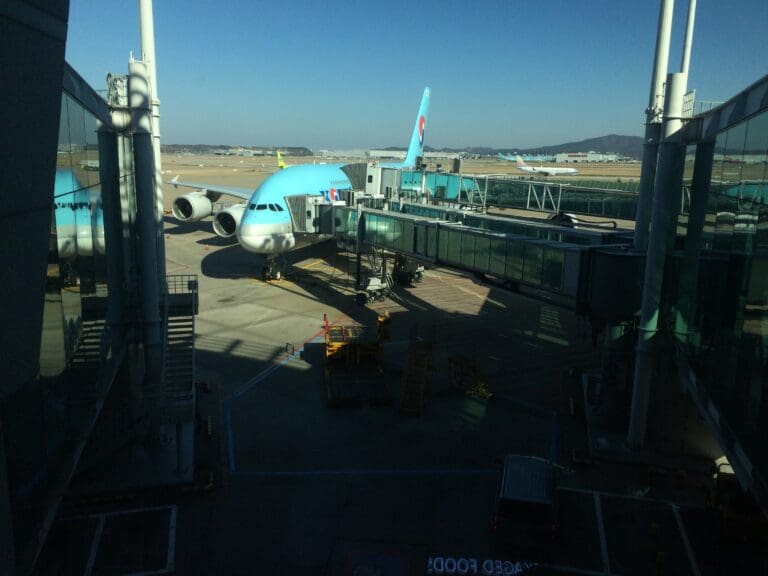
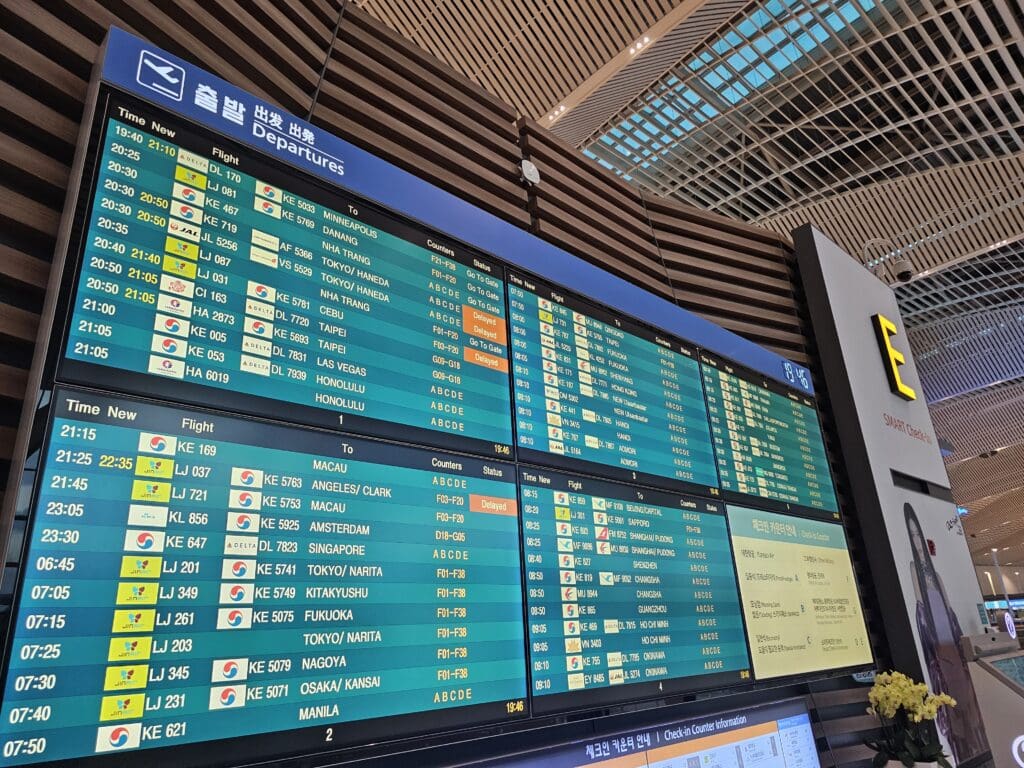
As an aviation enthusiast, I was delighted to see that floor-to-ceiling glass windows were in place throughout the terminal, offering a superb view of the terminal’s stands as well as of the northern ends of Incheon Airport’s runways. However, with it being fully dark outside, planespotting opportunities were sadly limited. However, I was able to get a good view of those aircraft sitting at the stands directly outside the terminal basking in the glow of the apron floodlights. For aviation enthusiasts, Terminal 2 fails to offer the same diverse array of airlines as can be seen at Incheon Airport’s Terminal 1. Those with any time on their hands in Terminal 2 can expect to see plenty of blue and silver jets, with this being the home of Korean Air, alongside their low-cost subsidiary, Jin Air. Meanwhile, the terminal also hosts several Skyteam carriers such as Air France, China Airlines, Delta Air Lines, Garuda Indonesia, Xiamen Air, and of course KLM. Looking at the departure boards, there was a total of just twelve departures between 2020 and my flight at 2305. These took the form of Korean Air-operated services to Cebu, Honolulu, Las Vegas, Macau, Nha Trang and Tokyo Haneda, Jin Air flights to Angeles, Cebu, Danang and Macau, and flights to Minneapolis and Taipei operated by Delta Air Lines and China Airlines respectively. Of these, had I not been heading to Amsterdam, I would have snapped up a seat on the Honolulu service, not only because I have always wanted to visit Hawaii, but also because this was operated by the relatively rare Boeing 747-8.
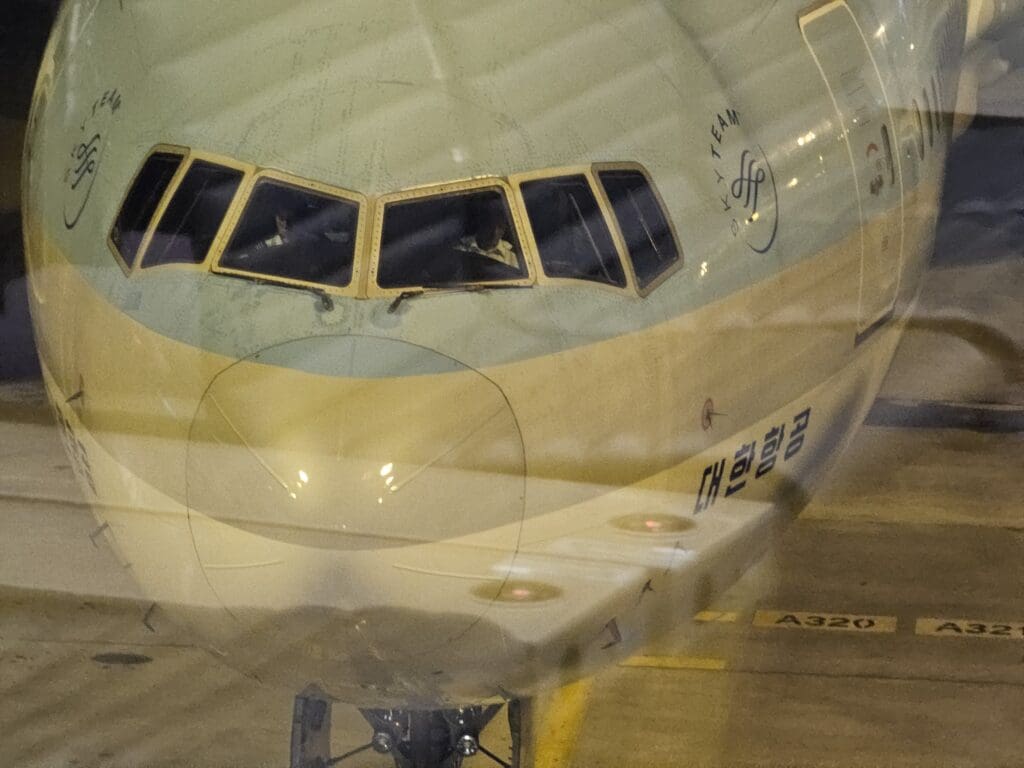
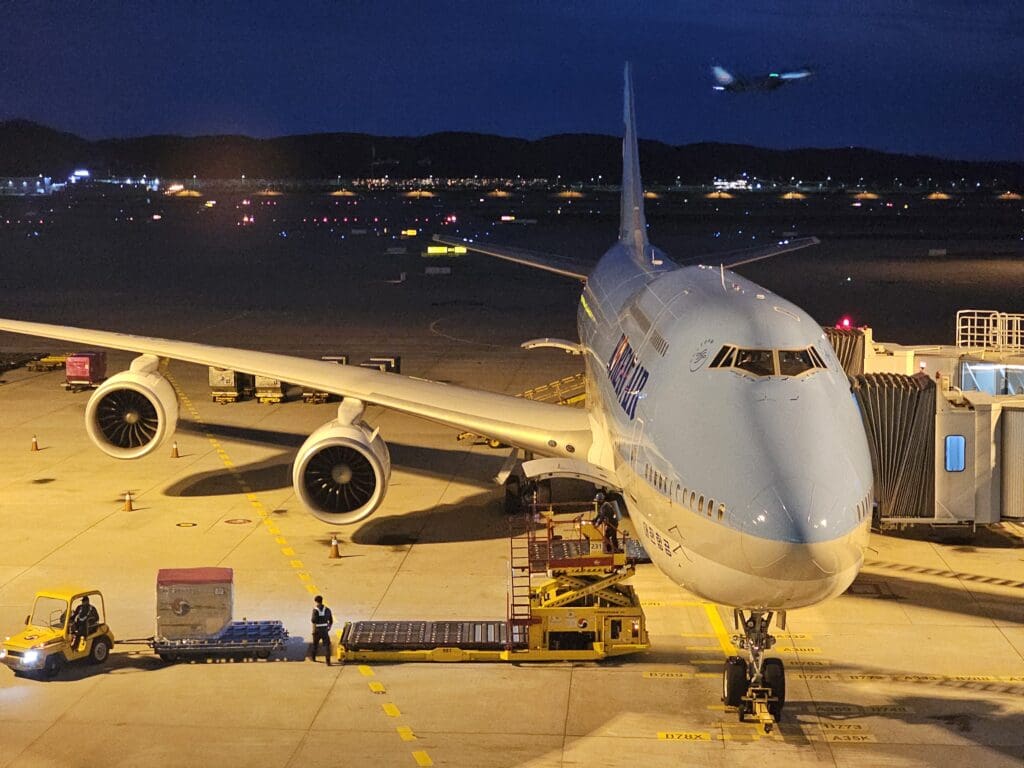
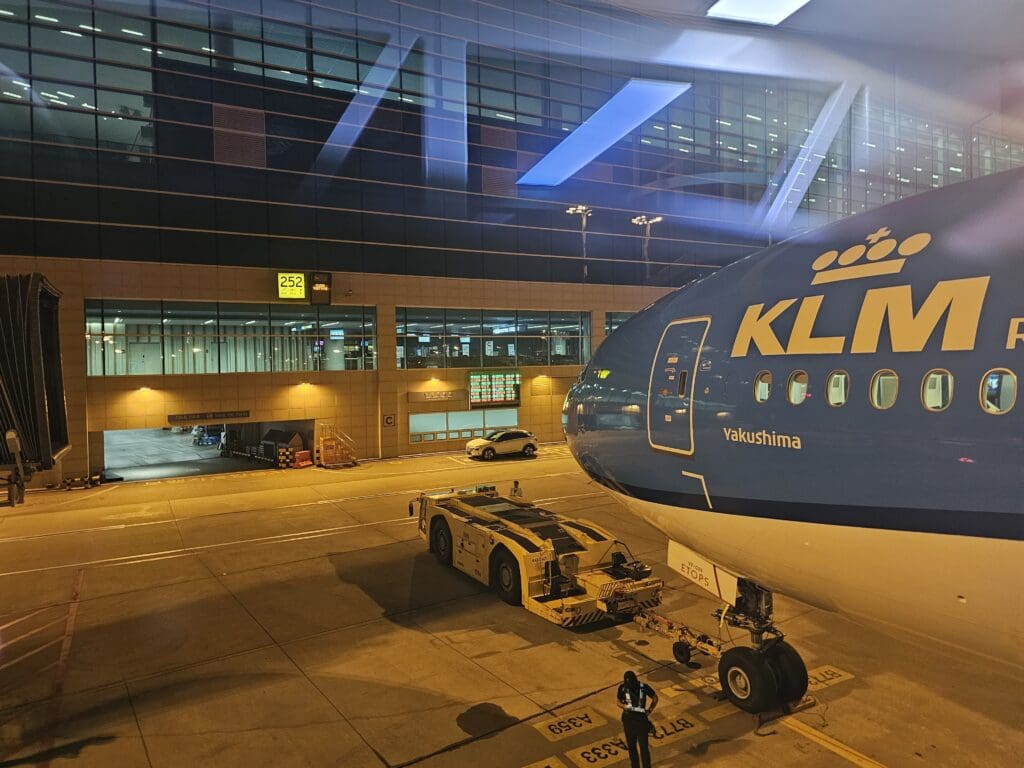
To ensure that KLM’s outbound service does not depart Amsterdam too late, and its inbound service does not touch down on Dutch soil too early, KLM has long scheduled its Korea service to have a comparatively long turnaround time at Incheon Airport. As per summer 2024 schedules, this arrives at 1625 and departs at 2305, equating to a turnaround time of almost seven hours! Typically, once all inbound passengers have disembarked, the aircraft is towed to a remote stand where it spends much of its afternoon and evening before being towed back to Terminal 2. With around ninety minutes to go until departure, this was towed back to Stand 252 near the centre of the terminal, with an army of ground staff soon springing into action and loading this up for its long slog to Europe.
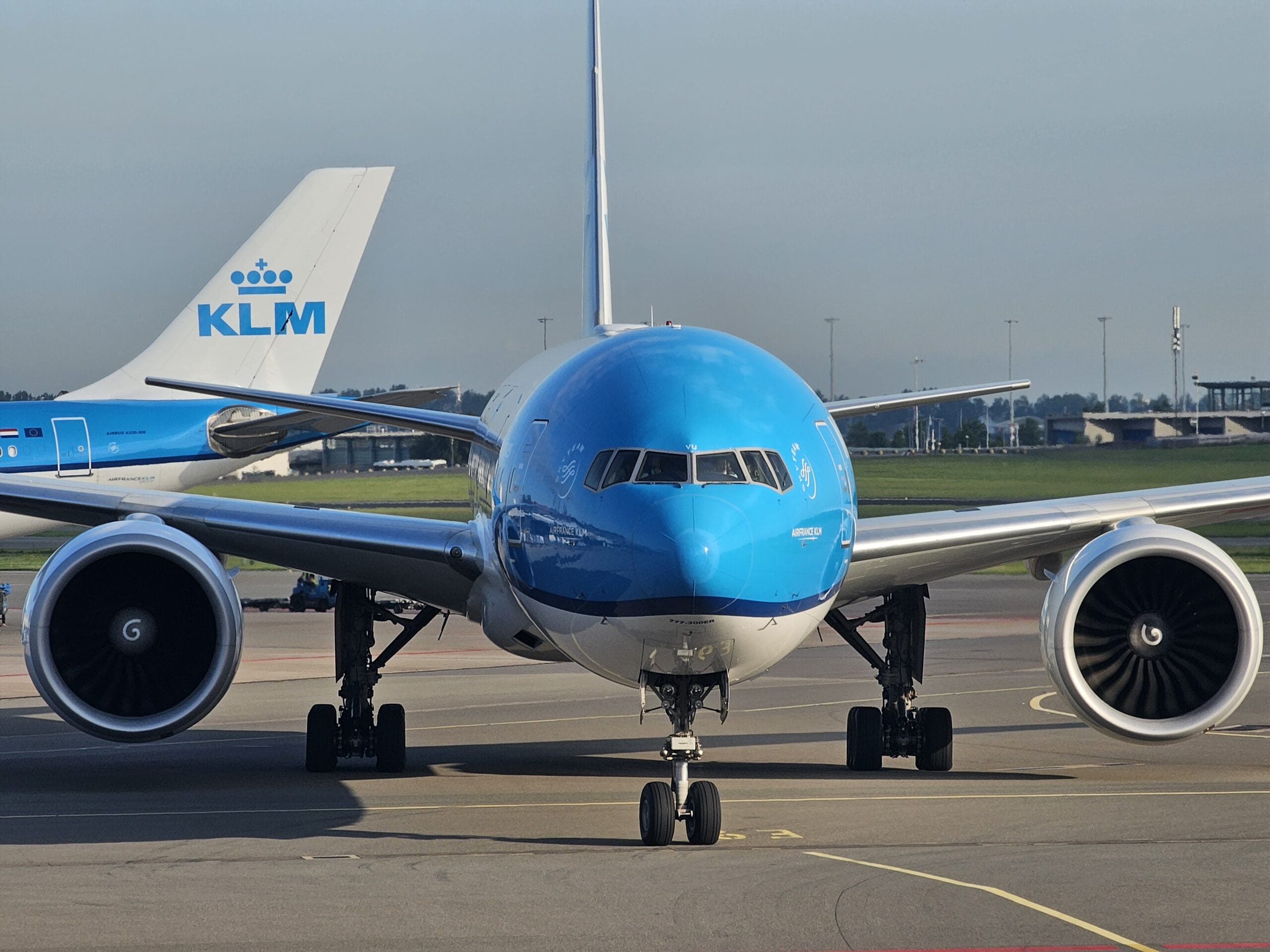
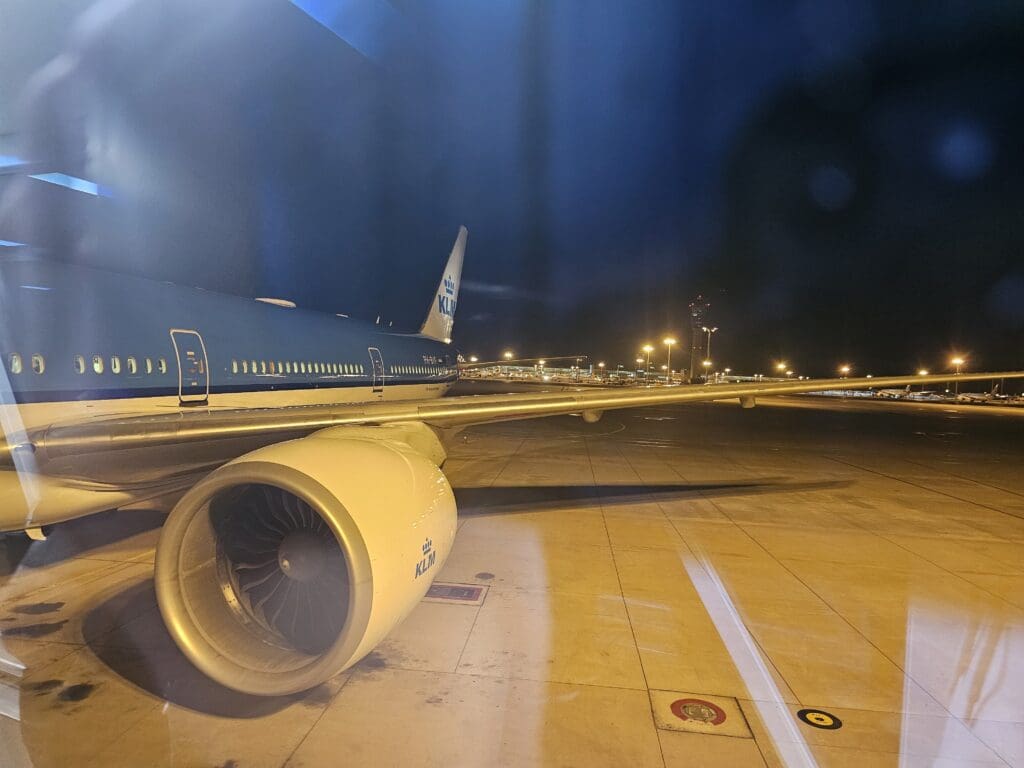
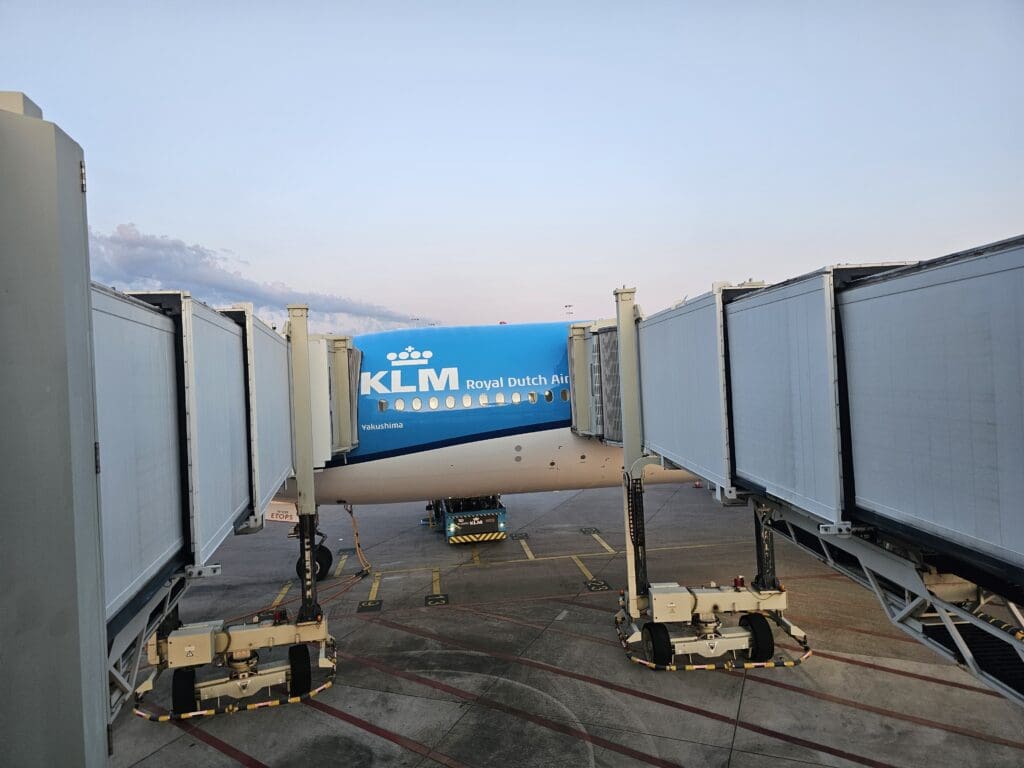
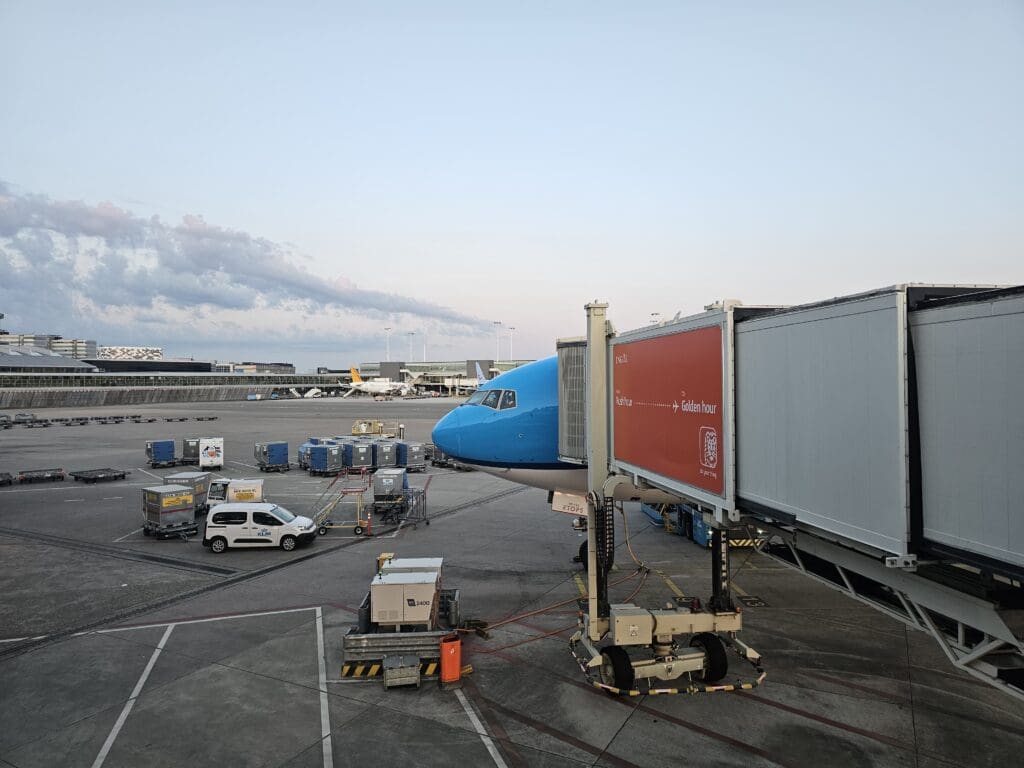
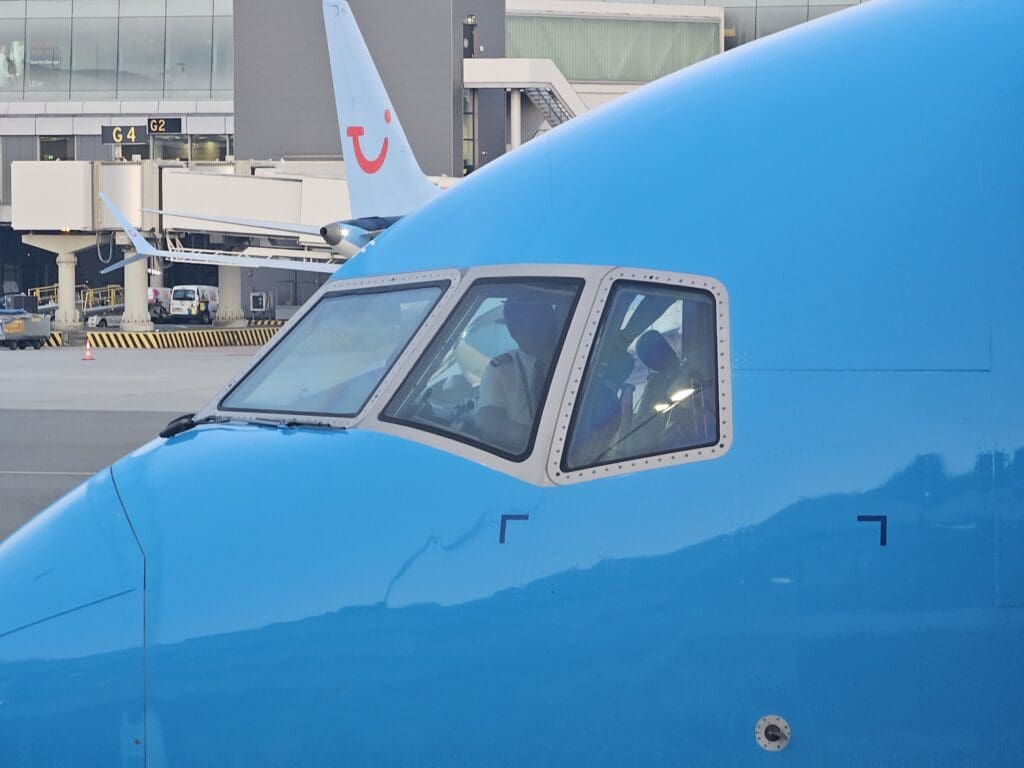
That night, my trusty blue steed would take the form of PH-BVF, a Boeing 777-306(ER) named Yakushima, after Japan’s Yakushima National Park. Carrying line number 915, this jet was assembled at Boeing’s Everett plant, and took to the skies for the first time in January 2011, making it a total of 13.49 years old at the time of my flight. The following month, the aircraft was handed over to the Netherlands’ national carrier and ferried across to its new home at Amsterdam Schiphol from where it has operated ever since. Connecting Amsterdam with destinations across the world, this particular Boeing seems to have had a rather uneventful life, other than undergoing two configuration changes, a repaint into KLM’s updated colour scheme and the temporary addition of a decal celebrating the airline’s centenary in 2019. According to the Aviation Herald, during its life, the aircraft had suffered from just one incident. This occurred in January 2019 on a flight from Amsterdam to Sao Paulo, when an engine oil issue off the Irish coastline resulted in the jet returning to its origin. In the week before my flight, the aircraft had connected Amsterdam with Cape Town, Chicago, New Delhi and San Francisco, flying at least 44,400 miles during these sectors.
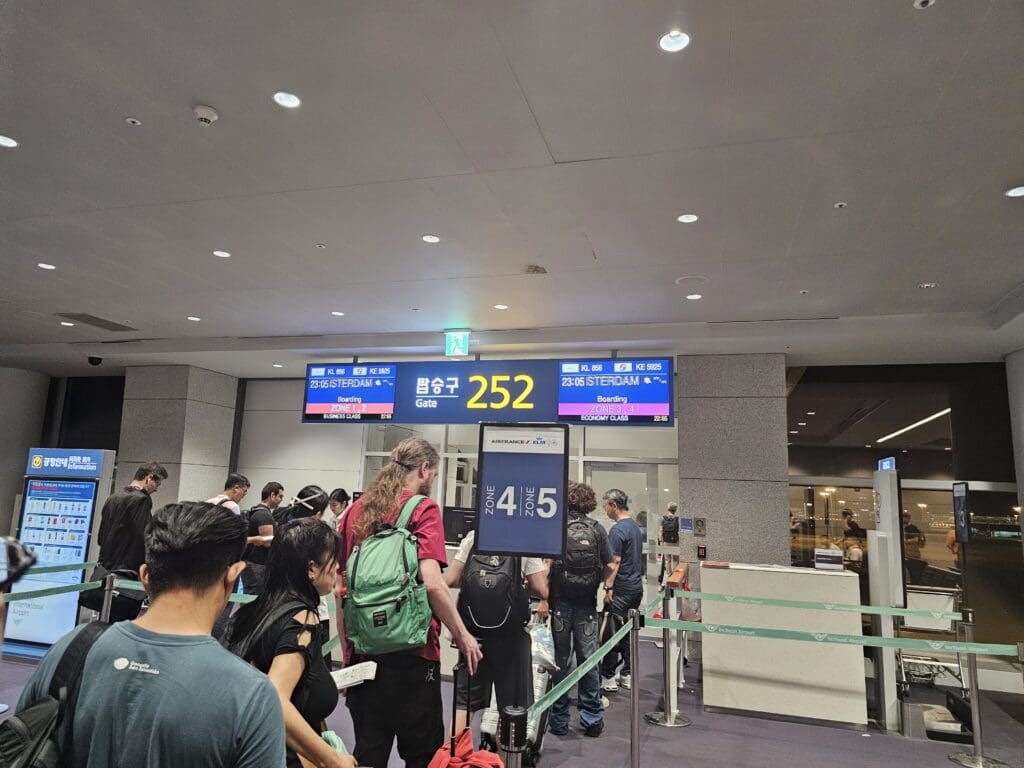
According to my boarding pass, boarding was scheduled to commence forty minutes before departure at 2235. Seeing as Gate 252 features perhaps the smallest waiting area of all of the terminal’s gates, I decided not to head over there until just before boarding was scheduled to commence. Upon arriving at the gate, I found this to be cramped and crowded, with all seats appearing to be filled and plenty of passengers sprawled out across the floor. Just why this gate had been picked given the fact that many of the terminal’s stands were empty was a complete mystery! At that time, several Air France-KLM staff members could be seen hard at work undertaking final preparations for boarding, however, the scheduled boarding time came and went with no sign of any movement indicating that a delay was highly likely.
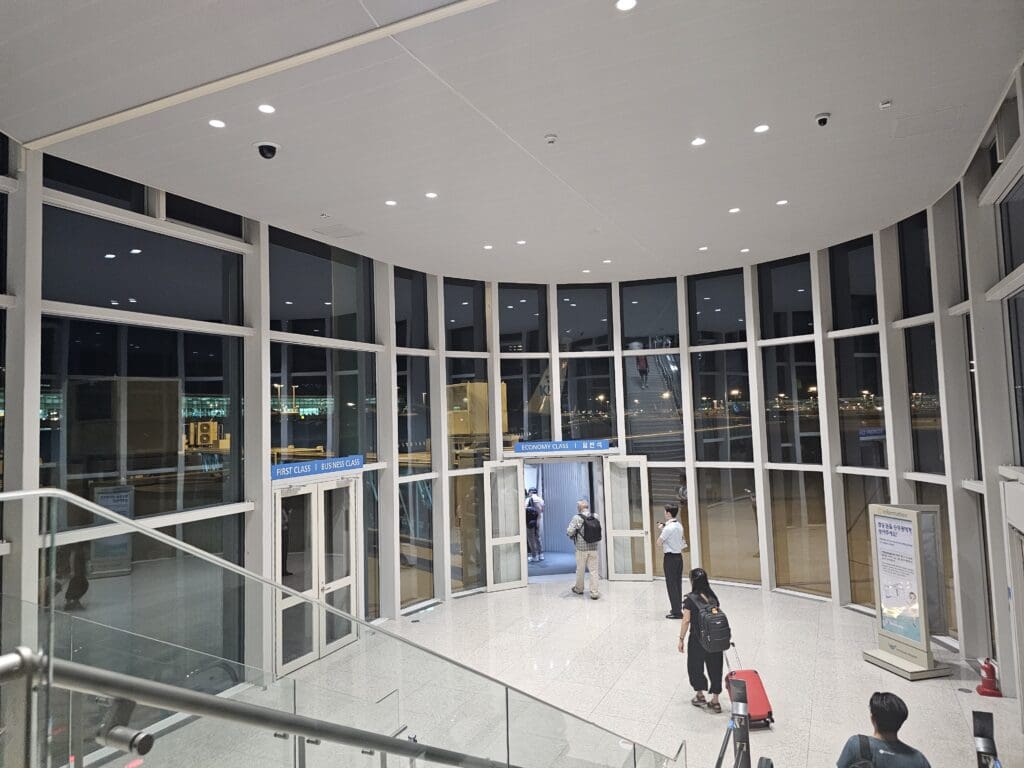
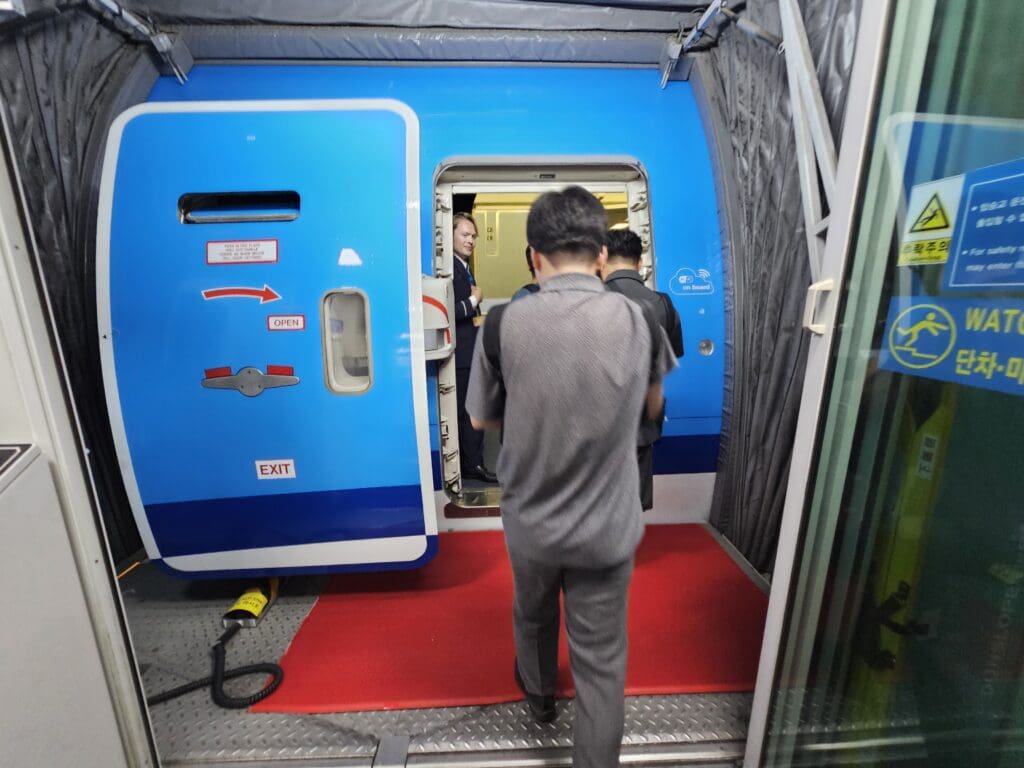
Ten minutes after boarding had been scheduled to commence, an announcement was made inviting those in Zone 1 to board. Given the number of passengers, it took quite some time for the gate staff to work their way through the boarding order, and to their credit, the staff seemed to have no issues in turning away those who attempted to board ahead of their zone. On a side note, interestingly it appeared that KLM boarded passengers in Economy from front-to-back rather than the usual back-to-front order, and the only airline that I had previously seen this on was Virgin Atlantic. After lingering around for eleven minutes, those in Zone 5 were invited to board and I joined the orderly queue of passengers lining up to the gate podium. As I shuffled forward, one of the gate agents checked my boarding pass and passport, this being undertaken once again upon reaching the podium by a somewhat cold member of the ground staff. Without a word, I headed down the escalator that led to the gate’s jetbridges. Whilst two jetbridges were present, boarding was only undertaken with one of these that night, with this connected to the Boeing’s L2 door.
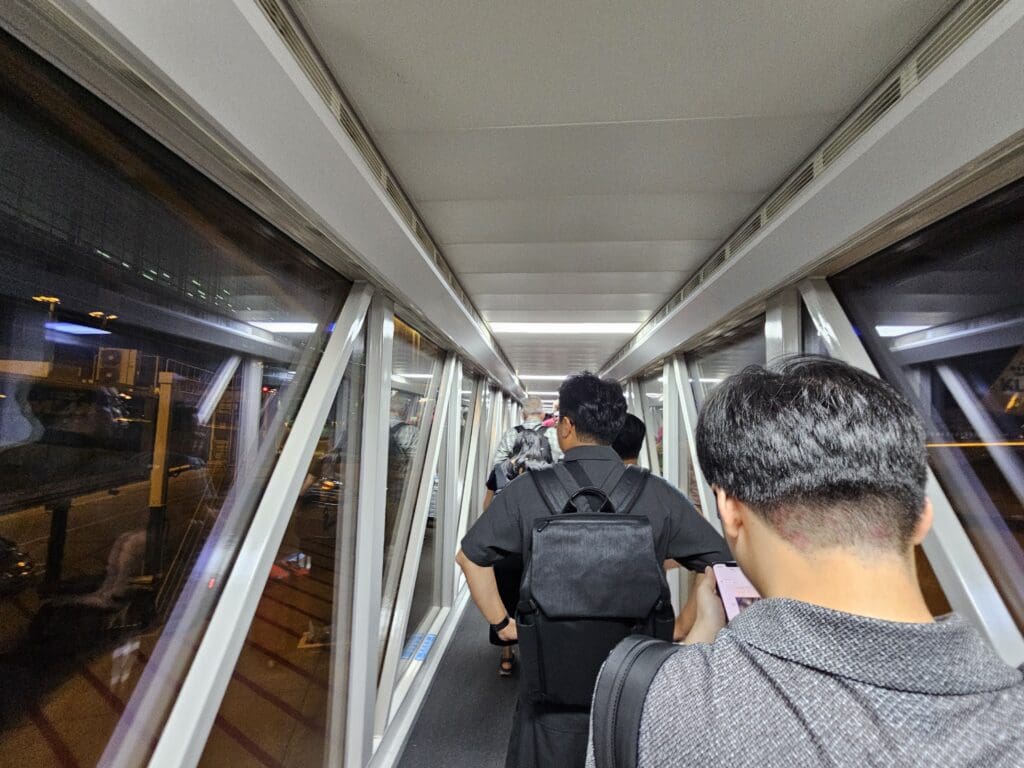
As I made my way down the glass jetbridge I soon hit a queue and ended up standing in line for around three minutes before making it to the aircraft. However, seeing as the jetbridge was nicely air-conditioned and offered a superb view of the Boeing’s gigantic left-hand engine, this ended up being a more enjoyable place to wait than the gate area! Eventually, I made it to the L2 door, where two flight attendants could be seen welcoming passengers – a Dutch crew member and a Korean member of KLM’s Incheon-based crew. Getting things off to a good start, as soon as I stepped onto the aircraft I received a warm Dutch welcome before displaying my boarding pass after which I was directed down the second aisle.
First up on my journey to the rear of the aircraft was the smaller of the Boeing’s two Business Class cabins. There, just two rows of Jamco Venture lie flat reverse herringbone seats could be seen in a 1-2-1 configuration. Seeing as all of these were already filled by the time I had made it onto the aircraft, I was unable to get a good look at these seats. However, at first glance, they did seem to be a little less private than the premium suites of several other major airlines. That said, I would not have complained about the opportunity to spend the next thirteen or so hours in the luxury of one of these on the long overnight trek to Amsterdam!
Cautiously heading down the narrow aisle to avoid bumping into any of the champagne-swigging Business Class passengers, I soon made it to the aircraft’s Premium Comfort cabin. Introduced in 2022, this is KLM’s answer to premium economy and was retrofitted to this jet in October 2023. This featured three rows of Collins Aerospace MiQ seats in a 2-4-2 layout, equating to a total of 24 seats. This is a fairly standard seat and can be seen across many major airlines. Briefly examining these, this section of the aircraft seemed to be your bog standard premium economy cabin. As with Business, KLM appeared to have no trouble in selling tickets for their Premium Comfort cabin as this was almost full by the time I had made it onto the aircraft. Continuing onwards through the cabin divider, next up was the 56-seat Economy Comfort cabin. Not to be confused with a premium economy product, this features virtually identical seats to those in Economy and comes with the same service, however, the ‘comfort’ is provided in the fact that these seats are slightly more spaced apart than those in regular Economy and come with 35 inches of pitch, instead of 31 inches.
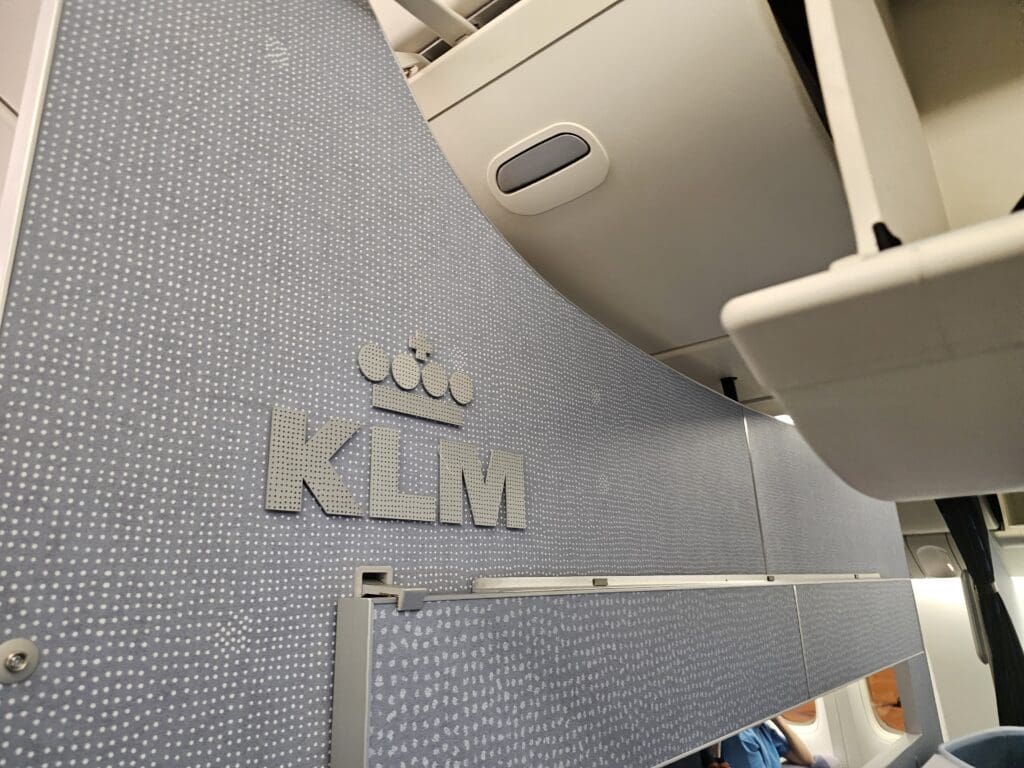
When compared to a fair number of other carriers, KLM’s Boeing 777-300ERs feature a rather Economy-heavy configuration and are fitted with a total of 266 ‘regular’ Economy seats spread across two cabins. Like almost all KLM widebodies (the exception being their Airbus A330-300s), this aircraft features the modern and squarish Recaro CL3710 seat. These are arranged in the increasingly standard ten-abreast 3-4-3 layout, and each seat is 17.1 inches wide. These come with the expected trimmings such as a coat hook, a seatback pocket, a literature compartment, bifold tray table, an adjustable headrest and a high-definition 11-inch wide inflight entertainment screen, powered by Panasonic’s eX2 system. Meanwhile, at-seat power is limited to a single USB-A port. In keeping with KLM’s brand identity, each Economy seat was covered in a dark blue fabric that featured a repeating pattern of small light blue dots, whilst KLM’s famous crown motif was embroidered on the pleather cover headrest. Despite not featuring the most vibrant colour palette, I found the seat’s colour scheme to be smart and professional. Meanwhile, matching the colours of the aircraft’s exterior, the bulkheads and cabin dividers were covered in a light blue trimming that did seem to be a little dated in its aesthetic but otherwise left me with no complaints. Finally, upon boarding a rather standard Economy quality pillow and blanket could be found on each seat, both serving their purpose but not being particularly luxurious or memorable.
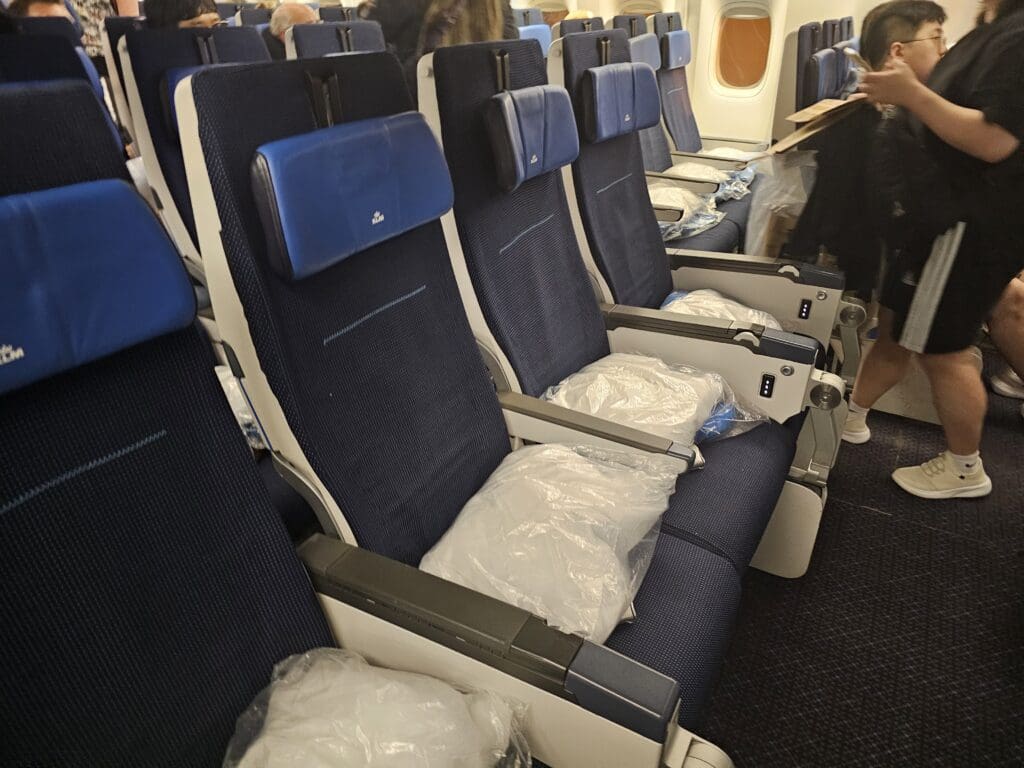
Despite the friendly welcome that I had received upon boarding the aircraft, I was rather disappointed to receive absolutely no greetings from any of the five crew members that I passed on the trek to my seat. However, later on, I did witness a very friendly and positively jovial flight attendant who assisted passengers with finding their seats and stowing their luggage during the final stages of the boarding process.
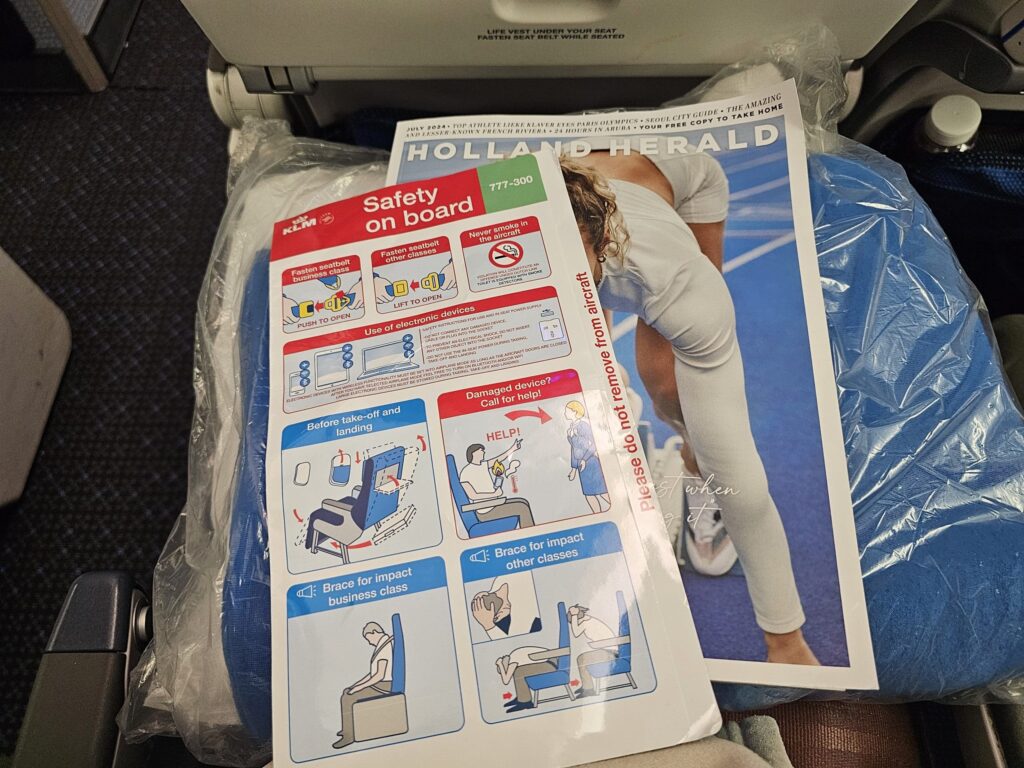
Once in Economy, I ended up stopping and starting to allow those in front of me to stow their bags and take their seats, and it ended up taking a fair while to reach Seat 52H. Seeing as a couple was already occupying the neighbouring middle and window seat, and I would thus not have to stand up, I soon strapped myself in and settled down for the long journey ahead. Focusing on the positives, I found the seat to be soft and well-padded, and whilst it wasn’t the most spacious or largest seat in the world, this offered an ample amount of space for a long haul airliner. Meanwhile, both the seat and area around this appeared to have been thoroughly cleaned during the long turnaround and I failed to spot so much as a single crumb as I inspected this. However, I did notice a few marks and scratches on the seatback and looking around, the aircraft’s carpet seemed to be a little worn and frayed in places. Nevertheless, whilst clearly factory fresh, it is fair to say I have flown on younger aircraft in a far more battered condition. Turning to the literature compartment, this contained a dogeared safety card and a copy of the latest edition of KLM’s monthly inflight magazine, Holland Herald, whilst a sickbag could be found in the seatback pocket.
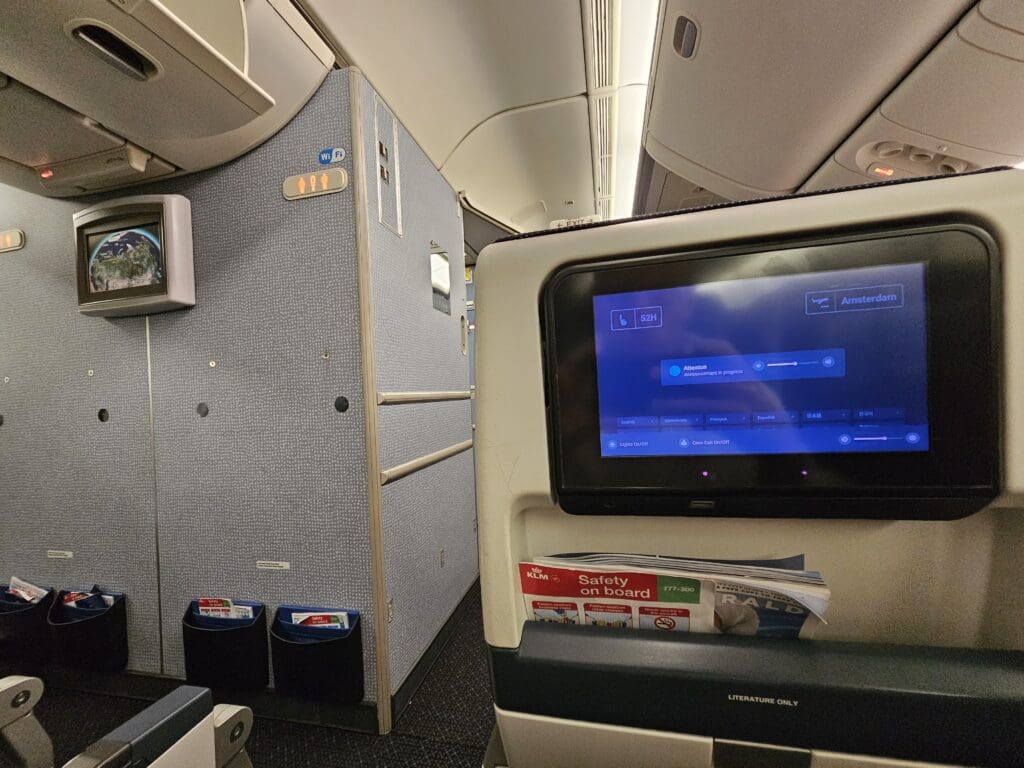
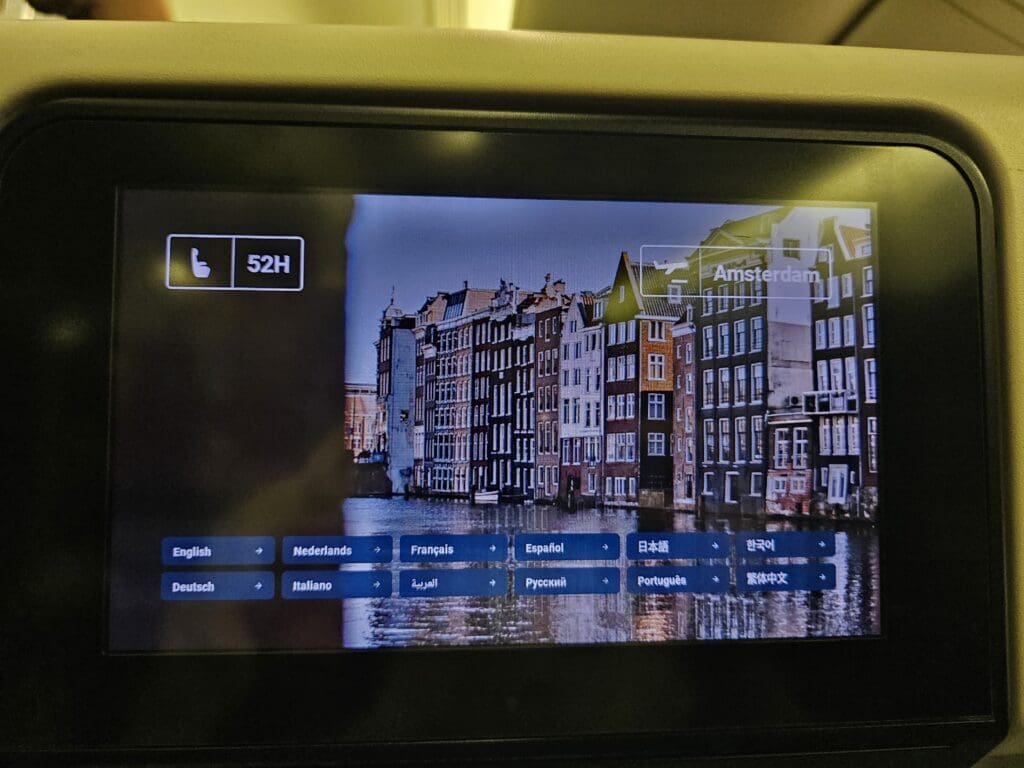
Perhaps serving to rile traditionalists and classical music lovers, throughout boarding a megamix of upbeat and calming pop and folk music rang out through the cabin – something that I took no issue with. Meanwhile, upon boarding, a welcome message superimposed on a montage of scenic photos from across the Netherlands was displayed on each inflight entertainment screen, although these could be used from boarding to disembarkation except for during announcements and the safety video.
With the flight appearing to be full and considering the late start to boarding and the slow rate at which passengers made their way onto the aircraft and stowed their bags, unsurprisingly our departure time came and went, with passengers still filtering onto the aircraft. Around five minutes after this, the final passengers made their way into the Economy cabin and soon the Captain’s calm tones filled the cabin. Performing this first in English and then again in Dutch, this consisted of the usual welcomes and thanks, a mention of our expected arrival time in Amsterdam and an introduction to the lead flight attendants for each cabin. Turning to my fellow passengers, I would estimate that around 50% of the flight’s load hailed from Korea. Whilst most were presumably bound for Europe, I did overhear a couple of backpackers who were heading off on an exciting adventure to South America and a church group bound for West Africa. The remaining 50% mostly took the form of passengers from across all corners of Europe, who were presumably like me, simply connecting in Amsterdam. Turning to the crew, around two-thirds of the flight attendants seemed to hail from the Netherlands and were on their way home, with a third taking the form of Incheon-based Korean crew members commencing their next rotation to Europe.
Once the Captain had completed their announcement, it was the Purser’s turn to welcome passengers onboard. This was performed in English and Dutch, before being translated into Korean by one of the locally based crew members. This consisted of the usual welcomes, thanks and warnings, the latter including a message noting that passengers must receive permission from the crew before taking photographs or videos onboard the aircraft. With this perhaps stemming from a negative experience with a vlogger or TikTok’er!
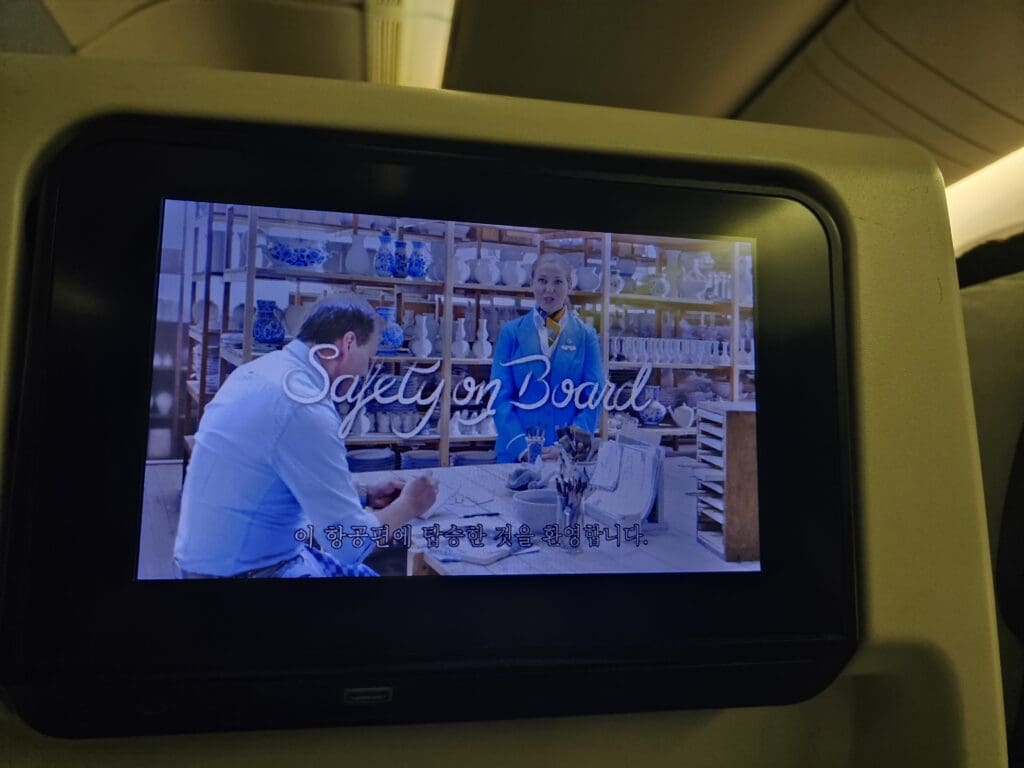
With no external cameras available to view through the inflight entertainment system and sitting in an aisle seat, it was hard to tell whether or not our aircraft was ready to be pushed back. Following a few minutes without any sort of activity in the cabin, twelve minutes behind schedule, the Boeing was pushed back away from the stand. As this was underway, KLM’s safety video took over the inflight entertainment screens. Dating back to 2015, at the time of my flight this was almost a decade old, and was the same video that had been played on my Boeing 747-400 Combi journey from Amsterdam to Seoul Incheon back in 2016! Despite its age, I found the video to be modern and up-to-date, continuing to serve its important purpose. Meanwhile, this is uniquely Dutch and rather memorable, having been made with over a thousand hand-painted Delft Blue tiles! This was broadcast in English only and accompanied by Korean subtitles, with no Dutch version of this played, or Dutch subtitles displayed. However, given the high levels of English proficiency in the Netherlands, and seemingly few Dutch passengers, this was perhaps no issue. As the aircraft neared the end of its pushback, the Boeing’s two mighty General Electric GE90-115B spooled up into life resulting in plenty of noise and vibration temporarily filling the cabin and ensuring that a decent portion of the safety video could barely be heard.
Once the Boeing’s two engines had successfully powered into life ready for the long trek ahead, the tug was disconnected and the flaps were partially extended with a loud whine. Soon, the Boeing powered away from the apron under its own steam. Covering a large area and with plenty of runways, it isn’t particularly unusual to experience a long taxi when departing or arriving at Incheon Airport. However, that evening, we would be departing from Runway 16L, the end of which was just a short journey away from Terminal 2. As we made our way over to this, the crew passed through the cabin undertaking their final checks before the cabin lights were dimmed in preparation for our departure. On a side note, as far as I could tell, this particular Boeing 777 lacked any sort of mood lighting in Economy.
Being one of the few aircraft scheduled to depart at that time, once we reached the runway, unsurprisingly we taxied onto this without holding. However, given the near-constant stream of arrivals on the parallel runway, I was somewhat expecting to have to wait for a flight to touchdown. However, I was proven wrong and after pausing for a few seconds, at 2331, the Boeing’s two massive engines roared as we commenced our powerful takeoff roll. Seeing as we were likely heavily loaded for the long flight ahead, it took quite some time for the Boeing to lumber up into the skies, however eventually, reassuringly we rotated upwards into the night skies with plenty of shuddering.
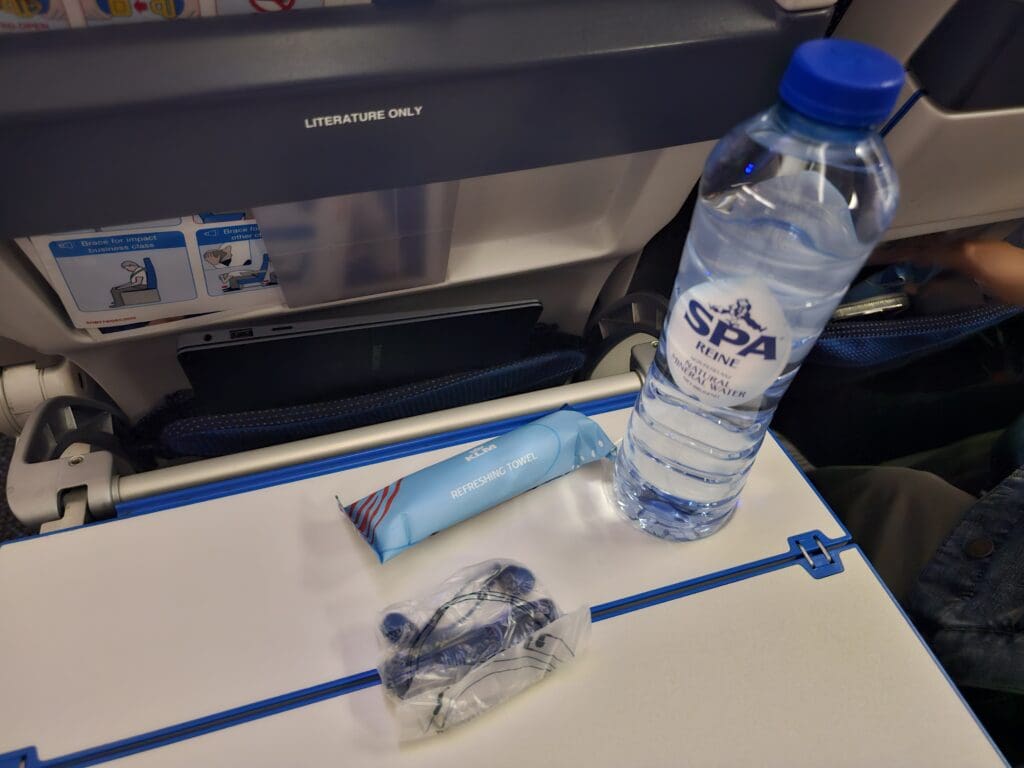
Seconds after taking off, the Boeing soared out over the complex of hotels, casinos and offices to the south of the airport and crossed the southern shoreline of Yeongjong Island. Climbing out over the waters of the Yellow Sea, we soon reached the northern coastline of Yeongheung Island before turning westwards and passing over the cluster of small yet inhabited islands that sit within Incheon’s Ongjin County. Heading out over the sea, the Boeing made a smooth climb which enabled the seatbelt signs to be extinguished as soon as we passed through 10,000 feet. At this point, the crew took to the galleys before emerging with service carts. A short time later, without a single word, I was handed a 500ml bottle of German mineral water, a packaged wet wipe and a packet of typical Economy-quality earbud-type headphones. It is worth noting that nothing in the way of an amenity kit was offered, which, whilst not expected given their increasing rarity, would have been a very nice touch on this long flight to Europe.
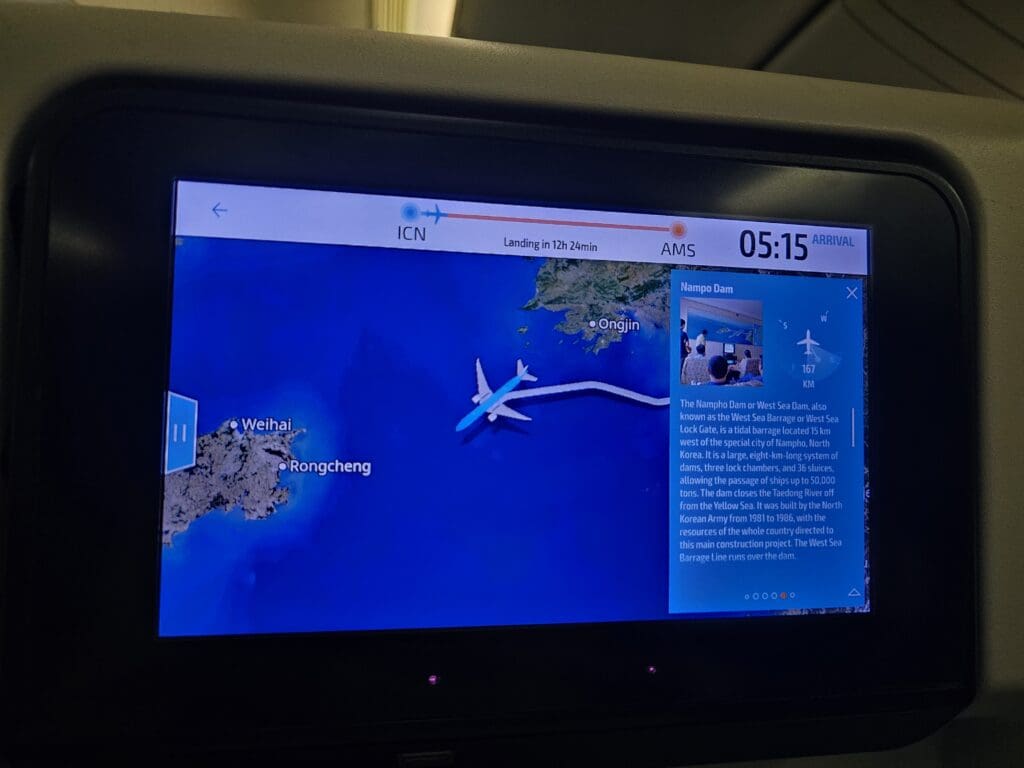
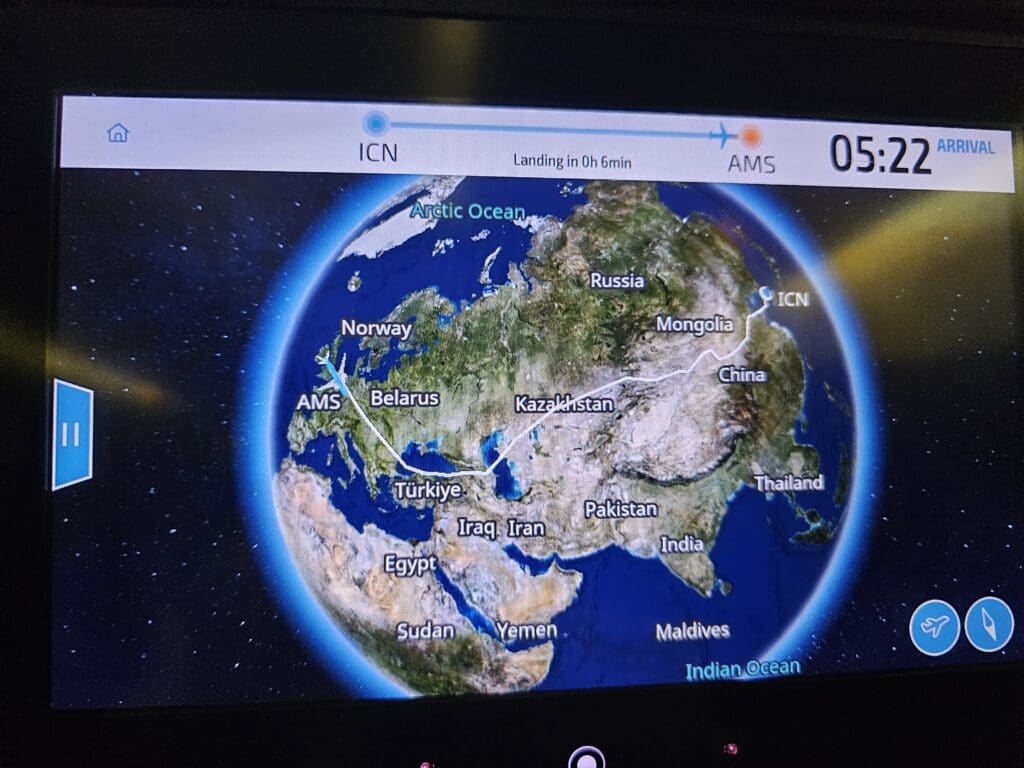
Making a slow climb over the Yellow Sea, the Boeing initially settled at 27,000 feet before rising to 30,000 feet just before we crossed the Chinese coastline. Around thirty minutes after leaving Korea’s islands behind, the Boeing crossed over the Sanggou Bay and made landfall over the Shandong Peninsula to the southeast of the city of Weihai, home to around 2.9 million residents (more than are located in Amsterdam’s metro region!). From there, the aircraft cut northwest across the peninsula, passing directly over Yantai before voyaging out over the Bohai Sea and making a beeline for the sprawl of Tianjin.
By this stage of the flight, a fair number of passengers had already drifted off to sleep, however, the scent of warming food filled the cabin and soon the crew emerged distributing passengers’ special meals. Around 45 minutes into the flight as the aircraft left the Shandong Peninsula behind, the evening meal service commenced. A few minutes later, with no options available, a friendly cabin crew member placed this meal on my tray table before offering me a drink. Opting to pair this with an apple juice, this was cautiously poured out before being handed over to me. Wasting no time, I opened up the main dish and found it to contain a compact beef bibimbap, accompanied by a small tube of gochujang and a sachet of sesame oil. This came with a side salad and a small cake for dessert. Those more used to flying Korean Air on the route may have been disappointed at the lack of metal cutlery, however, the next best thing was provided in the form of sustainable wooden cutlery.
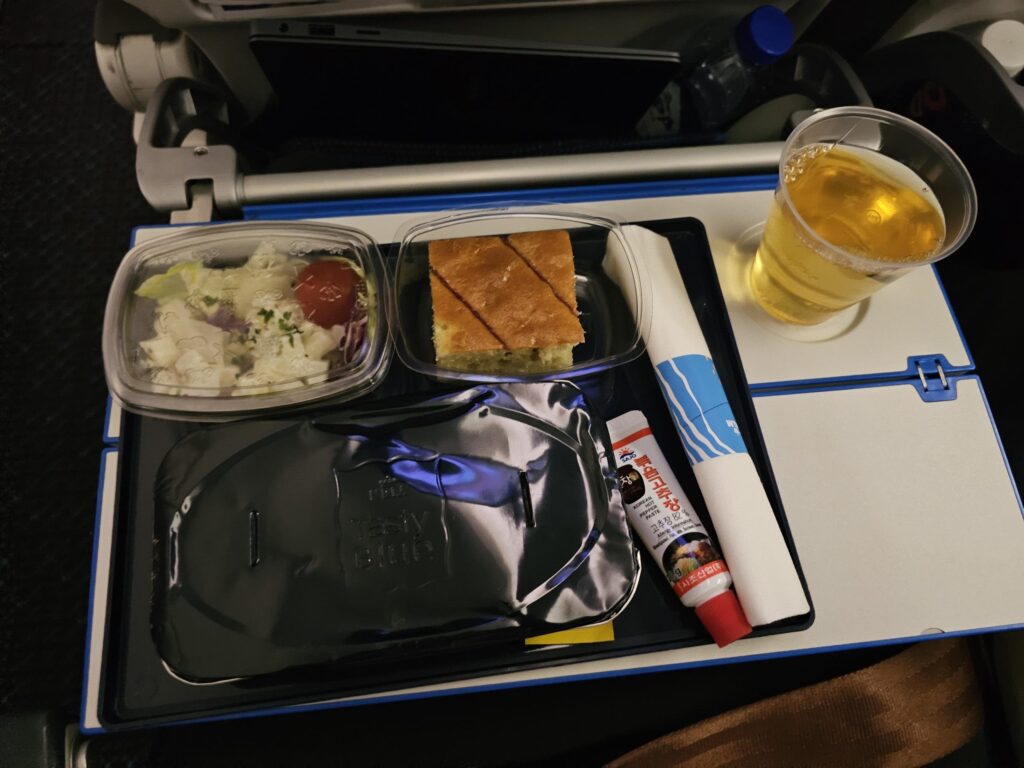
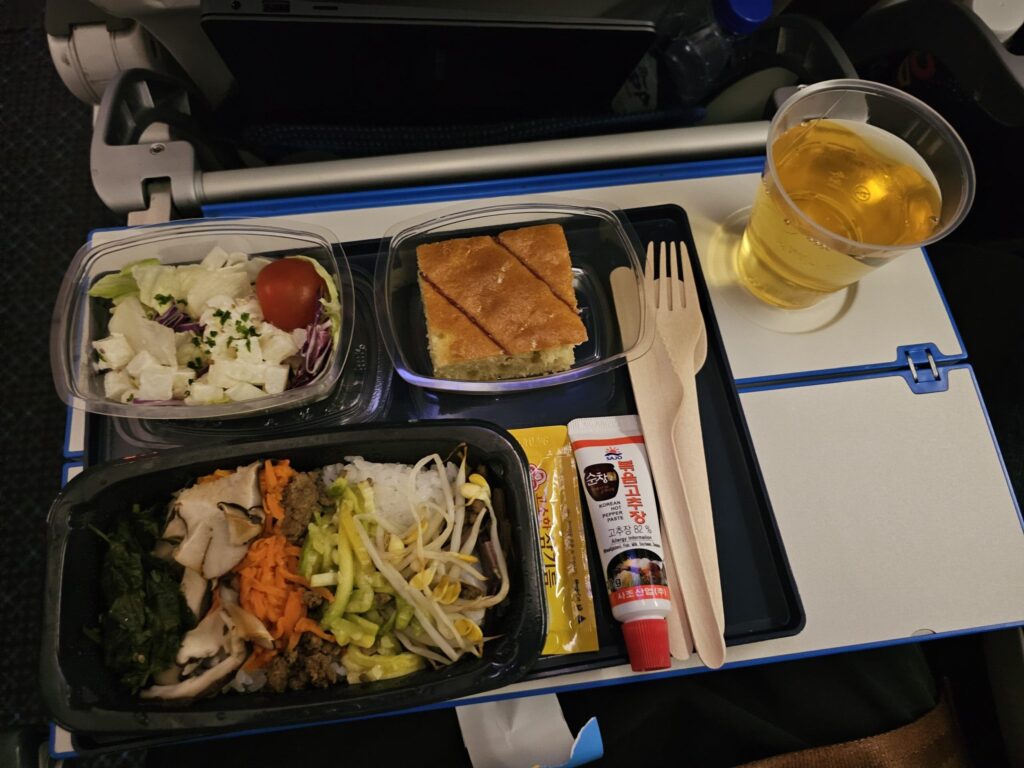
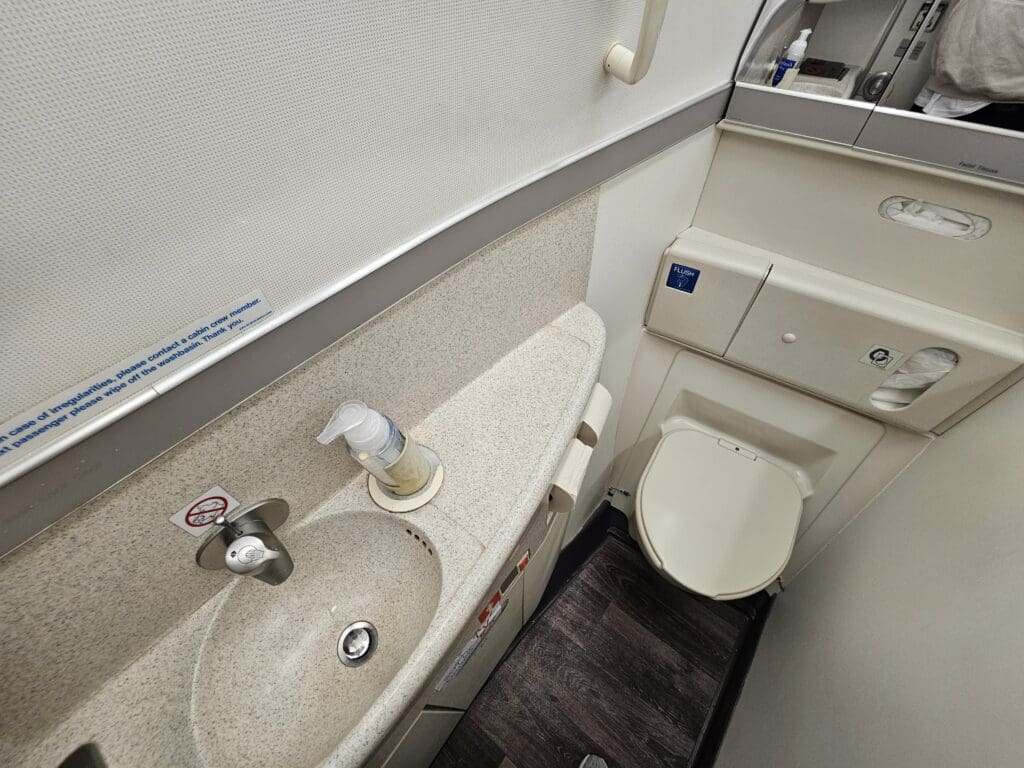
Getting to work on the meal, whilst the portion size was not particularly plentiful, it certainly hit the spot and gave me little reason to complain. Indeed, seeing as it was already after midnight in Korea, the chances are that most passengers will have eaten before boarding. Around thirty minutes later, the crew returned to the cabin to collect the empty trays before the lights were dimmed as we cruised high over Tianjin, China’s fourth largest city. After this, I decided to make a quick trip to one of the seven lavatories available for Economy and Premium Comfort passengers. This equates to a ratio of 49 passengers per lavatory, which isn’t too awful and is much better than the 63 passengers per lavatory figure on your standard LCC Boeing 737-800. Heading to one of the spacious lavatories at the very rear of the jet, upon opening this up I found this to be clean, tidy and stocked with the basics. Whilst this served its purpose and left me with relatively little to complain about, being a long overnight flight it would have been nice if toothbrush-toothpaste sets had been available in this.
From Tianjin, the Boeing headed southwestwards, passing over Baoding and the province of Hebei before reaching Shanxi and the province’s capital, Taiyuan. From there, we flew westwards over a small portion of Shaanxi before reaching Yinchuan and Inner Mongolia. With the cabin lights off, I decided to try my best to catch up on some sleep. Despite often finding it quite difficult to sleep on aircraft, much to my delight and surprise, that evening I had no issue and soon drifted off to sleep for almost three hours before wearily waking up.
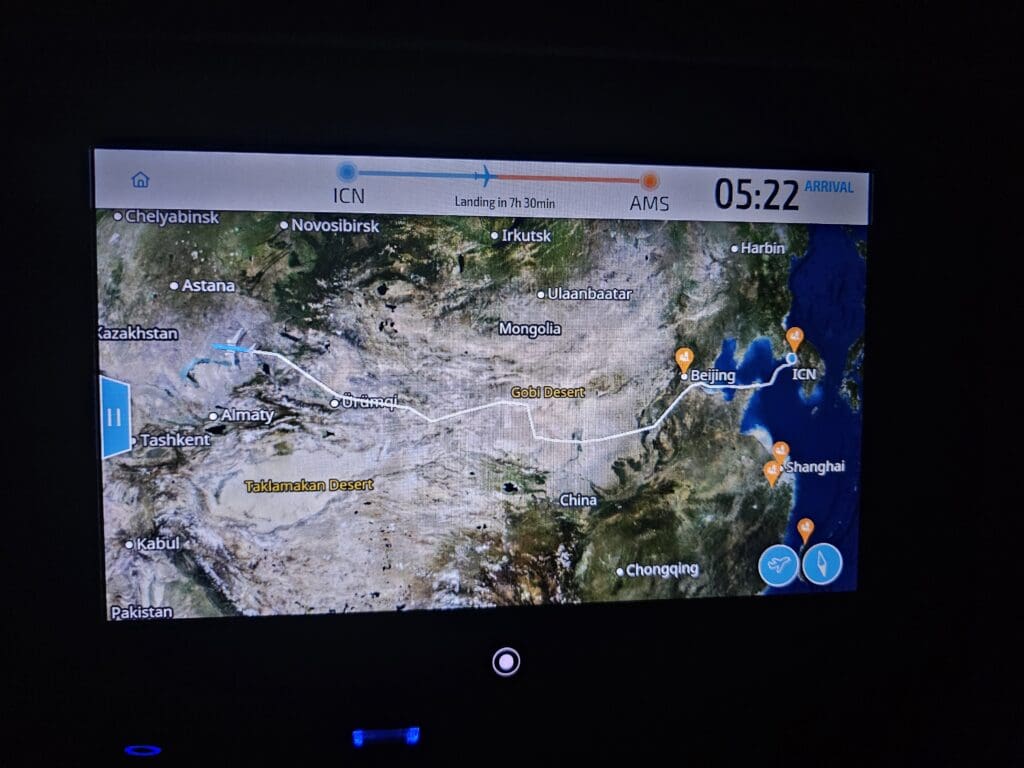
By the time I woke up, the aircraft had climbed up to 32,000 feet and passed from Inner Mongolia, through a miniscule portion of Qinghai and was now in the skies above China’s far western Xinjiang Province. Passing over the likes of Hami, Urumqi and Turpan, once awake, the aircraft was rapidly approaching China’s border with Kazakhstan. A total of four and a half hours after passing over the Shandong Peninsula, the Boeing cruised into the skies of Kazakhstan’s Abai region and the town of Urzhar. Coincidentally, with Urzhar located on Southern Sky Airlines’ Antonov An-24 route map, this is somewhere that I had almost ended up going back in 2023, although I ended up flying this rare turboprop from Astana to Almaty via Balkhash instead! At this point in the flight, I decided to head rearwards to the rear galley where a selection of soft drinks was on offer alongside a box of snacks containing small chocolate bars, mini stroopwafels and bags of pretzels.
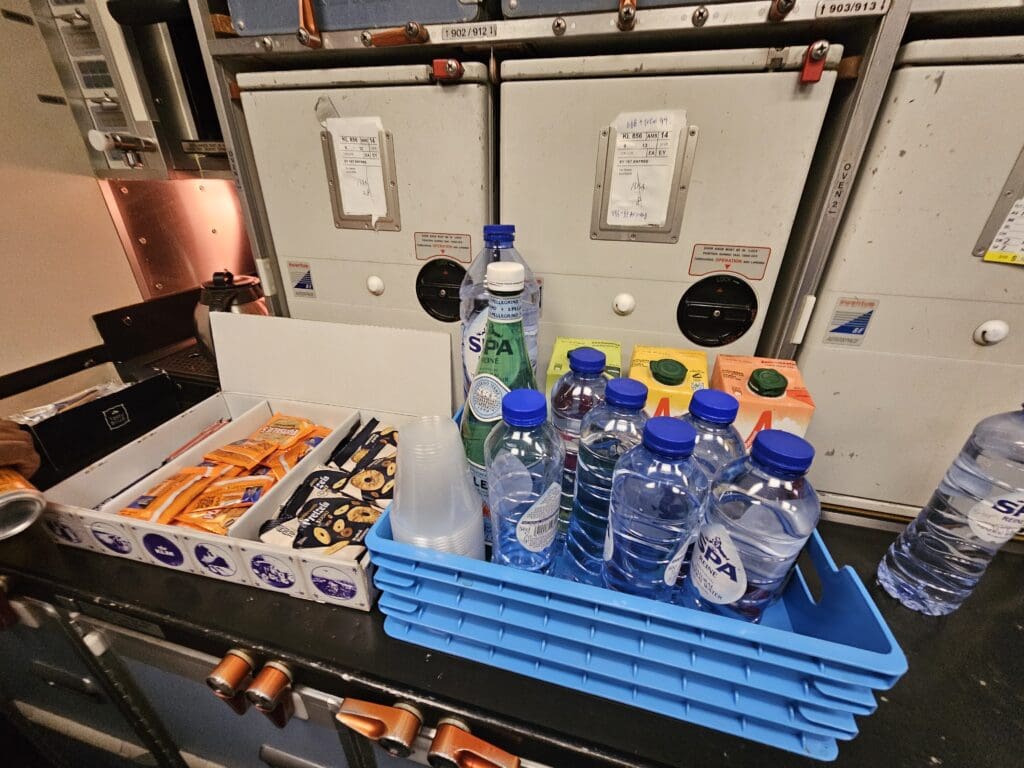
As we passed from the skies of Abai to Karaganda region, a short distance to the north of Lake Balkhash, the cabin crew took to the aisles and commenced their inflight snack round. By this time, the aircraft was roughly halfway into its long trek and outside the skies were already slowly beginning to transform from night to dawn. This service consisted of a small cheese sandwich, a brownie and a bottle of water. Whilst this was a nice, if not somewhat expected touch, seeing as most of the cabin were still fast asleep, there seemed to be a low uptake and once complete, the remaining sandwiches were placed in the rear galley for passengers to take at their leisure.
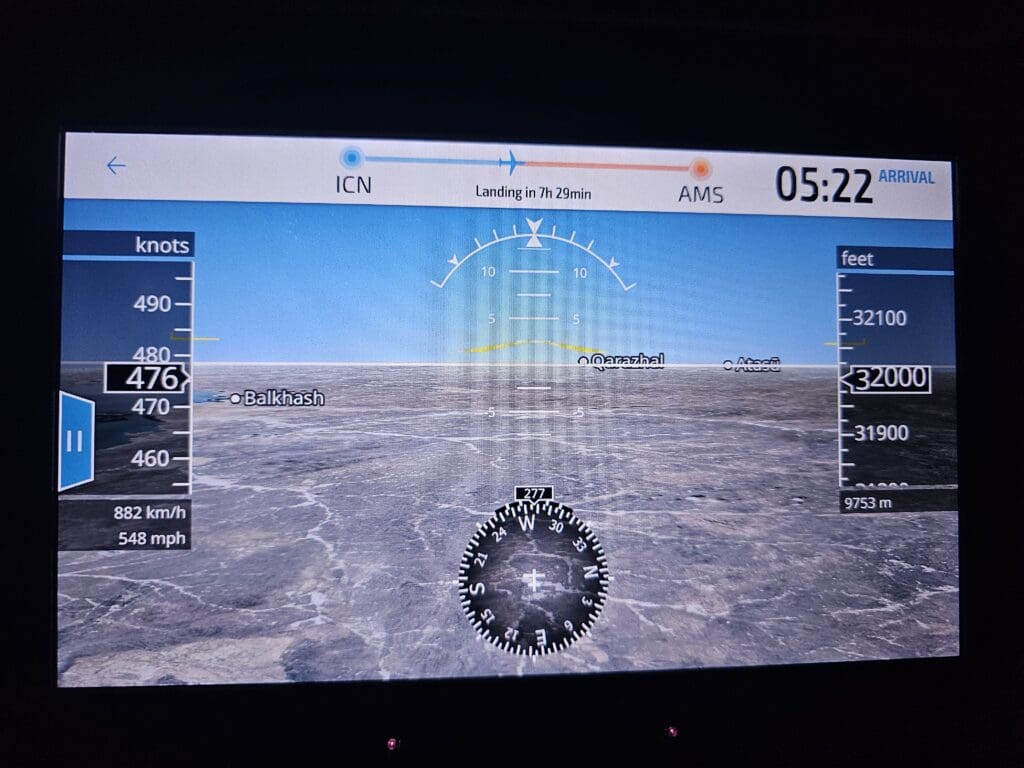
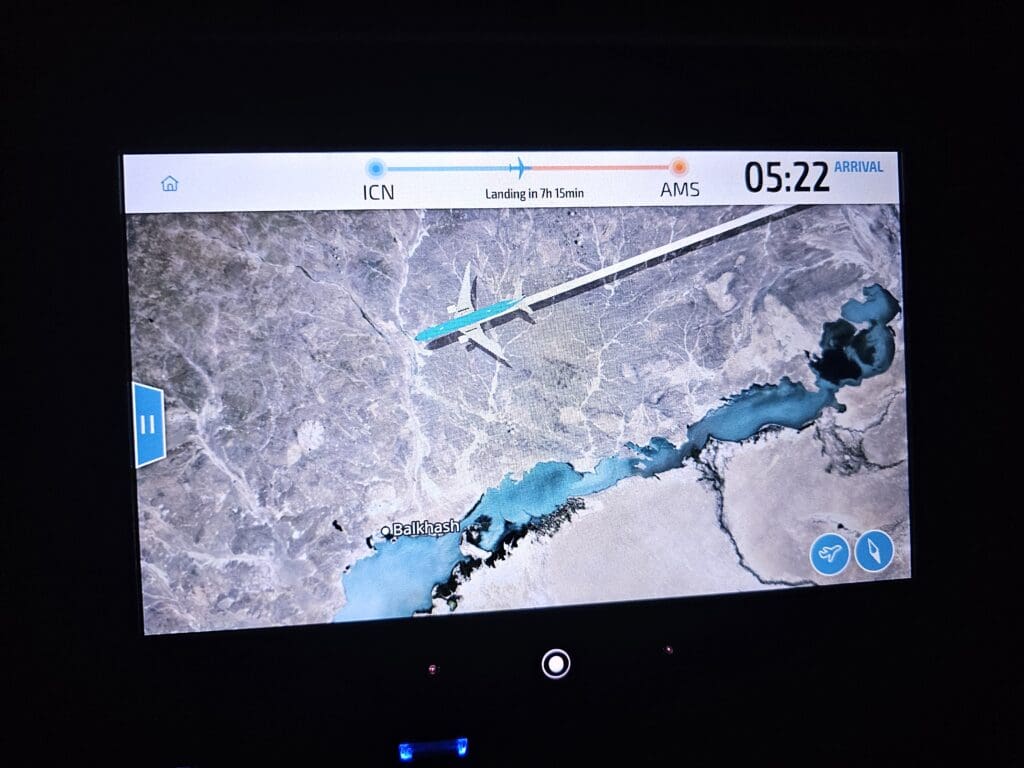
From Kazakhstan’s Karaganda region, the aircraft headed westwards through the regions of Ulytau, Kyzylorda, Aktobe and Mangystau, and it wasn’t long before I drifted off to sleep and had another surprisingly good nap. A little under three hours after entering Kazakhstani airspace, the Boeing made its way out over the waters of the Caspian Sea, a short distance to the south of the coastal city of Aktau. Making a short twenty-minute crossing, soon, the Boeing passed over the Azerbaijani coastline a very short distance to the south of the border with Russia’s Dagestan region. Heading inland, the aircraft soon reached the Caucasus mountains and we began to bounce around rather significantly which caused the seatbelt signs to be promptly reilluminated. Around ten minutes later, these were turned off once again at which point I made my way to the lavatory once more and was delighted to find this to remain in a clean and tidy state, indicating that it had been tended to regularly by the crew.
Once back at my seat, we soon hit another patch of significant turbulence which caused us to be tossed around with quite some vigour and no more than ten minutes after they had been switched off, the seatbelt signs were reilluminated and would remain on for well over an hour, with the turbulence continuing almost unabated until we were off Turkey’s northern coastline. After just fifteen minutes, the Boeing left Azerbaijan behind and cruised into the skies of Georgia, soon reaching the capital Tbilisi. From there, we sped across the southern fringes of the country before passing just to the south of the port city of Batumi and heading out over the Black Sea.
Cruising to the north of the Turkish coastline, some distance from the cities of Rize, Trabzon and Ordu, with it now being morning in Korea, I was wide awake and thus decided to turn my attention to KLM’s inflight entertainment system. Commencing with the basics, I was very pleased to find that this was offered in a wide array of languages, with Arabic, Chinese, Dutch, English, French, German, Italian, Japanese, Korean, Portuguese, Russian and Spanish offered. Meanwhile, the system was sleek, modern, well laid out and easy to navigate, and I faced no issues when searching for content. Importantly, I found the screen to be highly responsive when touched and loaded quickly, leaving me with absolutely no complaints.
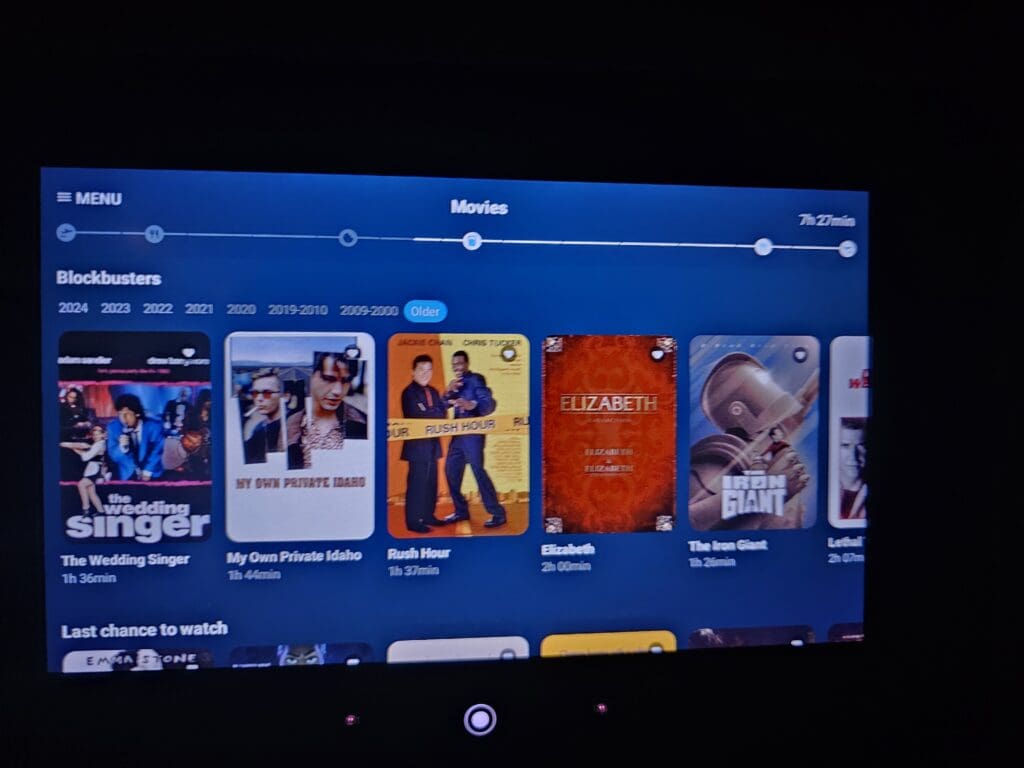
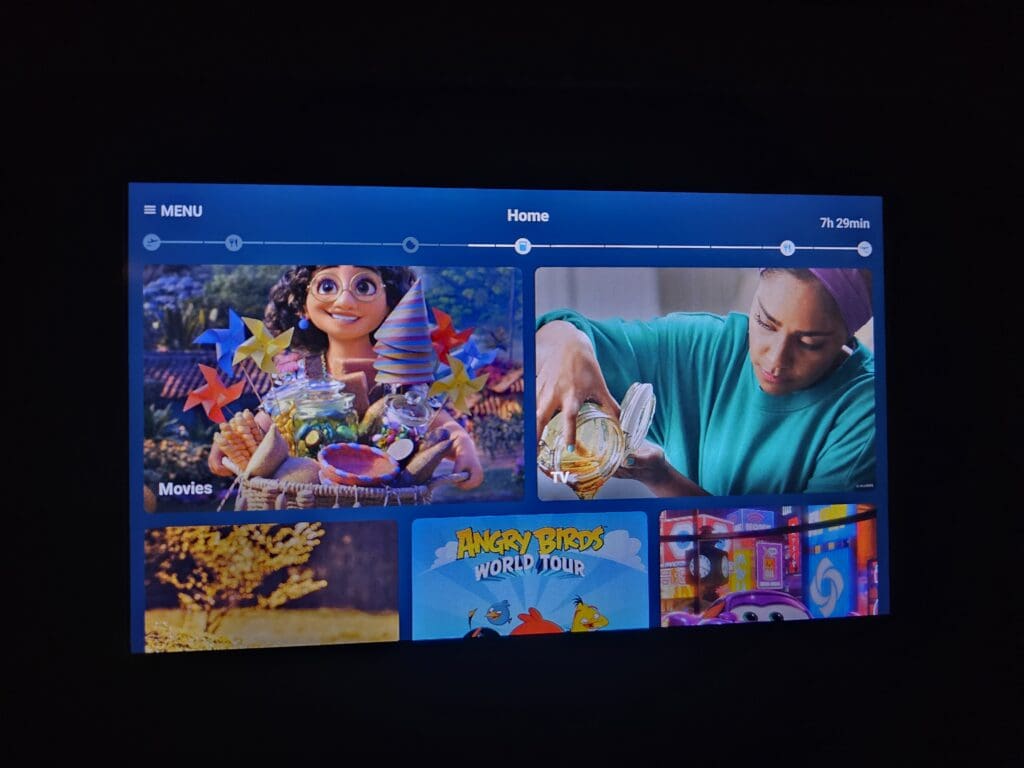
Being one of the world’s major airlines and with a global route network, I had high expectations when it came to content, and fair to say, I was not left disappointed! Browsing through the system, an impressive total of 510 films from 35 countries across the world could be watched. As you would expect, many of these took the form of Hollywood blockbusters from throughout the ages, including brand-new releases. Alongside these, the system featured a decent number of films from India, Korea, the Netherlands and the UK. Moving on, a total of 166 unique programmes were available for those fancying a shorter watch, alongside 23 KLM-produced guides highlighting what to see and do at destinations across the airline’s route network. As is always nice to see, once items had been selected, no advertisements were played before any visual content commenced. Turning to face the music, an impressive total of 936 audio items were offered. The majority of these took the form of albums and playlists of an array of music from across the world, however, 19 podcasts were also offered. Finally, 17 games could also be found on this system.
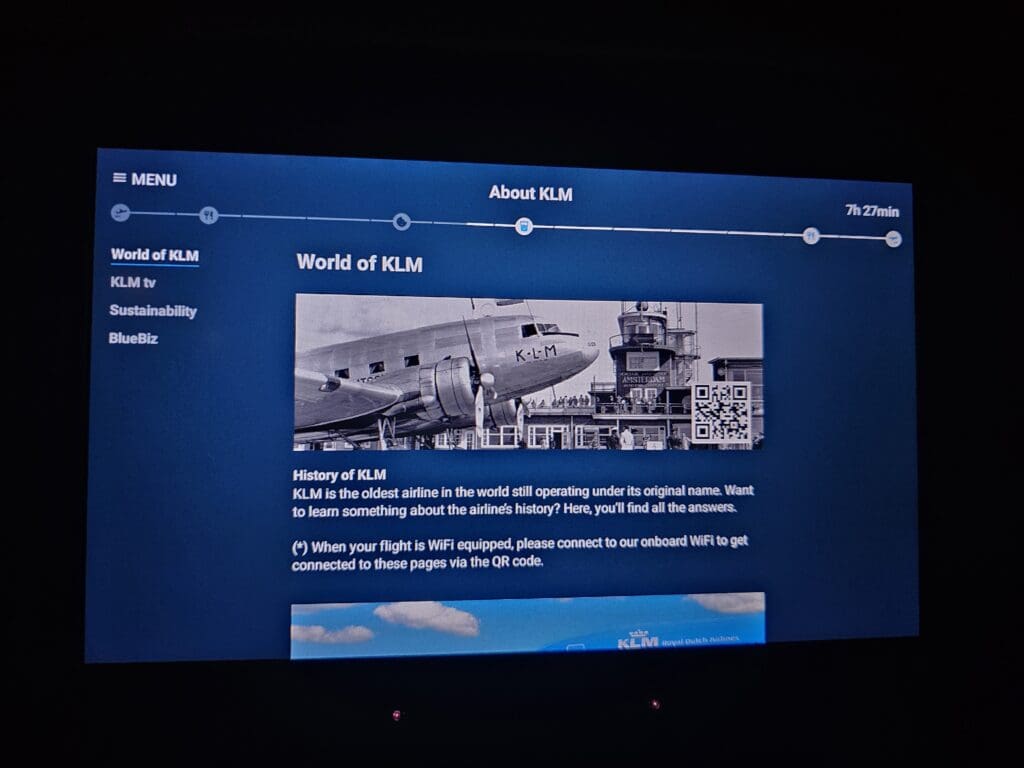
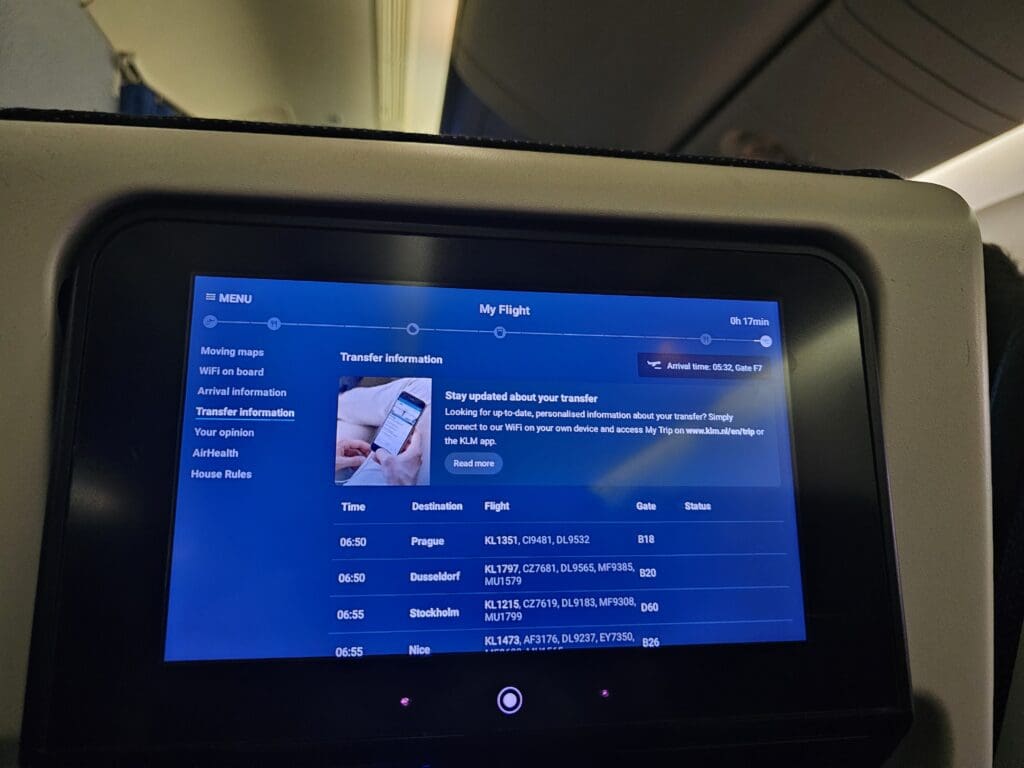
As many passengers now expect, the system featured a high-quality interactive moving map that allowed passengers to track the progress of the flight in a wide variety of ways. This also featured plenty of information about KLM and its destinations, guides on how to connect to the onboard wifi network, information about Schiphol Airport, departure boards for connecting flights, a survey, ‘House Rules’ and an AirHealth section with a variety of tips for keeping fit and well during long haul flights. Finally, seventeen games were offered for those looking for a more interactive means to pass the time. All-in-all, I found KLM’s inflight entertainment system to be of very high quality and was most certainly one of the better systems that I have had the pleasure of sampling as of late.
As many passengers now expect, wifi was provided onboard, with an array of packages for those looking to surf the web as we soared through the skies. Additionally, I was delighted to find that a free option was available for those who were simply looking to send messages on messaging apps. Testing this, I found this offering to work well throughout the flight and I was able to stay in touch with family and friends on the ground for much of the flight.
Lastly, I had a flick through the July 2024 edition of KLM’s Holland Herald magazine. This was a 90-page publication, published only in English and contained an array of articles of a plethora of topics that mostly pertained to the airline’s destinations. This included pieces on Aruba, the French Riviera, Kenya, Seoul and Zanzibar, alongside several other articles. Overall, this was a fairly decent quality inflight magazine and I was delighted to find that this lacked the same slew of seemingly endless advertisements that are all too common in some airlines’ inflight magazines.
By the time I had explored the inflight entertainment options, the aircraft was nearing the Balkan coastline and around an hour and twenty minutes after leaving Batumi behind, the aircraft made landfall over the very northern tip of the Bulgarian coast, before heading into the skies of Romania seconds later. From there, we skirted along the border between Bulgaria and Romania for a few minutes as we passed over Constanța County. Soon, we crossed over the waters of the winding Danube and passed to the east of the Romanian capital, Bucharest, before continuing northwestwards to the Carpathian Mountains. Cutting right across Romania from its far southeast to its far northwest, the Boeing spent about forty minutes in the skies of the Southeastern European country before reaching the city of Oradea and crossing over into Hungary just to the south of the city of Debrecen.
By the time the Boeing reached Hungary, the skies were filled with a picturesque orange glow and the cabin lights were switched back on in preparation for the second meal service of the flight. As we cut across a small portion of Eastern Hungary, the scent of warming food wafted through the cabin and as we passed into the skies of Slovakia, the crew rolled the service carts out into the aisles. KLM does not provide those in Economy with a paper menu, and since my last long-haul flight with the airline in 2016, the airline seems to have done away with advertising the meal choices for the flight on the inflight entertainment screens. Thus, there was no way of finding out what culinary treats would be in store until the service carts reached my row.
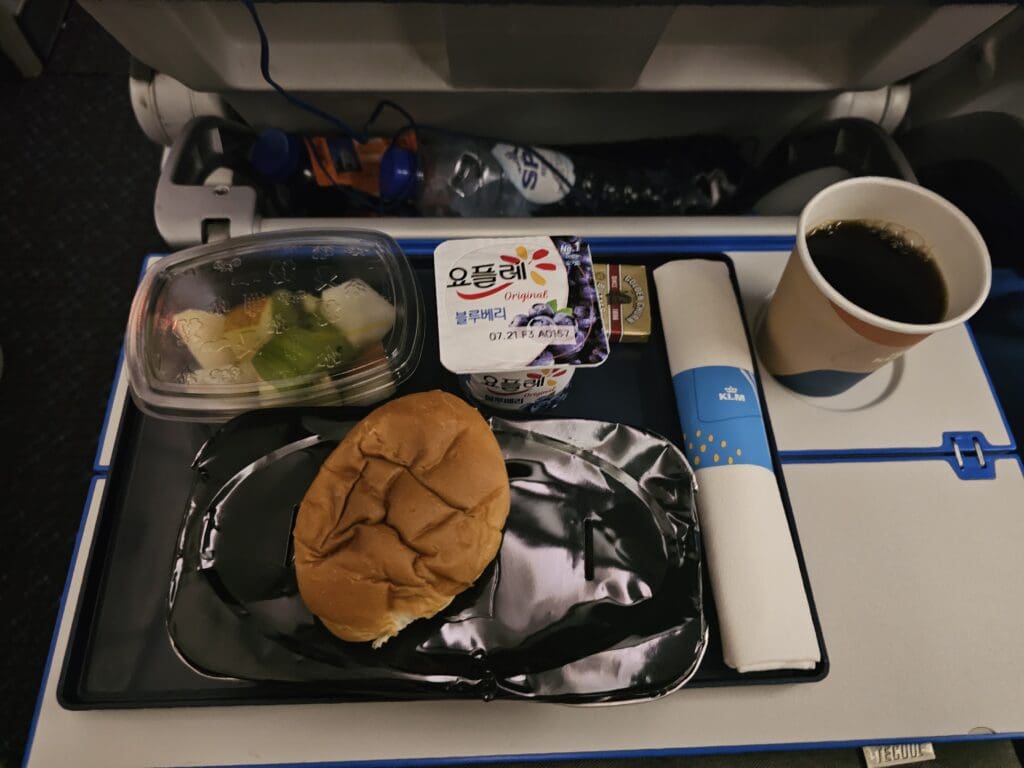
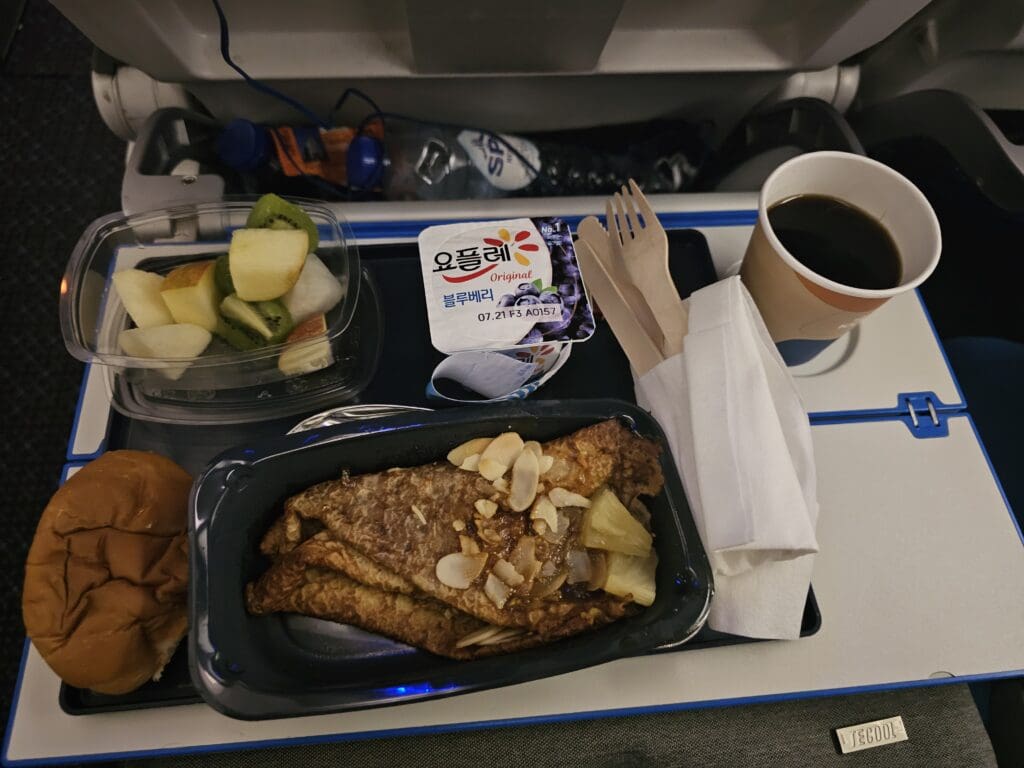
Around ten minutes after the breakfast service commenced, one of the flight’s more friendly flight attendants offered me the choice of scrambled eggs or crepes, followed by a drink. Opting for the crepes, I paired this with a black coffee, and soon enough both were cautiously placed on my extended tray table. As with our post-departure bibimbap, quantity-wise, the meal seemed to be reasonably compact, although given the decent provision of snacks during the flight, this isn’t something that I can make a valid complaint about. Exploring the tray, this consisted of a main dish of fruit crepes, a warm bread roll with butter, a small fruit salad and a blueberry yoghurt. Meanwhile once again, eating utensils came in the form of sustainable wooden cutlery. Whilst this was not the most memorable meal in the world, ultimately, I was left with nothing to complain about, other than the fact that during this, only one drink round was made, with no drinks offered to passengers once the meal had been handed out. Around forty minutes after I had been served, the empty trays were collected, by which time the flight was slowly drawing to a close and we were only an hour away from Amsterdam.
Returning to the route, following a quick journey through Slovakia, the aircraft made its way into the early morning skies of Czechia, passing just to the southeast of the country’s second-largest city, Brno. Trundling across Czechia from the southeast to northwest of the country, the Boeing soon reached the country’s famous capital city, Prague. Seven minutes later, the aircraft crossed from Czechia into the skies of the German state of Saxony near the cities of Chemnitz and Zwickau. Continuing on a northwesterly heading, the Boeing steamed across the heart of Germany at an altitude of 36,000 feet, soon reaching the state of Thuringia.
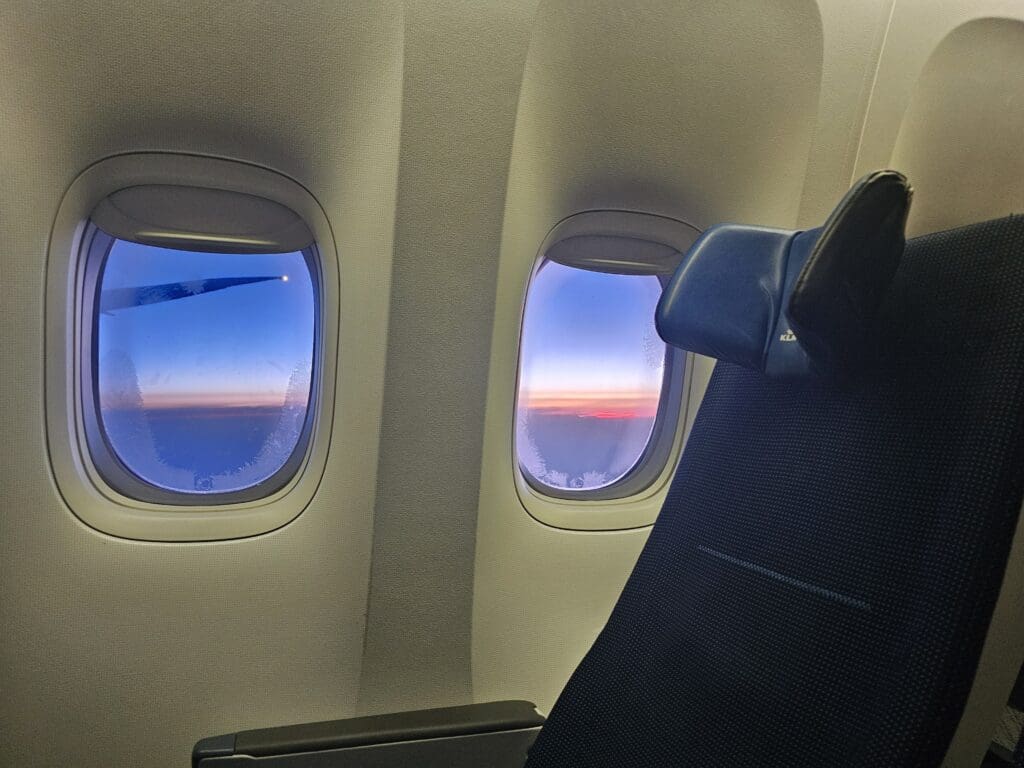
As the Boeing neared the North Rhine-Westphalia city of Münster, we commenced our descent and a few minutes later, the Captain performed their pre-arrival announcement in English and Dutch. During this, they informed passengers of the weather on the ground in Amsterdam, our expected arrival time and advised that a ten-minute taxi would be in store before reaching the gate. A total of 34 minutes after entering the skies of Germany, the eleventh country we had flown over during the long flight, the Boeing made its way into the skies of its Dutch homeland. Passing into Dutch skies near the border city of Enschede, the aircraft descended over the region of Twente, making a smooth descent as the scenic orange glow of dawn filled the cabin. At this time, the seatbelt signs were reilluminated and the crew wasted no time in passing through the cabin ensuring that all was secure and in place for our arrival into Amsterdam.
Soon, the aircraft reached Lelystad, home to an airport and one of Western Europe’s largest and most famous aviation museums, the Aviodrome. From there, the Boeing crossed over the waters of the Markermeer as the speed brakes were extended, slowing us down with a few shudders before the flaps were partially extended in preparation for our approach into Schiphol. That morning, the Boeing would be approaching the airport from the north and would arrive on Schiphol’s northernmost runway, the Polderbaan. Upon reaching the Markermeer’s western shoreline near the city of Hoorn, the aircraft continued heading westwards before passing over the Netherlands’ sandy beaches and heading out over the North Sea.
Soon turning around, the Boeing headed back towards land before lining itself up for an approach to Runway 18R. For those sitting on the left-hand side of the aircraft, the clear weather that morning would have allowed for a good view of central Amsterdam as we sank over the Netherlands’ famous flat fields as well as the odd town and industrial estate off the western fringes of the country’s largest city. Soon, the landing gear could be heard falling into position below, with this accompanied by a few mechanical clunks as the aircraft made a smooth descent towards one of Europe’s largest and busiest airports.
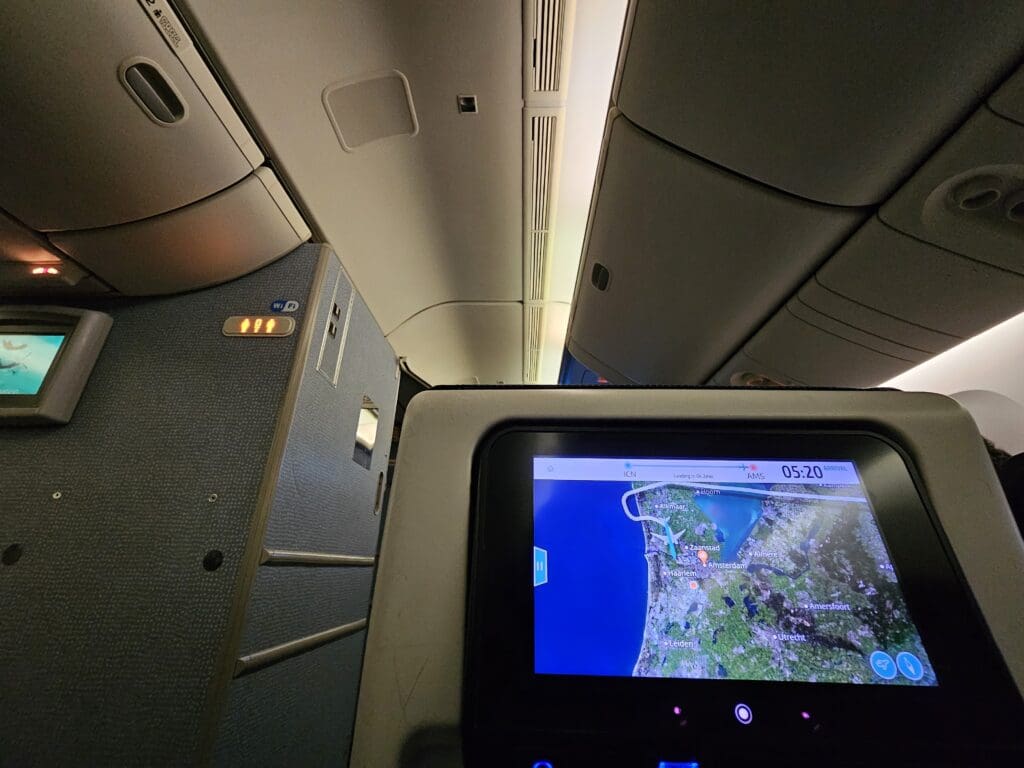
A total of 12:50 after taking to the night skies of Korea, at 0522 local time, the Boeing 777 made a smooth touchdown on the Polderbaan. Once down, with no way to exit the 3.8-kilometre long runway until nearing its southern end and given the good dry weather conditions, the aircraft decelerated rather gently before vacating the runway and commencing our reasonably long taxi to the terminal. As we vacated the runway, the flaps whined as they were retracted whilst inside, the usual post-landing announcement was conducted in English and Dutch, followed by Korean. True to the Captain’s pre-arrival speech, exactly ten minutes after touching down, the Boeing cautiously came to a halt at Stand F7 and the two massive engines spooled down. Despite our late departure from Incheon, the aircraft had made up some time during the journey and we came to a halt almost thirty minutes ahead of schedule!
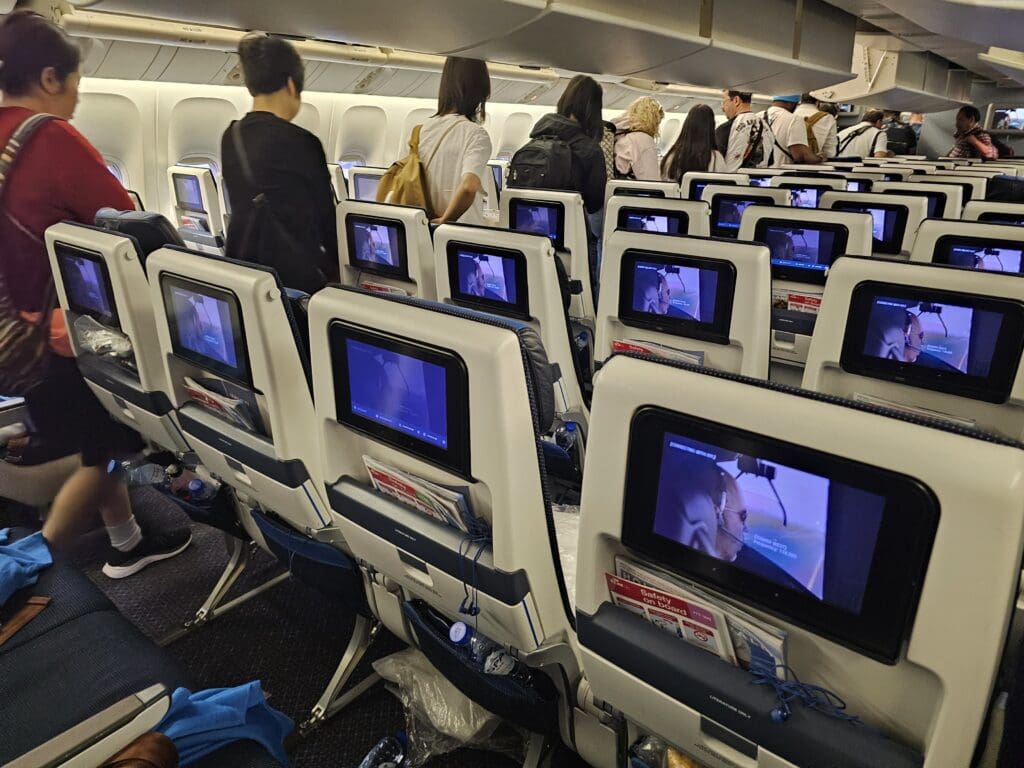
Perhaps with short connections, eager to stretch their legs, or simply impatient, once we came to a halt many of those around me sprung up in a desperate rush to exit the aircraft. However, fortunately for those in a hurry, it didn’t take too long for the two jetbridges to be connected and for disembarkation to commence. Once the queue in the aisle began to budge, I stood up, retrieved my backpack and began my trek through the now-messy cabin. As I did so, I received thanks from some members of the crew, and blank stares from others, something that I feel was very representative of the very hit-and-miss service I received from the crew throughout the flight. Eventually, I made it to the 2L door where I disembarked and commenced my Amsterdam Schiphol transit experience, bringing a close to my second-ever long haul journey with KLM.
Summary
Starting with the positives, not only did I arrive in Amsterdam ahead of schedule and in one piece, I found KLM to offer a reasonably comfortable seat and I was impressed by the vast array of content that was available on the aircraft’s inflight entertainment system. Meanwhile, I had no major issues with the onboard catering and found both meals along with the inflight snack service to be substantial enough and of decent quality, not to mention the fact that additional items were available from the galley throughout the flight. However, the big letdown for me on this service was the mixed-bag crew. Some flight attendants were warm and friendly, whilst others were cold and distant and went about their duties with minimal interaction. Granted, whilst this was not enough to put me off KLM for life, this was a little disappointing. Nevertheless, overall, I would say I had a fairly solid flight experience.