Kazakhstan’s Five Star Flag Carrier: Tashkent to Almaty on Air Astana
Background
Air Astana enjoys a stellar reputation, however, unless you are a frequent flyer, a regular visitor to Central Asia or an enthusiast, the chances are you may be somewhat unacquainted with Kazakhstan’s flag carrier. Established in 2001 as a joint venture between the Kazakhstani government and British aerospace and defence company BAE Systems, Air Astana was initially met with staunch opposition from the then-ailing flag carrier Air Kazakhstan. Taking to the skies in 2003, Air Astana commenced operations with a trio of leased Boeing 737s before these were joined by Boeing 757s and Fokker 50s. Following the bankruptcy of Air Kazakhstan in 2004, Air Astana became Kazakhstan’s flag carrier and has since undergone massive expansion and today the airline’s blue and white liveried aircraft can be seen at airports across Asia and Europe with a fleet of mostly Airbus aircraft. These come in addition to those of their low-cost subsidiary, FlyArystan, which was established in 2018. In addition, Air Astana is highly regarded for its levels of onboard comfort and service, as well as safety and reliability, with the airline widely considered to be the top carrier in Central Asia.
Back in May 2019, I had the pleasure of flying with Air Astana from Paris CDG to Tashkent via Astana and Almaty – the first sector to Kazakhstan operated by one of their Boeing 757-200s (review here), and the second two by an Airbus A321 (review here). Having gone into this with high expectations, I was by no means disappointed and had a thoroughly superb trio of flights. I found all aircraft to be comfortable and in good shape, the crew to have been friendly and helpful and enjoyed superb onboard catering. Needless to say, I hoped that I would have the pleasure of flying with the carrier again at some point in the future.
That moment came in May 2023, when I needed to get between Tashkent and Almaty as part of a holiday to Uzbekistan and Kazakhstan. With 423 miles separating the two cities, those wishing to travel between these have several options. Those not wishing to fly and with plenty of time on their hands can make their way to the Kazakhstani border just north of Tashkent, and then catch a train to Shymkent before changing on to another for Almaty. However, travelling by air is of course far quicker and more convenient with Air Astana having multiple daily departures in addition to Uzbekistan Airways. Knowing that I would already be flying with Uzbekistan Airways on this trip, and with ticket prices between the two carriers serving to be almost identical, I decided to fly with Air Astana. With the online travel agency Trip offering the cheapest one-way tickets, I decided to purchase these via their app and soon parted with a grand total of £74.70. This fare also enabled me to select a seat for free across much of the cabin and in the end I opted to make the journey to Kazakhstan in Seat 13A. It is worth noting that whilst Air Astana does offer online check-in, this would not let me download a mobile boarding pass and thus I had to pick this up from the airport.
The Journey
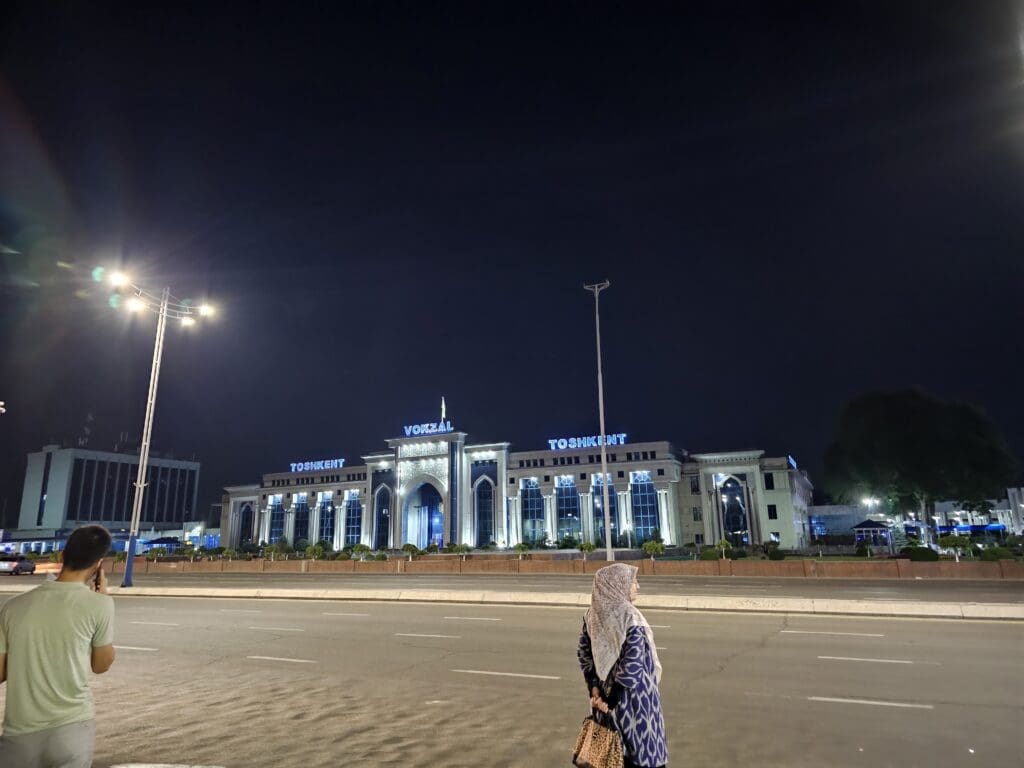
Having spent the weekend wandering the streets of the popular Silk Road city of Bukhara, I decided to return to Tashkent onboard the pride of the country’s railway network, one of Uzbekistan Railways’ high-speed Afrosiyob trains (you can read my review of this trip here!). Following a comfortable journey spent speeding through the plains and mountains of Uzbekistan, the train pulled into Tashkent Main Railway Station ahead of schedule at 1921. Seeing as my flight to Almaty was not scheduled to depart until 0040 and with the airport located just twelve kilometres from the city centre, I had plenty of time on my hands before heading off to Kazakhstan. Once through the crowds of taxi drivers rather aggressively hawking for business outside the station, I decided to have a short walk, ending up at a fancy and comparatively expensive coffee shop near Oybek Metro Station. With no working SIM card and lacking access to Uzbekistan’s main taxi app, Yandex Taxi, I was left with two options for my journey to the airport. One took the form of heading back to the station in search of a taxi driver and risk getting severely ripped off for the short journey to the airport, the other being to take the Number 40 bus which runs between the station and the airport. Leaving myself plenty of time in case things went pear-shaped, I opted for the latter and soon arrived at a crowded bus stop on the side of one of Tashkent’s busy main roads.
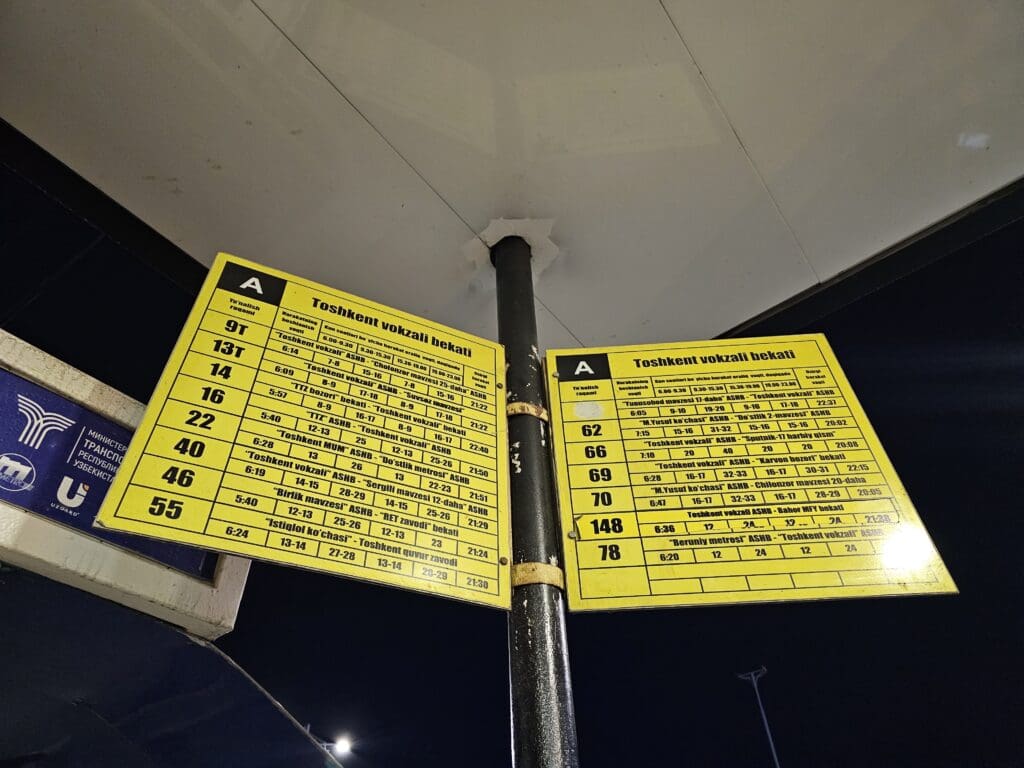
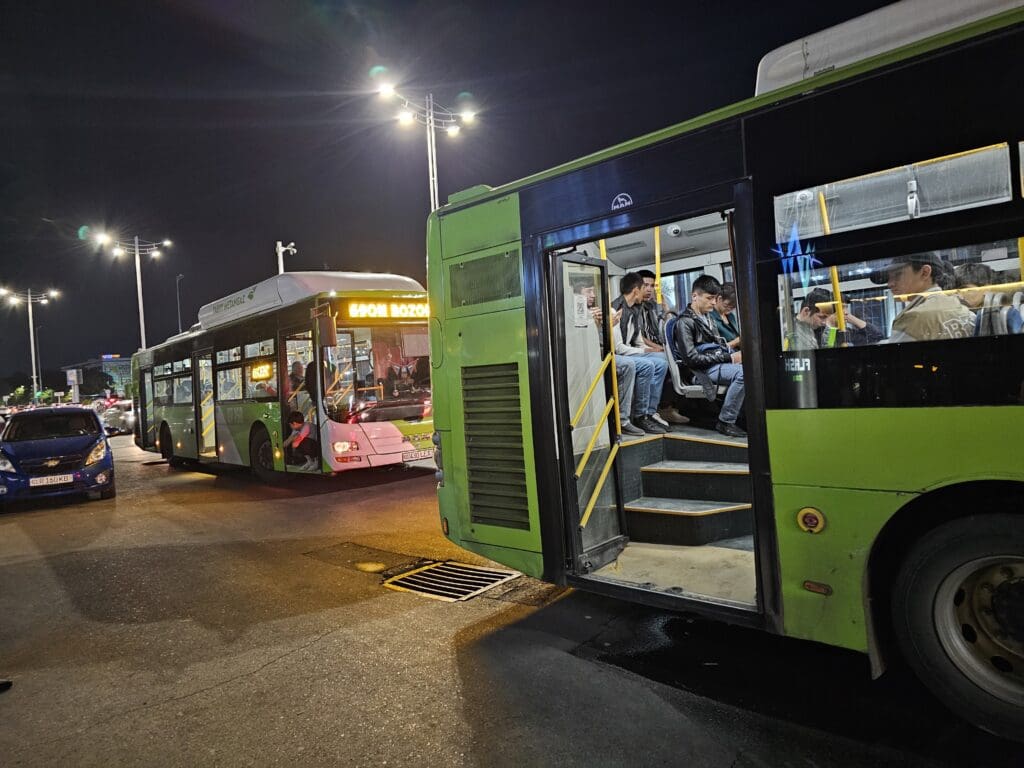
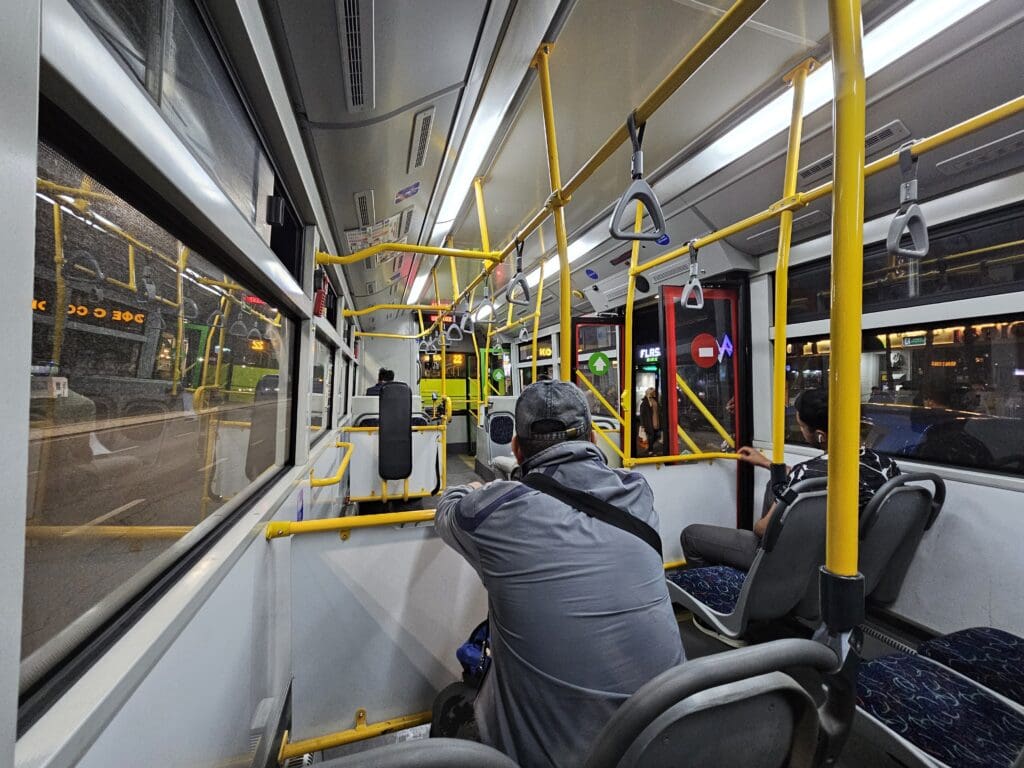
Upon arriving at the bus stop, I was presented with what seemed to be a rather confusing timetable for a non-Uzbek speaker. Although reassuringly I did manage to spot the Number 40 bus on this. However, when fifteen minutes had passed, I became a little concerned that the bus was actually a myth and pondered the idea of wandering back to the station and risking a ride in an unofficial taxi to the airport. Thankfully, after a little over twenty minutes of waiting, a bright green and modern city bus appeared, which I soon boarded with a small handful of other passengers. After a few minutes of waiting at the end of one journey and the beginning of its next, the doors closed and the bus pulled away and headed off down Tashkent’s busy evening streets. As we did so, the conducted passed through the bus collecting passengers’ fares and I soon parted with a grand total of 1,400 S’om (£0.09/€0.11/$0.12). This is perhaps one of the cheapest journeys that I have ever taken to an airport. Without any issues, after approximately fifteen minutes of stopping and starting, the bus arrived at the airport where I disembarked along with a couple of staff members.
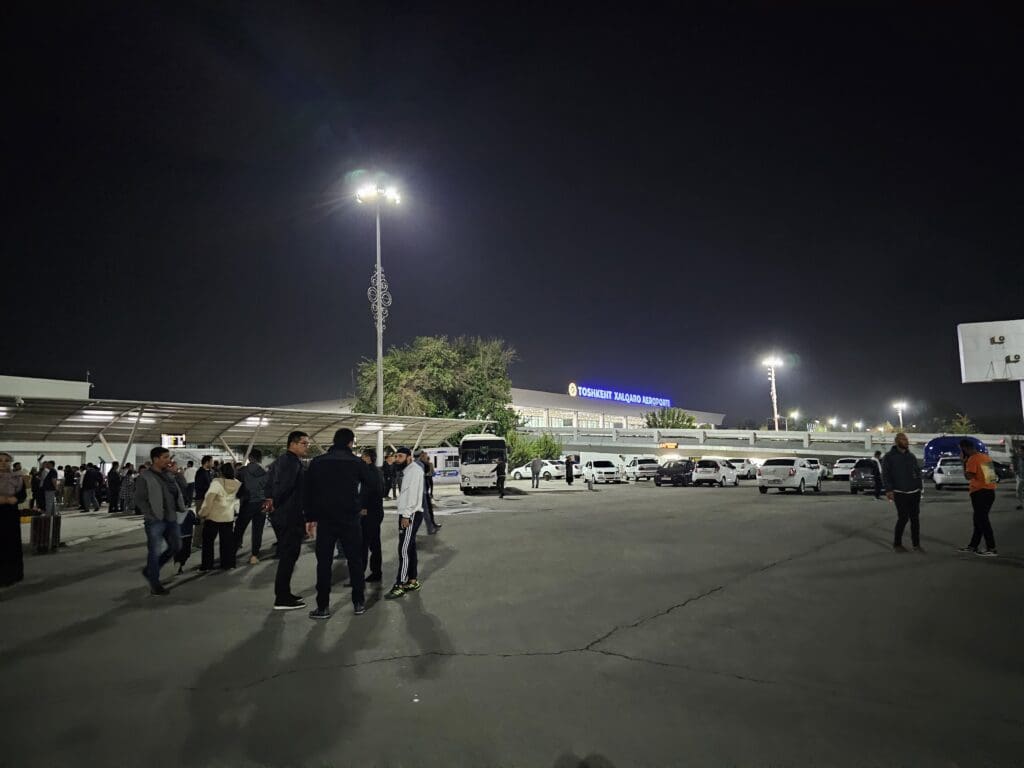
Examining the layout of Tashkent Airport, the passenger portion consists of three terminals – one for international arrivals, another for international departures and a third located on the other side of the runways that serves domestic flights. It is worth noting that the positioning of the latter makes any easy domestic-to-international connections (or vice-versa) impossible. Unlike many airports, yet as is the norm in Uzbekistan, members of the public are kept well away from the terminals, with these being completely off-limits to those without a ticket. Once off the bus, I made the long journey through the airport’s car park and headed towards Tashkent Airport’s seemingly large and imposing international terminal. Unlike the last time I had departed Tashkent in 2019, that evening there were no chaotic scrums of passengers leading up to the ticket and security check and I was able to walk straight up to the fence line where a tough-looking camouflaged soldier-security guard checked my ticket before allowing me to proceed through. From there, I made my way up the escalators and towards the check-in hall on the first floor of the building.
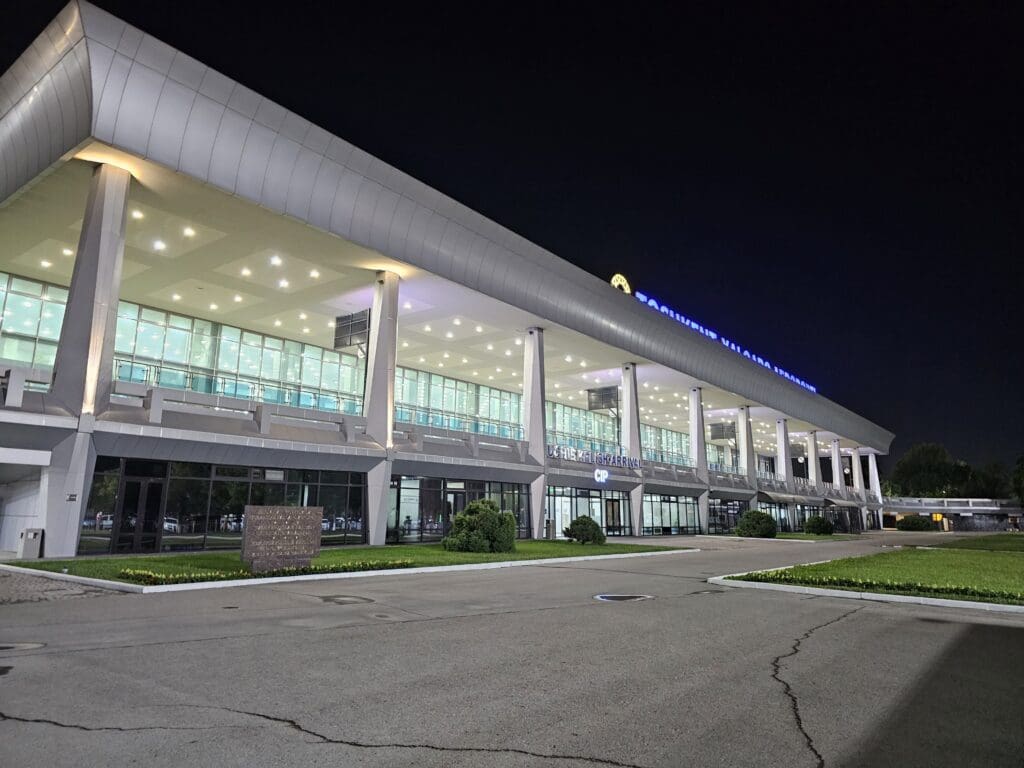
Compared to many other capital city airports across the globe, the landside departure portion of Tashkent Airport is not particularly large. However, several shops, cafés, kiosks and vending machines have been squeezed into this for those who end up with some time on their hands before having to check-in. Upon arriving in the check-in hall, those heading off on Uzbekistan Airways’ nighttime flights to Kuala Lumpur, Seoul Incheon and Yekaterinburg could be seen waiting their turn in several long lines that led up to the check-in desks. Despite the terminal’s small size and slightly dated aesthetic, I found it to be clean, well-polished and tidy, although as I had found to typically be the case across Uzbekistan, lacking a local phone number I was unable to connect to the complimentary wifi network. Furthermore, there seemed to be very few plug sockets available for passengers to use, so I would recommend heading to the airport with fully charged devices. In terms of the terminal’s design, I failed to spot anything of architectural note or glamour, and those expecting an ultra-modern terminal would have likely ended up disappointed. However, since my last visit in 2019, a new and modern check-in hall has opened, and that evening check-in for Air Astana’s service to Almaty would take place at several of the desks within this.
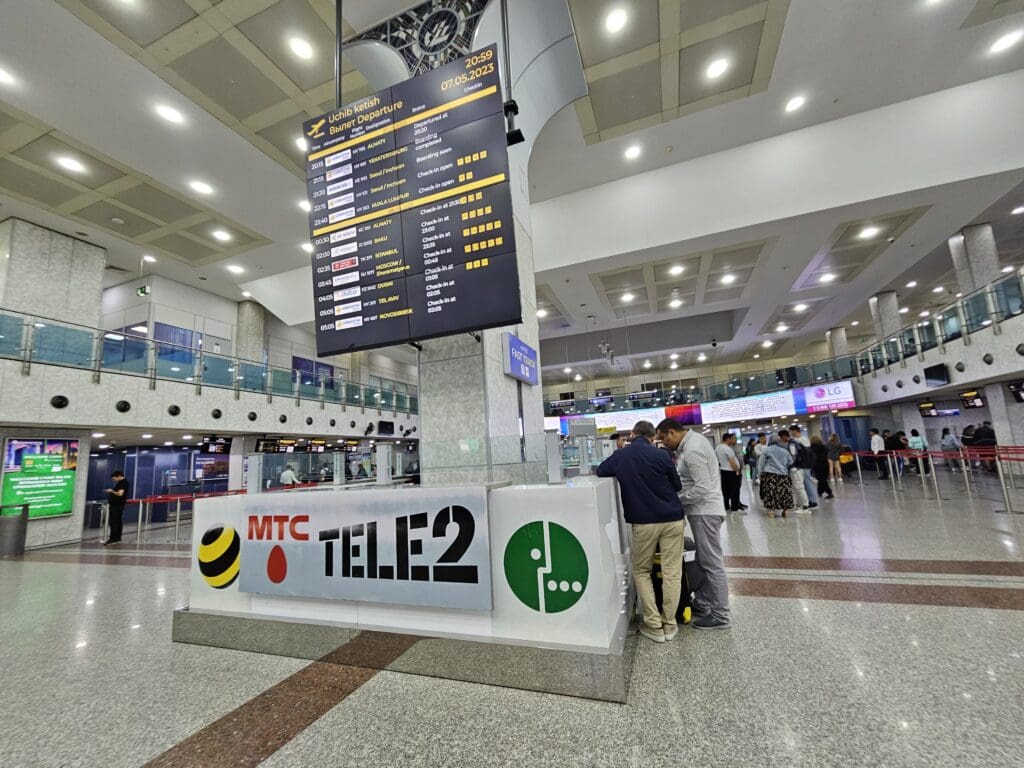
With the departure boards noting that check-in would commence at 2130, five minutes before this I sauntered over to the bright and pleasant new check-in hall. Indicating that I was in the right place, plenty of Air Astana signage could be seen, along with a short queue of waiting passengers. Ten minutes later, an army of four smartly dressed Air Astana staff members appeared and took their positions behind the counter, by which time a large queue of eager passengers had formed, many of whom had heaps and heaps of luggage. After a further fifteen minutes of waiting, check-in finally opened and in a rather pleasant move, those families with young children were picked out of the queue and allowed to check in first. With several young families onboard the flight that evening, it took around five minutes for these passengers to be checked in before check-in for all other passengers commenced. After around five minutes of waiting, I handed over my passport to one of the friendly check-in agents who typed away before an Air Astana-branded boarding pass was printed off and handed over to me.
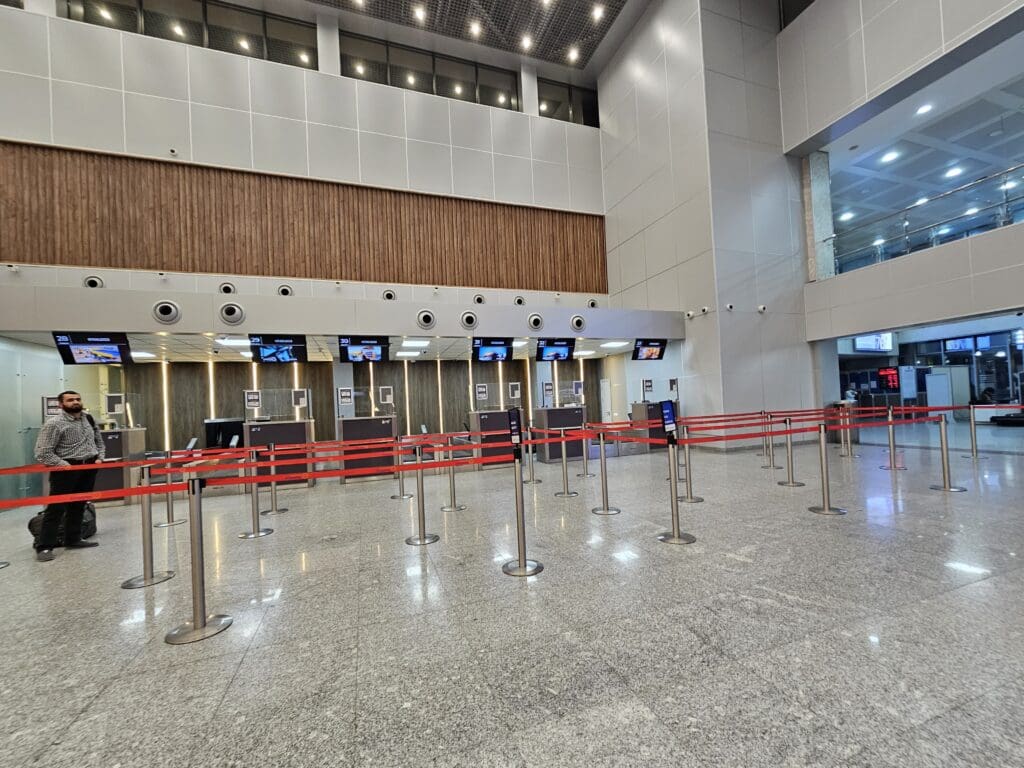
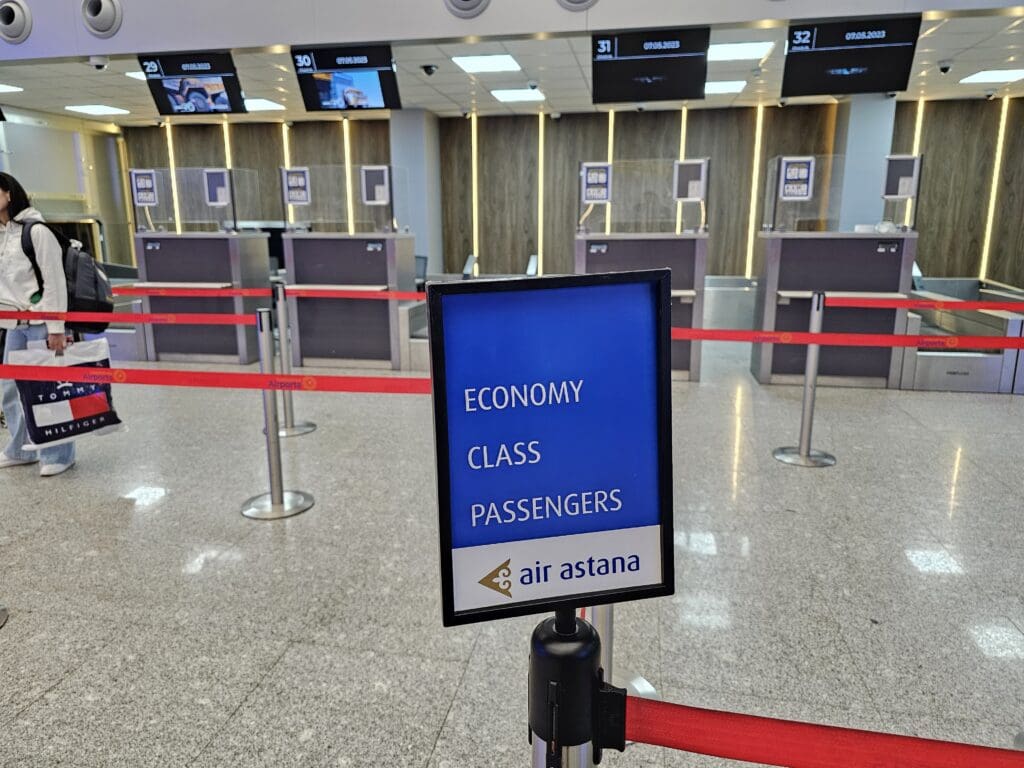
Once I had checked in, with nowhere else to go I made my way to the immigration counters, which are conveniently located just steps away from the check-in desks. In the not-too-distant past, dealing with Uzbekistan’s immigration officials was not always a quick and easy task. However, in the past few years, the removal of the visa requirement for tourists from many states in a push to promote international tourism seems to have alleviated this. With no queuing, I walked straight up to one of the booths and handed over my passport. This was an entirely painless experience and after the usual suspicious glances, my passport was stamped and returned before I was free to continue on my journey. Once through, security was an equally quick and painless experience, although this was undoubtedly assisted by the fact that all those on the three aforementioned flights to Korea, Malaysia and Russia had already passed through into the airside area.
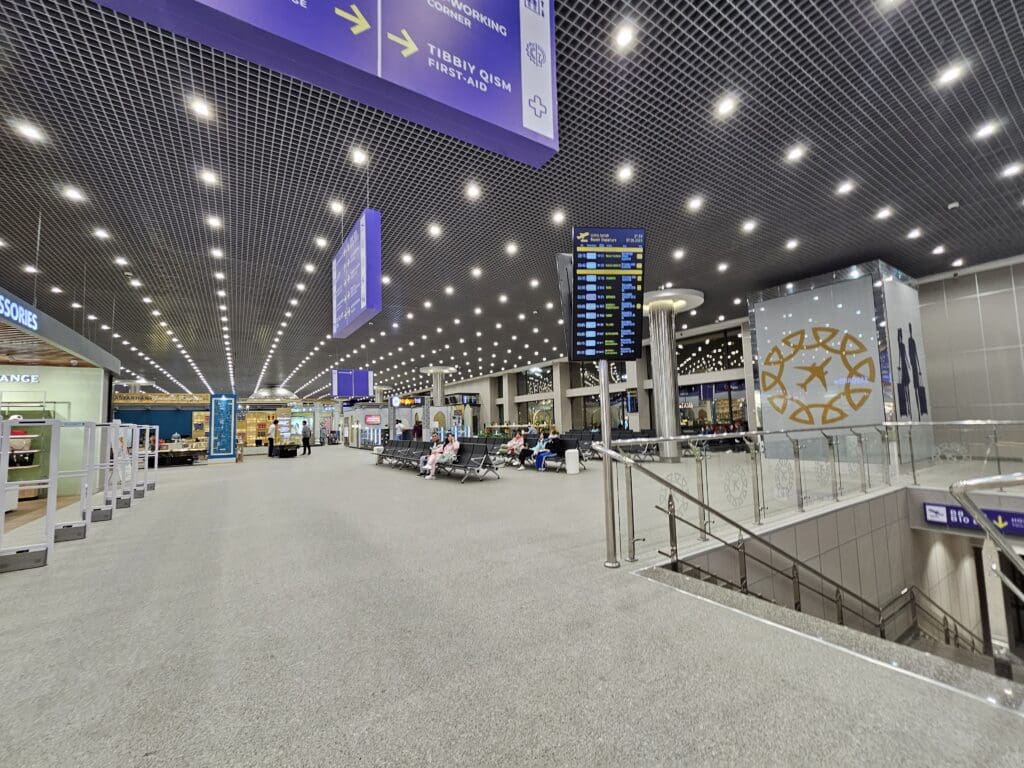
Since my last trip through Tashkent Airport’s international terminal in 2019, I was pleased to find that the airside departure appears to have undergone significant modernisation and now has a much more modern, open and spacious feel. Despite passing through in the middle of the night and with relatively few flights at that time, multiple shops were open. These offered an array of items including the usual perfume, spirits, luxury goods and local souvenirs. Fort those fancying some refreshment, this part of the terminal featured a restaurant as well as several café-bars. Furthermore, this featured plenty of seats, as well as a good number of plug socks and USB-A ports for those needing to charge their devices. Unfortunately, as with the landside portion of the terminal, I found that the complimentary wifi network could only be used by those in possession of a local phone number. However, I did get around this issue by purchasing an eye-wateringly extortionate fruit juice from one of the terminal’s cafés which enabled me to connect to their own wifi network. Last but not least, I found the terminal to be spotlessly clean and in tip-top condition, leaving me with very little to complain about other than the wifi situation.
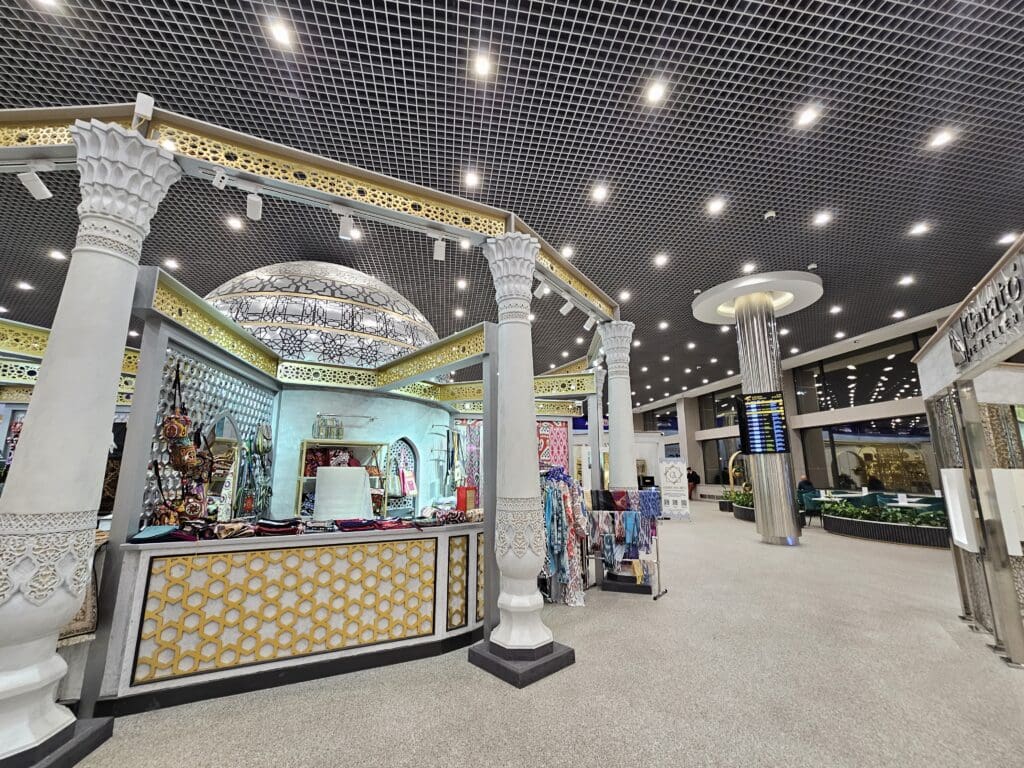
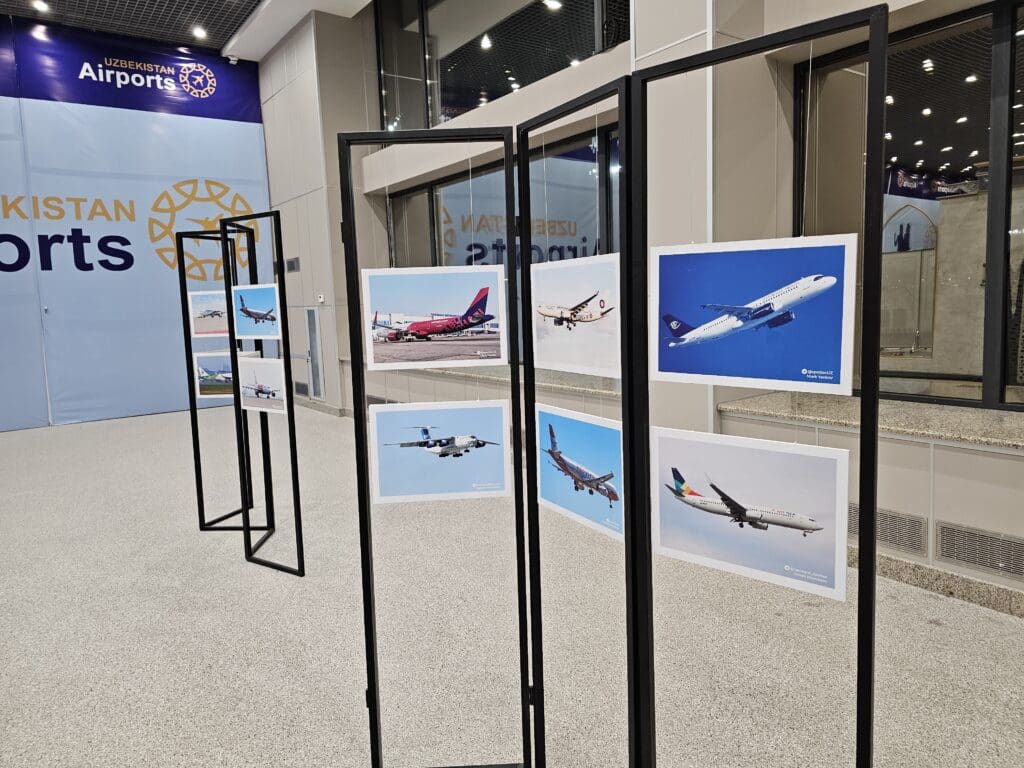
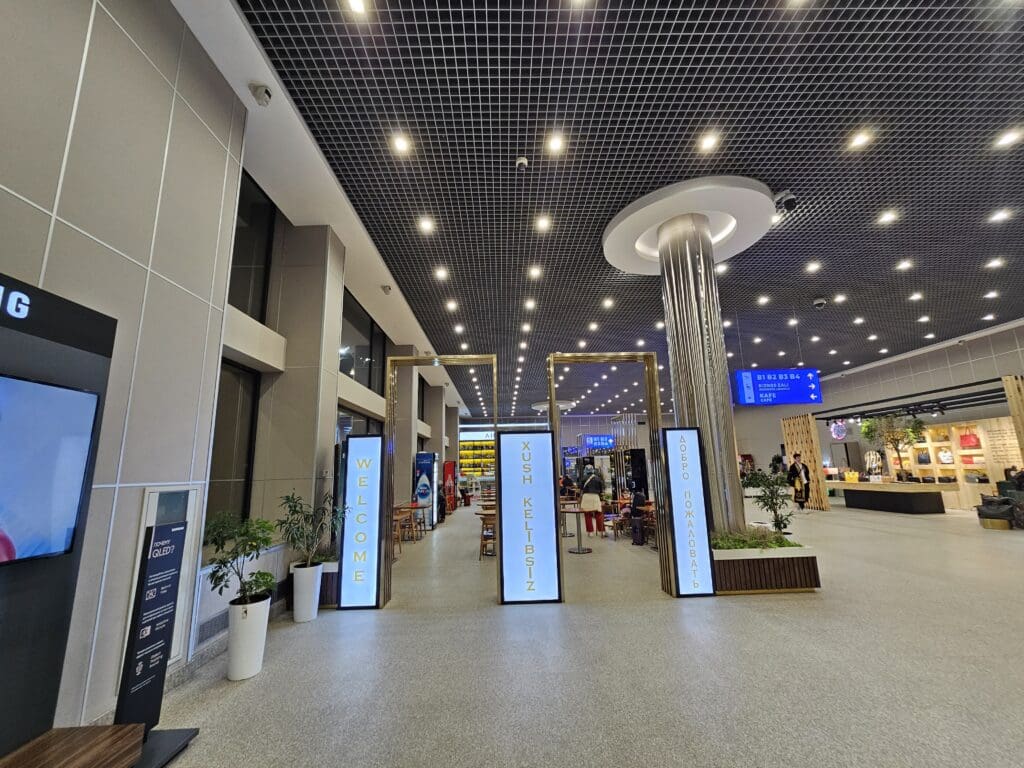
Whilst Uzbekistan may not be the most spotter-friendly country, inside, the terminal’s large windows allow for a good view of the apron and runways, although unfortunately, the darkness outside meant that very little could be seen other than the occasional blur of light from an arriving or departing aircraft. Once I had surfed the wifi and finished my juice, I plonked myself down on a bench near one of the terminal’s large windows and charged my phone to ensure that I had enough battery to snap away at the passing darkness during the flight. Whilst it was hardly rush hour in Tashkent, as I sat and waited I managed to spot the lights of a passing Uzbekistan Airways Boeing 787-8 Dreamliner as it rocketed down the runway at the start of its journey to Seoul Incheon (the same journey I took in 2019 which can be read about here!). This was then followed by the arrivals of several Airbus A320 and Airbus A321neos, operated by both state-owned stalwart Uzbekistan Airways and privately owned newcomer, Qanot Sharq. Whilst there were to be no old Soviet-era relics seen flying that evening, on the more interesting side of things I did spot a brand new Pilatus PC-24 operated by Uzbekistan Airways’ private jet division, with this touching down in Uzbekistan after a short hop over from Iran.
Not too long after I had arrived in the airside portion of the terminal, at 2249 the modern Airbus that would be taking me over to Kazakhstan touched down in Tashkent at the end of its flight over from Almaty. This came in the form of the Irish-registered Airbus A320-271N, EI-KBM. With the construction number 10005, this aircraft was assembled at Airbus’ Toulouse Blagnac plant in early 2020 and first took to the skies with the test registration of F-WWDJ in March of that year, just as the international aviation industry was going rather pear-shaped. As with most airlines, Air Astana massively scaled back its services in 2020, and with no need for the aircraft to be delivered, the Airbus entered temporary storage at Toulouse Francazal Airport. This was finally delivered to Air Astana in December 2020 and initially received the Aruban registration of P4-KBM, before receiving its current Irish guise in October 2021.
Since joining the fleet of Kazakhstan’s flag carrier, the aircraft has connected Kazakhstan with destinations across Central Asia, East Asia and Europe. This operates sectors to destinations as far away as Antalya, Beijing, Frankfurt and Istanbul, however in the week before my flight, this had been on exclusively short-haul duties and had connected Almaty with Aktau, Astana, Bishkek, Kyzylorda, Oskemen, Shymkent and Tashkent from its base in Almaty.
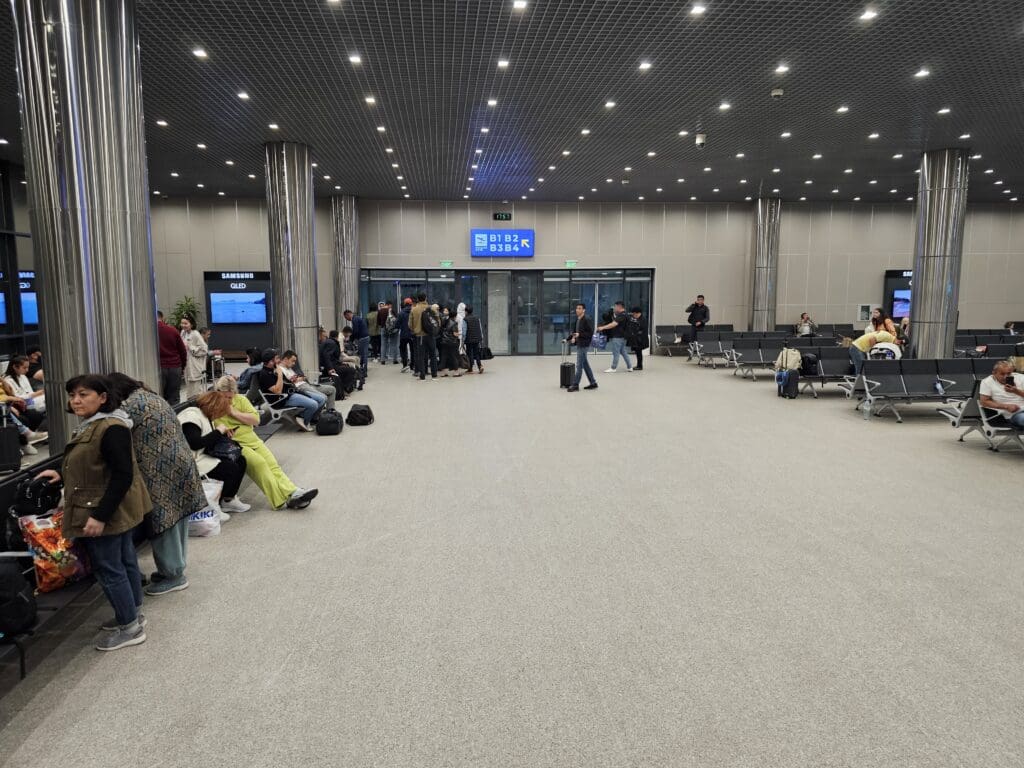
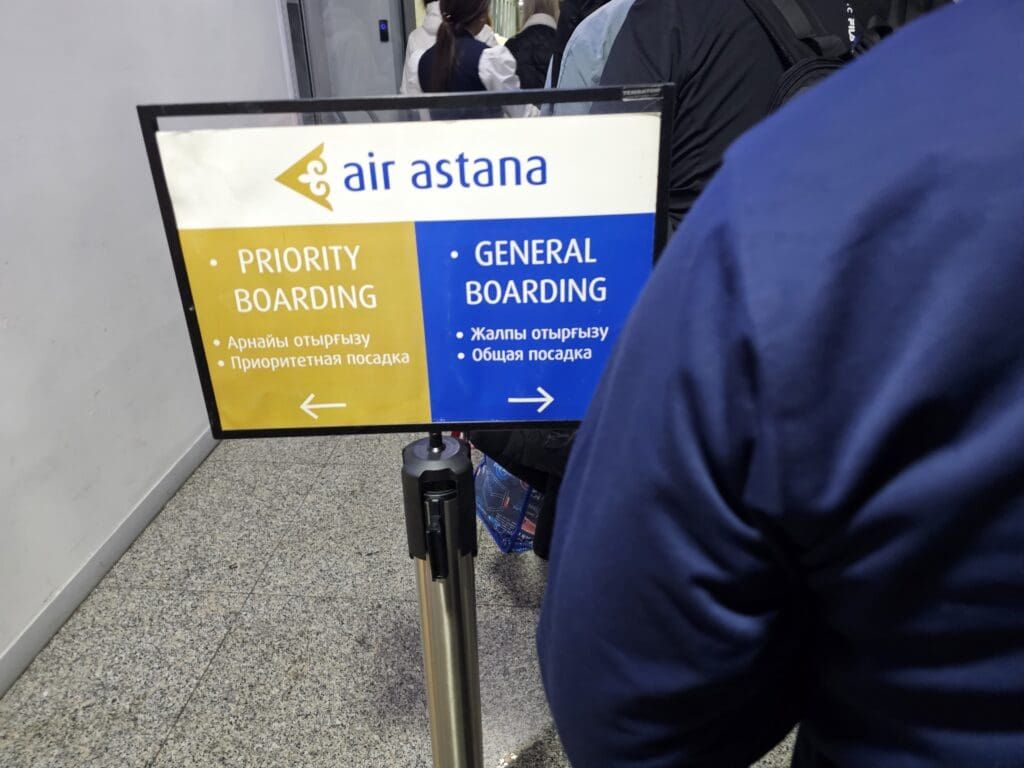
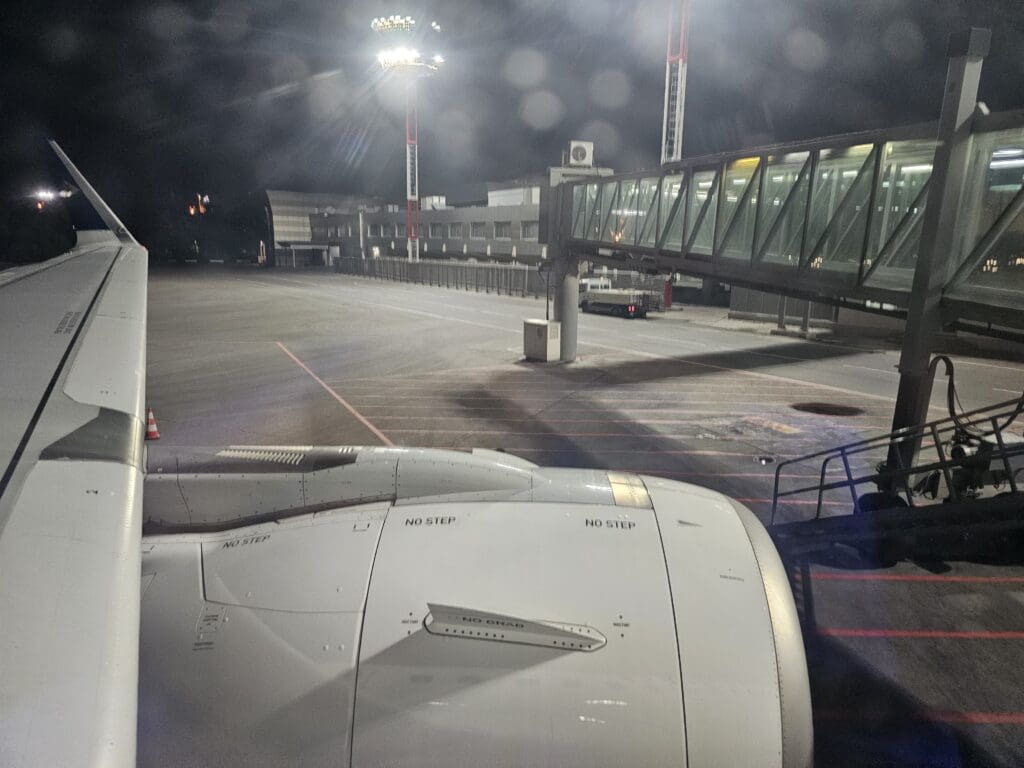
With boarding set to be undertaken through Gate B2, with around an hour to go until departure, I wandered down to the B gates which are located at the far end of the terminal building. However, with disembarkation still underway, unsurprisingly the doors to these gates were locked. Eventually, at 2350, these were opened at which point, perhaps fearful that the Airbus would head to Kazakhstan without them, many passengers stormed through and soon a large scrum of passengers formed at the gate. Once passengers had been allowed through, an Air Astana agent walked around and invited those requiring assistance or travelling in Business Class to head to the front of the queue. A short time later, the scrum began to move forward and after five minutes, my boarding pass was scanned and passport checked before I was allowed to head down the jetbridge towards the clean and shiny-looking Airbus A320neo.
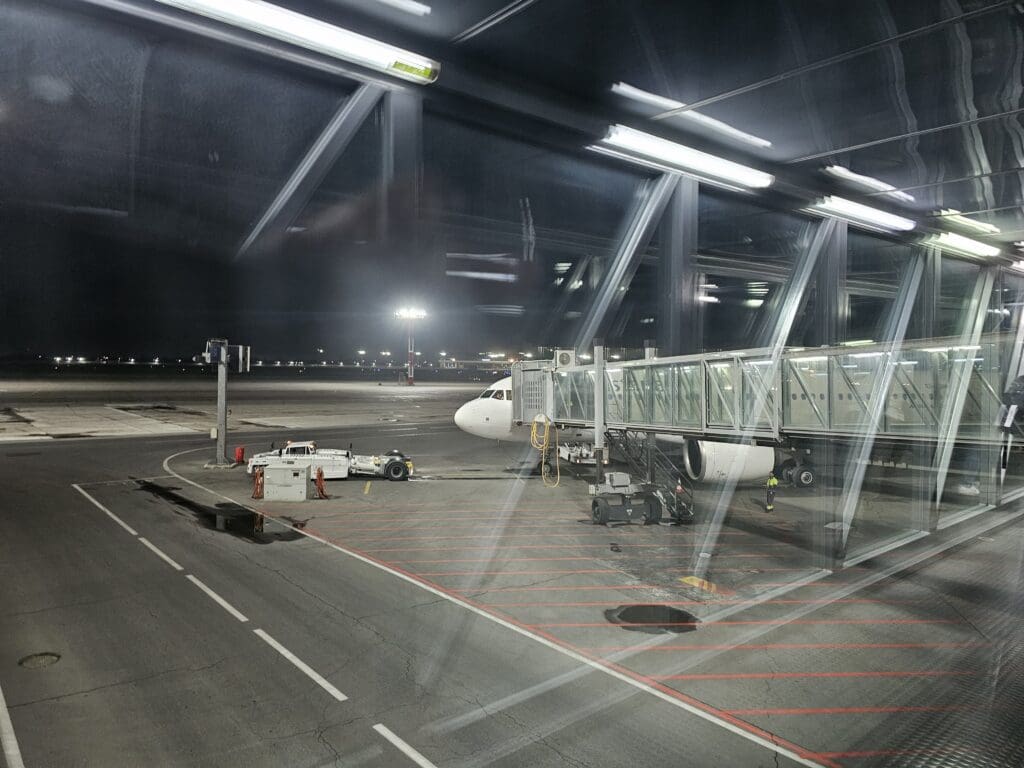
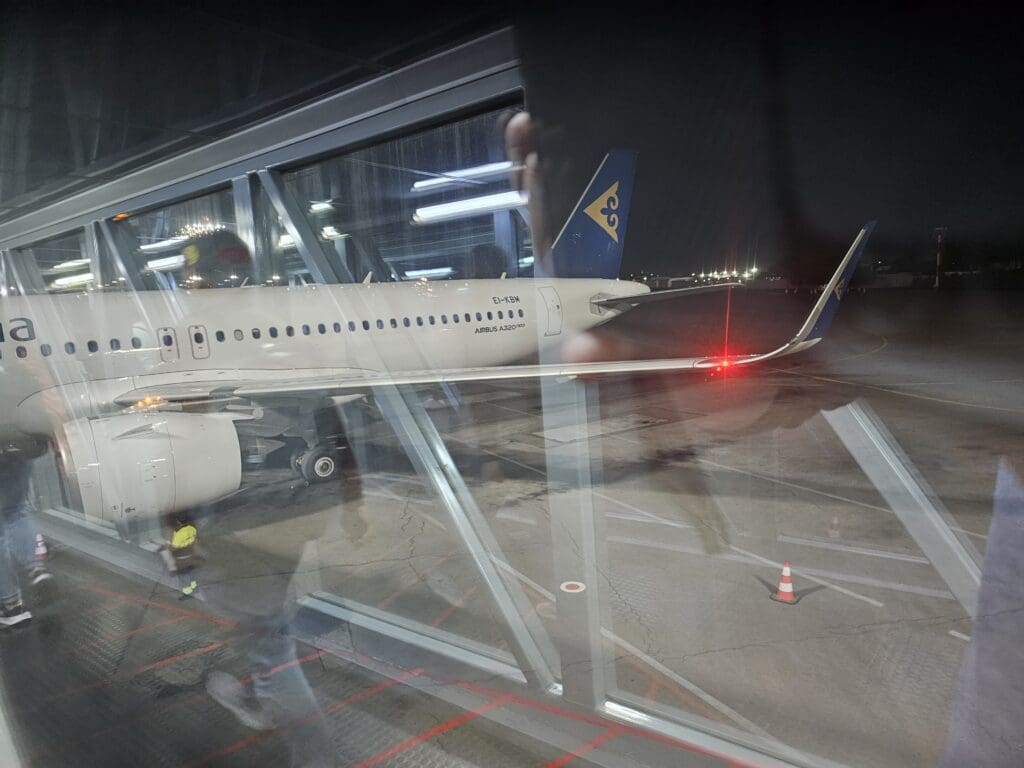
As soon as I stepped from the jetbridge into the Airbus’ forward galley, I was treated to a warm and friendly greeting in Russian from one of the two flight attendants standing there. Insisting on seeing my boarding pass, I was then advised on how to reach my seat before I turned right and made my way into the comparatively low-density 148-seat cabin.
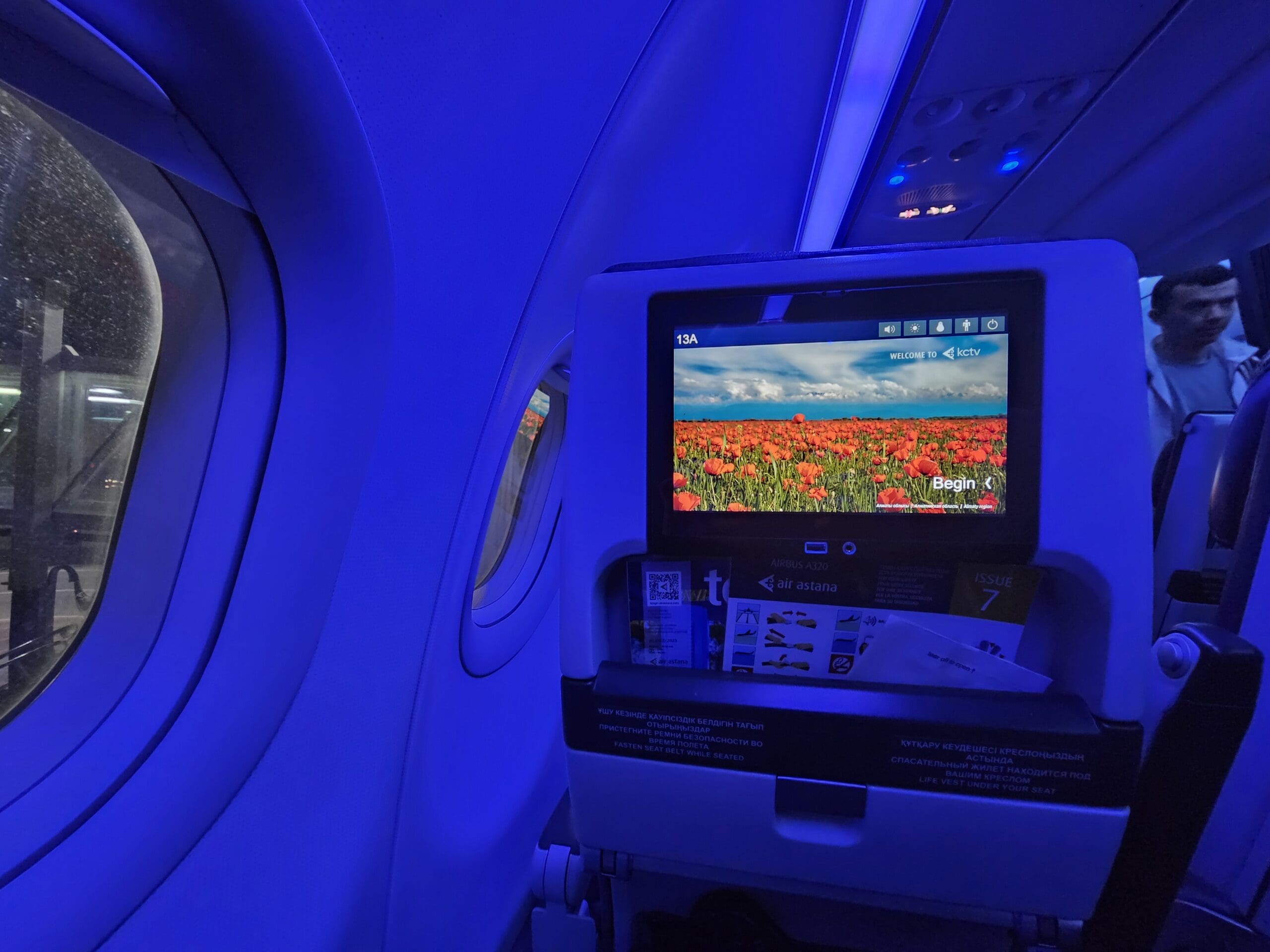
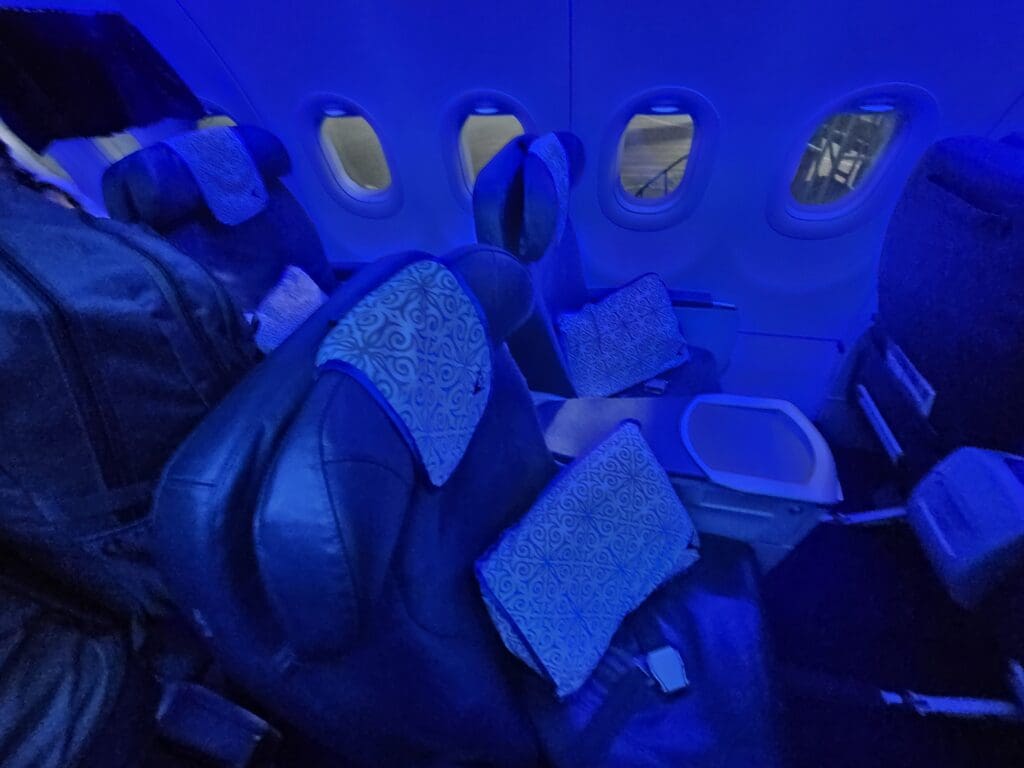
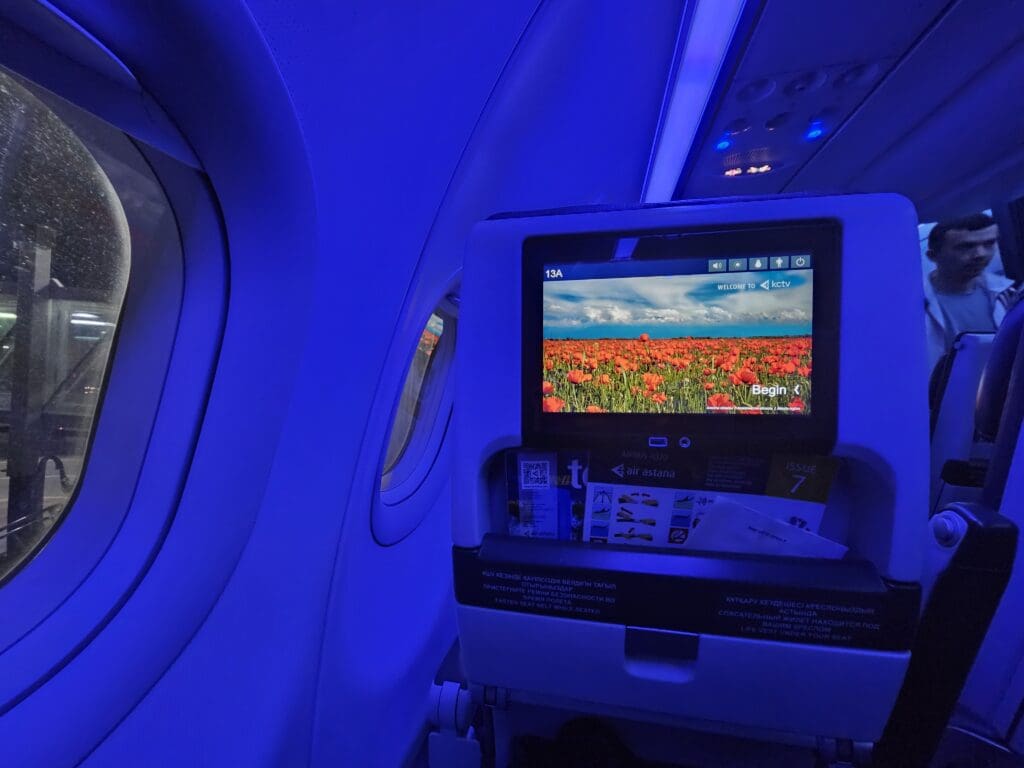
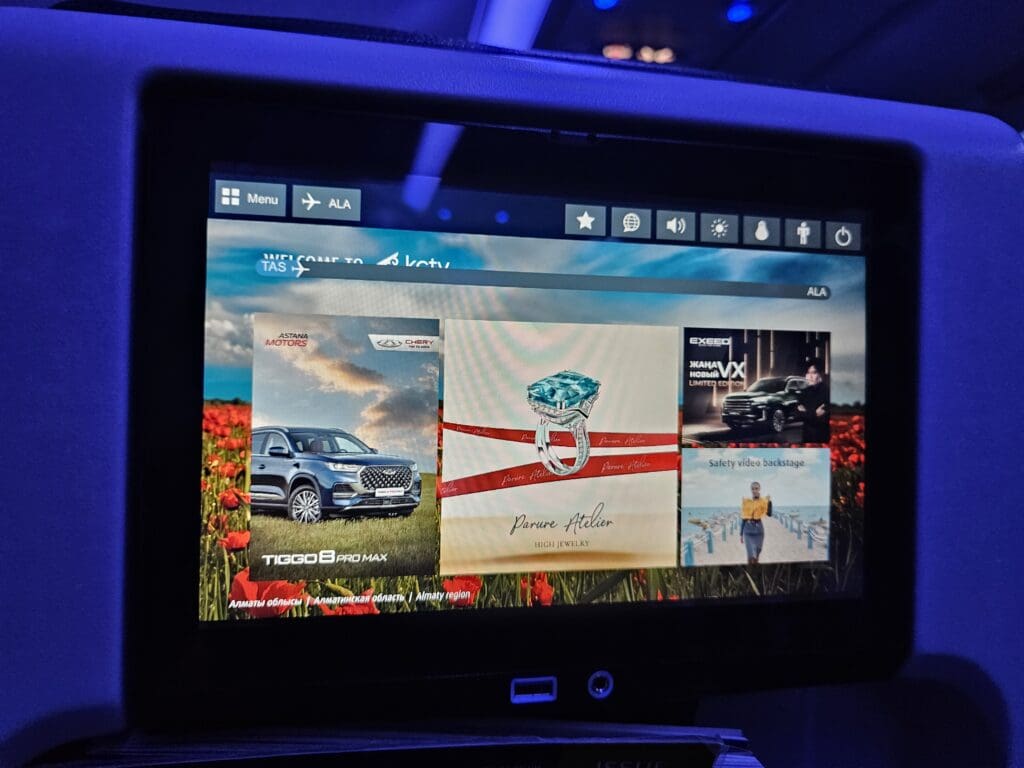
First up was the Business Class section of the aircraft which took up the first four rows of the cabin and featured sixteen well-padded and comfortable-looking recliner seats arranged in a 2-2 configuration. Each of these featured a dark blue pleather cover and was topped with an adjustable headrest that was partially covered by a fabric antimacassar on which a traditional pattern could be seen. Meanwhile, each seat featured a pillow and blanket – despite the rather short flight time to Almaty. After passing through the Business Class section, I arrived in Economy Class where I was greeted by the sight of 132 squarish and modern Recaro CL3710 seats. Whilst hardly needed on this short middle-of-the-night flight, the backs of these feature high-quality ten-inch wide personal television screens which are powered by Safran’s RAVE inflight entertainment system.
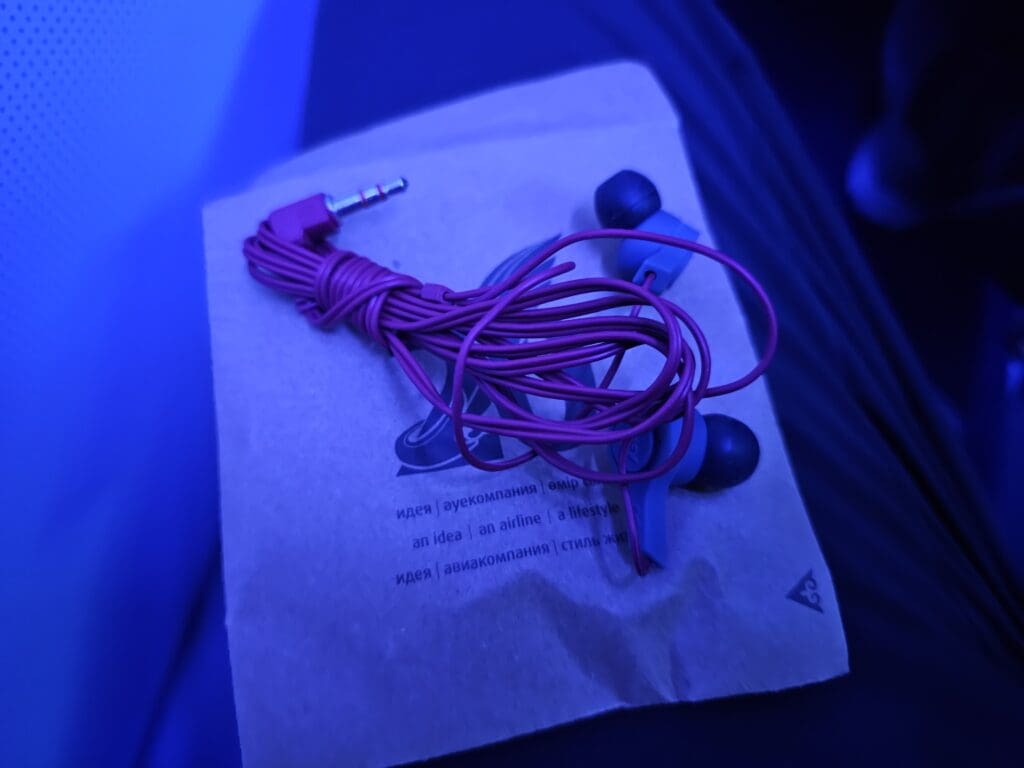
Not being a good row for those with triskaidekaphobia, that night I would be journeying to Almaty in Seat 13A. With Economy on all Air Astana aircraft commencing at row 11, I didn’t have far to go until I reached my seat. Arriving there ahead of my seatmates, I was able to slide into this with ease. Once seated, I was delighted to find the seat to be soft and comfortable whilst also offering a fantastic amount of legroom. In addition, the area around this was spotlessly clean and I was unable to find any notable signs of wear and tear. Examining the seatback pocket, this contained the all-important safety card as well as a sickbag and the latest copy of the Tengri inflight magazine. Meanwhile, with packaged headphones placed on top of each seat upon boarding, passengers could use the inflight entertainment system as soon as they were seated.
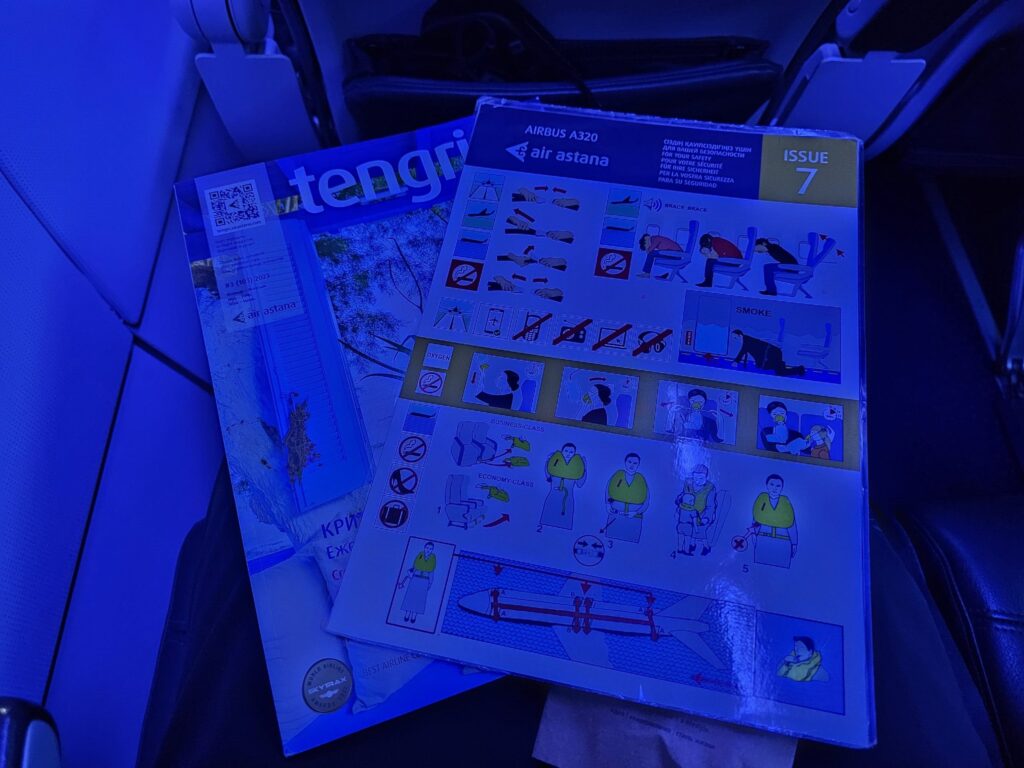
After strapping myself in, passengers continued to steam onboard and it wasn’t long before I was joined by two neighbours. At 0010, boarding was announced as complete and that evening the flight seemed to be almost full – with a wide variety of passengers from Kazakhstan, Russia and Uzbekistan making this short hop. Following a short pause, the traditional music that had accompanied the boarding process came to an end and at 0016 the Captain made a long welcome speech, first in Kazakh followed by Russian and English. This consisted of the usual welcomes, thanks, and an introduction to the First Officer and Purser, before ending this by encouraging passengers to pay close attention to the soon-to-follow safety demonstration. This was immediately followed by the purser’s welcome announcement in Kazakh, Russian and English during which, alongside the usual welcomes and instructions, they advised passengers to download the Air Astana app in order to access a range of complimentary magazines and newspapers from across the world during the flight.
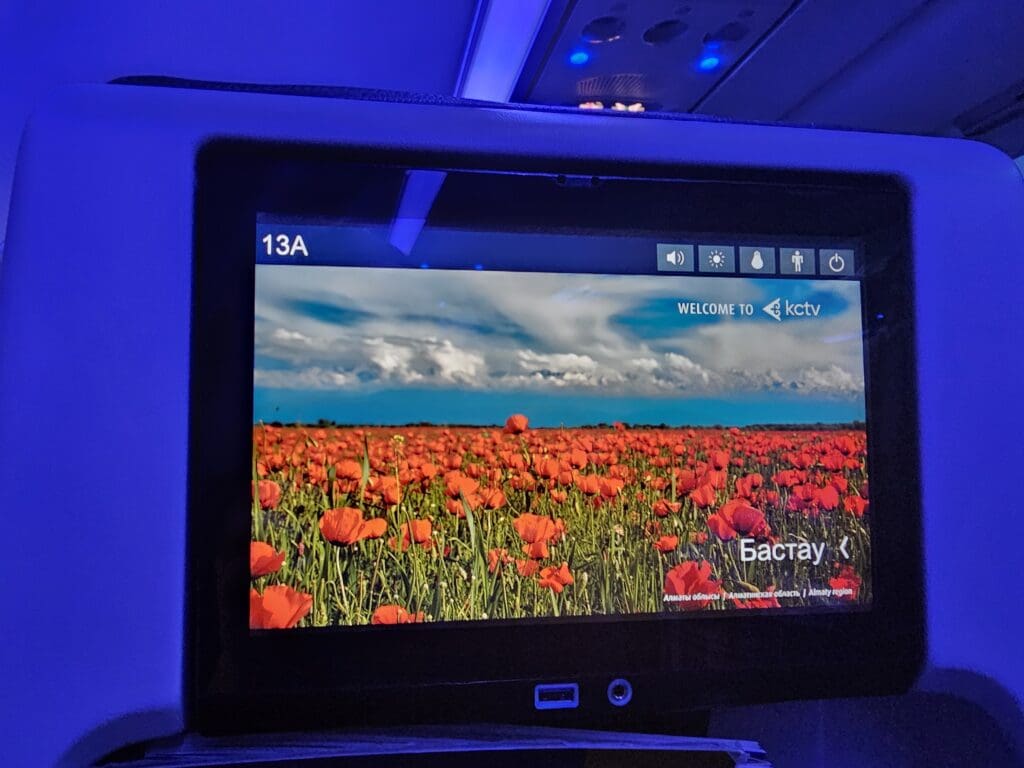
After these announcements, a video was played on the personal television screens advertising the latest releases from across the world on KCTV. In this instance, KCTV is the name of Air Astana’s inflight entertainment (a combination of the carrier’s IATA code, ‘KC’ and ‘TV’), and not, Korean Central Television, the North Korean state broadcaster.
With all passengers onboard well ahead of the flight’s scheduled departure time, seventeen minutes before we were scheduled to depart, the cabin door was closed and the jetbridge retreated from the aircraft. At this time, the crew took to the aisles to commence the manual safety demonstration. Whilst not a complaint, I was a little surprised to see that this demonstration was done manually considering that Air Astana not only has a new safety video, but one that they are actively promoting. As this demonstration neared its end, the aircraft was pushed back away from the gate before being pulled forward quite some distance, ending up very near the threshold of Runway 08L before coming to a halt. After stopping, the Airbus’ two Pratt & Whitney PW1127G engines quietly spooled up into life – with these being barely heard thanks to the traditional music being played over the cabin speakers.
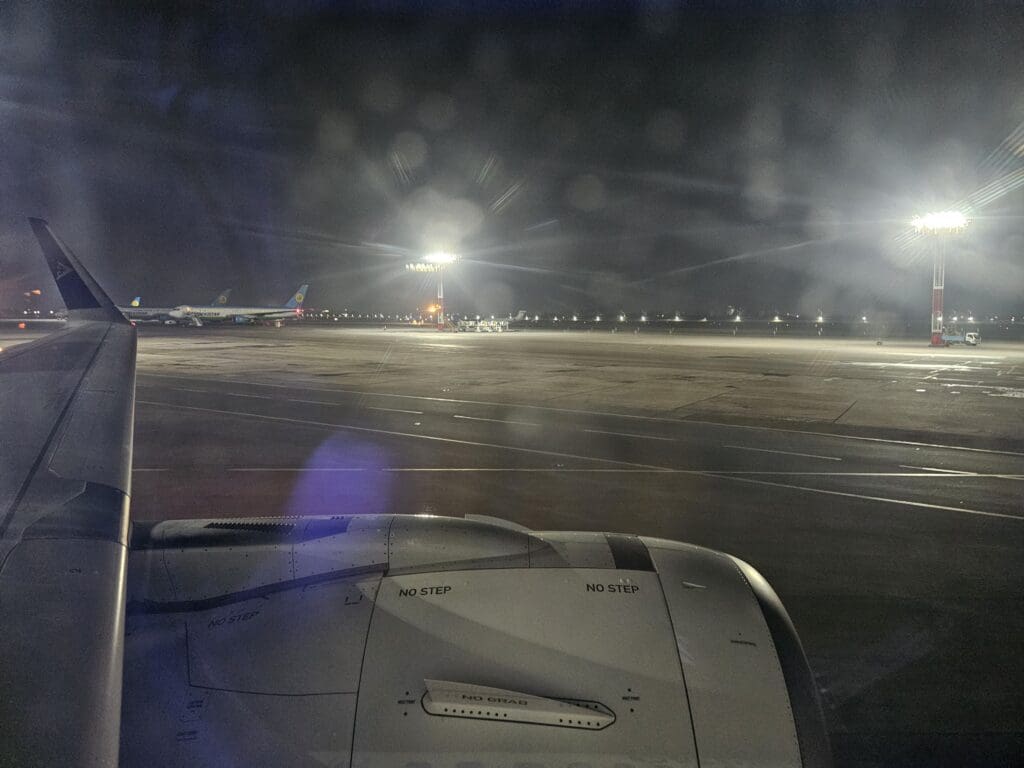
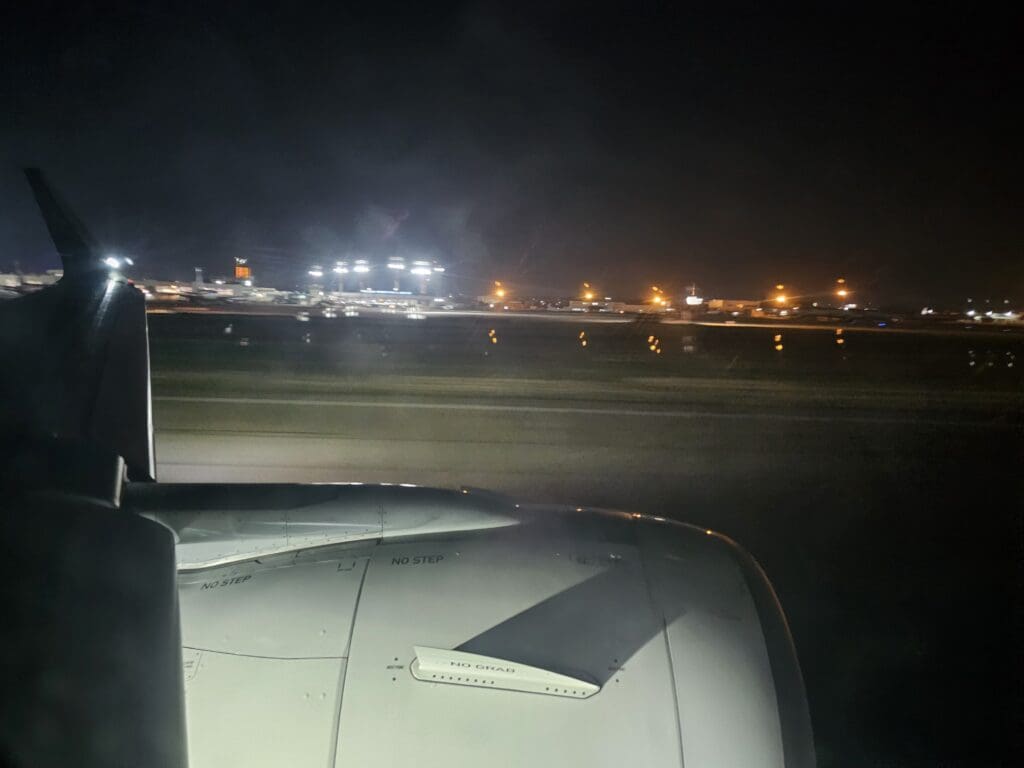
Once the Airbus’ engines had powered up, the Airbus remained in position at the holding point and soon an Azerbaijan Airlines Airbus A320neo came whizzing past at the end of its flight over from Baku. Once this was safely down, the aircraft slowly taxied onto Runway 08R and at 0039 its two engines whistled and whined as the Airbus began its powerful take-off roll. Following a few bumps and sways from side to side, it wasn’t long before the aircraft took to the skies at which point an interesting collection of Soviet, Western and Uzbek-built aircraft could be seen parked well away from the terminal. These included a good number of Ilyushin Il-76s. Beyond this, the well-illuminated buildings of downtown Tashkent could be seen, including the tall Tashkent Television Tower.
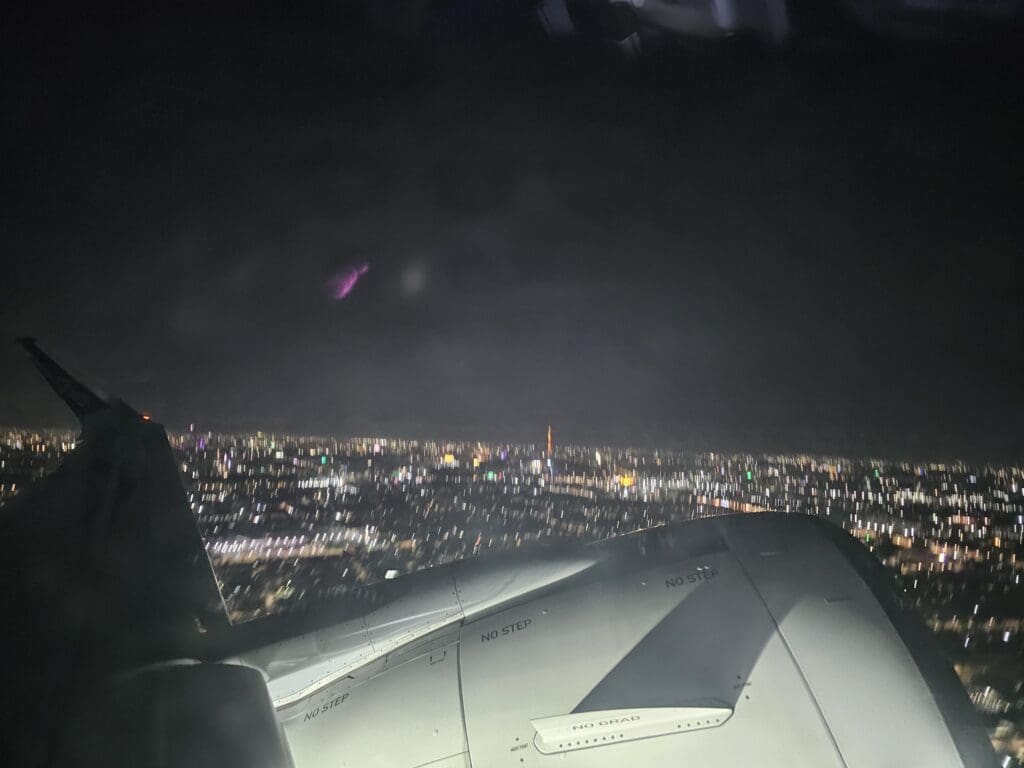
As we rocketed upwards, my final glimpses of Tashkent were to be fleeting as a very short time after taking to the skies, the Airbus banked to the right, at which point little other than the orange glow of the lights of the city’s southern fringes could be seen. Although those on the opposite side of the aircraft would have been treated to good views of Tashkent before we left this behind. With Tashkent practically sitting on the border with Kazakhstan’s Turkistan Region, only six minutes into the flight the Airbus climbed over the border and passed the small Kazakhstani town of Saryagash after which very little could be seen below for a while.
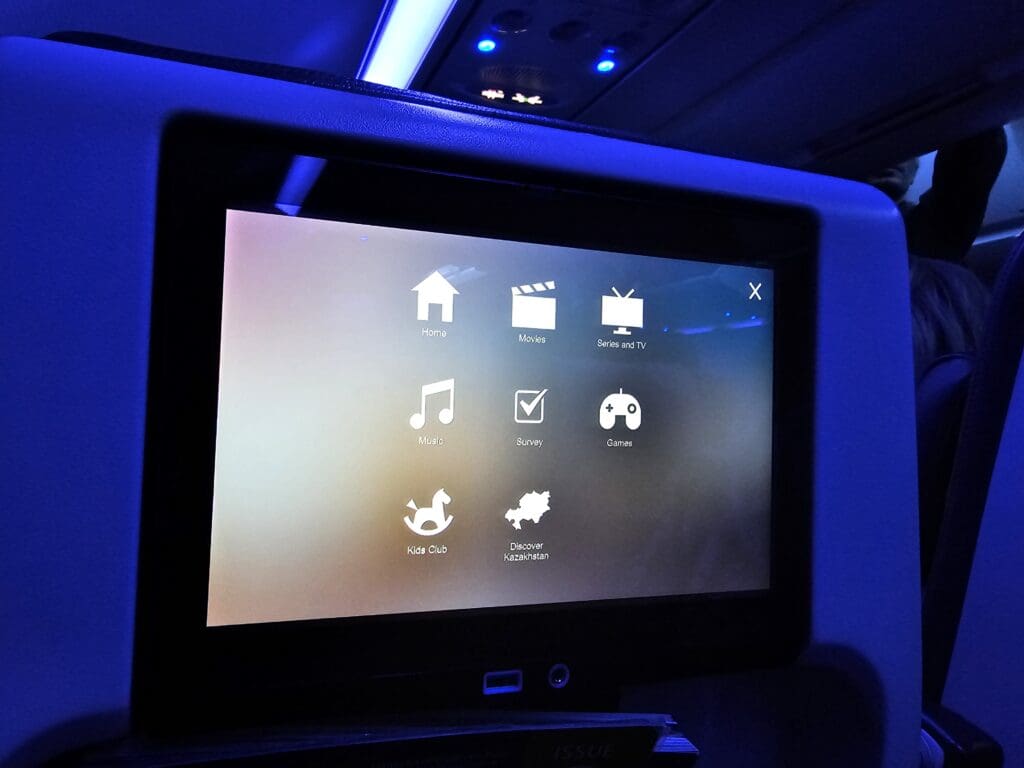
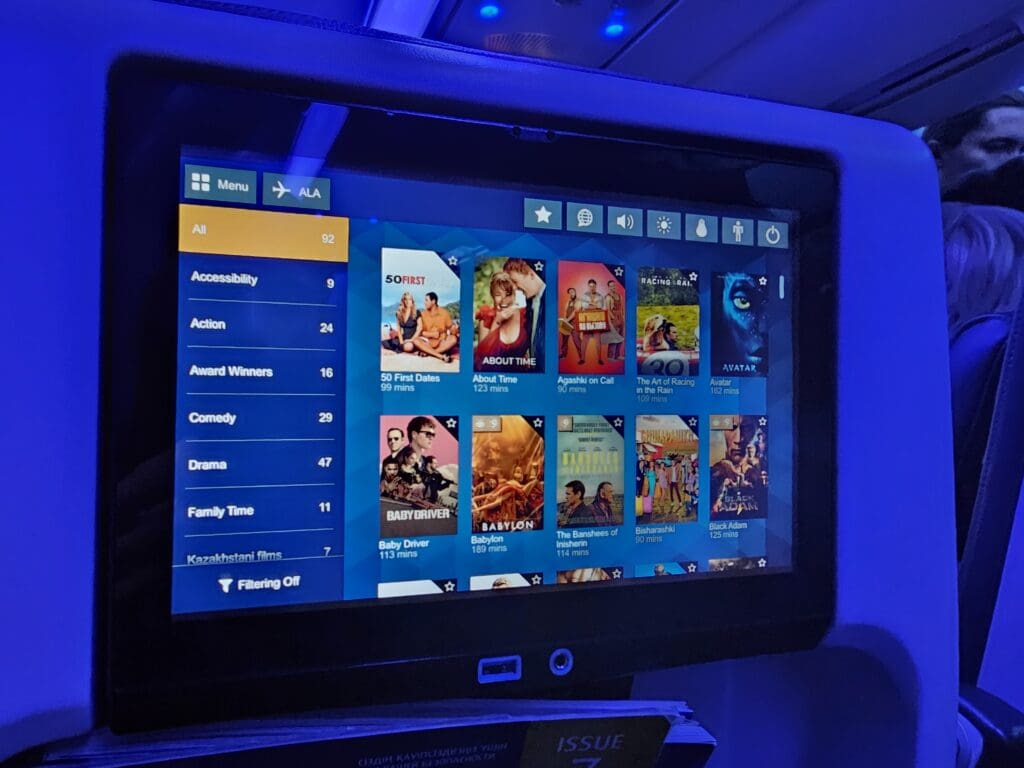
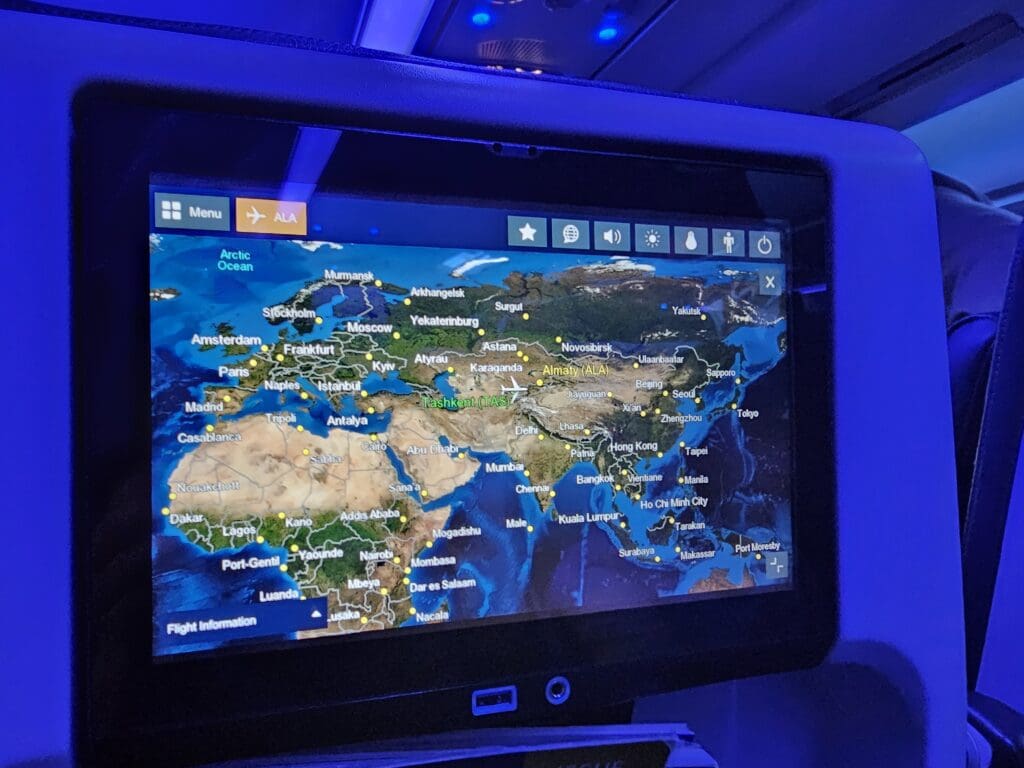
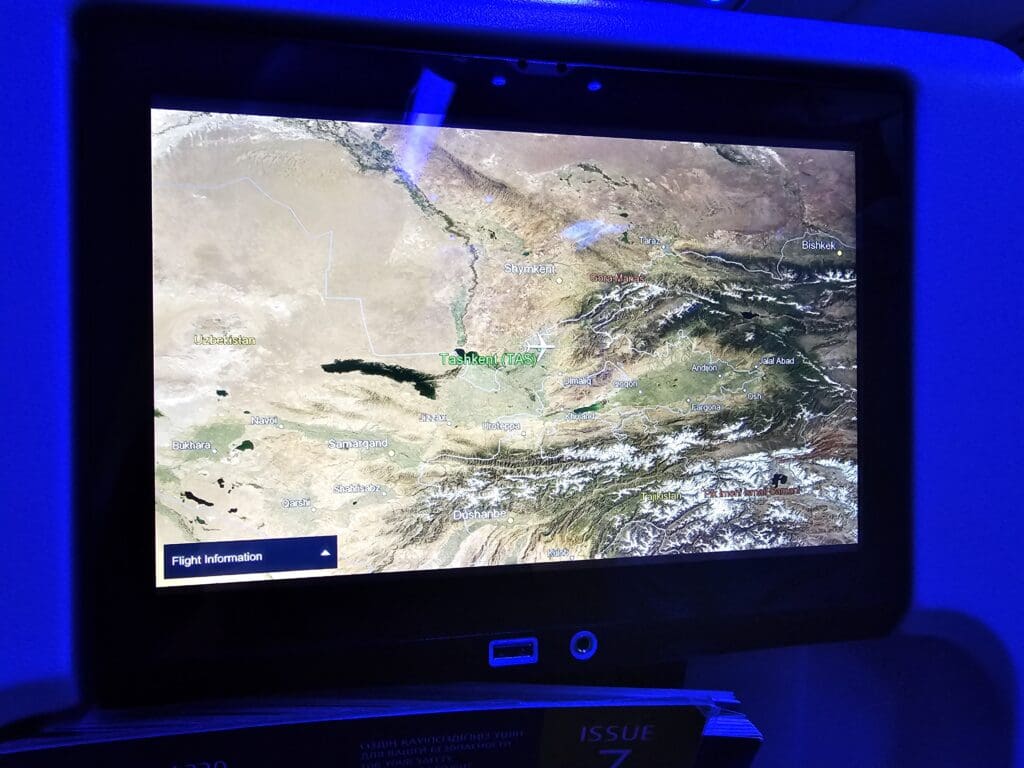
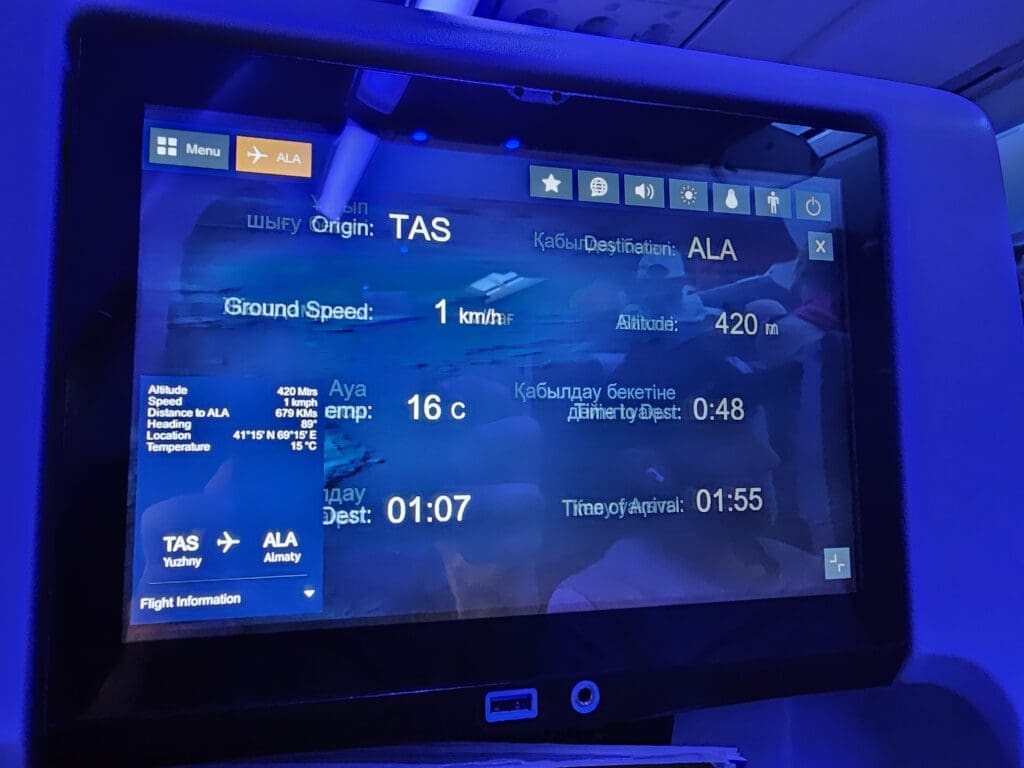
With little to see below, I turned my attention to Air Astana’s inflight entertainment system. As with my previous flight with the carrier in 2019, I was left very content with the amount of content included in this. Despite being hardly required on this short sector, Air Astana’s KCTV features hundreds of hours worth of films, music and television programmes from across the globe. This came in addition to the usual moving map and information pages about the airline. Furthermore, I found the system to be well laid out and easy to use, whilst the touchscreen was responsive and quick to load. Needless to say, I was left very impressed by the inflight entertainment onboard. It is also worth noting that had I preferred to watch or listen to something on my own device, I would have been able to do so via Air Astana’s app with this featuring the same wide array of content as on the personal television screens albeit without a moving map.
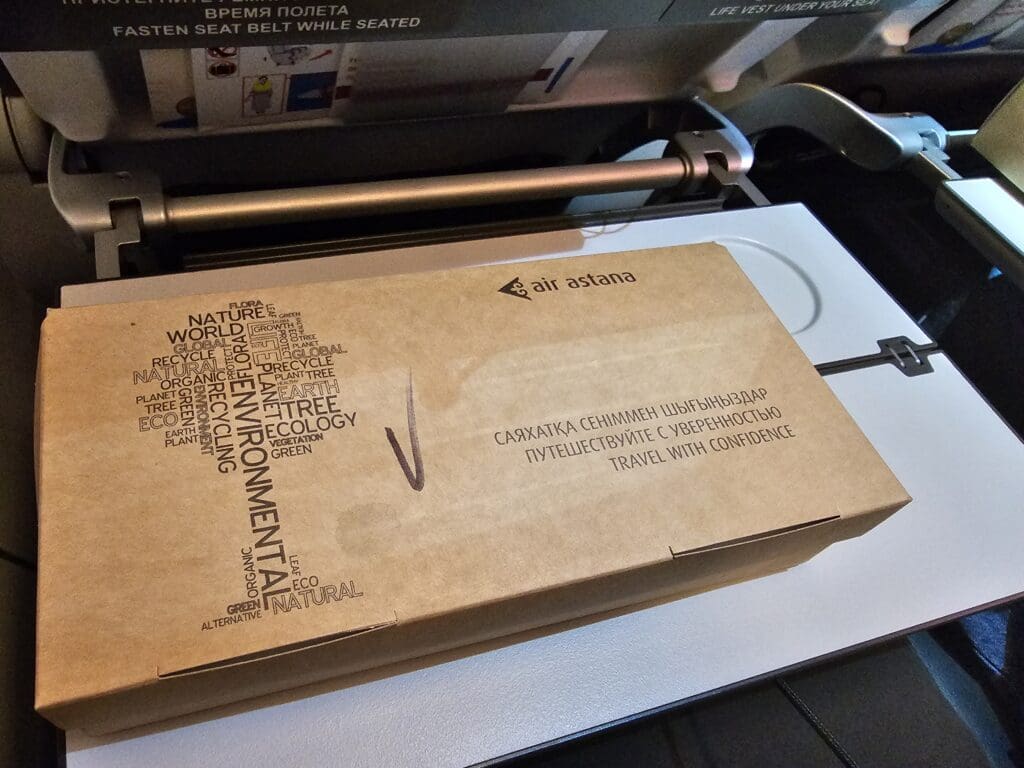
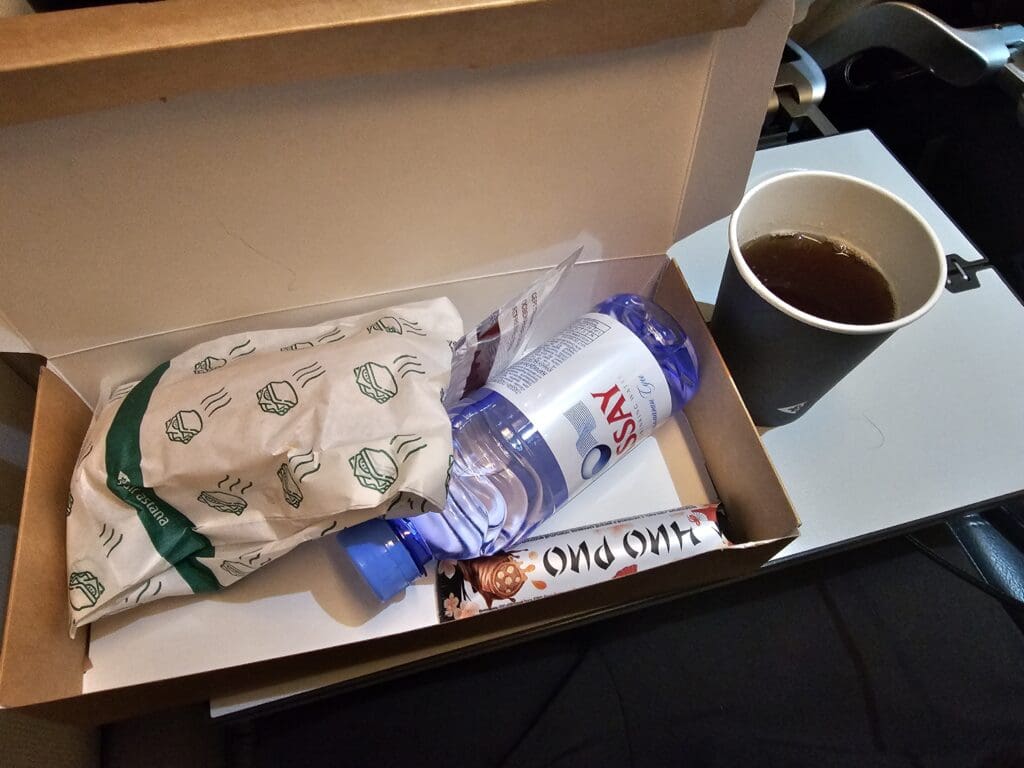
Approximately ten minutes after we had taken to the skies, the seatbelt signs were extinguished. In the usual manner, this was followed by a pre-recorded announcement with the usual warning to keep seatbelts fastened whilst seated. At this time, the person in front of me decided to fully recline their seat, although thankfully I found that in spite of this, the seat remained comfortable and spacious. At this stage of the flight, the cabin lighting transformed from an ocean blue to a deep orange sunrise and the crew could be seen rolling a trolly to the front of the Economy class cabin. Given Air Astana’s stellar reputation, I had expected to receive something on this short flight. However, given the fact that this was a middle-of-the-night service, I was unsure of just exactly what would be in store. Seated near the front of the cabin, I didn’t have to wait long until the inflight offerings were revealed and I was soon handed a box by a friendly flight attendant. Wasting no time, I opened this up and found it to contain a cheese and vegetable sandwich, a chocolate bar, a 250ml bottle of still water and a wet wipe. I was then immediately offered a cup of tea or coffee, and, still with some time to go until I could sleep, I decided on the latter. Overall, this was a fantastic offering for such a short flight and left me with nothing to complain about.
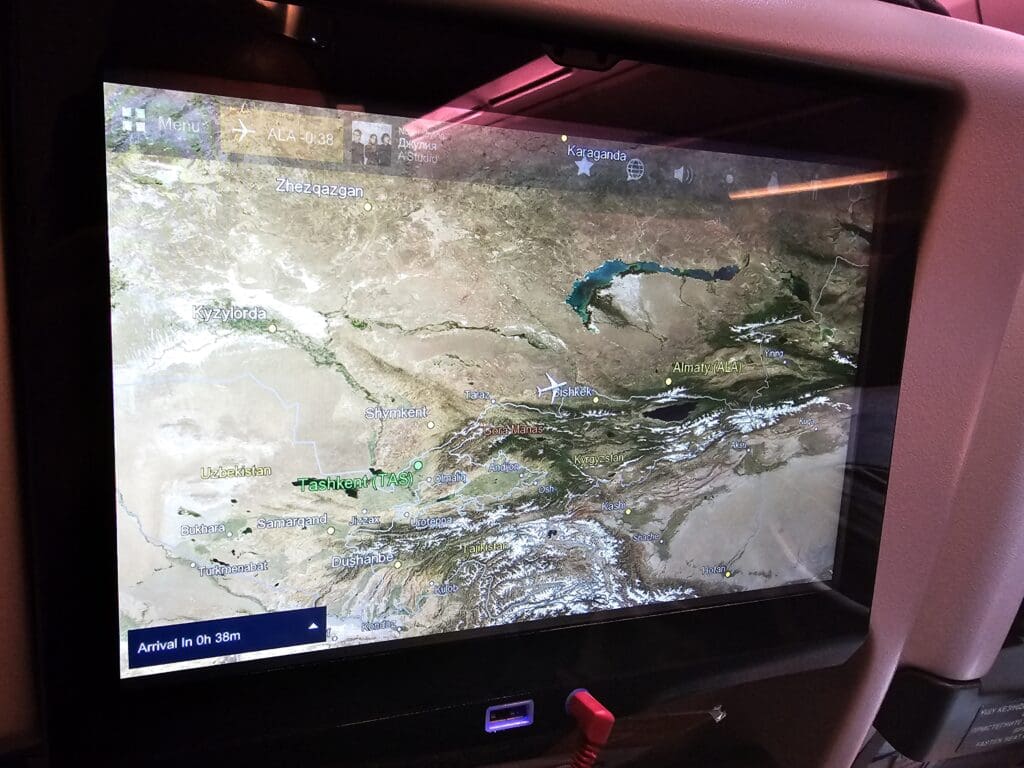
Returning to examine the route, once away from Tashkent and in Kazakhstani airspace, the aircraft flew roughly parallel with the Uzbek border for around fifteen minutes and we skirted along the northern edge of the Western Tian-Shan Mountains. Had this flight taken place in daylight, I imagine that those on the right side of the aircraft would have been treated to superb views of these mountains. Continuing onwards, Uzbekistan soon transformed into Kyrgyzstan and the aircraft continued around the border with this. Upon reaching the Kazakhstani city of Taraz, the Airbus banked and flew roughly eastwards along the border with Kyrgyzstan. Back inside the cabin, around fifteen minutes after the evening meal had been handed out, the empty boxes were collected and before the lights were dimmed for a few short minutes.
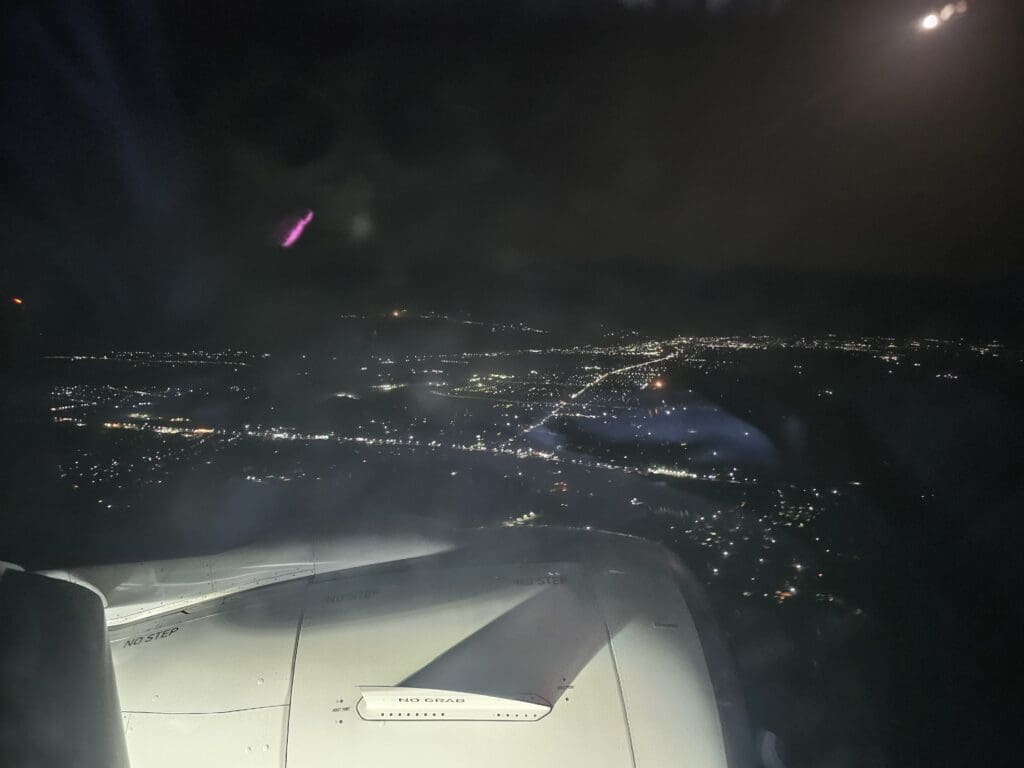
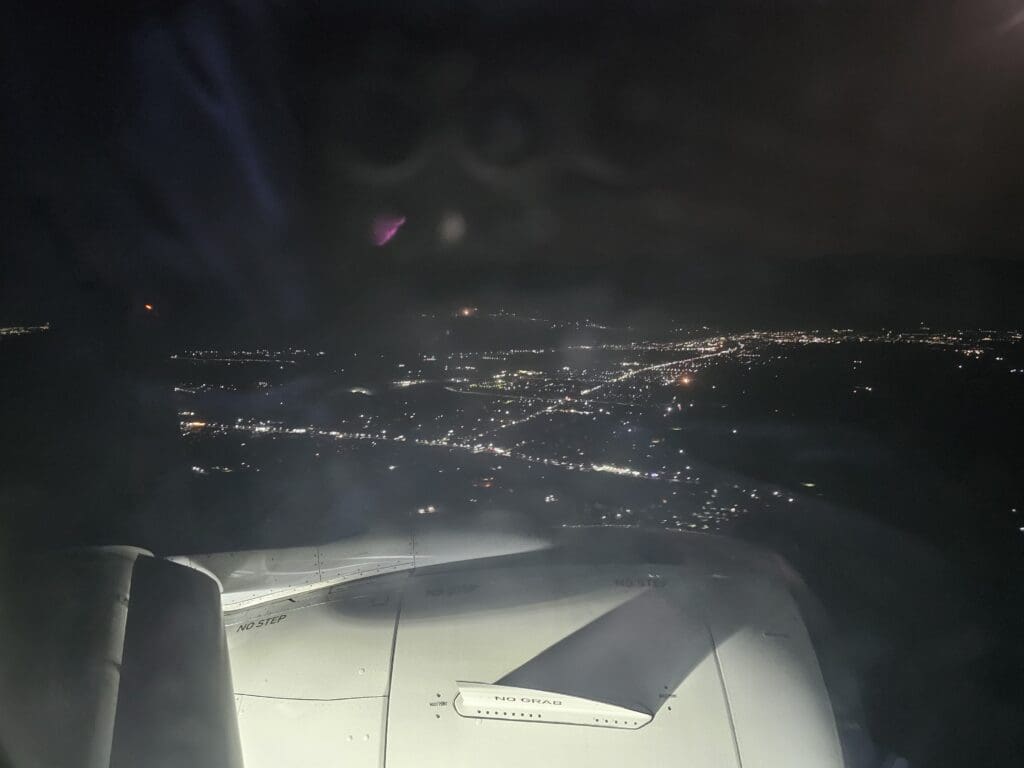
A short time after passing to the south of the small city of Shu, at 0123 Tashkent time, or 0223 Almaty time as I shall use from now onwards in this report, the aircraft could be felt sinking downwards and soon the seatbelt signs were illuminated in preparation for our arrival. This was then followed by the usual pre-arrival announcement, with the crew wasting absolutely no time in ensuring that all was set and in place for our arrival – soon taking to the aisles and performing a thorough check of the cabin. As we sank downwards, virtually nothing could be seen of the passing scenery below other than the lights of the odd village and town of Almaty Region as we made our way towards the country’s largest city.
Once again, I seemed to be on the wrong side of the aircraft for any good views as the Airbus passed just to the north of Almaty as the flaps were extended in preparation for our arrival. After passing the city, the aircraft then turned back around and lined itself up for an approach to Runway 23L before full flaps and the landing gear were extended. Sinking downwards, the lights of the towns of Karabulak, Panfilovo and Imeni could be seen before we gently sank down over the perimeter fence and made a soft return to earth. Unlike the smooth touchdown, once on the ground, the aircraft braked rather heavily before we vacated the runway to the right and made our way past a small cluster of business jets including a German Learjet 60 operated by Nuremberg-based FAI rent-a-jet and undertaking air ambulance duties.
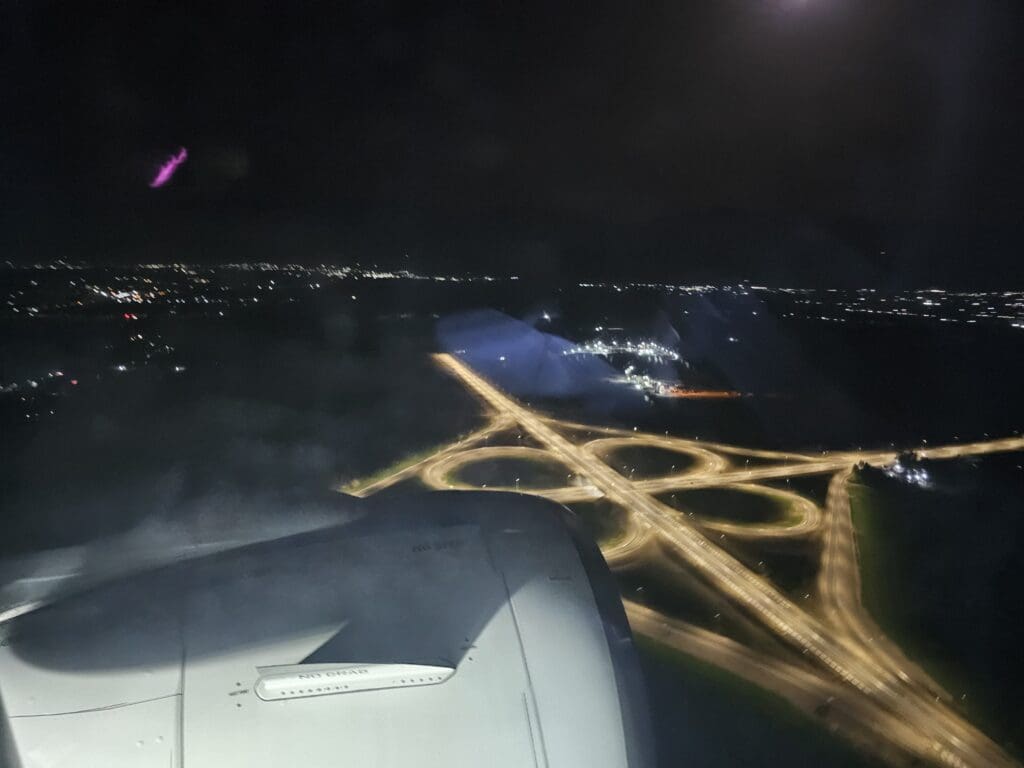
In spite of being Kazakhstan’s busiest airport, Almaty Airport has a severe lack of jetbridges and thus unsurprisingly the Airbus came to a halt at a remote stand. Fortunately, upon arriving there an army of staff and a whole fleet of ground service equipment and buses could already be seen waiting to meet the inbound jet. With this consisted, disembarkation commenced a relatively short time after our arrival although contrasting with the rush to get onboard in Tashkent, many passengers remained seated until disembarkation had actually commenced. A few minutes after coming to a halt, I stood up and turned left passing through the Business class cabin before thanking a couple of the flight attendants and making my way out into the cool night air.
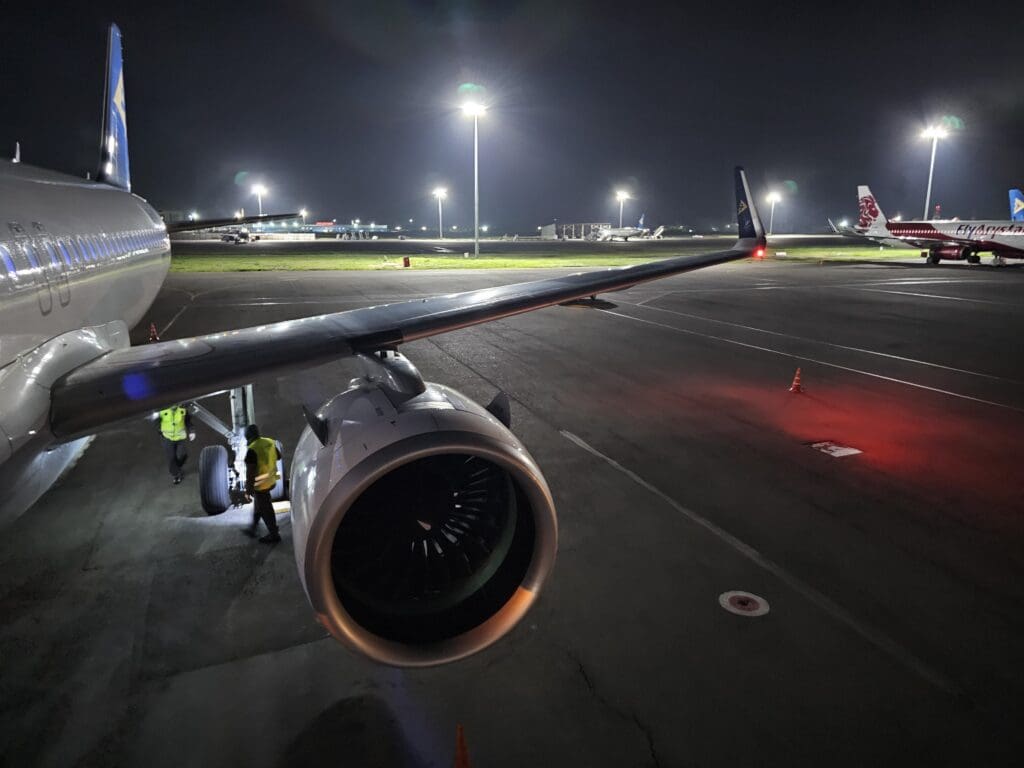
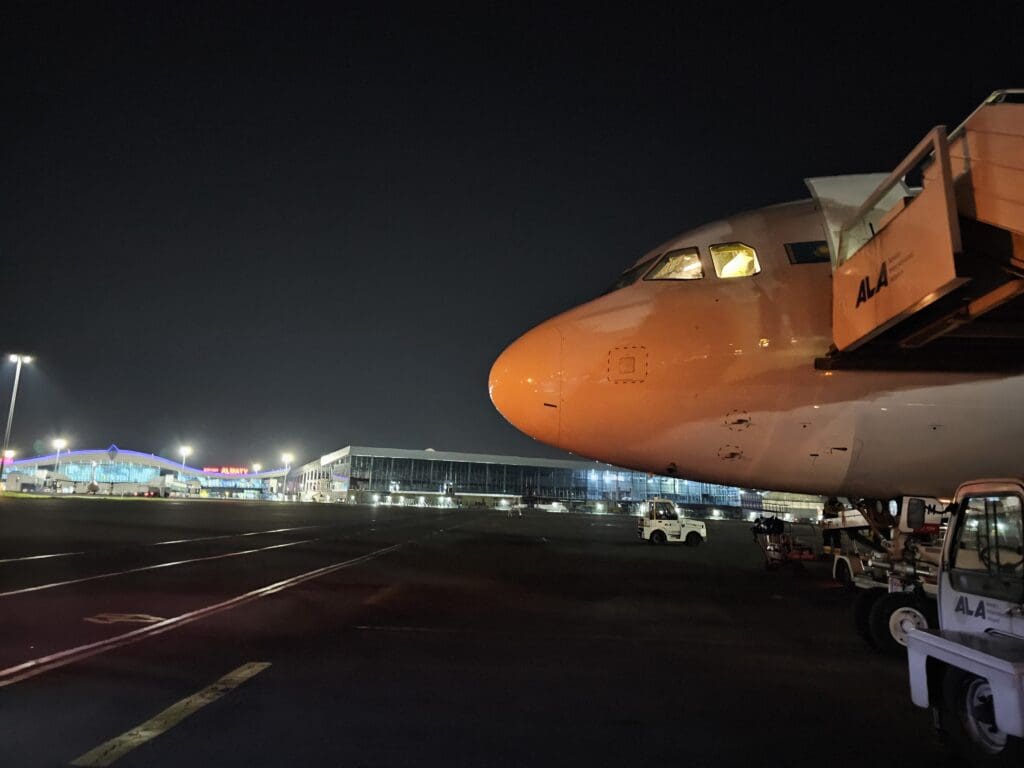
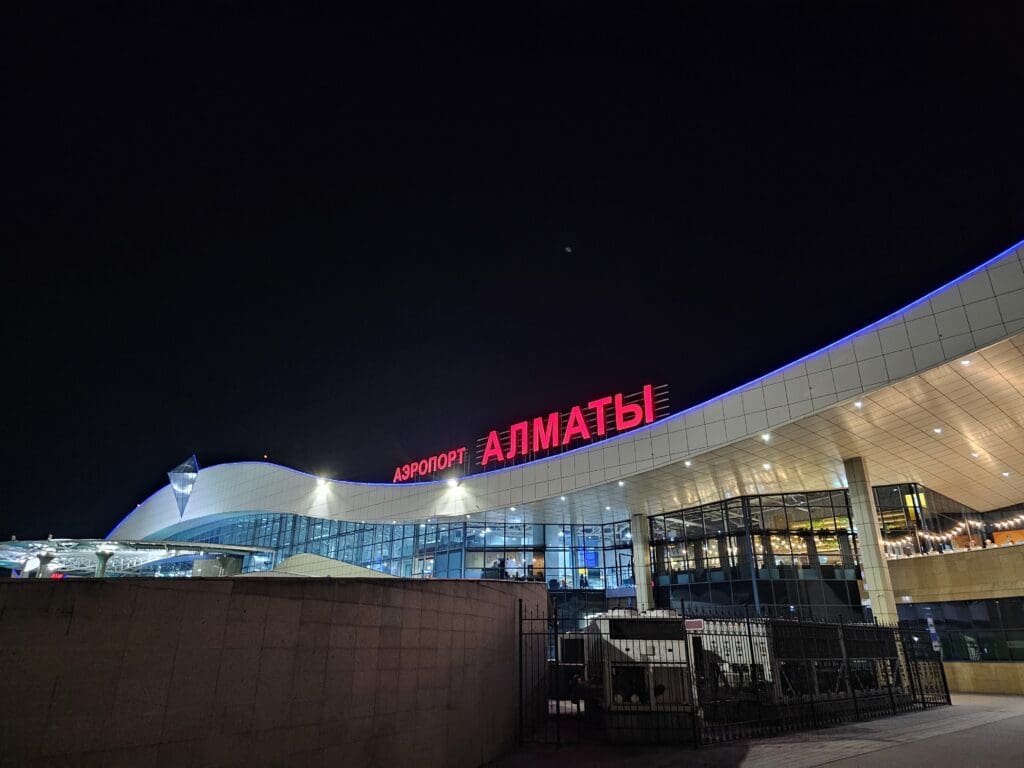
Soon making it into the warmth of the waiting bus, within a few minutes this pulled away and made the short journey over to Almaty Airport’s small immigration hall. Unlike my last trip to Kazakhstan, no form filling was required and I was delighted to find this hall to be almost empty whilst all booths appeared to be staffed by an army of tough-looking officials donned in full uniforms complete with large hats. After waiting for no more than a minute, I handed my passport over and after this was scanned, I was asked where I had arrived from. Responding ‘Tashkent’, this seemed to be a satisfactory response and my passport was soon stamped and returned before I was free to enter Kazakhstan. Passing straight through the baggage claim hall, I headed out into the landside portion of the arrivals terminal where I sidestepped past the many waiting unofficial taxi drivers desperate for business and commenced the short walk to the hotel where I would spend the short night before my ride up to Astana several hours later.
Summary
Having expected great things, I was most certainly not left disappointed. Once again, Air Astana offered me a comfortable and enjoyable ride and I touched down in Almaty in one piece and ahead of schedule. Needless to say, I would not hesitate to fly with Kazakhstan’s flag carrier again and would be keen to fly with them on one of their longer services.