Flying Through Kazakhstan on a Vintage Soviet Turboprop: Astana to Almaty via Balkhash on an Antonov An-24
Background
Living in Britain, once in a while the drone of Soviet-era Antonov An-12 and An-26 turboprop aircraft fills the sky, their Ivchenko turboprop engines creating a racket as they power through the skies carrying heavy and strangely shaped loads on cargo charters. With relatively few Soviet-era airliners remaining operational outside of Russia, especially in civilian guise, the rarity of such aircraft guarantees their popularity among aviation enthusiasts – with these aircraft often drawing in planespotters from far and wide when visiting airports. Even rarer are Soviet-manufactured passenger airlines, with just a small handful of carriers worldwide continuing to operate these flying relics, the majority of which take the form of the Antonov An-24. Spending a holiday in Uzbekistan, it was only natural that I allocated a few days at the end of this trip in neighbouring Kazakhstan to fly on one of these rare airliners!
About the Antonov An-24
For much of the 1950s, Soviet regional aviation was dominated by two propliners – the Lisunov Li-2 (you can read about my flight on one of these here!) and its intended replacement, the Ilyushin Il-14. Even though both aircraft were capable in their own right and able to fulfil the duties for which they had been designed, the rapid march of technological progress meant that it wasn’t too long before both aircraft types became obsolete, with calls emerging for their replacement. This wasn’t too dissimilar to the situation in the West that led to the development of early turboprop airliners such as the Fokker F27 or Vickers Viscount which were intended to replace types such as the Douglas DC-3.
This new type had to be rugged and reliable, capable of operating from austere airstrips in some of the world’s most remote regions and extreme climates across the Soviet Union. Already well-respected for their highly successful Antonov An-2, the Kyiv-based Antonov Design Bureau answered this call with the Antonov An-24. Standing at 23.53 metres long and capable of carrying up to fifty passengers, this high-wing twin-engined turboprop took to the skies for the first time in October 1959. Following extensive testing, this entered commercial service with Aeroflot almost four years later and proved to be highly popular, soon becoming the workhorse of regional Soviet aviation and seen across the country’s ally states. Proving to be reliable and benefitting from the lack of a direct competitor, the Antonov An-24 underwent a series of modifications and upgrades that would enable it to undertake just about any civilian or military role. Indicative of its success, the Antonov An-24 served to be the base for the aforementioned Antonov An-26, a cargo transport aircraft fitted with a retractable rear door, as well as the Antonov An-30 and An-32. Not only this but the aircraft was also manufactured under licence in China by the Xi’an Aircraft Industrial Corporation as the Xian Y-7, of which just over one hundred were built. This was later developed into the Y-7-100, which served as the base for the Xian MA60.
Enjoying a production run of twenty years, by the time the last example rolled off the production line in 1979, a total of 1,285 Antonov An-24s had been manufactured in factories in Irkutsk, Kyiv and Ulan-Ude. Given developments in technology since then that have culminated in making turboprop airliners faster, quieter and more efficient, as well as the omnipresence of Western aircraft across the former Soviet Union, some may be surprised to hear even though over forty years have passed since the last example was manufactured, around one hundred Antonov An-24s remain in service today. Perhaps equally surprising given the type’s age is that, whilst far from the most modern airliner, in some respects its capabilities remain unmatched. For example, without significant modification, comparably sized turboprops such as the ATR-42/72 and Dash 8 lack the rugged capabilities that often remain called for in the remote regions that the Antonov An-24 continues to serve. Those that can operate in such extreme locales such as the Cessna Grand Caravan, Dornier 228, Let L-410 and Twin Otter are all capable of carrying less than half the number of passengers that can be carried by an Antonov An-24. Thus the absence of a like-for-like replacement ensures that in spite of its old age, there remains a need for the Antonov An-24. However, unfortunately for enthusiasts, this does mean that the aircraft operates almost exclusively in remote and hard-to-reach regions where its capabilities are a must.
Flying an An-24 Today
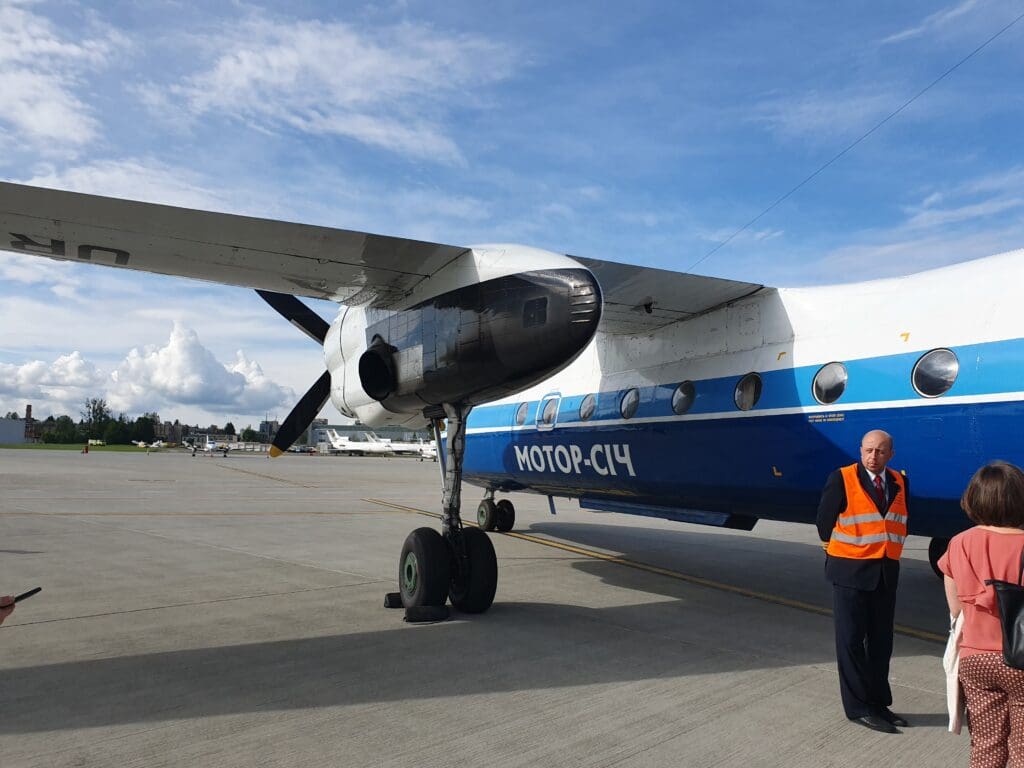
Whilst there are few routes within Europe that require the full capabilities of the Antonov An-24, before the Russian invasion, Ukrainian carrier Motor Sich Airlines operated three Antonov An-24s alongside the even rarer Antonov An-74, Antonov An-140 and Yakovlev Yak-40. Based in Zaporizhzhia, Motor Sich Airlines deployed these on scheduled passenger routes across Ukraine, their choice to operate such aircraft was largely explained by the fact that its parent company manufactured and overhauled the engines and other spare parts for these rare aircraft. With Ukraine easily reached from across Europe and no visa requirement for many citizens, Motor Sich Airlines became a destination in its own right and known for its acceptance of the many enthusiasts that made the pilgrimage to Ukraine to fly on their aircraft! You can read all about my experience flying onboard one of these aircraft from Lviv to Kyiv in May 2019 here.


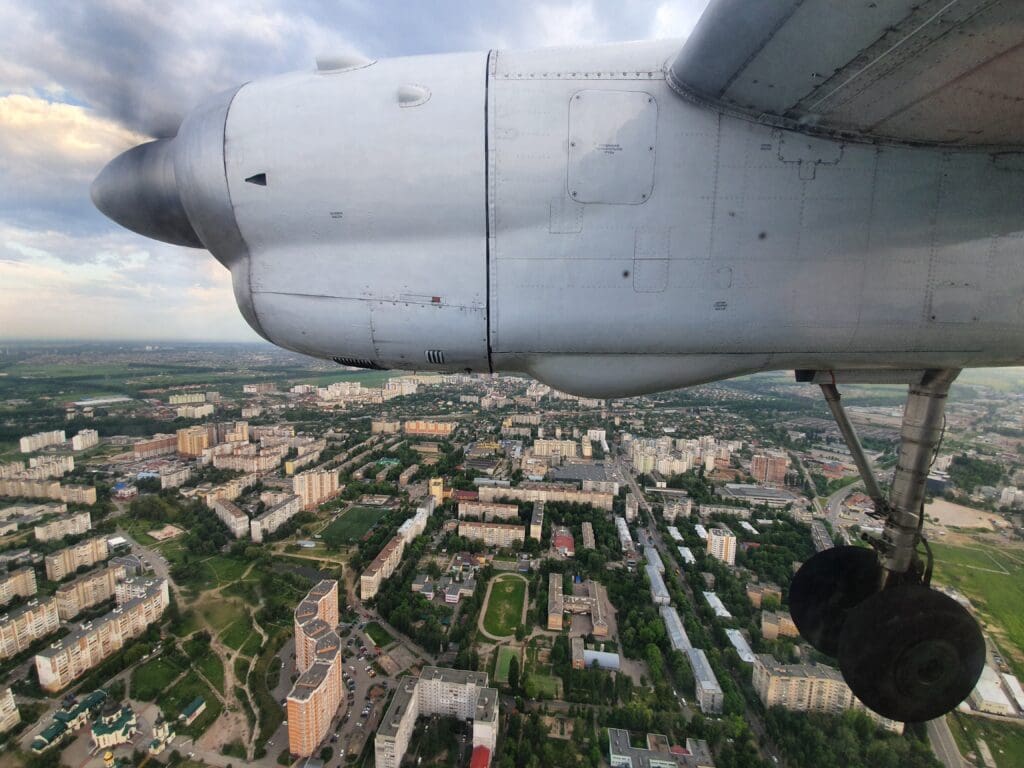
Today, the majority of operational Antonov An-24s can be found flying for a handful of Russian carriers in the country’s more remote regions. Yet, with Russia serving to be off limits to most enthusiasts, options to fly onboard an Antonov An-24 are limited. However, those hardy enthusiasts craving their Antonov fix can head to Kazakhstan where Southern Sky Airlines operates the type on several routes across the country. Whilst Southern Sky Airlines today maintains a fairly decent and modern tri-lingual site which, amongst other things, allows passengers to book tickets with the airline, this offers very information about the airline and its history. As with Kazakhstan’s second-largest carrier, SCAT Airlines, Southern Sky Airlines is headquartered in the southern city of Shymkent. Formed in 2014, this roughly aligns with when SCAT Airlines stopped flying their Antonov An-24s and so I suspect that Southern Sky Airlines was once part of the carrier – especially seeing as up until a few years ago Southern Sky Airlines’ scheduled services were all operated on behalf of SCAT Airlines. Indeed, I had had the pleasure of flying from Almaty to Astana via Balkhash in August 2017 and had purchased my ticket for this through SCAT Airlines (you can read about this here). Operating a fairly reasonable number of routes across eastern Kazakhstan, and with no visa requirement for many nationalities, Southern Sky Airlines provides enthusiasts with one of the more ‘accessible’ options of flying onboard an Antonov An-24.
With just two nights in Kazakhstan, some careful planning was needed in order to fit in as many Antonov An-24 sectors as possible. However, many of the remote regional destinations served by Southern Sky Airlines are served by just a few flights per week making for a logistical challenge. Following a comprehensive examination of the airline’s timetables, I deciphered that I could leave Almaty on a Monday afternoon and head to the small town of Ushural. From there, the aircraft would then continue onwards to Astana, and I could book two separate tickets for each sector. The return journey would see me make the same voyage I undertook back in 2017 albeit in reverse, leaving Astana at 1640 and heading down to the city of Balkhash – located 328 miles to the southeast on the northern shores of Lake Balkhash. Following a 35 minute stop, I would then continue southwards on the 264-mile journey to Almaty, with a scheduled arrival time of 1940. All-in-all, this itinerary would set me back a grand total of 59,000 Tenge (£105/€123/$132), which I saw to be a very reasonable deal for four flights and several hours on such a rare aircraft!
Navigating over to www.hisky.kz (no relation as far as I’m aware to the Moldovan-Romanian low cost carrier!), I found their website to be relatively modern and faced no issue when searching for each sector. Without any issue, after selecting each flight I was taken to the standard details page and made a quick and easy payment for each one, receiving my e-ticket, receipt and a retro-looking 87-page PDF document detailing the terms and conditions of flying with Southern Sky Airlines, moments after making each payment.
A Spanner in the Works
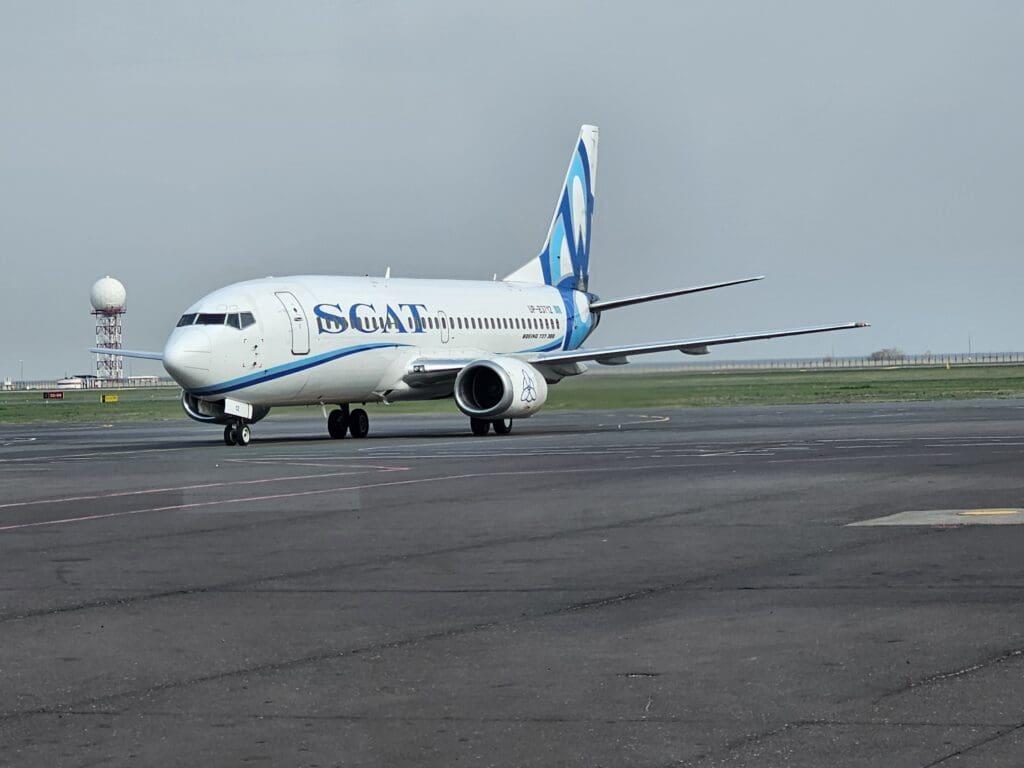
Unfortunately, things did not exactly go to plan and around 24 hours prior to departure I received a couple of emails and texts in Russian and Kazakh advising me that my northbound flights to Ushural and Astana had been cancelled. Whilst slightly concerned that my southbound flights would also end up the same way, seeing as I already had a non-refundable hotel room in Astana and of course not wishing to miss out on the opportunity to fly onboard an Antonov, I ended up purchasing a relatively expensive £99 one-way ticket from Almaty to Astana with SCAT Airlines, ending up onboard one of their Boeing 737-800s.
Check-In
Unlike my last trip onboard a Southern Sky Airlines’ Antonov An-24, the carrier has since introduced online check-in. Whilst approaching this slightly gingerly knowing that this was not necessarily guaranteed to work, I journeyed over to Southern Sky Airlines’ website with just under twenty-four hours to go until departure. After some confusion, I deciphered that I first had to create a Southern Sky Airlines account before attempting to check-in for my flights. Once this was done, I had no issue checking in and selecting seats for both sectors, opting to make the journey to Balkhash in Seat 3D, and to Almaty in Seat 9D.
The Journey
When the Antonov An-24 made its first appearance in Kazakhstan in the 1960s, it was perhaps unimaginable that Astana, or the small city of Tselinograd as it was known then, would become the national capital and filled with tall buildings, unique architecture and massive shopping centres. Following a pleasant one-night stay, the time had come for me to leave Kazakhstan’s futuristic capital and step back into the distant past for my Antonov ride down to Almaty.
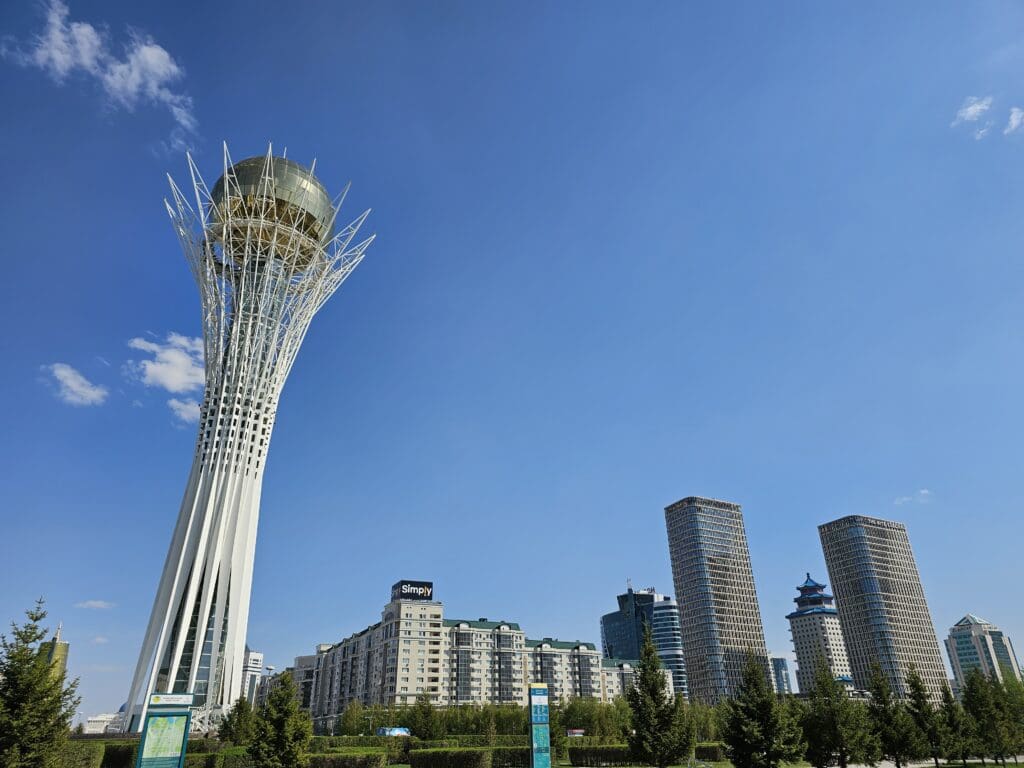
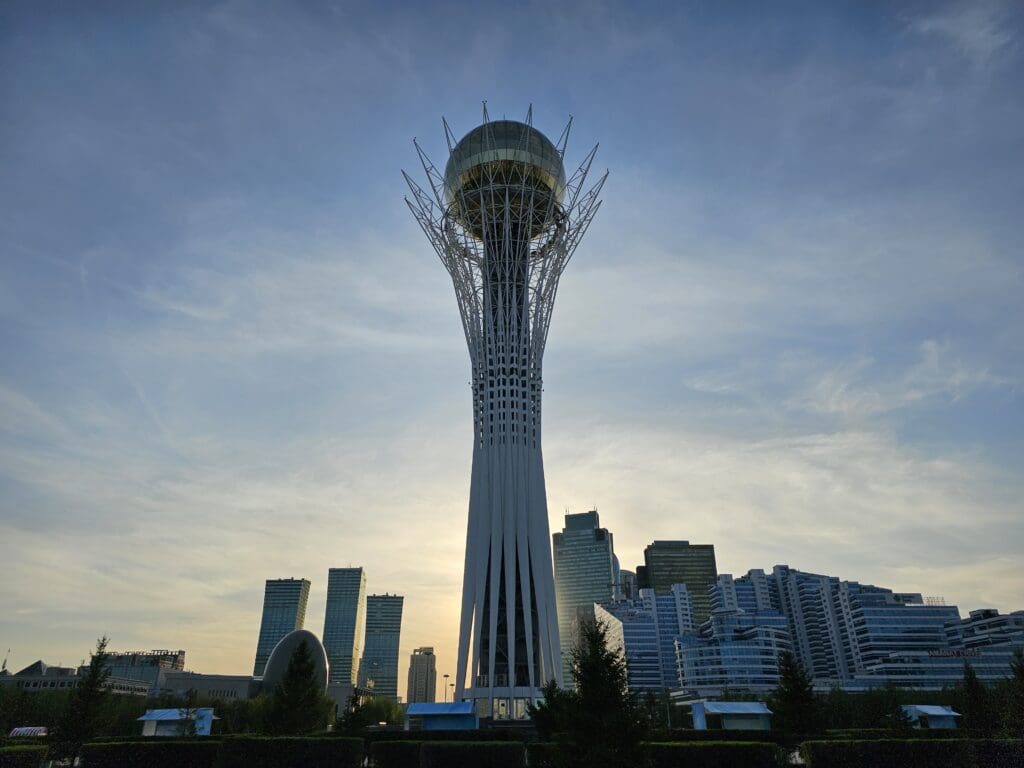
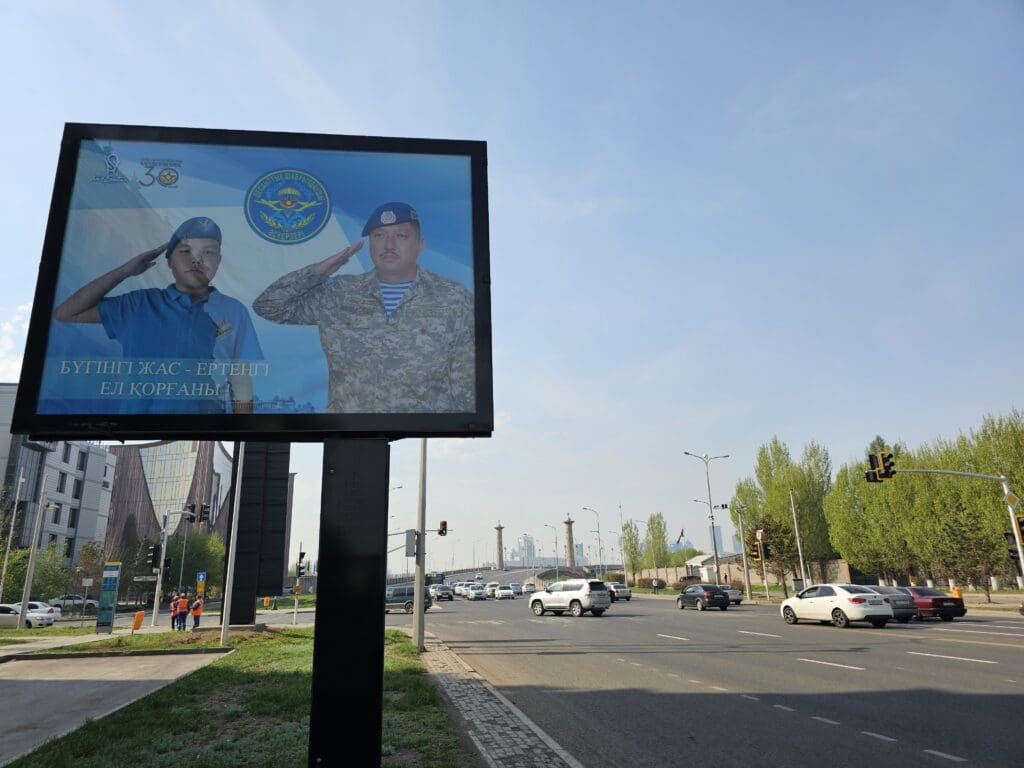
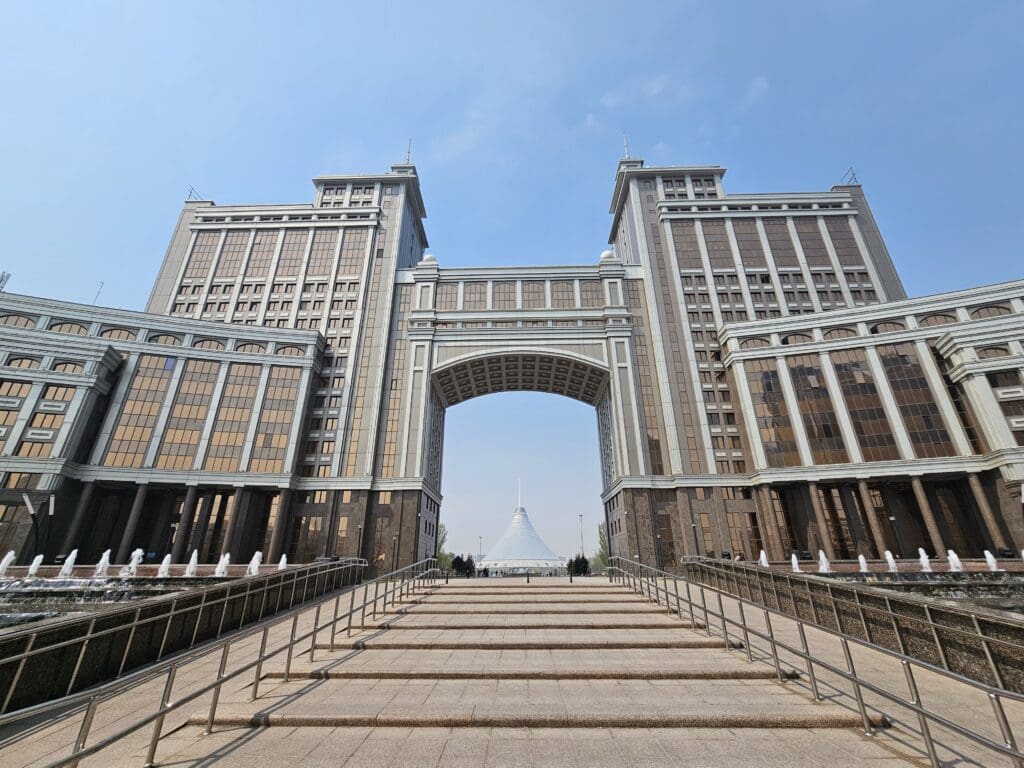
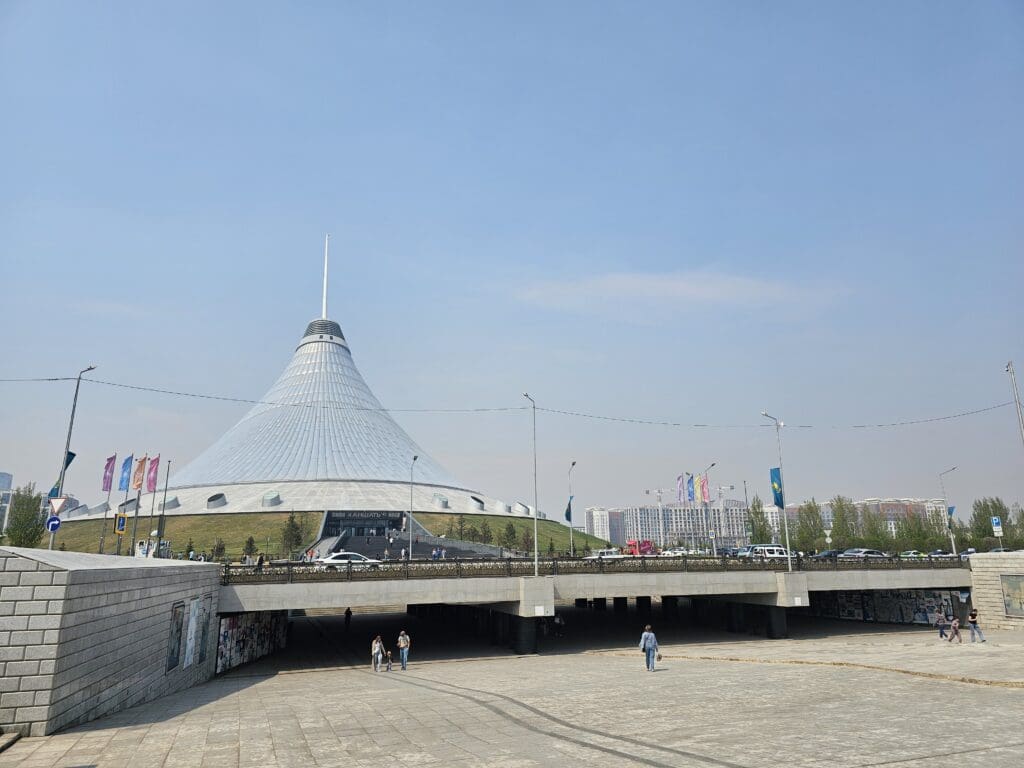
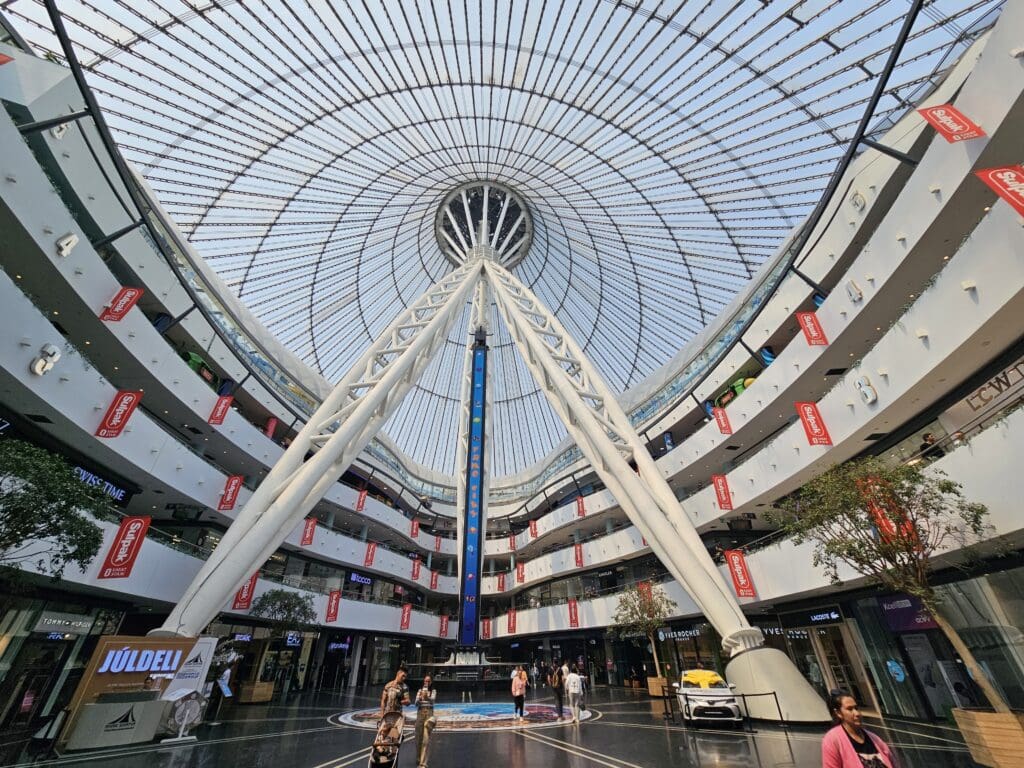
As you may expect, Astana is by no means a haven for cheap accommodation, especially when compared to most other Central Asian cities and after searching high and low for good deals, I went for one of the cheapest hotels around. Splurging almost £50 for a one-night stay at The One Hotel, located just across the Ishim River from the Presidential Palace, I didn’t have particularly high expectations given the comparatively low price. However, in the end, I was left incredibly impressed and found this hotel to be on par with any upper-mid to upper-budget hotel chain back in Britain. Furthermore, given the fact that I was not scheduled to depart Astana until 1640, I was able to have a slow and relaxed morning, making the most of this with a hearty complimentary breakfast before heading out for a coffee and a casual stroll through the riverside park before it got too hot. Eventually, the time came for me to check out and knowing that it would likely be quite some time before I found myself in Astana again, I took extra care to ensure I had everything with me before heading out onto the warm and dusty lunchtime streets just before 1200. Whilst I could have made a beeline for the airport, not wanting to be there too early I decided to stop off for another overpriced coffee before going for a stroll along Nurzhol Boulevard. Admiring Astana’s famous Baiterek Tower, I continued down the wide boulevard, passing through the Kaz Munay Gaz Building and Lover’s Park before reaching another of the city’s main sights, the Norman Foster-designed Khan Shatyr Entertainment Centre.
Given the fact that Astana is a planned city and one that was designed with convenience in mind, some may be surprised to hear that unlike Almaty, Kazakhstan’s capital is yet to feature any sort of mass transportation system. Admittedly this has been planned for years and even had an initial opening date of around 2010, however, construction of the Astana Light Metro system did not commence until 2017. Set to run 21.5 kilometres from the airport to the main railway station, unfortunately, construction came to a halt in 2019 following the bankruptcy of one of the project’s backers and as of 2023 is yet to recommence. Whilst slightly less convenient, two bus routes connect the city centre with the airport at regular intervals and offer the most economical way for passengers to travel between the airport and the city, with one-way tickets costing 300 Tenge (53p). After my wander around Khan Shatyr, I made my way back out into the afternoon heat and waited until the next airport-bound bus appeared. Around five minutes later, a bendy bus heading for the airport appeared and upon boarding, I placed my three 100 Tenge coins into the driver’s cash tray only for them to respond ‘telephone’ in Russian and point to one of the machines down the bus. Seeing as I had no working SIM card and thus no way to pay, I tentatively headed to the rear of the bus with the fear of being slapped with a heavy fine.
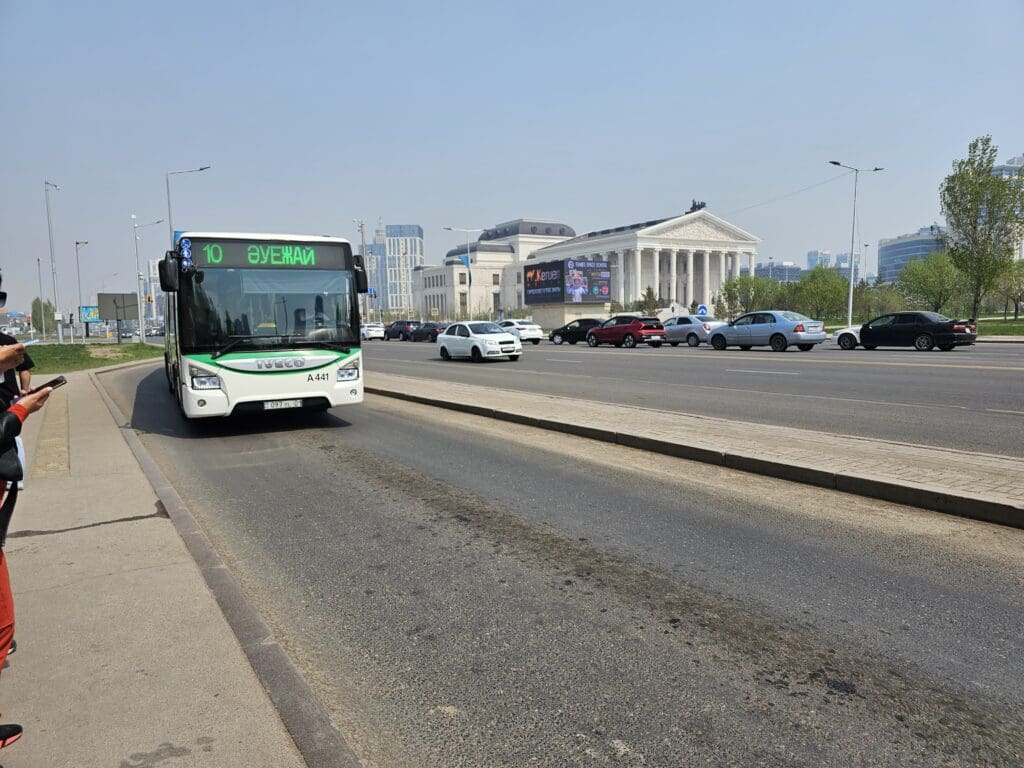
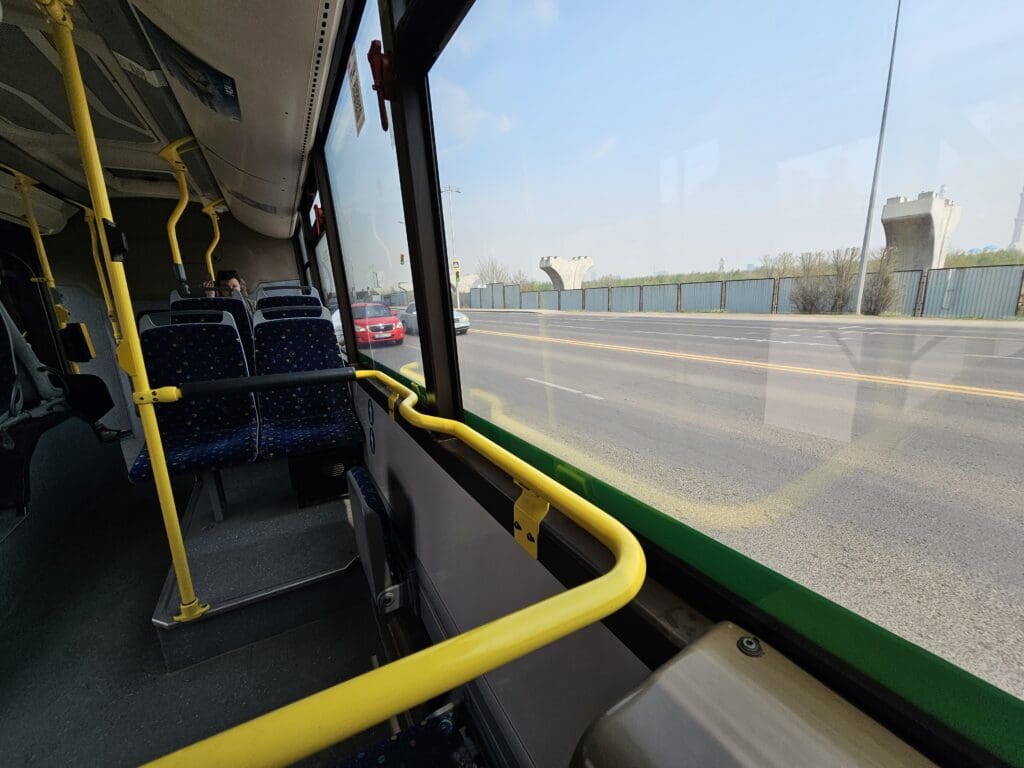
After pulling away from Khan Shatyr, the bus took a winding route through the busy streets of Astana, stopping at what seemed to be every traffic light and bus stop in the city centre. During the initial stages of the journey, a rather bizarre brass band rendition of Frank Sinatra’s ‘Can’t Take My Eyes off You’ rang out over the bus’ speakers, puzzlingly playing several times before never being heard again. Having ended up in a window seat, I spent much of the journey looking outside at Astana’s interesting and architecturally diverse buildings, and after passing the golden-domed Nur Astana Mosque, the bus picked up speed as it headed out of the city centre and we made our way southwards to the airport. A few minutes later, I caught sight of the Nur Alemi Pavillion, the centrepiece of the EXPO 2017 site, as well as Central Asia’s largest mosque, the appropriately named Astana Grand Mosque. Once these faded away from view, relatively little could be seen as we sped out through the city’s largely empty suburbs before pulling up to Nursultan Nazarbayev International Airport around 25 minutes after jumping onboard.
In spite of Astana’s status as Kazakhstan’s capital, in terms of passenger numbers, its airport lags behind that of Almaty. As per 2019 statistics, a grand total of 5.1 million passengers passed through its doors – making it comparable in passenger throughput to Newcastle Airport back in the UK. However, in spite of this, Astana enjoys direct connections to a fair number of destinations across Asia and Europe, from Guangzhou in the east to Frankfurt in the west. In terms of layout, the airport consists of two conjoined terminals, logically named Terminal 1 and Terminal 2, with these serving international and domestic services respectively. Contrary to their names, Terminal 1 is actually the newer of the two terminals, with this having opened its doors to passengers in 2017, whilst Terminal 2 opened in 2005. As with a significant number of Astana’s buildings, the older of the two terminals was designed by the late Japanese architect Kisho Kurokawa and pairs modern architecture with elements of traditional Kazakh design. This is achieved through the incorporation of an eye-catching blue-tiled dome in the centre of the airport complex, which is inspired by the traditional Kazakh house, the yurta.
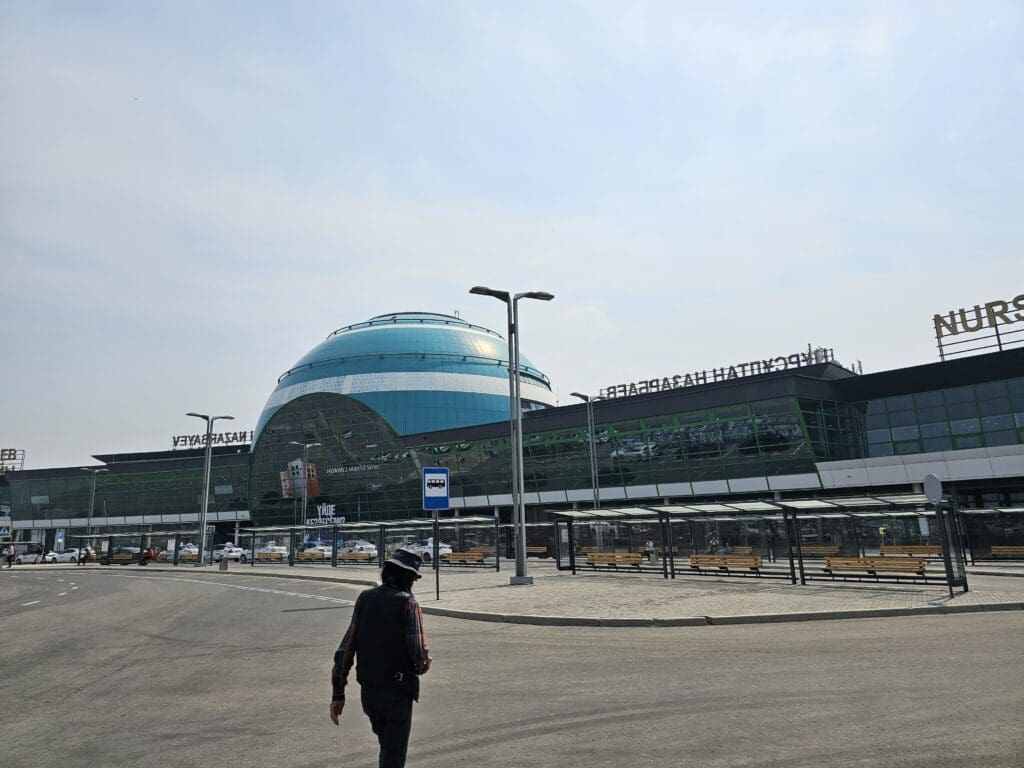
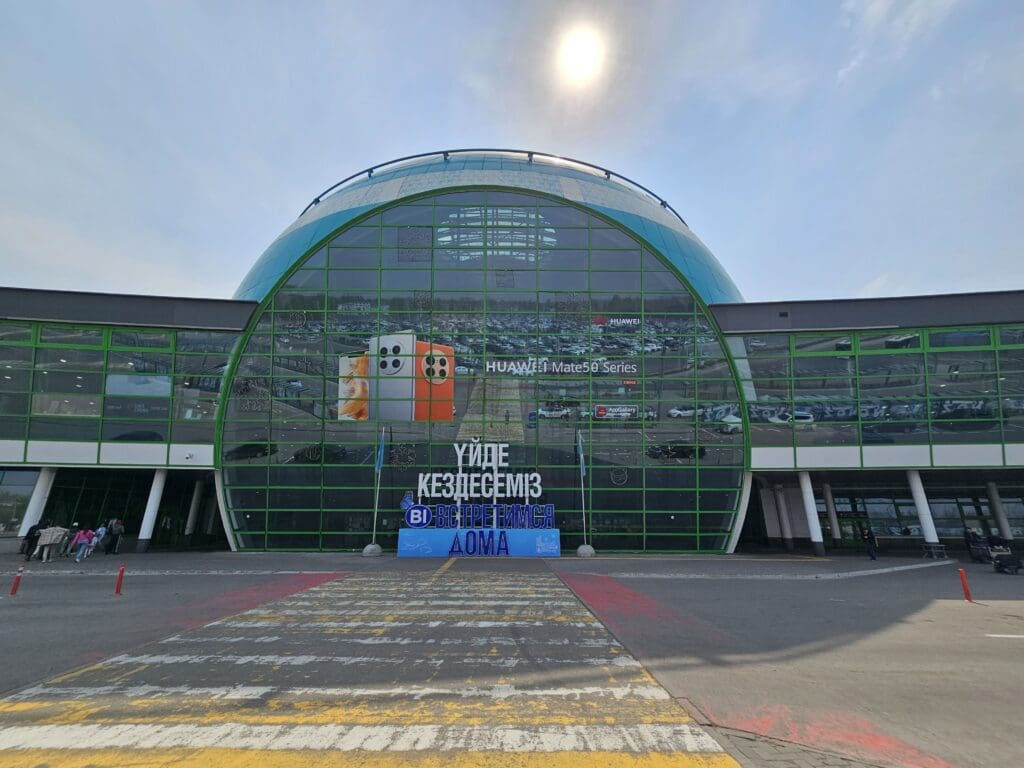
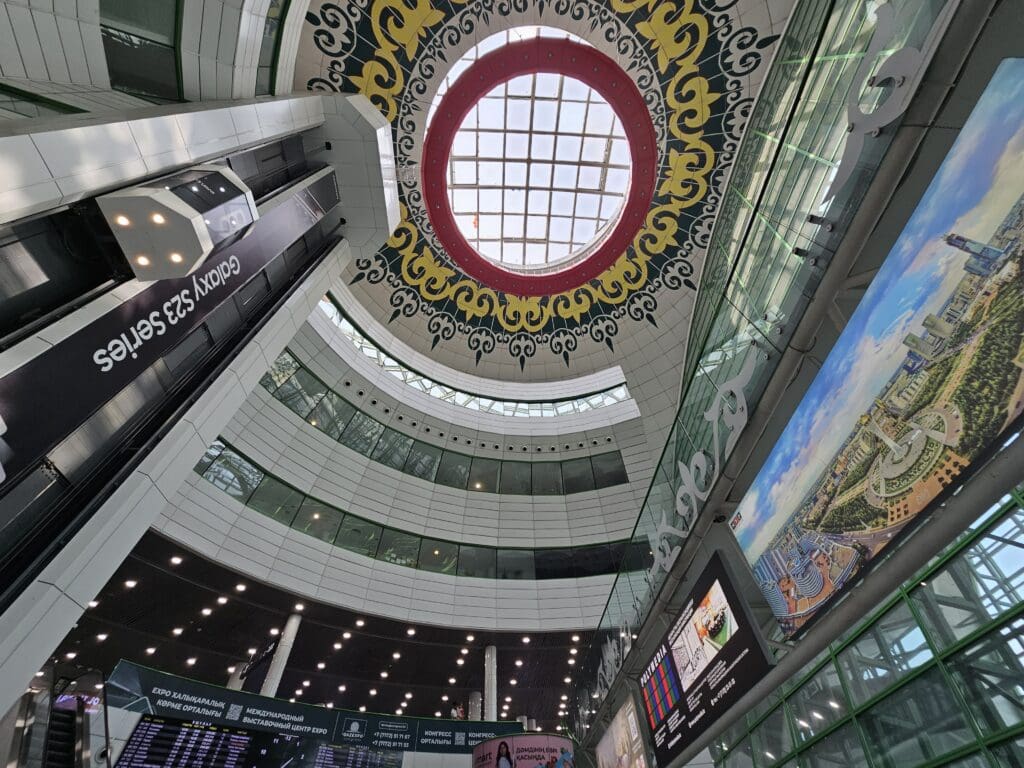
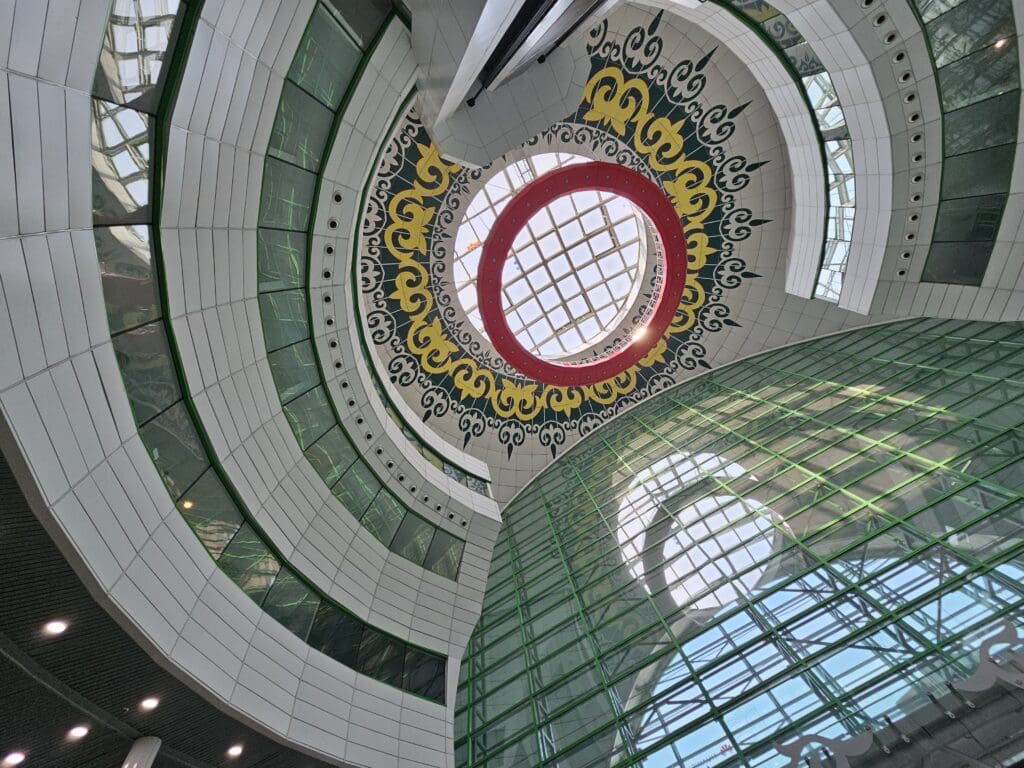
After safely disembarking the bus along with just two other passengers, with nowhere else to go I made the short walk through the hot afternoon sunshine over to the terminal’s entrance and soon found myself standing in Terminal 2’s impressive, airy and spacious atrium. Whilst the terminal may have a somewhat unique design, this features standard layout conventions with arrivals located on the ground floor and departures on the first floor, with offices located on the floors above this. In terms of facilities, a number of kiosks and cafés could be seen across the two public levels of the terminal, with vending machines also provided for those not looking to splurge out on café prices. Importantly, this part of the terminal appeared to be clean and tidy, and, other than the non-functional wifi left me with nothing to complain about. Heading up the escalators, I was presented with the airport’s seemingly low number of check-in desks, with Air Astana, FlyArystan and SCAT Airlines all enjoying their own well-branded counters.
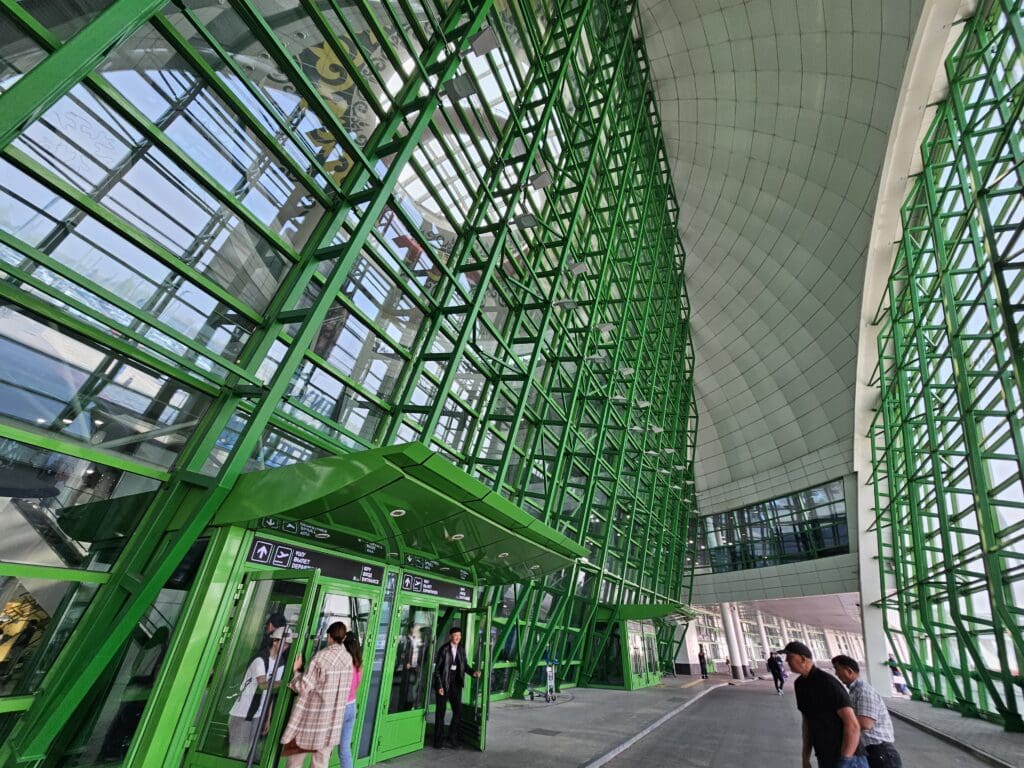
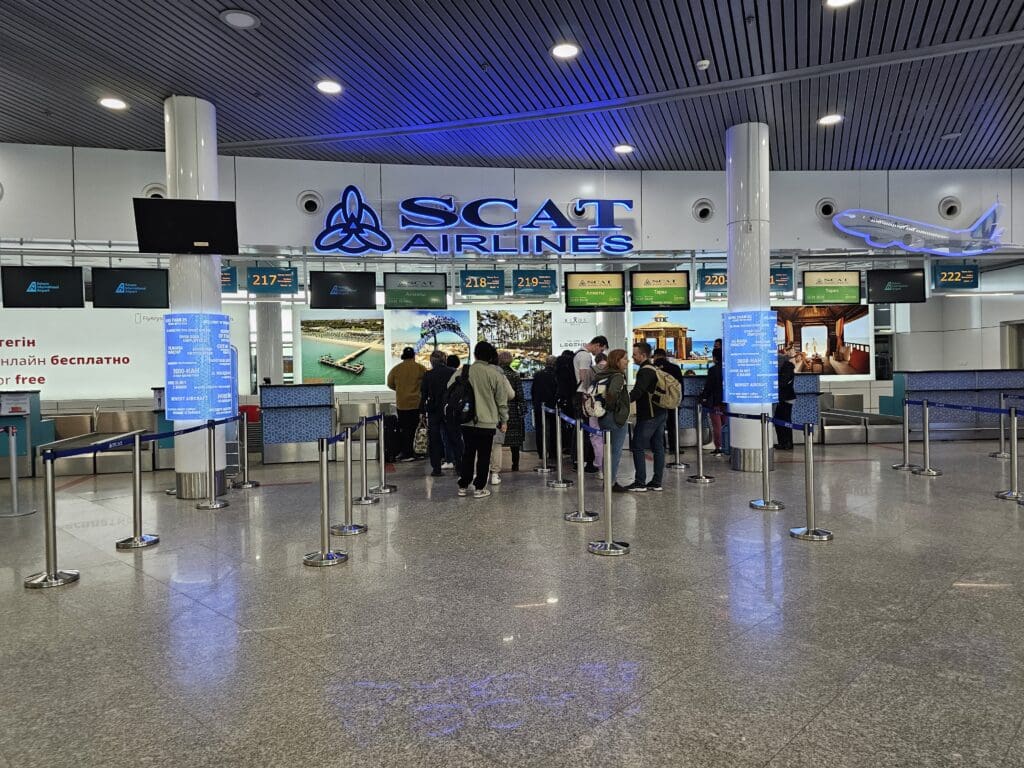
Having already printed off my boarding passes at the hotel, I saw no point in lingering around the largely view-less portion of the terminal. Following my quick walk around, I made my way over to the security checkpoint, which is conveniently located steps away from the check-in desks. In the usual manner, my boarding pass was scanned and my passport checked before I joined a very short queue for one of the checkpoints. Given the number of domestic departures from Astana, the terminal’s security area did appear to be relatively small and I can thus imagine that this ends up being rather busy at peak times. Thankfully, with the airport appearing to be relatively quiet, I was able to pass through this quickly and without any unnecessary hassle.
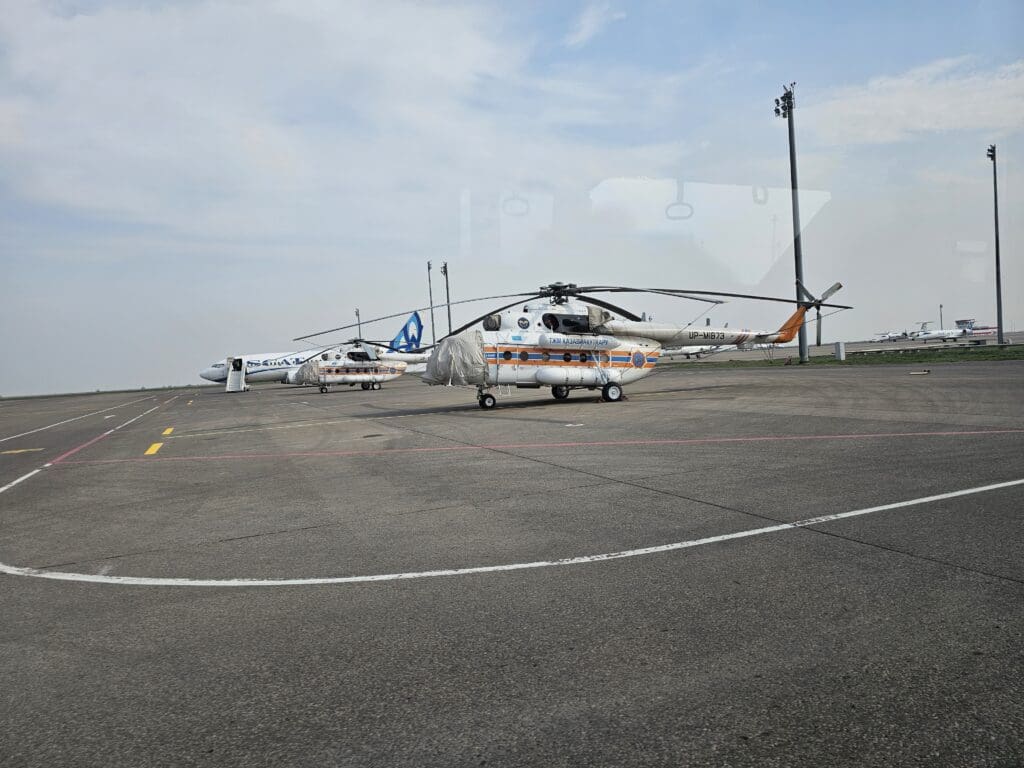
Unlike the landside portion of the terminal, once airside Astana Airport does not feature any impressive architecture or anything that could be considered to be in any way memorable. Nevertheless, I found this part of the terminal to prove pleasant enough for a relatively short stay and was clean, bright and spacious. Importantly, unlike many other airports in the region, a fast and complimentary wifi network was provided and I had no issues connecting to this in spite of not having a local phone number. Aviation enthusiasts will be happy to hear that large windows provide vistas out onto the remote stands and runway. Looking outside, the real gems of the airport could be waiting for their next taskings at the stands in the distance. These took the form of a pair of beefy Mil Mi-8AMT helicopters operated by Kazaviaspas, the aviation arm of the Emergency Committee of the Ministry of Internal Affairs. At a nearby stand, an all-white Yakovlev Yak-40 of 1974 vintage operated by local carrier East Wing could also be seen. This particular aircraft specialises in offering medical evacuation flights, shuttling the sick from regional towns and cities to major hospitals.
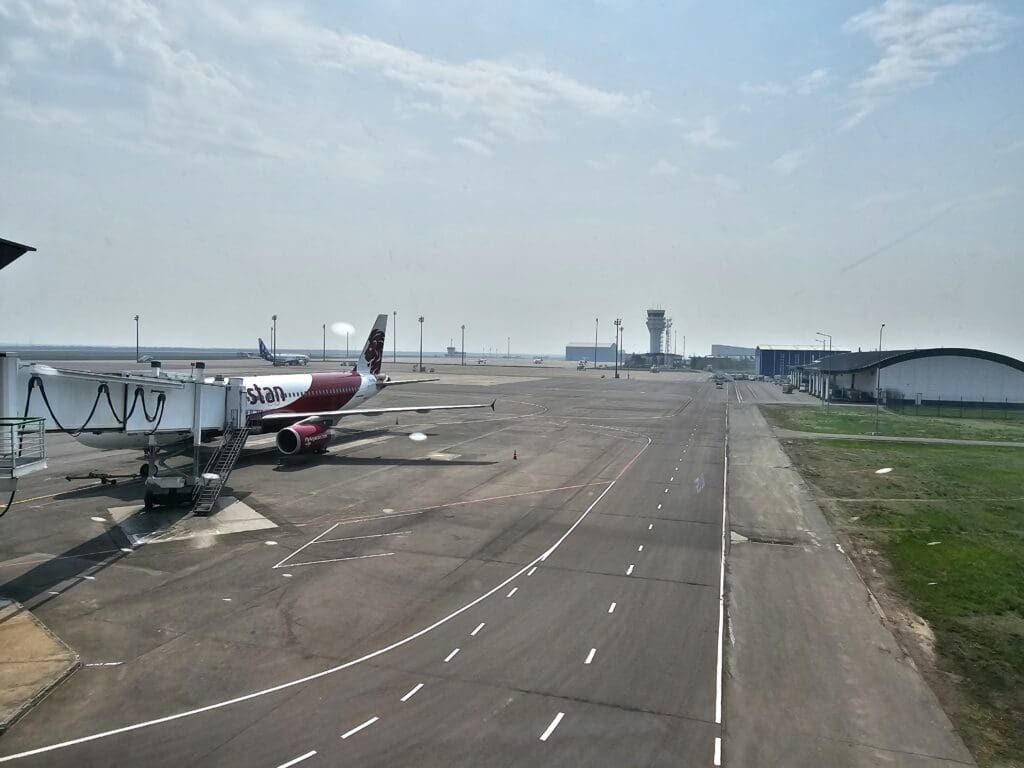
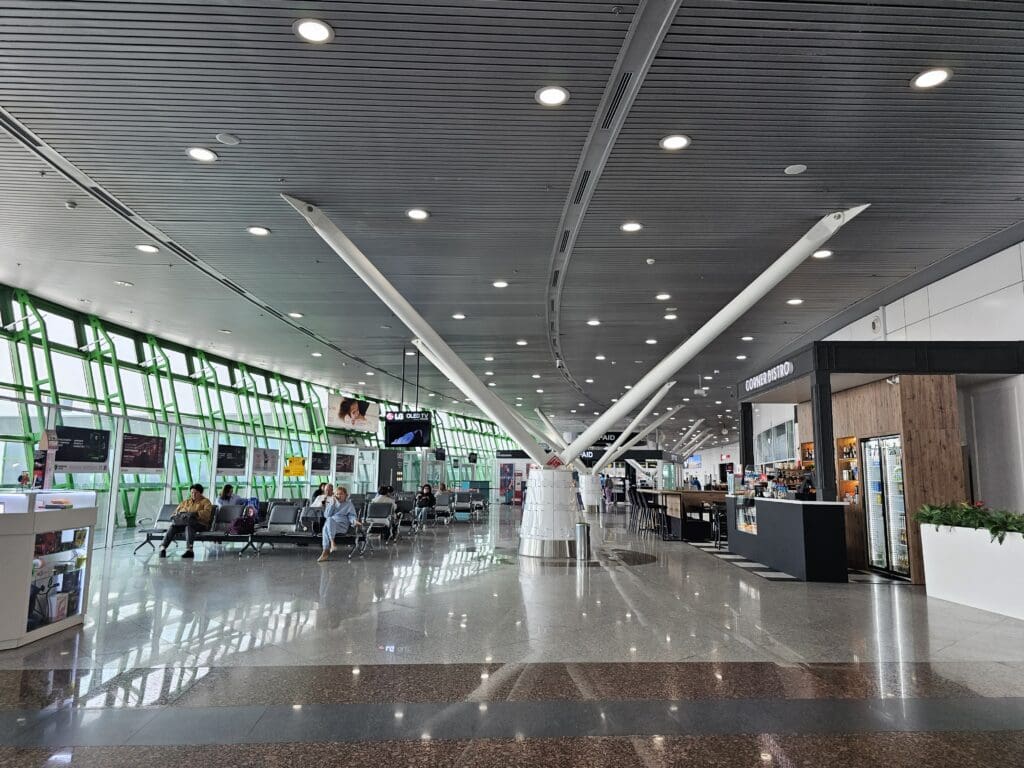
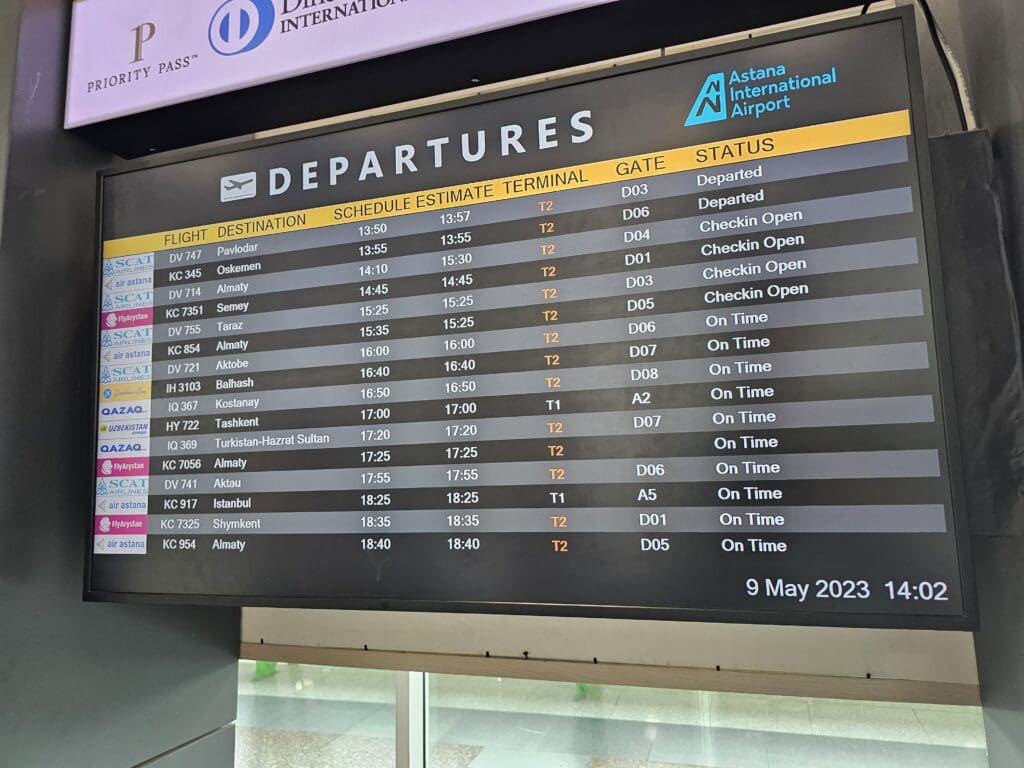
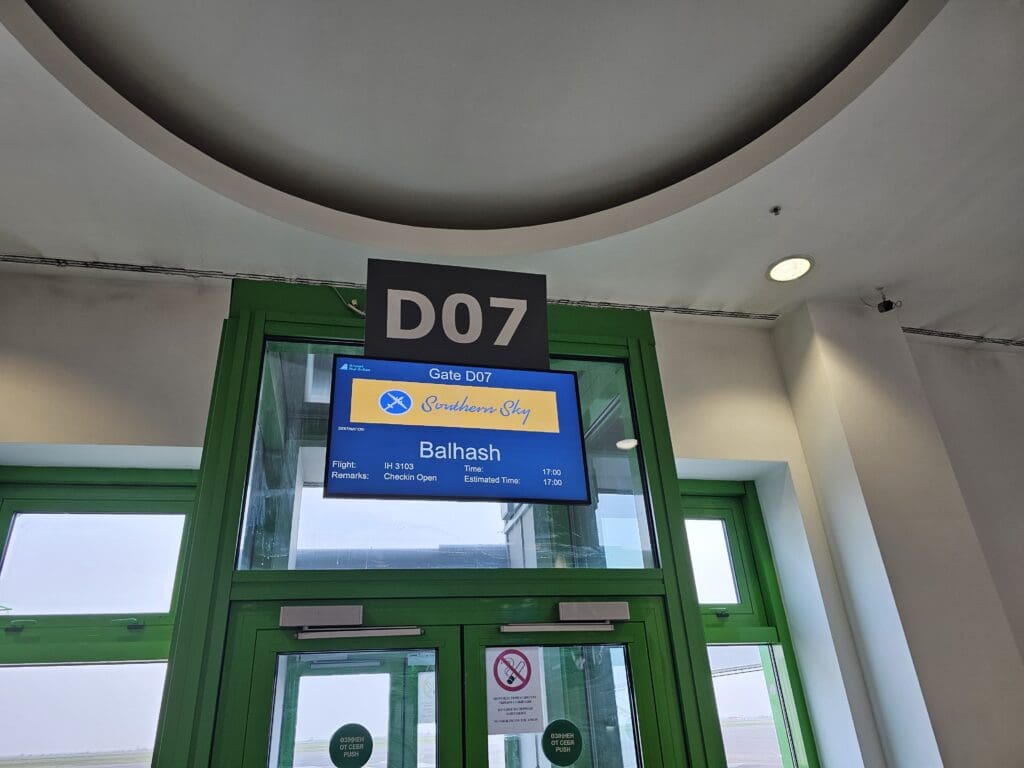
That afternoon, had I not wished to fly to Balkhash, a total of seven flights could be seen departing before mine, with these bound for Aktobe, Almaty, Kostanay, Semey, Shymkent and Taraz and operated by the usual suspects – Air Astana, FlyArystan, Qazaq Air and SCAT Airlines. With this being far from a peak period, for much of my stay, the terminal proved to be calm and quiet, with plenty of spaces to sit and wait. For the terminal’s size, a good number of facilities were on offer with multiple expensive cafés and a selection of shops selling books, souvenirs and other random items. Creatures of comfort looking to get their caffeine from a familiar brand will be happy to hear that the terminal is home to a branch of Starbucks. Once I had explored the nooks and crannies of Astana Airport, I checked the departure boards once again which now revealed that Southern Sky Airlines’ flight to Balkhash was not scheduled to depart Astana twenty minutes behind schedule at 1700. Further research revealed that this delay was attributable to the fact that the aircraft had departed Almaty an hour behind schedule that afternoon. Seeing as I had nowhere to be that evening other than the airport hotel, and confident that the same aircraft would continue southwards to Almaty following its short stop in Balkhash, I was not too worried by this delay.
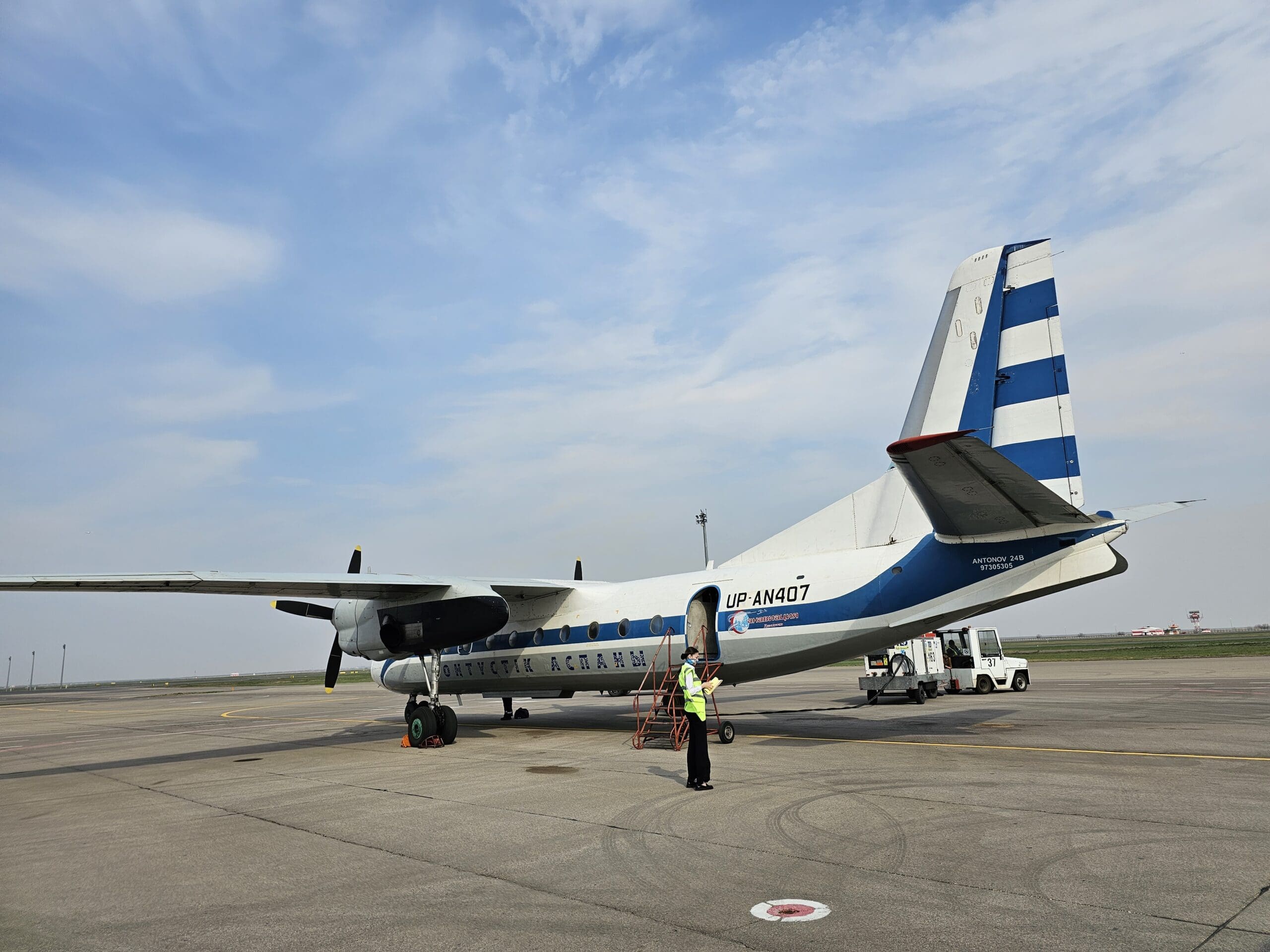
Having failed to pick up much time on its way up from Almaty via Balkhash, I watched as the vintage Antonov touched down at 1613 around fifty minutes behind its scheduled arrival time. Far from the quiet Airbuses and Boeings that dominate Astana Airport’s movements, as this made its way off the runway, the low-pitched din created by the Antonov’s two old Ivchenko engines could be clearly heard from inside the terminal. As with many Antonov An-24s, this classic aircraft was absent from flight tracking apps and I thus had no idea exactly which aircraft would be operating the service until this appeared. Whilst unsure of just how many Antonovs Southern Sky Airlines has in its fleet, the carrier continues to fly both the older Antonov An-24B and the slightly newer Antonov An-24RV – the latter of which features a turbojet engine on its starboard nacelle which famously worries passengers by shooting out a jet of flames during start-up! Whilst I was simply happy to be flying on an Antonov An-24 and was not too bothered about which of the two variants I ended up on, with all my previous Antonov rides having been on the ‘RV’ variant, I was silently pleased to see that I would be flying down to Balkhash on an Antonov An-24B, UP-AN407 to be precise.
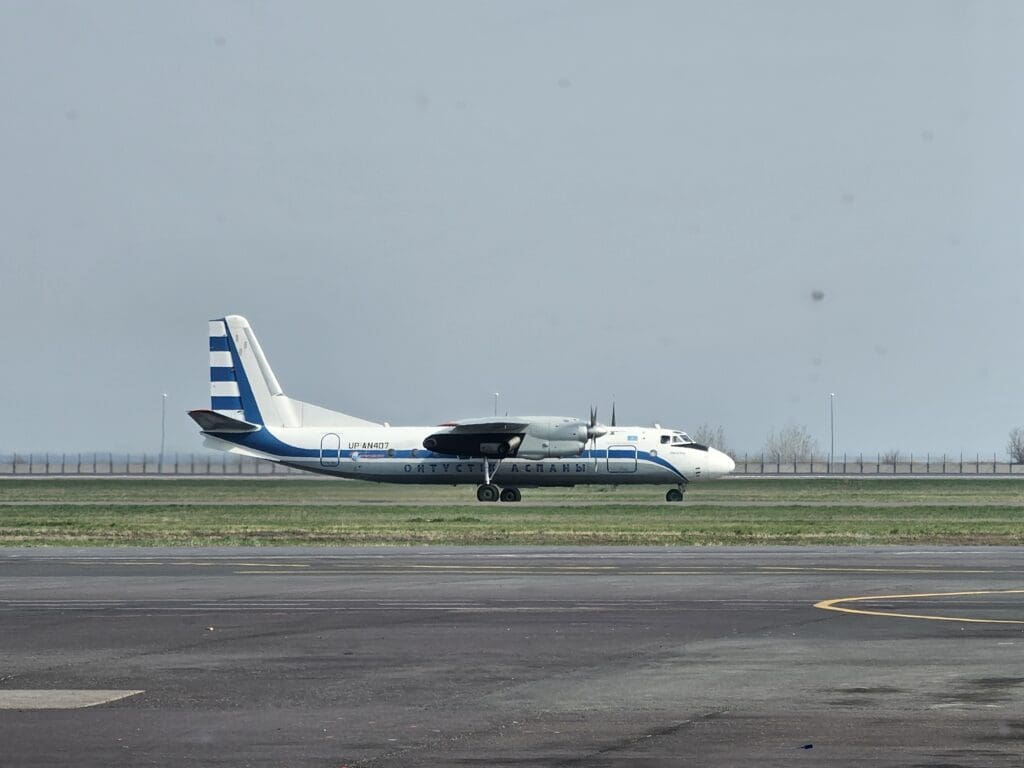
Manufactured in the Antonov Serial Production Plant at Kyiv-Sviatoshyn Airfield and carrying the construction number 97305305, this old aircraft first took to the skies in 1969 making it a whopping 54 years old at the time of my flight. This made it the oldest airliner that I have flown on a scheduled commercial passenger service! Following testing, in July of that year, the Antonov was ferried eastwards to the Kazakh Soviet Socialist Republic where it joined the local division of Aeroflot as CCCP-46310. Remaining with Aeroflot until the dissolution of the Soviet Union, in the early 1990s the aircraft was given the Kazakhstani registration of UN-46310 and began to fly as a transport aircraft for the country’s government. Following this stint, the aircraft reentered commercial service and joined Tulpar Avia Service, a small and long-defunct carrier that was based in the city of Karaganda. In 2003, the Antonov joined the fleet of SCAT Airlines where, in 2008, the carrier received its current registration of UP-AN407. Following the retirement of Antonov An-24s from SCAT Airlines’ fleet, in 2015 the aircraft began operating for Southern Sky Airlines, albeit continuing to fly services on behalf of Kazakhstan’s second-largest airlines for several years. Needless to say, whilst the aircraft may be Ukrainian, its home is clearly in Kazakhstan, having impressively spent the entirety of its long career based in the country.
Once the Antonov had slipped away from view and made its way over to a remote stand, I thought it best to head downstairs to the terminal’s bus boarding gates in case boarding was announced sooner than expected. Upon arriving there, I was greeted by chaotic scenes with few free seats available to sit and wait. Initially concerned that the Antonov flight had been wildly overbooked, it soon became clear that boarding for Qazaq Air’s Dash 8 Q400 service to the northern city of Kostanay would be taking place through the neighbouring gate. Fortunately, this soon commenced and it thus wasn’t long before the gate area emptied out a little. At 1630 a bus pulled up outside at which point a smartly dressed gate agent disembarked and took their position behind the podium. Once there, the gate agent performed an announcement in Kazakh and Russian, requesting those bound for Balkhash to proceed forward for boarding at which point a crowd of eager passengers (perhaps aviation enthusiasts like me!) swarmed around the gate.
After shuffling forwards and being elbowed in the ribs no fewer than three times, my boarding pass was scanned and my passport checked before I was free to head outside and board the waiting Cobus. Managing to squeeze myself into one of the few remaining spots next to the window, I took my position just in time to see one of SCAT Airlines’ older Boeing 737-300s pull into a nearby gate. With all Balkhash-bound passengers squeezed into one bus, at 1647 the doors slid closed and the bus cautiously pulled away from its parking position and passed a shiny Air Astana Airbus A321neo that would also be making its way south to Almaty that afternoon. Soon leaving the terminal behind, the bus headed out over the apron and journeyed right past the aforementioned Yak-40 and Mil Mi-8 helicopters, allowing for a good view of both. Next up on our short ramp tour was a pair of SCAT Airlines Bombardier CRJ-200s, before the short, stubby and somewhat tank-like vintage Antonov An-24 appeared, with the bus soon coming to a halt near the rear of the aircraft.

After coming to a halt, the dispatcher made their way to the Antonov and spent a minute or so exchanging words with the aircraft’s sole flight attendant. Meanwhile, at this time the captain and flight engineer could be seen undertaking a joint walkaround, during which they appeared to pay particular attention to the starboard tyres perhaps indicating that they had touched down in Astana with a firm bump! Admiring this aircraft, it is fair to say that as with many of the world’s airworthy Antonov An-24s, Southern Sky Airlines appears to have made little effort at applying a modern livery that attempts to hide the aircraft’s old age. Applied sometime during the Antonov’s tenure with SCAT Airlines, the aircraft’s grey, white and blue colour scheme would have most certainly not looked out of place back in 1969. The exception to this is the addition of Southern Sky Airlines’ old URL, www.acss.kz, beneath the cockpit windows. Interestingly, aside from the aircraft’s registration, its construction number can be seen painted just above its twin ventral fins.
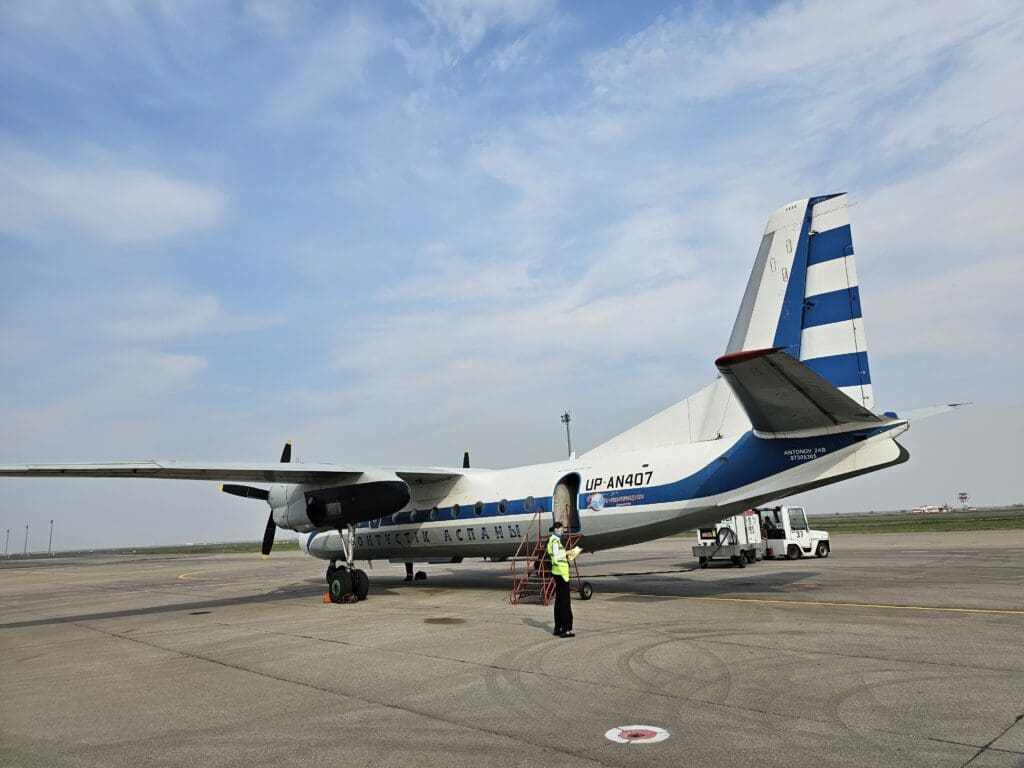
Around a couple of minutes after arriving at the aircraft, the dispatcher gave a thumbs up to the bus driver at which point the doors slid open and passengers poured out into the evening heat. Unsurprisingly given the Antonov An-24’s ability to operate from remote airfields with minimal ground equipment, the aircraft features a set of retractable built-in steps. However, with Astana Airport far from remote or unprepared, a set of much sturdier steps had been positioned up to the sole passenger door at the rear of the aircraft. After admiring the Antonov’s chubby fuselage and the bulbous portholes on the port side of this – of which I counted eight, without any waiting, I climbed up the six steps. Upon nearing the top of these I received a greeting from the flight attendant which came in the form of a warning in Russian, advising me to watch my head on the door frame. Reaffirming my belief that there is some linkage between SCAT Airlines and Southern Sky Airlines, that evening the flight attendant wore a uniform that consisted of black trousers, a white shirt and a reflective SCAT Airlines jacket that they kept on for the entire voyage down to Almaty.
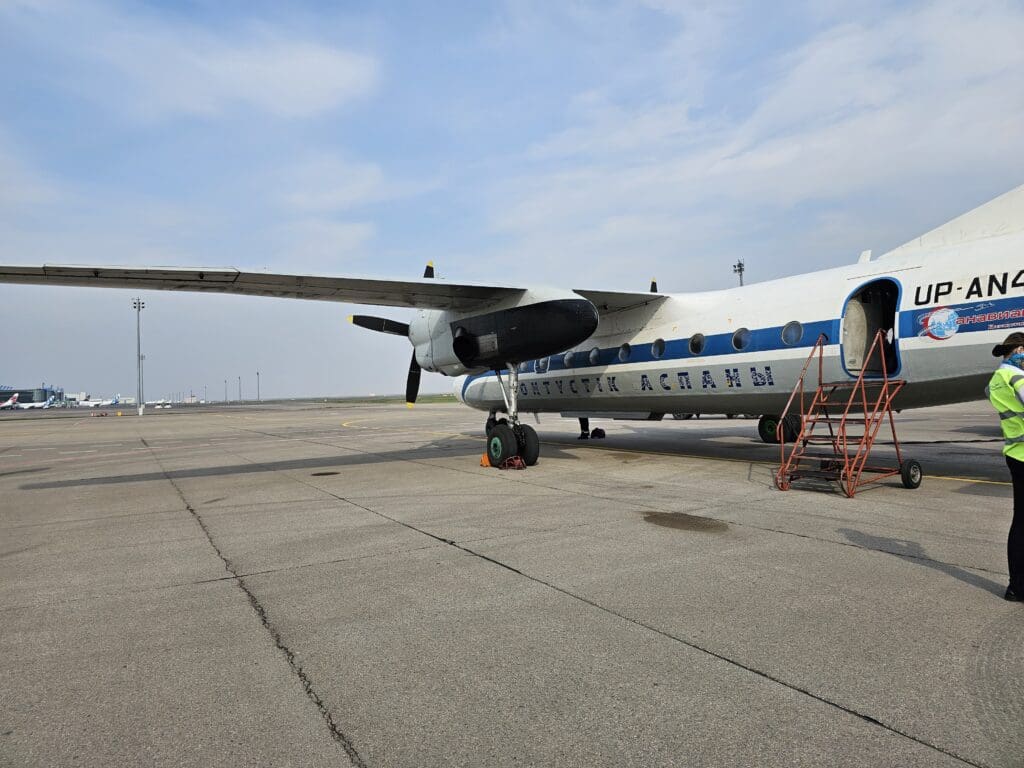
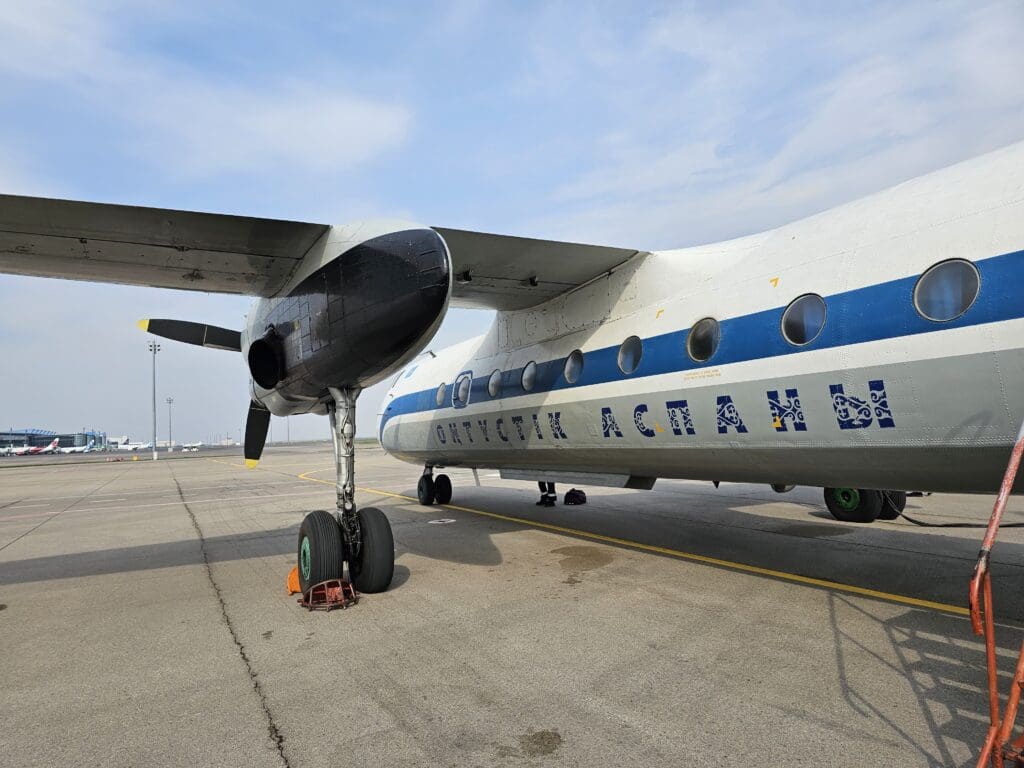
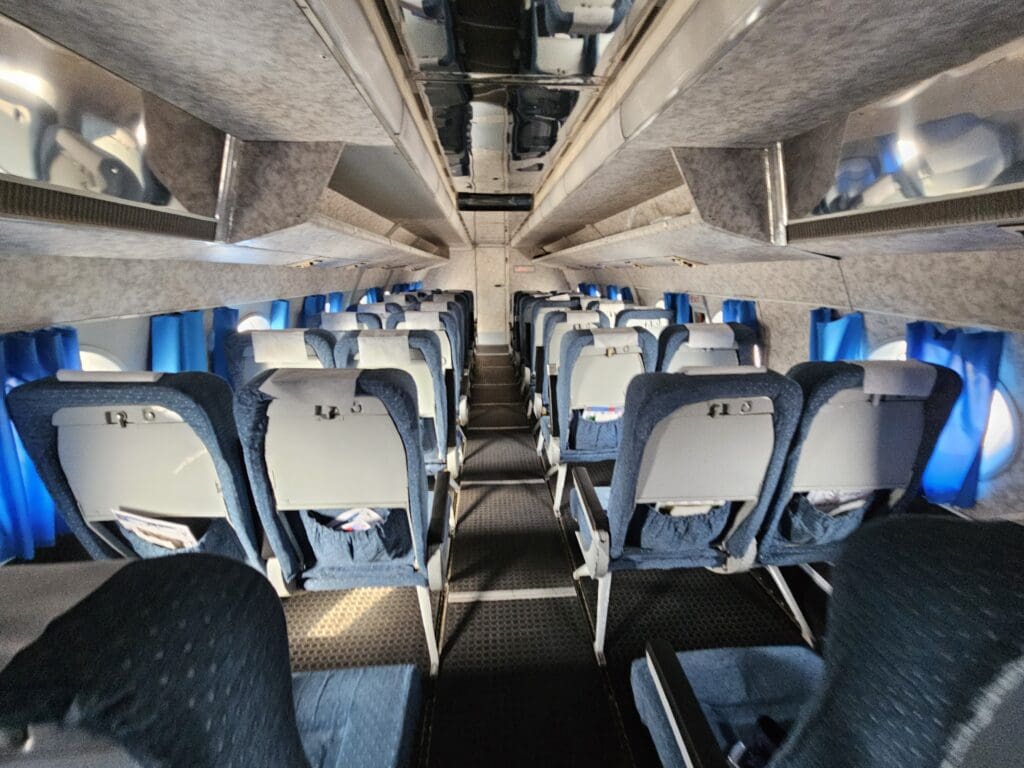
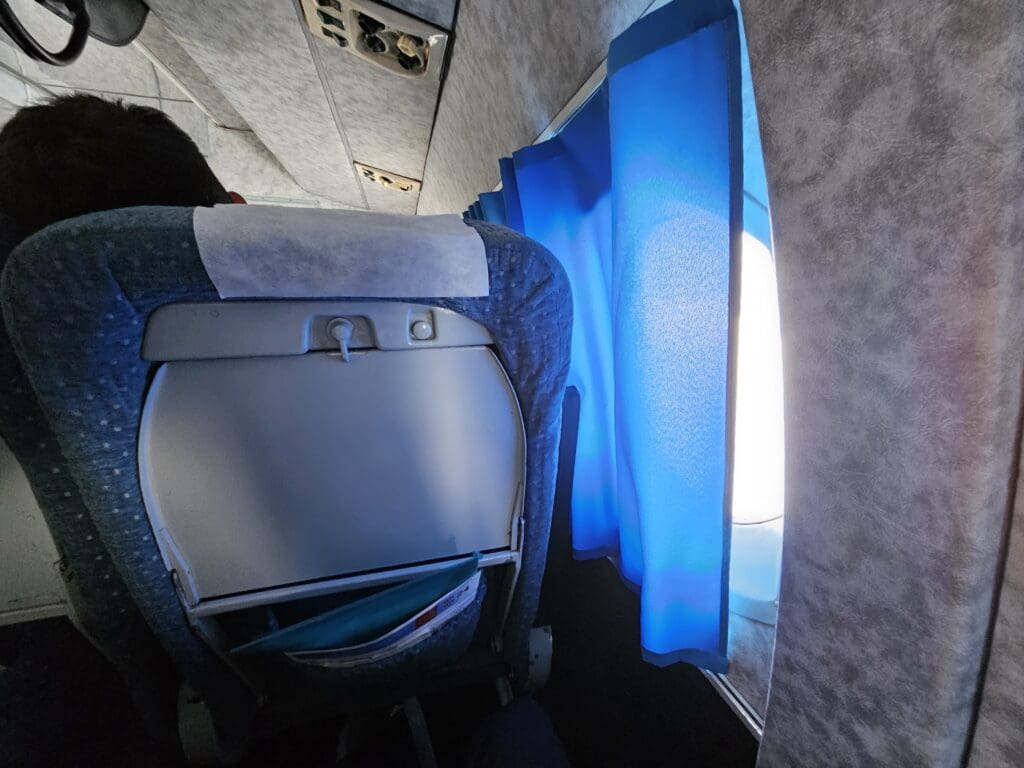
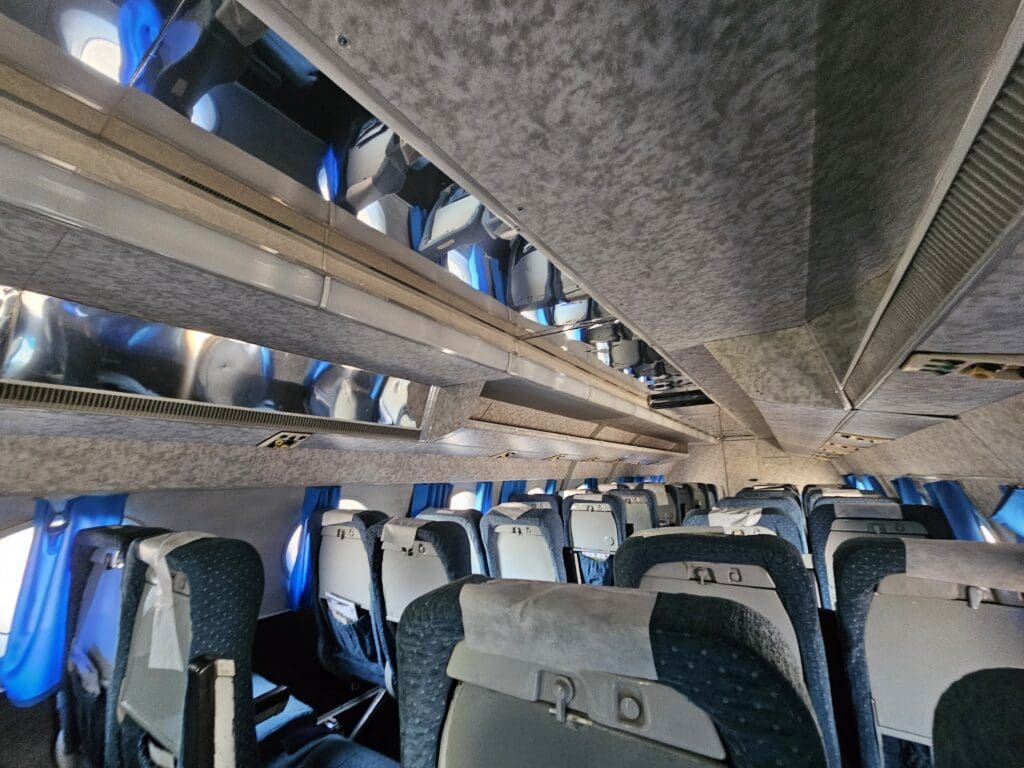
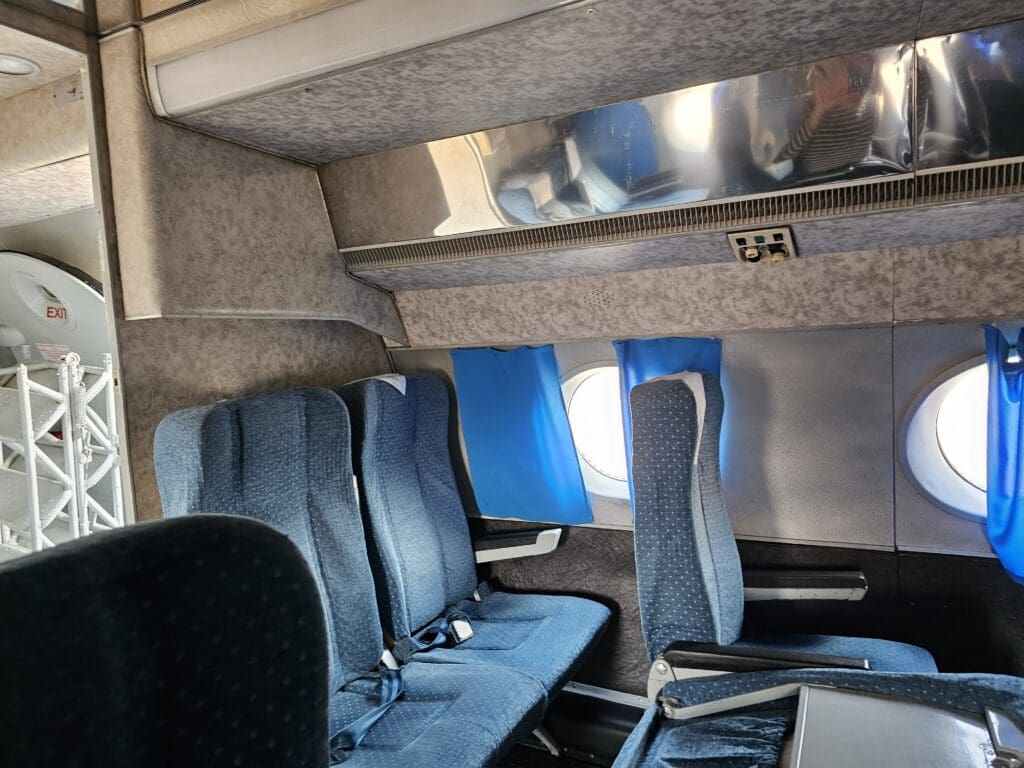
Heeding the flight attendant’s advice and not wishing to take any large bruises home as a souvenir from my Antonov ride, I bent over slightly as I stepped out from the evening heat and into the spacious area at the rear of the aircraft. Once inside, I was greeted by the strong oily scent that is more reminiscent of vintage aircraft than working airliners. Glancing to the right, the rear cargo hold could be seen as well as the folded-up steps, whilst the aircraft’s very small galley area could be seen opposite the cabin door. With nowhere else to go, I turned left and ventured into the 48-seat cabin. As I had expected, entering the cabin was like taking a step back in time, with this having undergone little if any upgrades to bring it into the twenty-first century. There, twelve rows of relatively large and comfortable-looking seats complete with chunky armrests could be seen in a 2-2 configuration, whilst up above train-style hatracks took the place of more conventional overhead lockers. Whilst a few odd seats featured dark blue leather covers, most sported a dark blue fabric with a pattern of repeating dots and were topped with a disposable fabric antimacassar featuring SCAT Airlines’ motif. Just as on the other Southern Sky Airlines aircraft I had flown aboard back in 2017, a mirror ran the length of the aisle – with one questionably plausible explanation for its presence being that once upon a time it would have enabled a guard at the rear of the aircraft to keep their eye on any troublemakers. Far from a Dreamliner with dimmable windows, blue curtains could be seen on either side of the cabin for those not wishing to stare out through the large circular portholes and gaze at Kazakhstan’s diverse landscapes passing below. Meanwhile, in typical Soviet airliner fashion, no smoking and seatbelt warnings could be seen being projected onto the bulkhead at the front of the cabin.
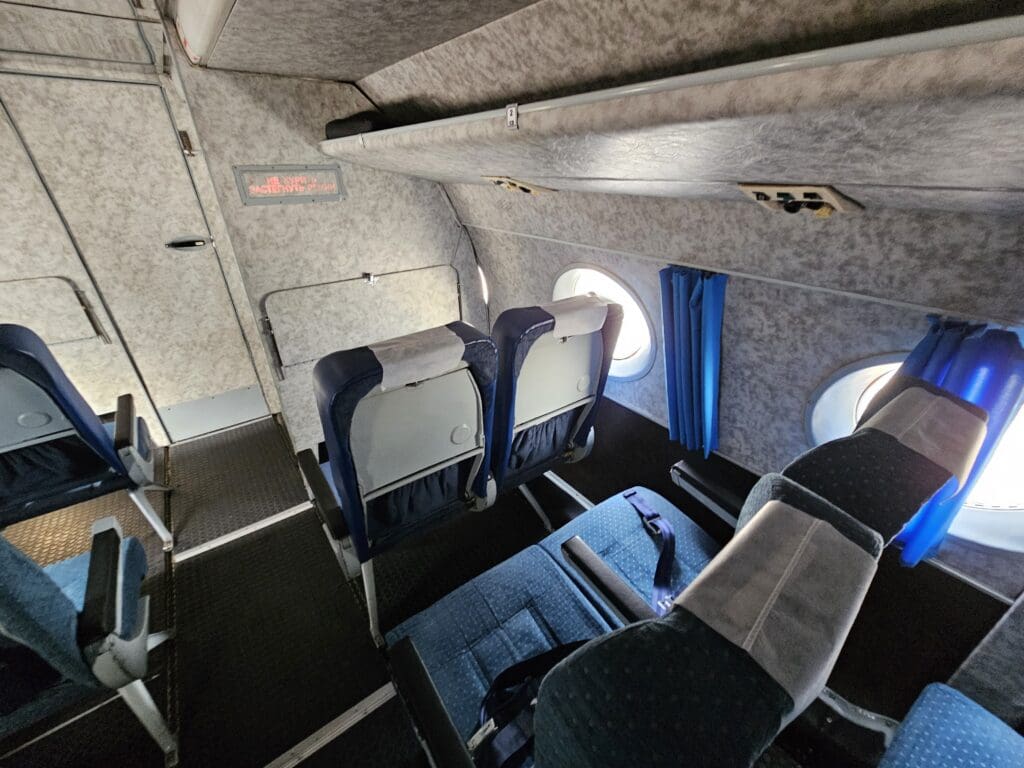
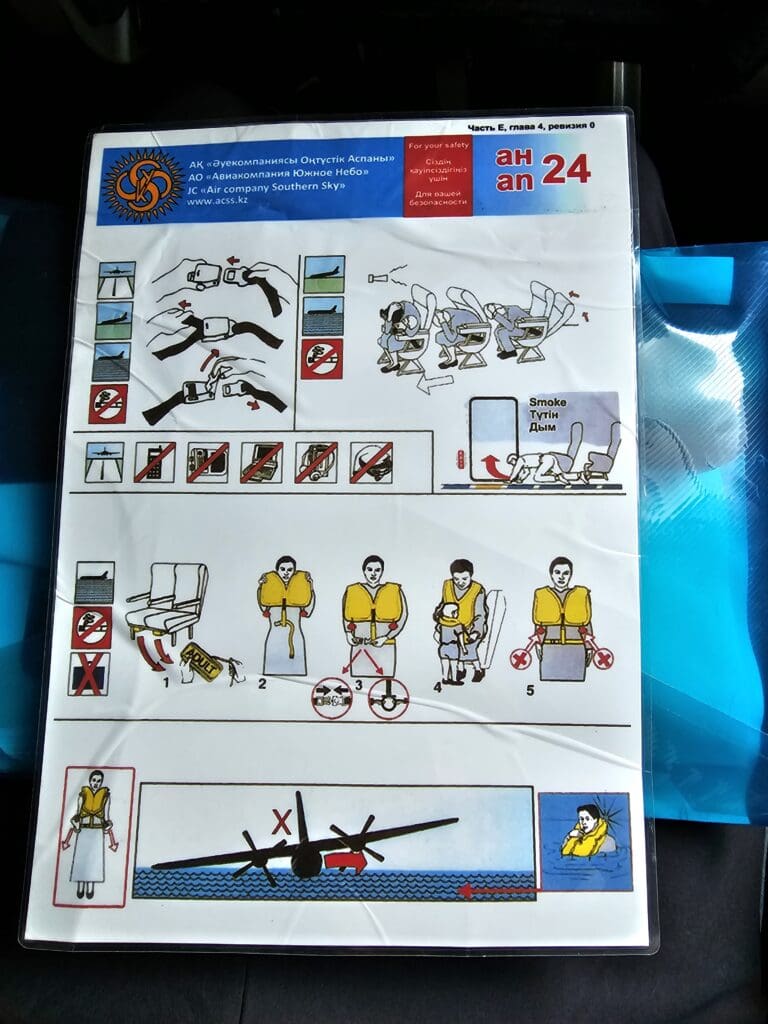
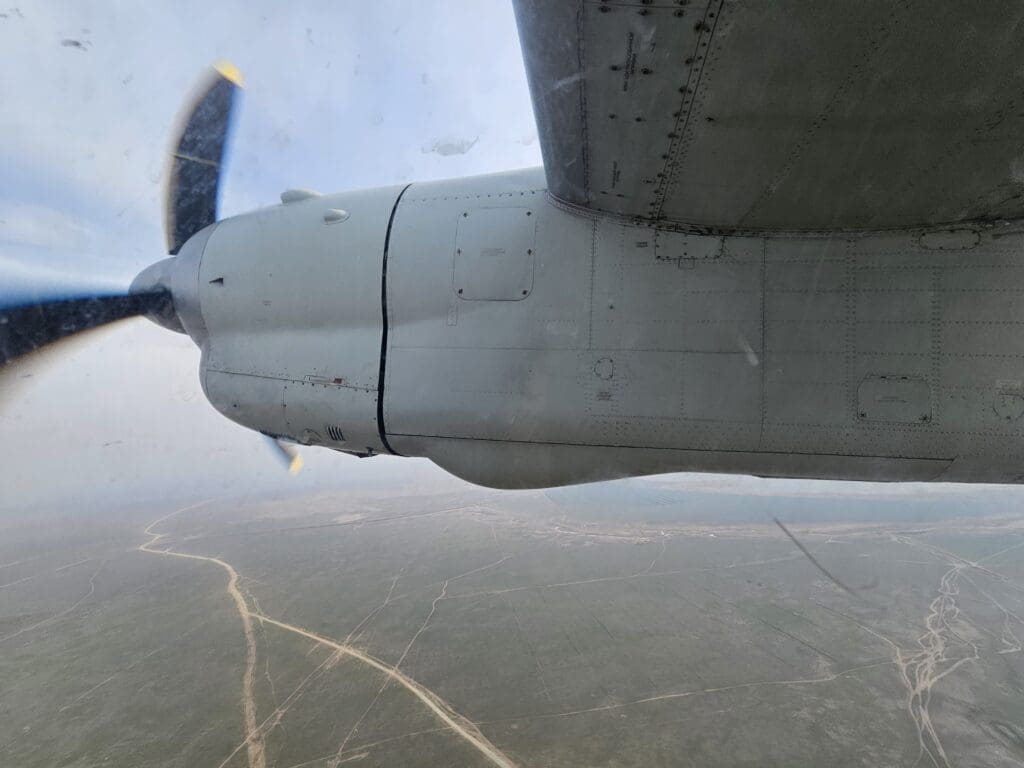
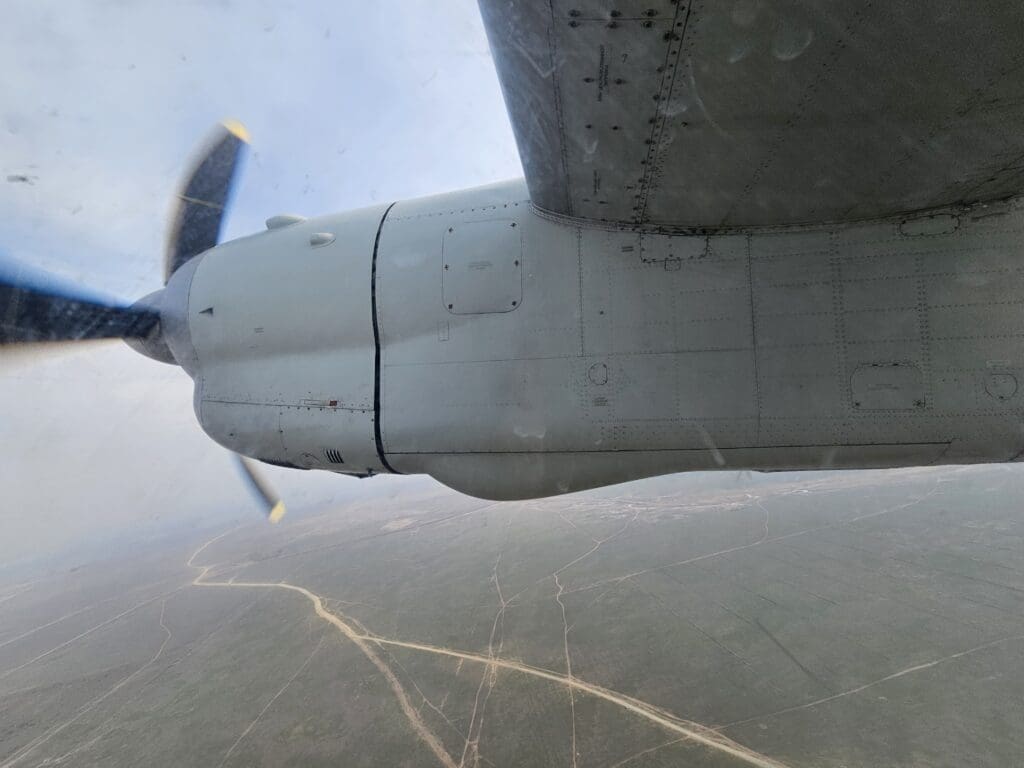
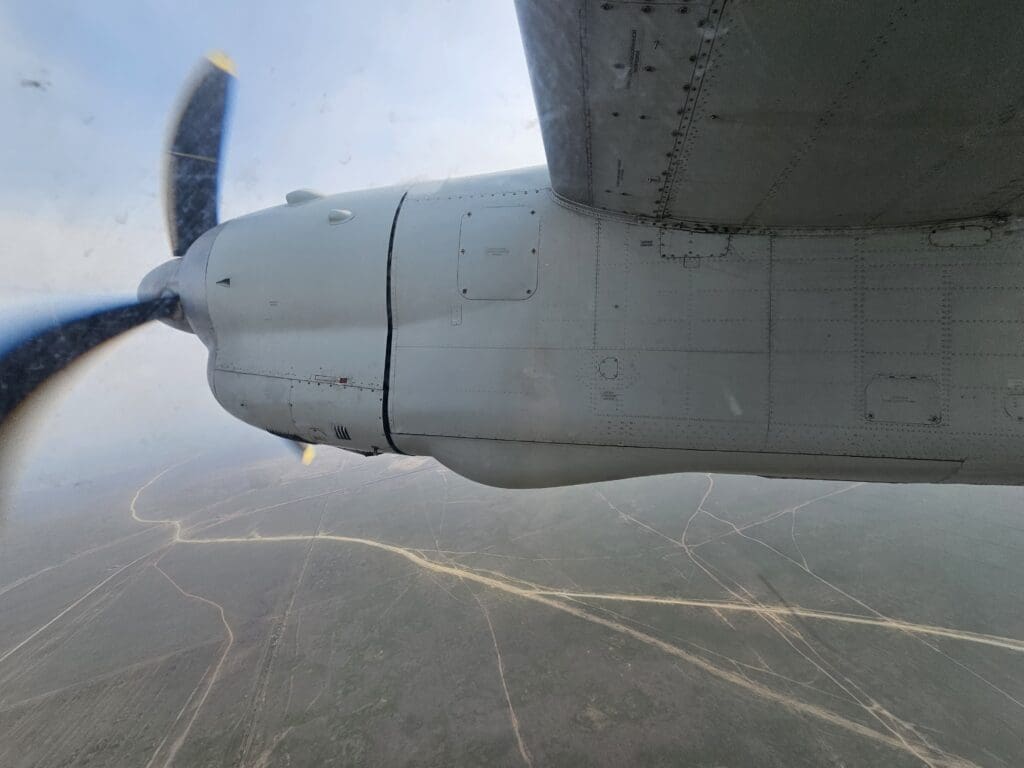
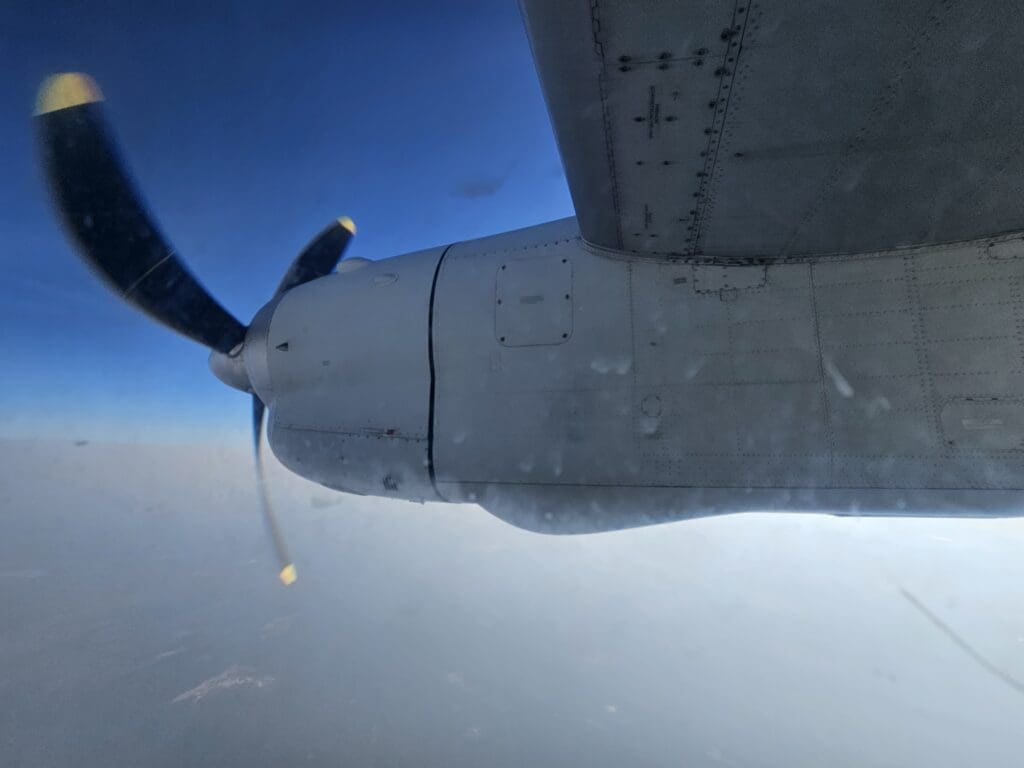
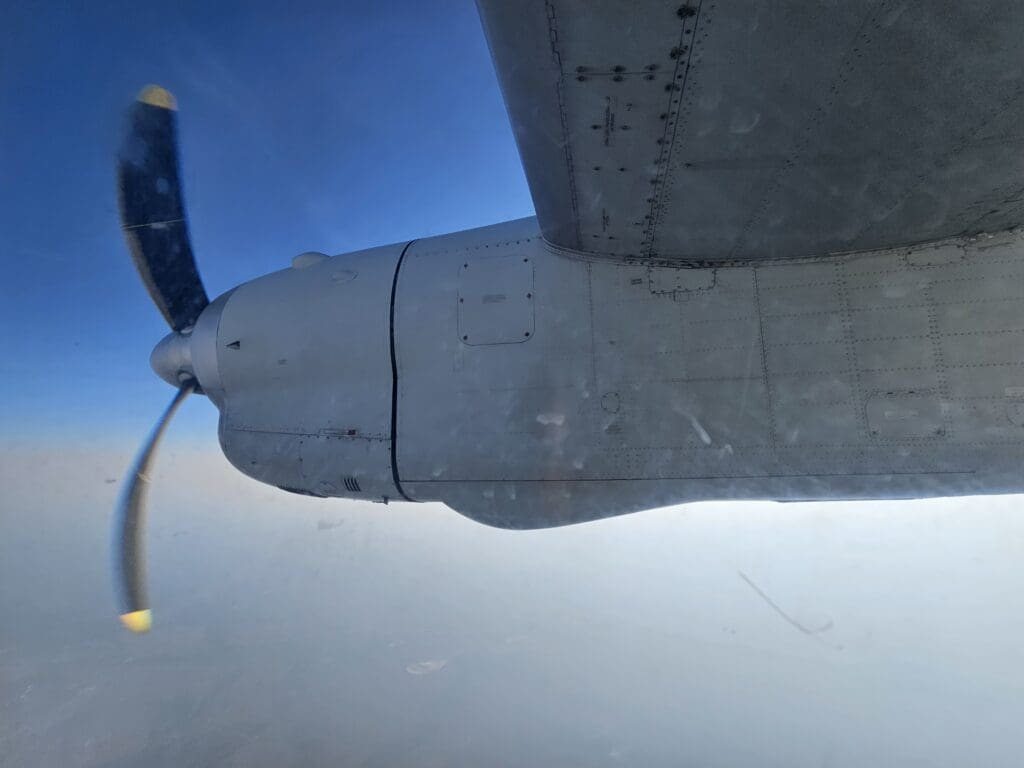
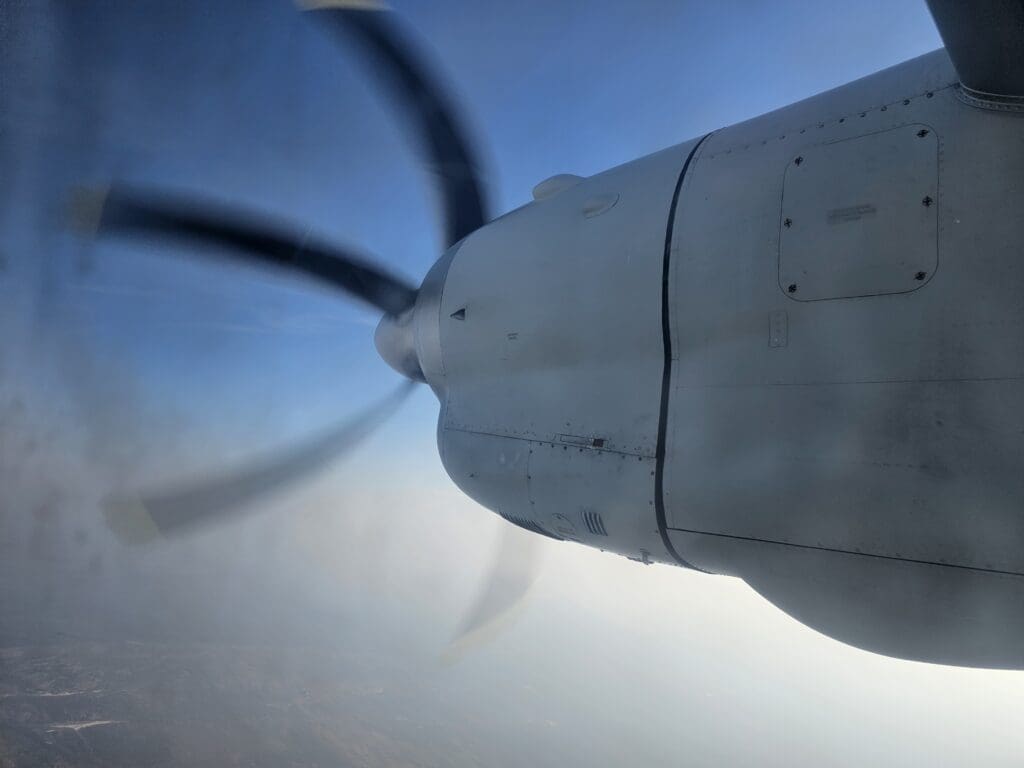
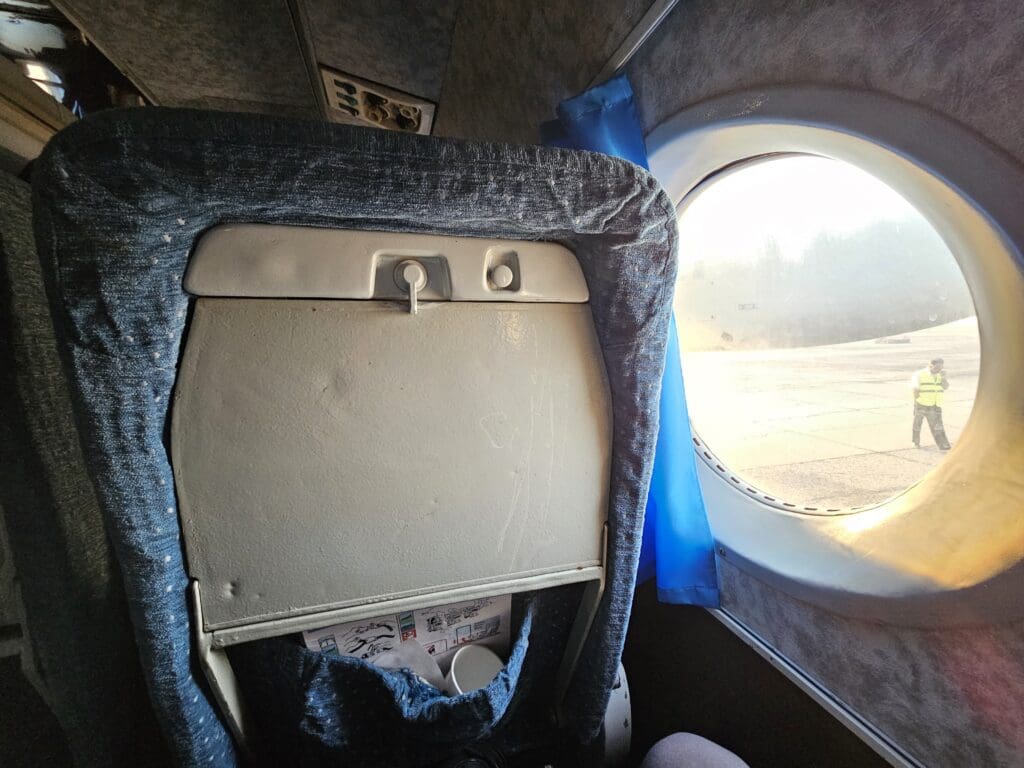
After walking through the cabin, I plonked myself down in Seat 3D. With more rows than windows, many window seats onboard the Antonov An-24 don’t align well with the aircraft’s windows, which I found to be the case for this row. However, thankfully I did still have somewhat of a view, with superb vistas of the large engine and rugged landing gear protruding from this provided from this seat. As I had expected given their chunky appearance, once sat down and strapped in I found the seat to be soft and comfortable, whilst also offering a good amount of legroom for a turboprop airliner. Furthermore, ignoring the scratches on the window, I was pleased to find the cabin to be in a very reasonable state whilst also appearing to have been well-cleaned during its turnaround with no sign of any rubbish in the area around my seat. Turning to the seatback pocket, this contained a slightly dogeared yet otherwise fairly modern double-sided safety card as well as a plain white sickbag. Up above, a very dated-looking PSU with the usual nozzles and lights, although I found neither of these to work.
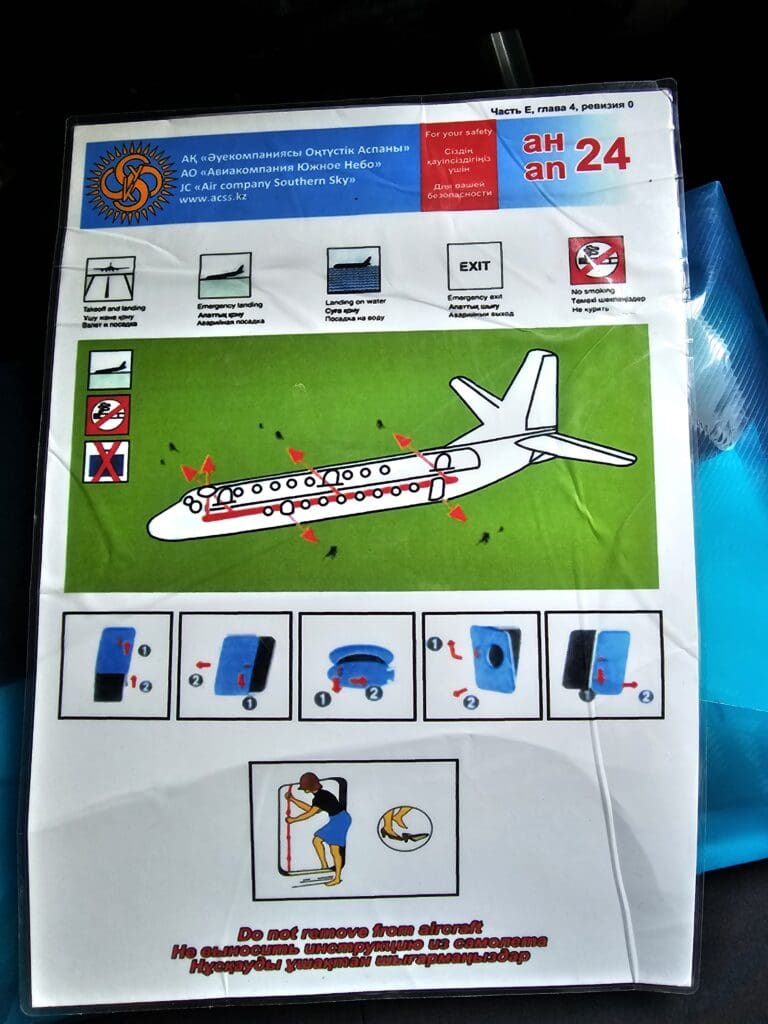
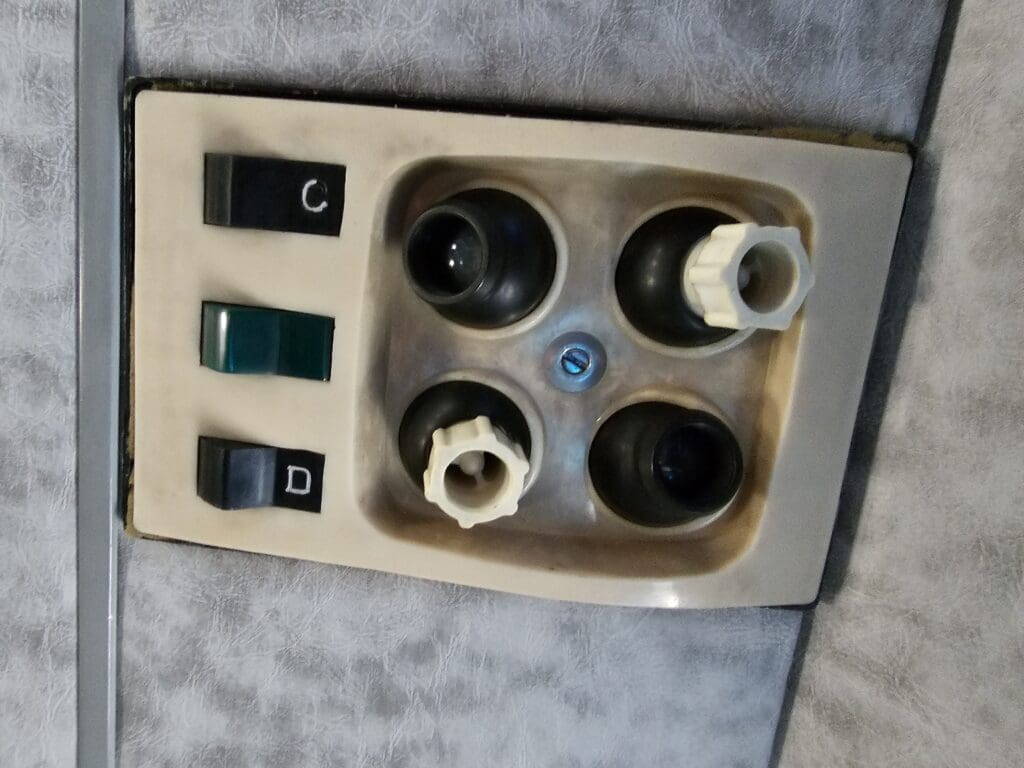
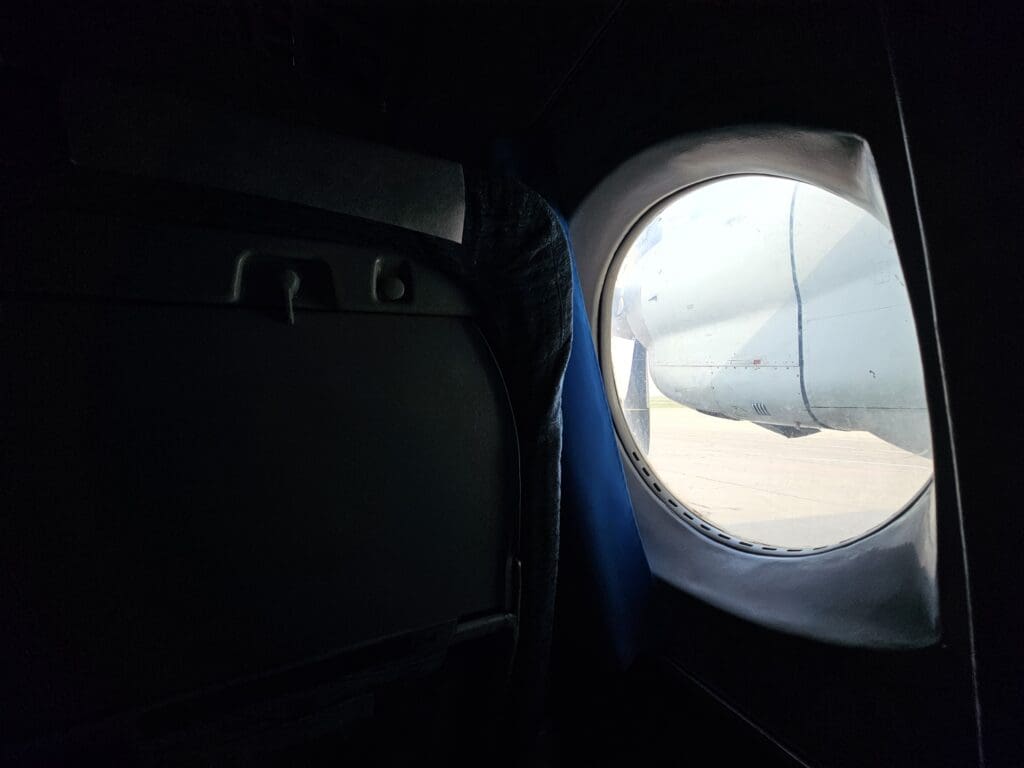
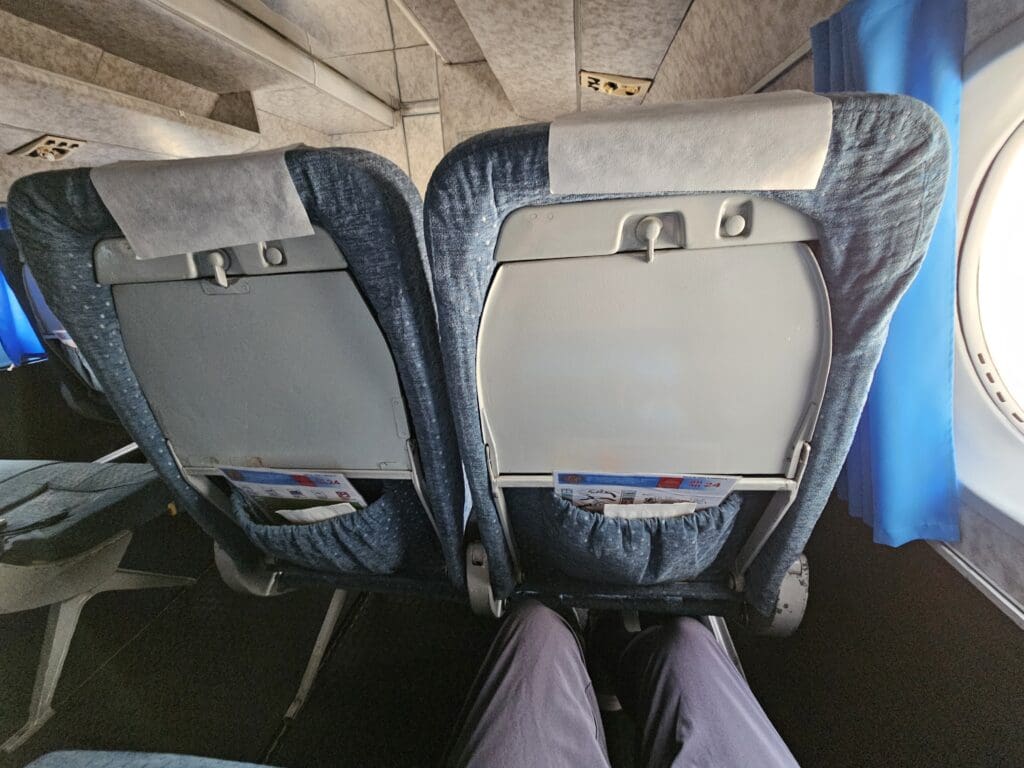
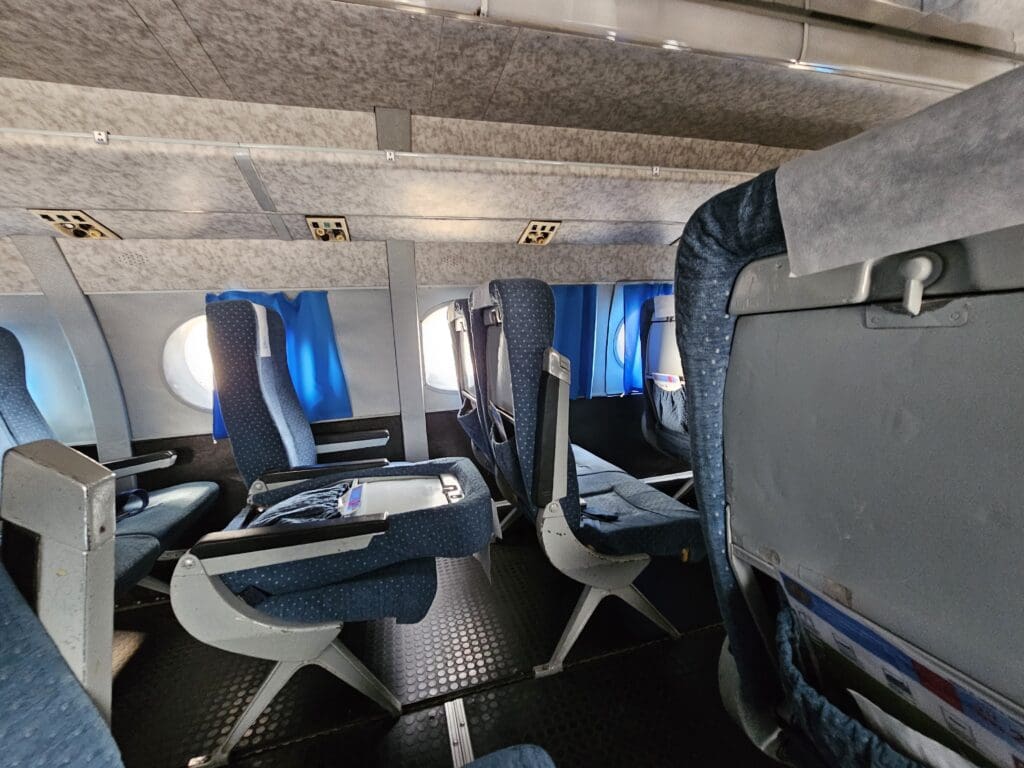
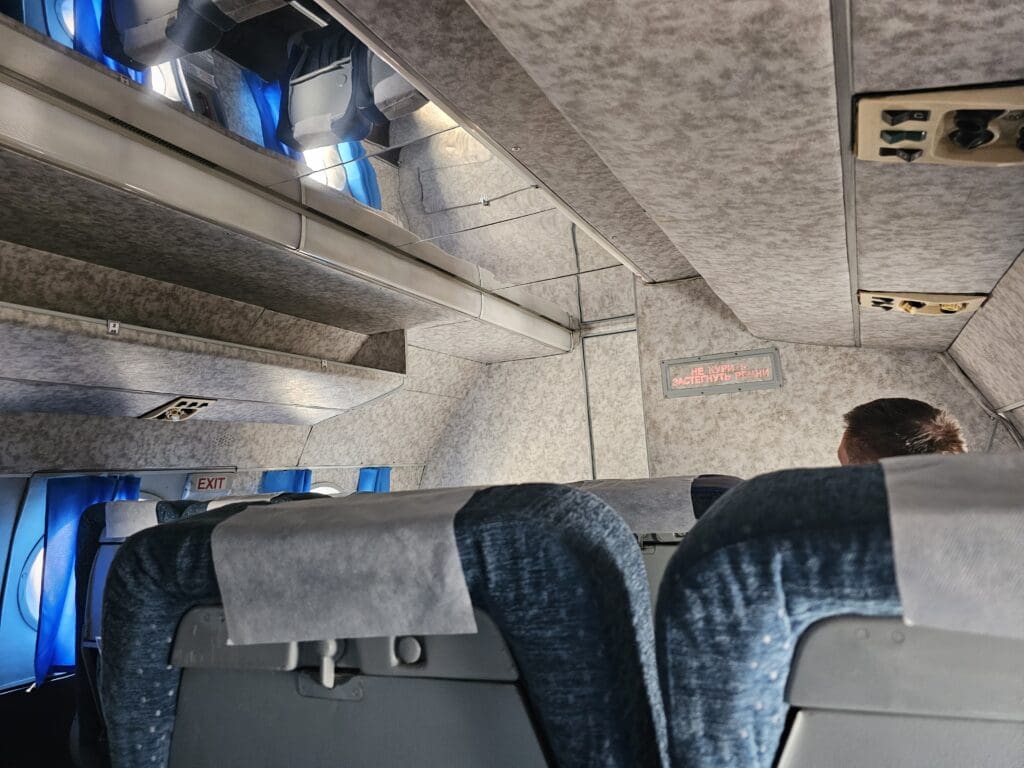
That evening, it didn’t take too long for all passengers to board and settle in for the flight and I was soon joined by a neighbour in the aisle seat. As it turned out, the flight would be virtually full with just one vacant seat remaining in the cabin. Focusing on the flight’s demographic, most passengers took the form of smartly dressed passengers, perhaps shuttling back down to Balkhash after undertaking business in the capital city. Unfortunately, once all were onboard and seated, there was no sign that our departure was imminent with the dispatcher shuttling almost non-stop between the forward cargo hold/cockpit and the rear of the aircraft. As it turned out, it appeared that there was a missing suitcase and eventually, a pick-up truck appeared at the side of the aircraft and a bright red suitcase was loaded into the forward cargo hold. Once onboard, the Dispatcher left the aircraft for good and the Captain closed the passenger door before making their way up to the front of the Antonov.
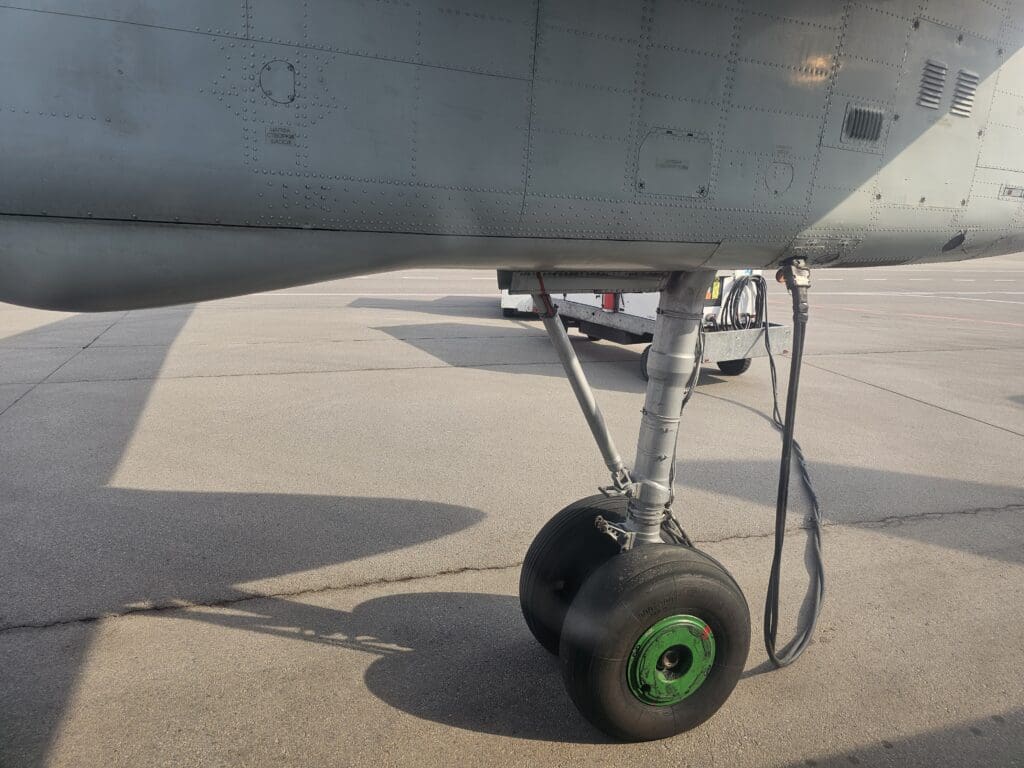
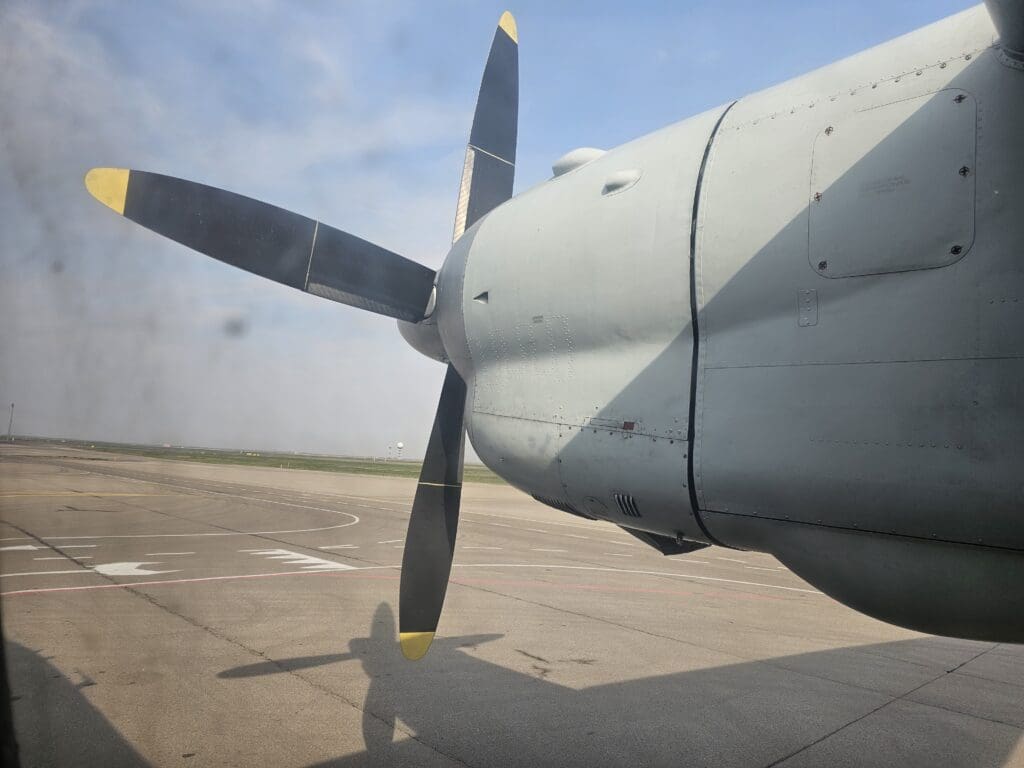
Almost as soon as the Captain had retreated to the front of the aircraft, at 1712 a loud and high-pitched whine could be heard coming from the starboard engine. Just before this became too deafening, the flight attendant’s voice filled the cabin as they performed their welcome announcement first in Kazakh and then again in Russian. As this was being undertaken, plenty of vibration could be felt as the old Ivchenko AI-24 engine spooled up and the four-blade propellers began to whirl, with the noise expectedly multiplying once the port engine fired up. After undertaking their welcome announcement from the rear of the aircraft, the flight attendant passed through the cabin before strapping themselves in Seat 1A which is located opposite a sort of closet/flight attendant station although unfortunately, I was unable to get a good look at this. At 1715, with all ground crew and equipment clear of the aircraft, the Antonov propelled itself forward out of its stand and began its taxi to the runway. Seeing as Runway 04 was in use for all departures and arrivals that day, the taxi was short and no more than two minutes after leaving the stand the Antonov came to a halt at the holding point.
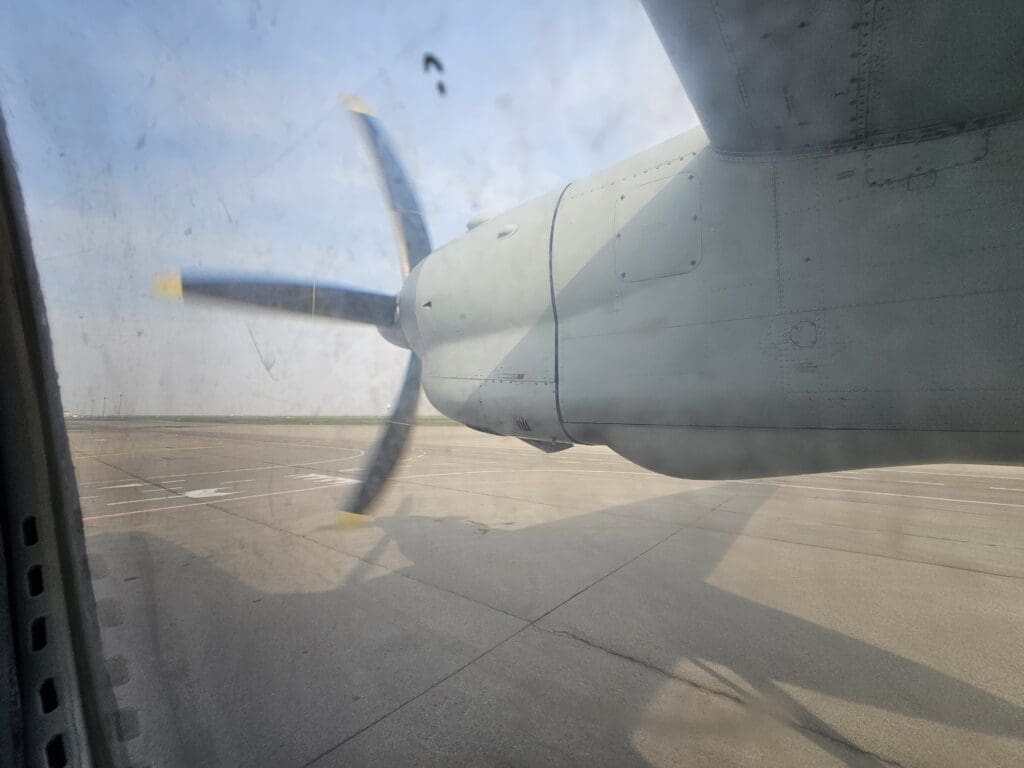
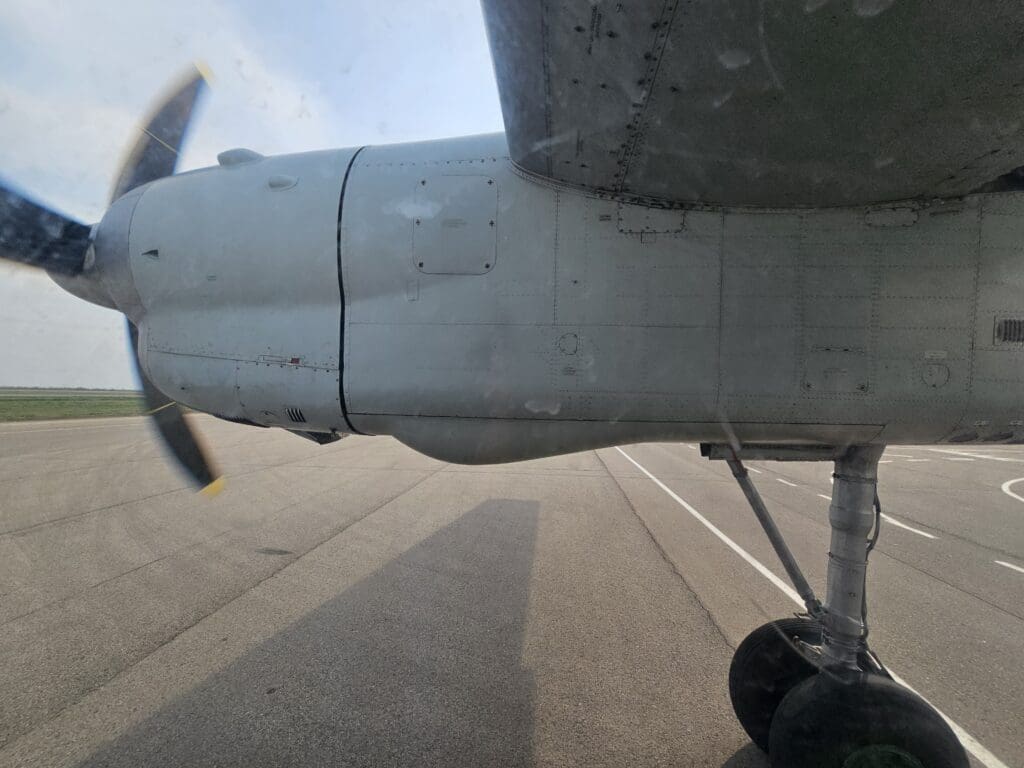
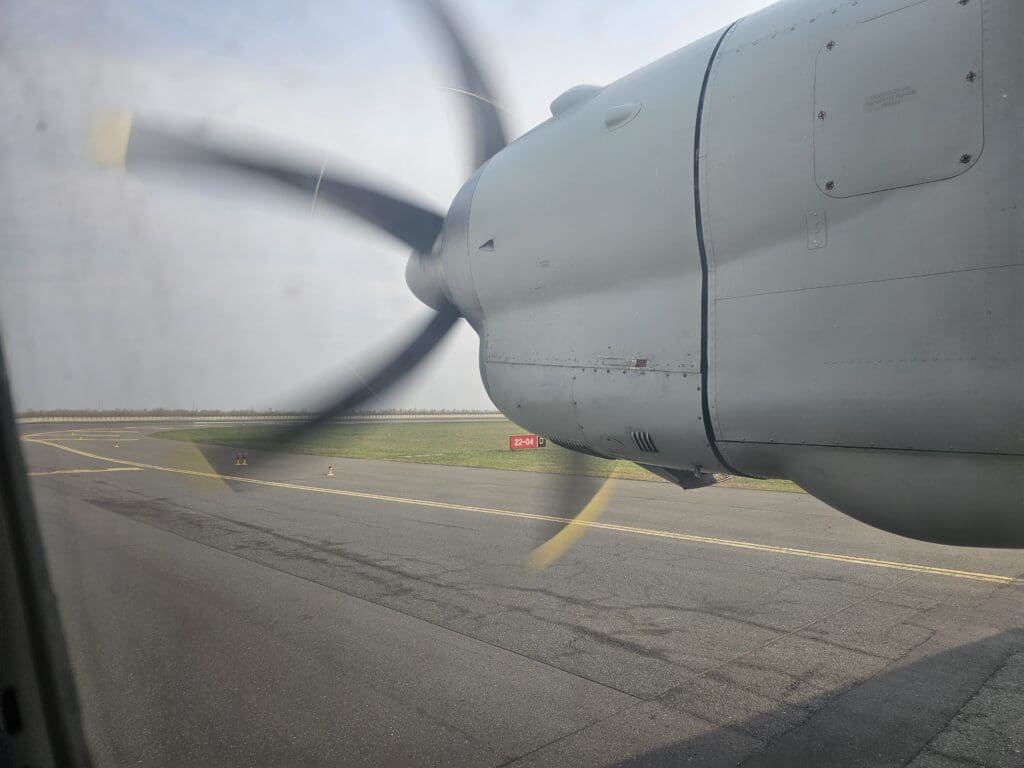
Once at the holding point, the Antonov remained stationary for a worrying amount of time – a grand total of twelve minutes to be precise. With no aircraft seen on the runway for much of this wait, I was a little concerned that the aircraft may end up returning to its stand. As we neared the end of this wait, a small sleek Pilatus PC-24 operated by Comlux Kazakhstan could be seen touching down from Almaty, followed by an older and more interesting government-operated Yakovlev Yak-42D arriving from Oskemen. After a long wait, at 1729 the engines roared once again as the aircraft limbered onto the runway. Indicating there to be no need to backtrack, the Antonov turned left and came to a halt for several seconds before the two Ivchenko engines spooled up and produced an absolute cacophony of noise. At this stage, non-enthusiasts or those not so au fait with flying onboard the vintage Antonov An-24 may have been rather concerned by the sheer amount of noise and vibration caused by the two engines which continued as the brakes were released and we went flying down the runway.
As we rolled down the smooth runway, it didn’t seem to take long for the Antonov to rotate upwards and leave the ground before commencing its slow and shallow climb up to its cruising altitude. Almost immediately after taking to the skies, the landing gear could be seen being retracted into the engine and the aircraft banked the right before rolling out on a southerly heading that would take us towards Balkhash with minimal further twists or turns.

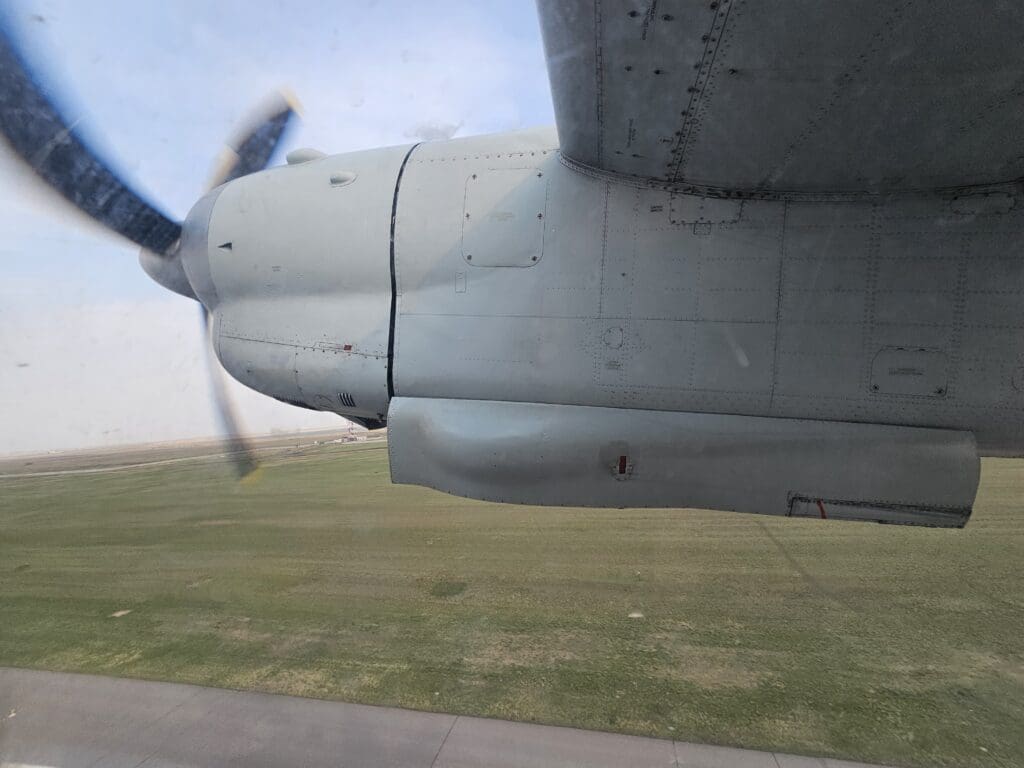
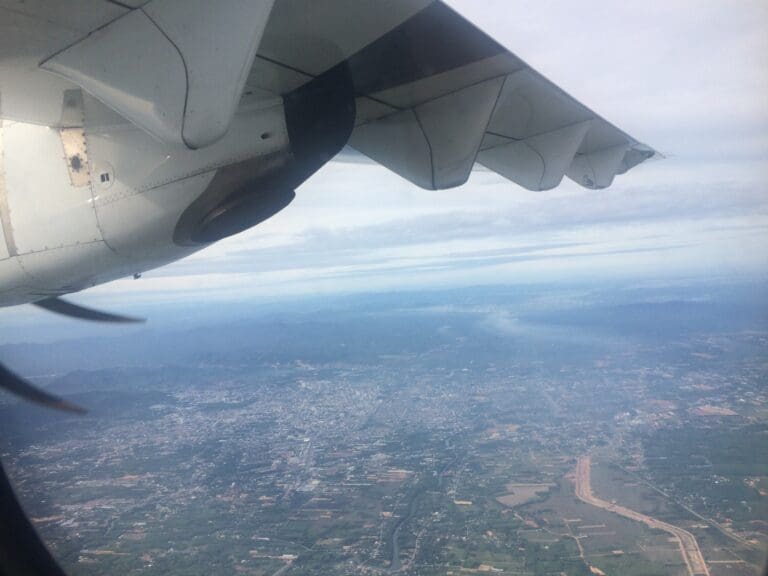
After climbing over the flat and grassy lands that surround the airport, these soon transformed into a dustier landscape as we left Astana behind. Unfortunately, thanks to the evening haze, relatively little could be seen for much of the initial stages of the flight other than the faint outline of the mostly empty countryside below. After a while, the Antonov could be seen levelling off at what seemed to be a much lower cruising altitude than on a more ‘regular’ aircraft.
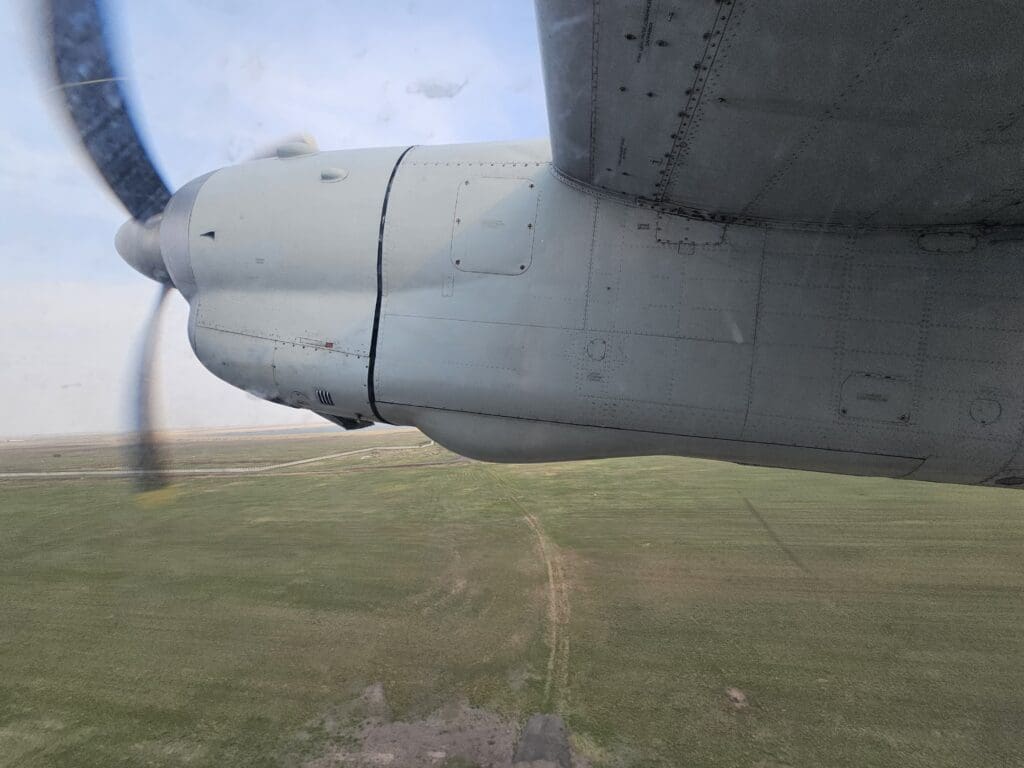
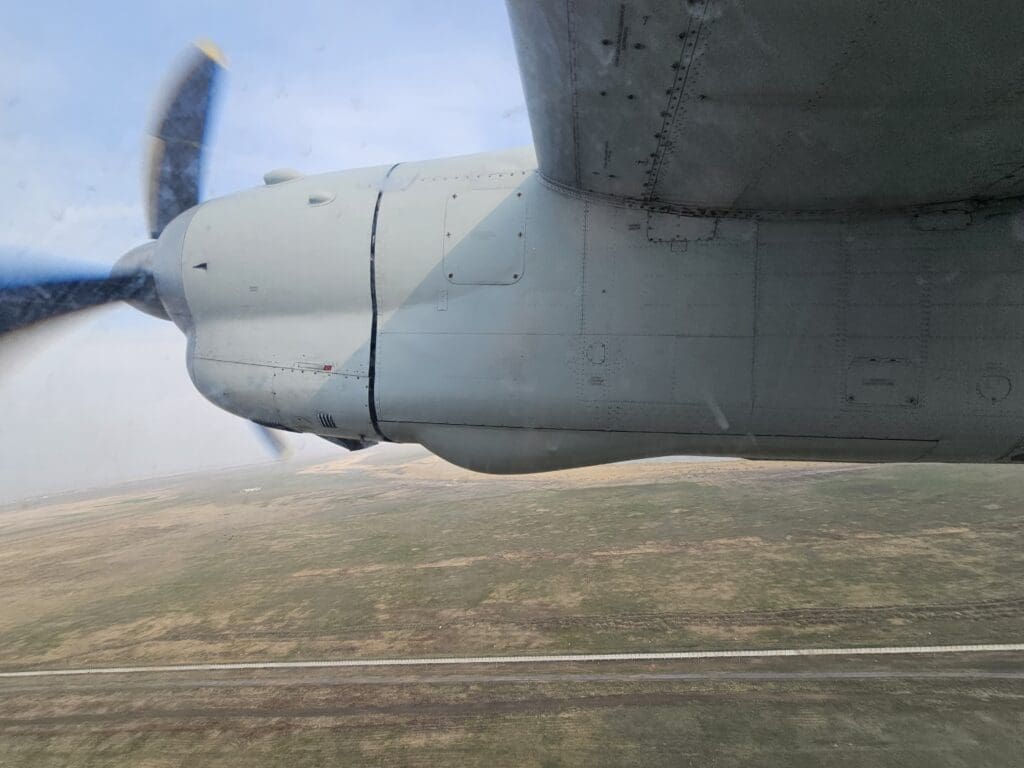
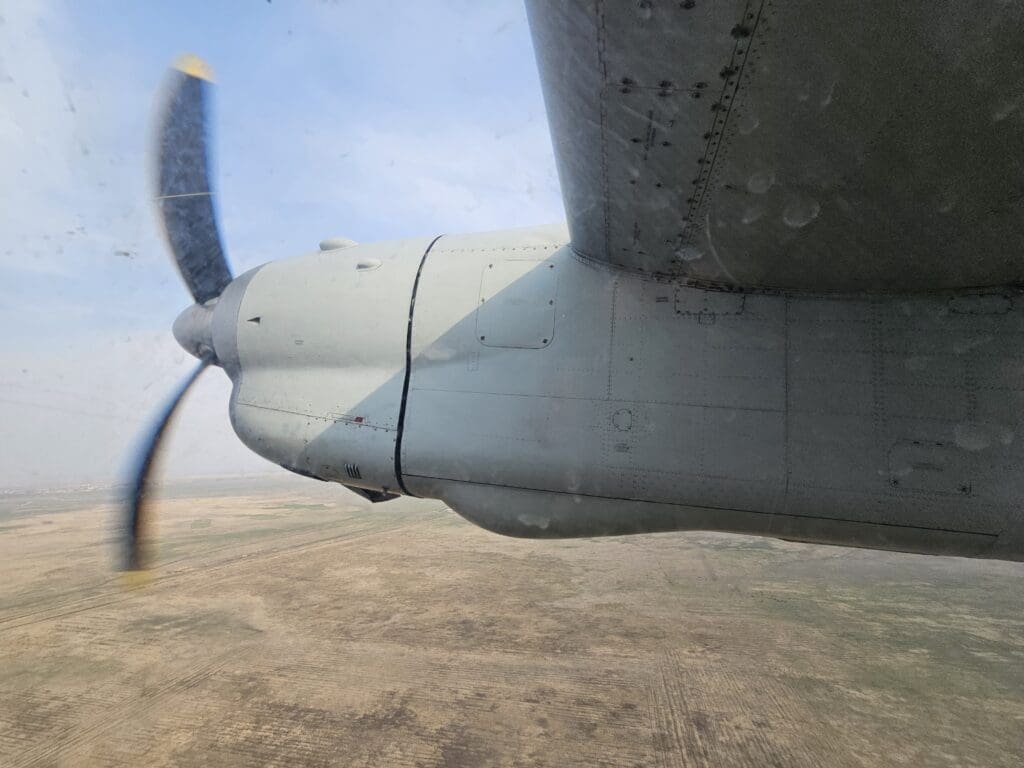
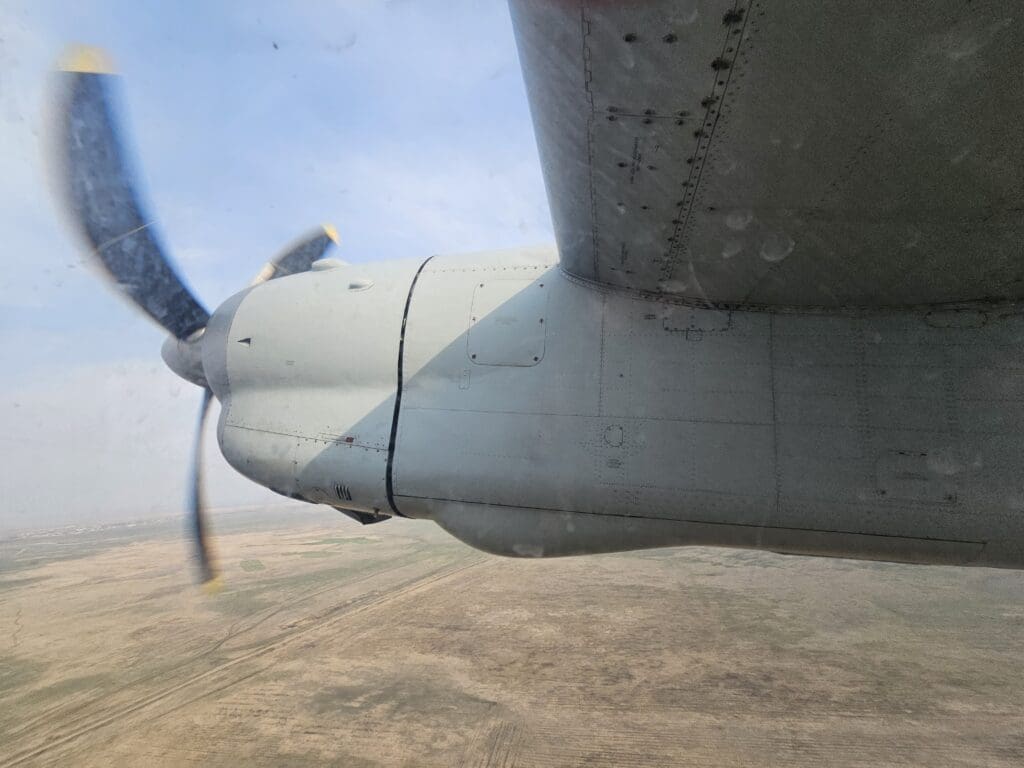
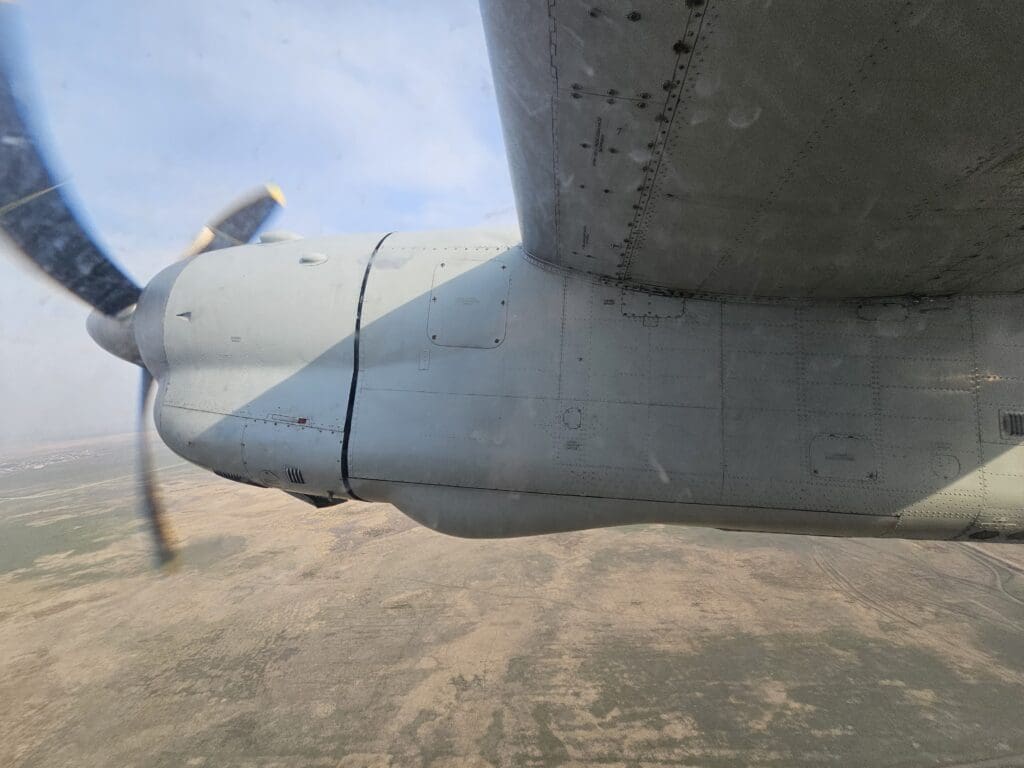
Whilst the cruise was smooth, the seatbelt sign projection remained firmly present for the duration of the flight and all passengers remained in their seats. However, seeking to reassure myself that there would be no issue with my connection in Balkhash and not wanting to end up stranded, I thought it best to ensure the flight attendant was aware of my crazy connection. Upon approaching them, I had a conversation in broken Russian which thankfully revealed that this would be no issue, and, unlike the last time I passed through Balkhash in 2017, I would even be able to remain onboard the aircraft. In spite of the fact that their interaction with customers during the flight was virtually non-existent, I found the flight attendant to be polite and friendly, taking great interest in where I was from and my trip to Kazakhstan. They also offered me a cup of water in a SCAT Airlines branded paper cup – a further sign that there may well be some remaining linkages between Southern Sky Airlines and SCAT Airlines.
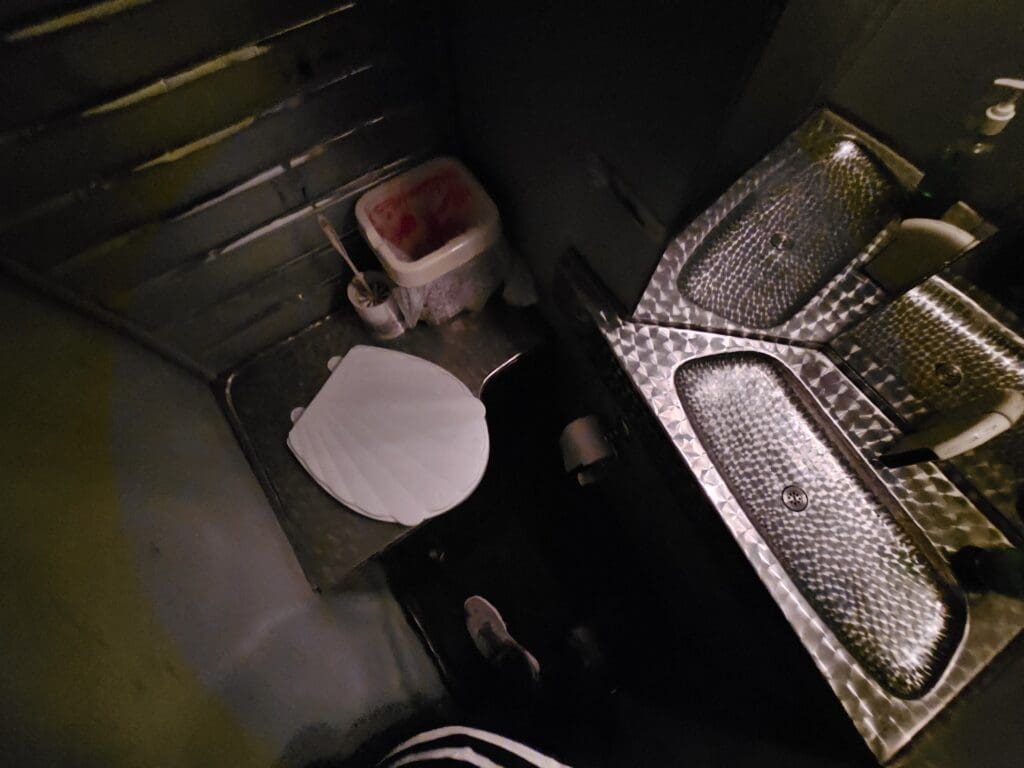
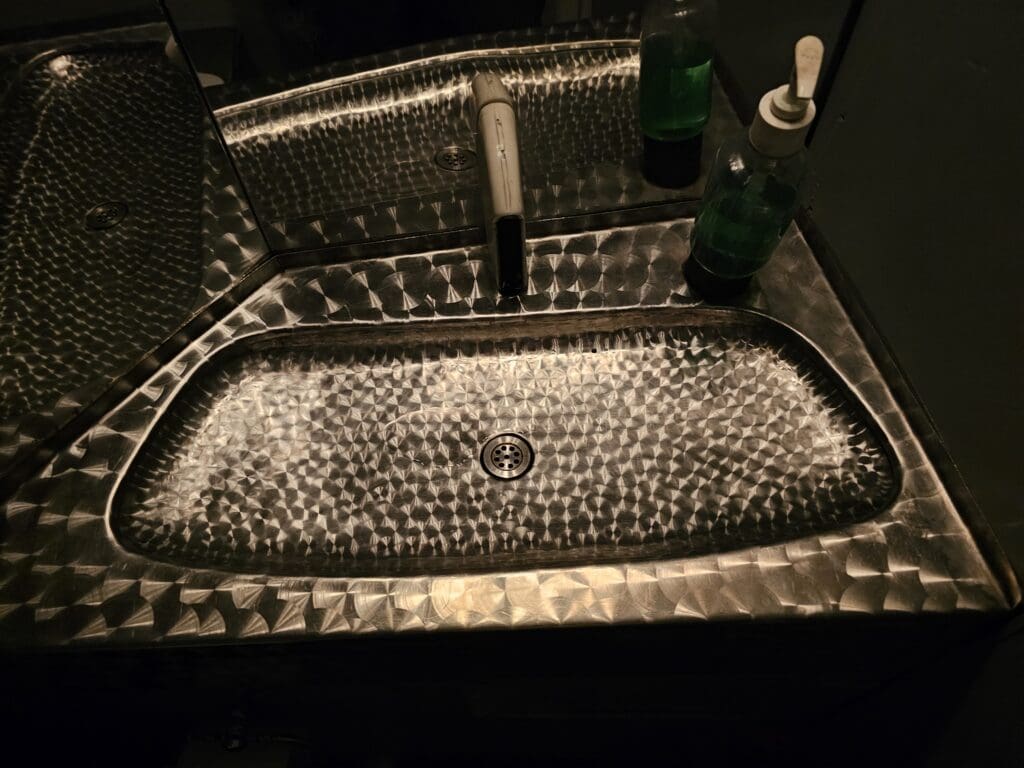
After confirming that it was okay for me to do so, I ventured to the toilet which is located at the rear of the aircraft. Once I had squeezed myself in, I found this to be dark, dated and spartan, and hardly designed to provide its users with a calm or pleasant atmosphere in which to undertake their important business. Instead, this proved to be a noisy space that was full of vibration, with the airframe’s metal trusses visible just behind the toilet. In spite of all this, the lavatory seemed to be relatively clean and stocked with all the basics, serving its purpose and leaving me with little to complain about given the aircraft’s age.
Once done, I returned to the front of the cabin and squeezed past the aisle seat occupier who refused to stand up to let me in. Examining the route, once away from Astana, the Antonov made its way southwards towards Kazakhstan’s fifth largest city and the aircraft’s former base, Karaganda, which is located around 230 kilometres to the southeast of the capital. As we neared this city, the haze below had started to clear a little and afforded me a reasonable view of the flat and dusty landscapes below. Sitting on the starboard side of the cabin, little of Karaganda could be seen other than a few old apartment blocks on the city’s western fringes which we soon passed over and continued southwards. From Karaganda, the Antonov roughly followed the course of the M-36 road which runs all the way from the Russian border at Troitsk in the Urals, through Astana to Almaty. As we passed over Karaganda Region and the flight entered its second half, the Antonov began to bounce around a little for a few minutes although this was far from the roughest patch of turbulence that I have experienced and the Antonov generally seemed to provide a smooth ride.
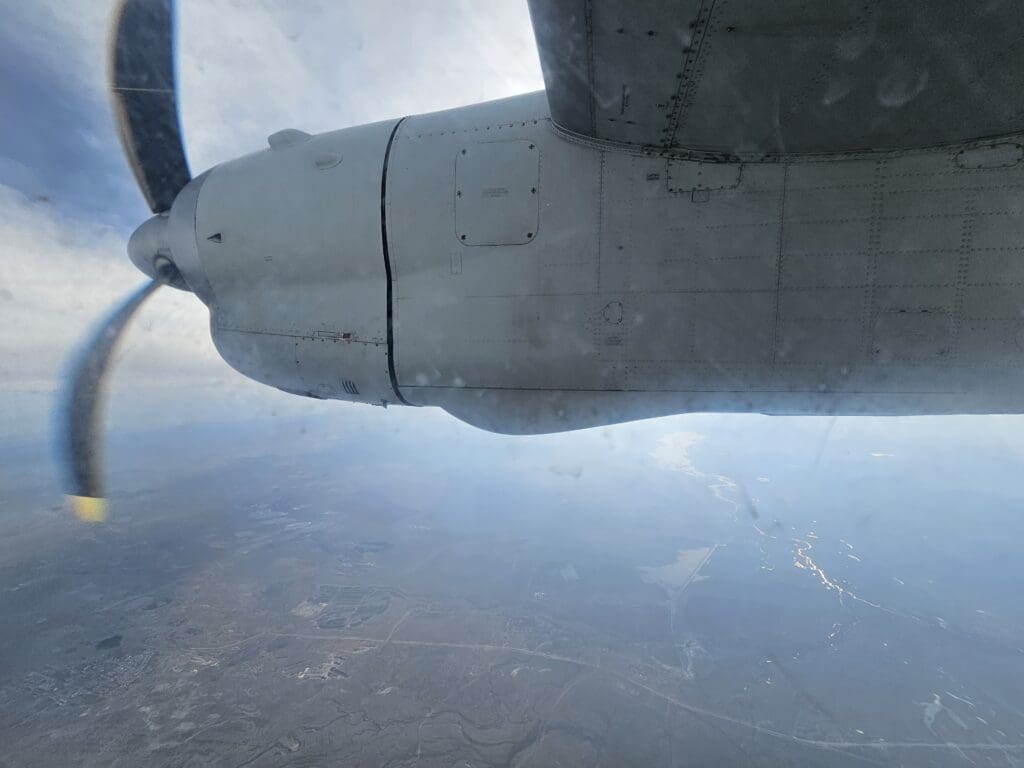
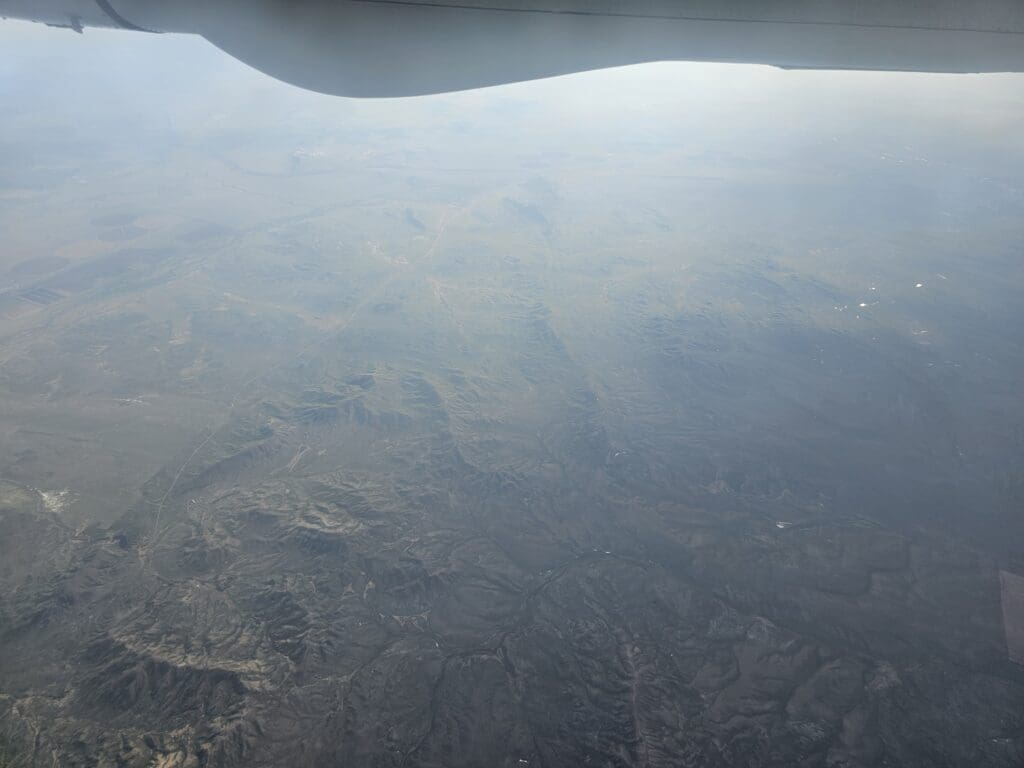
As we cruised southwards, the landscapes turned sandier in tone and very little could be seen other than the odd road and lone building standing amid the impressively remote Kazakhstani wilderness. Whilst incomparable with what may be considered to be remote in Britain, with the areas passed over still within a few hours’ drive of major settlements, these were hardly remote by Kazakhstan’s standards!
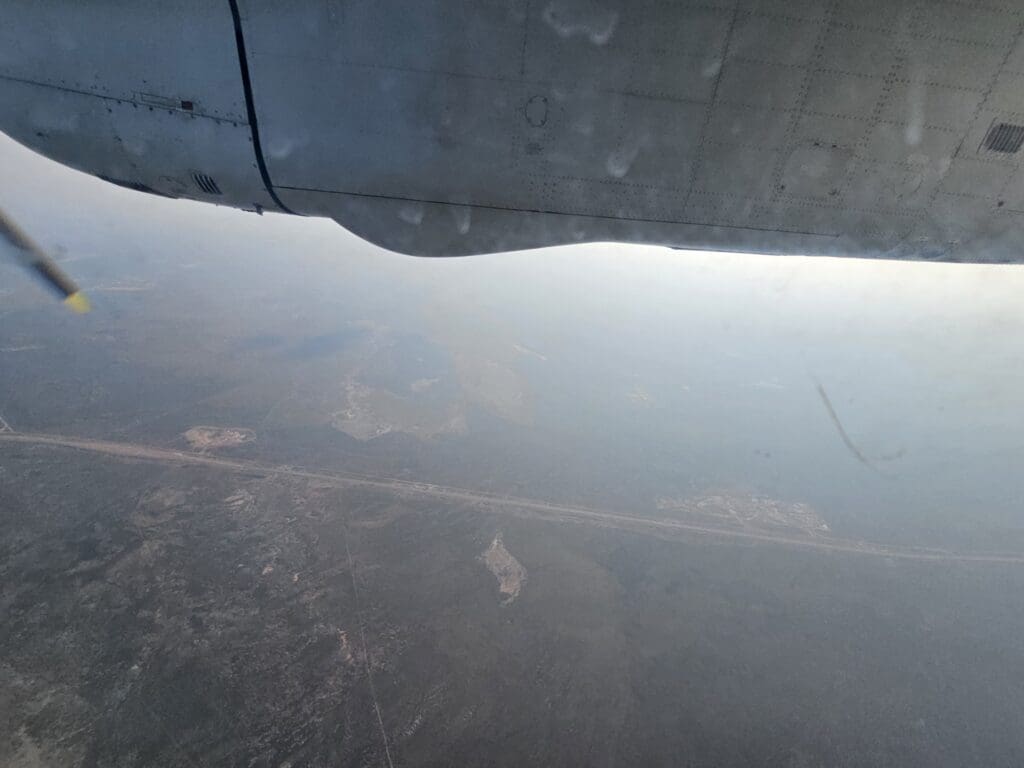
Inside the cabin, most of my fellow passengers appeared to have either been lulled to sleep by the intense and unabating racket produced by the aircraft’s two engines or were passing the time by watching things on their own personal devices. A little over an hour after roaring into the skies of Astana, the Antonov passed just to the east of the small town of Akzhal at which point the Antonov could be felt commencing its descent back to earth. Confirming that the flight was nearing its end, this was soon followed by a barely audible announcement in Kazakh and Russian advising of the commencement of our descent and imminent arrival, accompanied by the usual instructions regarding tray tables and seatbelts which were then checked as the flight attendant walked through the aircraft.
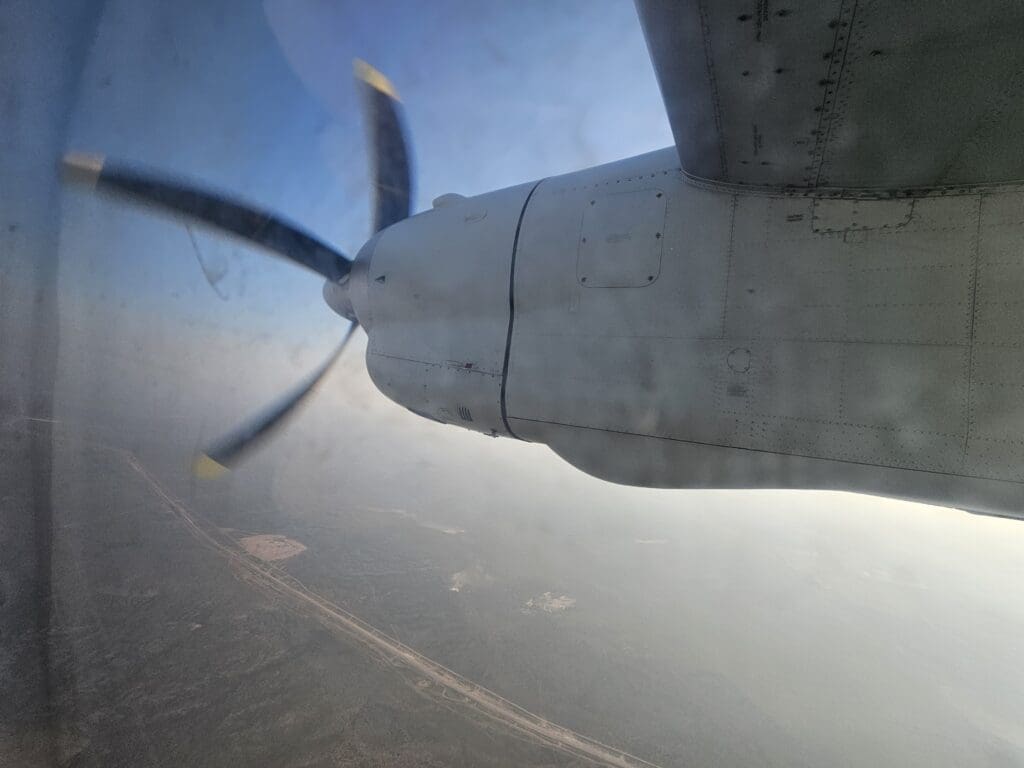
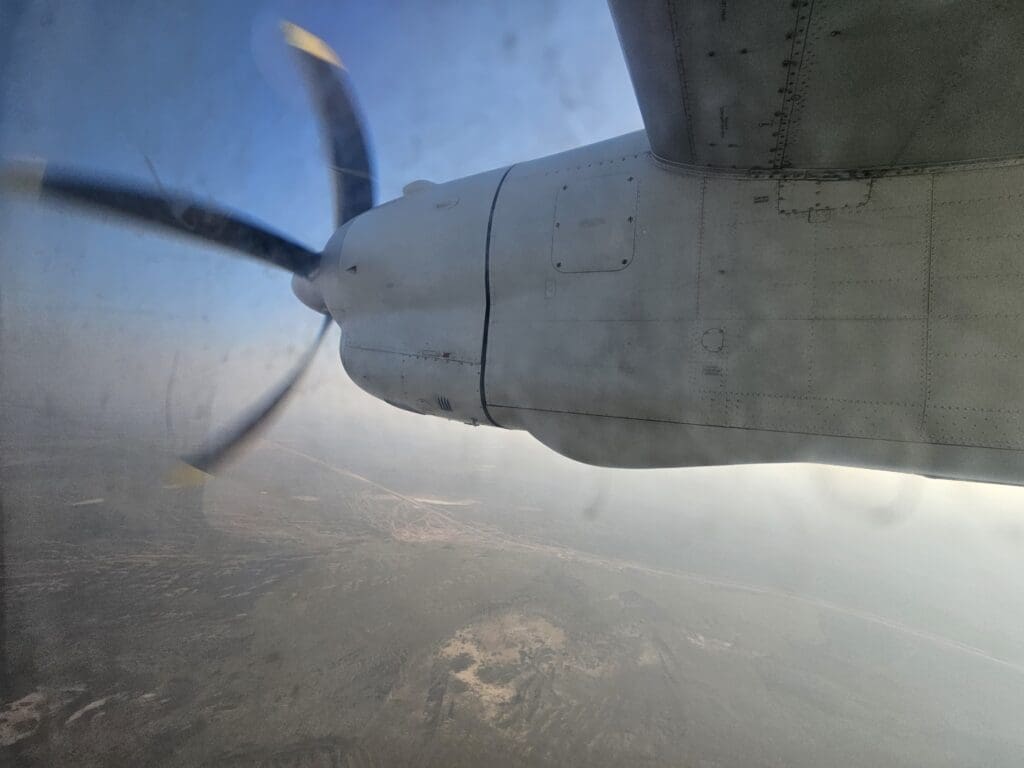
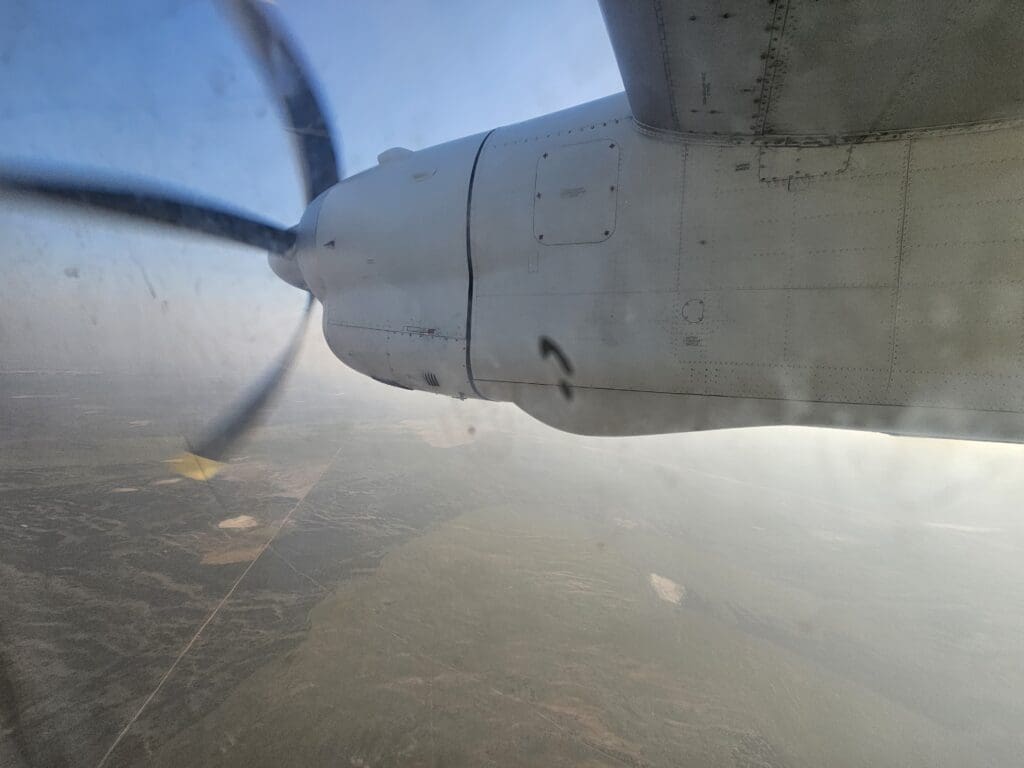
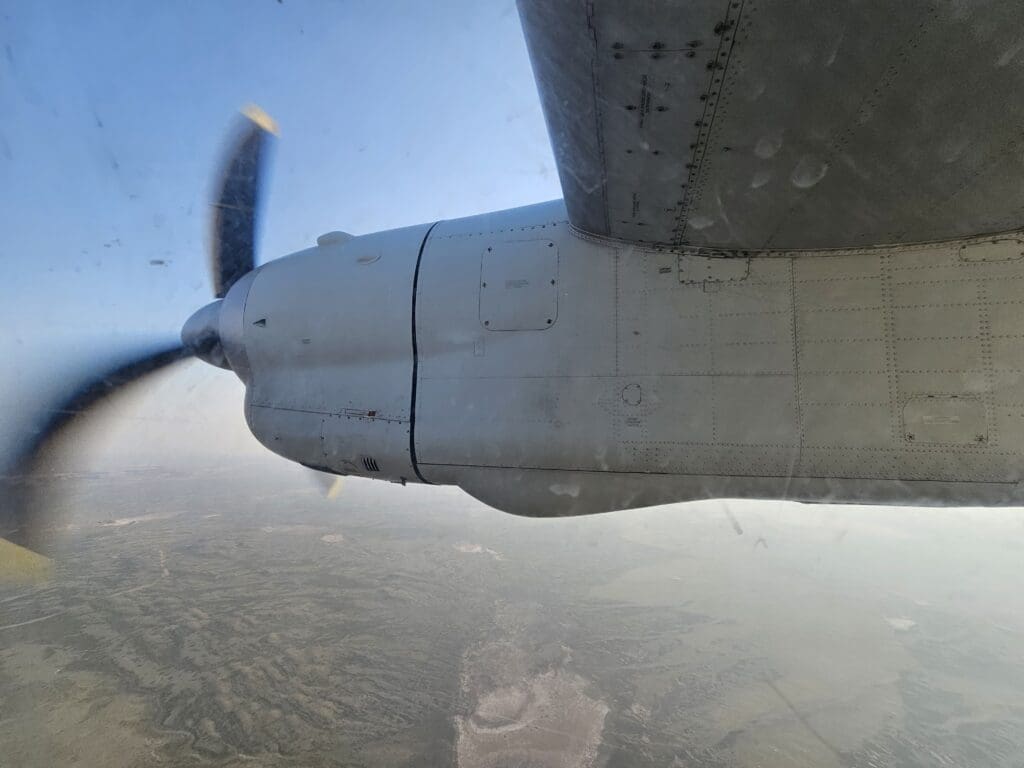

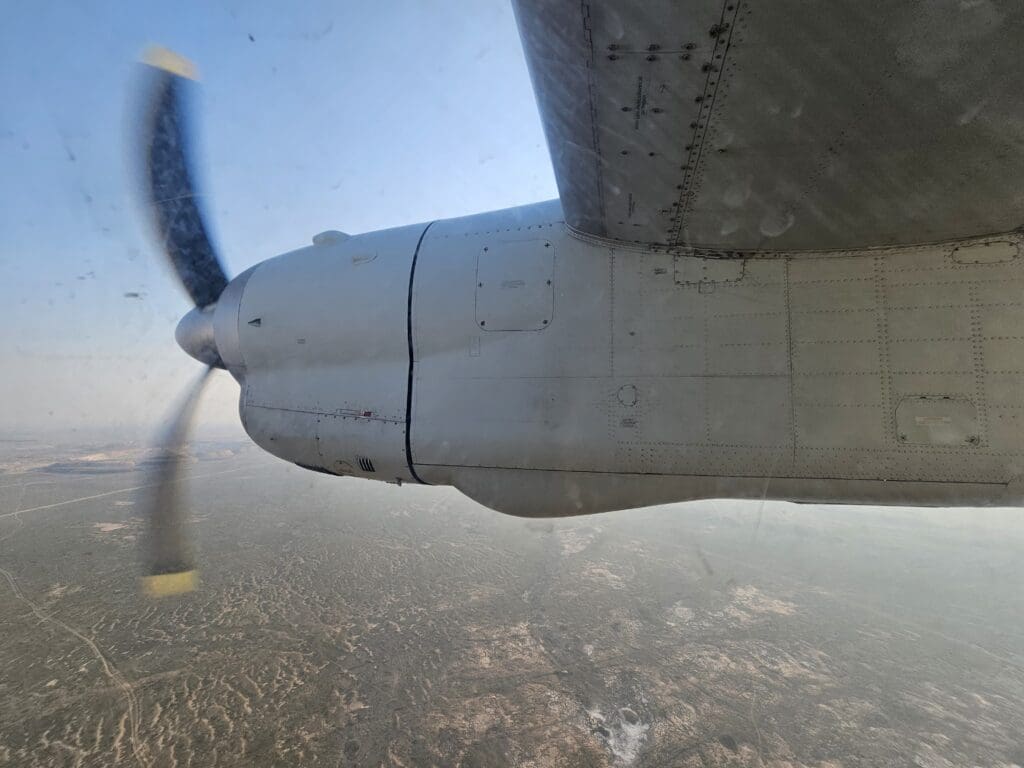
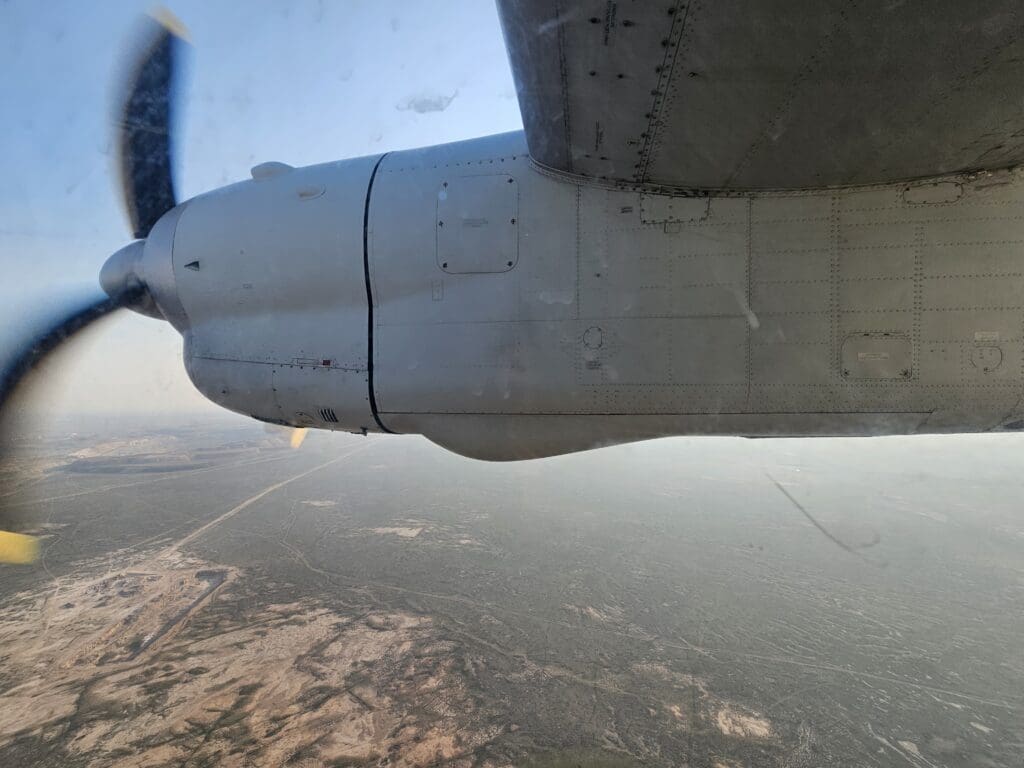
A couple of minutes after the Antonov had begun its journey back to earth, the long and straight M-36 road appeared and several large lorries could be seen hurtling along this as they cut through the sandy-coloured landscape below. Approaching Balkhash from the north, few signs of human life other than the aforementioned road could be seen until all of a sudden a series of gigantic mounds sprung up out of nowhere, with these presumably spoil heaps from the nearby Konyrat Copper Mine. After passing these, any obvious sign of human life faded away once more and the gear fell down into position indicating that the flight was nearing its end.
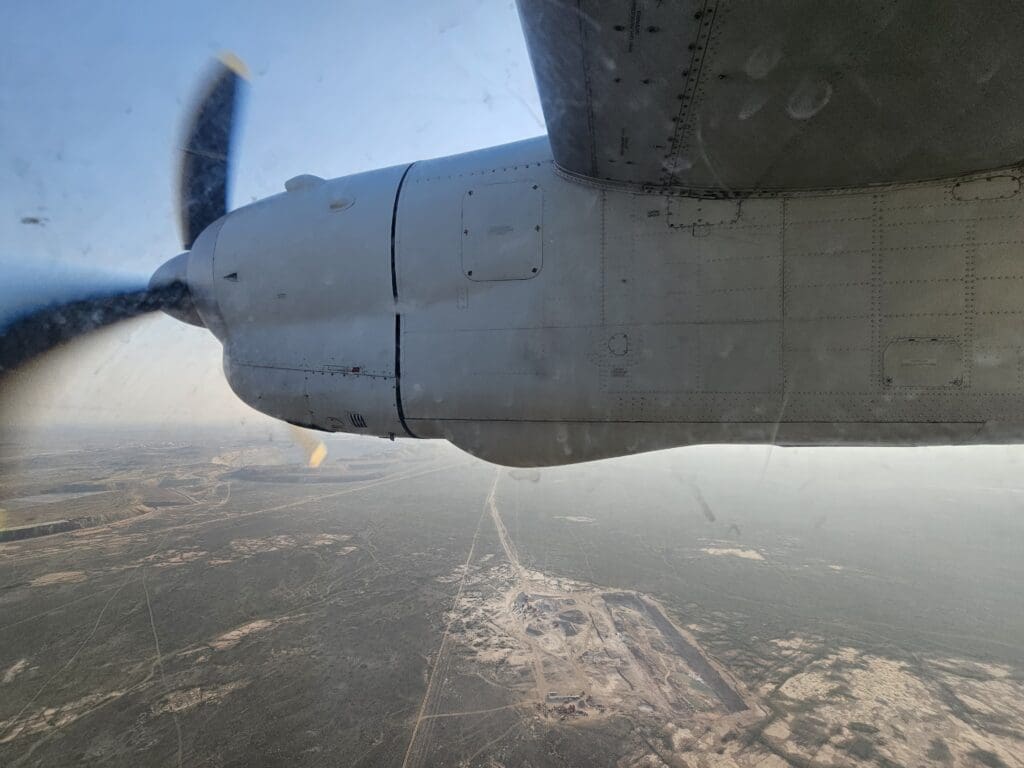
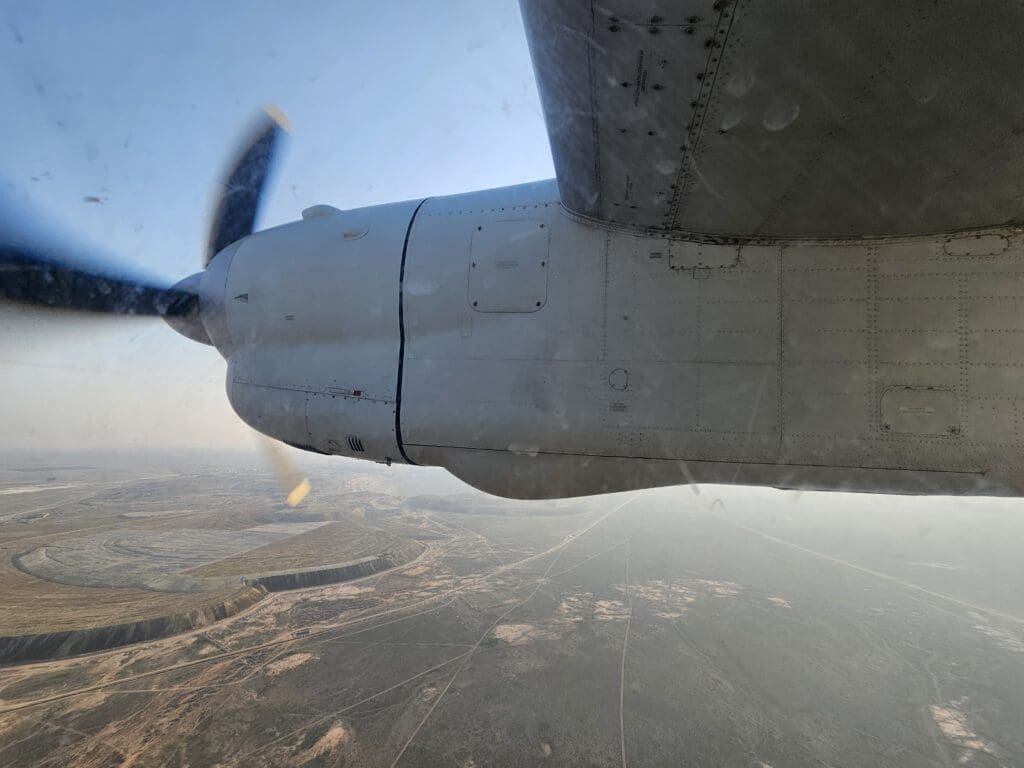
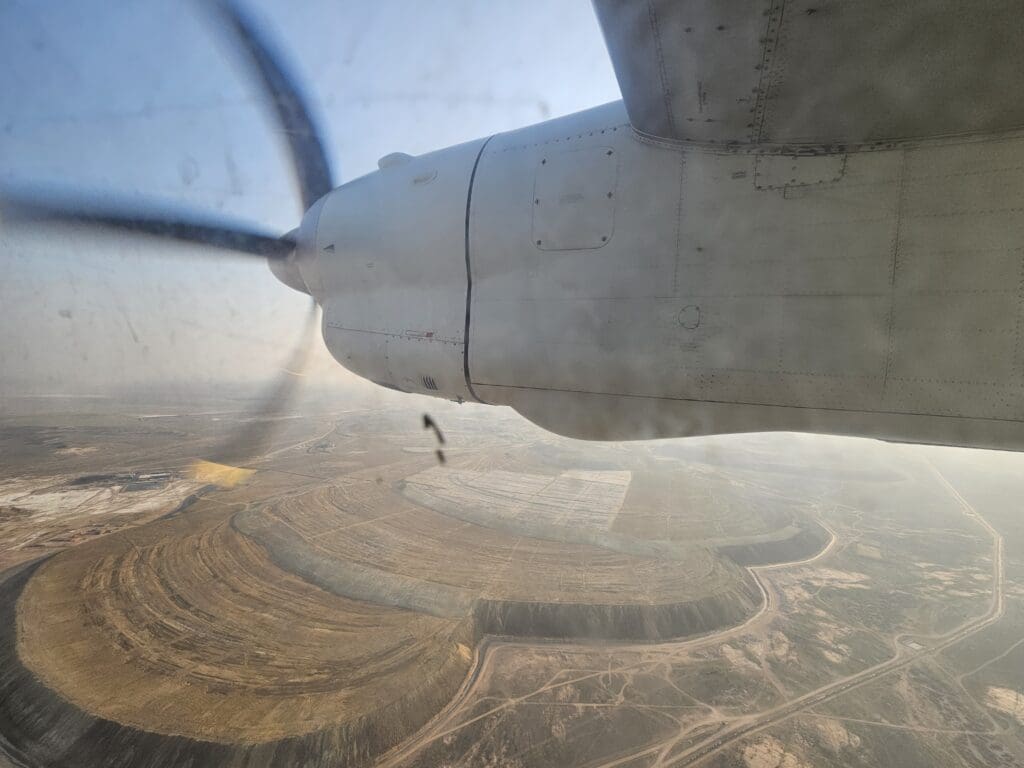
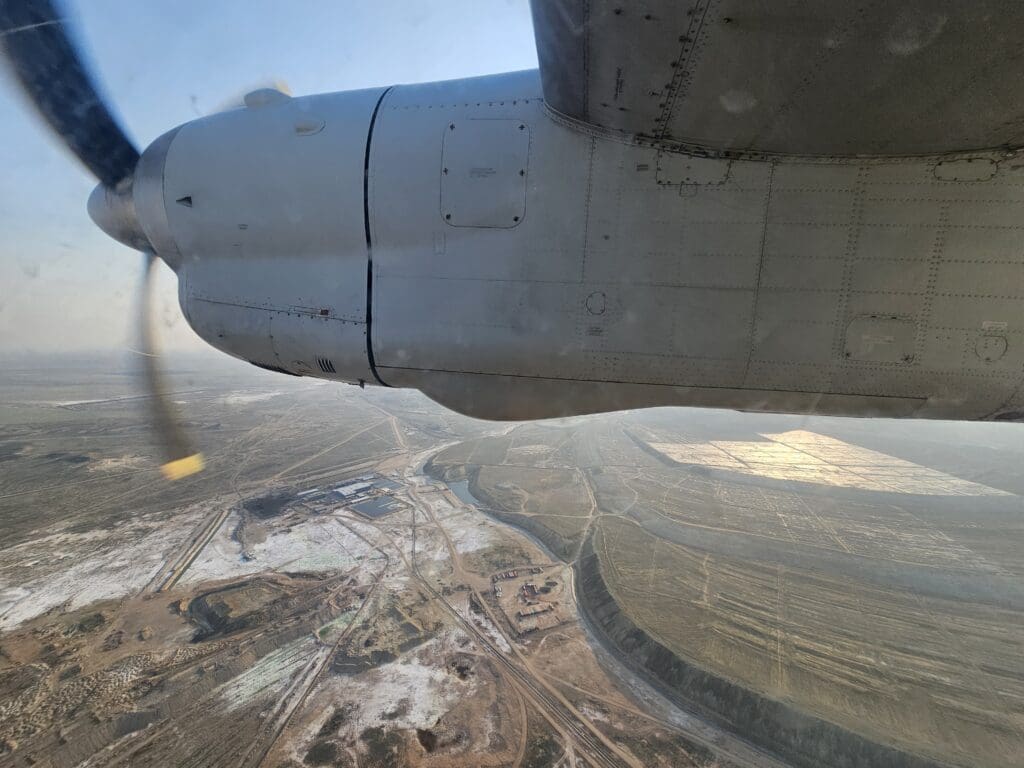
Once the gear locked into position, the descent rate increased and we sank down towards the flat and empty landscape below where nothing other than a few dirt tracks could be seen. Whilst first-timers may have been convinced that we were about to land on a dirt strip, seconds before touchdown a near-invisible fence whizzed past below and at 1849, an hour and twenty minutes after taking to the skies, the Antonov was placed down on the concrete surface of Balkhash Airport’s 2502-metre long runway.
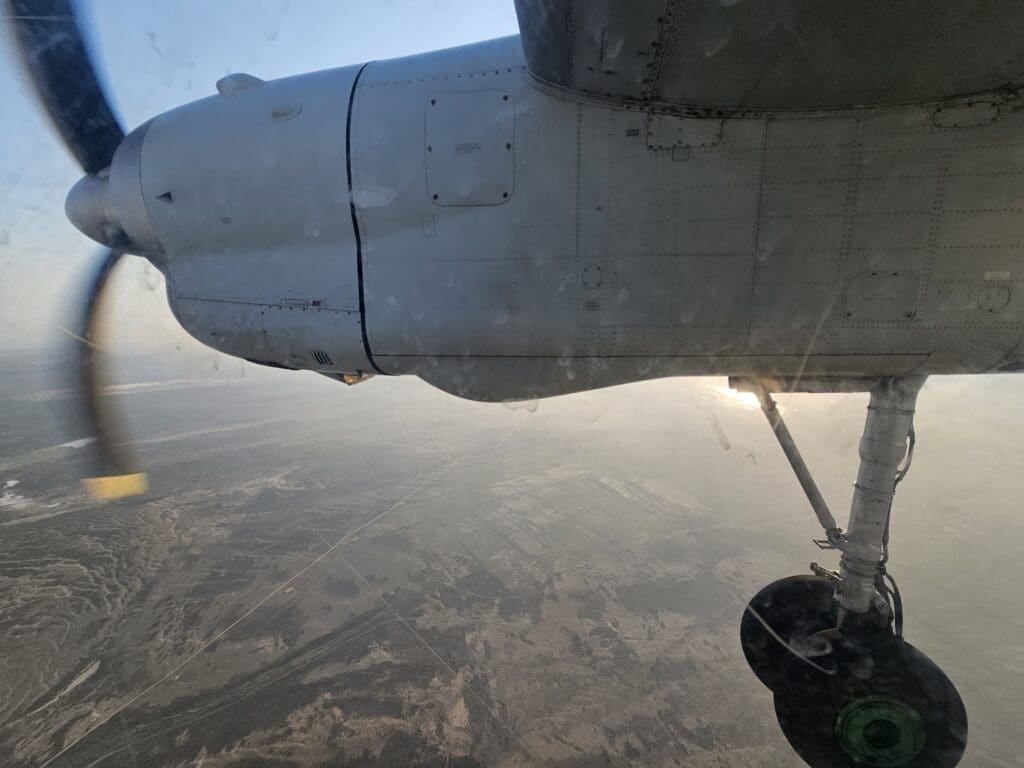
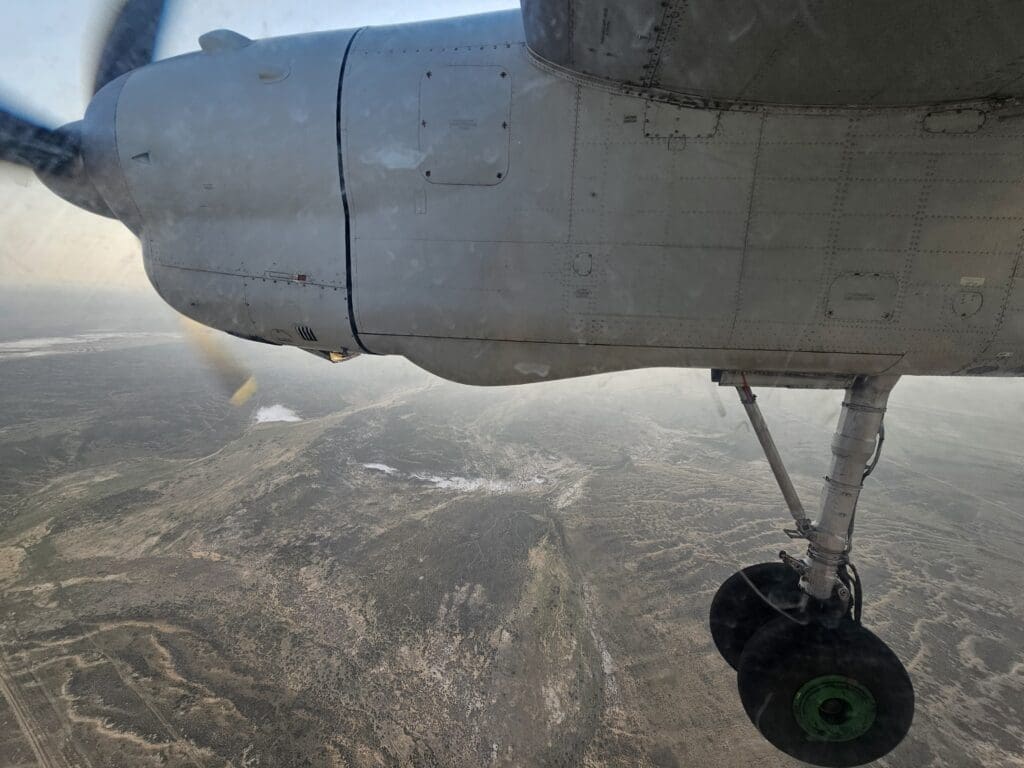
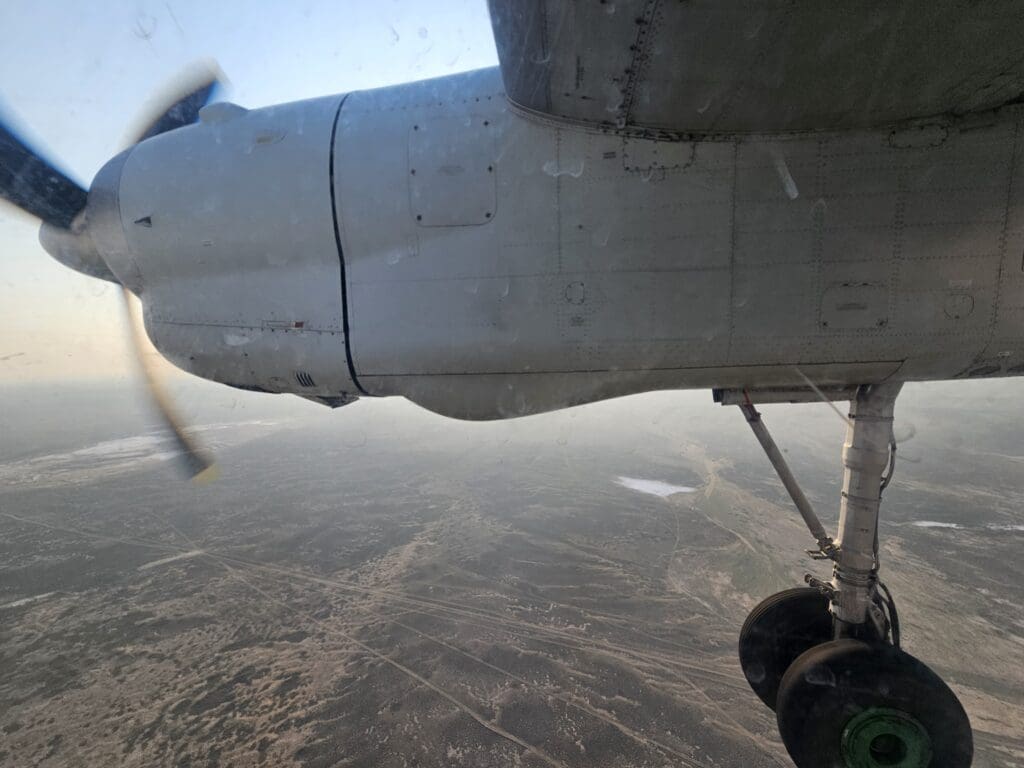
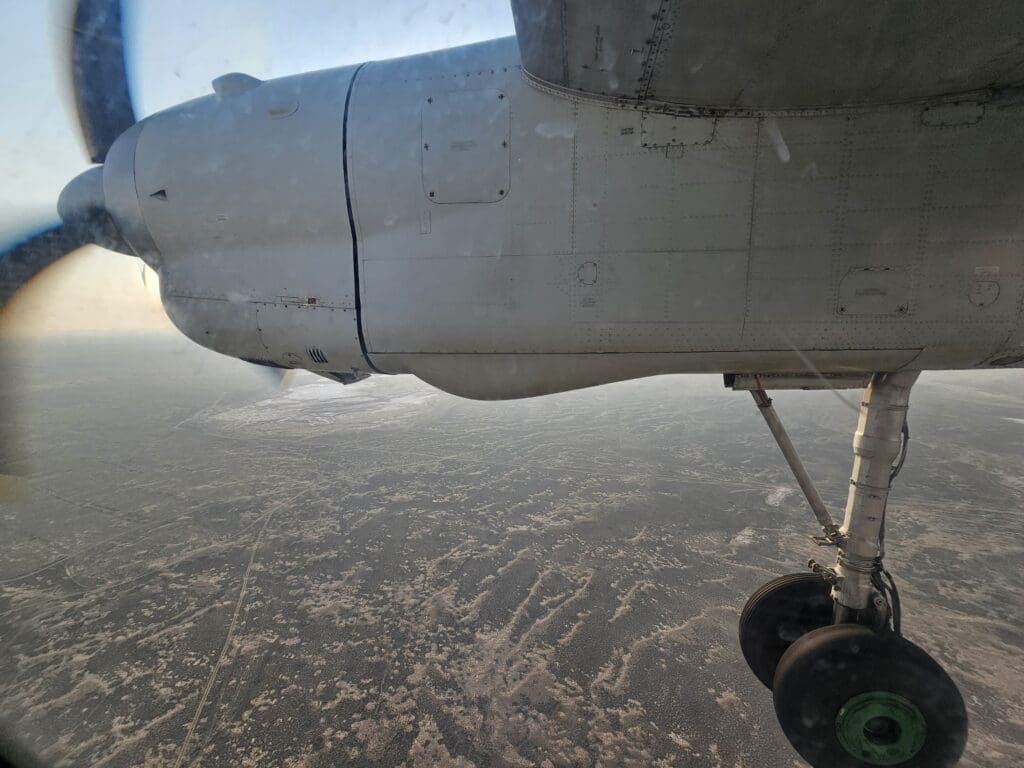
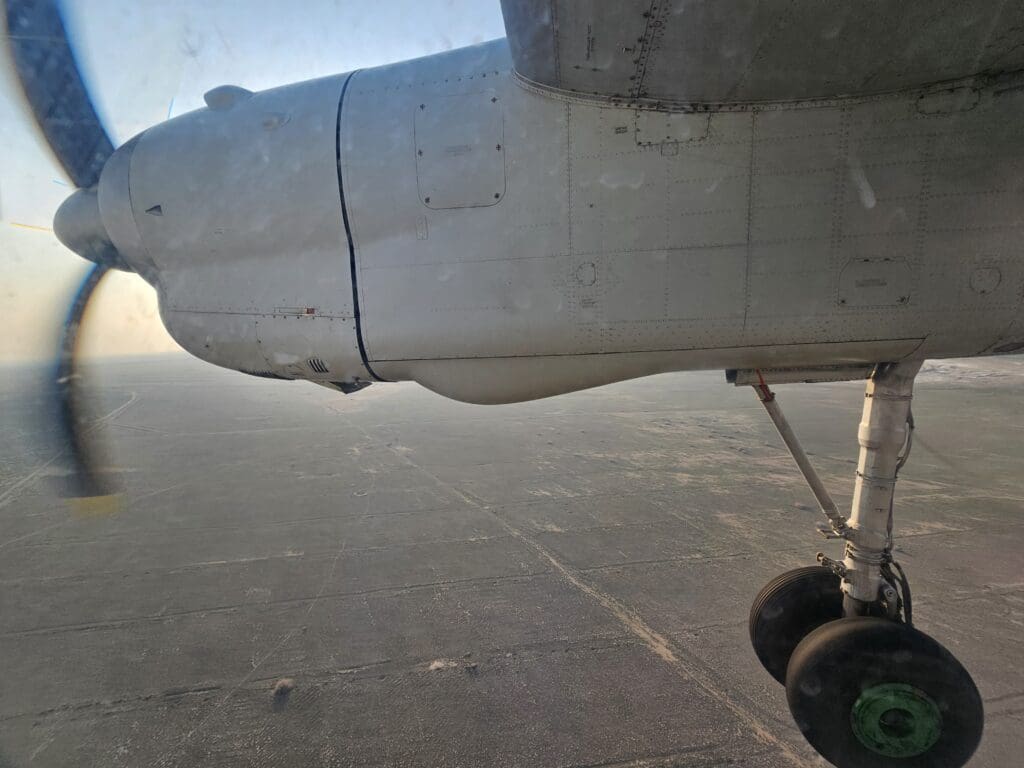
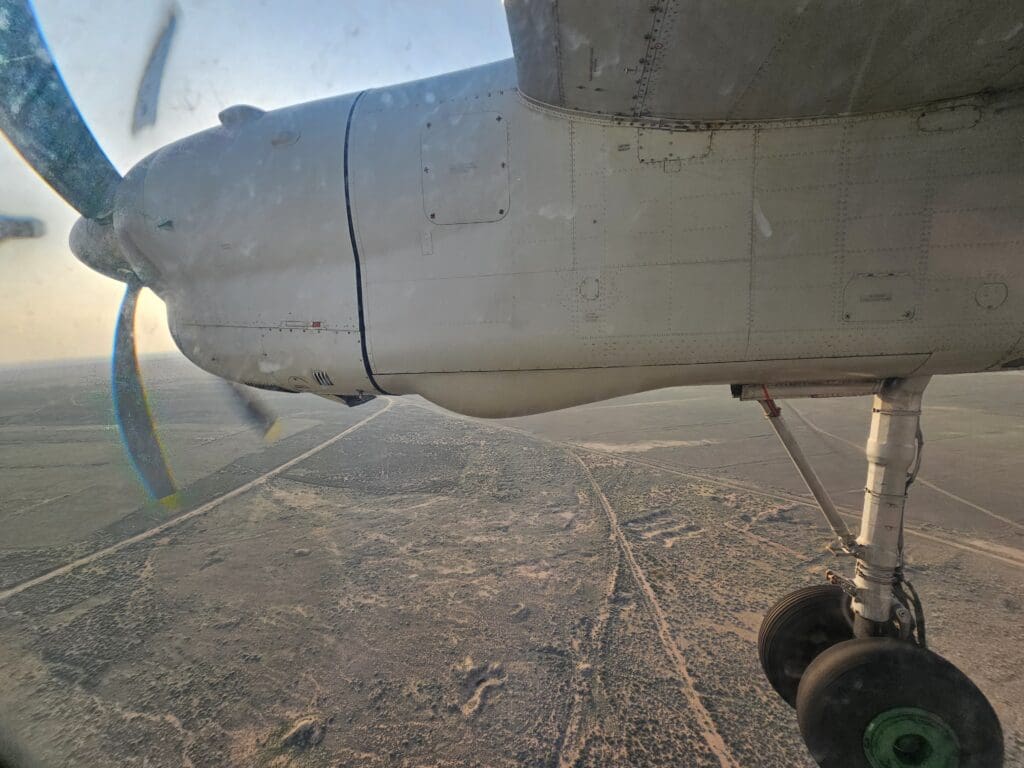
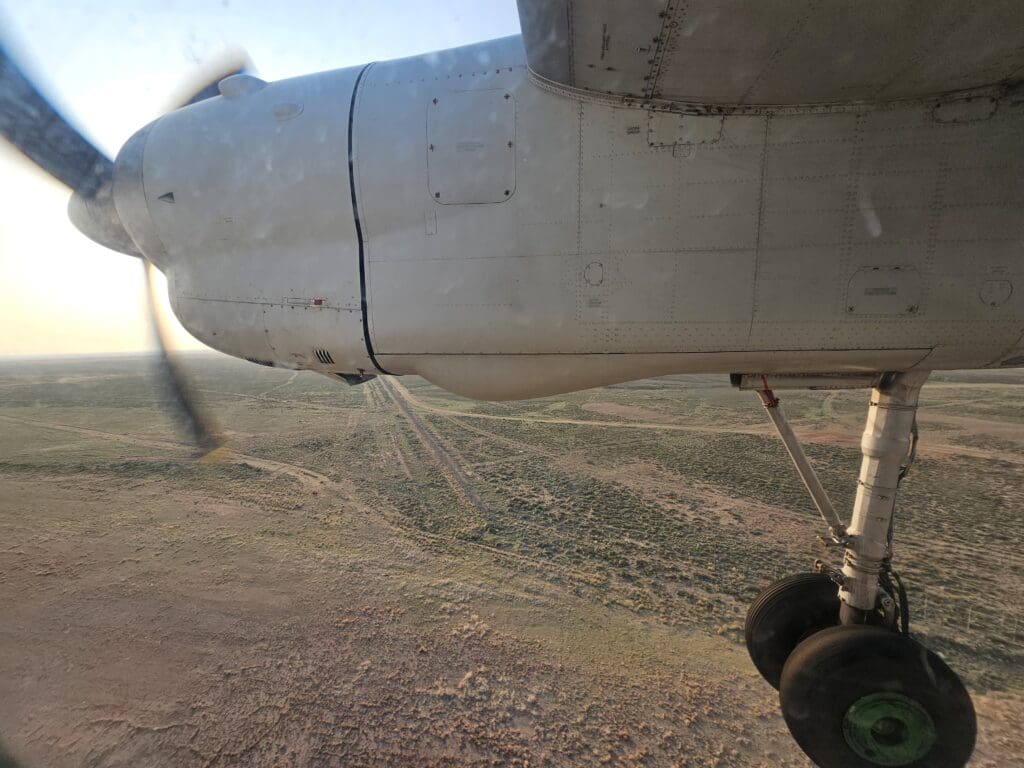
Touching down with a firm thud and a puff of white smoke, the Antonov then decelerated rather rapidly as a round of applause broke out through the cabin, lasting for several seconds. Whilst serving scheduled flights to Almaty and Astana, the airfield primarily serves as a key base for the Kazakhstan Air Defence Forces and as the aircraft slowed, the many reinforced shelters and other buildings associated with this role came into view. As per information found online, the airfield is home to a very eclectic collection of aircraft – namely the Antonov An-2, Eurocopter EC135, Aero Vodochody L-39Cs and Sukhoi Su-30SMs. However, during my short stay on the ground, these were either well hidden or all up in the air as nothing of any of these could be seen.
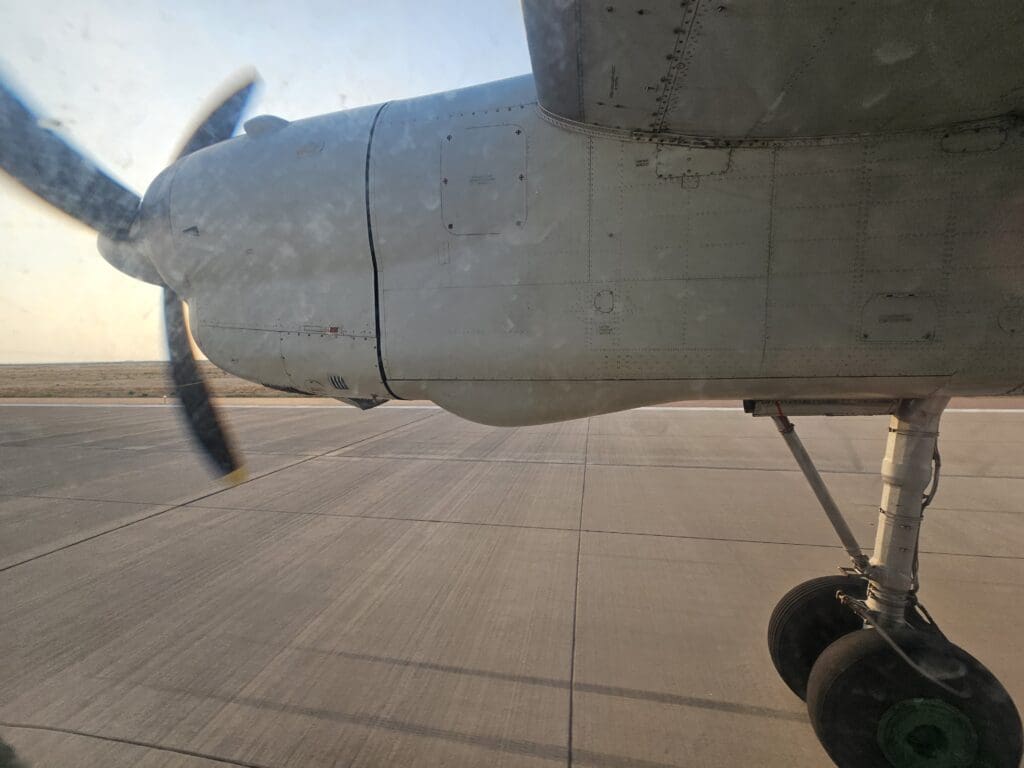
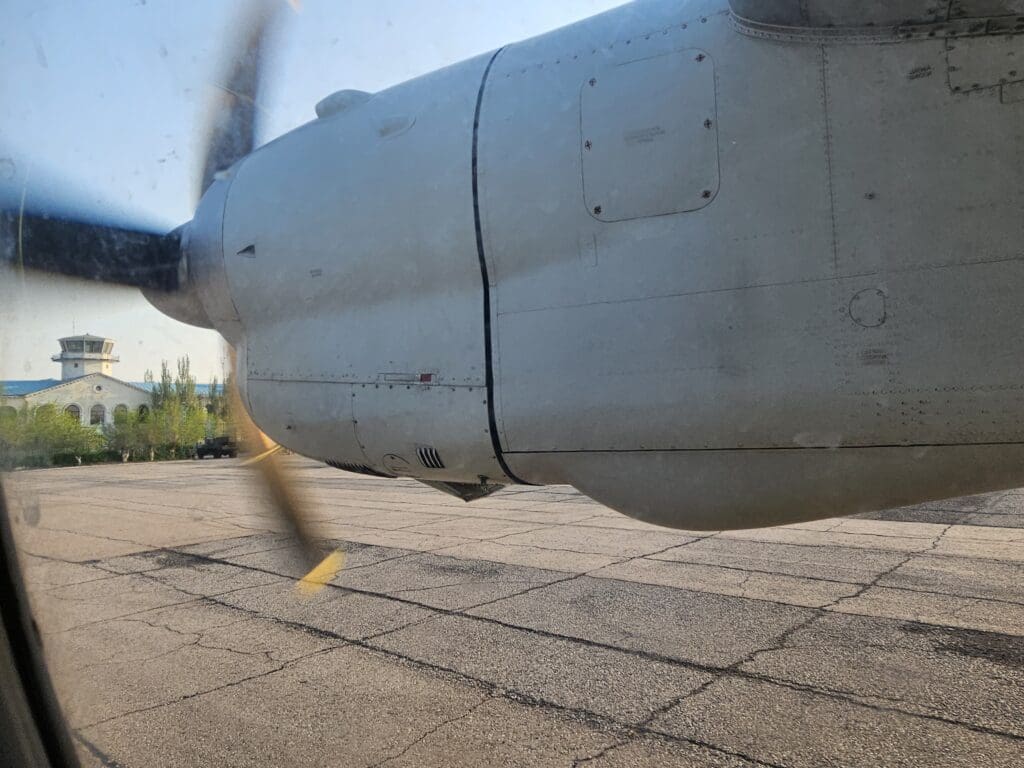
After slowing to a safe taxi speed, the Antonov took the third and penultimate exit from the runway and made a quick taxi in a straight line all the way to the small civilian apron located in the southwestern corner of the airfield. There, an ‘old’ and ‘new’ terminal could be seen. Focusing on the former, this takes the form of a green-coloured structure in a Stalinist style, which, as with a number of Balkhash’s buildings, was constructed in the late 1940s by Japanese prisoners of war awaiting release. The newer terminal is a far more non-descript single-storey structure which features a single check-in counter, security checkpoint and waiting area. Seeing a grand total of two arrivals and two departures each day (as per May 2023 schedules), Southern Sky Airlines provides Balkhash with an important link to Kazakhstan’s two largest cities. Although for those not wishing to fly, Astana can be reached by a direct fourteen-hour train ride whilst I believe a journey to Almaty would be slightly longer and require a change of trains. Upon coming to a halt, the two engines spooled down and the cabin was temporarily filled with silence. Moments later, the captain burst out of the cockpit and received a round of applause, repeating ‘spasiba’ as they made their way to the rear of the aircraft to open the cabin door. As soon as the door had been opened and the Antonov’s built-in steps extended, the flight attendant said a few words in Russian at which point passengers stood up and disembarkation commenced.
With most passengers lacking extravagant levels of hand luggage, it wasn’t long before all passengers had made their way out of the aircraft at which point I moved back to my new home, seat 9D. Unsurprisingly, I was the only passenger continuing onwards to Almaty and after all had made it off the aircraft, the casual clothes-wearing dispatcher headed onboard and partook in a loud and seemingly heated conversation with the flight attendant. Soon settling down in my new seat, I found this to be as comfortable and spacious as 3D, and in the same reasonable condition with relatively few signs of wear and tear considering the Antonov’s old age. On a side note, I did notice that there were no hatracks above the seats from row 7 to the rear of the aircraft meaning that those in these rows either had to squeeze their hand luggage under the seats or ask for the flight attendant to store them in the rear cargo hold. On the flip side, this did create a more airy, bright and spacious atmosphere and created what may be considered to be the Soviet version of Boeing’s Sky Interior.
Turning my attention outside, as soon as all inbound bags had been loaded off the aircraft, the loading of luggage of those bound for Almaty began to be loaded by hand into the forward cargo hold. Meanwhile, as soon as the dispatcher and flight attendant had ended their argument and filled in a few forms, at 1904 a new load of passengers walked over from the terminal building and boarded the aircraft. On a side note, perhaps owing to the crew wanting to make the turnaround as short as possible or perhaps to make up for lost time, no rubbish was picked up from around the seats by either the flight attendant or any other member of staff during the turnaround. As had been the case in Astana, boarding was by no means a lengthy process with all passengers managing to make it onto the aircraft in the space of about four minutes. That evening, the flight to Almaty ended up being totally full and I failed to spot an empty seat anywhere in the cabin. To my surprise, I was not to be the only foreigner onboard the service, with one traveller from Malaysia also heading down to Almaty that evening. Unlike the first sector, this sector appeared to have far more leisure passengers and families, with very few smartly dressed business people seen.
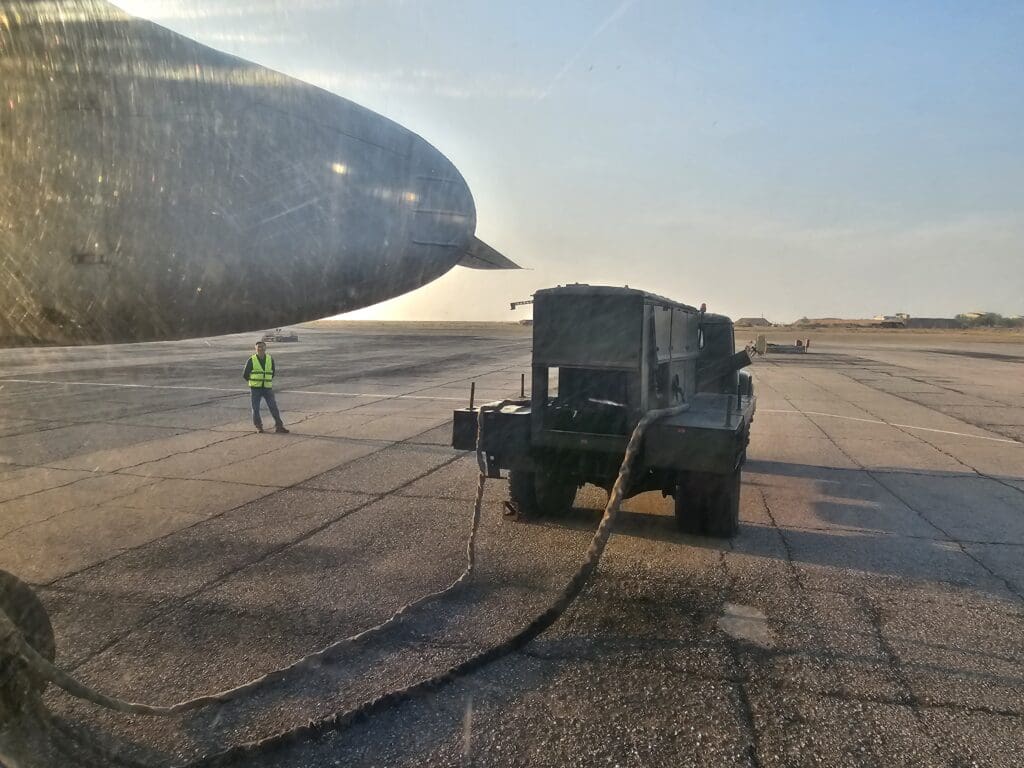
Indicating that our departure was near, I watched as what appeared to be an air start unit on the back of an old Soviet-era military truck was backed up to the aircraft and plugged in. Meanwhile, at 1911, the captain pulled in the built-in steps and closed the cabin door them before heading up to the cockpit. Moments later, the air start unit smoked into life before the now familiar loud and high-pitched whine rang out and filled the cabin before the two elderly Ivchenko engines powered up and created plenty of noise and vibration as the propellers began to whirl into life.
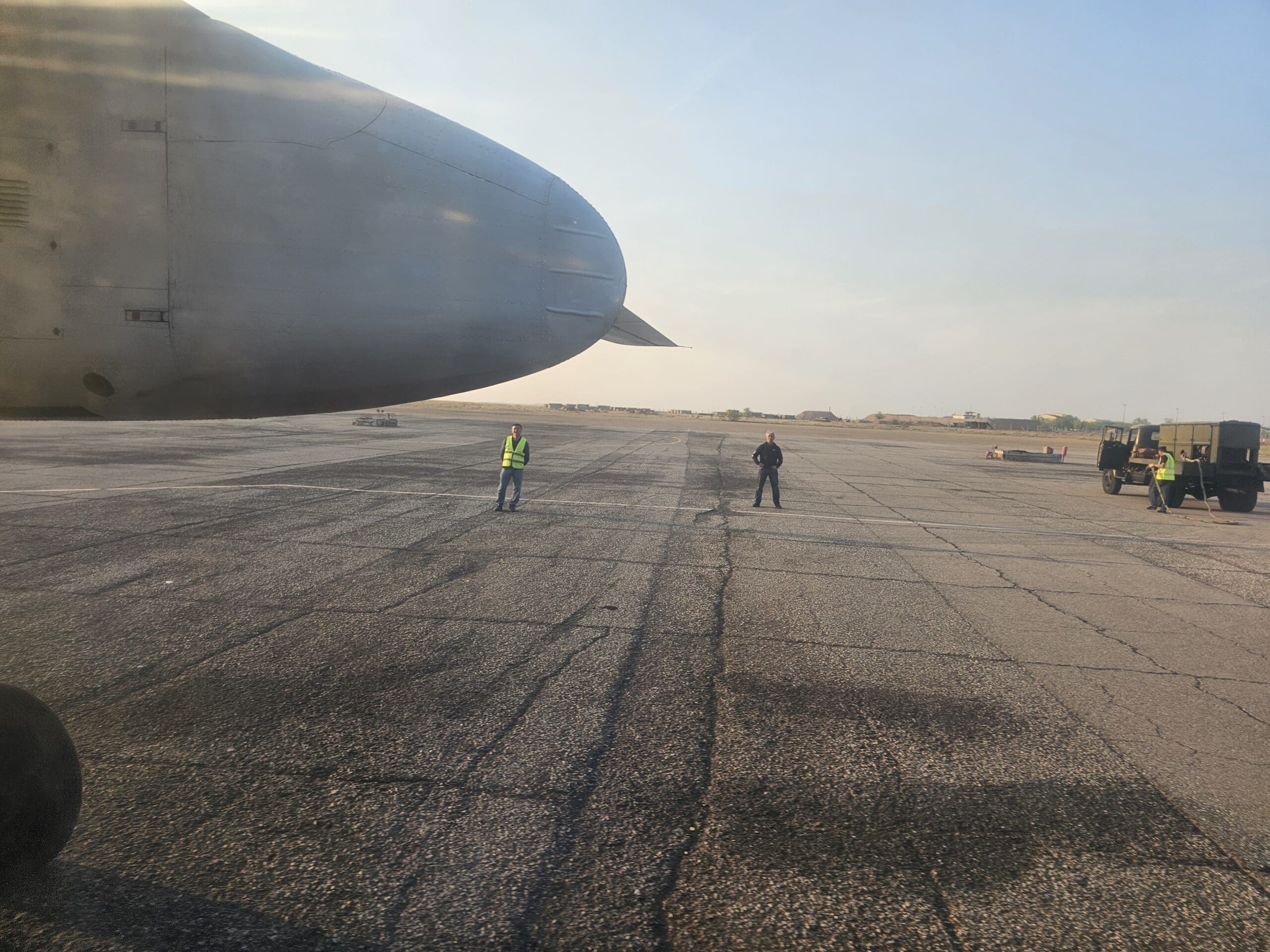
Inside the cabin, the flight attendant performed their welcome announcement in Kazakh and Russian once again, before strapping themselves into Seat 1A. Glancing through the porthole, I watched in awe as one of the brave and perhaps hard-of-hearing staff members stood a very short distance away from the engine whilst this was powered up without ear defenders or any sort of reflective jacket, spending around thirty seconds just standing this attempting not to get knocked over by the propwash before disconnecting the air starter unit! Once this had been disconnected, one of the ground crew members gave a thumbs up to the cockpit crew and the Antonov powered forward out of its parking position before making its way back down the taxiway.
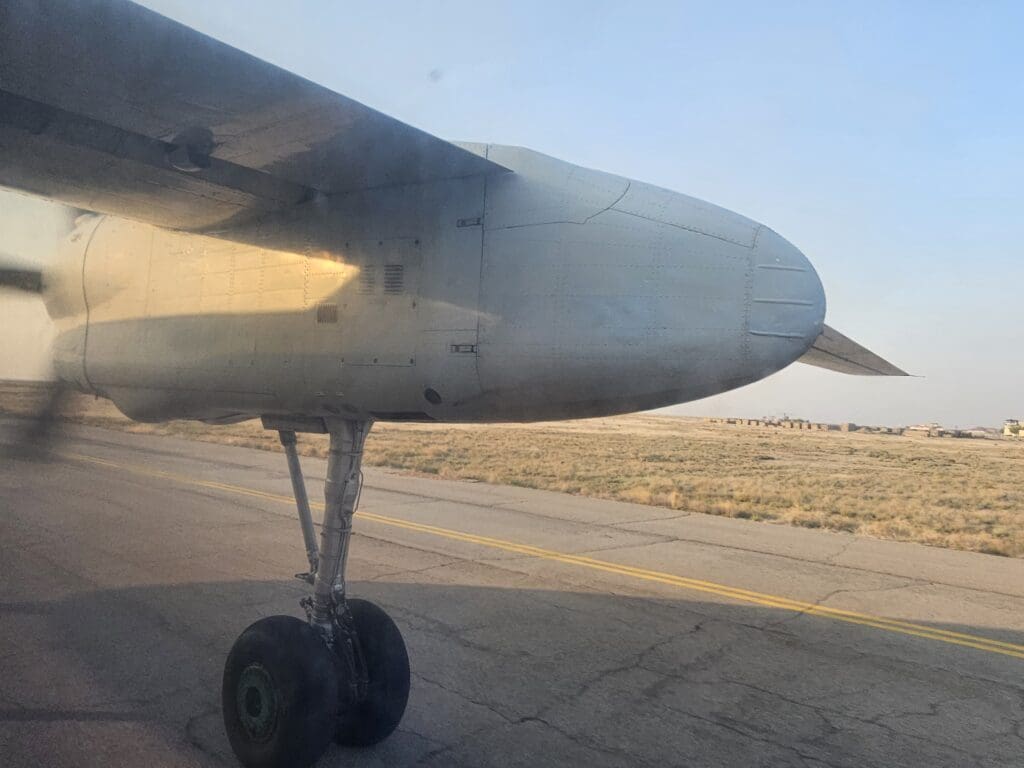
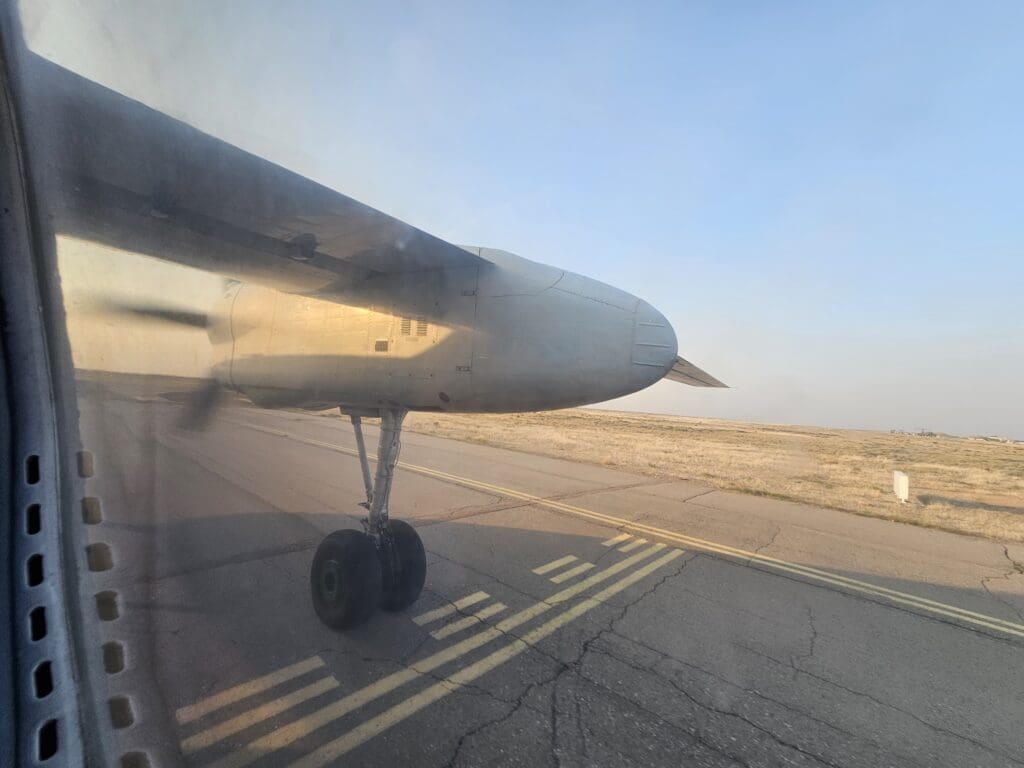
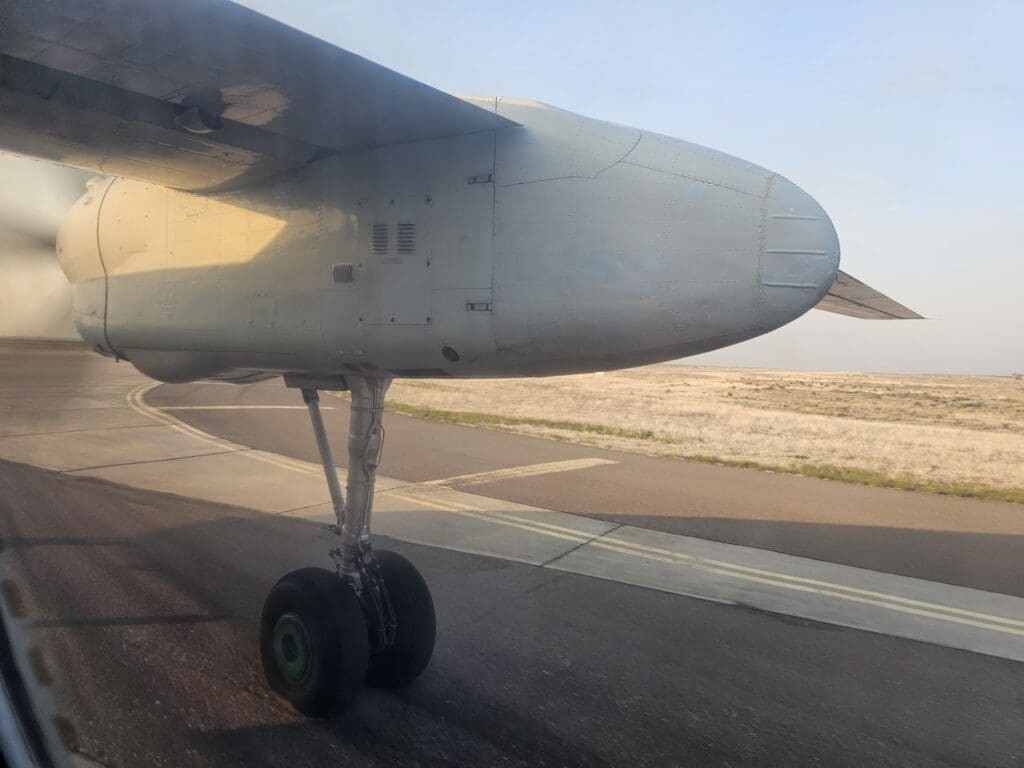
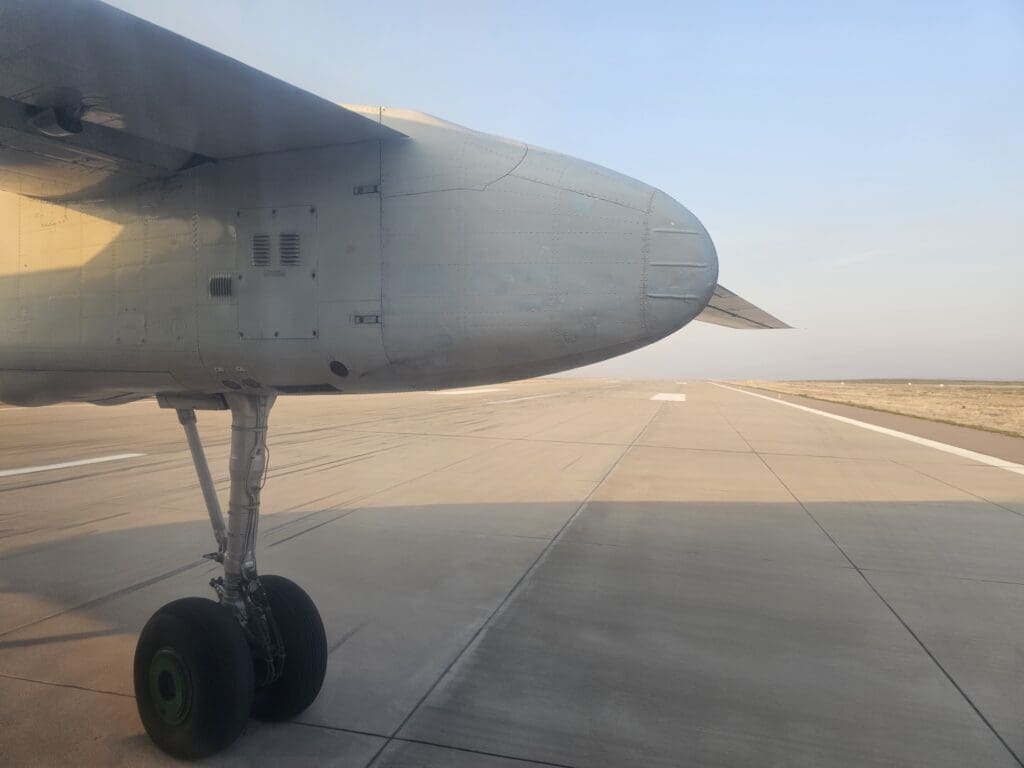
With no other traffic that evening, upon reaching the runway no waiting was required before the Antonov lumbered onto this and commenced a high-speed taxi to its northeastern end before coming to a noisy halt. At 1920, the Antonov’s two trusty Ivchenko engines filled the cabin with extreme levels of noise and vibration as we began our powerful take-off roll down Runway 23. Once we had picked up some speed, it wasn’t long before the aircraft gently rotated upwards into the sky, its landing gear appeared to be retracted almost immediately after leaving the ground behind.
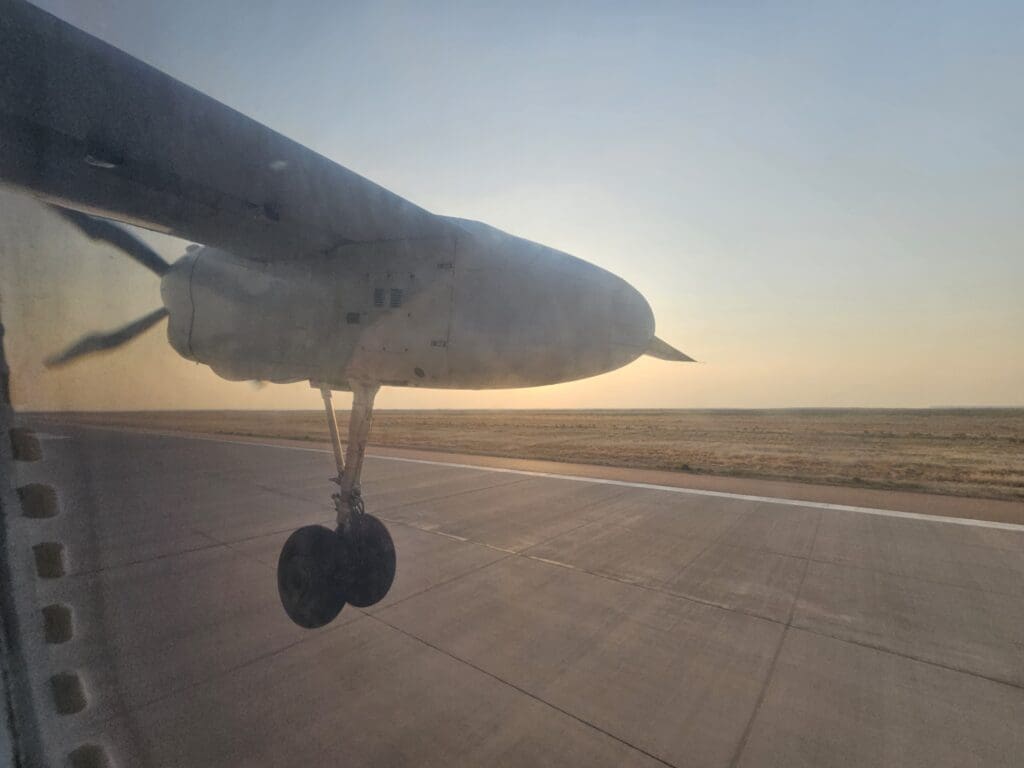
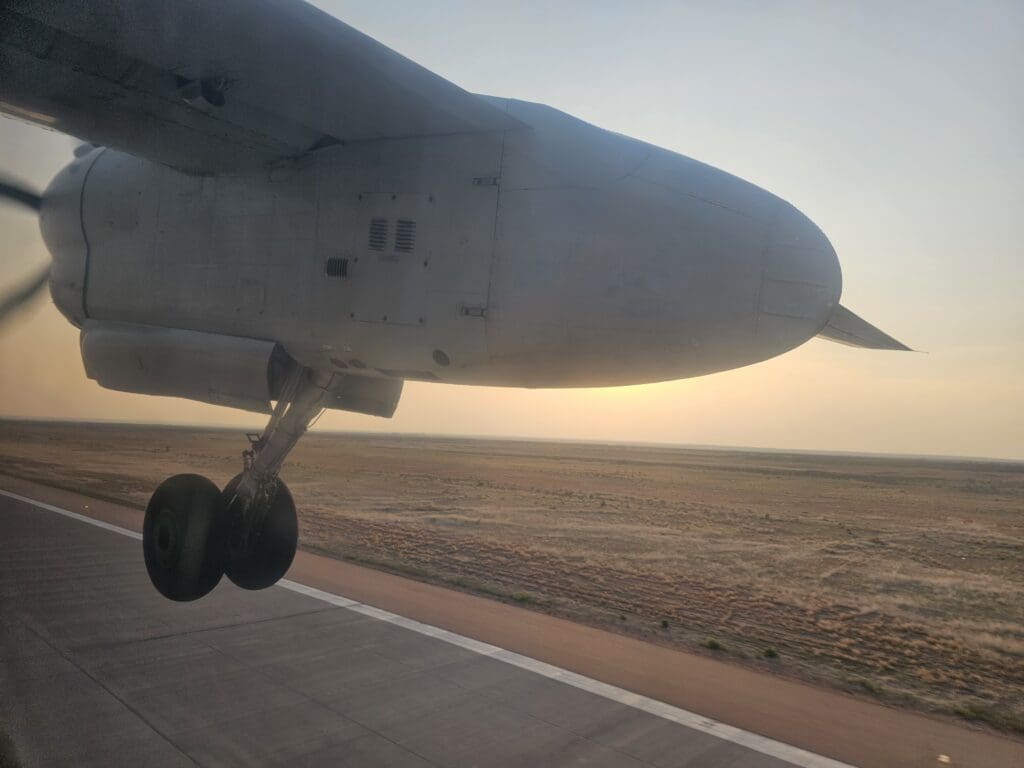
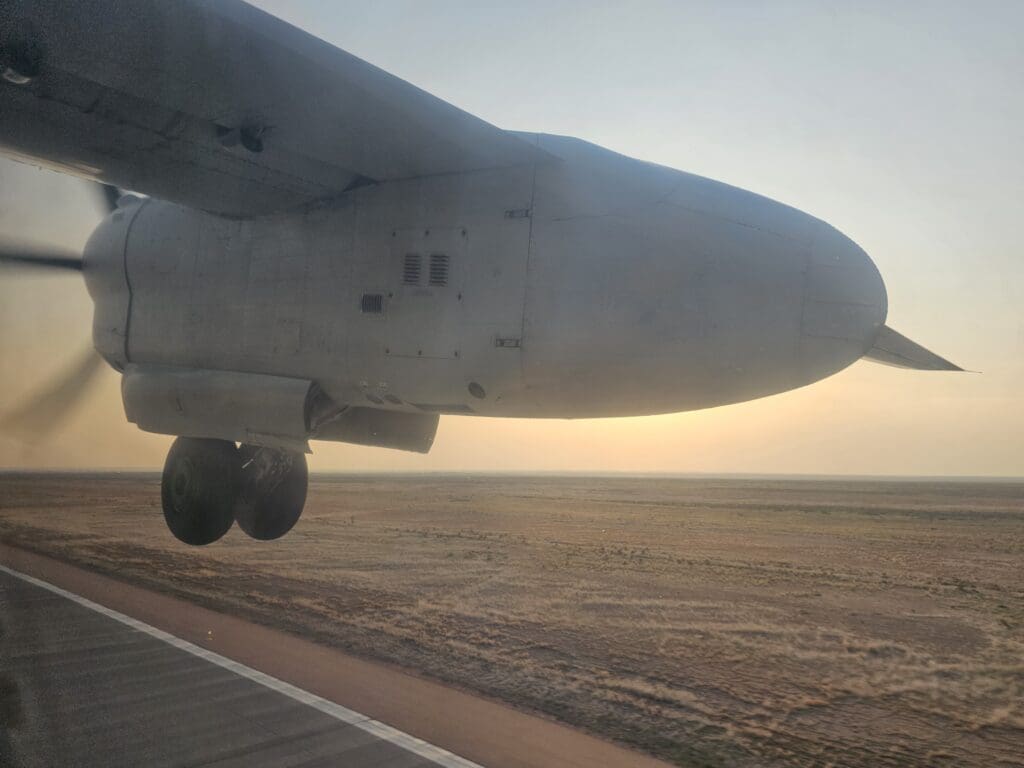
Almost as soon we had crossed over the perimeter fence, the Antonov banked to the left and made a beeline for the smoking chimneys of Balkhash. Whilst those on the opposite side of the aircraft would have been treated to good views of the city centre, for those on the starboard side of the cabin good vistas of the city’s industrial sprawl consisting primarily of copper smelting works could be had as we crossed right over this around a minute after departure. Moments later, the Antonov passed over the shoreline and climbed up over the blue waters of the world’s fifteenth-largest lake, Lake Balkhash.
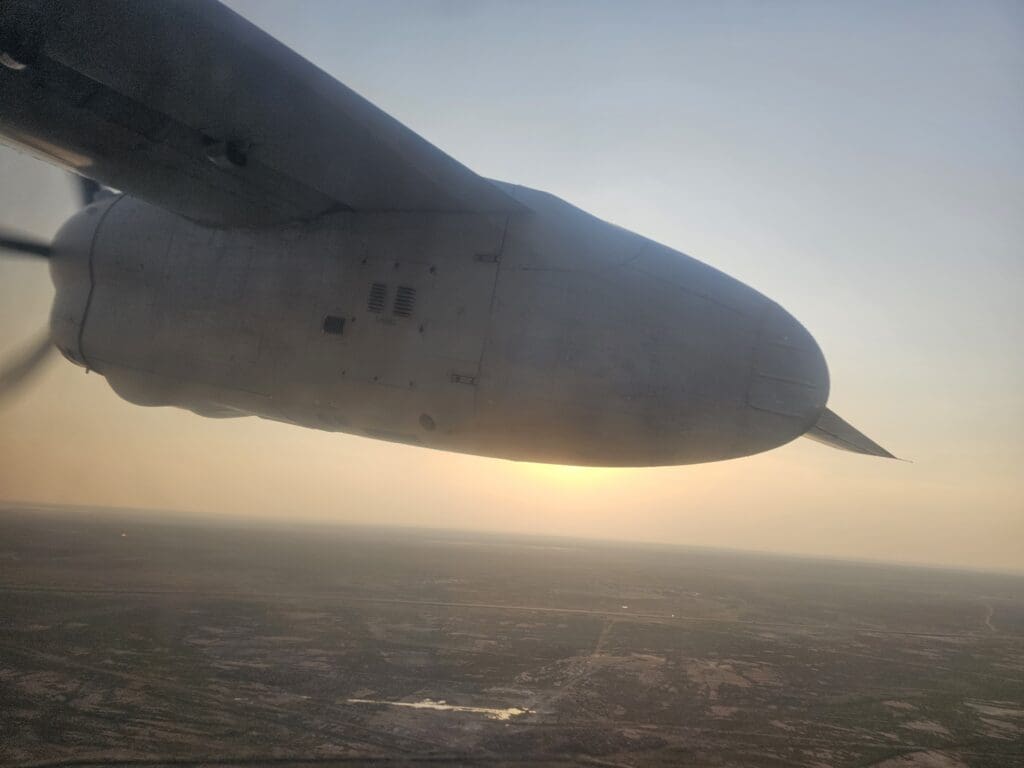
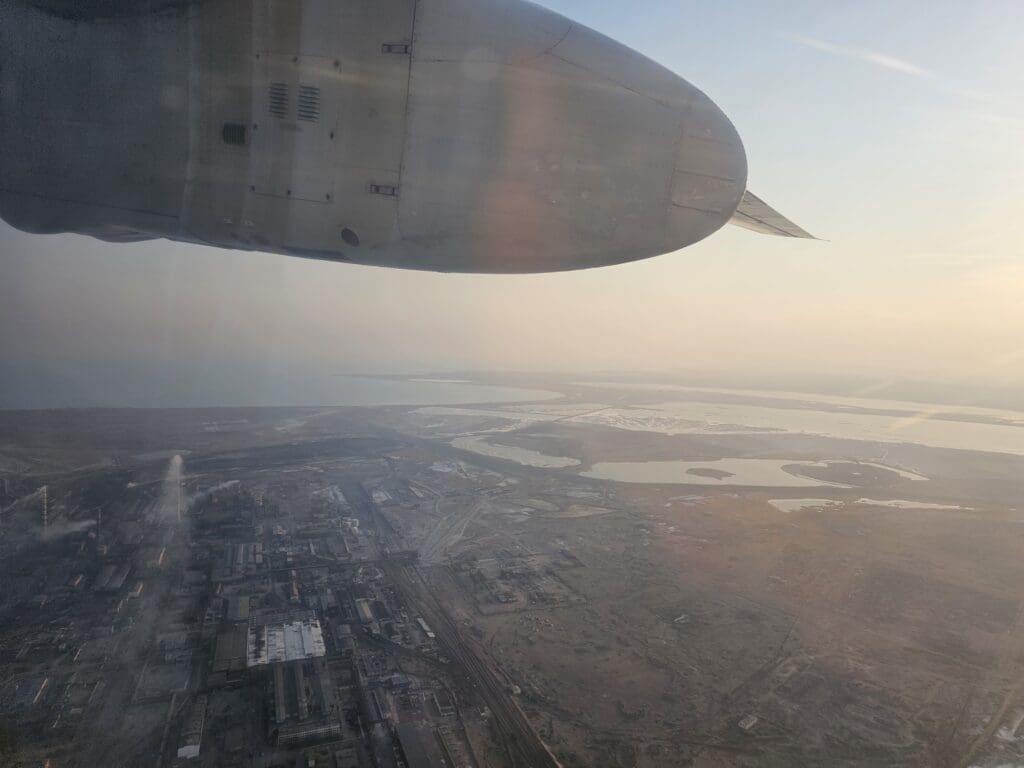
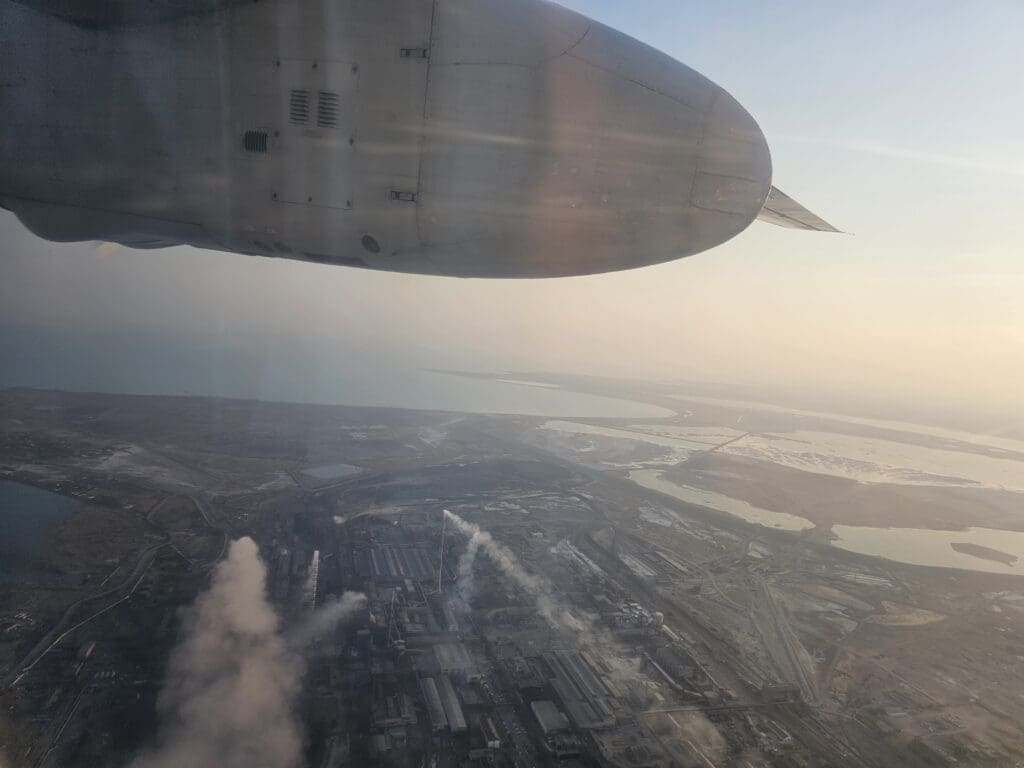
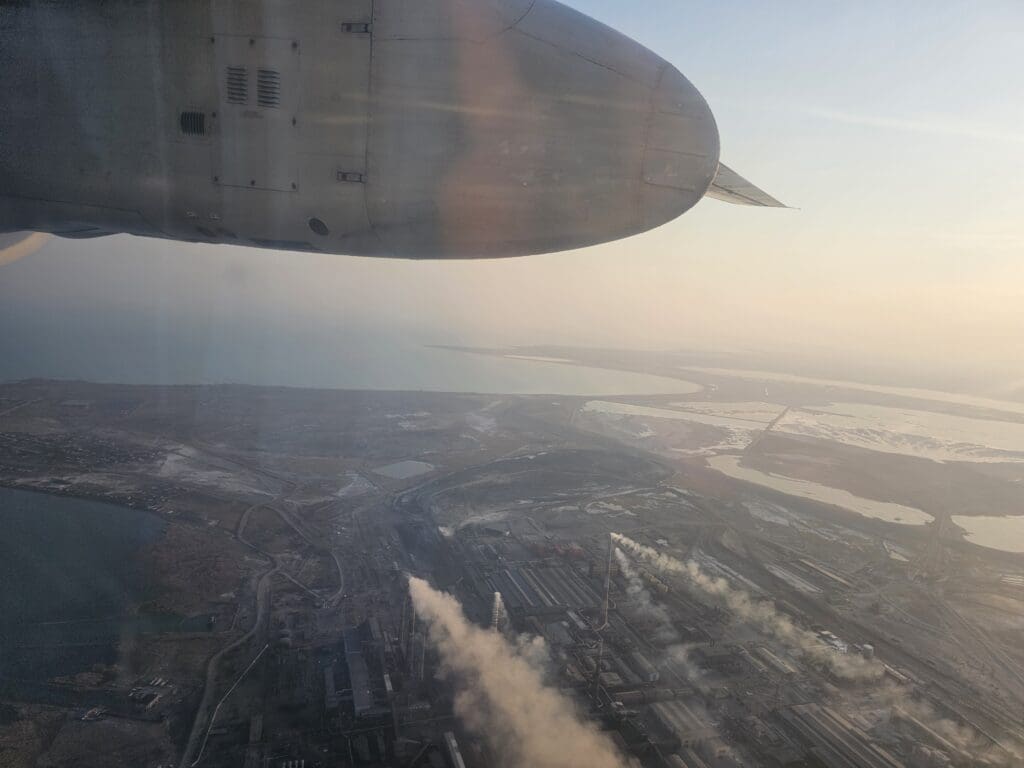
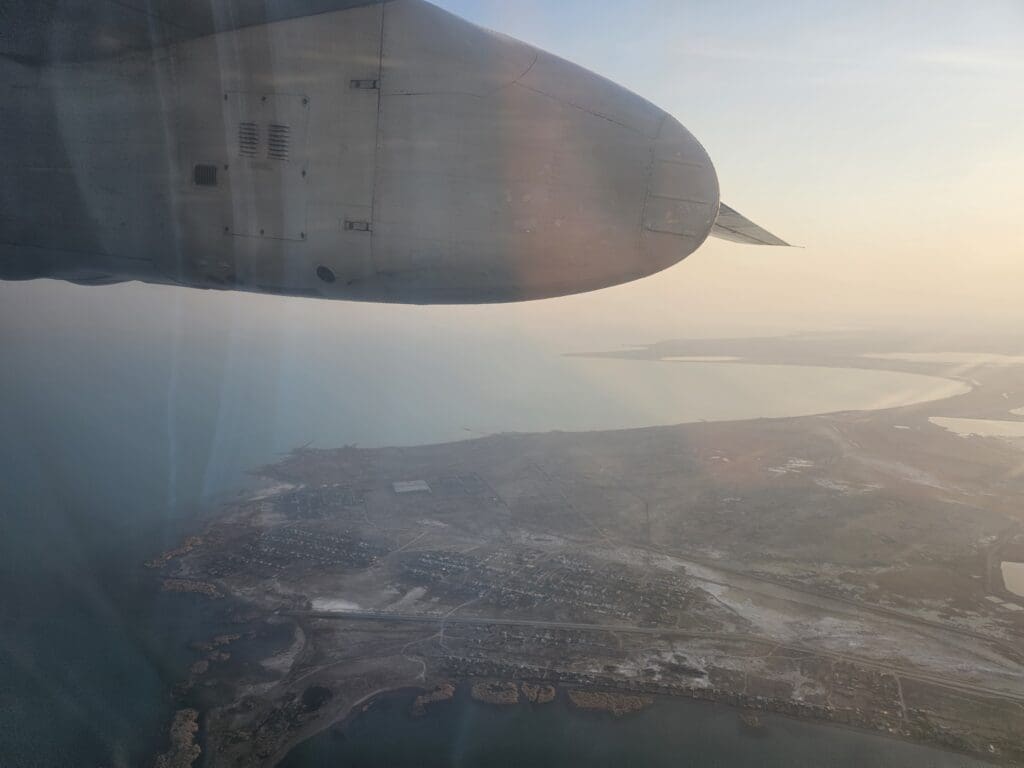
Unlike my journey northwards on a SCAT Airlines Boeing 737 the previous day, sadly the evening haze meant that little of this impressive lake could be seen as we levelled off and cruised southwards at our relatively low cruising altitude. Once again, as with the flight down to Balkhash, in spite of our smooth flight, once we had levelled off the seatbelt projection remained present although on this sector many more passengers opted to move about and use the bathrooms. Around eight minutes after leaving Lake Balkhash’s northern shores, the Antonov made landfall near the village of Tomar in Kazakhstan’s Almaty Region. From there, the aircraft took a fairly direct route to Almaty that involved a few turns until we were on approach to the airport.
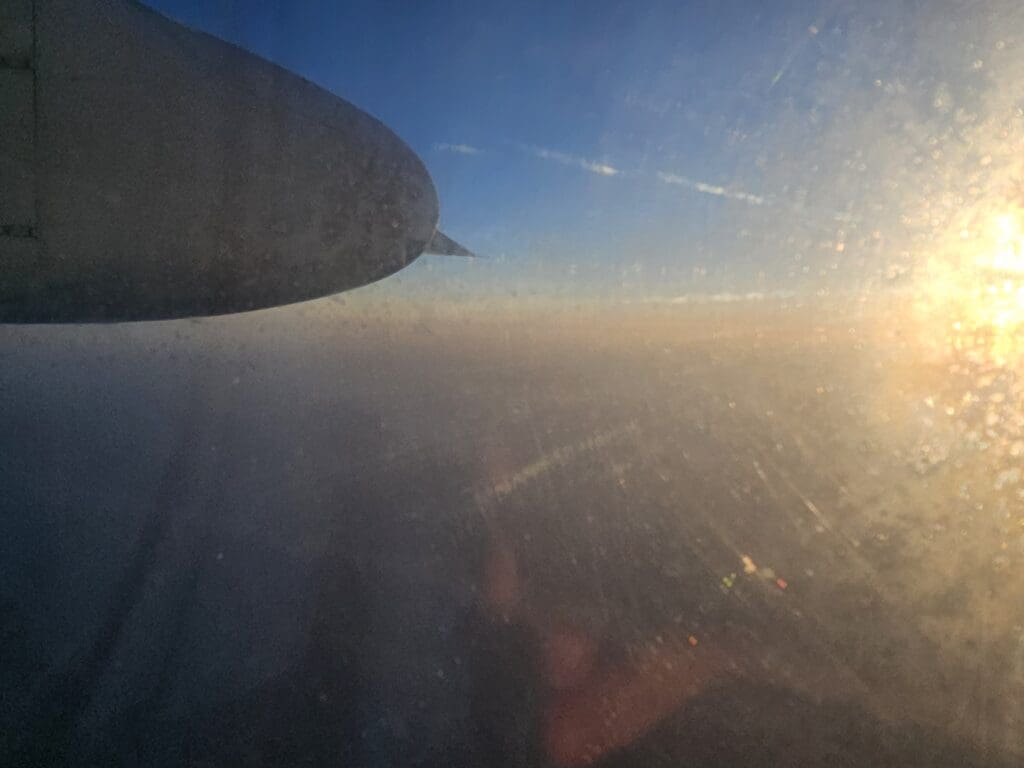
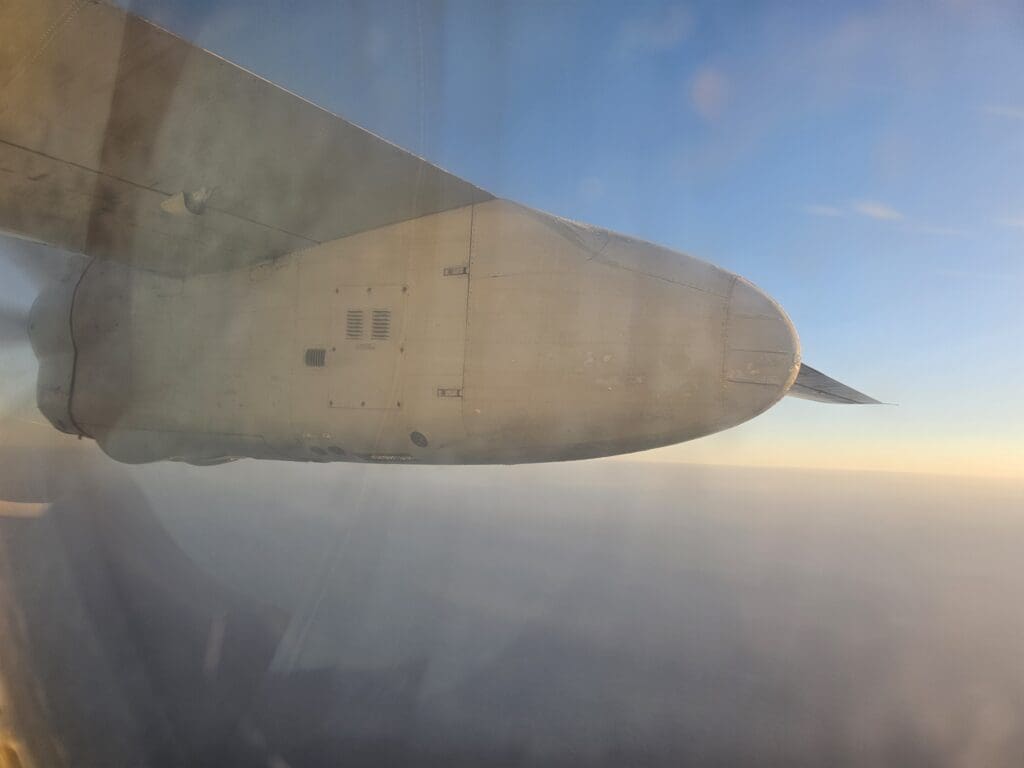
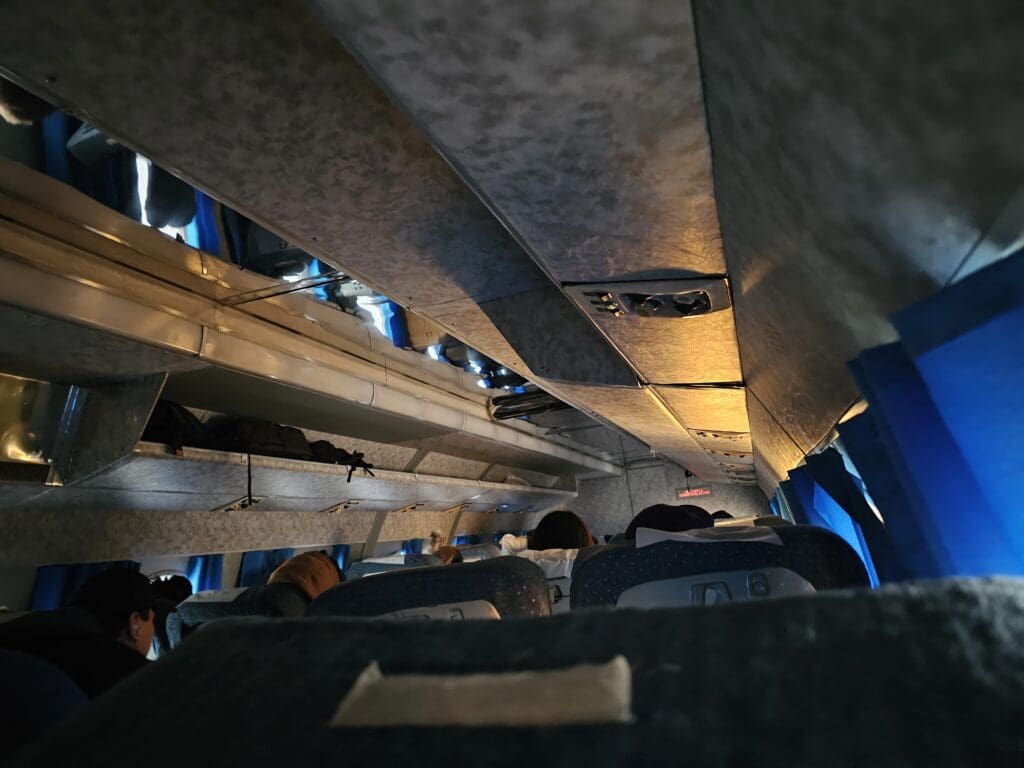
Whist the haze ensured that little of the sparsely populated landscape could be seen below, I was treated to a good view of the picturesque dusk skies outside. Unfortunately, the heavily scratched porthole ensured that my pictures do not do this any justice! Continuing through Kazakhstan’s southern skies onboard this Southern Sky Airlines aircraft, it wasn’t long before the sun sank below the western horizon and the cabin fell into relative darkness. As with the first sector, inflight service was non-existent and the flight attendant remained firmly in their seat as we cruised southwards. Meanwhile glancing around, many passengers appeared to either be fast asleep or passing the time on their personal devices – needless to say I appeared to be the only aviation enthusiast onboard that day!
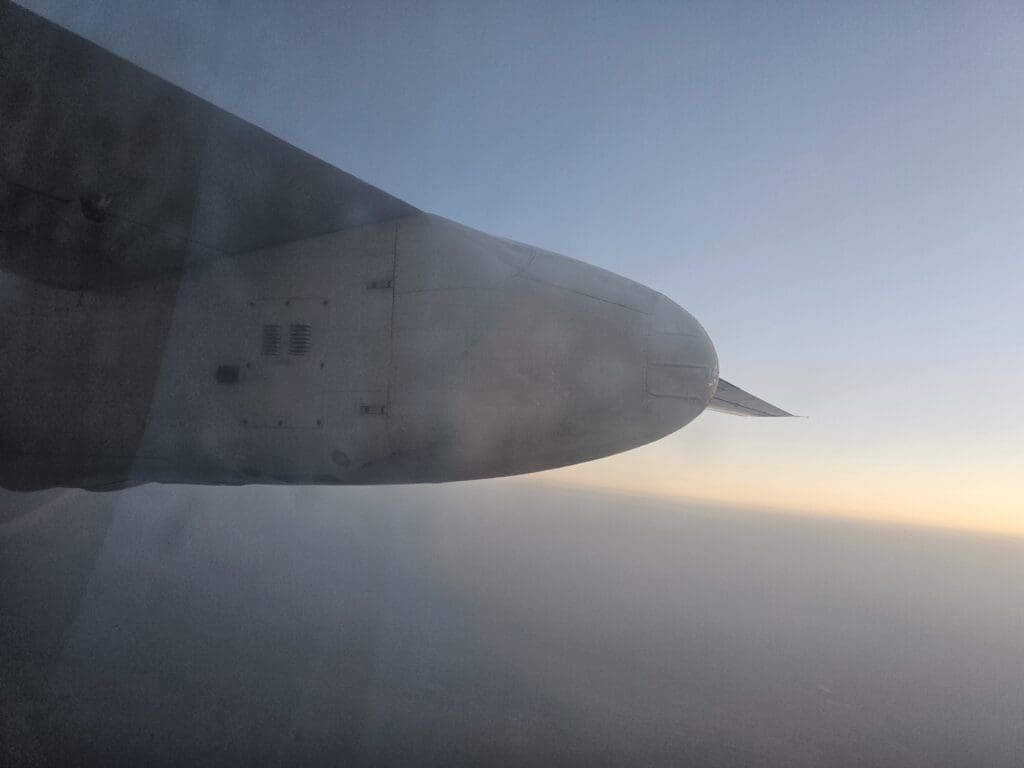
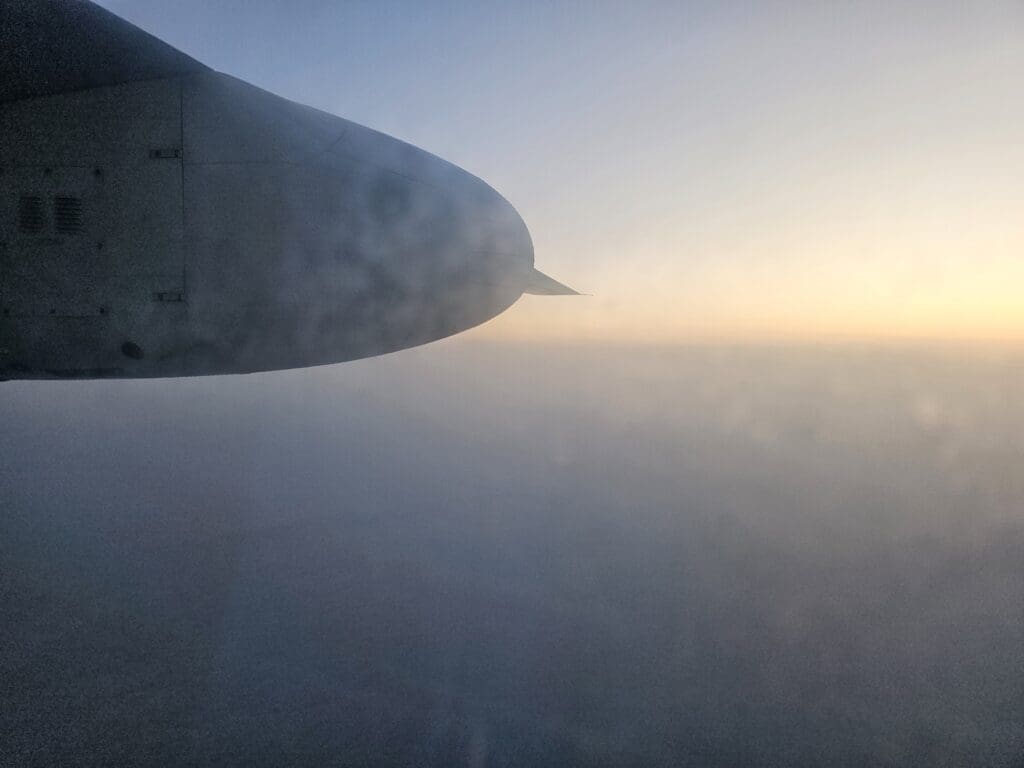
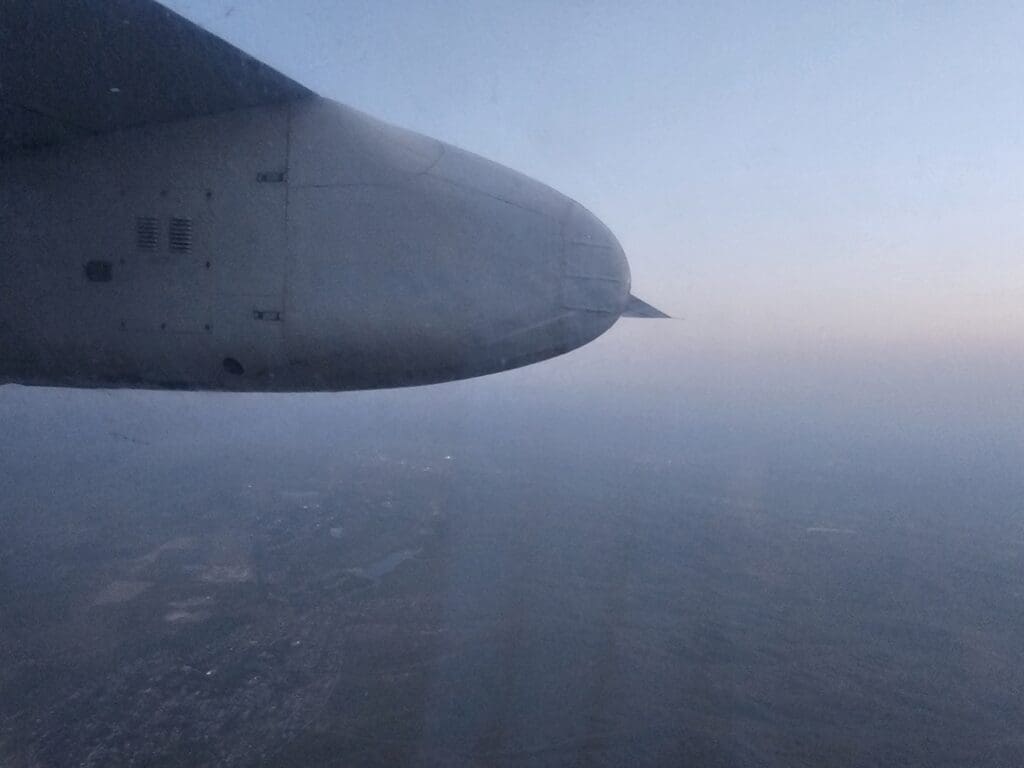
With the Antonov An-24 cruising at around 240 knots, almost 200 knots slower than a typical Boeing 737NG, we trundled southwards at a leisurely pace and fifty minutes after leaving Balkhash, the aircraft could be felt sinking back down to earth. Once our descent had commenced, the flight attendant turned the cabin lighting on although this was far from bright and perhaps has seen no update since it was first installed! Once these were back on the flight attendant made their usual pre-arrival announcement in Kazakh and Russian which featured the usual warnings regarding tray tables, seatbelts and seatbacks before they passed through the cabin ensuring all was in place and secure for our arrival.
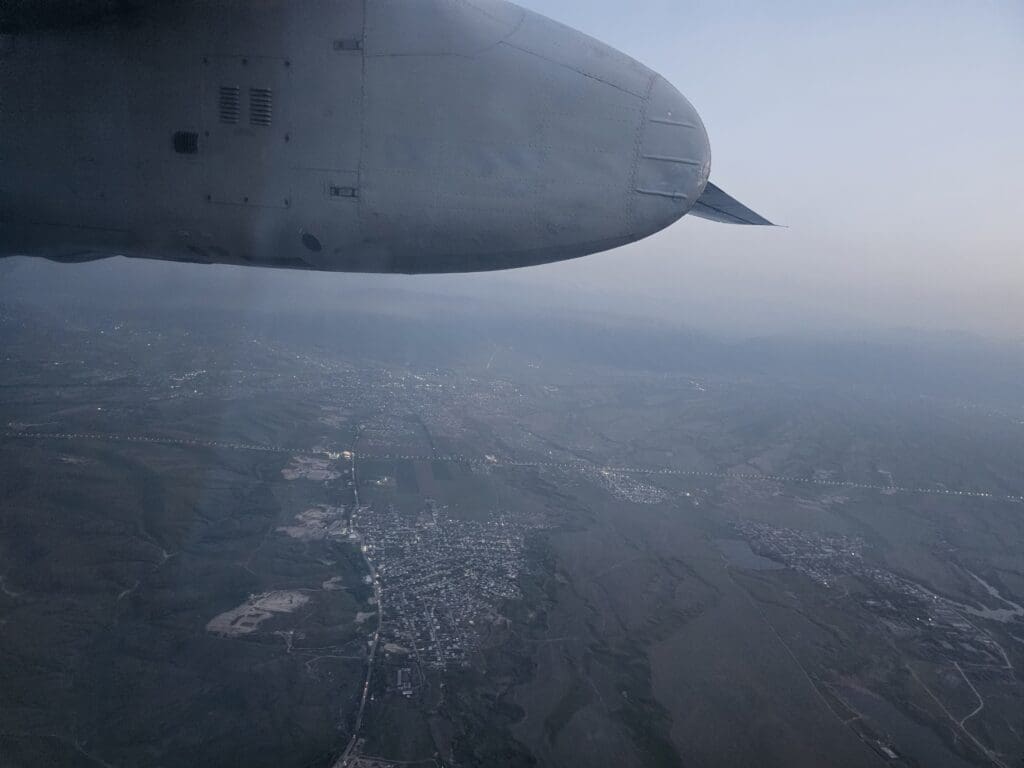
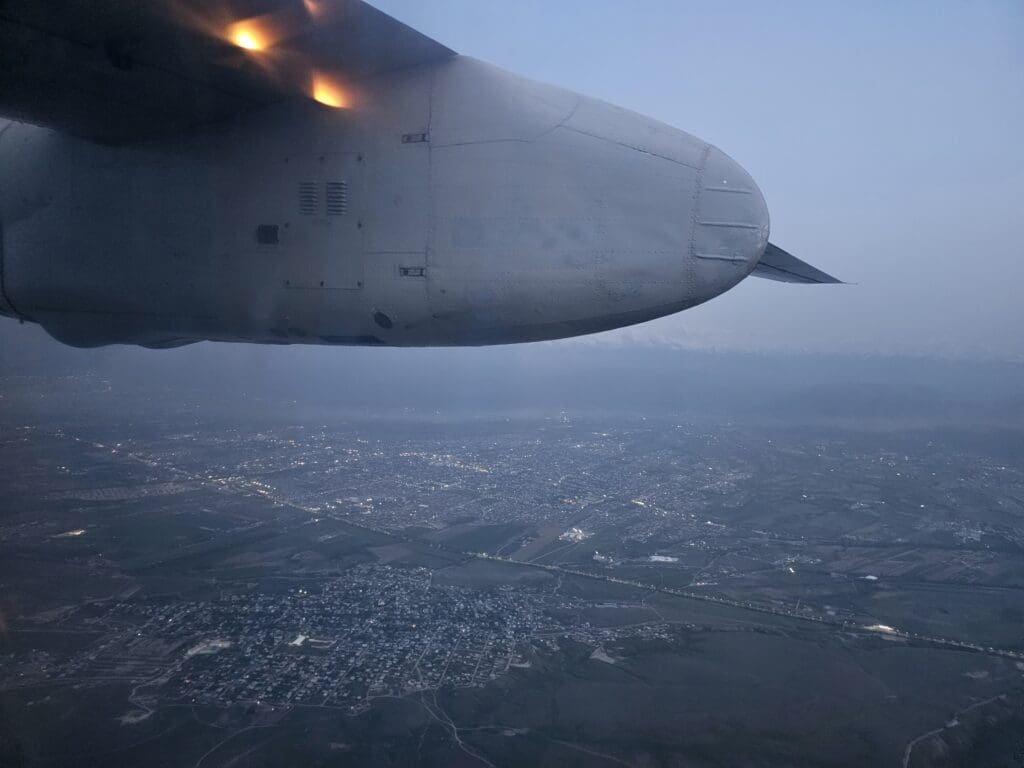
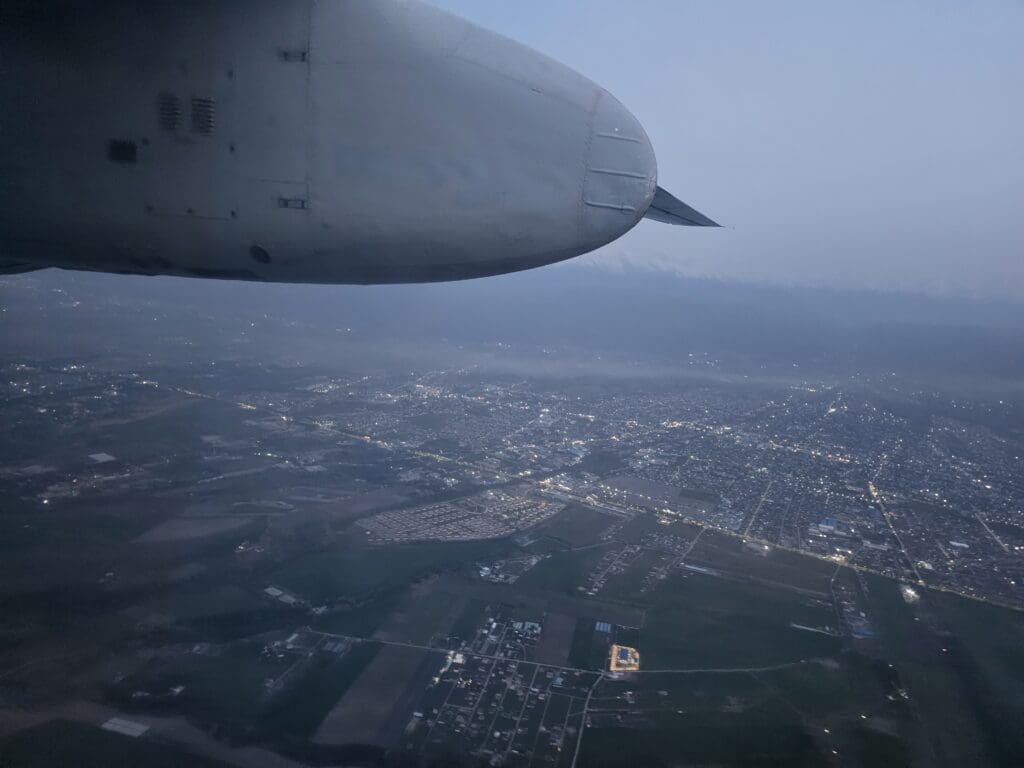
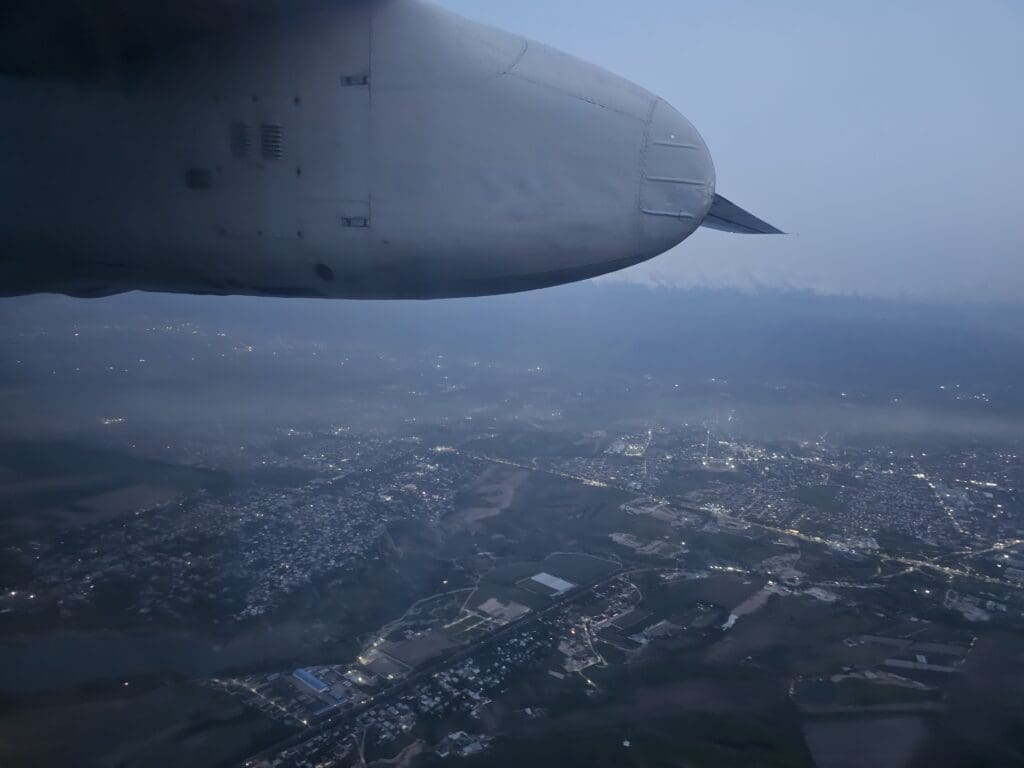
Once dark, the haze dissipated and the lights of roads and the occasional passing town could be seen, and eventually, the bright and colourful lights of Almaty’s urban sprawl could be seen. A short time later, the tall snow-capped Tian Shan mountains that provide the City of Apples with its picturesque backdrop popped into view as did the tall buildings of the city centre. As we nosily crossed over Almaty’s suburbs, perhaps much to the dismay of those 1,000 feet or so below, the flaps and landing gear were extended at which point the Antonov commenced what seemed to be a steep descent down to the runway.
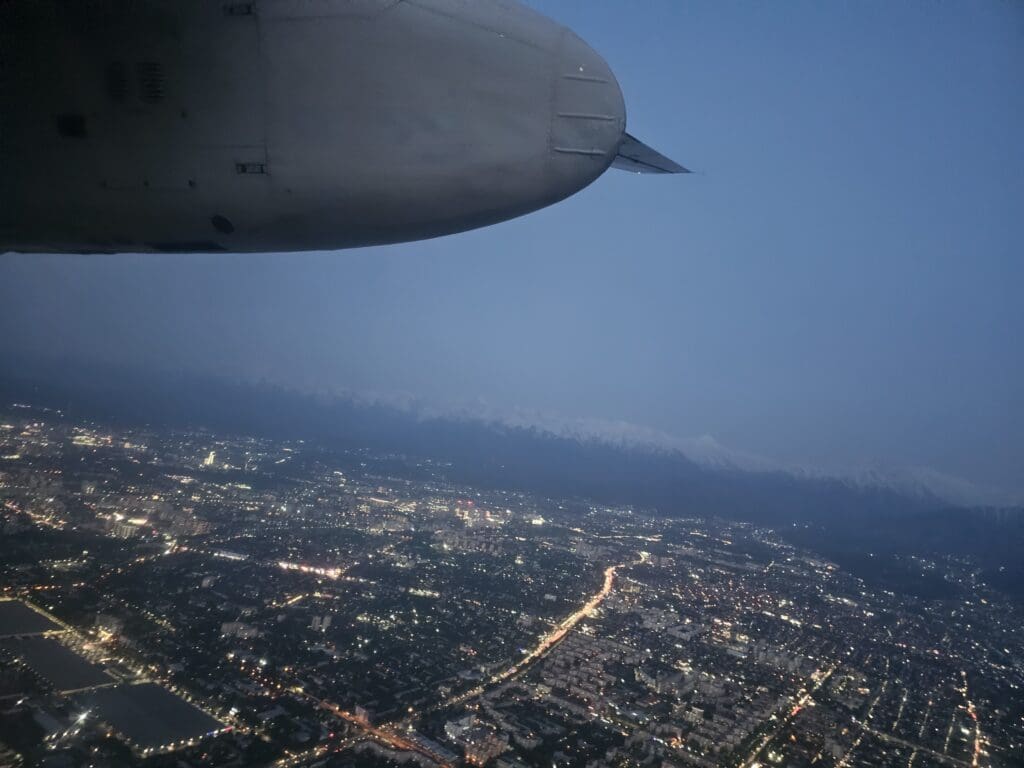
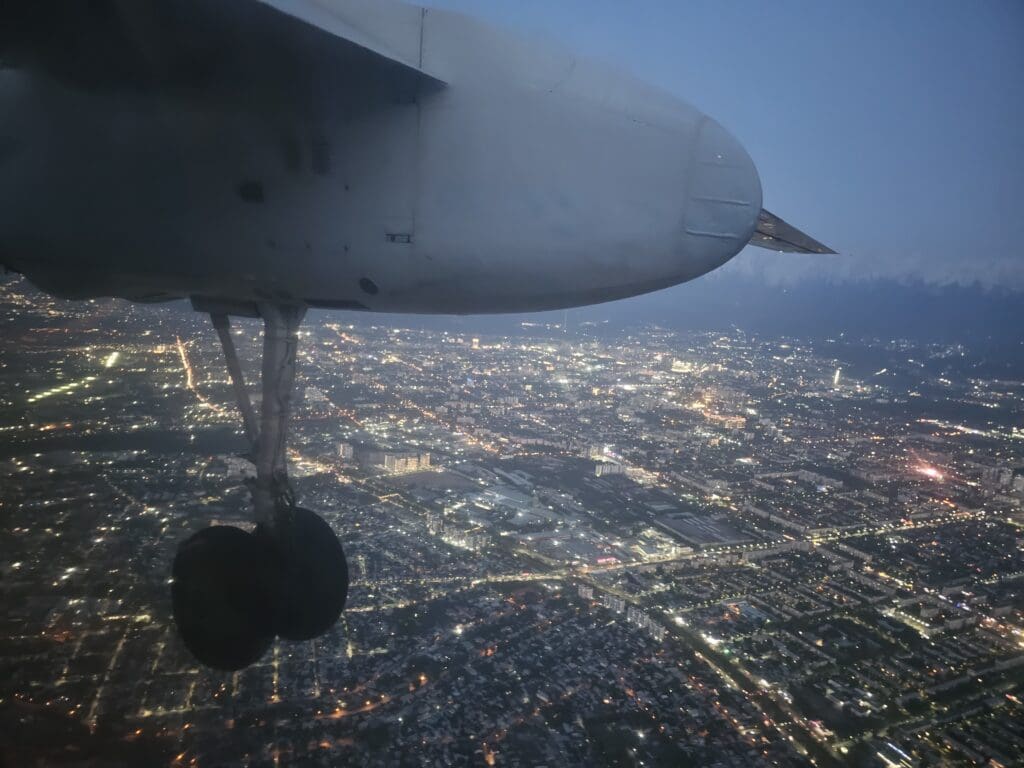
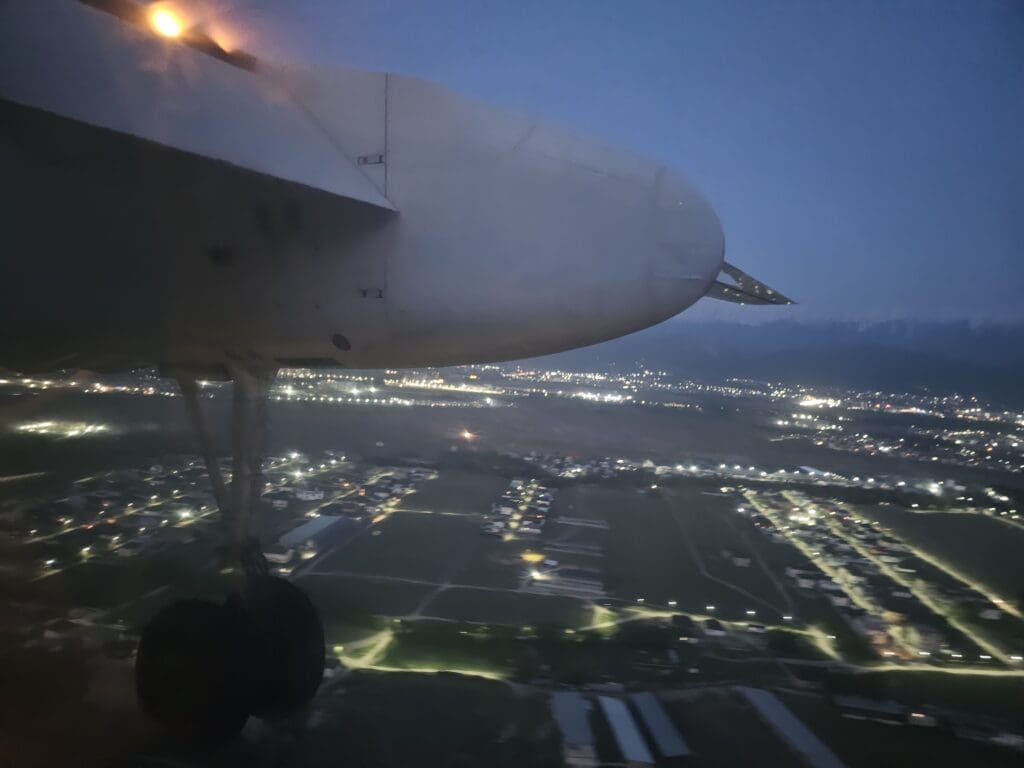
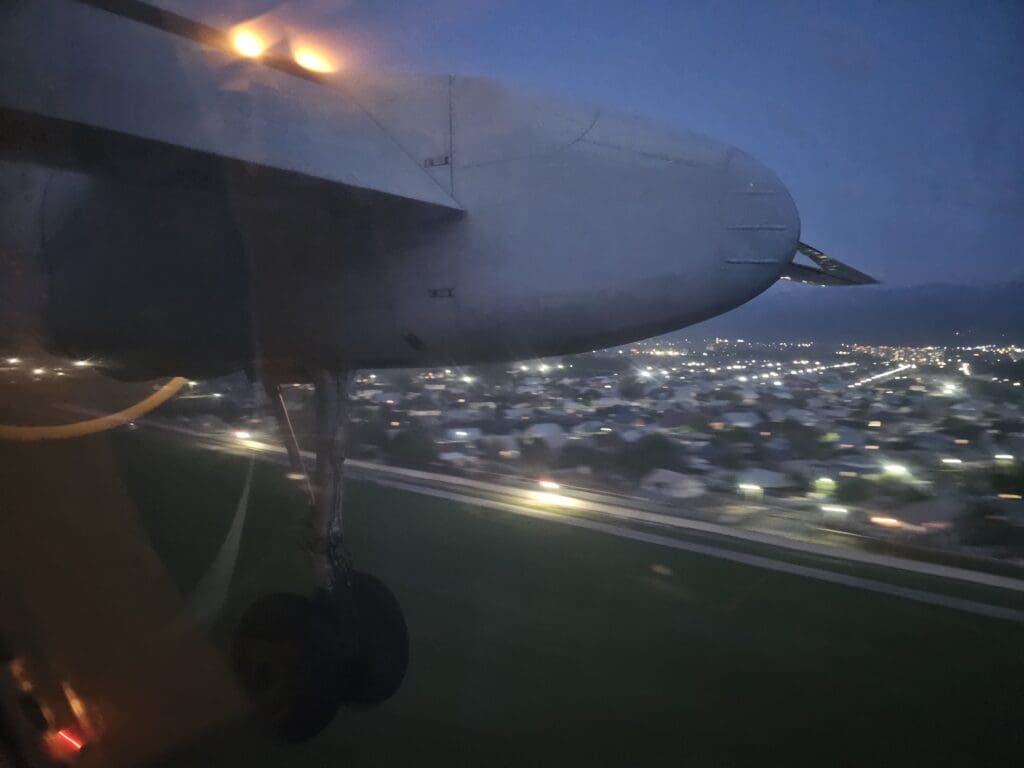
As we sank down, the Antonov whizzed over a mixture of modern and tall apartment blocks, Soviet-era Khruscvhevkas and low-rise suburbs filled with detached houses and trees before passing over Almaty Airport’s thick concrete perimeter boundary. Seconds later, after a grand total of 1H14 in the air, the Antonov made a firm and squeaky touchdown on Almaty Airport’s Runway 05R at 2034, bringing an end to what was likely to be my last Antonov An-24 ride for quite some time. Once safely back on the ground, the Antonov decelerated rather rapidly before vacating the runway to the left and making a quick taxi down the parallel, and I believe, unused, runway. As seen the world over, once off the runway the flight attendant performed their welcome announcement and advised passengers to remain seated until the engines had spooled down. Meanwhile, outside I caught a glimpse of the outlines of a collection of Soviet-era Antonovs, Ilyushins, Tupolevs and Yakovlevs could be seen – some of which were stored and unlikely to ever take to the skies again, whilst others remained in military service.
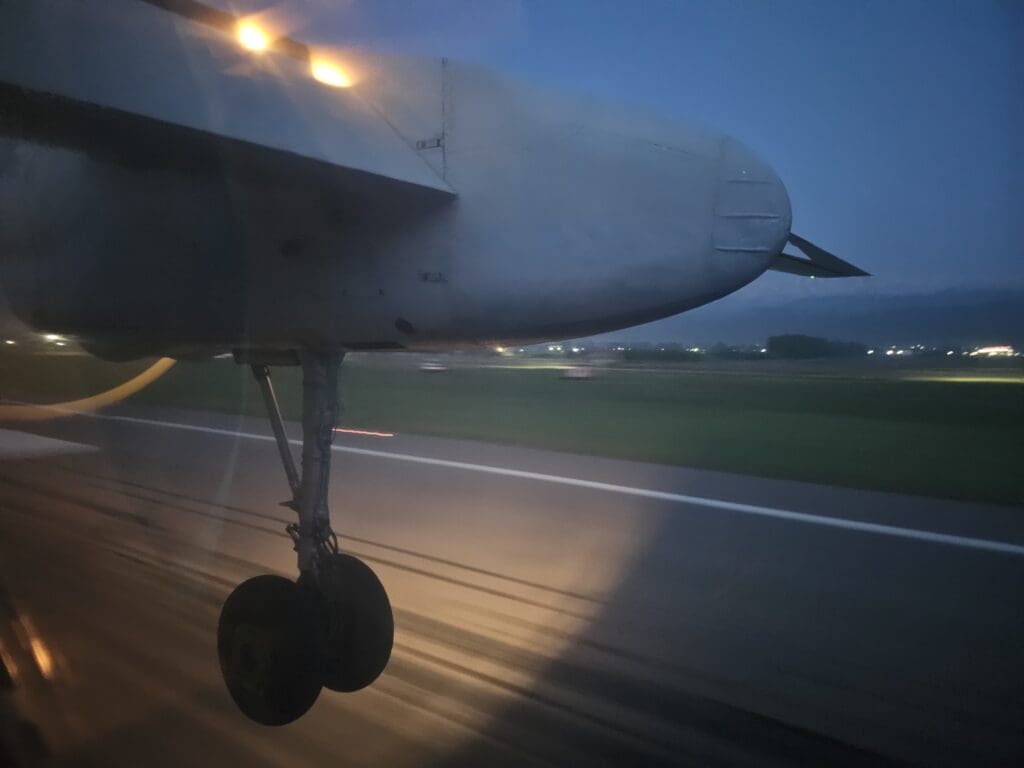
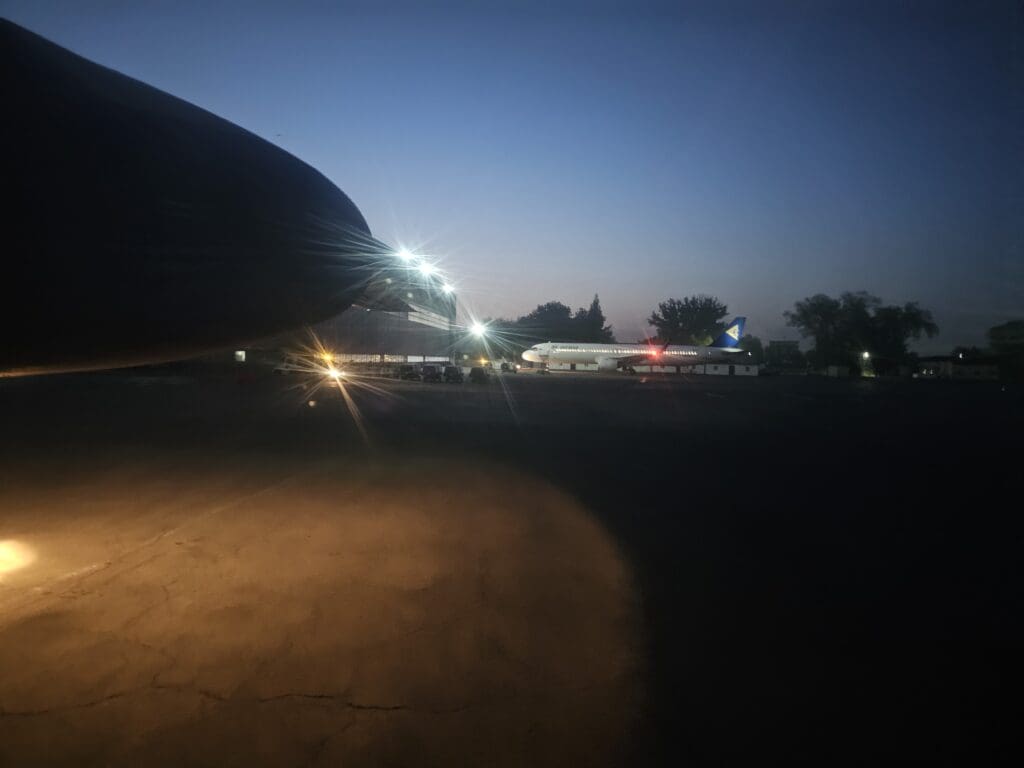
As we continued onwards towards the main apron, more modern Airbuses and Boeings operated by Air Astana and SCAT Airlines could be seen as they waited patiently for their next load of passengers to haul off to destinations across Asia and Europe. A short time later, the Antonov swung left and slowly pulled into a remote stand near Almaty’s ornate and classic old terminal, which is now used for VIPs. Once on the stand, the engines spooled down although with no bus seen waiting to shuttle passengers to the terminal, once the cabin fell silent there was little movement. Eventually, around a couple of minutes after our arrival, the captain emerged, once again receiving a round of applause, and made their way to the rear of the aircraft to open the rear door at which point disembarkation commenced.
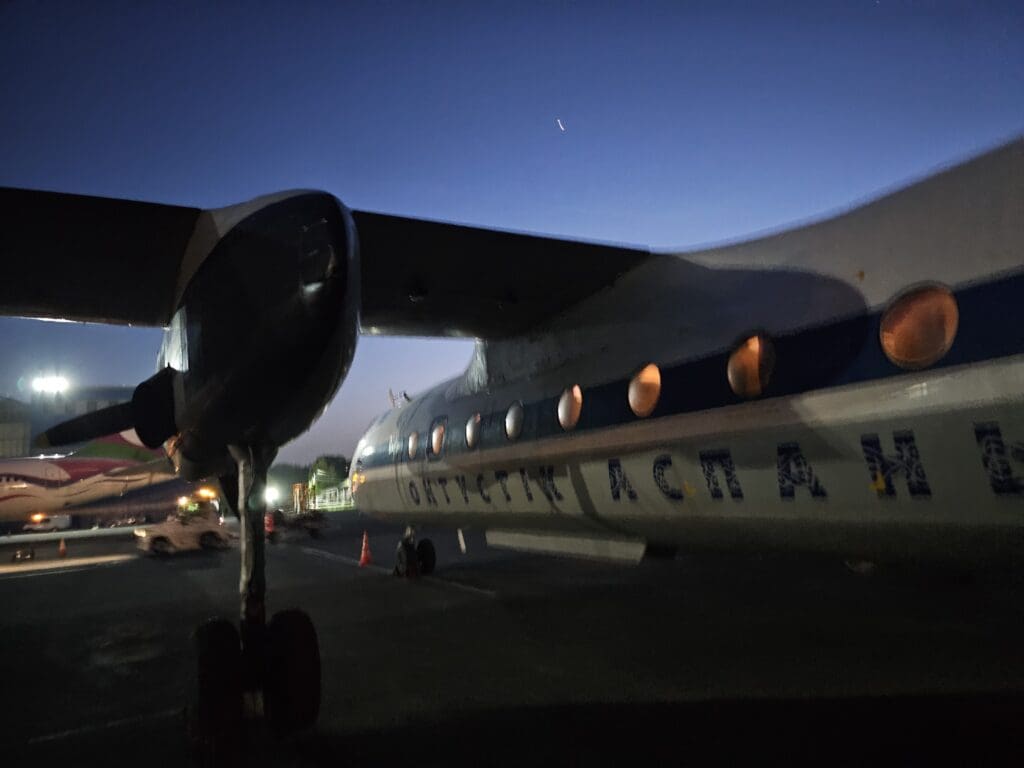
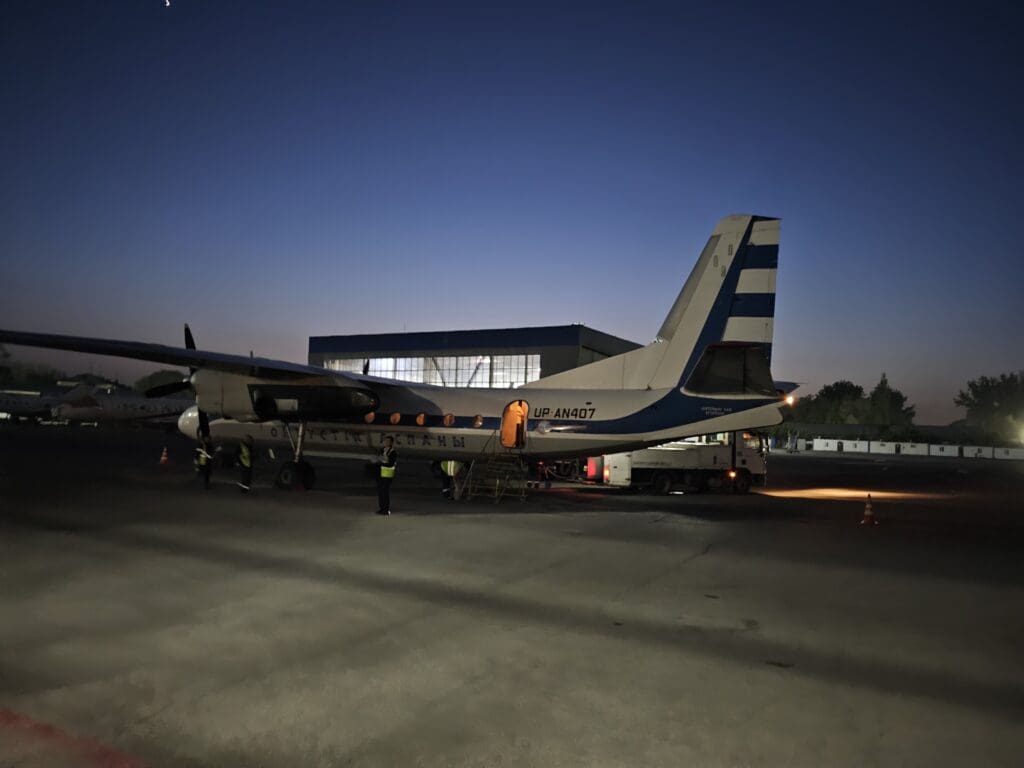
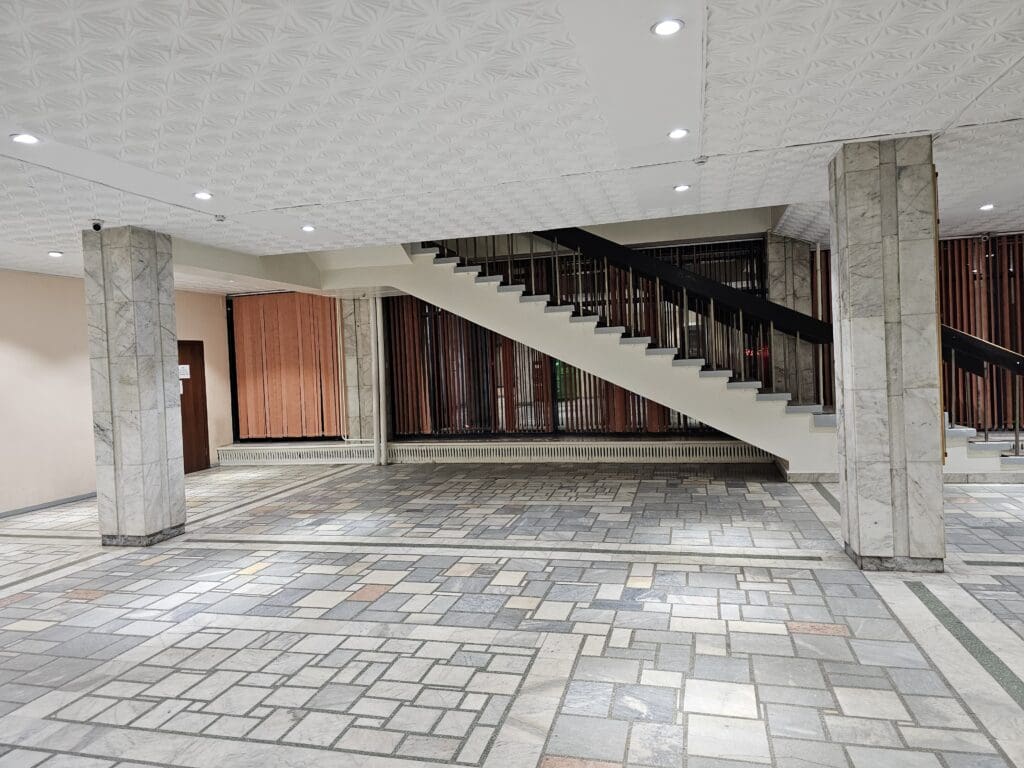
A short time later, I stood up and made my way to the rear of the aircraft, thanking the flight attendant in Russian before receiving an English response and heading over to the waiting bus. As I made this quick walk, I snapped a few photos of the rare turboprop waiting in the post-dusk light before stepping onboard the Cobus. Given the aircraft’s size, whilst the flight had been full it didn’t take long before all passengers had disembarked and made their way onto the bus, and after being joined by one member of the cockpit crew, the doors slid closed and this began its short journey over to the domestic arrivals portion of the terminal. Those arriving in Almaty on domestic flights cannot expect a long walk, and the arrivals pathway is pleasantly simple and short. Once off the bus, I passed straight through the small baggage collection hall before heading outside. Staying in the neighbouring Aksuntar Hotel, once landside I had no more than a two-minute walk before reaching my lodgings for the evening and soon arrived shattered and in need of a rest prior to my early start the next morning.
Summary
It is very unlikely that a non-aviation enthusiast would opt to take the Antonov An-24 operated service between Astana and Almaty given its intermediate stop in Balkhash. If whatever reason such a passenger were to end up on this service, they would likely complain about the vintage nature of the aircraft, the excessive noise and the non-existent levels of service. However, as an aviation enthusiast, I was left with absolutely nothing to complain about and would take this service again in a heartbeat! This undoubtedly serves as one of the easiest ways of flying onboard an Antonov An-24 in 2023, and I faced no issues during the entire journey – all in all, a fantastic experience.