What Are Royal Air Maroc Like? Paris to Casablanca on a Boeing 737-800
Background
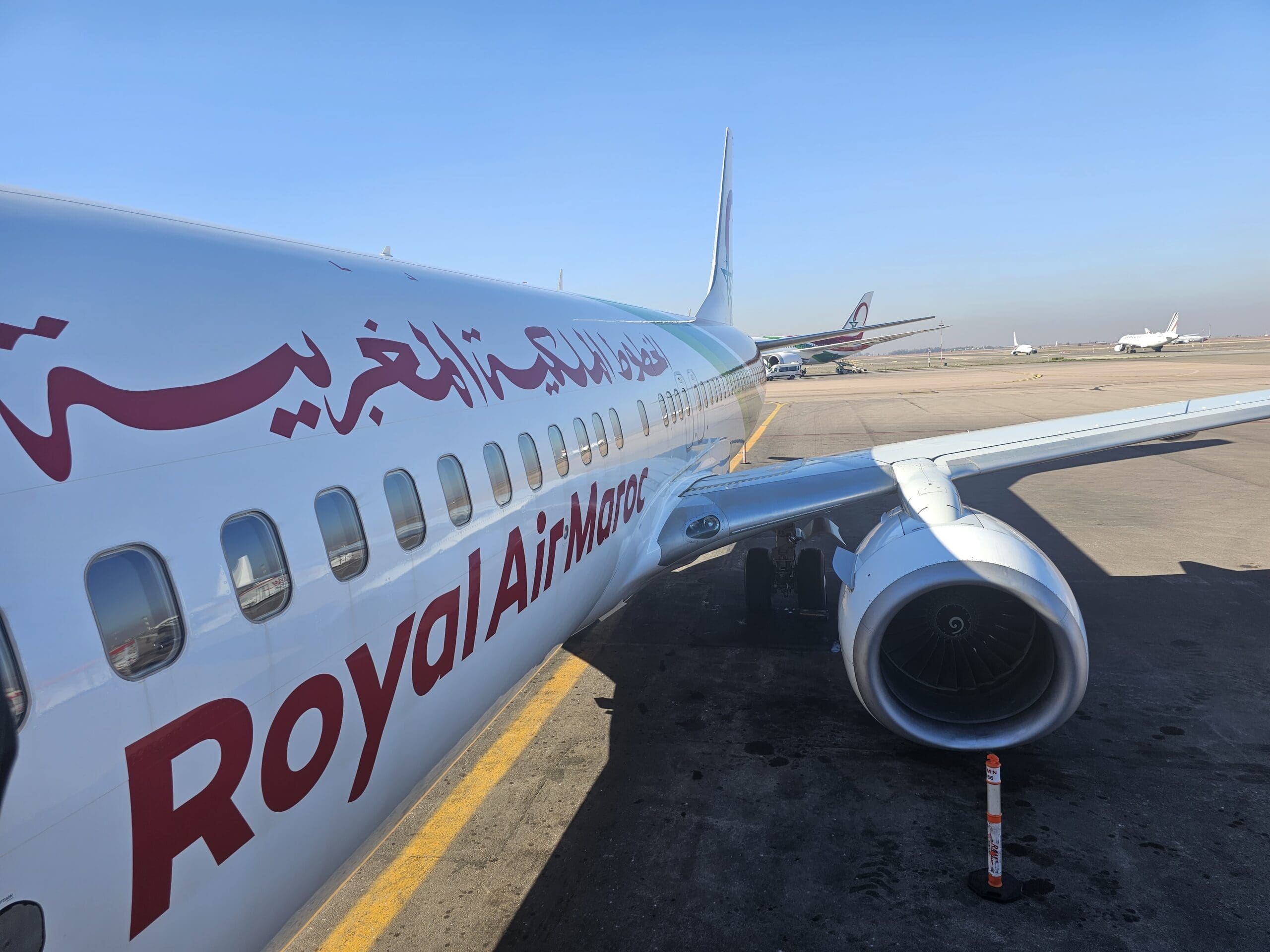
Having served Morocco for well over seventy years, Royal Air Maroc is the country’s well-established state-owned national carrier. Operating a over fifty aircraft from their base in Casablanca, Royal Air Maroc operates services to destinations across Africa, Europe, the Middle East and North America. With a particular focus on both Europe and West Africa, the carrier has developed a hub-and-spoke model, often offering comparatively cheap tickets for those travelling between the two regions. Having long wanted to sample the delights of Royal Air Maroc, in November 2023, I was lured in by a cheap one-way fare from Paris Orly to Dubai. This would entail a long stop in Casablanca which would enable me to see some of the Moroccan capital’s sights.
If you’re hesitant about flying with Royal Air Maroc, then it’s probably best not to search reviews of the carrier online. Unfortunately, the internet is peppered with negative reviews and the carrier enjoys a rating of just 1.2 out of 5 on Trustpilot (as of late October 2023). It is thus easy to come across a barrage of accounts that detail long delays, lost baggage, chaotic connections, distant crew and slow refunds. Needless to say, whether justified or not, Royal Air Maroc has long suffered from something of an image problem.
Yet, things do seem to be improving and in recent years Royal Air Maroc has made tangible efforts to improve its ailing reputation. This arguably started with the delivery of its first Boeing 787 Dreamliner back in 2015, with this type providing a far superior customer experience when compared to the old Boeing 747-400s and Boeing 767-300s that the type replaced. This was followed in 2018 by the release of a refreshed livery and an updated logo in 2020. More recently, in 2022 the airline announced its new distinctive uniforms which embrace both modern fashion and Moroccan tradition. In 2020, Royal Air Maroc joined the ranks of some of the world’s largest and most known carriers when it became North Africa’s second allianced airline and joined Oneworld.
Indeed, many recent reviews have not painted an entirely negative picture and instead have made out Royal Air Maroc to offer a reasonable level of service albeit frequently in need of refinement in some areas. Furthermore, it is worth adding that unlike many of their counterparts in Europe, Royal Air Maroc has long offered ‘real’ business class seats on their narrowbody jets and complimentary food, even on their shortest services.
Having wanted to sample Royal Air Maroc for quite some time, I jumped at the opportunity to do so and looked forward to the delights that the carrier had in store.
Booking
Whilst several online booking sites offered slightly cheaper tickets for my trek to Dubai, I decided to play things safe and pay a small premium to book directly with Royal Air Maroc. Being based in Northern England, it would have made much more sense for me to fly on one of the carrier’s services from either Heathrow, Gatwick or Manchester. However, seeing as these services attracted an almost £1000 premium, it proved to be far more cost-effective to fly from Paris.
Upon searching for flights, I was presented with a total of seven options on my chosen departure day from both Paris Orly and Paris CDG, with these all involving a single connection at Royal Air Maroc’s hub in Casablanca. Having never visited Morocco before and seeking to have an afternoon exploring the sights of the country’s capital city, seeing as all flights were equally priced, I decided to go for the earliest departure that day. This would see me leave Paris Orly onboard one of the airline’s Boeing 737-800s at 0820 before touching down in Casablanca three hours later at 1120. With plenty of time on the ground, I would depart Morocco at 0300 the next morning before arriving in the United Arab Emirates at 1340 on Sunday. Upon selecting this, I was presented with three Economy fare options: Eco Classic, Eco Flex and Eco Serenity. Travelling on a budget, I went for the cheapest option, with this still including a checked-in bag!
Once I had selected flights, I continued onwards and had the option of paying an additional £77.30 for lounge access and security fast track, paying to reserve a seat from £12.90 on the first flight or £25.80 on the second, or adding an additional 23kg bag for £120.30. Skipping past all of these, I reached the payment page where I parted with an acceptable total of just £215.00. Of course, once booked I then needed to work out how to get to Paris Orly. Thankfully flights between the UK and Paris are plentiful and I decided on a service with Vueling which set me back £29.75.
Check-In
Online check-in for Royal Air Maroc’s services opens 48 hours before departure, and so, once this window arrived, I decided to open up the app and commence check-in proceedings. For the first flight, I had been assigned Seat 19F which I could not change. Afterwards, I rejected the option of selecting that I was a Hajj passenger and continued onwards to enter my personal details. Unfortunately, I was only able to check-in for my first flight and was advised to check-in for my second flight at the airport.
The Journey
Despite previously living in Paris, Orly Airport is not one that I am particularly familiar with. During my time as an honourary Parisian, I found myself inadvertently gravitating towards its busier and more internationally known counterpart, Paris CDG. Before this trip in November 2023, my last time passing through the airport had taken place way back in July 2019. Thus, following a lengthy hiatus, I was eager to rediscover the airport in all its glory. Following a very short and uneventful hop down from Gatwick on a Vueling Airbus A321, I touched down on French soil at 2220. This left me with exactly ten hours to go until I was scheduled to continue southwards on my voyage to Morocco and thus had plenty of time to explore Paris’ second busiest airport.
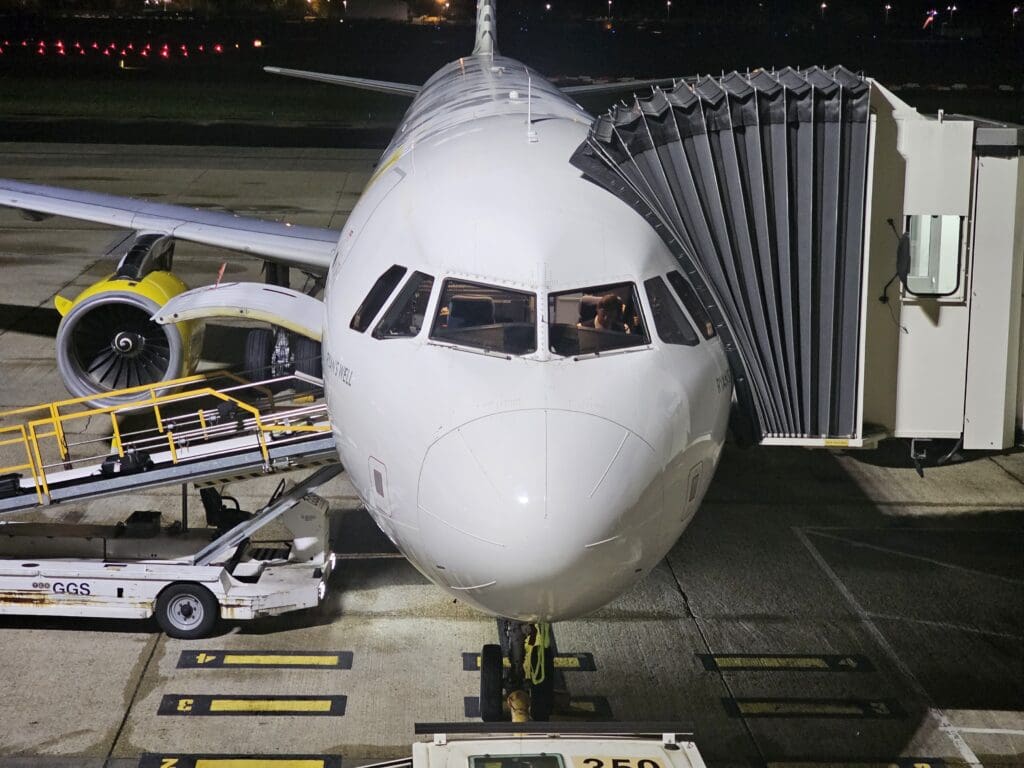
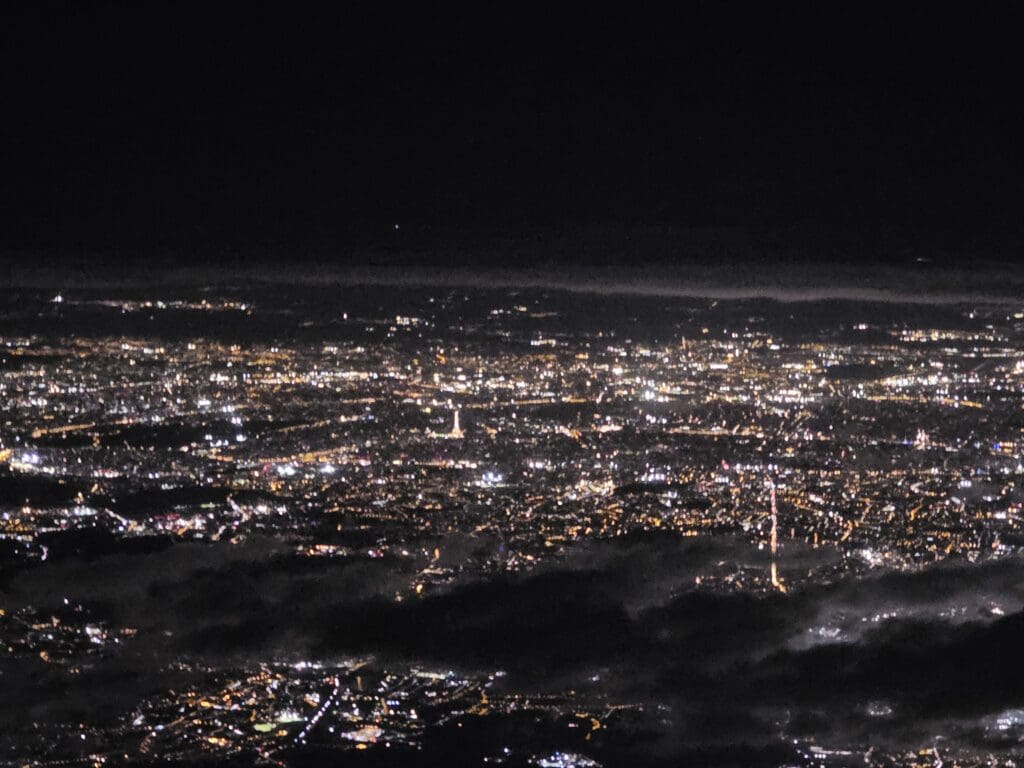
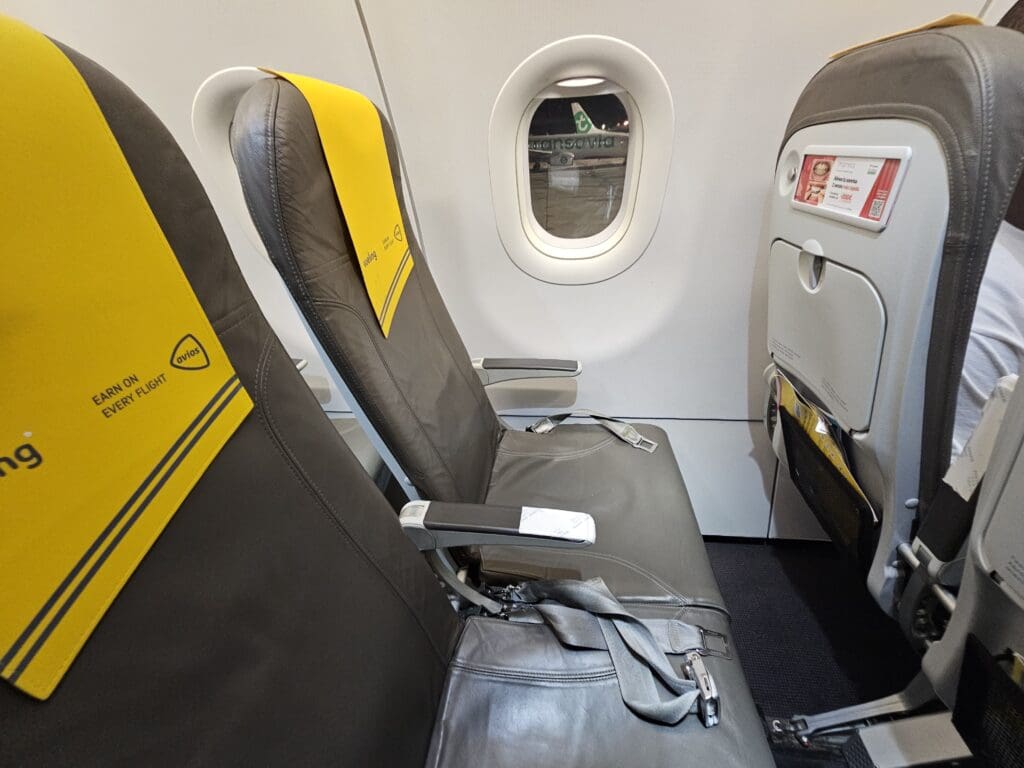
For a long time, Orly Airport was home to two terminals – Orly Ouest and Orly Sud. However, in March 2019 these were divided into four and given the logical names of Orly 1 to 4. With Vueling utilising Orly-1 and Royal Air Maroc Orly-4, that night I would have to travel from one end of the airport to the other, although not covering the largest of areas, this would not prove to be particularly burdensome. However, once I had disembarked and found myself in the terminal building, it soon became clear that making an airside transfer at that time of night would be impossible. I was thus left with no option other than to join the long snaking immigration queue and spend the night landside.
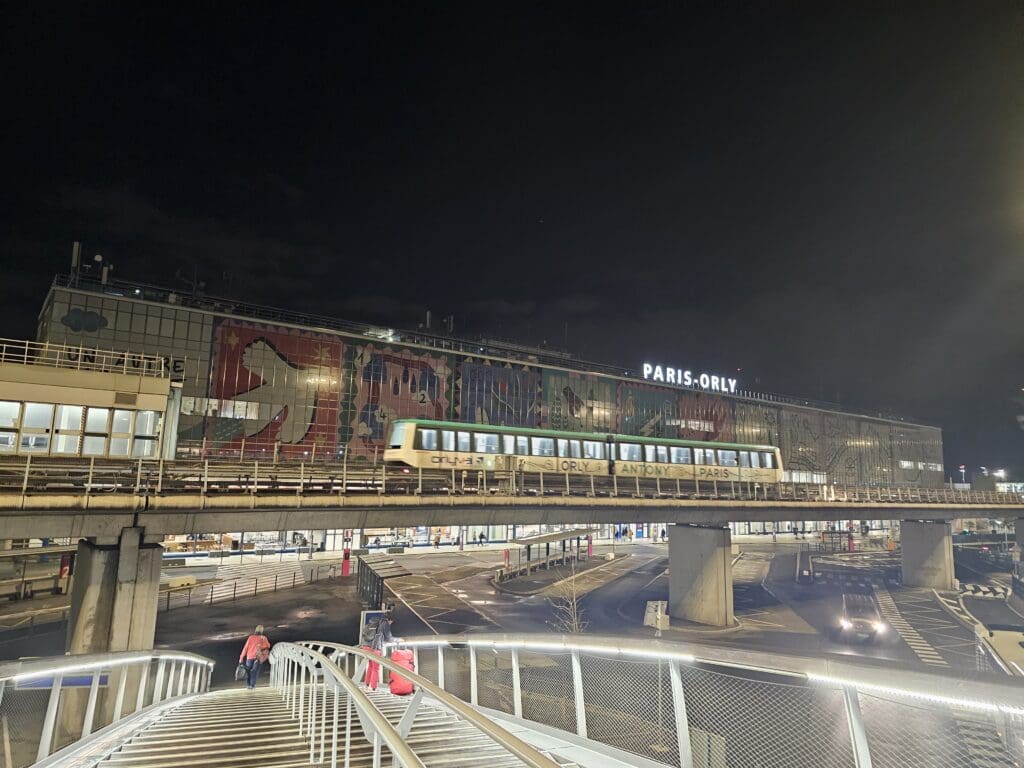
With multiple arrivals from non-Schengen destinations and just three immigration booths open, the queue moved along at a snail’s pace and I ended up spending longer in this than I had done in the air on the flight down from London! Following just shy of an hour spent in the queue, I handed over my passport to a very weary-looking immigration official and without any questions this was stamped and returned. From there, I made my way down the escalators to the baggage collection hall and with nothing to pick up, I soon voyaged out into the busy landside arrivals area. With the automated people mover connecting the terminals having powered down for the night, I was left with no other option than to make the journey on foot. After dodging past the unofficial taxi drivers, I headed outside into the chilly night air and after a few minutes, I found myself in Orly 4’s almost empty check-in hall.
Whilst far from being a particularly new terminal, having undergone plenty of upgrade work throughout its life, inside I found the Orly 4’s landside area to be bright, modern, spacious, clean and rather stylishly designed. In terms of facilities, this was home to a branch of Paul and Starbucks, as well as a small electronics shop. Meanwhile, a convenience store and pharmacy could be found on the first floor near the security entrance. However, at that time, all of these were closed. Given the ties between France and Morocco, unsurprisingly Royal Air Maroc has a massive operation throughout France, with the carrier serving ten destinations across the country. With Paris Orly being the airline’s second busiest French destination after Paris CDG, I was not particularly surprised to see plenty of Royal Air Maroc branding throughout. On a side note, Royal Air Maroc even operates its own lounge at Orly, the Zénith VIP lounge.
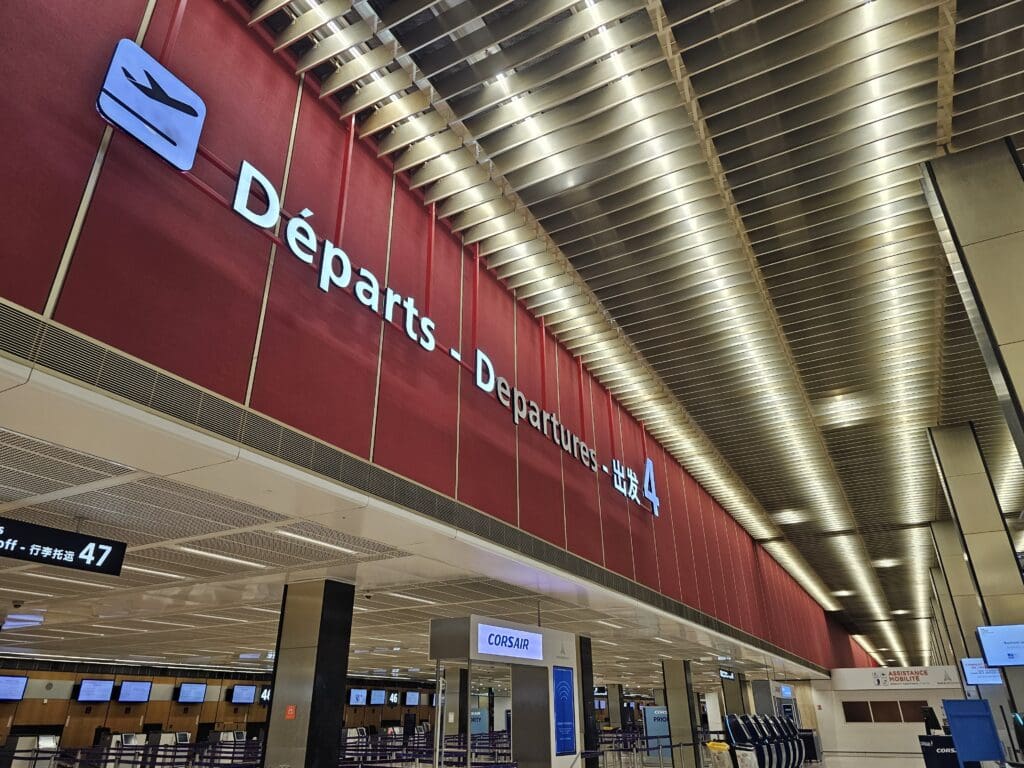
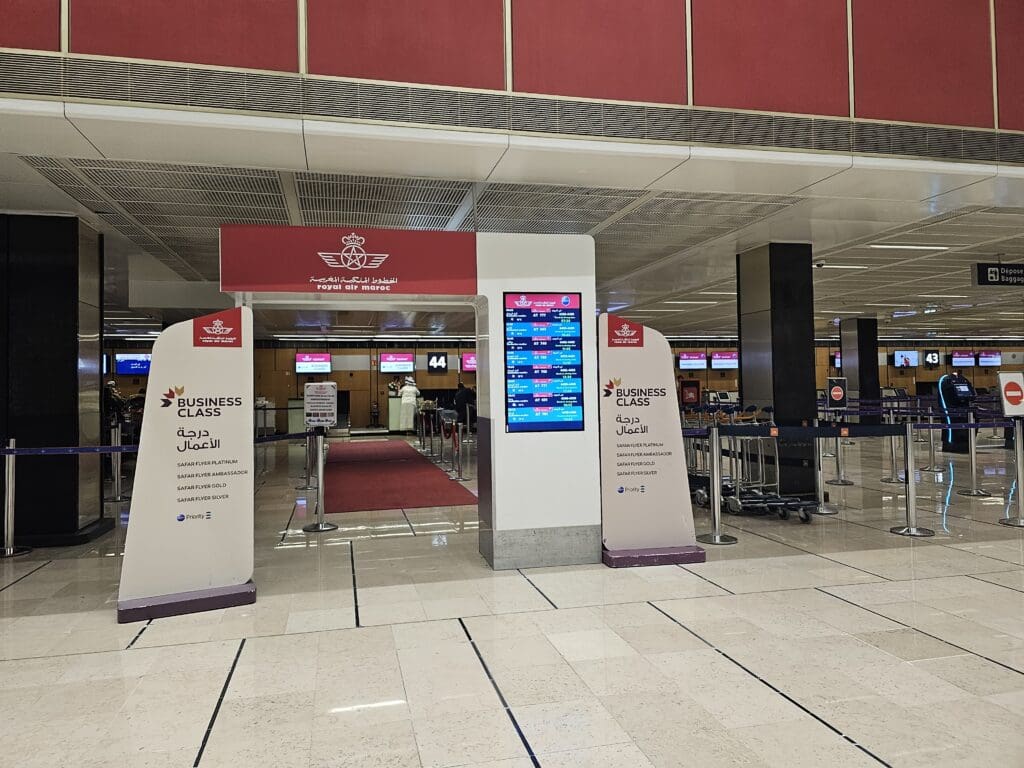
As nice as the landside portion of Orly 4 looked, after a few minutes of wandering around I concluded that it would not be the most fantastic of places to spend the night. With this featuring bright lighting and icy cold air conditioning blasting down from the ceiling, Furthermore, this also seemed to be a hangout for the local homeless community and I was approached a couple of times as I wandered around. Having had a long day of work and travel, and thus being rather shattered, I decided to bite the proverbial bullet and head over to the Coeur d’Orly. This is an area, which, as you may be able to guess from the name, is located at the heart of the airport and is home to a few offices plus three neighbouring Accor Group hotels – an Ibis Budget, an Ibis and a Novotel. Not wishing to part with more money than necessary, my stop was the Ibis Budget however with no vacancies I instead headed to the Ibis where I snapped up the last available room for the princely sum of €120.
Seeing as my flight was scheduled to head off at 0820, lacking hold luggage and with my boarding pass advising me that boarding would commence at 0735, theoretically I probably could have arrived at the terminal at 0700 and made my flight. However, not wishing to cut things too fine, I decided to wake up bright and early at 0530. Following a speedy shower, I repacked my belongings and darted down to reception before heading out into the morning darkness. From the Coeur d’Orly, a covered pedestrian flyover runs all the way to Orly 4 and after a three-minute or so walk along this, I found myself standing in the bright terminal where I had been six hours earlier. To my surprise, whilst a little more lively, this was still relatively deserted and there appeared to be an equal number of passengers and staff.
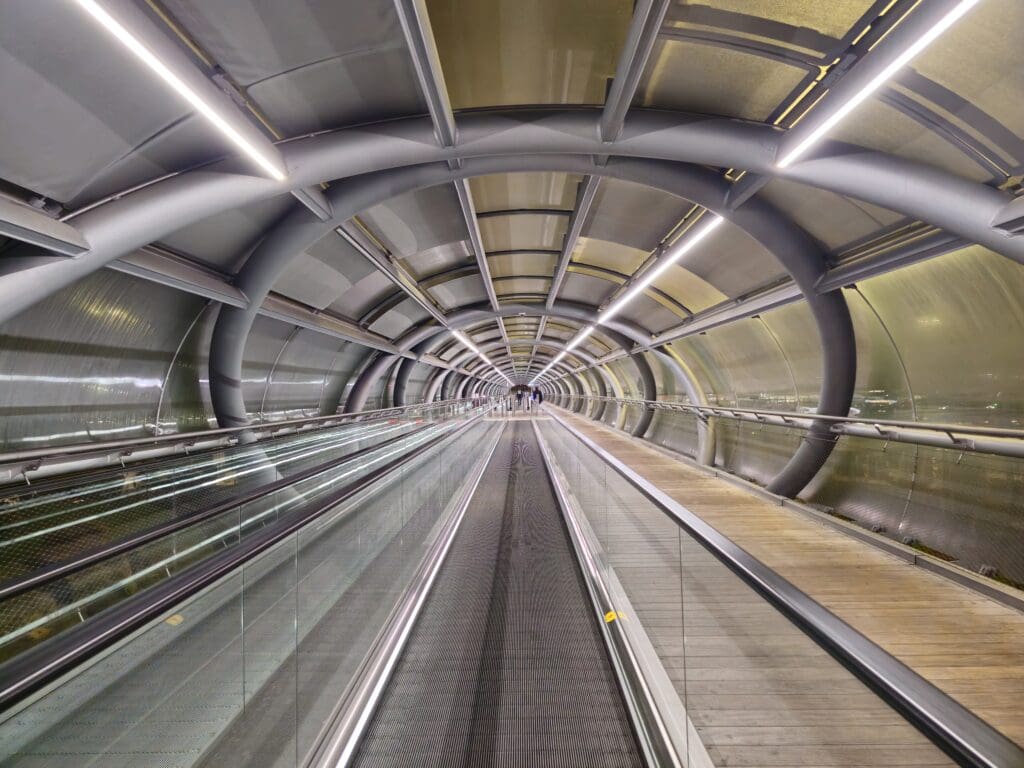
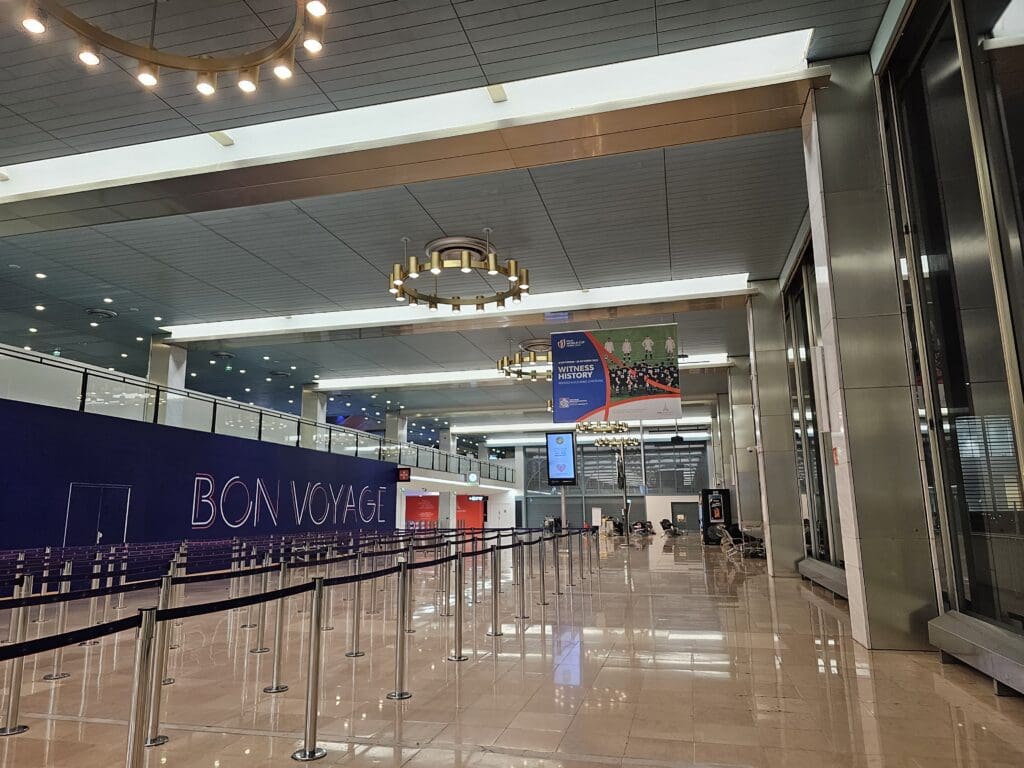
With no breakfast included in the cost of my one-night stay, once inside the terminal, my first stop was the local branch of Paul for my first coffee of the day. There, I parted with an eyewatering €5.50 for a cappuccino. With this in hand, I made my way up the escalators to the large hall which serves as the entrance to security where several passengers could be seen bidding teary farewells to their family and friends. Of course, not being able to take my coffee through, I took a seat and gazed out over the apron as several Transavia Boeing 737-800s could be seen heading away at the start of a new day of flying. Once I had polished off my coffee, I continued onwards and had my boarding pass scanned before zigzagging through a slalom course of tensa barriers. Upon reaching security, only three of the many checkpoints there appeared to be open however given the lack of passengers this was no issue and I was able to walk straight up to one of these. Whilst this would have been a breeze to pass through, seeing as my bag ended up being selected for additional checks, I spent a few minutes here before being allowed to continue onwards. With all flights departing to Orly 4 being bound for destinations outside of the Schengen area, all departing passengers must head through passport control. Fortunately, like security, this was a quick and queue-less process and I soon found myself in the airside area.
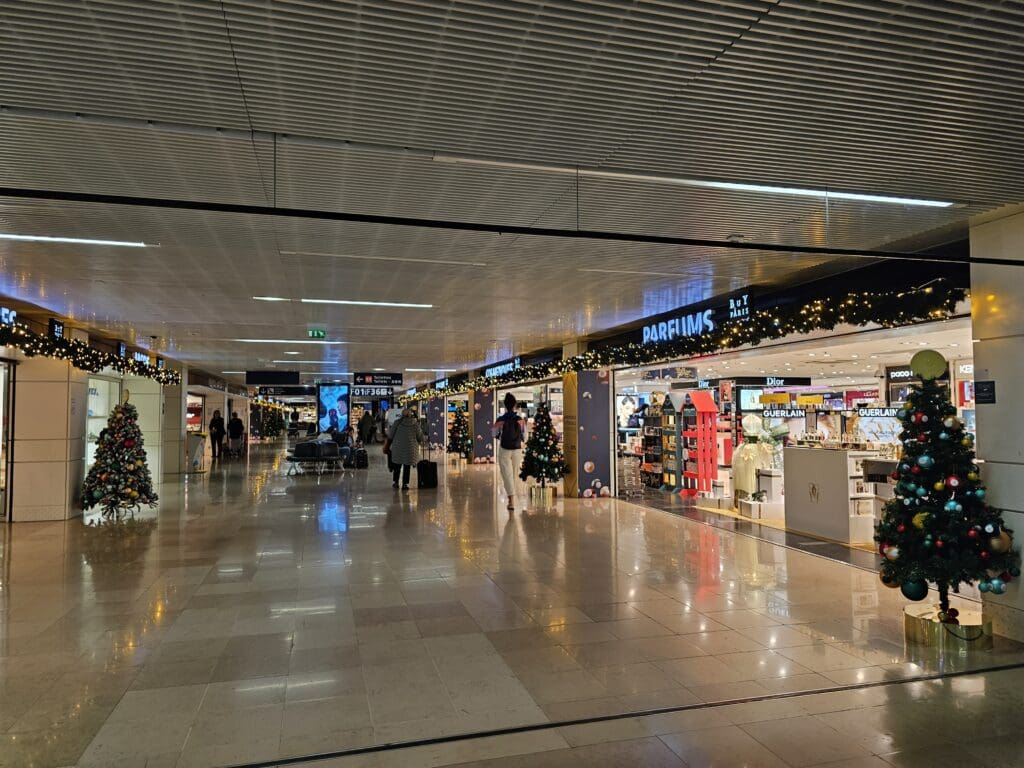
Like many European airports, once airside passengers are immediately presented with the terminal’s main duty-free store – this is operated by Buy Paris Duty Free. However, on the plus side, this is divided and sits on either side of the corridor meaning that unlike at many airports, passengers do not actually walk through this. Despite only being early to mid-November, the store was already decked out in Christmas decorations and blasting festive music. This was a bit of a wake-up call to weary travellers, but it also added a touch of Christmas cheer to the otherwise sterile environment of the airport. Not needing to purchase anything, I steamed past this and made my way to the main part of the terminal. In terms of facilities, Orly 4 contains the usual diverse smorgasbord of eateries and shops that you would expect to find in any major airport terminal, albeit all selling items at the usual inflated airport prices. At that time in the morning, most of these were only just opening up although this was not a particular issue for me.
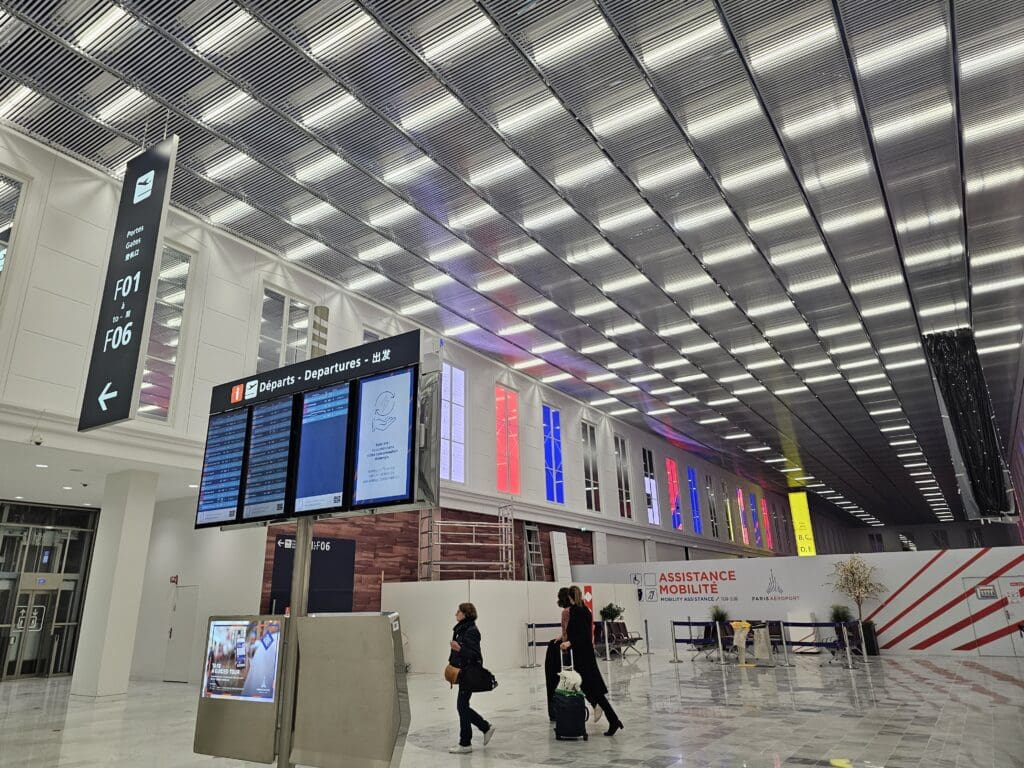
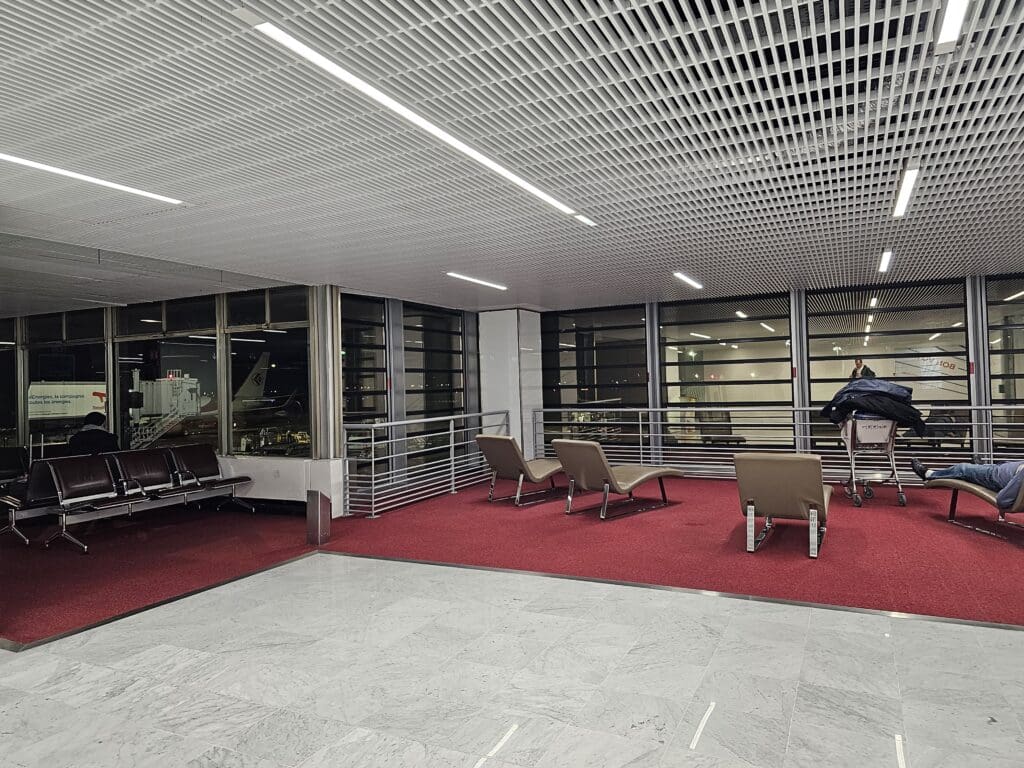
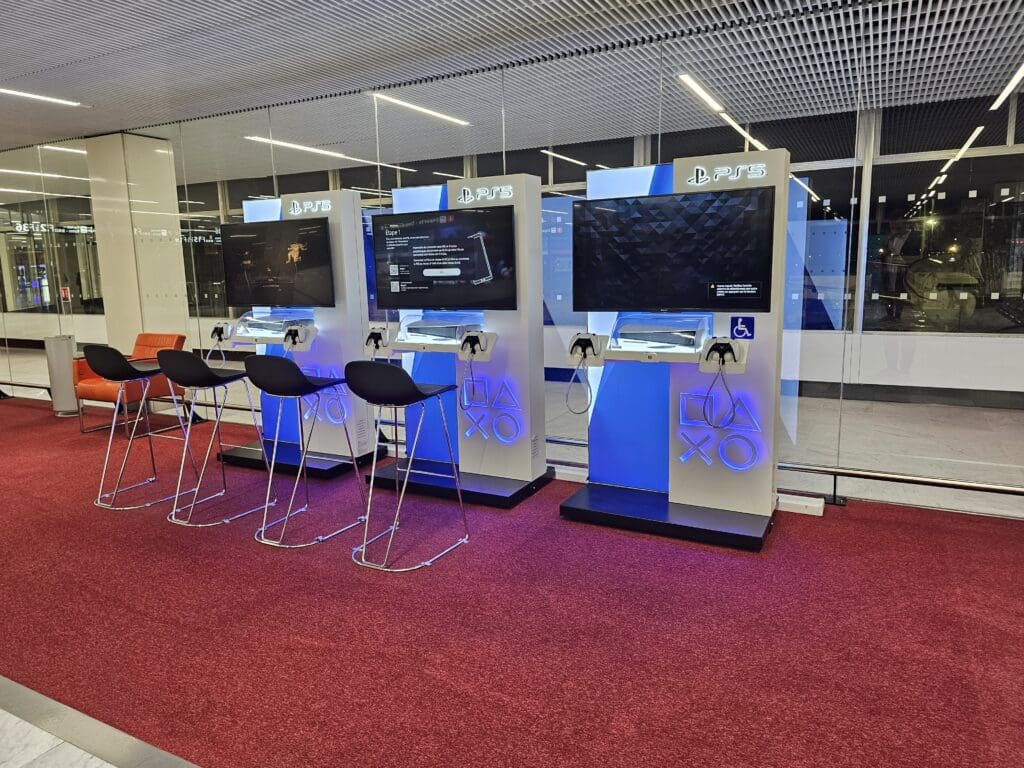
As I wandered around the terminal, I was left rather impressed. First and foremost, this was clean, tidy and well-polished, with an army of cleaners seen throughout my stay. Secondly, the terminal was modern and nicely designed. It had clear similarities to some of Paris CDG’s terminals, with Aeroports de Paris appearing to have used the same furnishings in both airports. The terminal was comfortable and provided a range of seating options, including recliners, sofas, and more traditional benches. Many of the seats featured built-in and working plug sockets, which was a welcome addition. In addition, fast and complimentary wifi was provided throughout. All-in-all, I was left with very little to complain about that morning.
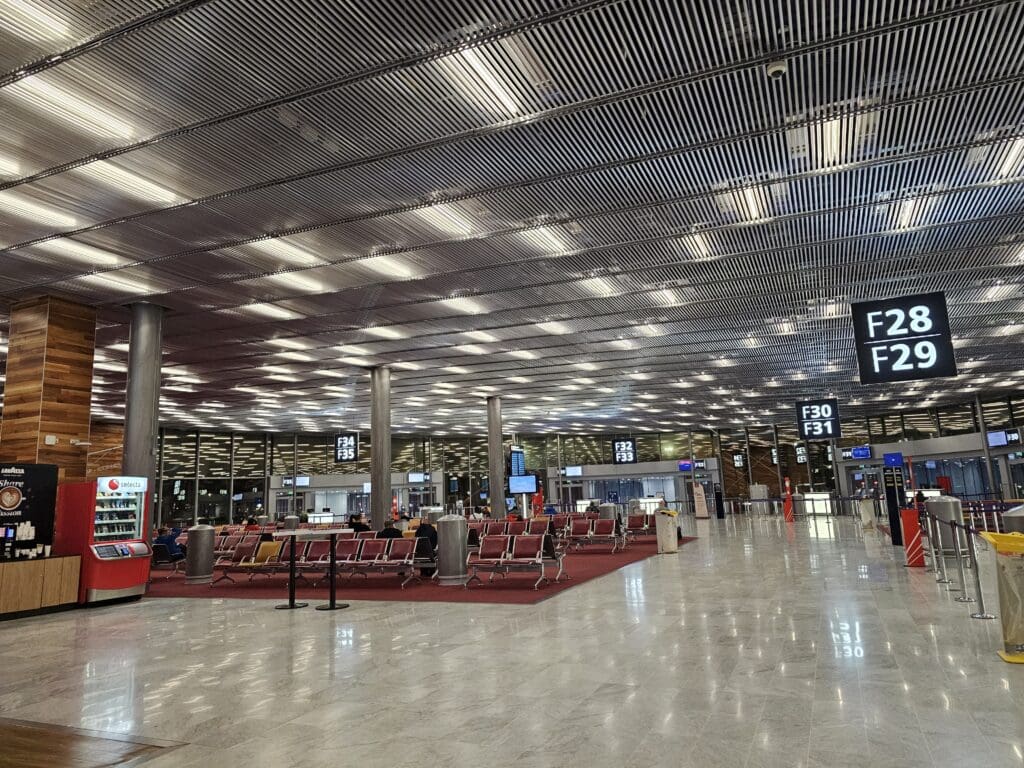
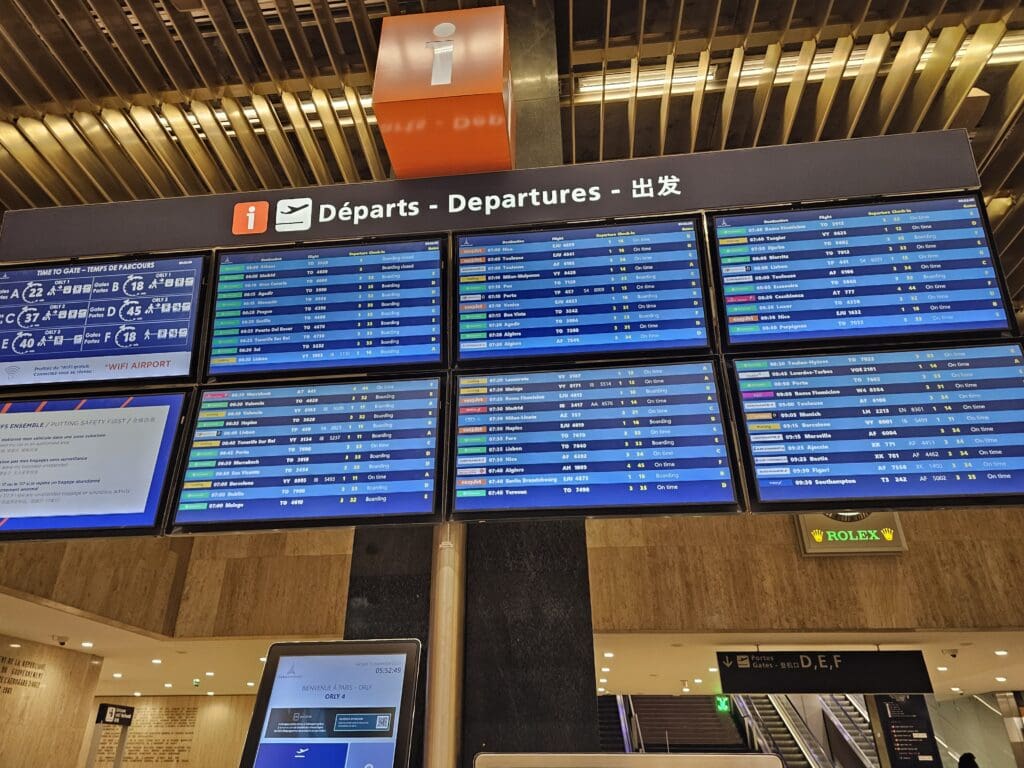
Aviation enthusiasts will be happy to hear that decent airside views are offered throughout Orly 4, with large windows offering a good view of many of the terminal’s stands, as well as onto one of the runways which was being used for arrivals that morning. Following a quick explore, I headed to the departure boards which revealed that my flight would be departing from Gate F32, one of the furthest gates away from the main hub sitting at the very end of the terminal. Fortunately, with plenty of time to go, I journeyed through the relatively quiet terminal. As I waited Transavia France’s morning rush hour appeared to be in full swing with Boeing after Boeing seen rocketing away at the start of their morning missions. Replacing them, an army of Air Caraibes, Air France and Corsair Airbus A330s, Airbus A350s and Boeing 777s arrived at the end of their overnight services from West Africa and the islands of the Caribbean and Indian Ocean.
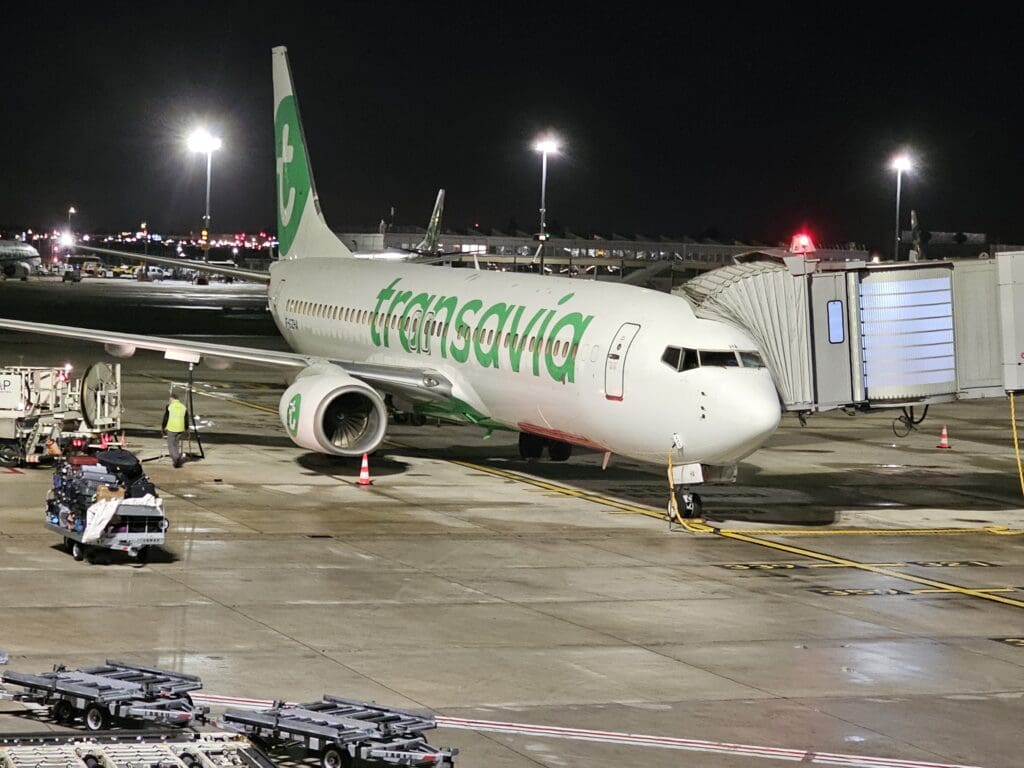
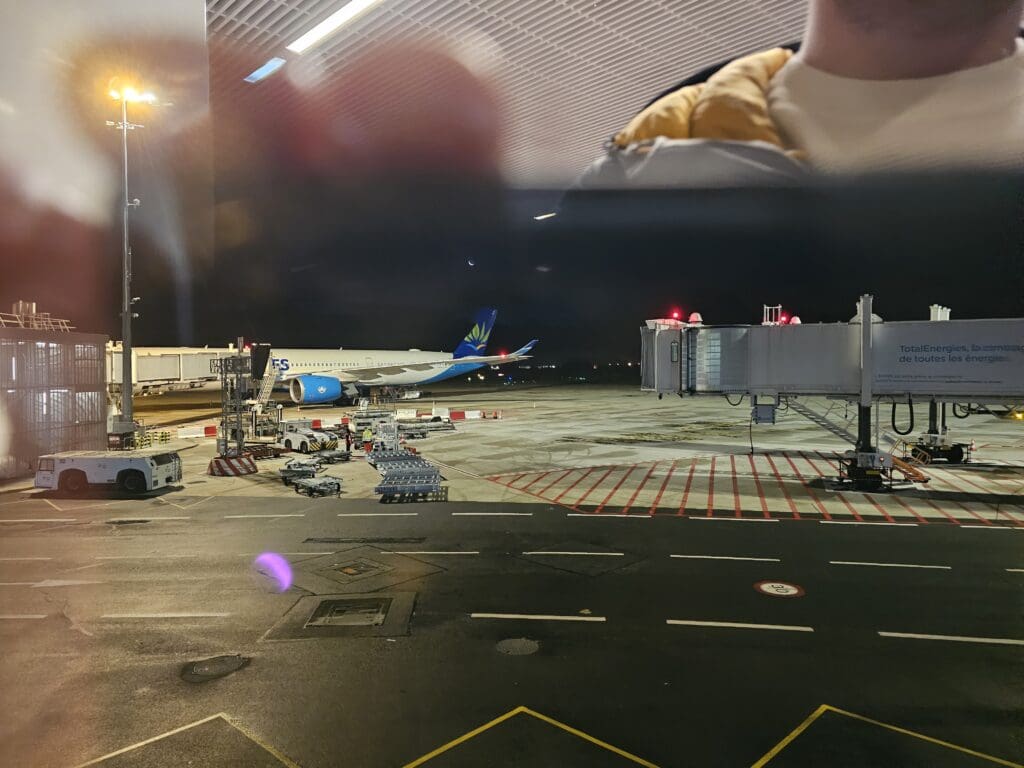
Upon arriving at Gate F32, a small group of Morocco-bound travellers could be seen ready and raring to head off and as the skies began to brighten, more and more passengers arrived. Unfortunately, this particular gate seemed to be one of the worst for getting photos of the aircraft outside.
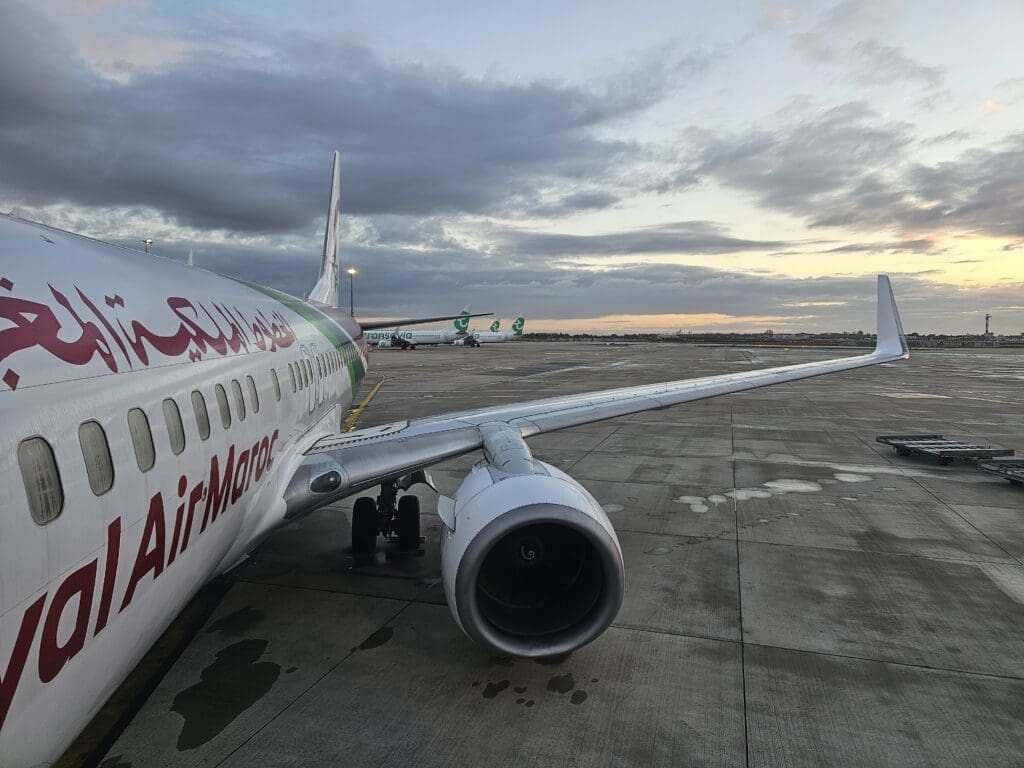
At that time, whilst unable to be seen from the waiting area, Boeing 737-8B6 CN-ROB was being readied for its morning hop down to Casablanca, with this having arrived the previous evening from Marrakech. As with all Boeing 737s, this aircraft began its life in Renton, Washington and took to the skies in late January 2005 making it nearly 19 years old at the time of my flight. Delivered directly to Royal Air Maroc as part of their large Boeing 737NG order, the aircraft was soon pressed into service and has spent the entirety of its career shuttling passengers to, from and around Morocco. According to the AvHerald, this has only been involved in one major incident during its life when the First Officer became incapacitated prompting a diversion to Tangier on a flight between Madrid and Casablanca. Today, the aircraft wears Royal Air Maroc’s new livery, having received this in January 2021. In the week before my flight, the Boeing operated services across Europe and West Africa, visiting the likes of Agadir, Amsterdam, Banjul, Bissau, Dakhla, Frankfurt, Istanbul, Marrakech, Marseille, Nantes, Oudja, Paris CDG, Paris Orly and Praia, travelling at least 34,000 miles over the course of 30 sectors.
With boarding set to begin at 0735, I had one final wander before returning to the gate area with ten minutes to go until the scheduled boarding time. Upon returning there, relatively few passengers could be seen waiting giving the impression that either passengers were milling around the main central hub not realising quite how far away the gate was, or that it was going to be a relatively quiet flight down to Morocco. Glancing around, it seemed that many passengers had taken full advantage of Royal Air Maroc’s generous luggage policy, carrying large amounts of all weirdly and wonderfully shaped items that would have perhaps brought joy to a low-cost carrier given the potential for earning additional chargers.
At 0733, an announcement was made in French only advising passengers of the commencement of boarding with those requiring assistance or travelling in Business invited to use the priority lane. At this time, most passengers stood up and began to queue, and, being a sheep, I decided to join them. After a few minutes spent shuffling forwards, my boarding pass was scanned by one of the two staff members at the gate podium and I was quizzed on my final destination before being asked to show my ticket. Following a few suspicious looks and plenty of typing, I was allowed to proceed however once through it became clear that Royal Air Maroc employed Ryanair boarding techniques. Specifically, the physical act of boarding the aircraft had not actually commenced and instead, passengers were being kettled in the no man’s land between the jetbridge and the terminal.
After being kept there for fifteen minutes, boarding commenced however seeing as only a limited number of passengers were allowed onto the jetbridge at any one time, this was a slow affair and it took another eight minutes before I was able to head down towards the aircraft. Eventually, I stepped into the Boeing 737’s forward galley, where, failing to give off the best first impression, I was greeted by means of a subtle nod from one of the two flight attendants standing in the forward galley. Both of whom seemed to spend the entirety of boarding having a loud and animated conversation with one another as passengers filtered onto the aircraft. On the plus side, I was handed a Royal Air Maroc branded packaged wipe.
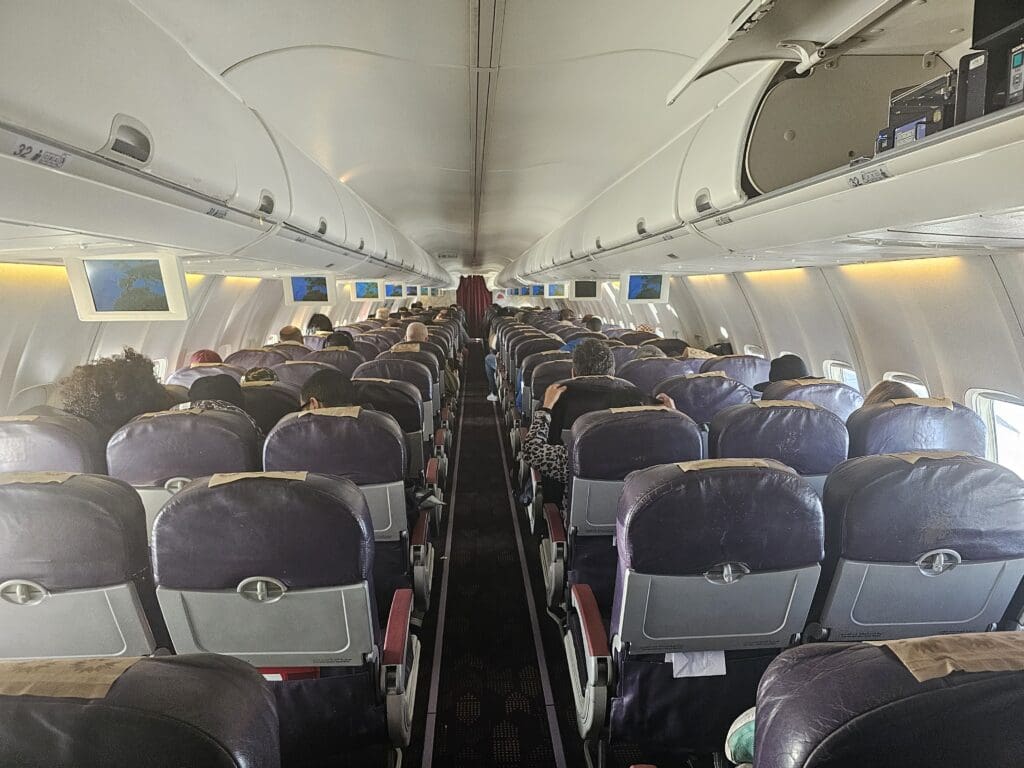
Turning right, I immediately hit a queue and slowly shuffled through Business Class. For those with the money to spend, one of Royal Air Maroc’s selling points is that they are the only airline operating between Europe and Morocco to offer a ‘real’ business class hard product. With other carriers either providing a ‘Eurobiz’ style seat or taking the form of all-economy low-cost carriers. As with all of Royal Air Maroc’s Boeing 737-800s, this consists of three rows of well-padded recliner seats sporting a pleather purple and cream cover. Some of these sported a disposable antimacassar although a fair number of seats throughout the aircraft were missing these, creating a slightly tatty impression.
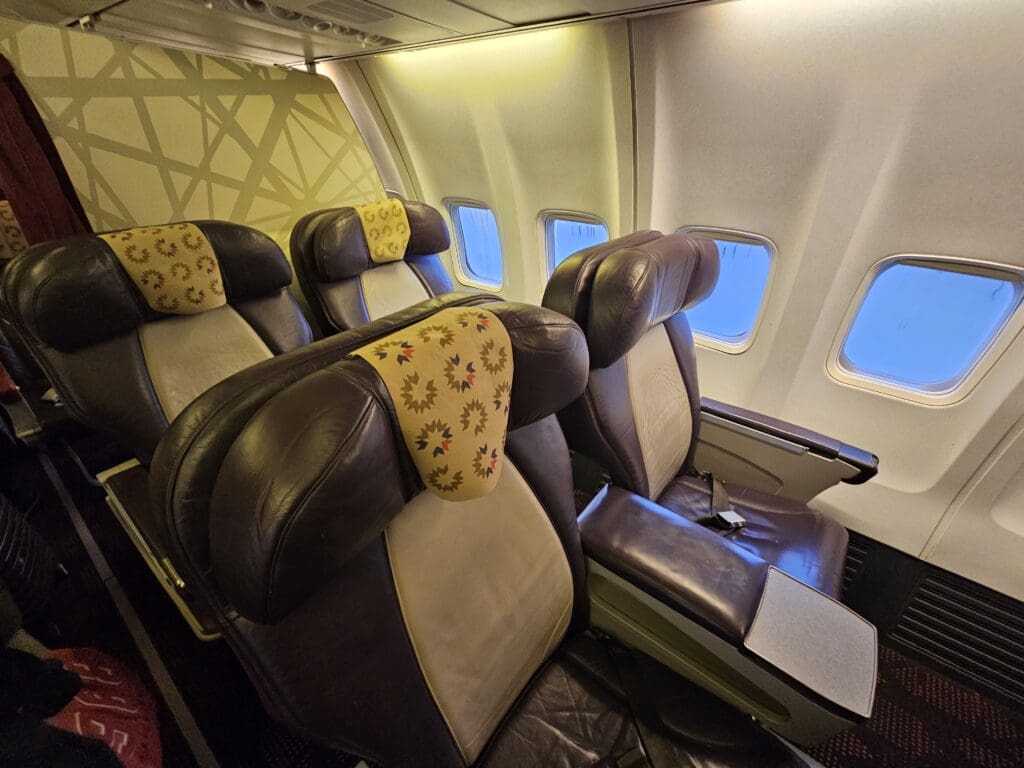
One thing I did like about the cabin was that it had been given a uniquely Moroccan feel, with traditional tastir patterns on the carpets and bulkheads. Continuing onwards, I soon entered the Boeing’s 147-seat Economy cabin and made my way past a flight attendant who, thanks to their hair and moustache, bore a rather strong resemblance to Freddie Mercury! Unfortunately, other than being a doppelganger for the Queen star, they did not leave a lasting impression as they stared blankly as passengers boarded the aircraft, failing to greet them as they walked by. In terms of design, each Economy seat was covered in a purple pleather cover and welcomingly a little more chunkier than your lightweight slimline seats of today.
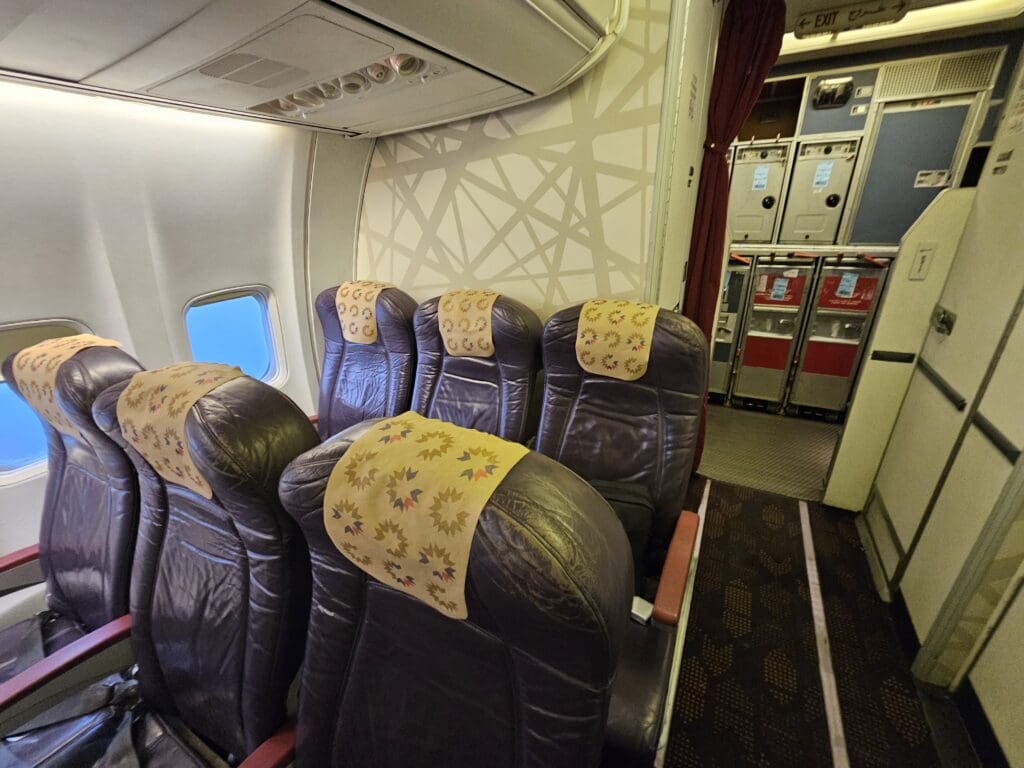
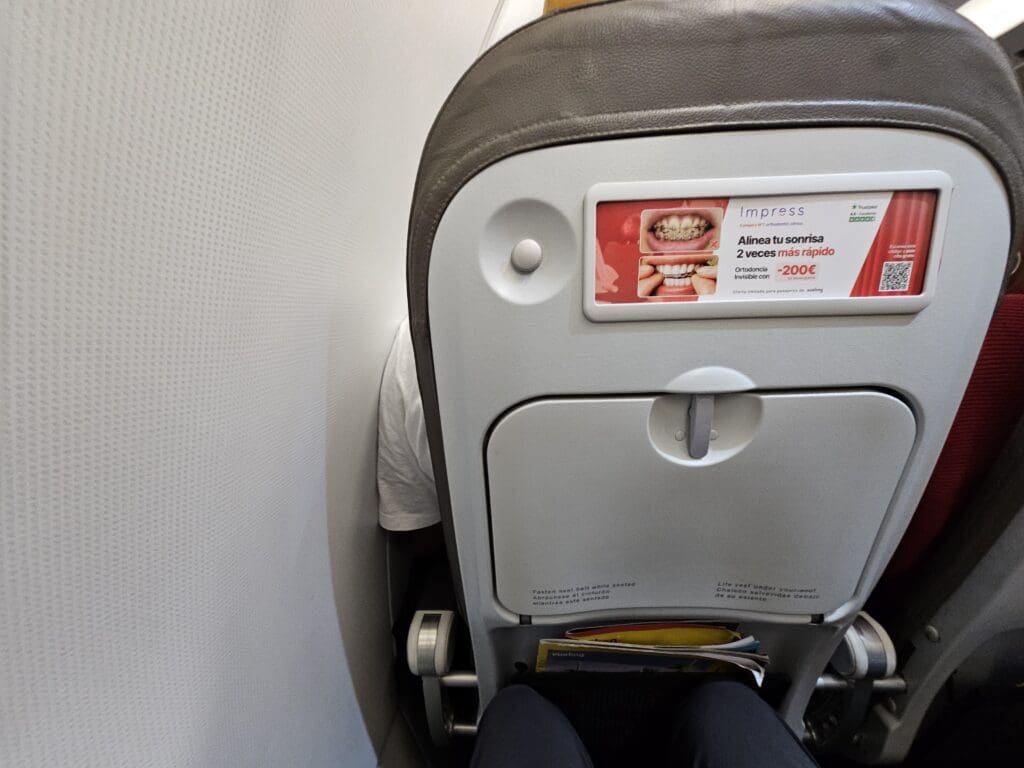
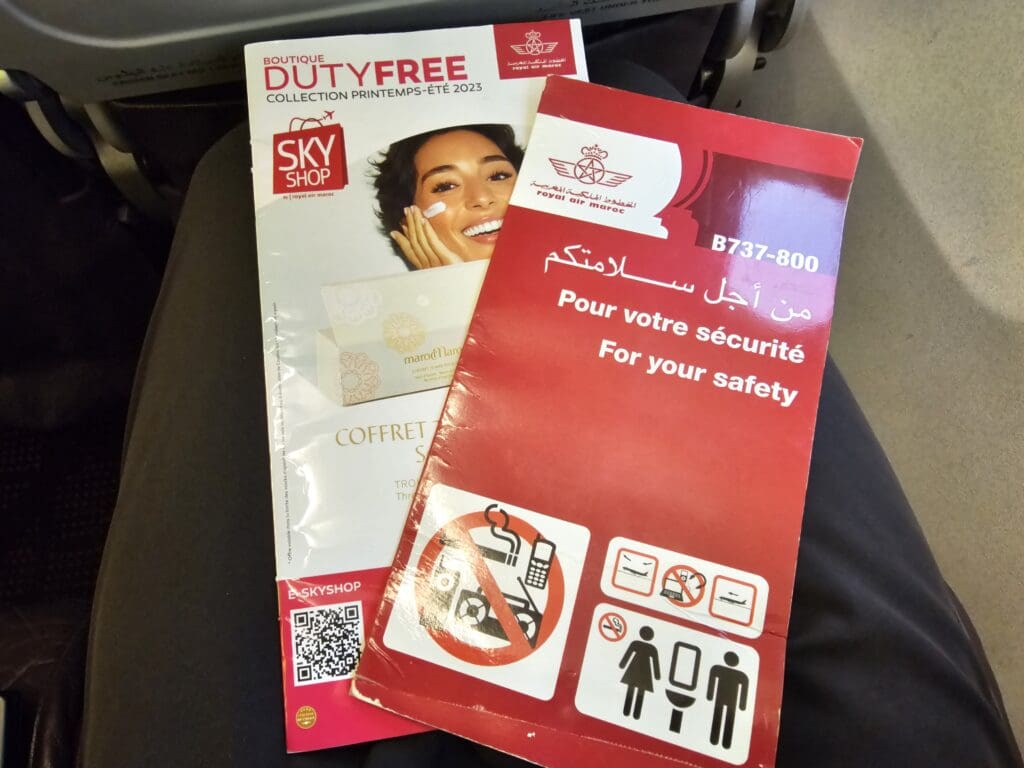
Upon reaching Row 19, I was delighted to see that I was yet to be joined by any seatmates so I was able to slide into my seat with ease and take photos of this to my heart’s content without attracting suspicious looks. Looking around, it was clear that the cabin had seen better days, with signs of wear and tear being virtually omnipresent throughout. Furthermore, with a fair amount of well-engrained dirt and stains, it was clear that the aircraft required a deep clean. However, on a more positive note, the seat was comfortable and soft and offered a decent amount of legroom even though the seat in front seemed to be in a permanently reclined state. Turning to the seatback pocket, this contained a dogeared safety card, a copy of Royal Air Maroc’s Sky Boutique duty-free catalogue and a folded-up sick bag (thankfully unused). Indicating that the overnight clean had not been as comprehensive as Royal Air Maroc would like, I also found a plastic milk container in this.
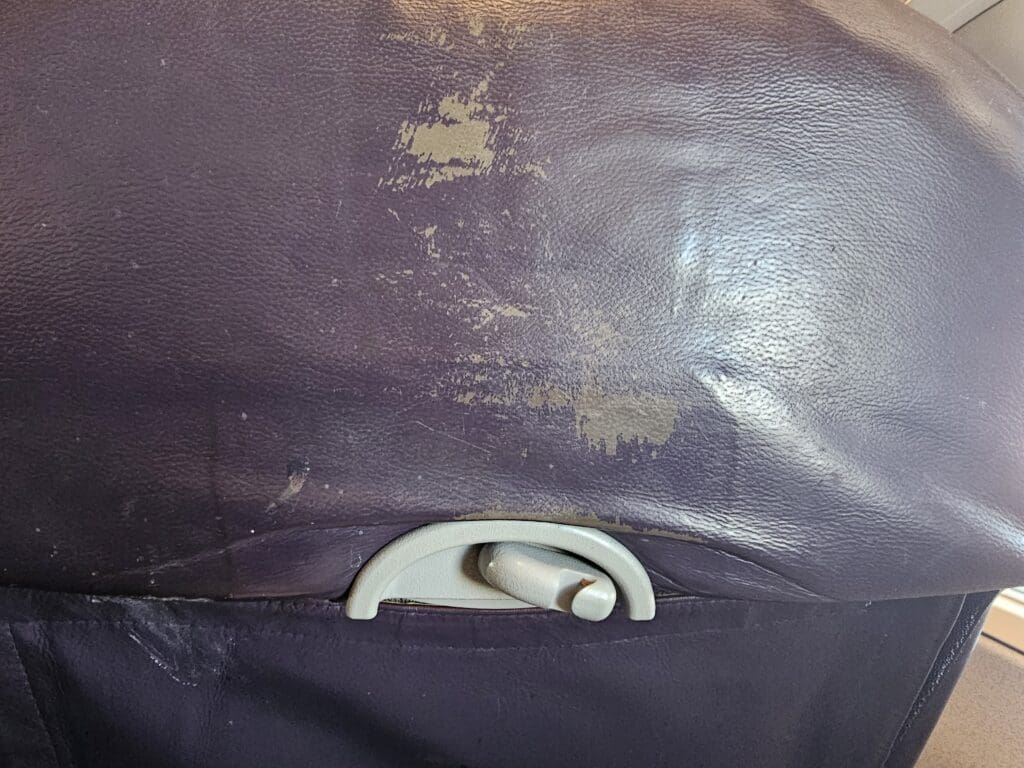
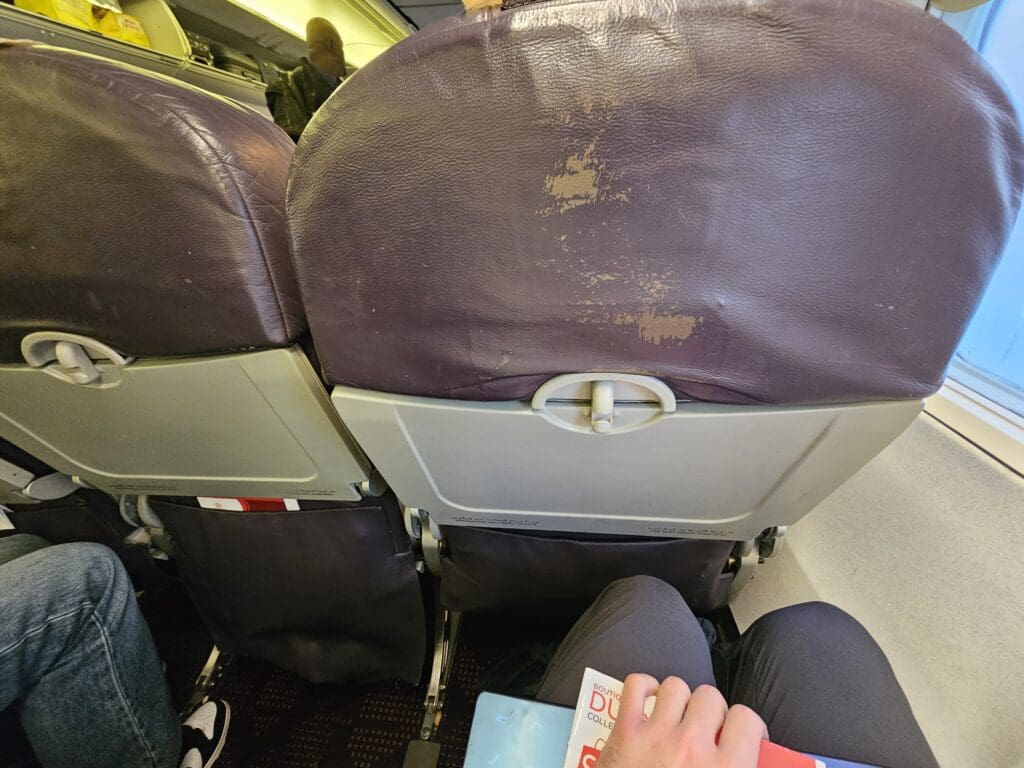
A few minutes after sitting down, I was joined by a fellow passenger in the aisle seat and it was not too long before the final passengers could be seen making their way onto the aircraft. With eight minutes to go until our scheduled departure time, boarding reached its end and traditional Moroccan music began to ring out over the cabin speakers. As I had suspected whilst waiting in the terminal, that morning the flight to Casablanca was far from full and I would guess that the load in Economy was not more than 70%. Examining the demographics of the flight, the majority of passengers on my flight seemed to be from Morocco or members of the French Moroccan diaspora, whilst a fair number of passengers also seemed to be connecting onwards to West Africa. Perhaps unsurprisingly, I did not overhear any other English speakers on the flight.
At 0820, the cabin door was closed with a loud thud and soon, the traditional music that had accompanied boarding came to an end as the Purser performed their welcome announcement in Arabic and French. It is worth noting that no English announcements were made during the flight. Three minutes after the doors were closed, the Boeing jolted back away from the Stand B61 and soon the familiar sounds of the CFMI CFM56-7B26 start-up procedure rang out and temporarily resulted in a fair amount of vibration. As this was underway, the overhead screens dropped into position and Royal Air Maroc’s safety video was soon played.
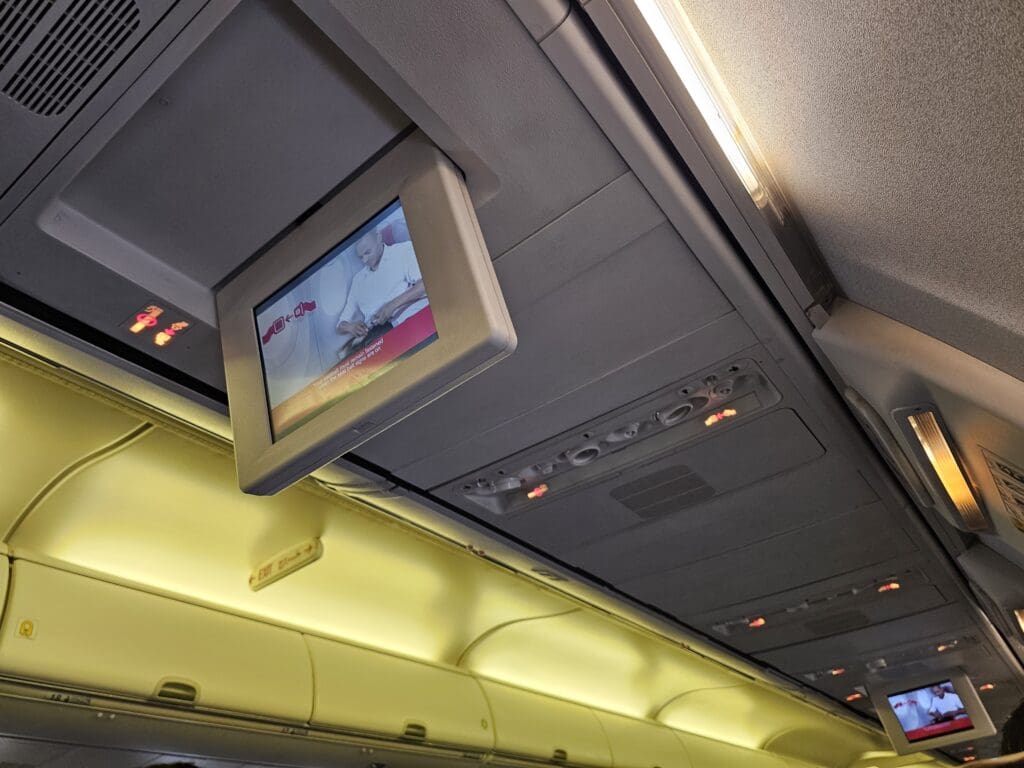
Once the engines had fired up and the tug had been disconnected, at 0827 the Boeing powered away under its own steam and made its way around the terminal complex as it trekked over to Runway 24. Sitting on the right-hand side of the aircraft, I was able to see pretty much all aircraft that were on the ground at Orly at that time. Being based in the UK, the particular highlight of this journey to the runway was an Azul Airbus A350 which had just arrived following an overnight slog from the Brazilian city of Campinas. As we journeyed to the runway, the crew made a few passes through the cabin to ensure all was secure for our departure whilst the Captain made a very short announcement welcoming all onboard, thanking passengers for flying with Royal Air Maroc and wishing all a nice flight.
Around ten minutes after our taxi commenced, the Boeing arrived at the end of the runway. Whilst departing during the busy morning hours, at that time there was no traffic ahead of us so the aircraft able to make its way onto this with no holding. Once there, the aircraft came to a temporary stop and at 0839 the two engines powered into life and the Boeing commenced its long and seemingly gentle take-off roll. Swaying slightly as we rolled down the runway, eventually we took to the skies and moments later I caught sight of Paris’ fourth tallest building, the Tour Montparnasse as well as the iconic Eiffel Tower, both of which sit around thirteen kilometres to the north of the airport.
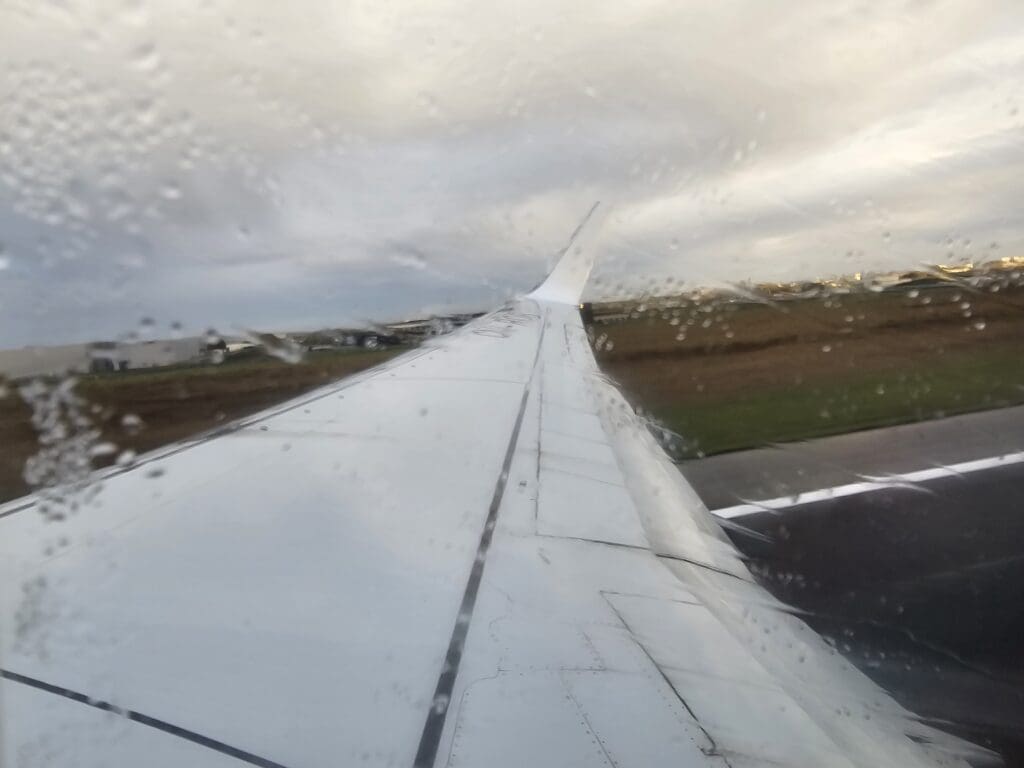
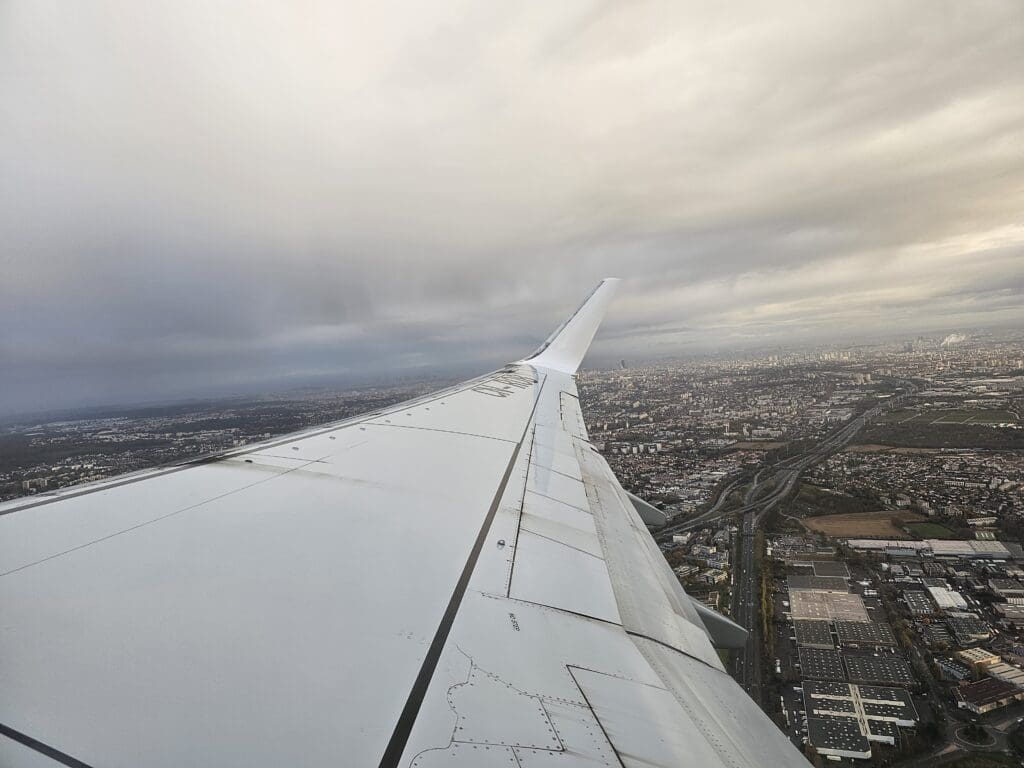
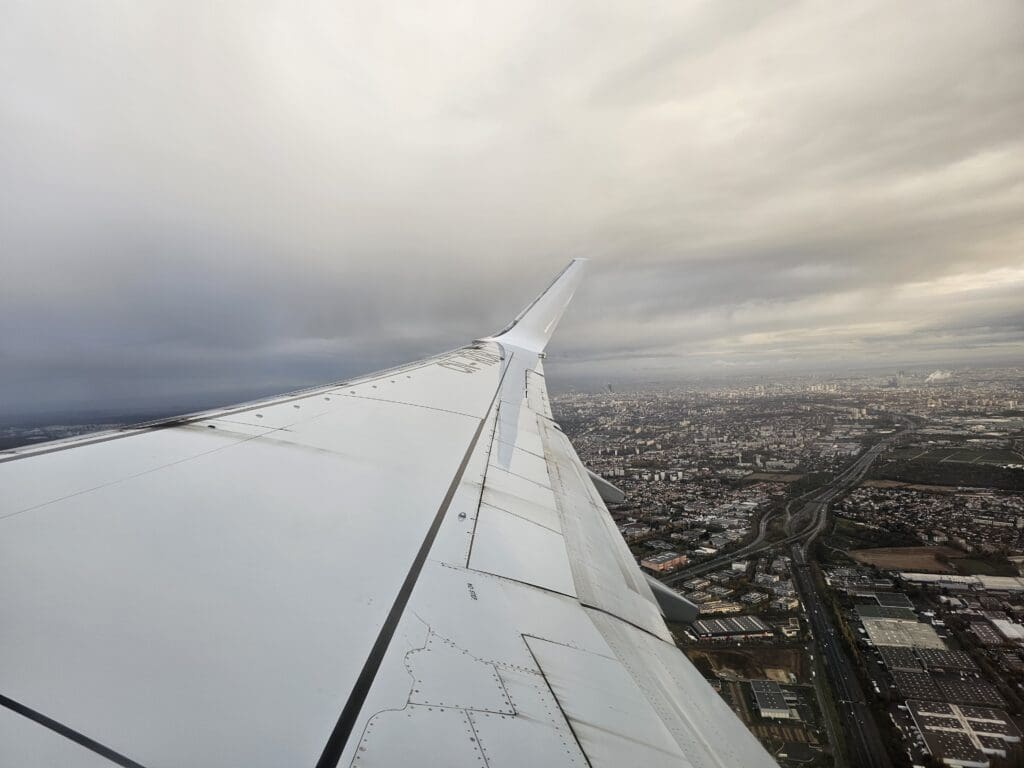
Once in the air, the overhead screens began to broadcast the moving map whilst many of those around me appeared to drift off to sleep. Climbing over Paris’ southern fringes, around a minute after departure the aircraft banked to the left and rolled out on a southerly heading that would take us towards the city of Orléans. Following a quick journey through the clouds, upon reaching 10,000 feet the seatbelt signs were extinguished at which point the Purser performed the usual safety announcement regarding keeping seatbelts fastened whilst seated.
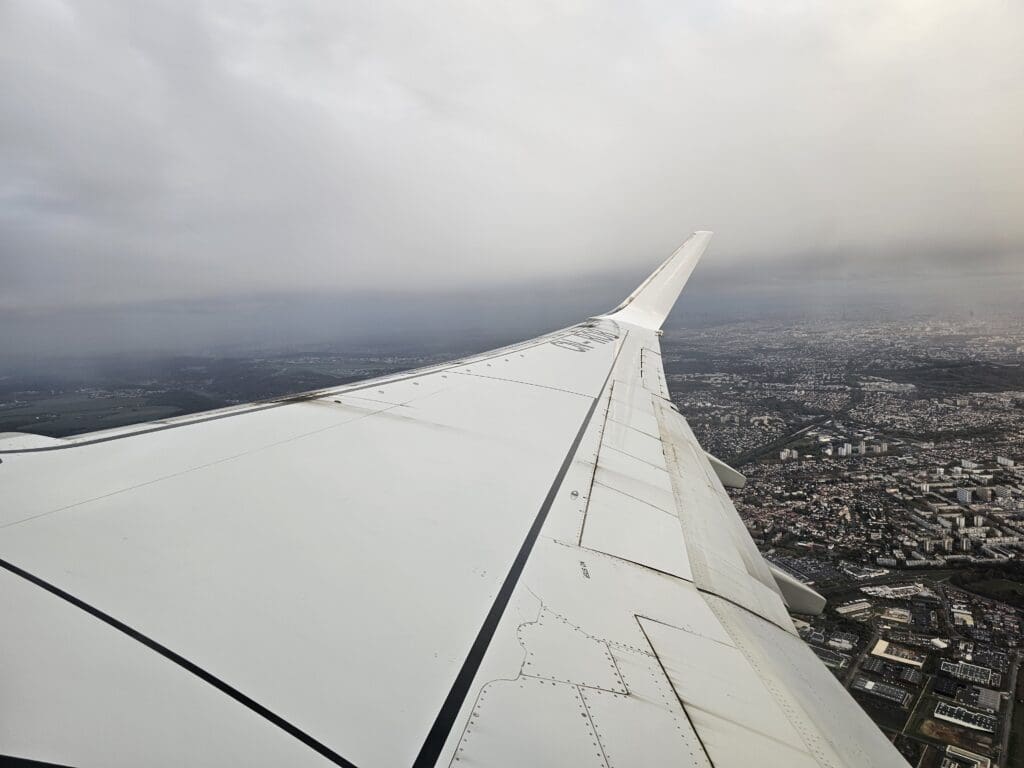
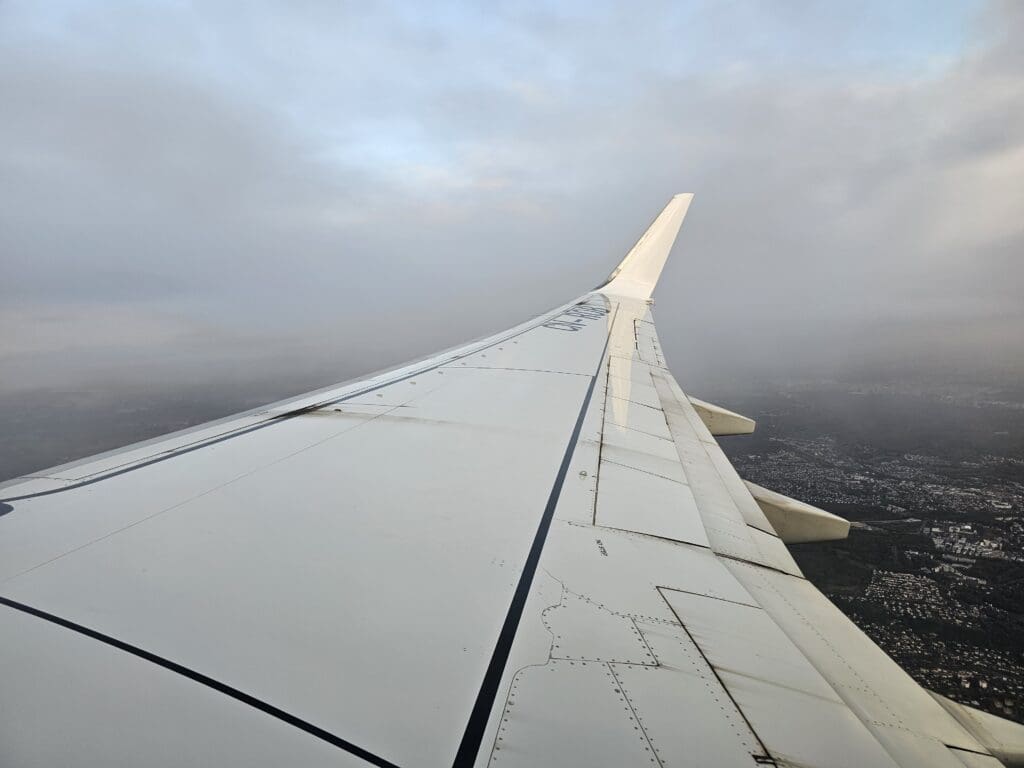
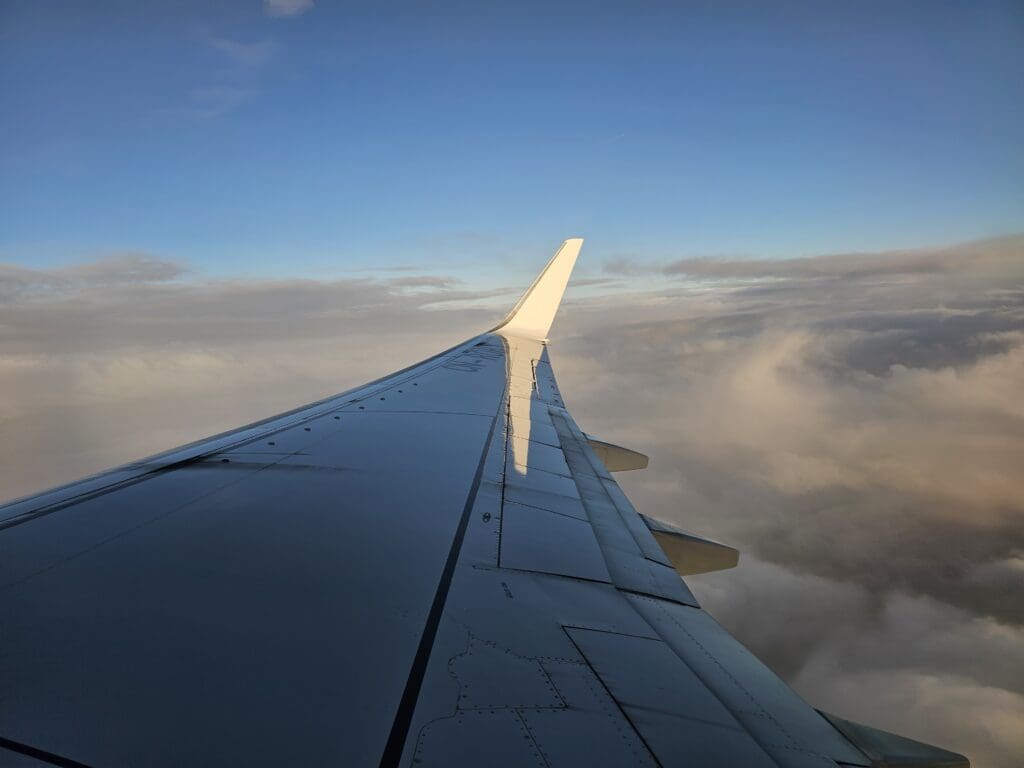
Returning to the route, after passing Orléans, the Boeing continued its climb over the region of Centre-Val de Loire and soon reached Châteauroux. This is somewhat well known in the aviation community owing to its airport’s frequent training flights as well as being home to a fair selection of stored airliners. Following a smooth and also entirely turbulence-free climb, the Boeing levelled off at its initial cruising altitude of 35,000 feet around twenty minutes after departure. At this point, the service carts rolled out to the front of the cabin and were soon followed by another containing food. Once service had commenced, a fellow passenger took to the aisle, wandering up and down this and loudly shouting in French. Whilst this did attract a few stares from those onboard, neither the crew nor passengers seemed to be particularly perturbed by this outburst and after ten minutes they returned to their seat with no further incidents occurring during the flight.
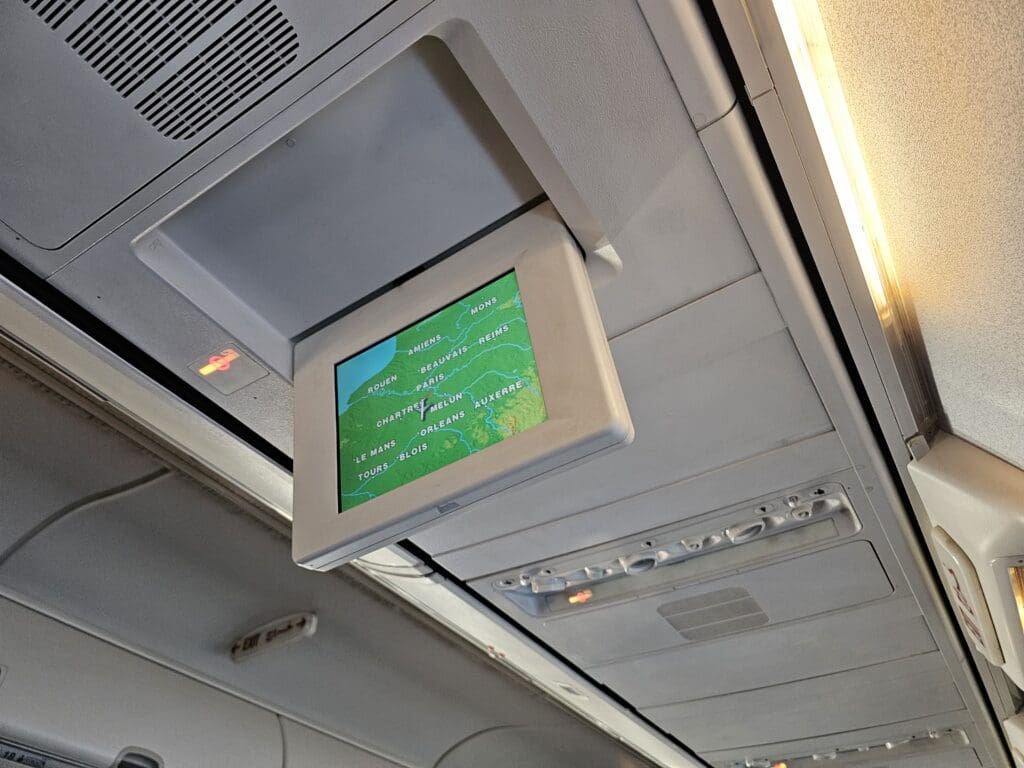
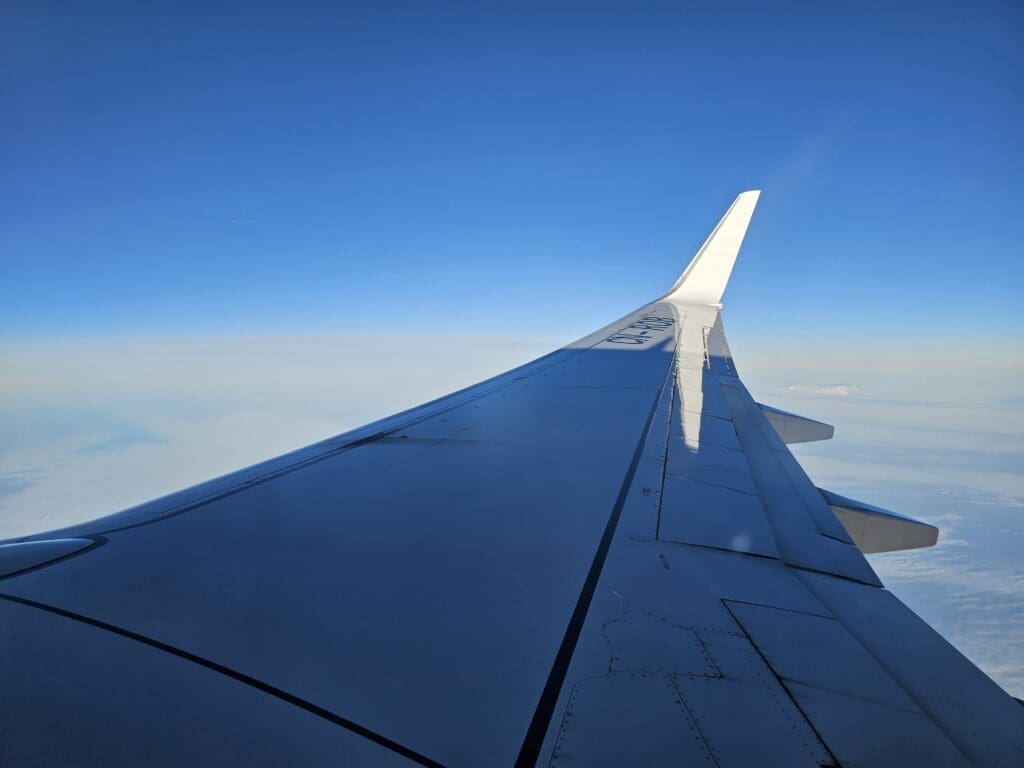
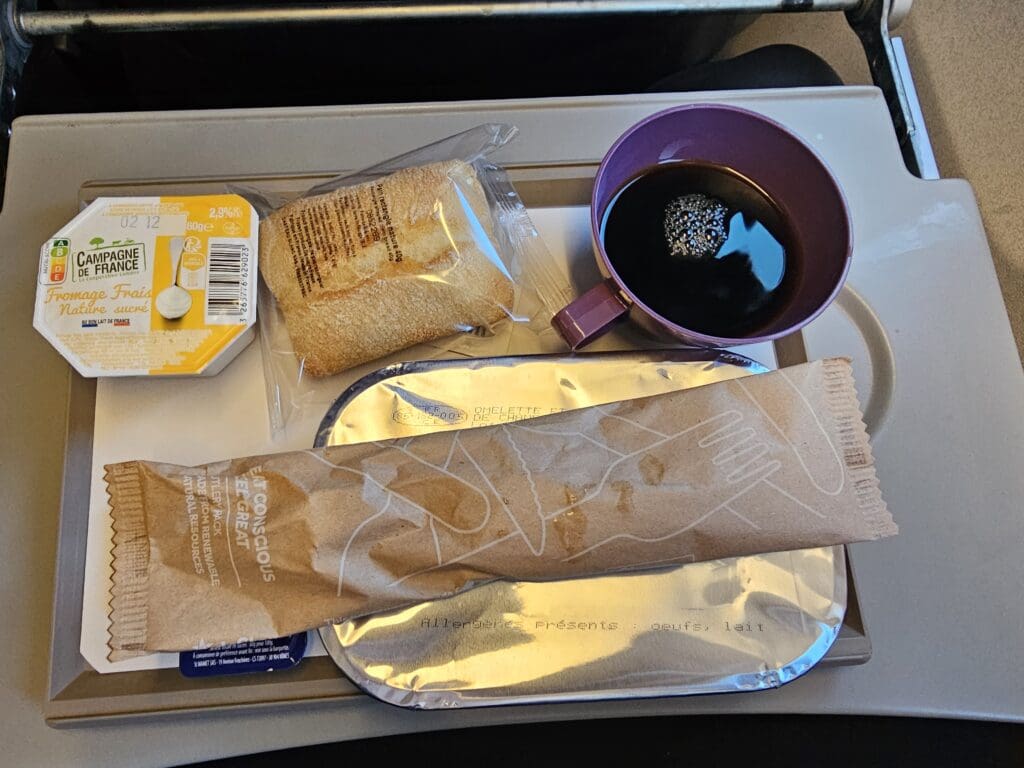
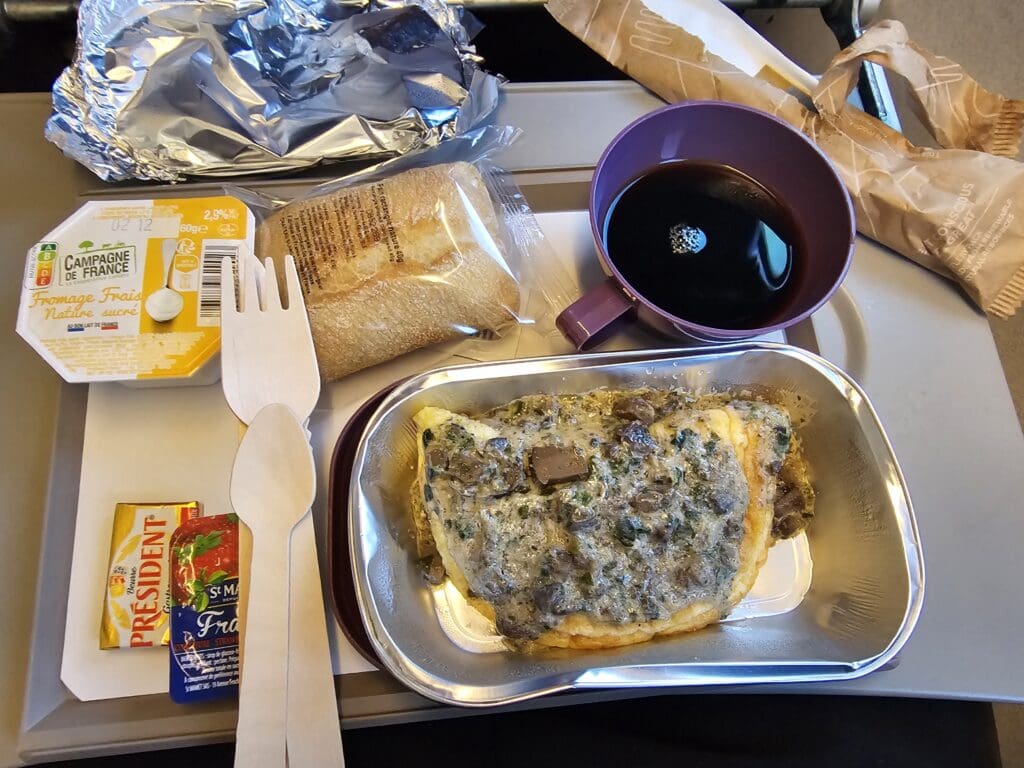
Back to breakfast, and once the first cart reached my row I was offered the choice of tea or coffee. Opting for the latter this was poured into a plastic cup and placed on the breakfast tray which was then handed over to me in a rather cool manner – with there being no dialogue other than ‘Café ou thé?’. That morning, there were no options for the main dish, however, given the length of the flight, this was not something I could complain about. As I opened up the contents of the tray, this contained a small foil container in which an omelette with mushrooms could be found, along with a plain yoghurt, a bread roll and sachets of jam and butter. This was also accompanied by an antibacterial wet wipe and a packet containing a serviette and wooden cutlery. Once the second cart arrived, I was then offered the choice of water or a selection of juices. Soon getting stuck in, I found this to be a very acceptable breakfast offering that left me with little to complain about, especially given the short length of the flight. Furthermore, rather than being left there until we neared Casablanca, the empty trays were collected around twenty minutes later.
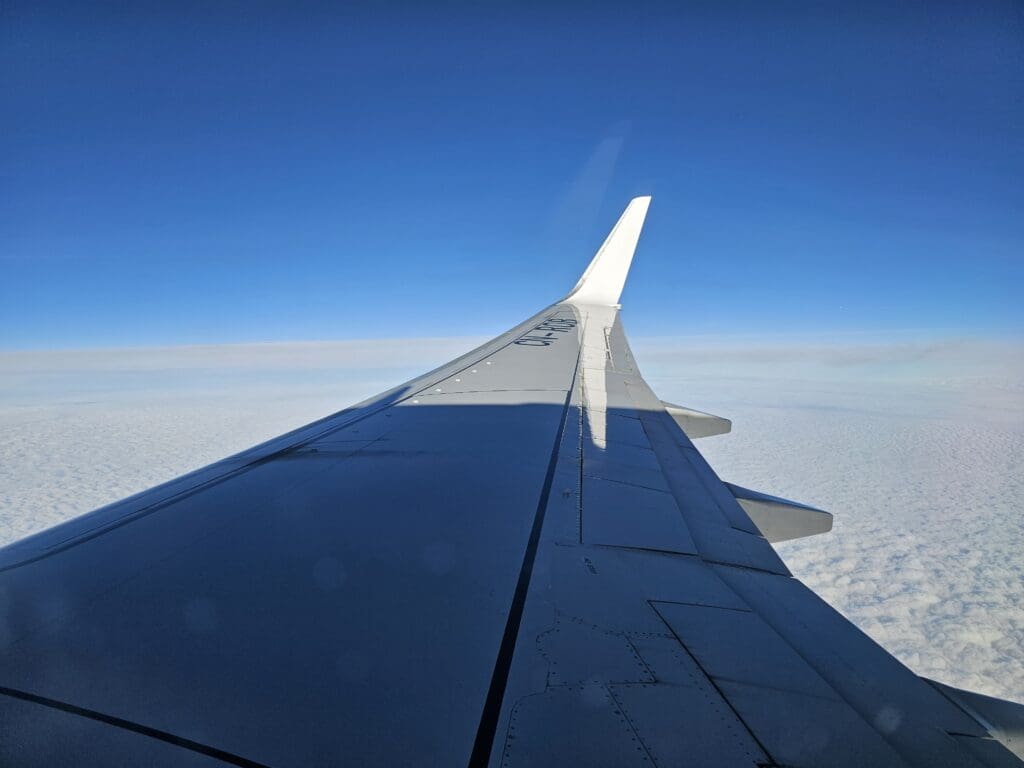
As I ate breakfast, the clouds temporarily cleared below and revealed the long sandy coastline of Aquitaine’s Les Landes region of France’s far southwest. This is an area I am rather familiar with having holidayed there almost every summer as a child! Unfortunately, views of the world below were not to last for very long as upon reaching the Pyrenees, the clouds rolled in and swallowed up any views of the mountains as we journeyed southwards over the Iberian Peninsula. At this time, the aircraft could be felt climbing once again as we headed up to our final cruising altitude of 39,000 feet. With little to see both inside and out, at this time I found myself drifting off to sleep for a short morning nap, waking up around twenty minutes later as we passed to the northeast of Madrid.
Given the length of the flight, a proper inflight entertainment system was not particularly missed. However, with Royal Air Maroc scheduling their Boeing 737s on longer flights of up to five hours, most of these feature the airline’s Sky-RAM wifi service and wifi-based content streaming. Unfortunately, whilst the network seemed to be present onboard and with a decal on the bulkhead at the front of the cabin advertising this, I was unable to connect to the network. Thus, given the absence of an inflight magazine, Royal Air Maroc did not provide any entertainment (other than the flight itself).
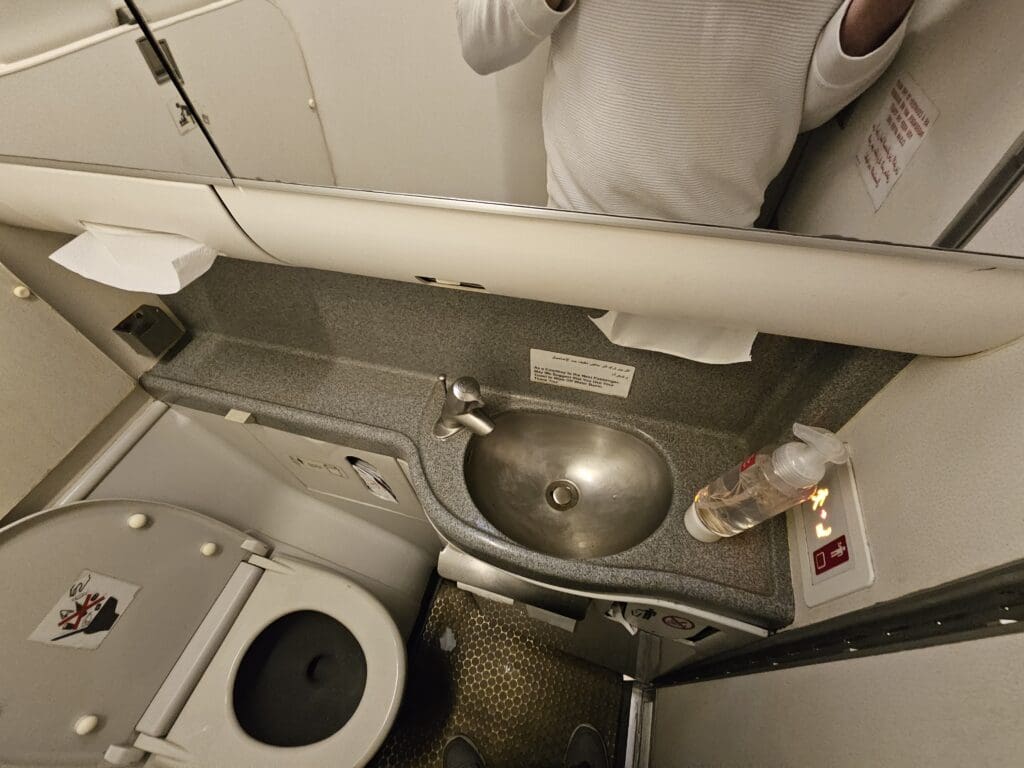
As we journeyed southwards, towards the southern tip of Spain, the onboard duty free service began although with the crew not having any luck in making any sales, they sped through the cabin before retreating to the rear galley where they remained until we neared Casablanca. After leaving the Spanish capital behind, realising that there was not a great amount of flight time remaining and with my neighbour now awake, I decided to make a trip to one of the two lavatories at the rear of the aircraft. Following a short wait, I made my way into one of these and was immediately presented with a disgustingly dirty lavatory. There, a mystery liquid (that I hoped was water!) could be seen all over the floor, whilst the toilet itself was blocked and not flushing although, perhaps with the crew not realising this, this had not been taken out of service. Needless to say, this was one of the worst aircraft lavatories I have ever visited and was left far from impressed.
Once back in my seat, the aircraft was nearing the famous Spanish coastal city of Málaga. Passing directly over the city, at this time the clouds parted revealing the Costa del Sol and I was treated to views of the likes of Marbella, Estepona and a few moments later, Gibraltar as we cruised southwards. After leaving the southern tip of the Iberian Peninsula behind, the Boeing headed made a short crossing of the Alboran Sea. At this time, the moving map disappeared from the overhead screens and following a short period of nothingness was replaced with a Buster Keaton film, followed by a few random videos and advertisements for Royal Air Maroc-related services. One interesting service advertised was the Cliente Mystère app which allows Royal Air Maroc passengers to rate their flight in exchange for 170 Safar Flyer miles.
No more than eight minutes after leaving Spain behind, the aircraft crossed over the Moroccan coastline near the town of M’diq before heading inland towards the city of Tétoun and the picturesque Rif Mountains of Northern Morocco. Flying southwestwards, that morning the Boeing crossed over the regions of Tanger-Tetouan-Al Hoceima and Rabat-Salé-Kénitra as it trundled towards the blue waters of the Atlantic Ocean. As the aircraft neared Kénitra, Morocco’s ninth largest city, at 1045 the aircraft could be felt sinking downwards and commenced its descent into Casablanca. A minute or so later, this was followed by a long announcement in Arabic and French with the usual pre-arrival warnings.
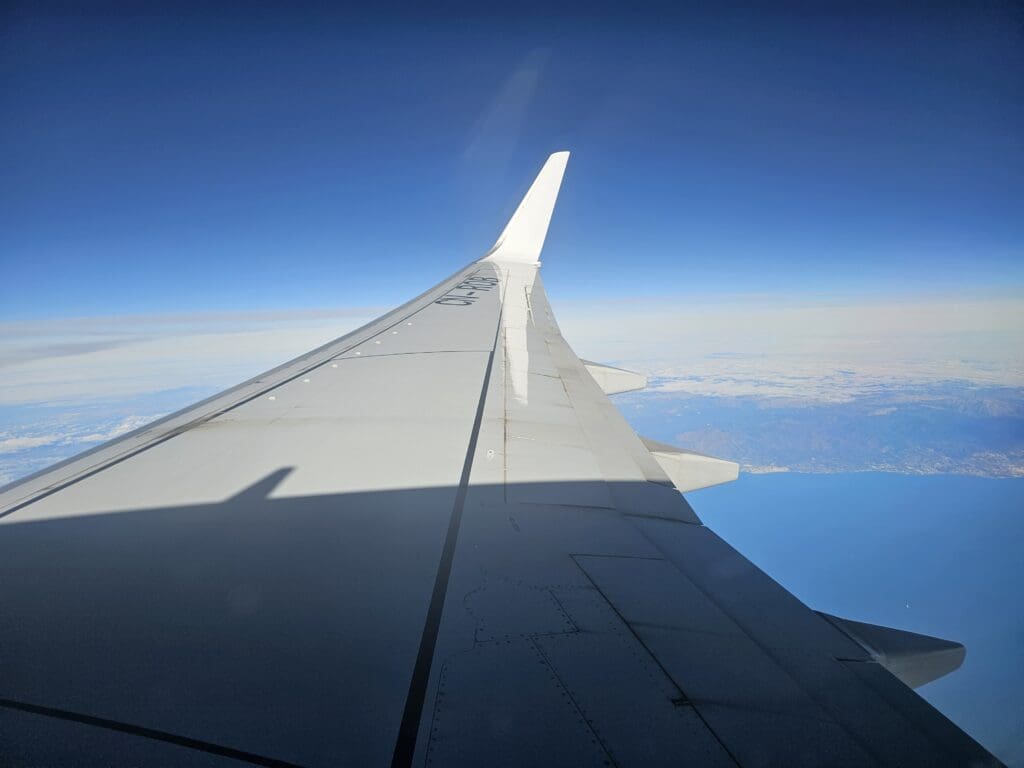
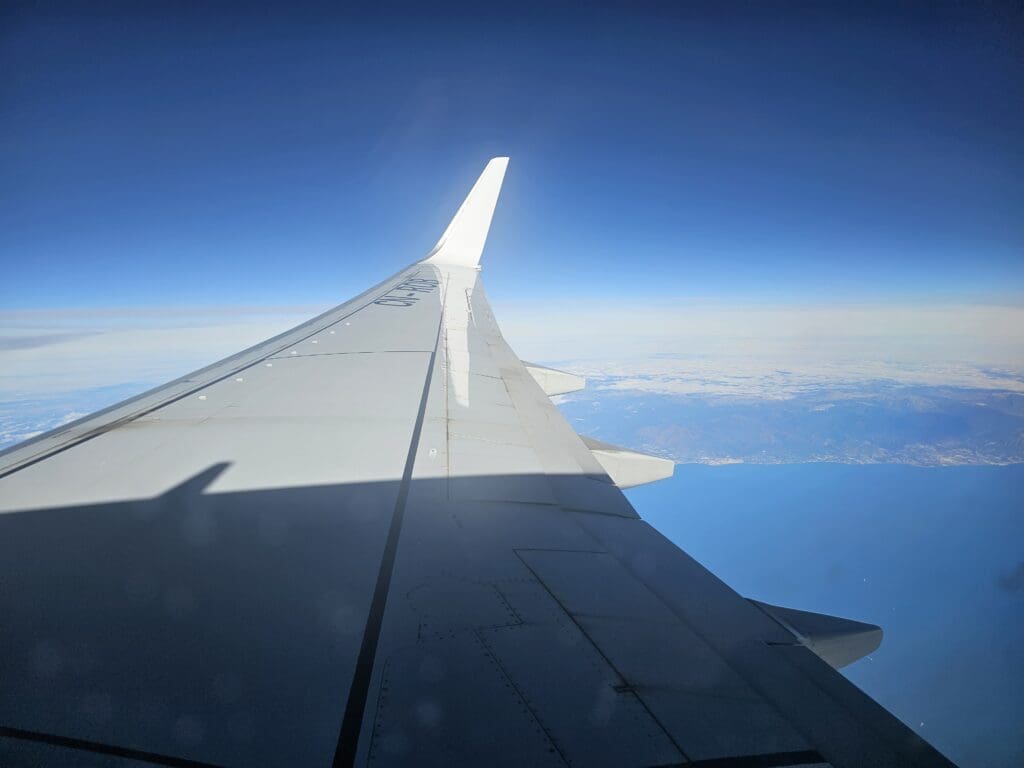
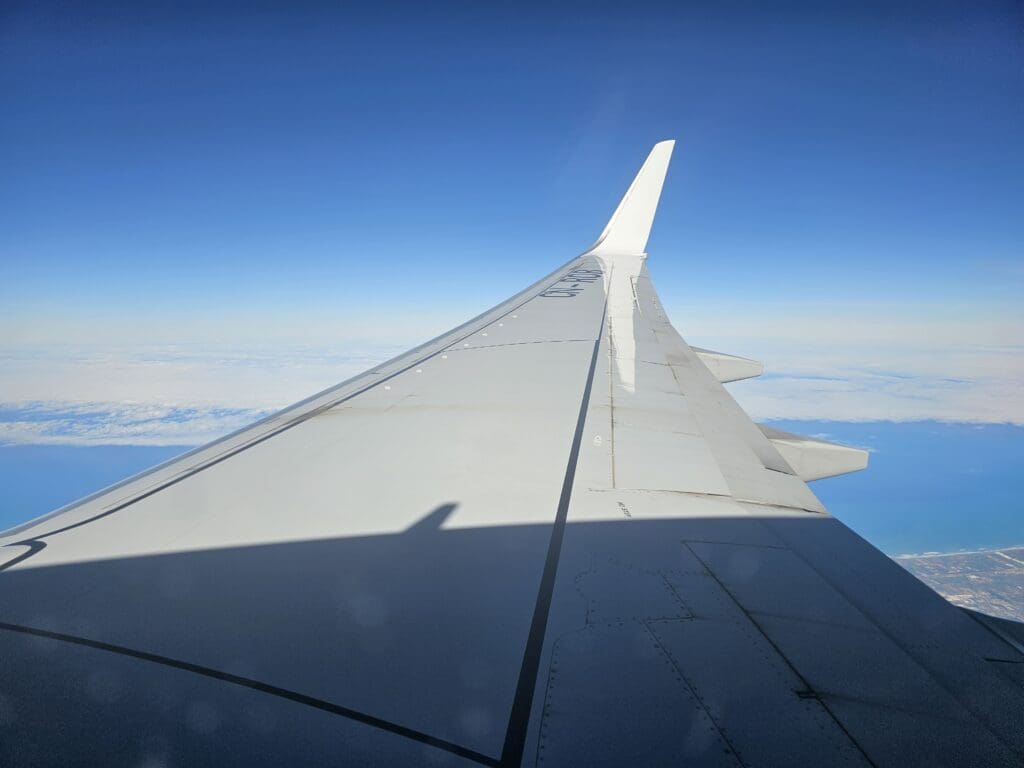
With the clouds having completely disappeared below, a good view of the Atlantic coastline was offered as we flew roughly parallel to this, with the sprawl of various cities including the capital, Rabat, seen as we continued southwards. Perhaps wanting to ensure that all was secure in good time for our arrival, a few minutes after leaving our cruising altitude the seatbelt signs were re-illuminated and the crew passed through the cabin. Admittedly, they did not seem to do a fantastic job at their pre-arrival checks as plenty of people still had their seats in the reclined position around me.
Continuing onwards down the coastline, I soon spotted Casablanca with the 210-metre tall minaret of the Hassan II Mosque easily spotted poking upwards through the haze. Sinking over the mostly flat landscapes of beige and green, our descent was smooth and after passing the Casablanca the speed brakes were partially extended as we slowed in preparation for our arrival.
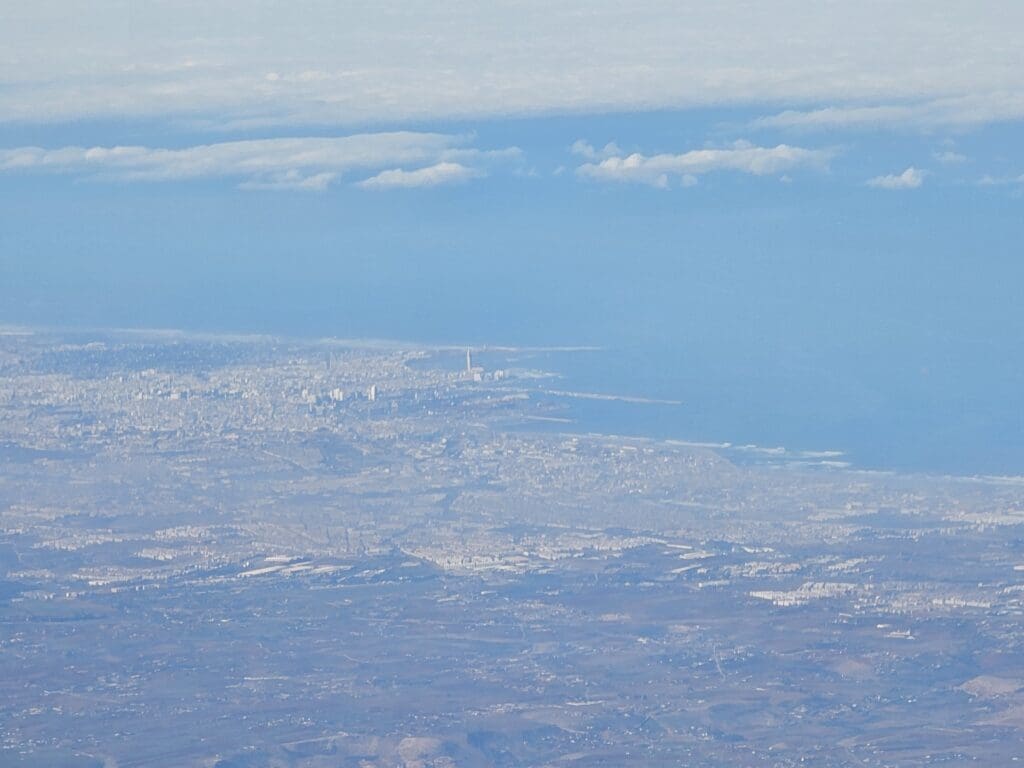
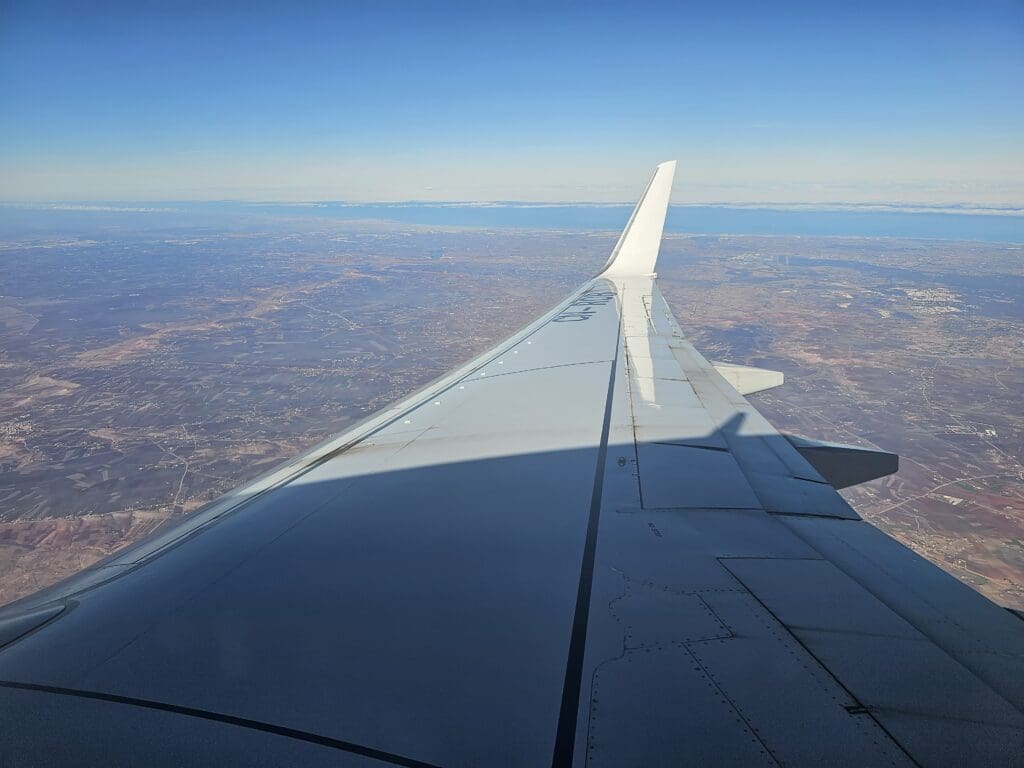
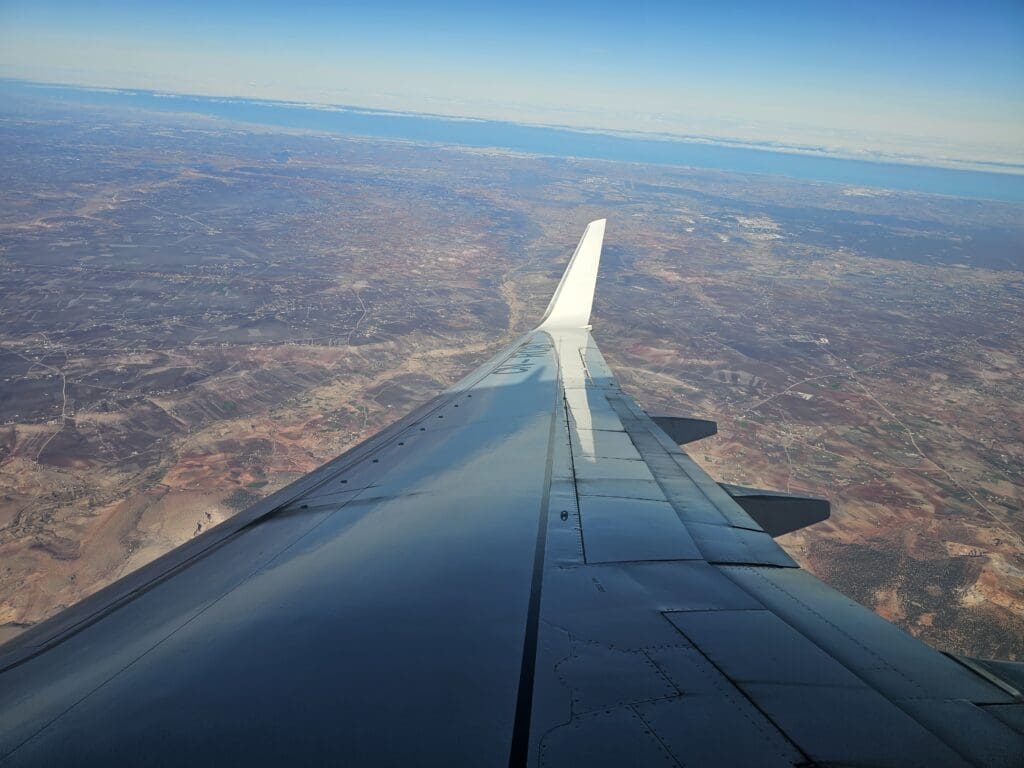
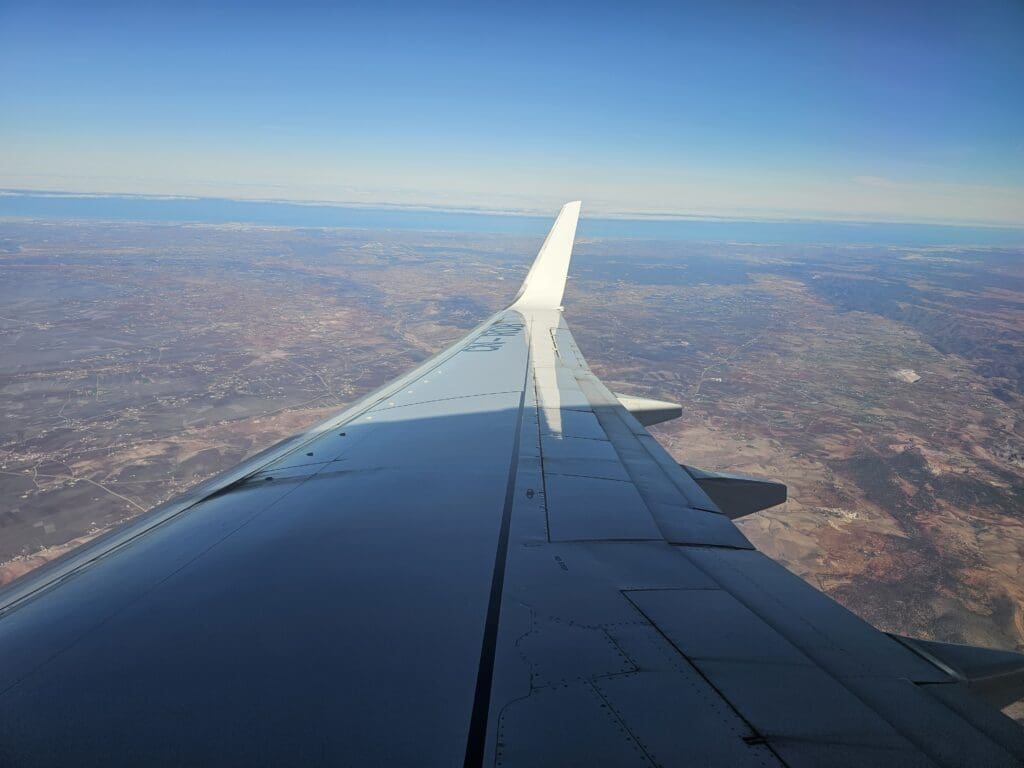
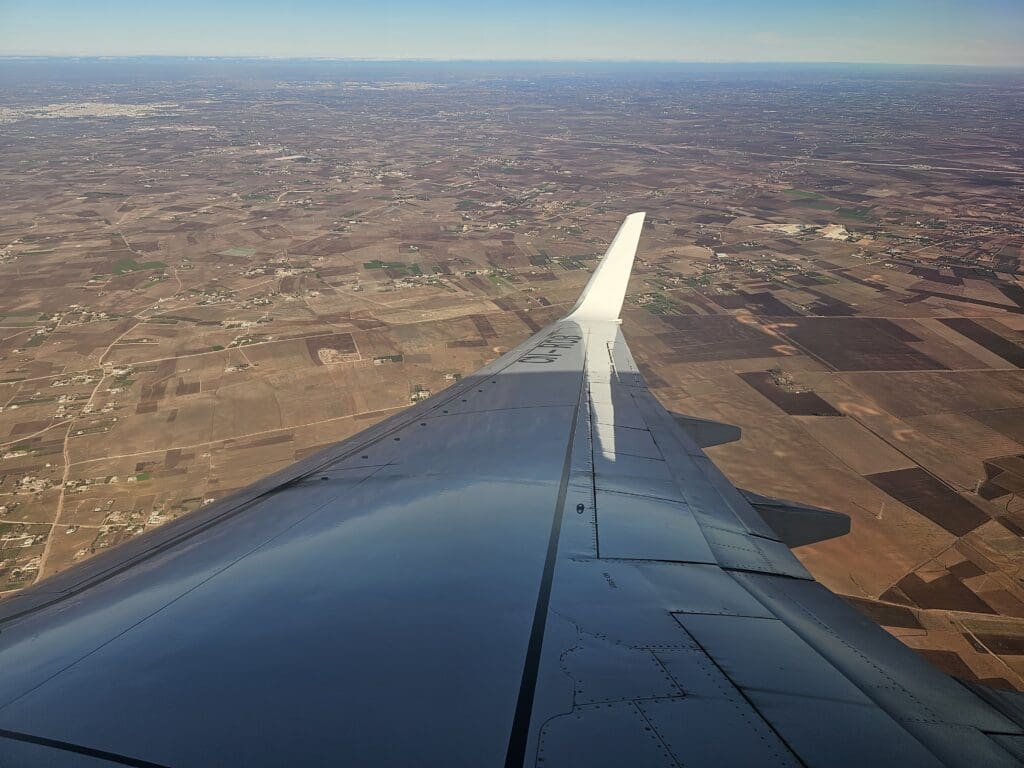
Soon, the Boeing orientated itself towards the coastline as it lined up for an approach to Casablanca’s Runway 35L and as we sank down towards the airport, the occasional small village could be seen. As we neared the airport, the landing hear and flaps were lowered into position as the fields below became increasingly clearer and it was not long before the aircraft sank over the airport’s perimeter. After crossing this, the aircraft whizzed past the airport’s maintenance hangars and general aviation area as well as a queue of waiting Royal Air Maroc aircraft. At 1110, exactly 2H31 after taking to the skies, the Boeing touched down on Moroccan soil with a fair thump before decelerating rather quickly. As we slowed, the Boeing made its way past the terminal where plenty of locally based aircraft ranging in size from RAM Express’ ATR-72s right up to Boeing 787-9 Dreamliners could be seen, whilst an old retired Royal Air Maroc Boeing 747-400 could also be seen at the airline’s maintenance area at the northern end of the airport.
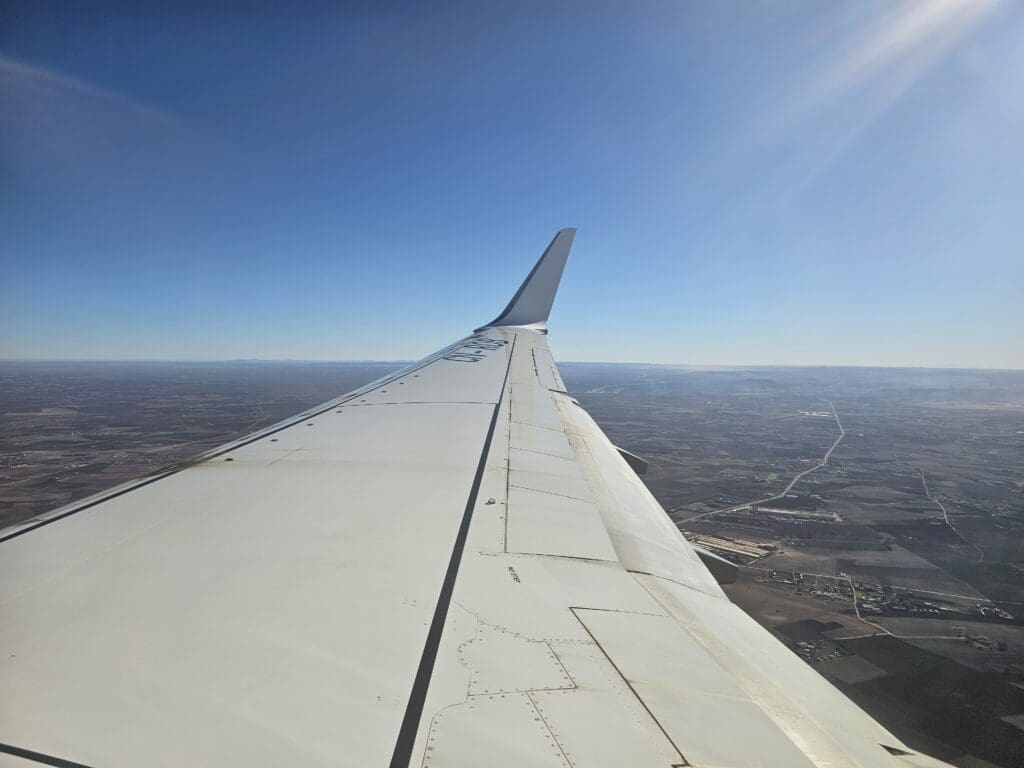
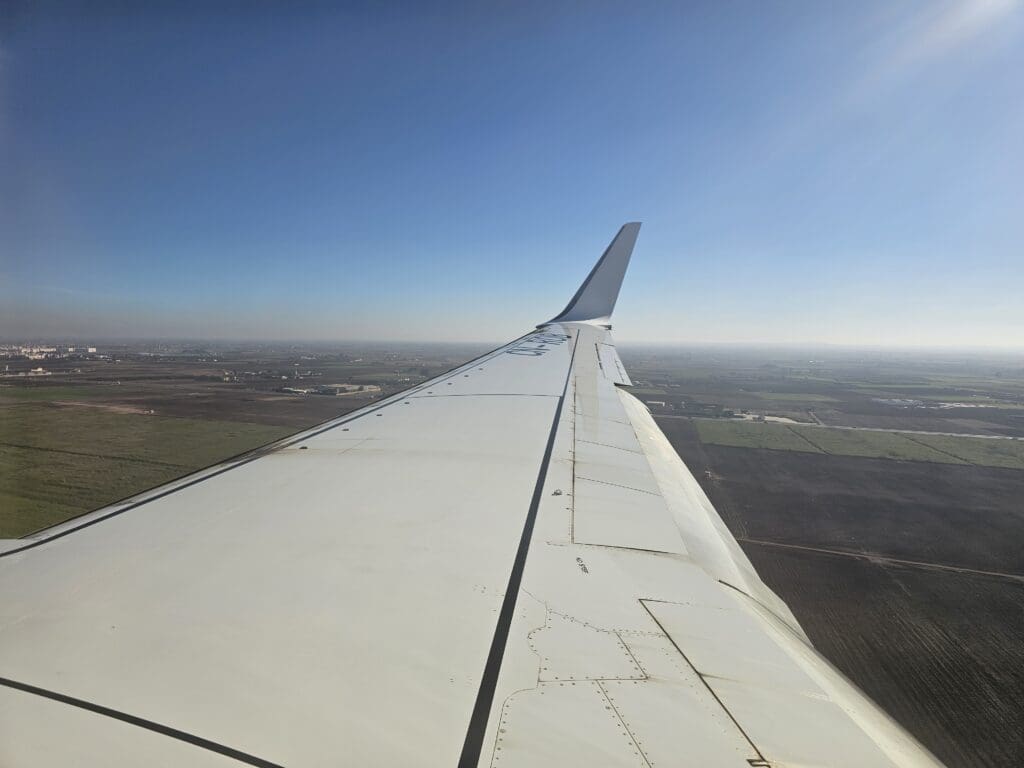
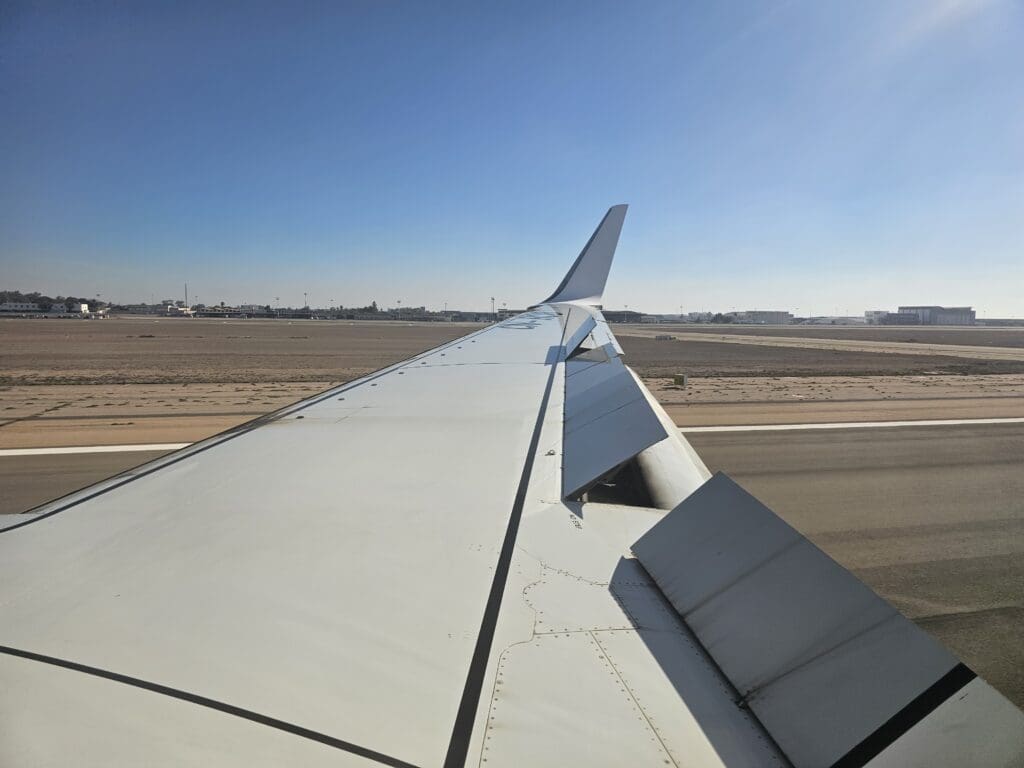
In the usual manner, once off the runway, the Purser performed their post-landing announcement and we began a fairly short taxi to the apron. After passing the terminal, it soon became clear that we would end our journey at a remote stand. Following a five minute taxi, the Boeing swung left and powered one engine down as it slowed and came to a halt at Stand B11. Before coming to a halt, perhaps in a desperate rush to end their Royal Air Maroc experience, a fair number of passengers could already be seen standing up and retrieving their luggage from the overhead lockers, with the crew doing nothing to reprimand them. Meanwhile, a mad rush soon followed once the seatbelt signs were extinguished with chaotic scenes soon presenting themselves.

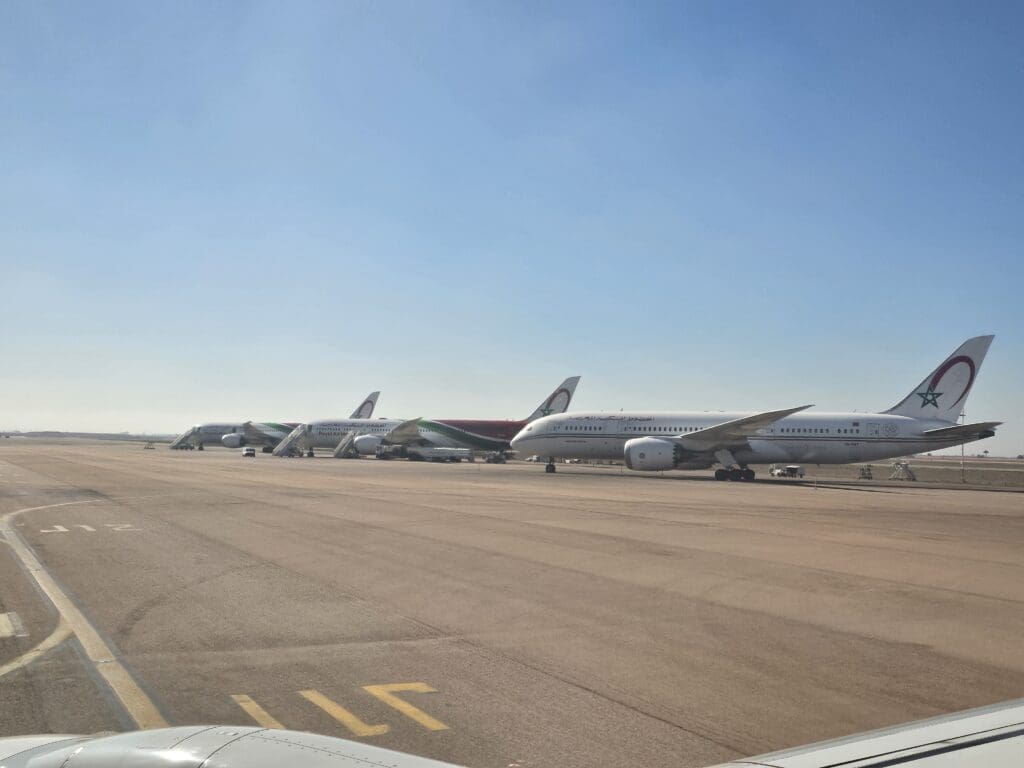
Fortunately, it did not take too long for a set of stairs to be positioned up to the front of the aircraft and disembarkation soon commenced. With disembarkation being far quicker than boarding, it did not take too long to exit the aircraft and after thanking the Purser I stepped into the warm Moroccan sunshine a grand total of six minutes after the aircraft had come to a halt. Being one of the final passengers to board the first bus to head to the terminal, it wasn’t long before I was whisked off on my way. This was a short journey and a few minutes later I found myself heading up the escalators and following signs for ‘passport stamp’. Upon arriving there, I was greeted by the sight of a large hall with plenty of open booths. Ending up first in the queue for one of these, I soon handed over my passport, however, this was a fairly long process with the immigration officer doing plenty of typing before stamping my passport and enabling me to enter the country.
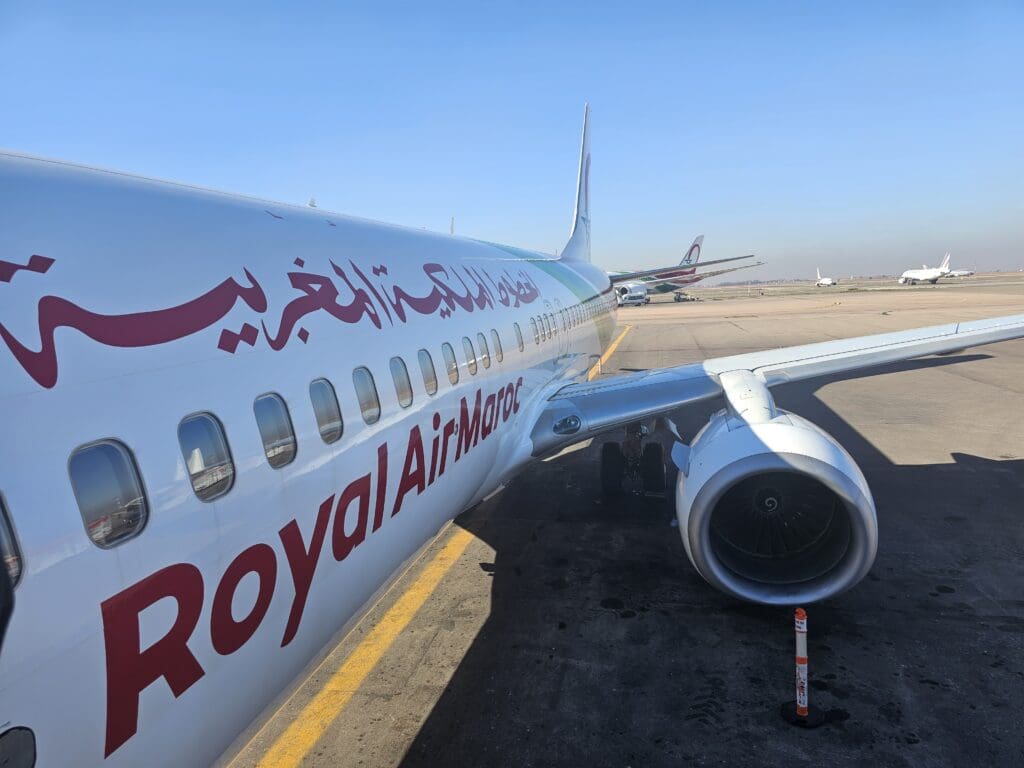
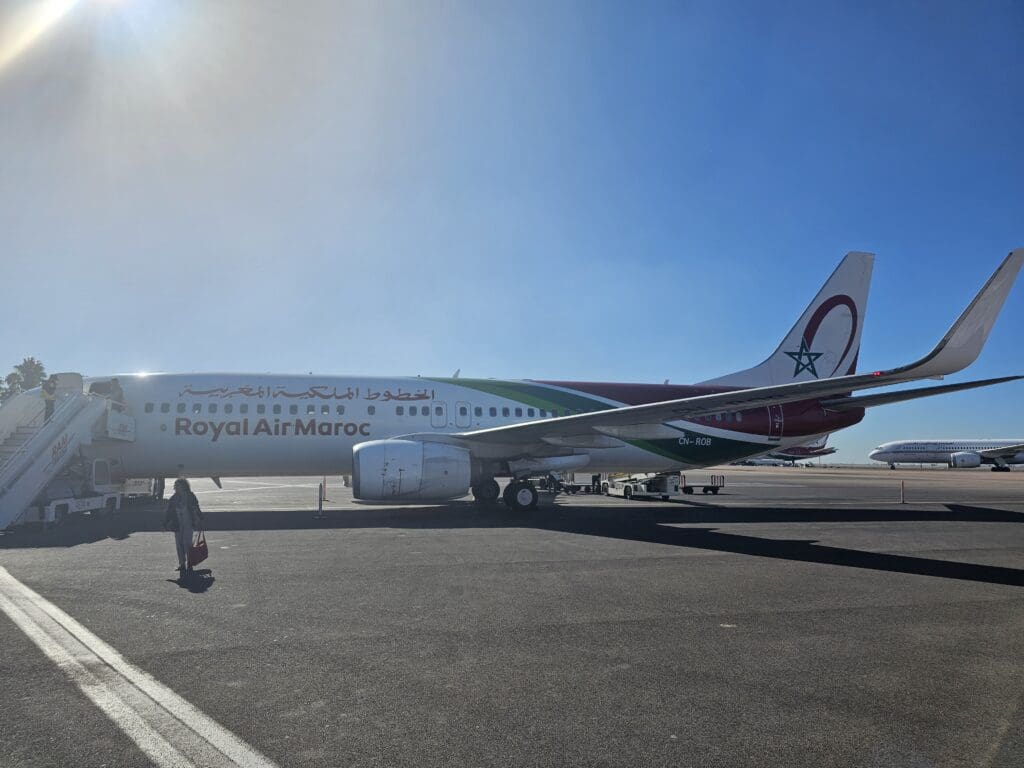
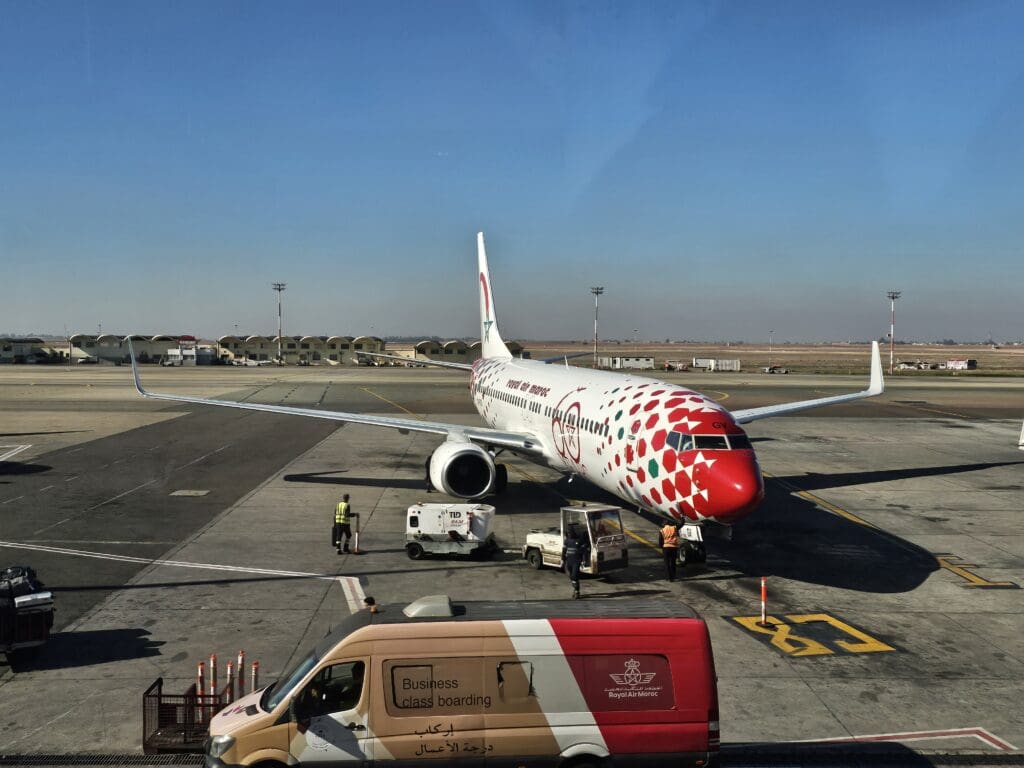
From there, I headed down to the baggage collection hall and through the customs x-ray area before entering the rather dated landside portion of the terminal where I commenced my Royal Air Maroc stopover.
Summary
Unfortunately, my first experience with Royal Air Maroc was not particularly positive. Whilst the breakfast was appreciated and the seat proved to be relatively comfortable, I was left with plenty of things to make a valid complaint about. For the most part, I found the crew to be cold and unwelcoming, the cabin was in poor shape and the toilet was broken and in a disgusting condition. Continuing onwards to Dubai, this left me wondering what delights I would have in store for the next portion of my Royal Air Maroc adventure.