Long Haul on Royal Air Maroc’s Flagship: Casablanca to Dubai on a Boeing 787 Dreamliner
You can read all the background information for this flight and read my report from Paris Orly to Casablanca on a Royal Air Maroc Boeing 737-800 here.
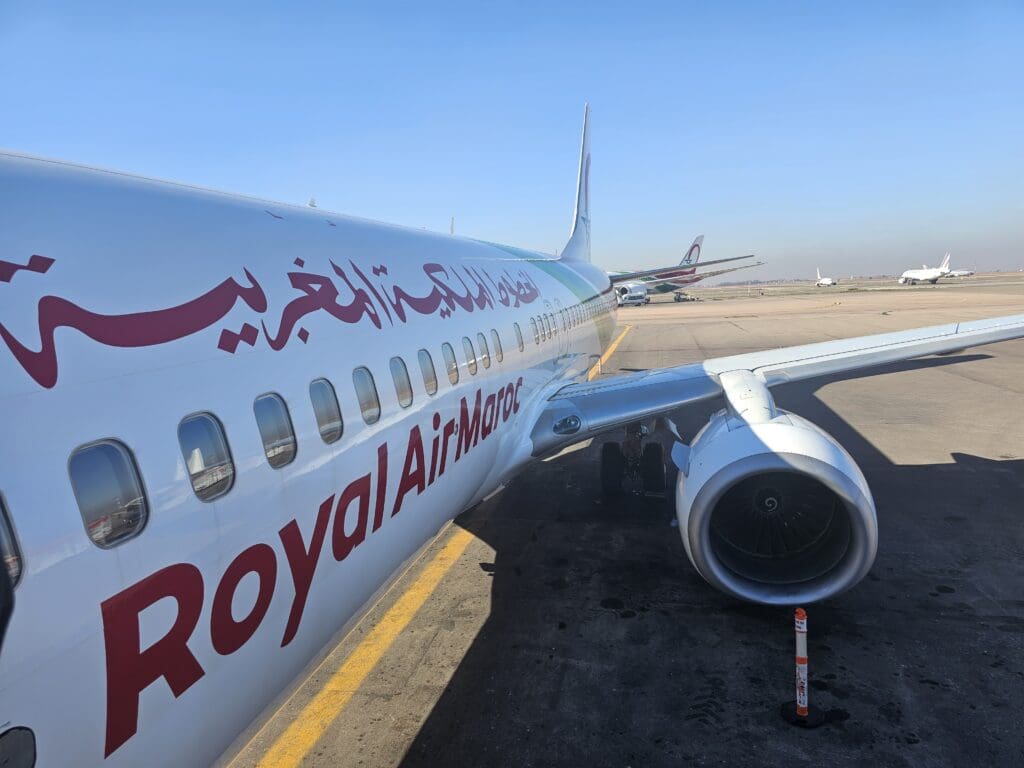
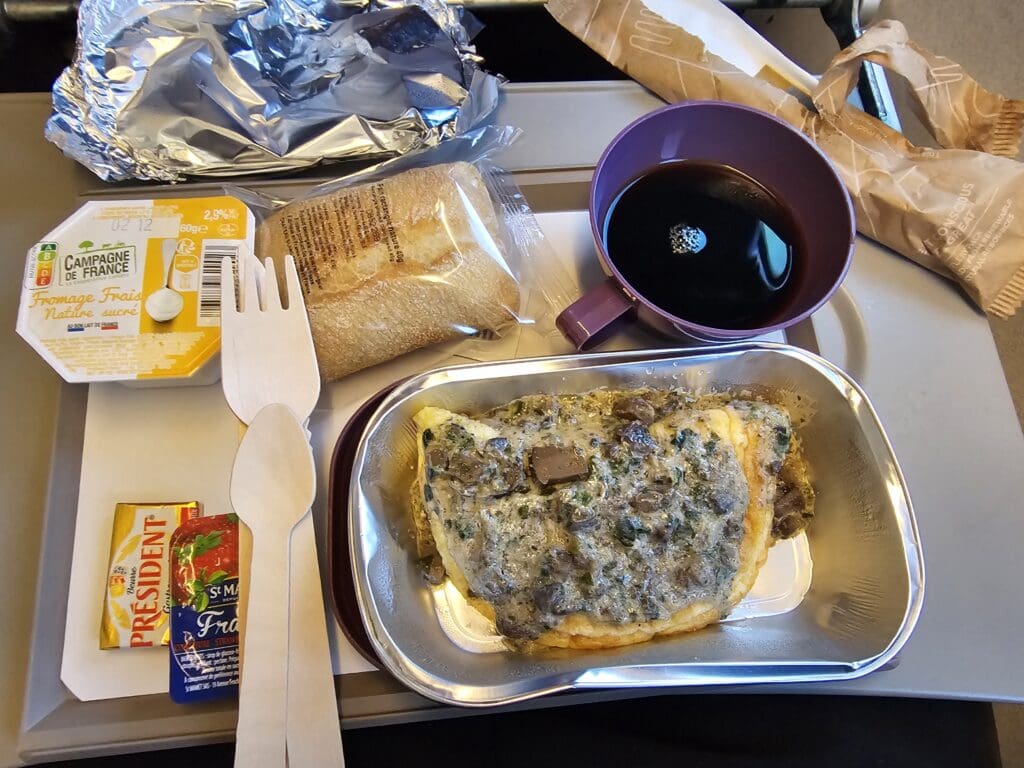
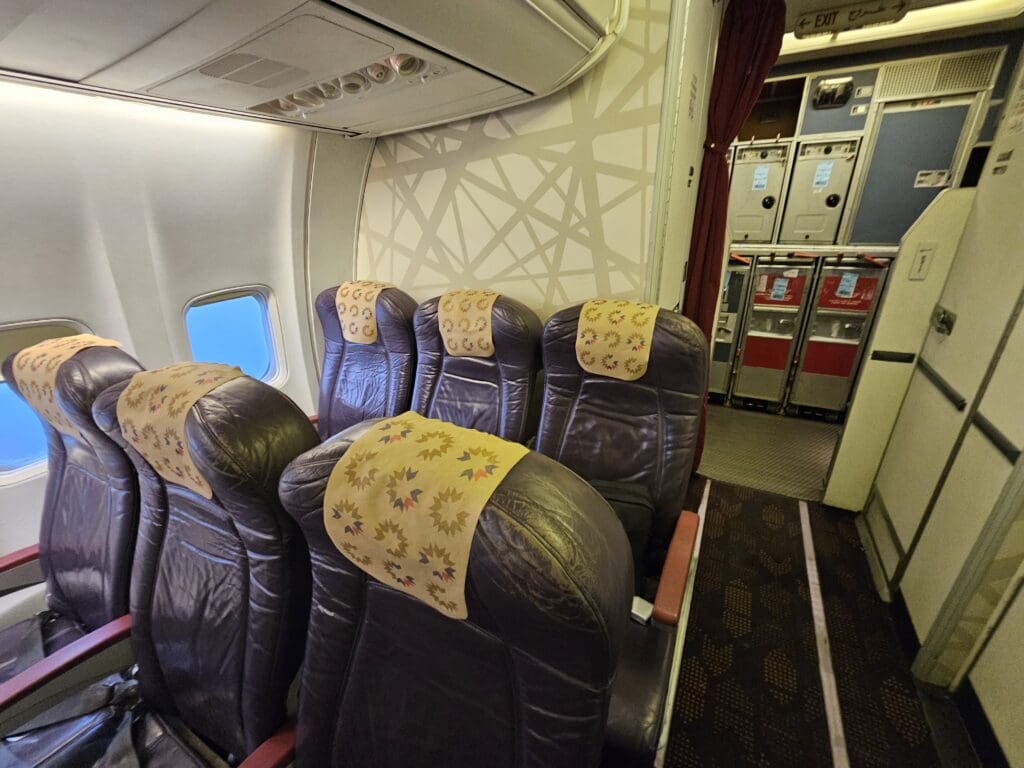
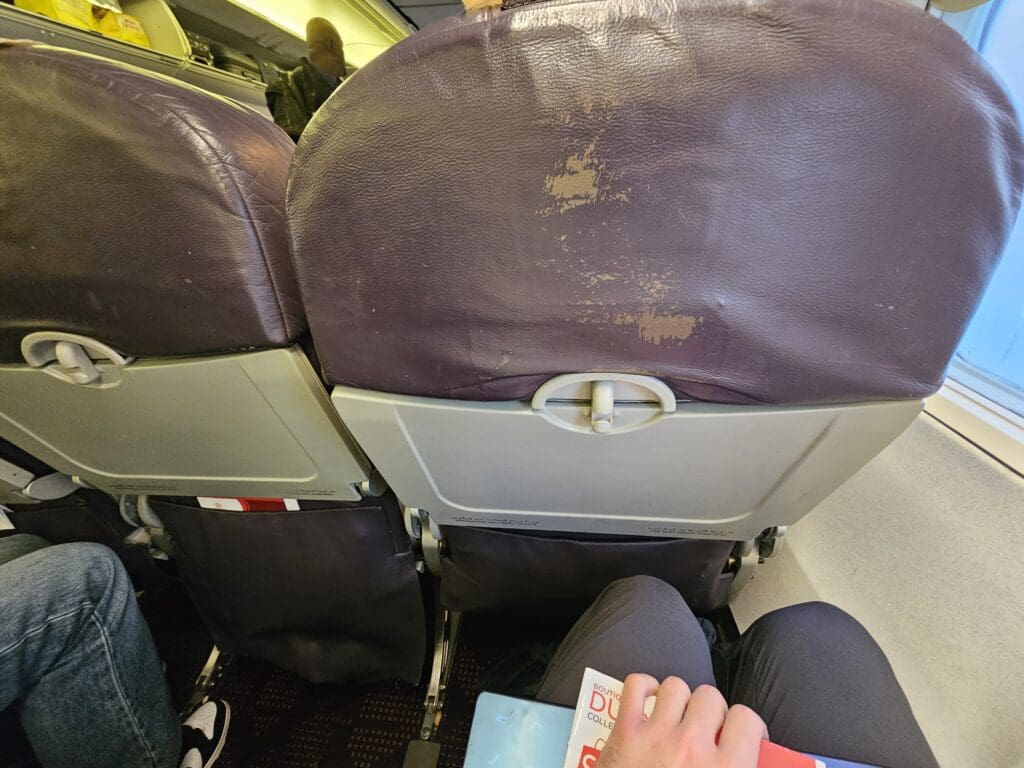
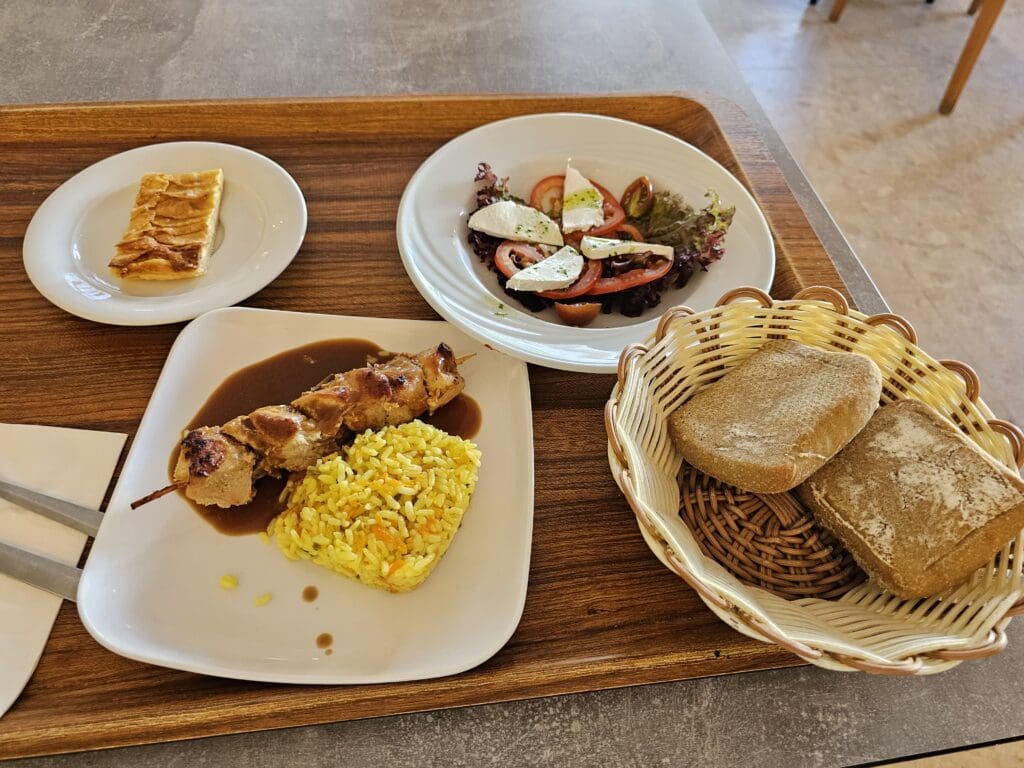
Without wanting to give too much away to those who are yet to read my report from the Royal Air Maroc Boeing 737-800 operated service down from Paris Orly, my first ride onboard Morocco’s flag carrier was far from fantastic. However, I hoped that this initial experience had simply been bad luck, and I instead looked forward to the potential delights of Royal Air Maroc’s flagship aircraft on the airline’s longest route.
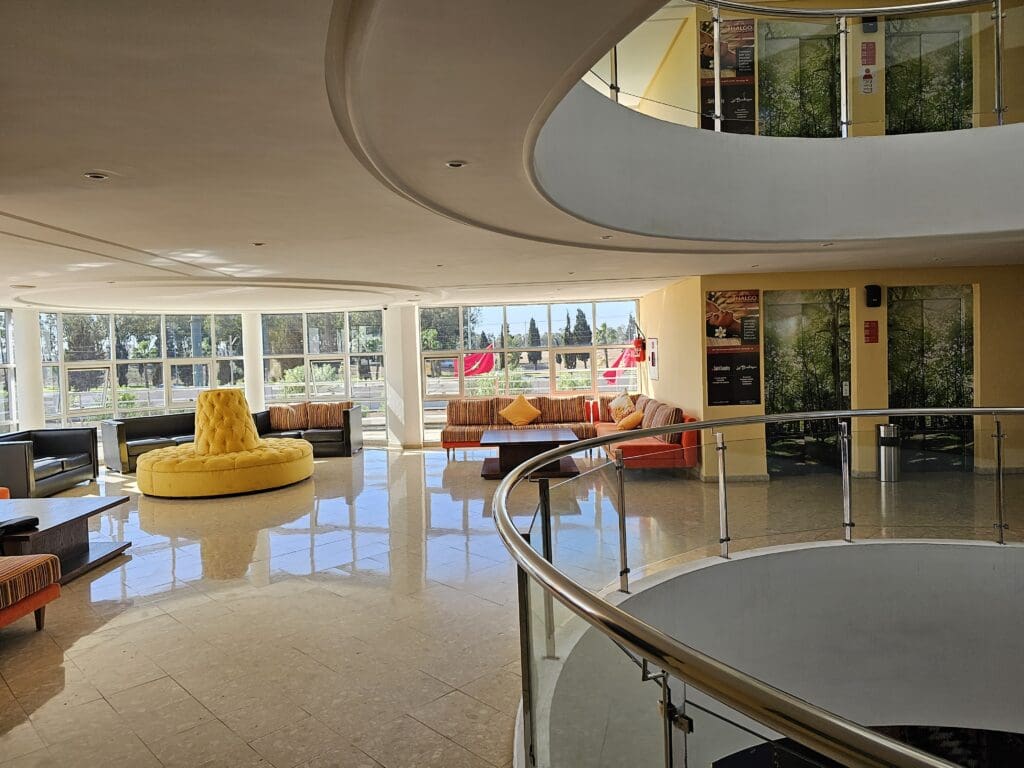
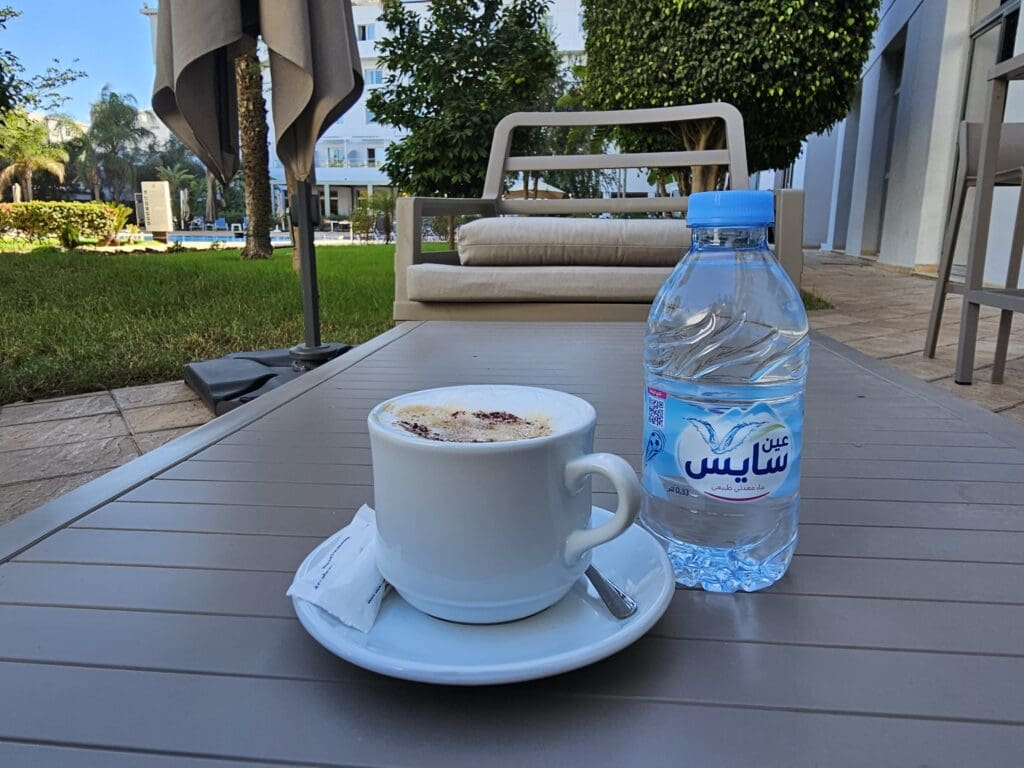
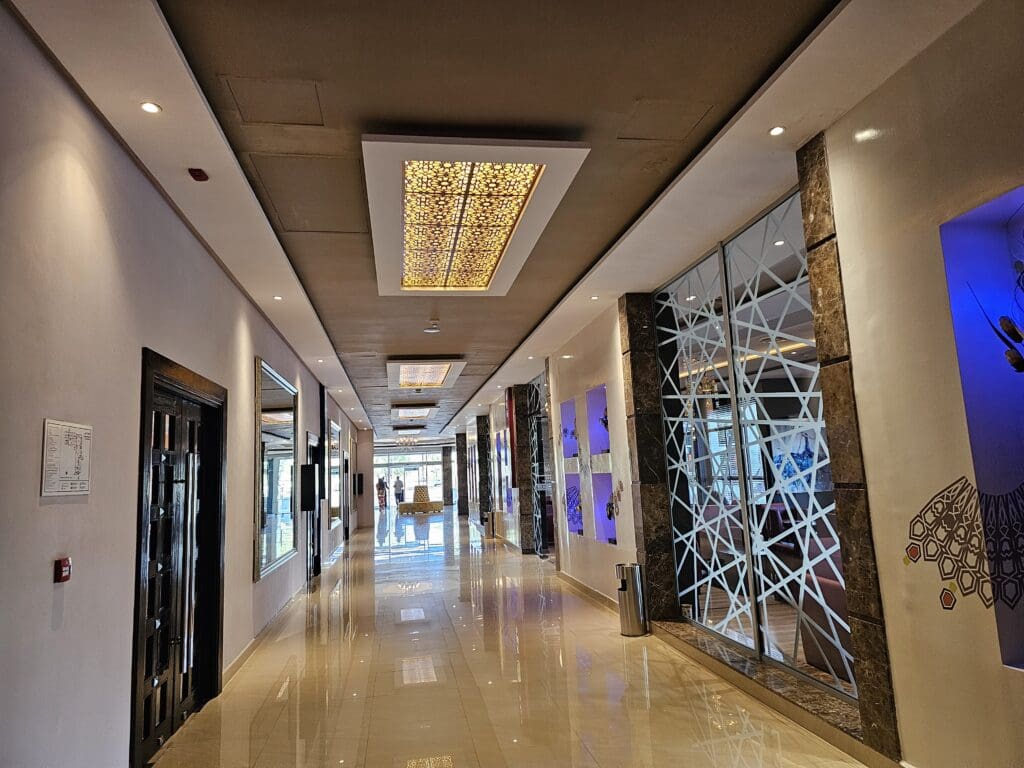
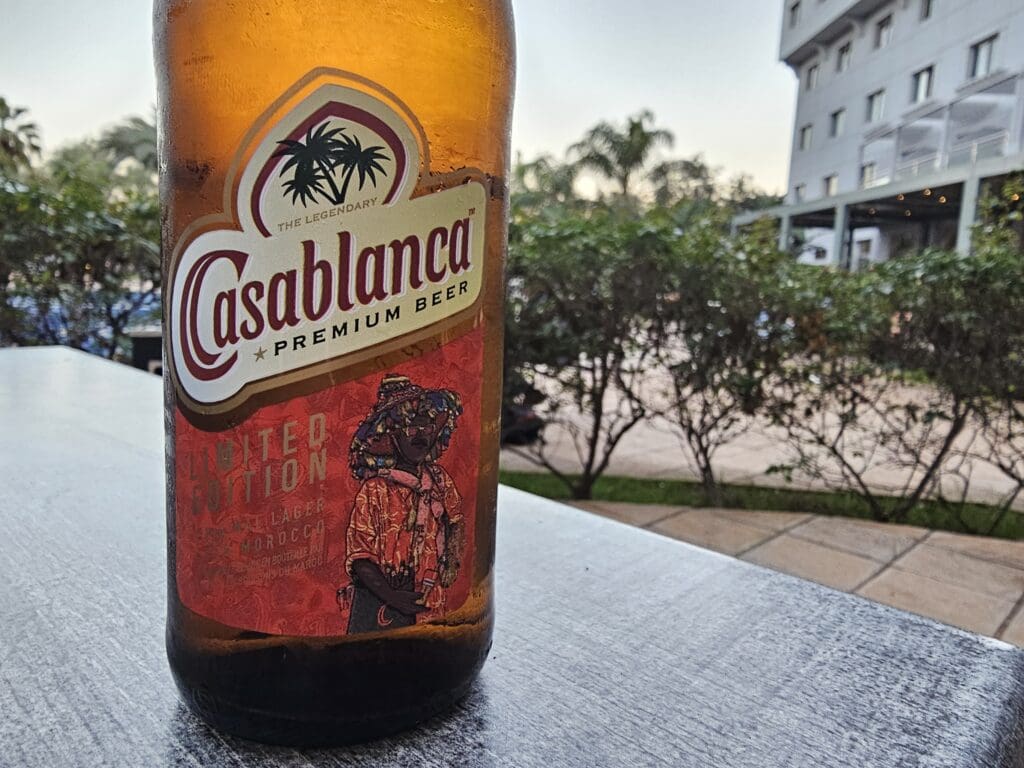
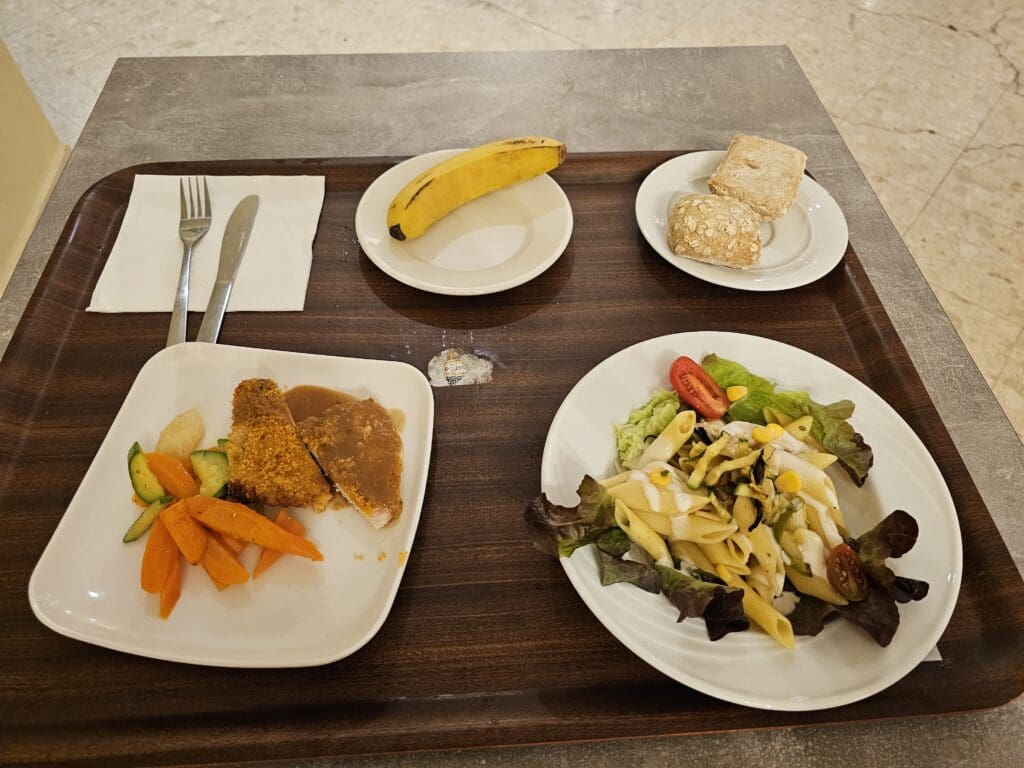
Returning to the positives, those eligible to enter Morocco without a visa, or possessing a Moroccan visa, can use Royal Air Maroc’s stopover program. Introduced as an attempt to capture passengers travelling between Africa, Europe and North America, those with stopovers of over eight hours can spend these in a complimentary hotel room near the airport. Those not eligible to enter Morocco or with stops of four to eight hours can visit the transit lounge and be treated to a meal. Thus, Royal Air Maroc deserves some credit for being one of just a few airlines to continue offering such a service to passengers. Making full use of this service, I spent the day relaxing at the appropriately named Hotel Relax in the nearby town of Nouaceur. Whilst I had hoped to see something of Casablanca, sadly a cartel of drivers seemed to have a monopoly on all journeys to and from the hotel, and with no public transport offered, I opted against the extortionate €50 fare to reach the city. After a few naps, a wander around the town, a delightful local beer and two complimentary meals, the time came for me to continue onwards to Dubai. With shuttle buses ploughing the short route between the hotel and airport every half hour, and, already in possession of a boarding pass and with nothing to check in, I could have probably taken the 0100 bus to the airport and still had some time to explore the nooks and crannies of the terminal. However, having been inadvertently turfed out of my room by the housekeeping staff, now wide awake and having already explored the sights of the hotel, I decided to catch the 2200 bus to the airport which would leave me with plenty of time to explore all that this has to offer.
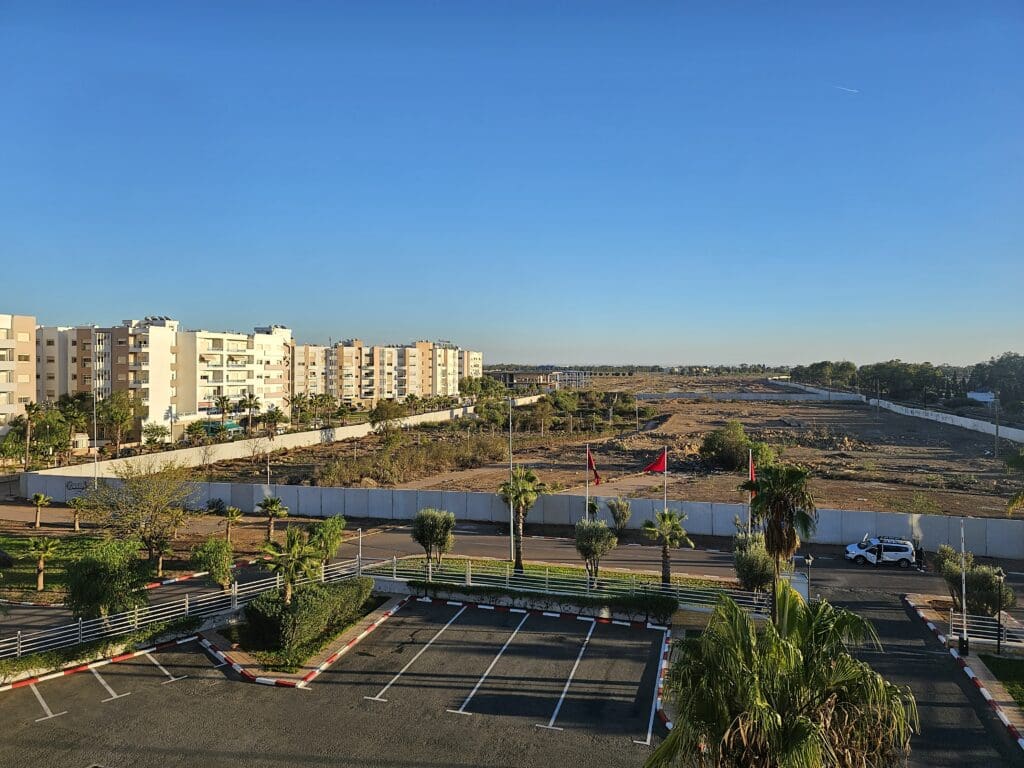
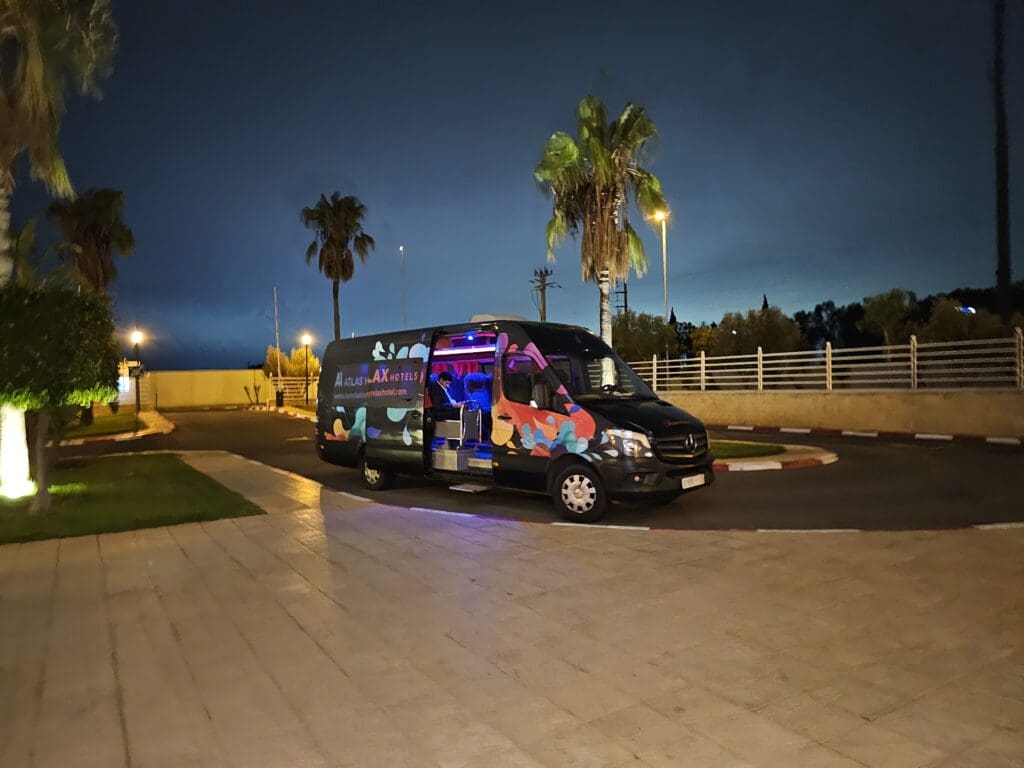
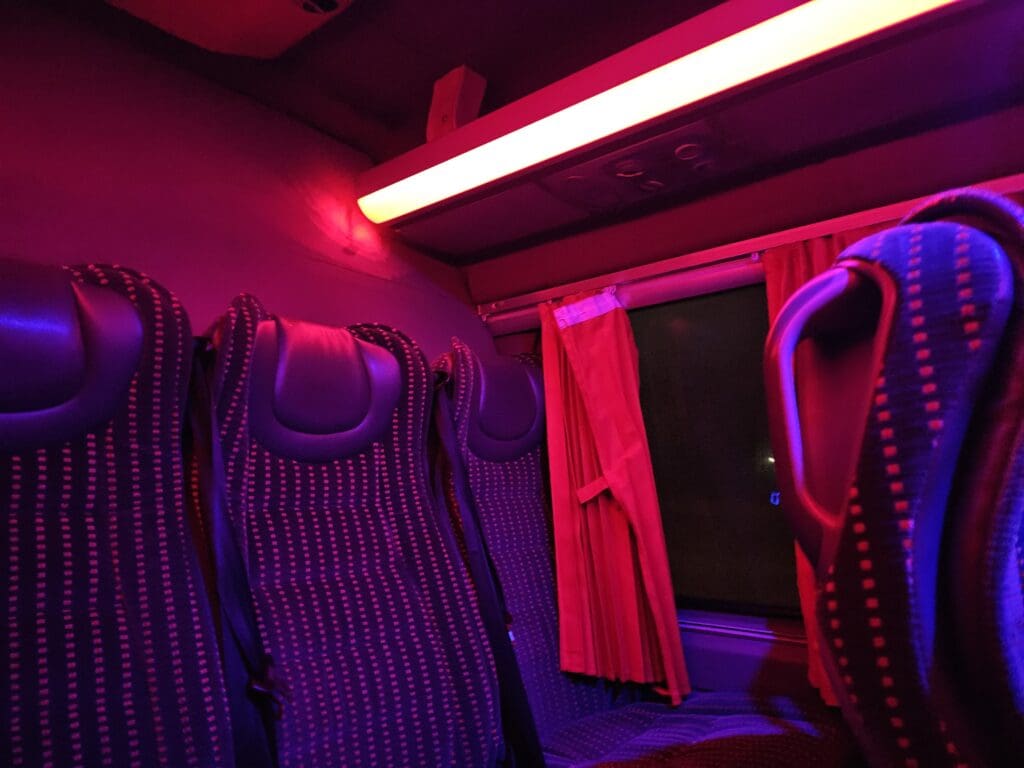
Eventually, my eleven-hour stay was came to an end and I repacked everything before dropping my key off at reception and heading out to the waiting minibus. Inside this, everything was illuminated by red-pink lights as if onboard a submarine, a Virgin Atlantic aircraft or an Antonov cockpit! With no other passengers, we soon sped over to the opposite side of the hotel complex where we picked up a couple of Korean backpackers from the slightly more upmarket Atlas Hotel before speeding onto the dark streets surrounding the airport. With little traffic at that time, the minibus soon pulled up outside the not particularly impressive facade of Terminal 1 no more than ten minutes after departing Hotel Relax.
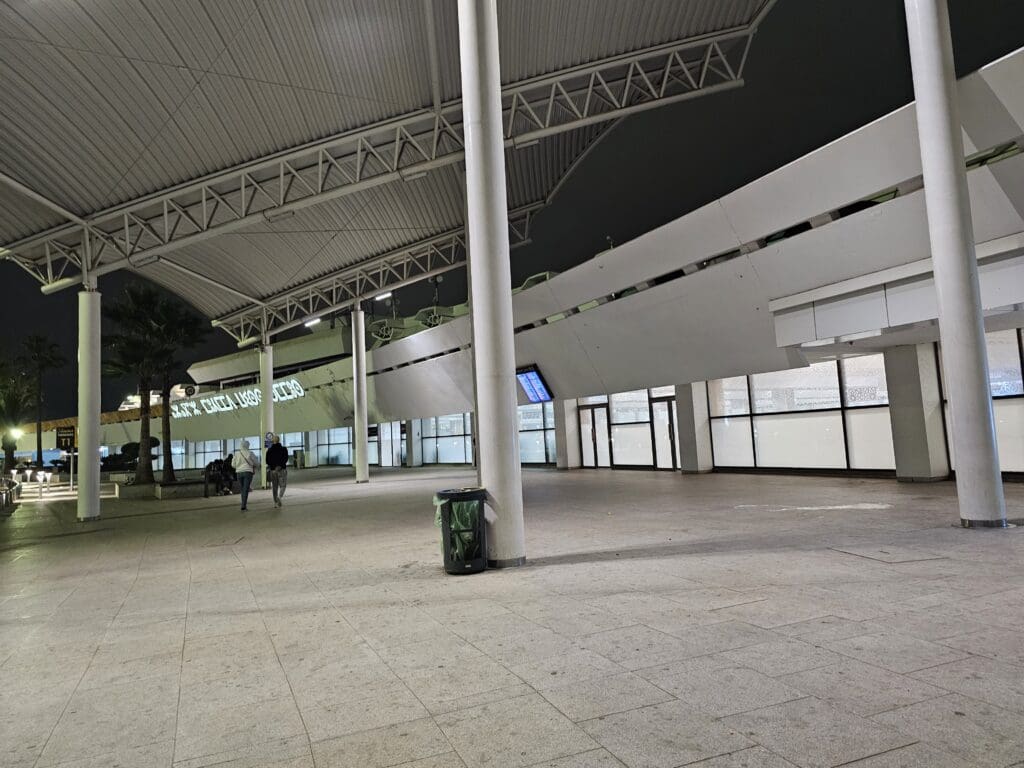
At that time, very few passengers could be seen milling around outside, and instead, most people lingering outside the terminal took the form of airport staff, police officers and security guards enjoying an evening cigarette break. Seeing as one police officer seemed to be keeping a watchful eye on myself and the other two passengers as if not expecting to see us at an airport, I decided to make a beeline for the entrance to the terminal rather than take any photos of the terminal’s exterior. As is the case across much of the world, all those entering the terminal must first pass through a security checkpoint. Fortunately, given the lack of passengers, this was quick and easy, consisting of the usual X-ray machine and metal detector combination. However, even after setting off the latter, I was simply waved through by the police officers manning this checkpoint.
Immediately after passing through the initial security checkpoint, I was presented with the landside branch of the Moroccan Italian-inspired dessert café chain, Venezia Ice, however, not wanting to buy anything I journeyed up the escalators and soon arrived in Terminal 1’s check-in hall. As capital city airports go, Casablanca Mohammed V International cannot be described as particularly large. Whilst this does serve as the main base for Royal Air Maroc, the decent number of airports throughout Morocco and their cornucopia of flights to European destinations means that Casablanca is often overlooked by many passengers, other than Royal Air Maroc loyalists and those starting or ending their journeys in the local area. That said, the airport is by no means small and still enjoys a good number of services to Europe, the Middle East, North and West Africa, and North America.
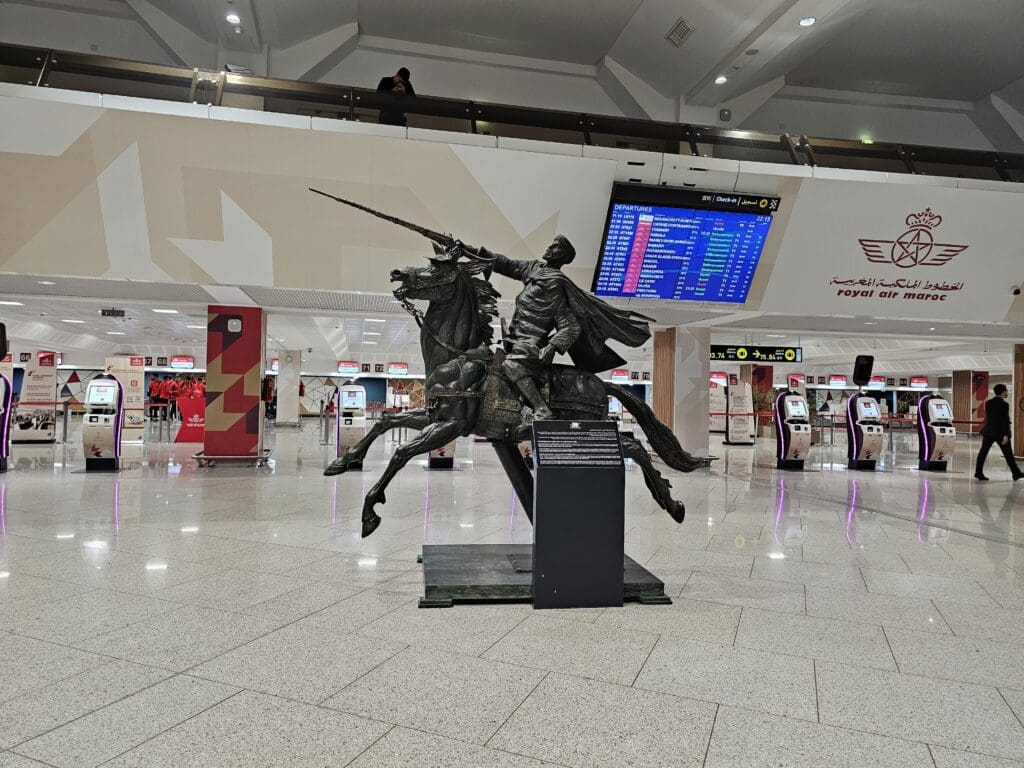
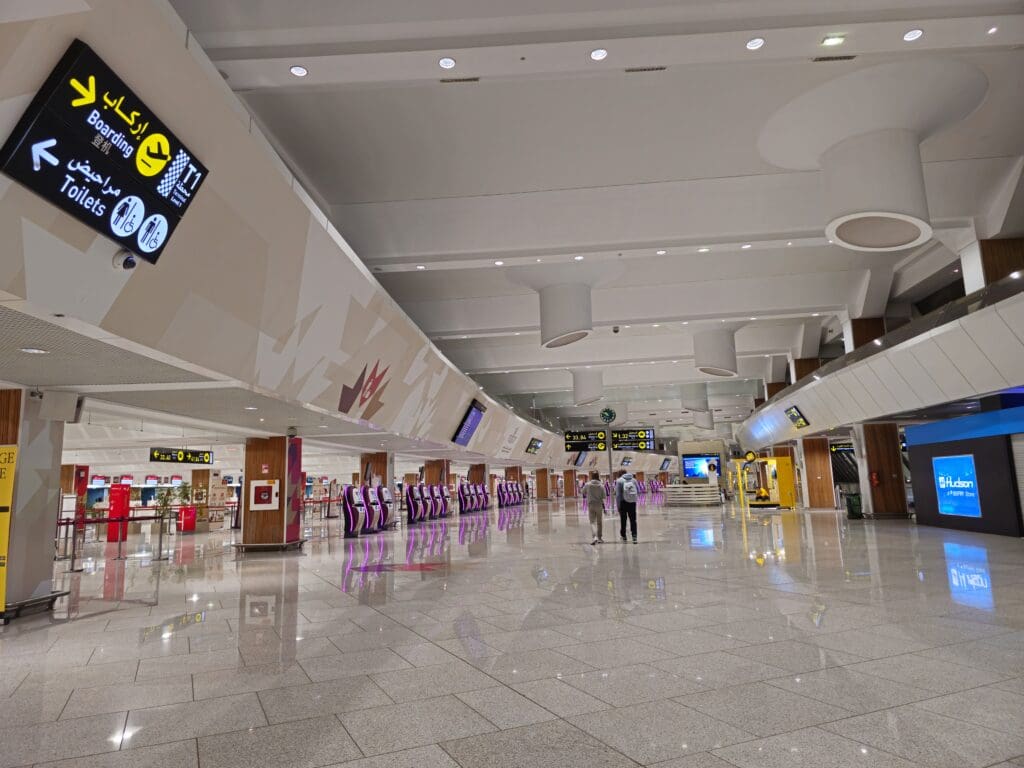
Examining the terminal’s layout, Mohammed V International Airport is comprised of two conjoined terminals – logically named Terminals 1 and 2. Terminal 1 is exclusively used by Royal Air Maroc, whilst all other carriers operate from Terminal 2. Whilst both feature separate security areas and check-in halls, in both the landside and airside portions of the airport, it is possible to walk between the two terminals quickly and with ease. Having undergone significant modernisation and upgrade work that concluded in 2019, I found the landside portion of Terminal 1 to be bright, modern and spacious, complete with a large check-in area, an army of staff and plenty of self check-in machines. Reminding me of where I was, in this part of the terminal it seemed impossible to walk more than a few steps without coming across Royal Air Maroc’s logo. In terms of facilities, other than the aforementioned Venezia Ice, an Italian fast-food restaurant could be found at one end of the check-in hall.
However, away from the glitz and glamour of Royal Air Maroc’s hub in Terminal 1, walking over to Terminal 2 is a little like taking a step back in time, with much of the rest of the airport appearing to have minimal cosmetic upgrades since it opened in 1980! Nevertheless, this was not a major complaint, and other than its data aesthetic, the rest of the terminal seemed to be fairly clean and spacious.
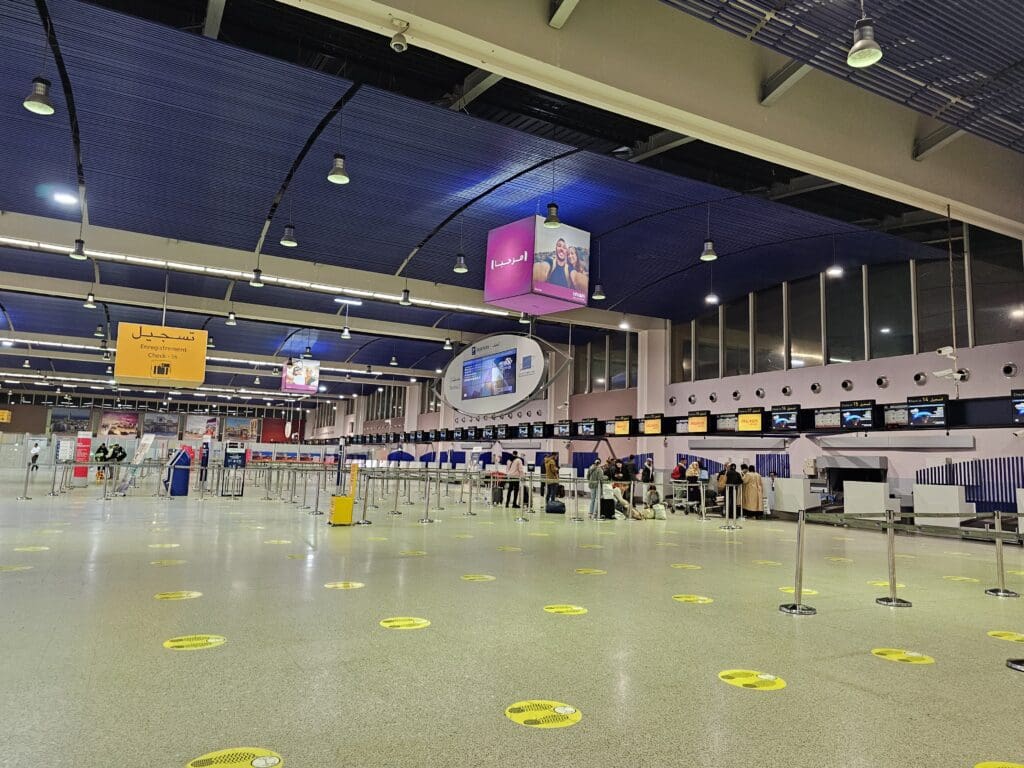
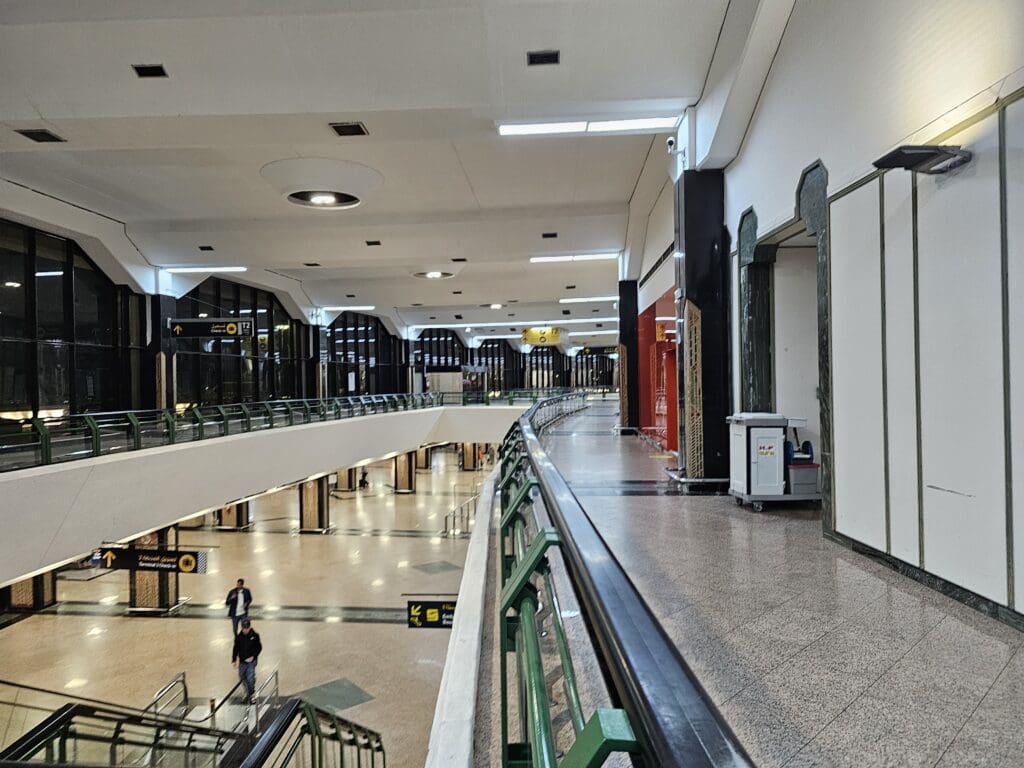
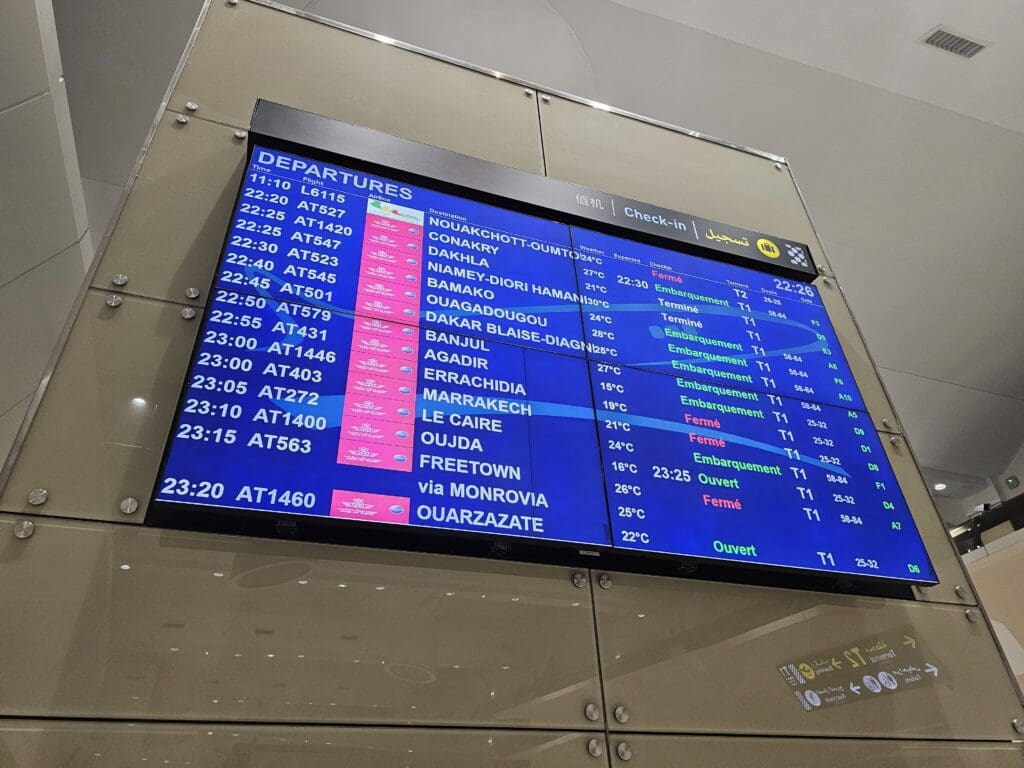
Following my brief walk around the two terminals, I returned to Terminal 1 in the hope of passing through security and made my way to the line of automated gates at the entrance. However, upon scanning my boarding pass, I received an error message that advised me that I was too early. Thus, with little else to do, I took a seat and passed the time by surfing the internet using the terminal’s fast complimentary wifi network. Each evening, there is a rush of Royal Air Maroc services to destinations across Africa, with these timed to allow for convenient connections from European services in the evening, and to European services in the morning. That evening, between 2200 and 0000, Royal Air Maroc flights heading off to the likes of Abidjan, Accra, Agadir, Bamako, Banjul, Cairo, Conakry, Dakhla, Douala, Errachidia, Lagos, Malabo, Marrakech, Monrovia, Ouarzazate and Oujda could be seen on the departure boards. However, having just missed the evening rush, at that time, the terminal was rather empty.
With four hours to go until my flight’s scheduled departure time, I decided to try my luck on the automated gates once more. Thankfully, this time, these allowed me to continue on my journey and I soon arrived at the terminal’s security area. Whilst this was home to a total of ten checkpoints, unsurprisingly just one of these was open at that time, and seeing as no other passengers were present, I was able to walk straight up to this. This proved to be a quick and easy experience with no need to remove either liquids or electronics from my bag. Meanwhile, the three-strong team responsible for manning the checkpoint continued their conversation as if I was not there! With no further security checks required, I headed to the next formality, immigration. As with security, a long line of checkpoints could be seen although just one of these was open. Heading up to this, I handed my passport over to the officer and as had been the case when entering Morocco that morning, immigration was a slow process which seemed to take quite a while and was accompanied by plenty of typing before my passport was stamped and returned.
Immediately after making it through immigration, I made the obligatory walk past the local duty-free store before arriving in the terminal’s modern central hub. Looking around, this was home to a selection of cafés that included international chains Paul and Starbucks, plus Italian and Japanese restaurants for those looking for a more substantial yet overpriced meal. These came in addition to a cluster of souvenir shops for those who had failed to find anything suitable to buy in Morocco’s famous souks. It is worth noting that all prices in the terminal were given in Euros as standard. Seeing as the Moroccan Dirham is a closed currency, I am not even sure whether I would have been able to pay in the local currency in the international portion of the terminal.
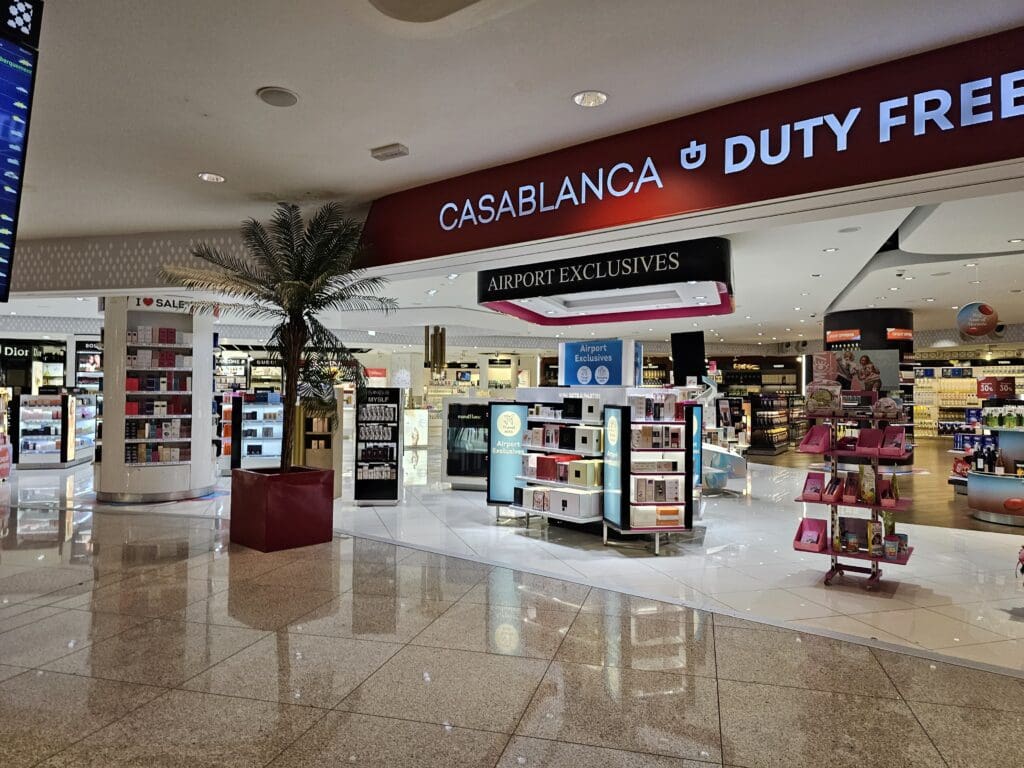
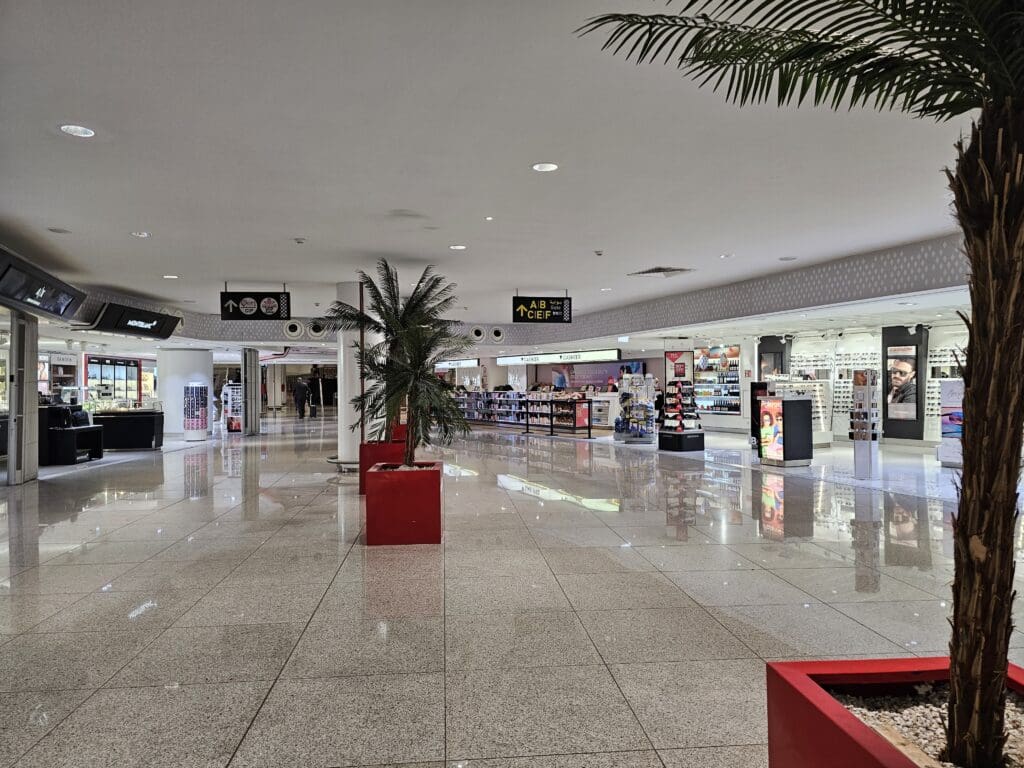
As I walked around, at first glance much of the terminal appeared to be clean and well-polished. Unfortunately, this did not extend to the toilets which were in a completely dreadful state, despite the fact that each block had their own cleaning attendant. Wearing my aviation enthusiast’s hat, my only other complaint was that airside views in the more modern part of the terminal were almost non-existent thanks to its design, with these limited to just a few glimpses of the aircraft outside through multiple layers of glass.
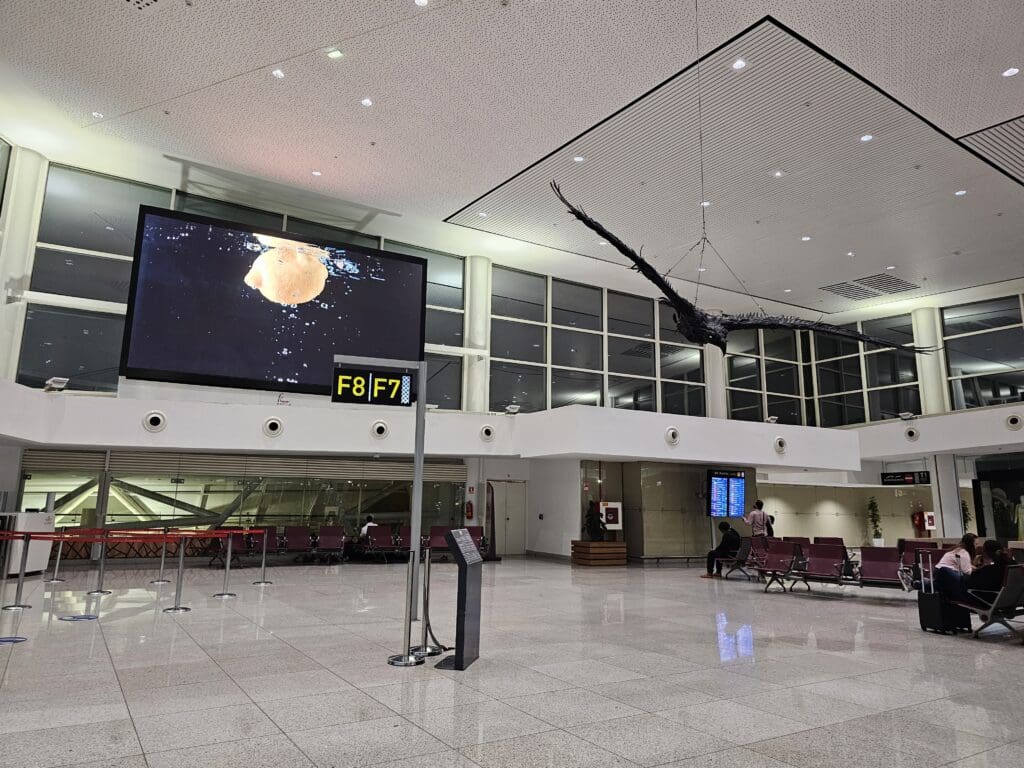
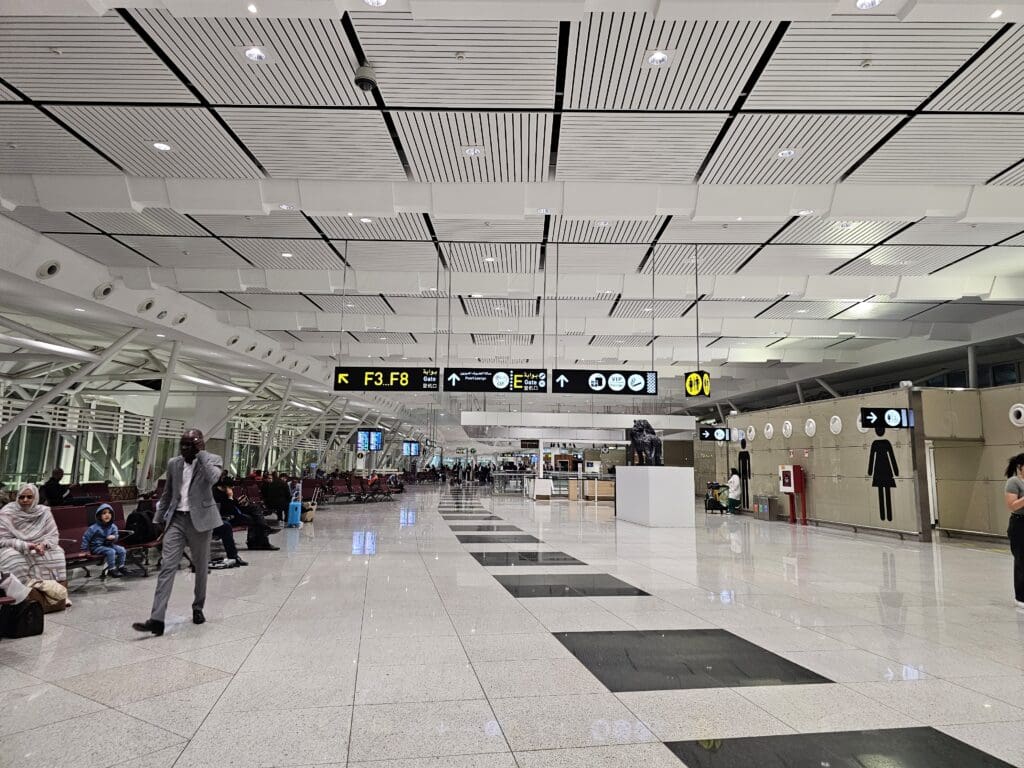
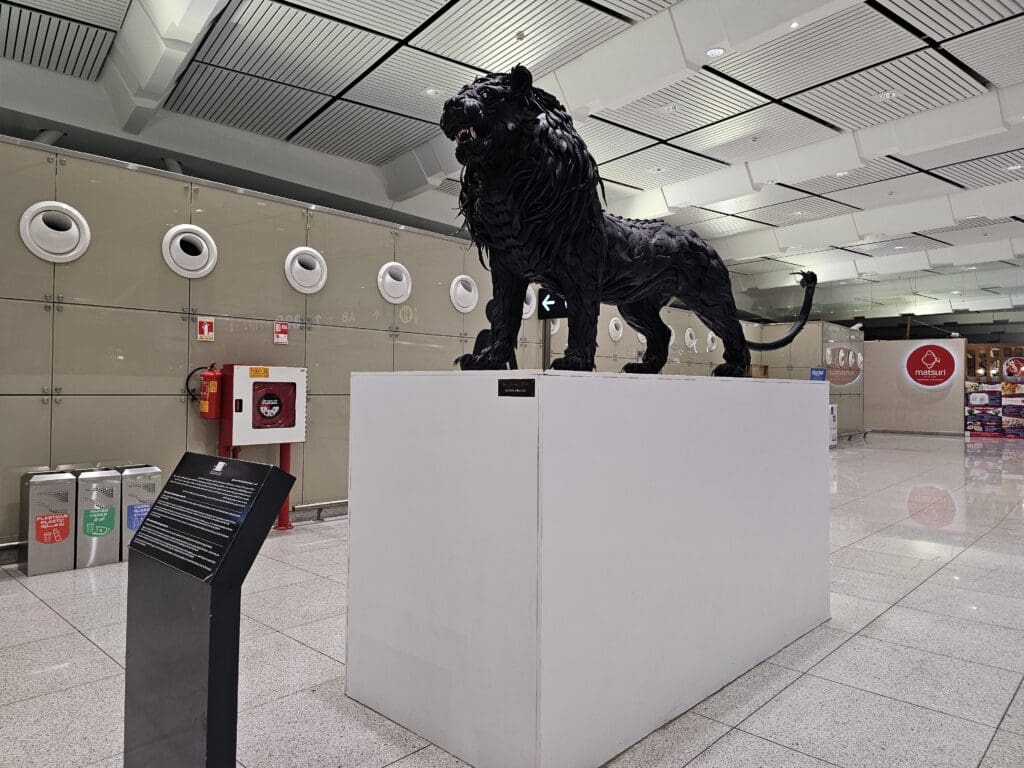
Seeing as the two terminals are conjoined, once airside it is very easy to walk from one to the other. After admiring a couple of statues made out of recycled materials by local artist Lahcen Iwi, I decided to see what Terminal 2 had in store. Airside, Terminal 2 consists of a long rectangular pier with shops, cafés and restaurants on one side, and windows on the other – with these offering views out on the apron. As was to be expected, this was more dated than Terminal 1 however it did seem to be home to more facilities, including a fast food court. There, I decided to stop for a coffee at Paul and charge my devices before slowly trundling back to Terminal 1 in preparation for departure. As I wandered around, I noticed that most signs were in Chinese alongside the expected Arabic, French and English, however at the time of my flight, Royal Air Maroc had yet to revive their Beijing services which came to a halt at the start of the pandemic.
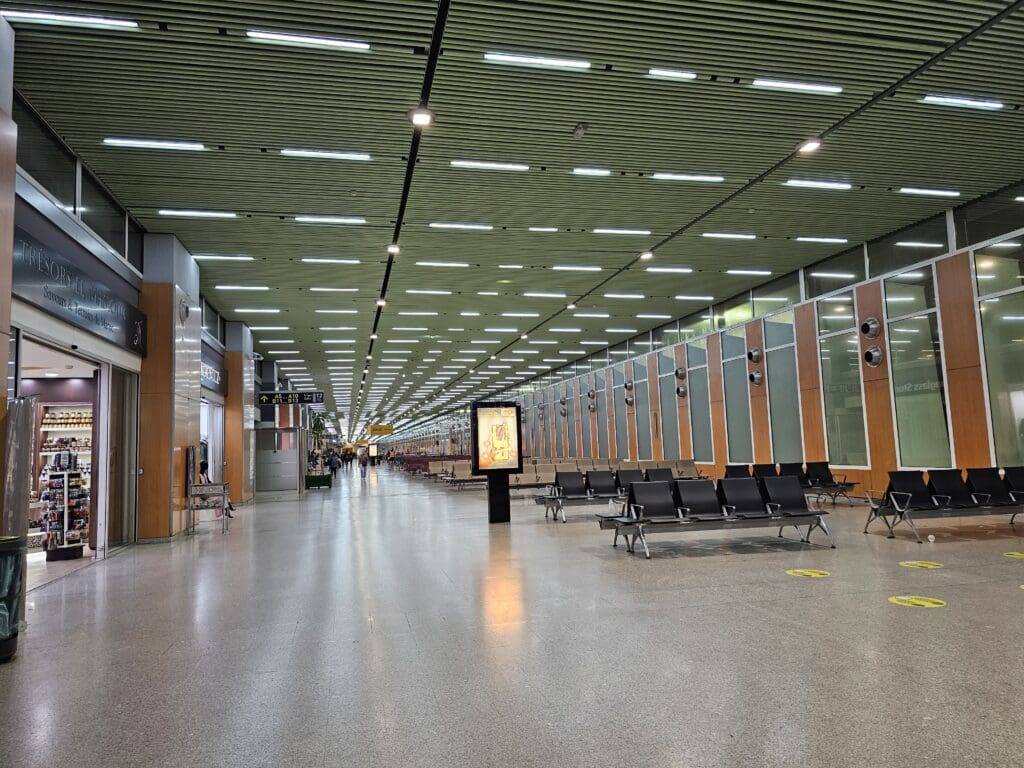
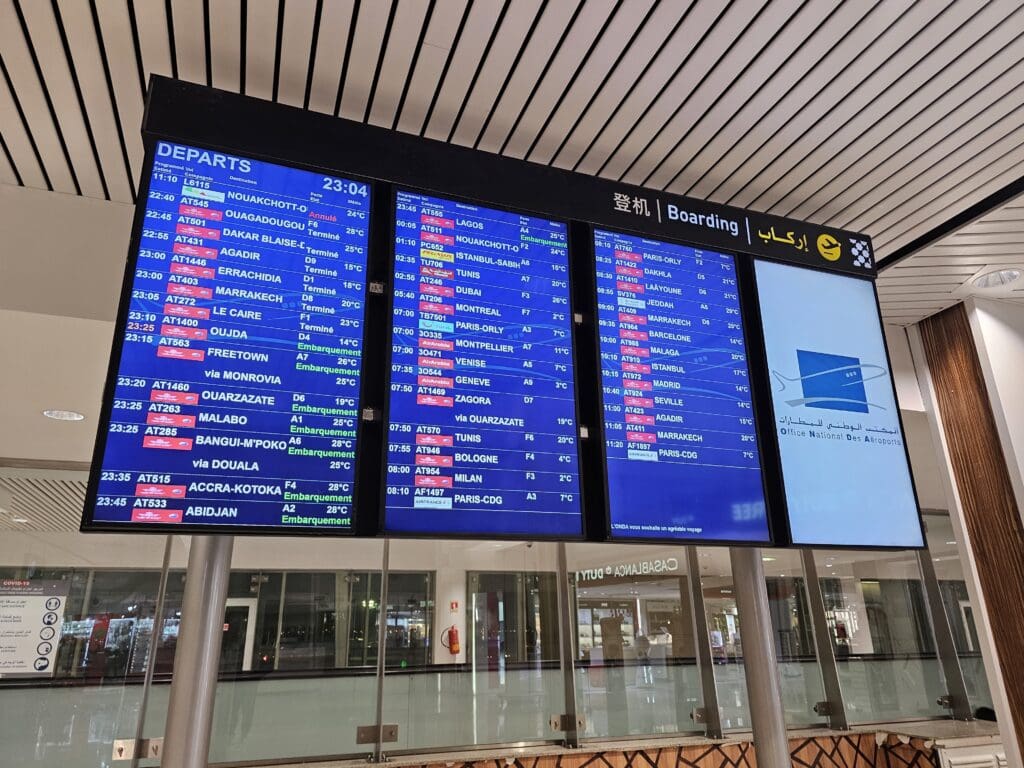
That night, I was uncertain of how busy my flight to Dubai would be. On the one hand, my flight date failed to align with any major holidays in both Morocco and the United Arab Emirates. However, there is of course significant point-to-point traffic between the two countries, whilst the flight’s departure time does allow for connections from Royal Air Maroc’s European and West African arrivals. Nevertheless, as our departure time slowly neared, the terminal remained fairly quiet.
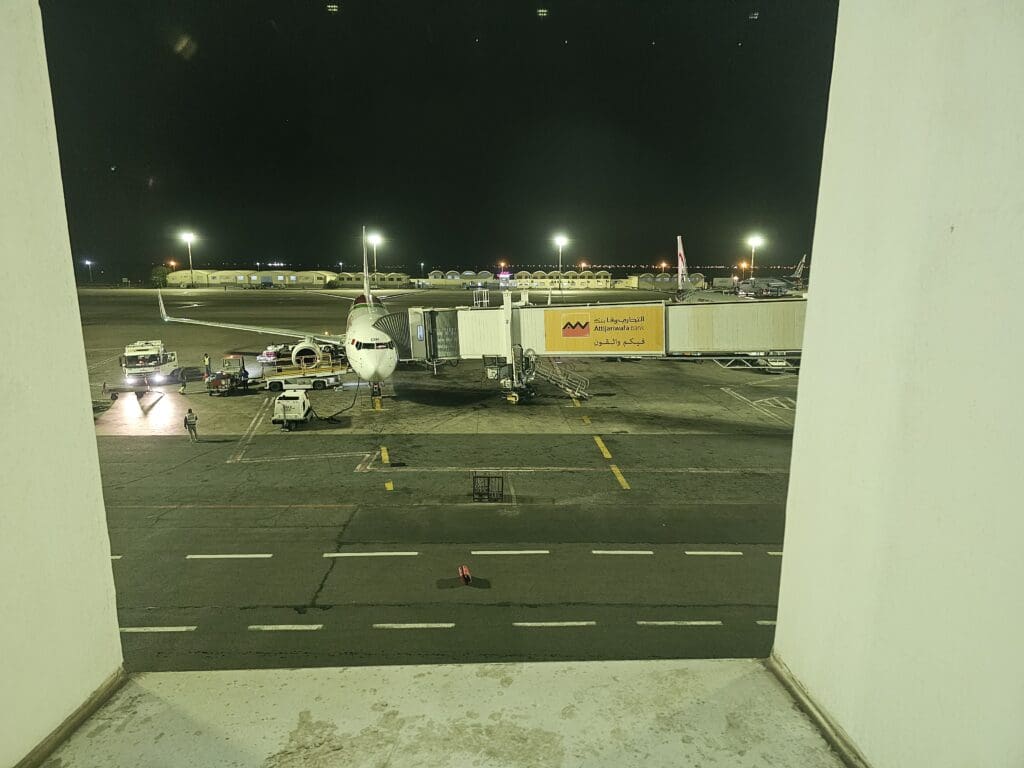
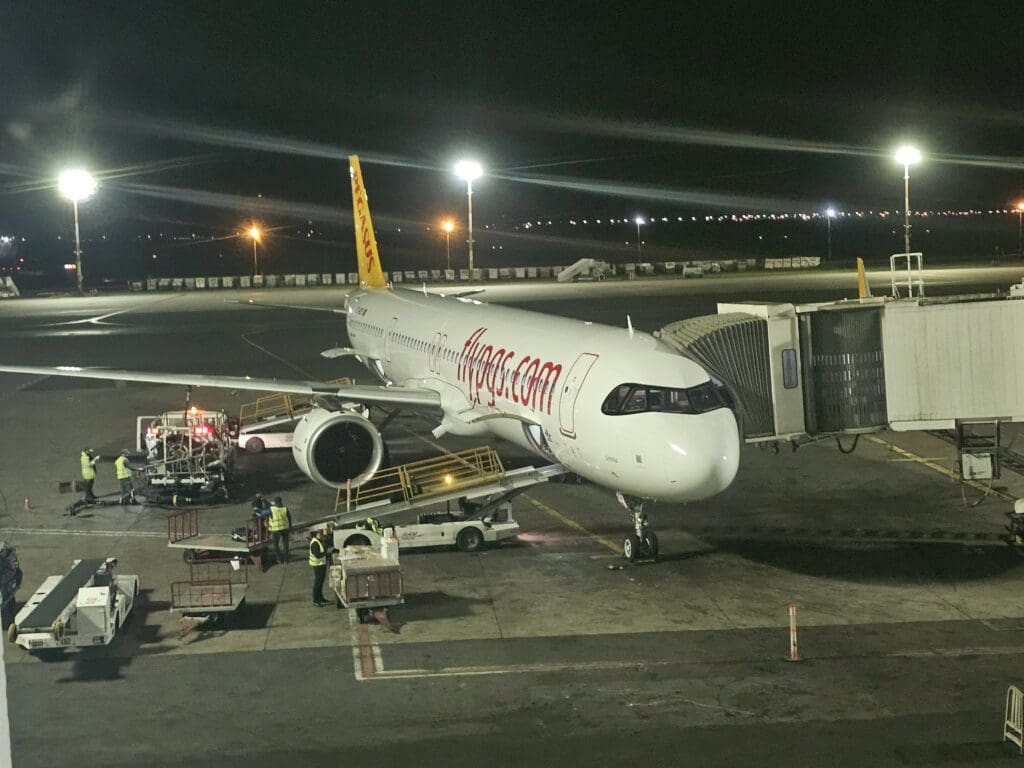
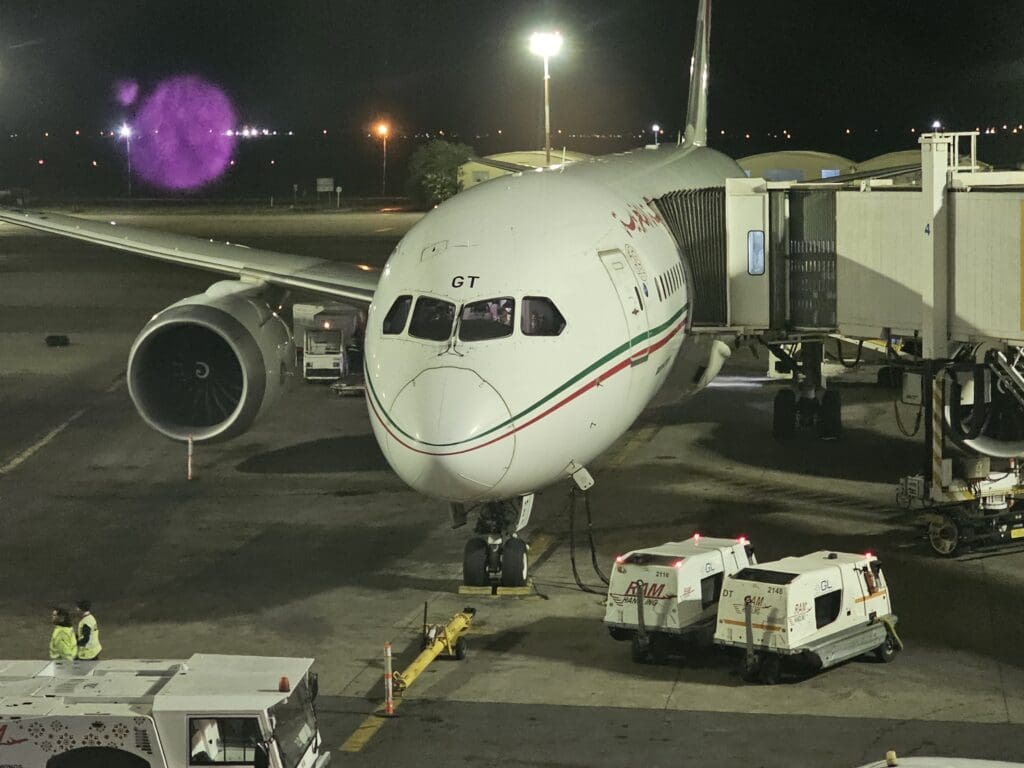
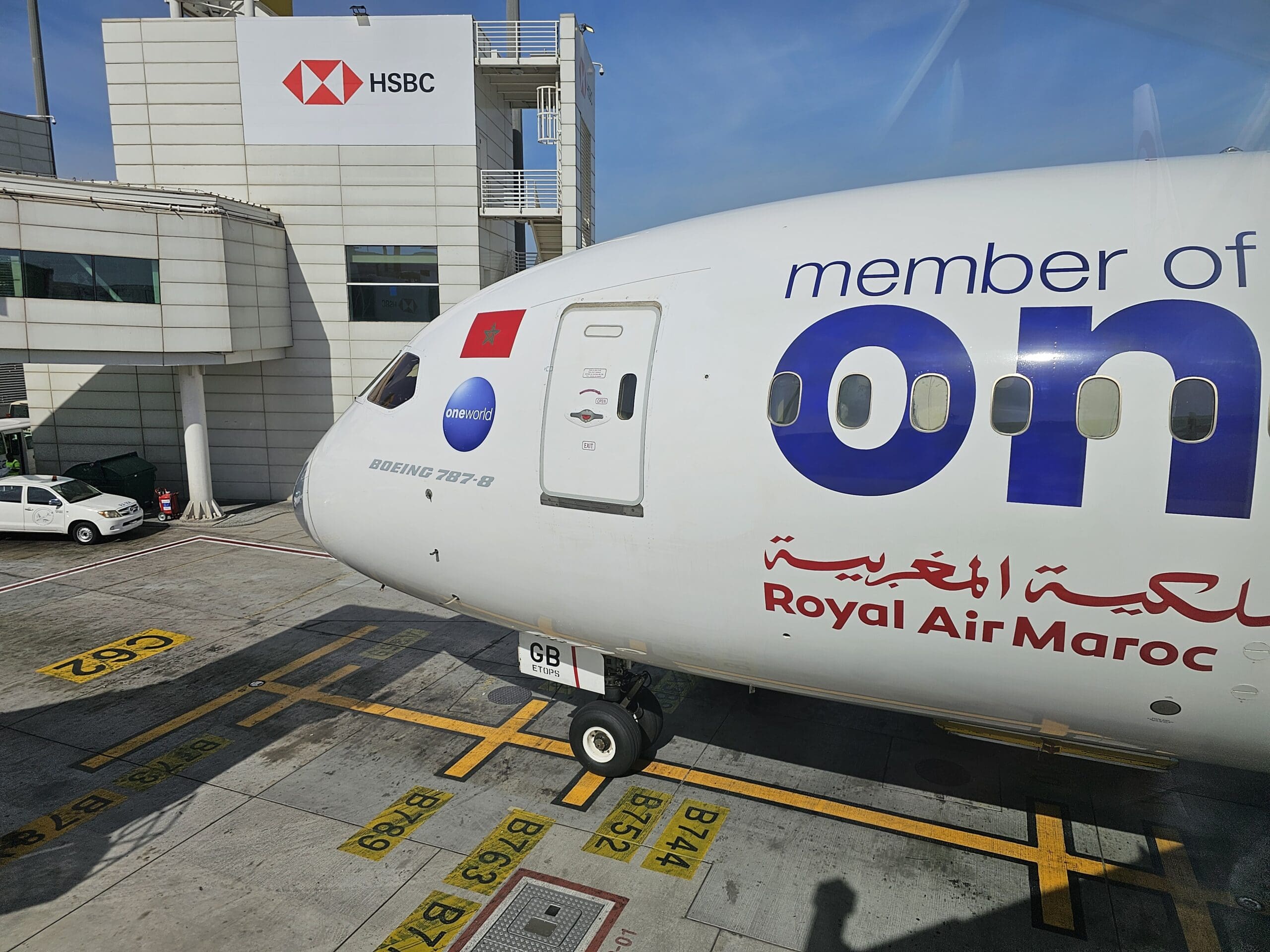
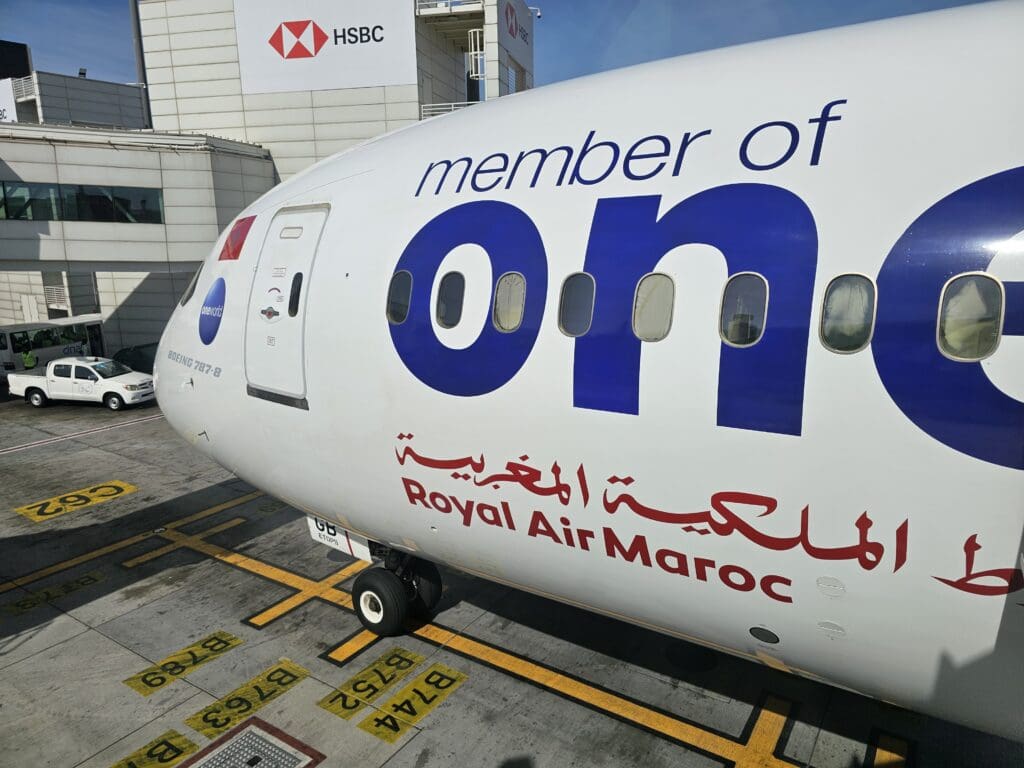
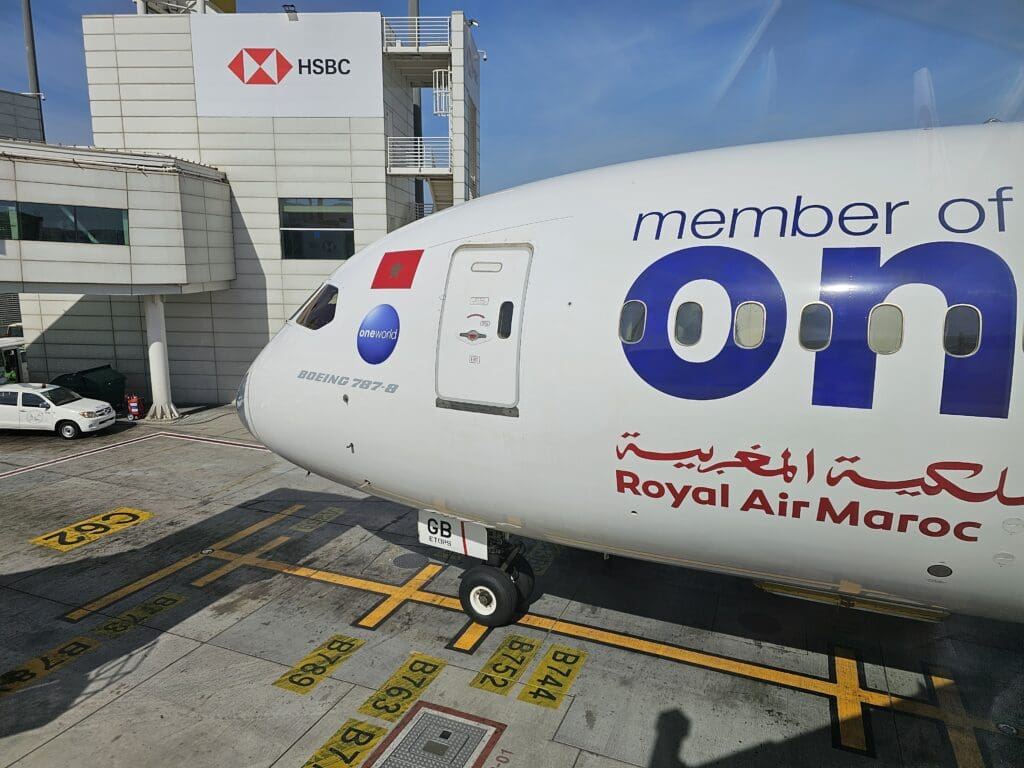
Outside, at 0030 one of Royal Air Maroc’s five Boeing 787-8 Dreamliners could be seen being towed past the terminal before being pulled into Stand J3, which corresponds to Gate F3 inside the terminal. Assembled at Boeing’s facility in Everett and carrying the line number 248, this particular aircraft first took to the skies in December 2014. The following month, the aircraft was ferried across North America and the Atlantic to its new home in Casablanca and became Royal Air Maroc’s second Dreamliner. With Royal Air Maroc offering neither a First nor Premium Economy product, this was delivered with a total of 274 seats in a two-class configuration (18 in Business and 256 in Economy). Following Royal Air Maroc’s accession to OneWorld, in 2020 the aircraft received the airline’s new livery complete with large OneWorld titles on the forward portion of the fuselage.
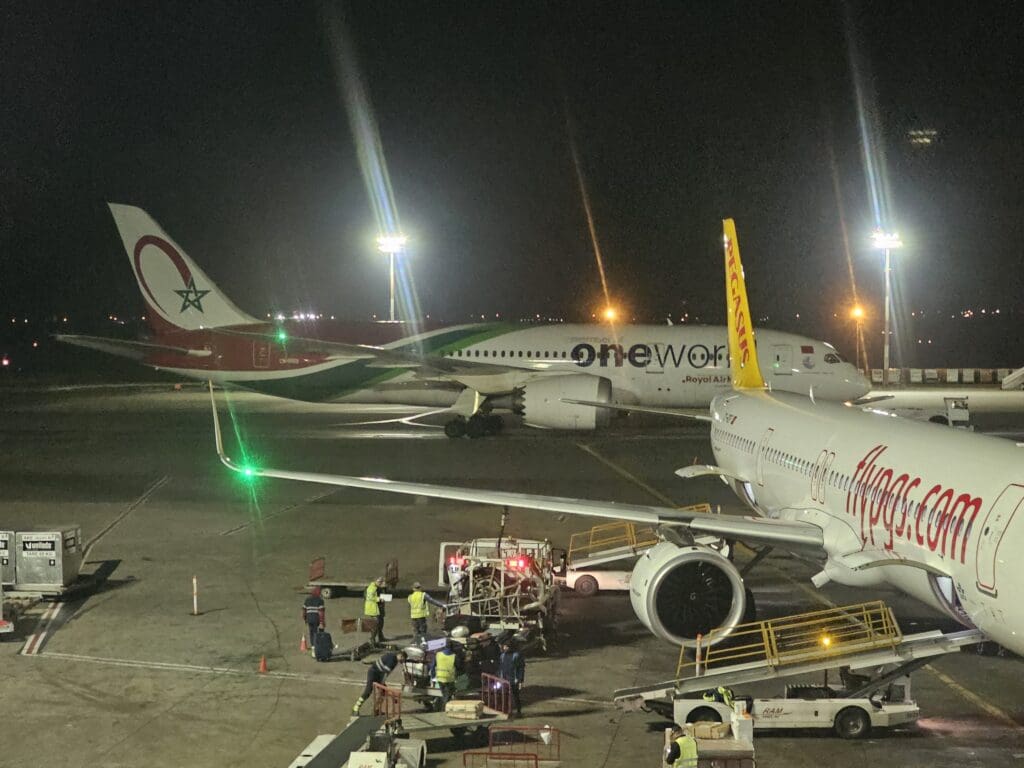
When not flying to the five long-haul destinations on Royal Air Maroc’s route network, the airline’s Dreamliners are deployed on shorter high-volume flights to the likes of Istanbul, Lagos, London and Paris. Like me, the aircraft had spent the day on the ground in Casablanca, with this having arrived the previous morning from New York JFK. Meanwhile, in the week before my flight, the aircraft had operated services from its base in Casablanca to Dakar, Dubai, Lagos, Miami, Montréal and New York JFK, covering at least 42,900 miles in the process.
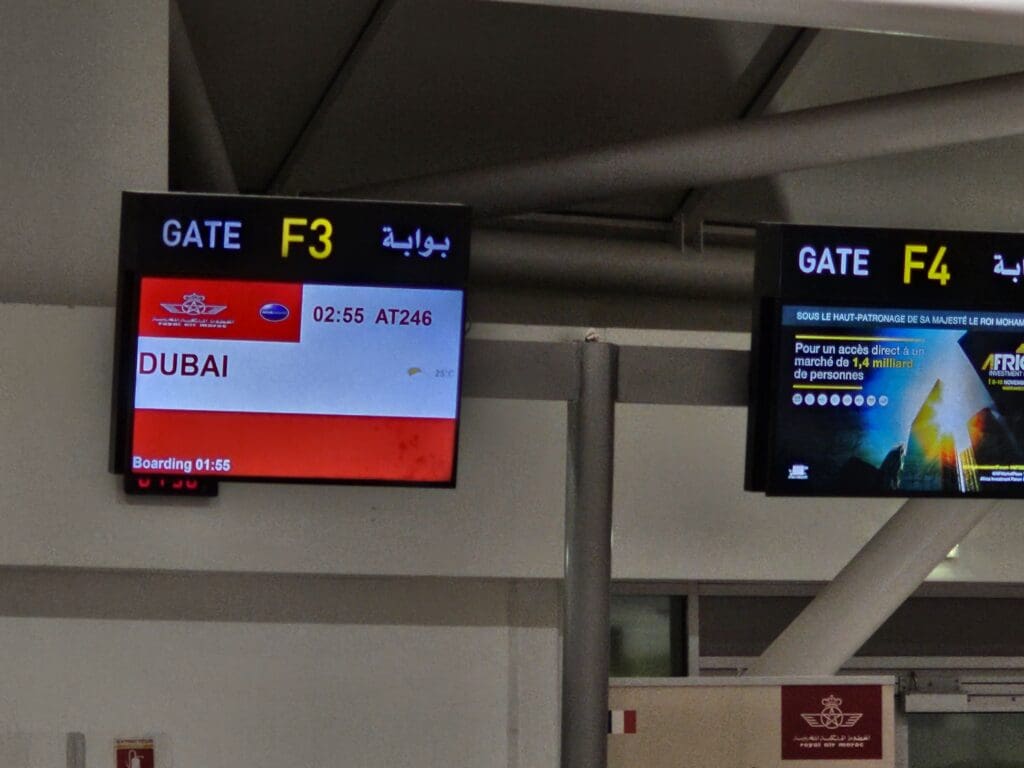
According to my boarding pass, boarding would commence at 0205 and so around ten minutes before this, I decided to wander over to Gate F3. Indicating that boarding would commence on time, upon arriving there three gate agents could already be seen and a series of tensa barriers had been erected to create four lanes – one each for priority passengers, as well as ‘regular’ folk in zones B, C and D. A little before 0205, an announcement was made in Arabic and French advertising the commencement of boarding and soon a crowd of passengers swarmed around the gate. Fortunately, the ground staff were proactive in explaining boarding arrangements and turned away those who attempted to board before their allocated zone had been called. Thus, even though most seemed to be desperate to board the aircraft, boarding was a largely efficient and organised affair.
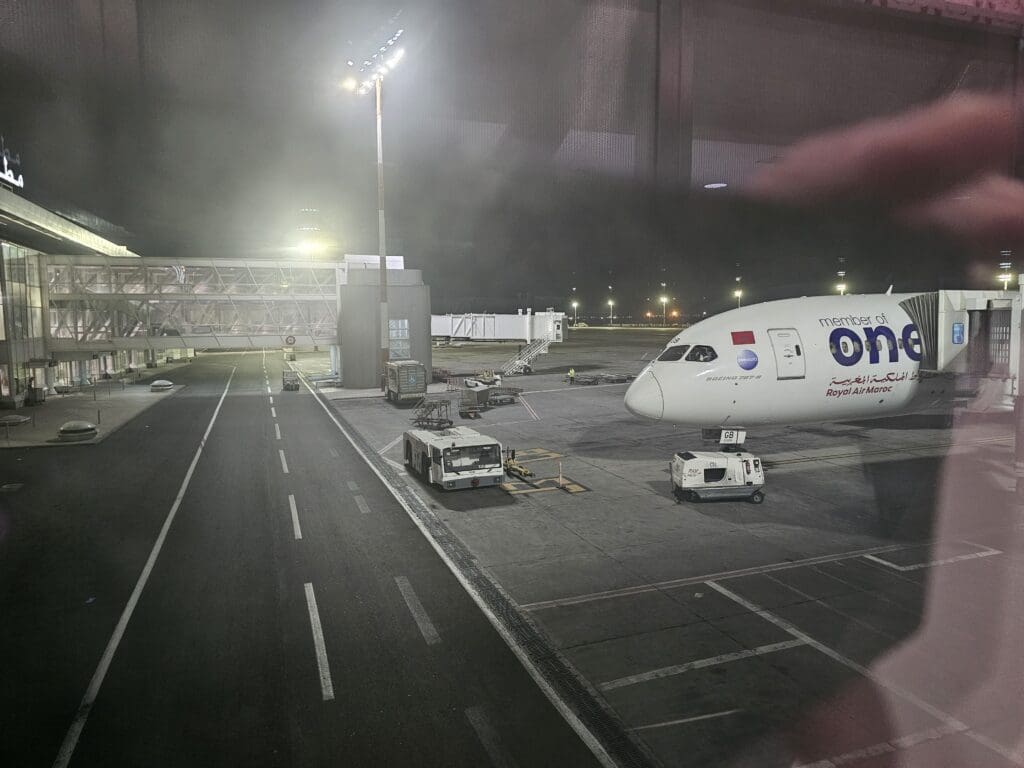
Once priority passengers and those needing assistance had boarded the Dreamliner, boarding for everyone else was undertaken in the usual manner from back to front. Set to travel in the rearmost Economy cabin, I found myself in Group B, the first Economy group to be invited to board the aircraft. A few minutes after boarding had commenced, I began to shuffle forward and soon my boarding pass was scanned and my passport checked by a friendly gate agent who wished me a nice flight before I began to trundle down to the waiting aircraft. From the gate, I made my way down some steps before heading towards the jetbridge which was positioned up to the aircraft’s L2 door. Just before heading down this, a final check of passengers’ boarding passes and passports was undertaken and I soon joined the short queue of waiting passengers at the aircraft’s door. Entering the aircraft, I found myself in the forward galley which separates the Dreamliner’s small Business cabin from the forward Economy section. As I stepped into the aircraft I was given a lukewarm welcome in French from one of the flight attendants dressed in Royal Air Maroc’s smart and mostly grey uniform. Once they had checked my boarding pass, another flight attendant handed me a packaged wet wipe with a pair of metal tongues (as if it were a hot towel!) before I turned right down the second aisle.
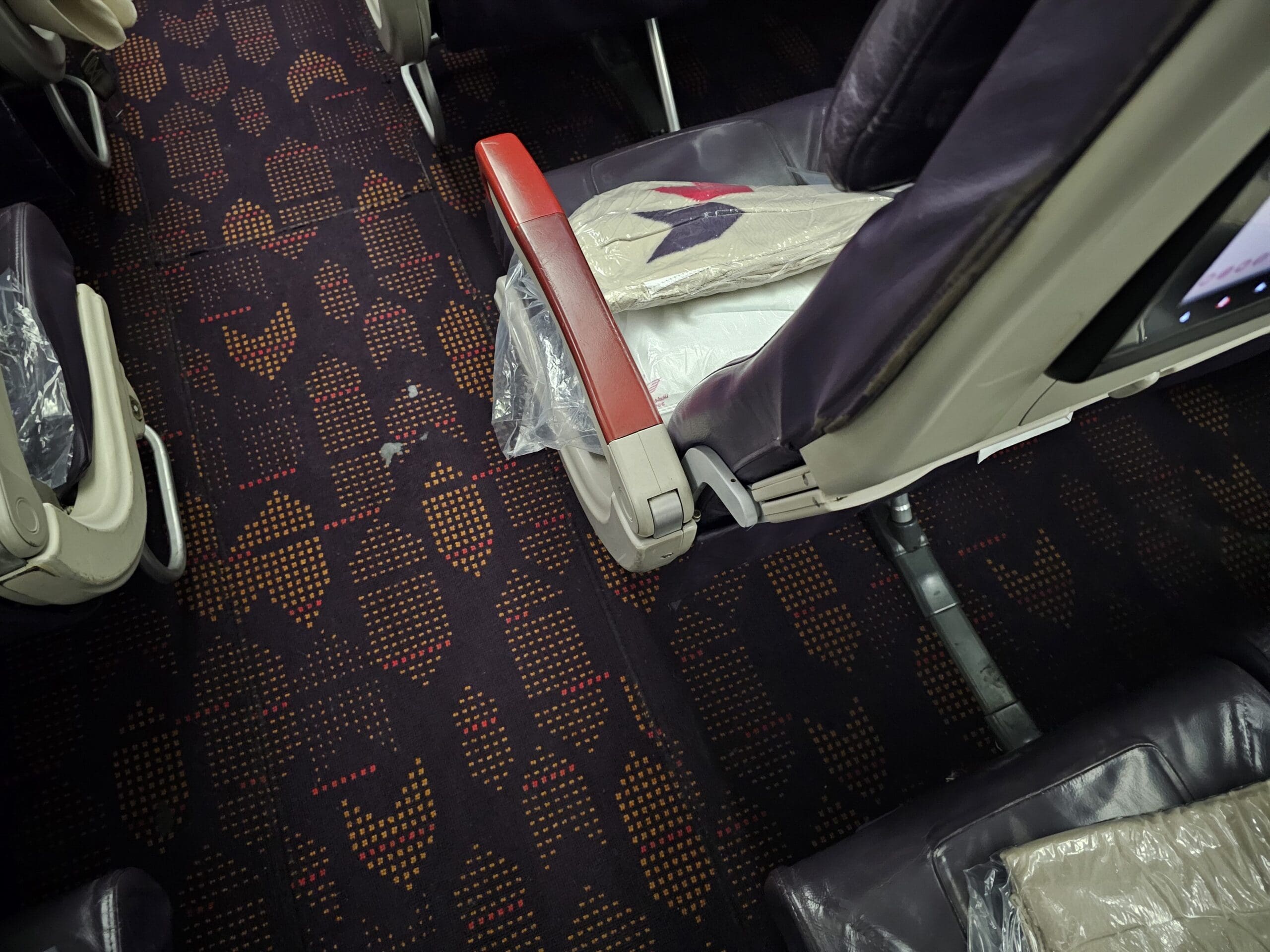
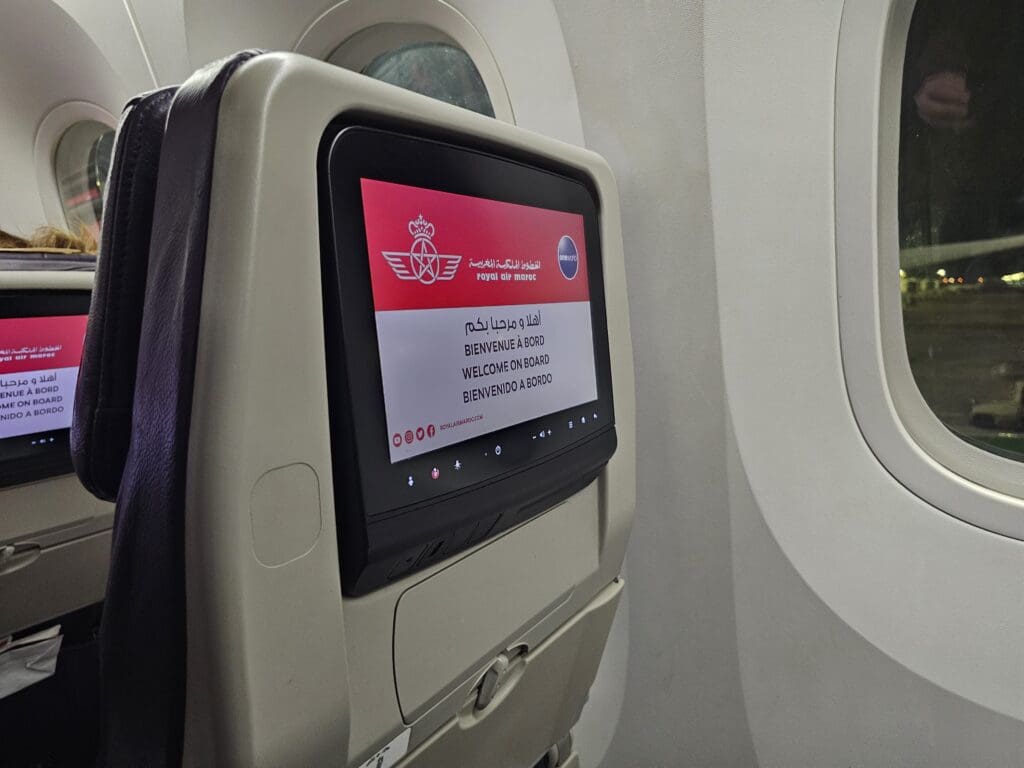
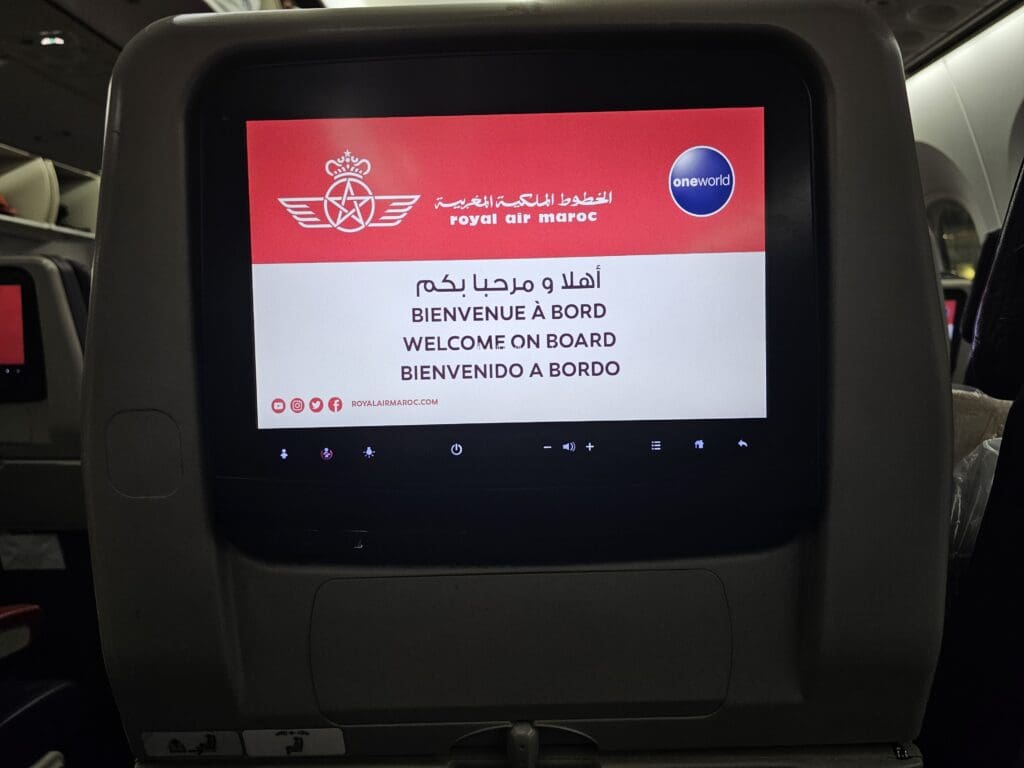
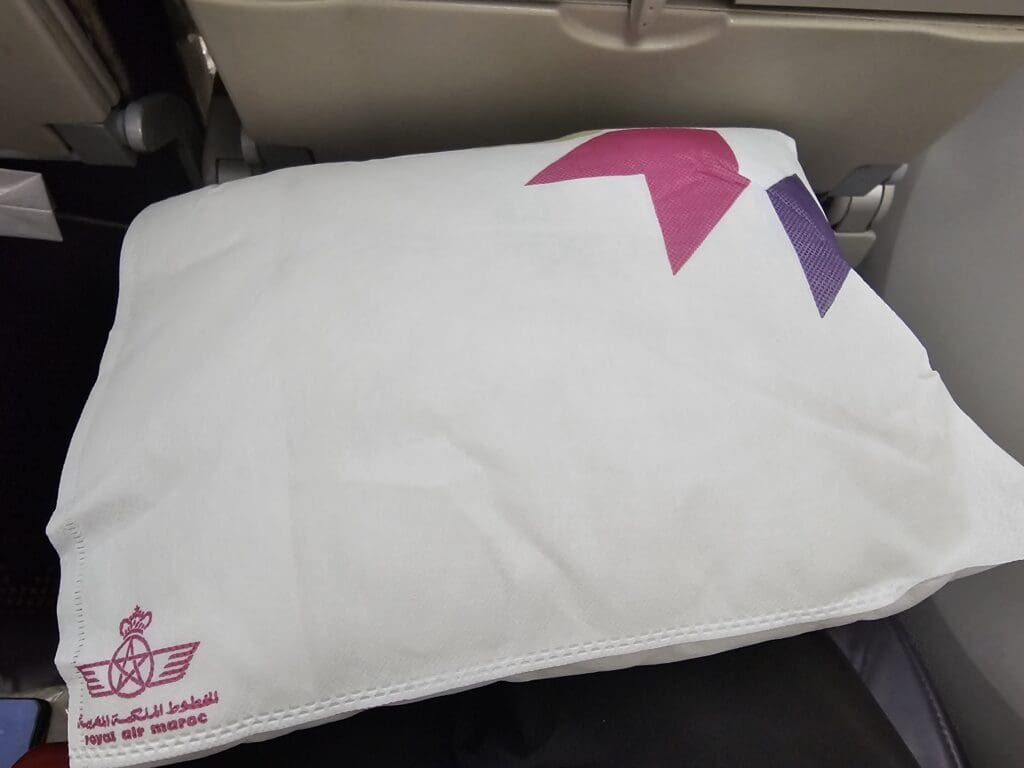
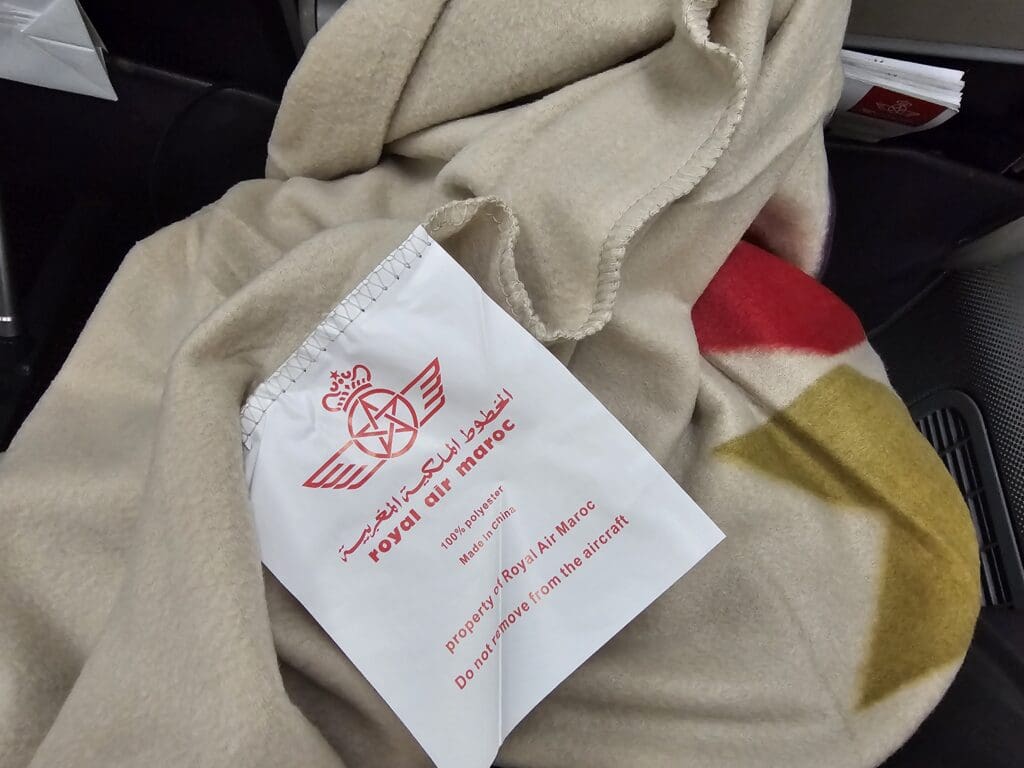
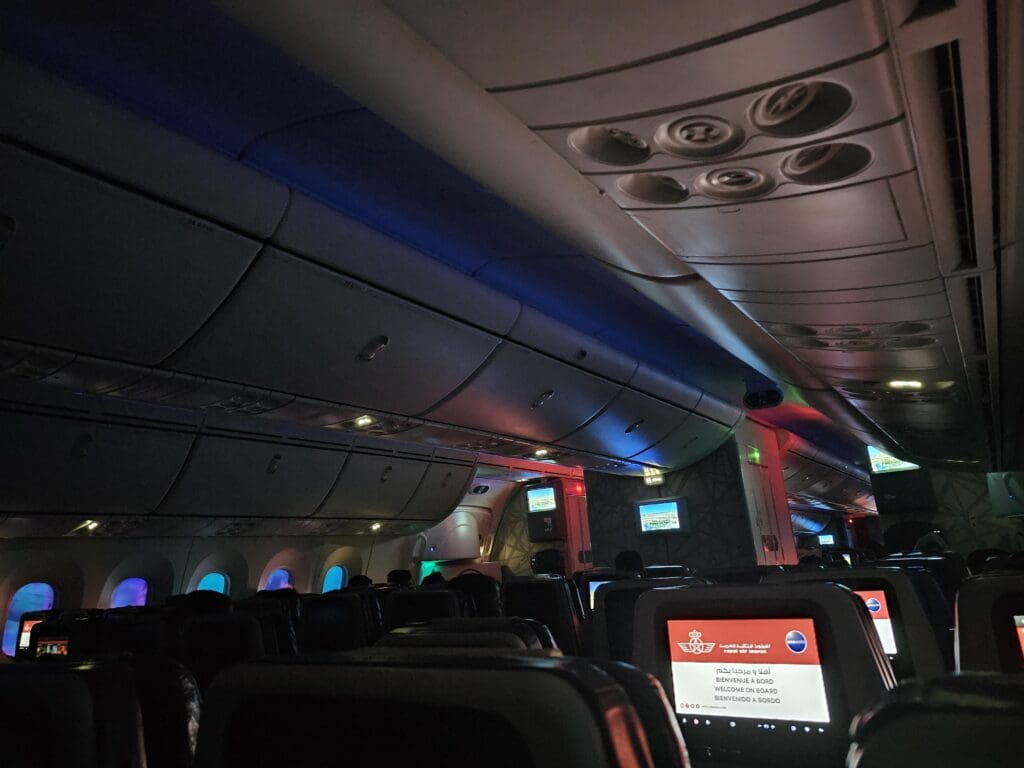
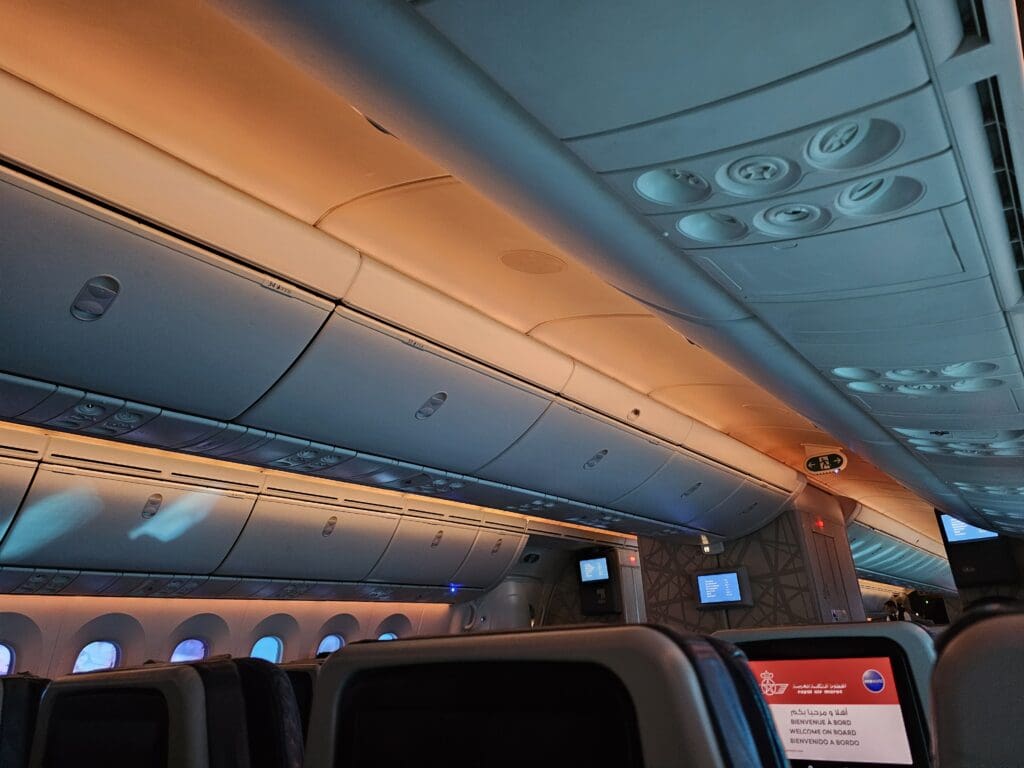
Those travelling long haul with Royal Air Maroc will be glad to hear that the carrier’s Dreamliners are configured in the slightly more spacious nine-abread (3-3-3 layout). In Economy, each seat comes in the form of Safran’s Z300 model, the same type of seat used by the likes of Air Tahiti Nui and Hainan Airlines amongst others. All of these were covered in a purple pleather cover and topped with an adjustable headrest that was partially covered by a disposable fabric antimacassar. The rear of these featured a fairly large and high-quality 8.9-inch wide inflight entertainment screen, with Royal Air Maroc having opted for Thales’ Avant system onboard their Dreamliners. As with their Boeing 737s, Royal Air Maroc has invested in giving the cabin a uniquely Moroccan identity with traditional tastir patterns seen on both the bulkhead walls and cabin dividers. Meanwhile, traditional music rang through the cabin upon boarding. Unsurprisingly given the flight’s length, pillows and blankets had been placed on each seat.
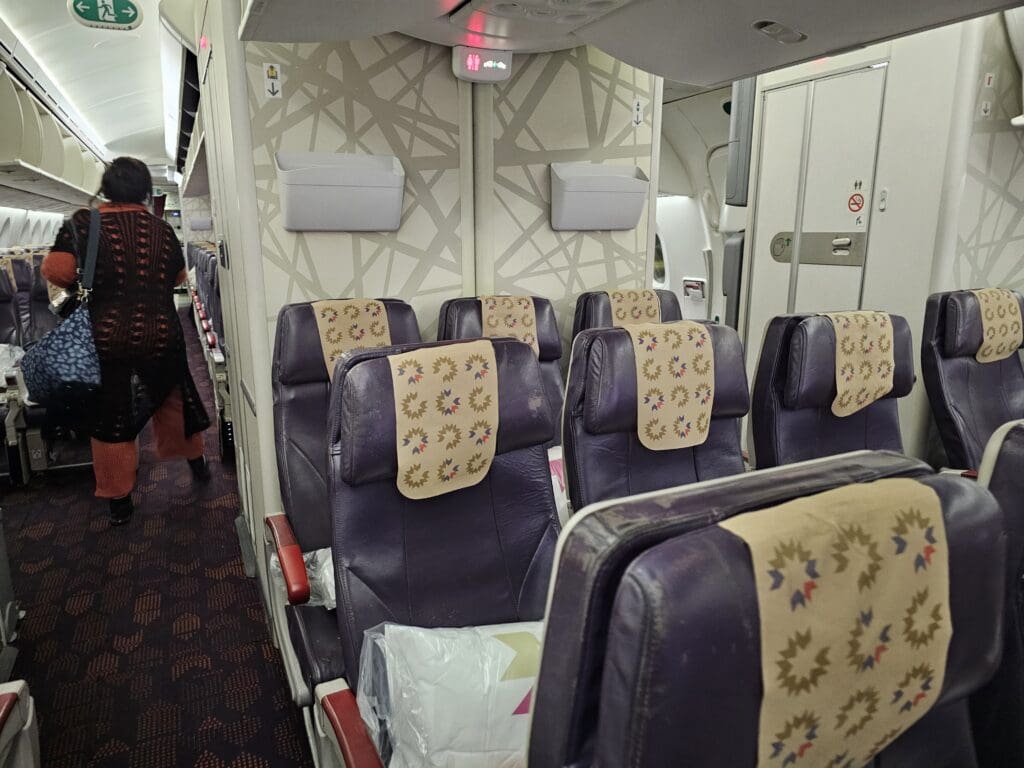
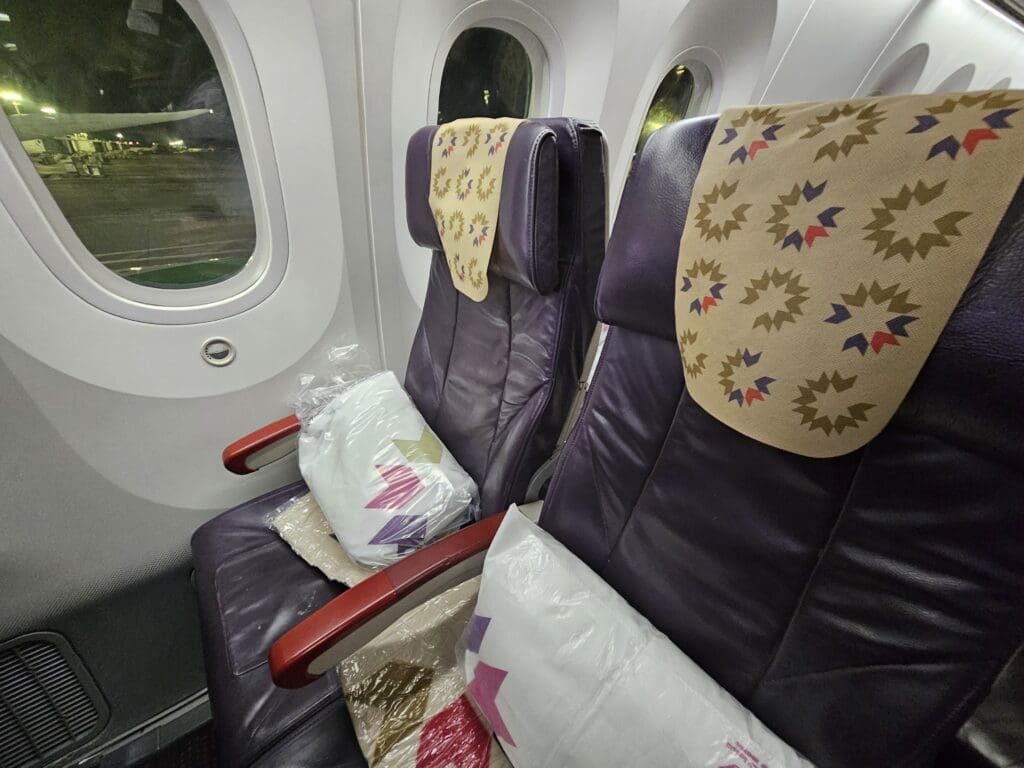
As I journeyed down the aisle, my initial impressions of the crew were slightly better than they had been on the flight down from Paris Orly and I received a couple of quiet and subdued greetings in French. Meanwhile, once seated I did notice another flight attendant making friendly conversation with a fellow passenger complete with laughs and smiles. With few passengers ahead of me, it did not take long to reach the rear of the aircraft although as luck would have it, a passenger could already be seen occupying the aisle seat. Hopeful that it would not be an absolutely full flight, I decided to linger around and wait for a while in the hope that I would be able to bag a free trio of seats.
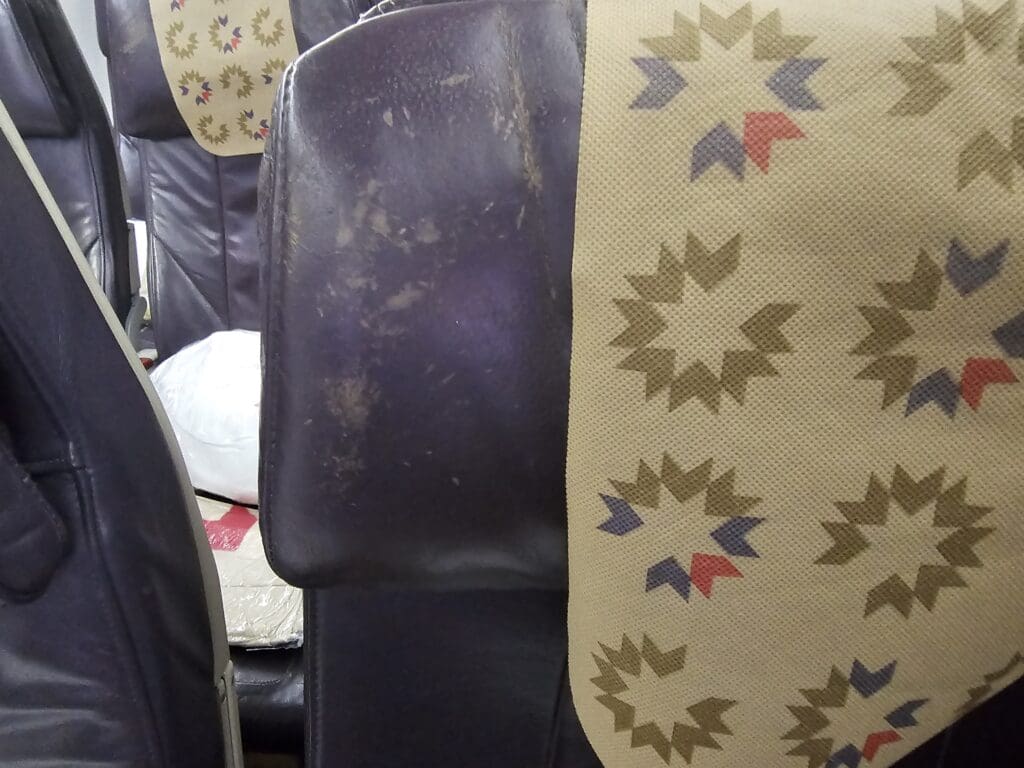
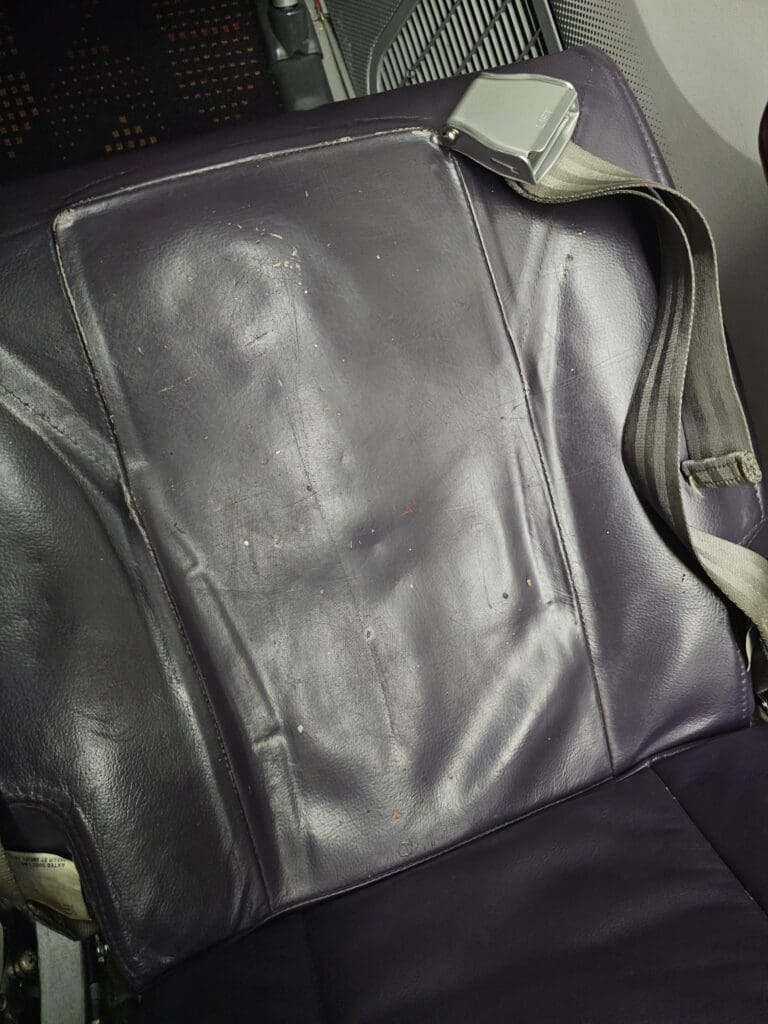
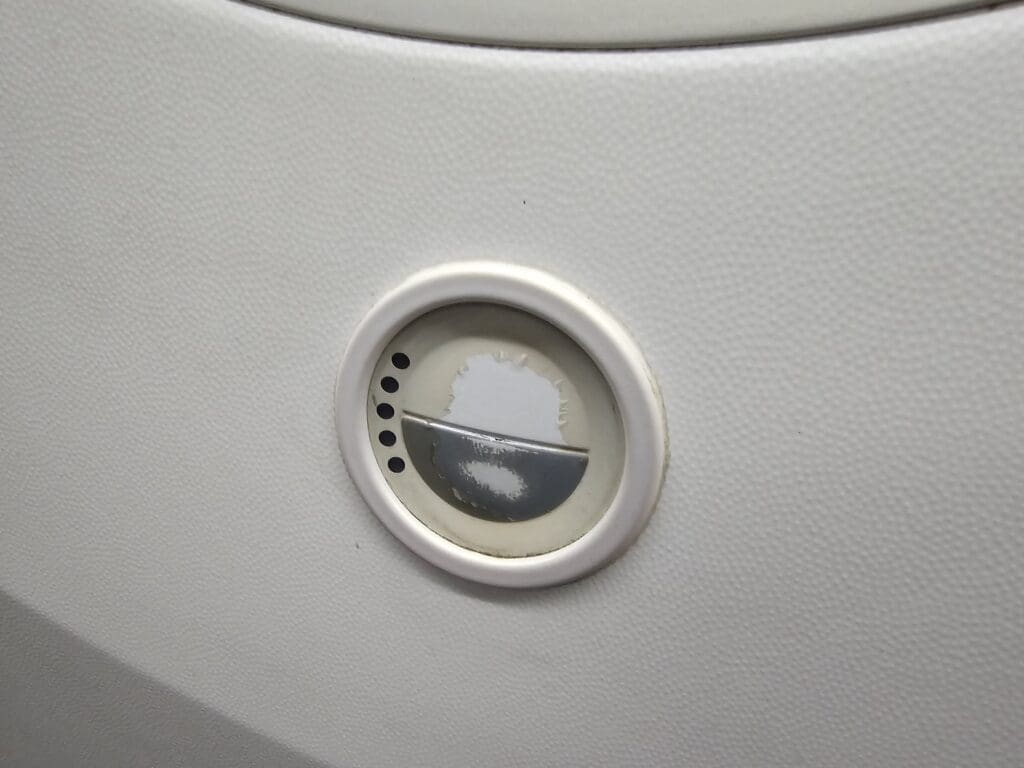
As I lingered, I could not help but notice that the cabin, and, in particular the seats, seemed to be in an incredibly poor state. Whilst the purple seat covers are a fairly recent addition to the aircraft (with these previously covered in grey and red), these were in a generally terrible state with plenty of cosmetic damage. In addition, marks, scratches and well-ingrained dirt were virtually omnipresent throughout the cabin and to the non-expert, the aircraft may have appeared much older than it actually was!
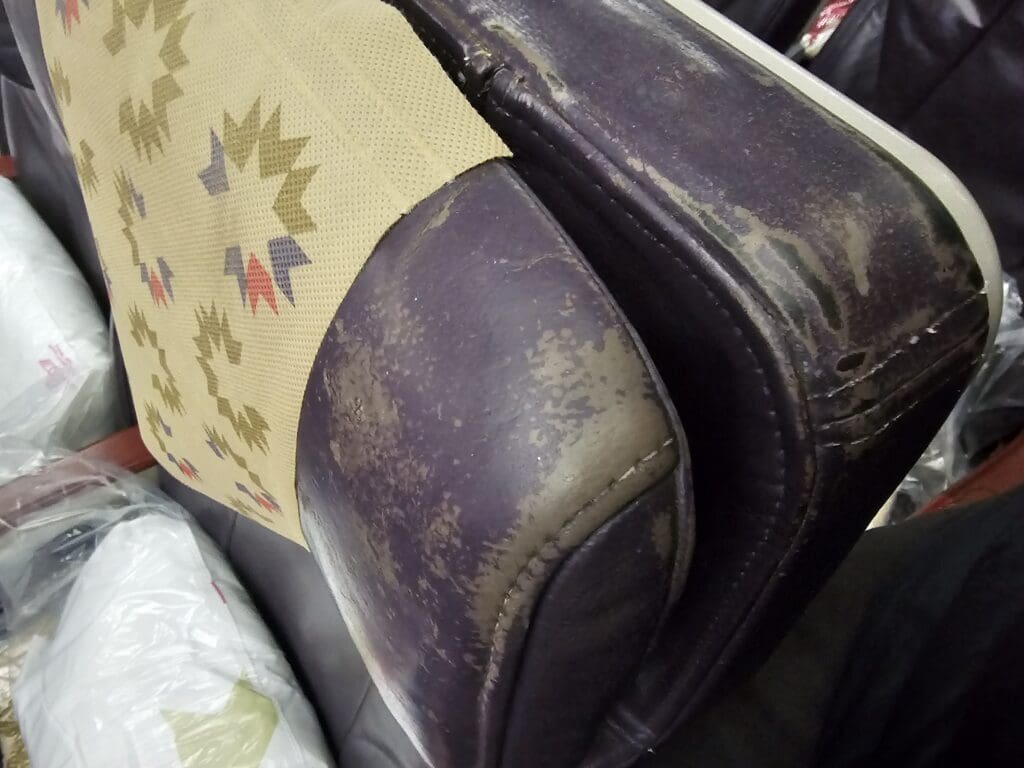
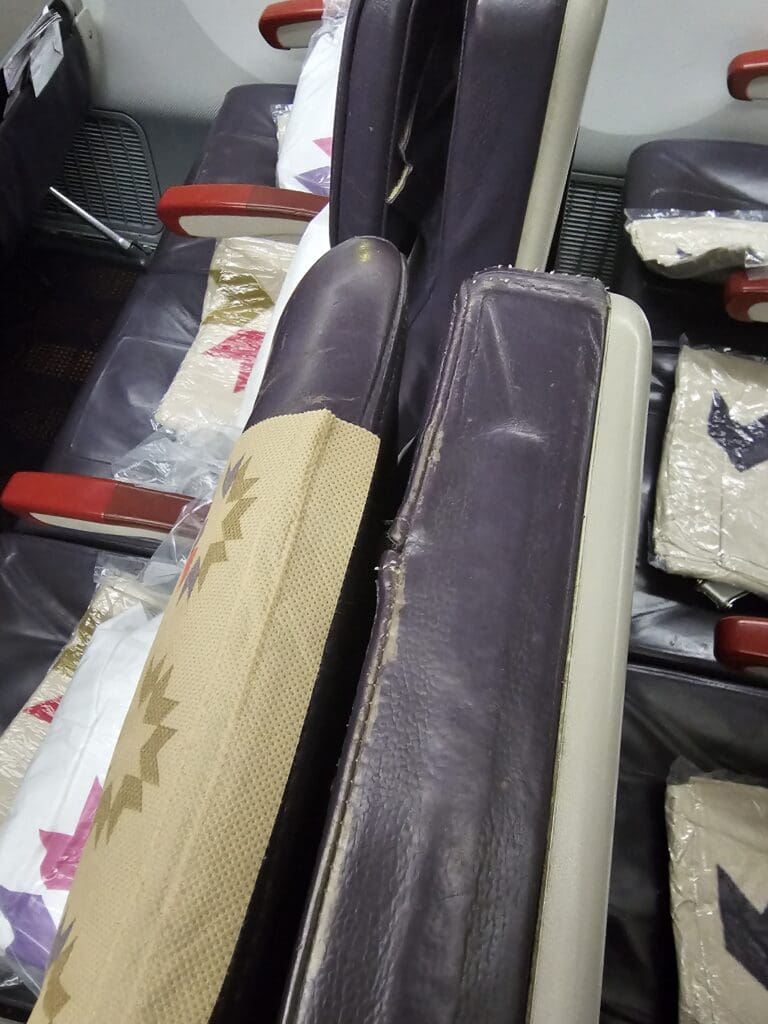
As passengers trickled onto the aircraft, several welcome announcements were performed in Arabic and English and after around fifteen minutes of waiting, boarding came to an end. Much to my delight, at that time many seats throughout the aircraft remained vacant and so I decided to settle down in Seat 35K. Upon taking a seat, I found this to be a little firm although it did offer a decent amount of legroom and proved to be acceptably comfortable for the seven or so hour flight ahead. For those needing to power their devices, a USB-A port could be found beneath the screen whilst a universal power socket was located under each seat. Meanwhile, the seatback pocket contained a dogeared safety card, a Sky Shop duty free catalogue and a sick bag.
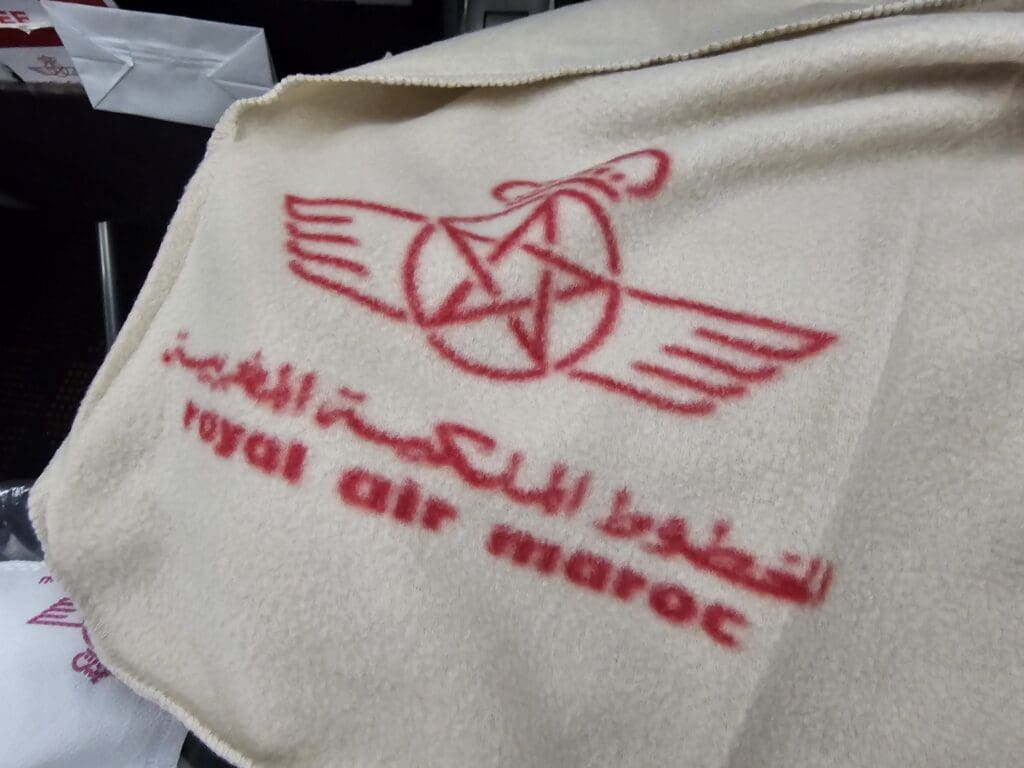
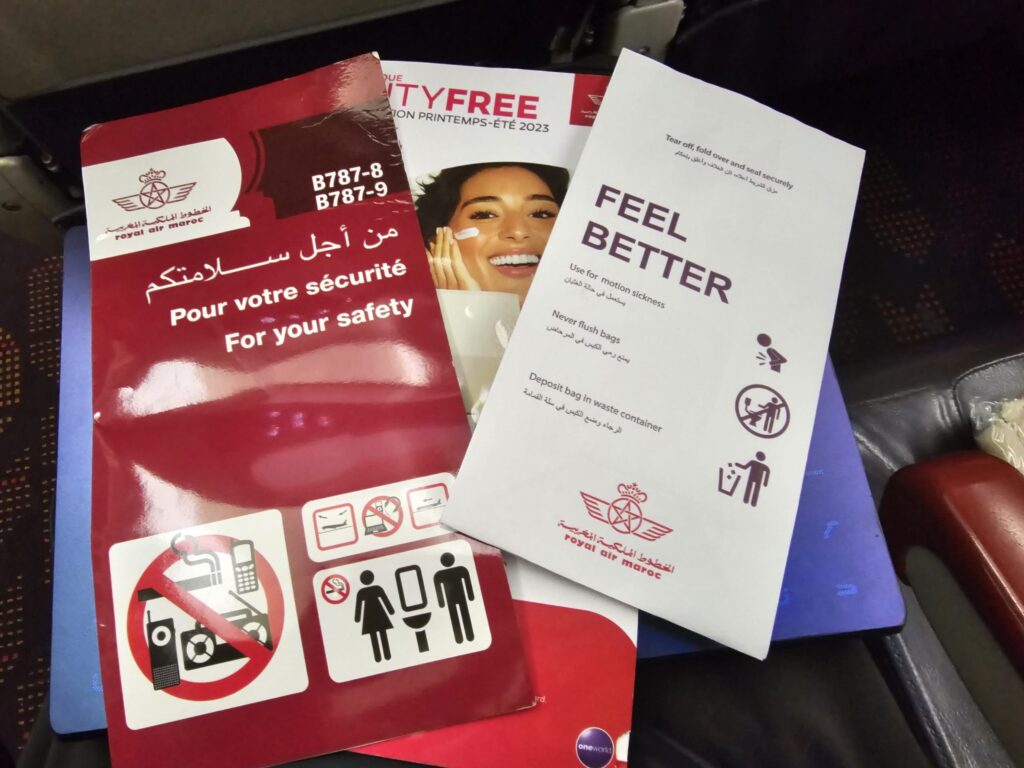
Looking outside, almost as soon as all passengers had boarded, the door to the cargo hold was closed with a whine and a thud, and the ground crew could be seen removing cones and other equipment from around the aircraft. Turning to the demographics, perhaps unsurprisingly, most passengers appeared to hail from Morocco and many were leisure travellers heading off on holiday. Meanwhile, interestingly, and as had been the case on the flight down from Paris, almost all flight attendants seemed to be men, with the only female flight attendant taking the form of the Purser.
As soon as all passengers were on board, the crew passed through the cabin closing the overhead lockers and soon, the Purser began their welcome speech in Arabic and English. This consisted of the usual welcomes, thanks and messages regarding safety onboard the aircraft (specifically regarding seat belts, smoking and electronic devices getting trapped in seats). As this took place, the reflection of the aircraft’s red pulsating beacon light could be seen indicating that we were ready to go and moments later, a grand total of six minutes ahead of our scheduled departure time, the aircraft was pushed back away from its stand. As we journeyed rearwards, Royal Air Maroc’s safety video took over the inflight entertainment screens as well as those at the front of the cabin. This was broadcast in Arabic and English and accompanied by French subtitles. Whilst those expecting a high-value production with famous faces and gimmicks may have been disappointed, this served its important purpose and was not as long as some other airlines’ safety videos.
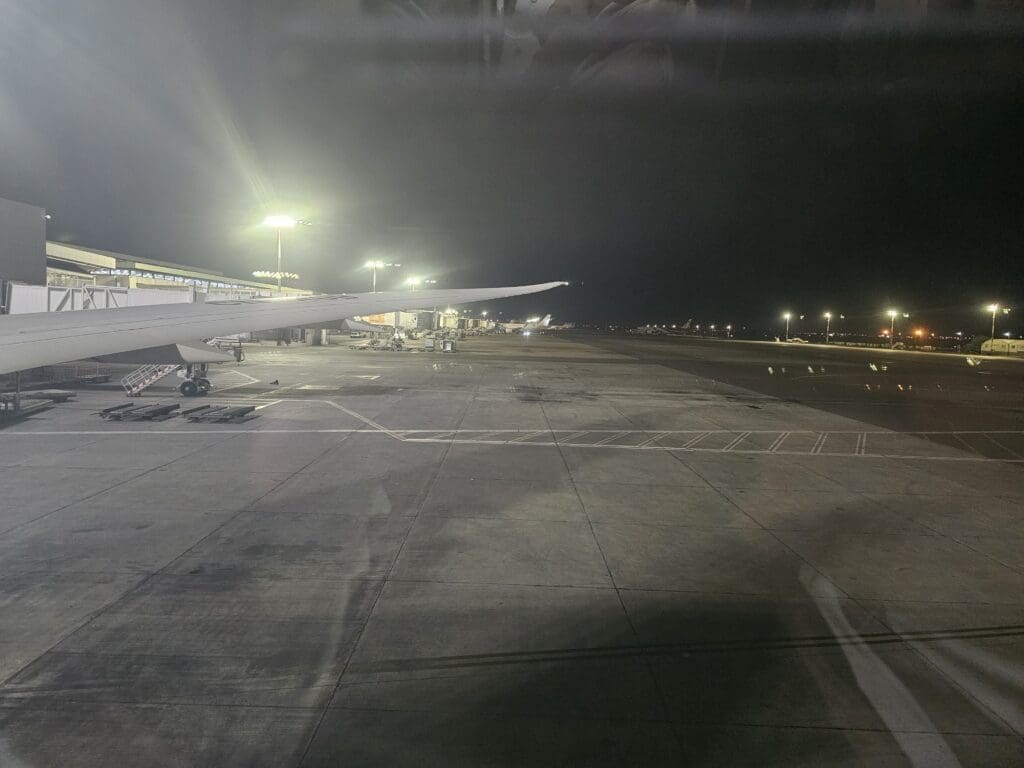
As soon as the aircraft came to a halt, a few clunks could be heard followed by a cacophony of vibrations and whines as the Dreamliner’s two gigantic General Electric GEnx-1B engines spooled into life ready for the voyage ahead. Back inside the cabin, at this time the crew passed through ensuring all was secure for our departure, however with plenty of passengers having already opted to recline their seats, they seemed to have their work cut out stopping at what seemed like every other row to tell passengers to put their seat upright. Unfortunately, this seemed to fall on deaf ears and as soon as the crew took their seats, many passengers immediately reclined their seats once more.
Once the engines had powered up and the tug had been disconnected, the Dreamliner powered forward under its own steam and made its way past Terminal 2. At that time, a single Tunisair Airbus A320 could be seen having just touched down from Tunis. Meanwhile, a nightstopping Air France Airbus A320 and a TUI Fly Belgium Boeing 737-700 could be seen, both of which would operate morning services to Paris a few hours later. As we trundled away from the terminal complex, the Captain announced ‘cabin crew, take-off configuration’ and the lights were extinguished in preparation for our night-time departure.
Whilst Casablanca Airport covers a fairly large area, that evening Runway 35L was in use for departures, so no particularly long taxi was required. With little traffic at that time, the Dreamliner made its way onto the runway without holding and once there we came to a short halt. At 0303, the Dreamliner’s two engines spooled up into life as the aircraft commenced its powerful take-off roll. Thanks to the darkness, as we whizzed down the runway, little could be seen other than the outline of a Georgian-registered Boeing 737-800 freighter and a cluster of aircraft waiting at the terminal before we rotated up into the hazy night sky with plenty of shuddering.
Almost immediately after taking to the skies, the Dreamliner entered the haze which prevented those in the window seats from being treated to any nighttime vistas of Casablanca during the initial stages of the climb. Once away from the airport, the aircraft continued on its course towards the city centre before banking to the right and journeying northwards up Morocco’s Atlantic coastline. A few minutes following our departure, the haze cleared and revealed the orange glow of passing coastal towns and cities. The first of these was the city of Mohammedia followed by the likes of Temara, Kénitra and the capital, Rabat.
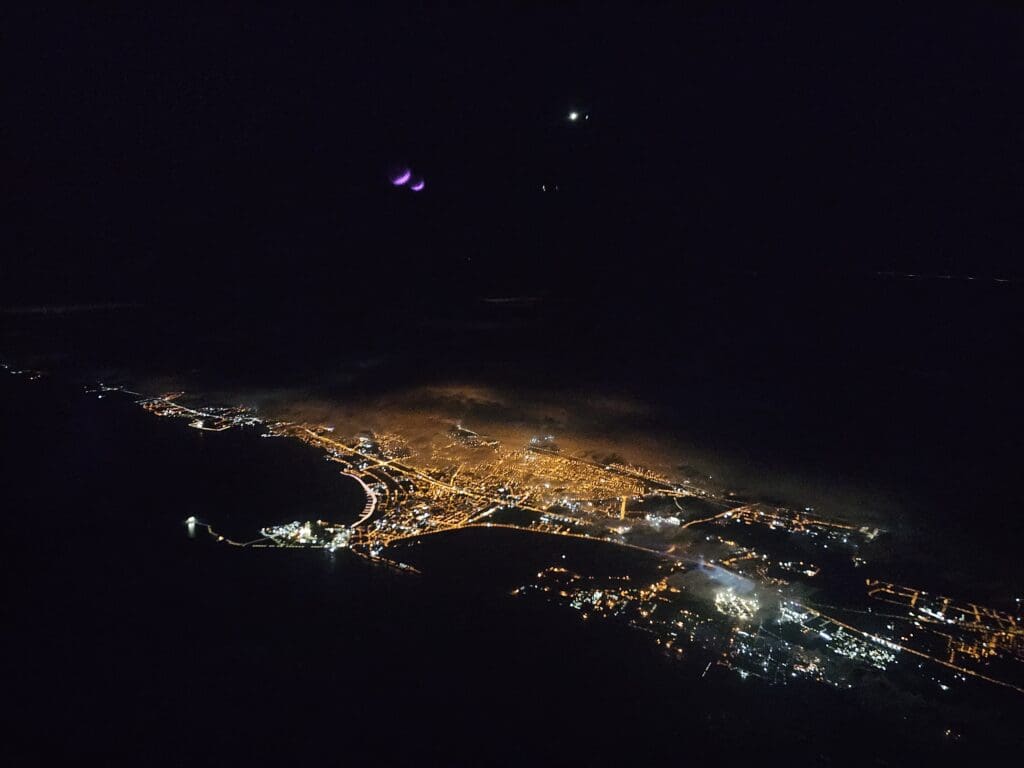

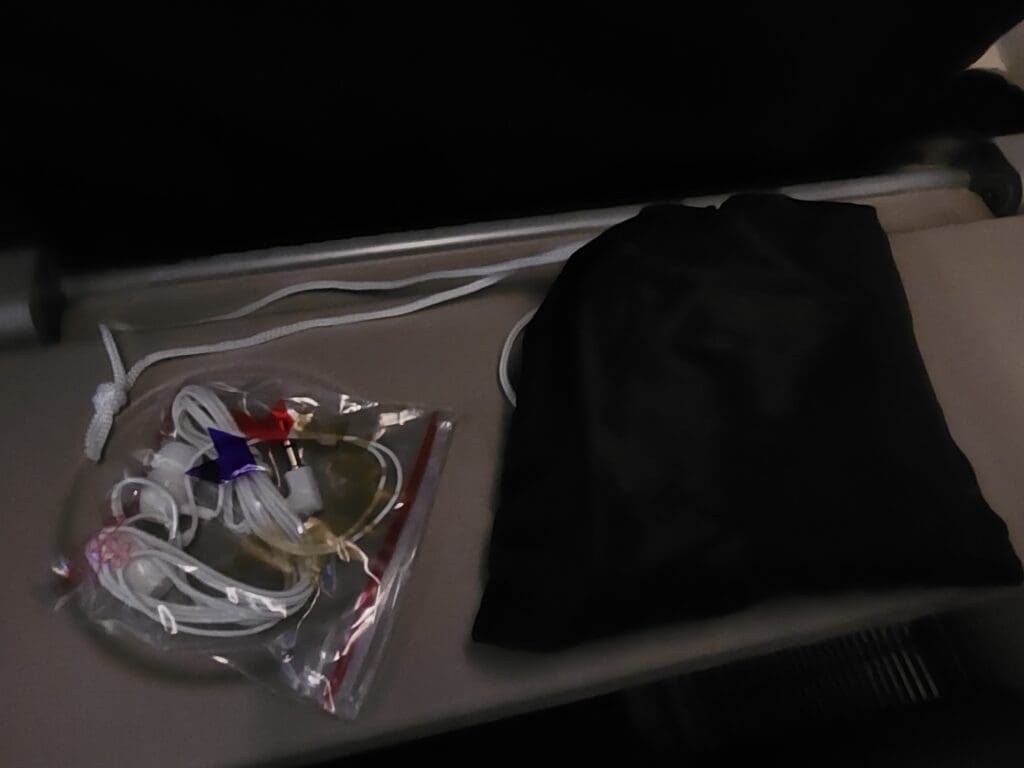
With our departure from Casablanca having proven to be smooth, the seatbelt signs were extinguished as soon as we climbed through 10,000 feet. This was soon followed by the Purser’s usual announcement regarding keeping seatbelts fastened whilst seated before ending their announcement with a mention that the first of two rounds of service would commence shortly. A few minutes later, the crew passed through the cabin distributing typically low-quality headphones as well as a small and unbranded amenity kit containing socks and an eye mask. Whilst the latter was unlikely to win any awards, given amenity kits, and increasingly rare status in Economy, this was very much appreciated.
Returning to the route, after passing Tangier, the tip of the Tingitan Peninsula and the Spanish enclave of Ceuta, the aircraft made its way along Spain’s Costa del Sol passing the likes of Marbella and Málaga. Having departed in the dead of night, and with most passengers surely wanting to sleep, I had expected that the first service would be a quick snack box or similar, whilst the second would be a full breakfast or lunch as we neared the end of the flight. However, when the lights were switched back on at full blast as we passed Málaga and the crew rolled out the service carts, it soon became clear that I was wrong and we were to be served a full meal!
Just after 0400 Casablanca time, I was rather cooly offered the choice of chicken, fish or pasta for my very late dinner or very early breakfast. Opting for the chicken, the foil dish containing this was slapped down on a tray and handed over to me, which I paired with an orange juice from the drinks cart which followed a minute or so later. Opening the main dish up, I found this to consist of chicken in a mystery sauce accompanied by an egg and potato frittata. This was accompanied by a small cold rice salad, a bread roll with soft cheese spread, a fruit and chocolate cake and a small square of dark chocolate in a Royal Air Maroc branded wrapper. This also came with an antibacterial wet wipe, and the usual sachet containing plastic cutlery, a serviette and packets of salt and pepper.
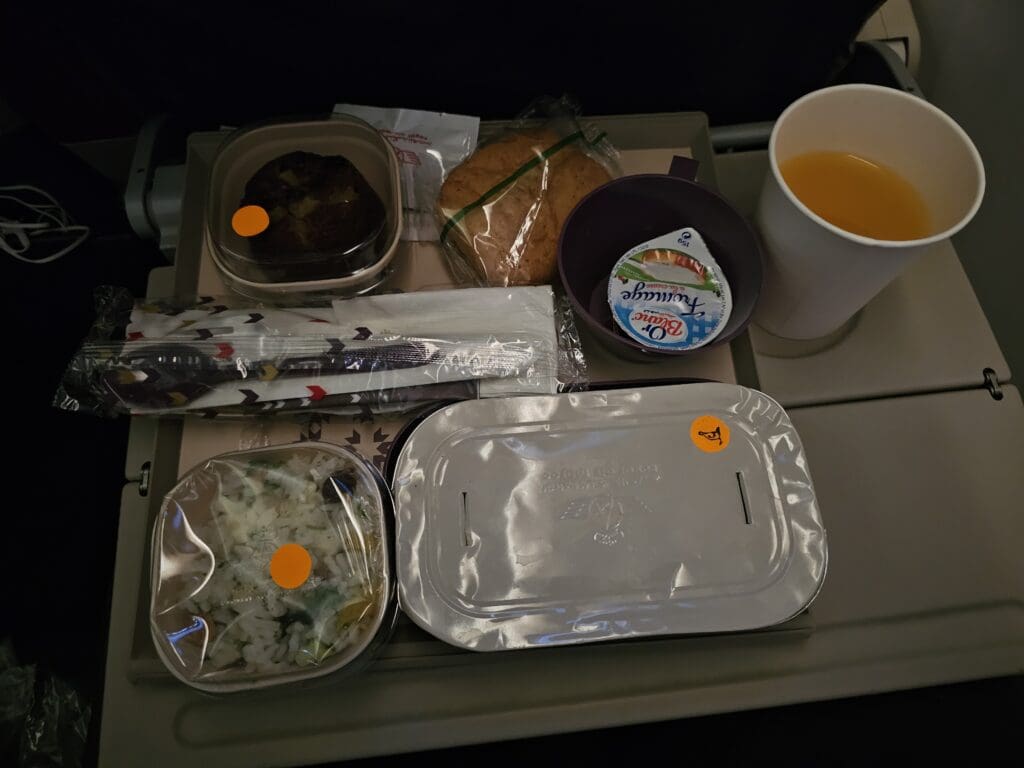
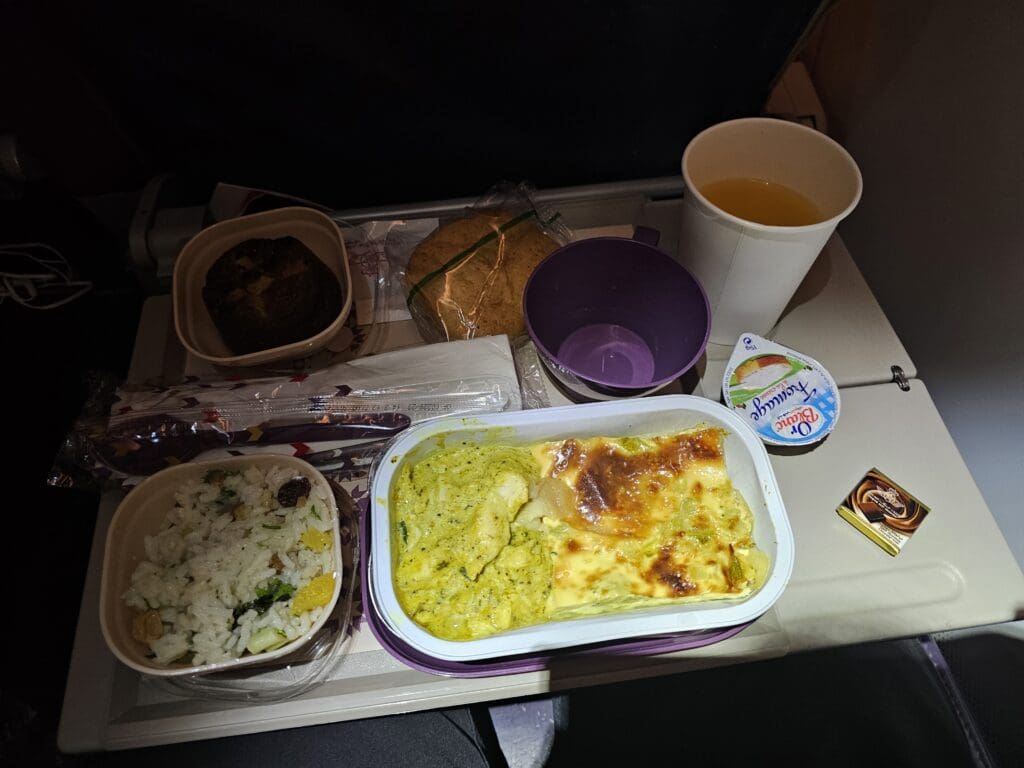
Soon digging into this, whilst the main dish was not the pinnacle of inflight cuisine, this was most certainly acceptable and left me with no complaints. After around ten minutes, a round of traditional Moroccan mint tea was made and seeing as I was on Royal Air Maroc I could hardly pass on this! Perhaps realising that many passengers simply wanted to sleep, it wasn’t long before the trays were collected and the cabin lights turned off once again.
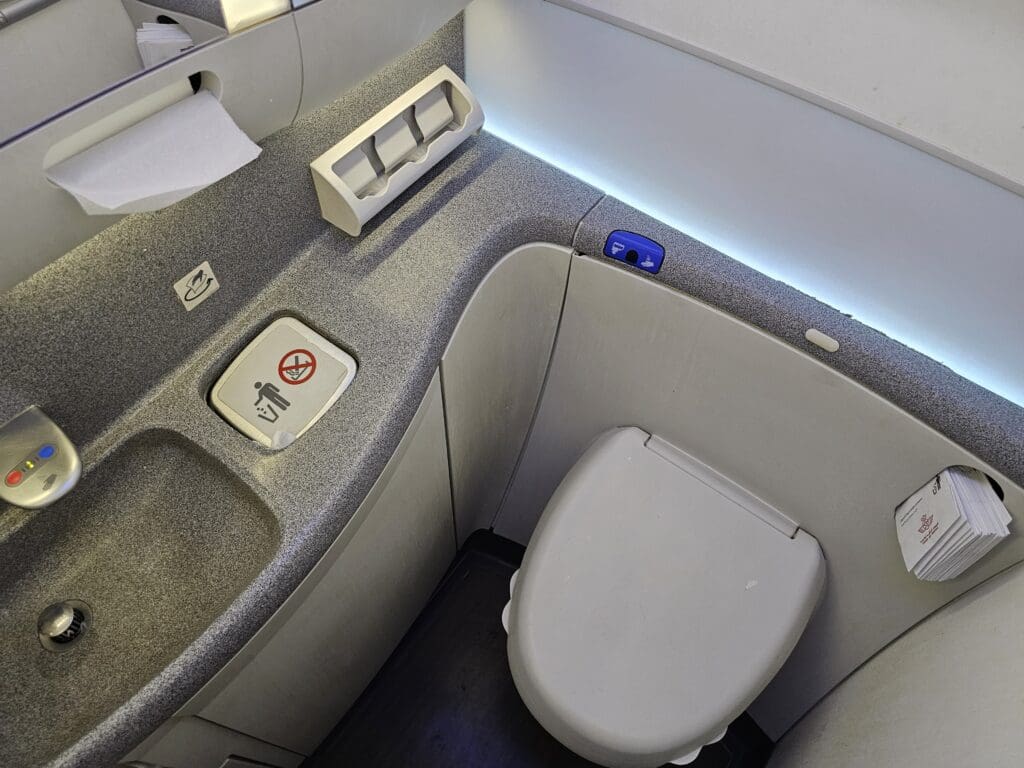
As soon as my tray had been collected, I decided to pay a visit to one of the Dreamliner’s lavatories. With just one located at the rear of the aircraft, and four jammed in between the forward and rear cabins, I made my way forwards and soon squeezed into one of these without any waiting. Whilst still early on in the flight, I was pleased to find these to be in a clean and tidy state, thus leaving me with little to complain about. However, I should note that no paper towels were provided, with facial tissues instead offered for passengers to dry their hands. The main issue with these being that they easily disintegrated as you tried to dry your hands.
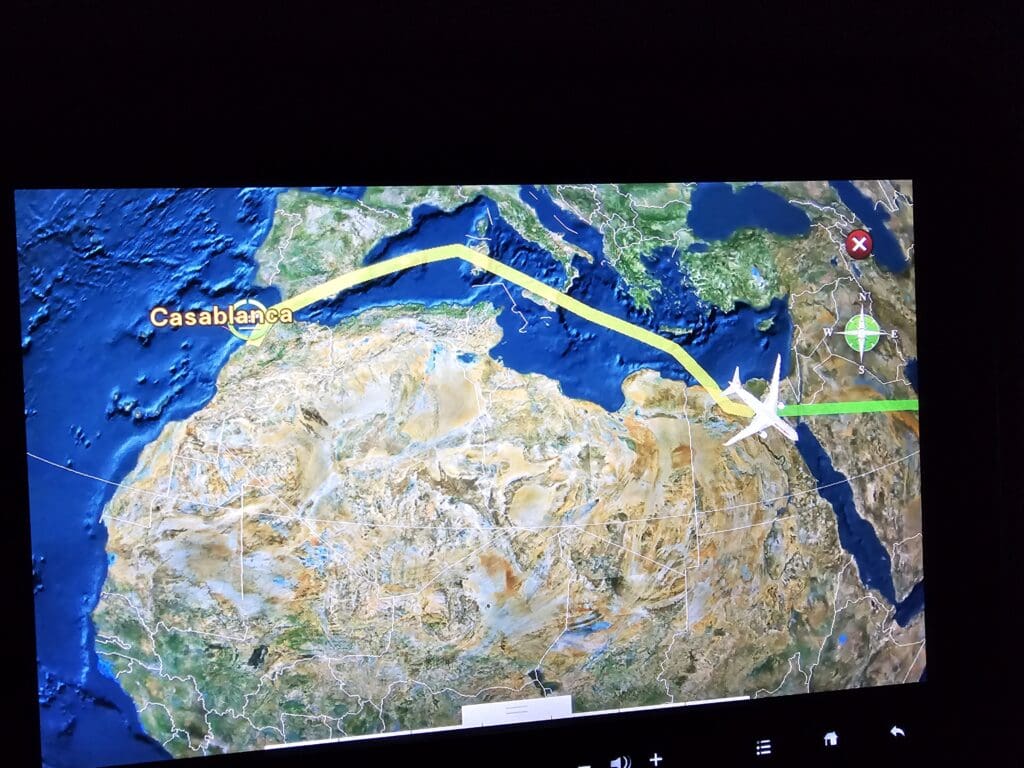
Soon returning to my seat, enjoying the luxury of a bank of three vacant seats I decided to convert these into an Economy-style bed. Admittedly, being rather tall, this was not amazingly comfortable and the awkward position I had to take to squeeze into these ensured I ended up with a slight neckache. However, seeing as I was absolutely shattered, I did not have many issues drifting off to sleep and did so just after passing the island of Majorca. With poor ongoing relations between Morocco and its neighbour, Algeria, Royal Air Maroc aircraft do not transit the country’s airspace, which on this route sees flights head north and spend much of the first half of the journey trundling across the Mediterranean rather than North Africa. From Majorca, the Dreamliner crossed over neighbouring Menorca before leaving the Balearics behind and making its way towards Sardinia. Continuing its tour of Mediterranean islands, the aircraft then headed onwards towards Sicily followed by Crete before making landfall over North Africa once more, passing over the Egyptian coastline near the city of Marsa Matruh.
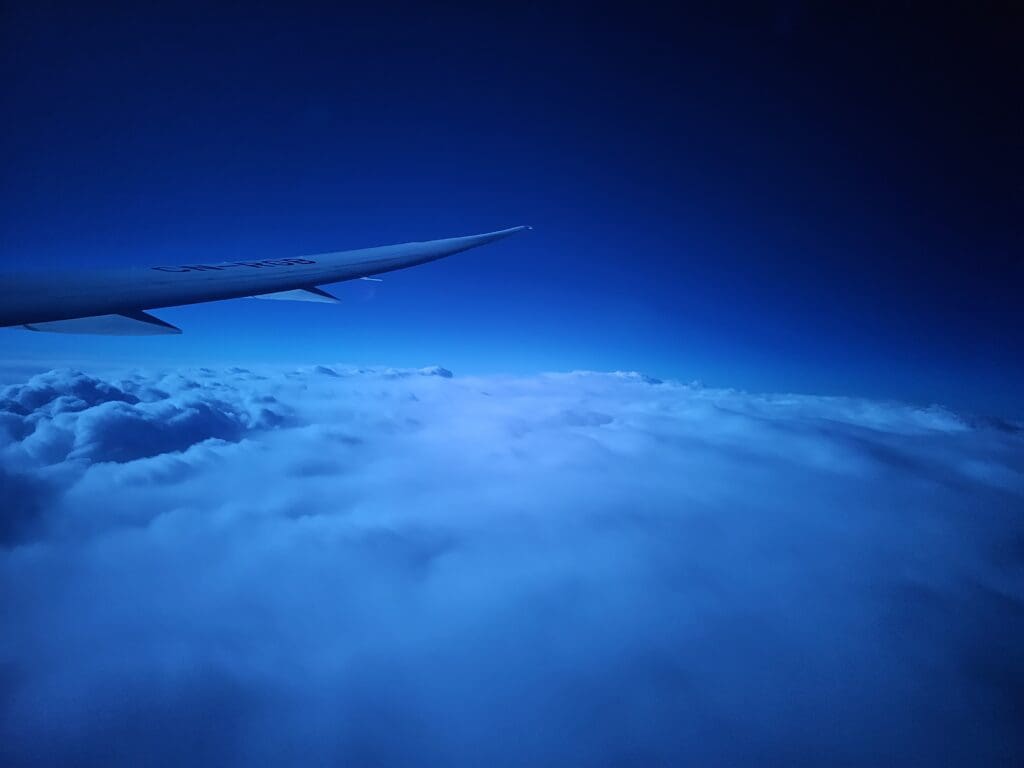
After almost three hours of patchy sleep, I was awoken by the ding of the seatbelt sign as we neared the banks of the Nile and climbed up to 43,000 feet. Whilst the Dreamliner’s windows had been centrally dimmed (although this could be overridden), nothing could be seen of Egypt thanks to a layer of cloud that remained omnipresent below for our crossing of the country. Now wide awake and with little to see outside, I decided to pass the time by exploring the delights of Royal Air Maroc’s inflight entertainment.
Roughly representative of the destinations where Royal Air Maroc sends their Dreamliners, the inflight entertainment system is available in four languages – Arabic, English, French and Portuguese. Playing around with the system, I found this to be easy to navigate, quick-to-load and responsive to touch. Once at the home screen, I was presented with nine sections – Applications, Applications, Games, Information, Movies, Music, My Flight, Promotion, Services and Television Programmes. Starting with the films, I counted a grand total of 93, which included both new releases and older classics. The majority of these took the form of Hollywood blockbusters, with just 14 Arabic language films offered. In addition, two Nigerian films could be found as well as one each from France, India, Korea and Spain. Moving on, at the time of my flight the system contained a total of 42 television programmes, with ten episodes each from the American shows Abbott Elementary, All Rise, Last Man Standing and Young Sheldon. These also included the slightly unusual choices of one Buster Keaton and one Lauren and Hardy programme. Unlike many airlines, no advertisements were played before commencing any visual content.
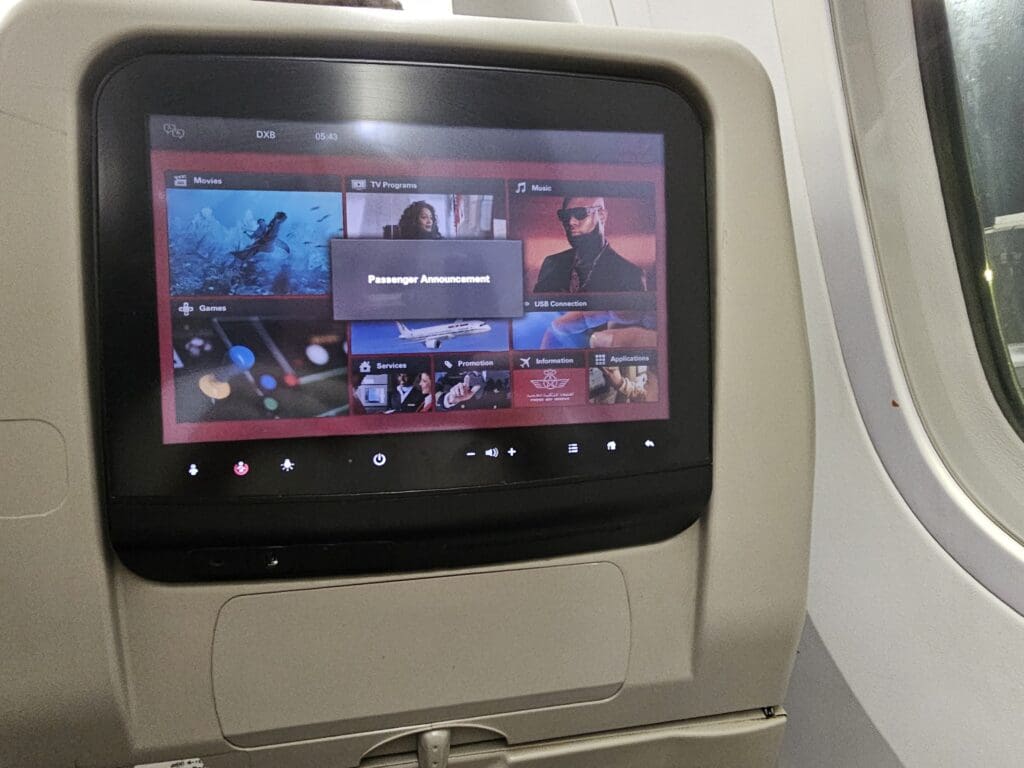
Moving onto the other content, the system hosted 63 albums and audiobooks, as well as a total of nine games. For those looking to give feedback, the services section included a survey however this was not promoted and would have been easily missed by passengers. Last but not least, the Thales GeoFusion moving map worked well throughout the flight and provided a range of options for passengers to track the progress of the flight as we slowly shifted eastwards. Having not expected Royal Air Maroc to offer the most expansive inflight entertainment system in the world and having had no intention of watching anything, I was not particularly disappointed with the inflight entertainment. I should however note, that as had been the case on the ride down from Paris, the well-promoted onboard SKY-RAM wifi did not work.
Returning to the route, after crossing the Nile the aircraft cruised towards the popular Red Sea holiday spot of Hurghada and after fifteen minutes the Dreamliner left the Land of the Pharaohs behind. Making a short crossing of the Red Sea, the aircraft crossed over the shores of Saudi Arabia near the city of Al Wajh in Tabuk Province. From there, we headed inland over Tabuk’s mountains, passing little other than the occasional town before this transformed into the orange Nafud desert as we entered Ha’il Province.
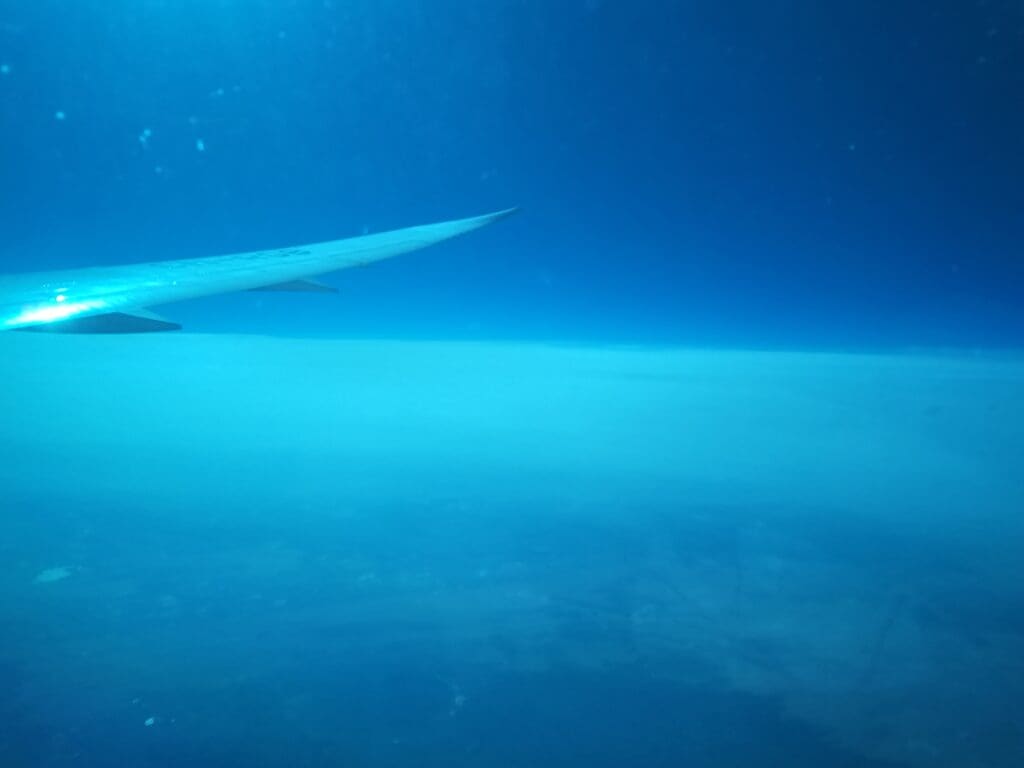
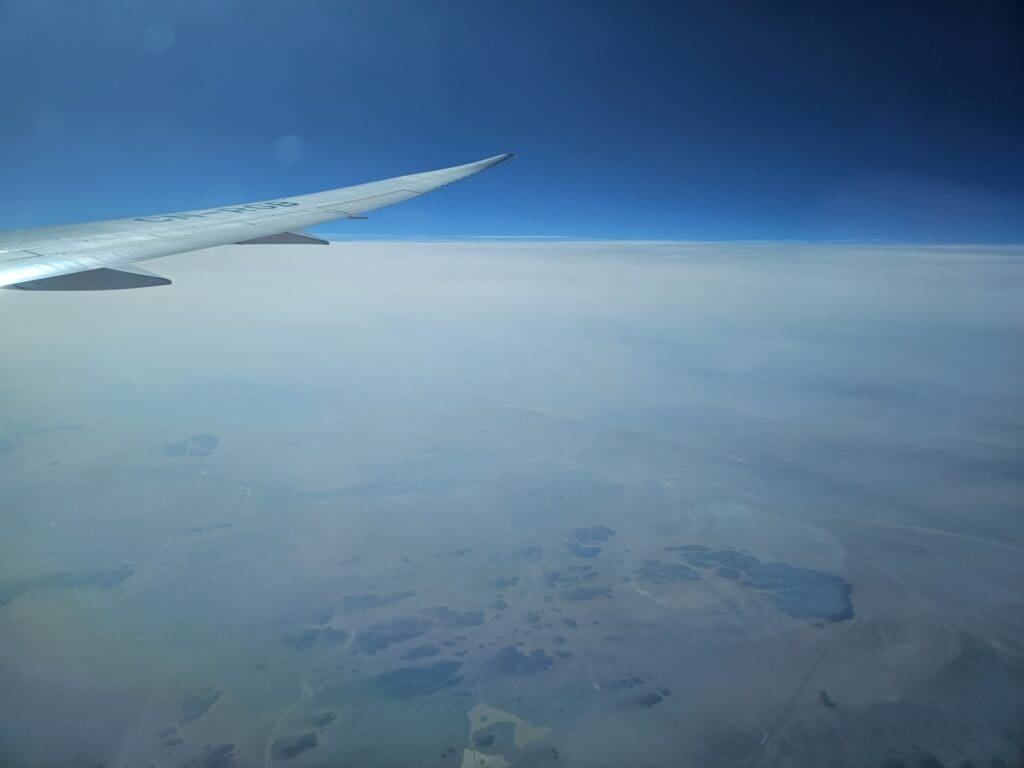
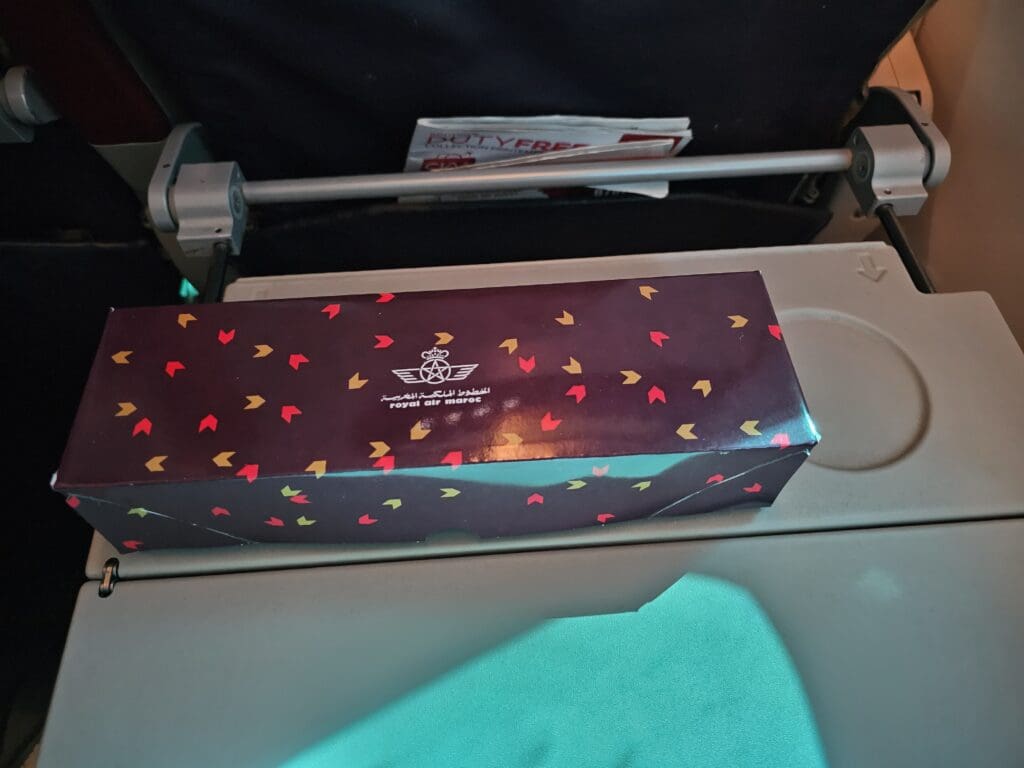
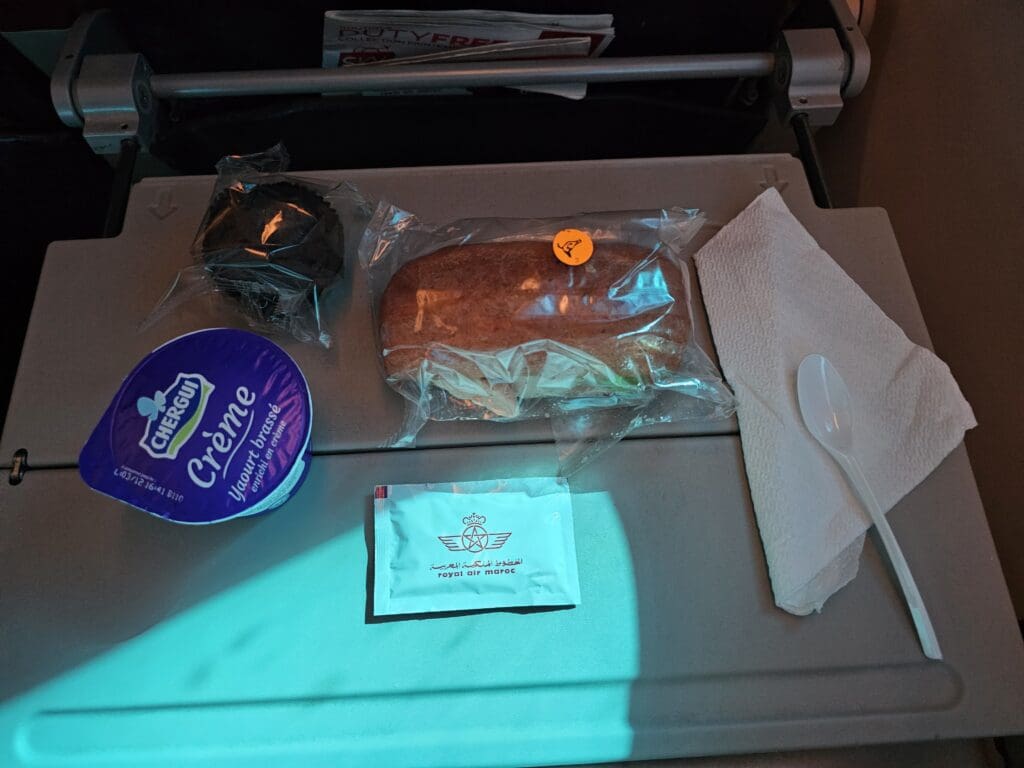
As we cruised high above the heart of Saudi Arabia, the cabin lighting was turned on to an orange dawn glow matching the colour of the sands below at which point the carts hit the aisles and the crew got to work distributing the breakfast service. Around ten minutes later, I was handed a nicely decorated box which contained a hearty chicken sandwich, plain yoghurt and a chocolate muffin, accompanied by a plastic spoon, serviette and antibacterial wipe. A few moments later, the drinks trolley arrived and I opted to pair this with an orange juice – the only juice they had available.
With the moodlighting now on, I decided to override my window dimmer with this becoming fully transparent just in time for me to catch a glimpse of the city of Al Zulfi in Riyadh Province before we crossed over into the Eastern Province. After around an hour and fifteen minutes spent heading eastwards over Saudi Arabia, the aircraft left the country behind and made its way out over the waters of the Persian Gulf. At this point, realising that there was not a great deal of flight time remaining, I decided to make one last toilet visit before our arrival. Upon entering this, I was pleased to see that in spite of seeing heavy usage throughout the flight, this was clean and tidy and left me with nothing to complain about.
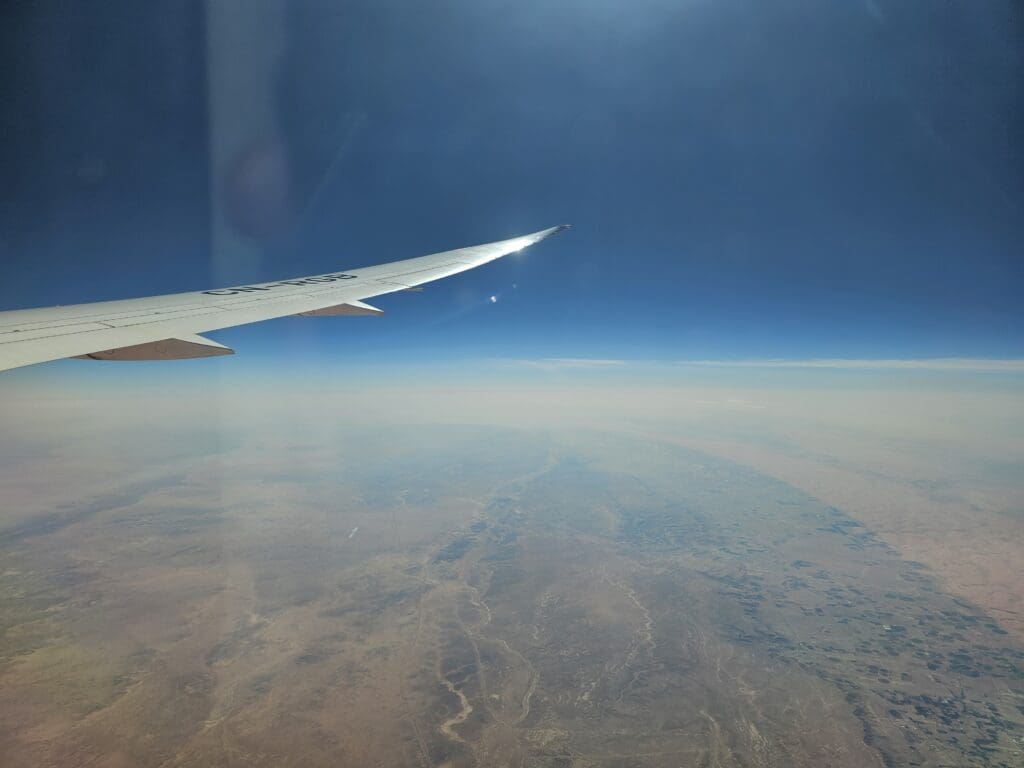
By the time I returned to my seat, the aircraft was some distance to the north of Bahrain, and the crew passed around collecting the rubbish from the breakfast service. At 1034 Gulf Standard Time, the Dreamliner could be felt leaving its cruising altitude as we passed to the northeast of Qatar around halfway to the southern shores of Iran. This was soon followed by an announcement from the Purser with the usual warnings before the crew passed through the cabin in order to collect the blankets. Deciding it best not to take a souvenir with me, I handed the nicely designed blanket back and once this had been completed, it wasn’t long before the seatbelt signs were switched on and the crew passed through the cabin ensuring that all was secure before our arrival. As with my other flight with Royal Air Maroc, this was done with plenty of time to go until landing and the crew had their work cut out waking passengers up and getting them to buckle up for landing. However, once again, many passengers seemed to recline their seats at the first opportunity once the crew had strapped themselves into their jumpseats.
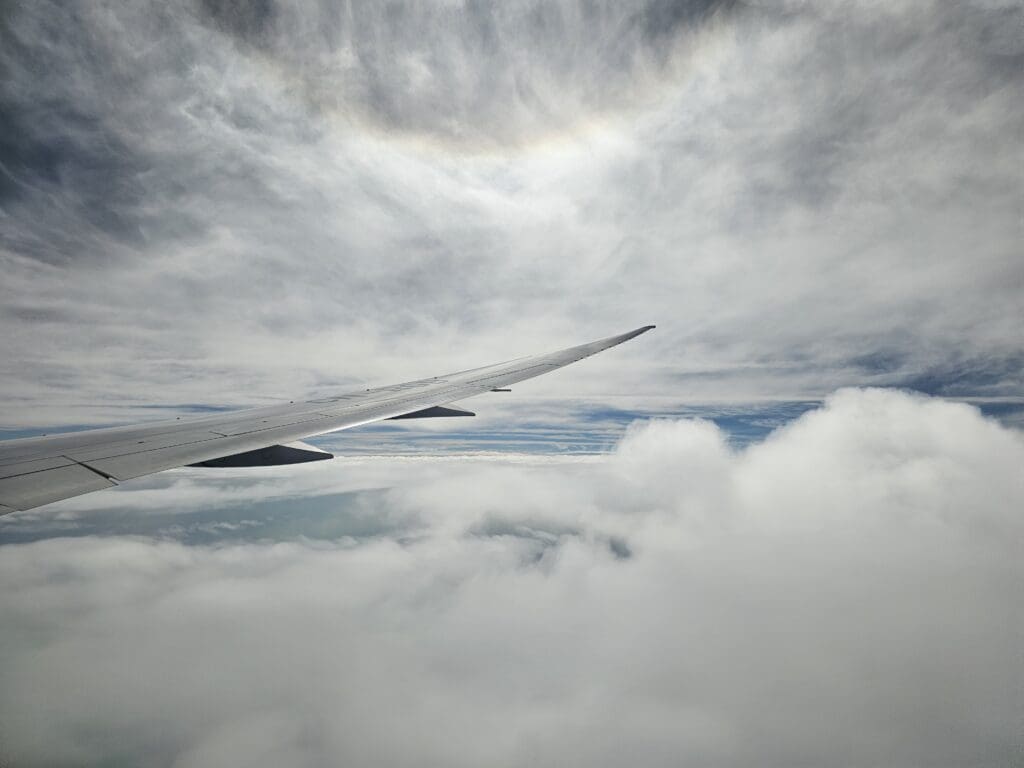

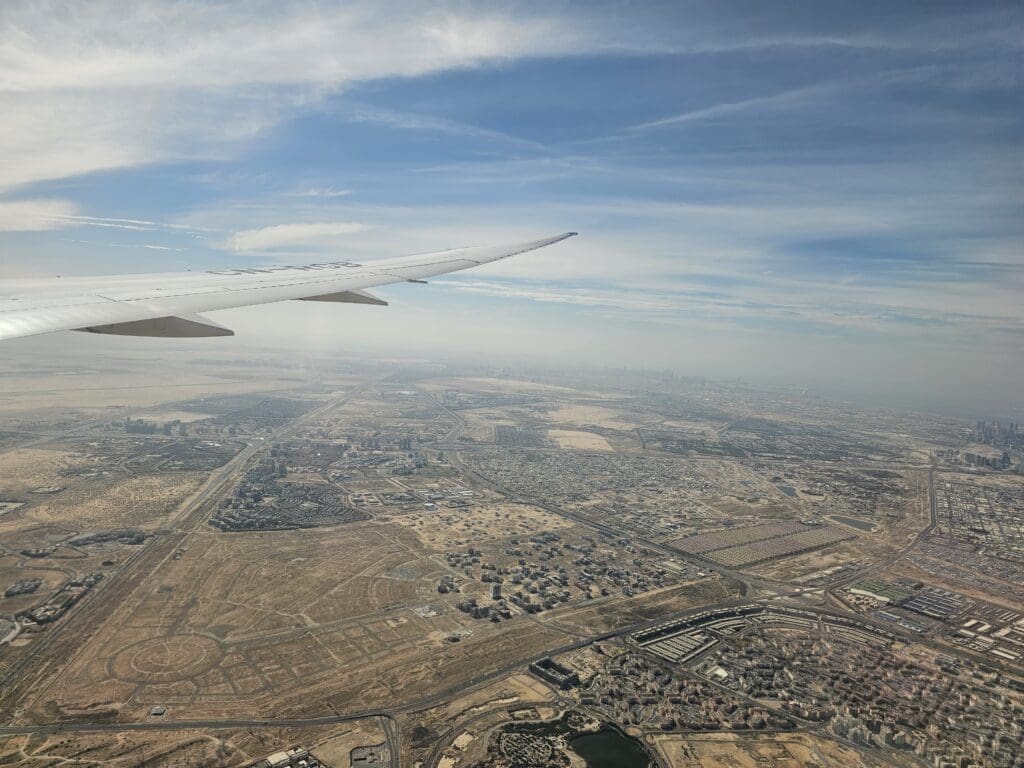
As we edged nearer to the Emirati coastline, more and more ships could be seen below waiting to enter Dubai and Sharjah’s multiple ports and we bumped around a little in what was the first slightly rough patch of the flight. Indicating that we were almost there, a mysterious yet unmarked island came into view which later research revealed to be home to a mansion-like building. Soon, the sprawl of tall buildings around Business Bay, the centrepiece of which is the tallest in the world, the Burj Khalifa, could be seen and we soon crossed the coastline. Sitting on the right-hand side, a good view of the areas that sit just to the south of Dubai Airport could be seen as we passed almost directly over this before heading out towards the desert.
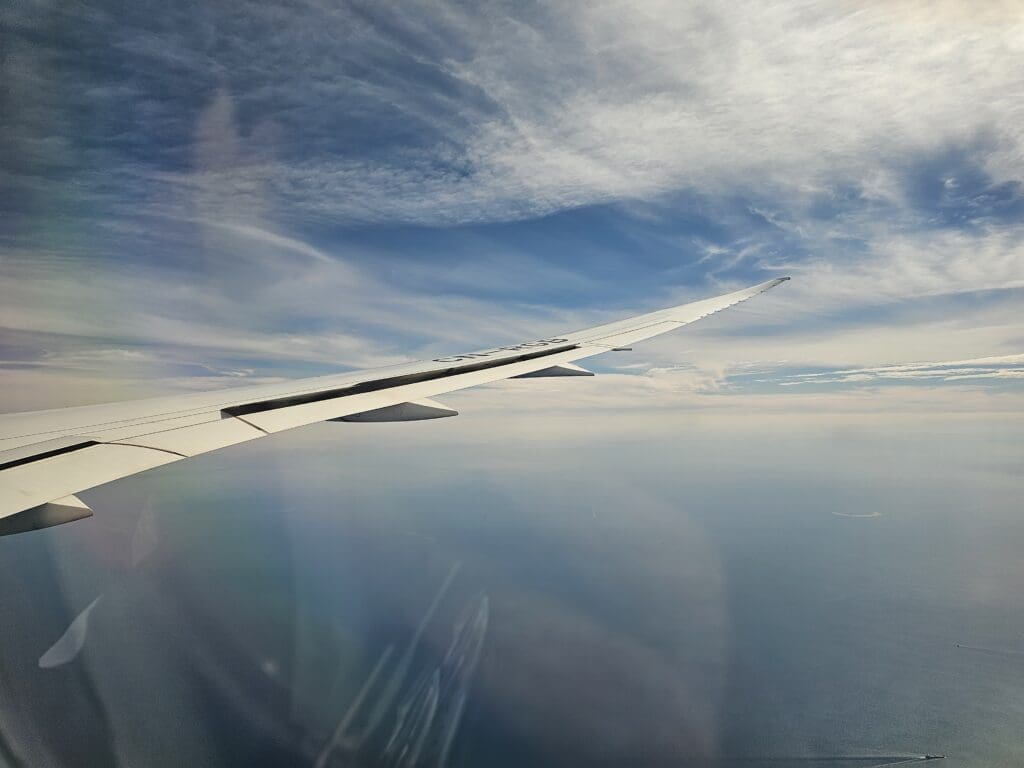
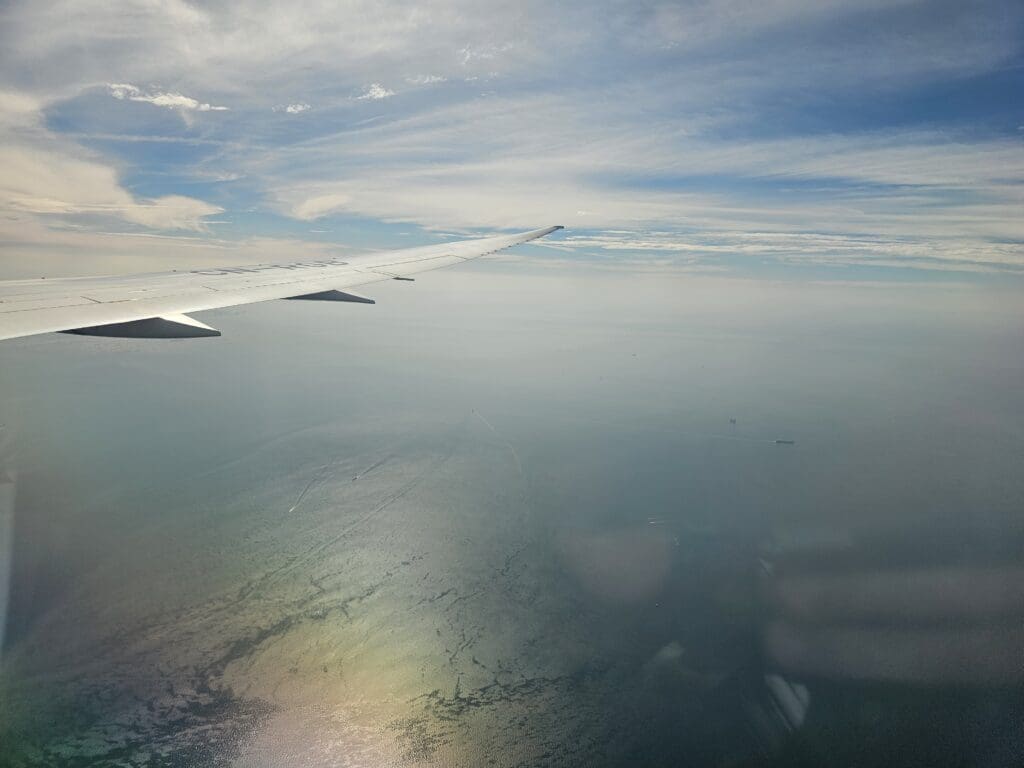
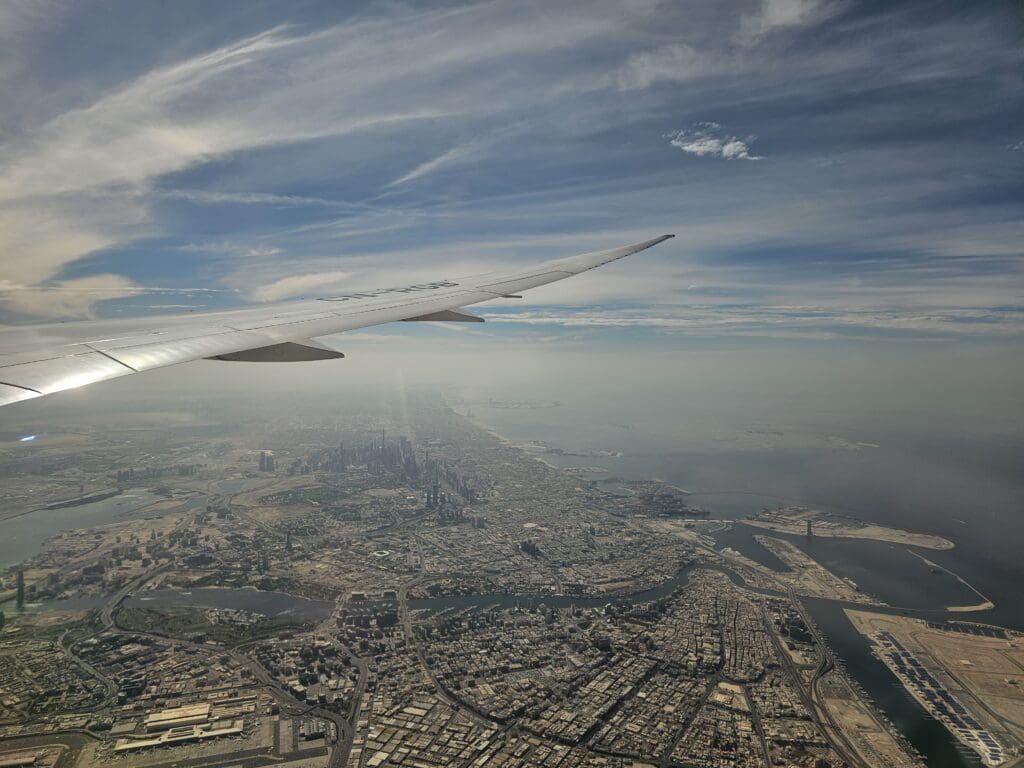
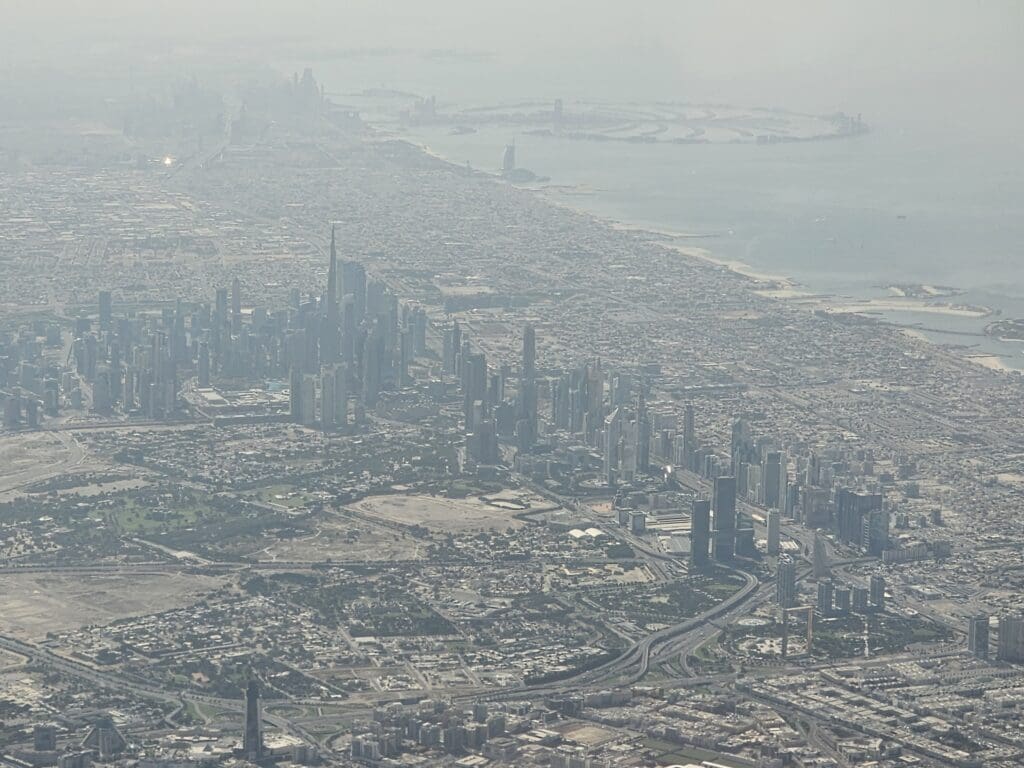
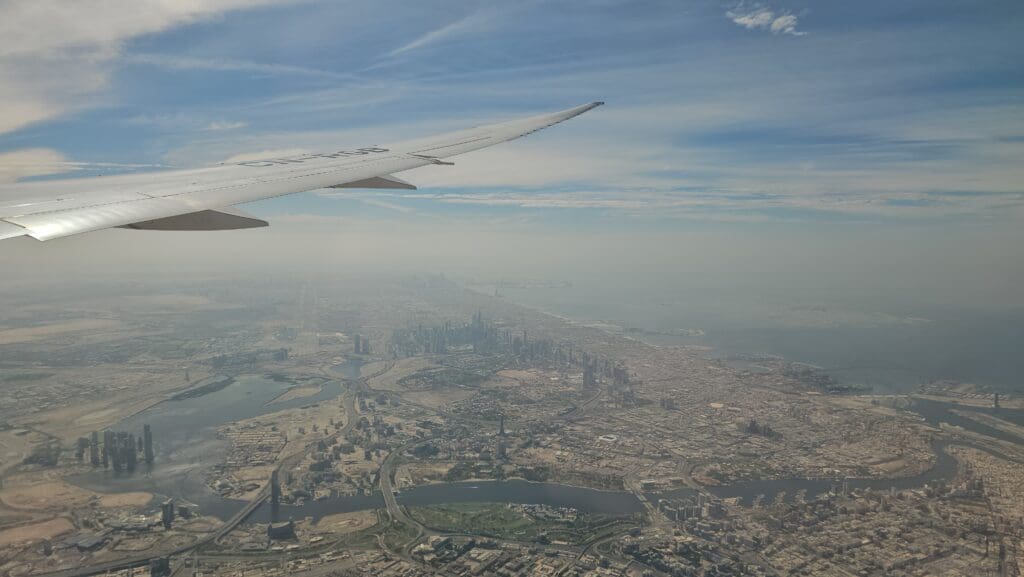
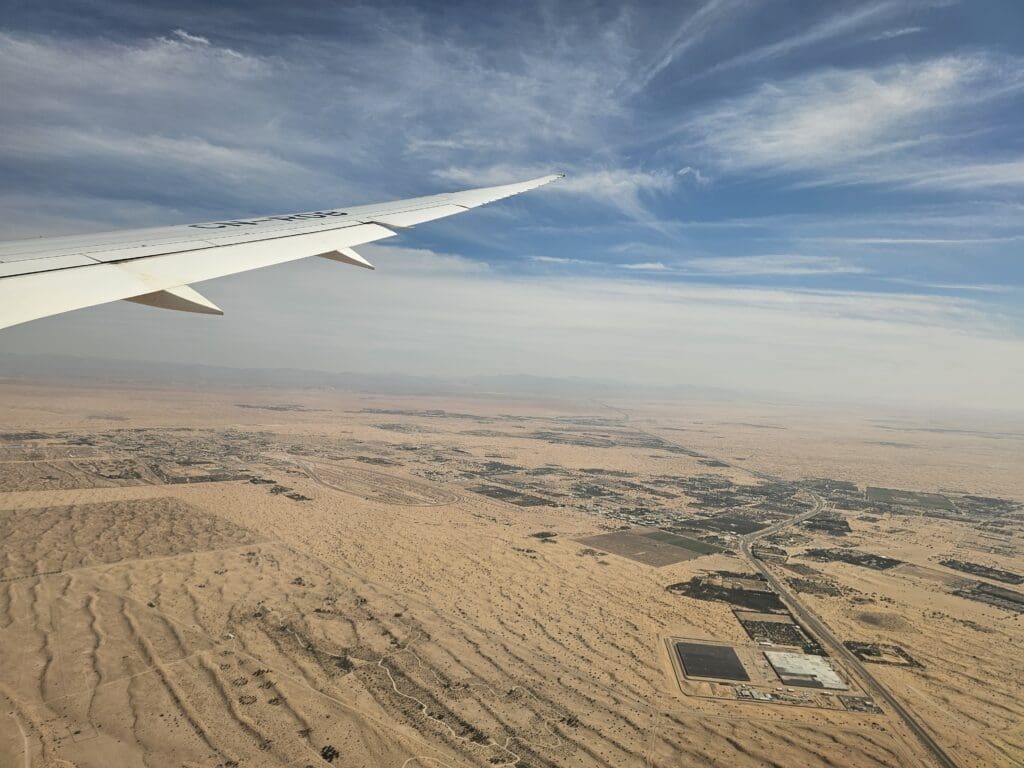
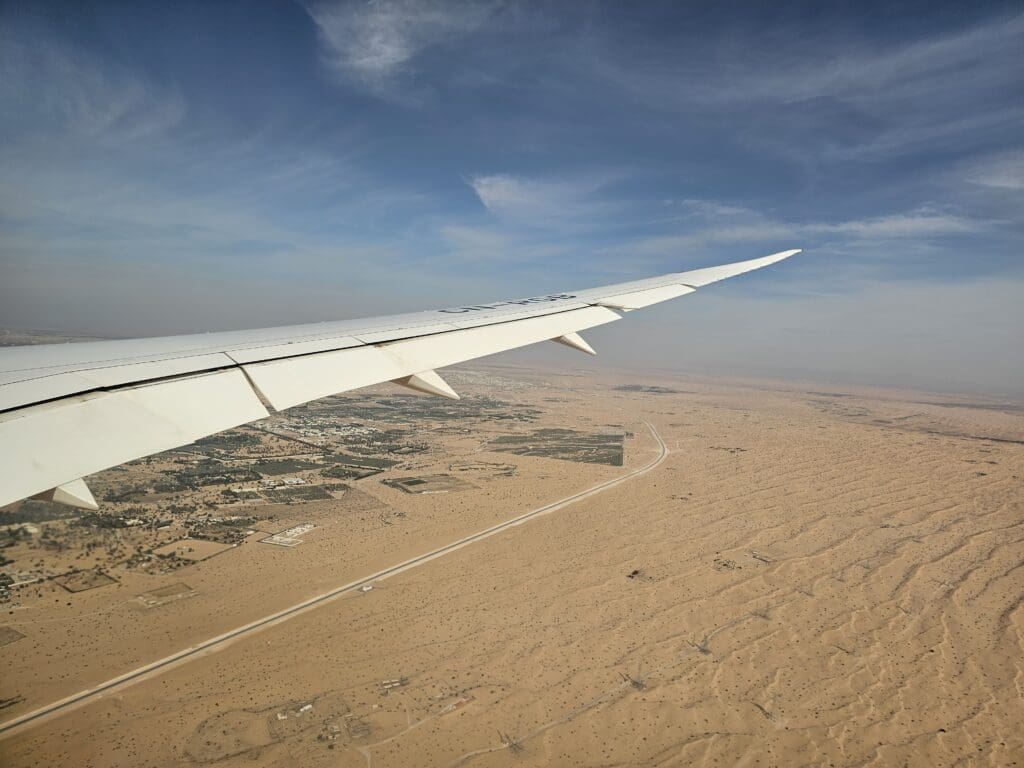
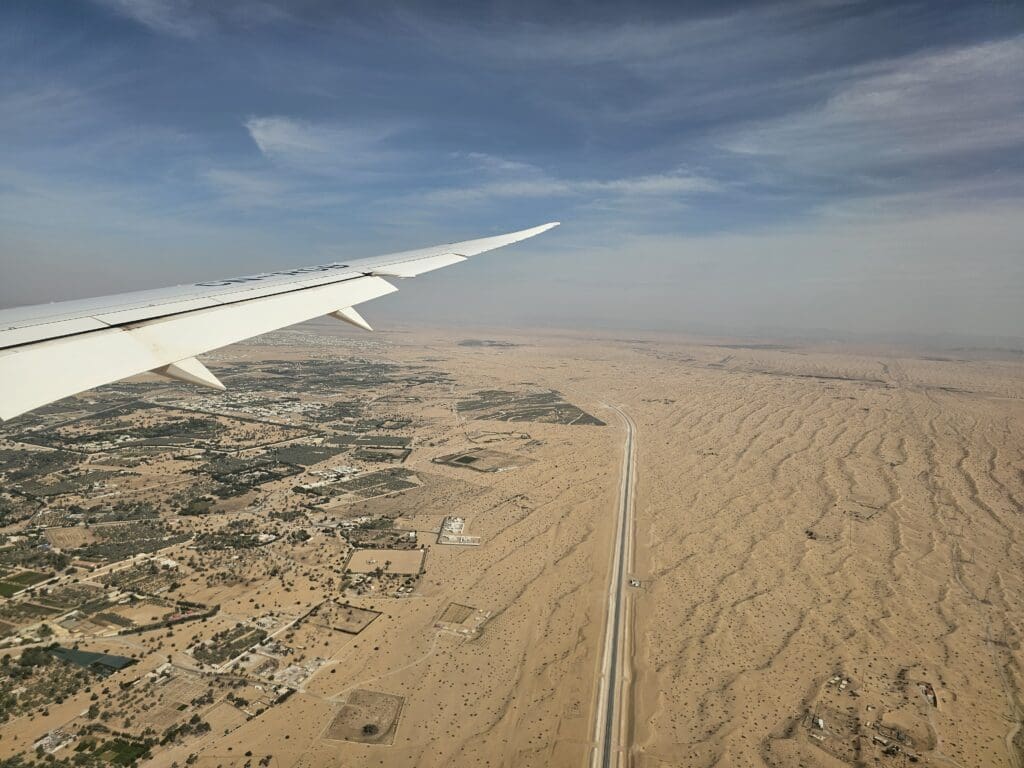
As we crossed over the airport, one of the pilots announced ‘cabin crew landing configuration’ and soon the flaps were partially extended as we looped back towards the airport. Below, the desert turned to the semi-rural landscape of Al Khawaneej and then to the urban sprawl of Mirdif as we neared the airport. Moments later, the aircraft crossed over the busy E311 motorway before flying past the perimeter fence and a cluster of Emirates giants before making a very firm return to earth on Runway 30, bringing an end to over seven hours in the air.
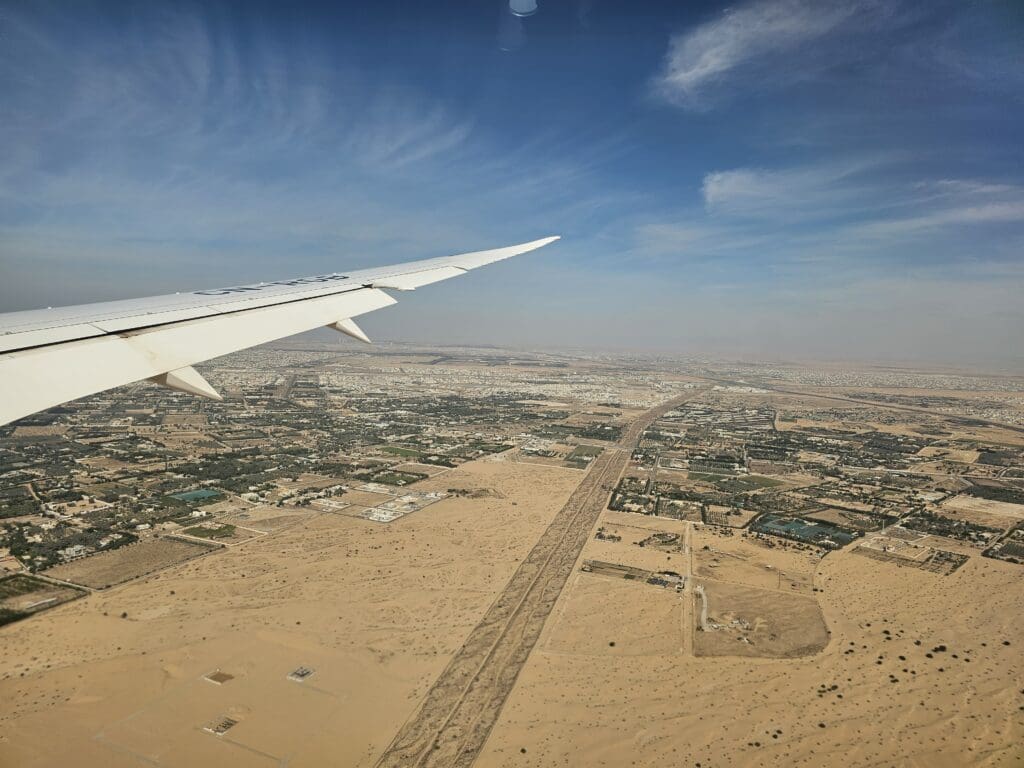
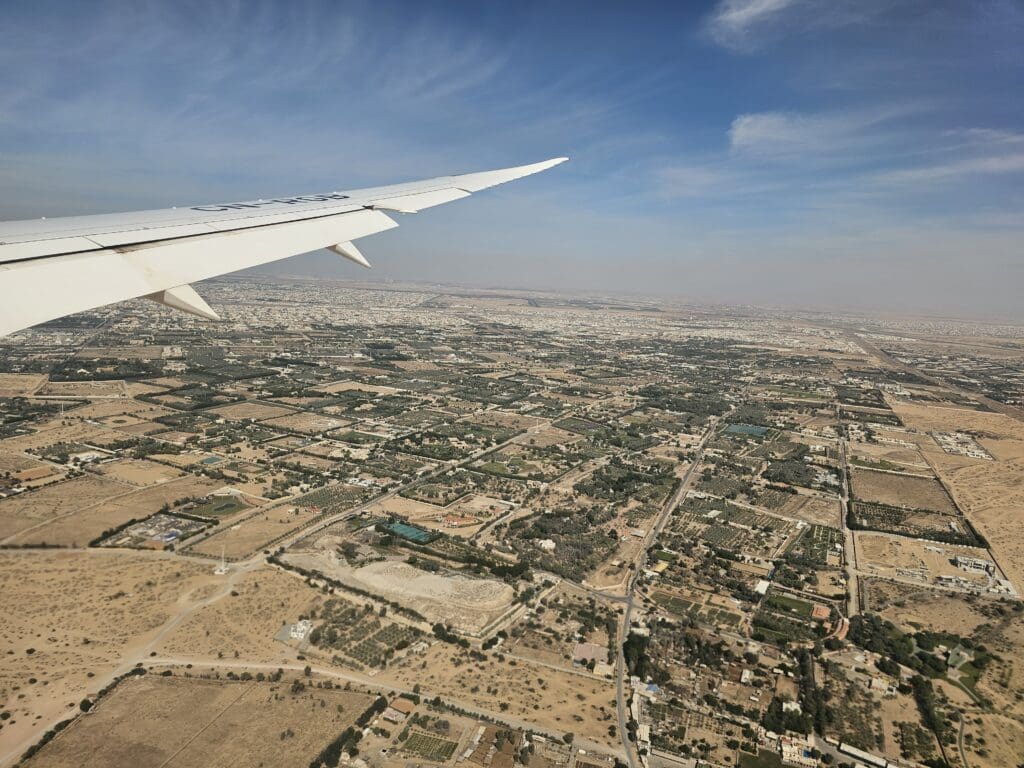
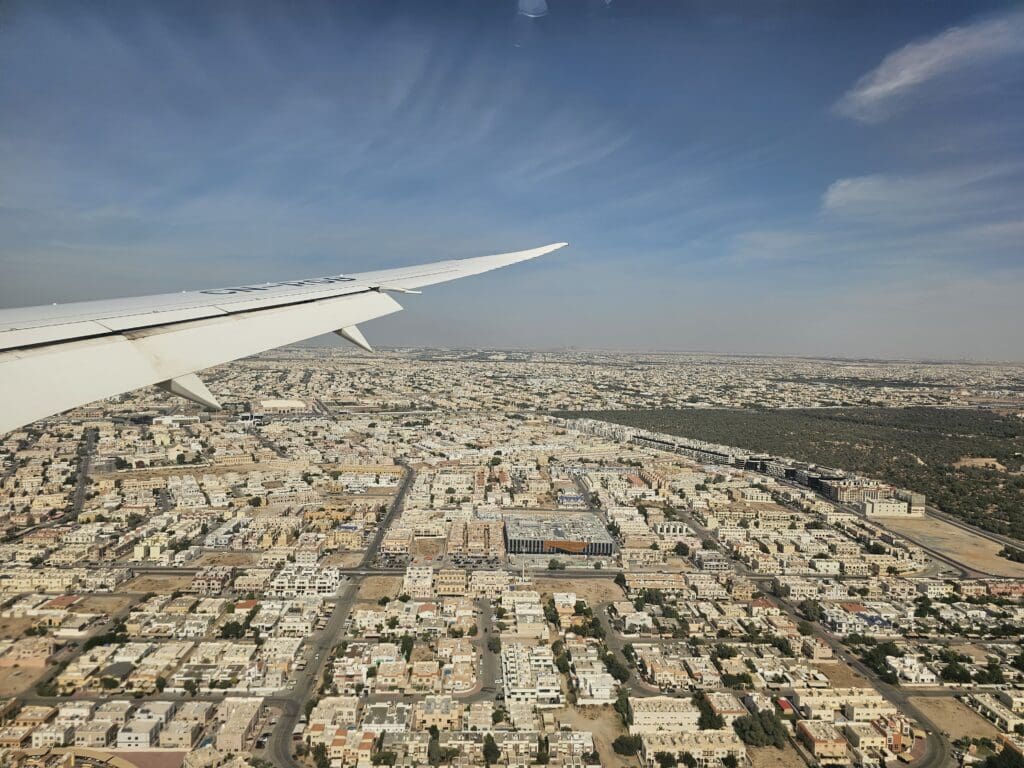
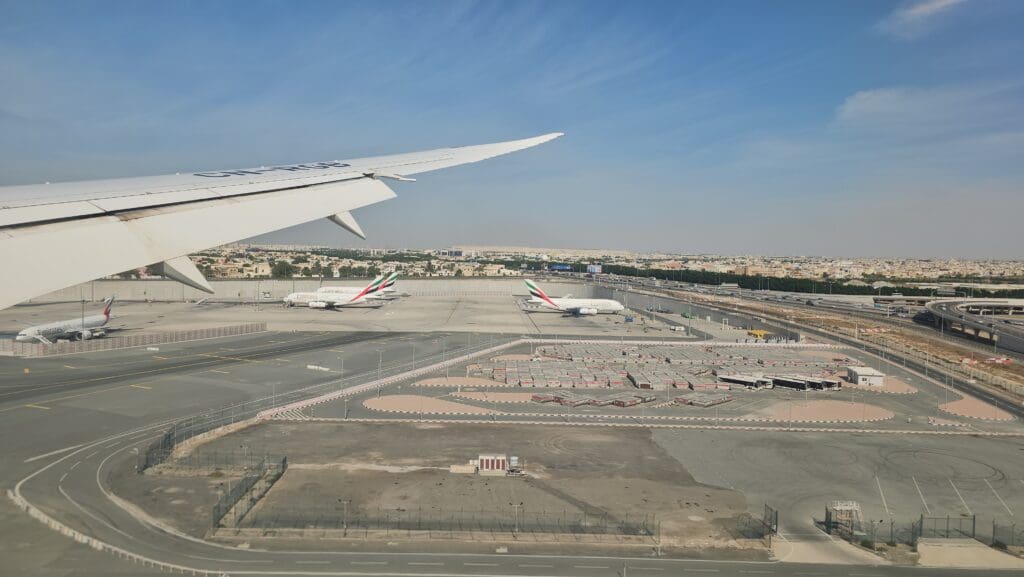
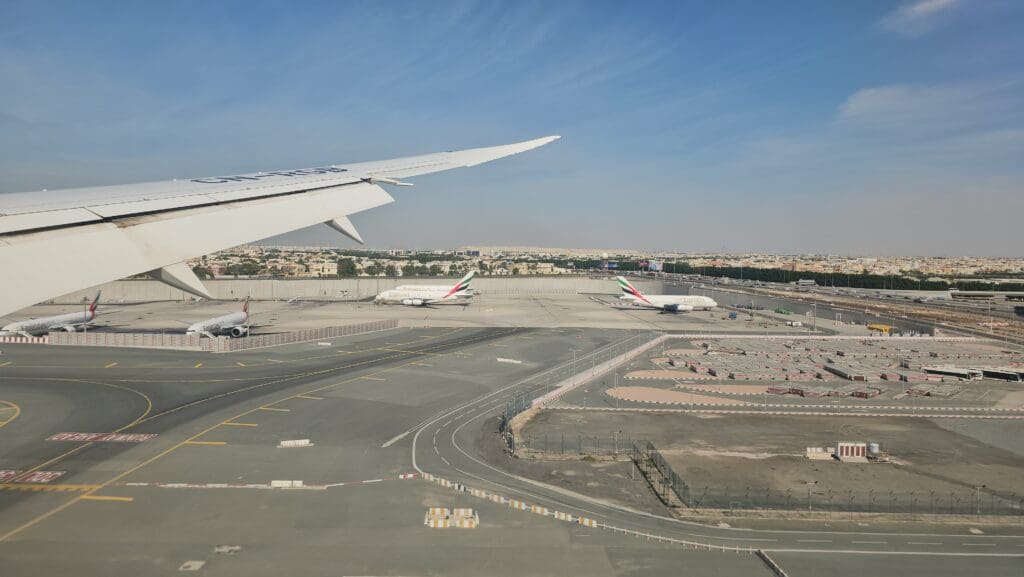
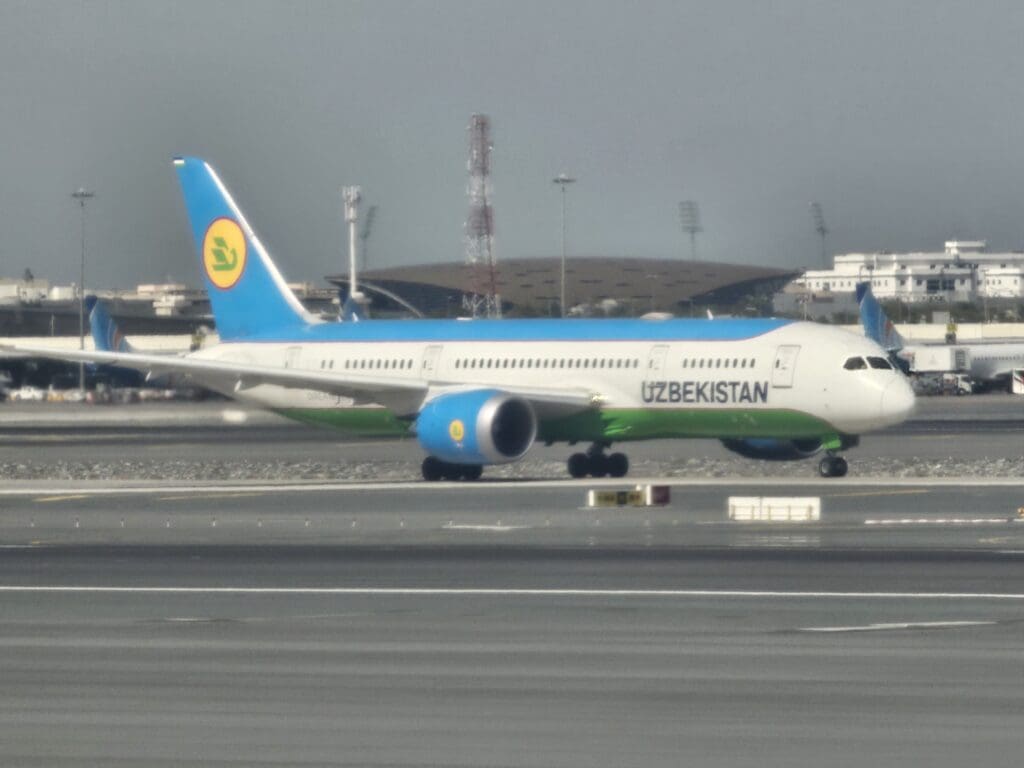
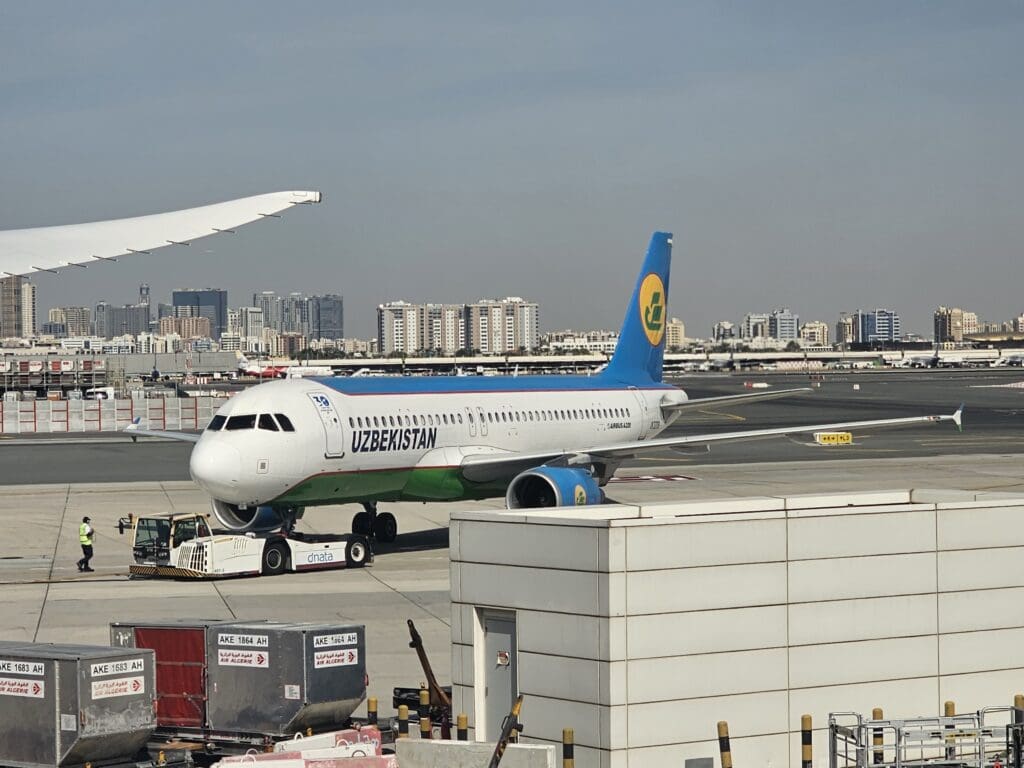
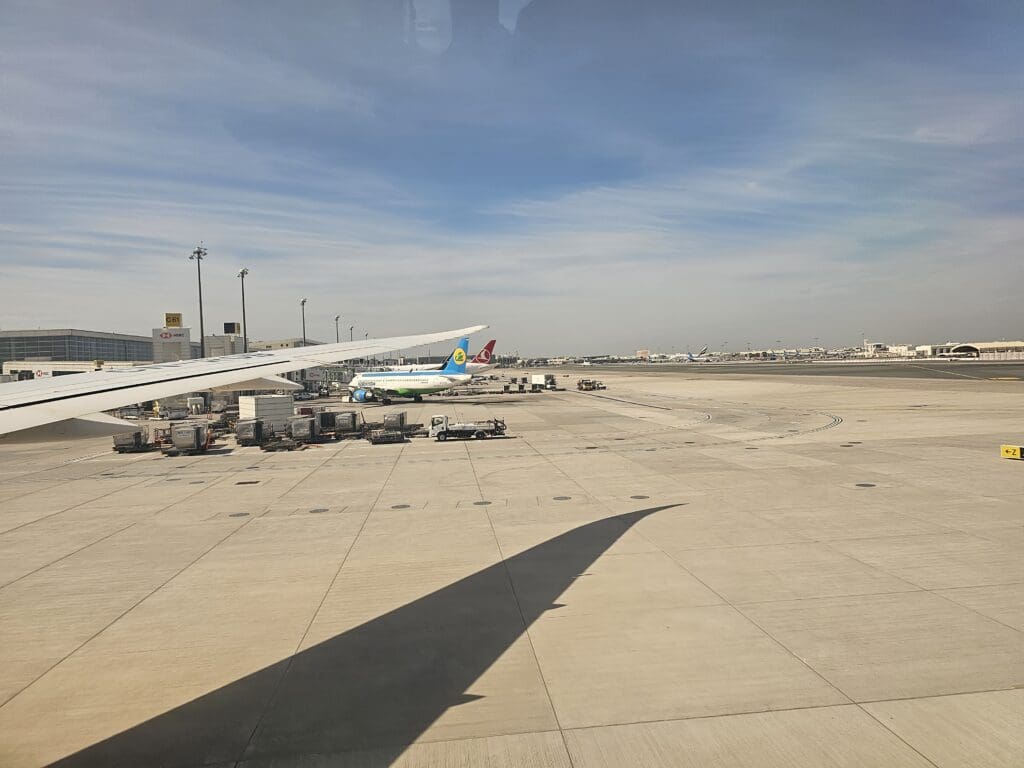
Once down, the aircraft did not seem to decelerate particularly quickly, which made sense given the location of Terminal 1 towards the end of the runway. As we vacated this, the Purser welcomed all to Dubai and thanked passengers for flying with Royal Air Maroc. As we trundled along the taxiway, a few passengers decided to stand up although were promptly advised to remain seated and around seven minutes after touching down the aircraft pulled into Stand C62 where it slotted in between an Azerbaijan Airlines Boeing 787-8 Dreamliner and an Uzbekistan Airways Airbus A320 bound for Baku and Fergana respectively.
Perhaps desperate to vacate the aircraft, once we came to a halt, most seemed to jump up and crowd the aisles and thankfully for them, it did not take too long for the queue in the aisle to budge. Eventually, I stood up, collected my backpack from the overhead locker and slowly trundled through the two Economy cabins before turning right and stepping onto the nicely air-conditioned jetbridge. With the flight scheduled to arrive in Dubai at 1340, making it out of the aircraft at 1333, I cannot really fault Royal Air Maroc for their punctuality. Once up in the terminal, it was a fair walk to the automated people mover station – with all gates in Terminal 1 located in a satellite terminal. Once there, I boarded a train just in time and was soon whisked to the immigration hall. There, immigration was a very quick experience that left me with no complaints and I was out of the airport no more than fifteen minutes after disembarking the aircraft.
Summary
Whilst I would not say Royal Air Maroc left me impressed, this second flight was better than the first. However, the cabin was in poor condition and seemed to be in dire need of a refresh. Meanwhile, the crew could hardly be described as being warm, welcoming or friendly. Despite this, I would say that the airline does have some potential. The catering and inflight entertainment system was acceptable, whilst the amenity kit was a surprising and welcome addition to the flight. Would I fly with Royal Air Maroc again? Admittedly, unless the price was right then probably not. Nevertheless, I was happy to have finally sampled Morocco’s national carrier.