My First Ever Flight with Cathay Pacific: Dubai to Hong Kong on an Airbus A350
Background
Operating around 180 aircraft from its base in Hong Kong, Cathay Pacific has long been one of Asia’s largest full-service carriers. Long renowned for its high levels of onboard service and serving a long list of destinations across the world, the airline is definitely one of the most famous in the world. In November 2023, needing to travel between Dubai and Jakarta, I finally had the opportunity to sample the delights of Cathay Pacific when the airline proved to be the joint cheapest option on this route along with China Southern Airlines via Guangzhou. Considering all my previous experiences with China Southern Airlines which ranged from mediocre to downright awful, my choice to fly with Cathay Pacific was a no-brainer.
About Cathay Pacific
Cathay Pacific was conceived by a group of entrepreneurial pilots in the wake of the Second World War. Initially operating from Shanghai, a range of issues resulted in the company shifting its operations to Hong Kong – retrospectively, this proved to be a sensible choice given the likely insurmountable hurdles to operations following the establishment of the People’s Republic of China in 1949. In September 1946, Cathay Pacific flew its maiden services from Hong Kong’s famous Kai Tak, and its initial route network encompassed Bangkok, Manila, Saigon, Singapore and Sydney. A short time later, in 1948, Australian National Airways and the Swire Group took shares in Cathay Pacific. Today, the latter remains Cathay Pacific’s largest shareholder.
Following local government policy, routes were divided between Cathay Pacific and its local competitor, Hong Kong Airways, along geographical lines. As a result, Cathay Pacific’s operations were primarily focused on Southeast Asia and Australia, whilst Hong Kong Airways served Northeast Asia with flights to the Chinese mainland, Japan and Korea. However, external events such as the Chinese Civil War and the Korean War and subsequent low traffic left Hong Kong Airways at a disadvantage, whilst Cathay Pacific enjoyed relative levels of success. This would eventually lead to Cathay Pacific’s acquisition of Hong Kong Airways in 1959, and the airline enjoyed a monopoly within Hong Kong that would last until the establishment of Dragonair in 1985.
In the 1960s, Cathay Pacific expanded its range of destinations and soon became an important carrier within the region. However, it wasn’t until the delivery of Boeing 707s, Boeing 747s and Douglas DC-10s in the 1970s that Cathay Pacific came to have a global presence. During both the seventies and eighties, Cathay Pacific was able to solidify its reputation for high levels of service and ran several successful advertising campaigns across the world. Indeed, for a time, the carrier was generally considered to be one of the best in Asia, if not the world. In 1985, Cathay Pacific came to share Hong Kong’s airline industry with start-up company Dragonair. However, the Hong Kong Government’s policy then enabling only one local airline to fly one route meant that the two were not direct competitors. Failing to win any routes from Cathay Pacific, Dragonair instead focused on the then less profitable routes to mainland China and later other regional cities throughout Asia. In 1990, Cathay Pacific would come to take a majority stake in Dragonair, with the carrier eventually absorbing this into their brand in 2020.
Following Britain’s handover of Hong Kong, Cathay Pacific continued to grow and maintained both a strong presence and reputation across the world. However, in the new millennium, the carrier faced increasing challenges. For example, the deregulation of the industry in 200 and the creation of several new local airlines such as HK Express, Hong Kong Airlines and Oasis Hong Kong Airlines meant that Cathay Pacific faced new and generally cheaper competition. The airline was also challenged by the increasing number of foreign carriers serving Hong Kong, including newly established low-cost carriers from overseas. Nevertheless, Cathay Pacific continued to maintain their fantastic reputation amongst the flying public.
Unfortunately, in more recent years, Cathay Pacific has faced some turbulence. In 2018, the airline’s reputation was tarnished by a major data breach. Meanwhile, within Hong Kong, the carrier faced criticism for dismissing staff members who partook in pro-democracy protests in 2019 and 2020. Meanwhile, Hong Kong’s tough multi-year Covid restrictions, as well as those of many Asian states, saw a near-total drop in passenger demand. Whilst operations have largely returned to normal, many recent reviews claim that the airline’s service stands below that delivered before the pandemic and that its highly regarded reputation is no longer justified. Of course, there was only one way to find out and judge for myself!
Booking
Whilst booking directly with Cathay Pacific would attract a £10 premium, I decided to do so given the potential complications of booking via a third party. Booking via the airline’s app, I opened this up and undertook a quick search for flights between Dubai and Jakarta. Upon doing so, I was presented with a surprising total of a whopping forty options! Priced in Dirhams, these ranged from 1,130 AED (around £250), right up to 18,280 AED (around £4,090). Travelling on a budget, I went for the cheapest option, which would involve departing Dubai on Cathay Pacific’s daily Airbus A350-900 service to Hong Kong, where I would arrive at 1045 the next morning. After a little over five hours on the ground, I would continue to Jakarta on an Airbus A330 and arrive there at 1945.
After selecting this itinerary, I was presented with three fare options: Light, Essential and Flex, with these costing between 1,130 AED and 2,040 AED. It is worth noting that even the cheapest fare included 23kg of hold luggage, although it was differentiated from the more expensive options by the cost of seat selection, change and cancellation fees. With no reason not to, I went for the cheapest fare before going ahead and entering my details before making a quick and painless payment, leaving me with no complaints about the booking process.
Check-in
One benefit of being a member of Cathay Pacific’s frequent flyer program, simply named Cathay, is that you can check in online up to 48 hours before departure. However, with British Airways’ Executive Club being my OneWorld frequent flyer program of choice, I opted against signing up for Cathay and instead was only able to check in up to 24 hours before departure. Once this window arrived, I opened Cathay Pacific’s app and commenced proceedings. As I did so, I was delighted to see that despite travelling on the cheapest ticket, I was able to select any vacant ‘regular’ seat in the cabin, and I opted for aisle Seat 73C located towards the rear of the cabin. Unfortunately, I was unable to select a seat for the second flight down to Jakarta and was advised to do this at the airport. After entering my passport details, presumably, as I had a one-way ticket, I was asked to complete check-in at the airport. Whilst a slight inconvenience, as I would not be in a particular rush that evening, this was not a major problem. I should also mention that the day before departure, passengers can download thousands of magazines and newspapers from across the world via the PressReader app.
The Journey
Dubai International Airport is the busiest airport in the United Arab Emirates and one of the busiest in the world. Thus, unsurprisingly, the airport covers a massive area of over 7,200 acres and is spread across three different passenger terminals. Terminal 1 hosts the majority of overseas carriers, whilst Terminal 2 is home to local low-cost giant FlyDubai and also sees flights by several smaller overseas carriers, and Terminal 3 is the suitably giant hub for hometown airline Emirates. Those looking to travel to Terminals 1 and 3 can easily do so by public transport, with both enjoying a dedicated station on the Dubai Metro’s Red Line. With a metro ticket to the airport costing up to 8.5 Dirhams (around £1.91) depending on where you start your journey, this is the most cost-effective means of travelling to and from the airport (unless you fancy navigating Dubai’s complicated bus network).
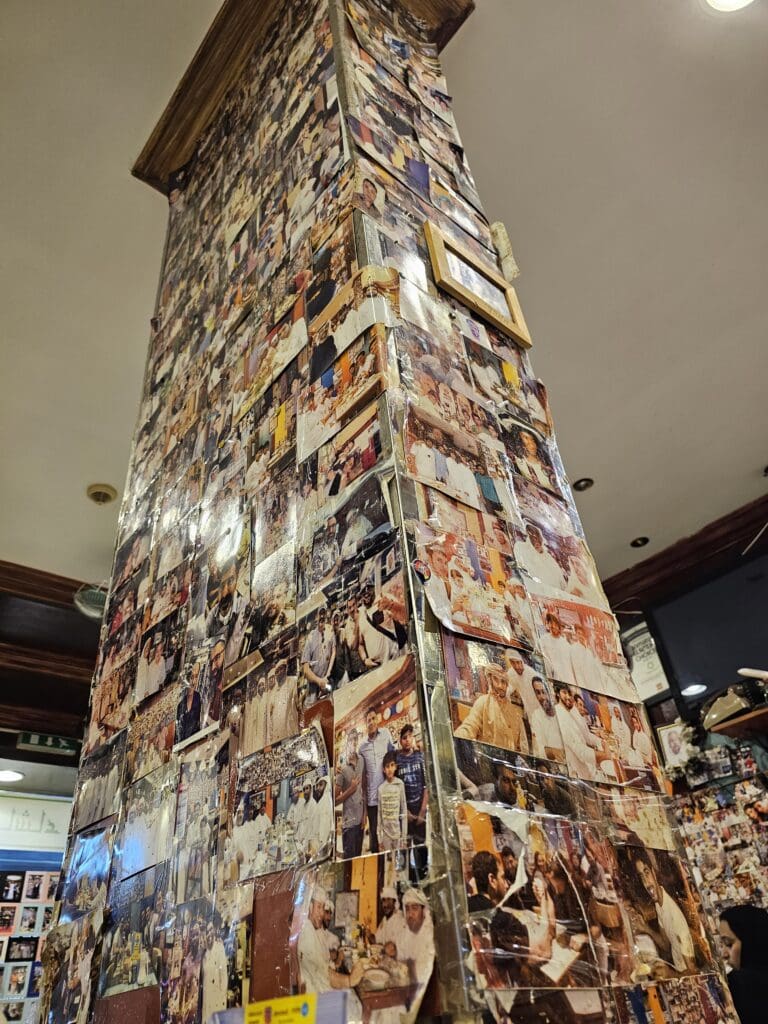
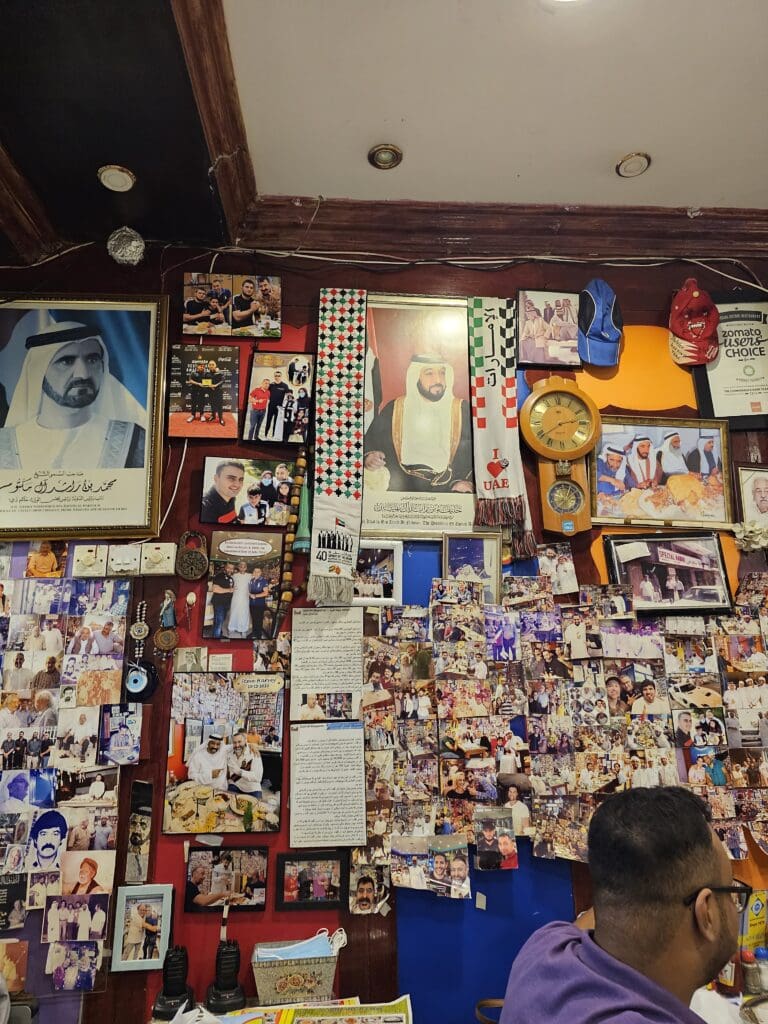
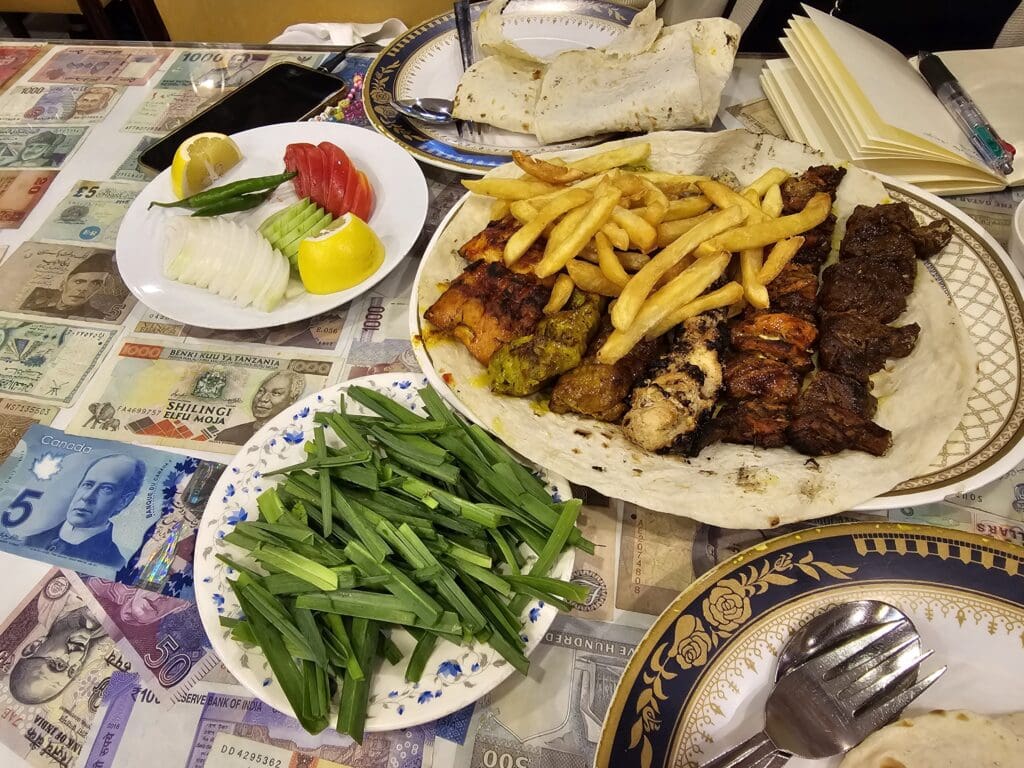
Following a two-day stay in Dubai, the time came for me to continue eastwards and commence my trek to Jakarta. However, before doing so, I fuelled up and had a hearty evening meal at the famous yet rather unassuming Al Ustad Special Kebab restaurant in the neighbourhood of Bur Dubai. From there, getting to the airport would be neither long nor arduous. Starting at Sharaf DG station, I tapped my Nol card on the automated barriers before heading into the subterranean world and boarding a modern Green Line train for the one-stop eastward journey to Burjuman. There, I had a quick and easy transfer and soon found myself on a Red Line train on its mammoth 67-kilometre journey from Expo 2020 in the south to Centrepoint in the north. Travelling during the evening rush, unsurprisingly, the train was rather busy upon boarding, although with most disembarking in Al Rigga and Deira, I was soon able to take a seat. No more than twenty minutes after commencing my journey, the train came to a halt at Terminal 1 where I disembarked along with a small number of passengers, mostly airport staff.
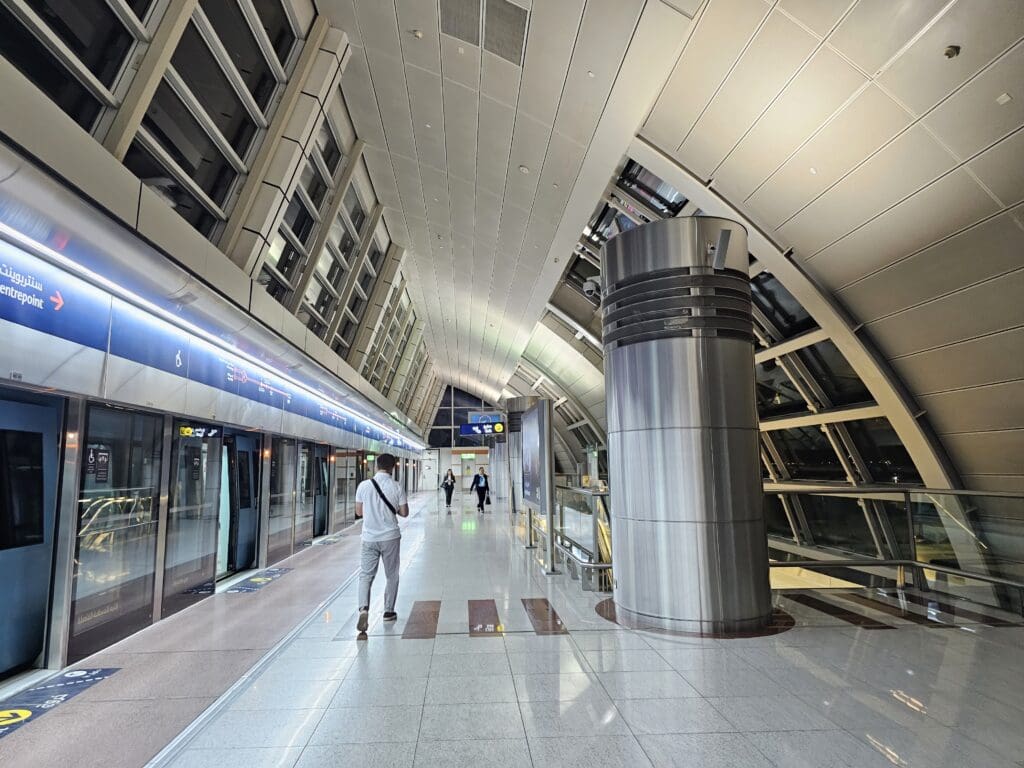
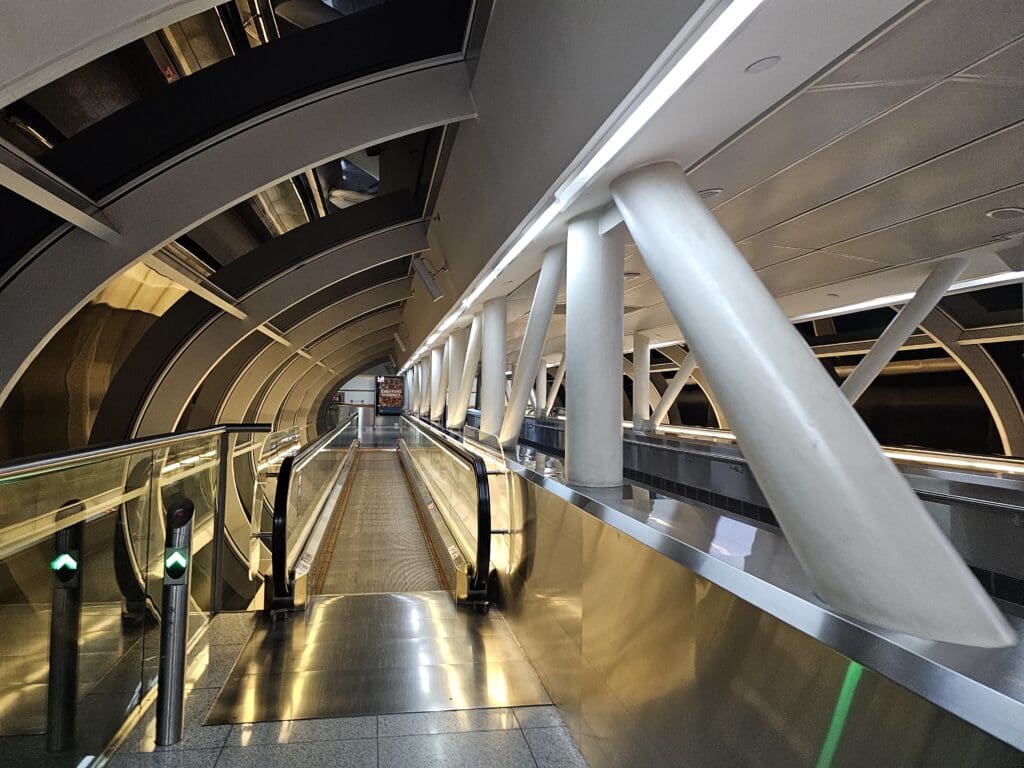
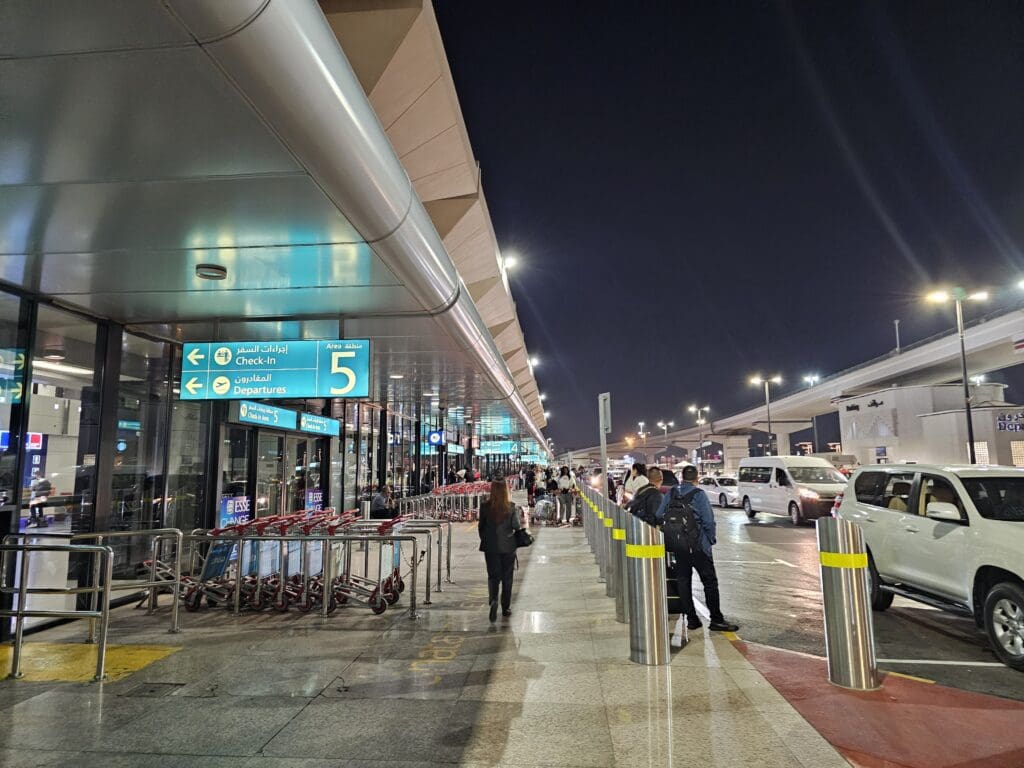
As far as airport stations go, the metro station serving Terminal 1 is one of the more convenient that I have passed through and sits just outside of the main terminal building. Thus, no buses, people movers or seemingly endless mazes of walkways are required to get from the station to the terminal building. Once safely off the train, I made my way to the ground floor level of the terminal and tapped out before walking along the short passageway that connects the station to Terminal 1’s check-in hall. Having never witnessed a quiet moment at Terminal 1, I was not particularly surprised to see that the terminal was rather busy. At that time, many passengers could be seen sitting around waiting for check-in for their flights to open, whilst others could be seen pushing luggage trolleys with mountains of baggage piled precariously high. Whilst Dubai may be known for its glitz and glamour, this isn’t reflected in the landside portion of Terminal 1, which is neither overly modern nor stylish. However importantly, that evening I found this to be clean, bright and functional, and complete with an army of Dubai Airport staff on hand ready and raring to help passengers.
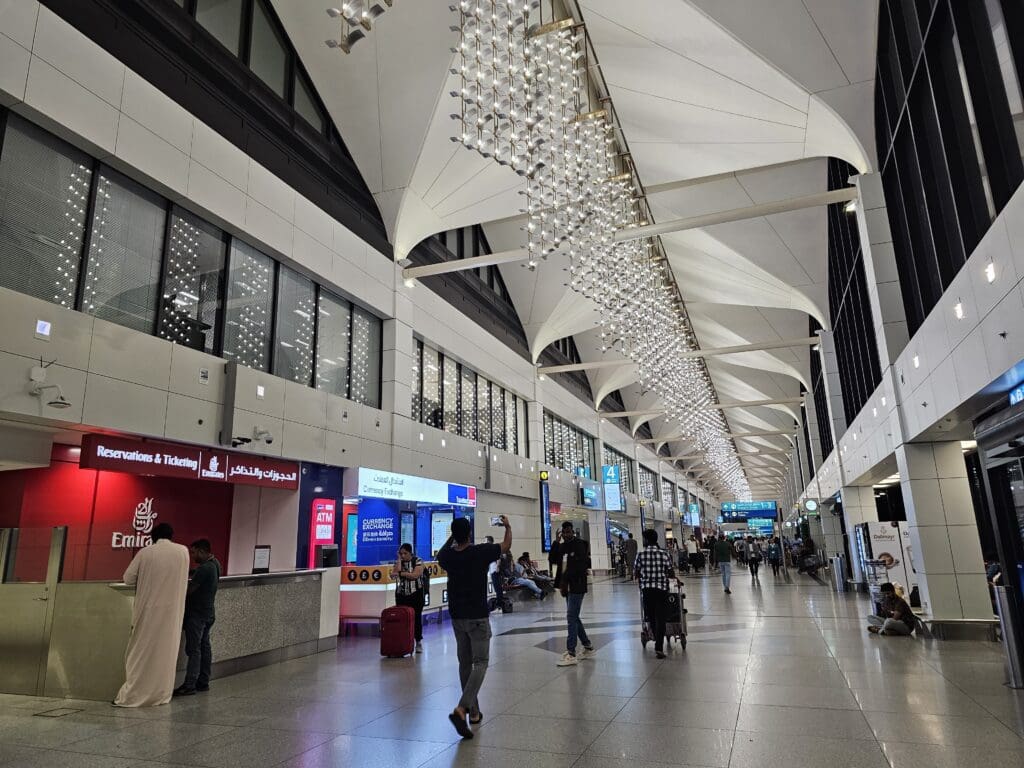
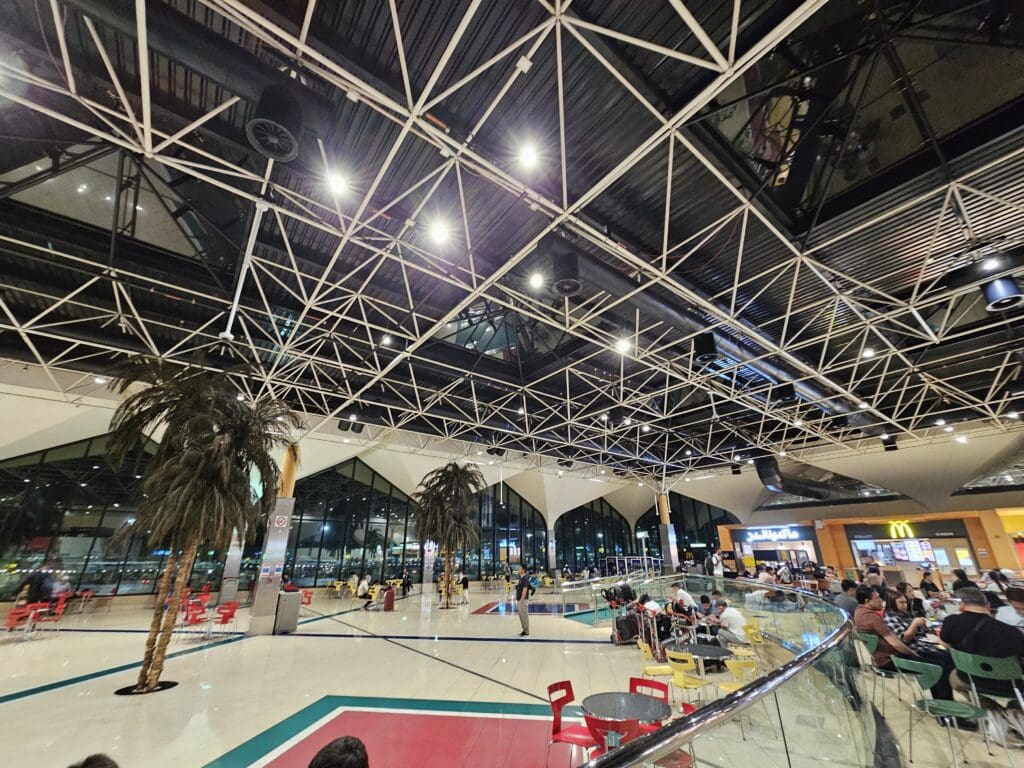
In terms of its layout, all of the terminal’s check-in desks can be found on the ground floor of the terminal building and are spread out across six different zones. Meanwhile, a selection of cafés and shops are dotted throughout for those with time on their hands before checking in and heading through security. Sitting above the terminal’s check-in hall and slightly hidden away is a small food court, which is complete with several large fake palm trees and a cluster of eateries, including Baskin Robbins and McDonald’s. Notably for aviation enthusiasts, this is the only place in the landside portion of the terminal that offers views of the action outside. However, it is worth noting that aviation photography is not always accepted or understood in the United Arab Emirates and I would not recommend getting your DSLR out to snap photographs of the aircraft outside.
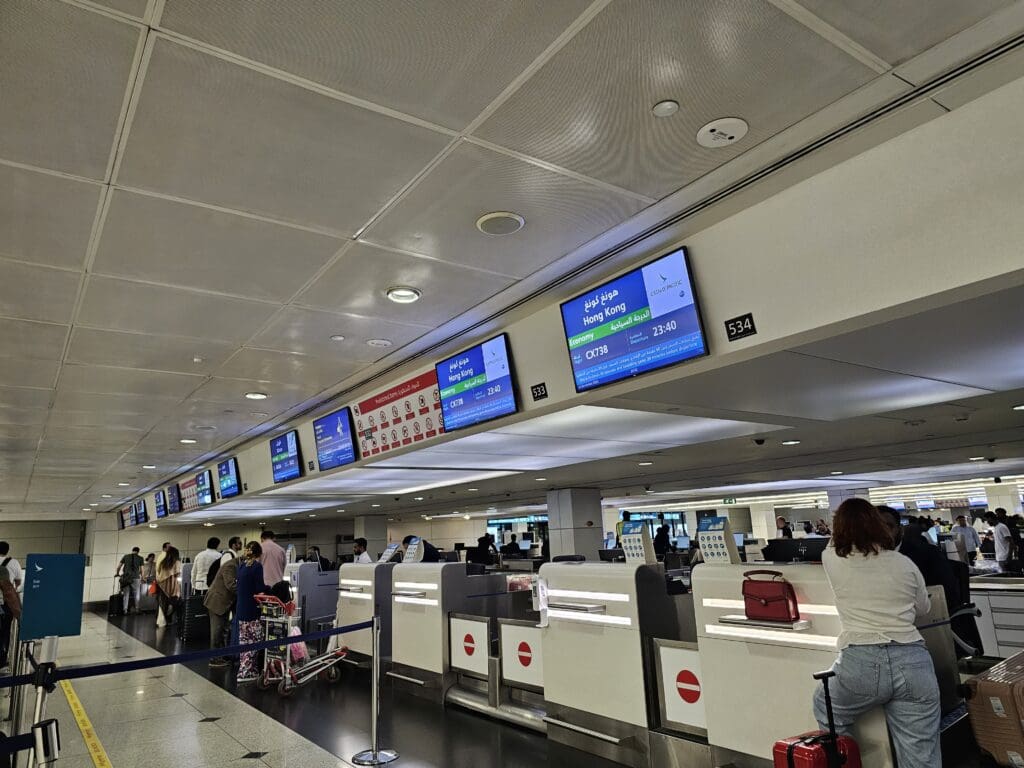
Following a quick wander around the terminal, I checked the departure boards and discovered that check-in for Cathay Pacific’s nightly service to Hong Kong would take place in Zone 5. Upon arriving there, I soon spotted five well-branded Cathay Pacific desks sandwiched in between those assigned to Mahan Air and Oman Air. As I neared the entrance to Cathay Pacific’s check-in area, I was welcomed in a very polite and friendly manner by one of three Cathay Pacific agents who appeared to be tasked with welcoming passengers and guiding them to the correct desk, whilst Dnata agents staffed the check-in counters. After confirming that I was heading off to Hong Kong and that I would be travelling in Economy, I was pointed towards a queueless desk where I handed over my passport to a very friendly Dnata agent. Once they had checked my proof of onward travel from Indonesia, I requested a window seat for the second flight to Jakarta and was advised that I had lucked out and received the window seat in the very first row of Economy! Continuing with the positives, I was also informed that I could expect a quiet ride to Hong Kong as the flight would be far from full. A few moments later my first boarding pass was printed off and handed to me, with the agent informing me that boarding would take place through Gate D13, commencing at 2300 and the gate closing at 2315. After this, my second boarding pass for the flight from Hong Kong to Jakarta was placed into a fancy paper wallet and handed over before I was wished a nice flight and pointed in the direction of security.
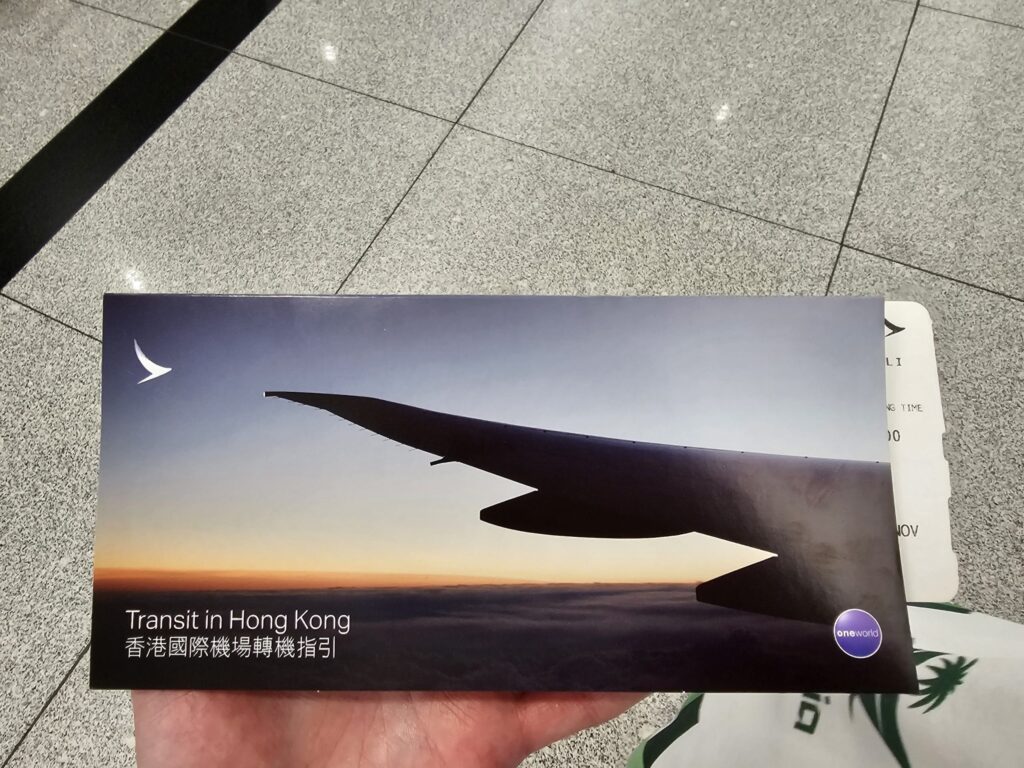
With no reason to remain in the landside portion of the terminal, once I had my boarding pass in hand, I made the short walk over to the entrance of the immigration hall. Since my last departure from Terminal 1 in 2021, I was delighted to see Smart Gates had been installed and could be used by a fair number of nationalities, including those who are not residing in the United Arab Emirates. Once my boarding pass had been scanned, I joined the queue for the automated gates, and after around eight minutes of shuffling forwards, I placed my passport on the scanner before my photo was taken and my identity verified. Within no more than thirty seconds, the gates swung open and allowed me to continue onwards. From there, the next stop was security. Whilst only half the checkpoints appeared to be open, security queues were minimal and with an army of staff on hand to process passengers, this was a relatively painless process. Assisted by the fact that neither electronics nor liquids needed to be removed from bags before these were sent through the scanner, I managed to make it through in no more than a couple of minutes.
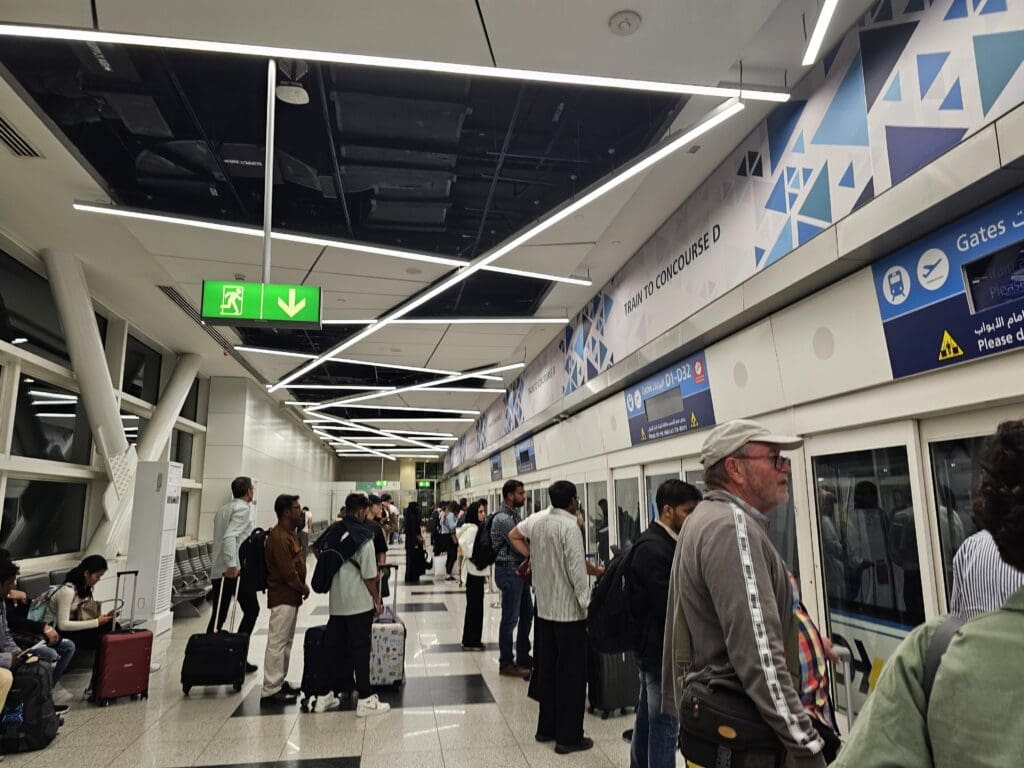
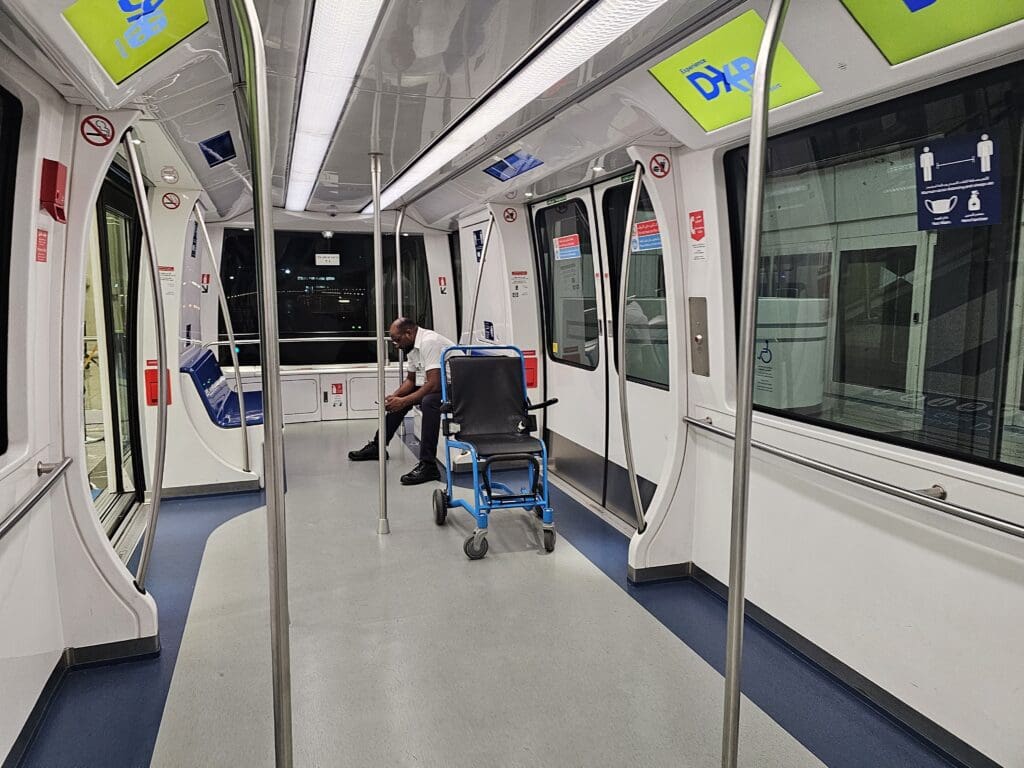
All in all, my journey from the check-in hall to the airside area left me with nothing to complain about, with this taking around 10 minutes. However, once through security, I still had some way to go before arriving at the gates themselves. All flights at Terminal 1 depart and arrive from Concourse D, which is a 32-gate satellite terminal that can only be reached by catching a driverless people mover. After passing through security, I made my way up the escalators and waited for the next train to arrive. This did not take too long and I soon boarded the modern and clean Bombardier people mover before being whisked over to the apron, with this journey taking around a minute and a half.
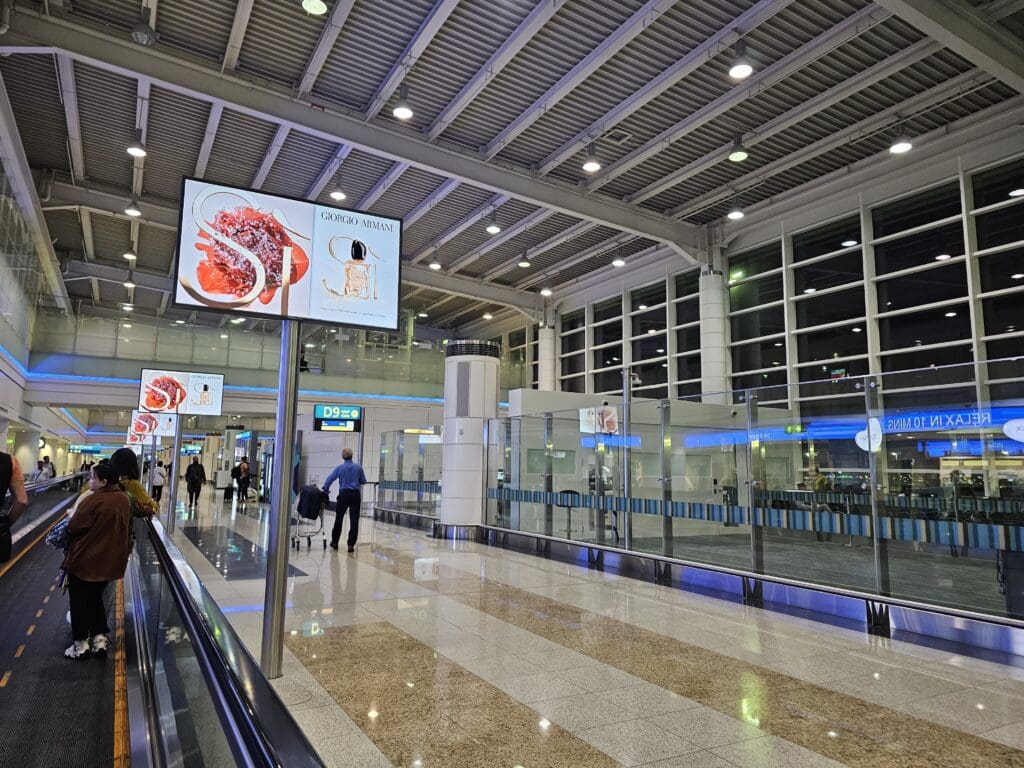
After disembarking the train, I headed down the escalators and found myself walking through the terminal’s gigantic duty-free store before arriving at the terminal’s main waiting area. This features plenty of shops and restaurants, although those looking for a bargain will likely be disappointed with all items coming with the usual inflated airport price tags. Plenty of souvenir shops are on offer for those looking for some last-minute mementoes of their trips to Dubai, with these selling all manner of souvenirs from chocolate-coated dates to traditional abayas. Meanwhile, this part of the terminal is much more modern and well-polished compared to the landside area, with an omnipresent army of cleaners working hard to keep this in tip-top condition despite the non-stop flood of passengers passing through.
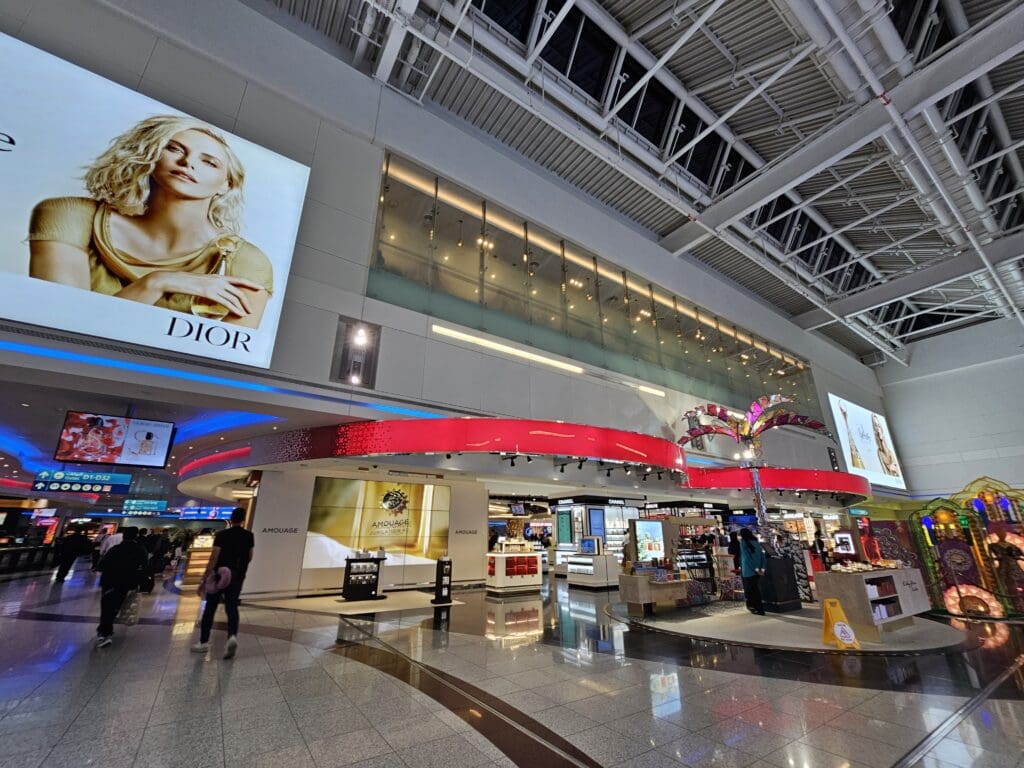
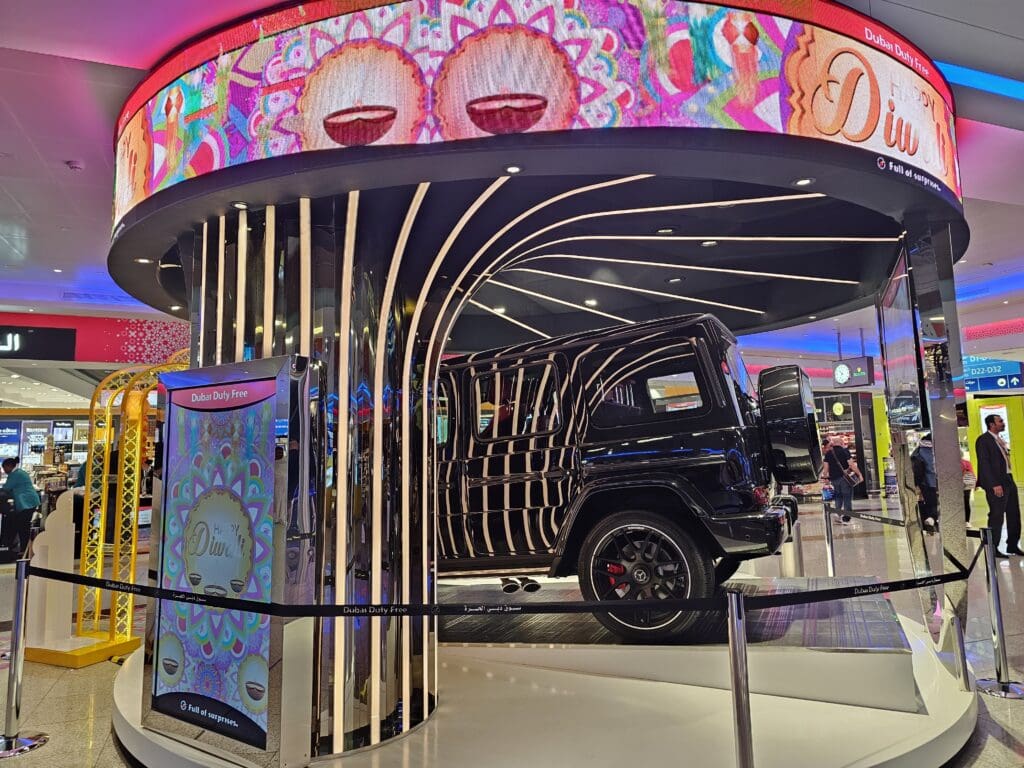
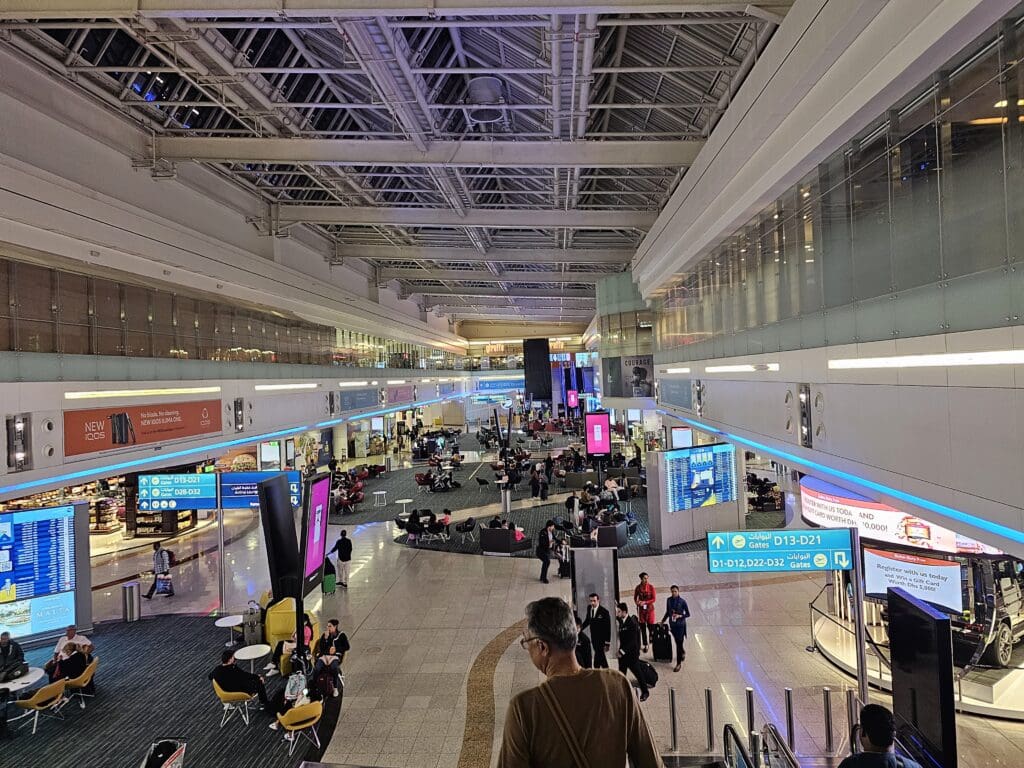
As one would expect from a major international airport, fast complimentary wifi is provided throughout the terminal and seemed to work well for the duration of my stay. Meanwhile, whilst not always the case, I was pleased to see that plenty of charging points could be found throughout the terminal. For those more interested in the happenings outside, large windows offered good views out onto many of the terminal’s stands as well as of the endless stream of aircraft arriving from all corners of the globe. After walking around, I plonked myself down and watched as tens of aircraft came in to land.
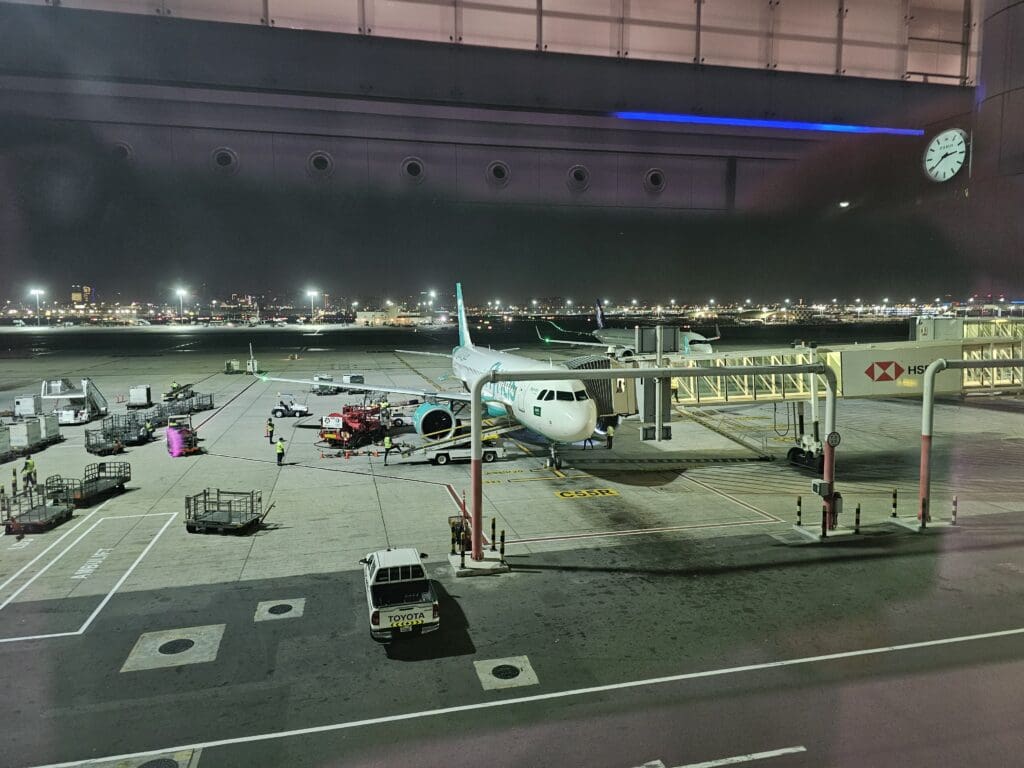
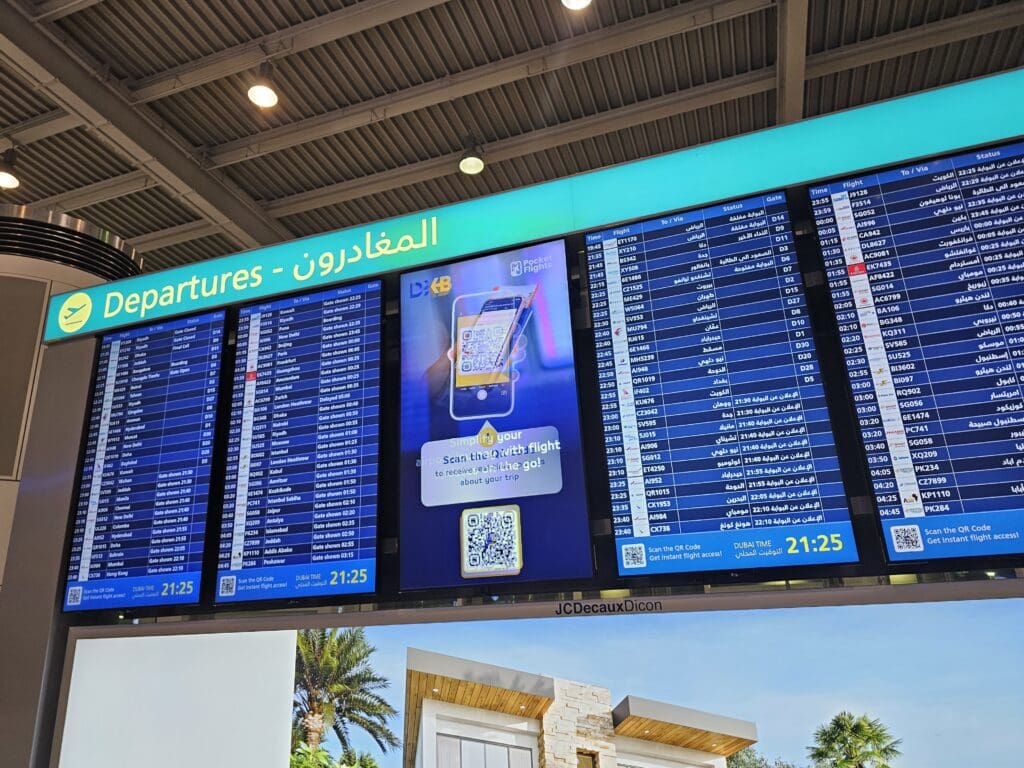
As airports go, Dubai is somewhat of an aviation enthusiast’s paradise, with a massive range of airlines and aircraft types passing through the airport. As you would expect, plenty of Boeing 737s from local carrier Flydubai, as well as Emirates widebodies could be seen, however, alongside these, I managed to spot aircraft from Air China, Air France, Air India, Ariana Afghan Airlines, Cathay Pacific, Cebu Pacific, China Eastern Airlines, China Southern Airlines, Flyadeal, Flynas, Fly Baghdad, Gulf Air, IndiGo, Kam Air, Lufthansa, Mahan Air, Middle East Airlines, Royal Jordanian, Saudia, Sichuan Airlines, Singapore Airlines and Swiss. In addition, a private Russian Tupolev Tu-204 departed during my stay, although sadly, I failed to spot this!
That night, I would have the pleasure of flying onboard Airbus A350-941 B-LQD, which touched down in Dubai at 2152 following its evening slog over from Hong Kong. A few minutes later, this pulled into Stand C62, which unfortunately proved to be one of the worst stands in the terminal for photo opportunities! Assembled at Airbus’ home plant at Toulouse Blagnac and carrying construction number 396, this aircraft first took to the skies with the test registration F-WZFD in January 2020. This made it almost four years old at the time of my flight. Capable of flying almost 10,000 miles when full, the Airbus A350-900 is most certainly a long-haul capable aircraft. However, despite its capabilities, Cathay Pacific deploys these on a smorgasbord of short, medium and long-haul routes from its base in Hong Kong. Operating thirty examples, each of these features an identical configuration with 38 seats in Business, 32 in Premium Economy and 256 in Economy, thus equating to a total of 326 seats. With this particular aircraft’s delivery delayed thanks to the pandemic, B-LQD was finally flown to Hong Kong in August 2020 and has been flying with Cathay Pacific ever since. In the week before my flight, the aircraft had been flying virtually non-stop, making trips from its home in Hong Kong to Dubai, Madrid, New York JFK, Osaka Kansai, San Francisco and Singapore.
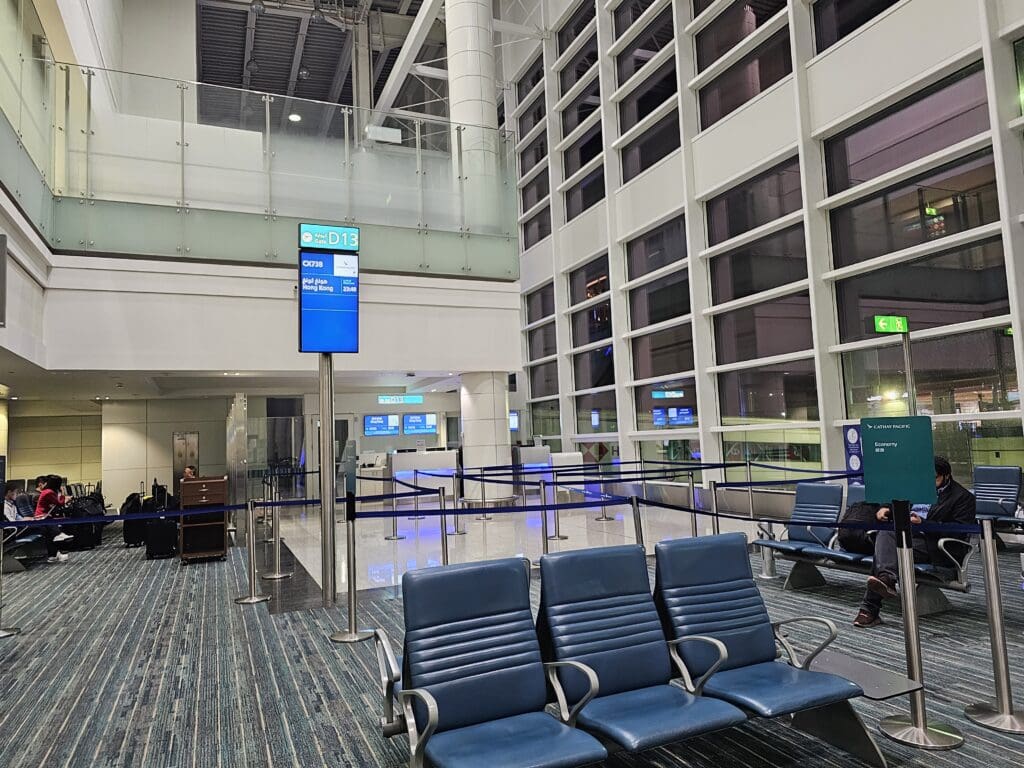
Following one final walk around, with 10 minutes to go until the scheduled commencement of boarding, I decided to wander over to Gate D13. Aligning with the check-in agent’s mention that the flight would be quiet, upon arriving there, far fewer than the 326 passengers required to fill the Airbus A350 could be seen waiting. At that time, an army of both Cathay Pacific and Dnata staff could be seen patrolling the gate and ensuring that all was in place for a punctual start to boarding. At 2257, a pre-recorded announcement rang through the gate area in English and Mandarin. This advised passengers of the boarding order and requested that passengers remain seated for the time being, with boarding scheduled to commence in five to ten minutes. Despite the latter message, eager to board, at this time, many passengers seemed to jump up in preparation for boarding, only to be told by the gate staff to remain seated.
At 2305, a second pre-recorded announcement was played, which invited elite members of Cathay Pacific’s frequent flyer program as well as those in Business and those requiring assistance to proceed forward for boarding. At this time, a gate agent wandered around the waiting area displaying a sign in Chinese that reiterated this message. Next up were those in Premium Economy, followed by those in Economy and seated in rows 66 and above. Seeing this as my cue to board, at this time, I stood up and joined the short queue before having my boarding pass scanned and passport checked, after which I was free to head down the jetbridge towards the waiting Airbus A350.
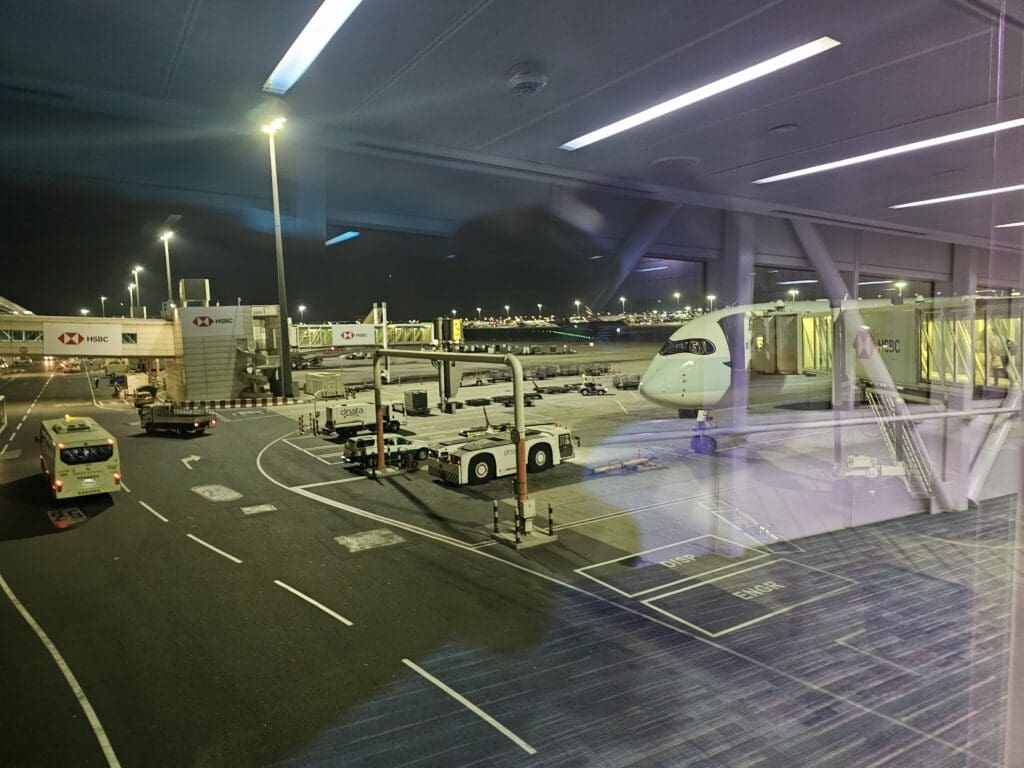
That evening, two jetbridges had been connected up to the aircraft – one at its L1 door and the other at the L2. With the former reserved for the exclusive use of those flying in Business, a Cathay Pacific staff member stood at the point where the two jetbridges split off from one another. There, they thanked passengers and wished them a nice flight, whilst ensuring all were pointed down the correct jetbridge in order to prevent those in the main Business cabin from seeing commoners like me in Economy! Making my way down the glass jetbridge, I trundled past one of the aircraft’s two gigantic Rolls-Royce Trent XWB engines and joined a short queue as I neared the cabin door.
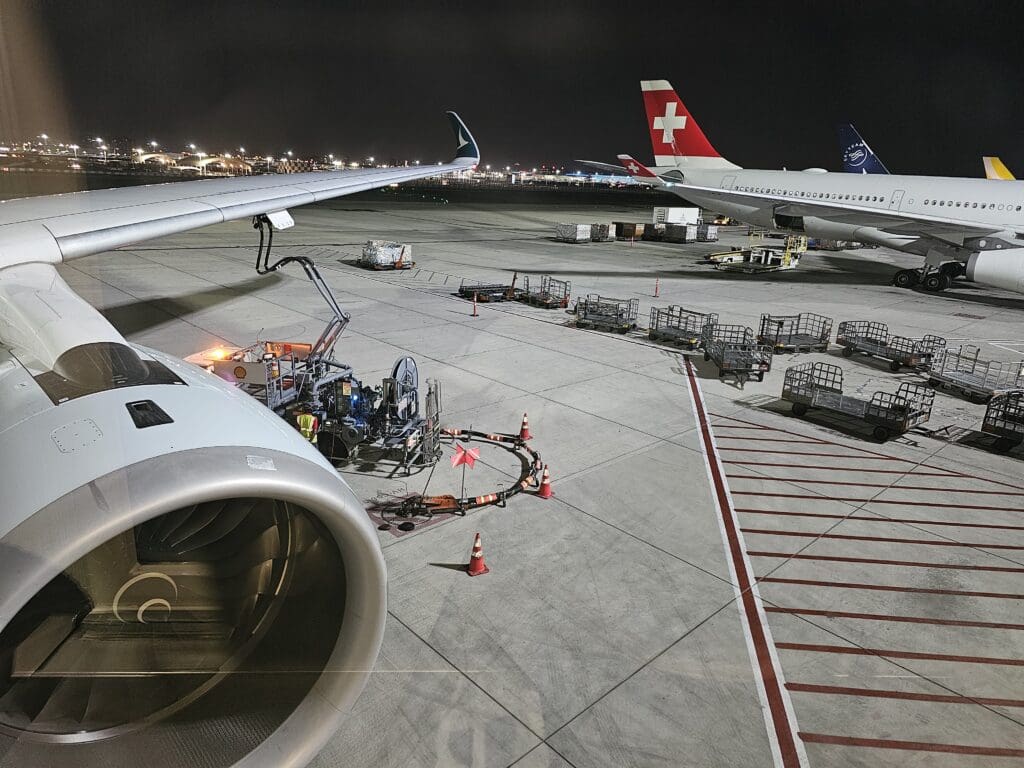
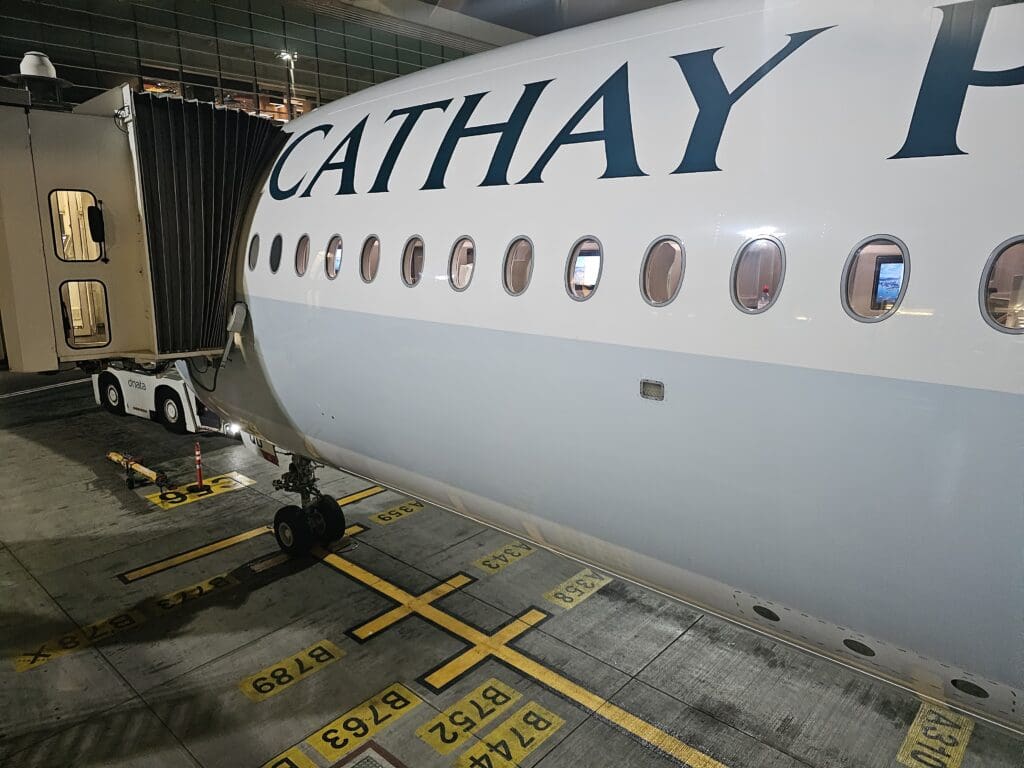
Upon stepping into the galley, I received a warm and friendly greeting in English from one of the many flight attendants onboard and was asked to display my boarding pass. Upon doing so, I was sent down the first aisle and immediately entered the Airbus A350’s minuscule rear Business cabin. This consists of just two rows of Safran Cirus III seats in a reverse herringbone 1-2-1 arrangement. Each of these is covered in a smart dark green fabric, although I did not have too much time to admire their design as I sped through this without stopping and soon entered the Premium Economy cabin. To a non-expert, this part of the aircraft seemed to offer your typical Premium Economy seat, being home to 28 Collins Aerospace MiQ seats in a 2-4-2 configuration.
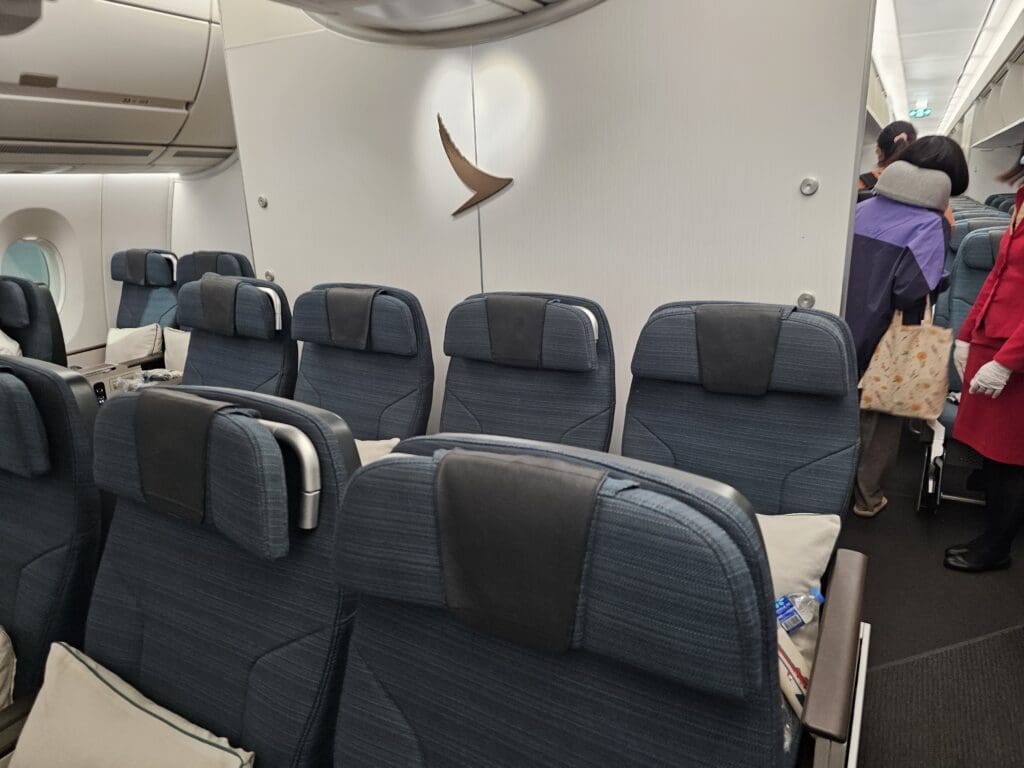
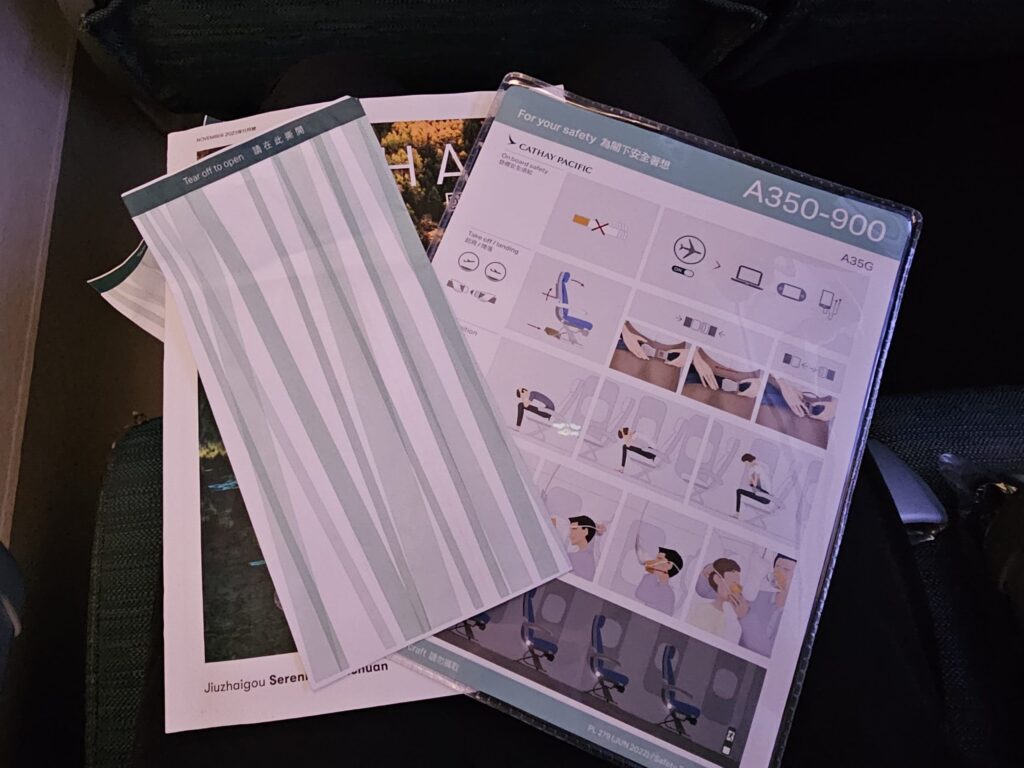
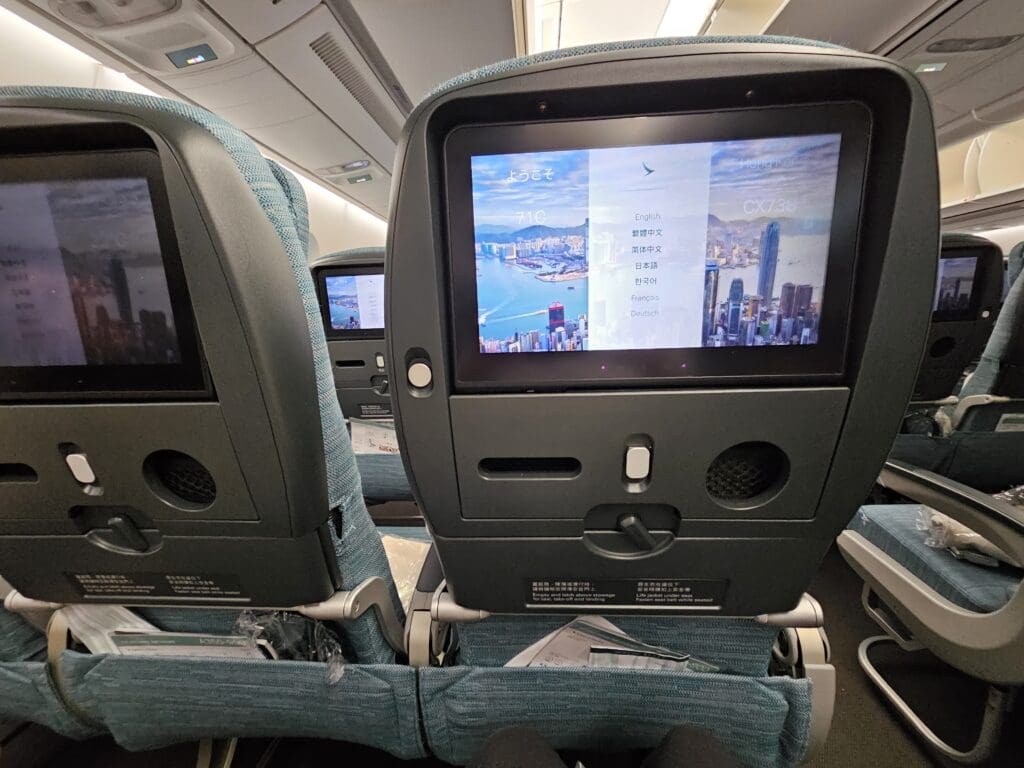
With little waiting required in the aisle, I soon reached the forwardmost of the Airbus’ two Economy cabins where I received my third friendly greeting of the flight. Upon entering this, I was greeted by the sight of rows and rows of mostly vacant Collins Aerospace Pinnacle seats. Those expecting bright colours to match the vibrancy of Hong Kong would have been disappointed, as the cabin had a calming and subdued colour palette, with each seat covered in a dark green fabric in keeping with Cathay Pacific’s brand identity. Not that I found this to be anything to complain about! As with most Airbus A350 operators, Cathay Pacific opted for a 3-3-3 arrangement in Economy, and each seat comes with an adjustable headrest covered by a smart dark leather antimacassar, an 11.1-inch wide high-definition inflight entertainment screen powered by Panasonic’s eX3 system, a USB-A port, a universal power outlet, fold-out device holder and of course the usual tray table (with cup holder) and seatback pocket. Focusing on the contents of the latter, these were home to the latest edition of Cathay Pacific’s semi-self-titled Cathay monthly inflight magazine, a safety card and sickbag. Meanwhile, each also contained a packet of headphones which appeared to be of standard Economy class quality. Last but not least a small pillow with a decent quality cover and blanket had been placed on each seat.
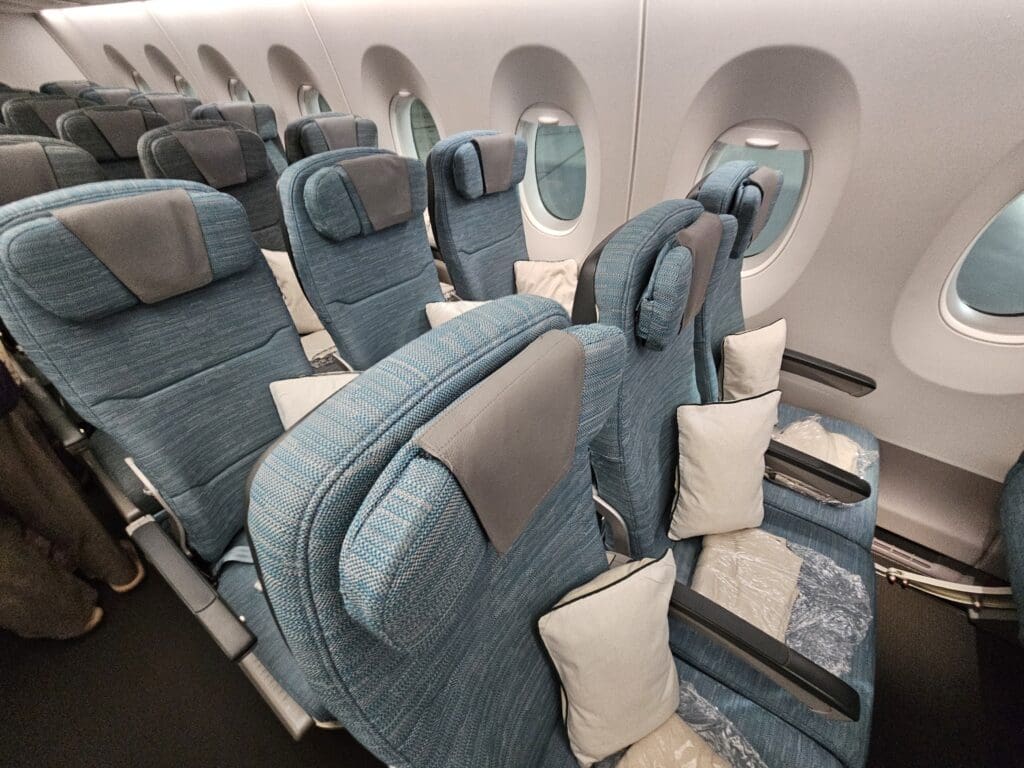
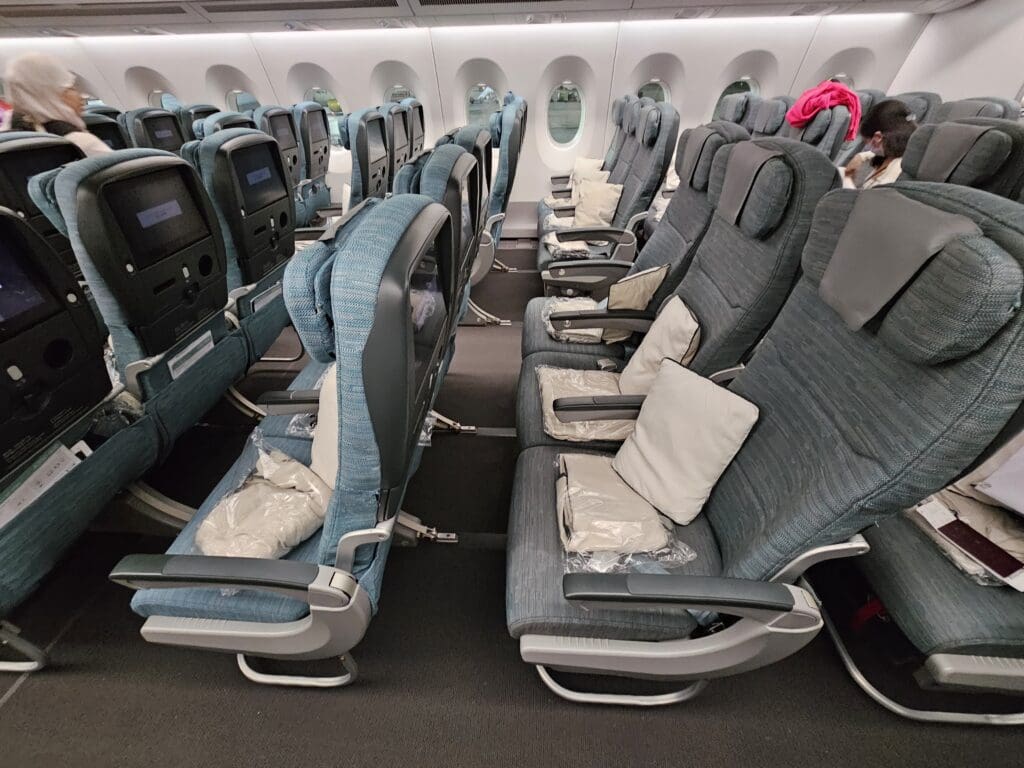
Following another greeting as I neared the rear of the aircraft, I arrived at Seat 71C and discovered that I already had a neighbour in the window seat. However, given the lack of passengers at the gate and the check-in agent’s mention that the flight would remain quiet, I was confident that I would be able to move to a vacant window seat once boarding was announced as complete. Upon sitting down, my first impressions of the seat were very positive, with this being soft, well-padded, spotlessly clean and in tip-top condition with no noticeable signs of wear and tear. In addition, these seats offered an abundance of space, with fantastic levels of legroom offered. Admittedly, whilst a wet-wipe wouldn’t have gone amiss during boarding, and the provision of an amenity kit would have been welcomed, overall, my first impressions of Cathay Pacific were fantastic. The aircraft was comfortable, clean and in good condition; the crew were friendly, and my ground experience had left nothing more to be desired.
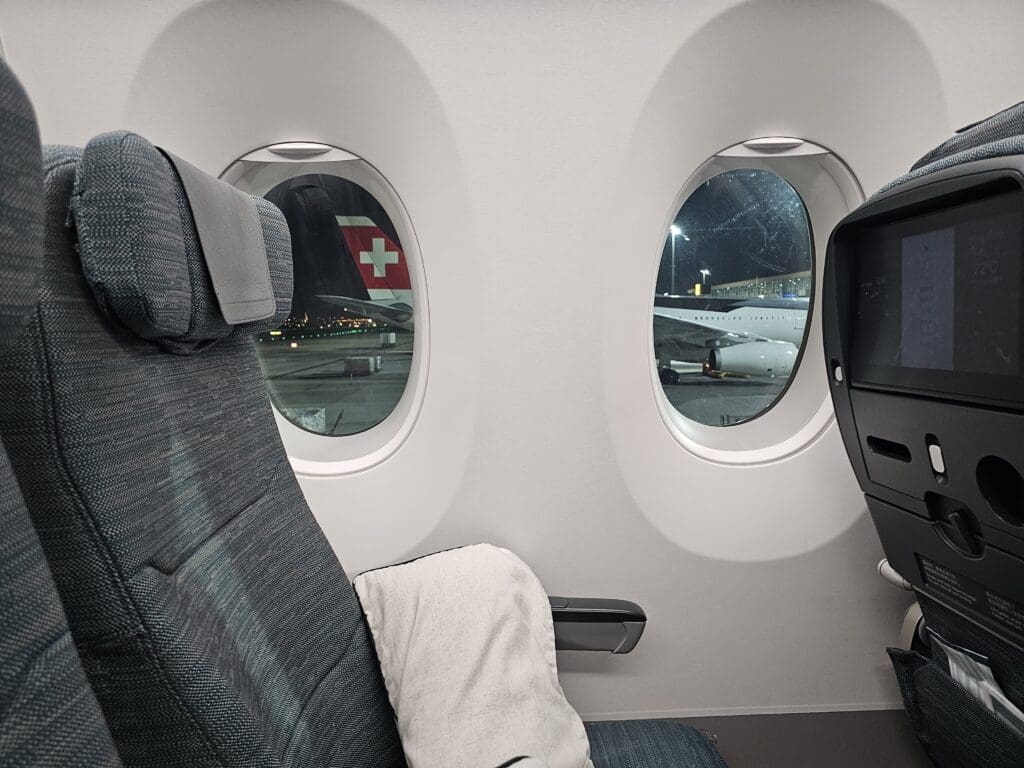
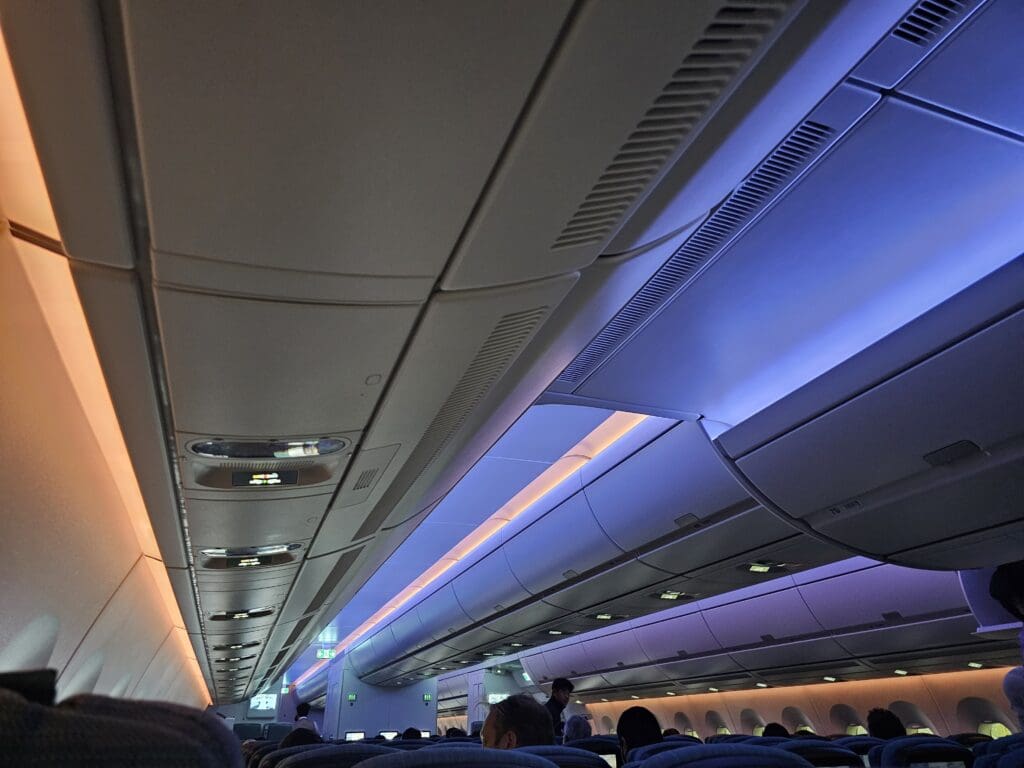
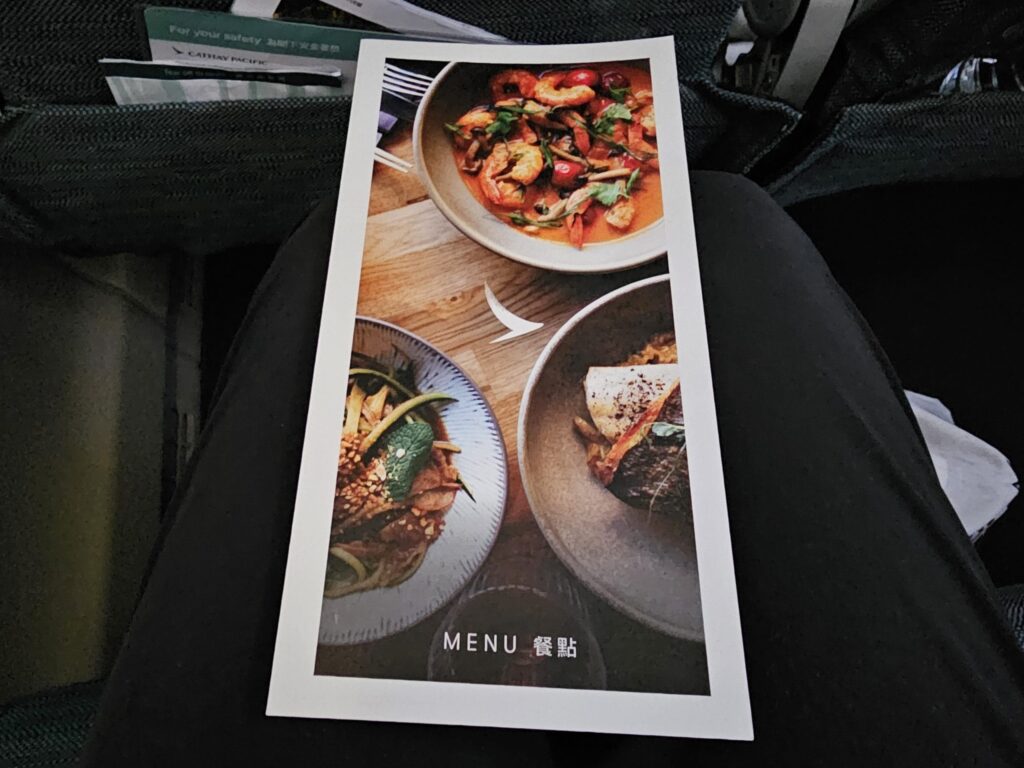
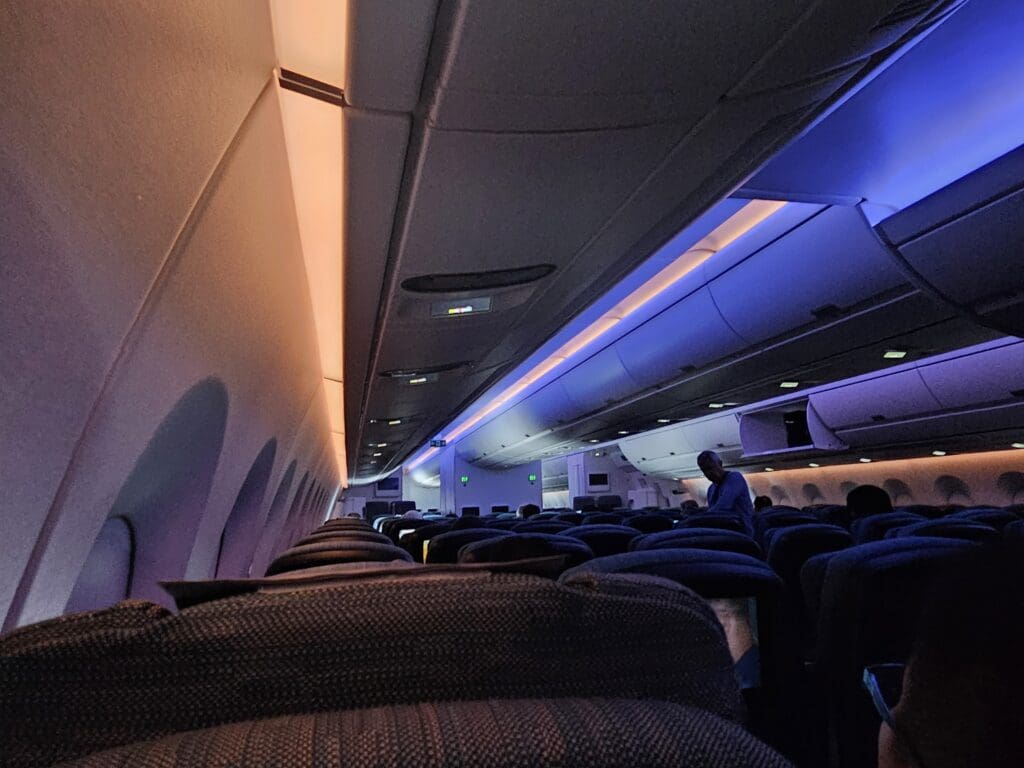
As passengers filtered onto the aircraft, a selection of calming piano music rang through the cabin, and by 2325 all passengers had boarded the Airbus. As expected, the load that evening was very light, and it appeared that most solo passengers were treated to a bank of three seats to themselves. With the row behind me remaining empty, I decided to head back and settled into Seat 72A for the ride over to Hong Kong. At that time, giving off Flydubai vibes, the mood lighting temporarily transformed into a calming combination of blue and orange; meanwhile, the crew passed through the cabin handing out 500ml bottles of still water. This was much needed, given the boiling temperature of the cabin! This was followed by landing cards for those ending their journeys in Hong Kong and a nicely designed real paper menu.
With fifteen minutes to go until the flight’s scheduled departure time, the South African Captain’s voice interrupted the piano music as they welcomed all onboard and thanked passengers for flying with Cathay Pacific before moving on to introduce the First and Second Officer, and the Cabin Services Manager, and ending this by mentioning that we were almost ready to go and no delays were anticipated. This was followed by an announcement from the Cabin Services Manager, which was performed in English only and consisted of the usual welcomes and thanks before music rang out through the cabin once again. That evening, the crew seemed to be a mixture of staff from Hong Kong, Mainland China and Southeast Asia, reflecting the demographics of the flight’s passengers.
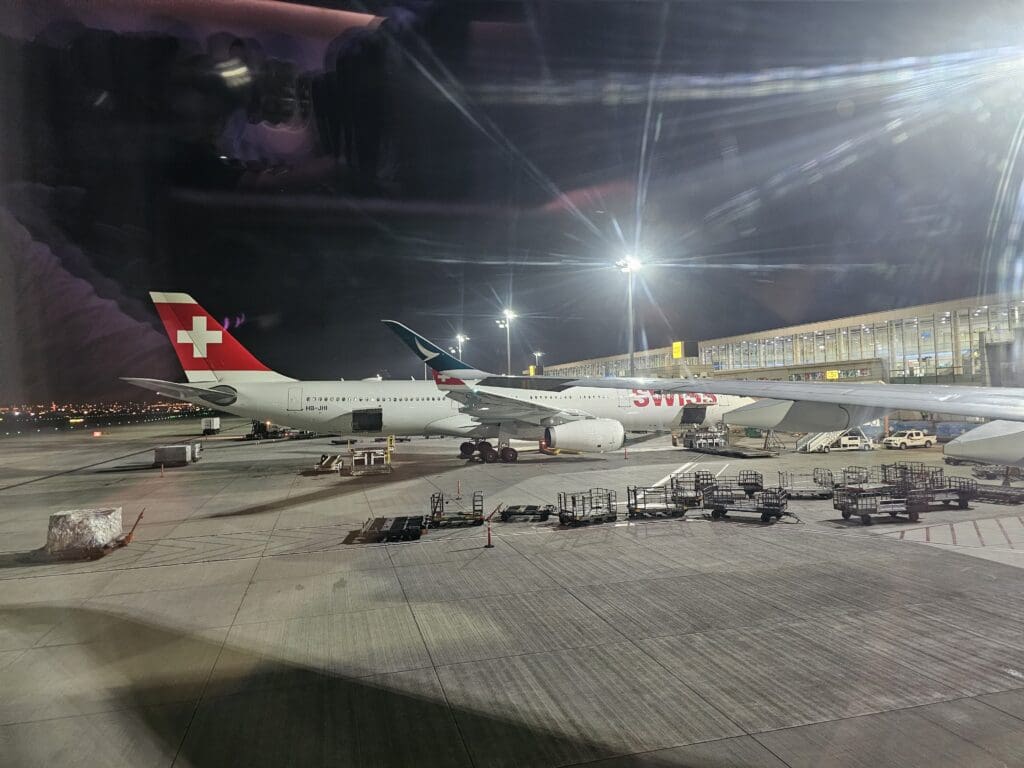
Indicating that we were almost ready to go, a few minutes later Cathay Pacific’s hybrid animated-real life safety video took over the inflight entertainment screens. Whilst this was being broadcast, at 2337, the aircraft gently jolted rearwards, and our pushback commenced. As this neared its final stages, a series of hums and whirs filled the cabin as the two gigantic Rolls-Royce XWB engines powered into life. This resulted in plenty of vibrations and some noise, which quietened once these had powered up. Back inside the cabin, as soon as the safety video came to an end, the crew made their way through the cabin ensuring that all was secure and in place for our departure.
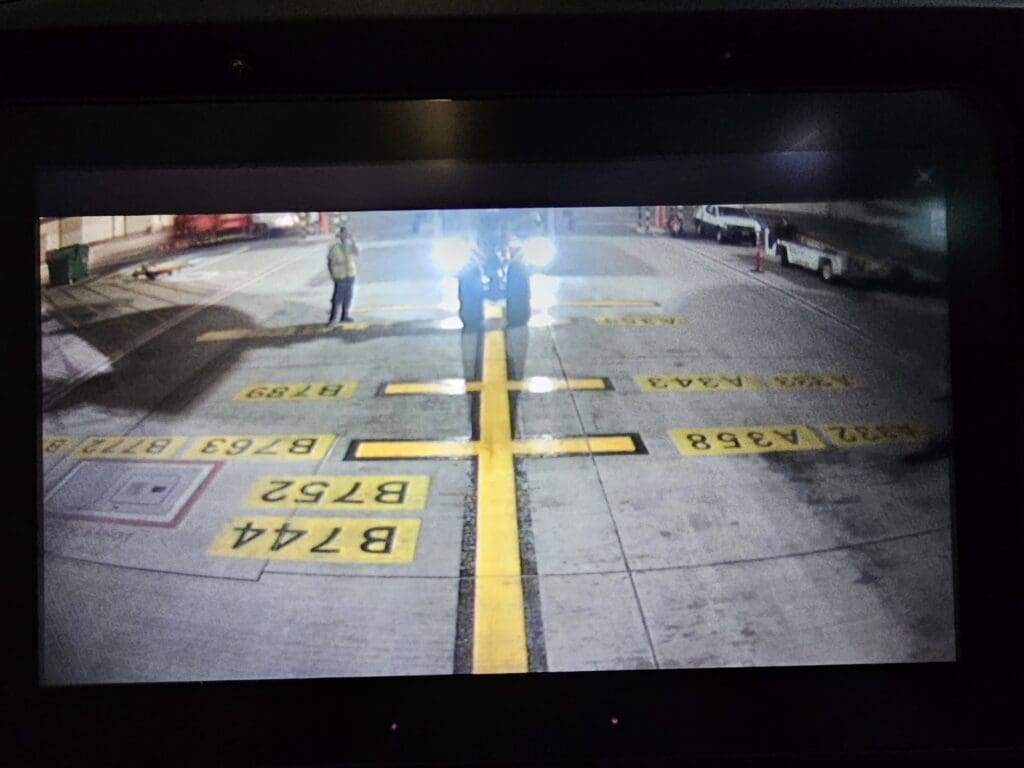
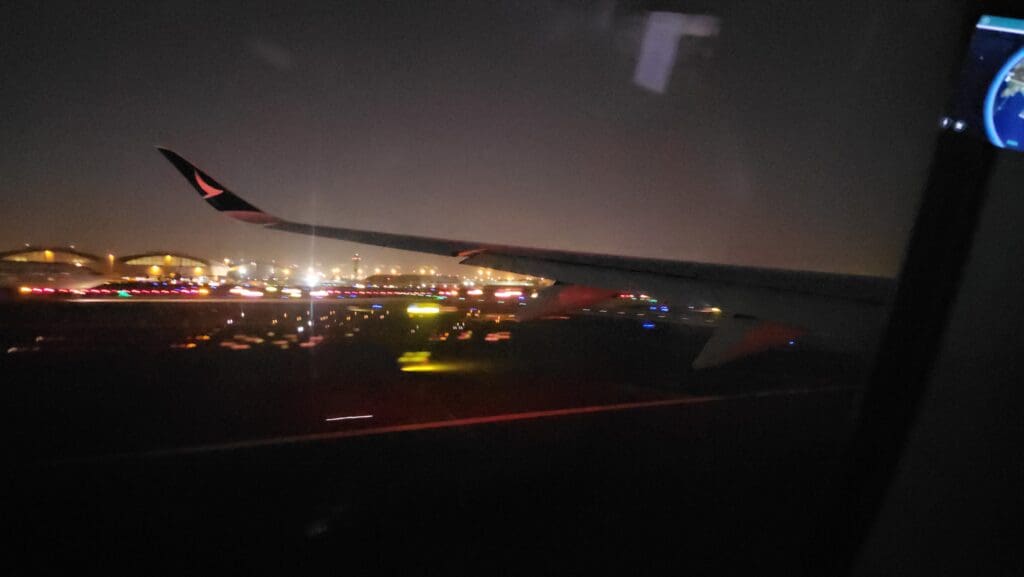
At this stage of the journey, I was glued to the Airbus’ nosewheel camera and watched as Dnata’s ground staff disconnected the towbar, working tirelessly in the Arabian heat before giving the all-clear to the pilots and driving off. A few moments later, the aircraft powered forward under its own steam and commenced its short taxi to the end of Runway 12R. From my position on the left-hand side of the aircraft, little could be seen other than the lights of aircraft whizzing past as they touched down on Runway 12L. Almost all of these took the form of locally based Emirates and FlyDubai jets, the exception being a China Southern Airlines Airbus A330 arriving from Guangzhou, the aircraft that I would have taken had I opted to fly with this Chinese giant. Once the crew had completed their pre-departure checks, the lights were turned off in preparation for our departure and enabled me to get a good gander at Dubai’s more interesting visitors – an Ariana Afghan Airlines Boeing 737-400 and a Kam Air Airbus A340-300, both on fairly long turnarounds before commencing their nighttime journeys back to Afghanistan.
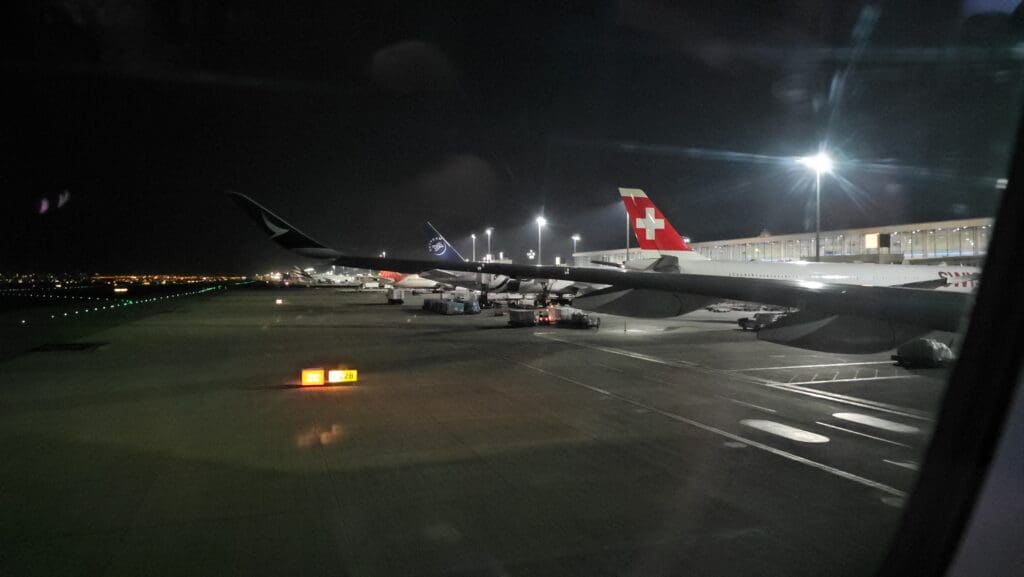
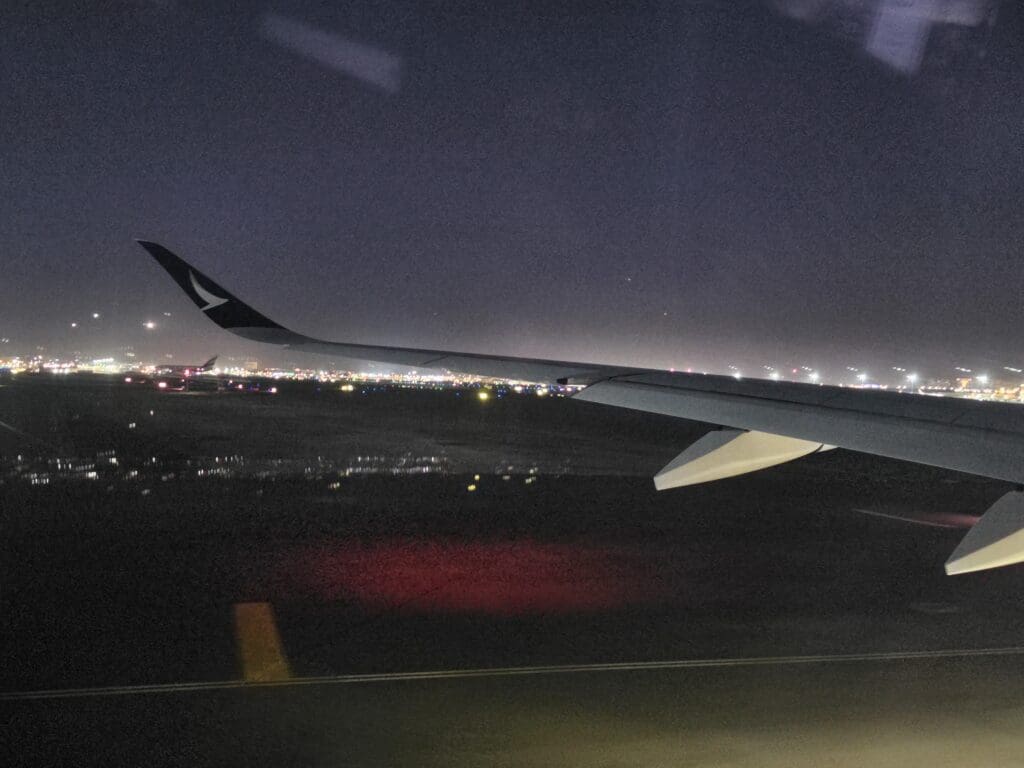
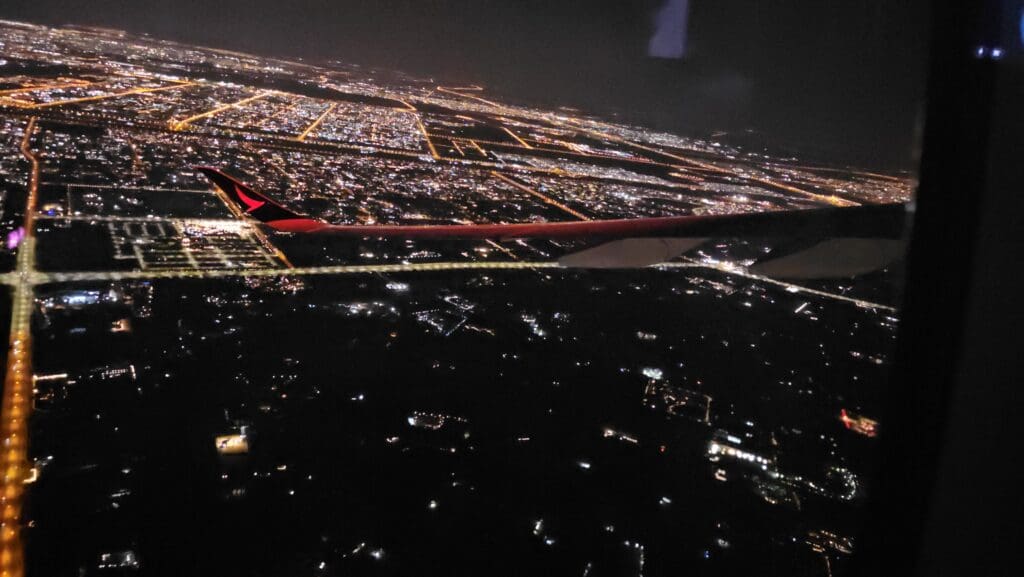
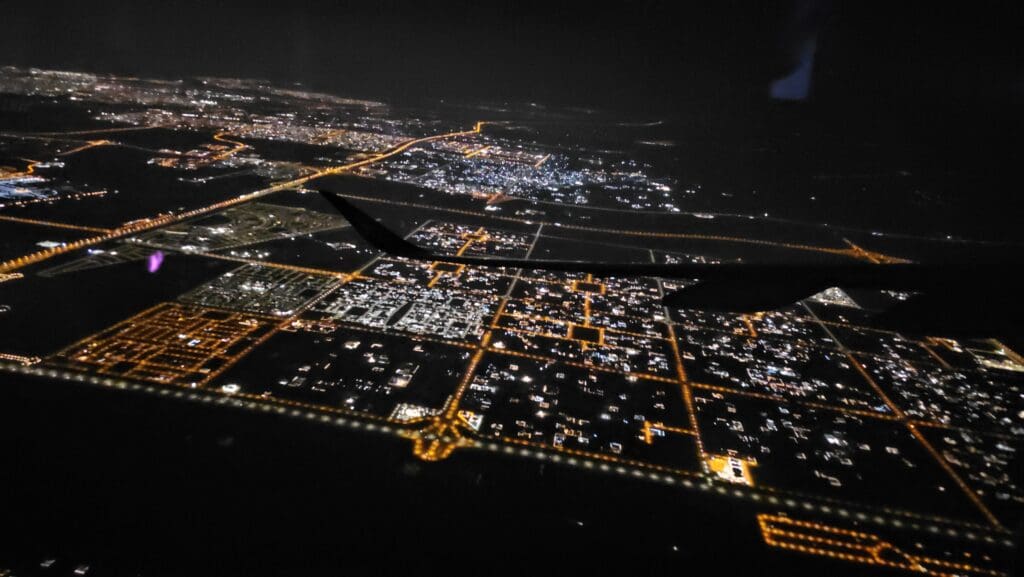
Despite Dubai Airport’s non-stop stream of movements, once at the end of the runway, the Airbus was able to taxi onto this with no holding whatsoever. Slowly and cautiously lumbering onto the centreline, the aircraft came to a halt before the two Rolls-Royce engines quietly spooled into life. That evening, our take-off was a fairly gentle affair, and after a while, we rotated upwards into the Emirati night skies before leaving the airport behind. Once in the air, the orange glow of the Emirates of Dubai and Sharjah appeared, with areas such as Mirdif, Muhaisnah and Al Mizhar visible as we left the airport behind. However, it wasn’t long before the Airbus climbed out over the dark deserts and gently banked to the left, temporarily turning onto a northerly heading before flying eastwards once again and crossing over the Hajar Mountains. Just ten minutes after departing Dubai, the aircraft left the Emirati coastline behind to the north of Fujairah and headed out over the Gulf of Oman.
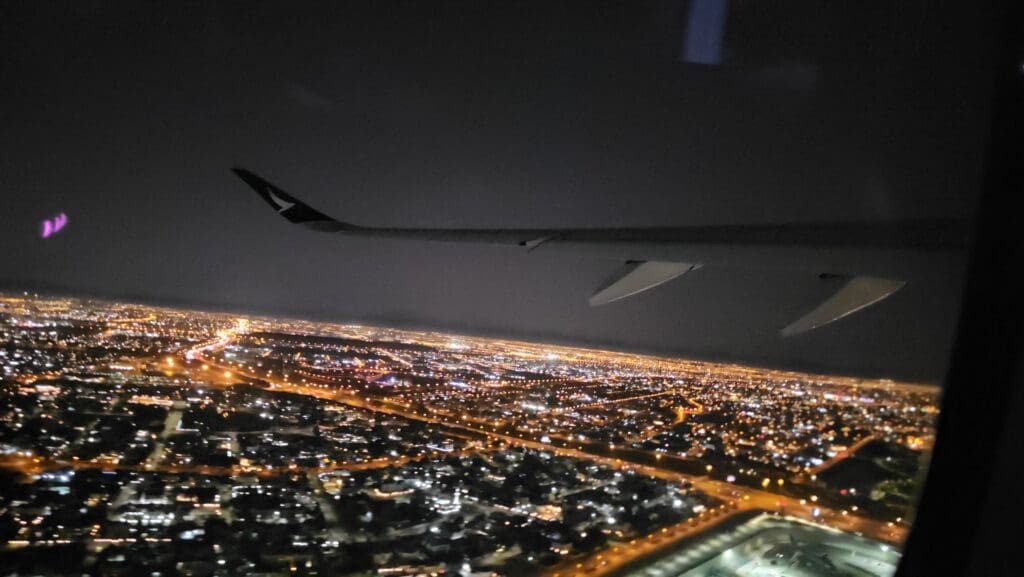
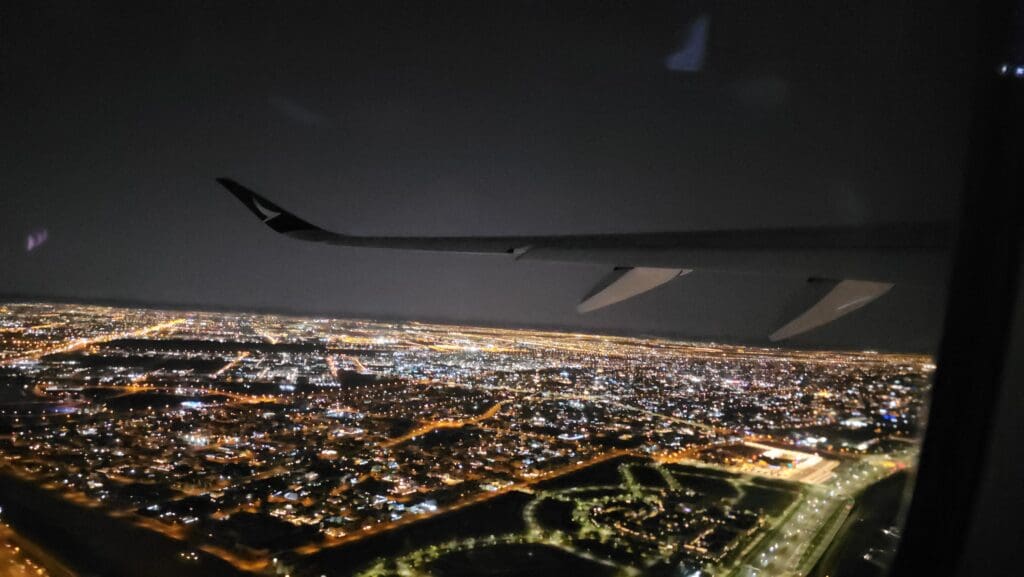
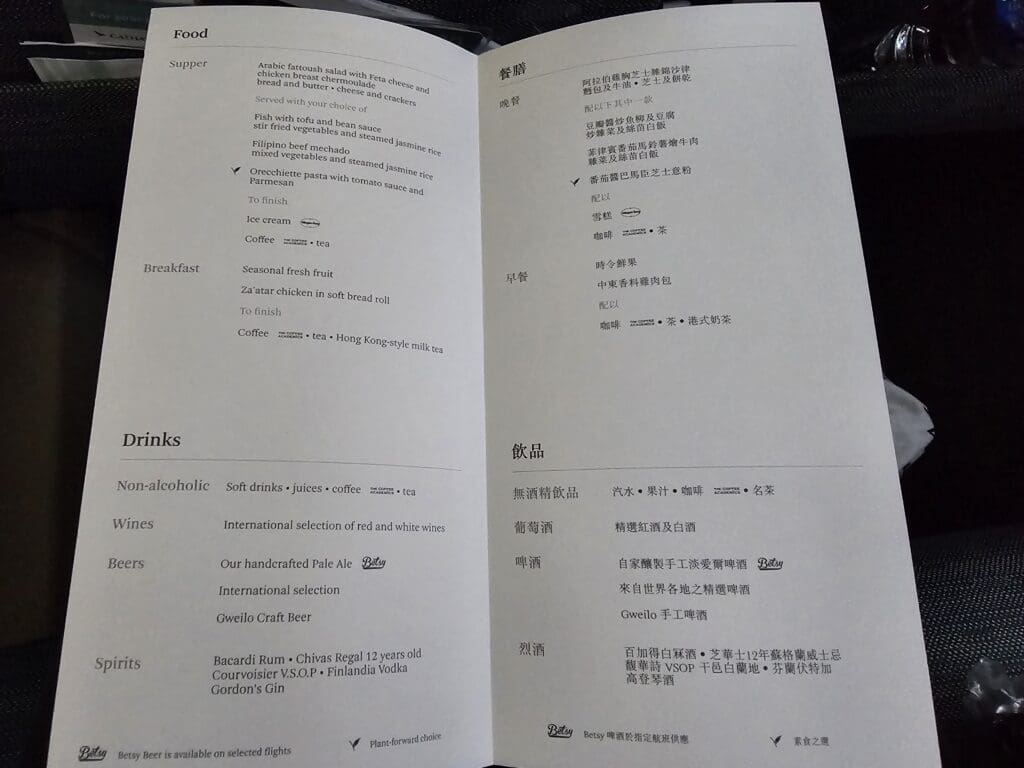
That evening, our departure from Dubai had been a smooth affair with absolutely no lumps or bumps felt during our initial climbout. Thus, as soon as we passed through 10,000 feet, the seatbelt signs were extinguished, and the cabin lighting was turned back on to its dawn/dusk orange hue. Likely recognising that most passengers wanted to sleep, the crew wasted no time in rolling the carts out into the aisle and commencing the first round of service. Given our departure time, I had expected a light snack after departure and a full meal before landing. However, upon browsing the menu, I discovered that the opposite was to be the case. Browsing the menu, a total of three full evening meal options were available – these consisted of meat (Filipino beef mechado), fish (fish with a tofu and bean sauce) and vegetarian (orecchiette pasta with tomato sauce and parmesan) options.
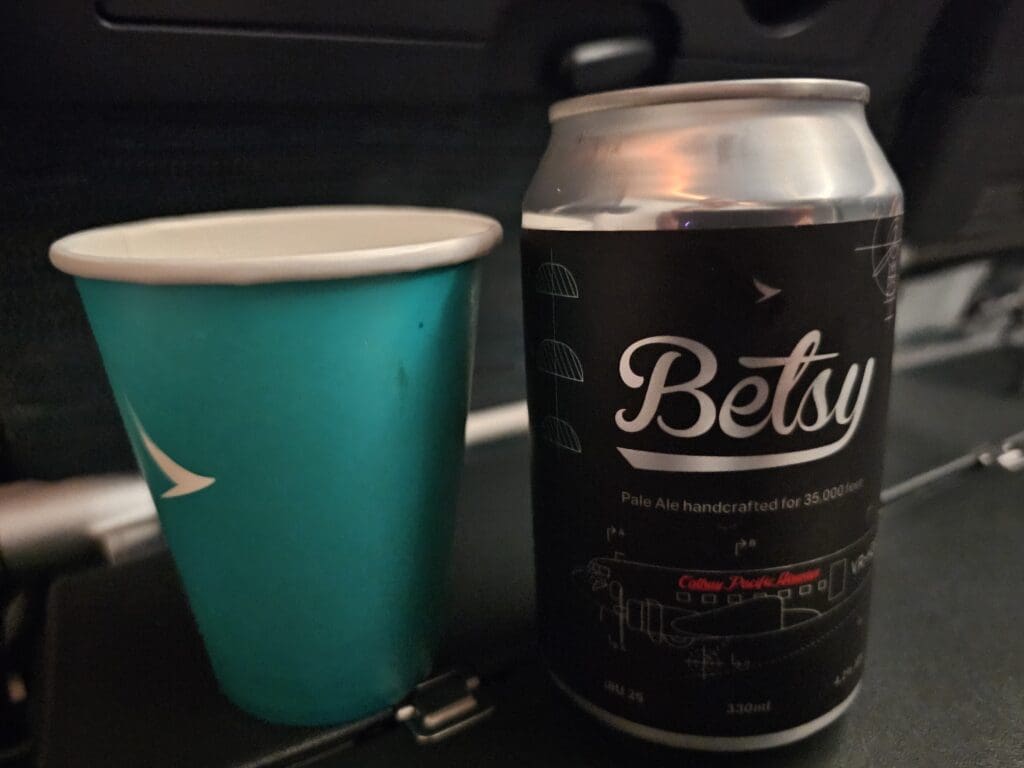
Given the light load and speeding down the cabin, before I knew it the two crew members reached my row and asked for my choice. Opting for the beef, this was soon placed onto a tray and handed over to me before I was offered a drink. Whilst not usually an alcohol drinker onboard aircraft, I could hardly resist the opportunity to sample Cathay Pacific’s pale ale, which is brewed in partnership with Hong Kong’s Gweilo Beer and named Betsy, in honour of the airline’s first aircraft. Having already run out, the flight attendant promised to return a few minutes later once they had retrieved more of these from the rear galley and true to their word, they did.

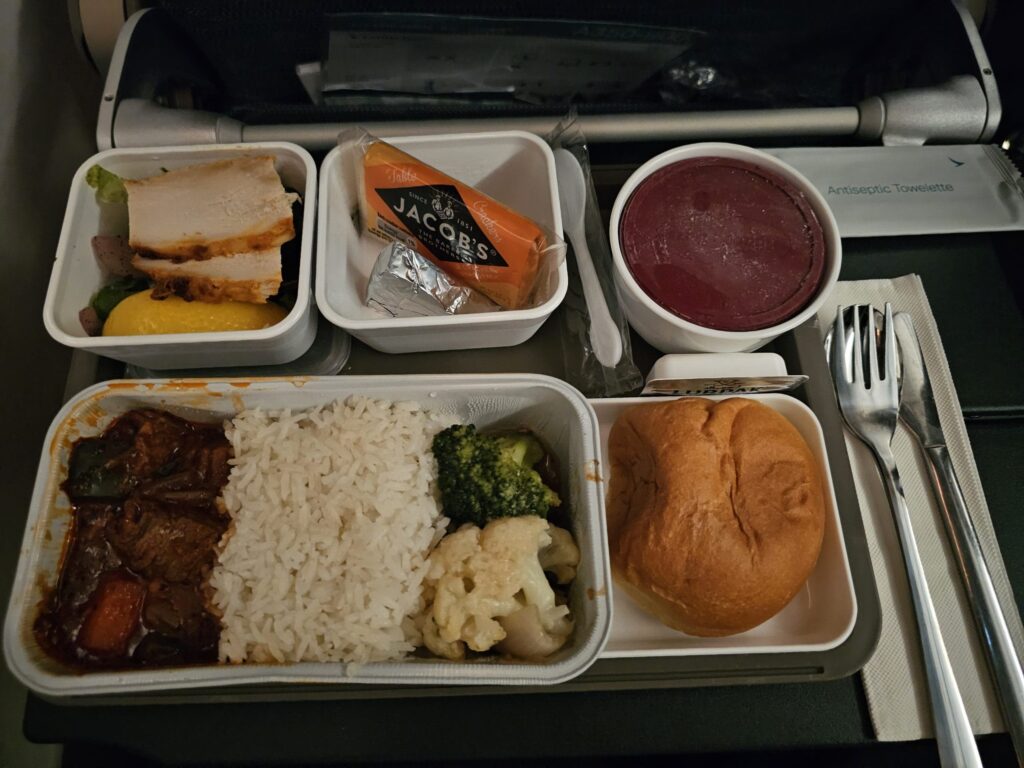
Getting stuck into the meal, I opened up the lid of the main dish and found the beef to be served with rice and mixed vegetables, and, as per the menu, this was accompanied by a fattoush salad with feta and chicken breast pieces, a warm bread roll with butter, crackers, and a Laughing Cow cheese triangle. Meanwhile, dessert came in the form of a small tub of strawberries and cream Haagen-Daas ice cream. Adding a touch of class, real metal cutlery was provided that was complete with Cathay Pacific’s famous motif. Examining the main dish, whilst not overly memorable, this was of decent quality and quantity and left me with little to complain about. However, I was disappointed to find that the side salad was completely frozen solid and thus inedible!
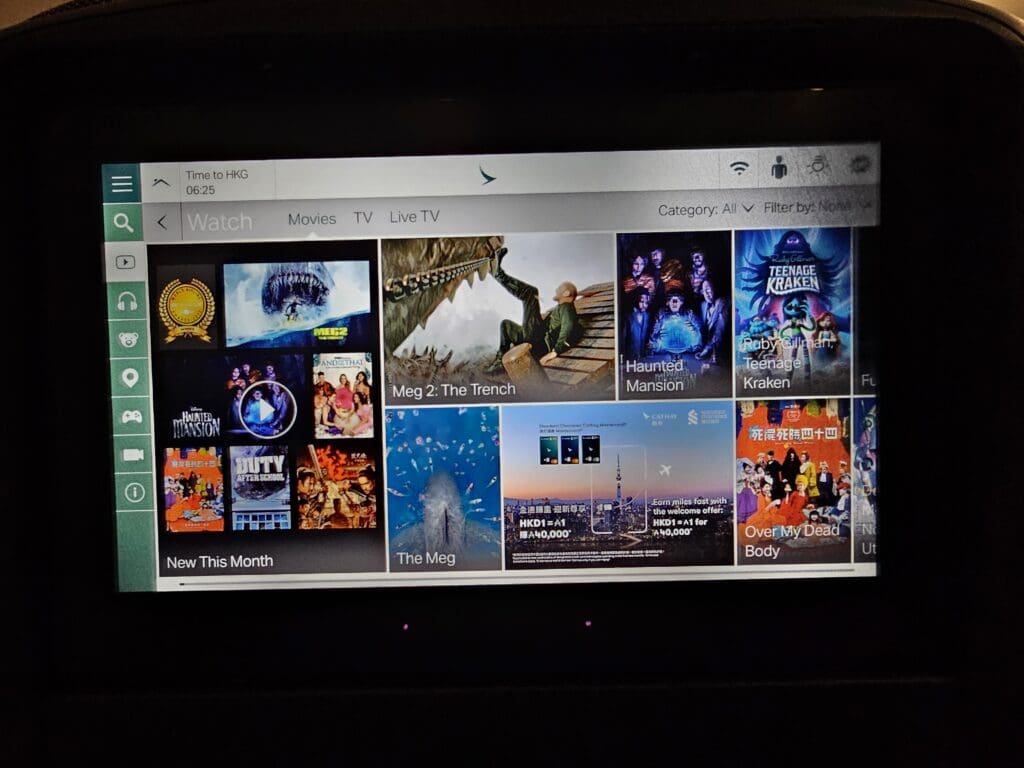
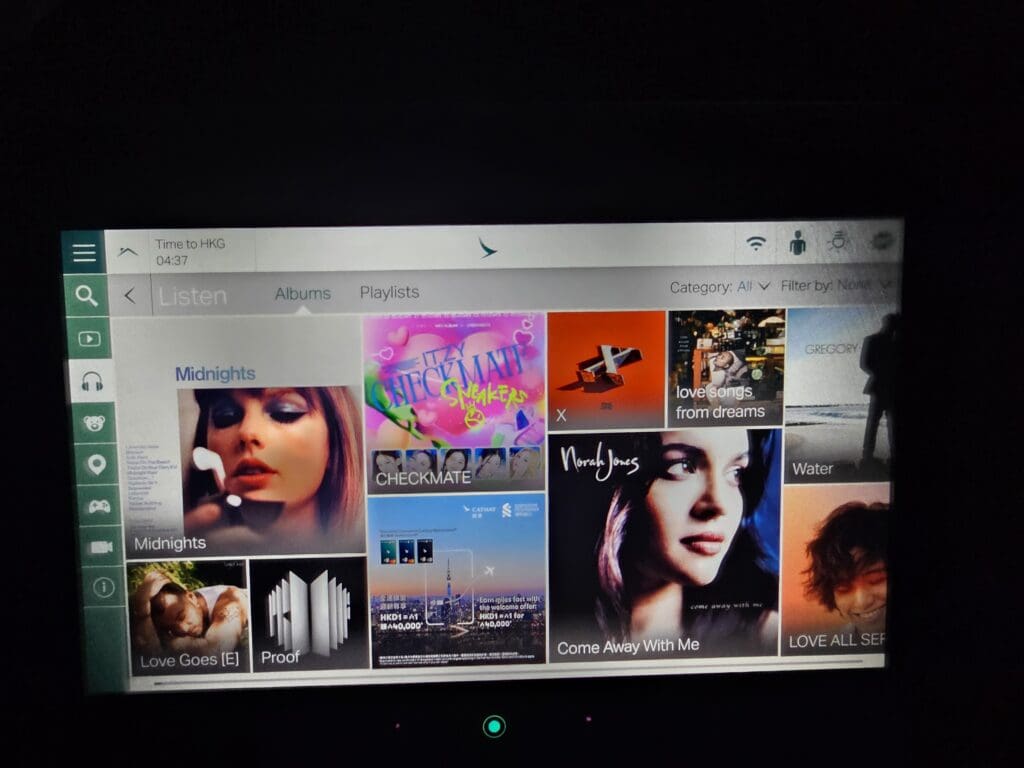
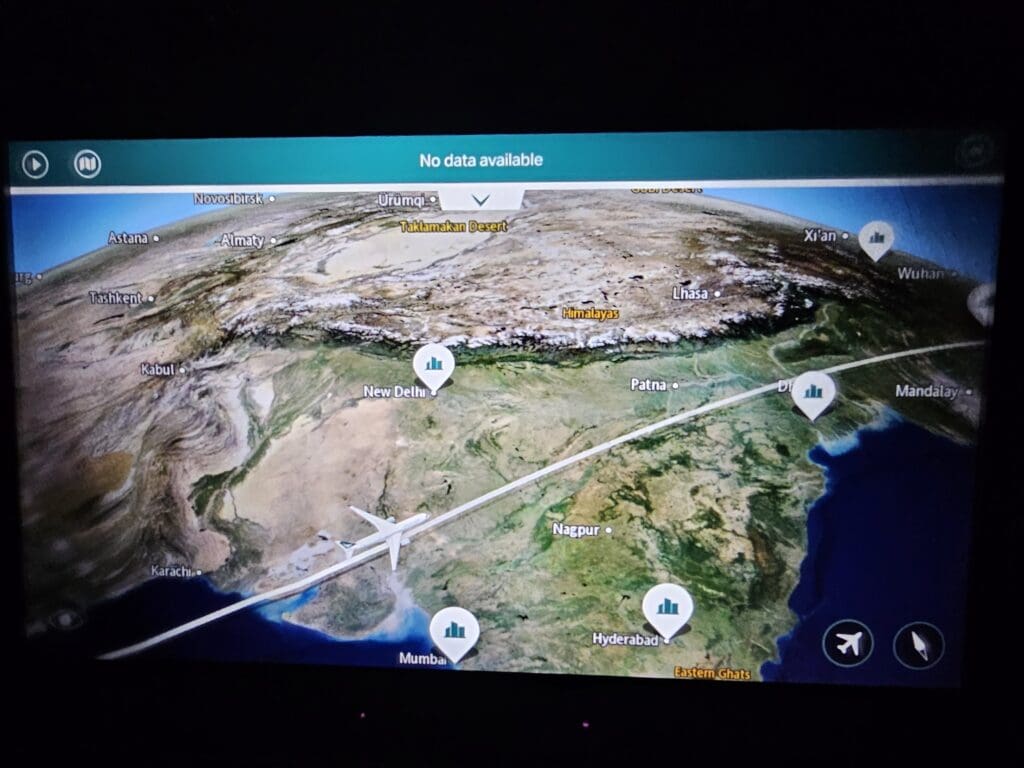
Much to the delight of those who simply wanted to sleep, it wasn’t long before the remains of the service were collected and the lights were dimmed as we headed eastwards across the Indian Ocean. Whilst I had had a busy day, not being particularly tired I decided to explore the delights of Cathay Pacific’s inflight entertainment system. Given the airline’s good reputation and global route network, as you would expect, this contained heaps of content and was one of the more expansive systems that I have had the pleasure of using. In fact, Cathay Pacific boasts Asia Pacific’s largest inflight entertainment library and won the 2023 Skytrax World’s Best Inflight Entertainment award. Highlighting this, Arabic, Cantonese, Catalan, English, Farsi, French, German, Hindi, Irish, Italian, Japanese, Korean, Mandarin, Nepali, Polish, Portuguese, Putonghua, Russian, Spanish, Tamil, Telugu, Thai and Vietnamese language films could be found on this system, with these ranging from the latest released to decades-old classics and everything in between. These came in addition to plenty of audio content, television programmes, sixteen games and two live television channels (BBC and CNN) as well as a good moving map with plenty of options for those looking to track the progress of the flight. As on many airlines, visual content commenced with a series of advertisements, with these taking the form of promotions for the FIA GT World Cup, Invest HK and Maqo. Overall, I found the system to be easy to use and navigate, whilst the screen was of very high quality and responsive to touch, leaving me with nothing to complain about.
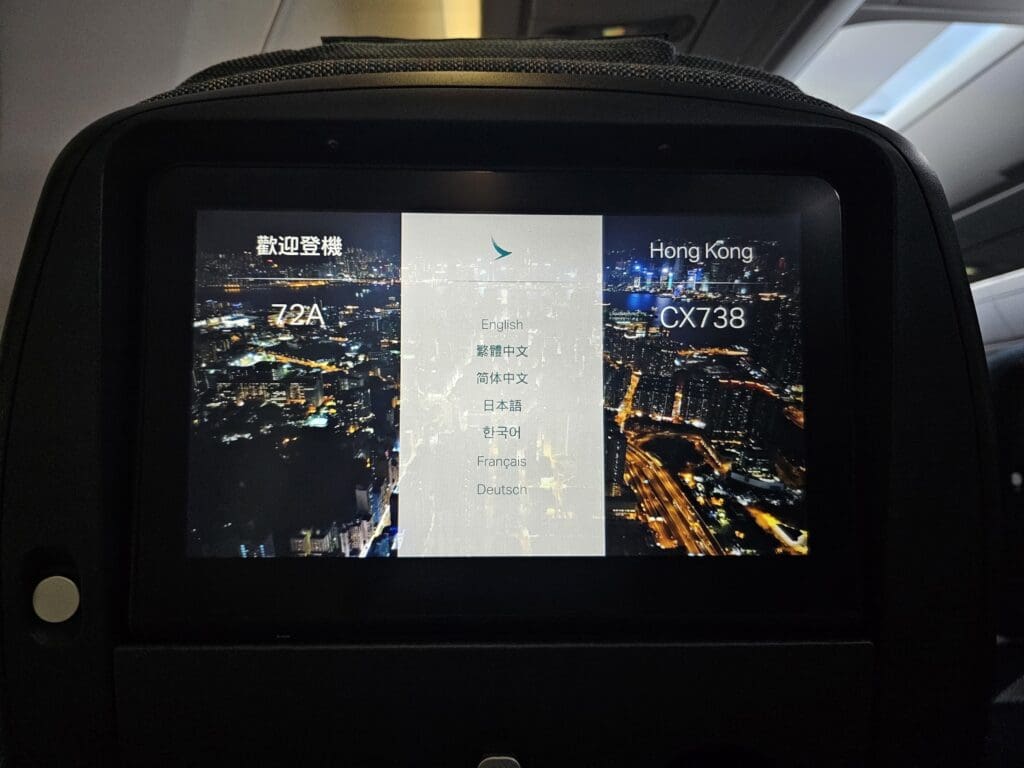
For those looking to stay connected to the world, an onboard wifi network was provided, and upon connecting to this, I found two packages to be offered. If looking to use the internet for the entire flight, then a pass for $19.95 could be purchased, whilst the alternative, an hour’s worth of wifi, would have set me back $9.95. Moving on to the reading material, a pristine copy of Cathay Pacific’s monthly Cathay inflight magazine could be found in the seatback pocket. As well as your usual barrage of advertisements, this issue featured bilingual Chinese-English articles on a range of subjects related to Hong Kong and Cathay Pacific’s other destinations across the globe, plus your usual features on the airline and its latest developments.
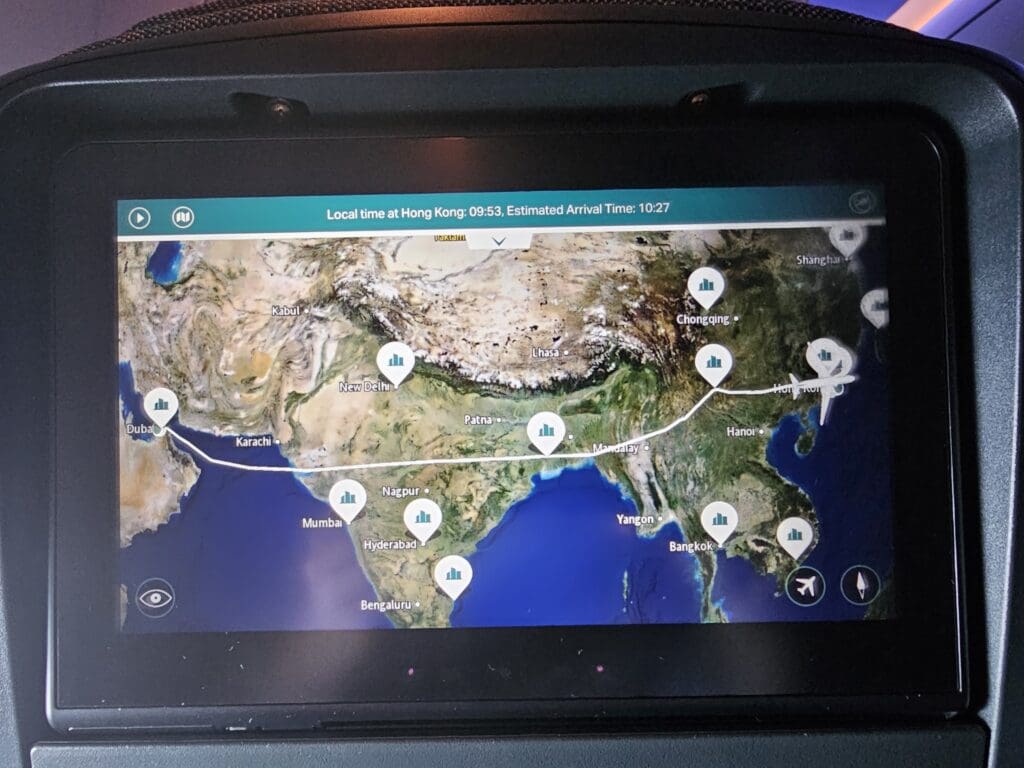
Returning to the route, after around an hour and a half spent cruising at the high altitude of 41,000 feet over the Indian Ocean, the Airbus made landfall over the Indian Subcontinent, specifically reaching the northern shores of the Gulf of Kutch in the Indian state of Gujarat. Heading inland, the jet soon passed over Ahmedabad, which, with a population of 6.3 million, is Gujarat’s most populous city and the fifth most populous in all of India. With clear skies across much of the country, plenty of light could be seen from passing villages, towns and cities, with this perhaps somewhat accentuated by the many colourful displays for Diwali, the larger and more lavish of which were visible from the aircraft!
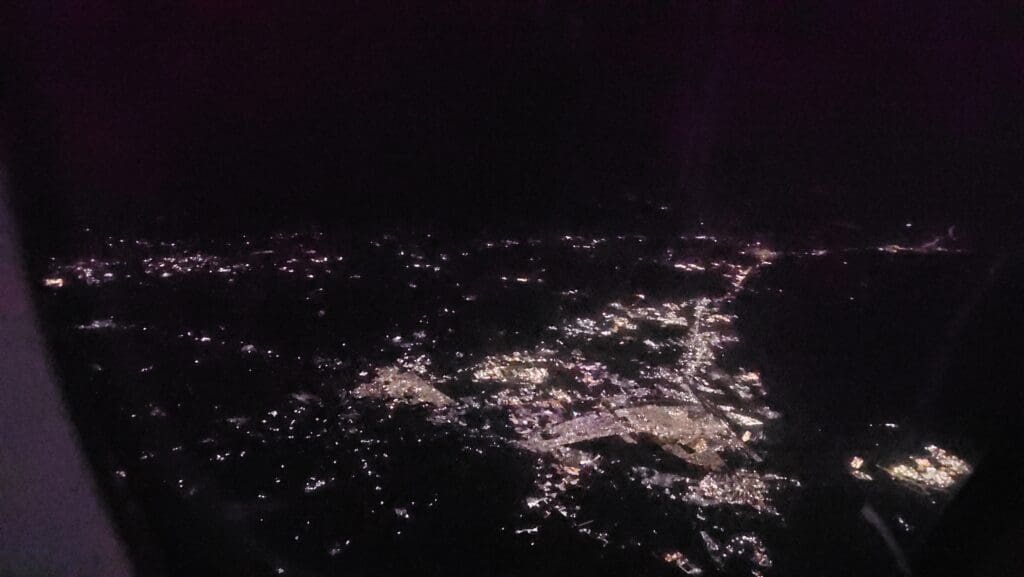
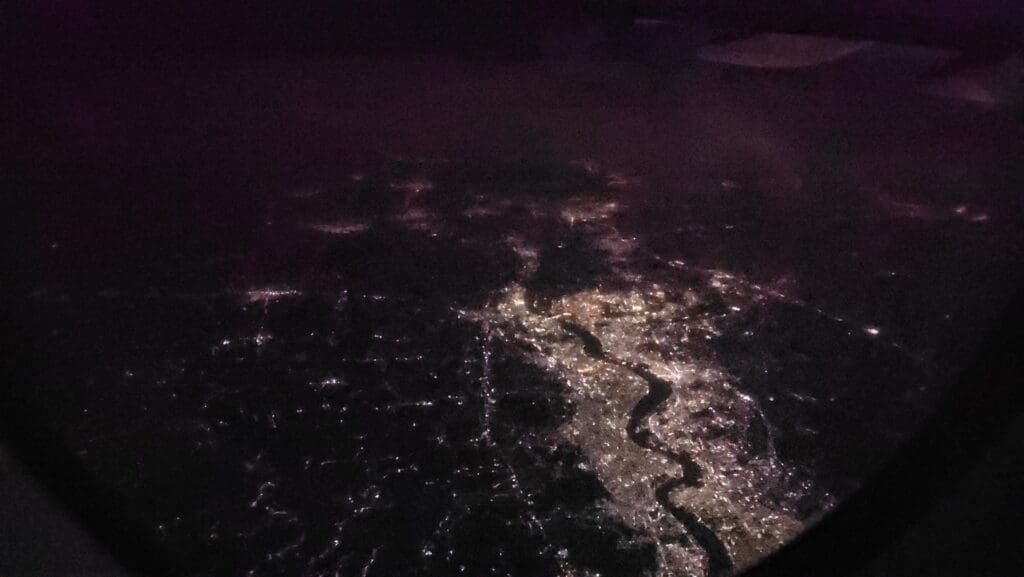
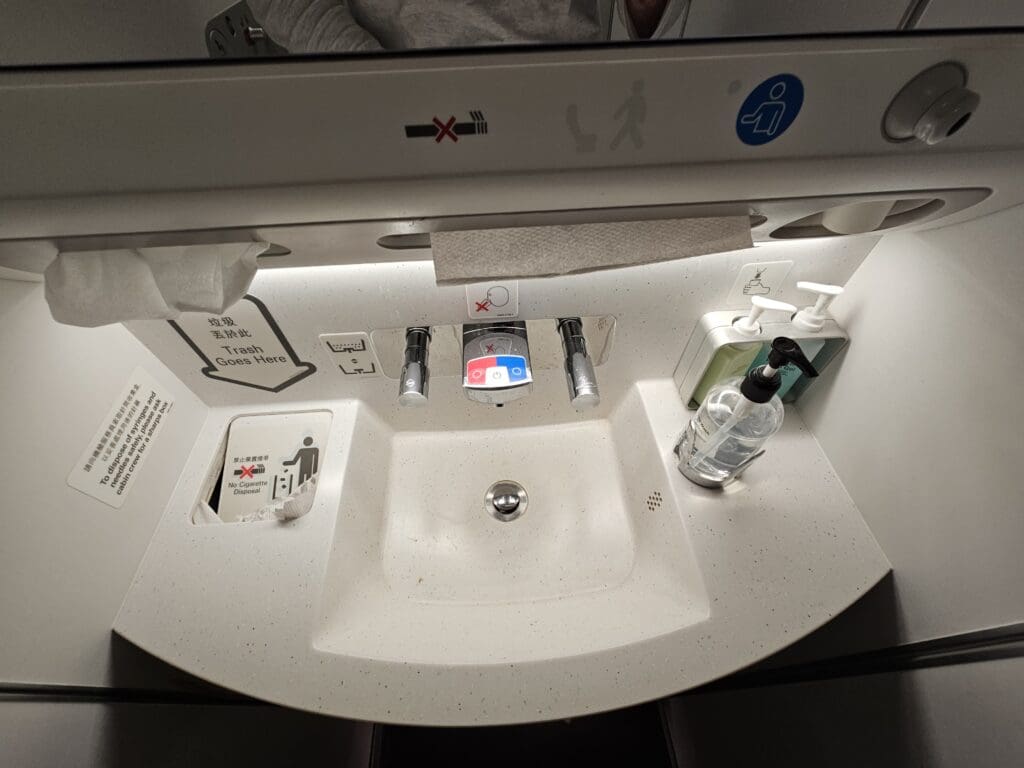
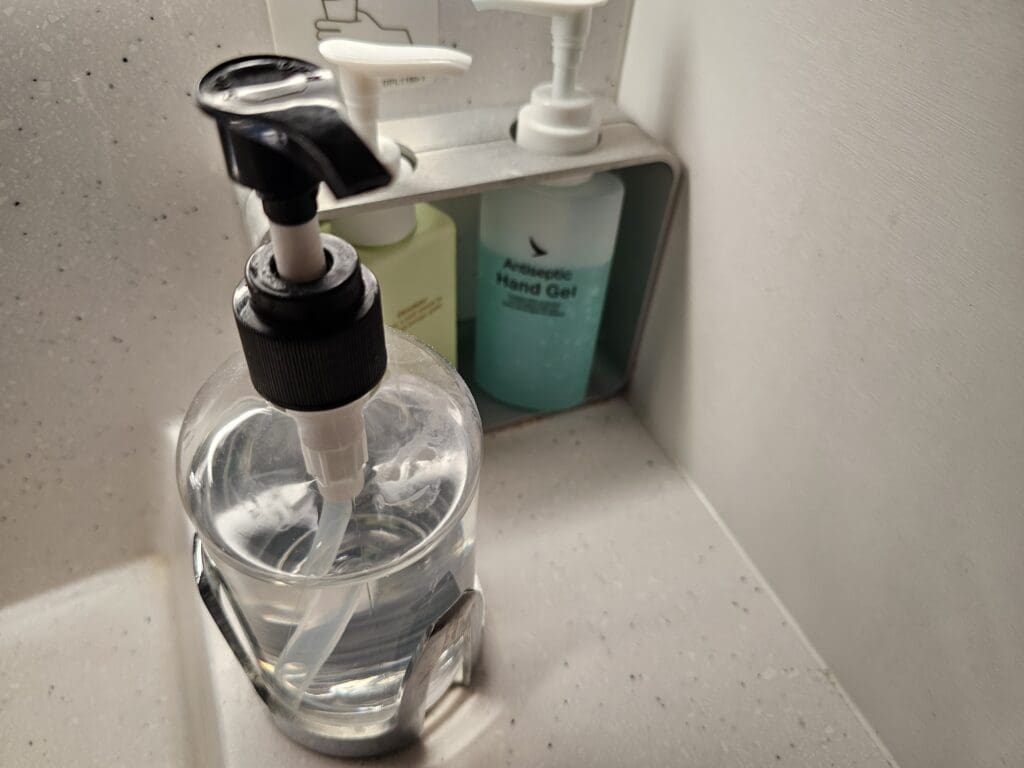
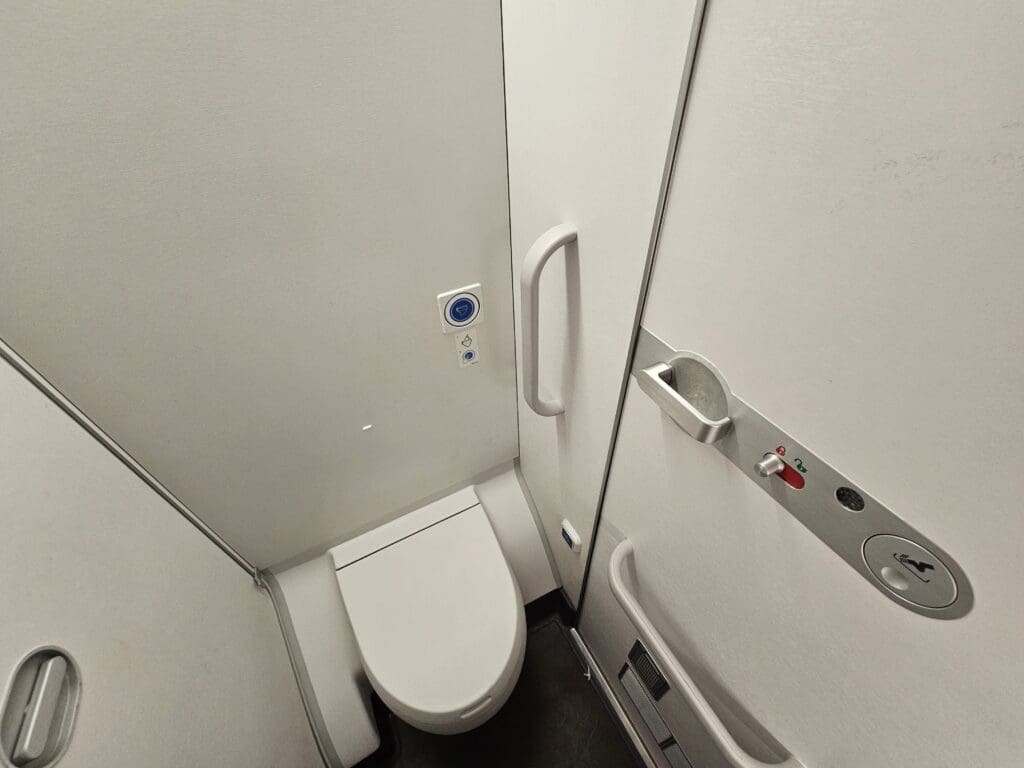
After exploring the delights of the inflight entertainment system, I decided to pay a trip to one of the lavatories that sit in between the two Economy cabins. Upon entering this, I found it to be in a clean and tidy state – aside from the basics, this contained antibacterial gel, sanitary products and moisturising cream, which I found to be a nice touch. As I journeyed back to my seat, I noticed that a selection of soft drinks had been placed up in the rear galley area that protrudes into the cabin – with a flight attendant sitting next to this throughout the flight, ready and raring to serve passengers. Once back in my seat, I decided to make the Economy version of a lie-flat bed and sprawled across the bank of three seats. Comparing this to the bed that I had made on the Royal Air Maroc Dreamliner I had flown a couple of days prior, this was a little more comfortable however, I did notice that the pillows provided by Cathay Pacific are fairly miniscule, even for an Economy class pillow. Nevertheless, I had no issues drifting off to sleep.
After a couple of hours or so of surprisingly decent sleep, I woke up as we neared the eastern end of India, whilst outside the skies began to brighten. However, as night transformed to day, it wasn’t long before the crew passed through the cabin, ensuring that all window shades were closed to prevent this filling with light and waking up the many slumbering passengers. After passing the West Bengal city of Kolkata, our two hours and ten-minute crossing of India came to an end as we headed out over Bangladesh, crossing over the southern portion of the country near its coastline before passing the city of Chattogram, also known as Chittagong. From there, the aircraft passed over a very small portion of India in the form of the very southern tip of the state of Mizroman before heading into the skies of northern Myanmar. There, the aircraft trundled across the regions of Chin, Sagaing, Mandalay and Shan, although unfortunately thanks to the clouds below, nothing could be seen of the country before we entered Chinese airspace and headed out over the mountains of Yunnan.
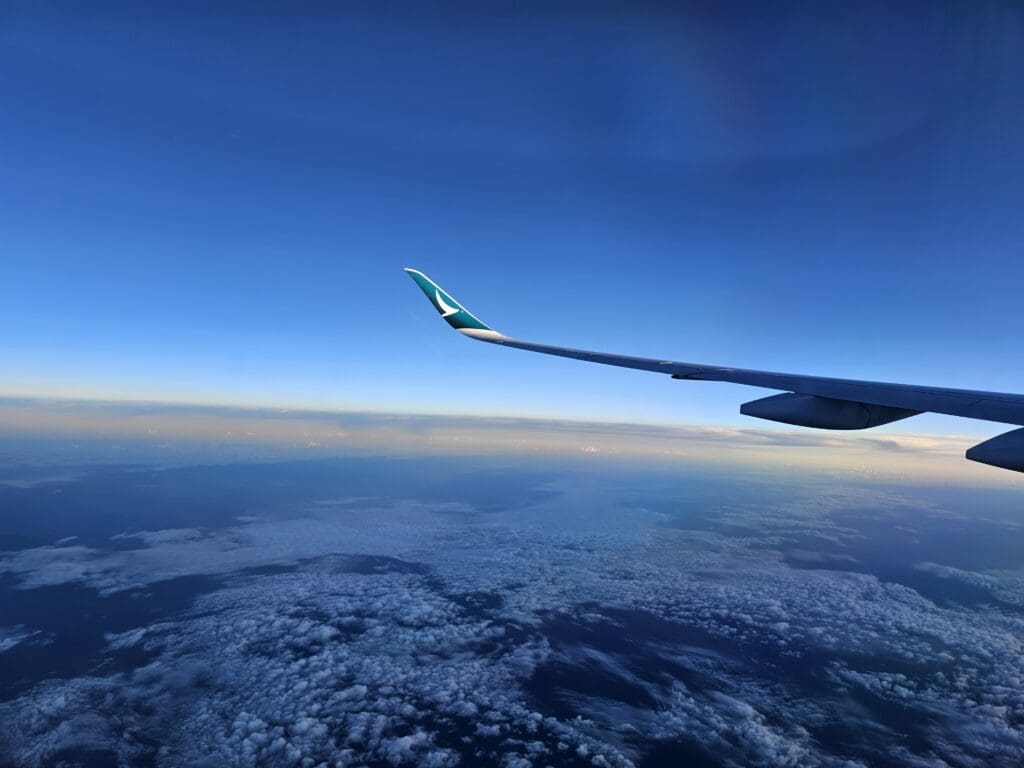
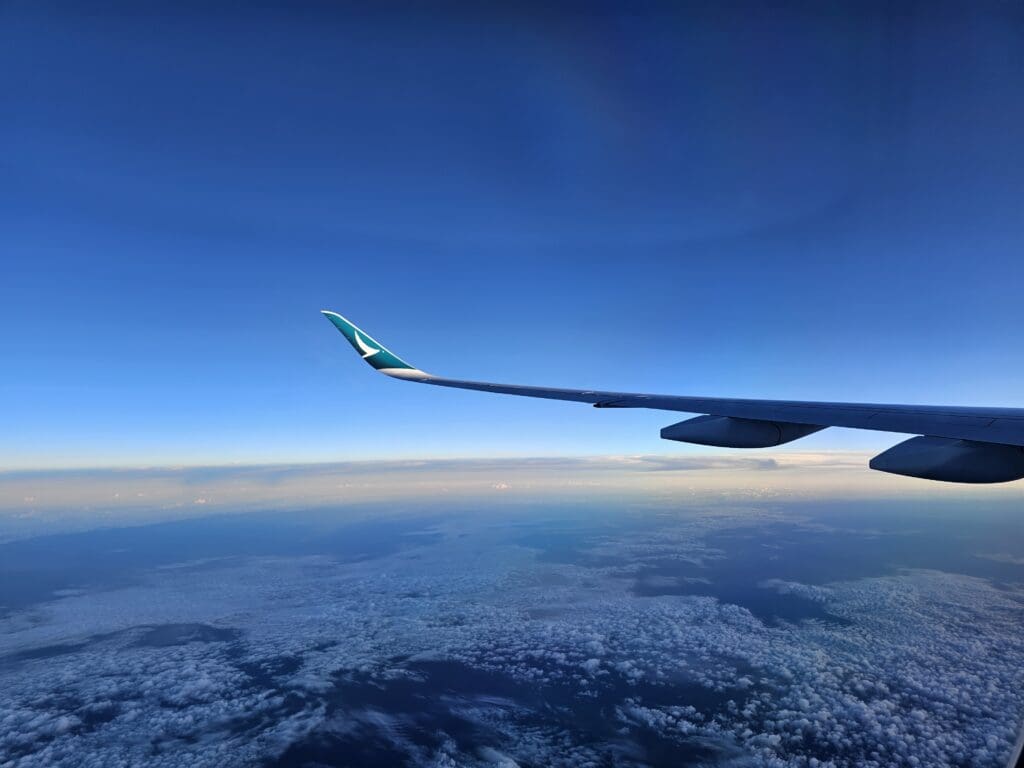
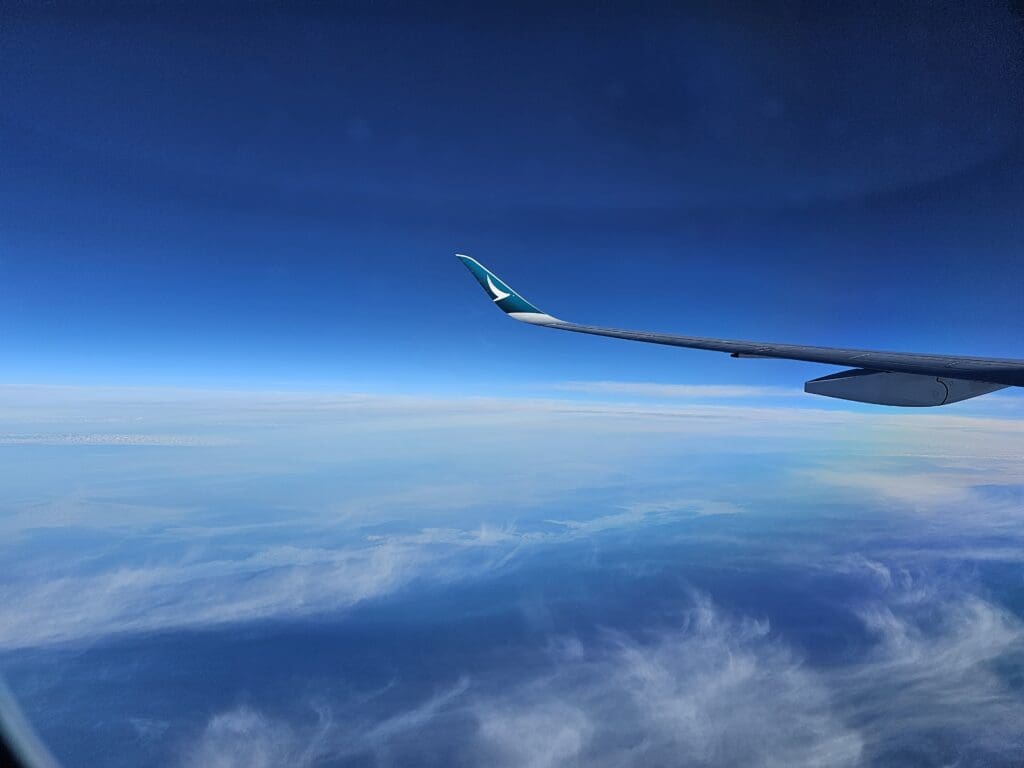
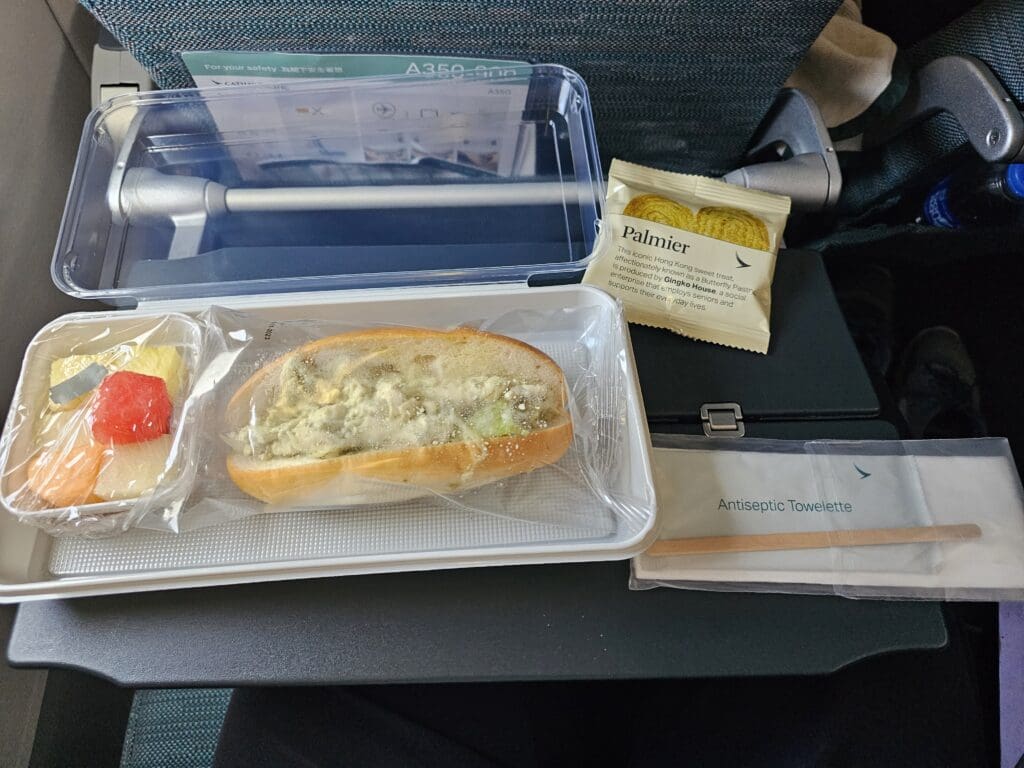
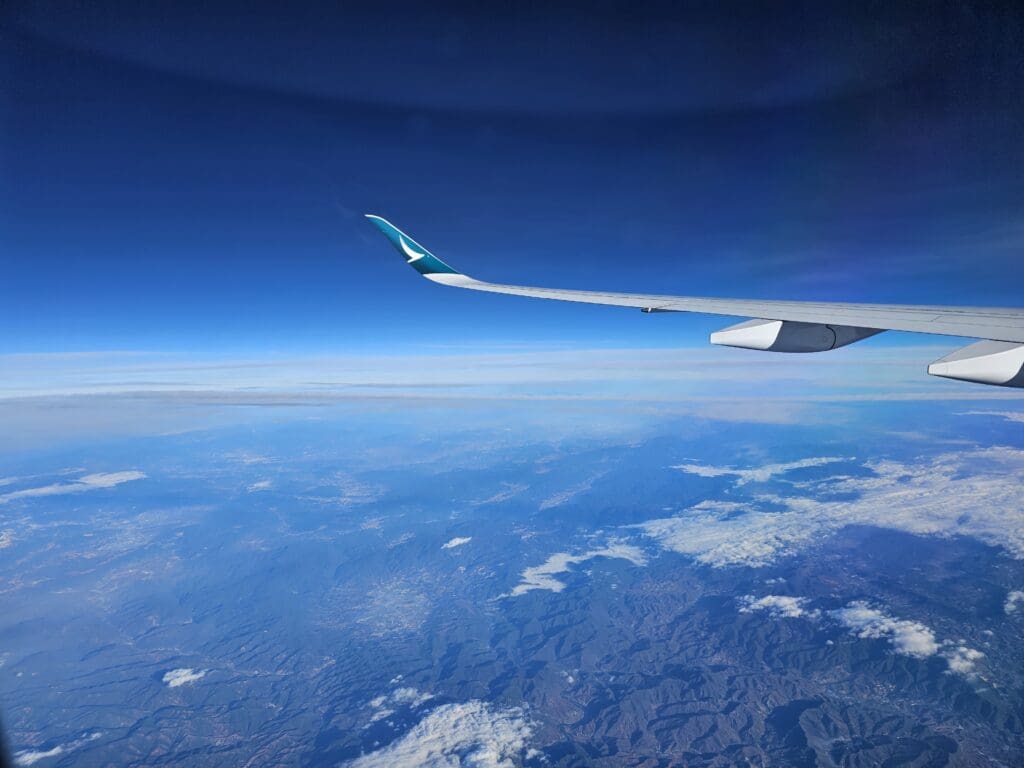
Cautiously and briefly opening up the window shade, I was treated to a few glimpses of Yunnan’s mountains as we passed near the popular city of Lijiang, which I had visited back in 2017 (you can see my Tibet Airlines report on the flight to Lijiang here!). From there, the aircraft continued onwards and soon neared the region’s capital Kunming before heading into the skies above Guizhou. Back inside the cabin, just before reaching Kunming, the service carts were rolled out once more as the breakfast service began. With no choice, all passengers were handed a rather unattractive plastic box containing a za’atar chicken sandwich and a small fruit salad, along with a wet wipe and a serviette. Meanwhile, a few moments after being handed this, I was then given a flaky Parmier biscuit. Focusing on the service, the breakfast was handed out quickly and with minimal interaction. On a side note, during both this and the evening meal service, whilst by no means unfriendly, the crew were also not particularly memorable either – undertaking their duties politely but not spending much time interacting with passengers. Whilst not particularly hungry, I had no issues polishing off the sandwich, with this proving to be rather delicious. A few minutes later, the drinks cart arrived at my row and seeing as I was flying on Cathay Pacific, I opted for the Hong Kong-style milk tea, however, I was presumably misheard and simply handed a regular tea with a sachet of milk in a somewhat brash manner without a word – this being the only particularly negative interaction that I had with the crew during my flight.
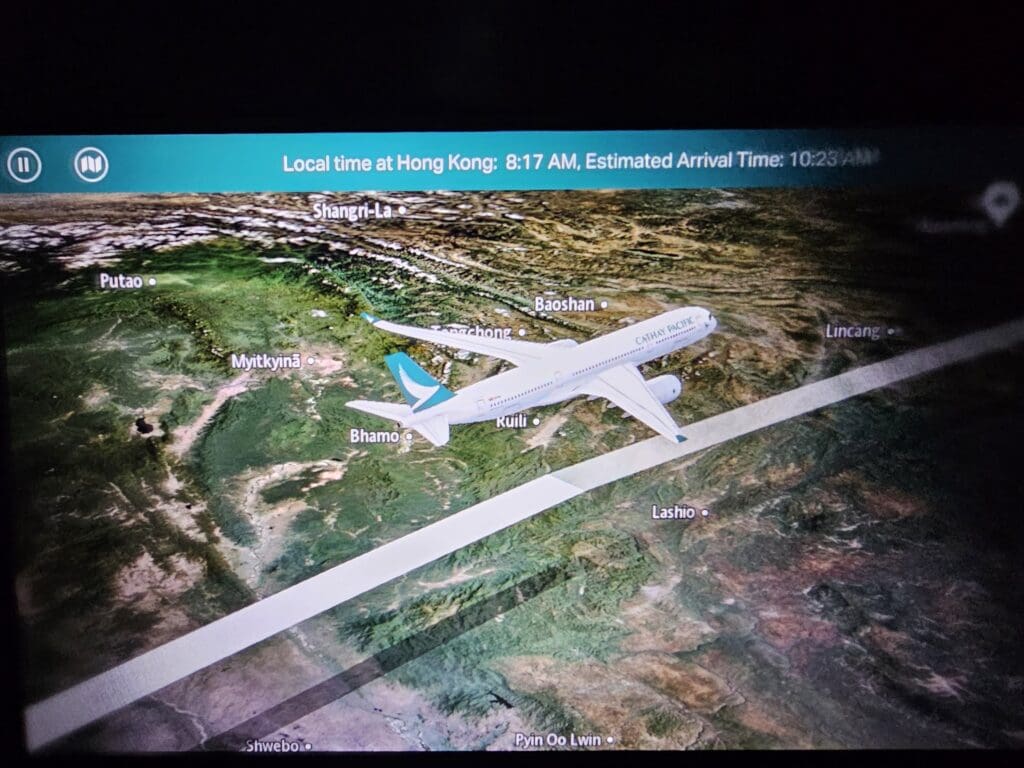
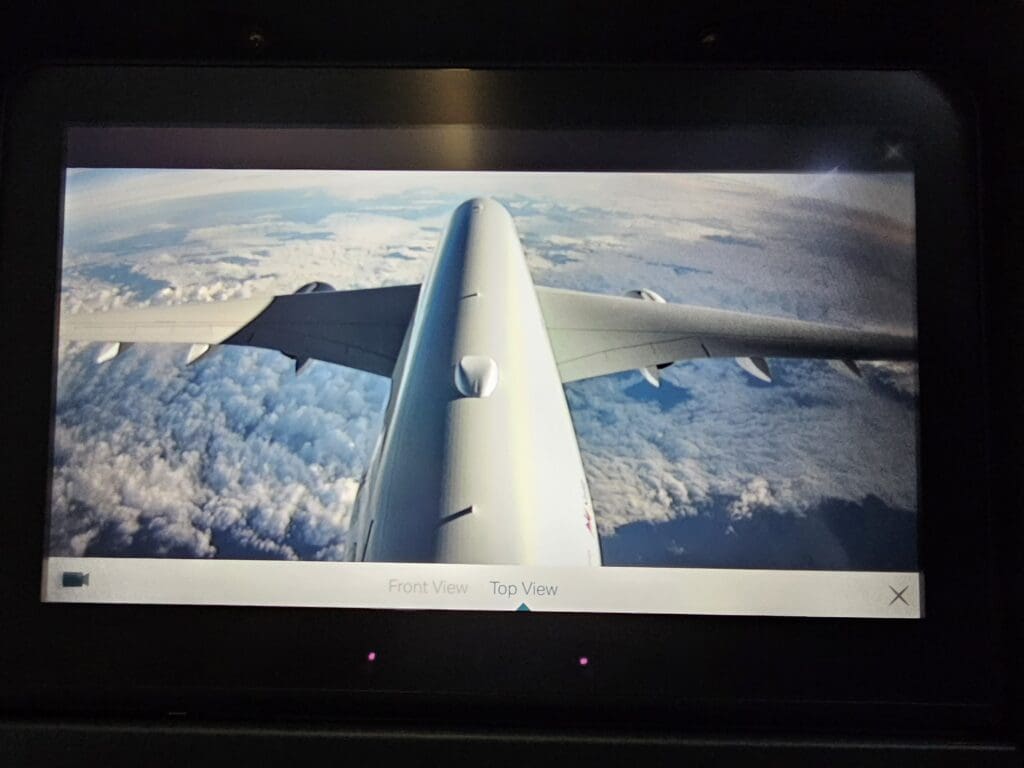
Around twenty minutes after the breakfast service commenced, the crew came to collect the remains of the service, by which time there was not a great deal of the flight remaining. Outside, after leaving Yunnan unfortunately, thick clouds rolled in below and remained there until we neared the final stages of the flight as we neared Hong Kong. However, examining our route across southern China, from Guizhou, the aircraft then passed into the skies of Guanxi and made its way past the region’s capital, Nanning. After this came Guangdong, which neighbours the likes of Macau and Hong Kong. With little to see below, I decided to make one last toilet visit and was pleased to find this to be in a clean and presentable state, presumably having been tended to during the flight.
As we neared the megacity of Guangzhou, the aircraft could be felt commencing its descent and a few minutes later the Captain’s calm voice filled the cabin as they thanked passengers for flying with Cathay Pacific and advised that we could expect to be on the ground in 25 minutes and would have a 10 to 15-minute taxi to the gate. After this, little happened inside the cabin until the seatbelt signs were reilluminated, at which point the crew commenced their pre-arrival checks. These were thorough, with multiple crew members checking and then re-checking the cabin, with a final rubbish collection round also made before our arrival as we descended through the clouds at which point I received an invitation to complete a survey on my experience via the inflight entertainment system.
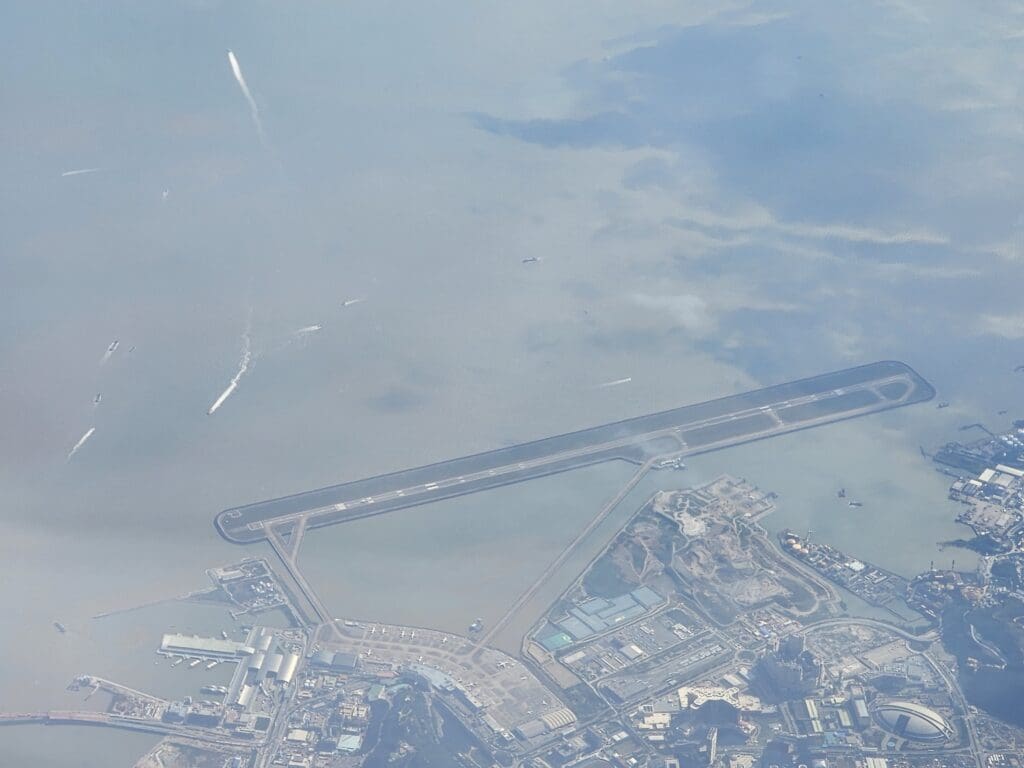
Once we had passed the thin layer of clouds, Macau popped into view 21,000 feet below, and a good view of the city could be seen. As an aviation enthusiast, I was able to easily recognise Macau Airport thanks to its unique layout, where a host of locally based Air Macau Airbuses could be seen. From there, the Airbus voyaged out to sea, at which point the cluster of islands in Shawan Bay came into view before we banked and turned to head towards Hong Kong.
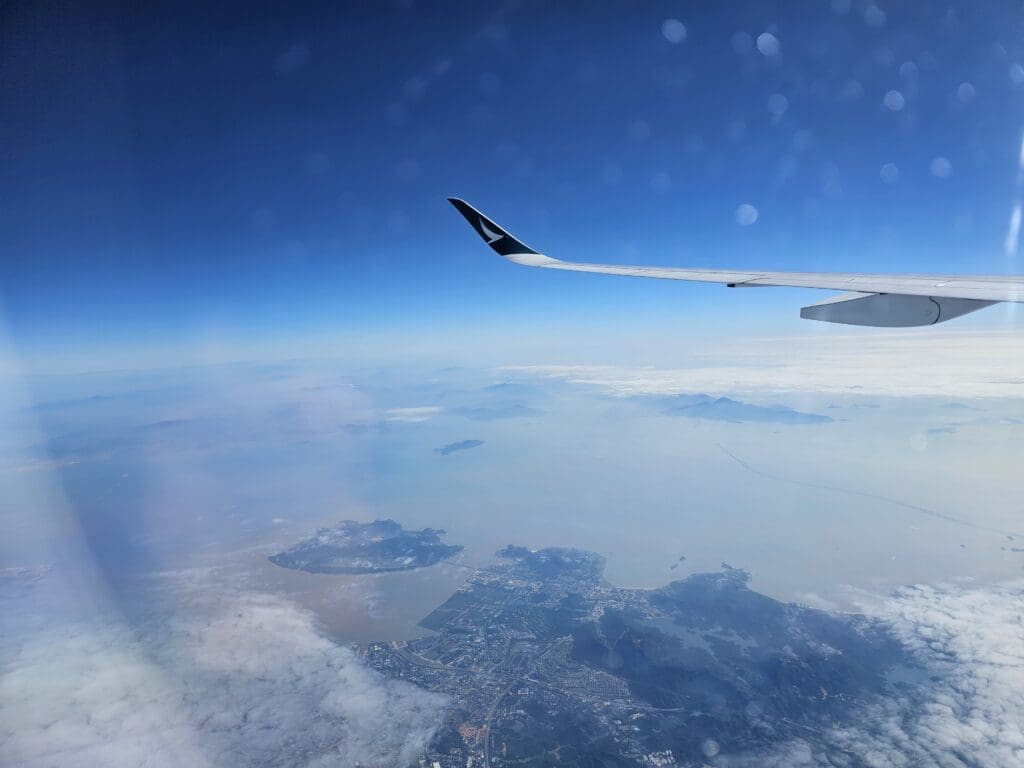
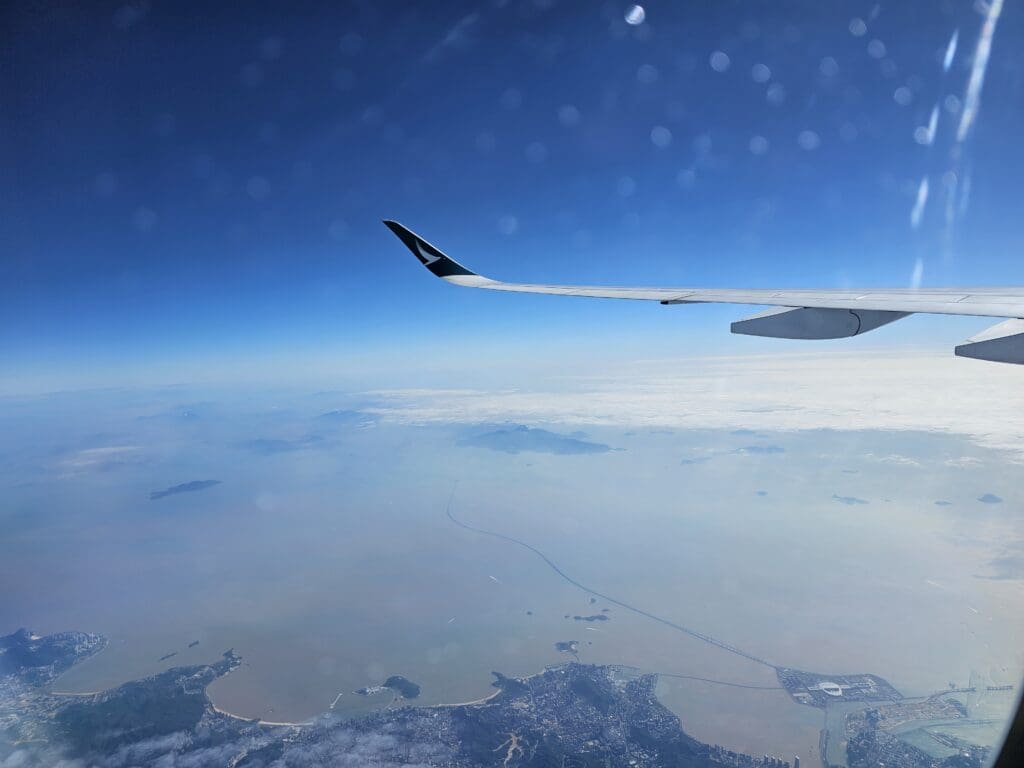
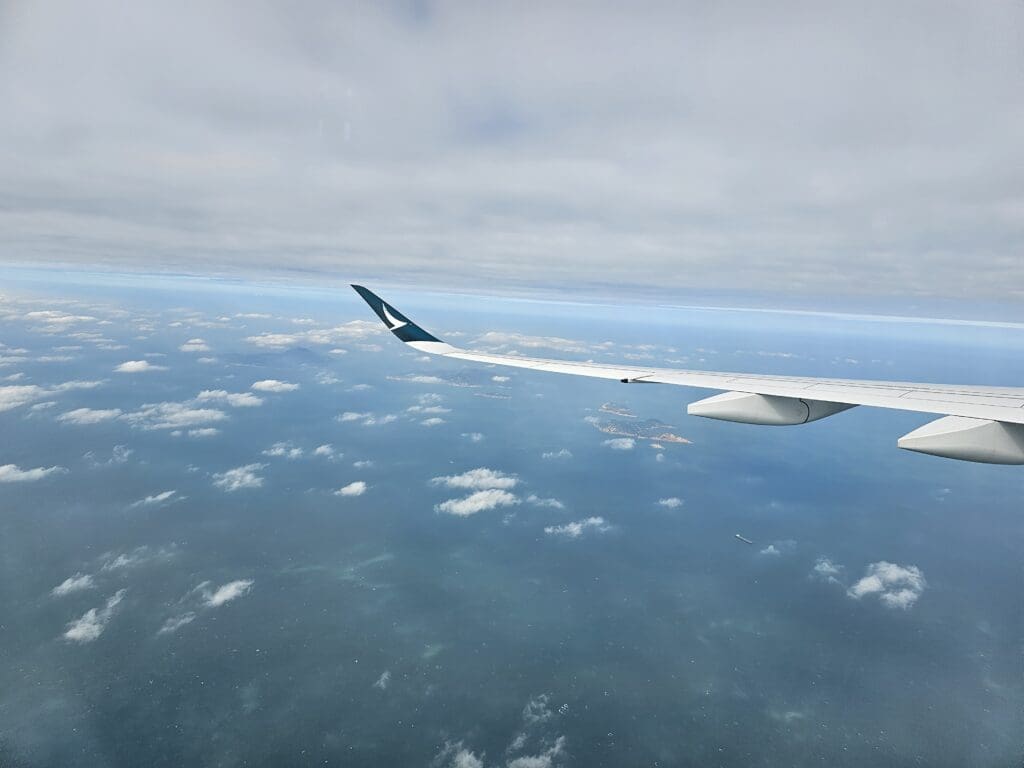
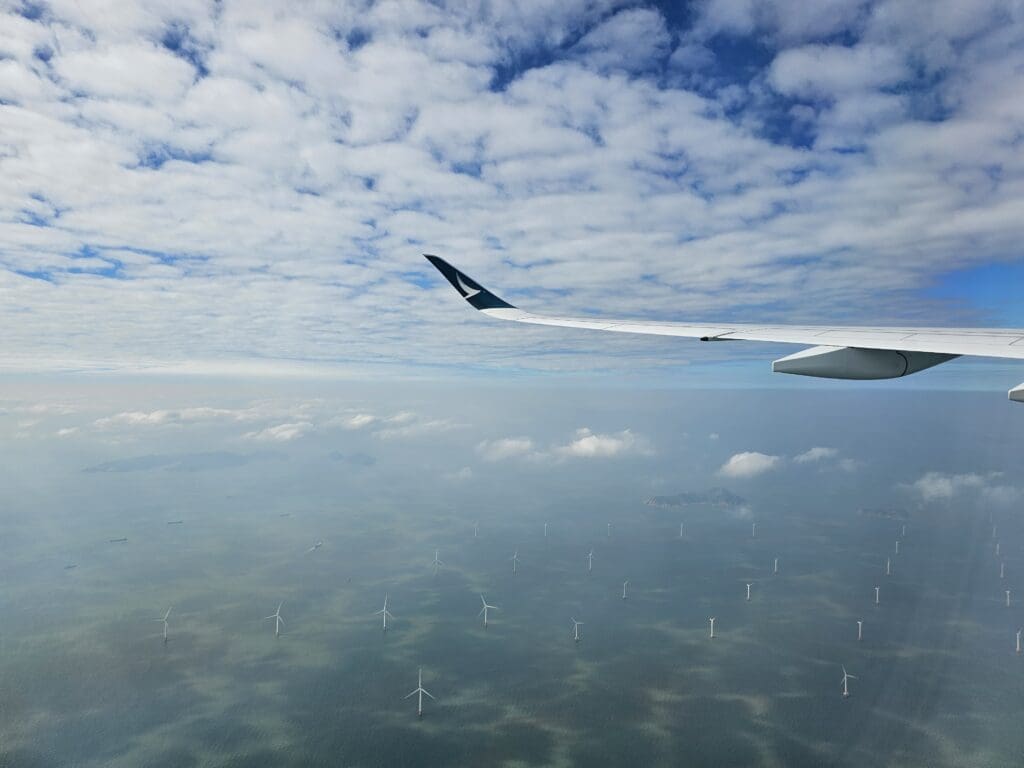
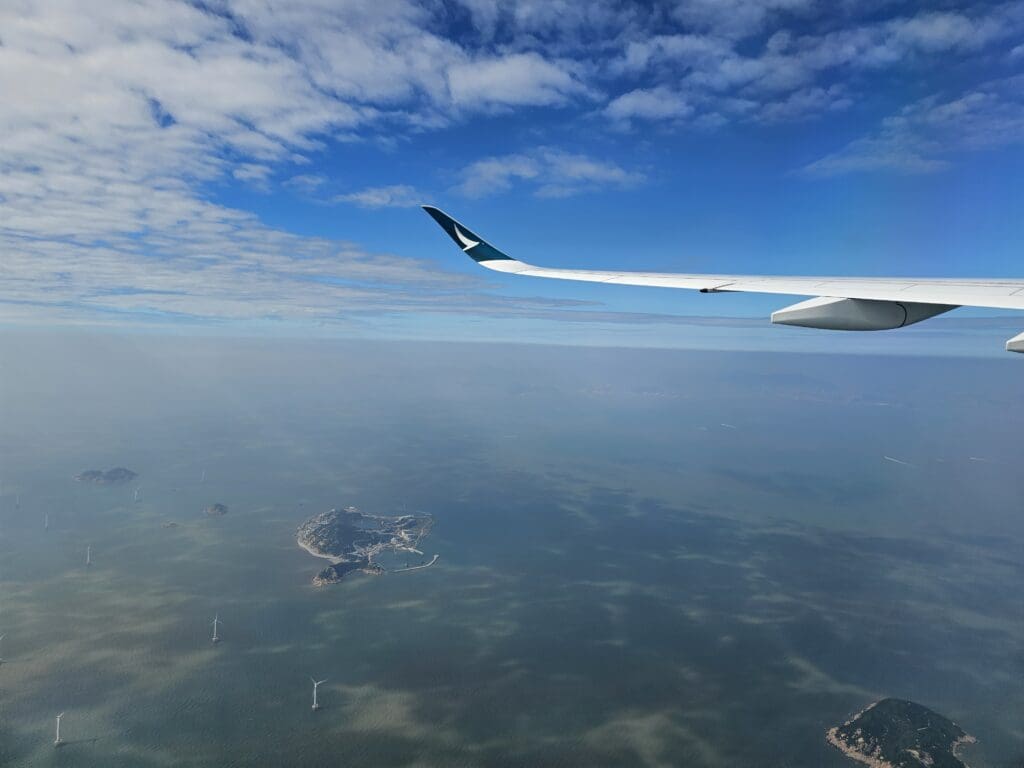
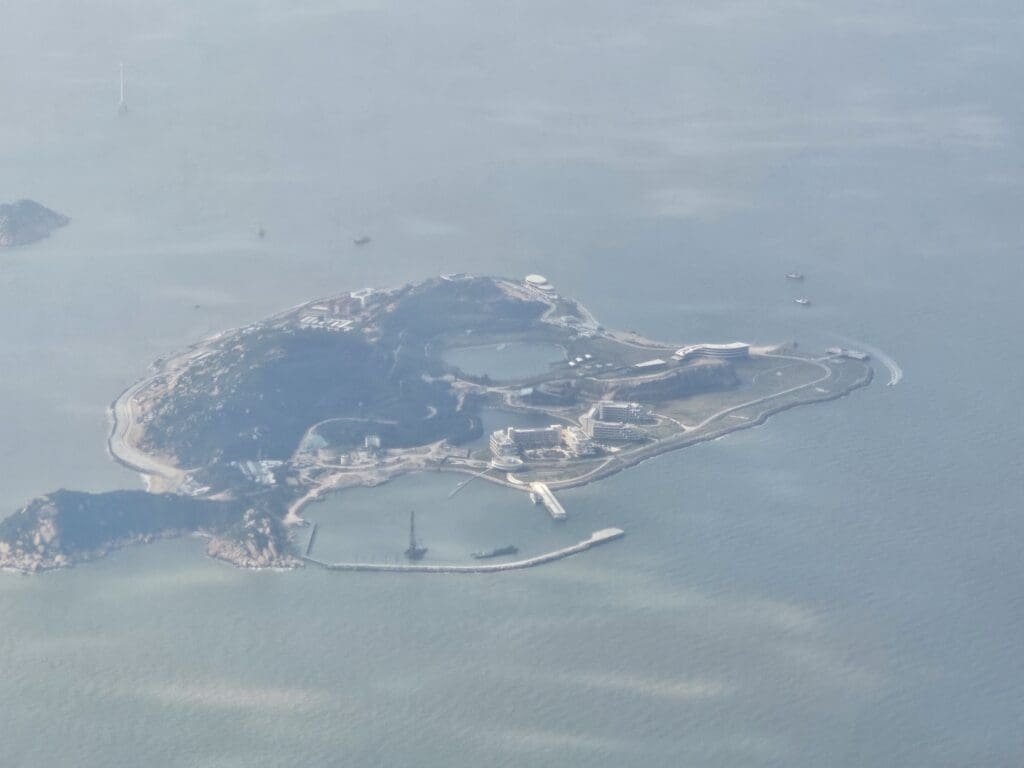
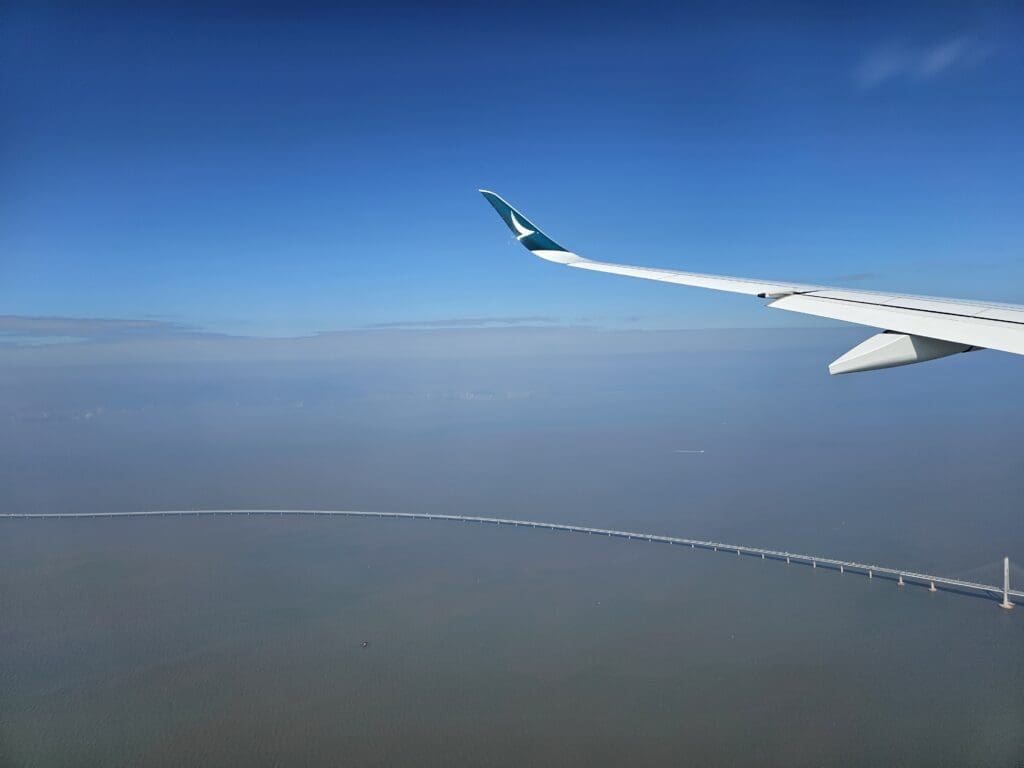
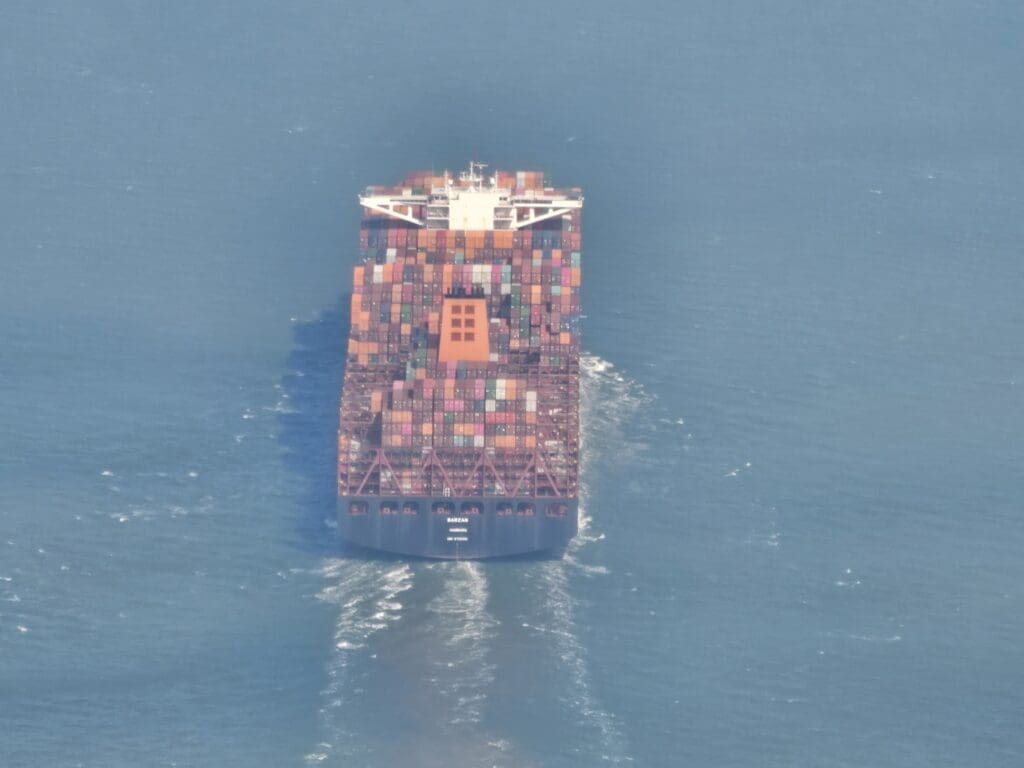
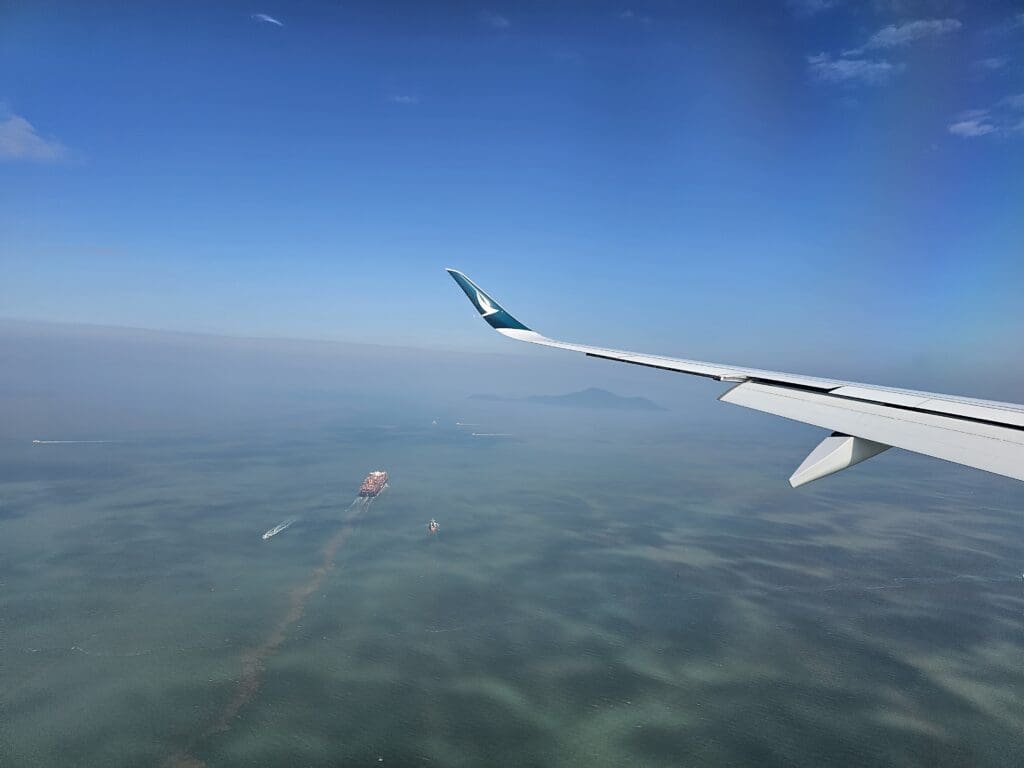
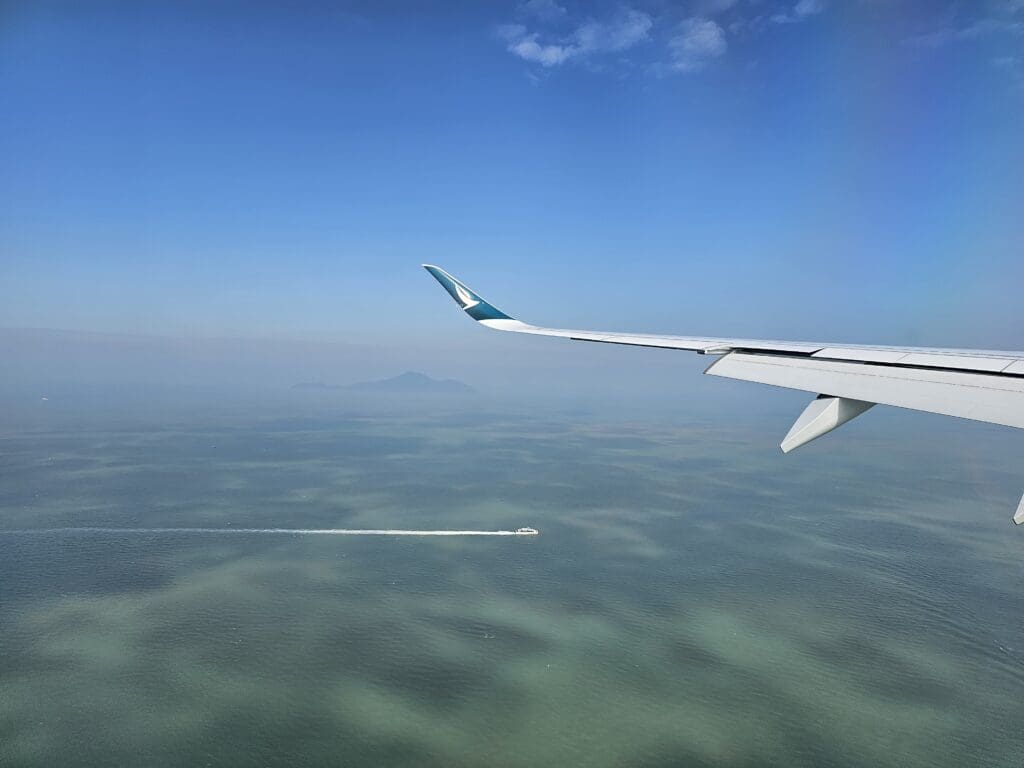
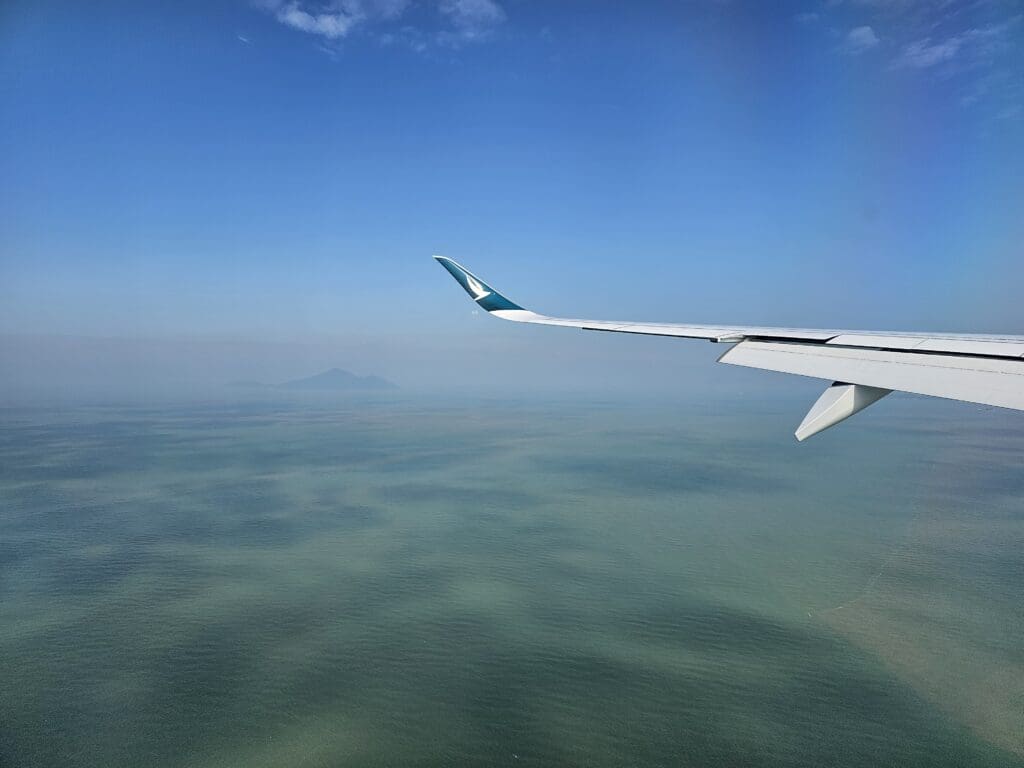
As we sank over the islands of Shawan Bay, it wasn’t long before the impressive sight of the long Hong Kong-Zhuhai-Macao Bridge came into view and after crossing this the aircraft’s flaps and landing gear were extended into position in preparation for our arrival onto Hong Kong’s Runway 07L. As we sank, plenty of ships of all shapes and sizes including small fishing boats, fast ferries and a Coast Guard cutter could be seen. The largest and most impressive of which was the MV Barzan, a humongous container ship operated by the United Arab Shipping Company which was on a voyage hopping between East Asia’s largest ports.
At 1030 local time, the smooth flight was brought to a smooth end as the Airbus made a soft touchdown in Hong Kong, ending a pleasant 6H40 in the skies of Asia. As we decelerated, music soon began to ring out over the cabin speakers and in the usual manner, after vacating the runway the Cabin Services Manager welcomed us all to ‘Our Home, Hong Kong’ and we commenced a slow and cautious taxi to the gate. Up ahead, a China Airlines Boeing 737-800 could be seen, which had landed ahead of us after its short journey from Kaohsiung, whilst we were soon followed by a Cathay Pacific Cargo Boeing 747-400F.
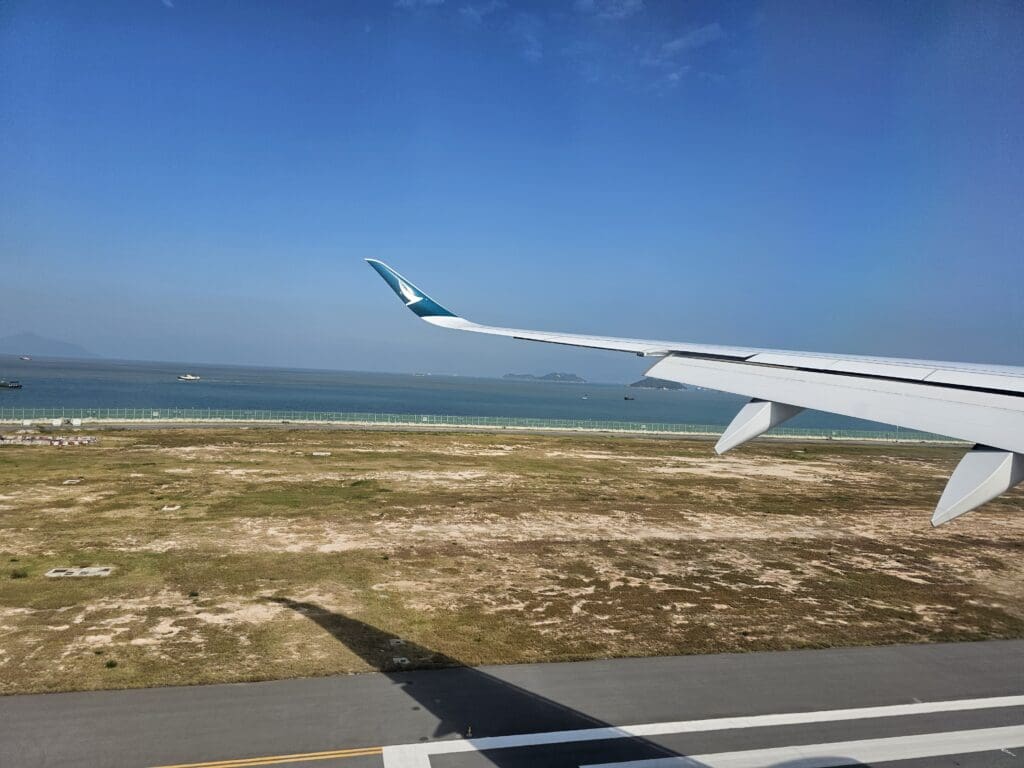
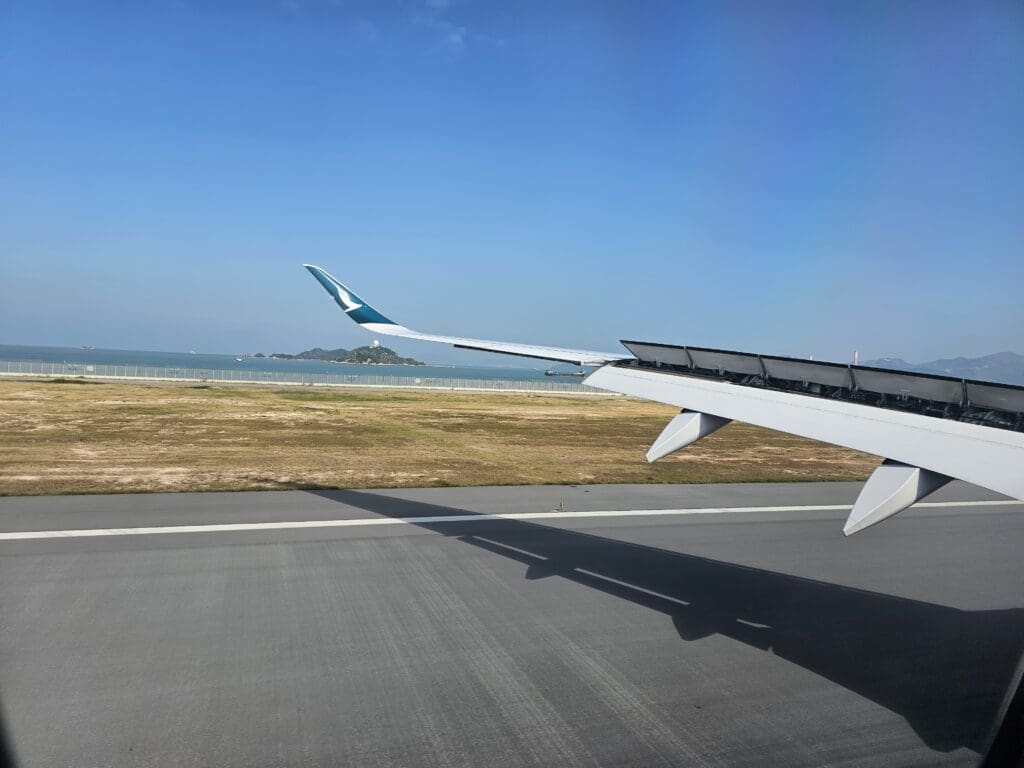
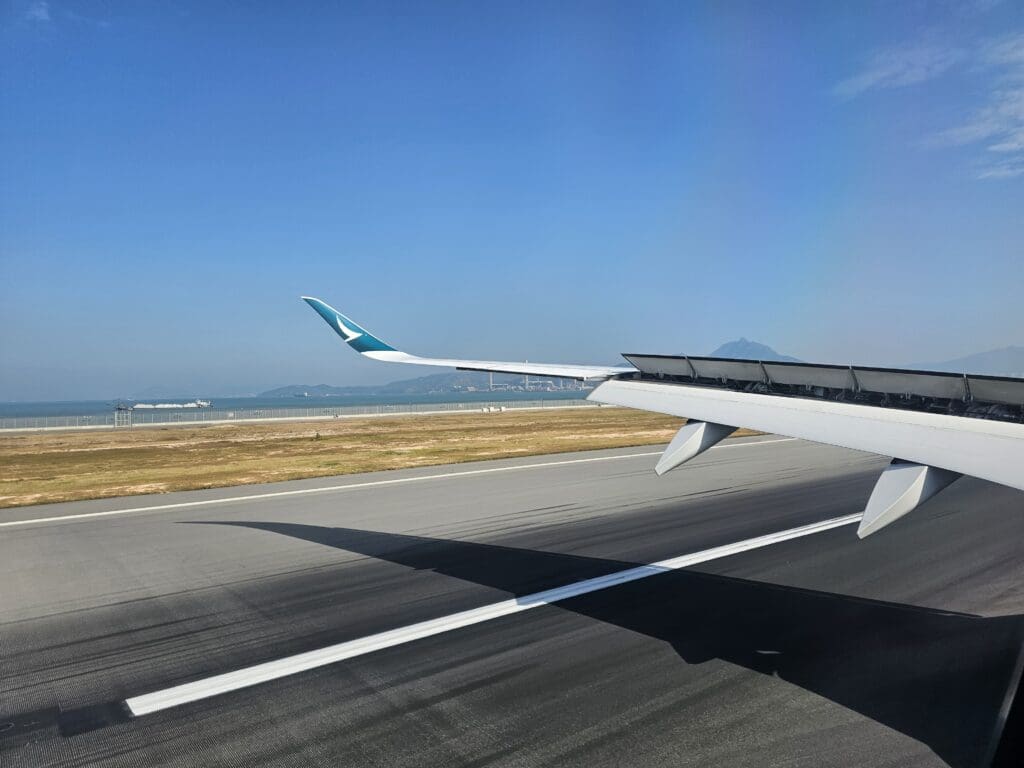
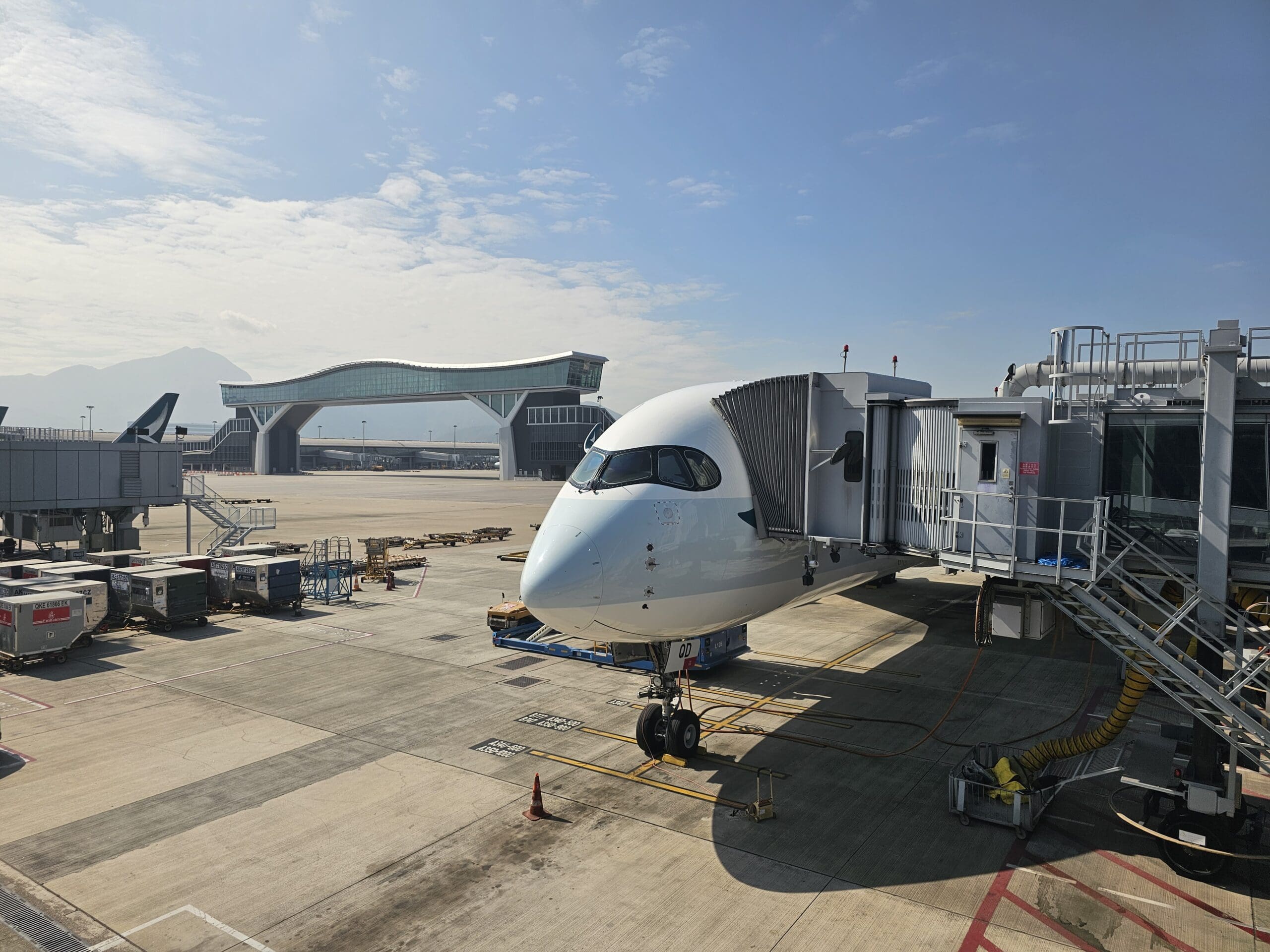
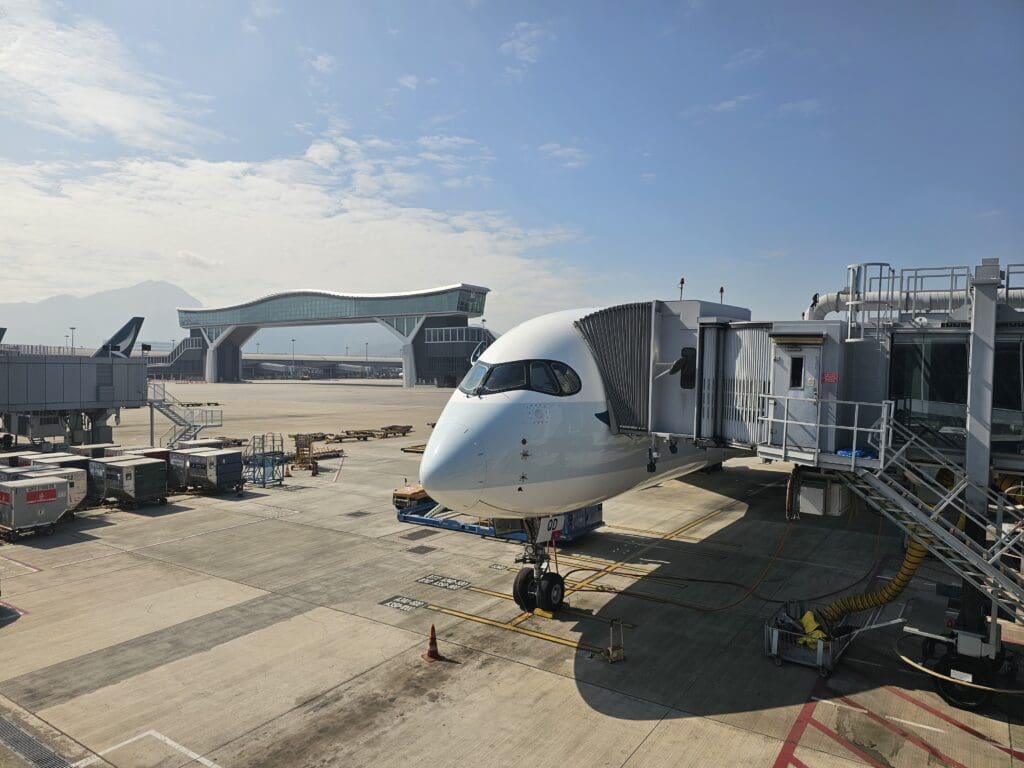
Trundling along the maze of Hong Kong Airport’s taxiways, true to the Captain’s words, 14 minutes after touching down, the Airbus came to a gentle halt at Stand N9. On the cameras, I watched as an army of ground staff sprung into action as soon as we came to a halt, and it did not take too long before a single jetbridge was manoeuvred into position at the L1 door. In the usual manner, once the engines spooled down, many stood up and retrieved their belongings and fortunately, it did not take too long before disembarkation commenced. Thanks to the light load, no lengthy wait in the aisle was required and I soon trundled forward through the now-messy cabin. As I did so, I was thanked and wished farewell by several crew members before I reached the front of the aircraft where I was thanked by the Cabin Services Manager before stepping off the aircraft at 1051. That day the aircraft would have a fairly long stay on the ground and would head off almost seven hours later on an ultra long-haul slog to New York.
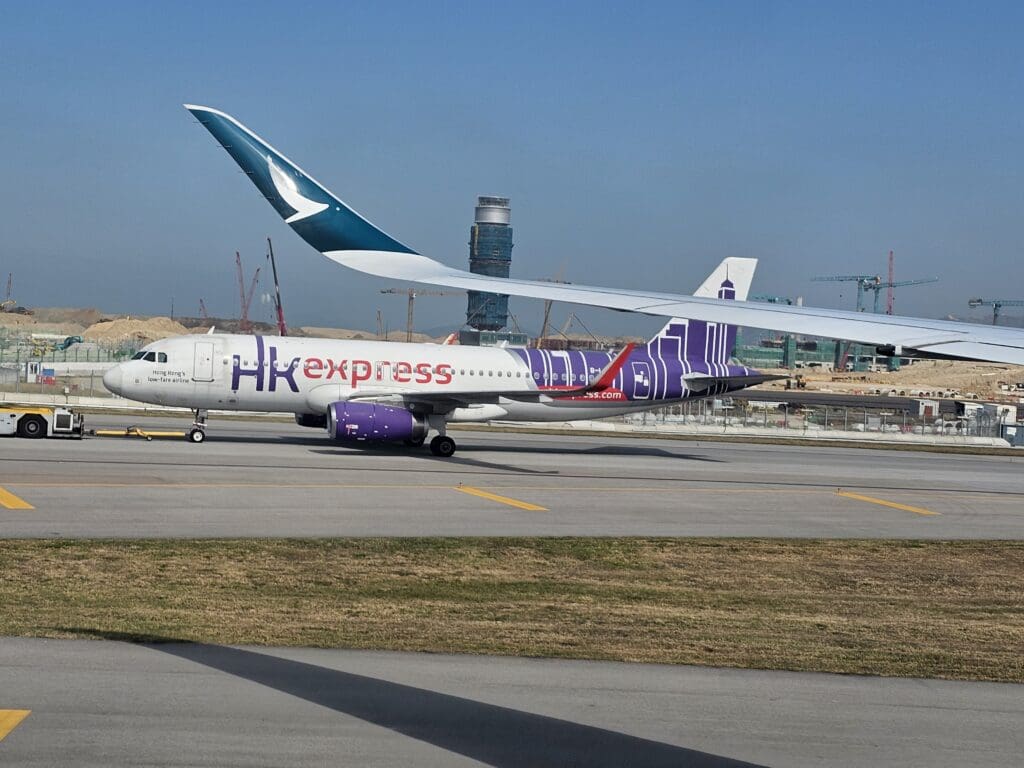
Once up in the terminal, I followed signs for arrivals which was all going smoothly until an agent from the Hong Kong Customs and Excise Department came running after me! After flashing their warrant card, they requested to see my boarding pass and passport however it soon became clear that I wasn’t the person they were after as I was then allowed to continue on my way. Following signs for transfers, I soon arrived at the fairly small security checkpoint. Fortunately, with no queues, I was able to walk up straight to this and following a quick scan I was able to continue onwards to the airside departures area which I will cover in my next trip report covering my Airbus A330 ride to Jakarta.
Summary
All in all, I enjoyed a very good ride from Dubai with Cathay Pacific and had few real complaints about my first-ever experience with the airline. The aircraft was in a superb state and proved to be very comfortable. Other than the frozen salad, the food offered was good, and the crew was, for the most part, polite and reasonably friendly. This left me looking forward to what delights would be in store on the slightly shorter flight down to Jakarta.