Sampling Indonesian Giant Lion Air: Pangkalpinang to Jakarta on a Boeing 737-900ER
Background
Lion Air was never an airline that I envisaged flying on during my short trip to Indonesia. Originally, I had been scheduled to fly from Jakarta to Palembang onboard a Sriwijaya Air Boeing 737-500, with stops in Tanjung Pandan and Pangkalpinang. From there, I would shuttle back to the Indonesian capital onboard a Super Air Jet Airbus A320. However, the cancellation of the last of the three legs would see me needing to return from Pangkalpinang to Jakarta. Despite discovering this on the morning of my flight and thus booking just hours ahead of departure, thankfully, I was able to bag a cheap £33 fare for Lion Air’s late morning service from Pangkalpinang to Jakarta.
About Lion Air
If you have any knowledge about the Southeast Asian aviation scene, then the chances are that you will have some awareness of the Indonesian giant, Lion Air.
Coming from humble beginnings, Lion Air began operations in 2000 with a compact fleet of Boeing 737-200s connecting Jakarta with Depasar and Pontianak. As Indonesia’s first truly low cost carrier, Lion Air enjoyed significant initial success, catalysing on both the increasing disposable wealth of many Indonesians and the increasing number of overseas tourists. As demand for Lion Air’s services grew and its route network expanded, the airline added an eclectic mixture of aircraft types to its fleet. These included Airbus A310s, McDonnell Douglas MD-80s, and my personal favourite, wet-leased Yakovlev Yak-42s. However, the seemingly sensible decision to focus on a single family of aircraft was soon made, with the airline opting to add Boeing 737-300s and Boeing 737-400s, before later shifting its focus to Boeing 737-800s and Boeing 737-900ERs.
As the years passed, Lion Air continued to expand, and soon, the airline came to connect most major airports across the massive expanse of Indonesia. This was furthered with the establishment of a wholly owned regional subsidiary, Wings Air, in 2003, who continue to focus on connecting Indonesia’s smaller and often remote towns and cities. Meanwhile, in 2009, the airline added two Boeing 747-400s in order to provide high-density pilgrimage flights from cities across Indonesia and Saudi Arabia, a task now undertaken by five Airbus A330-300s and eight Airbus A330-900s. In 2011, Lion Air hit the headlines when it placed the world’s largest aircraft order, ordering 230 Boeing 737NGs and Boeing 737 MAXs from Boeing; however, this was beaten in 2013, when the airline ordered 234 Airbus A320 Family aircraft!
Over in Malaysia, well-known giant AirAsia demonstrated clear success in establishing subsidiaries to target other markets across Asia, doing so in India, Indonesia, Japan, the Philippines and Thailand. Perhaps not wanting to miss out on the opportunity to expand beyond its borders, Lion Air established Malaysian and Thai subsidiaries, Malindo Air and Thai Lion Air, in 2012 and 2013 respectively. Meanwhile, back home, Lion Air established a full service carrier, Batik Air, which is today Indonesia’s fourth-largest airline. More recently, the airline has been involved in the establishment of Indonesian low cost carrier Super Air Jet, which commenced operations in 2021. Today, operating a fleet of over one hundred aircraft, today, Lion Air is the largest airline in Indonesia, offering cheap flights across the country and international services to China, Malaysia and Saudi Arabia.
The Journey
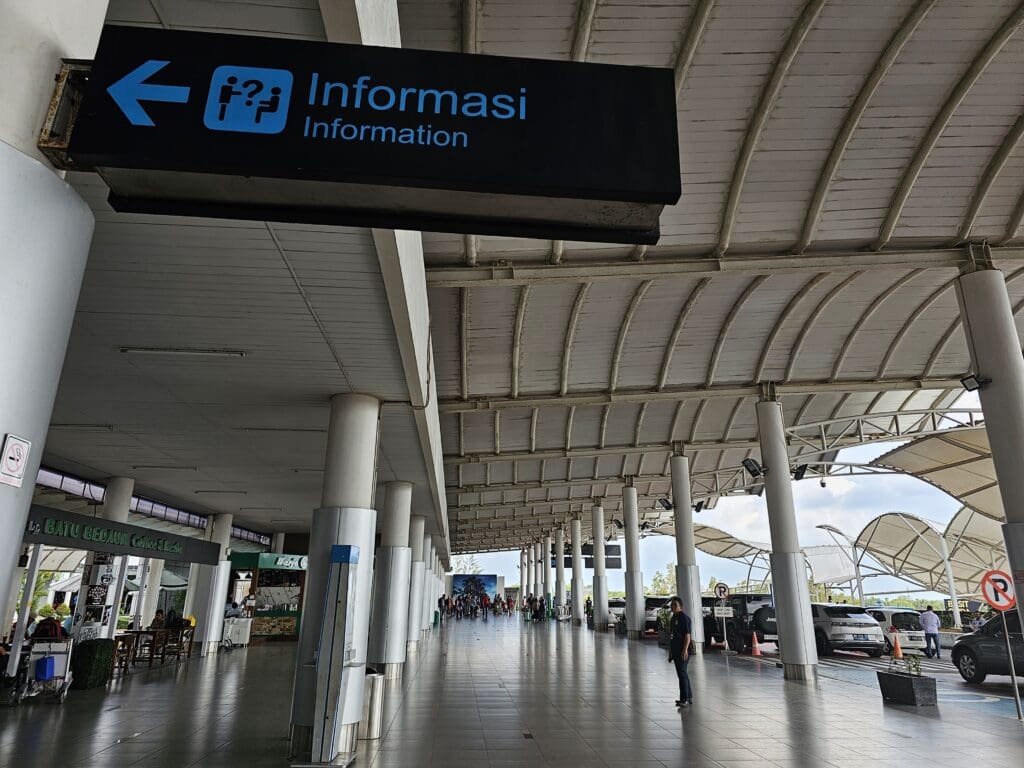
Following my exciting ride onboard Sriwijaya Air’s elusive Boeing 737-500, I touched down in Pangkalpinang with a comfortable total of two and a half hours before the scheduled departure time of my flight back down to Jakarta. Lacking anything to pick up from the airport’s small baggage collection hall, it wasn’t long before I found myself standing in the heat and humidity of Depati Amir Airport’s partially outdoor arrivals area. There, a fair crowd of people could be seen eagerly waiting for those who had arrived on Sriwijaya Air’s service from Tanjung Pandan. Looking around, the outdoor area seemed to host a good number of stalls that offered a wide array of food, drink and other items. Despite being the only non-Indonesian in sight, I was pleased to find that I was not swamped by taxi drivers looking for their next golden fare, with just a single driver approaching me who left me alone after I had politely declined the offer of their services.
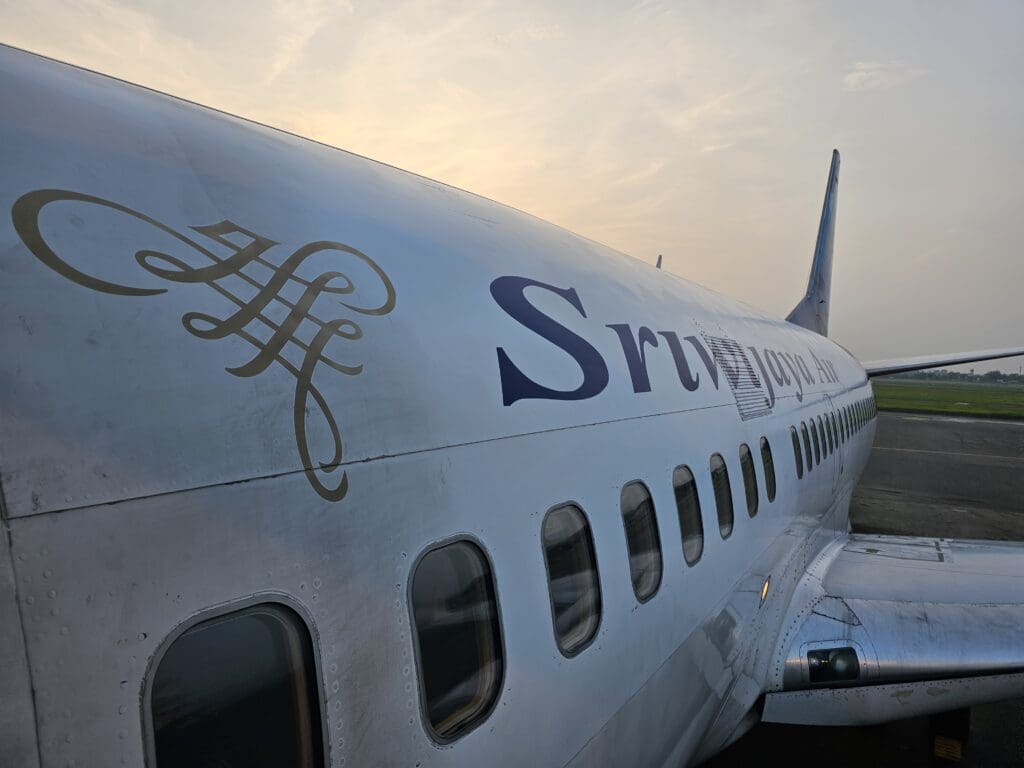
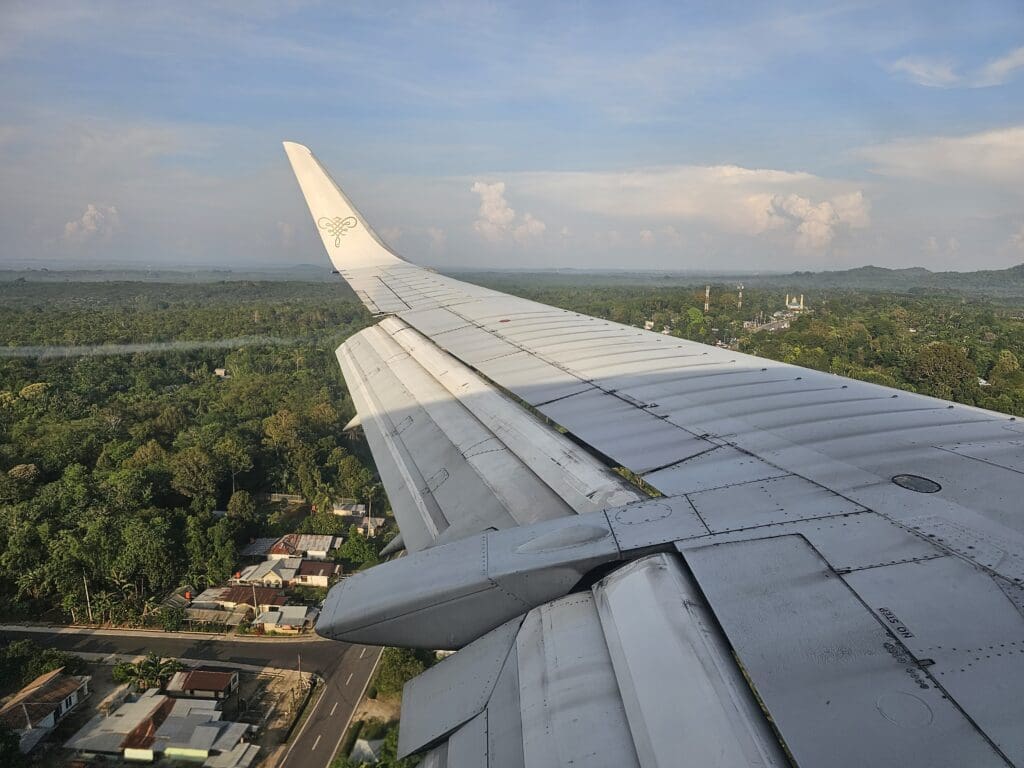
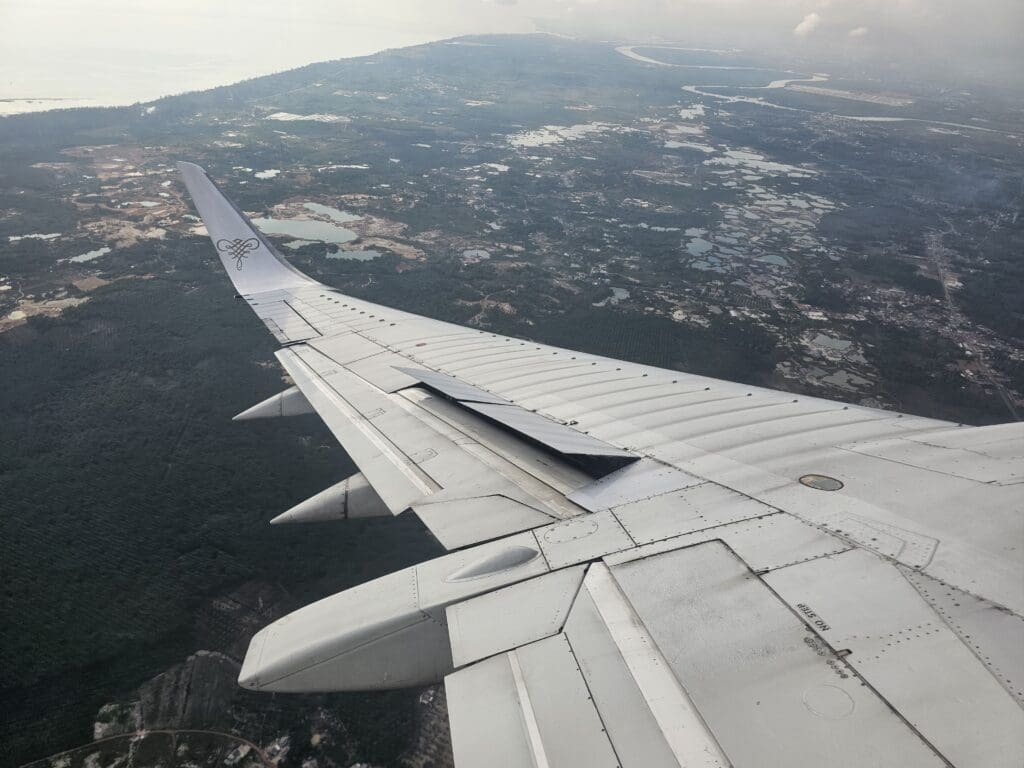
Not wanting to make any purchases, I wandered back over to the entrance to the terminal’s check-in hall. As seems to be the norm in Indonesia, this appeared to be out of bounds to anyone other than departing passengers. Once there, the security officer checked my ticket before permitting me to enter the check-in area. As was to be expected, the landside portion of the terminal was not particularly large and consisted of a small square-shaped hall, with a row of check-in counters sitting along one side of this. Each of the five airlines serving Pangkalpinang at the time of my flight, namely Citilink, Garuda Indonesia, Lion Air, Sriwijaya Air and Super Air Jet, enjoyed their own check-in desks heavily decked out with each airline’s branding, making it near impossible to wander up to the wrong desk!
Having missed the rush of Jakarta-bound passengers departing on Super Air Jet’s morning service, and still with plenty of time to go until the next departures, at that time, this part of the terminal was fairly quiet, and I was able to walk straight up to the single Lion Air desk. Once there, I handed over my passport and ticket to the friendly Lion Air agent. Unfortunately, owing to my lack of Indonesian language skills, there were a few communication barriers, so an English-speaking member of staff was summoned over from the neighbouring counter. After requesting a window seat, the agent printed off my boarding pass, and I was free to continue onwards.
Not wanting to remain in the viewless check-in hall and with nowhere else to go, I ventured up the stairs and made my way over to the main security checkpoint. Consisting of just a single bag scanner and a metal detecting arch, I can imagine that this part of the terminal can end up getting rather busy at peak times. However, thankfully, at that time, this was as empty as the check-in area, and so I was able to walk straight up to the stern-looking officer guarding the entrance. Following a check of my boarding pass and passport, I continued onwards and enjoyed the luxury of a quick and easy check, with no need to remove any liquids or electronics from my backpack. After one of the two friendly security agents had wished me a nice flight, I was free to explore the delights of the airside portion of Depati Amir Airport.
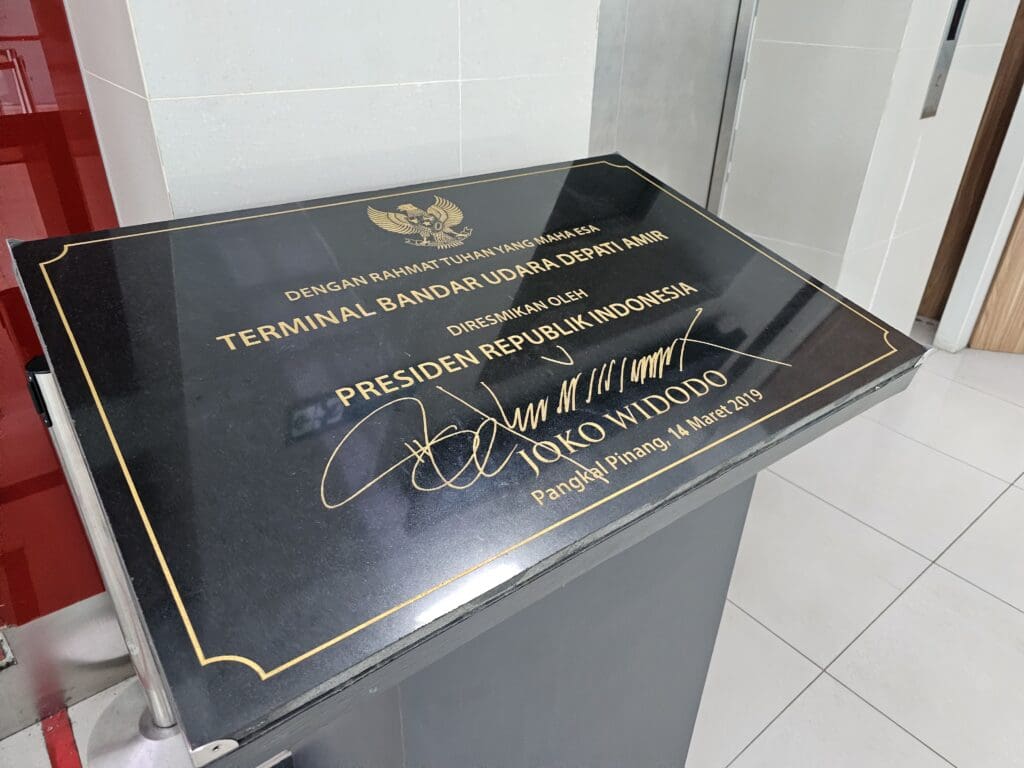
Home to less than a quarter of a million residents, as per Indonesia’s 2020 census, Pangkalpinang is Indonesia’s 57th largest city. Thus, I was not particularly surprised to find Depati Amir Airport to be far from the country’s largest or busiest airport. This is connected to just a small handful of destinations, with passengers able to catch direct flights to Jakarta, Palembang and Tanjung Pandan. Whilst I was unable to find a great deal on the history of Pangkalpinang’s airport, from what I did find, the airfield was constructed by occupying Japanese forces in 1942. Following Indonesia’s independence from Dutch rule in 1949, the airfield transitioned to civilian usage and came to play an important infrastructural role in connecting Bangka Island with the rest of the country. In 1999, this was renamed after Depati Amir, a local nineteenth-century independence activist, and more recently, in 2017, its current terminal opened.
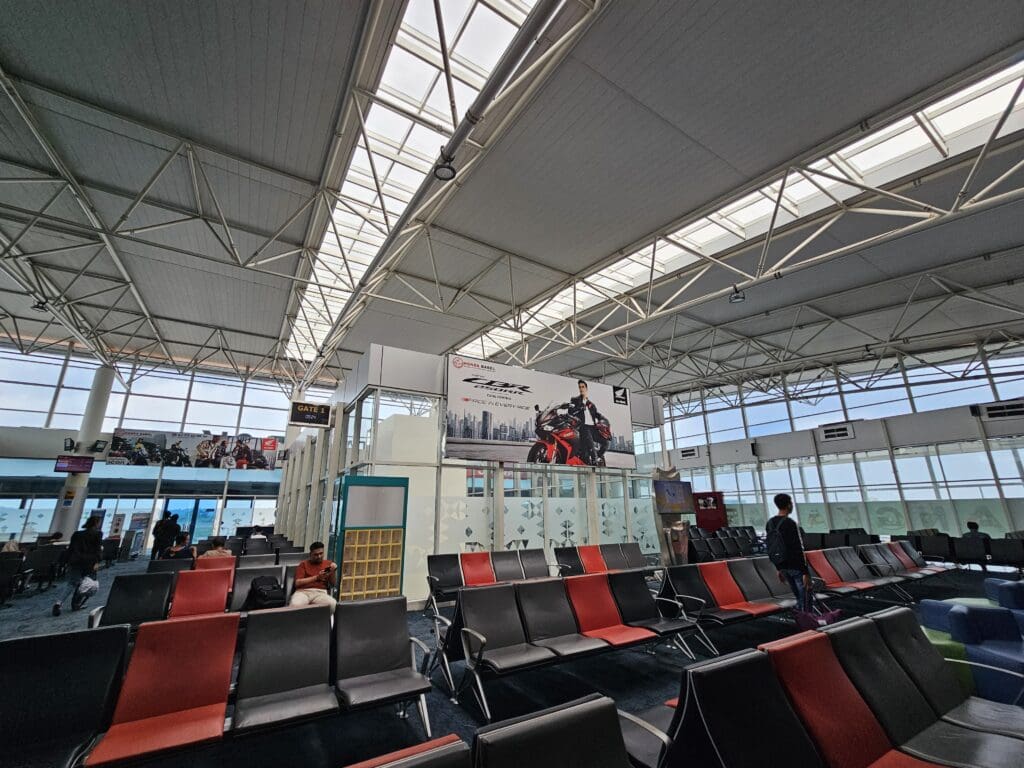
Being just six years old at the time of my flight, I was not surprised to find the terminal to be modern in its aesthetic, with plenty of glass serving to allow natural light to filter into the waiting area and give it an airy feel. Meanwhile, given the size of the terminal, I was rather surprised at the high number of facilities offered. In total, this was home to four convenience stores and three cafés, plus a small premium lounge, which seemed to consist of a boxed-off area separated from the main waiting area by frosted glass partitions. In addition, the terminal featured plenty of seating, several charging points and fast, complimentary wifi that worked well for the duration of my stay (other than during a two-minute power cut!). Meanwhile, I found the terminal to be fairly clean and in good condition, and overall, I was left with little to complain about.
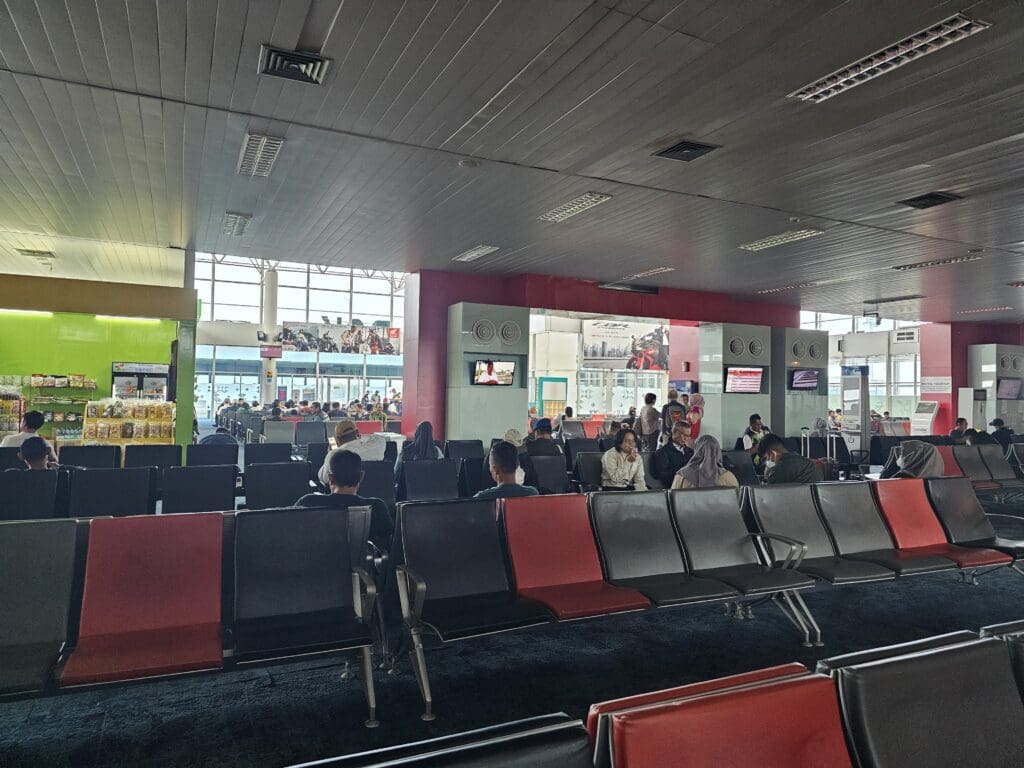
Unfortunately for aviation enthusiasts, whilst views of the apron can be had from the terminal, this is through two sets of glass, so photography would likely prove to be quite a challenge. After walking around, I headed to a convenience store to buy a can of coffee. However, once there, I discovered that this only accepted cash, which seemed to be a common theme across all of the terminal’s outlets. Defeated, I took a seat next to the window, and soon one of the shop workers appeared with a coffee and a bun in hand, told me that it was a gift and thanked me for visiting Pangkalpinang. Whilst feeling slightly guilty, I accepted this and passed the time by watching the world outside. Looking outside, once the Sriwijaya Air Boeing 737-500 that I had arrived on commenced its journey back to Jakarta via Tanjung Pandan, there was little to be seen outside. It did not appear that the airport hosts much traffic other than the airliners that serve this, with no light or military aircraft seen during my stay. As I waited, a friendly elderly passenger who was also heading to Jakarta approached me for a chat – hailing from Pangkalpinang, they moved to New York in the 1970s and were on their annual trip back to their hometown.
As time passed, more and more passengers began to arrive in the terminal, and whilst busy, this did not seem to be uncomfortable or overcrowded. According to my boarding pass, boarding would commence a total of thirty minutes before departure at 1015. However, with the inbound Boeing 737 not making its smoky touchdown until 1005, I was sceptical that this would indeed prove to be the case. Looking outside, an army of ramp workers had assembled at Stand A04, ready to meet the inbound jet and sprang into action as soon as the aircraft came to a halt. As seemed to be the case with almost all Lion Air jets that I had seen in Indonesia, this aircraft was in dire need of both an exterior wash and a repaint, with plenty of dirt marks and chipped paint seen all over the fuselage. A short time after the Boeing had touched down, this was joined by a Citilink Airbus A320 and a Lion Air Boeing 737-800, with these heading to Jakarta and Tanjung Pandan respectively.
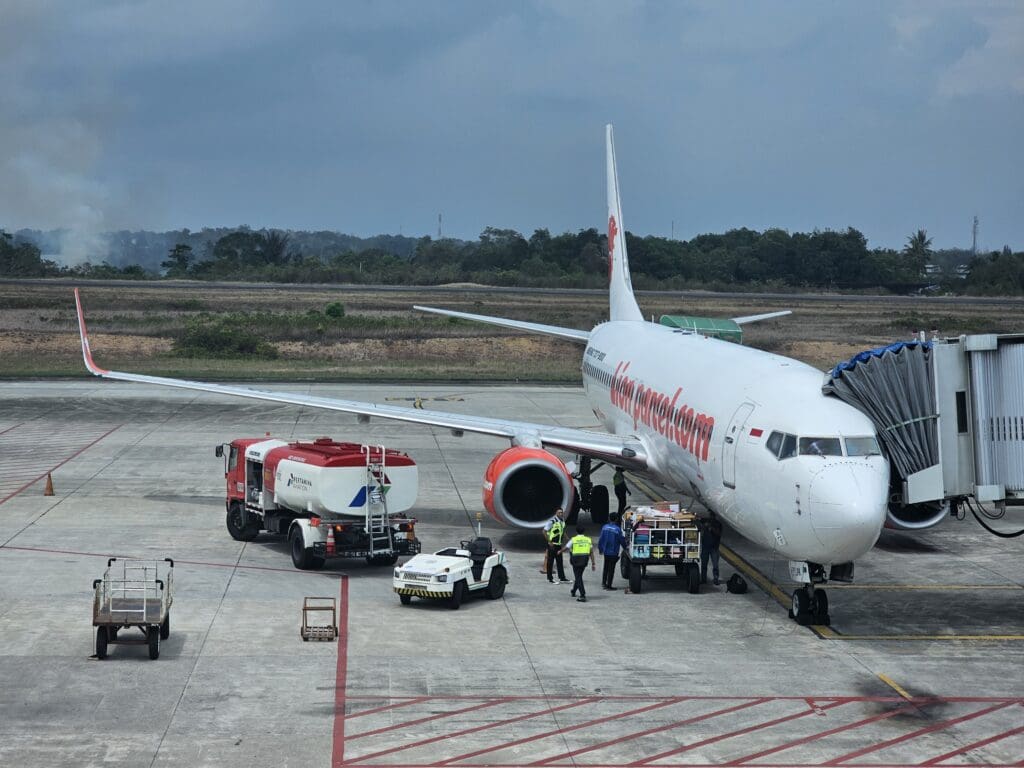
That day, I would be flying down to the Indonesian capital onboard Boeing 737-9GP(ER), PK-LQT. Assembled at Boeing’s plant in Renton, this particular aircraft first took to the skies in January 2012, making it almost twelve years old at the time of my flight and one of the older Sky Interior-fitted Boeing 737s that I have had the pleasure of flying on. Destined for Lion Air, in early 2012, the aircraft made its long delivery trek across the Pacific Ocean, making stops in Honolulu, Majuro and Biak before arriving in Jakarta. Initially sporting the registration of PK-LJK, the aircraft spent the first seven or so years of its life flying for the ‘original’ Lion Air. However, in June 2019, the Boeing headed northwards to Bangkok Don Mueang for a stint at Thai Lion Air as HS-LVI. This was short-lived, and in March 2020, the aircraft was ferried back to Indonesia and re-registered PK-LQT, where it has been based ever since.
Returning to the journey, that morning, the Boeing was to have a short stay on the ground in Pangkalpinang, and almost as soon as all arriving passengers had disembarked, boarding was called for the Jakarta service. Wasting no time, I stood up and joined the short queue that led up to the gate podium. Once my boarding pass had been scanned, I continued onwards; however, creating some confusion, boarding for the two Lion Air flights on the ground was undertaken simultaneously, with those bound for Tanjung Pandan advised to head right and those for Jakarta to head left.

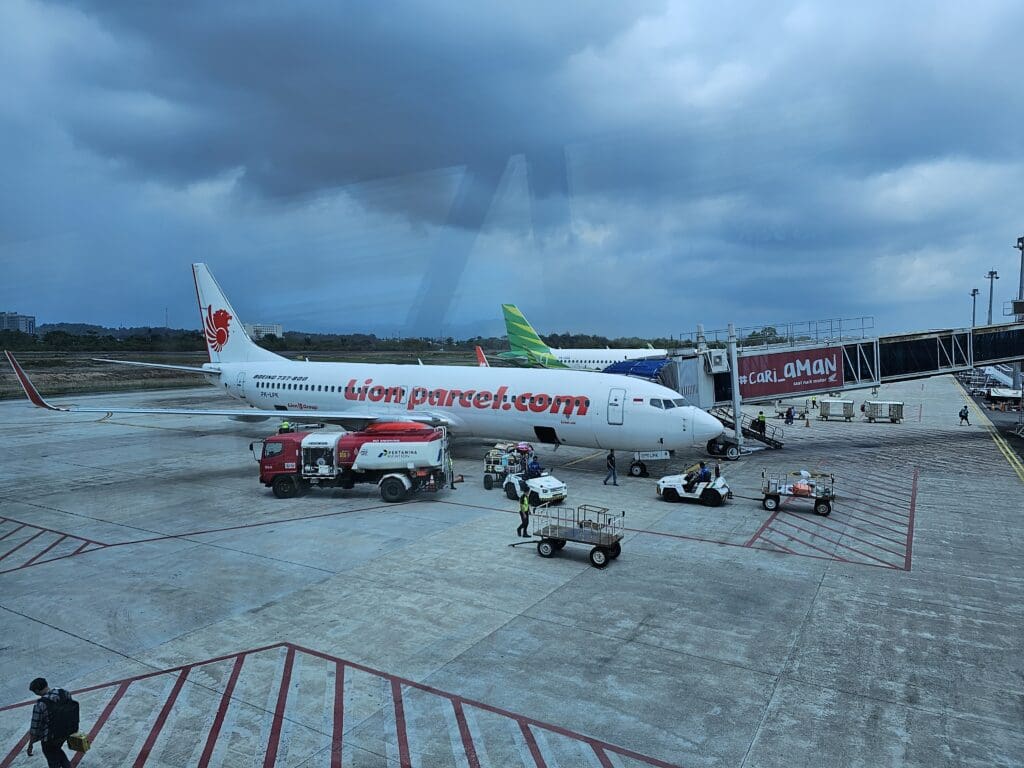
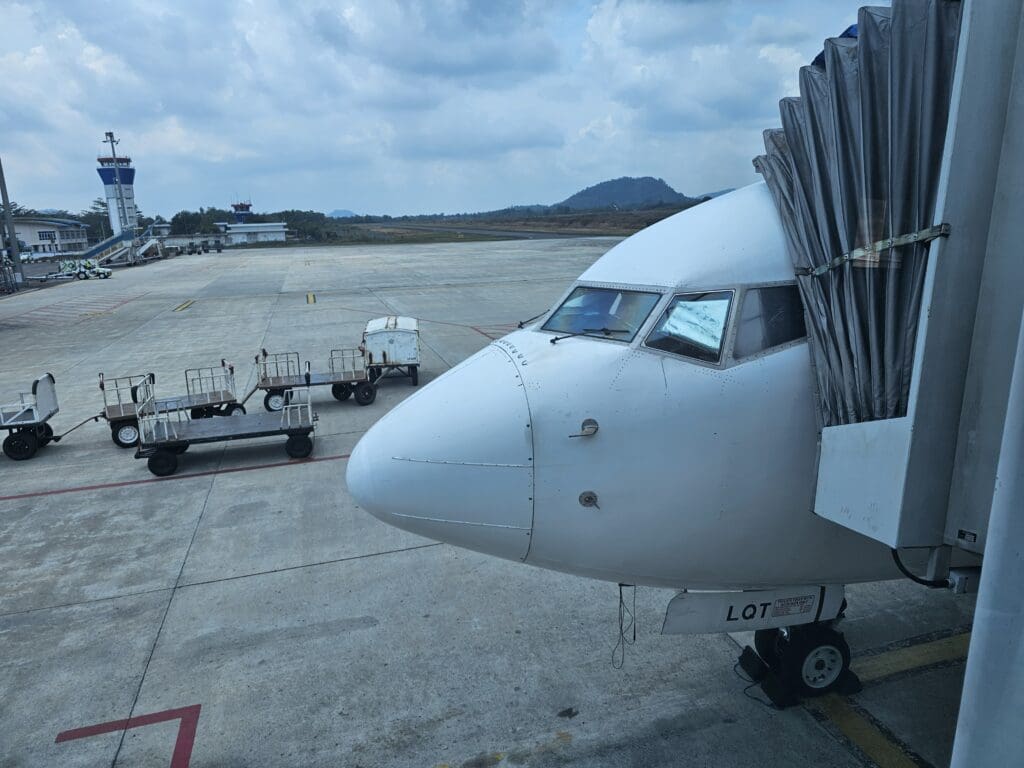
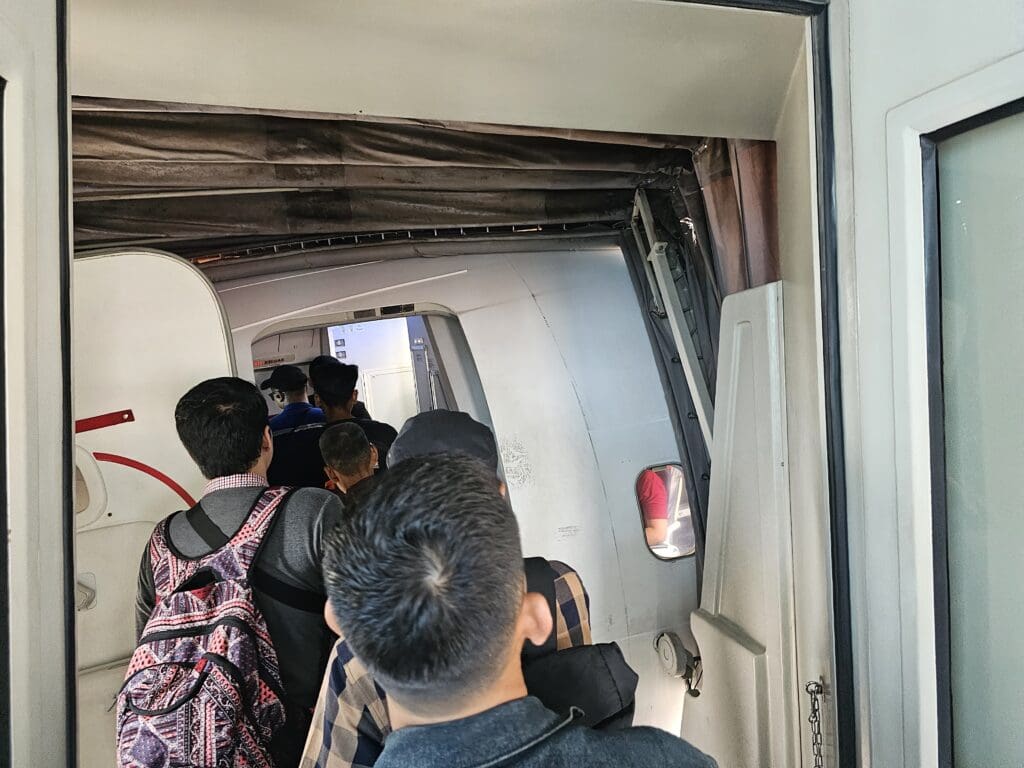
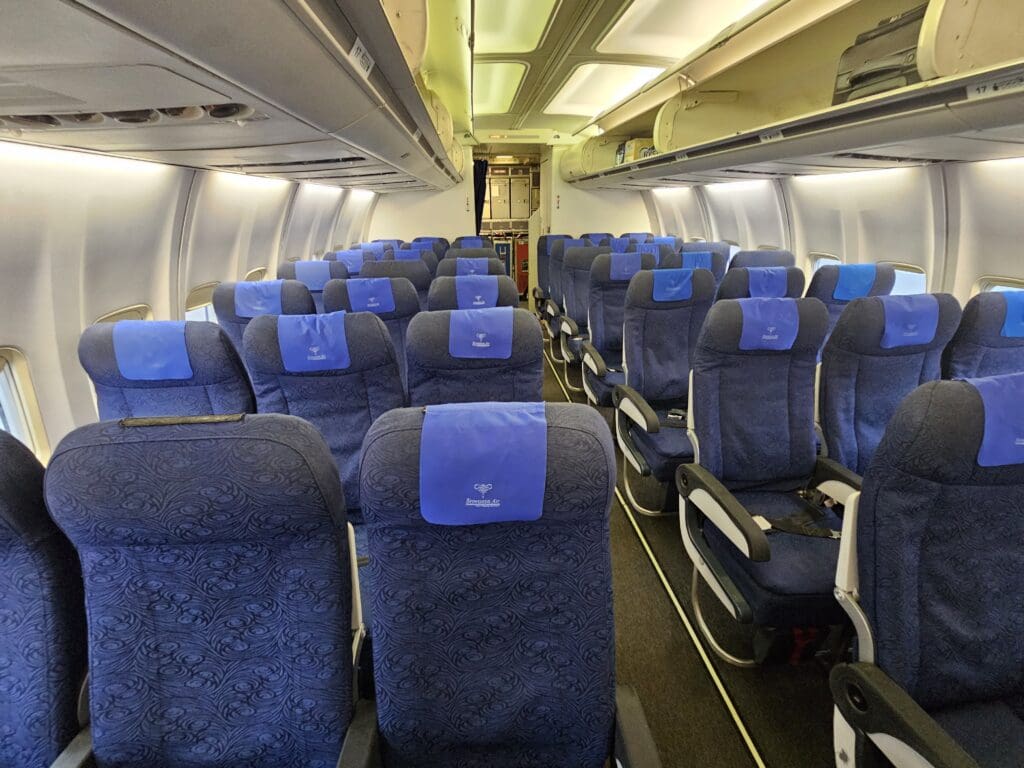
As I reached the end of the jetbridge, a staff member could be seen requesting each passenger’s seat number before directing them to board via either the rear steps or via the jetbridge. Seated in the front house of the cabin, I continued heading down the hot and humid jetbridge, soon spotting the two passengers in front of me being turned away from the aircraft as they were bound for Tanjung Pandan. As I stepped into the forward galley, I received a friendly welcome in English and was asked to show my boarding pass before being allowed to continue into the cabin. Kitted out in an all-economy configuration, this aircraft features a whopping total of 215 seats, which makes it comparable in capacity to a single-class Airbus A321. These seats took the form of fairly substantial-looking high-backed seats which sported dark pleather covers. Each of these was topped with a red pleather antimacassar, which featured an advertisement for Lion Parcel.
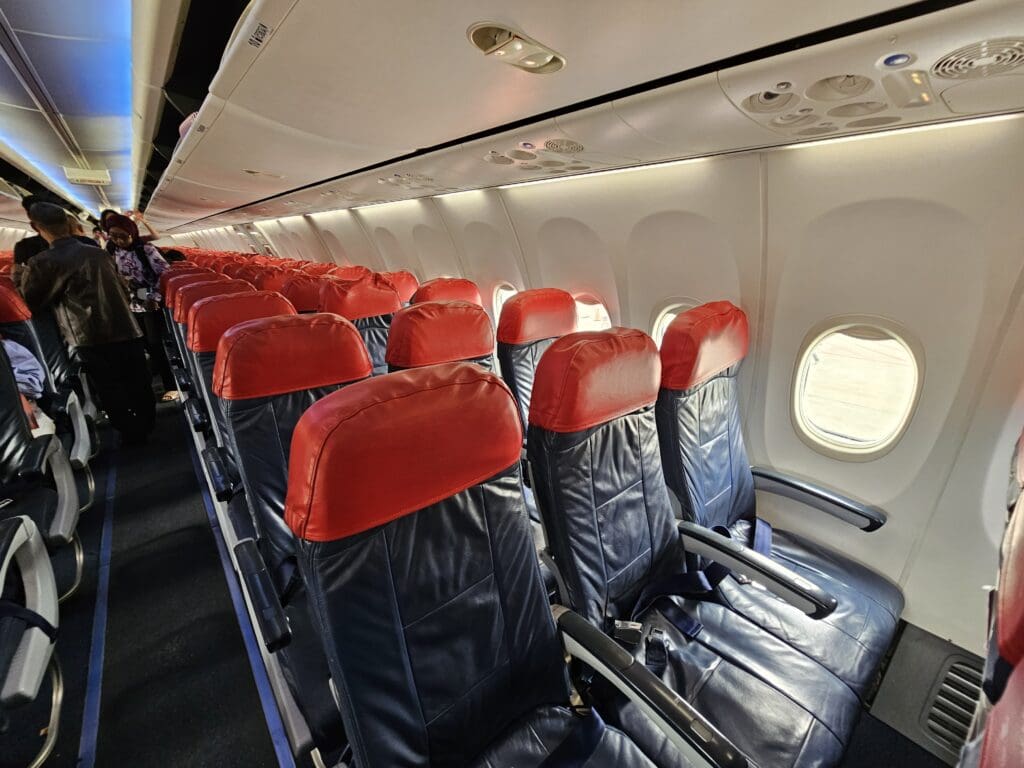
Upon arriving at my row, I slid into the window seat and settled in for the short hop down to Jakarta. Unfortunately, whilst the area around my seat appeared to be relatively clean and tidy, other than this, I was not left with too much to rave about. Looking around, this was tarnished by plenty of marks and scratches, whilst the seat was rock hard and the legroom was poor. Needless to say, I would not want to end up in this seat onboard one of Lion Air’s longer Boeing 737-operated services. Turning to the seatback pocket, this contained two safety cards – a regular one and another that detailed exactly how to don lifejackets, alongside a copy of Lion Air’s inflight magazine, Lionmag. As passengers boarded the aircraft, pre-recorded announcements rang out in Indonesian and English, one of which went through several safety messages, whilst the other broadcast the rather stark reminder that the trafficking of drugs comes with the death penalty. You don’t get that on Ryanair!
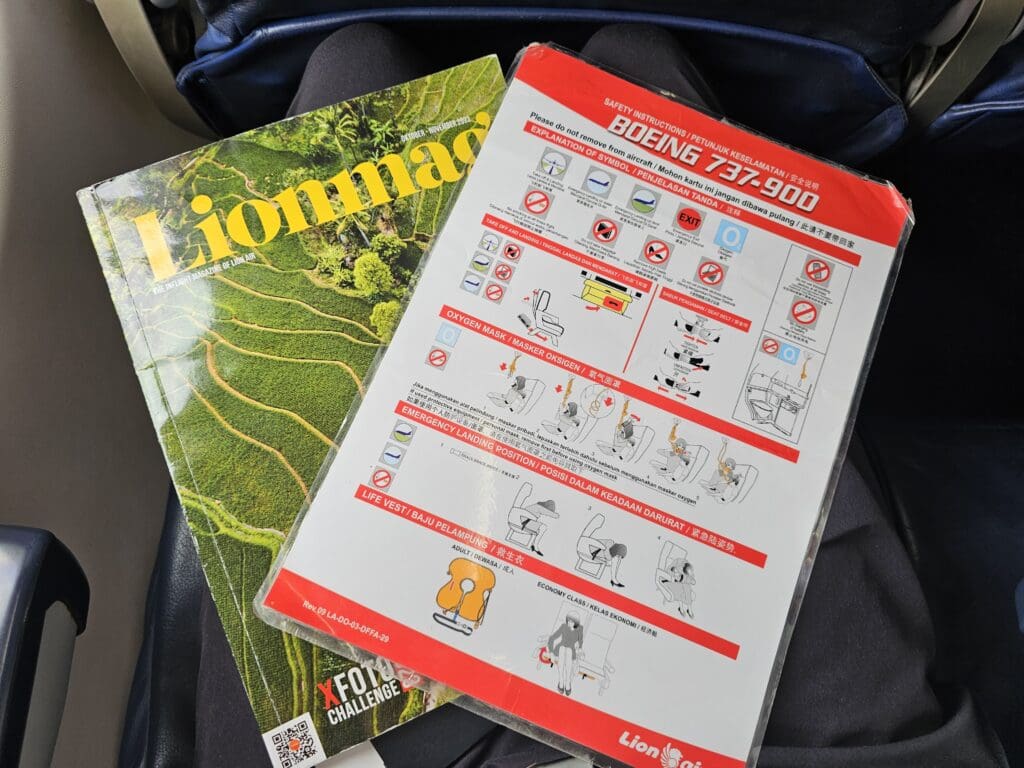
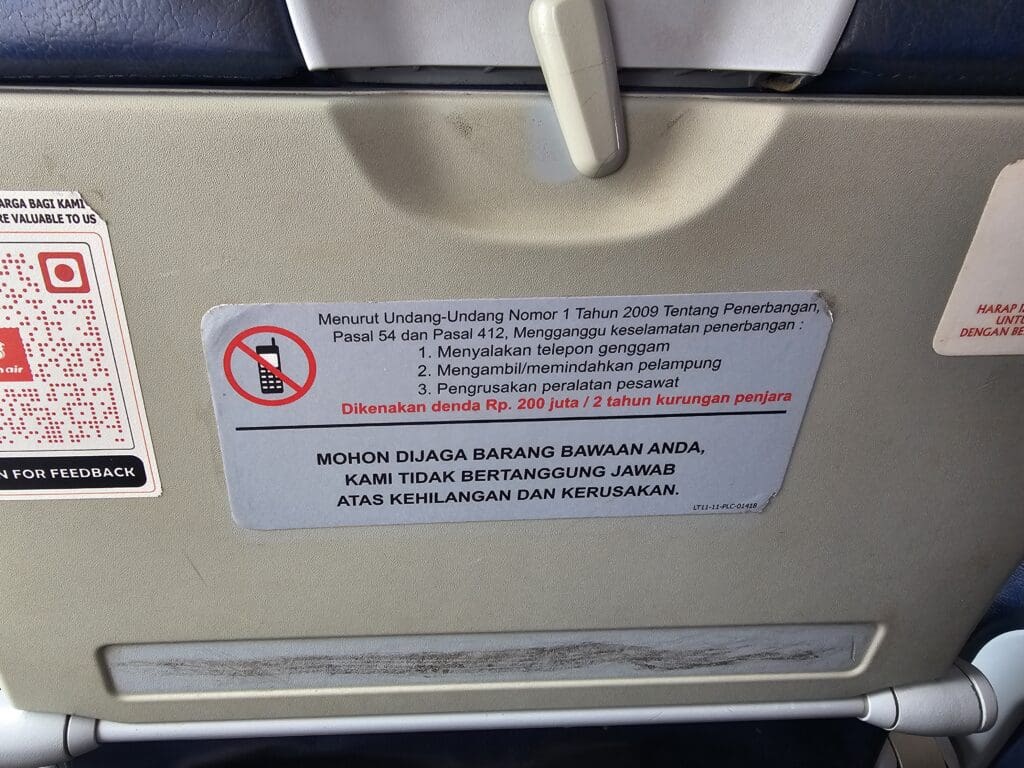
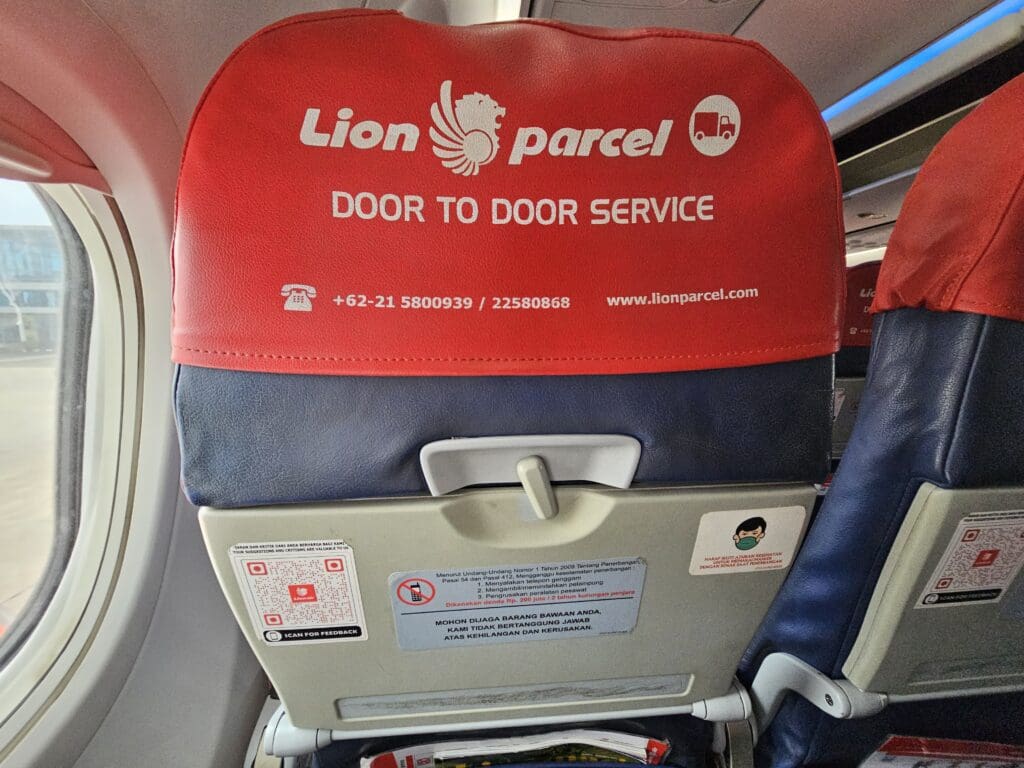
As passengers filtered onto the aircraft, I was soon joined by two seatmates and ended up being rather squished in. Despite the confusion as a result of the terminal’s layout and the fact that two Lion Air flights were departing at the same time, boarding ended up being a relatively quick and efficient affair. By 1035, all passengers had made it onto the aircraft, and that morning the flight seemed to be about 70% full. As soon as all passengers had taken their seats, one of the flight attendants performed an announcement requesting passengers to check their boarding passes and ensure that they were indeed on the correct flight and not heading to Tanjung Pandan. This was followed a few minutes later by the full welcome announcement, which consisted of the usual thanks and welcomes, and a mention of our hour-long flight time, ending with a reminder of smoking’s prohibited status onboard the aircraft. This was then followed by the Captain’s welcome, who reiterated the one-hour flight time and provided us with the weather in Jakarta.
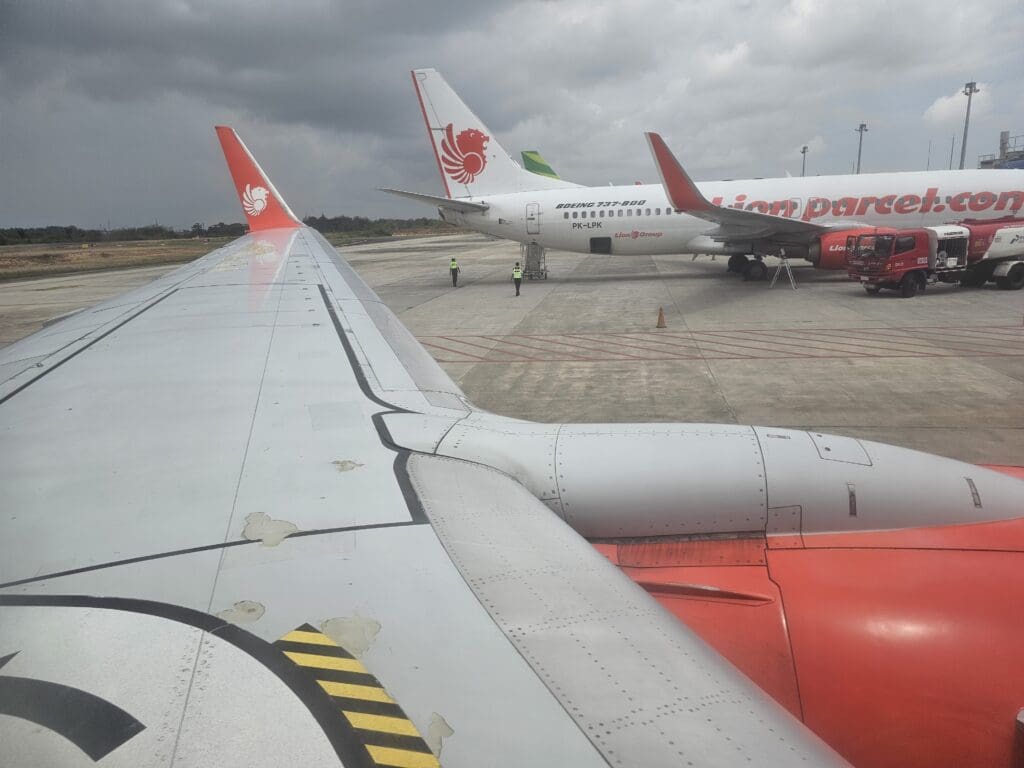
With a minute to go until our scheduled departure time, at 1044 the aircraft jolted backwards as we commenced our pushback away from our parking position. Whilst this was underway, several crew members took to the aisles and performed the all-important safety demonstration, which was undertaken along with a pre-recorded safety announcement. Once completed, the crew then passed through the cabin, ensuring that all was secure and safe for our departure from Pangkalpinang. As we neared the end of our pushback, the familiar whines, hums and vibrations of the Boeing’s two CFMI CFM56-7B27 engines filled the cabin, and soon the aircraft came to a halt before the tug was disconnected and the ground staff waved the jet goodbye.
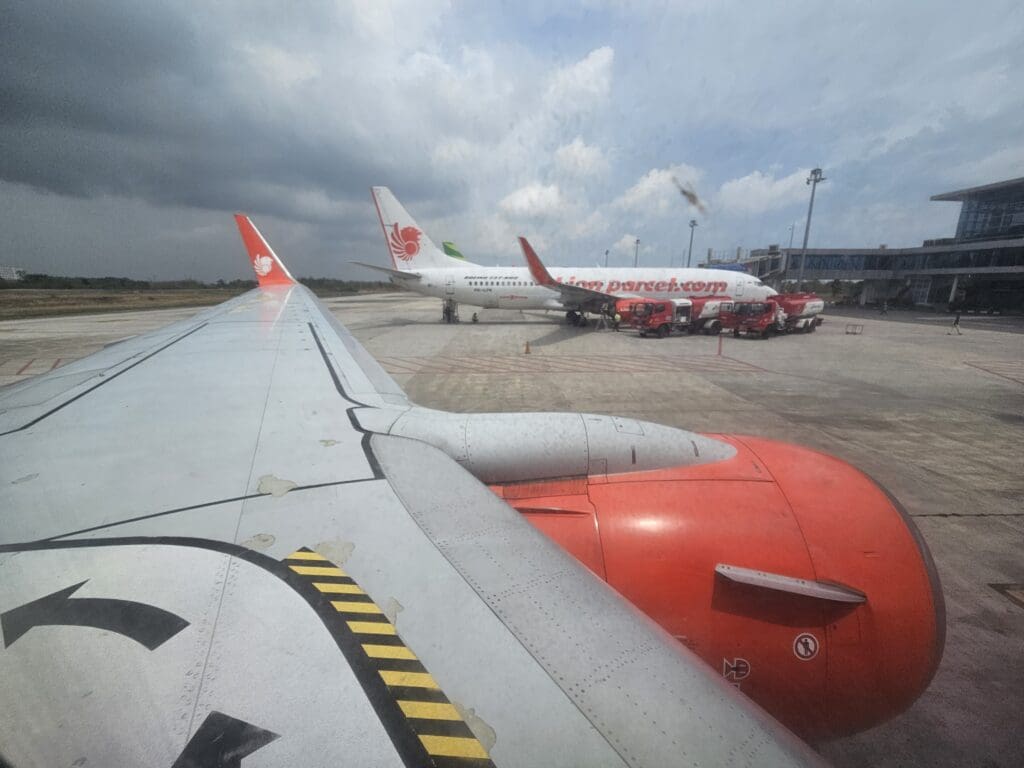
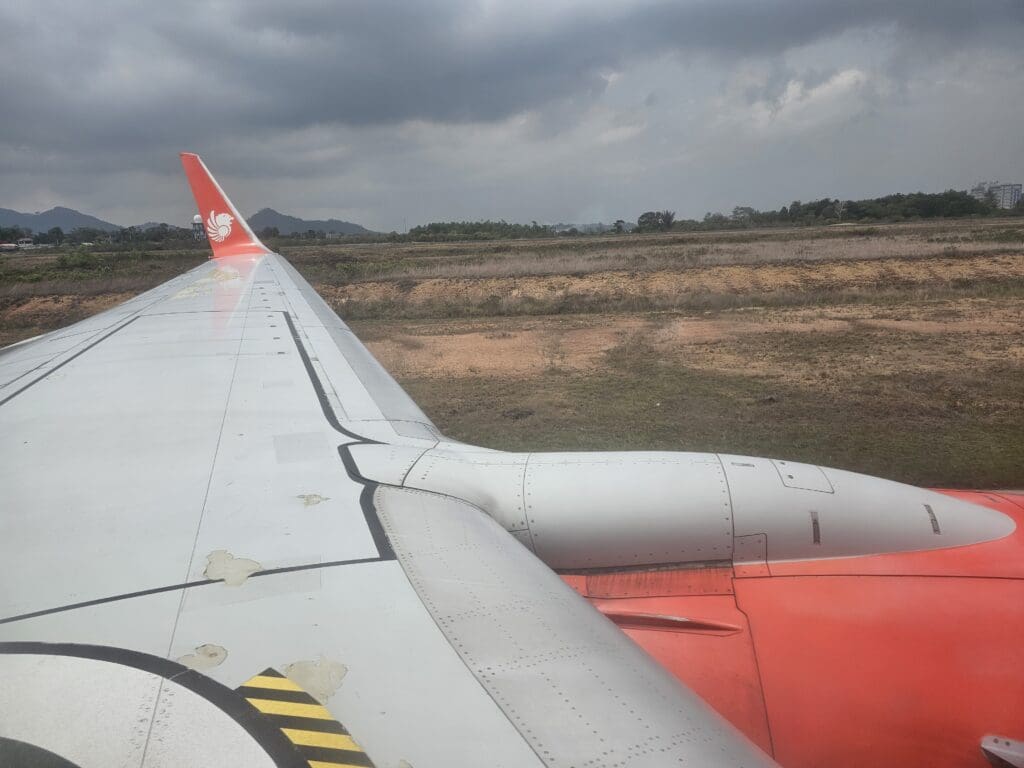
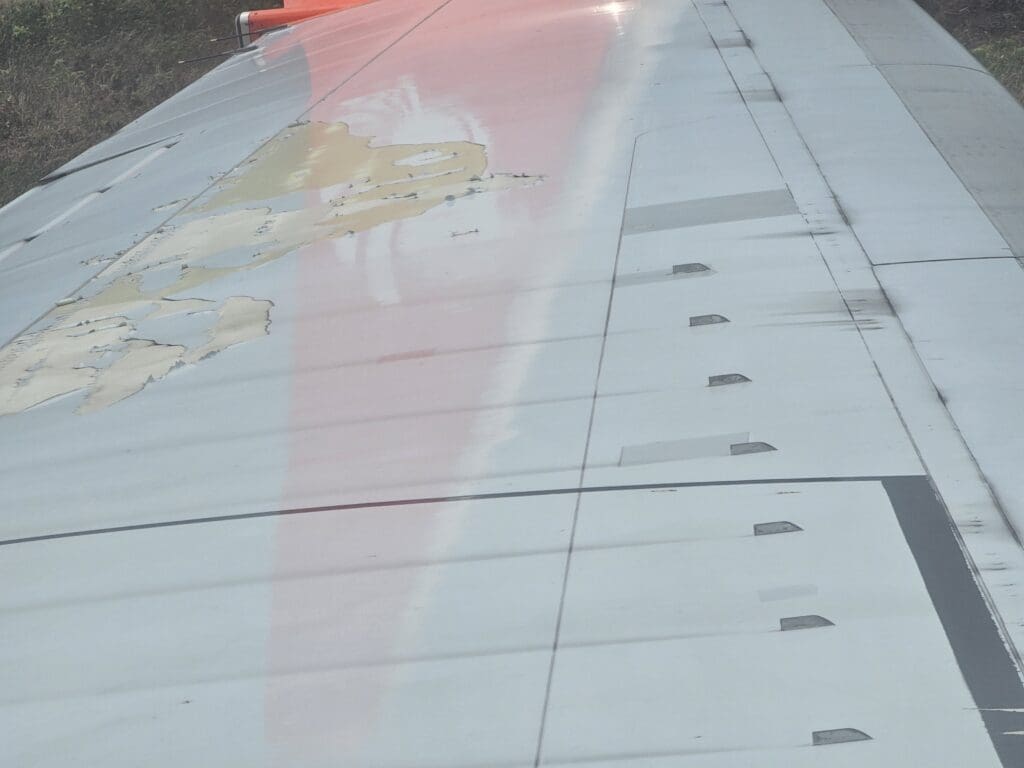
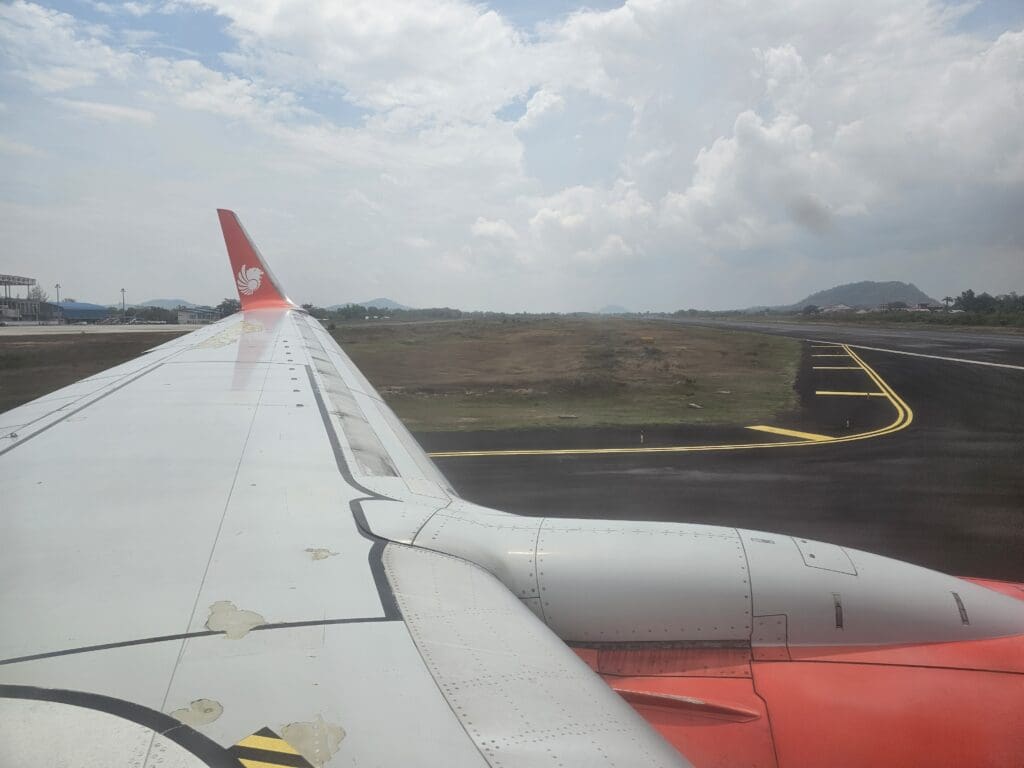
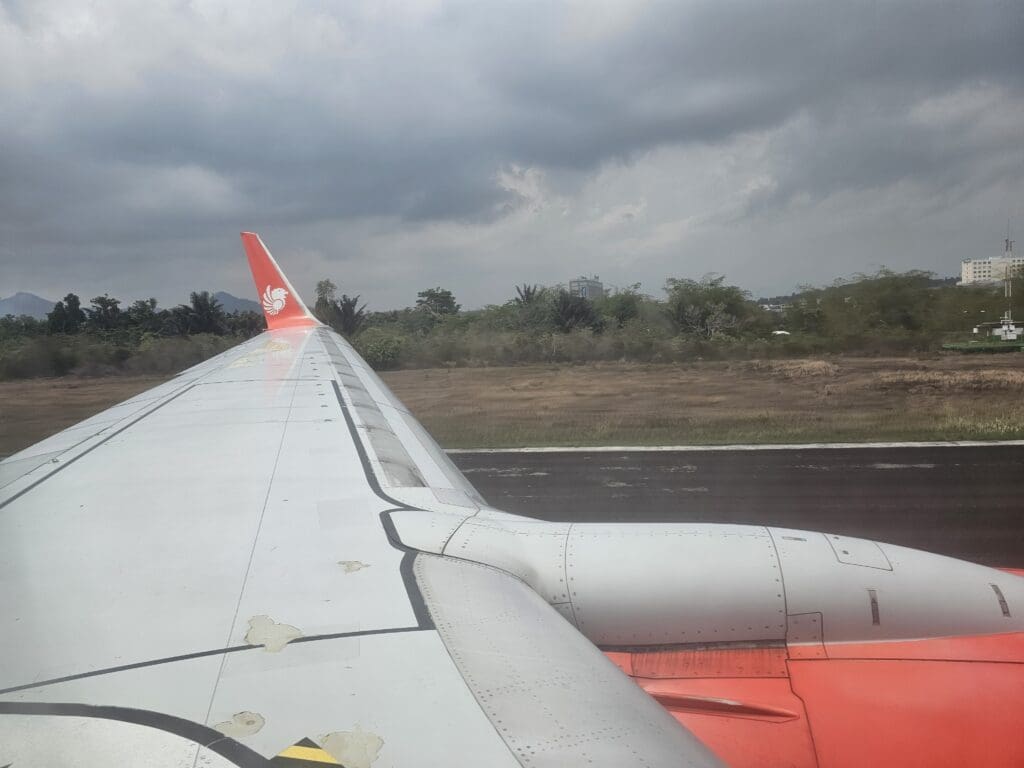
Seeing as Depati Amir Airport covers a fairly small area, that morning the Boeing did not need to traverse any great distances to reach the active runway. Indeed, no more than a minute after the Boeing had powered off under its own steam, we made our way onto the runway and commenced a short backtrack to the end of Runway 16. Once there, with no turning circle, the aircraft very slowly and cautiously turned around and came to a halt. Following a short pause, the two engines spooled up, and we commenced a long and bouncy takeoff roll down Pangkalpinang’s 2.6-kilometre-long runway before rotating upwards into the Indonesian skies.
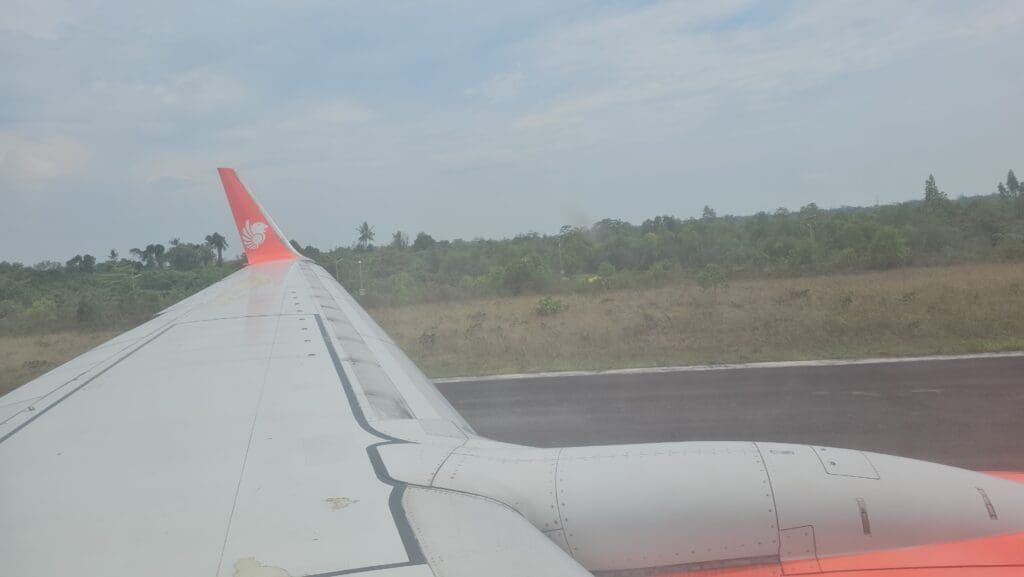
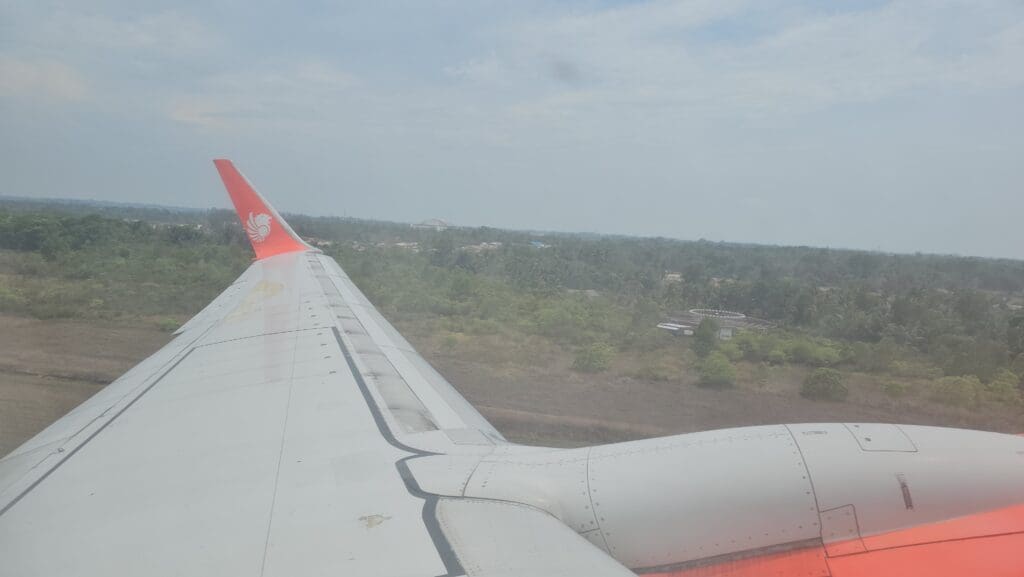
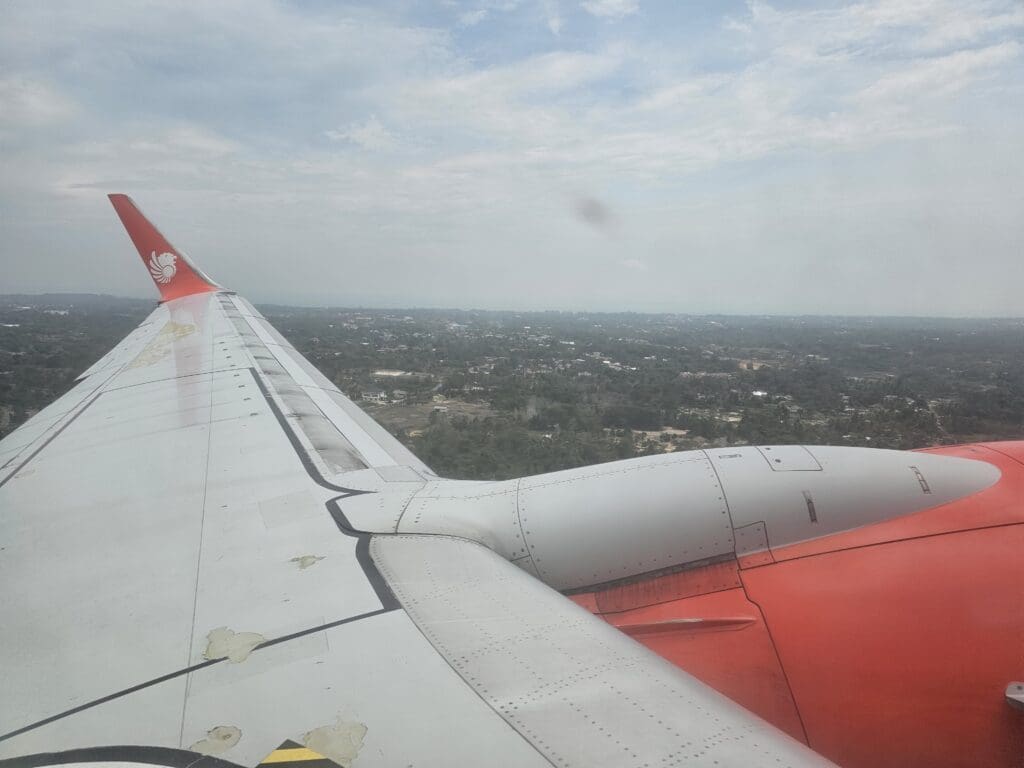
Immediately after crossing the airport’s southern boundary, the Boeing soared over a mostly forested landscape, and already pointing in the correct direction for Jakarta, the jet continued heading in a straight line over the southern half of the island. As we made our way over Bangka, the Boeing trundled past the small towns of Namang, Kemingkin and Pajung. However, unfortunately, it wasn’t long before the jet climbed up into the clouds, and we bounced around a fair bit for a few minutes before things calmed down once we had cut through them.
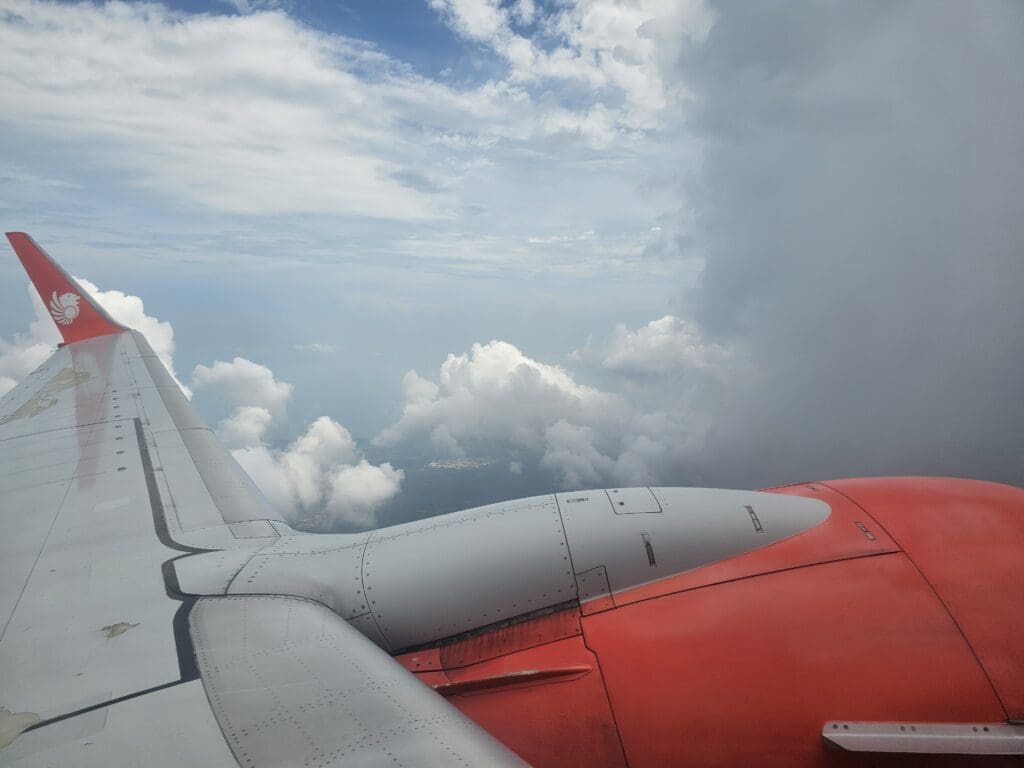
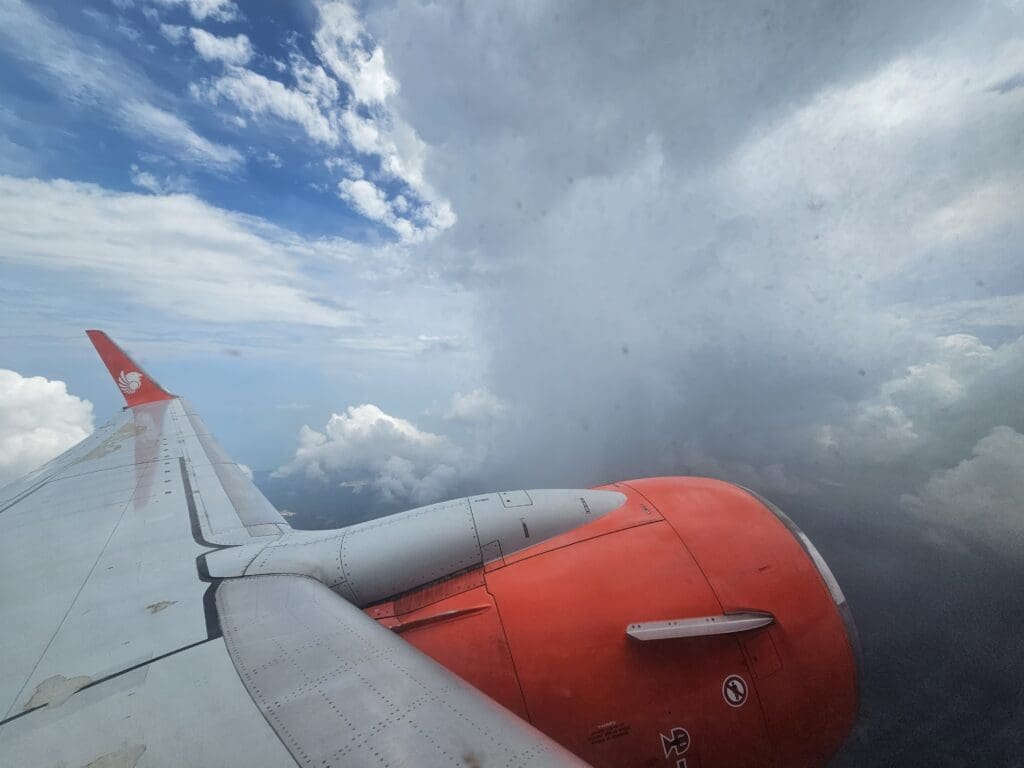
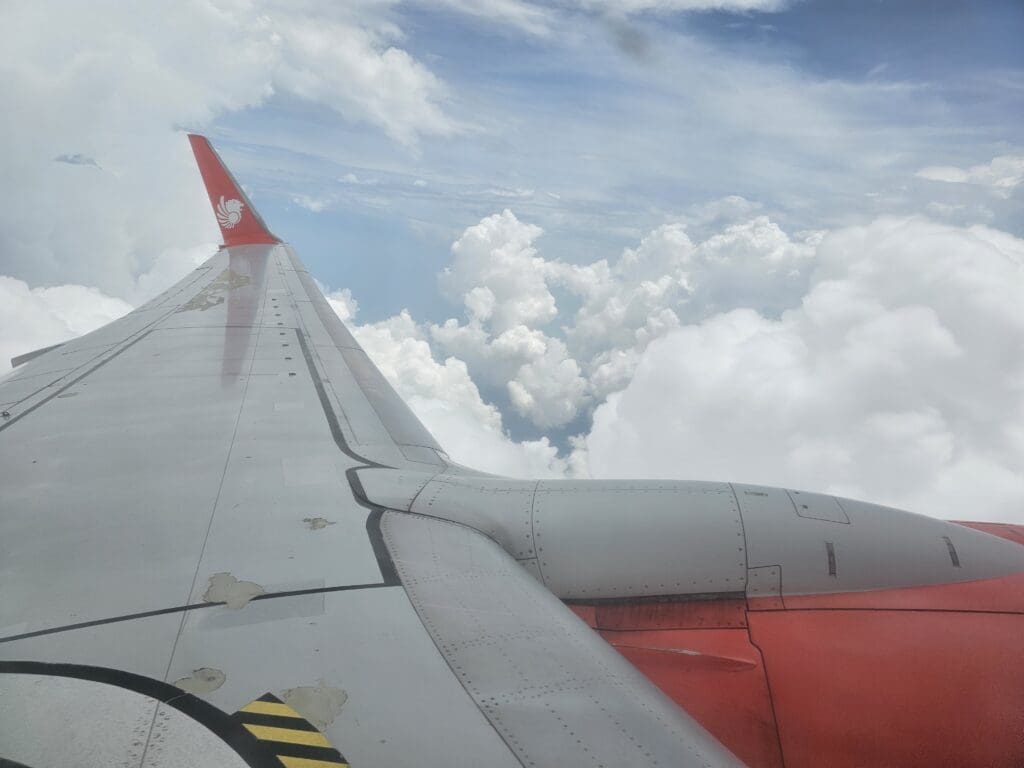
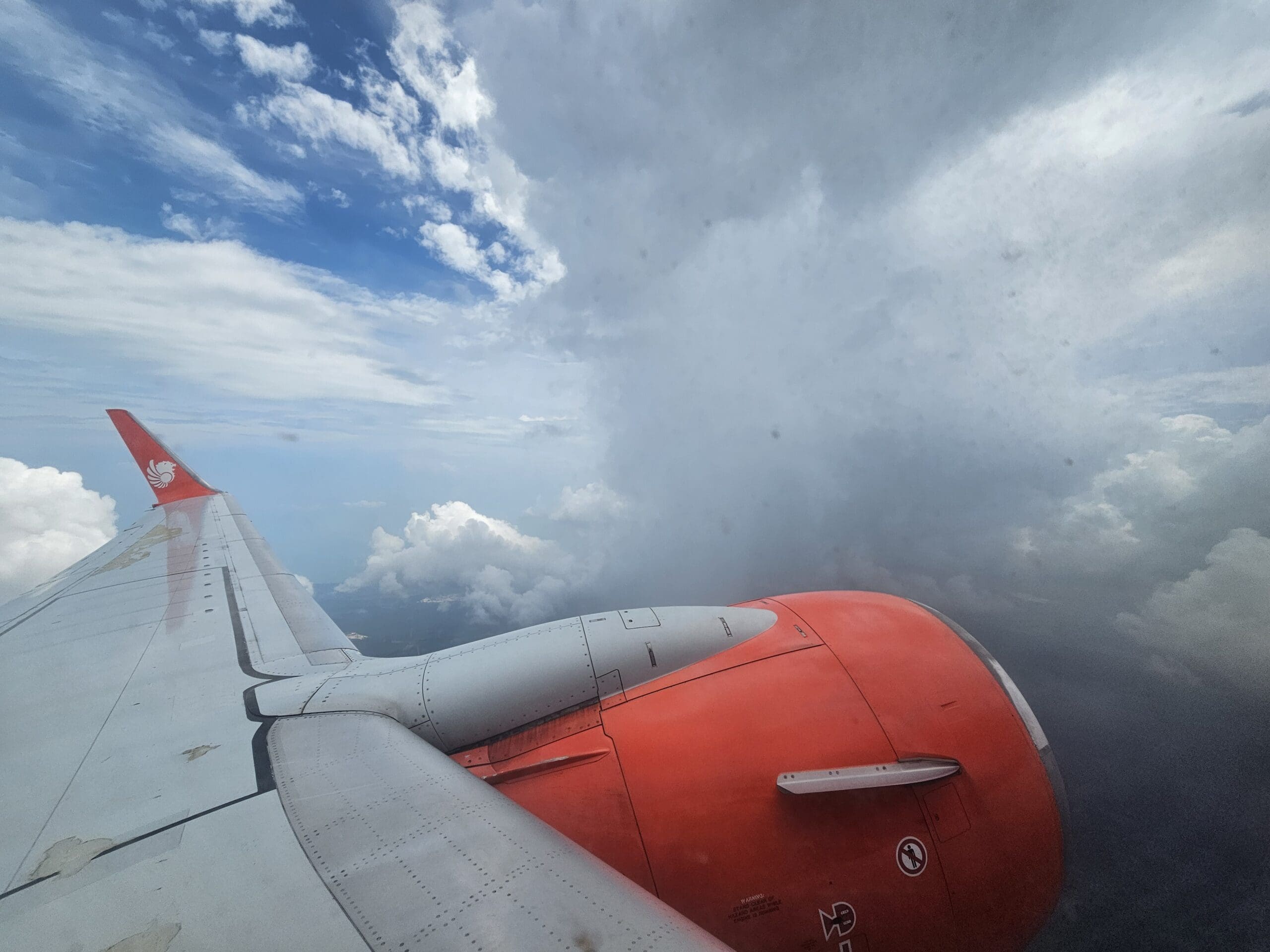
Once the Boeing was free from the clouds, the seatbelt signs were extinguished; however, it seemed like the majority of those around me had already fallen asleep, and I spotted very few passengers in the aisles during the flight. Around nine minutes after departure, the aircraft left the shores of Bangka Island behind and skirted past a very small stretch of the coastline of Sumatra before heading out over the blue waters of the Java Sea. Seeing as the majority of the flight took place over the sea, and with fairly thick clouds lingering below, very little could be seen through my scratched and blurry porthole as we cruised southwards towards Jakarta.
Soon, the aircraft levelled off at 29,000 feet, by which time the ride was silky smooth. As we cruised southwards, given Lion Air’s status as a low-cost carrier, I was expecting a round of buy-on-board service to be made. However, as it turned out, this was absent, and instead, the crew spent virtually the entire duration of the flight in the galleys, only emerging in order to undertake their pre-arrival checks. Thus, with that considered, I can’t comment on the friendliness of the crew as my interaction with them was very much limited!
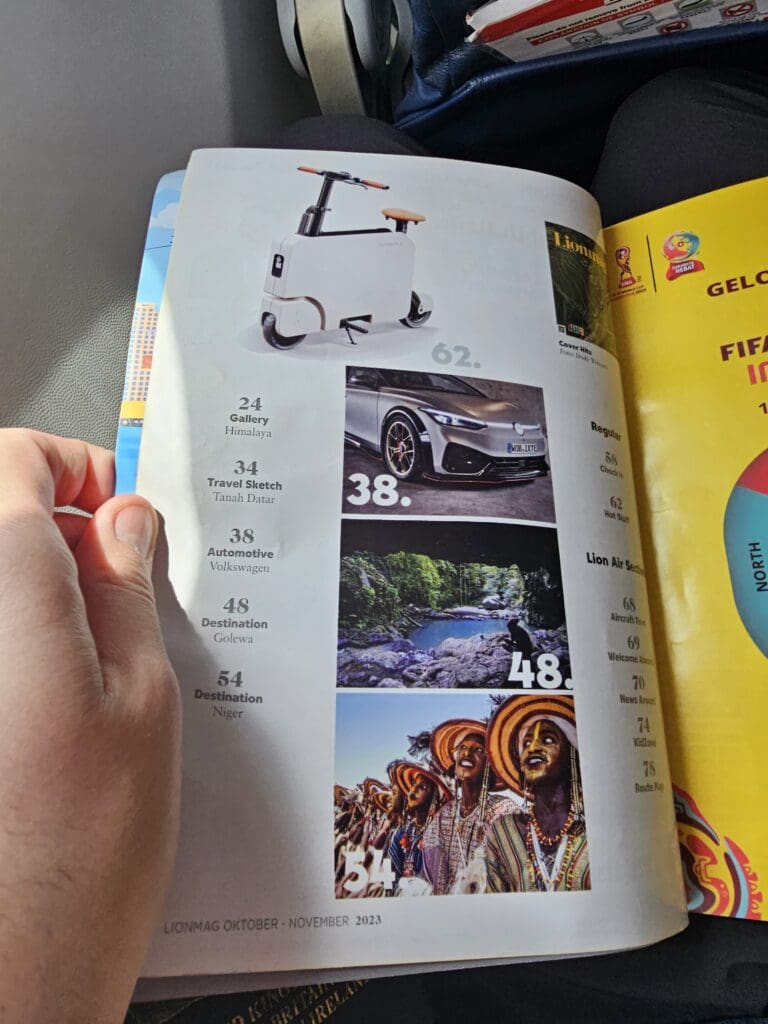
With little to see outside, I turned my attention to Lion Air’s Lionmag inflight magazine. This featured the usual slew of advertisements, with these being provided by both large multinational corporations and smaller local companies. This also featured several travel articles. Two of these were logical and focused on Tanah Datar in Sumatra and Golewa in East Nusa Tenggara. One was a little relevant, highlighting the Himalayas, which can be reached by taking fellow Lion Group airline Batik Air Malaysia, whilst one highlighted the African country of Niger, not somewhere that currently sits on the Lion Group’s route map!
Approximately halfway into the flight, the Captain’s voice filled the cabin once again as they provided an update on the weather in Jakarta and advised that we could expect to be back on the ground at 1140. Several minutes later, after just nine minutes spent at our cruising altitude, the Boeing could be felt commencing its journey back towards earth. As we wended our way towards Jakarta, the aircraft seemed to take a somewhat indirect route, twisting and turning in what seemed to be an effort to avoid the worst of the tall lingering clouds. Inside the cabin, as we edged towards the coastline of North Jakarta, several crew members emerged from the galley and undertook their final checks before landing.
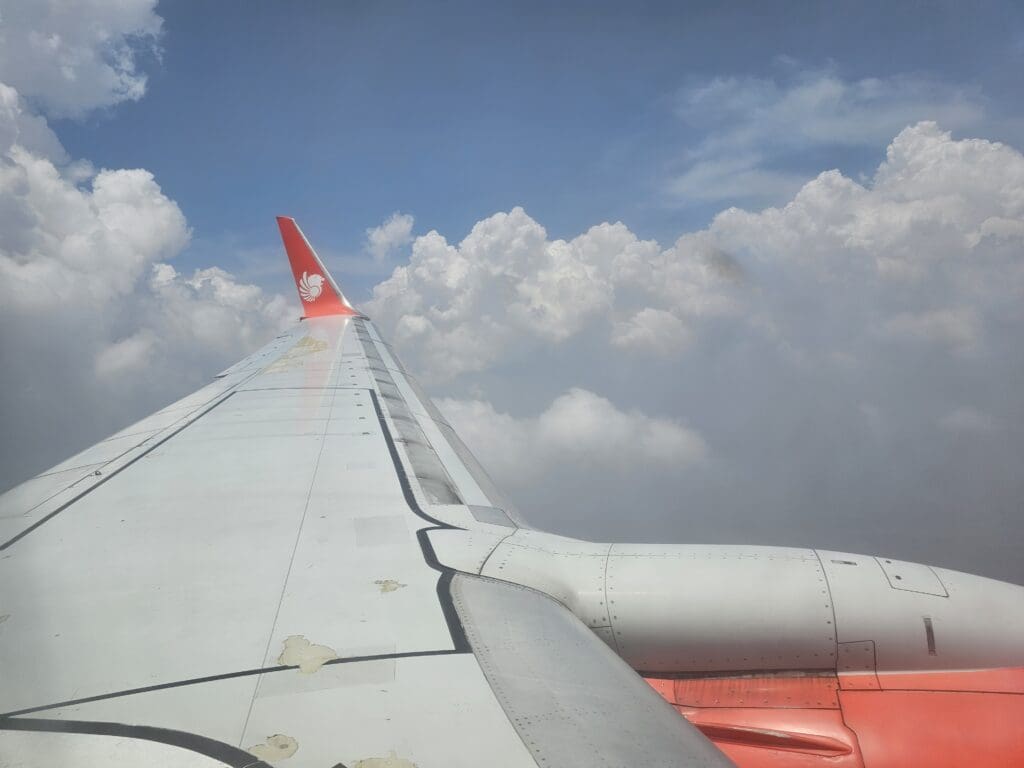
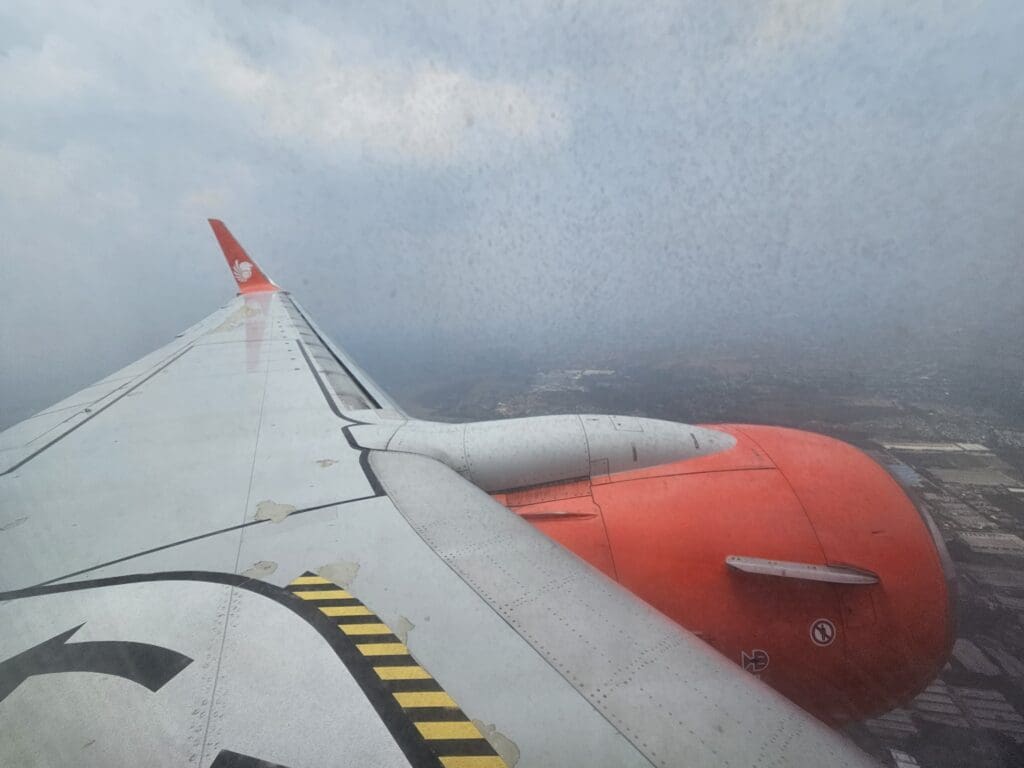
At 1125, the Javan coastline appeared whilst inside the cabin a pre-recorded announcement rang out in Indonesian and English, which came with the usual requests regarding seatbacks, tray tables and seatbelts. A minute or so later, the Boeing crossed the coastline near the Banten district of Tanara. From there, the aircraft sank down over a mixture of towns, forests and fields, and indicating that we were nearing the end of our journey, the flaps and landing gear were extended, at which point we ended up being thrown around a little.
Soon, the green fields and forests were replaced by the sprawl of one of Asia’s largest airports. Up first was the large maintenance area at the far western end of the airfield, which consists of five large hangars and plenty of apron space where all manner of aircraft could be seen lingering in various states. These took the form of rotting aircraft that had been long withdrawn from service and were unlikely to ever take to the skies again, a few gigantic Boeing 747-400s, including one operated by Nigerian carrier Max Air, as well as Citilink and Garuda Indonesia aircraft whose stays were likely to be more transient.
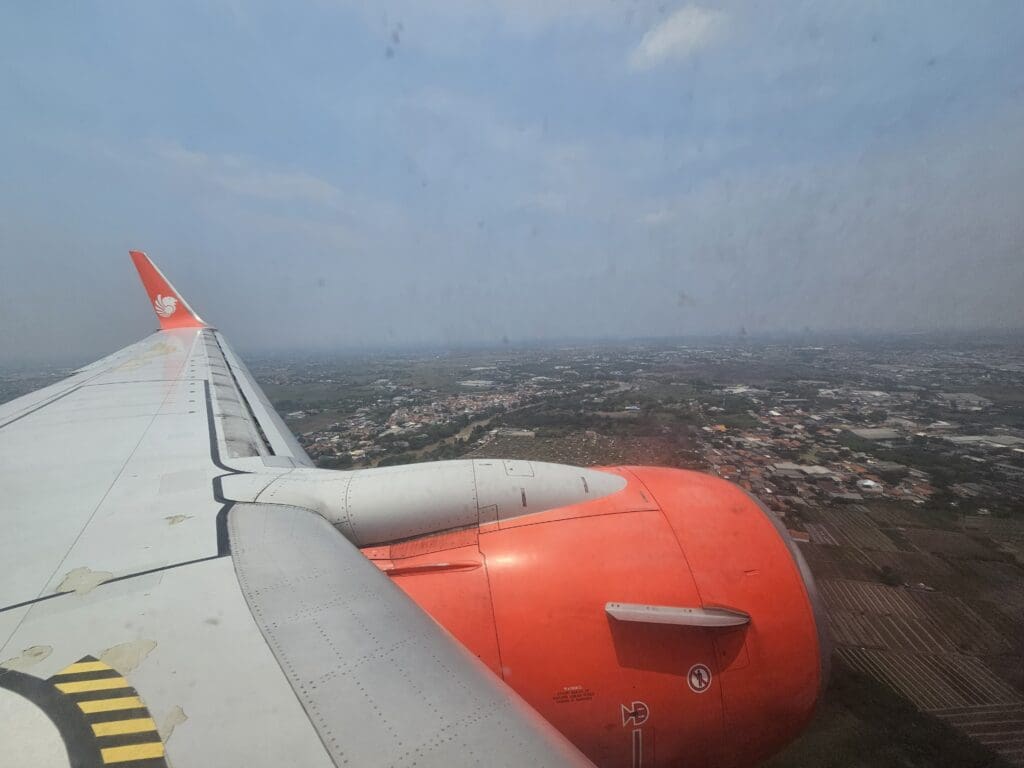
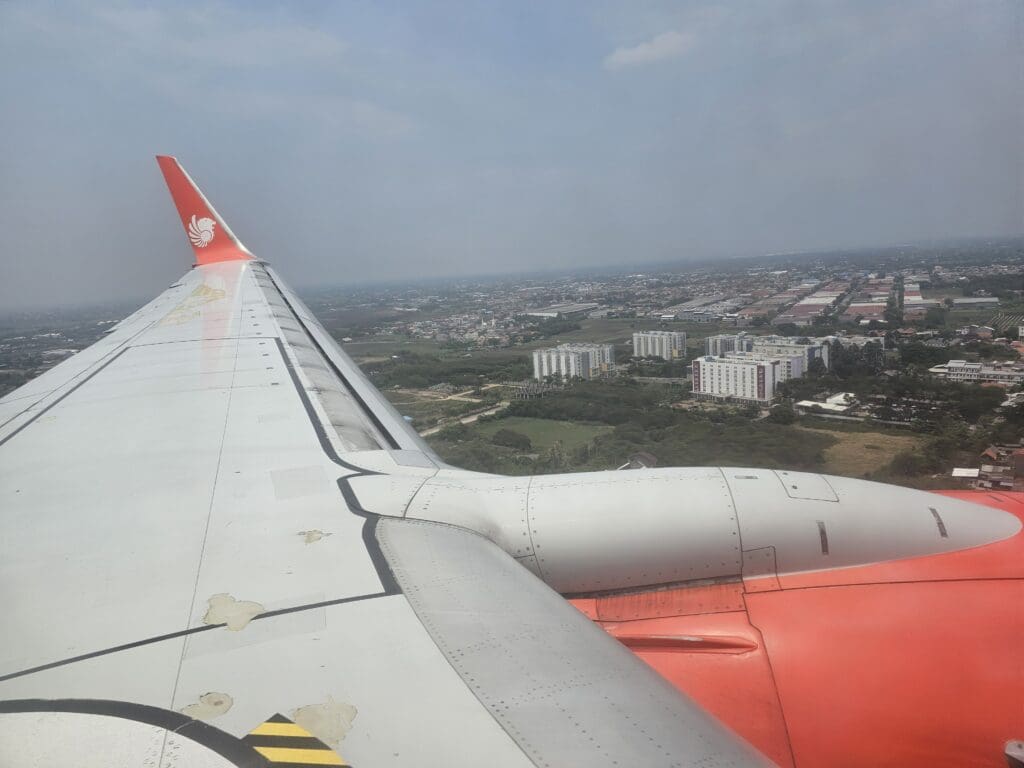
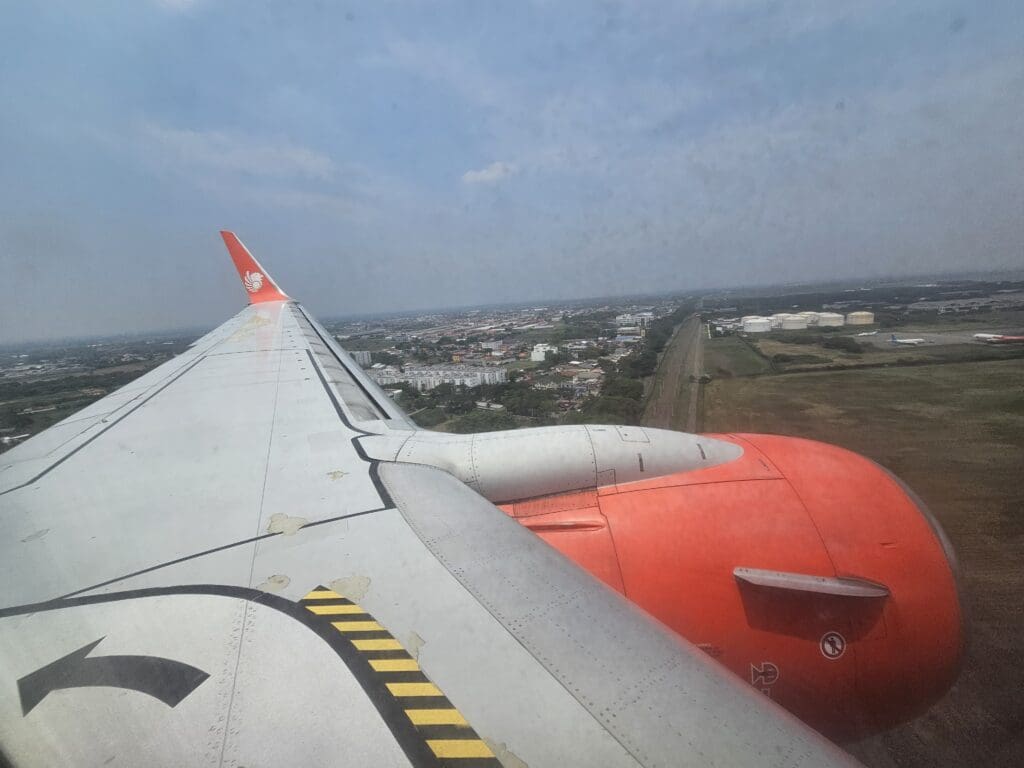
At 1140, the Boeing made a gentle touchdown on Soekarno-Hatta Airport’s Runway 07R with Terminal 1 soon appearing before we taxied off the runway. As we vacated the runway, the usual post-landing announcement was made, welcoming all passengers to Jakarta, thanking passengers for flying with Lion Air and requesting all to remain seated until we had reached our parking position. In Jakarta, Lion Air utilises Terminal 2, and so a decent length taxi was required until we reached the gate. However, with plenty of time on my hands before my ARJ21 ride up to Kuala Lumpur, and with this journey affording me a better view of the maintenance area, I could hardly complain about this.
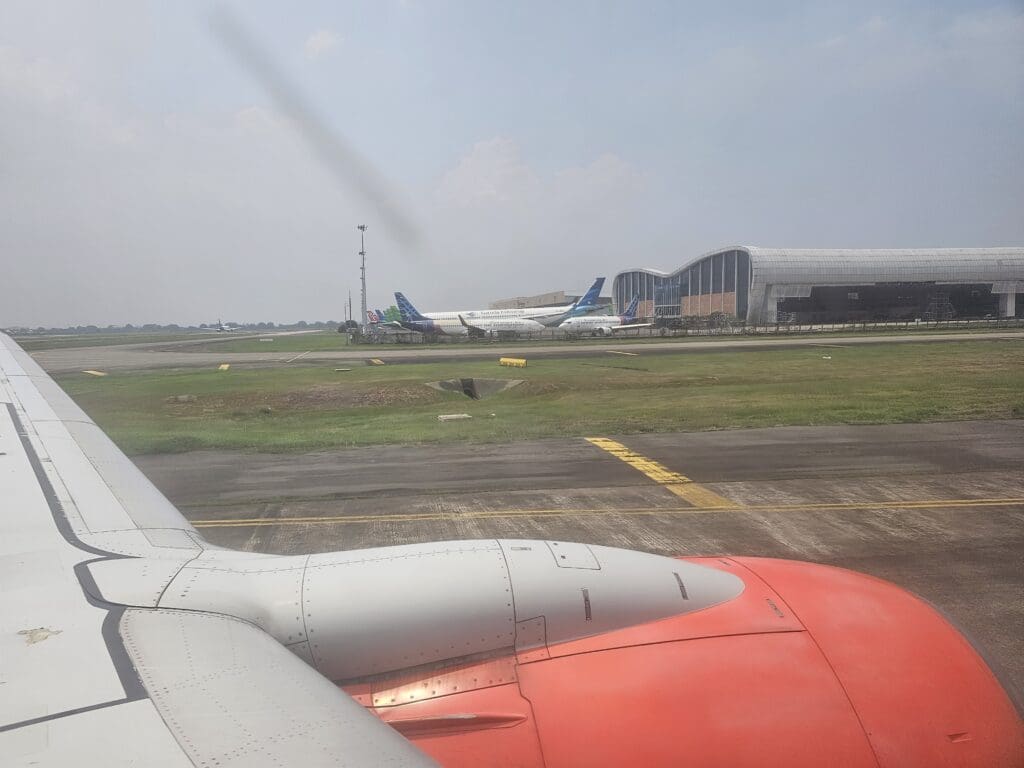
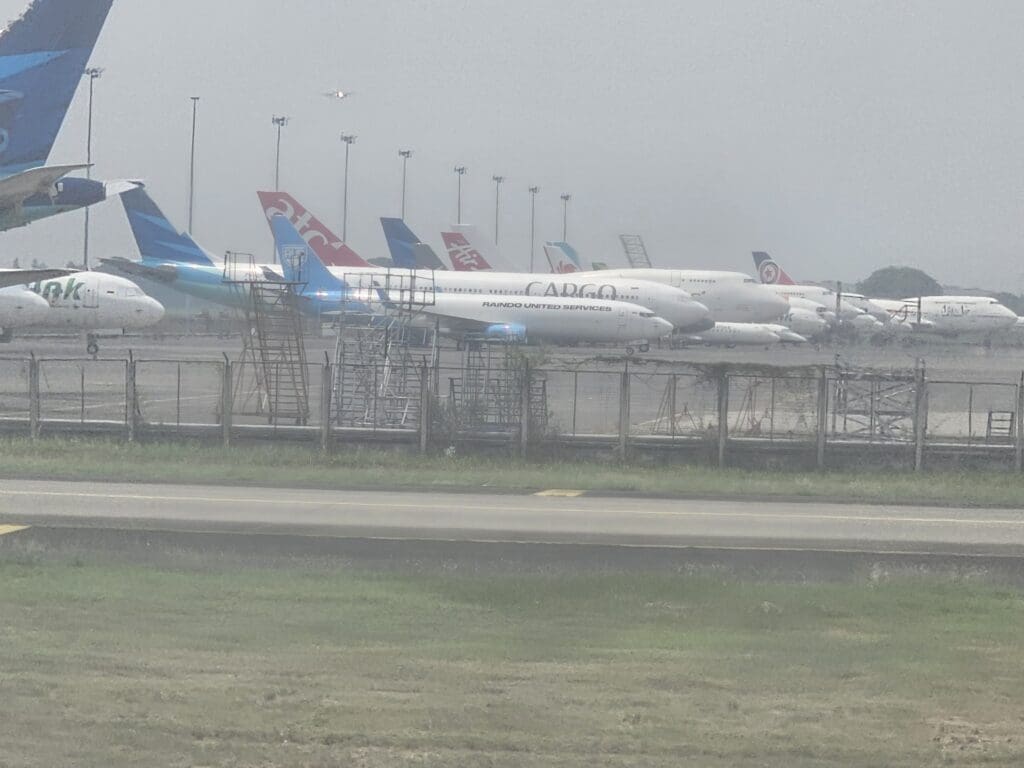
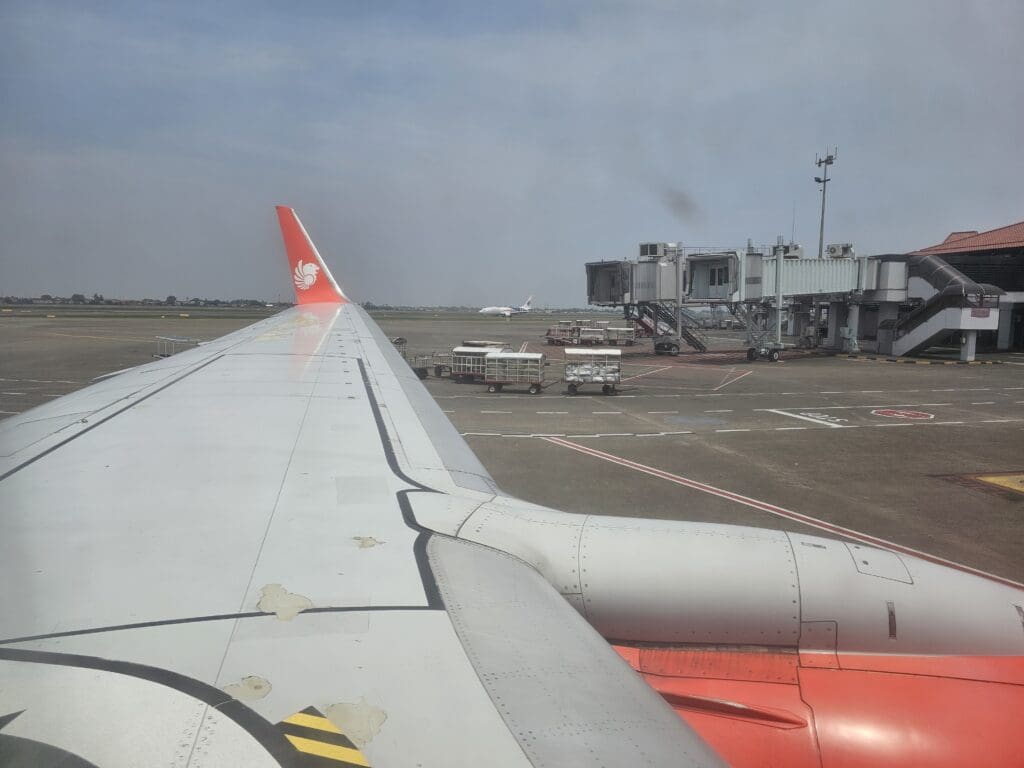
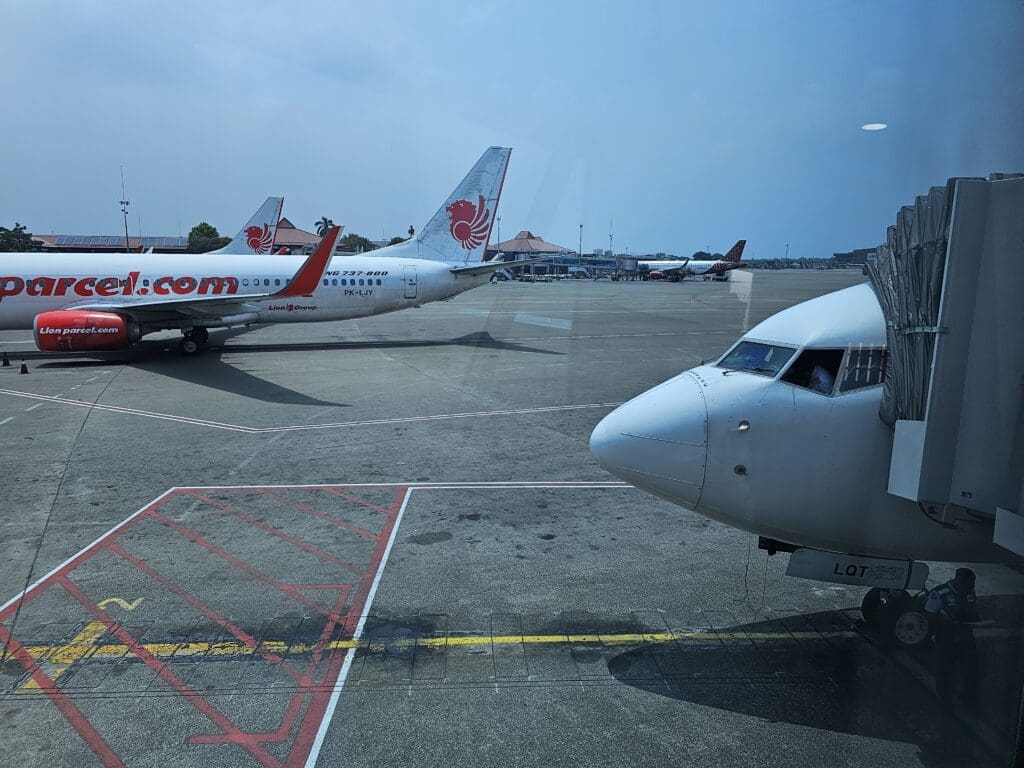
Eventually, eleven minutes after touching down in Jakarta, the Boeing cautiously edged into Stand E2, coming to a halt a total of an hour and six minutes after being pushed back away from the terminal in Pangkalpinang. In the usual manner, the CFM56 engines soon spooled down, and the cabin jumped up as if in a desperate rush to escape. Thankfully, for those needing to leave quickly, the jetbridge was soon connected and disembarkation commenced within three minutes of coming to a halt. Eventually, I stood up, retrieved my bag and made my way through the cabin before receiving a subdued farewell before I stepped off the Boeing and headed up into the terminal, where I was able to make a quick exit, ending my first experience with Lion Air.
Summary
Starting with the positives, Lion Air got me to Jakarta on time and in one piece. However, beyond this, my short flight left me with little to rave about. Having been squished in a rather uncomfortable seat, by the time we reached Jakarta, I was desperate to disembark. Meanwhile, my interactions with the crew were limited, and those I did have didn’t leave me with a fantastic impression. Would I fly with Lion Air again? If the price was right, then maybe, but I would avoid the carrier on a flight of more than an hour or so.