Flying the Chinese Built ARJ21: Jakarta to Kuala Lumpur with TransNusa Airlines
Background
Having successfully achieved my goal of flying onboard one of the relatively few Boeing 737-500s left flying in the world, it was time to move on to my next stop, Malaysia. Fortunately, the route between Jakarta and Kuala Lumpur is one of Indonesia’s busiest international air routes, and I was faced with absolutely no shortage of options to travel between the two Southeast Asian capitals. As the time of my flight, AirAsia, Batik Air, Citilink, Garuda Indonesia, KLM, Malaysia Airlines and TransNusa Airlines plough the 699-mile route throughout the day, providing passengers with plenty of options. However, deploying the rare Chinese-manufactured Comac ARJ21 Xiangfeng on the route, as an aviation enthusiast, there was only one option that I could consider: TransNusa Airlines.
About the ARJ21
If you visit an airport in China, I can almost guarantee that you will be treated to vistas of endless Airbus A320 and Boeing 737 aircraft. Seeing as China is famed for its manufacturing, some may be surprised to find that for decades, the local production of civilian airlines occurred on nothing more than a very limited scale.
China’s first taste of manufacturing modern civilian air transport aircraft came through producing Soviet aircraft under licence, including the Antonov An-2 and Antonov An-24. Utilising its experience in this field, in 1984, the Xi’an Aircraft Industrial Corporation revealed the Xi’an Y-7. This was largely based on the Antonov An-24, albeit with a few local customisations, such as the addition of locally manufactured Dongan WJ-5 engines. With a little over one hundred examples manufactured during the 1980s, the type enjoyed limited success, although this served as the base for the much more modern Xi’an MA60 (a type I flew in China with Joy Air!). Making its first flight in 2000, this turboprop airliner came to be seen on several routes throughout China, as well as with a few foreign carriers such as Air Zimbabwe, Merpati Nusantara Airlines and Nepal Airlines. However, once again, the type failed to enjoy much success, with little more than one hundred examples manufactured, only a small handful of which remain in civilian operation today. More recently, this was developed into the upgraded Xi’an MA600, although fewer than twenty of these have taken to the skies.
By the early 2000s, demand for domestic air travel within China was already massive and was continuing to grow at an impressive rate. Largely dependent on overseas manufacturers, the local government sought to produce a new indigenous airliner, with this incorporated into the 10th Five-Year Plan, which ran from 2001 to 2005. The Commercial Aircraft Corporation of China (COMAC) was entrusted with this all-important task, and soon plans for a regional jet airliner were made public. Coming in the form of a T-tailed airliner with rear-mounted engines, some compared this to a short and stubby McDonnell Douglas MD-80. Indeed, COMAC’s predecessor, the Shanghai Aircraft Manufacturing Company, had undertaken a failed partnership in the 1980s to manufacture this type under license.
In 2007, the ARJ21 rolled out of COMAC’s plant at Dacheng Airfield near Shanghai and took to the skies for the first time in November 2008 to much celebration. This jet was joined by three other test aircraft, which made their first flights in 2009 and 2010. As with many totally new aircraft types, the testing phase was long and arduous, and fraught by multiple setbacks, with the aircraft not undertaking its first commercial flight until June 2016 when it formally entered service with Chengdu Airlines. Following three years of exclusive service with Chengdu Airlines, the ARJ21 entered service with Genghis Khan Airlines in 2019, and today is in service with ten operators across the country, including giants Air China and China Eastern Airlines. In 2022, the first-ever ARJ21 to be exported was delivered to TransNusa Airlines, who today operate four examples of the aircraft.
About TransNusa Airlines
Established in 2005, TransNusa Airlines is not particularly old and commenced its life as a ‘virtual airline’ operating services from the region of East Nusa’s capital, Kupang, to towns across the island of Timor (hence the airline’s name, TransNusa). This was initially done by wet leasing ATR-42s and Fokker 50s from Trigana Air and Riau Airlines. However, in the years that followed, partnerships with Aviastar and Pelita Air would also see them operate rare BAe 146s, Boeing 737-200s and Fokker F28s. Meanwhile, providing some feed to and from their services, an agreement with Mandala Airlines enabled them to capture passengers heading to and from Jakarta and Surabaya on this carrier’s services.
Having enjoyed reasonable early success in connecting Timor, in 2011, TransNusa Airlines brought in its own aircraft, which took the form of ATR 42 and ATR 72 turboprops, whilst also retaining an Aviastar-operated BAe 146 until 2018. Unfortunately, the drastic fall in demand as a result of the pandemic led to TransNusa Airlines’ fleet being grounded and eventually returned to its lessors, with the carrier formally suspending operations in late 2020. However, now enjoying backing from its new part owners, the China Aircraft Leasing Group, the following year, TransNusa Airlines reapplied for an AOC. Albeit this time under a completely different operating model, which would see it operate as a Jakarta-focused low-cost airline. Initially armed with a trio of Airbus A320s, in October 2022, the carrier operated its first flight in over two years, taking the form of a hop to Bali. At the time of my flight in November 2023, TransNusa Airlines’ fleet consisted of five aircraft – three Airbus A320s and two ARJ21s, with a further delivery of the latter type expected in the not-too-distant future. From their base in Jakarta, the carrier operates services to two domestic destinations – Denpasar and Surabaya, as well as international services to Johor Bahru, Kuala Lumpur, Singapore and a long flight up to Guangzhou.
Booking
When it comes to booking online, unfortunately, Indonesian airlines do not always have the best reputation, with a fair number of flyers encountering hurdles on the journey, be it through warnings of fraudulent sites, payment issues or other errors. However, given the fact that Transnusa Airlines maintains an international route network and thus must see a fair number of bookings from those living outside of Indonesia, I decided to try my luck with the airline’s website. Upon landing on Transnusa Airlines’ homepage, I was presented with an advertisement for promotional fares to Johor Bahru, Kuala Lumpur and Yogyakarta, as well as another regarding the partnership between the carrier and Zest Hotels, enabling passengers to get 15% off their stay. Representative of the carrier’s route network, their website is available in Chinese, English and Indonesian, whilst this offers all the features you would expect to find, including timetables, news and other bits and pieces of information about the airline.
Wasting no time, I soon undertook a search for flights between Jakarta and Kuala Lumpur and was presented with a total of four departures throughout the day. These were priced between 899,000 Rupiah and 1,099,000 Rupiah (around £46 to £57). In order to maximise my time in the Malaysian capital, I decided to go for the earliest departure, with this scheduled to depart Jakarta at 0700 and arrive in Kuala Lumpur at 1010. Steaming onwards, I was then presented with three fare options – Seat, Seat+ and Flexi Pro. Whilst I would usually go for the cheapest fare, especially seeing as I would not be travelling with any hold luggage, with the Seat+ option costing a reasonable extra 99,000 Rupiah and including a complimentary meal and seat selection, I decided to splurge out on this option.
After selecting this, I was taken to enter my details before being taken to the seat selection page. There, seats in rows 13 to 28 could be selected for free, with a premium being charged for exit row seats and those towards the front of the cabin. Having done my research, I deciphered that Seat 16A ought to provide a reasonable view over the wing, so I selected this before continuing onwards. The next step was additional baggage, where I could add anything up to an additional 40kg, which would have set me back 999,000 Rupiah; meanwhile, a bike, golf, surf or diving equipment would have cost me 300,000 Rupiah. After this, I was then given a list of the six meal options that would be included in my ticket, where I selected the rendang padang rice meal before finally arriving at the payment page. Contrary to my fears, I made a quick and easy payment and parted with 1,198,000 Rupiah (around £64) and soon received my ticket via email.
Unfortunately, all was not plain sailing as the day before my departure, I deciphered that many of TransNusa’s services between Jakarta and Kuala Lumpur had been upgraded to the Airbus A320, including my flight. Faced with a conundrum, I could accept that a ride on the ARJ21 was not meant to be, or cut my stay in Indonesia short by a night and pay to rebook onto that afternoon’s service, which was still set to be operated by one of these rare Chinese-manufactured jets. In the end, uncertain of when I would get the opportunity to do so again, I decided to rebook and ended up paying around £70 to do this, hoping that there would be no last-minute equipment swaps!
The Journey
Despite TransNusa’s status as an independent low cost carrier, the airline utilises the newest and largest of Jakarta Soekarno-Hatta’s three terminals, Terminal 3, which is primarily utilised by Garuda Indonesia and their low-cost subsidiary Citilink, as well as full service carriers from abroad. After a busy morning that saw me head to Pangkalpinang on a rare Sriwijaya Air Boeing 737-500 before returning to the Indonesian capital on a Lion Air Boeing 737-900ER, I returned to Terminal 1’s budget D’Primahotel in the early afternoon to gather my belongings and charge my devices. Confident that I would face no challenges in getting across the airport to Terminal 3 in good time for my flight, whilst I could have cut things a little finer, I decided to leave the hotel exactly three hours before my flight’s scheduled departure time.
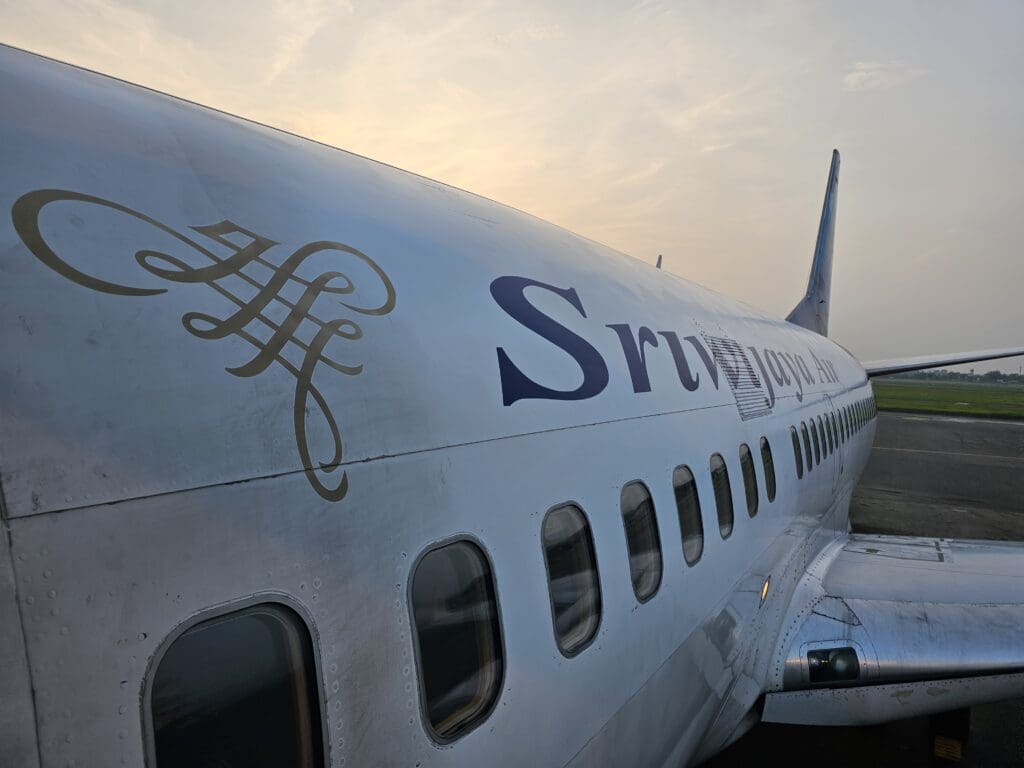
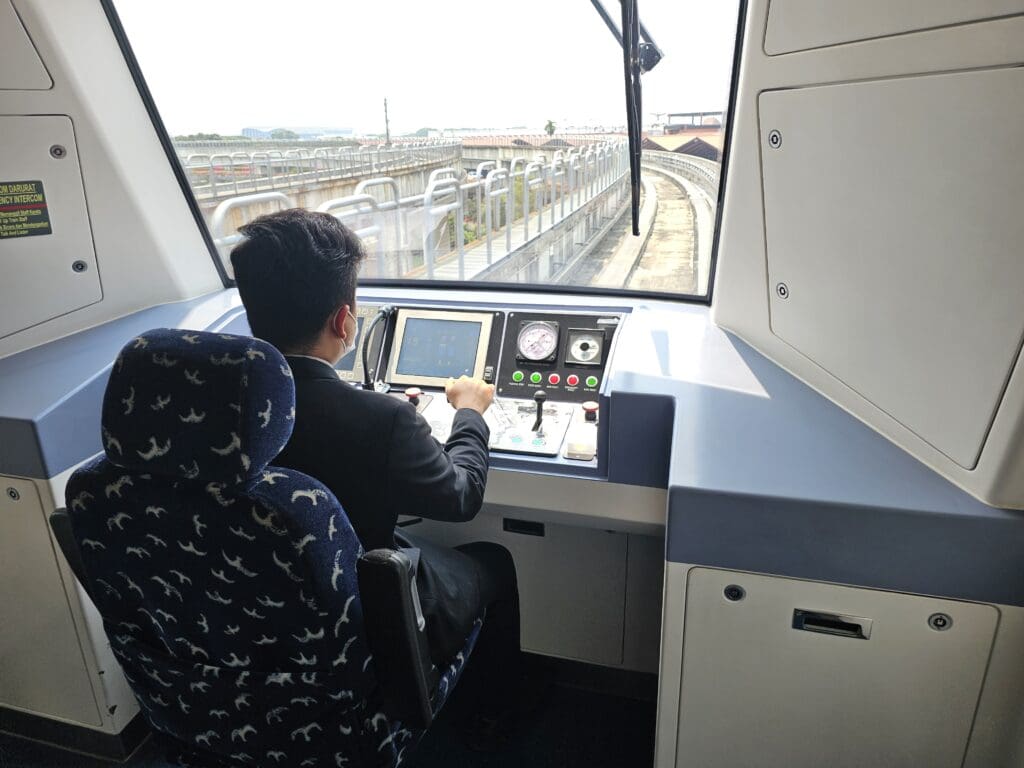
With Jakarta Soekarno-Hatta Airport spread out across a massive area, since December 2017, the complimentary Skytrain has connected the airport’s three terminals as well as the railway station, and trains plough the 3.05-kilometre route at intervals of every ten minutes. From my hotel, I made my way out into the hot and humid air and found myself trundling through Terminal 1’s busy and chaotic facade, wending my way past the many taxi drivers eager for custom and walking over the wide road that separates the terminal from the railway station. By the time I arrived at the platform, a five-minute wait was in store before the arrival of the next Terminal 3 bound service. With Terminal 1 serving as the terminus at the other end of the line, fortunately, I was able to bag a seat and found myself sitting near the roped-off area that serves as the train’s cab. Once the driver had swapped ends, we soon pulled away and began the journey across the airport complex, making stops at Terminal 2 and the railway station before pulling in to Terminal 3 station at the other end of the line around seven minutes later.
By the time the train pulled into its terminus, this was jam-packed, and upon our arrival, passengers spilt out onto the platform. Following signs for departures, once off the platform, I found myself heading up a set of escalators before crossing over the bridge that leads to the entrance of Terminal 3’s check-in hall. From the outside, I couldn’t help but notice that the terminal bore some resemblance to London Heathrow’s Terminal 2, albeit with Jakarta lacking the large swirly sculpture. Unlike at Terminal 1 that morning, no ticket check was made on the door, and I was able to make my way into the massive and modern check-in hall without stopping. At that time, with a constant stream of departing flights, unsurprisingly, the terminal was abuzz with passengers, and I hoped that I would not end up queuing for too long that afternoon.
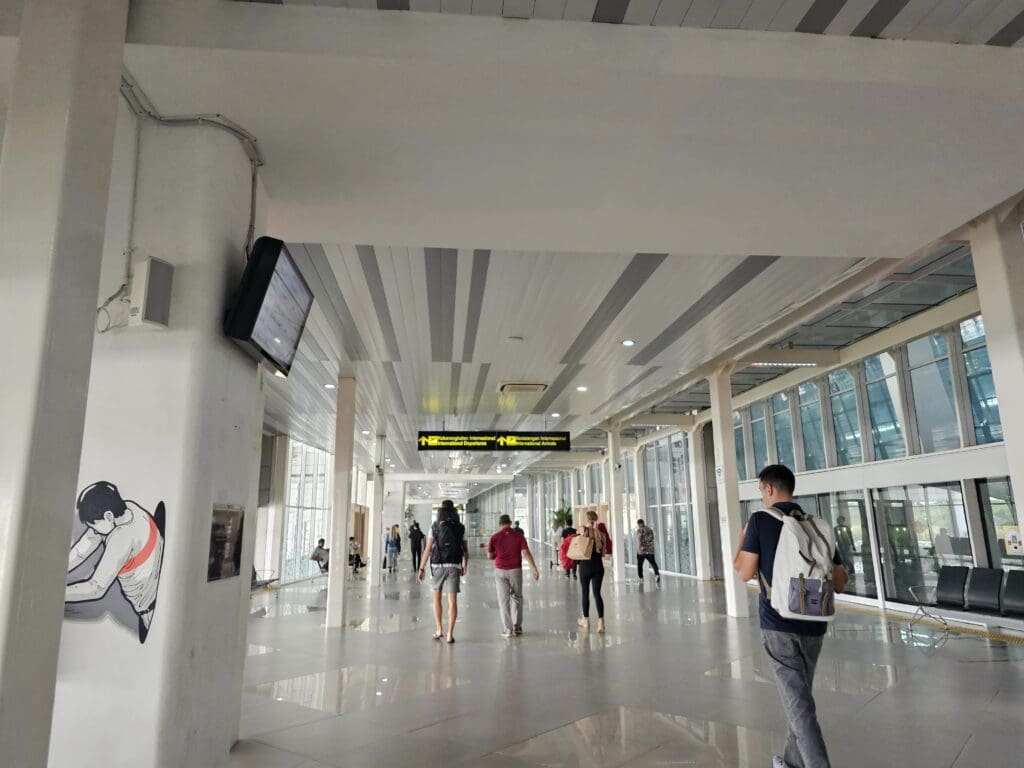
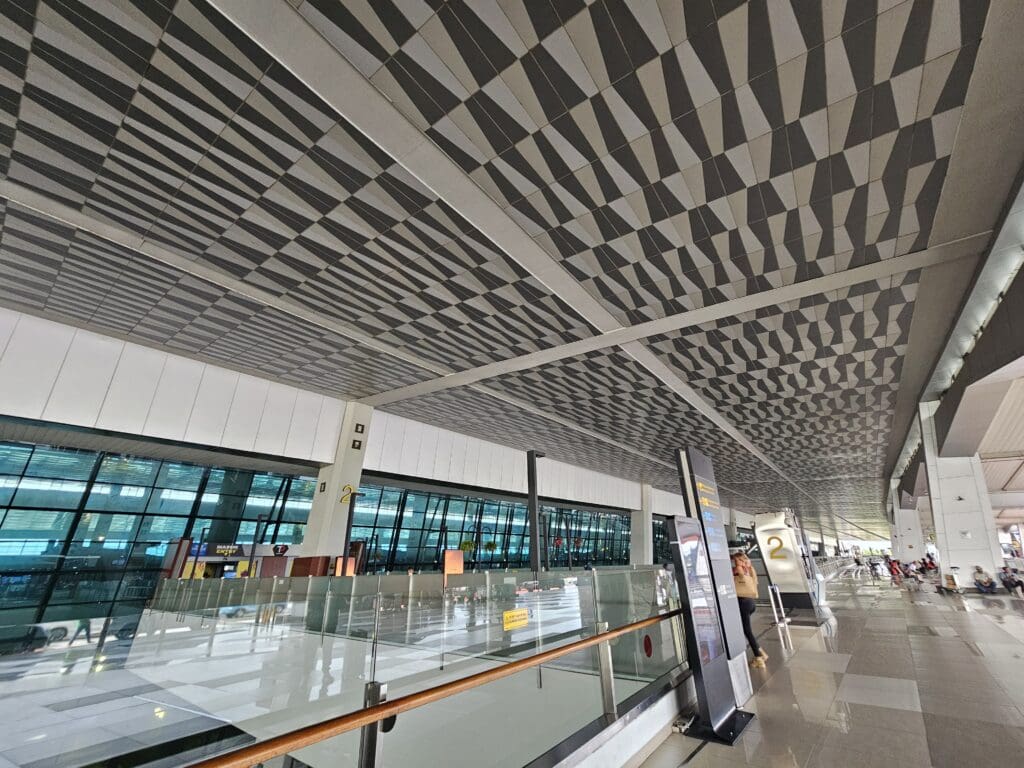
In terms of its layout, Terminal 3 is home to six check-in islands, whilst a diverse selection of eateries, including plenty of international chains, could be seen lining one side of the terminal for those with some time on their hands and money to spend on inflated airport prices. Looking around, despite the busyness, I was rather impressed with the new terminal. Whilst elements of Indonesian design were far more subtle than in the two older terminals, these have still been incorporated and given the terminal an appropriate Indonesian feel. However, aviation enthusiasts will be slightly disappointed to hear that airside views in the landside portion of the terminal were minimal.
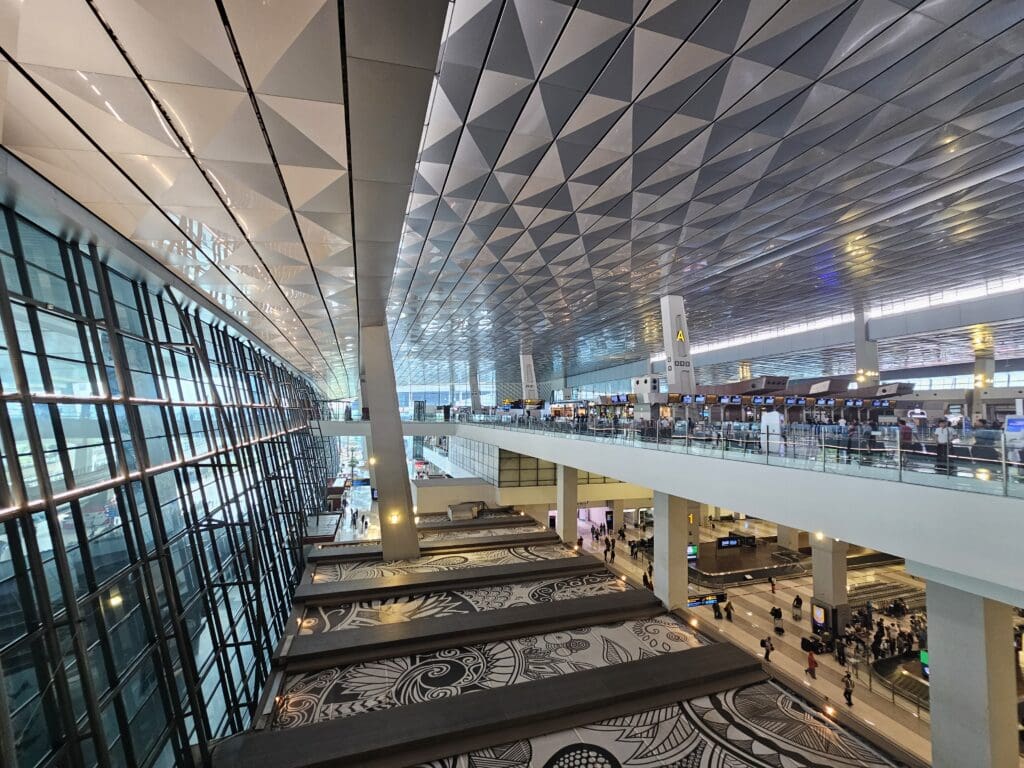
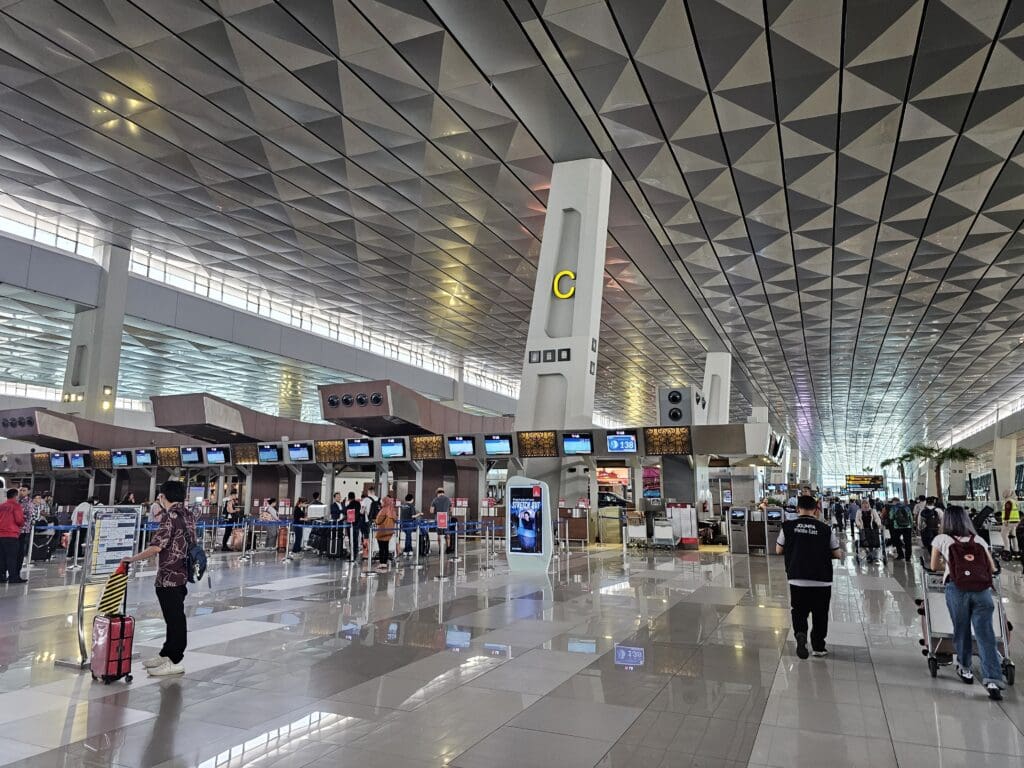
With around two hours and forty minutes to go until my flight’s scheduled departure time, I decided to check the departure boards, which revealed that check-in for TransNusa’s domestic and international services would be taking place at the D check-in island. Making the short walk over to these, I spotted a long snaking queue; however, upon closer glance, I was relieved to see that this was for the afternoon service to Denpasar and not the Kuala Lumpur flight. Whilst a fair number of self check-in kiosks could be seen, unfortunately, these could not be used by TransNusa passengers, and so I had little choice other than to head up to one of the counters. That afternoon, three desks were being used for the Kuala Lumpur service; however, one of these was processing the near-endless stream of suitcases belonging to a tour group, and so in reality, just two desks were available.
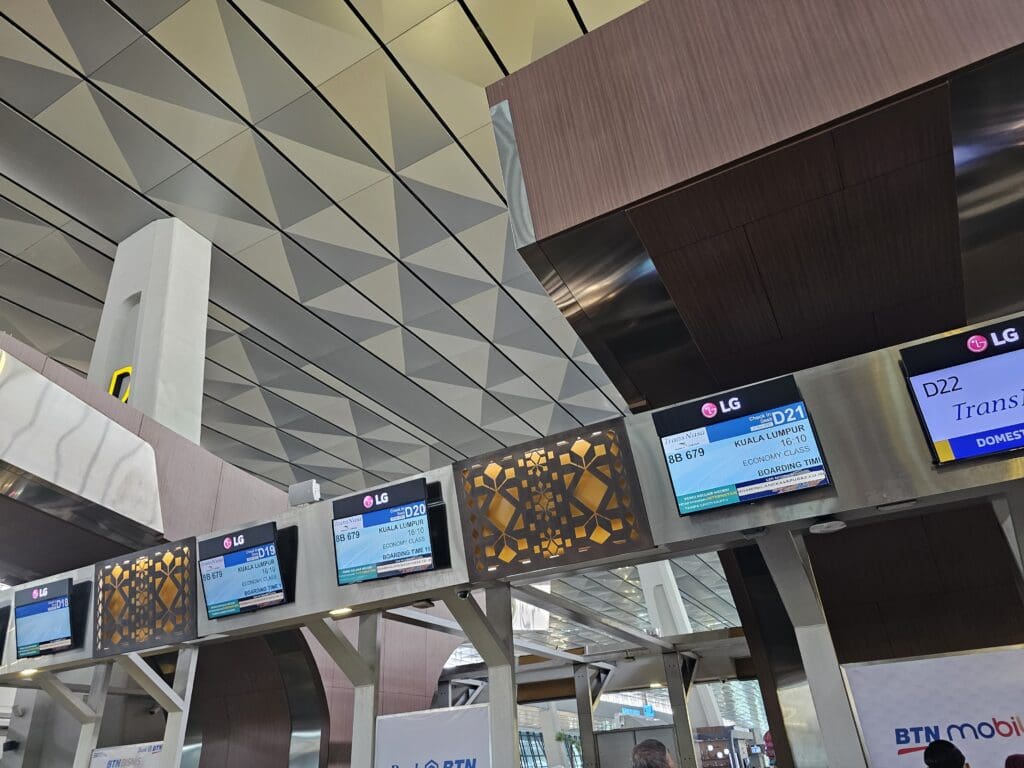
Joining the short queue, after around five minutes of waiting, I walked over to the desk where I was promptly greeted by a friendly agent and handed over my passport and proof of onward travel from Malaysia. After some typing, the agent asked if I was ‘feeling okay’. Initially, I was a little bewildered by this question and assumed that either this was a Covid-related protocol or I looked rather unwell! However, all became clear when, after responding that I was fine, I was asked whether I would be happy to sit in the emergency exit row. Once they had confirmed that I would still be in the window seat, I confirmed that I was happy to be moved, and soon my boarding pass was printed off before a cabin baggage tag was attached to my backpack. Having received Seat 19F, whilst I could have asked the check-in agent, I decided to check TransNusa’s seat maps to ensure that row 19 was the emergency exit row on their ARJ21s. This turned out to be the case, and I was delighted to see that there had been no last-minute equipment swaps for this flight.
Not needing to make any stops, I made a beeline for the international security checkpoint, and upon arriving there, I handed over my passport and boarding pass to the security officer. Upon checking that I was indeed scheduled to head off on an international flight and that the names on my documents matched, I was waved through and entered the security area. Whilst a grand total of eight checkpoints could be seen, of these, only two were open for passenger use – one for premium passengers and those requiring assistance and another for all other passengers. Fortunately, seeing as there were no queues, this wasn’t an issue, and I was able to walk straight up to the checkpoint. After temporarily parting with my bags and passing through a metal detector, the check was completed in a matter of seconds with no need to remove liquids and electronics. Up next was immigration, and, just like security, plenty of desks could be seen, although only two were open at that time. One of these was for Indonesian nationals, whilst the other was for all other nationalities. Fortunately, once again, I walked straight up to a desk without queuing, where I handed over my passport and boarding pass. Following the usual suspicious looks and angry typing, my passport was stamped, and I was free to explore the delights of the airside portion of the terminal.
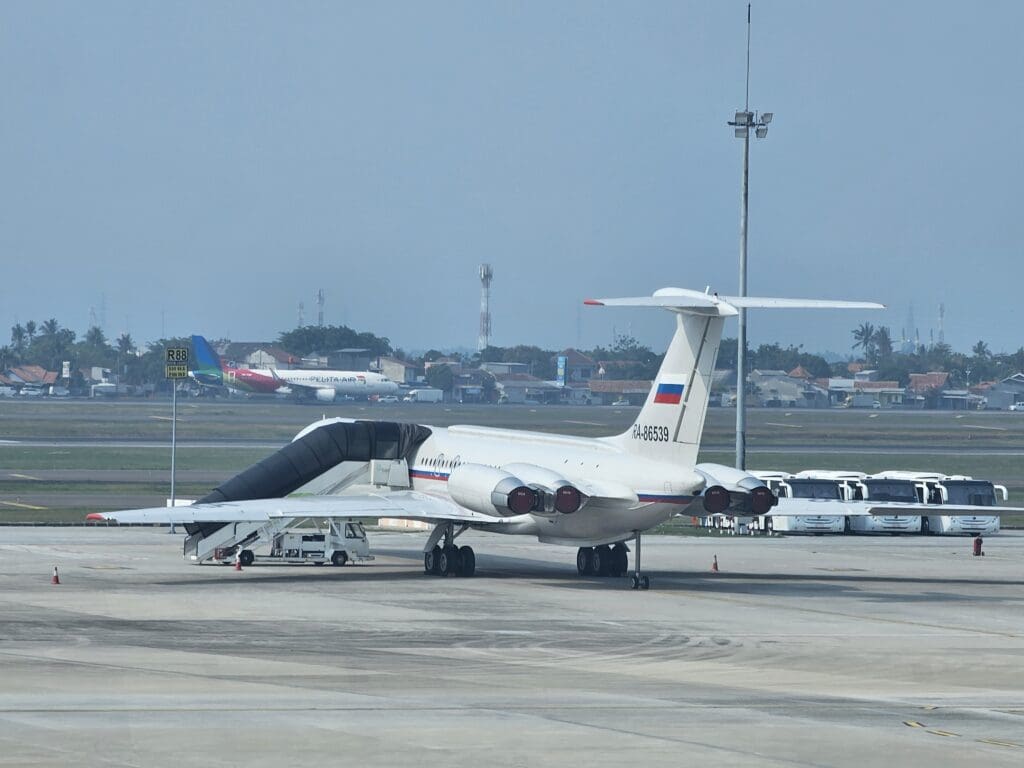
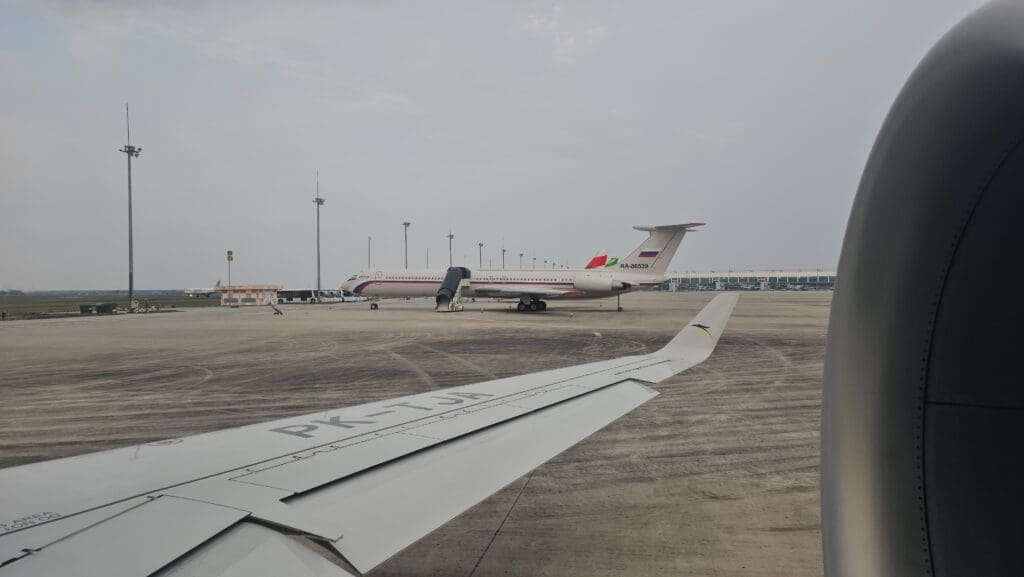
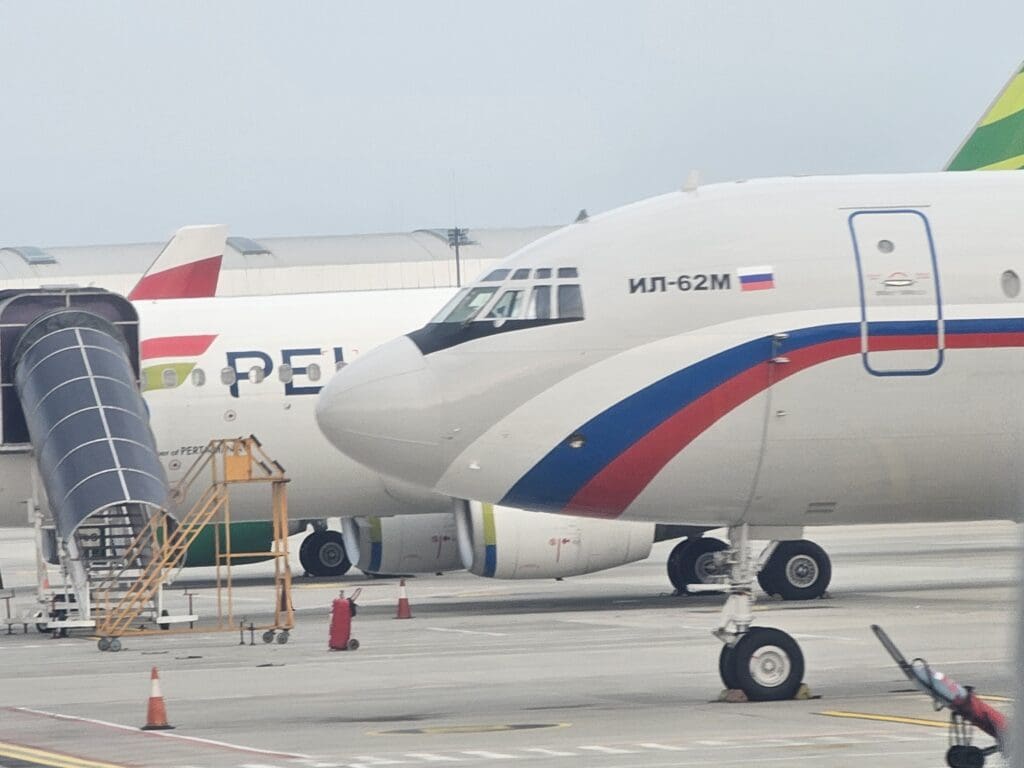
After passing through immigration, I looked outside over the ramp and was greeted by the sight of one incredibly interesting and rare aircraft, which was in town for the ongoing Southeast Asian security summit. This took the form of a forty-year-old Ilyushin Il-62MK operated by the Russian Air Force and wearing the standard government colour scheme without titles. Continuing onwards, I journeyed down the escalators from immigration and arrived at the main portion of the terminal building, where I began to explore the terminal.
As I wandered around, my first impressions of the airside portion of the terminal were overwhelmingly positive. This was highly modern, bright, open and spacious, with classic music ringing out and providing a calming soundtrack to my stay. In terms of facilities, this contained pretty much everything and anything a passenger could want from an airport terminal, with plenty of seating that included very comfortable recliners in the ‘relaxation zone’ to sofas and stools with worktops in the coworking space. As one would expect from a major international airport, plenty of eateries and shops were provided, and I stopped by at one of these for a cappuccino, which set me back 63,000 Rupiah (around £3.30). Importantly, the terminal seemed to be in a clean and tidy state, and I was ultimately left with nothing to complain about and would be more than happy to pass through Terminal 3 again. Interestingly, despite the busyness of the landside portion of the terminal, the airside area was very quiet, indicating that most were heading off on domestic services.
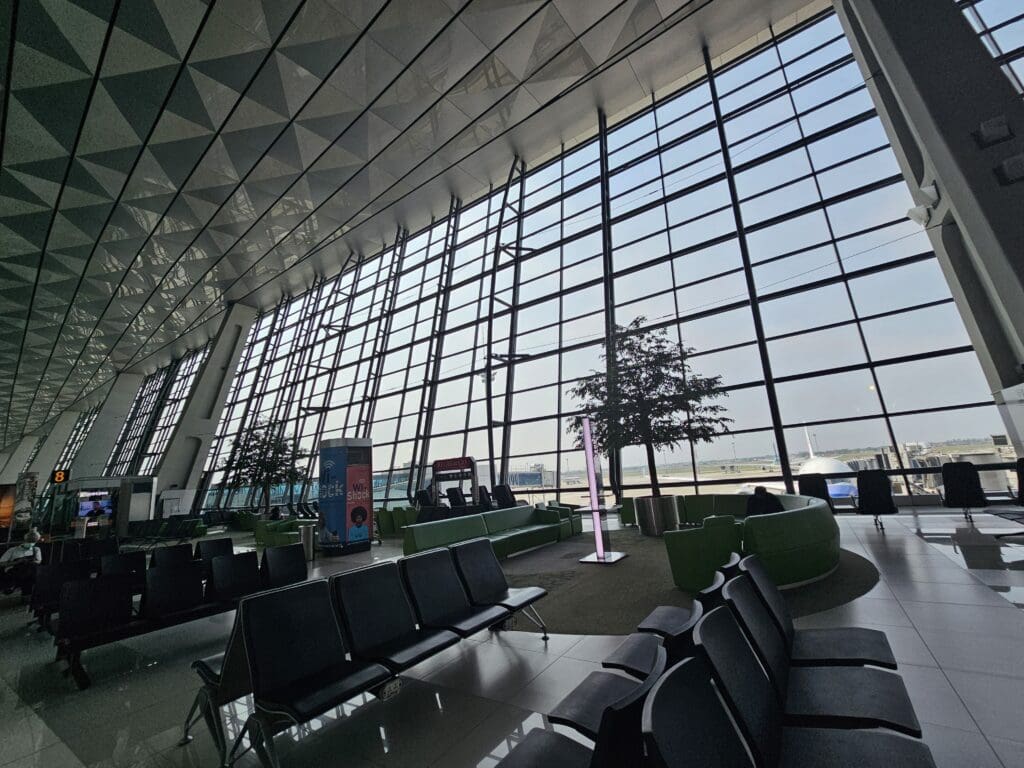
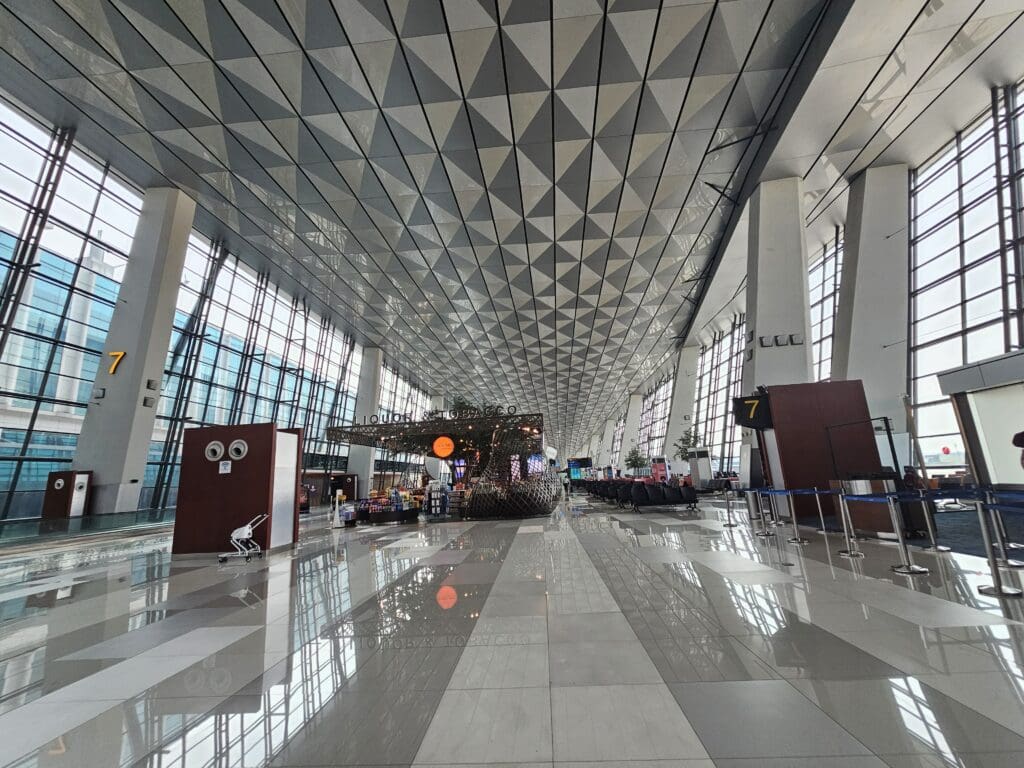
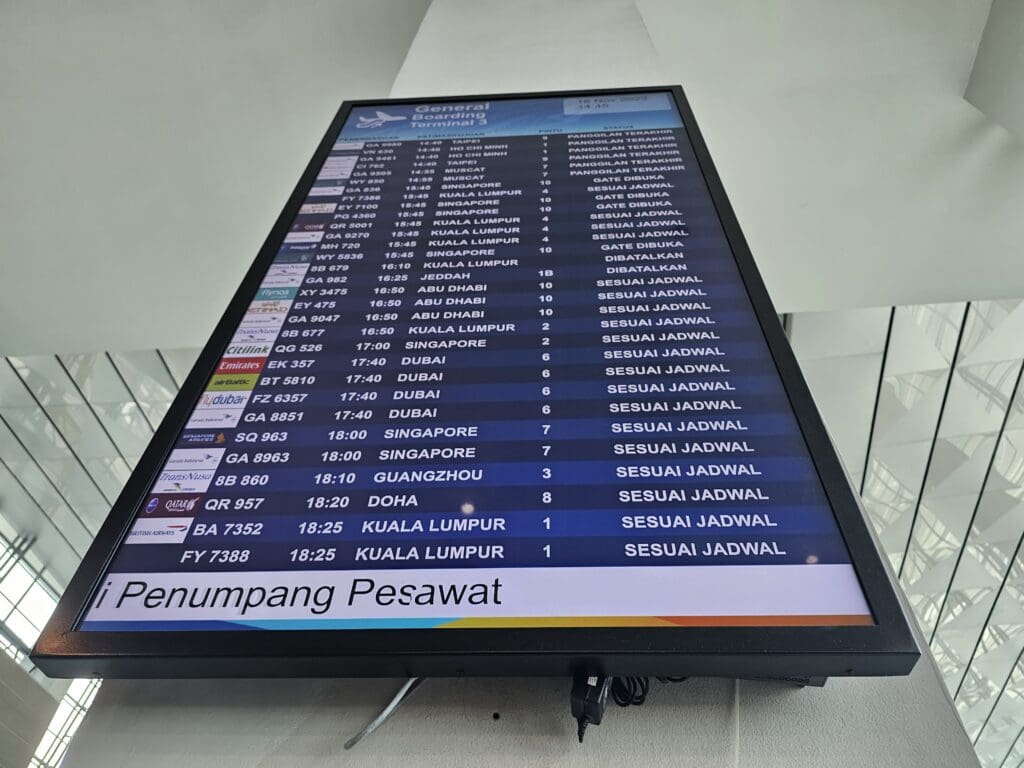
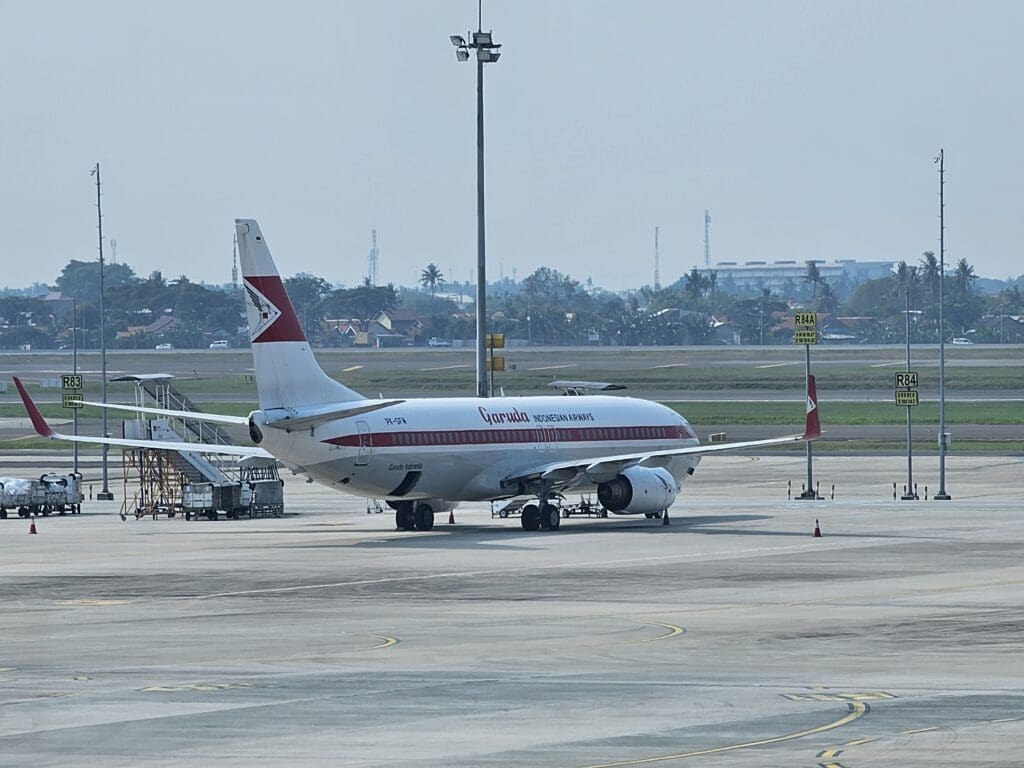
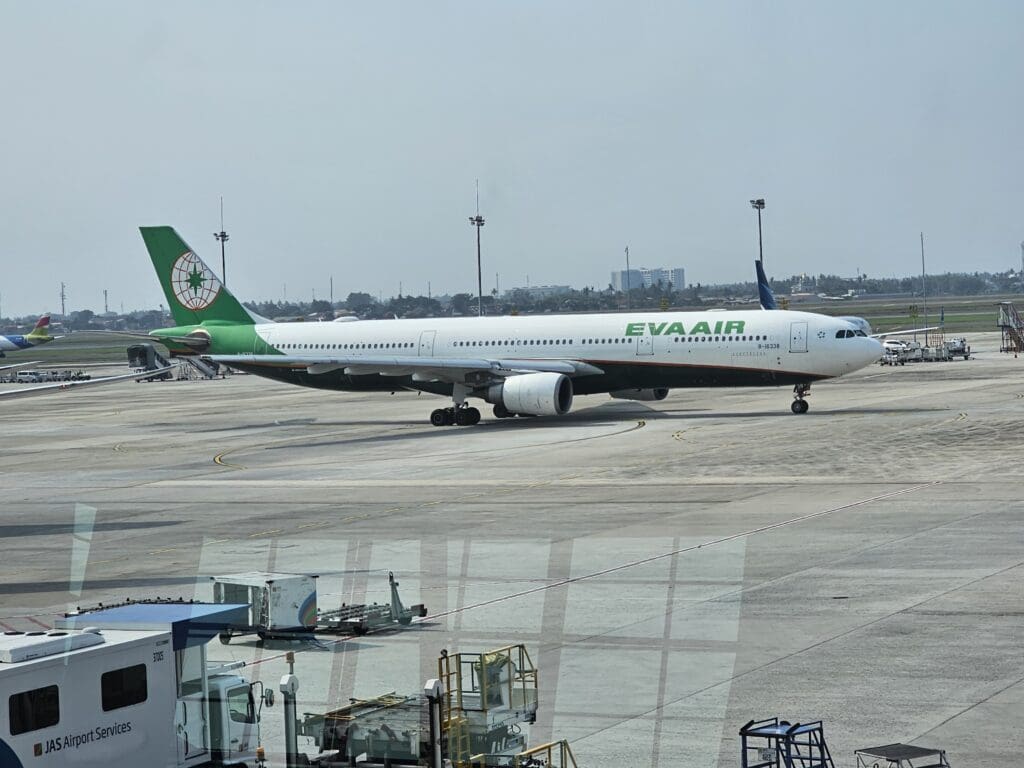
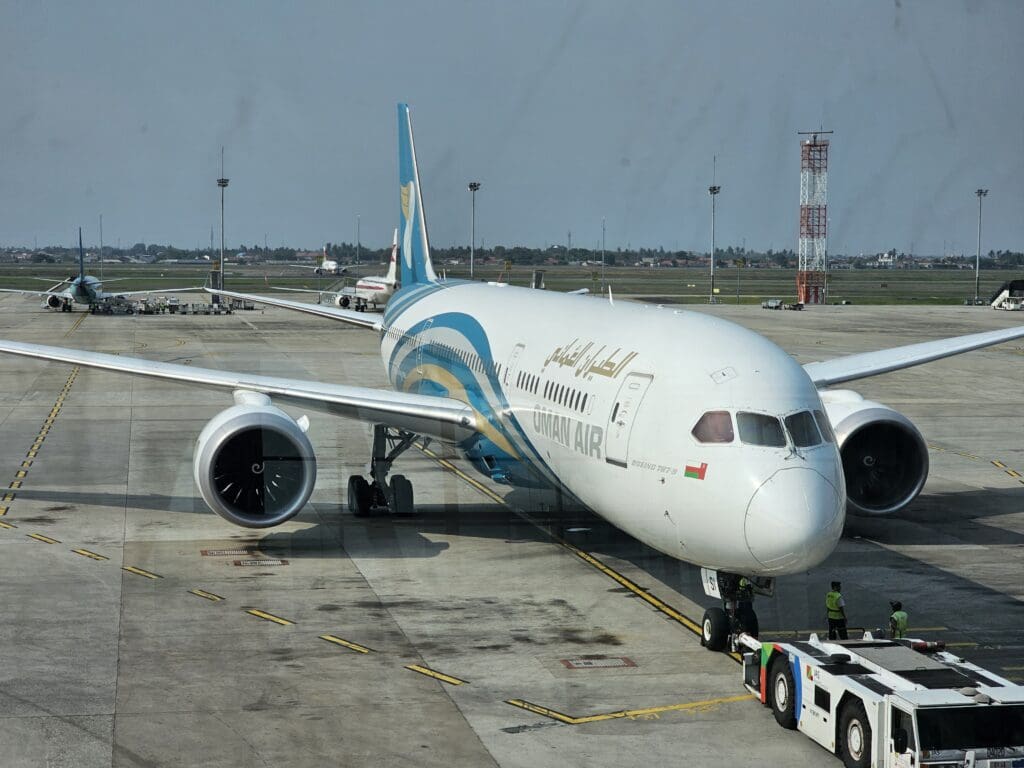
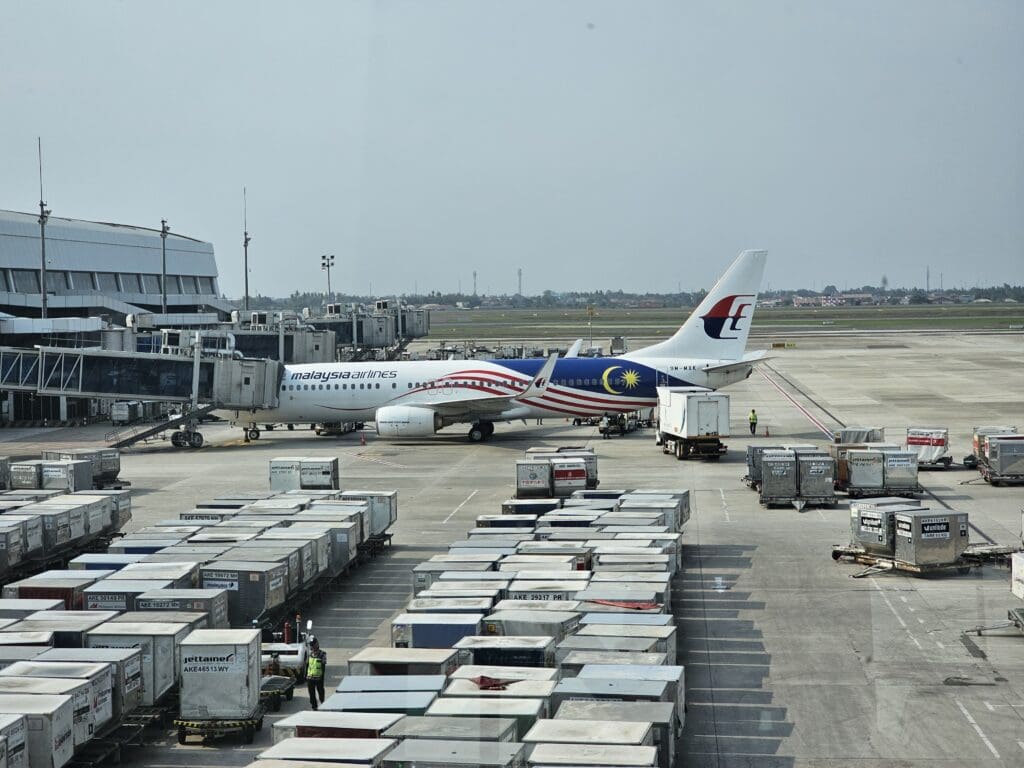
For those looking to pass the time by watching the non-stop stream of movements outside, the terminal provides superb vistas of both the apron and two of Jakarta Soekarno-Hatta Airport’s three runways. After wandering around, I plonked myself down in one of the relaxation zones and watched the comings and goings of aircraft outside. Being in Indonesia, as you would expect, plenty of movements came courtesy of local carriers such as Batik Air, Citilink, Garuda Indonesia, Lion Air, Pelita Air Services and TransNusa. However, in addition, being one of the main international gateways to Indonesia, plenty of carriers abroad could also be seen. During my stay I spotted aircraft from the likes of Air Atlanta Europe (operating for Saudia), ANA, Cathay Pacific, China Airlines, Emirates, EVA Air, Japan Airlines, Malaysia Airlines, Oman Air, Qatar Airways, Saudia, Scoot, Singapore Airlines and Wamos Air (operating for Etihad Airways). With plenty of aircraft, a good selection of airlines and superb airside views, I can safely say that Soekarno-Hatta Airport is a rather good airport for aviation enthusiasts!
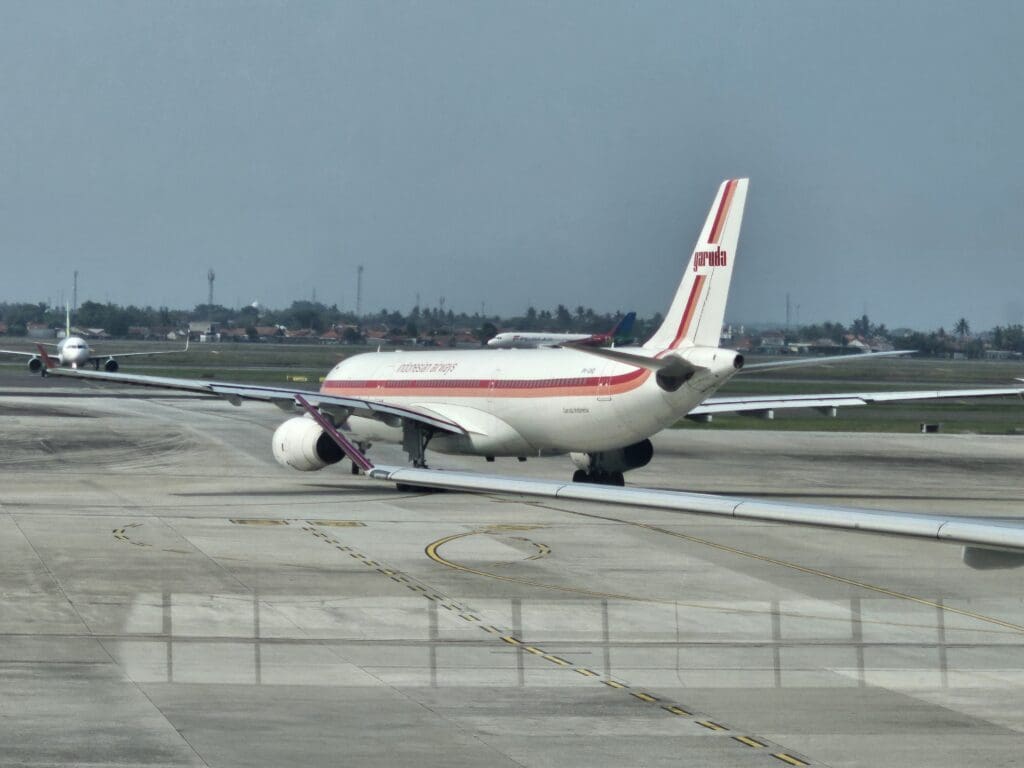
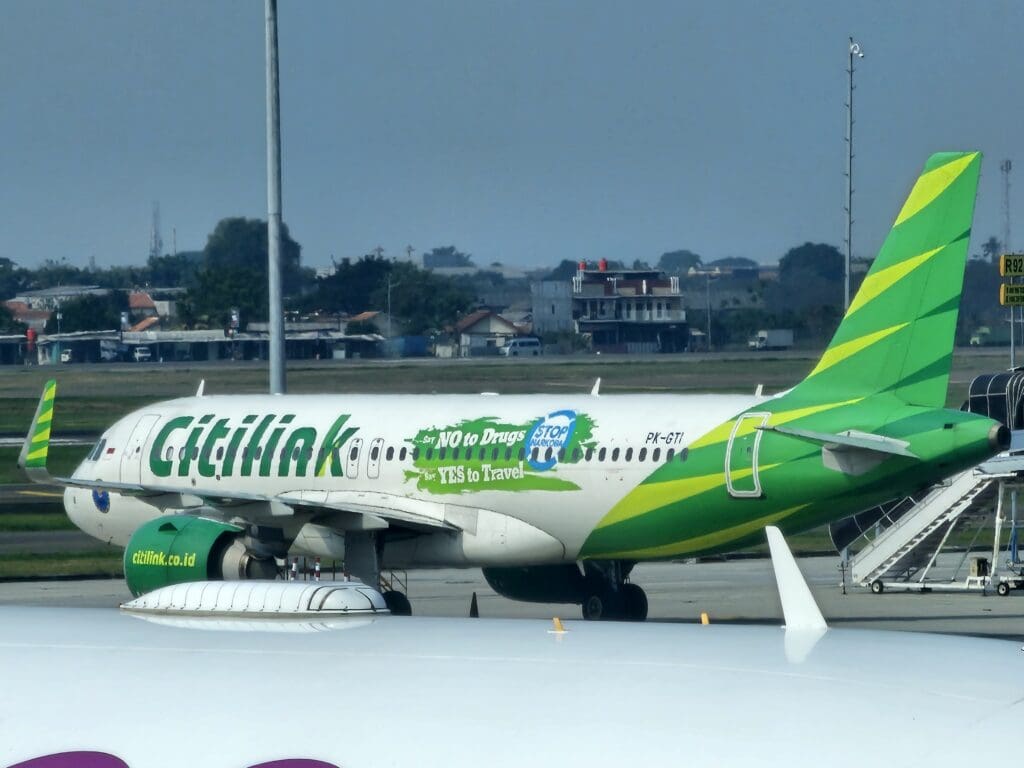
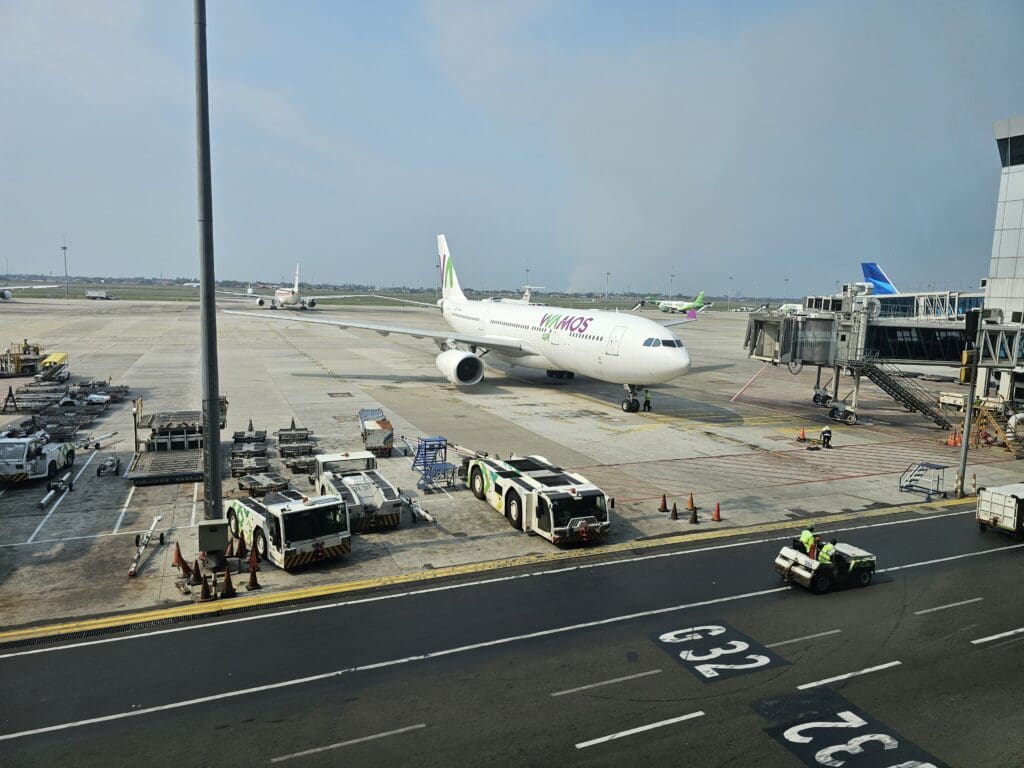
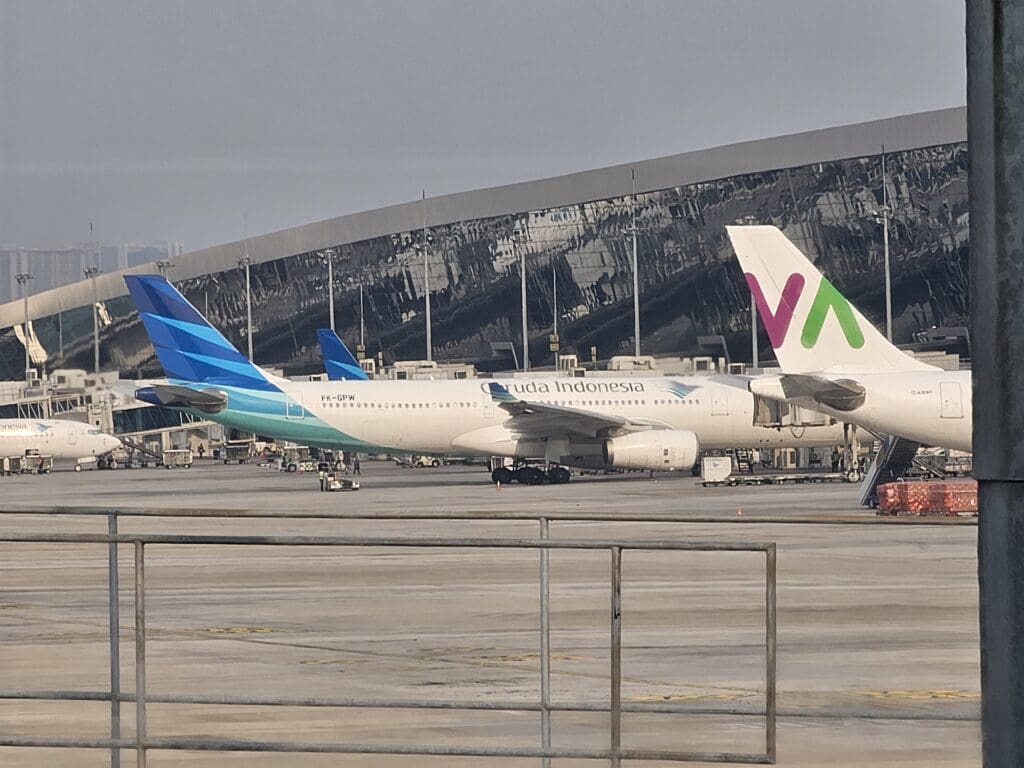
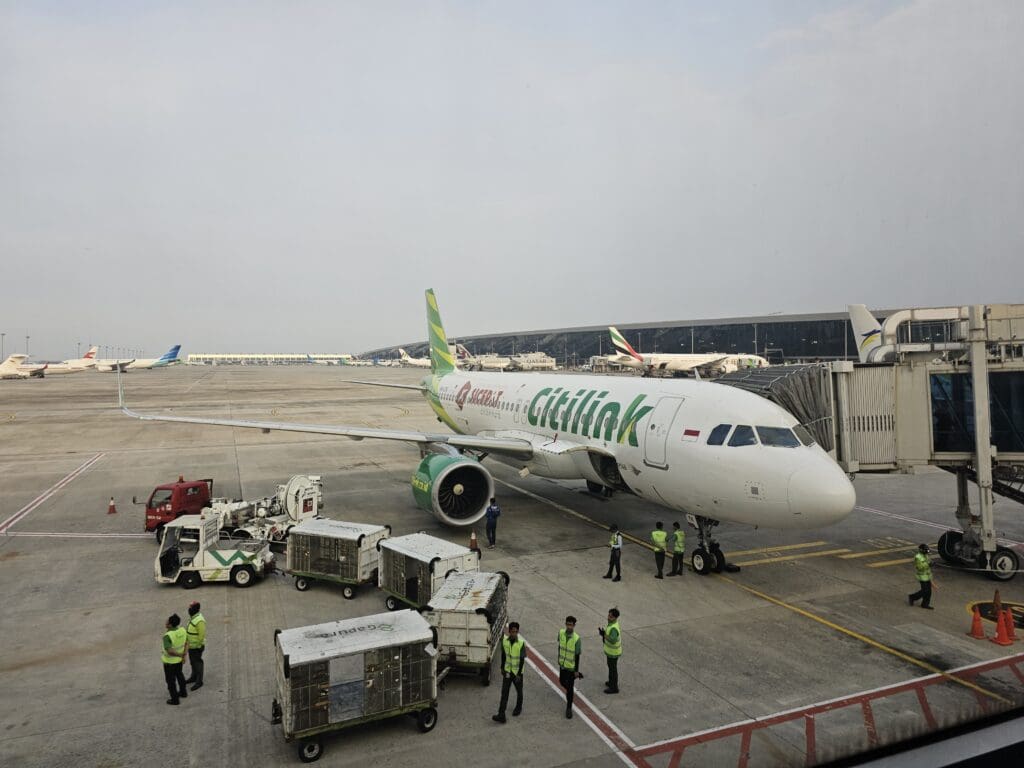
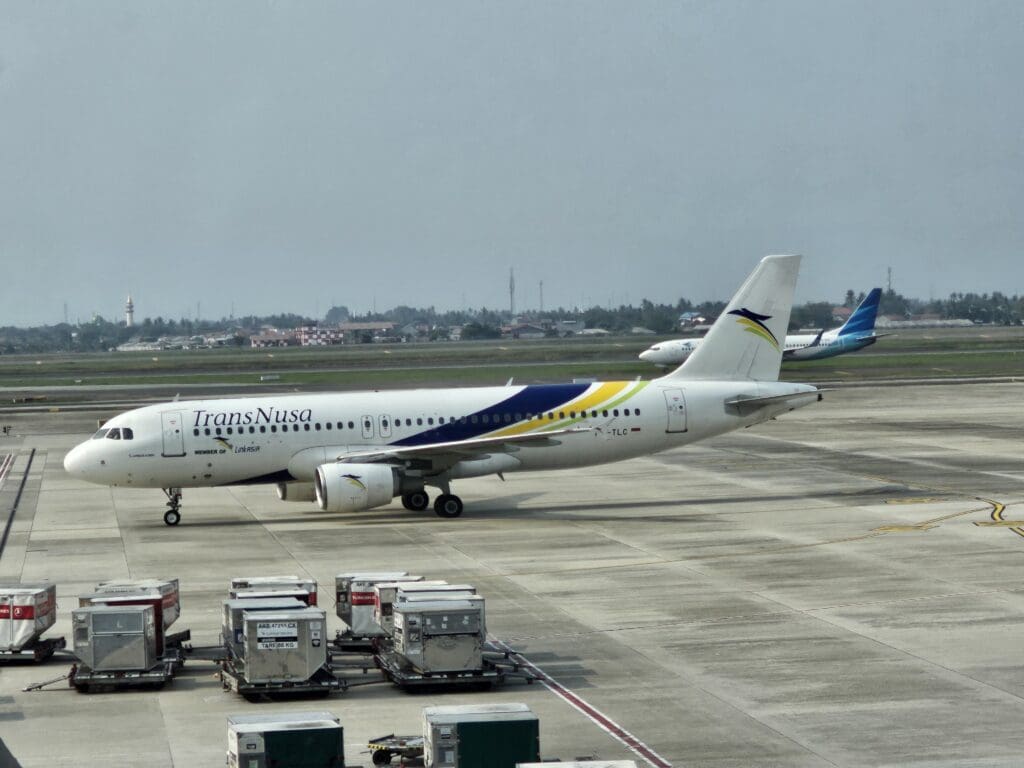
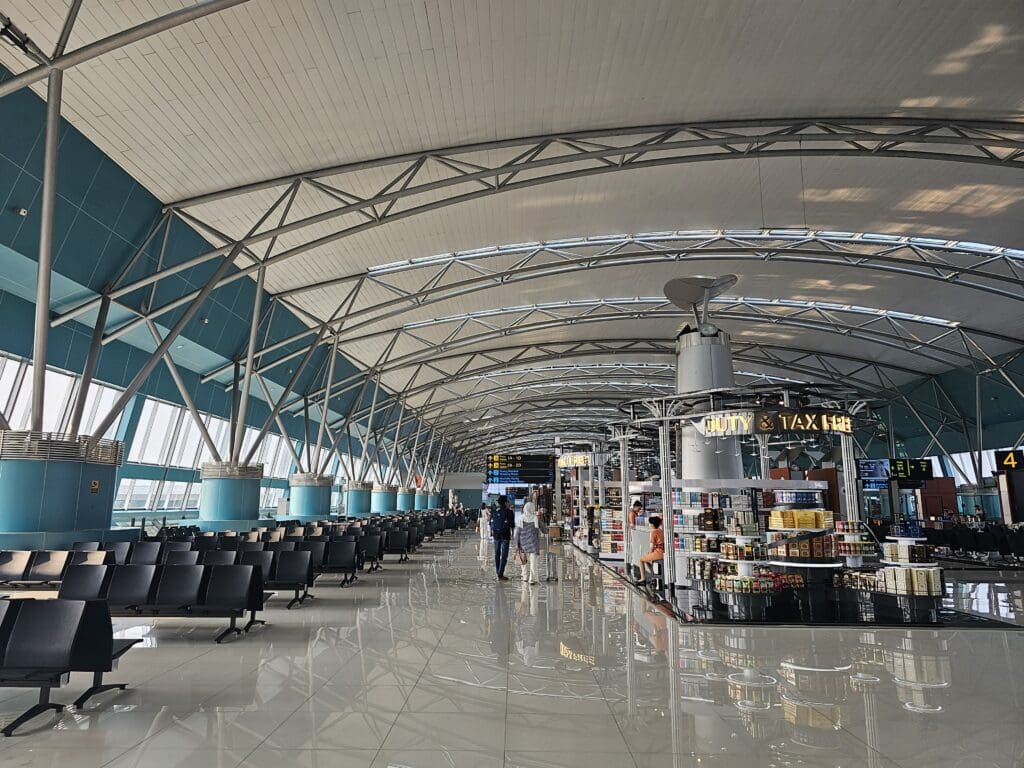
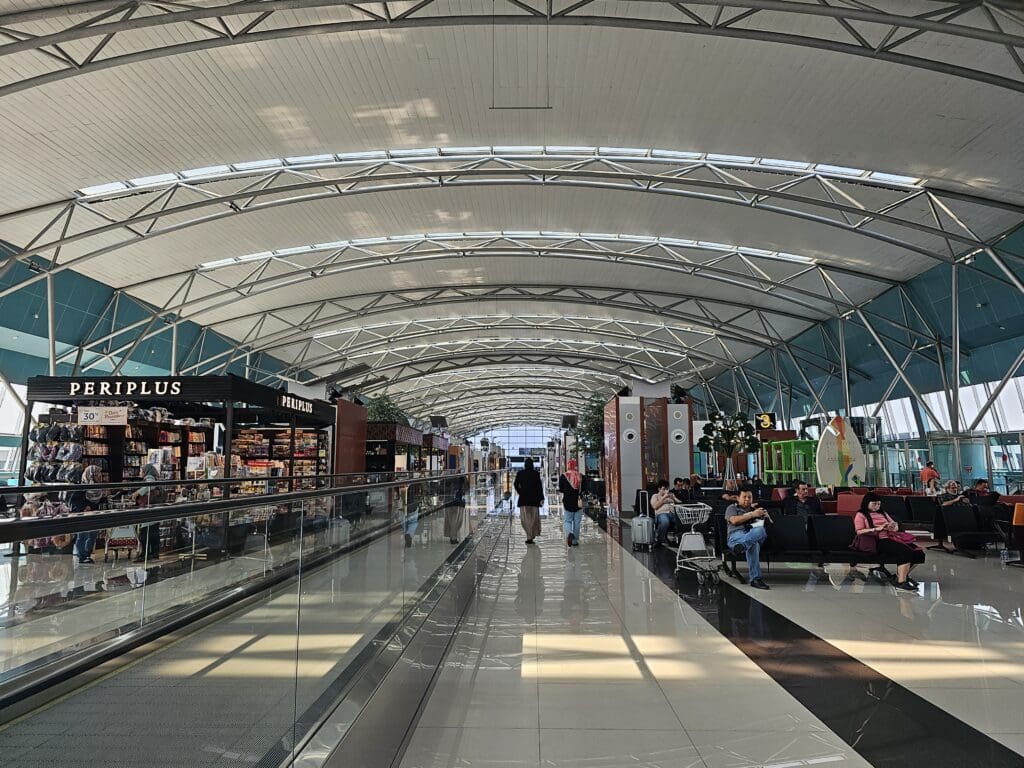
Examining the departure boards, these revealed that TransNusa’s Kuala Lumpur service would depart from Gate 2. In terms of Terminal 3’s layout, one way to describe it would be staple-shaped, with Gate 2 located on one of the two end piers. According to my boarding pass, that day, boarding was scheduled to commence at 1550. However, I was very sceptical that it would take an entire hour for passengers to board this small 95-seat aircraft. Nevertheless, with an hour to go, I decided to leave my comfortable seat in one of the relaxation areas and wander over to the gate. As I neared this, I found the end pier to be of a slightly different and more dated (although still modern) style when compared to the rest of the terminal, indicating that this was perhaps constructed first. In terms of facilities, several more shops and cafés could be seen here as well as charging points, although airside views were far more limited than in the main terminal.
Upon arriving at the gate, unsurprisingly, this was empty with neither staff nor passengers seen waiting there. However, a few minutes later, five gate agents appeared and began preparations for boarding. Indicating that this would be a straightforward and organised affair, barriers were set up, with three lines established – one for priority passengers, one for those in rows 7 to 12 and another for those in rows 14 to 20. At the end of the pier, TransNusa ARJ21 PK-TJB could be seen although, with absolutely no sign of life around this, it looked as if there had either been a last minute equipment swap or the flight would be operated by PK-TJA which at that time was still cruising southwards on its flight down from the Malaysian city of Johor Bahru.
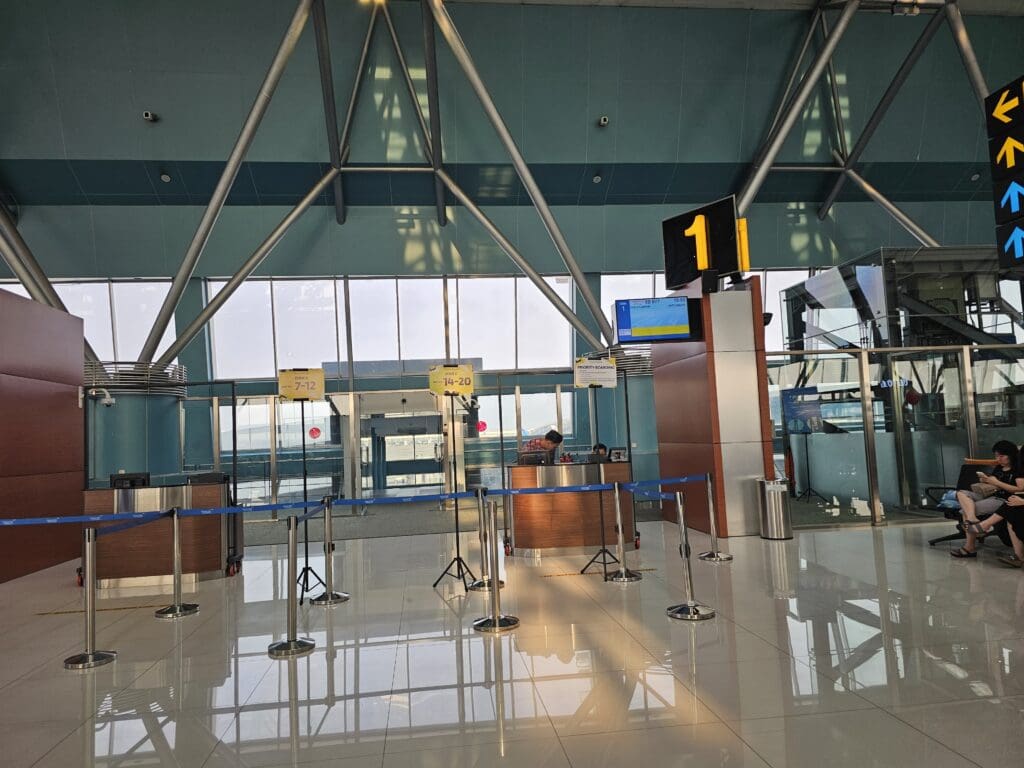
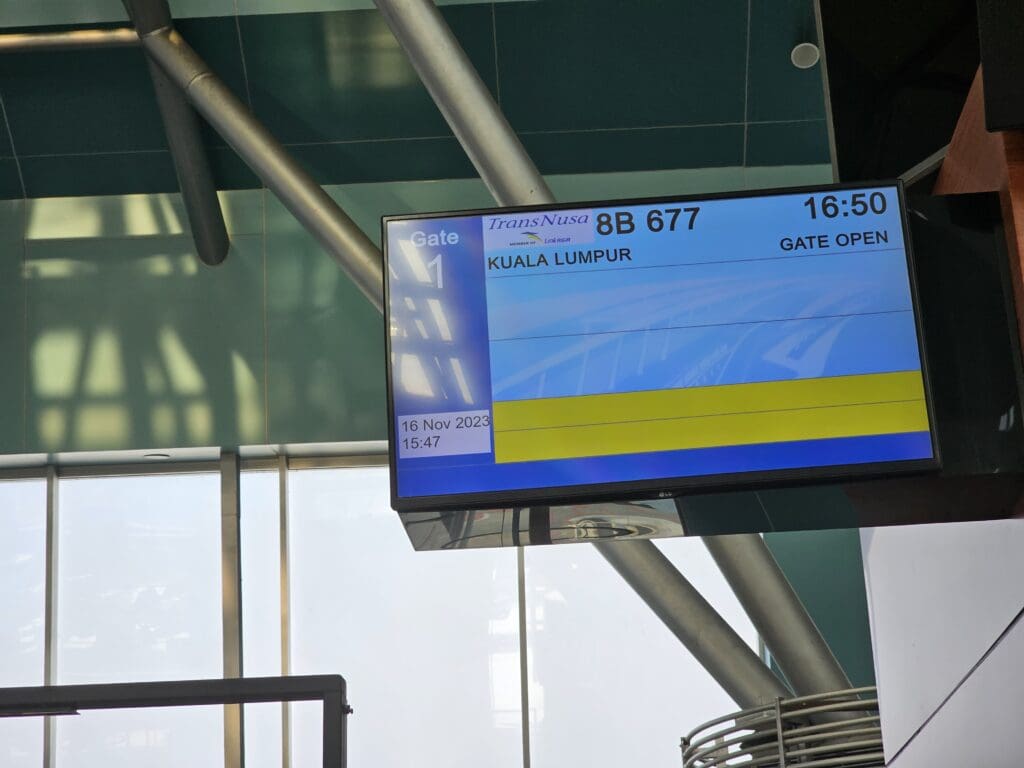
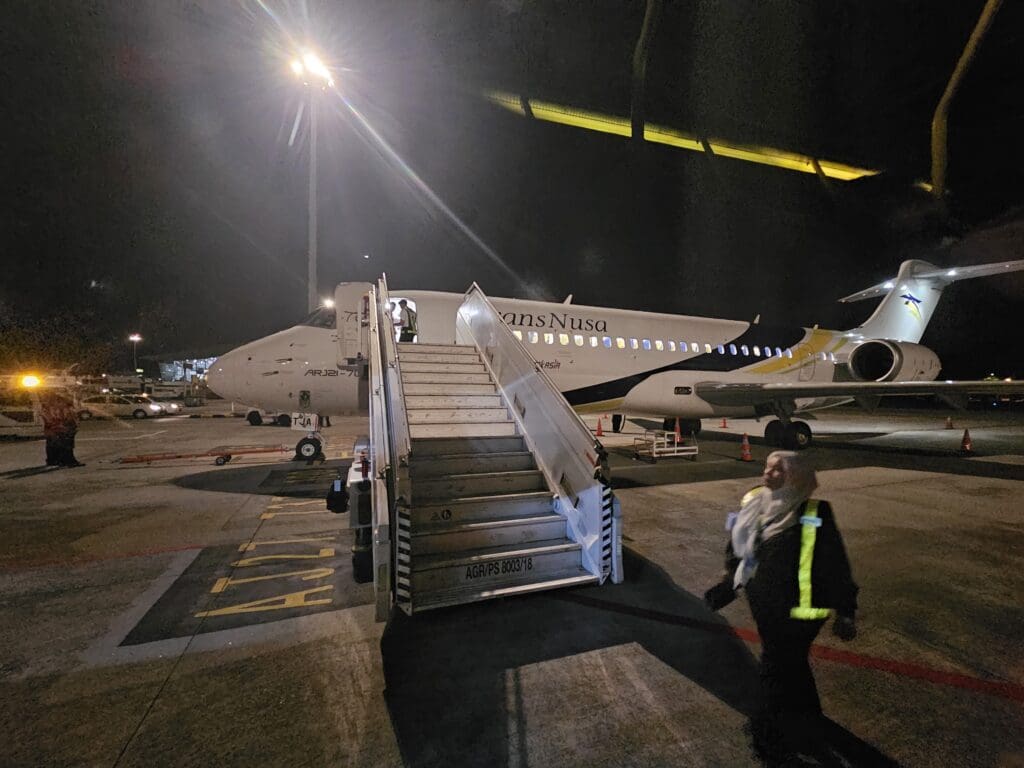
Seeing as the inbound ARJ21 was still in the air with twenty minutes to go until our scheduled departure time, a delay looked likely. However, at this time, a wheelchair passenger was taken through the gate, and moments later, all other passengers requiring assistance were invited to board. This was then followed by priority passengers, and then those in the rearmost rows of the aircraft. As I stood in line and shuffled forward, PK-TJA could be seen making its way into a remote stand and I soon had my boarding pass and passport checked before I was free to head downstairs. Following a very quick dark through the hot and humid afternoon air, I stepped onto the icy cold and well-air-conditioned Yutong bus. With the gate agents attempting to squeeze the majority of passengers onto a single bus, a few minutes of waiting was in order, and eventually, the doors were closed and we made a short journey out to the aircraft.
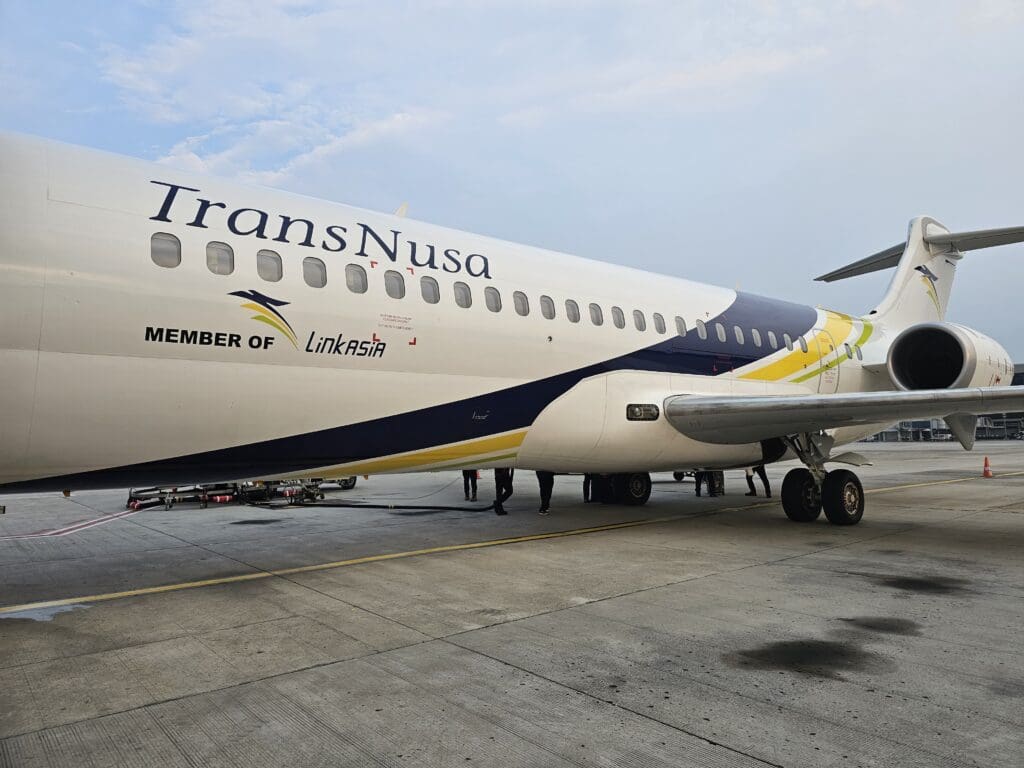
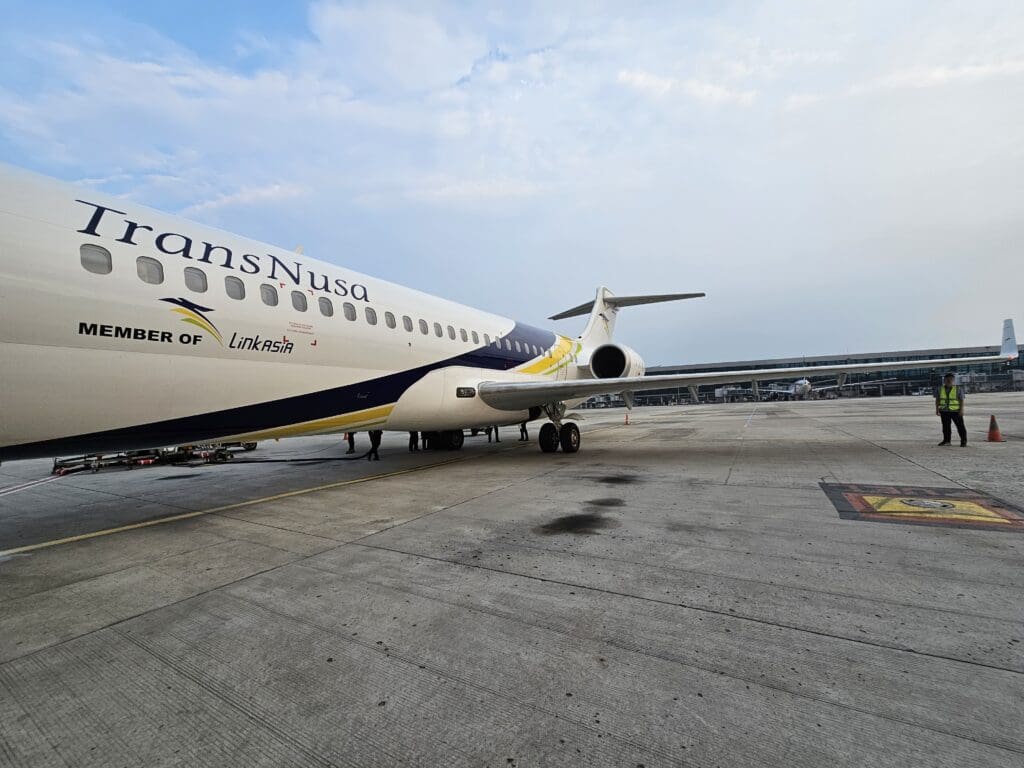
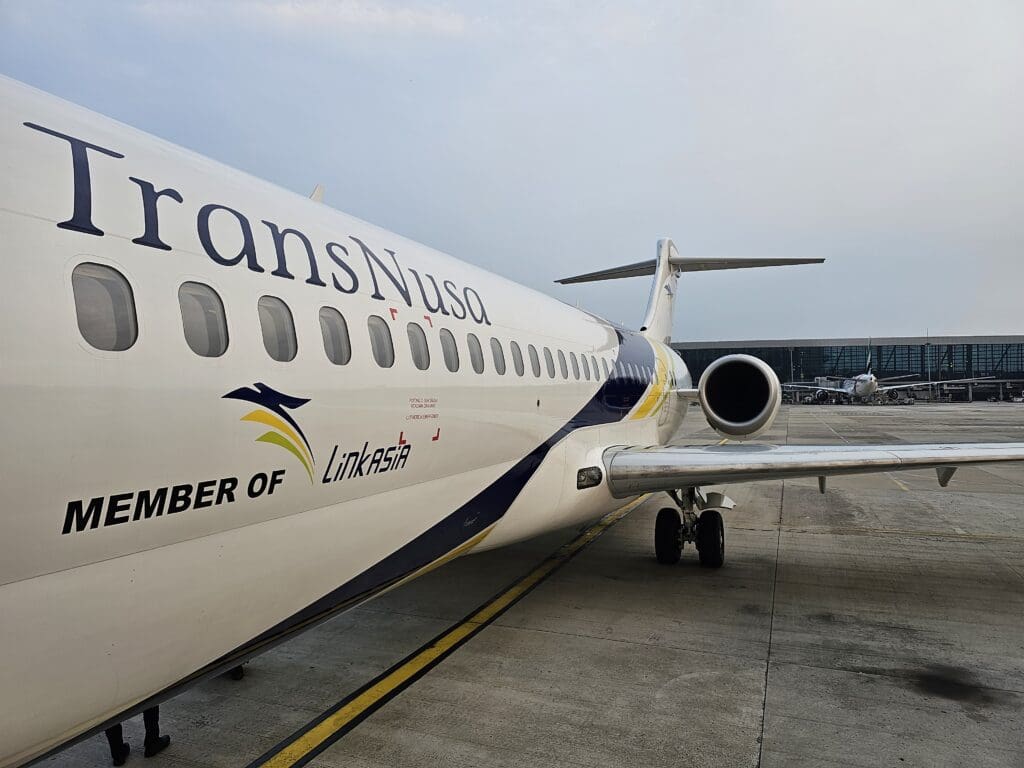
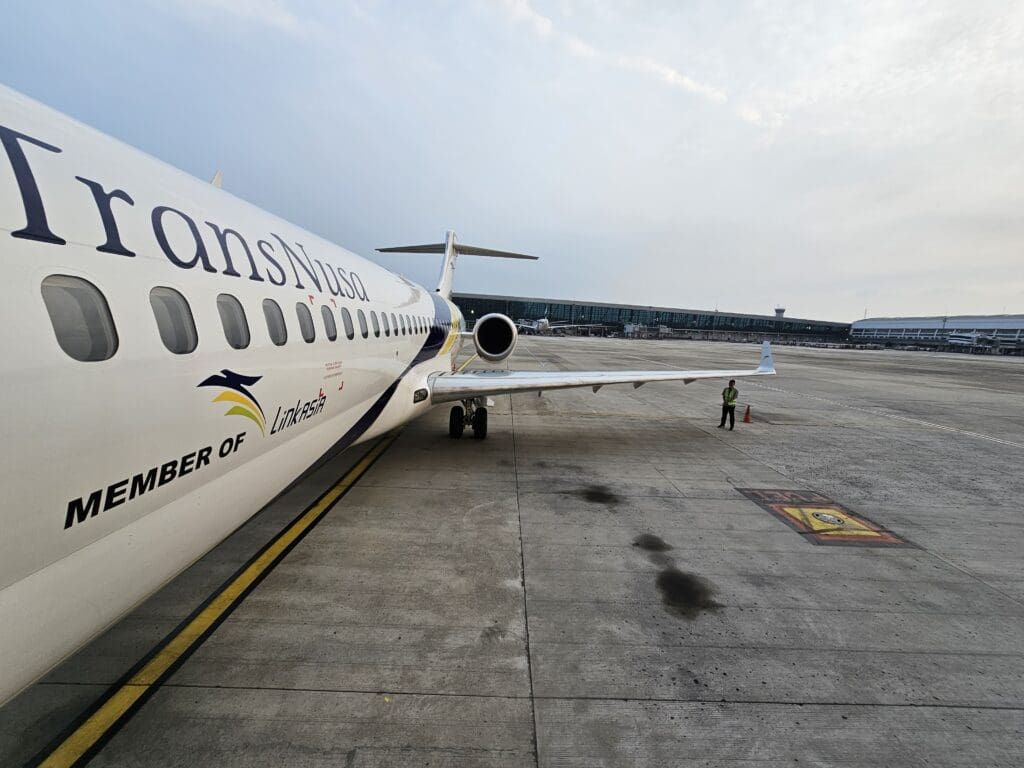
Almost as soon as we began to move, it became clear that we were being taken to the aircraft that had just landed. As expected, this took the form of COMAC ARJ21-700 PK-TJA. Manufactured at COMAC’s factory at Shanghai Pudong Airport with construction number 186, the aircraft took to the skies for the first time in late December 2021 with the test registration of B-099Y, making the aircraft just shy of two years old at the time of my flight. After cabin outfitting and extensive testing, the aircraft was delivered to TransNusa exactly a year later and was the first ever ARJ21 to be delivered to a carrier outside of China. Thanks to an elongated certification process, it wasn’t until April 2023 that the aircraft made its first commercial flight, which took place between Jakarta and Bali. In the week before my flight, the aircraft had not been particularly busy and had operated just four rotations to Johor Bahru and one to Kuala Lumpur. Indeed, this would be the first day that week that the aircraft had operated more than one rotation in a day! This is significantly less than their Airbus A320 fleet, which usually operates three rotations on a daily basis.
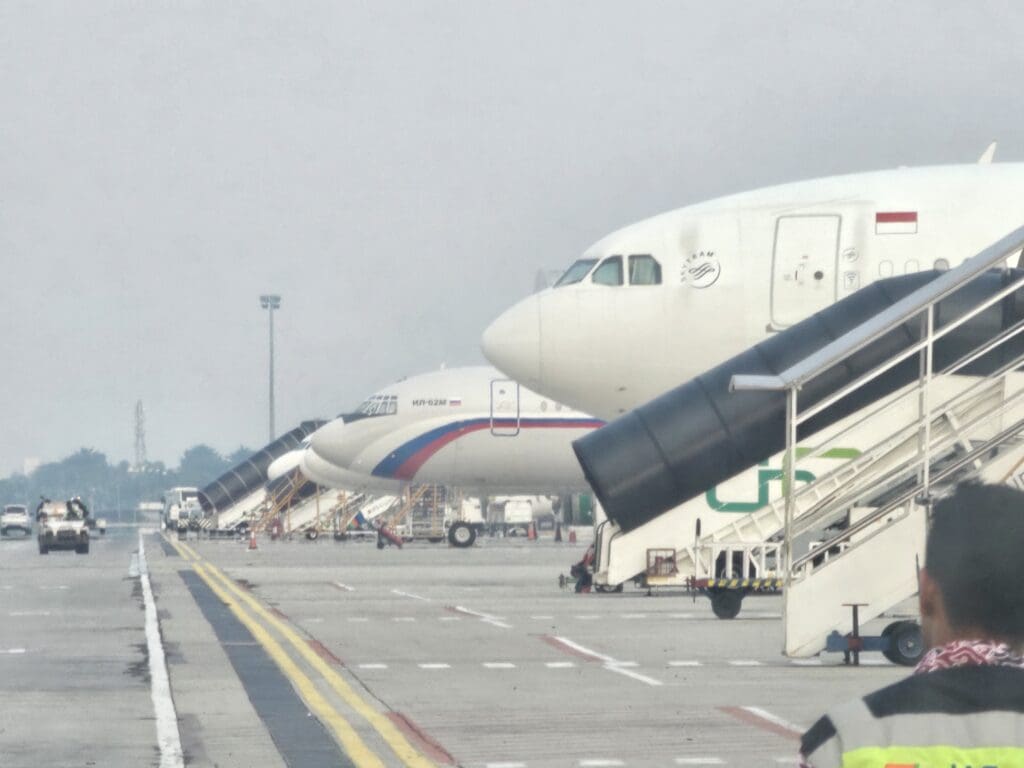
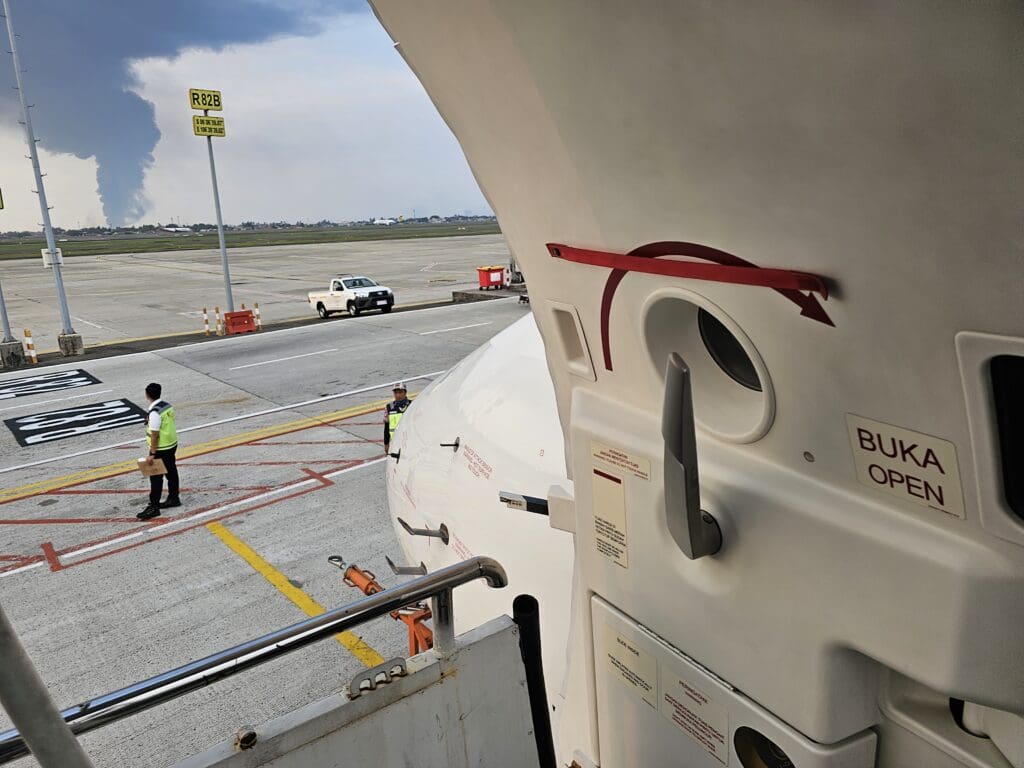
No more than two minutes after leaving the terminal, the bus came to a halt at Stand R82 near the modern-looking nose of the ARJ21. At that time, seeing as the pilots were disembarking and a new pair were heading up the steps, I was convinced that it would be some time before the bus doors were opened. However, much to my surprise, just a minute or so after pulling up to the aircraft, at 1650 on the dot the doors were opened and passengers spilt out onto the apron.
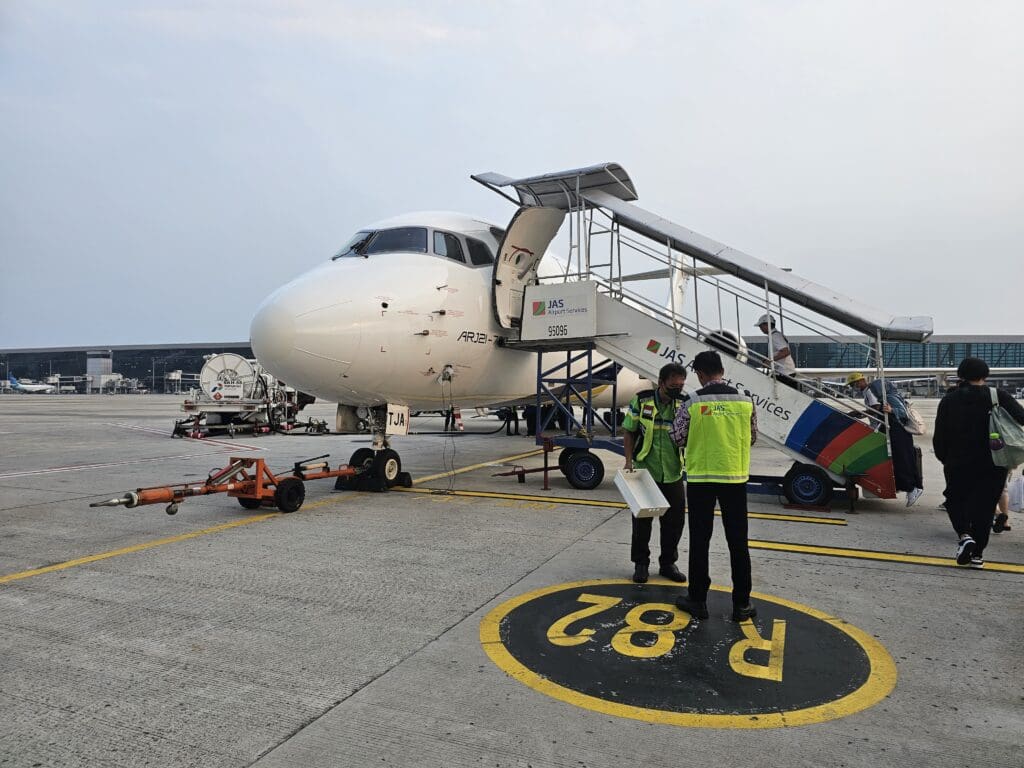
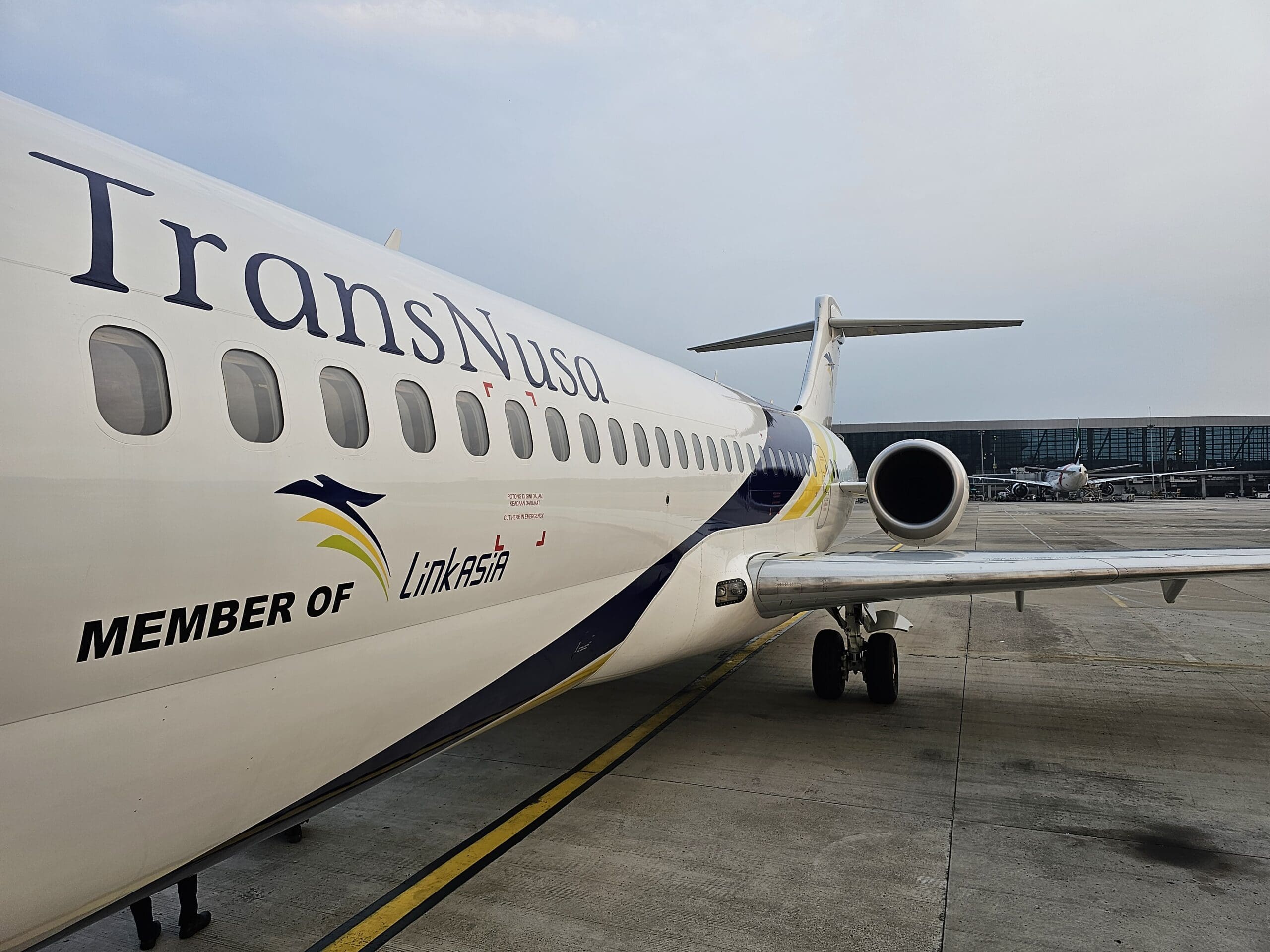
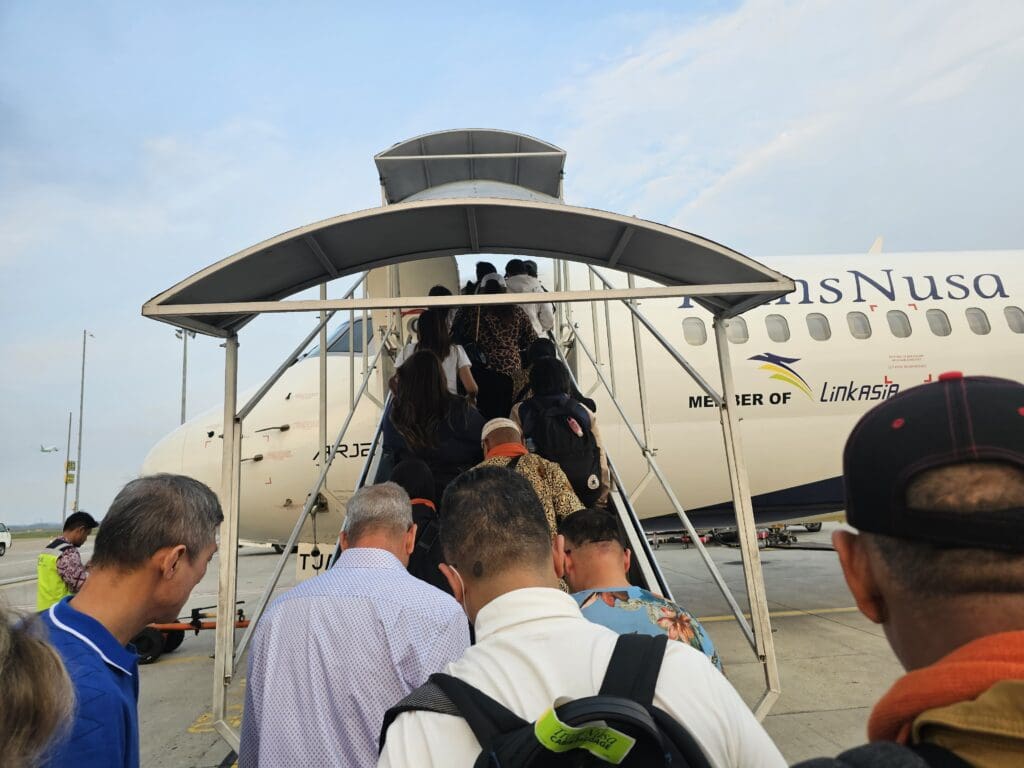
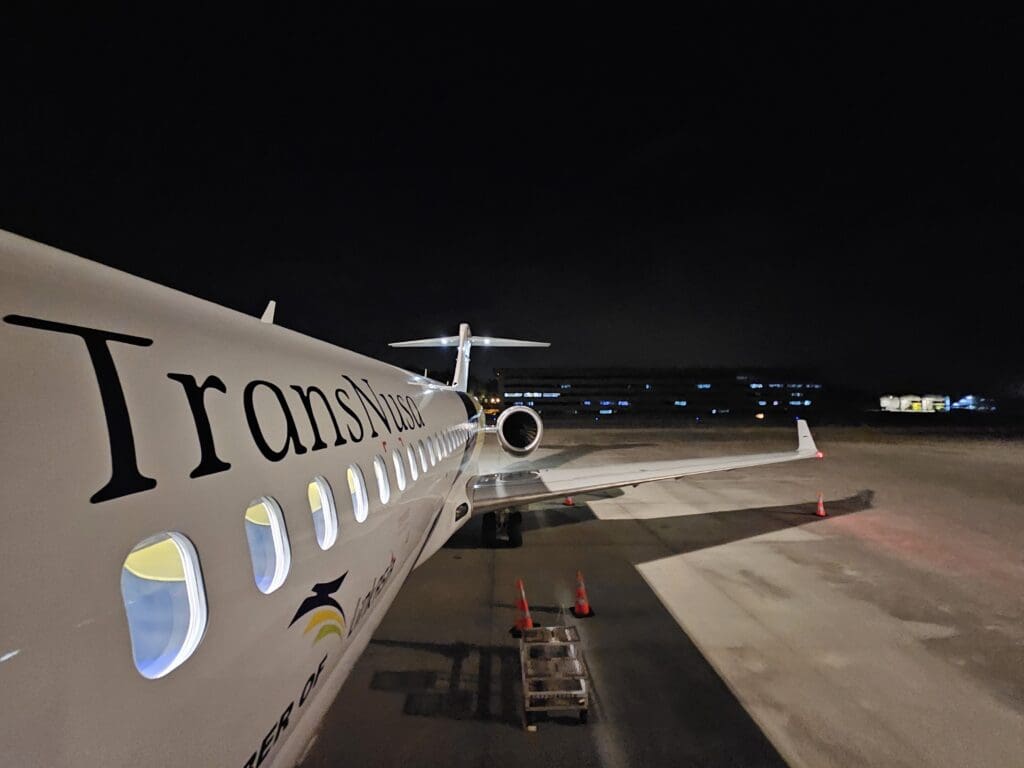
With this being the first time I had seen an ARJ21 up close, I savoured the moment and took plenty of photographs before joining the scrum of passengers waiting on the covered airstairs. With its fairly short 33.46 metre fuselage, relatively low height off the ground, rear-mounted engines and T-tail, the ARJ21 often gets compared in its appearance to the Boeing 717 and Douglas DC-9, and indeed, seeing the aircraft with my own eyes for the first time, it did bear to bare some resemblance to these American types albeit it with winglets and a modern cockpit. With passengers boarding fairly quickly, not too much of a wait was in order and upon stepping into the aircraft’s small forward galley, I received a quiet and subdued welcome in English from one of the two flight attendants onboard. Whilst this was not as warm or friendly as the welcomes I had received on the likes of Lion Air and Sriwijaya Air, this was still better than no welcome at all.
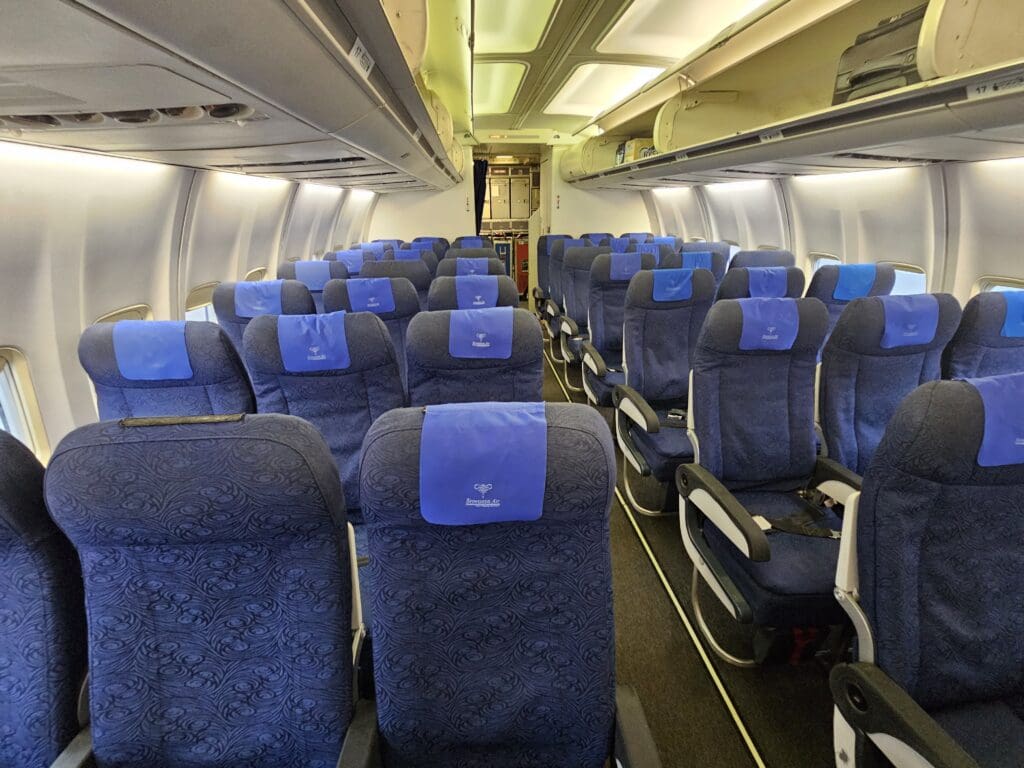
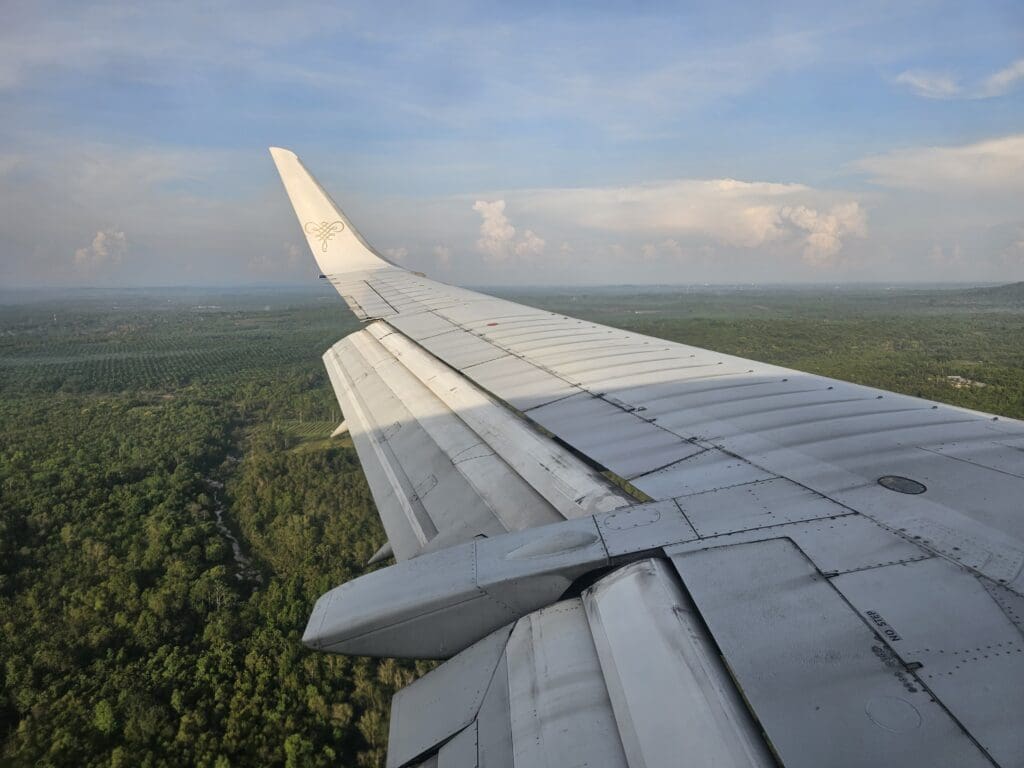
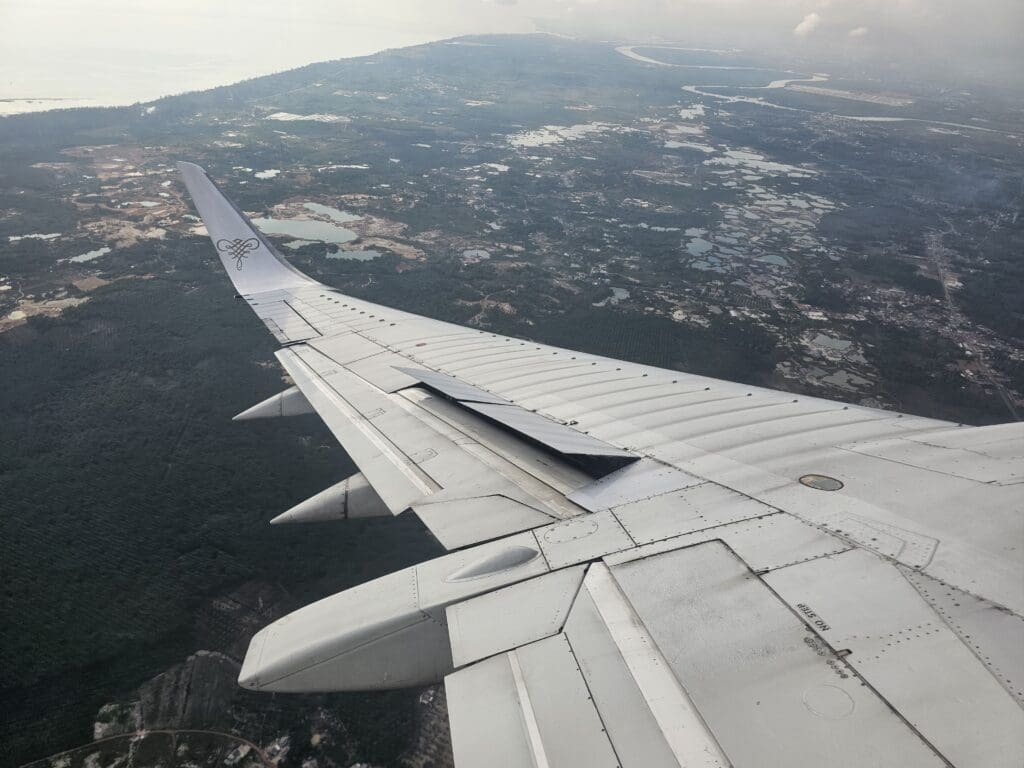
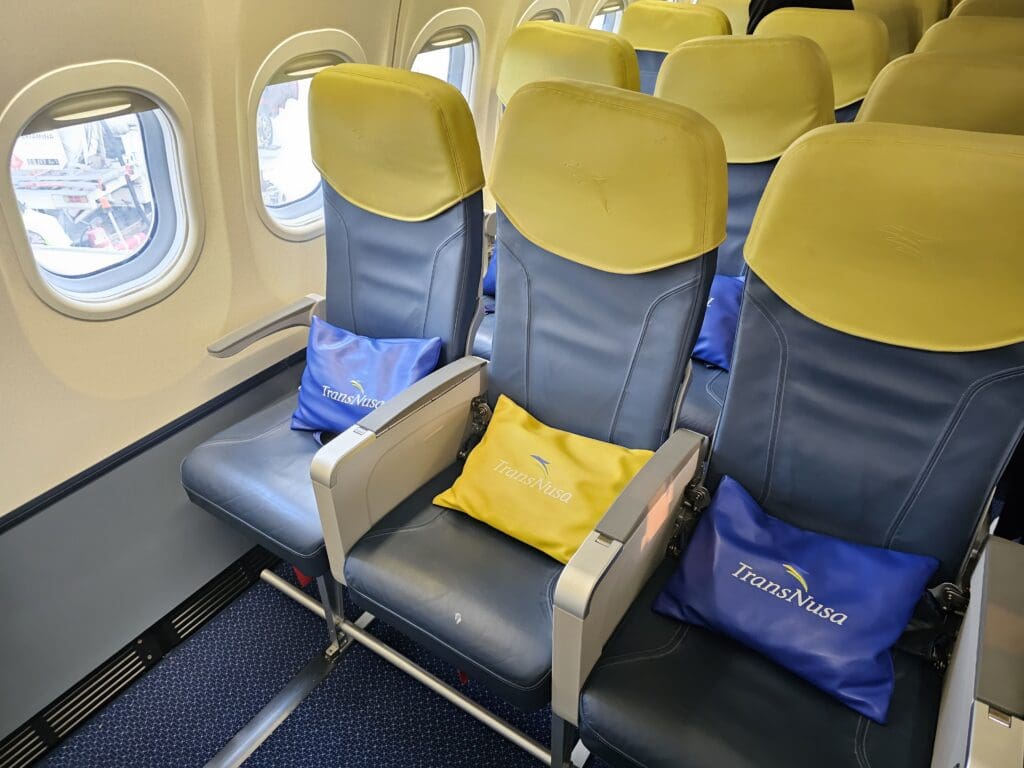
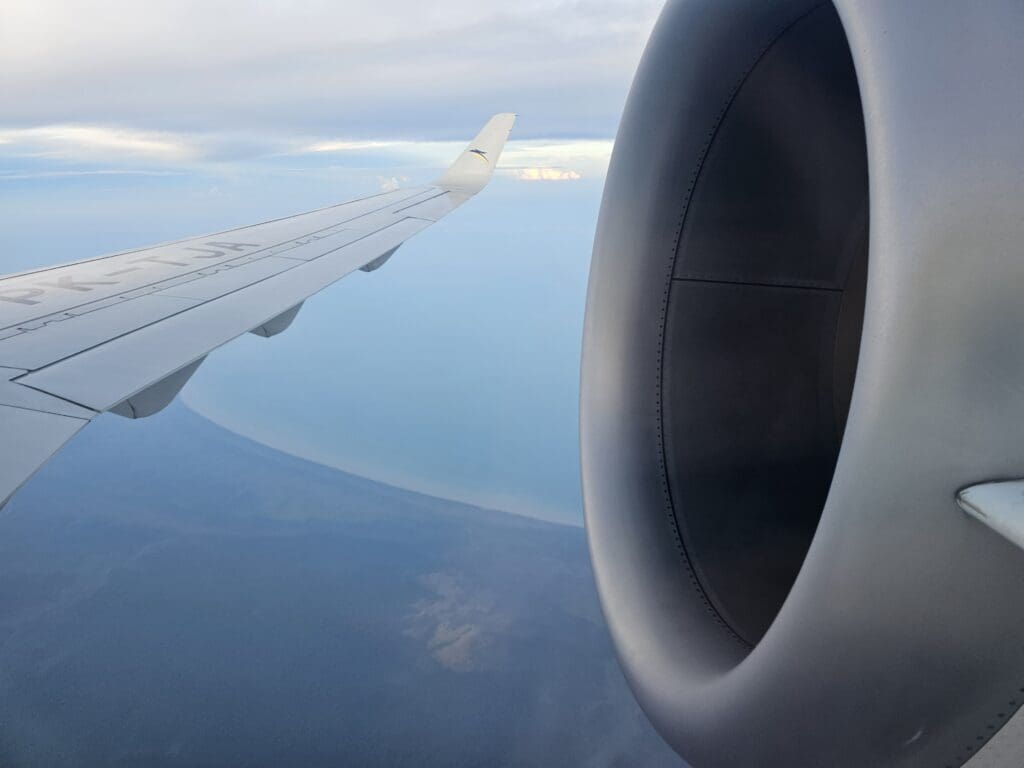
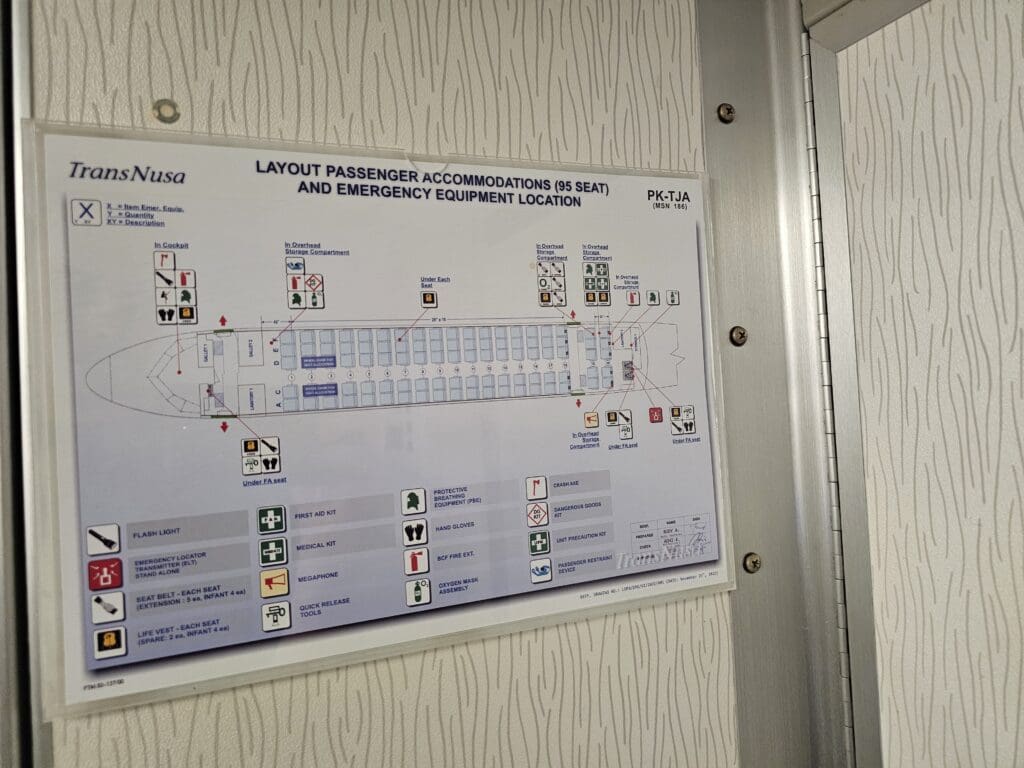
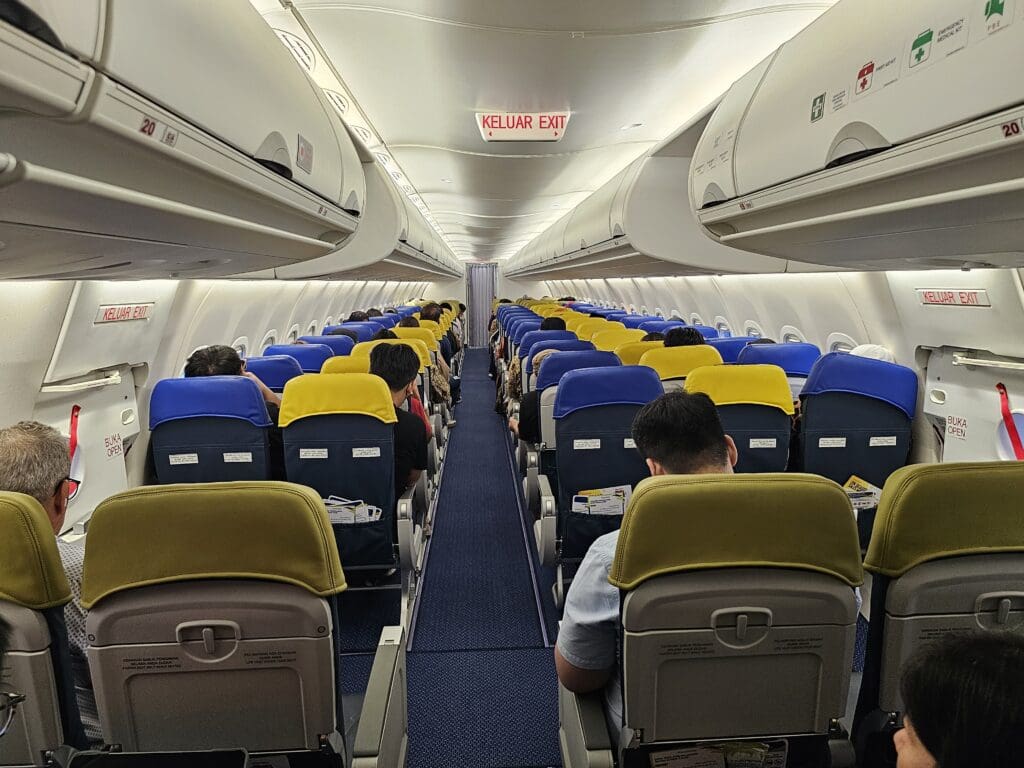
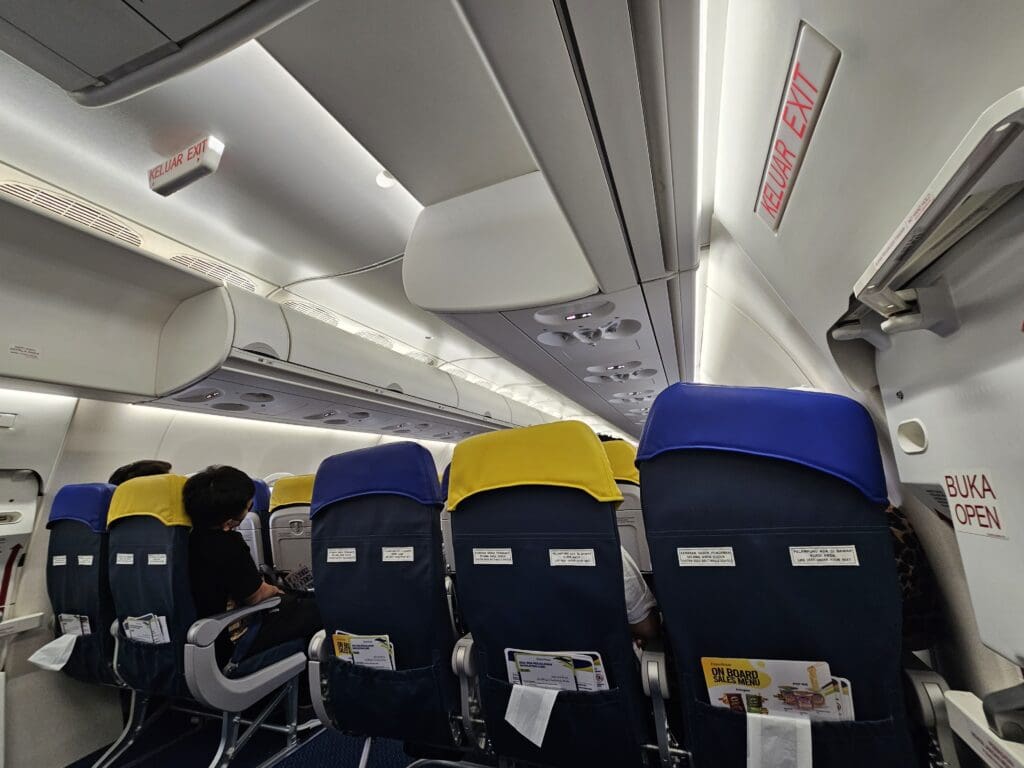
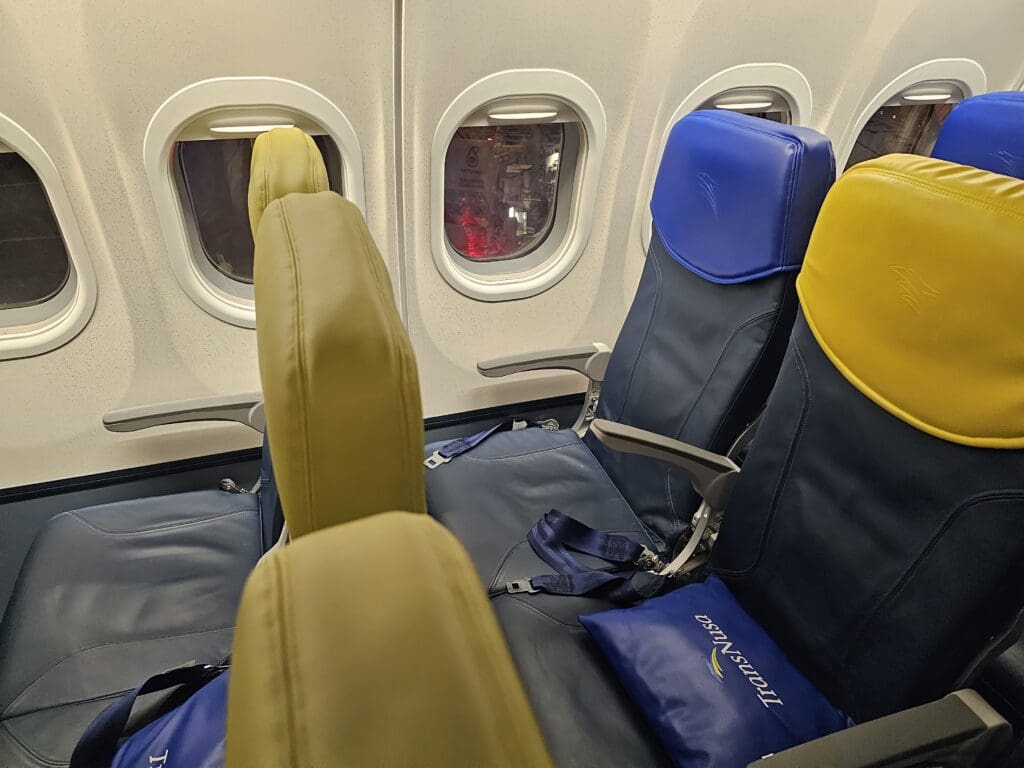
Turning right, I passed through the cabin divider and immediately entered the aircraft’s bright and modern cabin. Onboard, the TransNusa’s ARJ21s feature a single-class configuration and are home to 95 seats in a 2-3 configuration. This makes the type similar in capacity to the likes of a Bombardier CRJ-1000 or an Embraer 195. Given the carrier’s status as a low-cost carrier, I was not particularly surprised to find that each of the aircraft’s seats was rather thin and not overly comfortable looking. These were covered in a blue pleather cover, whilst yellow and blue toppers featuring TransNusa’s motif partially covered the tops of each seat. Meanwhile, those seats in the first few rows featured a pleather-covered pillow. Making my way down the cabin, I received another quiet welcome from the other flight attendant and soon arrived at the emergency exit row. Alongside offering heaps of legroom, the emergency exit row provides a good view of the wing and engine and is thus a favourite seat for enthusiasts and flight reviewers.
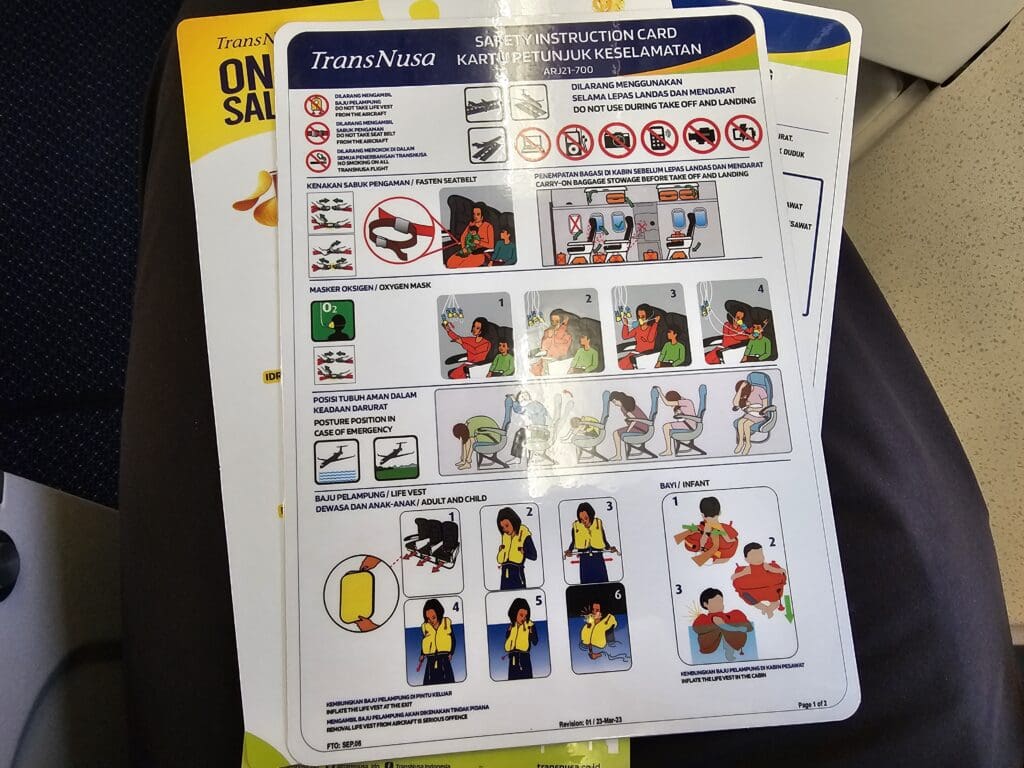
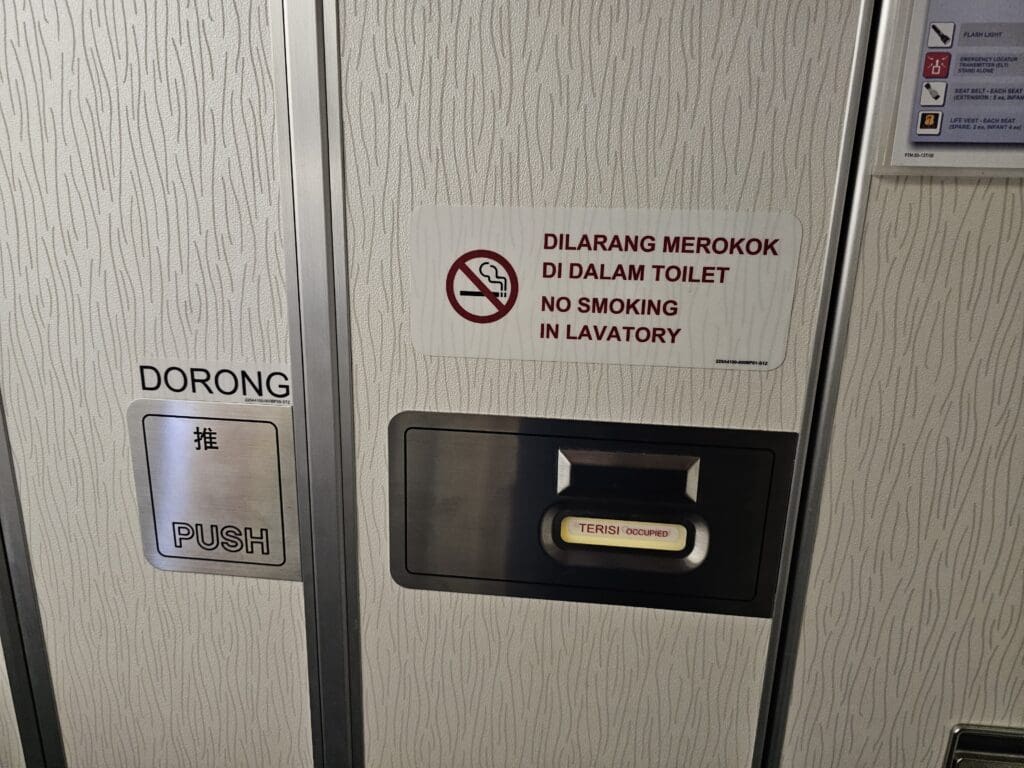
Once at the rear of the aircraft, I encountered my first challenge of the flight. Unfortunately, the overhead lockers on the ARJ21 seemed to be significantly smaller than those onboard the likes of the Airbus A320 and Boeing 737. Thus, for the first time, I had some difficulty in attempting to squeeze my bag into one of these. Eventually, after fighting with my bag, I was able to squeeze this in and settled down into my seat for the ride ahead. Focusing on the seat, this was exactly as firm as its thin appearance would indicate and was by no means soft or well-padded. Given the short turnaround time, I had expected a rather brash and haphazard clean. However much to my delight (and perhaps indicating the flight down from Johor Bahru had been empty), the cabin was in a near-pristine state. In addition, no significant signs of wear and tear could be seen. Examining the contents of the seatback pockets, I found these to contain a safety card, another that detailed the usage of the emergency exit, a plastic rubbish bag like sick bag and a copy of TransNusa’s buy-on-board menu. Glancing around, I couldn’t help but notice that the passenger service units up above bore some resemblance to those used on the Bombardier CRJ! Meanwhile, to those not in the know, other than the manufacturer’s plate near the entrance and the Chinese characters for push and pull on the toilet doors, there was nothing to suggest that the aircraft was any special.
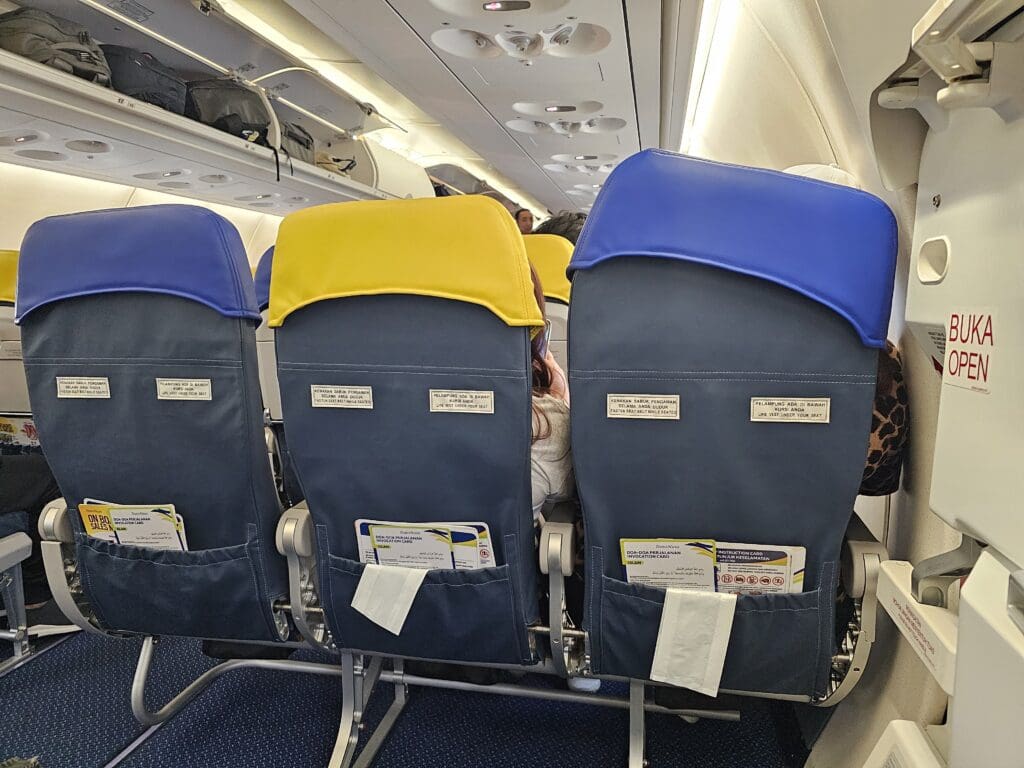
That afternoon, it soon became clear that the flight to Malaysia was not to be full, and we ended up with a load of around 70%. With TransNusa not exactly being a well-known airline outside of Indonesia, I was not particularly surprised to find that most passengers hailed from Indonesia, many of whom appeared to take the form of tourists. Just a few minutes after boarding had commenced, this reached its end, and I was surprised at the efficiency of the staff as they attempted to alleviate the impact of the delay. However, this was arguably taken too far when the aircraft was pushed back whilst passengers were still stowing their luggage in the small overhead compartments. As they did so, one of the flight attendants performed their welcome announcement in Indonesian and English, which consisted of the usual welcomes and thanks, as well as a mention of our two-hour flight time to Kuala Lumpur. Eventually, the other cabin crew appeared and ushered passengers to sit down whilst the ARJ21’s two General Electric CF34-10A engines powered into life, resulting in plenty of noise and vibration. However, I imagine that much of this was down to my location right next to the engines at the rear of the aircraft, and those at the very front would have had a much quieter ride.
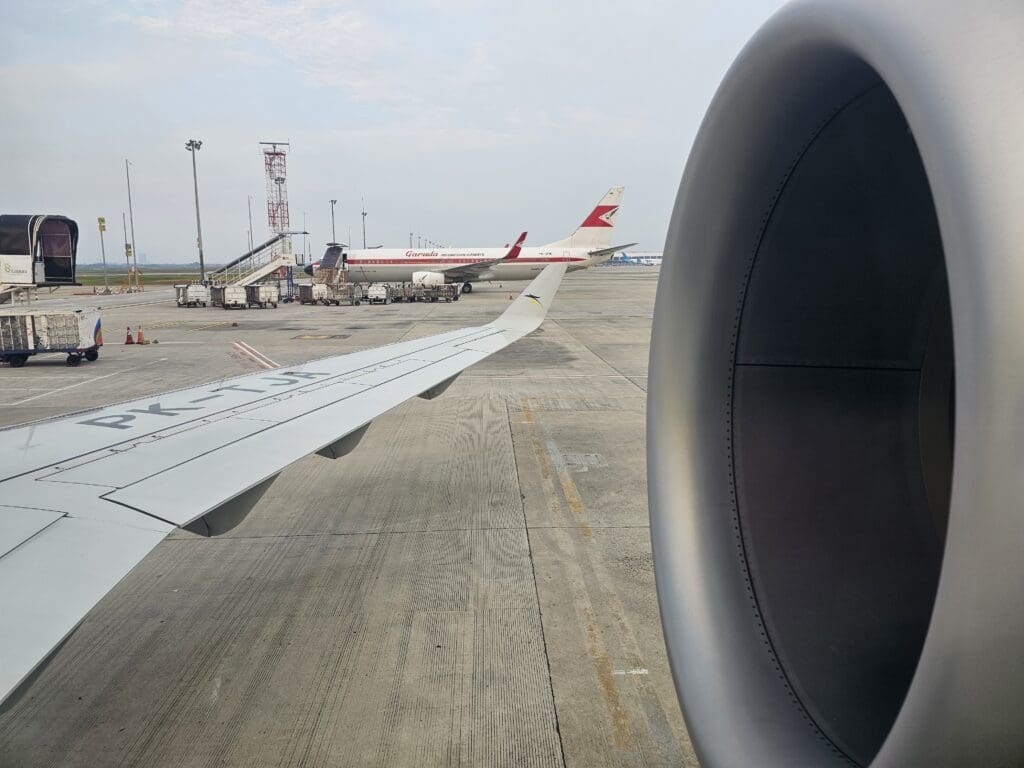
Once the two engines had powered up, one flight attendant took to the aisle and performed the safety demonstration whilst the other read through the instructions from the forward galley. As we commenced our taxi, the cabin lights were turned off, at which point I realised that I had neither been offered an overview of how to operate the emergency exit, nor had the crew checked that I was happy to sit there. Looking outside, moments after our taxi had commenced, the ARJ21 passed the ultra-rare Russian Ilyushin Il-62 before turning left and making its way to the end of Runway 07L. Whilst those on the opposite side of the aircraft would have been treated to good views of Terminal 2 and several of the aircraft currently stored and visiting for maintenance at FL Technics Indonesia’s hangar, sitting on the right-hand side, nothing could be seen during the taxi other than a couple of Lion Air Boeing 737s departing for destinations unknown.
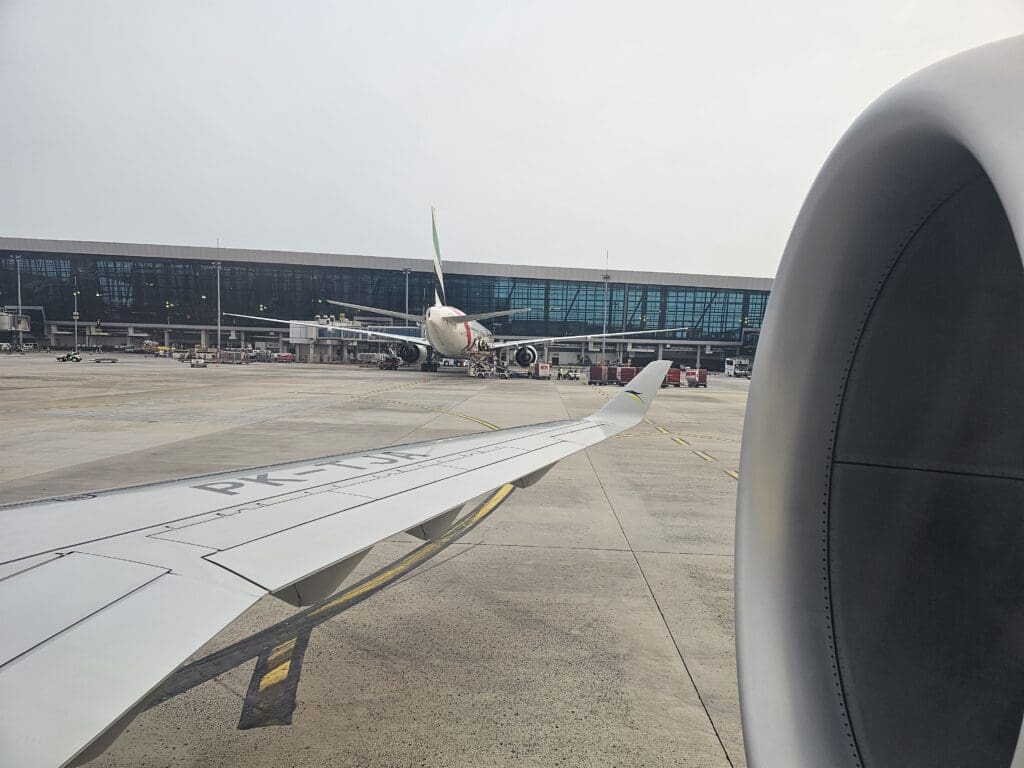
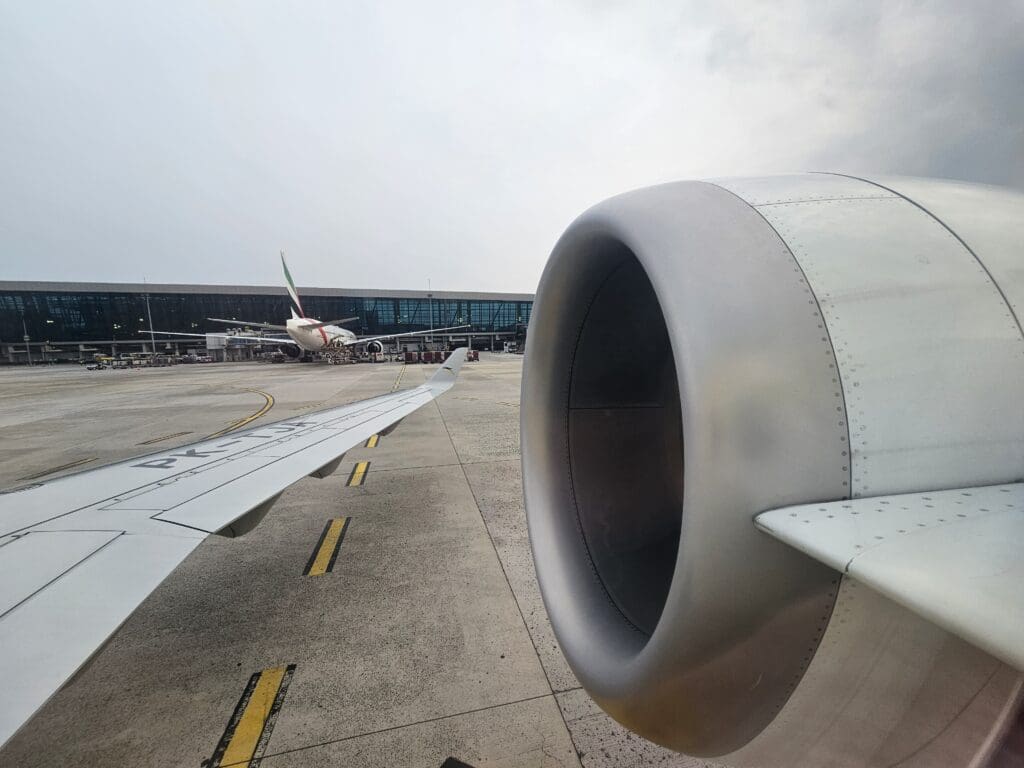
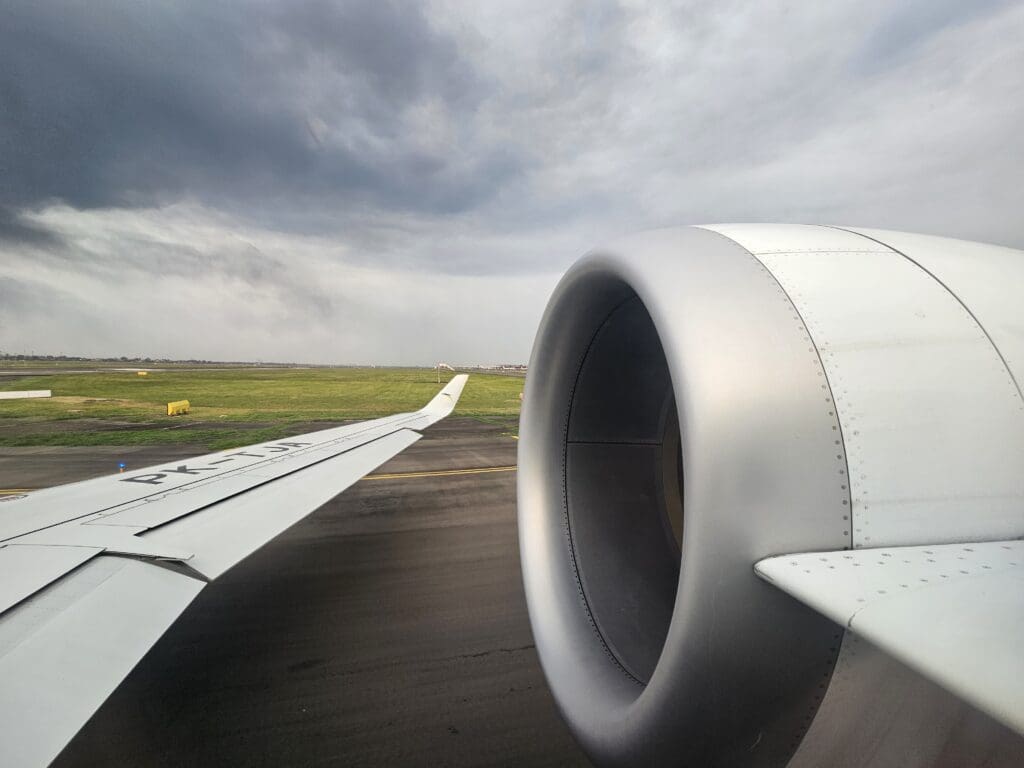
Following a relatively long taxi, around fourteen minutes after commencing this, the aircraft arrived at the end of the runway. Despite Soekarno-Hatta Airport’s almost non-stop stream of departures and arrivals, no waiting was needed, and without stopping, we made our way onto the runway. Upon taxying onto this, we came to a halt for a few moments before the two engines noisily spooled up and sent us flying down the runway. Whilst this loud whine was not quite at MD-80 or Tupolev levels, given my position, this was still a rather noisy take-off. As we accelerated, the aircraft screamed its way past the FL Technics hangar, where a cluster of aircraft that some may not expect to see in Jakarta were present. These included four stored Airbus A321s that had recently been withdrawn from service with Vietnamese carrier Bamboo Airways, an AirArabia Airbus A320 and a former FlyBaghdad Boeing 737! Next up was Terminal 2 and its sea of Lion Air and Batik Air Boeings and Airbuses being readied for their next missions across the region. After this came Terminal 3, at which point the aircraft rotated skywards whilst we were approximately parallel to our starting position which allowed for a good view of the terminal and the aircraft that could be seen waiting there. Upon leaving this behind, another of the airport’s incredibly rare visitors could be seen in the form of a US Air Force Boeing E-4B Nightwatch, a modified Boeing 747-200 that serves as the military’s National Emergency Airborne Command Post. This was a very long way from its home in the heart of Nebraska and was the second time I had seen one of just four such aircraft, having seen another of these at RIAT 2022.
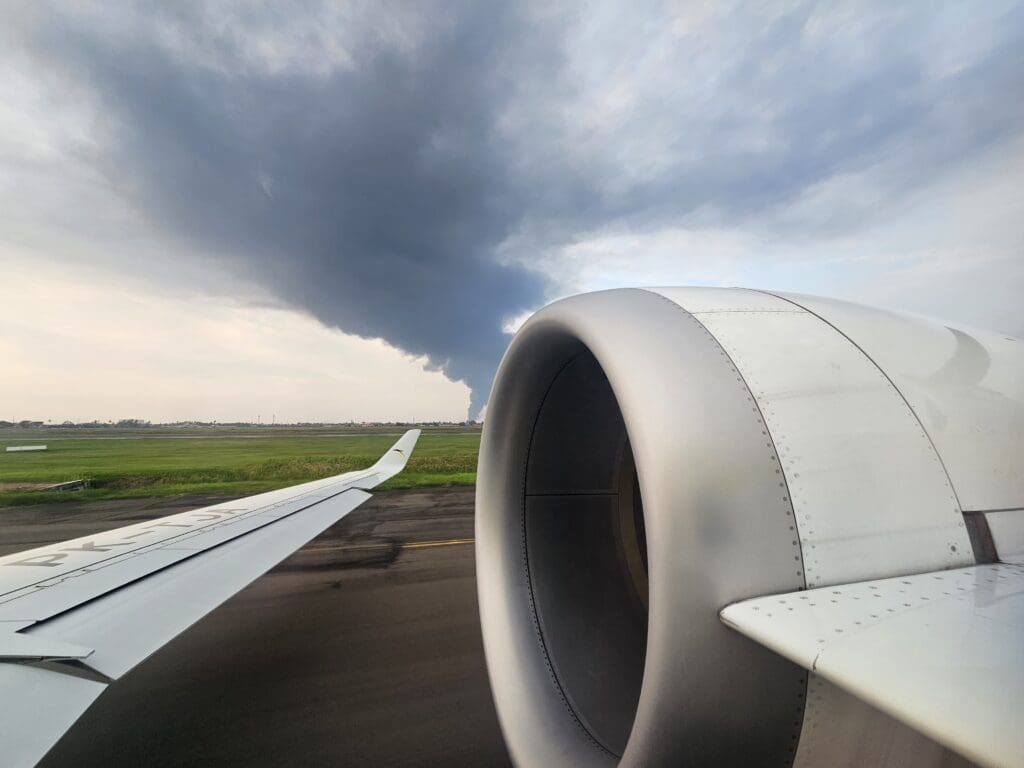
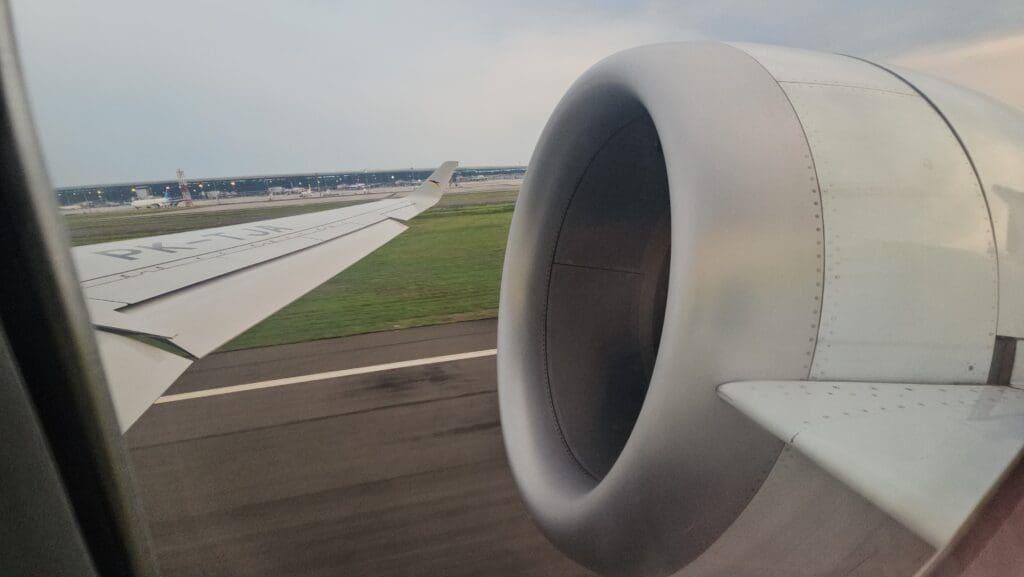
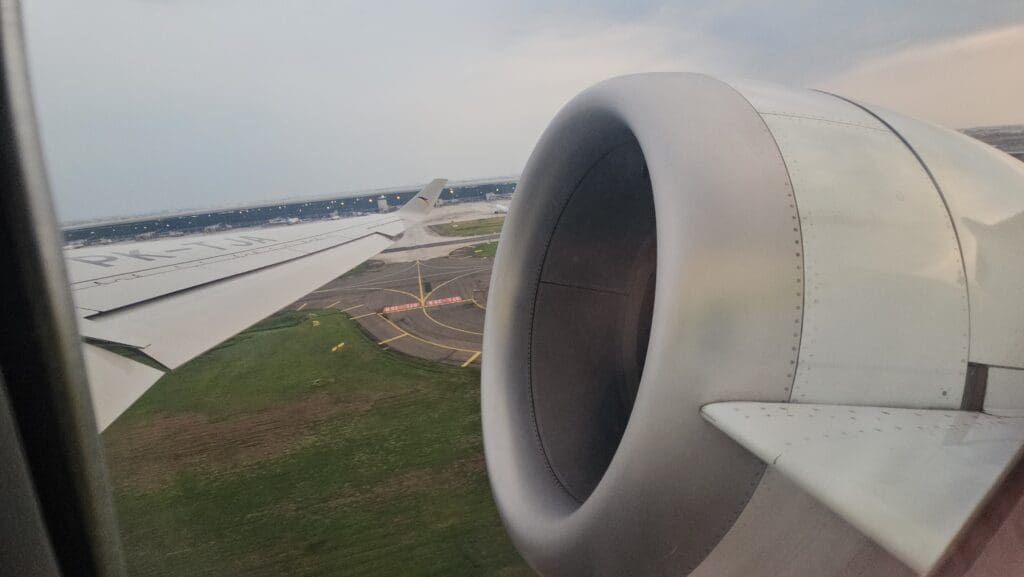
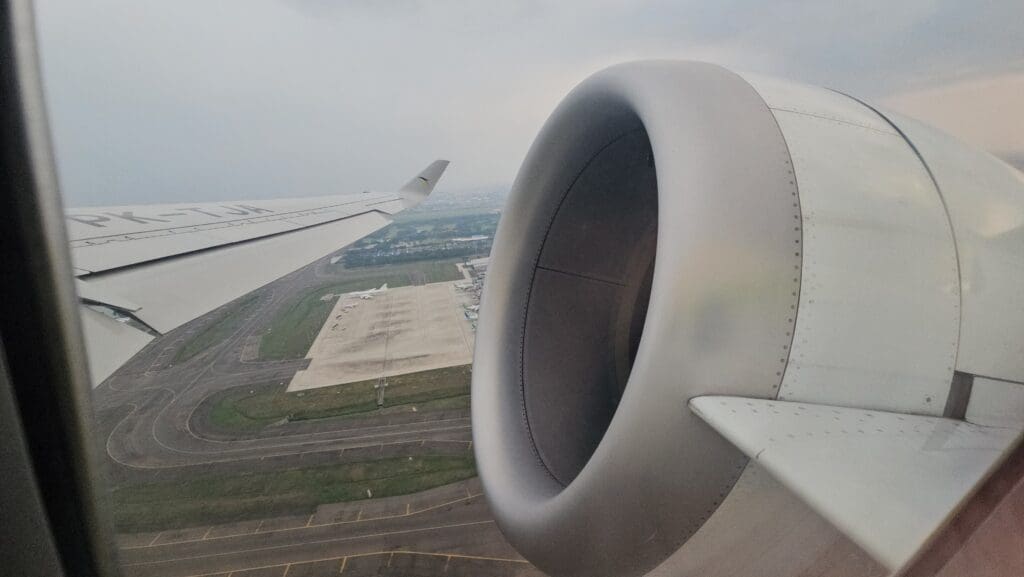
Immediately after soaring past this rare Boeing, the aircraft crossed over the perimeter fence and made its way out over Jakarta’s far northwestern suburbs. However, given the airport’s proximity to the coastline, it was a matter of moments before we left the coastline behind and headed out over the blue waters of Jakarta Bay. Soon, a few small islands came into view below as we continued flying on a northwesterly heading. As we passed through 12,000 feet, the seatbelt signs were extinguished, and the cabin lights were turned back on. At this time, an announcement was made, although thanks to the engine noise, this was completely inaudible.
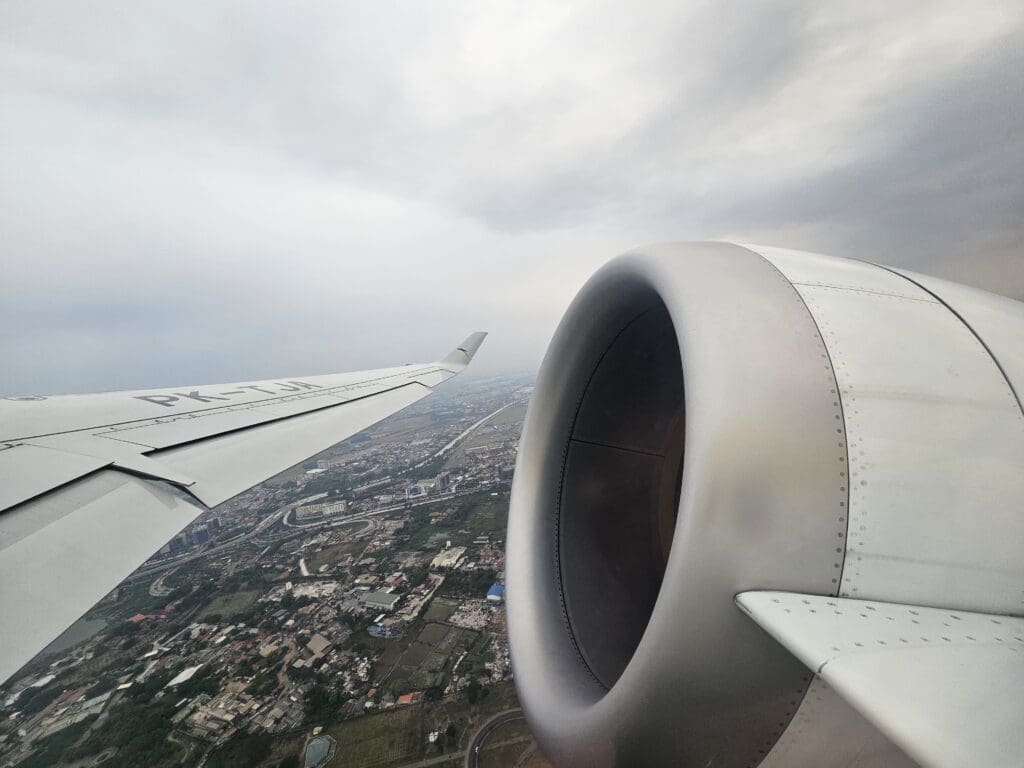
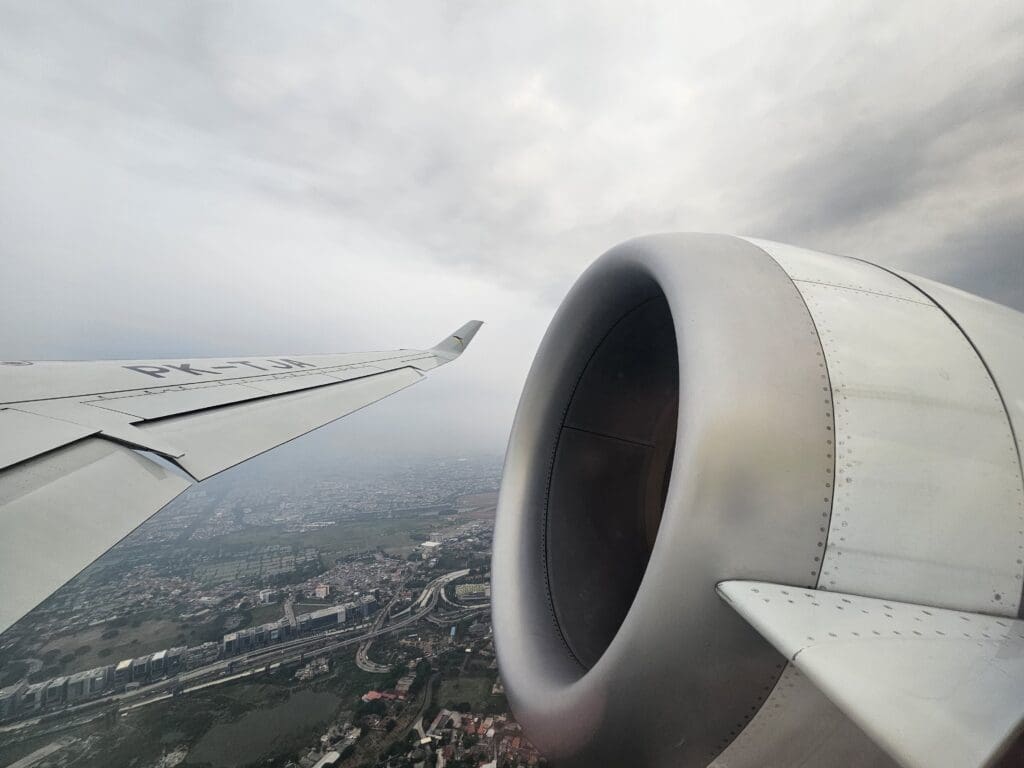
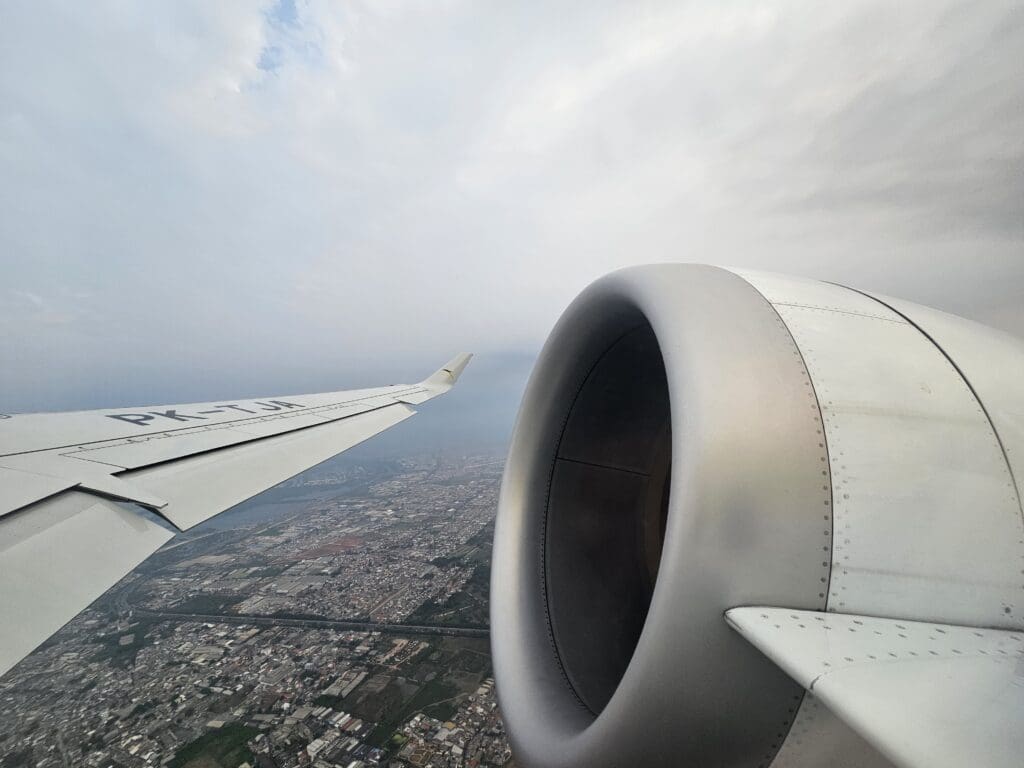
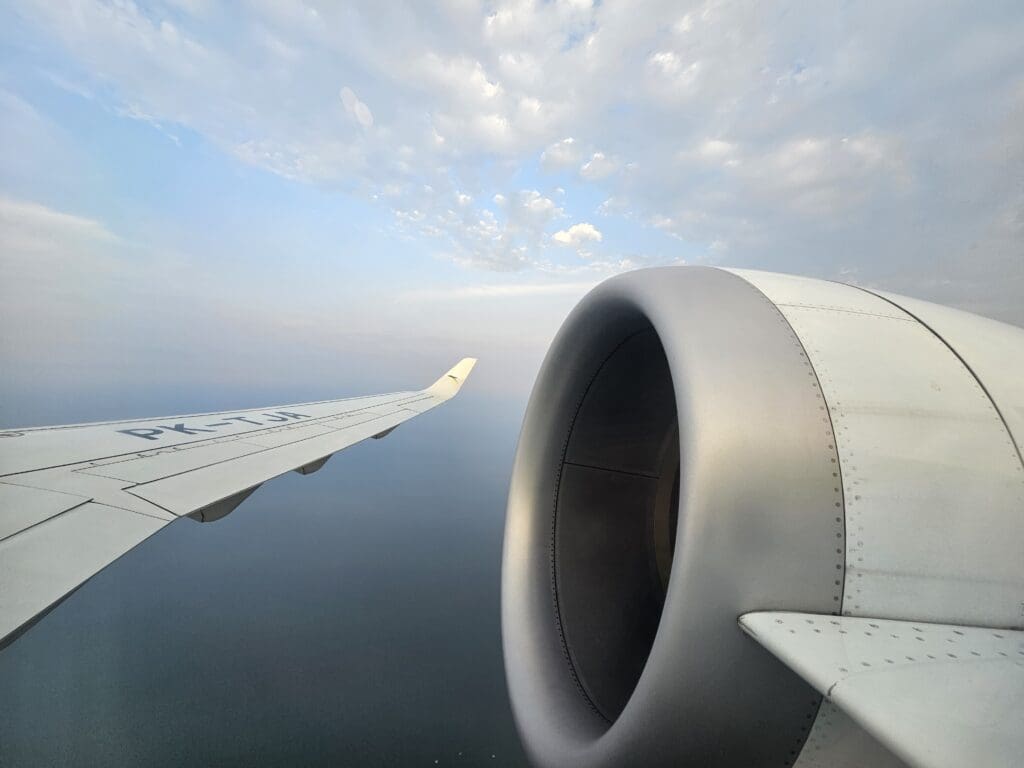
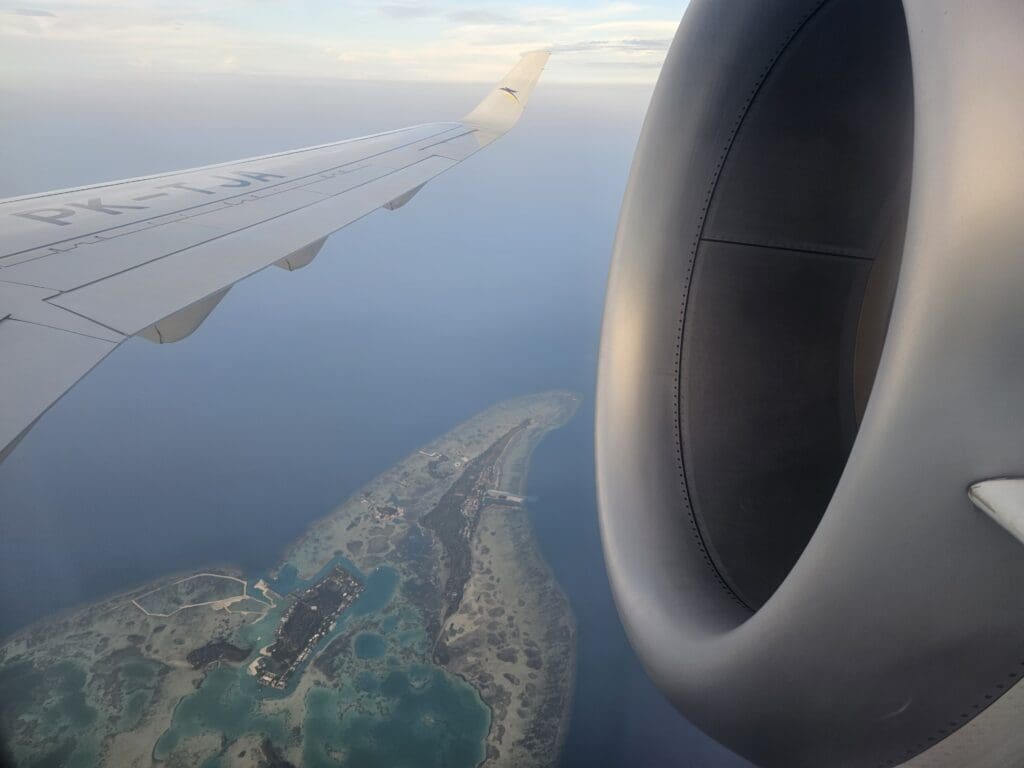
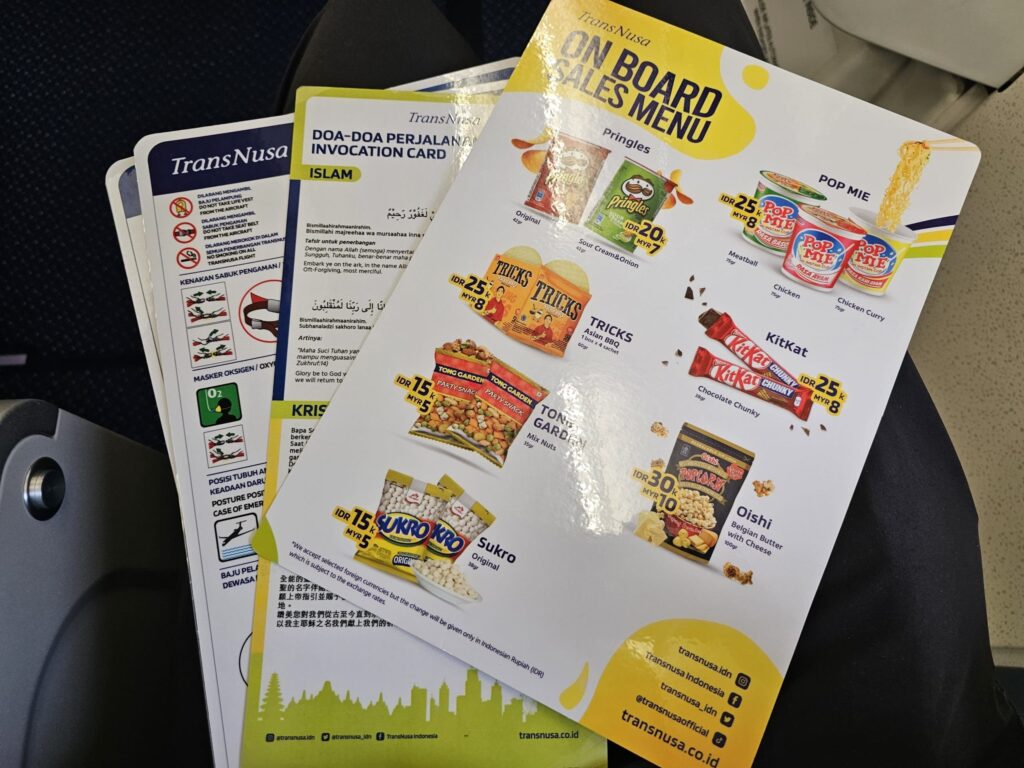
Up ahead, I spotted several passengers receiving their pre-ordered meals before the cart was rolled out and the buy-on-board service commenced. Unfortunately, it seemed that my pre-booked meal had gotten lost somewhere, thanks to my change of flight. However, seeing as I was not particularly hungry, I decided not to raise this with the crew. Examining the buy-on-board menu, this was rather limited and comprised a small selection of snacks and soft drinks, with the most substantial option being instant noodles. Whilst most items were unsurprisingly more expensive than their on-ground prices, these did seem to be fairly reasonably priced. For example, a cup of Pop Mie instant noodles or a KitKat Chunky cost 25,000 Rupiah (around £1.27), whilst the cheapest coffee came in at 15,000 Rupiah (£0.76). Meanwhile, soft drinks (Coca-Cola, fruit juice, Milo and Teh Botol) cost 20,000 Rupiah (£1.02) and a 330ml bottle of still water was 10,000 Rupiah (£0.51). Onboard, purchases could be made in either Indonesian Rupiah or Malaysian Ringgit, and it is worth noting that the crew seemed to be accepting cash only, with no card machine present.


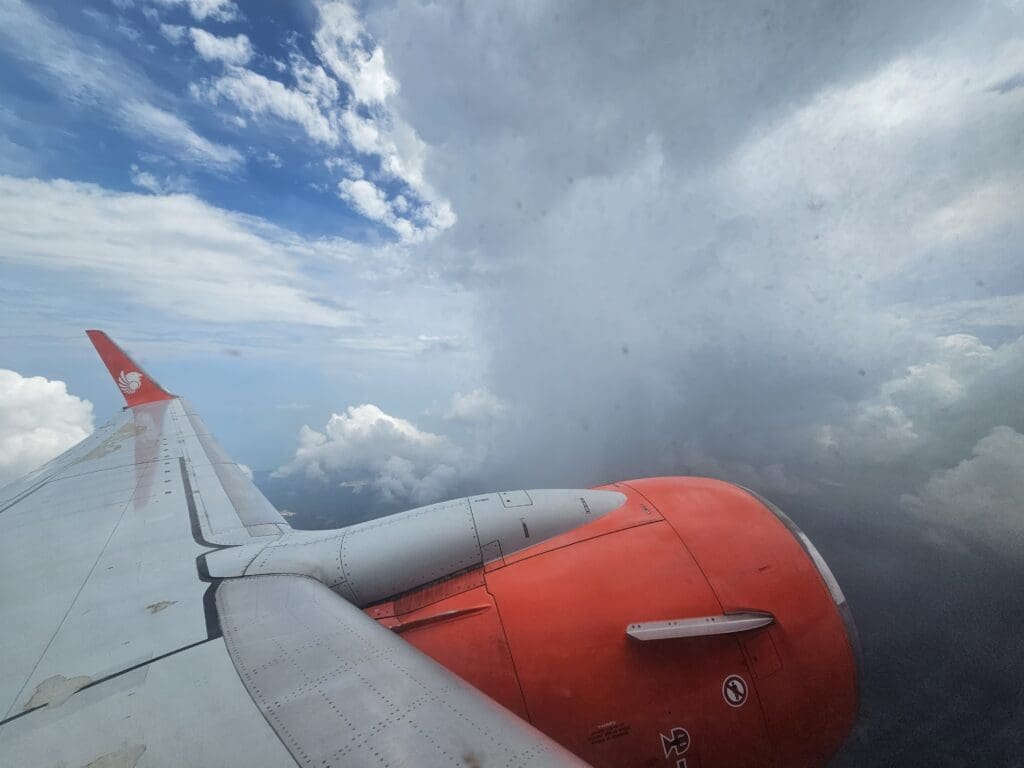
Looking back outside, around fifteen minutes after our departure, the aircraft crossed over the coastline of Sumatra and made its way over Lampung’s Way Kampas National Park. Following a slow climb, around thirty minutes into the flight, the aircraft levelled off at its cruising altitude of 36,000 feet as we passed over the city of Palembang. At this time, the crew were nearing the end of the buy-on-board service and appeared to have made only a small handful of purchases on the flight up to Malaysia. As they finished this, the aircraft hit a fairly significant patch of turbulence, which lasted for around ten minutes and led to the re-illumination of the seat belt sign for around twenty minutes. As time passed, the skies darkened, and soon little could be seen outside. Whilst the temperature on the ground was in the mid-thirties and accompanied by a high level of humidity, onboard, the air conditioning seemed to be on at full blast and, wearing just a T-shirt, I ended up being rather chilly for the duration of the flight.
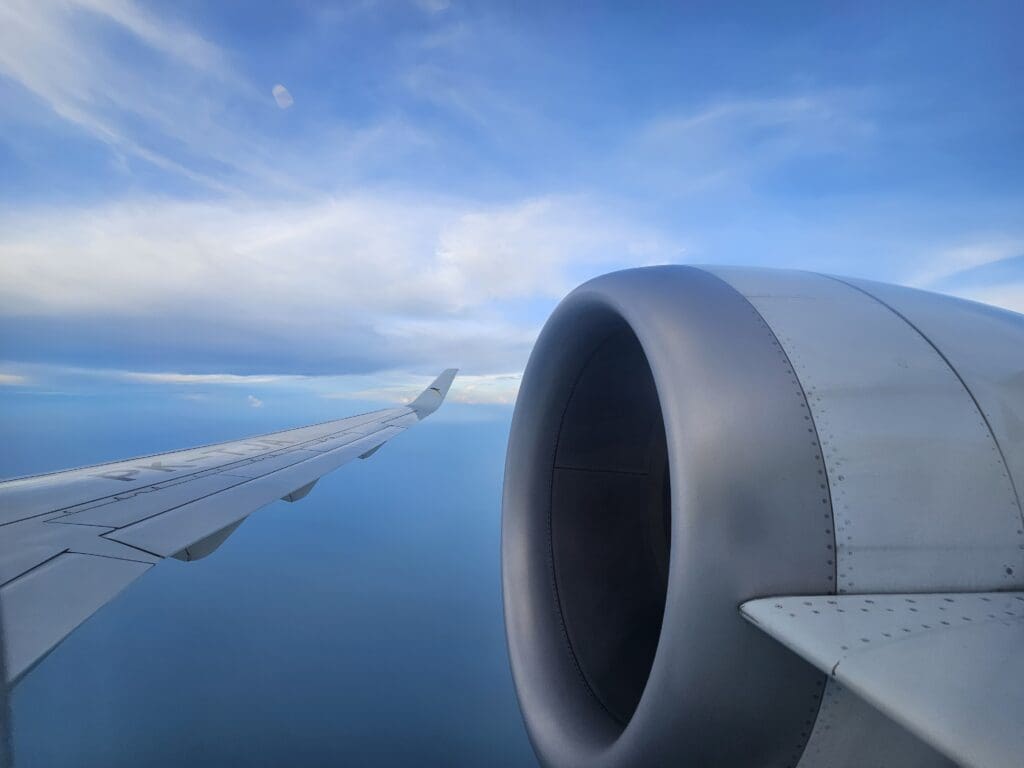
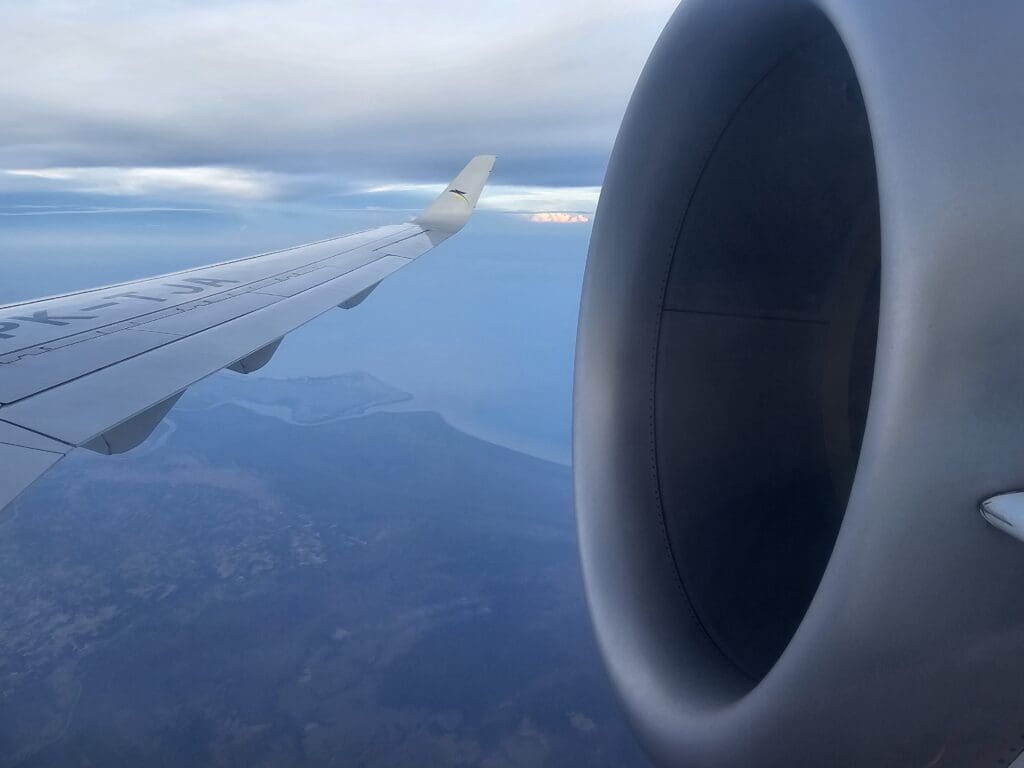
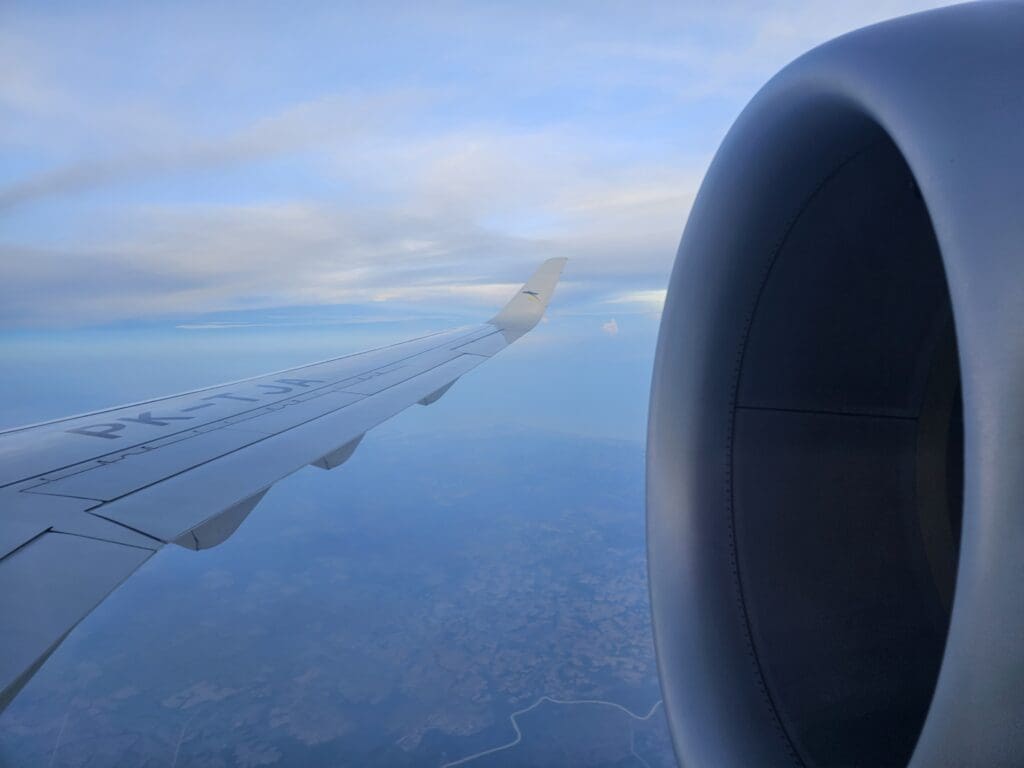
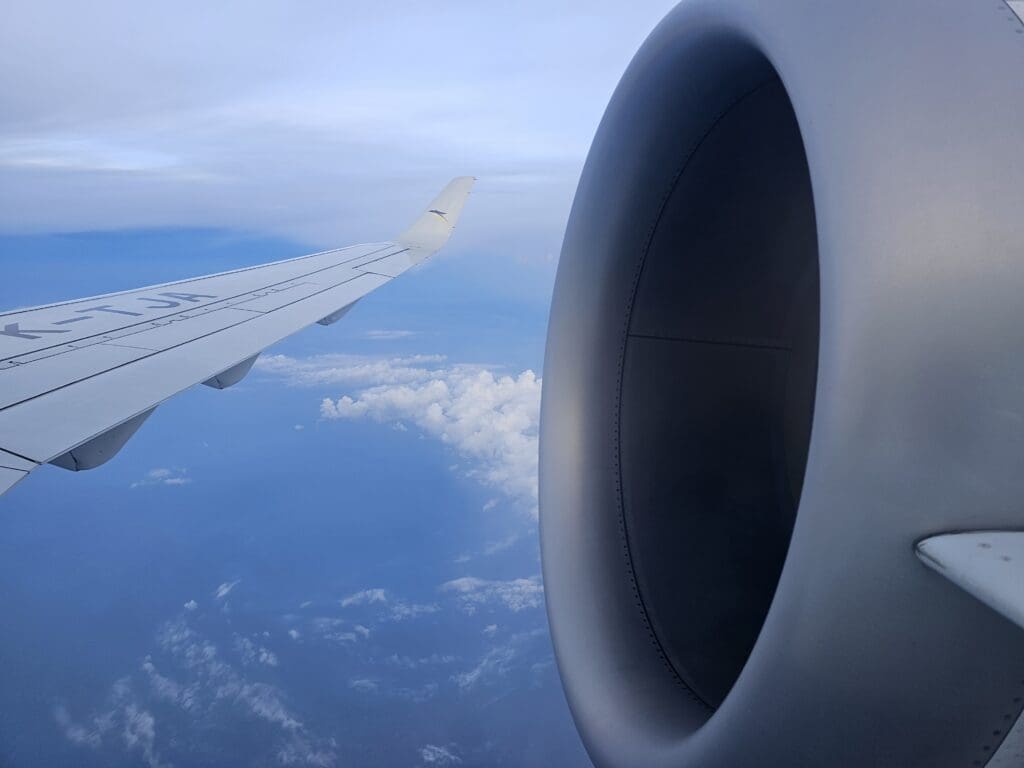
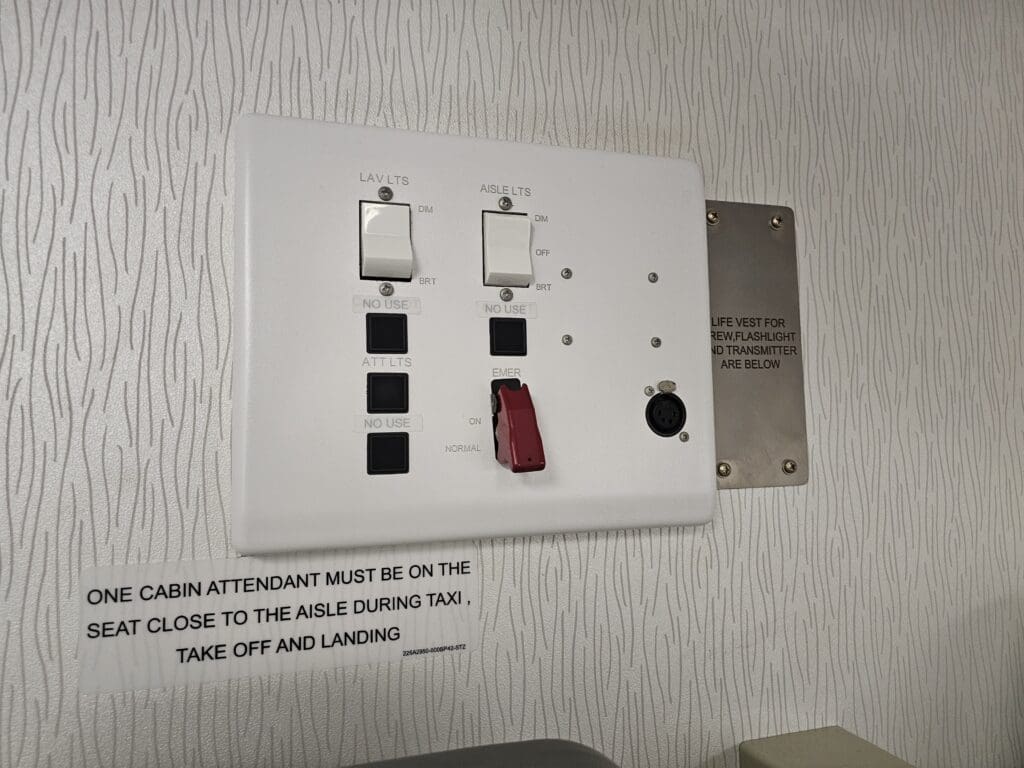
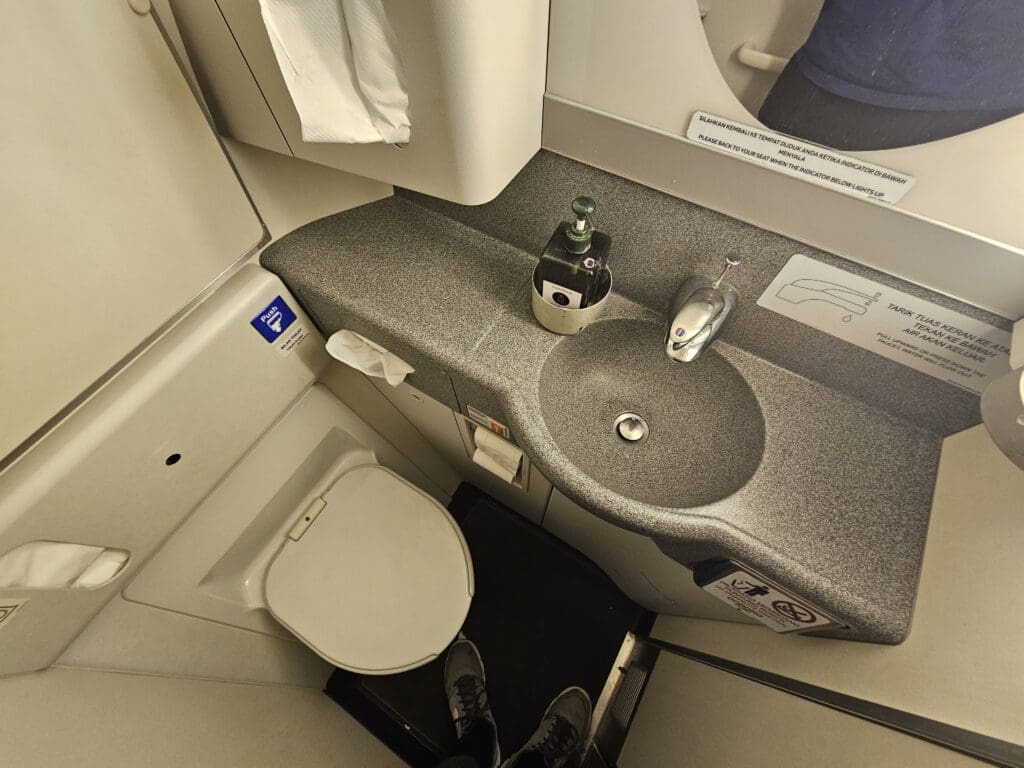
Once the turbulence had calmed down and the seatbelt signs were turned off, I decided to pay a visit to one of the aircraft’s lavatories. The ARJ21 is home to two of these, one of which sits at the front of the cabin and the other at the rear. As I waited to enter, I looked around the spacious area at the rear of the cabin where two jumpseats, an ELT, a cabin lighting panel and an equipment locker could be found. After a minute, I entered the lavatory and was immediately hit by a blast of even colder air than that that was being spread around the cabin. Other than the temperature and the noise, this toilet was modern, fairly standard and clean, serving its purpose and leaving me with nothing to complain about.
Once I returned to my seat, I spotted a high-visibility jacket-wearing TransNusa engineer making their way to the rear of the aircraft. I am not too sure whether their presence is a standard procedure onboard all of their services or whether there was something special about this flight. However, once they had retrieved a folder from the equipment locker at the rear of the aircraft, they returned to their seat in the front row. With no airline-provided entertainment, no complimentary offerings and nothing to see outside other than the darkness, I did not have a great deal of things to do other than savour my first-ever flight onboard the ARJ21 and what would likely be my last for some time, given the fact that I live in Britain. Examining our route that evening, the vast majority of the flight took place high in the skies of Indonesia, and after leaving Palembang, we continued heading northwards over the island of Sumatra. After leaving the region of Lampung behind, the aircraft entered the skies of South Sumatra, followed by Jambi and Riau.
With Jakarta and Kuala Lumpur separated by around 700 miles, a similar distance to that, say, between London and Madrid or New York and Chicago, for my readers on that side of the pond, the flight was not particularly long. At 1824 Western Indonesia time, or 1924 Malaysia time as I shall use from now on in the report, one of the flight attendants emerged from the forward galley with a large waste bag and passed through the cabin picking up any rubbish that had accumulated during the flight. A total of six minutes later, the noise produced by the two engines decreased slightly, and the aircraft could be felt returning to earth as we neared the coastline of Riau. This was almost immediately followed by the pilot announcing, ‘cabin crew, prepare for landing’ and accompanied by an announcement with the usual warnings regarding seatbelts, tray tables and window shades. As we sank down, I couldn’t help but notice a few drops of icy cold water drip down on my head; however, aware that this was almost certainly just condensation, I was not too concerned.

From Riau, the aircraft crossed a small portion of Rupat Island before making its way across the Straits of Malacca and speeding towards Malaysia. At 1941, the seatbelt signs were reilluminated as we descended through 11,000 feet somewhere high above the tree-covered Titiwangsa Mountains. Inside the cabin, the crew made another pre-landing announcement as well as a message on behalf of the Royal Malaysian Customs Department, although this could barely be heard. After the crew quickly passed through the cabin ensuring all was in place for our arrival, the cabin lights were turned off as we made our way back towards Kuala Lumpur and the orangeflow of passing towns such as Pedas and Rentau could be seen before we turned north to set us up for an approach to Kuala Lumpur’s Runway 32L.
Upon passing between the towns of Port Dickson and Lukut, the landing gear fell into position with a loud clunk, and we bounced around a little as we entered the very final stages of our flight. Following a total of 1H39 in the skies of Southeast Asia, the ARJ21 made a soft touchdown on the runway, which was followed by some rather heavy braking as we decelerated. As we vacated the runway, one of the flight attendants welcomed us all to Kuala Lumpur and thanked us for flying with TransNusa, ending with the usual warning about staying seated until the aircraft came to a halt at the gate.
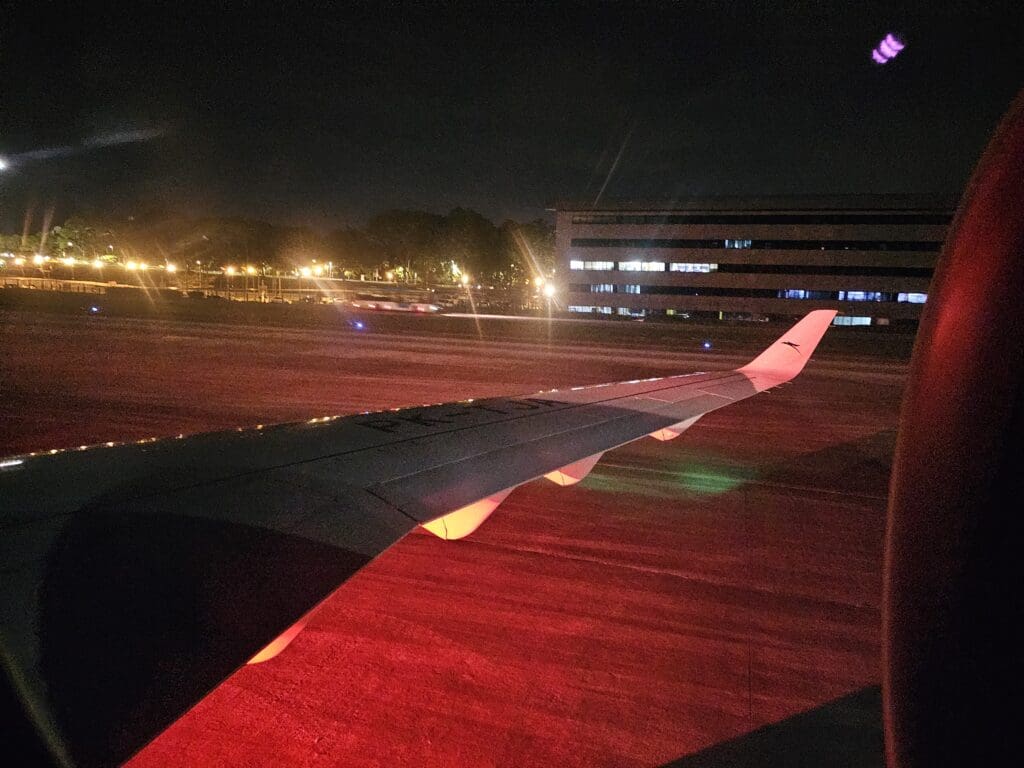
From the runway, it wasn’t long before Kuala Lumpur’s masses of AirAsia and Malaysia Airlines jets came into view, and we soon trundled Terminal 1’s satellite terminal, where a cluster of aircraft visiting from abroad could be seen. Hopeful that we would end up at a gate at the terminal, but as we steamed past this, it became clear that we would end up at a remote stand. Indeed, a few minutes after touching down, the aircraft came to a halt at Stand B21 located near the end of the main terminal. Whilst the terminal building was just a short walk away, buses were to be utilised to shuttle passengers that evening, with one already seen waiting and ready to ferry passengers upon our arrival.
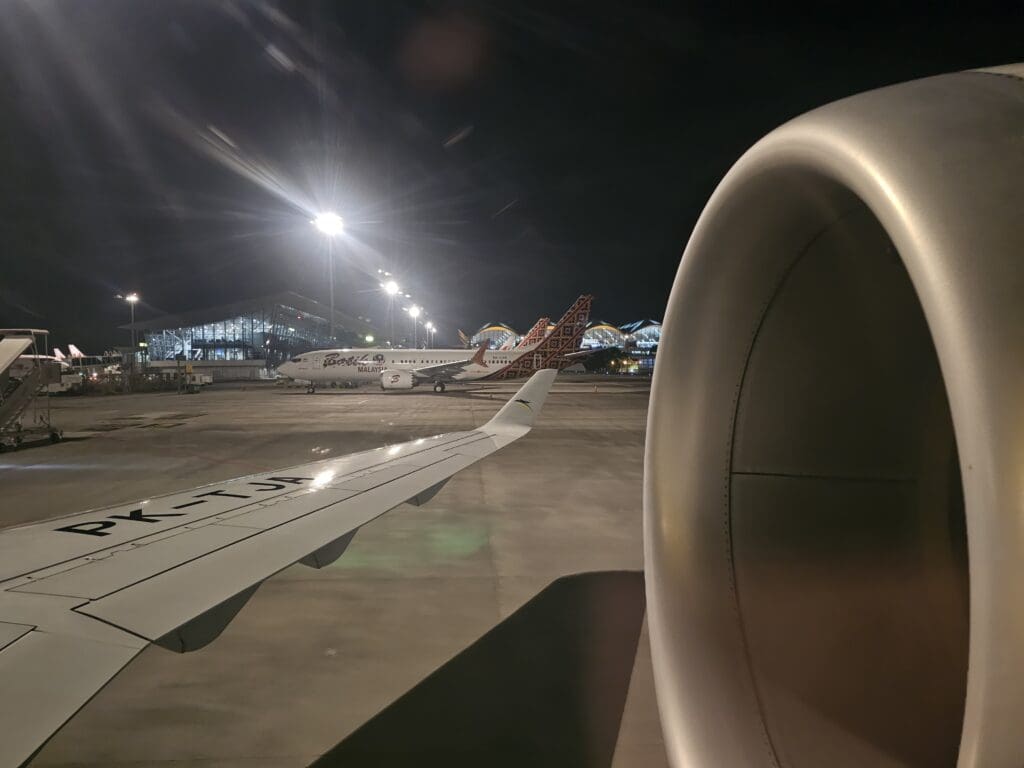
Once the ARJ came to a halt, the two engines spooled down and in the usual manner, many of my fellow passengers sprang up in a mad rush to exit the aircraft. Soon, the cabin door was opened, and disembarkation commenced. However, unlike in Jakarta, all passengers were not going to be squeezed onto one single bus and instead, disembarkation came to a halt as I neared the front of the cabin in order to wait for the second bus. This took around five minutes to arrive, and once this did, I made my way to the front of the cabin where I thanked the flight attendants before being hit by the hot and humid night air. With just a small number of passengers ending up on the second bus, once onboard, it wasn’t long before we began our short journey over to the entrance of the terminal building.
Around two minutes after leaving the aircraft, the bus came to a halt, and the door slid open, at which point passengers streamed off the bus and made their way into the terminal building. From there, I made my way up the escalators and immediately entered the immigration hall. There, I was greeted by the sight of a long snaking queue and joined the rear of this. After around thirty minutes of waddling forward, I finally arrived at one of the counters and found immigration to be a quick and painless process that took no more than thirty seconds. Once my passport had been stamped and returned, I continued onwards and soon passed through the baggage collection hall before making my way out into the landside area.
Summary
As an aviation enthusiast, I was very pleased to have bagged a ride on an ARJ21 in spite of the last-minute changes. Admittedly, to a non-enthusiast, this would have been seen as ‘just another aircraft’, and there was nothing special or memorable about the type that would have distinguished it from any other airliner. With the aircraft being comfortable enough, clean and tidy. However, overall, my experience with TransNusa was very average, being neither memorably superb nor unforgettably terrible! Whilst I would not hesitate to fly with them again, I was given no reason to pay a premium to do so in the future.