
My First Loganair Flight: Aberdeen to Birmingham on the Rare Embraer 135
Background
Eight days after booking my flight from Southampton to Aberdeen via Teesside aboard an Eastern Airways Jetstream 41, I received an email from the carrier informing me that the flight had been cancelled. Ignoring the fact that I would lose my £20 train ticket back to England, I was not particularly disappointed about this, especially seeing as I could rebook onto another of the airline’s Southampton to Aberdeen services for another day. Opting for a departure date two weeks later than planned, I emailed this change request to the airline’s customer services team who changed my ticket after several days.
However, this did leave me with the conundrum of how to get back to London. Unfortunately, train tickets southwards for this new date were rather expensive. Whilst not particularly interesting, I thus turned to flights and planned on returning to London onboard a British Airways Airbus A320 which was initially set to cost £47. Unfortunately, by the time Eastern Airways had confirmed my new flight, this had risen to £70 and so I browsed other options. Turning to Scotland’s airline, Loganair, I noticed that they had reasonably priced tickets for under £70 for their evening Embraer flight to Birmingham Airport. From there, I could catch an evening Avanti West Coast service down to London Euston. Having been wanting to sample Loganair for some time, I decided to settle for this option.
Upon arriving at Loganair’s homepage, I was immediately presented with the flight search engine where I entered all the relevant details before being shown my chosen departure day’s two flights. These consisted of a 0650 and a 1750 departure, both operated by Embraer 145s with a scheduled flight time of an hour and a half. Seeing as I would not be arriving in Aberdeen until 1225, I had little choice but to go for the latter flight. Once I had clicked on this, I was then presented with three ticket options – Fly, Fly Flex and Fly Flex +. Whilst I had initially intended on going for the cheapest £67 ticket, seeing as the £82.74 Fly Flex option allowed for complimentary seat selection and flexible rebooking, I ended up settling for this option. From there, I was taken to the seat selection page where I was presented with a mostly empty seat map which showed all seats as selectable aside from those ‘B’ seats to allow for social distancing onboard. Whilst a ‘normal’ passenger may have picked an exit row or a seat at the front that would allow for quick disembarkation, I instead opted for seat 17A which I hoped would offer a good view of both the engine and wing. Following a quick process, I was then presented with the final page where I entered all my details and made payment for the ticket without any issue. Once this was done, I made what I hoped would be the final booking of the journey, the £8.25 train ticket back to London.
Unfortunately, there would be one more hurdle as my flight up to Aberdeen with Eastern Airways would be rescheduled from the morning to the afternoon, leaving me with twenty minutes between flights in Aberdeen. Opting to play things safe, I decided to make the most of my flexible ticket and postpone my return to England until the following evening. Thankfully, I was able to change tickets without any issue, although I did lose my seat reservation and had to pay an additional £5 fare difference. Nevertheless, this was small change compared to the money I had lost through booking and rebooking train tickets!
Online Check-in
Unlike Eastern Airways, Loganair offers its passengers the opportunity to check-in online a generous four days prior to departure. With two days to go until takeoff, I made my way over to Loganair’s homepage. After ticking a box confirming that I did not have any COVID-19 symptoms, nor would I be carrying any prohibited items, I entered my booking reference number and surname. Unfortunately, as with Easyjet and Ryanair, passengers are automatically allocated seats unless they are willing to pay the seat reservation fee, even at check-in. Whilst I had no intention of paying at least £6 for the latter, especially seeing as the blocked middle seats would guarantee I would end up with a window seat, I did quickly browse the seat map. Much to my delight, this showed the aircraft as having fourteen rows of seats as opposed to the Embraer 145’s eighteen rows, thereby indicating that the flight would be operated by the relatively rare Embraer 135. After clicking on the random seat allocation button, I was given Seat 11A and received my boarding pass via email. All in all, ignoring the seat reservation fee, I found Loganair’s check-in process to be as quick and painless as one ought to expect from an airline.
The Flight
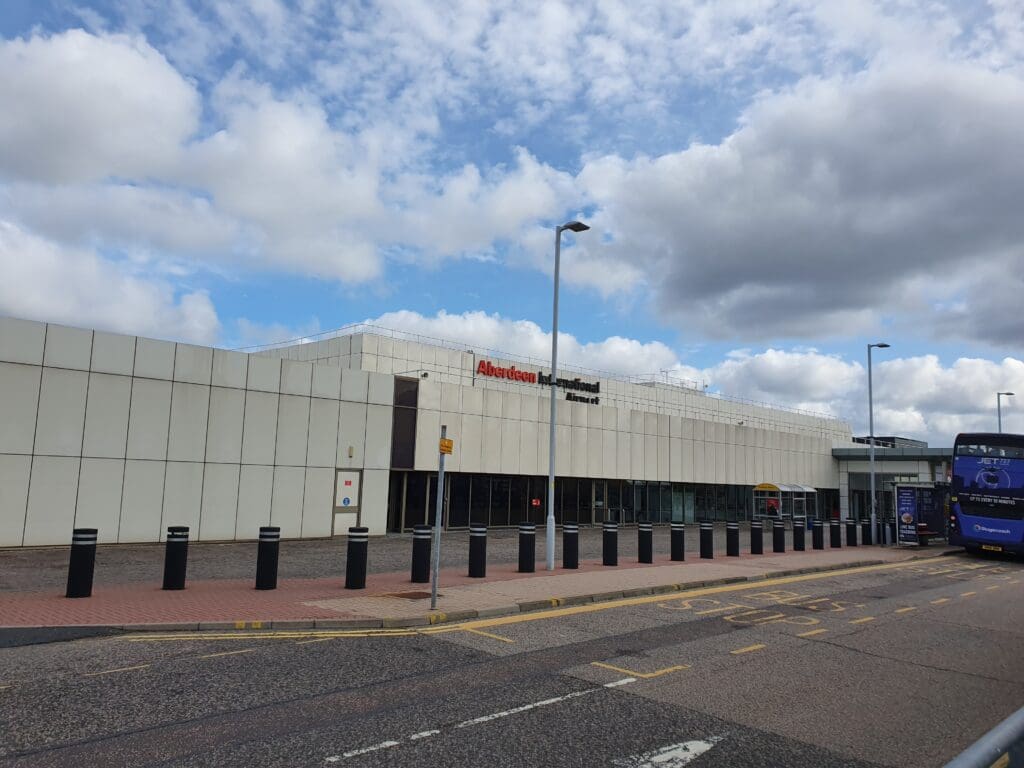
Having spent the night and morning before my flight in the town of Dyce, located on the opposite side of the airfield to the terminal, reaching the airport in time for my 1750 flight to Birmingham would not prove to be a particularly difficult mission. Having checked out of my hotel room as late as possible, at 1400 to be precise, I was left with plenty of time to get across the airfield to the main terminal. Aside from the chilly Scottish weather, I was left with little reason not to make the journey on foot as I had done the previous evening. After making my way up to the Babcock Terminal where several groups of offshore workers could be seen enjoying one last cigarette before their flight, I headed along Wellheads Drive, past the temporary Covid-19 testing site and around the airport’s southern perimeter. Around fifty minutes after leaving the hotel, I found myself standing outside Aberdeen Airport’s slightly weathered-looking main passenger terminal. Constructed in the 1970s, from the outside this terminal appears to be far from architecturally impressive, consisting of a two-storey structure with seemingly few windows, not too dissimilar in basic design from that of Glasgow Airport.
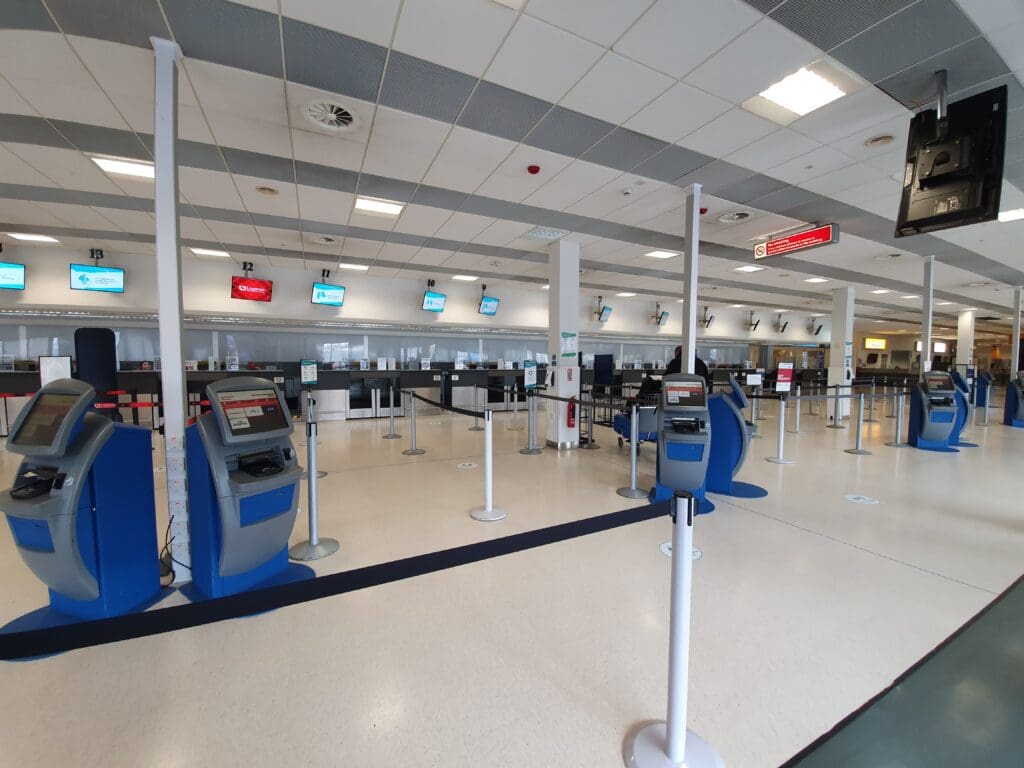
After heading through the main entrance and sanitising my hands, I found myself standing in the terminal’s small main check-in hall. At that time in the afternoon, whilst no queues could be seen at the desks, a reasonable number of offshore workers could be seen seated on the seats along one side of this waiting for KLM’s check-in desks to open. Aside from these passengers, the landside portion of the terminal was empty. Whilst I had toyed with the idea of using one of the check-in machines to change my seat to one on the opposite side of the aircraft (this hopefully allowing for views of the sunset as the flight neared its end), I was a little surprised to see that these could not be utilised by Loganair’s passengers. Seeing as I had received a copy of my boarding pass via email, I made my way to the empty security check area where I was greeted by a friendly staff member. After scanning my boarding pass on one of the automated gates, I walked straight up to the only open security checkpoint and passed through to the airside area with no issues around a minute later. Whilst Aberdeen Airport carries the unfortunate reputation of being Scotland’s worst airport, that afternoon I could not make a single complaint about my passage through to the airside area.
As with most British airports, as soon as those departing from Aberdeen make it through security, they must pass through a large duty-free shop before accessing the main airside area. That afternoon this was devoid of passengers although as I walked through this three staff members attempted to stop me to advertise various products. Unsurprisingly, the rest of the terminal appeared to be relatively empty and thus there were plenty of places to sit down and wait for my flight. In addition, plug sockets and USB ports could be found on most benches so charging both my phone and laptop proved to be no issue whatsoever. As one would expect, fast complimentary wifi was available throughout the terminal which I found to work well for the duration of my stay. In terms of facilities, various cafes, shops and a bar are offered in the airside area, although given the ongoing pandemic, only a small handful of these were open – the local branch of Boots, WHSmiths and the Distilling House pub-restaurant. That afternoon, most of those in the terminal appeared to be gathering at the latter and enjoying several pre-flight beers. Whilst the airport’s airside area is a little maze-like and not particularly modern in design, all-in-all this was clean and pleasant enough although it is clear that this was not designed with long stays in mind.
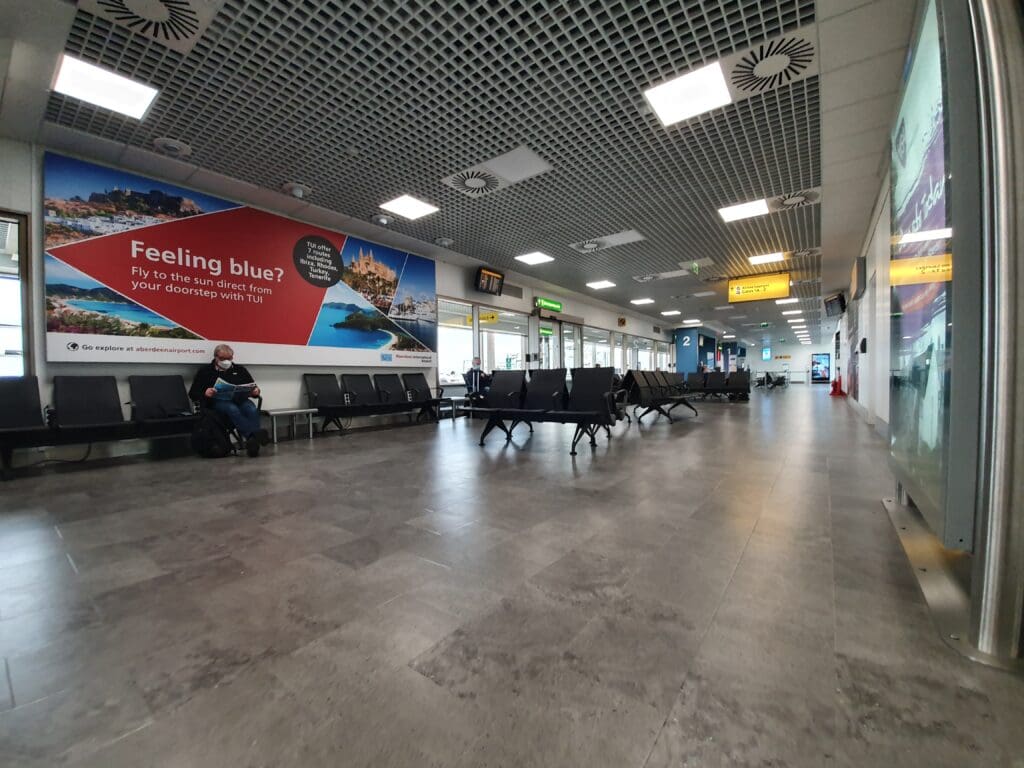
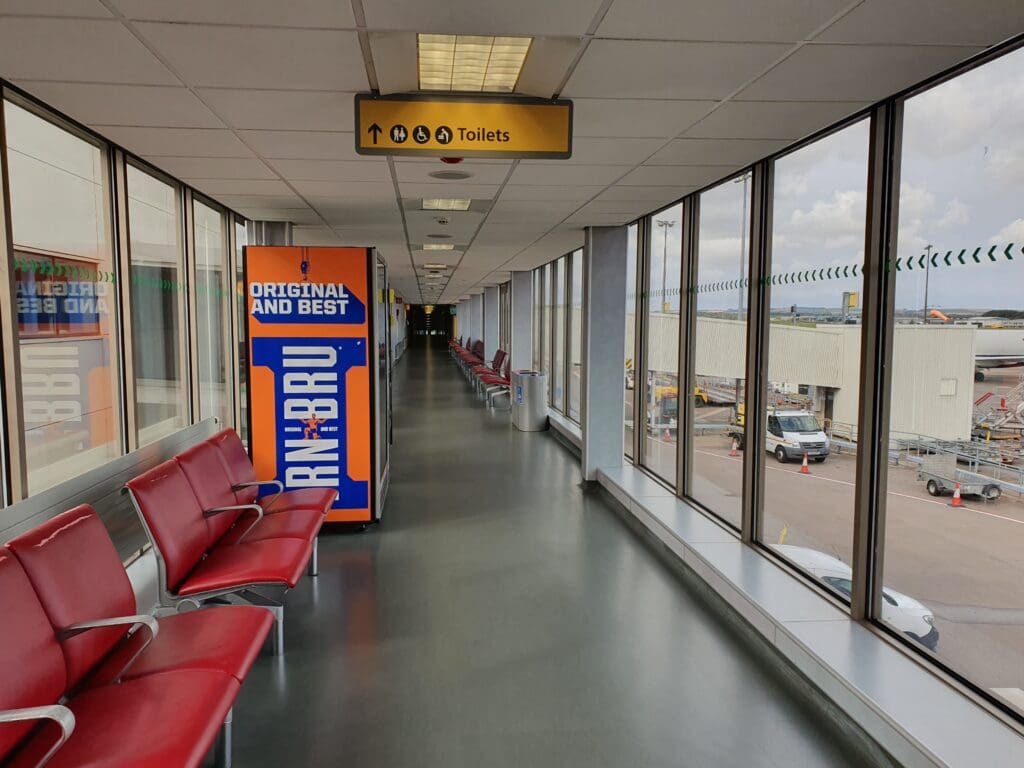

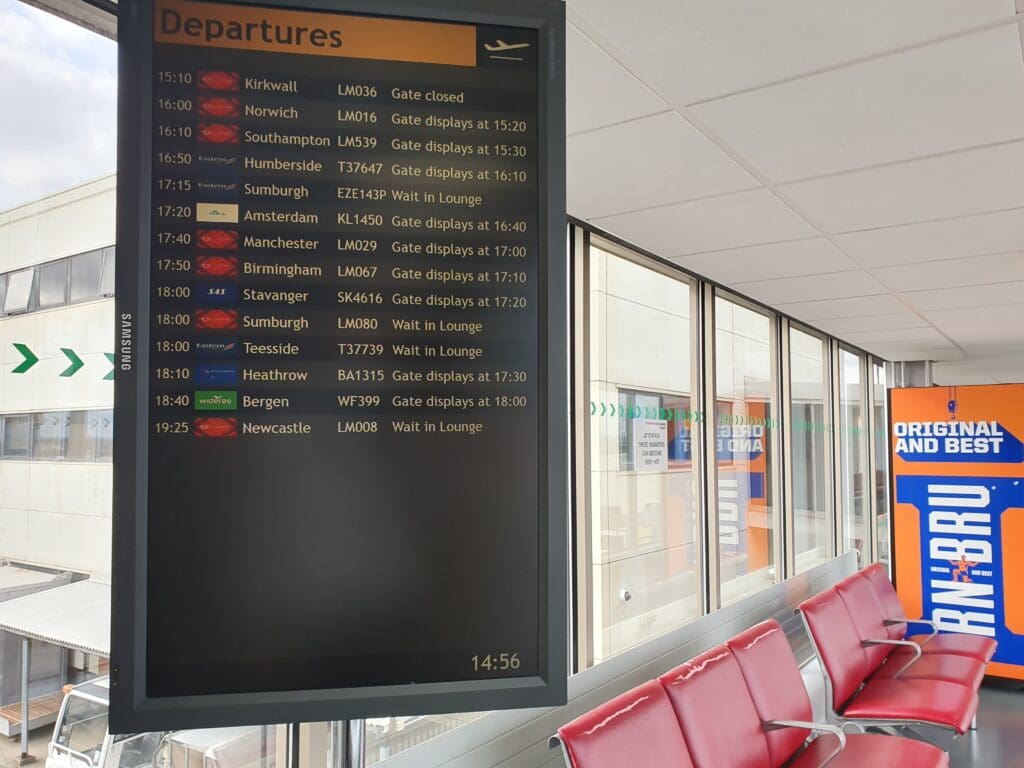
By the time I made it through to the airport’s airside area, a total of seven flights could be seen on the departure boards before my service down to Birmingham. These were heading off to Amsterdam, Humberside, Manchester, Norwich, Southampton (via Newcastle) and Sumburgh, operated by Eastern Airways, KLM Cityhopper and Loganair. Whilst this may not seem like a particularly high number of flights for a two-and-a-half-hour period, seeing as Aberdeen Airport serves as the world’s busiest heliport, a constant stream of helicopters could be seen arriving and departing. These took the form of Airbus H175s and Sikorsky S-92s, operated by Babcock, Bristow Helicopters, CHC and NHV. In addition, interestingly the two cargo aircraft present that afternoon, a pair of West Atlantic Boeing 737 Classics were both parked outside the terminal. Unfortunately for aviation enthusiasts, views of the action outside are rather limited, with the only relatively unobstructed views of the apron possible from the pier down which gates six to twelve are located.
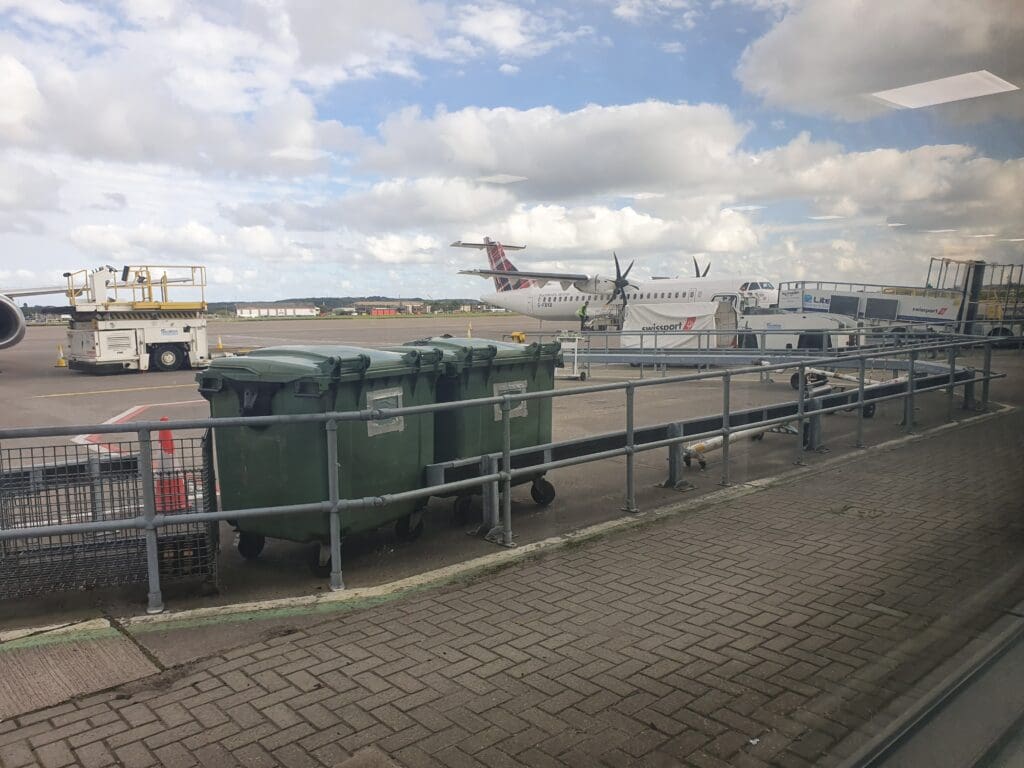
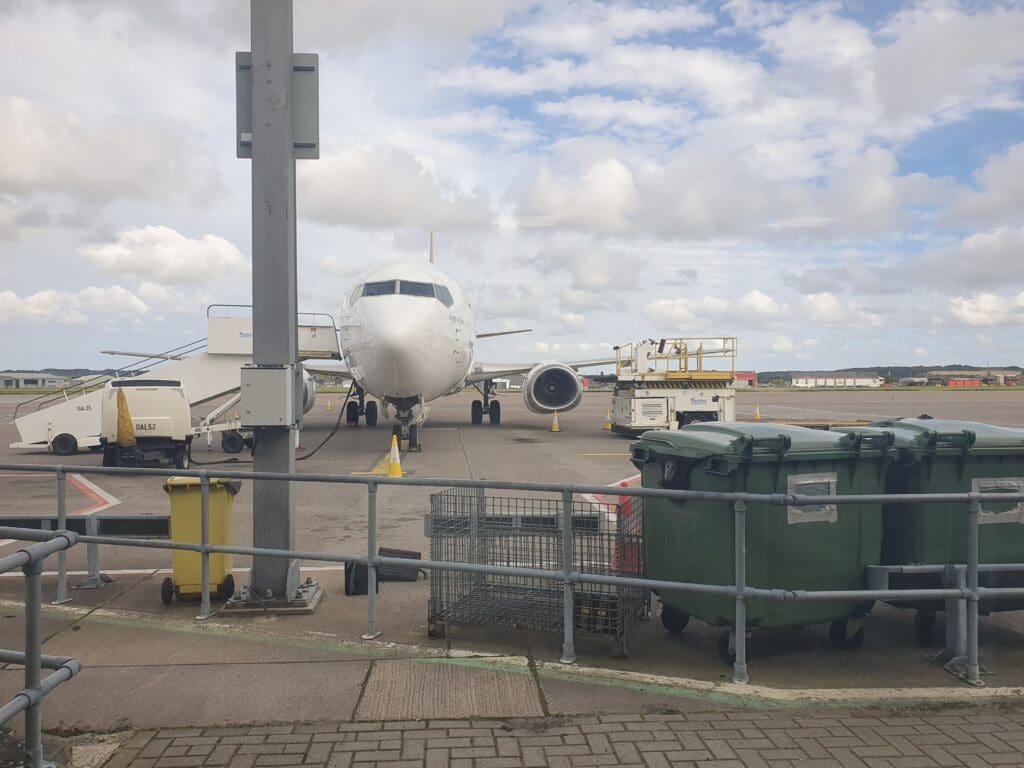
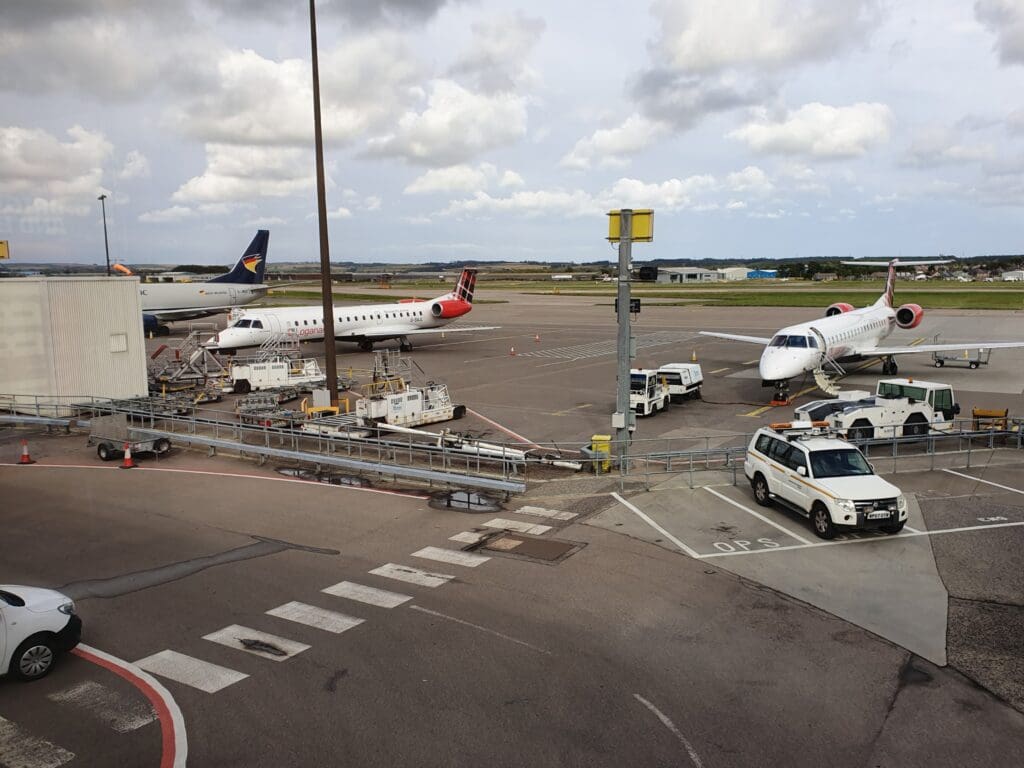
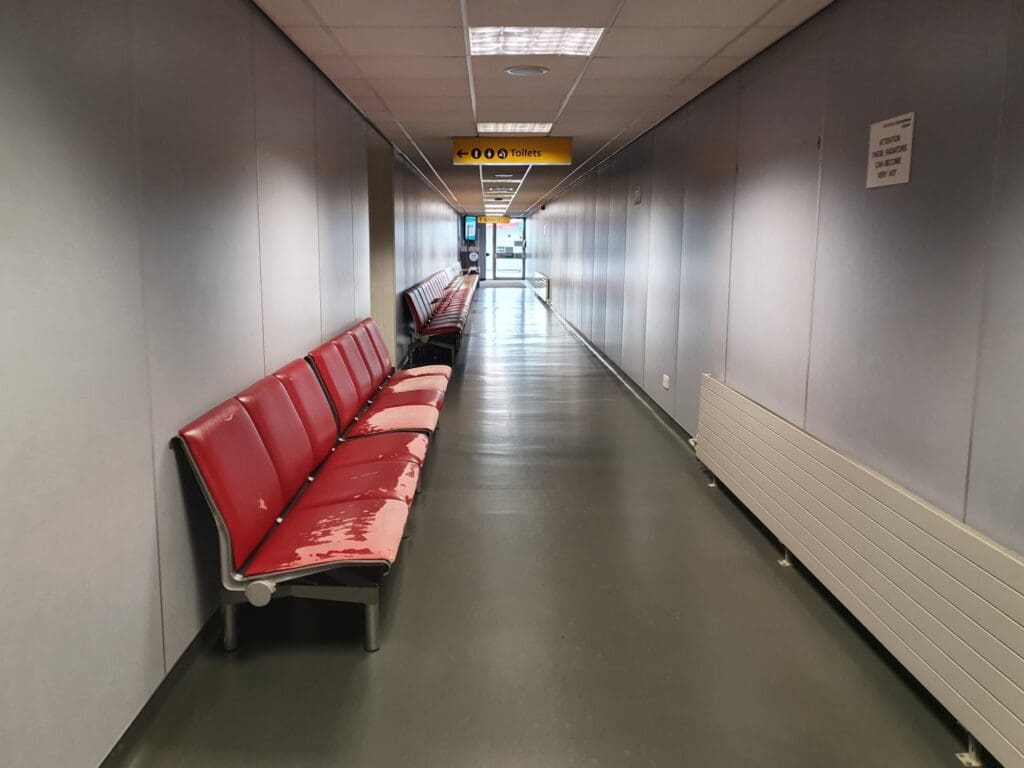
As time passed, the terminal appeared to get a little busier, with most passengers heading off to Amsterdam on KLM Cityhopper’s 1720 flight, operated by a Skyteam liveried Embraer 190. Eventually, 1710 arrived and I thus rose to my feet and headed to the nearest departure board. This revealed that Loganair’s service to Birmingham would be departing from Gate 11. Having seen all the sights the main terminal had to offer, I thus headed up a small flight of stairs and along the chilly, narrow and old-fashioned T-shaped pier. Upon arriving at the small seating area where this branches off into two, I turned left and headed down into a dark, dingy and equally dated-looking pier, soon arriving at the small gate area. As I had expected, that evening I was the first passenger of the flight to arrive and upon reaching the gate I was welcomed by a very friendly member of ground staff.
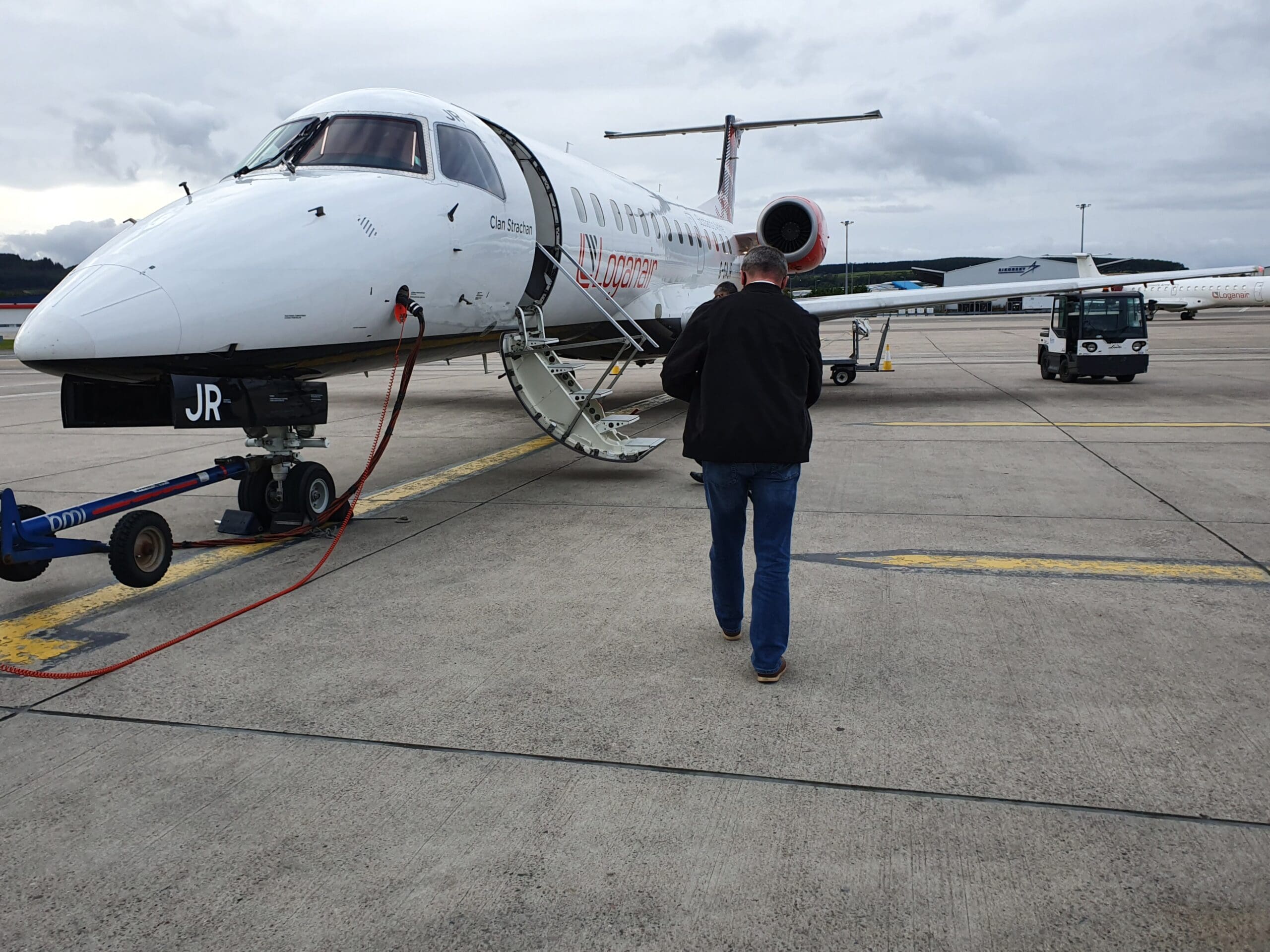
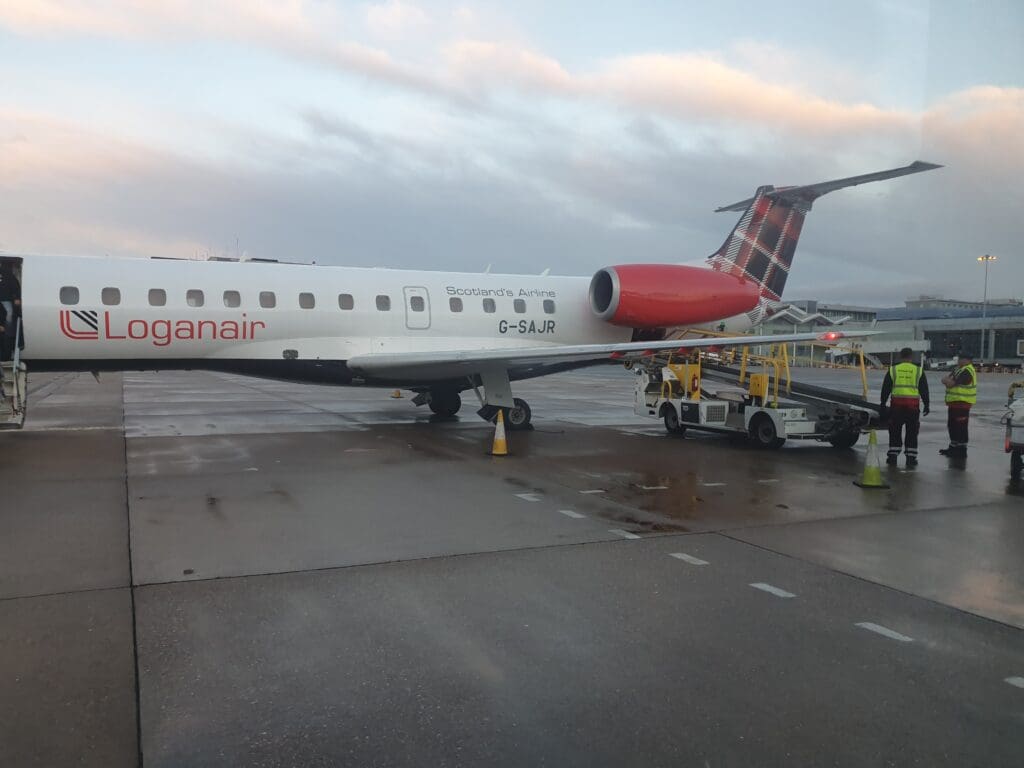
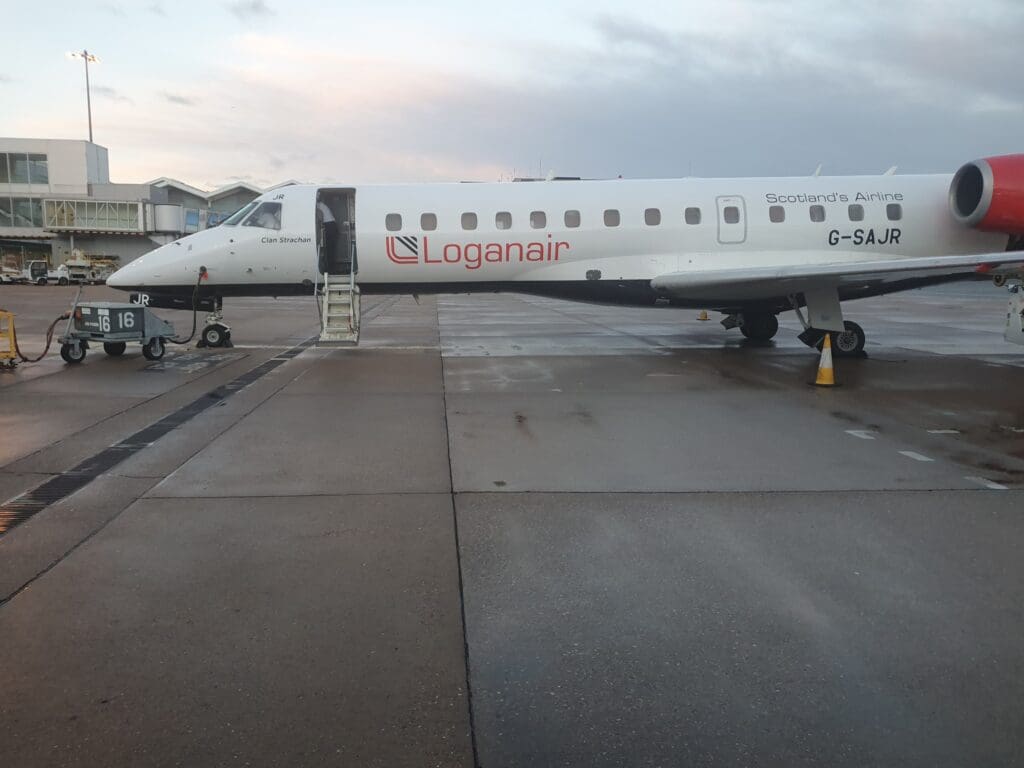
Outside at Stand 13 Embraer ERJ-135ER, G-SAJR could be seen waiting. Manufactured a world away at Embraer’s factory in São José dos Campos in Brazil in 2001, the aircraft appears to have commenced its life as an ERJ-135 demonstrator with the registration PT-SUC. In October 2003 the aircraft was flown across the Atlantic to the Irish city of Cork where it commenced its commercial life with the short-lived airline JetMagic. Following the airline’s ending of operations, in 2005 the jet headed over to Gothenburg where it flew for City Airline. Here, the airline retained its basic JetMagic purple and white colour scheme albeit with the addition of City Airline titles and the airline’s motif on the tail. In late 2005, the aircraft began to operate for long-defunct Farnborough-based charter airline Citelynx. During its time at the carrier, the aircraft was used as Coldplay’s jet for their 2005 Twisted Logic tour and received a special livery for this. In January 2008, still wearing JetMagic’s purple and white colours, the aircraft began a new life with BMI Regional. In September of that year, this received the new registration of G-RJXP and received the carrier’s distinctive blue and white colour scheme. After over eleven years of service with BMI Regional, the aircraft’s career with the airline came to an abrupt end following the airline’s bankruptcy in February 2019. Fortunately, this was not the end of the road for this particular aircraft and, as with many former BMI Regional Embraers, less than a month later the aircraft made its way into Loganair’s fleet. Here the aircraft received the registration G-SAJR and name Clann Strachan and was painted into Loganair’s livery. In the week before my flight, the aircraft had flown 26 legs, covering at least 8200 miles. This had taken the Embraer from its base in Aberdeen to Belfast City, Birmingham, Bristol, Esbjerg, Newcastle, Norwich and Southampton.
Within a minute or so of my arrival, several other passengers reached the gate and plonked themselves down on the few seats available there. Whilst my boarding pass indicated that boarding would commence thirty minutes before departure at 1720, given the size of the Embraer 135 I assumed this was nothing but a ploy to ensure passengers arrived at the gate ontime. I was thus a little surprised to hear an announcement made at 1722 asking for all Birmingham-bound passengers to come forward for boarding. Soon enough, I scanned my boarding pass and headed out of the pier before walking the very short distance over towards the aircraft.
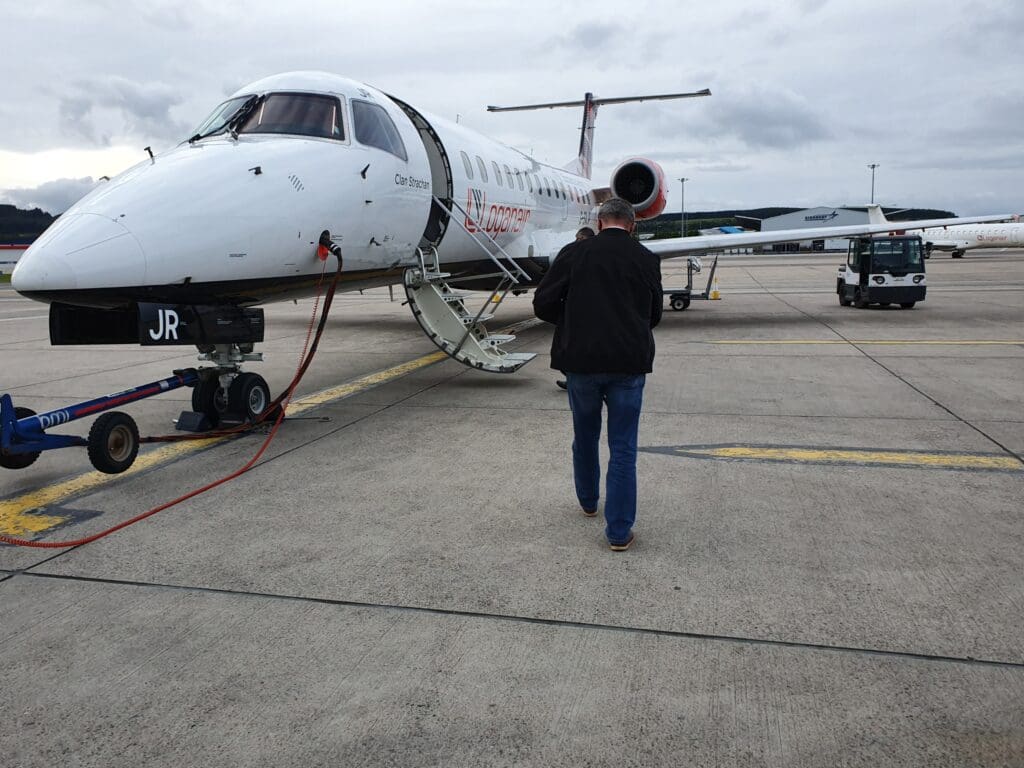
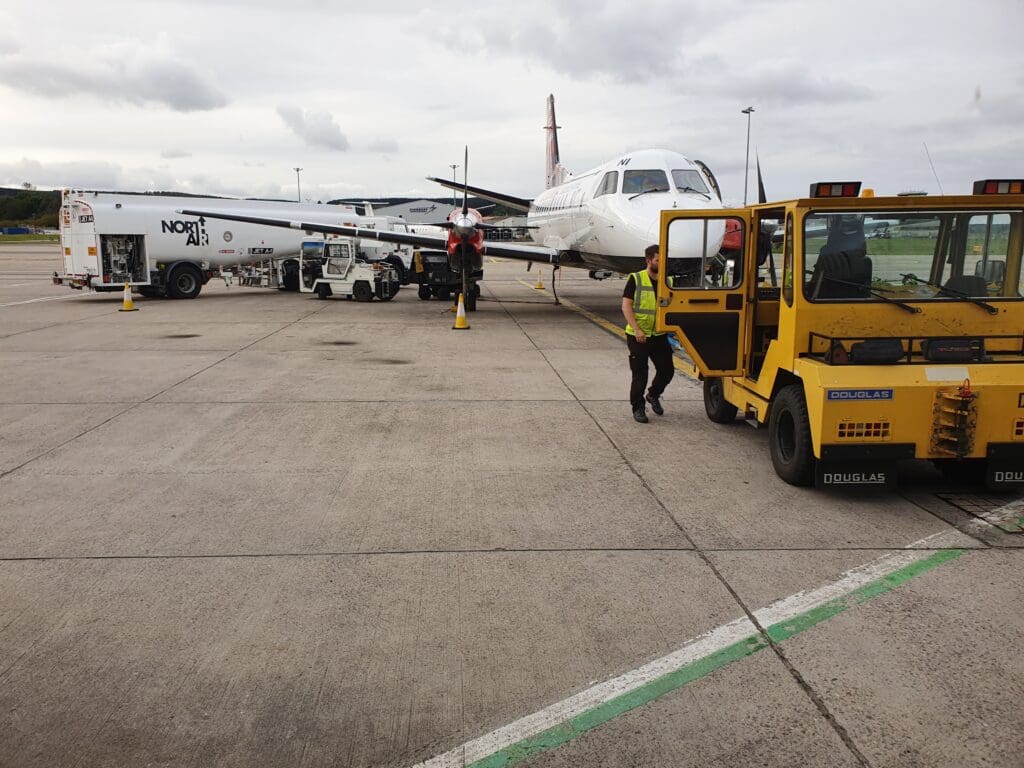
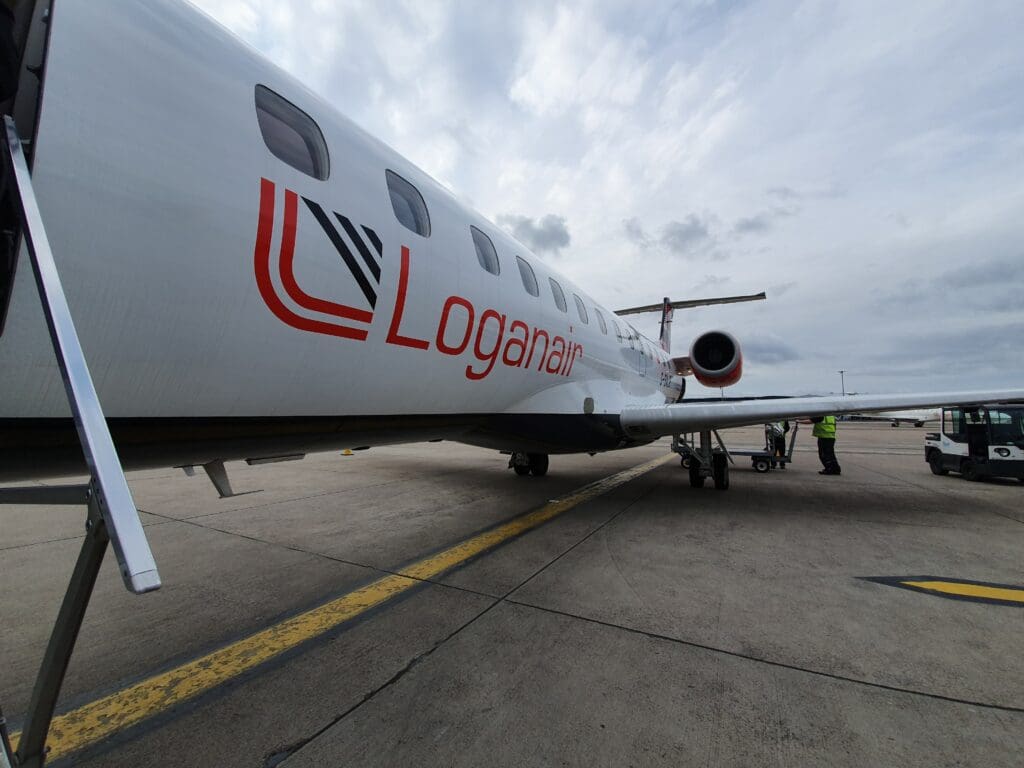
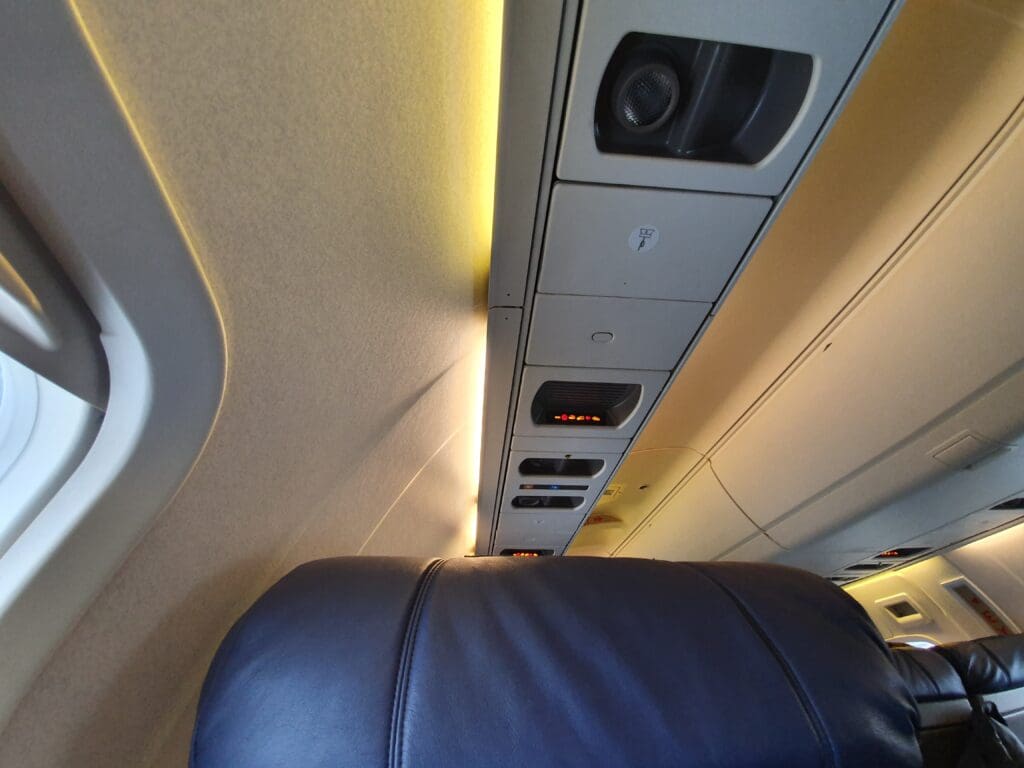
After a short wait at the bottom of the aircraft’s built-in steps to allow for social distancing as the passenger in front of me headed onto the aircraft, I clambered up the steps and soon received a friendly welcome from the sole flight attendant onboard who was stood in the small galley area at the front of the aircraft. There I spotted both a BMI and Brussels Airlines branded trolley, the latter likely explained by the fact that the aircraft frequently operated flights for the Belgian airline during its time with BMI regional. Without any delay, I made my way into the aircraft’s small 37-seat cabin. Onboard, each seat was typically Embraer 135/145 in style and was covered in (faux?) leather. Those in the aircraft’s first two rows were coloured beige, whilst all other seats sported blue coverings, something that I believe may be left over from the aircraft’s days with JetMagic.
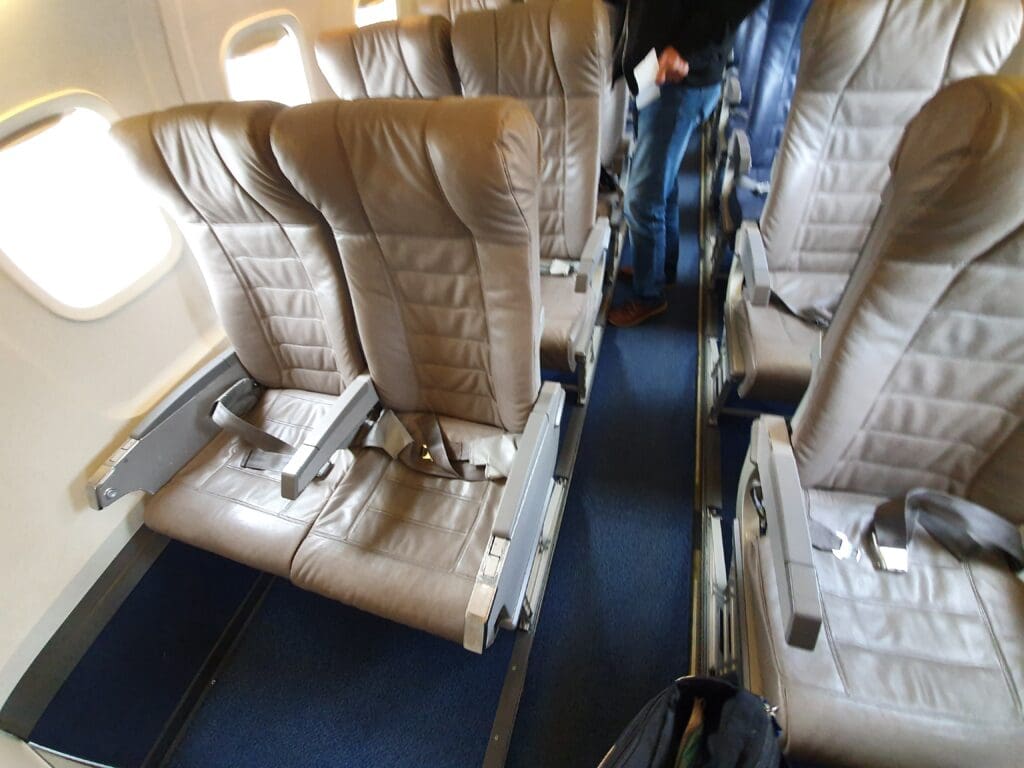
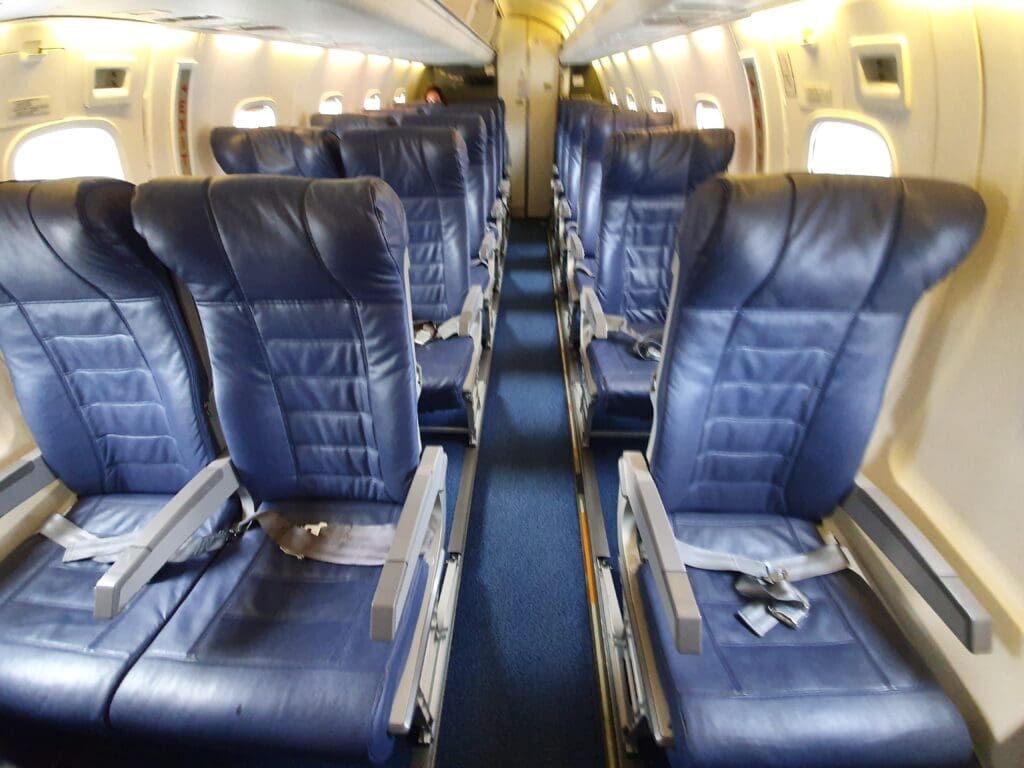
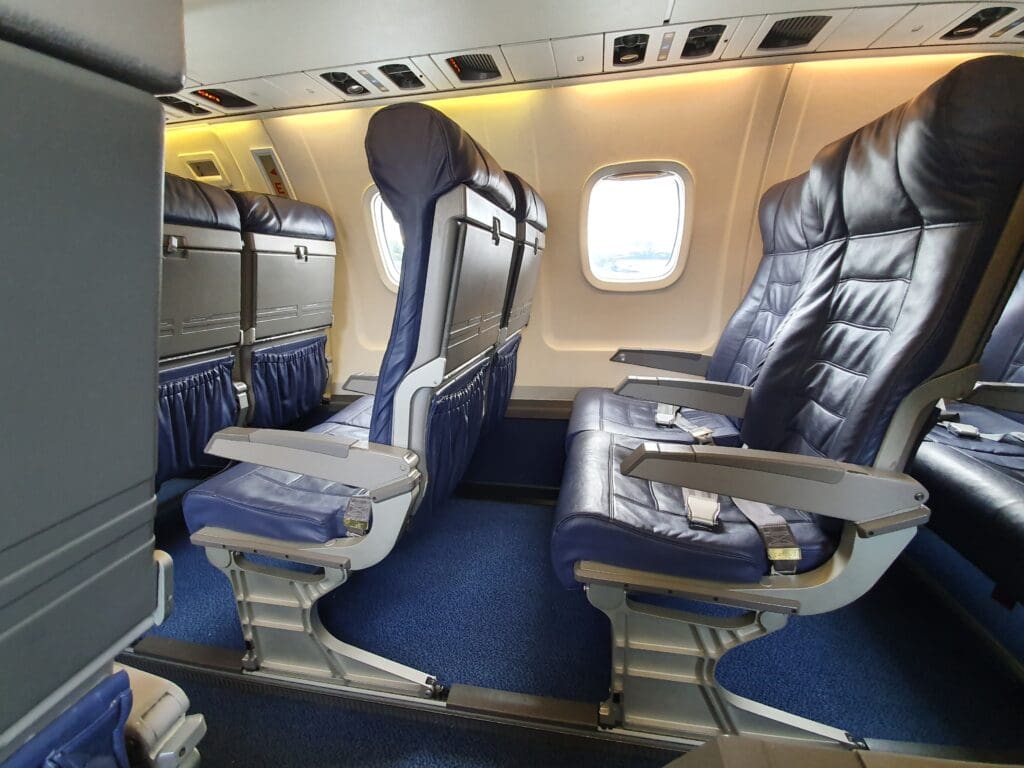
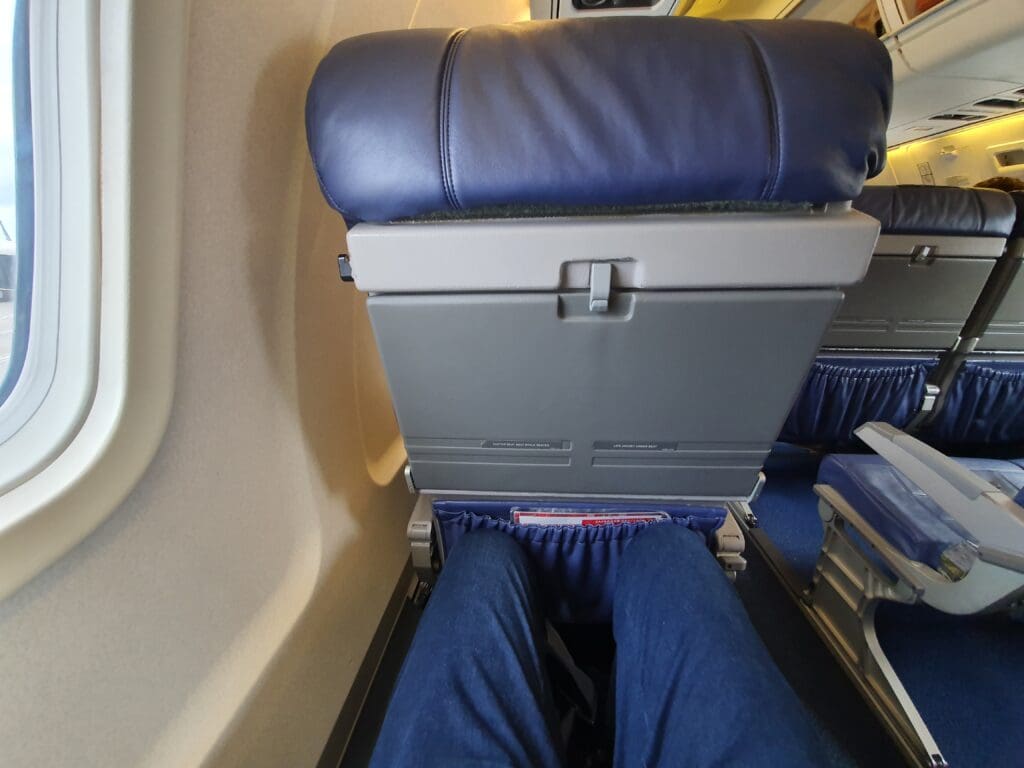
Without too much delay, I arrived at Seat 11A and settled in for the short flight ahead. Examining the seat and area around this, I was pleased to find that scratches and signs of wear and tear but largely minimal and the aircraft appeared to be spotlessly clean. Meanwhile, the seat was comfortable albeit with an expectedly average amount of legroom for a regional jet. Turning to the seatback pocket, owing to the ongoing situation this did not contain a copy of the Loganair’s Flightlog inflight magazine and instead featured just a plain sickbag and a safety card. Thankfully, all Birmingham-bound passengers made it to the gate on time, with the flight’s fifteen passengers all onboard by 1730. That evening, most of my fellow passengers appeared to be solo passengers dressed in business attire and unlike my flight from Teesside the previous day, there appeared to be few if any offshore workers heading home onboard.
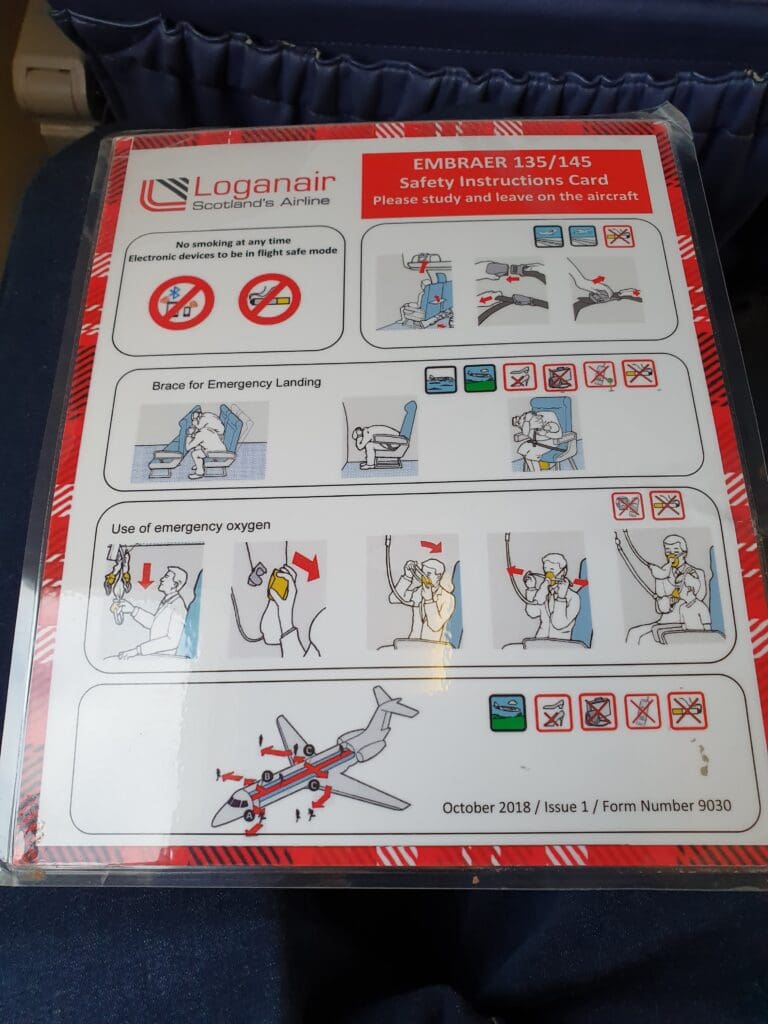
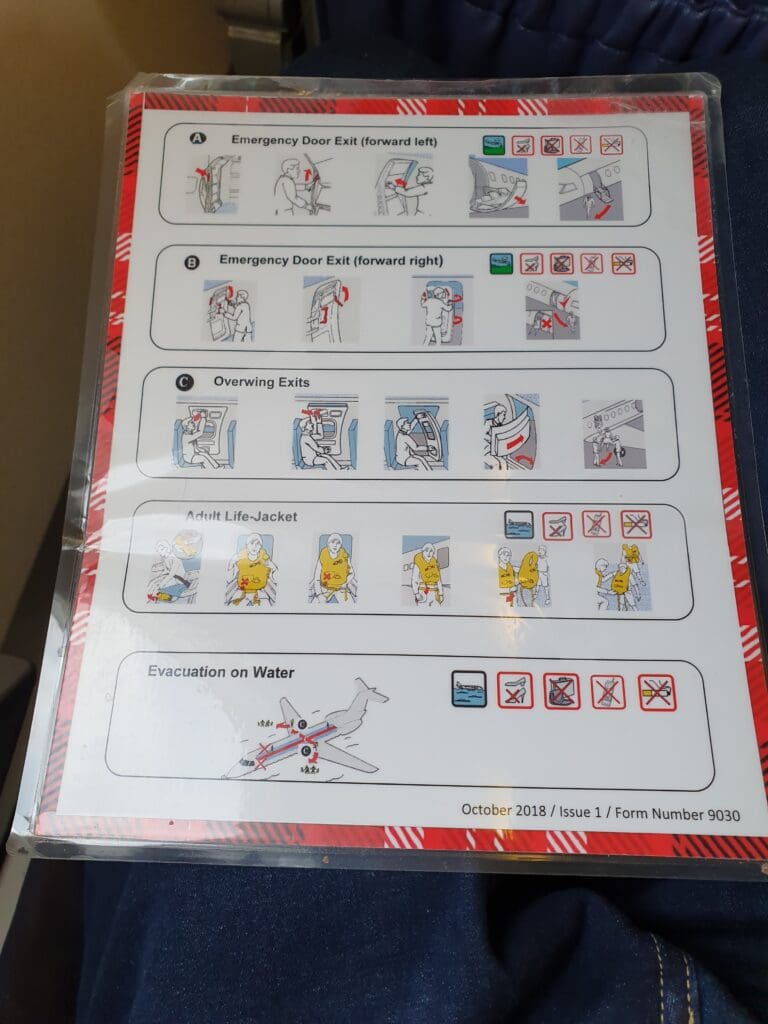
Indicating an early departure, shortly after the final passenger made it onto the aircraft, the main cabin door was closed and the flight attendant performed a brief welcome announcement. This consisted of the usual word of thanks for choosing to fly with Loganair and warnings regarding seatbacks, tray tables, window shades, and, in line with the ‘new normal’, facemasks. As soon as the flight attendant’s welcome reached its end, it was then the turn of the well-spoken Irish Captain to welcome passengers onboard, advising all that the flight time would be just under an hour and that he expected smooth weather conditions for the duration of the flight. As this came to an end, the flight attendant then passed through the cabin ensuring all was in place for departure before heading to the forward galley in preparation for the safety demonstration. At 1735, the aircraft jolted backwards and the Embraer’s two Rolls-Royce AE3007 engines noisily powered up as the safety demonstration commenced. This consisted of a pre-recorded announcement accompanied by a manual demonstration from the flight attendant. As with my flight the previous day, whilst all passengers were seated in the rear half of the aircraft, the flight attendant conducted this from the very front of the cabin.
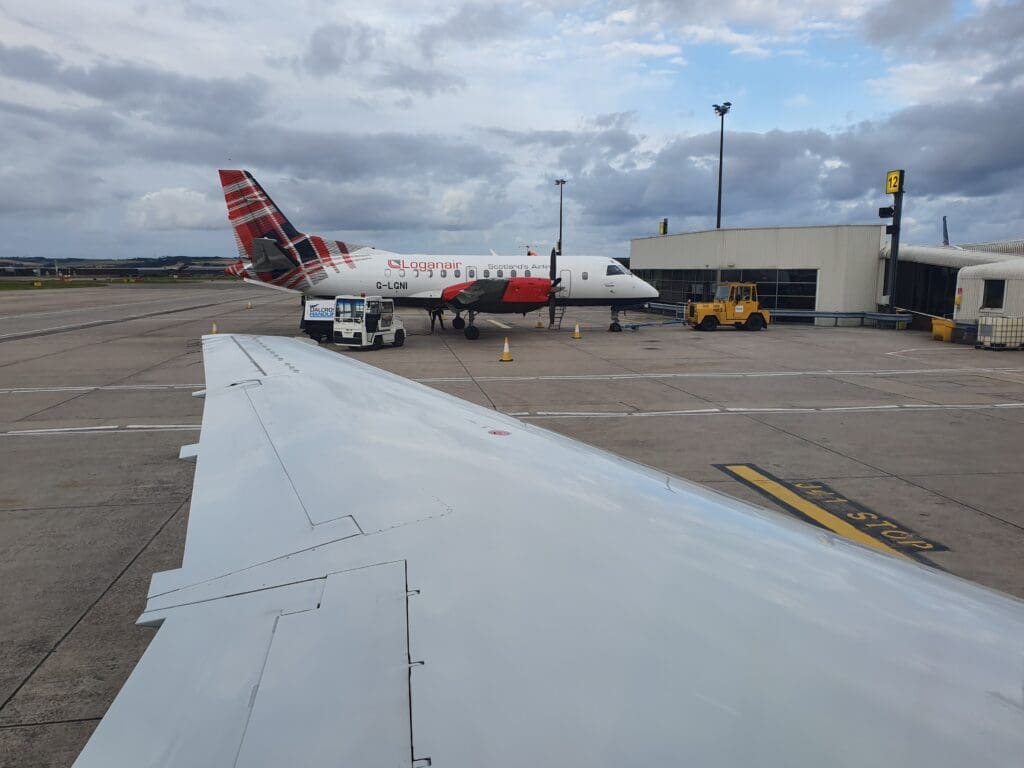
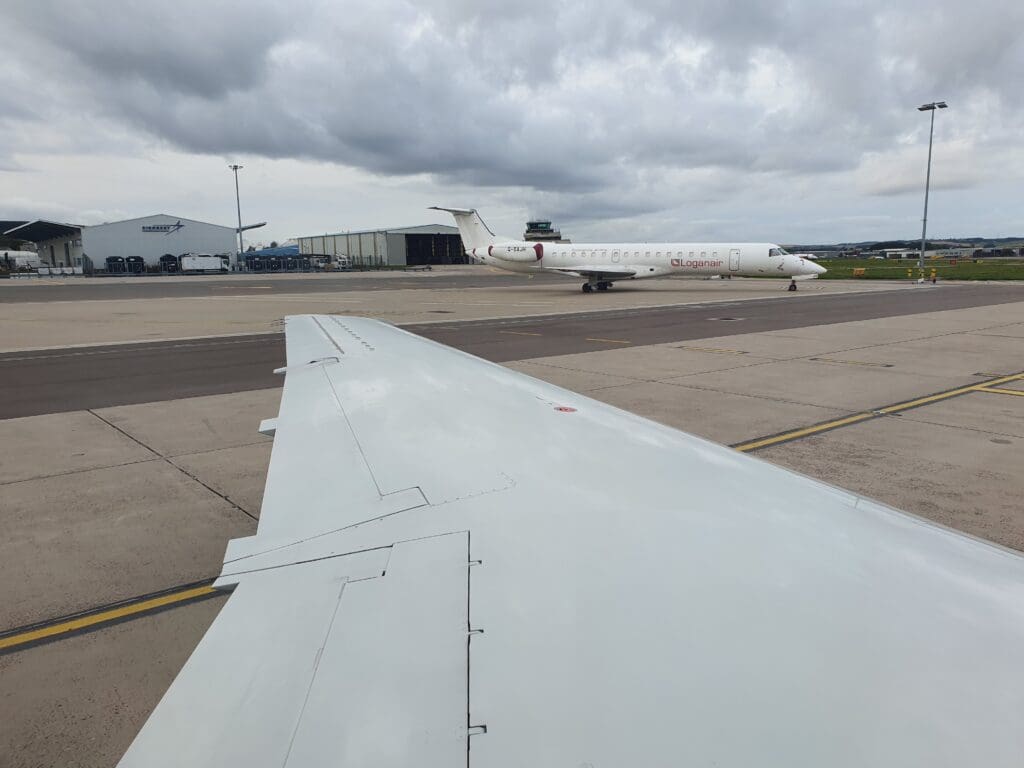
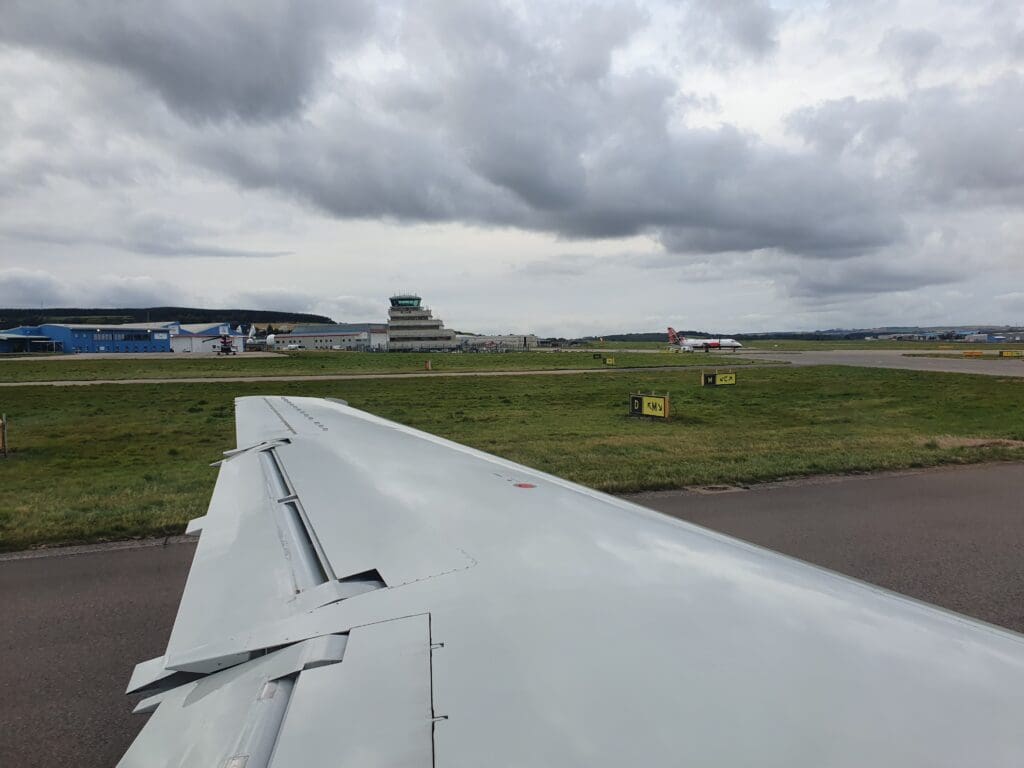
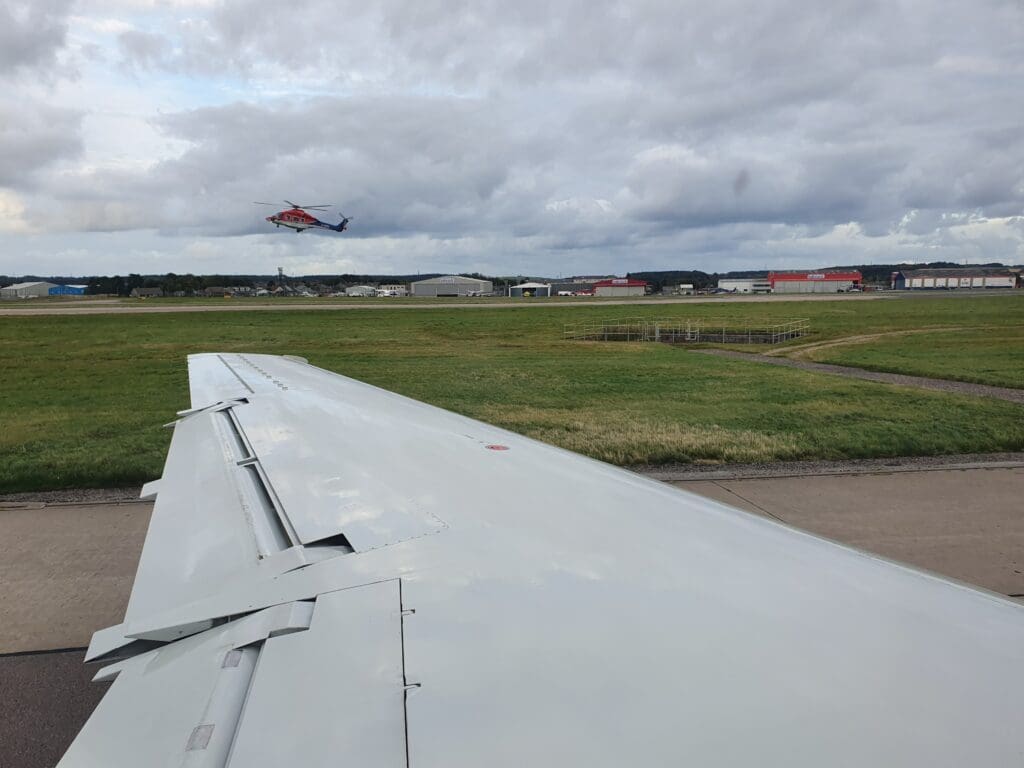
By the time the aircraft came to a halt, the engines appeared to have powered up and once the tug had been disconnected, the aircraft commenced its taxi over to Runway 34. Sitting on the left-hand side of the aircraft, as the Embraer journeyed over to the runway, my views were limited to the apron on the far side of the airfield as well as the action on the runway itself. At that time this consisted of an arriving Airbus H175 and a Sikorsky S-92A. In no time, the aircraft arrived at holding point H1. Making the most of this the Embraer paused to allow a Loganair ATR 72 to commence its journey to Manchester and two aircraft to arrive – another Sikorsky S-92 and a Gama Aviation Beechcraft King Air. At 1749, the aircraft taxied onto the runway and commenced a powerful rolling takeoff, pinning all passengers into their seats before rotating into the skies allowing for a good view of the west side of the airport and surrounding area.
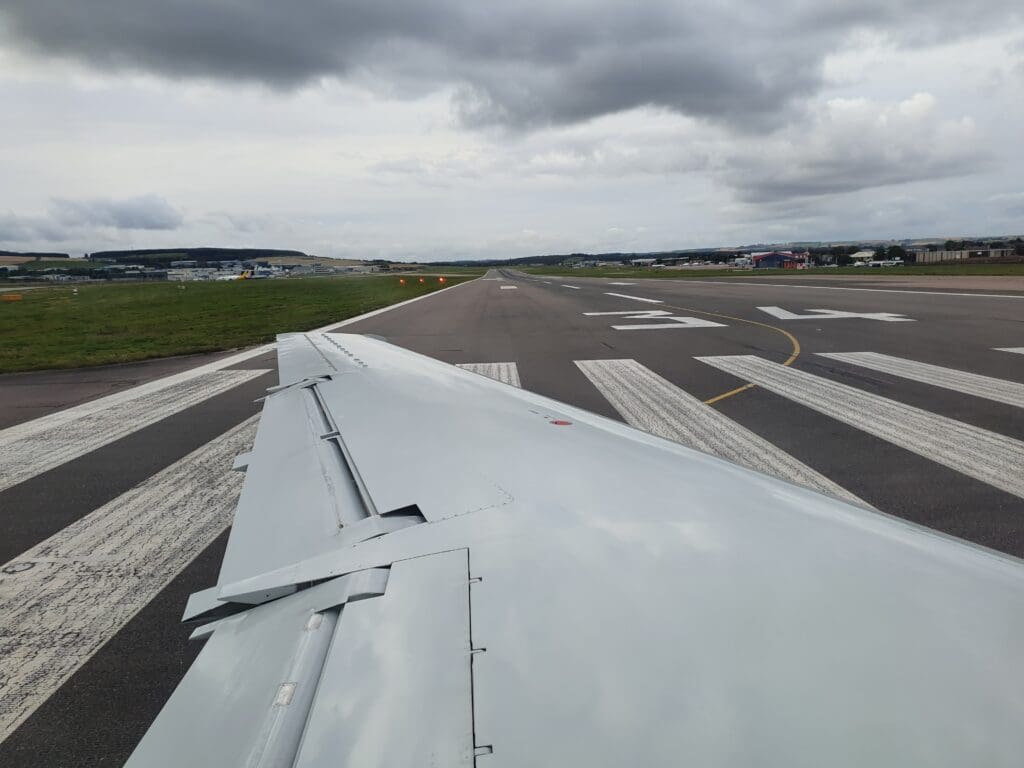
Once the Embraer left the airport behind, the aircraft climbed out over the picturesque Aberdeenshire countryside whilst the peaks of the Cairngorms came into view in the distance. Seeing as the aircraft took off into the north, the jet soon banked before rolling out on a southwesterly heading, minutes later turning almost directly south. Unfortunately, a short time after departure the Embraer passed through the thin first layer of cloud with gaps in this allowing for a brief glimpse of the coastal town of Montrose. A short time later the seatbelt signs were switched off which was followed by the usual announcement regarding keeping these fastened whilst seated, in addition, the flight attendant also informed passengers that due to the ongoing situation, there would be no inflight service.
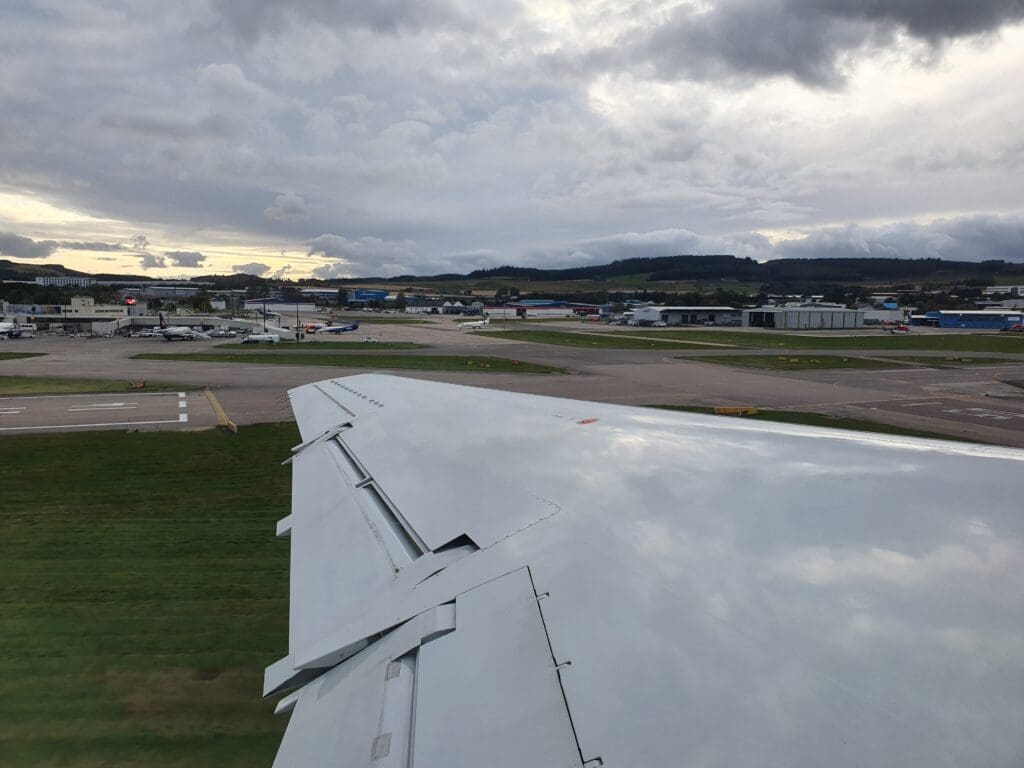
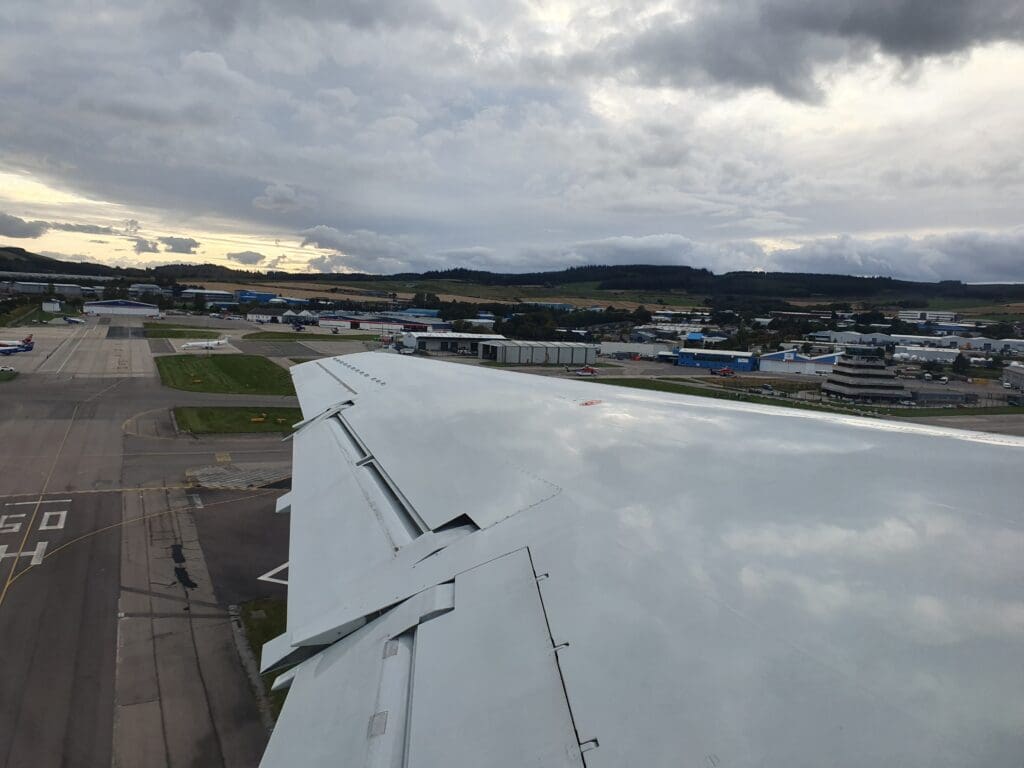
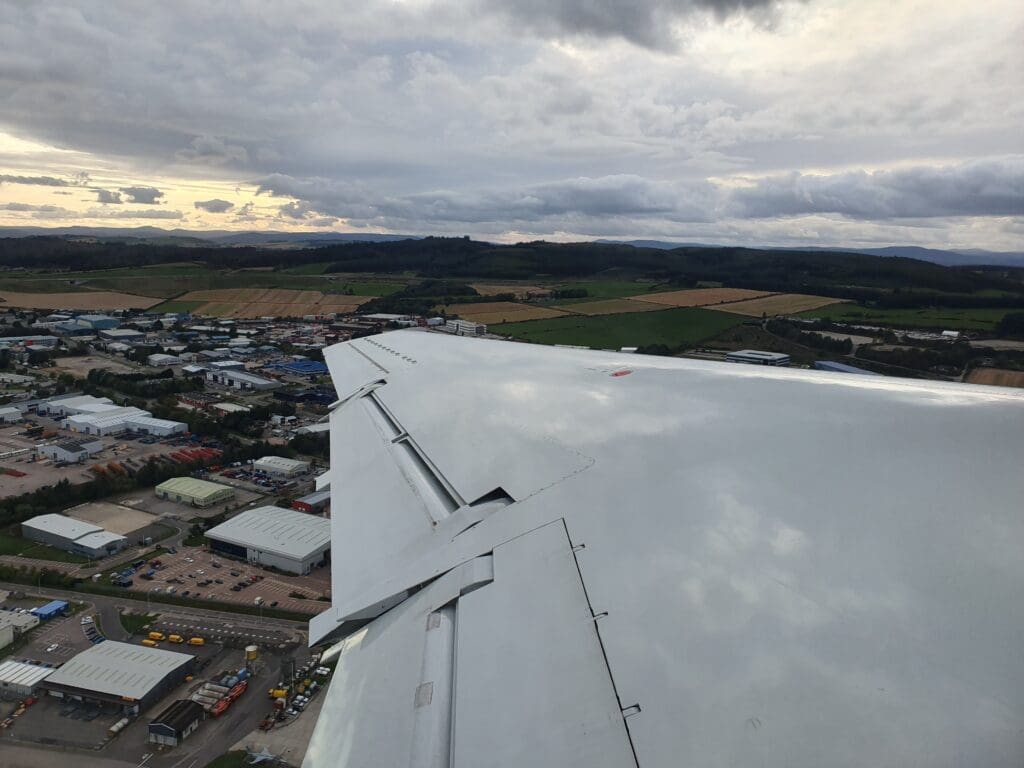
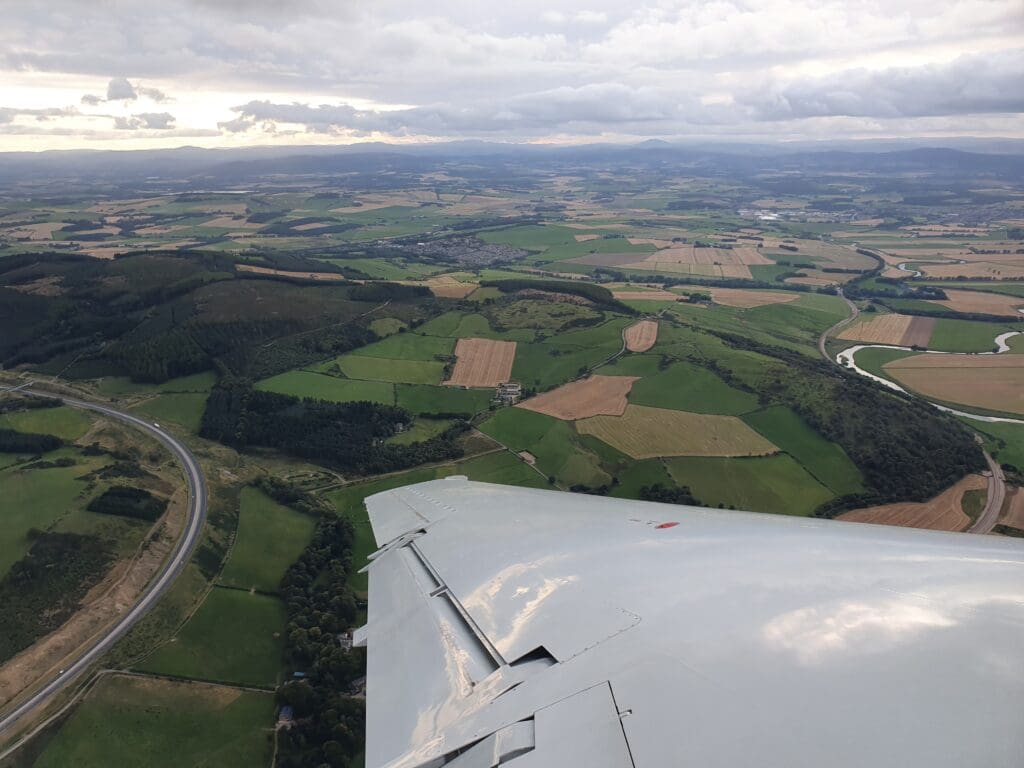
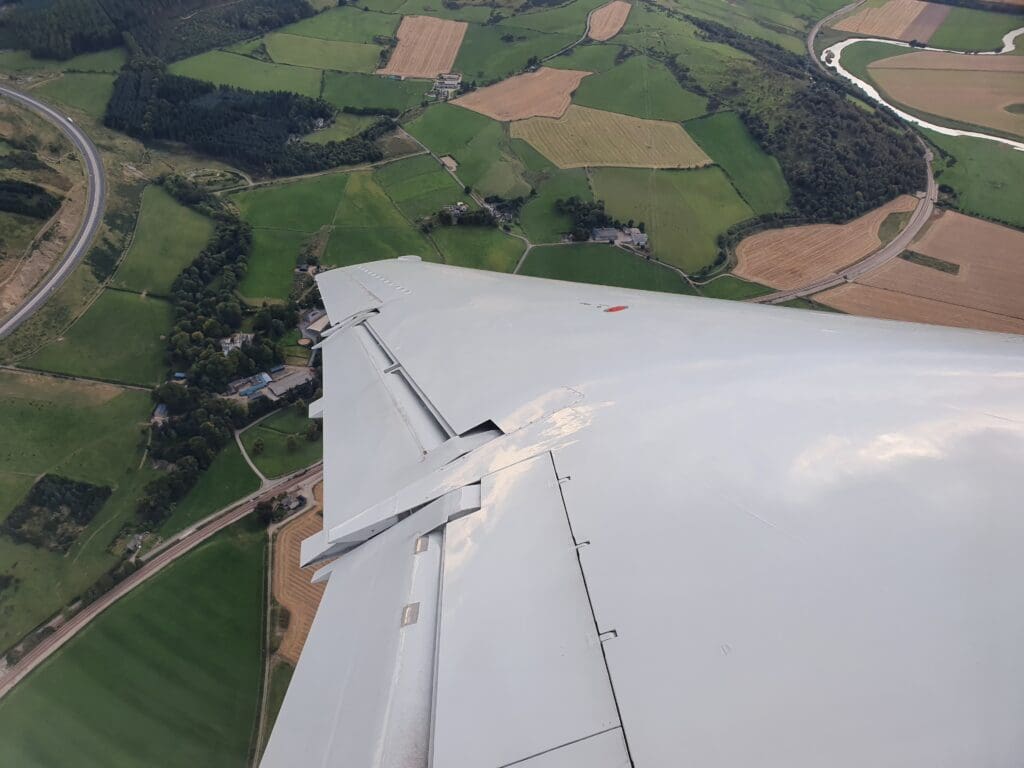
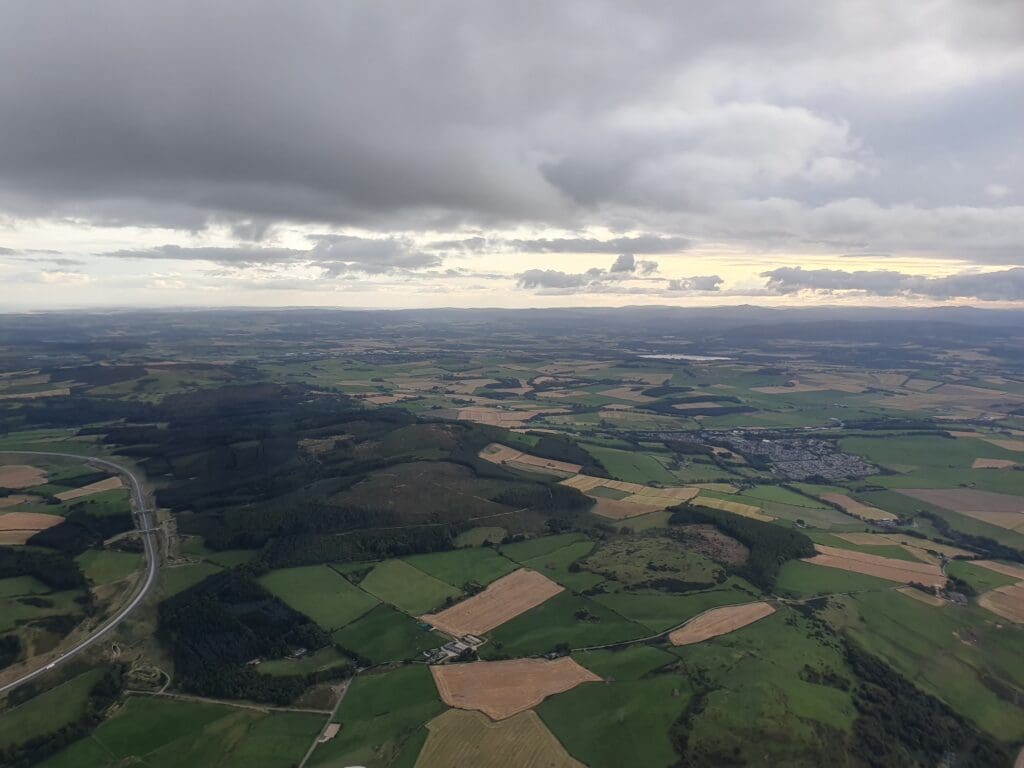
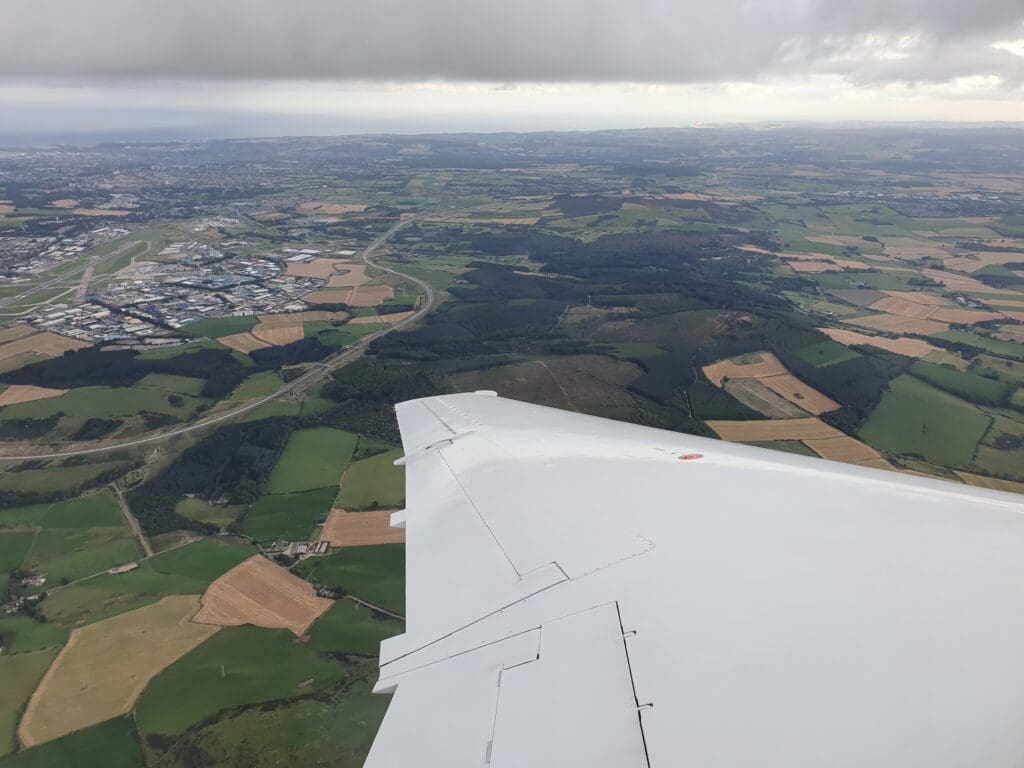
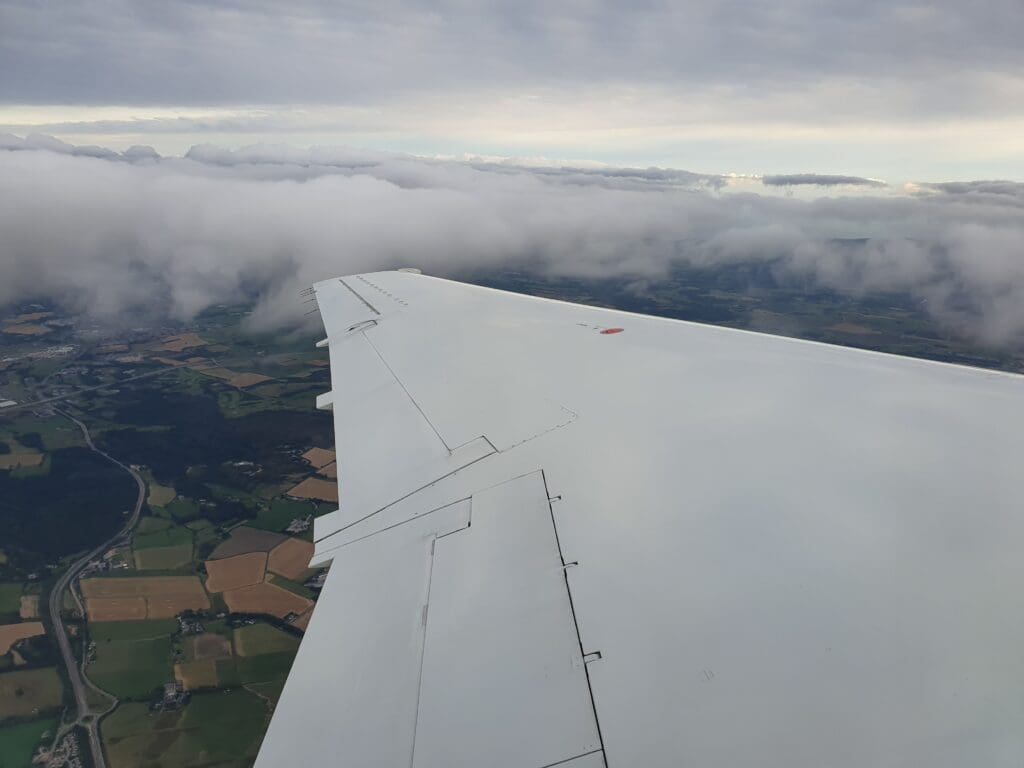
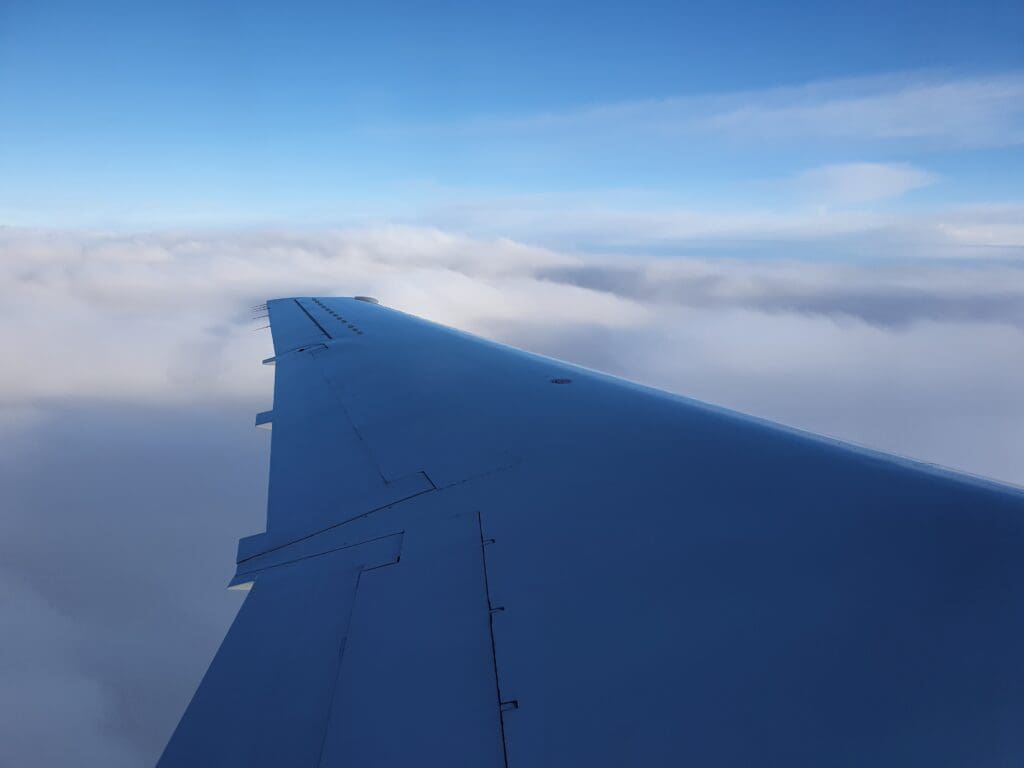
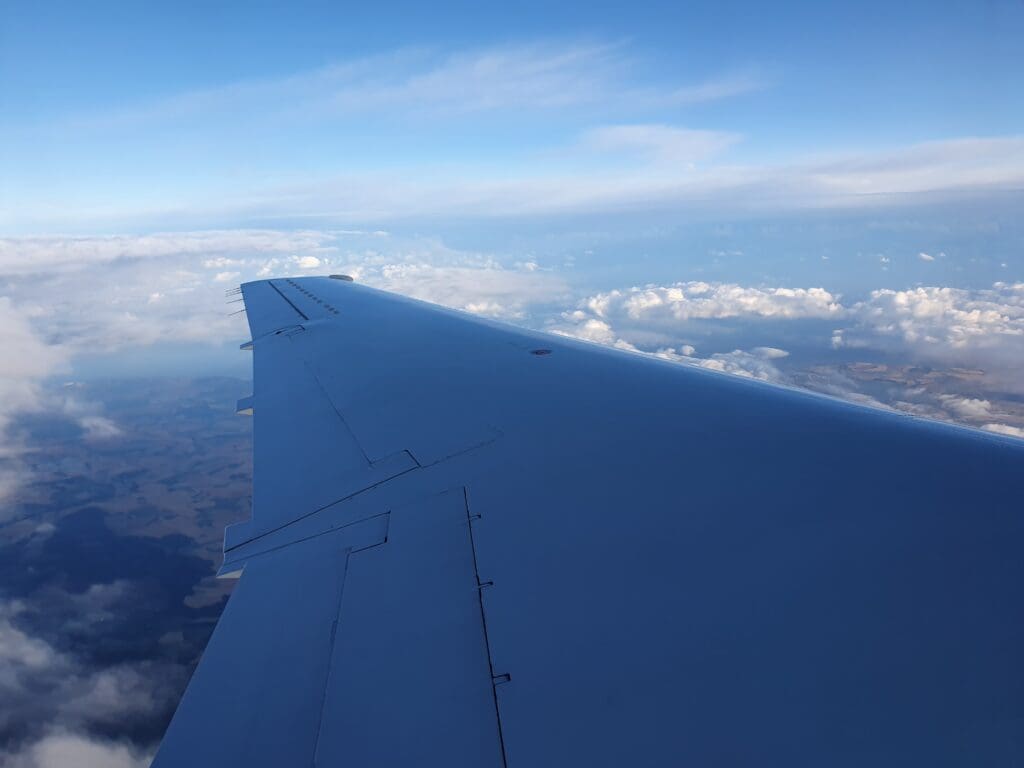
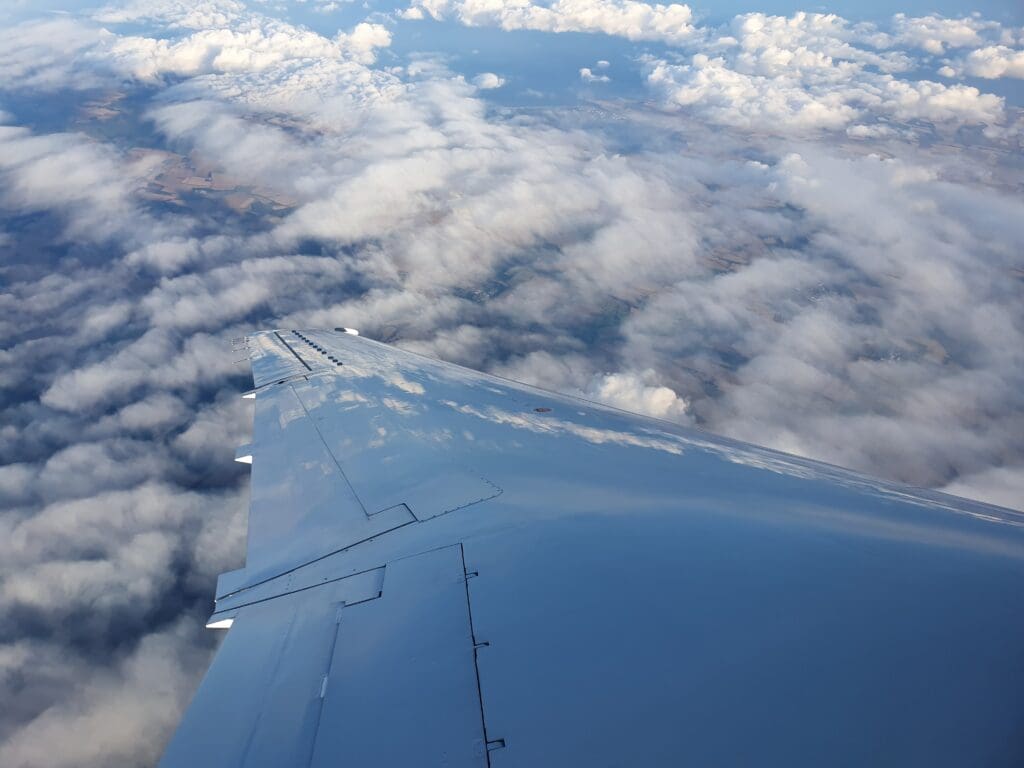
With little to do, I passed the time by looking out of the large window at the well-polished wing and clouds below. A short time after passing to the east of Dundee and directly over St Andrews, the aircraft passed over the Firth of Forth and soon arrived at its cruising altitude of 33,000 feet. A little over twenty minutes after leaving Aberdeen, the aircraft passed over the Scotland-England border near Gretna Green and headed directly over Carlisle.
Seeing as I would unlikely get the opportunity to do so later on, I decided to head to the toilet at the rear of the aircraft. Upon opening the door, I was pleased to find that this was reasonably spacious for a regional aircraft, far more so than on the Jetstream 41! Whilst clean, unlike the rest of the aircraft this sported several signs of wear and tear, however, my greatest complaint stemmed from the fact that this lacked running water. Nevertheless, both hand sanitiser and antibacterial wet wipes were on offer. Interestingly, again, perhaps explained by the aircraft’s regular flights with Brussels Airlines, all signs in the bathroom were in both English and French.
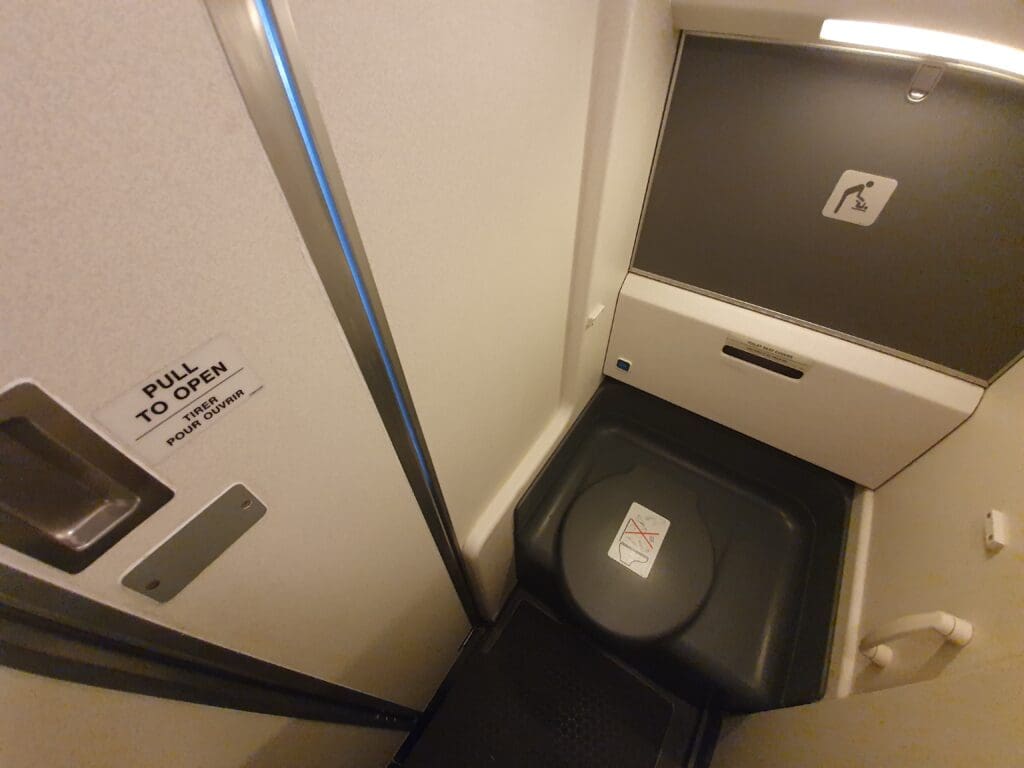
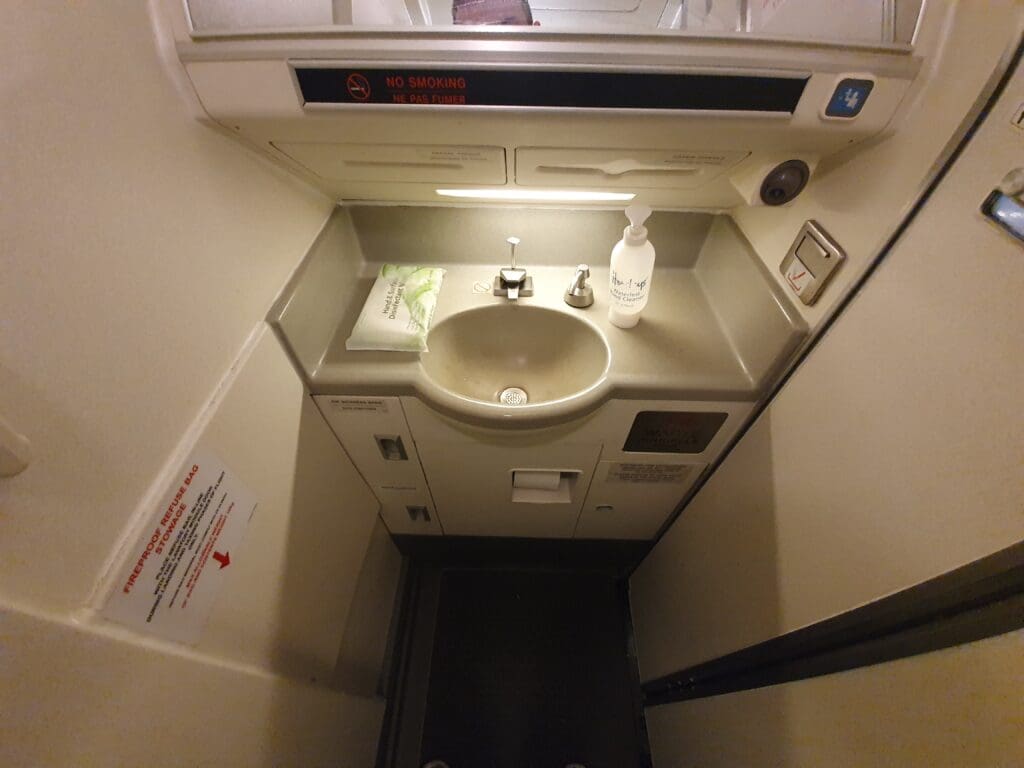
Upon returning to my seat, exactly ten minutes after levelling off, high over the Lake District, the aircraft could be felt commencing its initial descent down to 27,000 feet where it remained for another ten minutes. As the aircraft passed over Lancashire’s Forest of Bowland AONB, glimpses of the region’s green countryside could be seen through gaps in the clouds below. These were soon replaced by impressive cloud formations before these cleared as the aircraft passed directly above Manchester Airport, at which point the hills of the western end of the Peak District could be seen as the aircraft headed southwards over Cheshire. As the aircraft sank through 14,000 feet and passed to the east of Stoke-on-Trent, the seatbelt signs were reilluminated and the flight attendant performed the usual pre-arrival announcement before passing through the cabin and ensuring all was in place for the aircraft’s arrival into Birmingham.
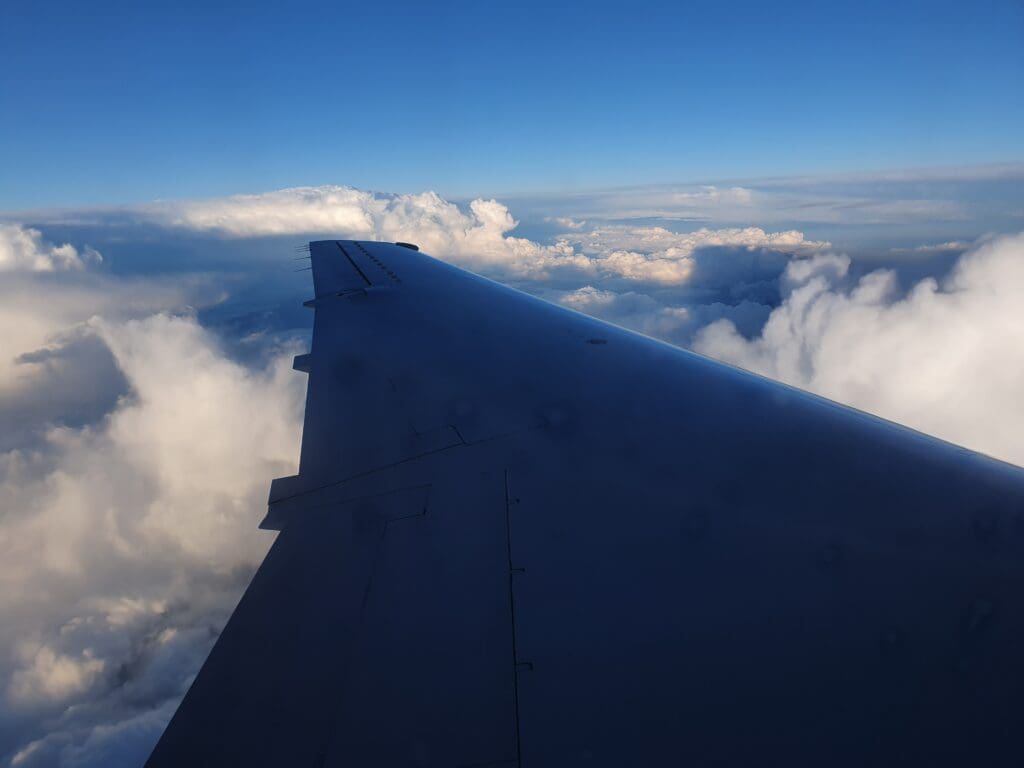
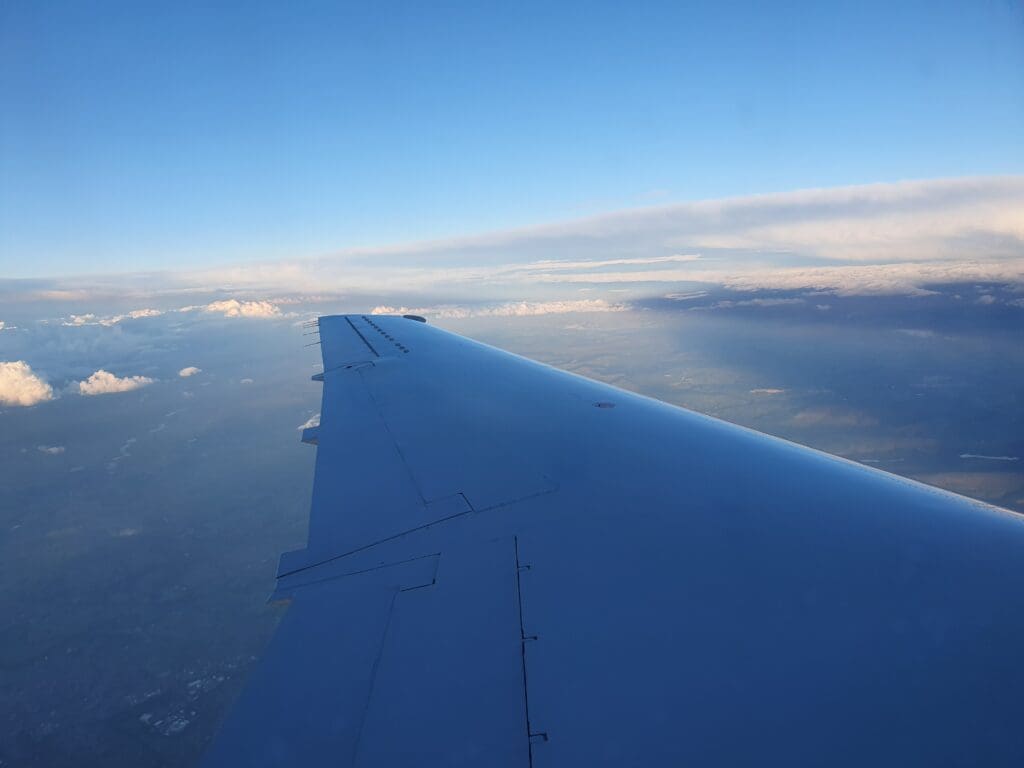
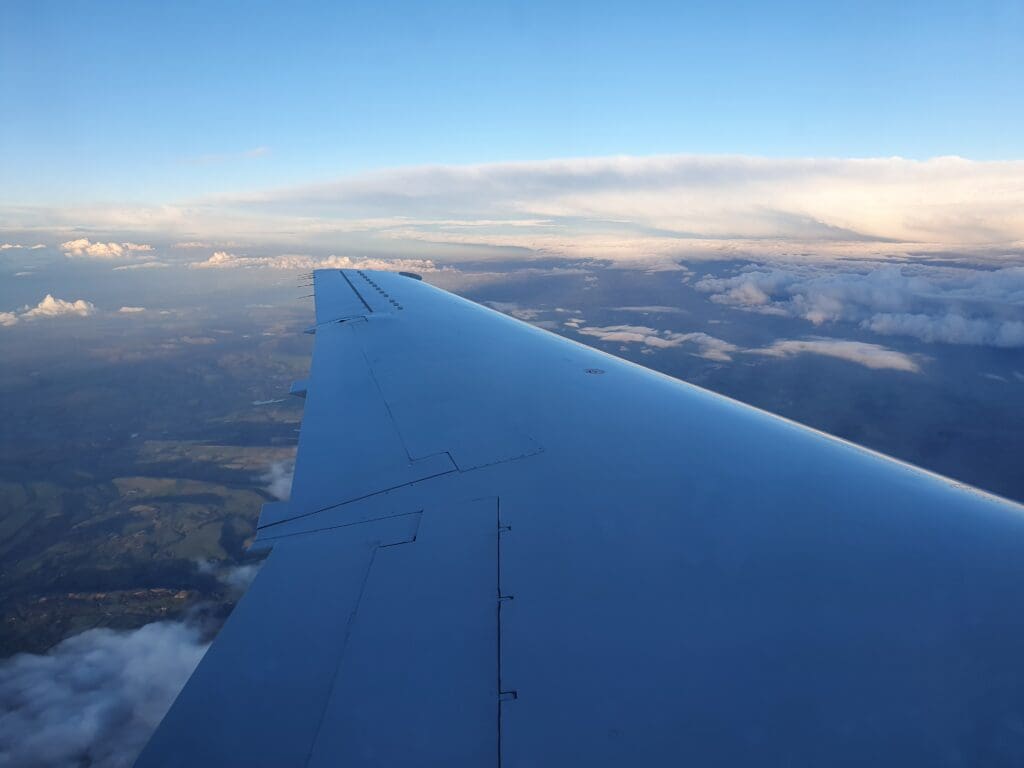
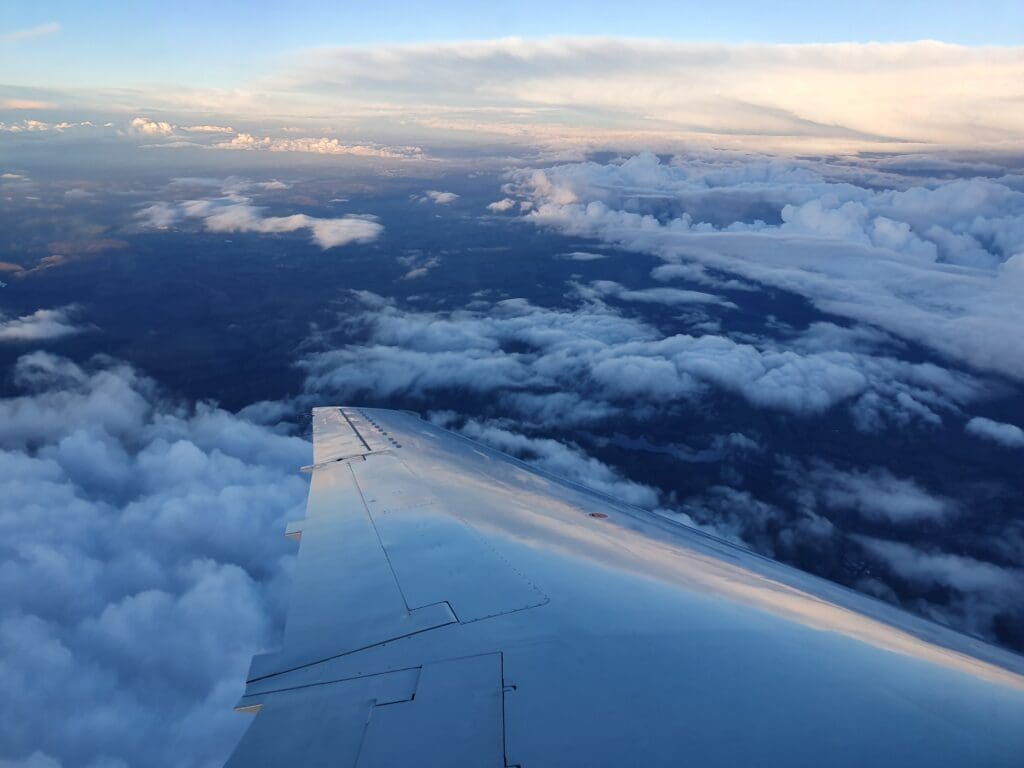
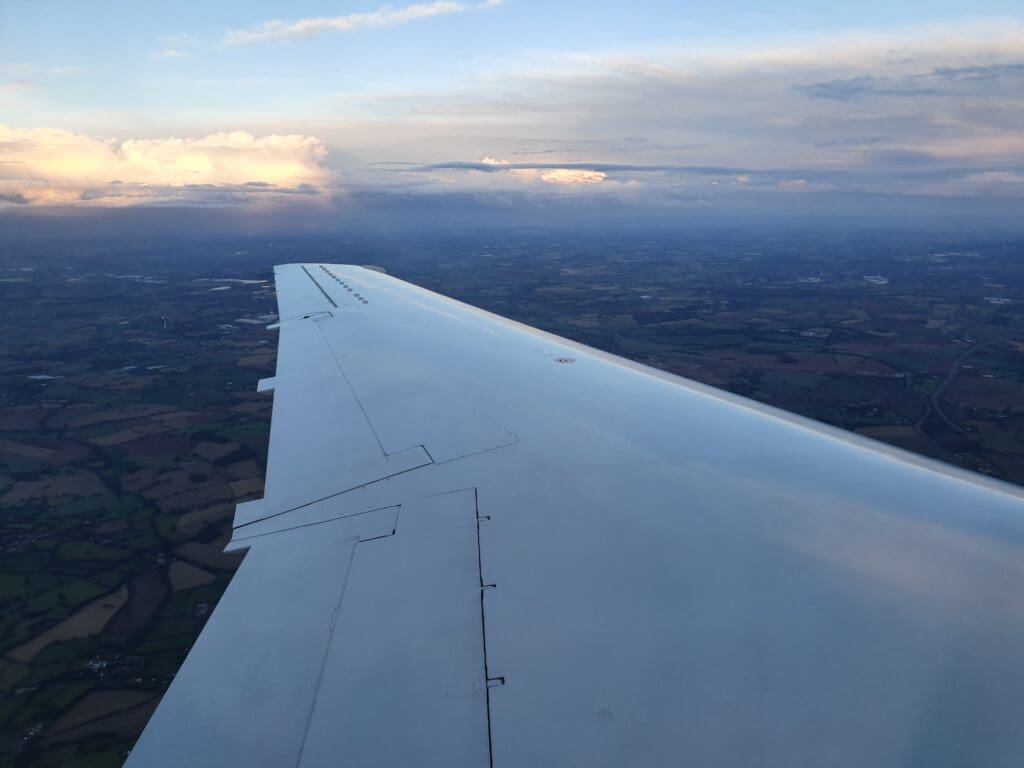
By this time, the clouds had cleared allowing for a virtually entirely unobscured view of the landscape below. The first landmark came in the form of the Y-shaped Blithfield Reservoir in Staffordshire which was soon followed by the decommissioned yet still intact coal-fired Rugeley B Power Station and its nearby town. At this point, the aircraft’s speedbrakes were partially extended and the aircraft slowed before the flaps were extended as the town of Sutton Coldfield appeared. At 1843, the aircraft’s landing gear fell into position with a noisy clunk and full flaps were extended in preparation for the aircraft’s impending arrival.
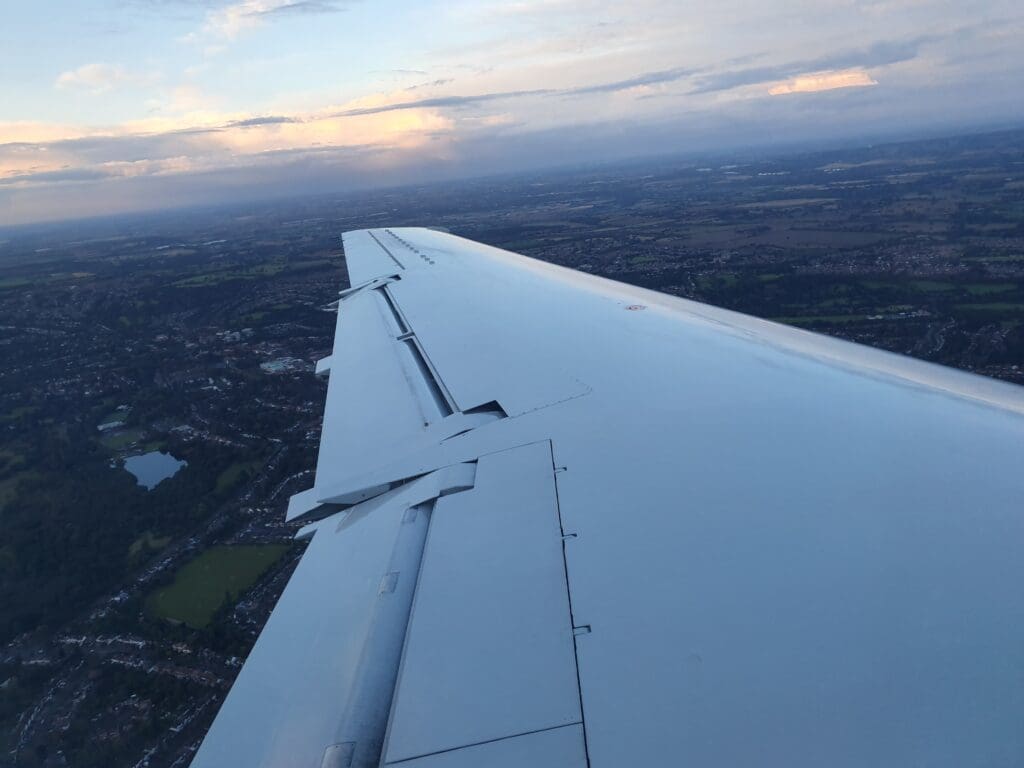
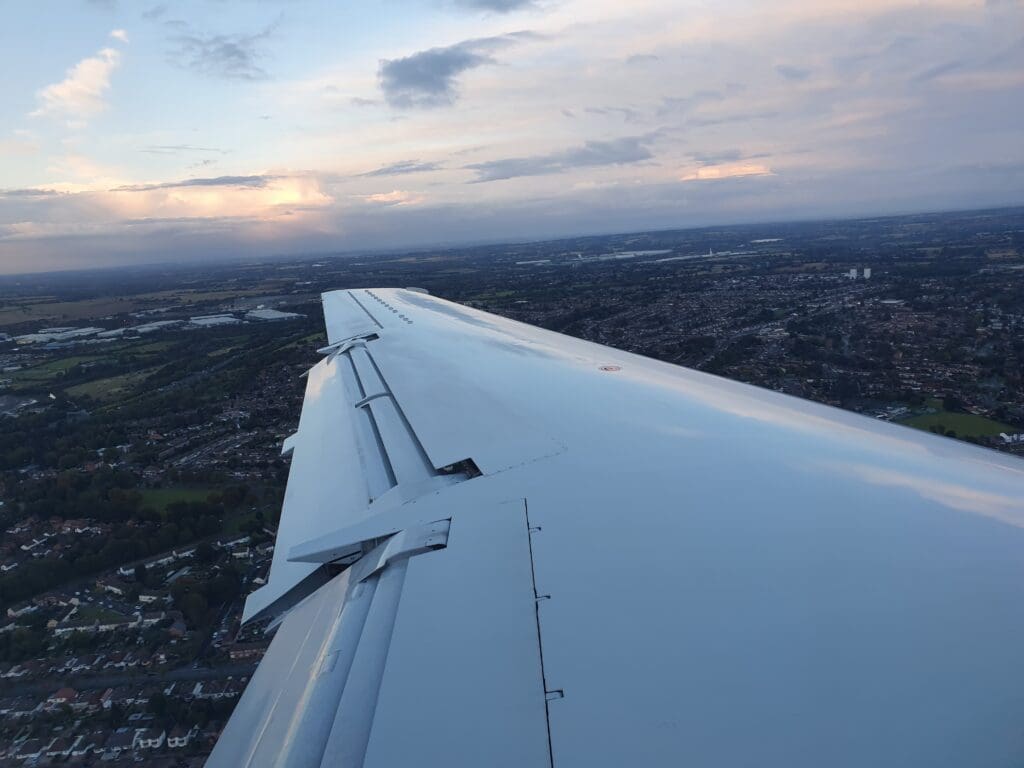
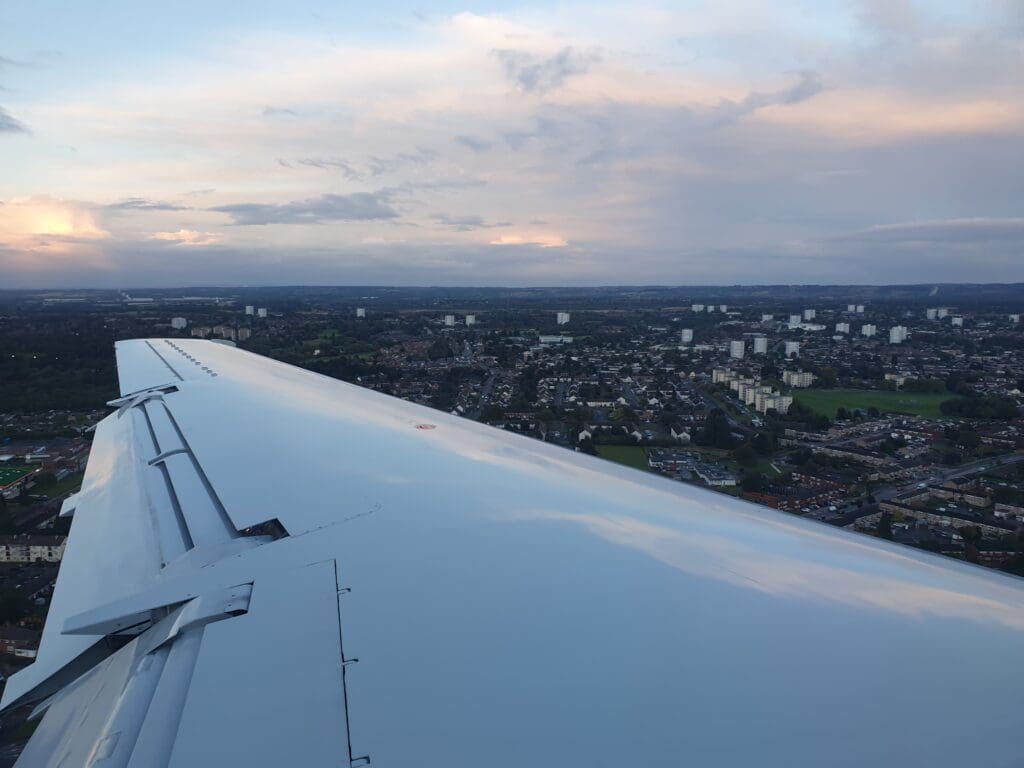
After passing over the busy M6 motorway, the Birmingham suburb of Solihull and the many identical tower blocks of its Chelmsley Wood estate came into view before the aircraft darted over the perimeter fence before making a firm touchdown on runway 15, 57 minutes after leaving Aberdeen. As the aircraft gently slowed, a selection of aircraft appeared, many of which took the form of either Jet2, Ryanair or TUI Airways Boeing 737-800s, however, a TUI Airways Boeing 757-200 and Boeing 787-8 Dreamliner could also be spotted. Eventually, the aircraft taxied off the runway and the noise level decreased suggesting that one of the aircraft’s engines was shut down. At this point, the flight attendant welcomed all to Birmingham and proudly exclaimed that the flight had arrived 35 minutes ahead of schedule.
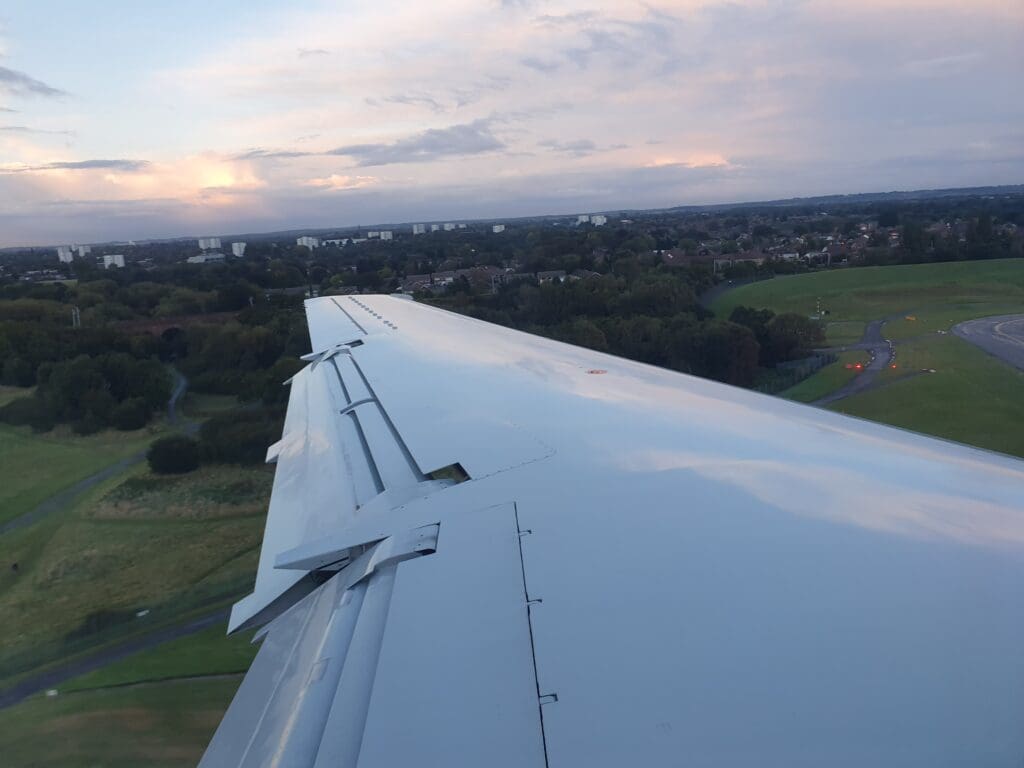
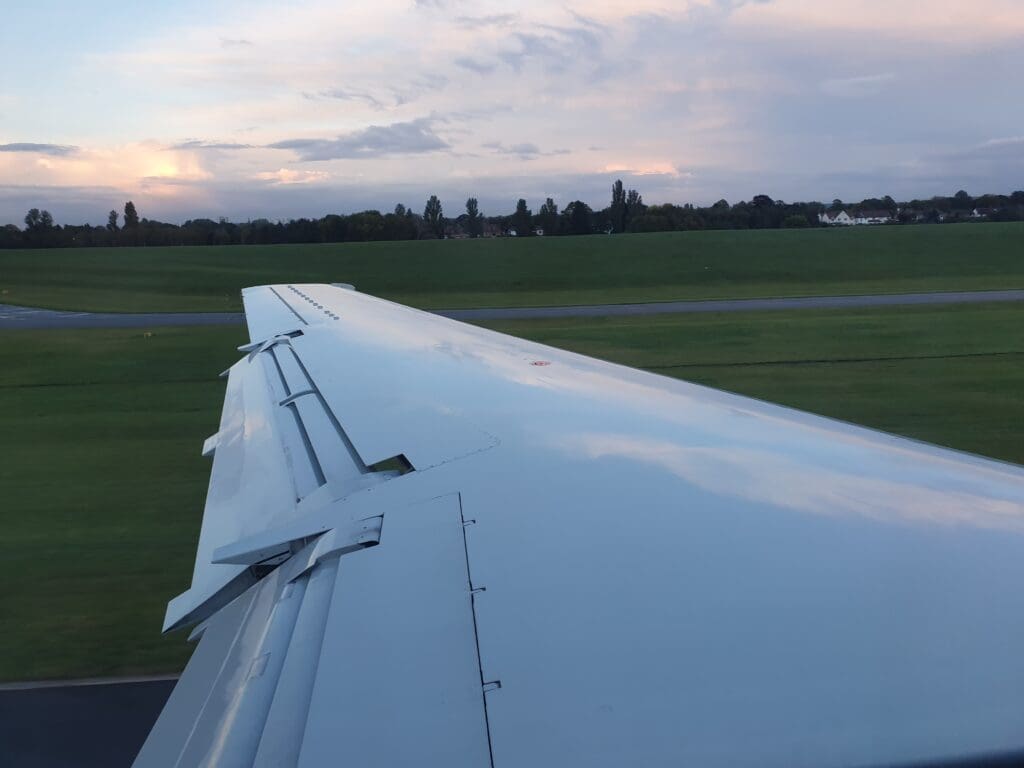
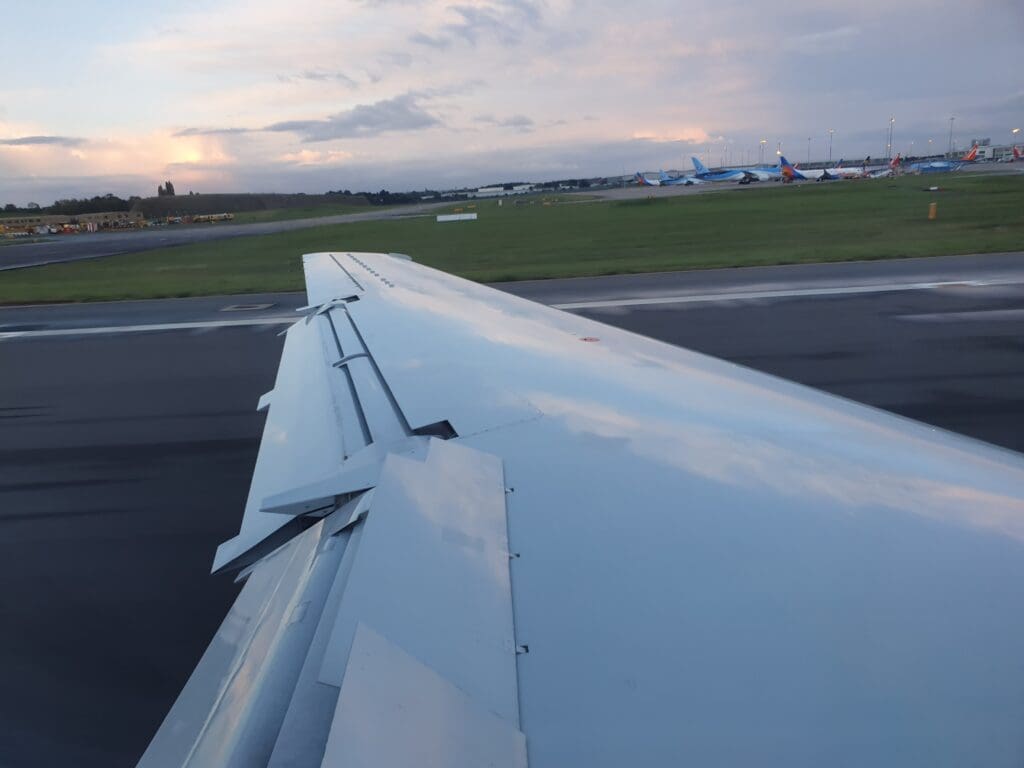
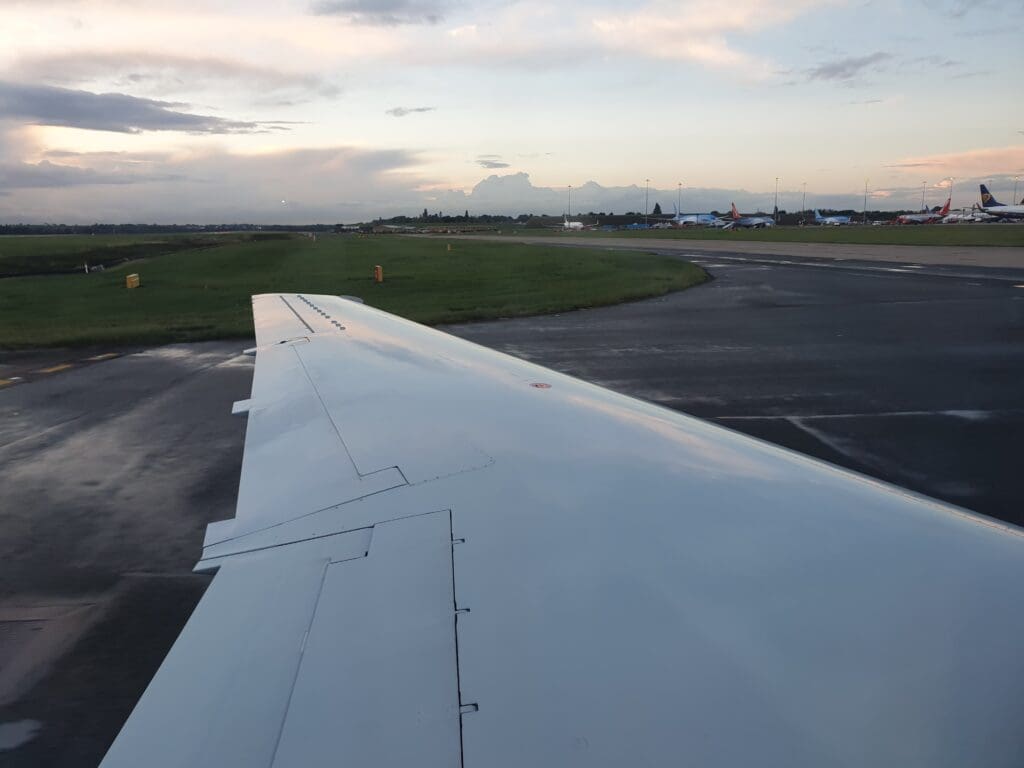
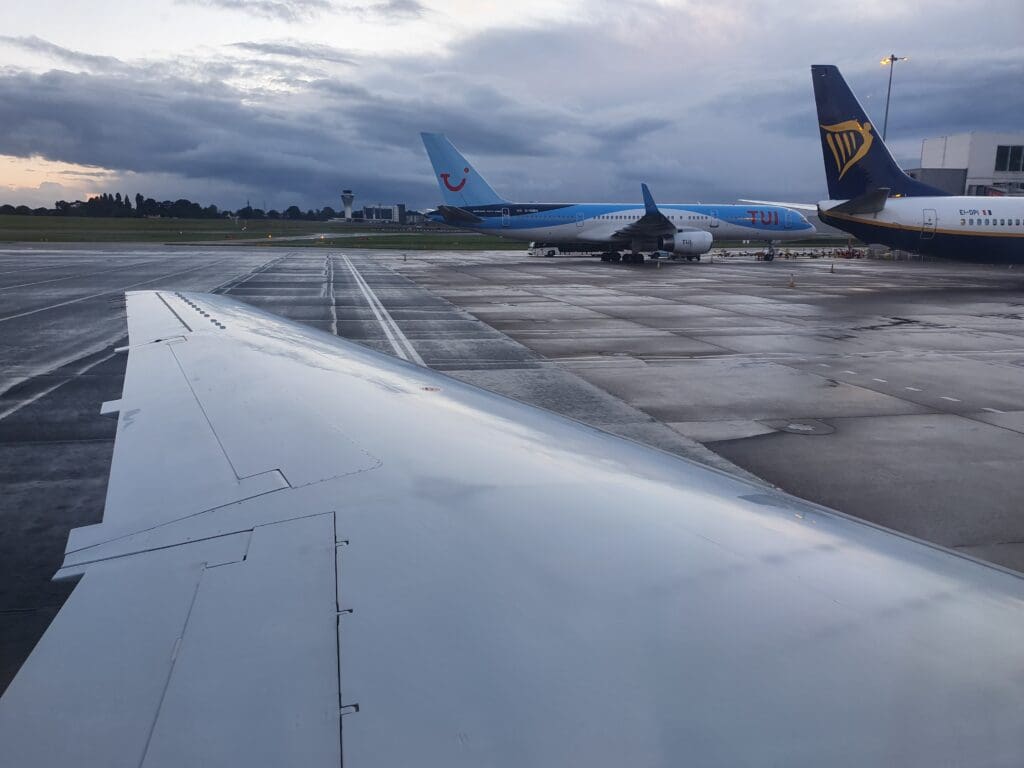
From the runway, the taxi over to Stand 14L lasted no more than a minute and the Embraer soon pulled up next to a Ryanair Boeing 737-800 that had arrived early that afternoon from Malta. Once the aircraft came to a halt, several passengers jumped up and abandoned the concept of social distancing in a rush to exit the aircraft. Unfortunately for them, having arrived at what is usually an international gate, a short bus journey to the older domestic portion of the terminal was required, so disembarkation could not commence until a bus appeared. This turned up after a minute or so after which disembarkation commenced. After thanking the flight attendant, I made my way out of the aircraft and headed over to the bus and following a short journey, I found myself stepping into the terminal around ten minutes after the aircraft had touched down. From there I headed through the small baggage collection hall where it appeared as if only one passenger stopped to wait for their luggage before I entered the eerie and almost empty landside portion of the terminal.
Summary
At the end of my first-ever flight with Loganair, I was left with no reason not to fly with the carrier again. The flight attendant was friendly, the aircraft was clean and reasonably comfortable and the flight arrived well ahead of schedule. All-in-all I could not have really asked for much more!
Indeed, it can be a joy to fly aboard a rare type. I have been board as a passenger only once on the ERJ 135, Dornier 328JET, 747SP, A340-500, MD-90.
Yes agreed! Some very rare types there – I’ve never flown on a 747SP, A340-500 or MD-90!