
Taking Greece’s Island Hopper: Rhodes to Athens with 3 Stops on a Sky Express ATR 42
Background and Booking
Alongside its rich history, culture, climate and food, amongst of course many other things, Greece is famous for its thousands of islands, of which up to 227 are inhabited. Thanks to its geography, given its size Greece is home to a disproportionately high number of domestic flights and, given the sizes of many such islands, their airports are often featured in interesting locations, with scenic and white knuckle approaches not entirely unheard of across the country. Visiting Greece, as an aviation enthusiast it would be a shame not to try out one of the country’s island hopper services and, starting in Rhodes and ending up in Athens, the most obvious option would be to head off on Sky Express’ morning GQ70 service. Departing Rhodes at 0830, this heads off to the island of Astypalaia with stops on the islands of Kos, Kalymnos and Leros, before touching down in Astypalaia almost three hours later at 1120. Once on the ground, the ATR 42 has a short break before heading onwards to Athens as GQ11.
Operating three direct flights between Rhodes and Athens on my chosen departure day in late May 2022, unsurprisingly Sky Express does not offer this island hopper option when searching for flights between the two cities. Indeed, adding significant time and costs to the journey, few ‘regular’ passengers would likely wish to spend all morning hopping from island to island. Therefore, those wishing to take this service must search for flights between Rhodes and Kalymnos, Leros or Astypalaia, and then from there to Athens. Having done my research, I had worked out that the cheapest option would be to book flights from Rhodes to Astypalaia and then from there to Athens, although this would only save around €8 compared to booking via the other two islands. Seeing as the premium for purchasing flights directly through Sky Express as opposed to an online flight booking engine stood at exactly £4, I decided to book tickets for my island hopper flight directly with the airline. Once I had navigated my way over to Sky Express’ website, I was presented with a scrolling banner advertising various pieces of information regarding the airline and cheap fares to several European destinations. Beneath this, the flight search engine could be found and I soon entered all the relevant details and was presented with four different options.
After selecting the four-flight itinerary I was taken to enter my details and add any optional extras to my booking. Examining potential additions, these included 15kg of additional hold luggage, excess luggage allowance on top of the complimentary 15kg – priced at €3 per kilogram, oversized sports equipment for €40, priority baggage service for €5 and finally the option to carry a pet in the cabin for €20. Once I had skipped past these options, I arrived at the seat selection page where I soon made the delightful discovery that all vacant seats onboard the ATR could be selected free of charge! Interestingly, the system allowed me to select a different seat for each flight. However, with all four sectors being part of one single service with a single flight number, I suspected that were I to select a different seat on each leg, I would end up being re-seated later on. Once done, I then went ahead and entered my card details and after around a minute of buffering, I received a summary of my booking with a confirmation email promptly arriving in my inbox.
The Journey
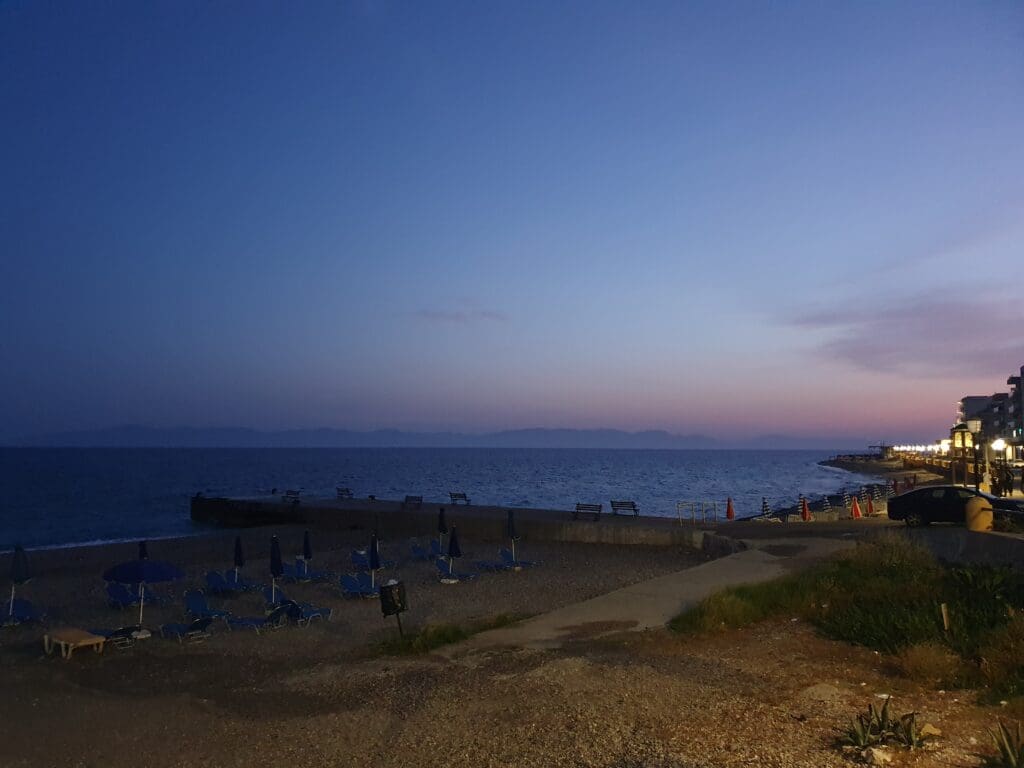
Having arrived in Rhodes on an Olympic Air Dash 8-100 the previous afternoon following a couple of days on the small island of Kastellorizo, my time on the largest of the Dodecanese Islands had been limited to around twenty hours. Nevertheless, I still managed to stroll through the historic sights of Rhodes’ old town and pay a visit to the infamous tourist hotspot of Faliraki. With my flight to Astypalaia departing at 0830, and seeing as I had checked in online and would not be travelling with any hold luggage, I could probably have arrived at Rhodes Airport at 0700 and still have had enough time to enjoy all that the terminal has to offer. Staying in the city of Rhodes, I had two options of reaching the airport – bus or taxi, however not wanting to splurge out on the latter, I was left at the mercy of the local bus schedules. Upon researching these, much to my surprise there appeared to be no buses departing between the city and airport between 0515 and 0800. Thus, I was left with no option other than to aim for the 0515 service. Following an early wake-up of 0430, I made my way out of the hotel and trundled down through the pleasantly warm early morning air to the seafront. There, I waited at a bus stop as the skies began to very gradually transform from night to day. Once I arrived at the bus stop, I was slightly concerned to find that there was no sign of the number 61 airport-bound bus on any of the information screens, and soon enough the scheduled departure time arrived with no sign of the bus. Fortunately, at 0520 this appeared, and after paying the €3 fare, I took one of the last remaining seats and got settled in for the journey to the airport.
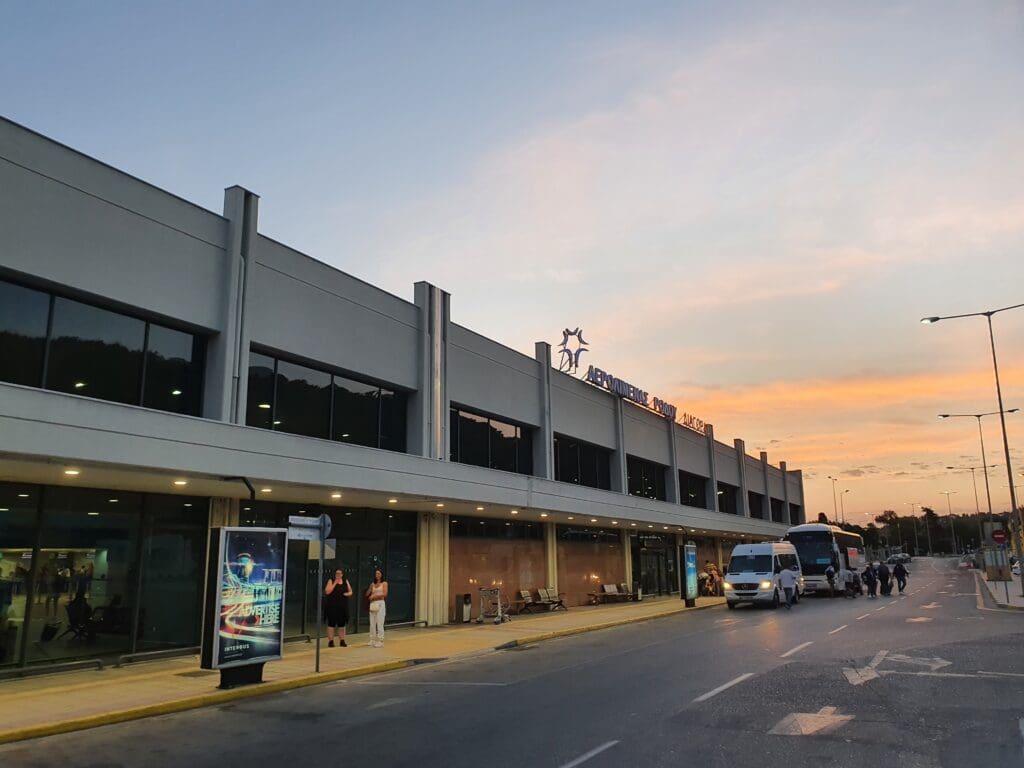
With few passengers boarding or exiting the bus at the stops between the city and the airport, and with minimal amounts of traffic, the journey to the airport was relatively quick and around twenty minutes after leaving the city, Rhodes Airport’s single runway appeared. This was followed by the sight of several Aegean Airlines, Corendon Airlines and Sky Express aircraft that had spent the night at the airport and would shortly head off to destinations across Europe. Soon enough, the bus came to a gentle halt right outside one of the entrances to the airport’s rather drab and uninspiring-looking terminal just as the sun was beginning to rise. With a total of six Airbus A320 and Boeing 737-800 operated services heading off before my flight to Astypalaia, these bound for Athens, Graz, London Gatwick, Lyon, Tallinn and Tampere, plenty of passengers could be seen both in and outside the terminal that morning. Many of whom looked rather solemn, presumably having reached the end of their early summer/late spring holidays.
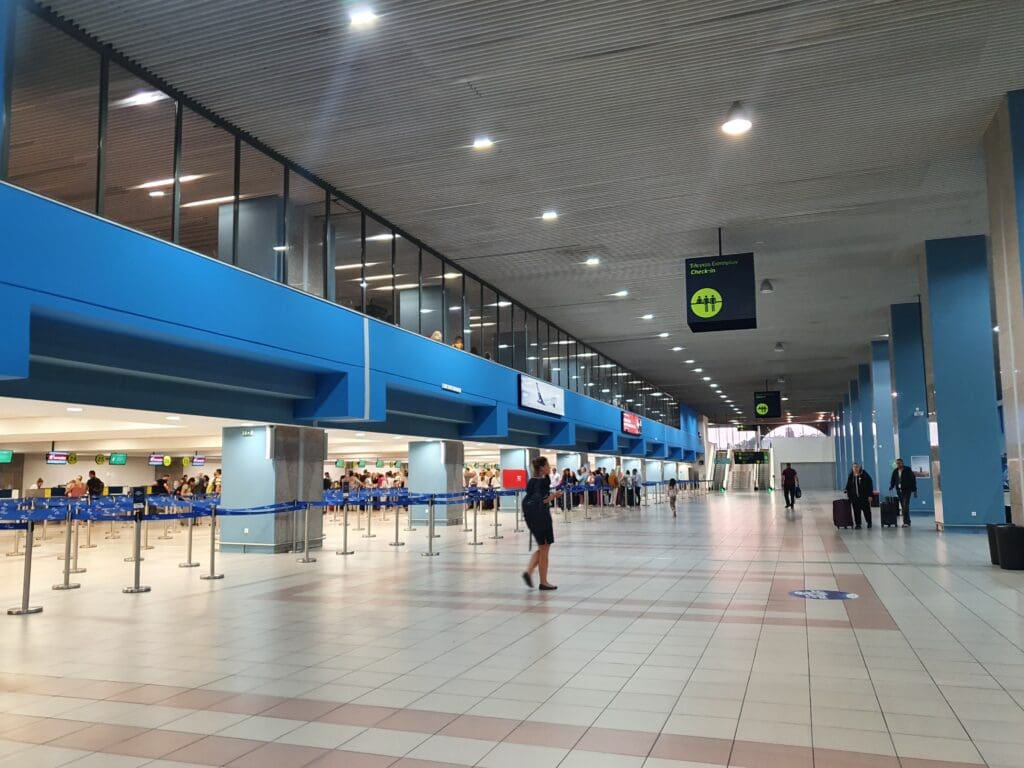
Upon entering the terminal, I found myself standing in the terminal’s busy check-in hall. In terms of design, this did not appear to be particularly modern however it is large and designed with the ability to process large numbers of holidaymakers. Furthermore, this does feature a cafe and a small number of shops. What it lacks however are any sort of self-check-in machines, and whilst it would have been nice to print out several boarding passes for my flight that day, with long queues at Sky Express’ check-in desks, I decided against joining these. In need of my first coffee of the day, once inside, I stopped by at the café located at one end of the check-in hall. There, I was consensually robbed – being charged €6.90 for a small low-quality filter coffee and a small carton of peach juice! After polishing these off, I proceeded upstairs to security where given the number of early morning departures I was surprised to find nothing more than a few very short queues. Following less than a minute of waiting in line, I had my bags scanned and passed through a metal detector before arriving at the airside portion of the terminal quickly and without an issue.
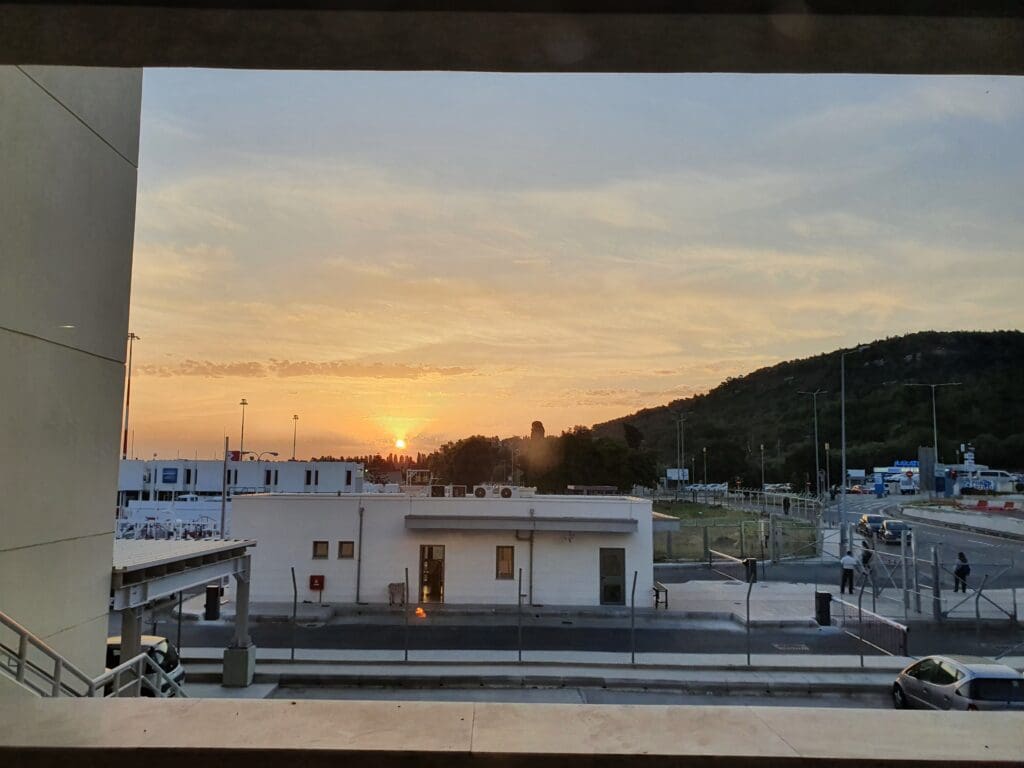
As is the case at many airports across Europe, all passengers must pass through the terminal’s duty free store before reaching the main airside waiting area. Not needing to buy anything, and not eligible to make any duty free purchases, I steamed through this without stopping before reaching the main airside portion of the terminal. As with the landside area of the terminal, the airside area does appear to be slightly dated and is highly unlikely to win any awards for its architectural grandeur or high-tech design. However, this does serve its purpose and offers several cafés, restaurants and shops, including international chains Burger King and Starbucks. Aviation enthusiasts can pass the time by looking out of the terminal’s large windows, with these offering a good view of both the stands outside and the airport’s runway. However, being slightly tinted and rather grubby that morning, these proved to be unsuitable for any high-quality photographs. Turning to the negatives, that morning, the terminal appeared to be slightly dirty, with a fair amount of rubbish strewn about throughout whilst I also came across a few toilets that were in dire need of cleaning. Meanwhile, the terminal appeared to lack a decent number of charging points and plug sockets.
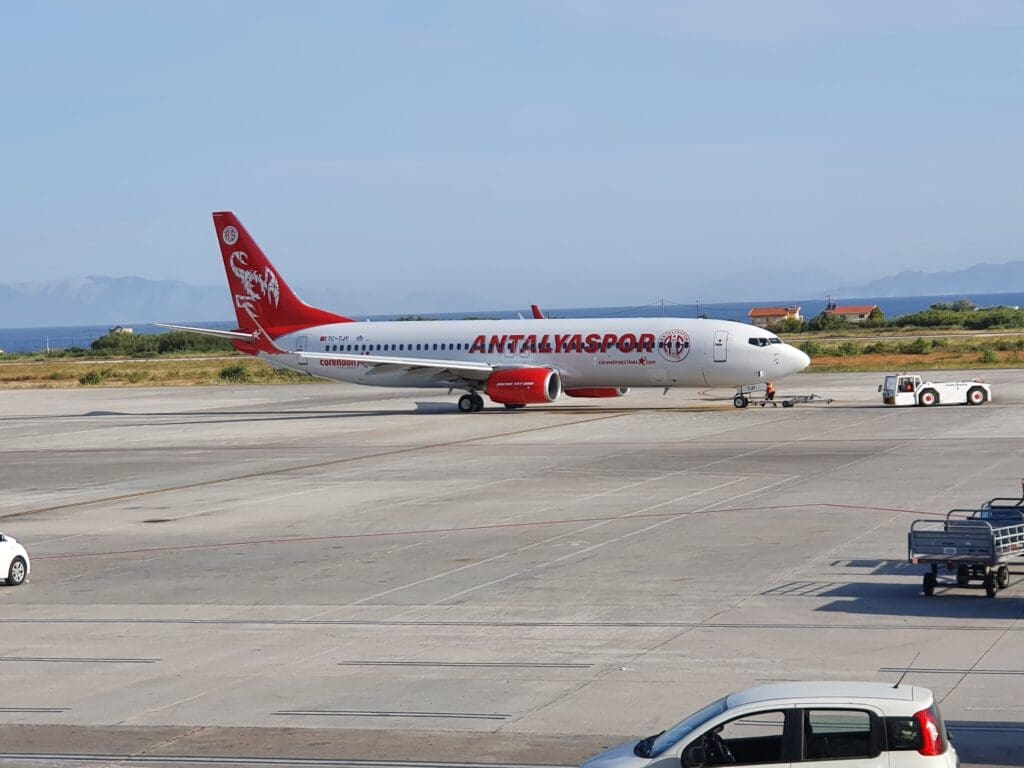
With nothing else to do, I took a seat near one of the terminal’s large windows and watched the movements outside. One by one, the Aegean Airlines Airbus A320s, Corendon Airlines Boeing 737-800s and Sky Express Airbus A320 departed off and commenced another day of flying in the skies of Europe. During my stay in the terminal, the arrivals consisted of an all-white liveried Airbus A320 operated by Lithuanian ACMI specialist Global Airlines, a Turkish registered Corendon Airlines Boeing 737-800 sporting a special livery promoting football team Antalyaspor, and a Eurowings Airbus A320.
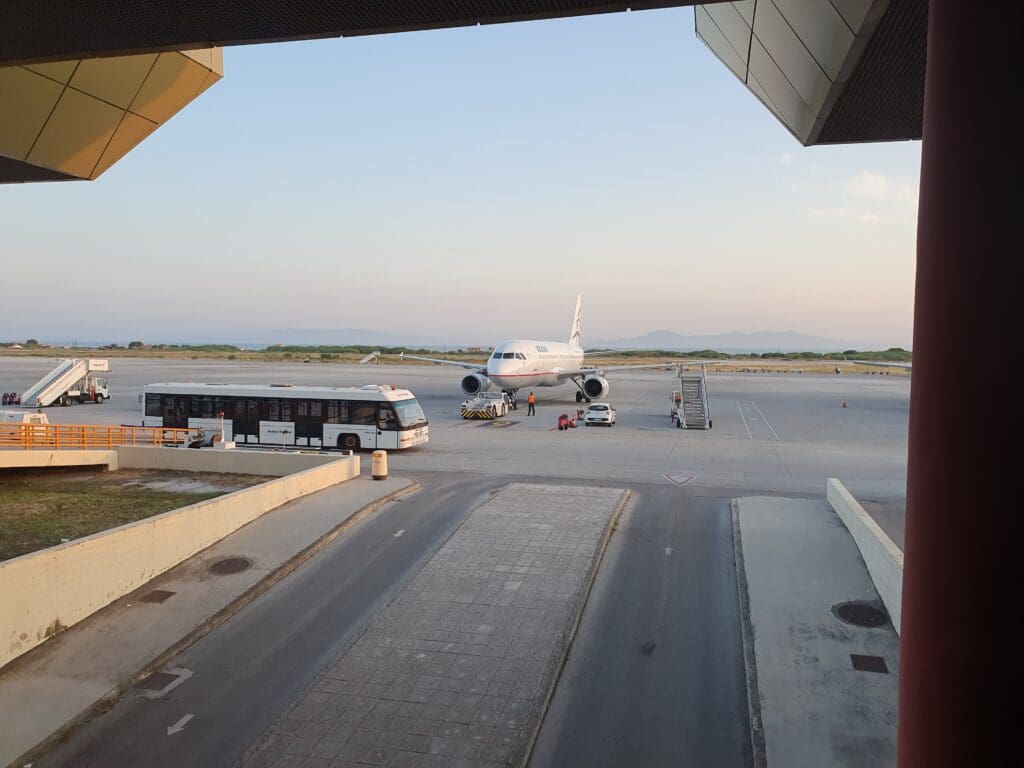
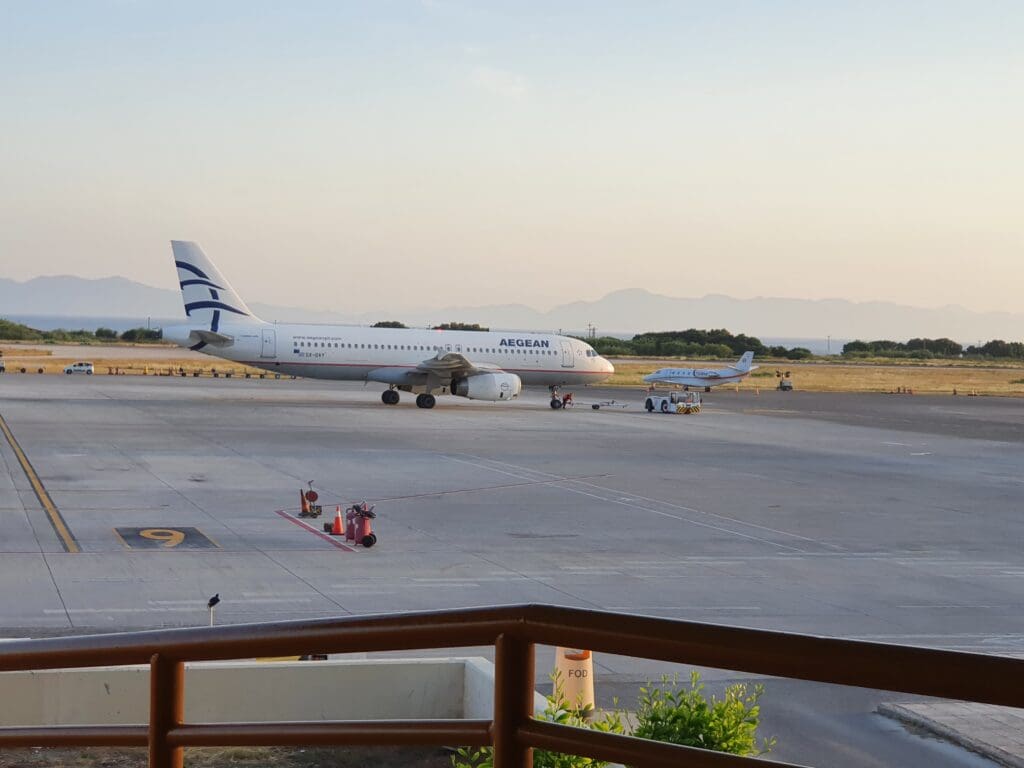
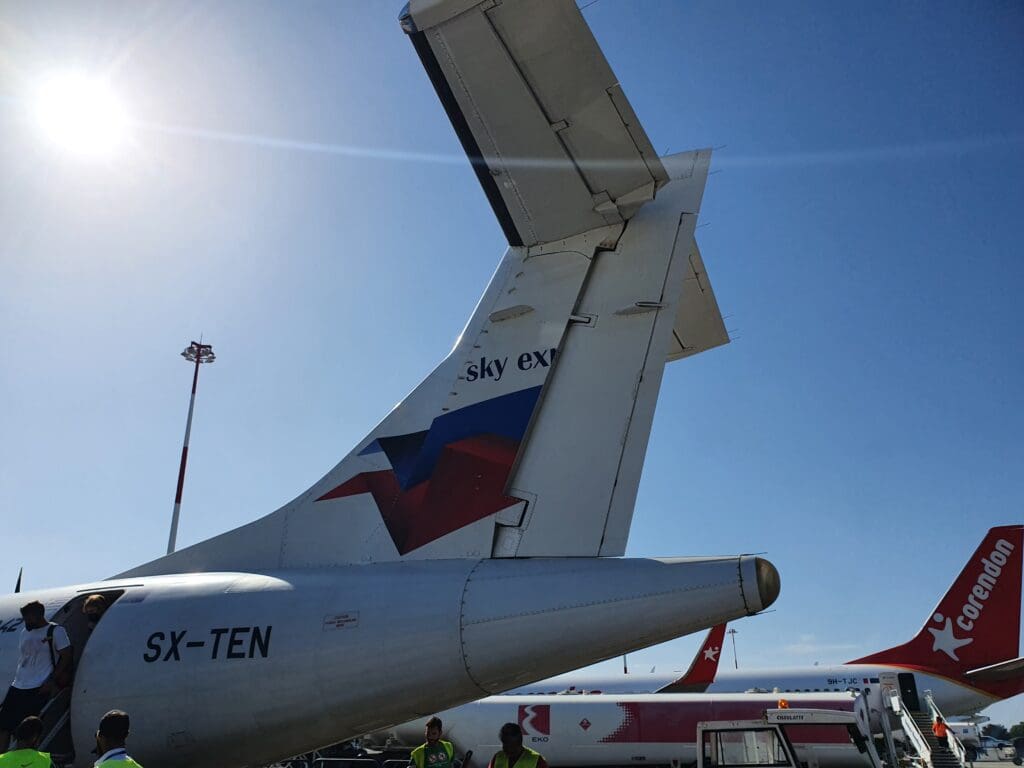
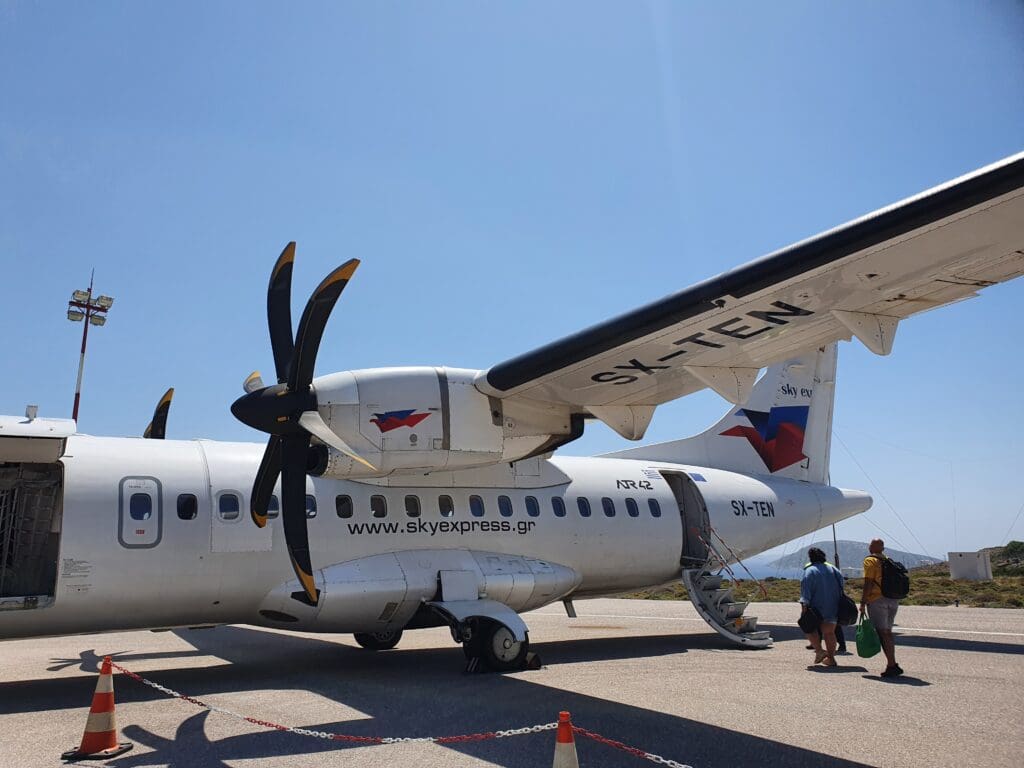
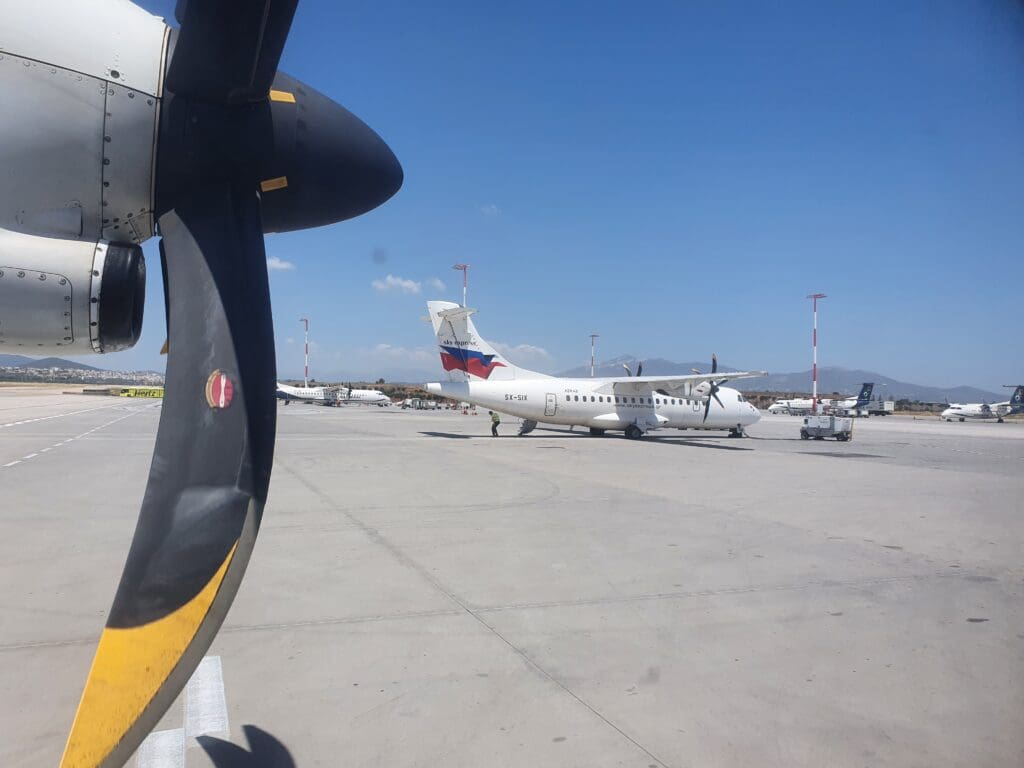
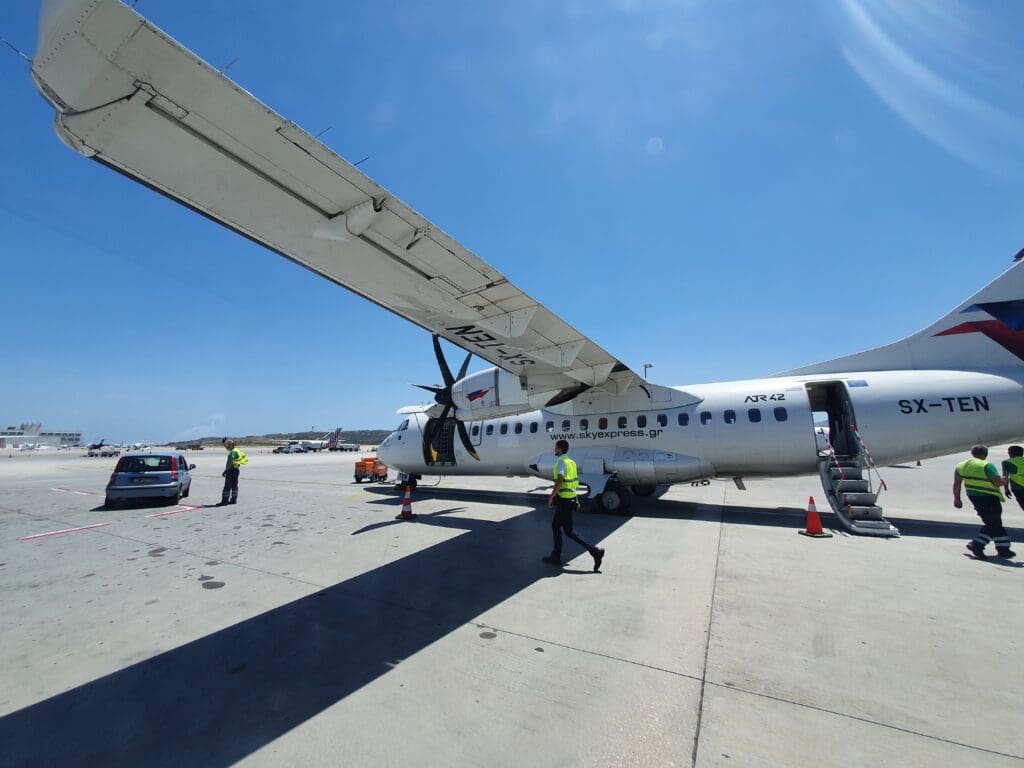
At 0739, Sky Express ATR 42-500 SX-TEN could be seen touching down in Rhodes following a 40-minute flight over from Heraklion. With no other turboprops on the ground at the time, it was clear that this was to be the aircraft that would operate the service to Astypalaia and then onwards to Athens. Having first taken to the skies in February 1997 and thus over a quarter of a century old at the time of my flight, this served to be far from the newest ATR in Sky Express’ fleet, however from an enthusiast’s perspective this was most definitely nothing to complain about! Assembled in Toulouse, following testing as F-WWLB, the aircraft remained close to its birthplace and commenced its life operating for the long-gone Southern French regional carrier Air Littoral as F-GPYL. There, the aircraft remained until Air Littoral’s bankruptcy in 2003, following which the aircraft retained its French registration and began a new life with Airlinair, primarily operating services on behalf of Air France. During this time, the aircraft sported an all-white livery whilst featuring ‘Air France by Airlinair’ titles. In early 2016, the aircraft was transferred to Air France’s regional subsidiary, HOP! And painted in the carrier’s colours, however in line with the airline’s plans to retire their ATR 42s and 72s, in July 2018 the aircraft ended up being shuttled to Greece and entering service with Sky Express with whom it has flown with ever since.
Returning to the journey, that morning boarding for the flight would take place through Gate 13. However, as with most flights from Rhodes, passengers would be bussed out to the waiting aircraft. A short time after the inbound flight from Heraklion had arrived, at 0745 an announcement was made in Greek only by the Swissport gate agent. This was presumably an invitation for all passengers heading off on the flight to make their way to the gate. By this time, a small collection of passengers could be seen hovering around the gate. However, this appeared to be far less than the 48 passengers required to fill an ATR 42. Outside, at 0750 a Swissport Cobus 3000 bus appeared at which point the agent invited passengers forward. Within a few moments, my boarding pass was scanned and my passport checked by the friendly agent, before I made my way out into the warm morning air. Once outside, it became evident that passengers were yet to be permitted to board the bus and instead a fair amount of waiting in the morning sunshine was in store before being able to continue on the journey.
As I waited, a pair of Smartwings Boeing 737-800s arrived, as did an Arkia Embraer 195 that had journeyed across the Mediterranean from Tel Aviv. After a 20 minute wait, passengers were finally allowed to head onto the waiting bus and with passengers having arrived, it did not take long for all to make it onto the bus. That morning, no more than twenty passengers would be flying on the first leg of the journey to Kos, with these being a fair mix of local passengers and sun seeking holidaymakers. At 0815, the bus pulled away from the terminal and journeyed past several vacant stands, before pulling up to the ATR 42 waiting at the end of the apron at Stand 12A. Once the bus came to a halt, the doors opened and passengers spilt out onto the apron and after another short wait, passengers were permitted to head up the steps built into the inner side of the aircraft’s cabin door.
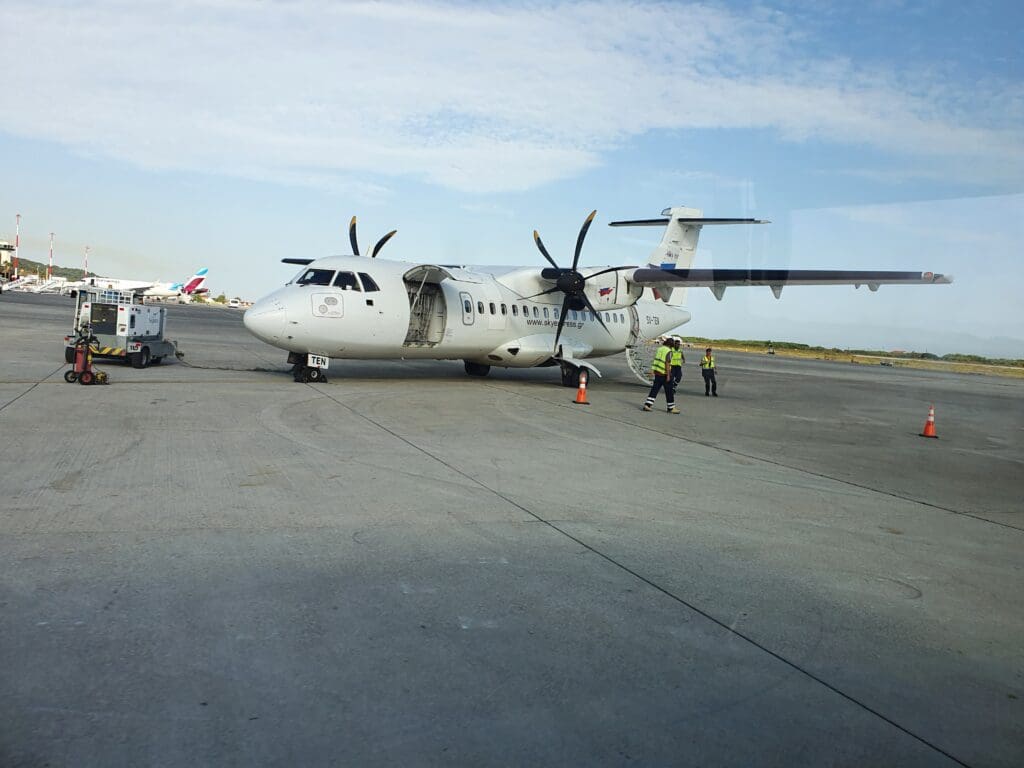
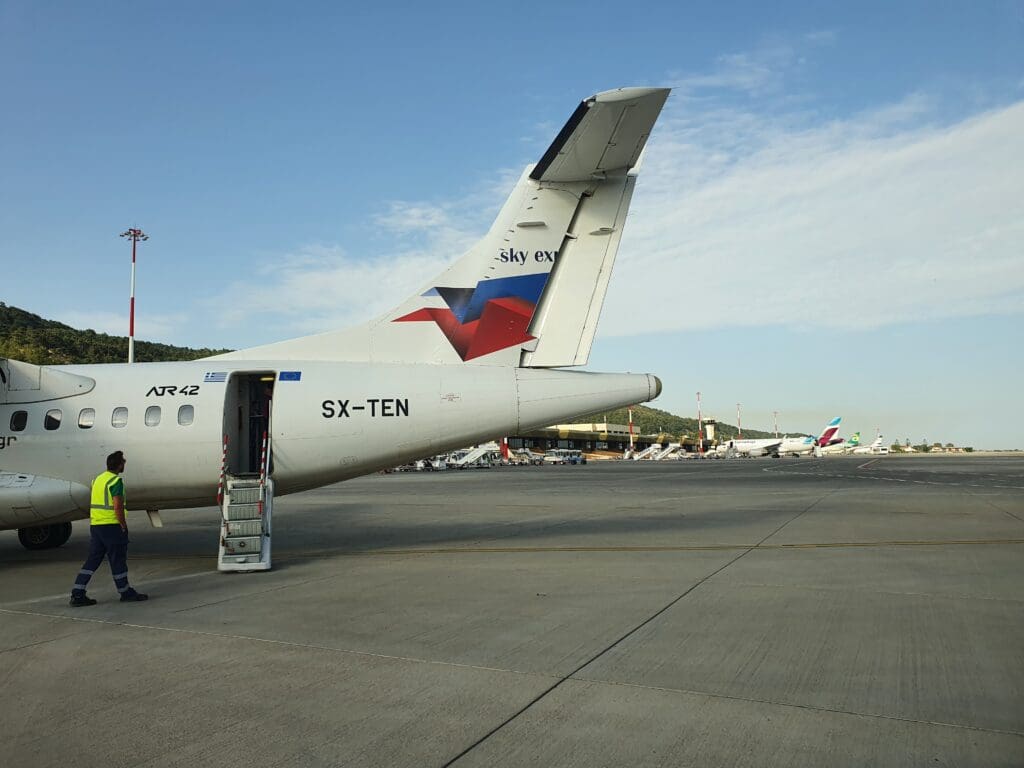

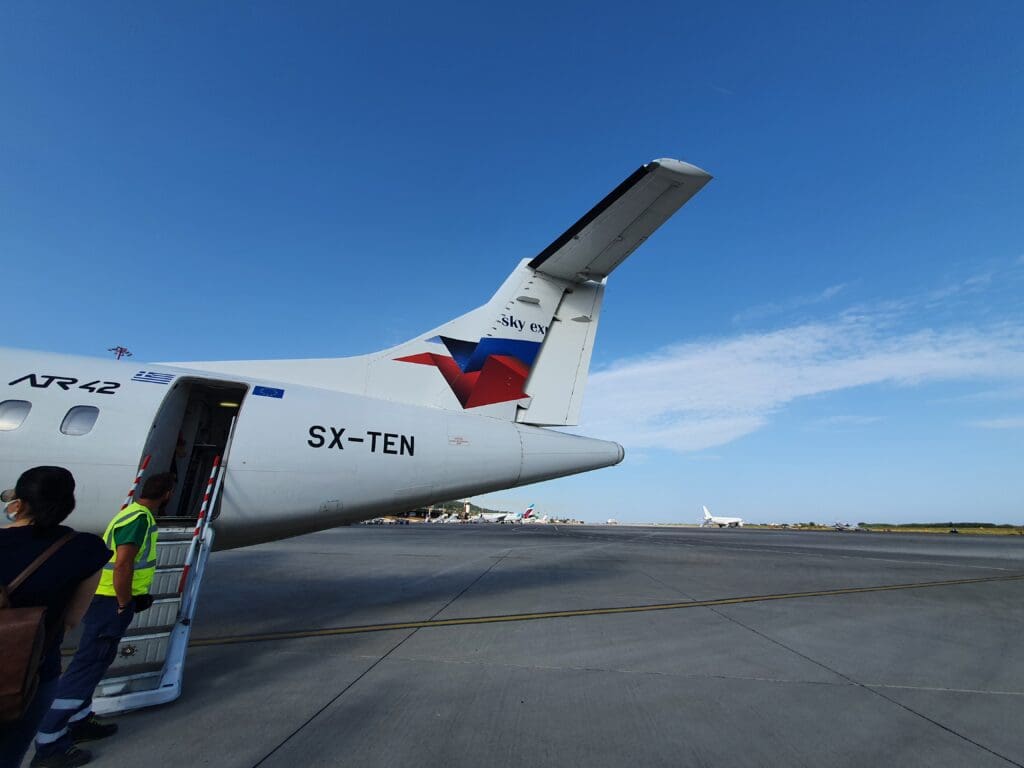
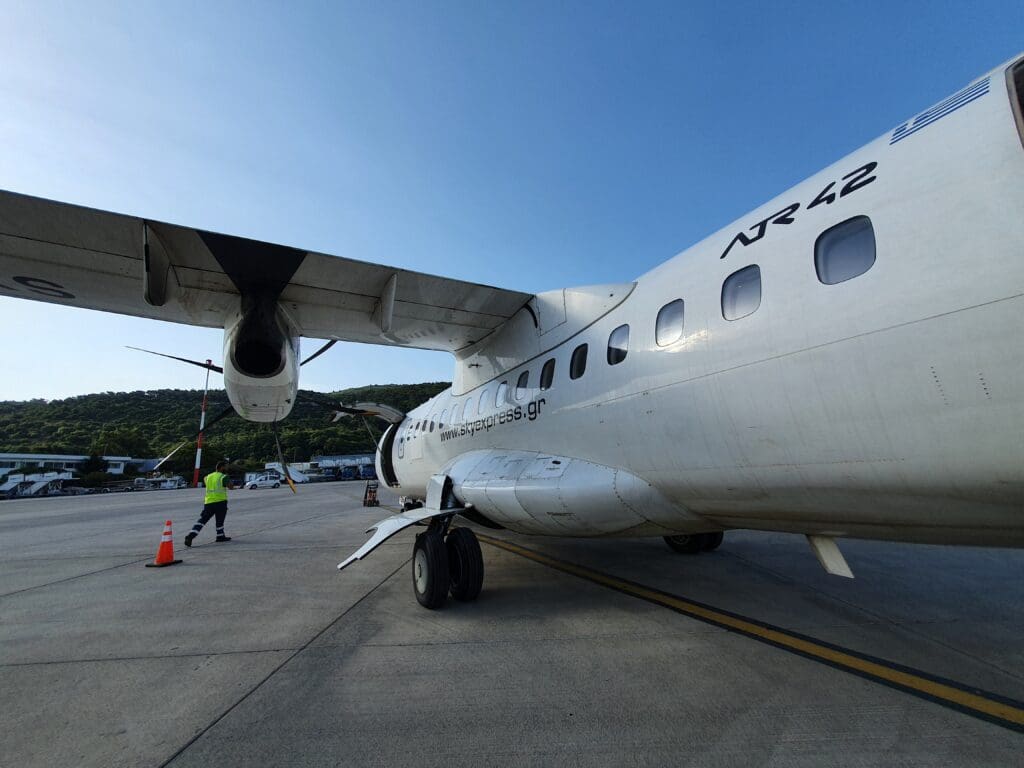
After cautiously clambering up the steps, I entered the ATR 42’s minuscule rear galley and received a lively ‘kalimera’ from the friendly flight attendant as soon as I entered the aircraft. Very briefly examining the galley, I spotted a small Greek Orthodox icon, as well as plenty of French signs and several Air France-branded galley containers left over from the aircraft’s previous life on the other side of Europe. Unlike on my flights with fellow Greek carriers Aegean Airlines and Olympic Air, no wet wipes were handed out to passengers as they boarded the aircraft, and I soon turned left and made my way into the aircraft’s small cabin empty-handed. Inside this, I found each of the aircraft’s Sicma Aero seats to be covered in a dark (faux?) leather covering and sporting a leather pink antimacassar on which Sky Express’ paper plane motif could be seen debossed. This motif could also be seen as part of a repeating pattern on the aircraft’s carpet. From the rear of the cabin, I reached Row 9 in a matter of seconds and after storing my backpack in the small overhead lockers, I took my seat and settled in for the short flight over to Kos.
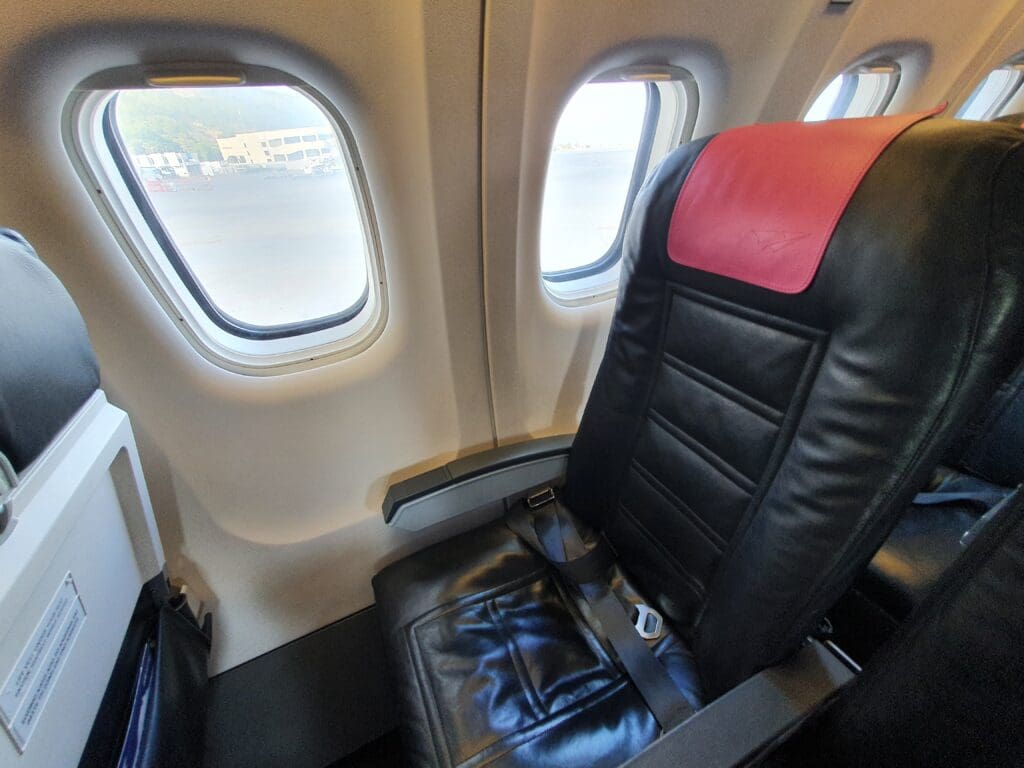
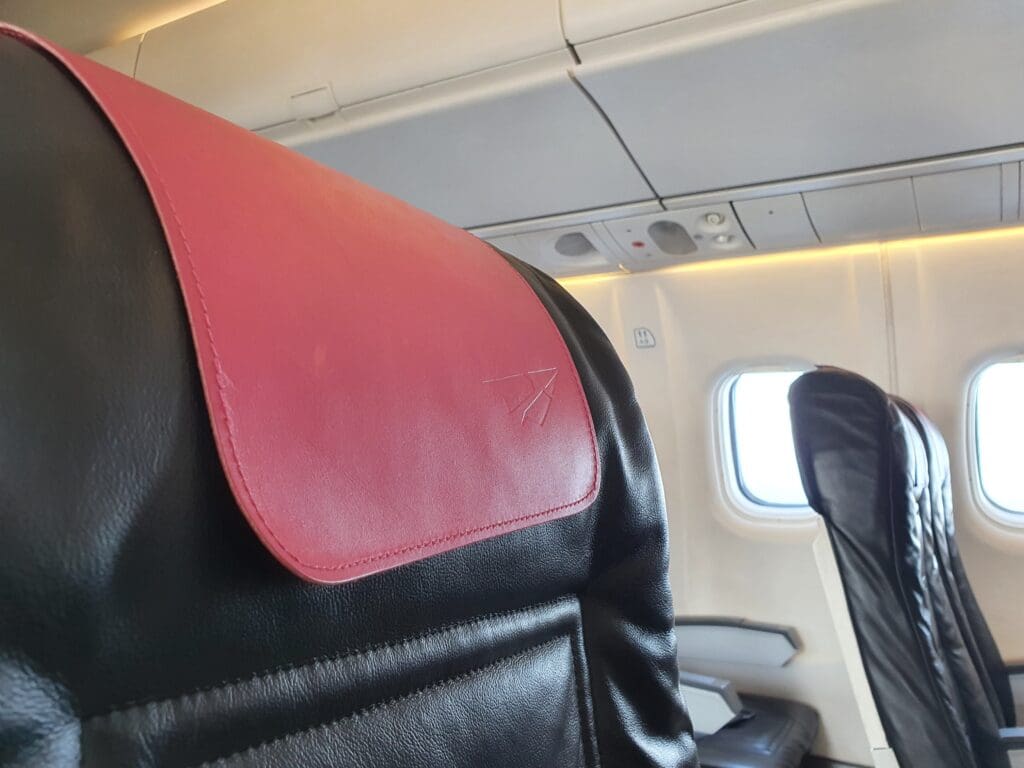
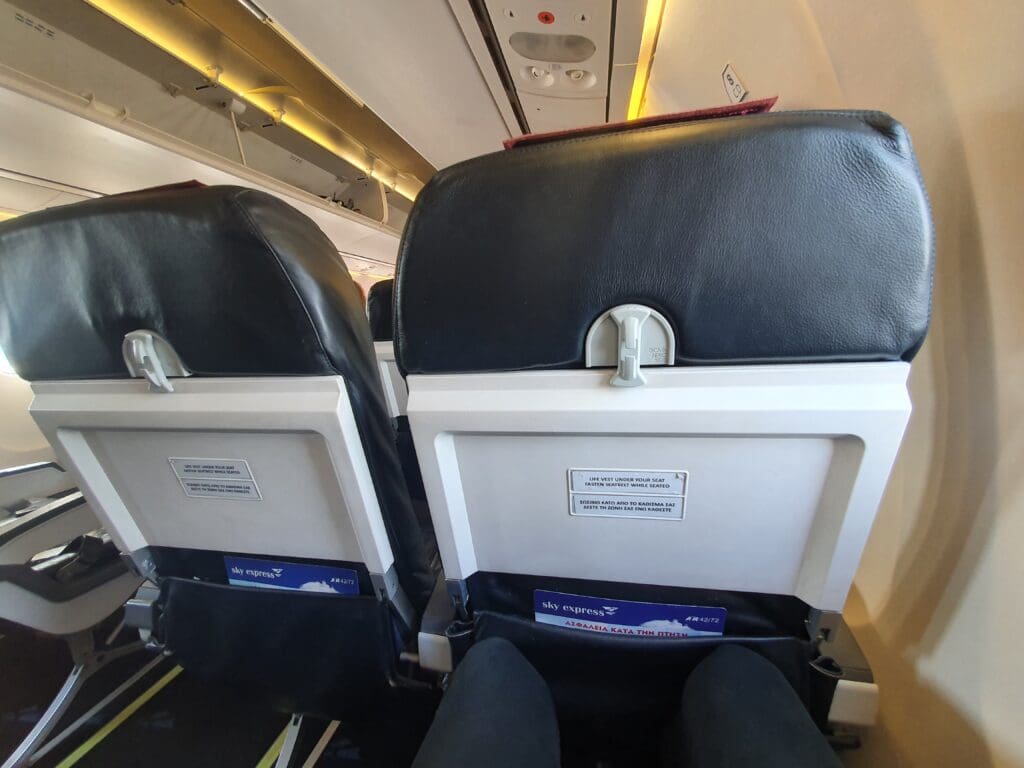
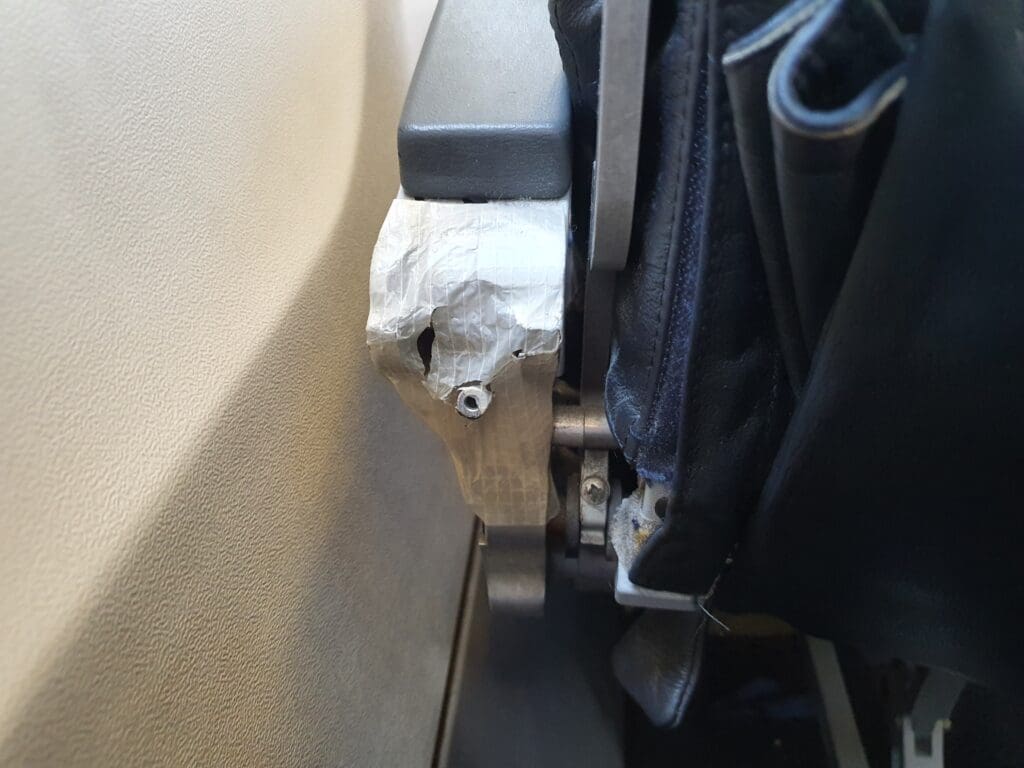
Upon sitting down, I was pleased to find the seat to be well-padded and comfortable, complete with old-style chunky armrests and a sufficient amount of legroom for a regional turboprop aircraft. However, the downside was that the seats appeared to be rather sorry-looking, with omnipresent marks and scratches, plenty of smudges and well-ingrained dirt indicating that the aircraft was in dire need of a deep clean. As with many airlines, Sky Express’ FLY inflight magazine is now only published in digital format only and thus the seatback pockets contained nothing other than a safety card and a Sky Express branded sickbag.
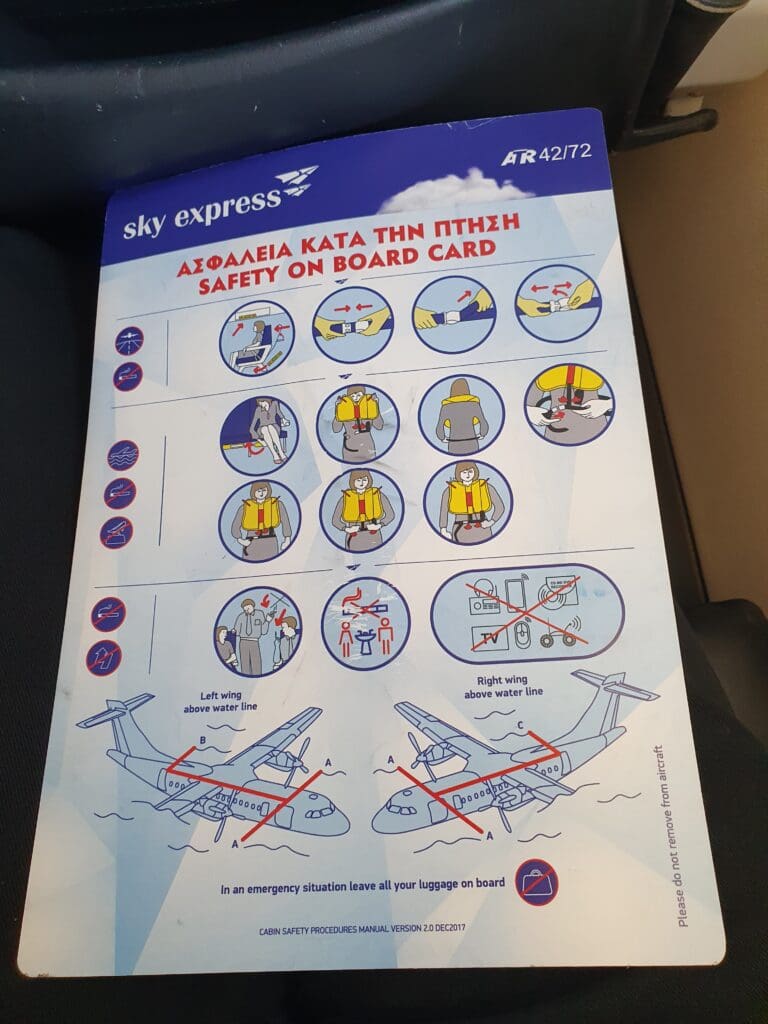
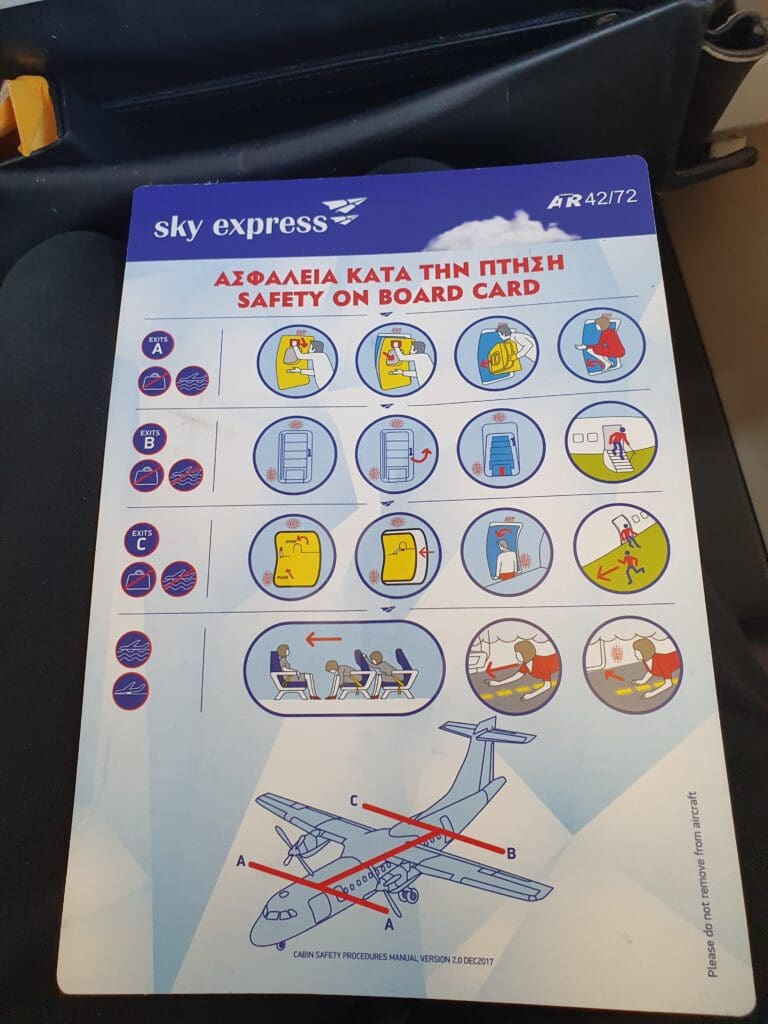
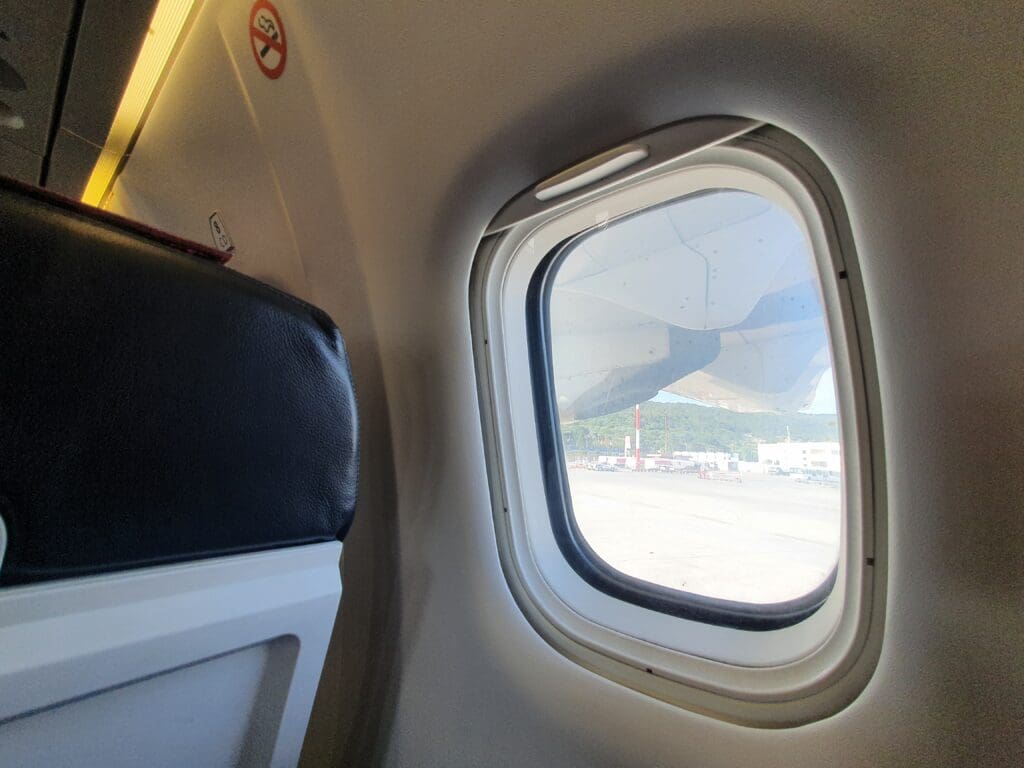
Given the light load, it did not take long for boarding to reach its conclusion, with all taking their seats by 0820, ten minutes ahead of our scheduled departure time. At this time, the flight attendant performed the first of two welcome announcements during which they welcomed all onboard and thanked passengers for flying with Sky Express before going through a few safety points. For the next fifteen minutes, there was little sign of movement, with the doors to the forward cargo area and cockpit remaining open, and no indication that the aircraft was to depart any time soon. Fortunately, at 0835 the APU could be heard firing up at which point the flight attendant performed a longer welcome announcement during which they advised passengers that the flight to Kos would last a total of thirty minutes. This was followed by a pre-recorded safety announcement in Greek and English which was accompanied by a safety demonstration, with the aircraft’s six-blade propellers whirling into life whilst this was being undertaken.
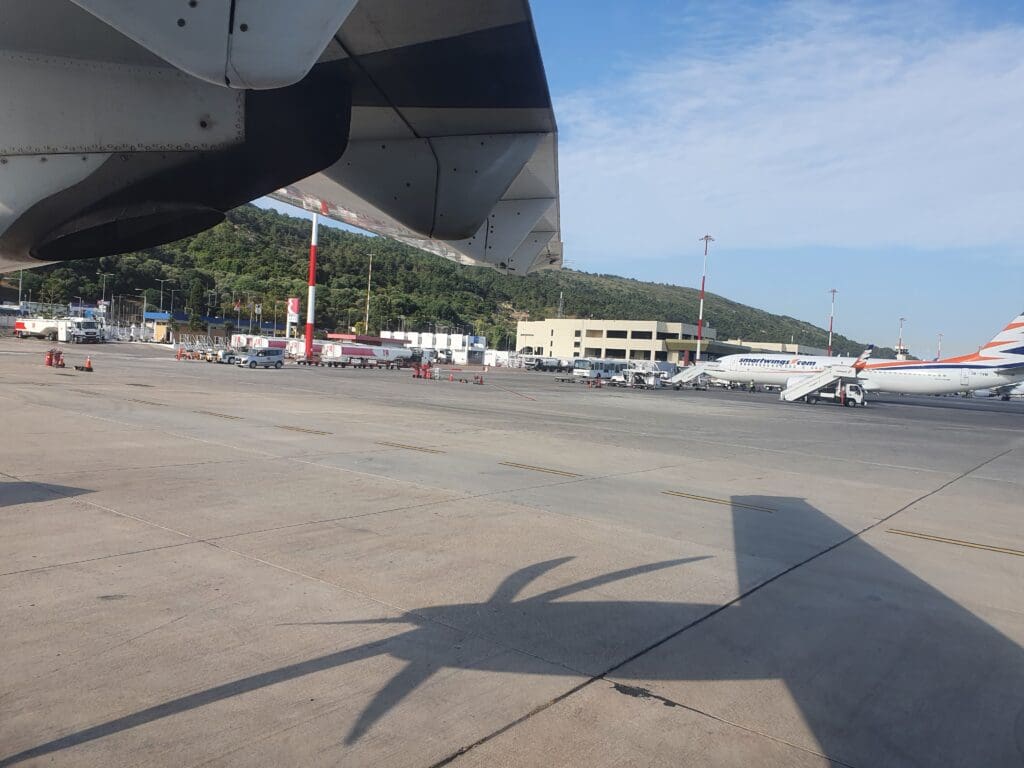
Eleven minutes behind the flight’s scheduled departure time, at 0841 the ATR 42 lurched forward out of its stand and slowly wheeled to the left as it commenced its short taxi over to the end of Runway 24. Without any holding, at 0845 the aircraft made its way onto the runway where it performed a powerful rolling takeoff, soon rotating upwards into the sunny skies of Rhodes before the gear and flaps were retracted at the start of our 61-mile sector to Kos.

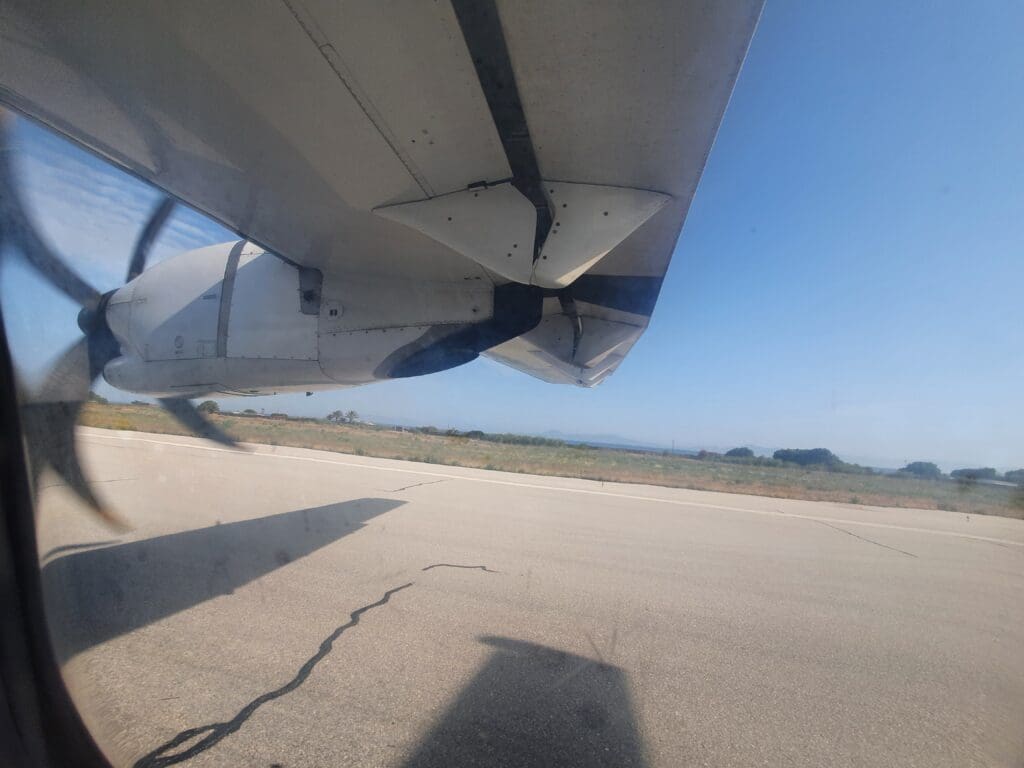
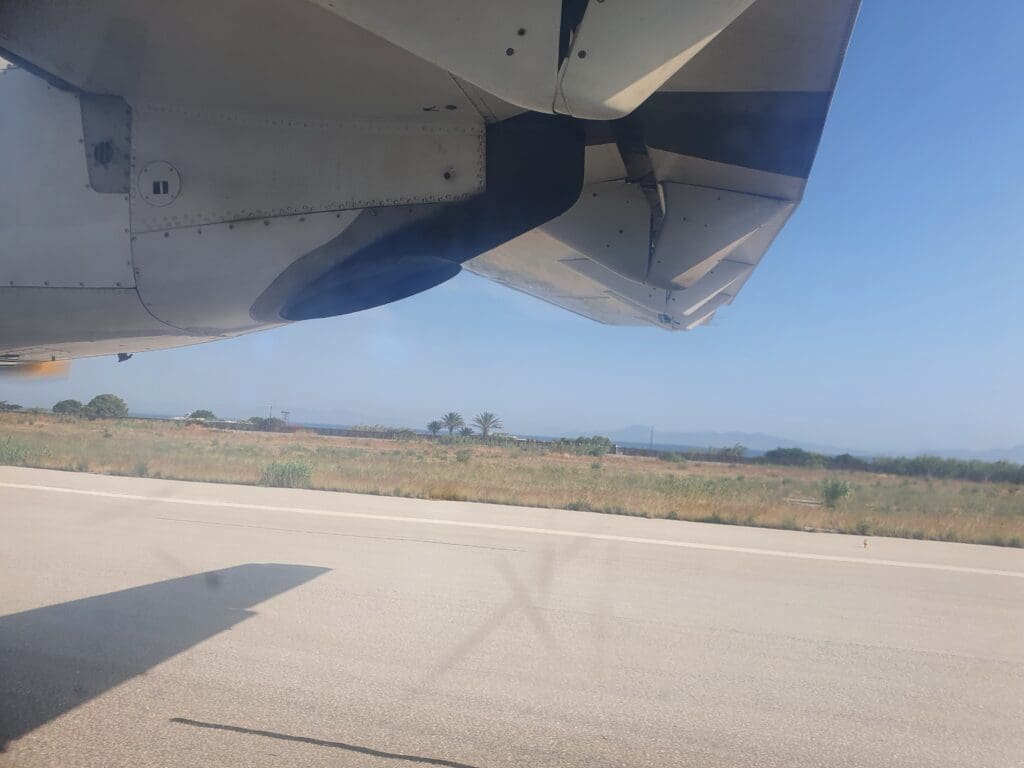
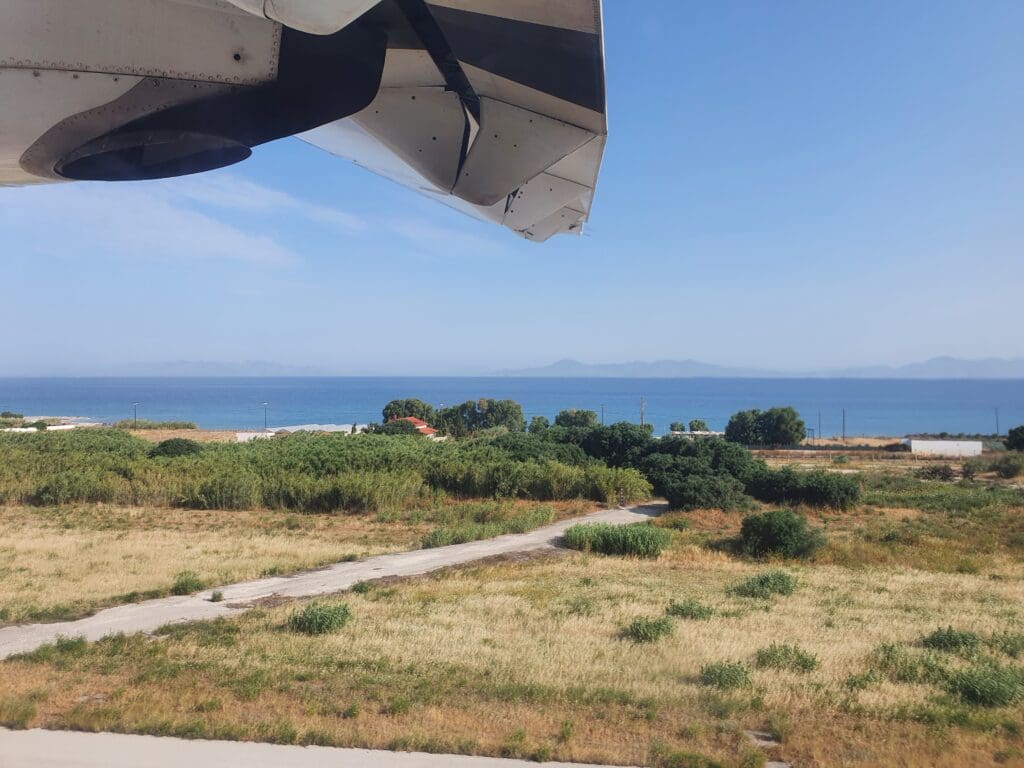
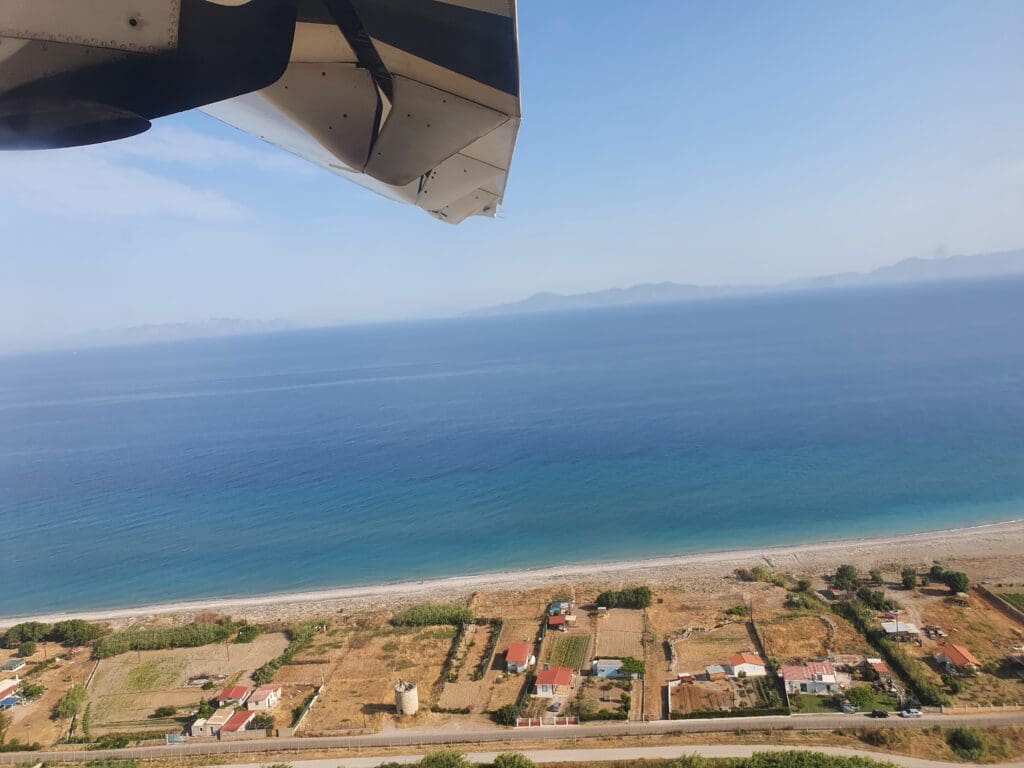
Following our departure, the ATR flew parallel with Rhodes’ western coastline for a few minutes allowing those on the left-hand side of the aircraft to have a good view of much of the island before the aircraft turned away from this and headed north. Unfortunately sitting on the wrong side of the aircraft, during the early stages of the flight I could see little other than the blue waters of the Mediterranean as well as the Greek island of Symi and Turkey’s Datça Peninsula in the distance. As the aircraft climbed, the flight attendant performed a standard post-takeoff announcement during which they requested passengers to keep their seatbelts fastened for the duration of the flight. Meanwhile, given the very short flight time, unsurprisingly no rounds of service were undertaken with the flight attendant remaining firmly in the jumpseat for almost the entire duration of the flight.
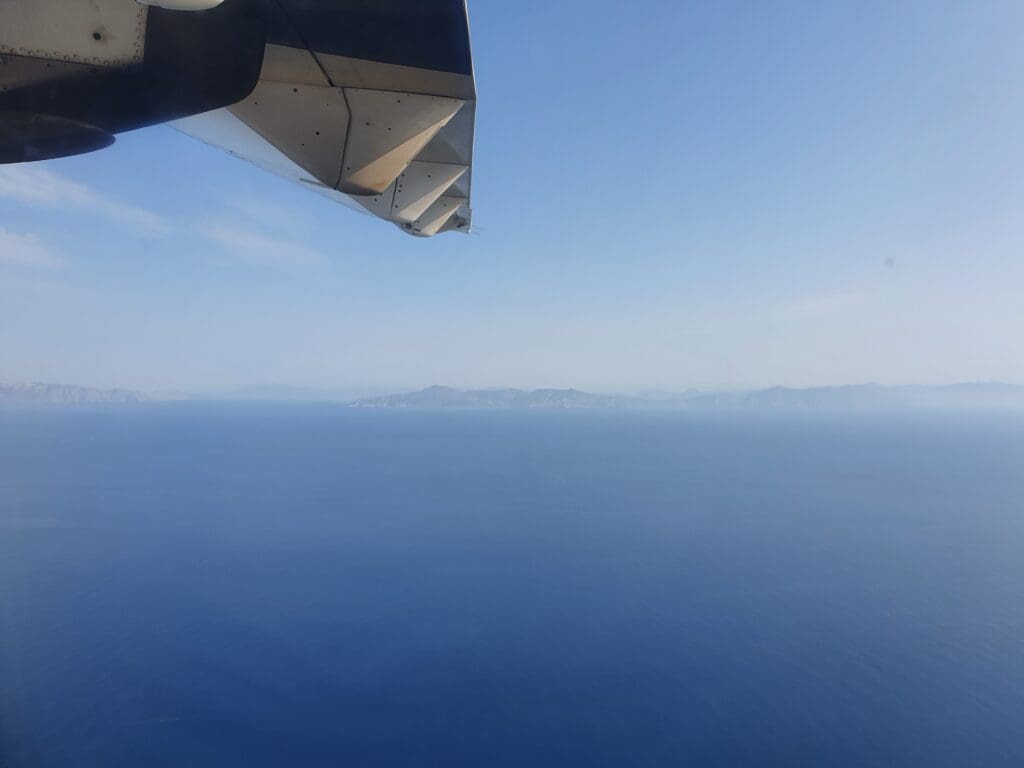
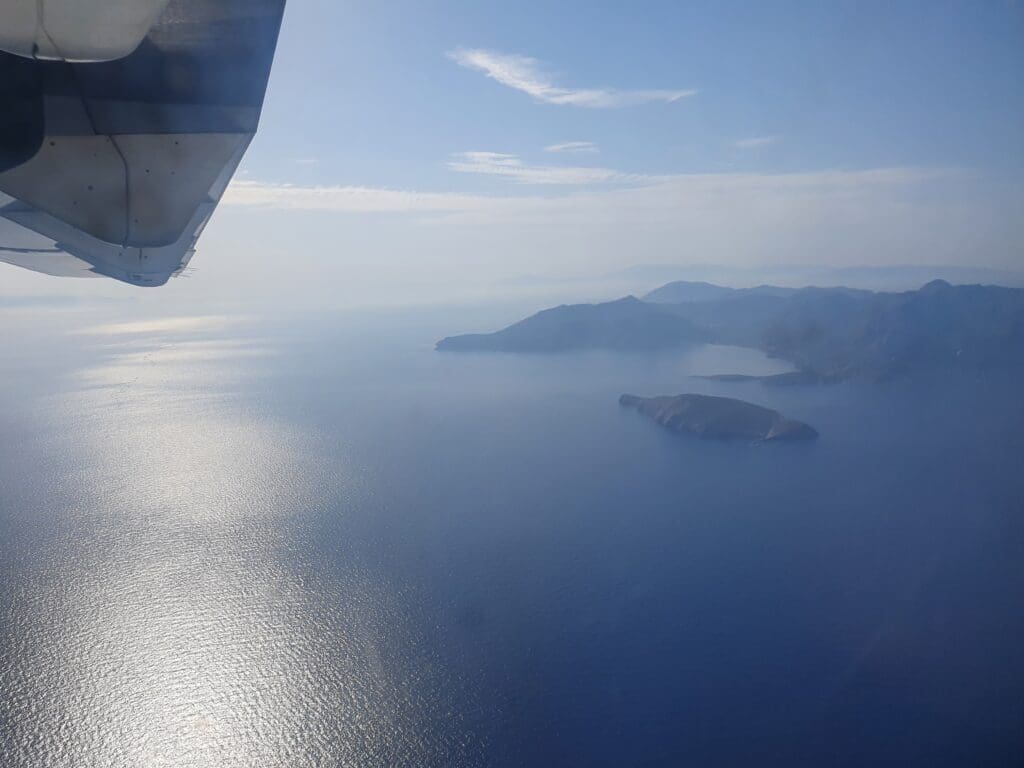
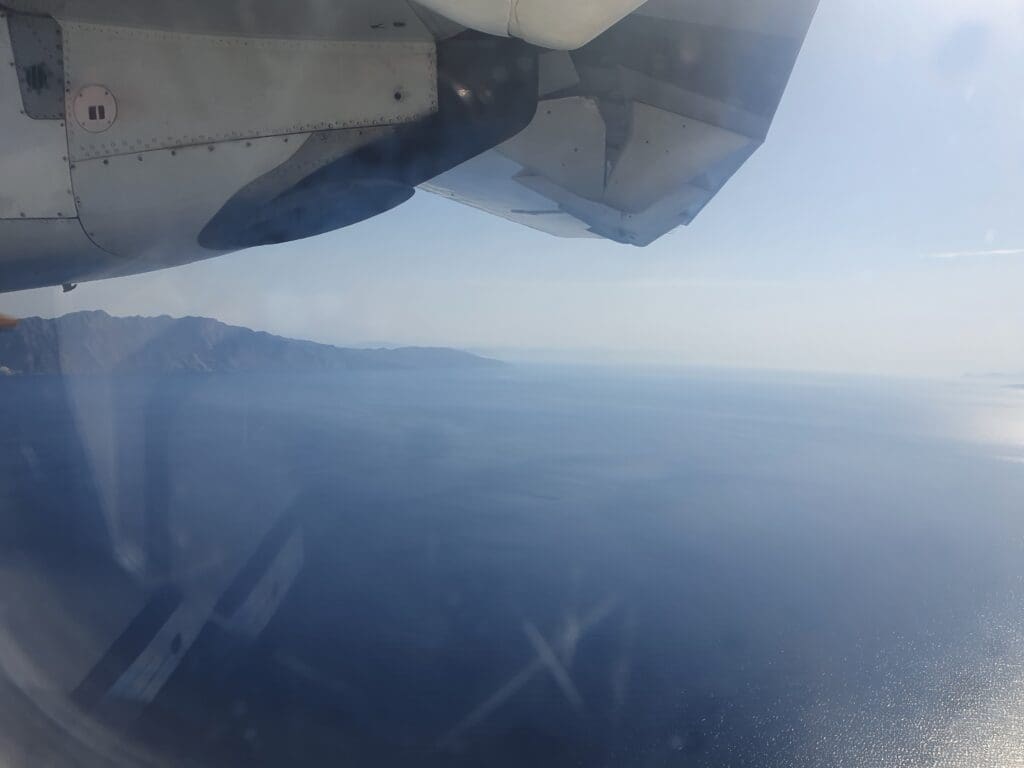
After turning north towards Kos, the aircraft flew past the small island of Tilos and seven minutes after departure, the Captain performed their first and only intentional announcement of the flight. Unlike on many turboprop aircraft, the cabin speakers appear to have been set at the correct volume as this announcement proved to be delightfully audible. From an aviation enthusiast’s perspective, this announcement was particularly interesting although perhaps slightly perplexing from a lay passenger’s standpoint. During this, the Captain mentioned that we would be flying under visual flight rules as had they wished to depart with an IFR flight plan, we would have had to wait a further 40 minutes on the ground in Rhodes. The Captain then moved on to give a detailed overview of the route, noting that we would shortly be passing over the volcanic island of Nisyros. However, once again, finding myself sitting on the wrong side of the aircraft, nothing could be seen of this although many passengers on the opposite side of the cabin appeared to be snapping away as we passed the island. Whilst I was tempted to shift across to the vacant 9A, with the seatbelt signs remaining on and the flight attendant firmly watching the cabin from their seat at the rear of the aircraft, I decided that this was probably a bad idea.
After just eleven minutes in the skies, at 0856 the ATR could be felt commencing its descent, at which point the Captain requested the flight attendant to prepare the cabin for our arrival. This was followed by an announcement from the flight attendant with the usual warnings regarding seatbelts, tray tables and window shades. As the aircraft continued on its journey back towards the ground, several bumps could be felt although these were not particularly rough, meanwhile, from an aviation enthusiast’s perspective some more excitement was in store when the Captain accidentally broadcast a message to air traffic control over the cabin’s speakers, before doing this again several minutes later.
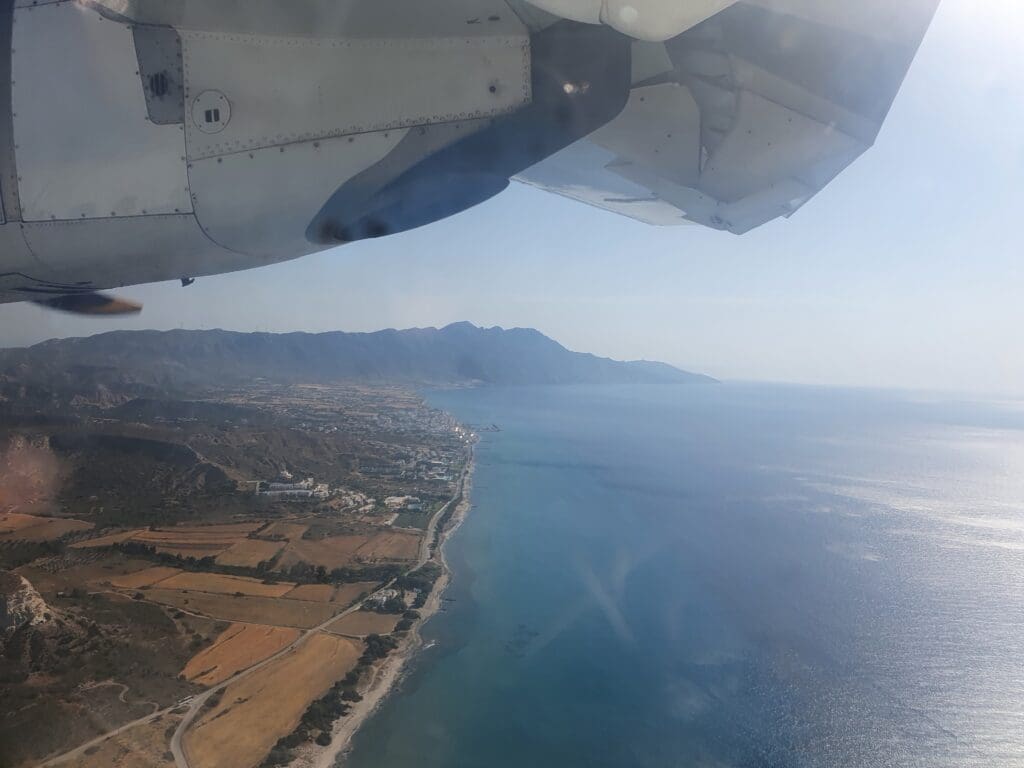
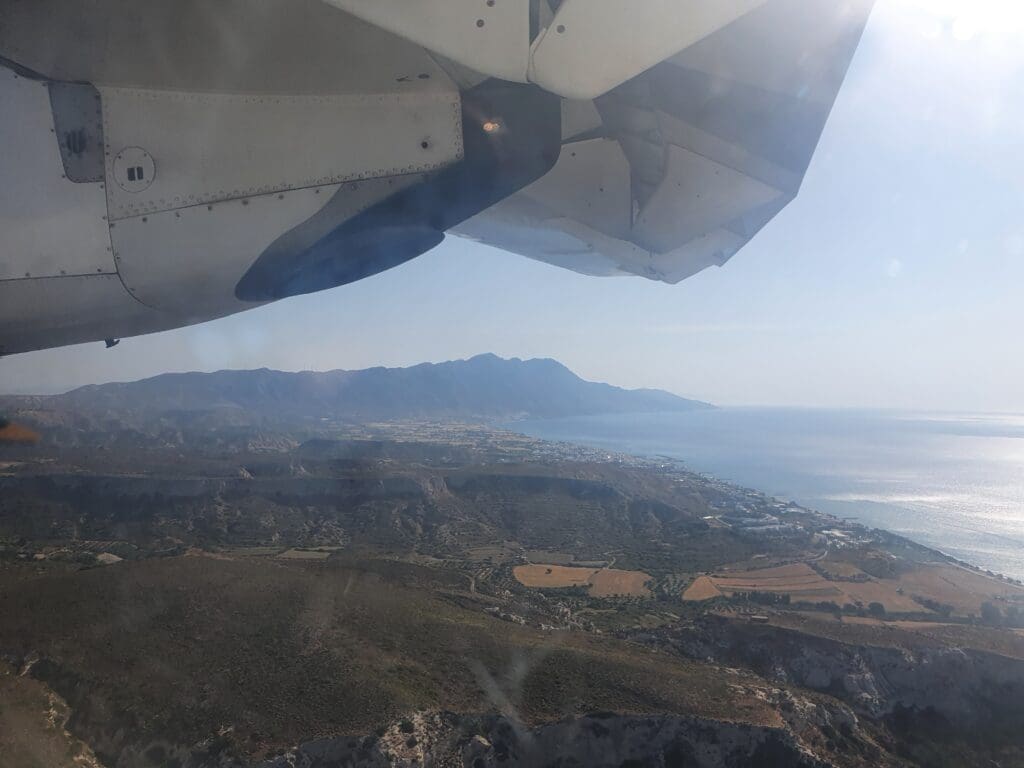
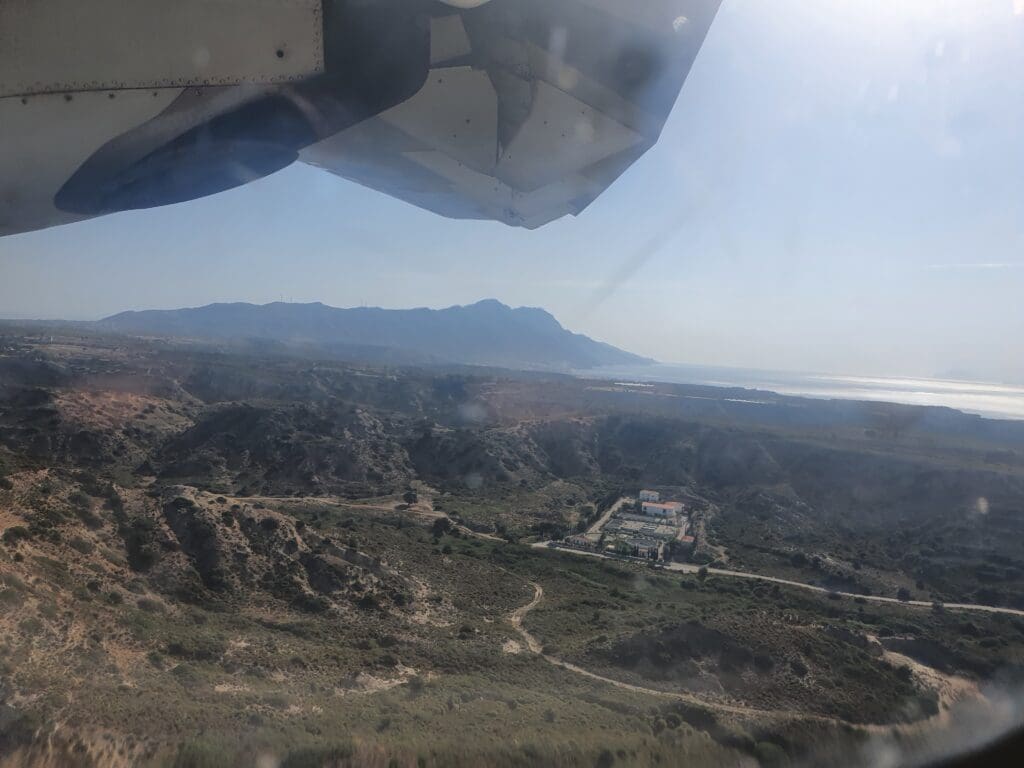
A short time later, the small cluster of tall peaks on the northern half of Kos came into view at which point the landing gear fell into position. From there, the aircraft crossed the coastline just to the south of the seaside town of Kardamaina before darting down over fields and small hills as we neared the airport. At 0907, the ATR made a very firm touchdown on Kos Airport’s Runway 32. Standing at 2.4 kilometres long, this can handle a range of aircraft and most certainly does not pose a challenge for an ATR 42. However, likely seeking to minimise taxi time, the aircraft decelerated rather harshly before vacating the runway to the right.
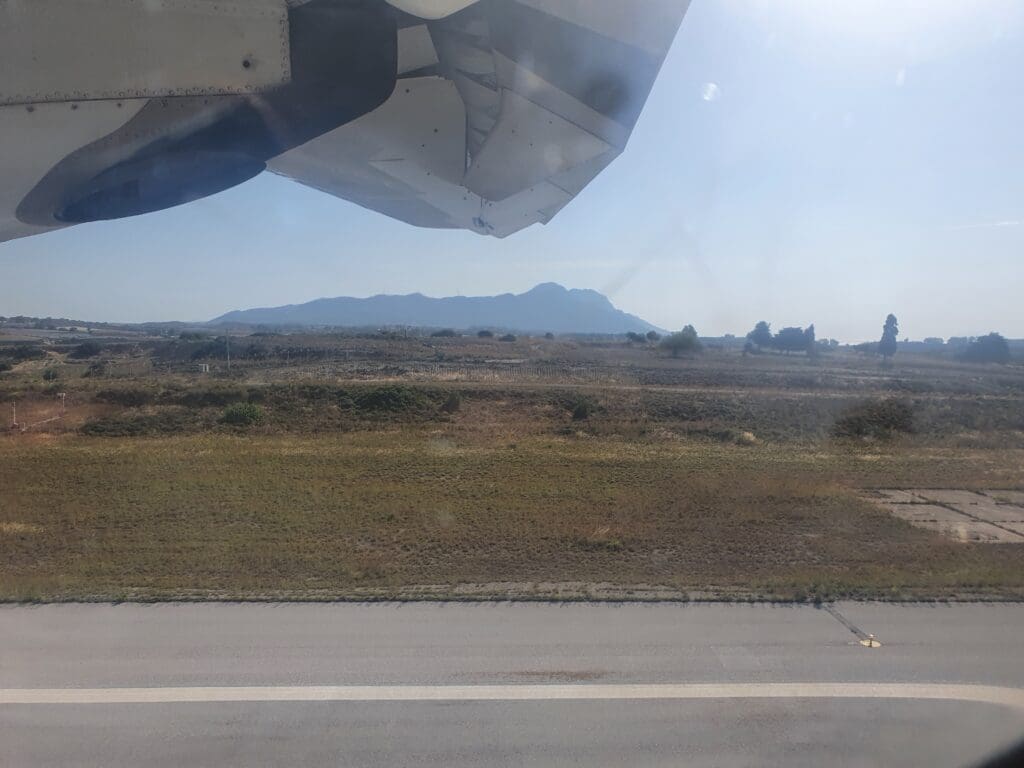
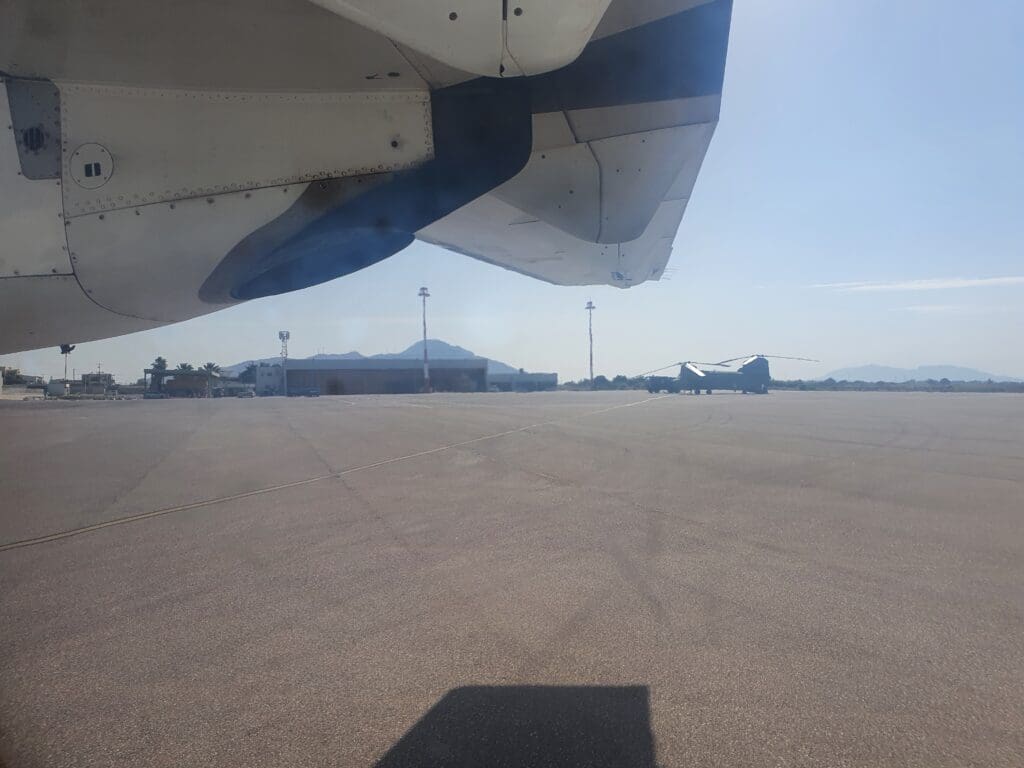
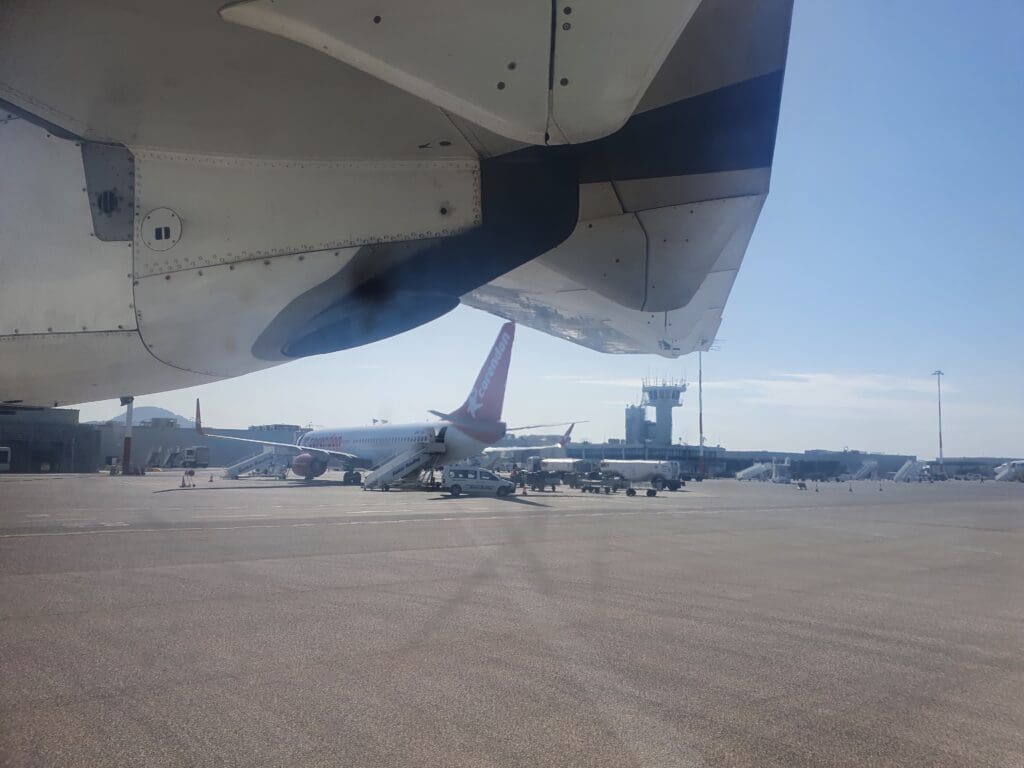
As the aircraft made its way off the runway, the flight attendant welcomed all passengers to Kos and reminded those onboard to remain seated until we arrived at the terminal. During the short taxi, the ATR 42 made its way past a visiting Hellenic Army Aviation Chinook in the process of being refuelled at a remote stand, before turning right and pulling into Stand 3 where it slotted in between a Corendon Airlines Boeing 737-800 and a Go2Sky Boeing 737-800.
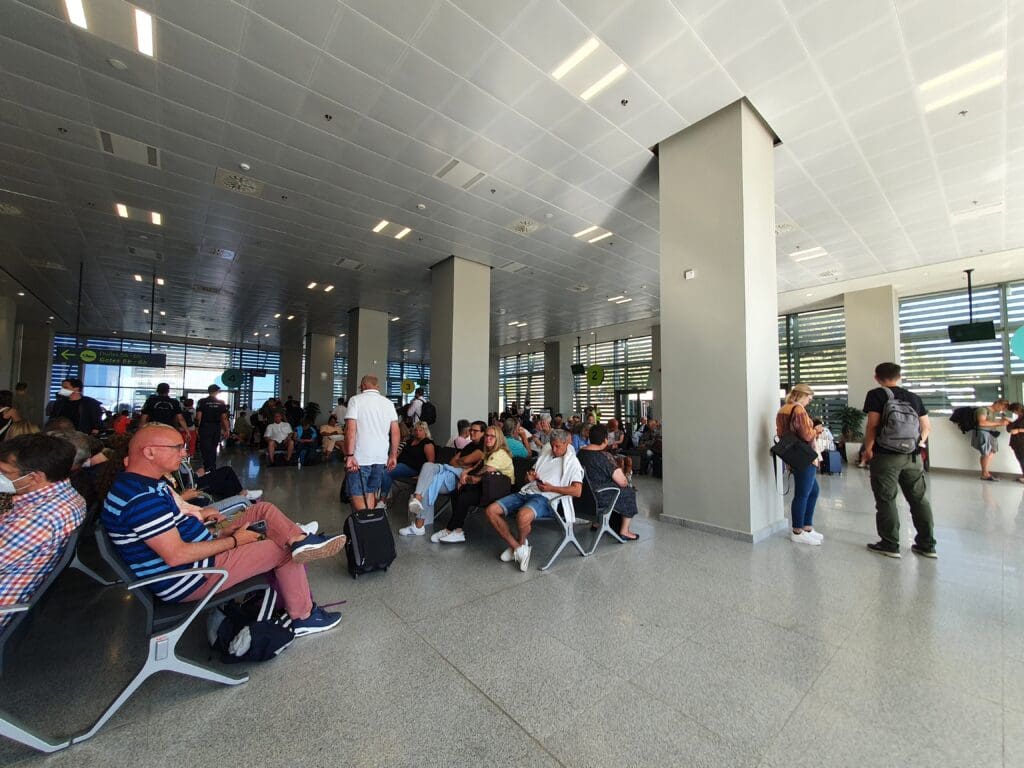
Once the two engines had spooled down, the flight attendant opened the cabin door before making an announcement, advising those bound for Astypalaia, Kalymnos and Lemnos to disembark and take their luggage with them, and wait in the terminal. However, those bound for Kos were requested to disembark the aircraft first, with a separate bus transporting these passengers to the arrivals portion of the terminal. Once these passengers had disembarked, the small handful of remaining passengers were invited to head off the aircraft and after thanking the flight attendant I made my way down the aircraft’s steps and headed onto another Cobus 3000. A short time later, with all passengers onboard, this pulled away from the stand and made the very quick journey over to the terminal’s bus boarding gates. Once inside, whilst I lacked enough time to fully explore the nooks and crannies of Kos Airport’s terminal, this appeared to be modern and feature a fair number of facilities. However, with multiple flights shuttling holidaymakers back to Germany that morning, this was incredibly busy with almost no space to sit down and wait.
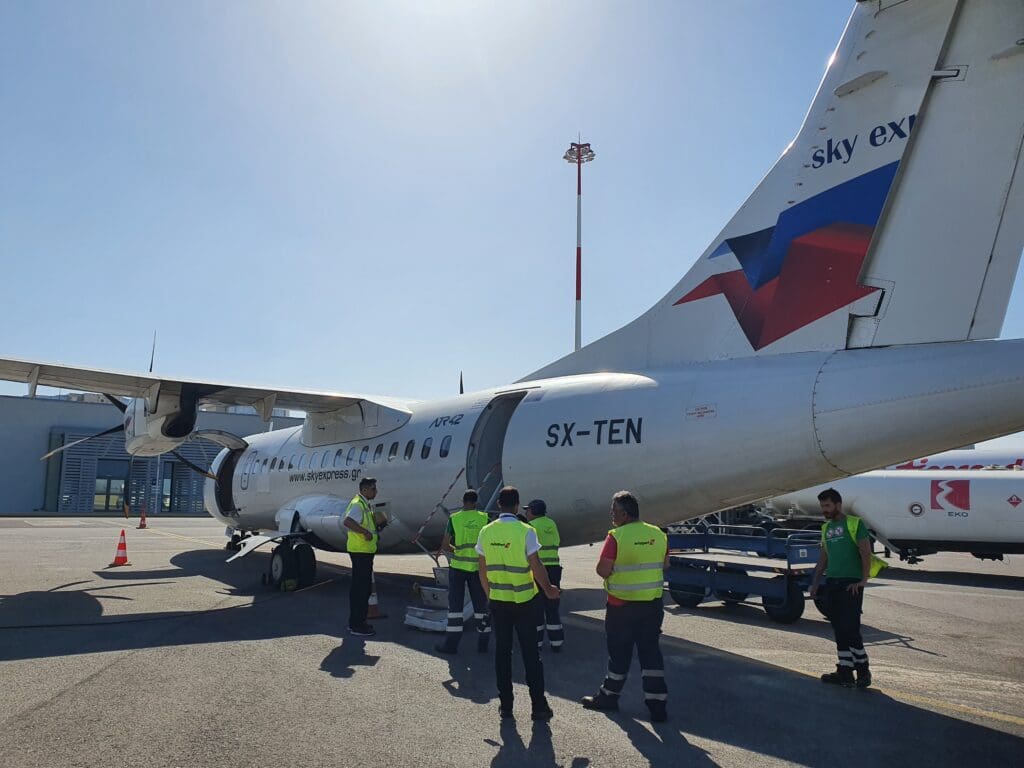
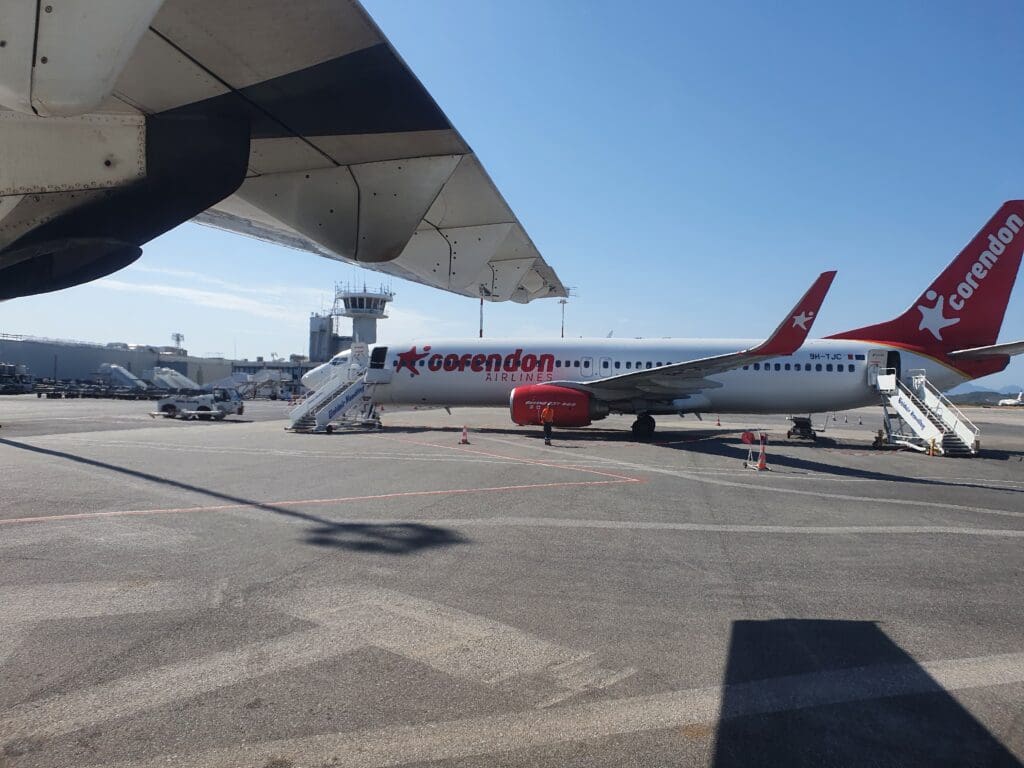
Following a quick toilet stop, I headed back to the gate. Whilst the next leg of the flight to Kalymnos was set to depart at 0925, an announcement inviting passengers to come forward for boarding was not made until just two minutes before this, making a punctual departure an impossibility. Wasting no time, upon hearing this I walked up to the gate podium where my passport was checked and boarding pass scanned, after which I boarded the waiting bus. As it turned out, the next leg of the journey would be even quieter than the first, with a total of just eight passengers on the short hop over to Kalymnos. Fortunately, there were no stragglers that morning and at 0925 the bus pulled away from the terminal and headed back over to the ATR. By this time, the three Boeing 737-800s had been joined by a Condor Boeing 757-300 and a Sundair Airbus A320.
Upon coming to a halt, the doors opened and this time no waiting was required before boarding the aircraft. As I climbed up the steps, I was given another friendly greeting, this time consisting of a ‘welcome back!’ in English from the flight attendant, with them having perhaps noticed by this time that I was not a local. Whilst I had been set to make the journey in Seat 9D again, once it became clear that 10D would remain free, I slid into this owing to its much clearer and cleaner window. Once everyone had taken their seats, the APU fired into life and at 0930 the flight attendant performed another welcome announcement, during which they informed passengers of the very short flight time of just five minutes. This was then followed by the pre-recorded safety announcement, once again accompanied by a demonstration at the front of the cabin.
Being sandwiched in between two Boeing 737s and with no room for the ATR to power up and perform a u-turn out of the stand, at 0932 the ATR was slowly pushed backwards out of its parking position as the two Pratt and Whitney Canada PW127E engines fired up into life. At 0935, the turboprop commenced its taxi to the end of Runway 32, entering this with no holding as the flight attendant passed through the cabin ensuring all was in place for our departure. Once on the runway, the aircraft performed a quick backtrack before turning around and at 0939 the aircraft commenced another seemingly powerful takeoff, rocketing upwards into the sunny morning skies of Kos in a matter of seconds.
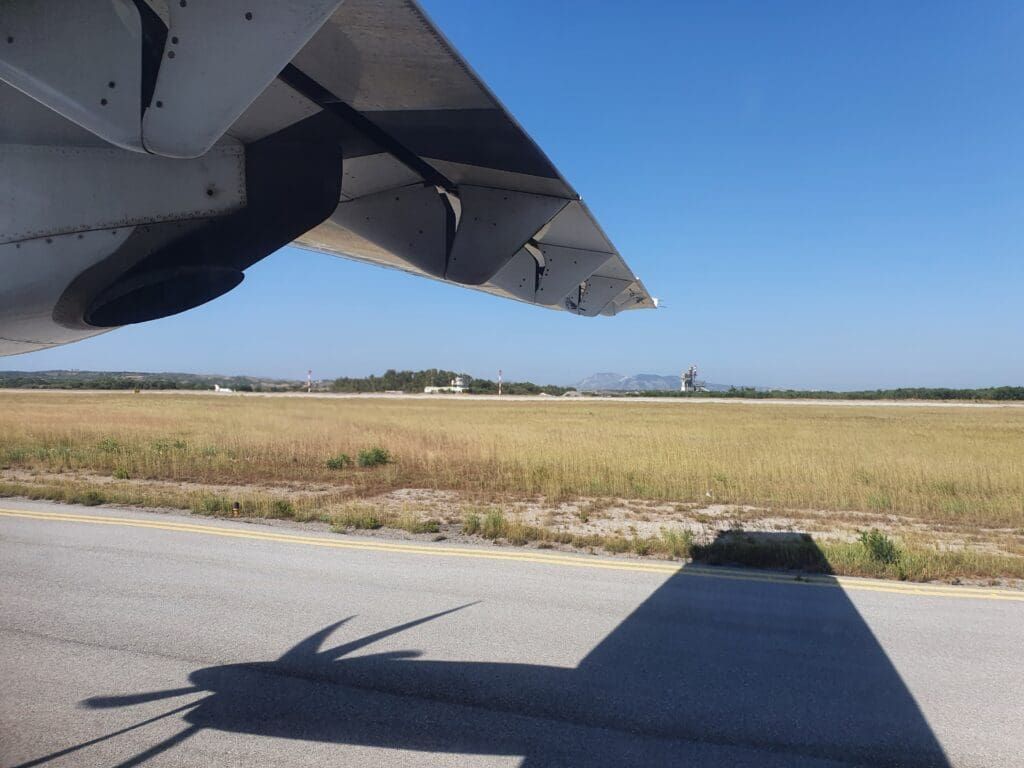
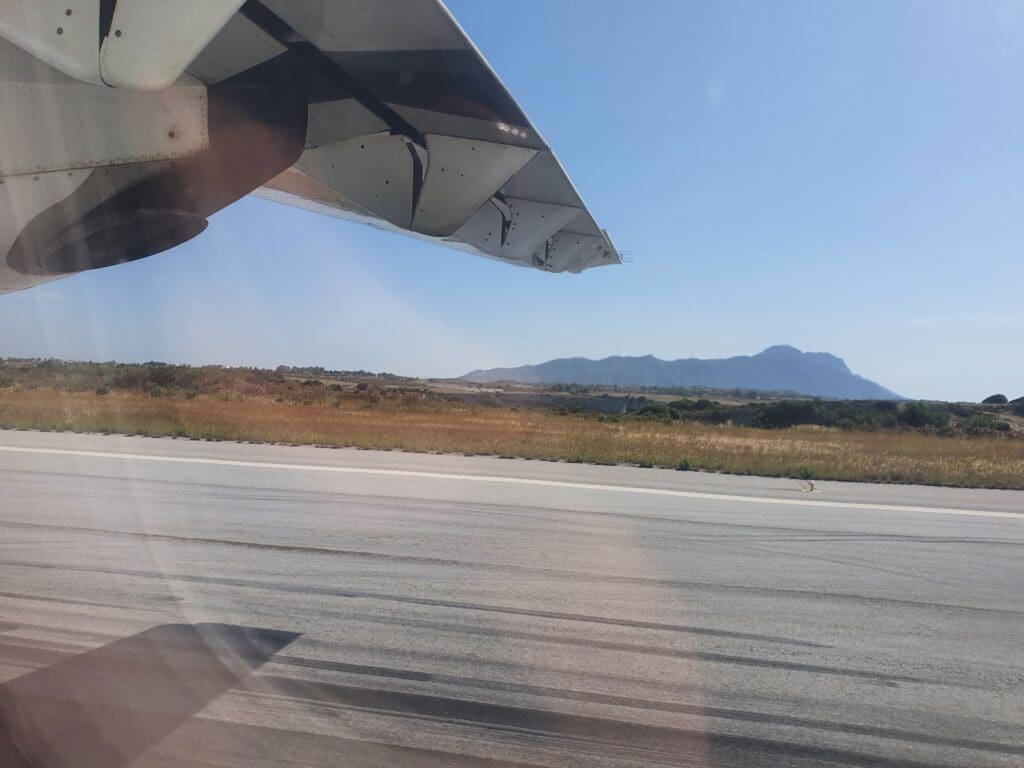
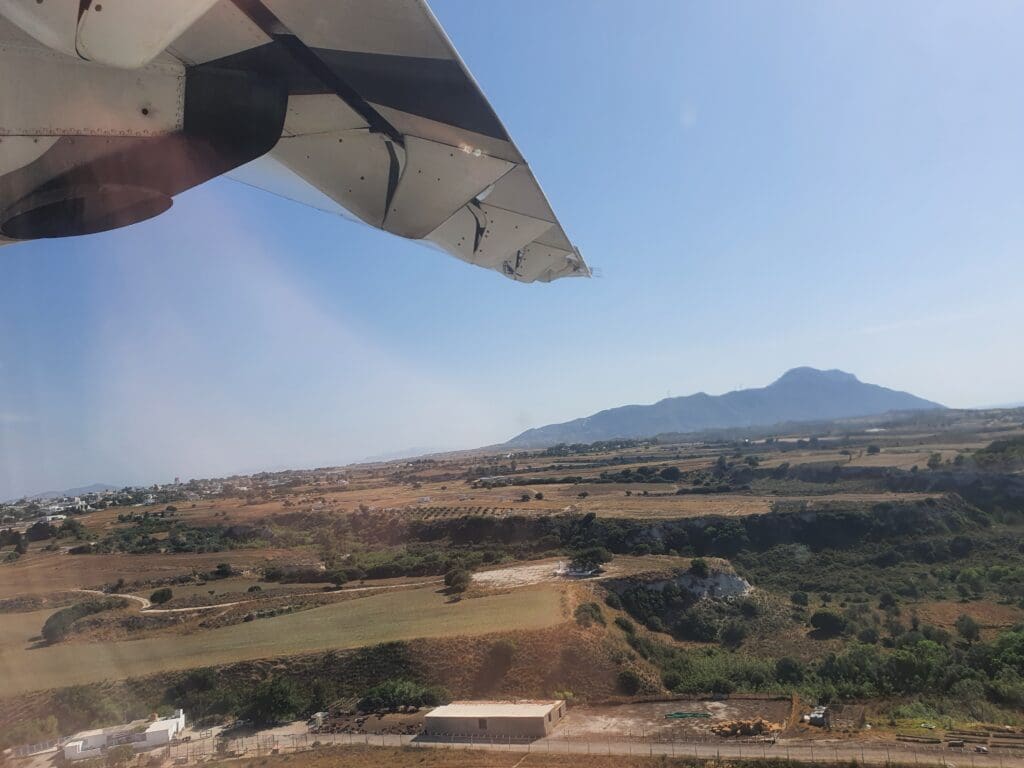
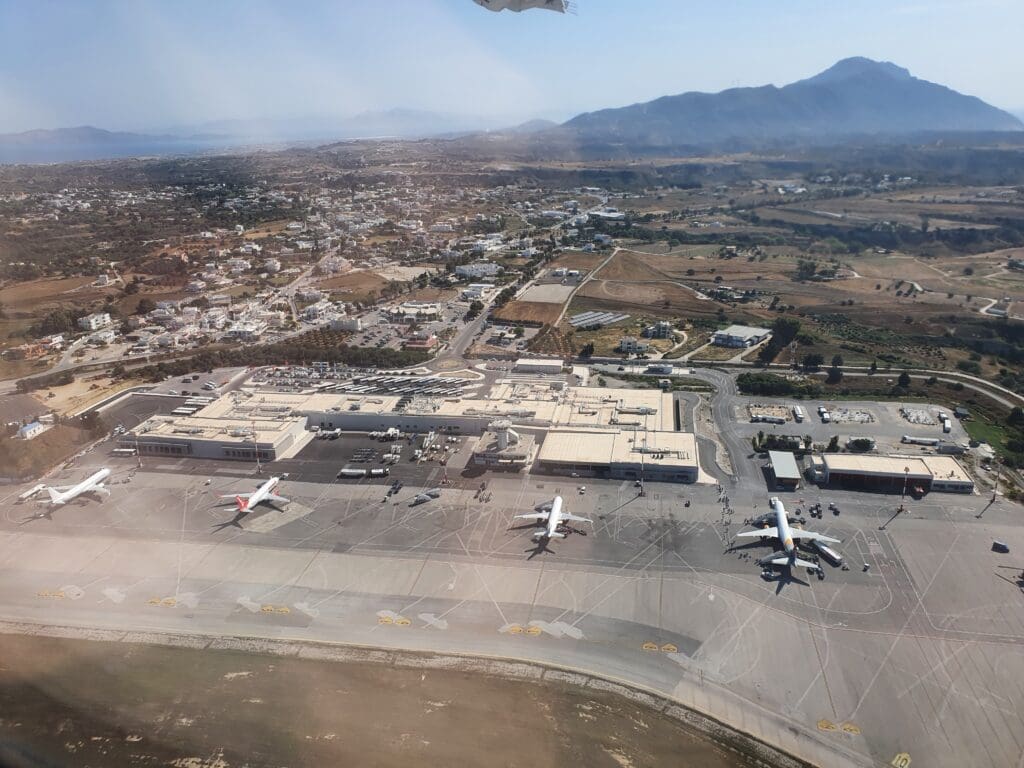
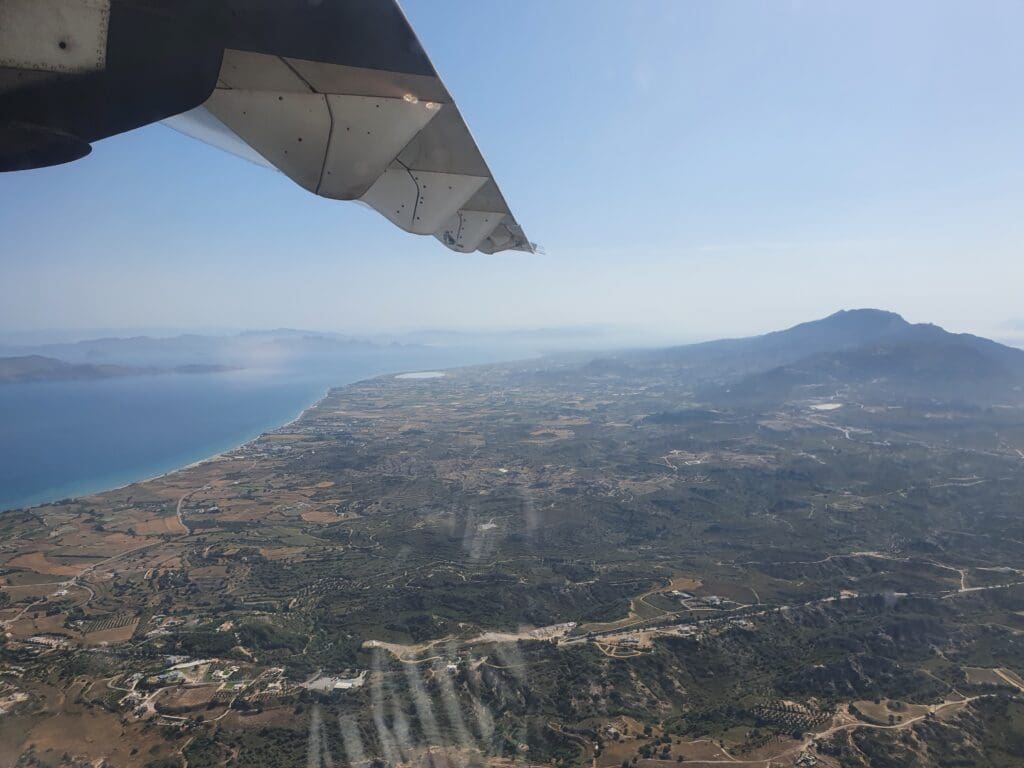
Upon taking to the skies, views of the Kos countryside could be had for a minute or so, before the aircraft crossed the coastline just to the south of the town of Mastihari. Just one minute into the short flight, the Captain’s voice filled the cabin, asking the flight attendant to prepare this for landing. This was followed by the flight attendant’s pre-landing announcement which contained the usual warnings as the aircraft began to sink downwards. As the aircraft crossed the short stretch of water that separates Kos from Kalymnos, I spotted the small island of Pserimos before the impressive rocky coastline of Kalymnos appeared.
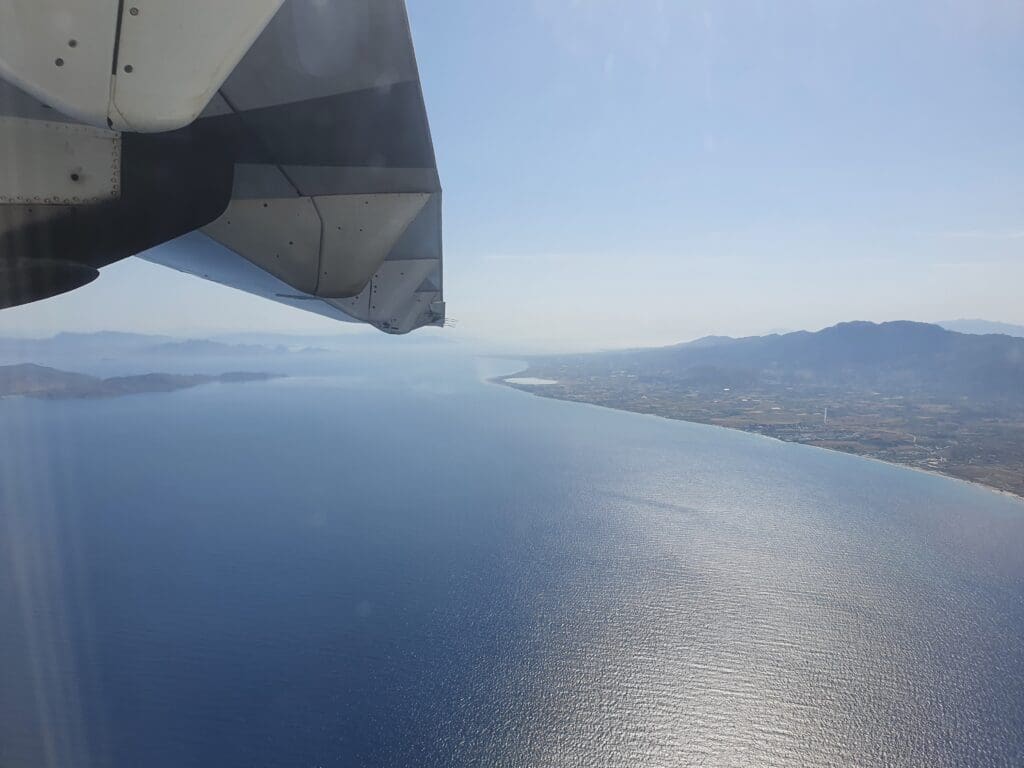
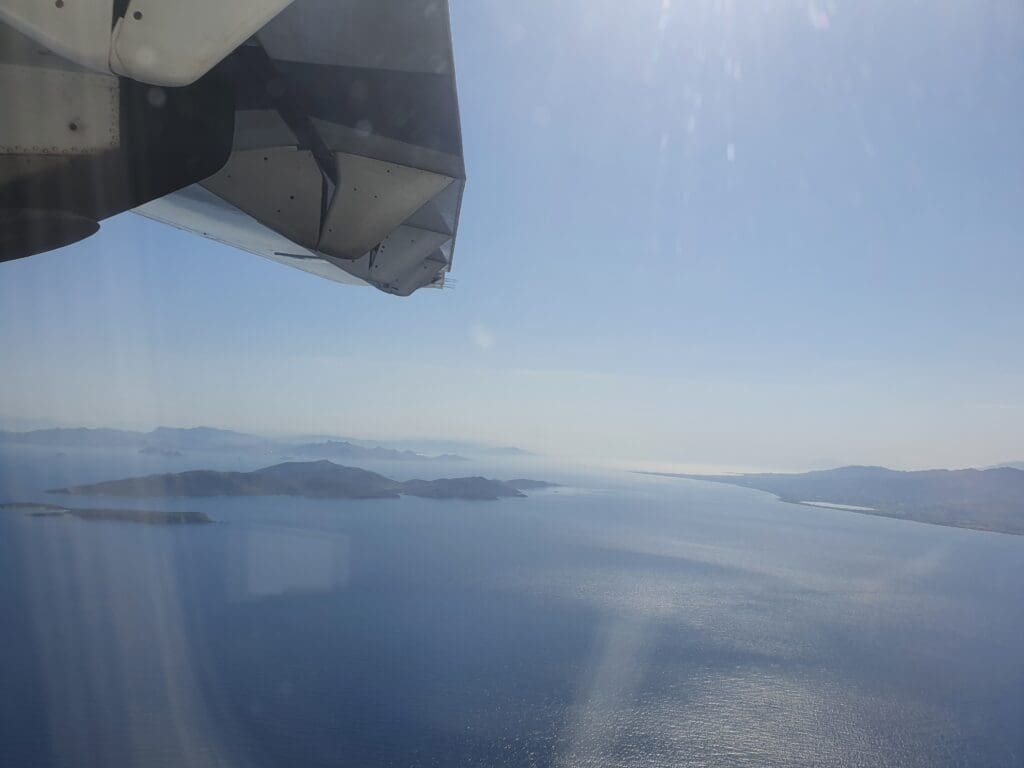
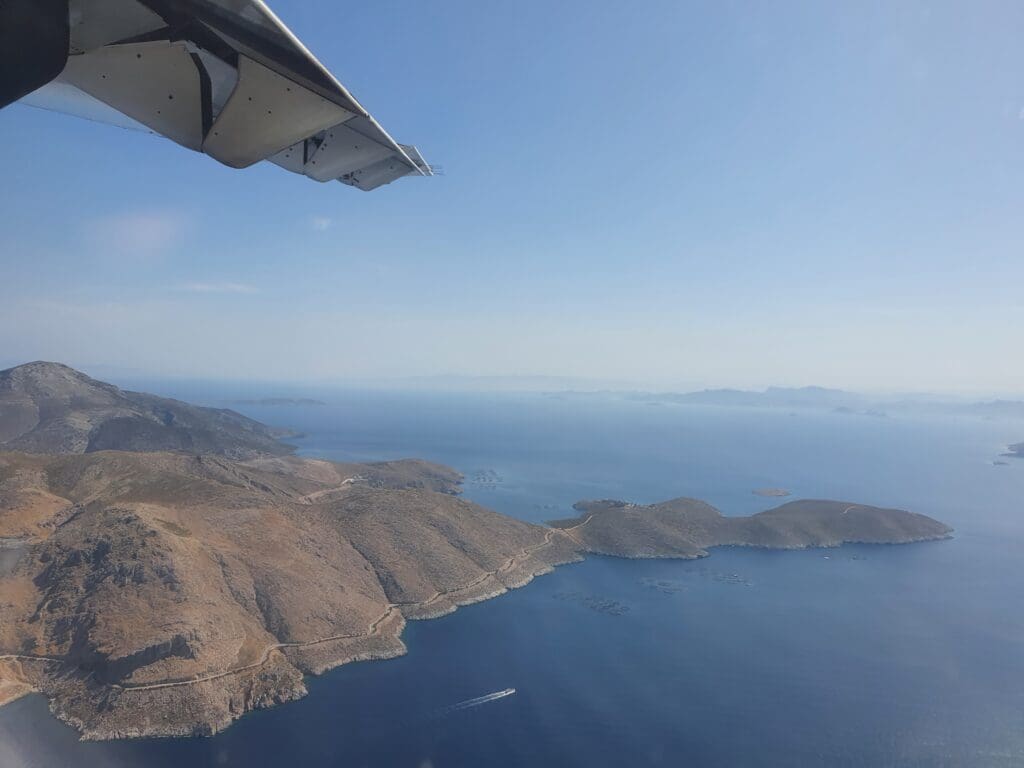
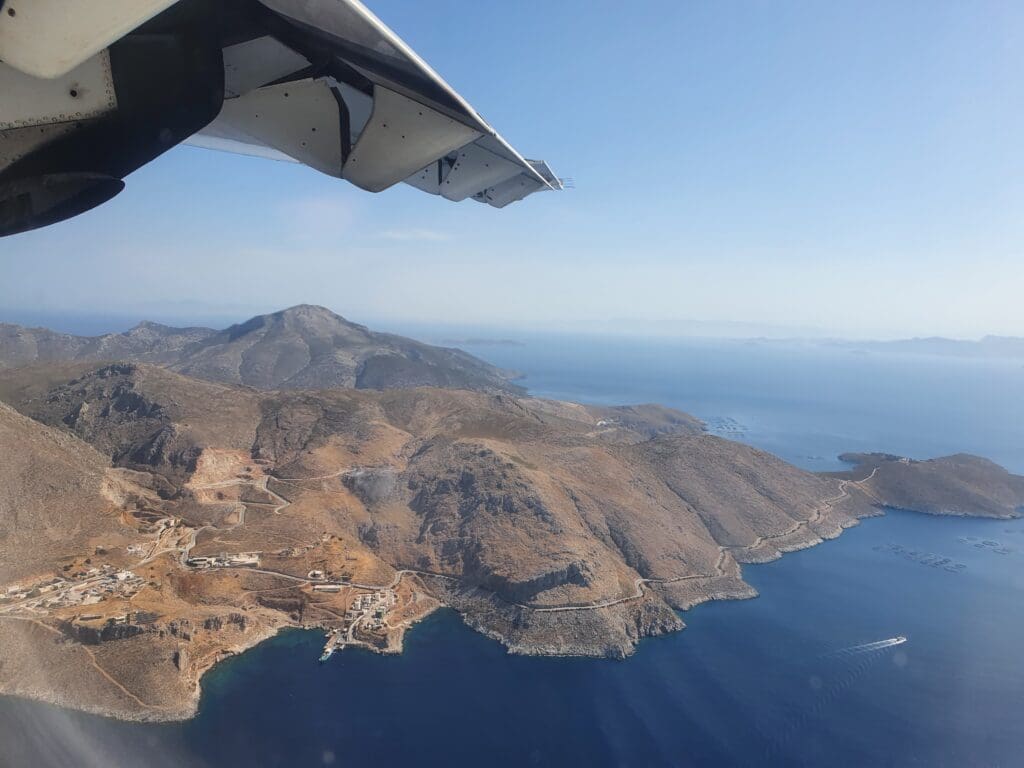
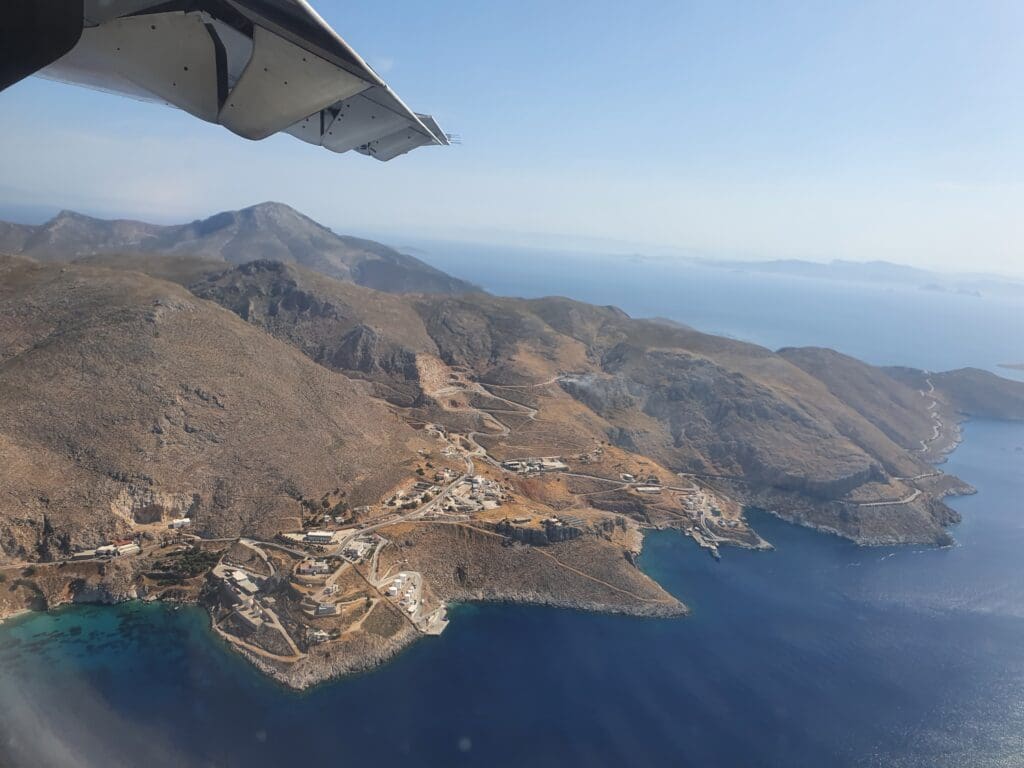
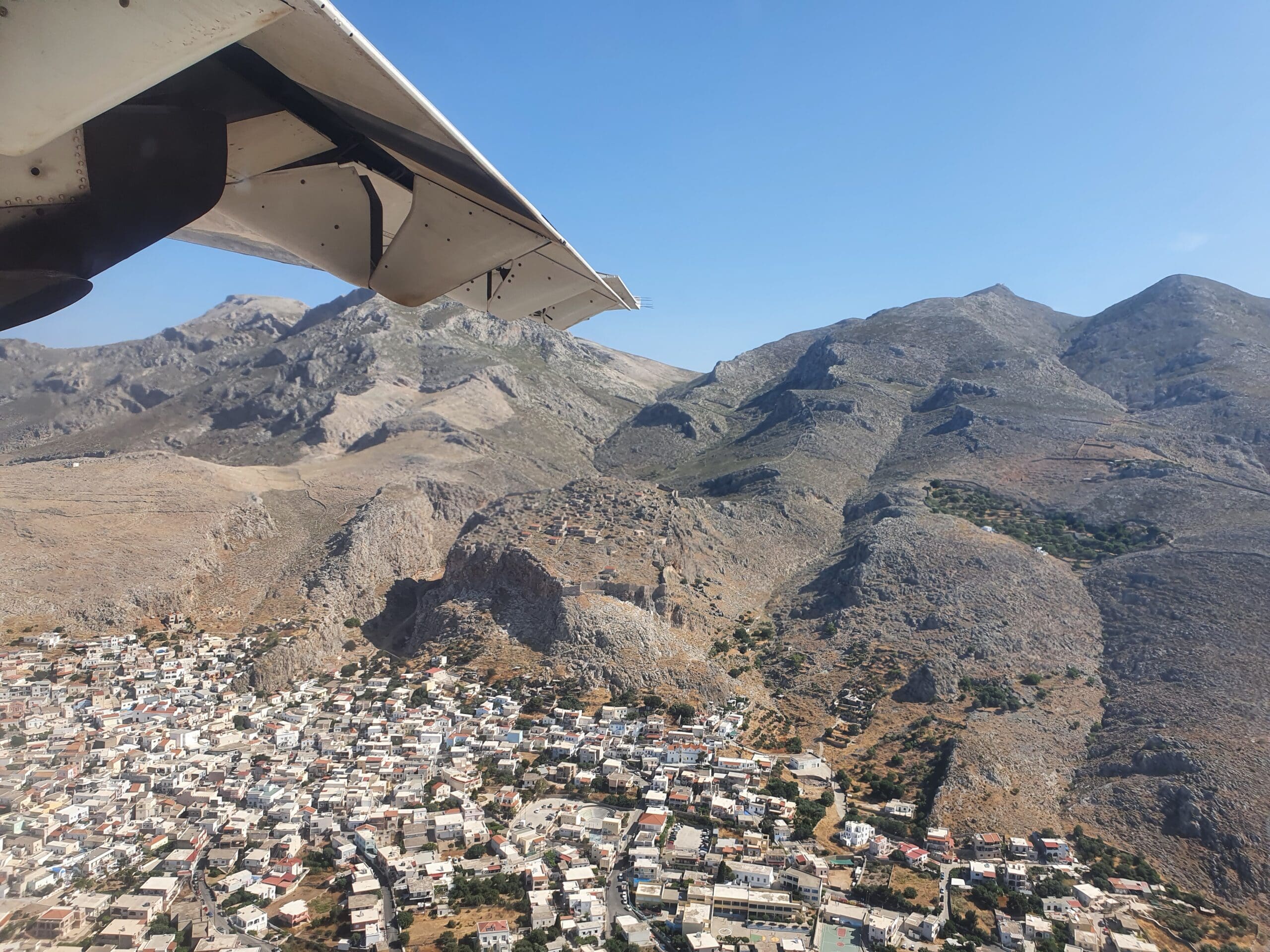
Heading downwards towards Kalymnos’ impressive hilly landscape, after crossing the coastline, I was treated to spectacular views of the island’s scenery with the towns of Kalymnos and Chorio seen sitting underneath the island’s hills and mountains. After passing the latter, all of a sudden the ground rose up beneath the aircraft and seconds later the aircraft came down on Kalymnos Airport’s hilltop Runway 28 with an almighty thud, slowing down rapidly before making a U-turn at the end of the airport’s 1.1-kilometre long runway. From there, the aircraft taxied back up to the terminal, exiting the runway via the airport’s sole taxiway before coming to a halt right outside the terminal building one minute ahead of schedule. Once the engines spooled down, the flight attendant opened the cabin door and as in Kos, all those heading onwards to Leros and Astypalaia were requested to disembark and take their luggage with them.
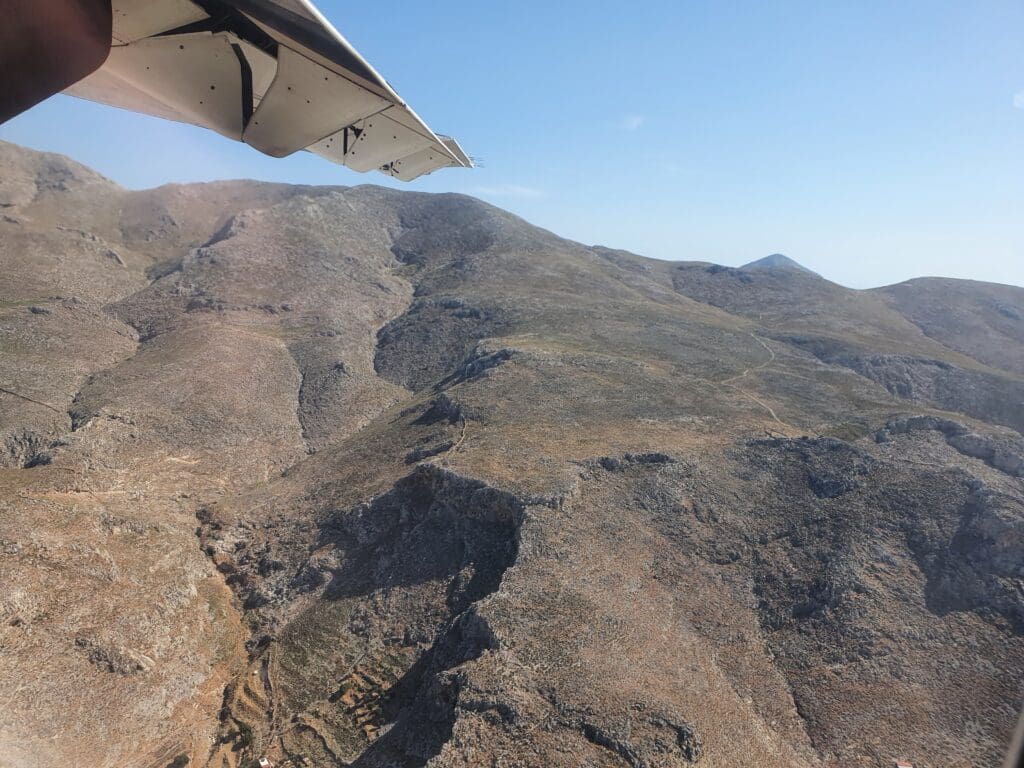
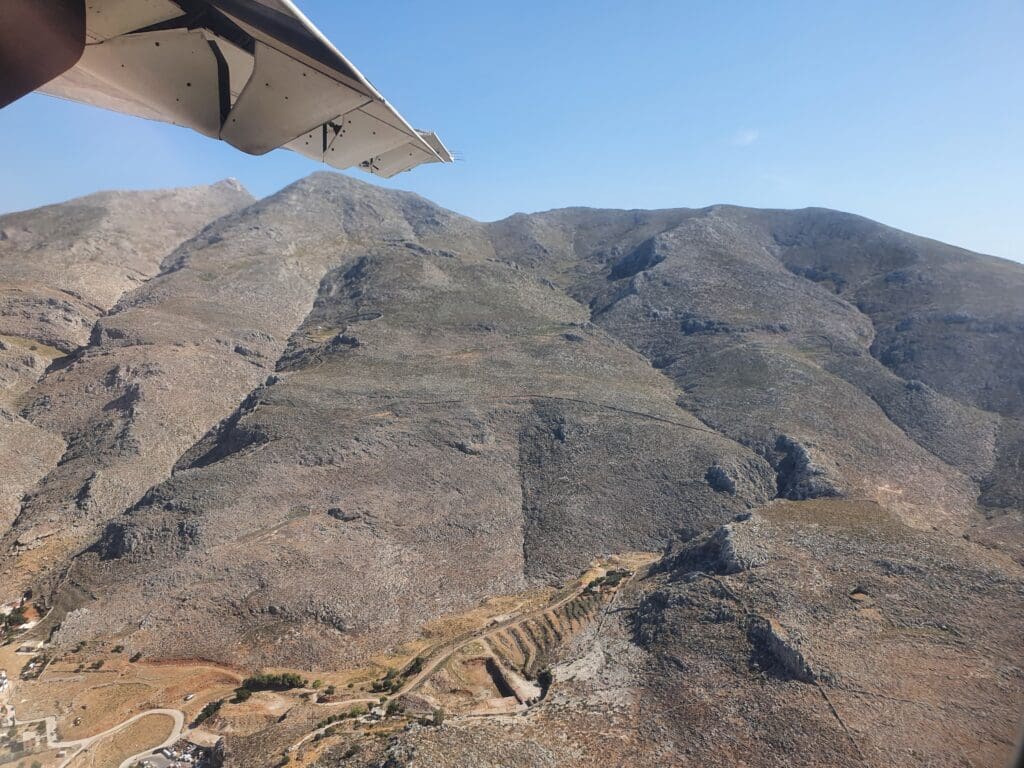
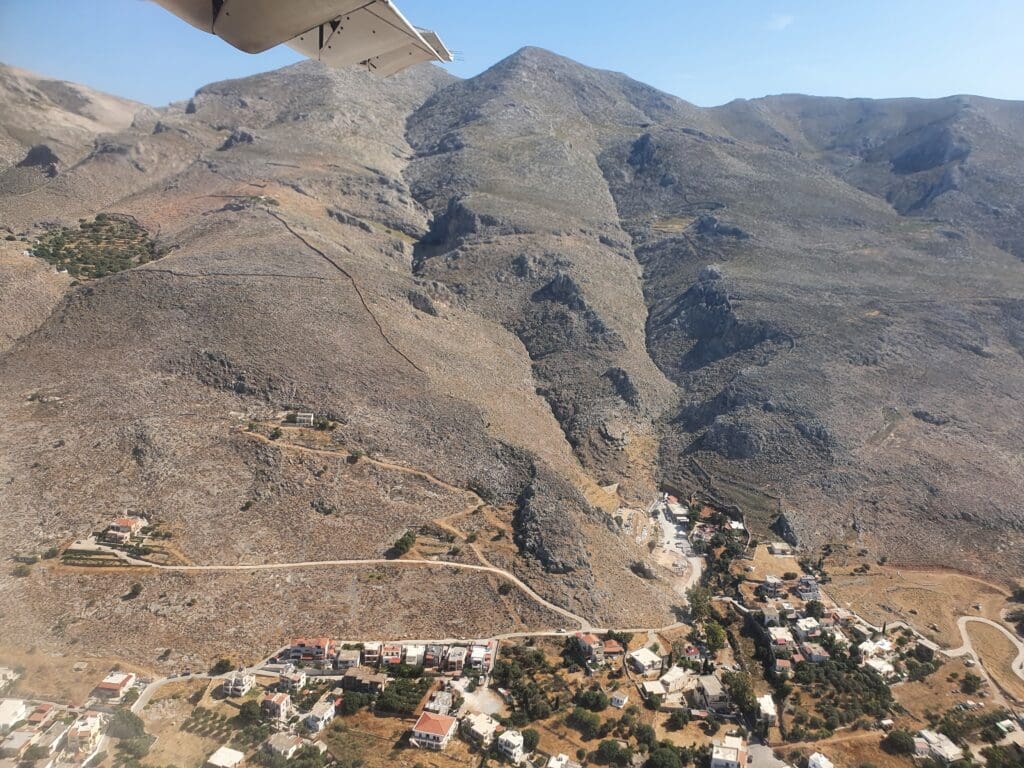
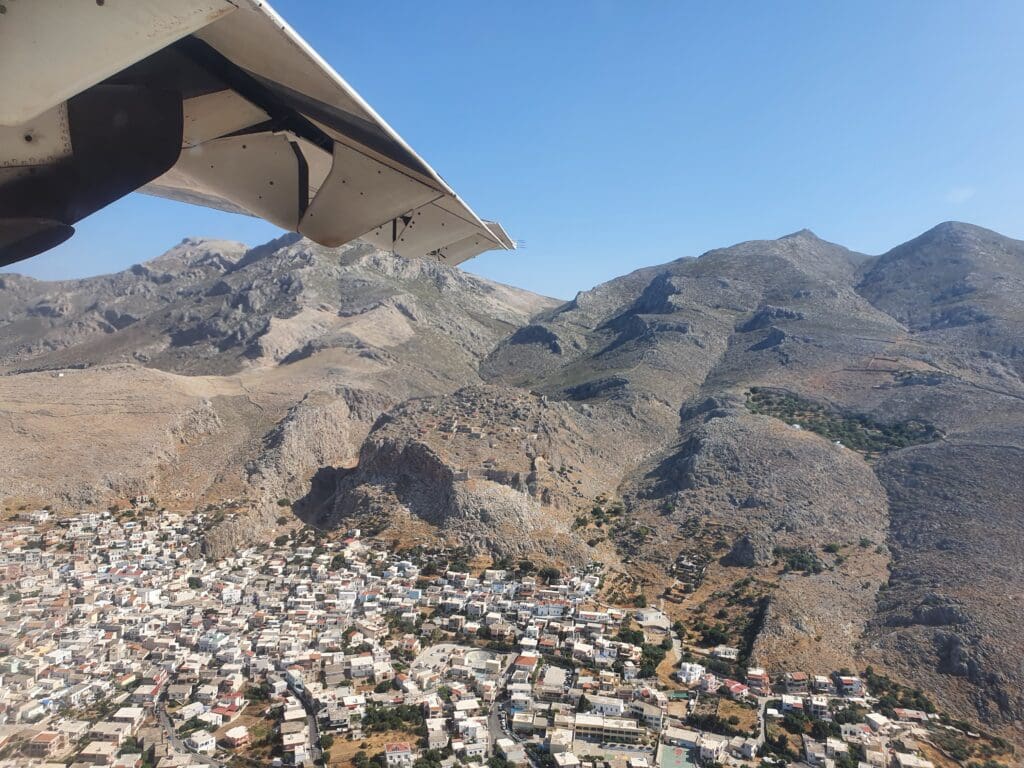
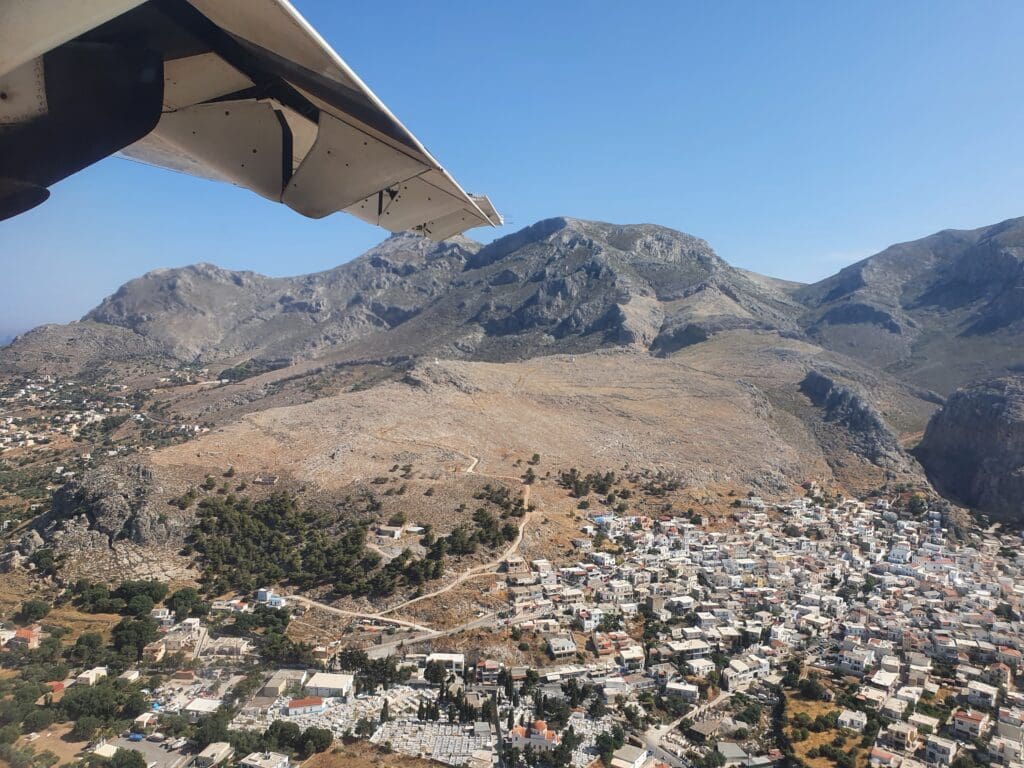
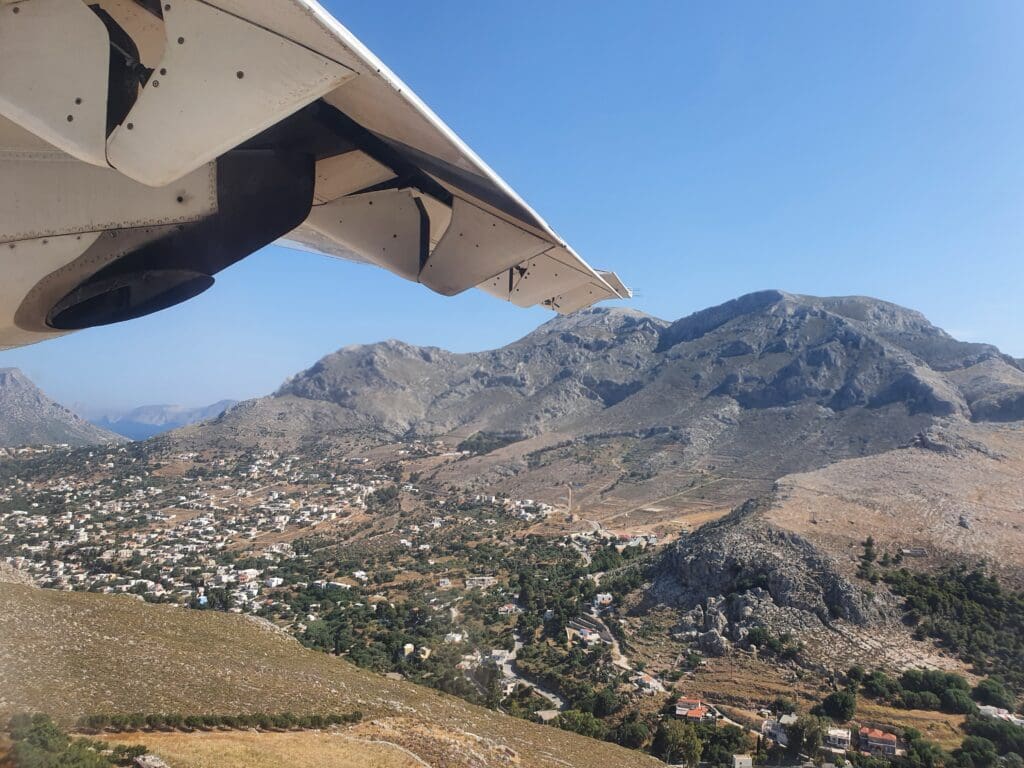
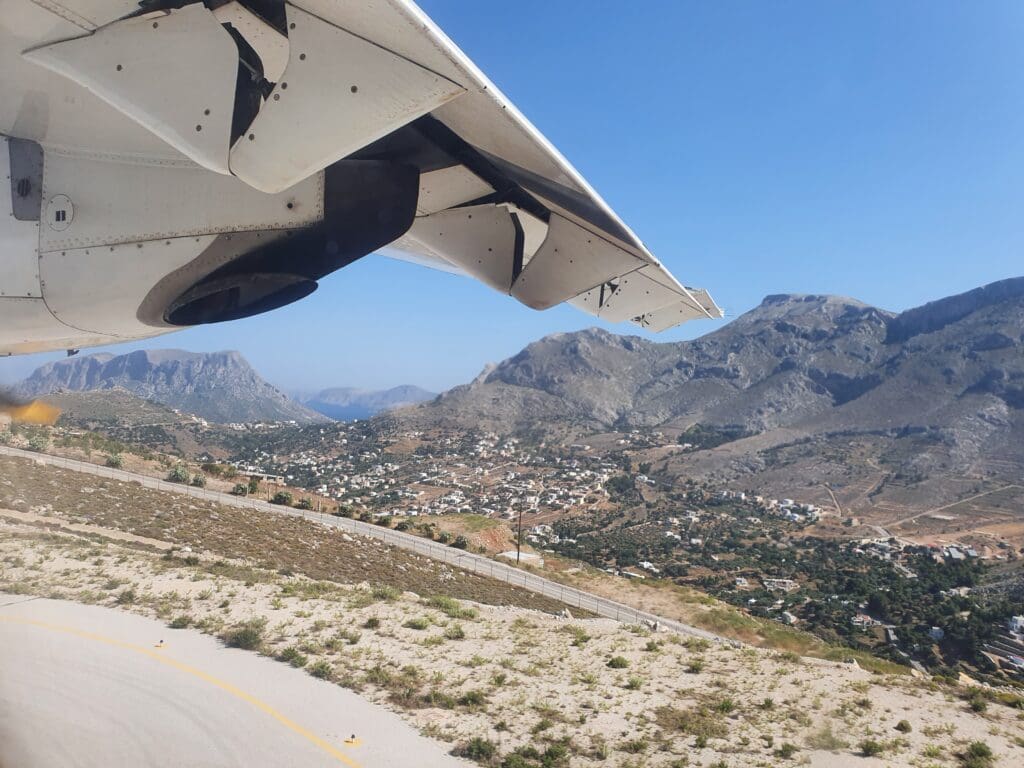
After thanking the flight attendant, I exited the aircraft and walked the short distance over to the small terminal building. Soon entering this, I found myself in the terminal’s rather spartan airside waiting area. Inside, this is home to nothing other than a few plug sockets, metal benches, some toilets and a series of framed photographs highlighting the island’s sights and picturesque landscapes. Those wanting to stay connected with the outside world may be disappointed to hear that this lacks wifi. However, having opened in 2006, this is still fairly modern and despite its basic nature, I found this to be perfectly fine for a short wait. Importantly, the toilets there were in a clean and decent condition. That morning, it appeared that no passengers would be ending their journey in Kalymnos, however, a total of three passengers would join bringing the total number of travellers on the next leg to eleven.
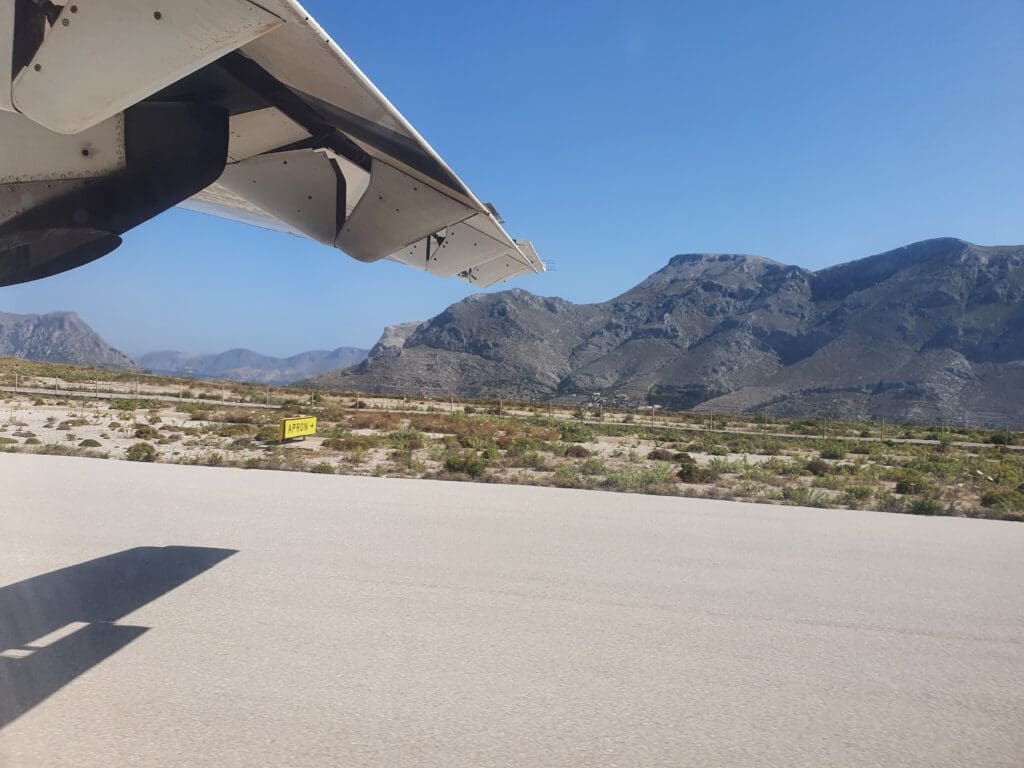
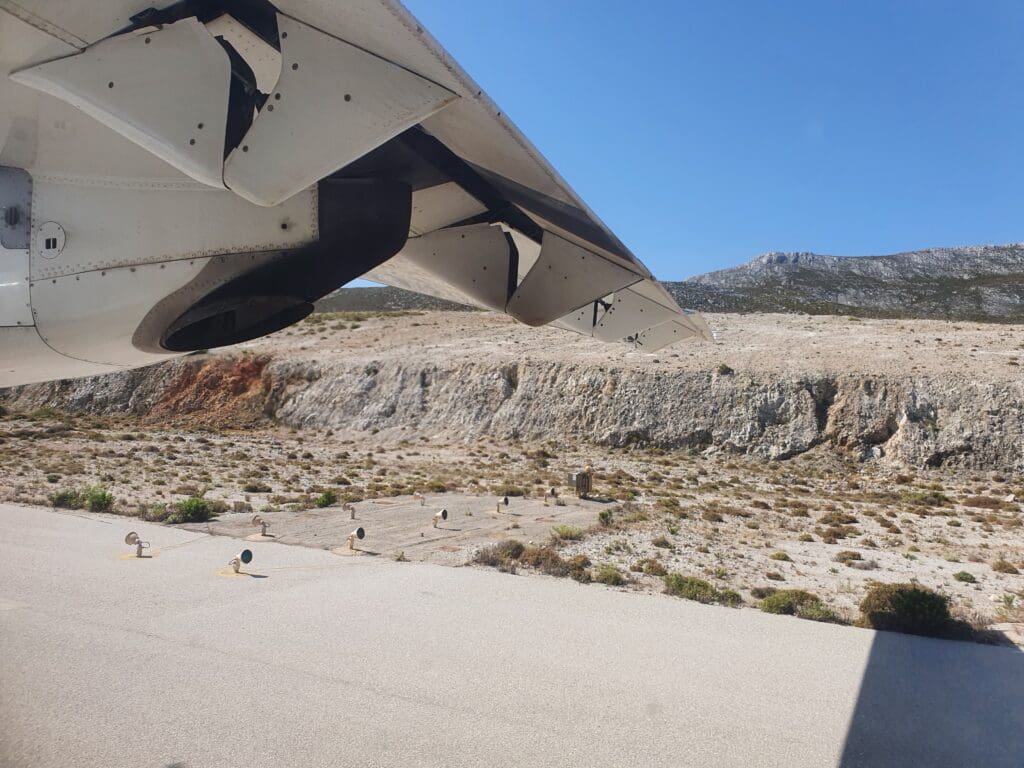
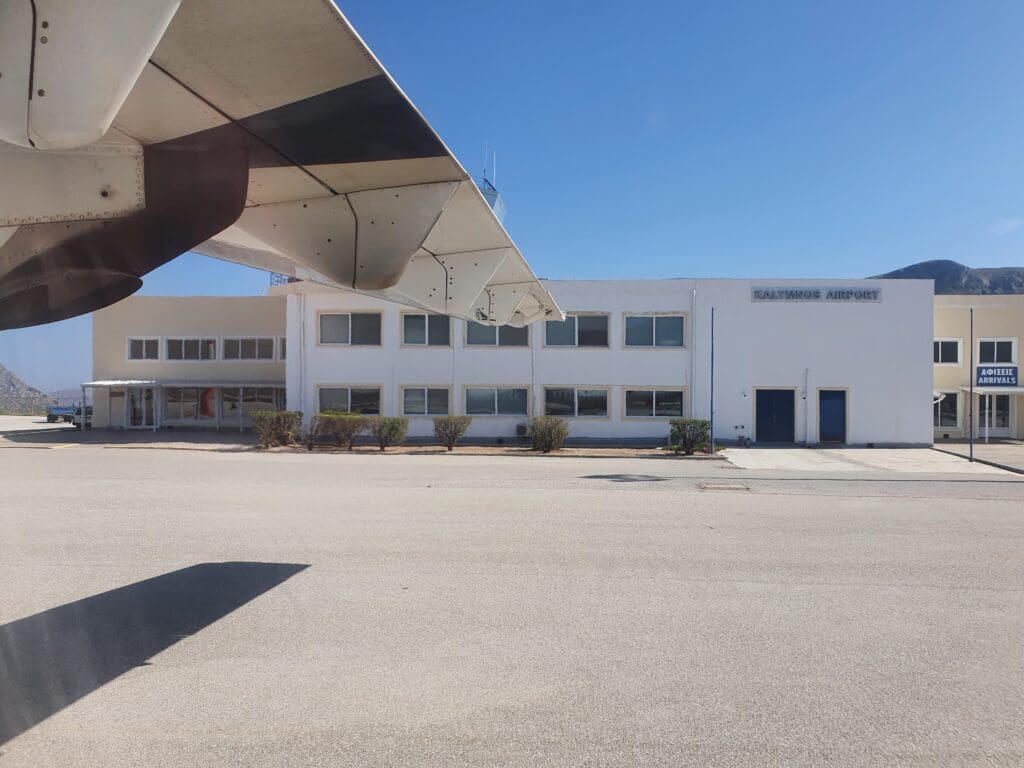
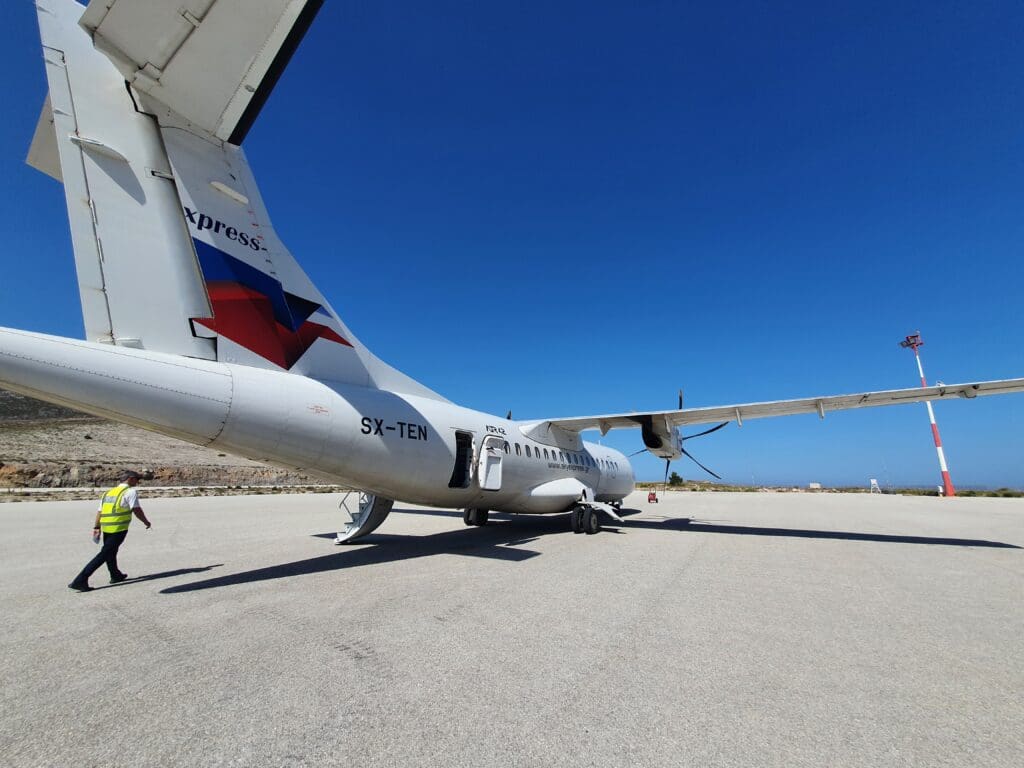
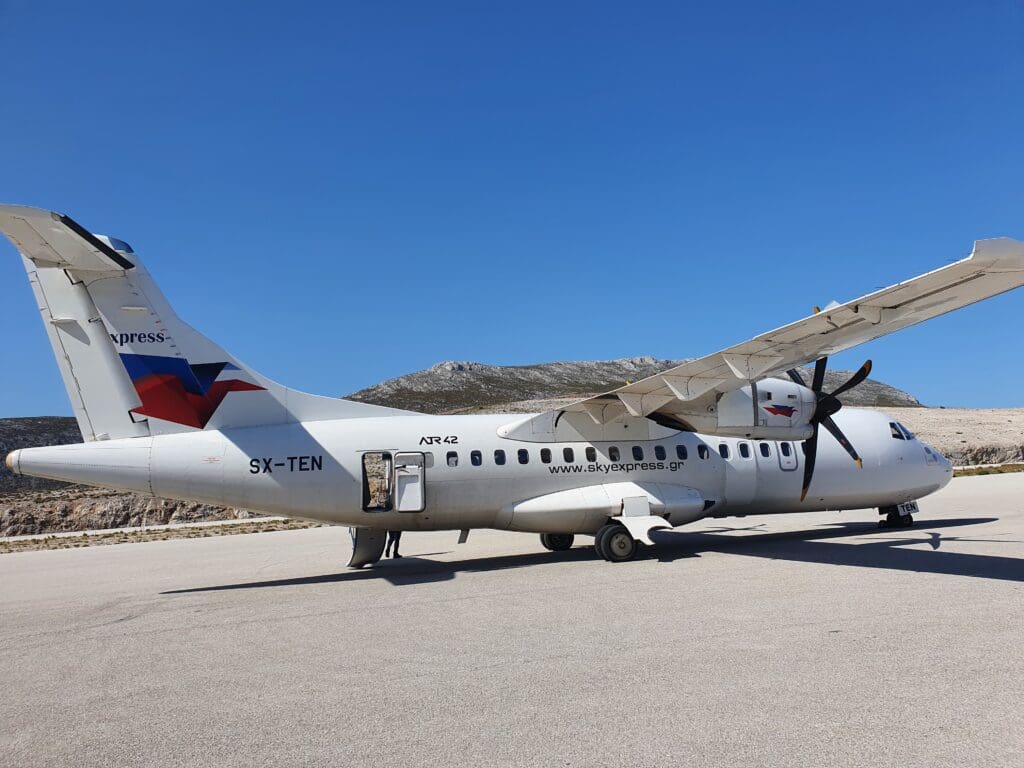
Outside, the ATR 42 could be seen basking in the sunshine through the terminal’s windows with the three crew members having disembarked for a quick break before heading back out to the aircraft. As they walked back to the aircraft, I noticed that both pilots were Captains. Whilst I have no evidence to prove it to be true, I wondered whether having two Captains on board was a standard procedure on the route given the short runways in Kalymnos, Leros and Astypalaia. Once the crew were back in the aircraft, the pilots could be heard almost constantly tooting the aircraft’s horn, perhaps to attract the attention of the three members of ground staff who were nowhere to be seen. Despite our early arrival into Kalymnos, when the flight’s scheduled departure time of 1010 arrived, there was still no sign of the ground crew and the pilots continued to toot away on the aircraft’s horn. At 1014, the ground crew reappeared with one heading into the terminal and saying a few words in Greek at which point my fellow passengers stood up and made their way outside. Unlike in Kos, there was to be no boarding pass or identity check for the next leg, however, I suspect that it would not have proven too difficult for the ground crew to spot a passenger who should not have reboarded the aircraft.

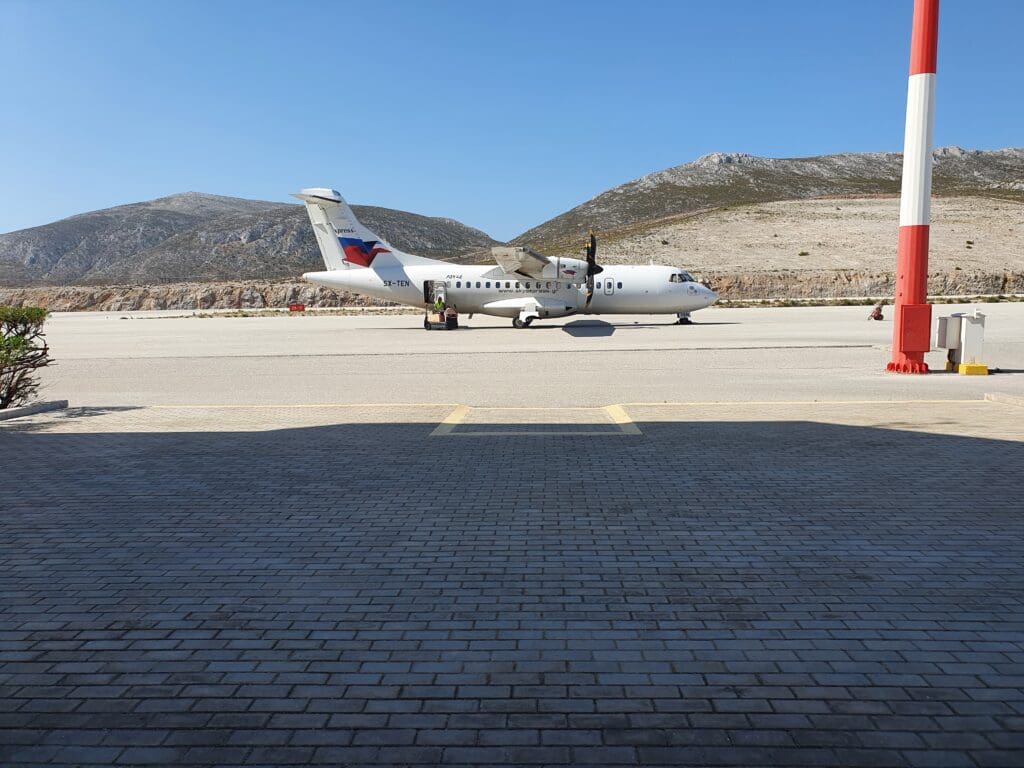
As I entered the ATR 42’s rear galley for the third time that morning, I was welcomed back onboard and seeing as nobody else took this, I decided to sit in Seat 10D for the short journey to Leros. Once again, boarding did not take long at all and at 1017 the flight attendant performed another welcome announcement during which they noted the flight time to Leros to be ten minutes. As the engines powered up, the pre-recorded safety announcement played once more and the flight attendant donned a life jacket, demonstrated how to use the seatbelts and pointed out the locations of the ATR 42’s four exits. By this time, I felt as if I was becoming an expert in the safety procedures onboard!
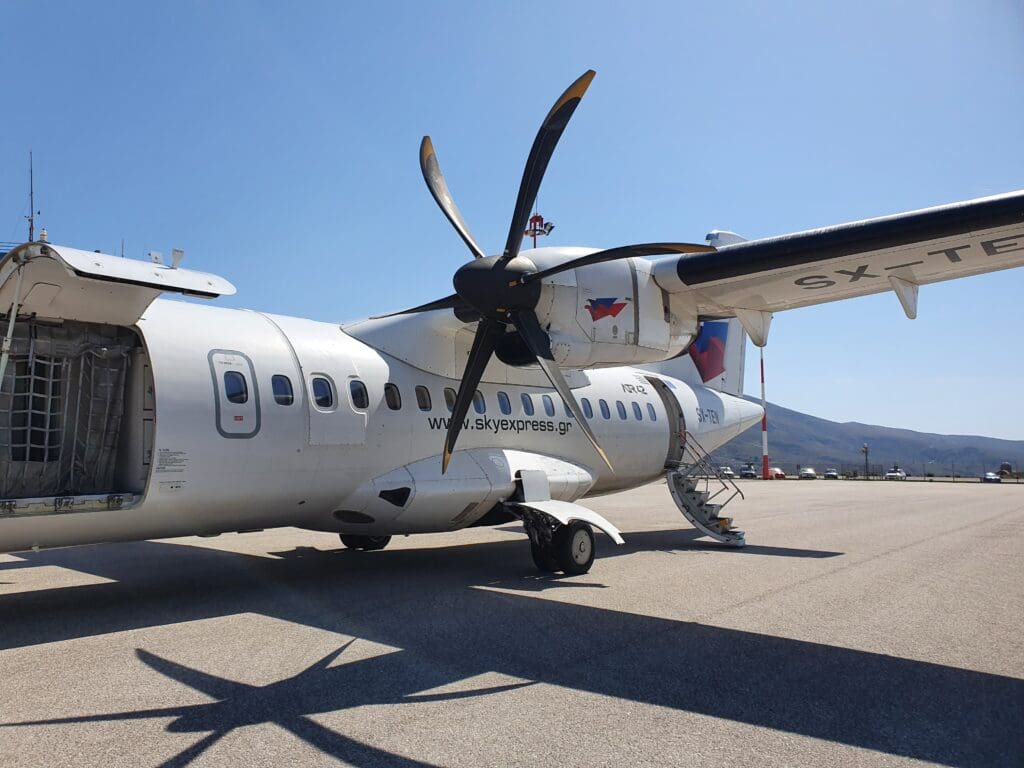
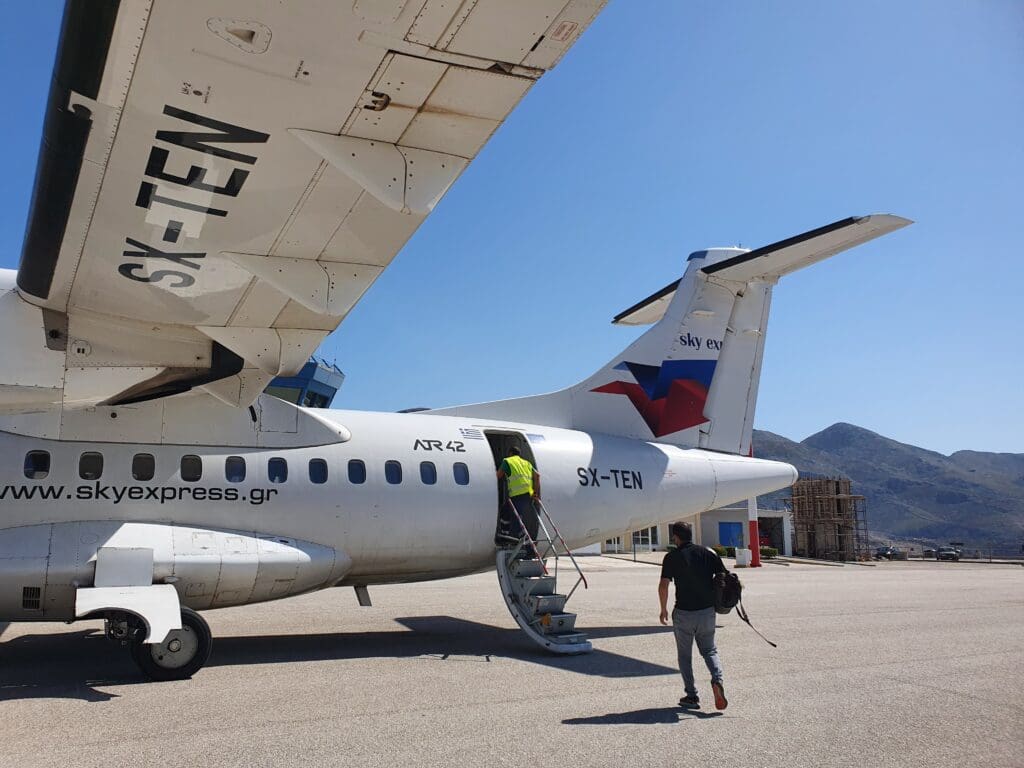
Whilst the safety demonstration was still underway, at 1019 the ATR made its way out of the stand and a few moments later entered the runway. Turning left, the turboprop made a quick taxi to the end of runway 28 before turning around and coming to a gentle stop. There it waited until the safety demonstration came to an end, and the flight attendant had confirmed that they were seated, strapped in and ready for departure. At 1023, the two turboprops screamed into life whilst the brakes were held. Upon being released, we shot forward with the aircraft powering down the runway before rotating upwards into the Greek skies just after passing the apron. As expected, good views of Kalymnos’ spectacular scenery were provided whilst below the Monastery of the Holy Cross and the coastal town of Panormos could be seen before we headed out over the sea.
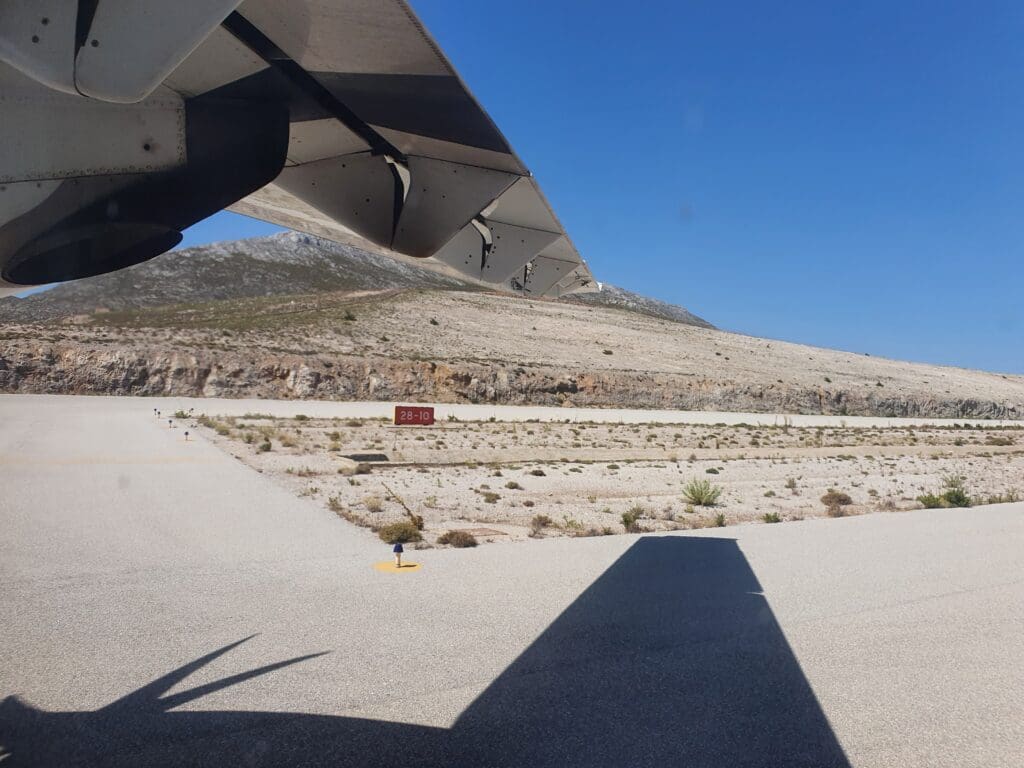
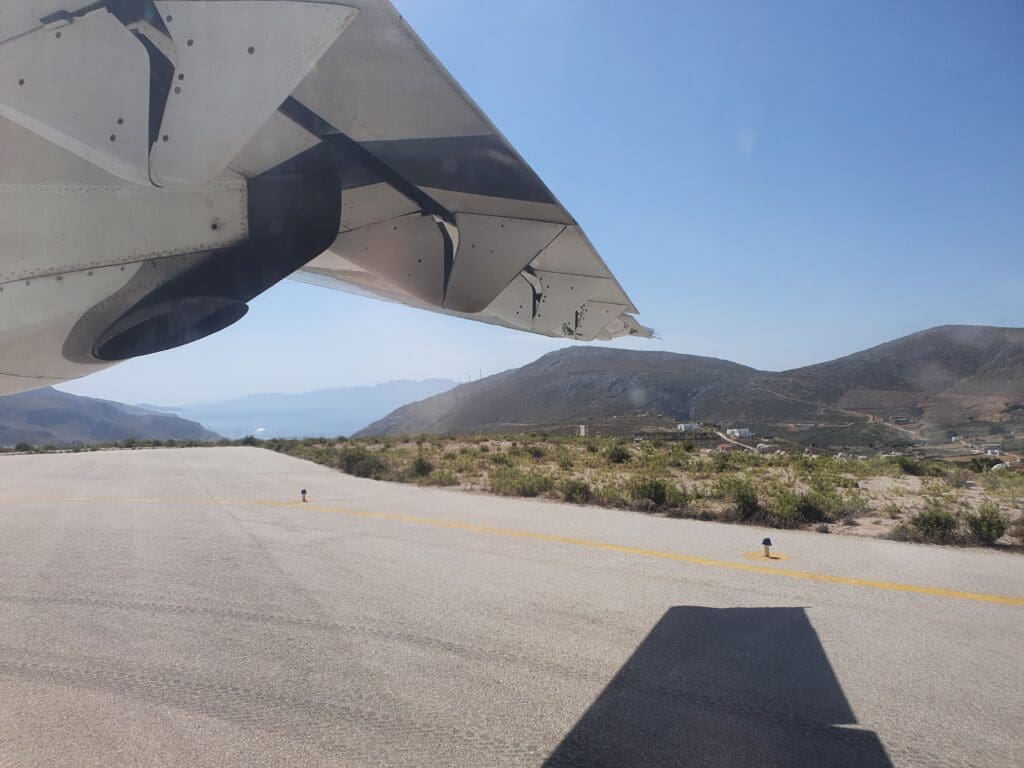
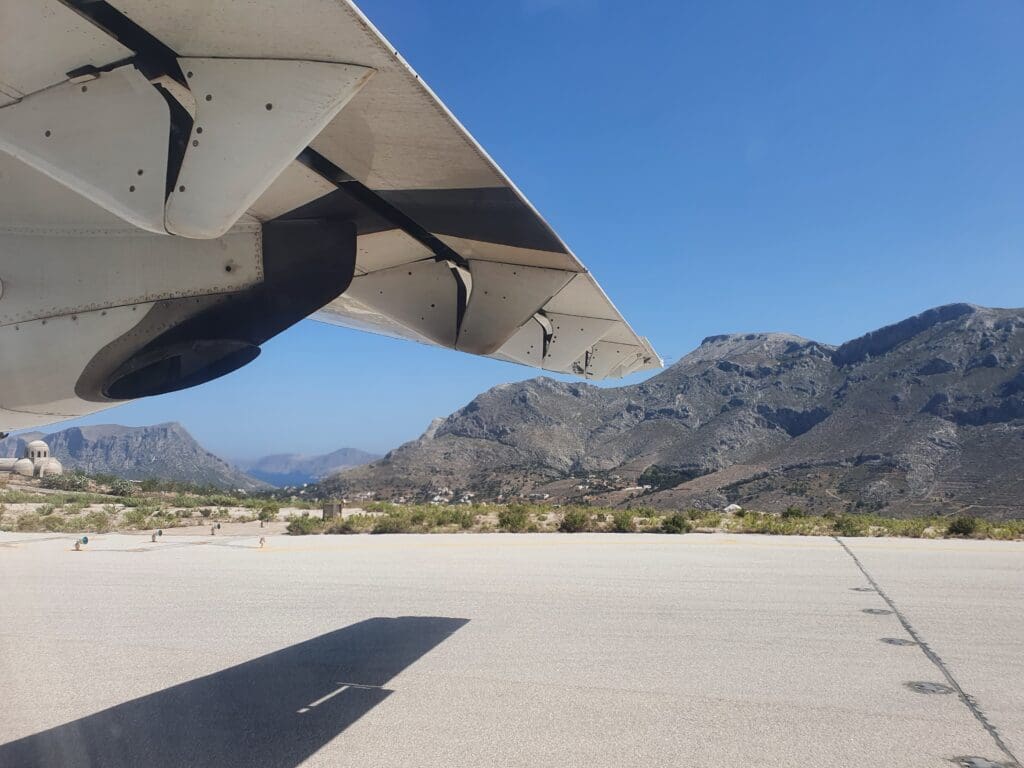
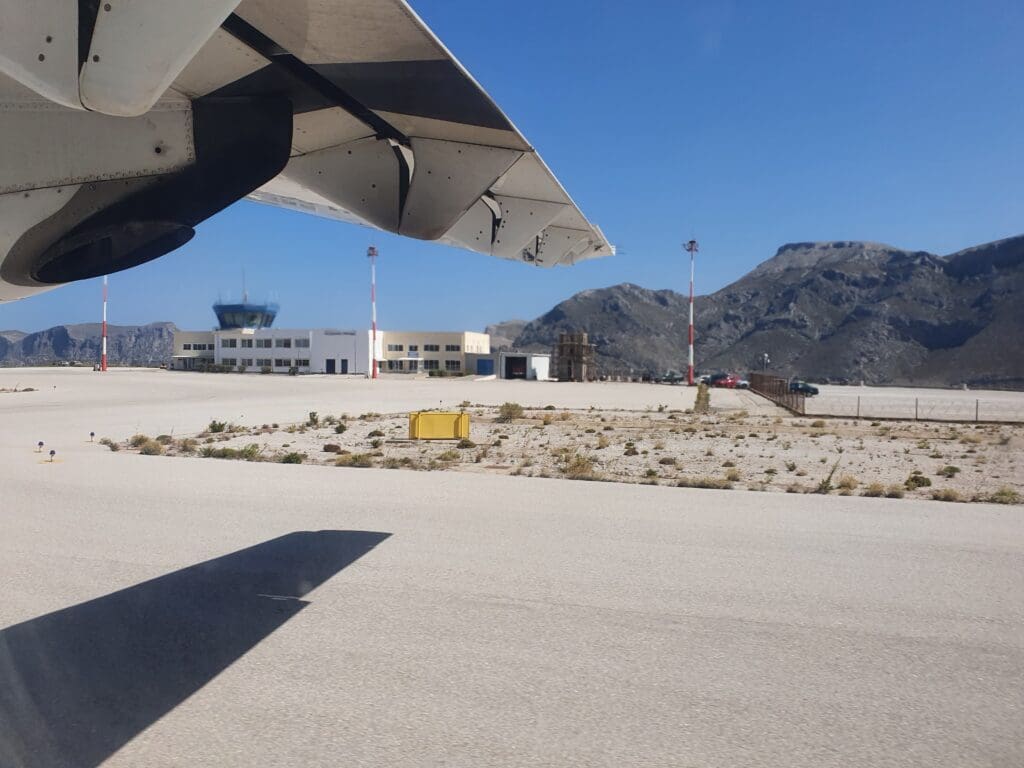
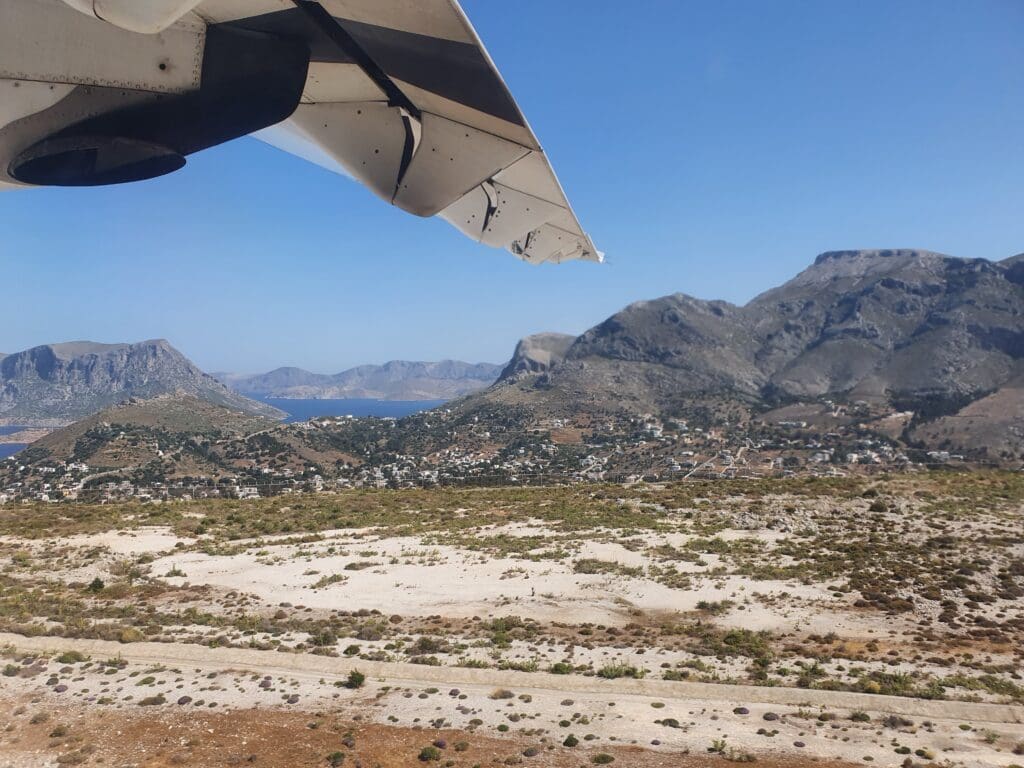
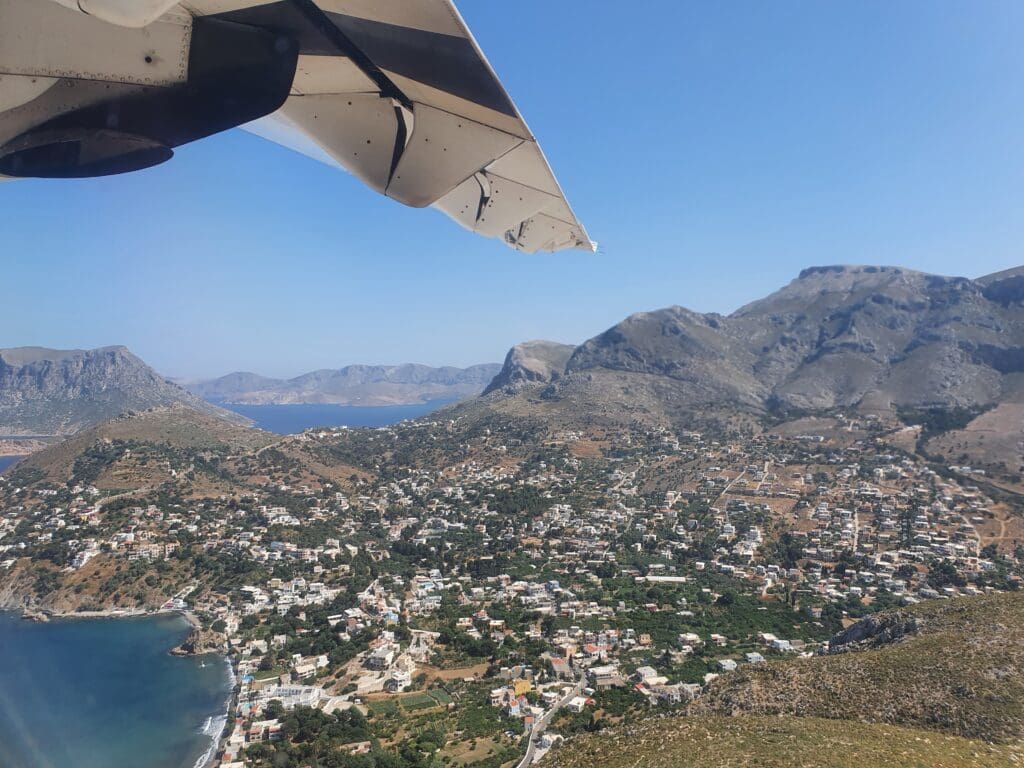
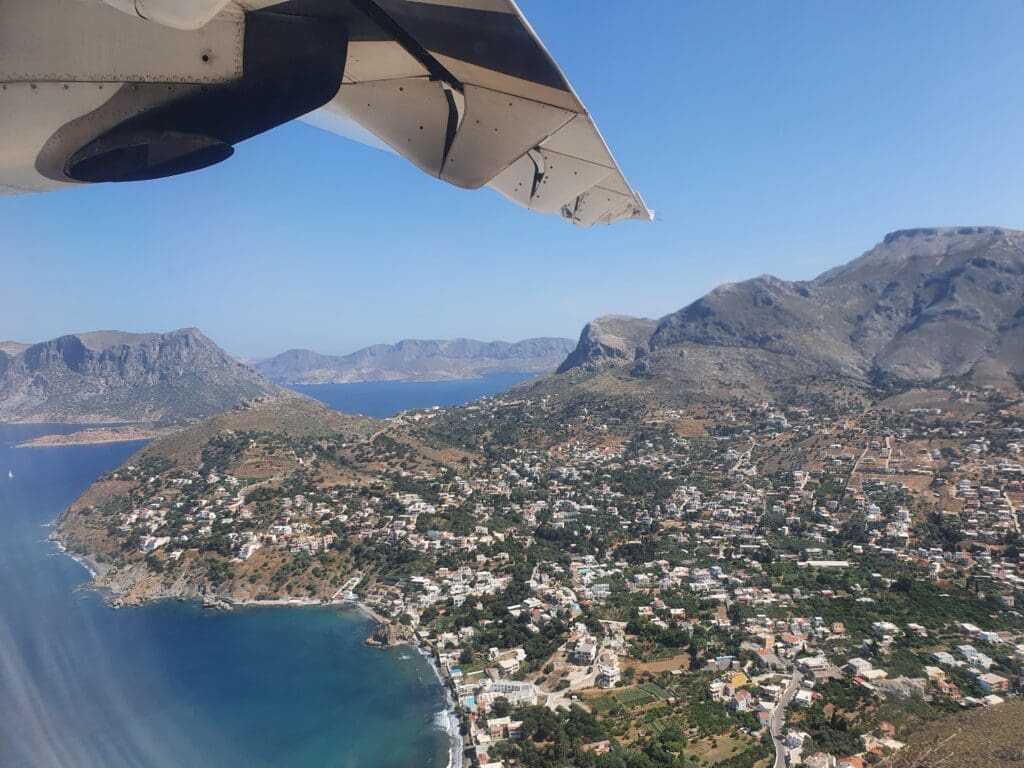
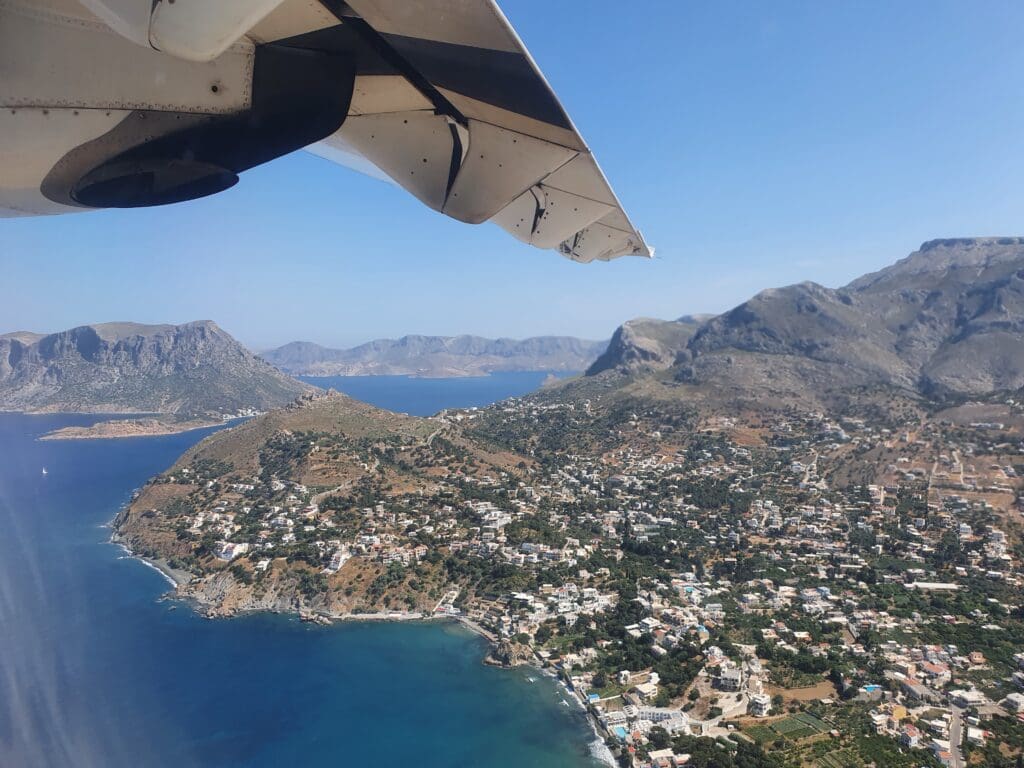
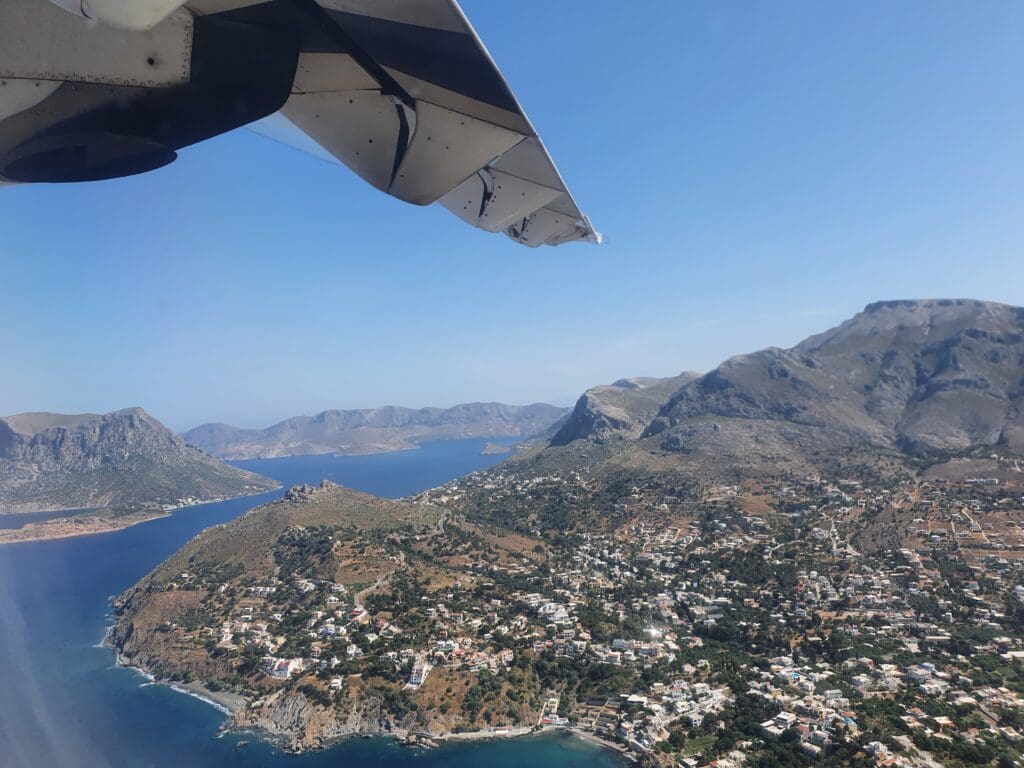
Following departure, the aircraft turned on to a northerly heading thus allowing for good views of Kalymnos’ western coastline and its various bays as well as the small island of Telendos. Meanwhile, as on the previous sector, almost immediately after departure the Captain requested the flight attendant to prepare the cabin for landing which was followed by their pre-landing announcement. A few short minutes after taking to the skies, the hills of Leros appeared and the aircraft crossed over Xirokampos and the centre of the island, with its main town, Lakki also seen before the landscapes below became sandier in colour as we headed towards the airport on the north of the island. Meanwhile four minutes into the flight, the gear could be felt dropping into position.
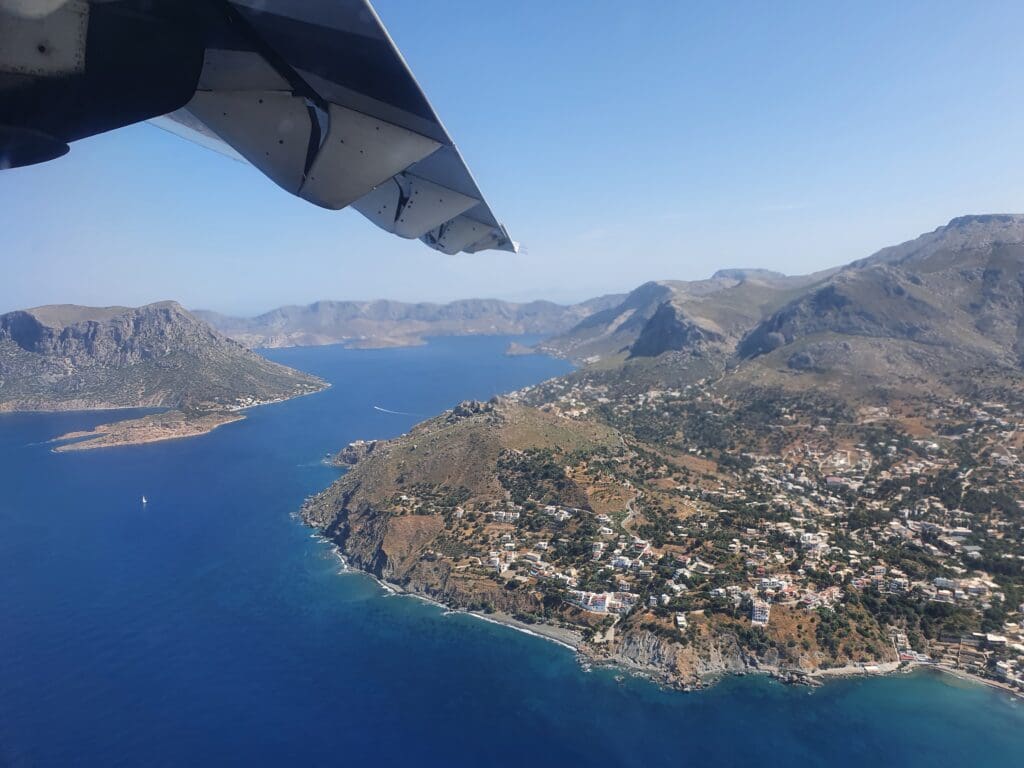
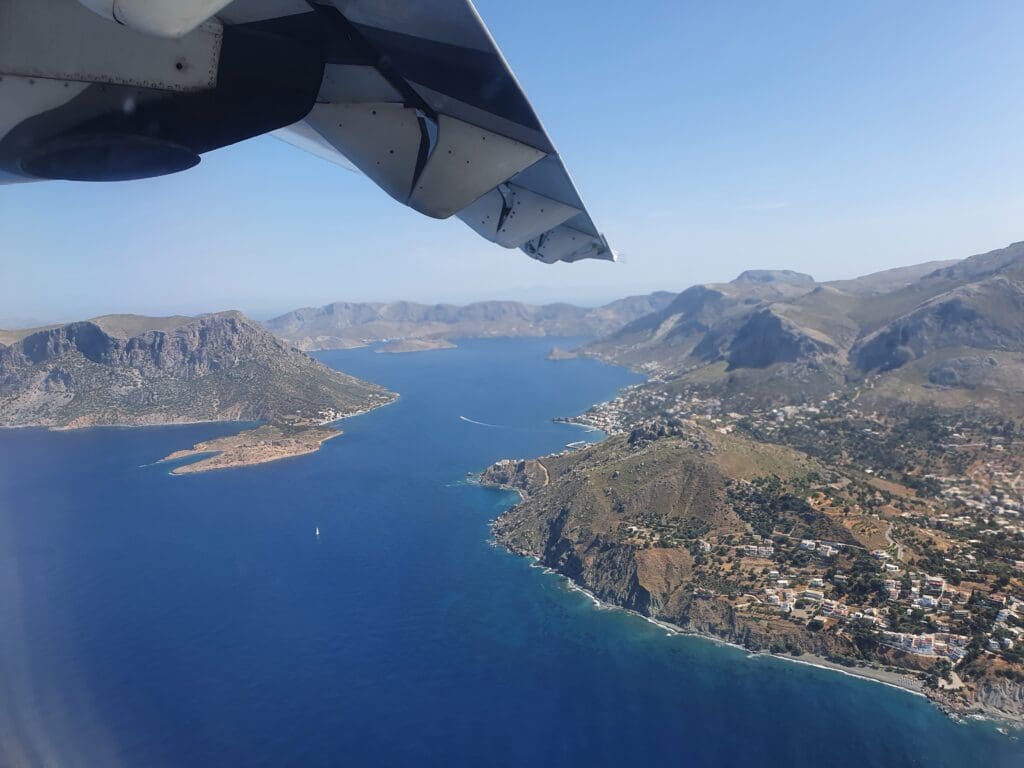
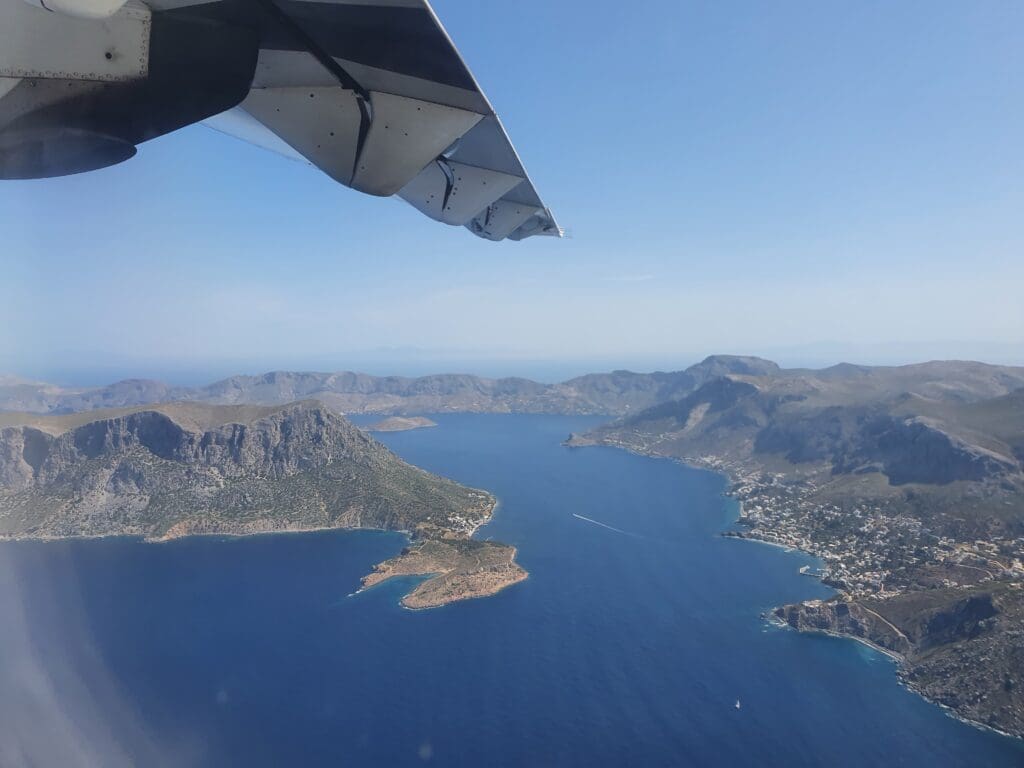
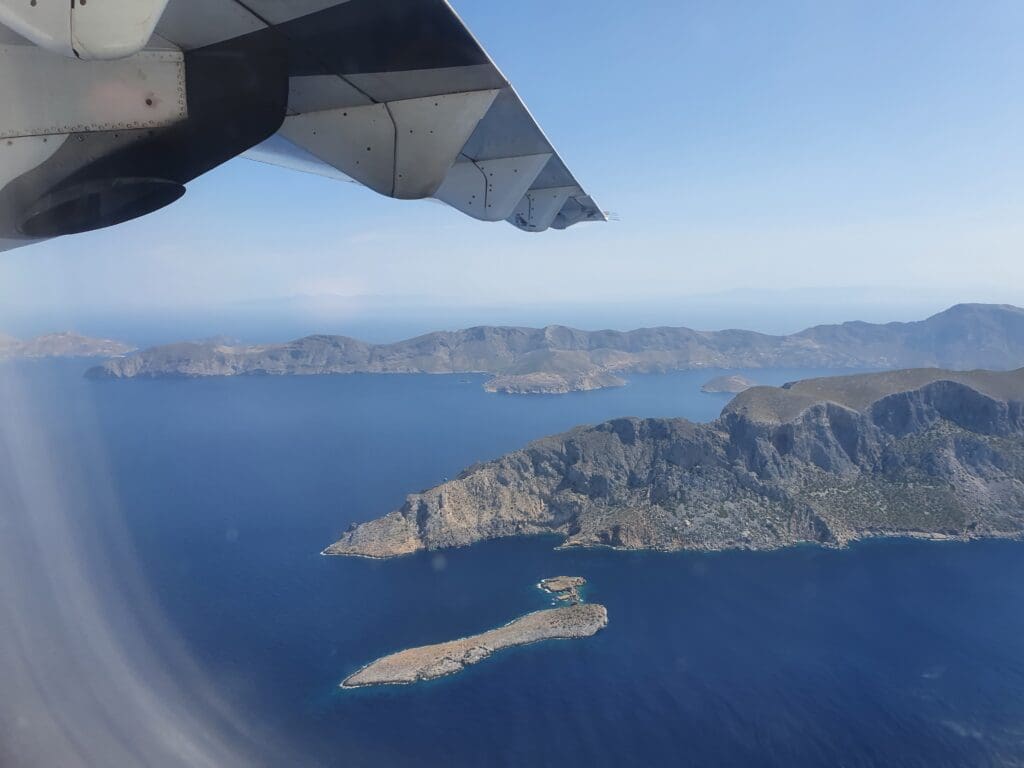
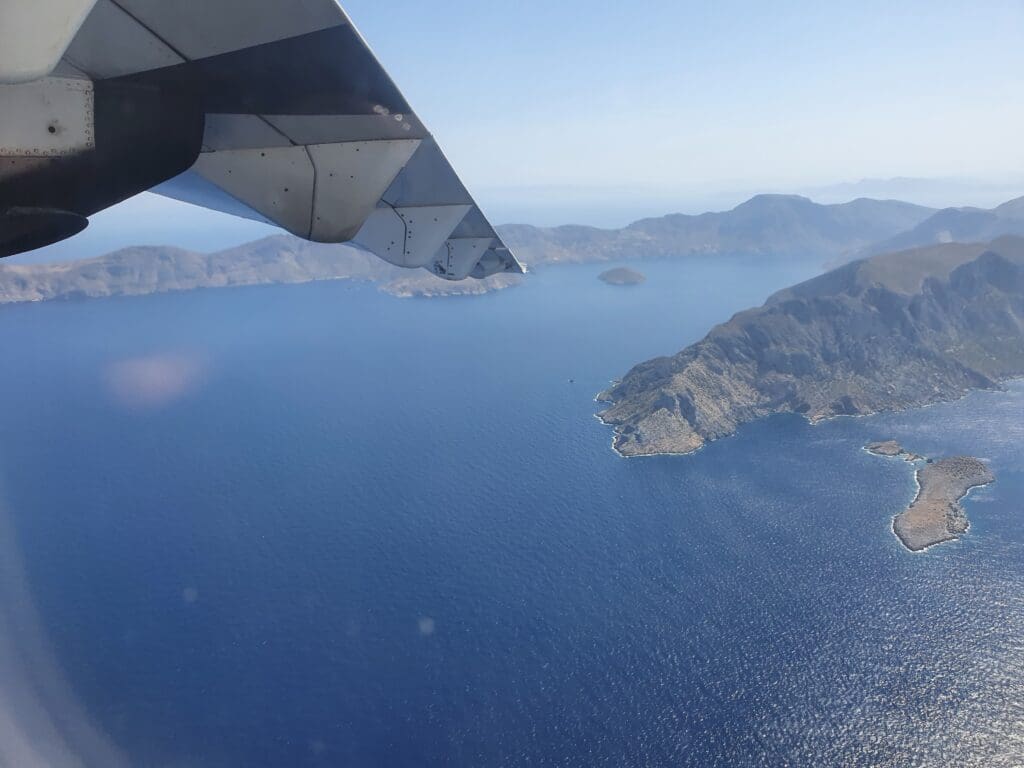
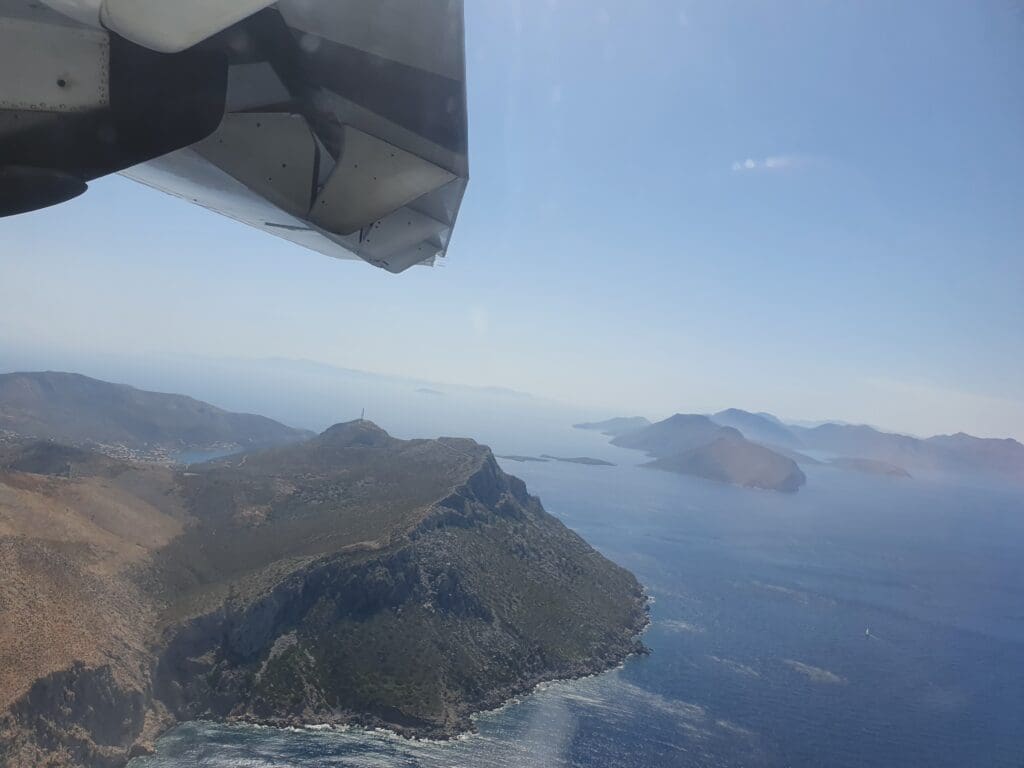
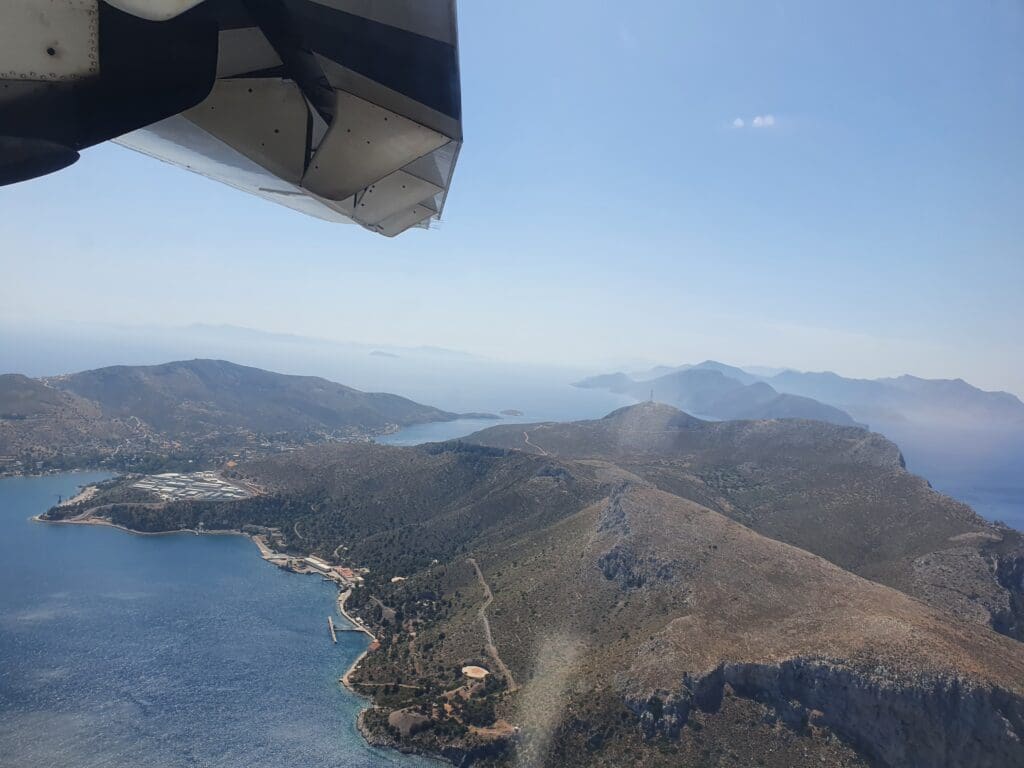
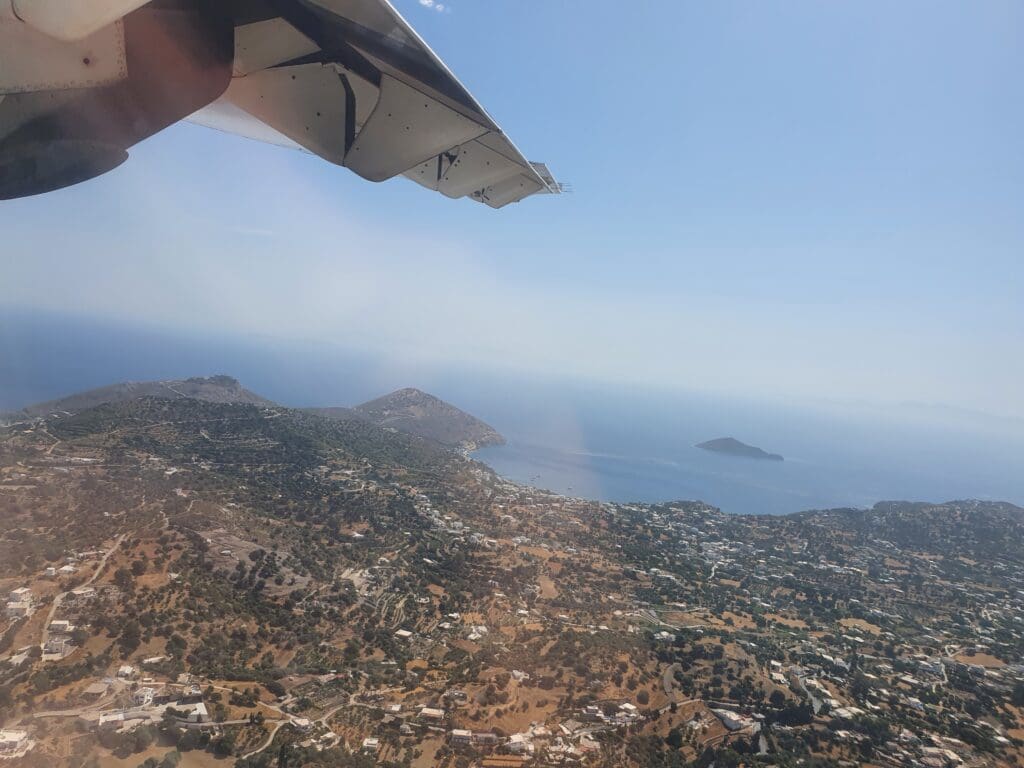
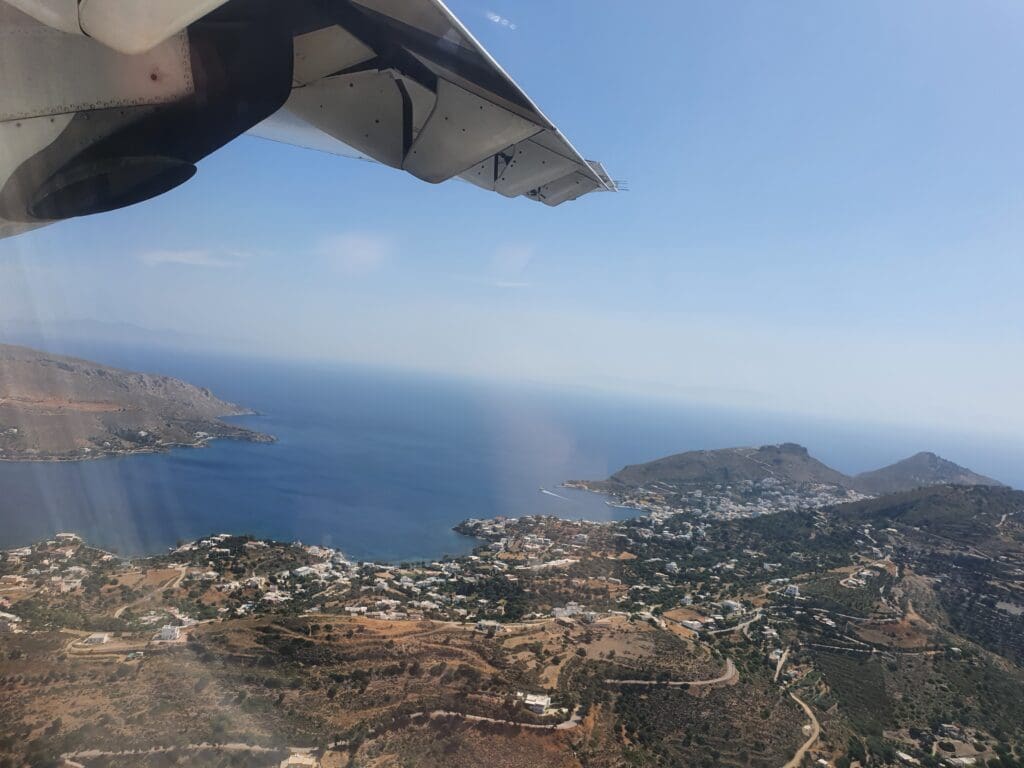
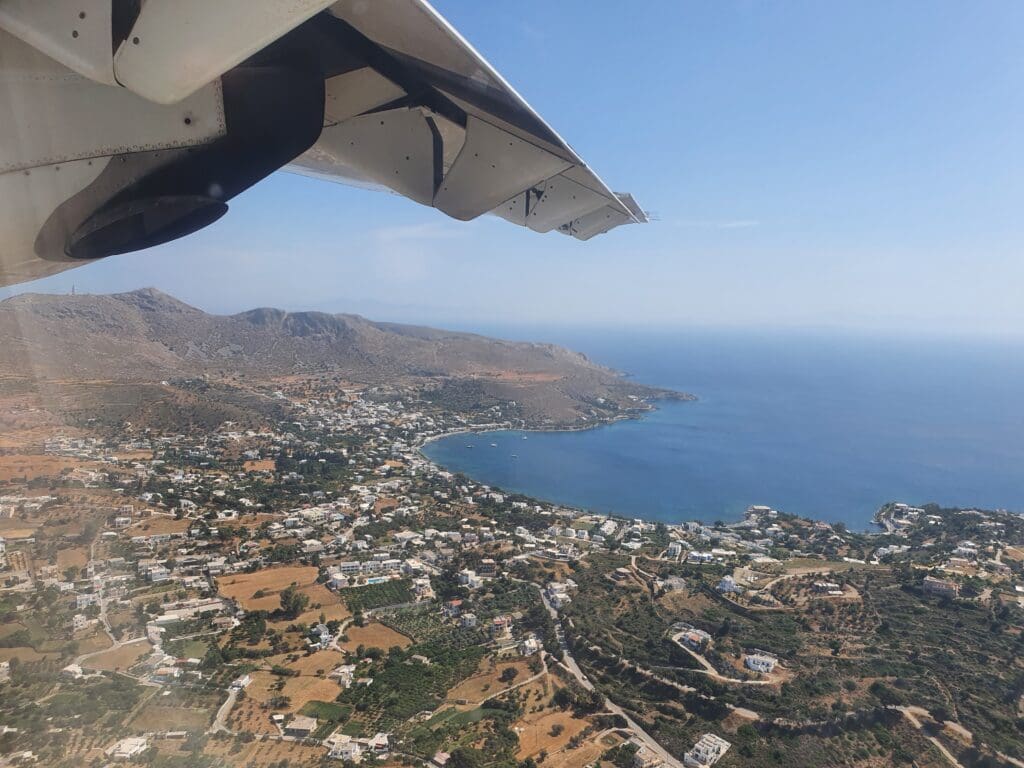
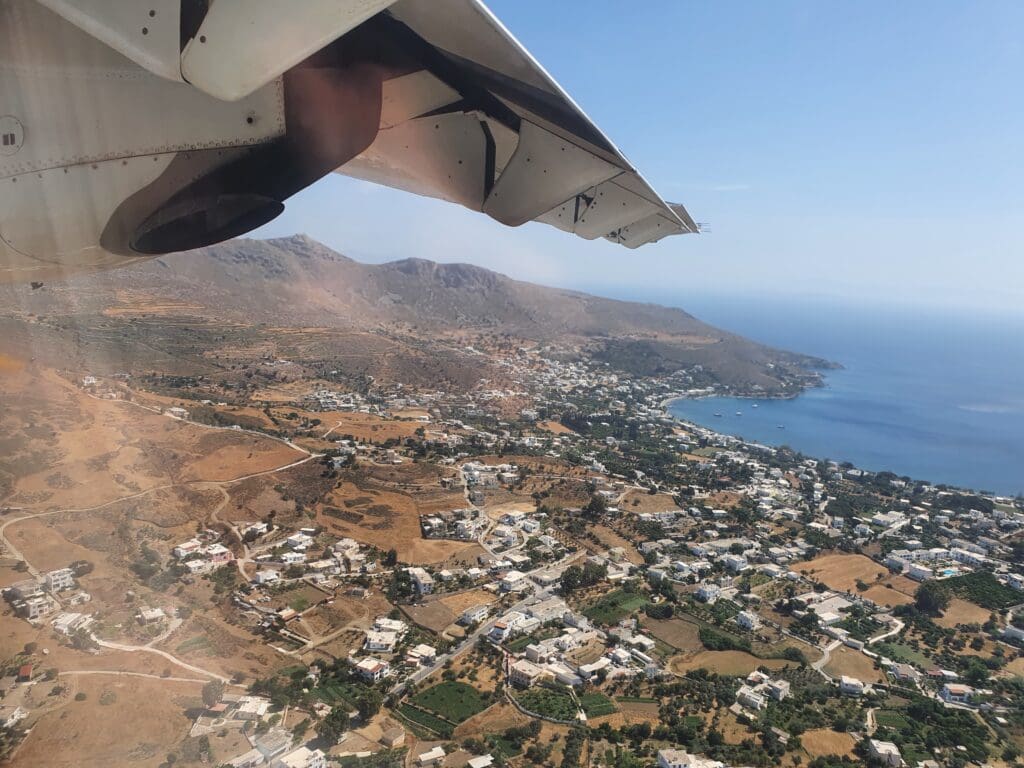
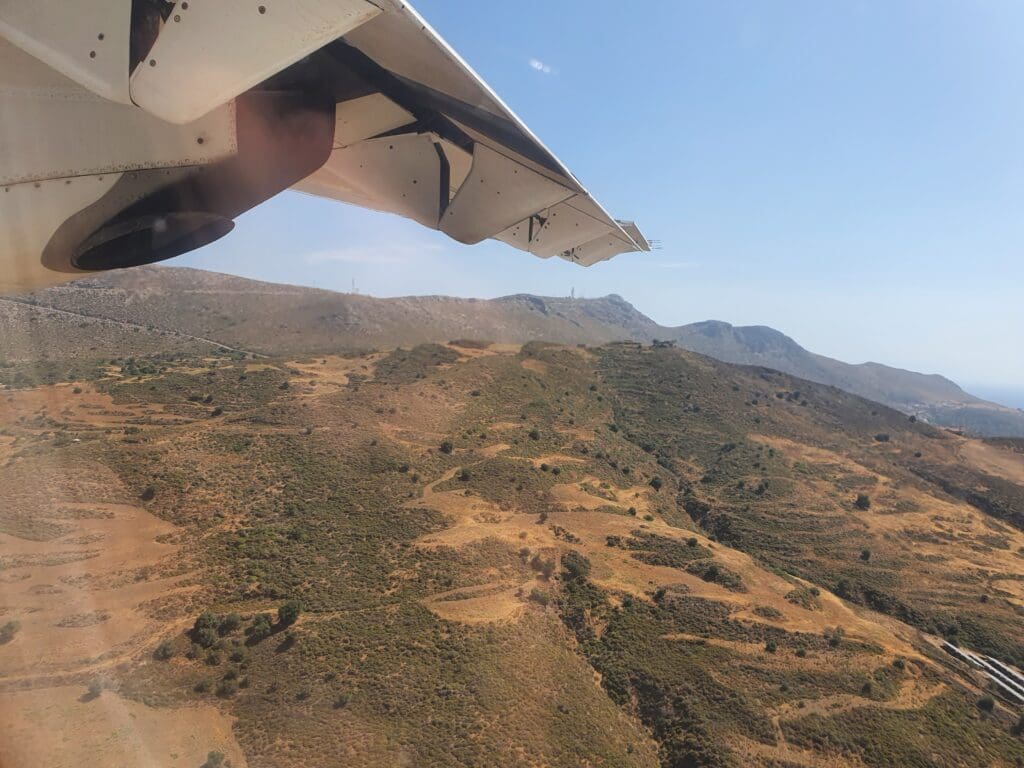
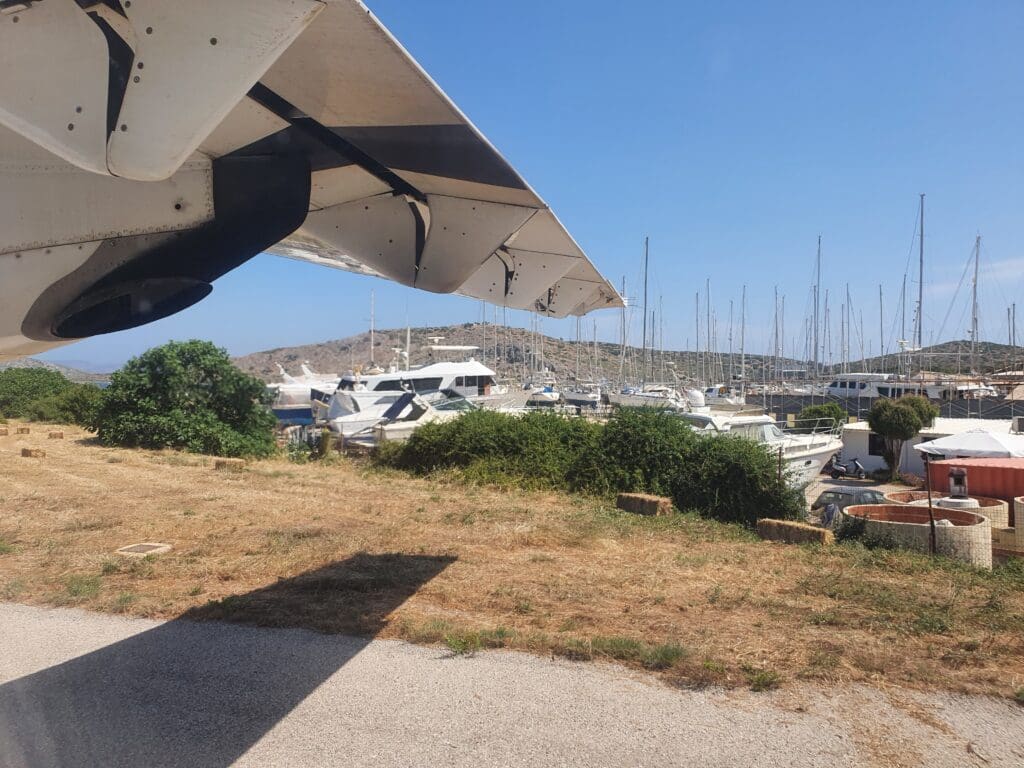
Following just seven minutes in the air, the aircraft sank over the airport’s perimeter fence with the small, homely and rather traditional-looking stone terminal coming into view. At 1030, the aircraft made another firm touchdown on Runway 32 before decelerating rapidly. As the aircraft slowed, the masts of tens of yachts in the neighbouring boatyard could be seen just before the aircraft turned around only metres away from the blue waters of the bay. Following a quick backtrack, the aircraft vacated the runway to the left and seconds later came to a halt directly outside Leros Airport’s small terminal building. Given the procedures at all other stops during the journey, once the cabin door opened I was surprised and slightly disappointed to find that those heading onwards to Astypalaia were advised to remain onboard the aircraft. There, as in Kalymnos, no passengers left the flight, however, the two Captains emerged from the cockpit and gave a friendly ‘yassas’ to all passengers before heading outside for a quick breath of fresh air.
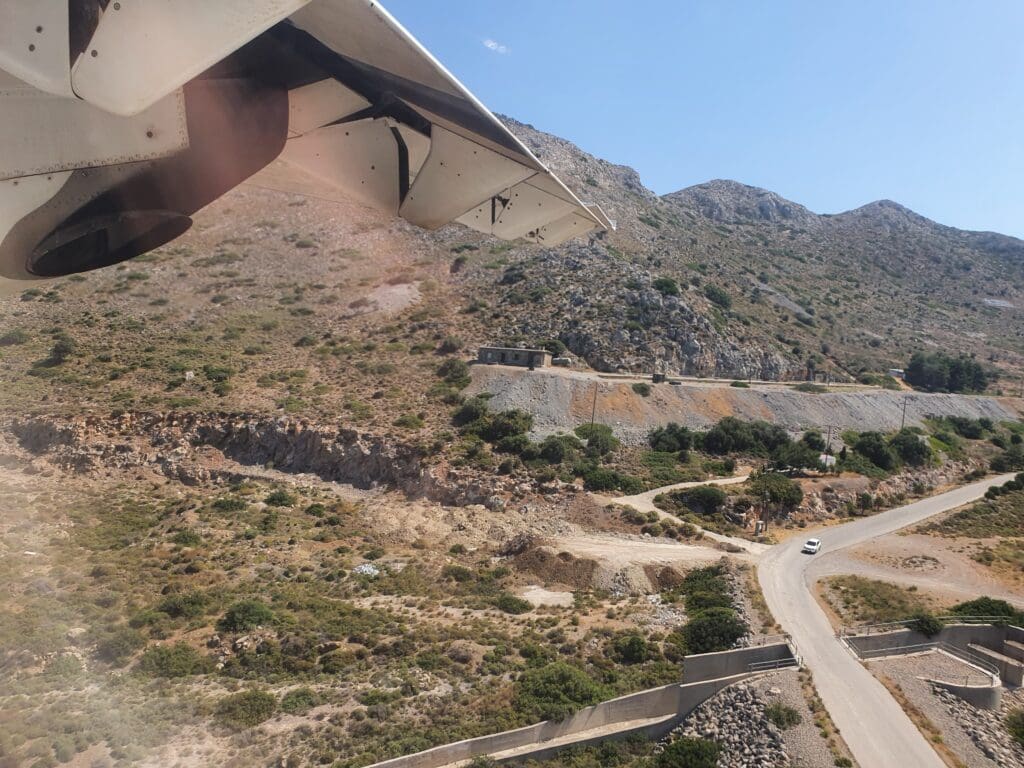
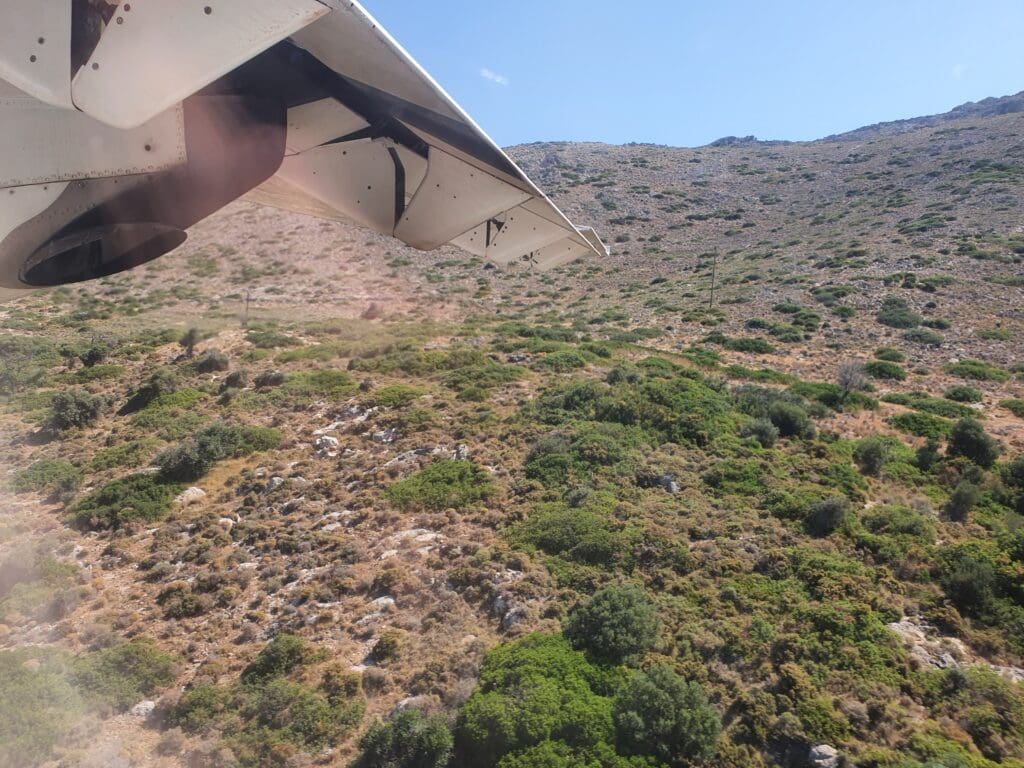
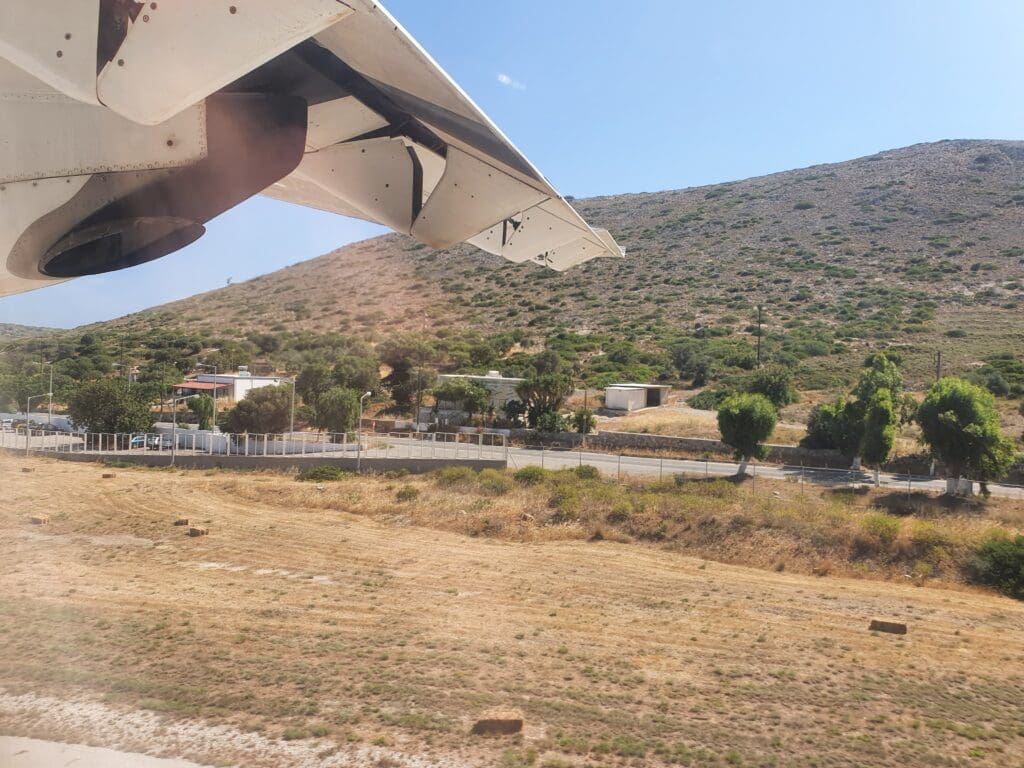
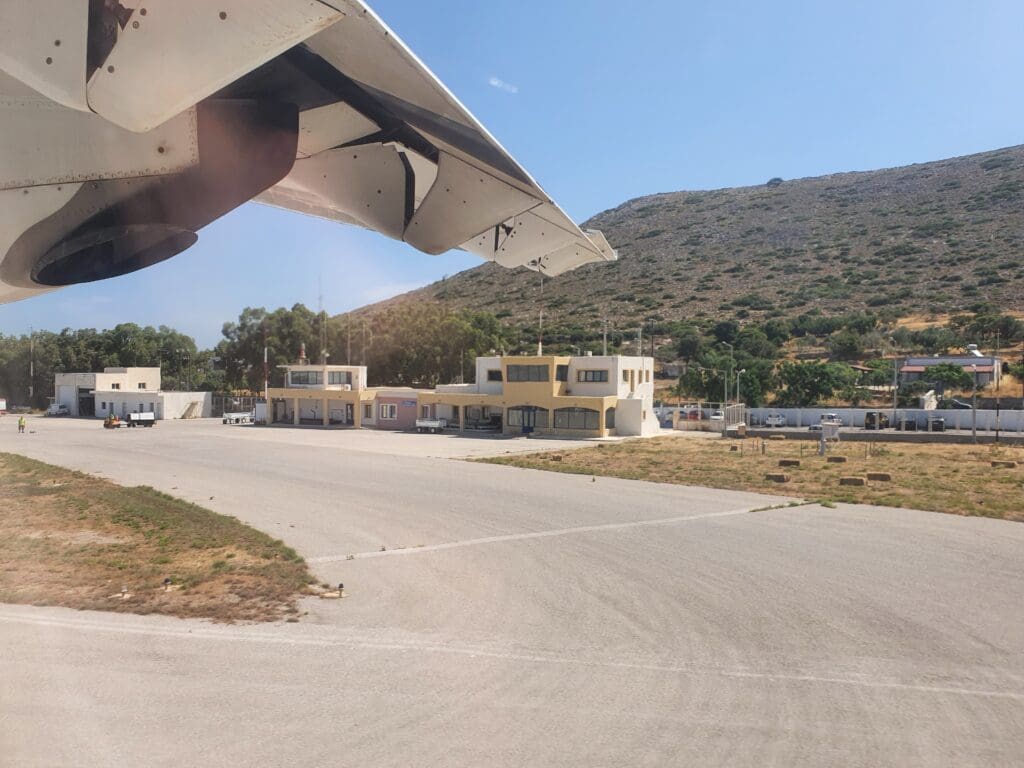
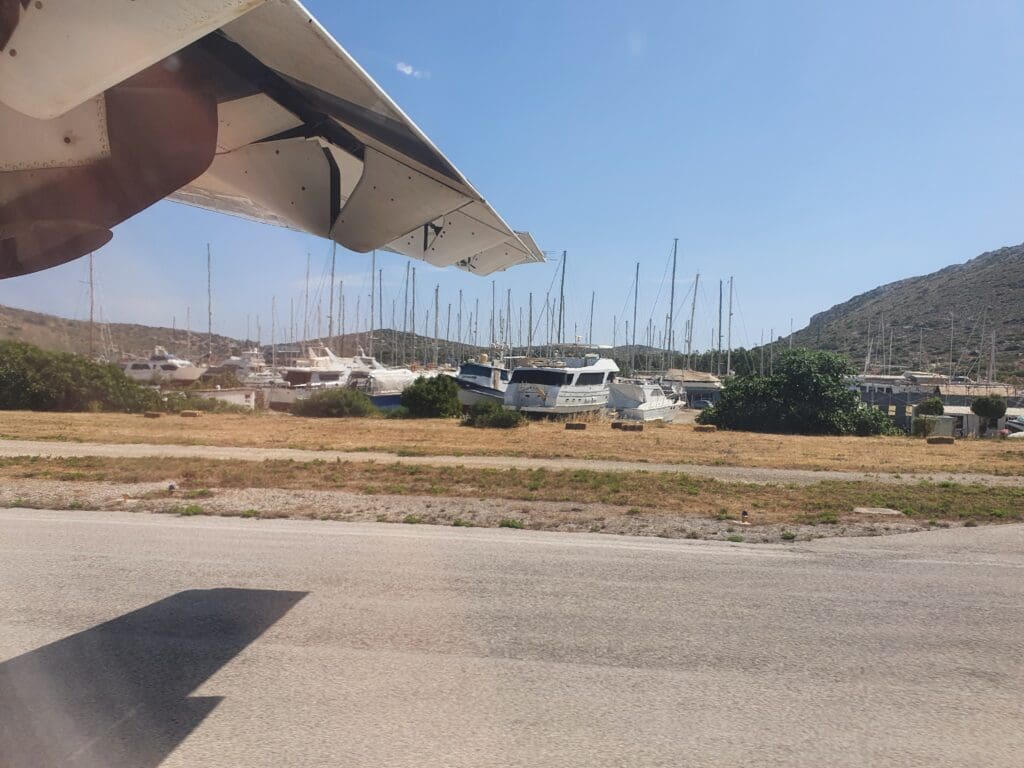
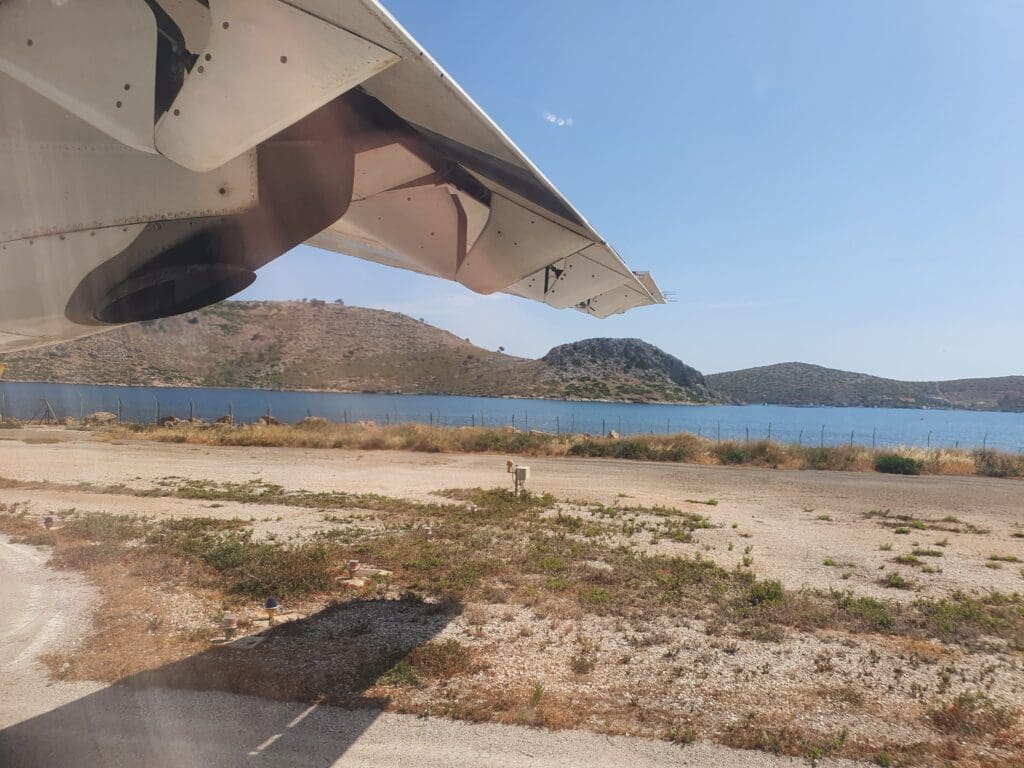
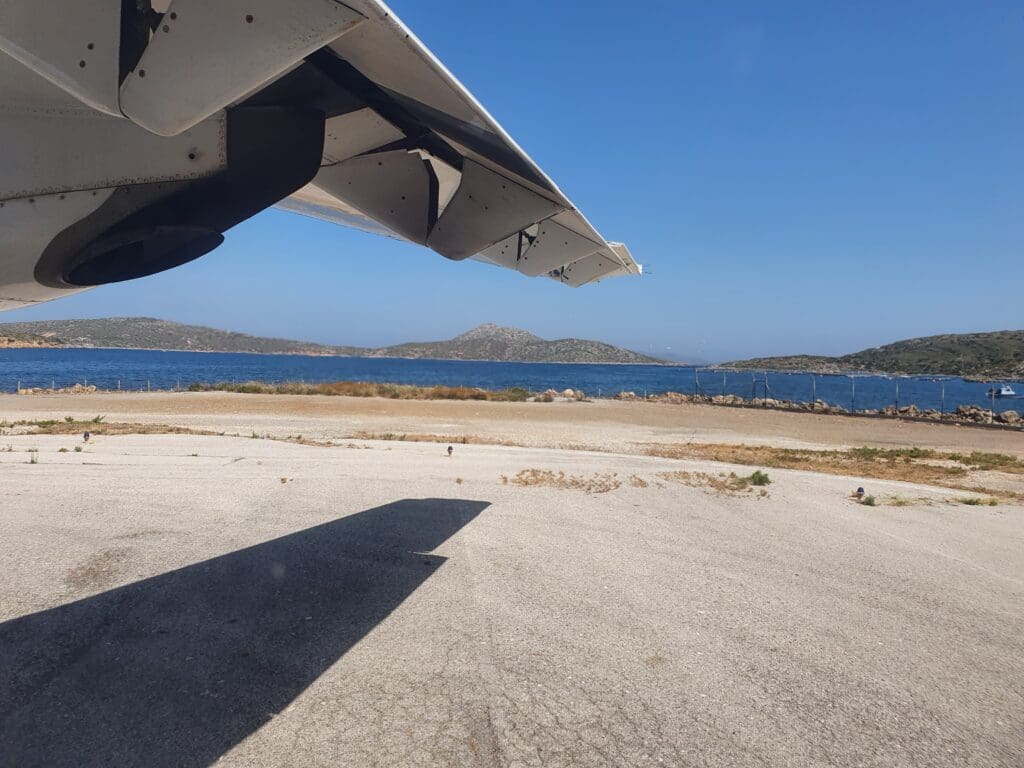
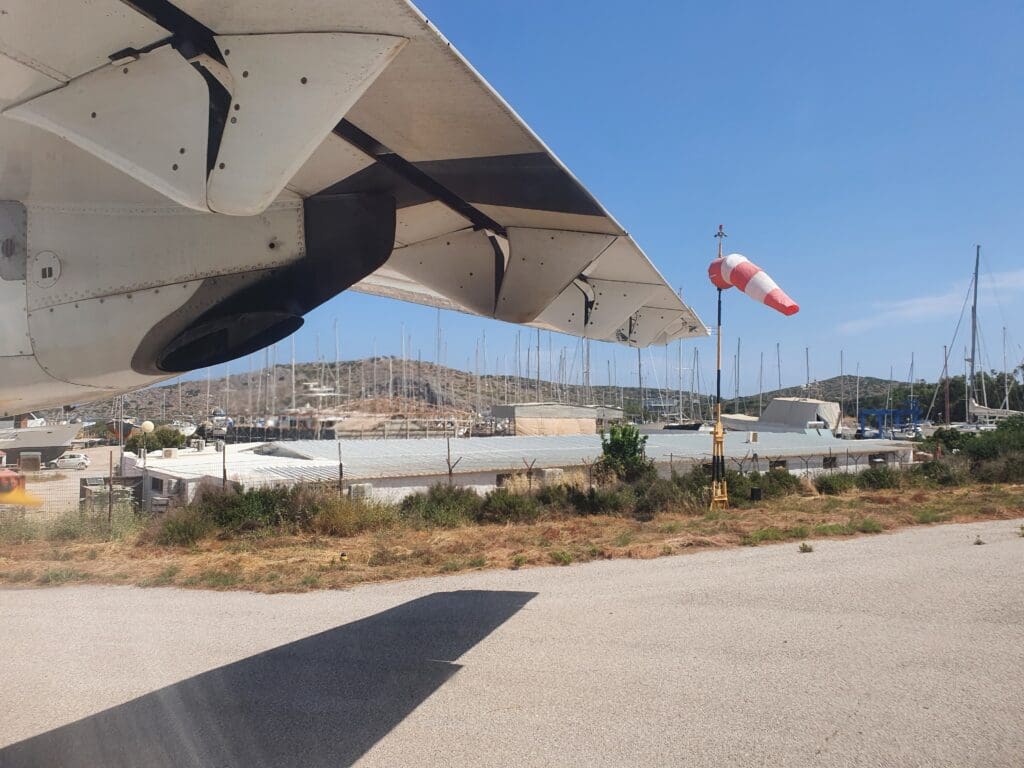
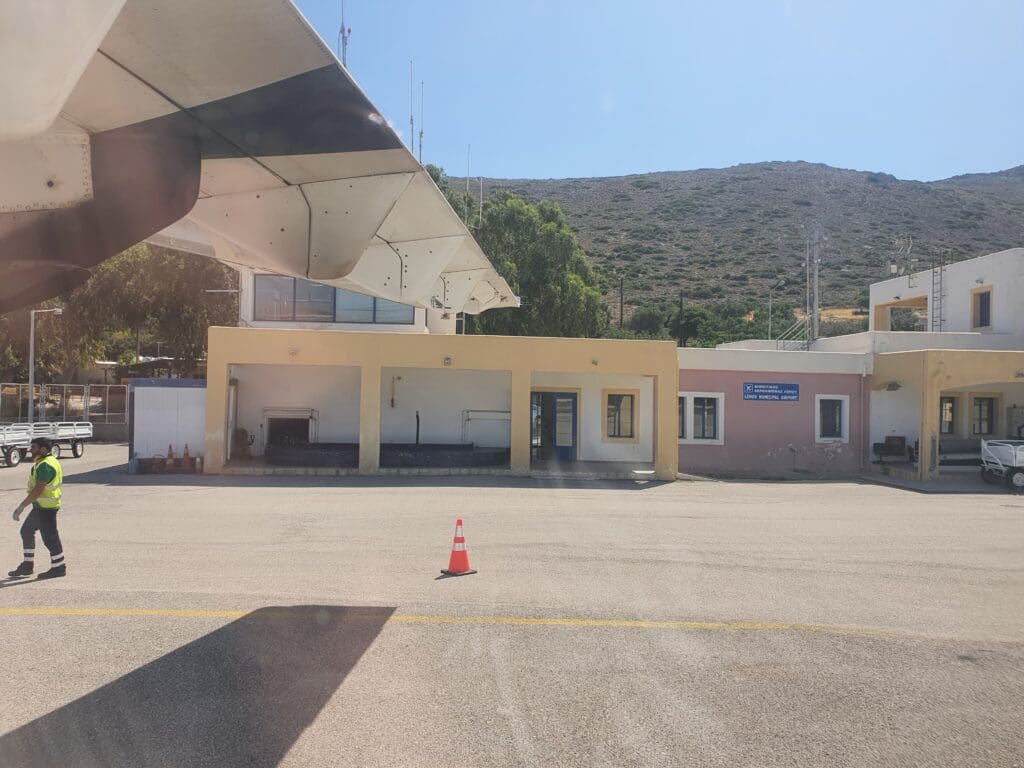
After around ten minutes on the ground, five passengers joined the aircraft followed by the two pilots. Unlike at the other stops, it appeared as if a punctual departure was on the cards as the flight attendant closed the cabin door at 1044, well ahead of our 1055 departure time from Leros. Once the cabin door had been closed, the two engines began to power into life and the flight attendant performed their fourth welcome announcement of the flight, advising of a flight time of fifteen minutes on the next leg of the trip to Astypalaia. This was then followed by the safety announcement and demonstration, and at 1048 the aircraft commenced its journey to the end of Runway 32. This initially took us past the boatyard before the ATR entered the runway and commenced a short backtrack to the end of this.
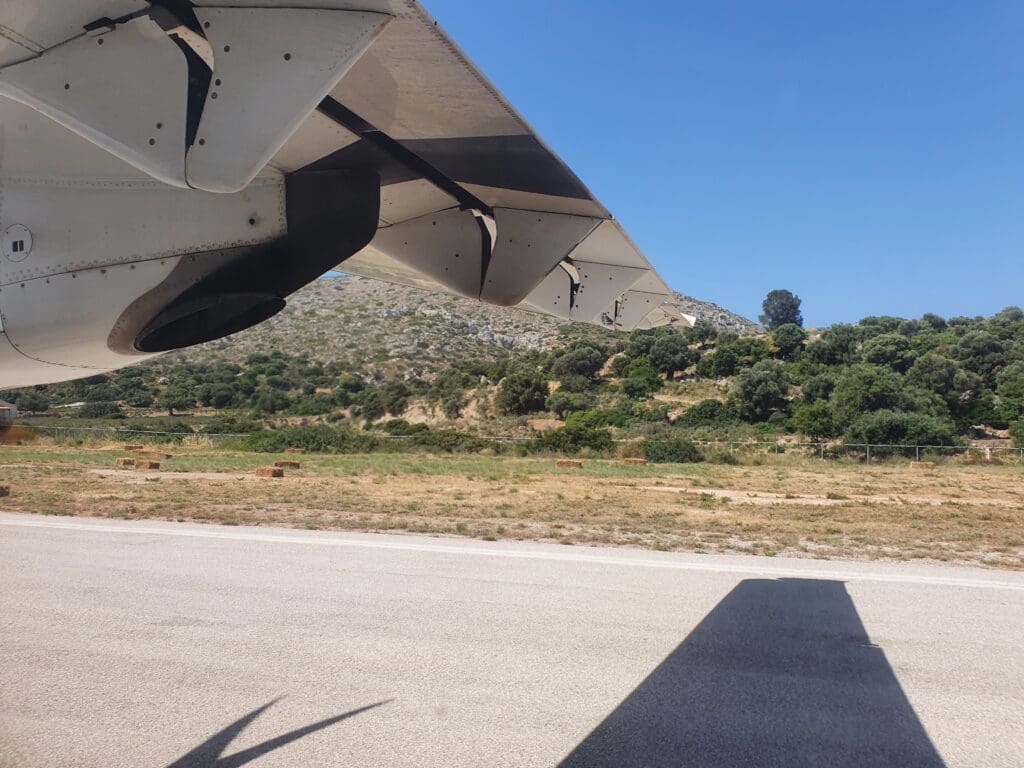
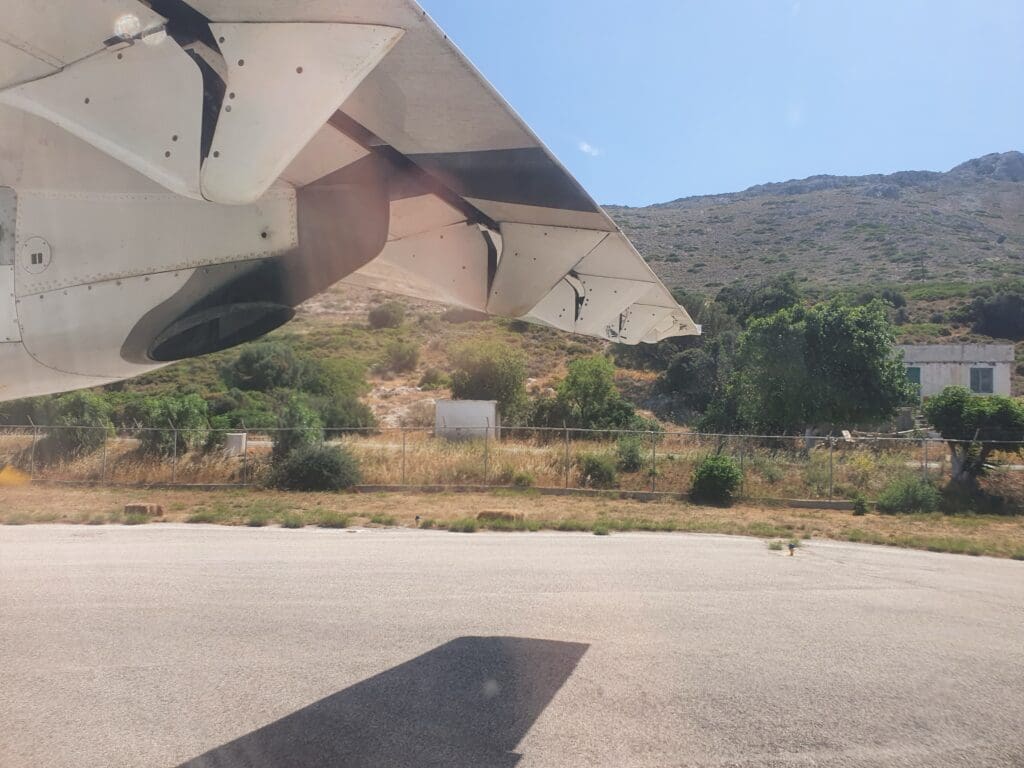
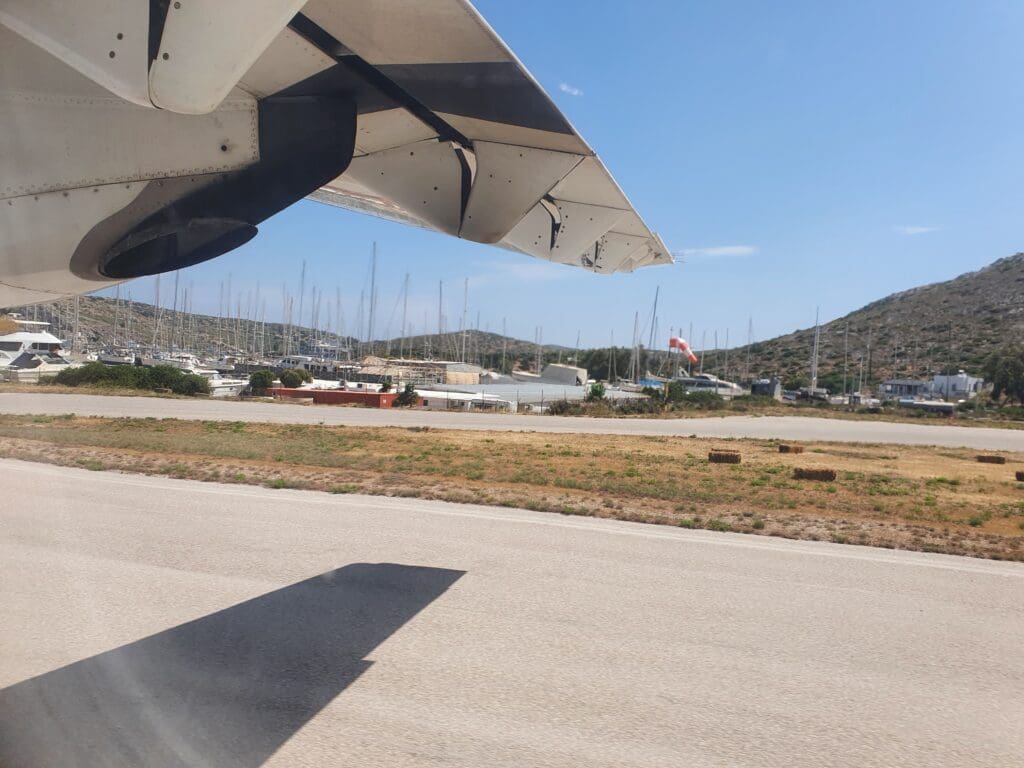
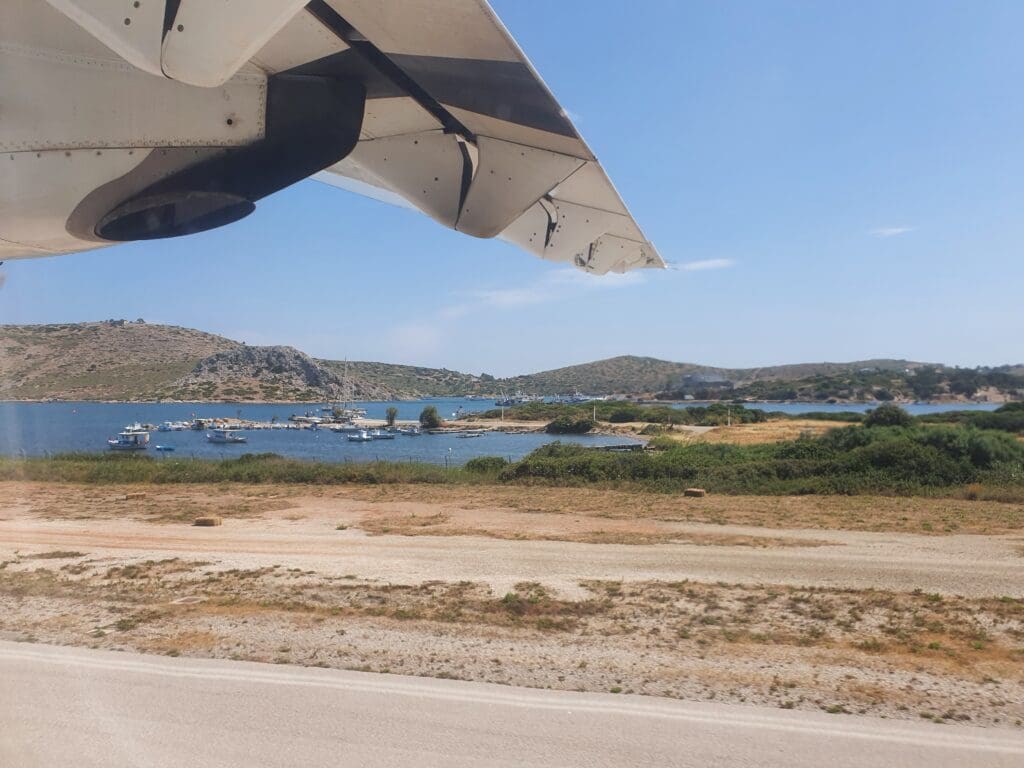
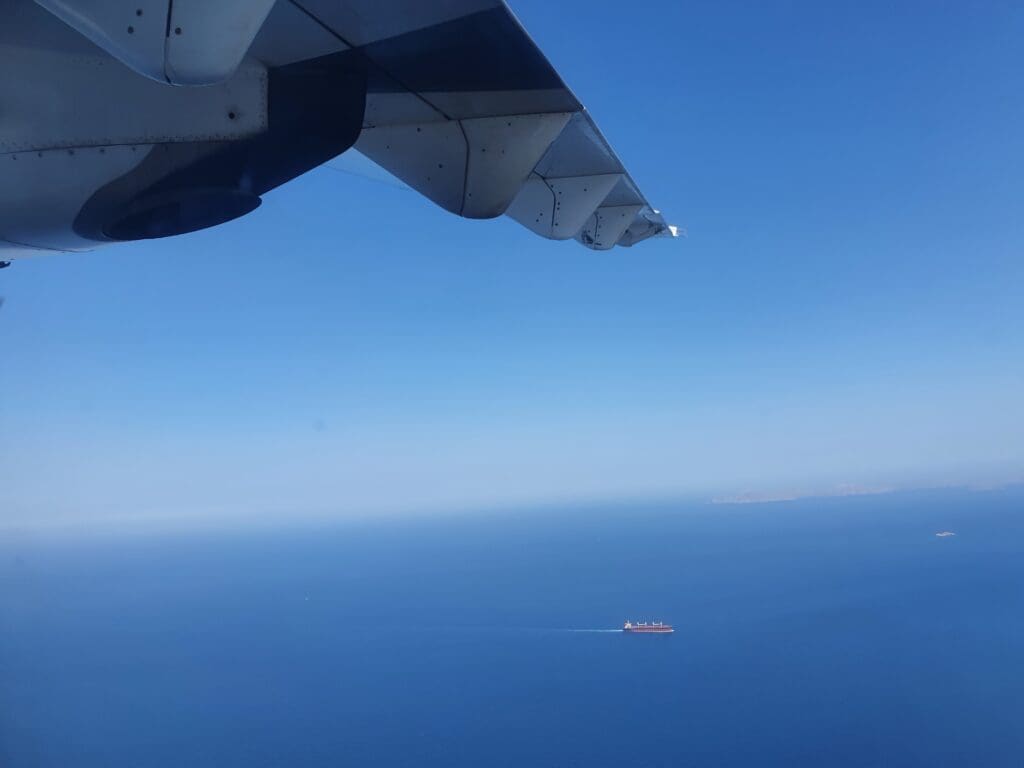
At 1051, the aircraft powered down the runway and made yet another powerful takeoff during which a good view of the neighbouring bay and the small island of Archangelos could be had before the aircraft banked left, rolling out on a southerly heading that would take us down to Astypalaia. Immediately after departure, the flight attendant performed an announcement advising passengers to keep their seatbelts on for the duration of the flight owing to its short length. Sitting on the right-hand side of the aircraft, once away from Leros, little could be seen other than the blue seas below and the islands of Amorgos, Kinaros and Levitha in the distance as the aircraft trundled southwards.
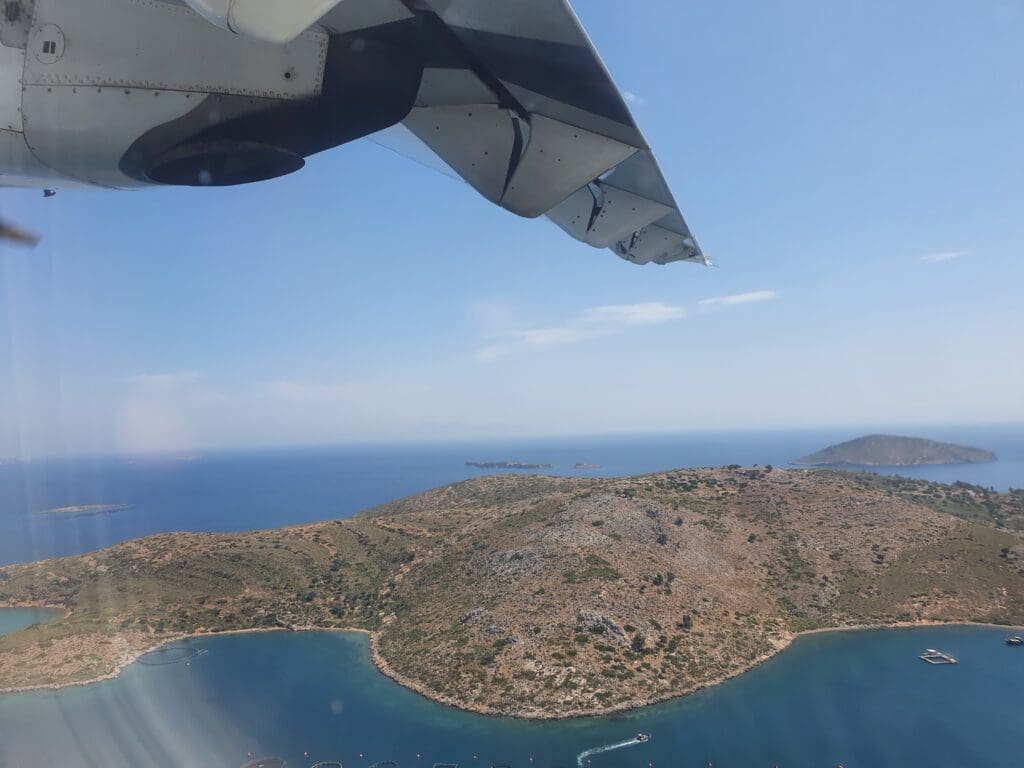
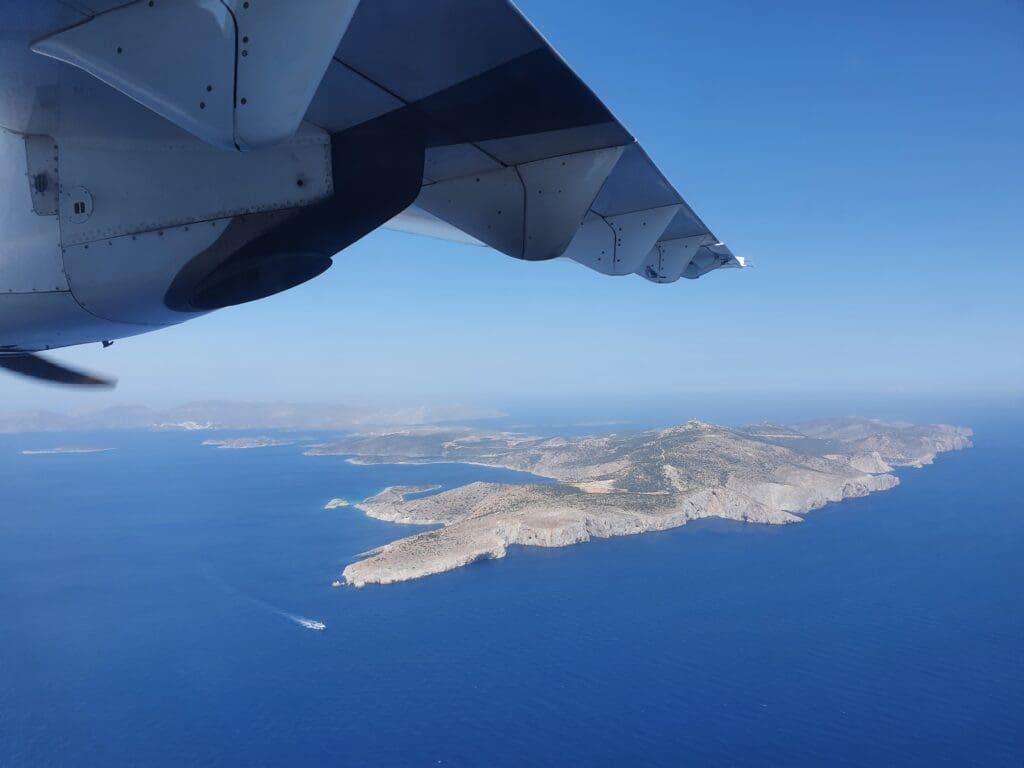
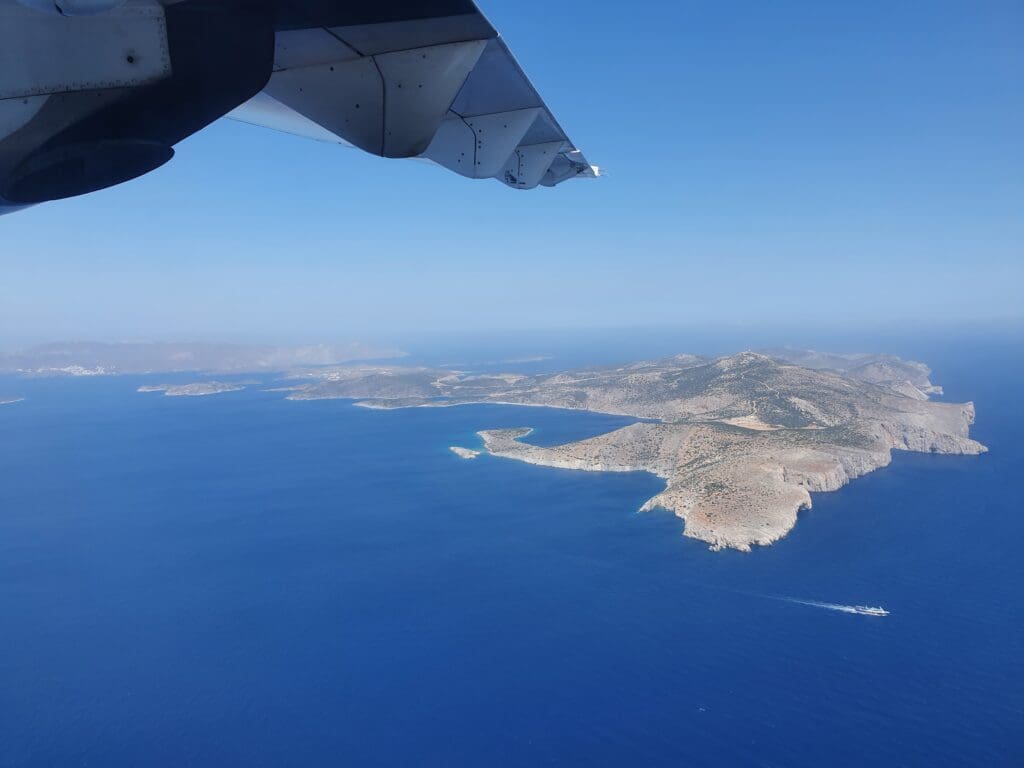
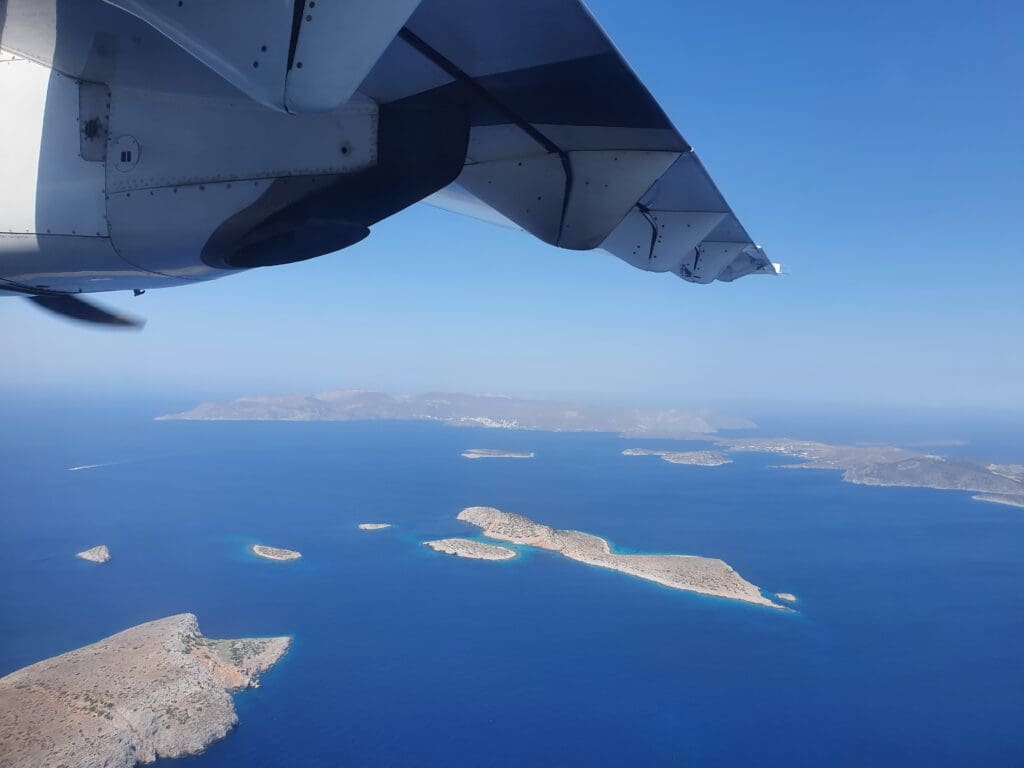
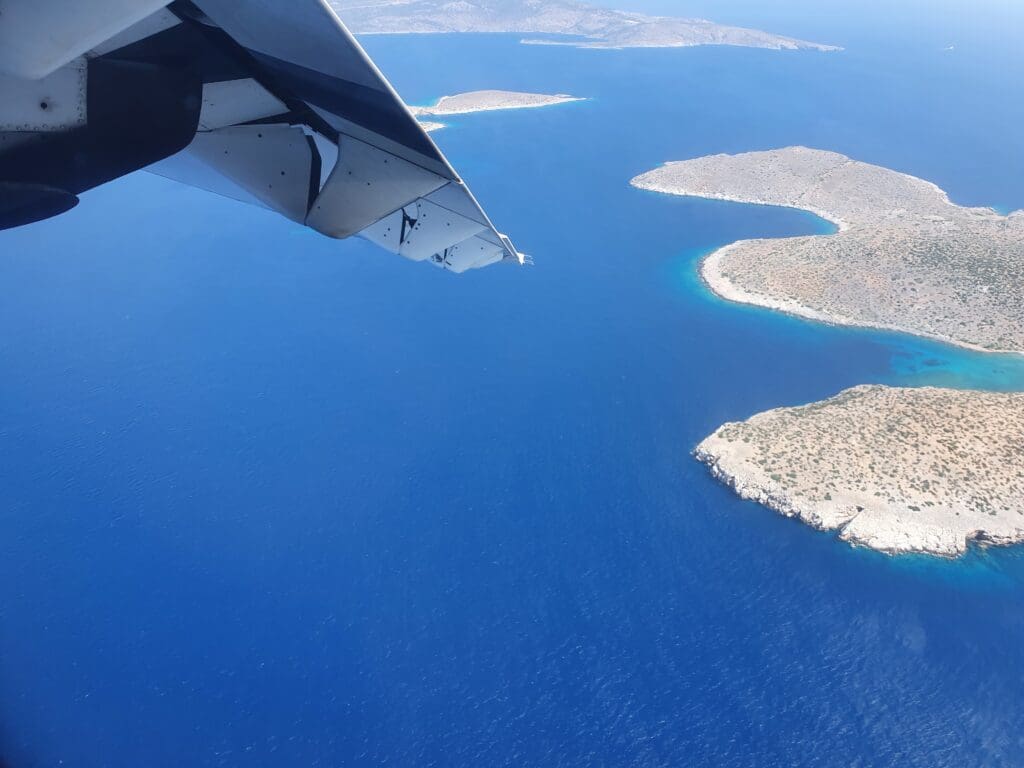
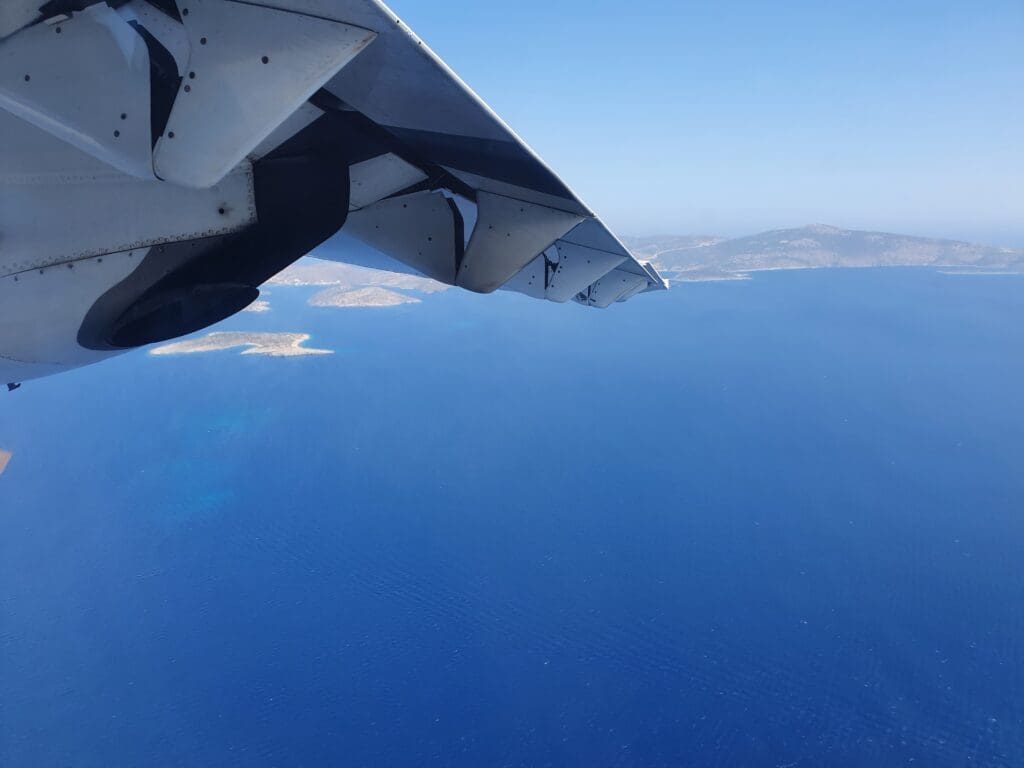
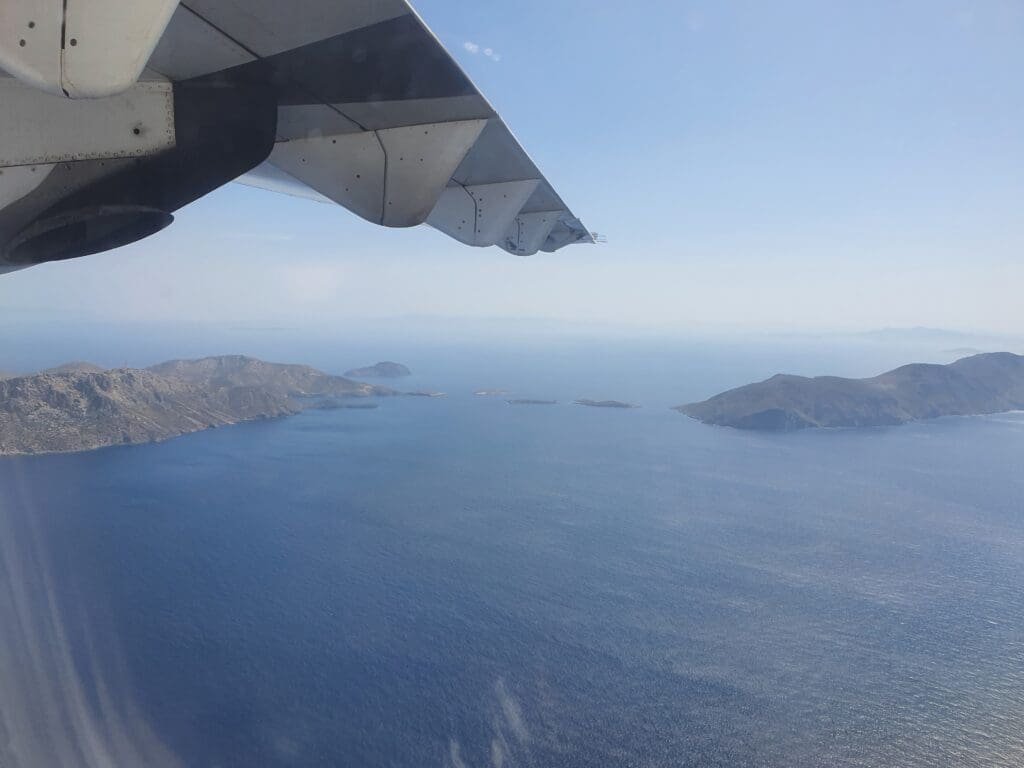
A grand total of four minutes after taking to the skies, the Captain made their familiar request, asking for the flight attendant to prepare the cabin for landing at which point the flight attendant performed their usual pre-arrival announcement. A short time after this, the northern portion of Astypalaia came into view as the aircraft crossed over a cluster of small islands that sit just to the south of Astypalaia. After turning to line up for an approach to Runway 33, the ATR’s landing gear and flaps fell into position as we edged towards the island.
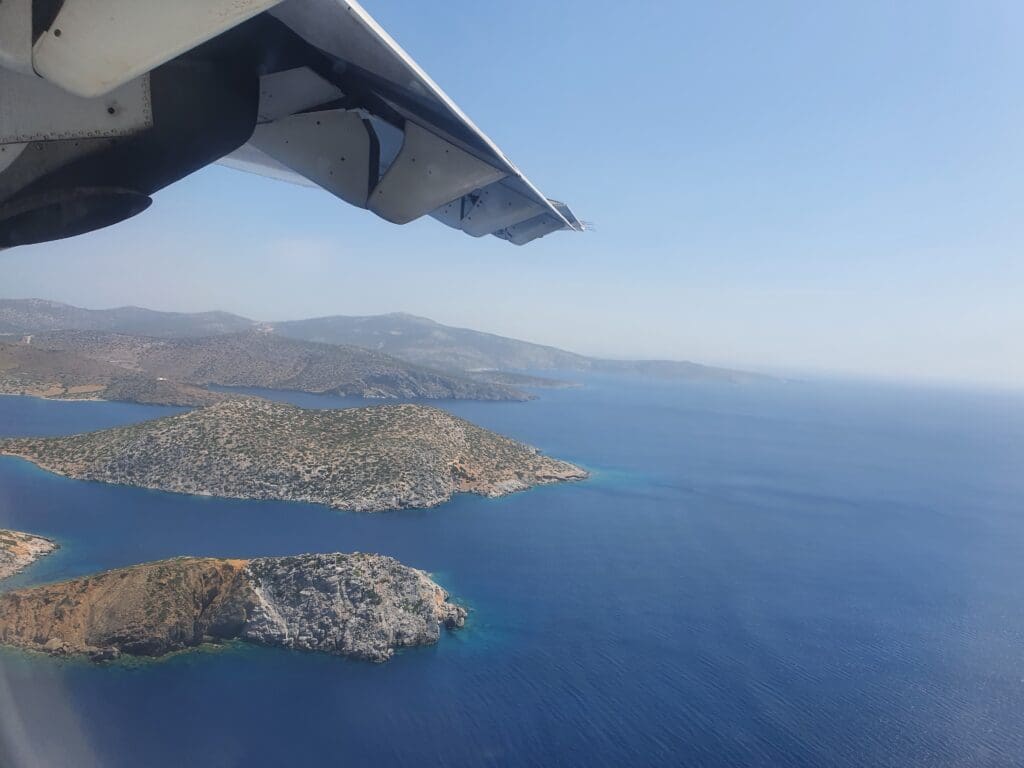
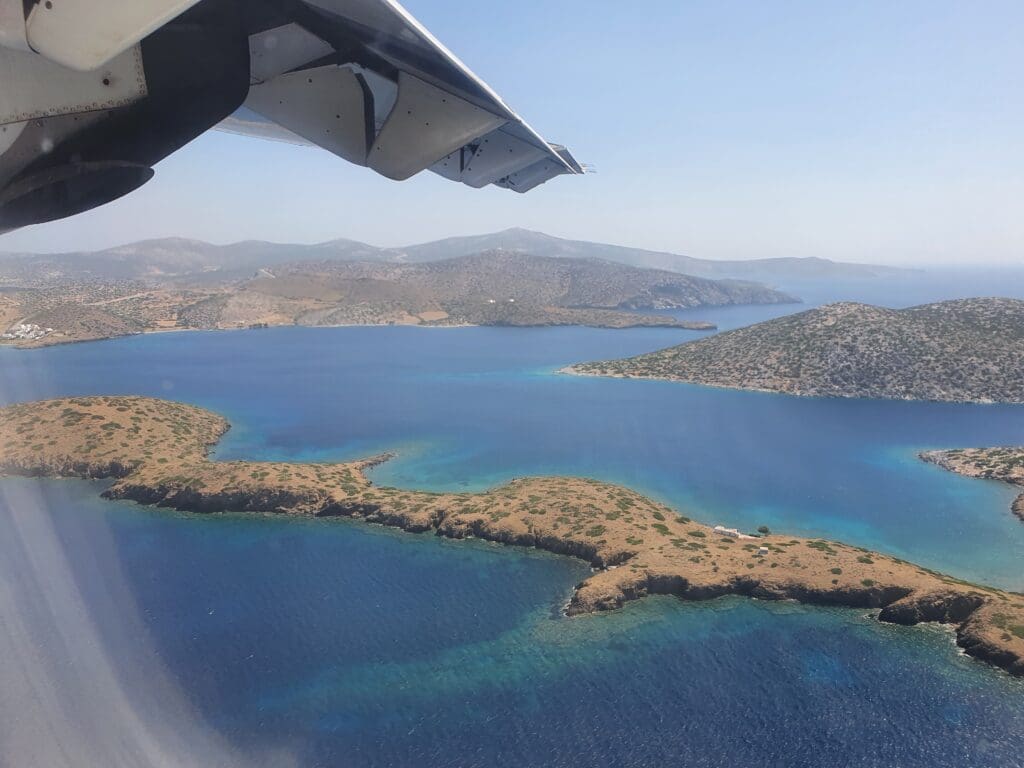
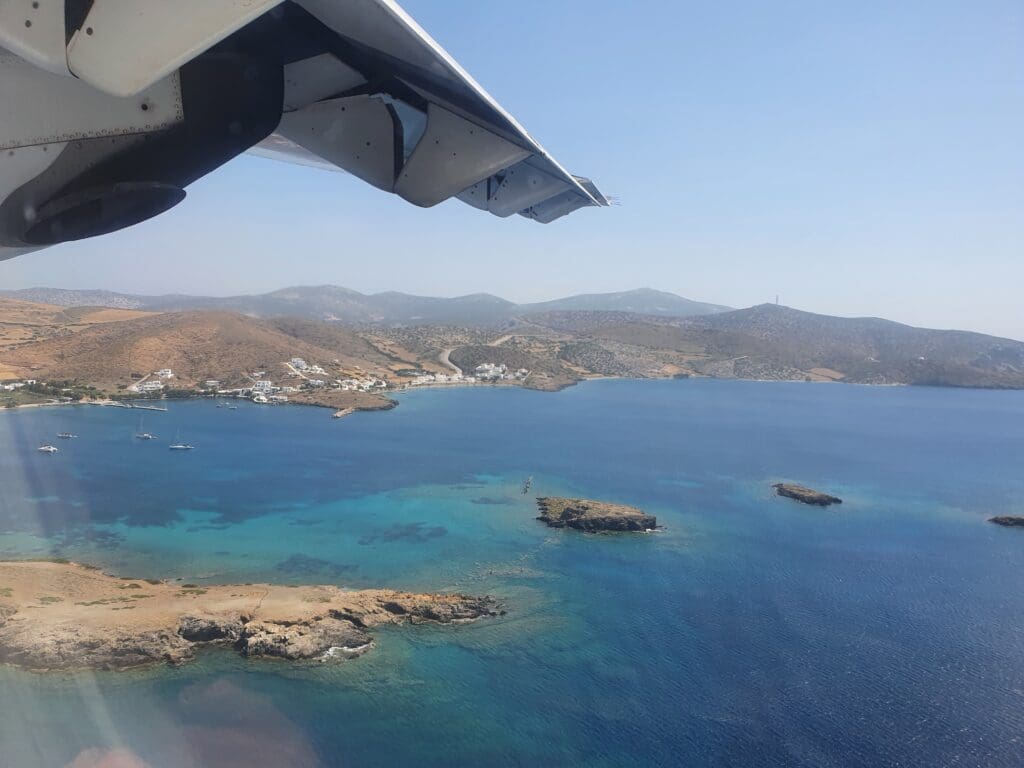
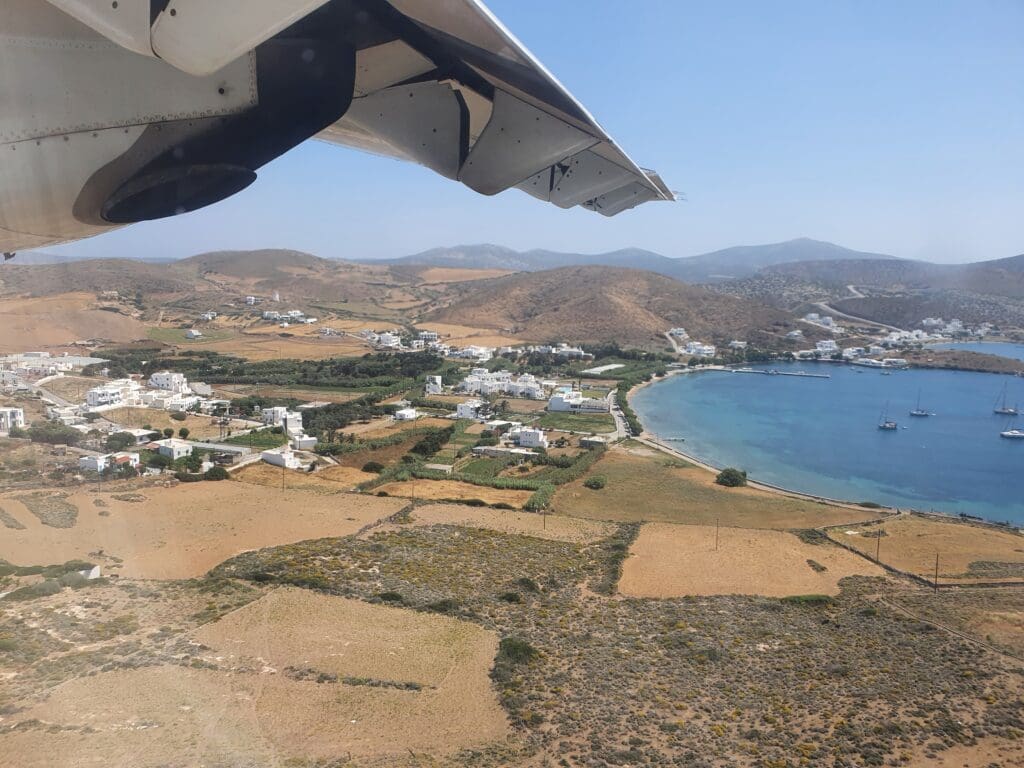
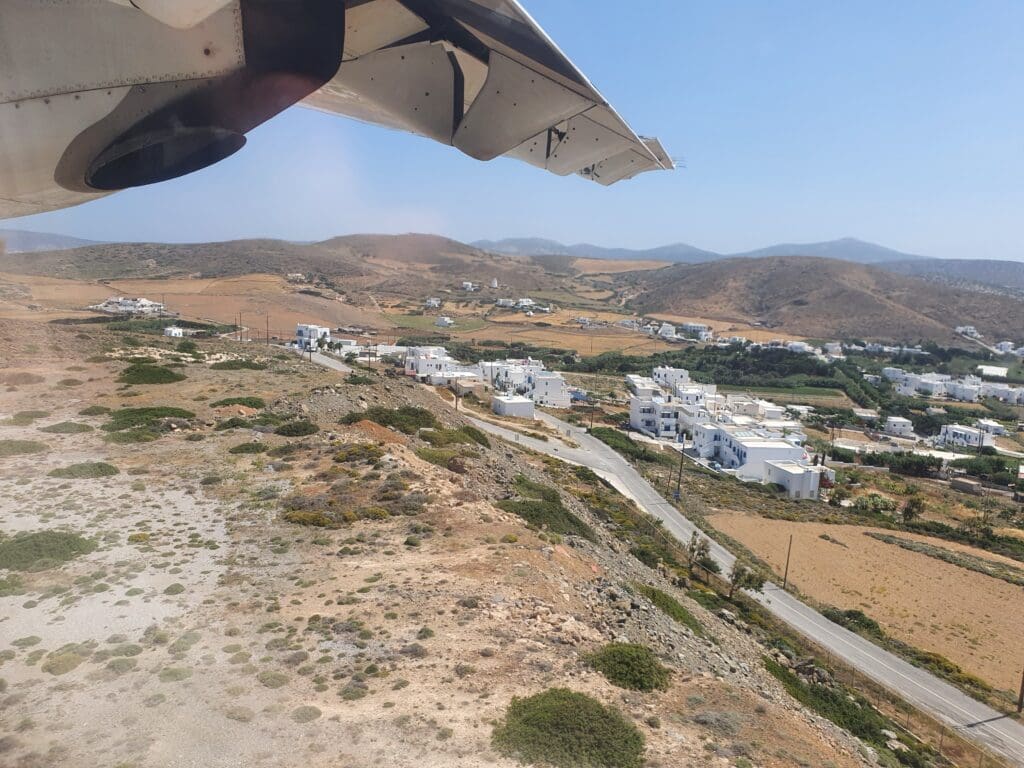
After crossing the coastline just to the south of the village of Analipsi, the ATR soon descended down over the airport’s perimeter fence and made yet another firm touchdown on the seemingly bumpy runway. Standing at 989 metres long, with Astypalaia Airport featuring the shortest runway of all airports visited during the flight, it did not come of much as a surprise to find that the aircraft decelerated rather harshly before turning around at the end of this. Upon whizzing past the terminal, a waiting fire engine could be seen standing outside of its shed with its lights flashing, ready to respond if required. This served to remind me of my first solo flight whereby the airfield’s fire Land Rover followed me down the runway during both take-off and landing!
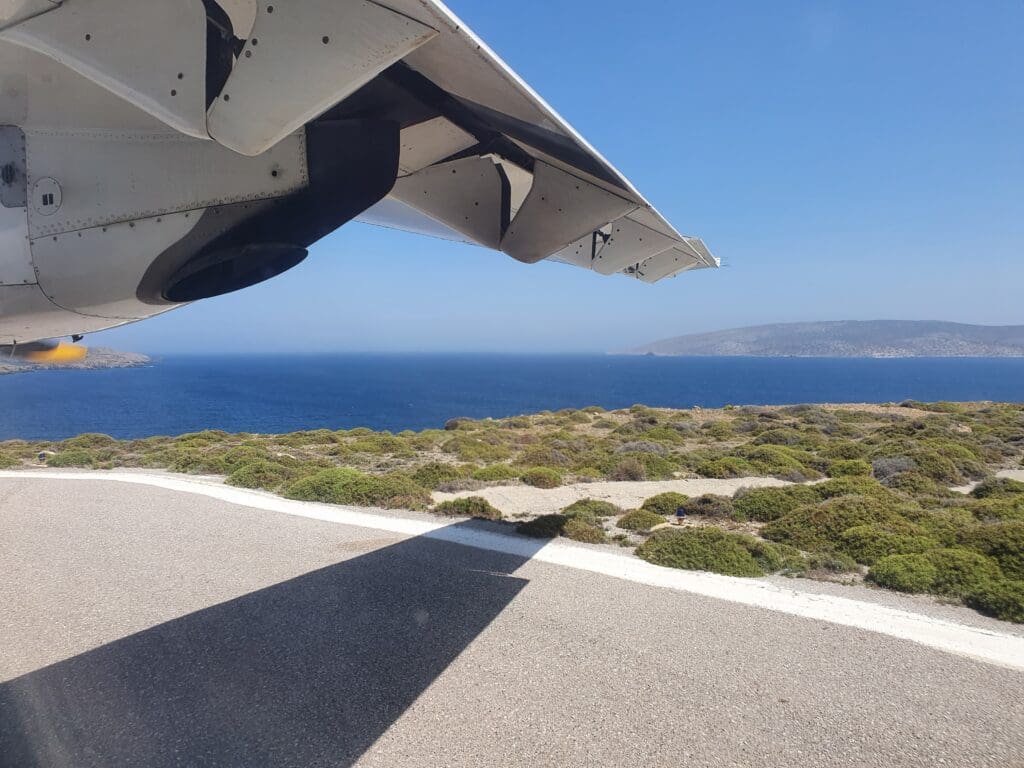
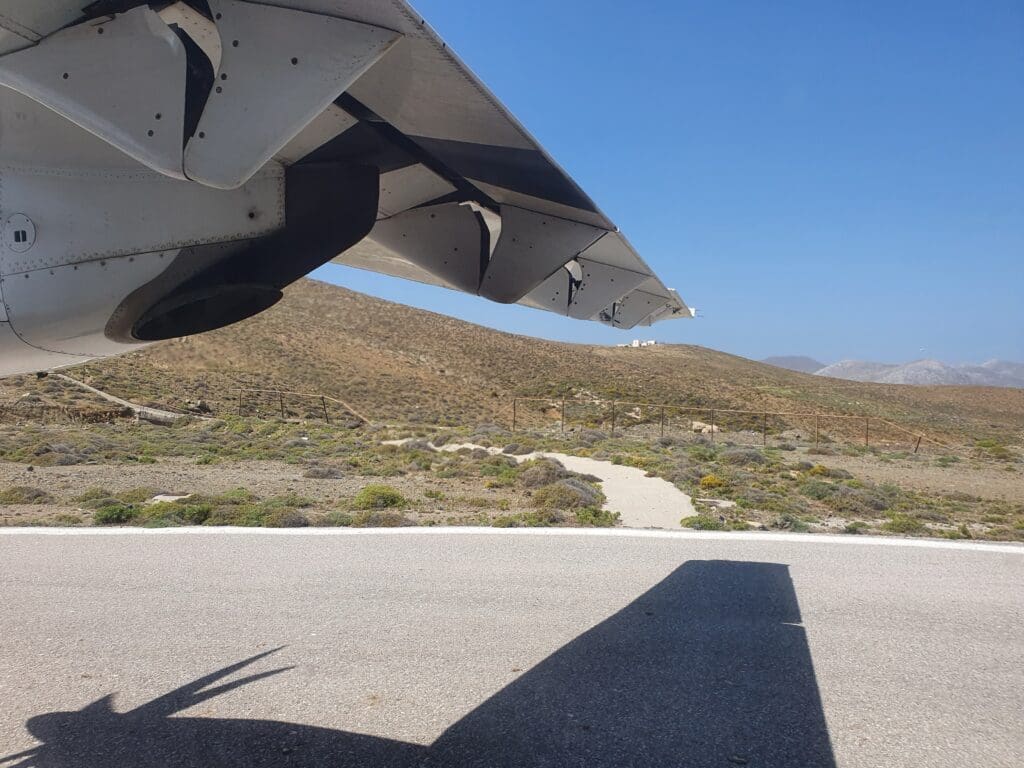
A couple of minutes after touching down, the ATR reached the apron and came to a stop a short way away from the small terminal building. Interestingly, Astypalaia was the first place since Kos where another aircraft could be seen on the ground, with this taking the form of a Piper PA-28R. Once the engines spooled down, the cabin door was opened and being the final destination of the flight, all passengers were required to disembark the aircraft. After thanking the flight attendant, I exited the aircraft and upon doing so received a friendly welcome to Astypalaia from one of the ground agents before walking across the apron to the terminal building. As it turned out, Astypalaia Airport is not really designed to be a hub with no option to head straight to the airside area for those transferring between flights on the island.
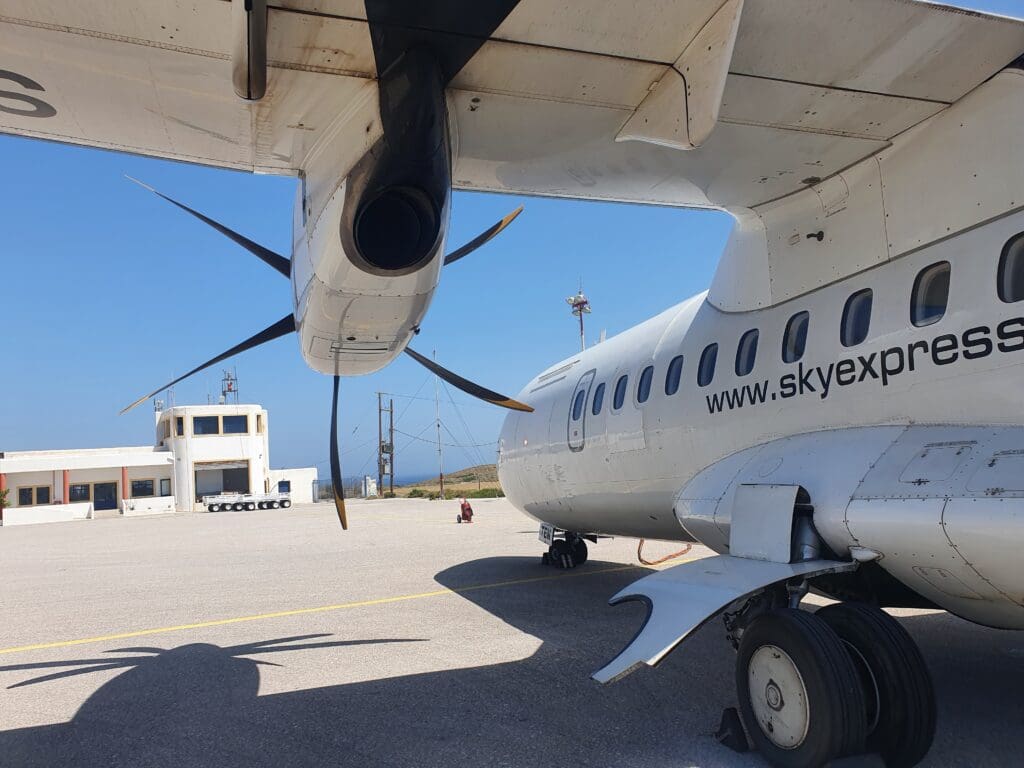
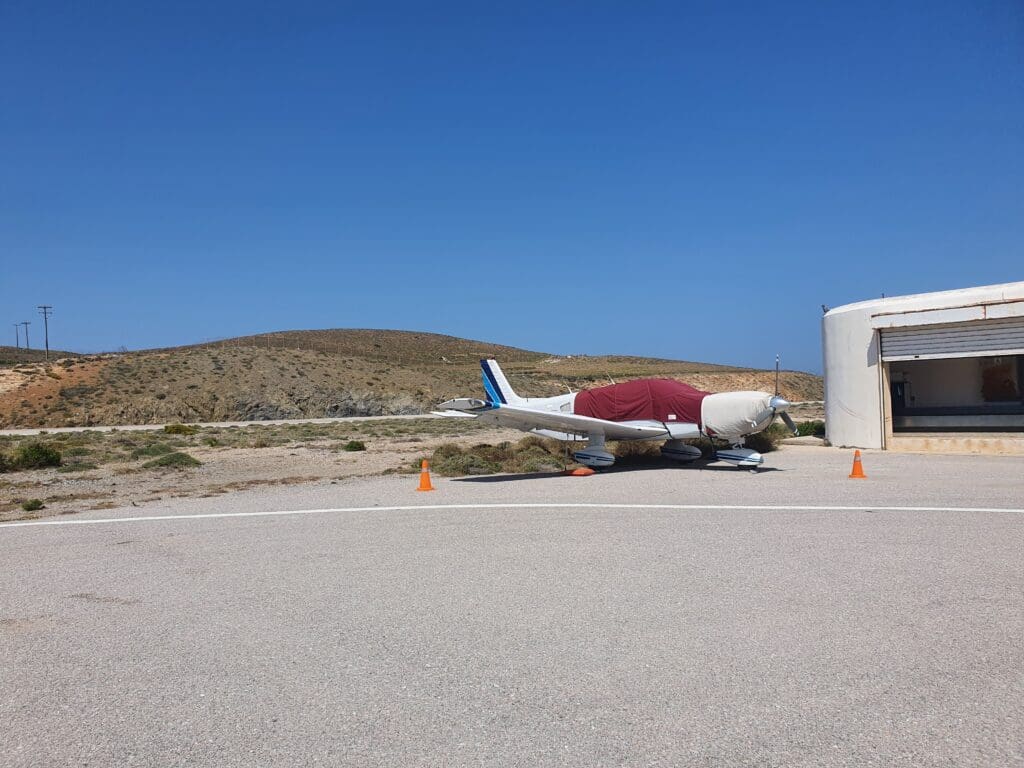
Inside, as with Kalymnos, Astypalaia Airport’s terminal was small and spartan yet functional with the landside area consisting of a check-in desk, some toilets and an x-ray scanner. Upon entering this, those bound for Athens could be seen waiting for the stern-looking police officer to open up the security check. Seeing no reason not to, I joined this queue although within a minute one of the agents called out my name at which point I made my way over to the check-in counter. Once there, a Skyserv agent requested to see my passport before handing me a paper boarding pass for the flight. As I rejoined the queue, the police officer opened up the security checkpoint and began scanning passengers’ luggage one by one. Within a few minutes, it was my turn and without any issues my backpack was scanned after which I was pointed in the direction of the airside waiting room. This consists of a small room with plastic chairs, windows that allow for a view out onto the apron and a couple of toilets off to one side of this. By this time, another Piper had arrived on the apron giving the impression that Astypalaia is a popular destination for light aircraft.
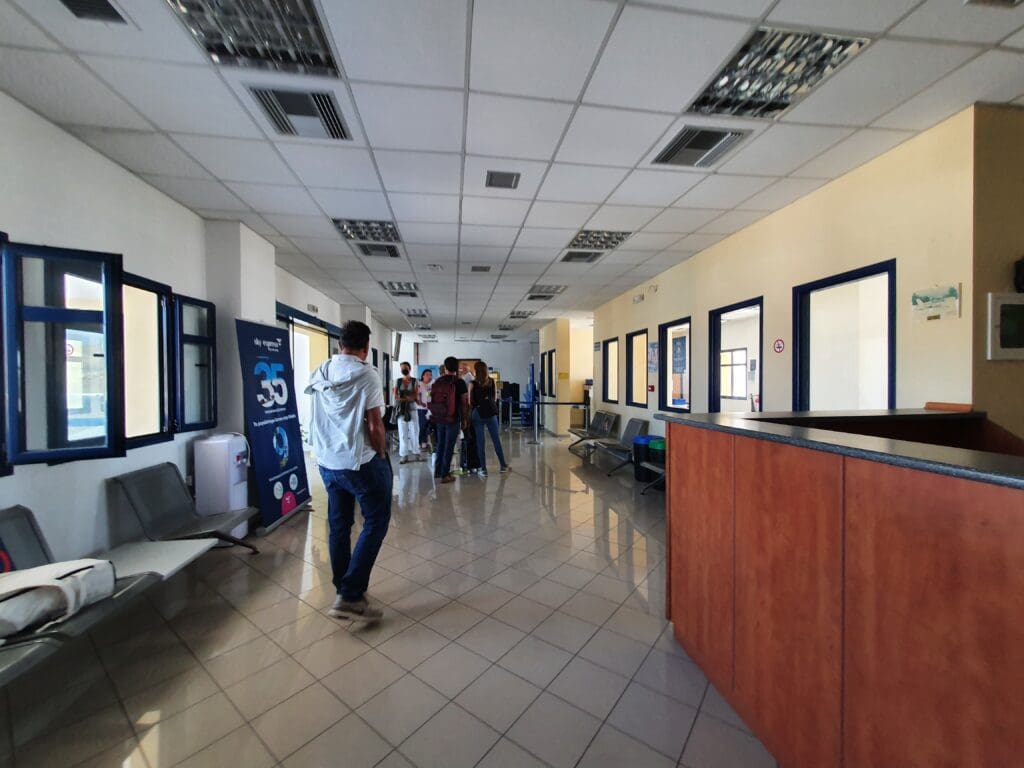
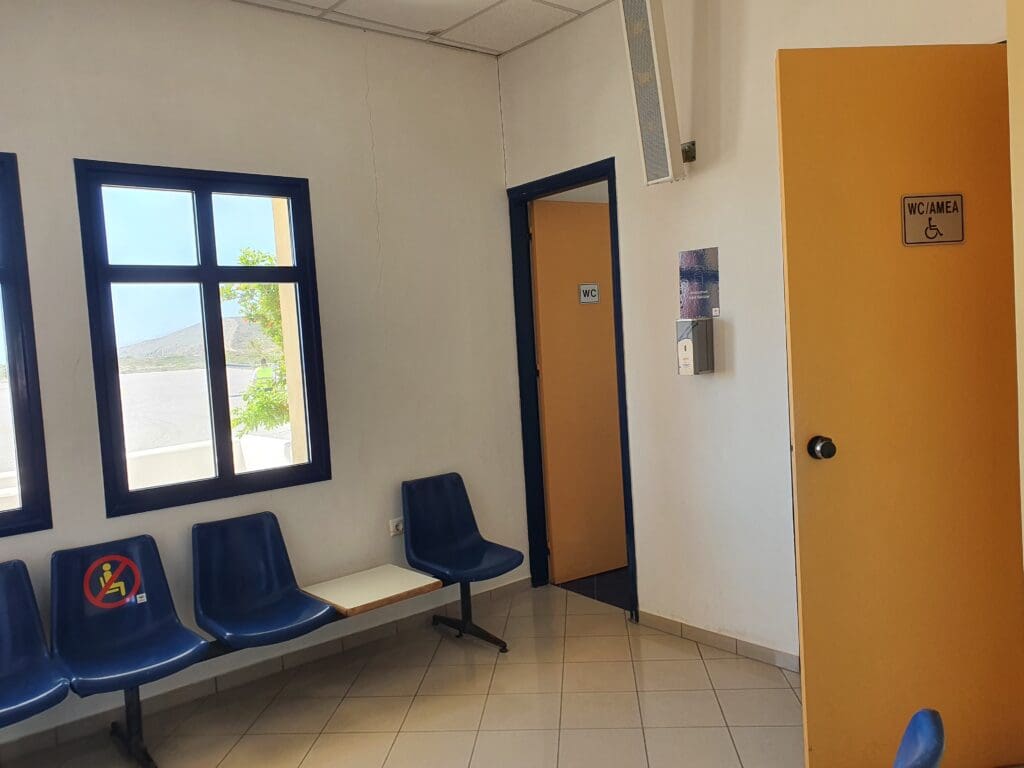
Whilst the flight to Athens was scheduled to depart at 1140, it was not until 1135 that an agent appeared and opened the door to the apron before leading everyone out to the aircraft. After snapping a few photos as I walked around to the aircraft, I clambered up the ATR 42’s steps for one last time before being welcomed by the friendly flight attendant. Heading through the cabin, I soon settled in Seat 3A which I found to be in an equally if not more battered state than the area around the previous two seats that I had travelled in that morning, with masking tape covering the rear of the armrest of the seat in front. Furthermore, I was very surprised to find a boarding pass from a flight two days before mine in the seatback pocket! With twenty passengers on board, I was in for another spacious ride and it did not take long for all passengers to get seated and settled for the journey to Athens. With the light load considered, by 1140 the cabin door was closed and the two engines began to spool up into life as the flight attendant performed their welcome announcement, noting of a flight time of 45 minutes, before moving on to the safety demonstration.
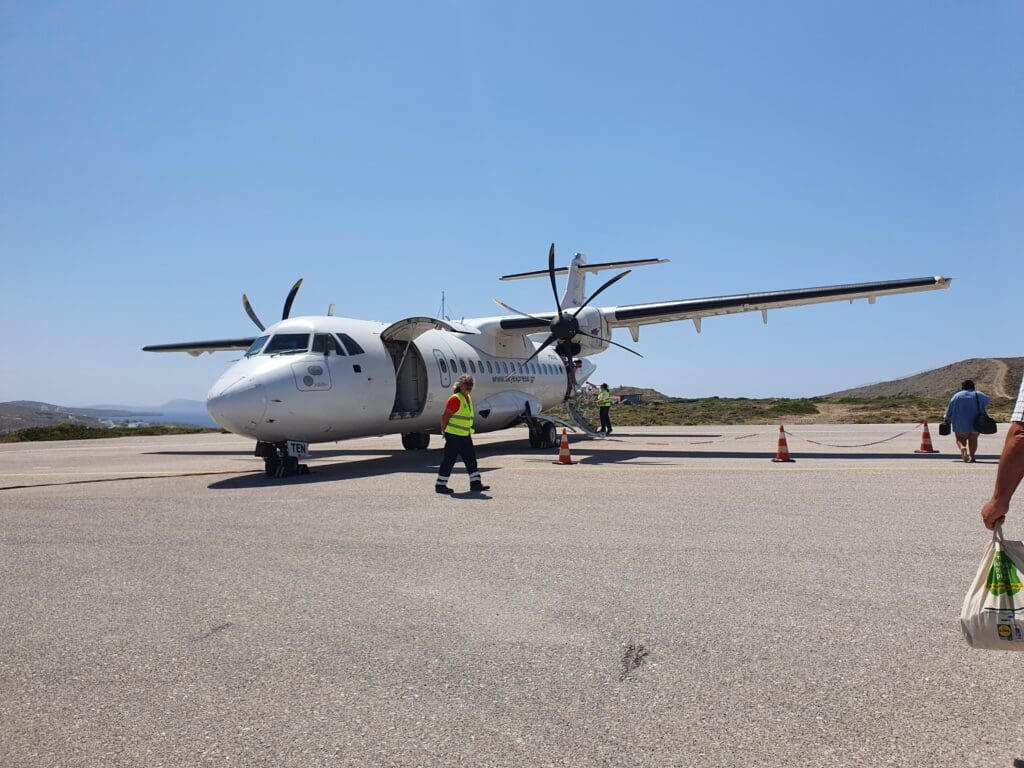
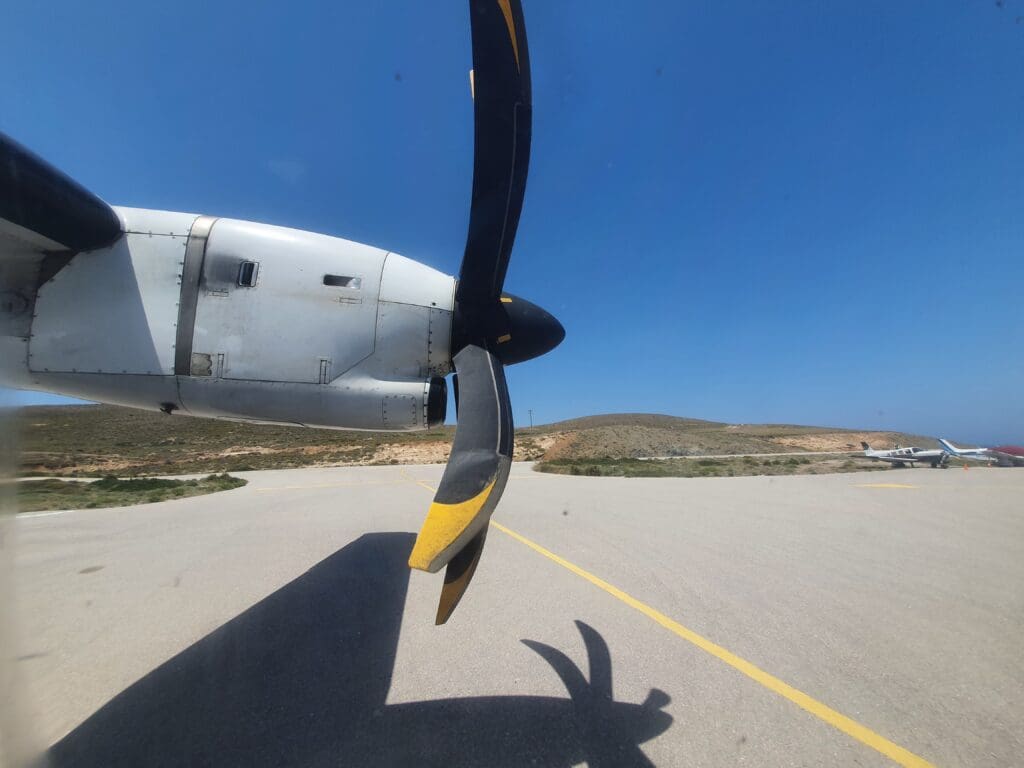
At 1141, the aircraft powered forward out of its stand and made a short taxi over to the runway. Upon reaching this, the aircraft turned left and performed a short backtrack to the end of the runway. After turning around, the aircraft came to a halt for a few minutes during which time several dings could be heard from up front. Just as I grew concerned that we may end up returning to the stand, at 1146 the two engines spooled up and once more propelled the aircraft down the runway with plenty of vigour, rocketing upwards into the skies in a matter of seconds.
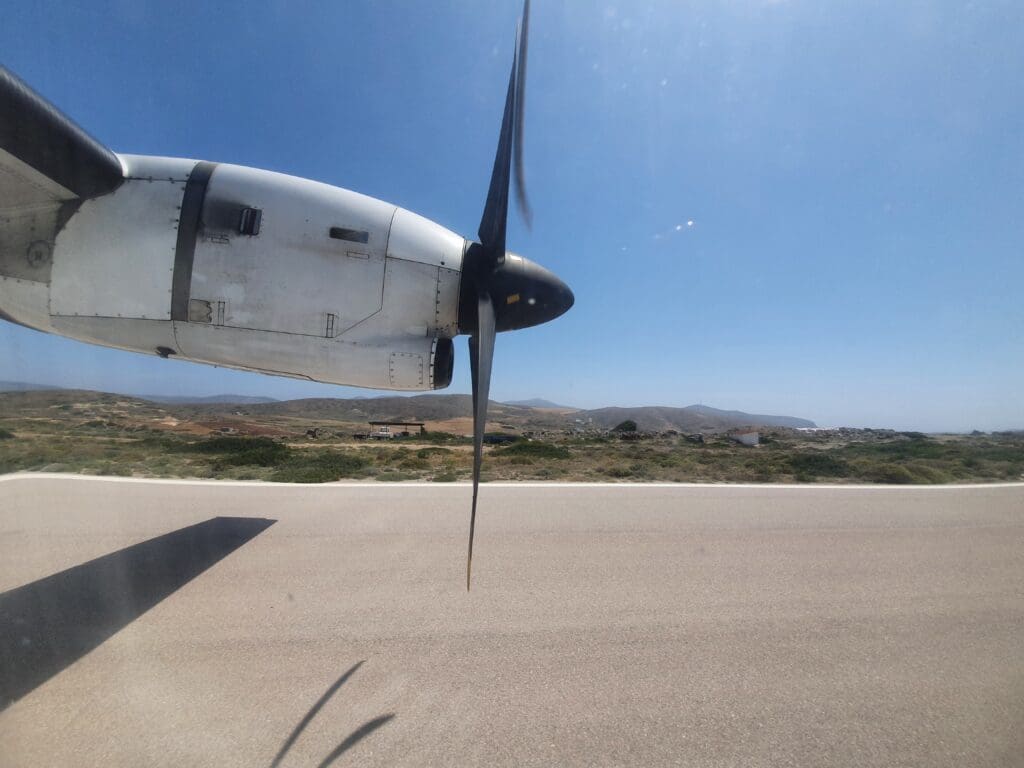
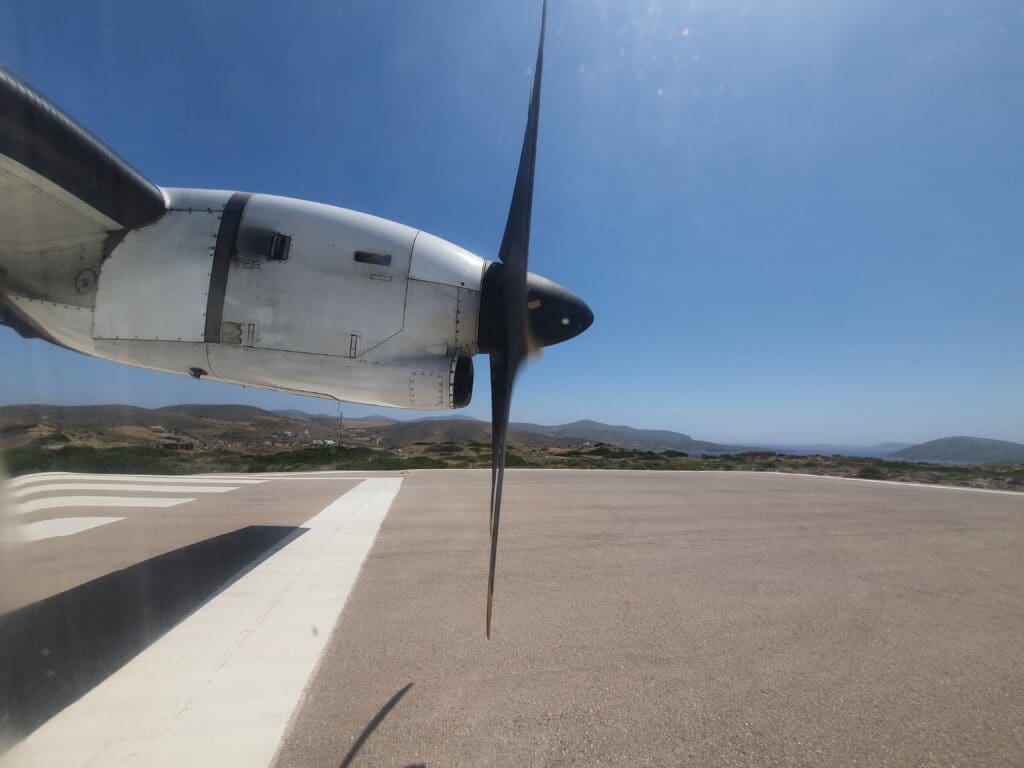
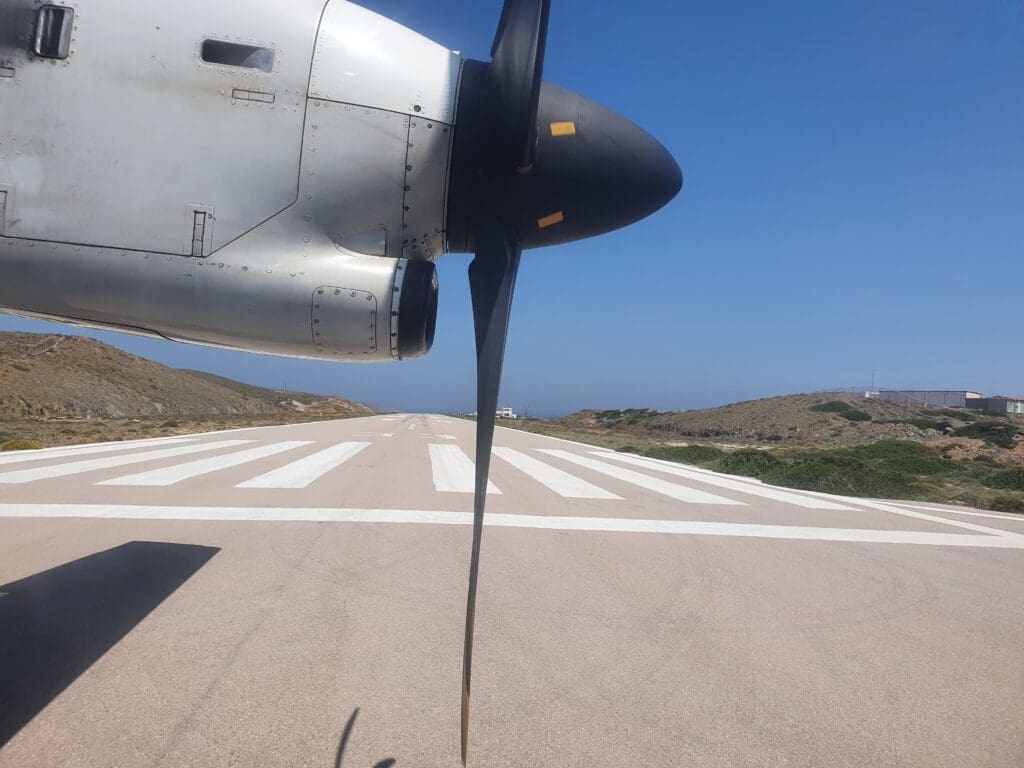
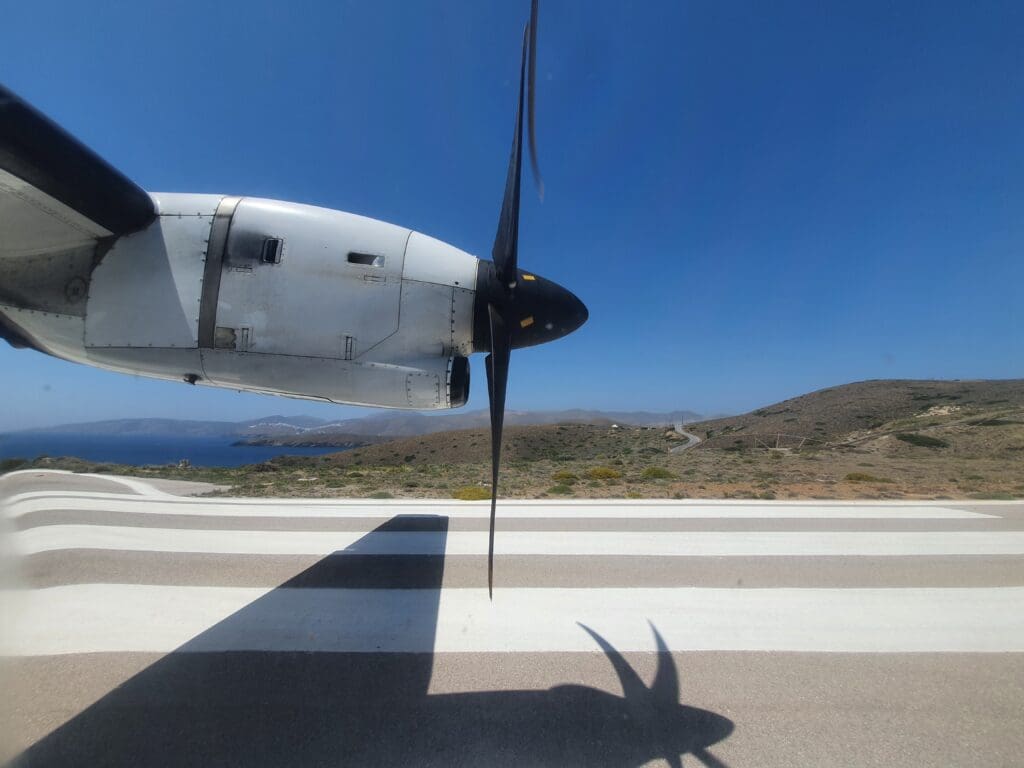
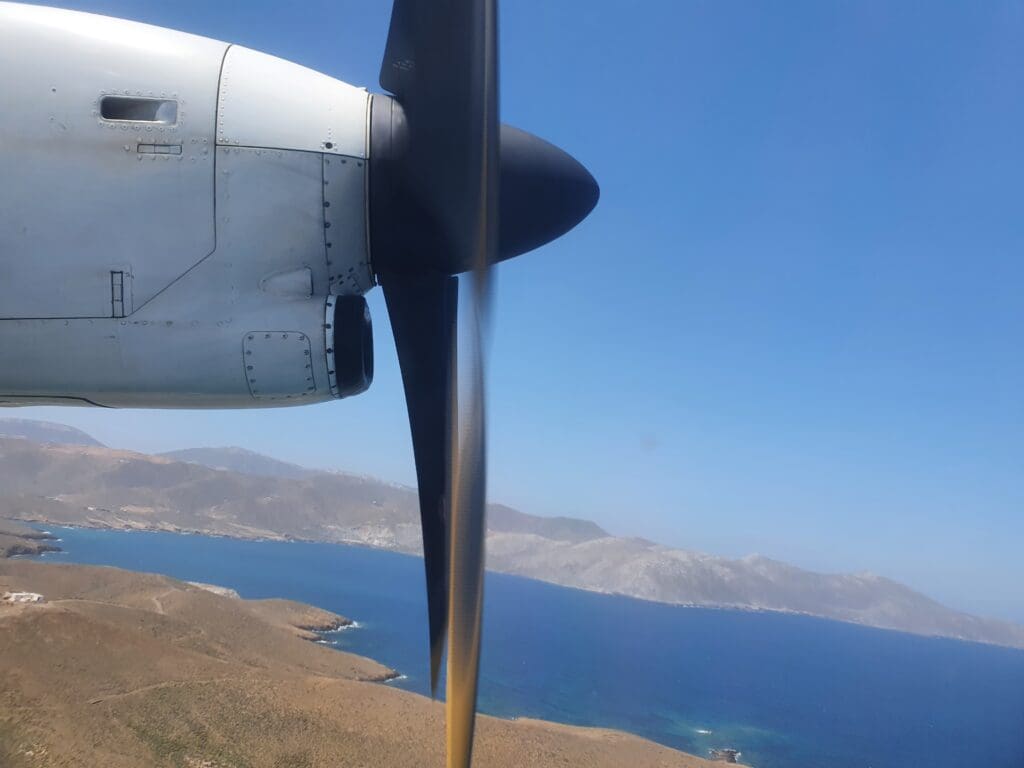
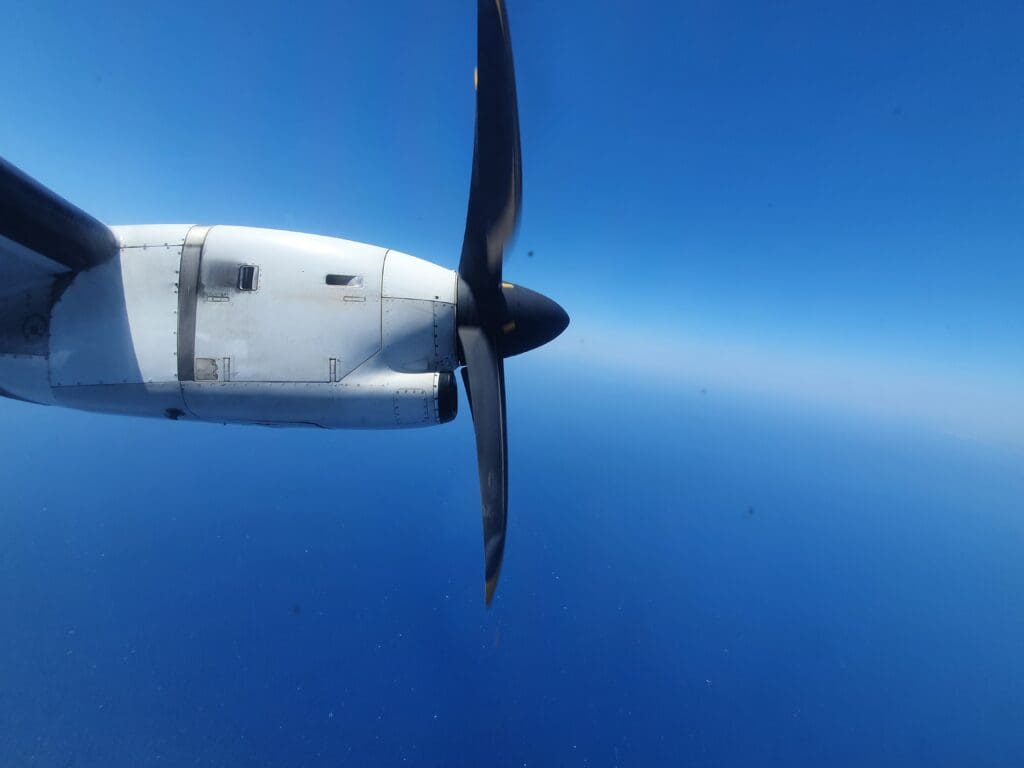
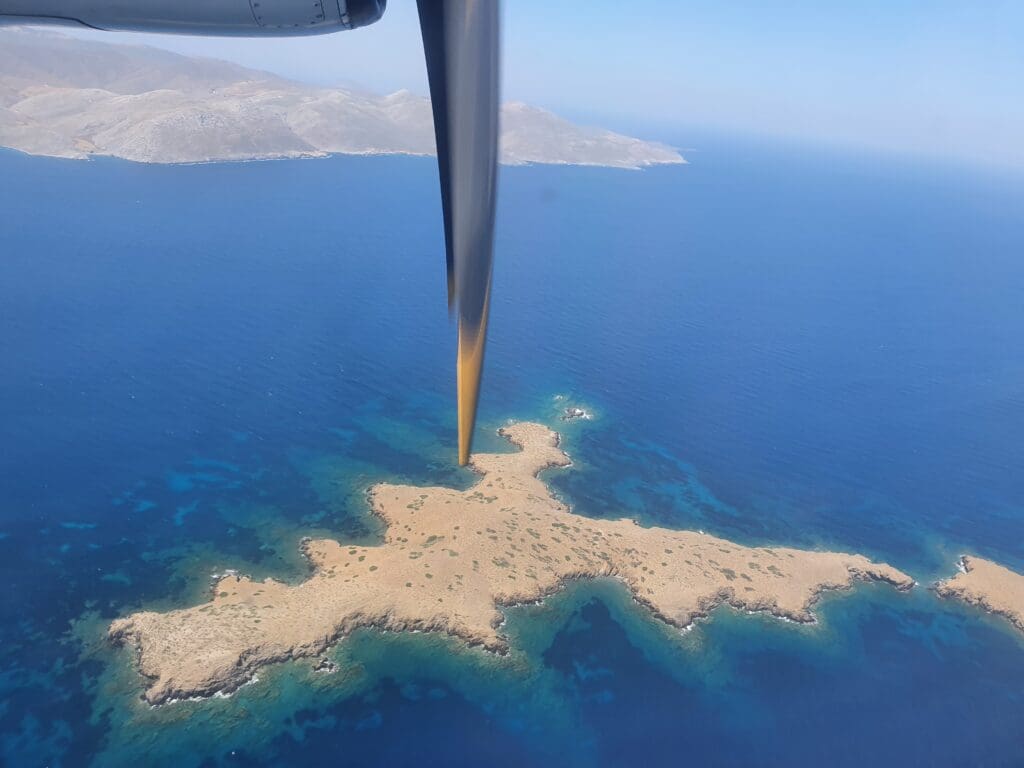
As the ATR 42 made its initial climb out of Astypalaia, the southern portion of the island came into view as well as a cluster of interestingly shaped islands below. Continuing almost on runway heading, the aircraft journeyed northeastwards over the sea and at 1152 the seatbelt signs were extinguished at which point the flight attendant got to work on the inflight service. Despite Sky Express’ status as a low-cost carrier, that morning passengers would be served a light snack and a choice of drink on the short flight over to Athens. With service starting from the front of the cabin, I was soon handed a packet of biscuits, a wet wipe and a serviette, and asked for my choice of drink in a polite and friendly manner. Opting for an orange juice, this was handed to me in a paper cup. As I sipped on this, the aircraft crossed over the easternmost Cyclades island, Amorgos, at which point the aircraft levelled off at its cruising altitude of 16,000 feet.
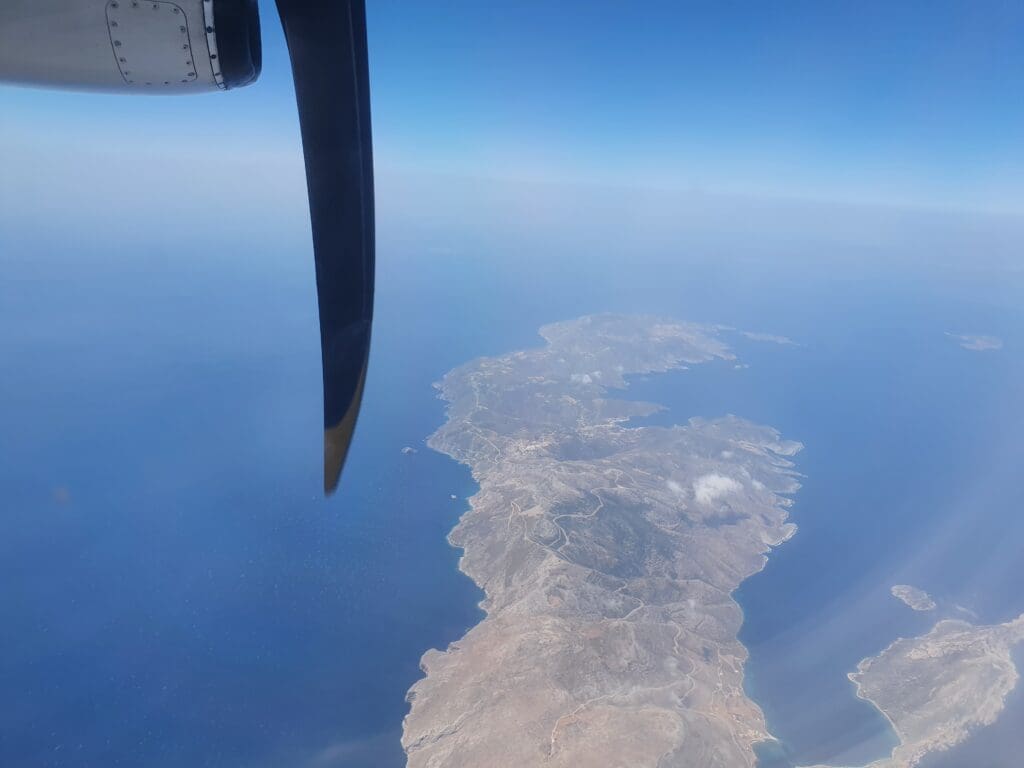

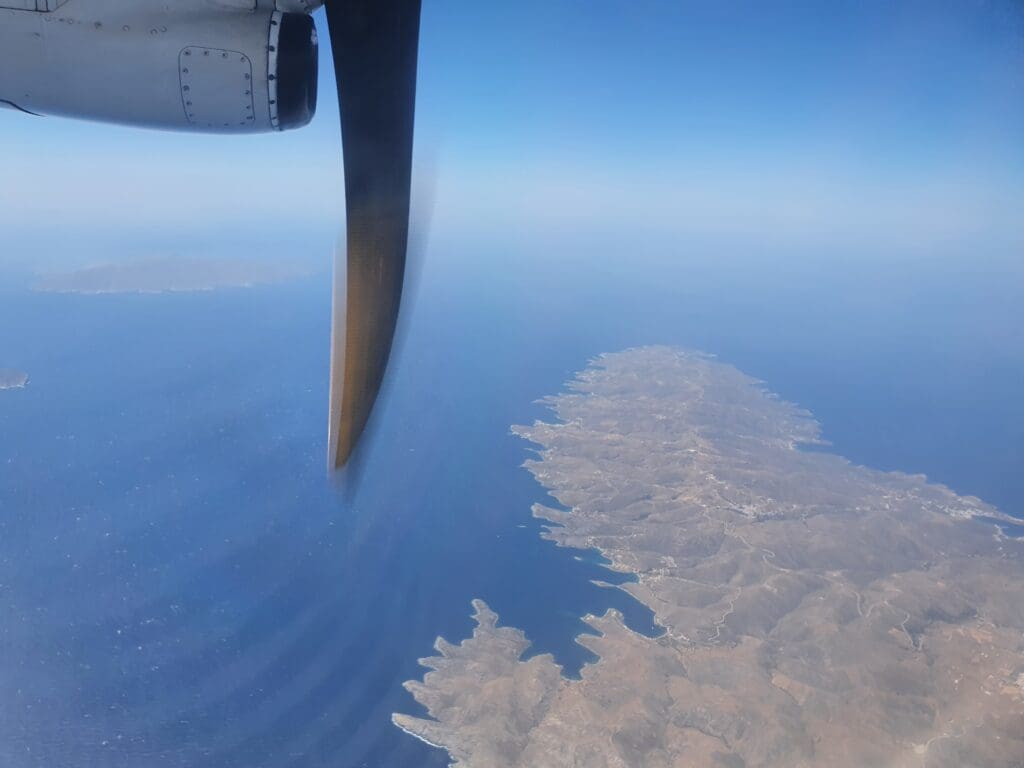
A few minutes after leaving Amorgos behind, the next visible sight came in the form of Greece’s tenth-largest island, Naxos, with the cluster of smaller islands that sit off the island’s southeastern coast also visible. As we crossed over the island of Naxos, the Captain’s voice filled the cabin, during which they gave a comprehensive overview of the route, listing the islands that would be visible on both sides of the aircraft during the flight to Athens.
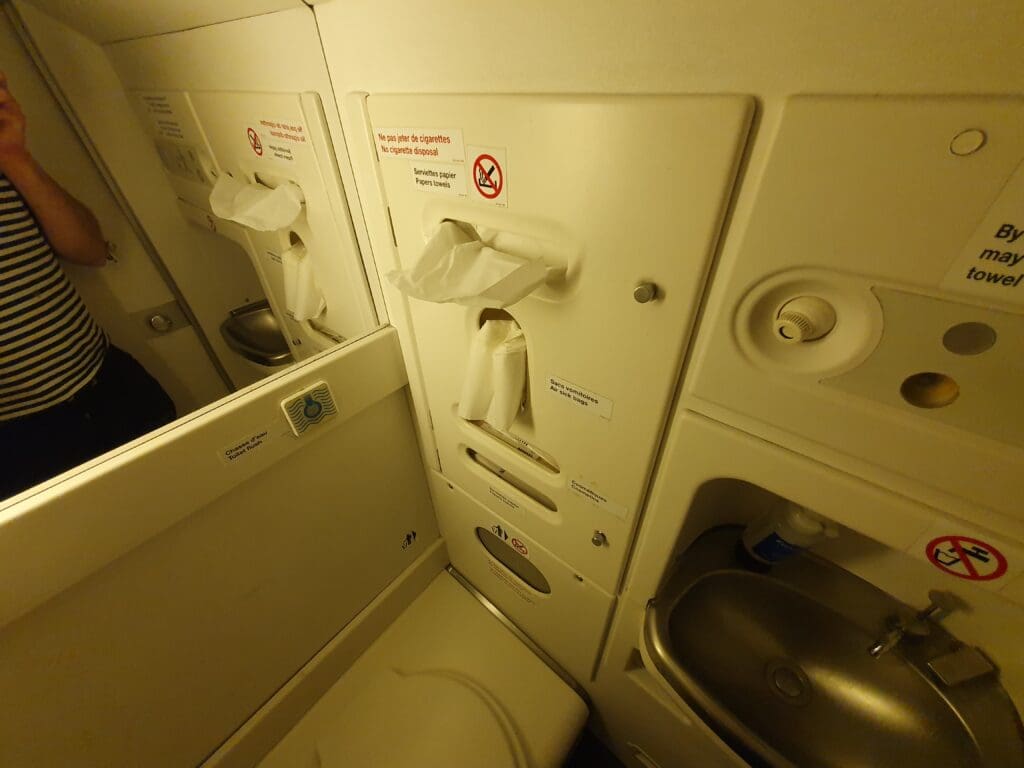
After leaving Naxos behind, I decided to make a quick trip to the sole toilet onboard, located at the rear of the aircraft in one corner of the galley. As I entered this, this seemed to be a little more spacious than the ATR 72 toilet I had visited during my flight with Malindo Air, although I have no quantitative data to prove this to be true. Despite serving for Sky Express for several years, all signs up in the toilet remained in both French and English, with no sign of Greek whatsoever. Furthermore, like much of the cabin, the toilet appeared to be in a rather battered condition, although this did serve its purpose and was stocked with the basics.
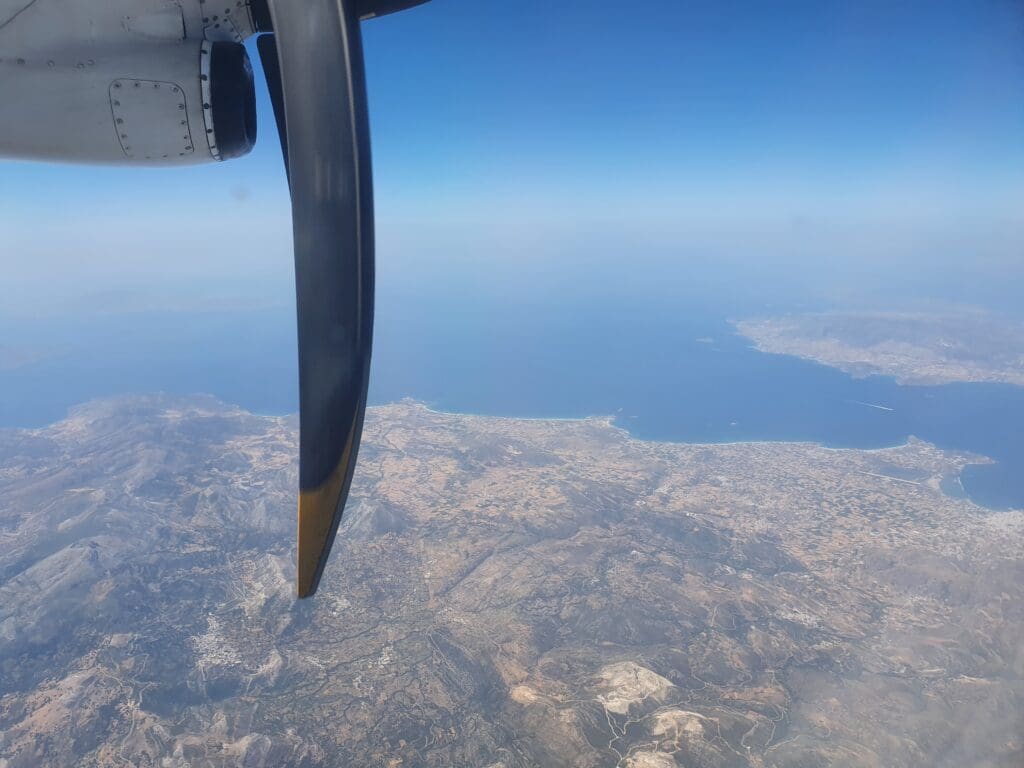
A short time after returning to my seat, the flight attendant collected passengers’ rubbish in preparation for our arrival, whilst outside the island of Paros could be seen. Upon reaching the small island of Syros, the aircraft could be felt commencing its descent and a short time later the seatbelt signs were reilluminated in preparation for the flight’s arrival. This was immediately followed by an announcement from the flight attendant who then promptly passed through the cabin ensuring all was in place for our arrival into Athens.
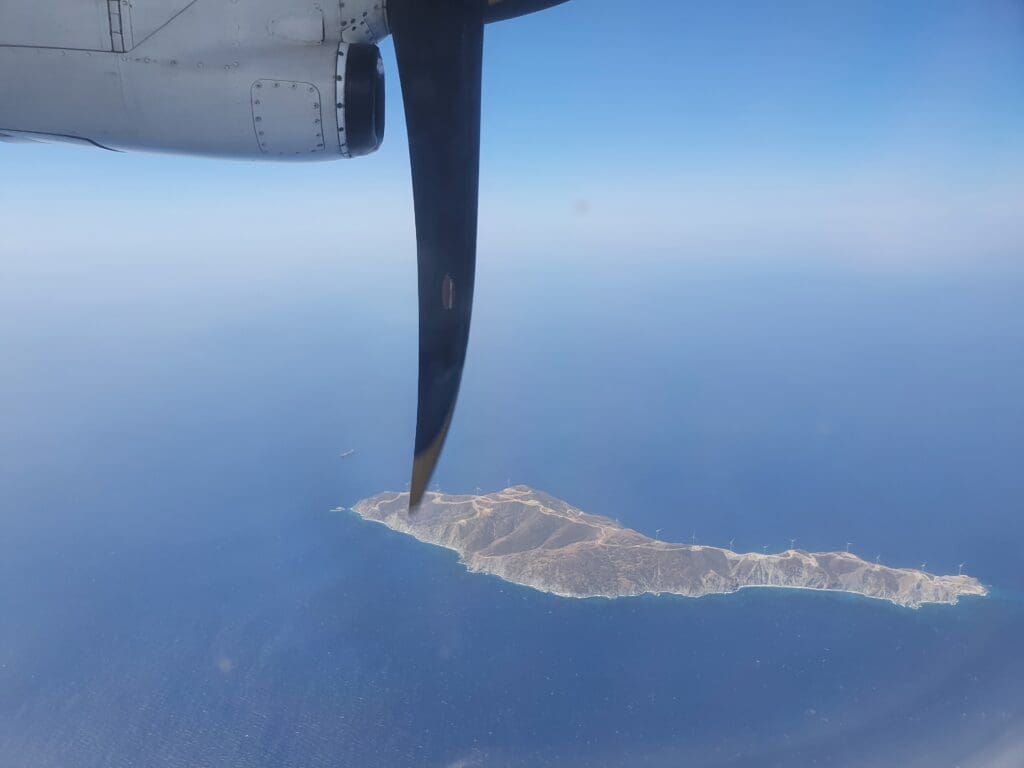
As the aircraft journeyed towards Athens, the island of Kythnos could be seen passing below, followed a short time later by the island of Agios Georgios, home to nothing other than a wind farm. From there, the aircraft turned towards Athens and after passing over the island of Fleves, Athens’ coastline appeared and we crossed this just to the south of the suburb of Vari at which point the aircraft bumped around a fair bit, with the turbulence remaining until our arrival. At this time, the runway of Athens’ old airport Ellinikon, could be seen up the coastline to the north. After crossing over the coastline, the aircraft’s flaps and landing gear fell into position as the aircraft descended past the towns of Kitsi and Koropi, whilst a good view of the hills and mountains that sit around Athens could also be had.
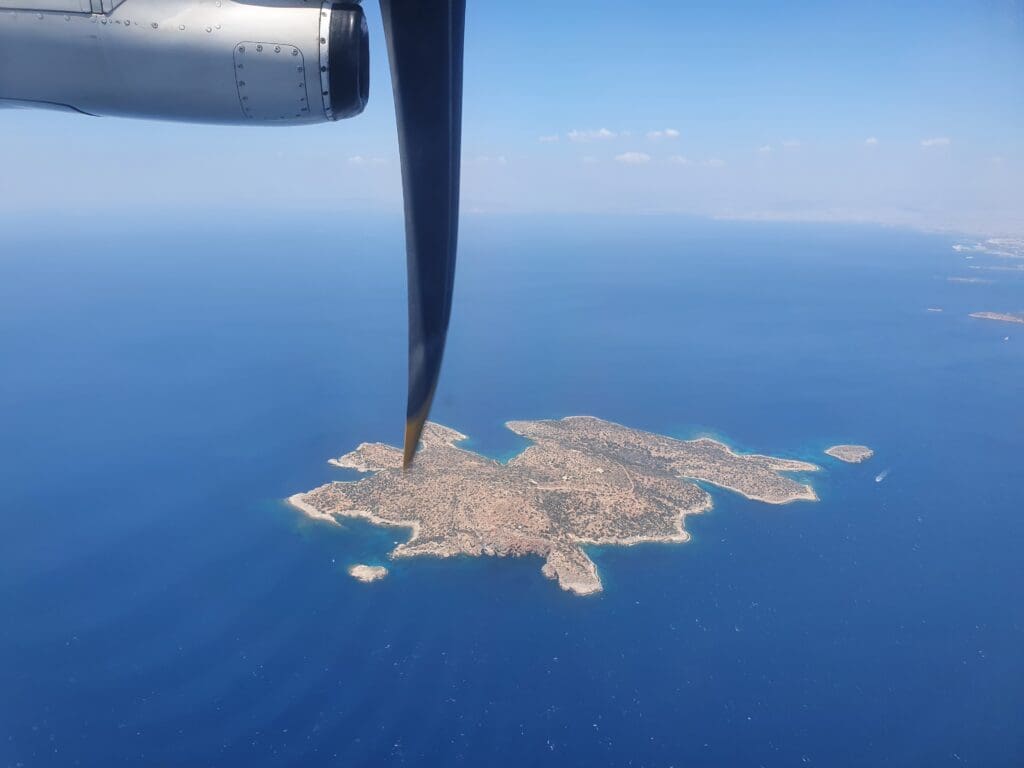
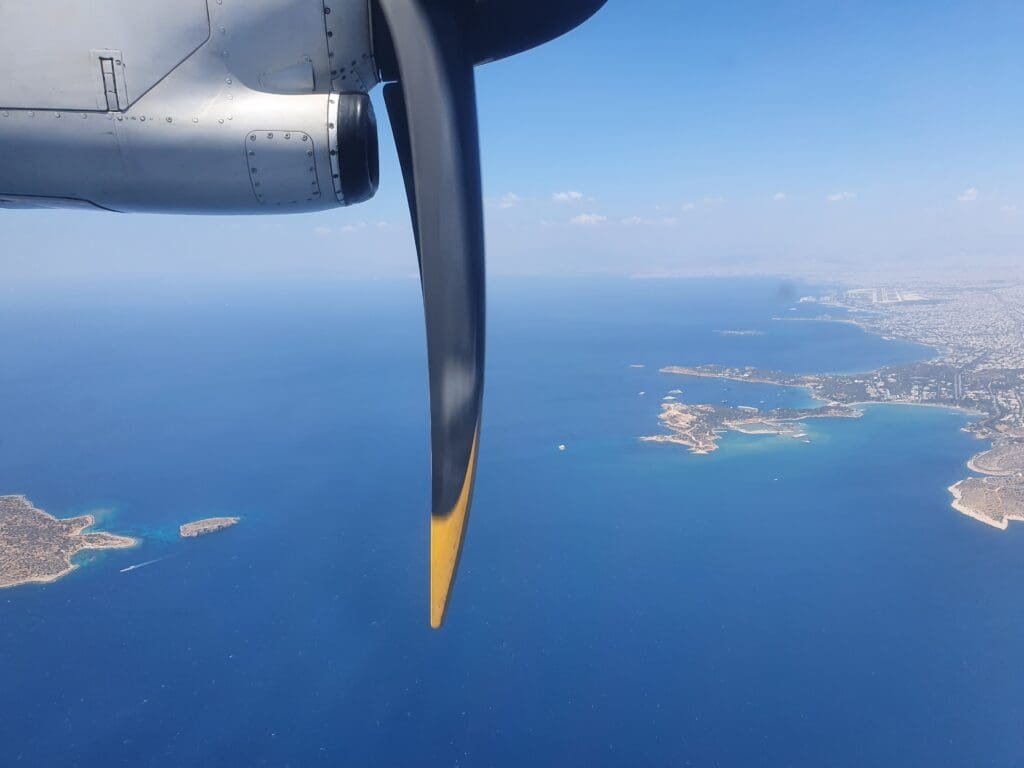
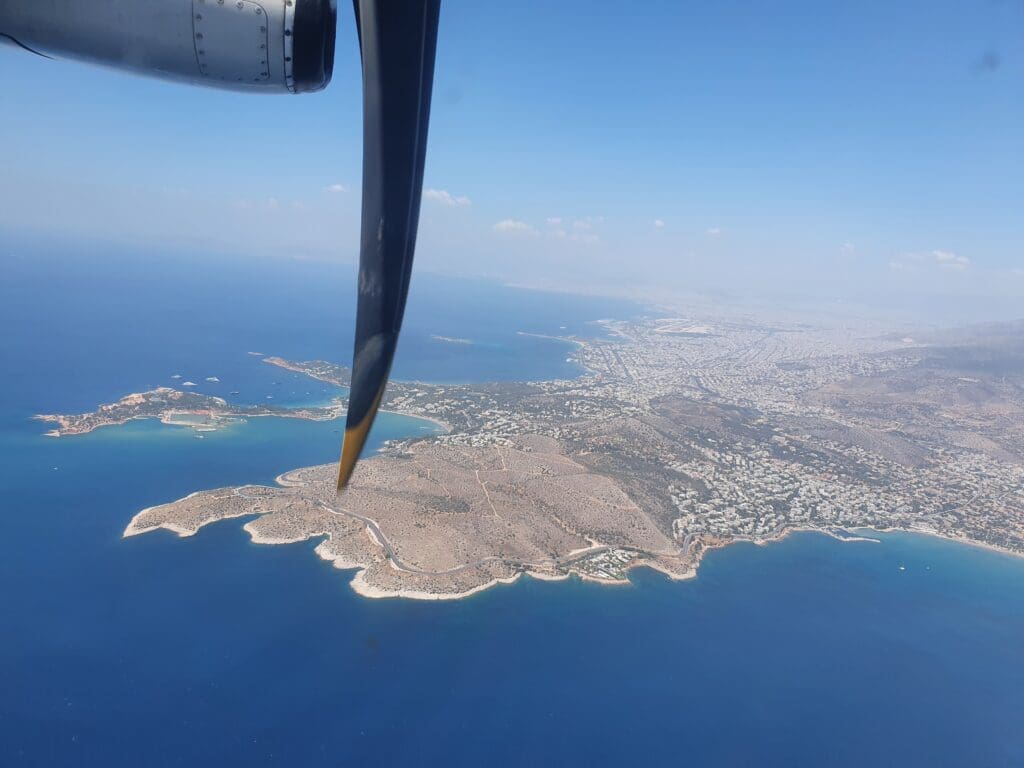
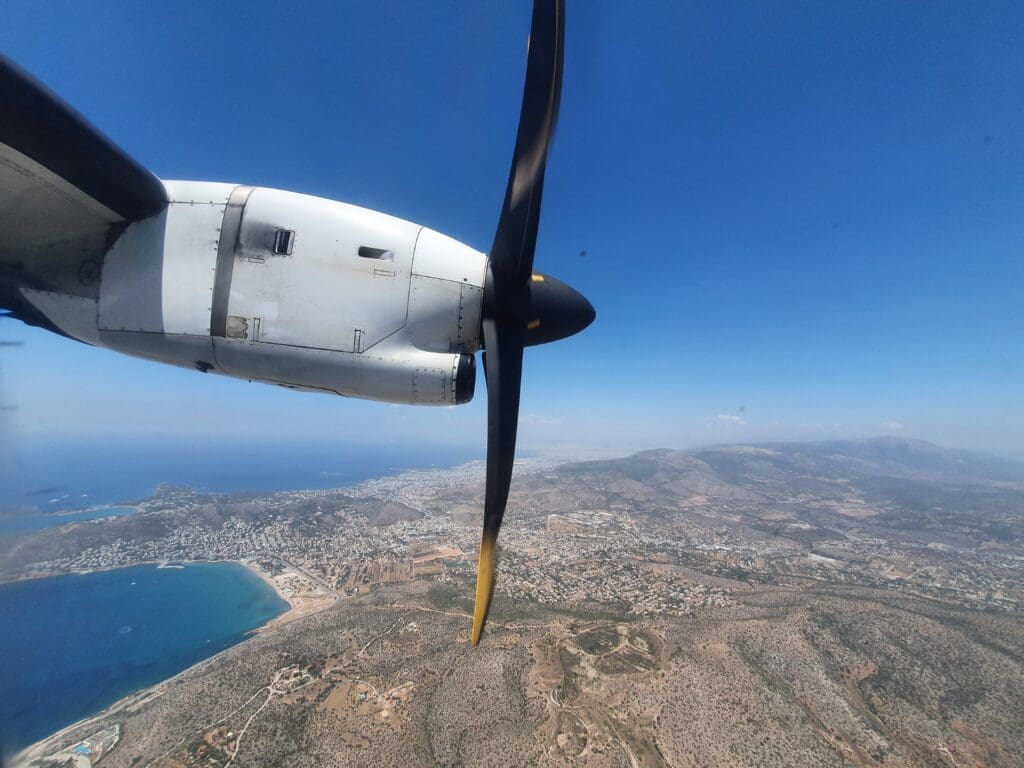
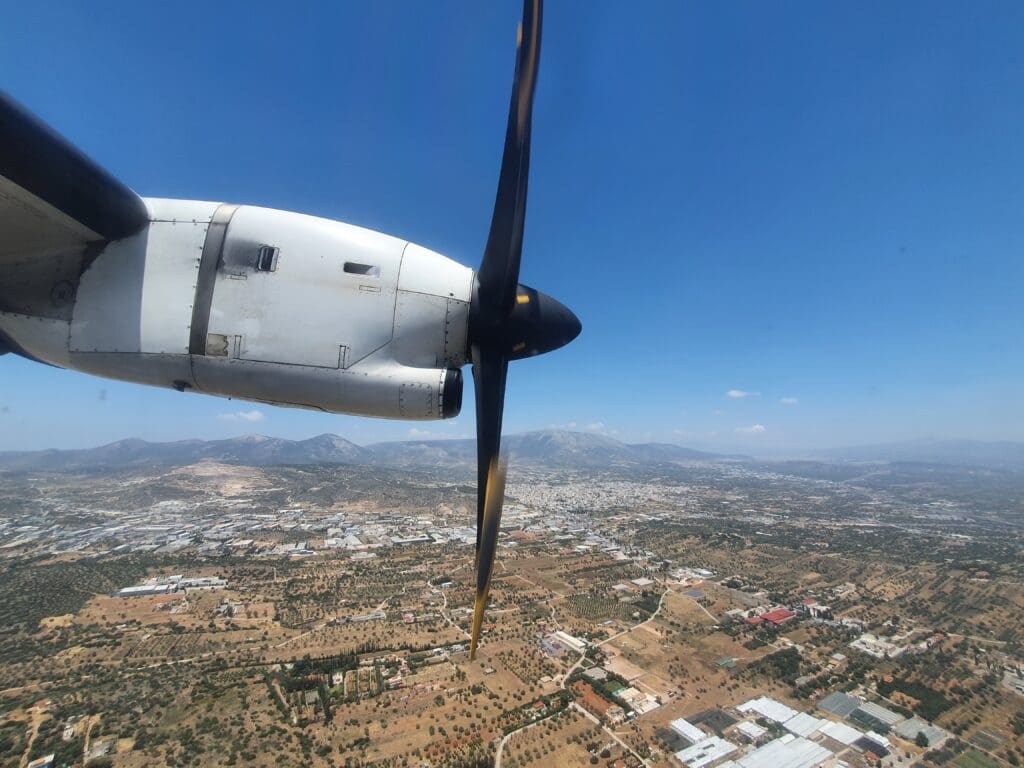
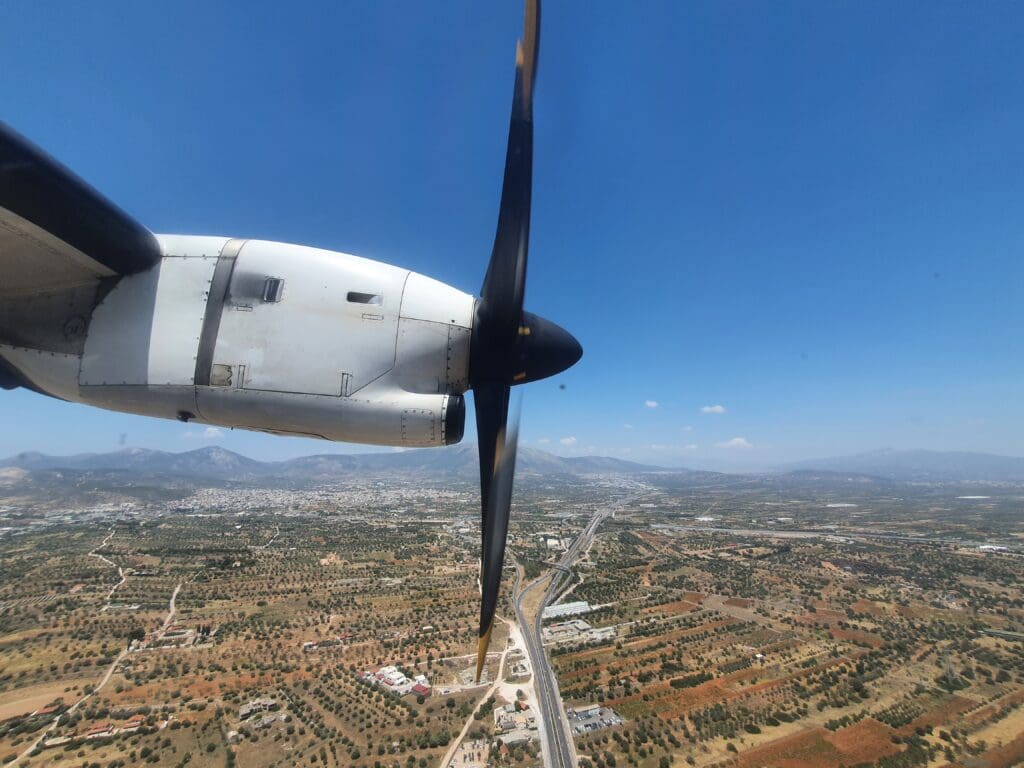
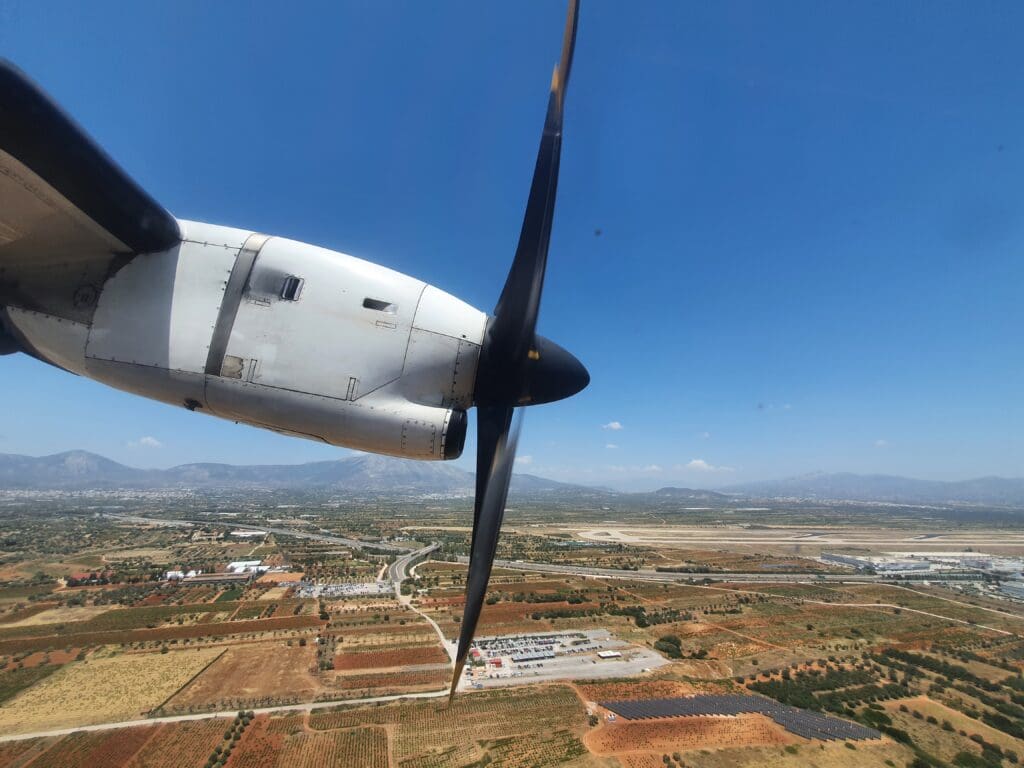
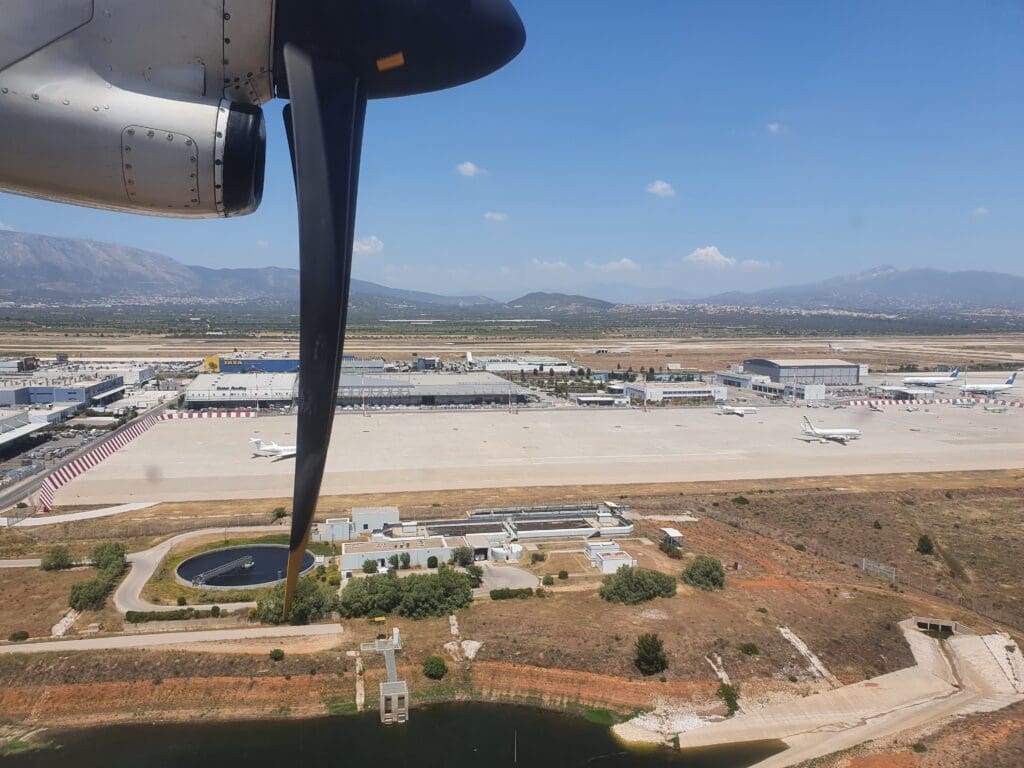
A short time later, the aircraft sank over Athens Airport’s western perimeter and the cluster of shops, offices and warehouses that sit between the airport’s two runways could be seen. This was followed by one of the airport’s two general aviation ramps where locally based corporate charter carrier Gainjet’s Boeing 737-400 could be seen waiting for its next mission alongside a couple of Gulfstreams. Next up was the cargo area, followed by the satellite and then the main terminal where masses of Aegean Airlines narrowbody aircraft could be seen alongside a fair selection of visitors from abroad. Following 45 minutes in the air, at 1231, the ATR touched down on Athens Airport’s Runway 03R, making the first very smooth touchdown of the flight. Seeing as all Olympic Air and Sky Express turboprops utilise remote stands at the eastern end of the airport, the pilots appeared to be in no hurry to vacate the runway, eventually leaving this and commencing a short taxi over to a remote stand.
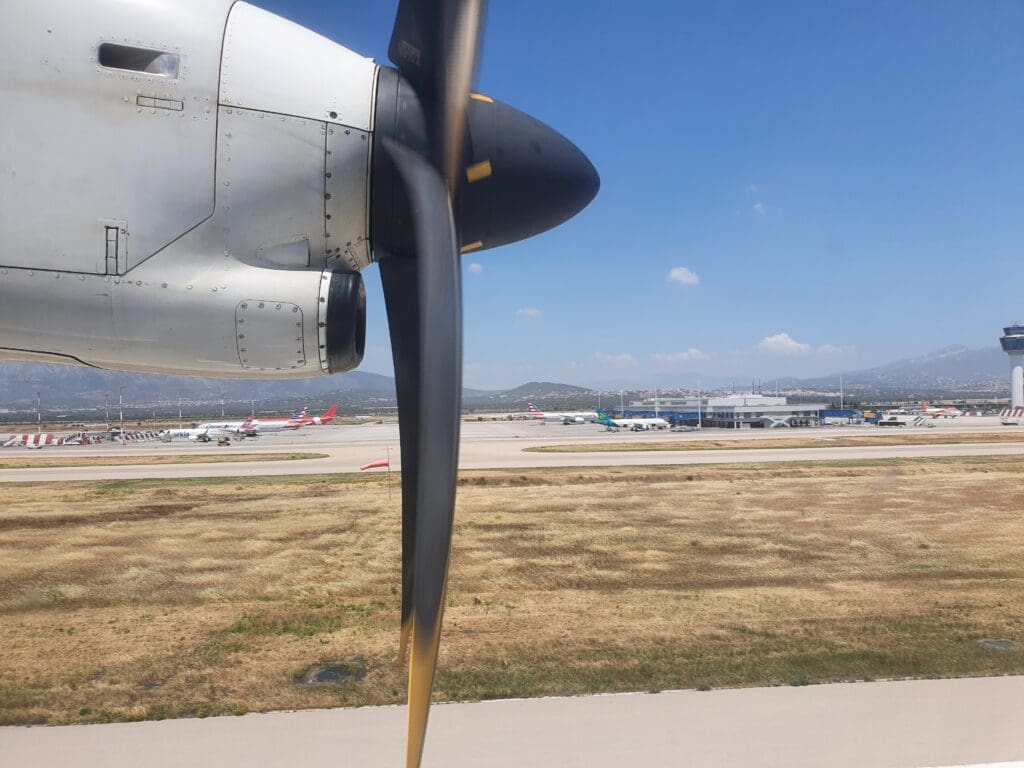
Once off the runway, the flight attendant welcomed all passengers to Athens and thanked passengers for choosing to fly with Sky Express, with their announcement coming to an end just as the ATR taxied under one engine into Stand B54. There the aircraft pulled up next to a fellow Sky Express ATR 42 undergoing its final preparations for its lunchtime flight to Naxos. Once the aircraft came to a halt, its remaining powered up engine spooled down and with a Cobus ready and waiting to shuttle us off to the terminal, there was no delay to the commencement of disembarkation. Given the light load, despite my position at the front of the aircraft, it did not take long for me to make my way to the rear of the cabin where I thanked the flight attendant before heading down the built-in steps and walking over to the waiting bus. Being one of the last passengers to board the bus, a short time later, this drove off towards the terminal, passing another cluster of remote stands before arriving there within a couple of minutes, ending my experience with Sky Express.
Summary
Whilst I found Sky Express’ ATR 42 to offer a comfortable ride, I most certainly cannot ignore the rather worn, battered and dirty state that the cabin seemed to be in that morning. However, this was offset somewhat by the very friendly flight attendant and the complimentary service on the hop from Astypalaia to Athens. However, from an aviation enthusiast’s perspective, all-in-all, this was a fantastic trip and I thoroughly enjoyed darting in and out of small island airports, and is an experience that I would recommend.
What a beautifully balanced review! ✈️ You’ve captured both the charm and the reality of regional flying perfectly. Despite the cabin’s condition, it’s wonderful to hear that the friendly crew and the overall island-hopping experience made it memorable. There’s something truly special about flying into those tiny island airports — such a treat for any aviation enthusiast! 🌍🛫