Korean Air’s Fantastic New Narrowbody: Jeju to Seoul Gimpo on the Airbus A321neo
Background
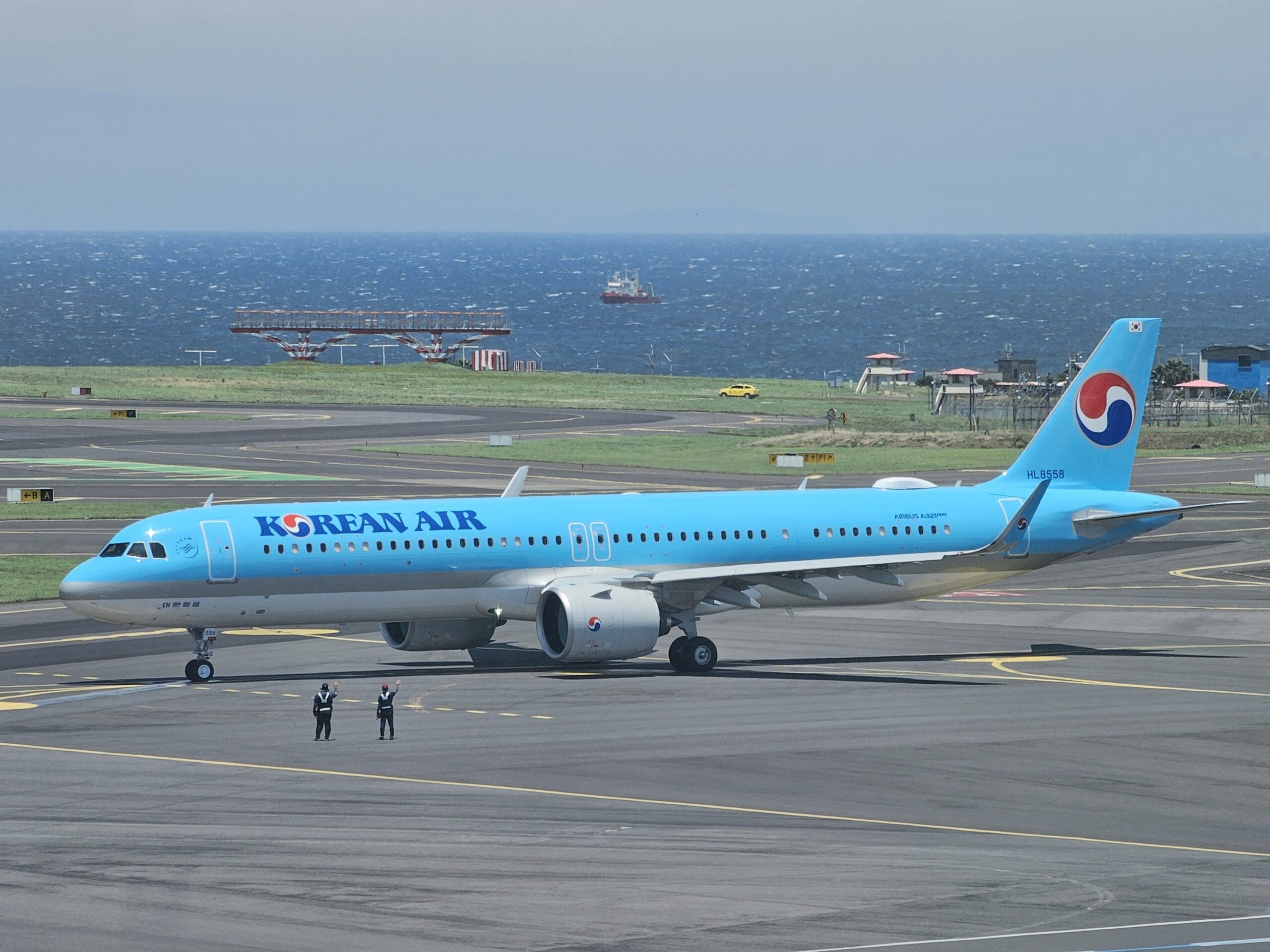
As part of fleet renewal initiatives, in 2015, Korean Air placed an order for their first-ever narrowbody Airbus jets (assuming you exclude the rebranded Bombardier C Series, the Airbus A220). With thirty of these on order, later topped up to a whopping total of fifty, the Airbus A321neo was to come to play an integral part in Korean Air’s fleet. Working in tandem with the Boeing 737 MAX 8, these new deliveries would enable Korean Air to retire their older and less fuel-efficient Boeing 737-800s, Boeing 737-900s and Boeing 737-900ERs, passing some of these onto low subsidiary Jin Air. Furthermore, the type would enable Korean Air to launch flights to the fringes of the Asia-Pacific region that had previously been out of range of their Boeing 737NGs and lacked the demand to justify widebody service.
Further stoking interest in Korean Air’s new deliveries, in 2022, it was revealed that the Airbus A321neos would come with a whole new cabin design. In place of the arguably boring and outdated blues, browns and turquoises that had come as standard on every Korean Air jet since the late 1990s, the cabins of their new Airbuses were to come with a much more vibrant colour palette. Beyond this, the aircraft would come with state-of-the-art comfortable seats and a myriad of entertainment options, with lie-flat beds in Prestige Class complete with wireless device charging. Thus, it is fair to say, quite a few experts and enthusiasts in Korea and beyond were excited to welcome the new aircraft.
In October 2022, Korean Air’s first Airbus A321neo touched down on Korean soil and was soon pressed into service on the route between Seoul Gimpo and Jeju, before being dispatched to destinations across East Asia. Failing to disappoint, it wasn’t long before stellar reviews of Korean Air’s latest jet appeared on the internet, with both those in Prestige Class and Economy raving about the superb levels of comfort onboard, the improved cabin design and the state-of-the-art entertainment system. Since then, alongside international services, Korean Air’s Airbus A321neo fleet has become a stalwart on their busiest route between Seoul Gimpo and Jeju, and, with this considered, I found it impossible to resist the temptation to book a ride on this during my trip to Korea in early summer 2024!
Booking
Once upon a time, booking domestic flights in Korea with a card issued overseas occasionally threw up a few issues and almost always required the payment card to be verified in person at the airport check-in desk. Thankfully, these days seem to be long gone, and it has been a good nine or so years since I have encountered any major issues when booking a flight in Korea. For those looking to book flights in Korea, I would thoroughly advise doing so directly with the airline rather than a third-party website. Not only are domestic flights almost always cheaper when booked via the airline, but passengers who do so can take advantage of very small penalty fees deducted from their total ticket cost if they end up having to cancel or rebook.
Without delay, I opened up Korean Air’s app where I was presented with the flight search engine superimposed on a wing view shot of Korean Air’s luxurious Boeing Business Jet. Wasting no time, I entered all the required information and was soon presented with a long list of 33 direct flights operating between Jeju and Seoul Gimpo on my chosen departure day. The aircraft operating these ranged in size from the small Airbus A220 to the Airbus A330-300, whilst several flights were operated by Korean Air’s low cost subsidiary, Jin Air. Examining these options, I decided to go for the 1345 departure, which was scheduled to arrive in Seoul Gimpo an hour and ten minutes later at 1455. Upon selecting this, I was then presented with four fare options – Saver, Standard, Flex and Prestige (Korean Air’s business class product). These were priced between 52,900 won (£29.64) and 157,000 won (£89.47).
With no reason to pick anything other than the cheapest option, I steamed ahead and was given the option of selecting any regular vacant seat without any additional payment. After choosing my seat and confirming that I understood the fare rules and restrictions, I headed to the payment page. As those who have purchased goods and services online in Korea will know, thanks to the country’s strict payment security protocols, paying for things online can sometimes be a cumbersome process. Fortunately, I found that paying via Korean Air’s website was a little easier than on those of the country’s other carriers and within a few moments, I had parted with the fare and received my e-ticket via email. Unlike all other Korean carriers, Korean Air allows passengers to pay for tickets with the airline with American Express cards.
Online check-in for Korean Air’s services opens 48 hours before departure. However, having already selected a seat and elected for the auto check-in service, without any action from my side, I received my mobile boarding pass via email and the app two days before departure.
The Journey
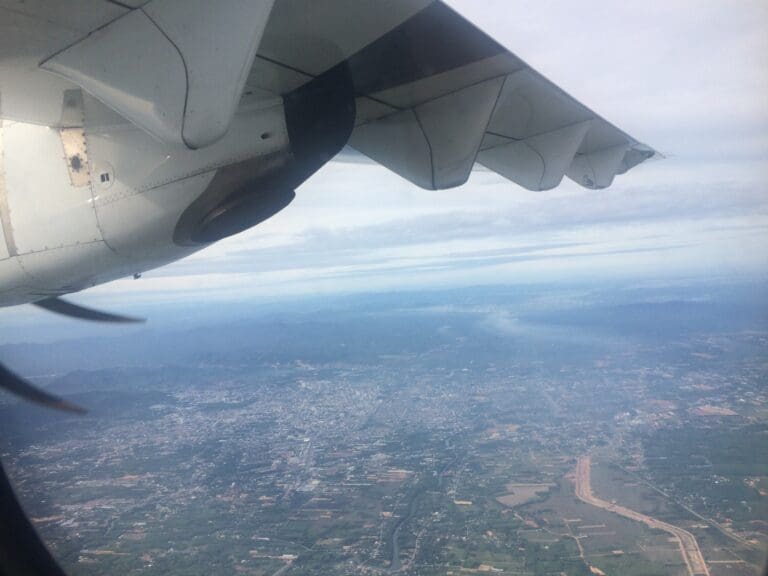
On the morning of my flight, I had woken up bright and early in Seoul and enjoyed a decent ride onboard the smaller of Asiana Airlines’ two low cost carriers, Air Seoul (the larger being Air Busan). However, as we approached Jeju, it soon became obvious that the island was being battered by strong winds which were blowing right across the runway and our approach had felt not too dissimilar to a fairground pirate ship ride as we swayed and rocked side-to-side before making what was undoubtedly the hardest touchdown that I have ever experienced (barring my own landings in the mighty Grob Vigilant!). As we taxied to the gate, I reconnected with the outside world and noticed that the Air Seoul flight was one of just a very small number that had successfully landed on their first attempt, in fact, it seemed that the majority of aircraft were instead returning to the mainland after their second or third unsuccessful landing attempts. Indeed, this resulted in some interesting holding patterns and approach paths, whilst for much of the afternoon, the airport received much attention from those on Flightradar24. In fact, at one stage all ten of the platform’s most tracked flights were those bound for Jeju! Thus, I was very much aware of the real possibility that my flight back to Seoul would be cancelled, or at the very least, severely delayed until the winds had calmed down. Of course, safety should always come above everything and so this is by no means a complaint. Not to mention the fact that Jeju is one of my favourite places in the world and I can think of many worse places to be stranded!
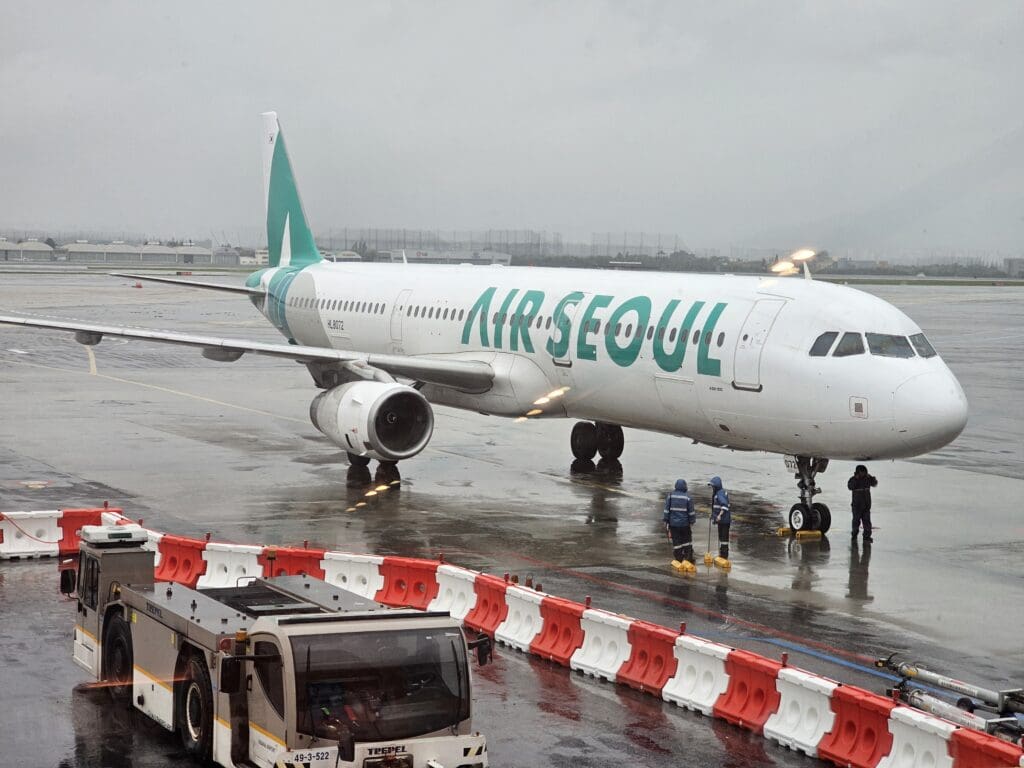
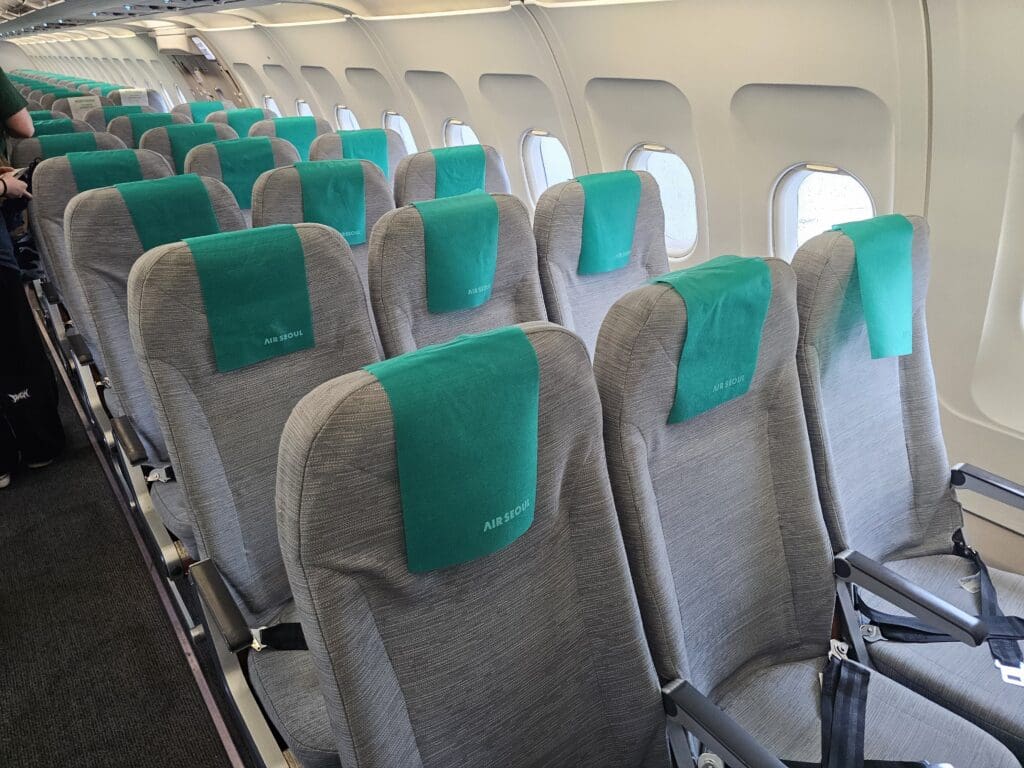
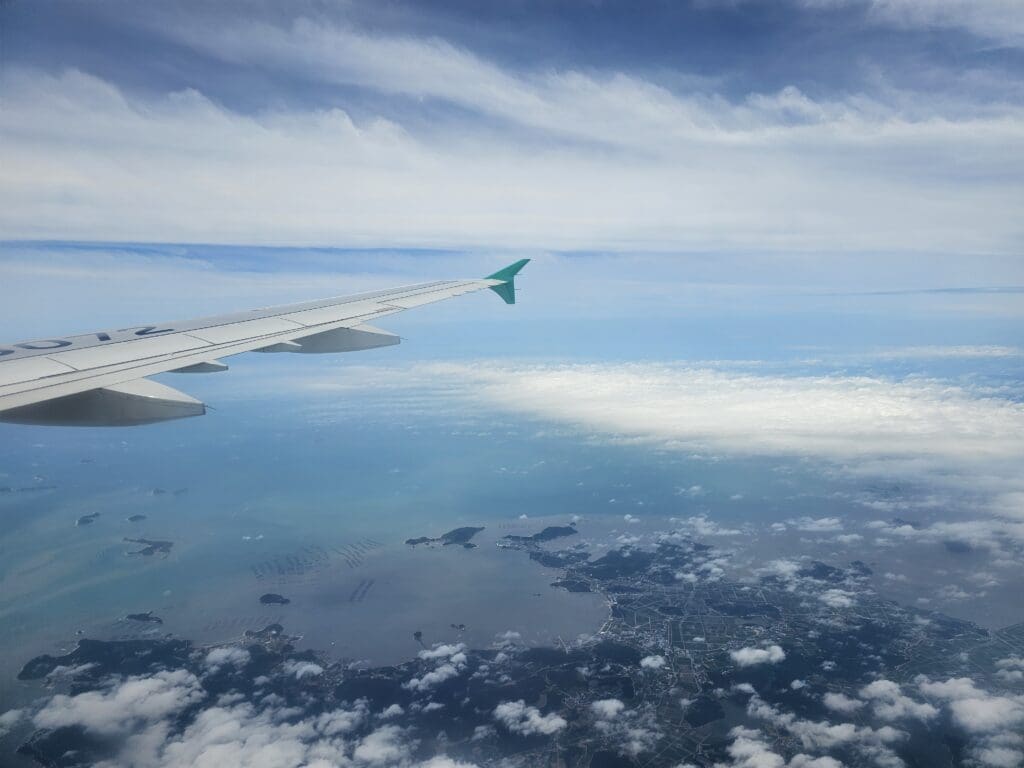
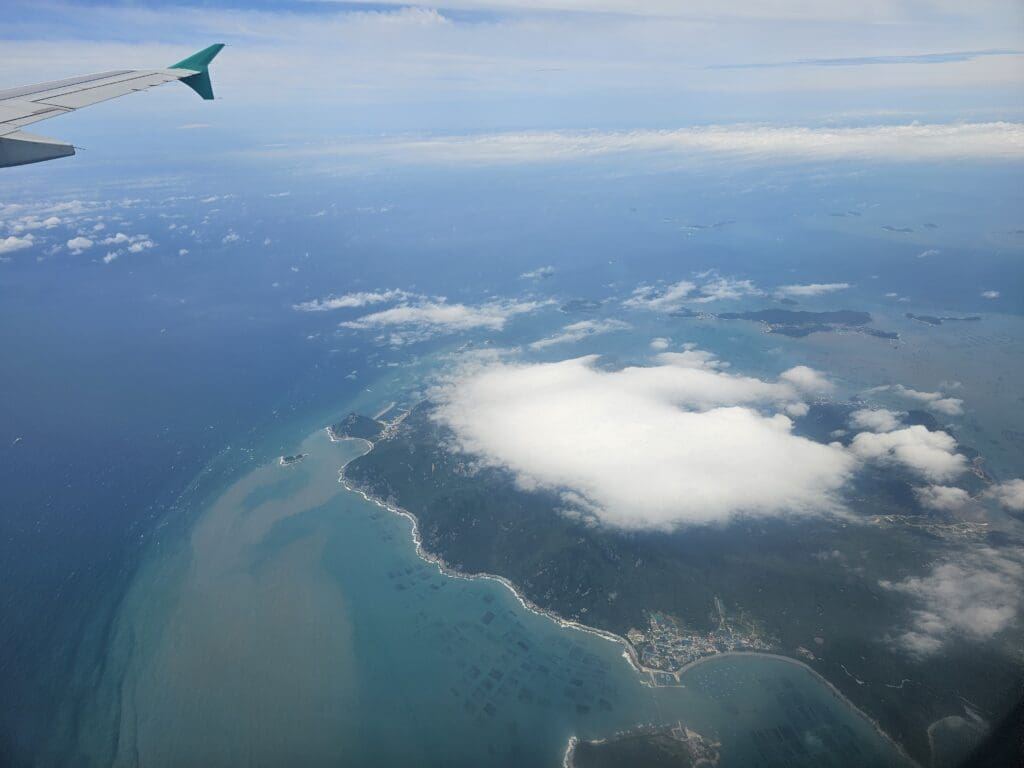
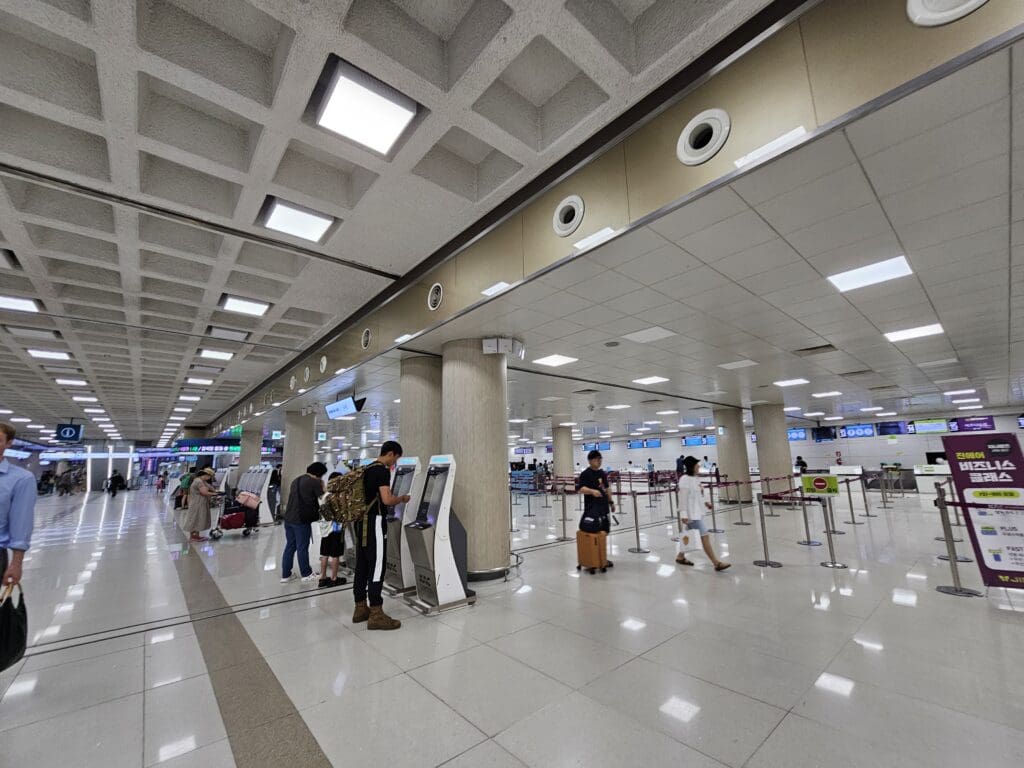
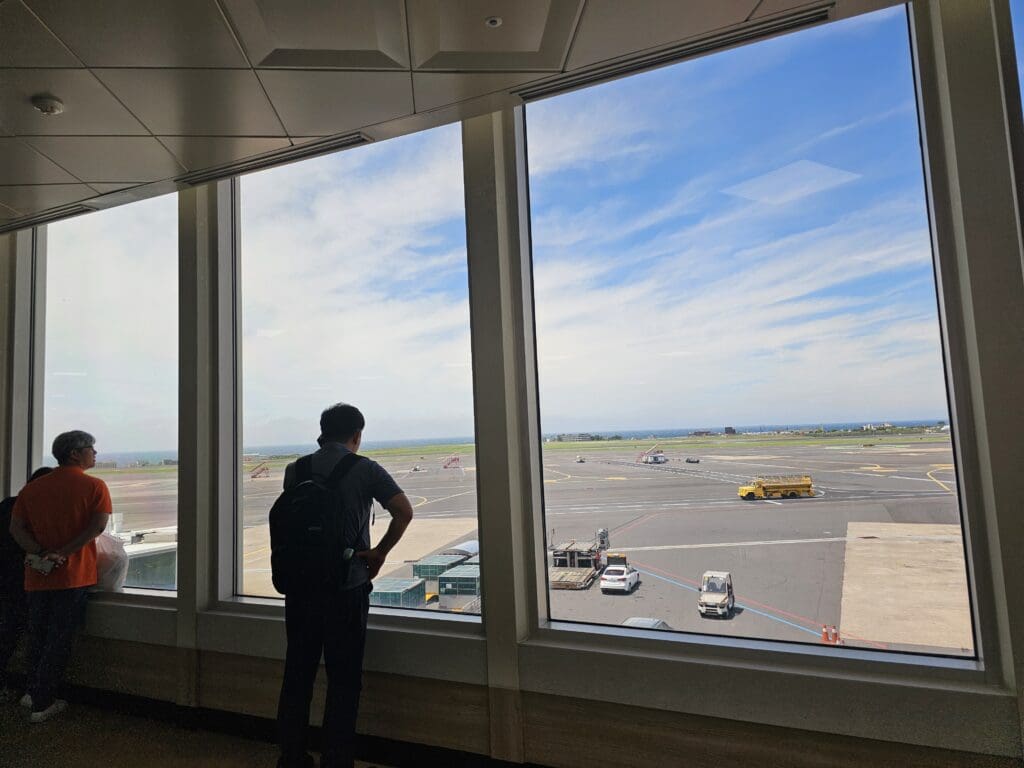
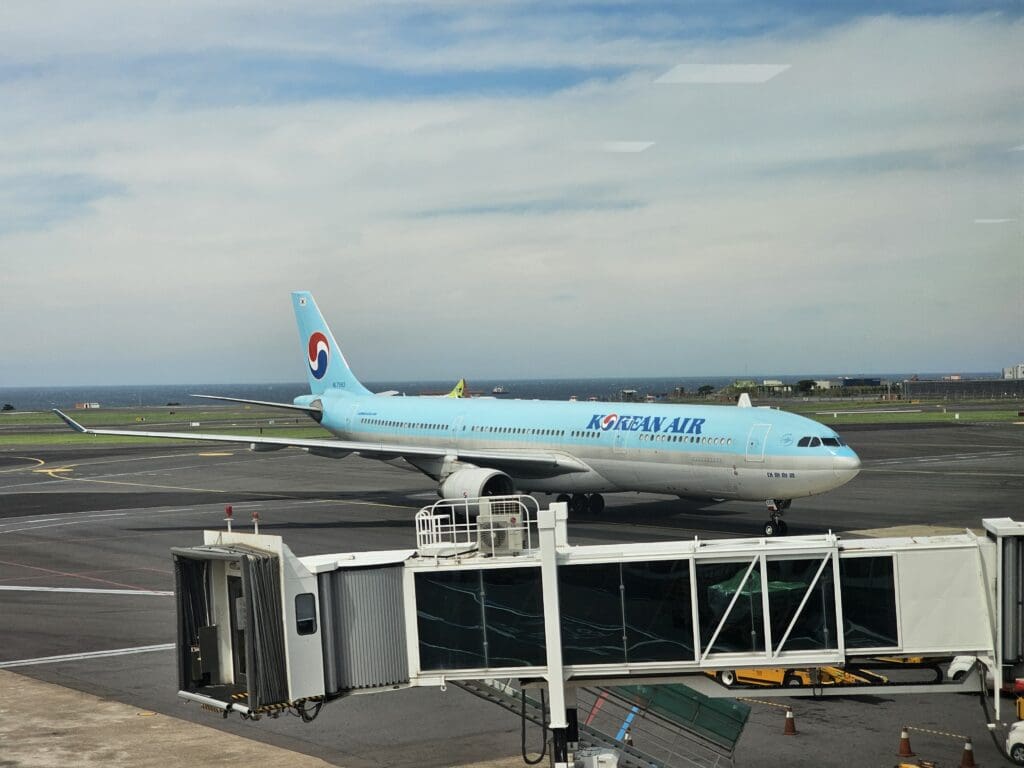
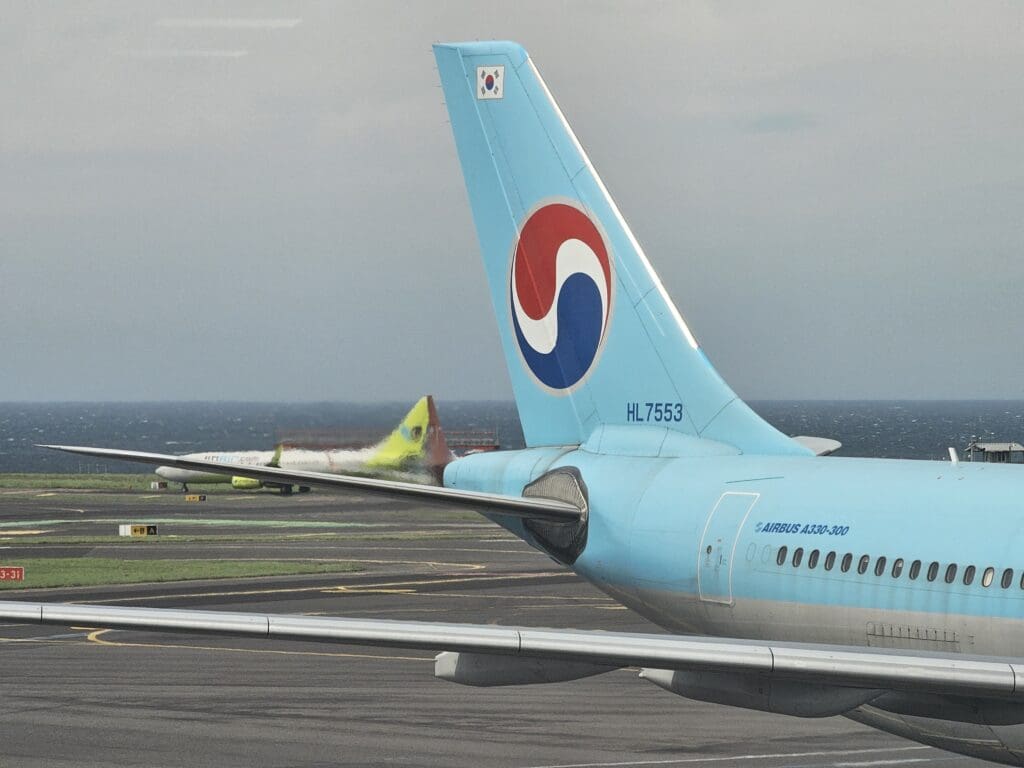
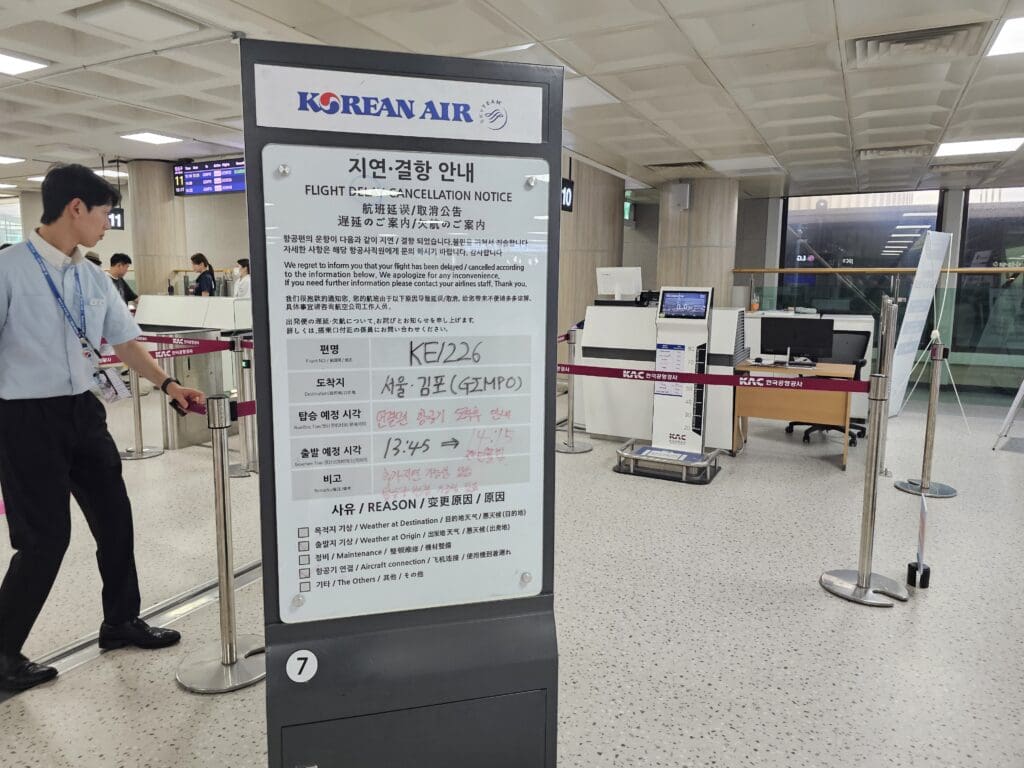
A few moments after the Air Seoul Airbus A321 had arrived at its remote stand, I received a notification from Korean Air’s app alongside an email that advised me that the departure time of my flight had been pushed back by thirty minutes from 1345 to 1415. The reason for this was noted as ‘aircraft connection’, which seems to be the standard reason given for any flight delay in Korea, even though this was clearly due to the inclement weather! With a fair amount of time on my hands, in possession of my mobile boarding pass, with nothing to drop off and aware that Jeju International Airport is typically very quick to pass through as a domestic passenger, rather than head straight to airside departures level, I instead voyaged to the top floor of the terminal. There, sitting above the usually busy check-in hall, are several eateries and cafés, however, of perhaps more interest to those reading this blog, is the fact that this hosts just one of two open-air observation decks in Korea (or three if you include that of Incheon Airport which is located next to this rather than in the terminals). Having opened in 2020, this consists of a fairly small area that offers a good view out over the main runway and much of the ramp. However, unfortunately, all photographs must be taken through a glass barrier which is often not in the cleanest condition.
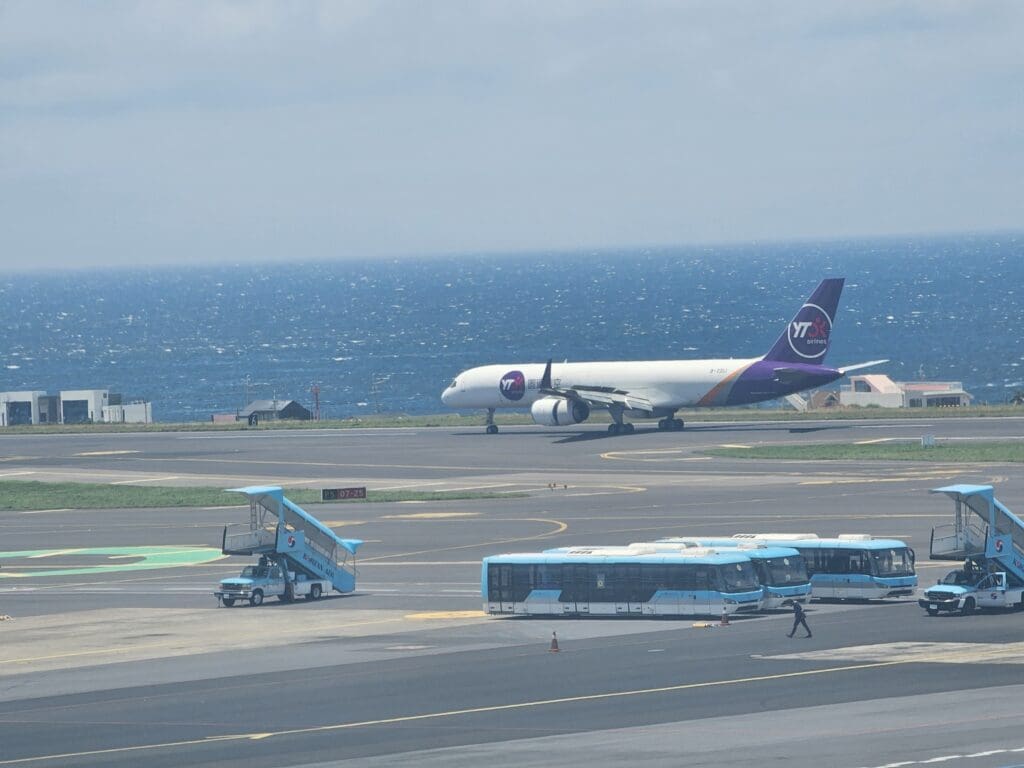
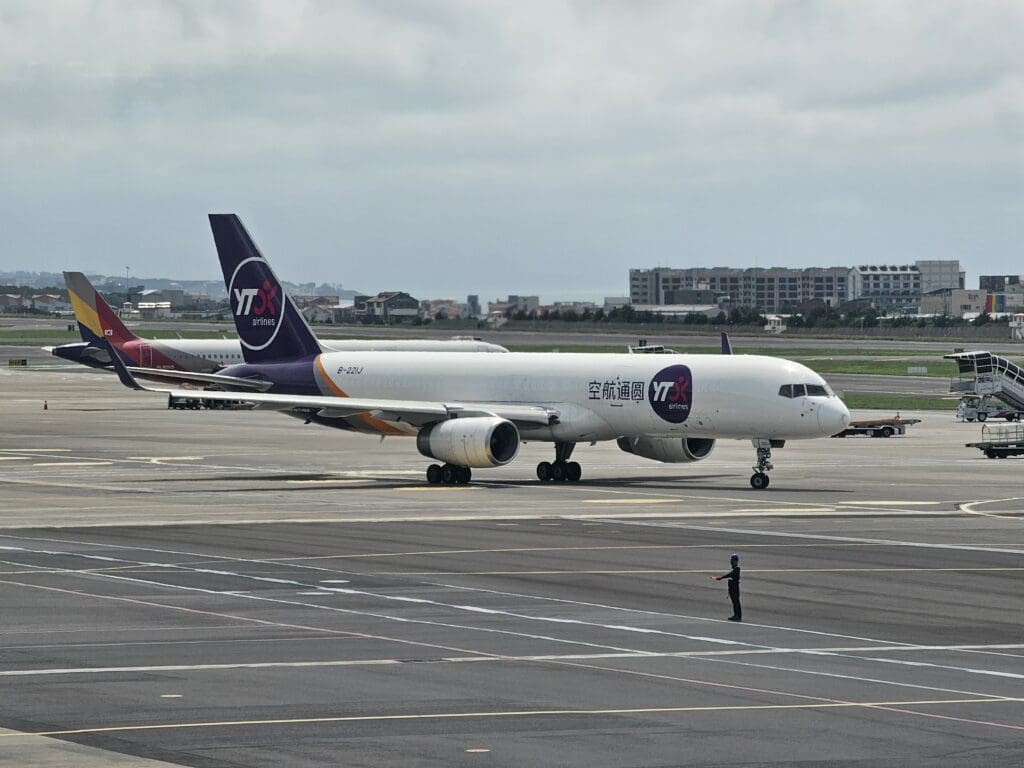
Once I had grabbed a coffee, I made my way out to the observation deck and was presented with a series of go-arounds plus a couple of very ‘interesting’ smoky landings, where aircraft touched down wheel-by-wheel. One totally unexpected visitor came in the form of a Boeing 757 Freighter operated by Chinese cargo airline YTO Cargo Airlines. Whilst most flights were diverting away from Jeju, for some reason this aircraft had diverted on its way from Ningbo to Seoul Incheon. Upon making it almost all the way to Incheon Airport, without attempting a landing, the Boeing headed back southwards over the Korean Peninsula to Jeju. This remained on the ground for an hour or so before heading to Incheon for its successful second attempt at landing there. Just quite why this had occurred was quite a mystery given the fact that other than a few rain showers, the weather at Incheon was well within acceptable limits, with nothing more than a light breeze blowing.
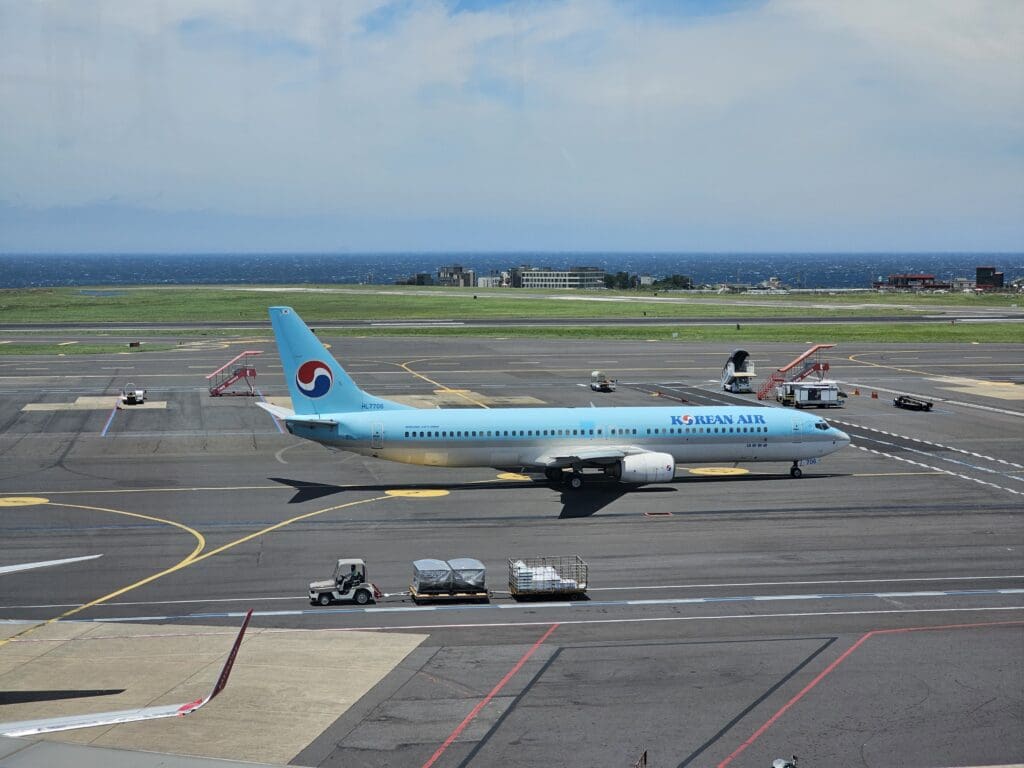
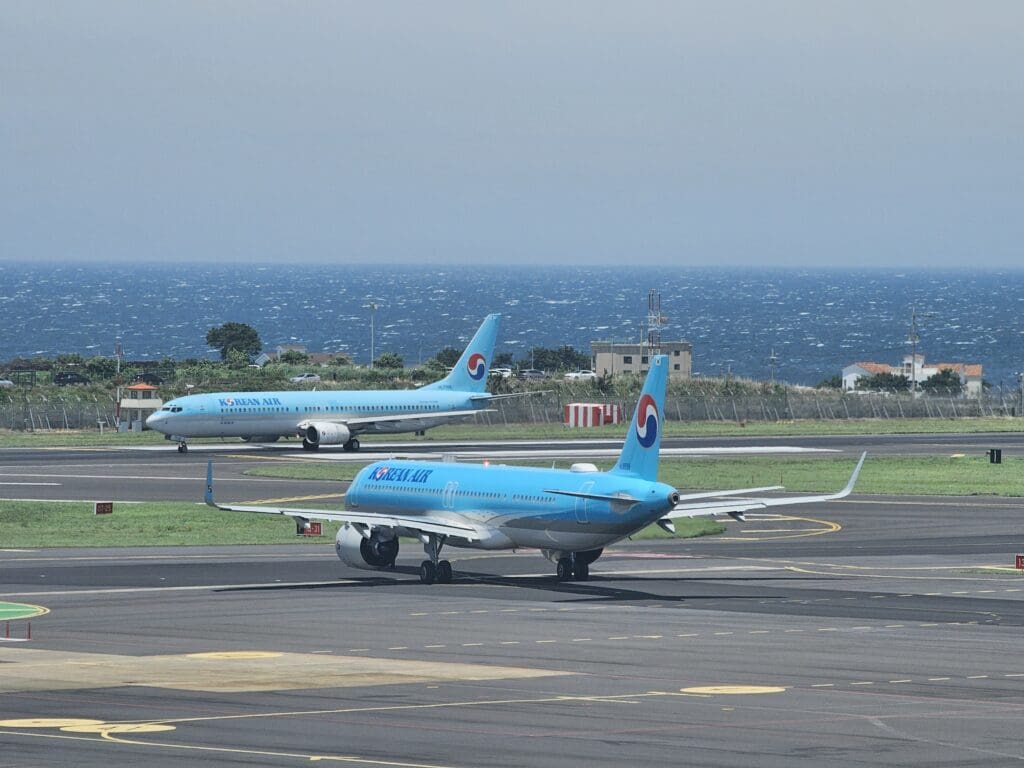
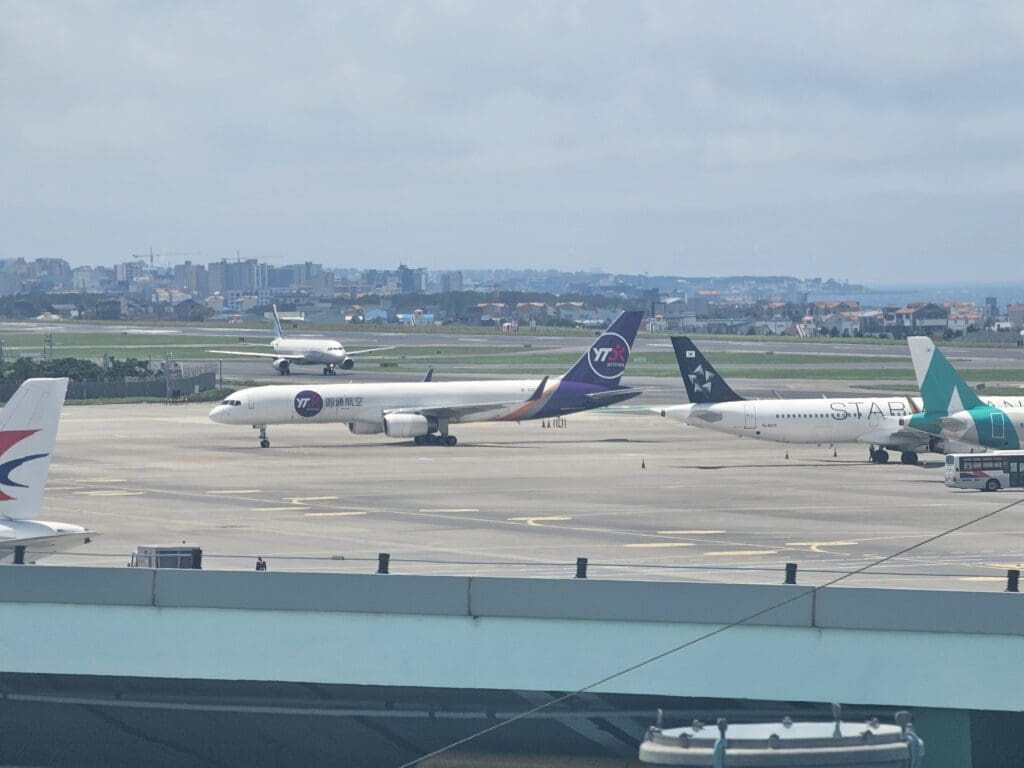
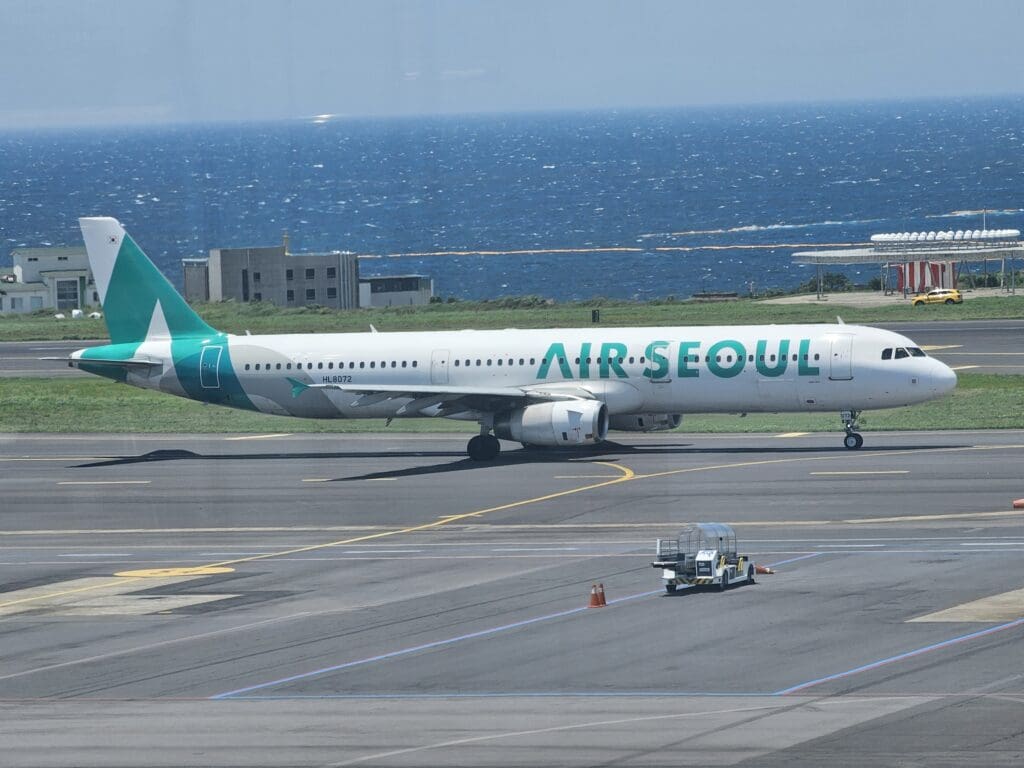
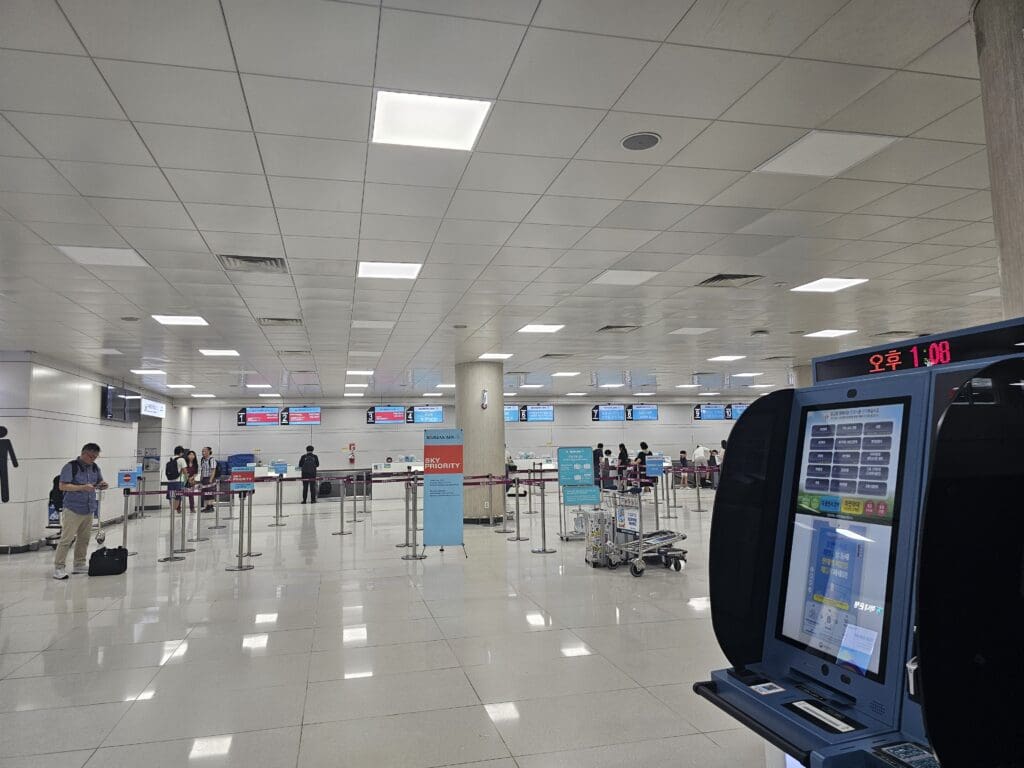
Indicating that I would almost certainly be delayed beyond 1415, the Airbus that was scheduled to operate my flight back did not depart on its outbound leg from Seoul Gimpo until 1311. Working on the assumption that the flight time to Jeju would be about an hour and that this would be on the ground for about fifty minutes, I expected a new departure time of about 1500. After sunning myself for about thirty minutes on the observation deck, I headed back down to the terminal and made my way to one of the two security checkpoints. Quickly examining the landside portion of Jeju International Airport, this is functional and seems to do a good job at quickly processing the tens of millions of passengers that pass through its doors each year, yet it isn’t particularly glamorous and lacks any particularly remarkable or memorable features (other than the observation deck). That day, despite the busy scenes in the landside and airside portions of the terminal, I found this to be clean and tidy, leaving me with very little to complain about.
Jeju International Airport is somewhat unique in its arrangement, as Korean and foreign nationals (technically those who lack a Korean Alien Registration Card) are separated at the entrance to the terminal’s security checkpoints. This is the only airport in Korea where this is undertaken for domestic flights. Seeing as I am not a resident of Korea, I joined the short foreigner queue where my boarding pass was soon scanned and my passport briefly checked. Next up were several immigration e-gates, and upon entering one of these, my passport was scanned before I was required to have my fingerprint taken. With this presumably matching up with the fingerprint that had been taken upon arriving in Korea, the gate swung open and I was allowed to head onwards to security. The whole reason for this check is explained by the fact that many nationalities who would require a visa to enter Korea do not require a visa to enter the island of Jeju, most notably, those from China. This check is thus in place to prevent anyone who requires a visa to visit mainland Korea but not Jeju, from entering Korea without the correct visa. Once through, as always seems to be the case in Jeju, security was a very quick and painless affair, and I would estimate that this took no longer than 45 seconds.
Upon passing through security, passengers emerge onto an indoor observation area that provides near panoramic views of the ramp, albeit through partially tinted and often dirty windows. It is worth noting that this is the only part of the domestic airside area where passengers can enjoy mostly unobstructed views of the ramp and runways, and is thus the best place for enthusiasts to wait in the terminal. That day, this proved to be very popular, with many passengers enjoying the entertainment of watching large airliners make bumpy approaches, go arounds and landings, although as mentioned, there were far more aircraft that ended up going around rather than making full stop landings. Seeing as I have passed through Jeju Airport plenty of times, I didn’t have much of an urge to explore so after a quick walk around and a visit to the local Lotteria for a burger lunch, I decided to set up camp and watch the stream of movements attempting to land.
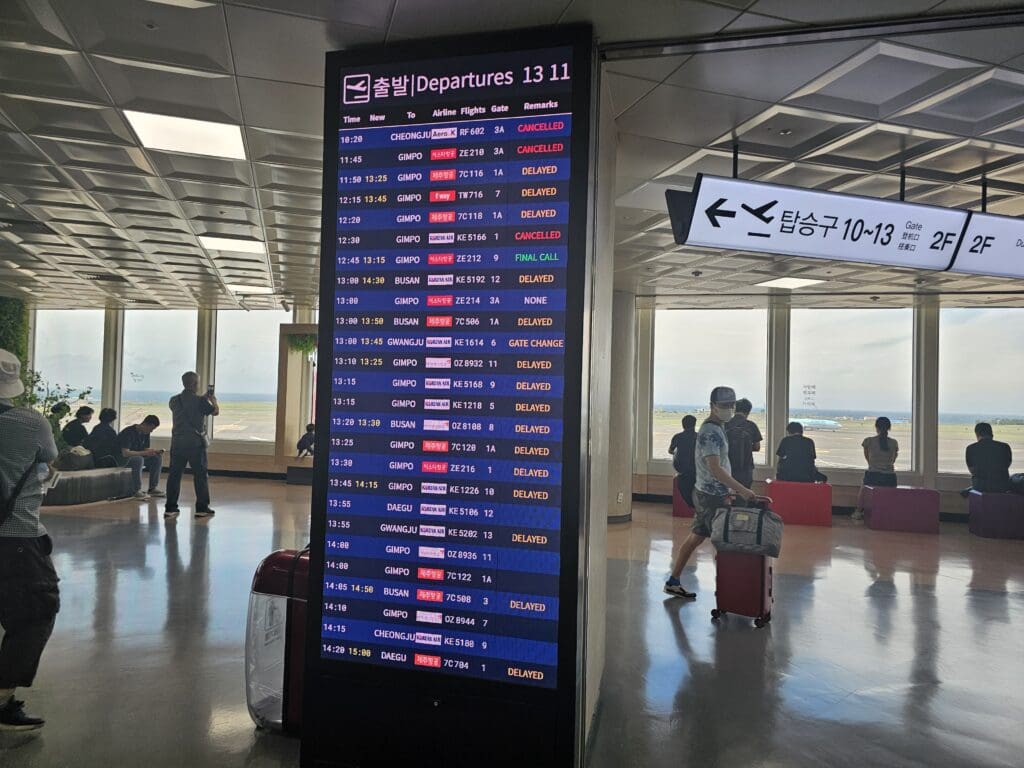
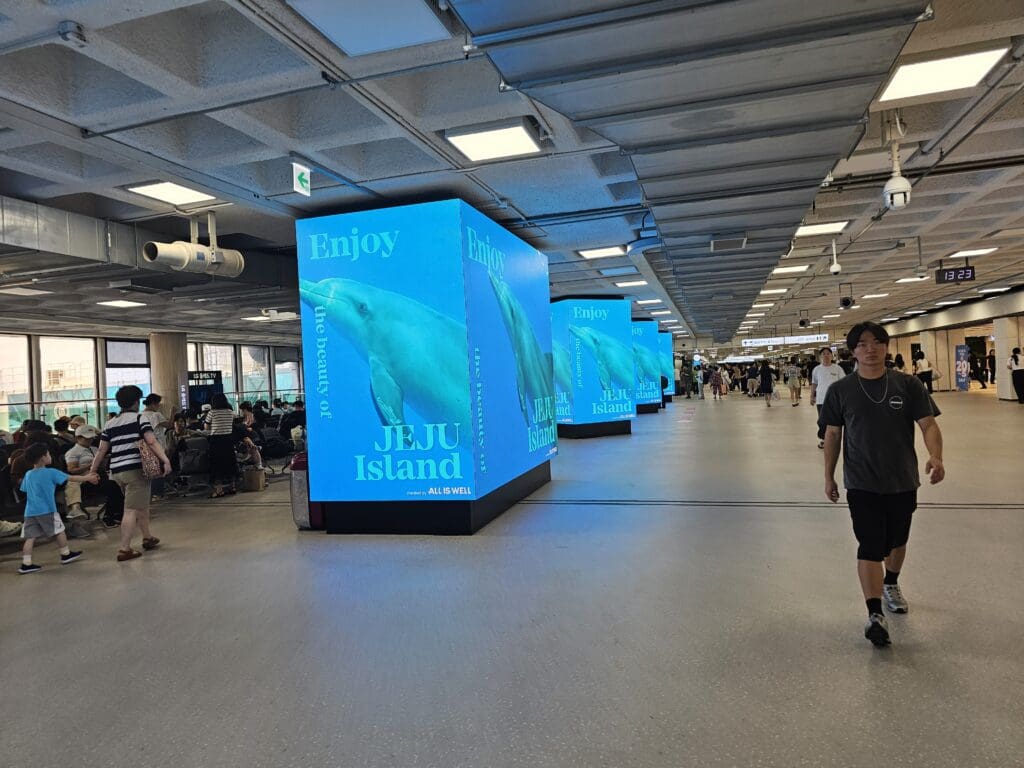
Sitting on the floor below security, Jeju International Airport’s domestic waiting area covers a fairly large space, although despite the plentiful seating, thanks to the disruption, the terminal was incredibly busy and free seats were very much at a premium. Other than seating, there are plenty of shops, cafés and restaurants available, and in more ‘normal’ times, this usually proves to be pleasant enough for a short stay. Indeed, like most if not all domestic terminals in Korea, Jeju Airport was designed with convenience rather than long waits in mind. Despite its busyness, that day the terminal seemed to be in a clean condition, with an army of cleaners regularly spotted doing the rounds throughout my stay. Meanwhile, fast and complimentary was provided which worked well and left me with no complaints. The only slight issue I had was that plug sockets proved to be a little difficult to come by. However, seeing as I had my power bank with me, this was not too much of a concern.
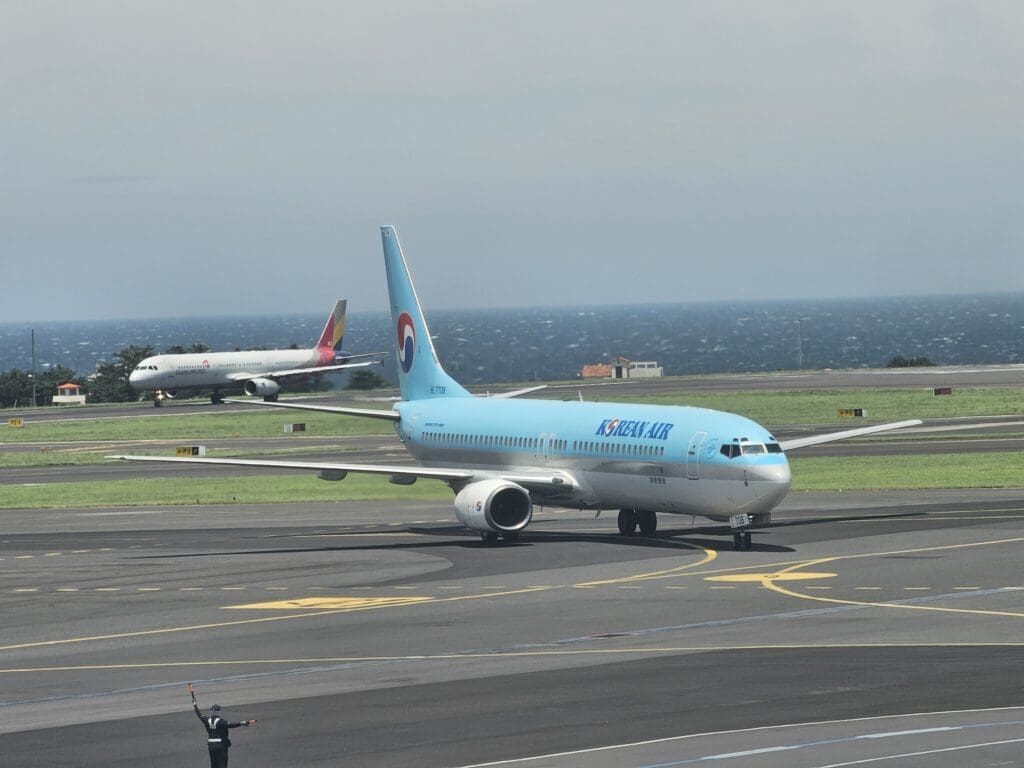
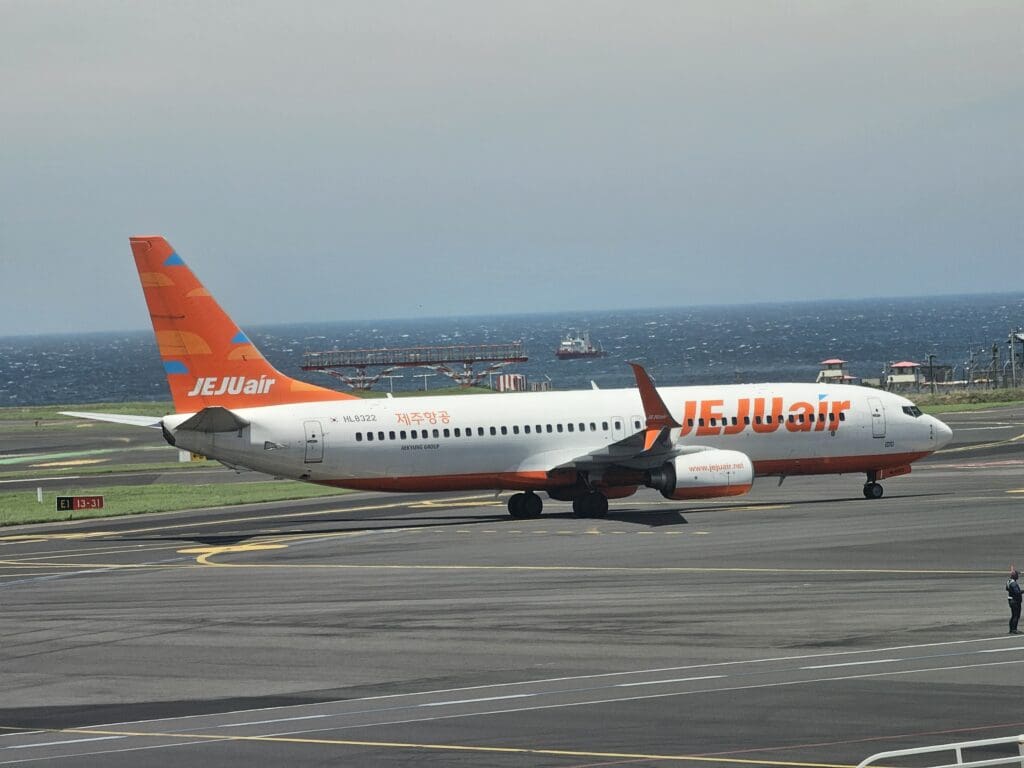
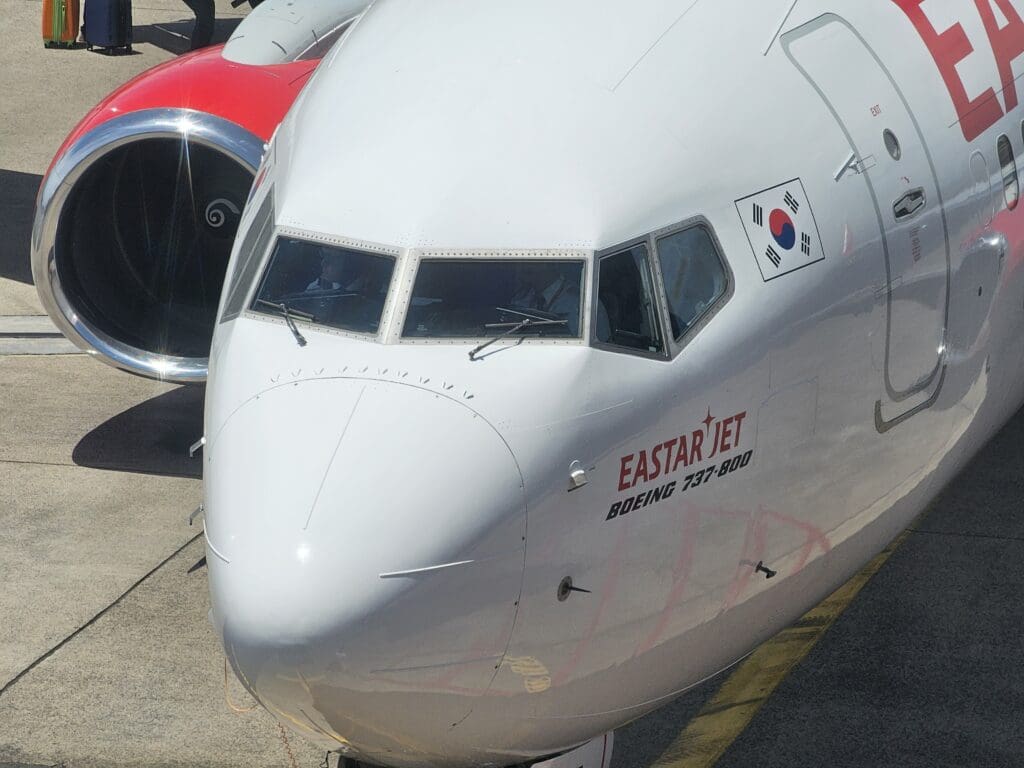
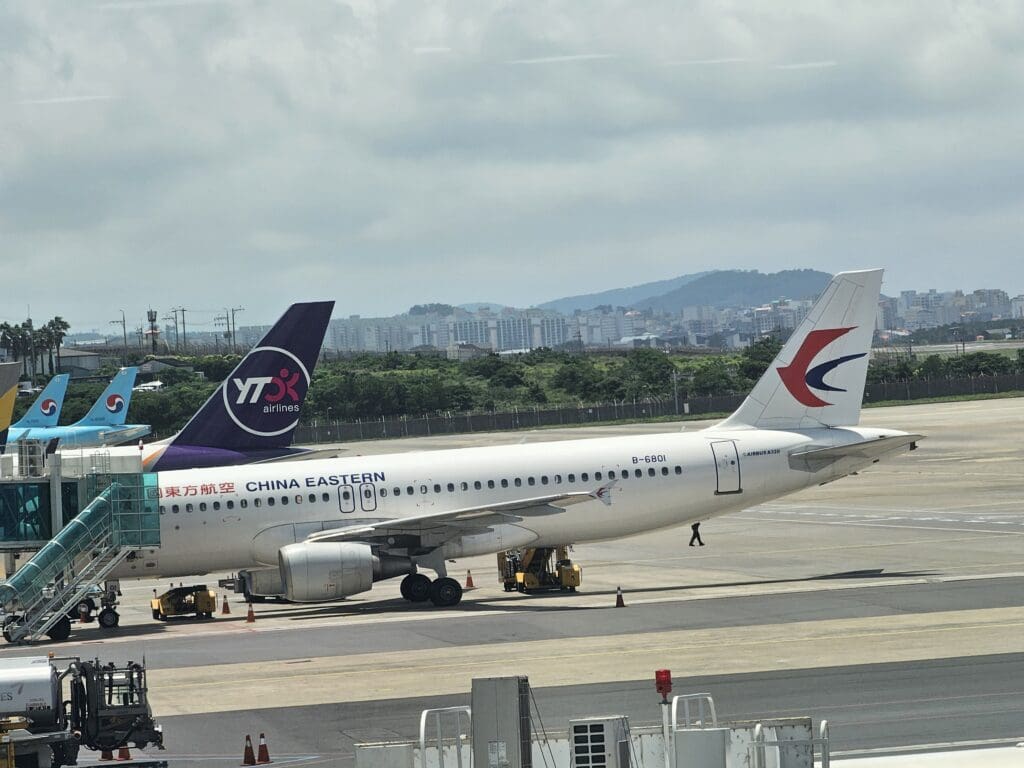
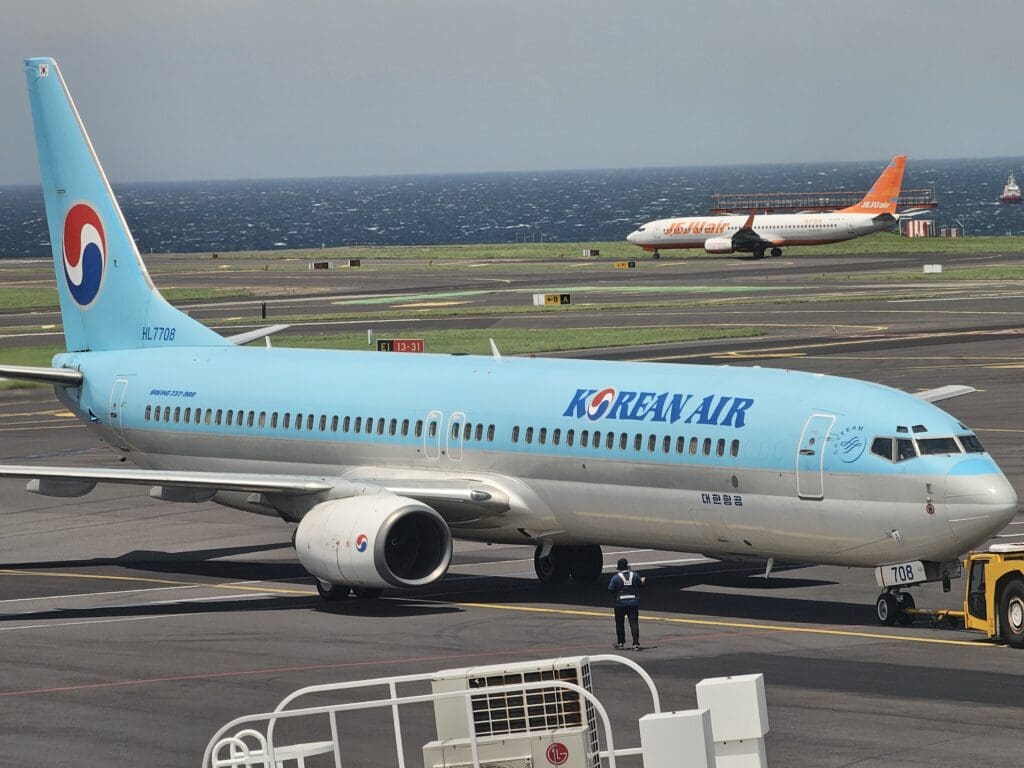
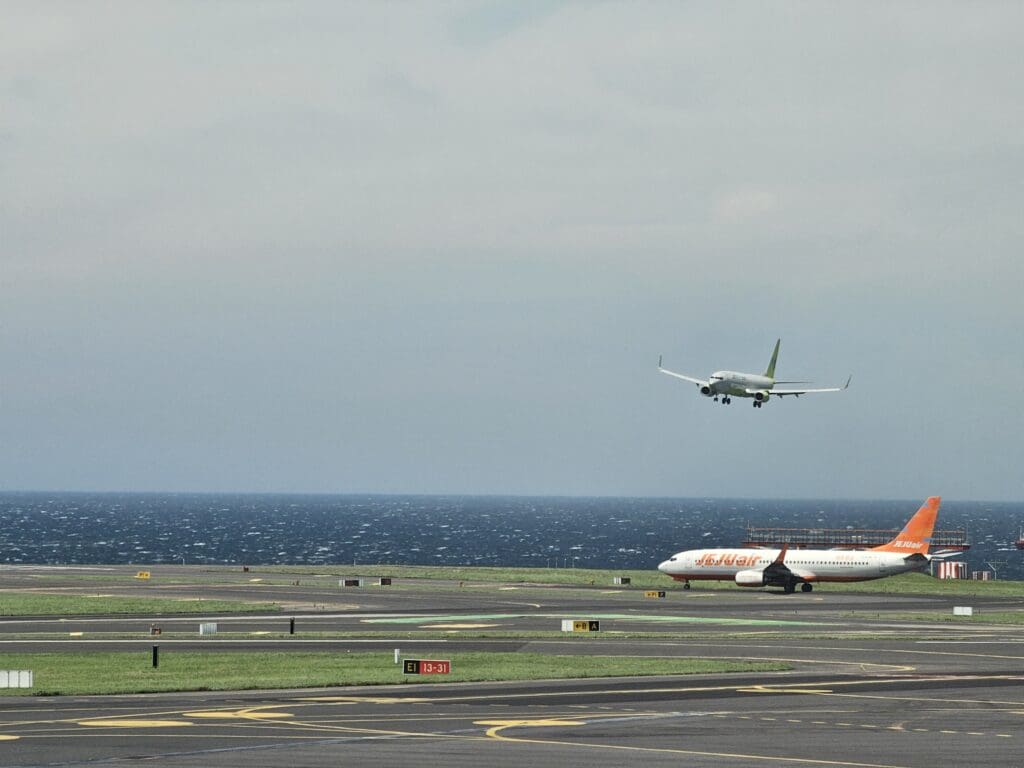
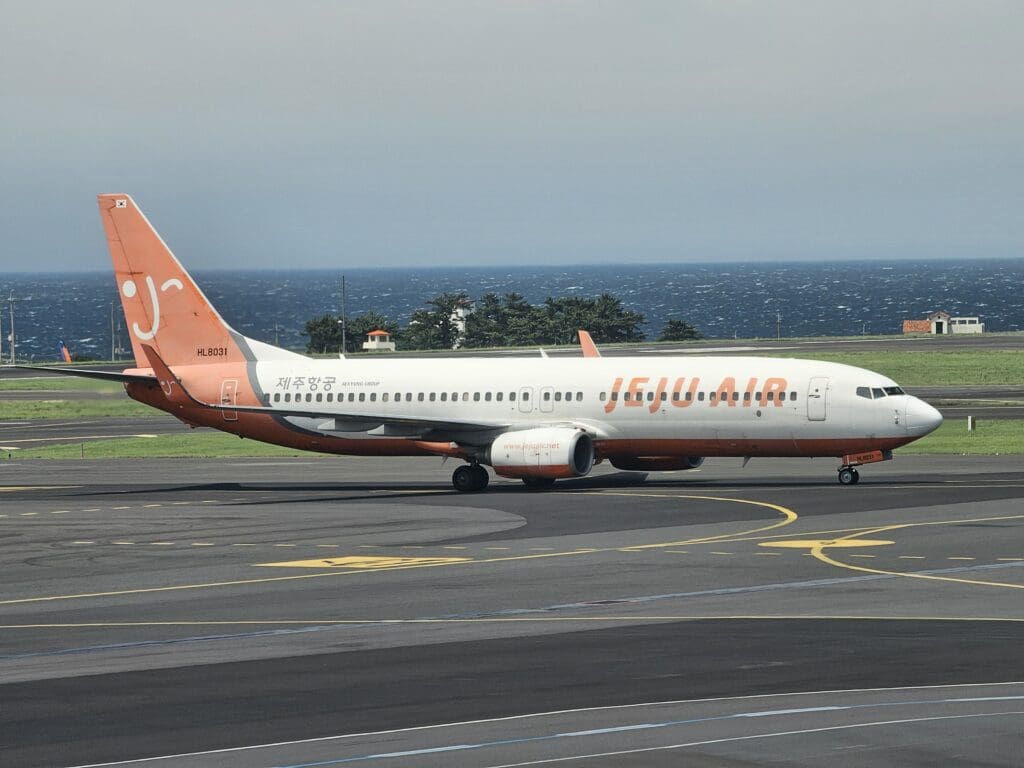
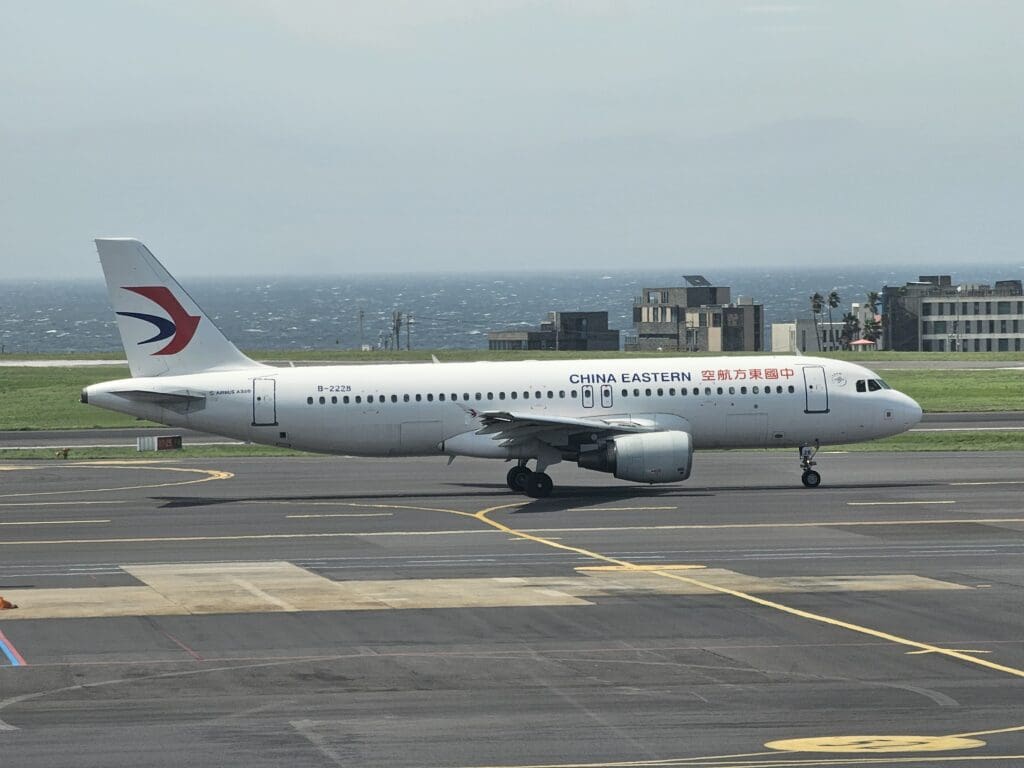
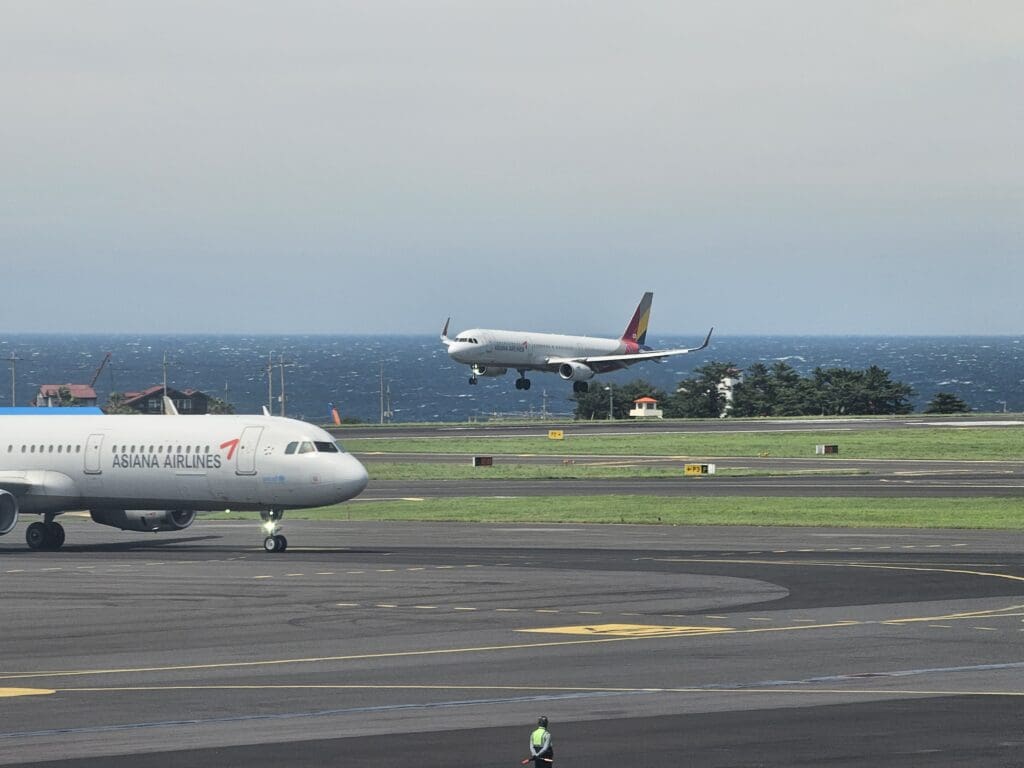
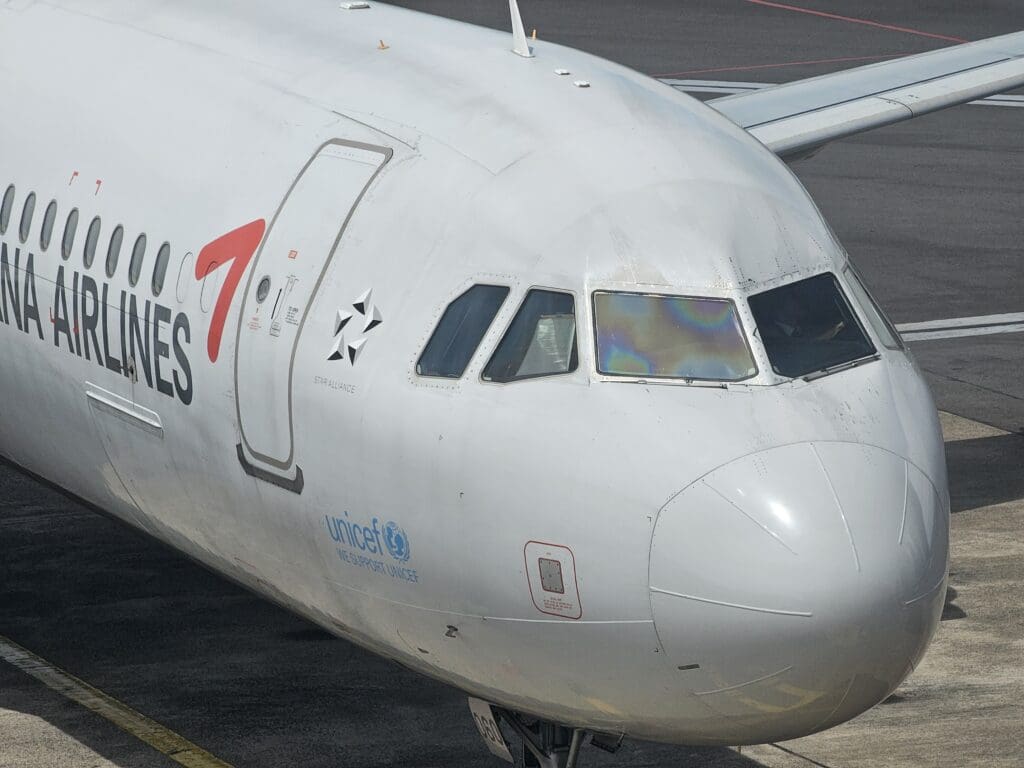
Before heading back up to the observation area, I made a quick trip to my flight’s gate, Gate 10. At that time, the area around this seemed to be rather packed with disgruntled-looking passengers. However, to Korean Air’s credit, two Korean Air ground agents could be seen permanently on duty, standing next to the information board that detailed the flight’s delay and were always on hand to answer questions from passengers. At that time, once our new delayed scheduled departure time had come and gone, no new departure time was provided on this board, presumably in case the Airbus was unable to land in Jeju and had to return to Seoul Gimpo. Indeed, this was not a particularly outlandish scenario as the inbound aircraft that was scheduled to operate Korean Air’s 1315 service (alongside plenty of others) ended up returning to the mainland and was thus cancelled.
Returning to the airside observation area, I watched as aircraft after aircraft either made bumpy landings or rocketed back upwards at various stages of the final approach. Tracking the progress of the delayed inbound flight, I eagerly watched as its bright landing lights appeared on the horizon and the Airbus floated down past Jeju City and continued bumping around on its journey down the airport. Whilst things initially looked good and the aircraft shook, swayed and dipped no more than any other aircraft that had successfully landed, however, the jet ended up aborting its landing at the last minute and a short puff of exhaust could be seen blurting from the Airbus’ engines as this rocketed back into the Jeju skies. Like most aircraft that aborted their first attempts at landing, this joined the long procession of aircraft coming back around for a second attempt. This took the aircraft a fair distance out to sea, around halfway to the southern coastline of the mainland’s South Jeolla Province before coming back around for a second attempt.
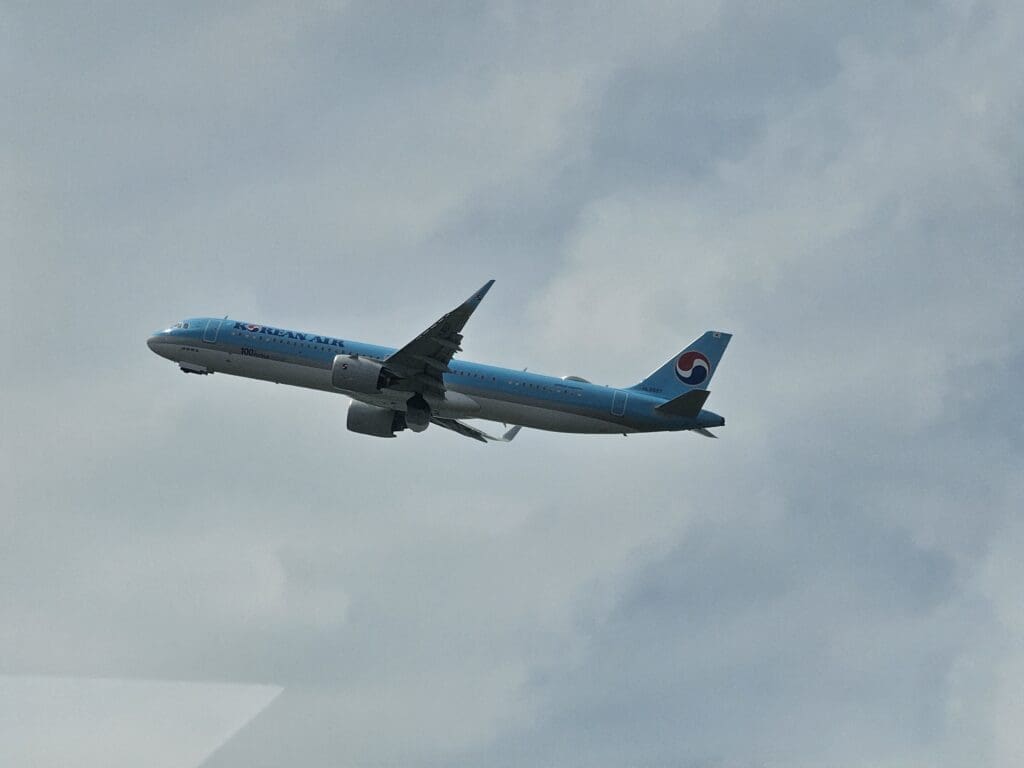
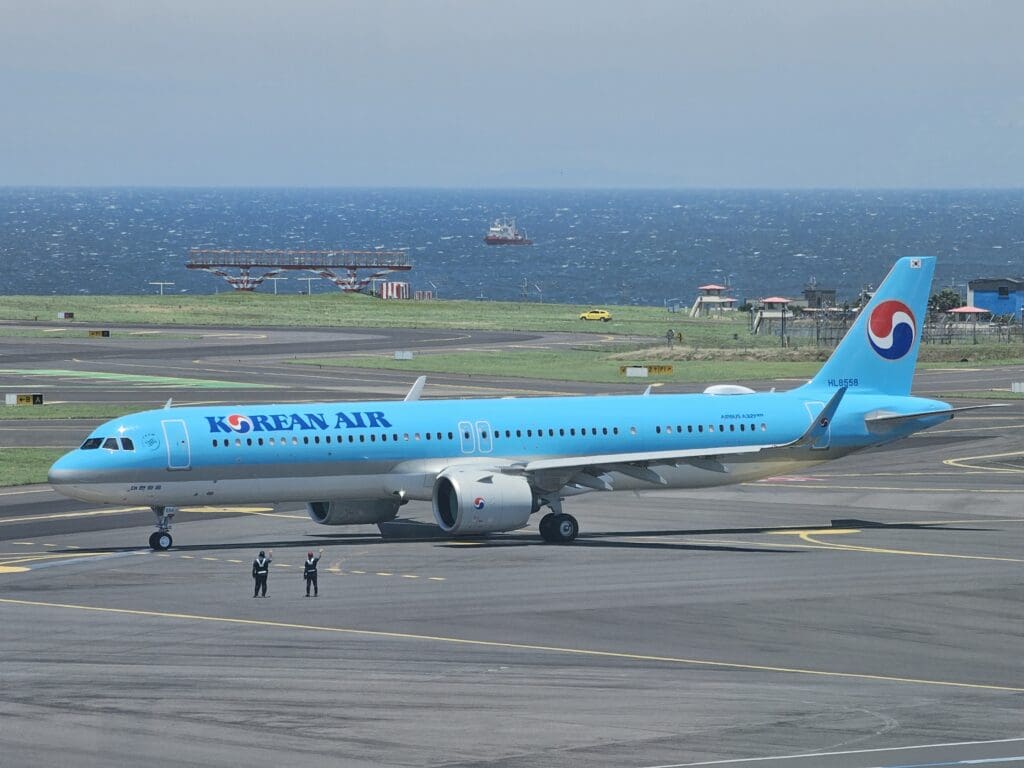
As I waited, some entertainment was provided in the ‘interesting’ landings of two Airbus A330s – one operated by T’way Air and another by Korean Air. Both of which had come down from Seoul Gimpo Airport. Almost thirty minutes after the first go around, the Airbus’ landing lights appeared once again and the aircraft made its bumpy approach down to Jeju, once again swaying and shaking as it neared the airport. Fortunately, this time, things were a little more successful and the aircraft touched down on the island at 1456. Remaining in the observation deck, I watched as the Airbus made its taxi over to the terminal before pulling into Stand 10 located right next to this.
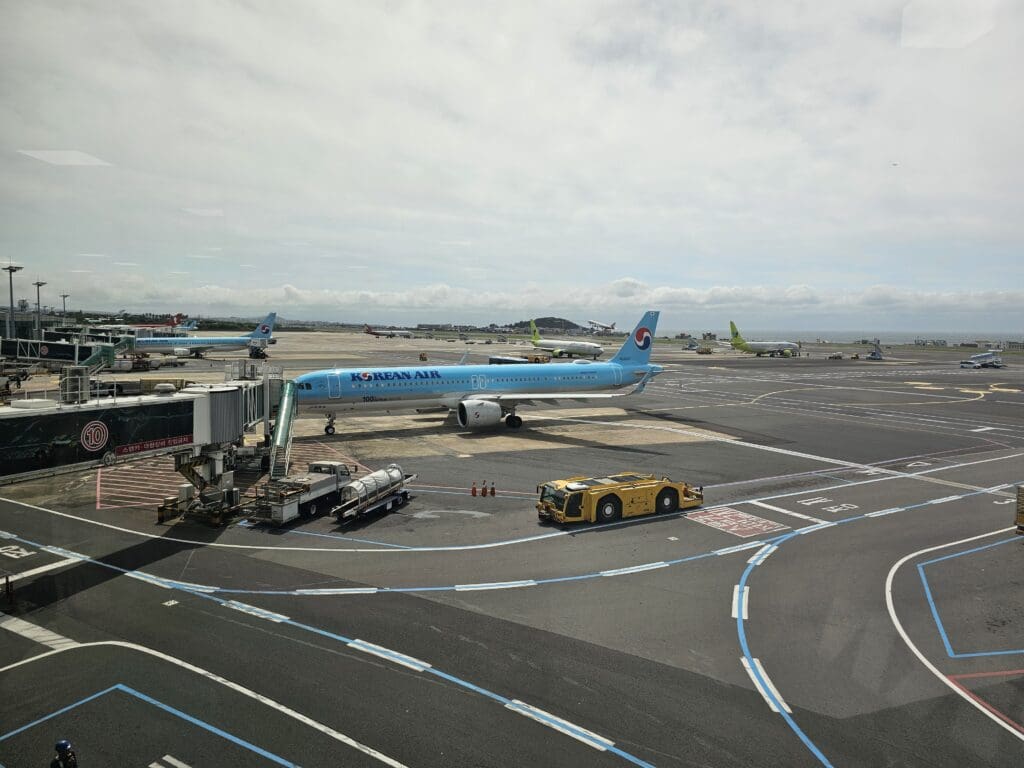
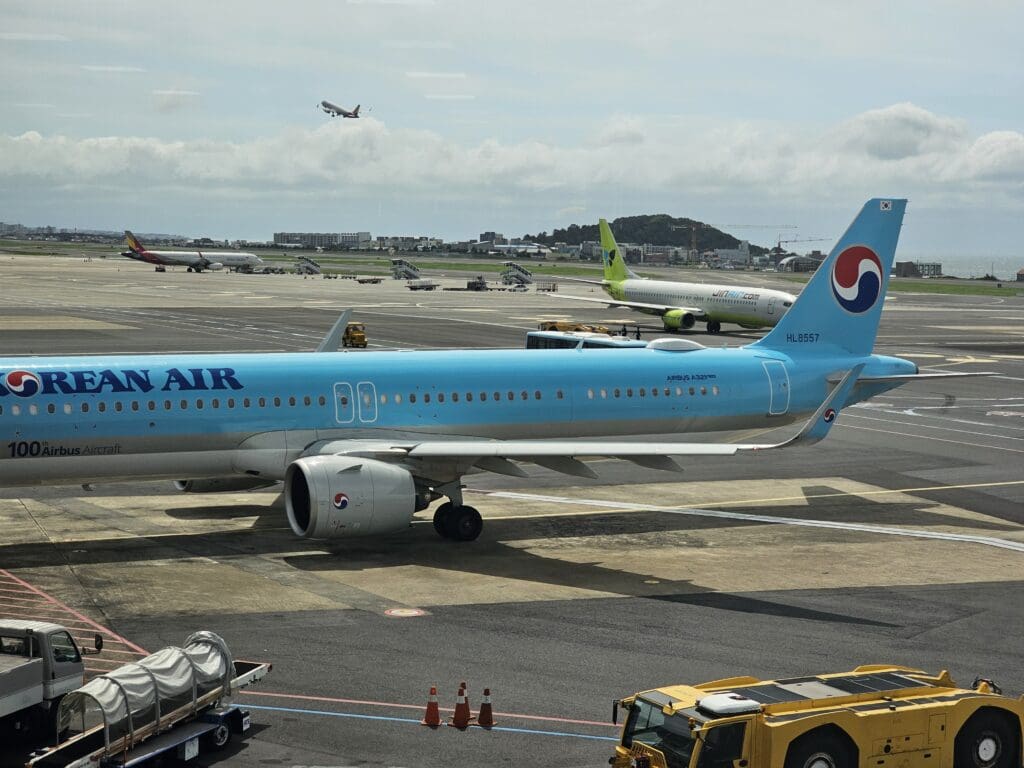
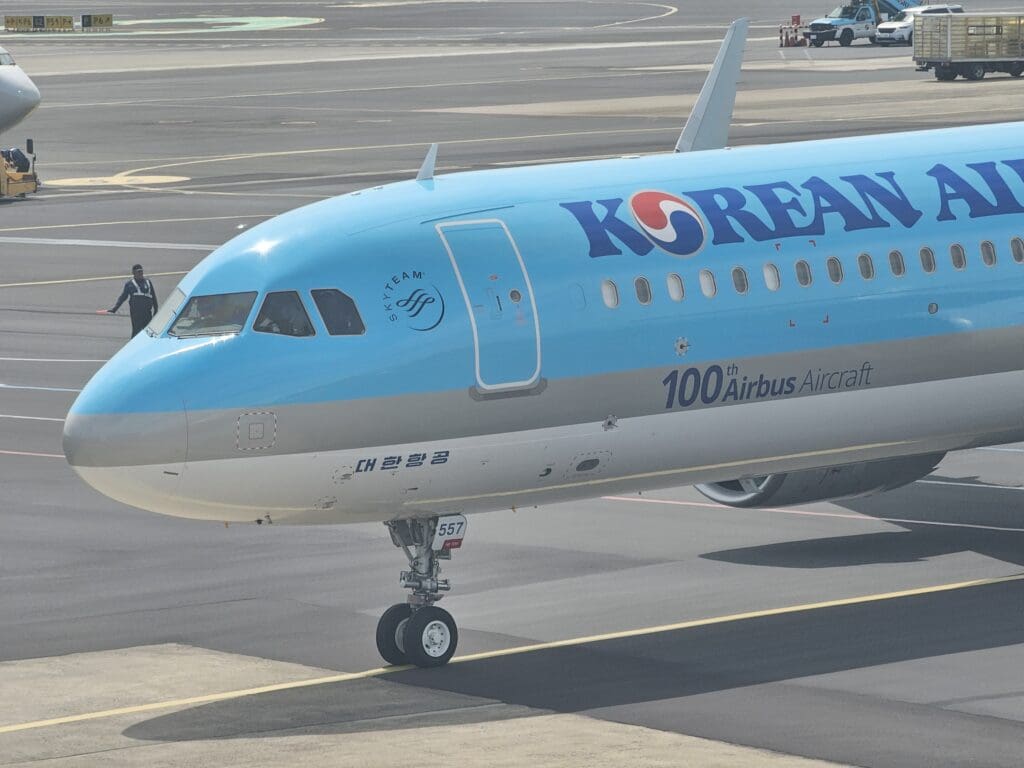
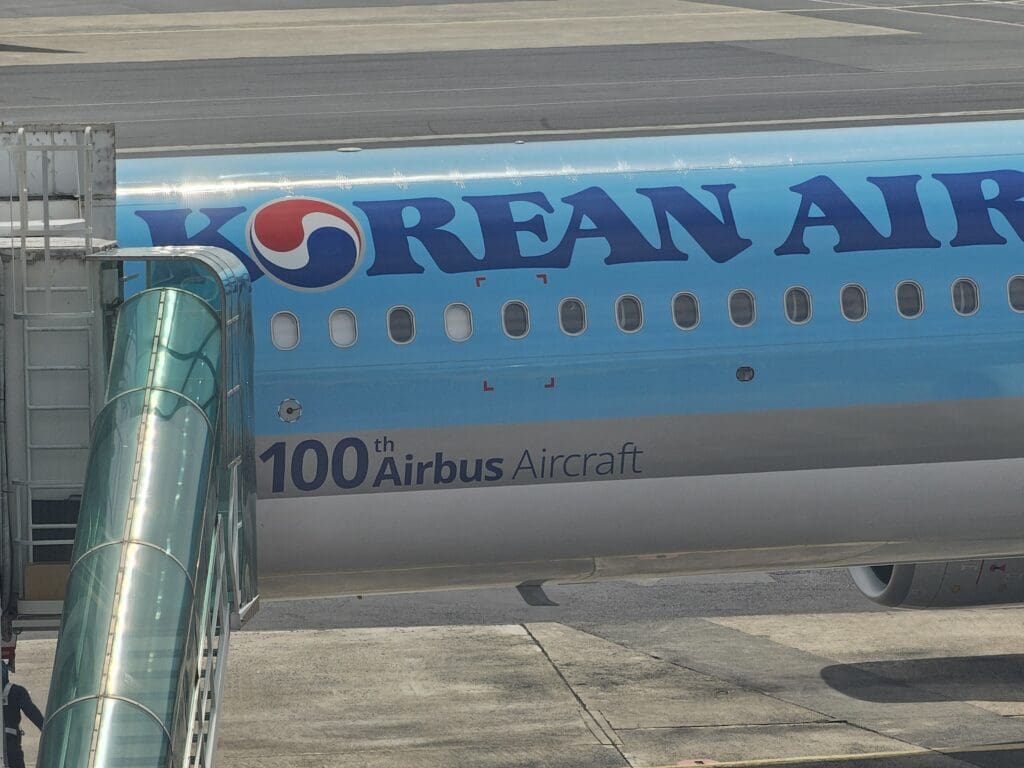
That day, I would end up flying onboard Airbus A321-272NX HL8557. Assembled at Airbus’ Toulouse Blagnac plant, this particular aircraft took to the skies for the first time in mid-March 2024, making it less than four months old at the time of my flight! Following two test flights around the skies of southern France and the Mediterranean, its test registration of F-WWAG was replaced by its current registration and in late April the aircraft was ferried over to Seoul Gimpo, making a mid-journey refuelling stop in Tashkent. Notably, this aircraft is the one-hundredth Airbus to be delivered to Korean Air and proudly wears a decal promoting this fact on both sides of the forward section of the fuselage. Whilst Korean Air sends their Airbus A321neo fleet to destinations across East and Southeast Asia, this particular Airbus had not seen much of the world and with the exception of the odd Tokyo Haneda rotation, had operated exclusively on the route between Seoul Gimpo and Jeju.
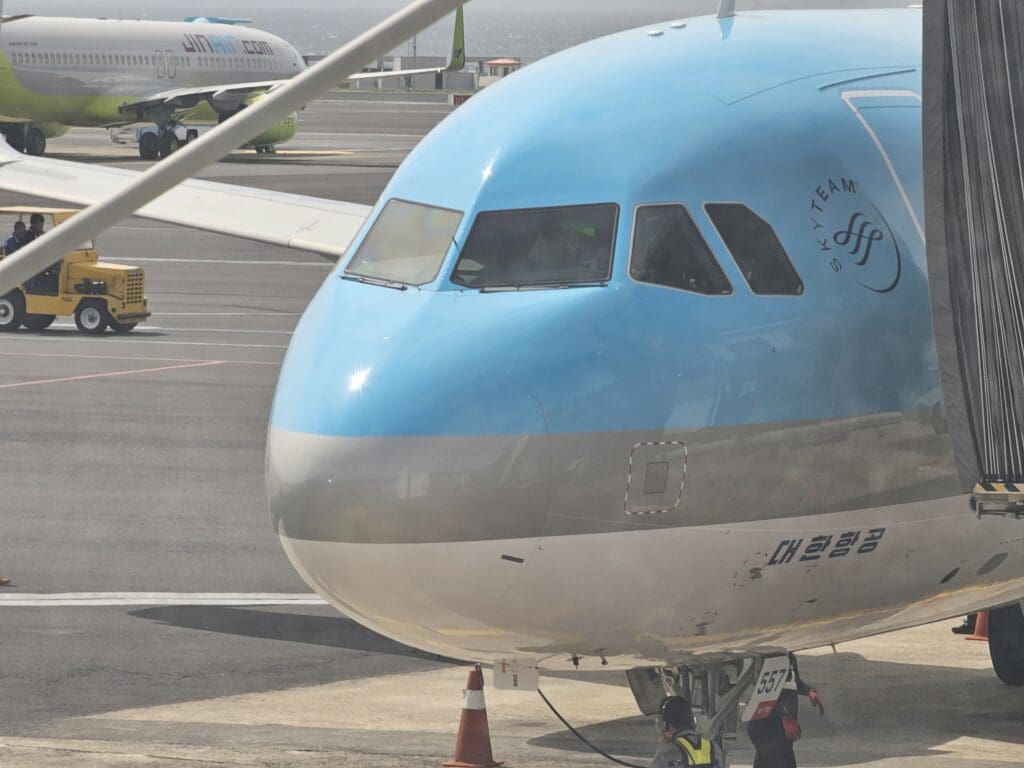
Once the Airbus had come to a halt, I made my way downstairs to the gate, where the Korean Air gate staff soon sprang into action. At that time, one member updated the delay information board to advise passengers that the flight was now scheduled to depart at 1540. Meanwhile, the other two members of staff began to erect various signs which indicated that boarding was to be a well-ordered affair. That day, boarding was to be undertaken in three groups, with Group 1 being those in Prestige Class, elite members of Skyteam’s frequent flyer programs and those requiring assistance. Meanwhile, Group 2 consisted of those in Economy who were seated towards the rear of the aircraft whilst Group 3 took the form of those in the Airbus’ front half. Once all inbound passengers had disembarked, three deadheading Korean Air cabin crew members made their way onto the aircraft and, indicating that the flight would be unlikely to depart at 1540, ten minutes before this time, three members of the gate staff took their positions in front of the podium. Each staff member held a sign requesting those in ‘Group 1’, ‘Group 2’ and ‘Group 3’ to line up in front of them.
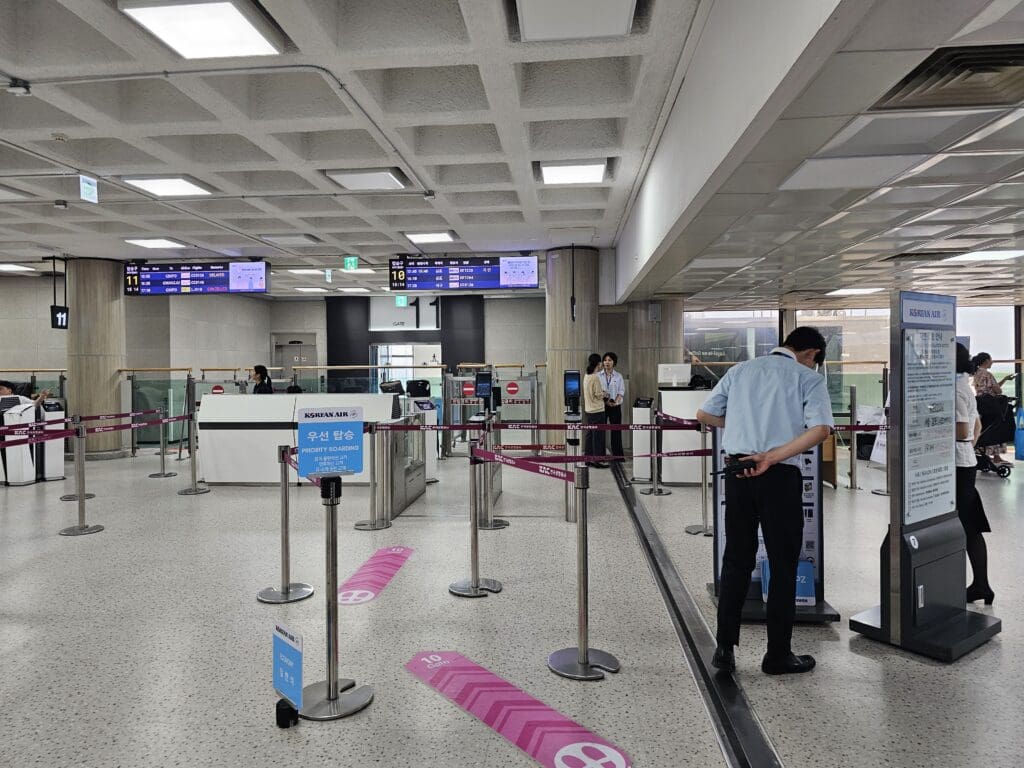
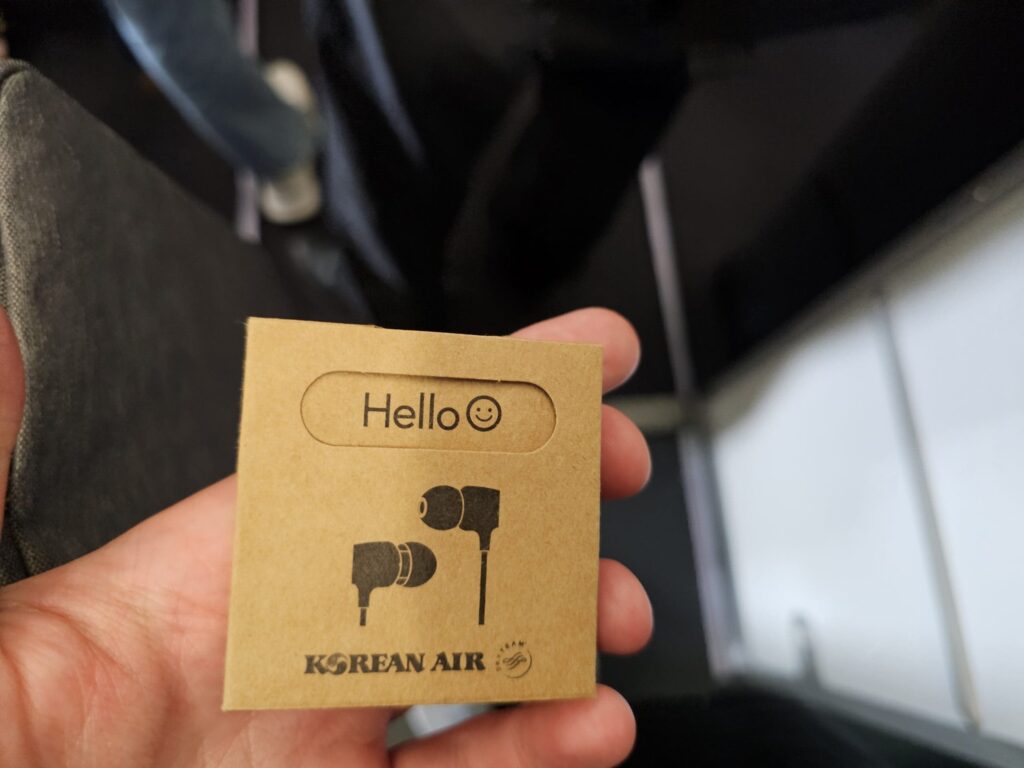
At 1535, an announcement was made in Korean and English requesting those in Group 1 to board the aircraft and after two minutes of waiting, the line for Group 2 passengers began to shift. Making my way forward, I soon scanned my boarding pass on the gate reader. Without any issues, this produced a ding and its screen displayed my name and a tick, indicating that I was free to make the short distance down the glass jetbridge to the waiting aircraft. As I wandered down this I admired the Airbus A321neo’s large Pratt & Whitney engines and the mostly clean fuselage of this new jet, and without queuing I reached the main cabin door. Leaving a positive first impression, as soon as I stepped into the forward galley I received a warm and friendly greeting in both English and Korean. There, a box of earbud-type headphones, each packaged in a small card box could be seen in a box which had been placed on one of the pull-out galley surfaces, with passengers free to take these as they wandered past.
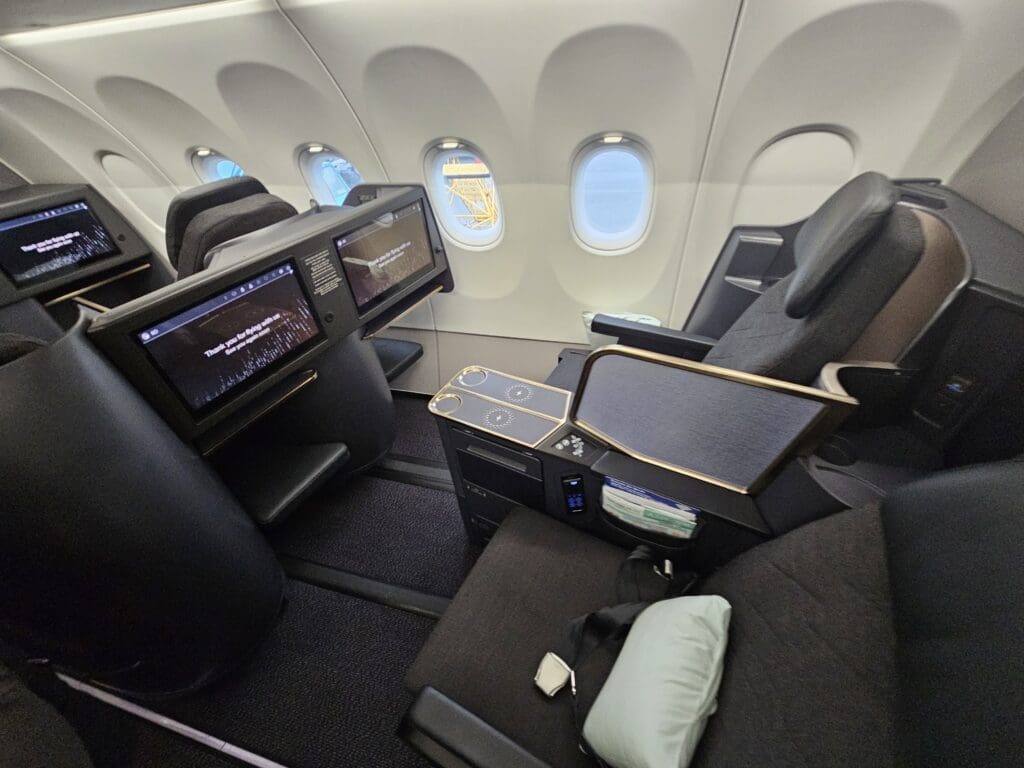
Once one of the two friendly flight attendants in the forward galley had checked my boarding pass to ensure that I was on the correct aircraft I was free to turn right and commence the journey to my seat near the rear of the aircraft. First up was the small Prestige Class cabin. As with their Boeing narrowbodies, this features eight seats in a 2-2 configuration, although those fortunate enough to travel in this section of the aircraft will be delighted to find that the well-padded recliners have been replaced by slightly more private Collins Aerospace Diamond Parallel lie-flat seats. These are covered in a calming grey fabric cover and whilst not having too much time to examine these in detail, they appeared to be sleek, modern and comfortable and even came with a wireless charging point on their armrests.
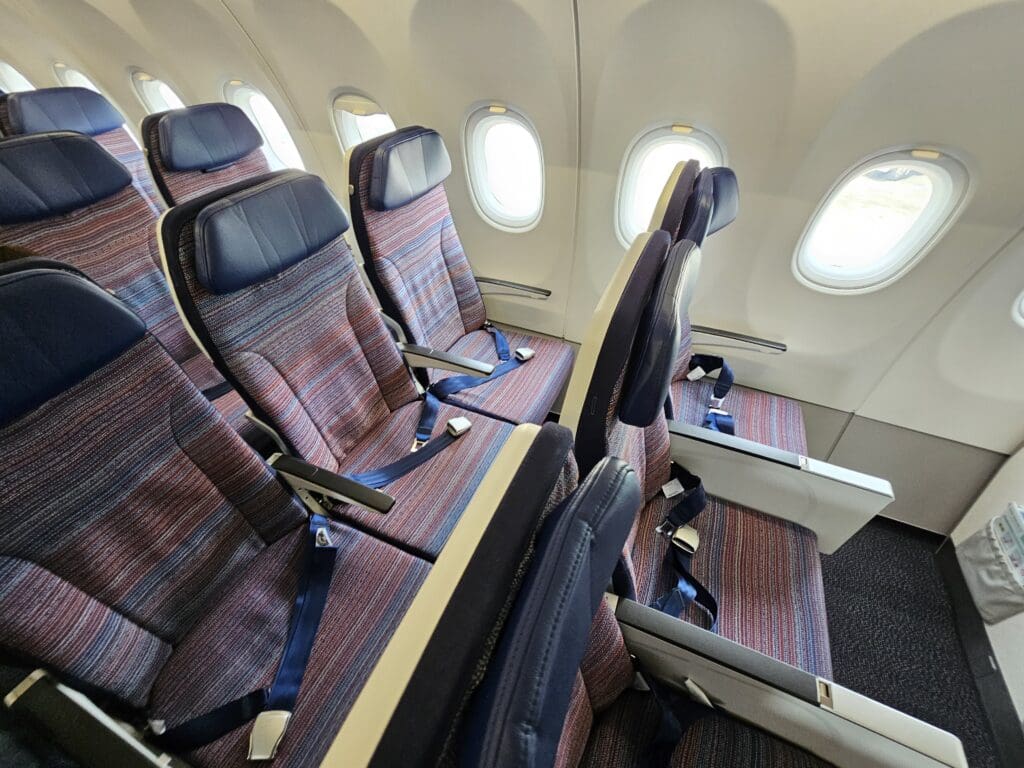
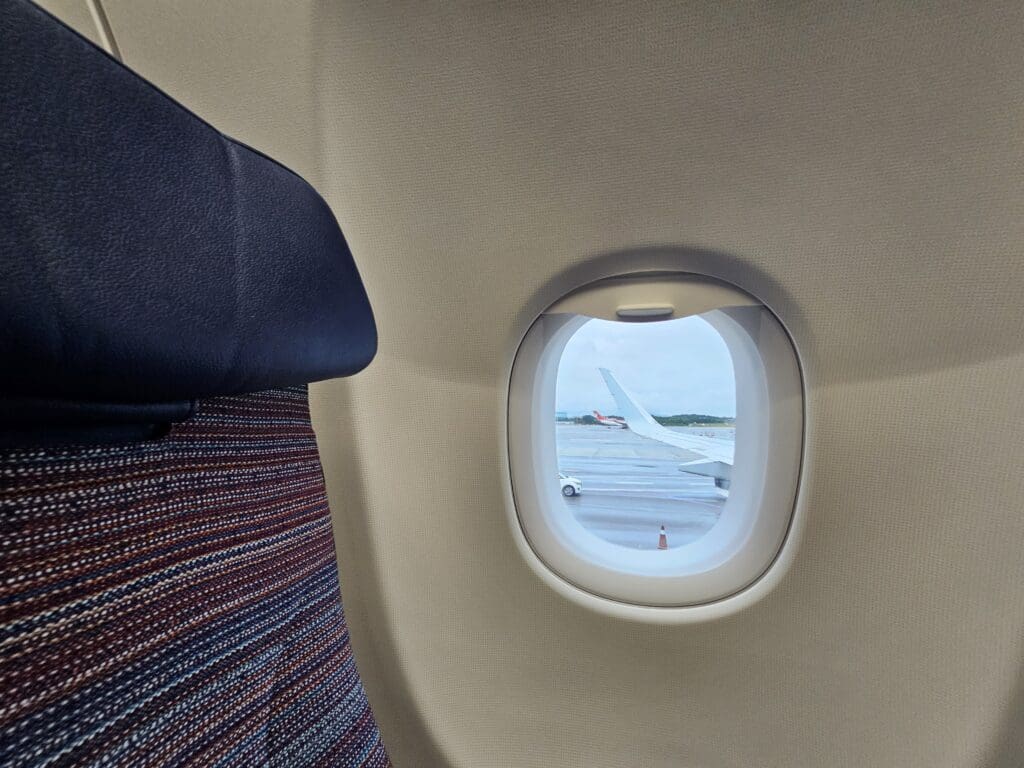
After speeding through Prestige Class, I received another polite and friendly greeting in English as I voyaged into the Airbus’ 174-seat Economy cabin. In Economy, each seat comes in the form of the modern and thin Collins Aerospace Meridian seat. Each of these sports a fabric colour with multicoloured horizontal stripes, with this design being far more vibrant than the blue and brown seat covers which are slowly on their way out. Each seat features a decent size adjustable pleather-covered headrest, whilst the rears of these come with a seat back pocket, coat hook and importantly for those on longer flights, a 13.3-inch wide inflight entertainment screen powered by Safran’s RAVE system. For those looking to charge their devices, a USB-A port could be found under each screen whilst universal power sockets were located under the seats. Overall, at first glance, the interior of this new jet appeared to be welcomingly modern and I looked forward to sampling the delights of Korean Air’s new Economy product on the short flight to Seoul.
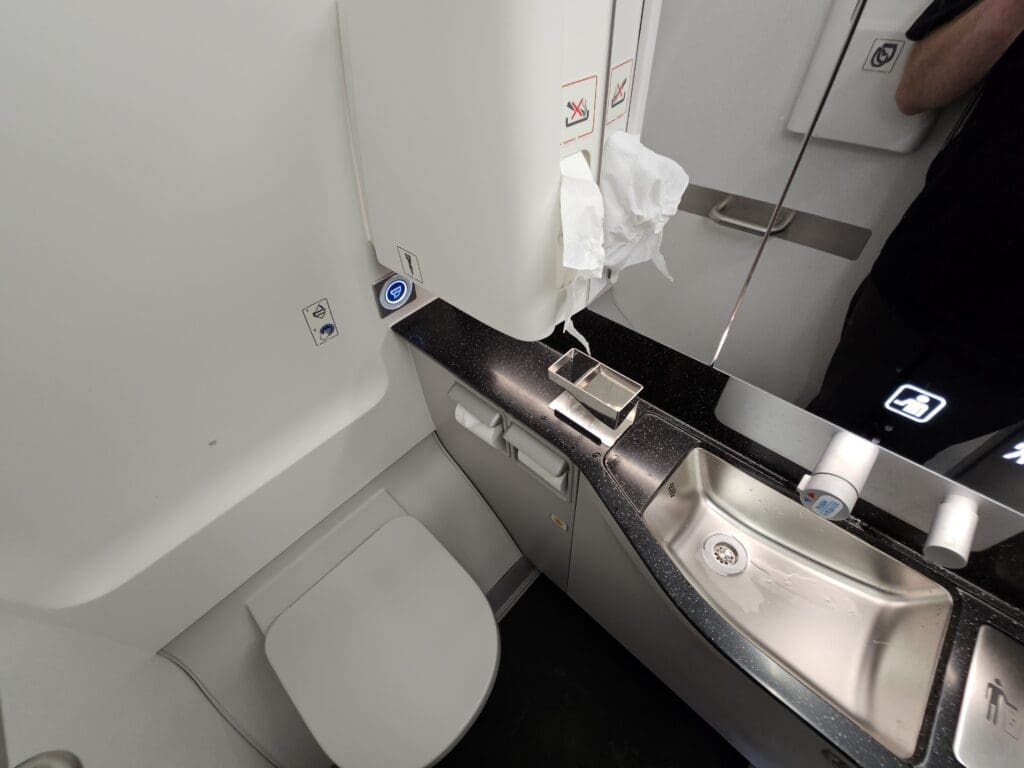
Not only did the modern cabin give off a great first impression, but as I wandered down the aircraft I received a friendly greeting from every single crew member that I passed. Before I knew it, I made it to my seat and, given the likelihood of remaining trapped in for the duration of the flight, after stowing my bag in the spacious Airbus XL overhead locker, I decided to make a quick visit to one of the three lavatories at the rear of the cabin. Upon entering the toilet, I found this to be in a clean and tidy state and was stocked with all the basics. Furthermore, this was a lot more spacious than the Airbus A320neo lavatories that I have had the displeasure of contorting myself into when flying with British Airways, EasyJet and Lufthansa. Thus, I was left with zero complaints! On a side note, as I stood in the lavatory, I could feel the aircraft shaking and swaying in the strong breeze, indicating that we would be in for a bumpy start to the flight!
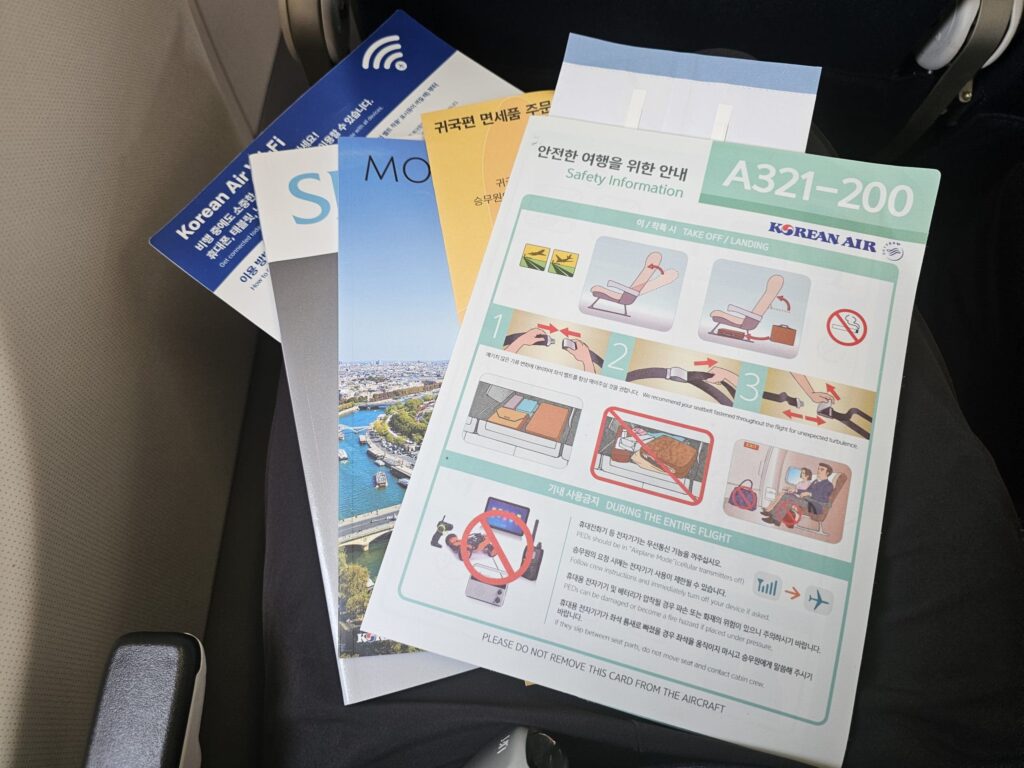
A short time later, I returned to my seat by which time I had already been joined by two neighbours, who rather worryingly spent the entirety of the flight coughing, sneezing and sniffling away. After sliding in, I settled in for the journey ahead and was soon left incredibly impressed by Korean Air’s new seat. This was very soft and comfortable, and as always seems to be the case on Korean Air (with the exception of their domestic Boeing 737-900s!), the seat offered a delightful abundance of space. Needless to say, I would have been more than happy to sit in this seat on one of the Airbus A321neo’s longer services to Southeast Asia! Meanwhile, as I examined the area around my seat I found this to be in a superb state, being both spotlessly clean and devoid of any signs of wear and tear or other damage, although the latter was definitely expected given the very young age of the aircraft! Turning to the seatback pocket, this was brimming with items and featured the all-important safety card and sick bag, the latest copies of Korean Air’s Morning Calm magazine and Skyshop catalogue, a Skyshop mail order form and an information card relating to the aircraft’s wifi network.
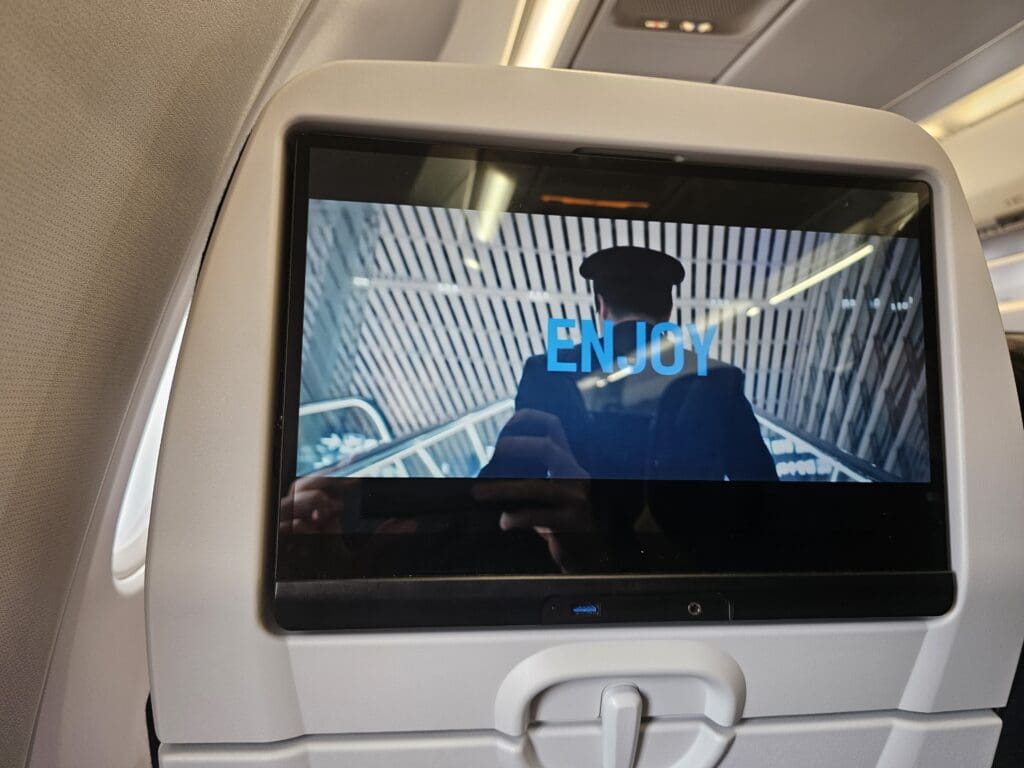
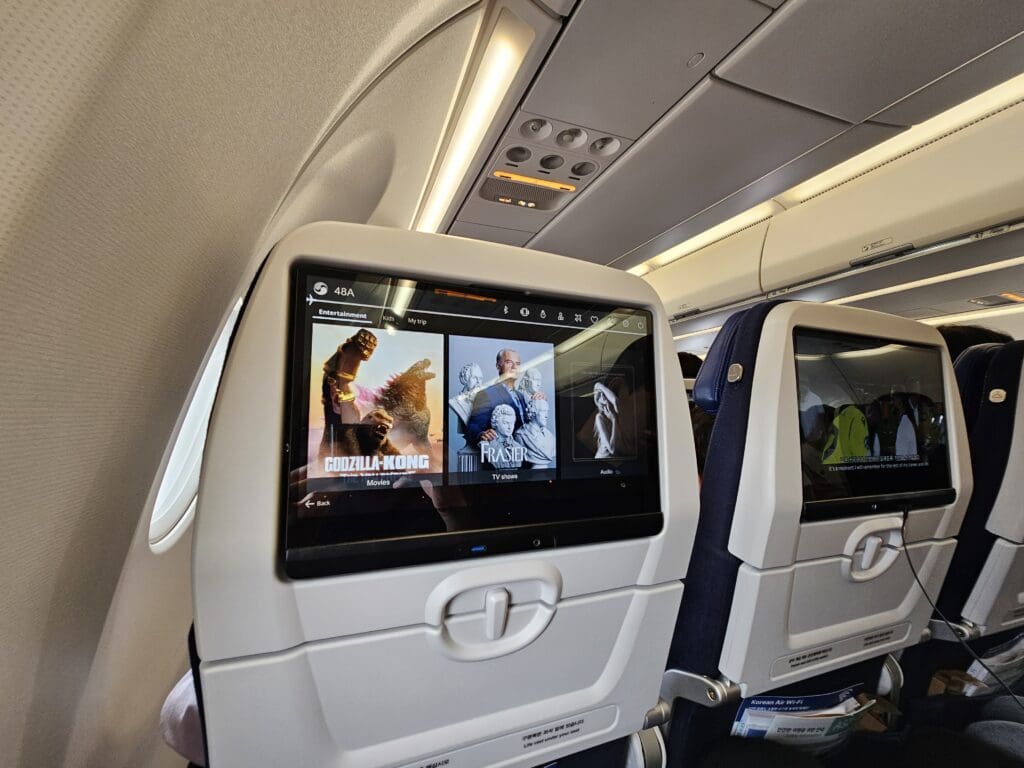
In the past few years, Korean Air had finally jumped on the Korean Wave and throughout boarding, for better or worse, the calming classical music that once accompanied this had been replaced by a soundtrack of the latest upbeat K-Pop tunes. On previous Korean Air domestic services that I have taken that have been operated by aircraft fitted with personal entertainment screens, these have remained off and unusable for the duration of the flight. However, as the box of earphones had alluded to, this was not to be the case on that day’s service. Instead, the inflight entertainment screens could be used from boarding until disembarkation, except for during the safety video and announcements. Perhaps desperate to get to Seoul after the delay, that afternoon passengers streamed onto the aircraft at a quick pace and it didn’t take long for the final passenger to board the aircraft. That day, the flight back to the capital city seemed to be full, with most passengers taking the form of Korean tourists making their way back to the mainland. However, in addition, I also overheard Chinese, French, Japanese and North American English spoken onboard and I would estimate at least 20% of the flight’s load to hail from abroad. This was perhaps not surprising given that, Asiana Airlines and Korean Air, are perhaps the go-to airlines for domestic flights for someone from abroad and with scant knowledge of the Korean airline industry.
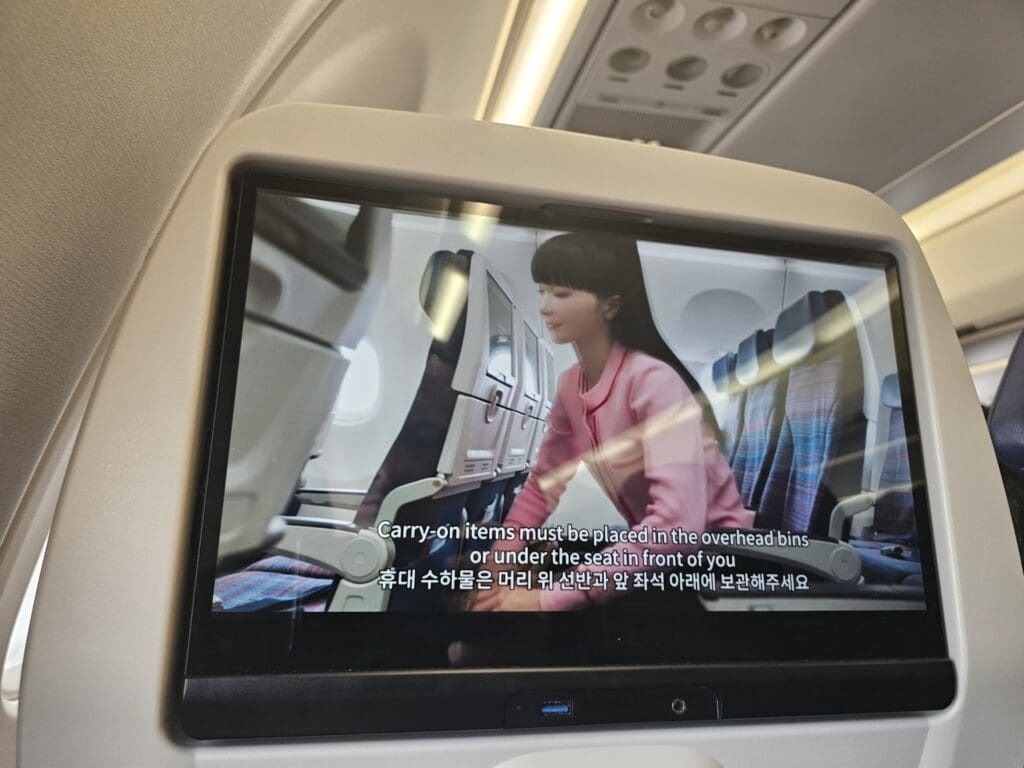
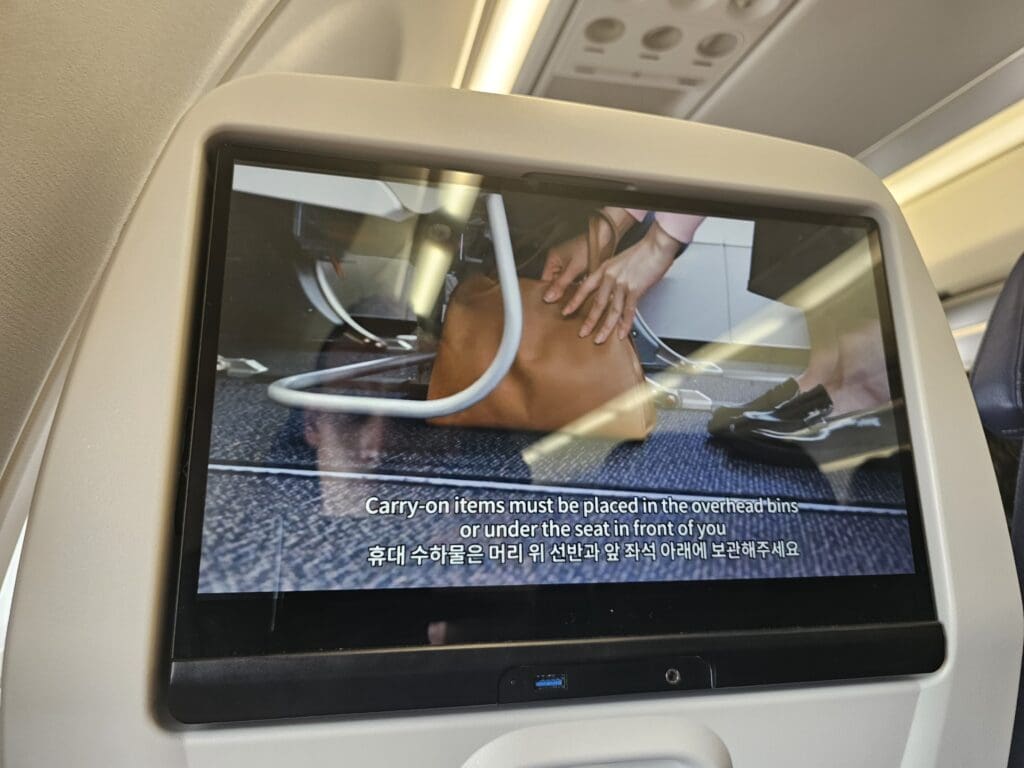
Once all were onboard, the cabin door was closed and a short Korean Air promotional video took over the inflight entertainment screens. Once this was completed, there seemed to be little sign of any movement although the crew did pass through the cabin distributing earphones to those who had not picked these up during boarding. After a few minutes, the Purser performed an announcement which revealed that our pushback had been delayed due to air traffic control restrictions and the higher-than-expected levels of traffic that afternoon at Jeju Airport. This was almost immediately followed by the Captain’s welcome announcement which was performed in Korean and English and consisted of an apology for the delay, with this simply noted to be due to ‘aircraft connection’ and ‘air traffic’ issues rather than the high winds, a word of thanks for flying with Korean Air, a mention of our 55 minute flight time and a warning to keep seatbelts fastened whilst seated. This was then followed by another longer welcome announcement from the Purser before Korean Air’s ‘interesting’ safety video was broadcast over the inflight entertainment screens. Released in early 2024 and replacing the previous K-pop-themed video that featured the likes of solo artist BoA and boyband SuperM, this features some rather creepy-looking virtual characters but otherwise left me with no complaints, going over the safety instructions clearly and concisely.
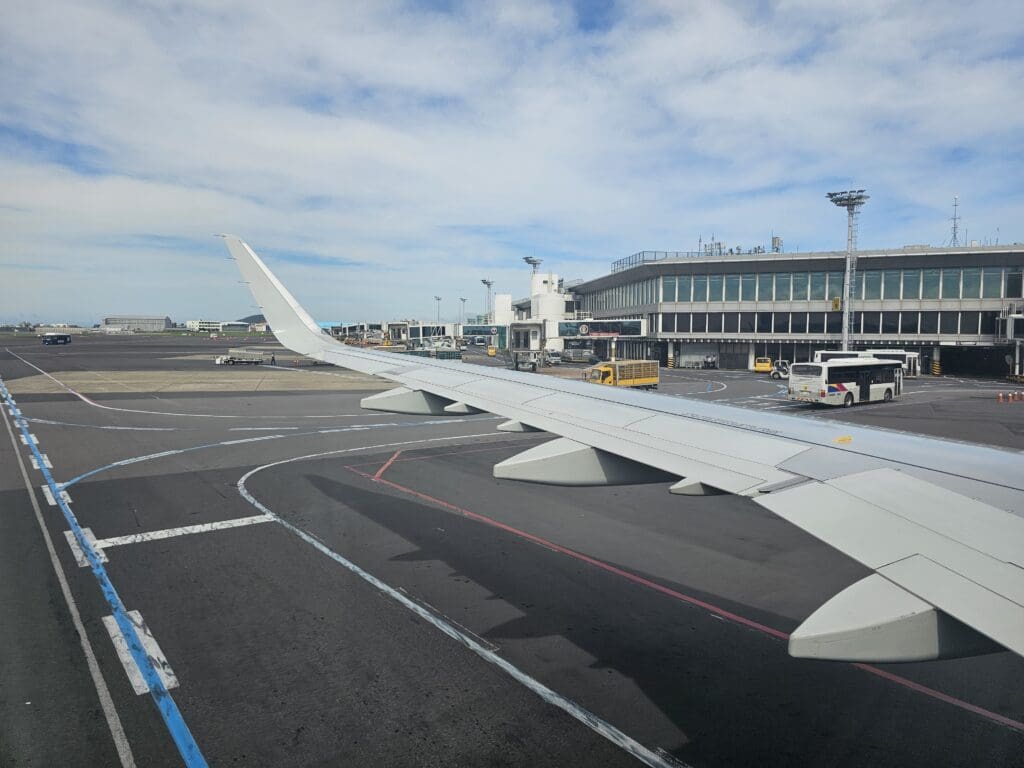
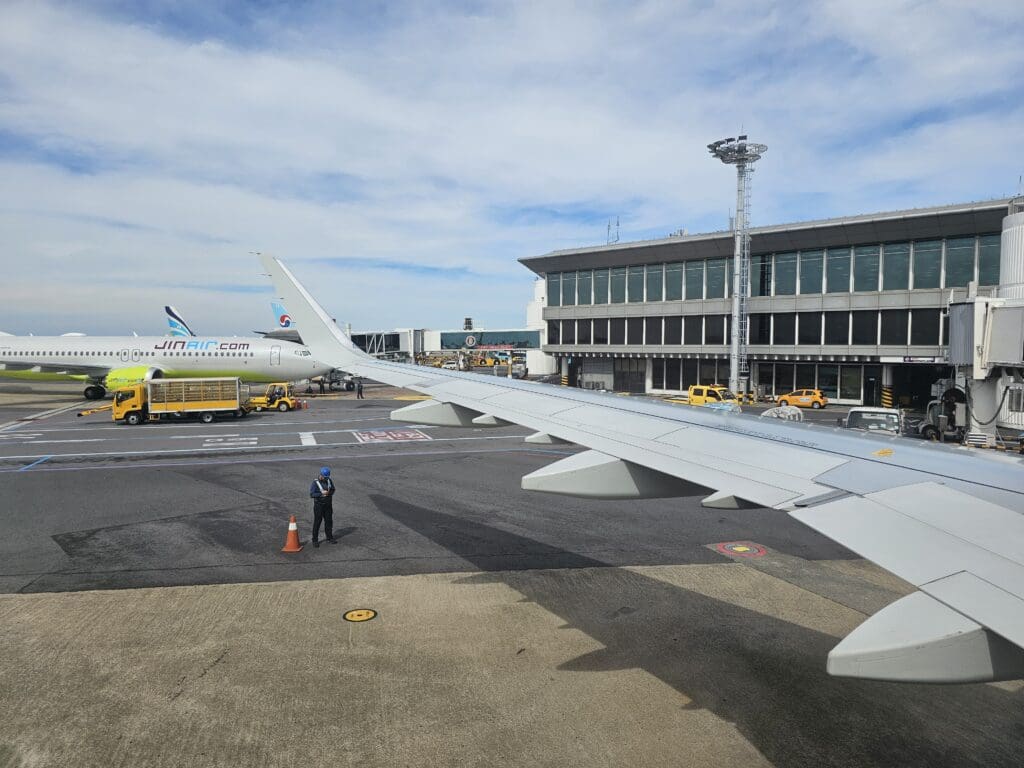
Eventually, the cones were removed from around the aircraft and at 1610 the Airbus jolted backwards. At this point, a cacophony of whining could be heard and some vibrations were felt as the two fuel-efficient Pratt & Whitney PW1100G engines spooled into life. With it being rather humid outside, as can often be seen when flying in the midst of Korean summer, vapour could be seen emerging from the air conditioning vents and continued to do so as we taxied to the runway. At this point, the Purser made an announcement in Korean and English reassuring passengers that this was completely normal and nothing to worry about. A few minutes after commencing our pushback, the ground crew waved goodbye to the aircraft and we commenced our short journey to the end of Runway 25. This took us away from the terminal and apron, which, with the winds now dying down, was already beginning to fill up with airliners from across Korea, before we made our way past the local Korean Navy base which is home to a squadron of Lockheed Orion submarine-hunting aircraft. A few short minutes later, the Airbus came to a halt at the end of Runway 25 where we waited for a Korean Air Boeing 737 MAX 8 to rocket off to Beijing, and a T’way Air Boeing 737-800 to land following its short flight from the Korean city of Cheongju.
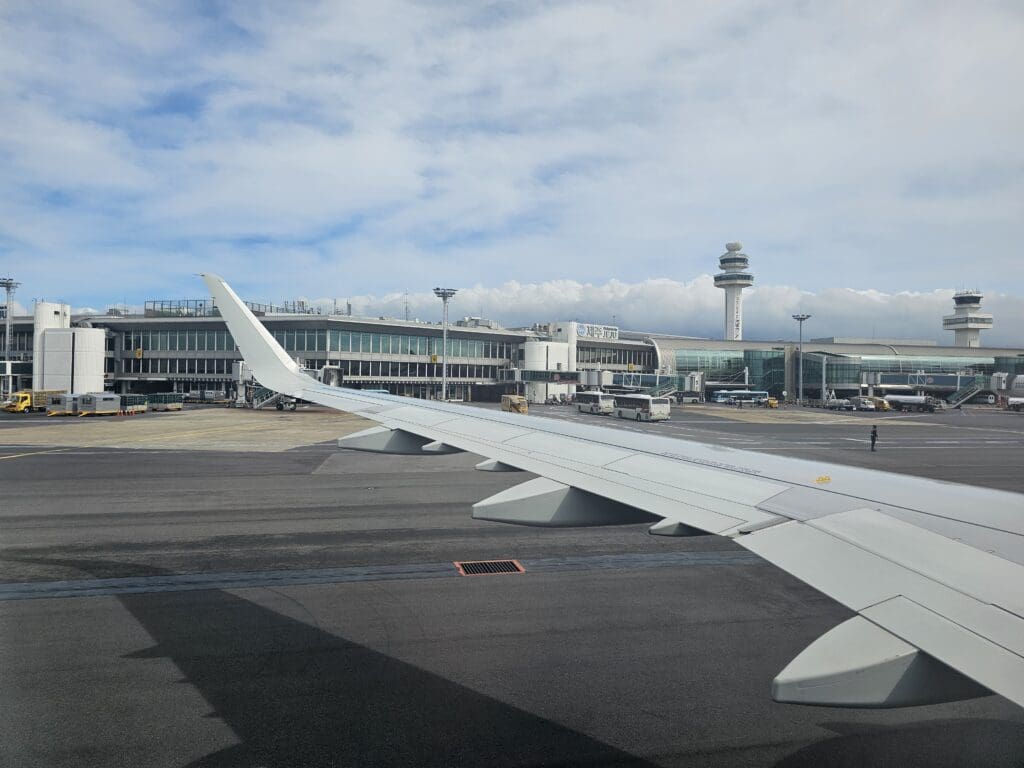
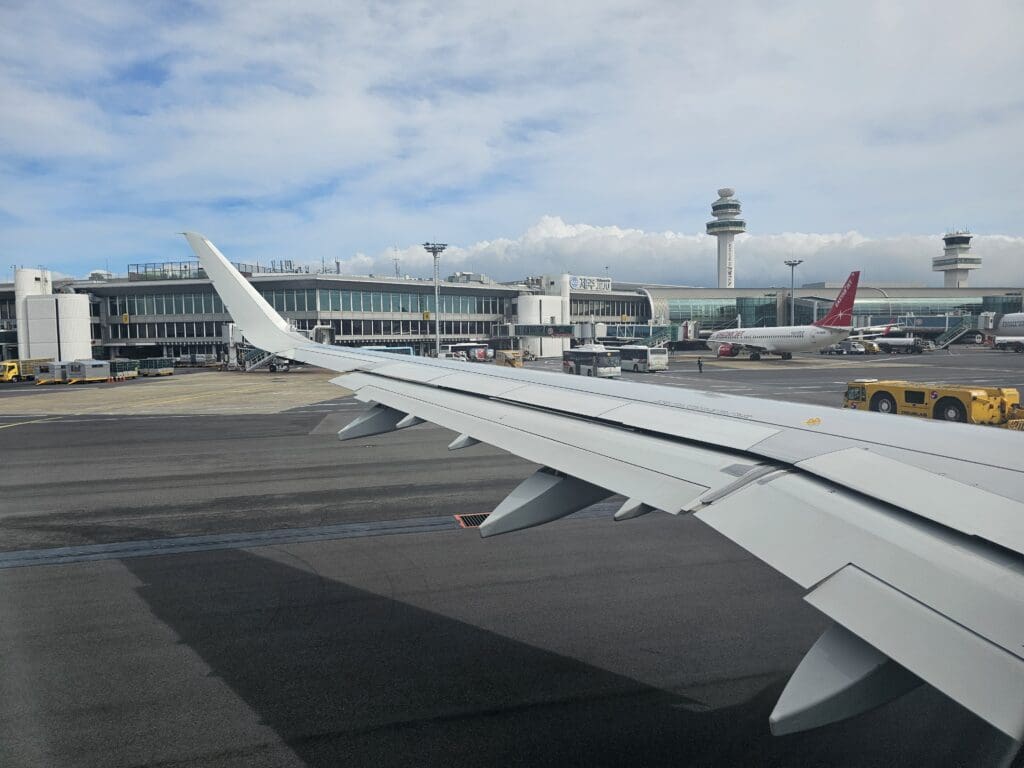
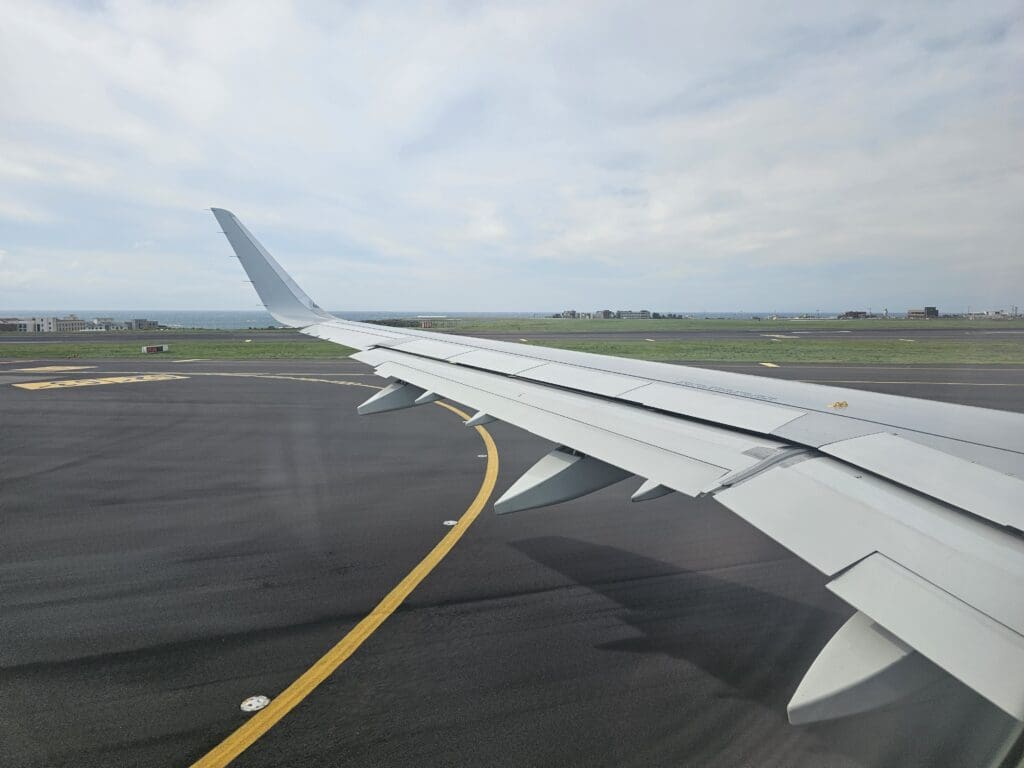
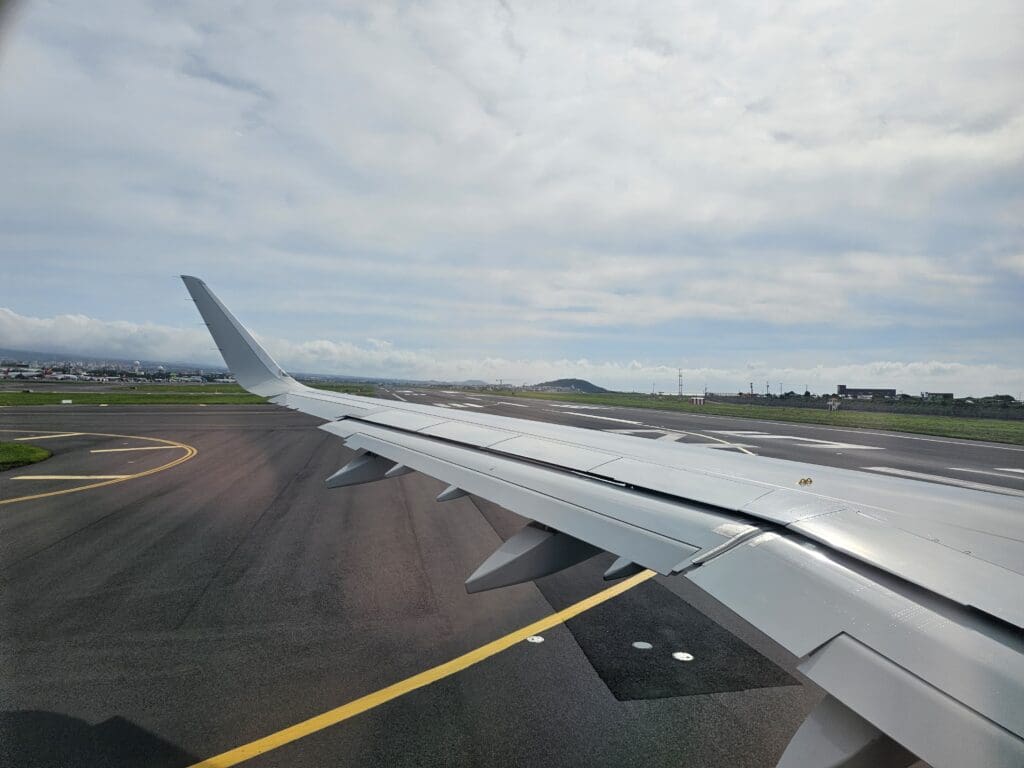
After the T’way Air jet had whizzed past us and made a successful yet seemingly bumpy touchdown, the Airbus made its way onto the runway. At 1627, the Airbus’ two engines whined as they spooled up and sent us flying down the runway. As we accelerated down this, the Airbus could be felt constantly swaying from left to right as if the pilots were having to put some significant effort into keeping us heading down the centreline before we rotated upwards and climbed into the windy skies of Jeju. Almost immediately after taking to the skies, we began to be pummelled around, which lasted for around a minute or so before calming down a little as we climbed higher and higher.
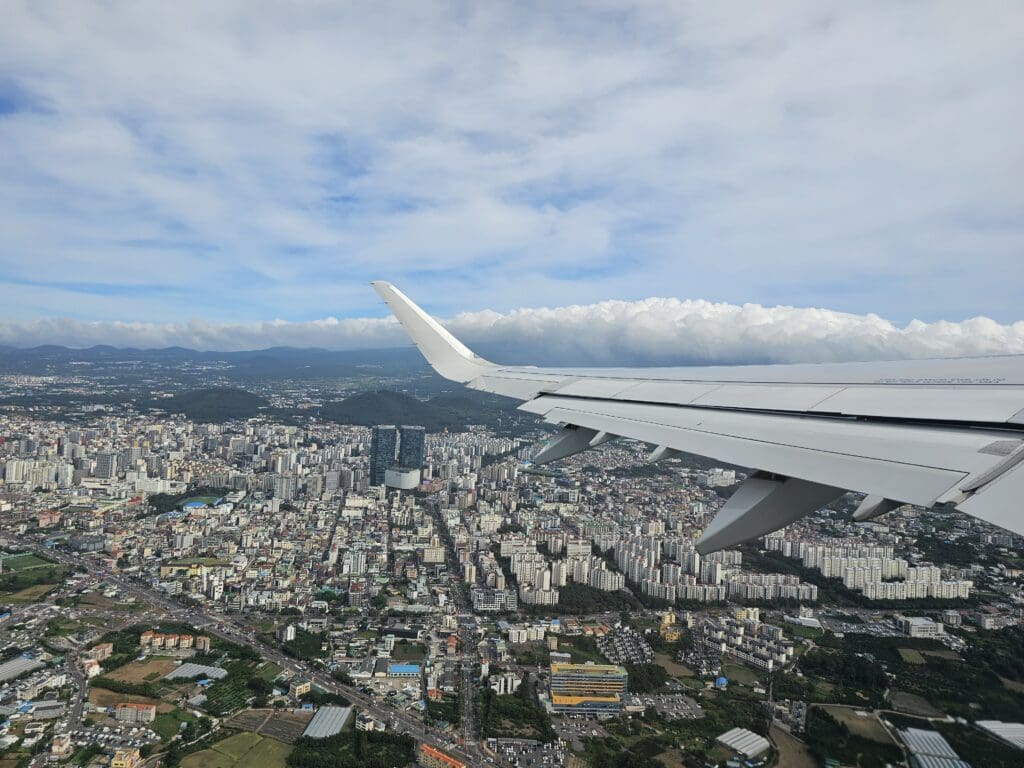
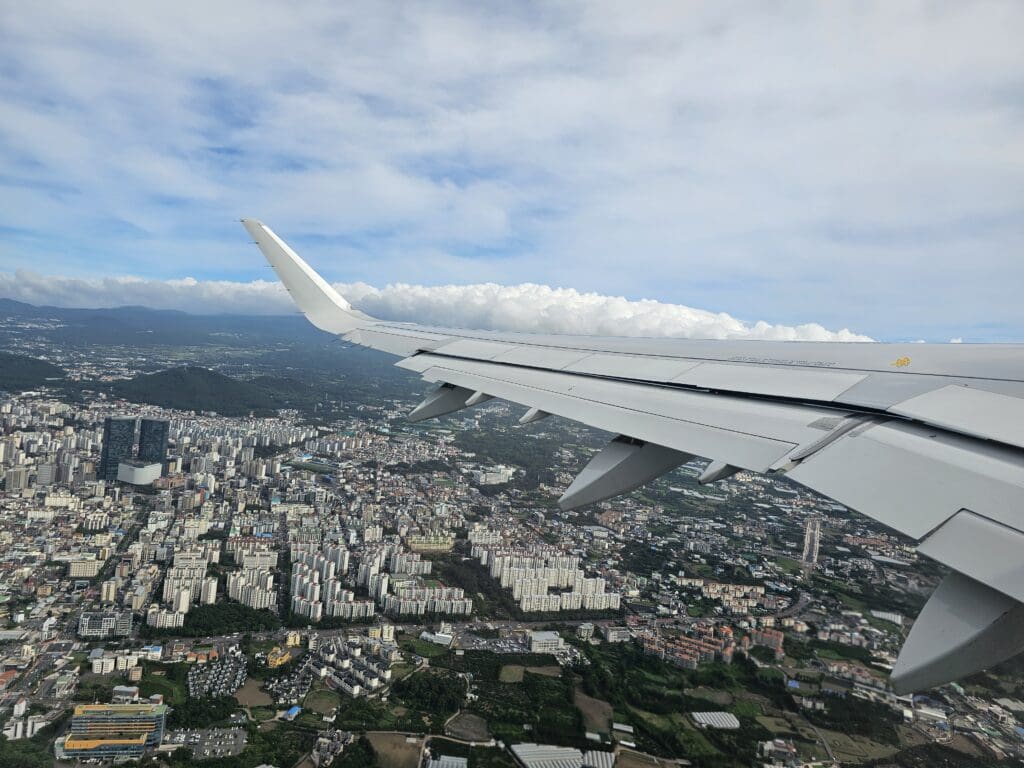
Once the Airbus had left Jeju Airport behind, we seemed to follow the standard departure path for Seoul-bound services departing from Runway 25. This took us a reasonable distance along Jeju’s northern shoreline, passing popular sights such as Iho Tewoo Beach and the Gueom Stone Salt Flats before we reached one of Jeju’s largest towns, Aewol. Once over Aewol, the Airbus turned onto a northerly heading and we crossed the stretch of sea that separates Jeju from the mainland. Inside the cabin, as we sped towards the coastline of the mainland’s South Jeolla Province, the seatbelt signs were extinguished and the Purser made the usual announcement requesting passengers to keep these fastened whilst seated in case of any unexpected turbulence.
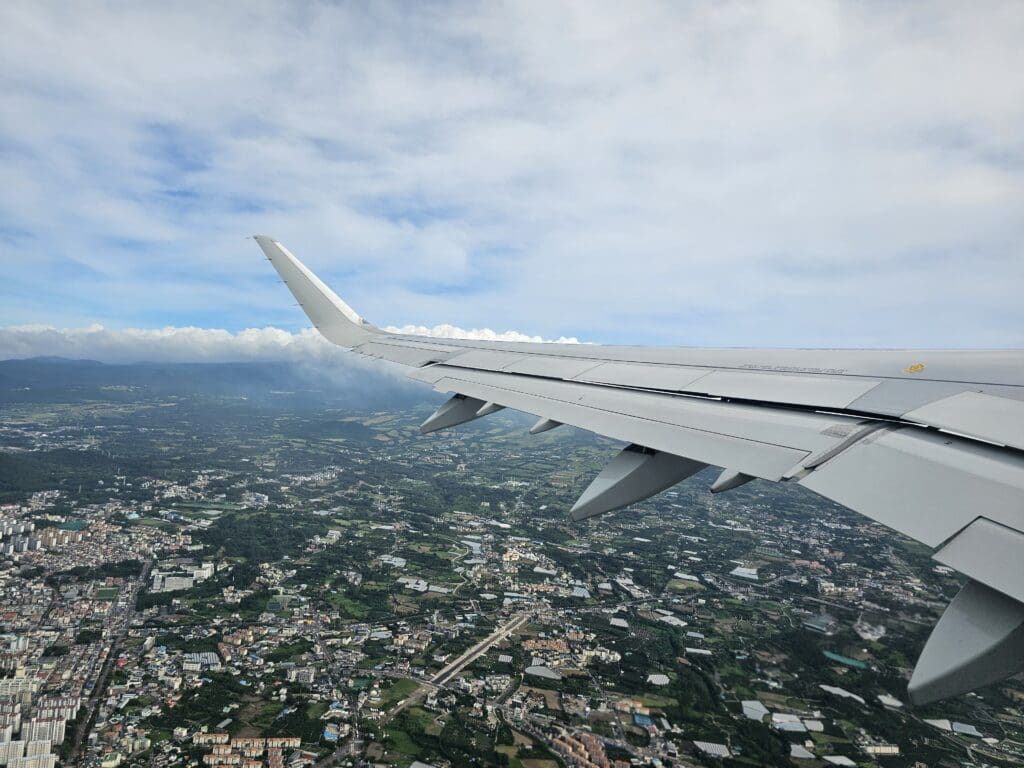
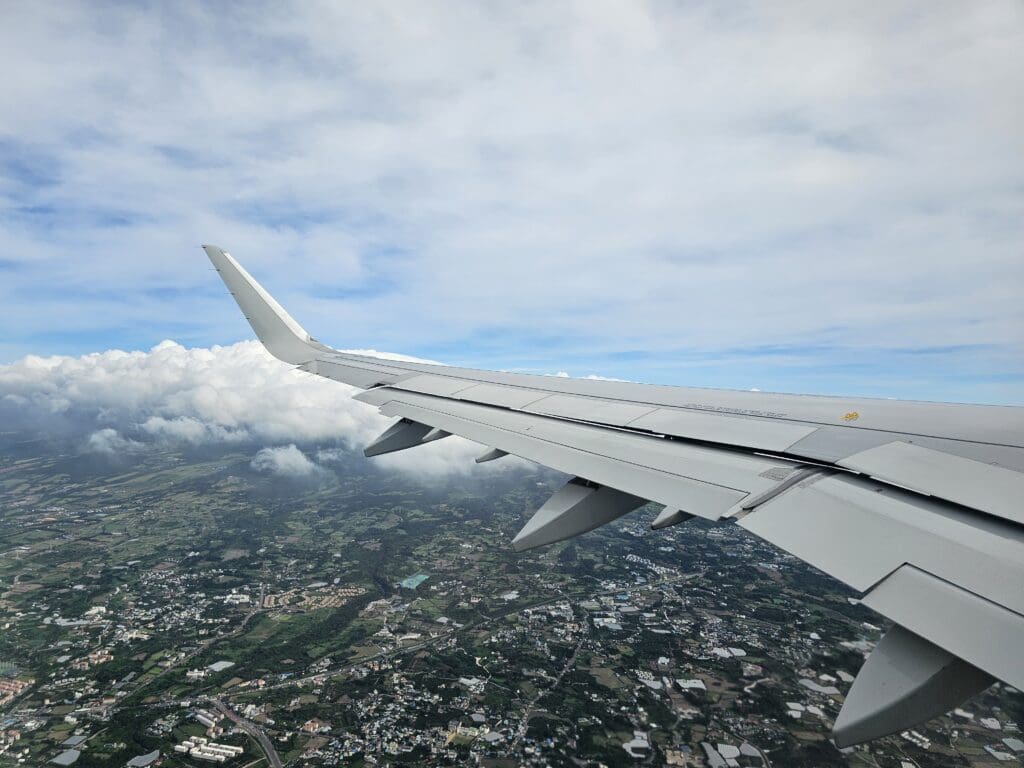
Given the short length of the flight, once the crew had been released from their seats it wasn’t long before the inflight service commenced. When it comes to service, East Asian carriers are relatively well known for their generous complimentary offerings, even on short services. However, this does not extend to Korean Air’s domestic flights, during which nothing more than a quick round of soft drinks is offered. Yet considering the fact that Korean domestic flights are rarely in the air for no more than an hour, this is by no means a complaint! Onboard, options consisted of cold brew coffee, barley tea, Jeju tangerine juice, tomato juice and still water. My only gripe with this is that hot drinks appear to have been eliminated from this service at some point during the Covid era, something that I had also found to be the case on Asiana Airlines’ domestic services. With the flight attendants working diligently to ensure that all passengers were served during the short flight, within a few minutes a polite and friendly flight attendant reached my row and went through all the options at which point I requested a cup of barley tea. This was poured out into a Korean Air branded paper cup and handed over to me along with a serviette. Once the crew had served all passengers, they then made another quick pass through the cabin offering top-ups to those thirsty passengers who wished to have a second drink.
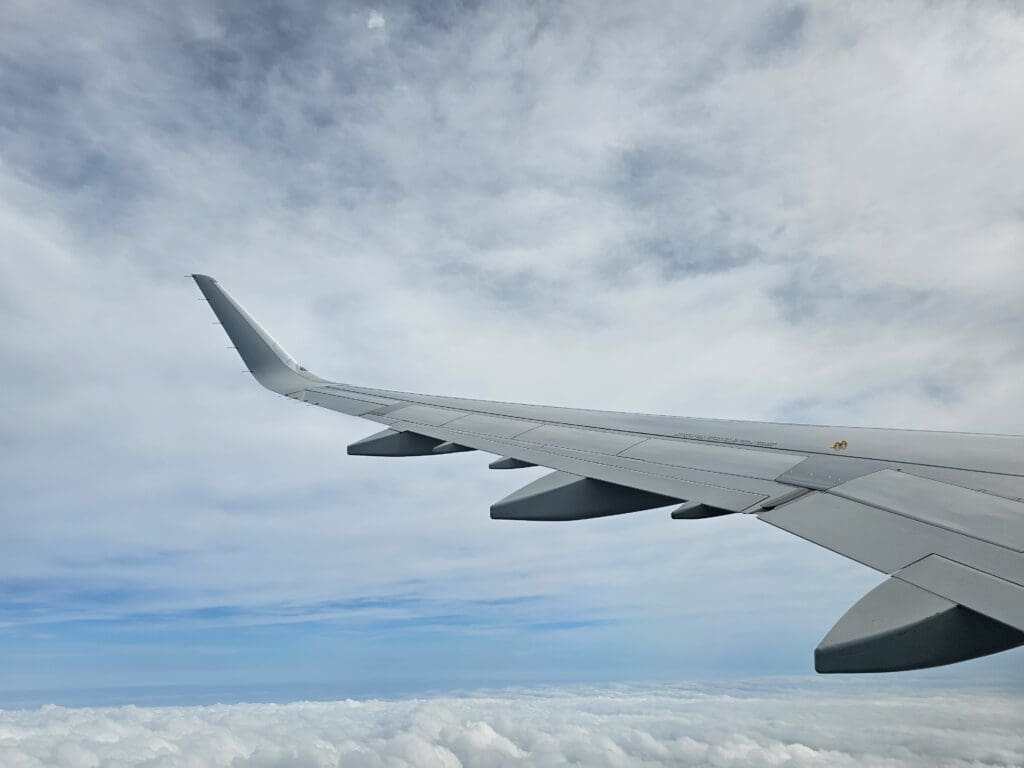

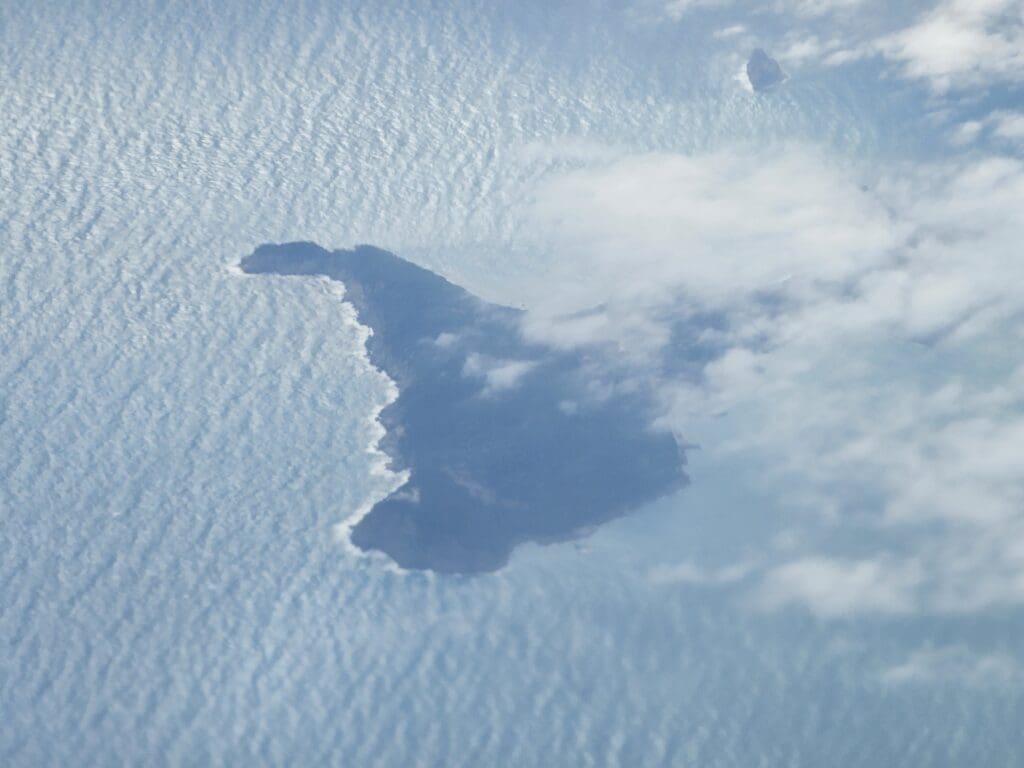
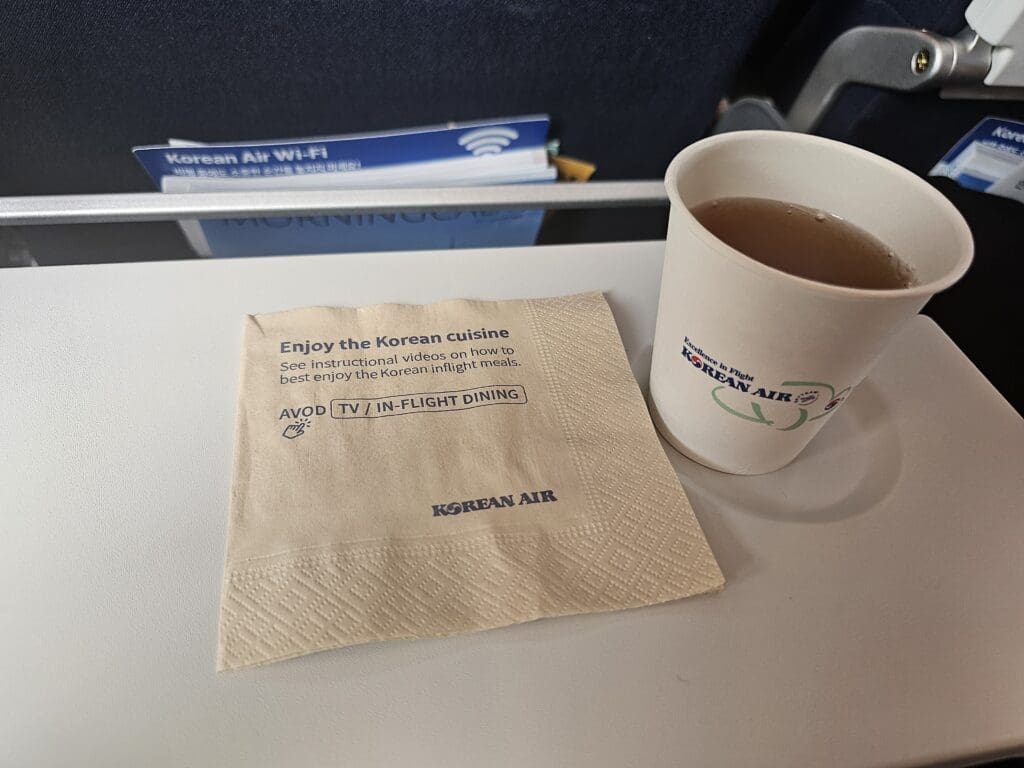
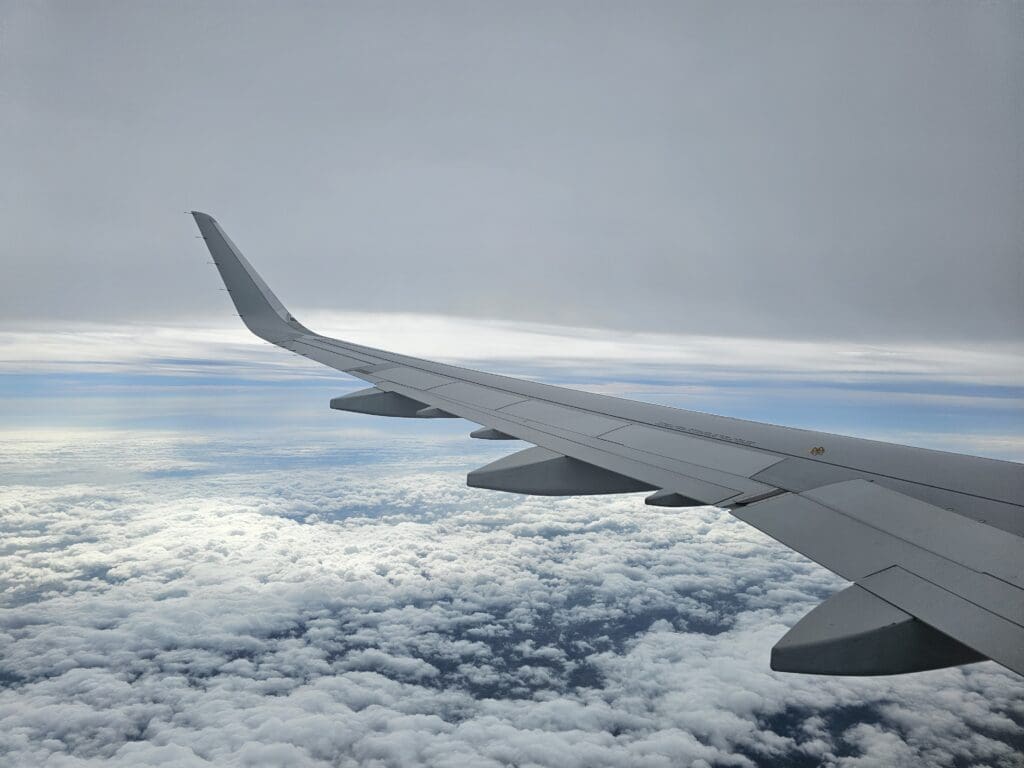
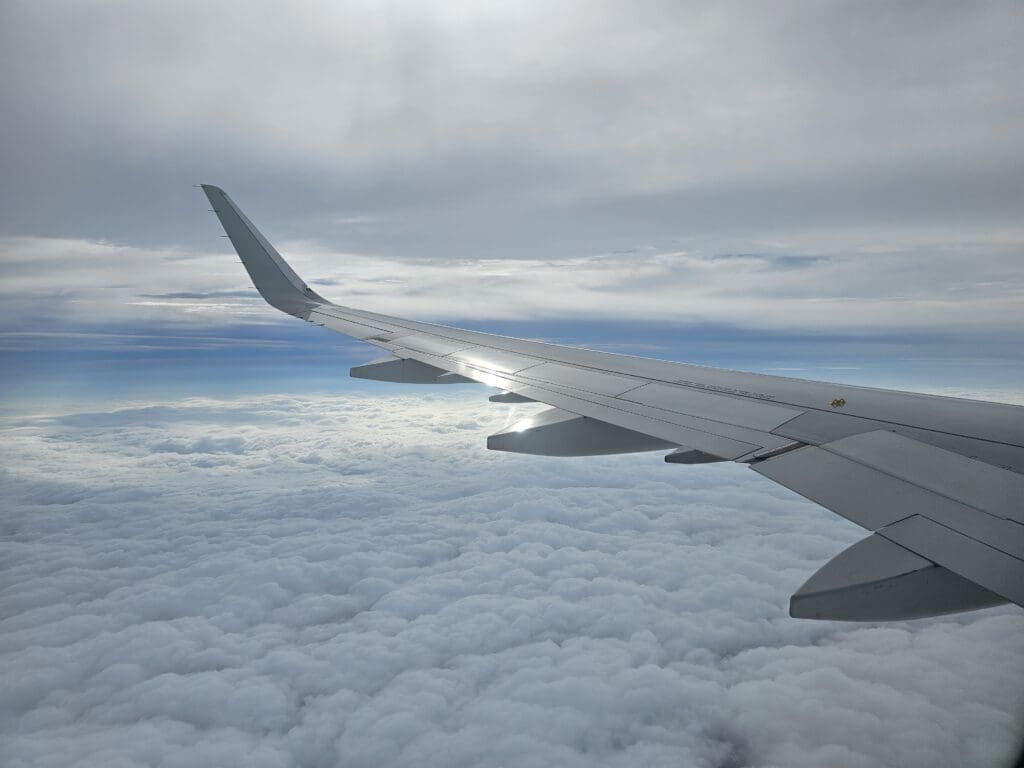
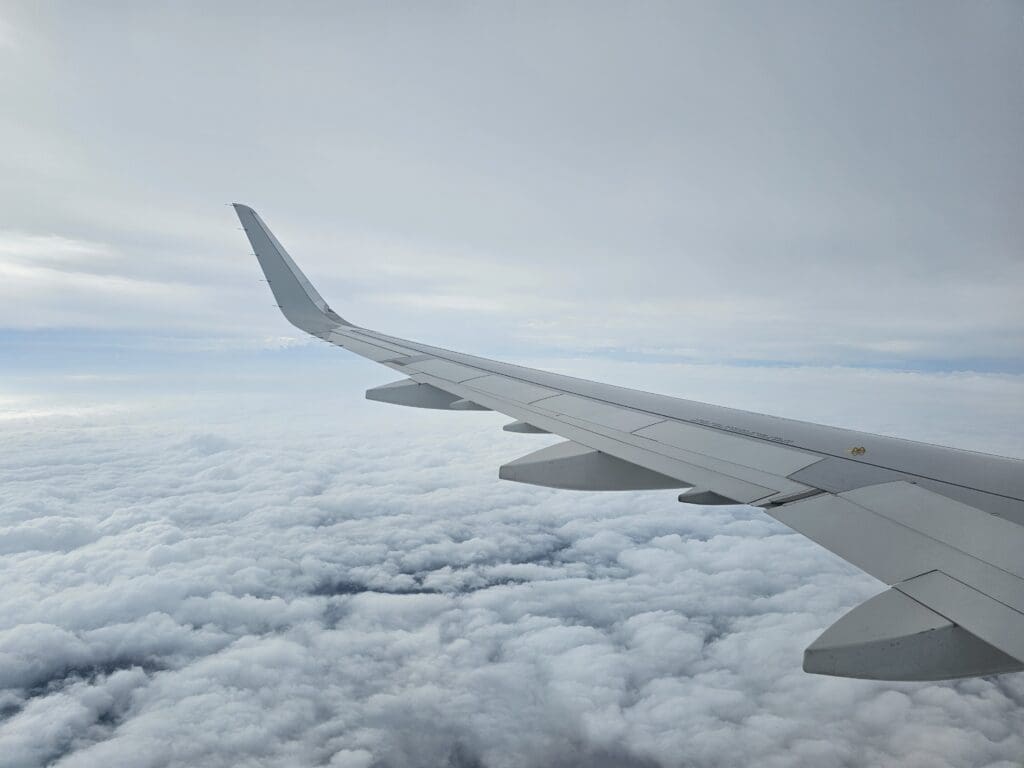
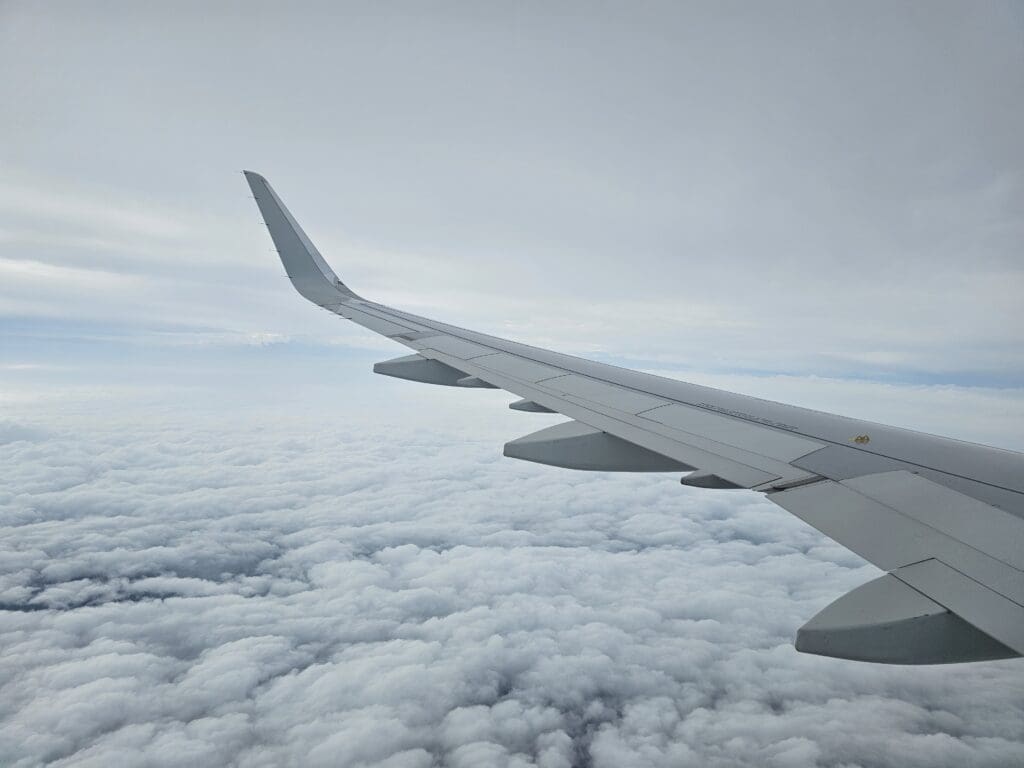
Around nine minutes after leaving Jeju’s coastline behind, the Airbus passed the island of Wando before reaching the Korean mainland and soon levelled off at its cruising altitude of 25,000 feet. From there, we headed inland and made our way past the city of Jangheung before reaching Korea’s sixth largest city, Gwangju, home to around 1.47 million residents and well known for its pro-democracy demonstrations of 1980 and the brutal quashing of these. As we trundled northwards over the western edge of Korea, absolutely nothing could be seen below thanks to the thick layer of cloud that covered much of the Korean Peninsula that day. With nothing to see, I thus turned to the inflight entertainment system. Starting with the very basics, this system was available in Chinese, English, Japanese and Korean. Whilst this is the bog standard selection of languages that can be found on the entertainment systems of many airlines across Northeast Asia, this most certainly doesn’t reflect the wide variety of Korean Air’s destinations or even those destinations that their Airbus A321neo fleet is sent to. However, without dwelling on this too much, I steamed onwards and began to explore the inflight entertainment system. This was delightfully modern, stylish and well laid out, and could be navigated by touch or by the novel means of using this via your own device. Thankfully, doing so by touch threw up no issues, with the screen being responsive and the system very quick to transition between pages. However, for the novelty of it, I also had zero issues when pairing my device to the screen and using my phone as a remote control, which was definitely a rather novel if not perhaps unnecessary gimmick! Importantly, I found the screen quality to be fantastic and thus left me with no complaints.
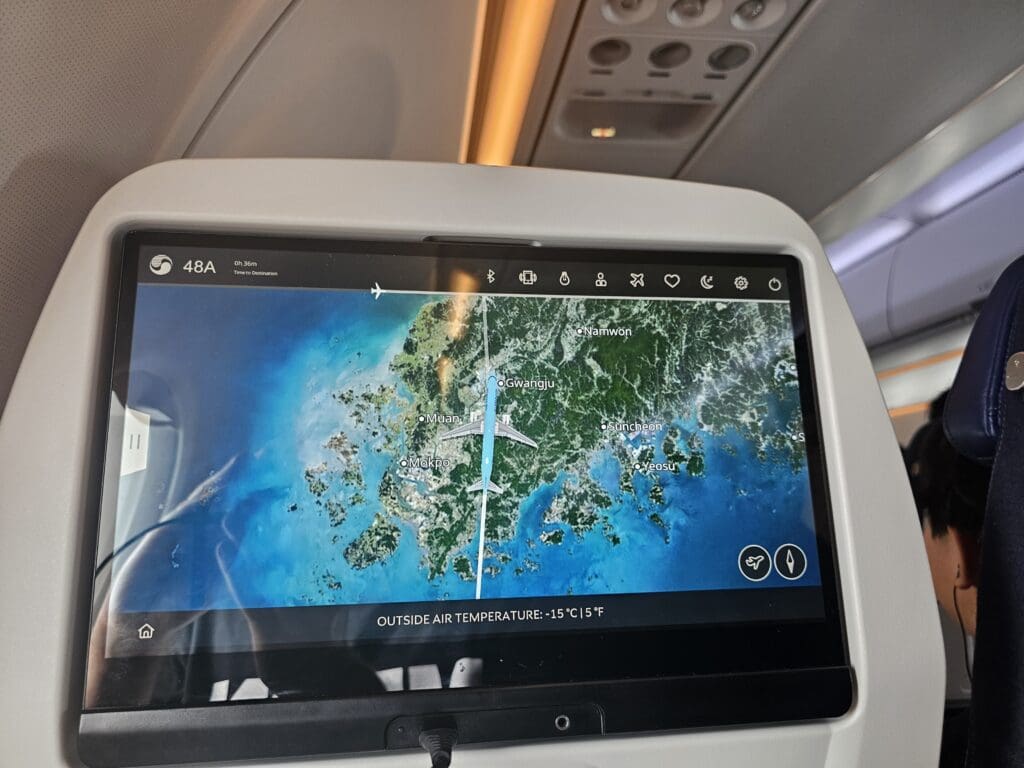
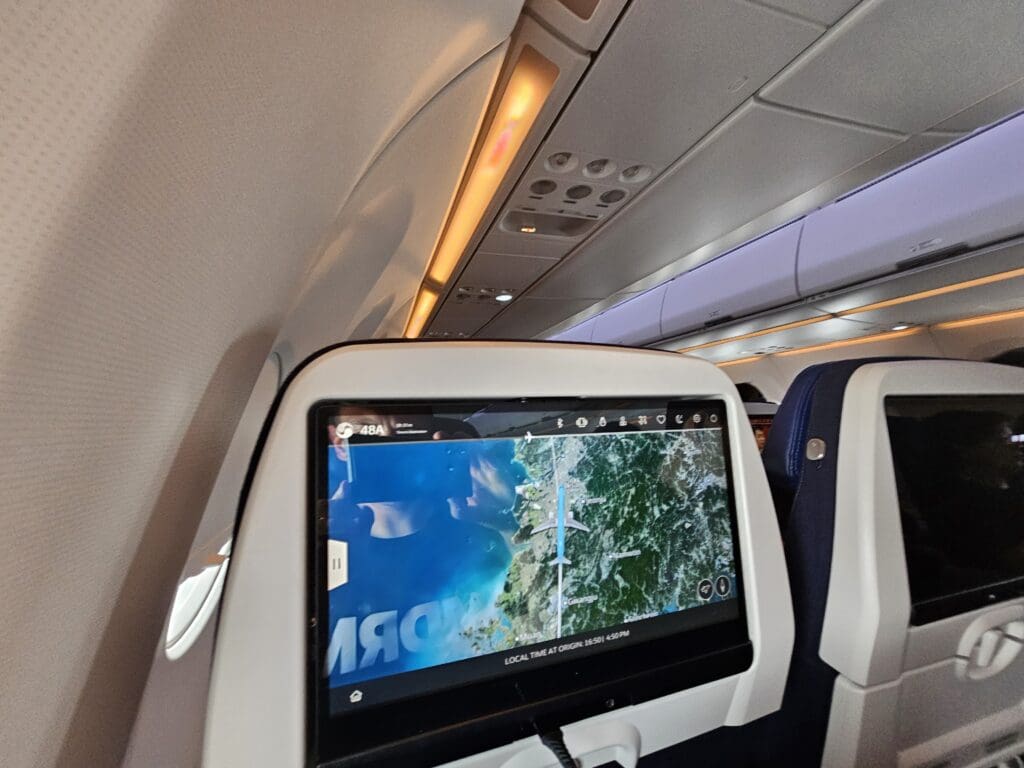
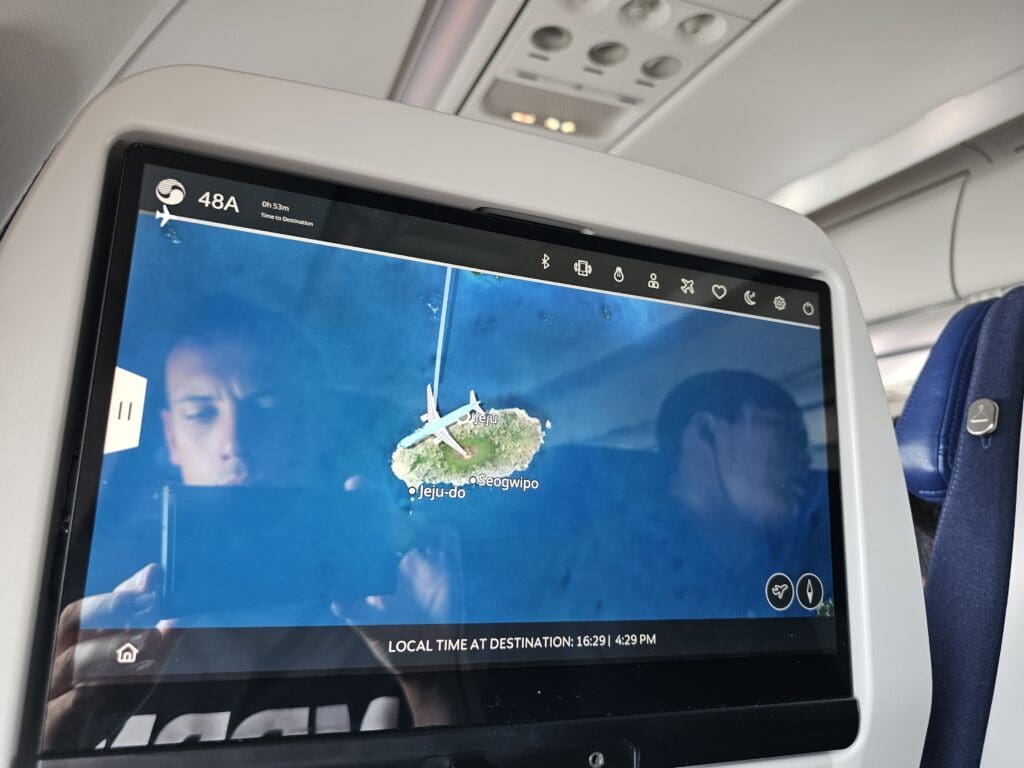
Historically, one of my qualms with Korean Air was that the airline seemed to lag behind when it came to inflight entertainment. Specifically, despite the airline’s reasonably good reputation, its inflight entertainment system always seemed to feature notably less content than those of many other major airlines, and in particular, I always found the amount of Korean content on this to be surprisingly limited. Fortunately, as I navigated my way around the system I soon discovered that these days were long gone and I was presented with a delightfully expansive range of content from far and wide. Despite being in the air for well under an hour, had I wished to start watching a film, there were over 300 of these to choose from. As you would perhaps expect, most of these were from Korea or Hollywood, followed by British and Japanese productions. However, I did also stumble across films that were produced in Canada, Denmark, France, Hong Kong, Ireland, Germany, New Zealand and Spain. These came in addition to plenty of television programmes both new and old, as well as 150 albums and playlists, 10 audiobooks and 8 K-pop music videos. Whilst I had no intention of watching anything, to test this out I started a film which revealed that no advertisements were played before starting any content. Importantly, the system also featured a functioning Flightpath3D moving map which enabled the flight to be tracked from all sorts of angles and views as we made our way northwards towards Seoul.
For those needing to stay connected, wifi is currently offered onboard Korean Air’s Airbus A321neo and Boeing 737 MAX 8 aircraft, although this can only be used when flying on international services and thus I did not get the opportunity to sample this on my flight to Seoul. I was however able to connect to the wifi network and found that this enabled me to stream the inflight entertainment system content to my own device. Talking of passengers’ own equipment, those with Bluetooth headphones can pair these with their inflight entertainment screen and use these to listen to content on the inflight entertainment system, with this being a relatively new yet welcome feature in the inflight entertainment world. Indeed whilst aware of this, this was my first ever time seeing this feature in person.
Once I had examined the inflight entertainment system, I turned my attention to the chunky 130-page Korean Air inflight magazine in the seatback pocket. Released once every two months, this took the form of a pristine copy of the July/August Morning Calm inflight magazine, which came complete with a photograph of the Eiffel Tower on its front cover, with this explained by the fact that we were just weeks away from the opening ceremony of the Paris 2024 Olympic Games. Flicking through this, as inflight magazines go, this seemed to be a high-quality publication with a low number of advertisements and a good number of travel, culture, history and business-related articles. Meanwhile, every article within this was translated into English alongside the original Korean version.
Returning to the flight’s progress, as the Airbus passed Jeonju and approached the small North Jeolla city of Iksan, after just nine minutes in the cruise, the aircraft could be felt commencing its descent. Home to around a quarter of a million residents, Iksan is perhaps best known for being a strategic point in Korea’s railway network and is the confluence of the Honam, Janghang and Jeolla railway lines. At this point, the inflight entertainment system advised that we were 29 minutes away from landing at Seoul Gimpo, and were thus around halfway into the flight from Jeju to Seoul. From Iksan, the Airbus crossed into the skies of South Chungcheong Province and headed almost directly north over the region’s countryside. As we sank over the region, the seatbelt signs were reilluminated and the Purser’s voice filled the cabin as they performed their usual pre-arrival announcement instructing passengers to fasten their seatbelts, open their window shades, return their seats to the upright position and stow their tray tables. As they performed this, the crew passed through the cabin collecting any rubbish from the drink service before the crew took to the aisles once more to ensure that everything was secure and in place for our arrival into Seoul.
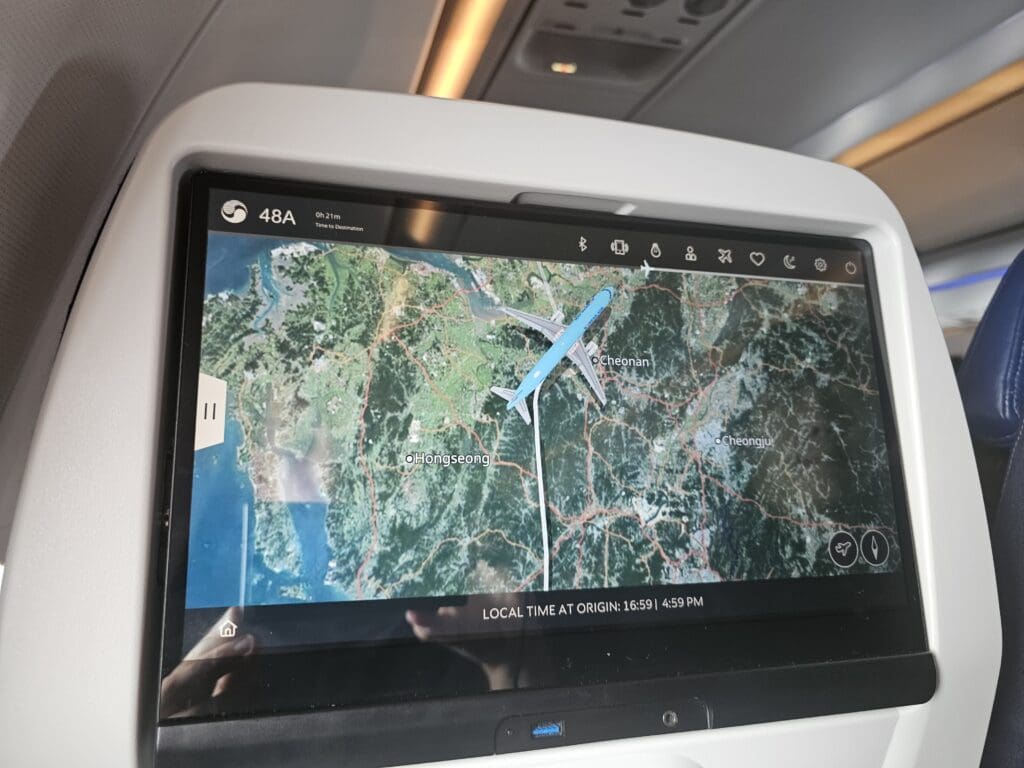
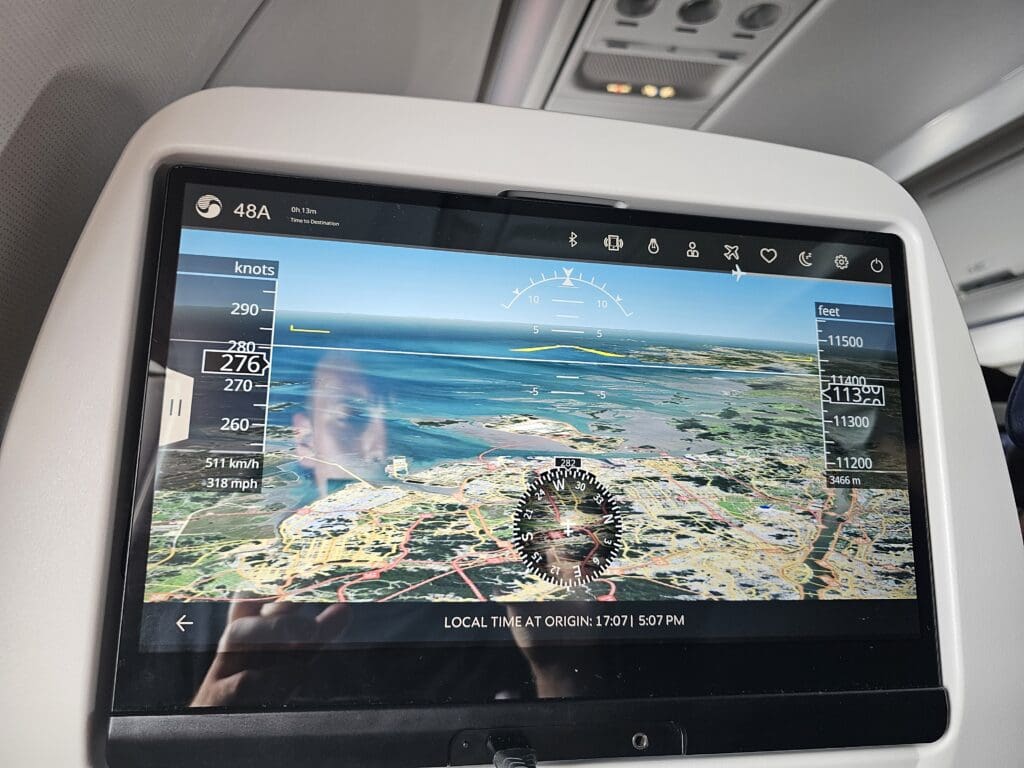
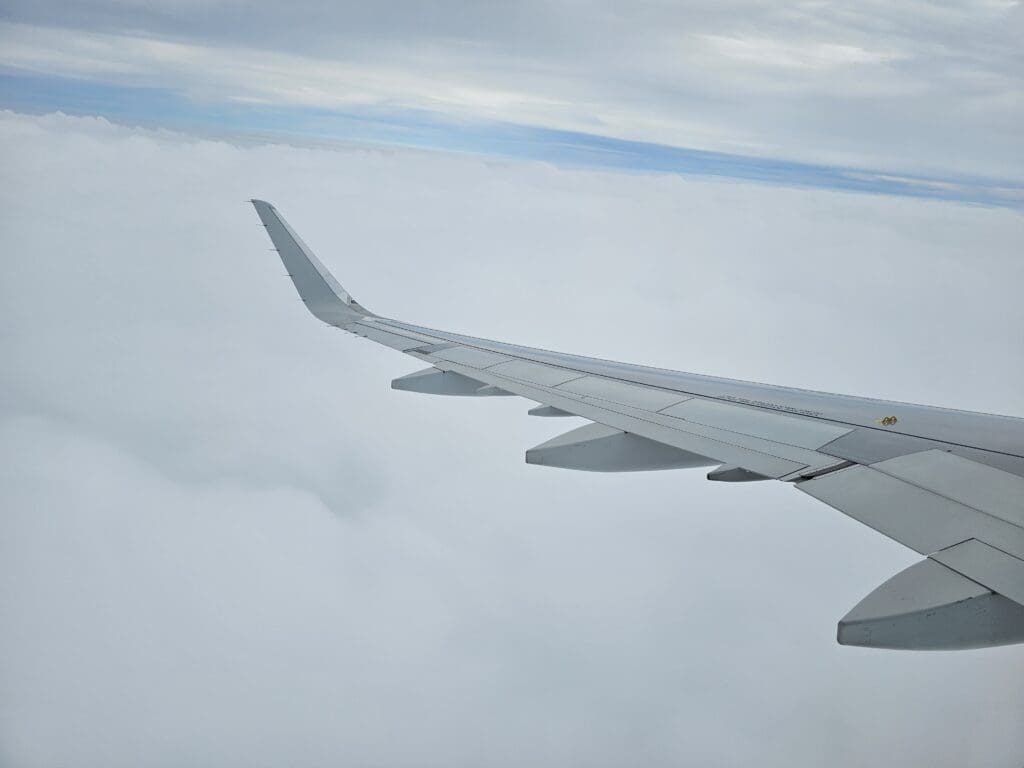
After spending a total of eight minutes descending over South Chungcheong Province, the Airbus passed the cities of Asan and Cheonan and crossed into the skies of Gyeonggi Province, which loops around the capital city. There, the Airbus skirted around the cities of Yongin, Seongnam and Suwon, and it soon became evident that we would be landing on one of Gimpo Airport’s easterly runways. Heading westwards towards the coastline, the aircraft made its way over Anyang, Gwangmyeong and Incheon before reaching the coastline just to the northeast of Yeongjong Island, this being home to Seoul Incheon International Airport. As the aircraft reached the coastline, the Airbus turned back to fly towards Gimpo Airport and bumped around a little as the flaps began to be partially extended in preparation for our arrival.
As the Airbus neared the airport, we broke free of the clouds and soon the rain-soaked semi-rural landscape sandwiched between Seoul and Incheon, as well as the wide Han River came into view, with our approach seeing us fly roughly parallel to its southern banks as we descended towards the airport. Thanks to the reasonably poor visibility, little could be seen at this stage of the flight, with this being a much less scenic arrival than an approach to one of the westerly runways in good weather which allows for superb views of Seoul!
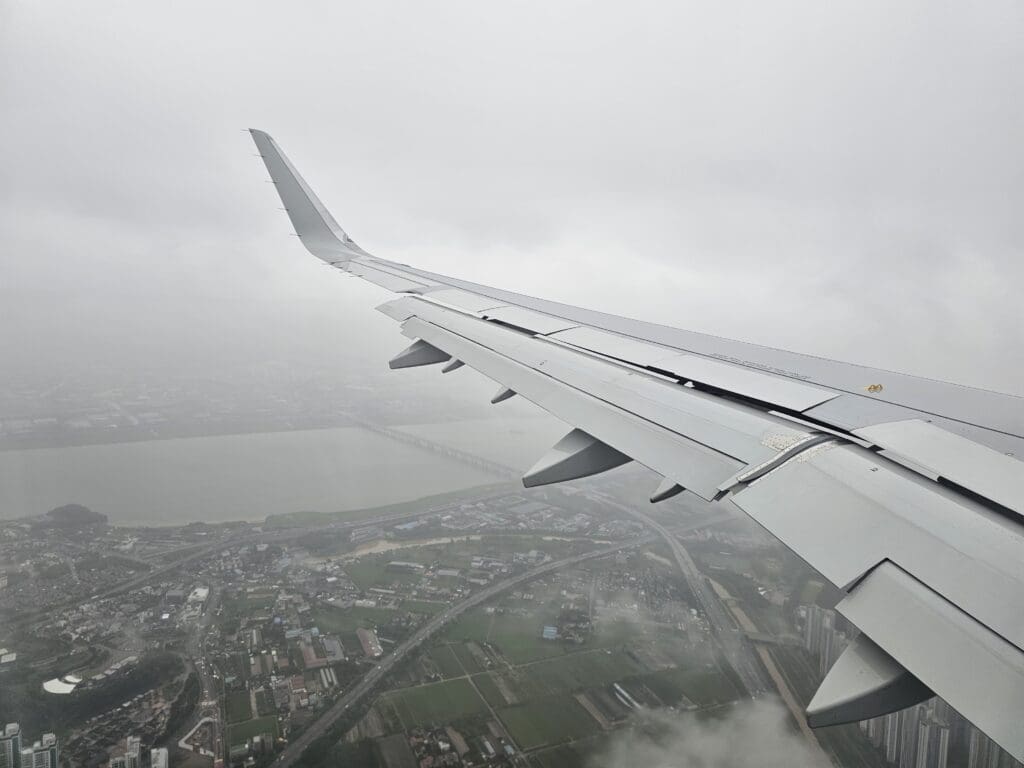
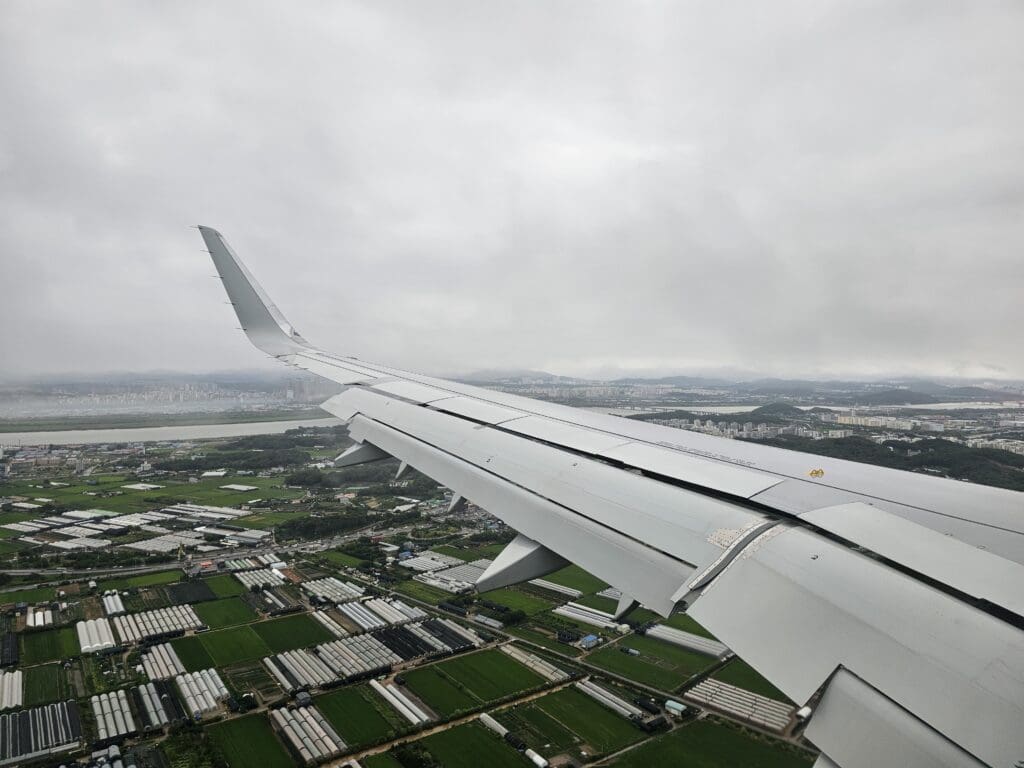
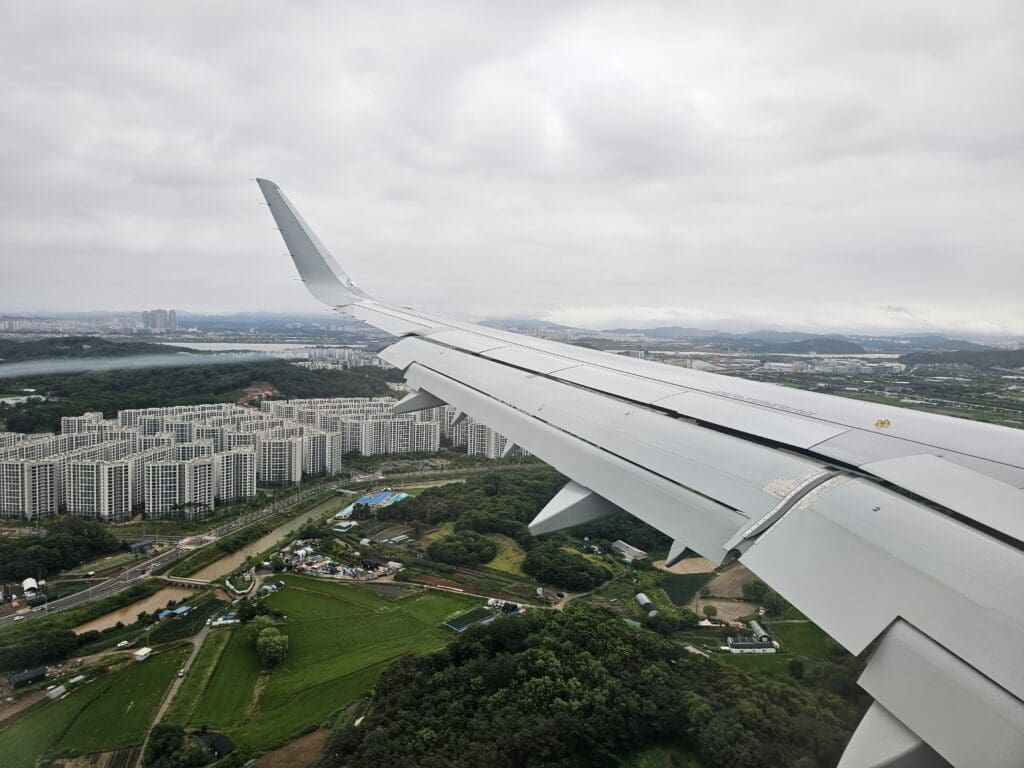
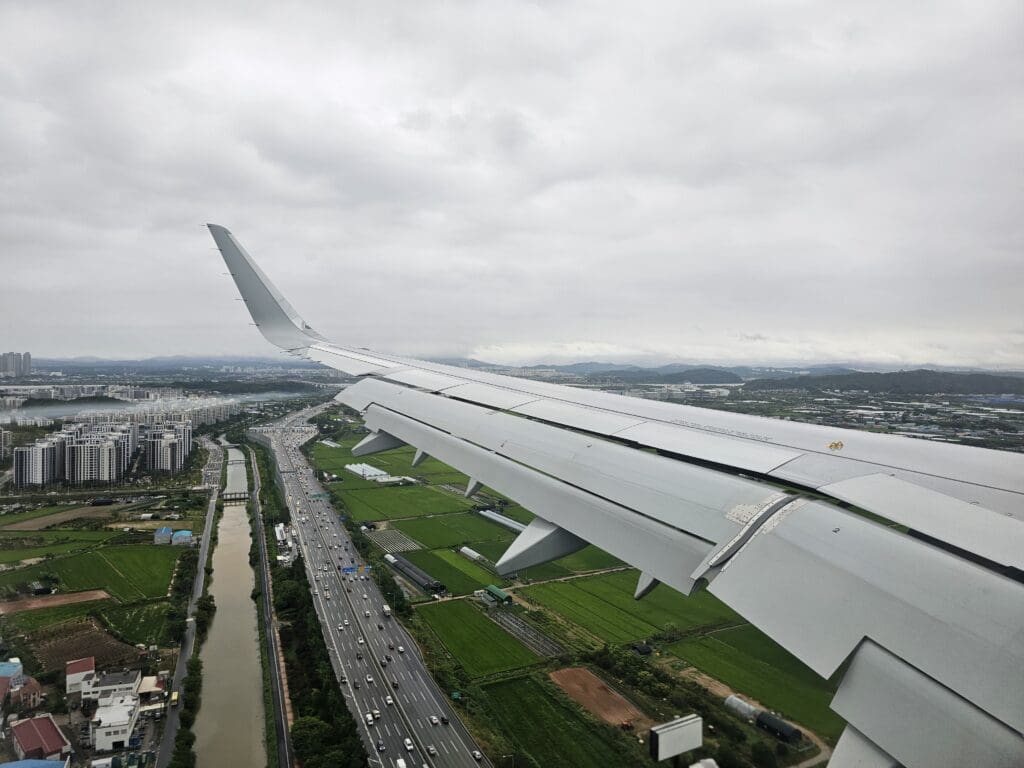
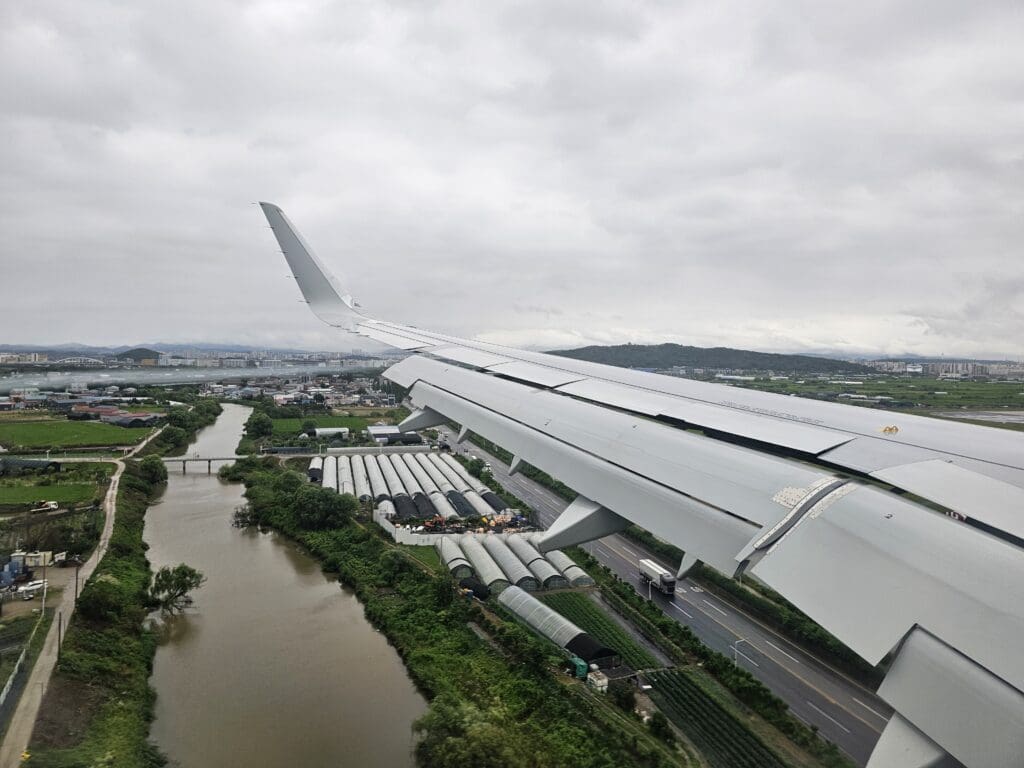
Soon, the Airbus passed over the airport’s thick perimeter wall and at 1721, the Airbus made a firm touchdown on Runway 14R, ending our 54-minute journey through the Korean skies. Once down, the aircraft seemed to decelerate rather quickly and we soon vacated the runway to the right at which point the Purser welcomed all passengers to Seoul, thanked passengers for flying with Korean Air and advised passengers to remain seated with their seatbelts fastened. Sitting on the left-hand side of the aircraft, it seemed that the terminal was rather busy, with many of the twelve jetbridge-equipped stands being taken. Thus, I was not to find that that evening, we would end our journey at Stand 130, located a fair distance away from the terminal building.
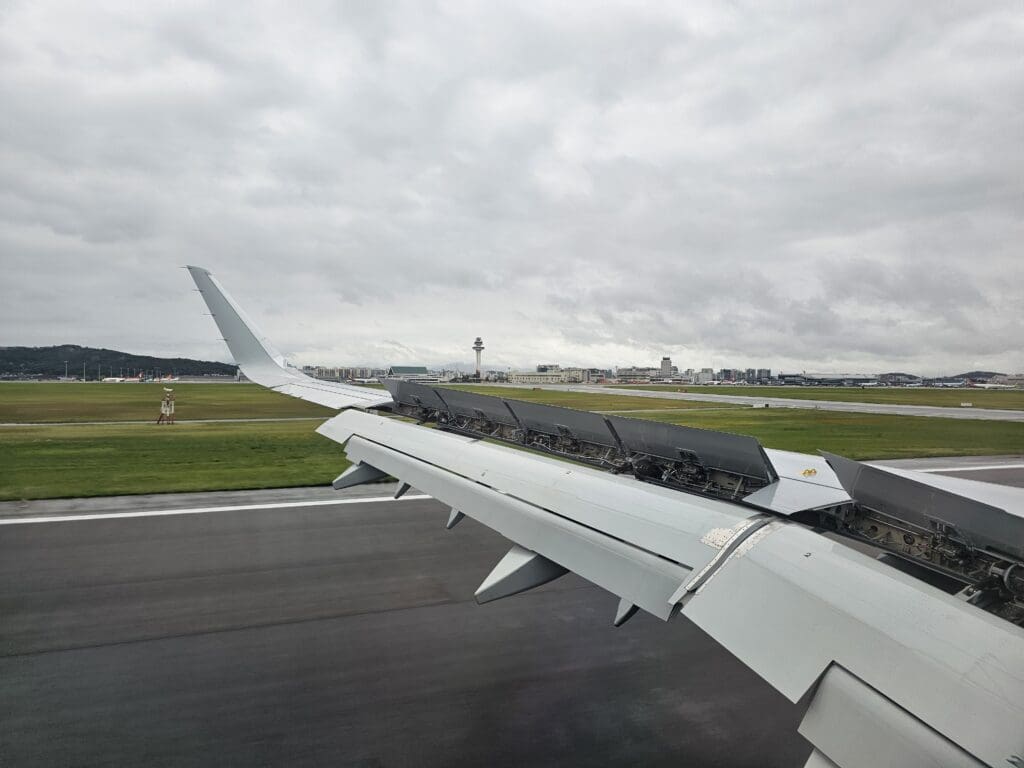
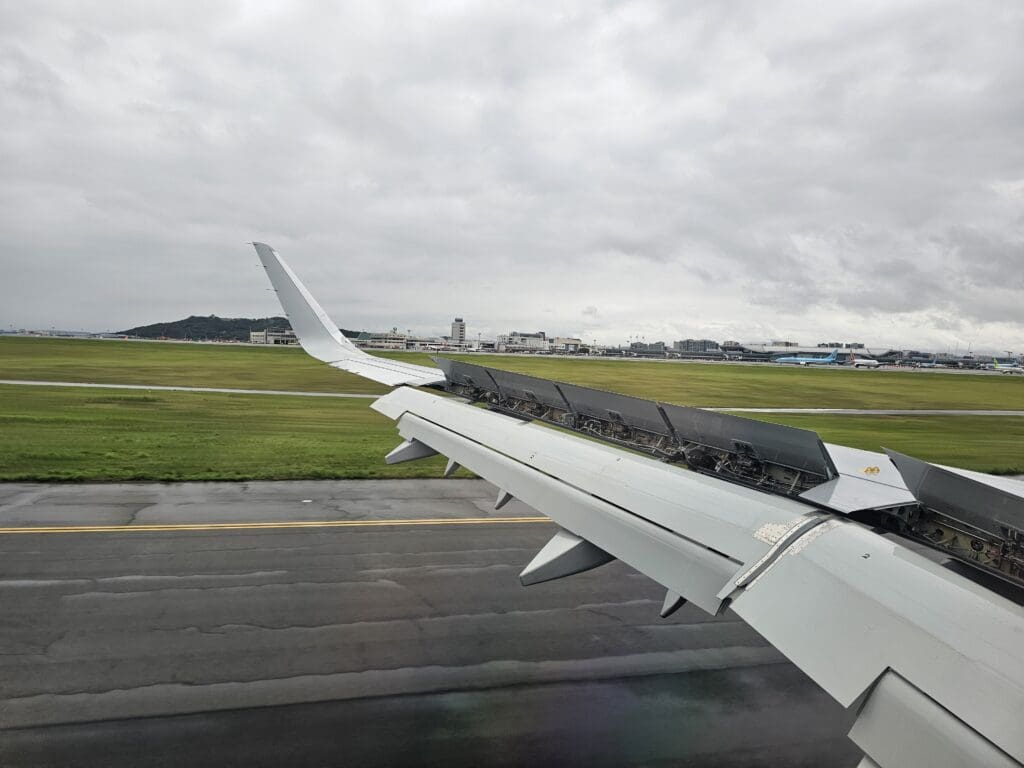
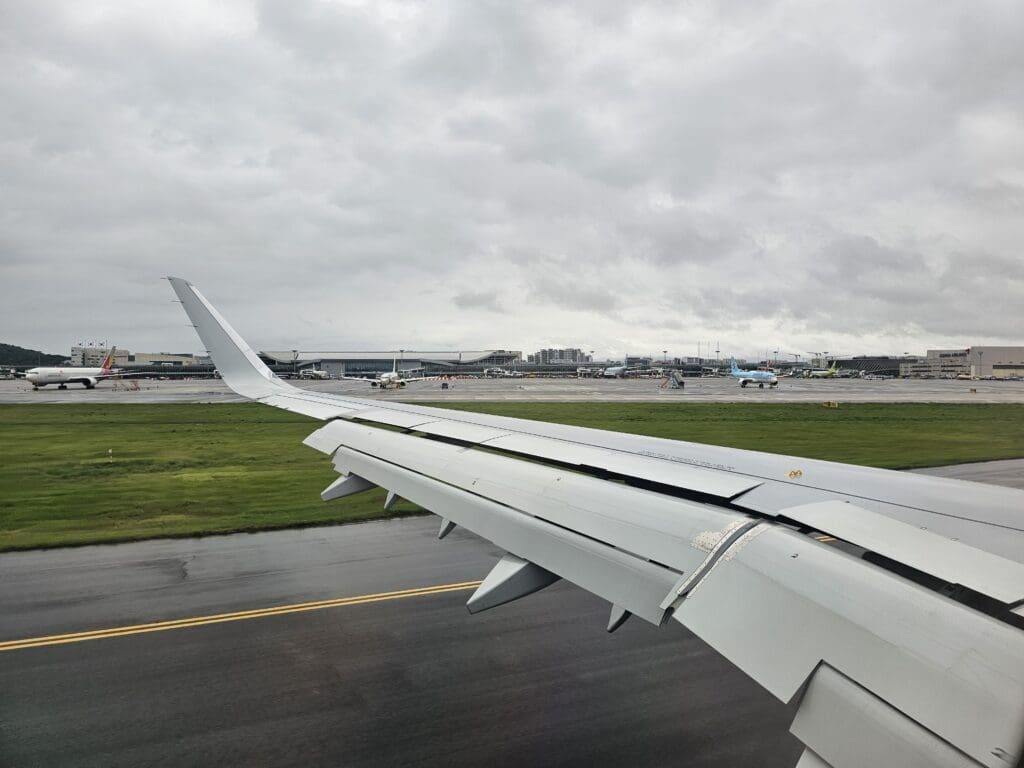
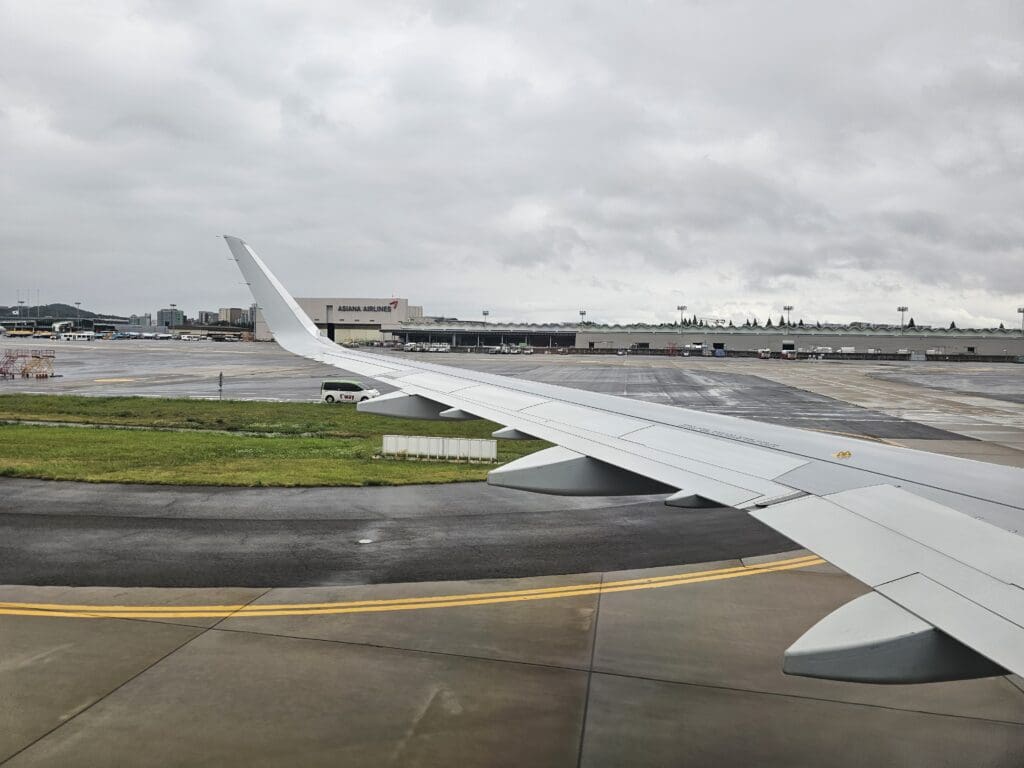
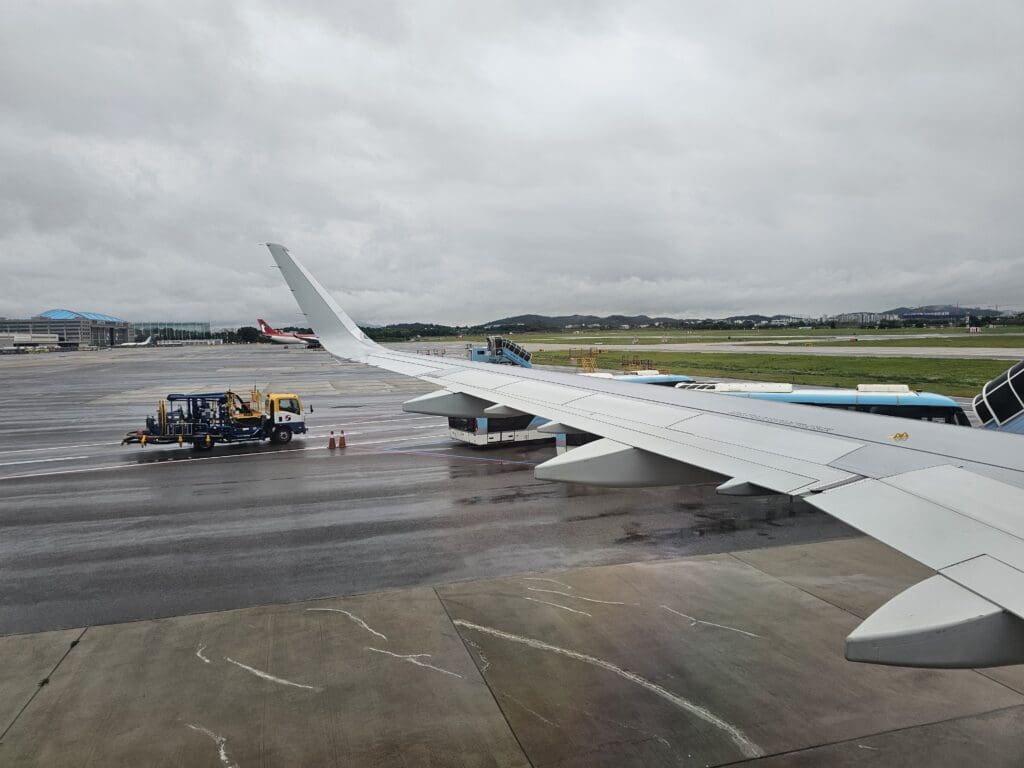
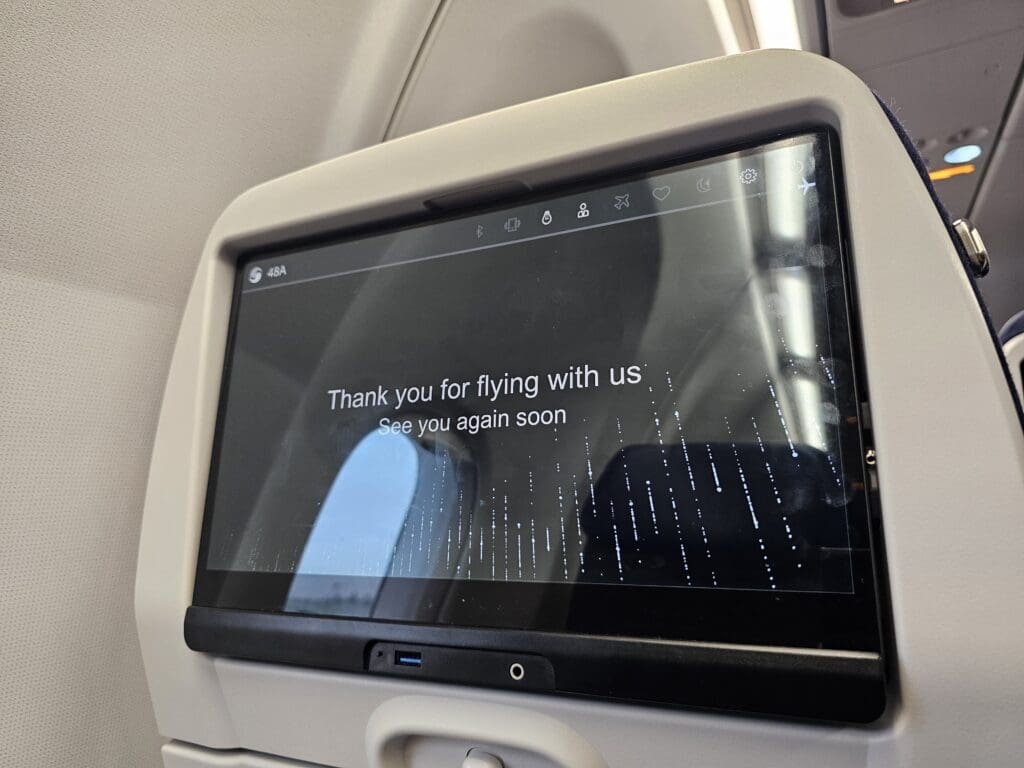
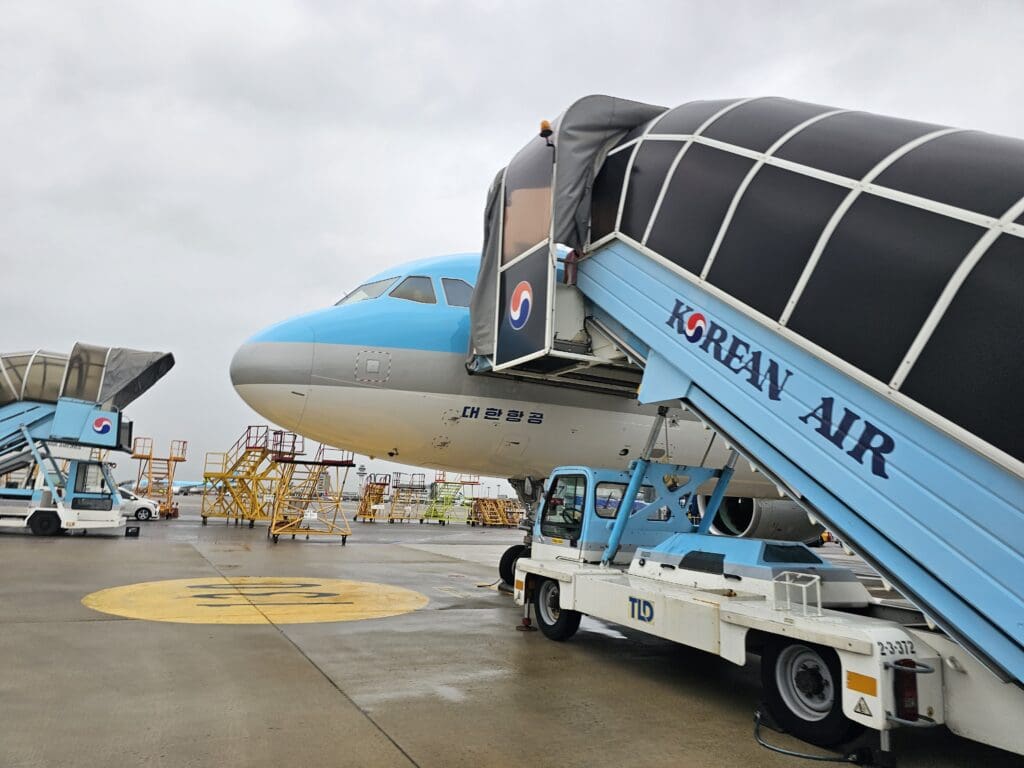
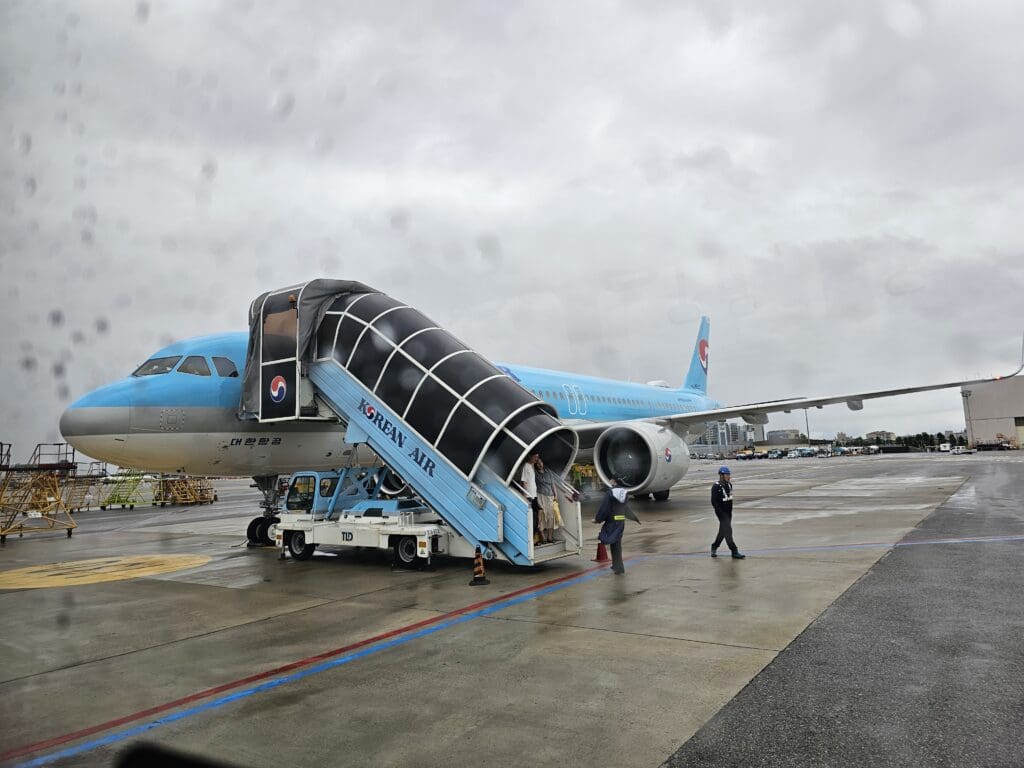
As the aircraft pulled into the stand, reassuringly an army of Korean Air ground crew and a fleet of buses could be seen waiting, thus providing hope that disembarkation would not be a lengthy affair. At 17:26, a total of 02:31 behind our scheduled arrival time, the Airbus came to a halt under Seoul’s rainy skies. Once the engines spooled down, the cabin jumped up and the sound of ‘Airplane’, a cheesy upbeat hit by the early 2000s K-pop trio, Turtles, filled the cabin and a thank you and farewell message was displayed on the inflight entertainment screens. Thankfully, the cabin door was soon opened and the line in the aisle began to budge as passengers disembarked and made their way onto the waiting buses. Eventually, I stood up and made my way through the now slightly messy cabin before I thanked the two flight attendants in the forward galley and stepped off the aircraft around eight minutes after we had arrived on stand. From the cabin door, I cautiously headed down the covered airstairs and joined the bus, and, being one of the last passengers to disembark, it wasn’t long before the doors were closed and we began a short journey across the ramp to the terminal building. Once there, with nothing to collect, I sped through the large baggage collection hall and soon arrived in the domestic terminal’s landside arrivals area, thereby ending my Korean Air Airbus A321neo experience.
Summary
Whilst my flight to Seoul was delayed, this was very much out of Korean Air’s hands, and it seemed that the airline provided as much information about the delay as possible, be it through their delay information board at the gate and the two staff members on duty there for the duration of the delay, or through updates via email and Korean Air app. Once onboard, I had an absolutely fantastic experience, and the Airbus A321neo seemed to embody everything great about Korean Air before (comfortable seats and plenty of legroom) with a more stylish cabin design and state-of-the-art technology. Needless to say, I was left very impressed by Korean Air’s Airbus A321neo and I would have had absolutely no complaints riding on this on a five or so hour flight down to Southeast Asia. Not to mention the fact that the crew were polite, friendly and welcoming throughout the flight. Top marks Korean Air!