A 24 Hour Delay from Mongolia to Germany: My MIAT Mongolian Airlines Boeing 767 Experience
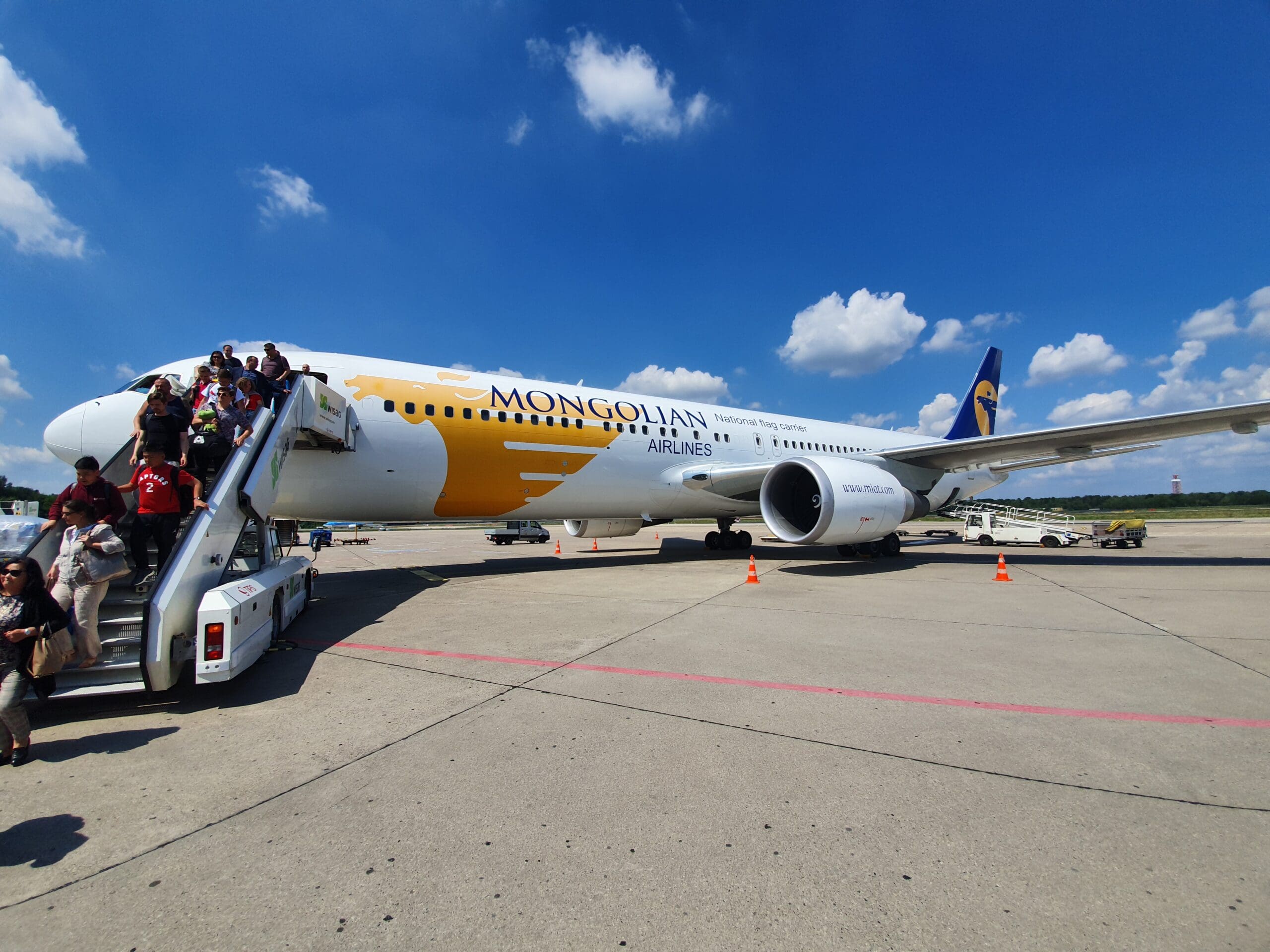
This flight was taken as part of my MIAT Mongolian Airlines itinerary from Busan to Berlin – you can read about my Boeing 737-800 operated flight from Busan to Ulaanbataar here.
A False Start
On a June Saturday evening in the Mongolian capital, I found myself packing my bag in preparation for my 0915 flight to Europe the following morning after a two-day stay in Mongolia. As darkness fell, the weather forecast predicting clear skies and light winds seemed to have missed the mark. Instead, I was treated to a five-hour-long thunderstorm that featured perhaps the most impressive bolts of lightning I’ve ever witnessed. Visible from a distance, each thunderclap brought the storm closer to the city, while the wind picked up and rattled the battered apartment block I had called home during my short stay. While I recognised this could potentially delay my departure the next morning, I was not overly concerned. Multiple sources still forecasted good weather, the aircraft scheduled to fly me to Berlin was already on the ground in Ulaanbaatar, and surprisingly considering the atrotious weather conditions, it appeared that flights were continuing to arrive at the airport. Moreover, with 24 hours to spare before my connecting flight back to the UK via Zurich, it would have taken a significant delay for me to miss it.
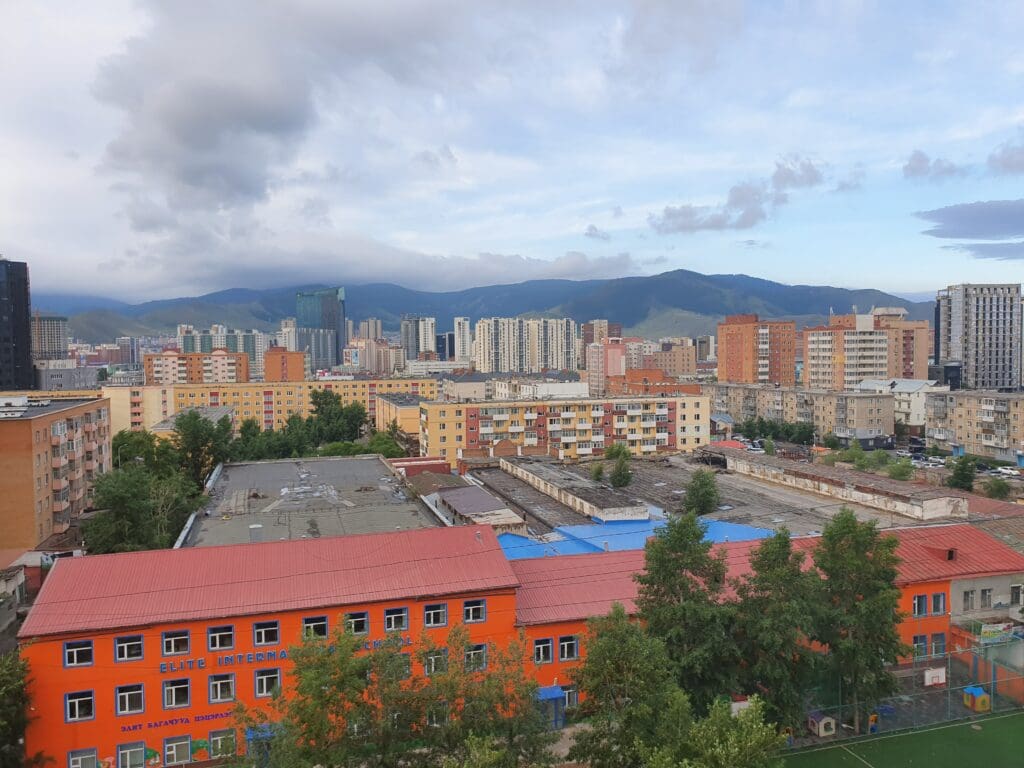
Fuelling my confidence for an on-time departure, on my scheduled departure day, I woke up to calm conditions. Outside, the skies were mostly blue and a gentle breeze wafted in as I opened the window. After ensuring I had packed all my belongings, I left the Airbnb and lugged my small suitcase down the winding staircase of the Communist era apartment block. Once outside, I made my way towards the main road, Seoul Street. Whilst the apartment had been pleasant enough for a short stay, the host had been far from helpful – turning up two hours late, after midnight, on the evening of my arrival and failing to offer any advice on arranging a taxi back to the airport. Thus, despite being aware of the risk of being overcharged, I had little choice but to flag down a taxi. However, in Ulaanbaatar, most taxis come in the form of ‘unofficial’ taxis – simply private cars willing to offer rides for a fee.
Fortunately, I had to wait all of about three minutes before a car and driver stopped and I jumped in. Speeding along the busy streets of the Mongolian capital, it took about fifteen minutes to reach the sprawl of Chinggis Khaan International Airport and before I knew it the car descended the hill that leads to the terminal building. At this stage of the journey I was treated to a few glimpses of the busier than usual ramp. As it turned out, whilst many flights had been able to land in Mongolia the previous evening, none of these had been able to depart! Thus, I spotted a pair of Air China Boeing 737-800s that would soon return to Beijing and Hohhot, a Korean Air Airbus A330-300, and, most excitingly, an Antonov An-148 operated by Russian carrier Angara Airlines that would later return to its base at Irkutsk.
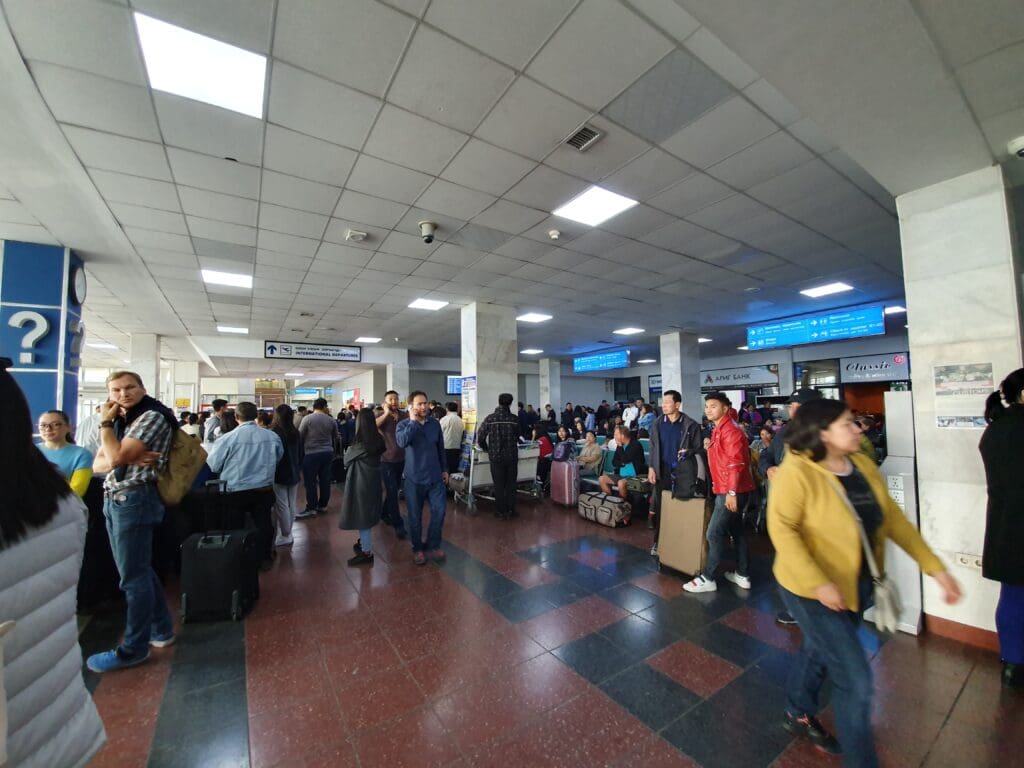
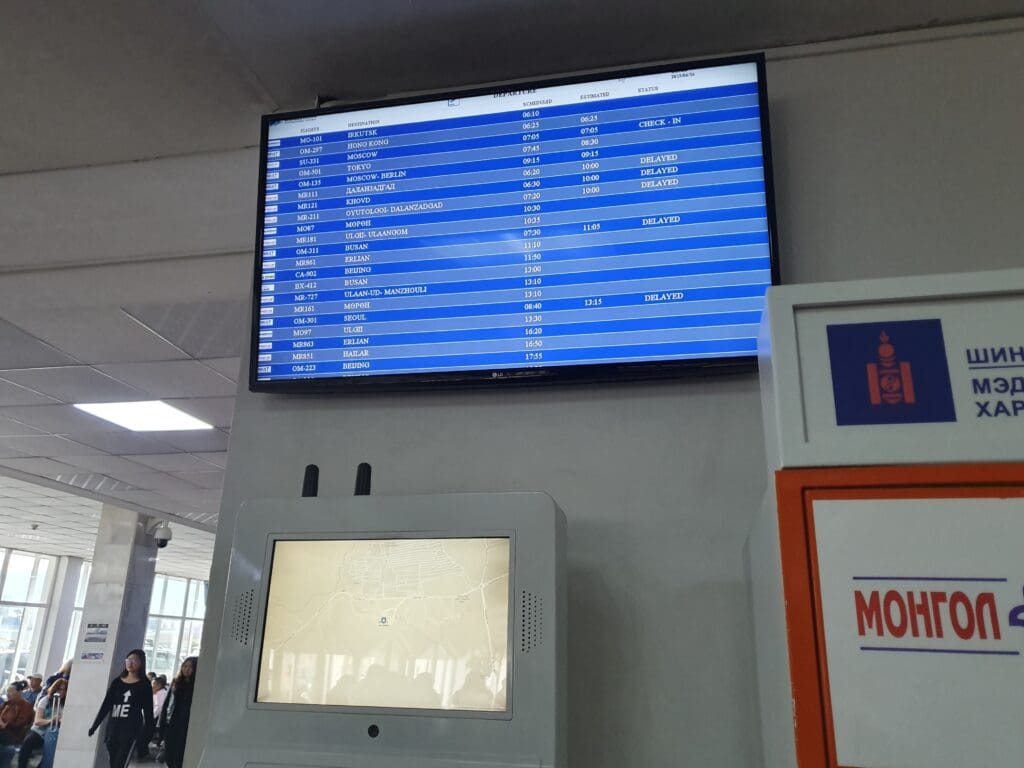
Following a drama-free journey, the driver dropped me off in the car park where handed over the inflated unofficial fare of 30,000 tugriks (£8). Once I handed over a set of crumbled notes, I made my way into the terminal through the entrance to the landside arrivals area before heading up the stairs to the departure floor. Failing to reassure me that I would be in for a smooth journey to Germany, once there I was greeted by scenes of absolute chaos, with passengers absolutely everywhere and few staff members in sight. Despite this, a quick check of the departure boards revealed that that day’s service to Berlin via Moscow was still scheduled to depart on time, however, with passengers to be allowed to enter the international check-in hall, I had little to do. I therefore decided to grab my first coffee of the day and have a stroll around.
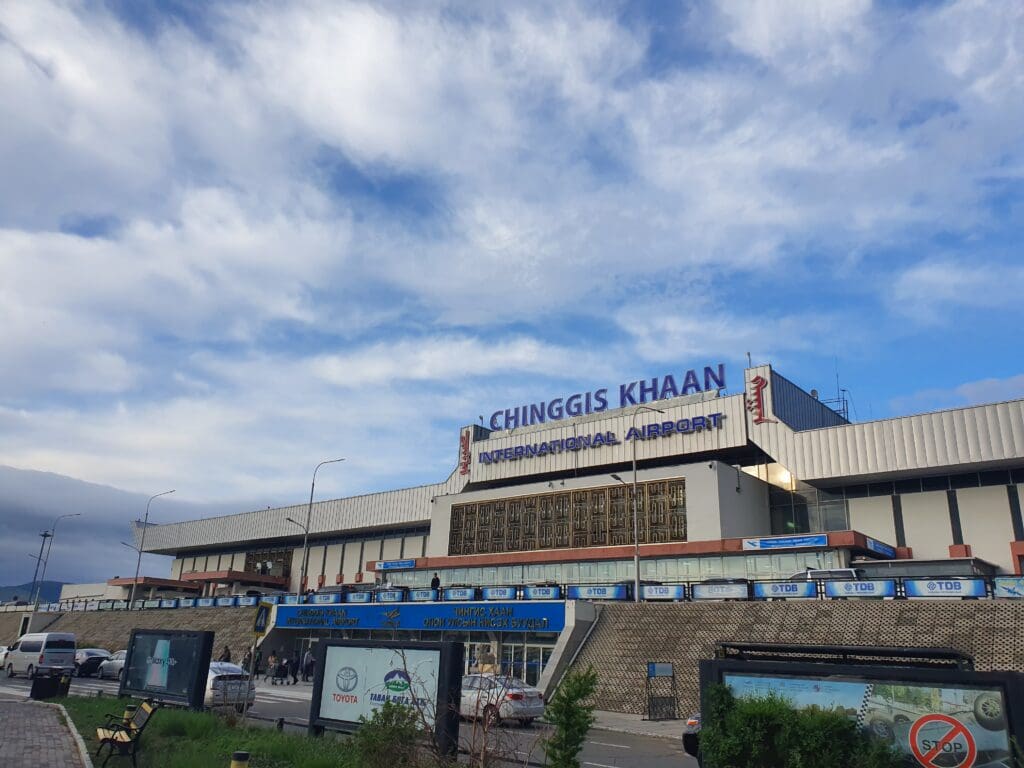
Slightly worryingly, an hour passed and the situation did not appear to be any different. The terminal was still rammed and passengers were still not allowed to enter the international check-in hall, thus leading me to conclude that a punctual departure was no longer feasible. Around me, passengers bound for destinations across China, Germany, Korea, and Russia appeared to grow increasingly frustrated by the total lack of information. At 0745, a single MIAT staff member appeared with a printed A4-sized sheet of paper which listed the Mongolian national carrier’s revised schedule. Specifically, this listed the revised departure times for each flight alongside the registrations of the aircraft that were scheduled to operate these. As it turned out, the Boeing 767 that was scheduled to take me to Germany should have operated an overnight round trip to Seoul Incheon, and, with this having been postponed, the aircraft would still have to operate this before operating the flight to Europe. This meant that my flight to Germany had been rescheduled by almost 24 hours and would now depart at 0500 and would arrive in Berlin at 0940 local time – meaning that my connection time in the German capital had significantly eroded!
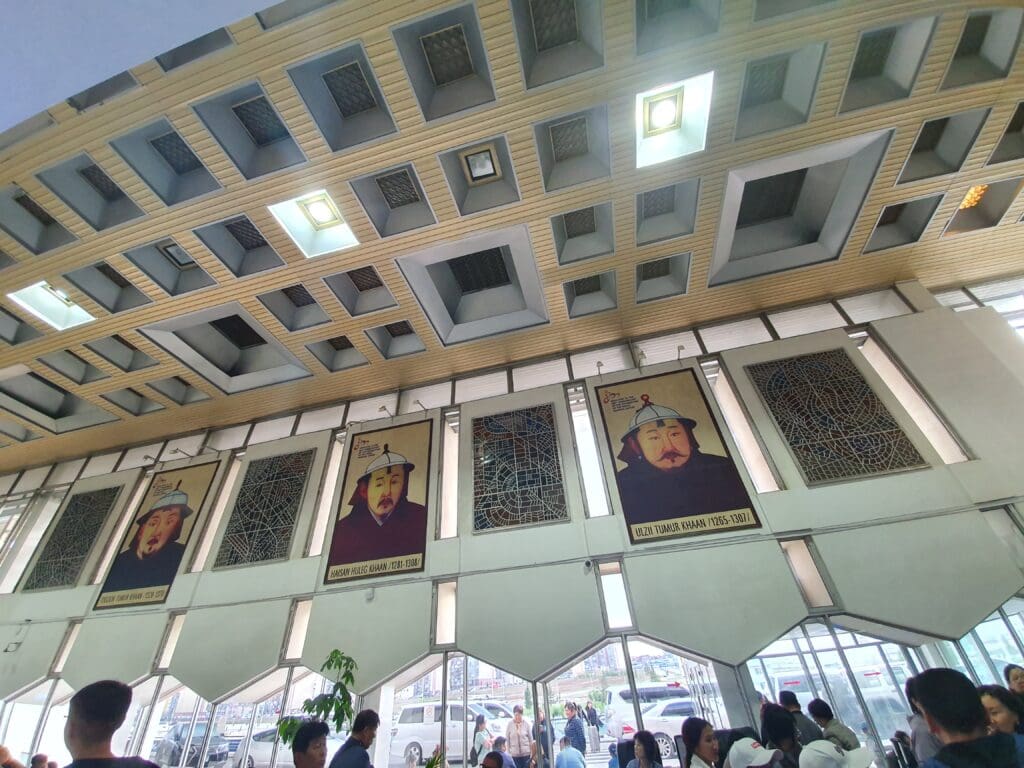
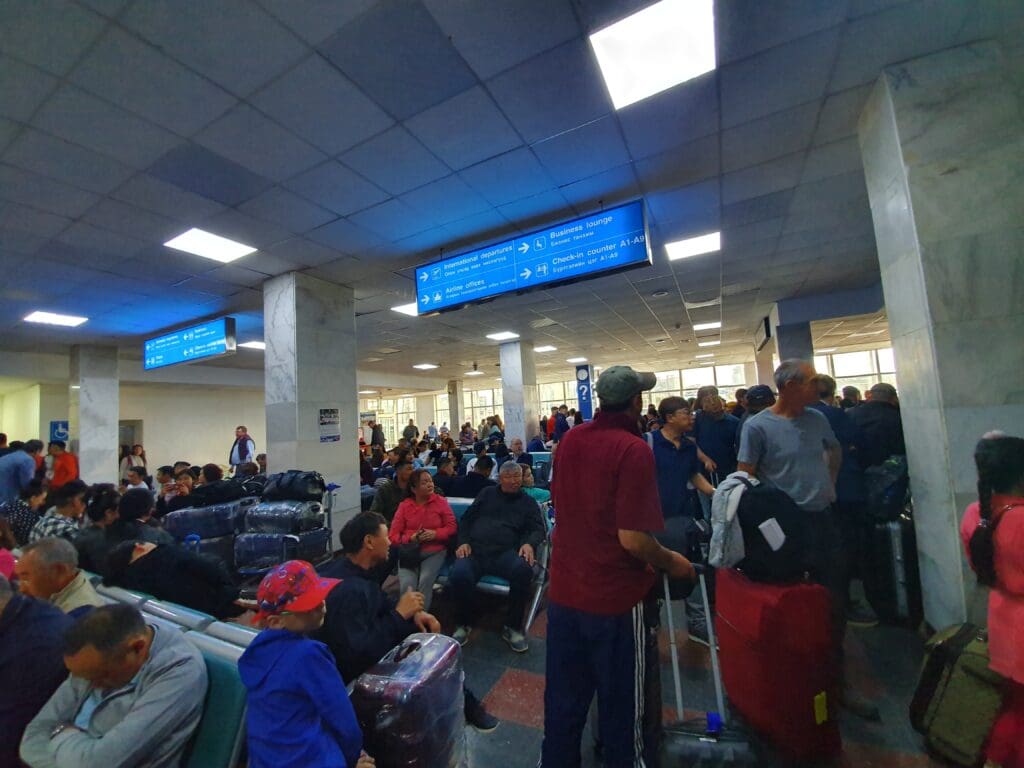
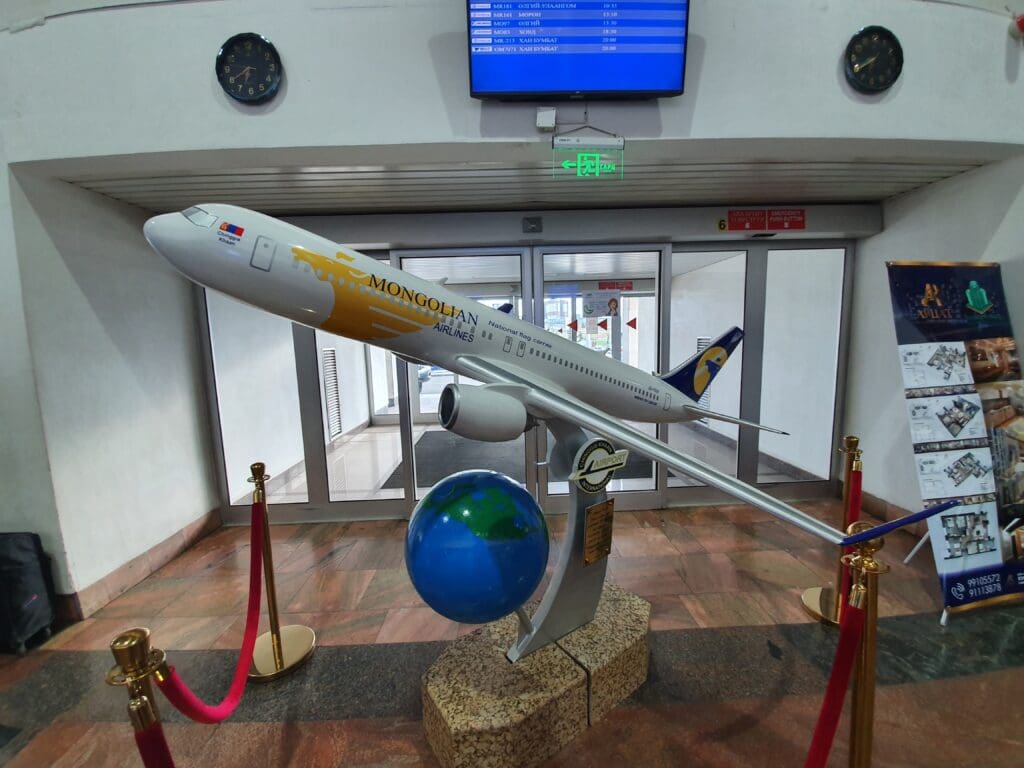
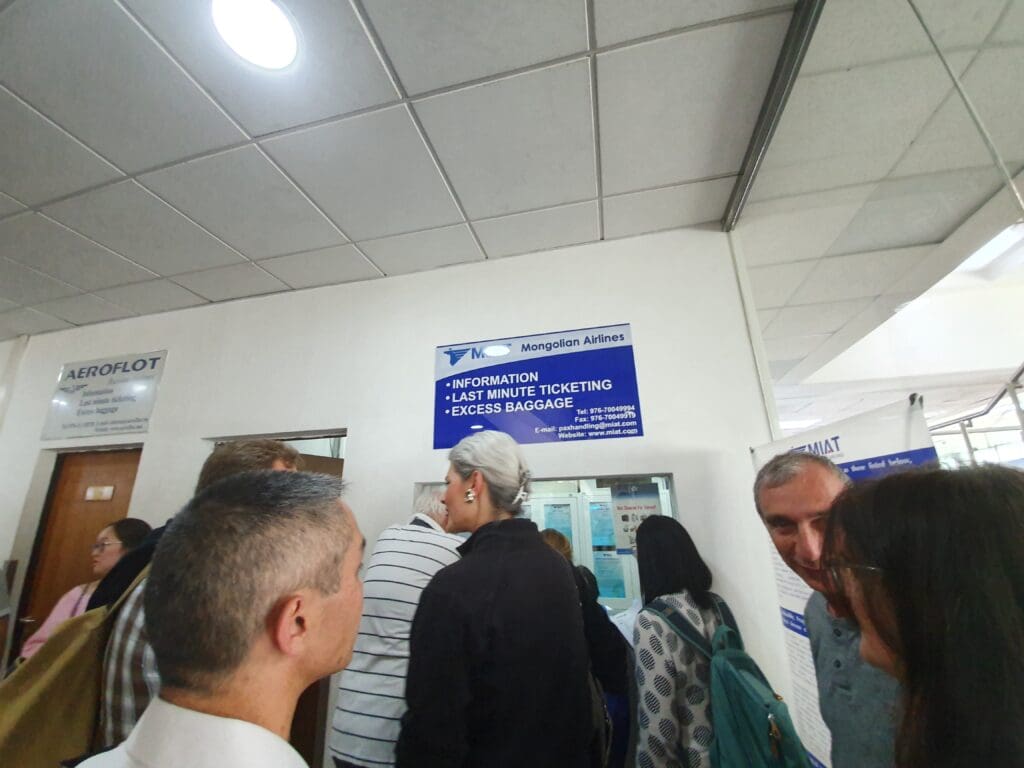
Unfortunately, MIAT offered no compensation to passengers affected by the schedule changes, aside from a certificate confirming the delay, which would later prove useless when submitted to my insurance company. After queuing for nearly an hour to receive this certificate, I opted against spending the day in the confines of the landside portion of the airport. Making use of the terminal’s complimentary wifi network, I booked a room at a local hotel, the Japanese-themed Tulip Hotel, for $39. However, with this being located in the city (unfortunately there were no available rooms near the airport), I was required to take another taxi. Sadly, this journey too did not go to plan as despite agreeing upon the standard fare of 30,000 tugriks with the driver beforehand, once we had arrived at the hotel, the driver became aggressive and refused to let me out until I paid a hefty 100,000 tugriks! This experience left a sour taste, but at least the hotel allowed me to check in early, and I managed to get some rest. However, my stay was not totally plain sailing as it was accompanied by a three-hour power cut!
The Second Attempt
Having carefully examined the airline’s master plan of rescheduled flights, I was already aware that Boeing 767-300ER JU-1021 was scheduled to operate that morning’s service. Hoping for no further delays, I kept tabs on the Boeing as it made its round trip to Seoul Incheon. Unfortunately, having departed from Ulaanbaatar around two hours behind schedule, a punctual departure from Mongolia (according to the new schedule) the following morning seemed impossible. Nevertheless, having pre-arranged a taxi with the hotel reception staff for 0050, I had little option but to leave in the middle of the night, regardless of the time that my flight would depart.
Following my day-long stay, I headed out of my room at handed over my key to the Tulip Hotel’s reception staff before heading outside and into the dark and drizzly night. Fortunately, the driver was already waiting outside the hotel and he escorted me to the unmarked Honda Prius that would transport me the 20 or so kilometres to the airport. Continuing with the Japanese theme, the car’s steering wheel was on the right hand side whilst all information on the centre console was in Japanese. This reminded me of the multiple second hand cars imported from Japan I had ridden during my time in Georgia. After leaving the hotel, the car sped down the mostly unlit and occasionally severely bumpy roads of Mongolia’s capital city. Following a speedy ride down the city’s backstreets, reassuring me that we were not heading out into the countryside, the taxi eventually rejoined the main road that leads to the airport. A few minutes later, the car descended the hill that leads to the airport and drove past the large lit up portrait of airport namesake and national hero Chinggis Khan before pulling up to the departures level of the terminal. As the hotel reception worker had claimed, the driver only demanded a standard 30,000 tugrik and after handing this over I headed straight into the main terminal.
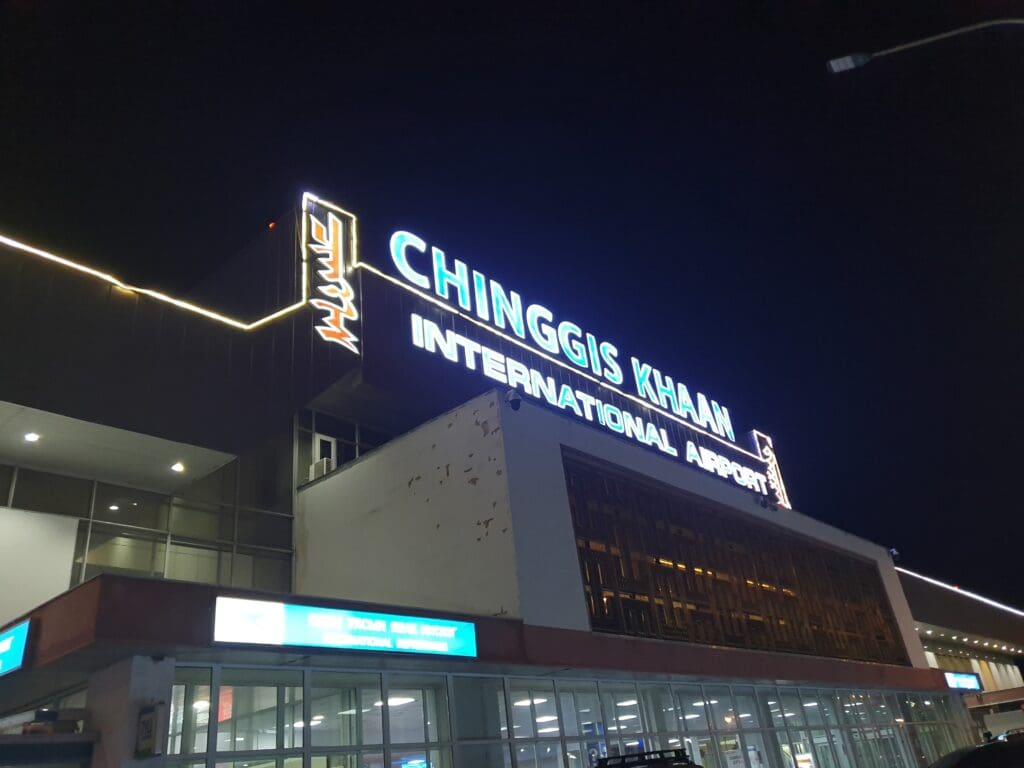
Unlike the previous day where it had been near impossible to move thanks to the crowds of disgruntled passengers seeking information, that night the airport was somewhat calmer. Thanks to MIAT’s failure to arrange any sort of accommodation for delayed passengers, it came as little surprise that as I walked through the departure hall, I noticed plenty of slumbering passengers. Many of whom I recognised from the previous morning. Having already long exhausted my wifi allowance on the airport’s complimentary network, I found myself with little to do until check-in opened. Thus, after making several laps of the terminal’s small and dated landside departure hall, I headed to the arrivals level in order to stop at the airport’s only open landside café.
After making it past several drivers touting for custom, I plonked myself down in the local branch of Korean coffee shop, Tom N Toms. Understandably given the café’s selection of comfortable seating, the coffee shop appeared to be a popular space for those waiting for check-in to open and after ordering a slightly overpriced cappuccino, I secured the café’s last free seat. Thankfully, not only did my coffee allow for some middle of the night refreshment, the password for the café’s wifi network was printed on the receipt and so I was able to track the process of the Boeing 767 scheduled to operate the service over to Europe. Worryingly yet perhaps expectedly, this revealed that the aircraft had failed to make an on-time departure from Incheon, not leaving the airport until 0225 Mongolian time and thus guaranteeing a delayed departure. Indeed, a short while later, this was confirmed by the departure boards which pushed back the flight’s scheduled departure time from 0500 to 0630. Given the fact that my connection in Berlin had gone from 23 hours to an hour and a half, this was a little worrying!
After spending as much time as I possibly could in the café, I decided to climb the stairs back up to the terminal’s departure level which by this time appeared to be a little busier thanks to Aeromongolia and SCAT Airlines’ flights to Irkutsk and Astana respectively. Interestingly, I noticed that the demographics of both flights appeared to consist mainly of middle-aged Korean passengers, with those heading to Irkutsk appearing to be on some sort of tour. At 0405, those passengers heading off on MIAT’s two morning Boeing 767 flights, the 0625 service to Incheon and my 0630 to Berlin via Moscow, were allowed to enter the terminal’s international check-in hall.

Joining a short queue, my passport was very briefly checked by a seemingly disinterested security guard before I was able to make my way into the large international check-in hall. Once there, I was escorted to one of the five open Economy desks serving those bound for Berlin, Moscow and Incheon. With only seven passengers in front of me, all of whom appeared to be transporting minimal amounts of luggage, I expected the queue to go down quickly. However, in the end it took almost thirty minutes of waiting before I finally reached the desk! Perhaps seeing as I had checked in online, compared to those passengers in front of me, check-in was a fairly quick process. Once at the desk, the reasonably friendly check-in agent asked whether I was aware that I had a different seat on each sector. After replying that I was and that this wasn’t an issue, two plain boarding passes were printed off and my suitcase was sent into the depths of the airport.
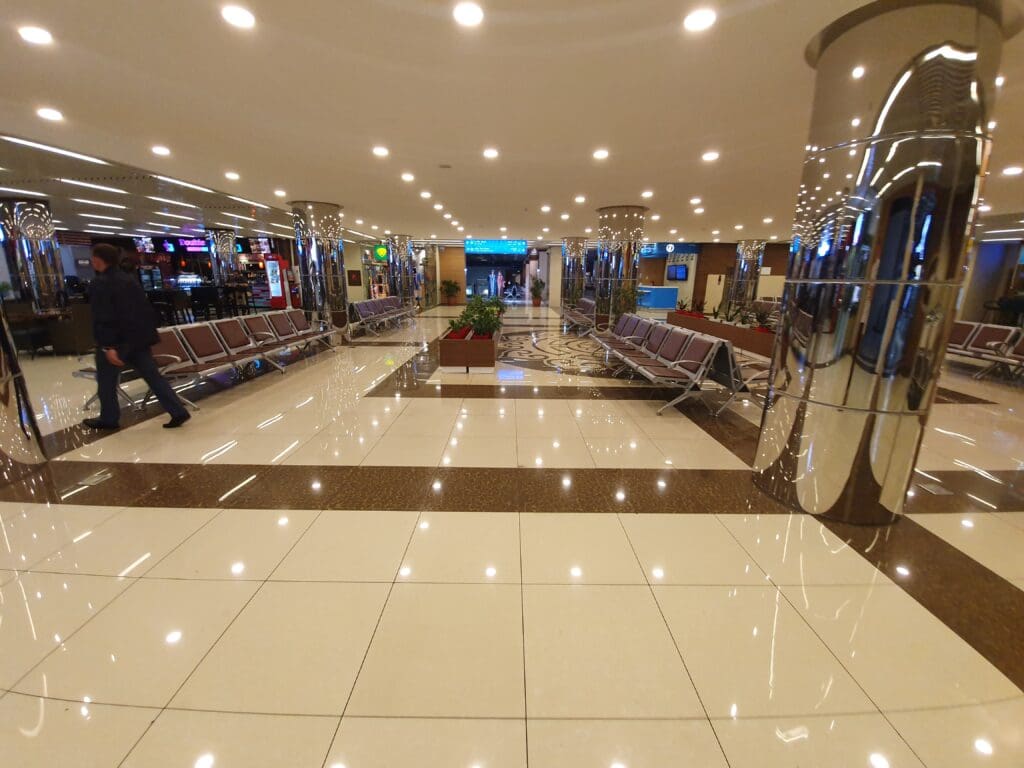
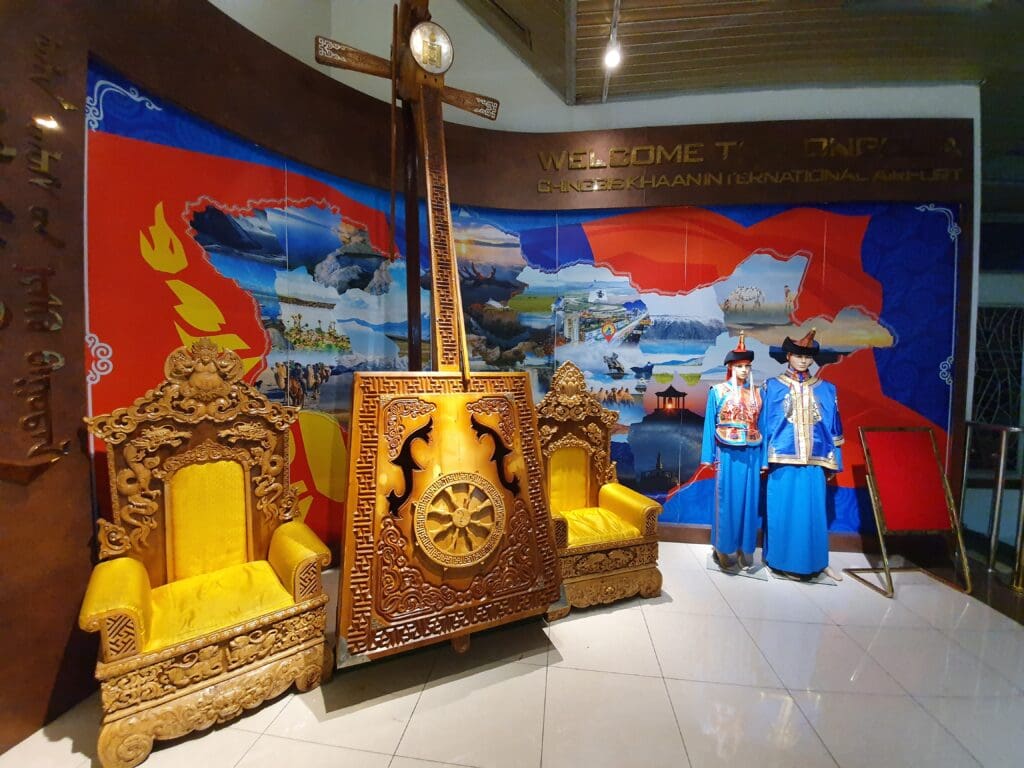
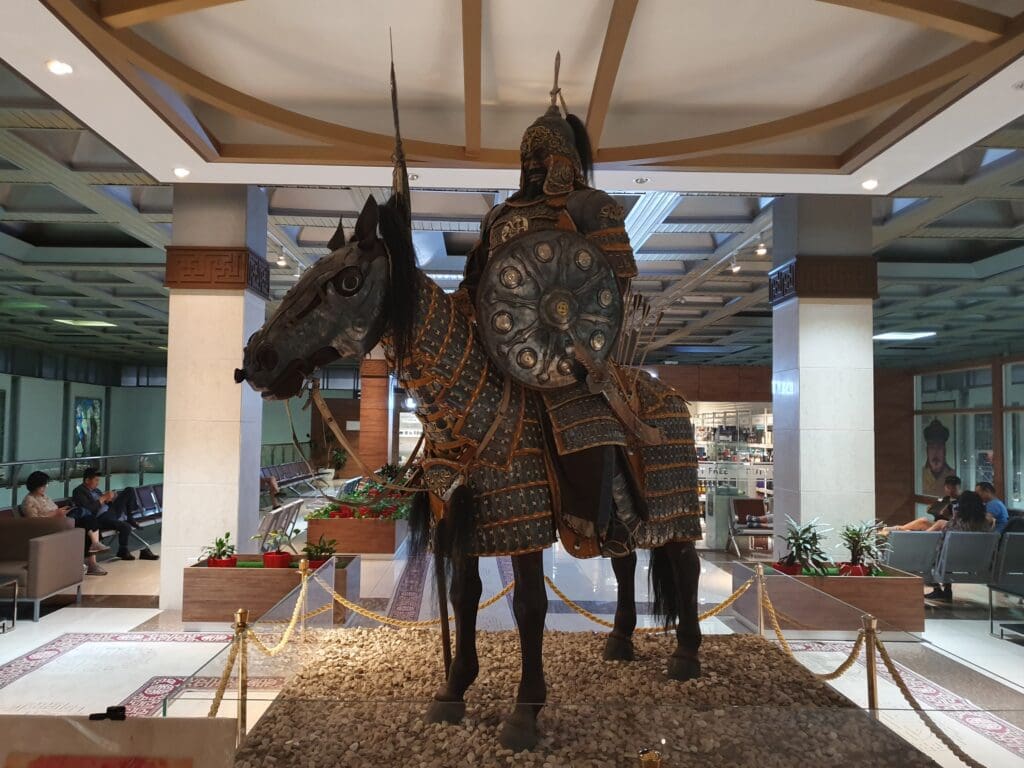
Given my slow journey through the airport, I expected plenty of queuing at both security and immigration. However, much to my delight, both of these were quick and painless processes and I steamed through in no more than five minutes. Once the tough stony faced immigration officer returned my passport, I was free to explore the delights of Ulaanbaatar’s airside departure area. From immigration, I made my way up the escalators to the main portion of the terminal where it soon became clear that more has been invested in this than the landside area. Whilst it is highly unlikely that the terminal will be winning any awards in the near future, the terminal’s airside area appeared to be far smarter, more modern and cleaner than the landside area and was home to a respectable number of cafés and shops. One of the terminal’s more interesting and unique features consisted of a small exhibition space displaying historic artefacts from across Mongolia as well as several mannequins. That morning, my only real complaint about the airside area was the fact that none of the toilet doors appeared to lock! Following a quick stroll, I took a seat on one of the comfortable leather sofas conveniently located next to a charging point where I waited for my flight.

Outside the skies gradually brightened as a new day arrived, revealing the hills on the other side of the airfield as well as a collection of aircraft on the ramp. From an aviation enthusiast’s perspective, Chinggis Khaan International Airport is not the most spotter-friendly, with unobstructed views of the apron limited to a small patch of windows no more than a few metres wide next to the terminal’s premium lounge. Looking through this, I spotted one of SCAT Airlines’ Boeing 737 Classics sporting the airline’s old livery waiting to head back to Kazakhstan. Meanwhile, the entire fleet of local carrier Hunnu Air could also be seen, consisting of two ATR 72s and their Embraer 190 which had been delivered from China Southern Airlines several weeks earlier. In addition to these, an Aero Mongolia Embraer 145 could also be seen being readied for its flight to Irkutsk. A short time later these aircraft were joined by a trio of widebodies – an Aeroflot Airbus A330 arriving after an overnight service from Moscow Sheremetyevo and MIAT’s entire Boeing 767 fleet arriving from Seoul Incheon.
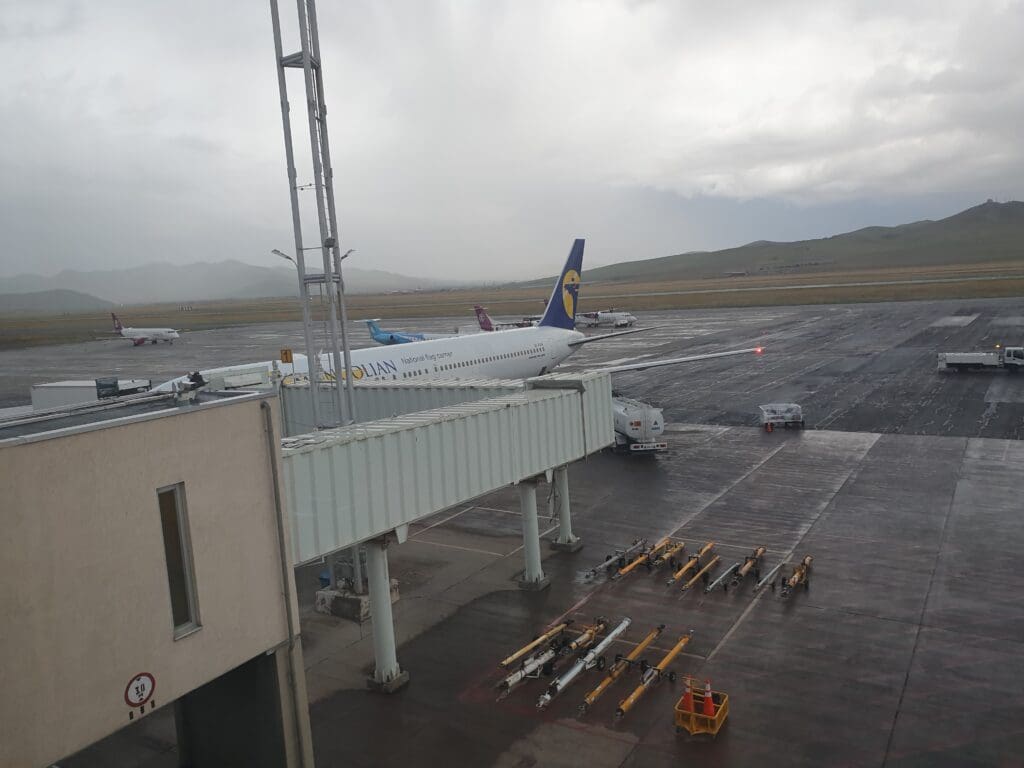
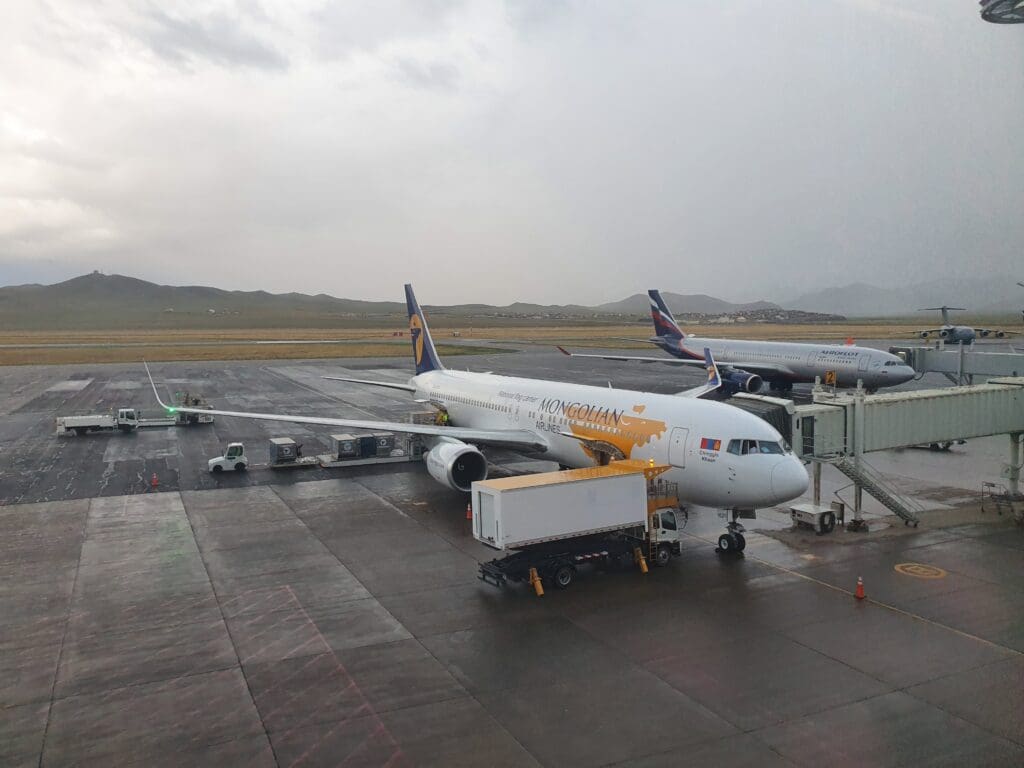
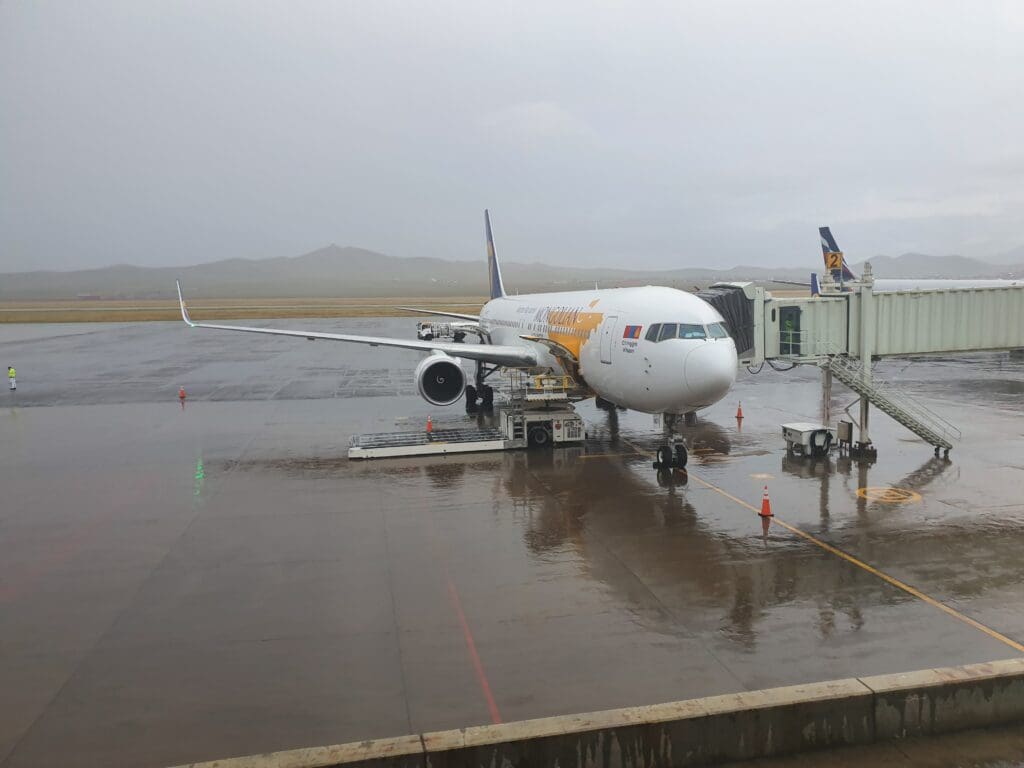
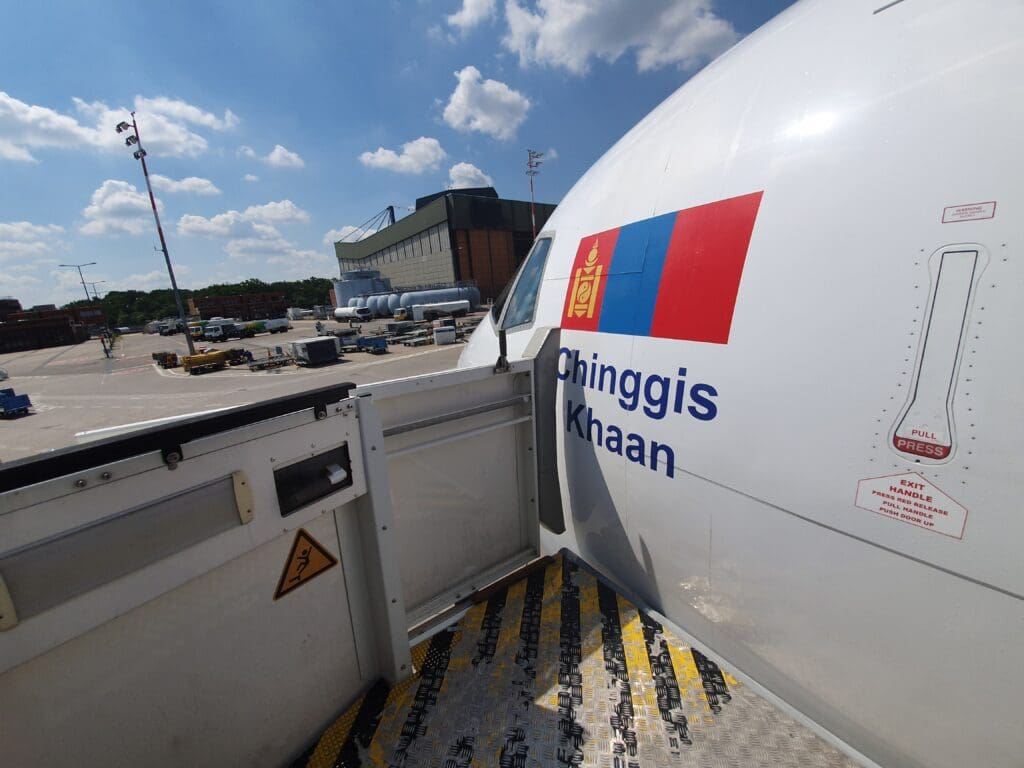
A little after 0530, the newer of MIAT’s two Boeing 767-300ERs, the locally registered JU-1021, came into a halt at Stand 2 after its early morning service from Korea. Assembled at Boeing’s Everett plant and carrying the line number 1050, this aircraft first took to the skies in March 2013. This makes it the seventh youngest passenger Boeing 767 in the world, with this being a little over six years old at the time of my flight. Following testing, in May 2013 the aircraft was ferried over to Mongolia to commence its career with the country’s national carrier, proudly sporting the name Chinggis Khaan after arguably Mongolia’s most known figure. Since then, the aircraft has been sent to destinations across MIAT’s route network, and features a grand total of 252 seats – 15 in Business and 237 in Economy.
Despite the fact that my boarding pass stated that boarding would commence at 0545, given the fact that this would only allow for 15 minutes for those arriving from Korea to disembark and the aircraft to be cleaned and prepared for its next trek, I was highly sceptical that boarding would commence at this time. Not only this, but thanks to the terminal’s design, there is only one boarding pass/identity checkpoint for all of the terminal’s four international gates. As a result, boarding for international services can only be undertaken one flight at a time, and with several international departures around the same time, I suspected that boarding would be a complicated affair!
Once it became clear that boarding would not commence at 0545, having already been delayed for 22 hours, understandably some passengers felt disgruntled. Unfortunately and embarrassingly, some passengers decided to vent their anger by being aggressive and in some cases shouting at staff members. Three passengers, all of whom appeared to be travelling separately were particularly vocal, shouting at staff members in German and Italian with the occasional swear word and insult in English. Fortunately, I rarely see signs of such aggression when travelling, even when faced with a long delay. Seeing such a display was most definitely frustrating and, had I been the Captain, I would have had absolutely no issue in refusing to transport these passengers.
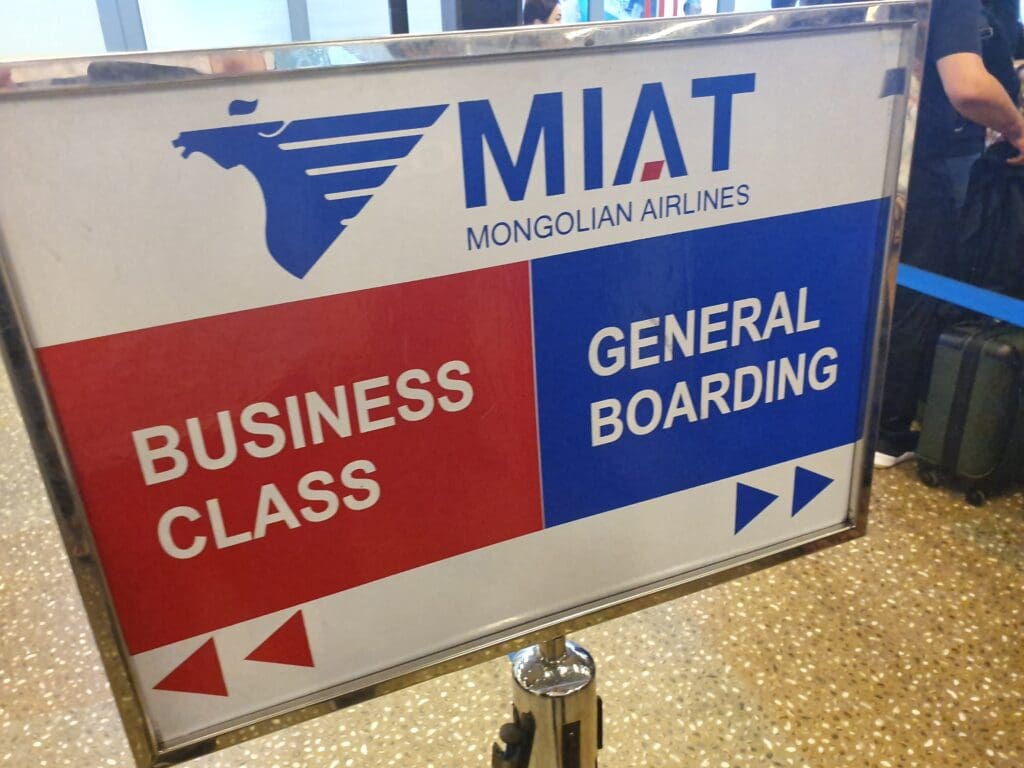
One hour after the aircraft pulled into the gate and fifteen minutes behind the flight’s new scheduled departure time, boarding for the Moscow-Berlin service commenced with those needing assistance and those travelling in Business invited to proceed to the gate first. Within five minutes, all those in Economy were invited to board – with this not being arranged by rows or zones. Soon enough, my boarding pass was scanned and after walking past the airline’s older Boeing 767-300ER bound for Seoul Incheon, wishing I was on my way to Korea, I arrived at a queue. As it happened, the cabin was still being prepared and so a few minutes of waiting was in store before passengers were permitted to make their way onto the aircraft. After some time, I stepped onto the aircraft via the L1 door where I received a subdued welcome in English before being requested to show my boarding pass. Once I had shown this, I was pointed down the second aisle and made my journey down the Boeing 767 to my seat near the rear of the aircraft.
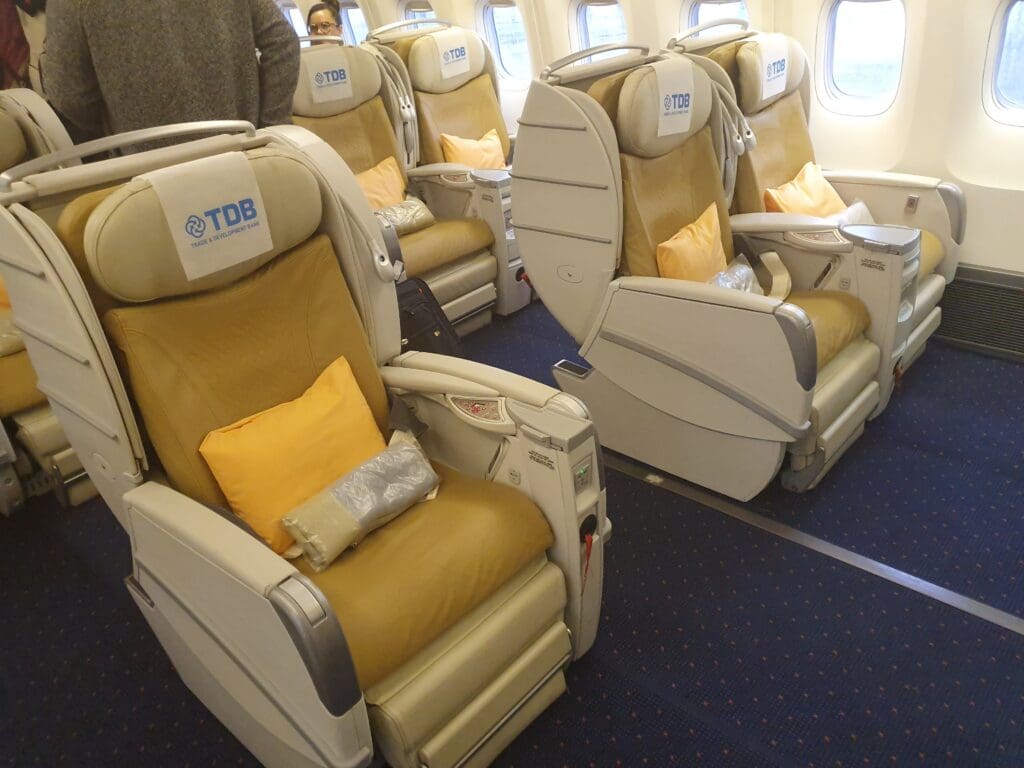
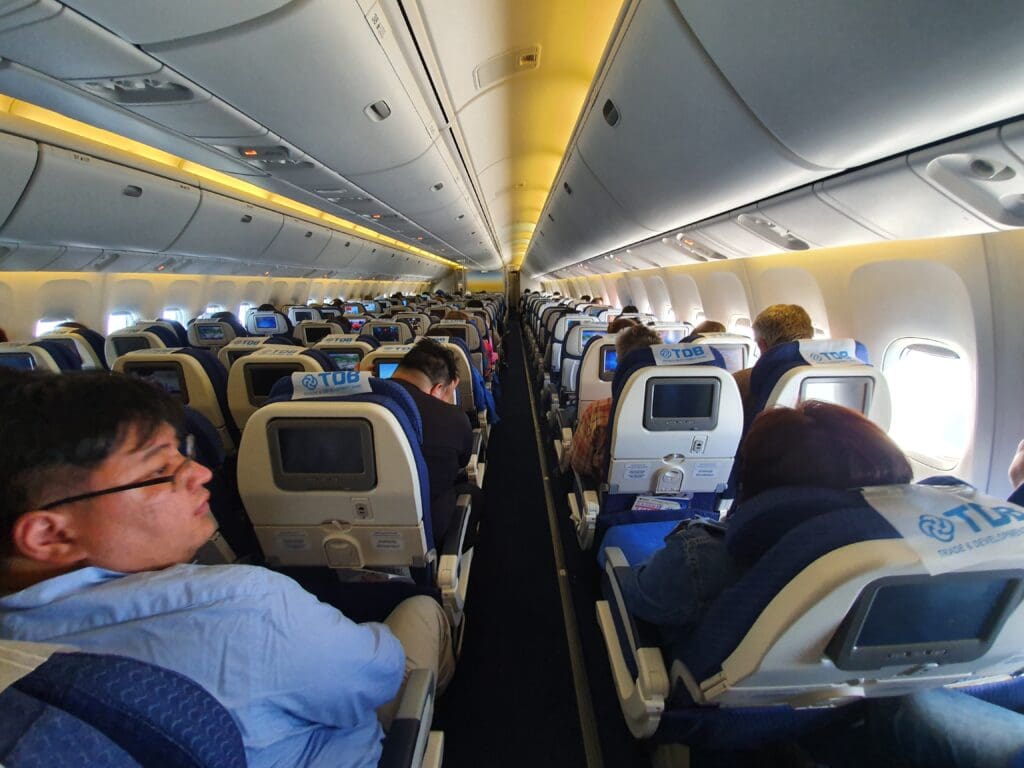
Immediately after leaving the forward galley, I found myself in the aircraft’s 25 seat Business cabin. This consisted of slightly dated and privacy-lacking shell seats in a rare 2-1-2 configuration. There, each seat was covered in a beige pleather cover and came with USB-A ports, a universal plug socket and a reasonably large inflight entertainment screen. Continuing onwards, I then entered the aircraft’s forward Economy cabin. Curiously, whilst the seats in this smaller forward cabin are the model as those in the rear cabin and arranged in the same 2-3-2 layout, these are covered by a beige fabric cover sporting a tradition inspired repeating pattern, whilst those in the rear Economy cabin are covered by a much duller blue fabric featuring the same pattern as on those seats on the Boeing 737 that I had sampled several days earlier. As with the Boeing 737, all seats in both classes featured a disposable antimacassar that advertising Mongolia’s Trade and Development Bank.

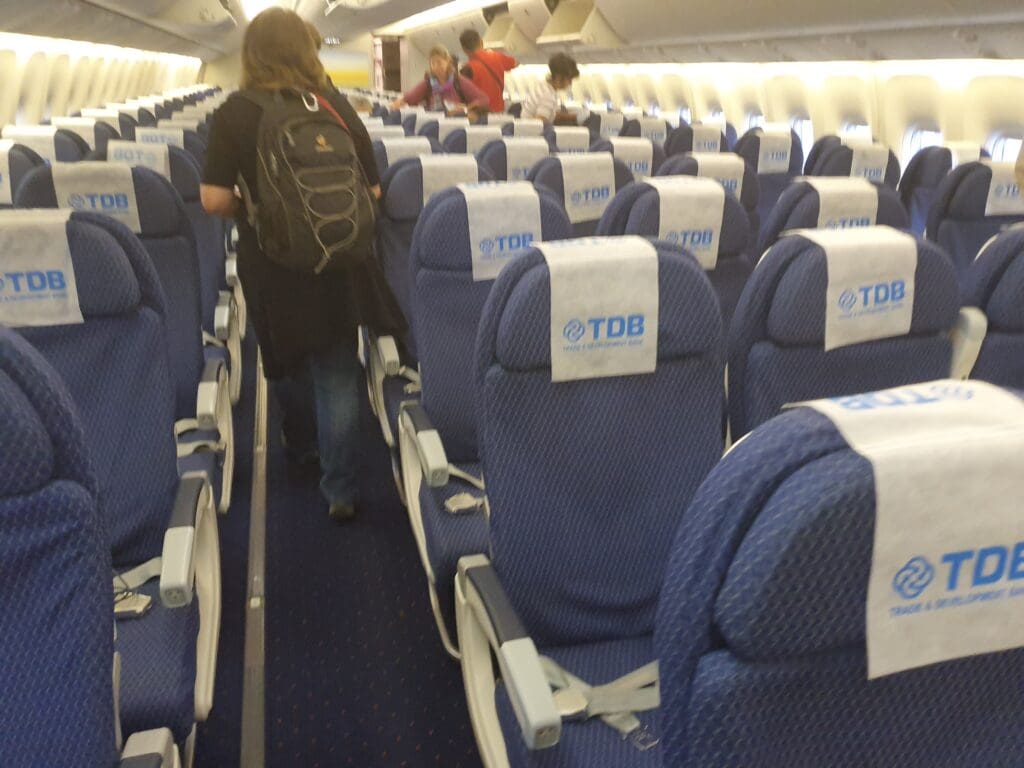
After stopping and starting multiple times, and receiving a few lukewarm welcomes from the cabin crew, I eventually made it to Seat 31K near the rear of the aircraft. As one would expect from a widebody jet that is deployed on (minimal) long haul services, each seat came complete with an inflight entertainment screen. Whilst this was not the most modern or high definition screen that I have come across, this was still a welcome addition given the length of the flight to Berlin. Upon boarding, almost all of these across the aircraft were switched off, however, these could be switched on and upon doing so these displayed a welcome screen. For power, each seat came complete with a USB-A port, although I failed to spot any plug sockets in the area around my seat.
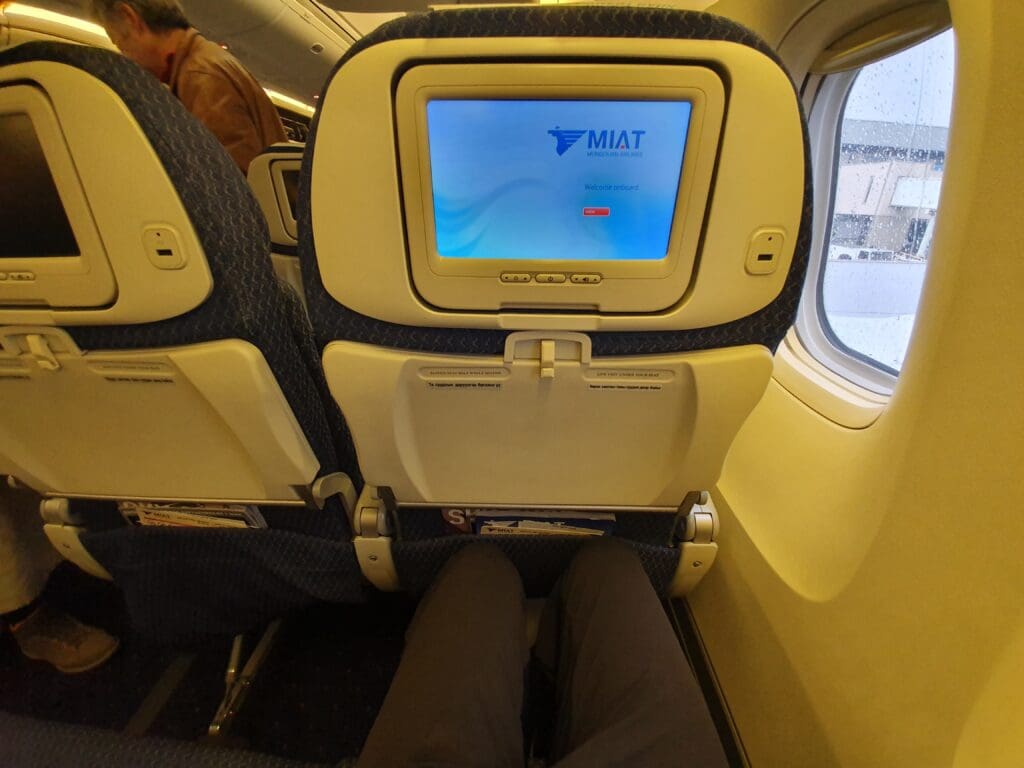
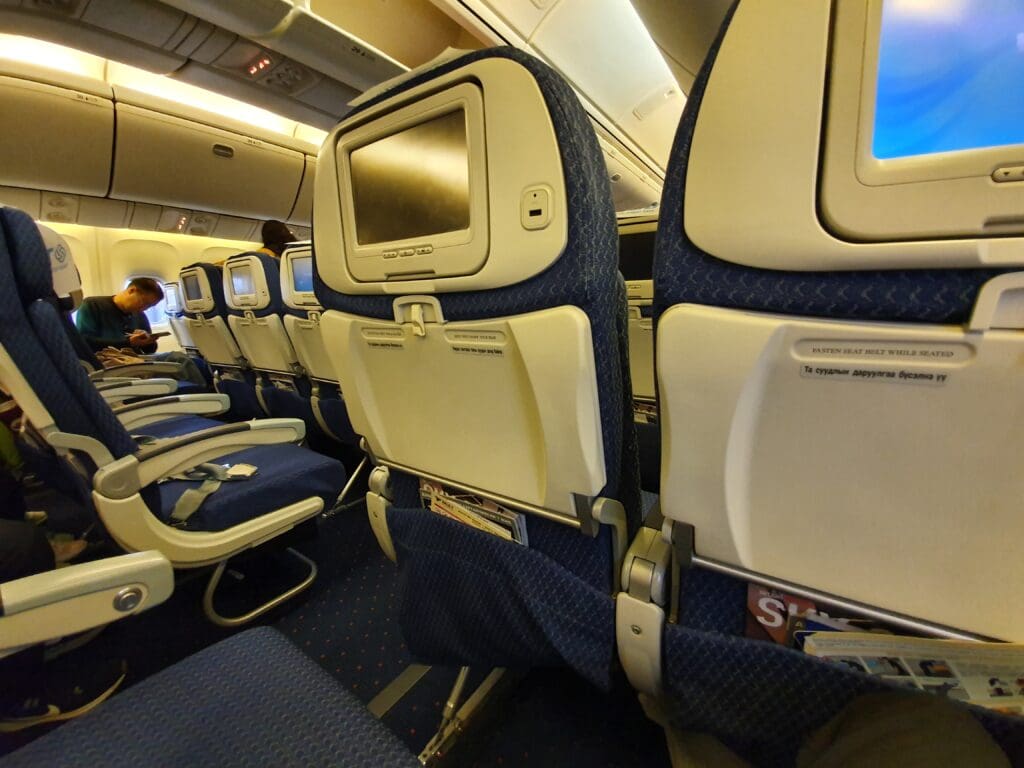
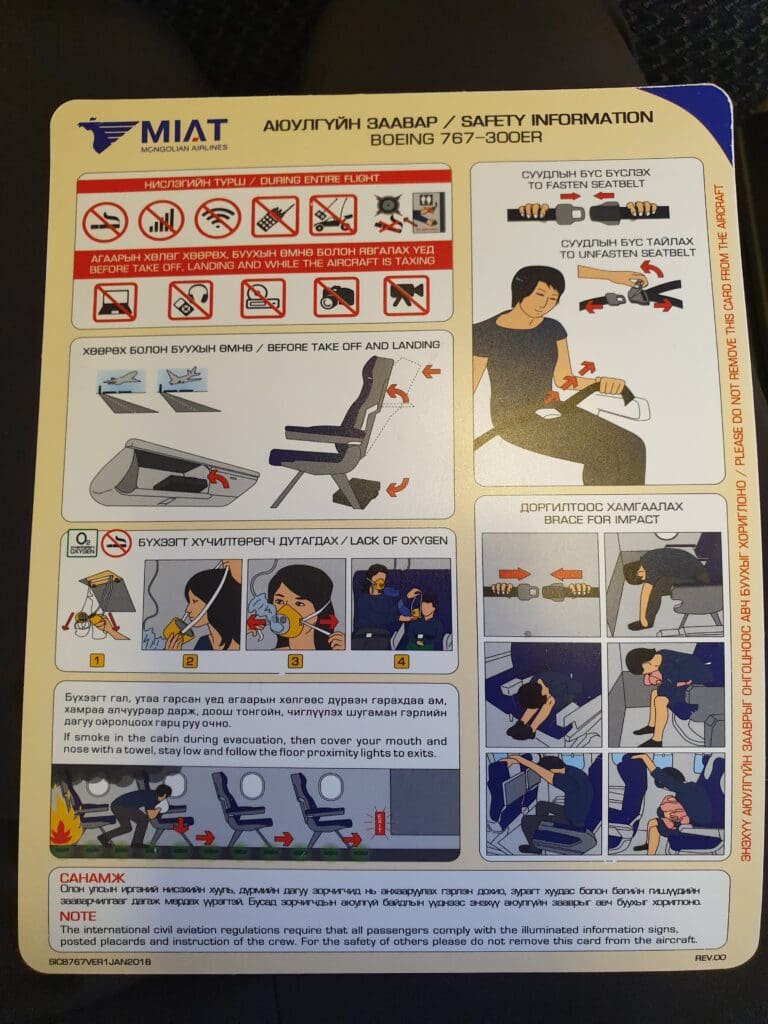
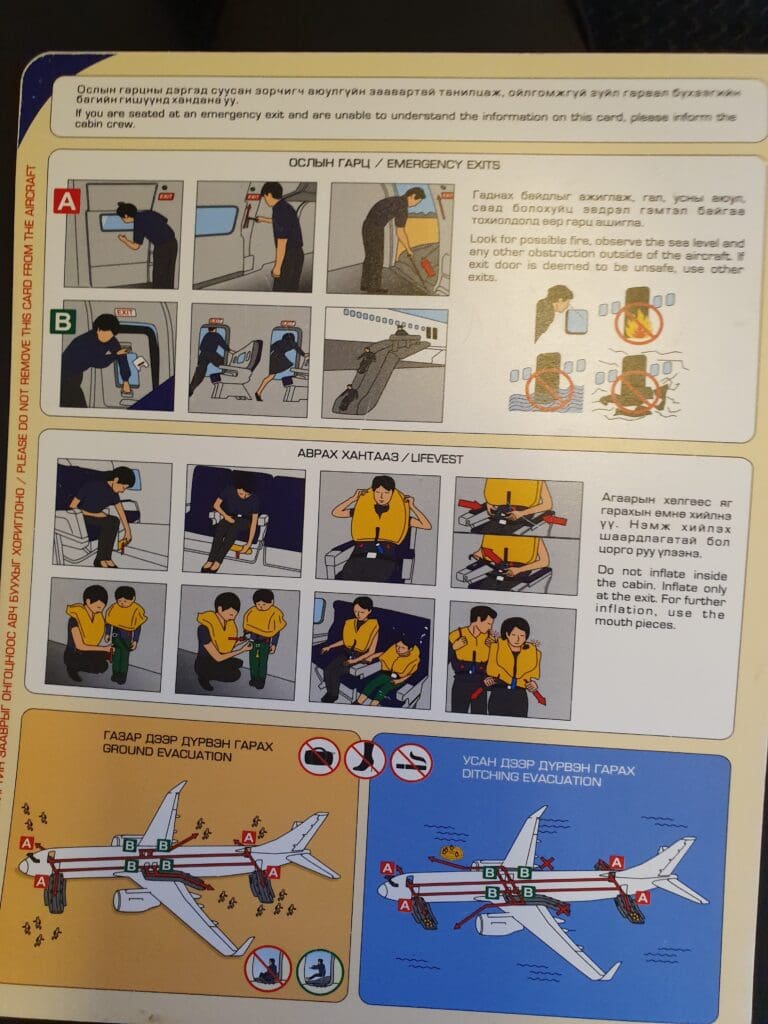
During the aircraft’s time on the ground, this appeared to have been cleaned to a decent standard and I failed to spot any remnants from previous passengers. However, I did notice a host of marks and scratches in the area around my seat, despite the reasonably young age of the jet. However, my greatest problem came in the fact that the aircraft seemed to be rather lacking when it came to legroom – something that seemed to be well below average for a widebody aircraft operated by a full service carrier. Turning to the seatback pocket, aside from the vital safety card and sick bag, this contained a Sky Shop catalogue, a copy of the airline’s self-titled inflight magazine and the Mongolian edition of Forbes magazine. Despite being a reasonably long flight over to Moscow and the chilly temperatures inside the cabin, no pillows or blankets had been placed on the seats before departure. That said, the crew seemed to be willing to distribute these to those who requested them later on during the flight.

As time passed, passengers continued to stream onto the aircraft and after several minutes I was joined by a Mongolian man who came to take the aisle seat. Despite being almost entirely convinced that I would miss my onward connection in Berlin, like most, I wished for a swift departure and I was thus happy to see that boarding was completed fairly quickly with the last passengers making it onboard by 0705. Nevertheless, outside cargo continued to stream onto the aircraft whilst Ulaanbaatar was soaked by a torrential downpours that undoubtedly created a rather unpleasant working environment for the army of ground staff outside.
Inside the cabin, the aircraft appeared to be around 80% full in Economy, with around a quarter of passengers appearing to hail from Mongolia, another quarter from Russia, with the majority of the remaining passengers taking the form of tourists from France, Germany and Italy. Most of those heading to France and Italy would leave the flight in Moscow and fly onwards back home on Aeroflot services.
At 0710, the eclectic mix of jazz, Western pop and traditional Mongolian music that had accompanied oarding came to an end and was replaced by a pre-recorded announcement that noted that our flight was moments away from departure and went through the usual information regarding seatbelts, seatbacks and tray tables. Almost as soon as this announcement came to an end, the Captain performed their welcome speech in Mongolian and English, during which they thanked passengers for flying with MIAT, apologised for the delay and informed all of the flight time and weather in both Moscow and Berlin.
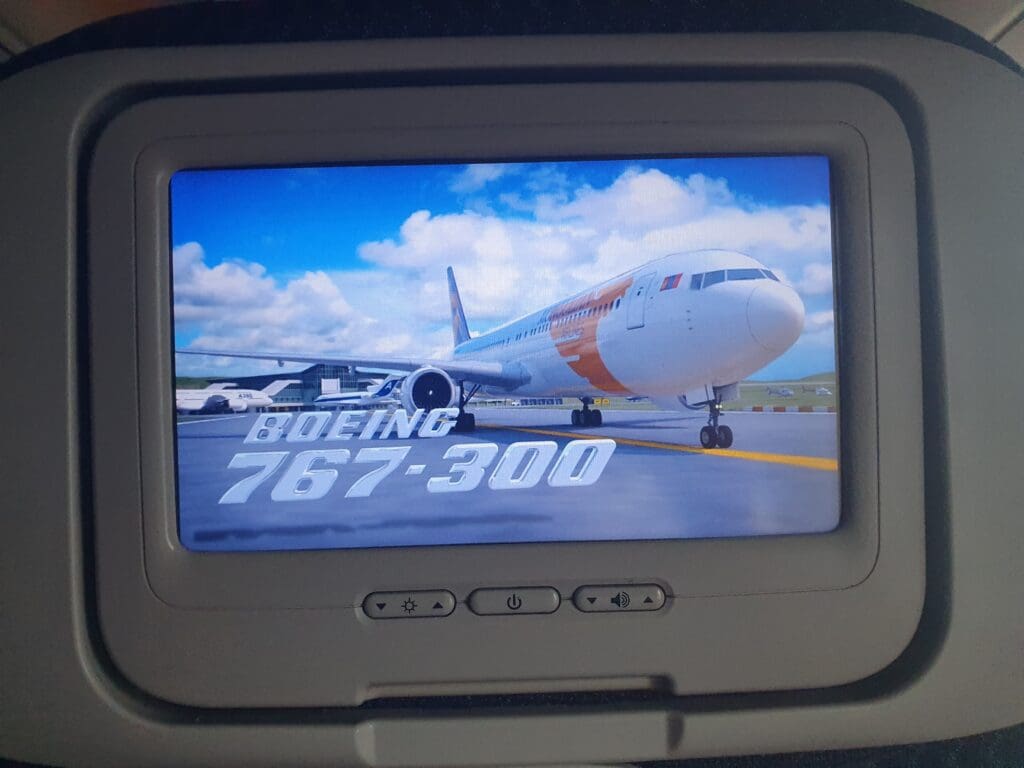
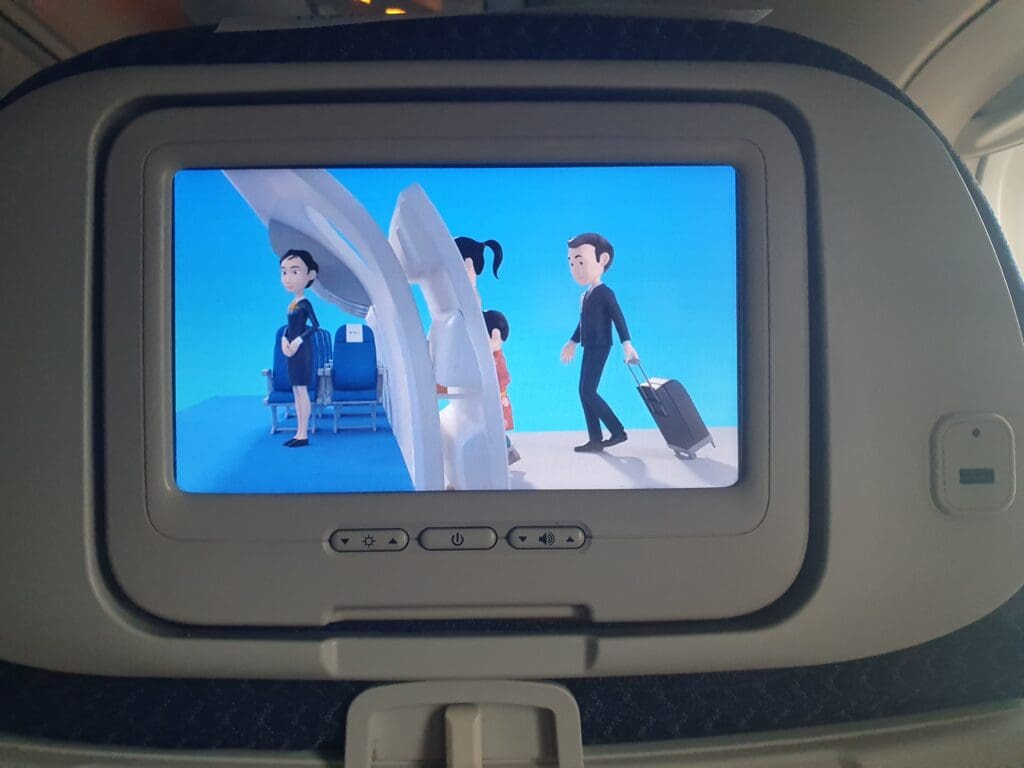
Once the Captain’s welcome had come to an end, 14 minutes of nothingness ensued. Looking outside, all cargo appeared to have been loaded and inside the cabin all seemed to be in place for our departure. At 0725, the Purser performed their short welcome announcement before the airline’s animated safety video took over the inflight entertainment screens. Considering that that particular Boeing 767 was the only aircraft in MIAT’s fleet at the time to feature inflight entertainment screens, some may be surprised that the airline invested money into an animated safety video, rather than an announcement accompanied by a demonstration. As the safety video played, at 0731 the Boeing 767 jolted, commencing its very slow pushback. During this, the aircraft’s two Pratt & Whitney engines quietly spooled up and following a pause, at 0737, the aircraft began its journey to the runway. As we traversed almost the entire length of the airfield, I noticed Aeroflot’s Airbus A330 rotating upwards through the rain droplet-covered window, beating MIAT on the race to Moscow.
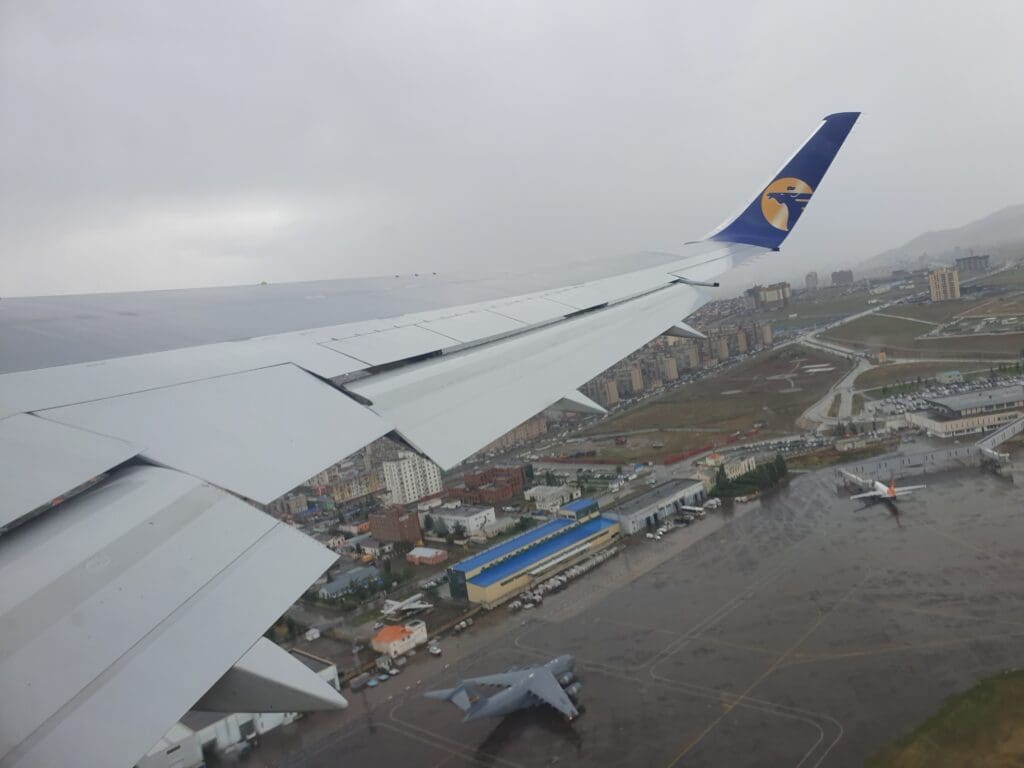
After a six-minute taxi, at 0743 the Boeing 767 turned onto Runway 32 and following a short pause, the two engines powered up as we commenced our powerful journey down the runway. Shaking and swaying somewhat as we bounced down the runway, once the rain droplets cleared, a good view of the airport’s storage and maintenance areas could be had. For those interested in military aviation, there, I spotted a brightly coloured Mongolian Air Force Mil Mi-171 before a host of stored aircraft came into view. These consisted of a trio of Fokker 50s, a pair of Antonov An-2s, a white Soviet-built helicopter and a mysterious green-tailed LET L-410. Following what seemed like a short takeoff roll, the small terminal and ramp could be seen below where the aforementioned Hunnu Air Embraer 190, a Hong Kong-bound Eznis Airways Boeing 737-700 and a USAF Boeing C-17 Globemaster III could all be seen. Moments later the Boeing 767 left the airport behind and crossed over the Tuul River after which residential and industrial areas sped past below.


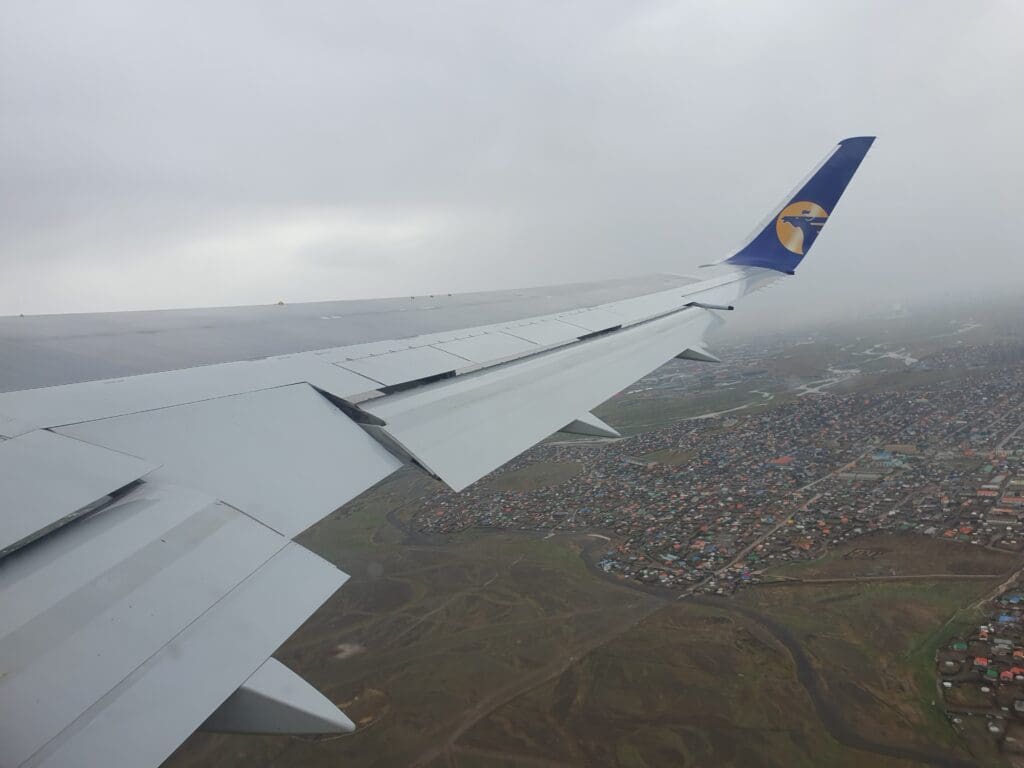
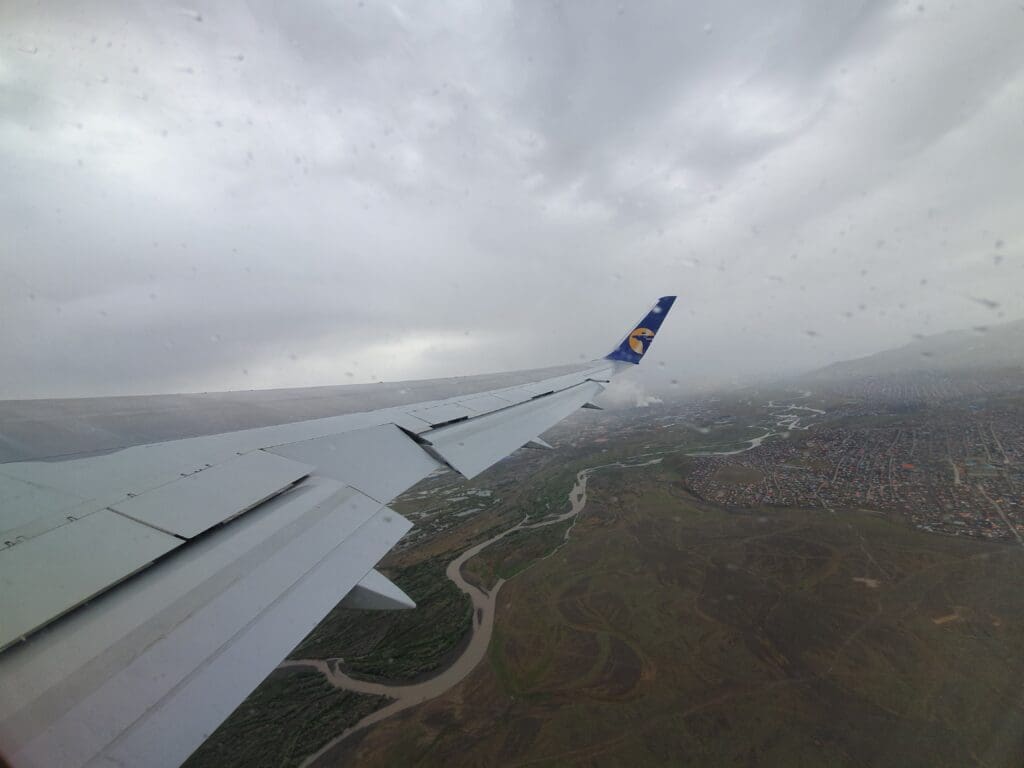
As we left Ulaanbaatar, the residential areas soon transformed into grassy hills, however, views were not to last for too long and our aircraft soon entered the clouds. Following a quick and smooth journey through that morning’s clag, soon, the Land of the Blue Sky’s bright blue skies appeared above. Seeing as Mongolia is renowned for its beautiful landscapes, I was a little disappointed that nothing but thick clouds could be seen during the initial stages of the flight as we headed up to our cruising altitude of 36,000 feet.
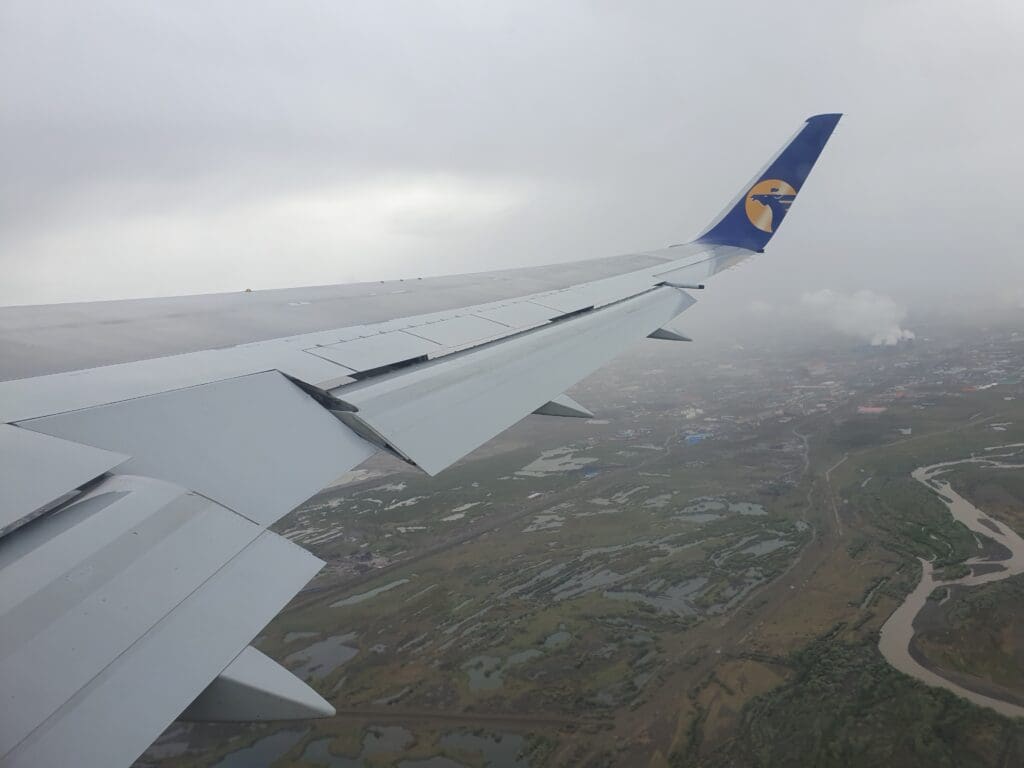
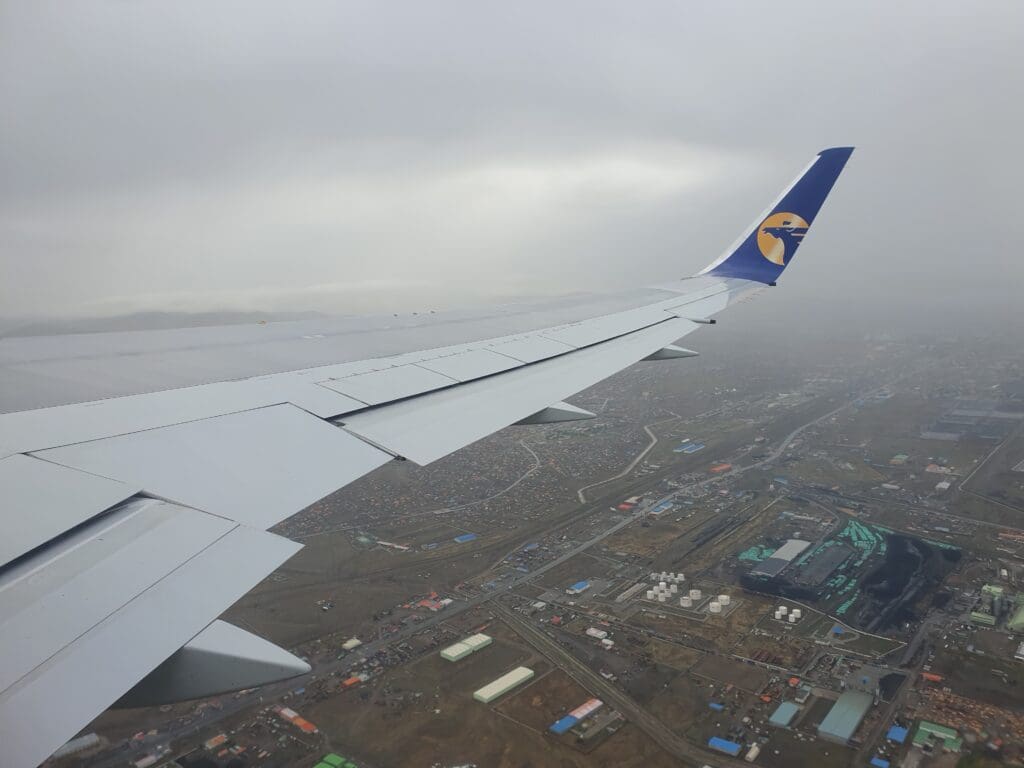
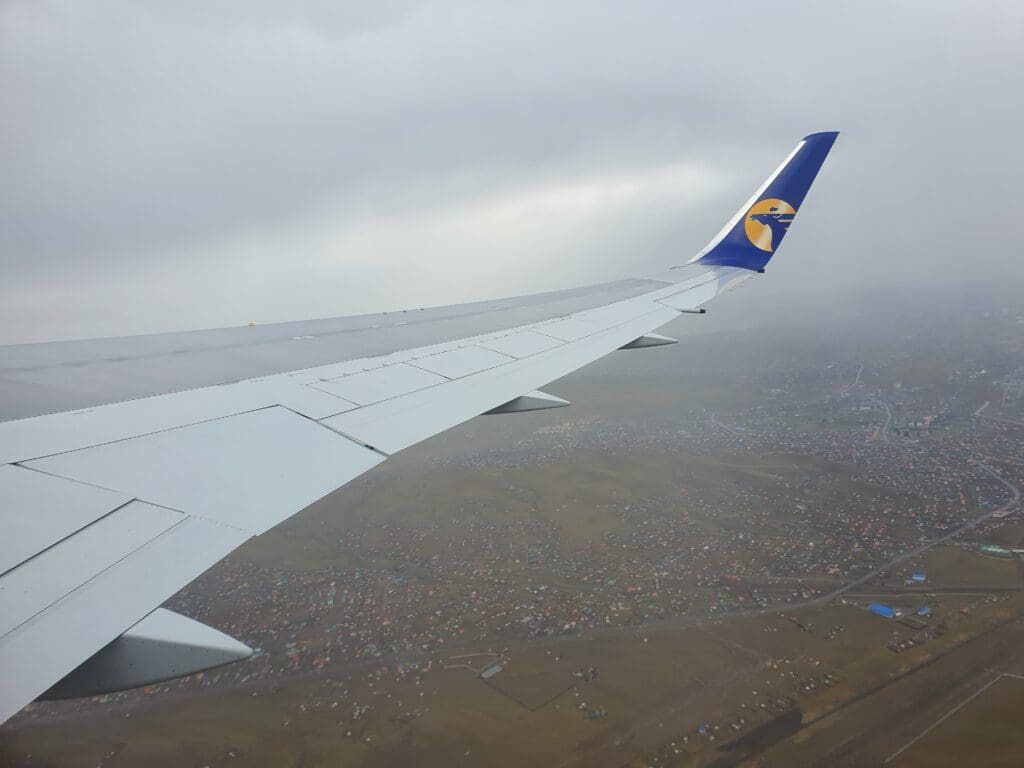
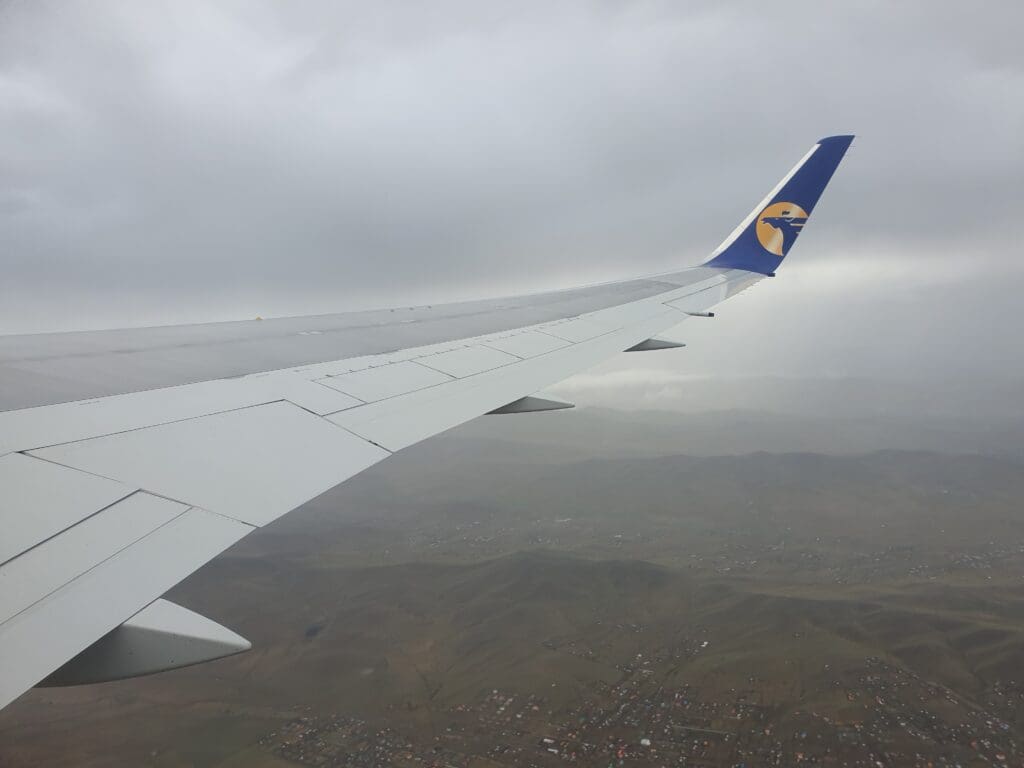
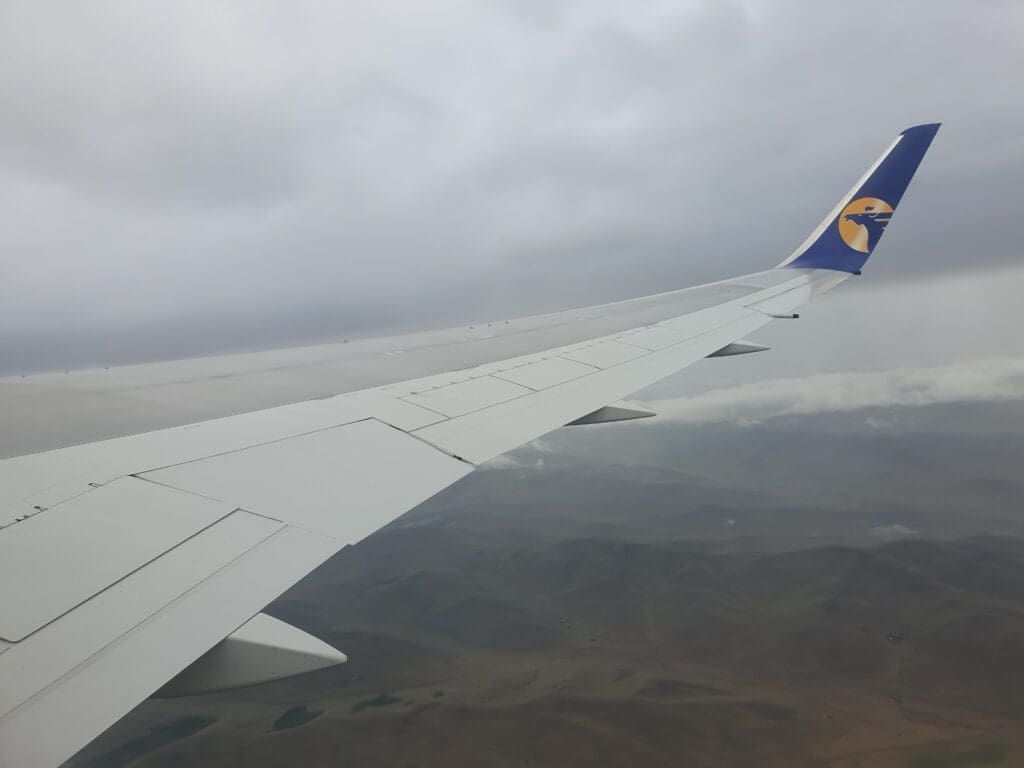
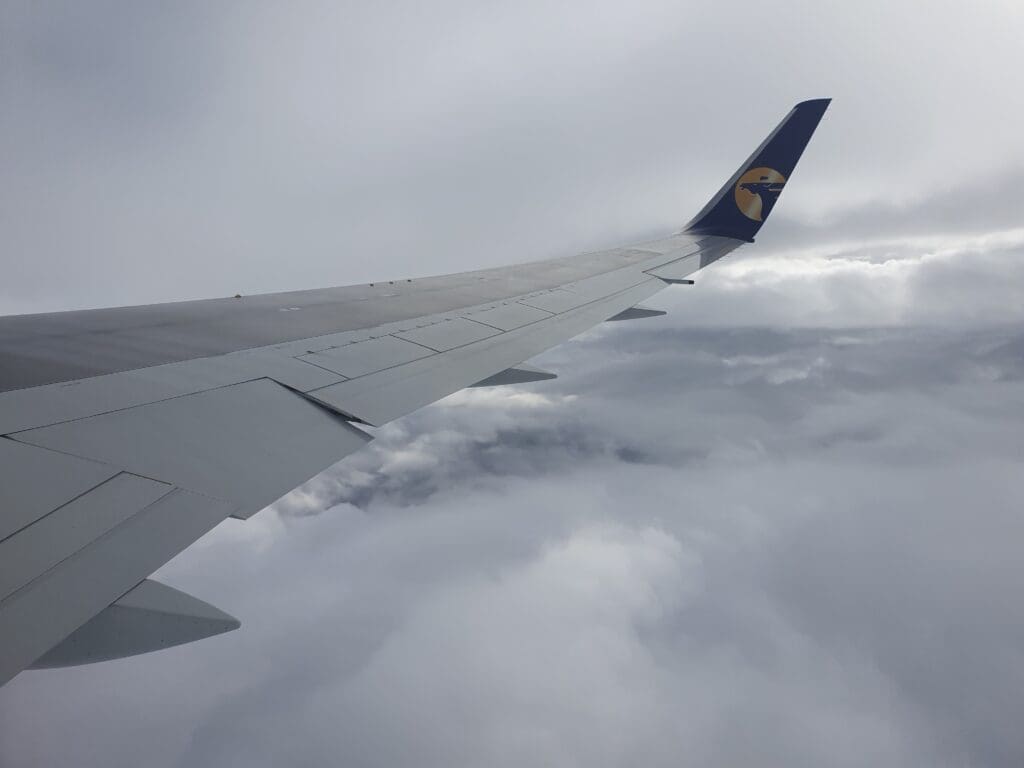
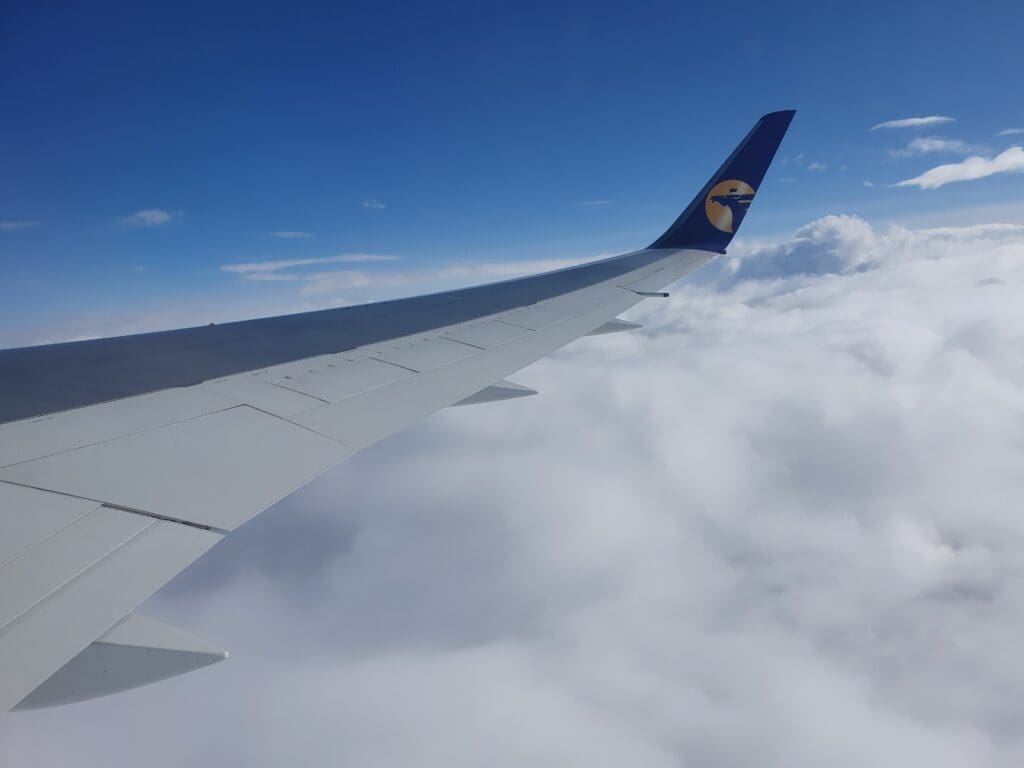
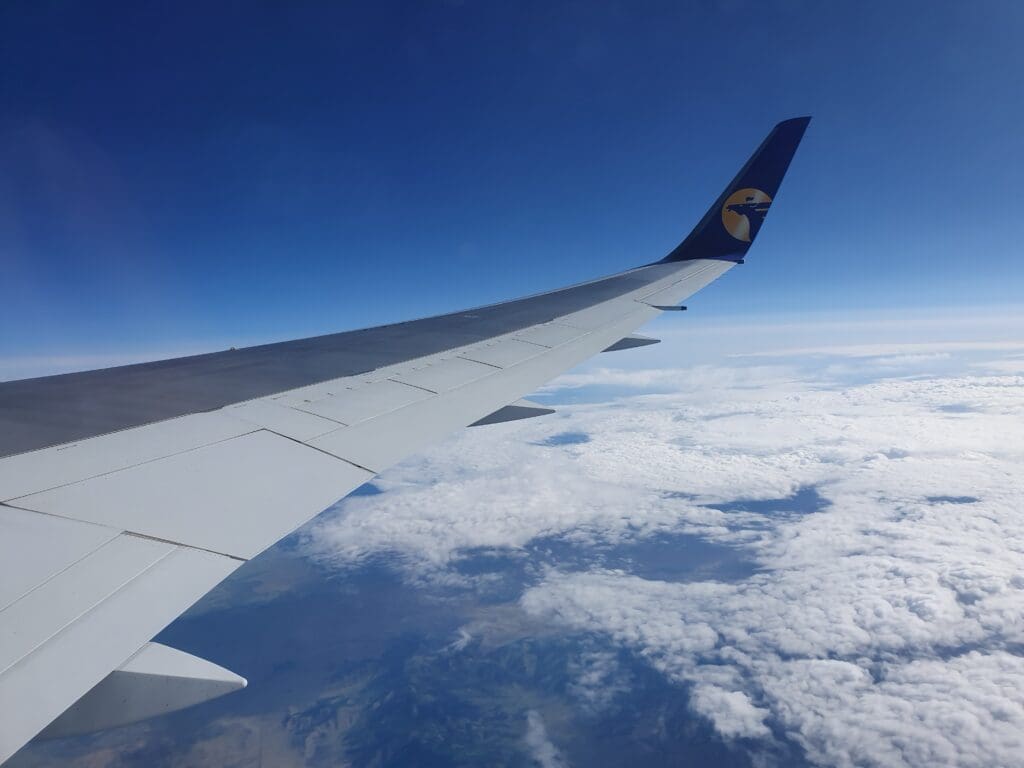
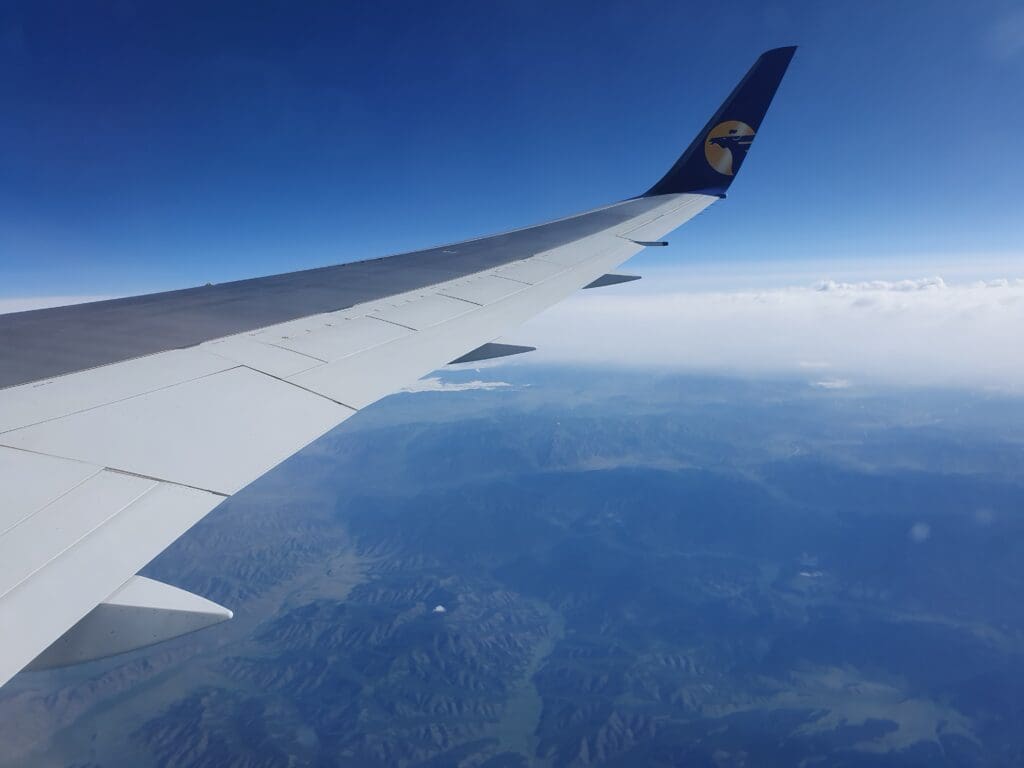
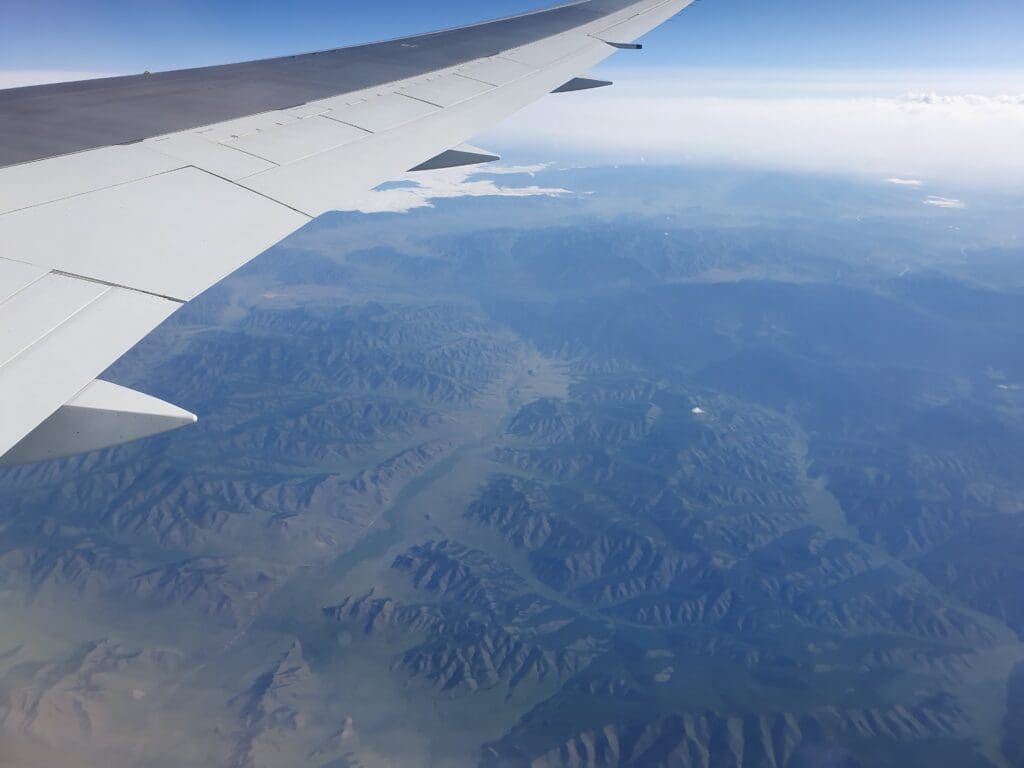
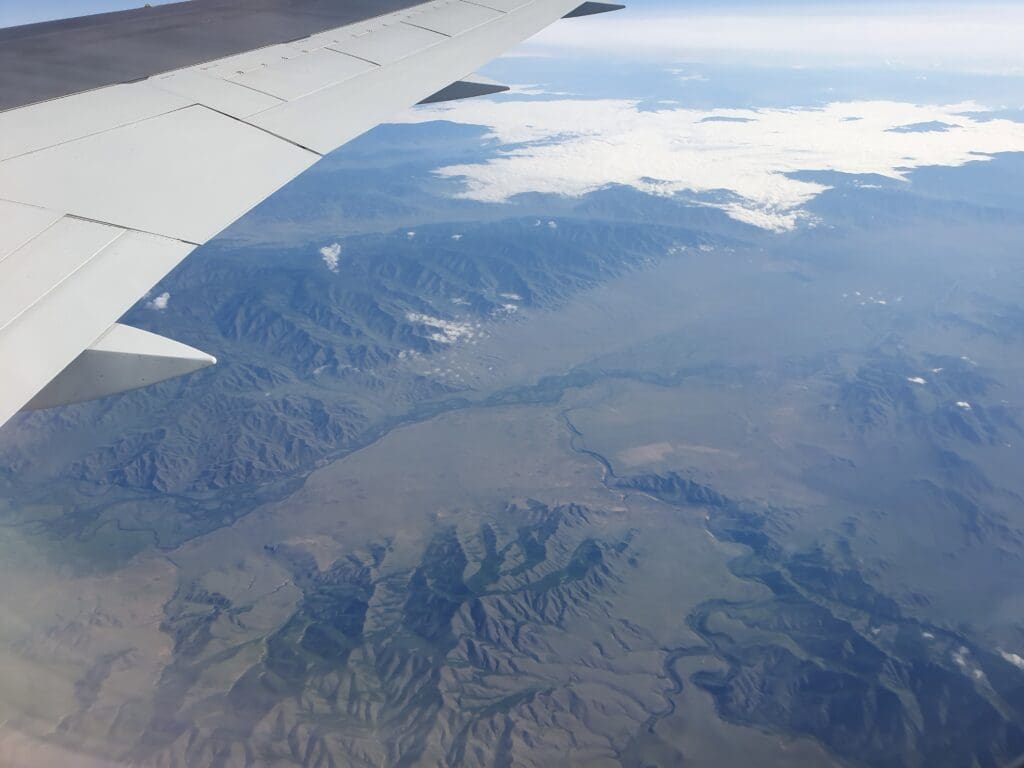
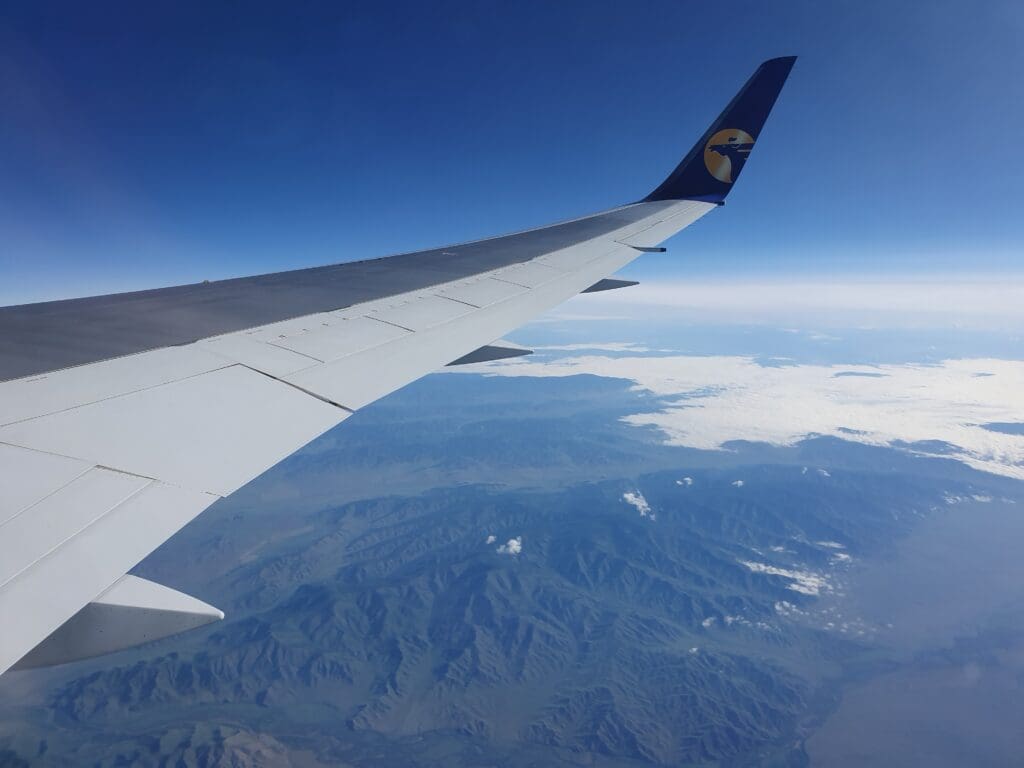
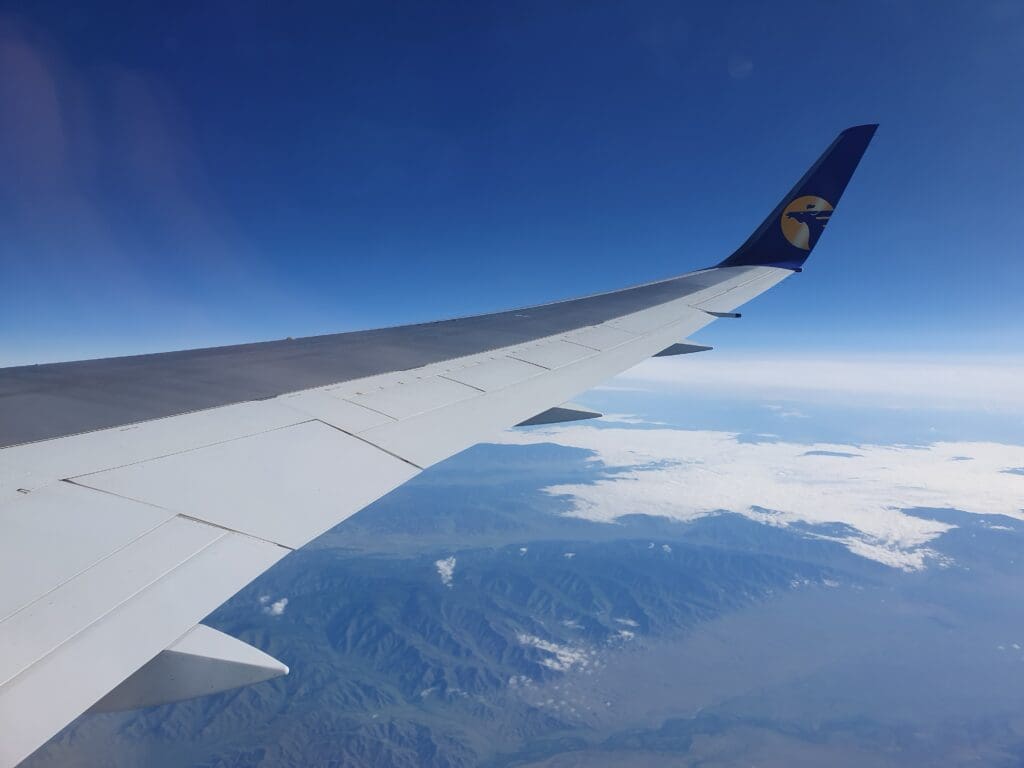
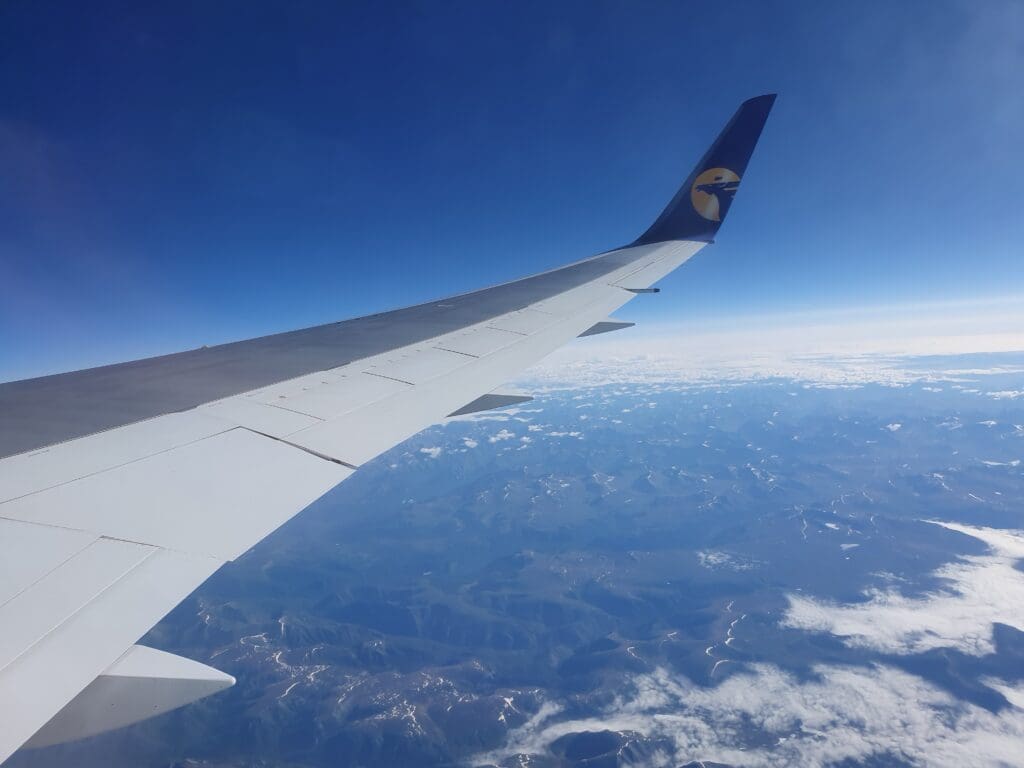
Thankfully, as we neared the final stages of our climb, the clouds dissipated a little and revealed the mountainous landscape of Khövsgöl Province in northern Mongolia. As we neared the top of the climb, those inflight entertainment screens that were on were rebooted, before all inflight entertainment screens were turned on. Whilst this would have been a little annoying had I been mid-film, seeing as the views of the Mongolian mountains were providing my sole form of entertainment, I was not particularly bothered by this. Once the seatbelt signs were extinguished, the crew passed through the cabin handing out Mongolian and Russian newspapers alongside MIAT branded packets containing low quality headphones.
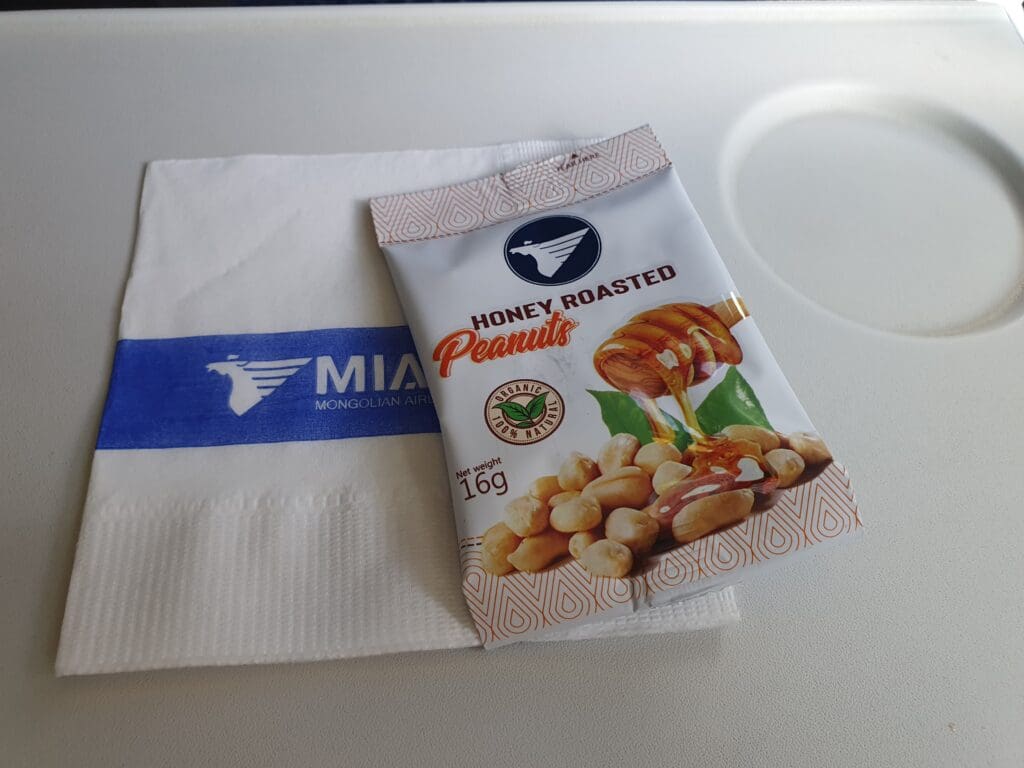
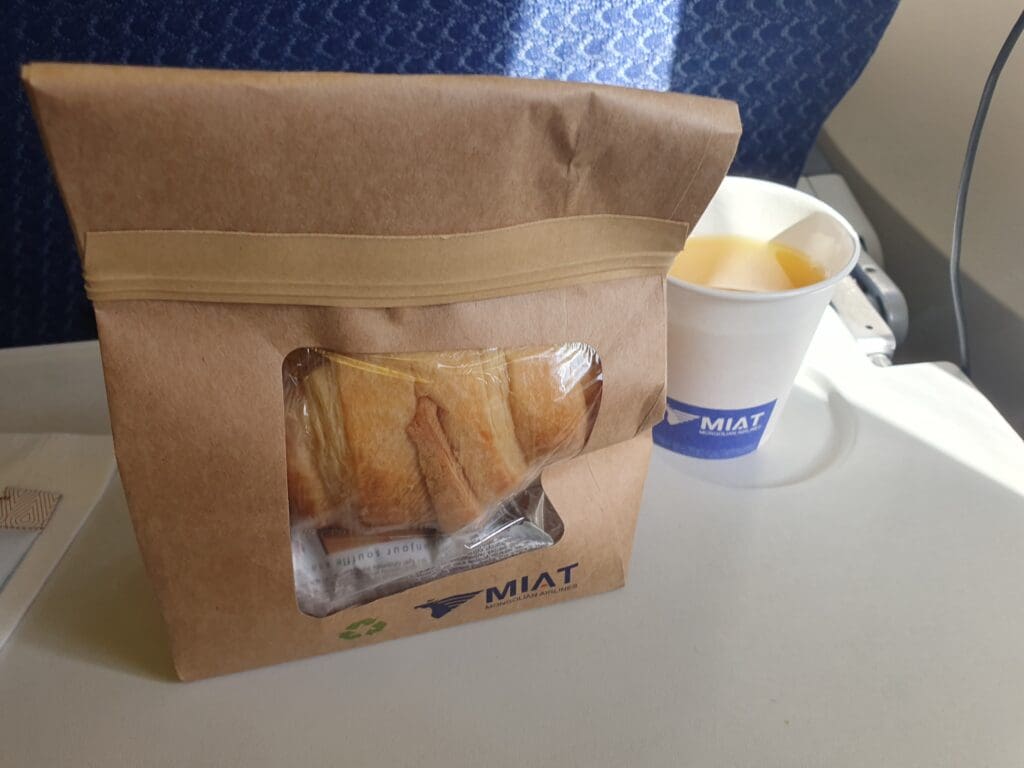
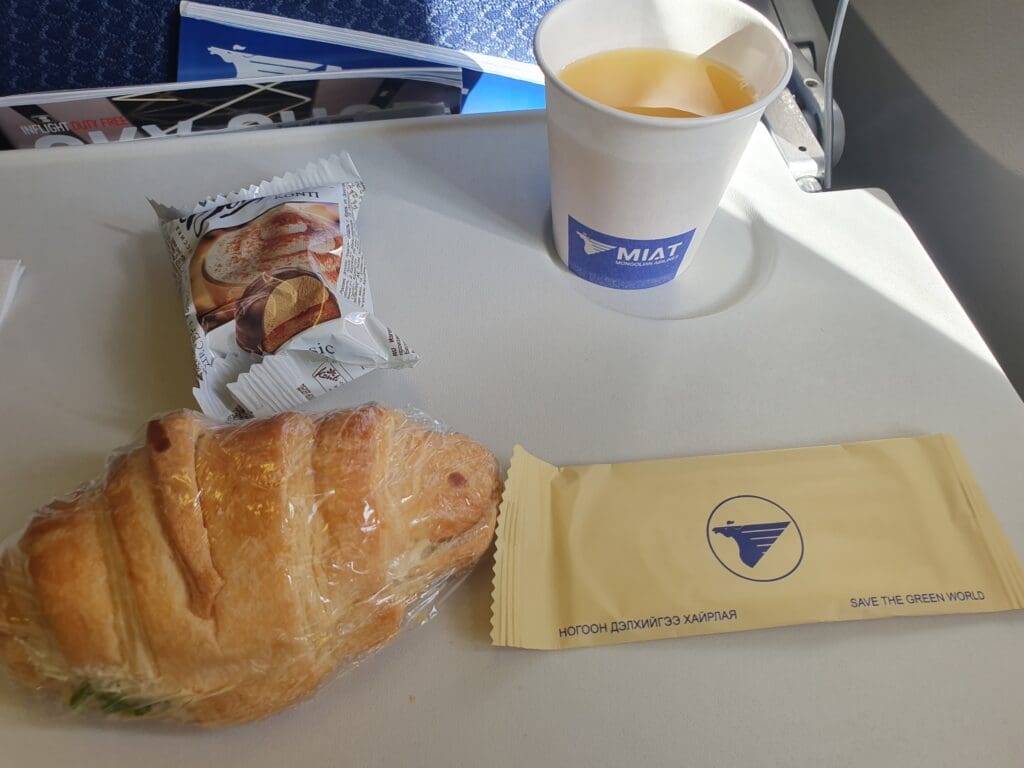
Around 35 minutes after the aircraft’s departure from Ulaanbaatar, as had been the case on the flight from Busan, the crew kicked off the meal service by handing out MIAT-branded honey-roasted peanuts and serviettes. Once the entire aircraft had been served, the crew retreated to the galley and around an hour after our departure, the service continued. Unlike the flight from Busan, this was conducted logically and I was soon handed a paper bag and offered a drink. After opting for an orange juice, this was handed to me in a paper cup by a polite and friendly flight attendant. Turning to the bag, this contained a light breakfast consisting of a pastry that resembled a croissant in shape but had a bread roll texture and contained a chicken and egg filling alongside a coffee-flavoured snack, comparable to a chocolate teacake. All in all, whilst some may have expected a hot breakfast, I found this to be a perfectly acceptable offering considering that a hot meal would be served later on in the flight.
Fortunately, unlike on the flight from Busan, the crew were fairly quick to take away the rubbish from this service, doing so around fifteen minutes after handing out the offerings. Turning my attention to the world outside, the frozen mountains below flattened a little and the ground became greener as we headed into Russian airspace. After crossing the border, the Boeing 767 found itself 36,000 feet above Russia’s Tuva Republic which lies to the northwest of Mongolia. There, the Boeing soon soared high above Kyzyl, the region’s small capital city which claims to be the geographical centre of Asia. From there the aircraft then headed towards the republics of Khakassia and Kemerovo before clouds blocked any view of Russia for a while.
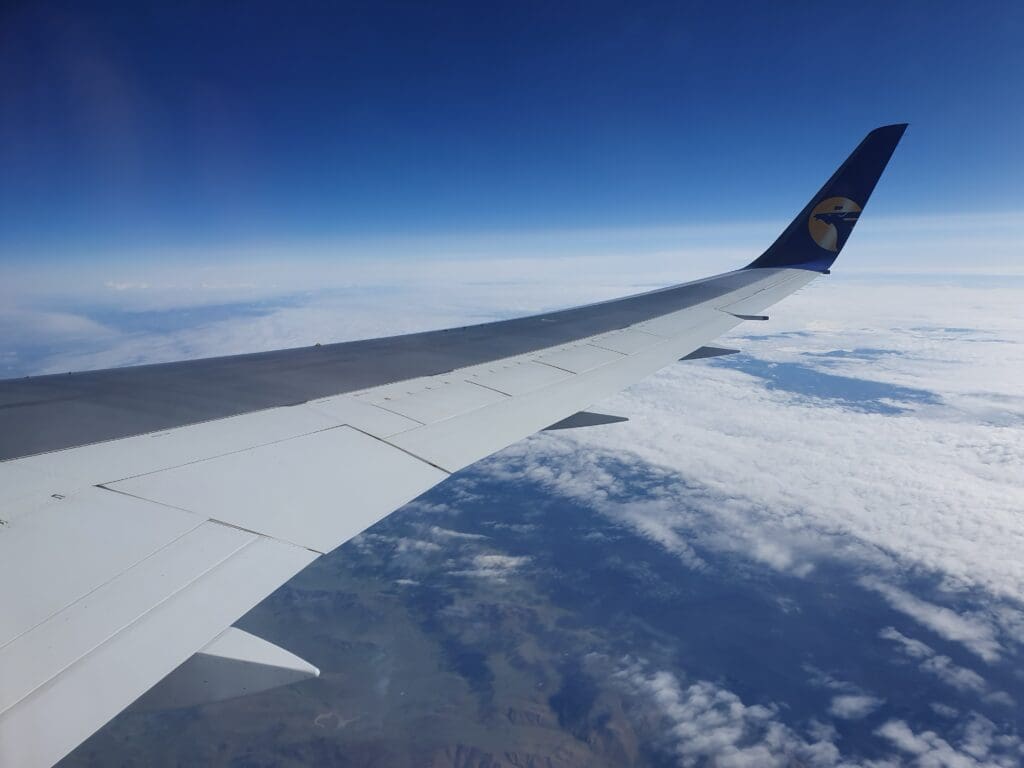
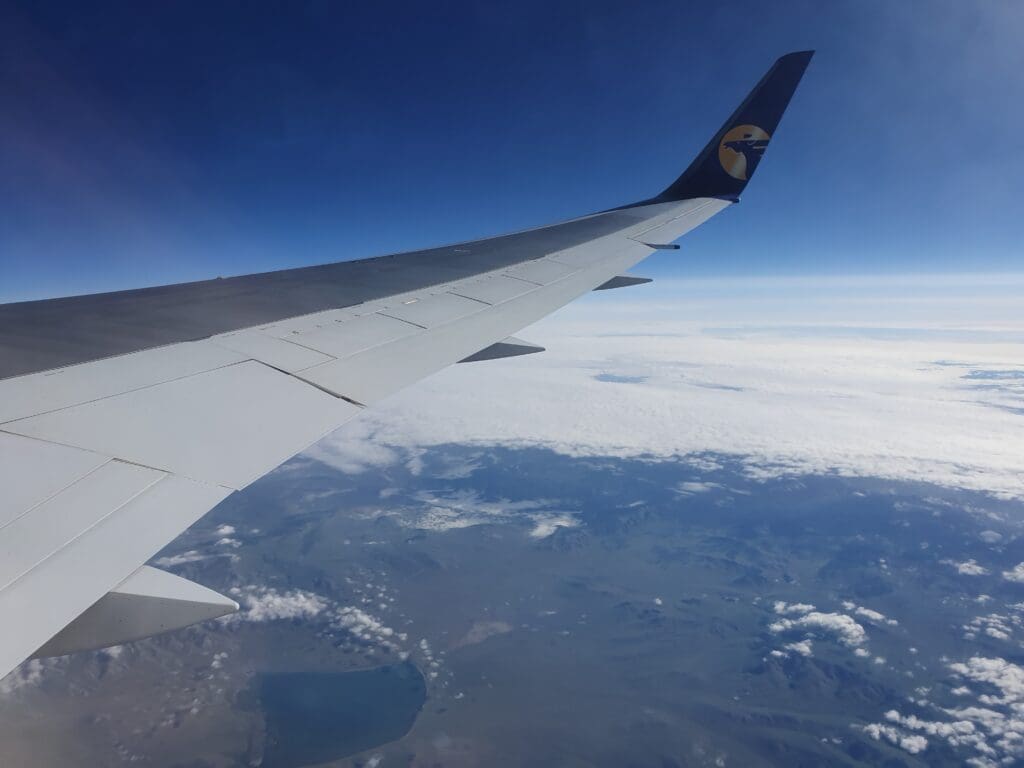
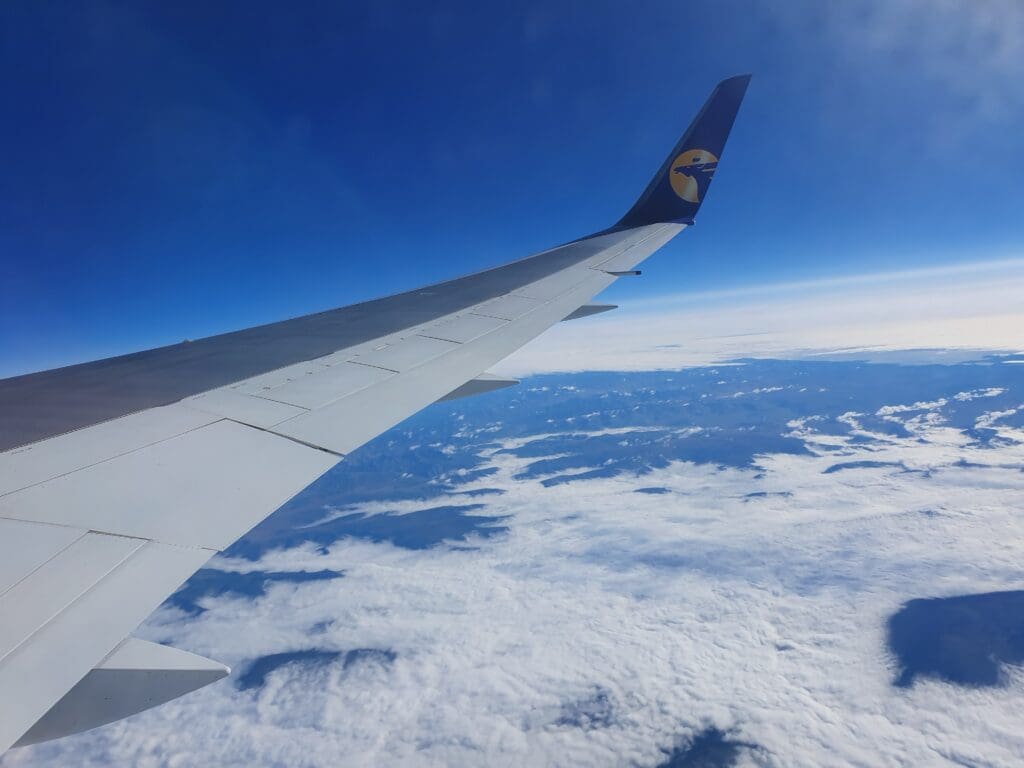
Once the views of the diverse landscapes below were taken away, I was left with little to do bar feel cold thanks to the cabin’s still chilly temperatures. I thus decided to explore the aircraft’s inflight entertainment system. Seeing as MIAT operate a significant number of services to China, Hong Kong and Korea, I was hardly surprised to find that this system could also be used in Chinese and Korean, alongside the expected English and Mongolian language options. However, other logical languages such as German, Japanese and Russian were absent. Nevertheless, this was still a better smorgasbord of languages than is offered on some much larger full service Asian carriers! Examining the screen, this was of rather mediocre quality and featured multiple marks and scratches. Furthermore, with no controller, this could only be controlled by touch, something that was not assisted by the fact that this would regularly freeze for around thirty seconds at a time.

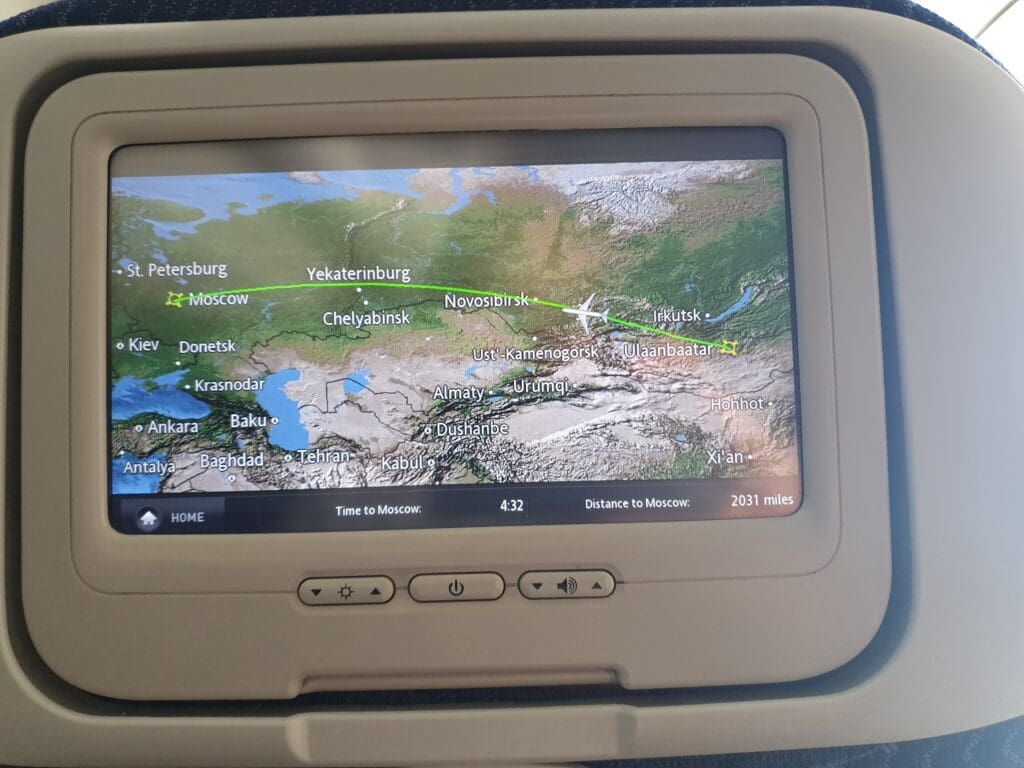
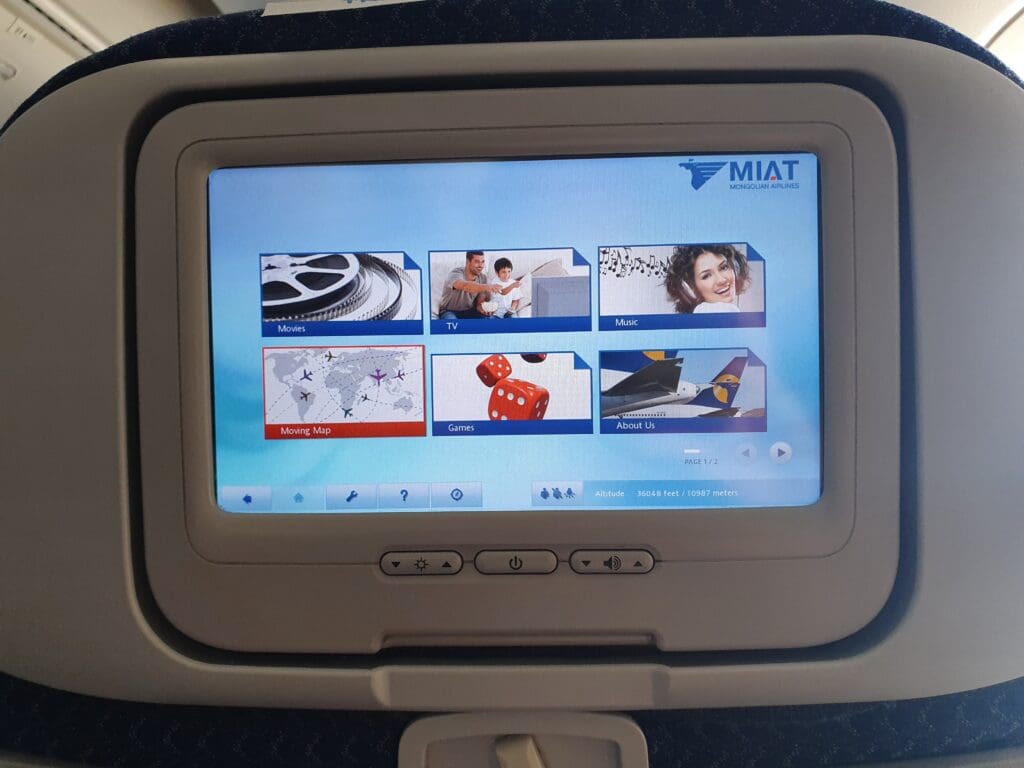
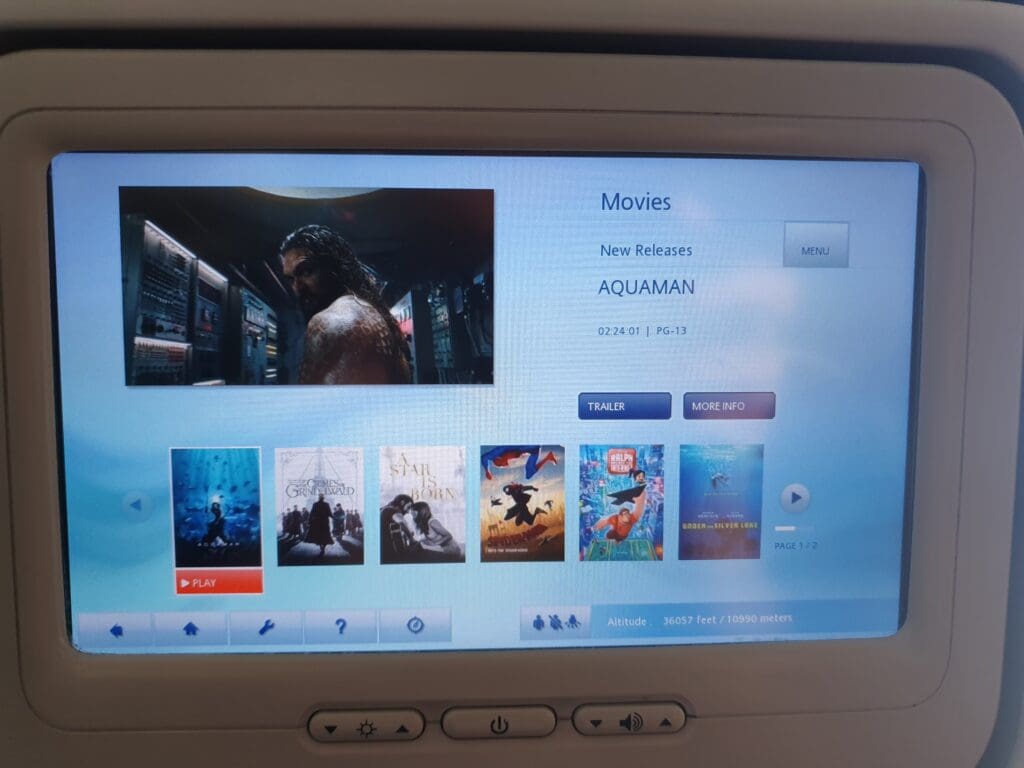
Turning to the content, this is where the system managed to redeem itself somewhat. Considering that, at the time, this particular aircraft was the only operational aircraft in MIAT’s fleet that featured inflight entertainment screens, the system featured a reasonable selection of items. The majority of films came in the form of both new and old Hollywood blockbusters and a small number of Mongolian hits, although surprisingly, films from China, Europe, Korea or Russia were totally absent. Away from films, I counted a grand total of 27 television programmes, 70 albums, 10 games, and of course, a good old moving map channel. Considering the omnipresence of advertisements for the Trade and Development Bank across MIAT and Ulaanbaatar Airport, I was not overly surprised to find that all visual content was preceded by a couple of adverts for this bank.
Returning to the journey, as we cruised westwards across Siberia, aside from the occasional very slight bump, the flight was smooth and uneventful. With little to see outside and feeling somewhat fatigued from the flight’s long delay, I opted to take a nap. Waking up about 30 minutes later, little had changed both in and outside the cabin. However, by this time, the seat felt truly uncomfortable and cramped – although this was most definitely not assisted by the fact that my neighbour’s leg had well and truly found itself into the area that should have been reserved for my legs whilst his head occasionally came to rest on my shoulder. Meanwhile, around two hours after we departed from Ulaanbaatar and thus approximately a third of the way into the flight, the clouds parted as the aircraft passed over Russia’s third largest city, Novosibirsk, home to around 1.6 million residents. Once the city’s buildings slipped away from view, the mostly flat, green landscapes of rural Western Siberia could be seen. Around halfway between Novosibirsk and Omsk, the interestingly shaped Lake Chany and the town of Kazantsevo on its northern shores could be seen. From there, the aircraft continued heading west, passing to the north of Omsk and over the long Irtysh River which runs for a total of 4,249 kilometres.
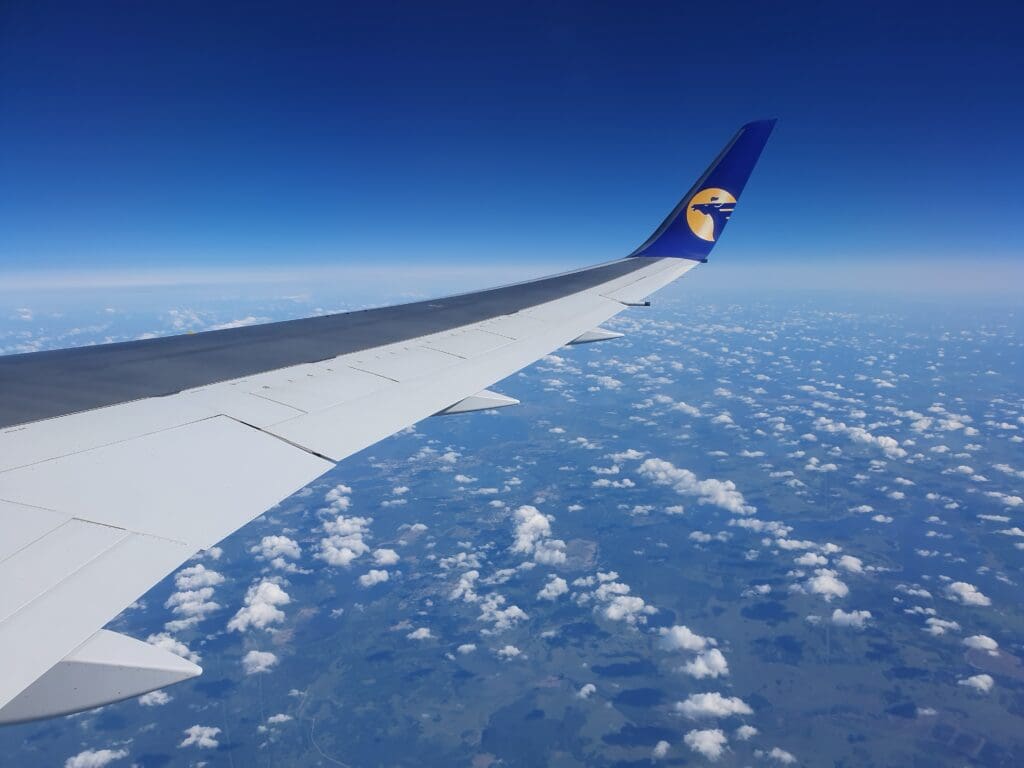
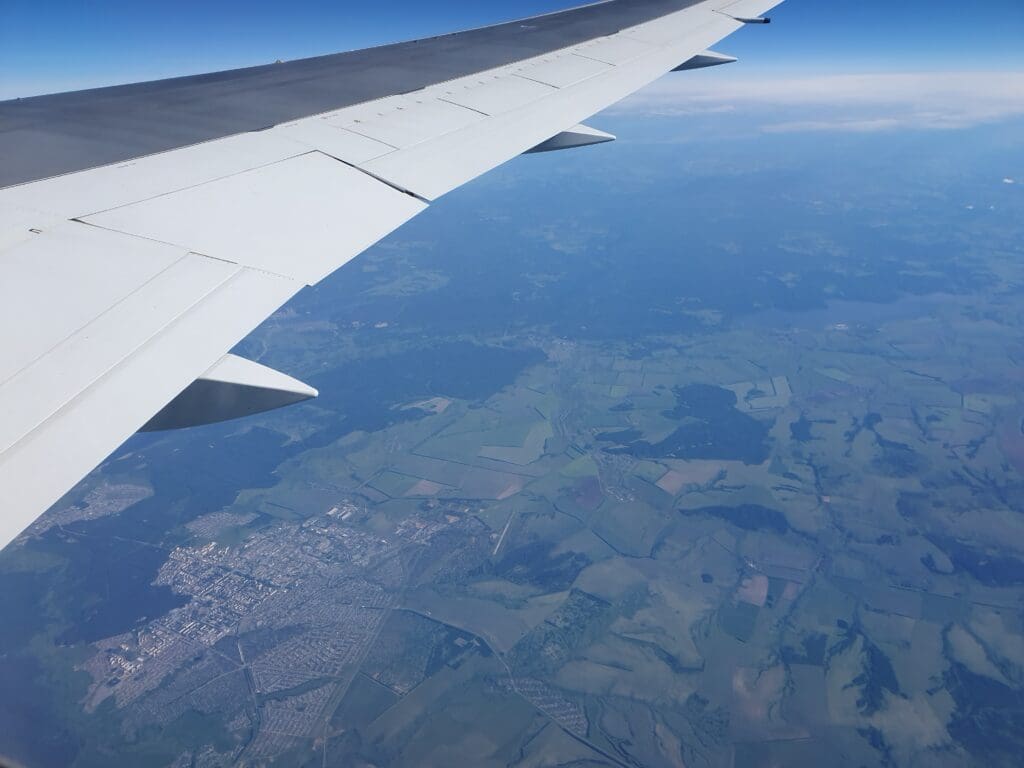
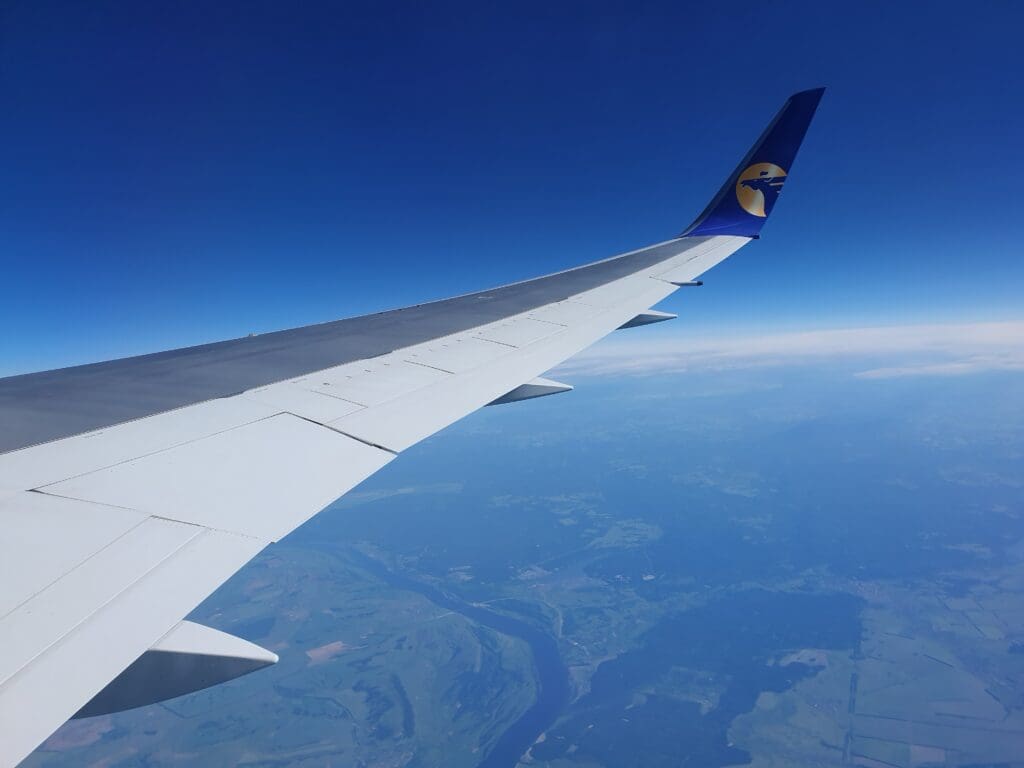
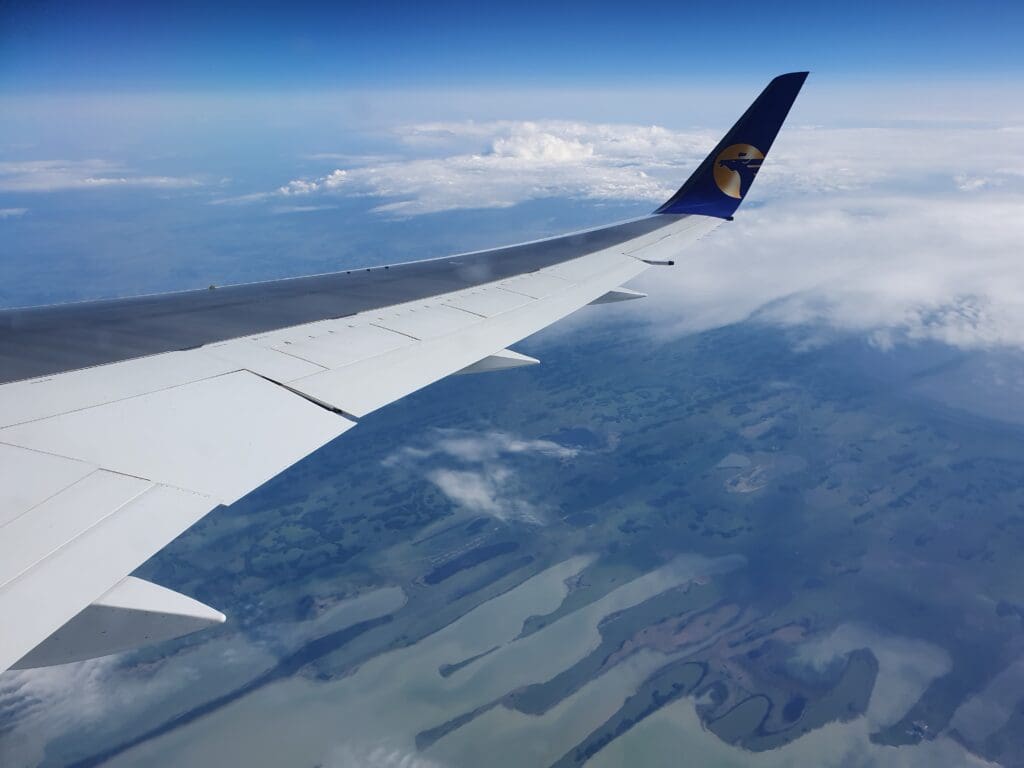
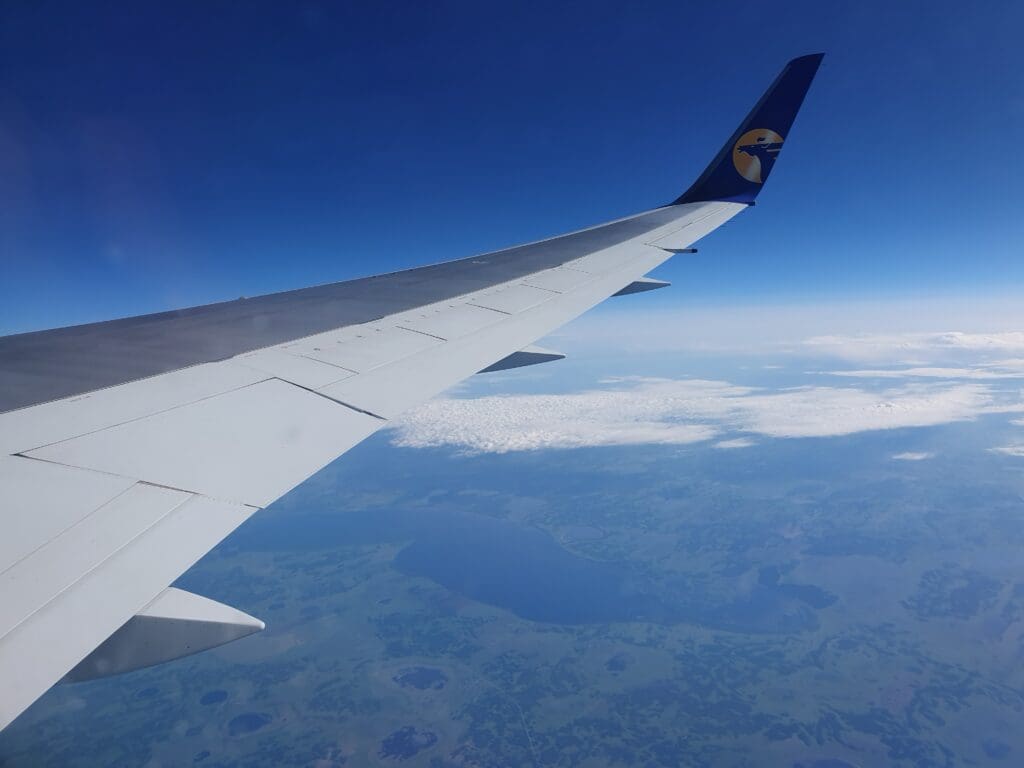
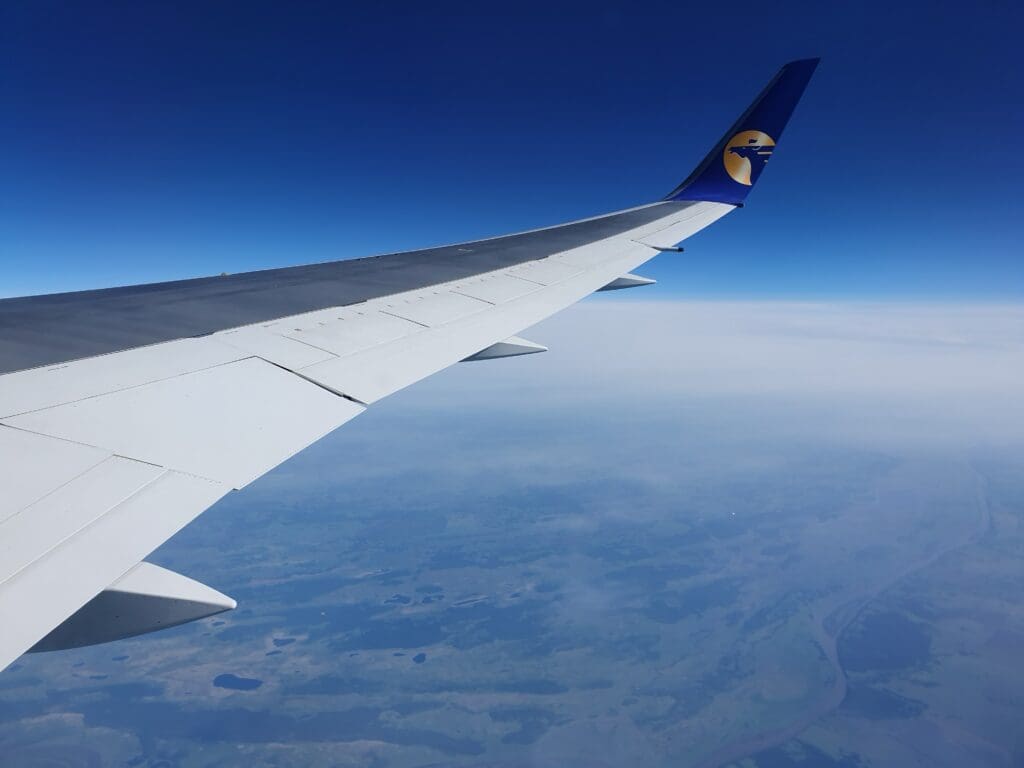
Following another nap, I opened the window shade to find that the clouds had parted once again as we neared Russia’s fourth-largest city, Yekaterinburg, often considered to be on the geographical border between Asia and Europe. Meanwhile, the universal scent of warming airline food could be smelt as it wafted through the cabin indicating that this would commence soon. Four hours after departure, at 1140 Mongolian time or 0640 Moscow time (as I shall use from now on in the report), several trolleys were rolled out from the rear galley and the lunch service commenced.
A short time later, one of these reached my row and I was asked the usual ‘beef or chicken?’ in a stone-cold manner before being offered a drink. Having had beef on the flight from Busan and ending up wishing I had the chicken, this time round I decided on the chicken, opting to accompany this with another orange juice. This was handed to me on a tray alongside a meat and cheese salad, a bread roll with butter and a small packaged chocolate cherry cake that had been imported from Turkey. Upon opening the foil lid from my main dish, it was revealed that this consisted of chicken lightly doused in a sauce with a few vegetables and rice, meanwhile, glancing over at my neighbour’s beef meal, this seemed to consist of some form of beef stew with mashed potatoes. Quality-wise, this was somewhat mediocre – the chicken had somewhat of a BBQ grill taste and was rather chewy, however the accompanying rice seemed to have been cooked well. All in all, I did not have any major complaints and I have to give MIAT credit for the fact that two ‘meal’ services were made on the relatively short flight to Moscow.
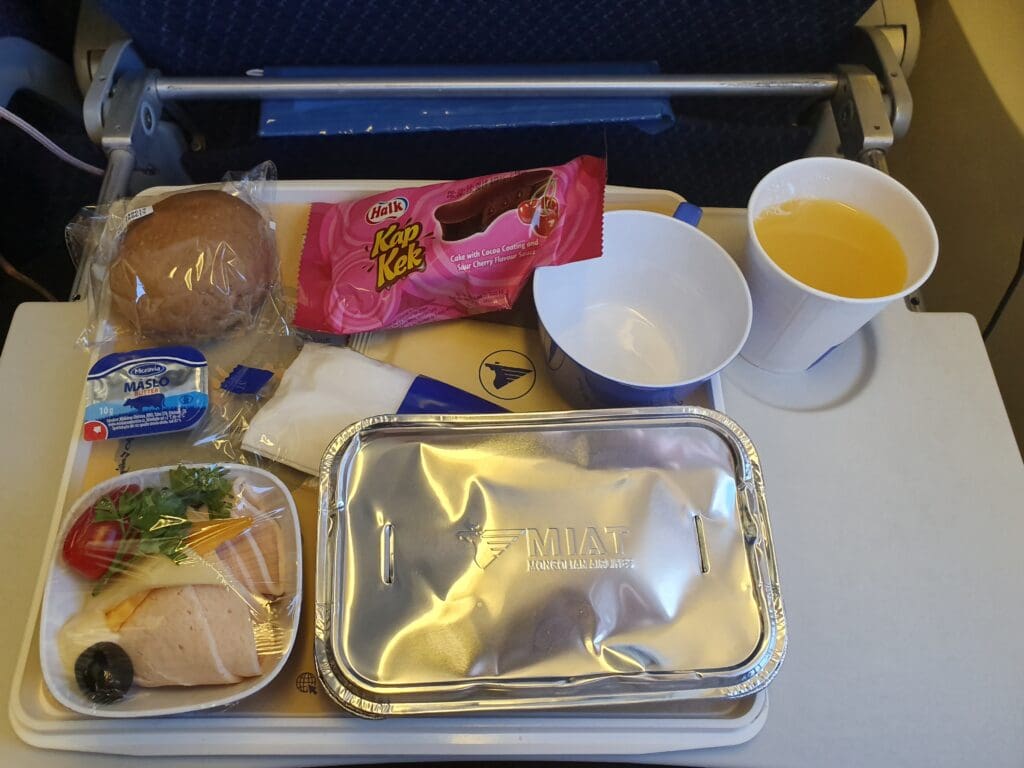
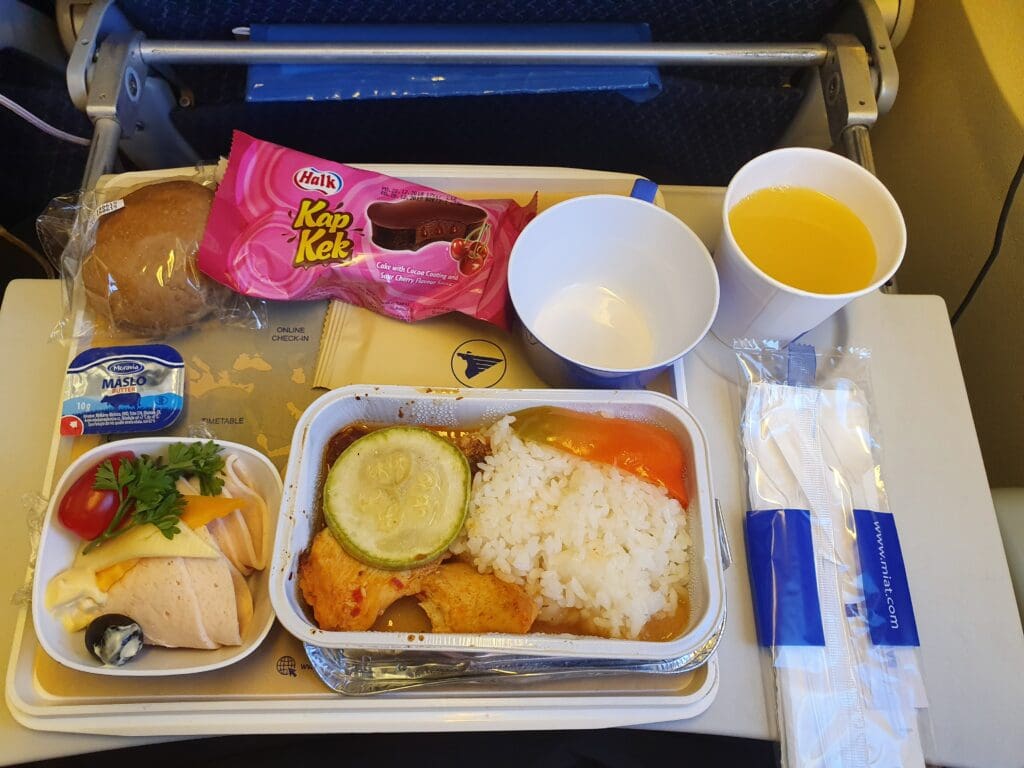
Around thirty minutes after the service commenced, the crew passed through the cabin handing out hot drinks. During this, I opted for a standard black coffee which ended up being rather standard and nothing to write home about. As I cautiously sipped this, taking care not to burn myself or spill any on my shirt, after miles and miles of countryside, the large Bashkortostan town of Neftekamsk and the wide Kama River appeared. Turning back inside the cabin, unlike the flight’s previous service, it took quite some time for the crew to collect the trays, with these not being cleared until around fifty minutes after they had been handed out.
Almost immediately after my tray was taken away, the seat belt signs were reilluminated and pre-recorded announcement rang through the cabin advising passengers to fasten their seatbelts. As if by magic, as soon as this finished, we found ourselves passing through a particularly bumpy patch of clear air turbulence. As we bumped around, very little could be seen aside from fields, woods and the occasional village and small town a long way below. Once the turbulence subsided, the capital of Tatarstan, Kazan, popped into view. Thanks to the gaps in the clouds, the majority of the city was visible and I was able to spot the city’s famous Kul Sharif Mosque, the Kazan Arena as well as the airport just to the north of the city. Meanwhile inside the cabin, once the seatbelt signs had been extinguished again, a comprehensive announcement played regarding the commencement of the onboard duty free service. However, as was the case on the flight from Busan, no one appeared to be interested in this and the duty free trolley ploughed down the rear economy cabin without making a single stop.
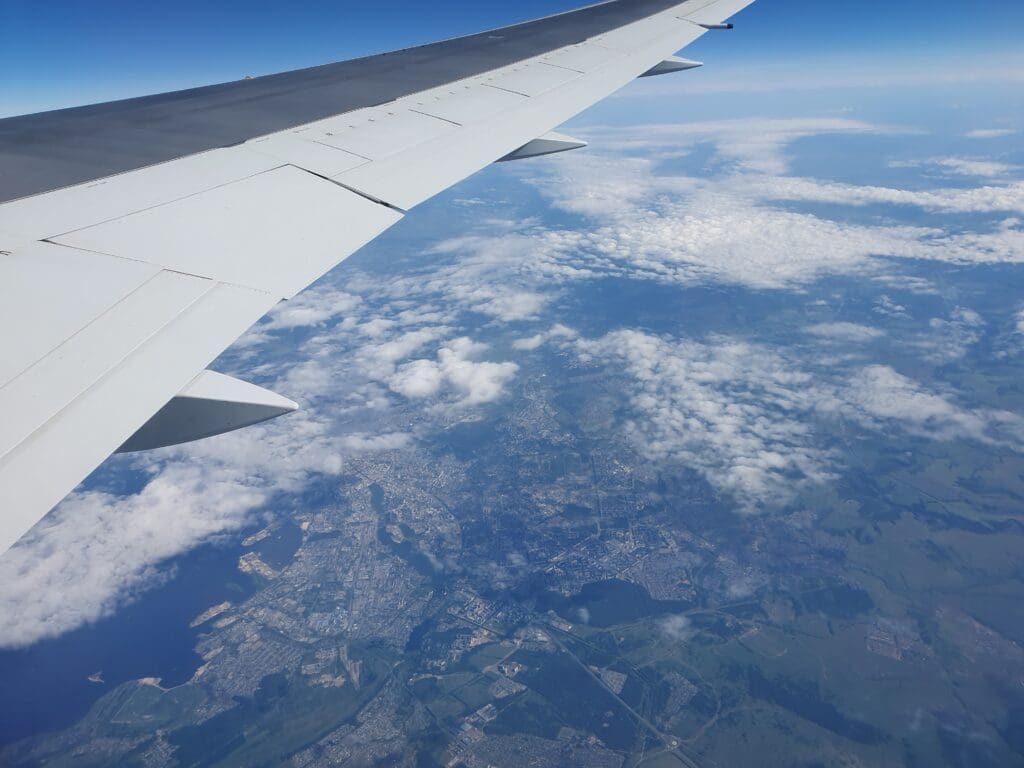
As the flight entered its final quarter, like many passengers at this time I decided to visit the lavatory. After passing to the south of Nizhny Novgorod, I headed out of my seat and joined the queue for one of the three toilets at the rear of the aircraft. Following a long wait, I opened the door to one of these which I found to be pleasantly clean, tidy and sufficiently stocked with the basics.
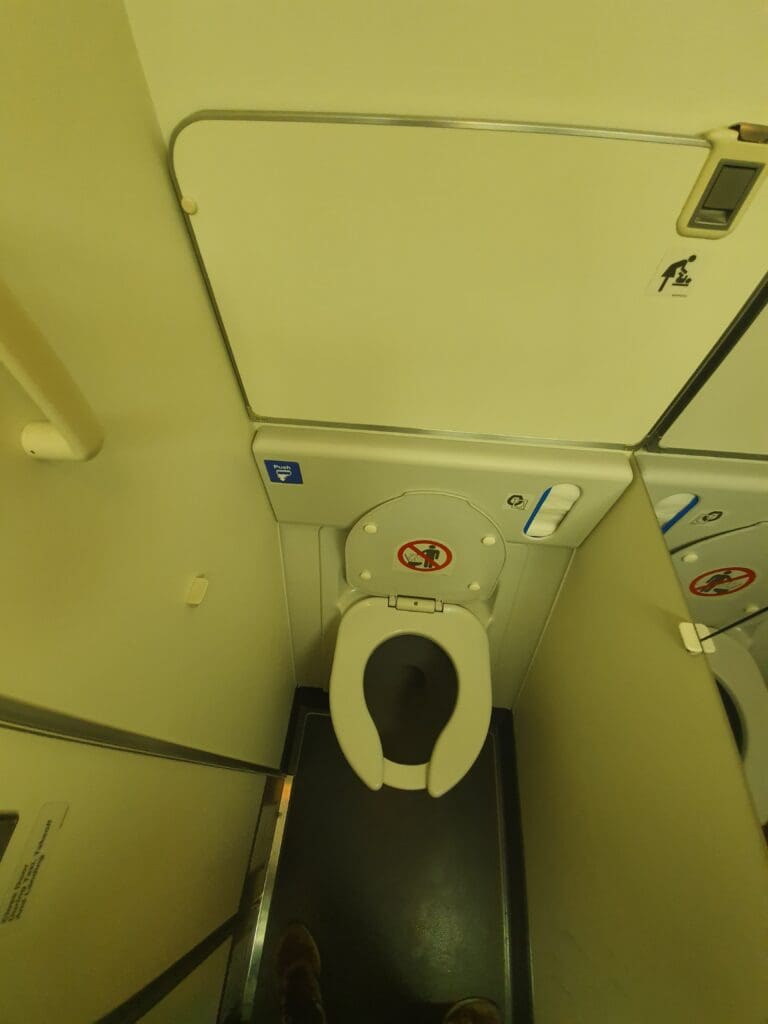
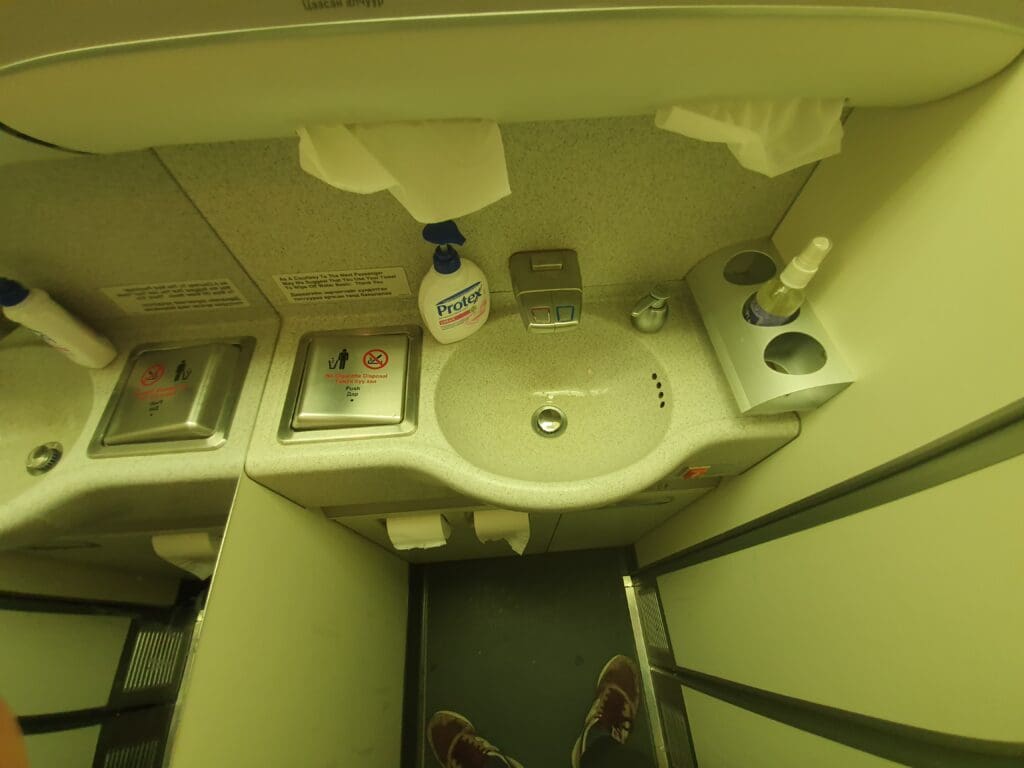
Following my short trip, I returned to my row where I found that my neighbour had fallen fast asleep. After guiltily waking him up and sliding into my seat, there was not a great deal of time left before we arrived in Moscow. Once again, I drifted off for a while and awoke at 0820 with approximately 140 miles to go until Moscow Sheremetyevo. Soon enough, the aircraft could be felt leaving its cruising altitude and gently commencing its descent, with the seatbelt signs reilluminating as the aircraft passed to the south of the town of Vladimir. This was then followed by an pre-recorded announcement in Mongolian and English informing all onboard about our impending arrival, after which the crew came around ensuring that all was secure and in place for our arrival. As the Boeing 767 smoothly descended over the green fields and forests that surround Russia’s capital, the speed brakes were partially extended, serving to slow the aircraft down with some vigour.
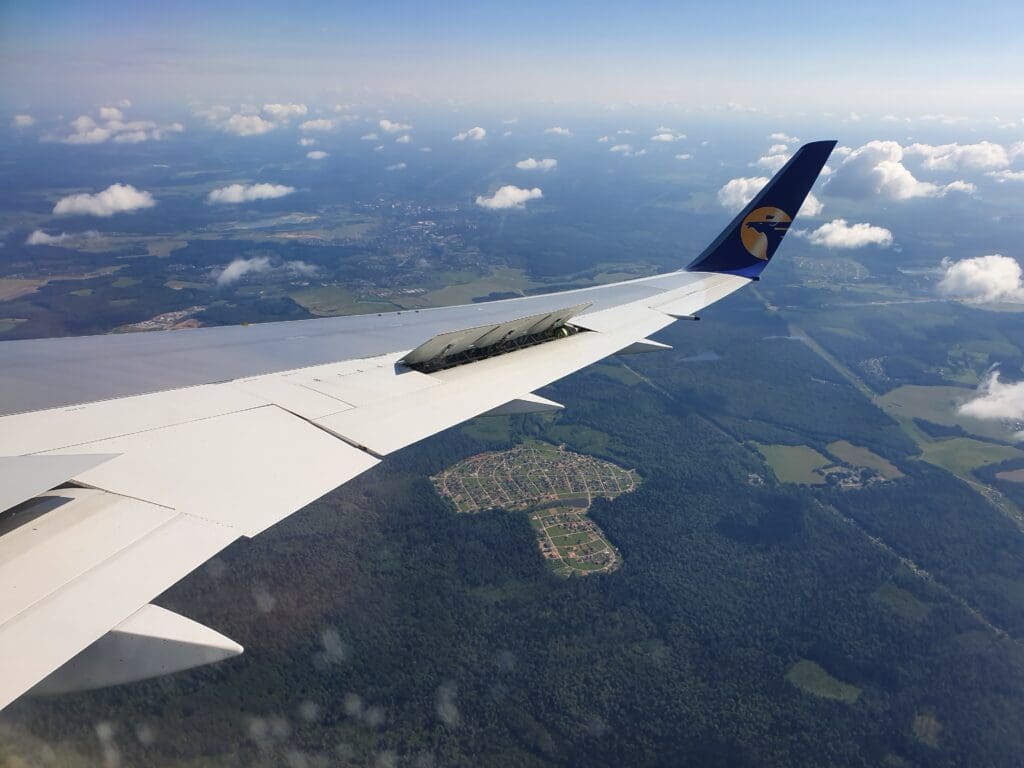
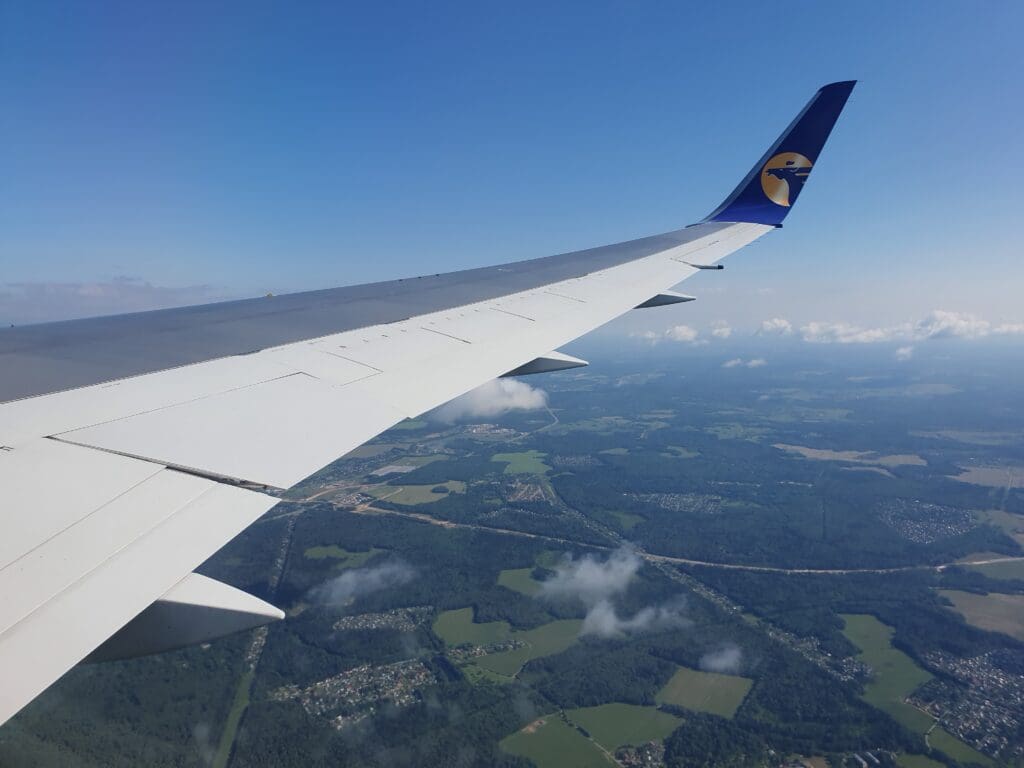
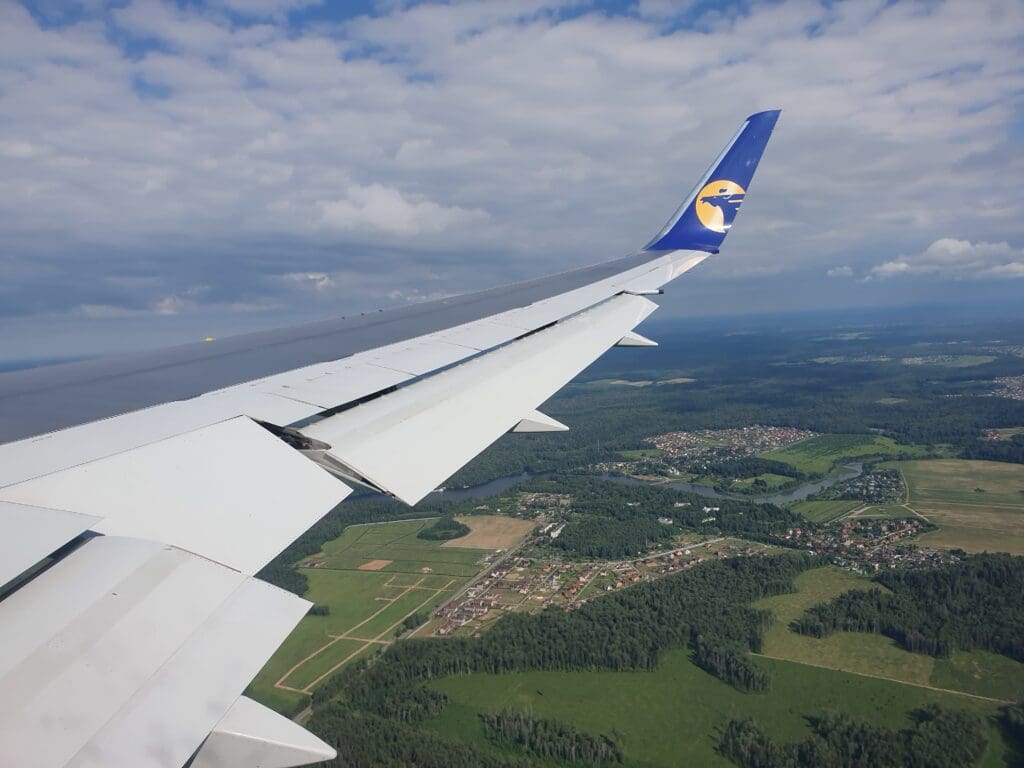
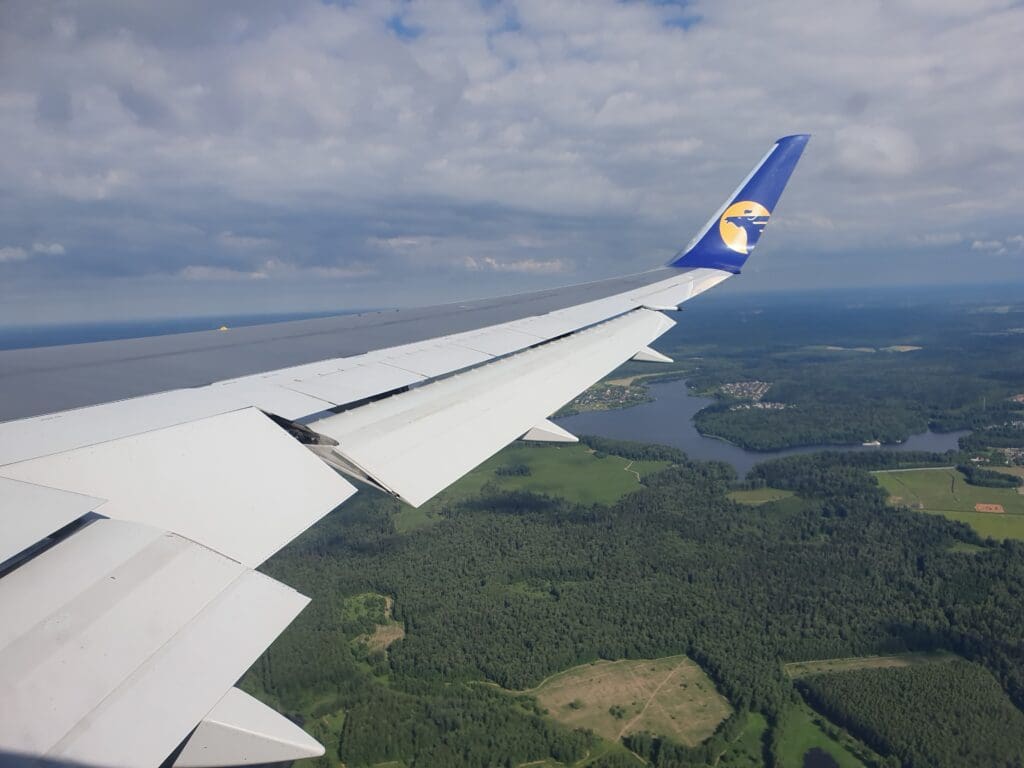
As the Boeing 767 passed through 10,000 feet, the flaps were partially extended and Moscow’s 333-kilometre-long A-107 road came into view. At this point in the flight, those on the opposite side of the aircraft would have most likely been treated to decent views of Russia’s capital. However, from my position, I was instead offered peaceful vistas of green wooded landscapes with the occasional village or small town visible in the middle of these. As the aircraft sank further, several lakes and the Klyazma River which soon turned into the Moscow Canal could be seen at which point the flaps were fully extended as was the landing gear hinting at our imminent arrival.
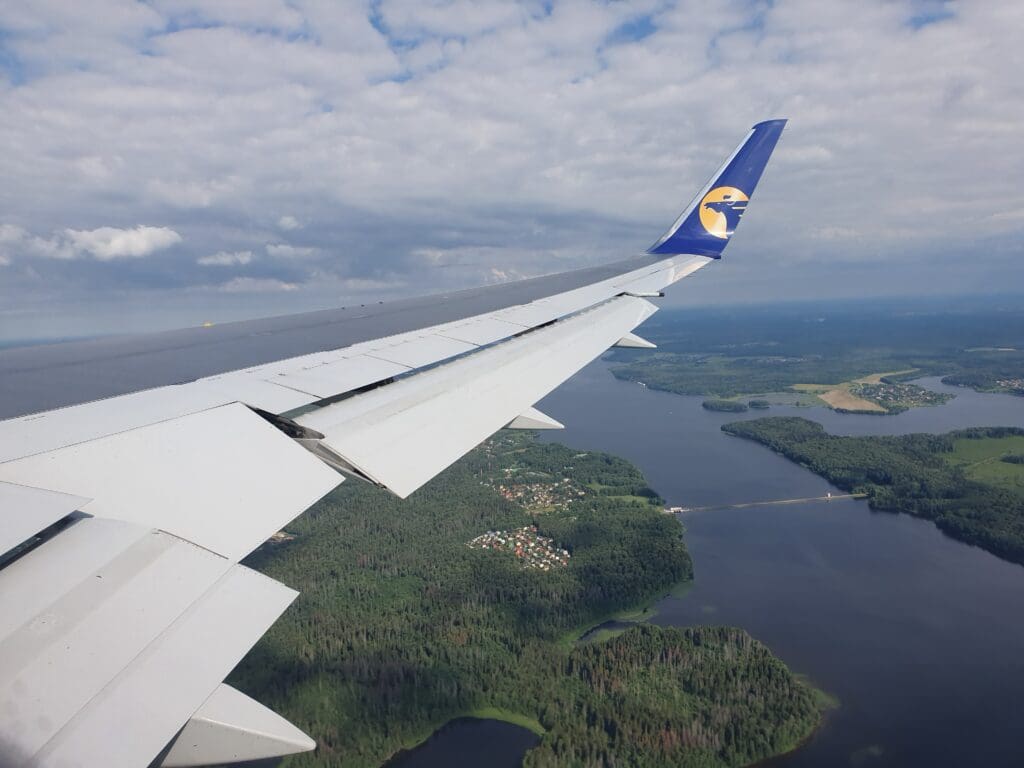
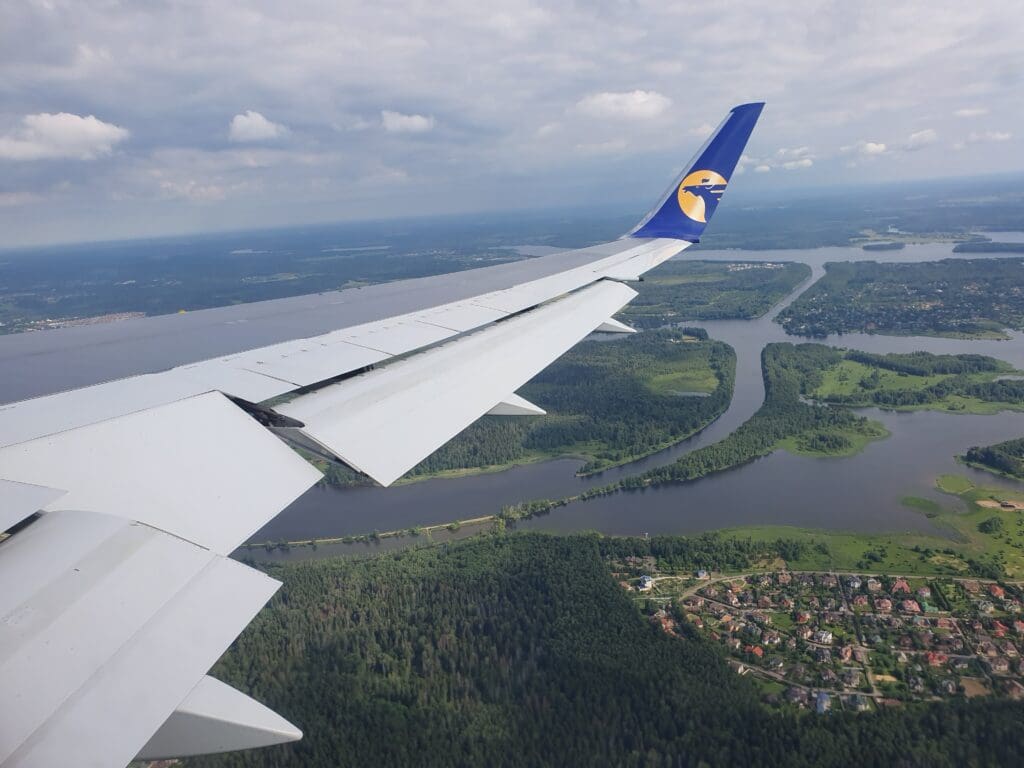
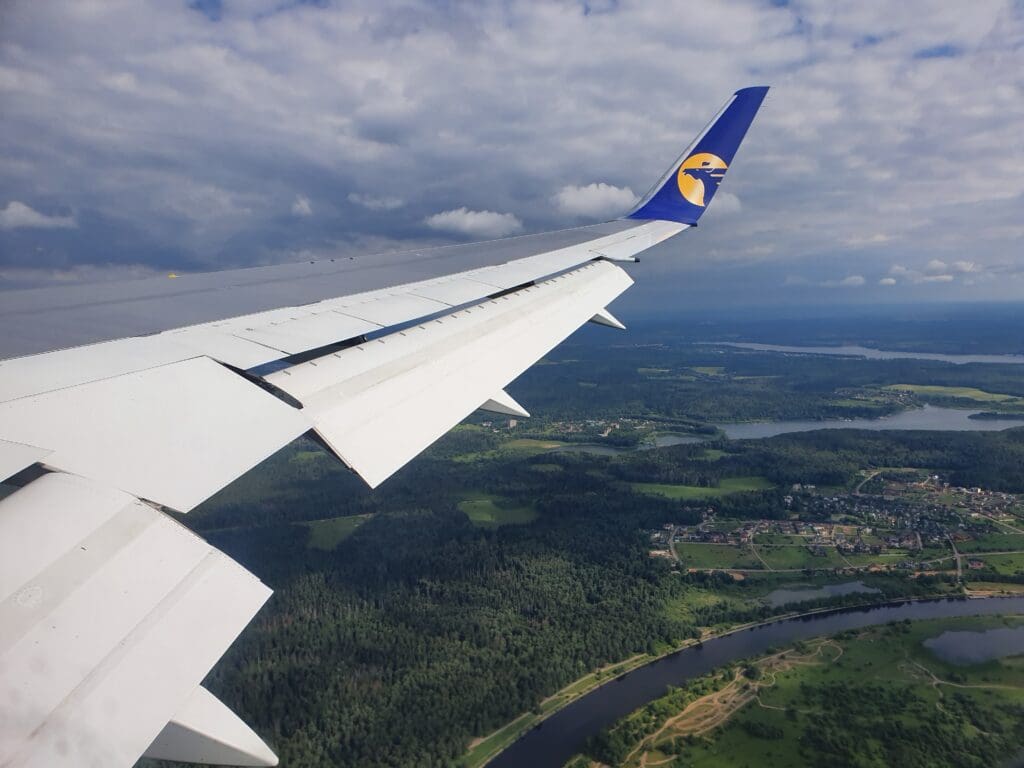
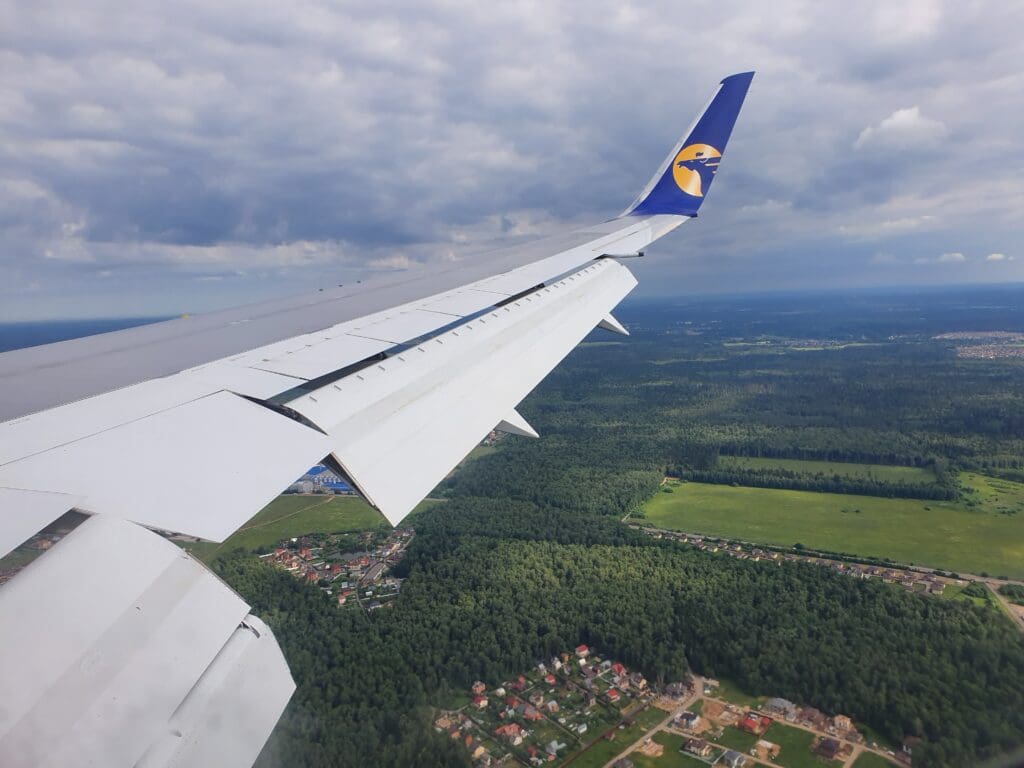
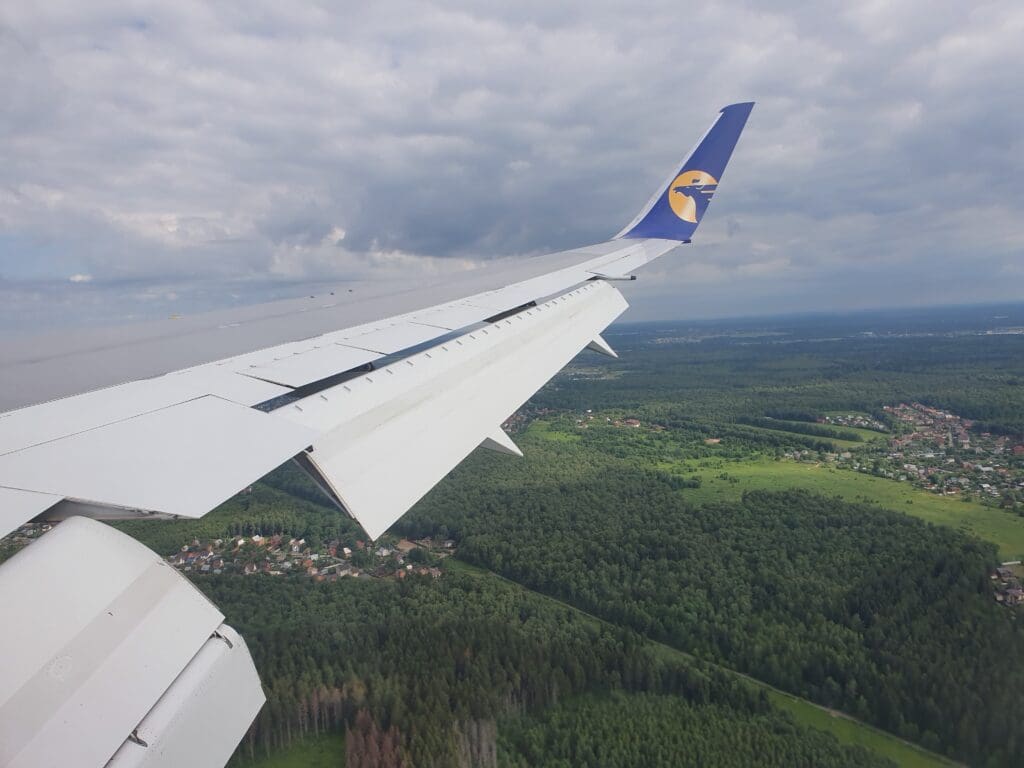
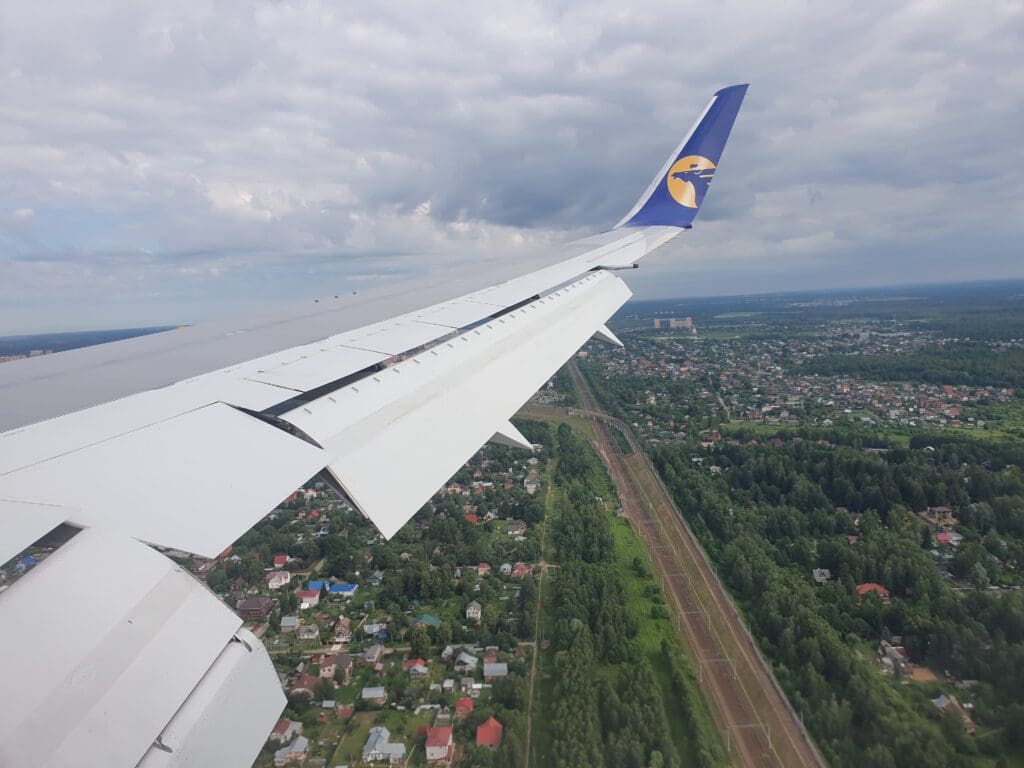
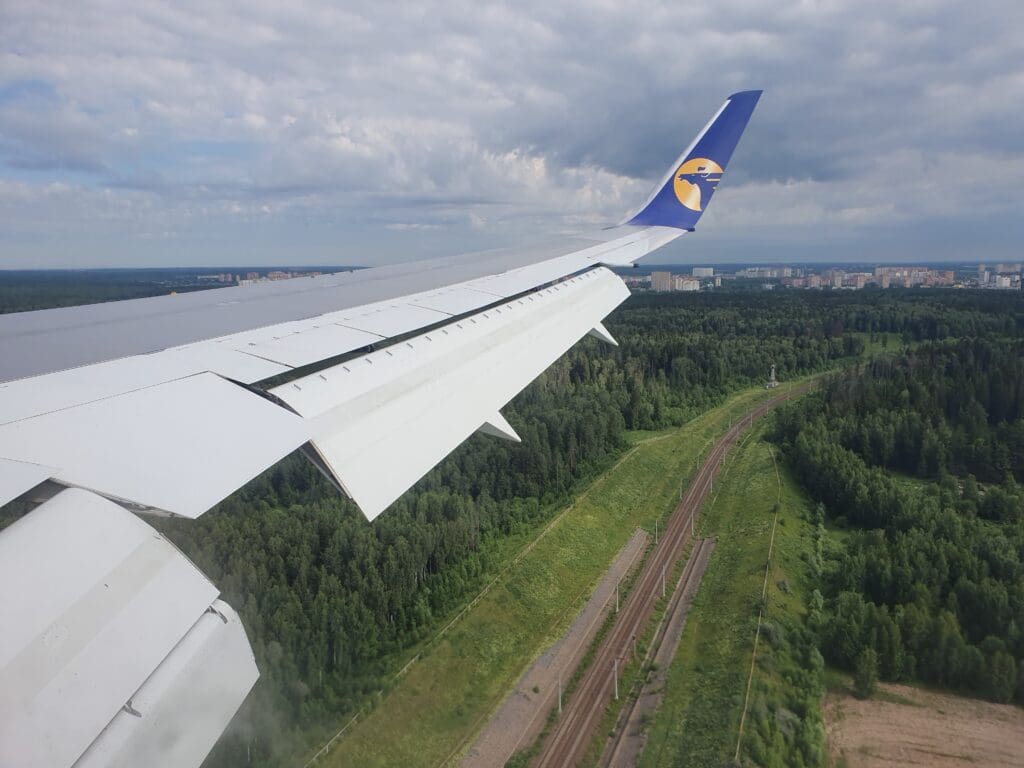
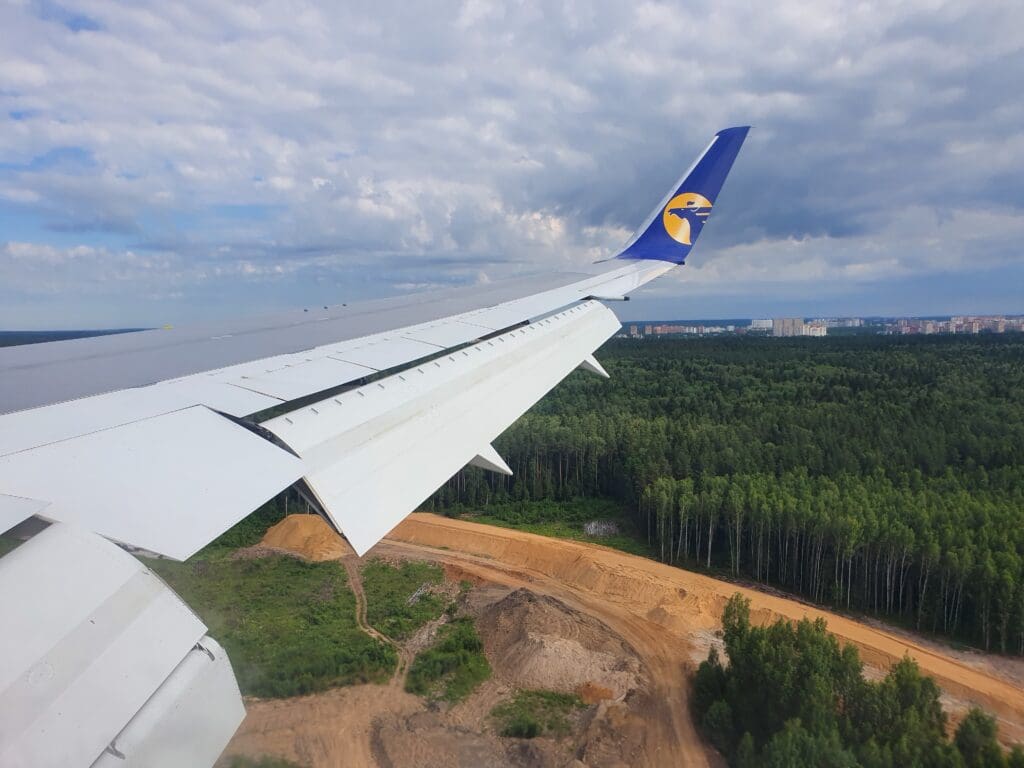
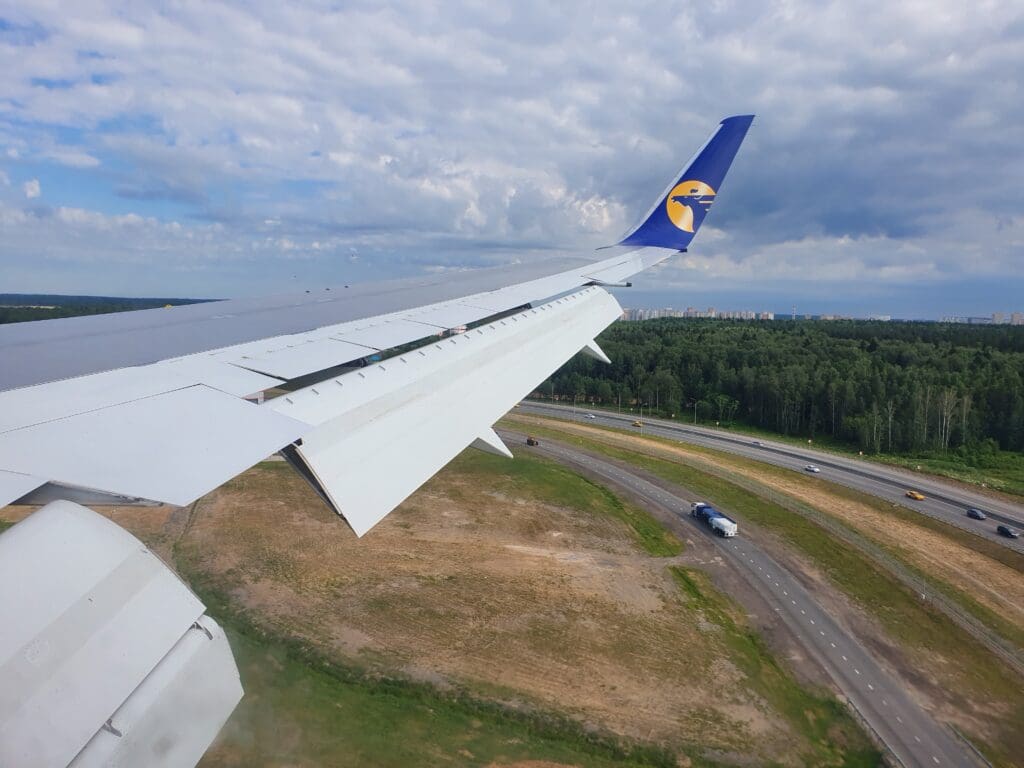
As we neared the airport, the ideal dachas for aviation enthusiasts came into view below and we headed over the electrified railway tracks that connect Sheremetyevo Airport with the main railway network. At 0847, the Boeing 767 gently floated down over the airport’s perimeter road before a selection of twelve of the latest business jets and several interesting Antonov 72/74s and Ilyushin Il-76s could be spotted. Six hours and five minutes after taking to the Mongolian skies, following a smooth approach the Boeing 767 made a bumpy touchdown on Sheremetyevo’s Runway 24C. As the aircraft slowed, several Boeing 747 freighters belonging to hometown airline, Air Bridge Cargo as well as a single DHL liveried Tupolev 204 operated by Aviastar-TU could be seen, after which most aircraft appeared to take the form of a range of types operated by Aeroflot.

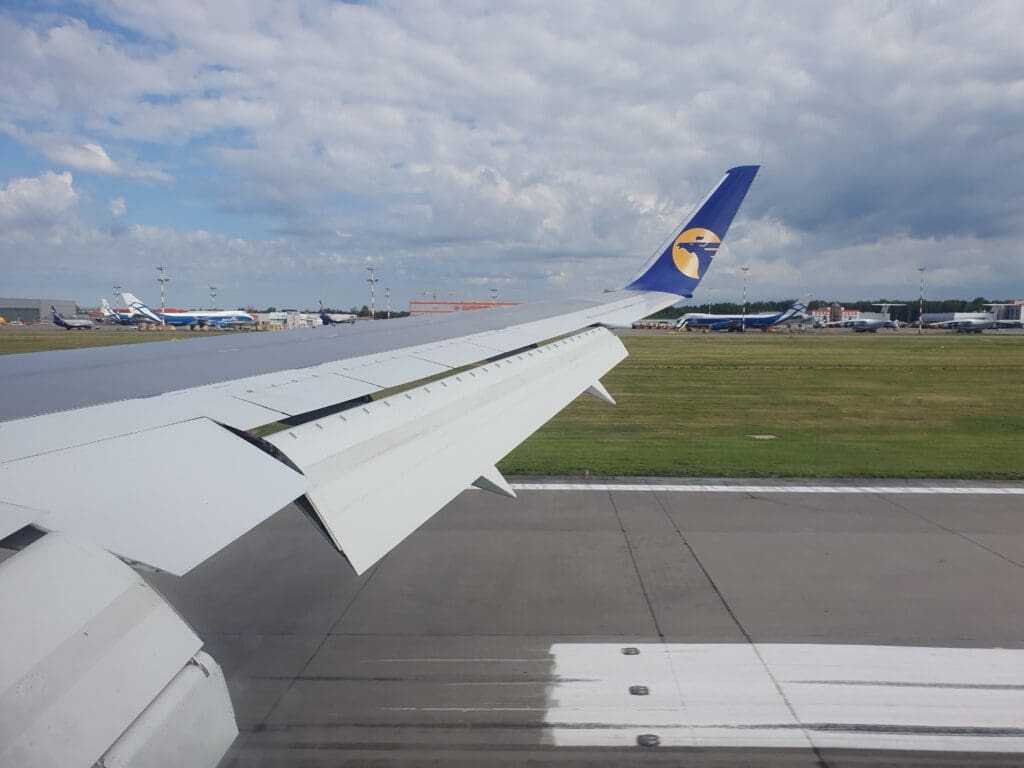
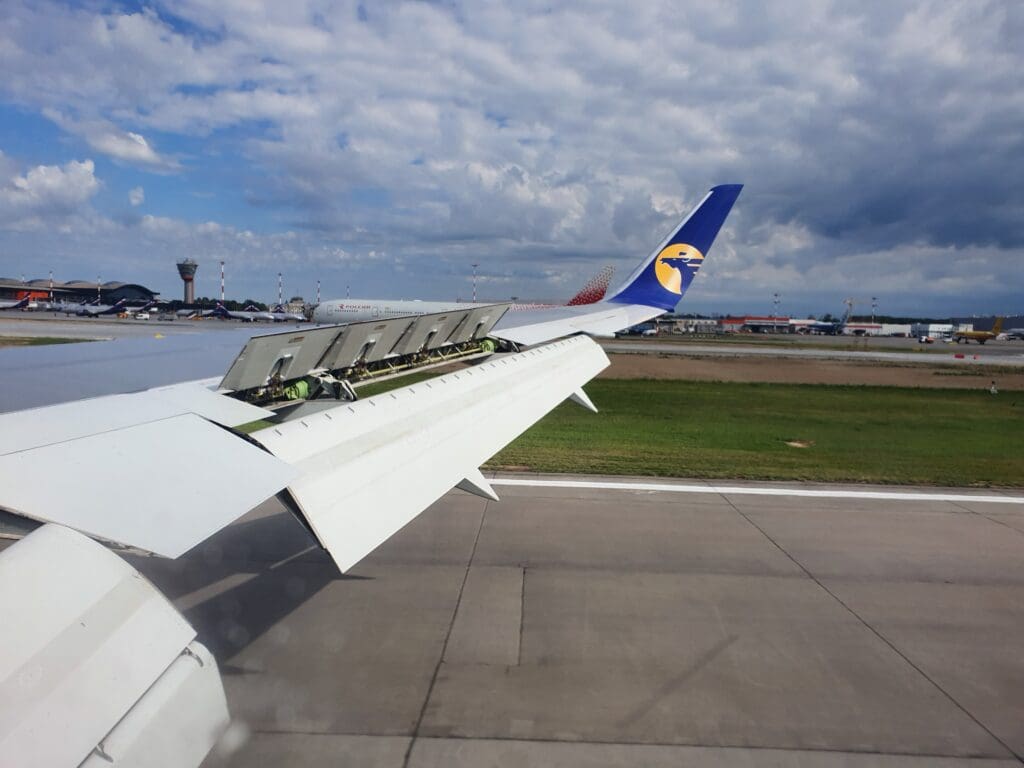
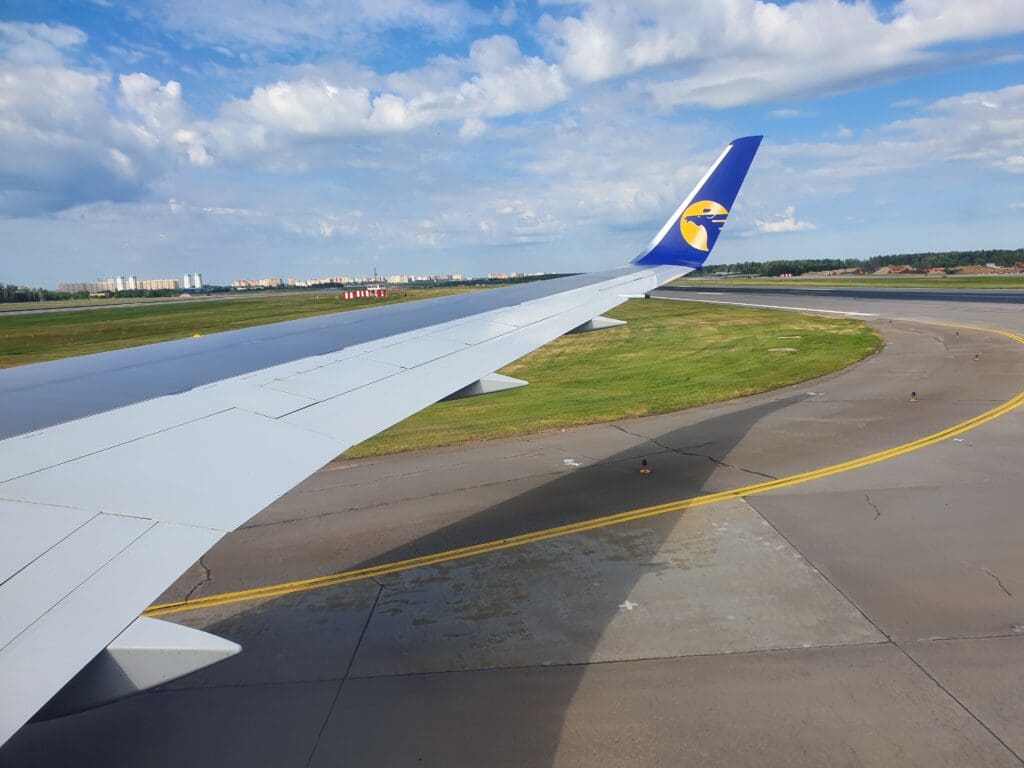
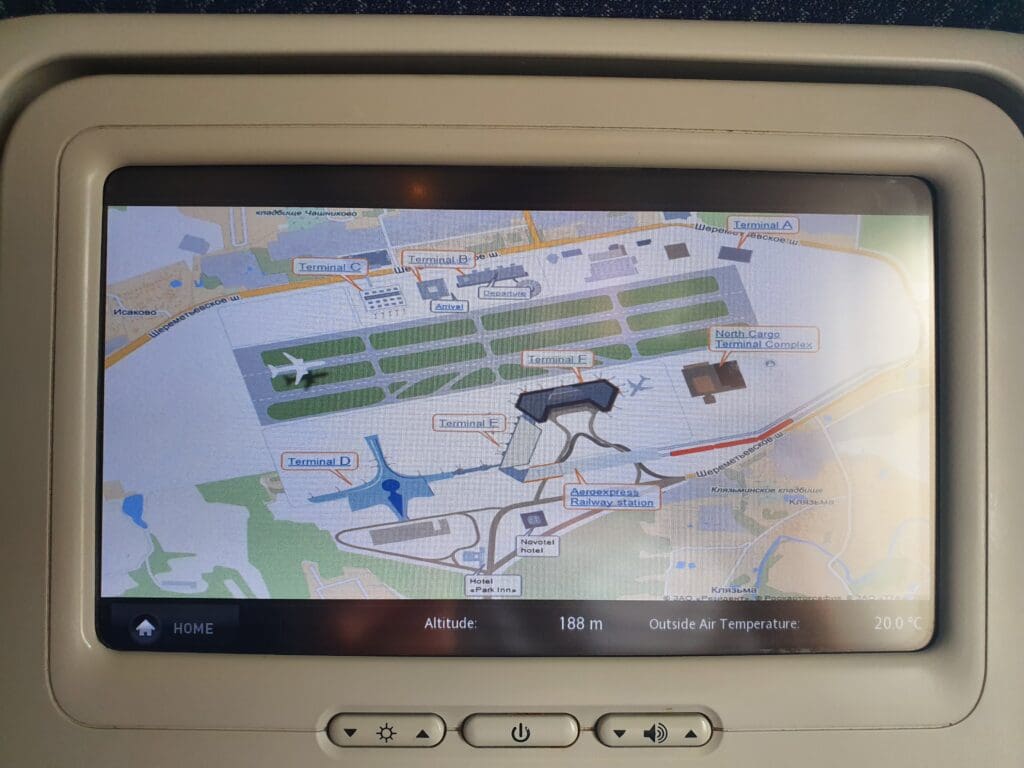
After vacating the runway, the aircraft held for around a minute to allow an Aeroflot Airbus A320 and Airbus A330 to depart from Runway 24L. At this time a number of passengers appeared to be desperate to stand up, however, those brave enough to do so received a stern telling-off from several of the crew members. After admiring these two aircraft as they climbed into the skies, the aircraft continued on its journey, first passing Terminal D where an interesting Severstal Avia Sukhoi Superjet could be seen amongst the masses of Aeroflot aircraft. As we headed over to the gate, the Purser welcomed all onboard to Moscow and informed everyone of the procedures for the onward flight to Berlin. This revealed that all those continuing onwards would have to leave the aircraft, pass through a document check and security before being allowed to reboard the aircraft, with the Purser claiming that reboarding would commence forty minutes after the flight’s arrival. Following a short taxi, at 0856 the aircraft pulled up to Stand 56 where it slotted in between a pair of Aeroflot Airbus A321s.
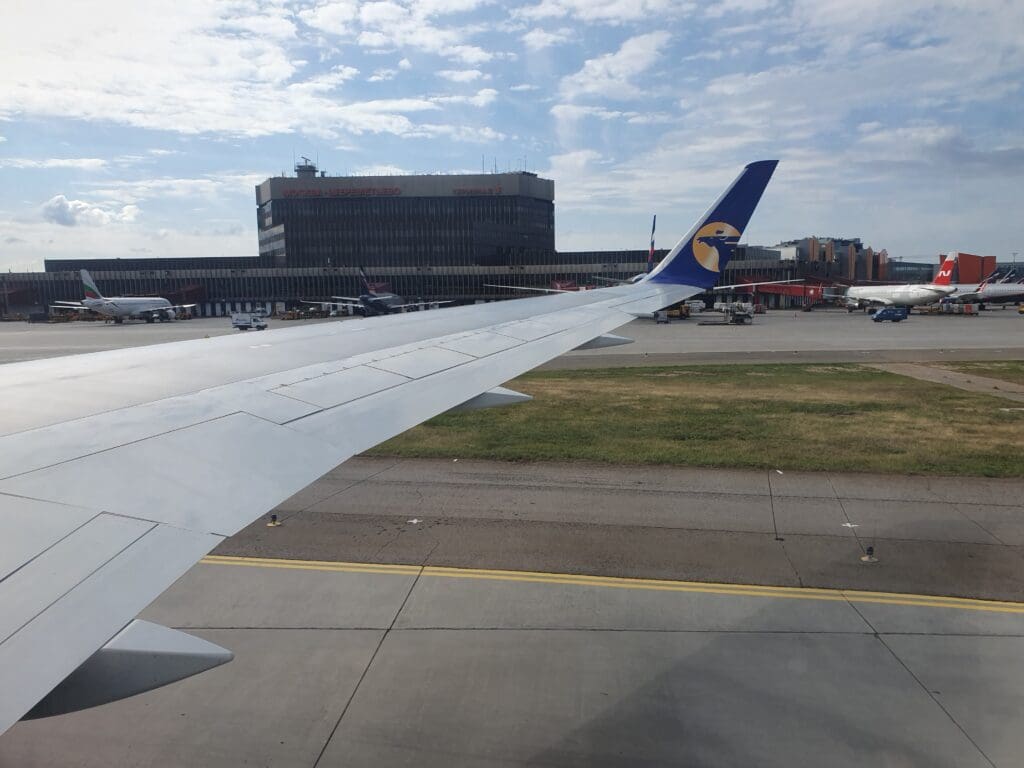
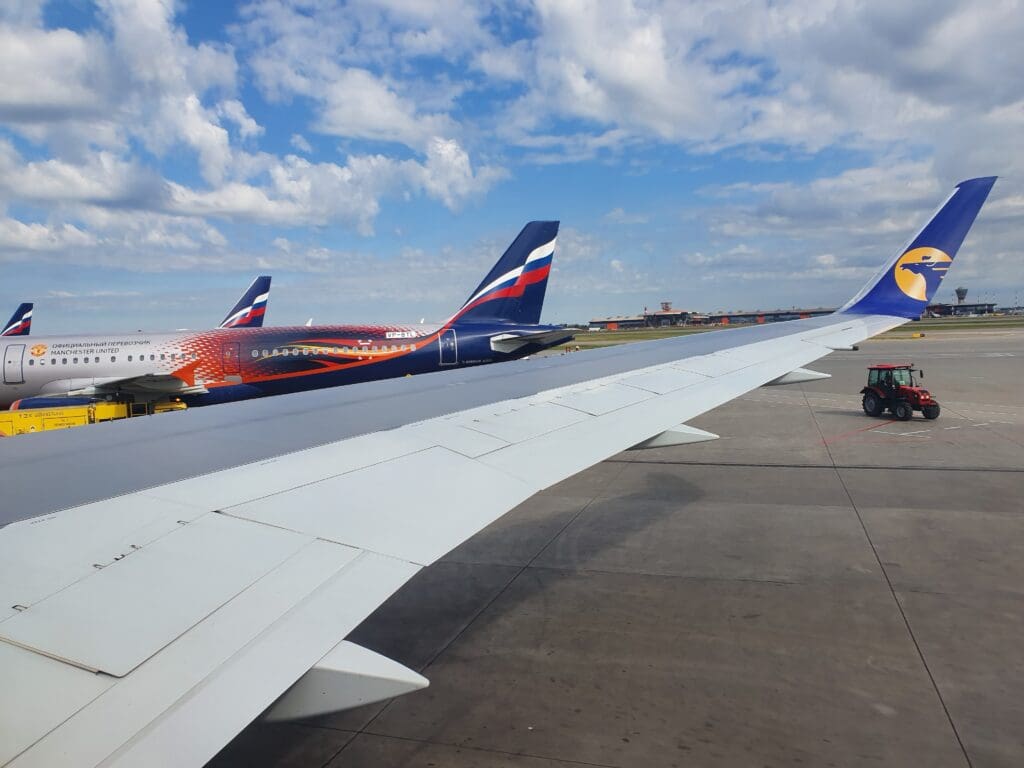
After coming to a halt, a jetbridge was connected and disembarkation commenced at around 0900. Following several minutes of waiting, I managed to stand up and head down the cabin, thanking the three crew members that were wishing passengers a farewell at the L1 door before heading up into the terminal and commencing my short transit at Sheremetyevo.
After heading up the jetway, I found myself following signs for the international transit area along with the flock of passengers who were simply simply connecting in Moscow. That morning I would estimate at least three quarters of those non-Russian passengers who had arrived from Ulaanbaatar to be connecting onwards. Around half of whom were heading on to Berlin with MIAT and the other half bound to a host of destinations, most of which were dotted around Europe however I did overhear some Tel Aviv-bound Israeli passengers as well as a group of Americans on a mammoth journey to Washington. Having arrived at Stand 56, or Gate 54 as it is known inside the terminal, the relatively long walk to the security area involved a journey down the flight line where a selection of Aeroflot Airbus A330s and Boeing 777-300ERs could be seen waiting to take passengers to destinations across the world.
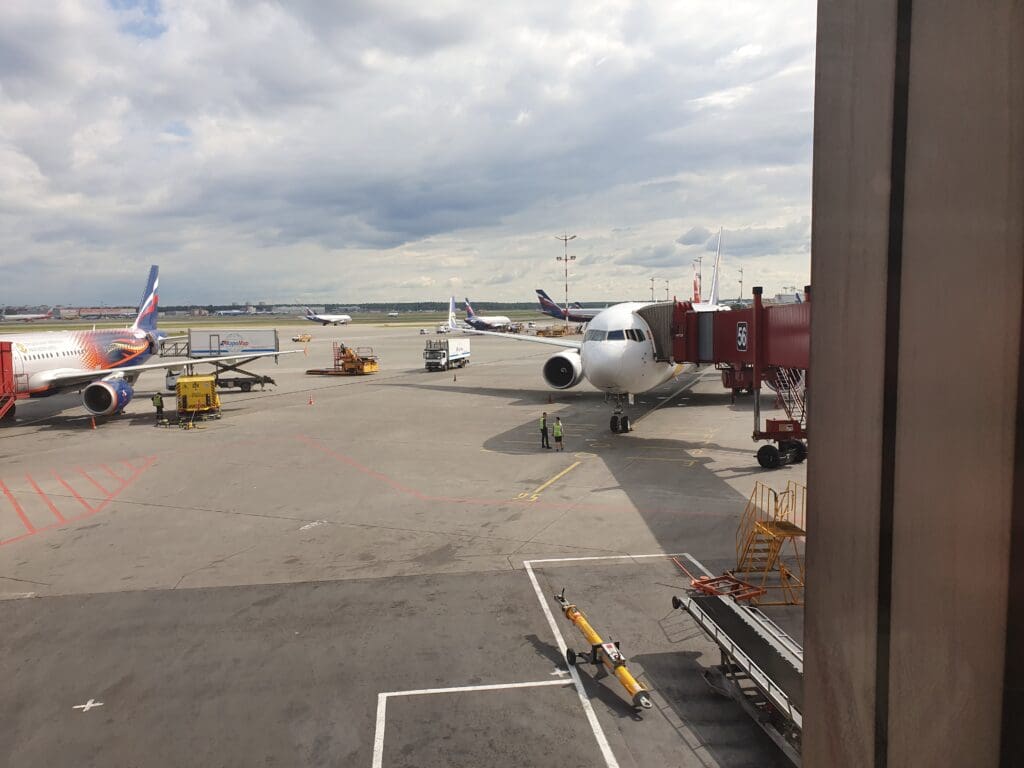
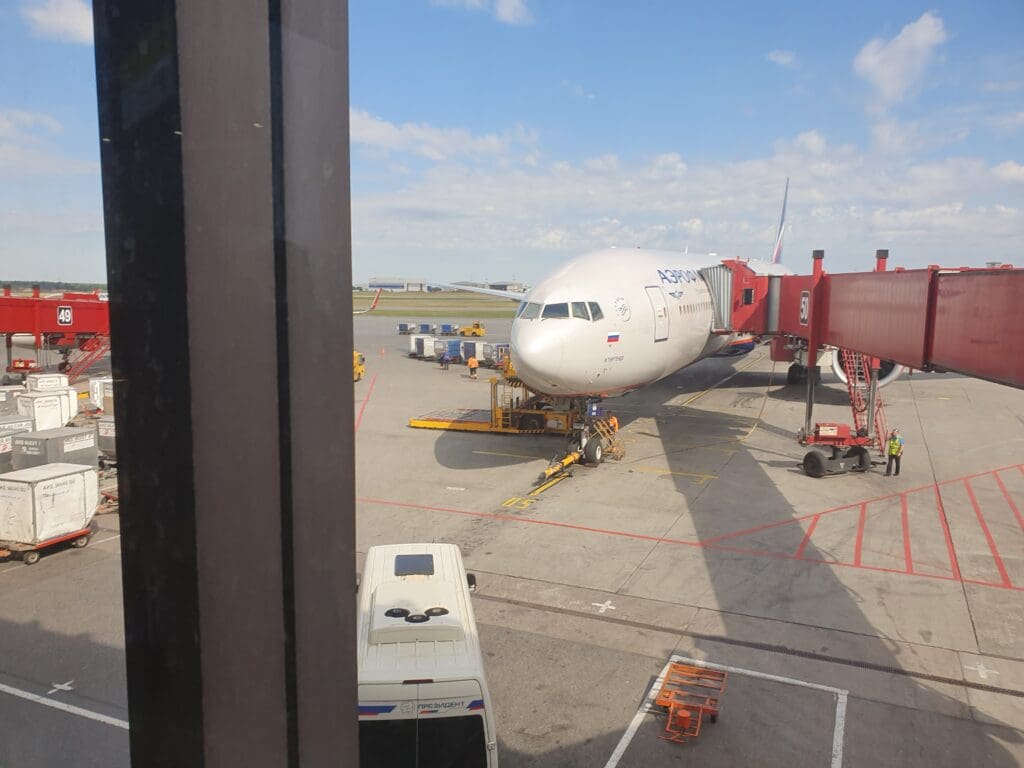
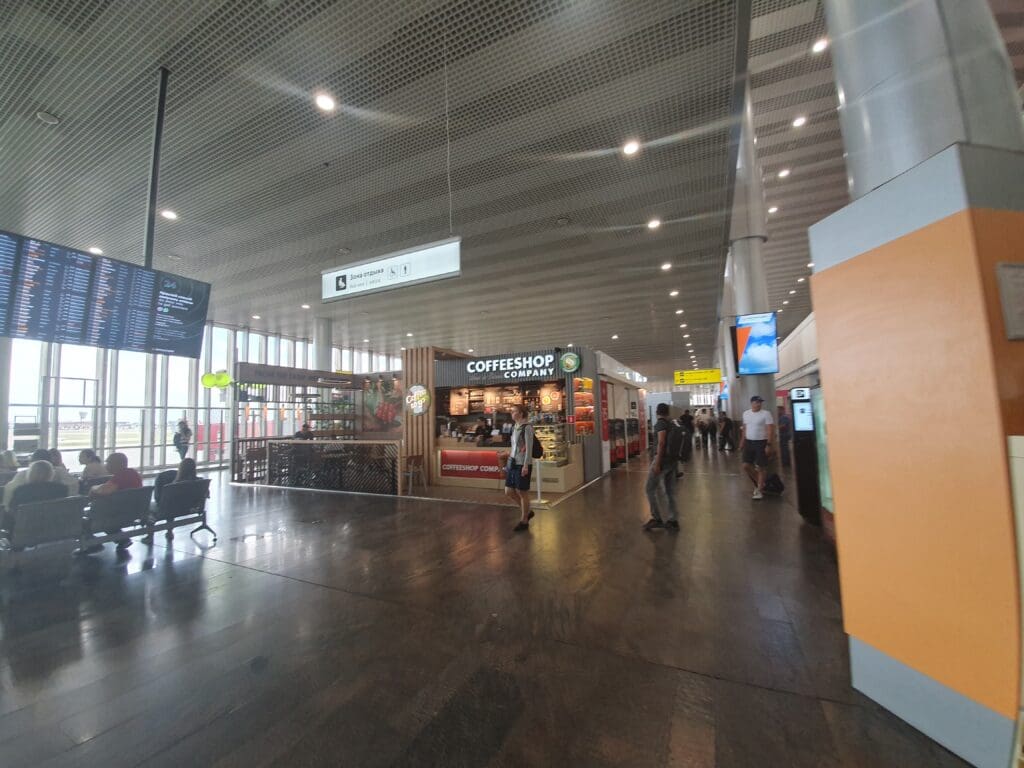
Around ten minutes after arriving in the terminal, I reached the long queue for a pair of desks where the passports and boarding passes of all connecting passengers were checked before such passengers were required to pass through a single security checkpoint. Following a ten-minute wait, I handed over my passport and boarding pass which were soon returned before I was able to head to the checkpoint. Reaching this involved another queue and eventually, I sent my bag on its way through an x-ray machine whilst I passed through the usual metal detector. Without any issues, I collected my bag and found myself in the terminal’s relatively small airside departure area by which time boarding for the onward flight to Berlin had already been announced. After a quick trip to some surprisingly unpleasant toilets, I returned to Gate 54 where boarding had just commenced and thus a small queue of passengers could be seen. Whilst I did not have a great amount of time to explore Moscow Sheremetyevo’s Terminal F, my experience that morning was not the best, and, having read plenty of negative reviews regarding the airport’s transit experience, it appears as if I am not the only passenger to have encountered a few issues with this.
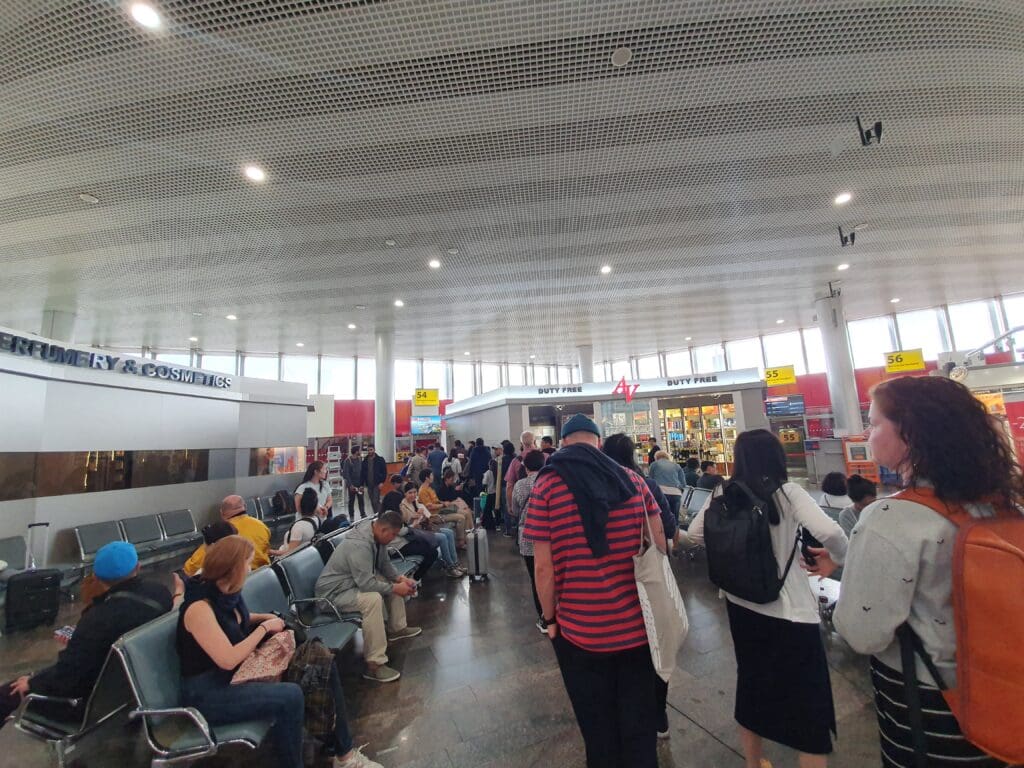
Once I caught sight of the queue, I joined this and following a short wait, my boarding pass was scanned before I headed down the jetway and reentered the Boeing 767 via the L1 door. As I stepped aboard I received a friendly welcome before I headed across the galley and turned right into the small business class cabin. Seeing as I would be sitting in Seat 13K for the flight over to Germany, it only took several seconds to reach my seat in the aircraft’s exclusive 42-seat forward economy cabin. There, each seat’s beige-coloured patterned fabric made a nice change to the bland blue tones of the aircraft’s rear Economy cabin. However aside from their colour differences, as one would expect, the seats in both the front and rear Economy cabins were identical with my same complaints regarding legroom still applying to my new seat. Whilst the cabin appeared to have been cleaned during its short time on the ground in Moscow, perhaps assuming that most passengers would reboard and take their original seats, neither the cleaners nor cabin crew appeared to have made any effort to collect or tidy up the blankets which could be seen strewn across seats all over the cabin. This perhaps failed to give off a greatly positive impression for those passengers who had joined the flight in Moscow. Within a couple of minutes, I was joined by a late middle aged Russian gent.
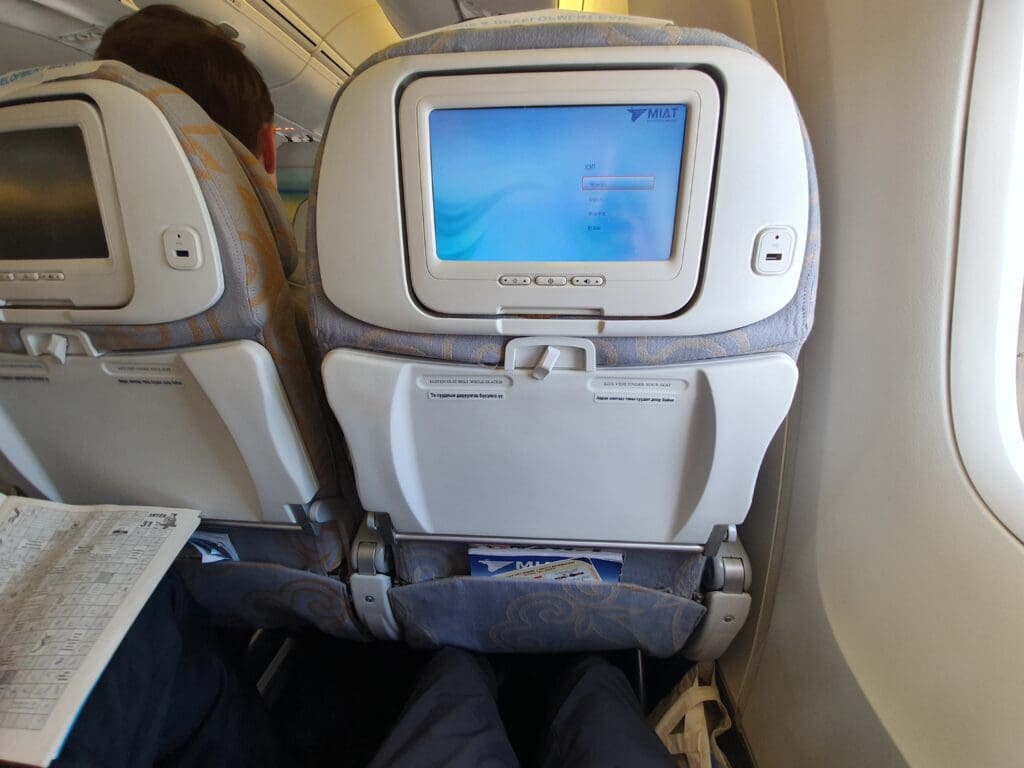
Despite claims on the departure boards inside the terminal that the flight to Berlin would depart at 1025, by 1005 all passengers appeared to have made their way onto the aircraft and a few minutes later, glancing forward, I witnessed the L1 door being shut in preparation for our departure. Given the service’s 22-hour delay and the wide range of options that exist for those needing to travel from Moscow to Berlin, I had assumed that many of those joining the flight for its final sector would have been rebooked onto other services. However, this appeared not to have been the case with a nearly full Business cabin and an Economy that appeared to be approximately 70% full. As I had expected, the same army of cabin crew members could be seen working the flight on this sector. Once the door was closed, the captain welcomed everyone onboard once again in Mongolian and English and gave the usual details regarding the flight and the weather in Berlin. As it turned out, the flying time for this sector would be 2H15, which, assuming a prompt departure alongside a quick passage through immigration and a short wait at baggage collection would enable me to catch my onward flight to Zurich. However, turning outside my attention outside, frustratingly, the neighbouring Manchester United liveried Aeroflot Airbus A321 could be seen being readied for pushback, with this aircraft delaying our departure by around ten minutes or so. Meanwhile, back inside the cabin, once the Captain had made their announcement, the Purser welcomed all passengers once again before the airline’s animated safety video played as the crew passed through the cabin ensuring all was secure in preparation for our departure from the Russian capital.
Once the aforementioned Airbus A321 powered up and commenced its taxi to one of Sheremetyevo’s runways, at around 1020, the Boeing 767 left the terminal behind and its two large engines spooled up with plenty of humming, whiring and vibration. After a few moments, the Boeing propelled itself forward and commenced what turned out to be a pleasantly short taxi to Runway 24L. As we made our way to the runway, a host of relatively interesting aircraft could be seen. These included a Rossiya Airlines Boeing 747-400, a Nordwind Airlines Boeing 777-200ER sporting a hybrid Nordwind-Singapore Airlines colour scheme and an Embraer 190 operated by Russian carrier Pegus Fly. By 1029, the Boeing 767 made it onto the runway, however, adding insult to our delay, the aircraft was required to hold for two arrivals on the parallel runway. These consisted of an Aeroflot Airbus A320 and an AirBridgeCargo Boeing 747-8F touching down at its home base after a long flight from Shanghai. Finally at 1031, it was our turn to take to the skies and so the aircraft commenced what seemed like a short and powerful takeoff roll. After speeding past an Aeroflot Sukhoi Superjet waiting to cross the runway, the Boeing rotated into the skies, bringing an end to its short stay on the ground in Moscow.
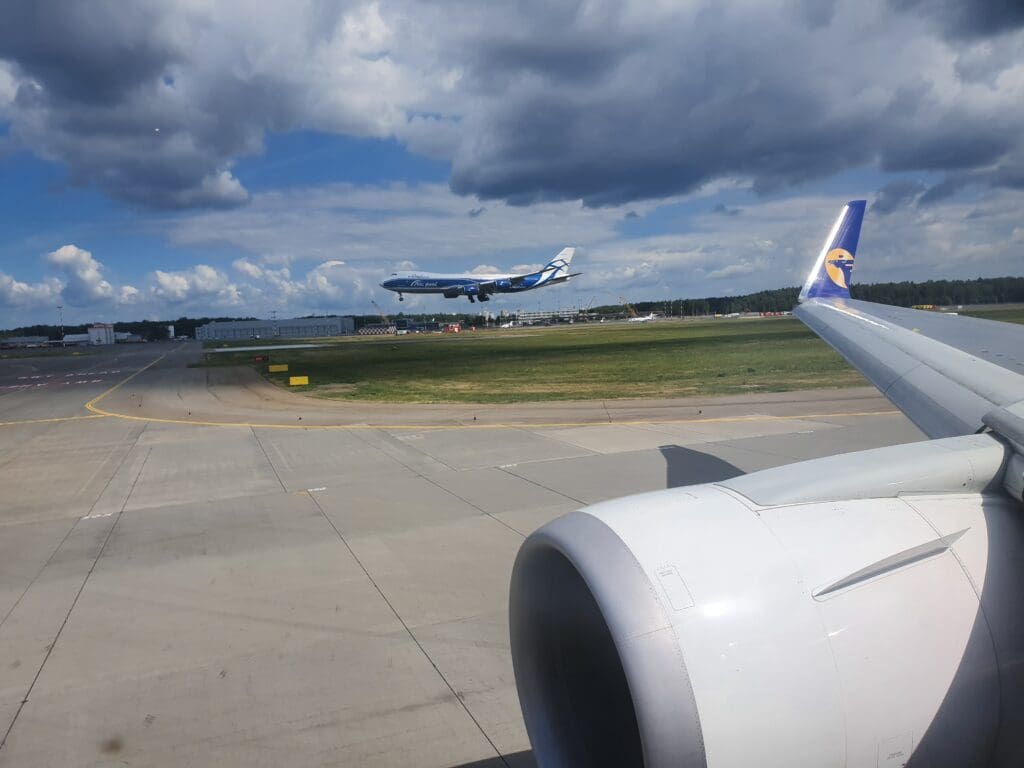
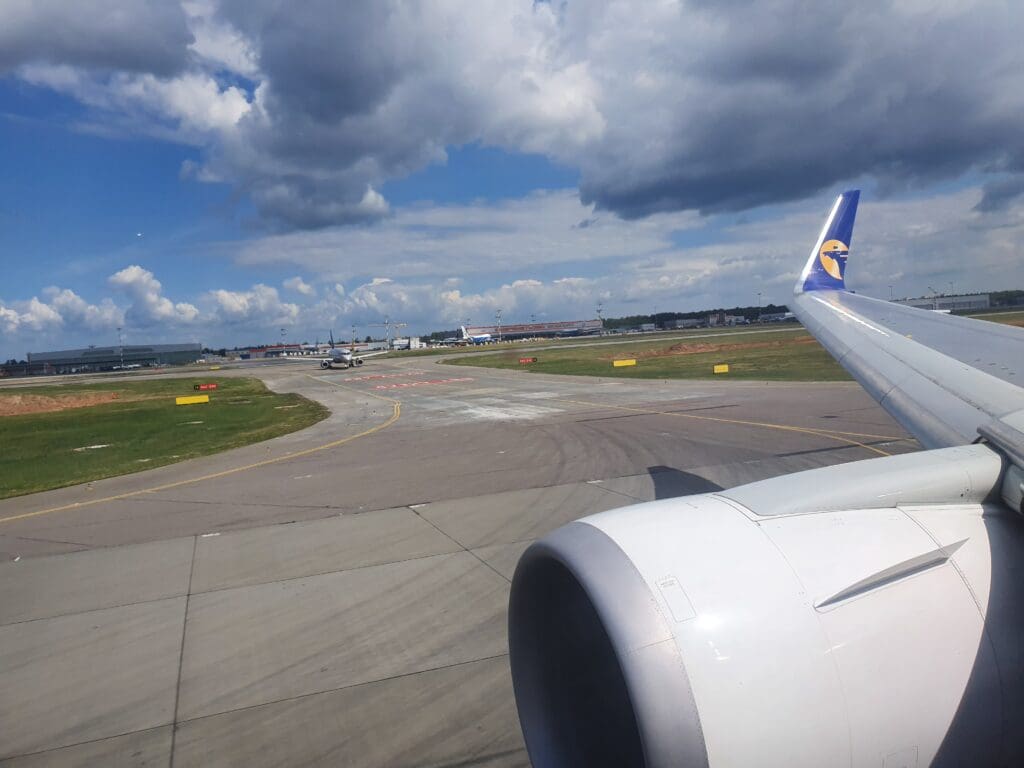
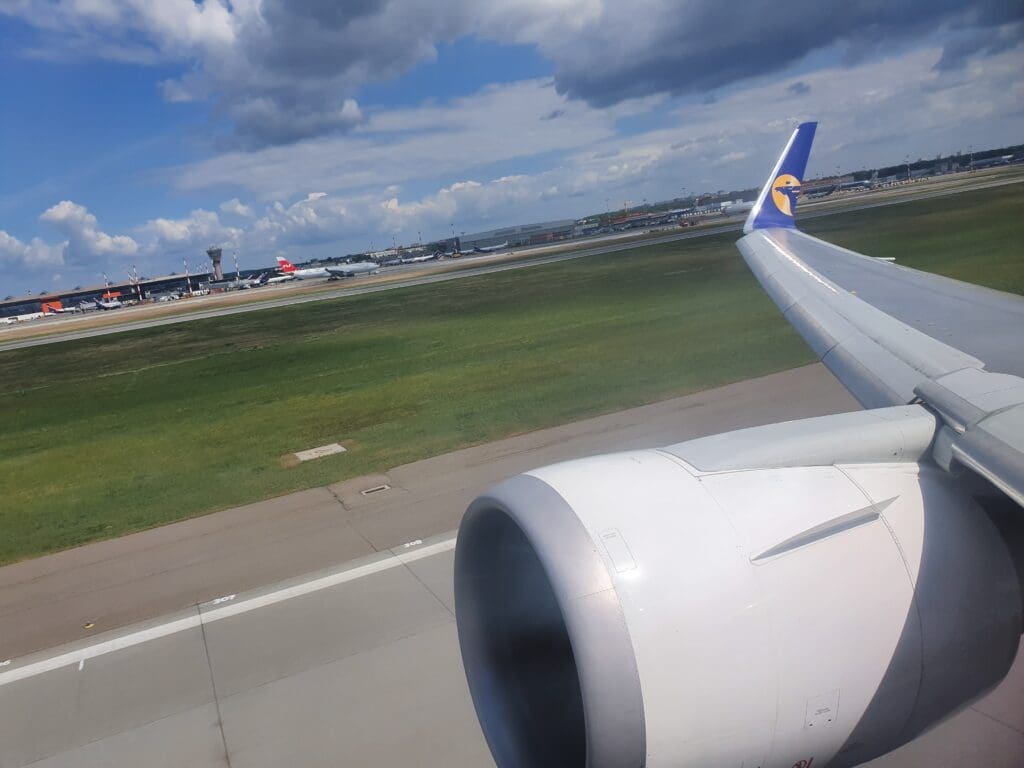
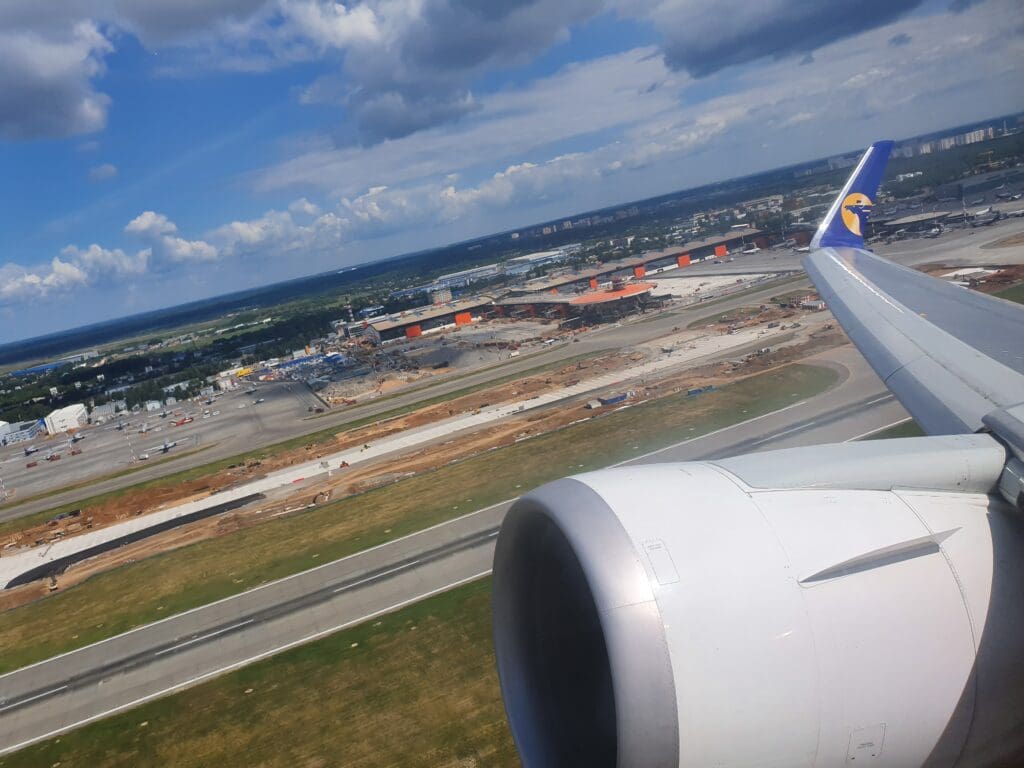
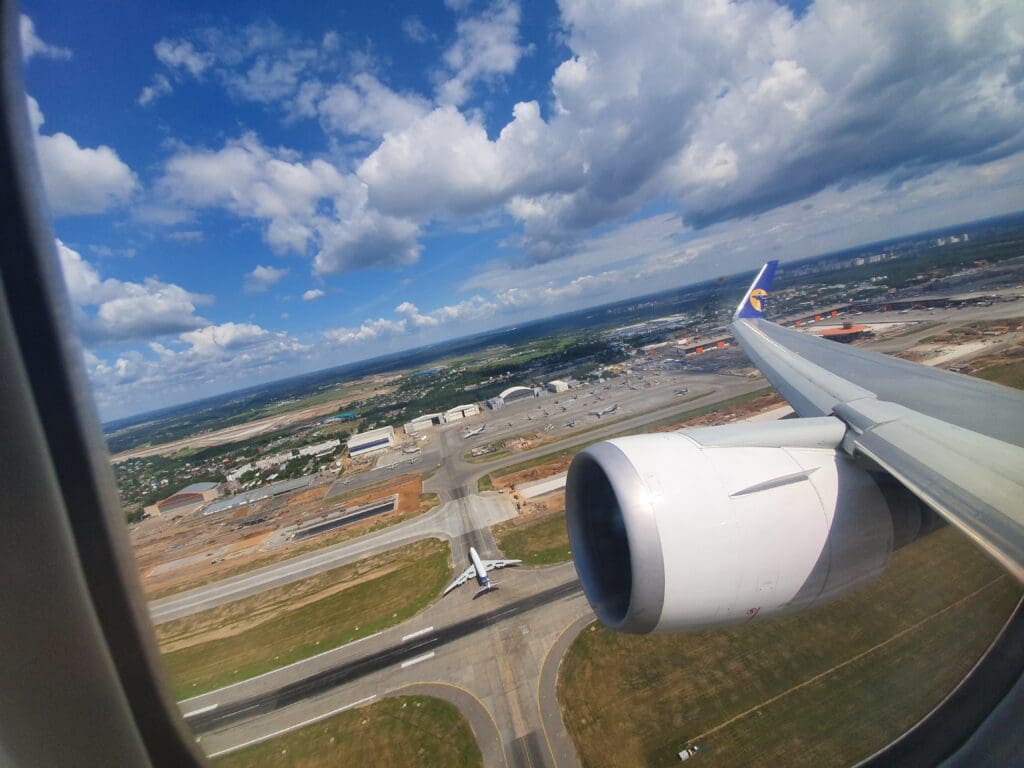
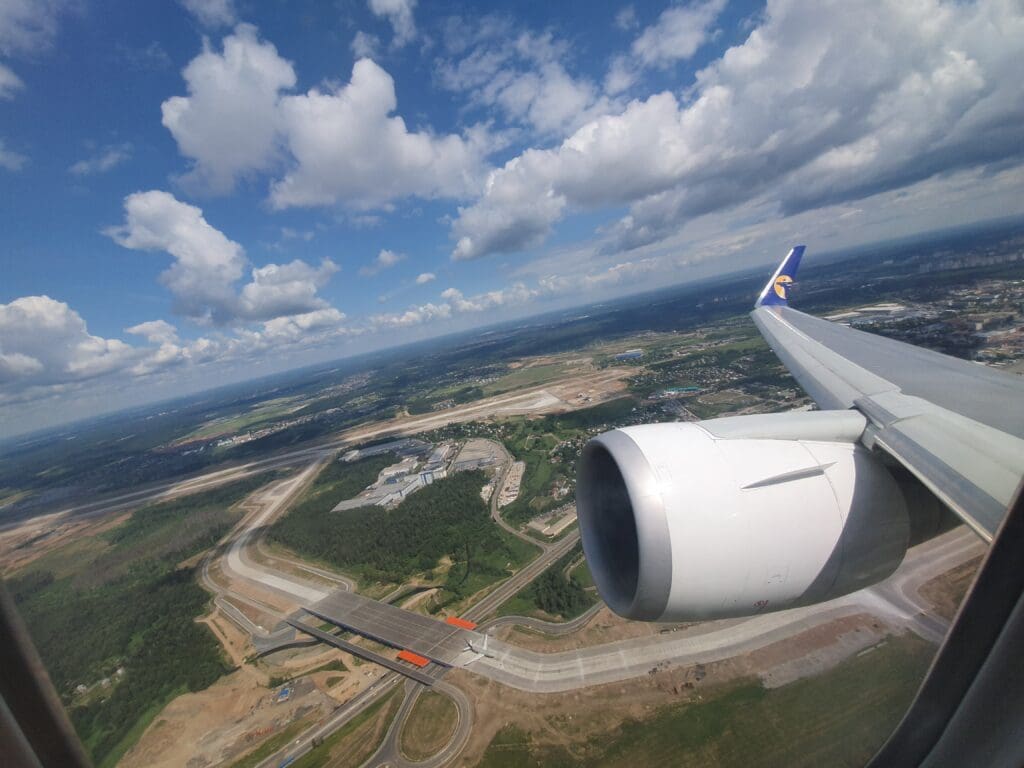
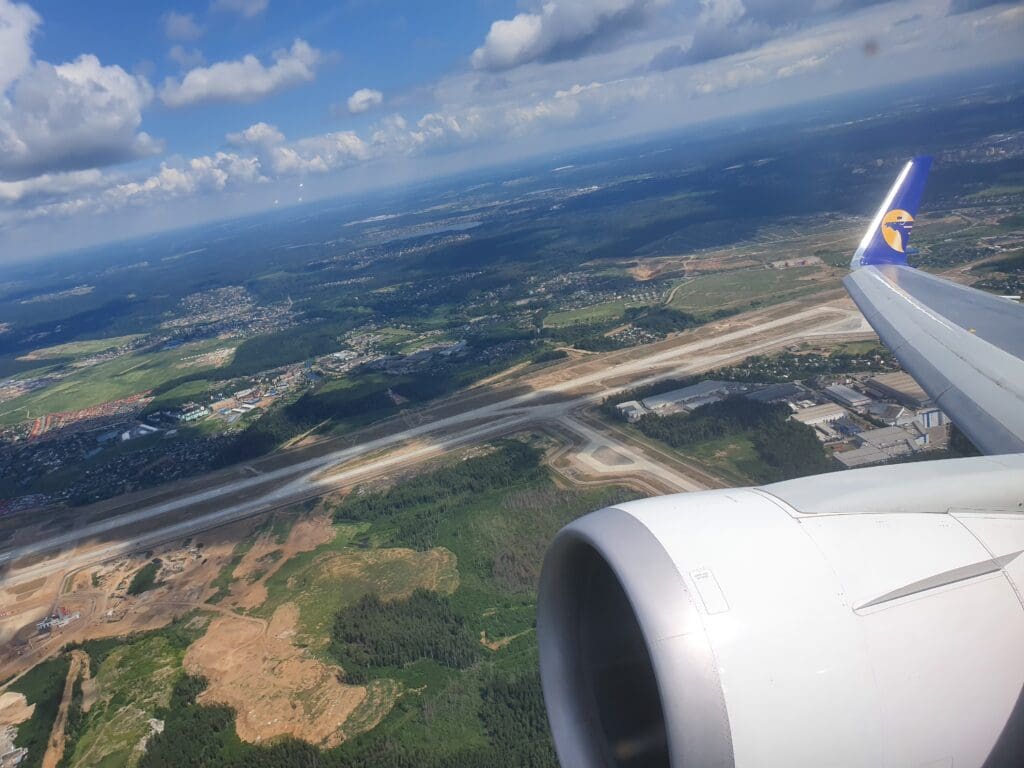
As the aircraft climbed, a good bird’s eye view of a selection of stored Aeroflot jets, the majority of which appeared to be Sukhoi Superjets, could be seen before the airport’s new runway came into sight. Interestingly, an engineless ex-Aeroflot Ilyushin Il-96 could be seen standing on the sole taxiway leading to this, perhaps in an attempt to guard this from any accidental departures. After leaving the airport behind, the aircraft shook a little before passing through a patch of clouds. Once through these, the seatbelt signs were extinguished at which point I drifted into a light sleep as the aircraft climbed up to its cruising altitude of 36,000 feet.
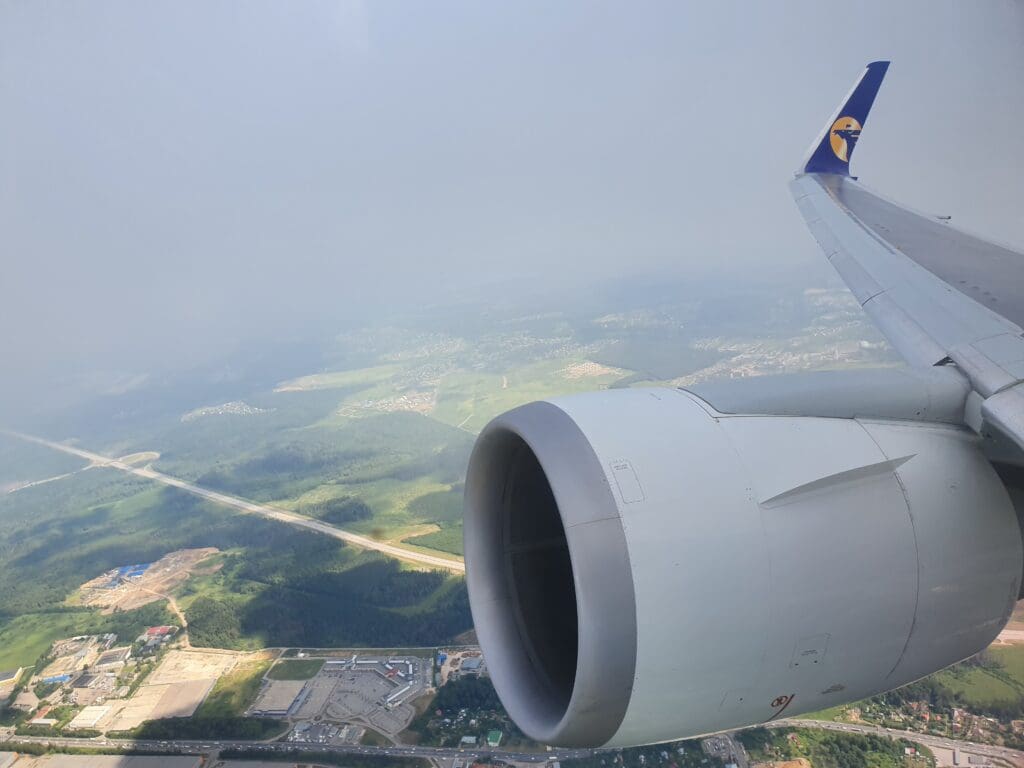
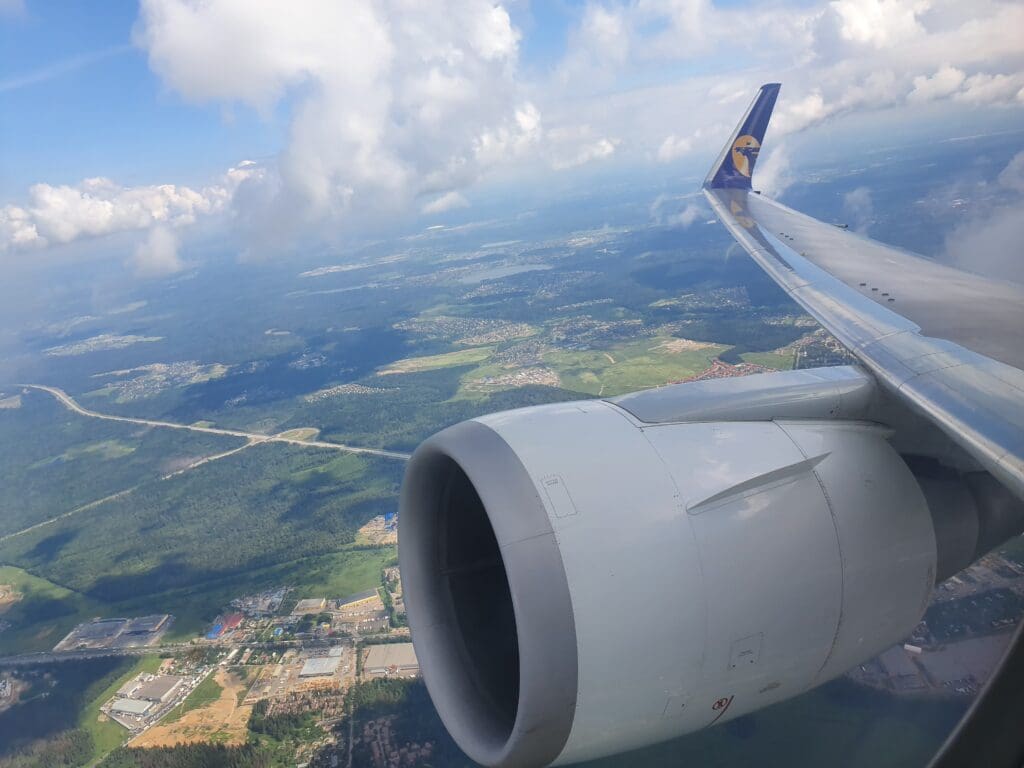

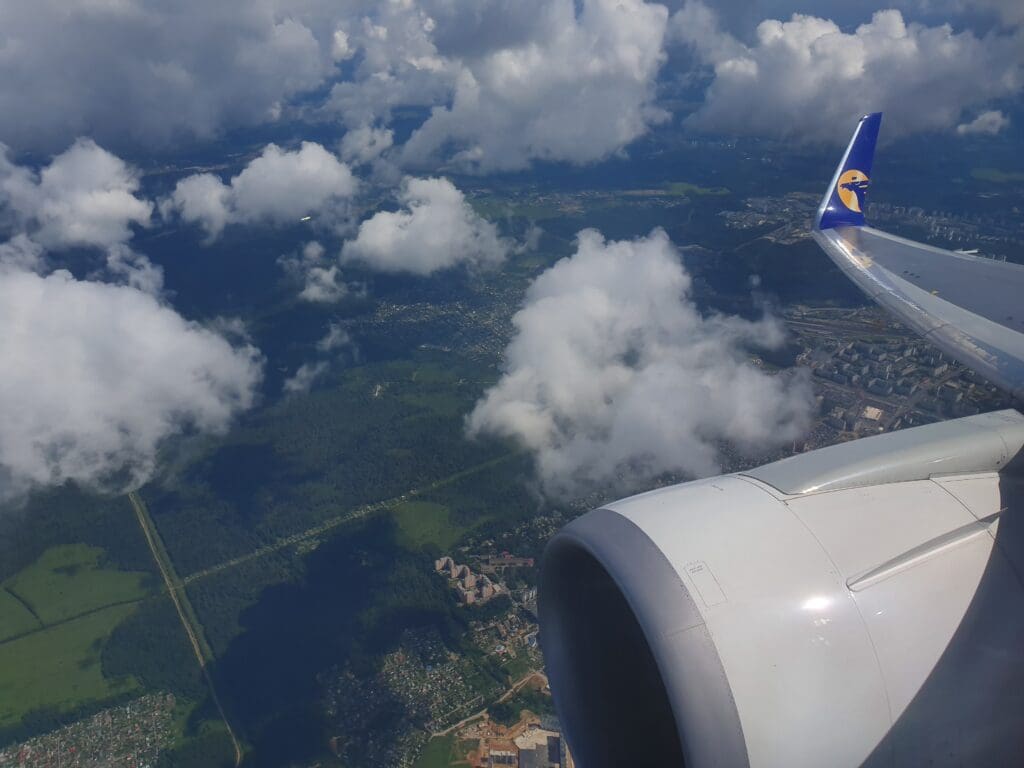
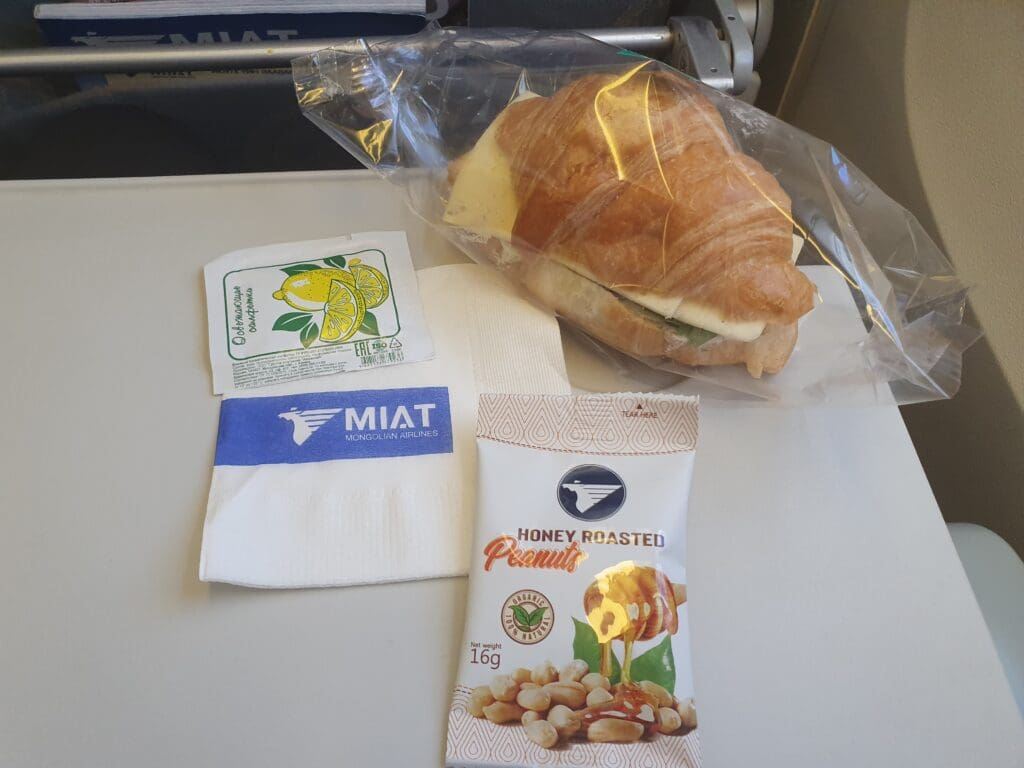
Fortunately, I coincidentally managed to wake up just as the flight’s light brunch service commenced at 1000 Berlin time. Sitting at the front of the cabin I ended up being one of the first passengers to be served. This time, I was handed another filled croissant (albeit containing a different filling of meat, cheese and gherkins), a packet of MIAT’s honey-roasted peanuts in addition to a serviette and a lemon-scented wet wipe. This was then followed by a round of drinks, and, being rather thirsty I requested both a coffee and an orange juice from the friendly flight attendant. As with my flight from Busan, hot beverages were served in a DIY style with passengers handed a cup of hot water along with a coffee sachet or a teabag. All in all, I was fairly satisfied with this service. Granted, it may not have been as plentiful as the offerings of many other East Asian airlines on their short-haul services, however, it certainly beat the offerings of many European carriers with similar flight times.
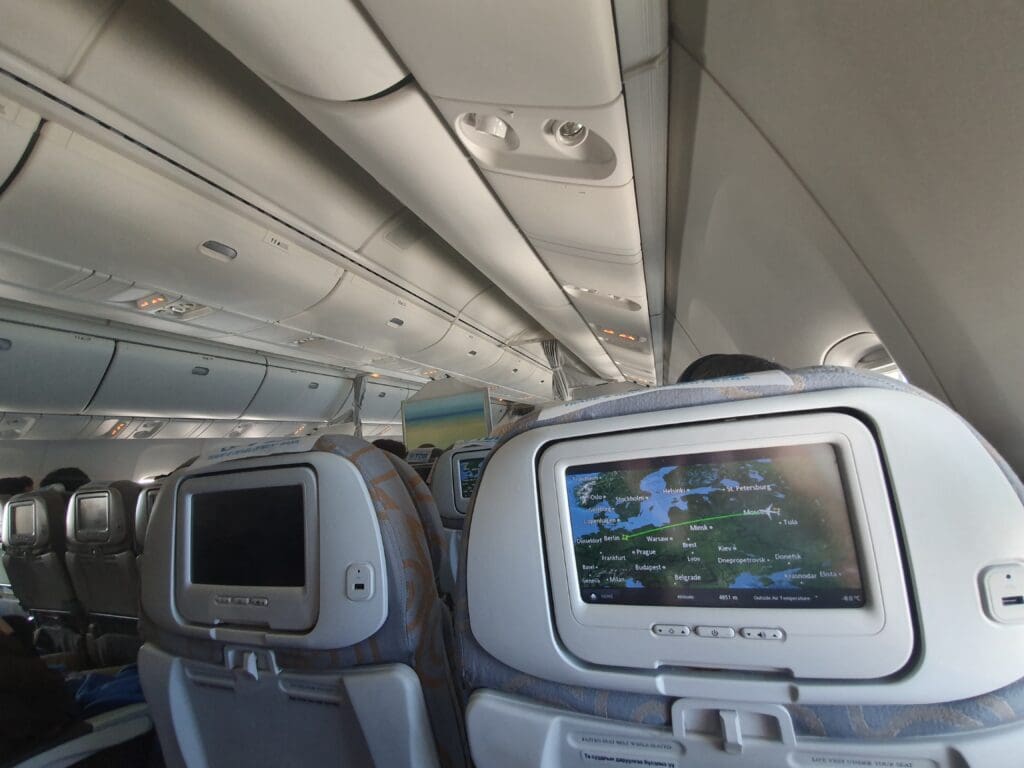
As the crew handed out drinks, some inflight drama occurred when the passenger next to me got rather annoyed when the crew failed to give him a whole 1.5-litre bottle of water, instead giving him two paper cups of this. Whilst I do not speak Russian, during the whole fiasco this passenger kept turning towards me and muttering several words in Russian. Eventually, the crew finally ceded to his demands and brought a small plastic bottle of water from Business. Turning to the flight’s progress, as with most flights between Moscow and destinations across Western Europe, after leaving the Russian capital, the Boeing 767 headed almost directly west before entering Belarusian airspace after passing Smolensk. However, unfortunately, by this tim,e thick clouds beneath the aircraft blocked any view of the ground beneath the aircraft during our 25-minute crossing of the country before heading into Lithuanian and then Polish airspace. Seeing as my excessive photo-taking was rapidly draining my phone’s battery, as the aircraft headed westwards I turned to the seatback USB port however unfortunately this did not seem to work.
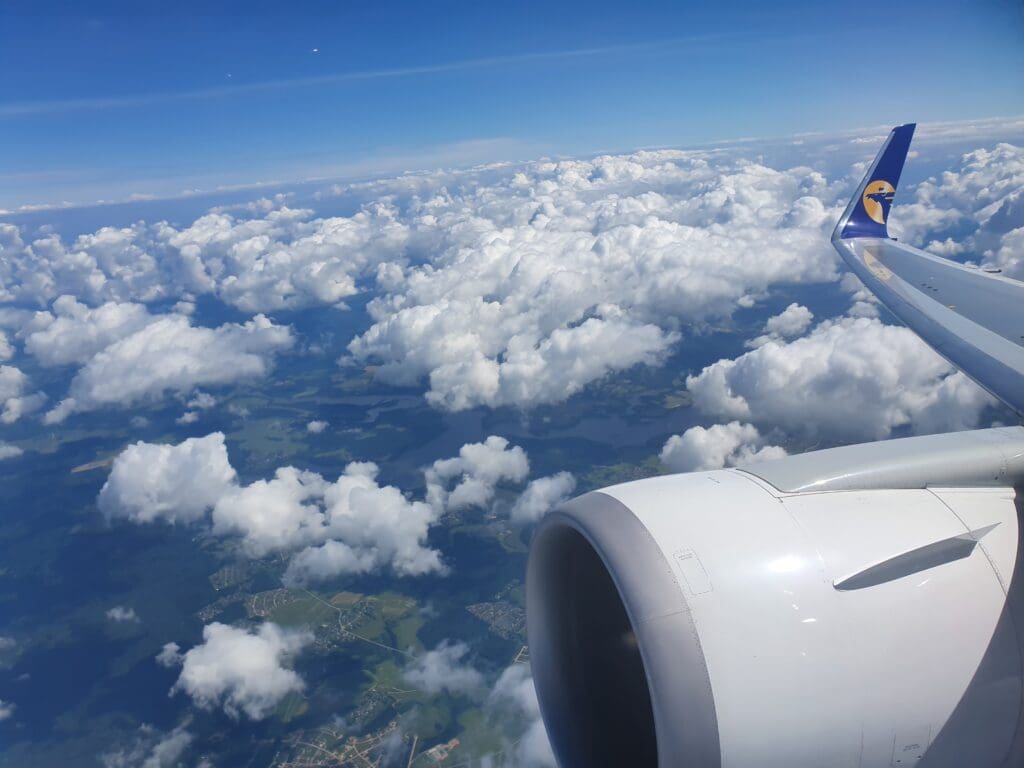
Fortunately, as the aircraft headed into Polish airspace, the clouds began to clear up a little revealing the green summer scenery 36,000 feet below the aircraft, although seeing as I spent much of the flight drifting in and out of sleep, I can’t comment too much on this. Around an hour and fifty minutes after taking off from Moscow with around 140 miles or 225 kilometres to go until Berlin, the aircraft could be felt gently commencing its descent over Poland’s Greater Poland region. As had been the case before the aircraft arrived in Moscow several hours previously, this was almost instantly followed by an automated announcement with the usual instructions regarding seatbacks, tray tables, window shades and seatbelts. Seeing as I would likely not get the opportunity to do so again, I decided to make one final trip to one of the aircraft’s lavatory. As had been the case prior to the aircraft’s arrival into Moscow, I found this to be in a clean and pleasantly acceptable state despite being at the end of the aircraft’s long journey over from Mongolia.
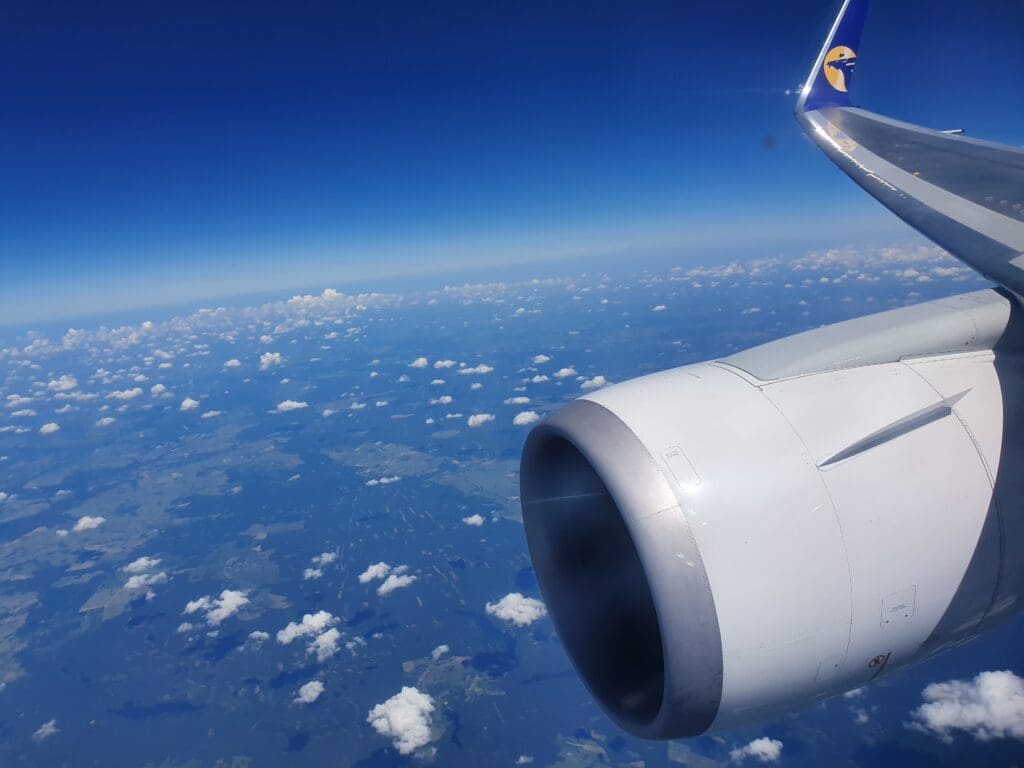
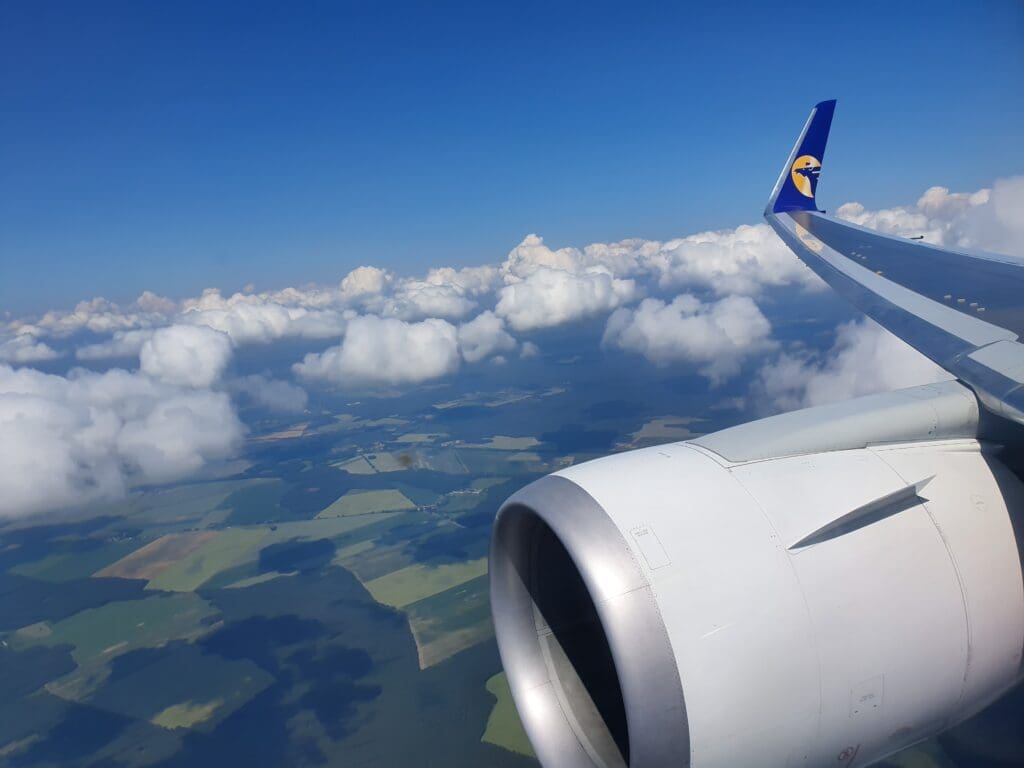
Upon returning to my seat the aircraft was still a fair way from landing with the green countryside of western Poland seeming to be some distance beneath the aircraft. Nevertheless at this time the crew could be seen passing through the cabin conducting their final pre-arrival checks, ensuring this was secure for the aircraft’s arrival. Turning my attention back outside, around fifteen minutes after the Boeing 767 had commenced its descent, the aircraft crossed over the River Oder which at this point in its course serves to mark the border between Germany and Poland. Once firmy over Germany’s equally green countryside, the aircraft made a gentle turn to the south prior to turning west again to set us on course for Berlin Tegel’s Runway 26R. As we headed towards the ground, the aircraft’s speedbrakes were partially extended followed by the flaps, meanwhile below a large and modern heliport, yet one that was devoid of helicopters could be seen passing by. Later research revealed this to be a helicopter base for the local squadron of helicopters operated by Germany’s Federal Police, located just to the northeast of Berlin.
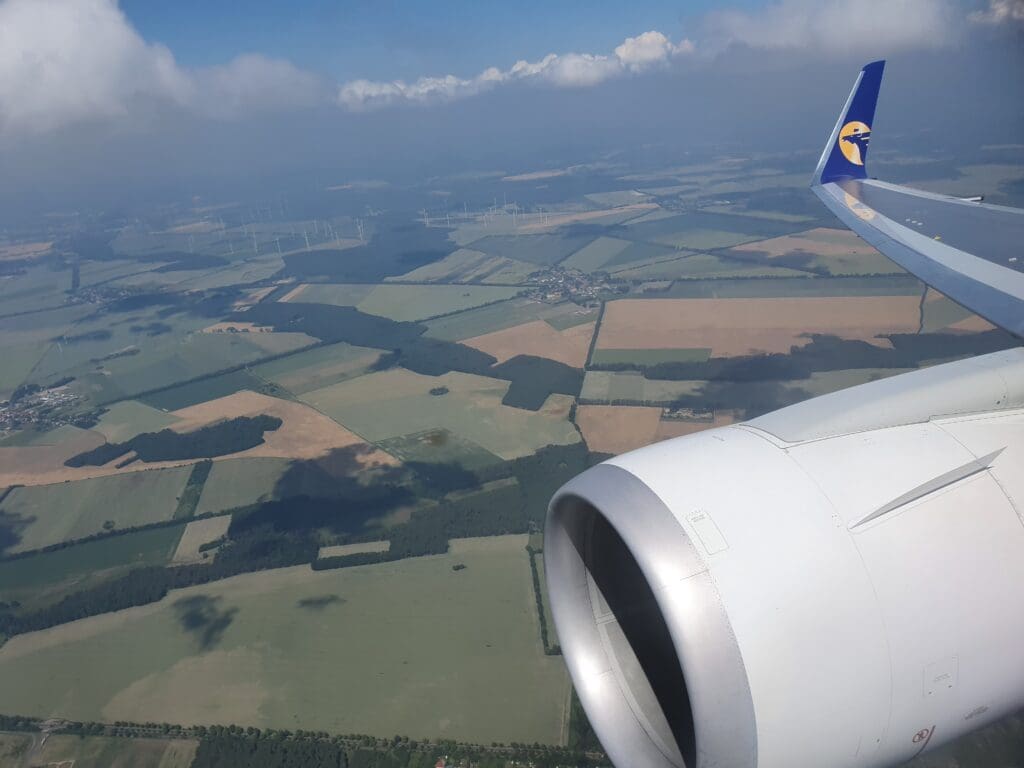
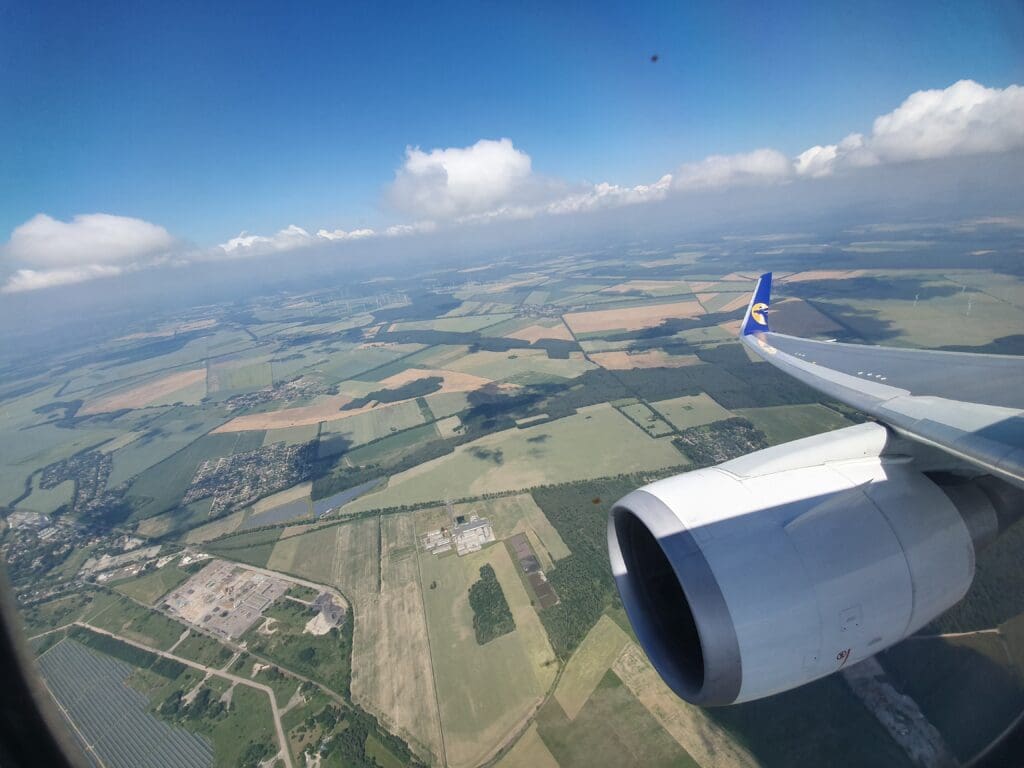
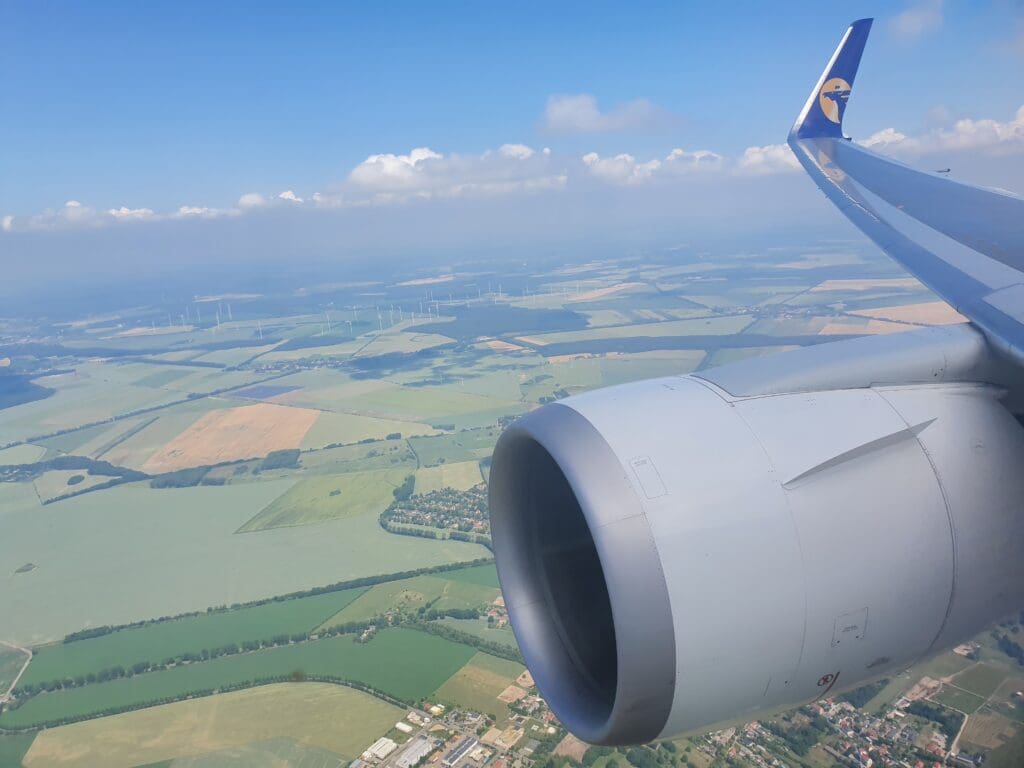
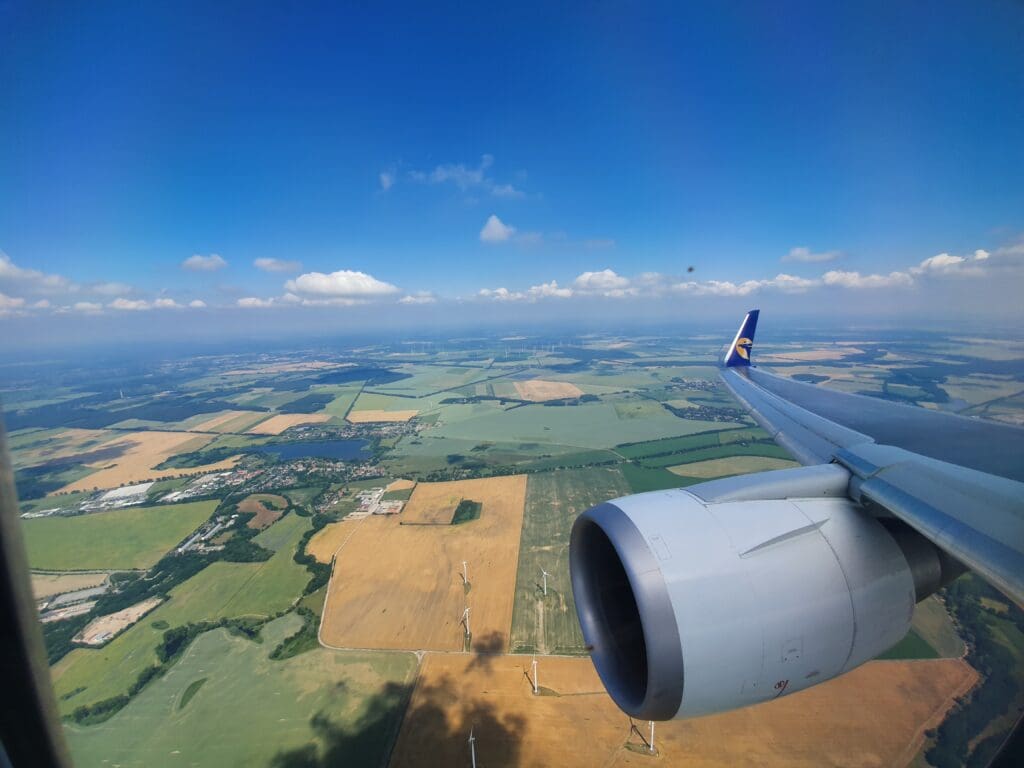
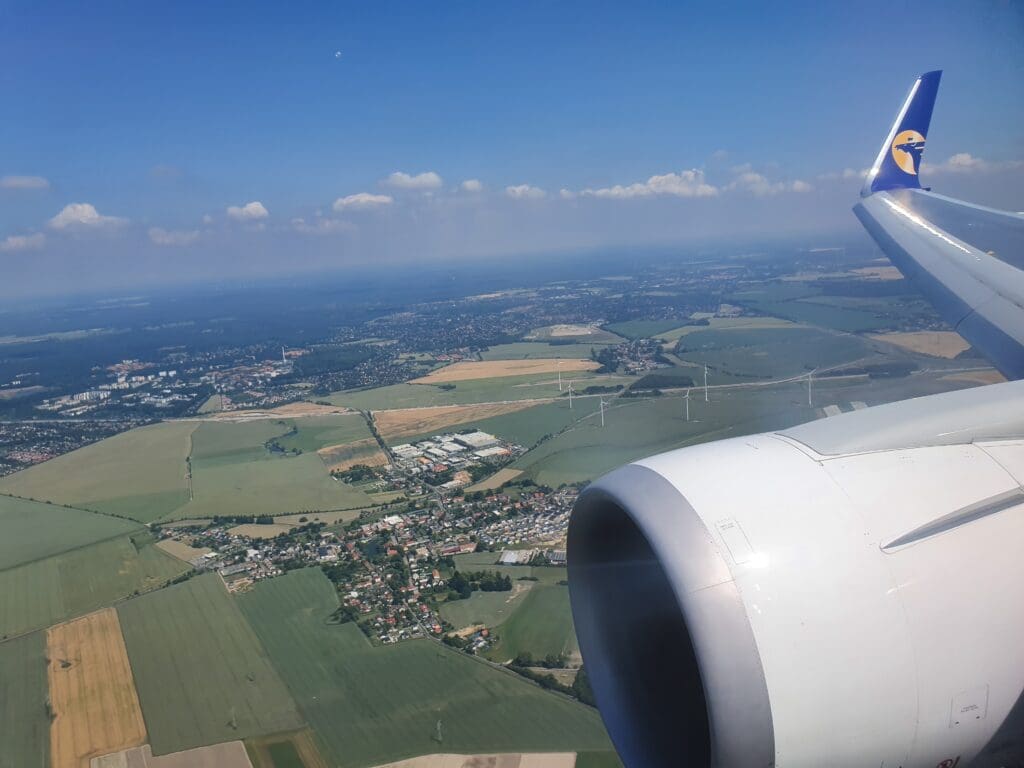
Before I knew it, the fringes of Berlin came into view and the aircraft sank down over some of the city’s leafy residential areas. Exactly an hour prior to my Zurich bound flight’s departure time and 2H14 after departing Moscow, at 1045 the Boeing 767 made a very smooth touchdown on runway 26R, contrasting with its bumpy landing in Russia. Funnily enough, as we slowed the first aircraft I spotted on the ramp was incredibly similar to the last aircraft I had seen at Ulaanbaatar that morning – a USAF Boeing C-17 Globemaster III. However, this particular example was based at Charleston AFB in South Carolina. Next to this stood Germany’s Air Force 1, a Airbus A340-300 named after Konrad Adenauer as well as a fellow Luftwaffe operated VIP aircraft, an Airbus A319.
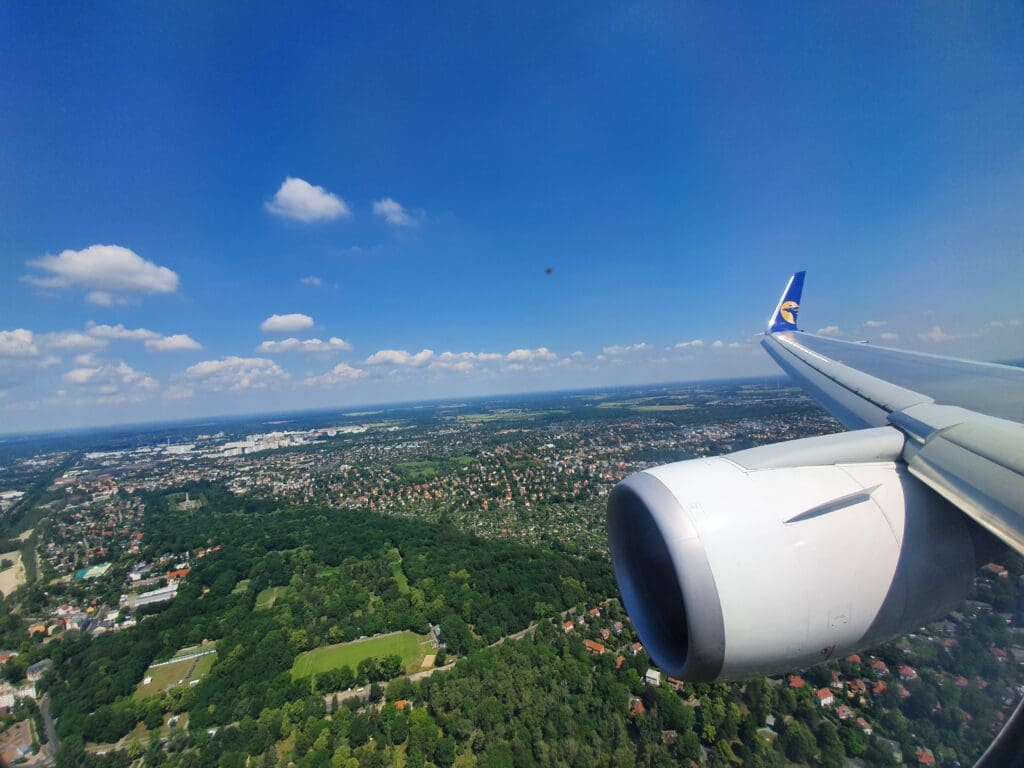
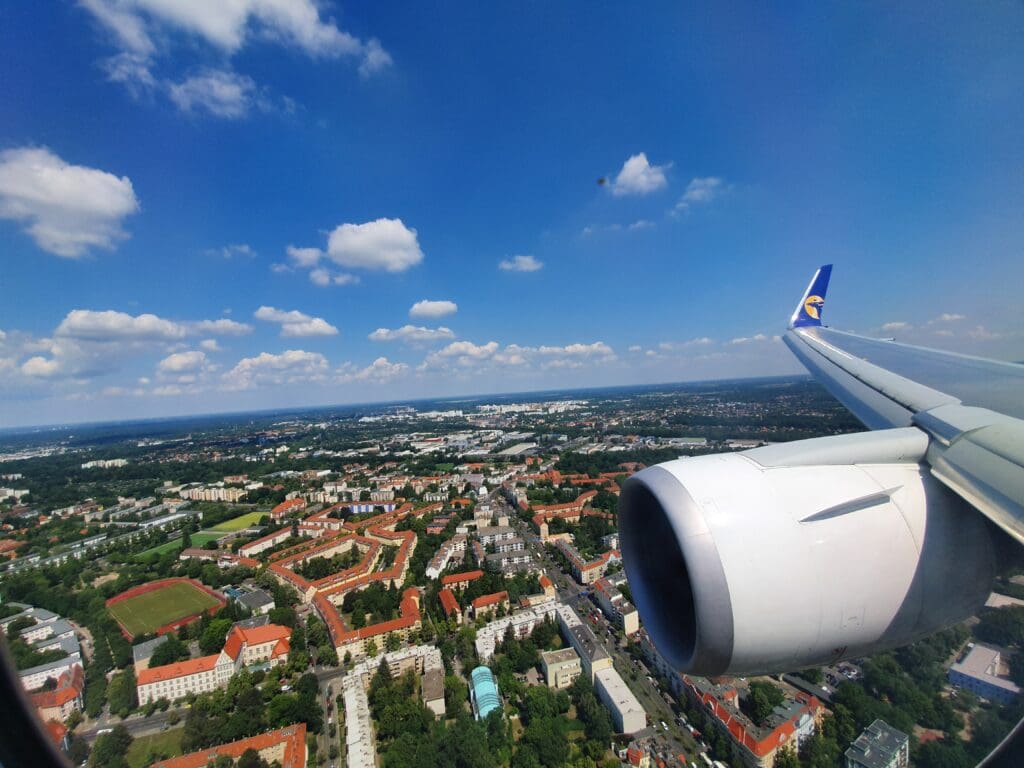
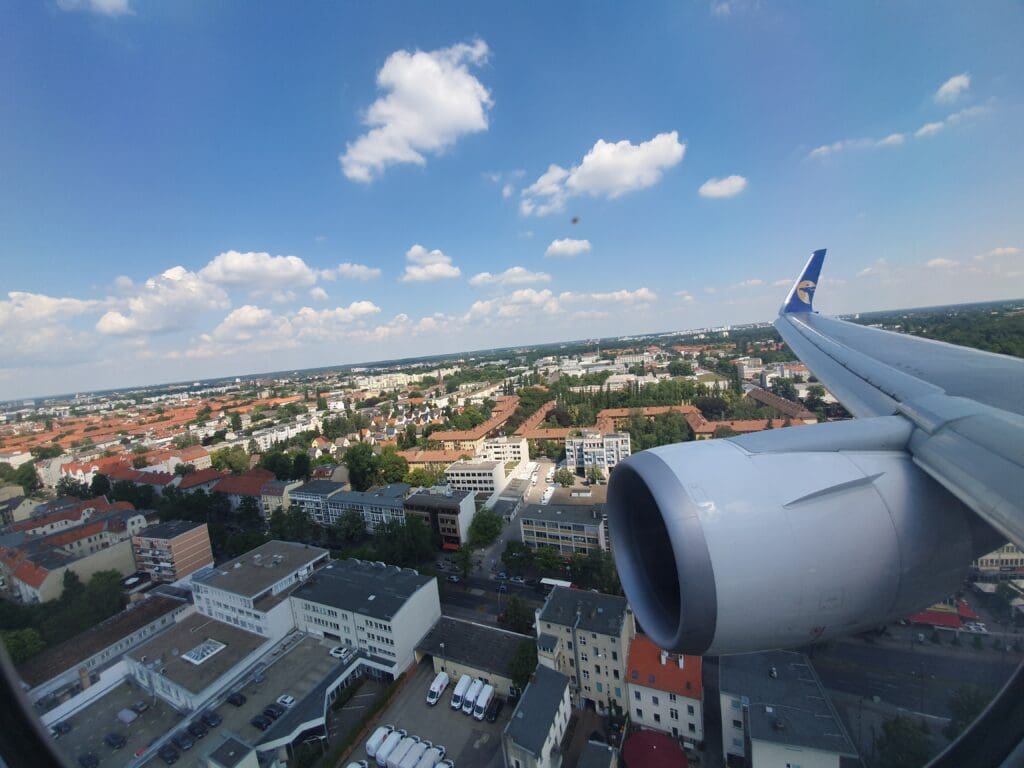
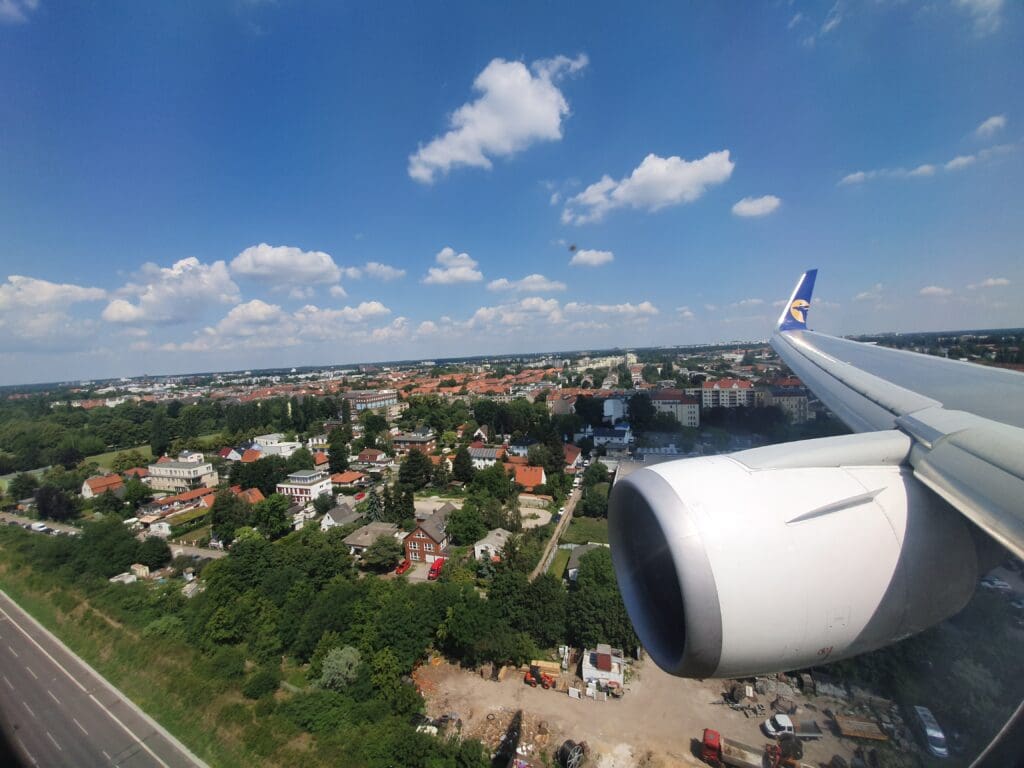
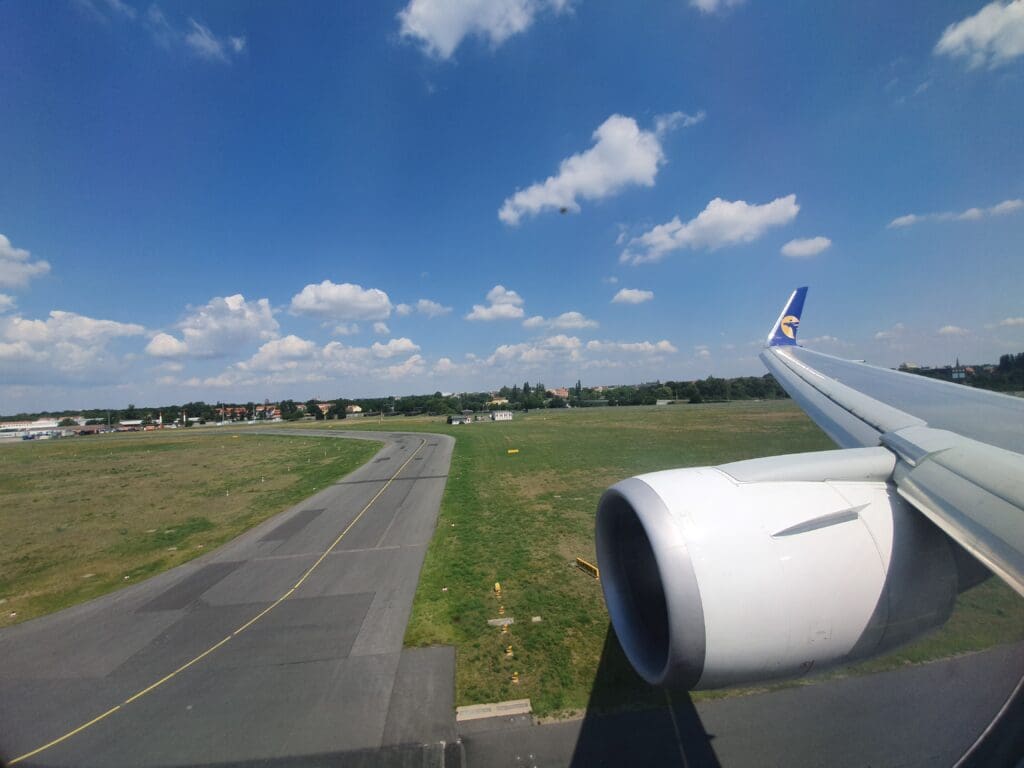
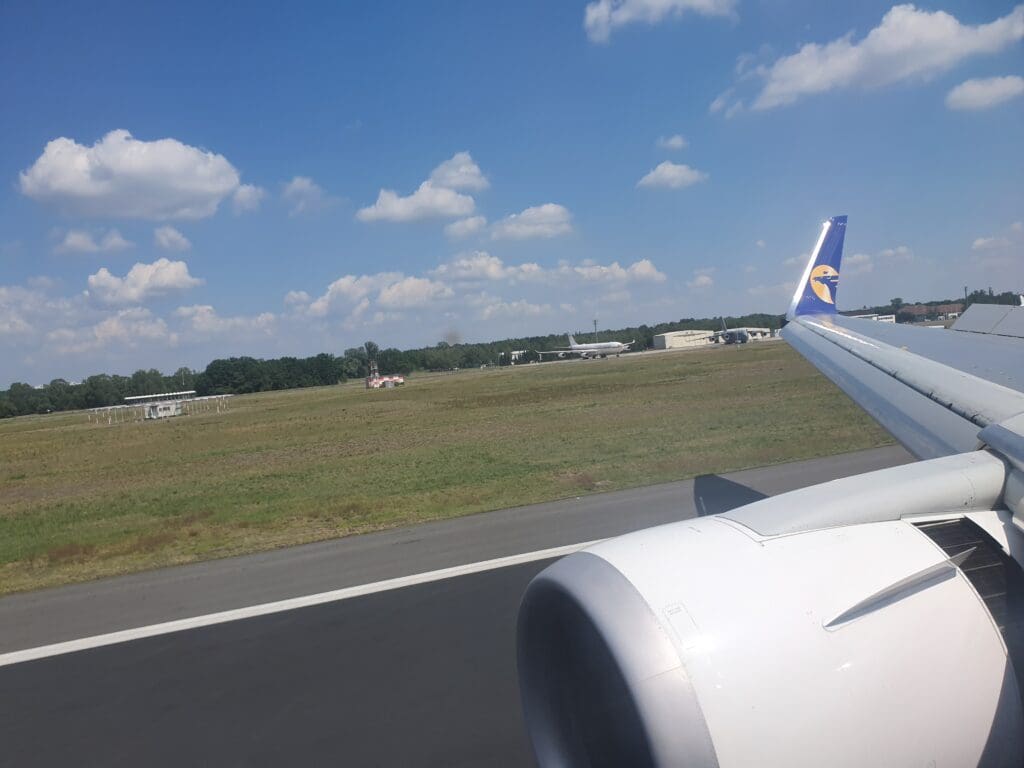
Following some gentle breaking, the purser welcomed all to Berlin in Mongolian and English, ending their announcement with an apology for the delay. At this point, despite realising the likelihood of missing my flight, I hoped that if immigration and baggage collection were quick, and the ground staff at Tegel were willing to allow me to take my fairly small suitcase onboard the aircraft as hand luggage, I would be able to make my onward flight. However, within a few minutes of our arrival, my heart sunk a little as, rather than taxiing up to the terminal, the aircraft turned right and slowly eased its way into remote Stand 27. In addition, it appeared as if the ground staff were not yet ready for our arrival as it took a grand total of ten minutes for the L1 door to be reopened and disembarkation to commence. Perhaps serving to further anger passengers at the aircraft’s late arrival, or to speed out disembarkation once this commenced, the same Taylor Swift song rang out loudly on repeat. Fortunately, just before a riot kicked off, at 1205 the L1 door was opened and disembarkation commenced. After thanking the crew once again, I headed down the airstairs and into the pleasant lunch time sunshine.
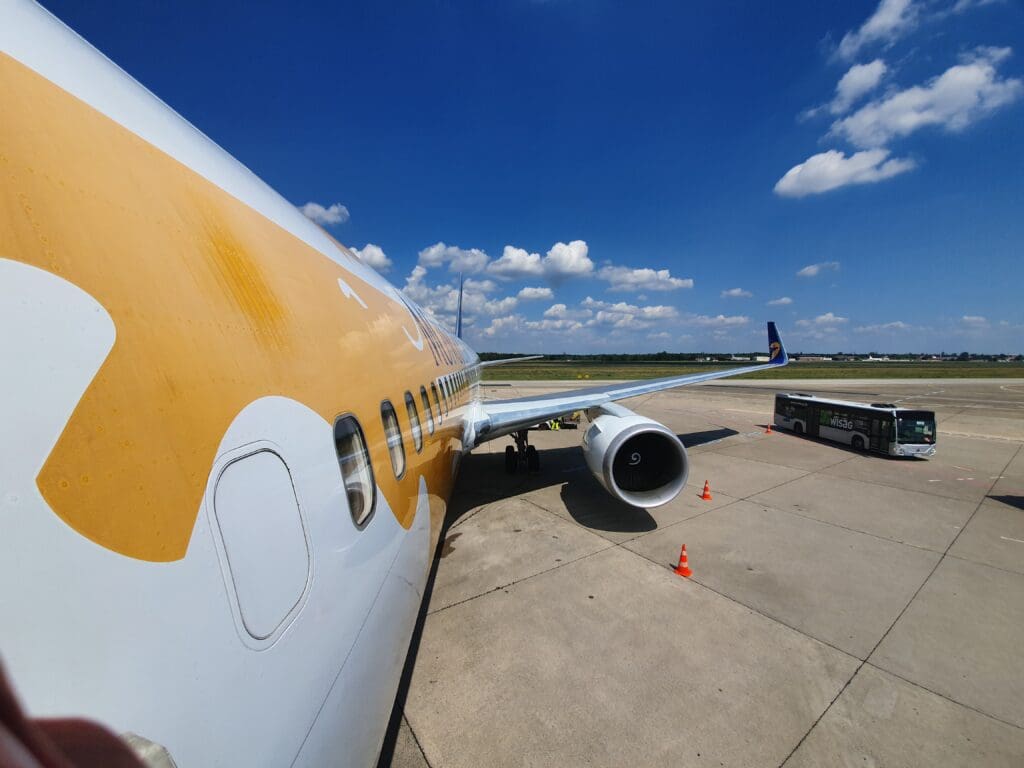
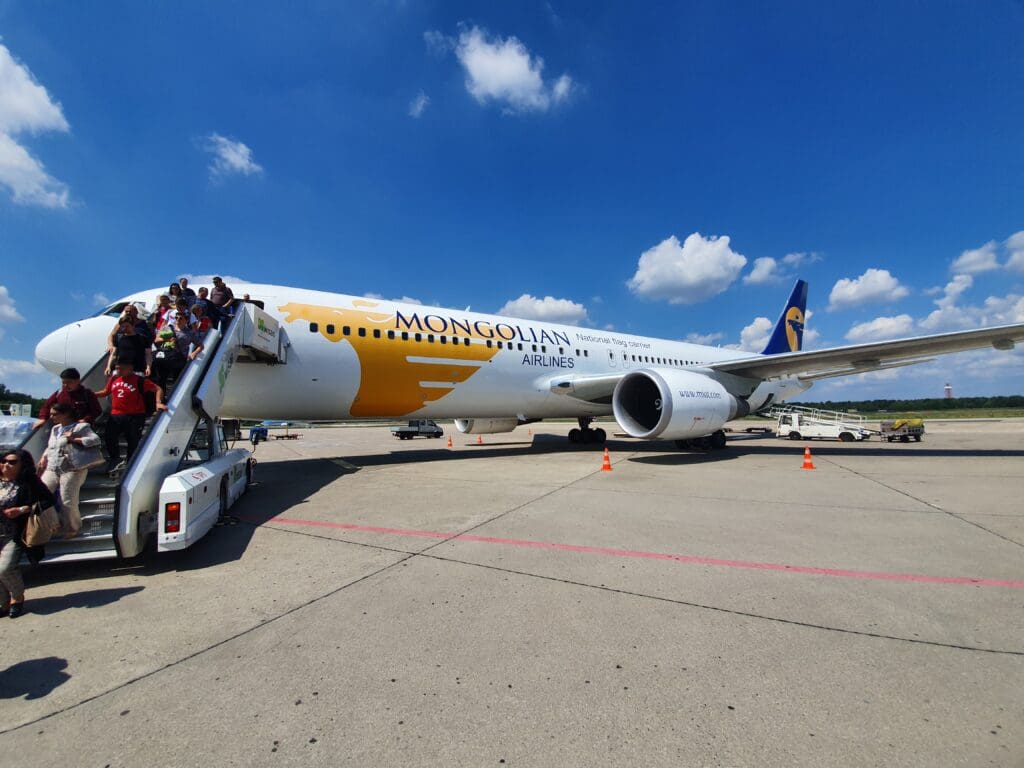
As I walked over to the awaiting bus, by coincidence I noticed the arriving Helvetic Airways Embraer 190 that I hoped would be able to take me to Zurich. Once the first bus was full, this was driven to the E arrivals area where I managed to promptly exit the bus and enter the small immigration hall. Whilst this soon filled up with long queues forming at immigration, I was able to walk straight up to a desk and after handing over my passport and having this scanned, I found myself in the very small baggage collection hall. Hoping for the prompt arrival of luggage, as time passed, no baggage emerged, with the first suitcases not arriving until 1230, by which time I was fairly certain that my chances of catching my next flight were slim to none. Nevertheless, once my bag did emerge, I grabbed this and made a quick walk through customs and up the stairs to the departure level where I proceeded to gate A07 where the Helvetic Embraer 190 could still be spotted. Following a quick security check I headed to the jetway where I was sternly told by a security guard that I had missed my flight. Thus, after being let through an emergency exit, I made my way over to Swiss’ ticket counter where I was told by a rather unfriendly agent that I would have to purchase a new ticket. Rather than paying a fortune to sample Swiss I instead headed for Skyscanner, purchasing the cheapest ticket to London that day, a Eurowings combination to Stansted via Cologne for just over 110 Euros.
Summary
When living in Korea, my spirit of adventure, lack of funds and passion for roundabout routings had seen me fly off on trips to Japan, the UAE and the UK with itineraries that involved an intermediate domestic flight in China with China Eastern and China Southern. On no fewer than two occasions, air traffic control delays in China ensured that I arrived at my destination around a day late. In both cases I was provided with nothing by means of food vouchers or compensation, however, each airline did provide basic overnight accommodation in Kunming and Shenzhen. MIAT on the other hand provided nothing more than a certificate to prove that the delay occurred, which failed to prove much held as my travel insurance provided would not compensate me for the hotel stay in Ulaanbaatar or the cost of alternative flights back from Berlin to London.
However, I should mention that MIAT’s ground staff in Ulaanbaatar all seemed to be working hard and were relatively friendly throughout the whole fiasco, this was particularly respectable given the hoards of angry and aggressive passengers they were forced to deal with.
Moving on to the flights themselves, neither the flight from Busan nor the service to Berlin featured anything that had been particularly notable. Whilst I did encounter friendly crew members, these were balanced out by those members of the crew who seemed to be rather cold and distant. The Boeing 737-800 and Boeing 767-300ER did not feature the most comfortable economy class cabins that I have sampled, however they were far from the most uncomfortable; plus, the inflight entertainment on the latter aircraft was somewhat appreciated. Moving on to the food, this was mediocre at best.
To summarise, ignoring the delay and the poor management of this, I found there to be nothing special about my experience with MIAT during the trio of flights I took with the airline. However, heading westwards, providing Mongolia’s only direct link to Western Europe, MIAT does provide both a convenient and important service. The only reasonable alternative to this without any major backtracking via Beijing or Incheon would either be Aeroflot or Turkish Airlines with a change of planes in Moscow and Istanbul respectively, plus a mid-flight stop in Kyrgyzstan for the latter’s services. Whilst I was happy to have finally had the opportunity to fly with MIAT and was pleased that I managed to do so at a reasonable rate, I would probably be unlikely to fly with the carrier in the near future.