A Mediocre A350 Ride: Beijing to Dubai on Air China
Following two hours spent cooped up inside the surprisingly battered cabin of an Air China Boeing 737-800, my first ride with the airline came to an end as we cautiously pulled into Stand 524 near one end of Beijing Capital Airport’s Terminal 3. Whilst my first-ever ride with Air China failed to leave an overly positive impression, I was hopeful that my experience onboard one of their latest widebody aircraft would fall more in line with expectations. Arriving at the gate twelve minutes ahead of schedule, and already with a connection time of two hours and ten minutes, I was in no particular rush. Thus, unlike many passengers, I decided against flocking to the aisle as soon as we came to a halt. Fortunately, with Air China’s ground operation appearing to be a well-oiled machine, the jetbridge was soon connected, and disembarkation commenced no more than three minutes after arriving on stand. Once the queue in the aisle began to move, I stood up, retrieved my bag and made my way through the messy cabin before thanking the two flight attendants in the forward galley.
From the aircraft, I trundled along the well-polished walkway standing above the departure gates and cutting through the modern surrounds of Terminal 3. Within a few minutes, I arrived at the checkpoint where international transit passengers are sieved off from those ending their journeys in China. Two weeks earlier, I had experienced a smooth, efficient and largely queue-less transit experience in Beijing’s newest hub, Beijing Daxing Airport. Given Terminal 3’s importance in connecting Beijing and, indeed, China with destinations across the world, I was hopeful of a similarly hassle-free transit experience. However, it soon became evident that things were not to go quite as smoothly.
Unlike the strict and regimented affair at Beijing Daxing, upon making it to the checkpoint, I was greeted by a line of boarding pass gates, next to which the single staff member tasked with supervising these could be seen sitting at a desk and playing with their phone. Fortunately, my Seoul-issued boarding pass enabled me to pass through the gates; however, once through, I found myself stuck in a no man’s land between the automated gates and the security entrance. With the security checkpoint appearing to be completely shut and with this area featuring absolutely no staff nor any passengers, I seemed to be well and truly stuck! With no other choice, I managed to head back and attract the attention of the game-playing staff member by gently knocking on the frosted glass partition screen that now separated me from them. They then entered the no man’s land and went behind the scenes, summoning the young quasi-military uniform-wearing security team who appeared to be on their break. Whilst thankful that I was making progress, I then had to wait for about five minutes whilst they opened up the checkpoint and logged into their computer system. Eventually, once logged in, a gloomy-looking staff member scanned and stamped my boarding pass and checked my passport before I continued onwards to the security check. As is usually the case in China, this was a rather thorough check, however, having already separated my electronics, liquids and battery pack, I was able to pass through this without the need for any additional checks.
Beijing Capital Airport’s Terminal 3 was designed by Sir Norman Foster and opened in the run-up to the 2008 Beijing Olympics, making it around sixteen years old at the time of my trip. Designed to be a cutting-edge hub and play a major role in connecting China with the world, this is definitely one of the more architecturally impressive terminals that I have had the pleasure of passing through. Inside, this is bright, modern and spacious, whilst large floor-to-ceiling windows allow light to flood in, whilst high ceilings create a cavernous aura. Taking some inspiration from traditional Chinese architectural styles, plenty of reds and golds can be seen throughout the terminal, whilst the roof was designed to resemble the scales of a dragon. Meanwhile, a traditional pavilion and pond can be found in the heart of the terminal, although, admittedly, this did not come close to Beijing Daxing’s outdoor garden!
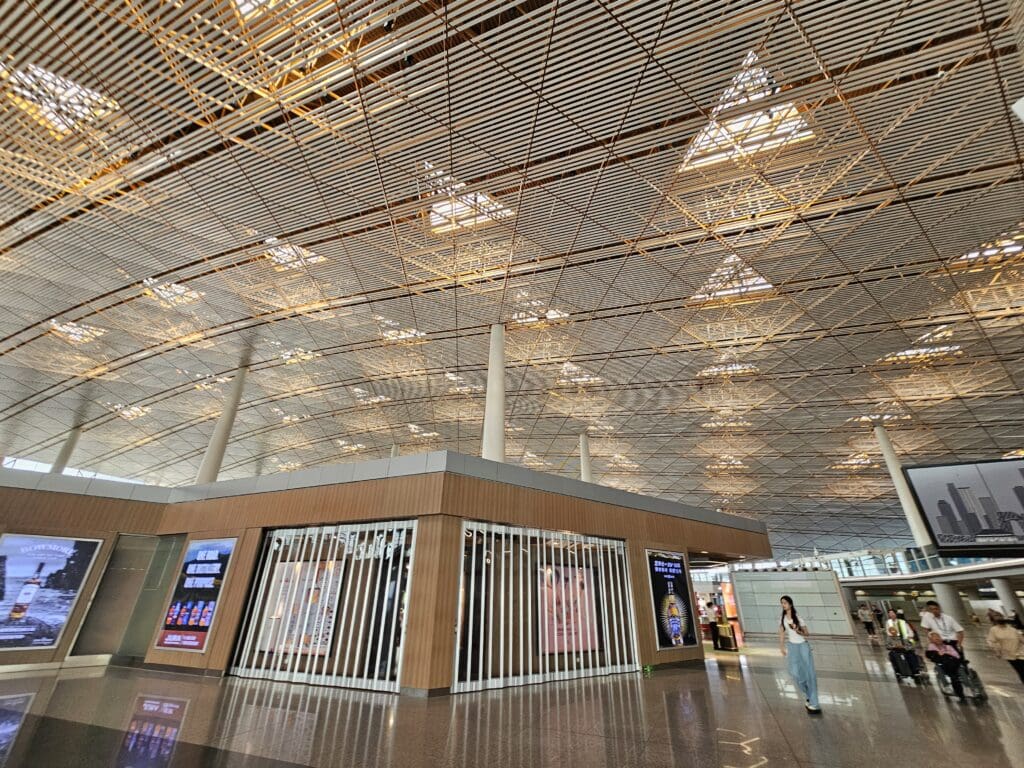
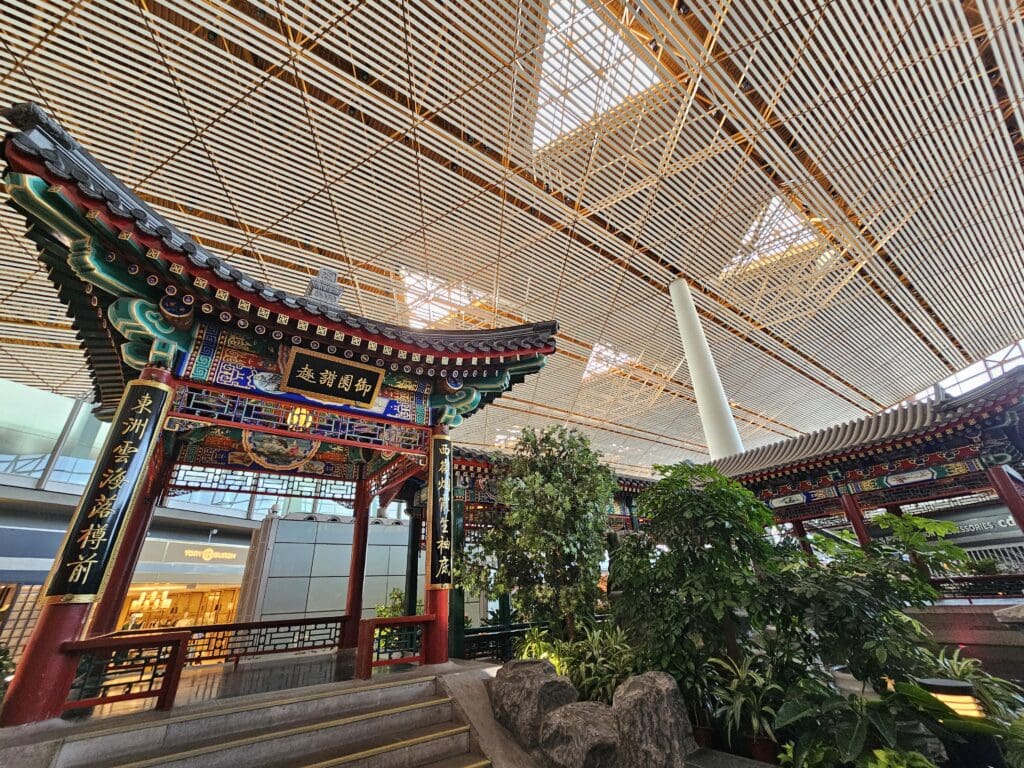
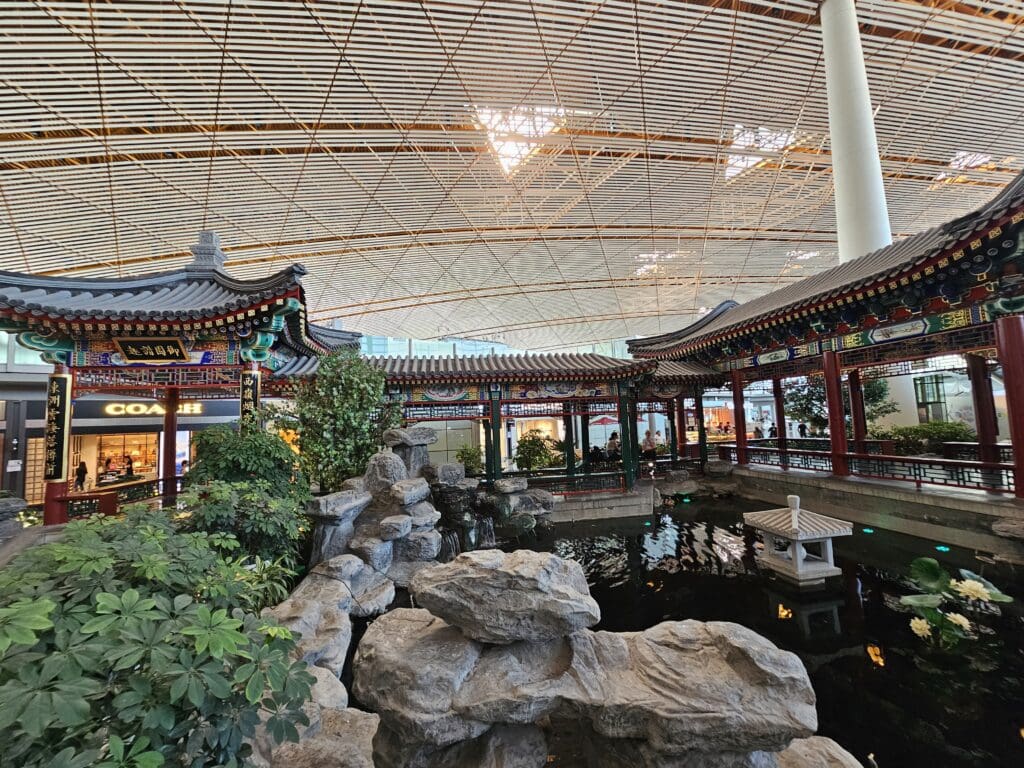
Being the main hub for one of the world’s largest airlines, Terminal 3 is humongous and has a floor space of around a million square metres, accommodating up to 82 million passengers annually. As of 2024, this makes it the world’s fourth-largest airport terminal. Thus, as was to be expected, there was no shortage of shops, cafés and restaurants – with both Chinese and international brand outlets offered throughout, many of which had a clear focus on luxury goods. Of course, prices at most, if not all, outlets seemed to come with the usual airport markup and for those on more of a budget, like most public places in China, plenty of hot and cold water dispensers could be found for those with their own bottle.
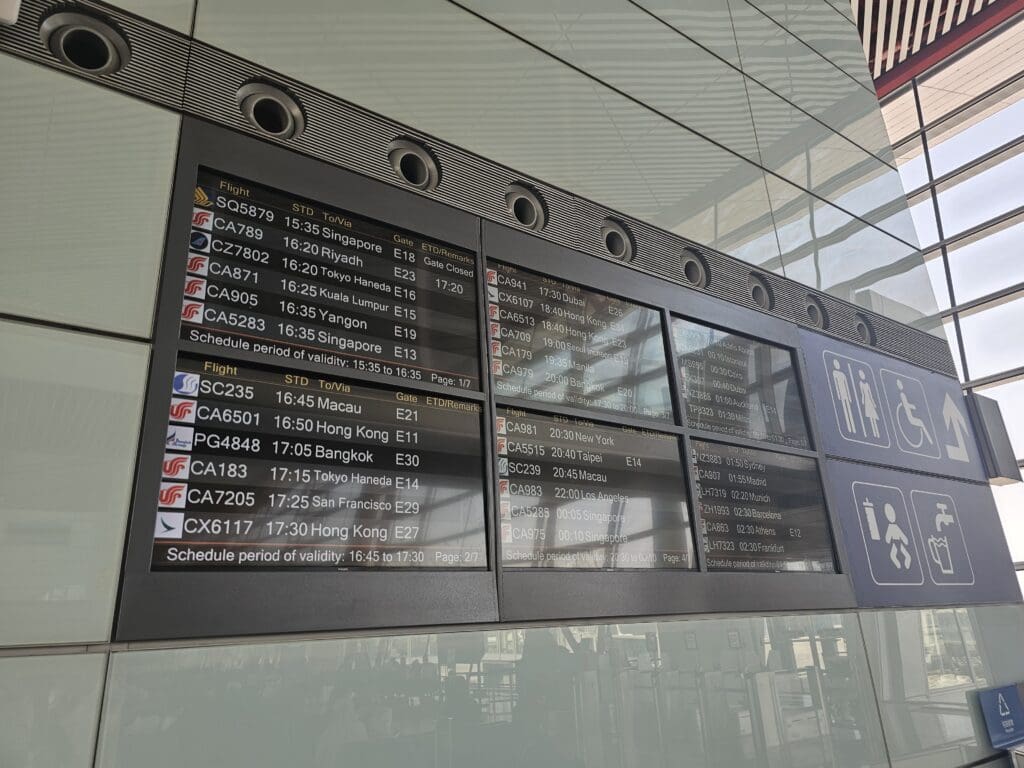
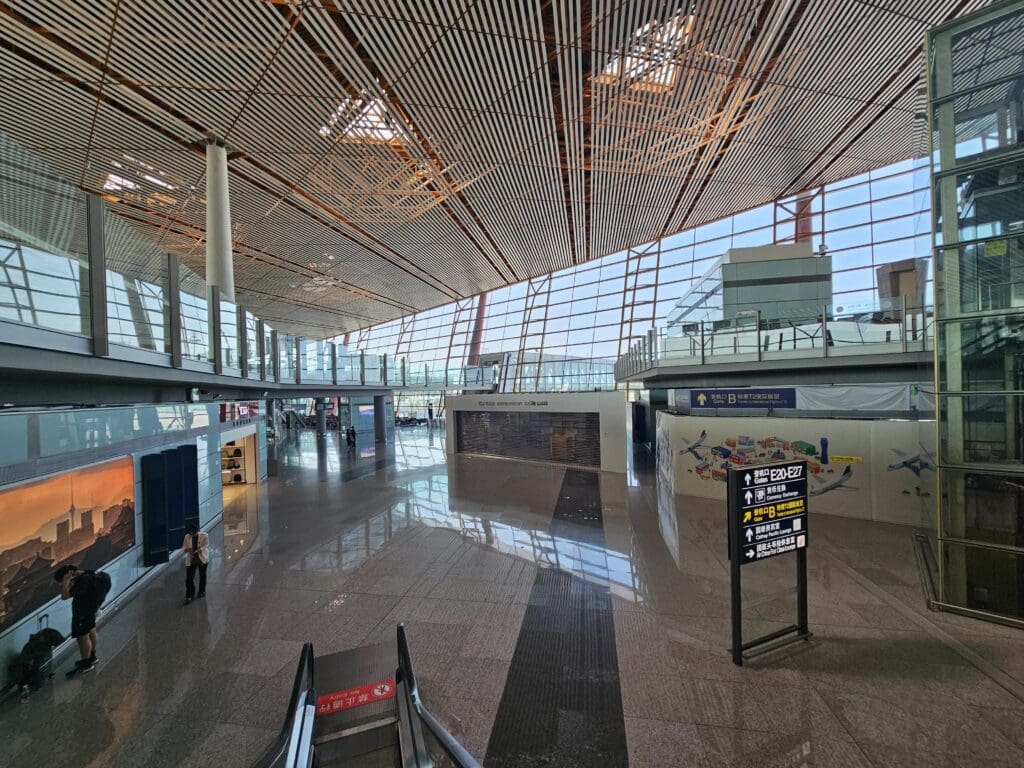
As I explored the terminal, for the most part, everything seemed to be clean, tidy and well-polished, with an army of near-omnipresent cleaners diligently working away across the terminal throughout my stay. However, as I have previously found with many Chinese airports, I was disappointed to find that this cleanliness failed to extend to the toilets, some of which were in a rather poor condition. When it came to staying connected, passengers could connect to the complimentary wifi network by providing either a Chinese phone number or a photo of their passport’s photo page. However, seeing as I kept getting a suspicious page warning when I attempted to submit my details, I decided to remain incommunicado with the outside world for the duration of my stay. Returning to the positives, working plug sockets could be found throughout the terminal whilst a range of different seating types was on offer, including your more orthodox airport benches, sofas and comfortable recliners. Furthermore, despite the constant stream of departures, the terminal never seemed to get particularly busy, and thus this proved to be a rather pleasant and largely quiet place to wait.
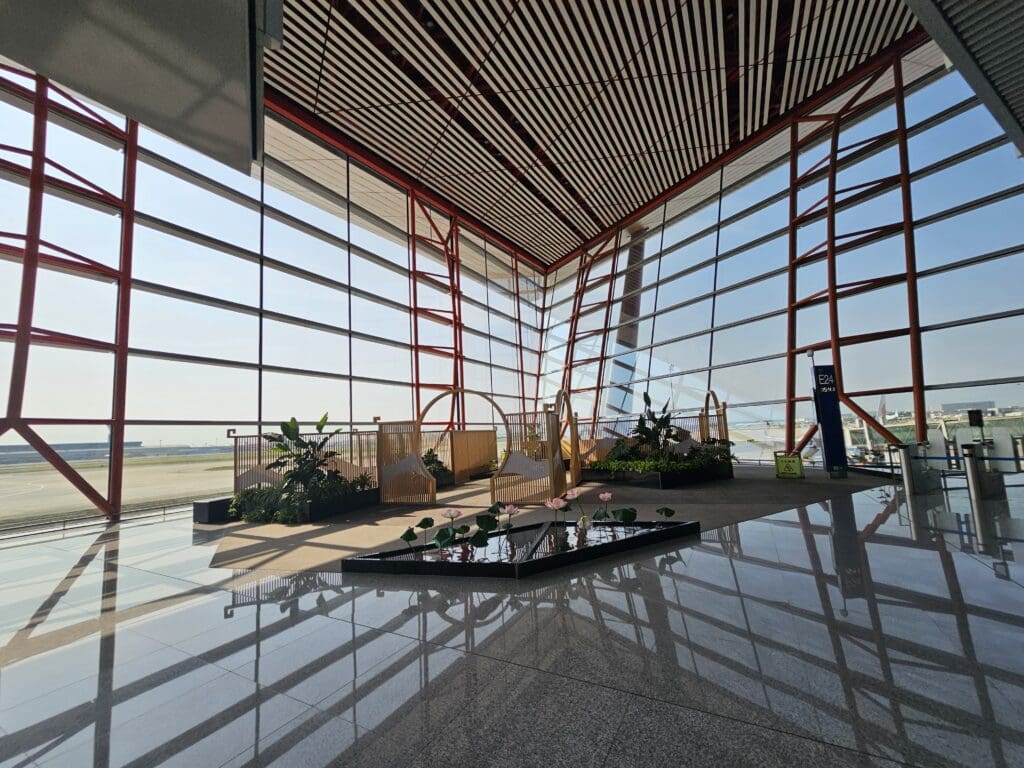
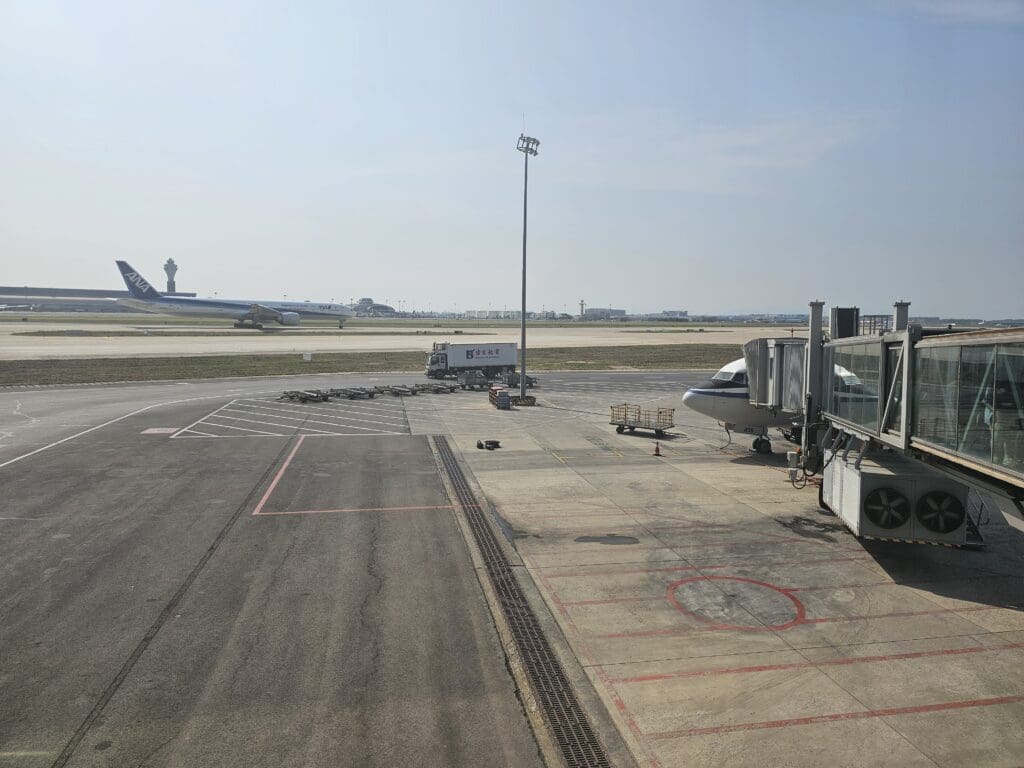
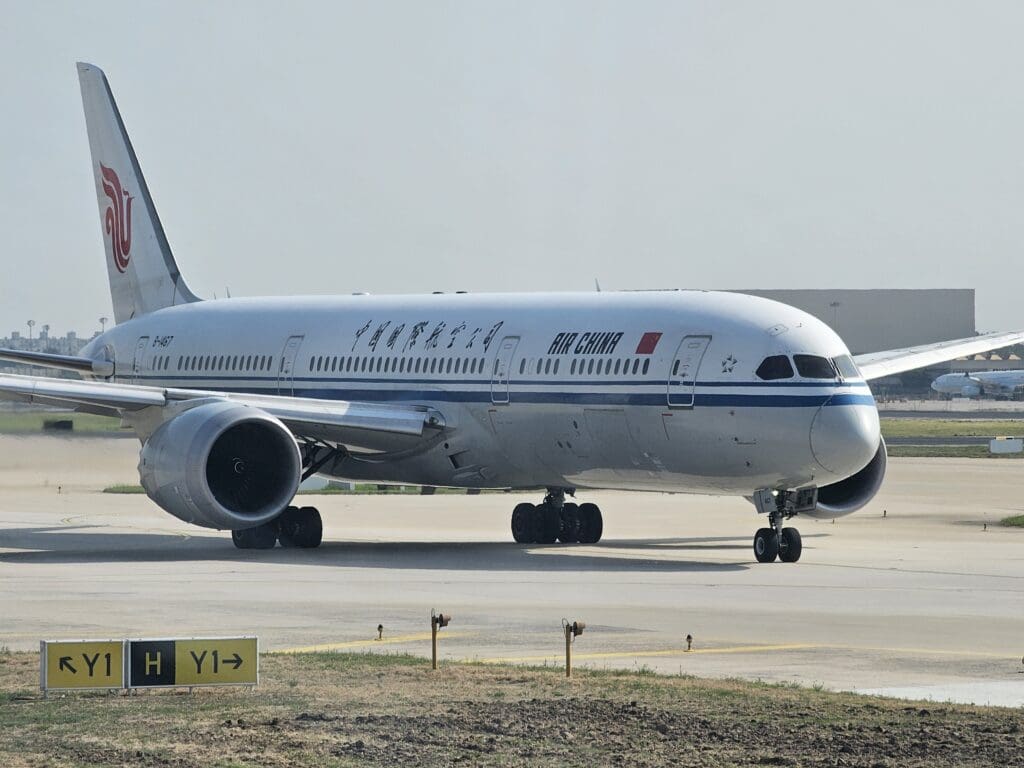
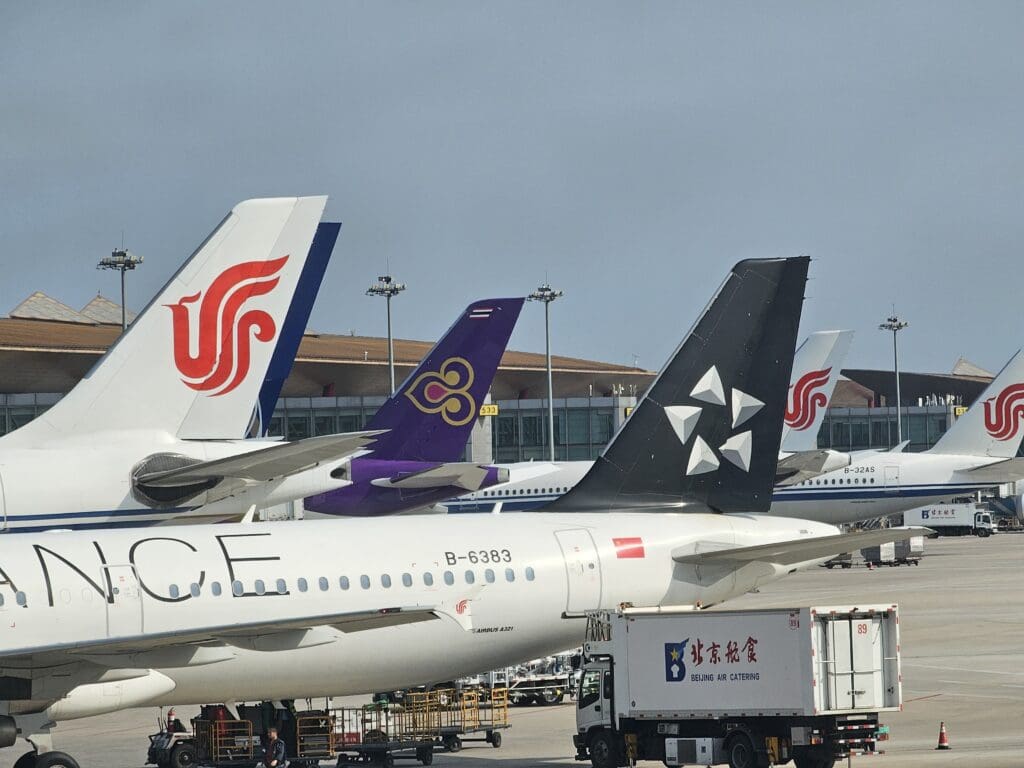
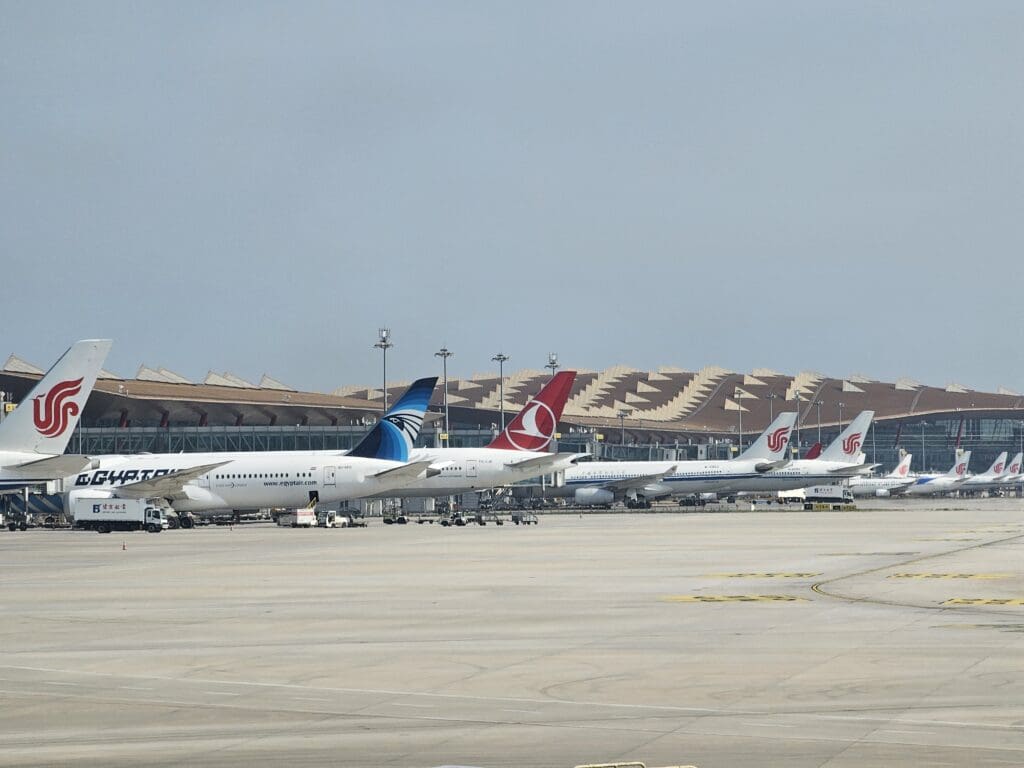
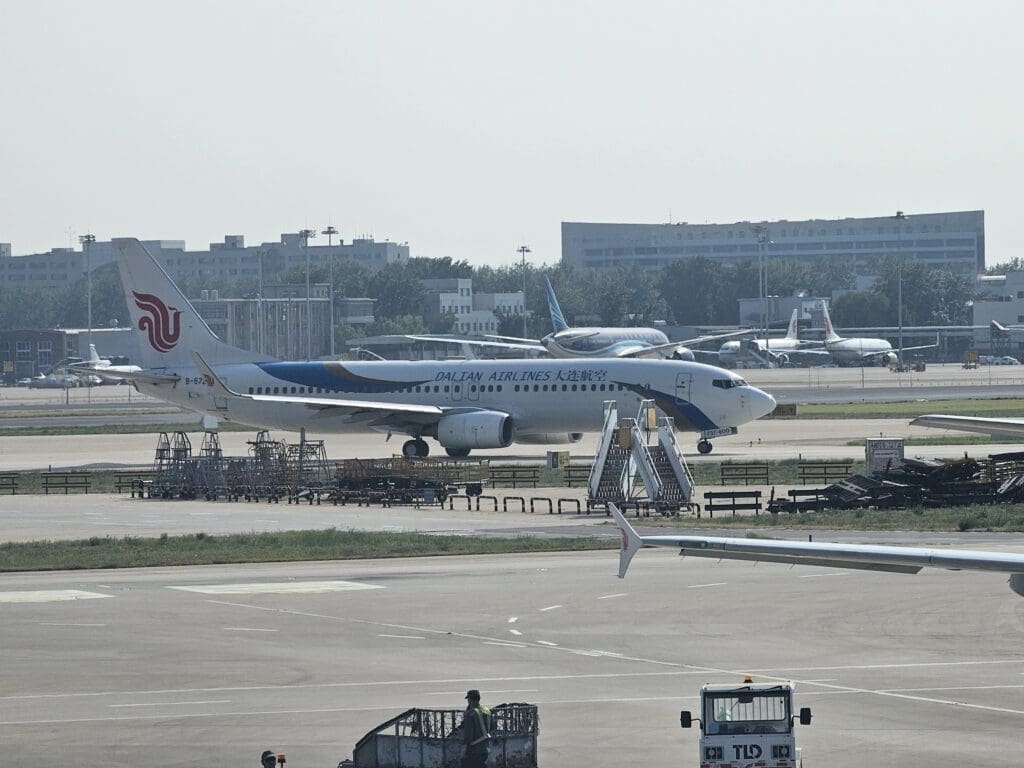
After spending a good twenty minutes wandering around the terminal, I made my way to the spacious relaxation area at the end of the E pier, which offers superb vistas of the non-stop stream of movements outside. Needless to say, Beijing Capital Airport is a paradise for fans of Air China, and during my stay I managed to spot every single aircraft type in the airline’s fleet, ranging in size from the locally manufactured ARJ21, right up to the massive Boeing 747-8. Alongside these locally based jets, I also saw plenty of aircraft from airlines across the world, including examples from ANA, Asiana Airlines, Azerbaijan Airlines, Cathay Pacific, China Eastern Airlines, Dalian Airlines, EgyptAir, Emirates, Hainan Airlines, Mahan Air, Shandong Airlines, Thai Airways International, Tibet Airlines and United Airlines. All in all, I soon concluded that Terminal 3 is a fantastic place to plane spot, and importantly, nobody seemed to take issue with me wandering around and snapping photographs of the diverse selection of aircraft outside.
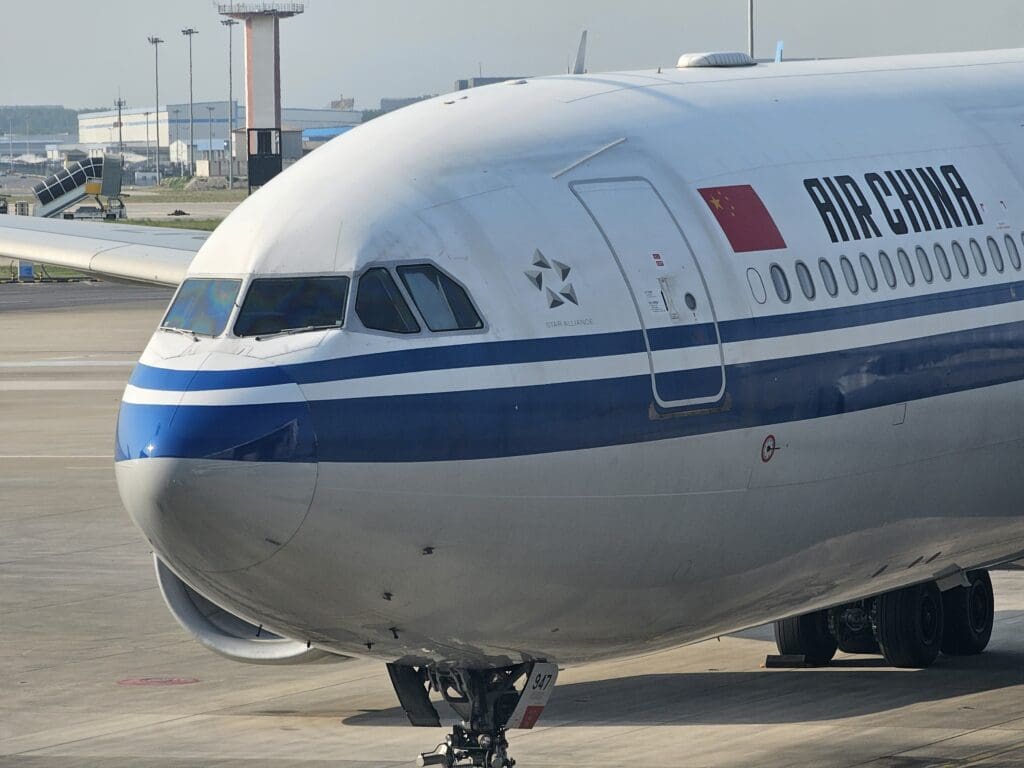
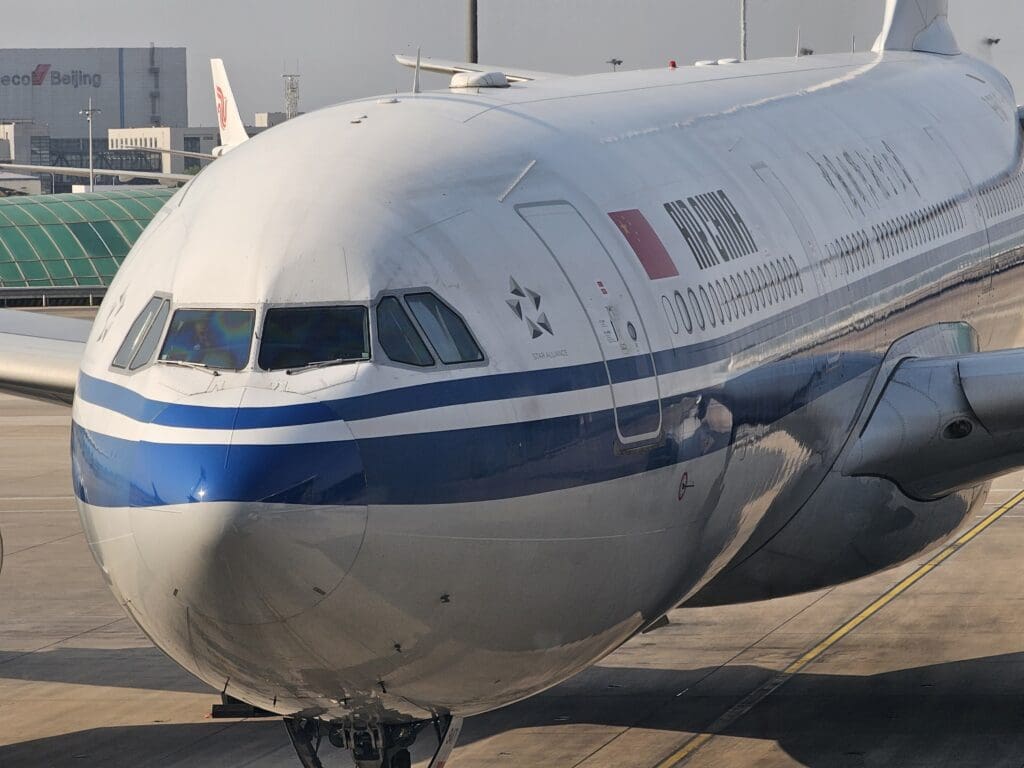
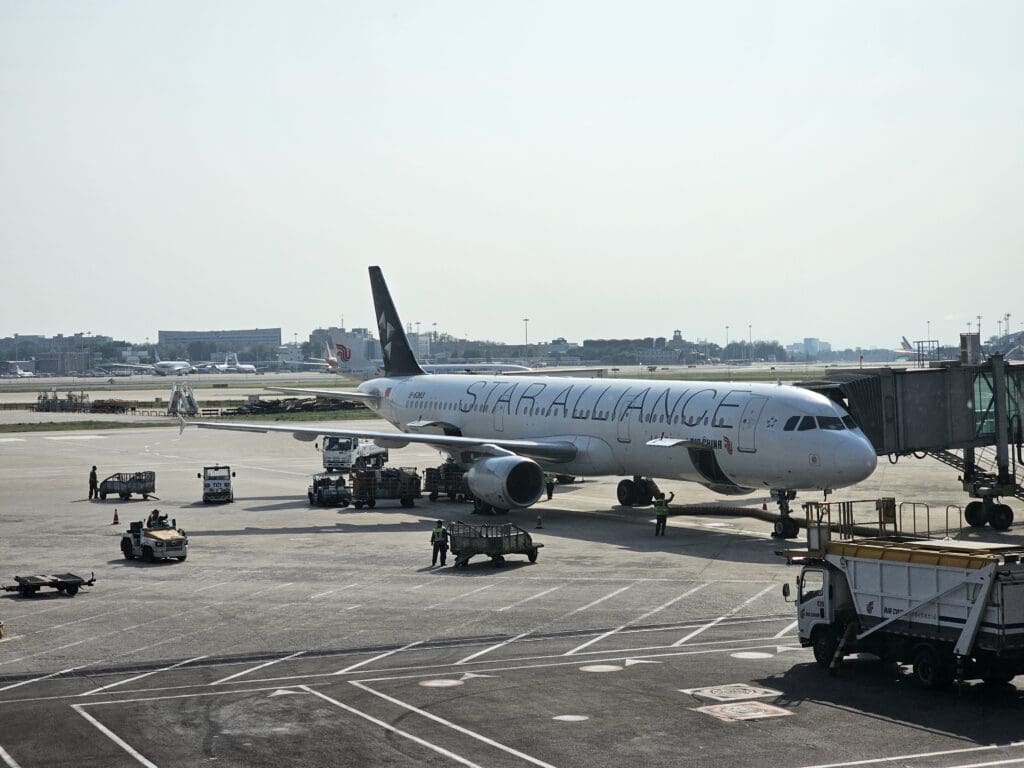
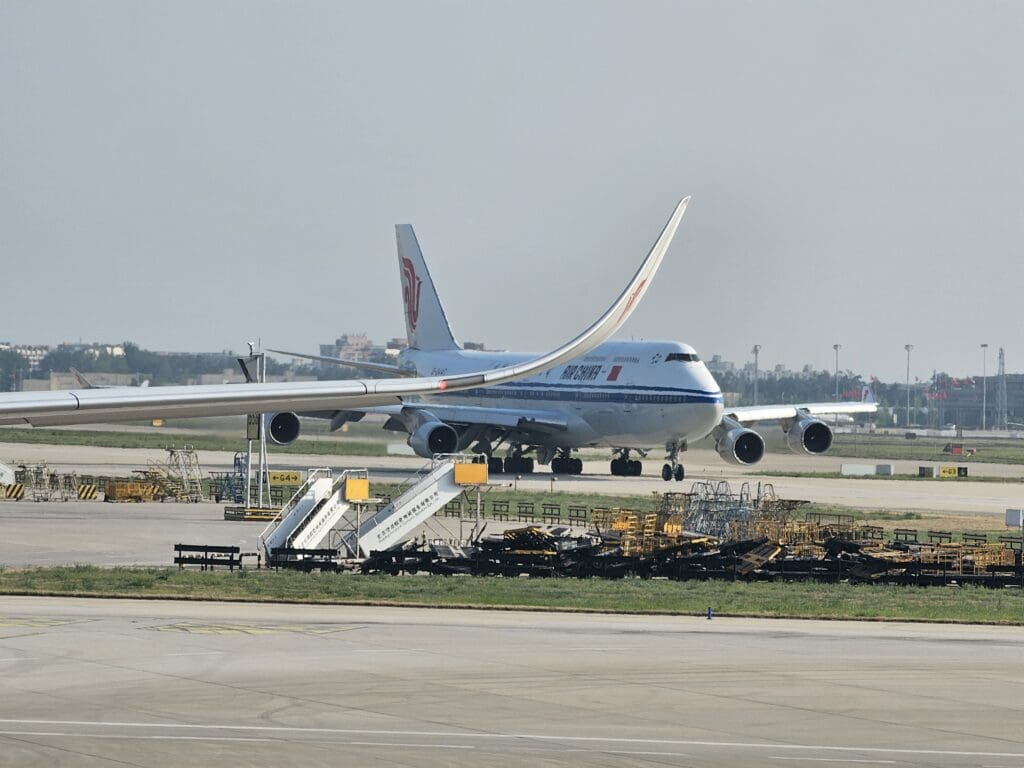
That evening, boarding for my flight to Dubai was scheduled to commence thirty minutes before departure at 1700, and so, a little ahead of this time, I made the short walk over to Gate E26. This gave me some hope that it would be a quiet flight to the Middle East. Upon arriving there, there appeared to be far fewer passengers than the number required to fill an Airbus A350. Soon, a queue of eager passengers formed in anticipation of the commencement of boarding, whilst several Air China ground staff could be seen at the gate podium typing away.
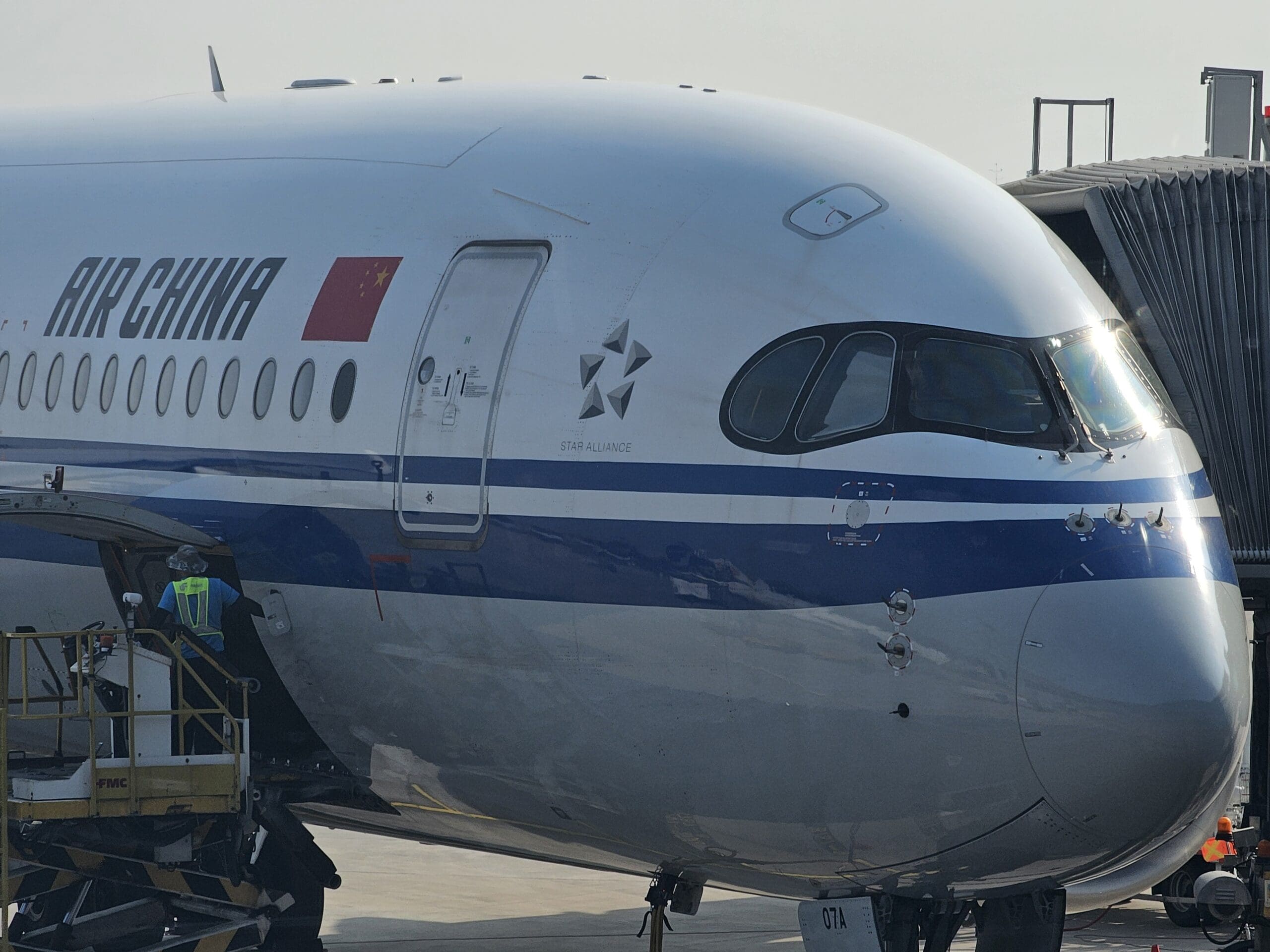
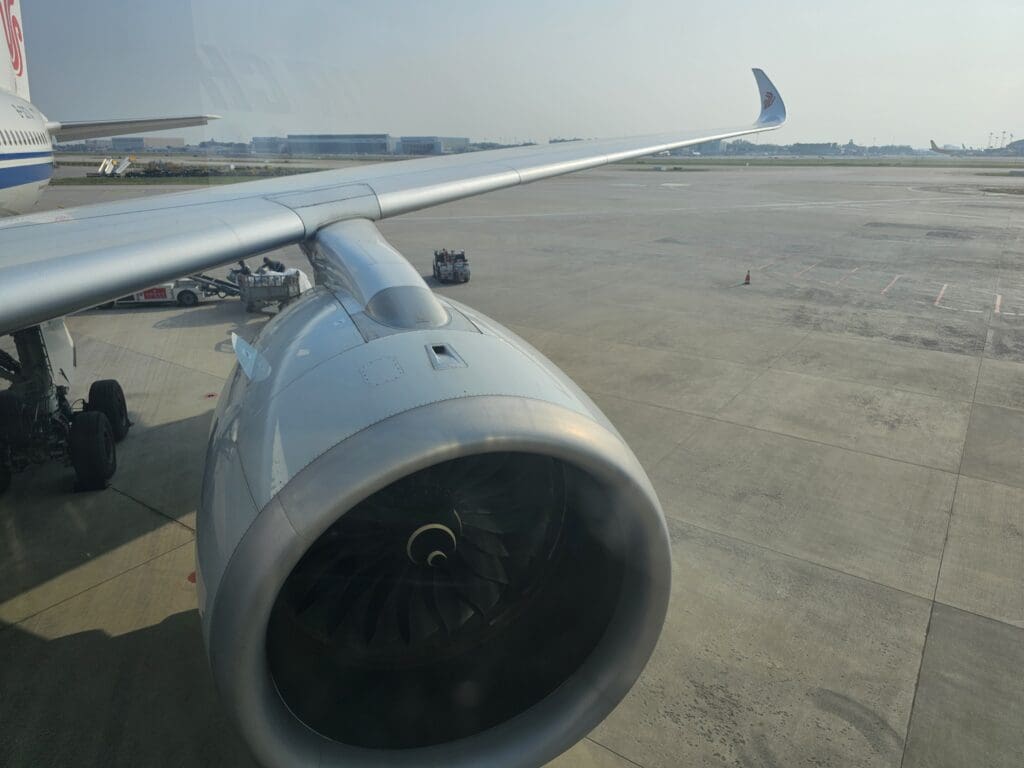
Looking through the terminal’s large windows, the majestic Airbus A350-941 sporting Air China’s relatively plain livery could be seen being tended to by an army of ground staff before its flight to Dubai. With China being the United Arab Emirates’ greatest import partner, I was not particularly surprised to witness a near-endless stream of cargo pallets being fed into the Airbus’s hold for the aircraft’s trek across Asia. Focusing on the aircraft, this came in the form of B-307A, and as with all Airbus A350s, this was assembled thousands of miles away at Airbus’ plant at Toulouse Blagnac Airport in Southern France. Carrying the serial number 268, this aircraft first took to the skies with the test registration of F-WZFS in December 2018 and was thus around 5.5 years old at the time of my flight. In January 2019, the Airbus was handed over to Air China and became the seventh Airbus A350 to join their fleet and has remained flying with the airline ever since, operating a mixture of short, medium and long haul services. Whilst the aircraft had spent much of the week before my flight on the ground in Beijing, it had still visited Chengdu, London Gatwick, Shanghai Pudong and Tokyo Narita, operating eight sectors and covering at least 17,700 miles in the process.
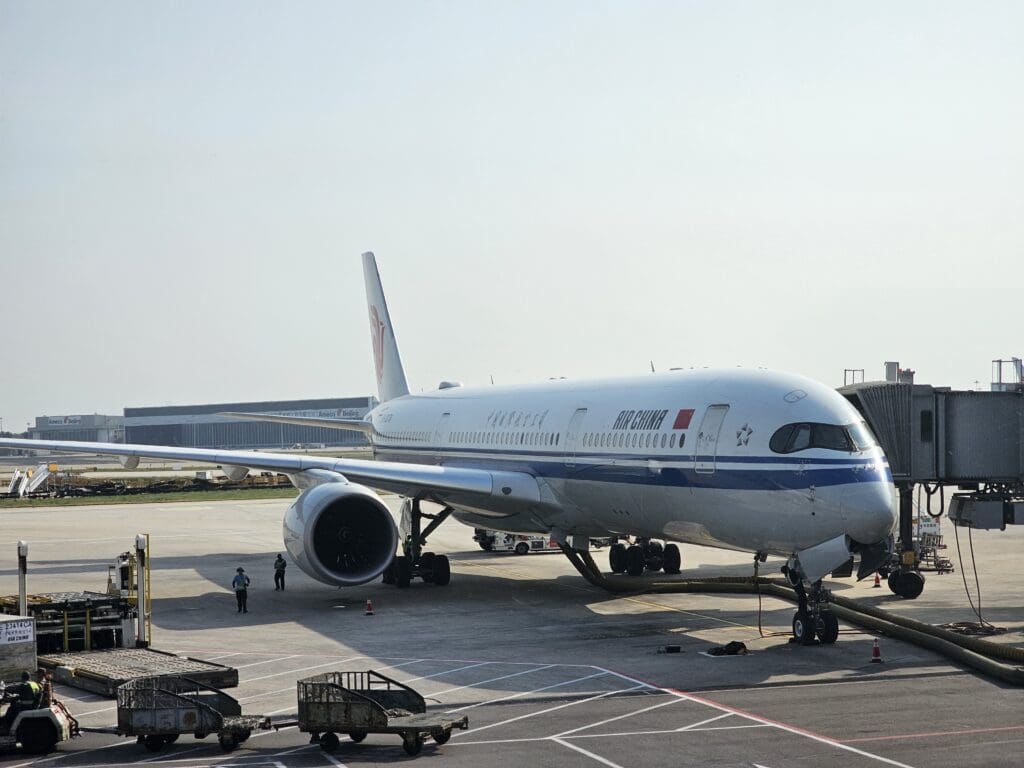
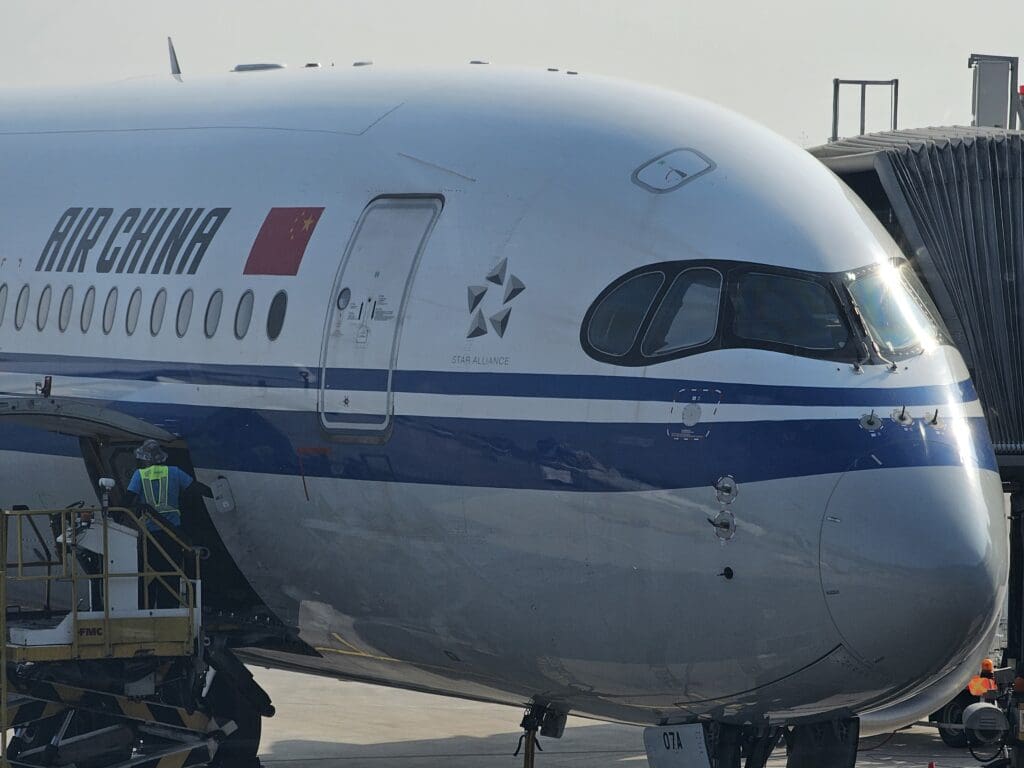
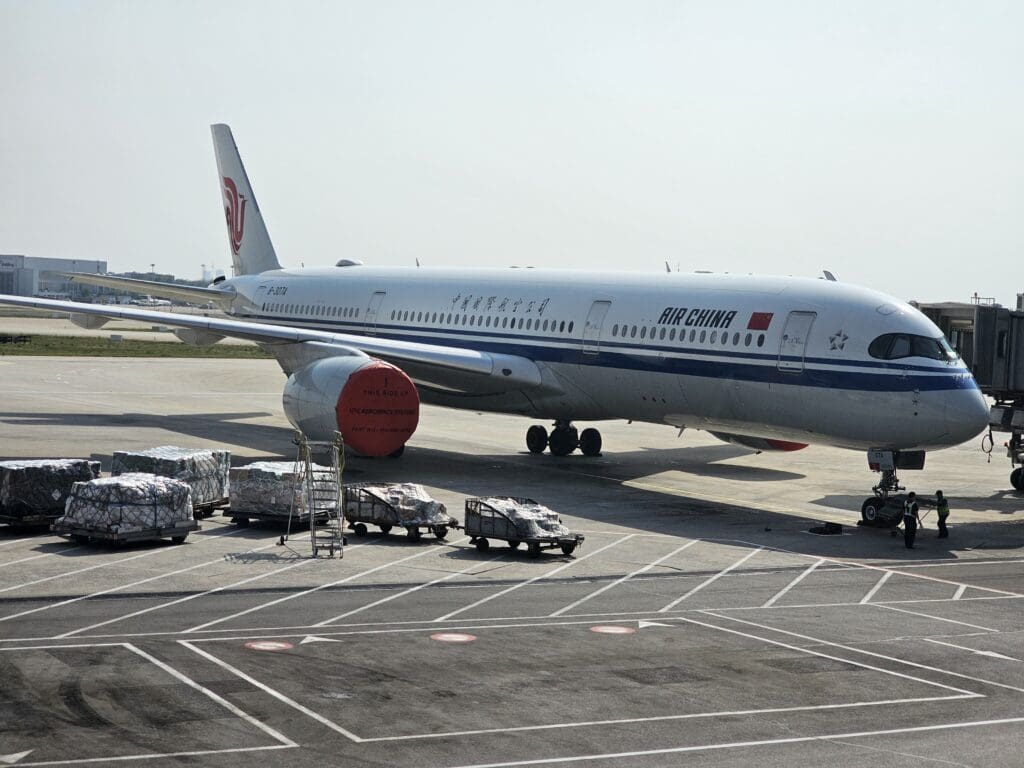
Inside the terminal, at 1655 a pre-recorded announcement rang out in Mandarin and English, inviting those in Business, Premium Economy and high-status members of Air China’s PhoenixMiles program to board the aircraft before advising that boarding for Economy passengers would be undertaken in accordance with passengers’ row numbers. However, contradicting the announcement, it soon became clear that the gate staff were allowing all passengers to board at once. Despite this rush, boarding did not end up being an overly chaotic affair and no pushing, shoving or long waits were needed before my boarding pass was scanned and my passport checked. Soon, I was free to continue onwards towards the waiting Airbus.
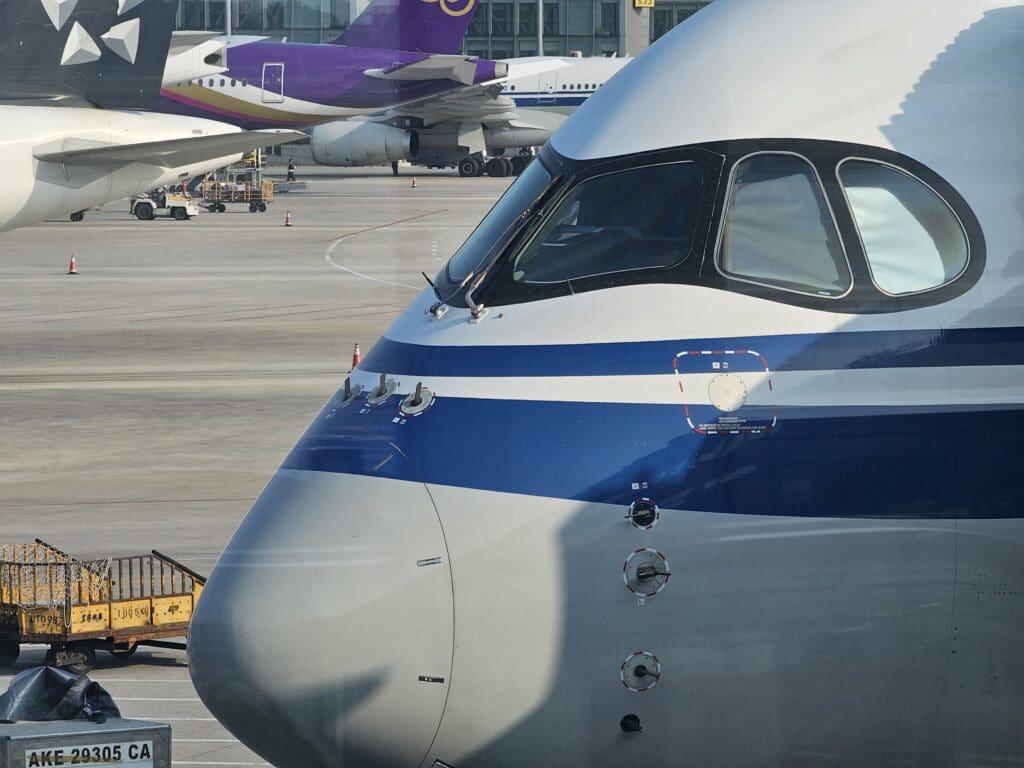
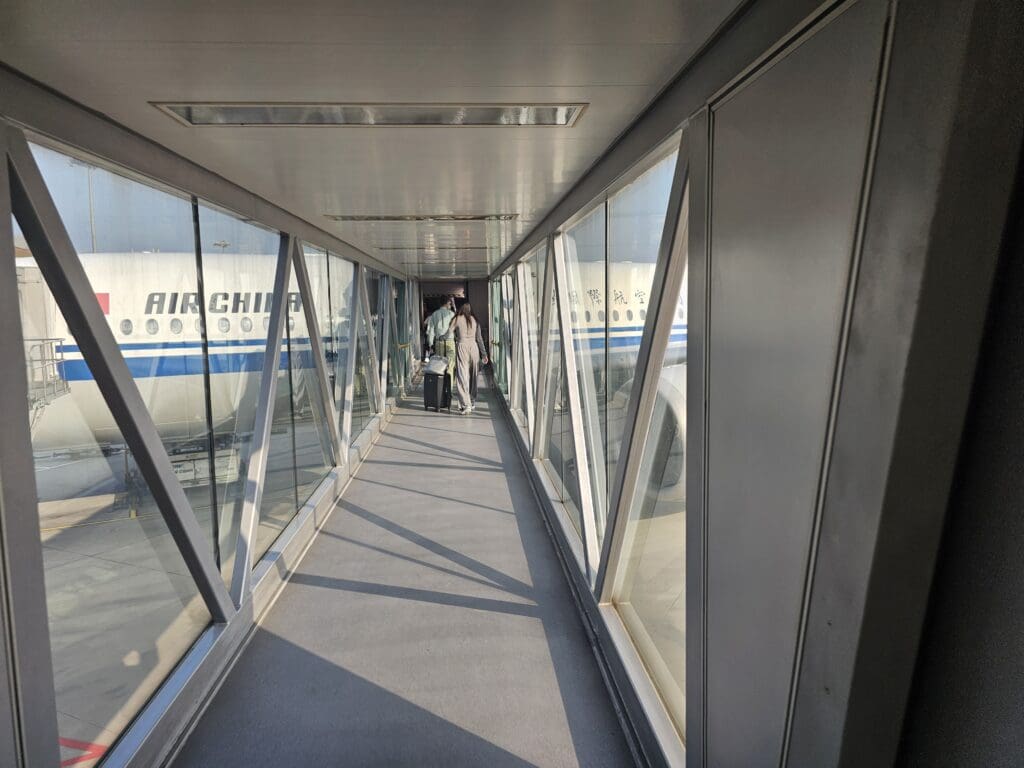
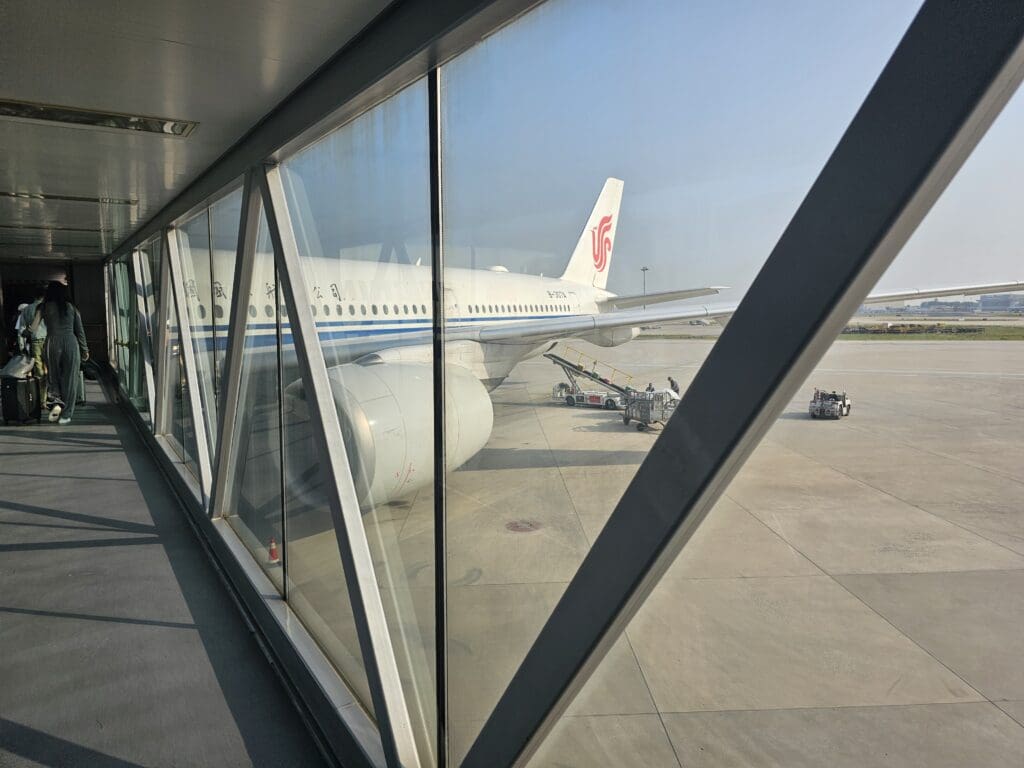
That evening, jetbridges could be seen connected to the L1 and L2 doors, and in the usual manner, only the latter could be used by those in Economy and Premium Economy. As with all flights on Chinese airlines, several security guards would accompany the flight to Dubai, and each was easily identifiable thanks to their bulky stature, body-worn camera, crew cut and generally tough looks! During boarding, one security guard stood on the jetbridge, perhaps reminding passengers of their presence or identifying potential troublemakers. As I neared the L2 door, just as in Seoul Gimpo, a tray of Chinese newspapers had been set up next to this, which was a nice and increasingly rare touch, although by the time I boarded, just a small number of publications remained, none which were in English.
Leaving me with a positive first impression, as soon as I stepped into the galley that separates the Business and Premium Economy cabins, I received a warm and friendly greeting in English. Once one of the flight attendants had checked my boarding pass, I was directed down the second aisle and soon received another warm greeting as I entered the Airbus’ small Premium Economy cabin. This consisted of just three rows of Recaro PL3530 seats in a 2-4-2 configuration. Each of these was covered in a blue fabric cover and topped by a large headrest partially covered by an antimacassar. Whilst I am no premium economy expert, these seats seemed to be very standard in their design, with little to distinguish them from those of many other airlines.
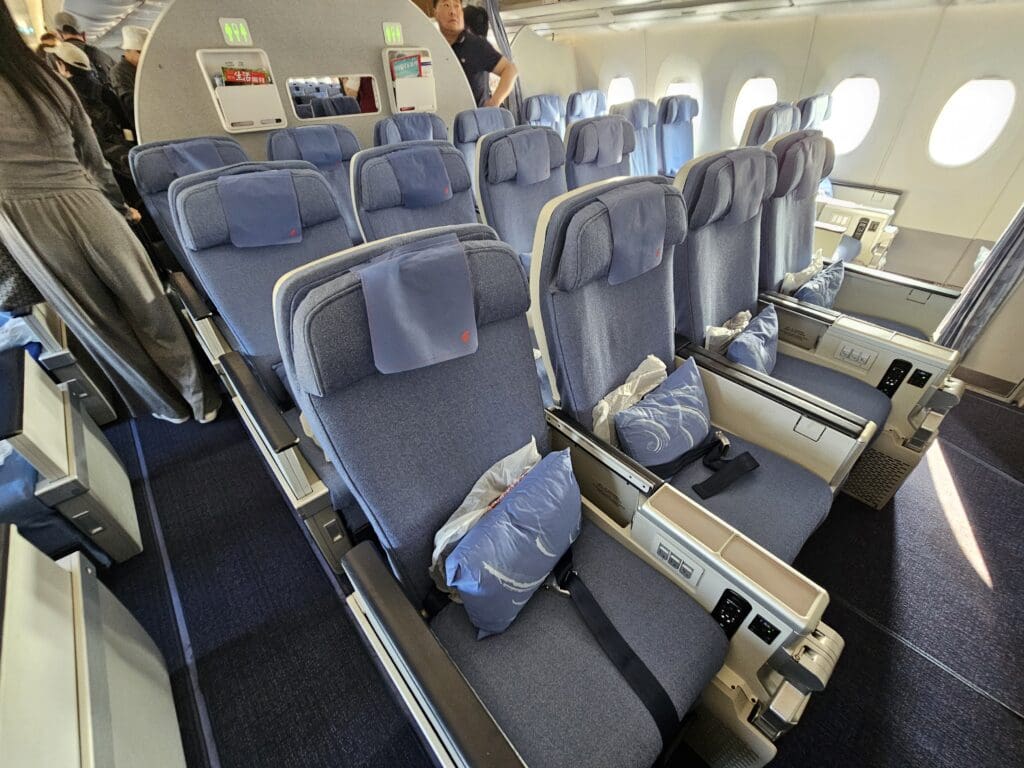
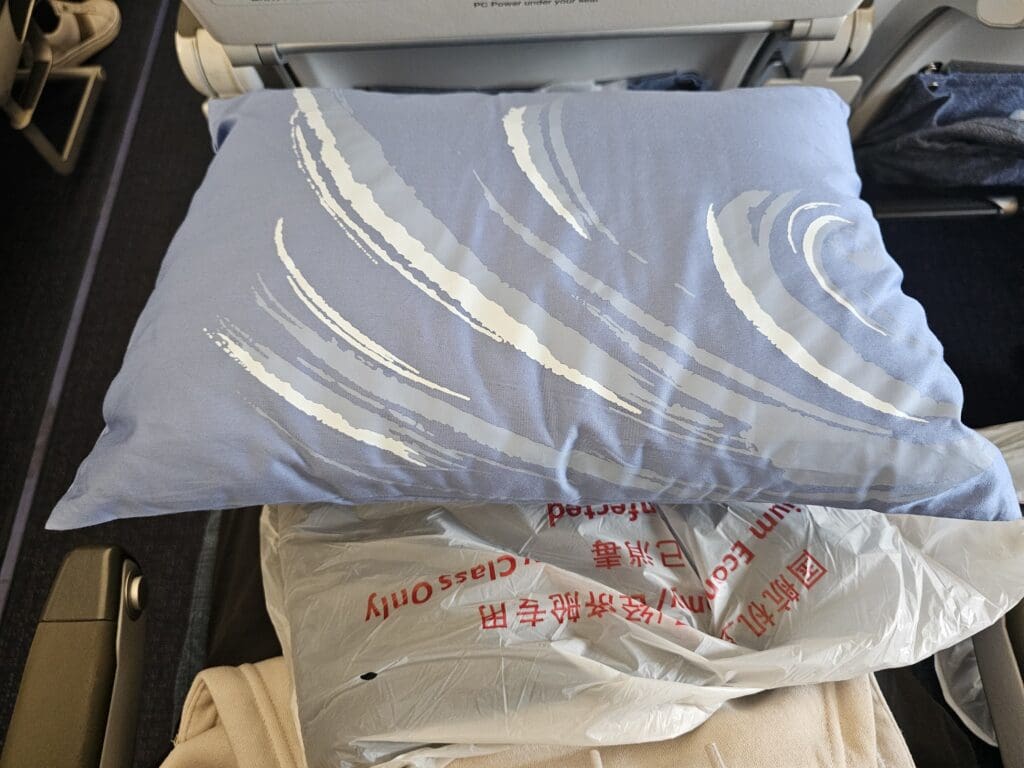
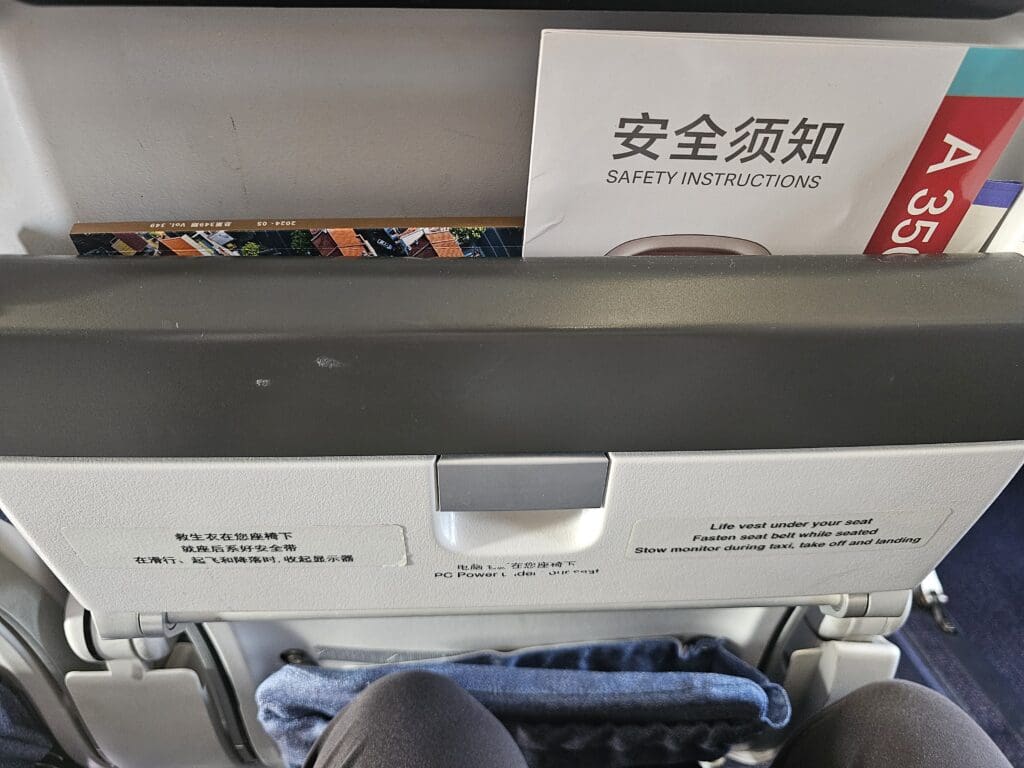
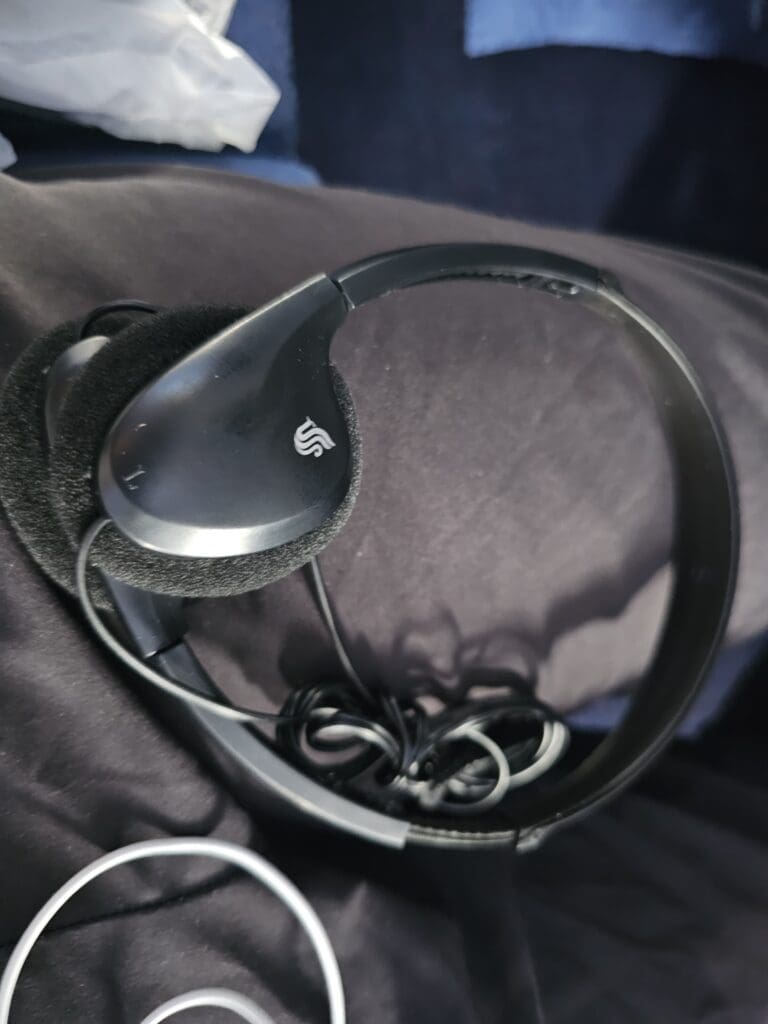
Given the small size of the Premium Economy cabin, I steamed through this quickly and soon reached the forward Economy cabin where I was delighted to receive another greeting. Air China’s Airbus A350s feature the fairly common Recaro CL3710 seat in Economy, with these arranged in a standard 3-3-3 configuration. Each seat is upholstered with Air China’s standard dark blue fabric cover which features a swirling pattern and is topped by a sturdy headrest that is partially covered by a disposable fabric antimacassar. As one would expect to find on a modern widebody airliner that operates long slogs across the world, each seat came with a high-definition inflight entertainment screen, with these powered by the Panasonic eX3 system. In addition to these personal screens, each seat features a coat hook, a bifold tray table, a seatback pocket, a literature compartment, a USB-A port and a universal power outlet. Given the length of the flight, standard Economy quality pillows and blankets had been placed on each seat before boarding, whilst low-quality headphones could be found in the seatback pockets. Finally, the literature compartment contained a safety card, sickbag and the latest copy of Air China’s Wings of China inflight magazine.
Upon reaching the rear Economy cabin, it took quite some time to reach my seat at the rear of the aircraft as many passengers were travelling with oversized cabin bags. Indeed, had this been a Ryanair flight, then the airline would have likely ended its day with record profits from all the penalty fees! Eventually, I made it to my seat and after storing my bag in the large overhead locker, I plonked myself down and settled in for the long journey ahead. Looking at my new surroundings, I was pleased to find the seat to be reasonably comfortable, with this offering an acceptable amount of space for a long haul aircraft. Meanwhile, the area around this seemed to be in a much cleaner state than the Boeing 737-800 that I had flown from Korea, although a fair few marks and scratches could still be seen around the seat. I should also note that no amenity kit was provided, although with this becoming an increasing rarity and given the fact that the flight to Dubai was not an overnight service, this was not expected onboard.
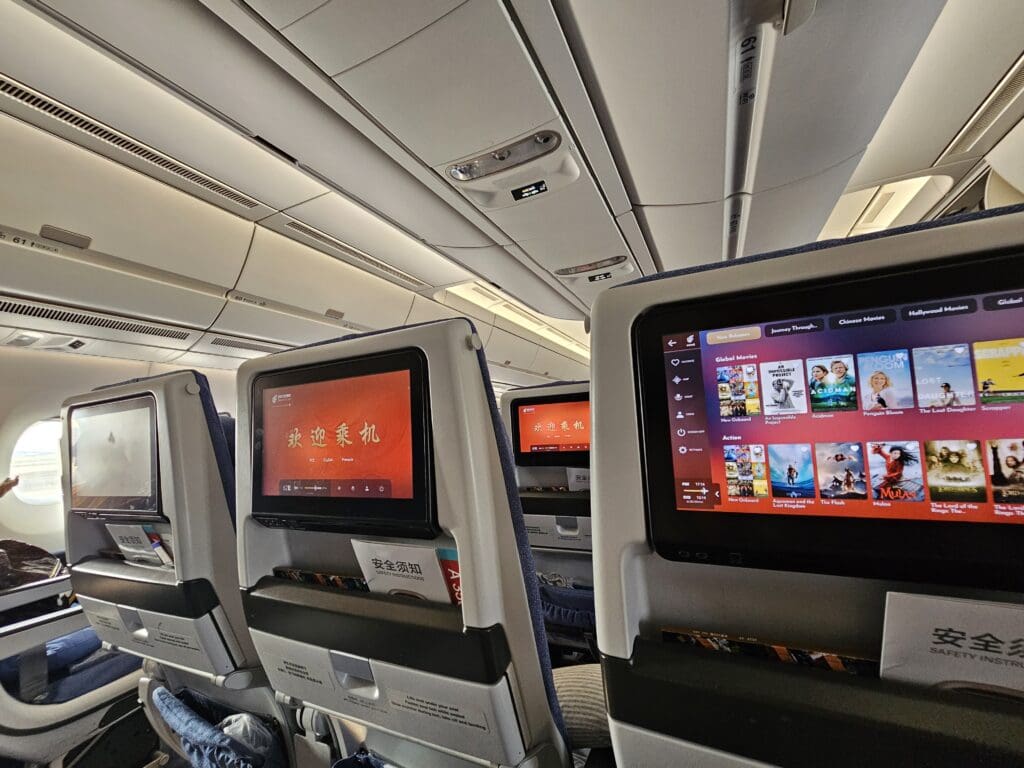
As I had suspected, that evening, the Airbus was to be far from full and the final passenger made it onto the aircraft with ten minutes to go until our scheduled departure time. Glancing around, perhaps unsurprisingly, most of those around me seemed to take the form of Chinese workers, business people and tour groups heading to the United Arab Emirates. Once all passengers had taken their seats, the music that had accompanied the boarding process came to an end, and without any sort of welcome announcement, all of a sudden, Air China’s safety was broadcast over the inflight entertainment screens. Released in 2022, this takes the form of a high-budget half-animated safety video that details the safety instructions in Mandarin and English. Even though we were bound for Dubai, this video was not accompanied by any Arabic subtitles, nor were any pre-recorded Arabic announcements played for the duration of my flight.
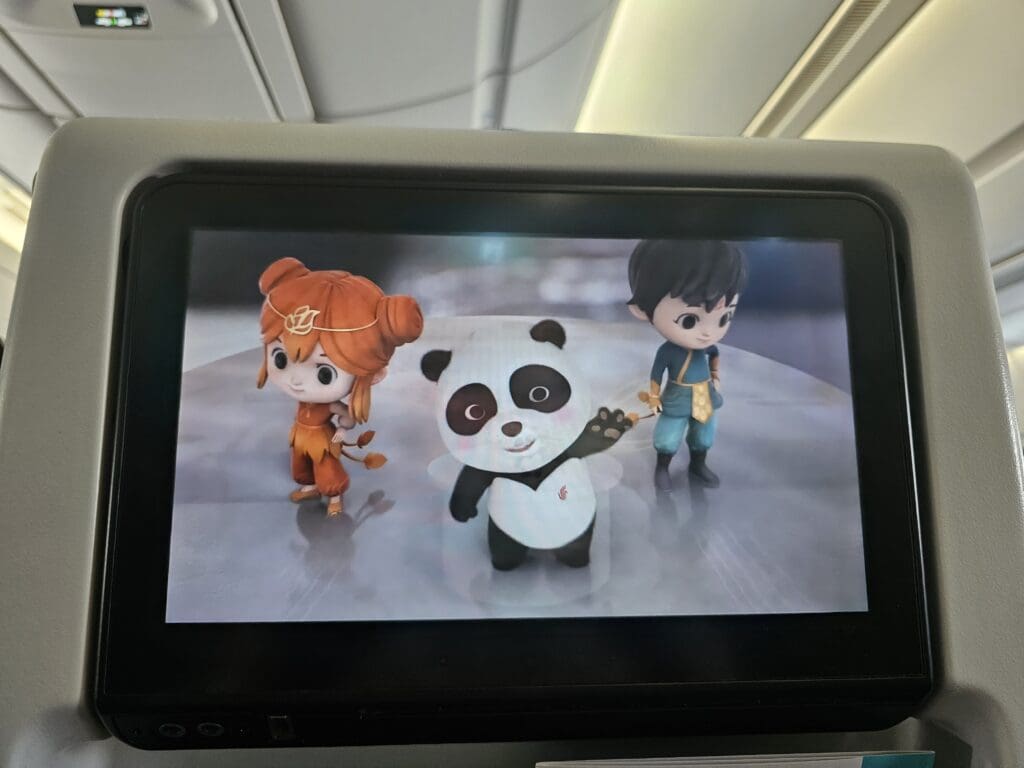
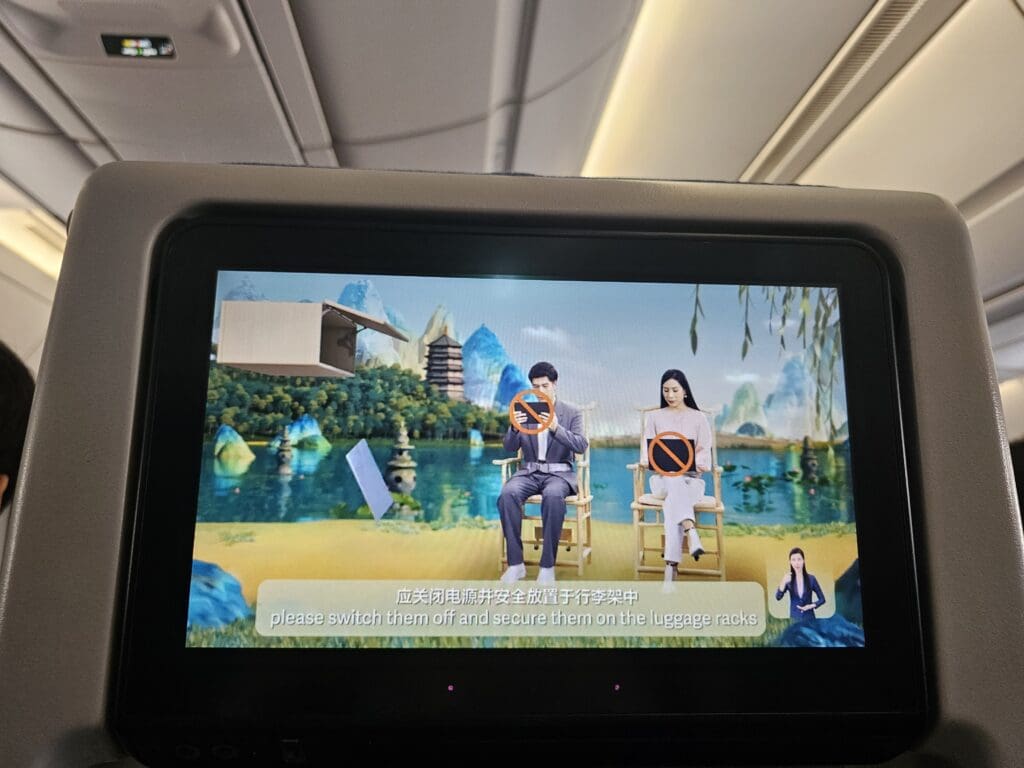
As the safety video neared its end and with two minutes to go until our scheduled departure time, at 1728, the Airbus jolted backwards and was pushed back away from its parking position. As we headed rearwards, a series of hums and whirs could be heard as the Airbus’ two massive Rolls-Royce Trent XWB engines powered into life, ready to haul us all across East and Central Asia before ending up in the Middle East. At this time, the army of flight attendants passed through the cabin, undertaking their pre-departure checks, taking the time to ensure that absolutely everything was safe and secure in preparation for our departure. A few minutes later, the Airbus commenced its taxi to the end of Runway 19, at which point the Purser performed a quick welcome announcement in Mandarin and English. Rather than primarily welcoming or thanking passengers, this announcement (perhaps sensibly) seemed to be more concerned with detailing the prohibited items, actions and behaviours onboard and was then followed by a very similar pre-recorded announcement in Mandarin and Australian accented English which reiterated these instructions and warned passengers of the potential criminal consequences of not abiding by the cabin regulations.
Given the sheer expanse of Beijing Capital Airport, it is not unusual to endure long taxis before departing or after landing at the airport. However, with Runway 19 located just a short distance away from Terminal 3, our Airbus arrived near the end of this in just a few short minutes. Nevertheless, as was to be expected, we spent the final minutes of our taxi crawling along as we allowed a series of Air China jets to depart ahead of us. Eventually, at 1747, ‘Air China 941 Heavy’ lumbered onto the runway in preparation for our departure. Following a short pause, the two Rolls-Royce engines spooled into life, and we performed a seemingly bumpy take-off roll before rocketing upwards into the clear and sunny skies over Beijing.
Once safely in the skies, a whine was heard as the landing gear was retracte,d and we soon left the bustling sprawl of Beijing Capital Airport behind. Departing into the south, a direct departure routing would have seen us bank to the right and immediately commence our westward journey across China. However, Chinese airspace is not exactly known to be particularly simple ,and we instead ended up flying on a somewhat convoluted and indirect departure route. This saw us turn eastwards several minutes after departure, before turning north a few minutes later. After Beijing behind, the Airbus soared through the skies of Heibei Province before reaching Inner Mongolia where the aircraft banked once more before rolling out on the more expected westerly heading. Other than a few gentle lumps and bumps during the first couple of minutes of the flight, our climb turned out to be a silky smooth affair. However, owing to China’s tough regulations, both passengers and crew were kept firmly strapped into their seats until we had levelled off at our initial cruising altitude. As with other Chinese airlines, even once passengers were free to move around the cabin, the seatbelt signs remained illuminated as a reminder for passengers to keep these fastened whilst seated.
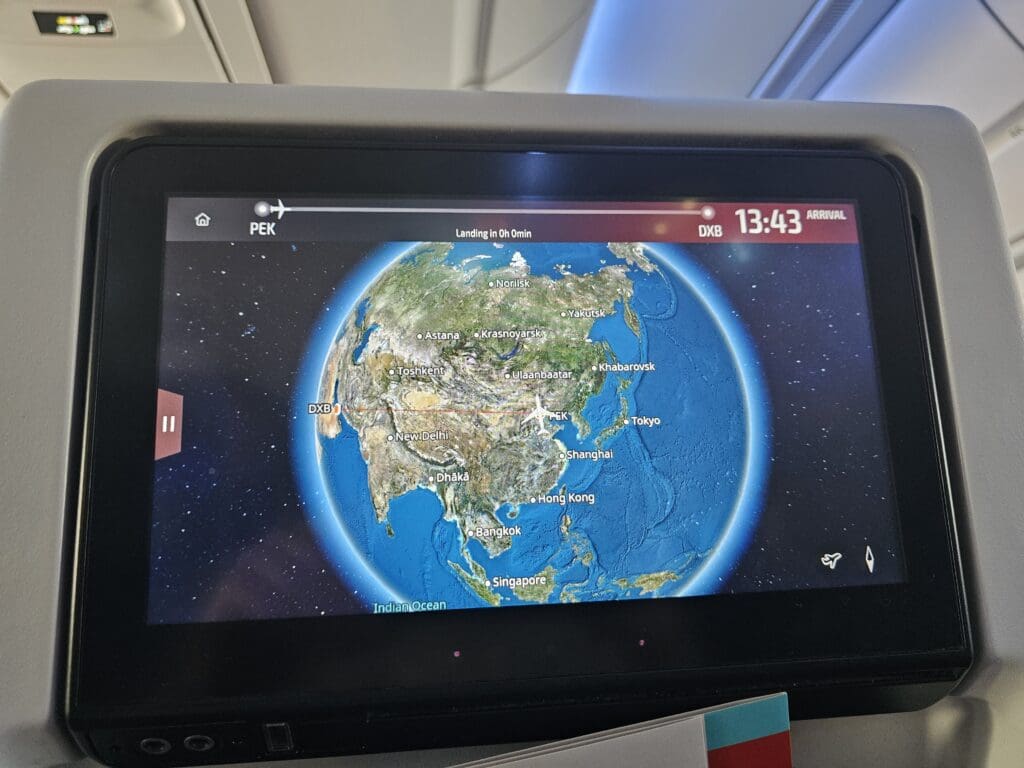
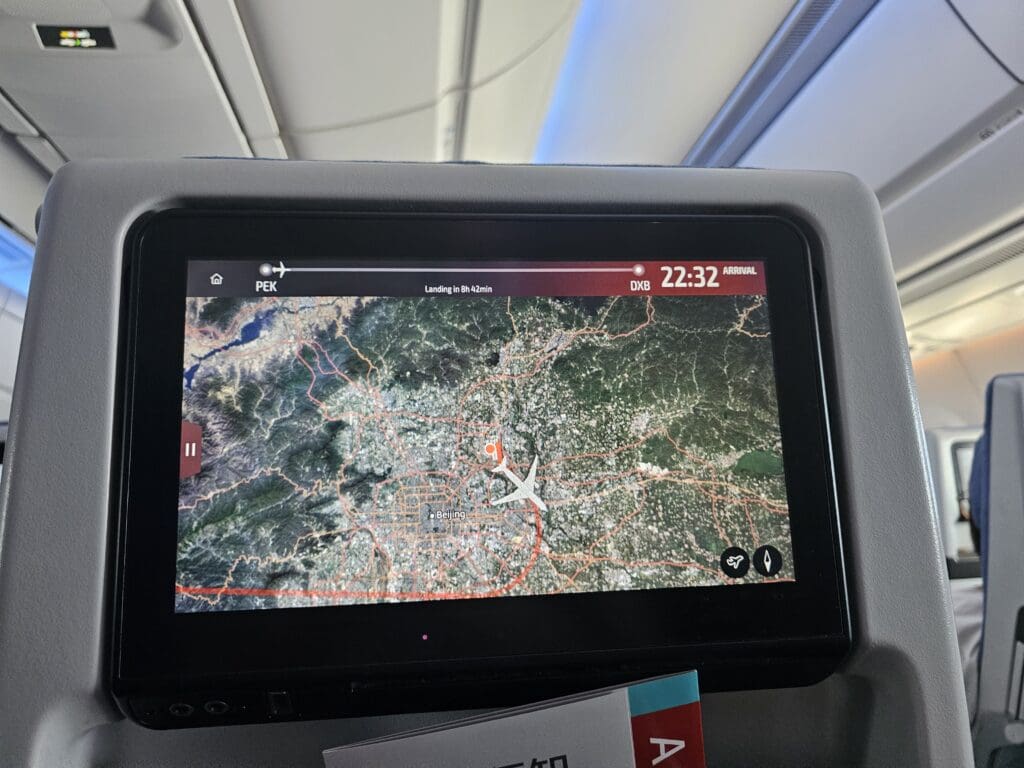
After a total of 34 minutes in the skies of Northeast China, the Airbus levelled off at its initial cruising altitude of 36,000 feet, at which point the crew were released from their seats and passengers were free to move about the cabin. At this stage, the Purser undertook a more comprehensive welcome than had been offered on the ground, which offeredthe usual cautionary instructions regarding keeping seatbelts fastened whilst seated. As the cabin crew prepared for the first round of service, the Captain’s voice filled the cabin as they performed their first and only announcement of the flight. This was undertaken in Mandarin and English, and consisted of a word of thanks, before detailing our altitude, cruising speed, the expected 8H40 flight time to Dubai and our estimated time of arrival.
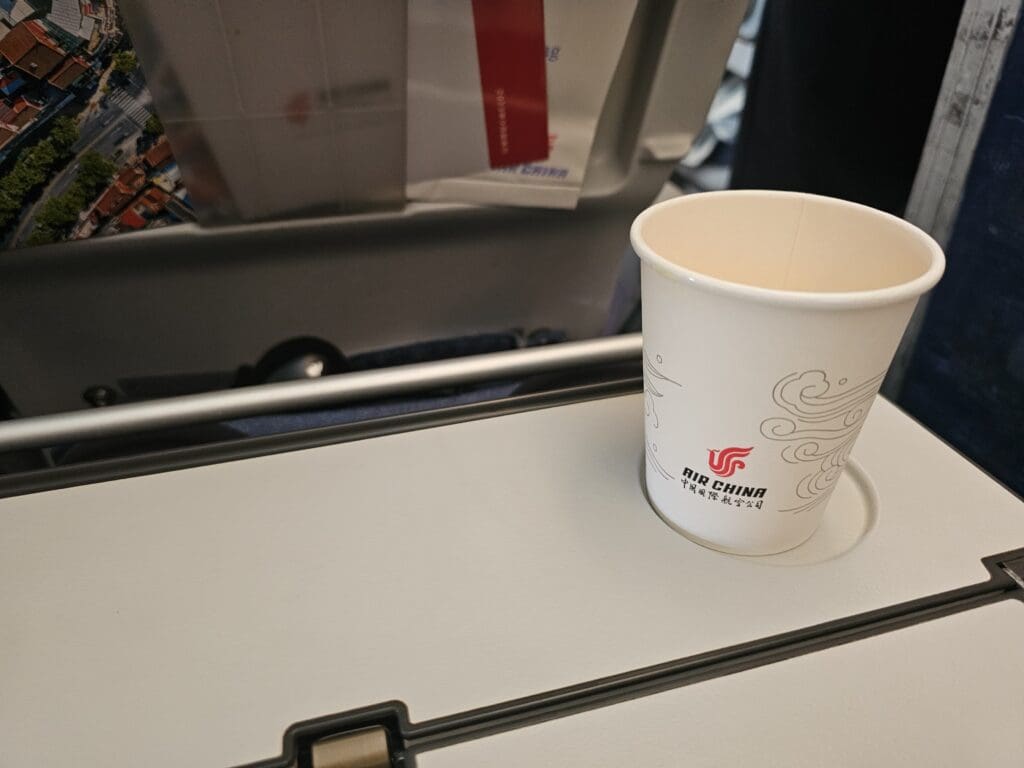
Once the Captain’s announcement had come to an end, the service carts were rolled out and a round of drinks was made. Being one of the first passengers to be served, I opted for an orange juice which was poured into an Air China paper cup and passed to me. Despite not being undertaken in an overly unfriendly manner, I found this first round of service to be a little brash and rushed, with the crew appearing to prioritise speed and efficiency over friendly interaction with passengers. Around twenty minutes later, the Purser undertook an announcement that advised passengers of the soon-to-commence evening meal service. During this, the crew member noted that there would be two options in Economy – chicken or fish, and apologised in advance if passengers’ first choice of meal was unavailable. Once again, I ended up being one of the first passengers to be served and within moments of the announcement ending, the flight attendant reached my row, and glanced at me without a single word. Seeing this as my cue to express my choice, I asked for the chicken and soon a tray was handed over to me. This contained the main dish, white rice with chicken in a slightly spicy sauce, a side dish consisting of pickled cucumbers, a packaged bread roll with butter, and some melon chunks for dessert. Meanwhile, a packaged antibacterial wet wipe and a sachet containing a serviette and a plastic spork and knife accompanied the food items.
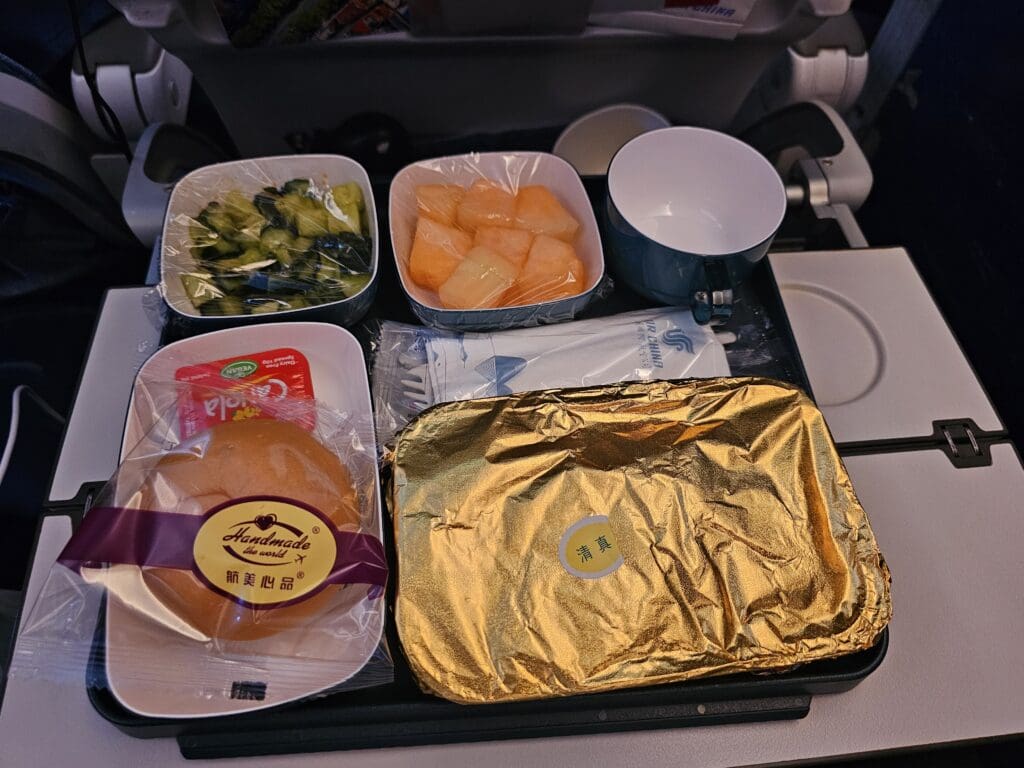
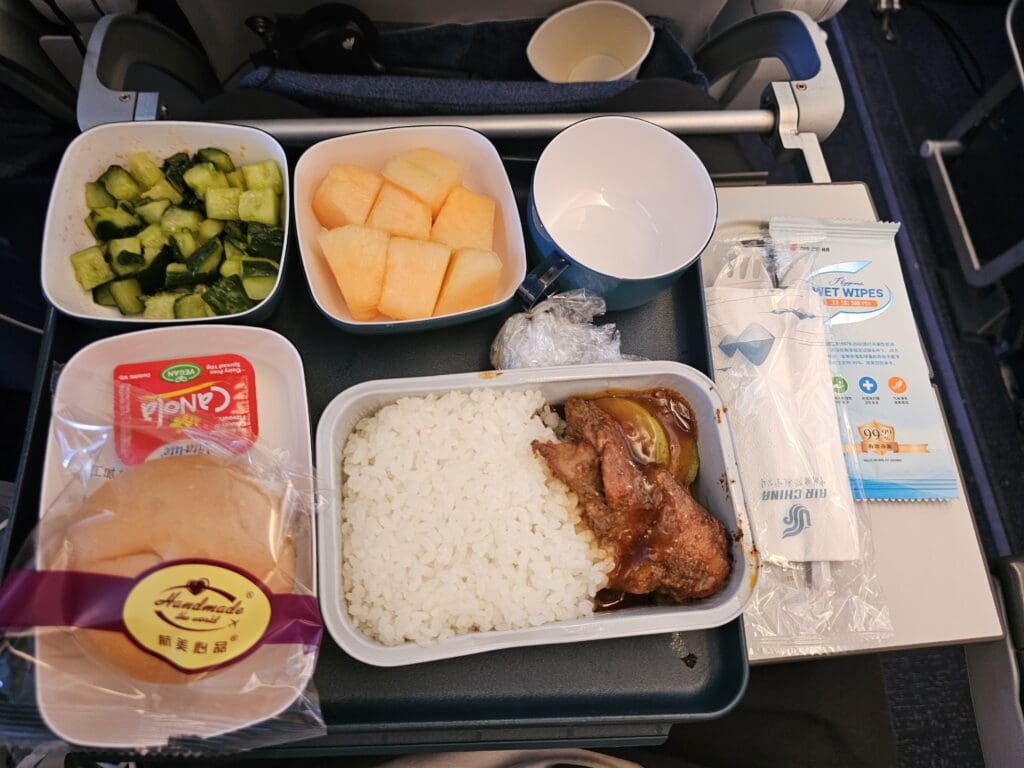
Soon getting to work, I found the meal to be of acceptable quality yet at the same time it was not exactly the most delicious or most substantial inflight meal that I have been served. Nevertheless, this served its purpose and was by no means terrible. This was then followed by a second round of drinks, which this time included alcohol and hot drinks before the trays were collected around half an hour after the main meal had been distributed. Immediately after all trays had been collected, an announcement was made regarding the duty free service and the crew hit the aisles once more, however, relatively few passengers seemed to partake in any onboard shopping that evening so the crew were able to speed through the cabin. Afterwards, the cabin lights were dimmed and the crew passed through the cabin requesting passengers to close their window blinds.
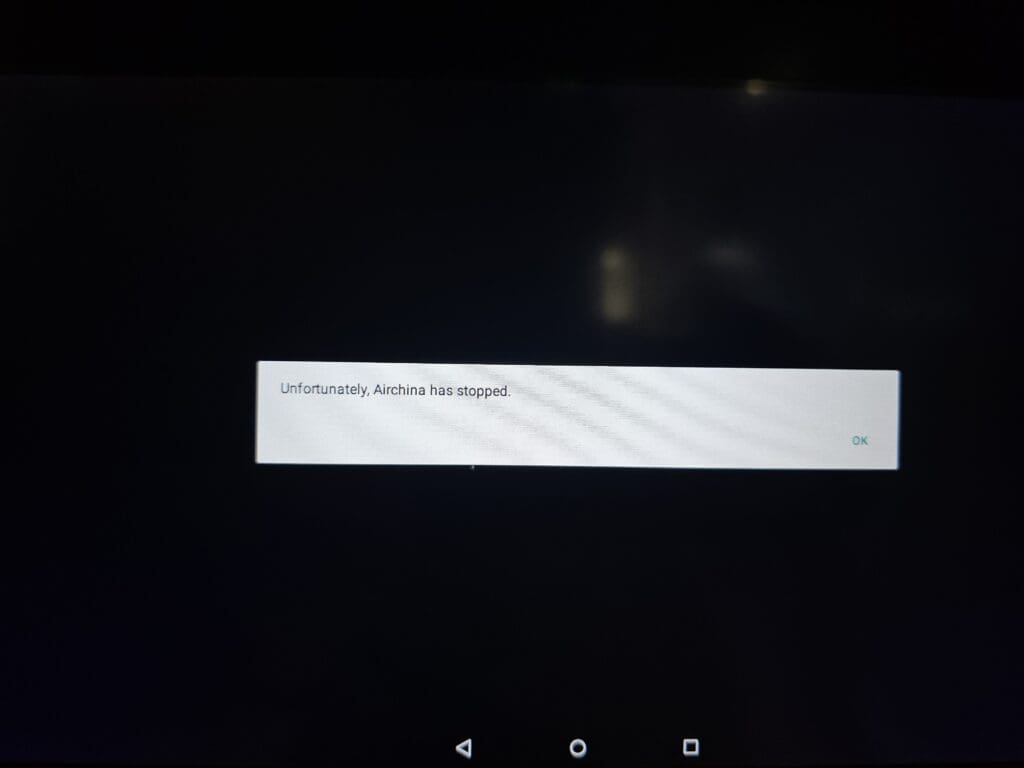
Not yet fancying a nap, once the crew had retreated to the galleys and with the cabin plunged into darkness, I decided to explore the delights of the inflight entertainment system. Turning this back on, I was greeted by the appropriately red welcome screen, which scrolled through welcome messages in the system’s three languages – Chinese, English and French. Admittedly, given Air China’s size and worldwide route network, I was a little surprised and disappointed at the system’s lack of language options. Nevertheless, this was still better than the English-only systems of the likes of Etihad Airways and Virgin Atlantic! Steaming onwards, I began to explore the system, which I found to be well laid out and easy to navigate. However, this proved to be a little laggy and slow to transition between screens, crashing on multiple occasions, at which point it would provide the slightly humorous message of ‘Unfortunately, Airchina has stopped’!
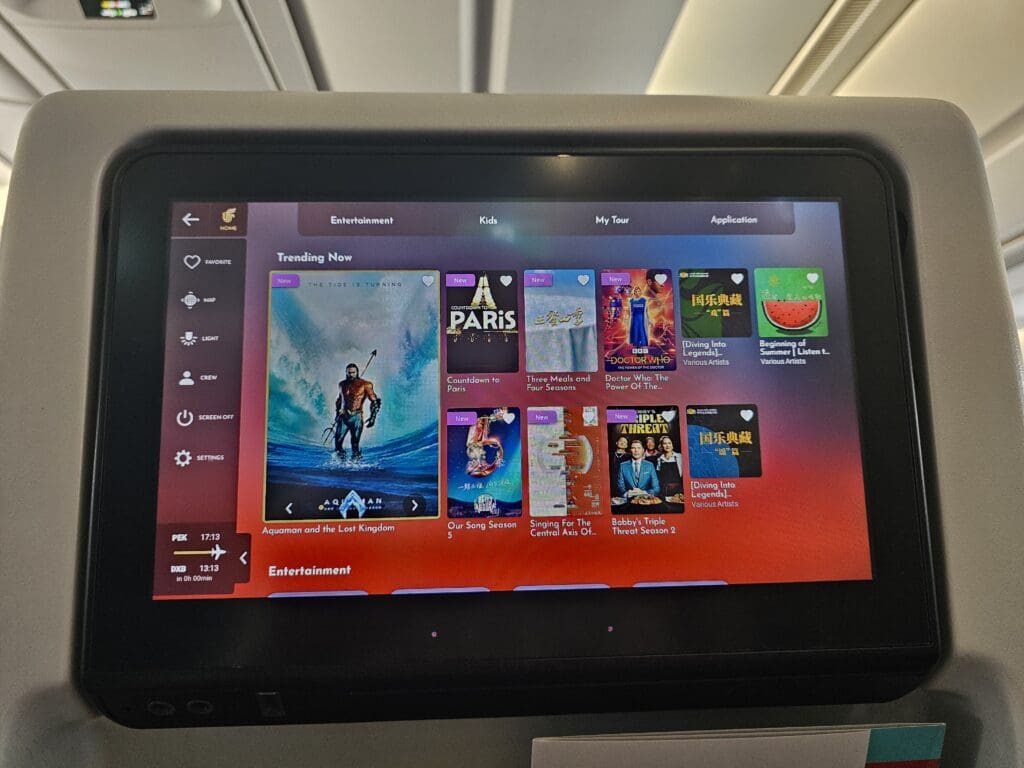
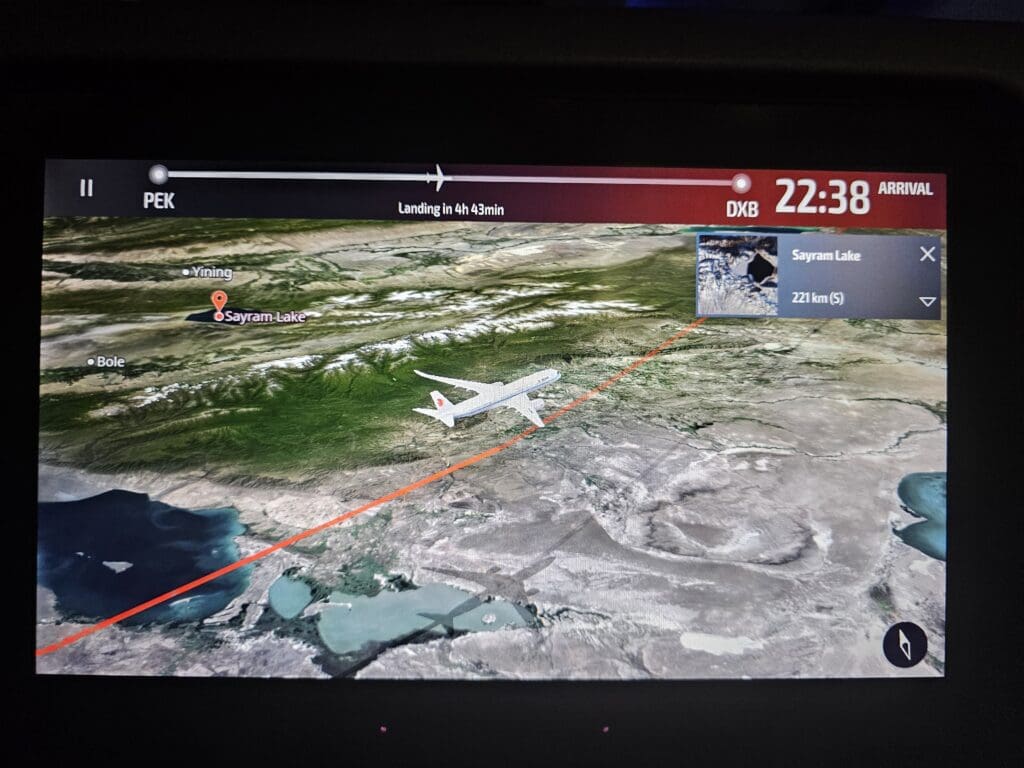
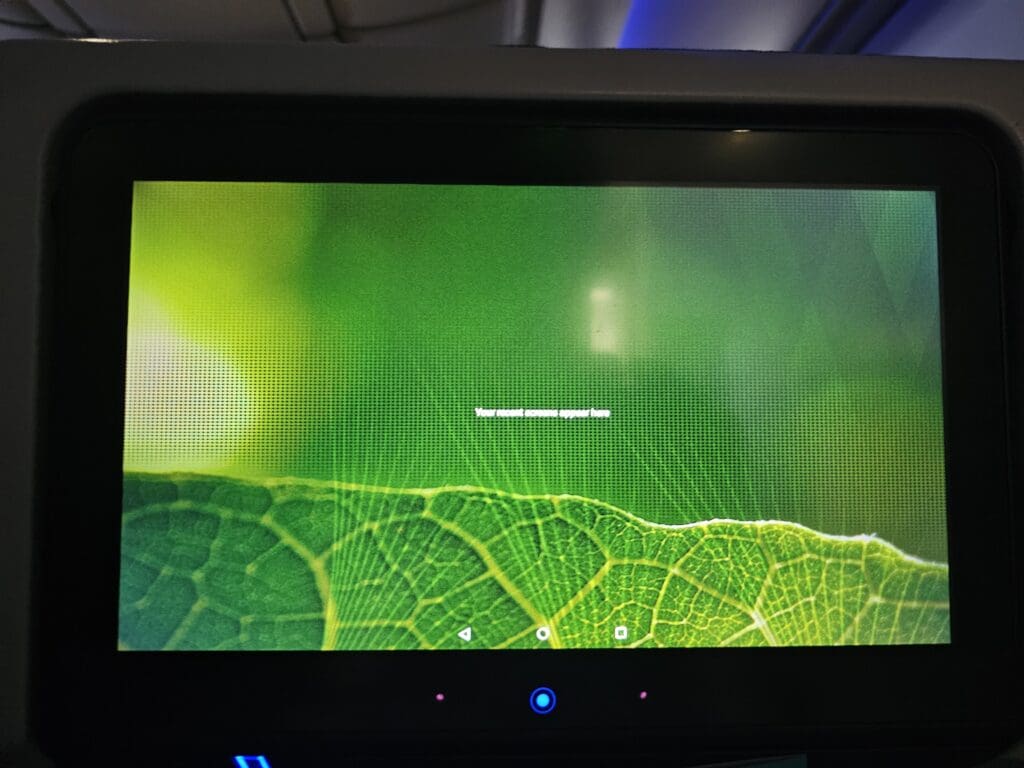
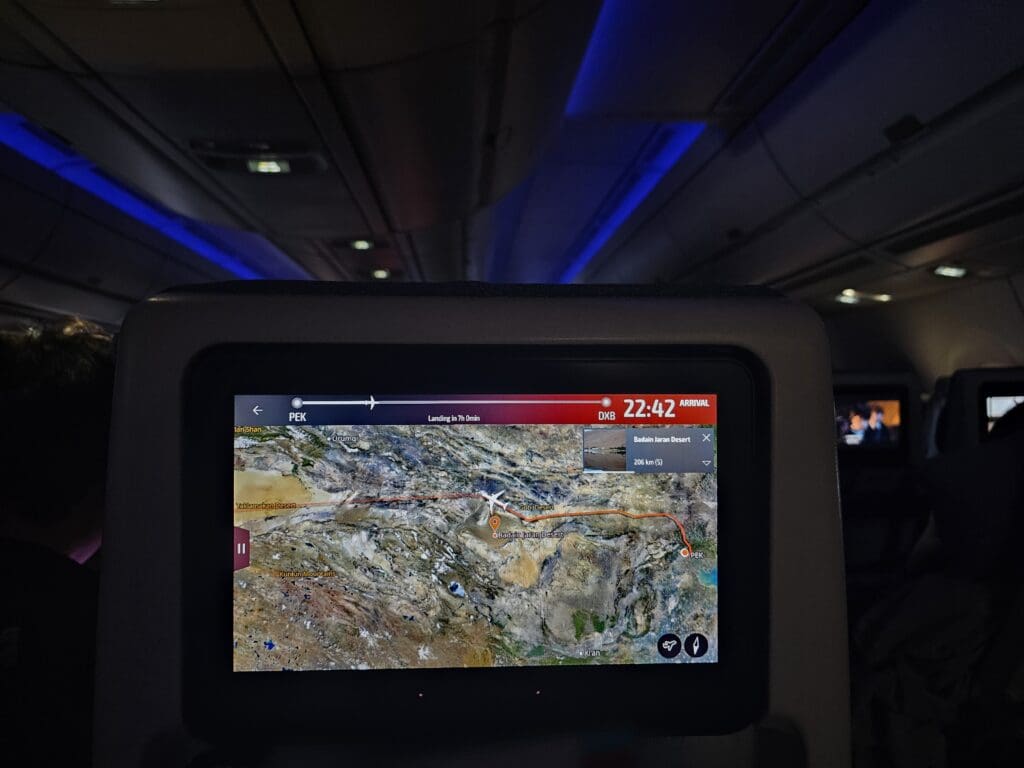
Examining the content, the system was loaded up with a good number of both American and Chinese productions, whilst there were a small number of films and programmes available from other countries too. In addition, plenty of music albums and playlists can also be found, along with ten games. However, I would have likely found playing games to be a frustrating experience, given my issues with the slow screen! Those travelling with children may be a little disappointed to hear that this system lacks a separate kids’ section and unusually, the system also lacked any pages detailing the airline’s history or current operation. Fortunately, I found the FlightPath3D moving map to work well for the duration of my flight, allowing for the easy tracking of our progress as we sped across Asia. Slightly disappointingly, unlike on many other airlines’ Airbus A350s, there were no external cameras viewable on the system. Returning to the positives, I found visual content to commence without any advertisements, something which seems to be increasingly rare nowadays! To summarise, whilst Air China’s inflight entertainment system was not the most comprehensive in the world, I found the level of content provided to be acceptable, and the system was far from the most primitive that I have ever encountered. Nevertheless, this would have been a much better system had the screen been more responsive!
Throughout the cabin, stickers could be seen promoting the aircraft’s wifi network, however, as was the case on the Boeing 737 that I had taken earlier that day, this was rather misleading as there was no wifi network to connect to! Finally, having a quick flick through the Wings of China magazine, this seemed to be your usual inflight magazine, consisting of a mixture of travel articles interspersed by advertisements. However, this was targeted at Chinese-speaking passengers as there was just a single article and some information about the carrier that had been translated into English.
Returning to our progress, for around two hours, the aircraft cruised high above sparsely populated Inner Mongolia and travelled almost the entire length of China’s third-largest province from east to west. Next up was the country’s seventh largest province, Gansu, although cutting across a very small portion of this, within minutes, the Airbus found itself in the skies of China’s largest and westernmost province, Xinjiang. Once in the skies of Xinjiang, the aircraft cruised high above the city of Hami before heading onwards to the Silk Road cities of Turpan and Urumqi, reminding me of my trip to the two back in 2016! Speeding westwards, the aircraft bumped around a little as we continued onwards, passing Urumqi and Karamay before reaching China’s border with Kazakhstan.
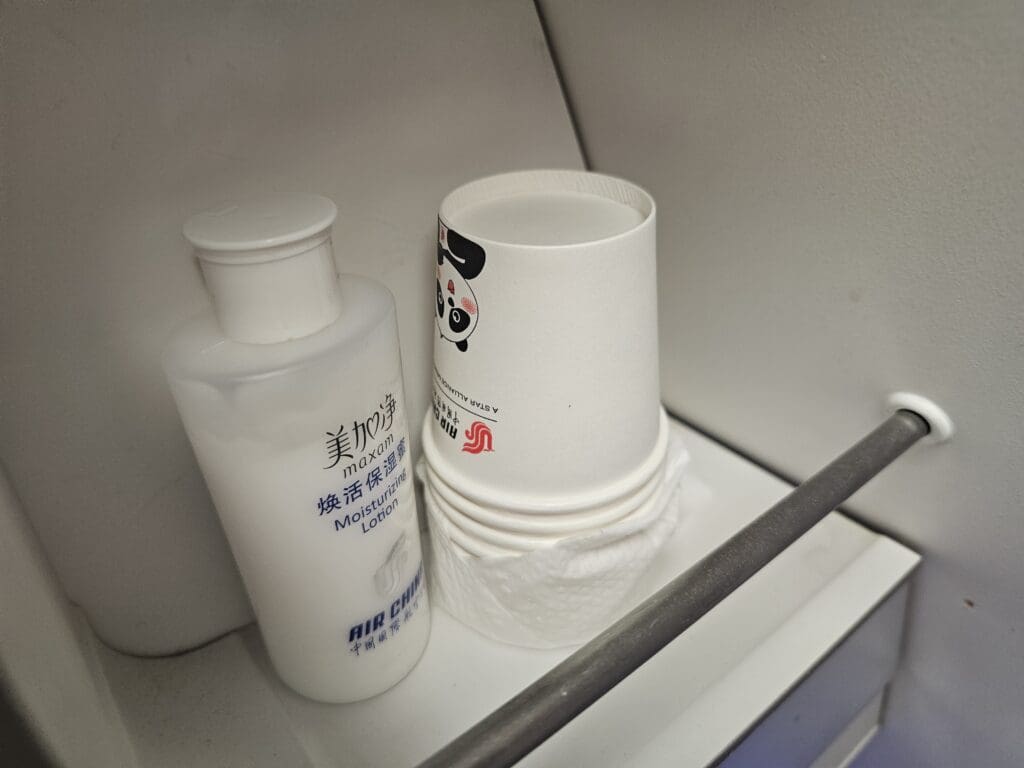
As we journeyed westwards, the crew seemed to pass through the cabin every hour or so, distributing water to those who were awake. Other than this, no other drinks or snacks were offered between meal services whilst the galley remained out-of-bounds for passengers during the flight. Around halfway into the flight, I decided to pay a trip to one of the six lavatories available for use by those in Economy. Four of these sit between the two Economy cabins, whilst two sit at the rear of the aircraft. Heading into one of the two at the rear, I found this to be clean and stocked with the basics alongside the welcome addition of moisturising cream. However, this was accompanied by a rather unpleasant and overbearing stench that saw me do everything possible to avoid a prolonged stay there!
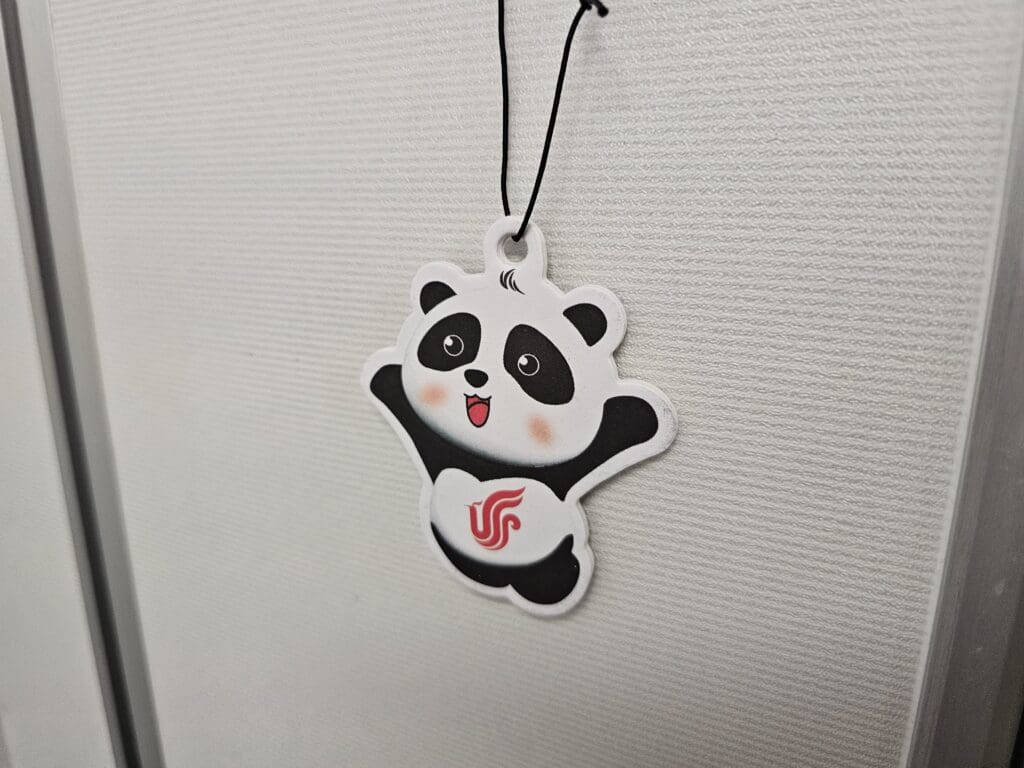
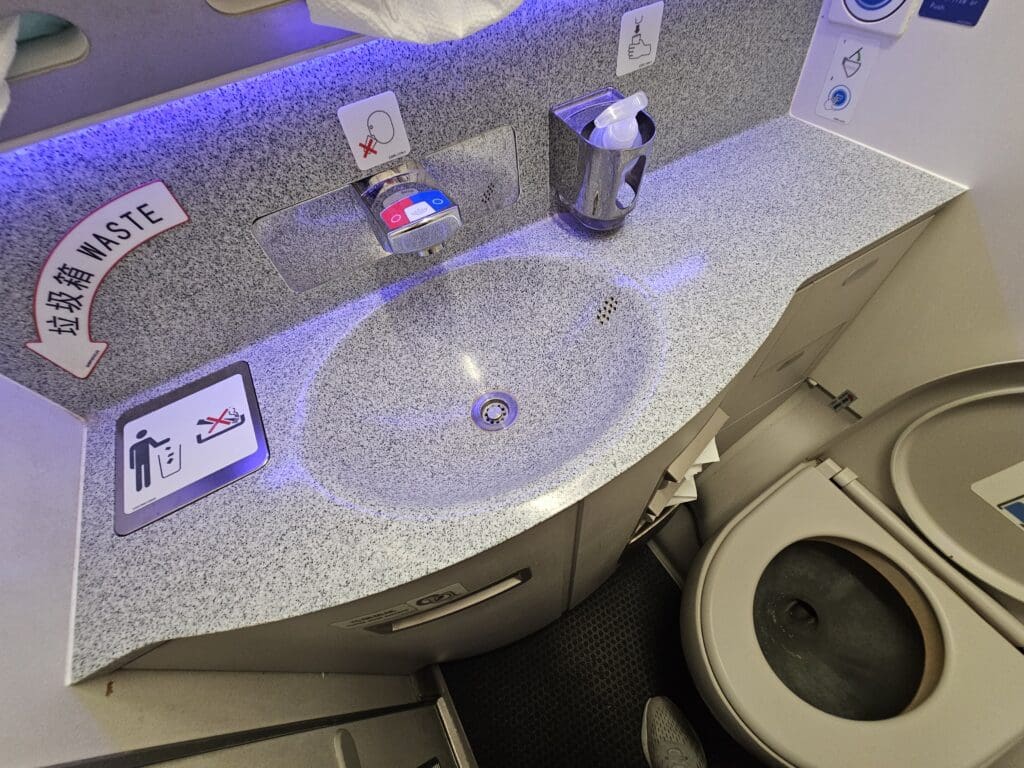
Once in the skies of Kazakhstan, the aircraft journeyed westwards over the Abai Region. Crossing high above the country’s mountains and famous steppe, the Airbus voyaged over the regions of Jetisu, Almaty and Jambyl. During this, we seemed to fly over few built-up areas until we neared the end of our journey over Kazakhstan when we crossed over the cities of Shu, Taraz and Shymkent in the south of the country. After flying parallel to the border with Uzbekistan for a few minutes, a little under an hour after entering Kazakhstani skies, we voyaged into Uzbek airspace. Once there, the Airbus speedily cut across a rather thin strip of the country, passing the likes of Navoi and Bukhara before reaching the border with Turkmenistan.
By the time the Airbus crossed into Turkmenistan’s skies and passed the city of Turkmenabat, the moving map showed that we had a little under three hours to go until our arrival in Dubai. At this time, the scent of warming food filled the cabin once more and at 0000 Beijing time or 2000 UAE time, the cabin lights transformed to their sunrise orange glow, waking up those around me. Twenty minutes later, the Purser performed an announcement advising passengers in Economy that breakfast was soon to be served, with a Chinese option (rice porridge) and a Western option (omelette with chicken sausage) offered. At this stage, my first thought was that this was an odd choice of meal given the fact that, unless you work irregular hours, we were a long way from breakfast time in both Beijing and Dubai! Nevertheless, I was still thankful that a second meal was served, given the fact that many airlines would have relegated this to a snack or light meal considering the length of the flight.
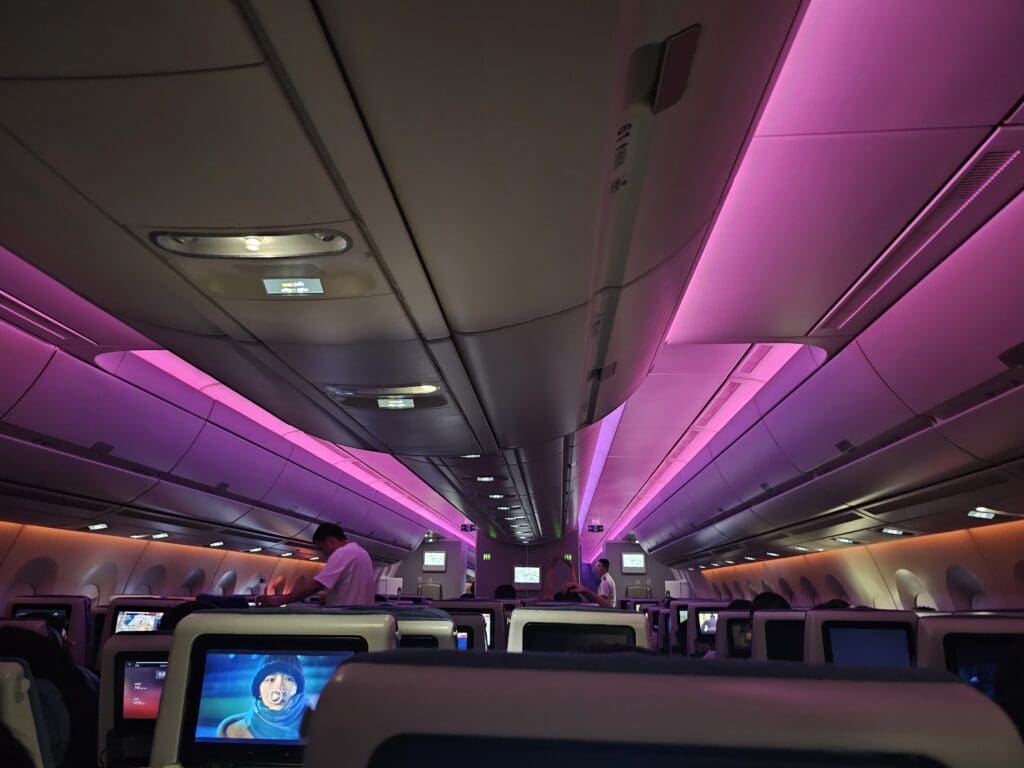
This time around, I ended up being one of the final passengers to be served, although thankfully, both options remained available. Not being too fond of airline breakfasts and seeing as I was flying Air China, I opted to go for the Chinese option. Whilst expecting there to be little interaction again, once the flight attendant reached my row, they looked at me and said, ‘Western?’ in a cool manner. In response, I asked for the porridge, to which they replied, ‘Wow, you can eat porridge. Impressive!’. Not taking this to be too patronising, I then requested a coffee from the other flight attendant who had been tasked with distributing drinks and, still with some time to go until I could bed down for the night, I opted to go for a coffee.
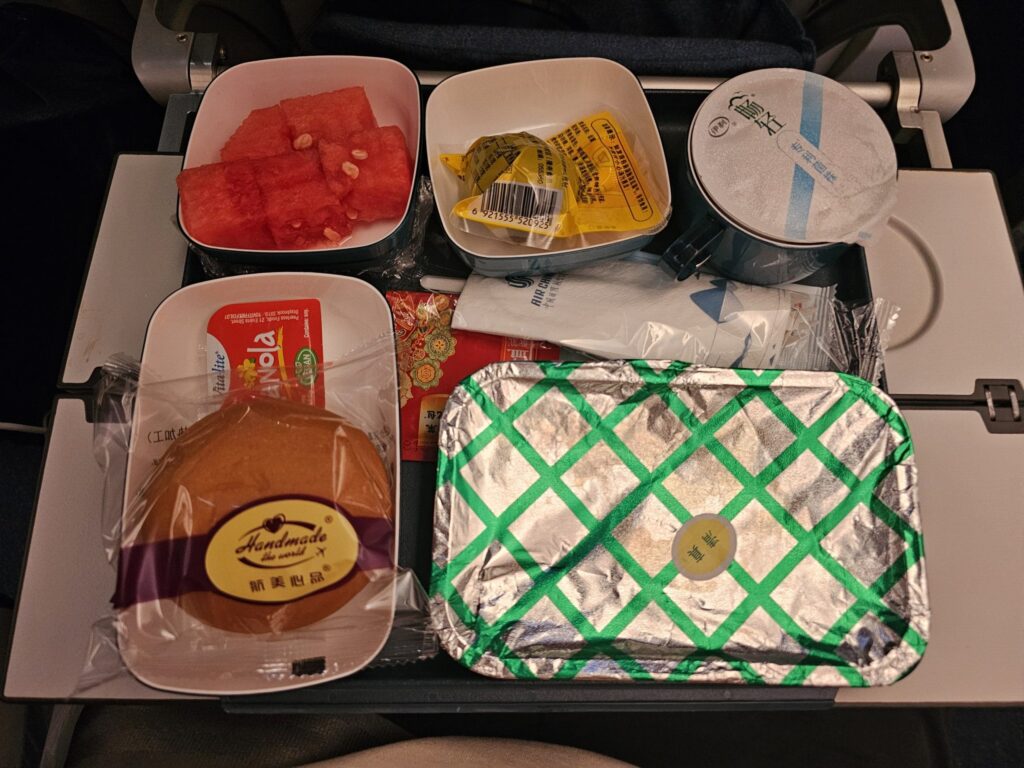
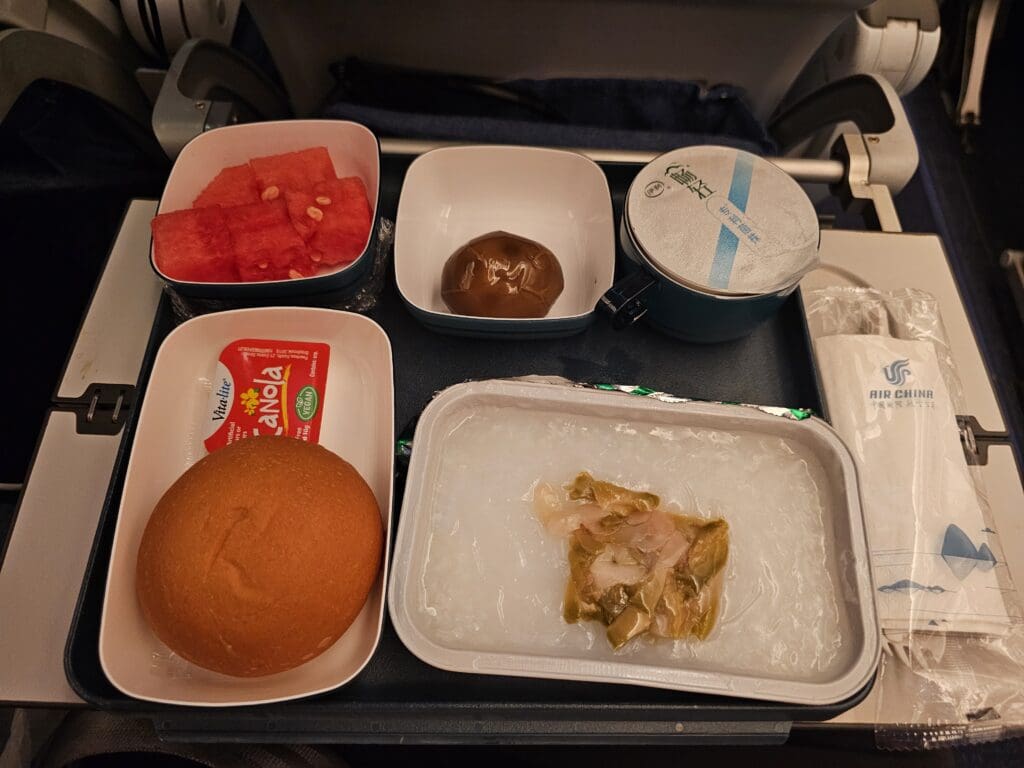
Opening up the main dish, this consisted of plain rice porridge that was accompanied by a tea egg and a sachet of pickled vegetables. Meanwhile, this was served with plain yoghurt, some watermelon cubes and a packaged bread roll with butter. Once again, whilst not the pinnacle of inflight cuisine, this was edible and left me with relatively little to complain about. Furthermore, the trays were collected in good time and not left blocking passengers in for an unreasonable amount of time. I should also mention that given the flight time, many airlines would have perhaps relegated this meal service to a snack rather than a full meal.
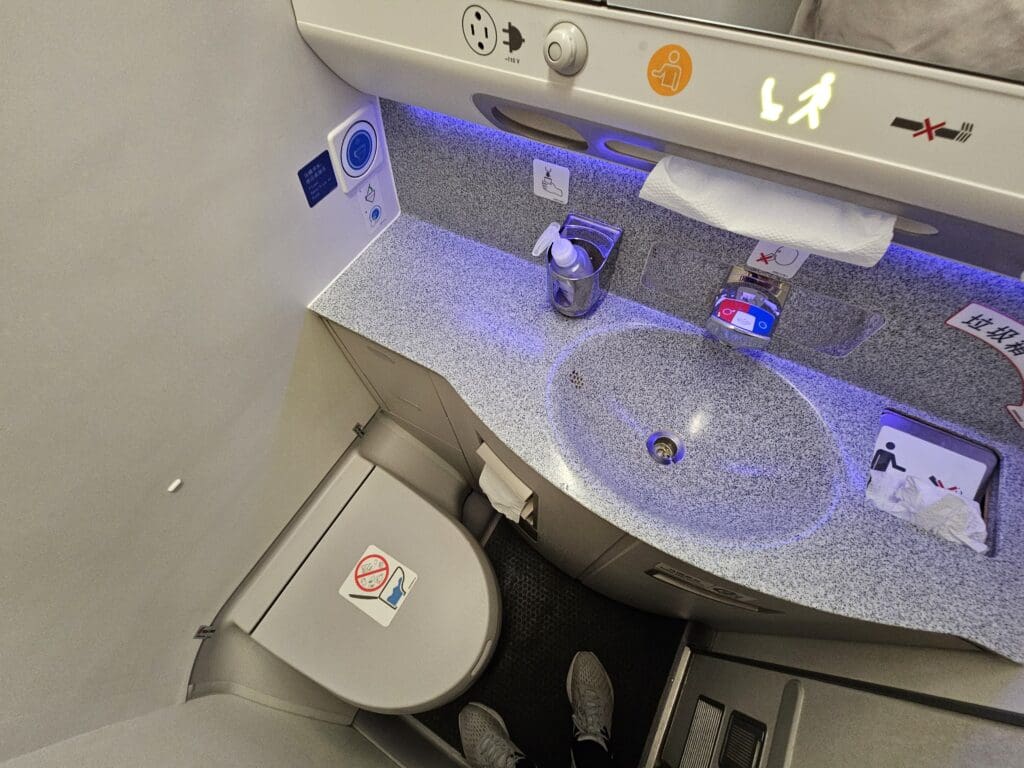
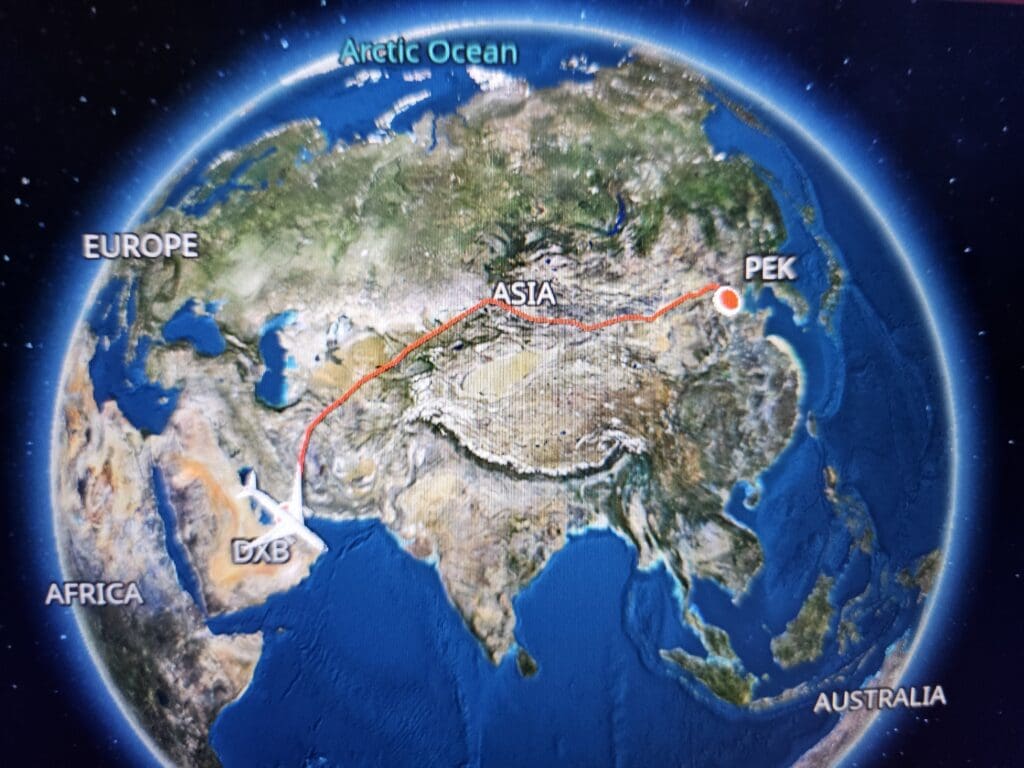
As soon as the trays had been collected, the lights were dimmed once more as we crossed from the skies of Turkmenistan to Iran. Seeing as it was the middle of the night, I was rather shattered by this point and ended up drifting off to sleep for about thirty minutes or so. Waking up as we were thrown around a little, I checked the moving map, which revealed that we were crossing over the Southern Iranian city of Kerman and there was thus not a great deal of the flight remaining. Once things had calmed down, I decided to go for a final lavatory trip and this time tried my luck with a different lavatory. Unfortunately, I found that this also featured a very unpleasant stench but was otherwise tidy and stocked with the basics.
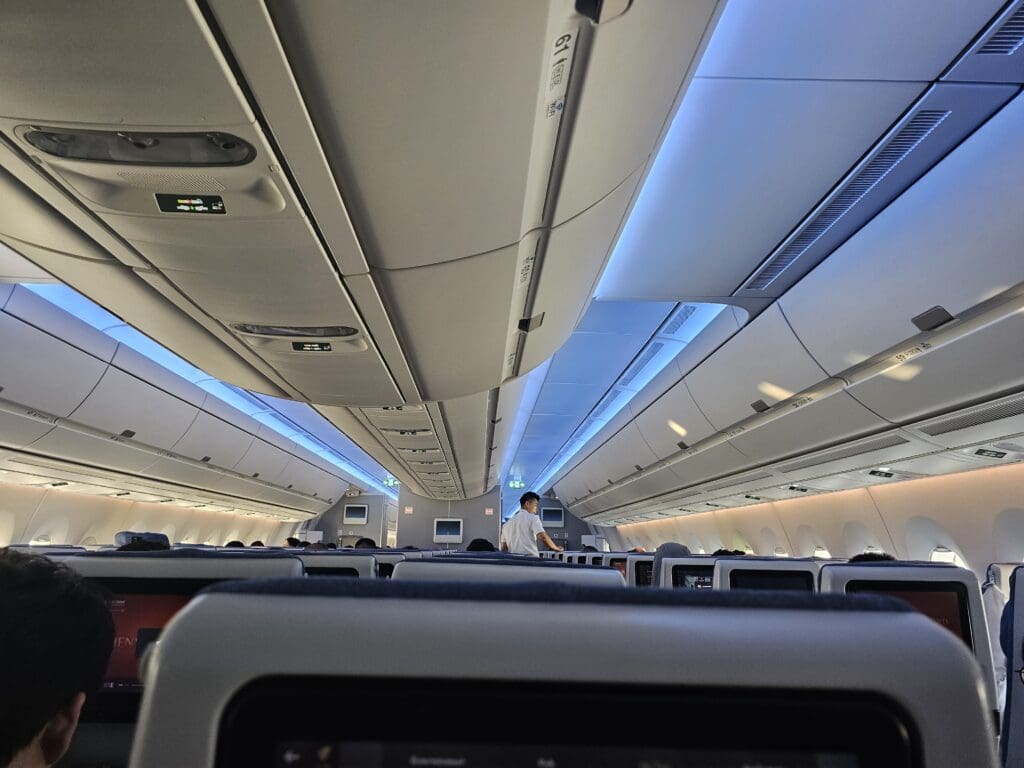
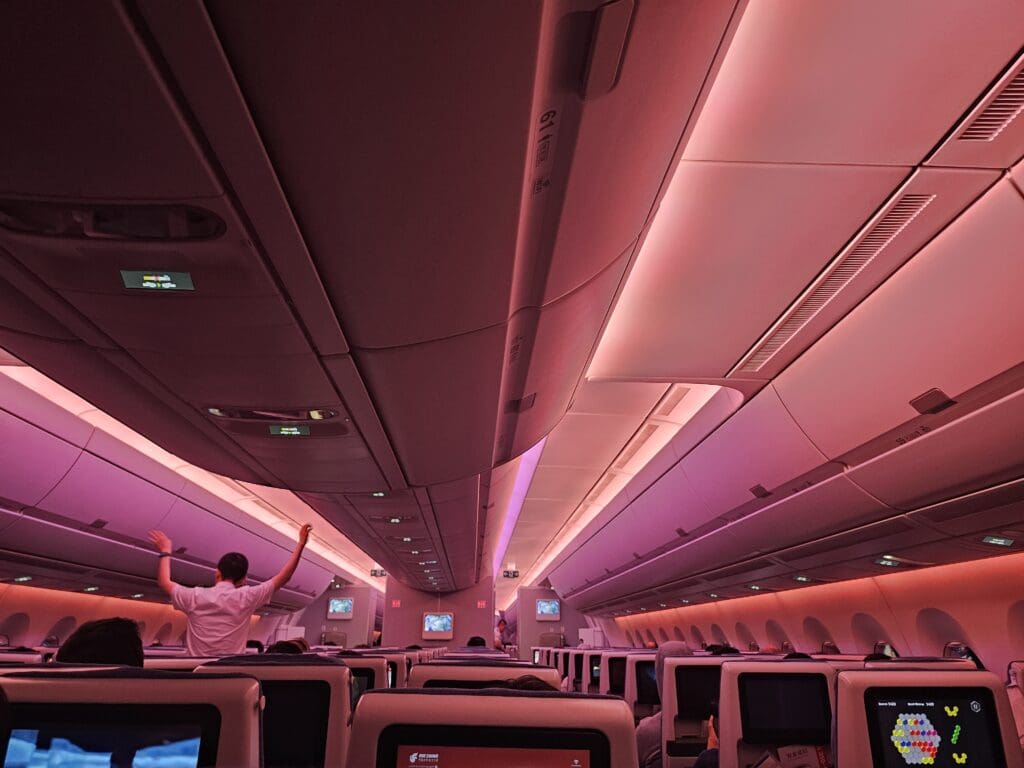
Almost as soon as I returned to my seat, the cabin lights were turned back on once again, albeit this time on their icy blue setting and not too long afterwards, the Purser performed an announcement informing passengers of our impending descent. As with our departure, following local regulations, the crew passed through the cabin, ensuring that all was secure for our arrival before they strapped themselves into the jumpseats just before the aircraft commenced its descent into Dubai. From my position near the rear of the cabin, I got a good view of the many passengers who, as soon as the cabin crew had completed their checks, decided to cheekily re-recline their seats.
Upon reaching the Iranian coastal city of Bandar Abbas, the Airbus could be felt commencing its descent and soon we crossed over the dark waters of the Persian Gulf. Following our short crossing, the Airbus flew southwards down the coastline of the Musandam Peninsula, passing the likes of Khasab, Sha’am and Ras Al Khaimah before making landfall over the Emirate of Sharjah. Crossing directly over the city, the aircraft then made its way out over the Emirati desert as it set itself up for an approach to Dubai Airport’s Runway 30L. As we crossed the desert, the flaps were partially extended before we turned back around and flew towards the airport, at which stage the landing gear fell into position with a loud whine.
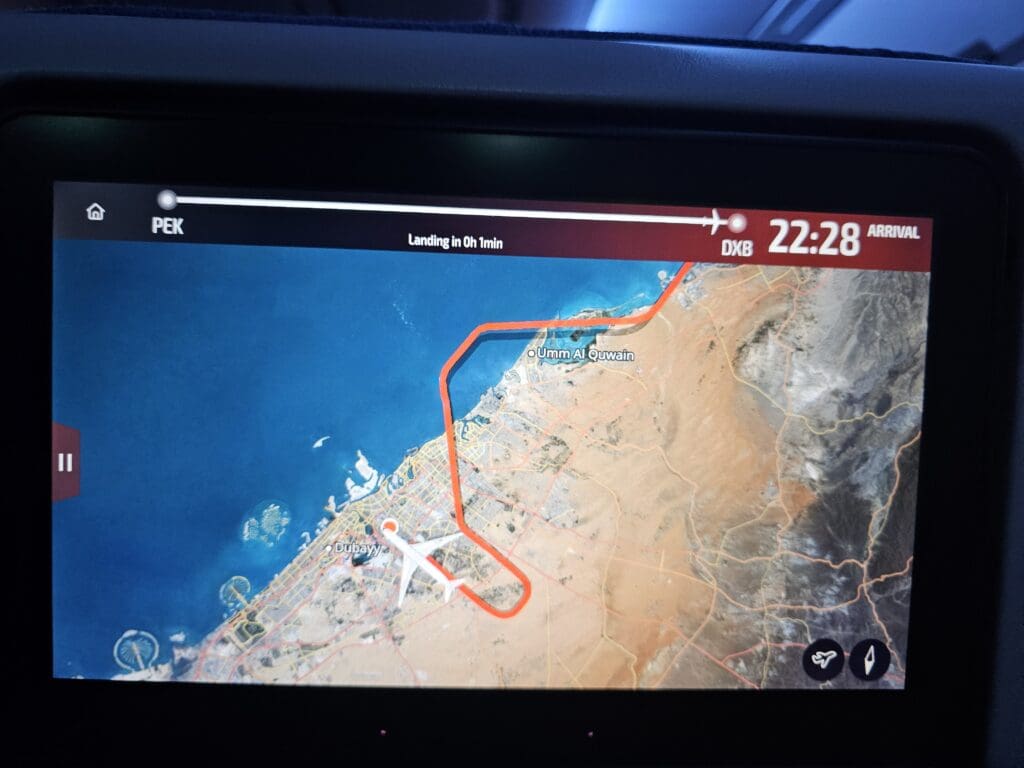
Sinking lower and lower over the dark desert sands, the jet soon reached the bright lights of the neighbourhood of Mirdif, which sits just to the east of the airport. Moments later, the Airbus crossed over Dubai International Airport’s well-guarded perimeter fence, and after exactly 8H42 in the skies of Asia, the Airbus made a firm touchdown on Emirati soil. Like most overseas carriers, Air China utilises Terminal 1 at Dubai Airport, and with this located at the other end of the airfield, understandably, the pilots did not seem to be in any rush to vacate the runway, and we braked gently. As had been the case on my flight from Korea, once on the ground, upbeat neo-classical music rang out through the cabin, although this was soon interrupted by the Purser’s welcome announcement. Making a fairly slow taxi over to Terminal 1, the Airbus came to a halt at Stand C60 at 2240, exactly twenty minutes after our scheduled arrival time. In the usual manner, once the engines had spooled down, many inside jumped up in a frantic rush to disembark and fortunately for those in a hurry, it did not take too long for the jetbridge to be connected and for disembarkation to commence.
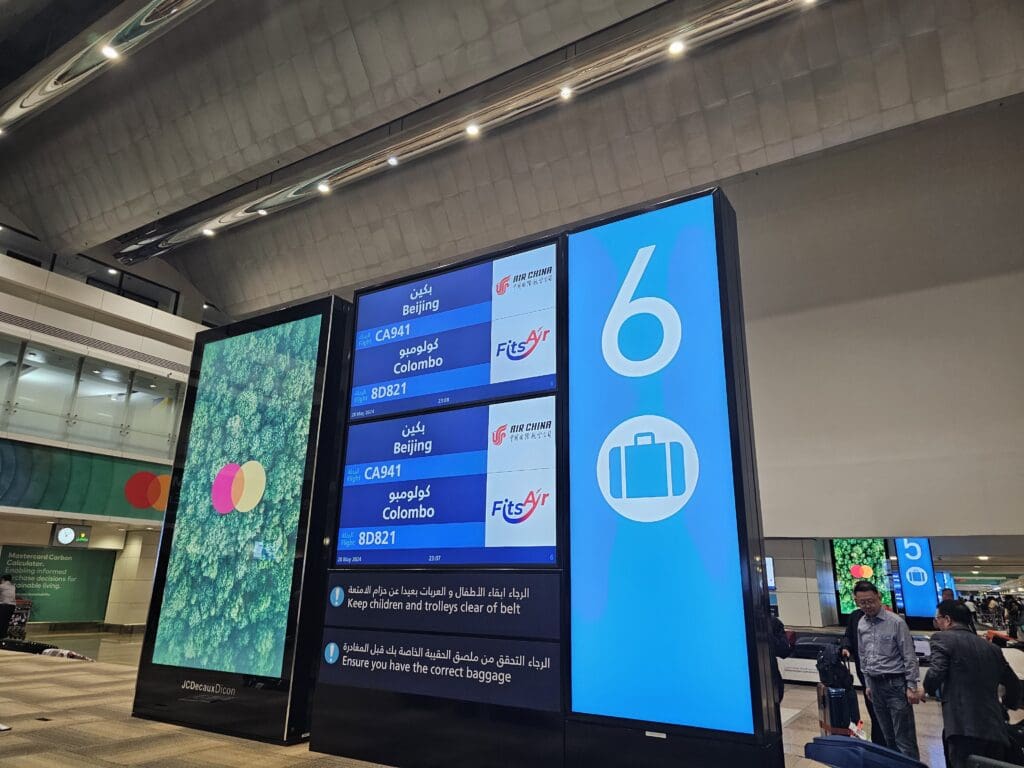
After walking through the cabin and receiving several friendly thank yous and goodbyes, I stepped off the Airbus and made my way up into the terminal building. Whilst arrangements at Terminal 1 may be seen as a little cumbersome due to the people mover ride that is required at the start and end of every journey, that evening it didn’t take too long to reach the station from our stand and having inadvertently timed things just right, I ended up arriving just as the next train pulled into the platform. Whilst Terminal 1 was once synonymous with long immigration queues, thanks to the opening of e-gates, entering the UAE was a quick and painless process, with no more than a three-minute wait required before I reached the busy baggage collection hall. Much to my surprise, upon arriving there, my bag could already be seen spinning around the carousel, so I soon collected it and made my way out of the airport.
Summary
All in all, Air China got me from Seoul to Dubai cheaply and almost on time, and thus, I can say that I don’t have any major regrets about opting to fly with the carrier. However, I have to say that my experience was, in a word, bland, and I was not left with anything majorly positive to say about Air China. Onboard, despite receiving friendly welcomes and farewells, during the flight the crew weren’t particularly warm or friendly, the food and entertainment system were mediocre and the seat, whilst comfortable, was not memorably so! Thus, it is fair to say that in the future, I would be unlikely to go out of my way to fly or pay a premium to fly with Air China again, and I would say that China Southern Airlines offered a notably better experience on my voyage from London Heathrow to Seoul Incheon via Beijing Daxing two weeks earlier.