A Quick Hop on Asiana’s LCC: Seoul to Jeju on Air Busan
Background
Whether it be winter, spring, summer or autumn, those needing to make the 280-mile journey between Seoul Gimpo and Jeju are unlikely to face any shortage of options. Famous for being the world’s most well-served air route, as of July 2024, eight out of Korea’s ten scheduled passenger airlines operate services between the two. For aviation enthusiasts, the route also provides an opportunity to sample widebody jets on a very short route, which, being from the UK, is not something that can be particularly easily done back home. In the distant pre-Covid world, the route allowed passengers to catch a cheap ride onboard the likes of Airbus A330-300s, Boeing 747-400s, Boeing 767-300s, Boeing 777-200ERs and Boeing 777-300s. However, as per Summer 2024 schedules, sadly for enthusiasts, things are a little less exciting, with widebodies limited to Airbus A330s and Asiana Airlines’ last remaining Boeing 767-300. Seeing as I had flown the rare Boeing 767-300 down to Jeju a couple of months prior, and with Asiana Airlines and Korean Air’s Airbus A330 options not aligning with my schedule on that particular day, I decided to instead embark on my first Air Busan ride since 2018 in the hope that I would end up onboard one of the carrier’s new Airbus A321neos.
About the Airline
The mid to late 2000s were a hubbub of activity within the Korean airline industry as the duopoly held by Asiana Airlines and Korean Air was shattered and new airlines began to spring up left, right and centre. This came about as a result of a loosening of restrictions, followed by Korea’s 2008 Airline Deregulation Act. During this time brave entrepreneurs, largely backed by conglomerates, sought to take advantage of the ever-growing number of Koreans holidaying abroad and the steadily increasing number of tourists and other visitors to Korea. In early 2005, Korea’s first low-cost carrier was born, Jeju Air, with Eastar Jet and Hansung Airlines (the predecessor of T’way Air) springing up a relatively short time later. Less well-known entrants to the industry came in the form of short-lived regional carriers Kostar Air and Yeongnam Air, who both operated the Fokker 100. Meanwhile, even low-cost giant Tiger Airways intended to get in on the action and drew up plans to establish an Incheon-based subsidiary, although this never took off from the drawing board.
Naturally, both Asiana Airlines and Korean Air were concerned about these new low-cost entrants and soon commenced plans to create their low-cost subsidiaries to compete. Working in partnership with the Busan Metropolitan City government, in August 2007, Asiana Airlines established Air Busan. As its name would suggest, Air Busan was to focus its operations on Korea’s second-largest city, from where it would initially operate domestic routes to Jeju and Seoul Gimpo. Meanwhile, the airline’s fleet was to be initially composed of Boeing 737-400s and Boeing 737-500s handed down from its parent airline, with these types having become surplus to Asiana Airlines’ needs following the delivery of the first batch of their Airbus narrowbodies.
Once Air Busan had jumped through all the regulatory hoops and received its first few Boeing 737-500s, in December 2008, the airline commenced operations. After over a year of operating just two domestic routes, in March 2010 Air Busan branched out to offer its first scheduled international service. This came in the form of the short 140-mile hop between Busan and Fukuoka. Meanwhile, Cebu, Hong Kong, Osaka Kansai, Tokyo Narita and Weihei all added to Air Busan’s route network later that year. Throughout 2011, Air Busan’s international route network across East Asia continued to grow, whilst flights were also added between Seoul Gimpo and Jeju. Additionally, the airline also took delivery of its first Airbus A321, with the carrier coming to operate a mixed fleet of Airbus A320s, A321s and Boeing 737 Classics until the latter’s retirement in early 2016.
Over the next few years, Air Busan’s fleet and network continued to expand, and the carrier soon came to solidify its importance within the Korean airline industry. Meanwhile, Air Busan opened up its second base at Daegu in 2016, connecting this with a host of domestic and international destinations, followed by another at Seoul Incheon in 2019. Today, Air Busan serves 33 destinations from hubs in Busan and Seoul Incheon, with destinations spread out across China, Guam, Hong Kong, Laos, Macau, Malaysia, Mongolia, the Northern Mariana Islands, the Philippines, Taiwan, Thailand and Vietnam. Meanwhile, as of July 2024, Air Busan’s fleet consists of a mixture of 22 Airbus A320, Airbus A321 and Airbus A321neo jets.
Before this trip, I had flown with Air Busan five times (once on one of their Boeing 737-400s and Airbus A320s, and thrice on their Airbus A321s). On all trips, I had found the cabin crew to be polite and friendly, and, seeing as these aircraft had not been reconfigured since their days flying with Asiana Airlines, once onboard the seats afforded an abundance of space and comfort that was totally at odds with what one may expect from a low-cost carrier! With my last Air Busan ride having involved a short hop from Osaka Kansai to Busan way back in November 2018, my next flight with the airline was long overdue and I looked forward to seeing if and how the airline had changed in the near six-year period that I had not flown with them.
Booking
When flying domestically in Korea, reasons are abundant as to why you should book directly with the operating carrier as opposed to booking via a third-party ticket platform. Perhaps most importantly, for Korean domestic flights, it usually seems to be the case that ticket prices are always cheaper when booked directly with the airline, and there are often more flight options available. Meanwhile, if you end up needing to cancel your flight, then you can usually do so, even on Korea’s low-cost carriers, by having no more than a nominal fee deducted from the cost of your original ticket. Thus, once I had decided to fly with Air Busan, I soon navigated my way over to the carrier’s website.
Upon touching down on Air Busan’s homepage I was greeted by the flight search engine, which was superimposed on a montage of scenic photos of Busan’s coastal Haedong Yonggungsa Temple and Gwangan Bridge, alongside a slightly tacky-looking computer-generated image of one of their Airbus A321neos with the caption ‘Fly Forward 2024’ (I’m not too sure why the airline couldn’t just use a real photo of one of their latest deliveries, especially seeing as by this time a total of eight of these brand new aircraft could be found in the airline’s fleet!). Other than this slight complaint, I found Air Busan’s website to be modern, functional, easy to navigate and home to everything that you would expect to find on that of a major airline. Additionally, I was rather pleased to find that this website was available in an above-average selection of languages (when compared to other Korean airlines) – with Chinese (traditional and simplified), English, Japanese, Korean, Russian and Vietnamese offered.
Once I had had a quick look around the website, I continued onwards and searched for flights. Within a matter of milliseconds, I was presented with Air Busan’s nine flights from Seoul Gimpo to Jeju that day, with these departing between 0645 and 1905. Each had three fare categories: Super Special, Special and Regular, however, the cheapest Super Special fare had already sold out for all flights. Despite being a low-cost carrier, as is the norm in Korea, all fares (other than the Super Special) allowed passengers to bring a complimentary 15kg of hold luggage with them. Hoping to end up on one of Air Busan’s new Airbus A321neos, I picked the first non-Airbus A320 departure of the day, the 0710 service. Once I had clicked on the 7,200 won base fare, 4,000 won in taxes and a 12,100 won fuel surcharge was added to this, bringing the total up to a still very reasonable 23,300 won (£12.87). Up next, I had the option to pre-select a seat, with these priced between 4,000 won (£2.30) and 12,000 won (£6.86), or pay to add additional weight to my complimentary 15kg luggage allowance. In the end, I decided to splurge out 4,000 won (£2.30) to pre-select a window seat near the rear of the cabin. Once selected, I made a quick and easy payment and was all set to head off to Jeju.
Online check-in for Air Busan’s services opens 48 hours before departure, and being a domestic flight, I expected this to be a quick and easy process. Indeed, this required me to do little other than reconfirm the personal details that I had entered during the booking process. However, during this, I did notice that the flight had been downsized from the Airbus A321 to one of Air Busan’s five Airbus A320s. Whilst this was no major disaster, it did of course crush my hopes of flying on one of the airline’s latest jets! Nevertheless, without dwelling on this, I steamed onwards and soon received my mobile boarding pass.
The Journey
Following a busy few weeks spent seeing friends and visiting old haunts across Korea, a new day dawned and it was time for me to buckle up and prepare to refamiliarise myself with the delights of Air Busan. Staying in Gongdeok, a skyscraper-filled neighbourhood on the western side of Central Seoul, nothing more than 13.4 kilometres separated me from Gimpo Airport’s domestic terminal. I was thus confident that I would not face any issues in reaching this in good time for my flight. As airports go, Gimpo Airport is very well connected to the cities of Seoul and Incheon, and the surrounding Gyeonggi Province. From around 0500 each morning, no fewer than five metro lines serve the airport’s dedicated station, which sits between the airport’s two terminals and is a short walk away from both.
Considering that I would be starting my journey in Gongdeok, it made little sense for me to reach the airport by any means other than Korail’s Airport Express train, more commonly known as the AREX. This operates on a 63.8 kilometre route between Seoul Station and Incheon Airport’s Terminal 2 and is served by two types of service – the express service which runs directly between Seoul Station and Incheon Airport without stops, and the cheaper all-stop service which makes twelve intermediate stops, including both Gongdeok and Gimpo Airport. Seeing as I would be departing Gimpo Airport at 0710, I decided to aim to catch the first westbound all-stop AREX service of the day from Gongdeok, with this departing at 0524. Granted, seeing as I had checked in online, had no bags to drop off and was aware that the domestic terminal can almost always be passed through speedily, I could have probably caught a train an hour later and still comfortably made my flight. However, not wanting to cut things too fine, I settled on the first train of the day.
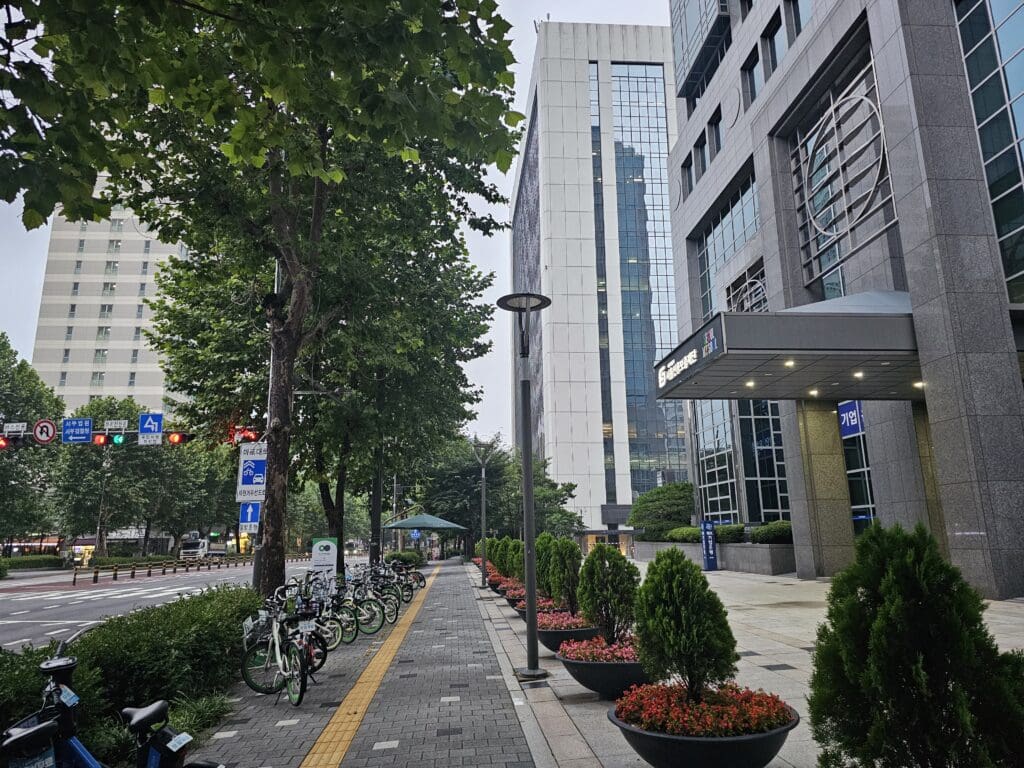
Following Korean tradition, the summer rains had poured down the night before causing me to stay up late eating jeon and drinking makgeolli, a traditional Korean savoury pancake and rice wine respectively. After no more than about three hours of light sleep, I woke up weary-eyed and slightly sore-headed at the ungodly hour of 0445. Fortunately, seeing as I would be returning to Seoul that afternoon, I didn’t have much to pack and after darting through the shower and donning a fresh set of clothes, I was all ready to face a new day. Travelling in the midst of summer, whilst the sun was yet to rise, the air was already horrifically humid and I managed to accumulate a light sweat on the ten-minute downhill walk to Gongdeok Station. At that time, I was joined on the streets by an army of pre-work dog walkers, motivated early-morning fitness enthusiasts and suited commuters on their way to the office.
Once I had arrived amid the subterranean sprawl that makes up Gongdeok Station, I weaved my way through the crowds and eventually made it to the westbound AREX platform. However, upon reaching the bottom of the long escalators, I was greeted by the sound of the platform screen doors beeping as they closed. Thankfully this was no disaster, and around six minutes later, the next Hyundai Rotem train hurtled into the platform, and once at a standstill, I was delighted to find plenty of empty seats meaning that I would be in for a comfortable ride to the airport.
For those taking the full journey between Seoul Station and Incheon Airport, there are some obvious benefits to taking the non-stop express AREX service. Not only is this fifteen minutes quicker, taking 51 minutes to travel between Seoul Station and Incheon Terminal 2, as opposed to 66 minutes, onboard, the express service features ‘airline’ style seats, plug sockets, complimentary wifi, toilets and bottles of water. Whilst onboard, the all-stop train appears to be no different from any other subway train in Seoul except for additional luggage storage space. Of course, the express train does come at a price premium, costing 11,000 won (£6.29) as opposed to 4,750 won (£2.67) for the all-stop train. However, travelling to Gimpo I had no option other than to take the all-stop train, and returning to the journey, following stops in Hongdae and Digital Media City, we made our way out into the green space that sits to the west of Seoul and hurtled across the wide Han River.
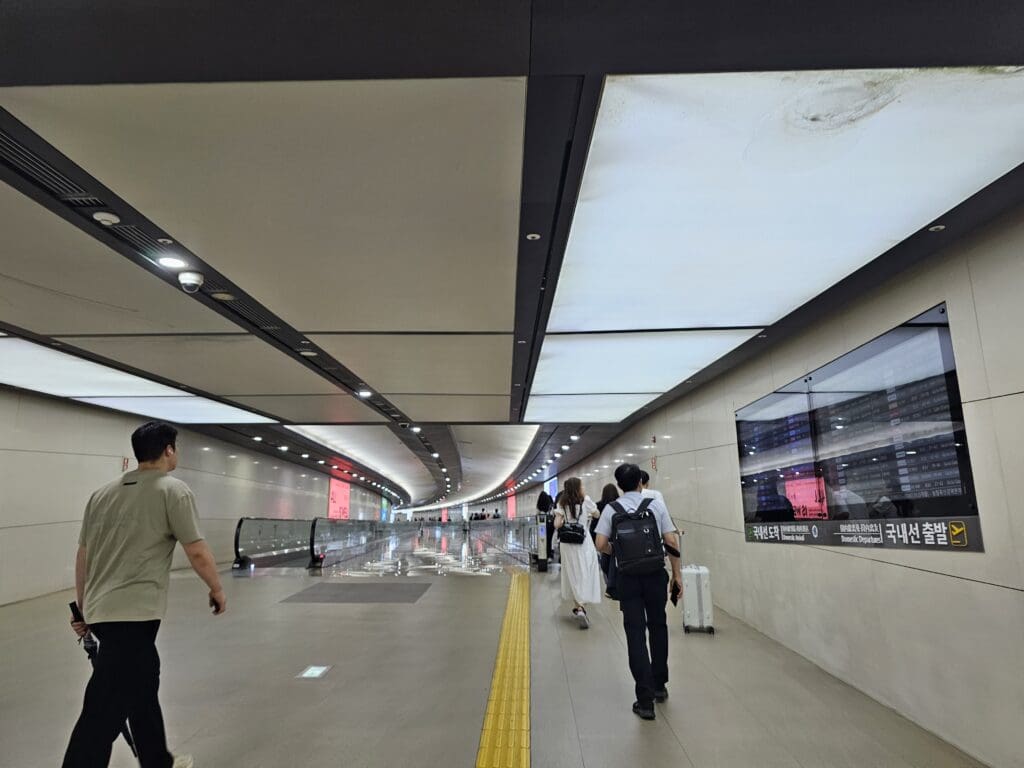
Once on the south side of the river, the train headed back underground for one more stop before pulling into Gimpo Airport Station around eighteen minutes after leaving Gongdeok. As is usually the case at that time of the morning, I made my way off the train and was joined by crowds of Jeju-bound holidaymakers, airport staff, cabin crew and pilots, and commenced the long ascent to the station’s atrium. Once there, I tapped my T Money on the barriers and had the very reasonable 1,600 won (£0.92) fare deducted before I turned left and commenced my journey down the moving walkways of the long well-polished corridor that connects the station to the domestic terminal, arriving there around five minutes after disembarking the train.
Heading up the escalators through the arrivals level, I soon arrived at Gimpo Airport’s reasonably large check-in hall. This is modern, bright, airy and spacious, and at that time of the morning was fairly busy with plenty of school groups, families and couples heading off on the barrage of flights down to Jeju. Briefly turning to the facilities on offer in this part of the terminal, those who fancy something to eat or drink before heading through security will face no shortage of options, with twenty restaurants and eleven cafés, plus four shops and a pharmacy on offer. The majority of these facilities sit either on the ground floor arrivals level or in the food court which sits on the top floor of the terminal, above security. Aviation enthusiasts with time on their hands may wish to visit the latter as it is home to one of Korea’s very few open-air observatories, with this providing a good view of the eastern ends of the airport’s two runways, as well as some of the terminal’s stands and taxiways.
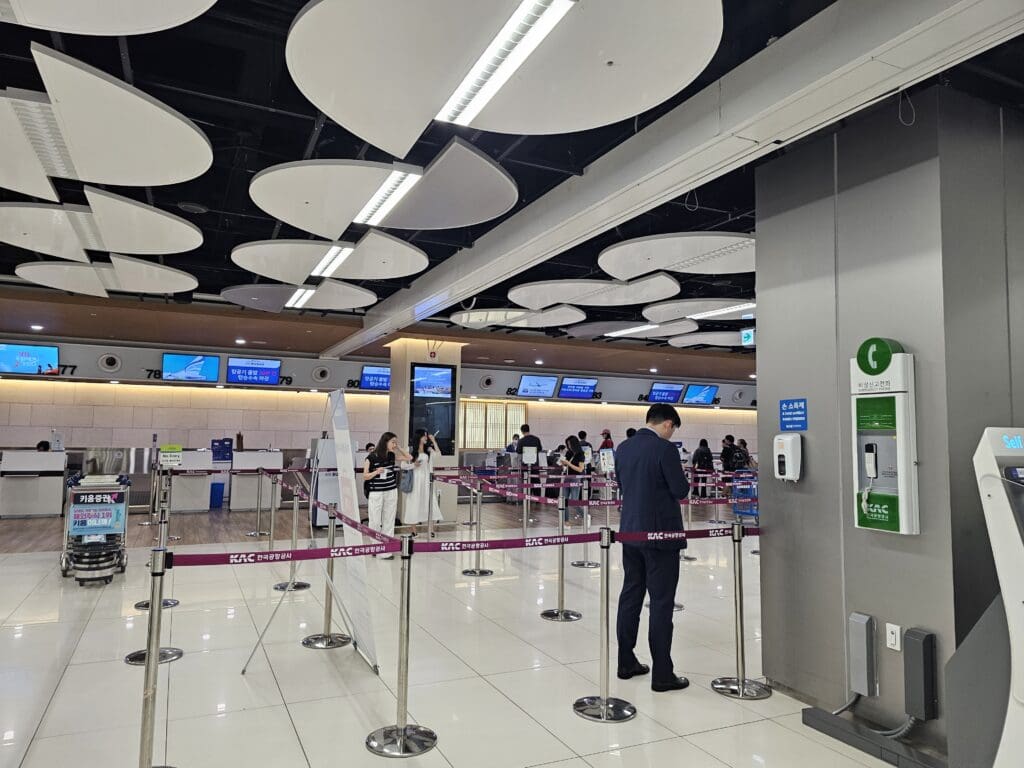
Returning to the check-in hall, whilst I did not need to obtain a boarding pass or drop off any luggage, I did inadvertently wander past Air Busan’s check-in area. This was well branded and plenty of staff could be seen there ready and raring to assist passengers. Furthermore, despite having three flights to Jeju and a single flight to Busan departing before 0730, these desks seemed to be quiet and almost entirely devoid of passengers. Continuing onwards, I made my way up the escalators to the entrance to the terminal’s security area where I joined a short queue, before having my boarding pass scanned and passport checked no more than forty seconds after joining this. As always, security at Gimpo was a well-oiled and painless affair and took no more than a minute to pass through. Following a quick x-ray of my bag and once I had passed through the metal detector, with no frisking or additional checks needed, I reached the spacious, modern and well-polished atrium of Gimpo Airport’s domestic terminal.
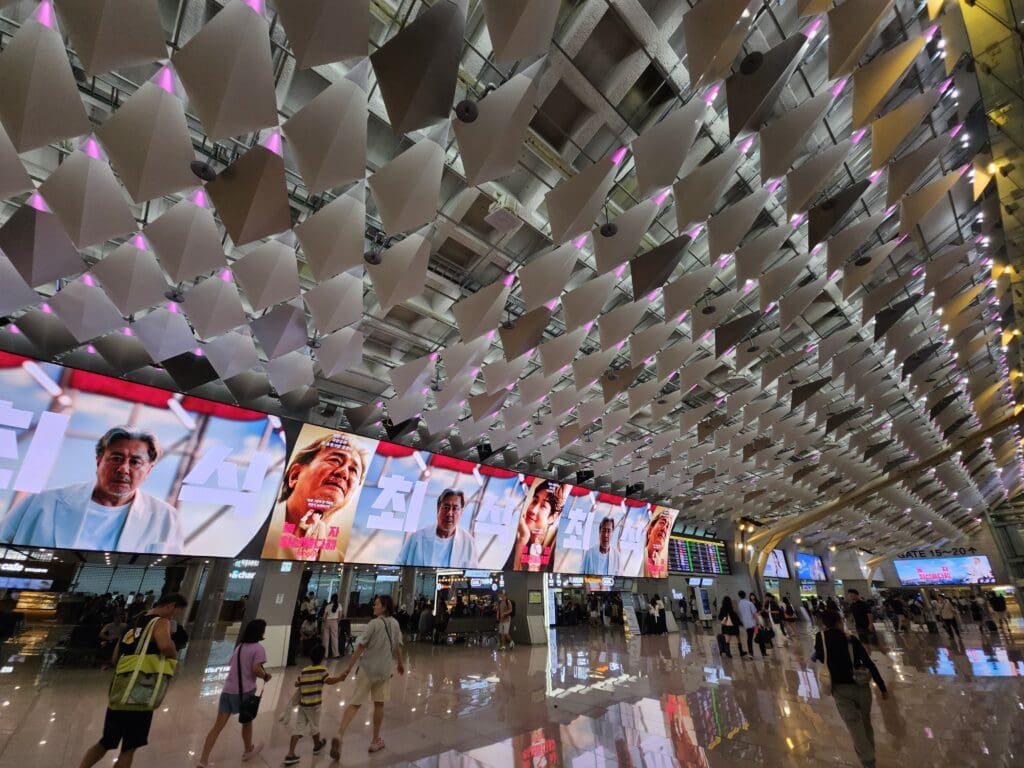
Since welcoming its first passengers in the 1970s, Gimpo Airport’s domestic terminal has undergone a series of renovations and improvements, the latest of which concluded in 2018. Thus, inside, this is sleek, modern, bright and spacious, and offers a significantly improved experience compared to when I first started passing through Gimpo Airport in 2015. That morning, this was clean and tidy, and despite being busy, plenty of free seats were available across the terminal. Meanwhile, this features plenty of charging points, whilst the complimentary wifi worked well for the duration of my stay, leaving me with no complaints. In terms of facilities, the airside area of Gimpo Airport’s domestic terminal does not feature quite as many as are provided in the landside portion of the terminal. There, three cafés, three light fast food outlets and a convenience store can be found, and it is perhaps clear that the terminal isn’t designed to be a place where passengers are expected to wait for hours before their flight.
Throughout the terminal, floor-to-ceiling windows provide clear vistas of many of the terminal’s stands as well as the airport’s two runways. As is always the case, plenty of aircraft could be seen there from almost every single Korean airline, with jets from Air Busan, Air Seoul, Asiana Airlines, Eastar Jet, Jeju Air, Jin Air, Korean Air and T’way Air, spotted being readied for a new day of flying. Of course, being a domestic terminal in Korea, most flights were bound for Jeju, with Busan in second place. Had I not wanted to go to either of the two, I also spotted services bound for Gwangju, Jinju, Pohang, Ulsan and Yeosu. Admittedly, with all of these cities sitting a two to three-hour train ride from Central Seoul, I’ve never been quite too sure as to why these flights are popular. Perhaps many of those who take these are travelling to and from Korea’s third largest city, Incheon, which isn’t connected to Korea’s high-speed rail network.
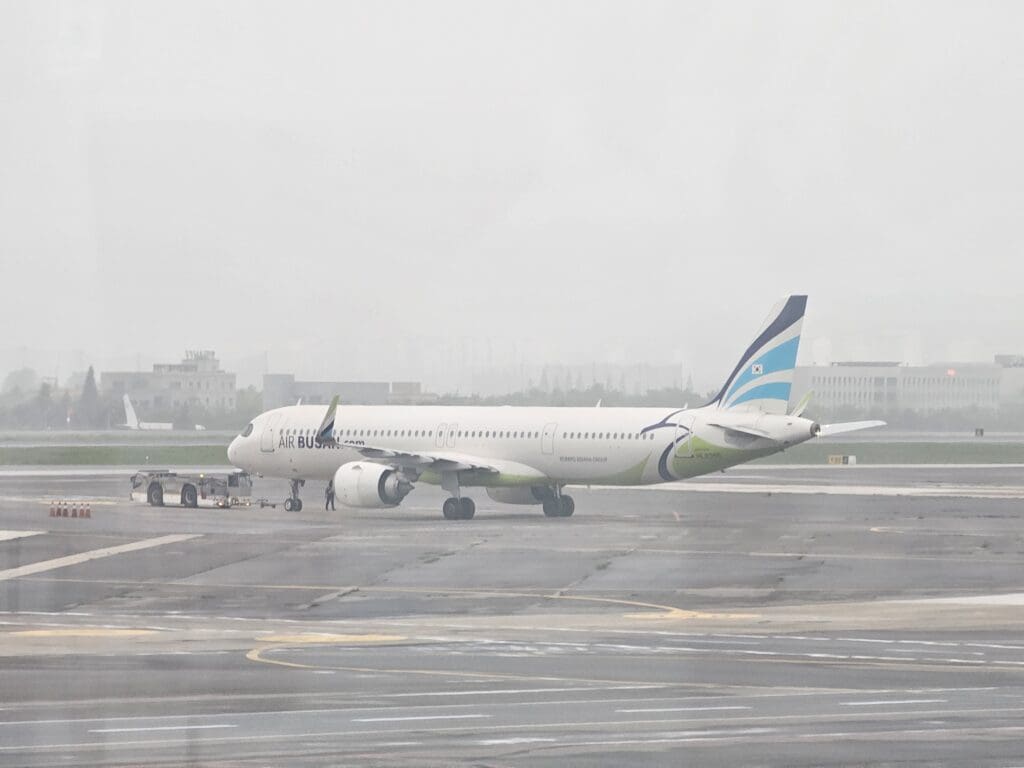
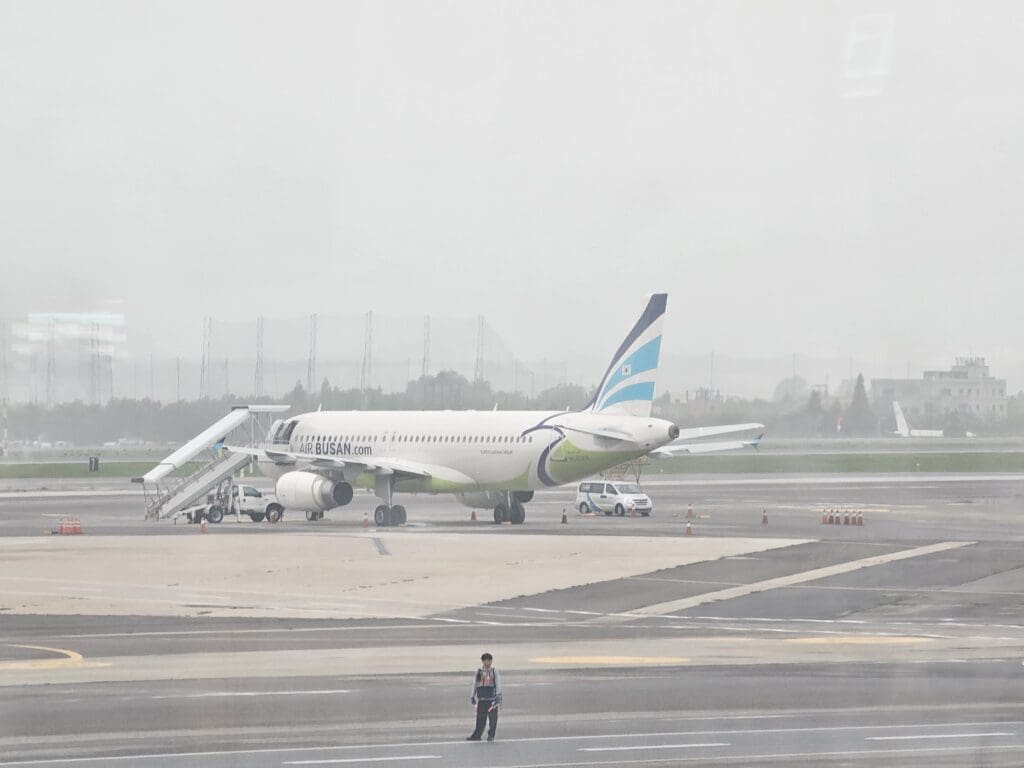
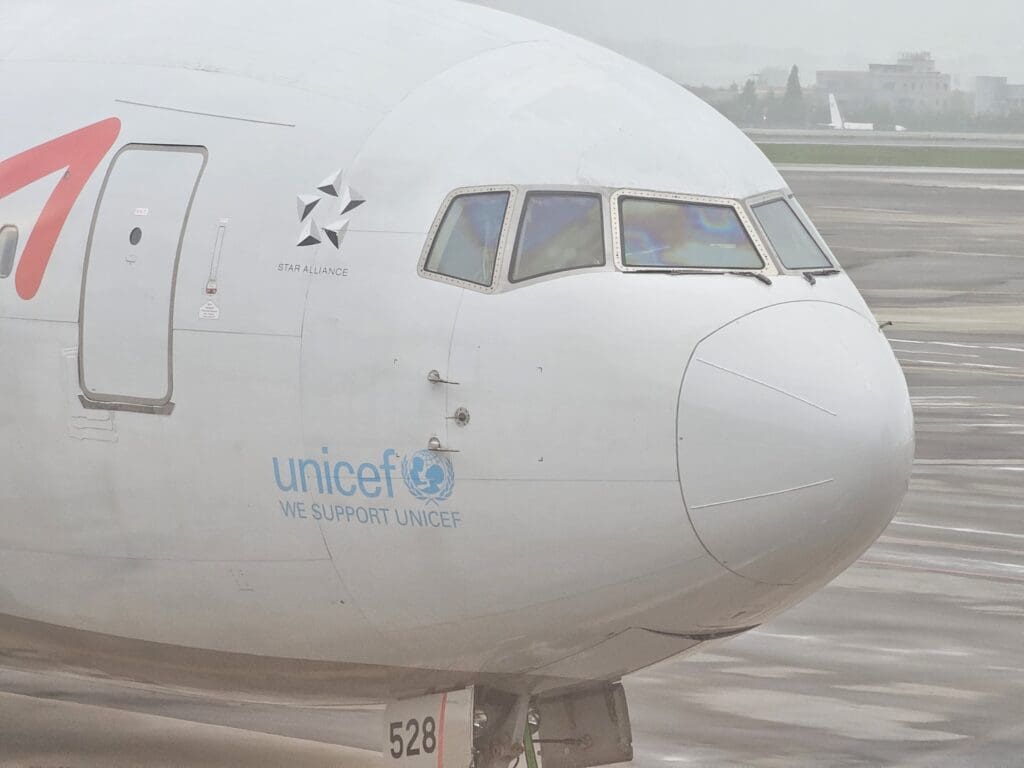
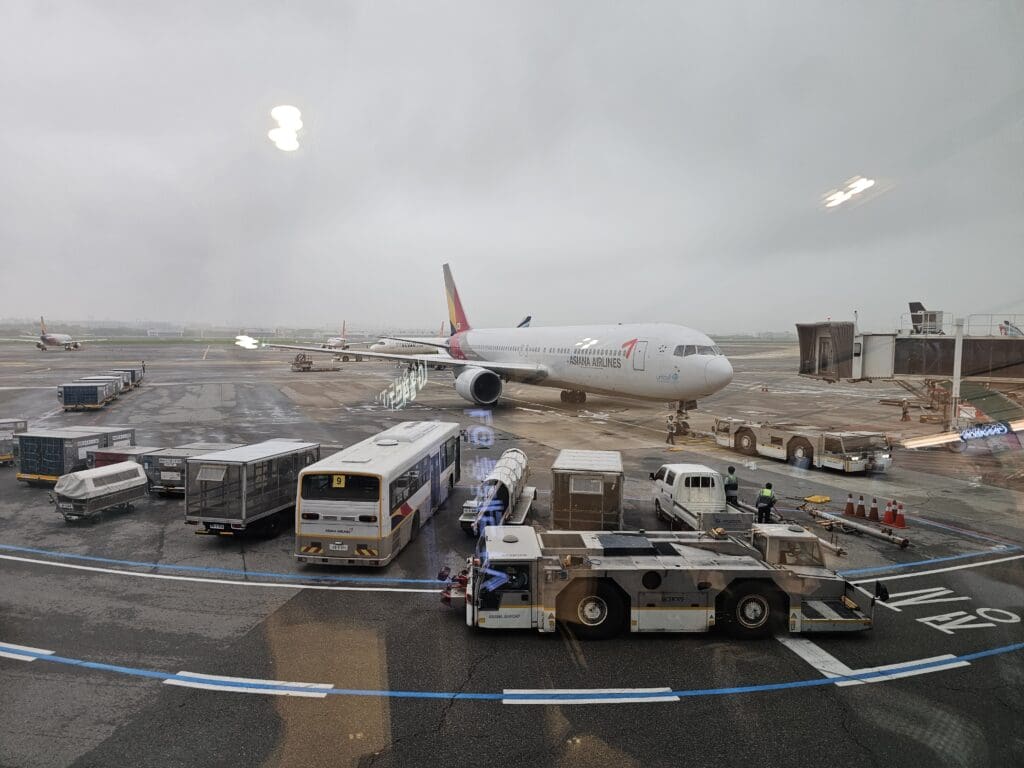
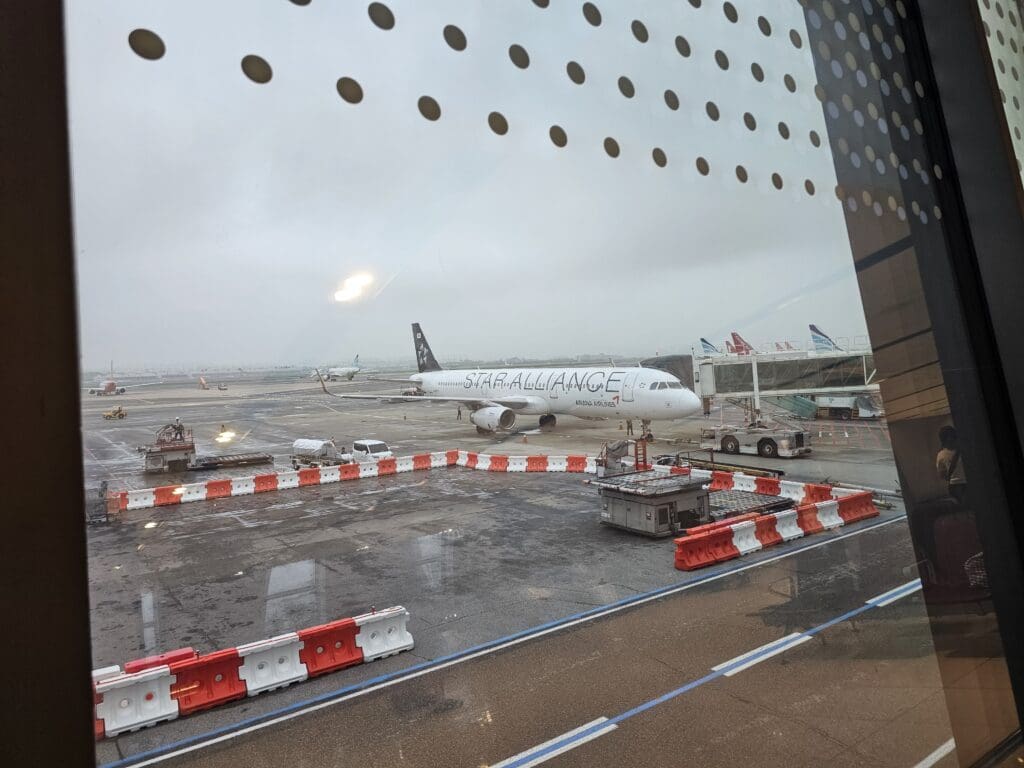
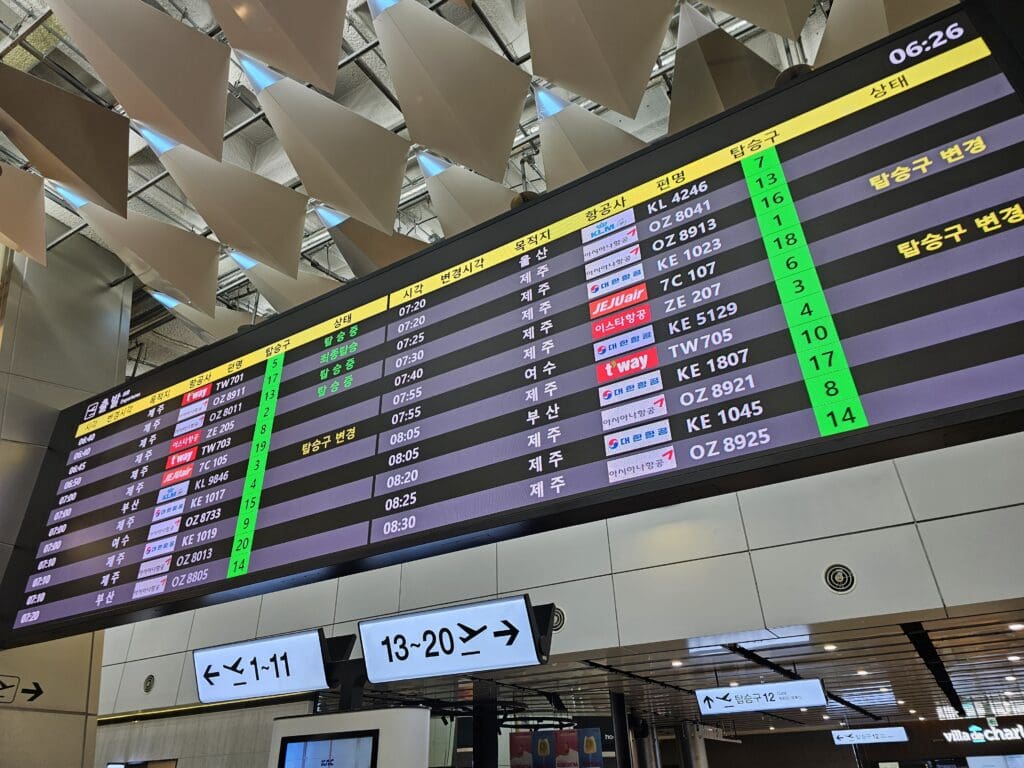
Following a wander around and a toilet stop, by this time, having had nothing more than a quick sip of water after waiting up, I was parched. Whilst I had pondered stopping by at one of the terminal’s cafés, I decided to save my first coffee of the day for Jeju and instead headed to the convenience store for a bottle of barley tea. With this in hand, I checked the departure boards which revealed that my flight would depart from Gate 20 at the far western end of the terminal and one of the furthest gates from the central hub. Nevertheless, given the comparatively small size of the domestic terminal compared to many major airport terminals, getting to the end of the terminal was not a particularly long or arduous trek and I could almost make the entire journey via moving walkways. Slowly sauntering along, I eventually arrived at the end of the pier where I was greeted by fairly busy scenes, however with a Jeju Air flight departing from the neighbouring gate, it was tricky to decipher just how busy the Air Busan service to Jeju would be. Nevertheless, seeing as the flight had been downgraded from an Airbus A321 to the notably smaller Airbus A320, I suspected that this may be rather full.
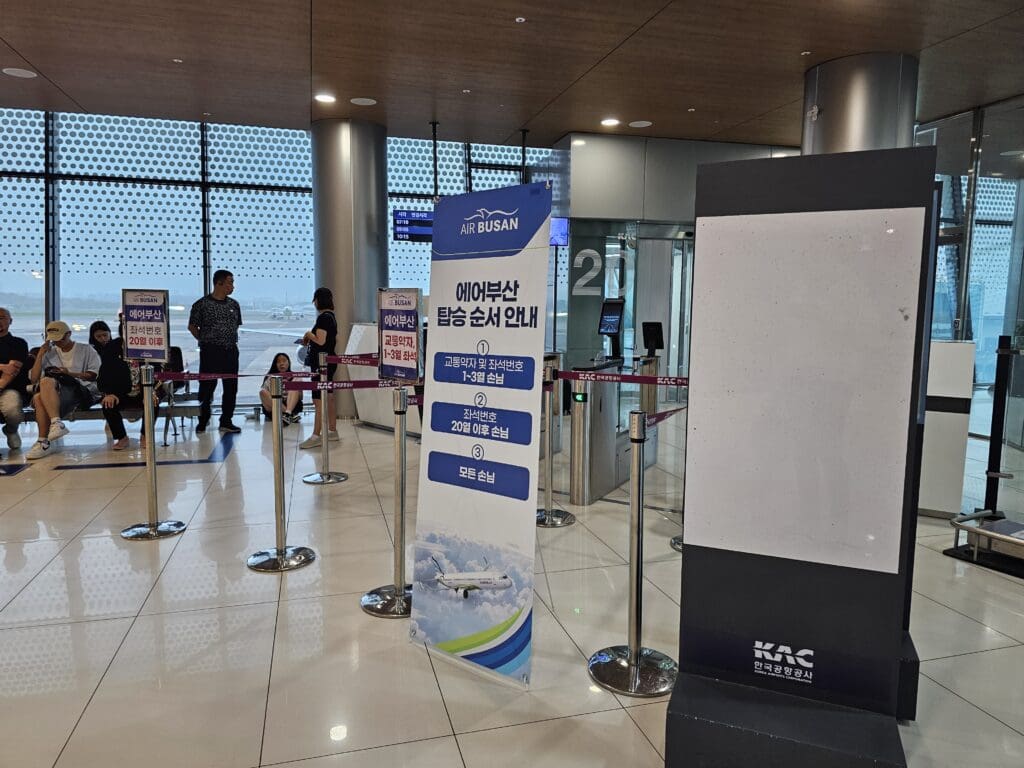
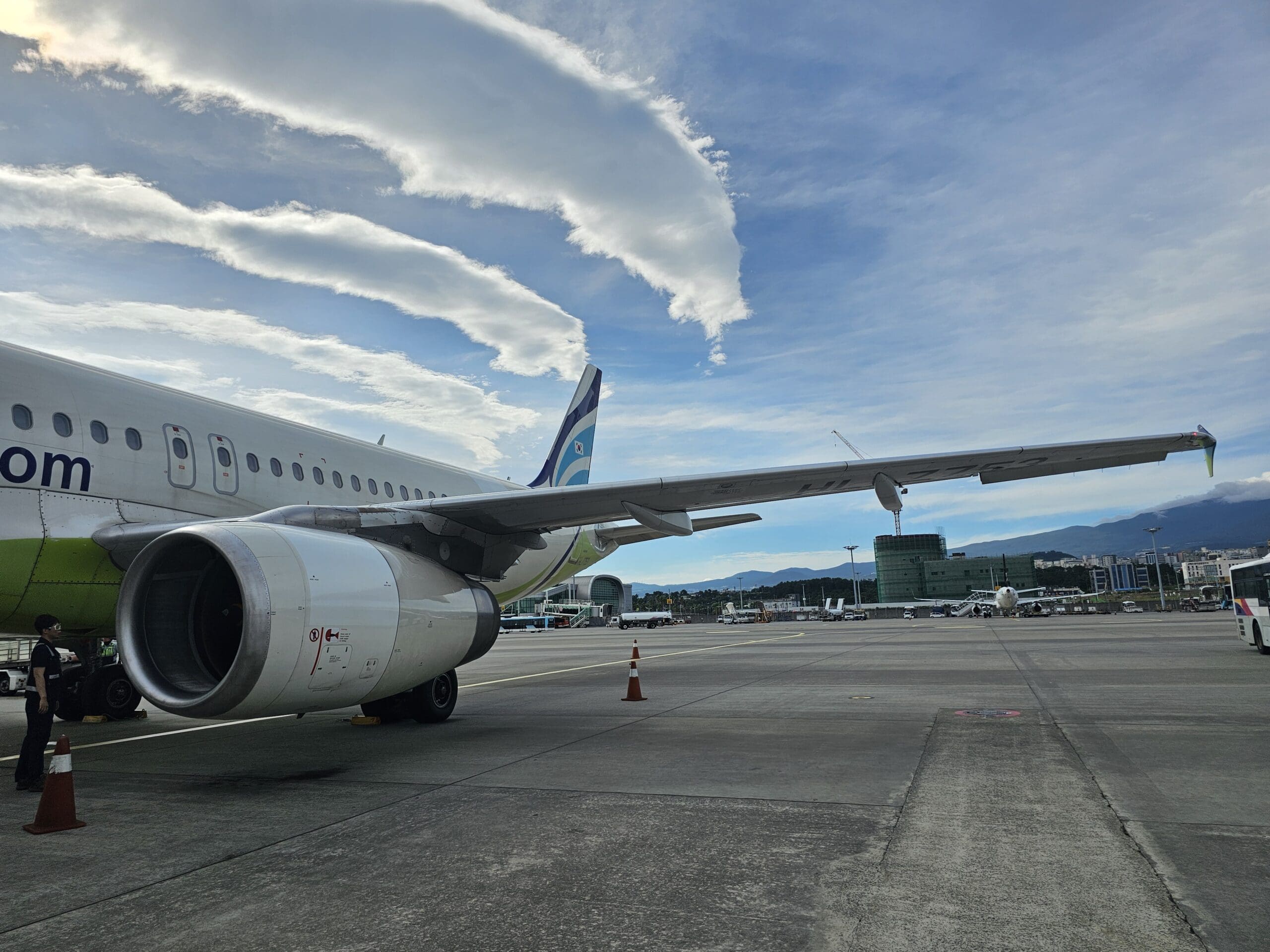
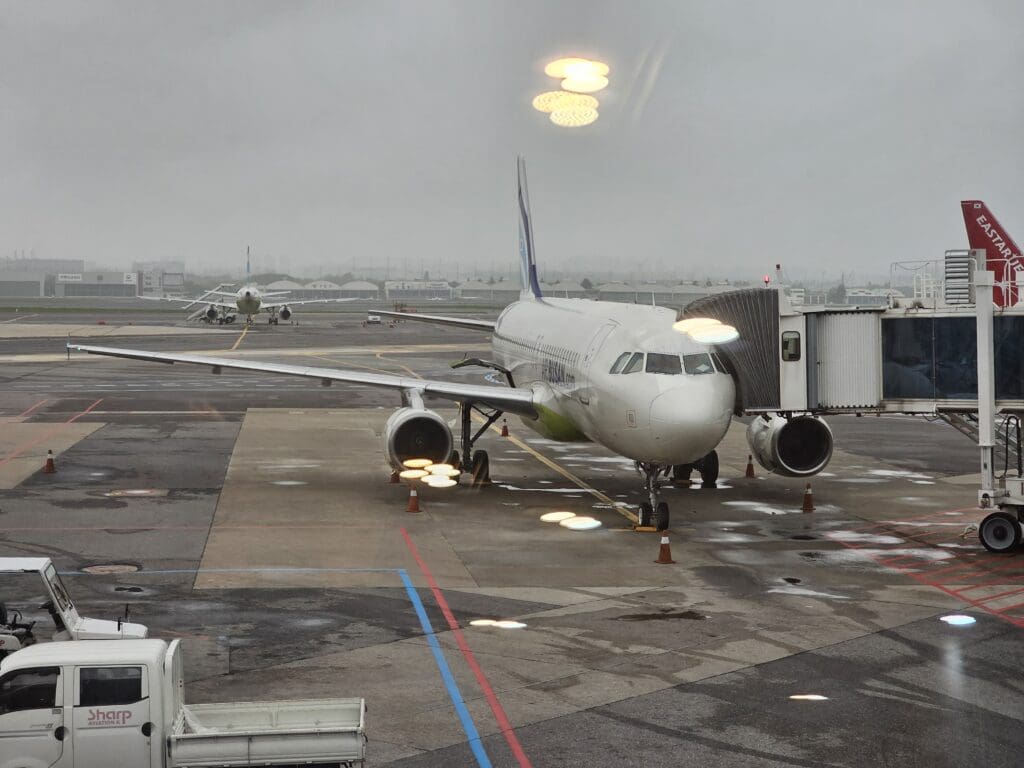
Despite arriving at the gate with over thirty minutes to go until departure, two Air Busan staff members could already be seen at the gate podium whilst plenty of signage had been erected around this. Looking outside, I gazed out at the Airbus that would be taking us 280 miles southwards to Jeju that morning. This took the form of HL7753, an Airbus A320-232 that first took to the skies in October 2006 and was thus 17.7 years old at the time of my flight. Assembled at Airbus’ Toulouse Blagnac plant and carrying the construction number 2943, like many of Air Busan’s aircraft, this commenced its career with parent airline Asiana Airlines and ended up being one of the first of the airline’s aircraft to sport the carrier’s current livery. Delivered to Asiana Airlines in November of that year, the jet spent almost exactly six years flying across the skies of Northeast Asia before being handed down to Air Busan in November 2012 where it became the third Airbus and first Airbus A320 to join the airline’s then mostly Boeing 737 Classic fleet. In the week before my flight, the aircraft had operated almost exclusively on Air Busan’s route between Seoul Gimpo and Jeju, except for a few handful of flights between Busan and Jeju and Seoul.
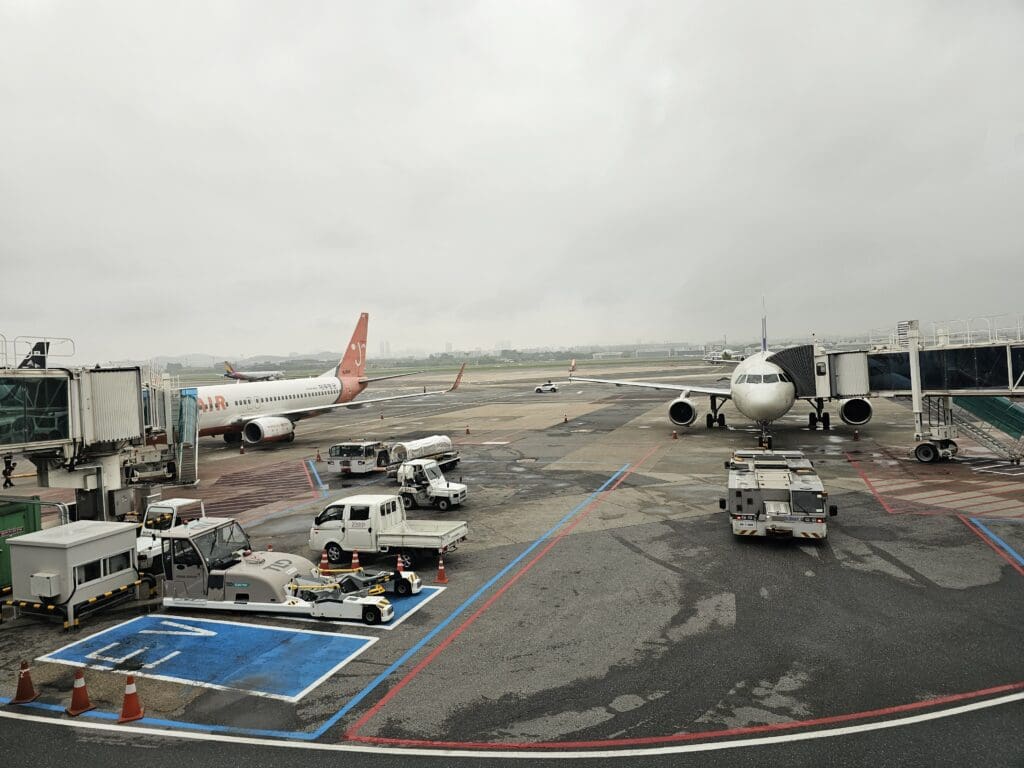
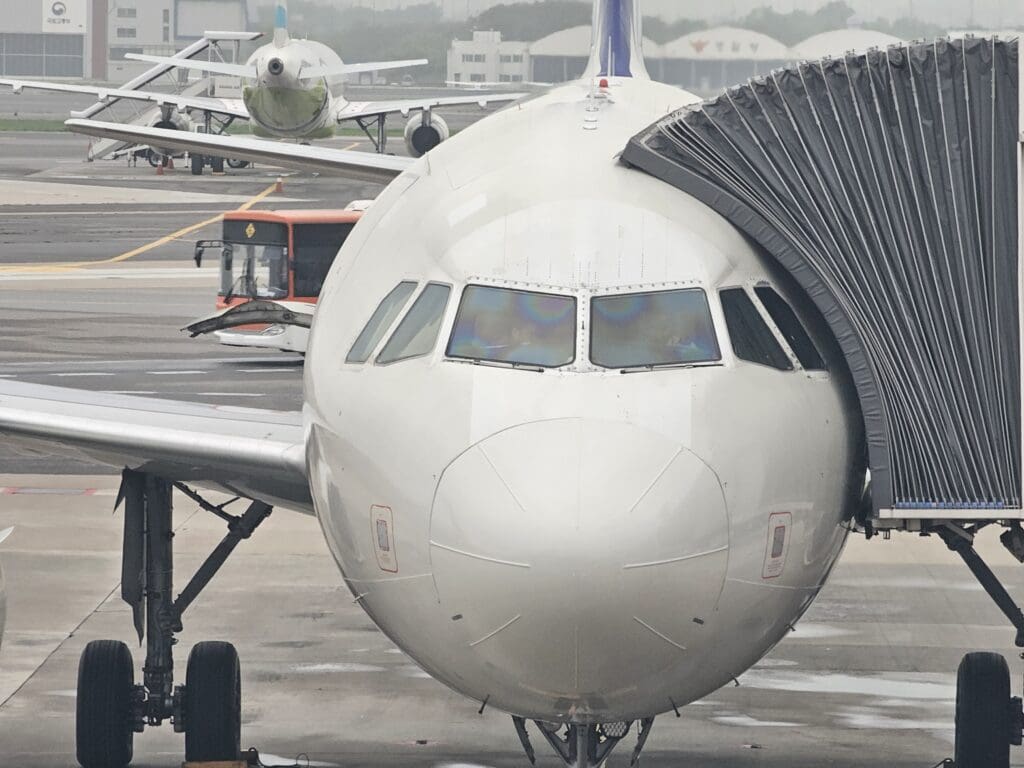
Looking at my boarding pass, this advised me that boarding would commence fifteen minutes before departure at 0655. Whilst this did not allocate a great time to boarding, such short boarding times are not particularly unusual for Korean domestic flights. Despite this, 25 minutes before our scheduled boarding time, an announcement was made inviting those requiring assistance to make themselves known to gate staff and for those seated in Rows 20 and above to line up in preparation for boarding. This was made in Korean only, however, gate staff did wander through the gate area with multilingual signs requesting those in Rows 20 and above to queue up. Seated in Seat 23A, upon hearing this I joined the short queue and a few moments later, boarding commenced. As is the norm on Korean domestic flights, no identity check was made at the gate, and after scanning my boarding pass on the reader, this beeped before the agent wished me a nice flight. From the gate podium, nothing more than a very short walk was in order down the glass jetbridge, and after taking my time to admire the Airbus’ seemingly weathered fuselage, I reached the Airbus’ L1 door.
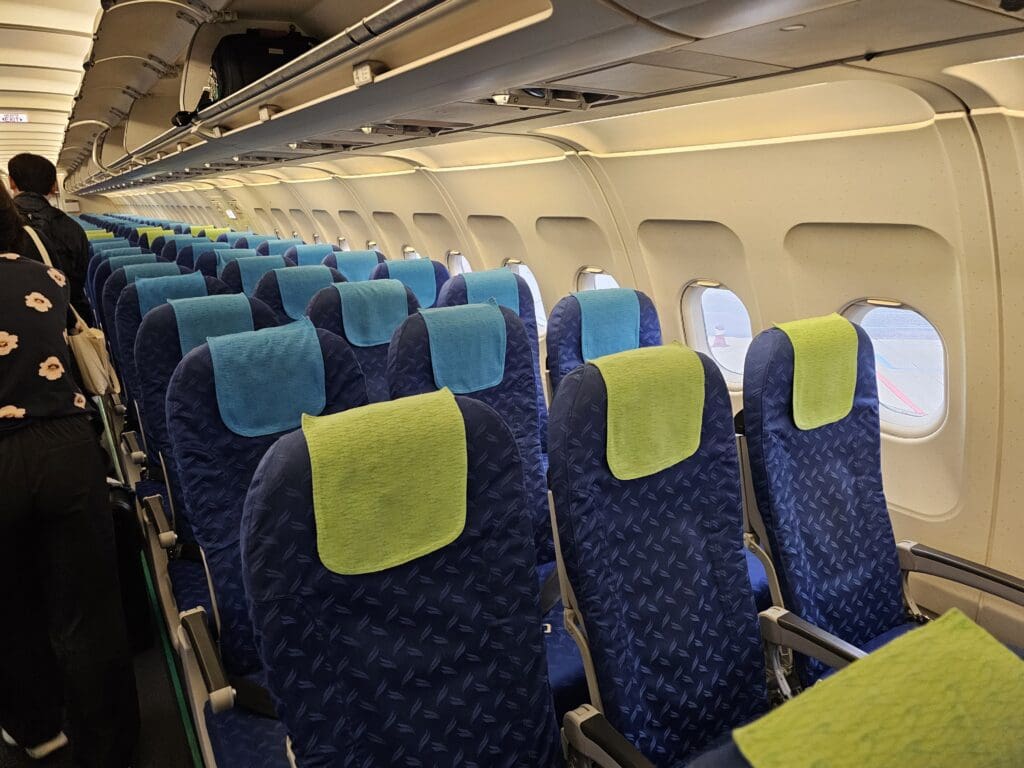
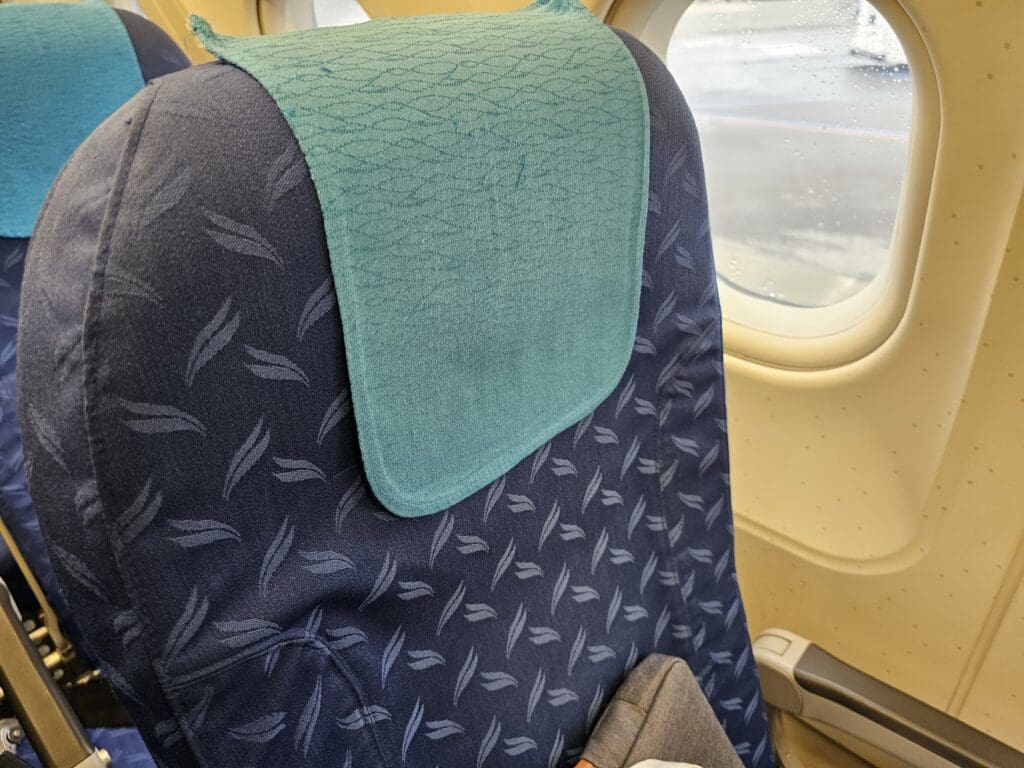
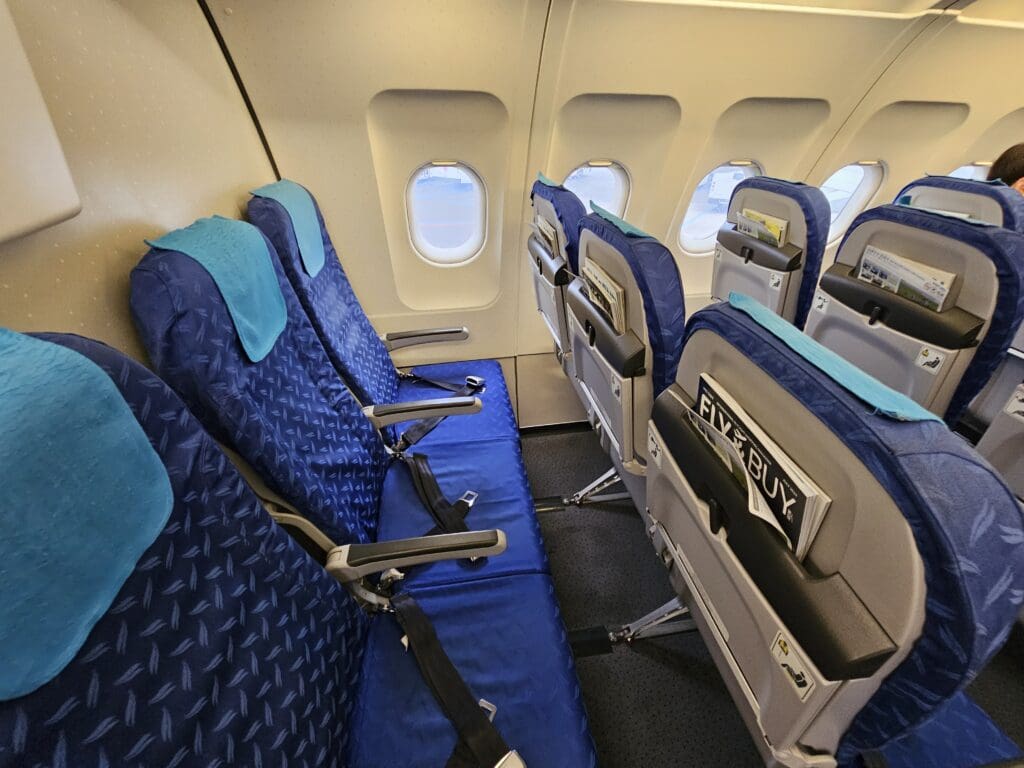
Upon entering the forward galley, I received a polite yet slightly subdued greeting from the two flight attendants standing there donned in Air Busan’s distinctive blue uniform. Once one crew member had checked my boarding pass, I passed through the windbreak and entered the Airbus’ cabin. During my previous trips with Air Busan, I found that those aircraft that had previously operated for Asiana Airlines had received little by means of a reconfiguration other than the removal of Business class seats and their replacement with Economy ones. Whether it be the Airbus A320, Airbus A321 or Boeing 737-400, when flying with Air Busan I enjoyed the incredibly spacious luxury that was totally at odds with what most imagine when they think of a low-cost carrier! Sadly, all good things must come to an end, and since my last flight with Air Busan in October 2018, the airline has reconfigured its older aircraft with a more low-cost configuration. Thus, this particular Airbus A320, came with 180 seats, which is a very low-cost carrier standard configuration for the type. Onboard, each seat took the form of the relatively modern Recaro BL3530, each of which was covered in Air Busan’s standard royal blue fabric cover that featured a repeating pattern of seagull-inspired wings (the seagull is the official bird of the city of Busan). Meanwhile, each seat was topped with a fabric antimacassar that was either light blue in the case of ordinary seats, or lime green for those seats that could be reserved for an additional fee. These seats were fairly spartan and came with a literature compartment, seatback pocket, tray table and coathook. Sadly, unlike Air Busan’s more recent deliveries, these seats lacked any form of at-seat power, however, given the short flights that this particular aircraft operates, these were not particularly missed.
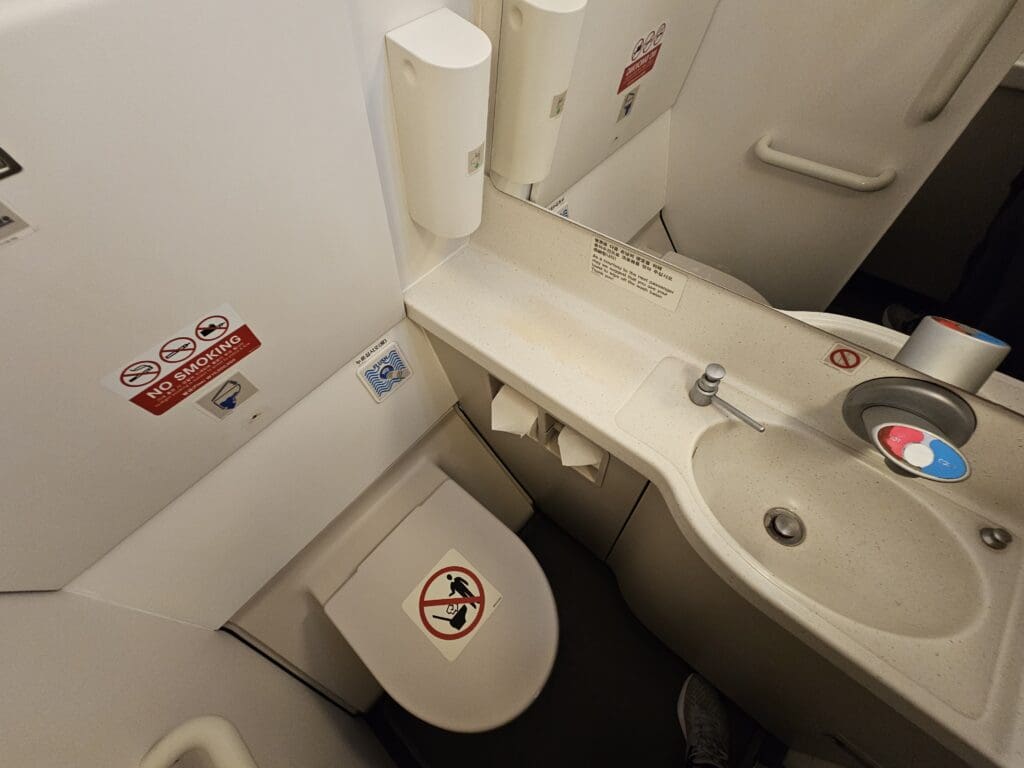
Making my way down the aircraft, I received two more greetings before I made it to Row 23. Upon arriving there, seeing as I would likely end up being trapped for the duration of the flight, I stowed my bag and headed to one of the two lavatories at the rear of the aircraft. Upon opening this up, I found the toilet to be clean, tidy and in a reasonable state, thus leaving me with no complaints and serving its important purpose with little issue.

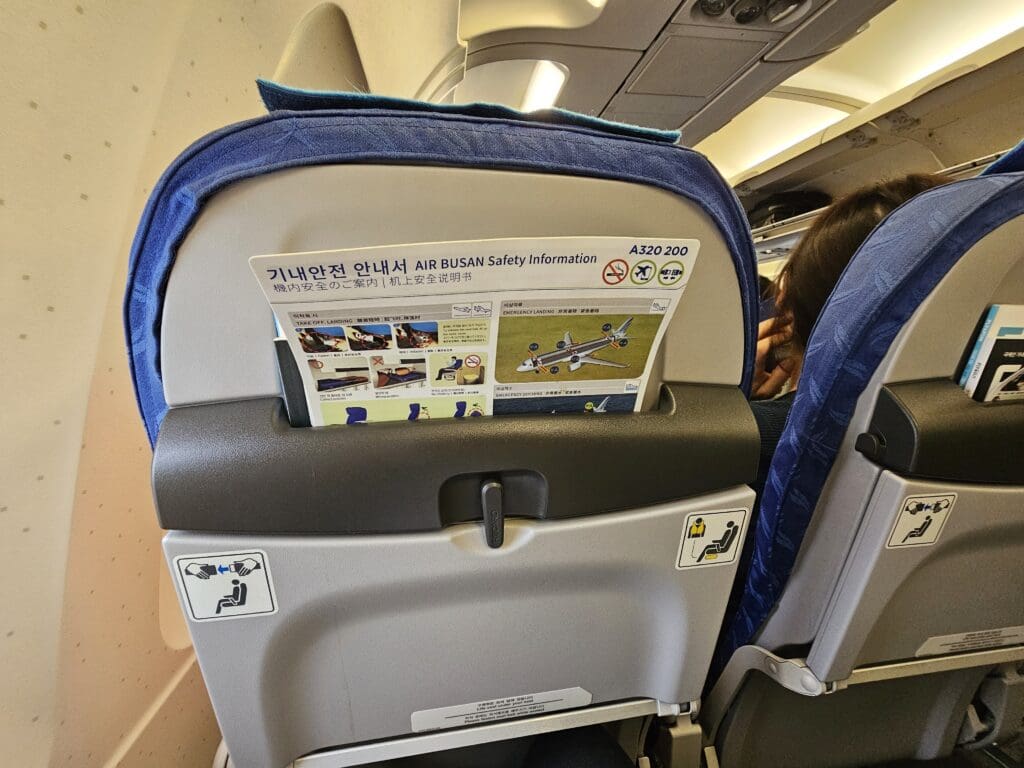
Upon returning to my seat, I slid in and settled down for the short journey to Jeju. Unlike all of my previous experiences with Air Busan, I found the seat to be rather uncomfortable. This was both firm and offered almost nothing in the way of legroom, and was thus a far cry from the spacious seats that I remembered from my previous flights with Air Busan. Whilst this was just about tolerable for the hour or so that I would have to spend in this that morning, I definitely wouldn’t have wanted to end up onboard the aircraft for much longer. Turning to the positives, ignoring a slight stain on the seatback, the seat and area around this were clean and largely devoid of any wear and tear. Turning to the seatback pocket, this contained a safety card, a copy of Air Busan’s Fly and Fun magazine, and the latest flight Fly and Shop catalogue.
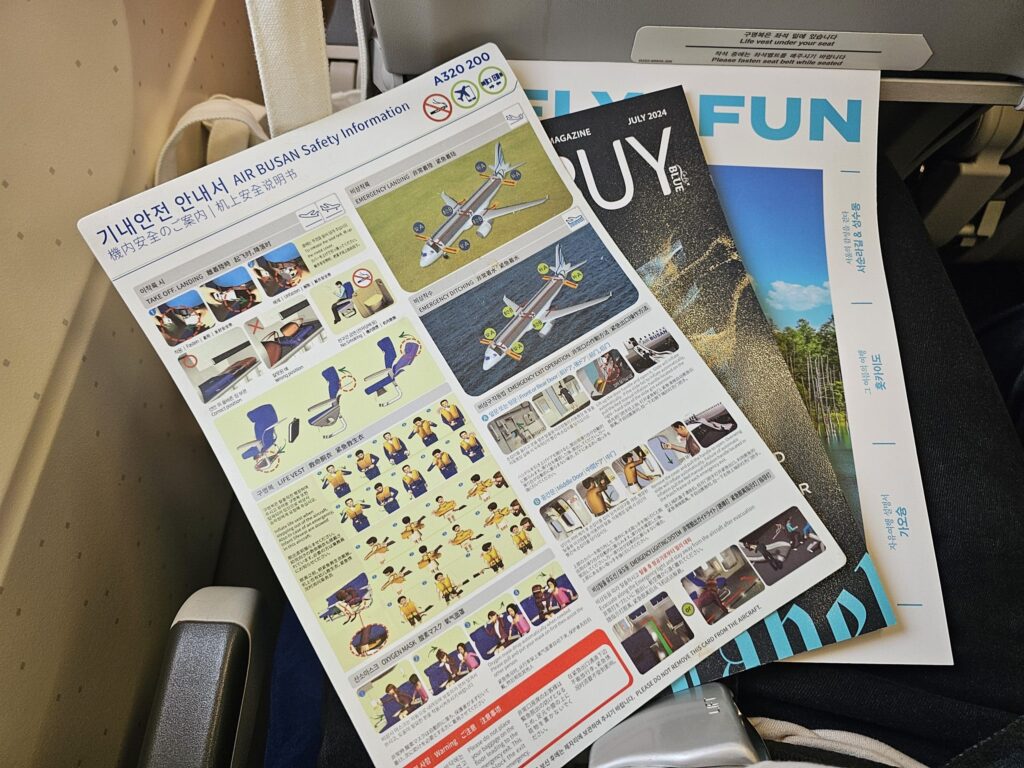
As passengers filtered onto the aircraft, calming saxophone music rang out and with passengers having made it to the gate on time, the final passenger made it onto the jet around six minutes ahead of our scheduled departure time. That morning, the flight seemed to be full, with most of those around me taking the form of Jeju-bound holidaymakers hailing from Korea. Indicating that we would be in for a punctual departure, once the final passenger was safely onboard, the cabin door was closed and the jetbridge could be seen being backed away from the aircraft, whilst all remaining ground service equipment was removed from around the jet. At this time, the Purser conducted their welcome announcement in Korean and English. During this, they welcomed passengers onboard, thanked all for flying with Air Busan, mentioned our 55-minute flight time, and ended this with a warning to passengers about seatbelts and adhering to Korea’s Aviation Security Law. Once this had been completed, the crew took to the aisles and a standard safety demonstration was performed. This consisted of several members of the cabin crew undertaking the safety demonstration whilst the Purser went through the instructions in Korean and English.
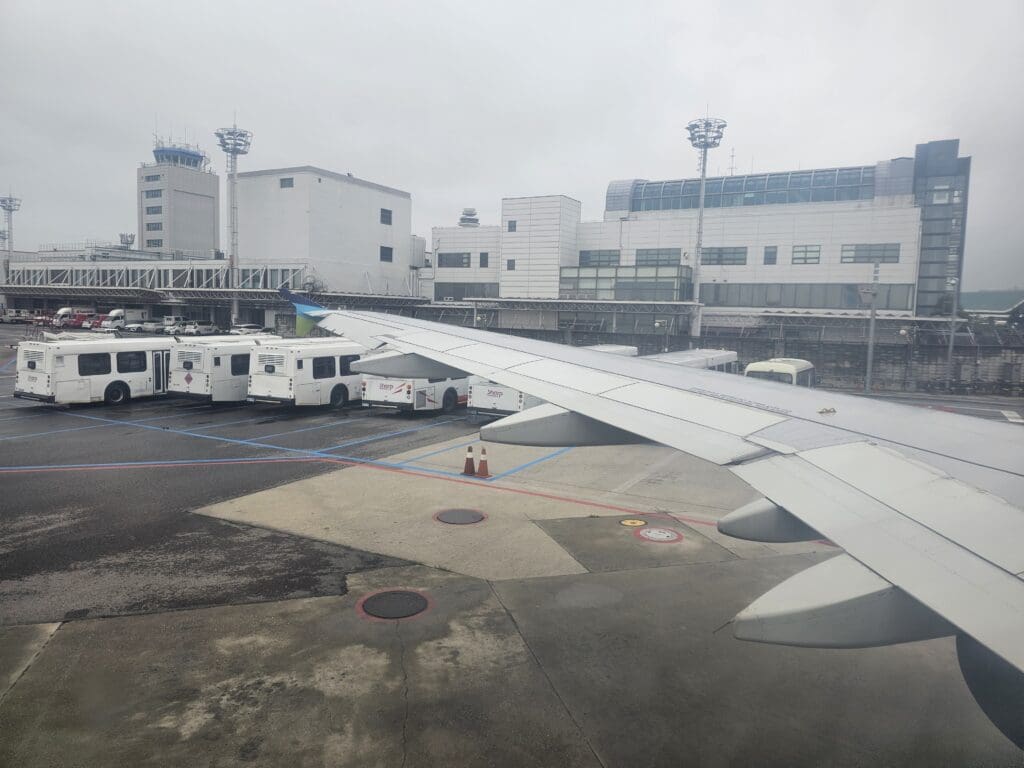
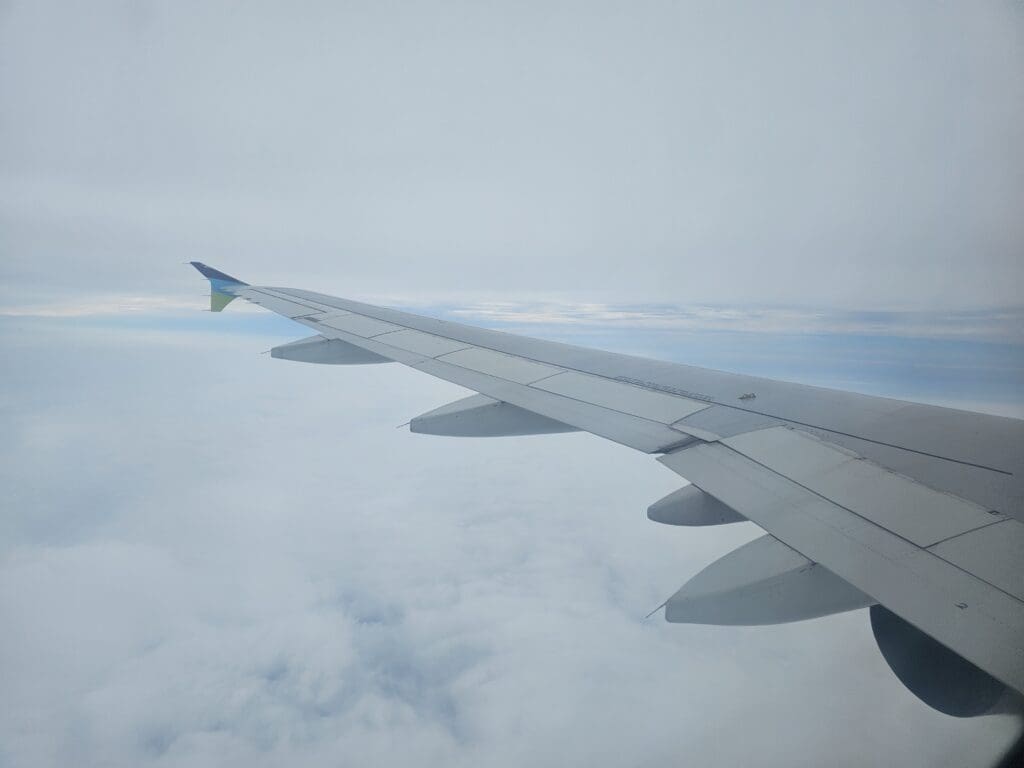
Despite the early finish to boarding, it seemed that air traffic control had other plans and in the end, it wasn’t until 0718, eight minutes after our scheduled departure time that pushback commenced. As this was underway, the Airbus’ two IAE V2527-A5 engines whirred into life ready to propel us all down to Jeju. Following the usual short pause whilst the tug was disconnected, the flaps were partially extended before the Airbus commenced its journey to the end of Gimpo Airport’s Runway 14L. Sitting on the left-hand side of the aircraft, little could be seen during this journey other than the sight of aircraft rocketing off ahead of us and the hangars in the distance as we trundled past the international terminal and fields that surround the airport. As we trundled along, a sleek Air Busan Airbus A321neo followed a short distance behind us, with this bound for Busan.
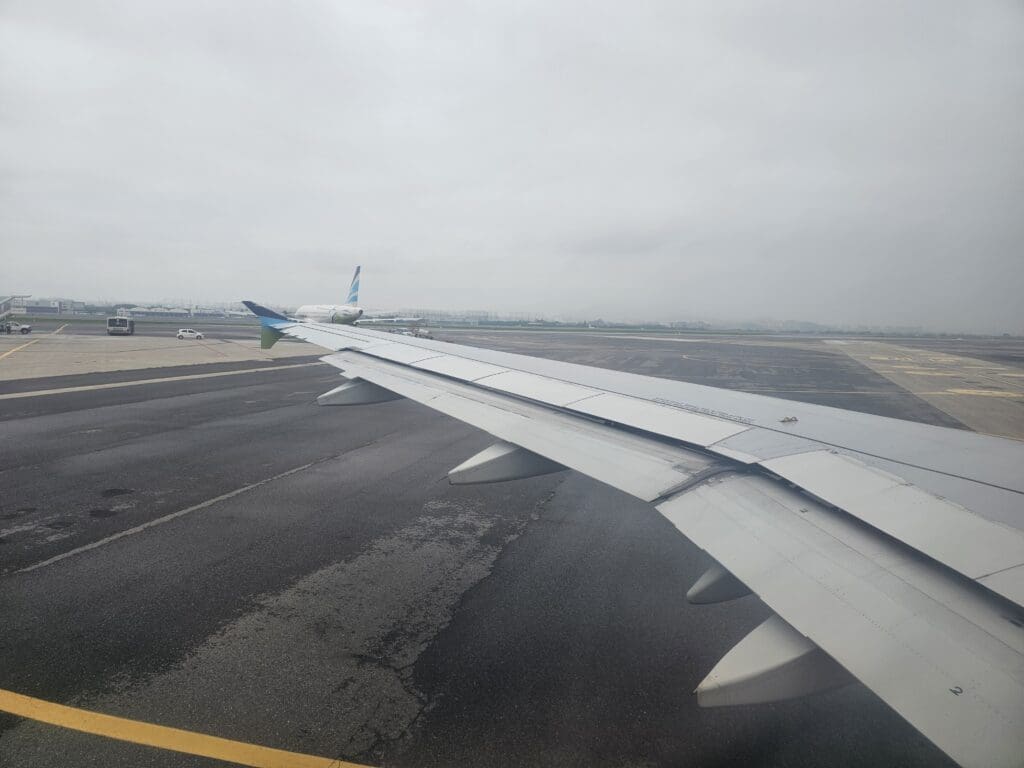
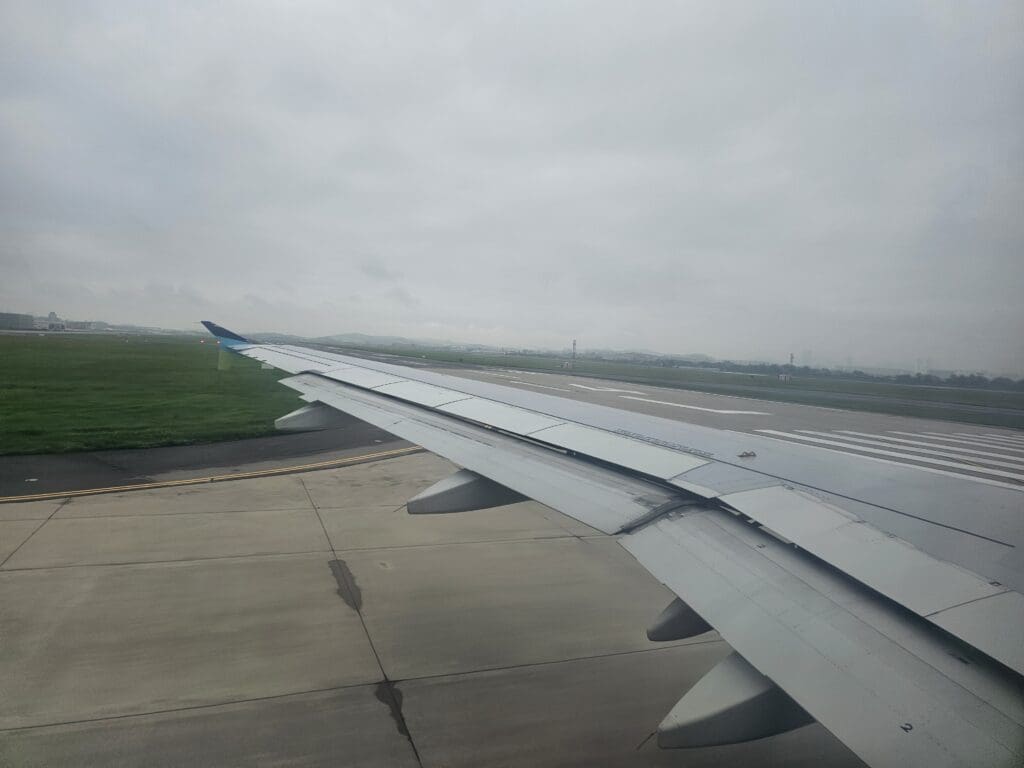
A few minutes after commencing our taxi, the aircraft made it to the end of Runway 14L. Despite there being a near-constant stream of departures, most of which, like our aircraft, were bound for Jeju, no wait was required and the Airbus made its way onto the runway before coming to a short pause. At 0732, the Airbus’ two IAE engines spooled up into life as we began our powerful take-off roll. Soon, the international terminal appeared and the aircraft’s nose was pointed skywards allowing for a good bird’s eye view of the domestic terminal and Asiana Airlines and Korean Air’s maintenance hangars at the far southern tip of the airfield.
From the airport, the Airbus climbed out over the neighbourhoods of endless concrete apartment blocks to the south of the Han River. However, the vistas of Seoul did not last for too long and we soon made our way into the clouds, bumping through these before we turned onto a southerly heading that would see us slice through Gyeonggi Province. From Gimpo Airport, the Airbus passed directly over the city of Suwon, famous for its Joseon-era fortress and for being the home of Samsung. After which, the aircraft turned to fly towards Korea’s western coastline and soon passed over Pyeongtaek, which is well known for its large American military base before we crossed into the skies of South Chungcheong Province near the cities of Asan and Cheonan.
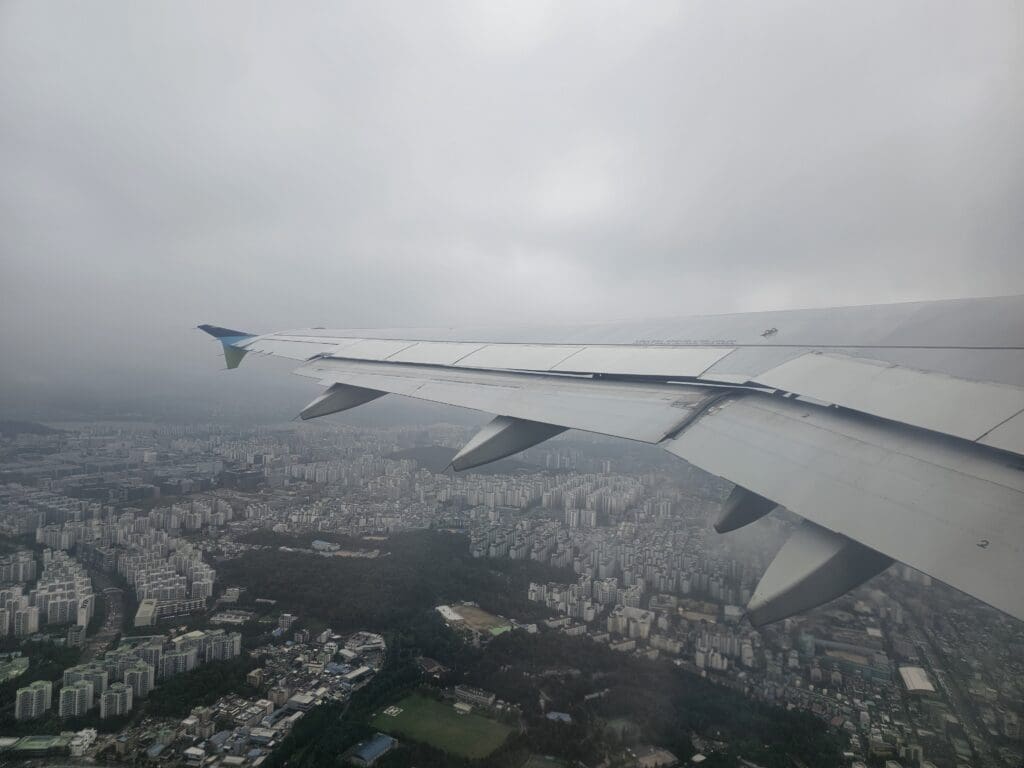
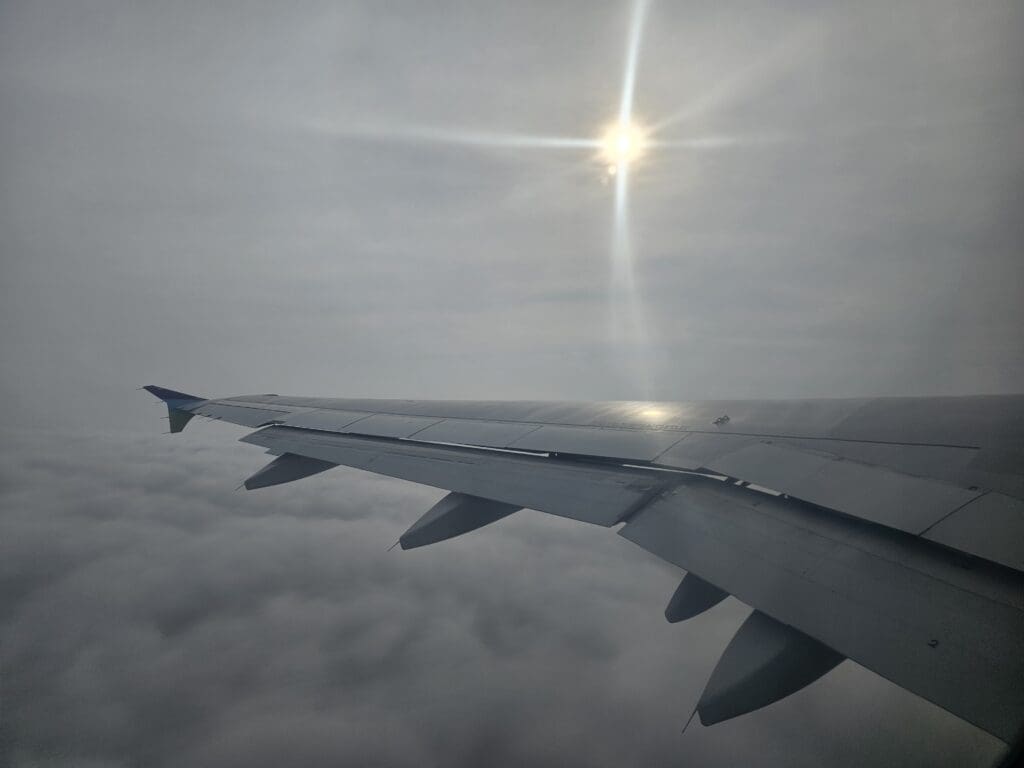
Despite the initial bout of turbulence as we cut through the clouds, that morning the seatbelt signs were extinguished as we passed through 10,000 feet. At this point, the Purser performed their usual announcement advising passengers to keep these fastened whilst seated and noted the buy-on-board service. As is the case on almost all other Korean low-cost carriers, being a short domestic flight, no trolley was rolled out and instead one member of the crew simply passed through the cabin displaying the menu. Those who wanted anything were required to stop this flight attendant as they passed through the cabin or press the call bell. However, as usually seems to be the case on early morning flights to Jeju, most passengers appeared to be fast asleep and I failed to spot any takers for this service.
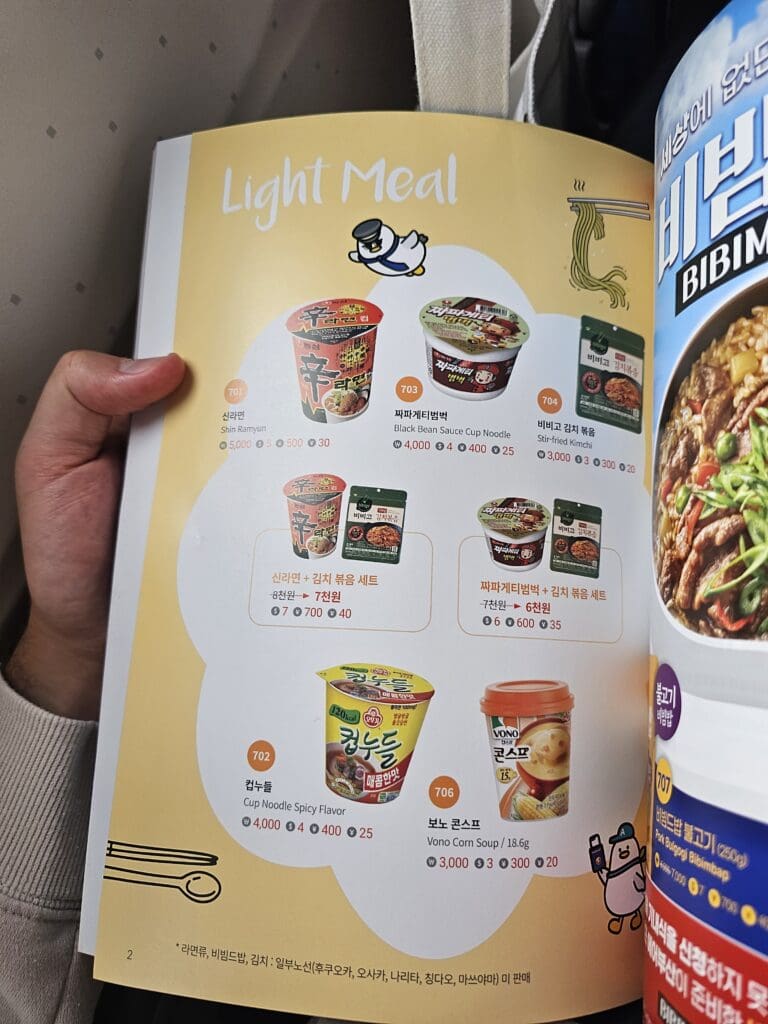
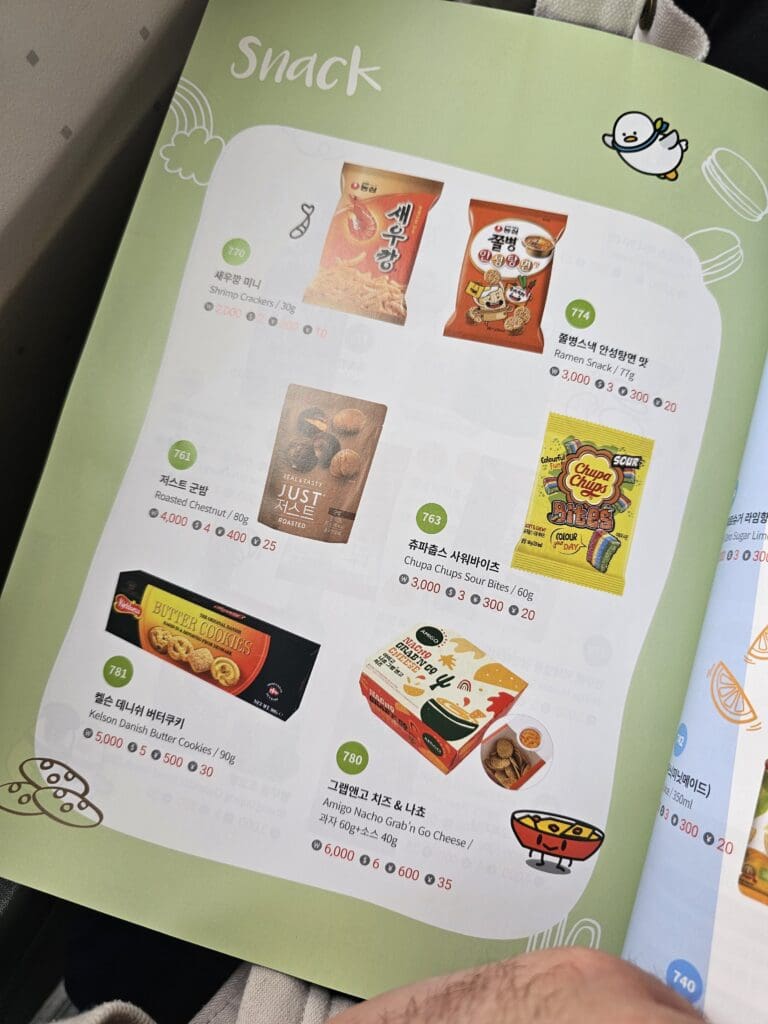
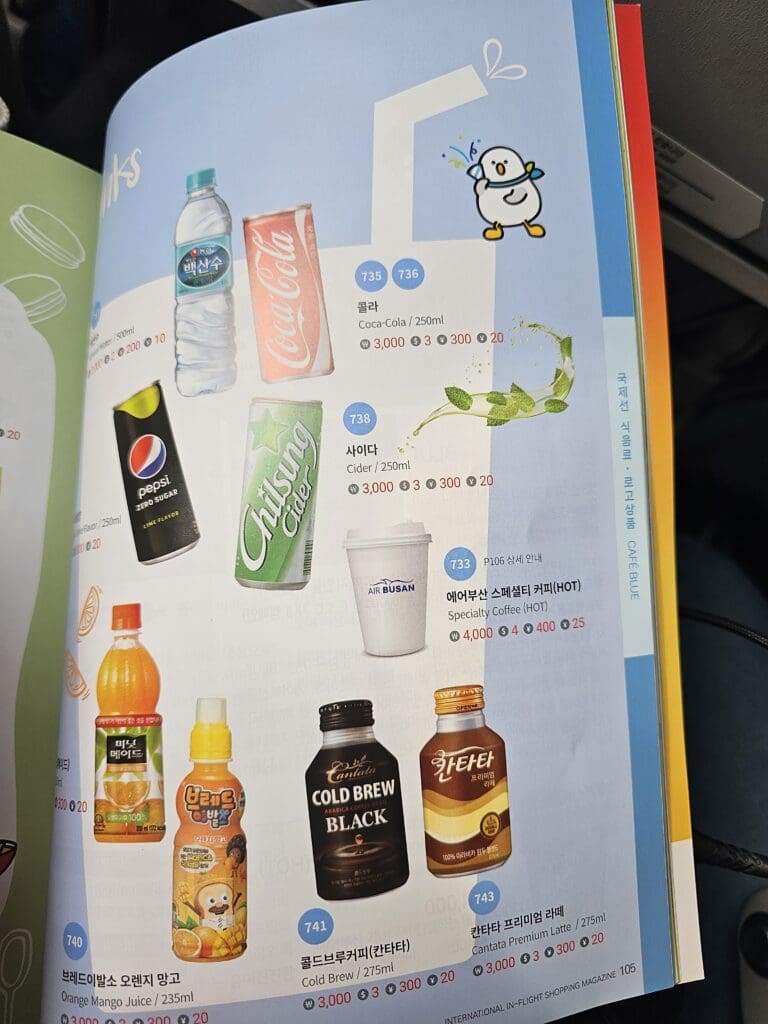
Whilst I had no intention of purchasing anything, I did decide to browse the menu which revealed the usual array of hot and cold, hard and soft beverages on offer, alongside an array of snacks. For those with an appetite, the most substantial of these came in the form of cup ramen. In terms of prices, everything seemed to be priced at a rather standard amount for a Korean low-cost carrier. For example, ramen or a hot drink would have set me back 4,000 won (£2.30), a can of Coca-Cola 3,000 won (£1.70) or a bottle of water 2,000 won (£1.13). It is also worth noting that those on Air Busan’s international services can pre-order one of eleven hot meals, with these priced between 12,000 won (£6.90) and 15,000 won (£8.58).
As we cruised southwards through the skies of South Chungcheong, the thick clouds below meant absolutely nothing of the Korean Peninsula could be seen. I therefore decided to turn my attention to the inflight entertainment. Onboard this particular aircraft, this consisted of the mint condition copy of the summer edition of Air Busan’s Fly & Fun inflight magazine. Opening this up, I was pleased to find this to not contain the seemingly endless drawl of advertisements as can be found in the inflight magazines of many other low-cost carriers. Meanwhile, a decent array of articles could be found, which primarily related to things to see and do in and around Air Busan’s destinations, plus an interesting double-page spread detailing the delivery of one of the airline’s latest Airbus A321neos from Hamburg. Overall, whilst this seemed to be a decent if not compact publication, I should note that this was entirely in Korean, with not a single article translated into English. Finally, other than this magazine, no inflight entertainment was provided. Unlike some of Air Busan’s aircraft, this particular Airbus A320 lacked overhead screens, whilst no onboard wifi was offered. However, these were not expected or missed given the short length of the flight down to Jeju.
Returning to the route, a little over halfway into the flight, the aircraft left South Chungcheong behind and passed over the city of Gunsan heralding our arrival into the skies of North Jeolla Province. At this point, the Airbus finally reached its cruising altitude of 20,000 feet and the calm-sounding Captain performed their welcome announcement in Korean and English. During this brief speech, they thanked passengers for flying with Air Busan, informed passengers of our remaining flight time and detailed the weather on the ground in Jeju, warning of a few bumps on approach due to a fair crosswind. Trundling down the coastline, the Airbus made its way past the towns of Buan and Gochang, and headed over the Byeonsanbando National Park, before heading slightly inland and cutting across the heart of South Jeolla Province.
After just seven minutes at 20,000 feet, the Airbus could be felt commencing its descent as we crossed over Korea’s sixth-largest city, Gwangju. As we left the city behind, the Purser performed their pre-arrival announcement in Korean and English with all the usual warnings before the cabin crew took to the aisle and began ensuring that all was in place for our arrival. Soon, the aircraft left the Korean Peninsula behind and made its way over the short stretch of sea that separates the mainland from Jeju.
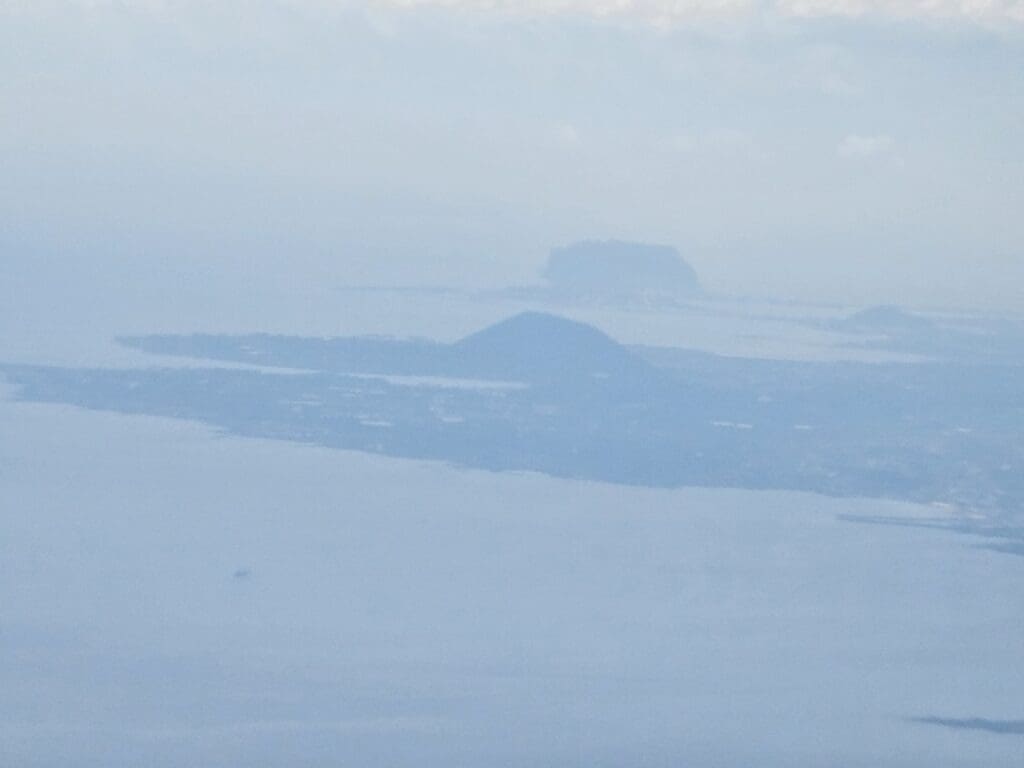
Around halfway into our sea crossing, the thick clouds dissipated below and the blue waters came into view. A few moments later, the very small island of Yeoseo appeared. Covering an area of 2.51 square kilometres (0.97 square miles), as per the 2009 census, this was home to 93 residents. Continuing onwards, the Airbus made its way to the seas of Jeju’s northeastern coastline before turning back towards the island. Thanks to the clear weather around Jeju, it wasn’t long before I spotted the sight of Jeju’s eastern coastline, with both U Island and the popular volcano, Seongsan Ilchulbong welcoming us to Jeju followed by the luscious greens and volcanic greys of the northern coastline.
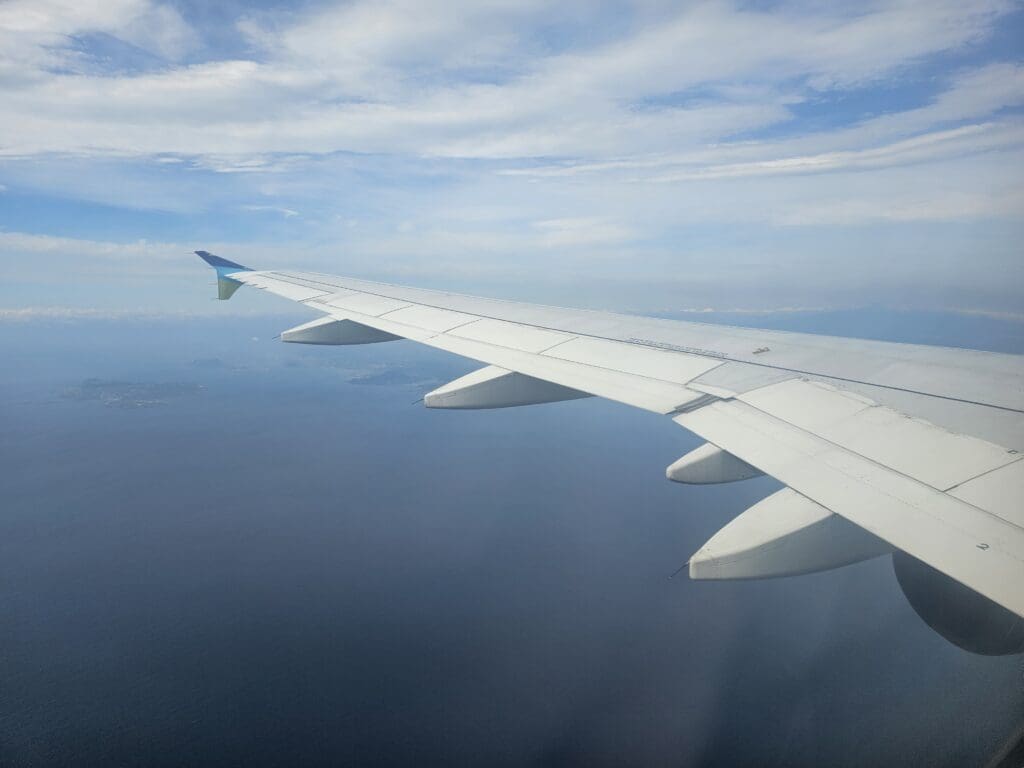
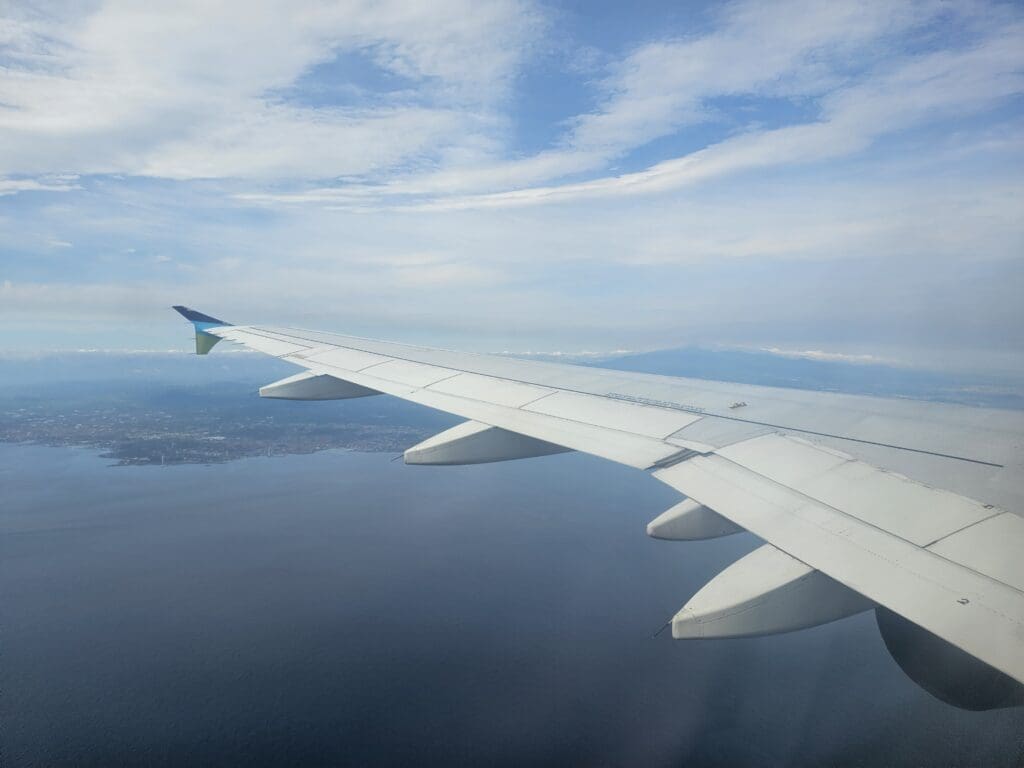
Sinking downwards, the flaps were partially extended followed by the landing gear as we voyaged past a mixture of quaint fishing villages, popular tourist spots and resorts, and industrial ports as we flew parallel to the north shore. Soon, the rural and semi-rural countryside of Gujwa and Jocheon were replaced by the sprawl of Jeju City, and we crossed over the island’s main port where plenty of ships ranging from small fishing vessels up to large cargo ships and ferries waiting to head back to the mainland could be spotted. At this time, we seemed to shake around a fair bit, although the turbulence ended up being far less severe than the Air Seoul approach that I had experienced exactly a week before this flight!
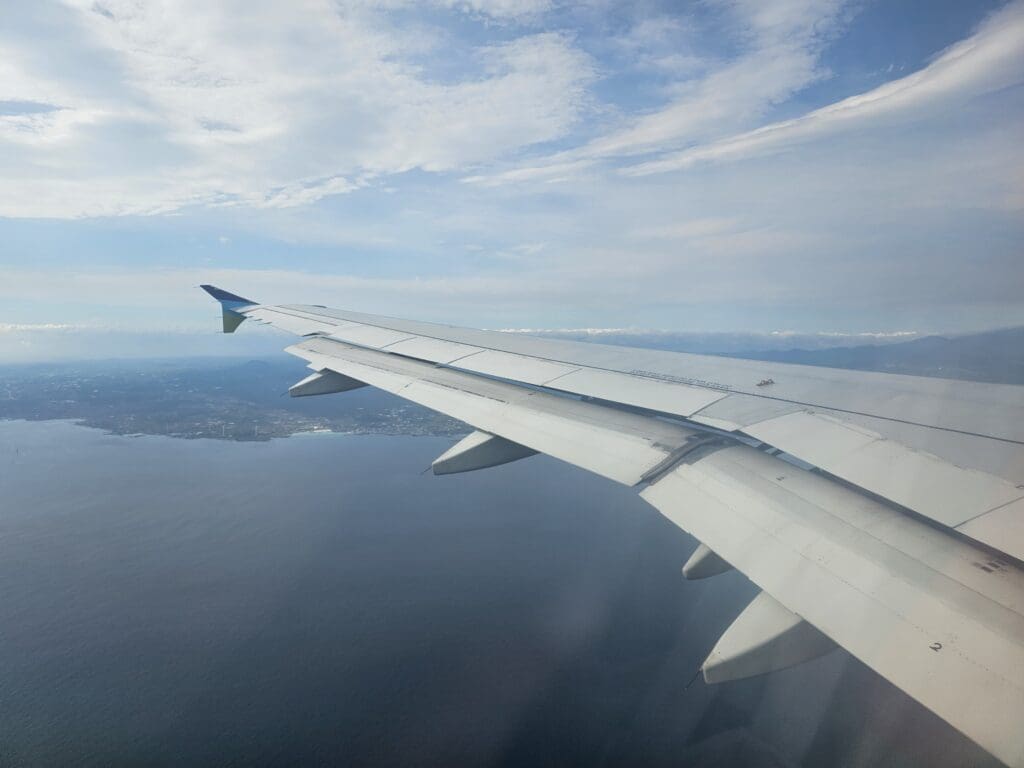
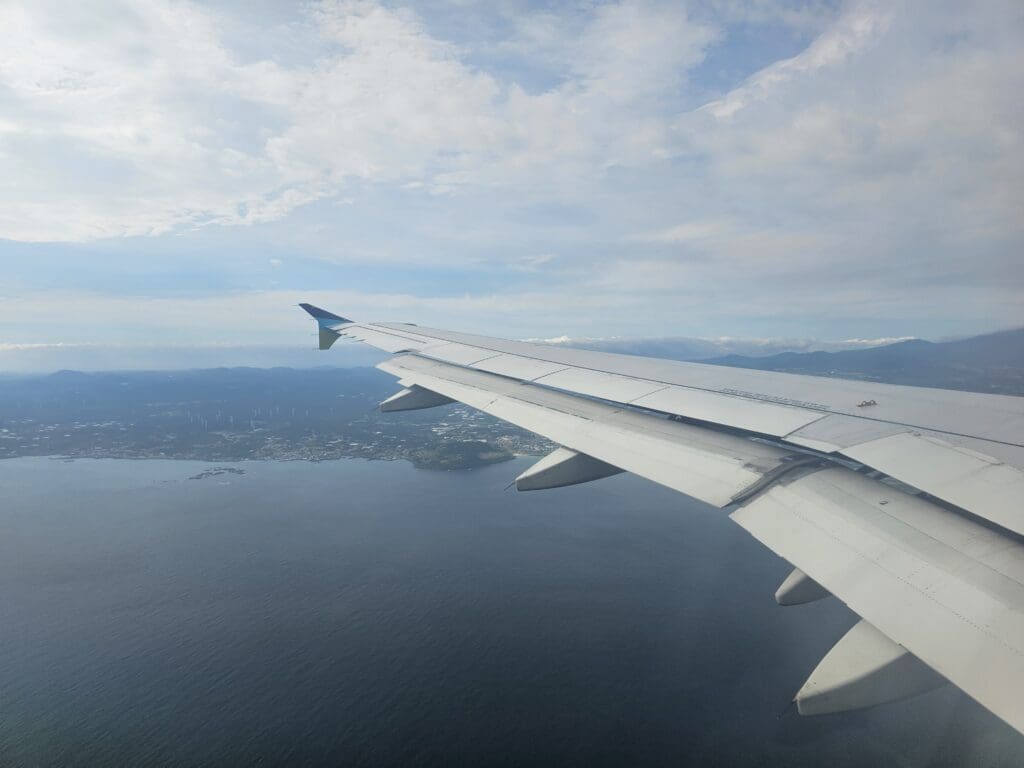
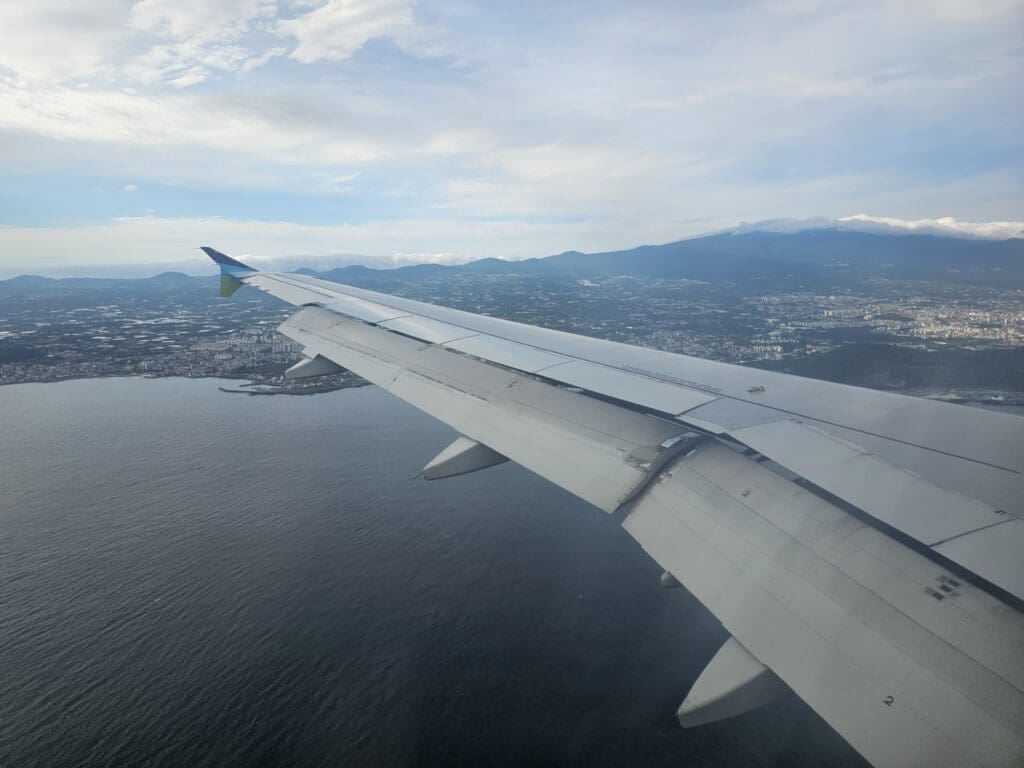
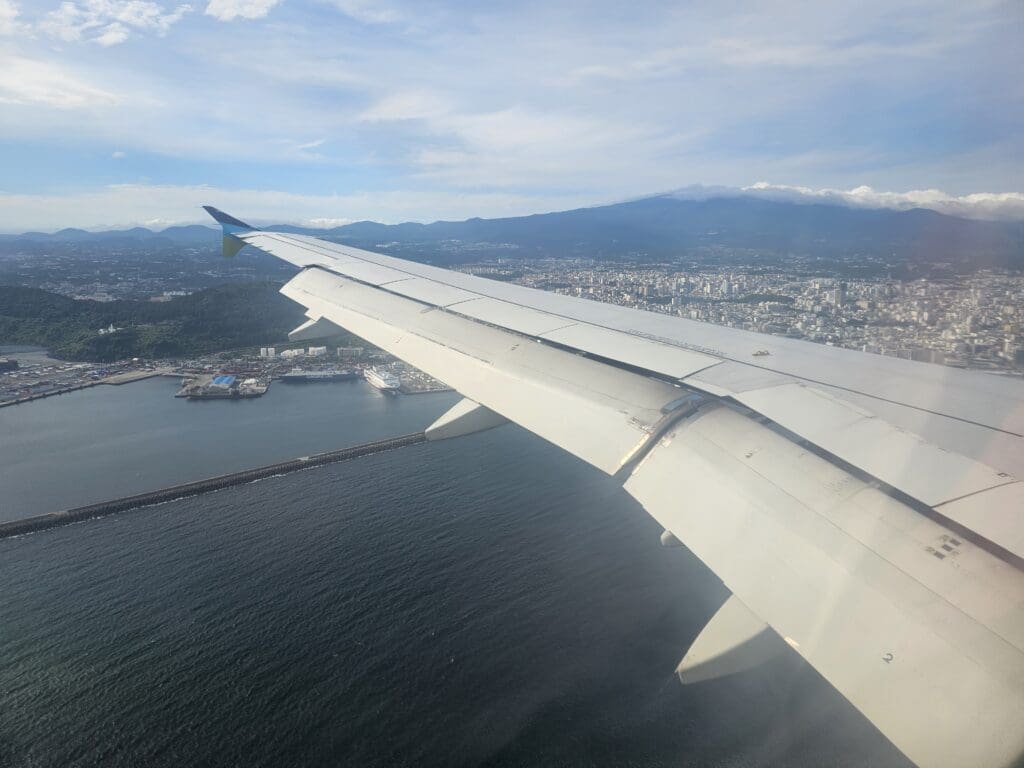
From the port, the Airbus made its way past what may be considered as Jeju City’s answer to Abu Dhabi’s Corniche, Tapdong, before Yongduam Rock appeared. Seconds later, the Airbus crossed over the coastline and the sight of the Korean Navy’s local facility, home to a flight of Lockheed P-3CK Orion aircraft could be seen before we made a firm return to earth at 08:32, exactly an hour after taking to the skies of Seoul. Once safely back on the ground, the terminal appeared as the brakes were slammed on and we made an excitingly quick deceleration down the runway before vacating this to the left. In the usual manner, once off the runway, the Purser welcomed passengers to Jeju in Korean and English, thanking passengers for flying with Busan and advising all to keep their seatbelts fastened until the seatbelt signs had been extinguished.
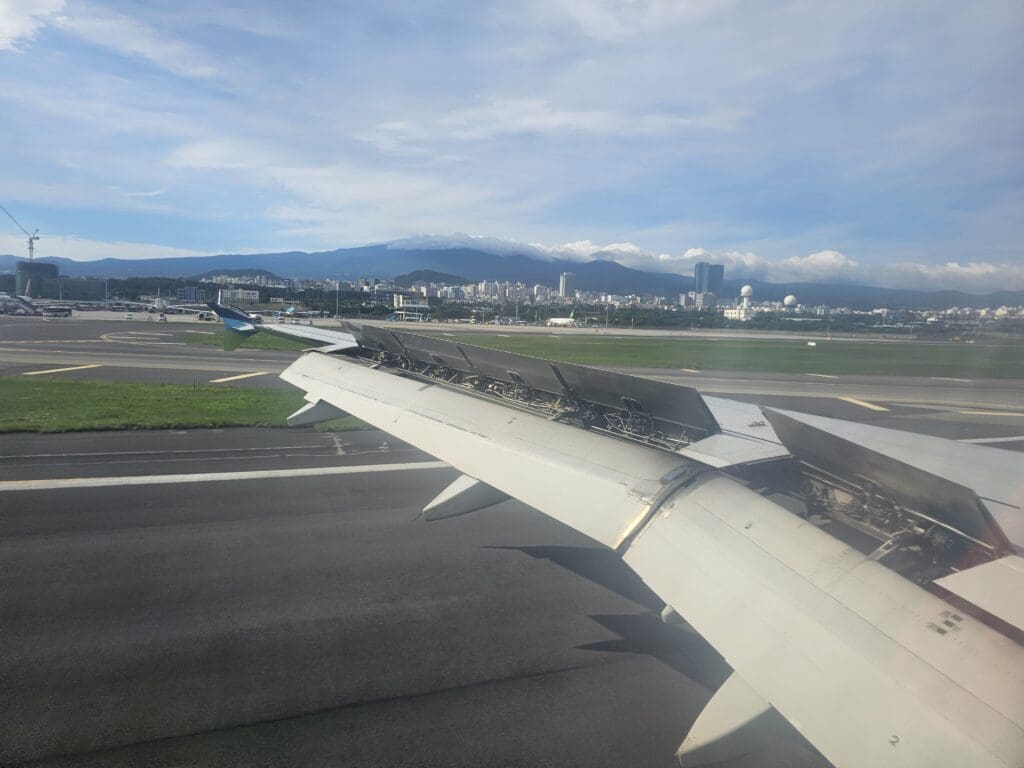
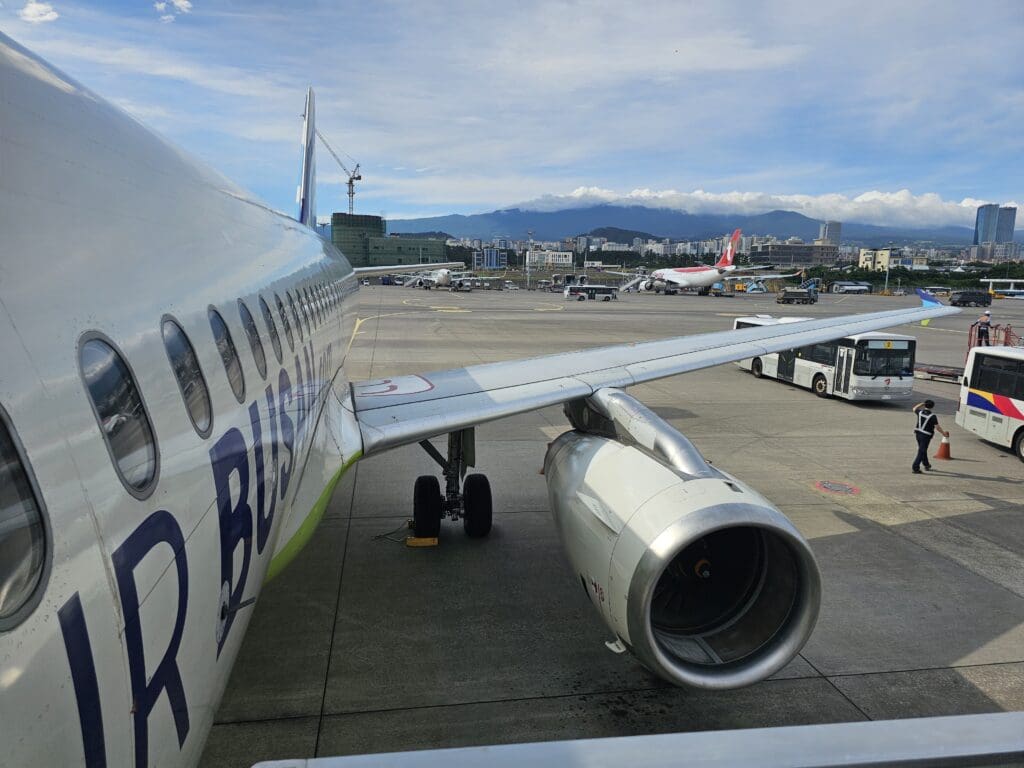
As often seems to be the case with Air Busan services at Jeju, that morning our flight would utilise one of the airport’s remote stands. Seven minutes behind our scheduled arrival time, at 0837, the Airbus slowly and cautiously pulled into Stand 61 where the welcome sight of two buses and an army of Asiana Airport ground crew could be seen waiting and ready to tend to the aircraft and its passengers. Upon coming to a halt, the two engines soon spooled down and the seatbelt signs were extinguished at which point most of those around me jumped up in a rush to commence their Jeju holidays. At this time, a smorgasbord of Air Busan-commissioned songs rang out over the cabin speakers, including their rather catchy theme song!
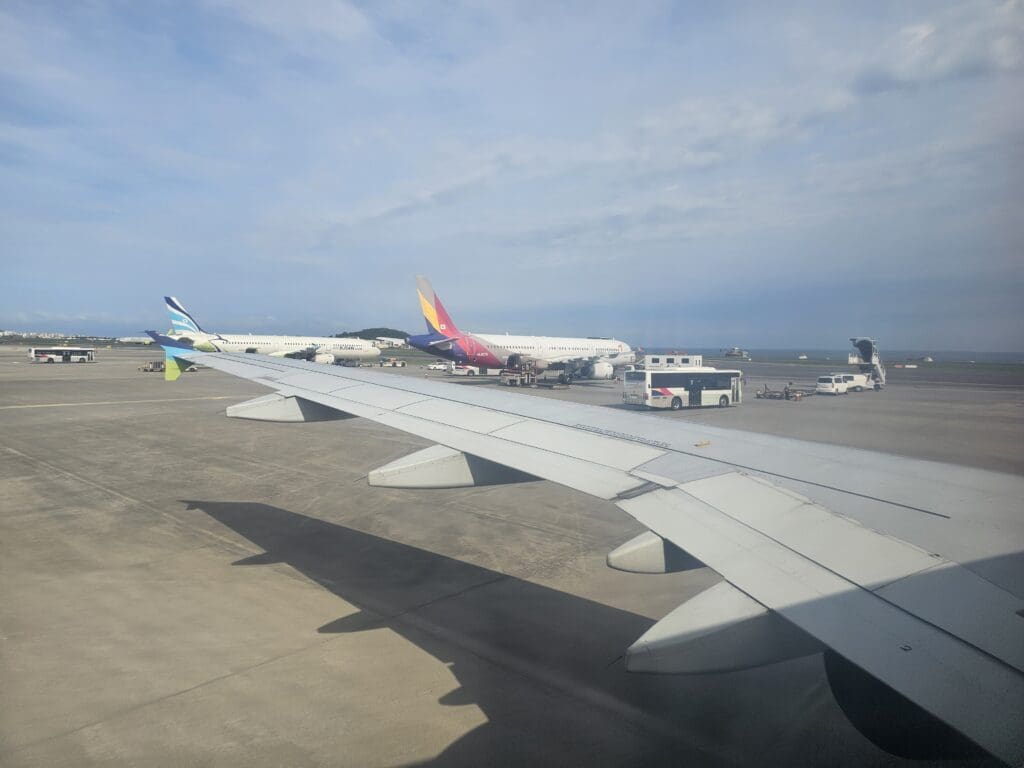
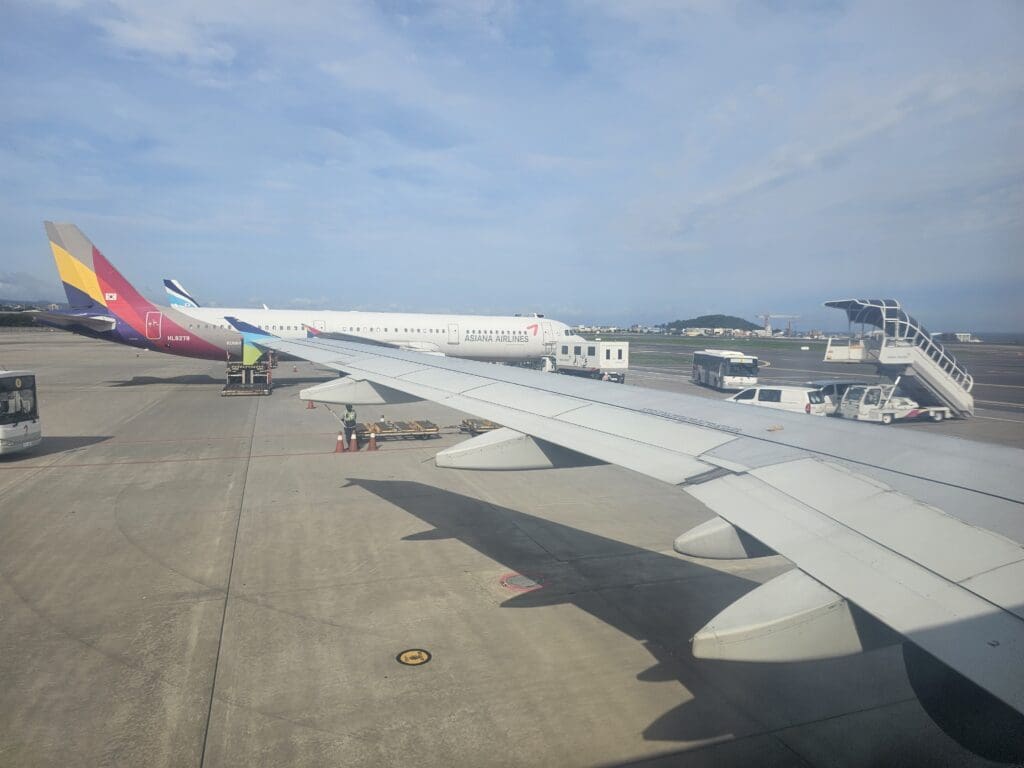
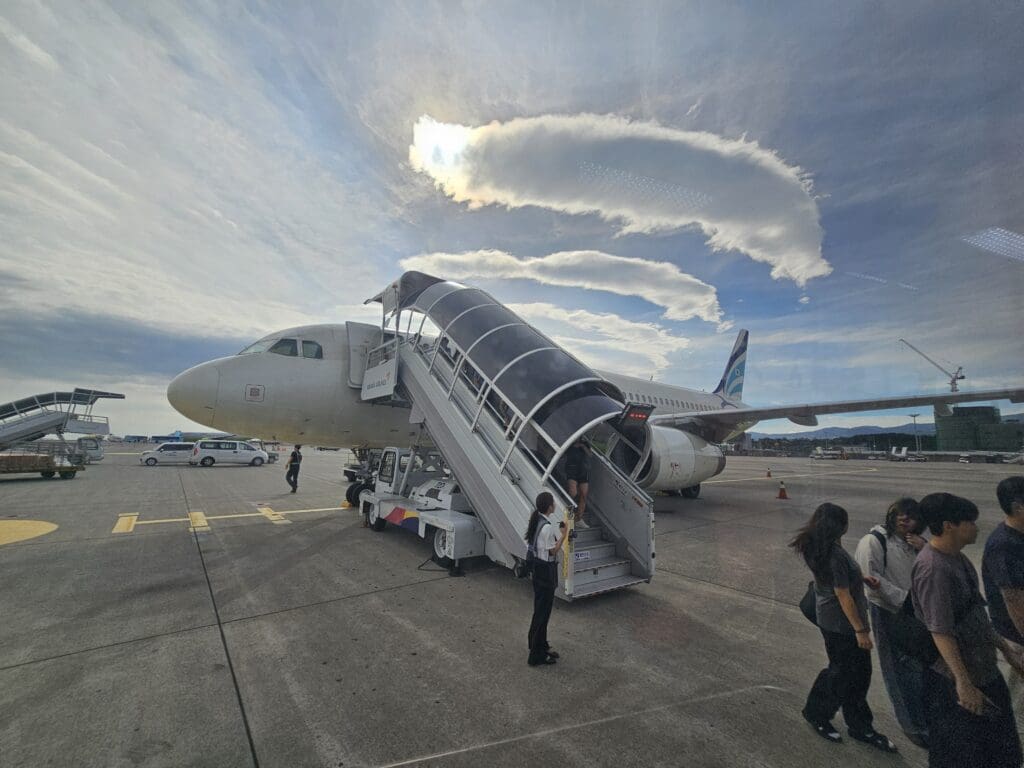
Fortunately, it didn’t take long for the airstairs to be moved into position and disembarkation to commence. Once the queue in the aisle began to budge, I stood up and headed forward through the aircraft before reaching a lively farewell as I reached the forward galley. Making my way outside, I was soon blasted in the face by the hot wind blowing in from the south which went some way to explain our bumpy arrival! Ending up as one of the final passengers to board the first bus, I squeezed onboard and we soon commenced the short journey to the terminal building. Once there, with nothing to collect, I passed through this in about a minute before reaching the busy landside arrivals area.

Summary
That morning, I had high expectations for Air Busan and to be quite honest they weren’t completely met. Whilst the crew had been friendly enough, the ground experience left me with no complaints, and I arrived in Jeju in one piece and almost on time, I was rather disappointed by just how cramped the aircraft was. This was a far cry from any other Air Busan flight that I had taken in the past! With that considered, whilst I wouldn’t necessarily avoid flying with Air Busan in the future on domestic flights, they didn’t seem to offer anything that made them stand out above any other Korean low-cost carrier. However, that said, I would be willing to sample them on an international service on one of their (hopefully) more spacious newer jets.