A Scenic Dash 8 Q400 Ride: Zagreb to Split with Croatia Airlines
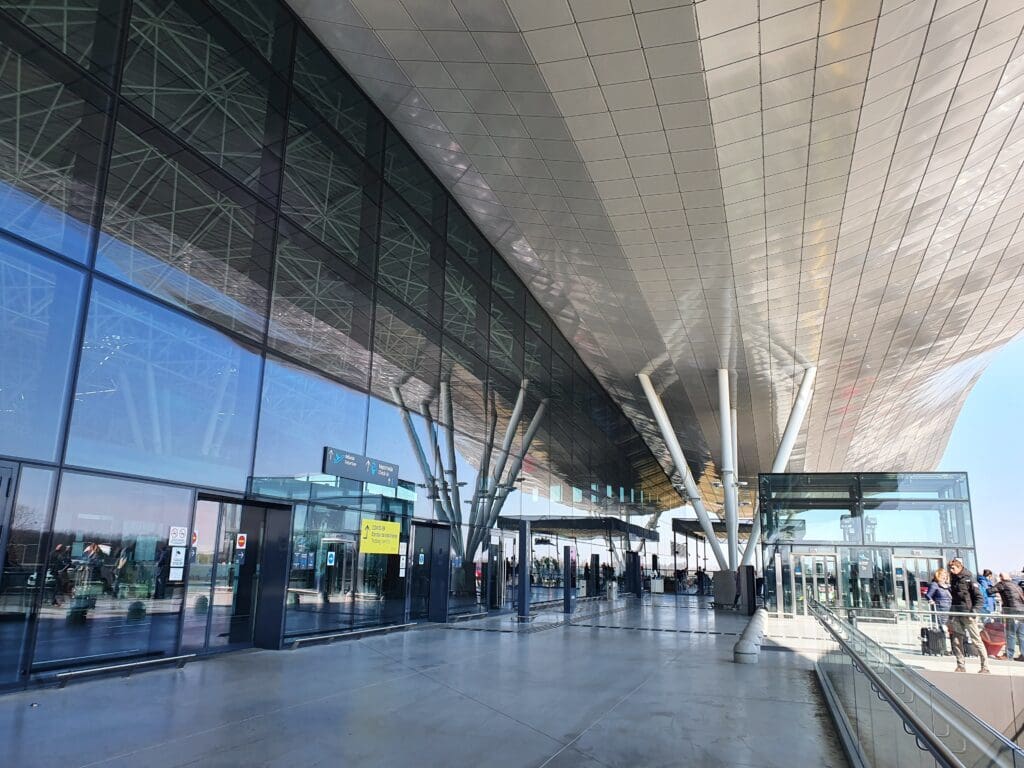
After spending a couple of hours flying down from Stansted on a cramped and boiling hot Lauda Europe Airbus A320, I arrived in Zagreb and made it through Croatian immigration with a little under three hours to spare until my flight down to Split. Thus, once landside, I decided to head outside into the pleasant yet chilly Croatian spring air and made a short walk around the terminal’s car park. However, with nothing obvious to see or do near the terminal building, after around ten minutes I made my way back inside and journeyed up the long escalators to the check-in hall. As capital city airports go, Zagreb Airport is neither particularly large nor busy, however, this is by no means a complaint with the terminal appearing to be far more interesting in its design than most airports back in the UK. Having opened in 2017, I found Zagreb Airport’s terminal to be modern and stylish, with high ceilings and plenty of windows allowing for natural light to flood in and fill the check-in hall, meanwhile, I also found this to be clean and tidy. The only slight negative I could find in this area was the terminal’s lack of facilities before security, with these consisting of a single café and some vending machines.
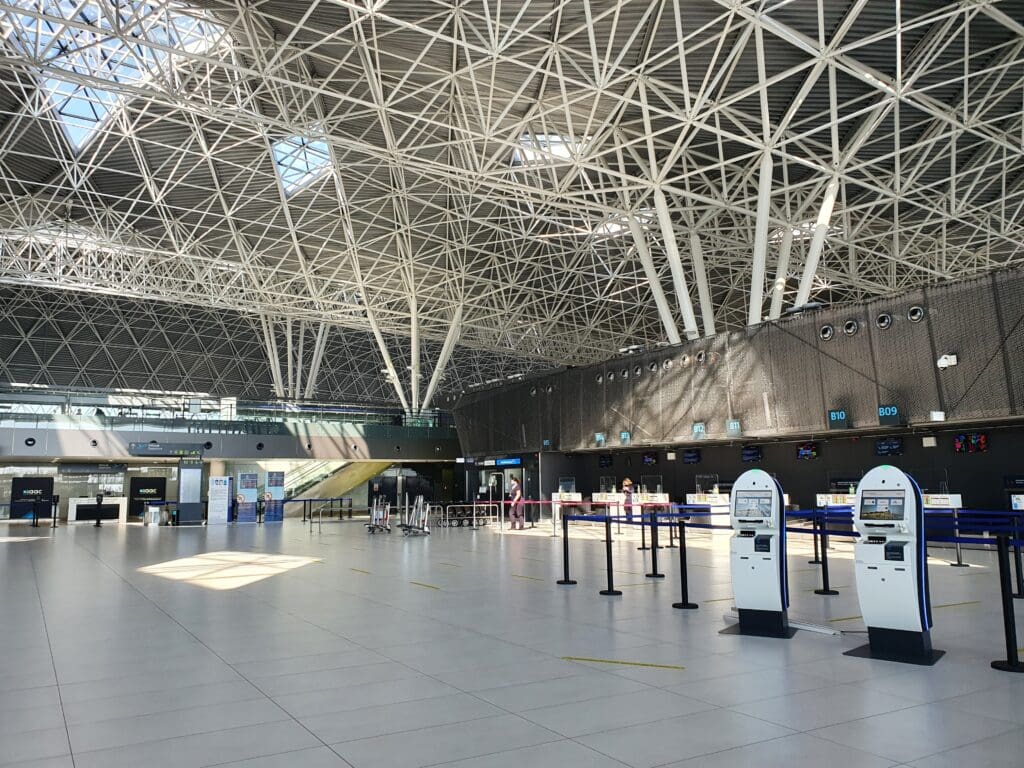
With few flights departing Zagreb that afternoon, upon arriving there I found the terminal to be mostly empty with just two other passengers milling about around Croatia Airlines’ check-in area. There, several manned counters could be seen alongside the usual self-check-in machines. First attempting to check in using one of the machines, I soon reached a stumbling block in the fact that this failed to recognise my booking and I was thus left with no choice other than to head over to one of the manned check-in desks. Upon arriving at one of the desks, I was given a warm greeting first in Croatian, and then in English, once the Croatia Airlines check-in agent realised I hailed from abroad. After handing over my passport and requesting a window seat, the agent tapped away for some time before my boarding pass was printed out and handed over to me. Hoping for a seat towards the front or rear of the aircraft, but not the middle, upon checking this, I was delighted to see that I had been assigned Seat 6A which would allow for a good view of both the engine and the world below.
After receiving my boarding pass, I was not left with any real reason to hang about in the landside portion of the terminal and thus decided to head through security before the afternoon rush. Once my boarding pass had been scanned, I proceeded up the escalators to security where I was pointed in the direction of the terminal’s only open checkpoint. With just one other passenger in front of me at this time, I found the security check to be a quick and easy process and I made it through to the airside area within around a minute. With the terminal having just one security check area for both domestic and international passengers, after passing through this those heading off to foreign shores are directed towards passport control whilst domestic passengers are directed right to a series of escalators. Heading down these, I eventually arrived on the ground floor level of the terminal and entered the small and at that time, quiet waiting area for domestic flights.
As with the rest of Zagreb Airport, I found the domestic portion of the terminal to be modern and clean, whilst the complimentary wifi worked without any issue. However, I did find this part of the terminal to be rather spartan and most certainly not designed as an area for long waits. In terms of facilities, a café featuring a good albeit pricey selection of items and a small kiosk selling various souvenirs and other goods could be found. However, it is worth mentioning that the latter did not open up until later on during the afternoon. Meanwhile, seating was limited to cold metal benches akin to those found in bus and railway stations, whilst the only plug sockets to be found were located at a single charging point. With the above considered, I would not recommend those flying on domestic services from Zagreb to head airside any more than an hour and a half before departure.
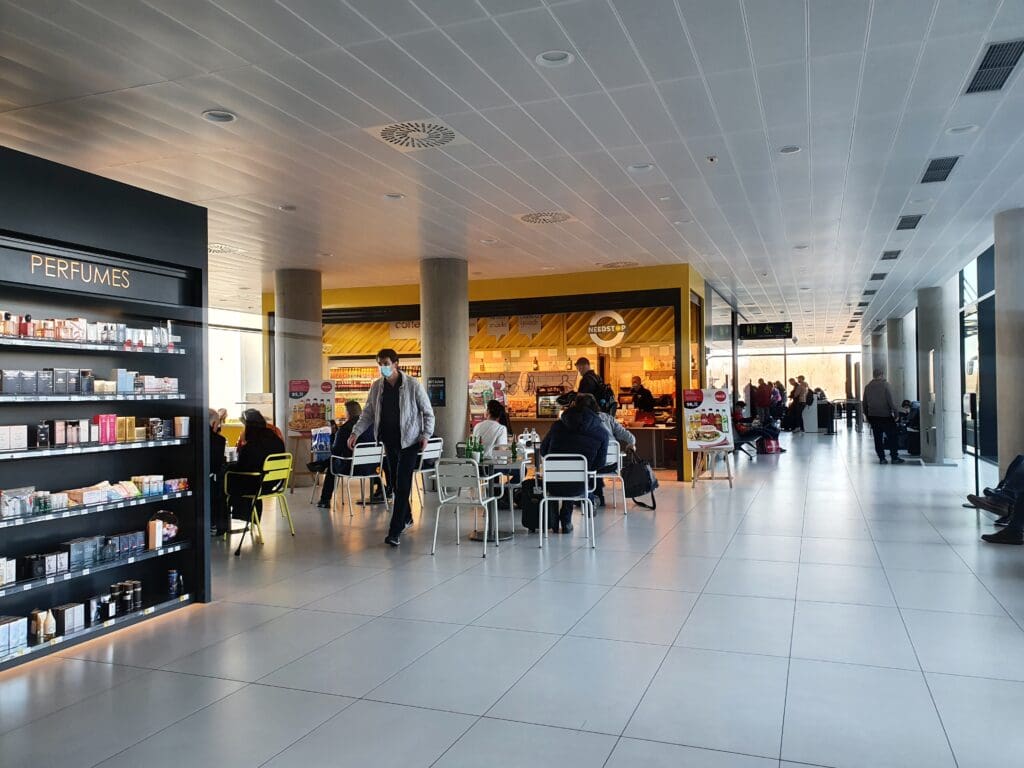
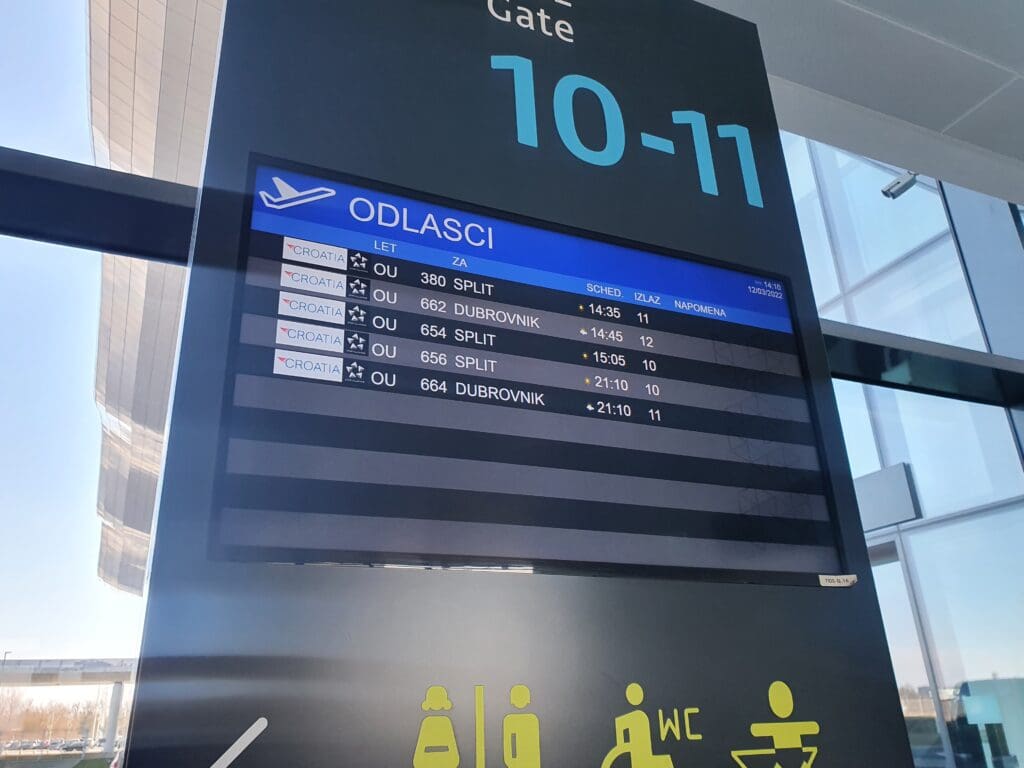
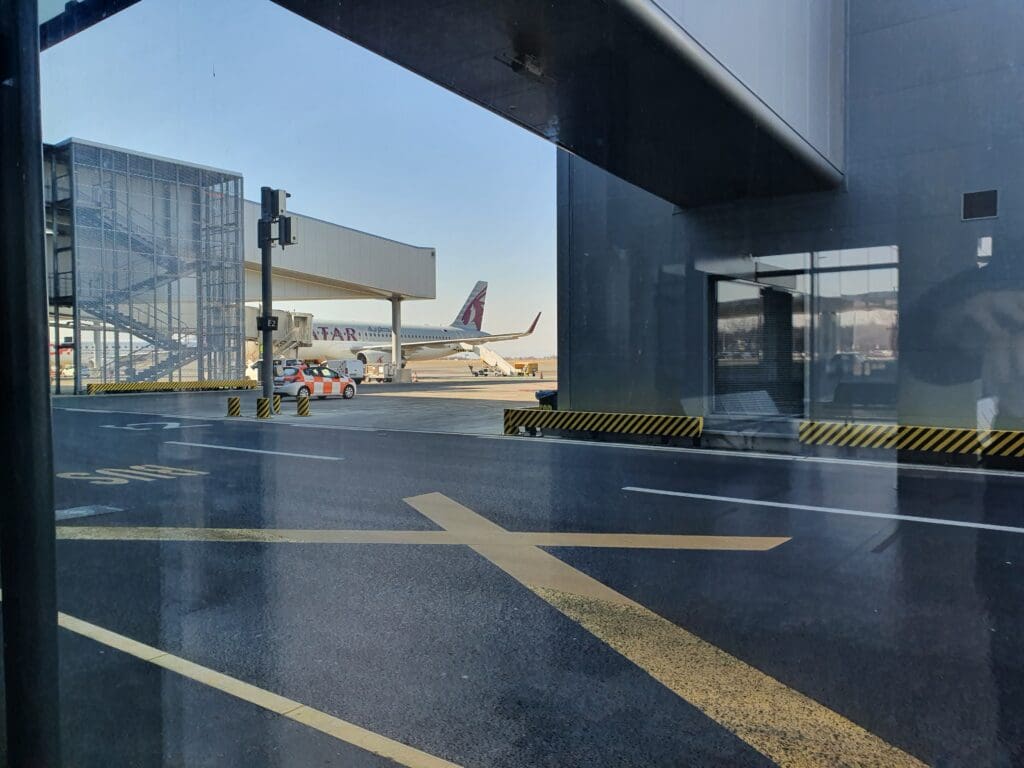
However, not wanting to dwell on the negatives, whilst situated on the ground floor, this part of the terminal does feature large windows that allow for a good view of those aircraft parked up directly outside the terminal as well as those taxying past. Upon arriving in the waiting area, a Croatia Airlines Dash 8 Q400 was parked directly outside the terminal whilst a Qatar Airways Airbus A320 and an Air France Regional Embraer 190 could be seen slightly further along. Before my flight to Split, there was to be a total of just two other departures from the domestic portion of the terminal – a flight to Dubrovnik at 1445, and a slightly earlier flight to Split which then heads to Rome Fiumicino at 1435. Over at the international portion of the terminal, there would be four flights departing before my flight, with these bound for Dubai, London Heathrow, Malmo and Paris CDG, operated by Air France Regional, Croatia Airlines, FlyDubai and Lauda Europe. After grabbing a sandwich, chocolate bar and a drink for a very pricey total of 85 Kuna (£9.48), I took a seat and plugged in my phone to charge, passing the time by doing some work.
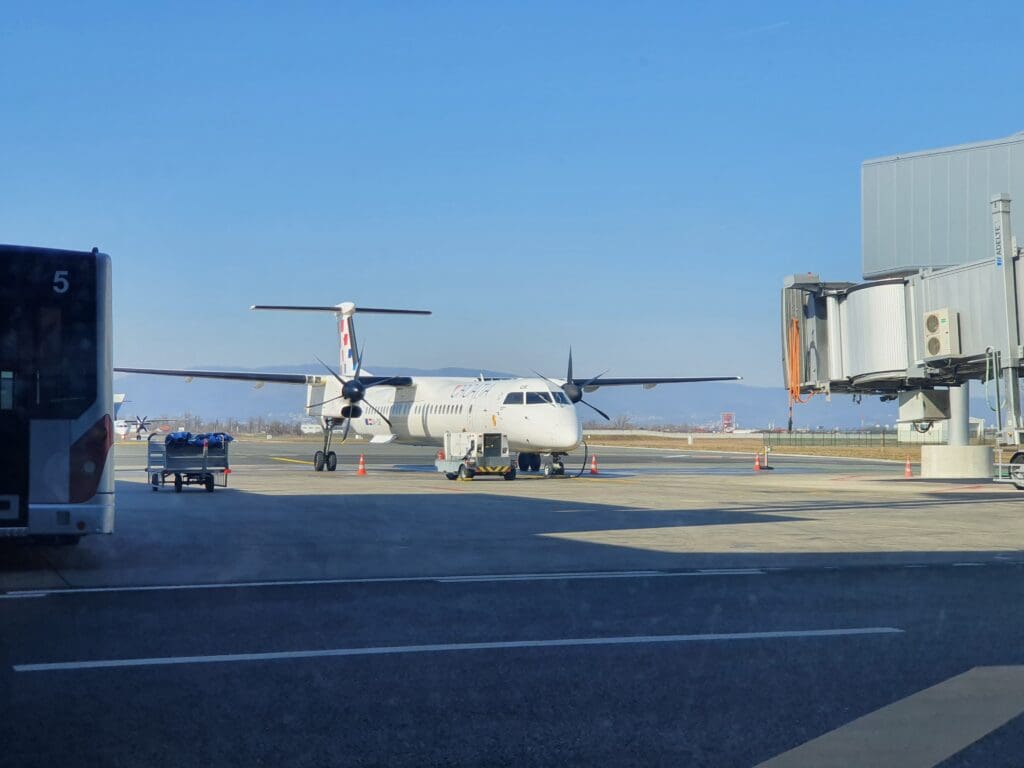
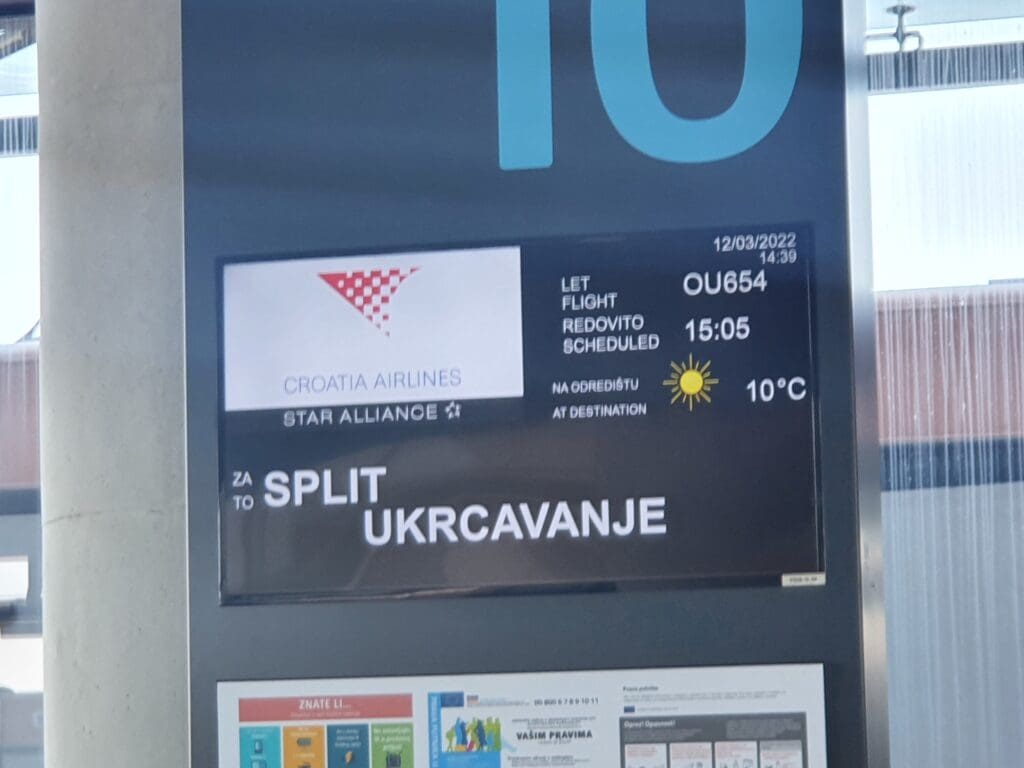
Inside the terminal, as time passed and the departure times for all three-afternoon flights neared, the terminal became increasingly busy with most seats ending up filled. However once the two flights to Dubrovnik and Split had departed, the terminal emptied out and before I knew it a Croatia Airlines staff member could be seen at Gate 10, readying this for the departure of the second service to Split that afternoon. At 1435, the gate agent made an announcement requesting all those bound for Split to make their way to Gate 10 for boarding and a short while later I joined the back of the short queue that had formed. With limited space available in the Dash 8’s overhead lockers, other than checking boarding passes and identification, the gate agent also looked over passengers’ bags and tagged those that would have to be separated from passengers at the door of the aircraft and make the journey down to Split in the hold. After standing in line for a couple of minutes, my boarding pass was scanned and my passport checked, after which I stepped outside and onto the waiting bus.
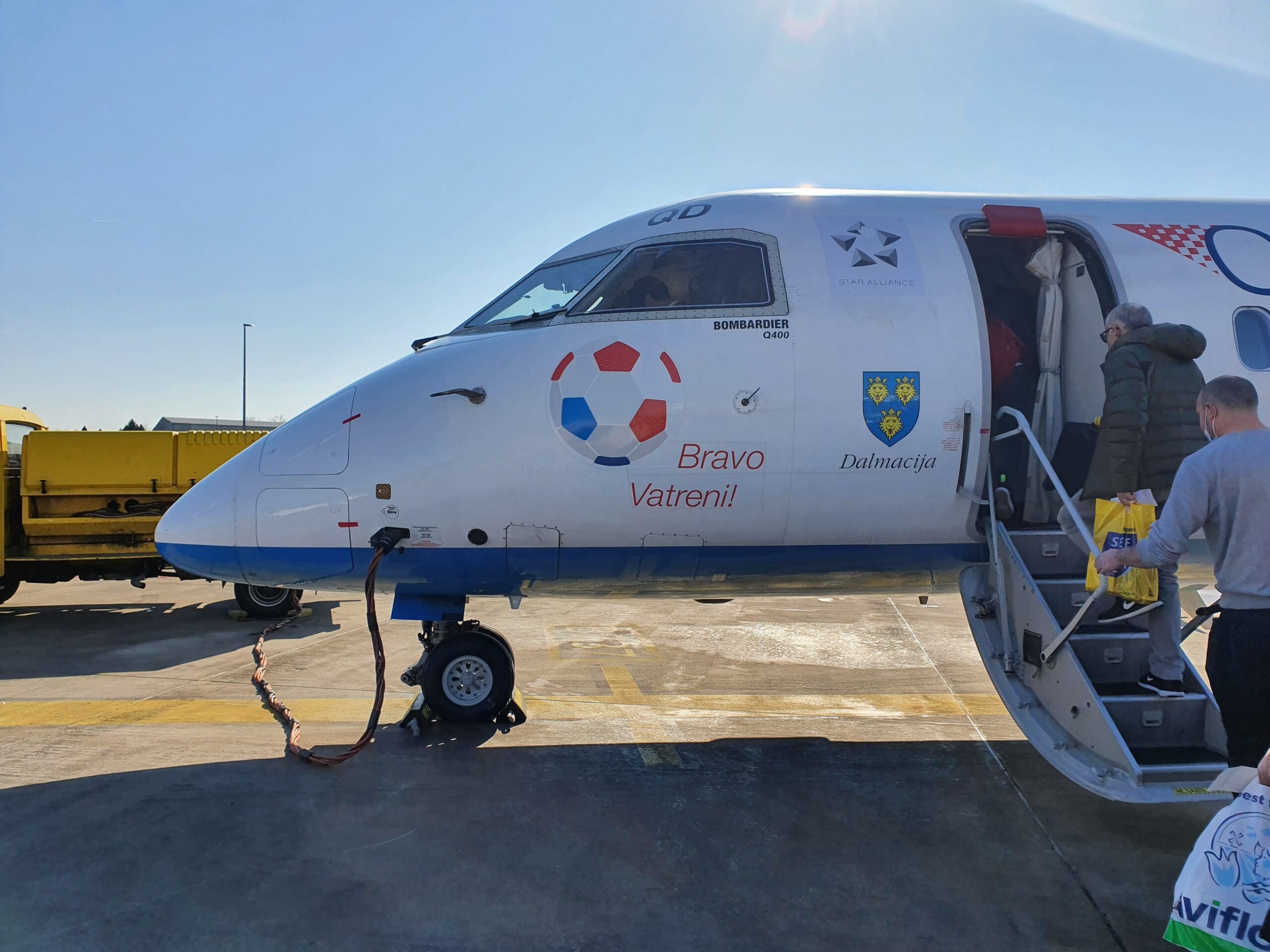
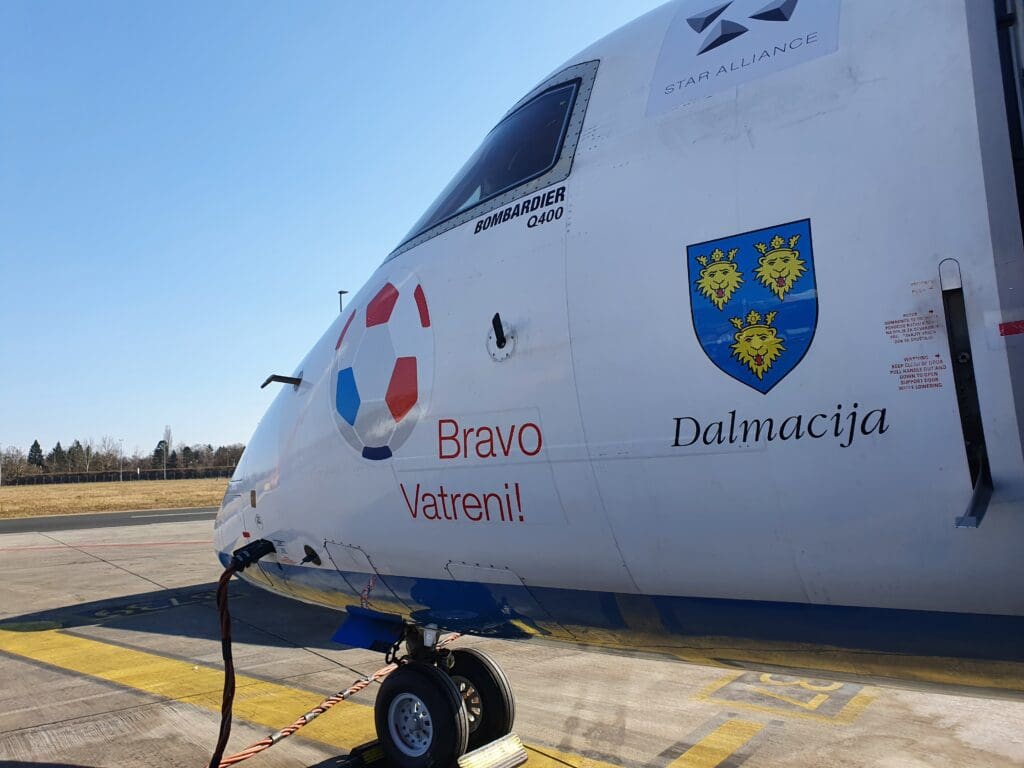
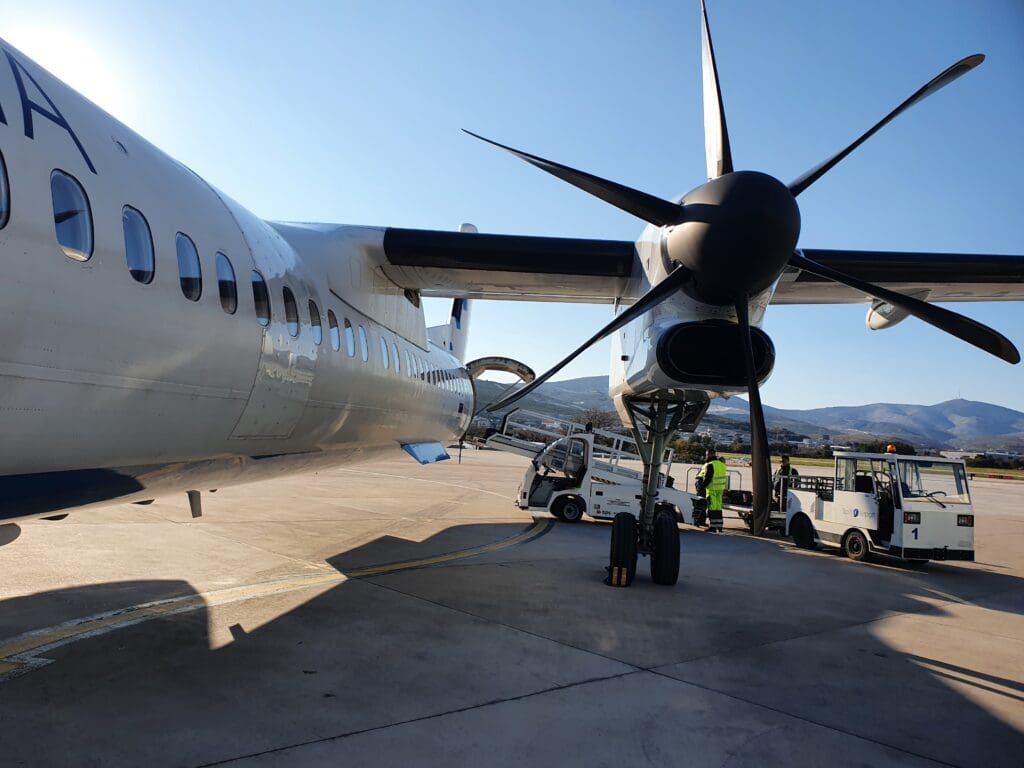
By 1443, all those bound for Split had made it onto the bus and the doors slid closed before the vehicle cautiously pulled away from its stand and journeyed down the flight line. After travelling the length of the terminal, the bus headed out to remote Stand E11, arriving a couple of minutes after leaving the terminal. Waiting there was Dash 8 Q402 9A-CQD, sporting Croatia Airlines’ older colours and with ‘Bravo Vatreni!’ titles on the nose in support of the Croatian national football team. Manufactured at Bombardier’s Toronto Downsview plant, this particular Dash 8 first took to the skies in the spring of 2009 with the Canadian test registration C-FWZU. In June that year, the aircraft was ferried across the Atlantic and delivered to Croatia Airlines where it has been in service ever since. This particular turboprop has been named in honour of Croatia’s Dalmacija region and sports its coat of arms near the main cabin door. During the turboprop’s thirteen-year life, this has suffered from two notable incidents, both of which occurred within the space of a month! The first of these took place in mid-January 2016 when the aircraft experienced a left-hand hydraulics system failure on a flight between Zagreb and Brussels, the result being a diversion to Munich. The second incident occurred several weeks later when the aircraft experienced a bird strike whilst on approach to Zadar. In the week before my flight, the aircraft had completed a total of 45 sectors during which it had covered over 13,500 miles. These had taken the Dash 8 from its base in Zagreb to Brussels, Copenhagen, Dubrovnik, Frankfurt, Munich, Rome Fiumicino, Sarajevo, Skopje, Split, Vienna and Zurich.
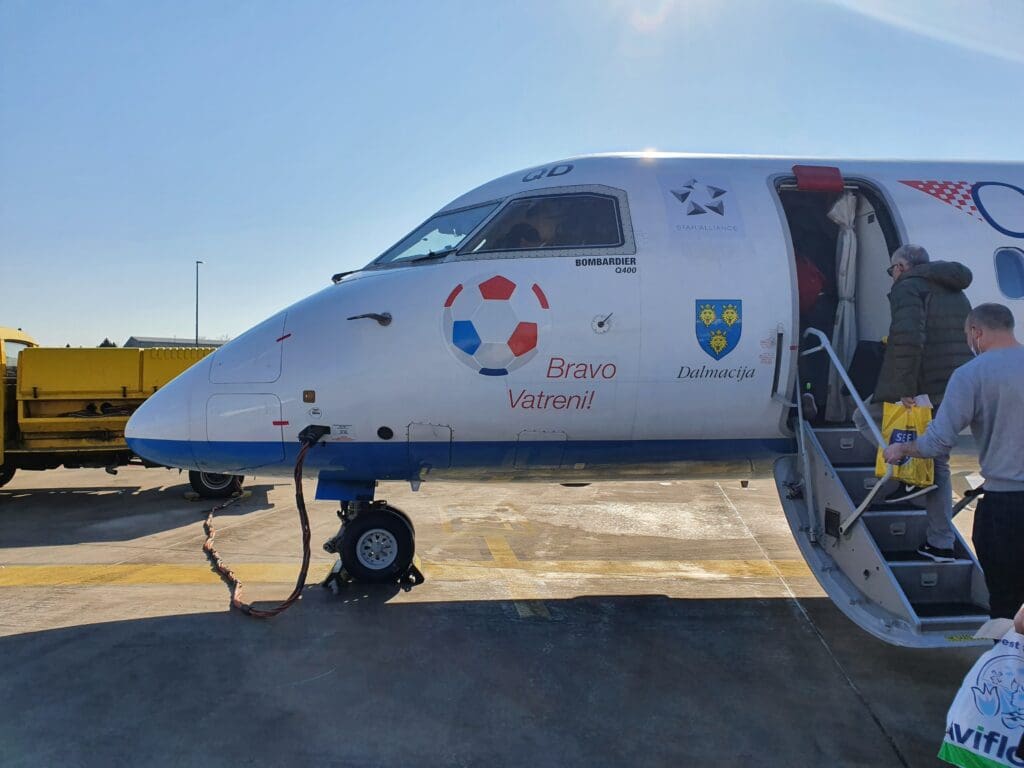
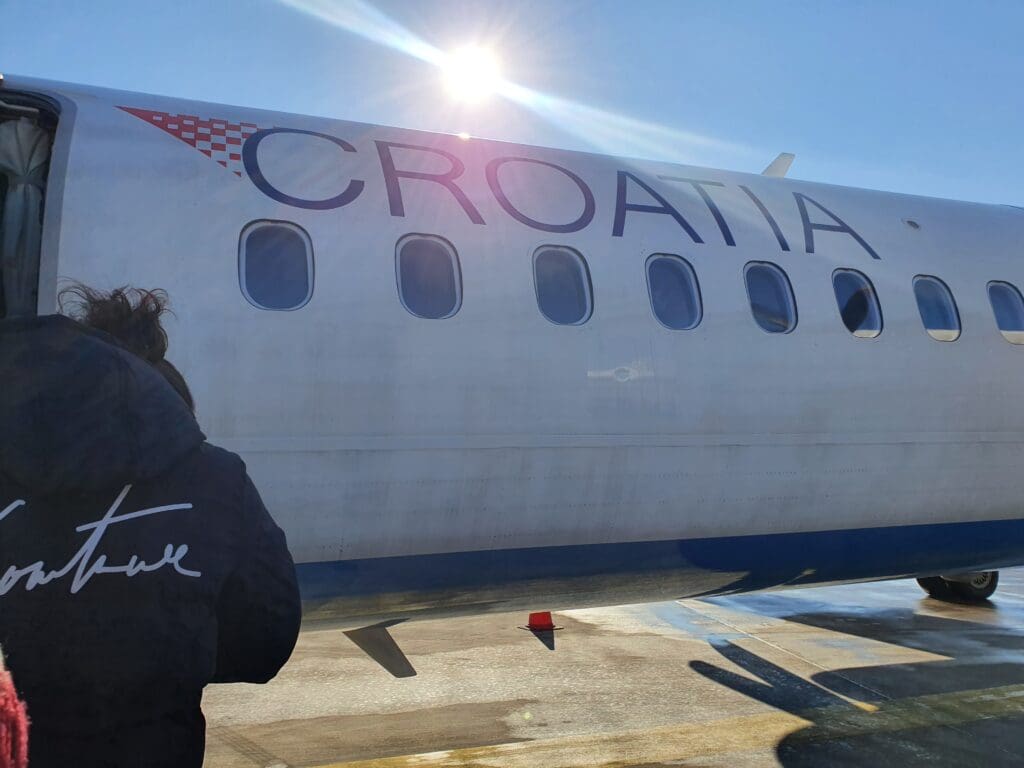
As soon as the bus doors opened, passengers rushed out onto the apron and a crowd soon formed around the steps leading up into the cabin. Following a very short wait, I climbed up the five steps built into the inner side of the door and stepped into the Dash 8’s small forward galley. As I entered the aircraft, I was given a quick and cool welcome in Croatian by one of the two flight attendants onboard the flight that afternoon before turning right and journeying into the cabin. As with many Dash 8 Q400s, those of Croatia Airlines come complete with a total of 76 seats and feature a small ‘Eurobiz’ style business class cabin at the front of the aircraft. That afternoon, the first two and a half rows of the aircraft were dedicated to this premium cabin although I noticed that only two seats in this were taken.
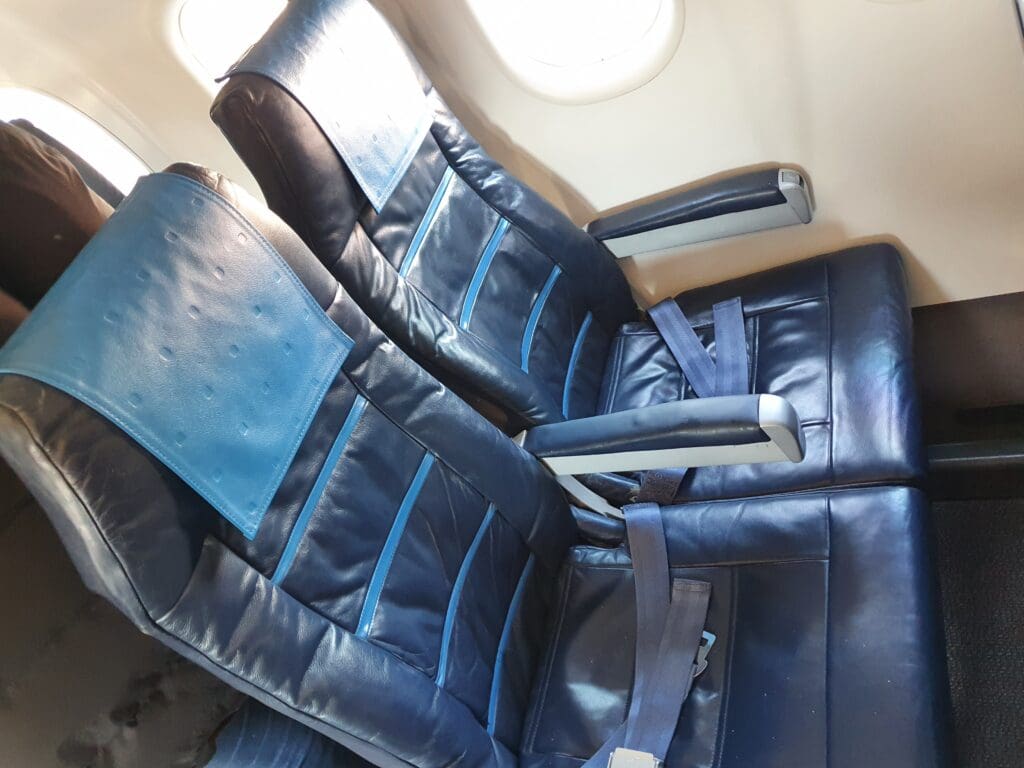
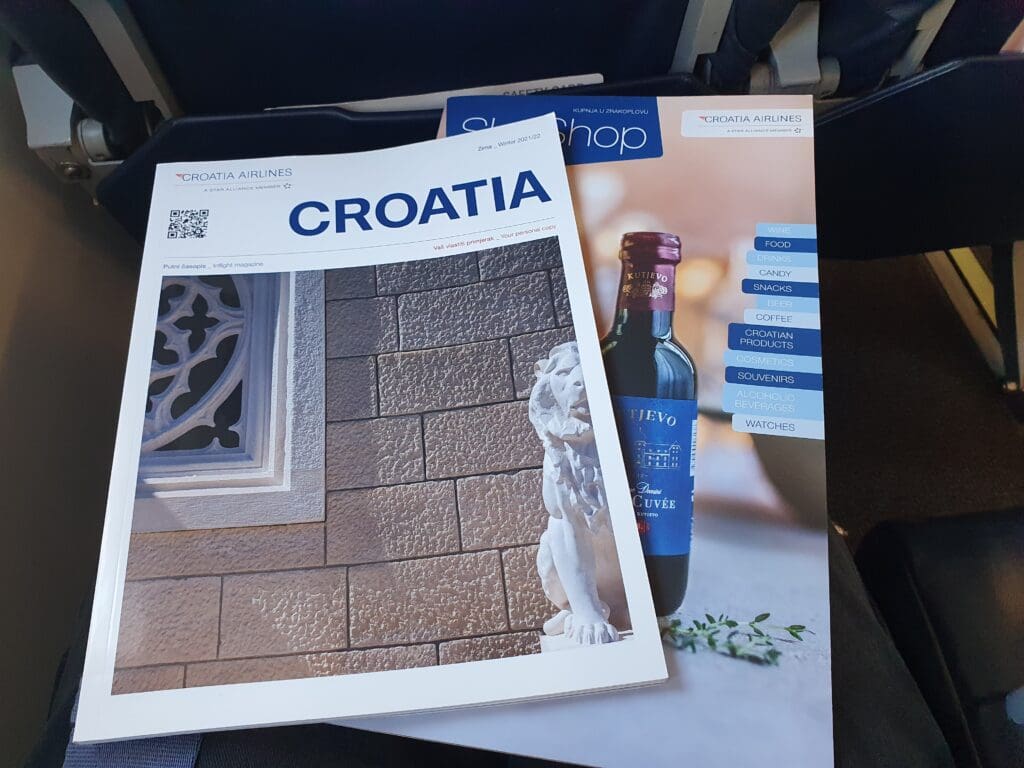
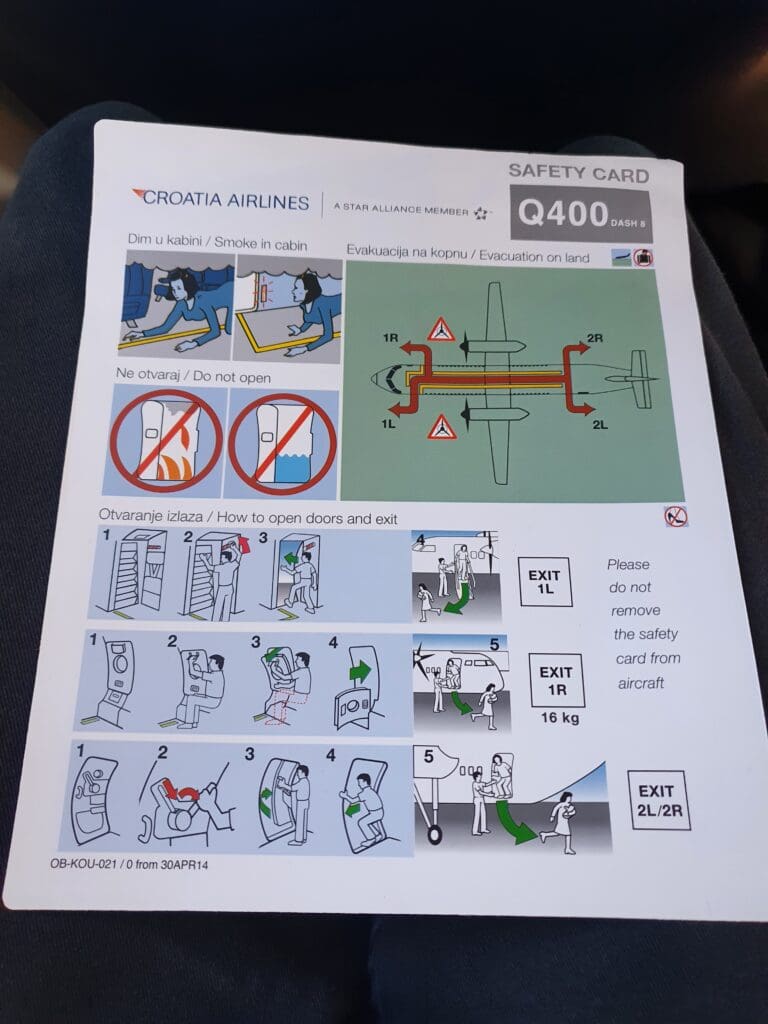
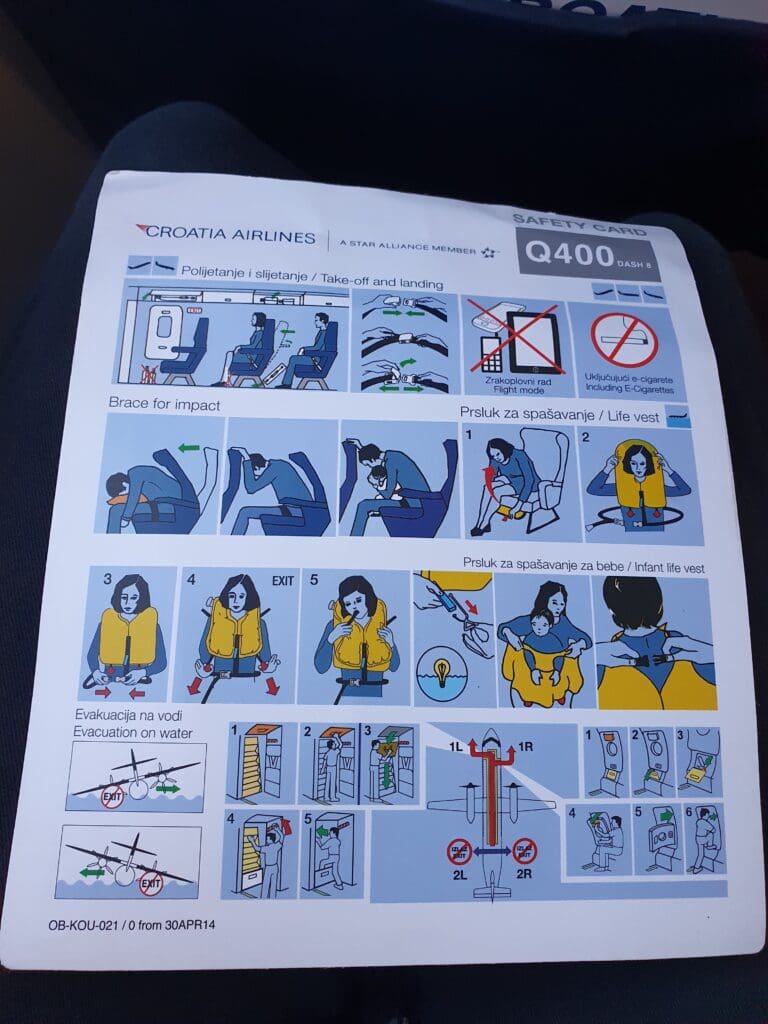
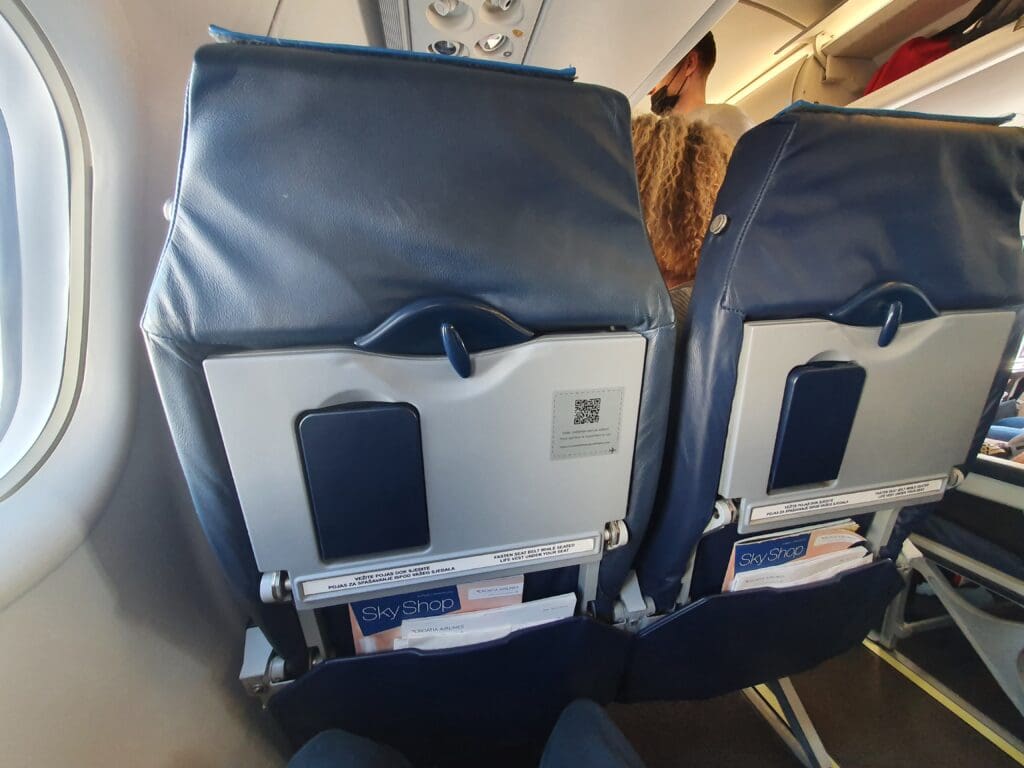
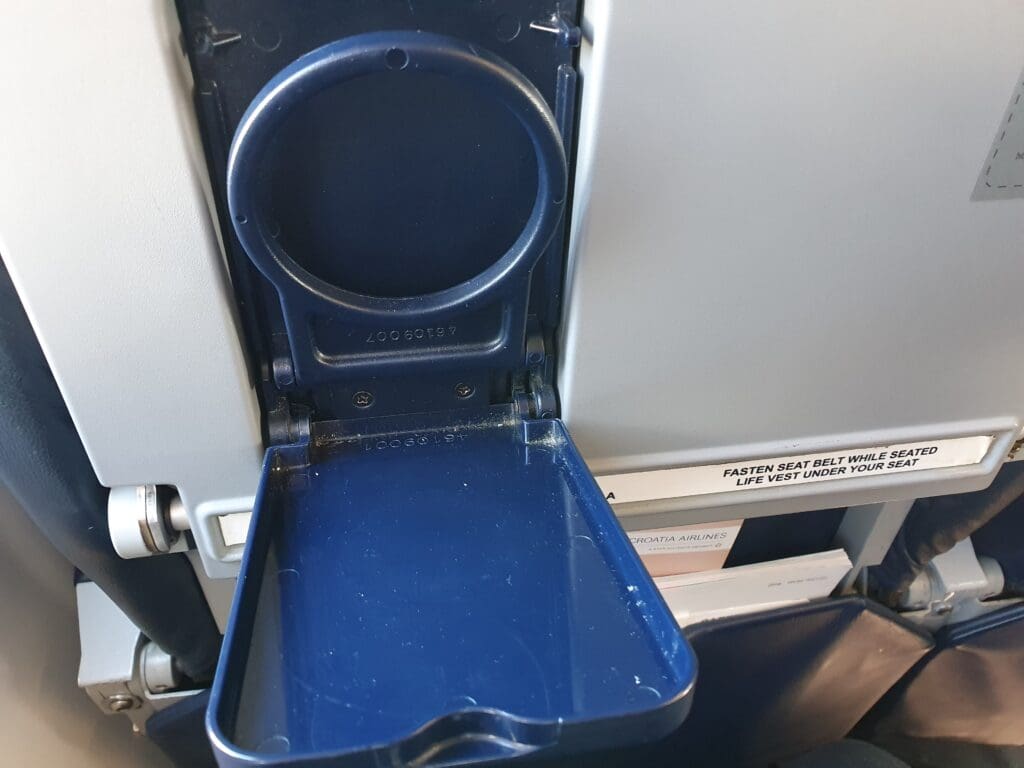
Onboard, each seat featured a dark blue faux leather covering complete with several light blue horizontal lines, whilst these were topped with a blue (faux?) leather antimacassar on which Croatia Airlines’ repeating square pattern is imprinted. In terms of amenities, other than the usual tray table and seatback pocket, the rear of each seat featured a cup holder. As can be seen on many low-cost airlines, up above, several adverts promoting Croatian tourism could be seen stuck on the overhead lockers. Seated near the front of the aircraft, it did not take me too long to reach seat 6A and I soon sat down and settled in for the short journey ahead. Whilst I would not be onboard the Dash 8 for long upon sitting down I was pleased to find that the seat was soft and comfortable and offered a very good amount of legroom for a small regional turboprop. However, the seat did appear to be in a rather battered and tired-looking state, with plenty of marks and scratches dotted about. Turning to the seatback pocket, I was surprised to find that this contained all the usual contents you would have expected to find in this in the pre-Coronavirus era – a safety card, sick bag, the buy-on-board menu and SkyShop catalogue and a copy of the airline’s inflight magazine, entitled Croatia.
Once seated, it did not take long for the remaining passengers to board, with all appearing to have made it onto the aircraft with around fifteen minutes to go until the flight’s scheduled departure time. Outside, the baggage trolley could be seen being taken to the rear of the aircraft and just after 1500 the main cabin door was closed with a thump. After some more waiting, at 1507, two minutes after the flight’s scheduled departure time, the Captain performed their welcome announcement in Croatian and English. During this, they apologised for the late departure and explained this to be down to the fact that we were waiting for connecting passengers. Judging by the arrivals that afternoon, I assume that these had arrived on Croatia Airlines’ flight from Paris CDG and were perhaps caught up at immigration. At 1512, a bus appeared outside the aircraft and the cabin door was opened once again. Having had an empty seat next to me for the duration of the wait, I was sceptical that this would remain vacant, with a good number of passengers arriving at the aircraft. Fortunately, this turned out to be one of the few vacant seats onboard the flight that afternoon.
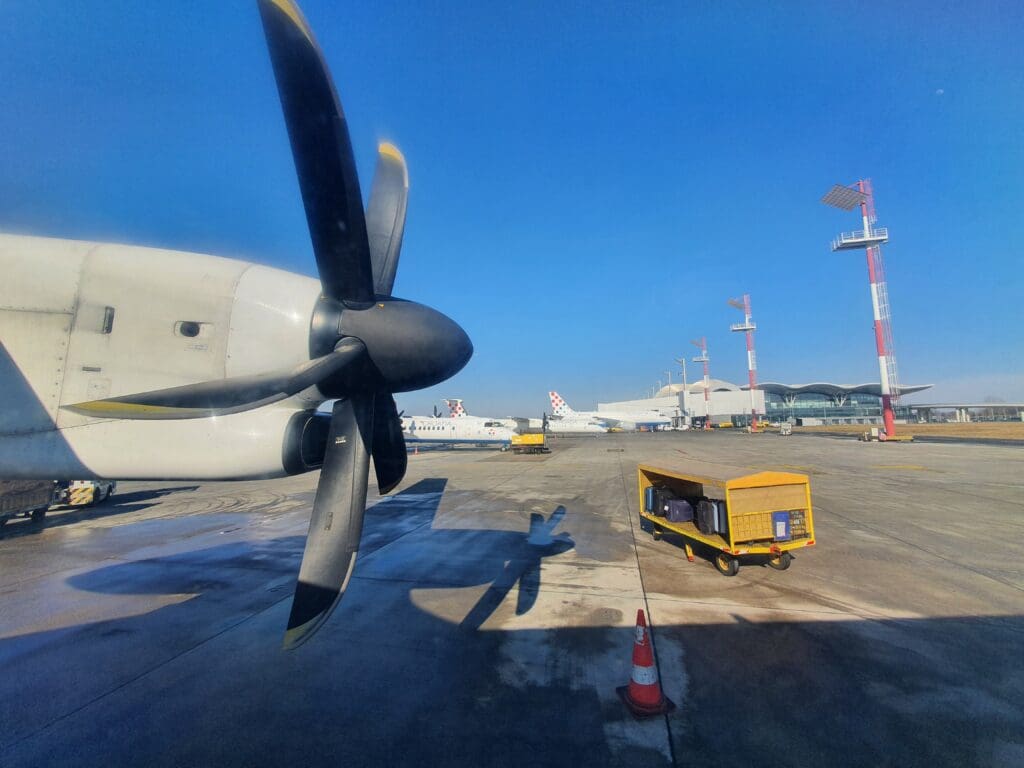
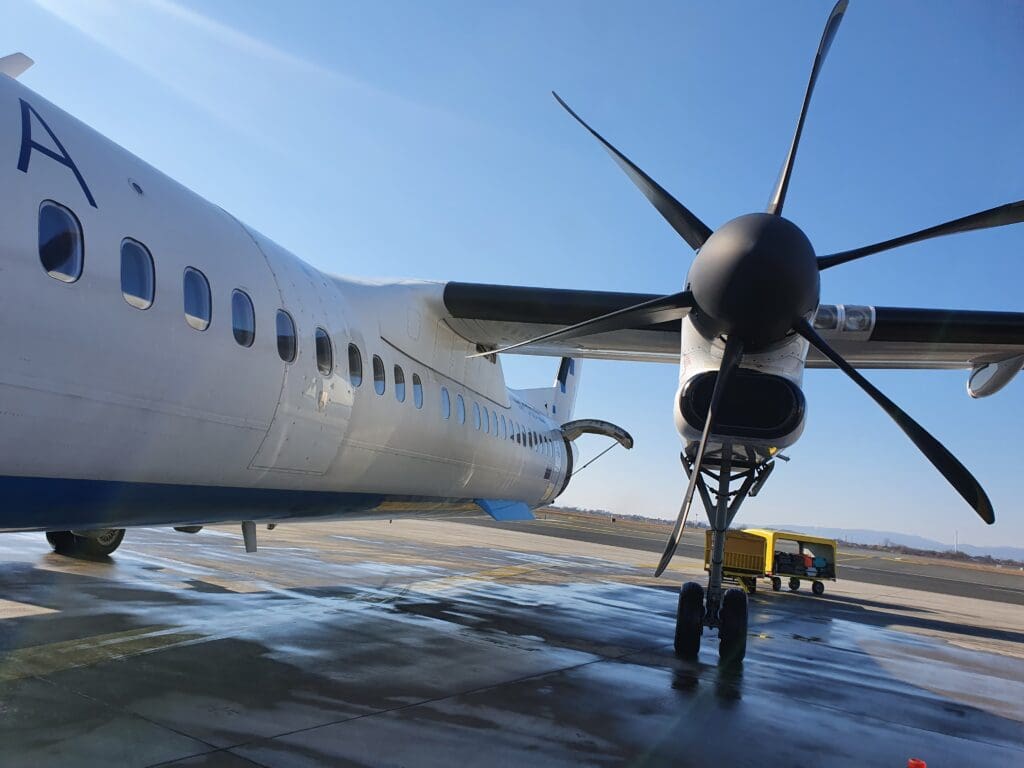
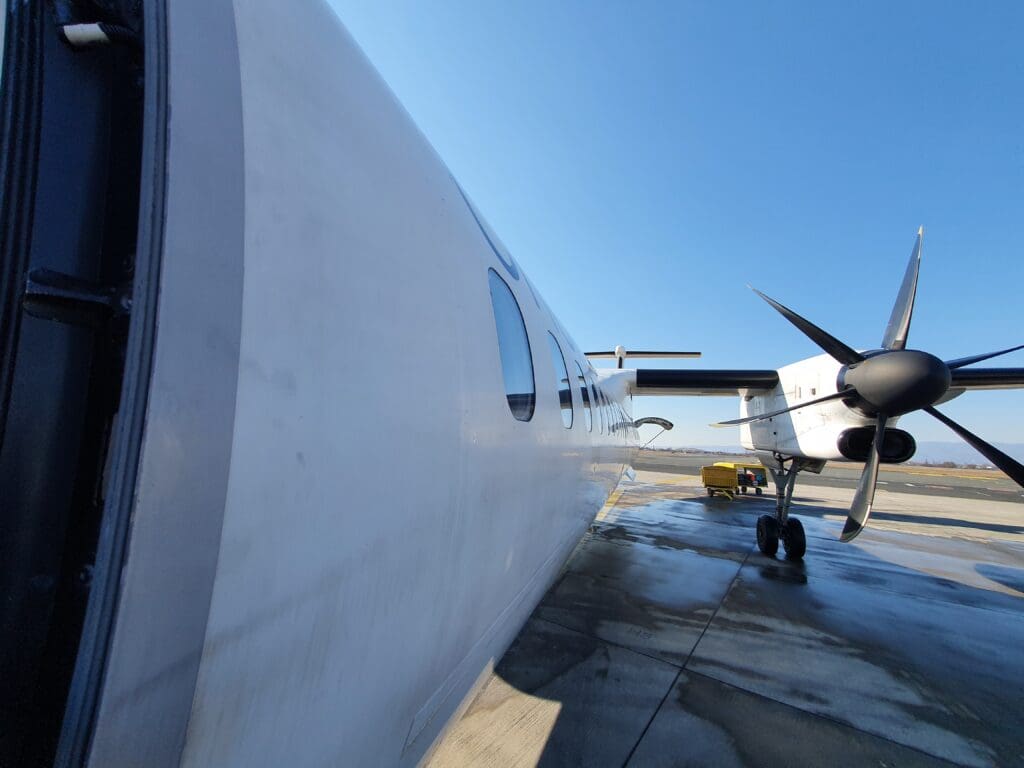
Once all passengers had made it onto the aircraft and had taken their seats, the crew wasted no time in readying the aircraft for departure and the door was closed immediately. After this had been slammed shut, the Purser performed their welcome announcement during which the other flight attendant passed through the cabin making sure that all was in place and secure for departure. A short time later, the aircraft was pushed back away from its parking position as the two Pratt and Whitney Canada PW150A engines began to fire up with their two large Dowty 6-blade propellers soon whirling into life. During the pushback, the cabin crew undertook a safety demonstration along with a pre-recorded announcement which came to an end just before the Dash 8 commenced its taxi to the runway.
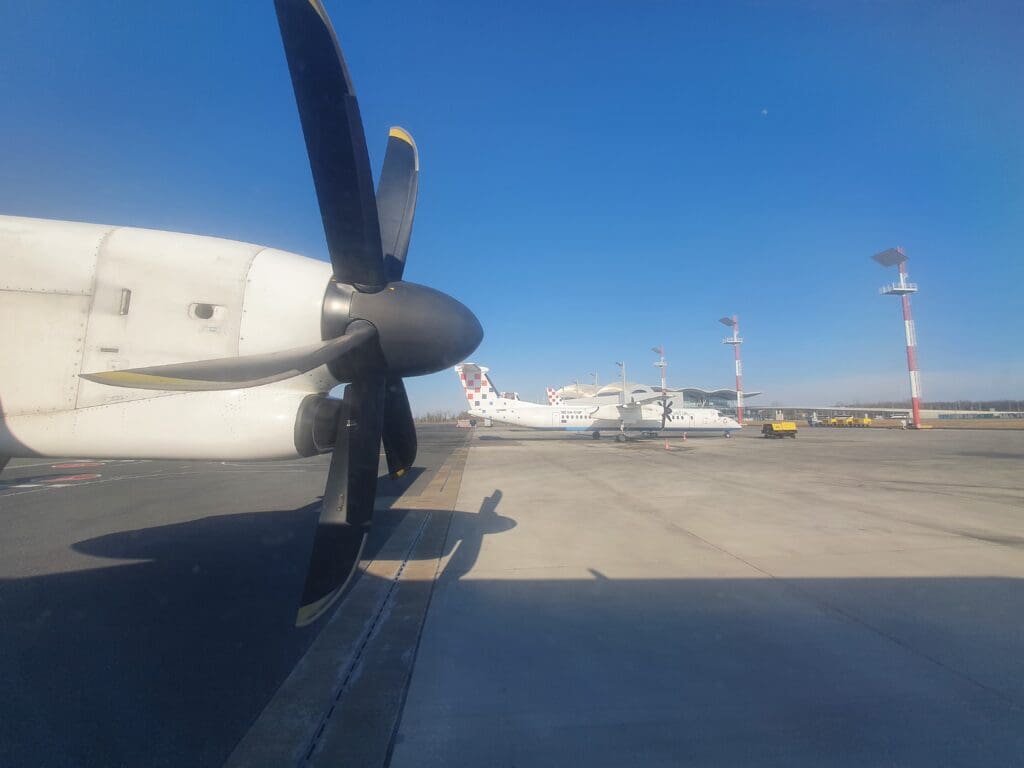
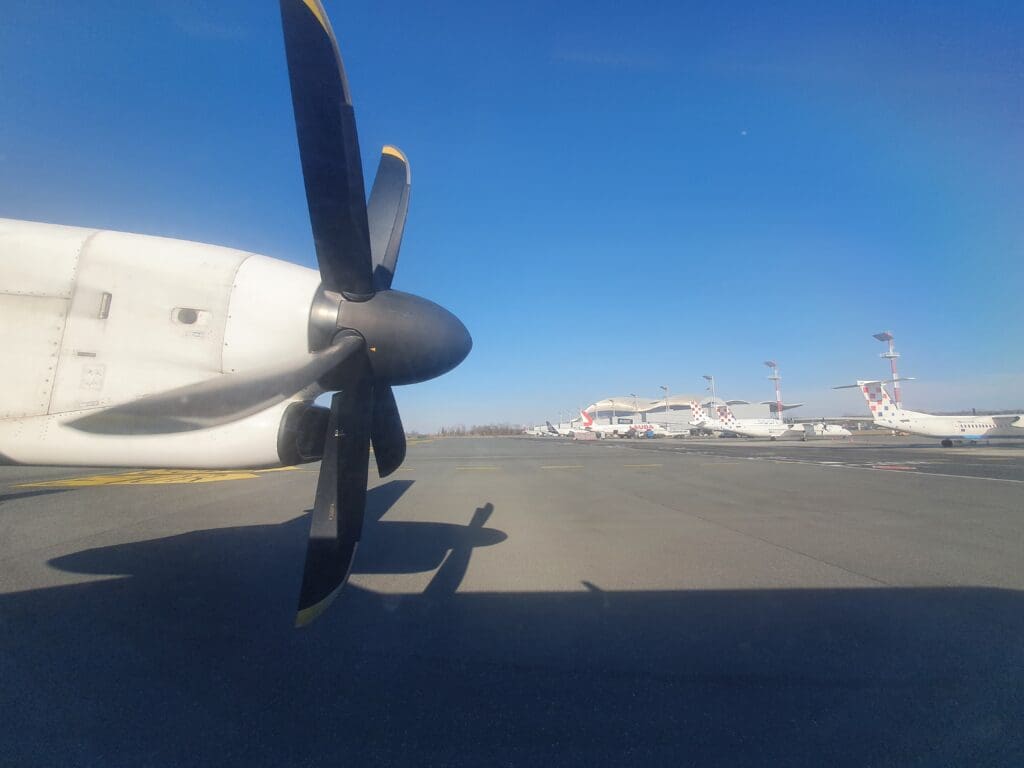
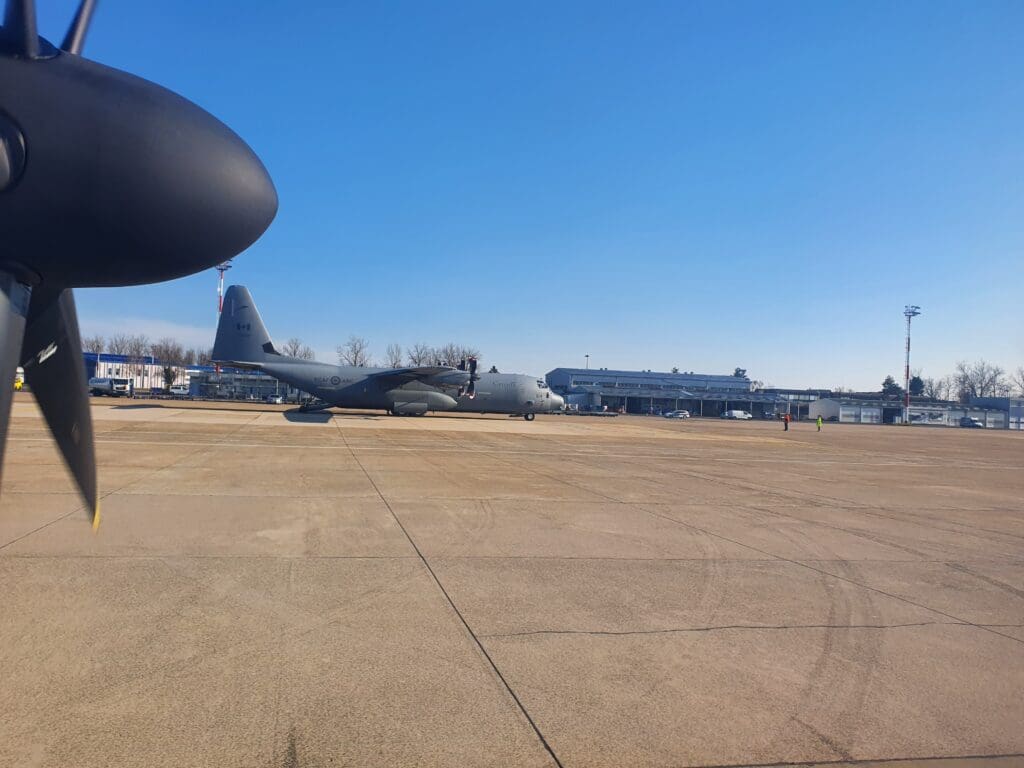
After the tug had been disconnected and the pilots had run through their final pre-departure checks, at 1516 the Dash 8 commenced what seemed to be a very speedy taxi to the end of Runway 04. During this short journey, I caught sight of Croatia Airlines’ maintenance area located roughly in the middle of the airfield. There, two former Austrian Airlines Dash 8 Q400s could be seen, logoless although still painted in the basic colours of their previous operator. These came in addition to a couple of stored Airbus A319s that had previously operated for the now-defunct Greek carrier Ellinair. The next sight on our journey to the runway came in the form of a Royal Canadian Air Force CC-130J Hercules. A long way from its base in the Ontarian town of Trenton, this had just arrived on stand following a slog over from Prestwick, the penultimate stop on its long transatlantic voyage. Reminding me of the primary purpose of my trip to Croatia, the Dash 8 then passed two much smaller turboprops, a couple of Let L-410 Turbolets – one of which was registered in Bosnia and Herzegovina and the other in Bulgaria. Last but not least, three business jets could be seen at the far end of the apron – a small Cessna Citation operated by Austrian company Avcon Jet, a larger Las Vegas Sands Gulfstream G550 and a stored older Gulfstream.
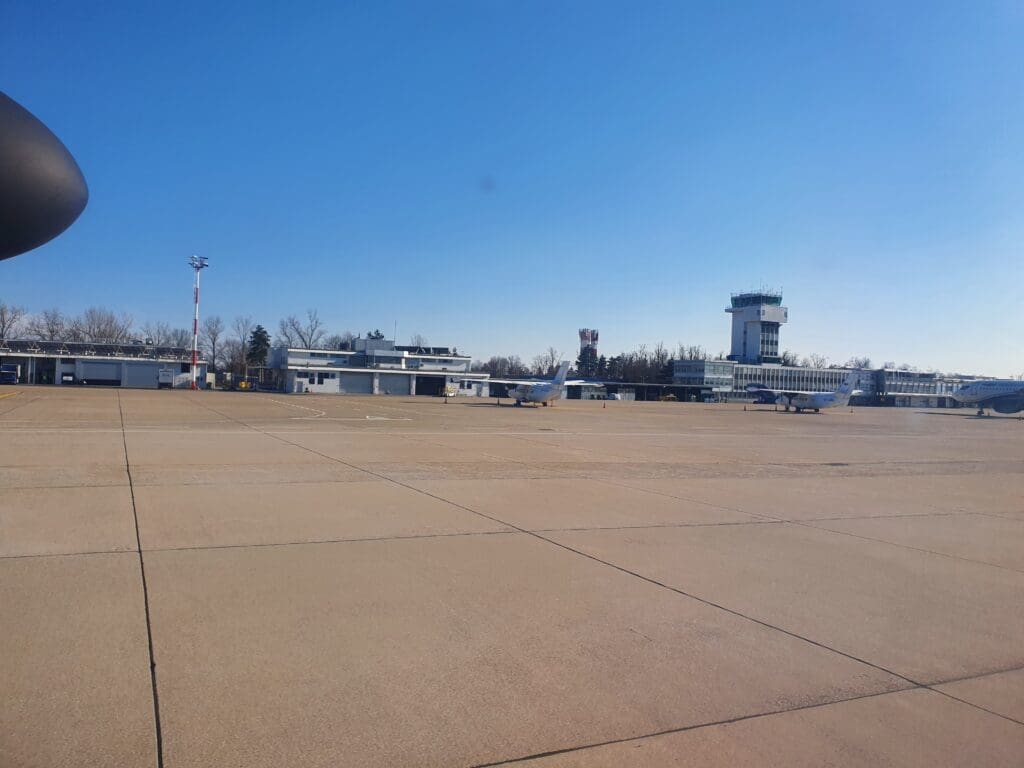
After heading out to the runway, with little other traffic in the skies around the airport at that time the Dash 8 was able to taxi onto this without any holding. At 1520, the aircraft’s two turboprop engines powered up, filling the cabin with plenty of noise and vibration as the Dash 8 began its rolling take-off. Rotating into the skies in no time, the good visibility that afternoon ensured that the skyline of Zagreb could be seen in the distance along with the hills that sit around this as the gear was retracted and the aircraft powered away from the airport. Once the Dash 8 had left the airport behind, several small towns could be seen dotted about in the mostly flat rural landscape of fields and forests that sit to the south of Zagreb.
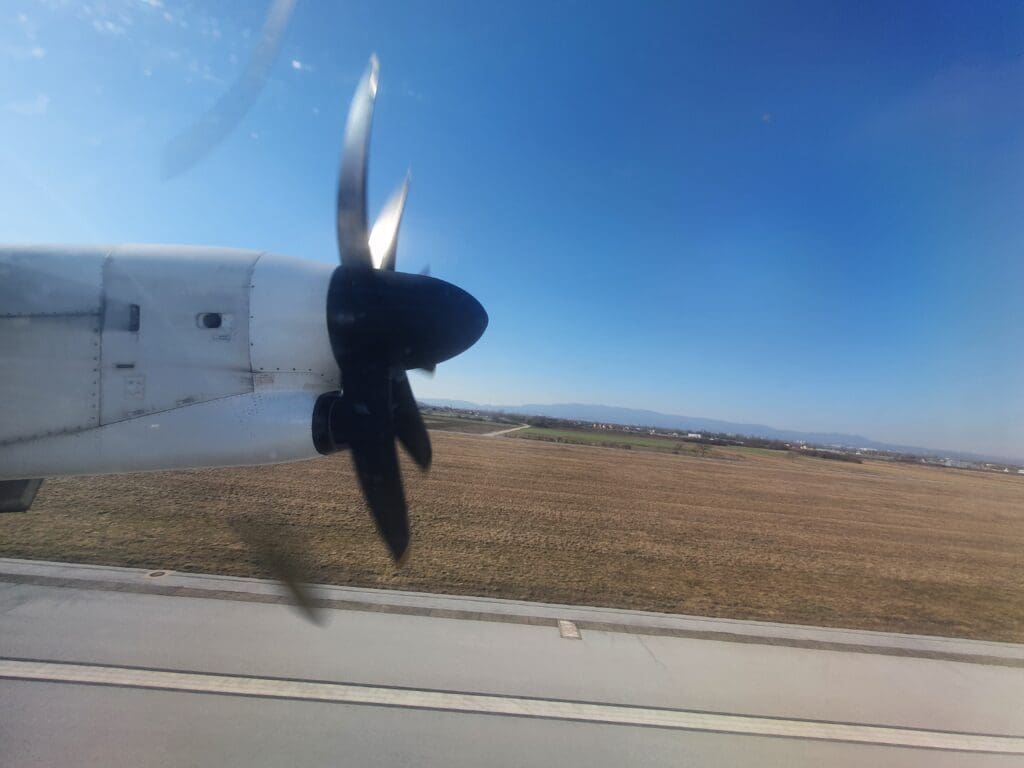
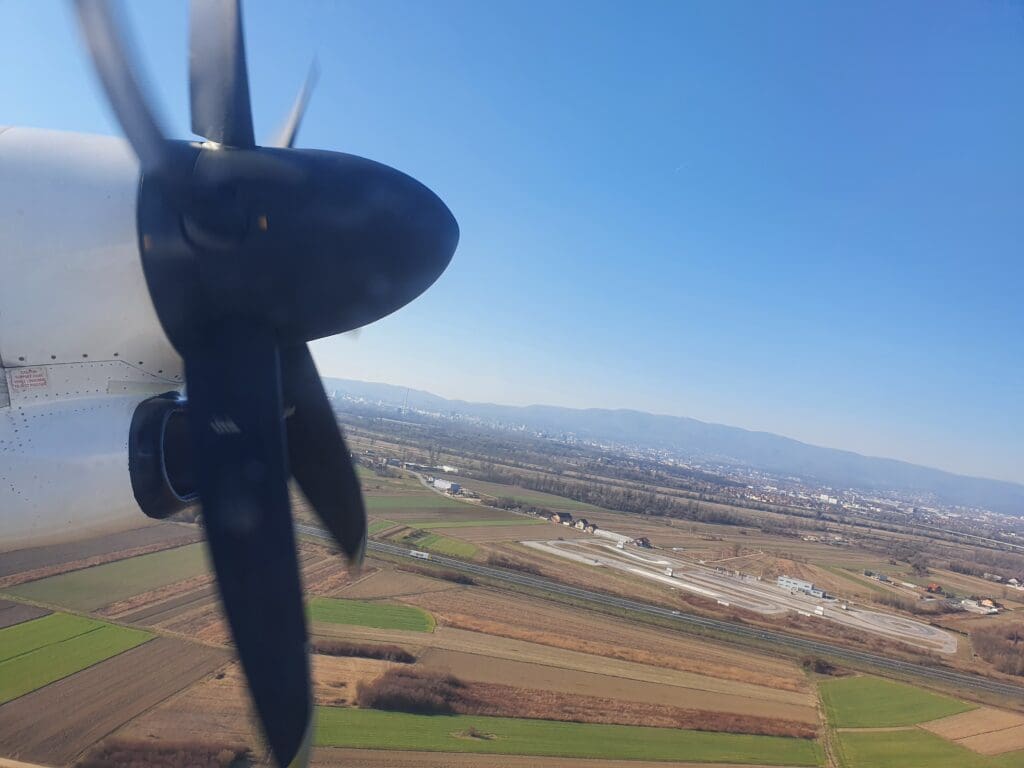
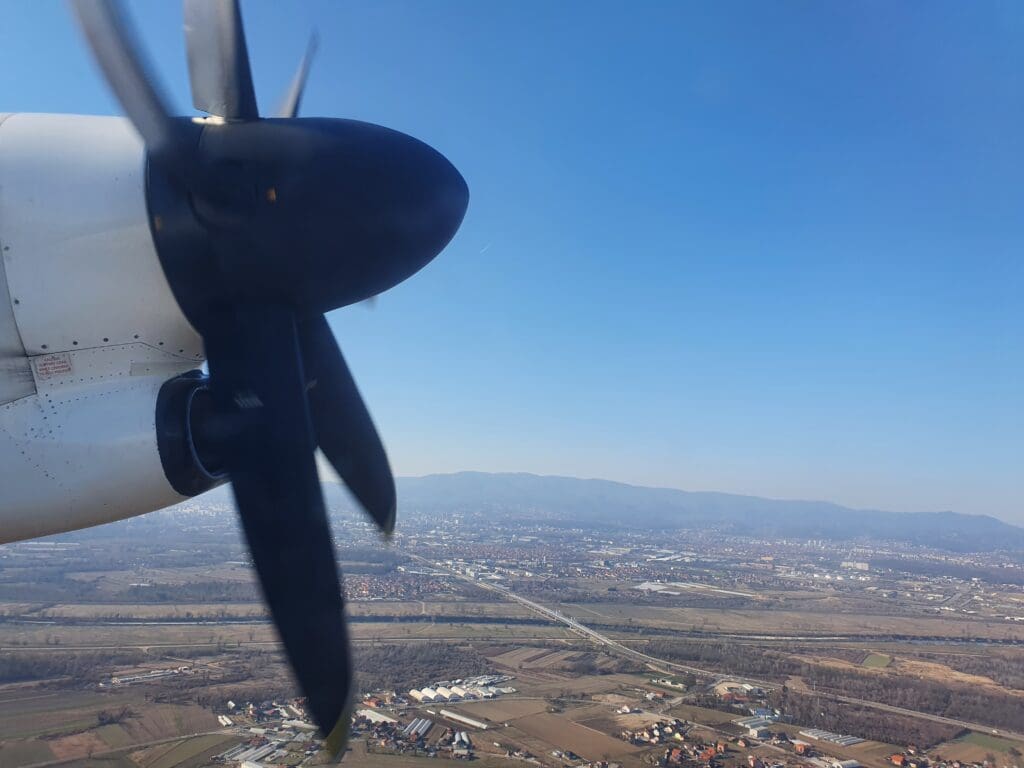
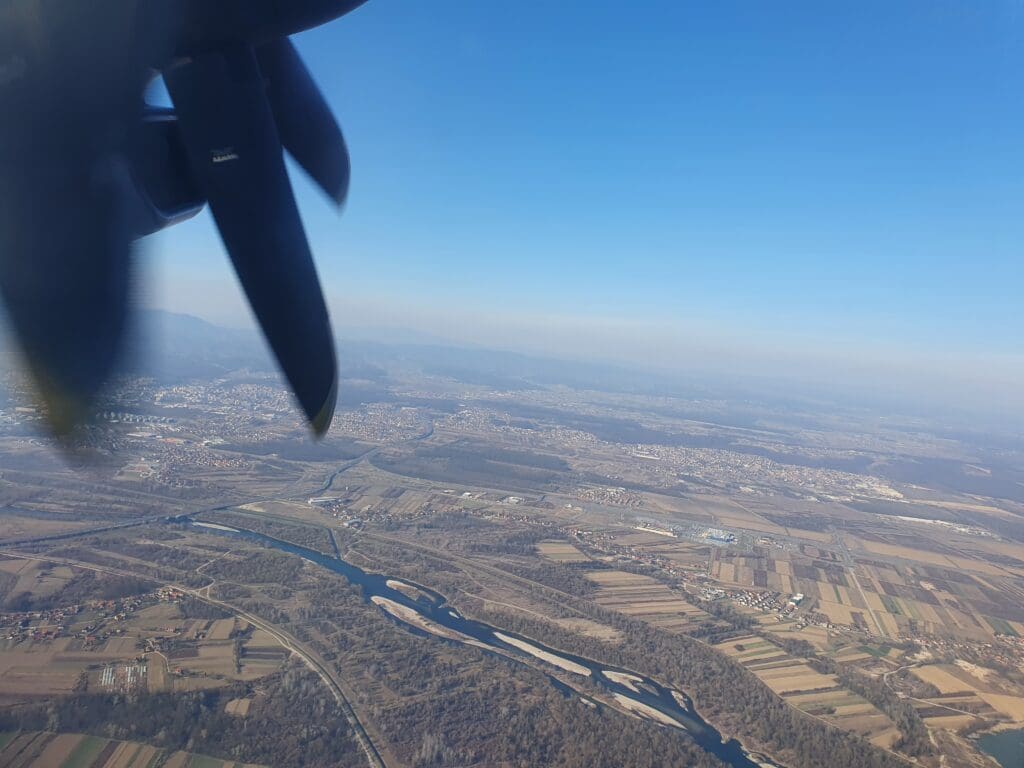
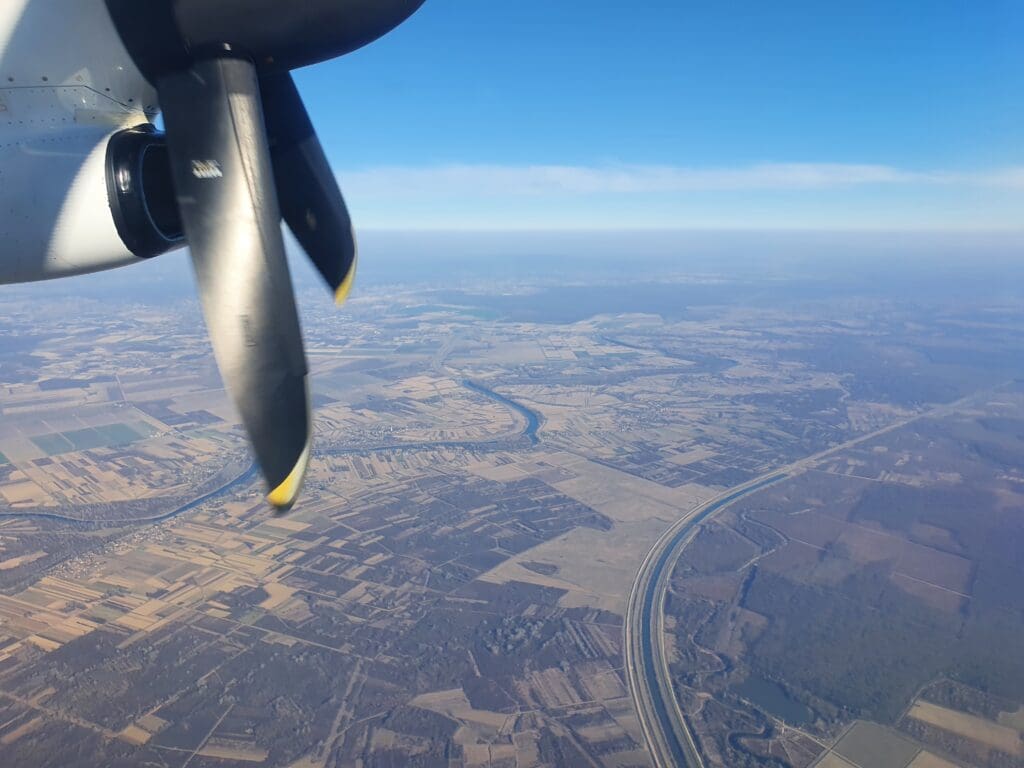
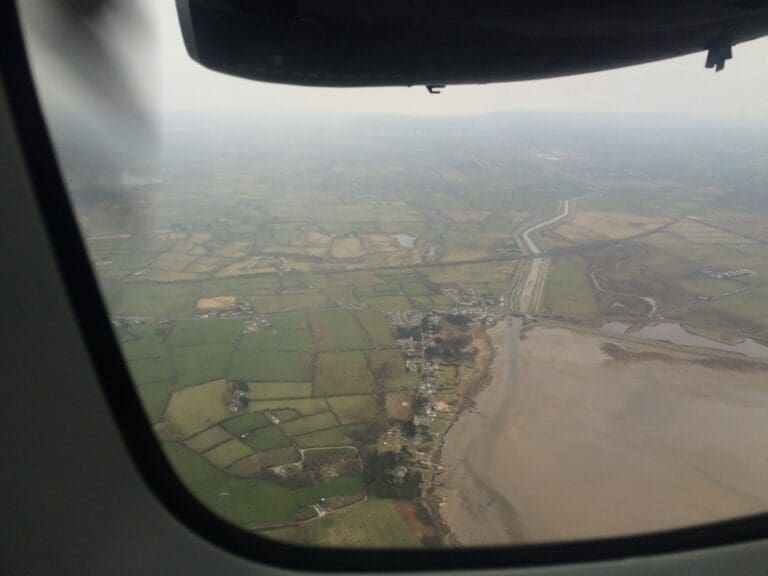
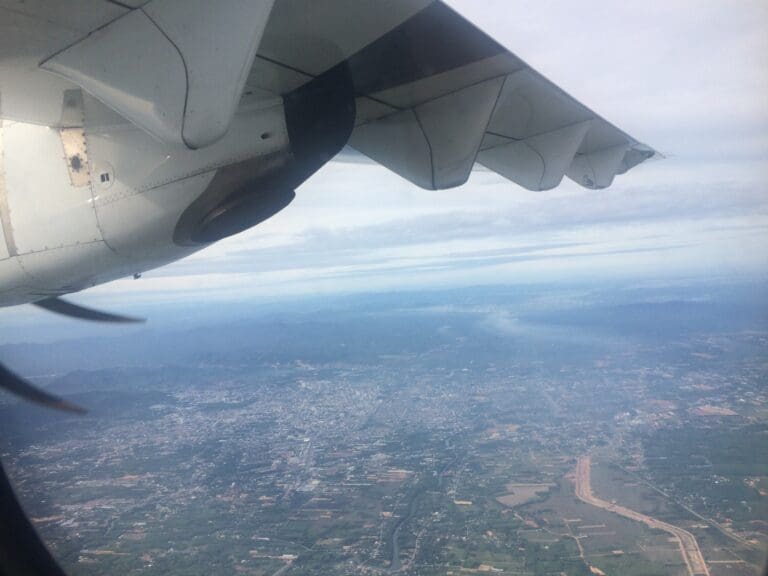
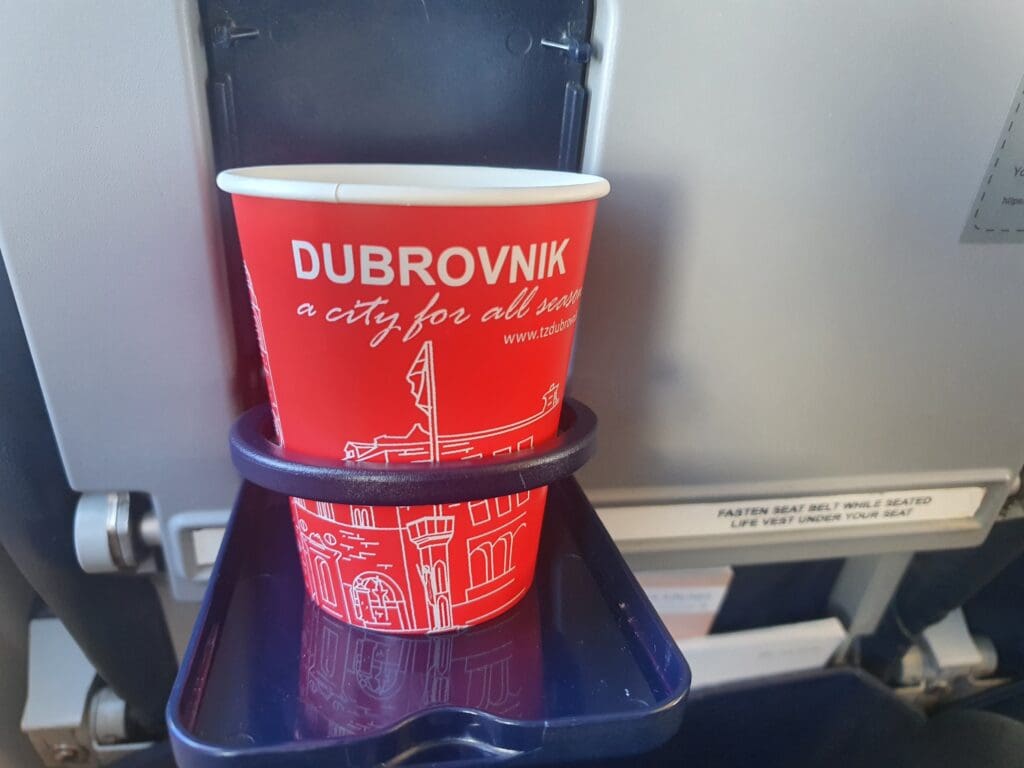
Around a minute or so after taking to the skies, the Dash 8 turned onto a southerly heading, flying roughly parallel to the Sava River for a few minutes before passing into the heavens above Sisak-Moslavina county. From there, the landscape below became hillier with patches of ice and snow visible on some of the region’s taller hills, inside at this point, an automated announcement regarding seatbelts rang out in Croatian and English and a short time later the seatbelt sign was extinguished. Despite the very short flight time, impressively a basic service was still conducted on the service down to Split. Given the short time that we were in the air, the inflight service began as soon as the crew were released from their seats. Only six minutes after taking to the skies, the two flight attendants rolled the trolley to the front of the aircraft and began to serve passengers still water – with the service appearing to be identical for those in both Economy and Business. Seated in the third row of Economy, I did not have to wait long before being served and I was soon handed water in a relatively large red paper cup featuring an advertisement for Dubrovnik by a friendly flight attendant. Whilst this was by no means an extensive inflight offering, this was still appreciated given the short length of the flight. It is worth noting that those on Croatia Airlines’ longer services are usually offered a snack and a choice of drink, whilst a range of more substantial offerings can be purchased.
Turning my attention back to the outside world, whilst this was a Croatian domestic flight, taking the most direct route, a significant portion of the flight would take place in Bosnian airspace which we entered ten minutes after departure. At this time the noise produced by the Dash 8’s two turboprop engines decreased slightly as the aircraft levelled off at 20,000 feet at which point the seatbelt signs were extinguished. Whilst I would not need much entertainment thanks to the clear skies and subsequent views of the passing scenery, I did have a quick flick through the winter 2021/22 edition of Croatia Airlines’ Croatia magazine. This featured the usual collection of articles on a variety of subjects, mostly relating to, perhaps unsurprisingly, Croatia, plus a small bit of information on the airline at the back of this. Whilst this provided by no means the most riveting read, it was nice the flick through a hard copy of an inflight magazine given the fact that those of many airlines have now permanently migrated to the digital world.
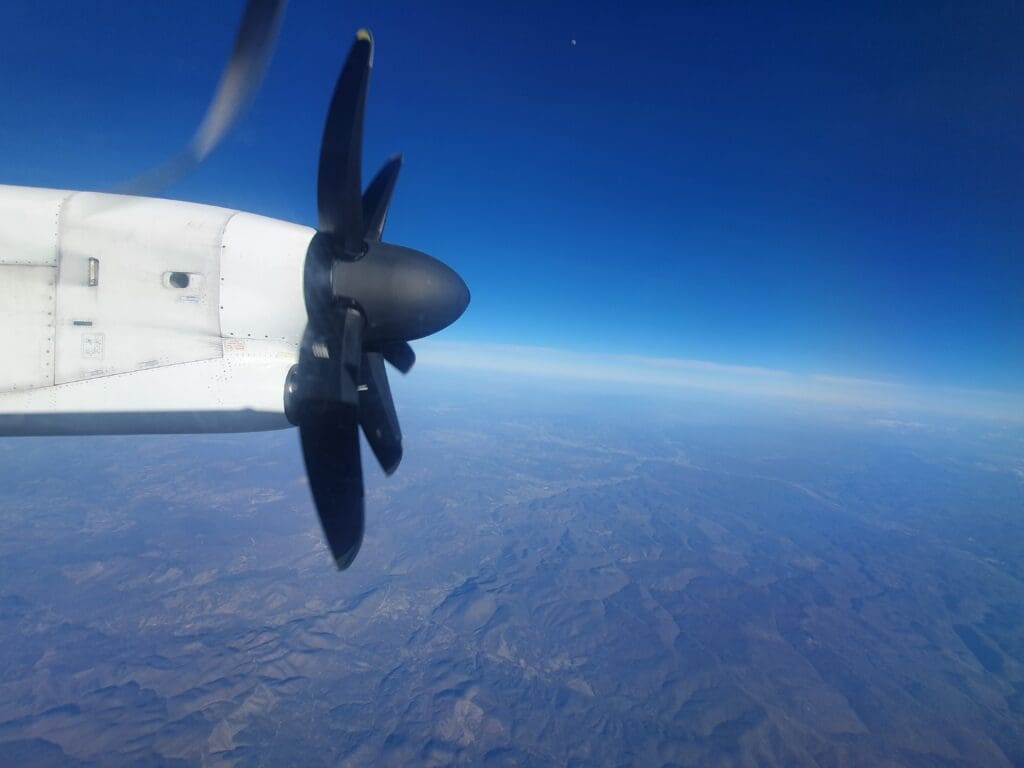
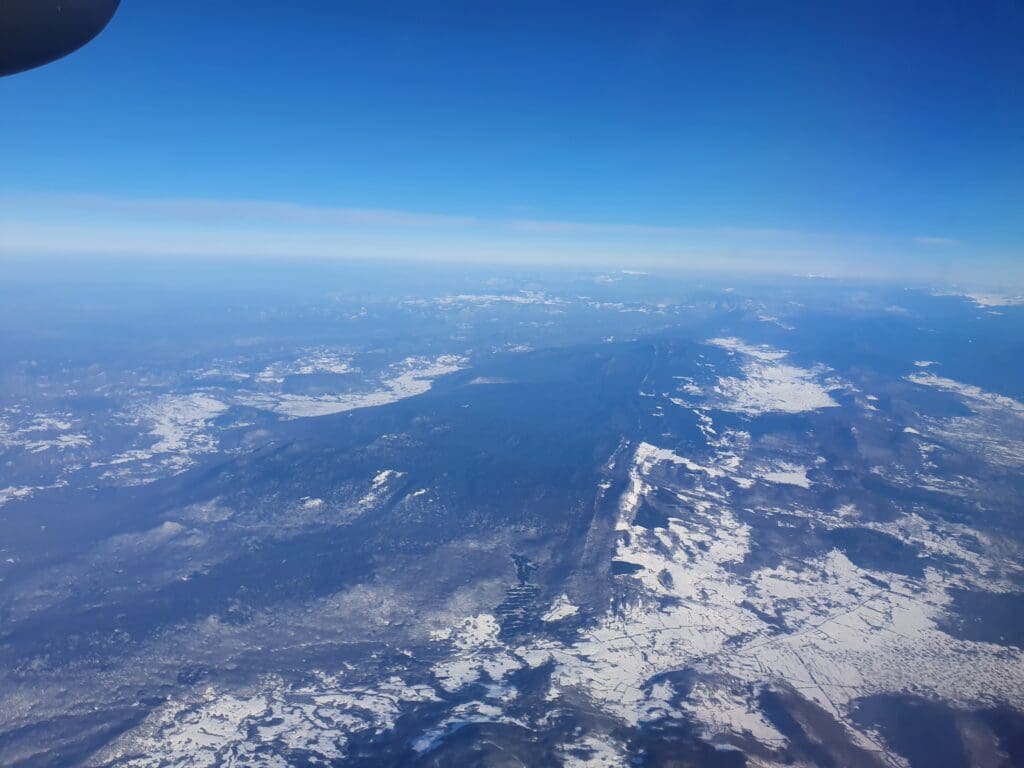
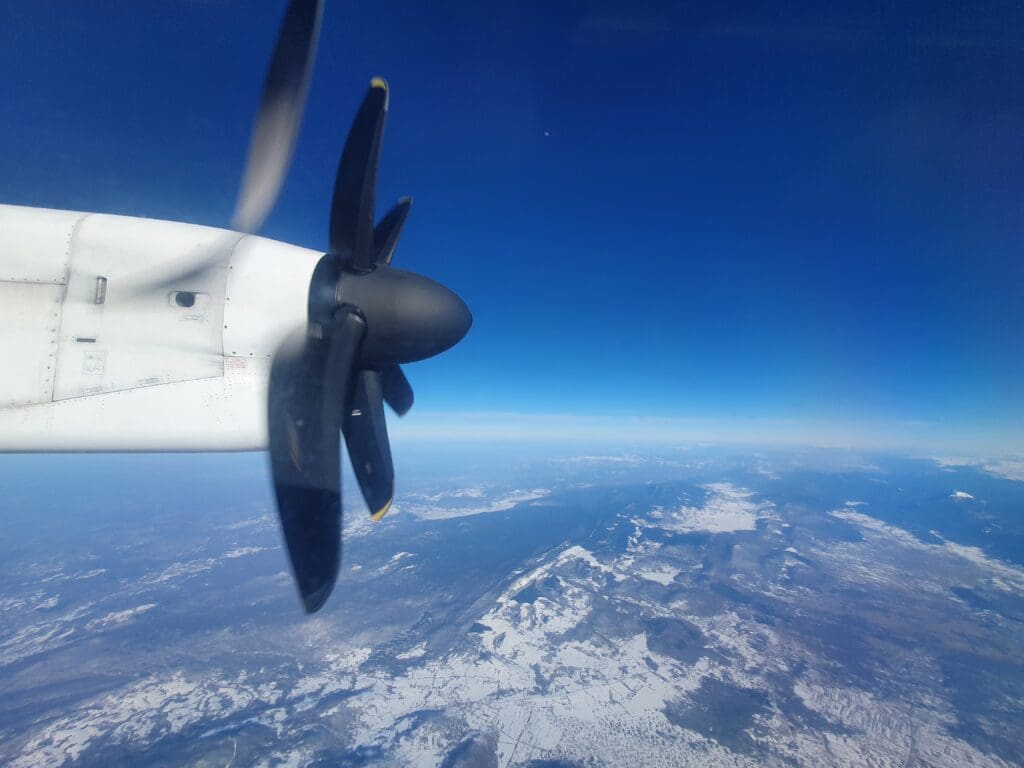
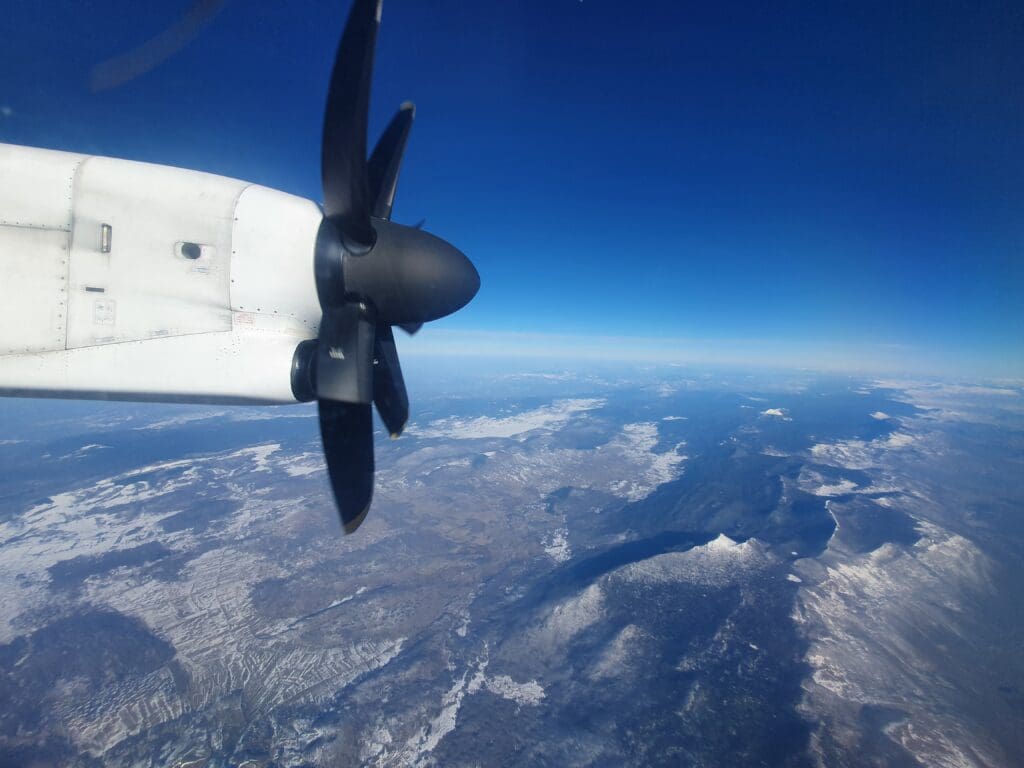

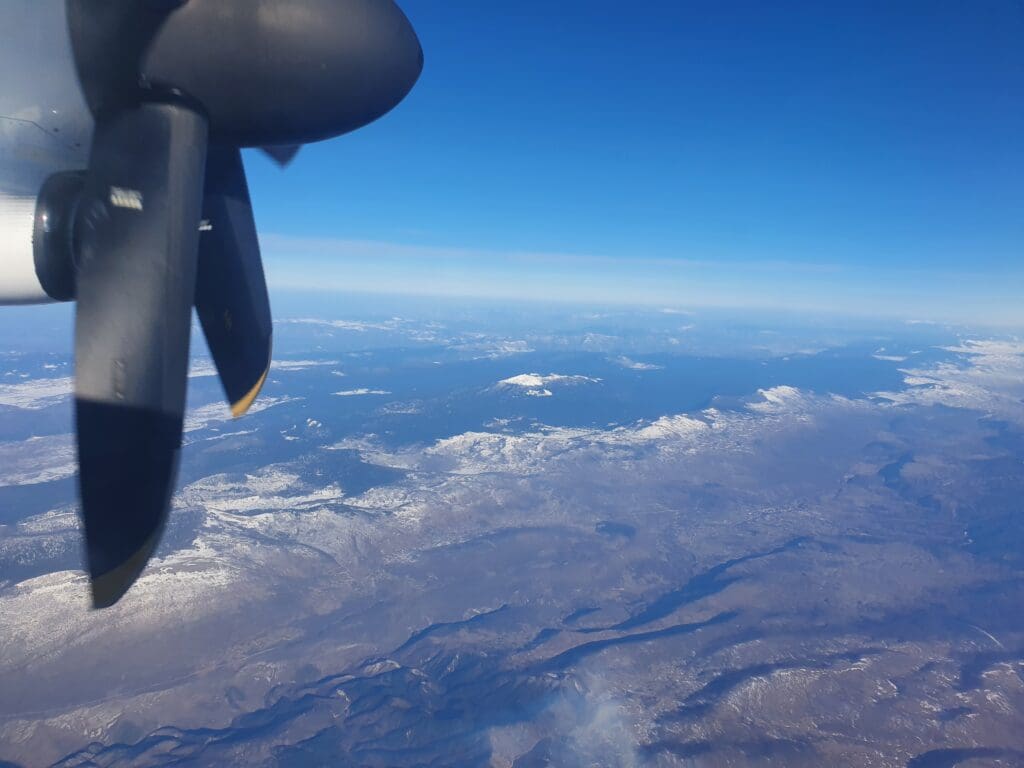
As the aircraft cruised southwards, the scenery rose and I was treated to fantastic views of the Dinaric Alps. Whilst the peaks that we soared over that afternoon were not the largest in this range, these were still impressive. Just five minutes after the Dash 8 had levelled off at its cruising altitude, the aircraft could be felt commencing its descent. This was immediately followed by a second announcement from the Captain, however, this was barely audible thanks to the racket produced by the Dash 8’s two engines, although I did manage to catch a quick update on the weather in Split at the end of this. Once this came to an end, the seatbelt signs were reilluminated and the crew soon passed through the cabin collecting rubbish and ensuring that everything was in place for our arrival. Following eight minutes in the skies over Bosnia and Herzegovina, the Dash 8 crossed over into Croatian airspace whilst the snow soon faded from the mountains below and these became less grey and more beige in colour.

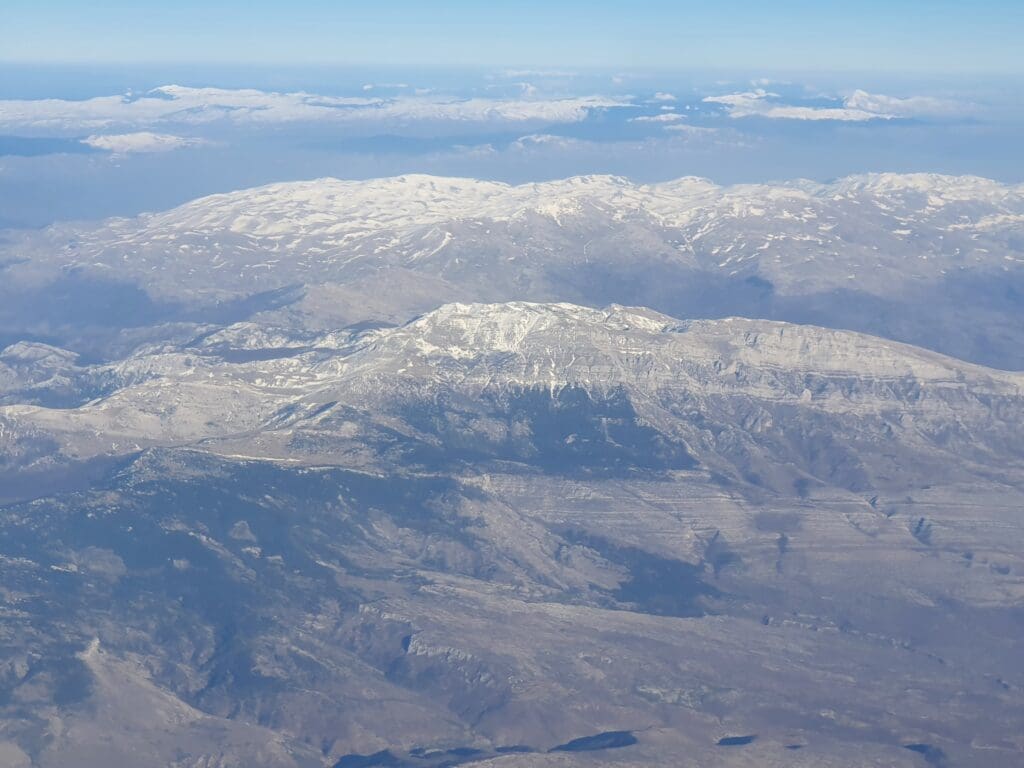
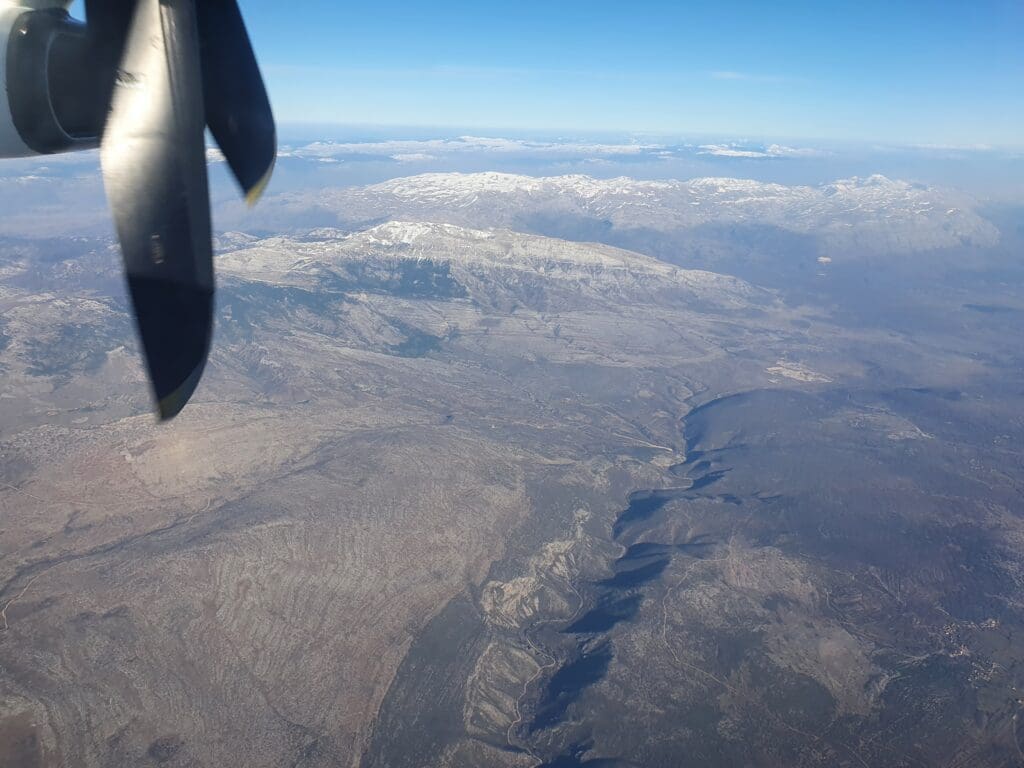
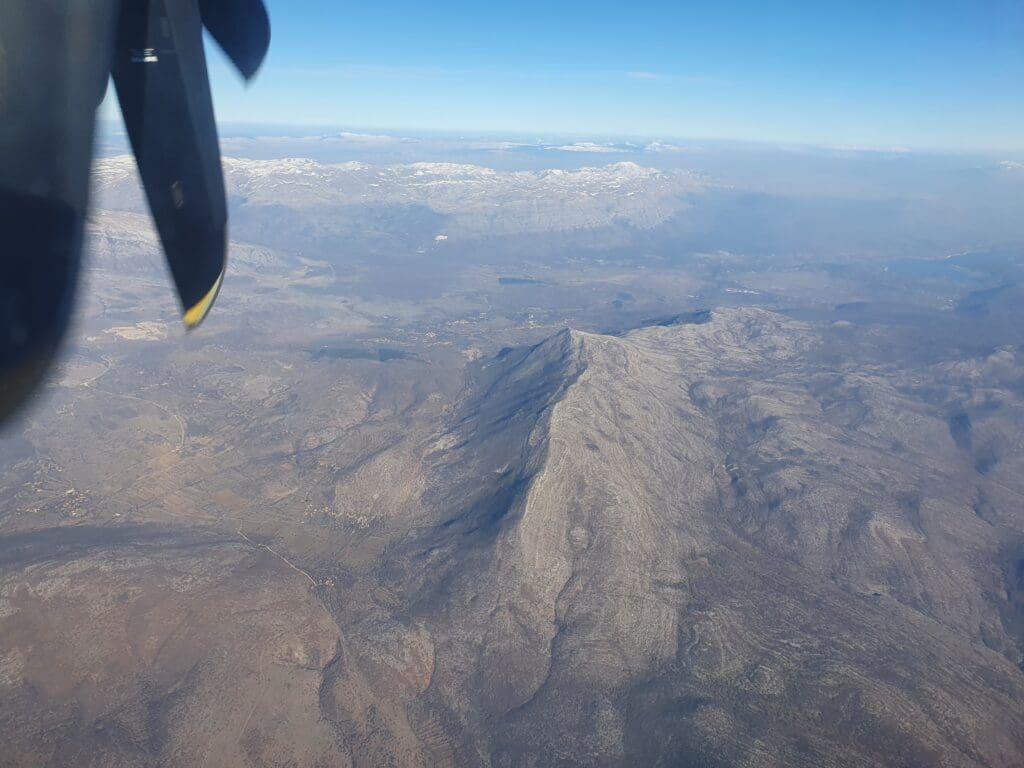

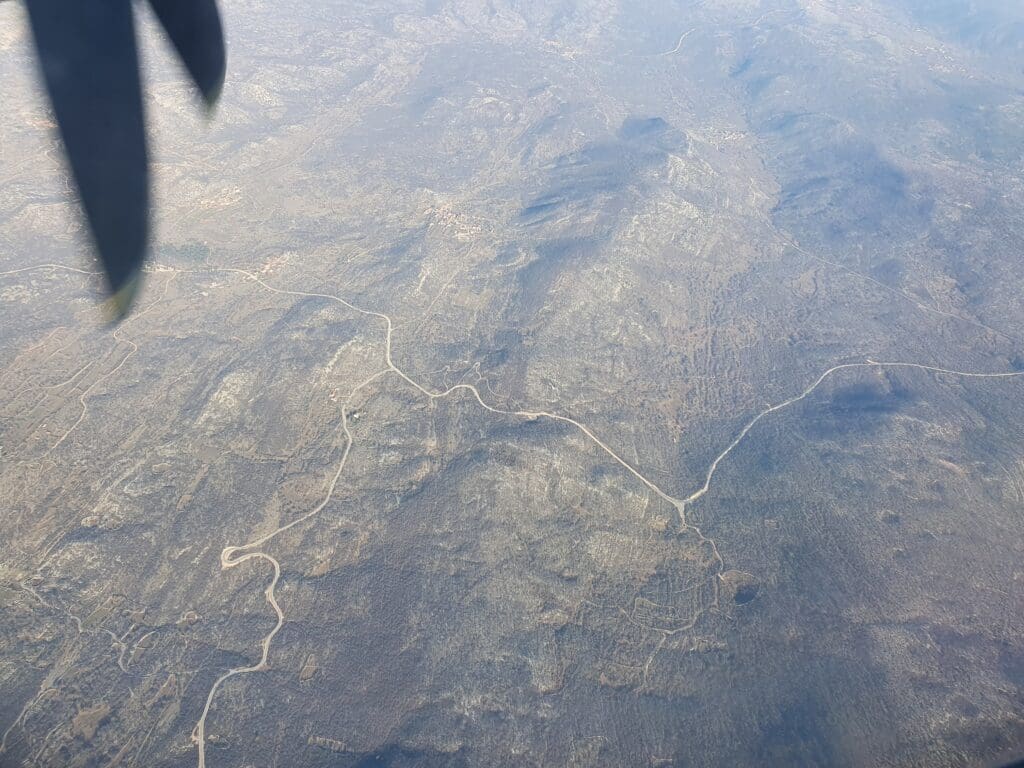
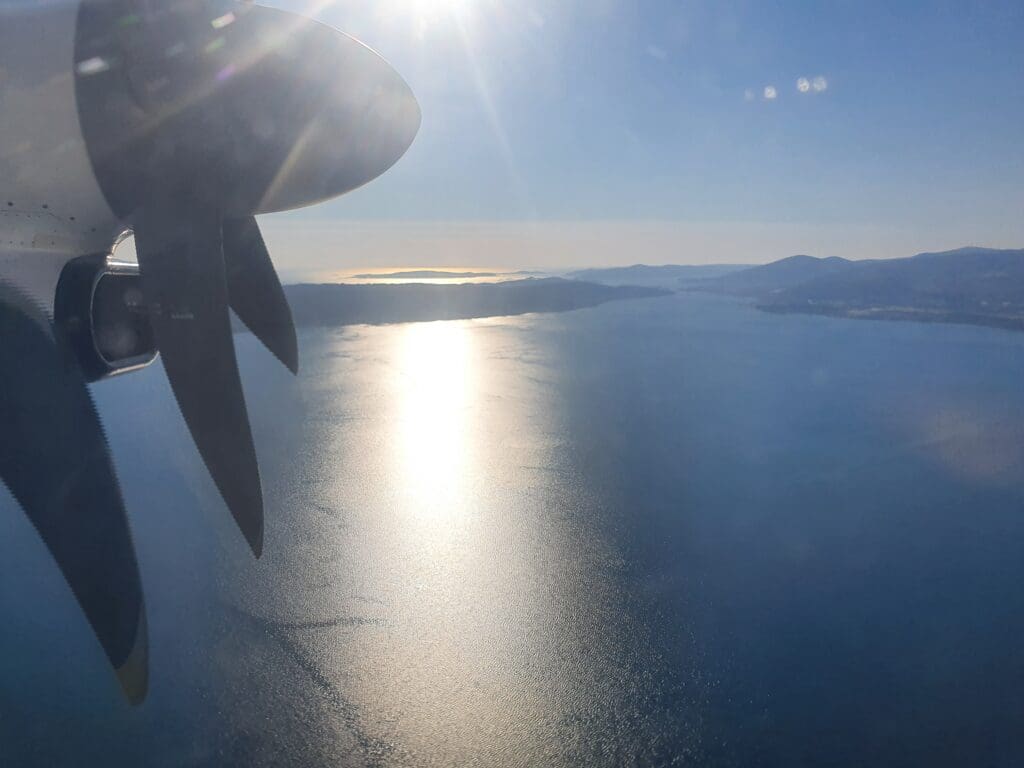
A grand total of 27 minutes after leaving Zagreb, I caught my first glimpse of Split and the blue waters of the Adriatic Sea, with these appearing on the other side of the mountain ridge that sits above the city. After crossing over this ridge, the Dash 8 crossed over the town of Kaštel Štafilić and out over Kaštela Bay during which good views of Split could be had in the distance before the aircraft commenced a circling approach and flew in a loop until it reached land once again near the town of Kaštel Stari at an altitude of 600 feet.
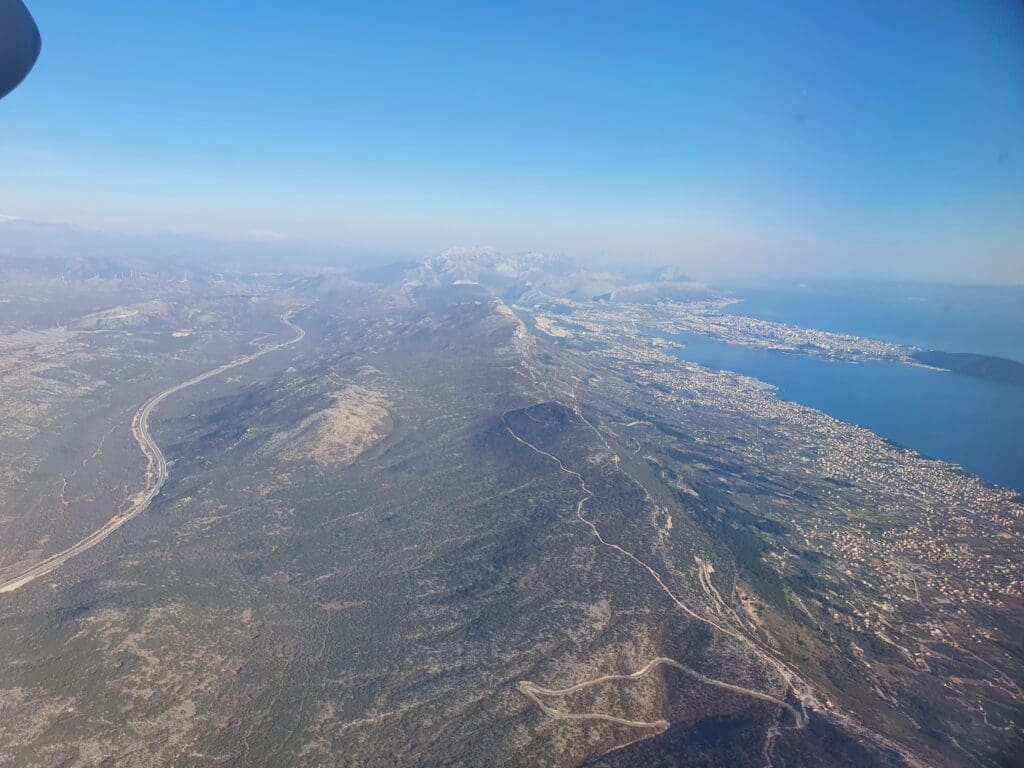

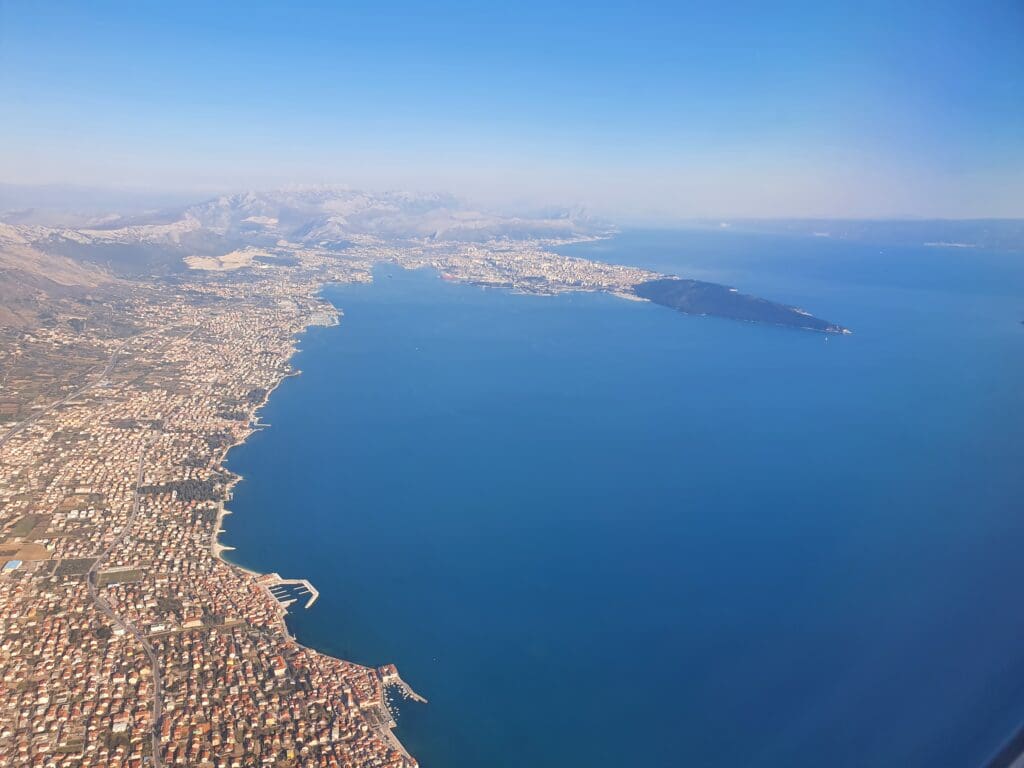
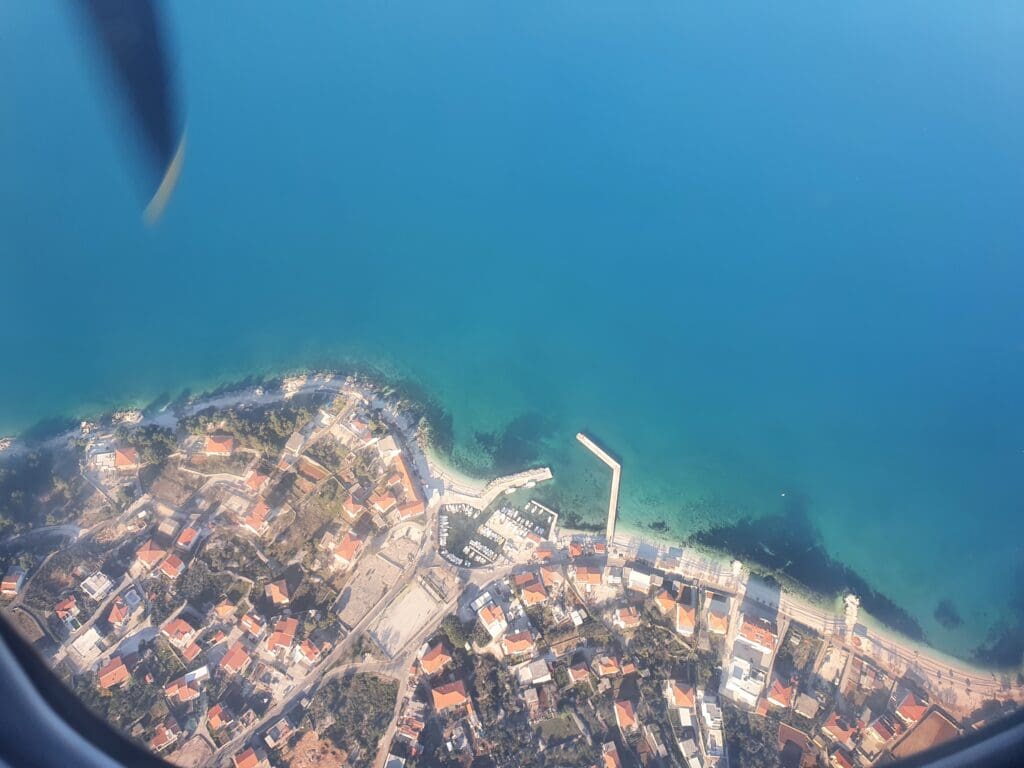
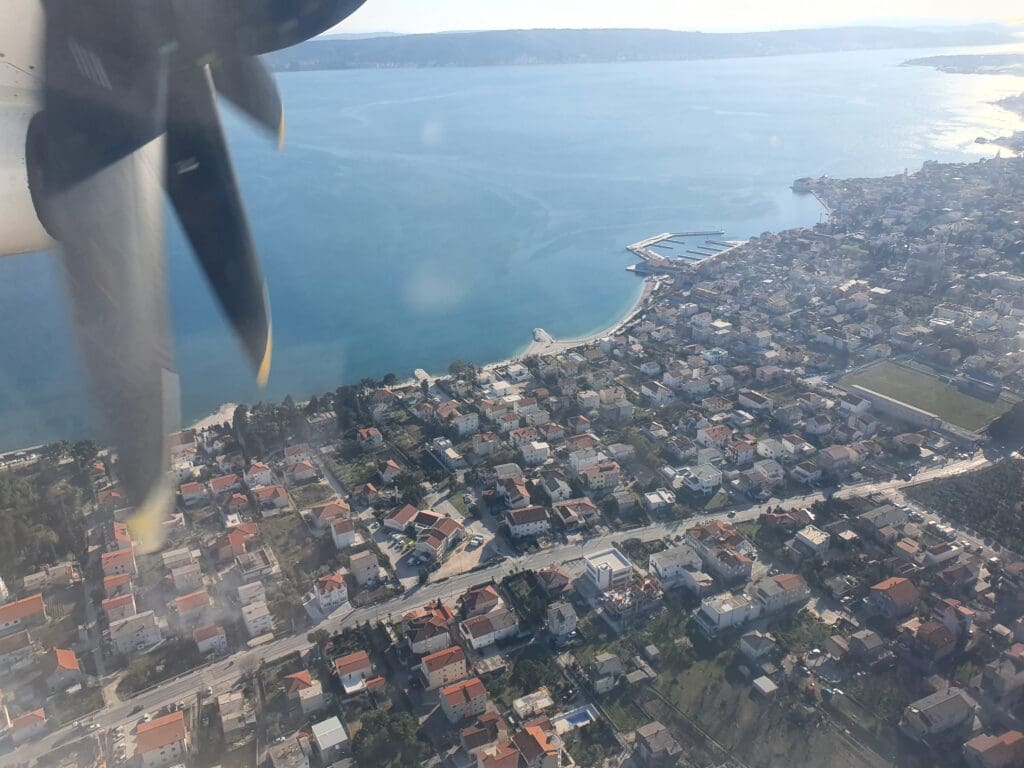
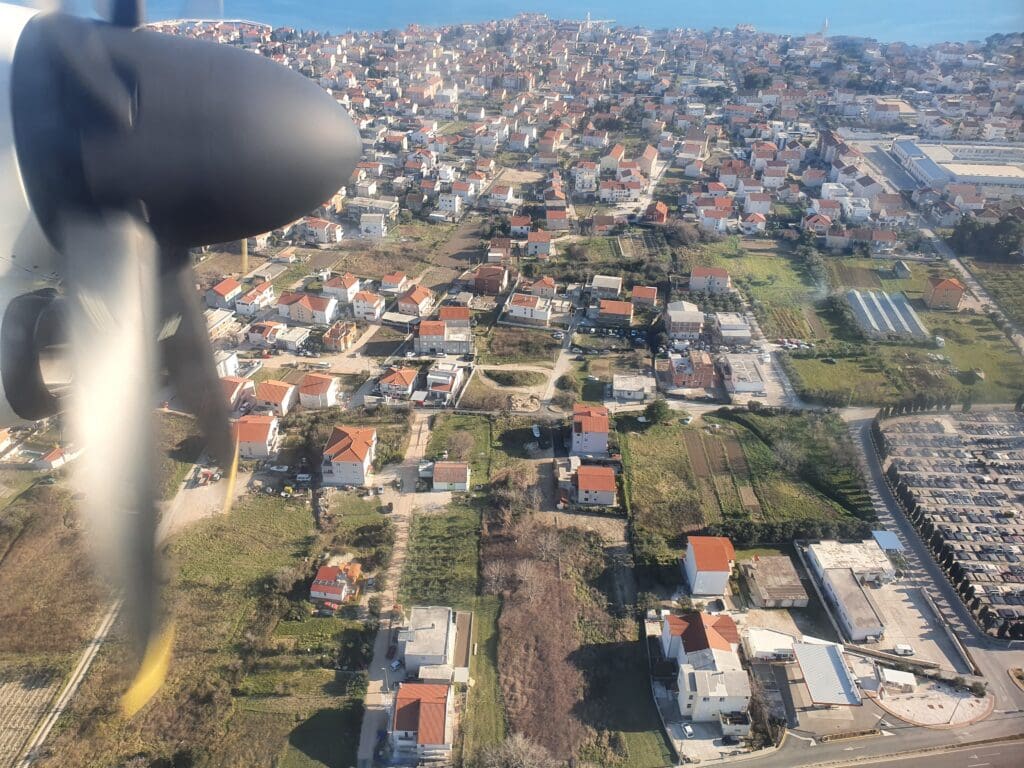
Following our scenic and rather exciting approach, the Dash 8 darted over the villages that sit to the east of the airport, with the landing gear being lowered into position and falling ‘out’ of the engines at what seemed like the last minute. Following a very pleasant yet short flight lasting just 32 minutes, at 1552 the Dash 8 made a firm touchdown on Split Airport’s Runway 23. Whilst Split Airport’s runway sits at 2,550 metres long, presumably wishing to avoid a long backtrack, once back on terrafirma the Dash 8 decelerated rather rapidly causing a few loose items in the cabin to make their way forward. As the aircraft slowed, the Dash 8 that had operated the earlier flight from Zagreb to Split could be seen heading out to the runway at the start of its flight across the Adriatic to Rome Fiumicino.
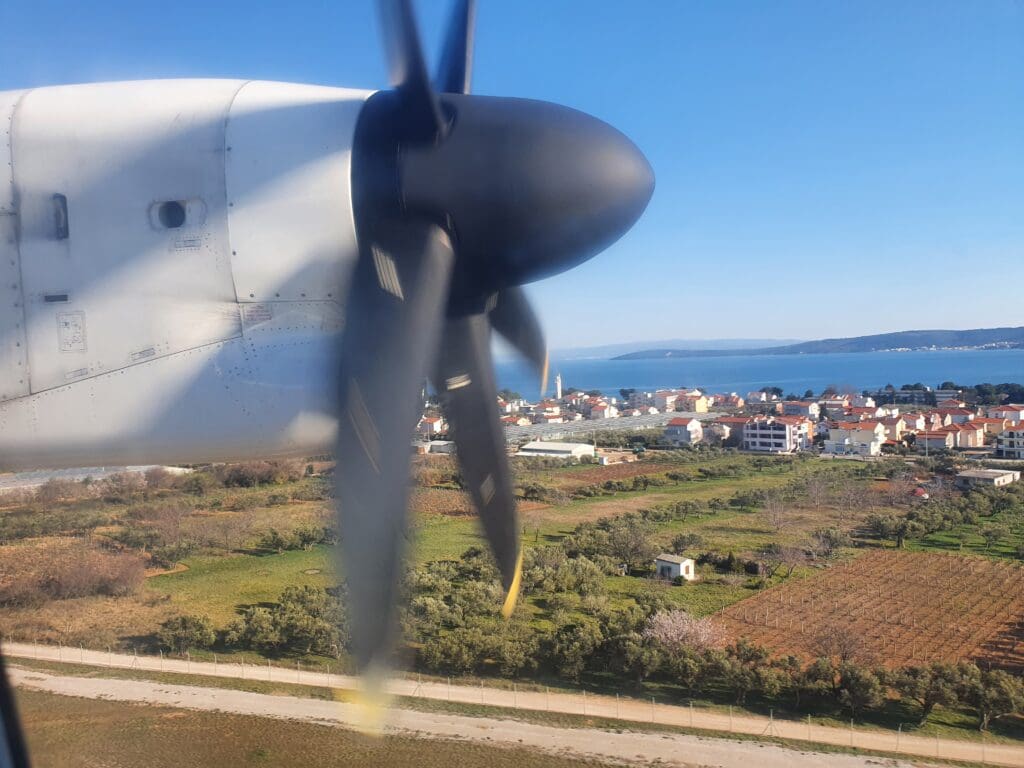
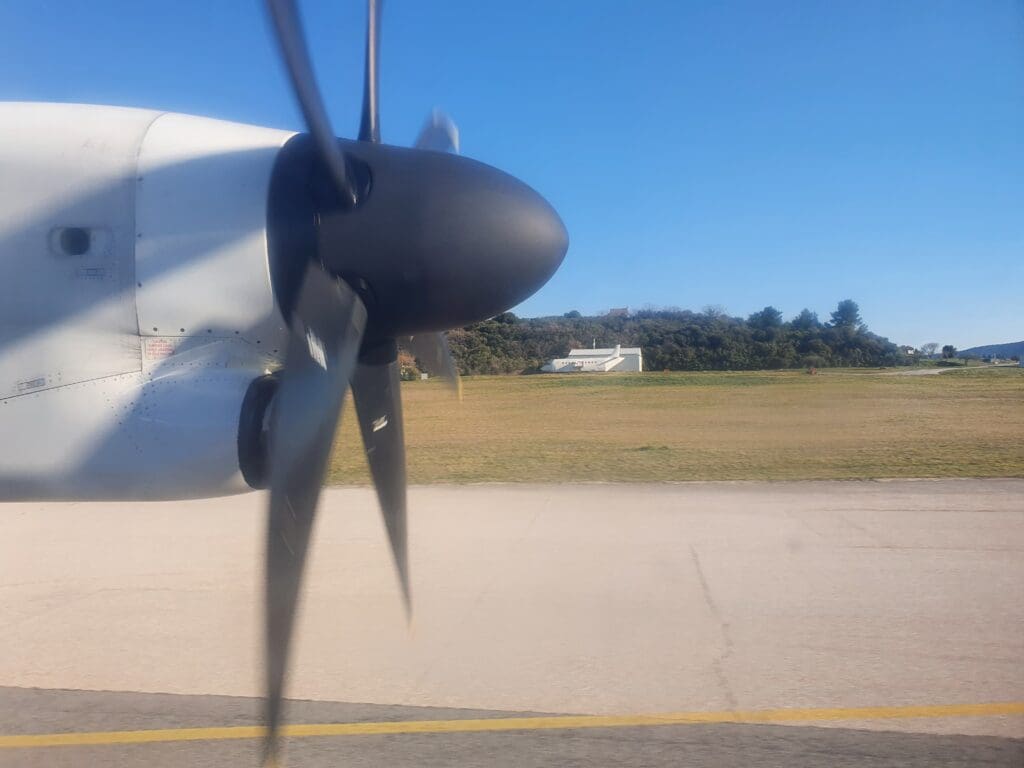
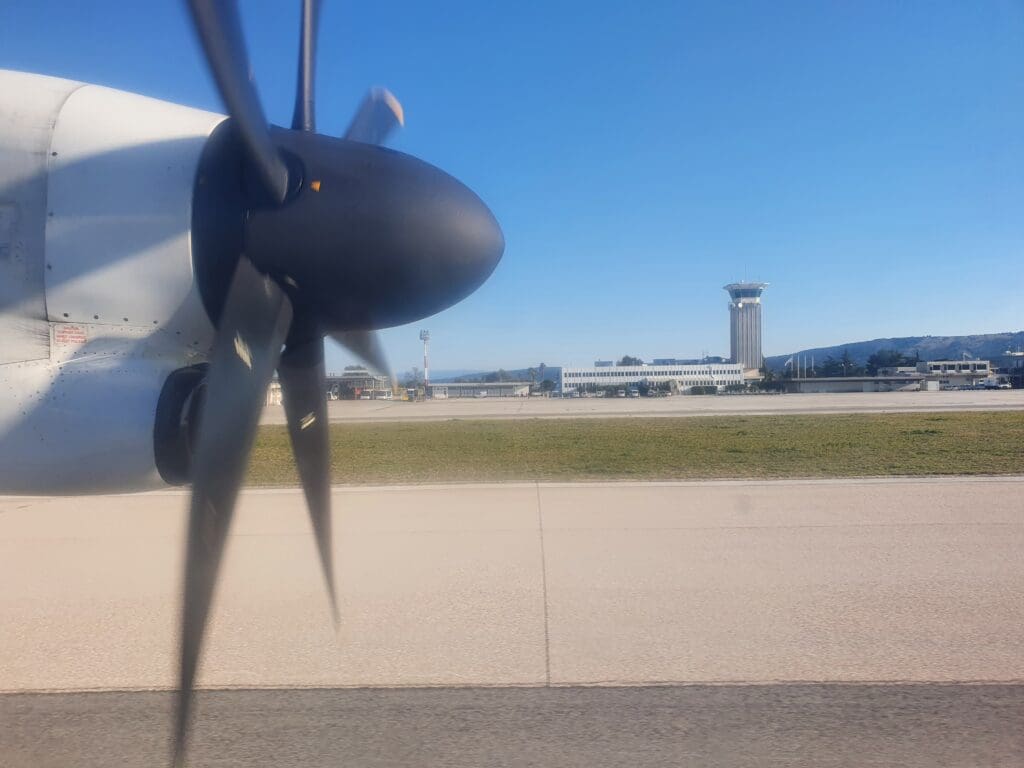
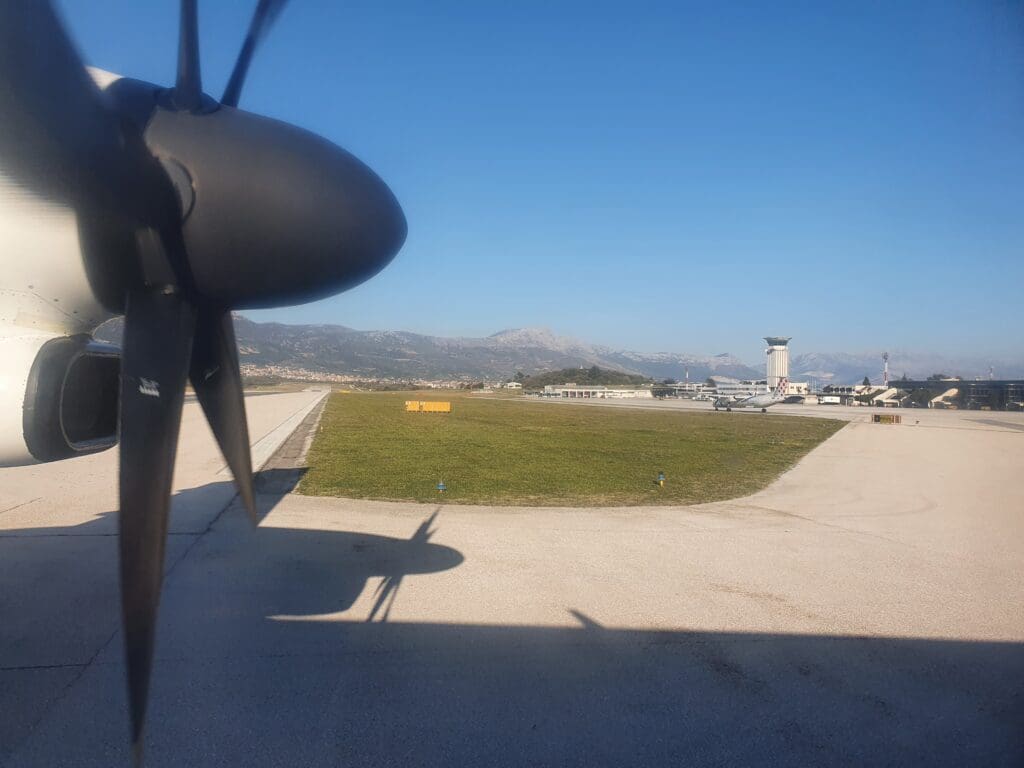
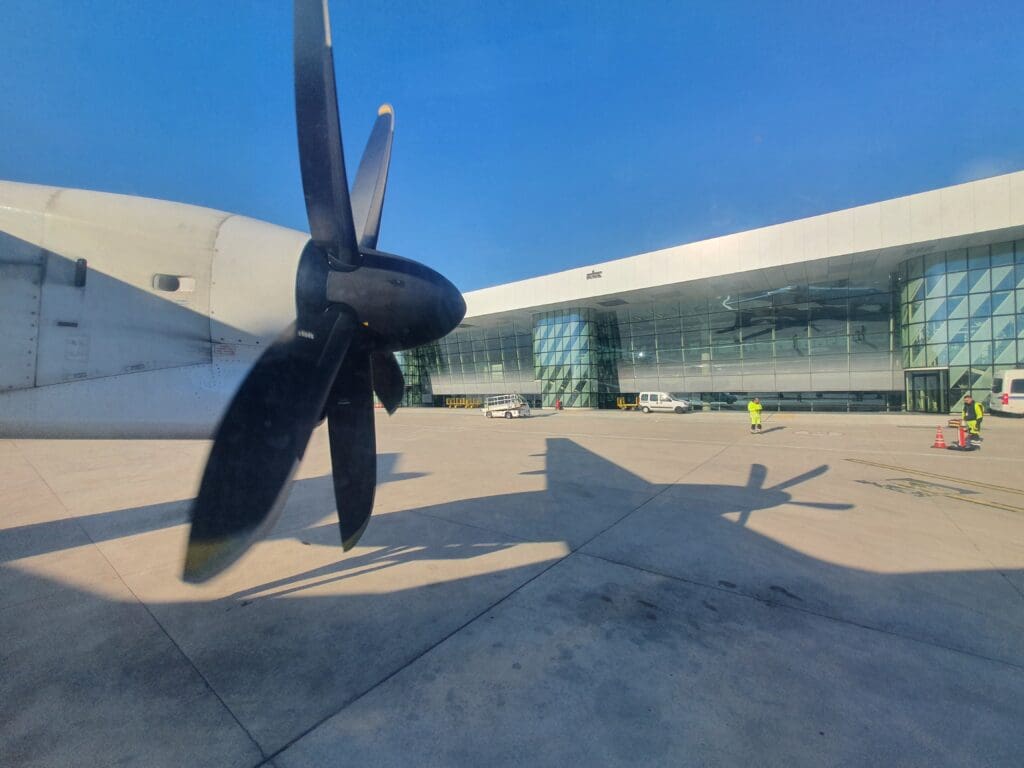
Soon, the aircraft vacated the runway to the left at which point a selection of top-of-the-range light aircraft, namely a Swedish registered Diamond DA-42 and several Cirrus SR20/22s could be seen, whilst inside the cabin the Purser performed an announcement welcoming everyone to Split. From the runway, it did not take too long for the Dash 8 to reach its stand, Stand 10, located in the corner of the terminal. Upon pulling into this, the aircraft came to a halt and the two engines spooled down at which point most inside the cabin appeared to jump up and make a beeline for the exit. Fortunately for any passenger who may have been in a genuine rush, it did not take too long for the main cabin door to open and disembarkation to commence. After thanking the Purser, I made my way down the steps and walked over to Split Airport’s modern terminal. With no other arrivals until the evening, at this time the terminal was empty and I soon passed through the baggage claim hall before making my way out into the landside arrivals area. With the express bus service to the city centre timed to match Croatia Airlines’ flights, upon arriving there I was able to walk straight to the bus with no issue where I paid my 35 Kuna fare before boarding for the 35 minute trip to Split.
Summary
That afternoon, my experience with Croatia Airlines was short and sweet and I was left with nothing much to complain about at the end of my short hop from Zagreb to Split. Furthermore, thanks to the good weather, I was treated to great views of rural Croatia and the area around Split. Needless to say, I would be happy to try Croatia Airlines on a longer service at some point in the future.