A Very Short Hop on a Colourful Boeing 757: Tashkent to Samarkand on Uzbekistan Airways
Background and Booking
Thanks to Uzbekistan Railways’ Afrosiyob high-speed rail services (you can read my report on one of these here!), passengers can be whisked away from Tashkent to Uzbekistan’s second-largest city, Samarkand, in little more than two hours. Thus, unsurprisingly, travelling by rail is often the preferred way to see the country for tourists discovering the Silk Road cities of Bukhara and Samarkand. Given the ease and speed at which passengers can travel between Tashkent and Samarkand by land, some may be surprised to hear that Uzbekistan Airways operates services on the 162-mile trip between the two, deploying their Airbus A320s, Airbus A321s and Boeing 757-200s on this route at the time of my trip. Flying these four times per week, at first glance, these services may seem to be illogical. However, with Uzbekistan Airways operating flights from Sarmarkand to Istanbul, Moscow and Saint Petersburg, these are actually positioning flights to shuttle the aircraft and crew for these flights to and from Tashkent. Touching down from Almaty, by pure coincidence my arrival in Uzbekistan would be well-timed to catch one of Uzbekistan Airways’ services to Samarkand, departing at 1800. After seeing that this service flight would be operated by the increasingly rare Boeing 757-200, I headed over to Uzbekistan Airways’ website to book a ticket on this service.
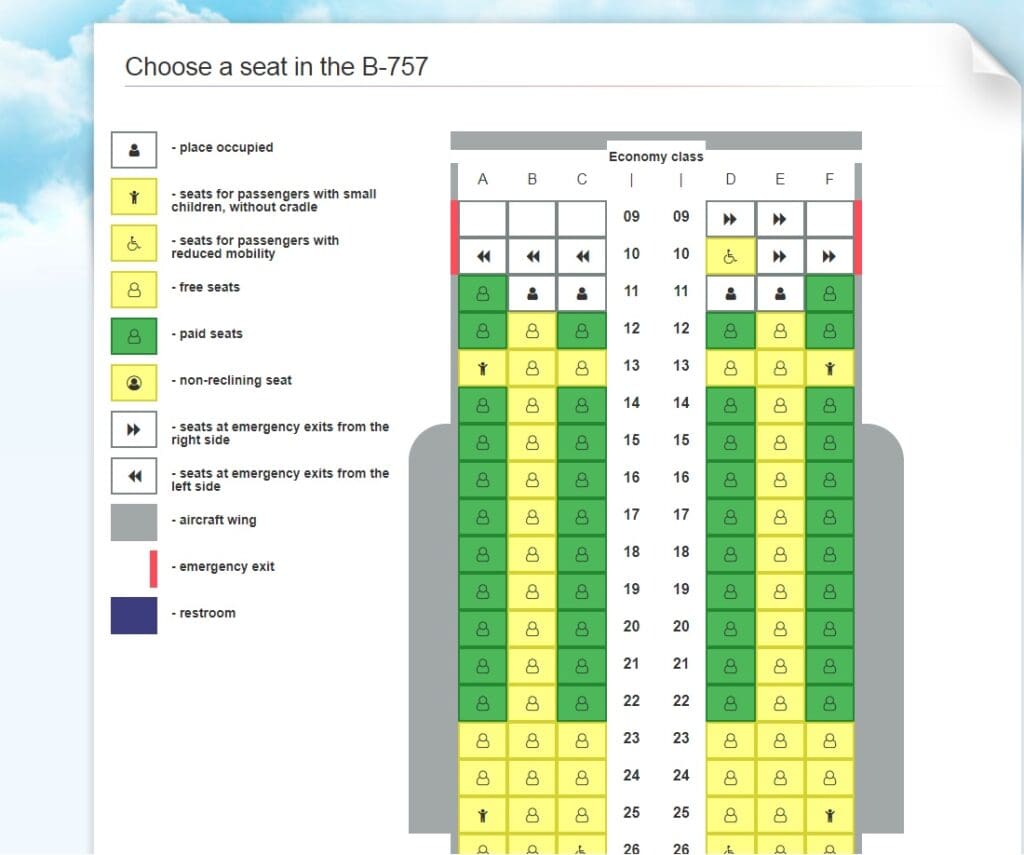
Uzbekistan Airways’ website cannot be described as being the most modern in the world, however, this was functional and served its purpose. Upon touching down on the airline’s homepage, I was greeted by advertisements for Uzbekistan Airways’ thrice weekly service to New York, and their new services to Jakarta and Tbilisi. Wasting no time, I headed to the ‘Flight planning’ page, and a short while later, I was presented with a choice of three tickets for their sole flight from Tashkent to Samarkand that day. The cheapest took the form of their ‘excursion’ economy ticket for $22.30, their ‘basic’ economy ticket for a further seven dollars, and their business class ticket for a little over $60. Seeing no reason not to go for the cheapest ticket, I opted for the first option before quickly entering my details. With no extra options such as seat selection or extra baggage, I was then taken to the payment page. After entering my card details, I was presented with several loading screens for around a minute before being issued my ticket, with this arriving in my email inbox immediately. Whilst unable to do so during the booking process, I was able to pay to pre-reserve a seat once I had paid for my ticket. In the end, I splurged a total of $2.30 to reserve Seat 12A.
The Journey
Unfortunately, the layout of Islam Karimov Tashkent International Airport is not fantastic for those transferring between international and domestic services. Specifically, Terminal 2 which serves international flights, and its domestic counterpart, Terminal 3, sit on opposite sides of the airfield and are separated by two runways. In fact, Uzbekistan Airways does not allow passengers to book itineraries involving domestic to international transfers (and vice versa). With no ‘official’ shuttle between the two, those seeking to travel between these terminals have three options: an hour-long walk, an overpriced taxi ride from an airport taxi driver and likely expert price inflator, or a quick ten-minute journey on one of two bus routes. Only having a small backpack and relatively small wheelie case, and with four hours to kill before my next flight, had it not been pouring down with rain I would have most likely walked between the two. Instead, I opted for the next best thing, the bus. After arriving from Almaty on Air Astana, once I had collected my bag, I exited the arrivals hall and dodged the army of unofficial taxi drivers, making it to the bus stop within minutes and luckily just before a torrential downpour arrived. After about ten minutes, one of the two buses I could take pulled up and I stepped aboard. Interestingly, disembarkation and embarkation both at this stop and my arrival point occurred whilst the bus was still moving in a Speed-like fashion, with the driver appearing hesitant to decelerate below a certain speed. Once onboard, the driver whizzed off down the rain-soaked streets, before heading across the airport. After no more than eight minutes, the well-polished and somewhat modern terminal came into view, and the bus soon pulled up to a small shelter at the far end of the domestic terminal’s car park.
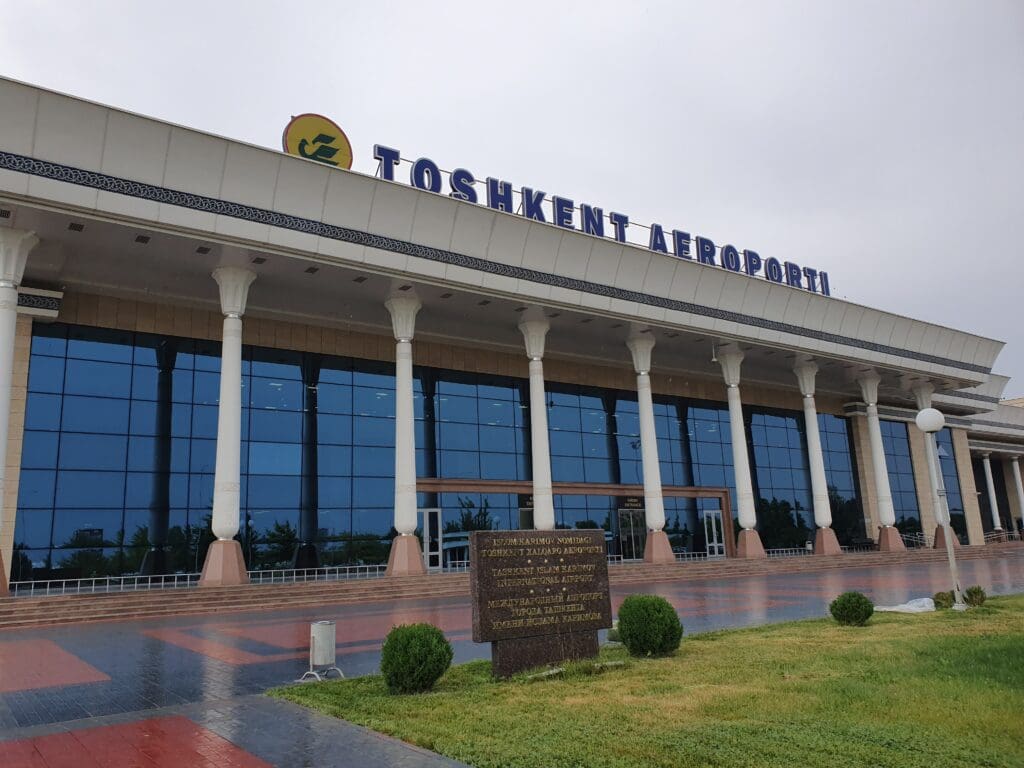
Being the sole passenger to disembark, I darted through the afternoon rain shower and over to the fence that surrounds the terminal. Just like Uzbekistan’s railway stations and other airport terminals, all those entering the terminal must pass through a security hut, with only those with tickets permitted to enter the terminal. Once there, two inquisitive guards in a green quasi-military uniform checked my passport and asked why I had arrived so early. After giving a satisfactory answer, I had my bags quickly scanned and checked before passing through a metal detector. After that, I walked up to the terminal and was met by another security check where my bags were scanned once again, and I passed through another metal detector. Following the rigorous and multi-layered security screening, I made it into the domestic terminal and was free to explore the sights and delights of the small landside area. There, a cash machine, a couple of vending machines, a currency exchange window, and a business lounge could be found. For the modern traveller, neither plug sockets nor wifi were provided. However, on the plus side, I found the landside area to be spacious, clean, and well-polished. The latter two points are thanks to the squad of three staff members who seemed to be cleaning the terminal non-stop from my arrival until the moment I headed through security.
Having entered the terminal a little after 1400 and with no departures until my flight to Samarkand, as I had expected, the check-in desks were completely deserted and I was thus unable to check-in. Thus, given the terminal’s lack of facilities, there was little I could do other than sit and wait with the four other early passengers – two groups of elderly Uzbek couples who, judging by their early arrival, clearly did not want to miss their flight. As time slowly passed, ten other passengers arrived, and at 1530 a pre-recorded announcement was made for the two departures that evening: the 1800 departure to Samarkand and the 1805 flight to Nukus. However, at this time, the eight check-in desks which sit in front of four large photographs of Bukhara, Khiva, Samarkand, and Tashkent remained empty. Finally, at 1610, a single airport worker arrived and commenced the check-in procedures. Even though only one desk was open, given the relatively few passengers, I did not have to wait long until reaching the front of the queue. Once there, I handed over my passport to the very friendly check-in agent and placed my bag on the conveyor belt. After receiving some recommendations for Samarkand, my bag was sent on its way, and I received my Uzbekistan Airways-branded boarding pass before heading onward to security. Lacking any queues, this final security check was quick and easy, and I was through to the airside area within minutes of joining the queue for check-in.
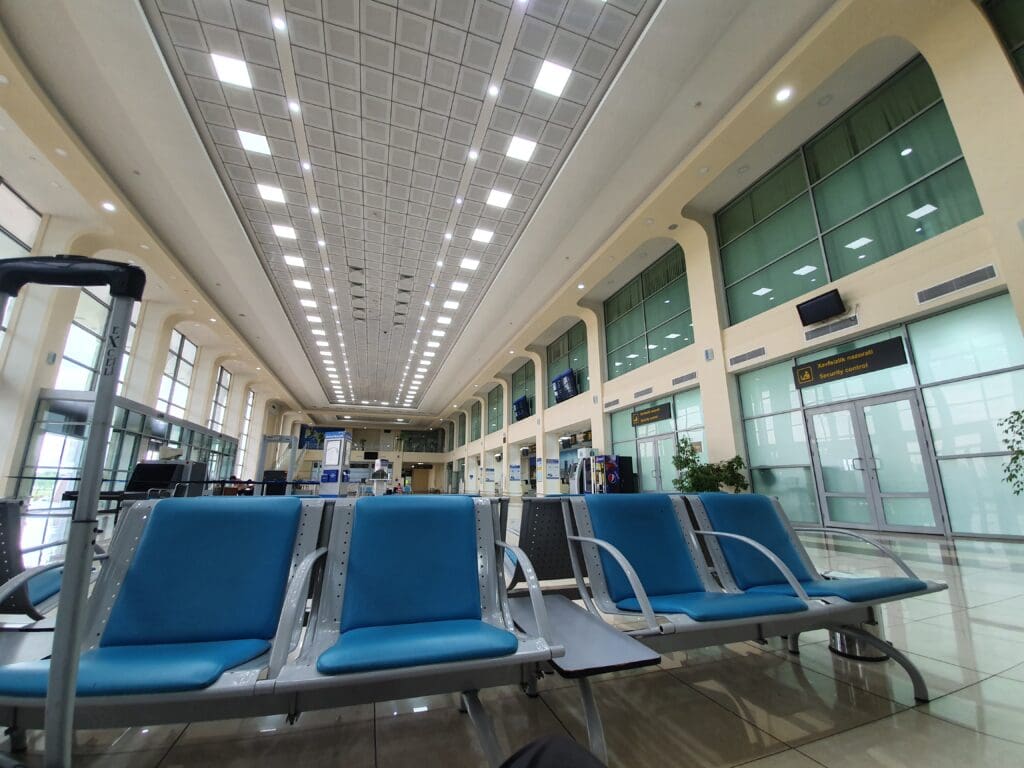
Like the landside area, the airside area was well-polished and spacious but somewhat lacking in facilities, with these limited to a closed bar, prayer rooms, and a couple of vending machines. However, fortunately for aviation enthusiasts, large windows offer reasonable views of those aircraft departing and arriving on the airport’s two runways, as well as those in the distance outside the international terminal. That afternoon, amongst the sea of Uzbekistan Airways jets, two interesting visitors could be spotted. These consisted of an ex-Continental and United Airlines UTair Boeing 767-200ER that I watched as it touched down from Moscow Vnukovo and a Yakutia Airlines Sukhoi Superjet which soon headed off on its weekly flight back to Irkutsk. Meanwhile, as our scheduled boarding time of 1730 approached, the fact that the only aircraft visible on the apron took the form of the Nukus-bound Uzbekistan Airways Airbus A320 suggested that a short trip around the airport would be required to reach our jet.
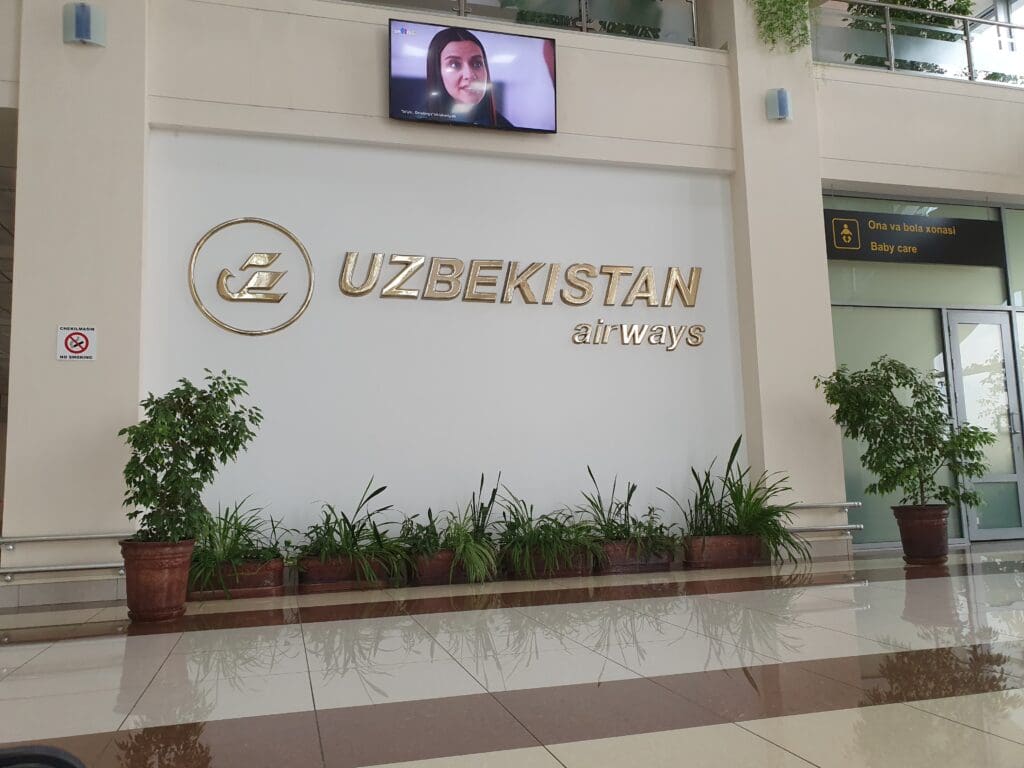
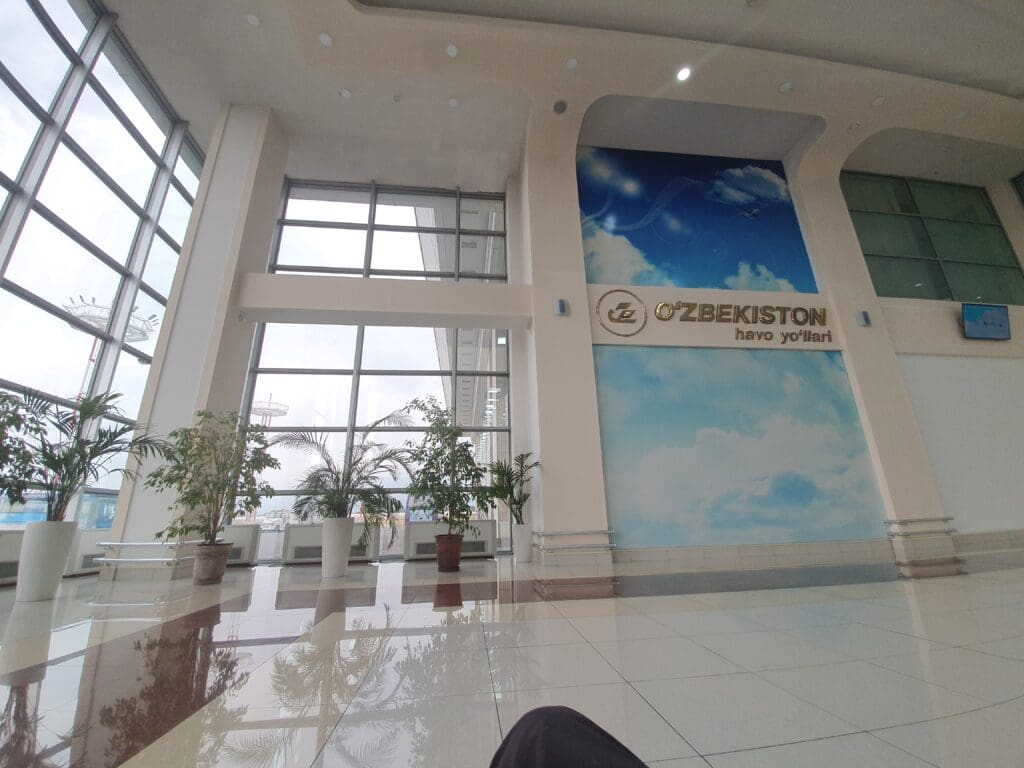
As the minutes passed, the terminal began to fill up, however, the number of passengers milling around inside seemed to be far fewer than the 190 required to fill the entire Boeing 757 that would be carrying us to Samarkand, let along two aircraft. At 1715, a whole fifteen minutes before our scheduled boarding time, the gate agent shouted “Samarkand! Samarkand!” and passengers began to huddle around Gate 4. Soon enough, the checking of boarding passes commenced and passengers began to filter onto the battered-looking Uzbekistan Airways-branded bus that would take us around the airfield. As I had expected, given the fact that Nukus is further away from Tashkent than Samarkand, the majority of passengers inside the terminal appeared to be heading off on the Airbus A320. After approximately five minutes of waiting, once our bus was full, the doors were closed and our trek across the airport commenced. After a seven-minute journey which took us directly past the brand new Boeing 787-8 Dreamliner that would take me to Korea several days later, our aircraft arrived at the international ramp. After passing several of the airline’s Boeing 757s and Boeing 767s as well as the aforementioned UTair aircraft, the bus arrived at Stand B14.
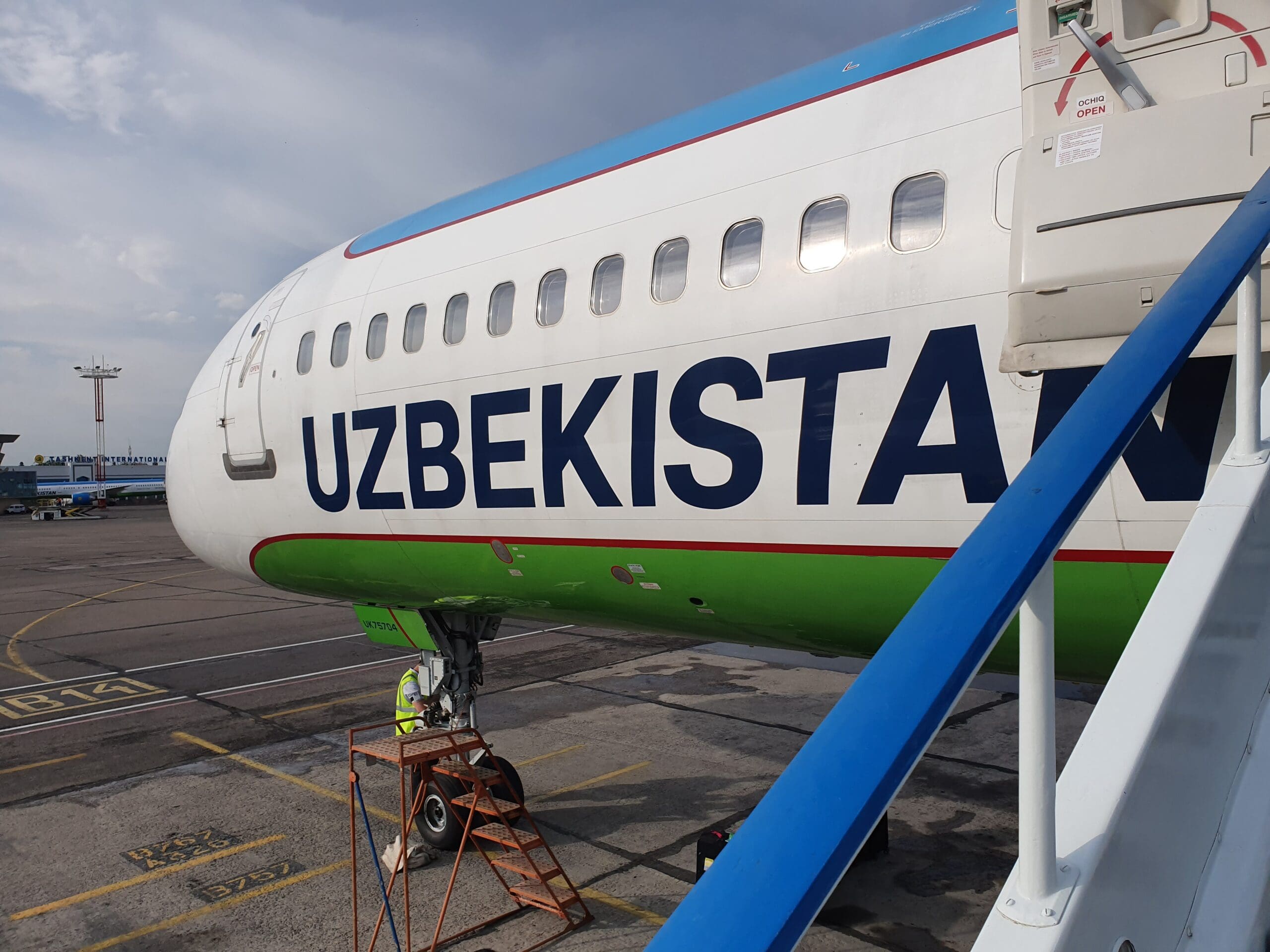
There, a slightly mucky-looking Boeing 757-231 with the registration UK75704 could be seen waiting to head off on its short hop to Samarkand. Despite appearing to need both an exterior wash and a new coat of paint, this particular aircraft was one of the younger Boeing 757s gracing the skies today. Assembled in Renton, the aircraft took to the skies for the first time in October 1999, making it under twenty years old at the time of my flight. The following month, the aircraft was delivered to Trans World Airlines as N726TW where it flew for two years before the airline was acquired by American Airlines. Absorbed into American Airlines’ fleet, after nearly two years spent flying across the Americas, in November 2003, the aircraft was flown to the Mojave Desert, entering storage at Victorville. The following autumn, the aircraft was painted Uzbekistan Airways’ colourful livery and received the registration VP-BUH, which it wore until June 2018 when it was transferred onto the Uzbek register as UK75704. Today, the aircraft transports 190 passengers (22 in Business and 168 in Economy) between Uzbekistan and a host of destinations across Europe and Asia. Whilst the aircraft had been sitting on the ground for the day after arriving from Samarkand the previous evening, the aircraft had been rather busy throughout the preceding week, flying a total of 26 flights covering over 43,000 miles, visiting Antalya, Bukhara, Moscow Vnukovo, Namangan, Samarkand, St Petersburg, Termez, Urgench, and Vladivostok.
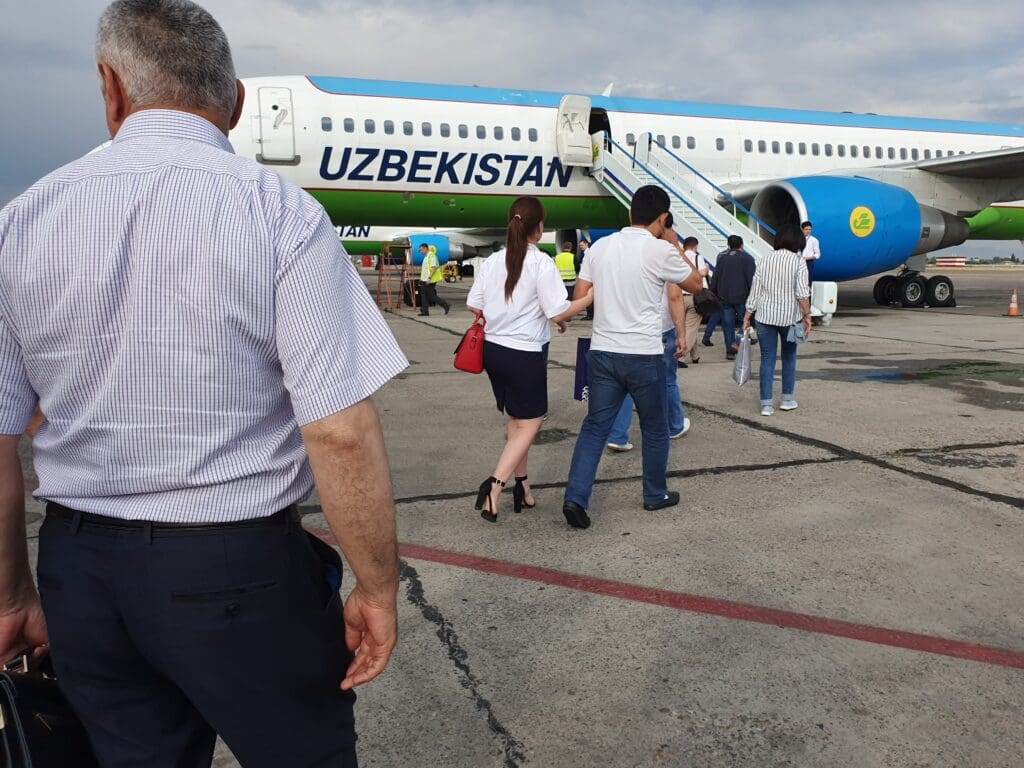
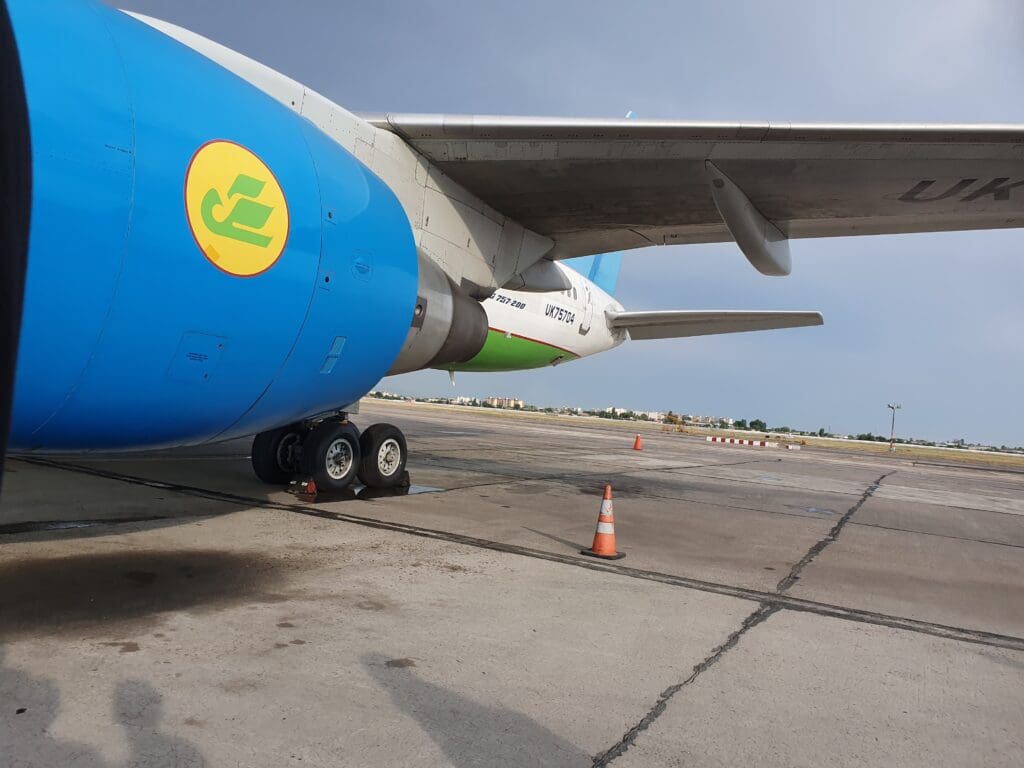
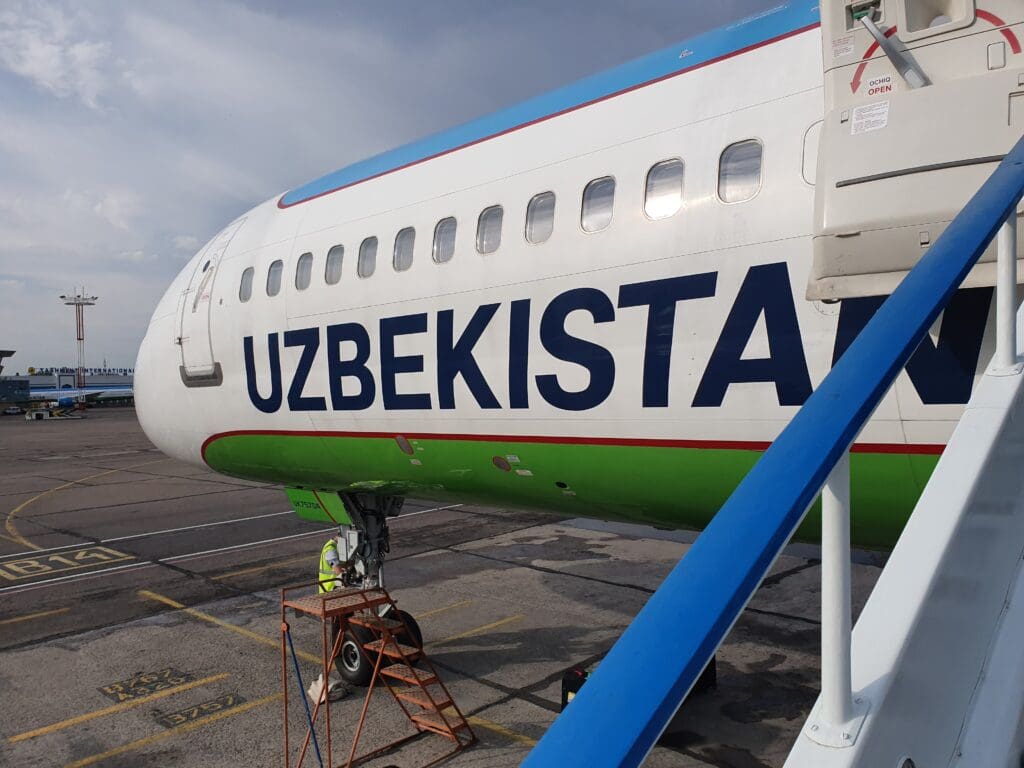
Upon pulling up to the aircraft, three tough-looking guards who would supervise passengers as they boarded the aircraft could be seen waiting next to one of the aircraft’s large Pratt & Whitney PW2037 engines, two in leather jackets and one in an official security guard uniform. Meanwhile, a suited Uzbekistan Airways worker, who appeared to be the flight’s dispatcher, carried bags of rubbish down the aircraft’s steps. Once he had done this, the bus doors opened, and passengers spilt out onto the apron. Given the negative experiences of those who photograph aircraft on the tarmac at Tashkent (usually involving a telling-off and the forced deletion of the offending photos), despite getting fantastic views of the aircraft, I decided against taking any obvious photographs. As we waited, the dispatcher shouted for families to come through first, after which the rest of us were allowed to board. After a short wait on the aircraft steps, admiring our Boeing 757, I stepped into the galley where no fewer than three flight flight attendants who gave me a friendly welcome in Russian before I turned right and entered the cabin which was filled with some funky 1990s-era instrumental music.
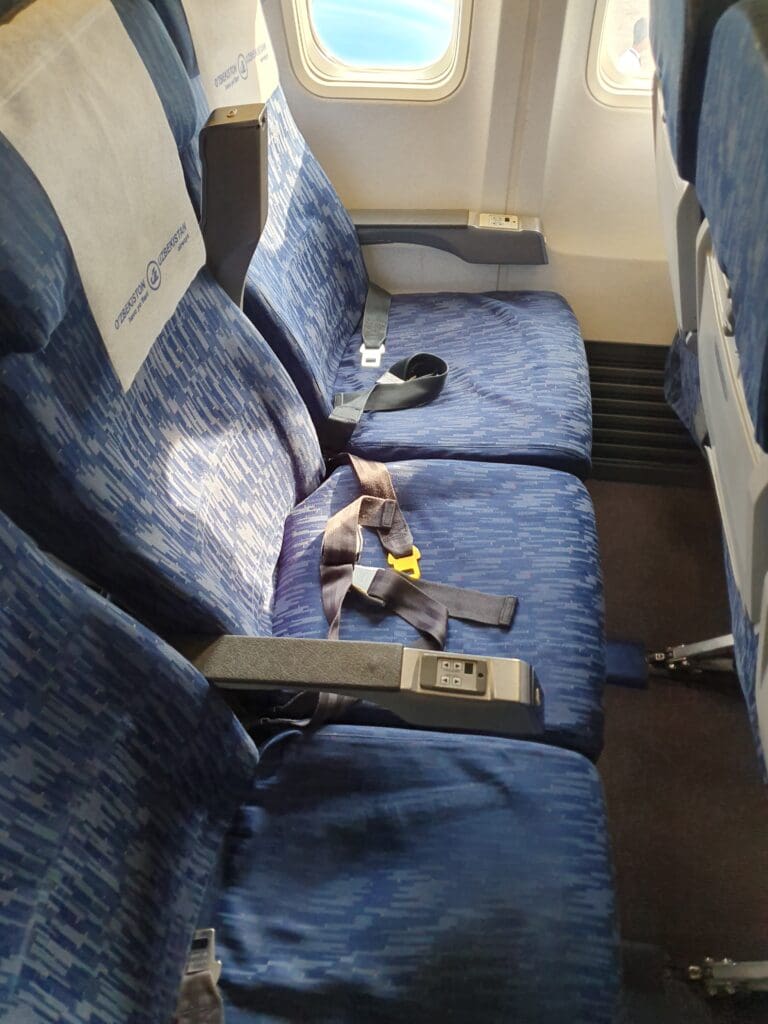
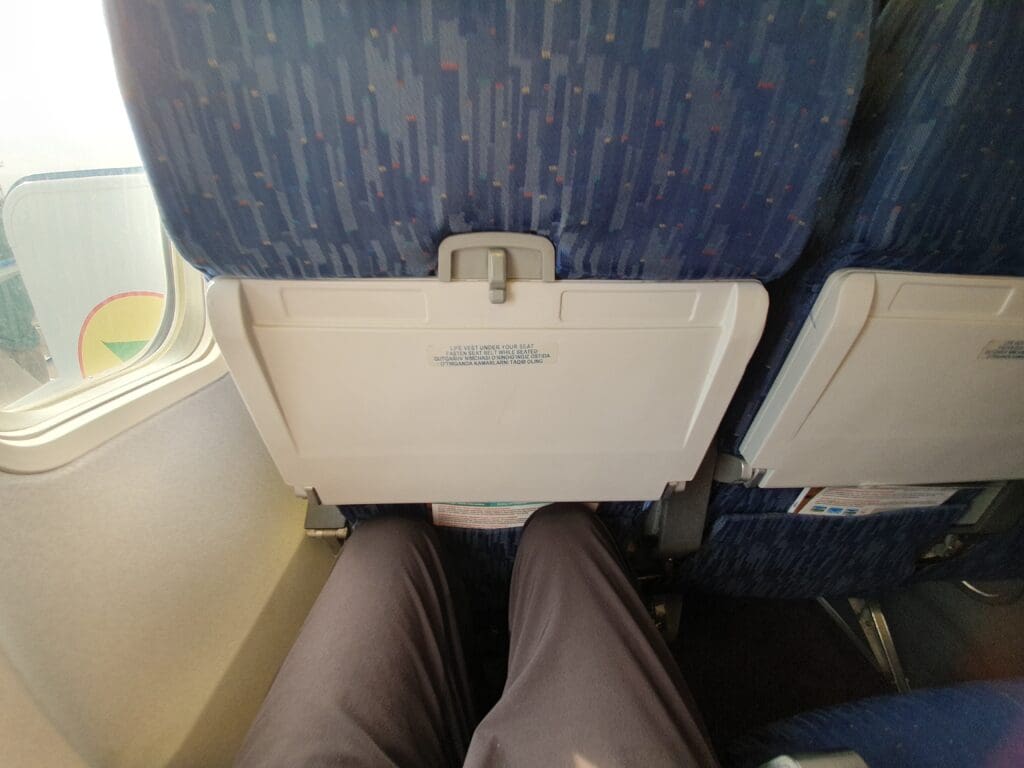
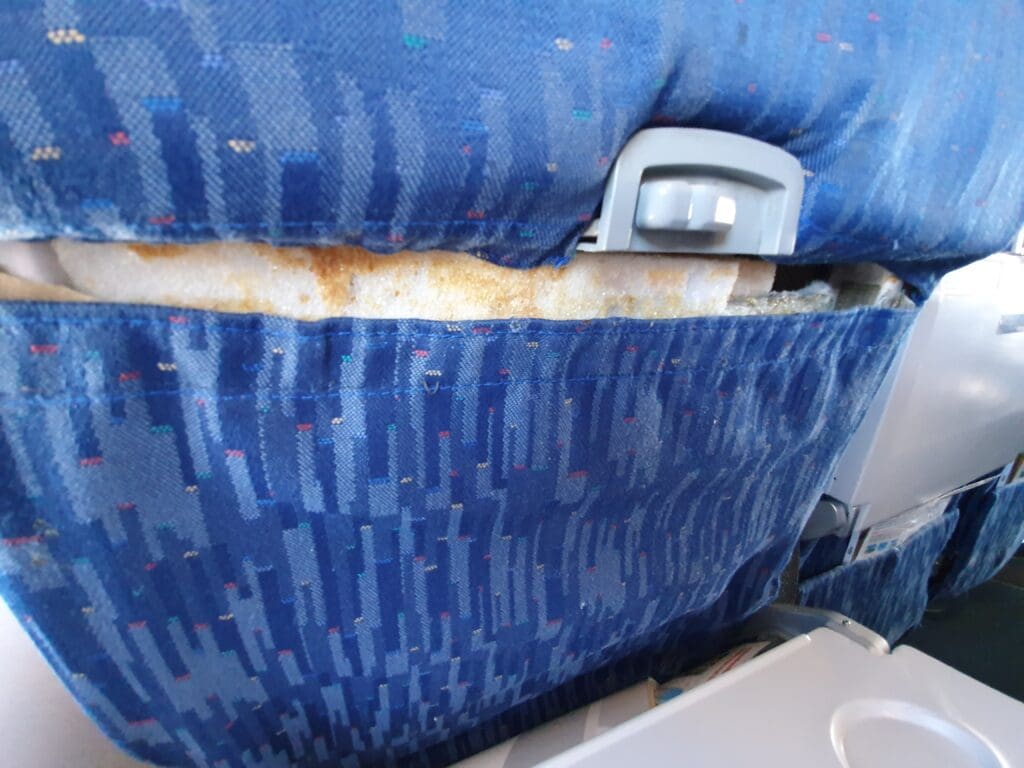
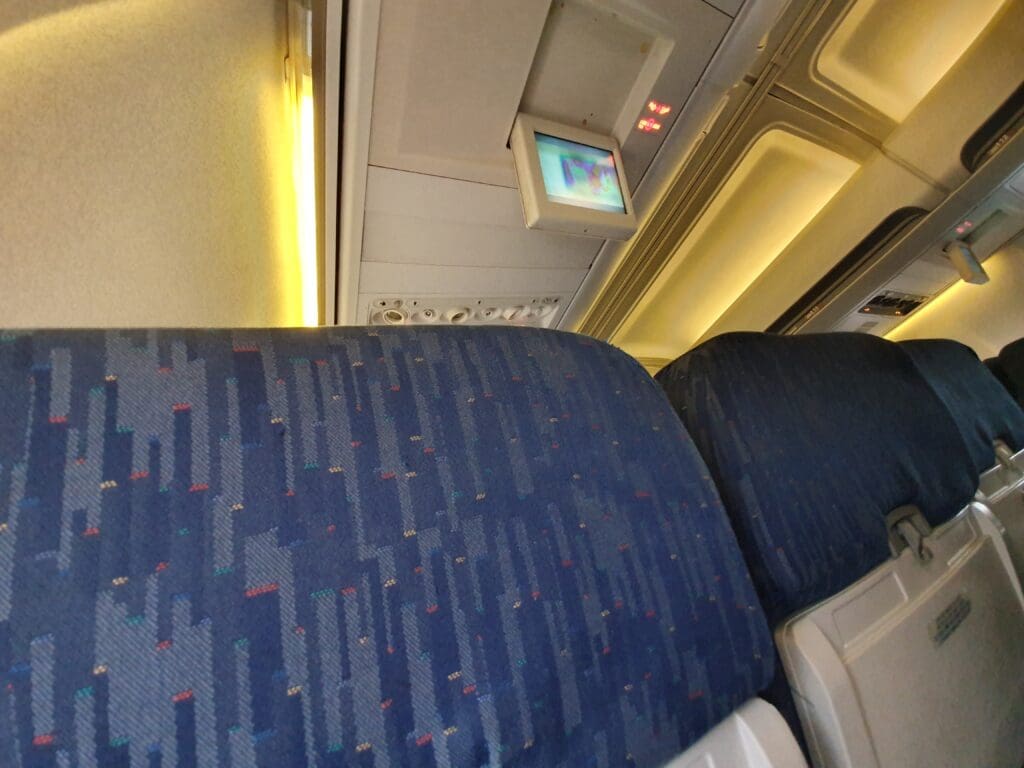
Despite not being a particularly vintage jet, stepping onboard was a little like stepping back in time, with yellow cabin lighting illuminating the chunky seats. These were separated by large armrests, each featuring an audio channel selector. In Economy, each seat was covered in dark blue fabric with a repeating pattern and topped with a large adjustable headrest that was partially covered by a disposable antimacassar featuring the airline’s name in English and Uzbek along with its swan motif. The seats themselves were well-padded and would undoubtedly make for a comfortable journey, were it not for the fact that the legroom provided was absolutely terrible! Thus, upon sitting down, I instantly felt some pity for those passengers flying on the airline’s Boeing 757s to destinations such as London Heathrow and Vladivostok. In terms of wear and tear, there were several scratches around my seat and on the windows to my left which prevented any high-quality photos from being taken through these. Plus, the fabric appeared to be coming away from the seat in front which was rather noticeable when I lowered my tray table. Finally, it ought to be noted that the cabin appeared to be in a clean condition with no rubbish visible around my seating area. Lastly, turning my attention to the seat pocket, I found a safety card and a pristine copy of the summer 2019 edition of the airline’s magazine.
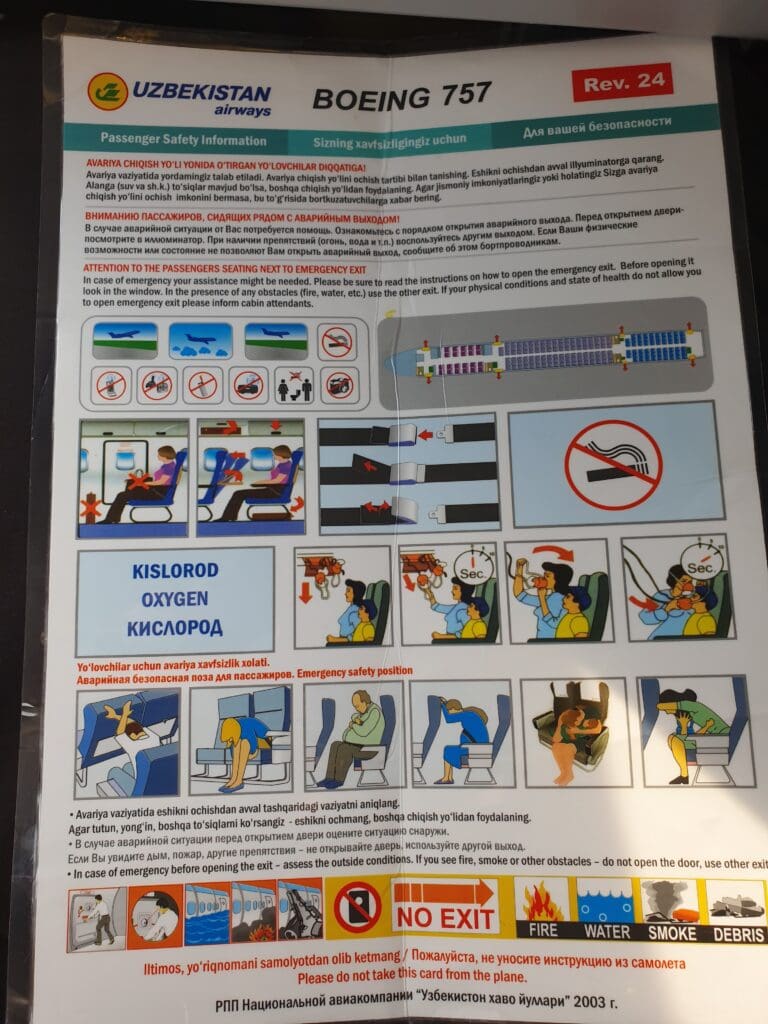
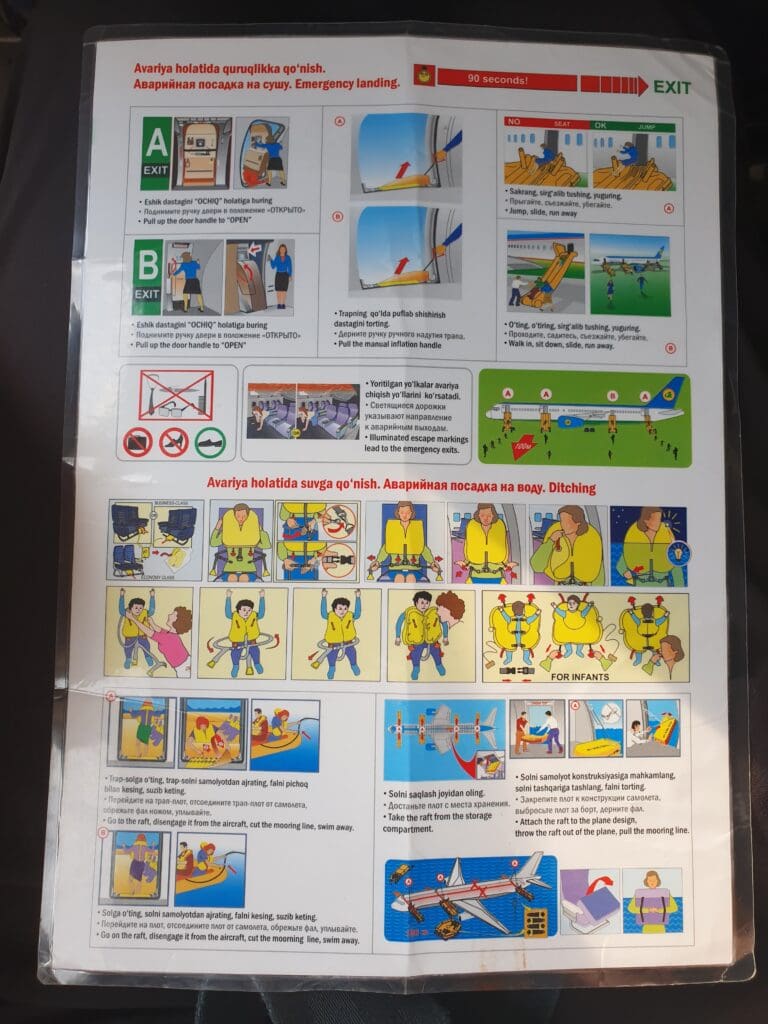
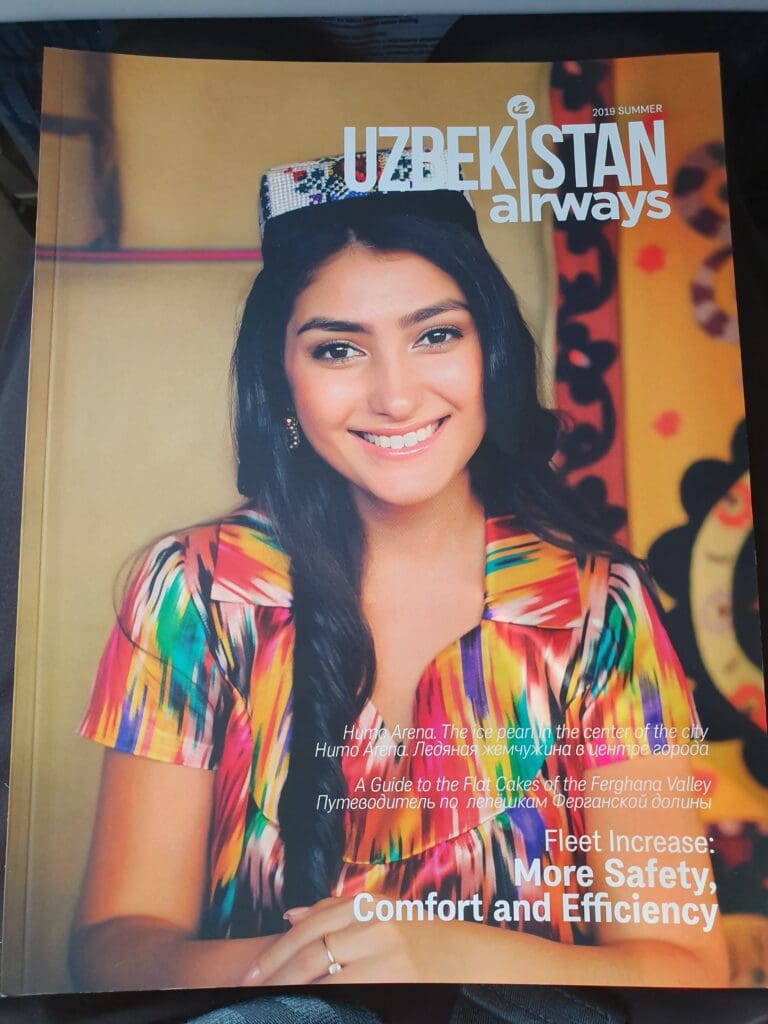
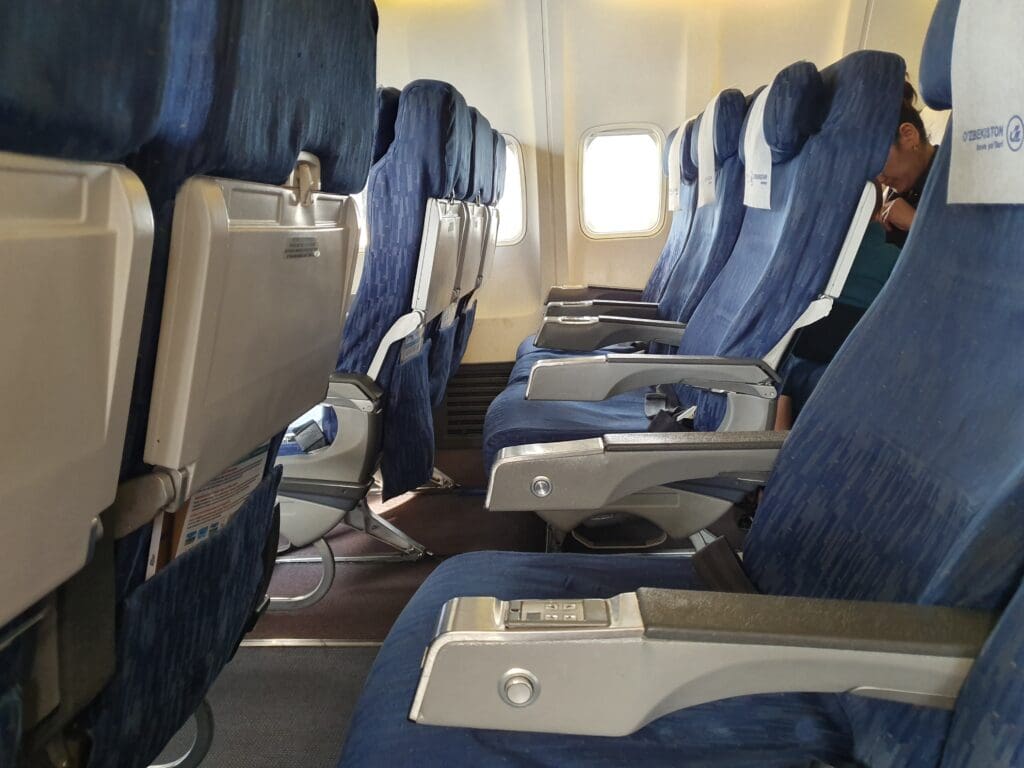
That afternoon, all passengers from the first bus boarded in a quick and efficient manner, and boarding seemed to have been completed by 1735. However, as it turned out, another bus full of stragglers would arrive twenty minutes later. With two free seats next to me, and little to do during this wait bar soak up the aircraft’s atmosphere and listen to the funky boarding music, I decided to make a quick trip to one of the aircraft’s lavatories. As you would hope, this was stocked with all the basics, however, contrasting with the Air Astana Boeing 757 lavatories that I had visited that morning, these were incredibly worn, battered, and emitted an unpleasant stench.
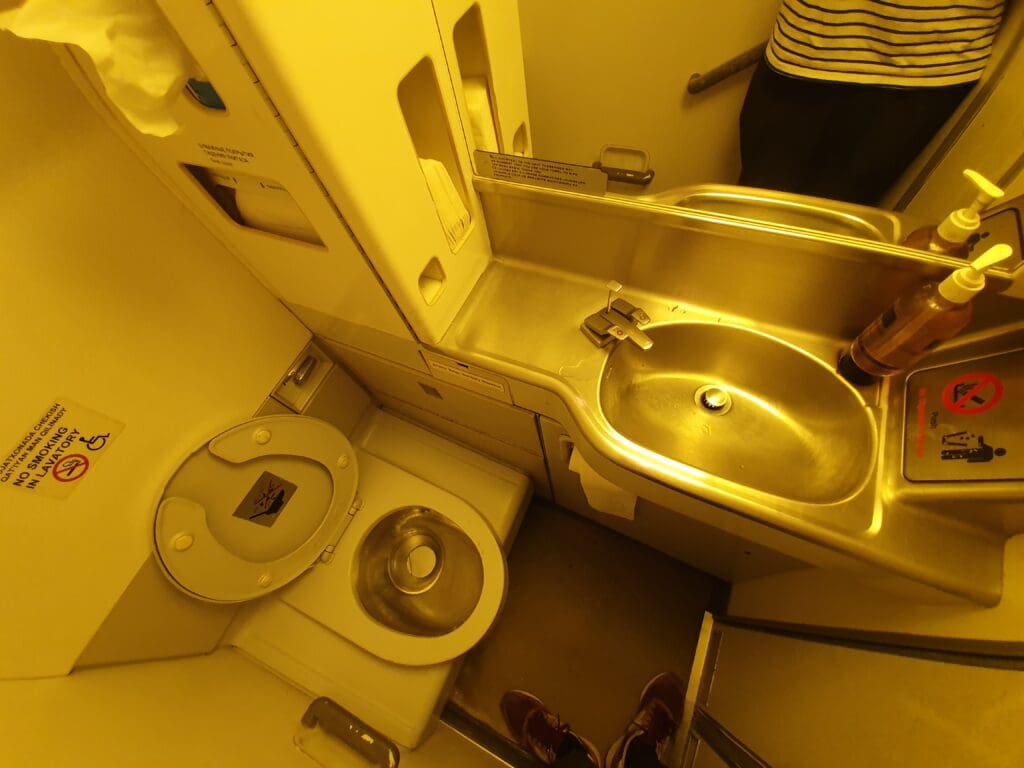
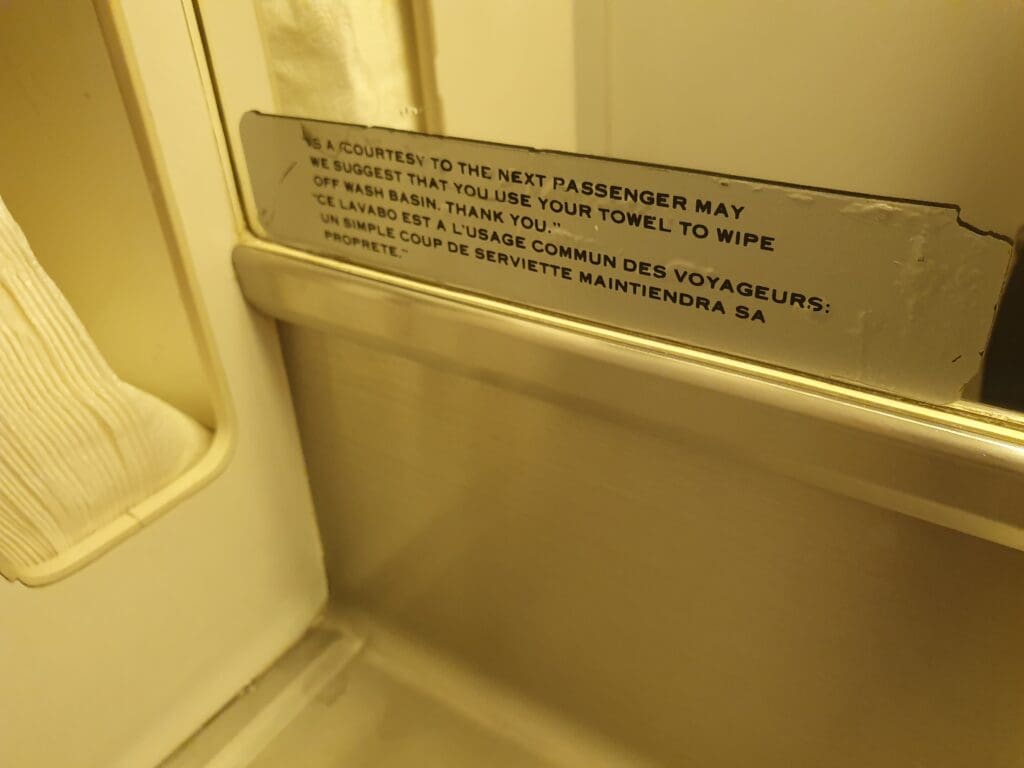
Once back in my seat, I watched the happenings outside and before I knew it, the second bus pulled up to the aircraft. As it happened, this contained no more than a few stragglers and thus the load for the flight appeared to be no more than around 30%. That evening all paying passengers were seated in Economy, with Business filled by just two passengers – a couple of high-visibility vest-wearing Uzbekistan Airways pilots who would presumably spend the evening deadheading to St Petersburg before flying back to Tashkent via Fergana. Focusing on the passengers, unsurprisingly given Samarkand’s status as a major tourist hub, tourists from Austria, China, France, and Poland could all be seen onboard, as well as, of course, a reasonable number of passengers from Uzbekistan.

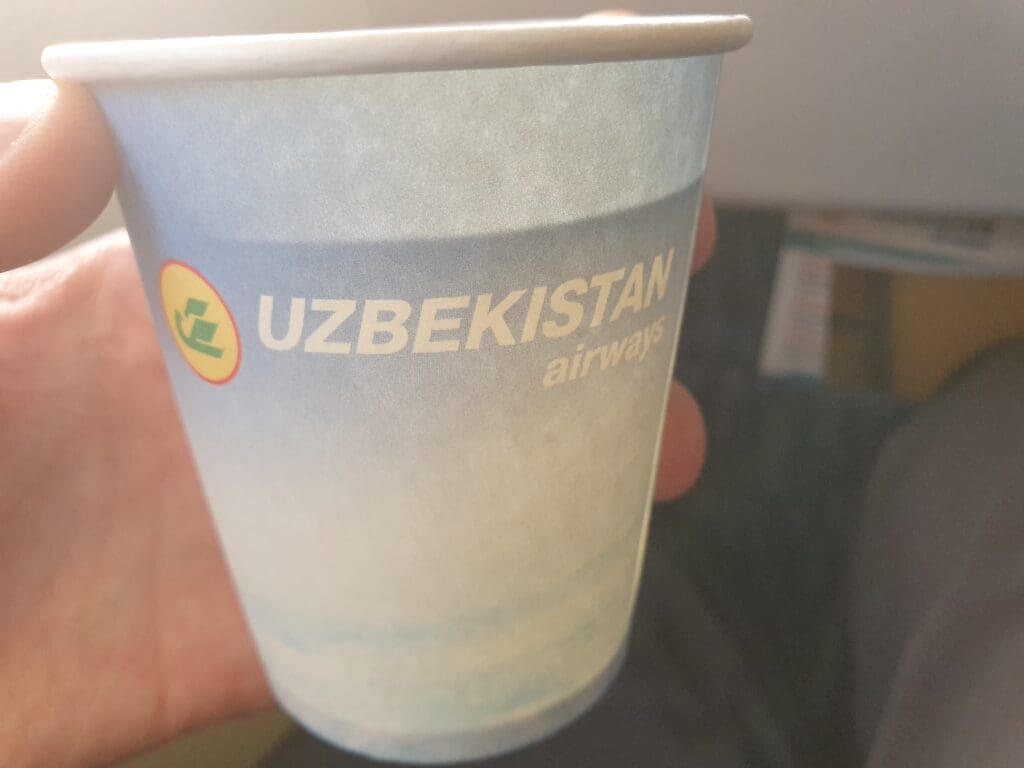
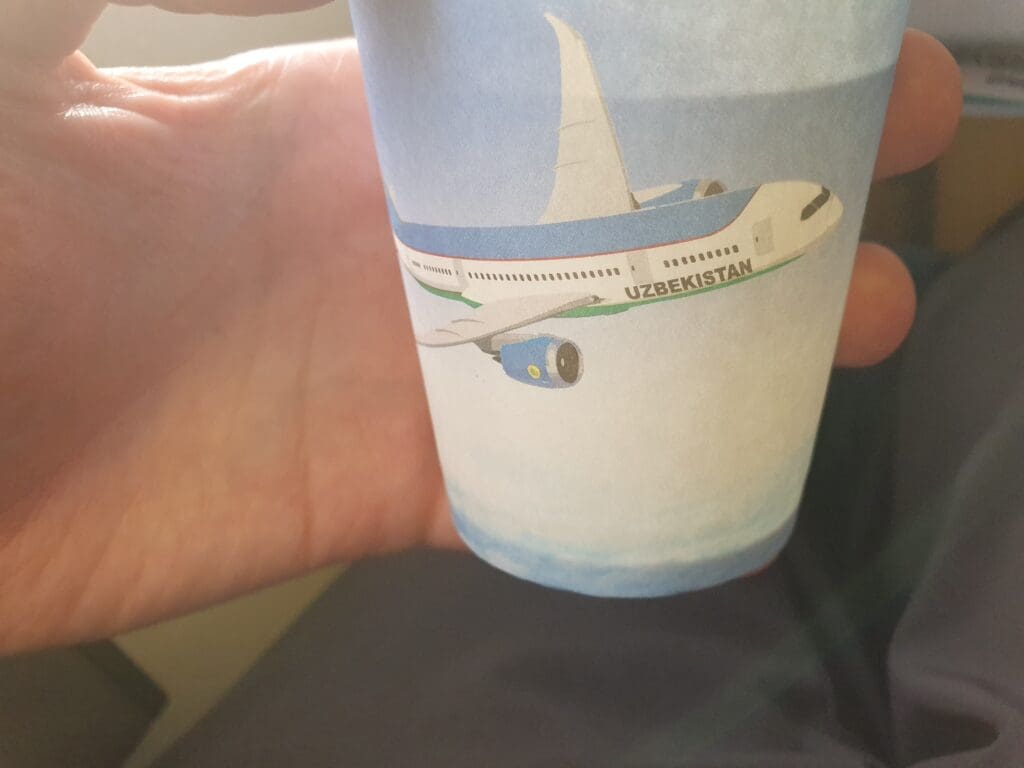
Once all passengers were seated, one of the friendly flight attendants came around offering water in paper cups – the only service that would be provided onboard the flight. These cups featured a nice design which included the airline’s Boeing 787 – the pride of the airline’s fleet and a near-omnipresent feature in its advertisements. True to Uzbek punctuality, at exactly 1800 on the dot, the stairs were backed away from the aircraft, and the door was closed by one of the off-duty pilots. After this, the Purser performed a welcome speech in Uzbek, Russian, and English before the overhead screens extended and played a rather vintage-looking safety video three times in the aforementioned three languages. As this played, the passenger in front of me decided it would be a good idea to recline his seat, completely squishing me in before karma ensured he got a telling-off from one of the flight attendants as they passed through the cabin ensuring all was ready for departure.
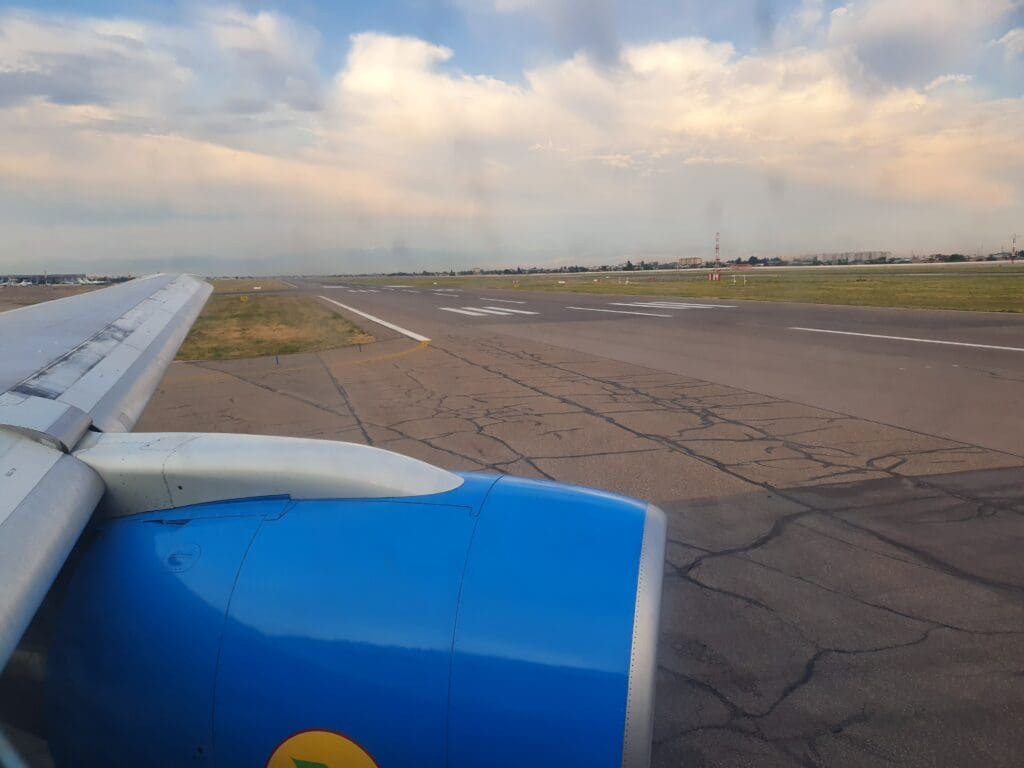
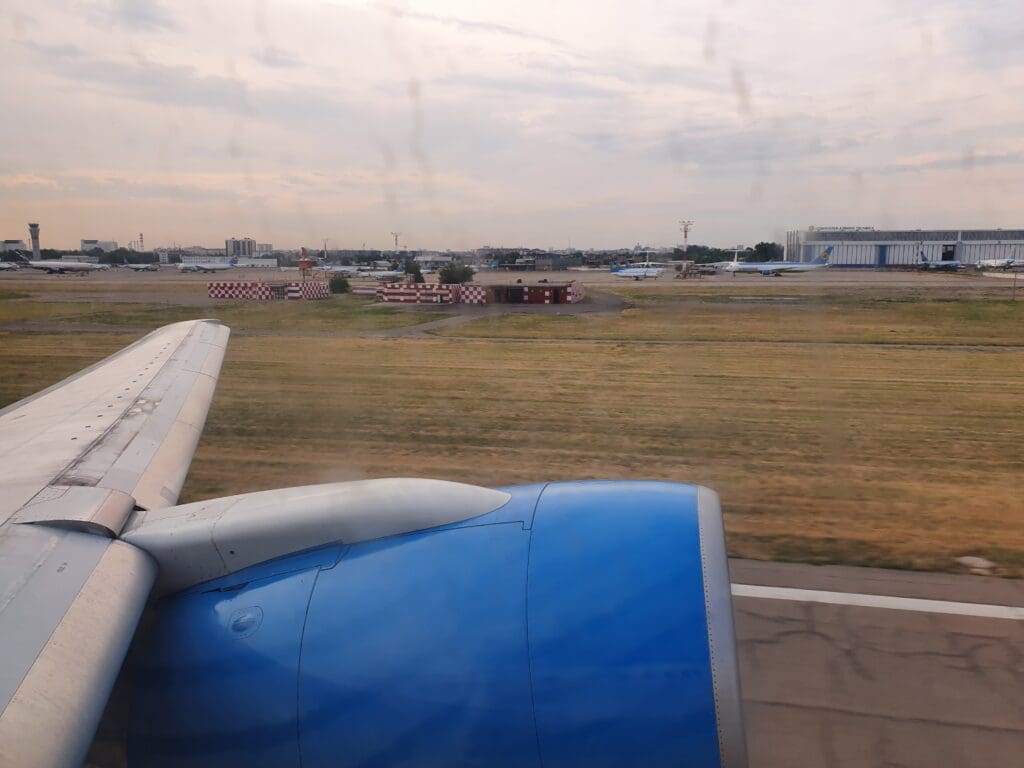
As the safety video neared its end, the Boeing’s two Pratt & Whitney PW2037 engines powered into life without too much noise or vibration, and a few minutes later the Boeing 757 lurched forwards out of its stand. From our parking position, nothing more than a very short taxi was in store until we reached the end of Runway 08L. Without holding, at 1814, the Boeing entered the runway and performed a powerful rolling takeoff. The light load combined with the Boeing 757’s reputation as an infamously overpowered jet meant that rotated up into the skies in no time, allowing for fantastic vistas of Islam Karimov Tashkent International Airport and its rows of both stored and active aircraft, including Uzbekistan Airways’ rare and sadly retired Avro RJ85s and Ilyushin Il-114s. Within seconds of taking off, the mostly flat landscape of Tashkent appeared as we climbed over the city’s suburbs before making what seemed to be fairly steep bank that put us on course for Samarkand.


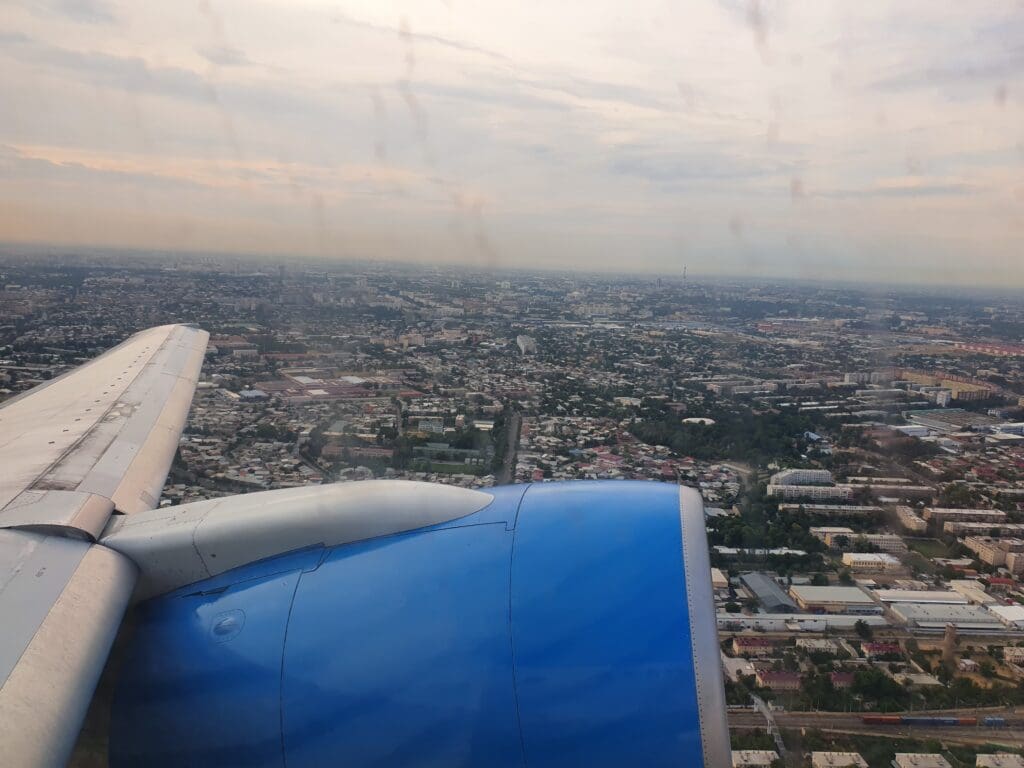
As we banked, the mountains to the east of Tashkent briefly appeared, offering a picturesque view of Uzbekistan before the clouds rolled in, obscuring any further sights of the ground until we neared Samarkand. With Tashkent sitting in close proximity to Uzbekistan’s border with Kazakhstan, unsurprisingly the Boeing temporarily entered Kazakhstani airspace for a few short minutes before reaching the Uzbek cities of Gulistan and Jizzakh. A mere 13 minutes into the flight, the aircraft levelled off at its low cruising altitude of 24,000 feet. Unsurprisingly given the short length of the flight, the seatbelt signs remained illuminated for the entire journey, whilst the flight attendants remained firmly in their jumpseats. As the cabin settled into the brief cruise, passengers were left to enjoy the noise of the aircraft’s two Pratt & Whitney engines, with no announcements made until we neared the top of descent.
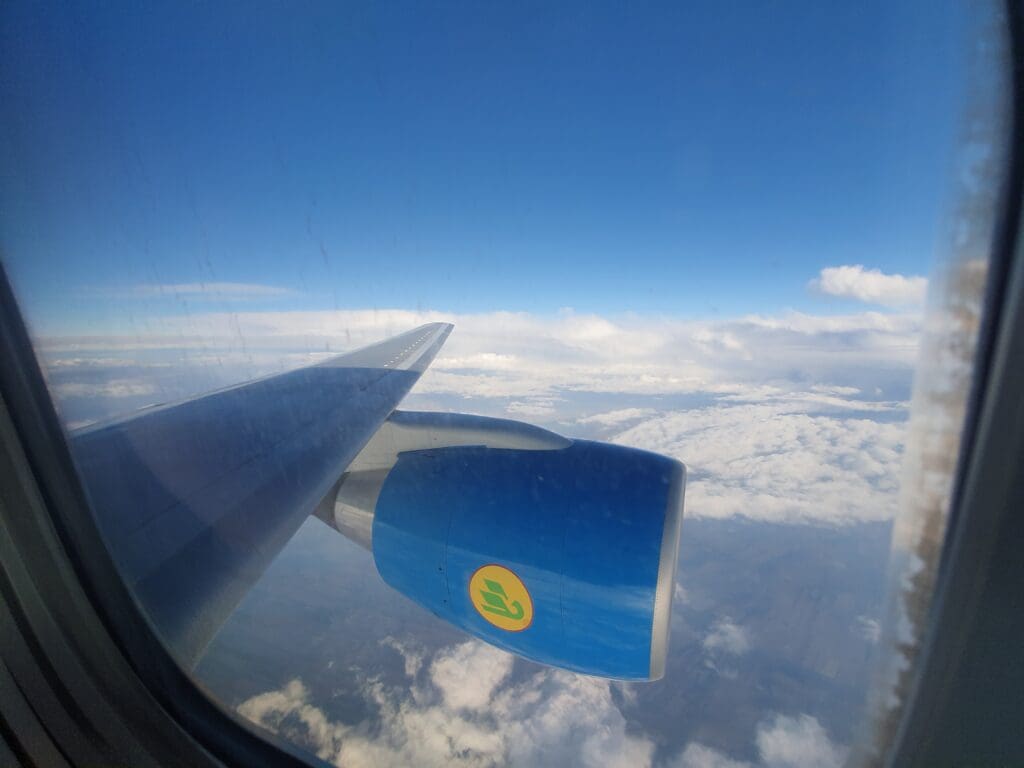
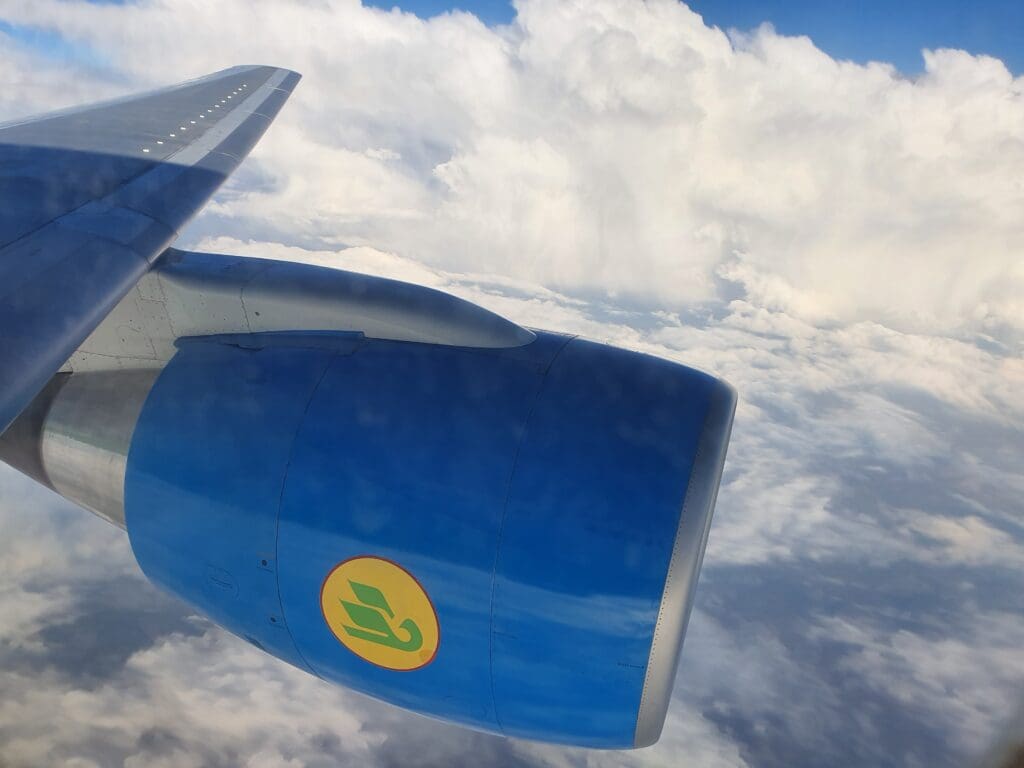
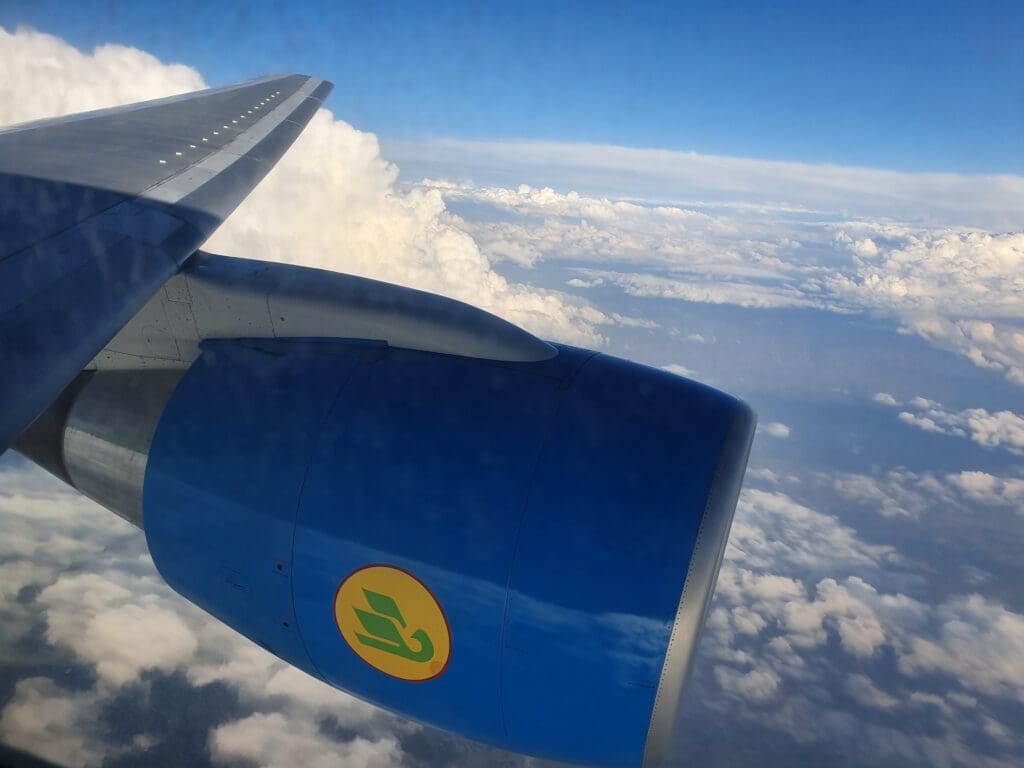
Just three minutes after the Boeing had levelled off, the Purser announced that the descent into Samarkand would soon commence. At that time, passengers were asked to ensure their window blinds were up, tray tables were stowed, seatbacks upright and seatbelts fastened. However, as the crew remained strapped into their seats for the entire flight, there was technically no way for them to enforce this! Soon, the Boeing passed through a thin layer of clouds, revealing the beige fields of rural Uzbekistan below. These fields gradually turned greener as we approached Samarkand, signalling our imminent arrival.
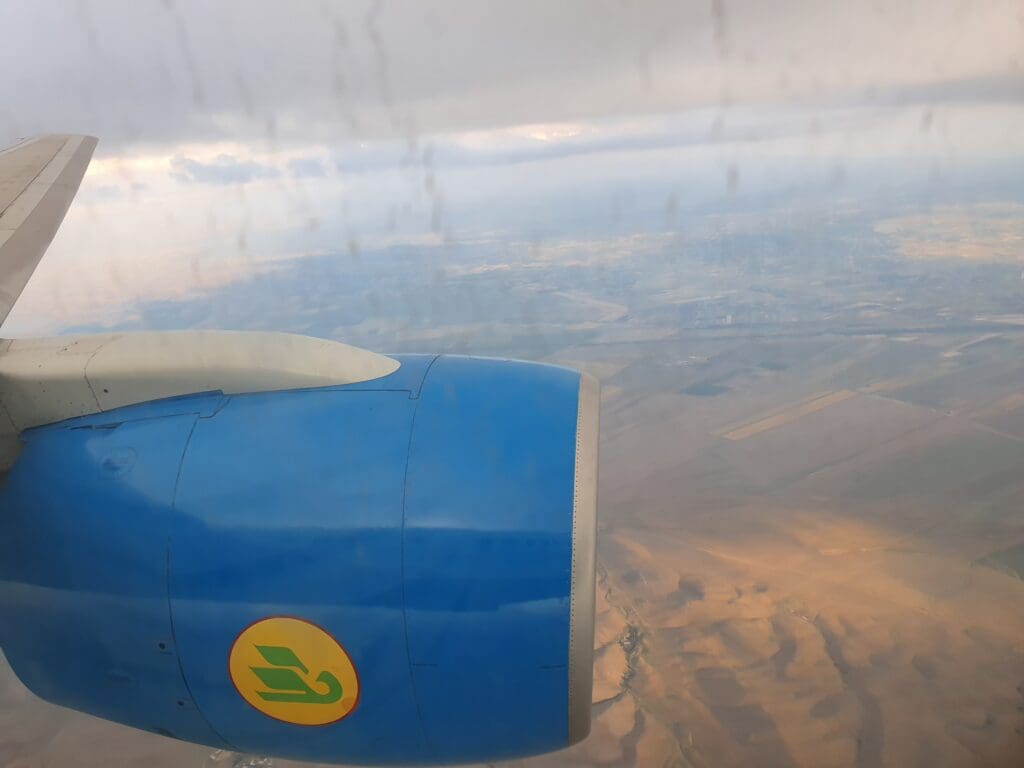
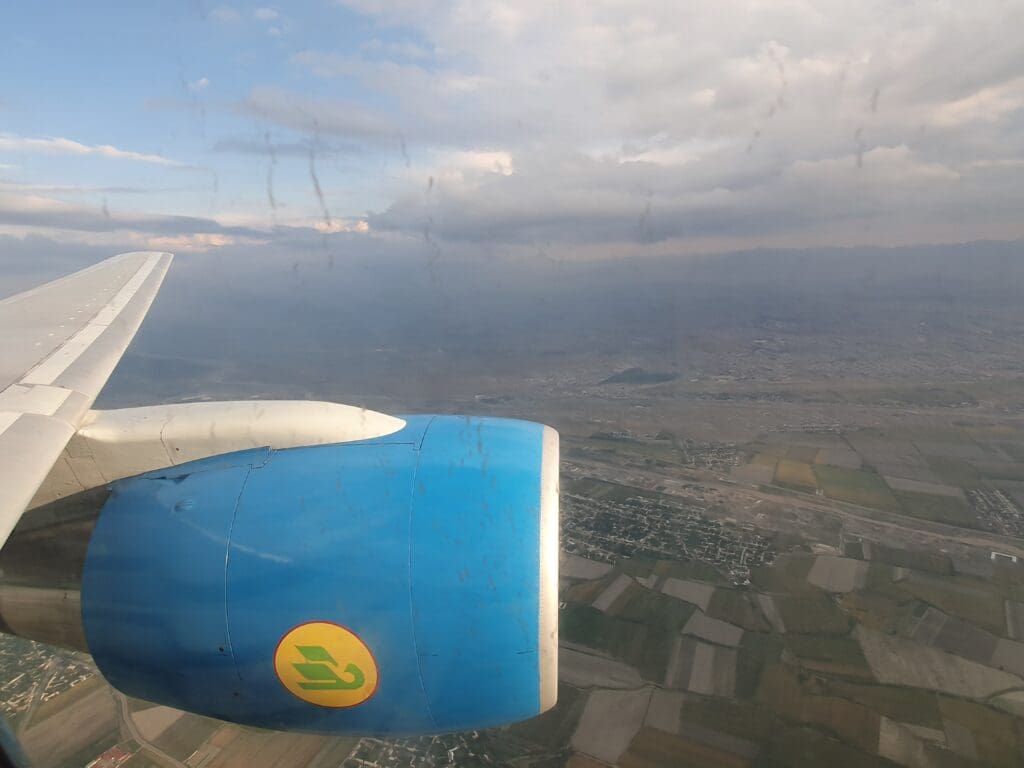

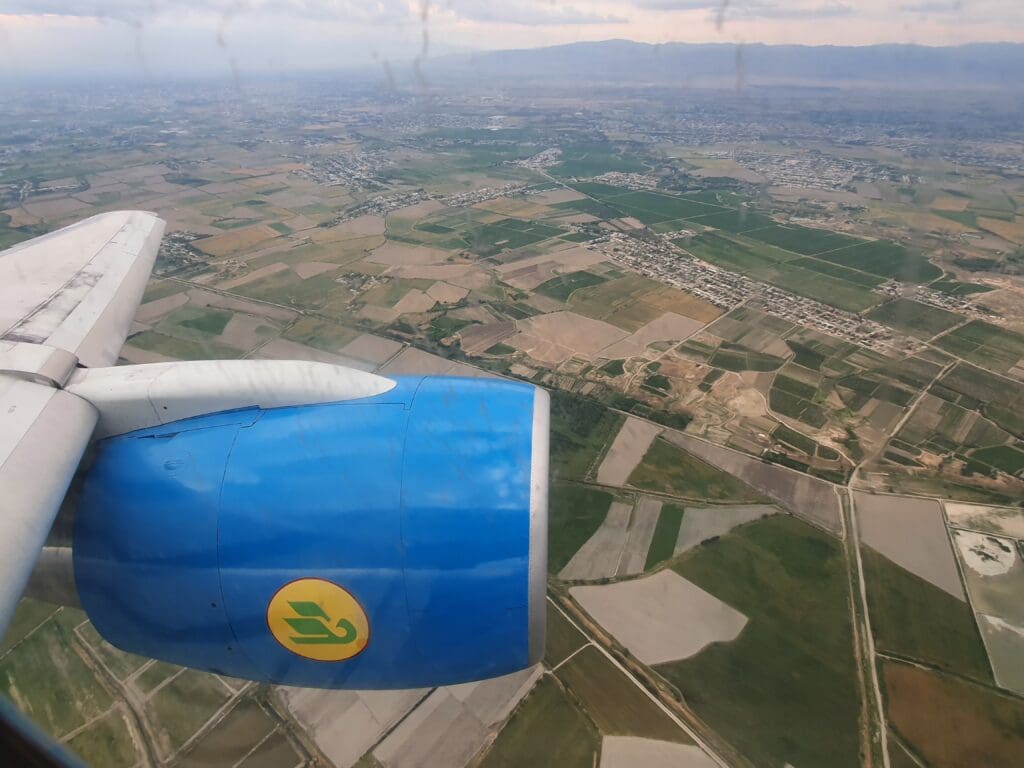
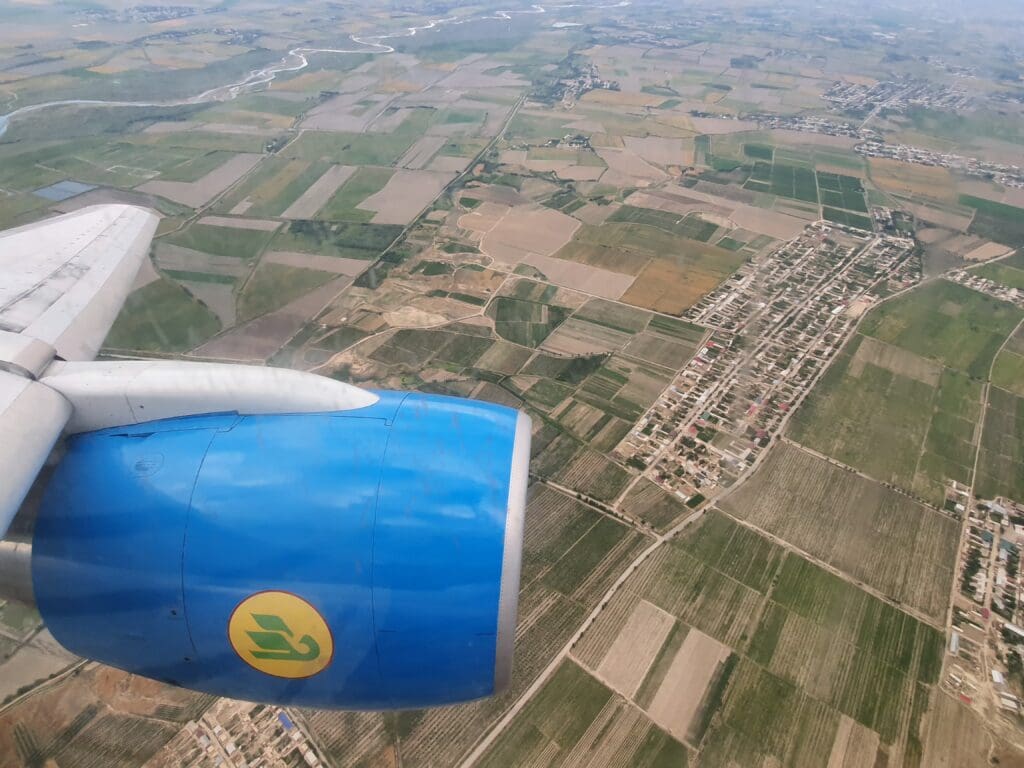
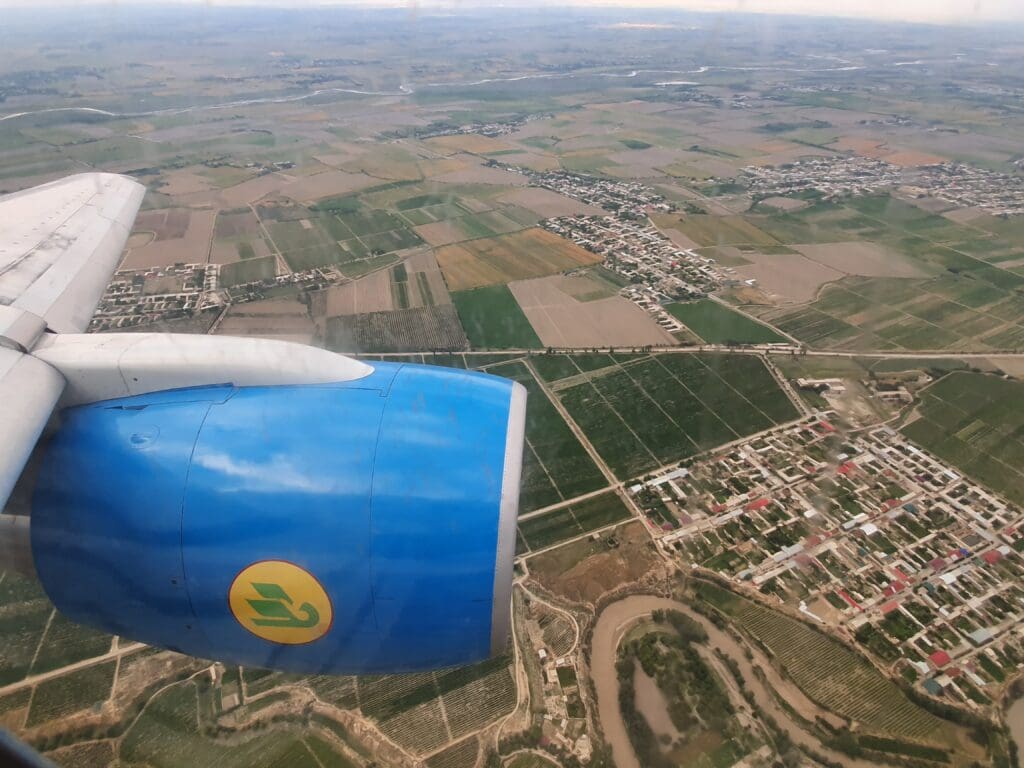
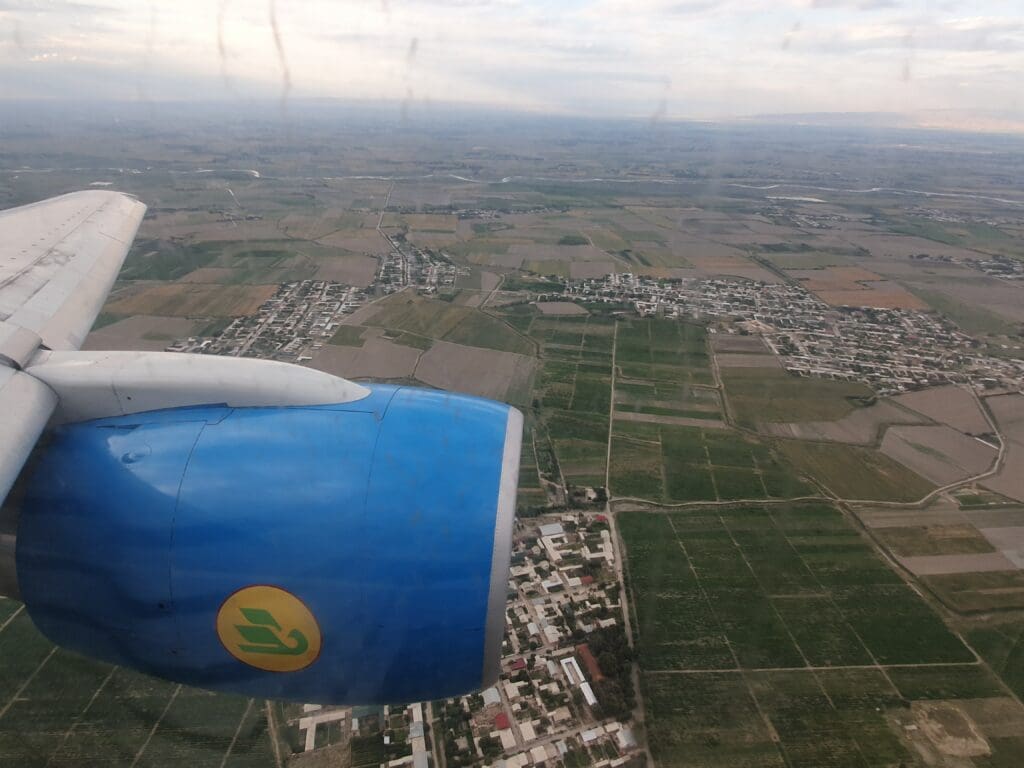
Smoothly cutting through the Uzbek skies, it wasn’t long before the outskirts of Samarkand appeared. After making a slight turn, the aircraft entered the downwind leg for an approach to Runway 09 at Samarkand Airport, with the flaps were gradually lowered, and the landing gear extended as we lined up for the final approach. At 1845, just 24 minutes after taking to the skies, the Boeing 757 floated gently down over Samarkand’s residential and industrial areas, crossing the airport perimeter fence before making a soft touchdown on Runway 09.
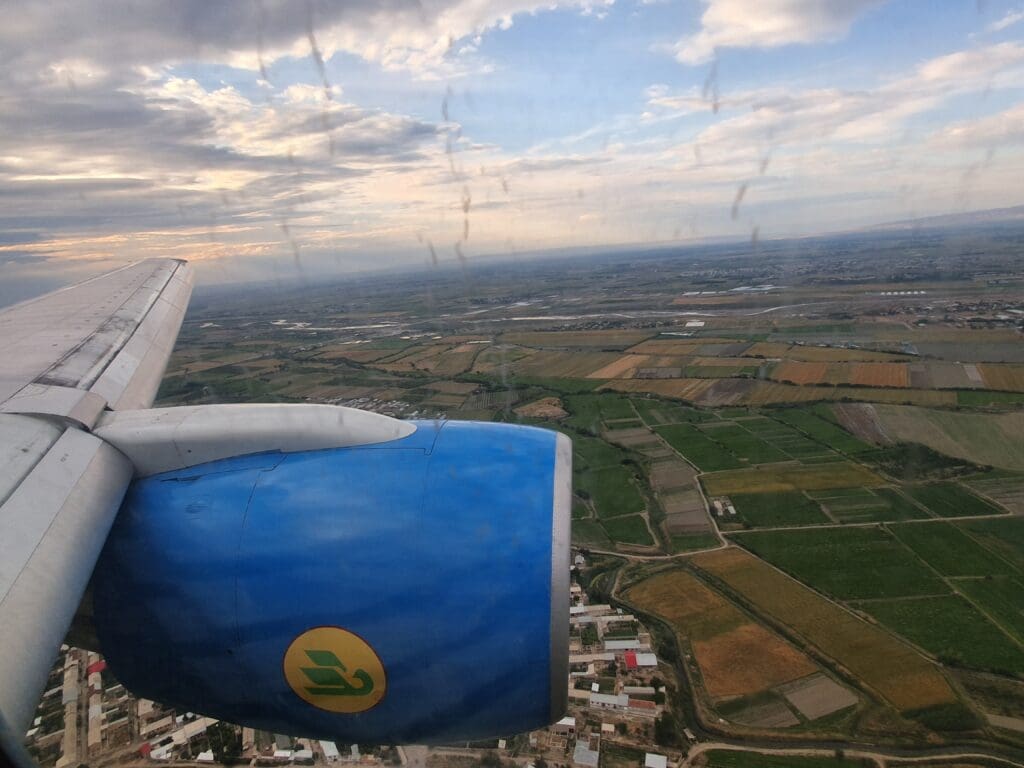
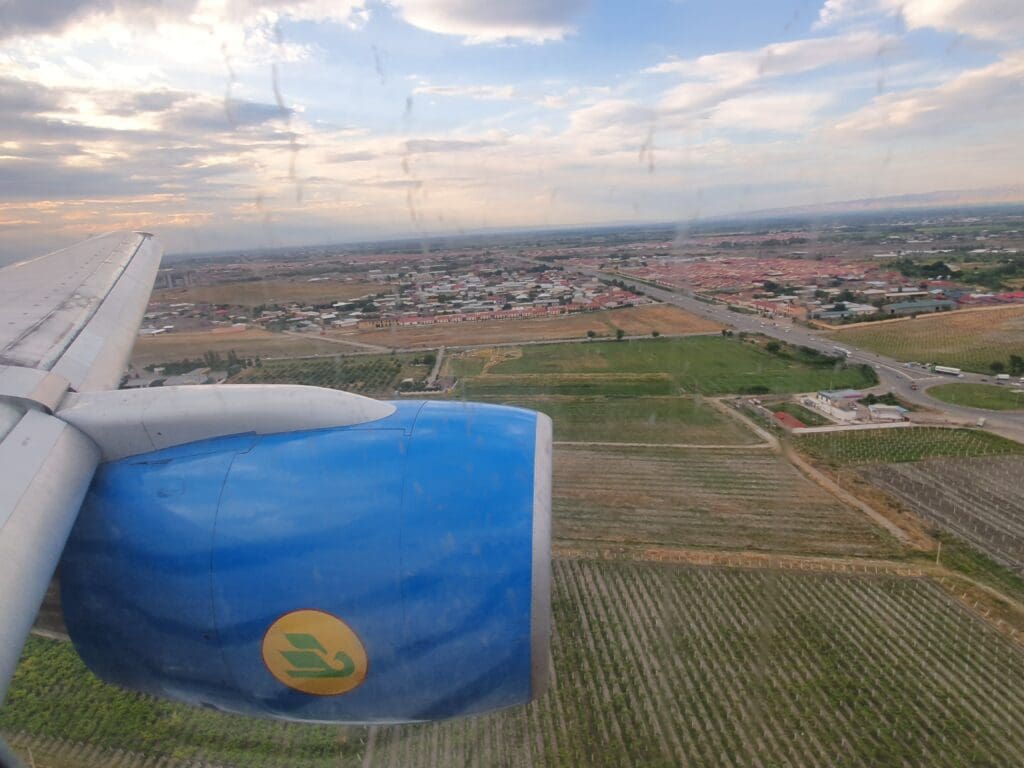
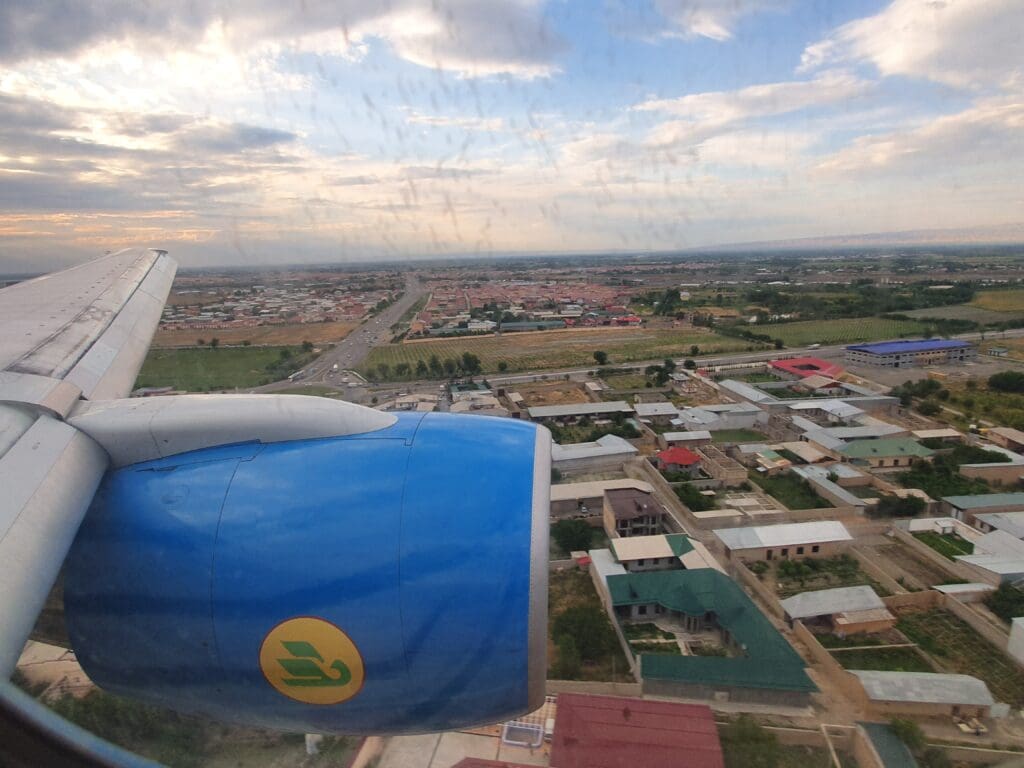
Once safely on the ground, the Boeing decelerated rather gently before we vacated the runway and made a quick taxi to Stand 5, located just outside the terminal building. Upon coming to a halt, the engines spooled down and the upbeat funky music filled the cabin once again. Outside, ground workers in reflective jackets and camouflaged security personnel surrounded the aircraft and readied themselves for disembarkation. In no time at all, a set of airstairs was promptly positioned up to the aircraft, and, sitting near the exit, I was among the first passengers to disembark.
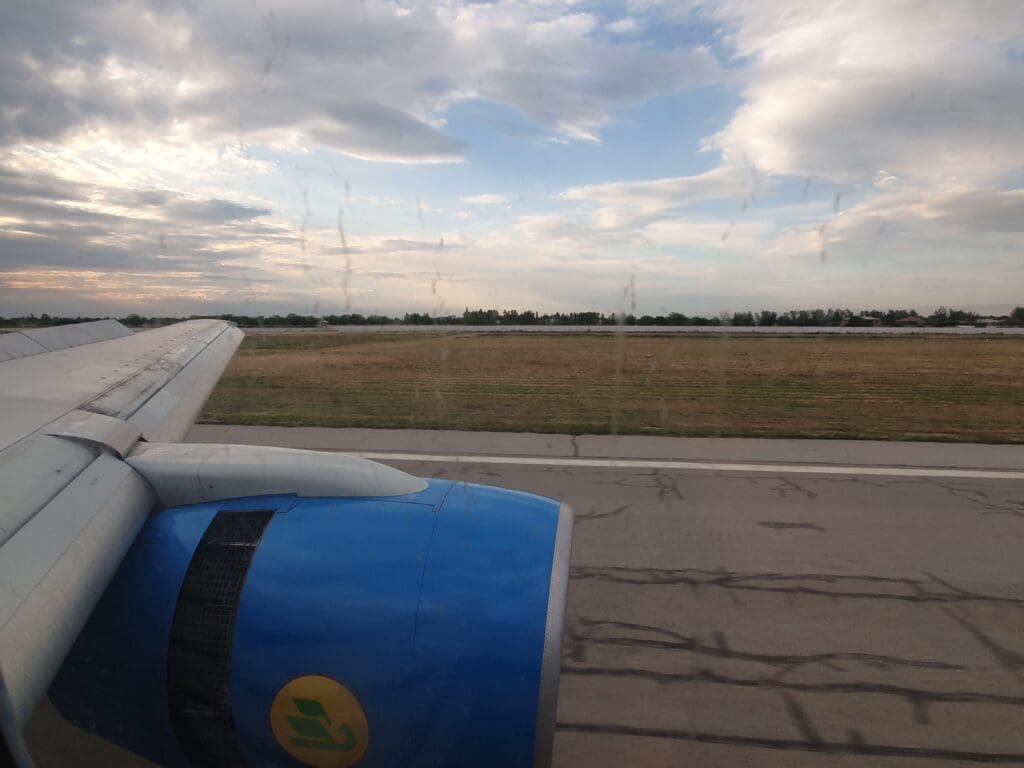
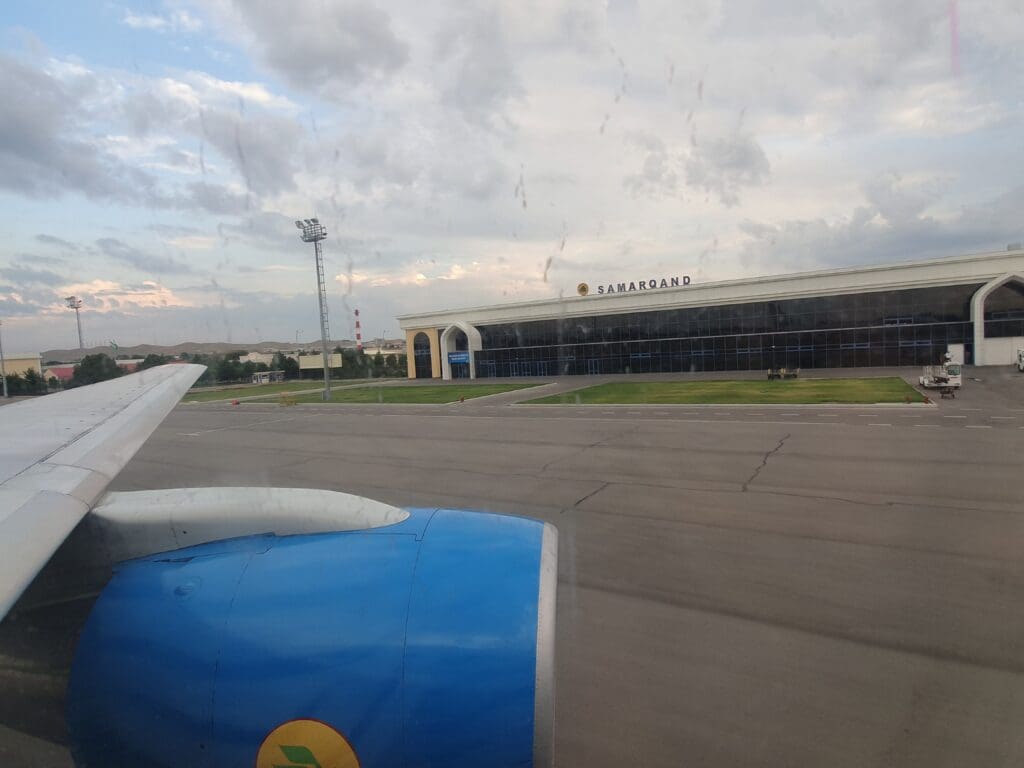
Stepping onto the tarmac, I was greeted by the warm summer evening air of Samarkand. The terminal, while large, lacked the modern conveniences of larger international airports. Instead of a luggage carousel, passengers waited at the entrance doors to the apron for their bags to be delivered on an open top lorry! Around ten minutes after our arrival, the bags arrived in a big pile on this lorry, with a team of ground workers carefully carrying the bags to the waiting passengers, a surprisingly efficient process!
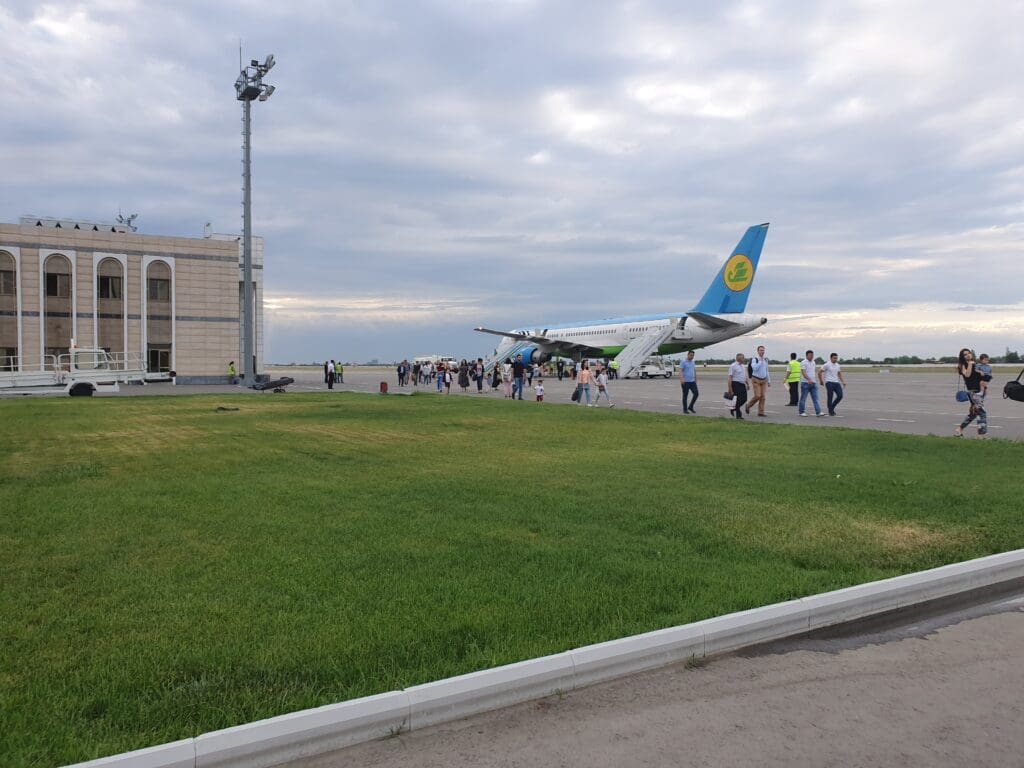
After retrieving my bag, I exited the terminal and walked through the airport’s perfectly manicured grounds to the main exit. Once I had exited the terminal grounds, I was warmly greeted by my pre-arranged taxi driver who would drive me to my hotel. Despite the language barrier, we managed a friendly conversation in basic Spanish – the driver had previously worked in Cuba. After a short 15-minute journey, I arrived at my hotel in the heart of Samarkand’s historic centre, ready to explore the city.
Summary
Overall, my domestic experience with Uzbekistan Airways was a pleasant one. While the early arrival at the airport may not have been necessary, I found the terminal to be clean and efficient, with check-in, security, and boarding conducted smoothly. Onboard, my interactions with the crew were limited due to the flight’s short duration, but those interactions that I did have were friendly and professional. Despite the worn cabin and cramped legroom, the nostalgic charm of the Boeing 757 added a unique character to the flight. For such a short journey, the experience was perfectly acceptable, though I imagine longer flights on the same aircraft might not be as comfortable. All-in-all, my experience left me looking forward to sampling my longer ride onboard one of Uzbekistan Airways’ Boeing 787-8 Dreamliners several days later.
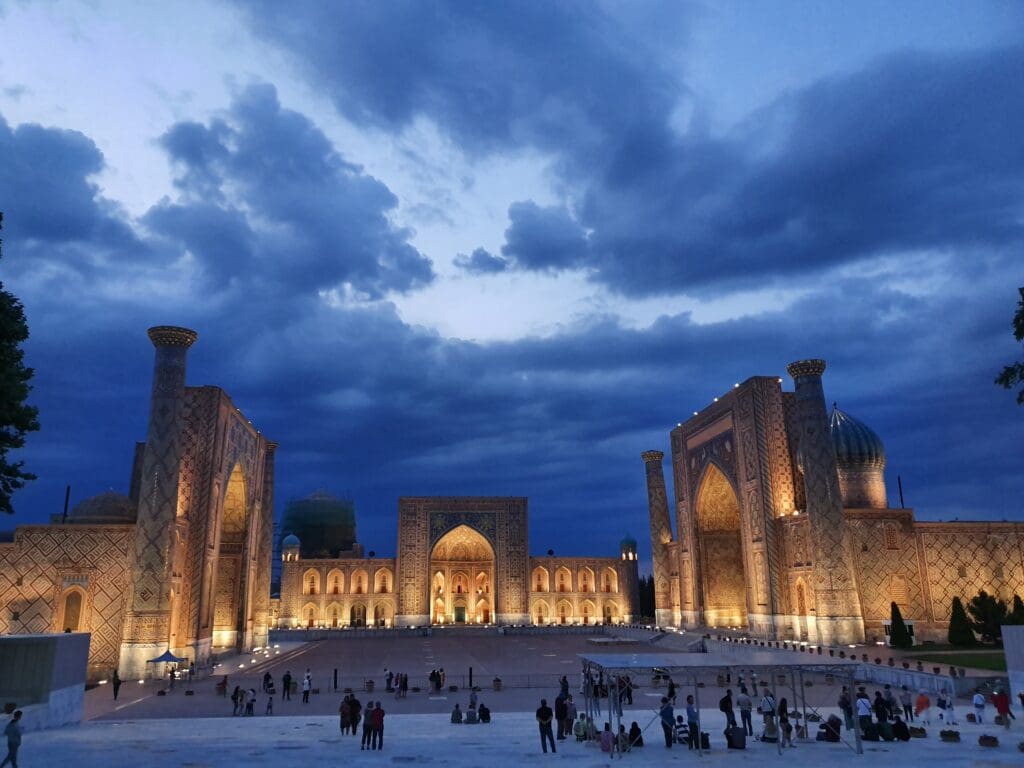
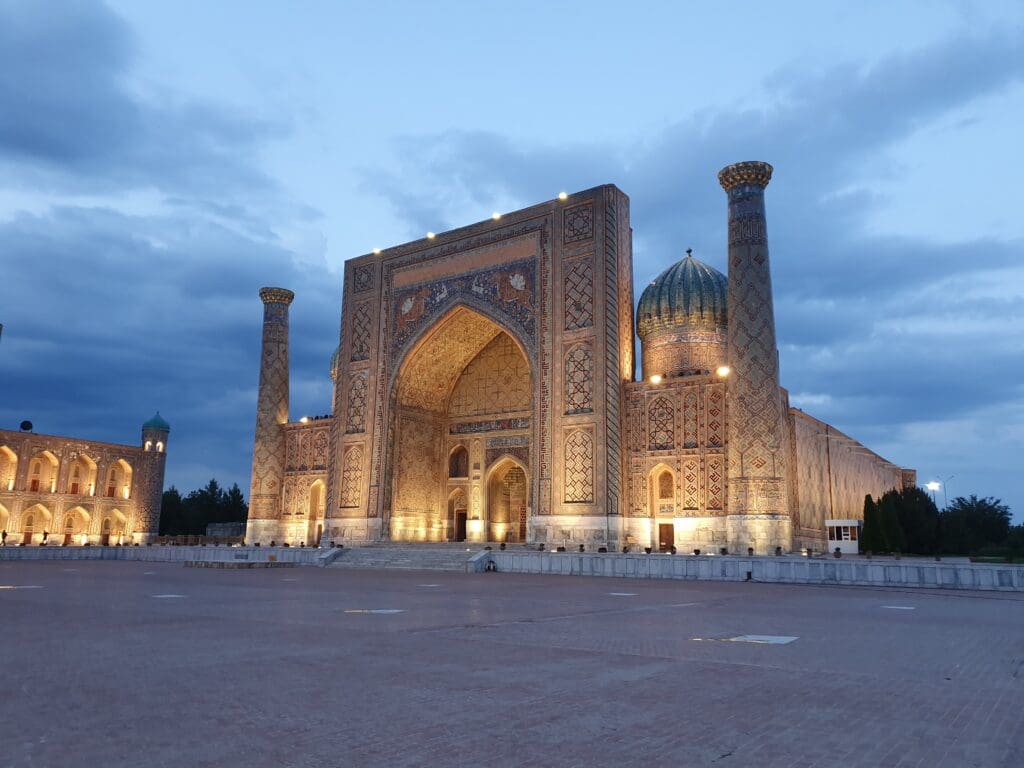
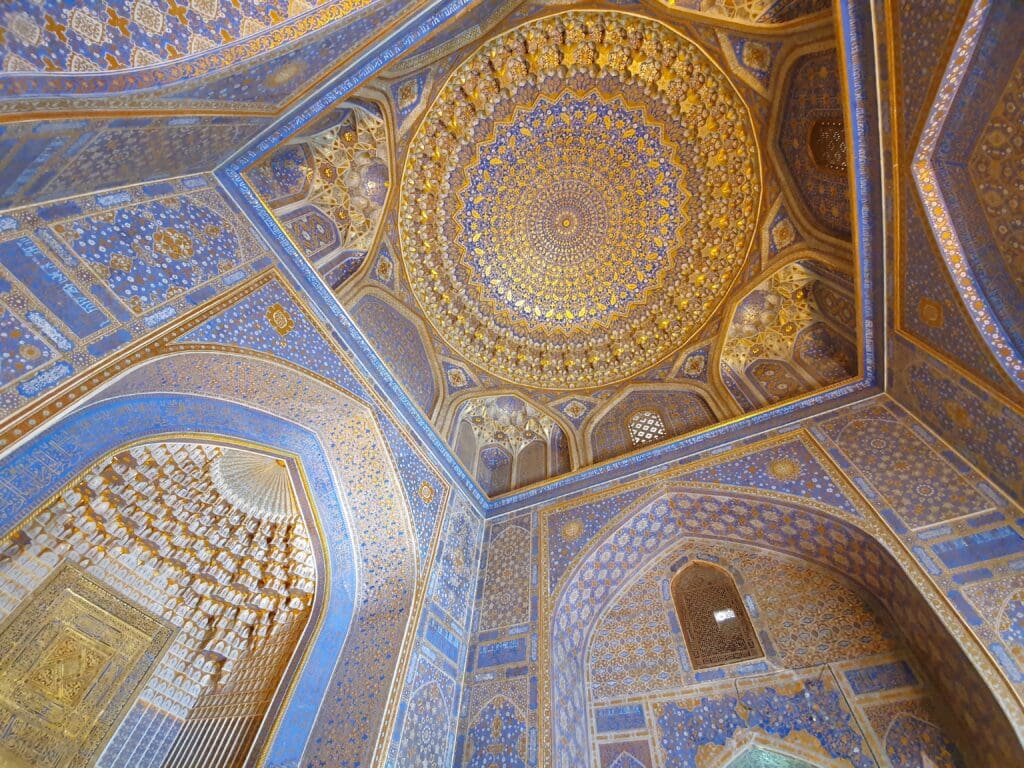
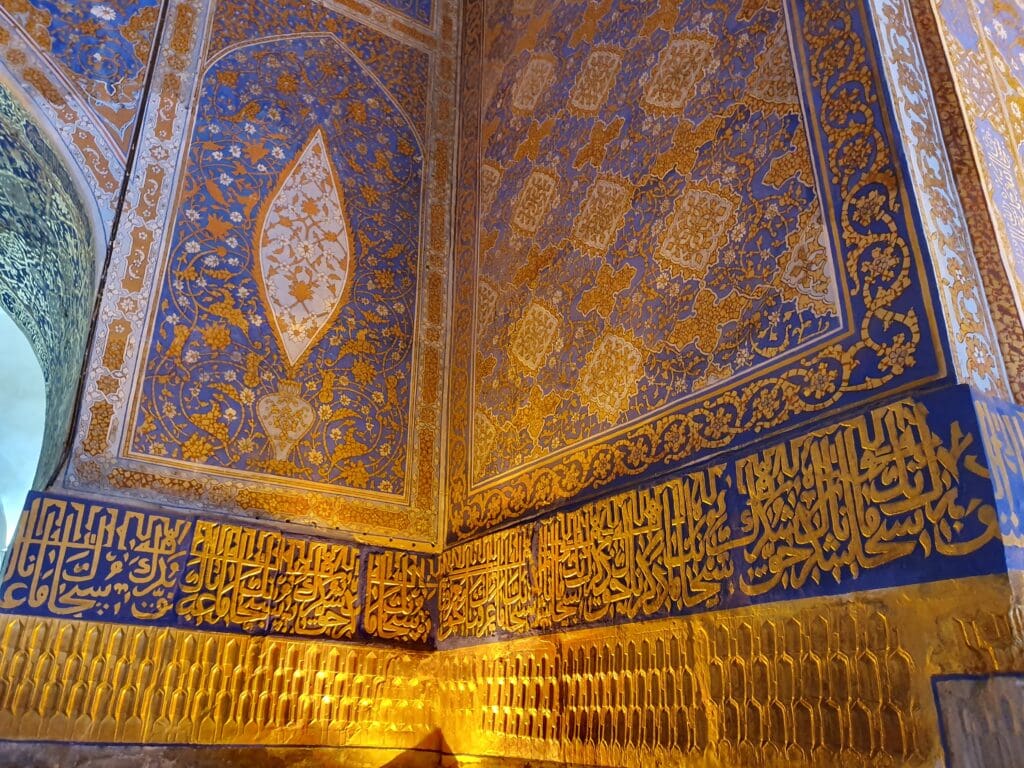
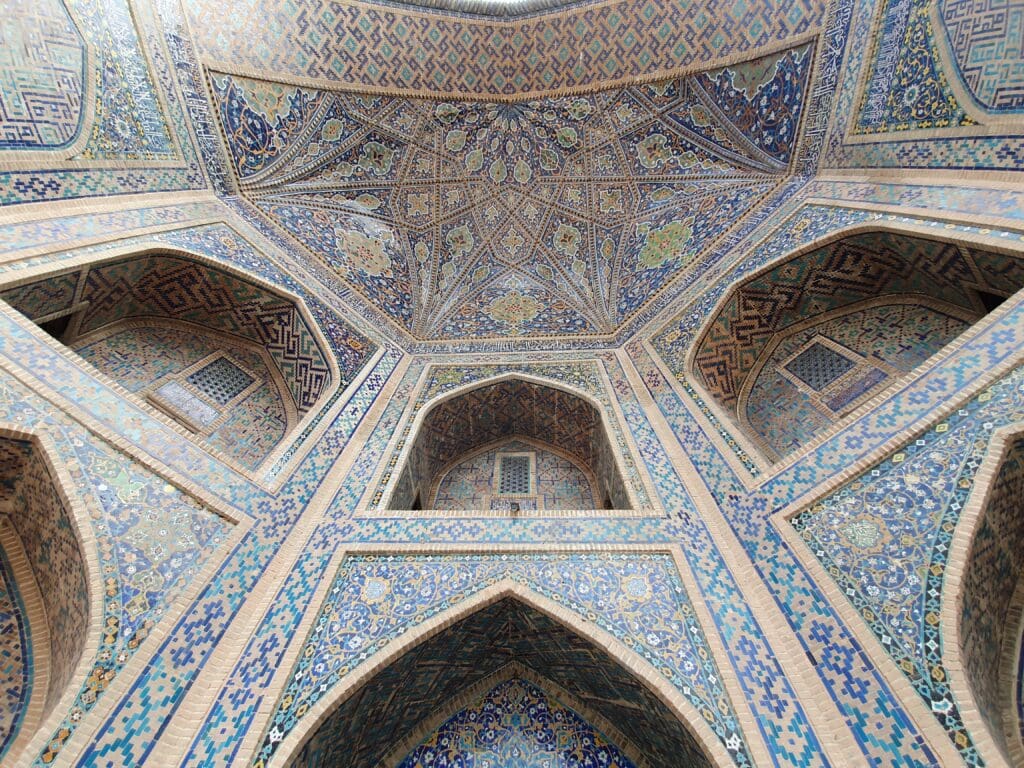
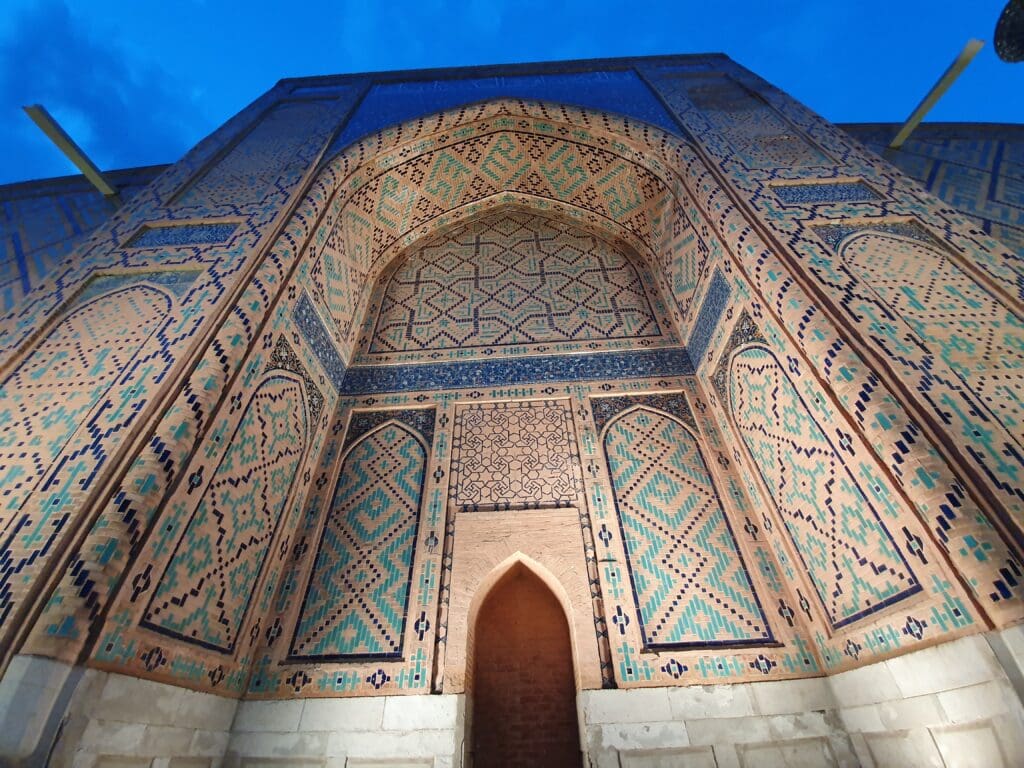
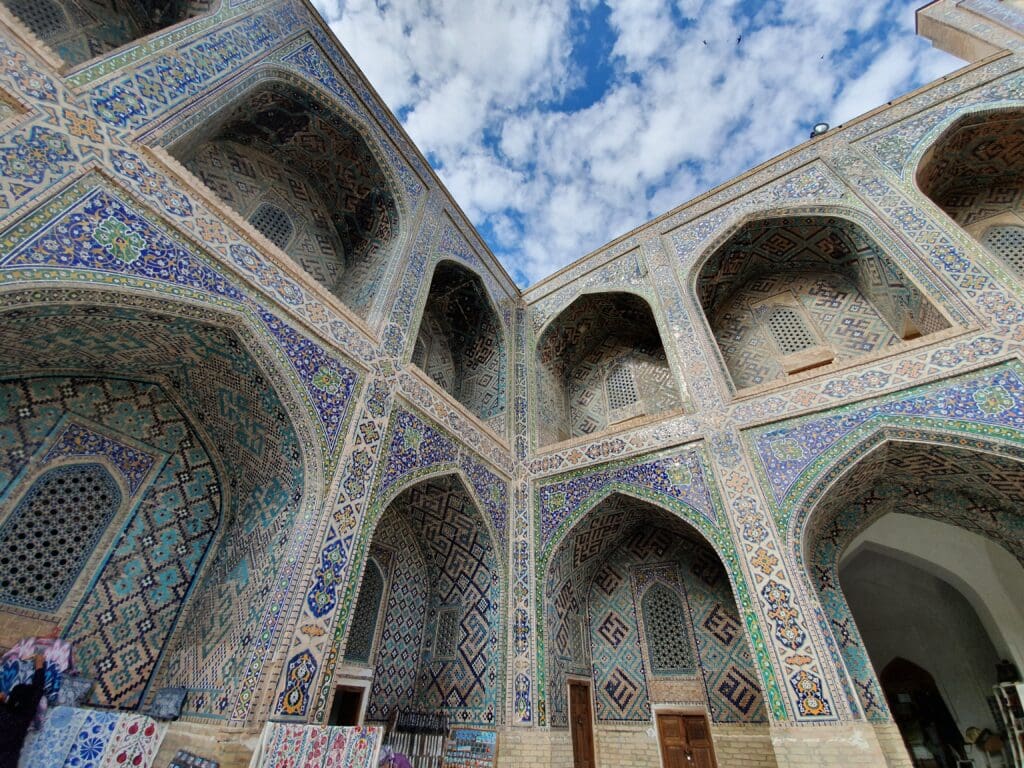
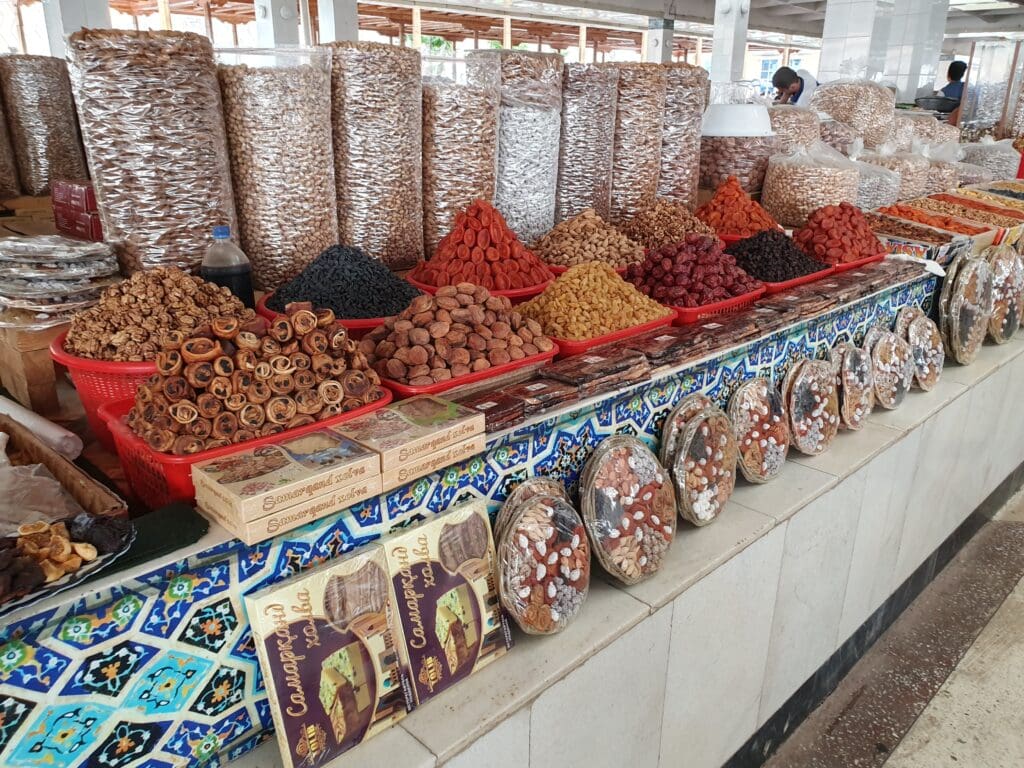
To finish, here are some photos of Samarkand