Across Asia on a Colourful Boeing 787: Tashkent to Seoul with Uzbekistan Airways
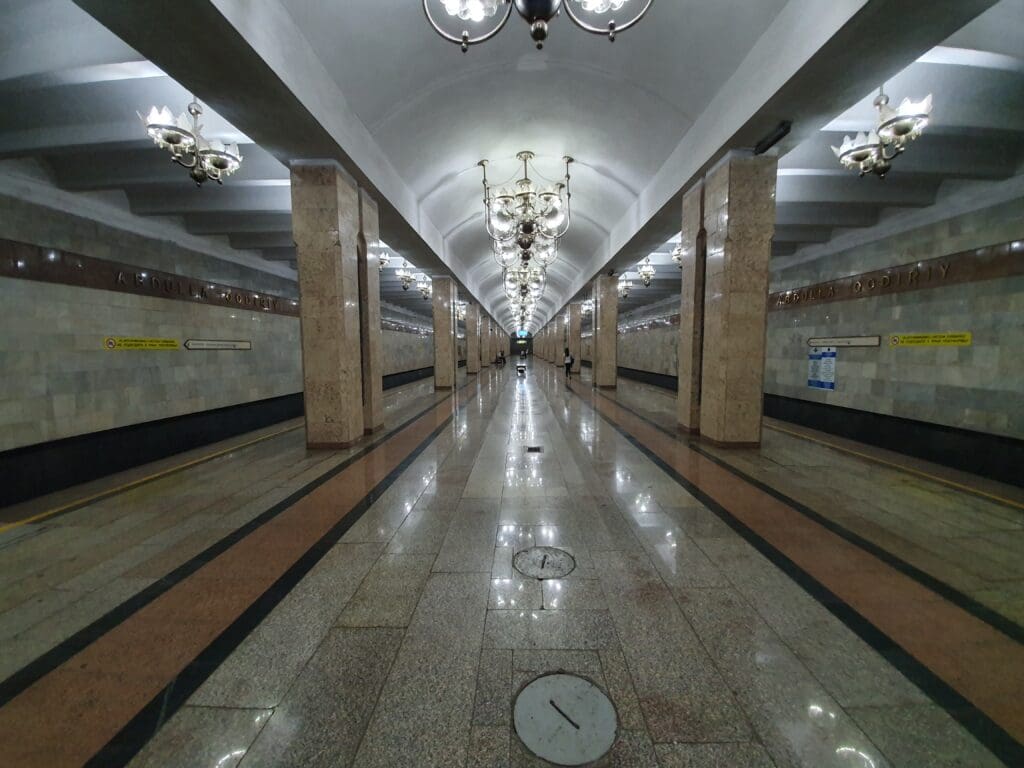
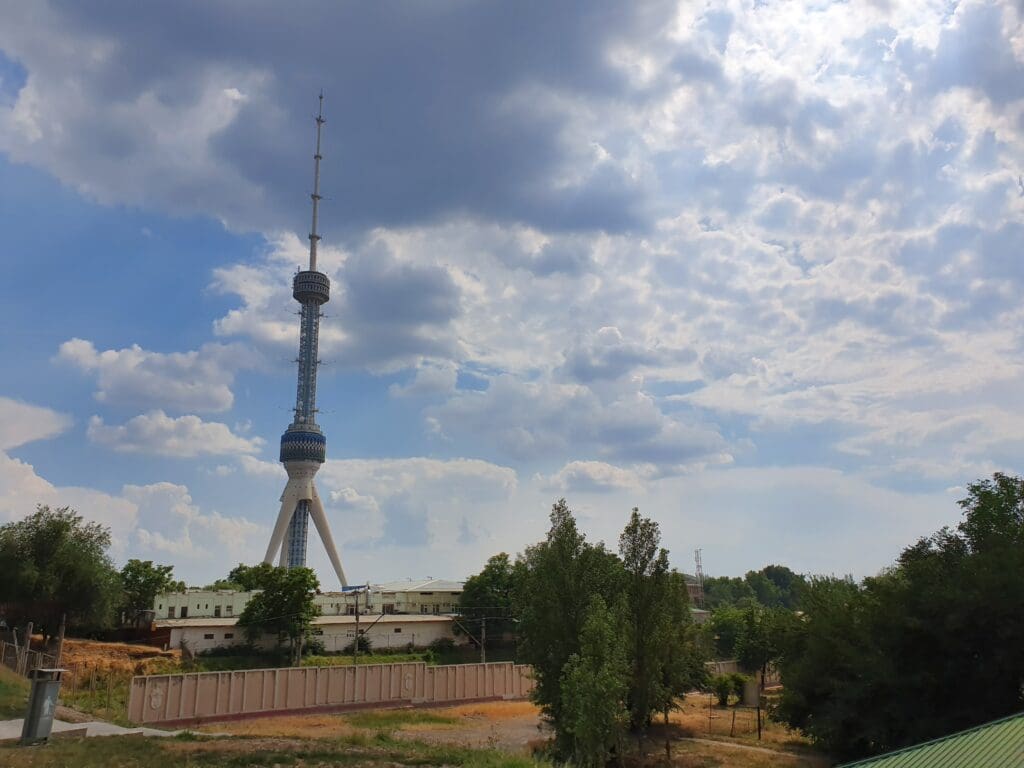
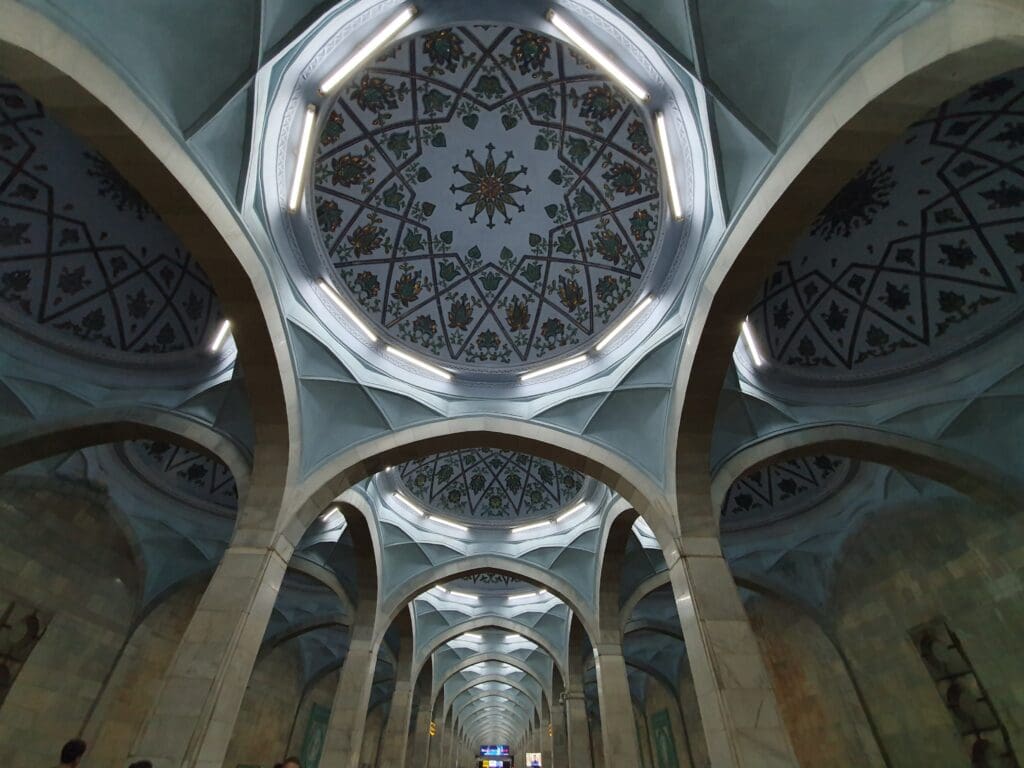
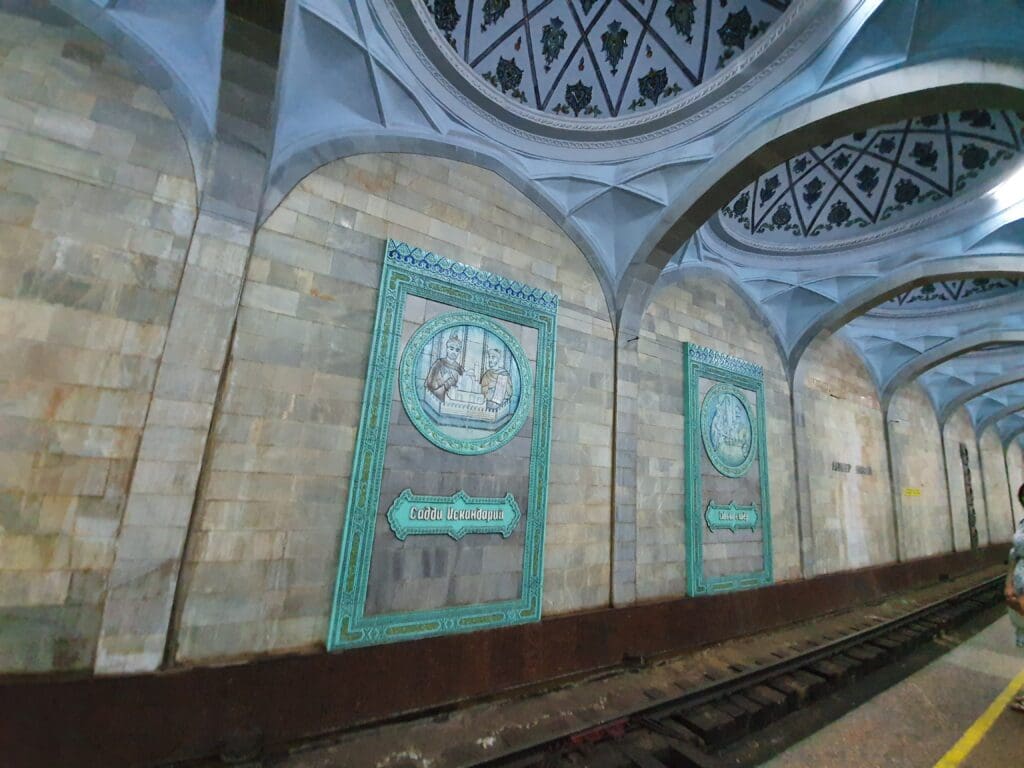
To start, here are some photos from my stay in Tashkent
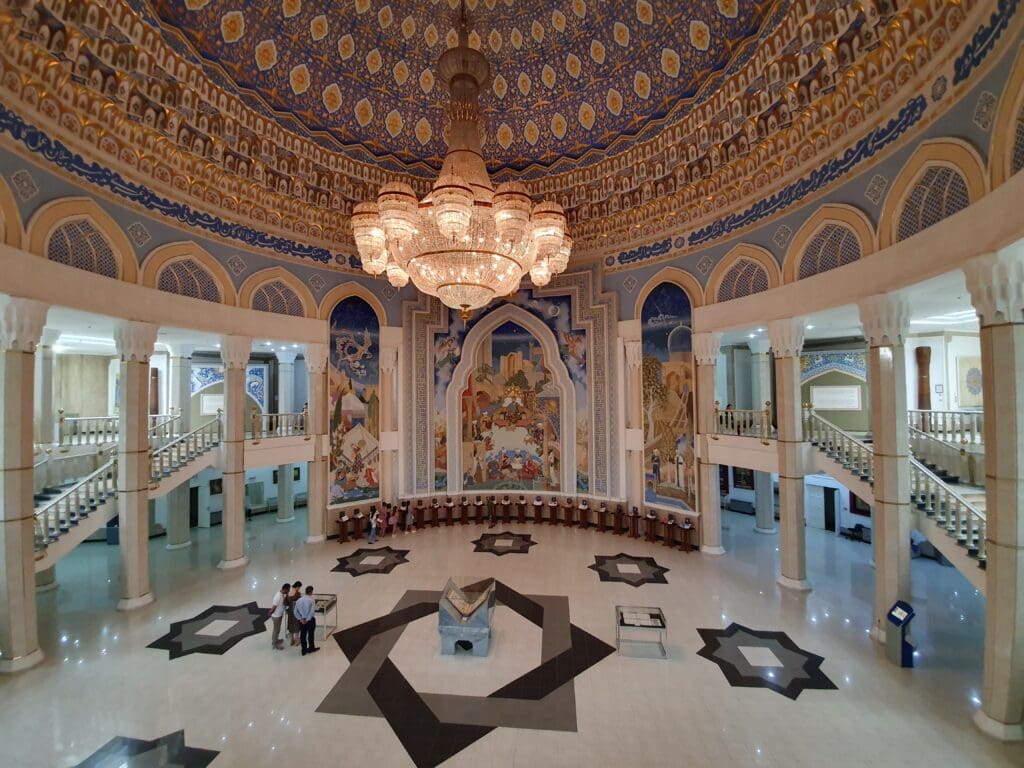
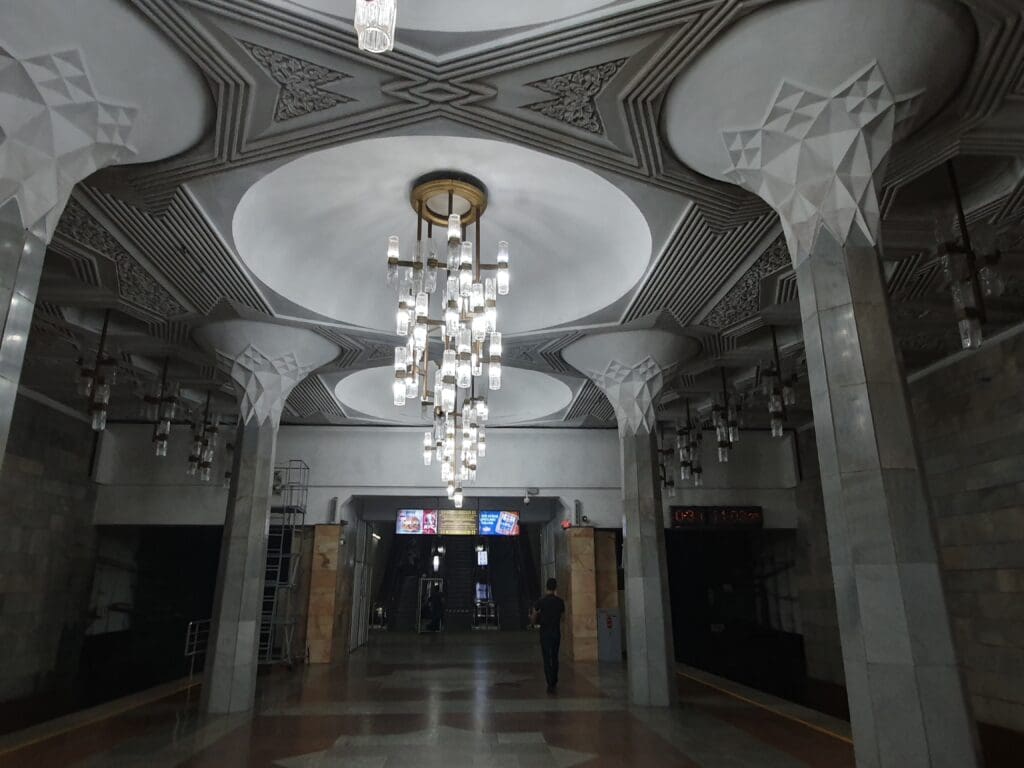
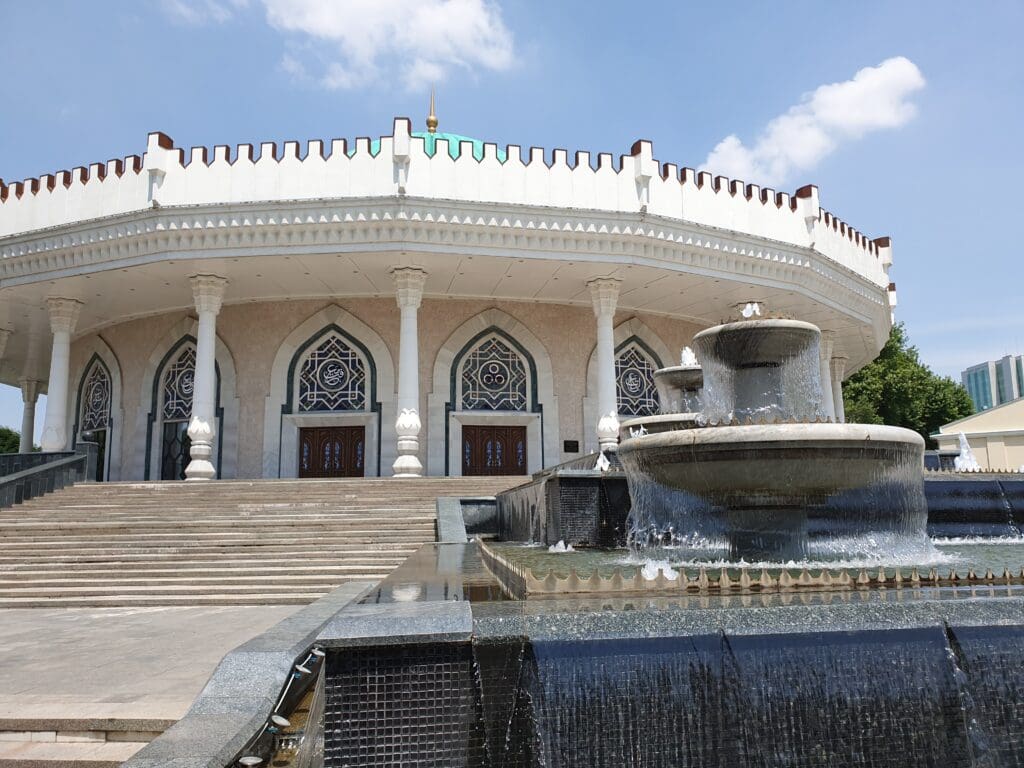
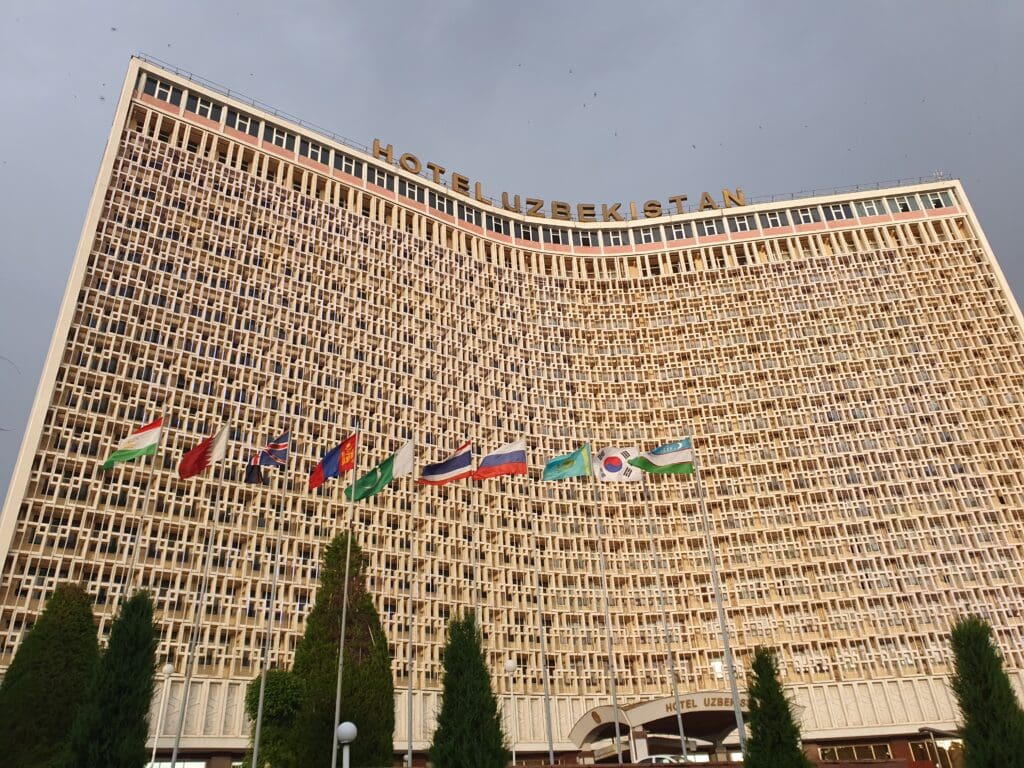

Background
Unless you have spent time in either Korea or Uzbekistan, you may well be unaware of the relationship between the two Asian nations. During the 1930s, many ethnic Koreans residing in the Soviet Far East were forcibly deported thousands of miles away to Central Asia, with many ending up in collective farms in the Uzbek Soviet Socialist Republic. Today, Uzbekistan is home to the sixth-largest Korean diaspora, being home to around 175,000 residents of Korean descent. Following the fall of the Soviet Union, South Korea served as the first country to recognise an independent Uzbekistan. Soon, Uzbekistan saw significant inward investment by Korean conglomerates and today the country is Korea’s largest Central Asian trading partner. More recently, South Korea has become a popular destination for both Uzbek university students and manual workers.
With the above considered, it was unsurprising that at the time of my flight, Seoul Incheon was the most frequently served destination from Islam Karimov Tashkent International Airport outside of Turkey and the former Soviet Union. Specifically, this was served by Asiana Airlines and Korean Air Airbus A330s, and Uzbekistan Airways Boeing 787-8 Dreamliners.
Having already booked a domestic flight with Uzbekistan Airways, I was eager to sample the airline on a longer route aboard one of the latest additions to their fleet. After browsing Skyscanner for flights over several dates, I was pleased to see that Uzbekistan Airways’ services were consistently one of the cheapest options on this route. Specifically, these were only marginally more expensive than the one-stop options with Air Astana via Almaty. Despite always preferring to book directly with the operating carrier, unfortunately, after several attempts, it seemed wholly impossible to book one-way tickets to Korea through Uzbekistan Airways’ website and I thus ended up booking with Budgetair. Following a relatively painless search and booking process, albeit one which required me to sidestep past a number of optional extras, I entered my personal details and paid £251.99 for the ticket. This came with a generous 35kg luggage allowance, which continues to be one of the most generous baggage allowances that I have ever come across in Economy.
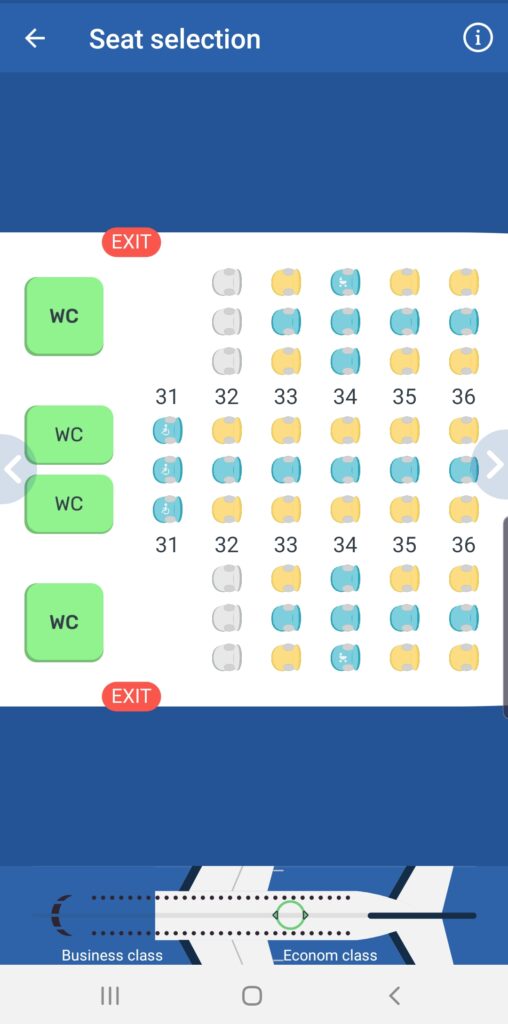
Given the diverse and spectacular scenery that the daytime flight would allow (assuming clear skies), I was adamant about securing a window seat on the ride to Korea. Rather than reserving this through the airline’s website, as I had done the previous day for my domestic flight, I instead decided to download the airline’s app and attempt to do this there. As with the airline’s website, whilst the app is a little rudimentary in design, it allows for all the basic functions such as buying tickets, checking bookings, and reserving seats. Thankfully, the seat reservation system worked fine, and after entering my details, I was presented with the Boeing 787-8 Dreamliner’s seat map. Compared to other airlines that charge for seats, those selectable were either free or available for a small fee of $5.60. The exception to this was emergency exit seats, which cost a little over $20 – thus still being comparatively cheap compared to many other airliners. For example, on a flight of similar distance on British Airways from Heathrow to Kuwait, an emergency exit seat would set you back £65, or from Amsterdam to Abu Dhabi with KLM, €50. After selecting Seat 33A and paying the $5.60 fee, I received three different emails from Uzbekistan Airways confirming my reservation, reassuring me that I would indeed receive my window seat.

The Journey
Forget London City, Seoul Gimpo and Tokyo Haneda – located a mere six kilometres by road from the centre of the Uzbek capital, Tashkent International Airport is a true ‘city centre’ airport! Being a keen walker and aware of the fact that I would spend the majority of the day trapped, albeit happily, in the cabin of an aircraft, the evening before my departure I took to the internet to see whether it would be feasible to attempt to this journey on foot. However, the forecasted heavy rain combined with some uncertainty regarding the presence of pavements on the main road leading to the airport (Uzbekistan cannot be described as the most pedestrian-friendly nation) meant that after some deliberation I abandoned my grand plan and headed to the hotel’s reception to attempt to arrange a taxi for the next morning. Having been royally ripped off by a hotel-arranged taxi in Odessa I approached this negotiation cautiously. Thankfully, after a short dialogue the reception staff guaranteed to use Yandex Taxi (the Russian version of Uber) and that, unless the driver had other plans, I would only pay the fare generated by the platform.
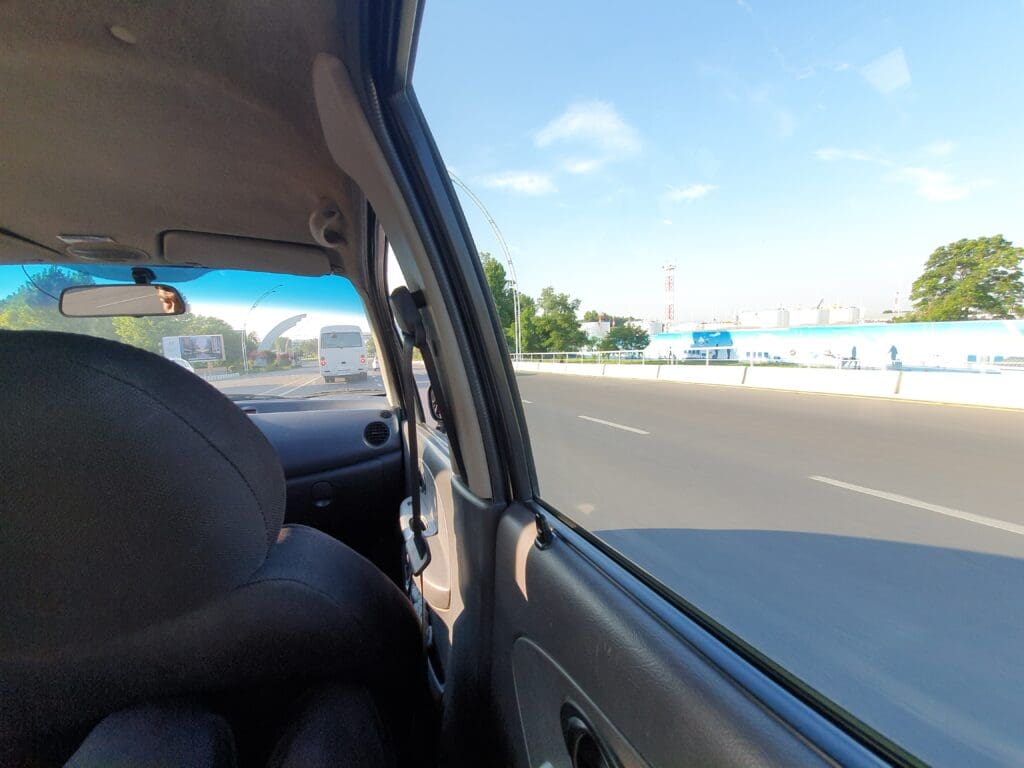
Online reviews of Tashkent Airport highlight inefficient procedures, long queues and the occasional unhelpful official. However, most of these were published before the recent changes to the airport, and, my experience the previous week upon arriving in Uzbekistan was surprisingly smooth other than the long wait for bags. Nevertheless, I decided to adhere to the crucial piece of advice from most, in that passengers must be at the airport a minimum of three hours prior to departure. Actually with my obsession for punctuality and philosophy that time spent at an airport is never wasted, this, for me, is the norm. So, aiming to be there at 0645 I woke at 0550, and, after a quick shower and finishing the last of my packing I headed to reception. Here, one of the staff members ordered me a taxi. Ten minutes later, a tiny silver Chevrolet Spark (the Honda Prius of Tashkent) pulled up and after clambering in we sped through the surprisingly sunny streets of Tashkent, arriving at the airport exactly eight minutes later.
From the outside, it is unlikely that Tashkent Airport’s international terminal will win any architectural awards, taking the form of an uninspiring mix of glass and concrete dating back to 2001. Like airports and train stations across the country, the terminal is surrounded by a tall spiked fence through which only those with official business at the facility can pass through after identity and security checks. Once I had joined a short queue, it took around five minutes to get through the first checkpoint after which I was able to proceed towards the terminal and join another queue for the second security check which would allow me to enter the terminal. Within around fifteen minutes of disembarking the taxi, I found myself standing in the small, overly grey and somewhat worn-looking check-in hall. With a total of nine international departures between my time of arrival at the airport and my scheduled departure time, as expected, the check-in hall was busy with few places to sit down while I waited for check-in for my flight to open.
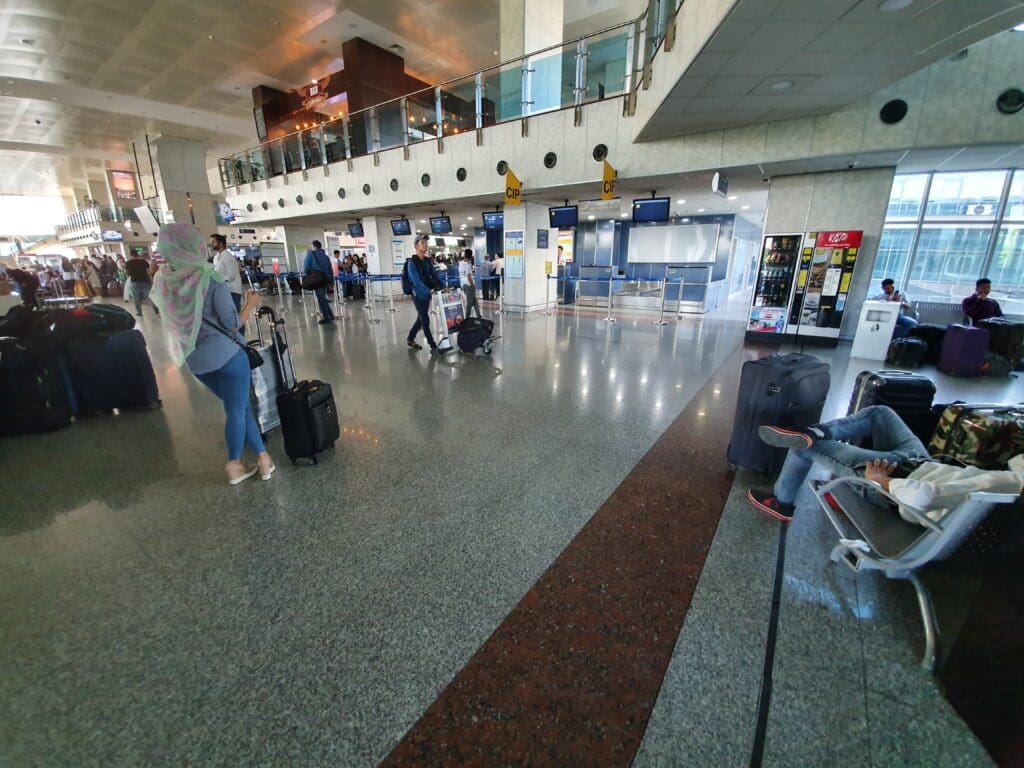
Fortunately, not a great deal of time after arriving at the airport, at 0655 a robotic automated announcement rang out through the hall in Uzbek, Russian and English advertising the opening of check-in for flight HY513 to Incheon. Almost instantaneously a queue of passengers formed at the sole check-in desk allocated for the flight and, despite arriving at the queue within a minute, I found myself approximately twentieth in line to check-in. Interestingly, Uzbekistan Airways seems to have a different baggage allowance for almost every single destination, however, all in all, this can be described as very generous. For my flight to Incheon, Economy passengers were permitted to take 35kg of luggage each, and, judging by the amounts of luggage carried by my fellow passengers, most seemed to be making full use of this allowance. This and the single check-in desk made the experience of check-in a little frustrating. After thirty minutes of attempting to guard my position in the queue, I appeared to have moved approximately three metres towards the desk. However, all of a sudden, an airport worker dragged me away from the queue and asked me whether the small suitcase was the only piece of luggage I was travelling with. Seeing as it was, I was promoted to the front of the queue where I was greeted by a relatively friendly staff member. After a minute or so of furious typing, my Uzbekistan Airways boarding pass was printed off (this fortunately featured my pre-selected choice of seat) and my small suitcase was tagged and sent on its way into the depths of the terminal.
Given the fact that most scathing reviews of the airport take issue with customs and immigration, I decided to head straight to the immigration booths without further exploration of the terminal’s landside facilities. Positively, each booth appeared manned and these were queue-free. I was thus able to walk straight up to a counter and hand over my passport to one of the officers who completed the immigration formalities quickly whilst conversing in what appeared to be a light-hearted conversation with another officer manning the neighbouring booth. After a quick and painless procedure, I headed to the third and final security check, which, like immigration was quick and efficient after which I strolled into the busy airside area.
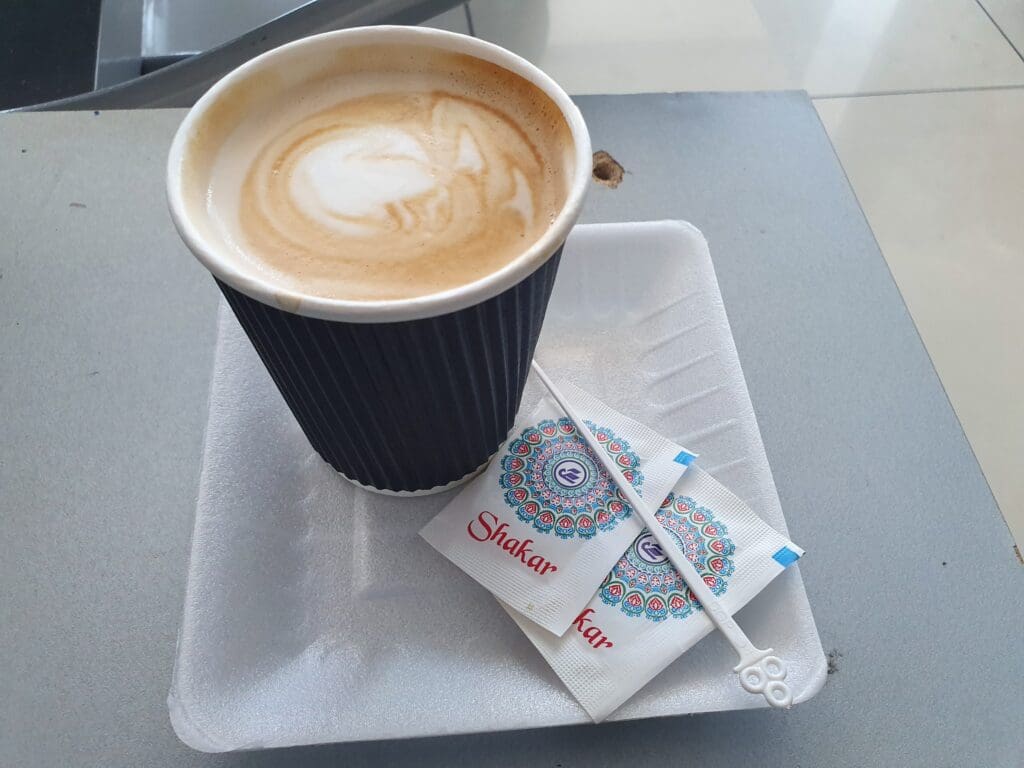
That morning, many passengers appeared to be connecting onwards to Uzbekistan Airways’ Indian destinations, namely Amritsar, Delhi and Mumbai. Meanwhile, alongside my flight to Korea, the other international departures consisted of two flights to Istanbul in addition to services to Almaty, Astana, Bangkok, Dubai, Kuala Lumpur and Moscow. After parting with some of my remaining Som through the purchase of a coffee, I decided to have a quick look around the relatively small terminal.
Despite its size, the terminal houses a few cafes, a bar and a fast food restaurant in the form of the somewhat infamous TAS Burger. In addition, those looking to do some shopping can stop by the terminal’s duty free store. Unlike in the landside area, seating was plentiful and multiple charging points provided. All in all, I have to say that the airside area most certainly beats the landside area – the terminal is relatively clean and modern, open and spacious with large windows allowing for plenty of natural light in addition to superb views of the apron and runways. However, with plenty of signs advising that photography is prohibited, I would strongly advise against any sort of aviation photography if you happen to find yourself passing through Tashkent.
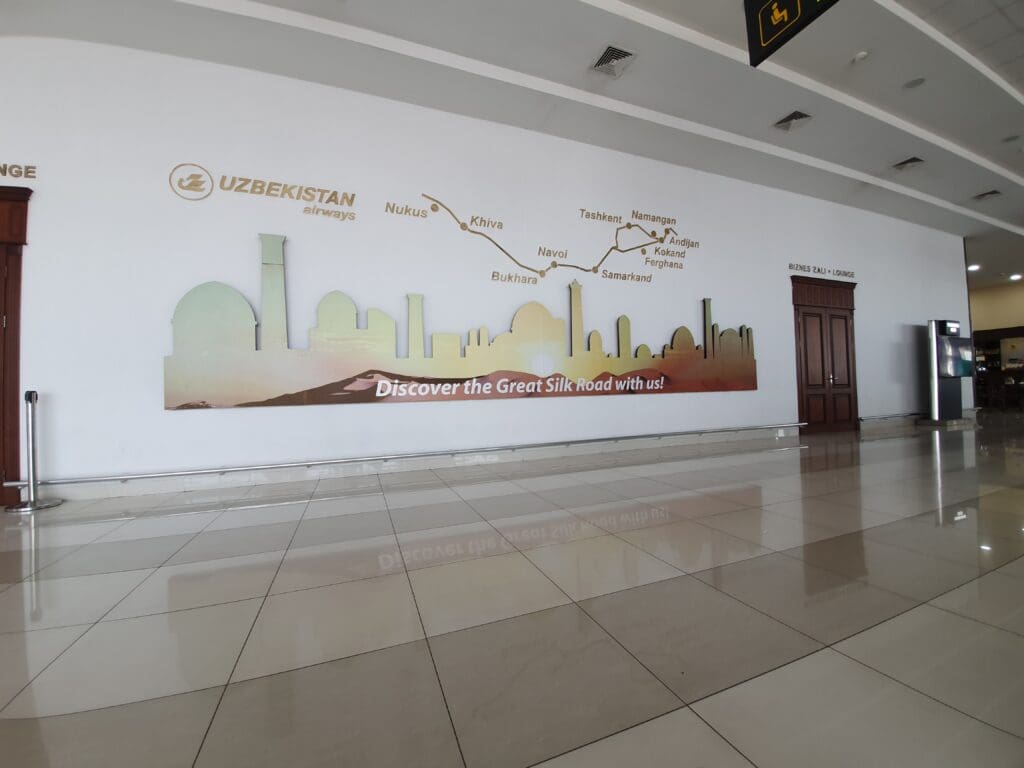

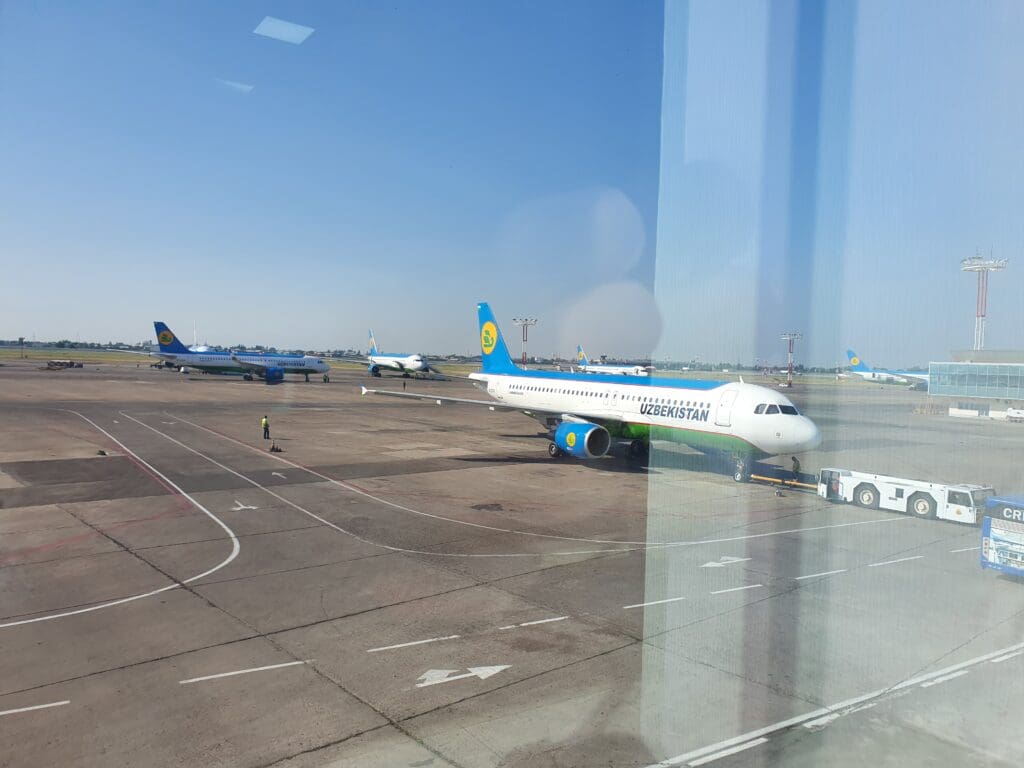
Despite all the positives, I do have a couple of issues with the airport, however. Firstly, whilst free wifi networks appear to be available throughout the terminal, these were non-functional for the duration of my stay. Secondly, whilst the majority of the terminal appeared to be clean and tidy, the same can unfortunately not be said for the toilets, which were in a dire state. Having exhausted all forms of entertainment in the terminal, I turned to the action outside. At that time in the morning, the apron was a hive of activity, with every singly active aircraft type in Uzbekistan Airways’ fleet visible. In addition, two foreign visitors were provided in the form of a pair of Airbus A330s operated by Aeroflot and Turkish Airlines.

According to the time printed on my boarding pass, boarding was scheduled to commence at 0900, however, exactly an hour before the flight’s departure at 0845, an automated announcement was played in the usual trio of languages (Uzbek, Russian and English) informing passengers that boarding had commenced through Gate B9. Not wanting to be a last minute straggler, I promptly headed over to the gate where a large scrum of passengers could be seen in an order that very vaguely resembled a queue. Five minutes after the announcement was made, the scanning of passengers’ boarding passes commenced and after some shuffling, I made it to the front of the queue. Upon handing over my boarding pass, this was scanned and returned to me as I was thanked and wished a nice flight in English by a friendly ground agent. I then headed down a flight of stairs to the ground level and boarded a boiling hot bus on the apron. Being one of the final passengers to board the bus, moments after stepping aboard, the doors closed and the driver cautiously pulled away from the terminal. During the short journey to the remote stand, we passed the same uncomfortable Boeing 757 I had taken on the short 25-minute flight from Tashkent to Samarkand days earlier, with this aircraft now preparing for a morning flight to Amritsar.
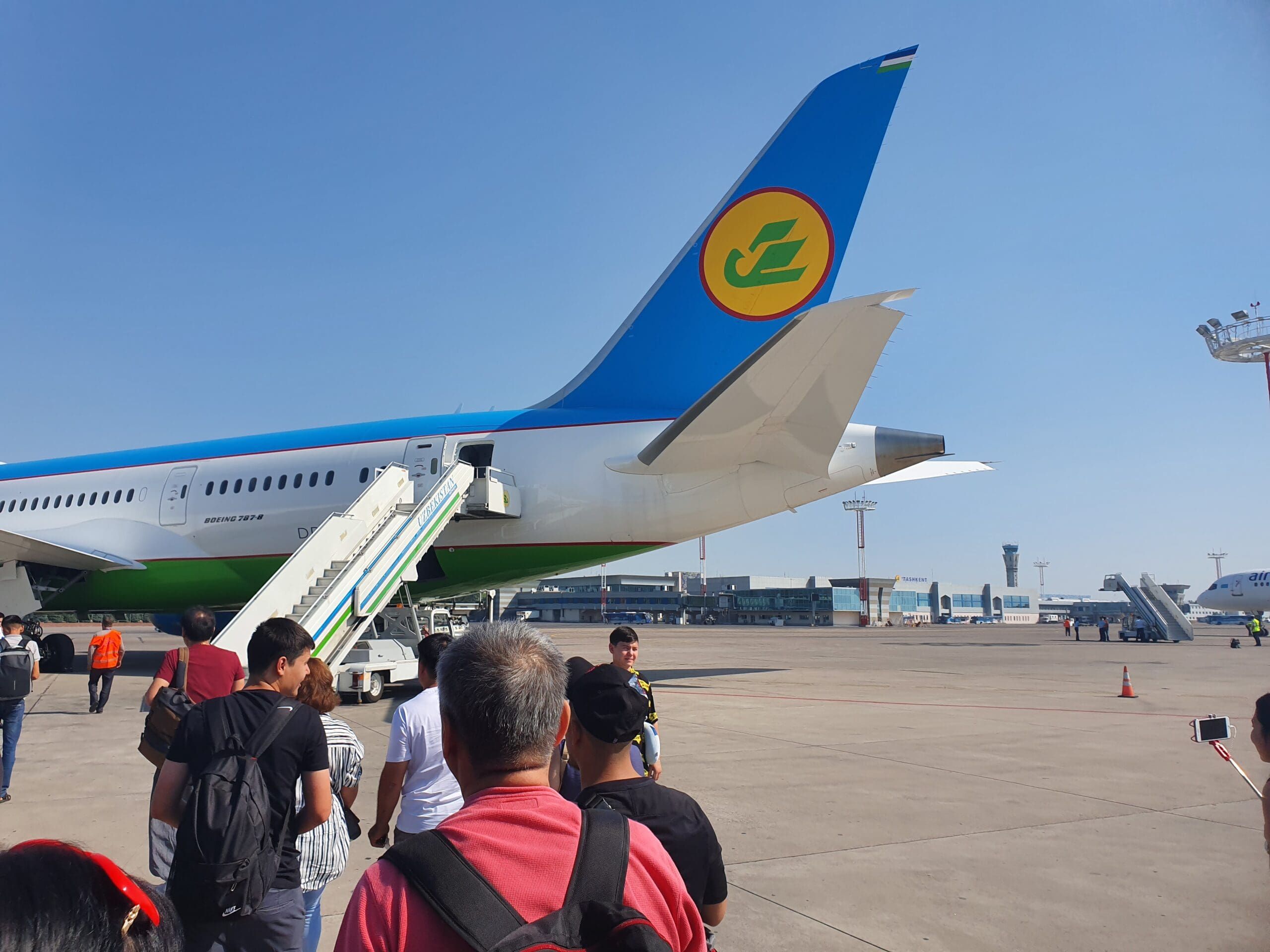
At Stand B8A, Boeing 787-8 Dreamliner UK78704, the then-latest delivery to Uzbekistan Airways could be seen being readied for its flight to Korea, glistening under the bright morning sunshine. Assembled at Boeing’s Everett plant, this particular Dreamliner was just three months old, having taken to the skies for the first time in late February 2019. Once the aircraft had been sufficiently tested and had received Uzbekistan Airways’ distinctive livery in Portland, the aircraft was shuttled across the world to its new home in Tashkent. As with most Uzbekistan Airways’ Boeing 787-8 Dreamliners, UK78704 features a total of 246 seats (24 in Business and 222 in Economy), the exception to this being the sole Dreamliner that has originally been destined for Royal Jordanian Airlines but ended up in Uzbekistan instead, with this featuring the Jordanian national carrier’s interior. In the week before my flight, the aircraft had flown a total of 16 sectors, covering over 37,000 miles and connecting Tashkent with just two destinations – Istanbul and Seoul Incheon.
Once the bus pulled up to the rear of the aircraft, passengers remained onboard whilst a set of airstairs was positioned up to the Dreamliner’s rear door. As this was underway, I watched as a Boeing 757 operated by Kazakh national Air Astana majestically taxied past and pulled up to the neighbouring stand following its journey down from Astana. After no more than three minutes, the bus doors opened and passengers spilt out onto the apron. That morning, boarding was permitted through both the 2L and 4L doors, with passengers free to board through whichever door they saw fit. Seeking to get a good view of one of the massive General Electric GEnx-1B engines that would power us across Asia that day, I decided to board via the former. Having read plenty of reports of those brave enough to openly photograph aircraft on Tashkent’s apron and the usual backlash received from the security guards which consists of the forced deletion of these photos, I was somewhat hesitant to take any. However, seeing as several passengers were openly taking selfies without intervention from any of the multiple tough-looking security guards overseeing the boarding process, I decided to quickly get a few shots of the aircraft.
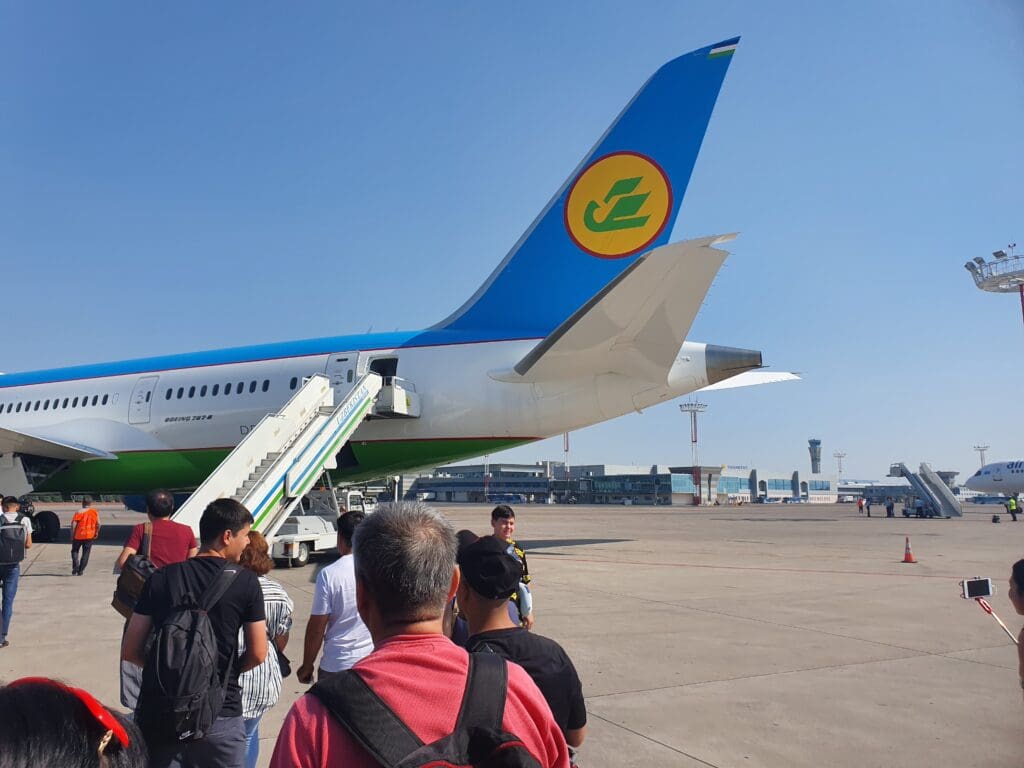
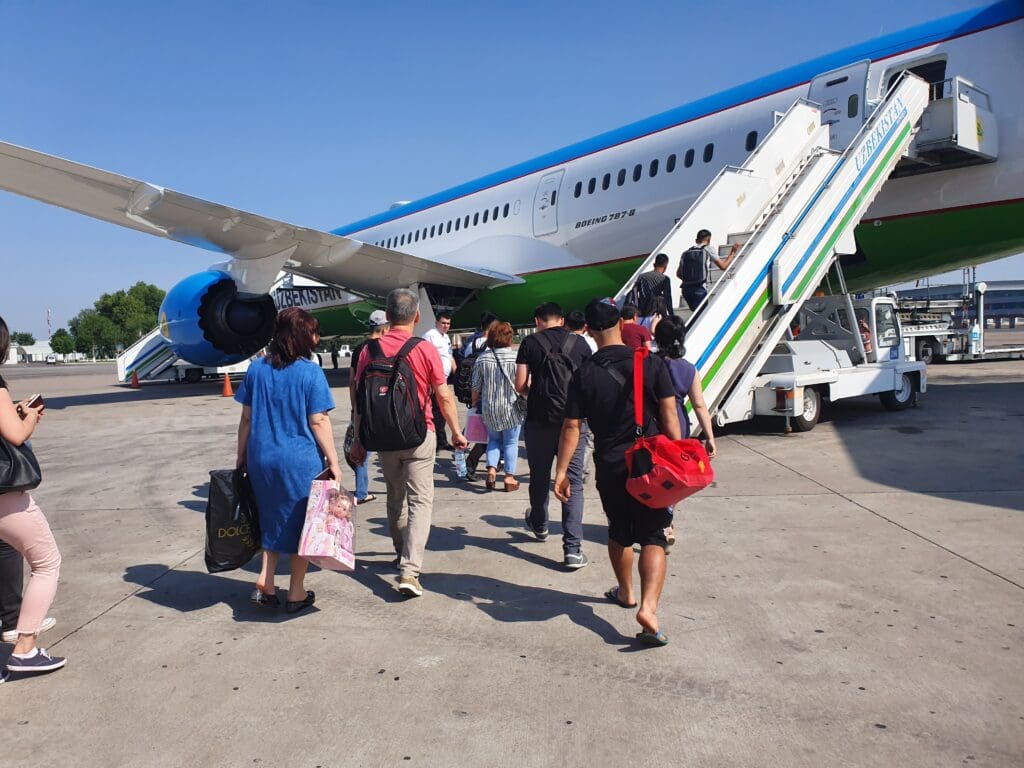

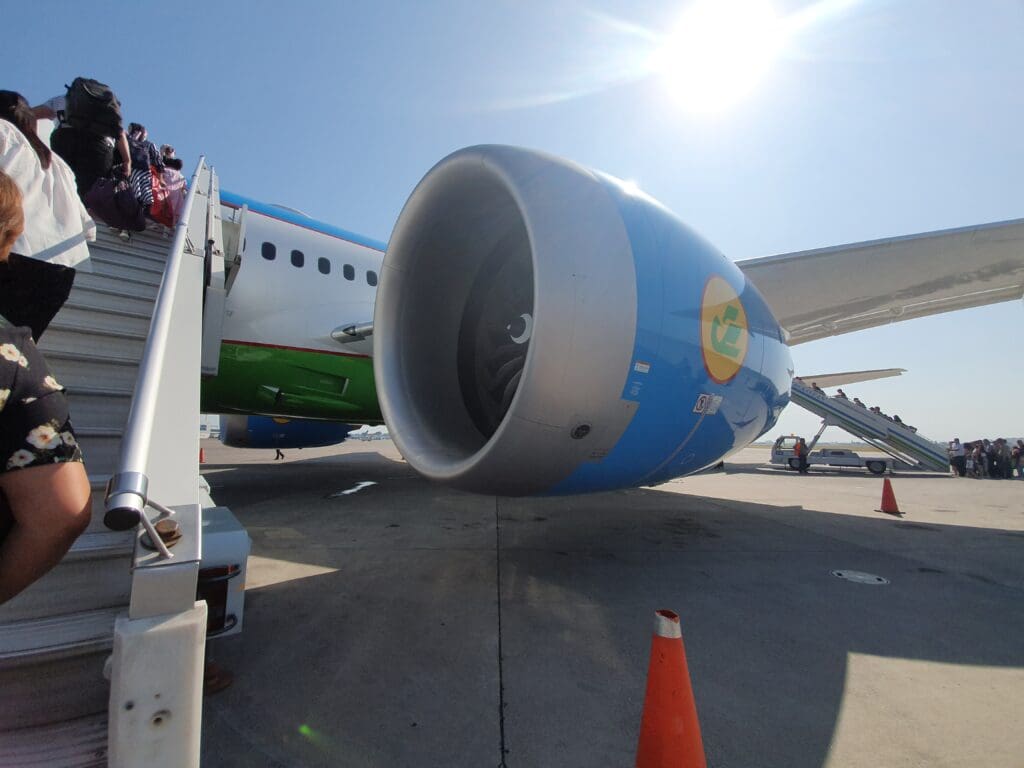
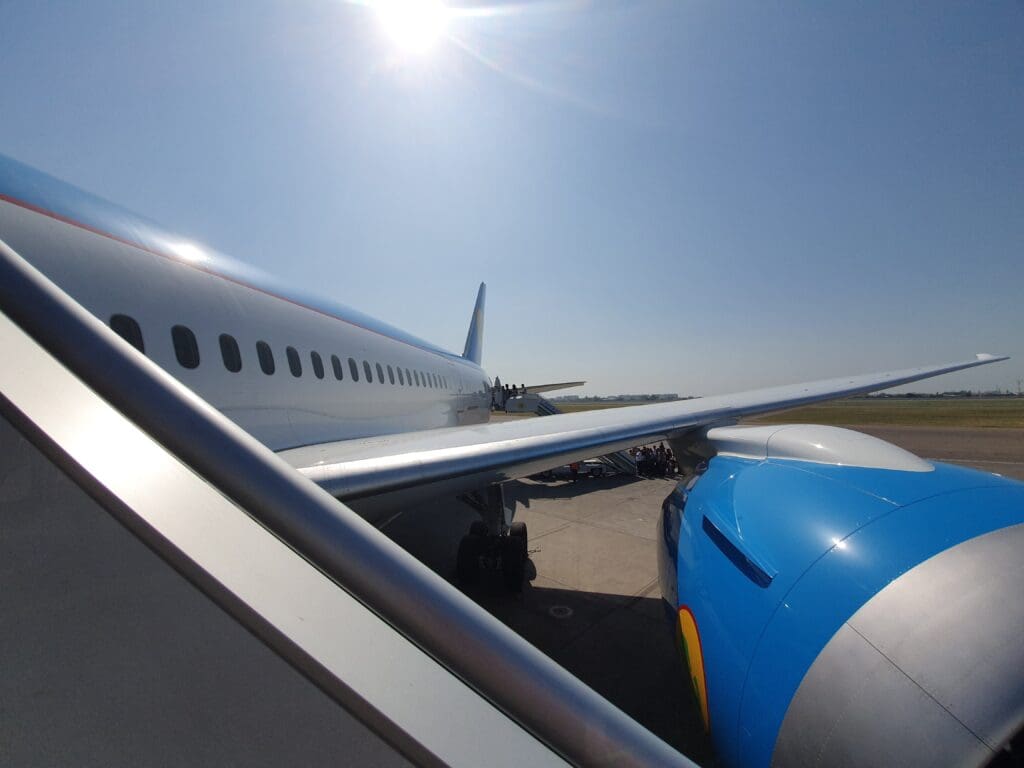
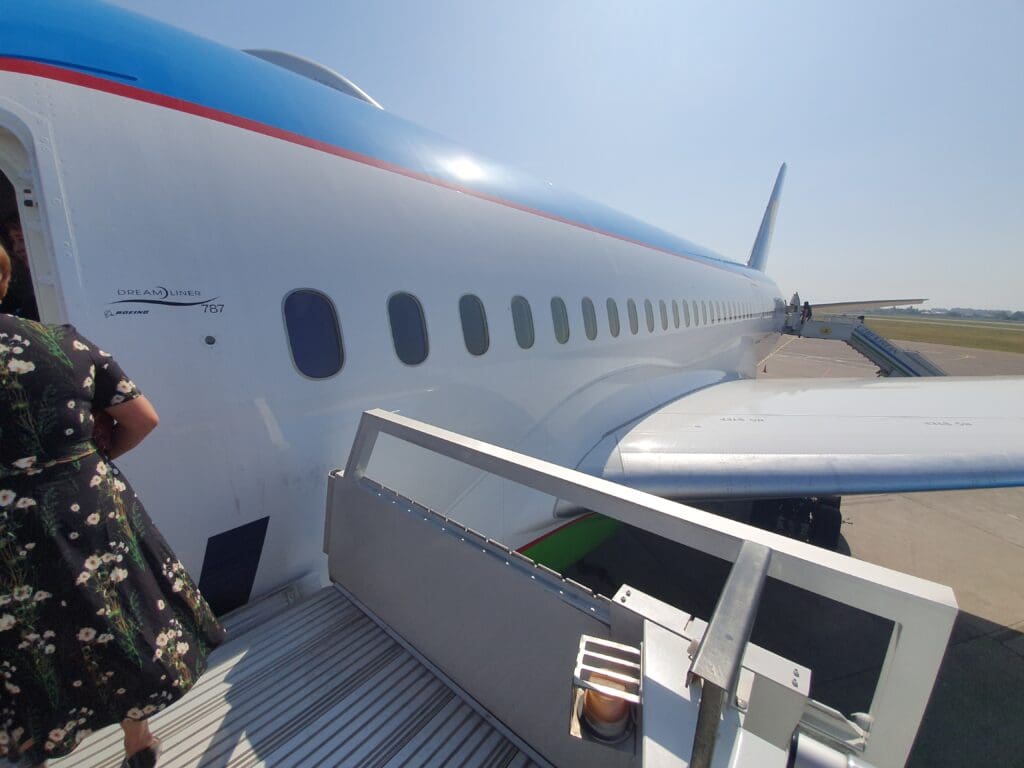
Whilst barely summer, that day would end up being a scorcher in Tashkent, and despite being only 0910, the air temperature already exceeded a balmy 30 degrees! Thus, understandably, many passengers seemed to be eager to dart into the Dreamliner’s cool and refreshing cabin, so not too much of a wait was required on the steps. After a couple of minutes or so spent out in the morning sunshine, I stepped into the galley that separates the main Business cabin, from the unusual isolated single row of Business seats that sits in front of Economy. Once in the galley, I received a lukewarm greeting in Russian and after showing my boarding pass, I was directed to my seat.
Passing through the minuscule rear Business cabin afforded me a glimpse of what life would be like for the next six hours or so for those with the cash to splash on Uzbekistan Airways’ premium product. Other than the sole aircraft that had been destined for Royal Jordanian Airlines, Business Class on all Uzbekistan Airways Boeing 787-8 Dreamliners consists of Zodiac Aura Lite seats in a 2-2-2 configuration. Admittedly, these fail to offer the same levels of space, comfort and privacy as can be found on many other airlines’ Dreamliners, although that said I would not have complained about sitting in one of these seats that day!

Without delay, I passed through the minuscule rear Business cabin and reached the forward Economy section. As one would expect onboard a brand new Dreamliner, the cabin was bright and airy, assisted by the type’s large windows alongside the modern mood lighting shining down from above. Interestingly, whilst Elton John is not particularly well known in Uzbekistan, the British superstar’s 1995 song, Believe, loudly rang through the cabin on repeat, providing an unexpected soundtrack to boarding. In Economy, each seat appeared to be modern, well-padded, and covered in blue fabric. Each was topped with a supportive adjustable headrest partially covered by a disposable antimacassar on which Uzbekistan Airways’ logo could be seen. Meanwhile, each seat featured a large high-definition inflight entertainment screen, powered by Thales’ AVANT system, whilst at-seat power was limited to a single USB-A port. With no expense having been spared, in keeping Uzbekistan Airways’ brand identity, the bulkheads and cabin dividers were dark blue and featured the airline’s swan motif.
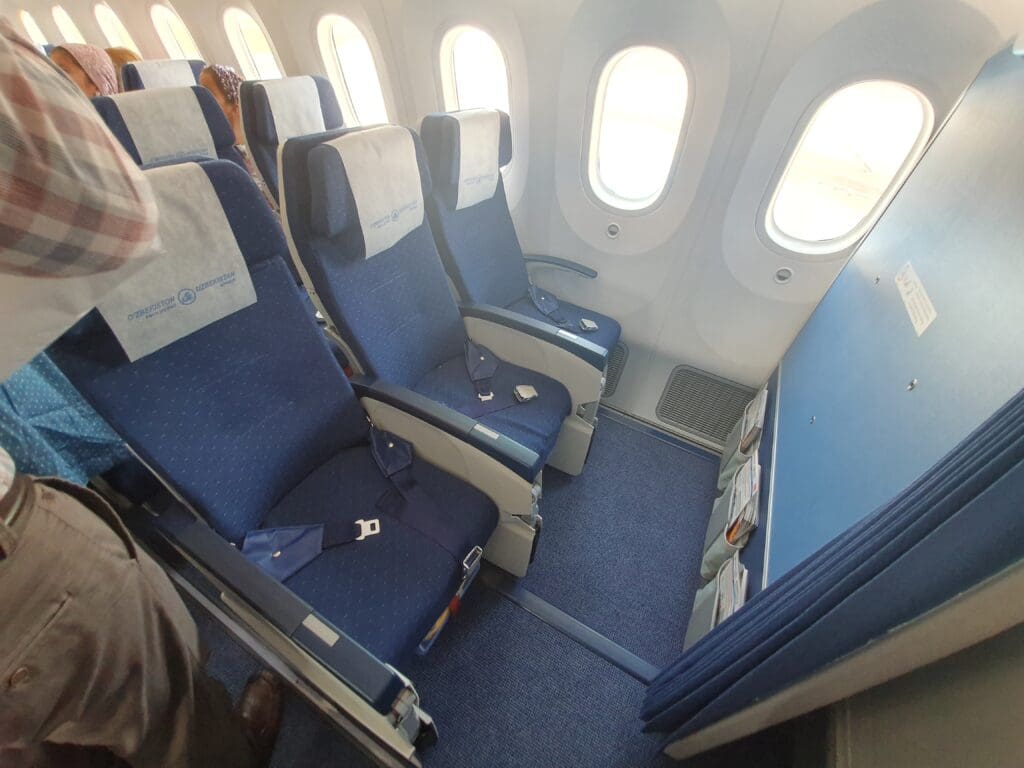
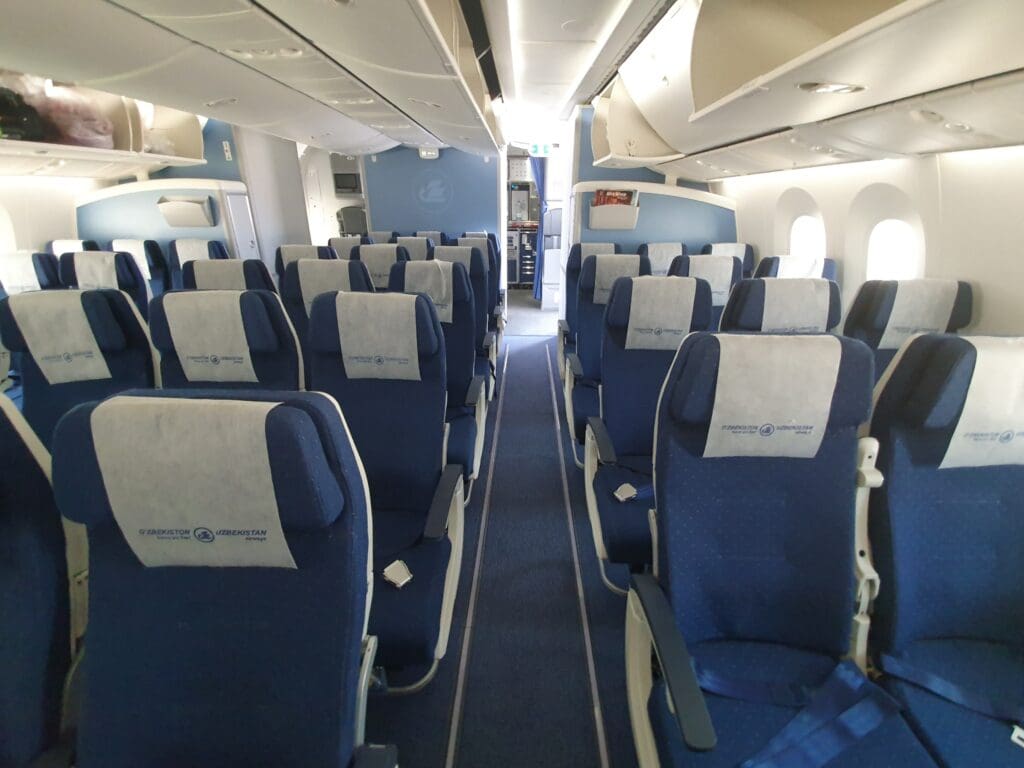
With few passengers in front of me, I soon reached Row 33 in the rear Economy cabin. However, upon arriving there I found that the window seat was already occupied. Fortunately, this was an innocent mistake on the part of the aisle seat passenger and they were more than happy to switch seats after I showed them my boarding pass. Settling in for the flight, I found the seat to be nice and well-padded, with a decent amount of legroom, thereby ensuring that I would be in for a fairly comfortable ride over to Korea. Unsurprisingly given the aircraft’s age, the cabin appeared to be in pristine condition with no marks or scratches visible. In addition, importantly, the cabin appeared to have been immaculately cleaned during its overnight stay on the ground in Tashkent. My only slight complaint was that neither pillows nor blankets had been placed on seats during boarding, although these were handed out later on in the flight. Turning to the seatback pockets, these were filled with a sick bag, a copy of the airline’s inflight magazine as well as the safety card, personalised for those Dreamliners delivered directly from Boeing, UK78701 and UK78702 (obviously printed before the delivery of this aircraft). Soon enough, all those who had travelled across the apron on the first bus had taken their seats and after some waiting, at 0915, the second and final bus pulled up to the aircraft. Once again, the aisles became crowded. Fortunately, seeing as much of the passengers’ luggage had been checked in, there was no jostling for space in the overhead lockers.
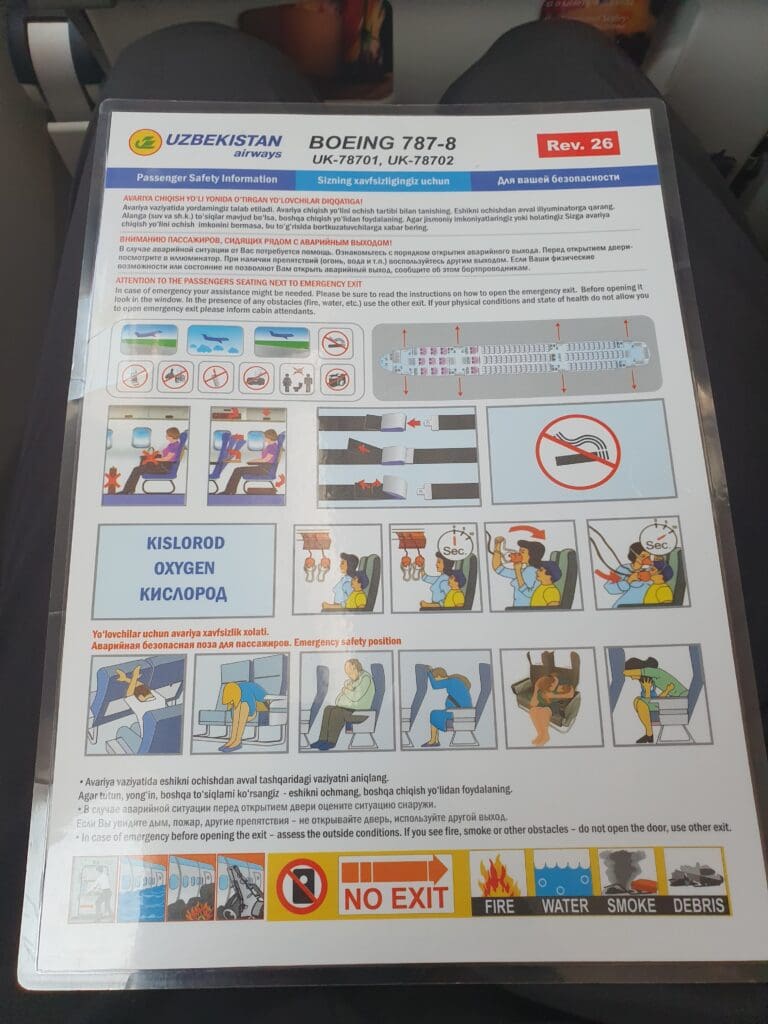
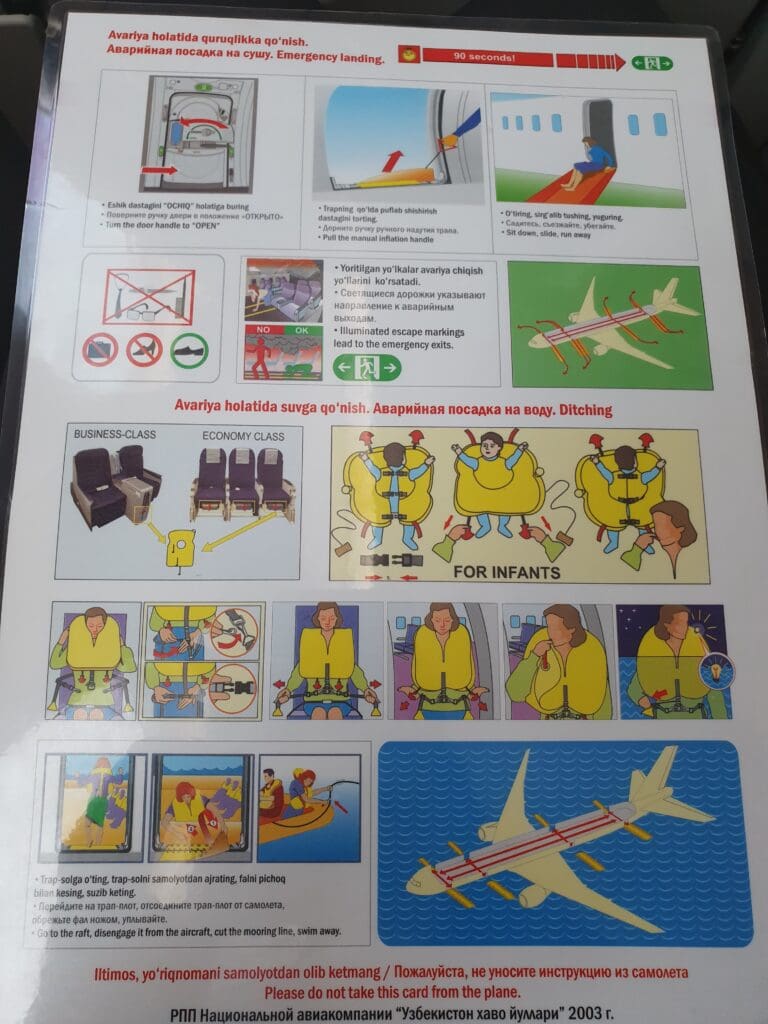

Boarding without fuss, within ten minutes of the second bus arriving at the aircraft, it appeared that all passengers were seated and strapped in for the ride over to Korea. As it turned out, the flight would be around three-quarters full, and most of my fellow passengers took the form of Uzbek nationals, with plenty of families and solo workers heading back to Korea onboard. With all passengers onboard, the rearmost rows of the aircraft were empty and seeing as my aisle seat neighbour was now standing and doing some stretches in the aisle, seeking an entire row to myself I asked a passing crew whether I could move seats. Not making for the best start to the flight, I was given an angry glance and some stern words in a harsh tone consisting of ‘you have a boarding pass, you have a seat number!’.
Thanks to the early start to boarding, with twenty minutes until our scheduled departure time, all passengers were onboard and there was little to do but sit and wait. During this time the crew came around with plastic cups of water and Elton John was temporarily interrupted whilst the Purser performed a tri-lingual welcome announcement in Uzbek, Russian and English. This contained all the usual details including the weather in Seoul and the flight time, which would be a short five hours and forty minutes, with the majority of the flight taking place over China. Immediately afterwards the moodlighting was dimmed and the safety video played three times in Uzbek, Russian and English – with this being a much more modern video than the one that had been broadcast on my Boeing 757 flight over to Samarkand. Whilst easy to follow, I should say that despite Uzbekistan Airways’ regular flights to Korea, there was neither a Korean version of this, nor were any Korean subtitles offered. However, considering there were hardly any Korean passengers onboard, this was perhaps hardly a necessity for that particular flight. Finally, given the date of the flight, once the safety videos came to a close, an announcement was made in Uzbek and English wishing all onboard a happy Ramadan and ‘health and happiness forever’ as the crew came around to make their final checks.

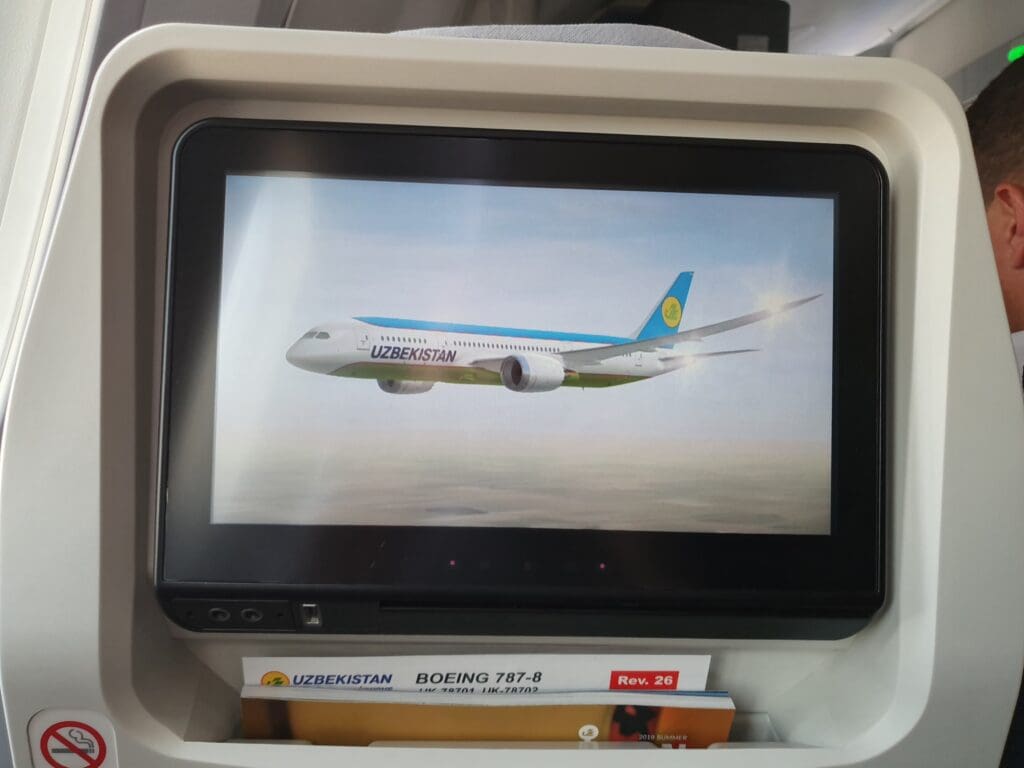
Looking outside, by this time, the security guards drove off and the cones were removed from around the aircraft indicating our imminent departure. At 0938, a full seven minutes before our scheduled departure time, the cabin was filled with electrical whirring and whining sounds before the aircraft’s two massive engines powered up, accompanied by a reasonable amount of vibration. Once our flaps were partially extended and after a short hold for the Bangkok-bound Boeing 767 to taxi past, our aircraft propelled itself forward out of the stand and commenced a very short journey to Runway 8L. During the taxi, the occupier of Seat 32B reclined, and, despite sitting directly opposite two flight attendants in the jumpseats, nothing was said – indicating they either failed to notice this or simply did not care!
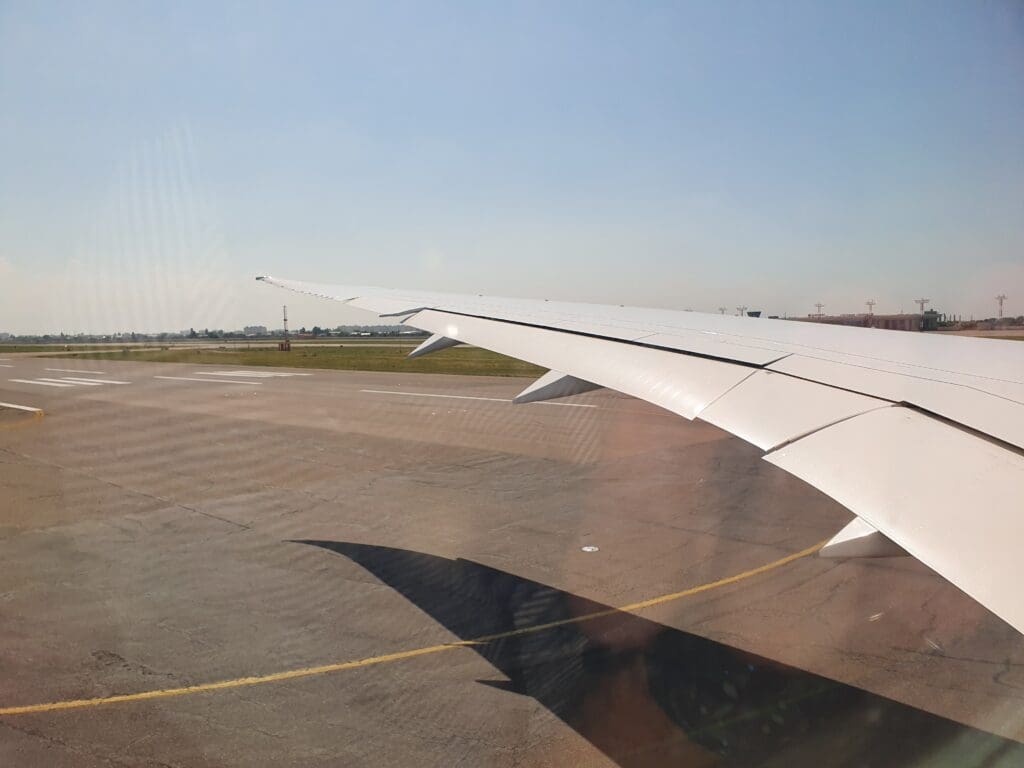
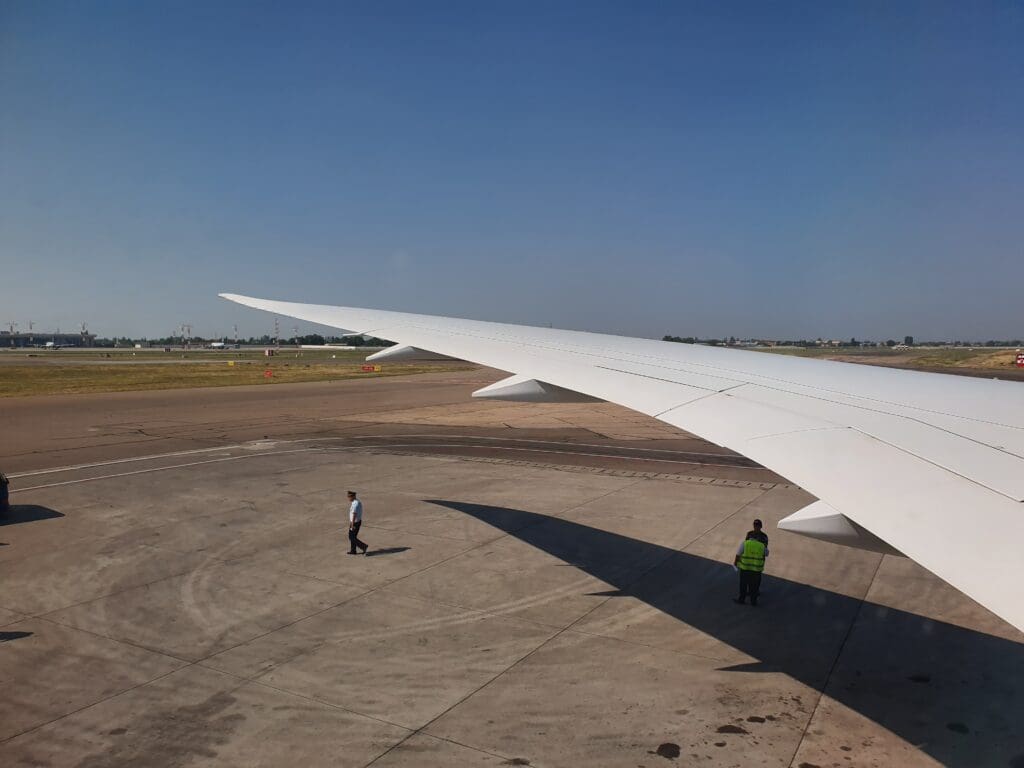
A couple of minutes after leaving the stand, the aircraft reached the runway. With no holding required, the Dreamliner made its way onto this and performed a gentle rolling take-off. As we began to trundle down the runway, I was offered superb vistas of the array of diverse aircraft types that are in long-term storage on the north side of the airfield. After whizzing past the terminal, I spotted types such as the Antonov An-2, Avro RJ85, Ilyushin Il-76, Ilyushin Il-114 and Tupolev Tu-154, before the nose was pointed skywards and we took to the sunny Uzbek skies with a fair amount of vibration. Within seconds of rocketing upwards, Tashkent’s skyline into view. Given the fact that the city is located in an active seismic area, the Uzbek capital’s skyline is largely flat, except for the Tashkent Tower, the twelfth tallest tower in the world.
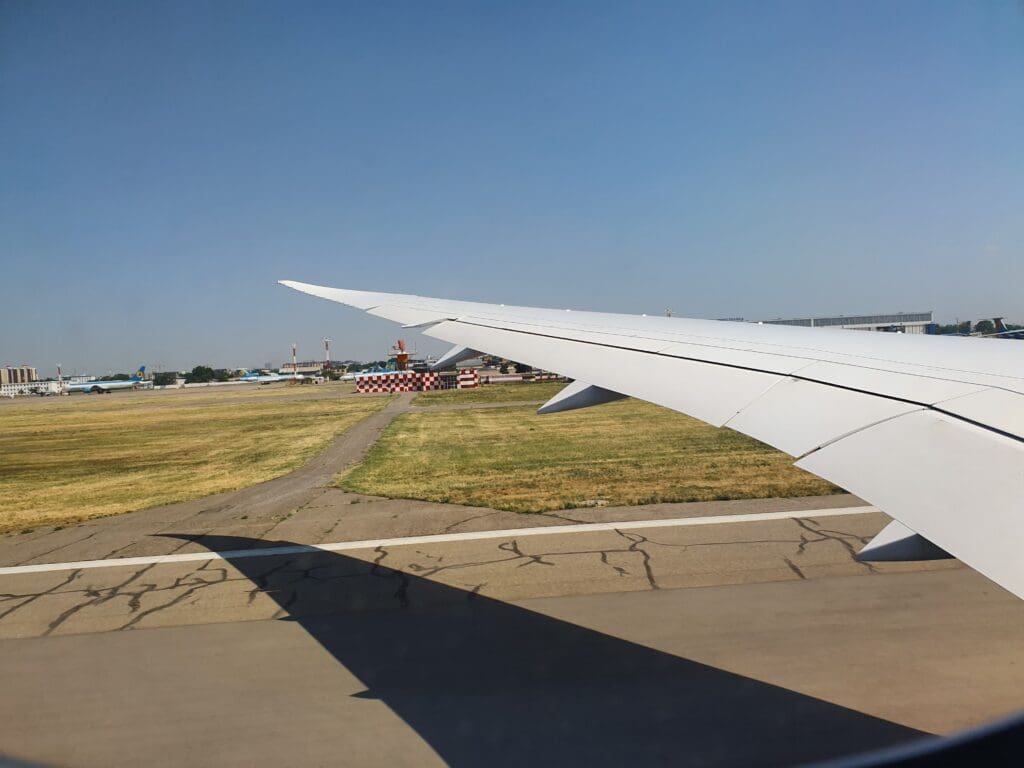
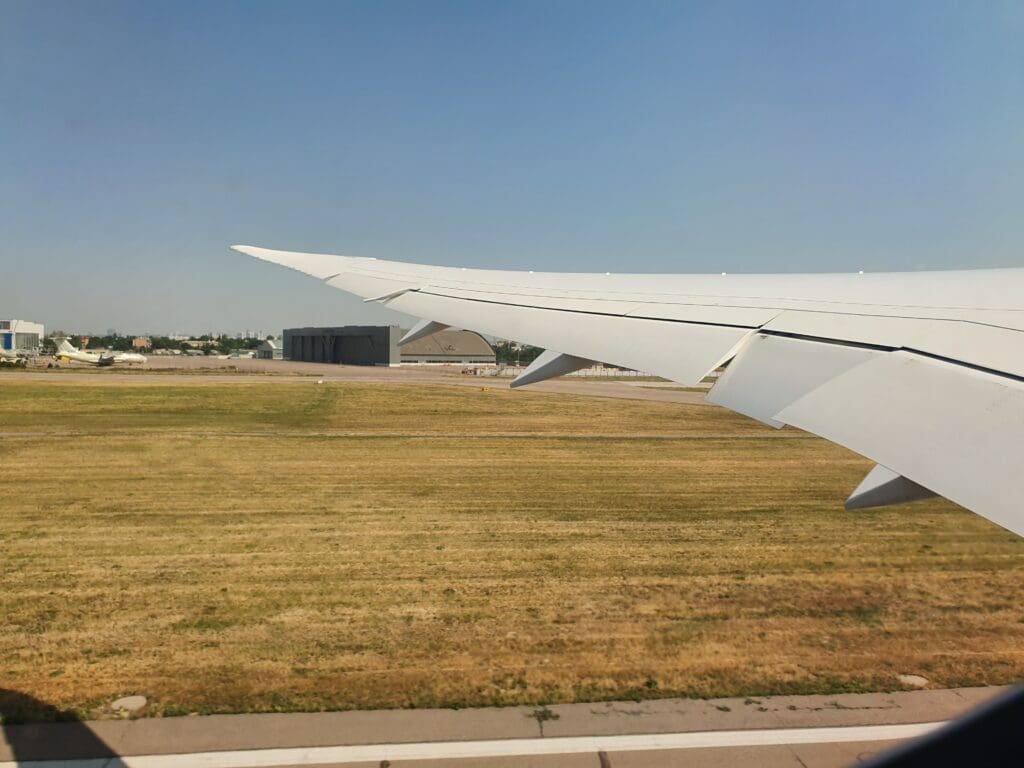
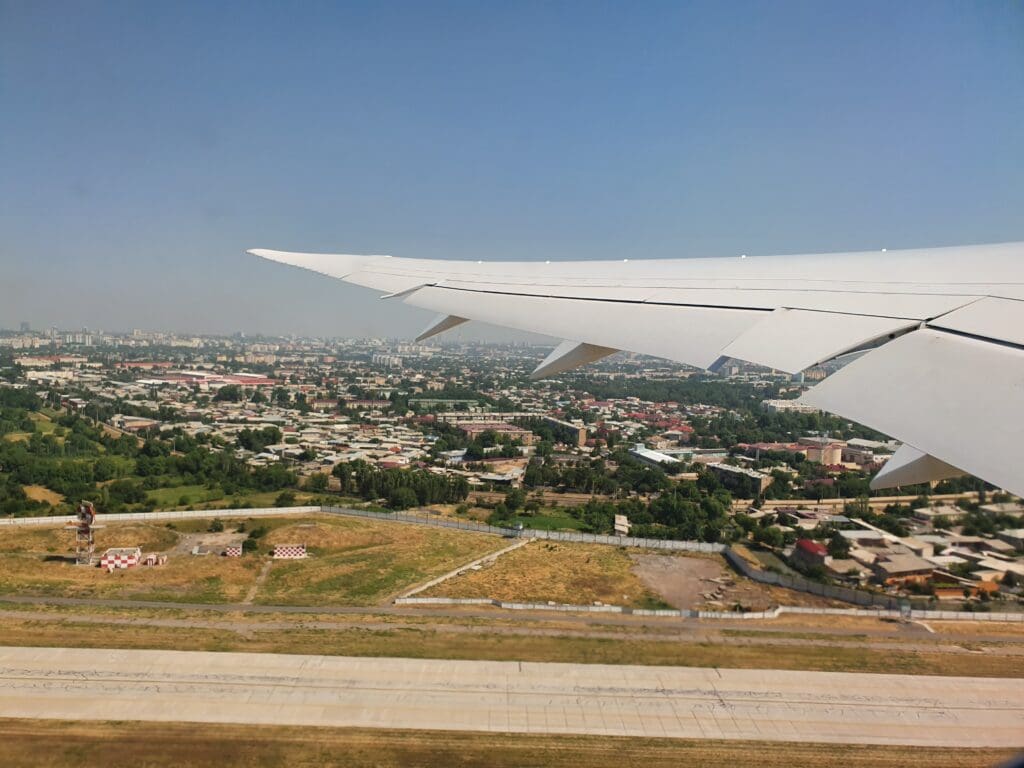
Heading out over the Khrushchevka of Tashkent’s eastern suburbs, no more than a minute or so after taking off Tashkent’s other airfield, Tashkent-Vostochny Tuzel appeared. Whilst little can be found online about this mysterious airfield, as we passed this I spotted rows and rows of Ilyushin Il-76s and other Soviet-era aircraft types. After passing this, the Dreamliner left Tashkent behind and passed over the dry-looking Chirchiq River. As we trundled eastwards, the green fields gradually became dustier in colour as we headed away from the capital, with the landscape soon rising up into hills before transforming into rather impressive snow-capped jagged mountains of Eastern Uzbekistan.
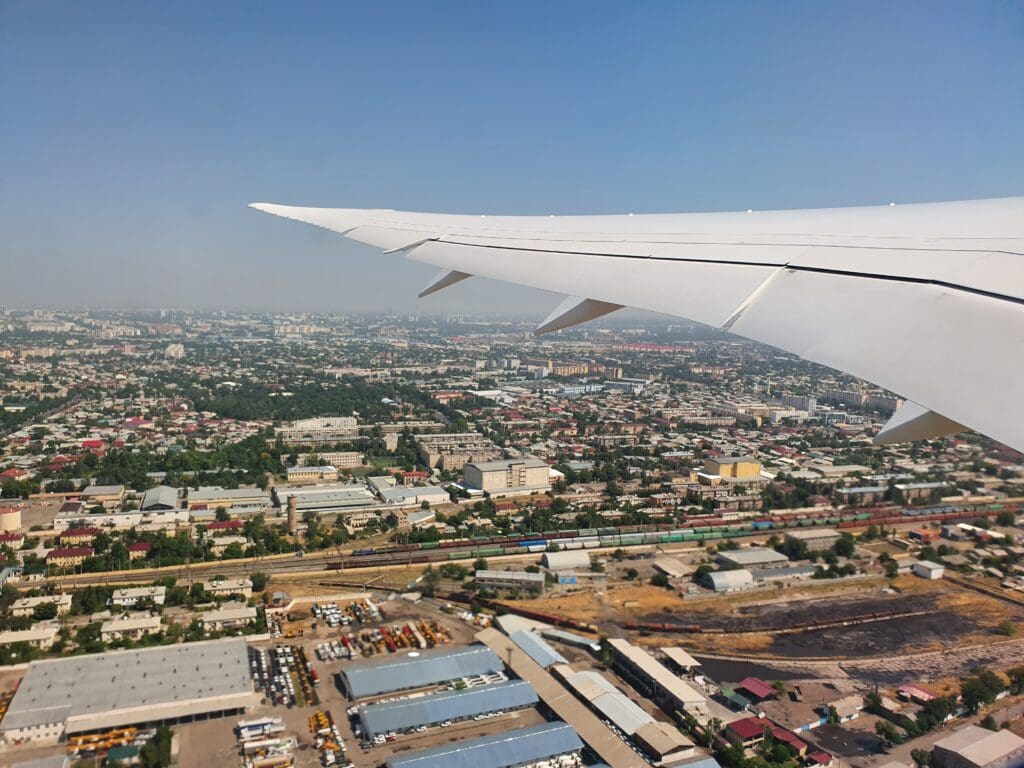

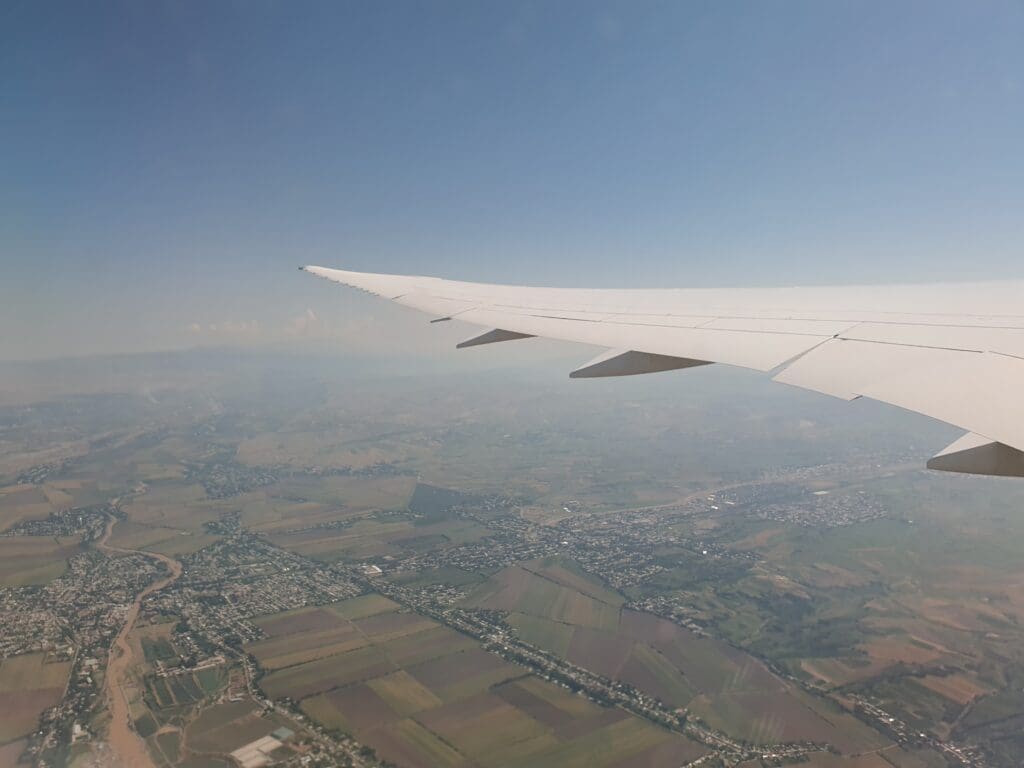

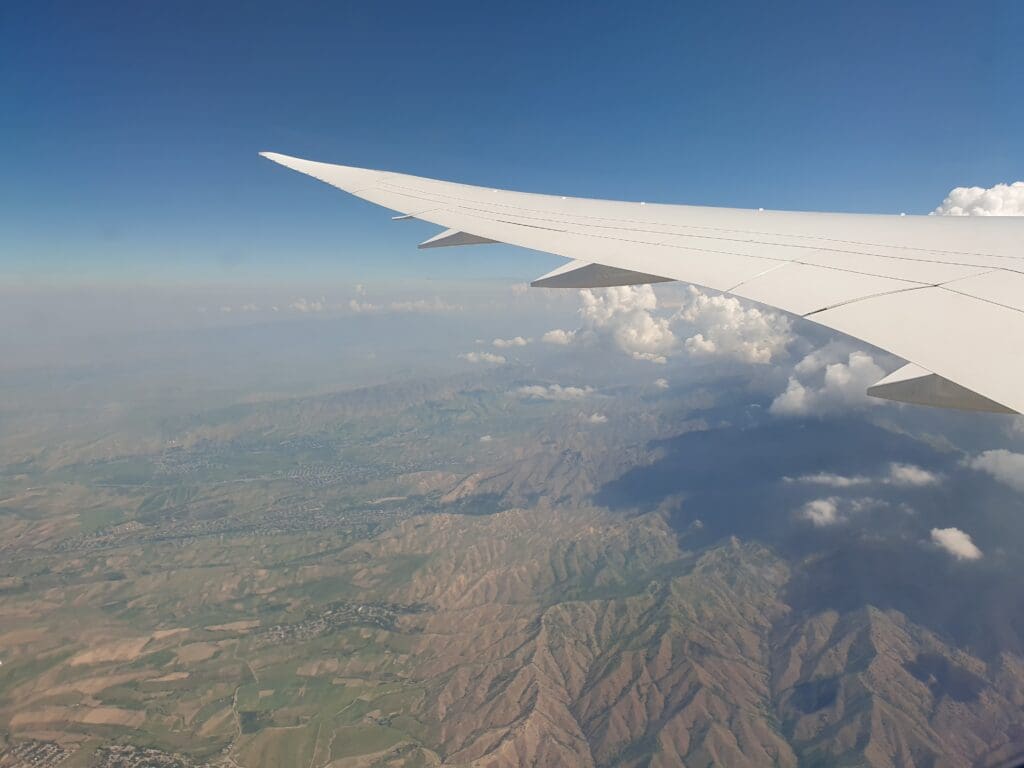
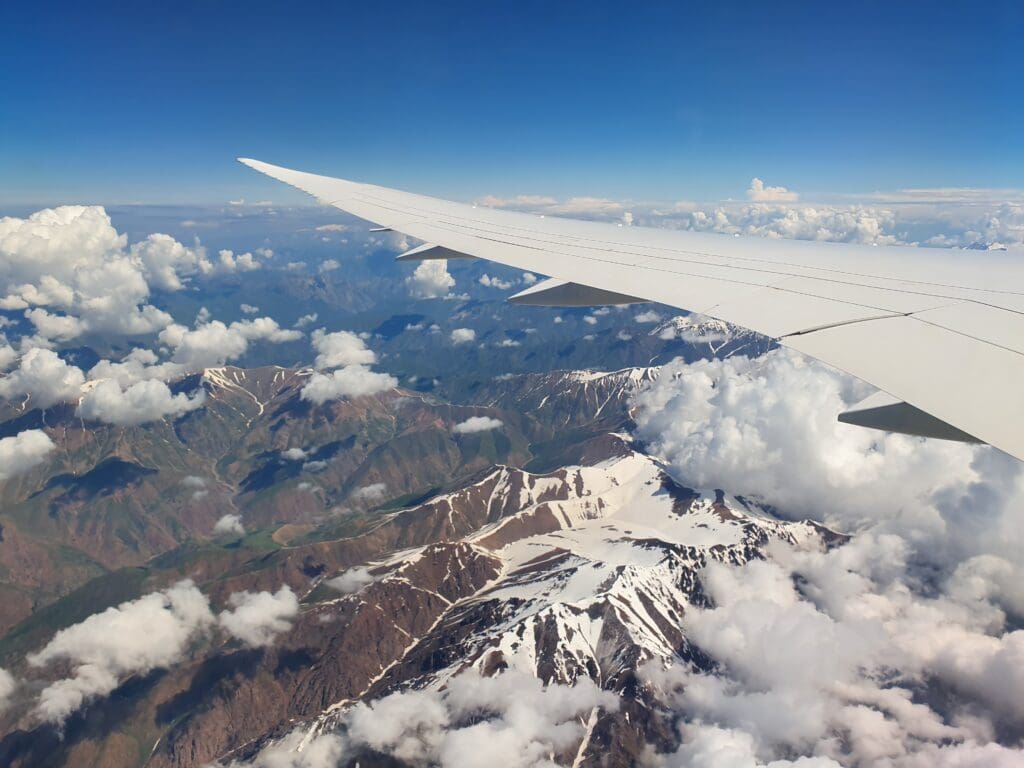
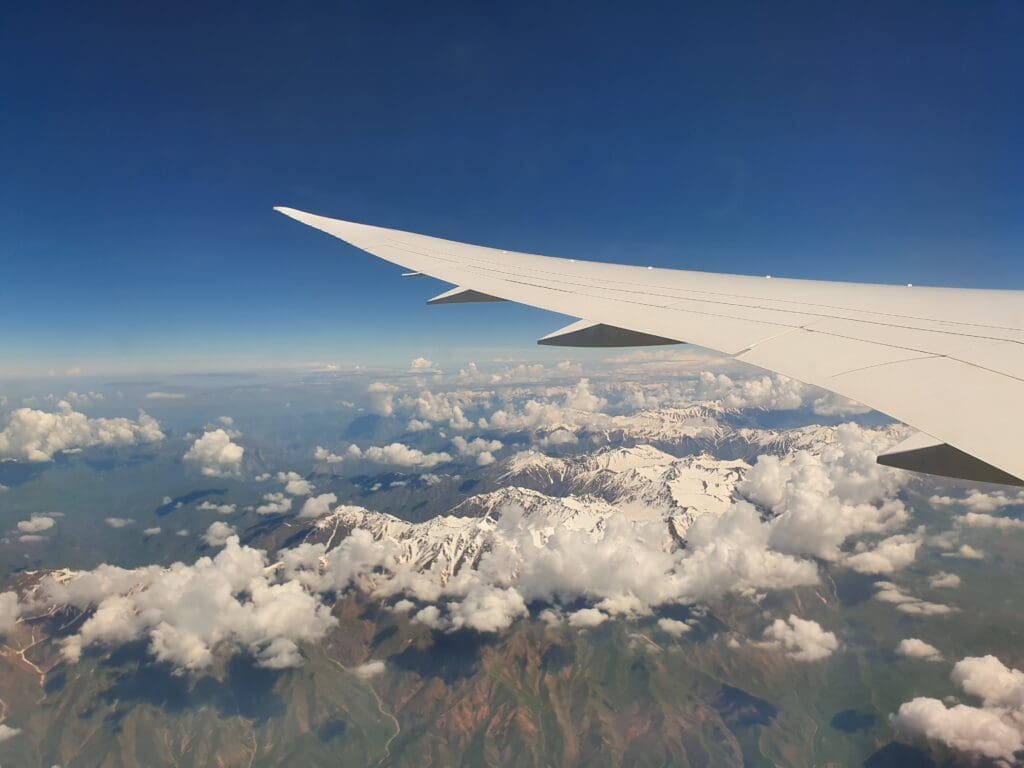
As we neared our cruising altitude of 39,000 feet, the seat belt signs were extinguished and the crew made another announcement, this time giving the usual warnings regarding the usage of seatbelts and the prohibition of smoking on board the aircraft. As this was being made, the crew members came around distributing non-branded headphones – the usual cheap type that can be found on airlines across the world. Once these had been handed out, the crew came around distributing pillows and blankets, however, the crew did a terrible job at the distribution of these, missing out several rows, including mine. Given Tashkent’s location – squished into the northeast corner of Uzbekistan, only fifteen minutes into the flight, our aircraft passed over Namangan before heading into Kyrgyz airspace.


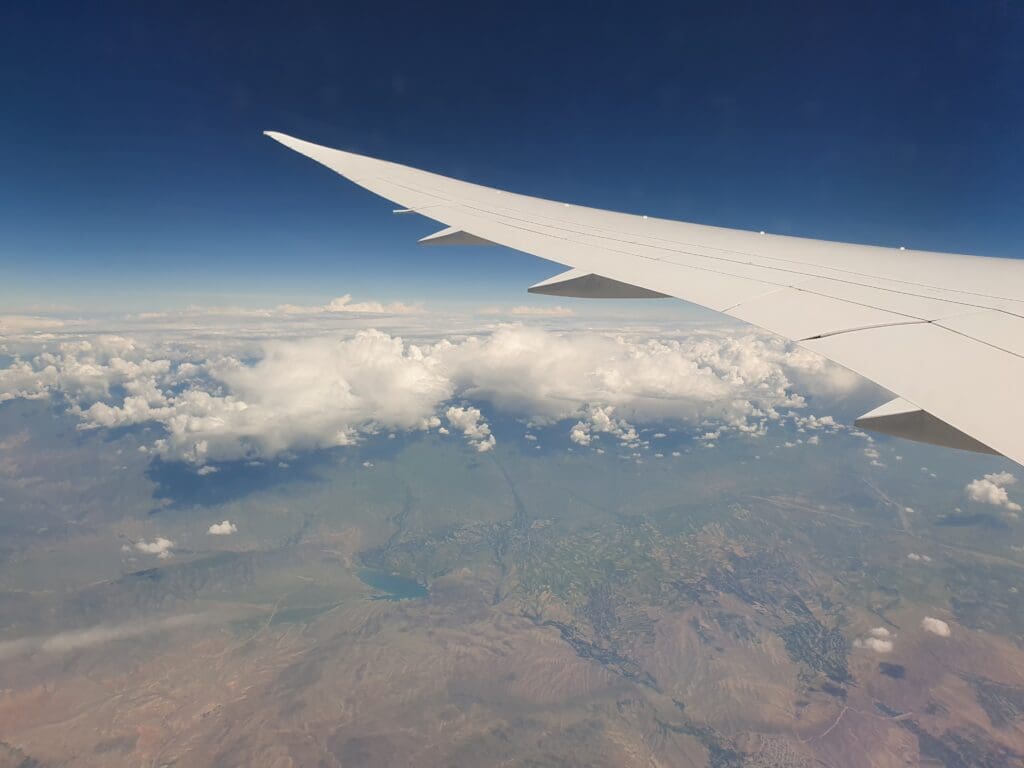

As we passed over Kyrgyzstan, the voice of the reassuringly calm-sounding Captain Igor filled the cabin and they informed us of our flight’s cruising altitude, flight time and expected arrival time of 1925 in Russian and English. Once this had been completed, the drinks service commenced and at 1030 one of the crew members reached my row. Without any words I was given another angry glance, seeing this as my cue to ask for a drink, I requested an orange juice which was poured right to the brim and then shoved in my direction, causing it to spill on the aisle seat occupier and the middle seat. In addition to this, I was also handed a packet of peanuts, a wet wipe and a serviette. Seeing as the aisle seat occupier received the same cold service, I did not take this too personally. As I drank this, I admired the landscape of rural Kyrgyzstan before this was swallowed by clouds which parted around fifteen minutes later upon entering Chinese airspace.

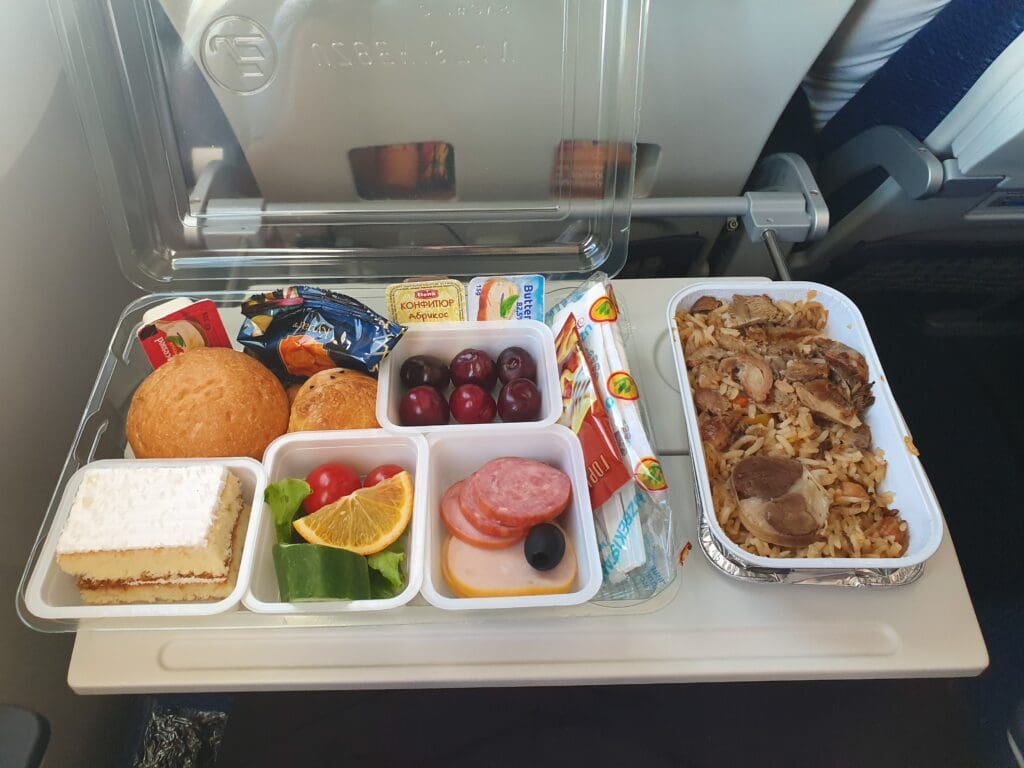
As soon as the initial drinks service had been concluded, the crew got to work distributing the early lunch/late breakfast, or rather brunch service. That morning the options consisted of chicken or plov. Seeing as I would likely not have the opportunity to enjoy Uzbekistan’s national dish anytime soon, I opted for the latter. This was handed to me in a standard foil container along with a plastic box containing a wide selection of side dishes – namely, a selection of meats, a salad, a meat pastry, a bread roll, cherries, a slice of coconut cake and a packet of dried apricots. Meanwhile, condiments came in the form of apricot jam, butter, cheese spread and mustard. Overall, whilst the presentation left a little to be desired, the sheer quantity of food was somewhat impressive. I soon pulled back the metal lid of the main dish and found a reasonably sized portion of meat plov staring back at me. Taste-wise, this was fairly reasonable however the rice seemed a little dry, likewise the side dishes were all of acceptable quality. Around twenty minutes after receiving my meal, a tea and coffee round was made and after another ten minutes the trays were taken away.

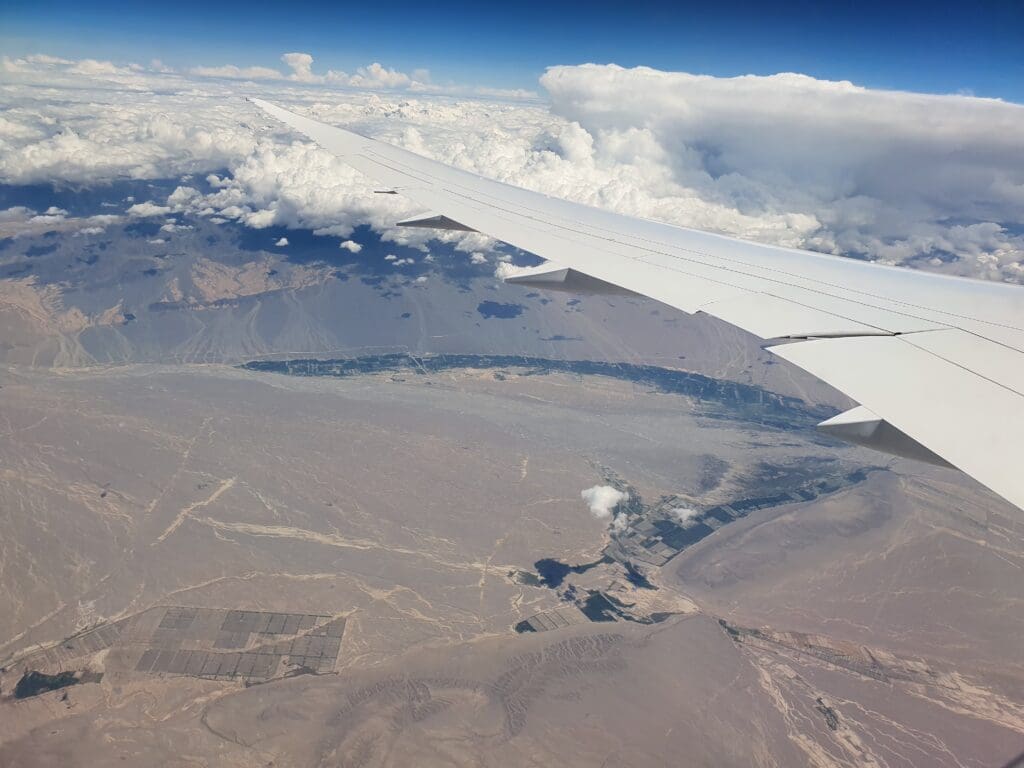
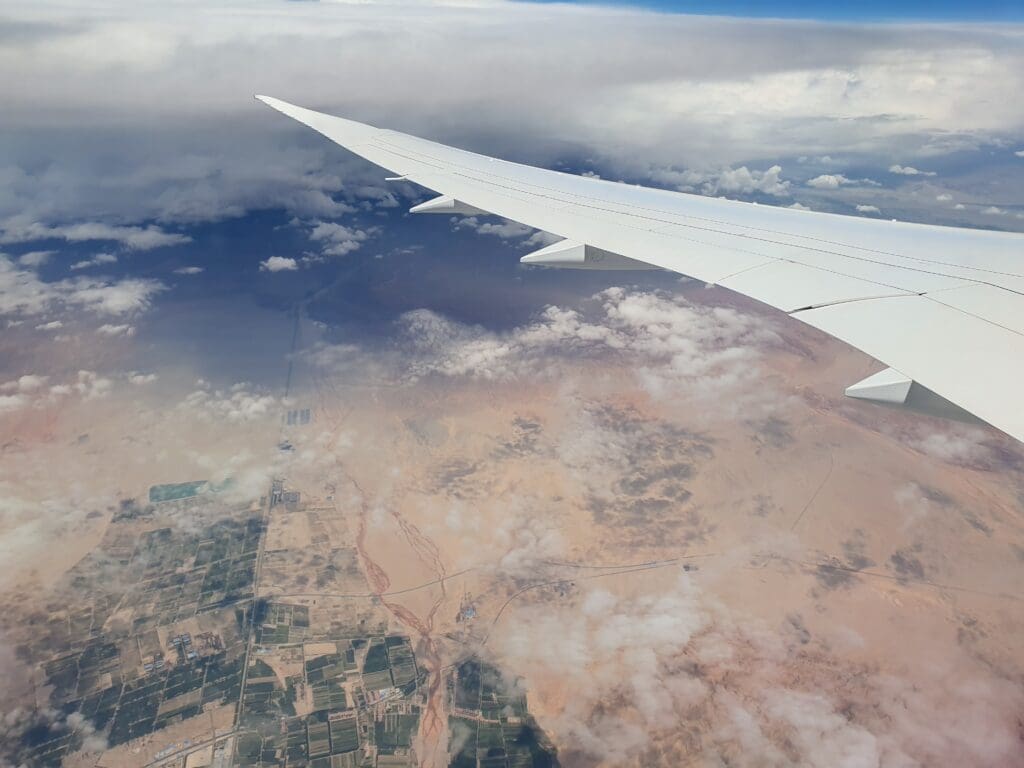
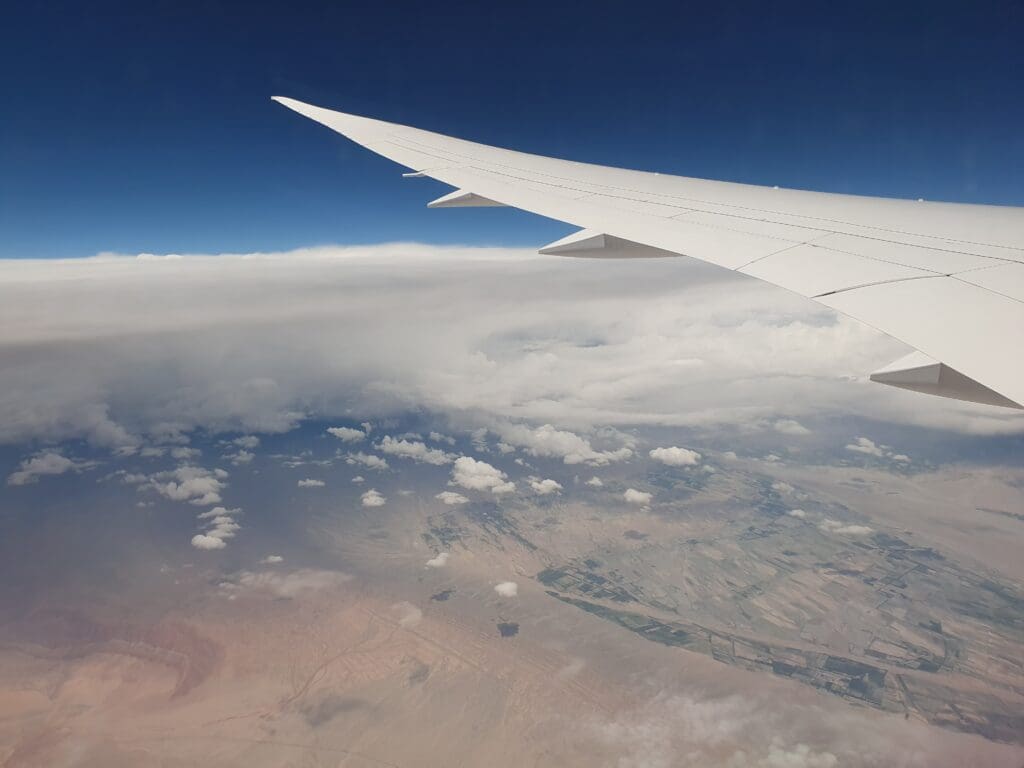
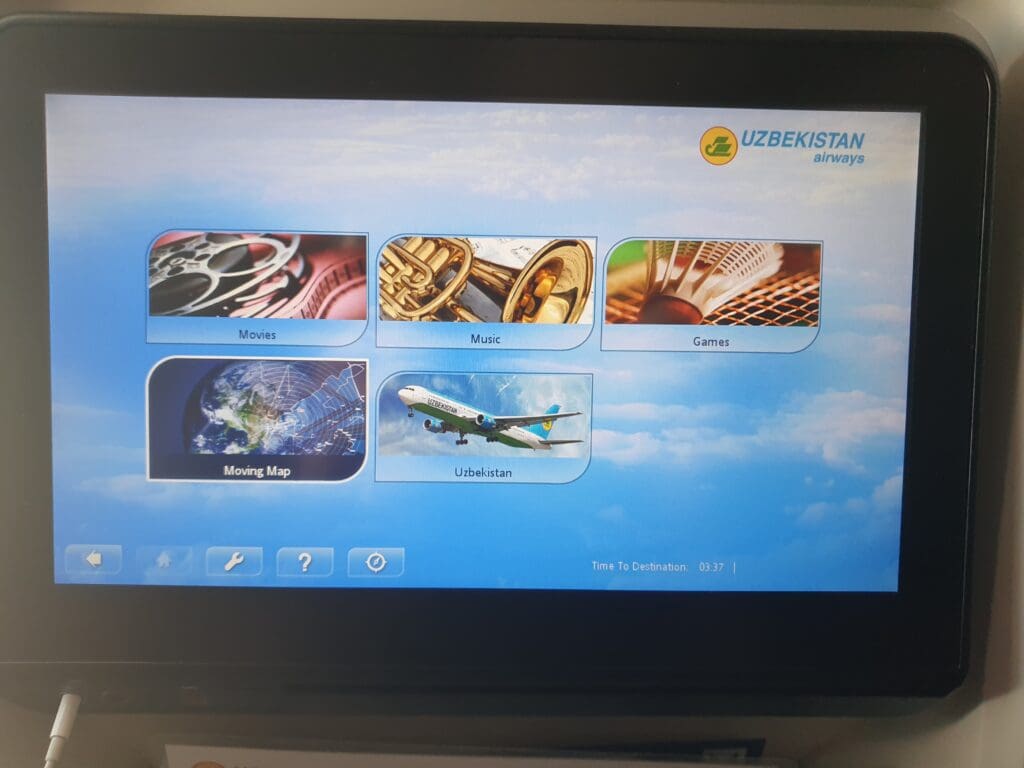
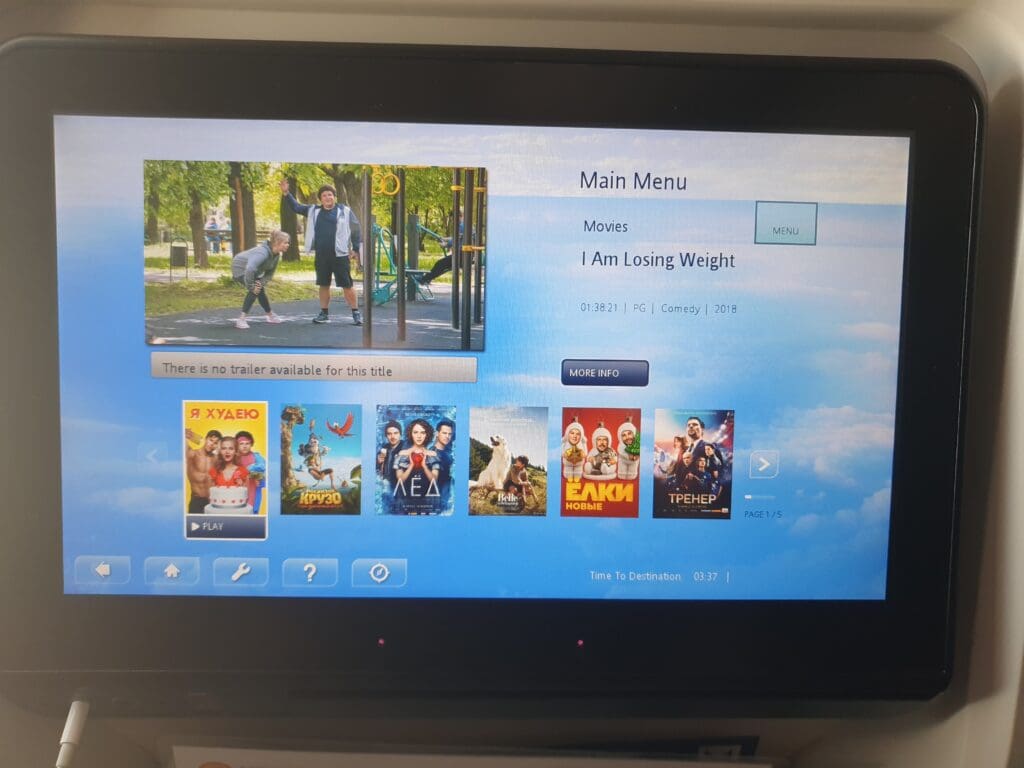
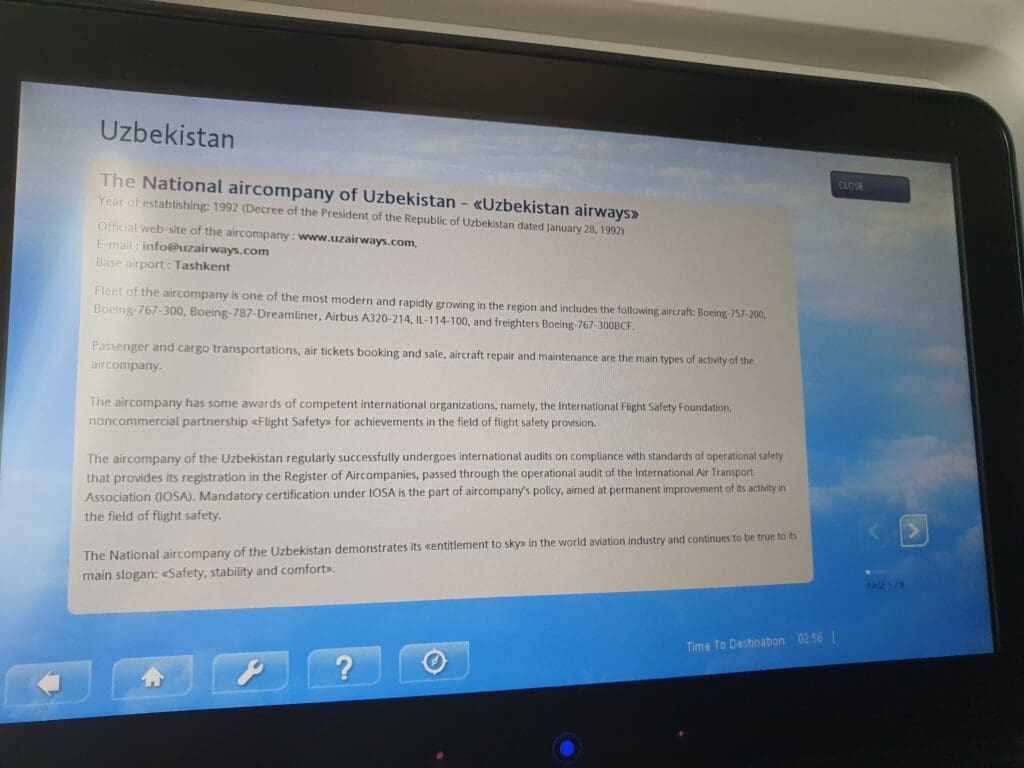
By the time the lunch was over, clouds had come in once again beneath the aircraft blocking any view of the impressive and diverse landscapes of Xinjiang. Aside from overtaking the Boeing 767 that had taxied ahead of the aircraft on the ground in Tashkent, little entertainment was provided by the world outside. I thus decided to turn to the inflight entertainment system. As always with the AVANT system, I found the screen to be responsive and of very good quality. Whilst Uzbekistan Airways has a fairly wide-reaching network of flights, the system is only available in Uzbek, Russian and English. As one may expect, content-wise the system is much more modest than those of most major airlines with a grand total of 25 films (these originating in France, Hollywood, Russia and Uzbekistan), 28 albums/playlists (split into six categories – classical, jazz, new age, pop, rock and Uzbek), ten games and eight pages of information relating to Uzbekistan. Interestingly, television programmes served to be entirely absent. Last but not least, wifi is also available for purchase onboard the aircraft, requiring a voucher code from the crew. This comes in a range of packages, starting at $5.95 for 20MB up to a hefty $52.95 for 220MB.



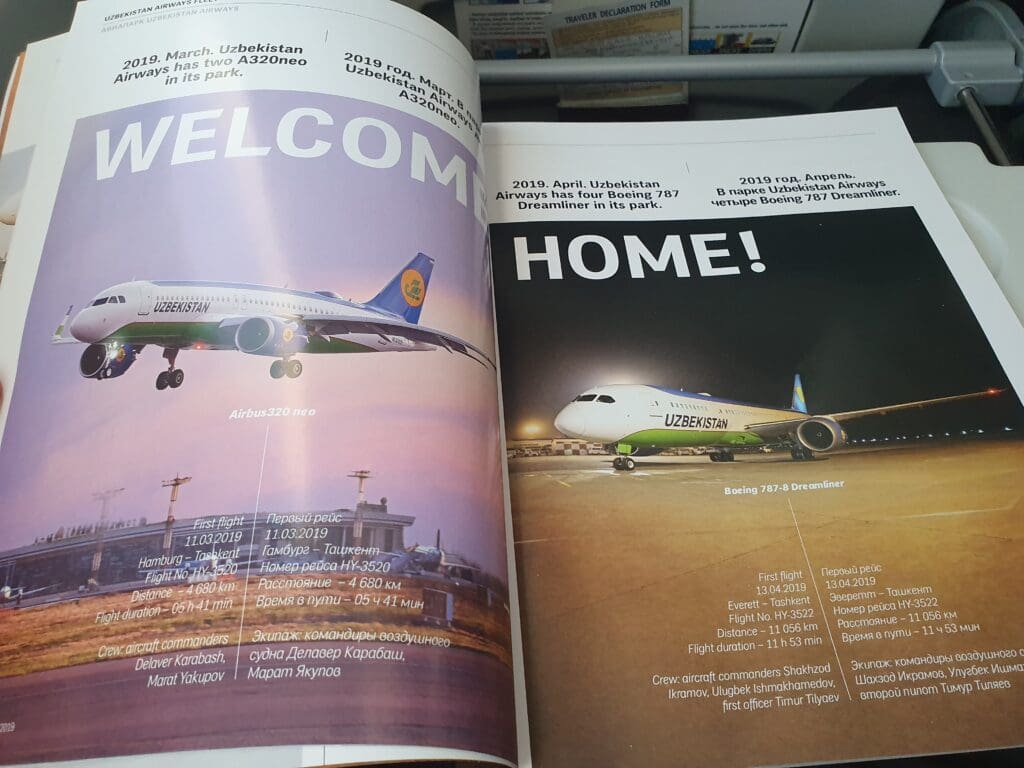
Next, I turned to the pristine copy of the summer 2019 issue of Uzbekistan Airways’ self-titled magazine. Starting with the positives, unlike most inflight magazines, advertisements were very minimal and seemed to be limited to the very first and last pages of the publication. Flicking through this, I soon stumbled across an interesting nine-page feature dedicated to the airline’s new Airbus A320neos and expanding Dreamliner fleet. After this, a selection of well-written and interesting articles on topics pertaining to both art and culture and sport could be found, these written by a selection of Uzbek journalists and academics. Last but not least, a full timetable of the airline’s flights as well as seat maps for the airline’s aircraft, office locations and a route map could be found at the end of the magazine. Whilst Uzbek may be the official language of the nation, all articles are published in two languages only – English and Russian. Unlike some airlines that see their inflight magazine as just another source of advertising revenue, it appeared as if Uzbekistan Airways cared about the quality of this. As such, I can conclude that this issue was one of the more interesting and well-written inflight magazines I have had the pleasure of reading!
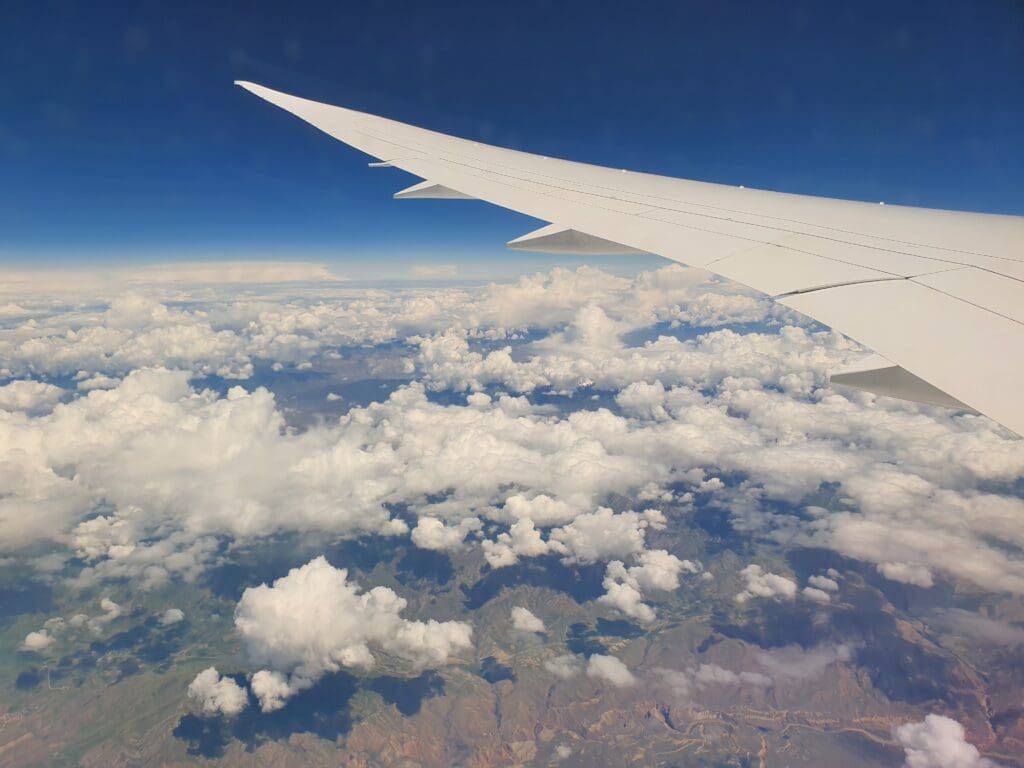
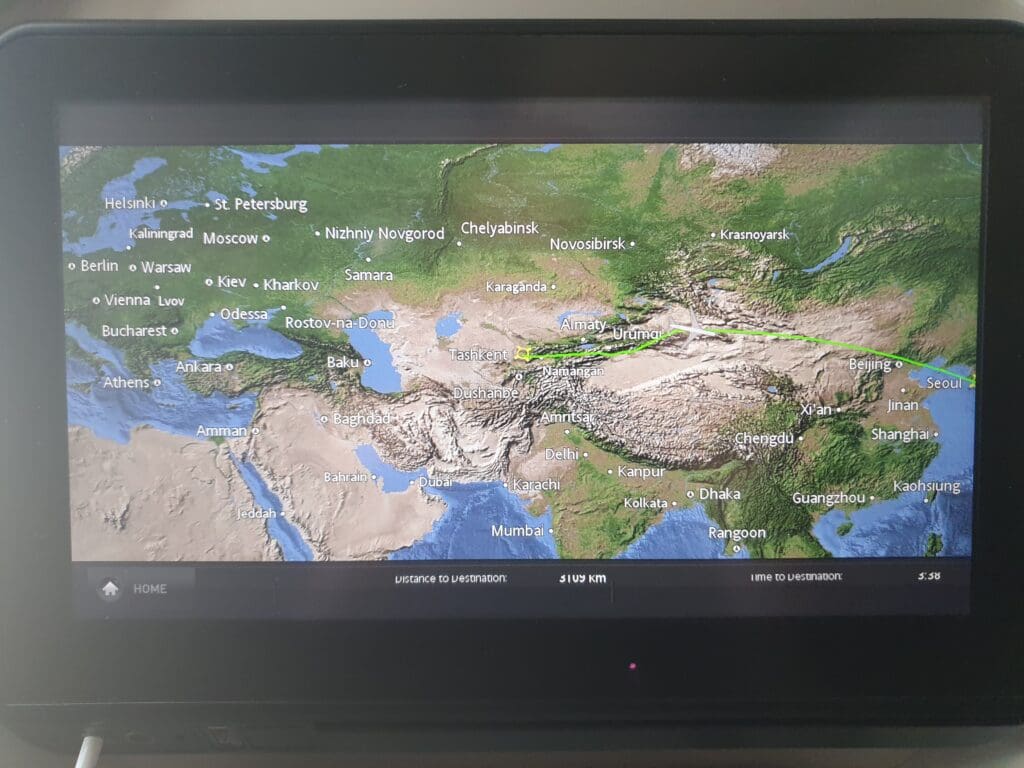
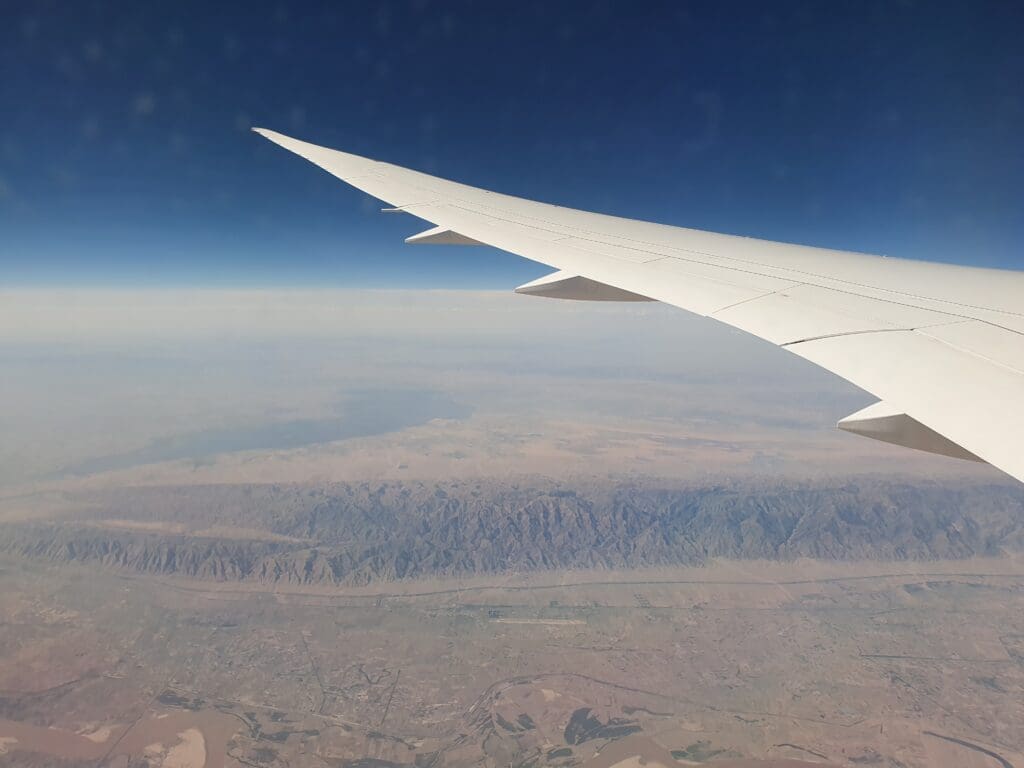
By the time I had explored the reasonable entertainment options, the land below was visible once again, from the left-hand side of the aircraft I received good views of the city of Changji, identifiable thanks to the large and impressive Xinjiang Grand Theatre before we continued our journey over the orange sands of the Taklamakan Desert. Around this time, the crew came around with customs forms (however lacked the necessary immigration forms). With these only available in English, realising I speak this, three passengers sitting around my seat, all of whom were bound for a construction site in rural Korea, handed me their passports and work-related documents and asked me to fill in their forms on their behalf.
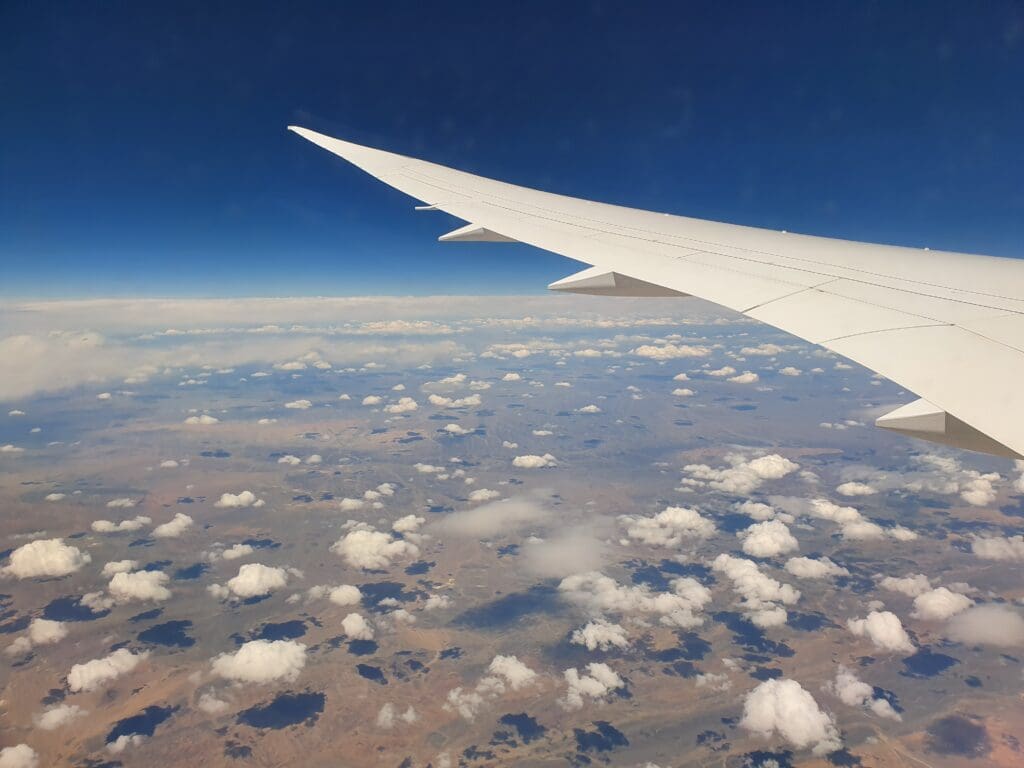
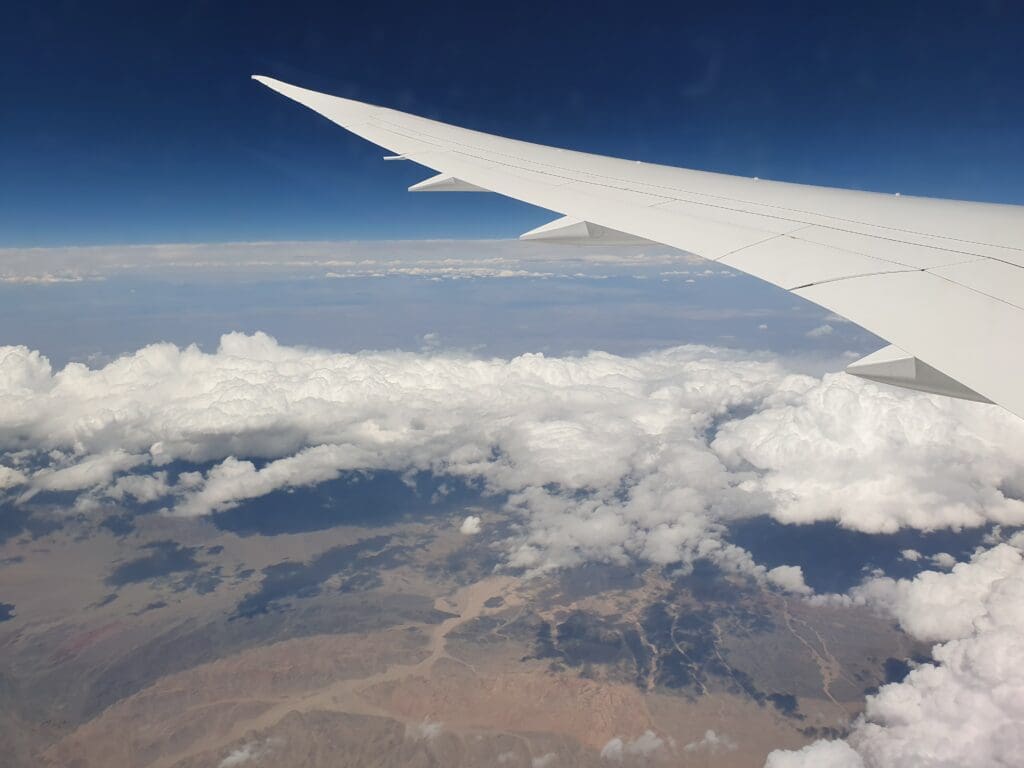
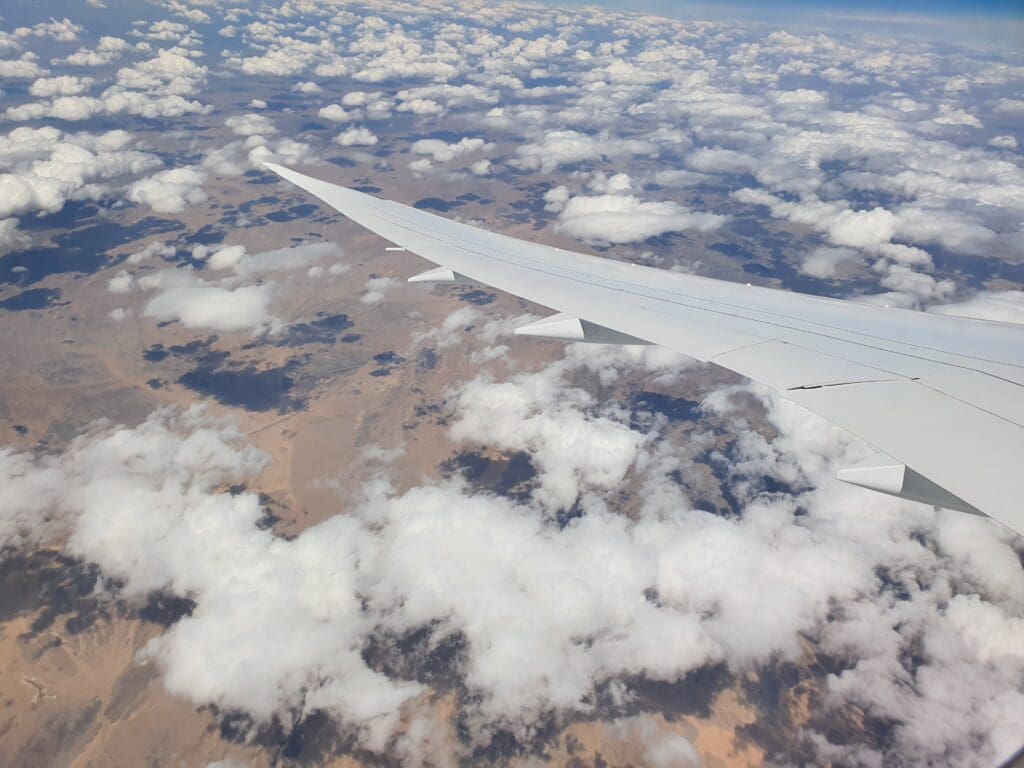
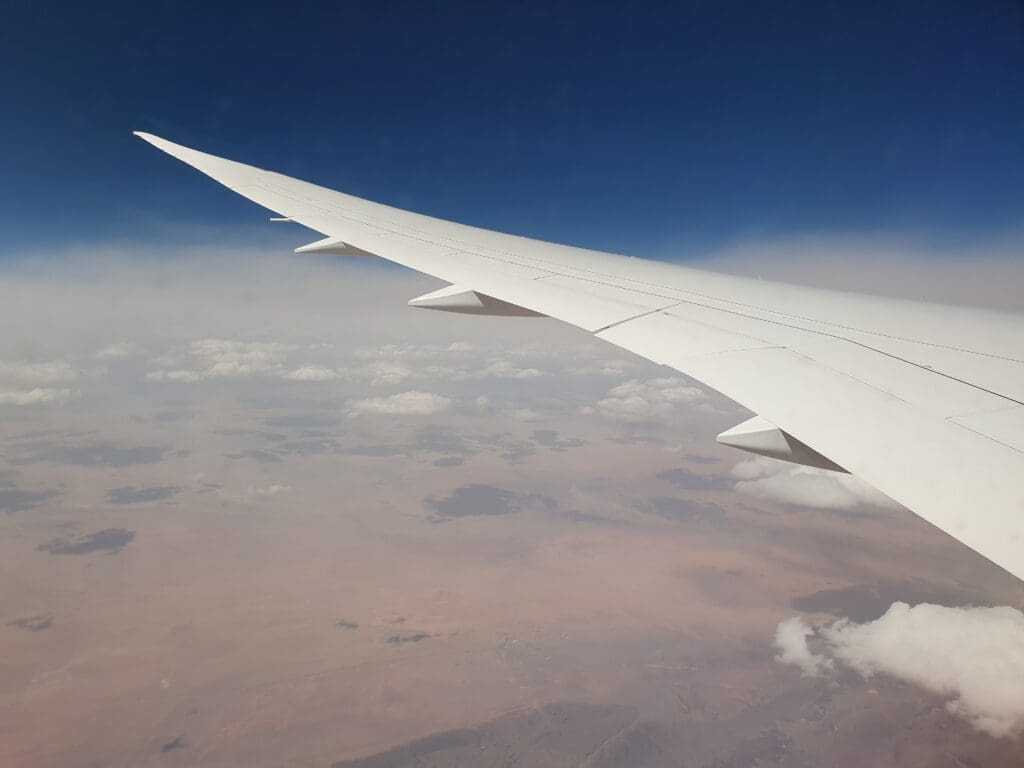
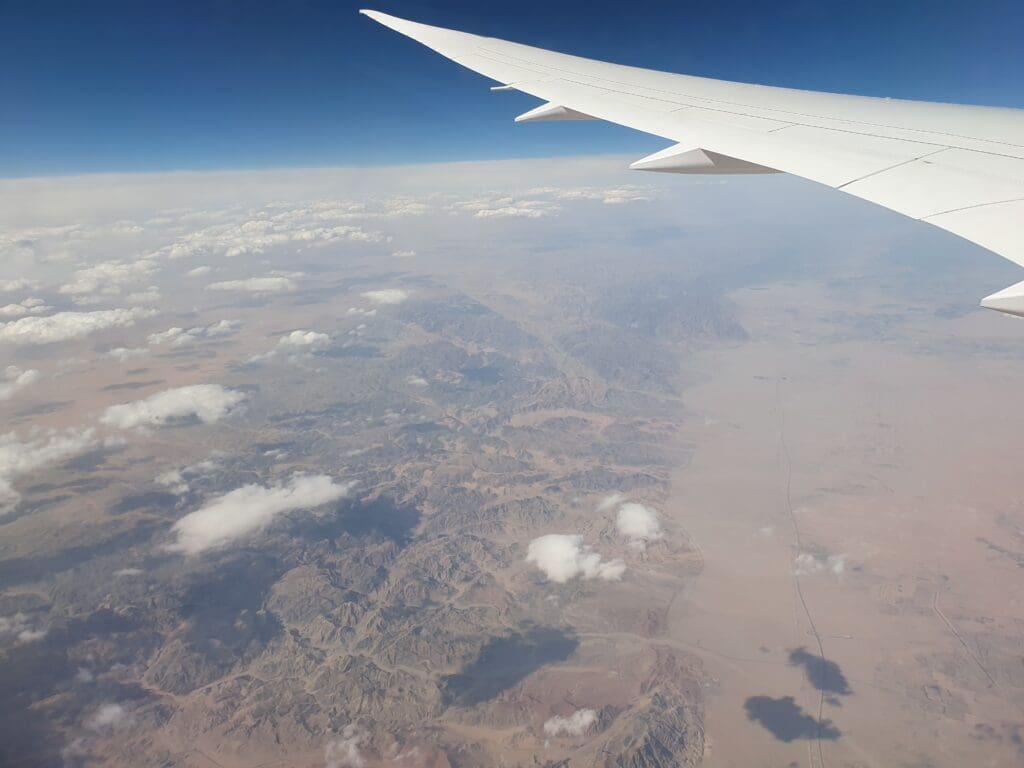
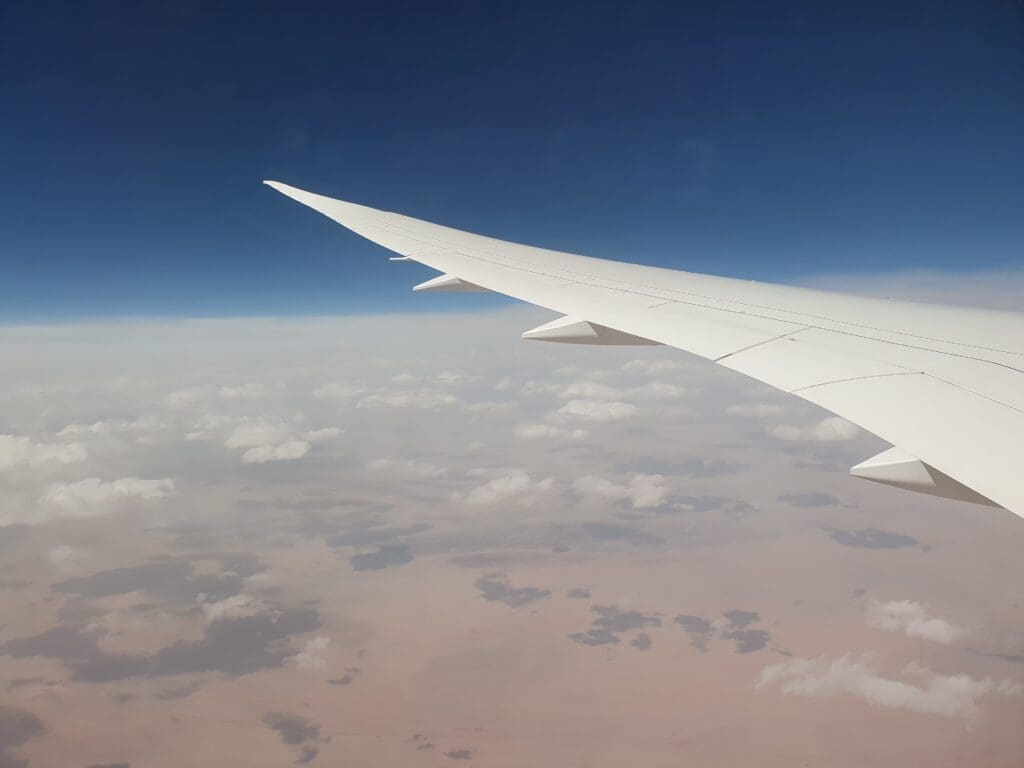
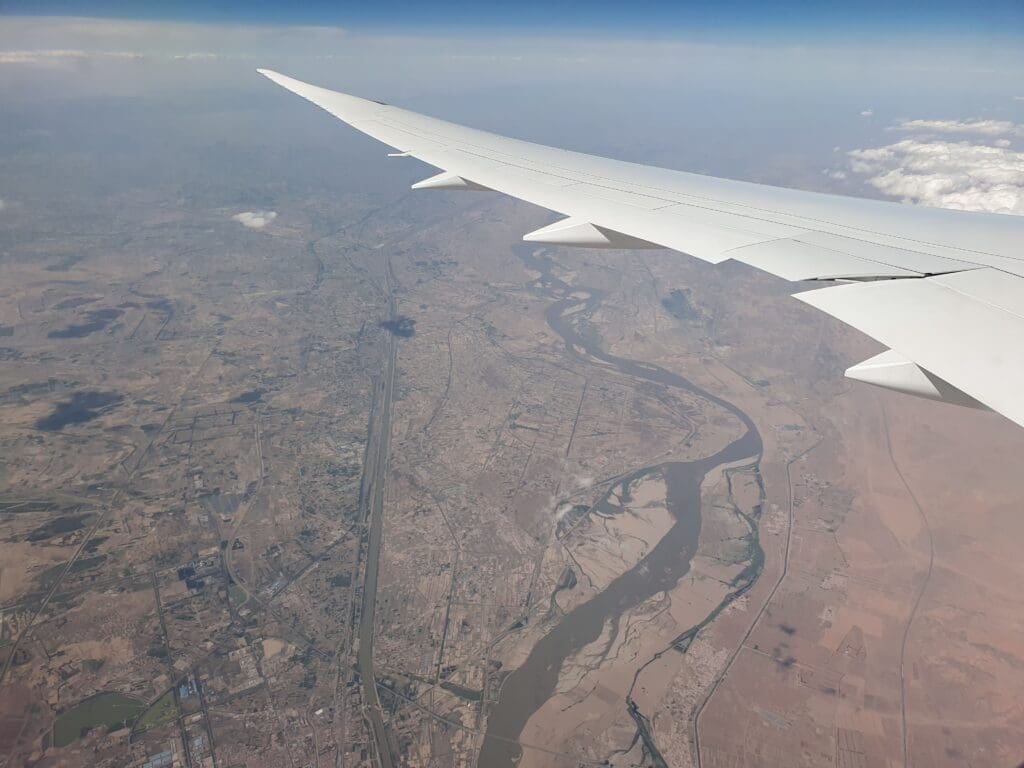
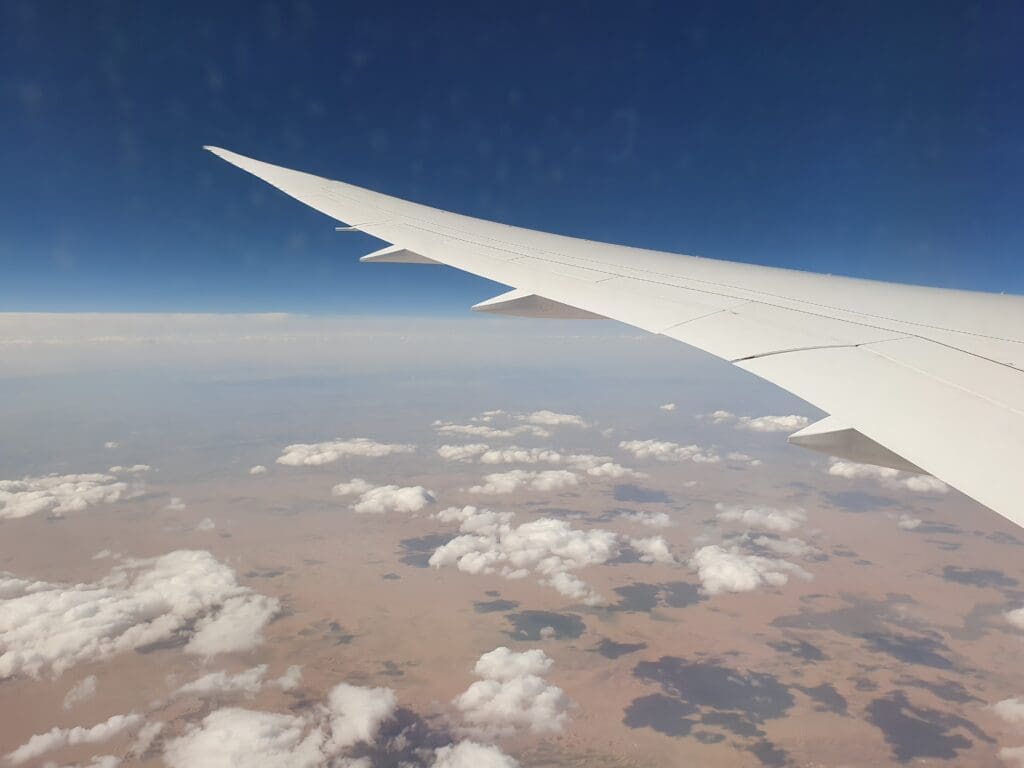
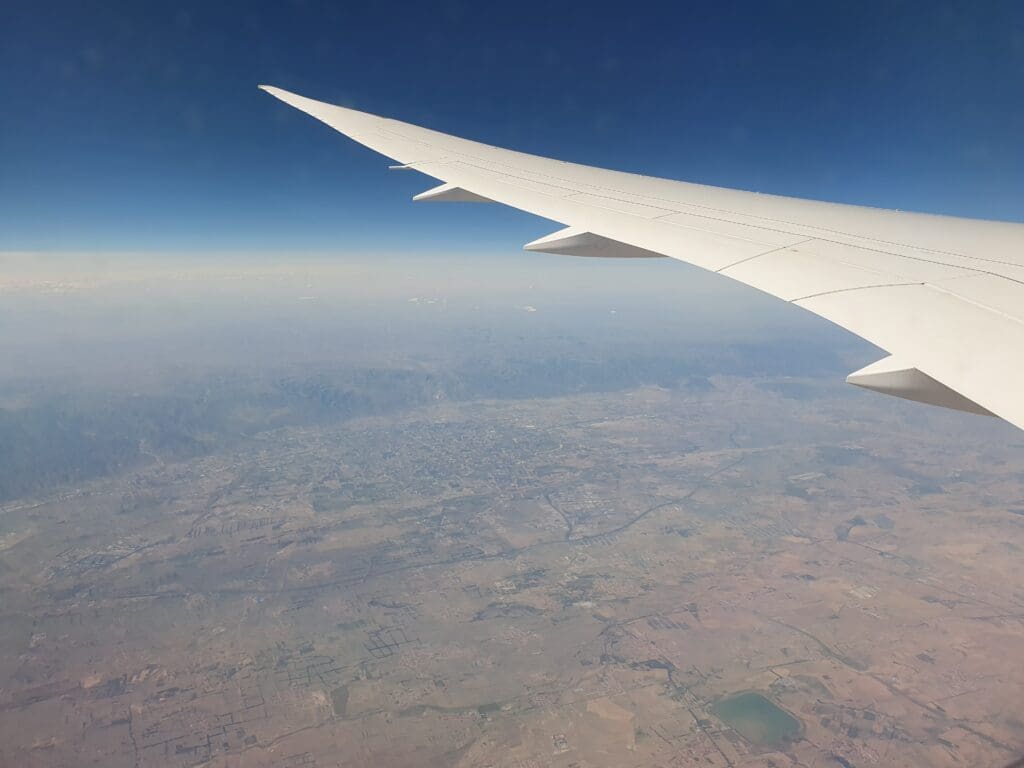
Meanwhile, below, Urumqi passed by before the impressive peaks of the Bogda Shan mountain range came into view. After flying ourselves over the desert once again, the clouds rolled in and blocked the view for the next hour. By the time the clouds cleared around an hour later, the landscape below continued to consist of sandy deserts with the occasional patch of rocky mountains with few signs of life below bar the G7 road which runs all the way from Urumqi to Beijing. At 1315, or 1715 Korea Standard Time as I shall use from now on in this report, signs of life were spotted when the sand dunes transformed into sandy-coloured fields – these bearing a resemblance to those we had left behind in Central Asia. After flying over the Inner Mongolian town of Dengkou and brown coloured Yellow River the landscape once again transformed into uncultivated deserts for several minutes until we neared the city of Baotou, the largest city in Inner Mongolia. From here our aircraft flew parallel with the Yin Mountains and over Hohot before the skies clouded once again.
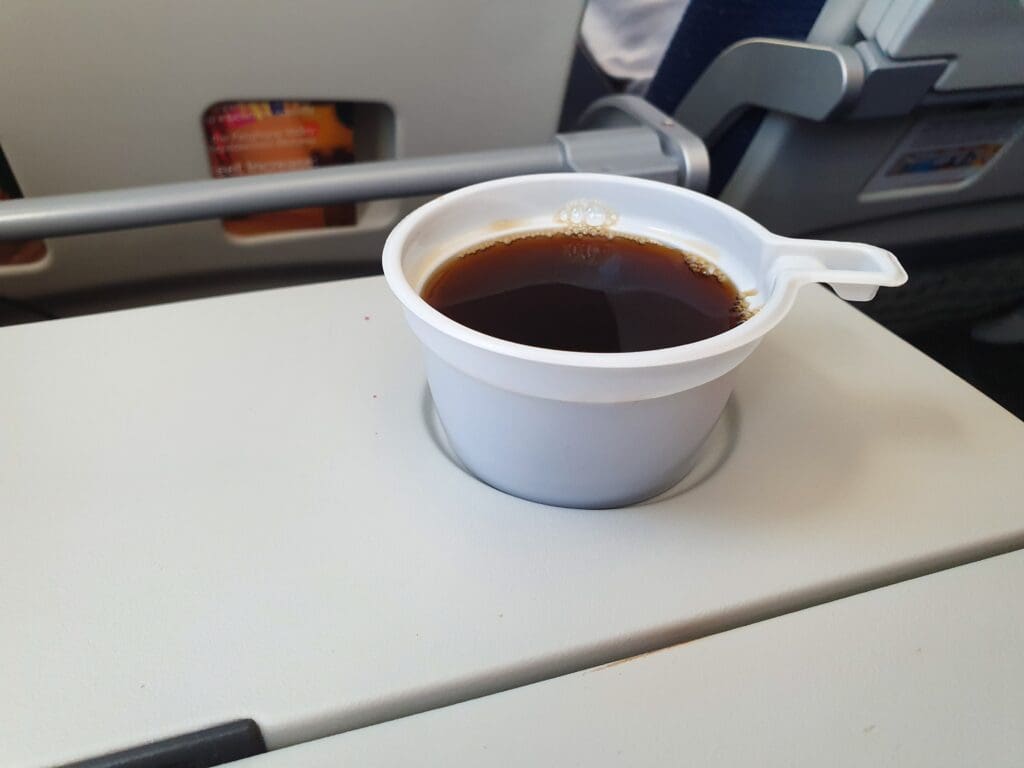
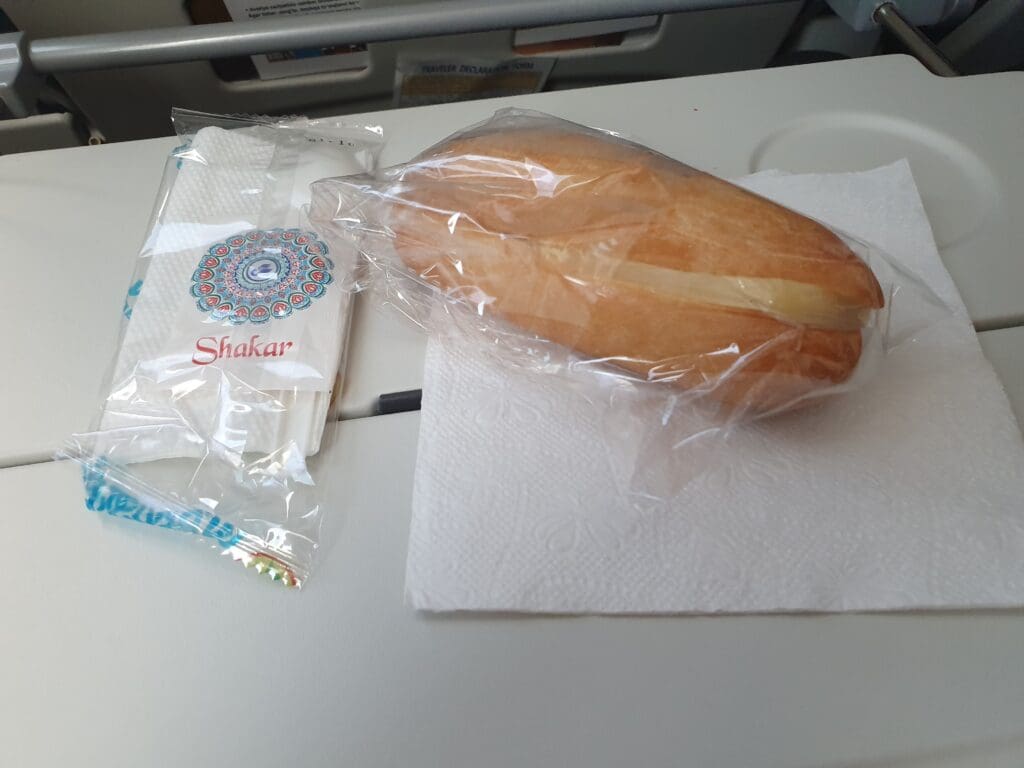
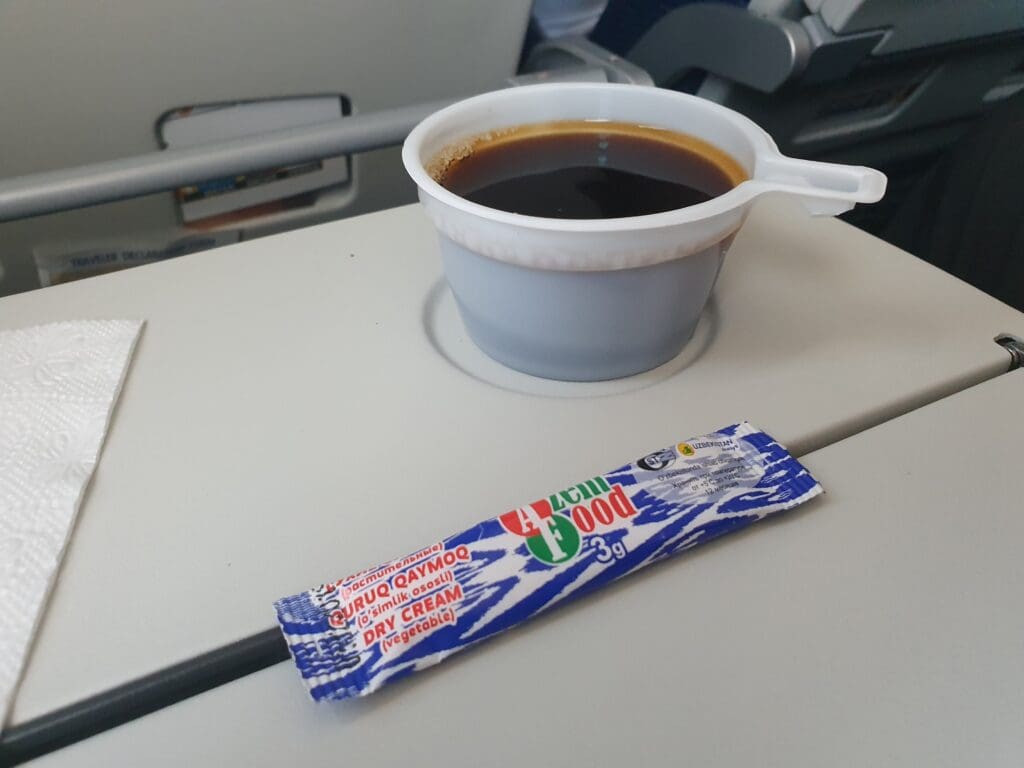
Given the sheer quantity of food each passenger had been served during the meal service, I was not expecting too much in terms of a snack service given the length of the flight. However, at 1725, the Purser announced that a snack service would soon commence. Immediately after this was made, the crew proceeded to angrily dish out small cheese sandwiches in the usual unfriendly manner before passing around the cabin with tea and coffee. I opted for the latter which was handed to me with a sachet of powdered milk. Whilst texture and taste-wise the cheese resembled plastic, despite the quality, I found it hard to complain about the fact that a second round of service was offered on this relatively short flight.
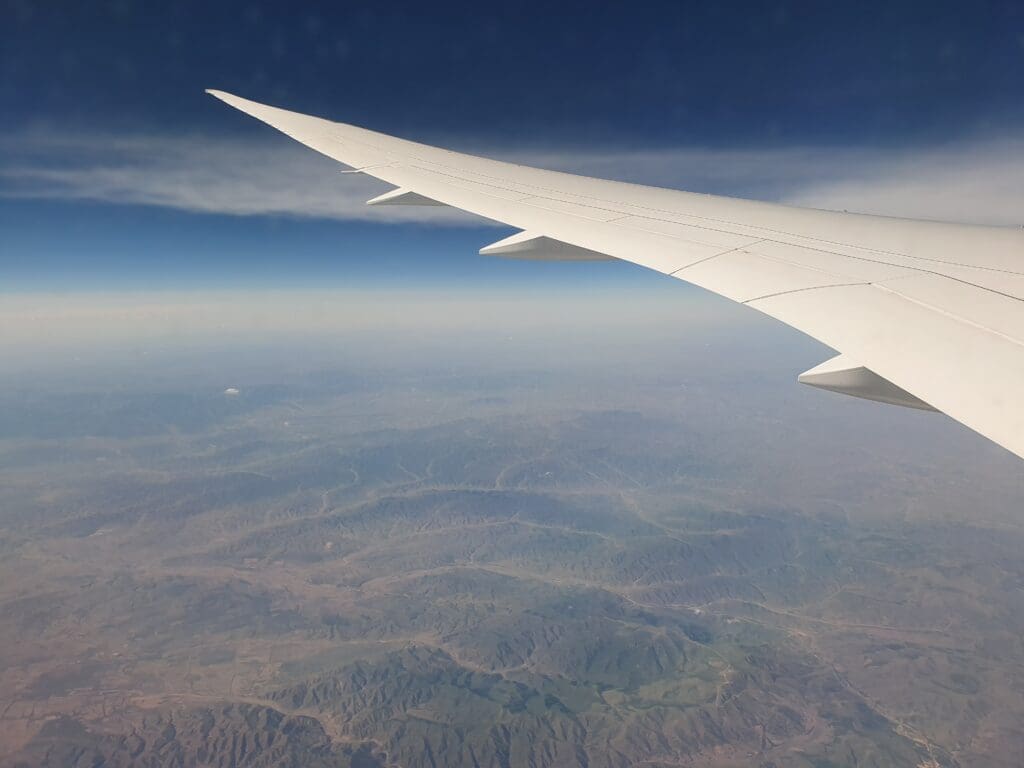
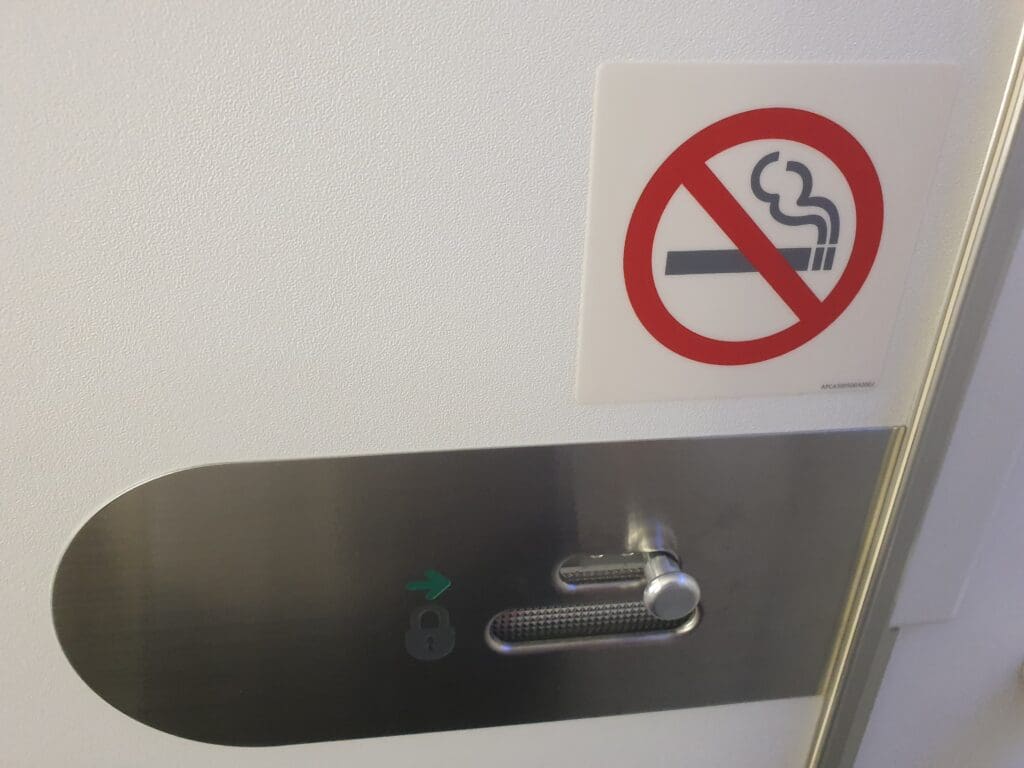
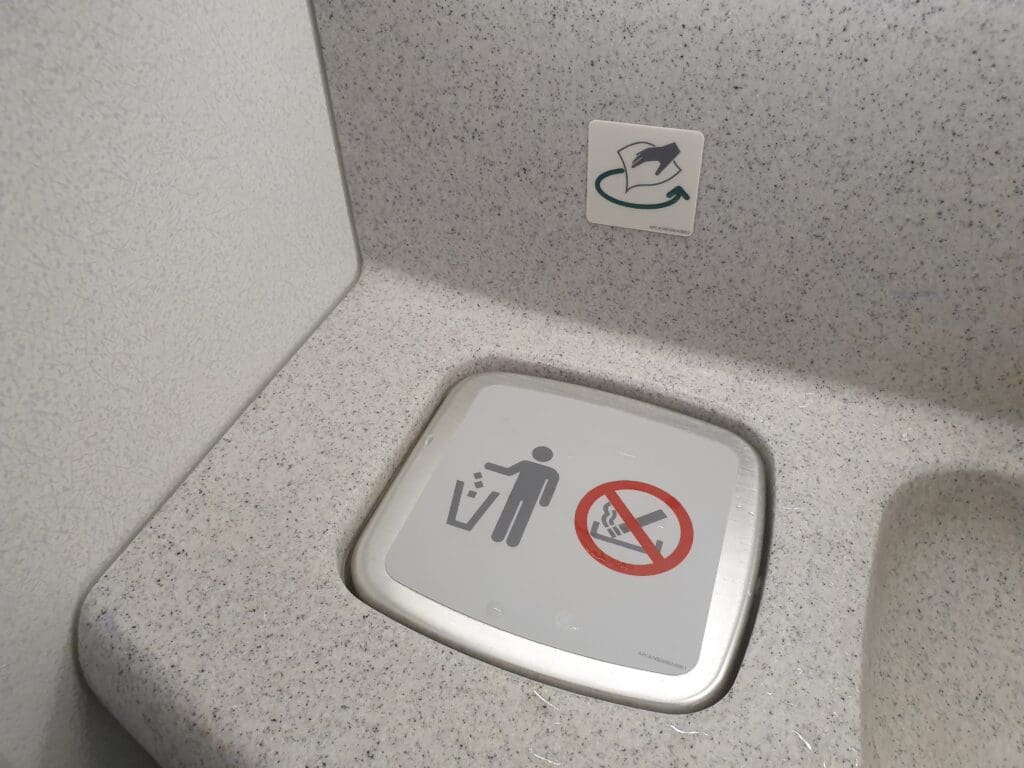
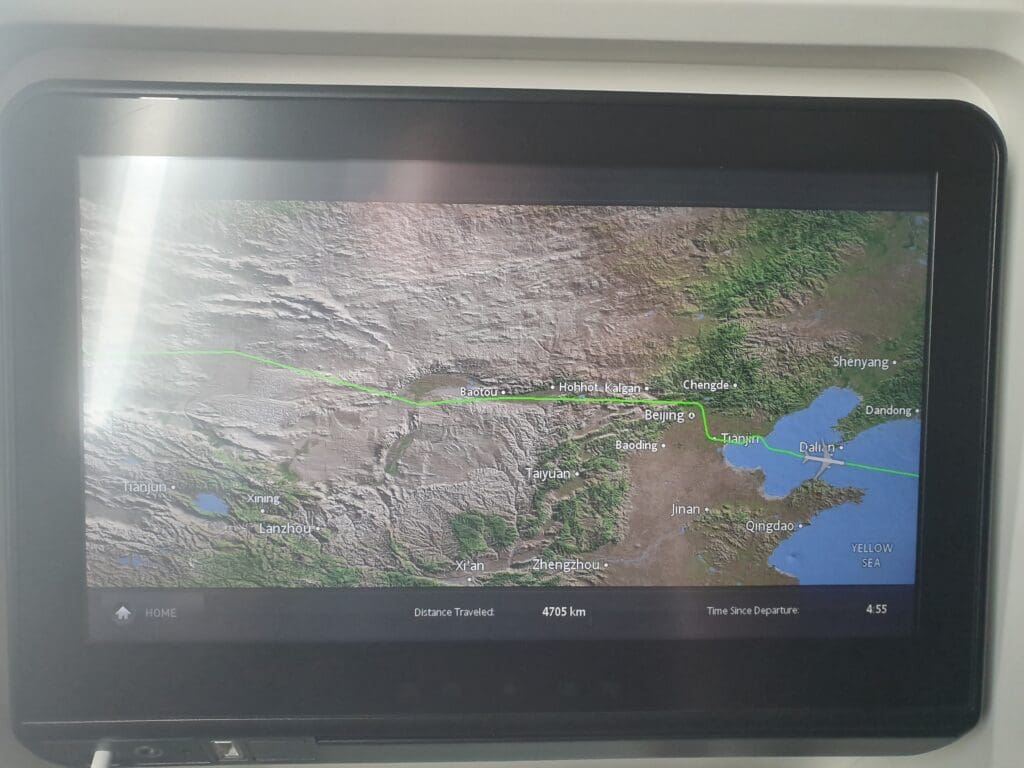
As is usually the case when approaching Seoul from Central Asia, Europe or the Middle East, after a long crossing of China, our aircraft gently skirted around Beijing before heading almost directly southwards and then suddenly turning eastwards towards Tianjin. In clear conditions, this route allows for absolutely fantastic views of Beijing for those on the right side of the aircraft and Tianjin for those on the left. Unfortunately, however, that day the thick clouds below meant no such views could be had as we headed over the urban sprawls of the region. With little to see outside, and with just over an hour left to go until our arrival, I decided to make my second and final trip to the toilet. After a long wait, I headed inside one of the cubicles that sits in between the front and rear economy cabins. Despite nearing the end of the flight, upon entering I was pleased to find the toilet in a clean and presentable condition. One other interesting observation from my visit was that unlike on the airline’s Boeing 757 that I had sampled, there was no written signage in either of the two lavatories I visited, with all signs limited to symbols only. Whilst this may perhaps be to cater to a wide spectrum of nationalities, it also seemed somewhat generic as if Boeing had been unsure of who the aircraft was destined for until the last minute.

Once back in my seat, an announcement was made in Uzbek and English informing us that the aircraft would commence its descent imminently and asked all passengers to return to their seats and fasten their seatbelts. In addition, a stern reminder that the blankets and pillows remained the property of the airline was also made before the crew passed around the cabin to collect them. After trundling through the Bohai Straight to the south of Dalian and north of Yantai, the aircraft neared the Korean Peninsula, carefully making its way around North Korean airspace. With fifty minutes to go until landing, our aircraft began its slow and gently step descent.
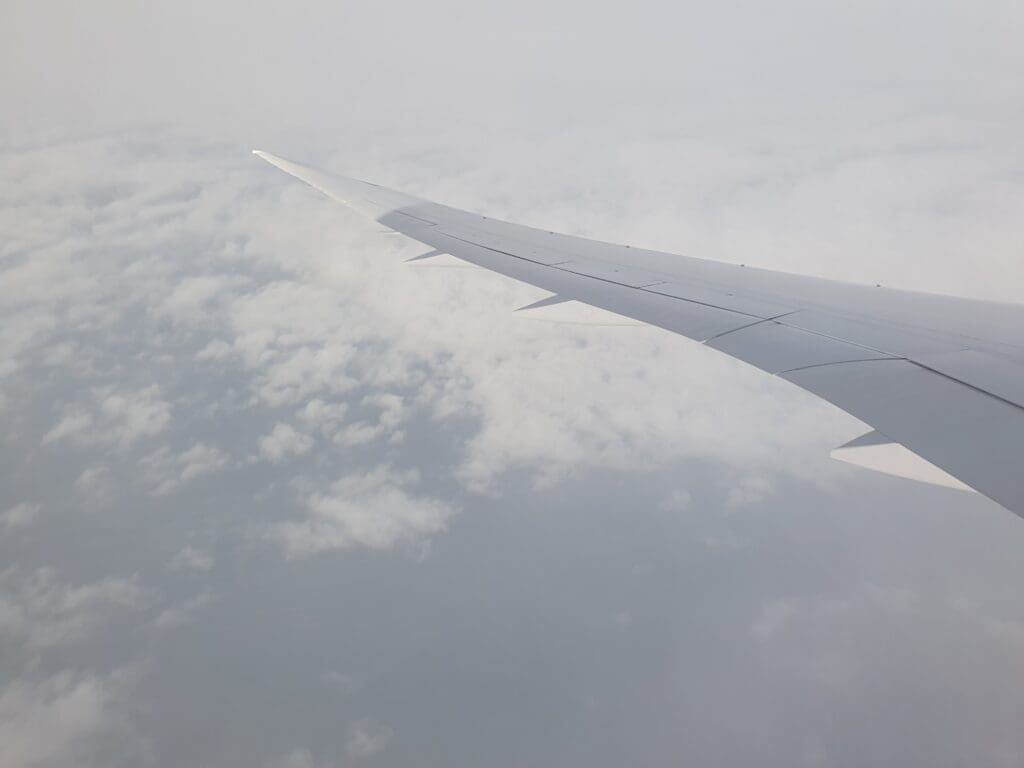

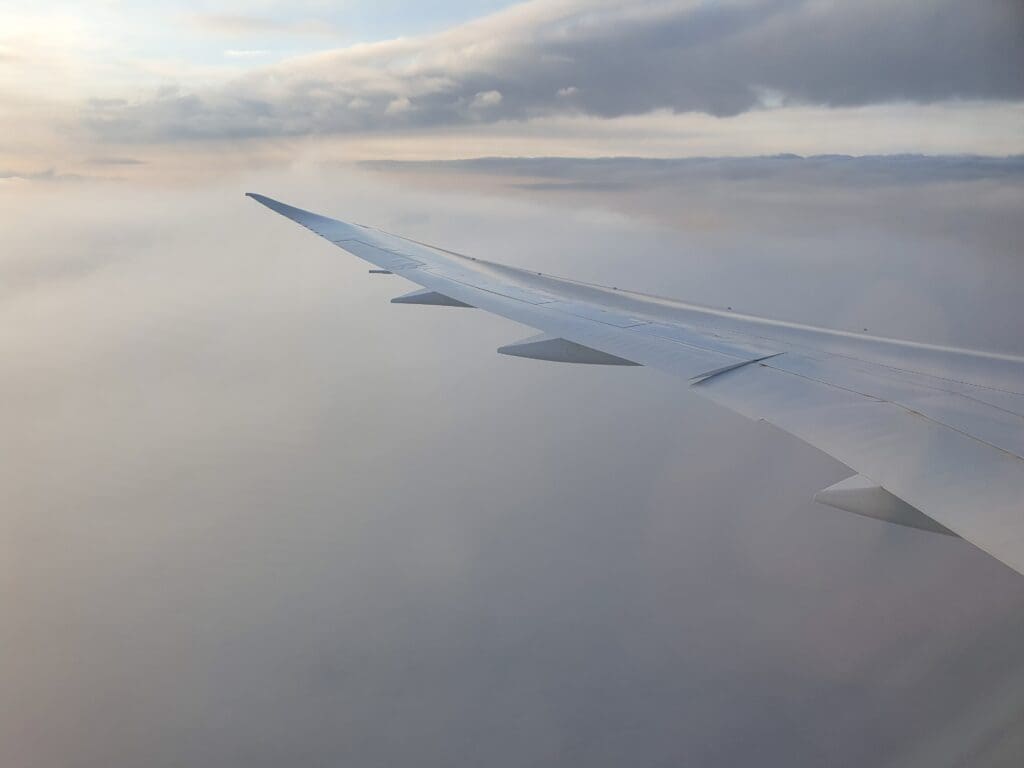
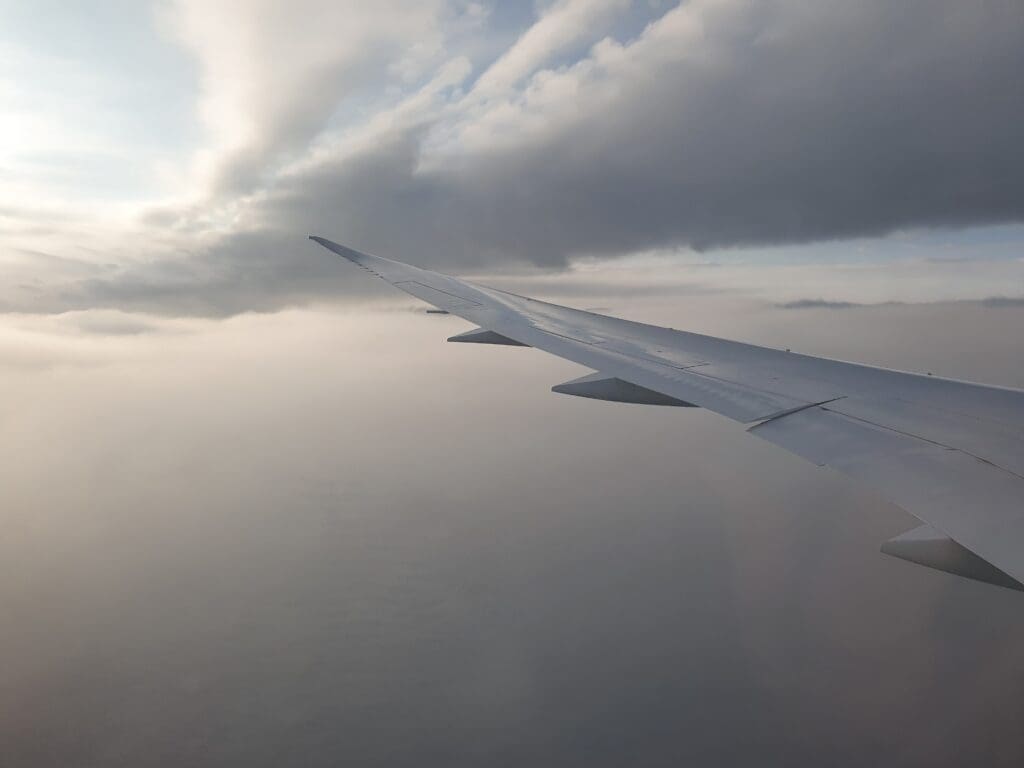

Meanwhile, at the front of the cabin, several crew members appeared to be fighting with a bassinet which appeared to be impossible to remove from the bulkhead. After a few minutes of attempting to remove this, a crew member wearing a First Officer’s uniform (but perhaps a flying engineer) appeared and removed this with ease before retreating to the front of the aircraft. As dusk rapidly approached, the Boeing 787 smoothly descended through the first layer of cloud bringing the West Sea into view as we sank below 10,000 feet. Beneath our aircraft, several of the islands that lay off the coast of Incheon came into view as well as a flotilla of fishing vessels presumably on their way out to sea for the night.
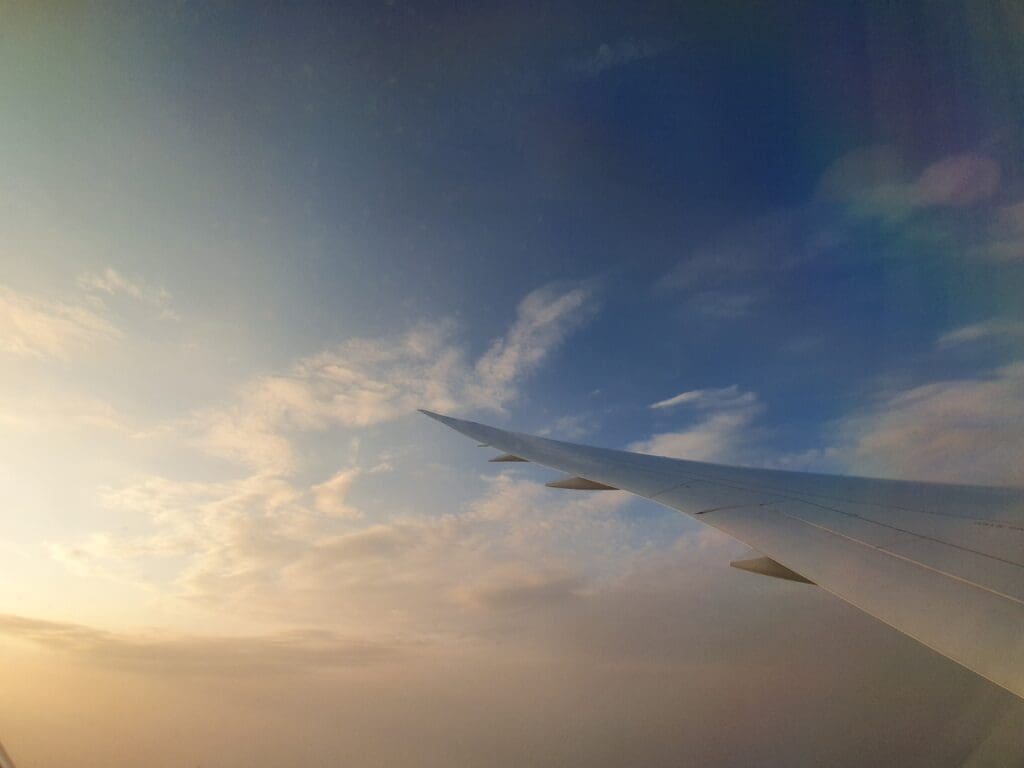
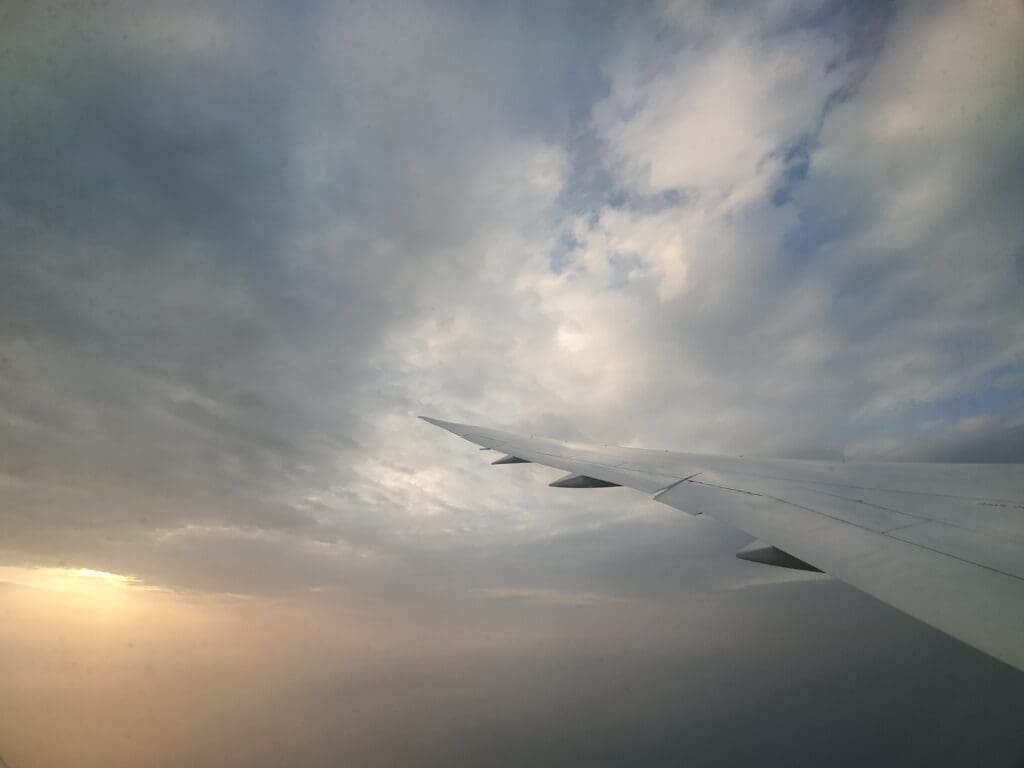


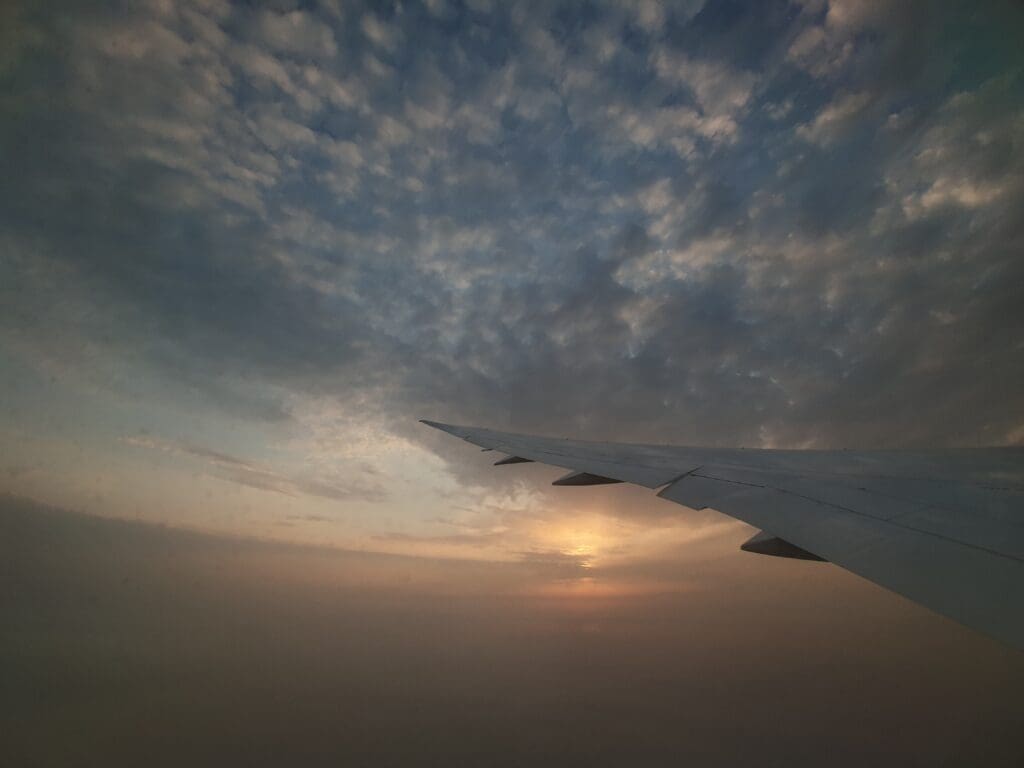
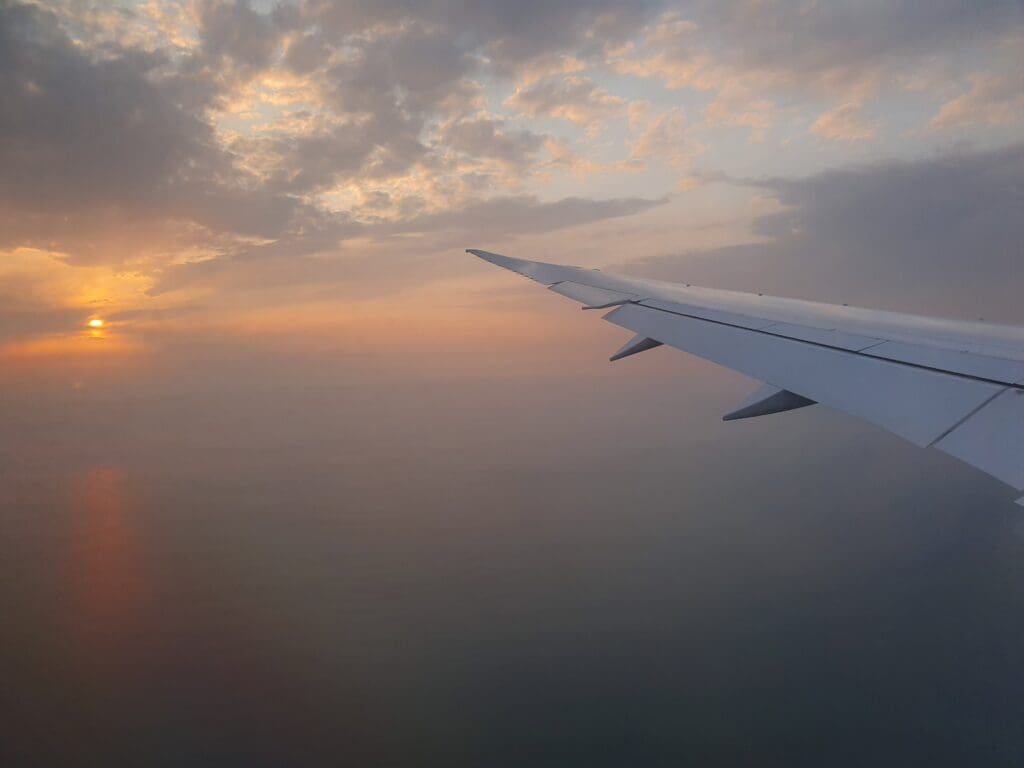
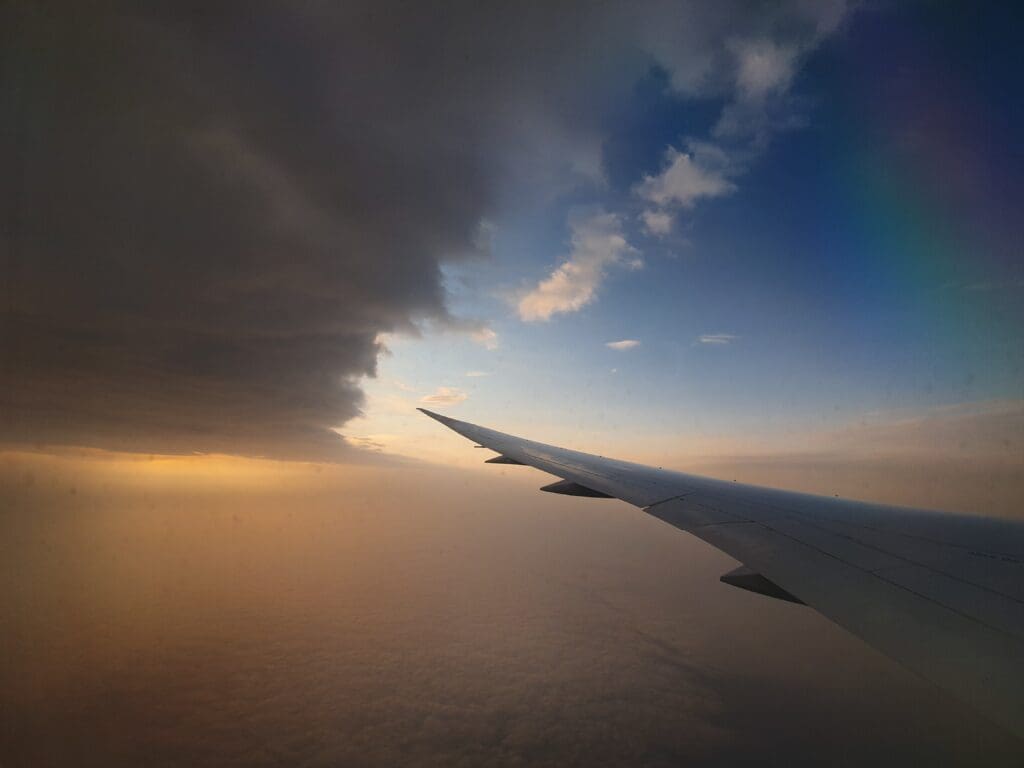
As we neared the airport, the aircraft proceeded to do a loop around the island of Deokjeok with the speedbrakes extending, increasing our descent rate as we neared the end of this. After flying north, our aircraft turned onto the base leg for Incheon’s Runway 15L no more than twenty kilometres from the border with North Korea and our flaps were gradually extended as we sank towards the airport.
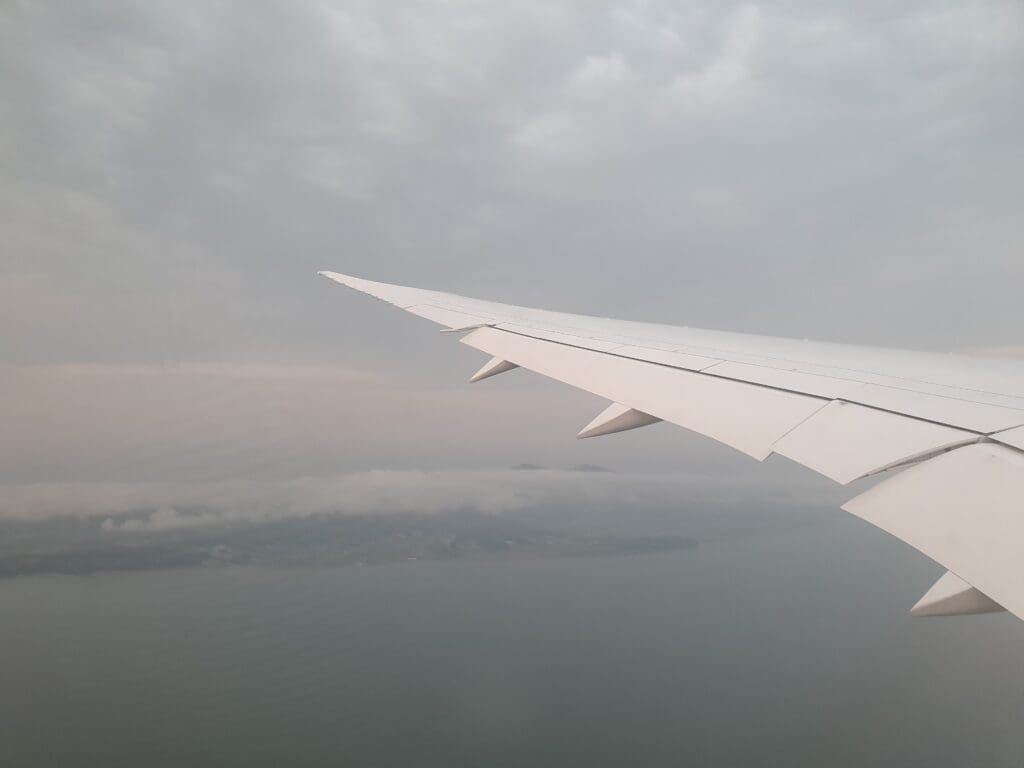
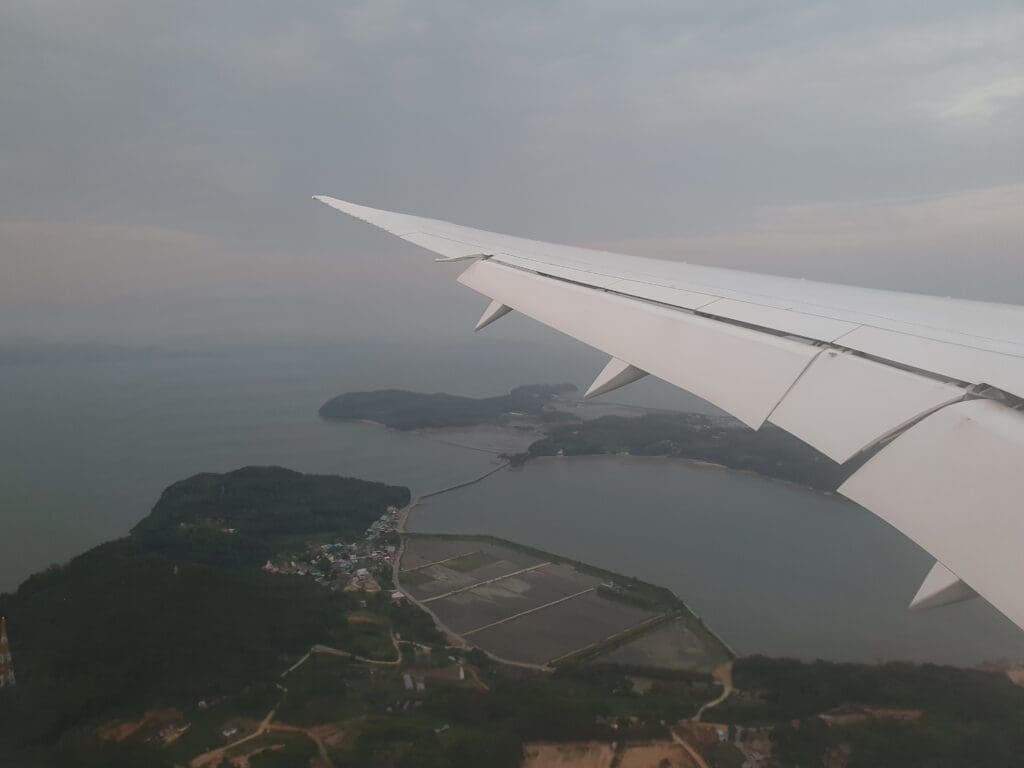
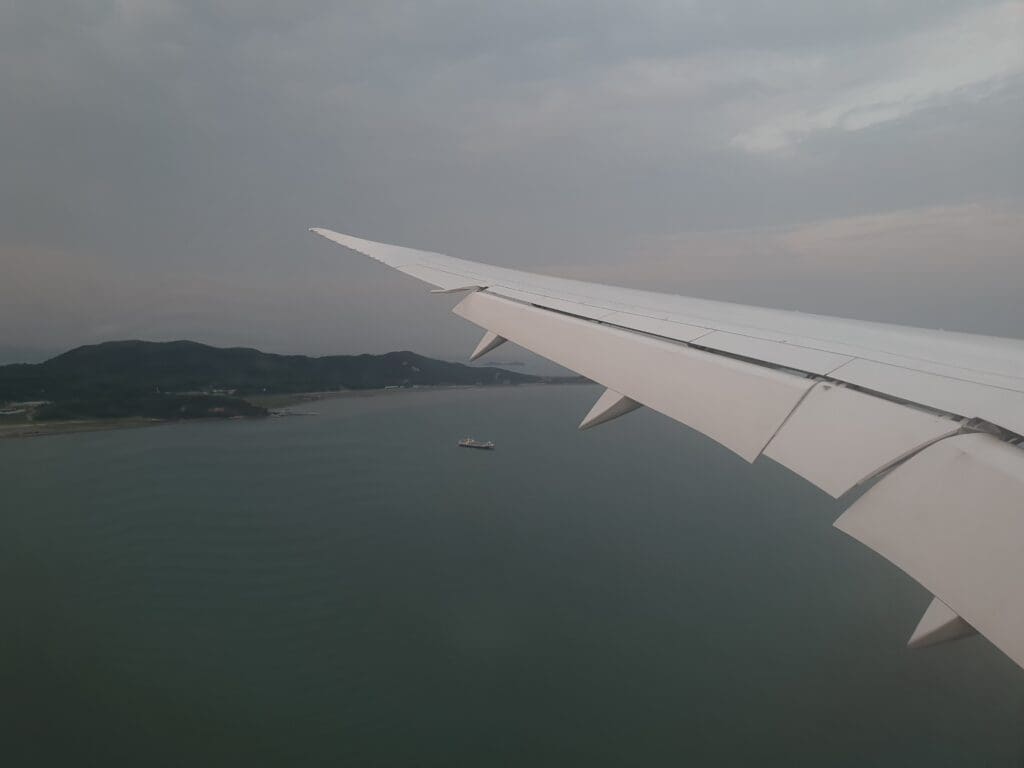
Eventually, the gear was extended with a thump and the Purser made an announcement reminding us to keep our seat belt fastened until the aircraft arrived at the gate. As we neared the airport our aircraft passed the islands of Jangbongdo, Modo, Sido, and Shindo, before floating over the seawall of Yeongjong Island and the road that loops around the airport and sinking past a couple of stored Korean Air Cargo Boeing 747-400Fs.
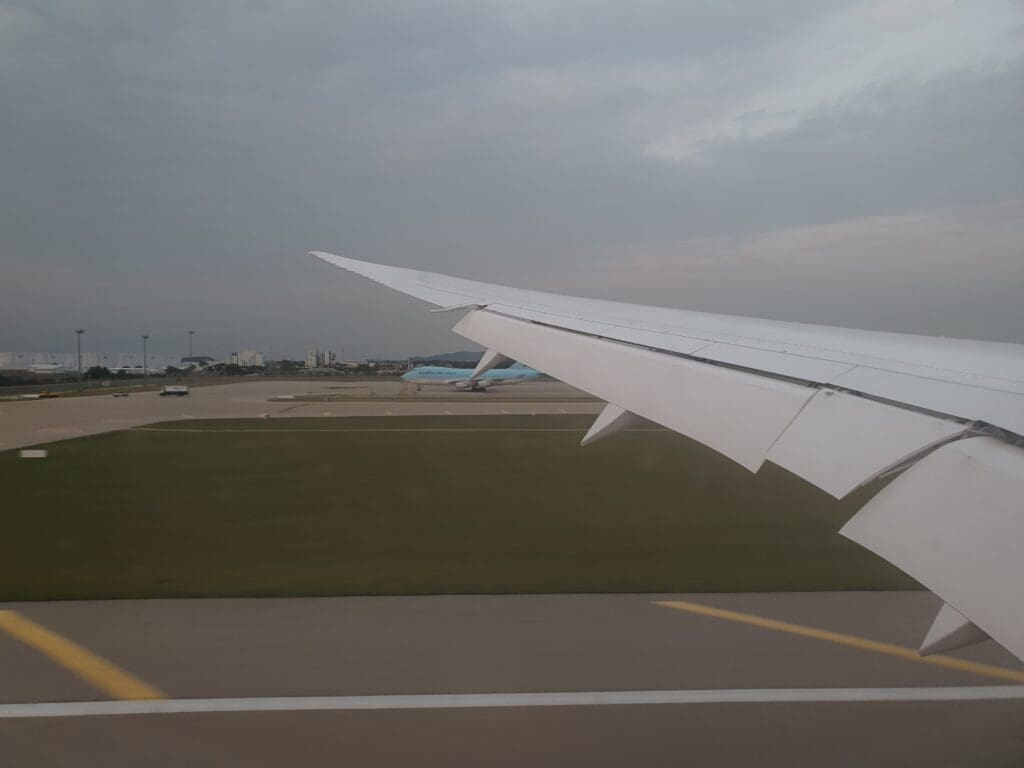
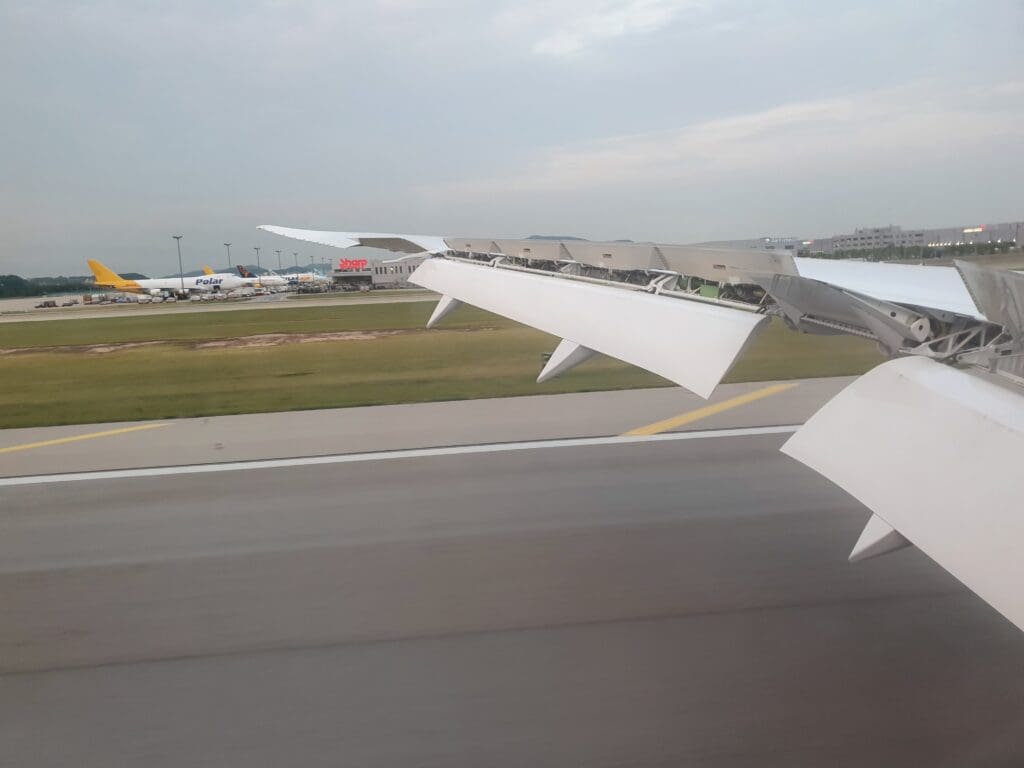
At 1934, after a smooth approach, the aircraft made a bumpy touchdown, five hours and forty nine minutes after lifting off from Tashkent. This was followed by some rather heavy braking as we slowed alongside the Incheon’s massive cargo terminals. A short while later the aircraft taxied off the runway and slowly proceeded towards Terminal 1. As soon as we left the runway, rainbow moodlighting suddenly illuminated the cabin before the Purser performed a tri-lingual announcement, welcoming us to Korea and thanking us all for flying with Uzbekistan Airways. After which Elton John rang out on repeat throughout the cabin once again. Despite the Purser’s pre-arrival announcement asking for passengers to remain seated, plenty of passengers seemed to stand up as we taxied, those brave enough to do so receiving a telling-off from the crew.
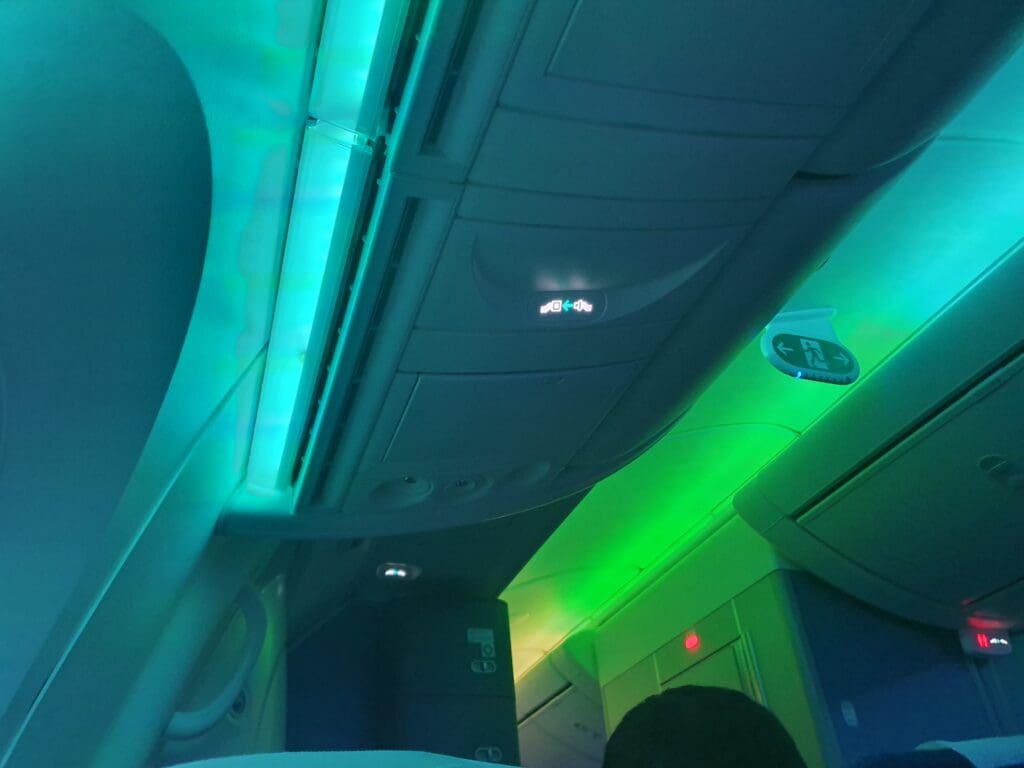
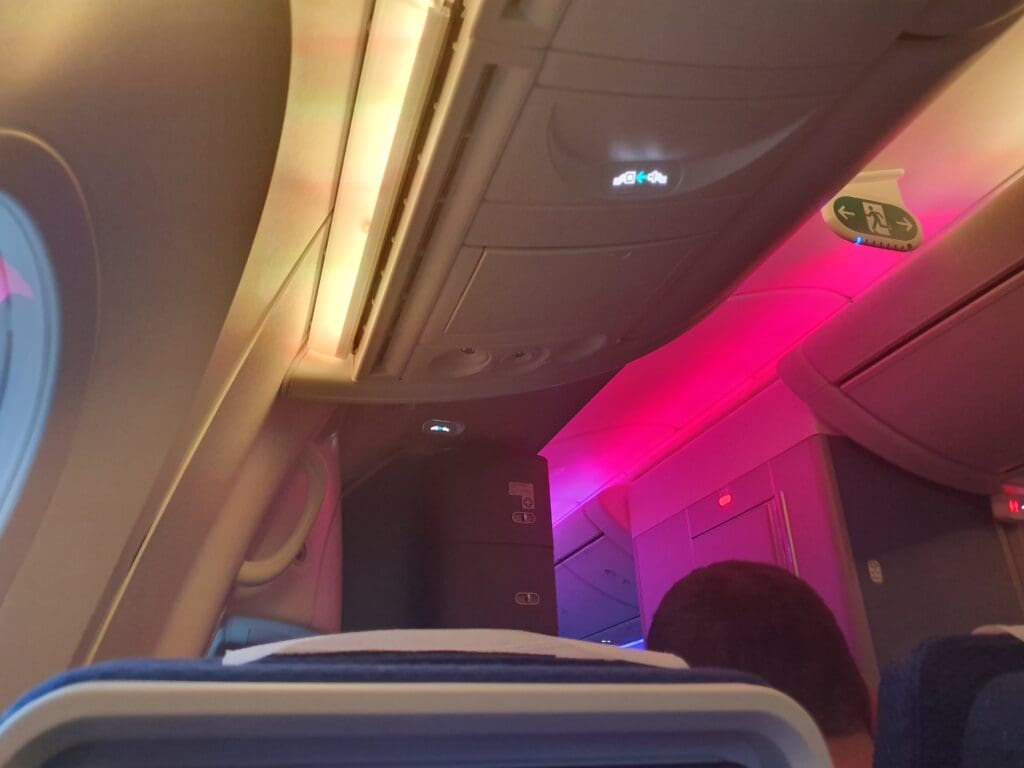
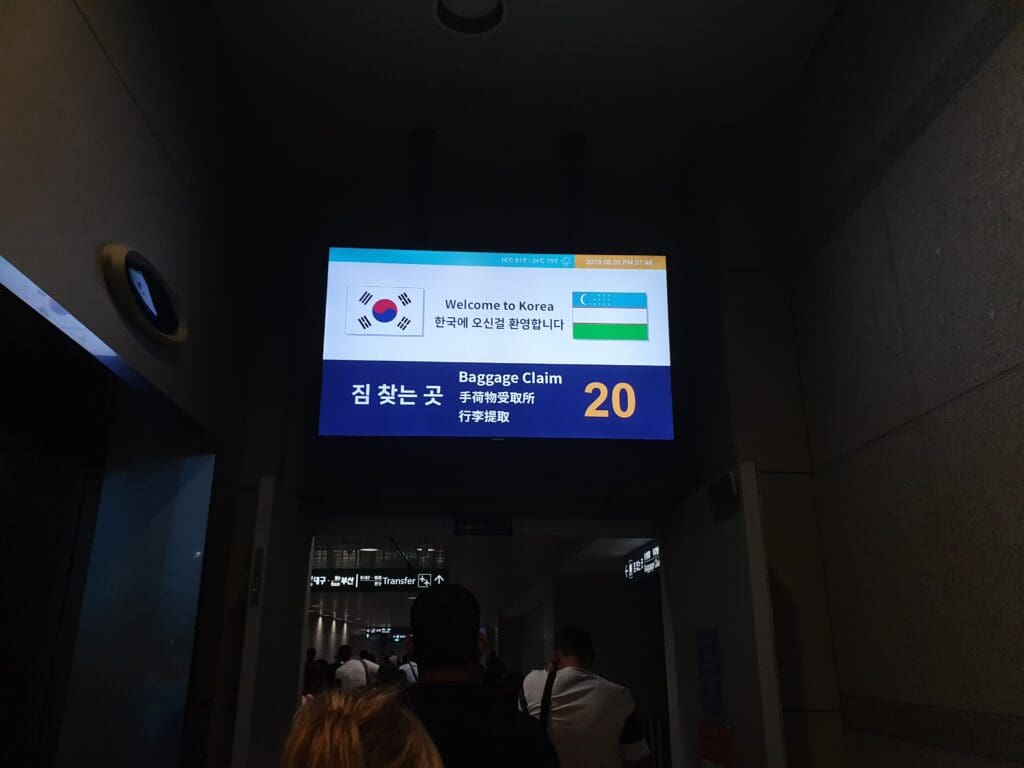
As we taxied I was pleased to see the aircraft turn towards the masses of Asiana jets, indicating that we would be using the main area of Terminal 1 as opposed to the satellite terminal, theoretically allowing for a quick transit out of the airport. Ten minutes after touching down, the Dreamliner pulled into Stand 33, the engines spooled down and the main cabin lights were switched on. Once at the gate, a single jetway was connected to the aircraft very quickly and as a result, disembarkation began no more than a few minutes after pulling into the gate. Even though many of the passengers appeared to have large amounts of hand luggage, perhaps desperate to escape, passengers left the aircraft at an impressive rate and despite sitting in the rear economy cabin, I managed to exit the aircraft a mere eight minutes after our arrival. After walking past two crew members who seemed to spend the entire disembarkation process glancing angrily at passengers without saying a word, I stepped onto the glass jetway and up into Incheon’s older yet still bright, clean and modern terminal – passing underneath the TV screen featuring the Korean and Uzbek flags, welcoming passengers to Korea in each country’s language.

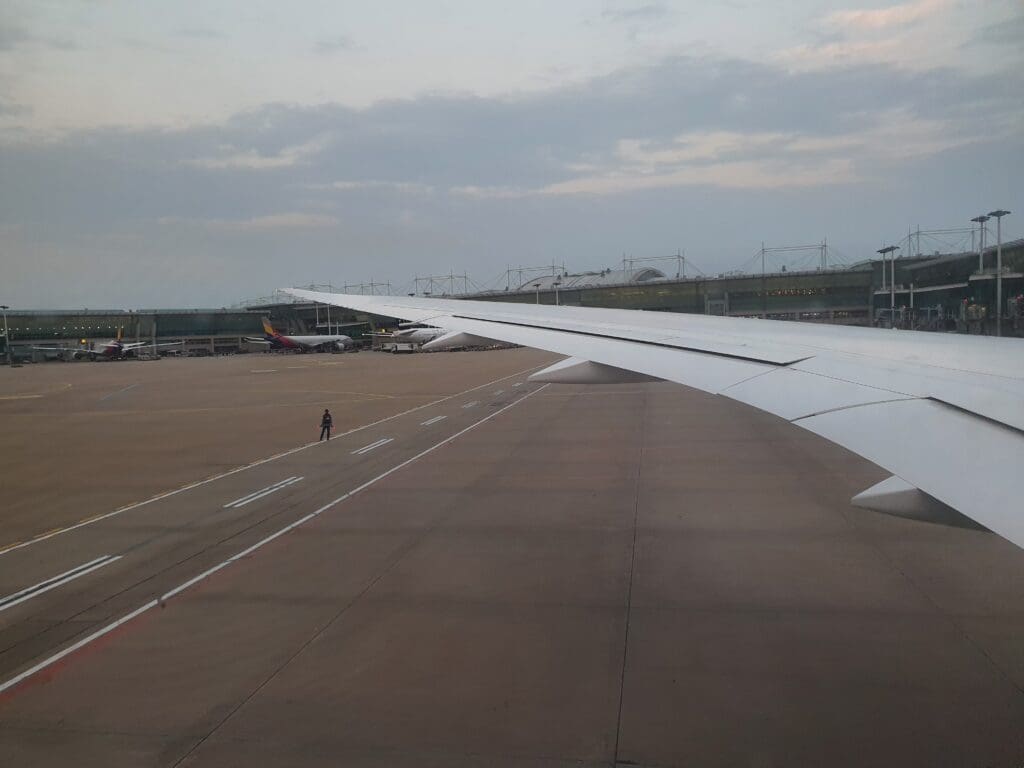
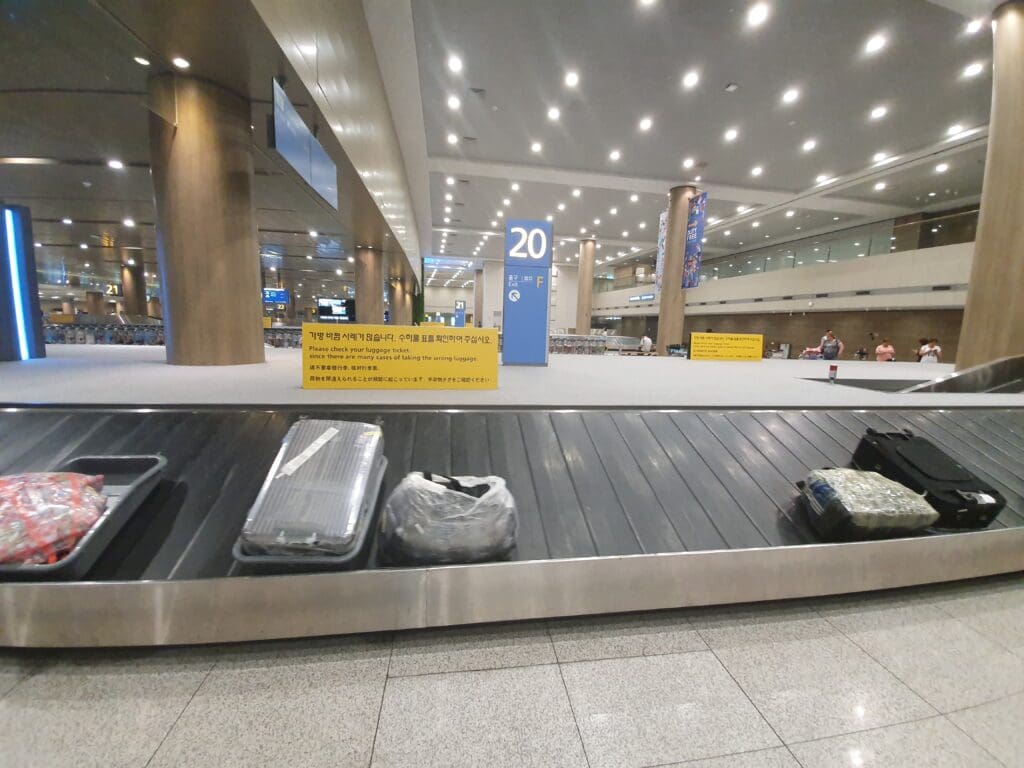
Whilst I cannot deny that the walk to immigration was substantially quicker than had I arrived at the satellite terminal, a significant trek was still required to reach passport control. This took me past a host of Asiana Airlines’ aircraft ranging in size from the Airbus A321 to the Airbus A380 as well as an EVA Air Airbus A330 sporting the Badtz-Maru livery ready to return to Taipei. Having made a quick walk and overtaken many of my flight’s passengers, the immigration area was largely empty, however before making my way towards a counter, I did need to fill out one of the immigration forms usually handed out on the aircraft. After doing so, I was guided towards a queue and proceeded to wait. Whilst there were only three passengers in front of me, all of whom had arrived from Tashkent, the officer manning the desk to where I had been sent seemed to be thoroughly interrogating each passenger – sending all three away for further questioning. After a longer-than-expected wait, I approached the desk and handed over my passport. Here, I also received some questions in Korean about my previous visits to Korea as well as my time studying in the country. After answering these, I had my fingerprints and photo taken before I was allowed to enter Korea.Fifteen minutes after stepping off the aircraft, I arrived in the baggage claim hall and proceeded to the carousel 20 where my small suitcase could already be seen spinning around. After picking this up, I had this X-rayed at customs before entering the landside area and heading down to the AREX station to catch the all-stop train into Seoul, bringing my second flight with Uzbekistan Airways to a close.
Summary
To conclude, the six hours I spent in one of Uzbekistan Airways’ Dreamliners, was not an overly negative experience. The aircraft was modern, clean and comfortable, the inflight entertainment system, whilst lacking in content, worked well without any glitches and the catering was impressively plentiful if not a little varying in quality. However, undoubtedly the crew very much let the airline down on this flight. Having hoped for a positive experience given the reasonably polite and friendly crew that had worked the flight to Samarkand I had taken with the airline, not a single crew member I interacted with onboard the flight to Incheon seemed not only not happy to be at work but was also somewhat aggressive. Would I fly with the airline again? If the price was right, then probably – the carrier delivered both myself and my bag to Korea on time and in one piece, however next time I would hope for a friendlier set of crew.