Are They as Bad as I Remember? Heathrow to Beijing Daxing on a China Southern A350
Background
Once upon a time, I was a habitual user of China Southern Airlines. Having sampled the fine delights of Asia’s largest airline a total of ten times in a year between 2016 and 2017, it is fair to say that I was well acquainted with the airline’s offerings. However, alongside their counterpart, China Eastern Airlines, I experienced few journeys with the airline that left me in a rush to fly with them again! Whether it be a 48-hour delay without compensation, standing around for hours whilst waiting for a transit hotel or being rerouted on zigzagging treks across China, my experience with China Southern Airlines had been far from fantastic.
However, fast forward seven years, and I was looking to make my first post-Covid trip to Korea. Seeking to travel as cheaply as possible yet not wishing to dilly-dally around with multi-stop itineraries, I was led to China Southern Airlines. Turning out to be significantly cheaper than any other option, and with a single-stop journey that would give me enough time to comprehensively explore Beijing’s brand-new airport at Daxing, I decided that it was time to give China Southern Airlines another try. This would see me depart London Heathrow at 2050 on a Friday night onboard one of the airline’s Airbus A350s. Following an overnight slog across Eurasia, I was scheduled to arrive at Beijing Daxing at 1400 the next day. After a long five-hour layover, I would continue onwards on a short two-hour hop over to Korea onboard an Airbus A321, touching down at 2210 local time in Seoul Incheon.
Whilst always preferring to book directly via the airline wherever possible, seeing as there was a significant price discrepancy between Go2Gate and China Southern Airlines, I opted to book via the former agent. Fortunately, this was a straightforward and pain-free experience, and the only hassle involved was having to slalom past all the unnecessary add-ons. I should also mention that Go2Gate encourages passengers to pre-reserve their seats for an extortionate fee, although most ‘standard’ seats could be selected for free on China Southern Airlines’ website. A few minutes and £316 later, I received my e-ticket and decided to load up my booking on China Southern Airlines’ website.
Given the fact that China Southern Airlines has a global presence and is one of the world’s largest airlines, I had expected their website to be modern and easy to use. Unfortunately, this was not the case, and this seemed to have changed little since my last flight with the airline in 2017. In the end, it took around fifteen minutes of going around in circles and multiple email and text verifications before I was finally able to load up my booking. Once done, I selected a free seat onboard the ‘AirBus A350’ and ‘AirBus A321’, before skipping past the option to add additional luggage or pre-select a special meal. Travelling on a one-way ticket to Korea, unsurprisingly, I was unable to check in online; however seeing as I had pre-selected a seat and had a bag to check in at Heathrow, this was no great issue for me.
About the Airline
Three years after the Chinese Revolution, in 1952 the Civil Aviation Administration of China opted to form an airline that was to have a total monopoly on the state’s commercial aviation industry. Established as the People’s Aviation Company of China, it soon became known simply by the abbreviation of its parent organisation, CAAC. Given its diverse spectrum of operations ranging from short hops to long haul slogs, the CAAC came to operate a diverse fleet that included Chinese, Soviet and Western manufactured aircraft, from the Harbin Y-11 to the Boeing 747-200. After over thirty years of operation, in 1984, the State Council opted to decentralise the rather powerful Civil Aviation Administration of China. In its new role, this was to focus on regulating and overseeing all matters related to civil aviation in China, whilst its airline arm was to be broken up into six state-owned carriers, with their headquarters and operational focus in six different regions of China. As a result, in 1988, Air China, China Southwest Airlines, China Eastern Airlines, China Northwest Airlines, China Southern Airlines and China Northern Airlines. Thanks to several mergers in the early 2000s, only Air China, China Eastern Airlines and China Southern Airlines remain and have grown into mega-airlines, being the second, fourth and first largest airlines in Asia respectively.
Headquartered in China’s fourth largest city, Guangzhou, China Southern Airlines was tasked with ensuring a reliable and safe network of services from the southern province of Guangdong to destinations throughout China. During the 1990s, the eclectic fleet that they had inherited from CAAC was refreshed with modern Airbus and Boeing aircraft. Most notably, in the mid-1990s, China Southern Airlines received their first Boeing 777 aircraft, which enabled them to commence long haul services. The first connected Guangzhou with Amsterdam, followed by Brisbane and Los Angeles in 1996, and along with Air China and China Eastern Airlines, the carrier enjoyed reasonable early success and solidified its status as one of China’s ‘big three’ airlines. In the wake of the 1997 Asian Financial Crisis and the consolidation of China’s aviation industry, a number of smaller regional airlines were absorbed into China Southern in the early 2000s. The largest of these were China Northern Airlines and Xinjiang Airlines, and as a result, China Southern Airlines continued to grow.
In the 2000s, China Southern Airlines’ international route network underwent major expansion and it wasn’t long before the airline’s aircraft could be seen at airports across the world. In China, despite the airline’s initial Guangdong focus, new hubs were opened across the country, whilst the airline’s operations shifted to a hub-and-spoke model. Continuing to expand and modernise its fleet, Airbus A320 family and Boeing 737NG aircraft became the mainstay of domestic and short haul operations, whilst widebody jets such as the Airbus A330, Boeing 777-300ER and even Airbus A380 were brought in for longer and high-demand flights. More recently, the carrier has taken delivery of Airbus A350s and Boeing 787 Dreamliners. Today, China Southern Airlines operates more than 650 aircraft and is both Asia and China’s largest airline by fleet size and number of passengers carried, and is the eighth largest airline in the world.
The Journey
If willing to part with a proverbial arm and leg, reaching London Heathrow by train from across much of Britain is not a particularly difficult task. The airport is served by three stations – Terminals 2 & 3, Terminal 4 and Terminal 5, all of which are calling points for mainline rail, Elizabeth Line and Piccadilly Line services. This means that millions across Britain, from Inverness in the north to Penzance in the south, live just a one-change rail journey away from Heathrow Airport. Splitting my time between the West and South Yorkshire cities of Leeds and Sheffield, this would prove to be true for me too. However, favouring cheapness over convenience, I decided to add two changes to my journey to cut the cost in half.
That afternoon, I would start my journey in neither Sheffield nor Leeds. Instead, this began in the railway town of Doncaster, situated 155 miles up the East Coast Main Line from London King’s Cross. Having cautiously studied the schedules and needing to work right up until the moment I departed, I decided that I would take the 1427 service from Doncaster, changing 128 miles down the line in Stevenage and again in Farringdon. Should things go to plan, this entire journey would take exactly three hours and see me arrive at Terminal 4 with over three hours to go until the scheduled departure time of my flight to Beijing.
On the week of my departure, spring had truly sprung and Yorkshire had enjoyed three days of sunshine and balmy temperatures that almost reached the dizzying heights of twenty degrees! However, by the time Friday rolled around, these had been replaced by more seasonally appropriate cloudy skies, light rain and a temperature of fifteen degrees. Arriving in Doncaster’s art deco ticket hall with a decent amount of time to spare until my train, I looked at the departure boards, which revealed that my train was scheduled to depart Doncaster four minutes behind schedule. Whilst such a delay is not particularly unusual, this did mean that I was now highly likely to miss my connection in Stevenage. Taking to my phone, I analysed the timetables and came up with a new plan of action to reach Heathrow. This would involve staying on my first train until it reached King’s Cross. Once there, I would hop over to St Pancras and catch a Thameslink service to Farringdon before whizzing westwards on the Elizabeth Line. Whilst this would not entirely derail my plans, this did mean a more complicated, crowded and cumbersome connection in Central London with a less-than-desirable number of rush hour escalators and underground passageways. However, whilst not ideal, having left myself plenty of time, I was confident that there was no risk of missing my flight!
Taking my position on Platform 1, I joined the masses of luggage-wielding passengers heading off at the start of the May Day Bank Holiday weekend. Fortunately, seeing as I had a reserved seat to Stevenage, I was not too concerned that I would end up standing on the journey south. Around five minutes behind schedule, the sleek LNER Azuma service quietly coasted into Doncaster on its journey from York to London, and I soon hopped aboard, squeezing my suitcase into the already jam-packed luggage racks before taking my assigned seat at a table opposite an elderly couple off for a weekend in the capital. With LNER’s Azumas being long-distance (for the UK!) trains that undertake journeys of up to ten hours, I found the train to be expectedly comfortable, clean and modern. This was fitted with all the modcons that many passengers expect in return for Britain’s expensive train fares, such as in-seat power, at-seat food delivery and complimentary wifi.
With just a short station stop in Doncaster, no sooner than I had sat down in my seat, the train accelerated out of the station and headed southwards through the green countryside of the North Midlands. Seeing as I found myself in the aisle seat, views were limited, although with this being a journey I make fairly often, I didn’t feel as if I was missing out on much. Being a stopping service, throughout the journey the train would hit the maximum line speed and maintain this for a short while before slowing down as it approached its next stop. Fortunately, with every station, we seemed to make up a little time and I ended up hopeful that I would be able to stick to my original schedule involving a change in Stevenage. Indeed, thanks to a two-minute delay to my second train, this was possible, and around an hour and a half after jumping aboard in Doncaster, I hopped off in Stevenage, moments before my next train pulled into the neighbouring platform. This second train came in the form of a long Thameslink-operated Class 700 trundling southwards from Cambridge to Brighton. Being a commuter service, this lacked the same bells and whistles as the LNER service but was clean and pleasantly empty. Once away from Stevenage, the train sped into the picturesque Hertfordshire countryside, although this was soon replaced by the sprawl of North London. After a stop in Finsbury Park, the train headed into London’s subterranean world and arrived in Farringdon on time around thirty minutes after leaving Stevenage.
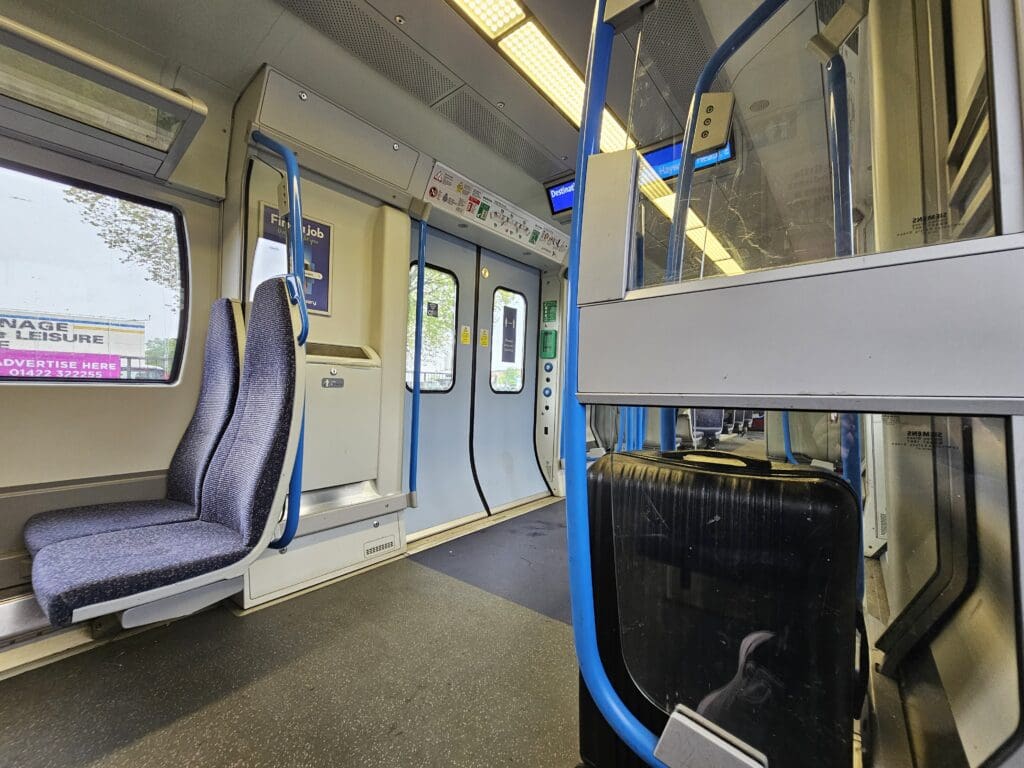
Once there, I made the trek deep underground to the Elizabeth Line platforms and arrived there with six minutes to spare until the next Heathrow-bound service, which, luckily for me, was heading to Terminal 4. Being rush hour, the platform was rather packed and only became busier as I waited. As I had suspected, when the train pulled into the platform, this was standing-room only, and I was left with no other option than to stand or perch on top of my suitcase as I made my way to Heathrow. Once away from Paddington, the train sprung up from the underground and sped westwards through West London suburbia. After making quite a few stops, the train left the Great Western Main Line and descended back into the dark tunnels under Heathrow Airport. Almost exactly three hours after I had been scheduled to depart Doncaster, the train came to a halt at its terminus, and I disembarked along with the masses of suitcase-wielding passengers.
Unfortunately, Terminal 4’s station is not particularly well designed and once through the ticket barriers, passengers are funnelled to the bottom of a lift shaft. From there, passengers have no choice other than to wait for one of three lifts to take them up to the terminal, with there being no escalators or non-emergency staircases available for public use. Thus, once off the train, I joined the scrum of passengers and waited for the next available lift. After a few minutes, this appeared, and once packed in like sardines, I was whisked upwards to the terminal’s check-in hall, located on the second floor. Given the fact that it was the start of the Bank Holiday weekend, I had expected the terminal to be rather busy. Indeed, this seemed to be the case in the check-in hall, with fairly long queues visible at a fair number of the desks there. However, busyness aside, I found the landside portion of the terminal to be fairly modern, clean and pleasant. For those with time on their hands before check-in, a Caffe Nero, the Co-Pilots Bar & Kitchen and a branch of WHSmiths are offered. Meanwhile, the terminal’s check-in desks are spread across a total of eight zones, logically named Zones A to H.
Once in the check-in hall, it took all of about thirty seconds before I caught sight of China Southern Airlines’ check-in area in Zone F. With two daily evening departures – an Airbus A350 flight to Beijing and a Boeing 787-9 Dreamliner operated flight to Guangzhou, the airline occupies a large space and plenty of China Southern Airlines signage could be seen erected around this. That evening, I counted an impressive total of eleven desks, and as with many airlines in Terminal 4, front-of-house handling had been delegated to the Emirates Group-owned handler, Dnata. Of these eleven desks, six had been assigned to those in Economy and two to those in Business, whilst there were also two that were dedicated to selling upgrades alongside a single desk for all other queries that appeared to be manned by a China Southern Airlines employed supervisor.
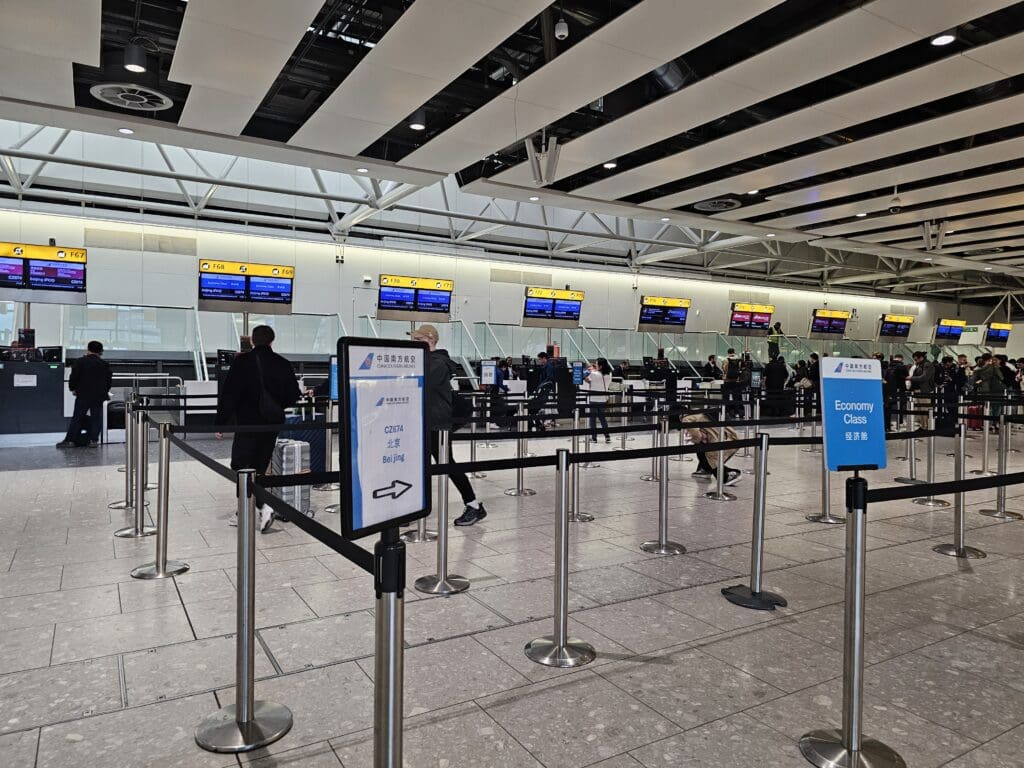
Perhaps as I was still early, much to my delight, few passengers could be seen around the desks at that time, and I was able to wander straight up to a desk without waiting. Upon making it there, I was warmly greeted by the two Dnata agents manning this – a trainee and a trainer. After handing over my passport and proof of onward travel and placing my bag on the belt, it took a few minutes for check-in proceedings to be completed – with plenty of typing and instructing required on the part of the trainer. In addition, I was required to fill out and sign China Southern Airlines’ ‘Transfer Baggage Entrusting Processing’ form. Whilst I probably should have read this, I presume this was to ensure the airline could contact me in the unfortunate event that my baggage were to go missing.
Eventually, the check-in formalities were completed, with two China Southern Airlines branded boarding passes handed over to me along with my passport, at which point I was advised to be at the gate an hour before departure and requested to check the departure boards to ensure that I was at the correct gate. Seeing no reason to remain in the landside area, I continued onwards and made a beeline for security. Whilst Heathrow Airport does have somewhat of a bad reputation when it comes to security queues, this had been disproven during my last trip through Terminal 4 just before Christmas. Hoping for a similar painless experience, once I had passed through the automated gates, I was directed to a near queueless checkpoint, which I passed through quickly and effortlessly, with no need for standing around for additional checks to be completed. Top marks to Heathrow!
By the time I made it through, the Airbus A350 that would be taking me across Eurasia could be seen landing in the distance on the northerly runway, and I was left with over two hours before boarding was scheduled to commence, giving me plenty of time to explore the terminal. Compared to many other airport terminals, Heathrow’s Terminal 4 cannot be said to be the largest or most glamorous terminal in the world. However, inside, it is reasonably modern and left me with relatively few complaints that evening. Starting with the basics, complimentary wifi is provided throughout the terminal, which I found to work well for the duration of my stay. On a related note, charging points are dotted about the terminal and I found the first one I visited that evening to work without issue, as is unfortunately not always the case!
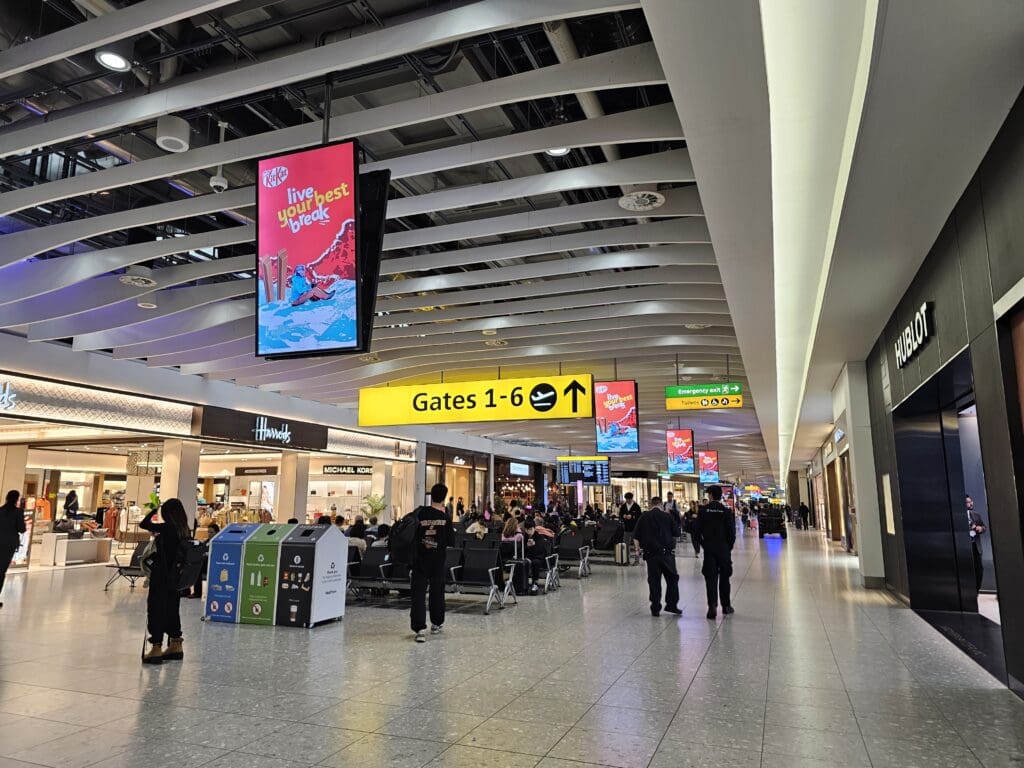
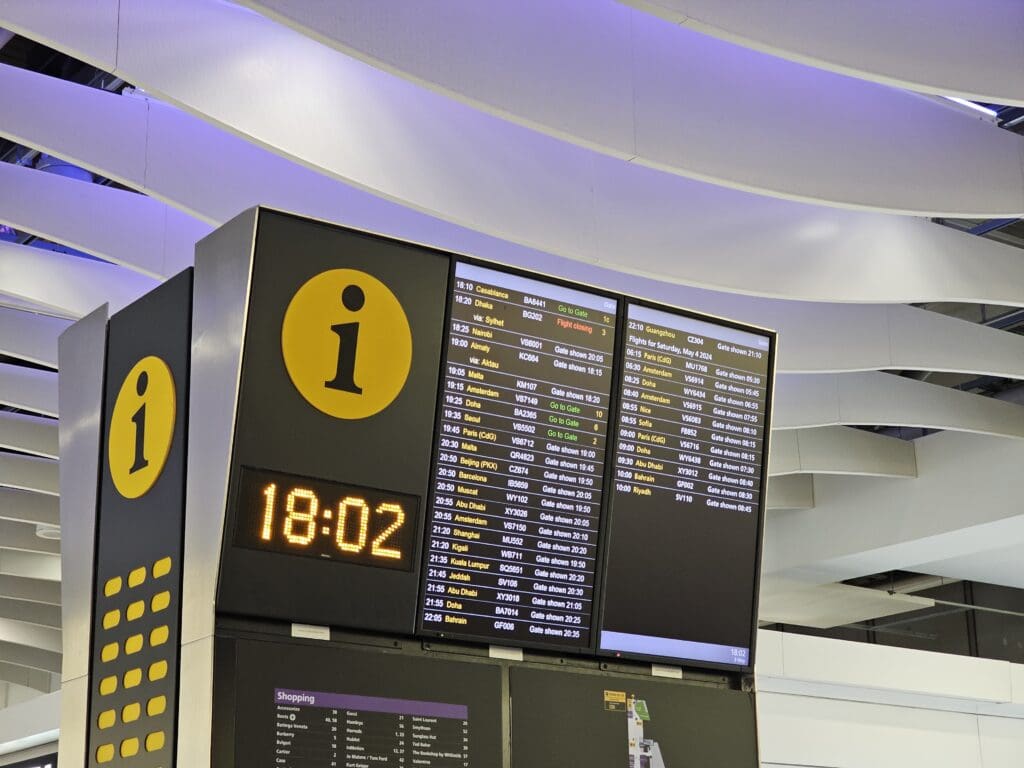
In terms of shops and eateries, it is evident that Terminal 4 targets a wholly different demographic from many other airport terminals across the UK! Be it through the Caviar House & Prunier Seafood Bar, or branches of Bvlgari, Gucci or Hublot, just to name a few, it seemed like many of the retail offerings were skewed towards those with plenty of cash to splash. Indeed, it is worth mentioning that Terminal 4 serves as the starting point of many of Heathrow’s services to China and the Gulf. However, for those on more of a budget, branches of Boots, Pret and WHSmiths could be found, although even these outlets sold items at the usual inflated airport prices.
In terms of its arrangement, Terminal 4 has a straightforward layout and the airside area consists of a long and thin pier, which is home to most of the terminal’s gates and facilities, along with a shorter secondary pier that is connected to the main pier by a long and somewhat utilitarian corridor. For aviation enthusiasts, fantastic views of most stands and Heathrow’s southerly runway can be had from most of the terminal’s gates, although I was disappointed to find that since my last trip, the View Heathrow observation area had closed, although as I would discover the following year, this was only a temporary measure!
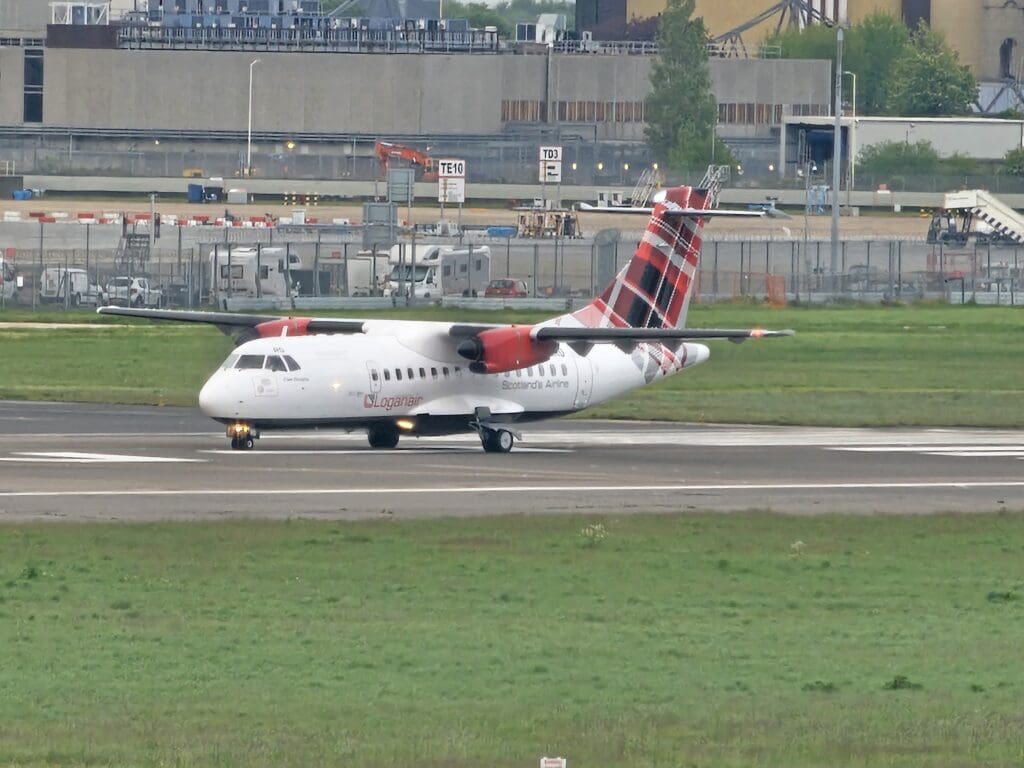
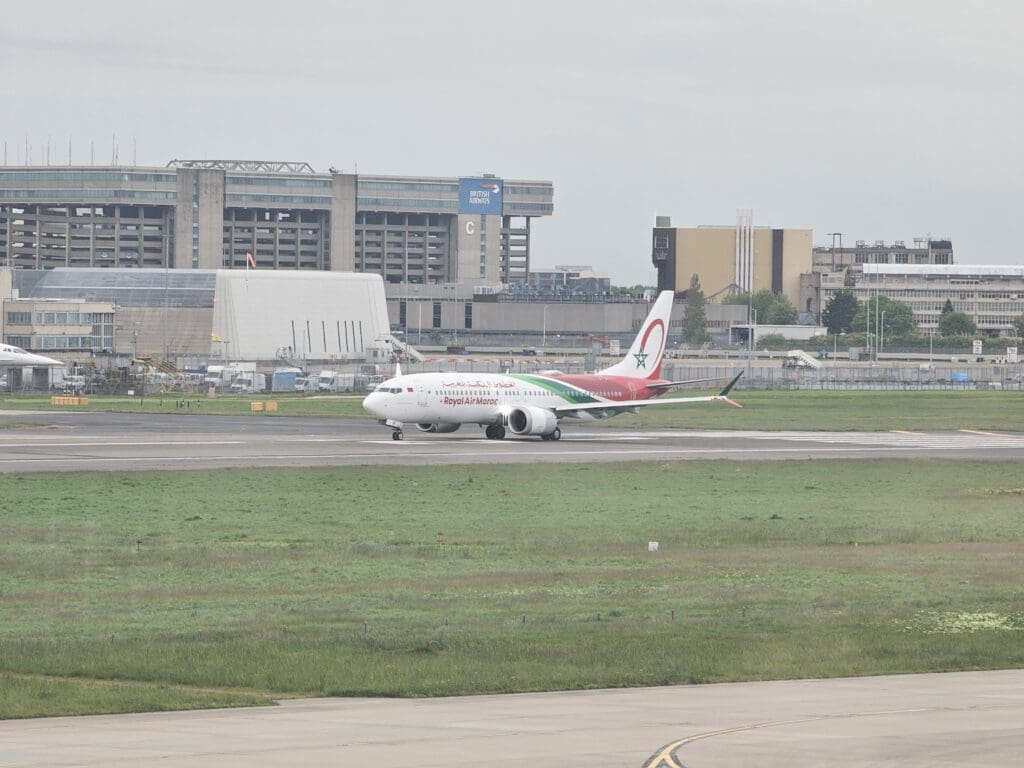
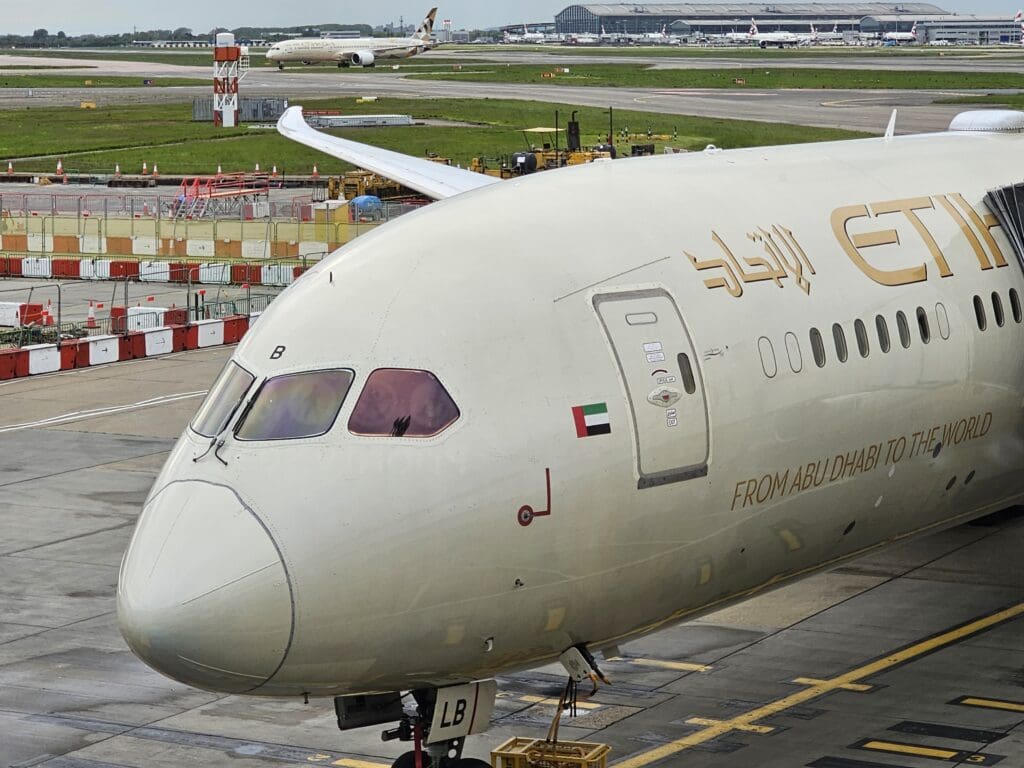
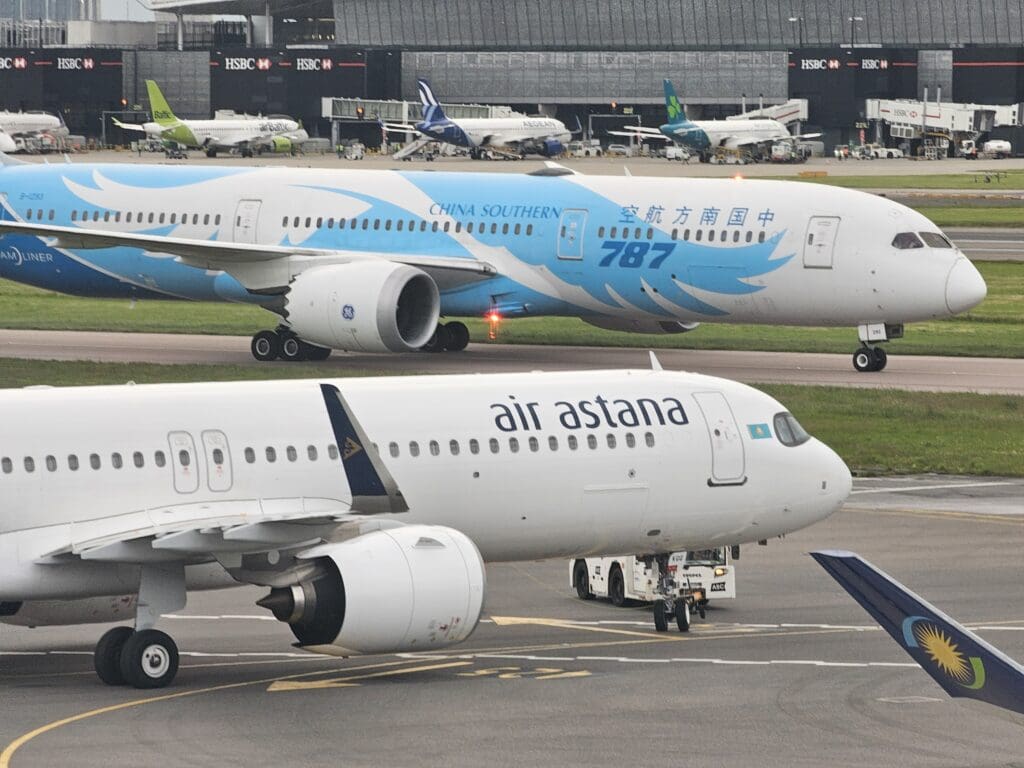
When it comes to movements, Terminal 4 proves to be infinitely more exciting than the British Airways dominated Terminal 5, with a diverse array of airlines and aircraft types seen outside at the terminal’s stands. Specifically, Terminal 4 hosts the majority of non-alliances airlines that serve Heathrow, along with most SkyTeam carriers (the exceptions being China Airlines, Delta Airlines, Middle East Airlines and Virgin Atlantic) and a few OneWorld carriers such as Malaysia Airlines, Royal Air Maroc and Qatar Airways. Following a wander around, I plonked myself down and watched as a sleek Etihad Airways Boeing 787-9 Dreamliner was readied for its return flight to Abu Dhabi at the stand below, and admired the constant stream of movements on the runway behind this, spotting aircraft ranging in size from the minuscule ATR 42 to the massive Airbus A380.
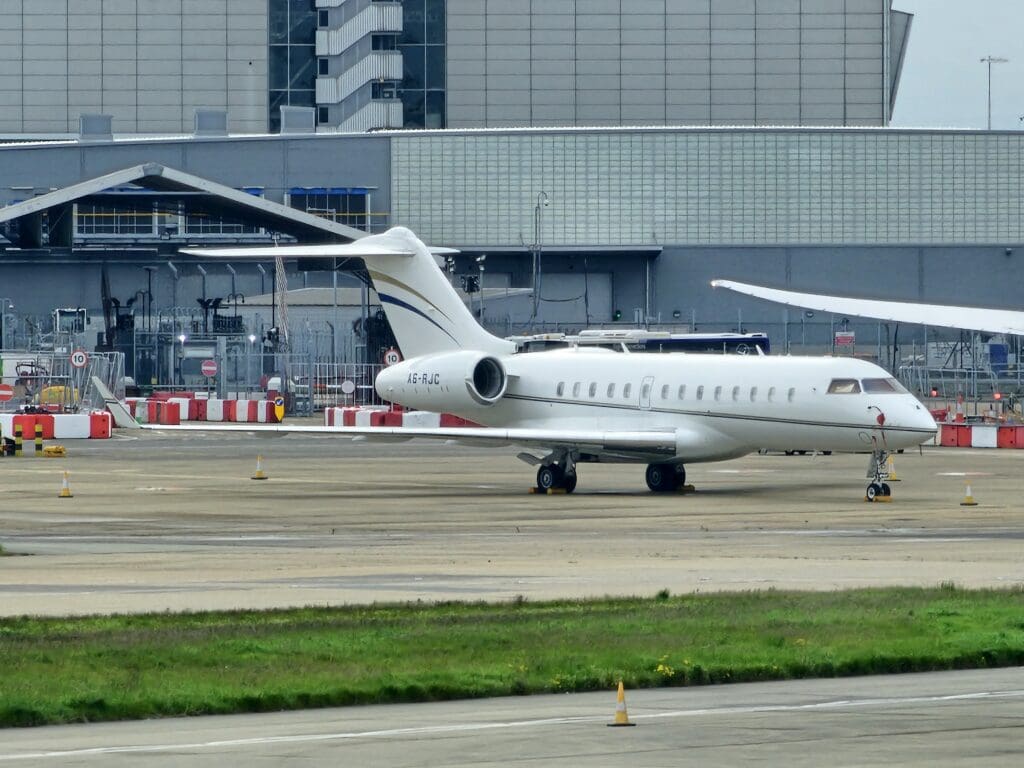
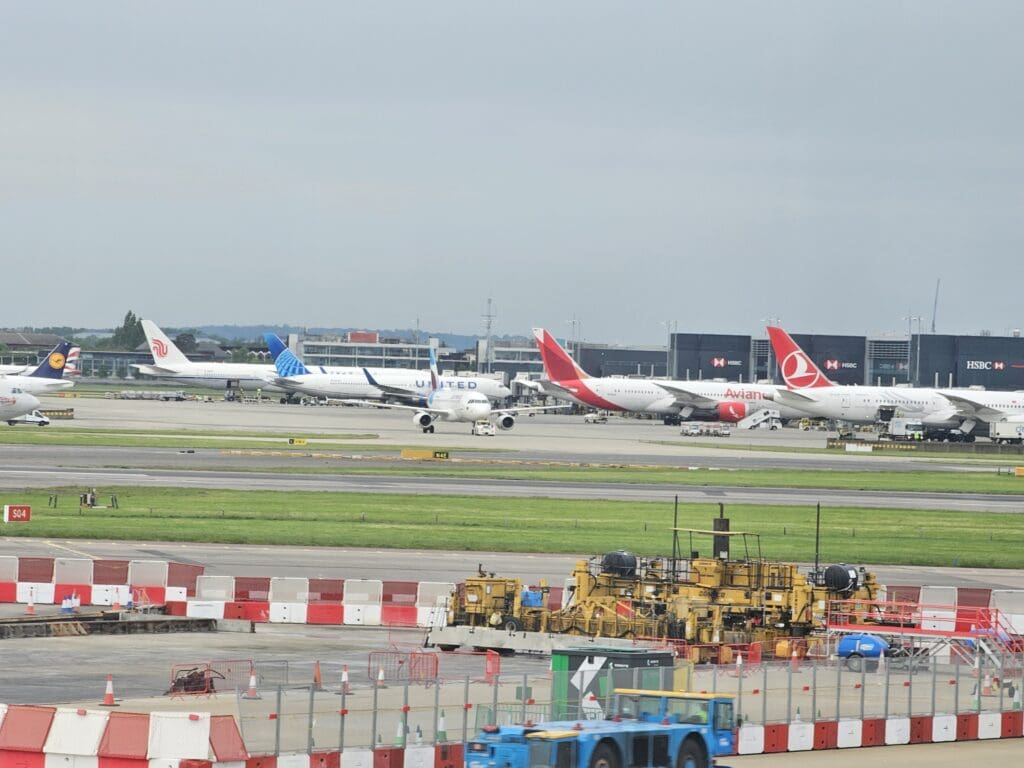
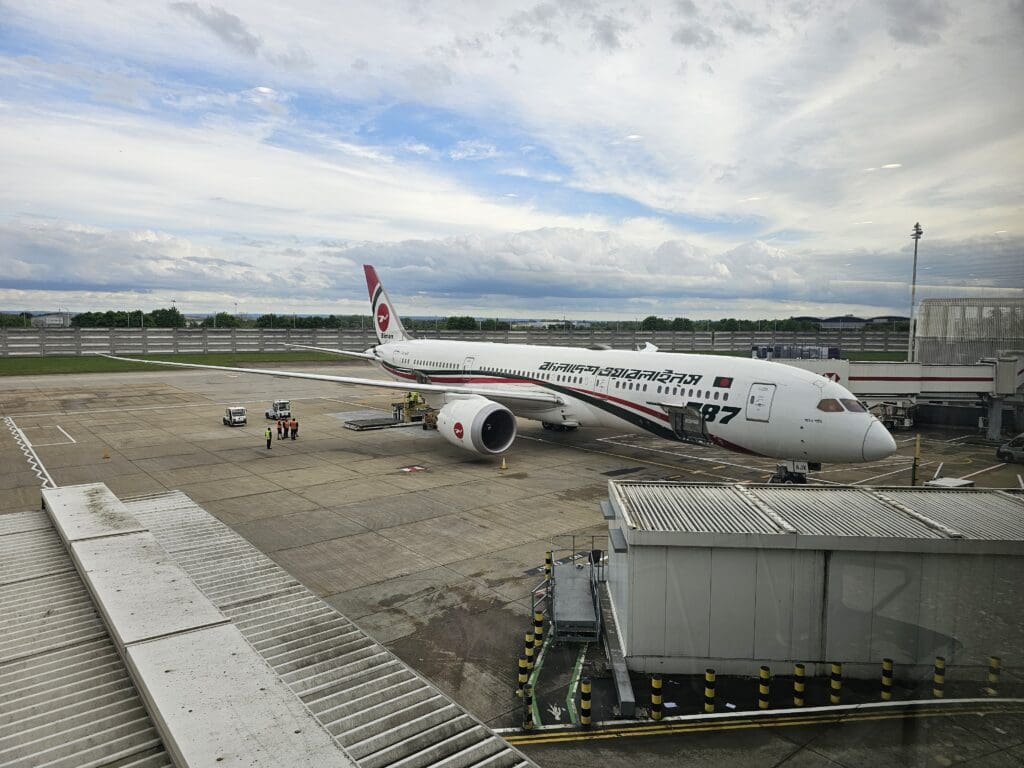
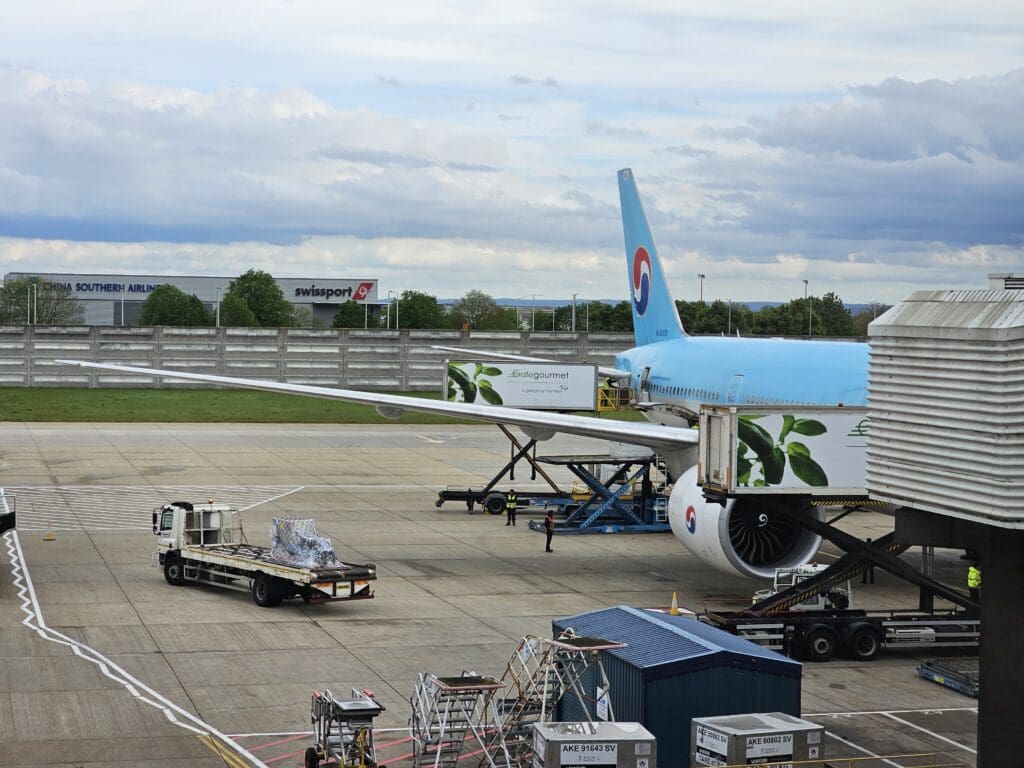

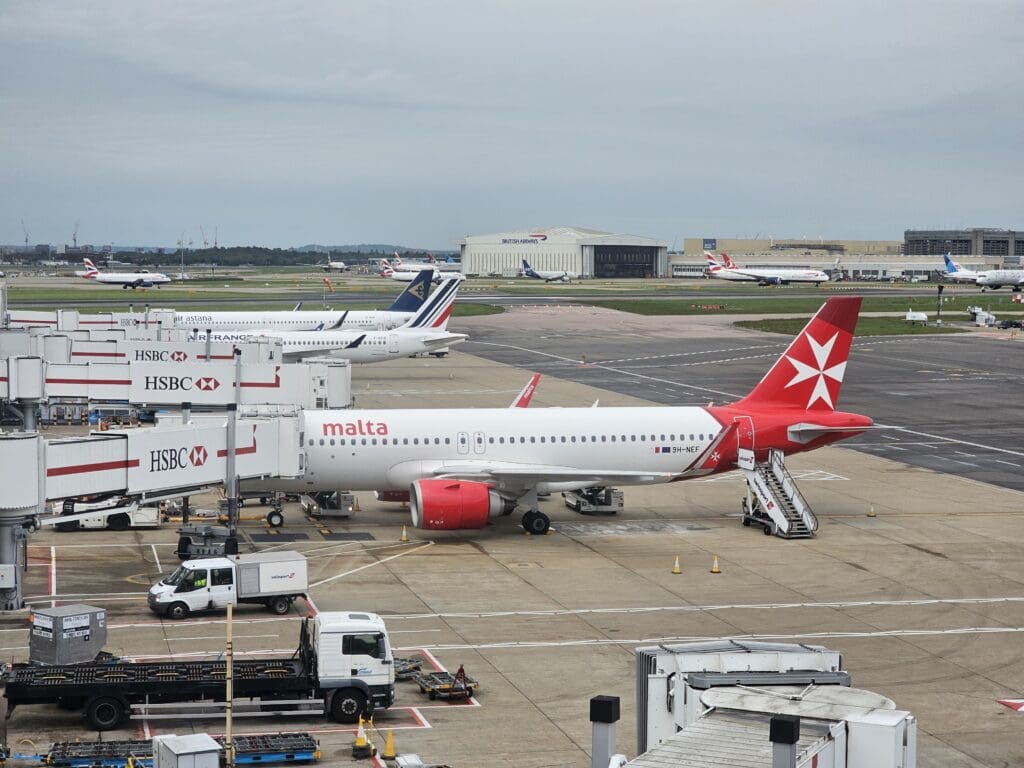
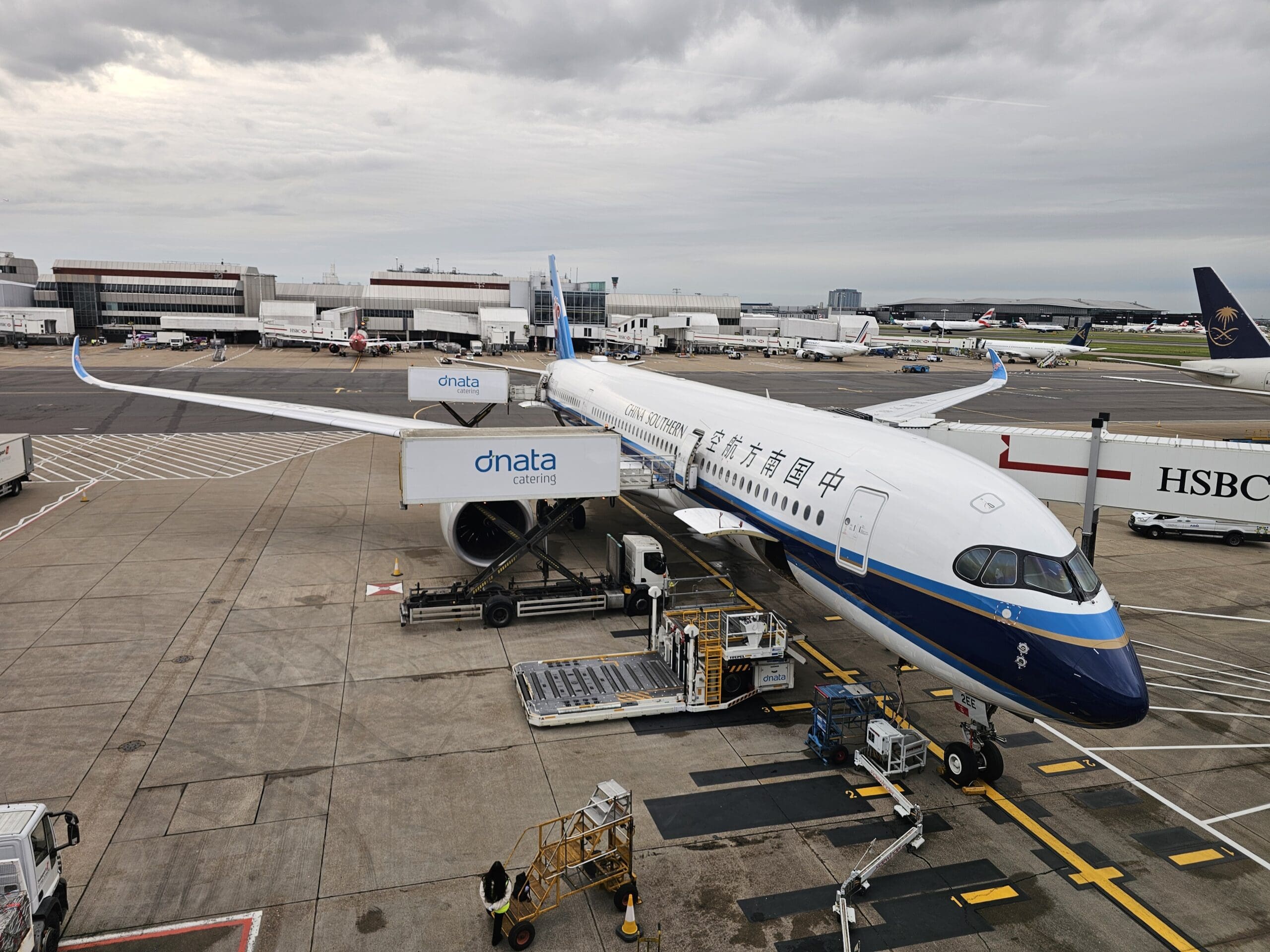
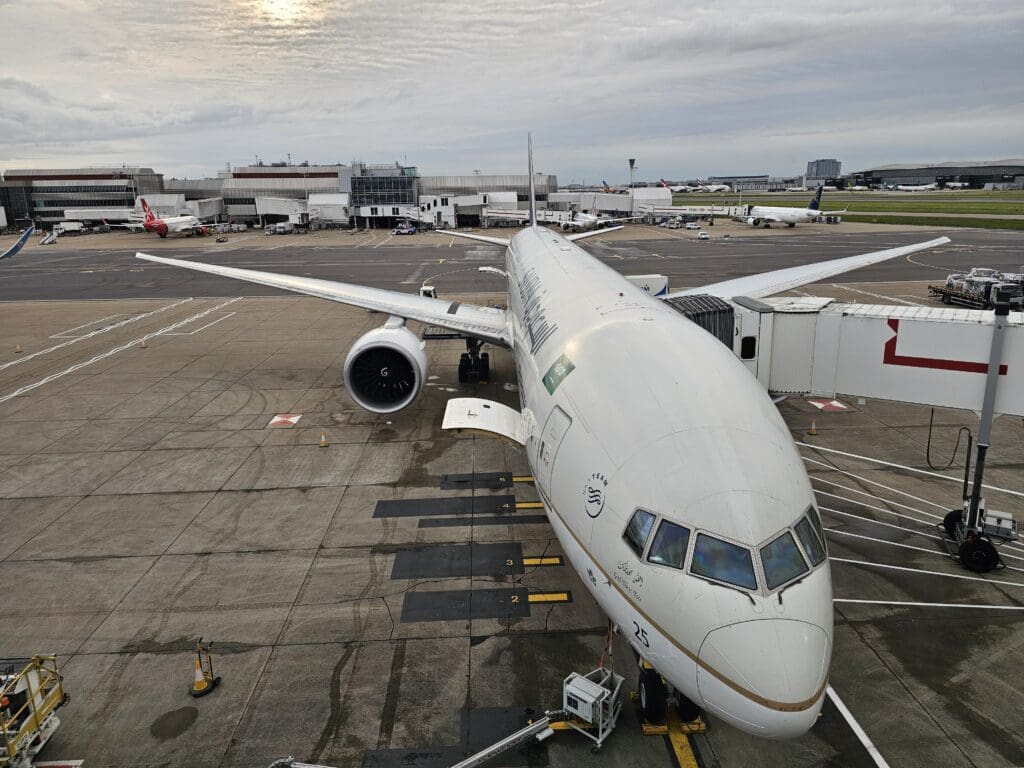
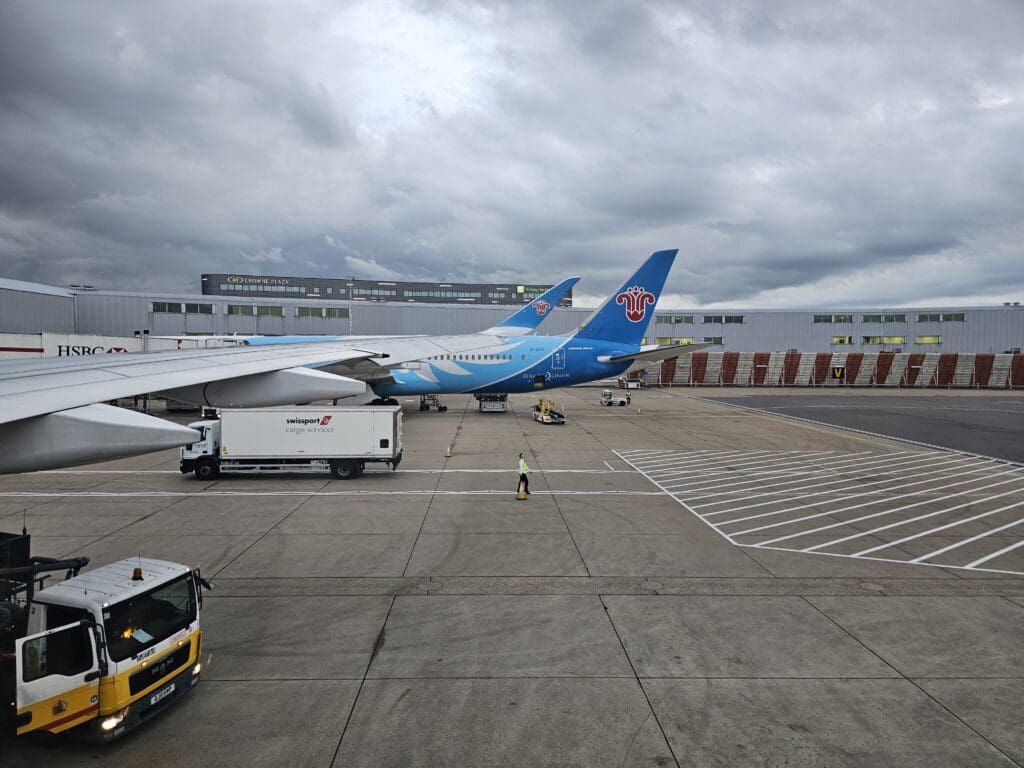
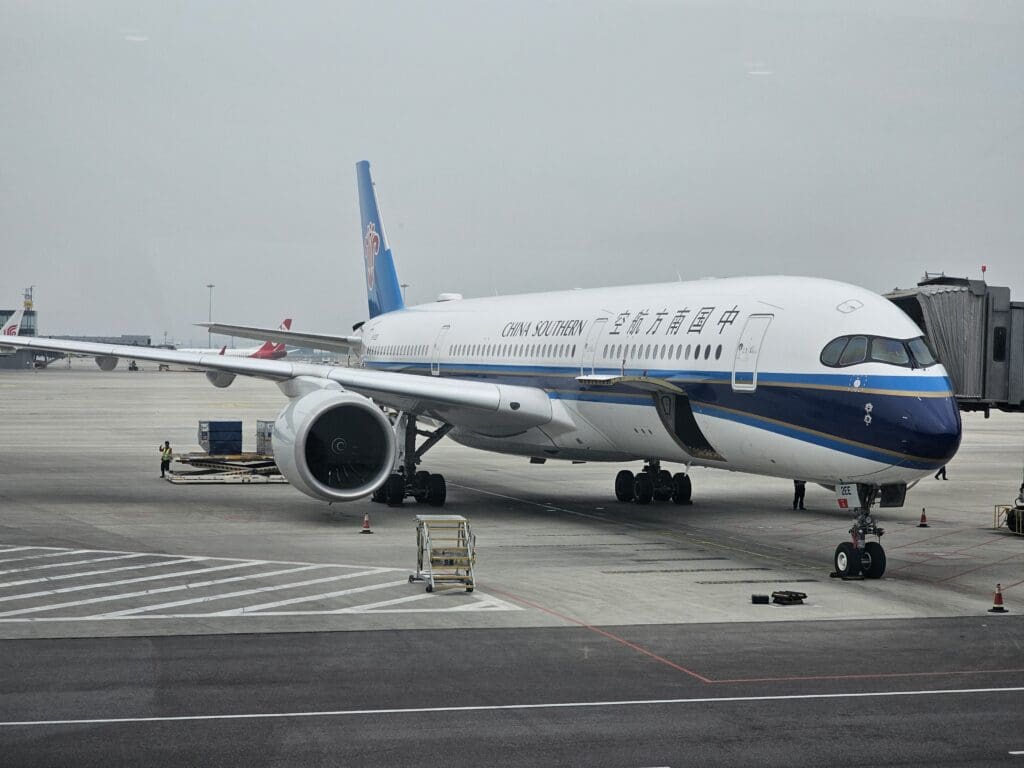
Seeing as my inbound aircraft had touched down from Beijing at 1754, whilst the gate number was not displayed on the departure boards until around ninety minutes before departure, to an enthusiast it was clear which gate my flight to Beijing would be departing from. That day, China Southern had sent Airbus A350-941 B-32EE to Heathrow, and this sleek jet could be seen being readied for the flight at Stand 423. Assembled at Airbus’ Toulouse Blagnac plant, this jet first took to the skies with the test registration of F-WZNG in late May 2023. This meant that the aircraft was a little shy of a year old at the time of my flight. As you would expect from such a new aircraft, at the time of my journey I was unable to find any incidents involving the aircraft in the Aviation Herald. Meanwhile, in the week prior to my flight, this had made just seven flights, connecting Beijing Daxing with Amsterdam, London Heathrow and Shanghai Hongqiao. China Southern Airlines operates the Airbus A350 in both a two and three-class configuration, and that day, I would be flying onboard one of their two-class configured aircraft, with 28 seats in Business and 307 in Economy.
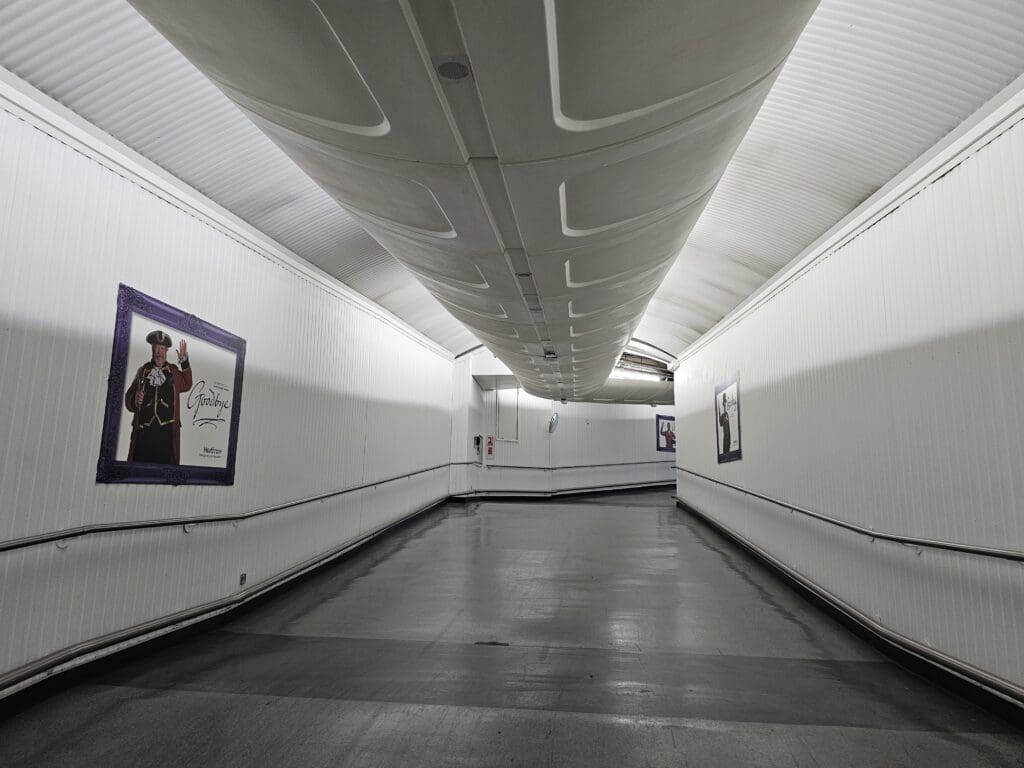
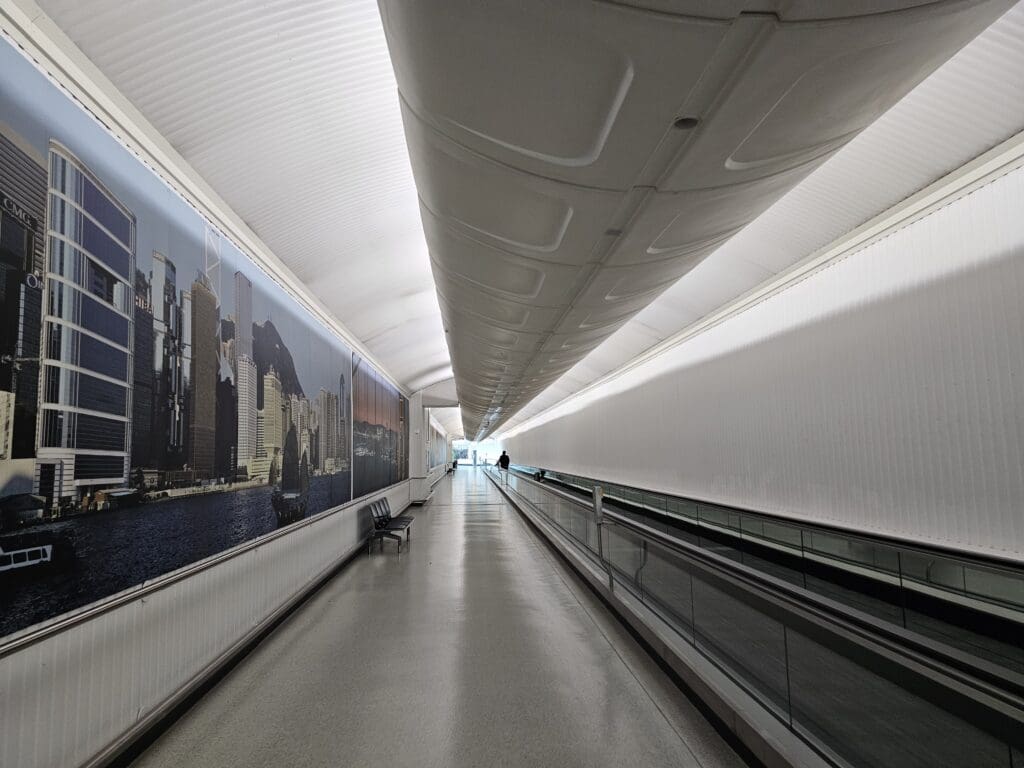
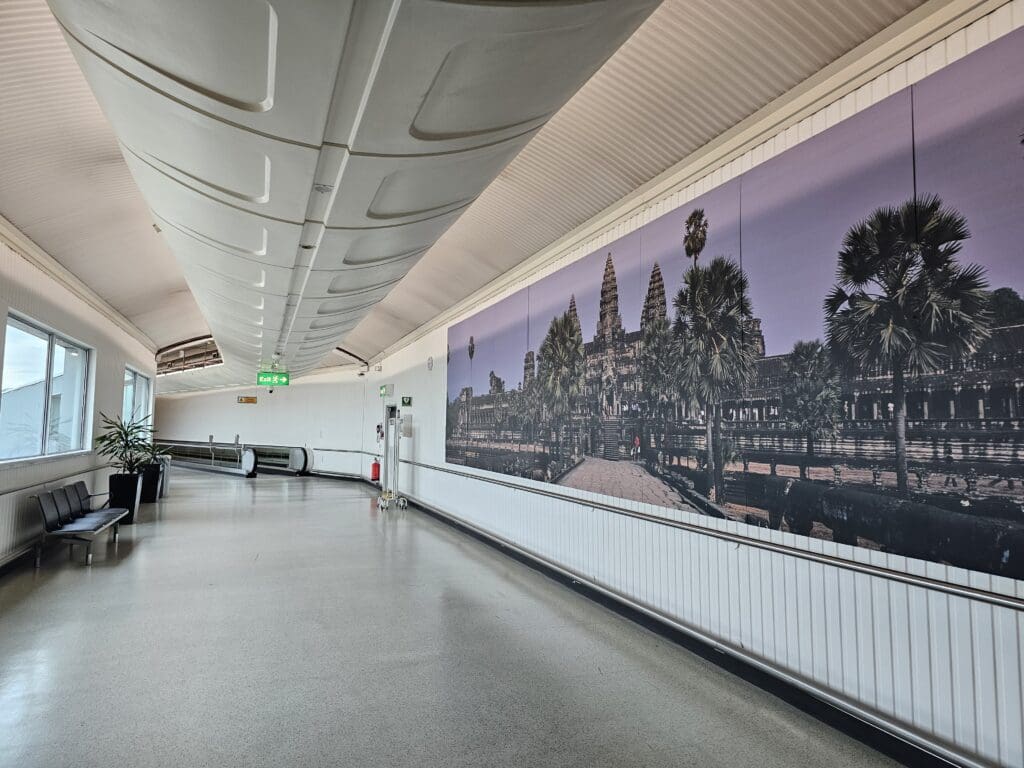
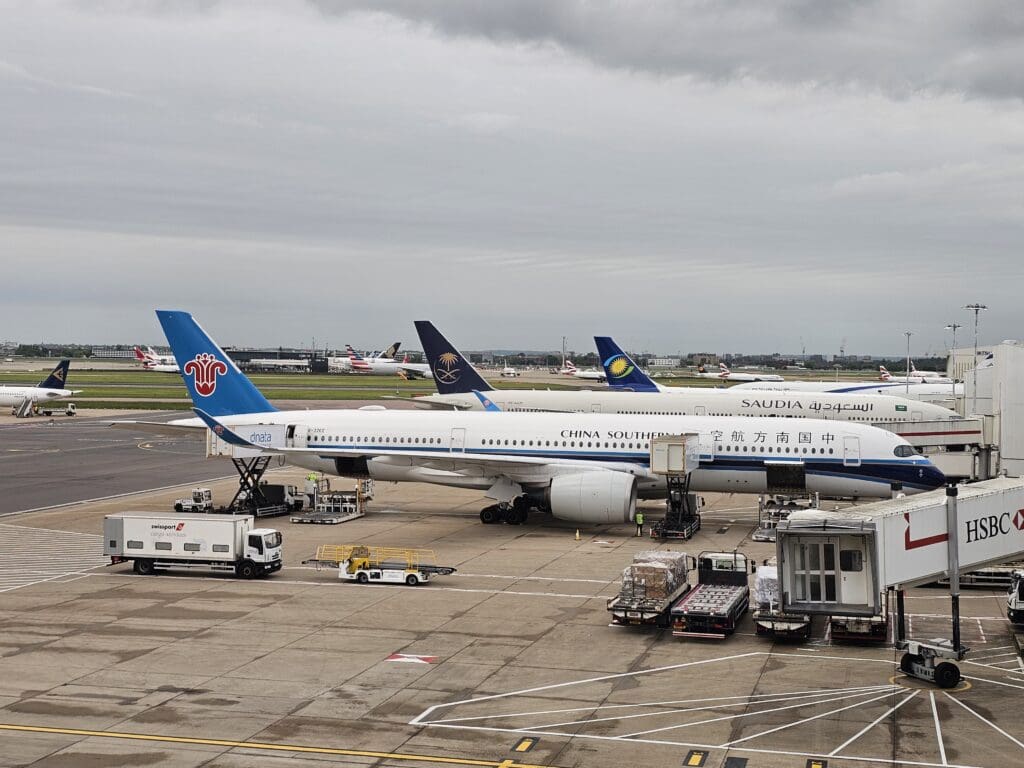
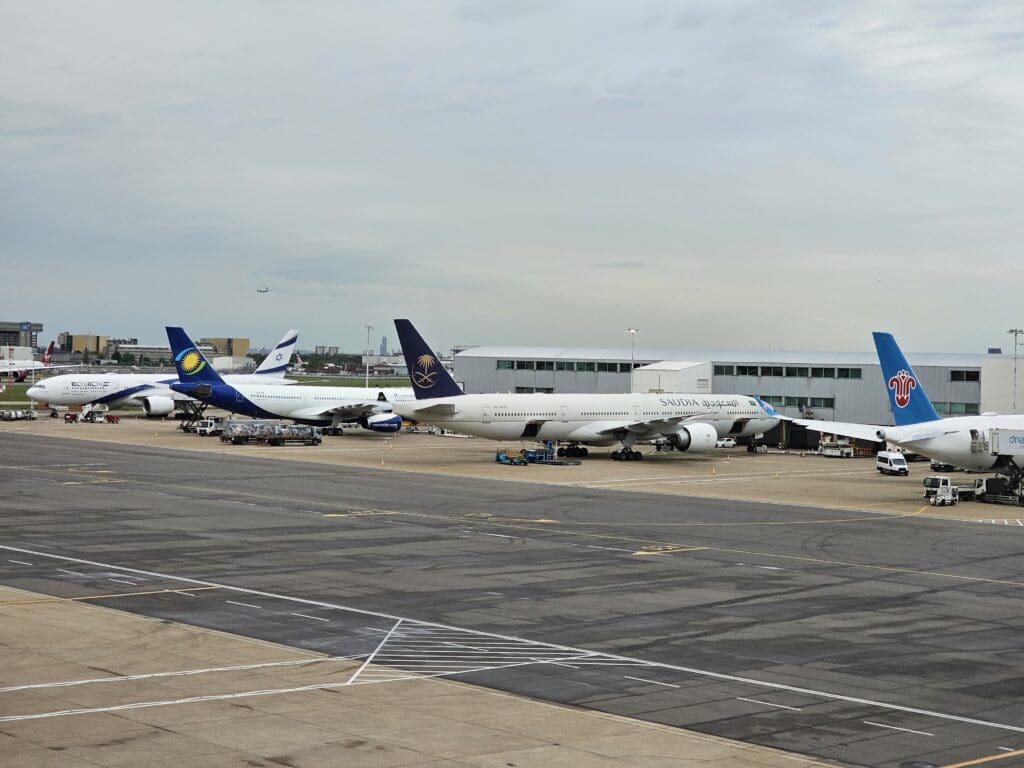
Having exhausted the sights of the main portion of the terminal, once I had charged my phone I journeyed down the long winding passageway that leads to the smaller pier. Home to Gates 22 to 25, at that time a Saudia Boeing 777-300ER and a Rwandair Airbus A330-200 could be seen accompanying the China Southern Airlines Airbus A350, with this soon joined by one of the company’s Boeing 787-9 Dreamliners operating the Guangzhou rotation. Sitting a short distance away from the pier, an El Al Boeing 777-200ER and a Bahrain Amiri Flight Boeing 767-400ER could be resting in between flights, with the latter being a rare sighting for me, if not a somewhat not too infrequent visitor to the likes of London Heathrow and London Stansted.
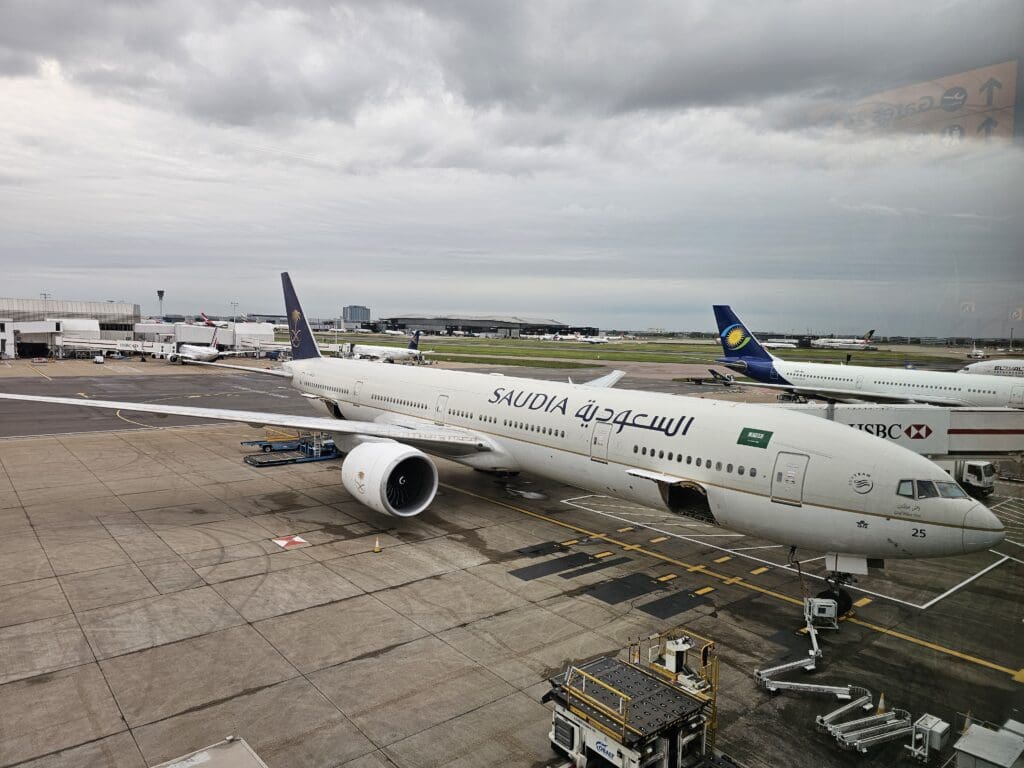
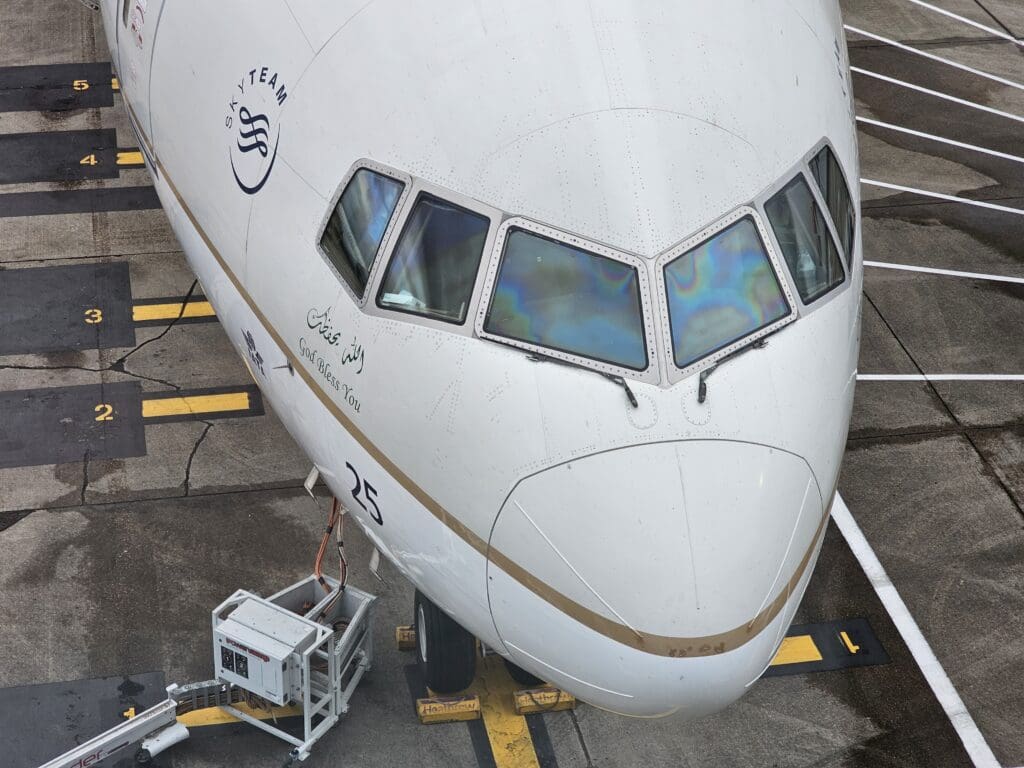
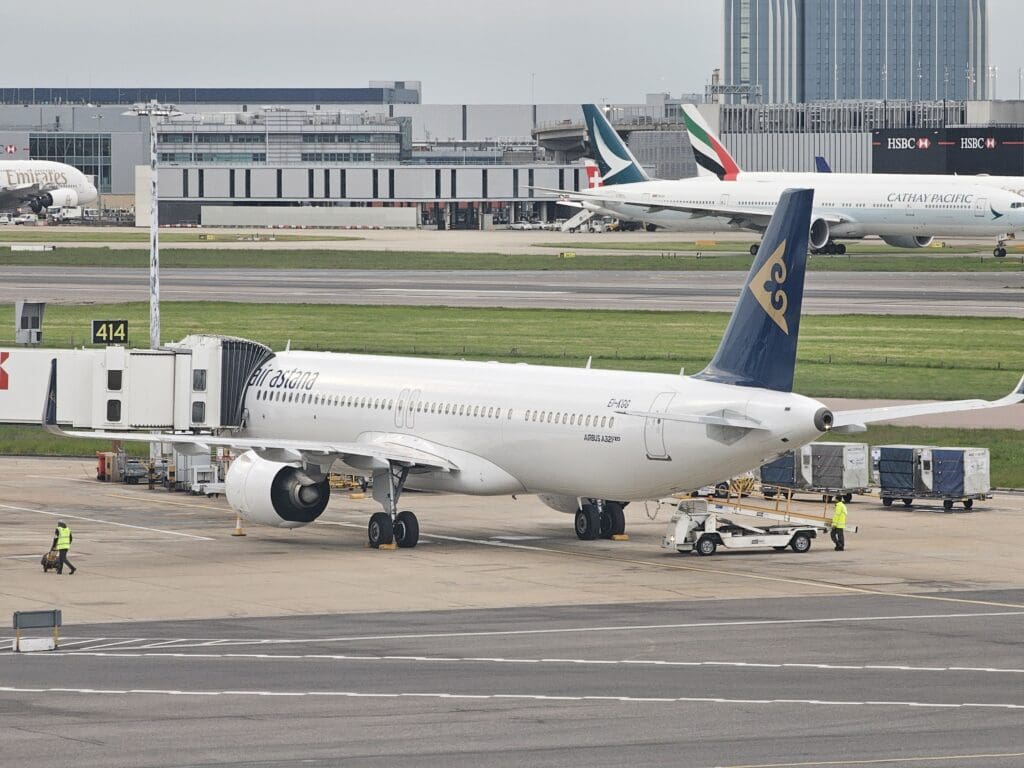
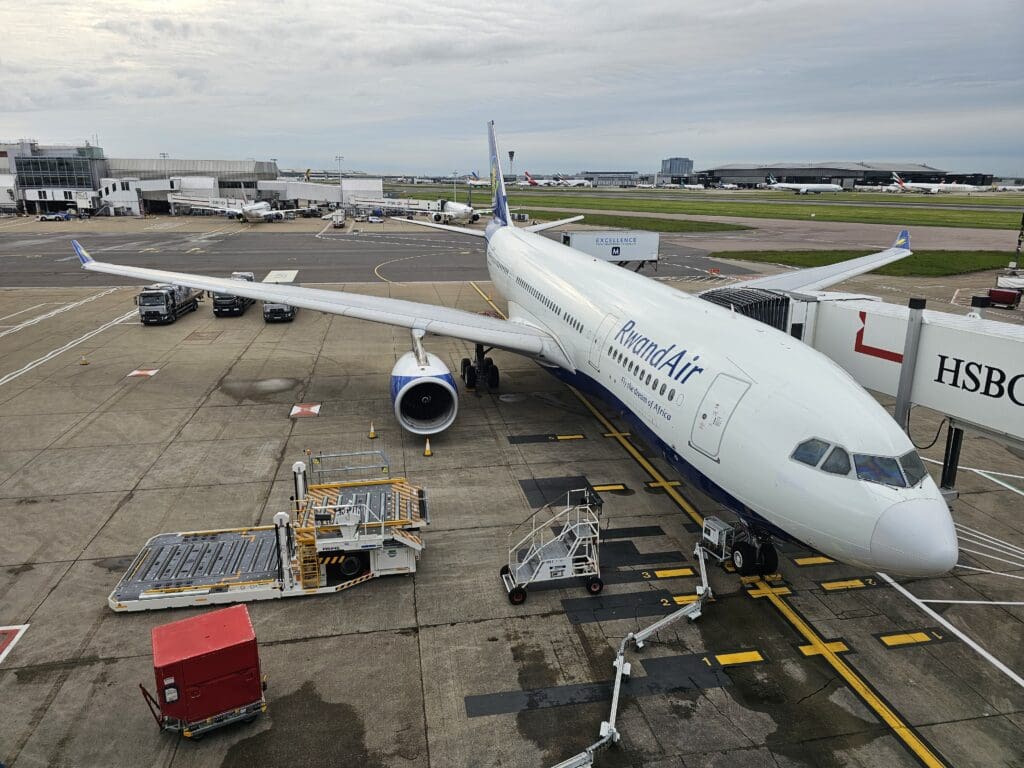
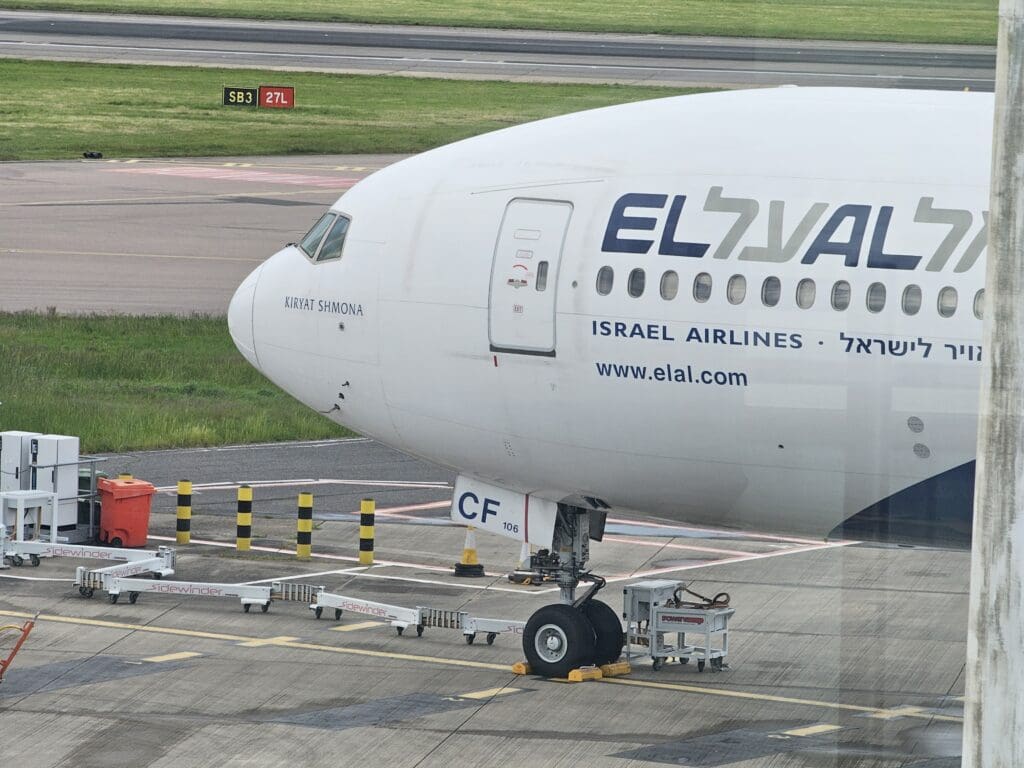
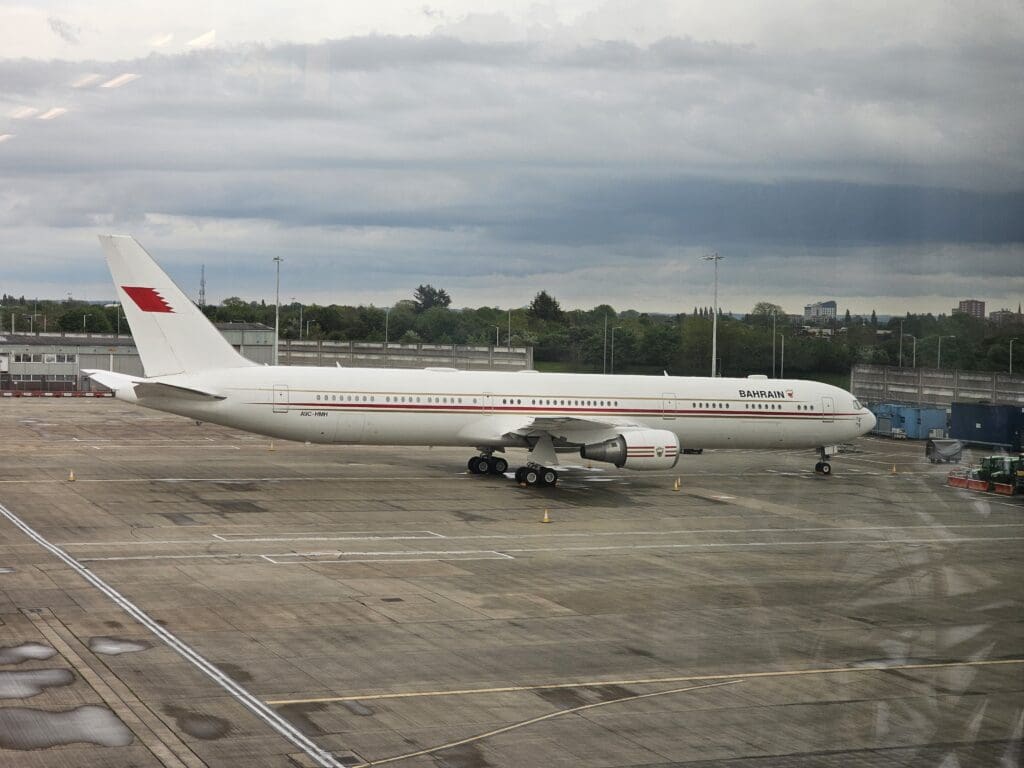
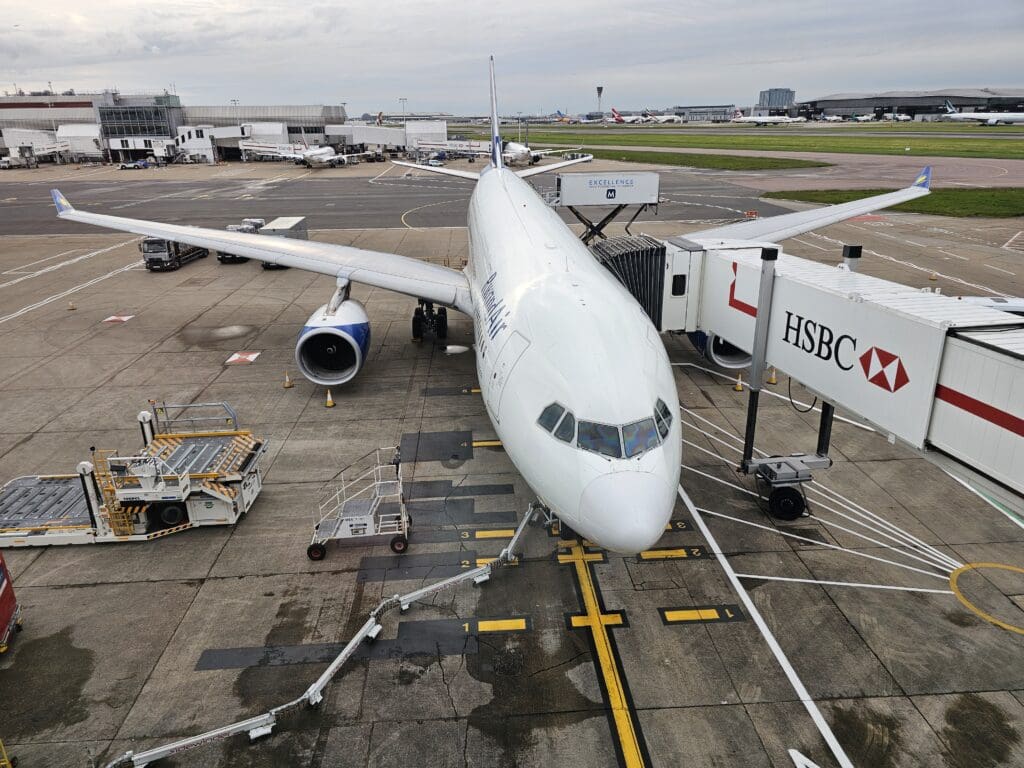
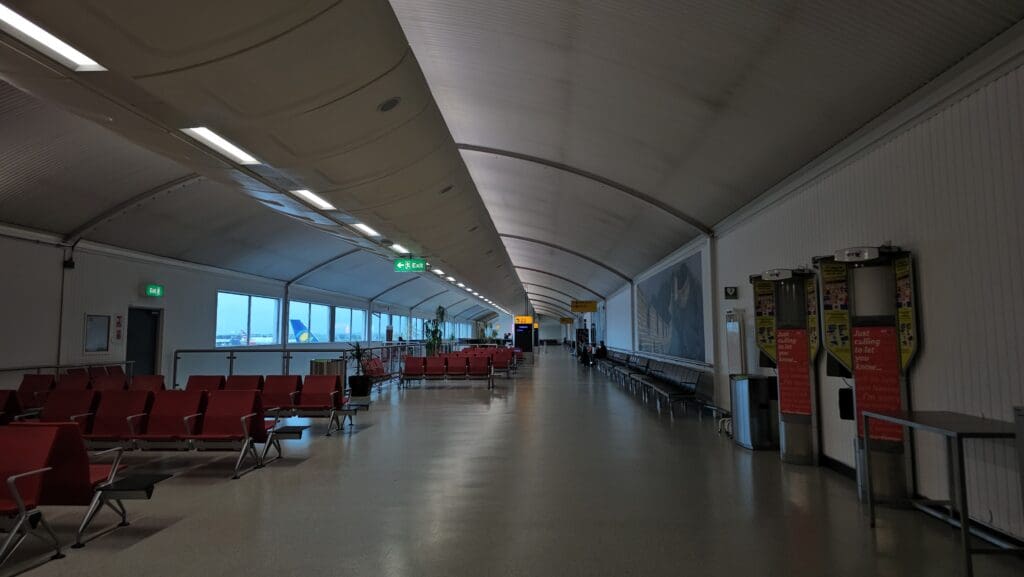
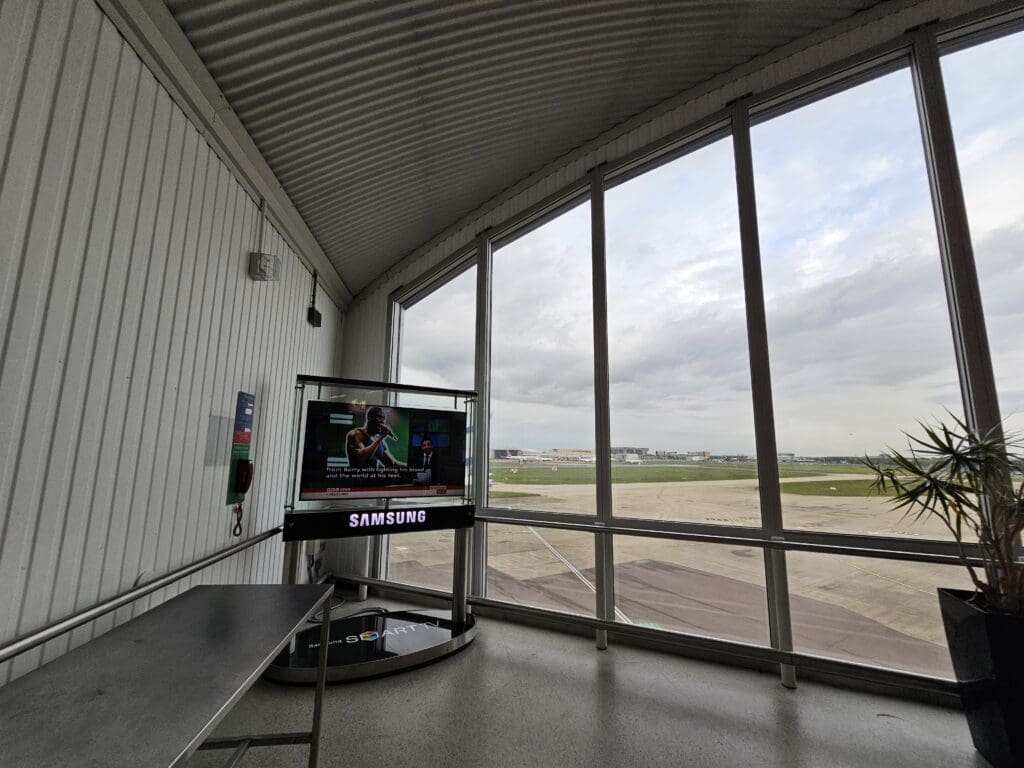
Examining my surroundings, starting with the positives, I found that this smaller pier offered superb views of the southerly runway, and to my surprise trumped those that could be had from the main terminal, with a very large window at the far end of the pier offering unobstructed views of the eastern end of the runway. Meanwhile, like the main terminal, this featured a reasonable number of plug sockets and the wifi worked without any issues. However, facilities were limited to just a very filthy set of toilets, a few vending machines and benches, many of which were worn and in need of replacement. Thus, unless you can keep yourself entertained by watching the movements outside, it isn’t the sort of place I would recommend turning up with hours to go until your flight!
After wandering around and doing some last minute spotting, with around twenty minutes until boarding for the Beijing flight was scheduled to commence, I decided it best to make my way over to Gate 23. By the time I arrived there, a reasonable number of passengers could be seen waiting and as our boarding time approached, this became busier and busier, with few places left remaining available to sit and wait. By this time, an army of Dnata staff had taken to the gate podium and appeared to be diligently undertaking their final preparations before boarding commenced, whilst a line of eager passengers had already formed a queue.
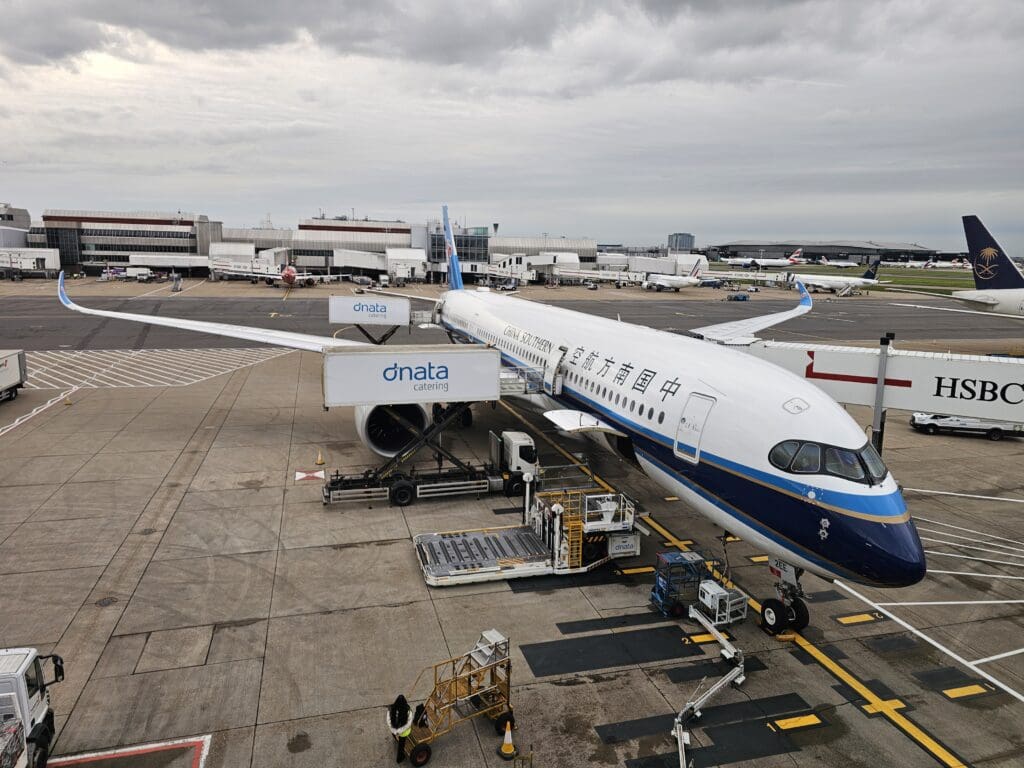

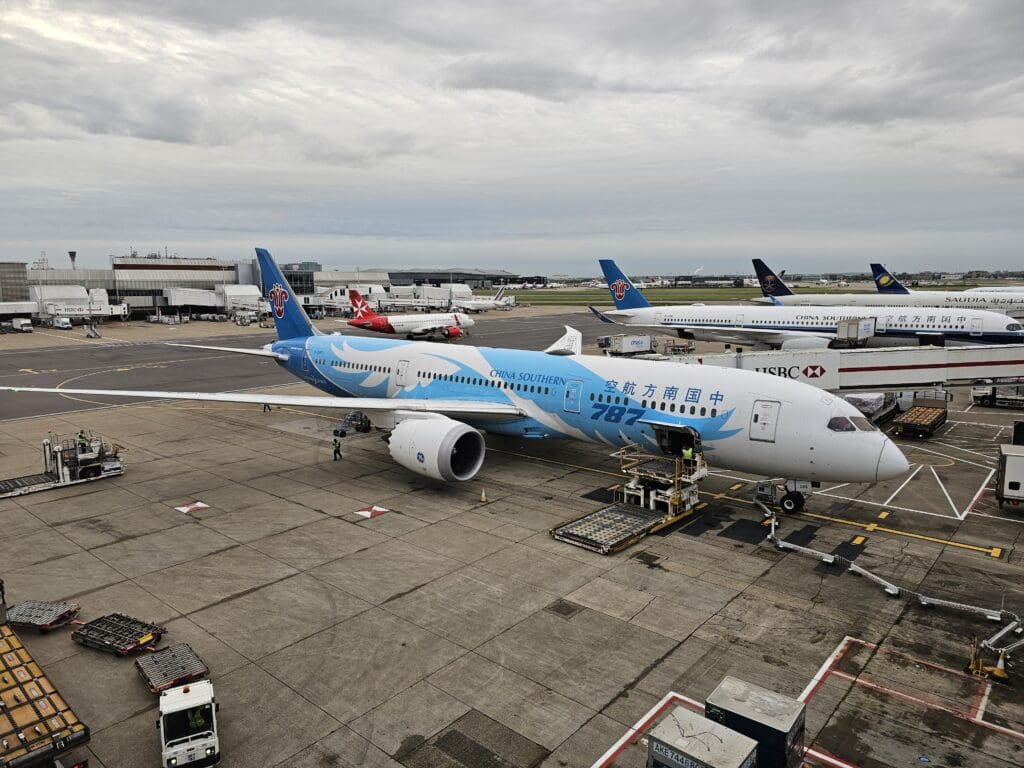
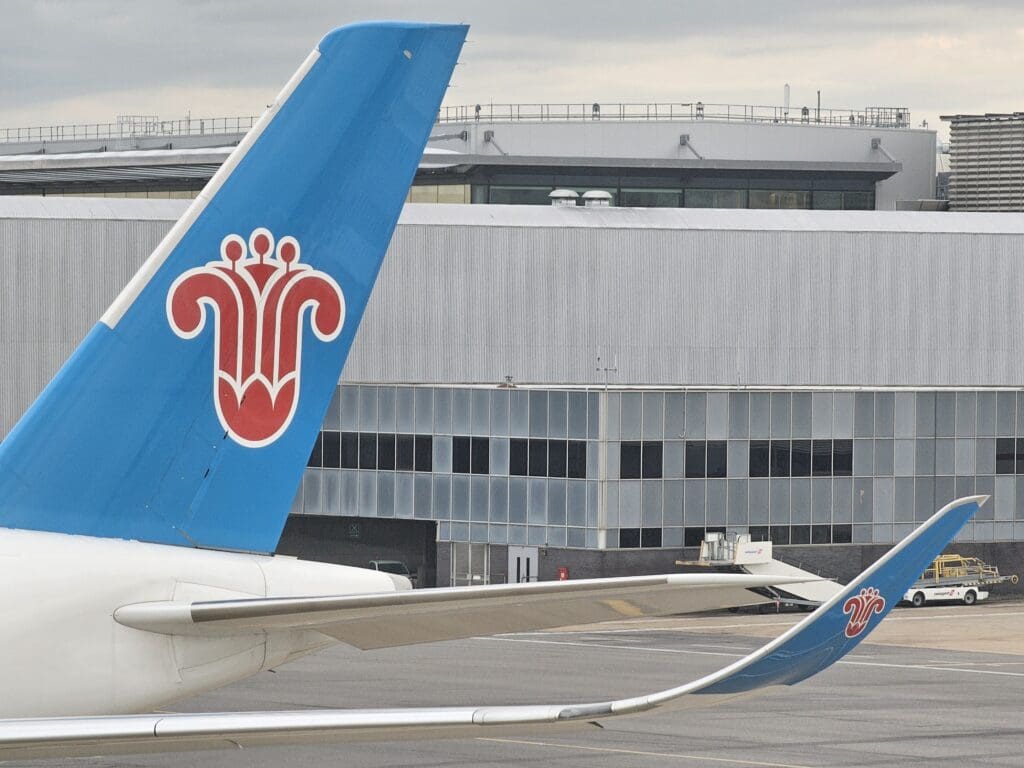
Whilst preparations appeared to be underway, I was somewhat sceptical that it would take a full hour to fill the Airbus A350 and thus I was not particularly surprised when 1950 came and went with boarding yet to commence. In the end, with fifty minutes to go until our flight was scheduled to depart, the line began to shuffle forward, indicating that boarding had commenced. Whilst I most certainly not describe boarding as being akin to any Ryanair-esque chaotic scrum, I was a little surprised to find that there were no boarding announcements and this was not conducted in any particular order. However, that said, two queues were set up – one for elite members of China Southern Airlines’ Sky Pearl Club, and another for regular Economy folks.
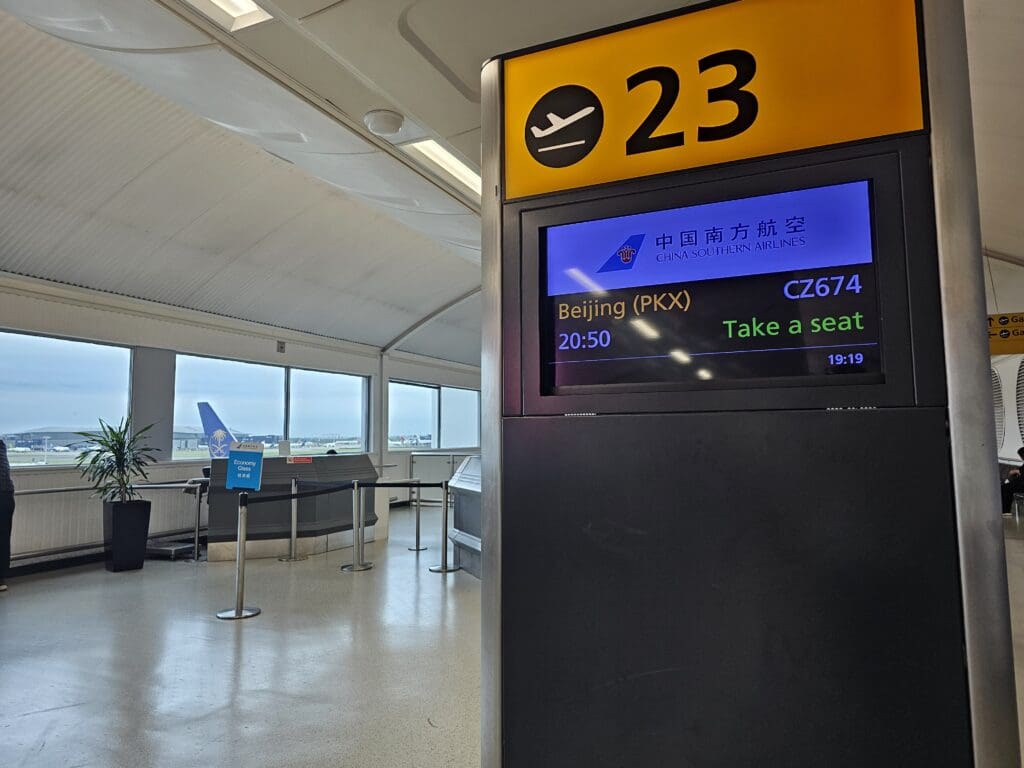
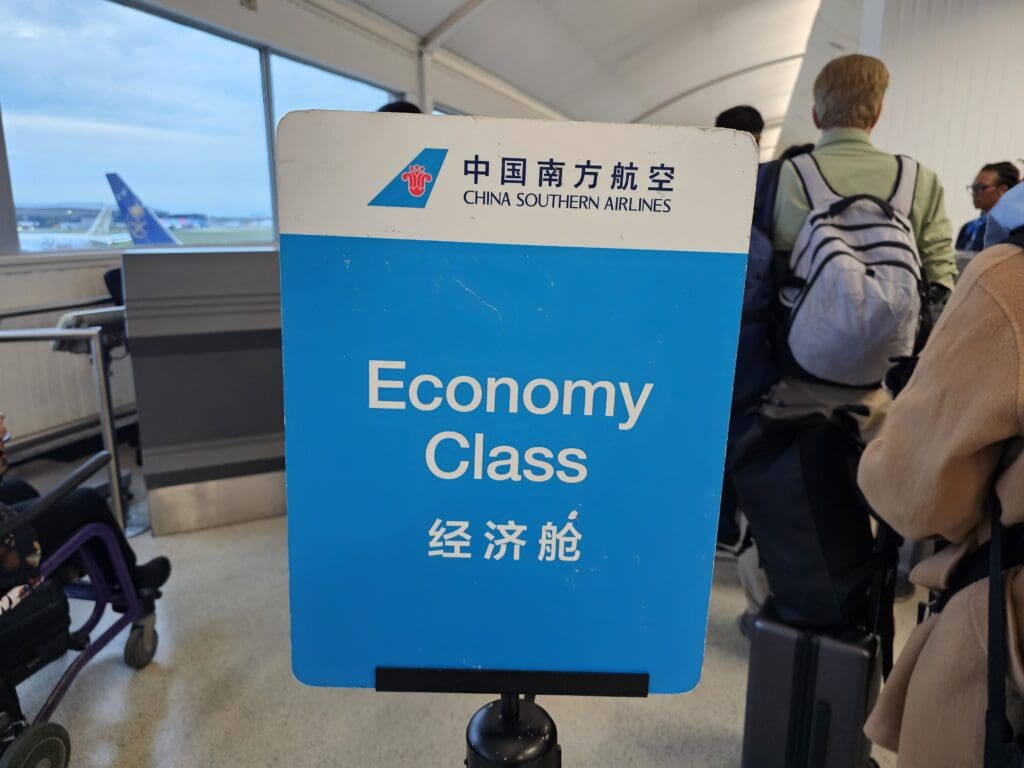
After some shuffling, I reached the gate podium where my boarding pass was scanned and torn and my passport checked without a word by a rather stony-faced Dnata agent. Continuing onwards, I wended my way down the viewless HSBC-branded jetbridge, and with nothing more than minimal queuing, I reached the L2 door of the modern Airbus A350. Leaving me with a good first impression, as soon as I climbed into the galley that separates the Business from the Premium Economy cabin, I received a very polite welcome from two smartly dressed flight attendants wearing China Southern Airlines’ distinctive uniform. Once one of the flight attendants had checked my boarding pass, I was instructed to head across the galley and take a right down the second aisle, and just before doing so, I received a nod from the flight’s security guard, easily identifiable thanks to their tough looks and their body-worn camera. Whilst their presence may come as a shock to some, I believe it is a requirement for all Chinese commercial flights to have at least one security guard onboard, with widebody jets often having at least two or three onboard to ensure good behaviour amongst passengers.
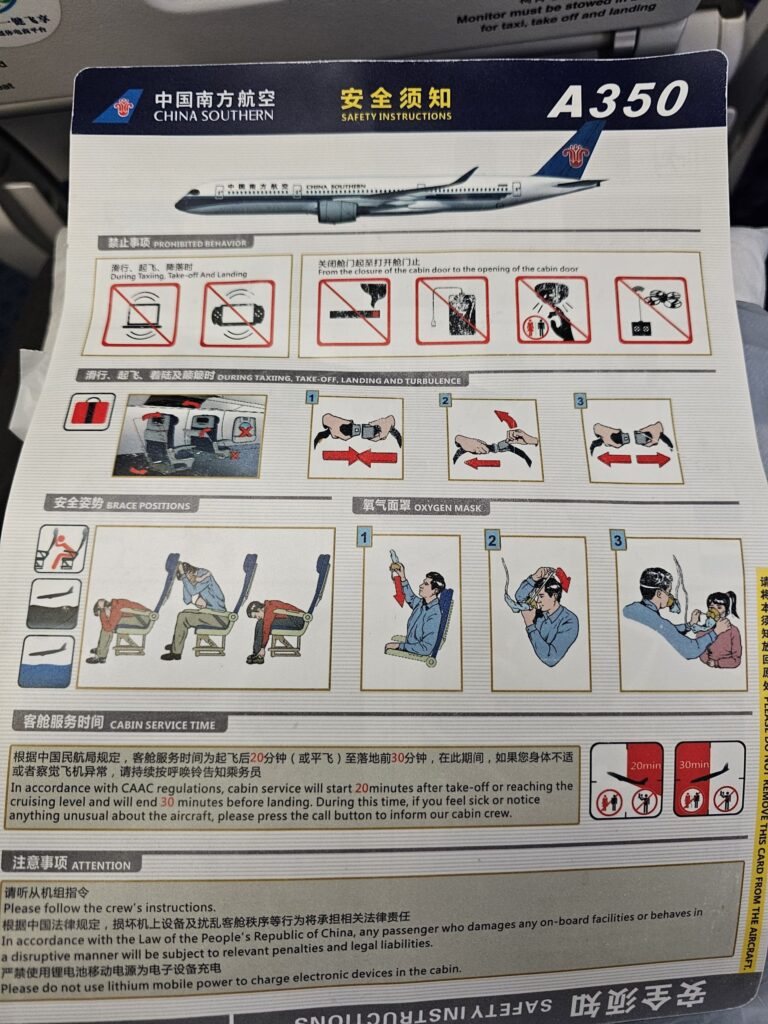
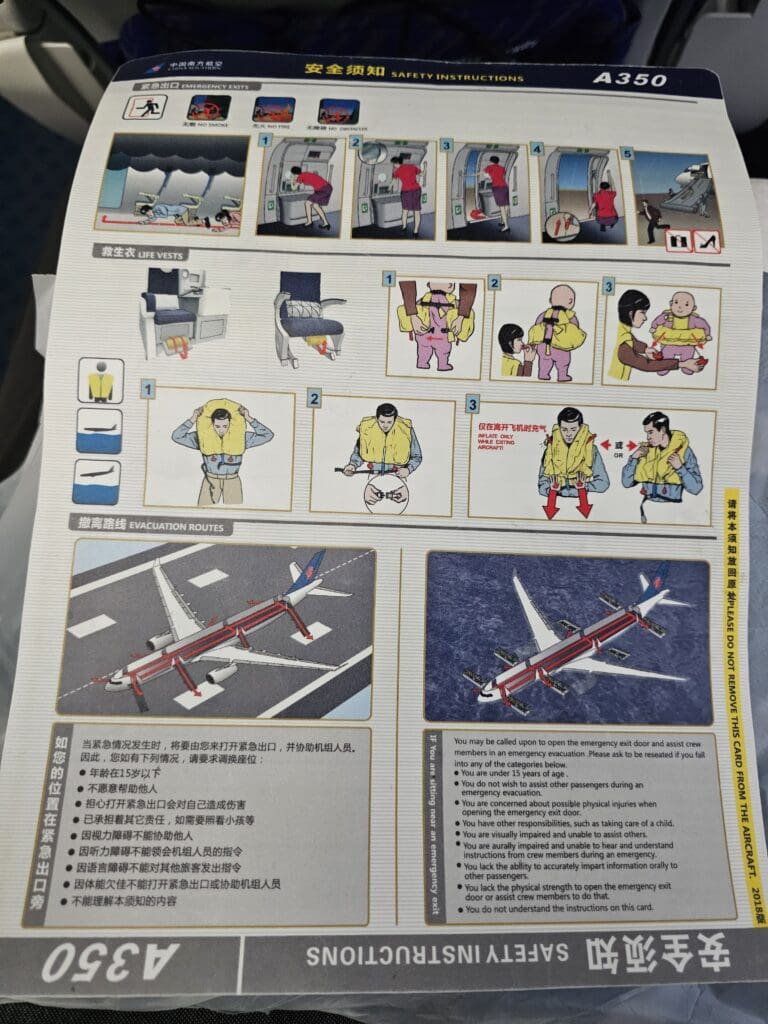
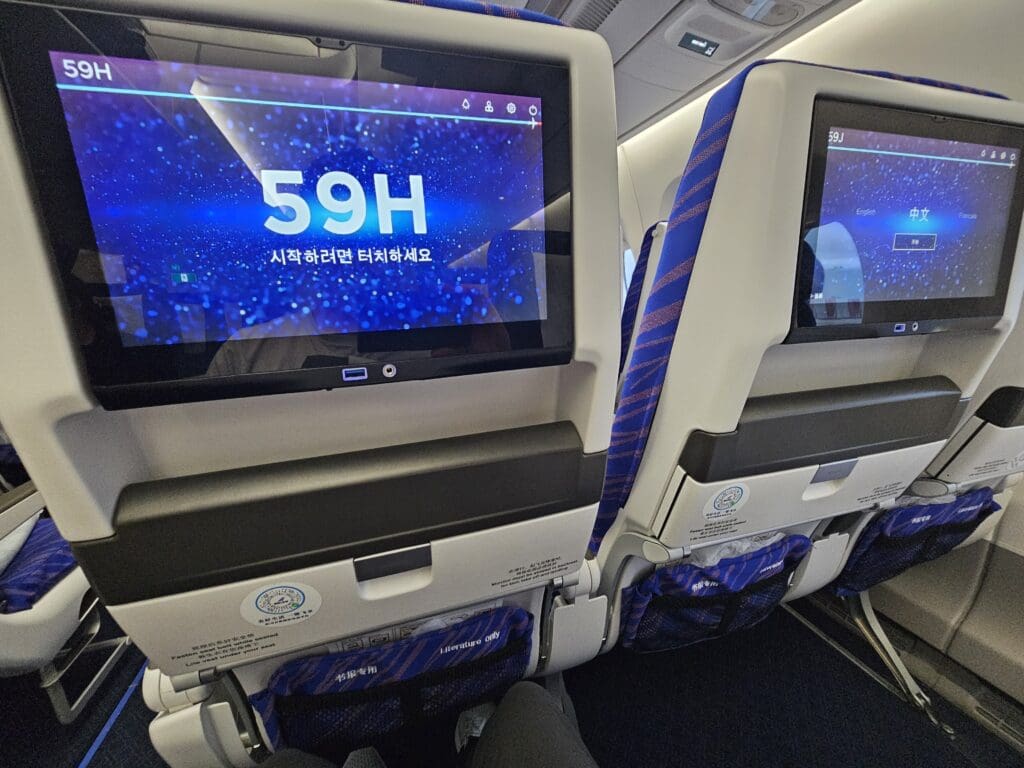
Turning right, I soon entered the boiling hot Economy cabin where I received another warm welcome, and, upholding my good first impression of the crew, I ended up receiving a greeting from each flight attendant that I passed on the journey to my seat. Additionally, the crew seemed to be proactive in assisting passengers with their luggage and guiding passengers to their seats, something that I was delighted to see and had never previously encountered onboard China Southern Airlines. Onboard, each Economy seat came in the form of the modern and reasonably common Recaro CL3710, with this being a popular choice amongst many airlines around the globe. Each of these featured China Southern Airlines’ standard blue fabric cover with gold coloured stripes and was topped with a chunky adjustable headrest covered by a fabric antimacassar on which the airline’s logo was printed. These came with a bi-fold tray table, a literature compartment, a coat hook and a seatback pocket containing a safety card, packaged headphones and a sick bag. Meanwhile, the rears of each seat featured the all-important 11.6-inch wide high-definition inflight entertainment screen along with a USB-A port. However, I should note that in Economy, power is limited to these ports, with no sort of universal power outlet available.
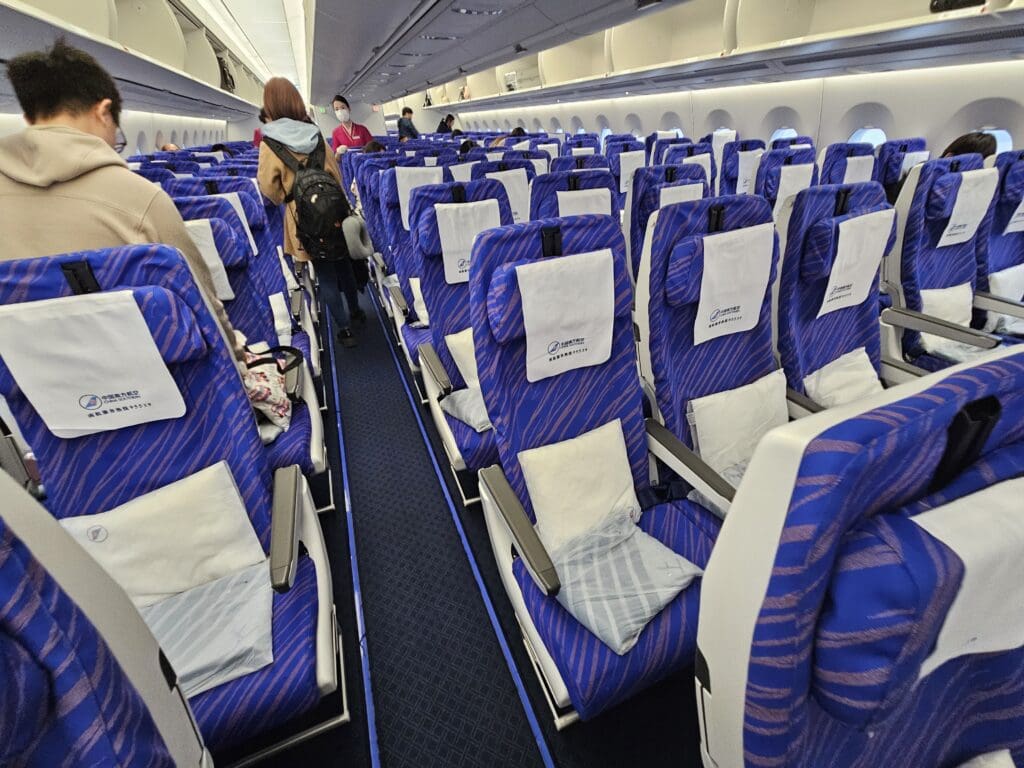
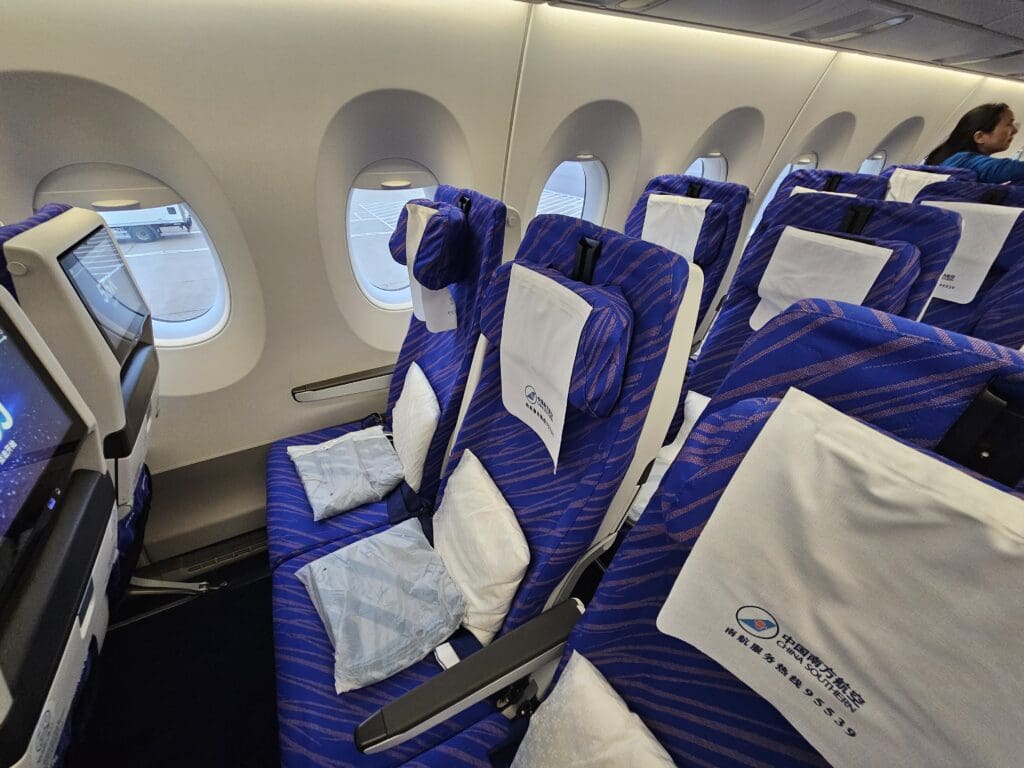
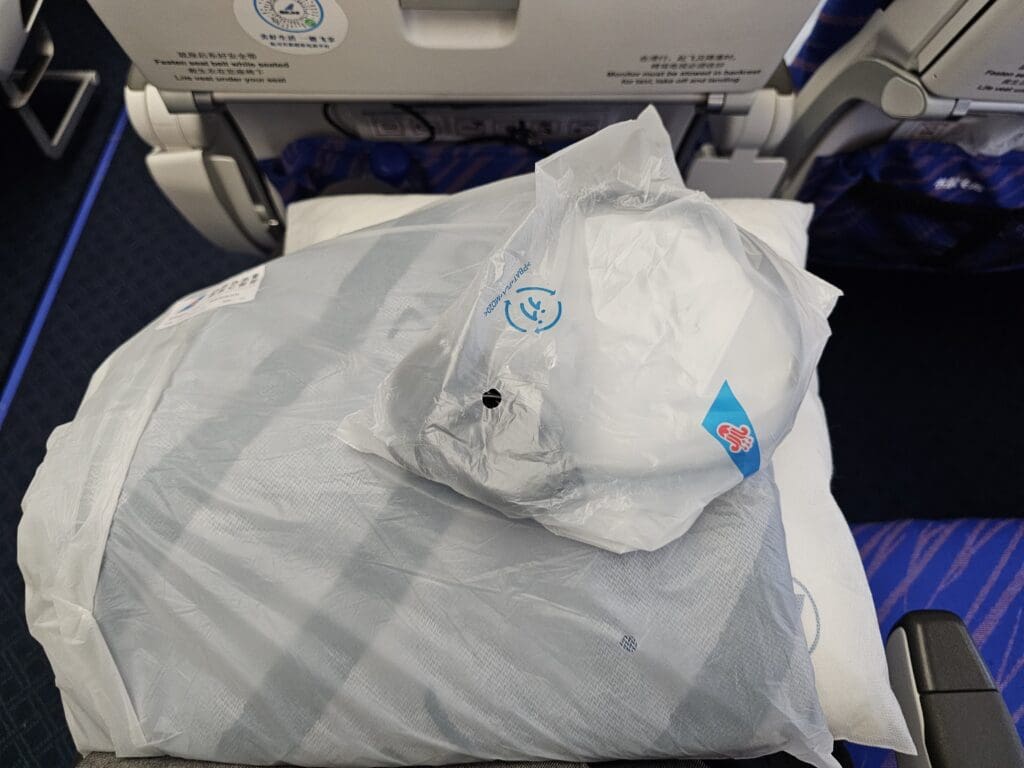
After a stop-start journey down the aircraft, I reached my aisle seat in row 59. Once I had stowed my bag in the overhead locker, I sat down and settled in for the long overnight slog ahead. Importantly, I was pleased to find the seat to be spacious, spotlessly clean and in a very good condition with few signs of wear and tear, although this was to be expected given the young age of the jet. Despite lacking any particular innovative or standout features, the seat was absolutely fine for the journey over to Beijing and left me with nothing to complain about. As was to be expected given the length of the flight, upon boarding a pillow and blanket could be found on each seat, whilst a set of packaged headphones could be found in the seatback pocket. All of these seemed to be unchanged in their quality and design since my last ride with China Southern Airlines back in 2017, and whilst appreciated, these were nothing to write home about. On the plus side, China Southern Airlines’ Airbus A350s feature a standard single headphone jack, so you may wish to bring your own wired headphones along.
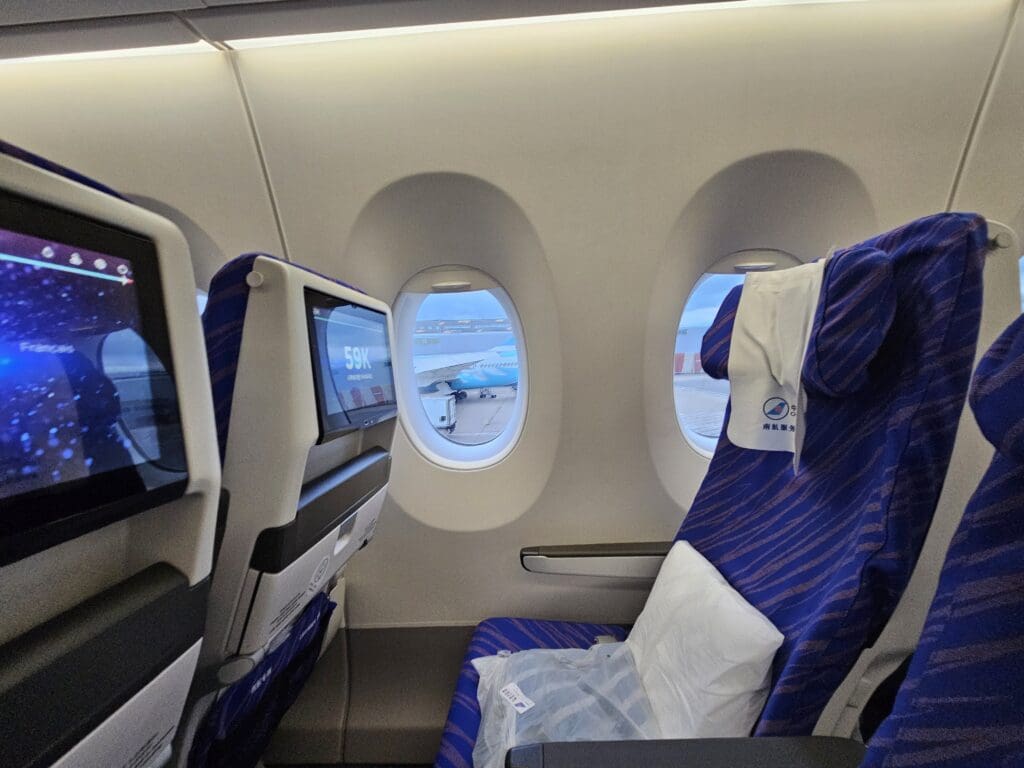
As passengers streamed onto the aircraft, calming piano music rang out through the cabin providing a soundtrack to boarding that contrasted with the high-tempo beats of many low-cost carriers. Soon, I was joined by two neighbours and with passengers having made it to the aircraft on time, boarding was completed quickly and punctually around twenty minutes before we were scheduled to depart for Beijing. At this time, the last of the flight’s ULDs could be heard and felt being slid into position below before the cargo door beneath me was closed with a short whine and all remaining ground service equipment was backed away from the aircraft. That night the flight would be almost full in Economy, and most fellow passengers seemed to consist of tourists, students and business people returning home to China, with seemingly few passengers hailing from elsewhere. Of those that weren’t from China, amongst a few British people, I spotted a few Korean and Japanese passengers, alongside a group from Spain.
Almost as soon as boarding had finished, the calming music that had accompanied this was replaced by the reassuringly calming tones of the Captain as they performed their welcome announcement in Mandarin and English. During this, they welcomed passengers and thanked all for flying with China Southern Airlines, informed all of our estimated 9H38 flight time and advised passengers that we would likely experience patches of light turbulence over Russia. This was followed a short time later by the Purser’s welcome which included the usual slew of welcomes, thanks and safety messages in Mandarin and English.
Following the welcome announcements, the inflight entertainment screens were temporarily locked as China Southern Airlines’ safety video began to play. Other than the removal of the much loathed ‘no phones’ rule, this video appeared to have gone unchanged since my last China Southern Airlines adventure in 2017. This consists of several crew members highlighting the safety instructions in Mandarin and English whilst an eerie soundtrack is played in the background. This ends with a stern warning from the Chief Security Officer cautioning against bad behaviour such as brawling and damaging the aircraft whilst onboard! As soon as this came to an end, the army of flight attendants passed through the cabin, undertaking a very thorough pre-departure check, ensuring that all was secure and in place for our flight in preparation for our departure.
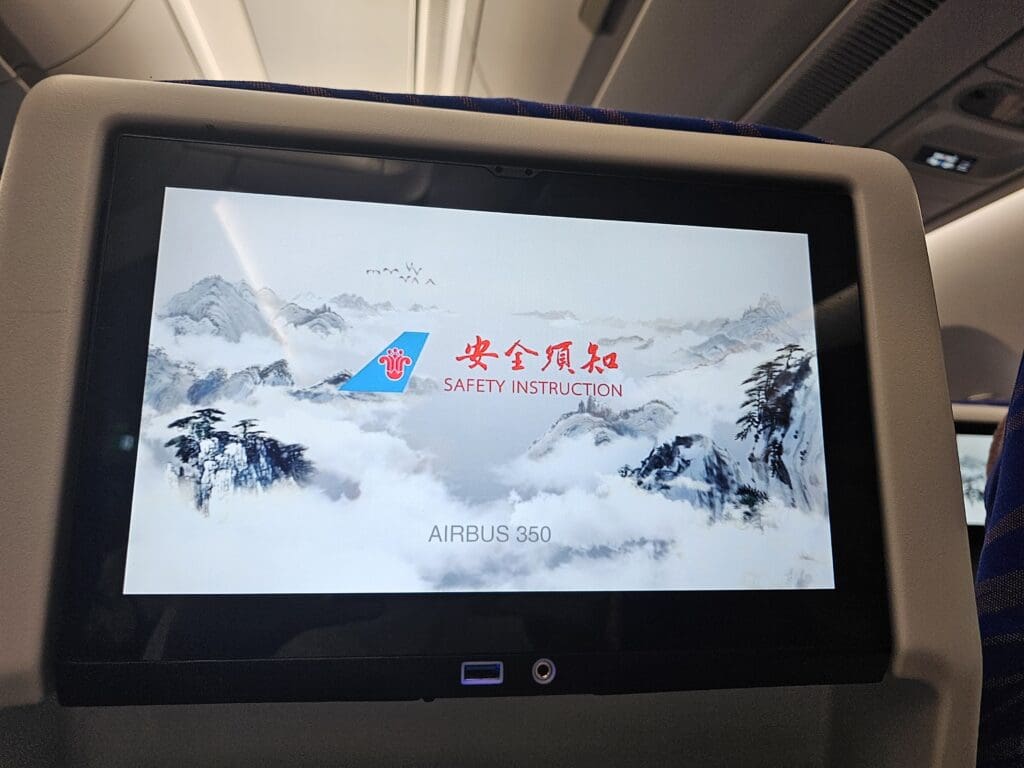
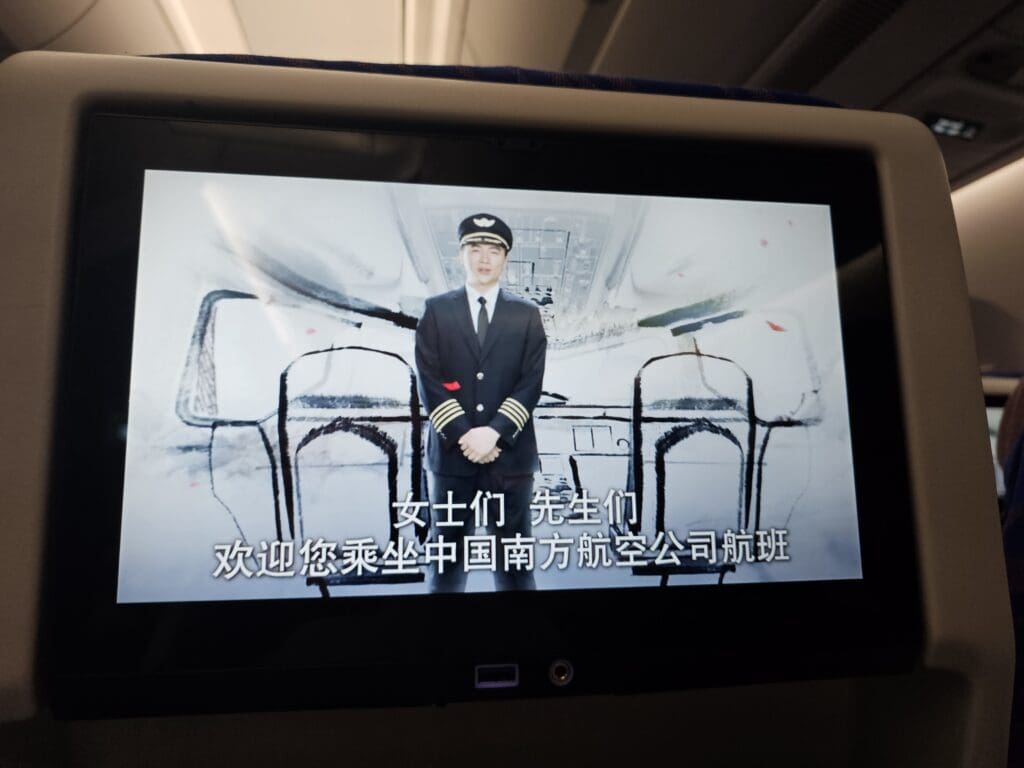
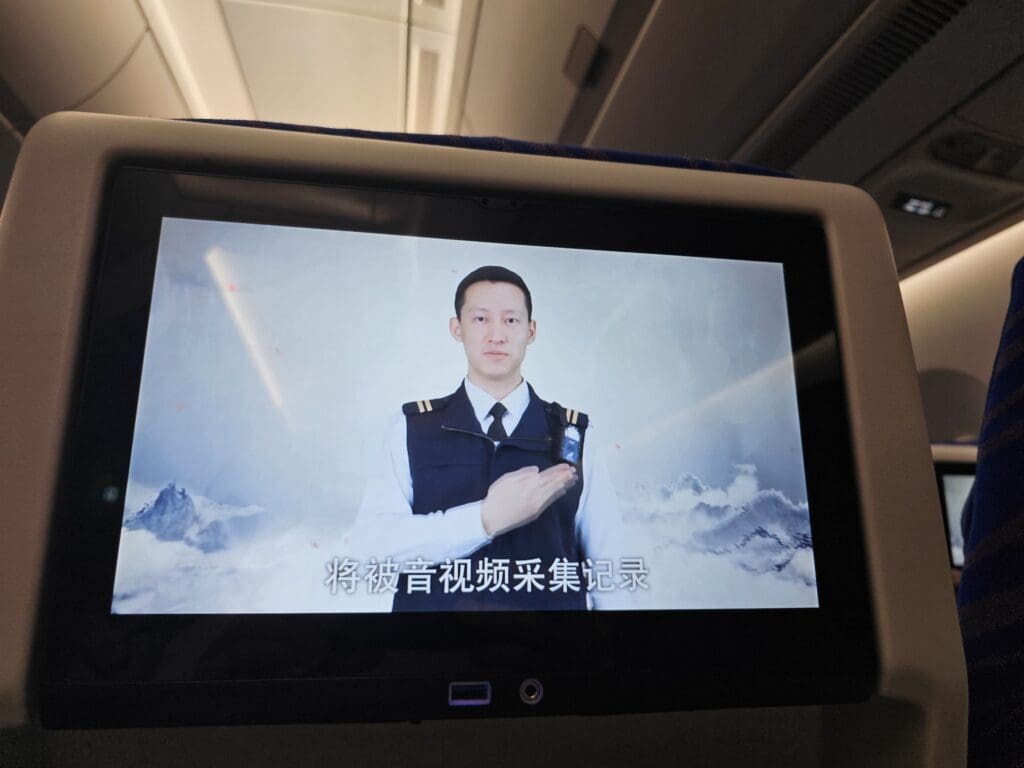
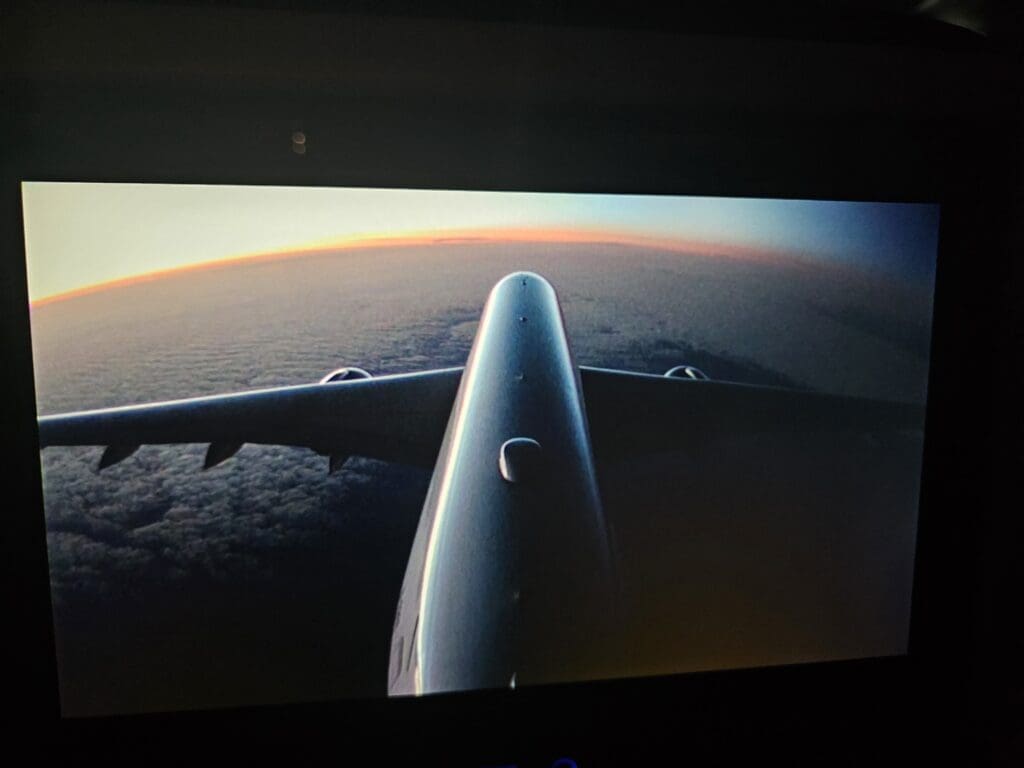
As the safety video neared its end, three minutes ahead of our scheduled departure time, the Airbus jolted backwards and the two gigantic Rolls-Royce Trent XWB engines whined and whistled into life. Making use of the forward-facing camera that was accessible via the inflight entertainment system, I watched as the ground crew disconnected the tug and once all checks had been completed, the Airbus powered down the taxiway under its own steam. Seeing as Runway 27L was in use for departures that evening, nothing more than a very short taxi was required to reach the runway. As we journeyed over to this, the cabin lights were dimmed to an icy blue tone in preparation for our nighttime departure.
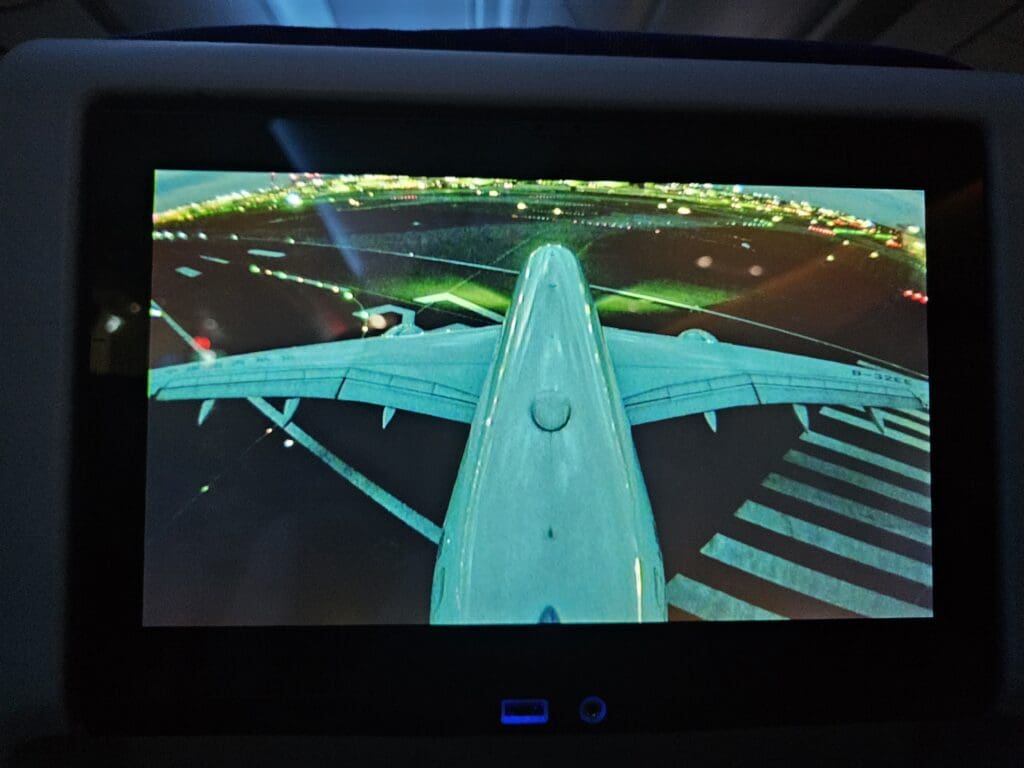
Being one of the world’s busiest airports, Heathrow Airport is not exactly known for its short waits to depart, however, that evening, as luck would have it, I would be in for perhaps the quickest ever departure that I have ever experienced from the airport! Arriving at the end of the runway in no more than two minutes, once there, absolutely no holding was required and we made our way straight onto the runway. Without coming to a halt, the two Rolls-Royce engines powered up and we commenced our long yet powerful take-off roll. Watching this on the tail-mounted camera, reassuringly, we took to the skies as we entered the final third or so of the runway and gently floated up into the skies of Southern England.
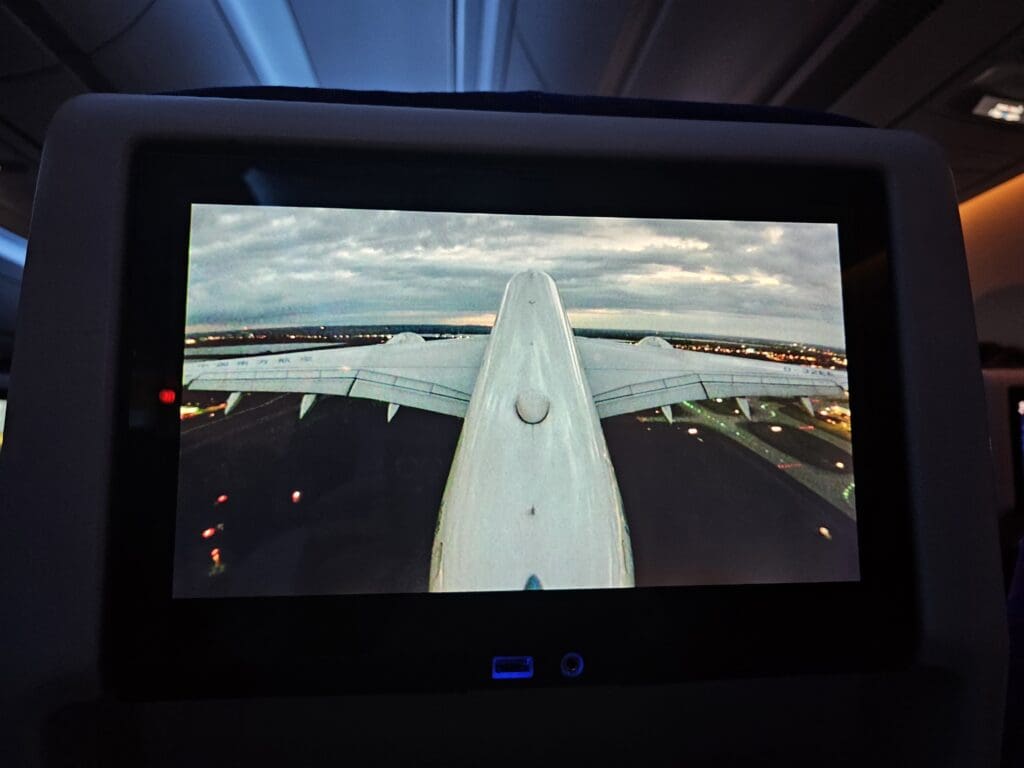
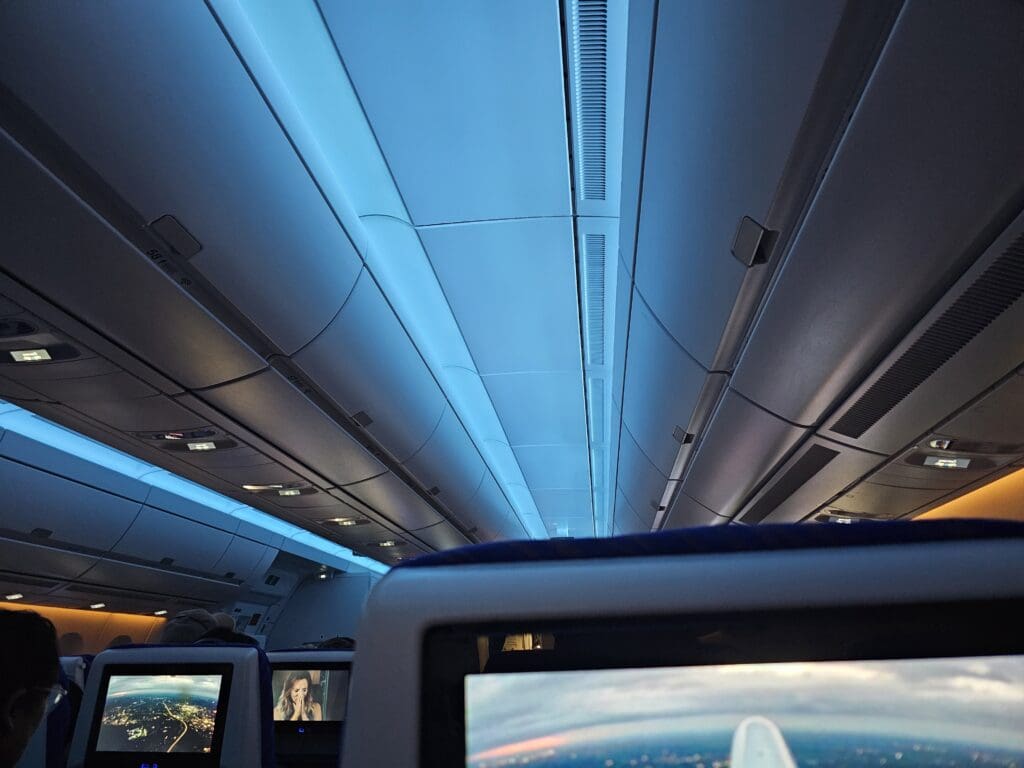
Leaving the sprawl of Heathrow Airport behind in a matter of seconds, the aircraft headed out over the reservoirs that sit to the west of the airport before reaching the Berkshire town of Slough. After passing over Slough, the aircraft then banked to the right and began to fly roughly clockwise around the M25 motorway as it loops around London, soon reaching Watford, followed by Bishop’s Stortford and Stansted Airport around ten minutes after taking to the skies. From there, the aircraft ventured north eastwards over East Anglia, climbing over Essex, Suffolk and Norfolk before crossing the town of Great Yarmouth and crossing over the British coastline before trundling out over the North Sea towards Scandinavia.
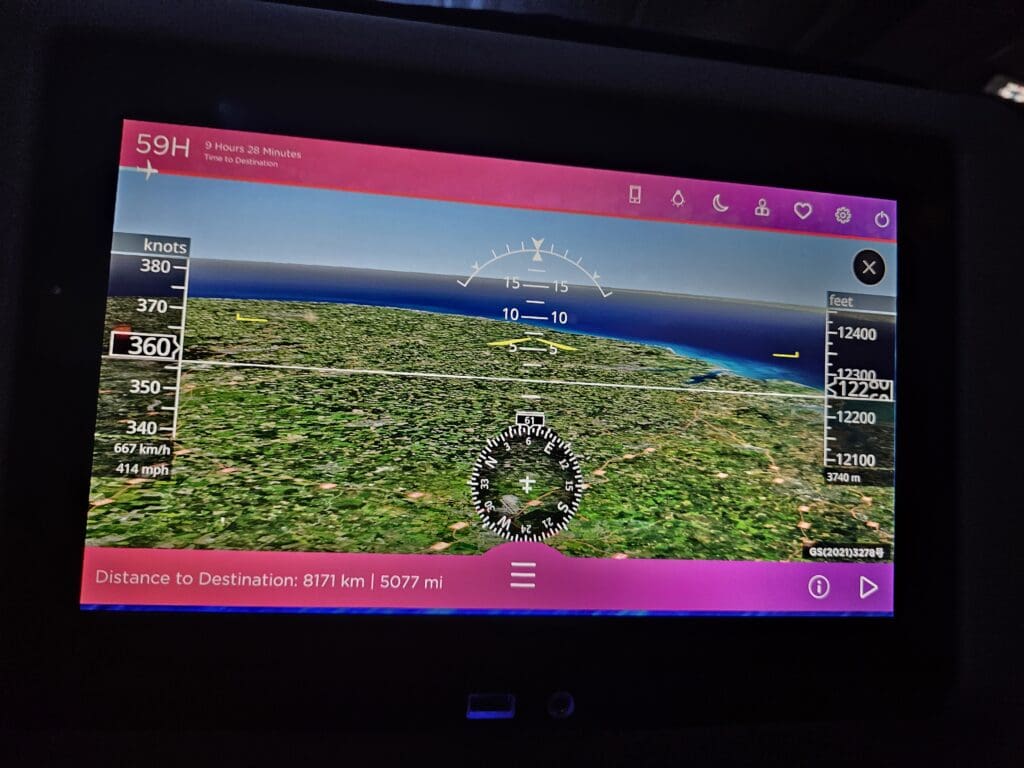
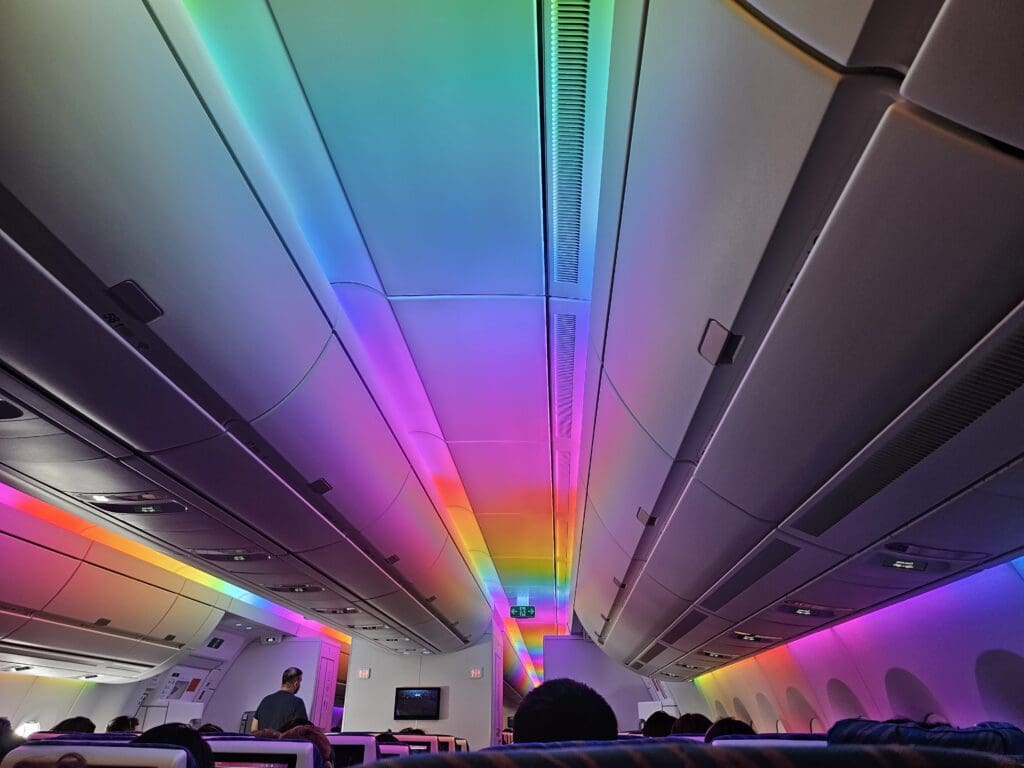
Unlike on many airlines, despite fair weather around London that evening, there was little movement inside the cabin for well over the first twenty minutes or so of the flight. As per Chinese regulations, the seatbelt signs remained illuminated and the crew firmly in their seats until we had levelled off at our initial cruising altitude of 37,000 feet, by which time we had left Britain behind. Even then, once we had levelled off, the seatbelt signs remained illuminated although the crew did not seem to take issue with the fact that many passengers moved around. Inside the cabin, at this time, the icy blue moodlighting suddenly changed to a harsh sunrise orange, undoubtedly serving as a rude wake-up call to the many passengers who had already fallen asleep! Fortunately, this did not last too long and was soon replaced by a softer and somewhat seasonally appropriate cherry blossom pink.
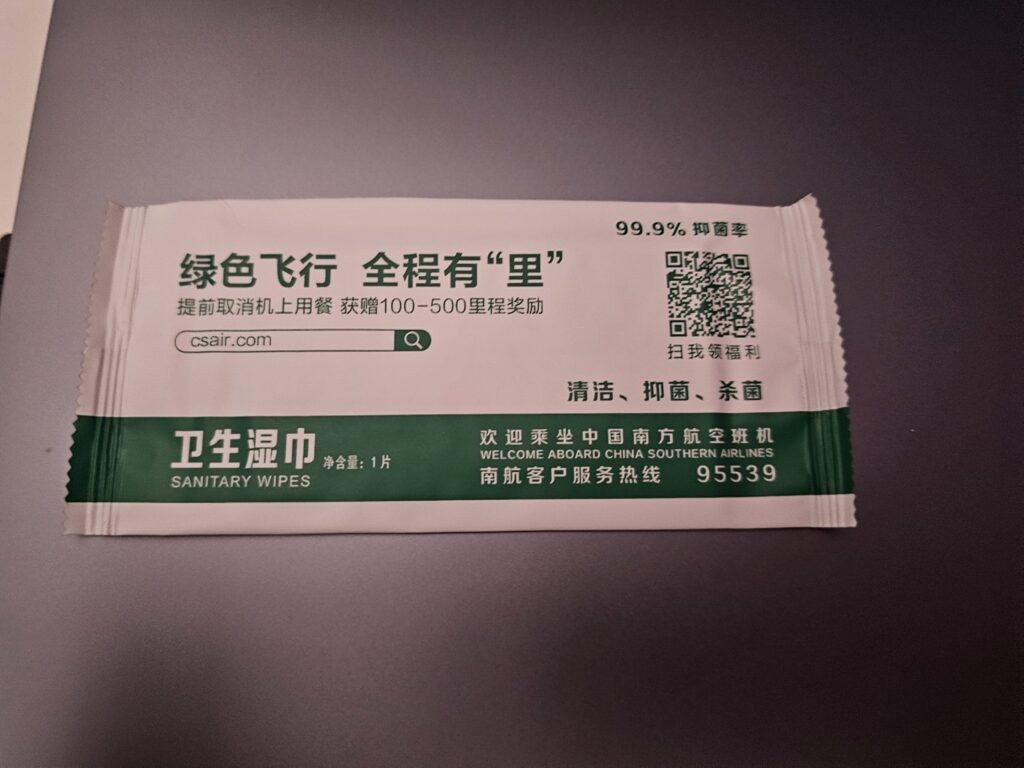
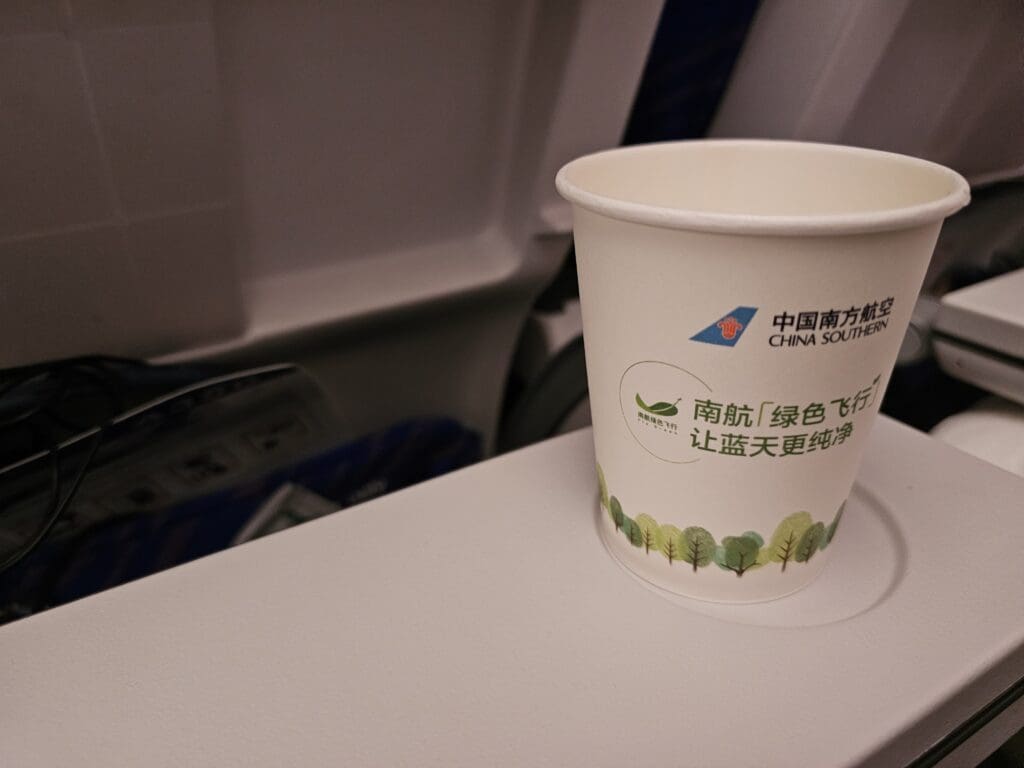
As we trundled over the North Sea, the scent of warming food wafted through the cabin and soon, service carts were rolled out into the aisles. First up was a China Southern Airlines branded packaged antibacterial wet-wipe, followed several minutes later by a round of drinks, during which orange juice, grape juice, Sprite, Coca-Cola, hot and water were offered. Going for a warm water plain and simple, this was handed over to me in a China Southern Airlines branded paper cup. Around fifteen minutes later, the carts were rolled into the aisles once more and the evening meal service commenced. As with the drinks round, I found that the crew appeared to do this in a somewhat rushed and brash manner, having minimal interaction with passengers and perhaps placing efficiency over warm and friendly service. Whilst this was not a major complaint, it ultimately did serve to contrast with the warm welcomes that I had received around an hour earlier when boarding the aircraft.
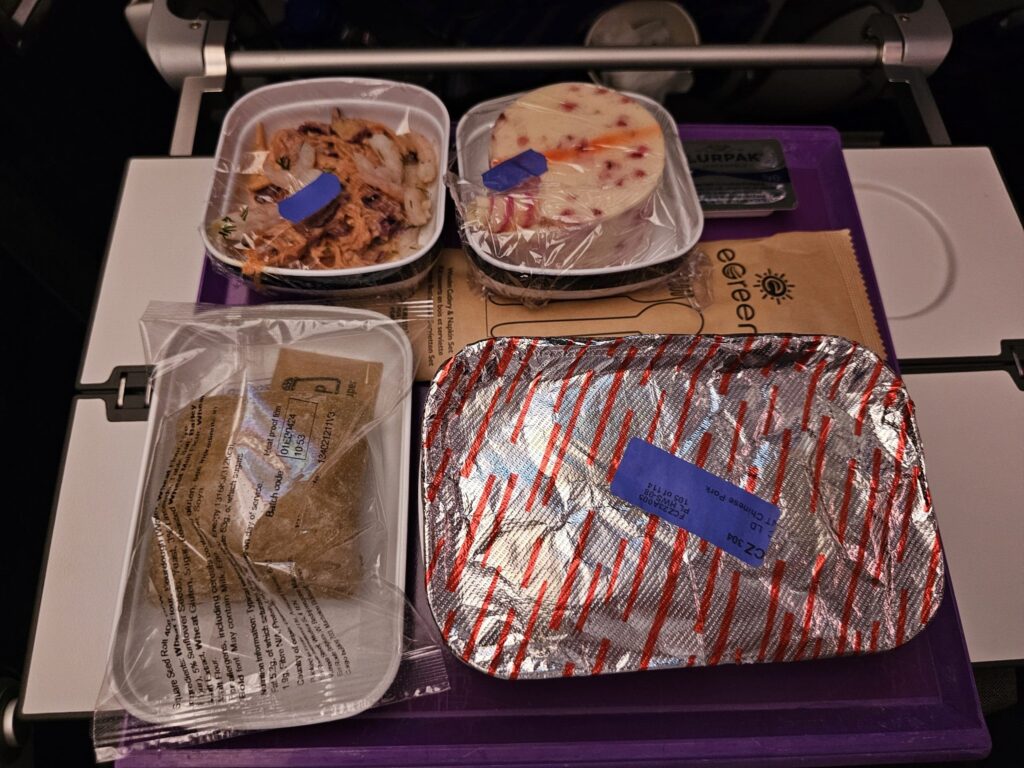
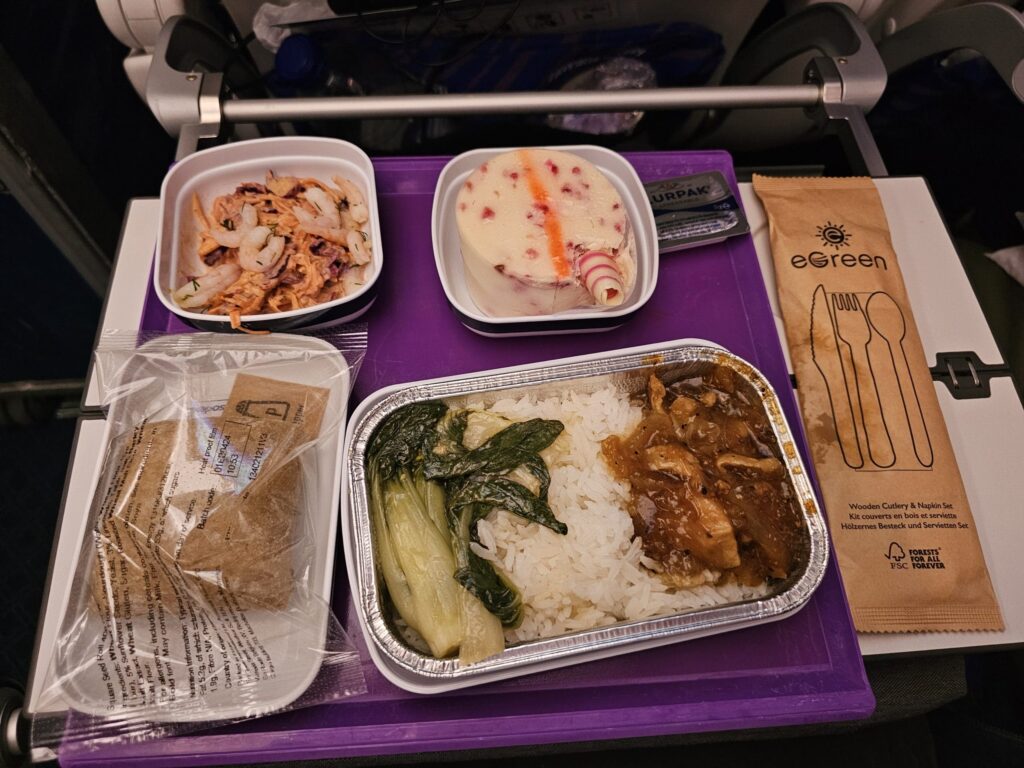
With no sort of menu provided, nor with meal options available online before departure, I wasn’t too sure what the options would be until one of the flight attendants reached my row and said ‘pork rice’ and ‘fish and potatoes’ in a somewhat cool manner. Opting for the former, I was soon handed a purple plastic tray which featured the main dish of pork in a mystery sauce, rice and pak choi, a prawn side salad, a packaged bread roll with butter and a raspberry coulis cake for dessert. Meanwhile, eating utensils were provided in the form of sustainable wooden cutlery, which is always better to see than a flimsy plastic knife and fork! Without wasting any time, I soon got to work on the evening meal and found this to be of sufficient quantity and reasonable quality. Whilst hardly Michelin star cuisine, I was left fairly satisfied and had few complaints other than the cool levels of service shown by the crew. Once all meals had been distributed, the crew then passed through the cabin distributing drinks before returning around thirty minutes later to collect passengers’ empty trays and rubbish.
Returning to our route, once the aircraft had left Britain behind, we made a forty minute crossing of the North Sea before reaching the Jutlandic Peninsula and making landfall just to the north of the small Danish town of Ulfborg. Taking no more than twelve minutes to trundle across Jutland, the aircraft then headed out over the Kattegat before passing high over Sweden’s second largest city, Gothenburg. From there, the aircraft ploughed through the skies of Southern Sweden and around thirty minutes later passed just to the north of the country’s capital, Stockholm before heading out over the waters of the Baltic Sea. Passing over the Sea of Åland, the Airbus crossed over the autonomous Åland Islands before reaching Finland where we flew high above Turku before speeding across the southern half of the country. In what was the norm several years ago, but is now increasingly rare on flights between Europe and Asia, after thirty minutes in Finnish skies the aircraft passed over the country’s border with Russia near the Karelian town of Sortavala, commencing our long overnight slog over Russia.
Once the dinner service had been concluded, I decided to explore the delights of China Southern Airlines’ inflight entertainment system. Starting with the basics, this was available in five languages – Chinese, English, French, Japanese and Korean. Despite not quite being representative of the airline’s expansive route network, this was a better effort than many other major carriers, including some of Northeast Asia’s more reputable carriers such as Asiana Airlines, Japan Airlines and Korean Air. In terms of layout, I found this to be laid out in a welcomingly straightforward yet still modern format, and importantly, throughout the entire flight, the system was responsive to touch, quick to load and did not freeze once.
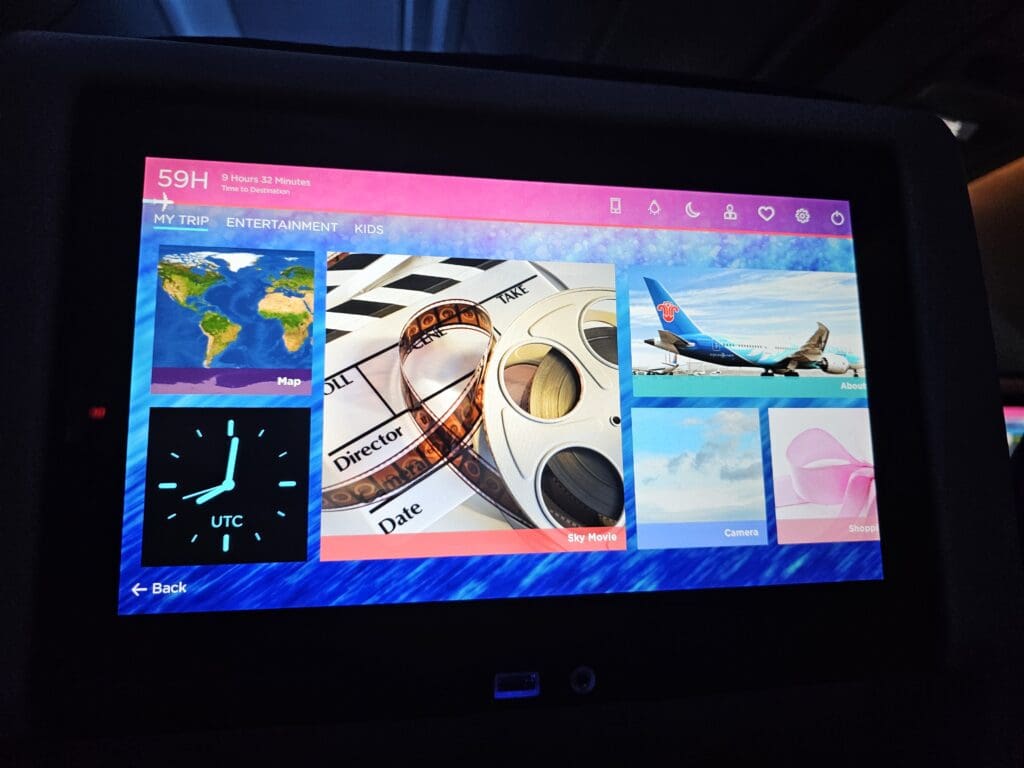
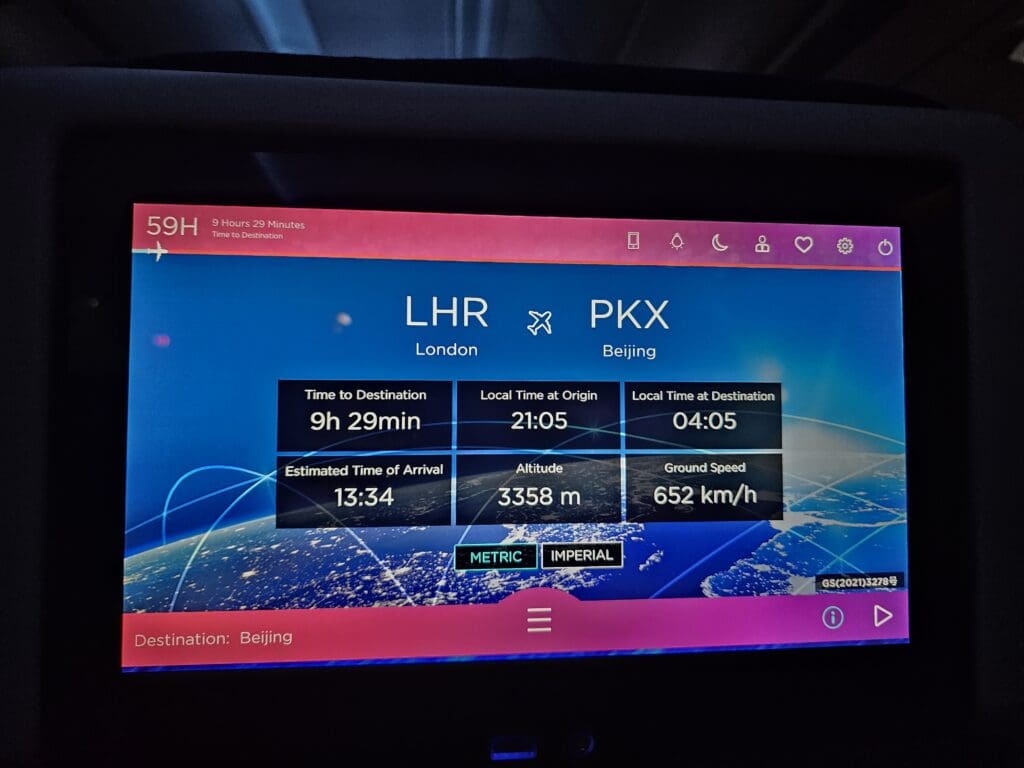
When it came to content, I found the system to be fairly expansive and I counted a grand total of over three hundred films. As you would expect, many of these took the form of Chinese and Hollywood blockbusters, alongside a few Bollywood and British productions. However, content from other regions was limited to just a single French and Italian film. Additionally, the range of television programmes was also fairly reasonable, with episodes from 61 different American, British and Chinese shows offered. However, the audio selection was somewhat more limited, with 27 albums and playlists available to listen to throughout the flight, alongside 8 podcasts on aspects of Chinese culture and history produced by state-run news agency, China Global Television Network. Finally, 21 games and a separate kids section were offered in addition to an interactive FlightPath3D moving map and three high-quality external cameras. Whilst I had no real intention of watching anything, I found that all content commenced with a very short and skippable advertisement for the People’s Insurance Company of China.
Overall, I was left very pleased with the inflight entertainment system and whilst not being the very best or most expansive system that I have ever sampled, it was definitely on the better side of things and had undergone major improvement since my previous rides with China Southern Airlines. Theoretically, wifi is available onboard China Southern Airlines’ Airbus A350s and several decals could be seen promoting this across the aircraft, however, this was a myth, with there being no wifi network to connect to onboard the aircraft thus leaving passengers no option other than to remain incommunicado with the outside world for nine hours or so.
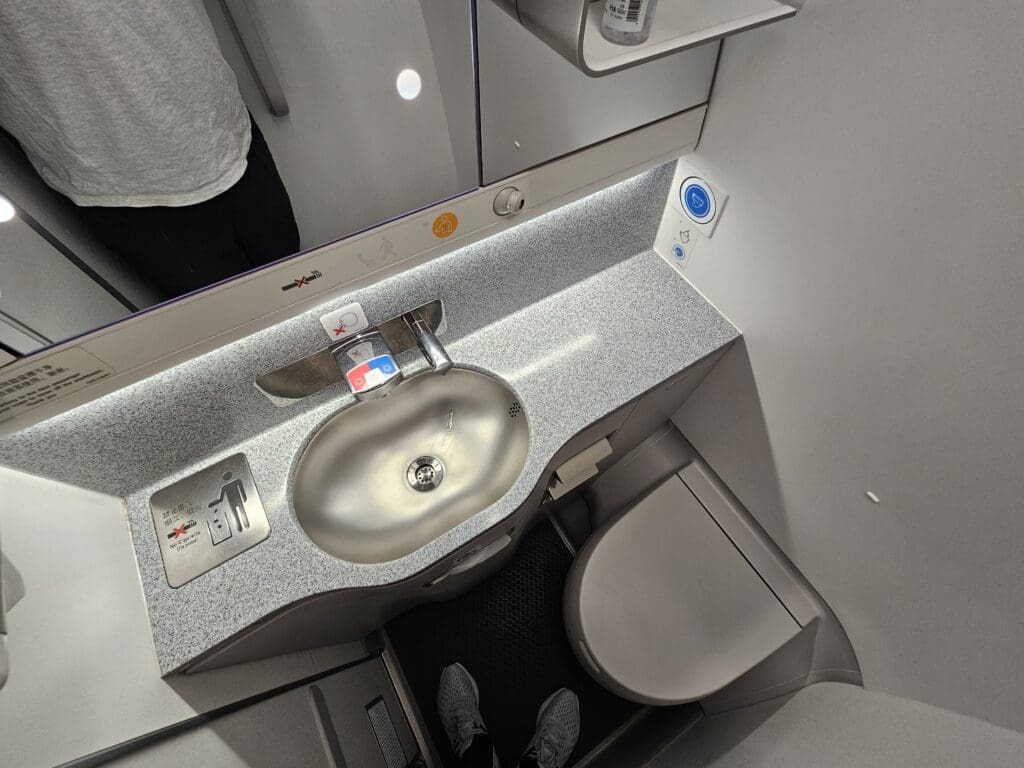
With the cabin now completely dark, once I had fully explored the delights of the inflight entertainment system I decided to pay a visit to one of the lavatories that are sandwiched in between the forward and rear Economy cabins. In total, I counted a total of seven lavatories throughout Economy, which equates to a reasonable 44 passengers per toilet. For comparison, on a typical low cost carrier Boeing 737-800, there are 63 passengers per toilet. Once inside, I found the lavatory to be in a clean and tidy state and stocked with all the basics that you would expect to find in this. However, this did lack paper towels, with nothing provided to dry hands other than facial tissues which annoyingly easily disintegrated when wet.
As we cruised eastwards over the vast expanse of Russia, I attempted to get some sleep and in the end, I managed to get three bouts of light sleep, each lasting an hour. Despite the fact that many passengers spent the duration of the cruise deep in slumber, the flight attendants did make a few runs through the cabin distributing cups of still water.
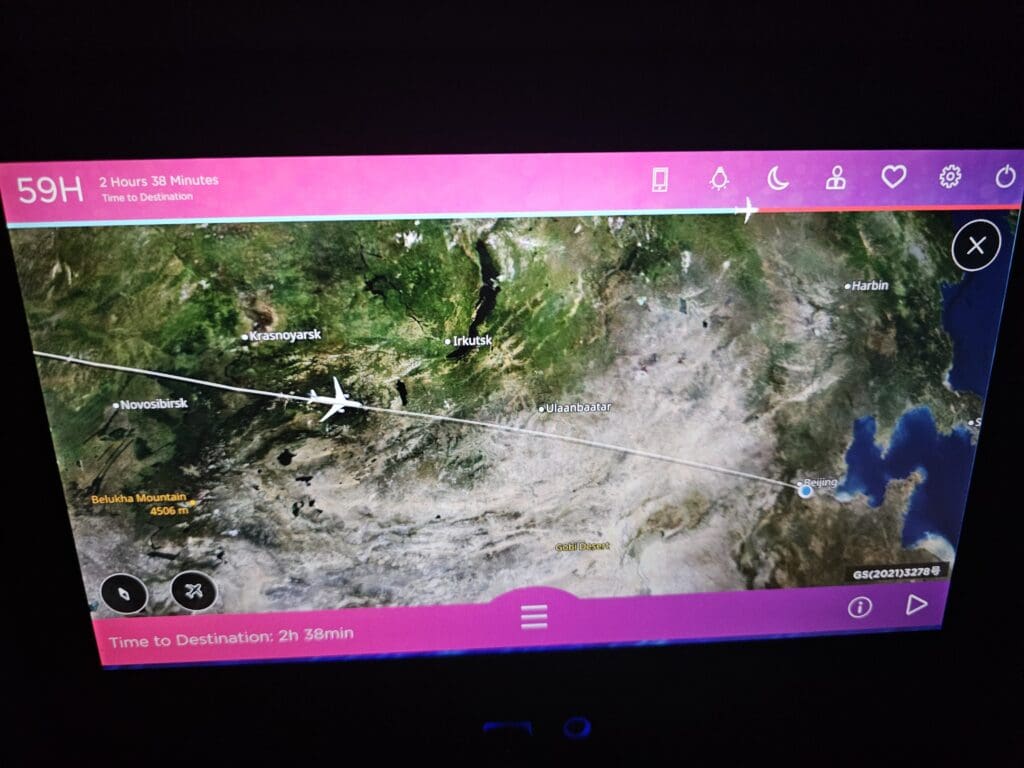
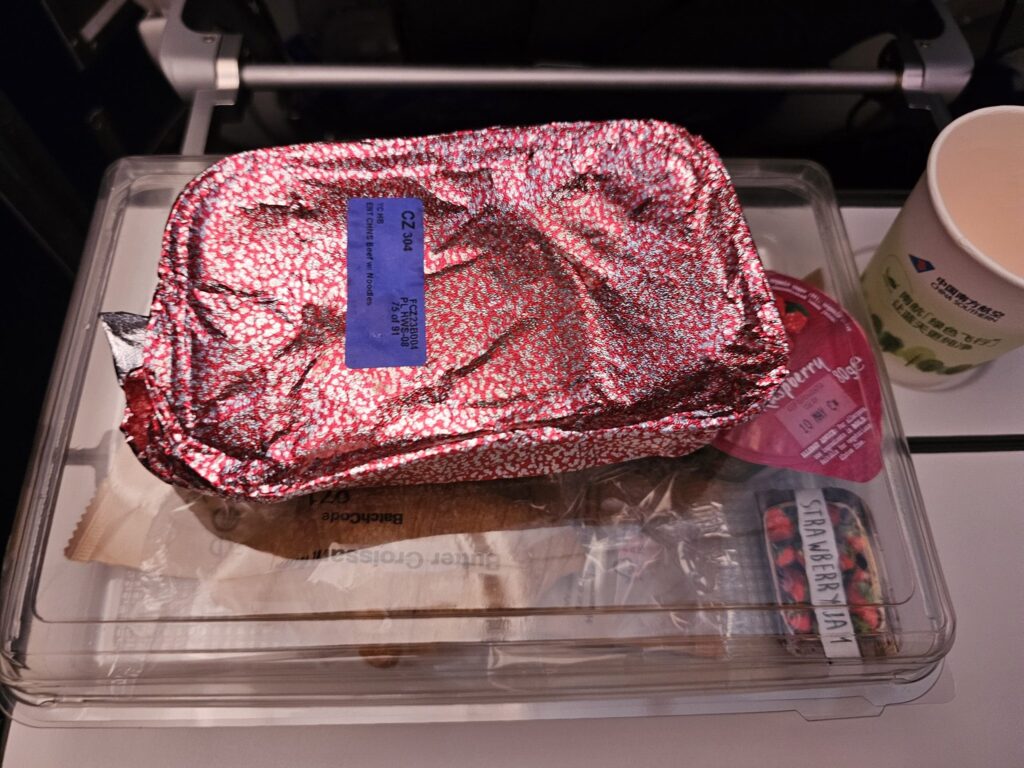
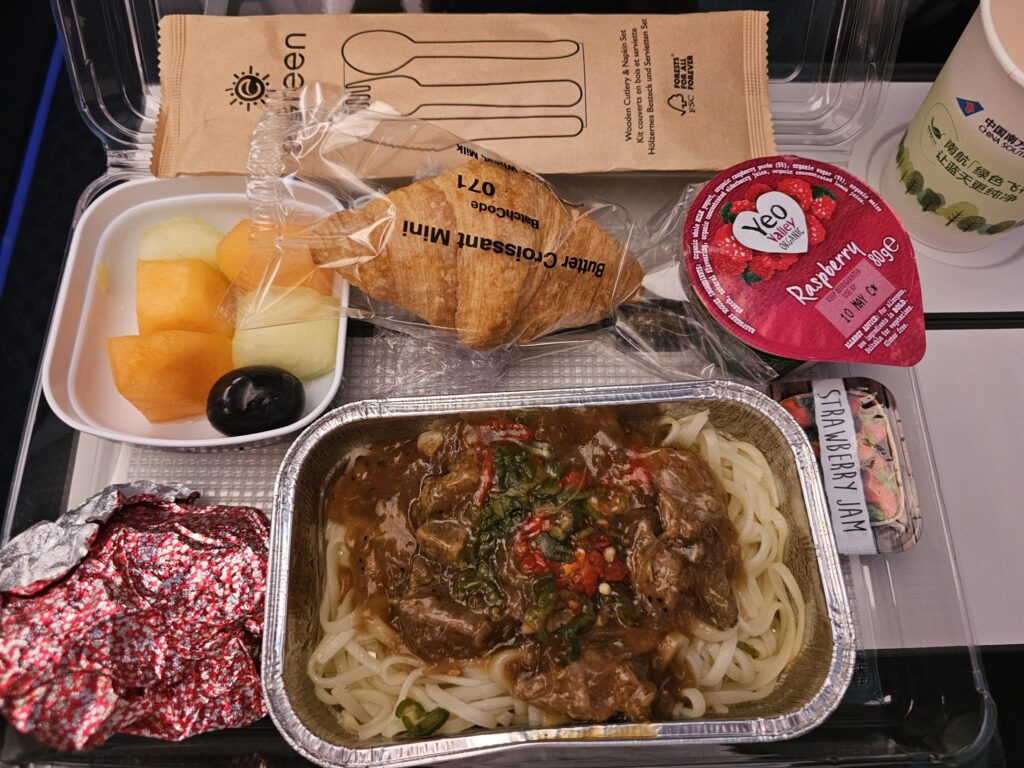
After around four and a half hours in Russian skies, which had seen us traverse the country from west to east, the aircraft crossed over the border between Russia’s Tuva Republic and the Mongolian aimag of Khövsgöl and continued heading onwards towards the capital, Ulaanbaatar. Somewhere high above rural Mongolia, with around two and a half hours to go until our arrival, the cabin lights were switched back on and almost immediately the crew passed through the cabin distributing hot towels. Once completed, a round of drinks was made before the distribution of the flight’s second meal service began. This consisted of a full hot breakfast, with two options offered once again. I have to say, that on many other services of a similar duration, this second meal would have been relegated to a light meal or just a pre-arrival snack, so I do have to give China Southern Airlines some credit for this second meal service. As with the first meal, a Chinese and a Western option were offered, and unfortunately, the crew seemed to be equally cool, brash and rushed when handing these out. Upon reaching my row, I was offered the choice of either beef noodles or scrambled eggs, and seeing as I was bound for China, I picked the noodle option. This was soon handed over to me along with a plastic box that contained a packaged croissant, a fruit salad, strawberry jam and a raspberry yoghurt. Soon getting to work on this, this turned out to be of reasonable quality and ultimately left me with few complaints. This was followed by another drinks round before the trays were collected around twenty minutes after they had been handed out at which point the lights were dimmed, even though most passengers had now woken up in preparation for our arrival.
Realising that there was not a great amount of time remaining, I decided to head to one of the two lavatories at the rear of the aircraft. Despite seeing heavy usage throughout the flight, with near-constant queues visible at all lavatories, once inside, I found this to remain in a clean and tidy state, leaving me with little to complain about.
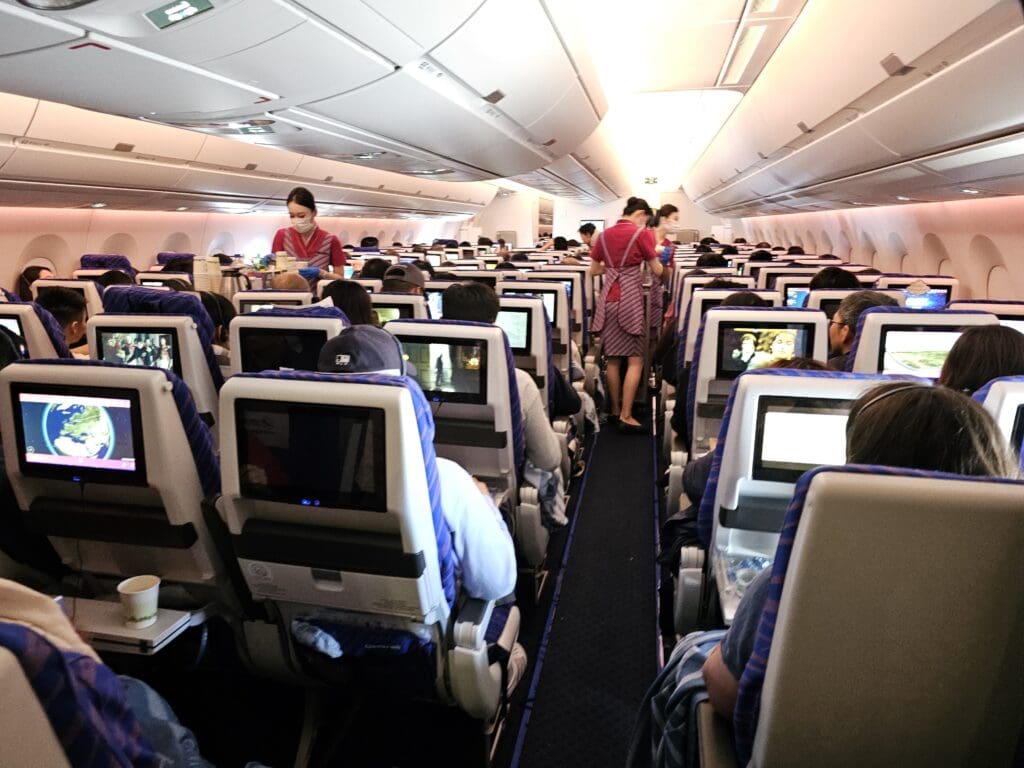
After passing to the southwest of the Mongolian capital, the aircraft made a beeline for the border with the Chinese province of Inner Mongolia and crossed over this above the town of Zamiin-Uud – a popular border crossing for those travelling overland between the two countries. Immediately upon entering Chinese airspace and with around an hour to go until touching town, the Airbus could be felt commencing its step descent, gently floating down from 37,000 feet to 29,000 feet and remaining there for ten minutes or so before continuing to edge downwards. With around 45 minutes to go until we arrived in Beijing, the Purser performed the usual pre-descent announcement whereby they informed passengers that the lavatories would become locked in five minutes’ time and went through the usual instructions regarding seatbelts, window shades, tray tables and seatbacks. True to their word, five minutes later, the crew passed through the aircraft, ensuring that all was in place for our arrival – appearing to have some difficulty with an elderly passenger who kept standing up to stretch in the aisle as we headed back towards Earth.
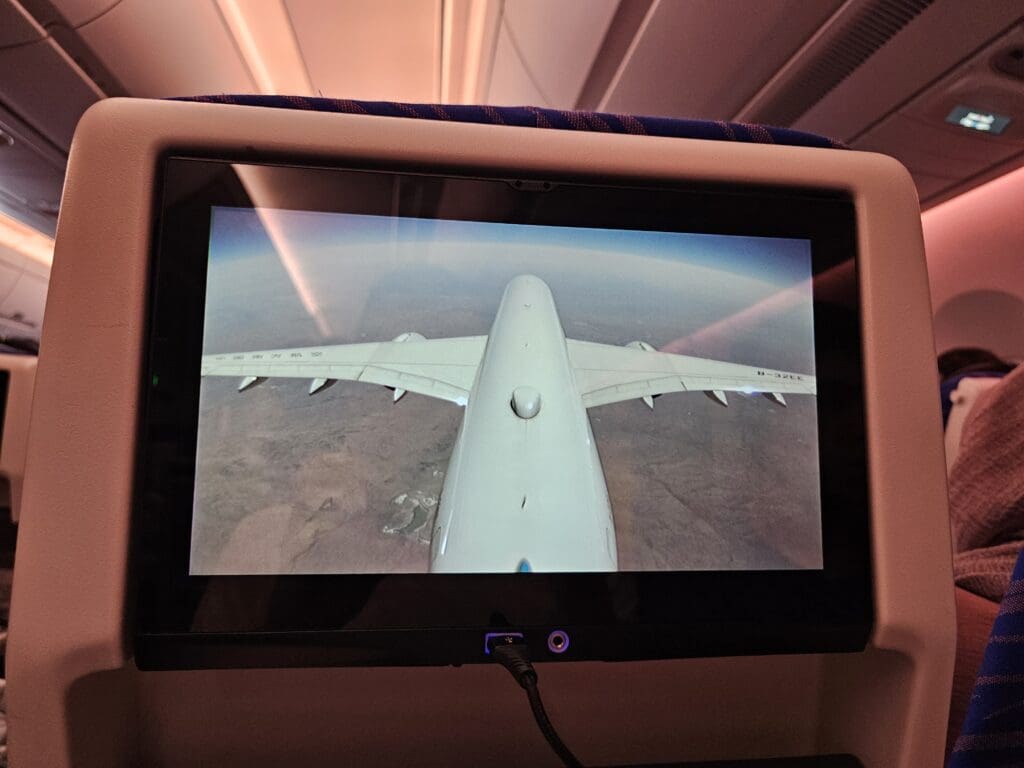
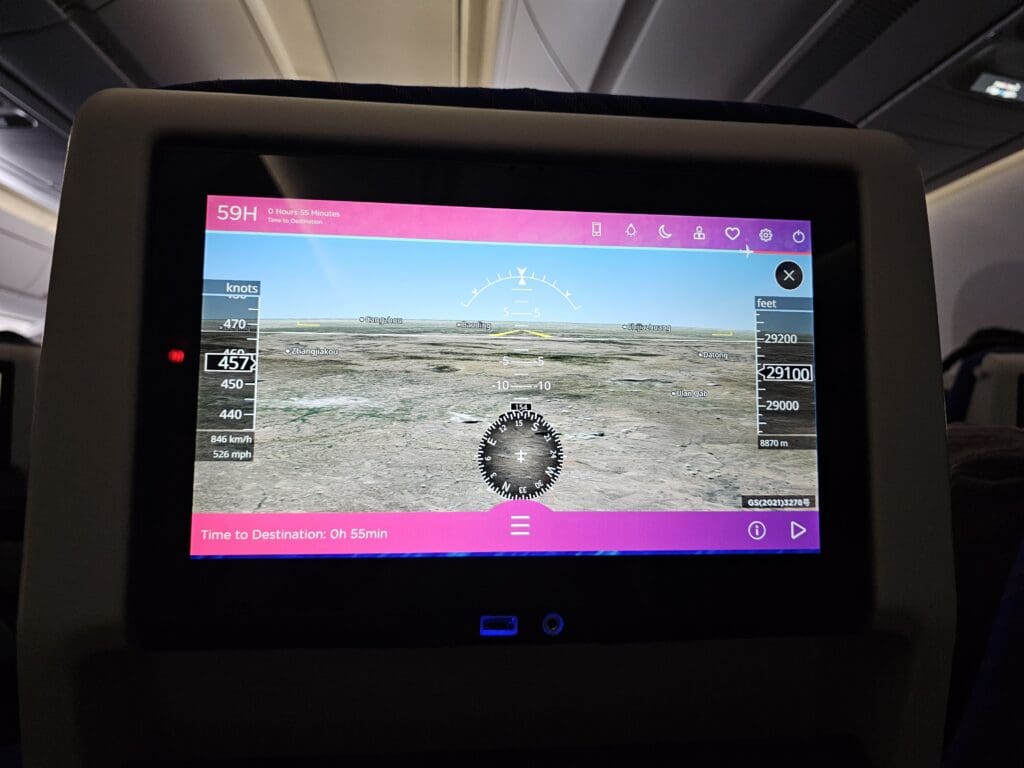
Heading southwards over Inner Mongolia, the Airbus followed the course of the G208 road before reaching Ulanqab, one of the region’s largest cities. From there, it wasn’t long before the aircraft cut across a small portion of Shanxi before reaching Heibei, the province that loops around the capital city. From my aisle seat, I watched as we cut through the smog and the semi-rural area to south of Beijing popped into view. Passing small towns and villages, the flaps and gear were extended as we bounced around a little as we descended. After a few minutes, Beijing Daxing’s Runway 35L appeared through the haze and once we had whizzed past the perimeter fence, the Airbus was firmly planted on the ground at 1331 local time, a grand total of 9H35 after taking off from London, before decelerating with a fair amount of vigour as if to indicate a need to vacate the runway as soon as possible.

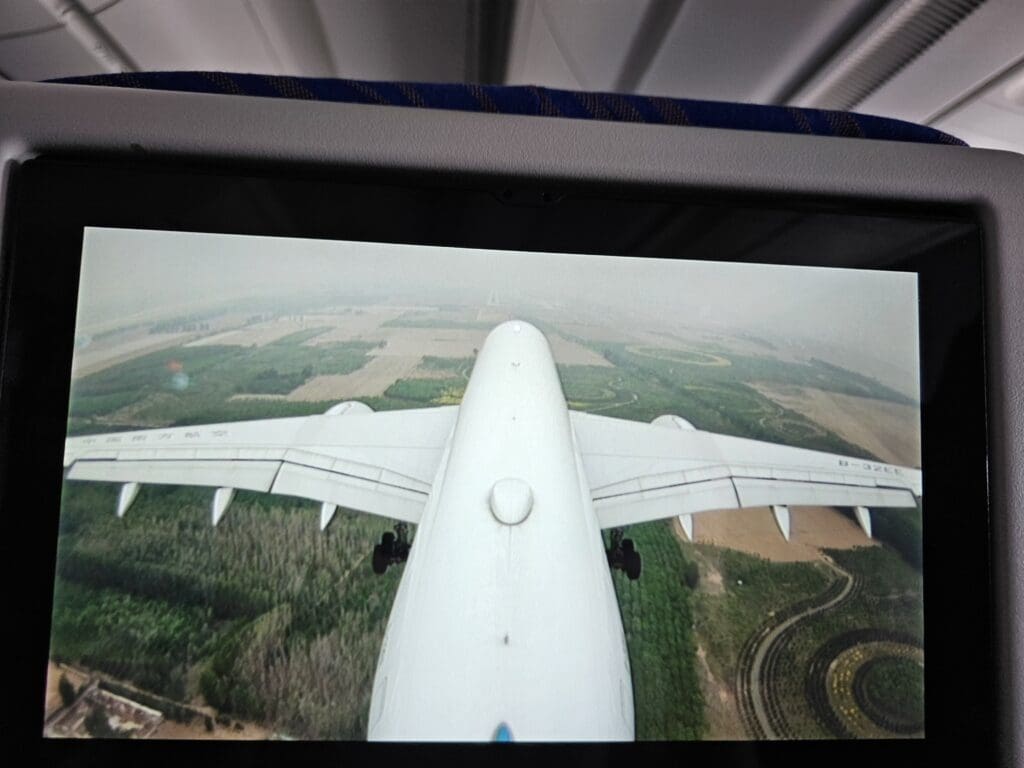
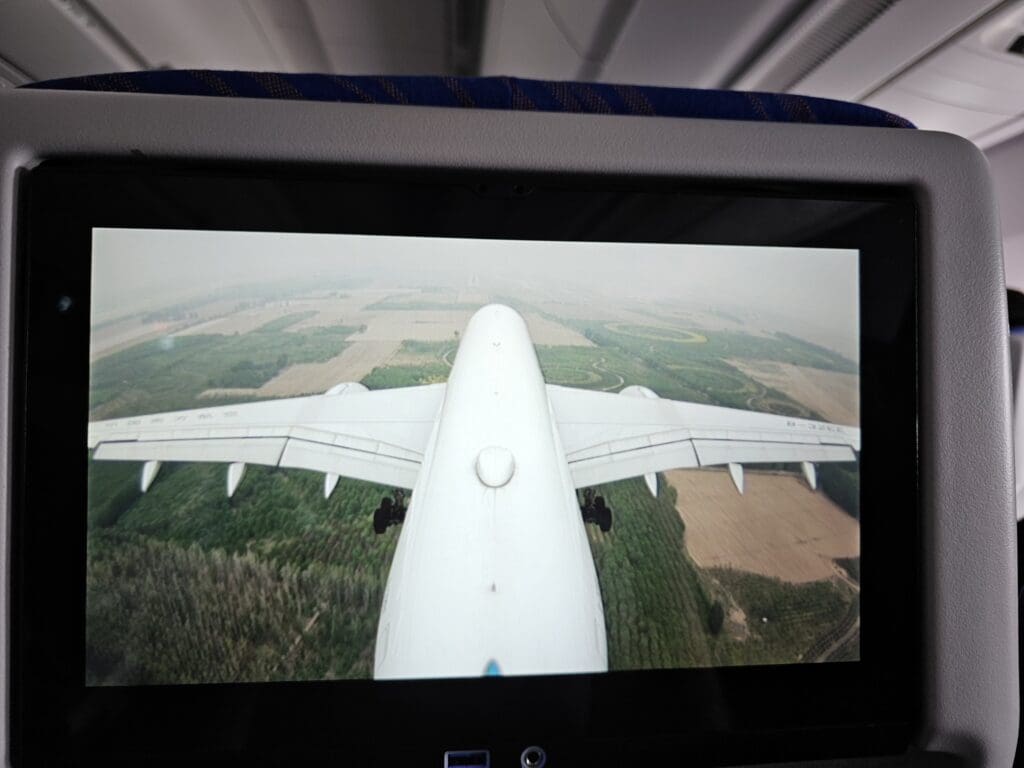
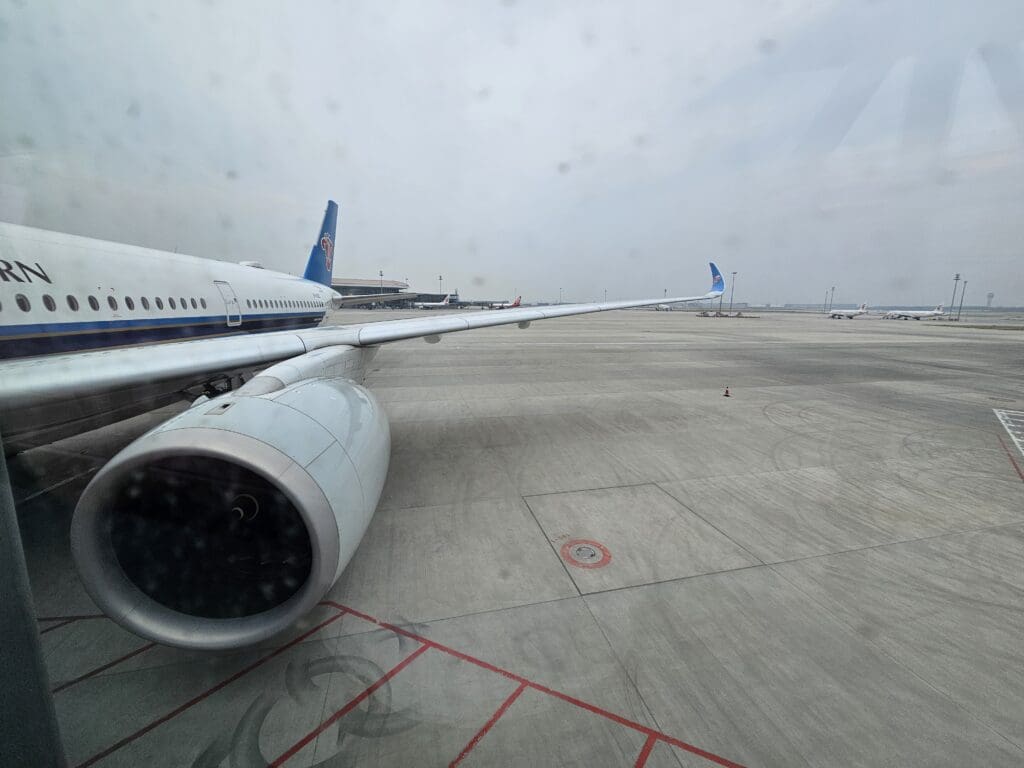
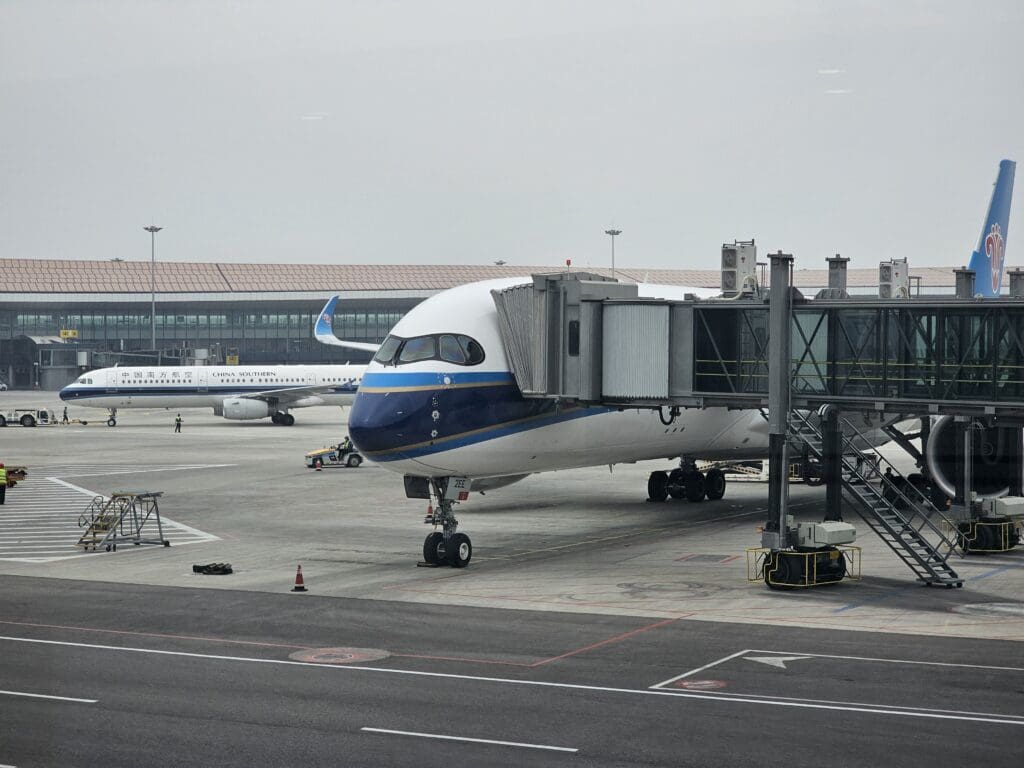
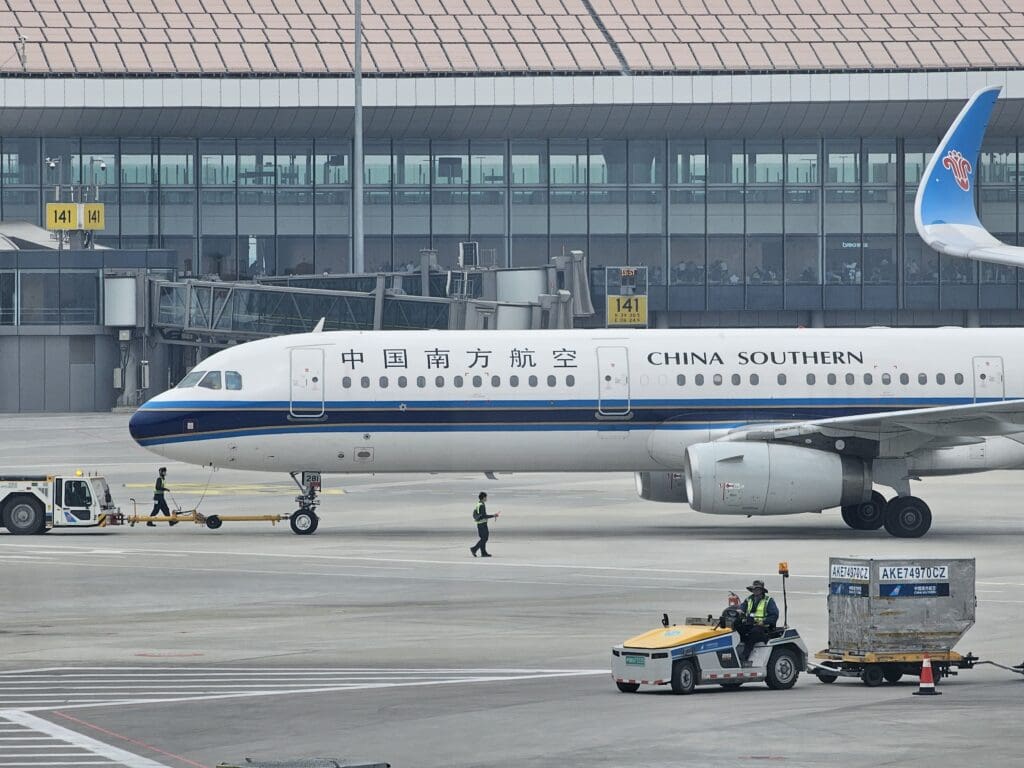
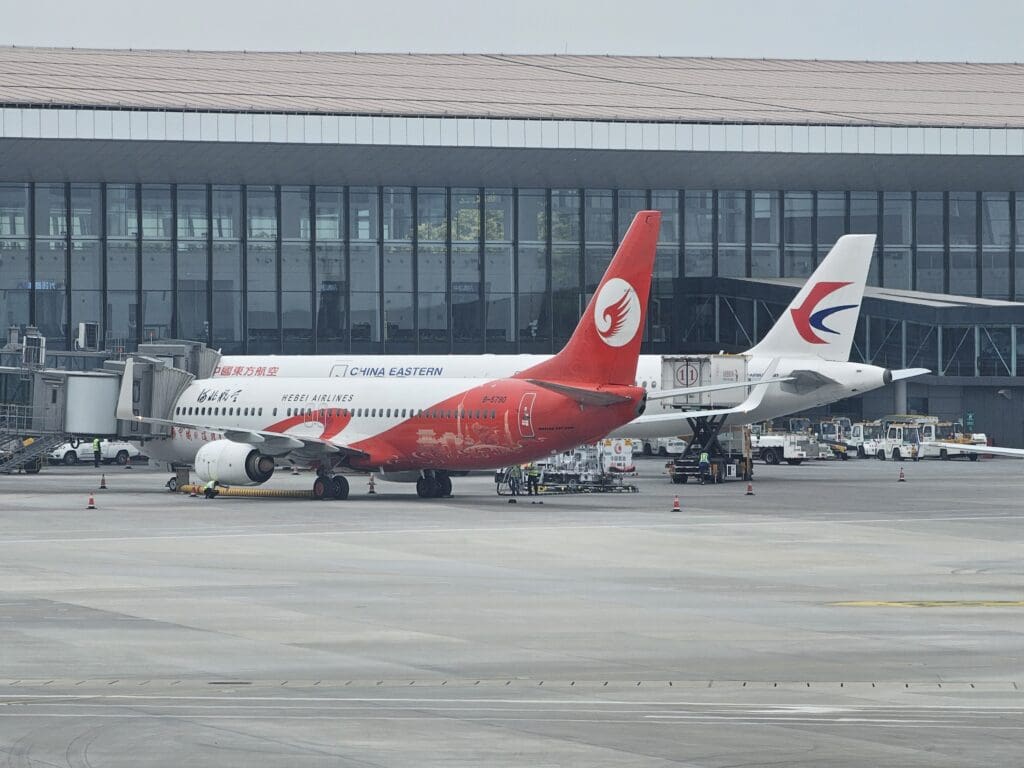
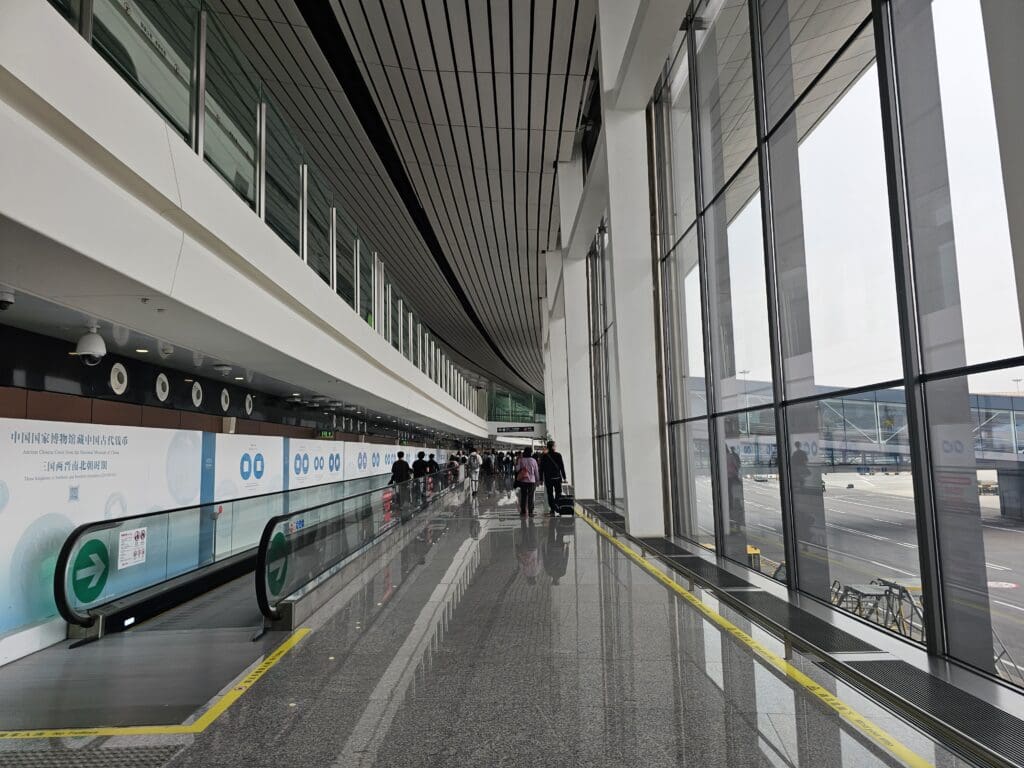
Turning right off the runway, the cabin was filled with the Purser’s voice for a final time as they welcomed all to Beijing and gave comprehensive instructions on how to reach the city from the new Daxing Airport. Soon, the terminal appeared through the afternoon smog, and taxiing around this, it took all of fourteen minutes before we slowly edged into Stand 195. Once there, two jetbridges were efficiently connected in a matter of two minutes and disembarkation soon commenced. After thanking the crew, I voyaged up into the shiny new airport terminal, commencing my long transit in Beijing Daxing.
Summary
Given my previous misadventures with China Southern Airlines, I was positively surprised by just how much the airline appeared to have improved since my last flight with the carrier back in 2017. Whilst I can’t say that the levels of service were perfect, given the low price that I had paid for the flight, there wasn’t all too much that I could complain about. Indeed, the meals were of fairly reasonable quality, the inflight entertainment system was good and the cabin was clean and comfortable. Based on this experience, I would be happy to fly on a long haul service with China Southern Airlines again.