Bagging the Rare BAe Jetstream 41: Southampton to Aberdeen via Teesside – an Eastern Airways Review
Background
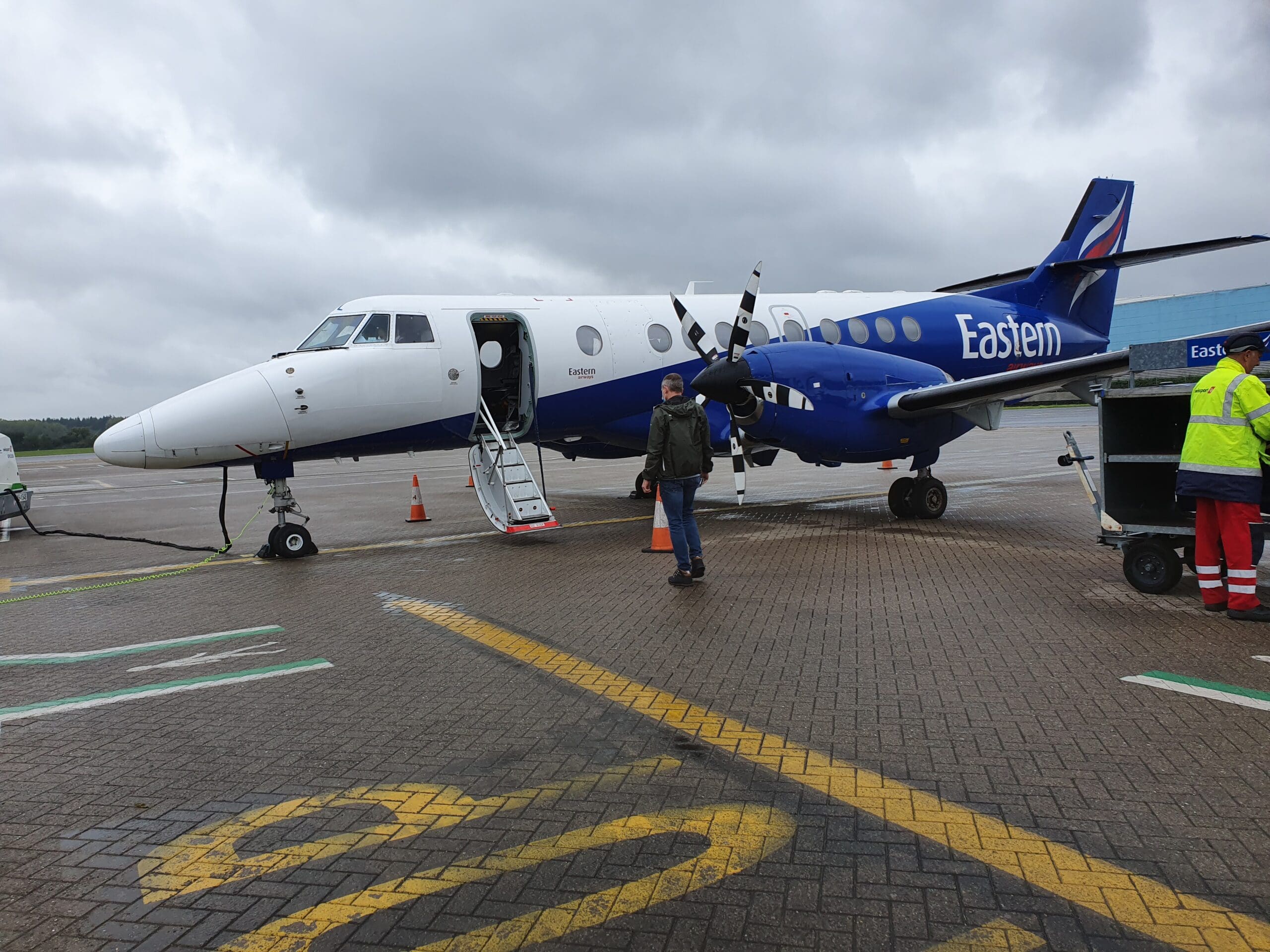
Only 100 examples of British Aerospace’s 1990s reincarnation of the Jetstream 31/32, the larger 29-seat Jetstream 41, have ever been manufactured and thus the type is far from the most common turboprop in the skies. Almost thirty years after the Jetstream 41’s first flight, at the time of my flight in September 2020, only around thirty of these remain flying, of which 23 are in commercial service with four airlines across the world. These take the form of Airlink in South Africa, Proflight Zambia, Nepal’s Yeti Airlines and the largest operator of the type, British regional carrier Eastern Airways. Based in the UK, and given the type’s rarity, I had wanted to bag a ride onboard a Jetstream 41 with Eastern Airways for some time and my inability to travel abroad during the summer of 2020 finally gave me the impetus to do so.
Whilst Eastern Airways may not be the world’s most known airline, the Humberside Airport-headquartered carrier has been around since 1997 and as of September 2020 served fifteen destinations across the UK and Ireland, including London Heathrow. In particular, along with Loganair, the airline plays an important role in supporting the North Sea oil and gas industry, connecting Aberdeen, Humberside and Norwich. In terms of passenger experience, Eastern Airways enjoys a reasonably positive reputation, with passengers offered complimentary drinks and snacks and security fast track to those flying on the airline’s services from Aberdeen, Leeds Bradford and Newcastle. Whilst many of Eastern Airways’ services cannot always be described as cheap, for those on a budget, the short PSO route between Cardiff and Anglesey provides a cost-effective option for those looking to sample the Jetstream 41 with one-way tickets on this service starting at £19.99. However, for me, reaching either of the two Welsh airports from either London or Sheffield would have proven to be a costly task. I thus turned to Southampton where, following the demise of Flybe, Eastern Airways appears to have undertaken a reasonable level of expansion to partially fill the void left by the former carrier.
Initially looking towards Eastern Airways’ long-standing service between Southampton and Leeds Bradford, much to my surprise I found that the airline’s new service to Aberdeen involving a brief mid-journey stop at Teesside Airport was cheaper, priced at just under £90. Taking a total of 2H55 hours to make the 435-mile trip, this serves to be the longest scheduled Jetstream 41 service in the UK (and perhaps in the world). On this service, Eastern Airways competes with Loganair who operate a very comparable service from Southampton to Aberdeen with an Embraer 135, albeit involving a stop in Newcastle rather than Teesside. The two airlines’ operation of this route is likely explained by the oil and gas industry, with the Southampton area serving as the home of the UK’s largest oil refinery, located at Fawley. Meanwhile, with the quickest rail journey between the two cities taking almost ten hours and involving three changes, for many, flying between the two is perhaps the only viable option. After checking the availability of cheap train tickets from London to Southampton and Aberdeen to Sheffield, I made my mind up and decided to go for this option.
Booking
Having carefully studied the options, I was aware that tickets sold via online travel agencies were priced identically to those sold on Eastern Airways’ website, and I thus was left with no reason not to book via the latter. Upon touching down on the airline’s homepage I was greeted with the airline’s slogan ‘Why fly any other way?’ as well as a scrolling montage of four photographs taken across England’s northeast. Without any delay, utilising the flight search engine on the left-hand side of the airline’s homepage, I searched for my chosen route from Southampton to Aberdeen. Moments later I was presented with the single option on my chosen departure day, this departing Southampton at 0930 and arriving at Aberdeen at 1225 with a thirty-minute inflight stop at Teesside Airport. This flight came with three different fare options – value, standard and flexible priced at £89.99, £168.99 and £278.99 respectively. Once I selected the cheapest option I was asked to enter my details before going ahead and making payment for the flight. During the entire booking, no additional options were offered, although 15kg of complimentary luggage is offered to all passengers, with an extra 8kg offered to those with flexible tickets.

After booking the flight, I went ahead and booked the rail journeys required to get me from London to Southampton Airport and from Aberdeen to Sheffield at the start and end of my journey. For the latter journey, I ended up with a bargain £20 fare for the seven-hour trip, whilst the ride down to Southampton cost £16 on the 0530 service from London Waterloo.
A Couple of Hurdles
Eight days after booking my flight, I received an automated email from Eastern Airways informing me that my flight had either been subject to a schedule change of more than two hours, or it had been cancelled. Thereby I was entitled to either a full refund or the opportunity to change my flight date without any additional fee. Upon logging into the booking management section of the airline’s website, unfortunately, the latter appeared to have been the case. Thus, after some deliberation and checking of the airline’s schedules, I decided to postpone my trip by a couple of weeks, the greatest issue being that this left me out of pocket thanks to the non-refundable nature of my train tickets from London to Southampton and Aberdeen to Sheffield. Following the automated email’s instructions, I informed Eastern Airways’ customer service department of my choice via email and received confirmation that my booking had been changed several days later. After receiving confirmation of this, I booked a flight back to England onboard a Loganair Embraer 145 for that evening as well as a train ticket from Birmingham to London.
Whilst this would have been the end of my saga, nine days before departure I received an email informing me of a schedule change to my flight up to Aberdeen. This involved my 0930 flight being delayed to 1435, this would see me arrive in Aberdeen at 1730, thus leaving me with twenty minutes to connect to my flight to Birmingham. Hoping that no further surprises would be in store, I went along with this change rather than opting for a refund and headed over to Loganair to rebook my flight to Birmingham for the next day before finding the cheapest possible hotel room near Aberdeen Airport. All-in-all, whilst booking flights had been a quick and easy process, Eastern Airways’ constant chopping and changing of my flight up to Aberdeen meant that the carrier did not exactly leave the best impression.
The Journey
Given my flight’s initial scheduled departure time of 0930, I had booked a ticket on South Western Railway’s 0530 service from London Waterloo to Southampton Airport Parkway. Following my flight’s schedule change, I had pondered avoiding a ticket change fee, taking this service and spending the best part of a morning exploring Southampton. In the end, with the cost of a return ticket from Southampton Airport Parkway to Southampton standing just shy of £5, and a miserable forecast of light rain for that day, I decided to pay £12.70 and opt for a train departing at a more sensible hour. Unfortunately, the latest train I could take was the 0935 departure, which would see me arrive at Southampton Airport Parkway at 1041, still leaving me with plenty of time to kill at the airport.
Following a 0630 wake-up, I jumped in the shower before making a morning trip to my local Pret for my first coffee of the day. After heading back home and doing some light tidying, I exited my flat for good at 0820. Having pondered making a twenty-minute walk down to Euston Station from where I could catch a Northern Line service directly to Waterloo, given the chilly autumnal temperatures, I opted to commence my journey at the slightly closer King’s Cross St Pancras Station. As a result, a change of trains would be required at either Green Park or Oxford Circus. After tapping in, I made my way down into London’s subterranean world. Whilst this would have usually been in the midst of rush hour, the ongoing situation meant that the underground was perhaps no busier than it would be than say early on a Sunday morning. Following a short escalator ride and walk, I arrived at the quiet Victoria Line platform. Seeing as the line offers the UK’s most frequent rail service, unsurprisingly a train turned up almost instantly after my arrival and I boarded this for the short three-stop journey to Oxford Circus. Once there, I made a quick connection onto a 48 year old Elephant and Castle bound Bakerloo Line train which soon screeched its way south under Central London. After stops at Piccadilly Circus, Charing Cross and Embankment, the train headed under the Thames before arriving at its antepenultimate stop, Waterloo Station. In no more than four minutes of stepping off the train, I arrived in the large hall of Waterloo Station, which, like the tube, proved to be unusually quiet.


Having arrived at 0855 and thus with forty minutes to go until my train, I decided to exit the station and go for a short walk down to the Thames before heading back to Waterloo. By the time I got back to the station, with fifteen minutes to go until departure I made my way to Pret for my second coffee of the day before heading off to the awaiting train. Around a minute after 0935, the twelve carriage Class 450 operated Bournemouth bound service pulled out of Platform 13 and commenced its 107-minute trip down to England’s South Coast. Onboard, the train was almost empty and remained so for the entire journey to Southampton Airport. In addition, the train was relatively modern with plug sockets and working complimentary wifi, and most importantly appeared to be spotlessly clean.

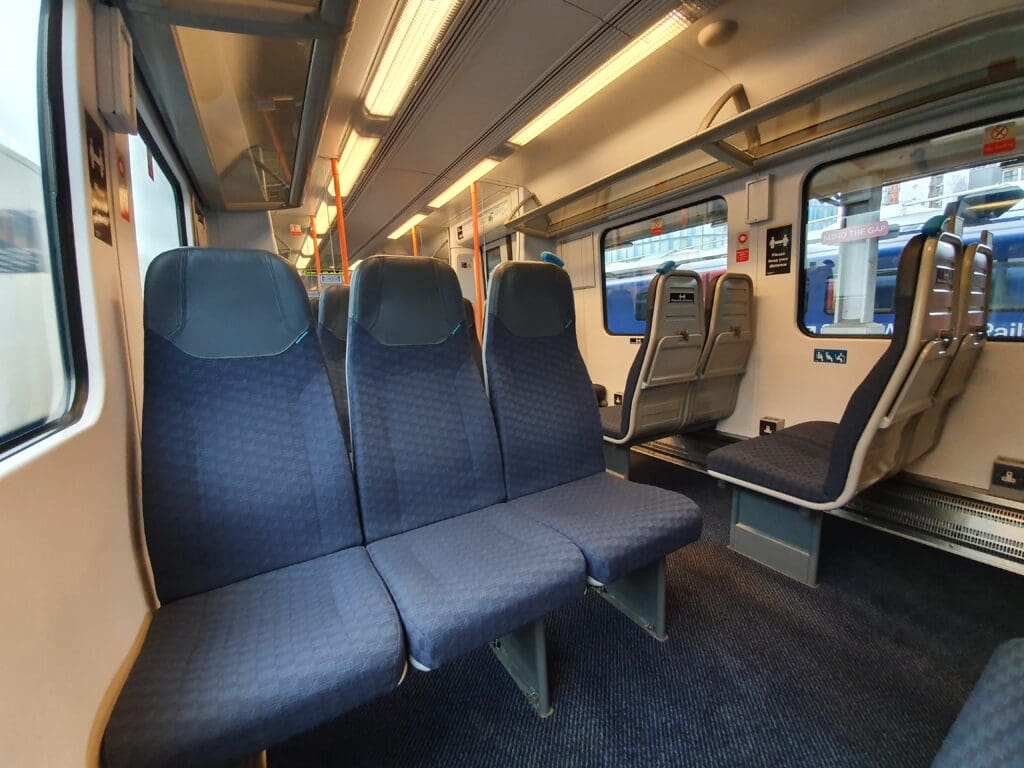
A short time after pulling out of Waterloo, glimpses of the Thames came into view as the train ploughed through Vauxhall, overtaking multiple Surrey-bound commuter services as the train sped southwest into the heart of London’s affluent commuter belt. Following stops in Woking and Winchester, the train pulled into Southampton Airport Parkway Station on time. Unlike several other ‘parkway’ stations, that of Southampton Airport is located only a minute’s walk or so away from the airport’s terminal. However, seeing as check-in was not set to open until 1305, and, given the forecast drizzle had yet to arrive, I decided to head in the opposite direction to the airport for a quick explore of Eastleigh’s Lakeside Country Park. Unfortunately, after twenty minutes or so, this was cut short by a torrential downpour and I resigned myself to a lengthy wait inside the terminal.

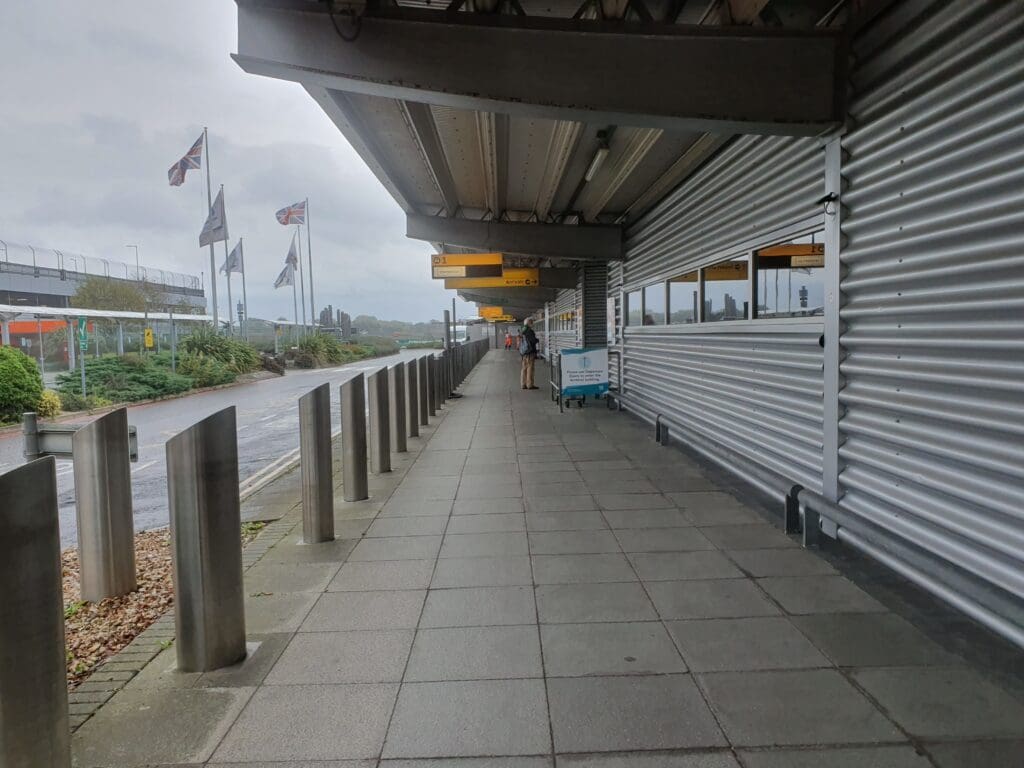
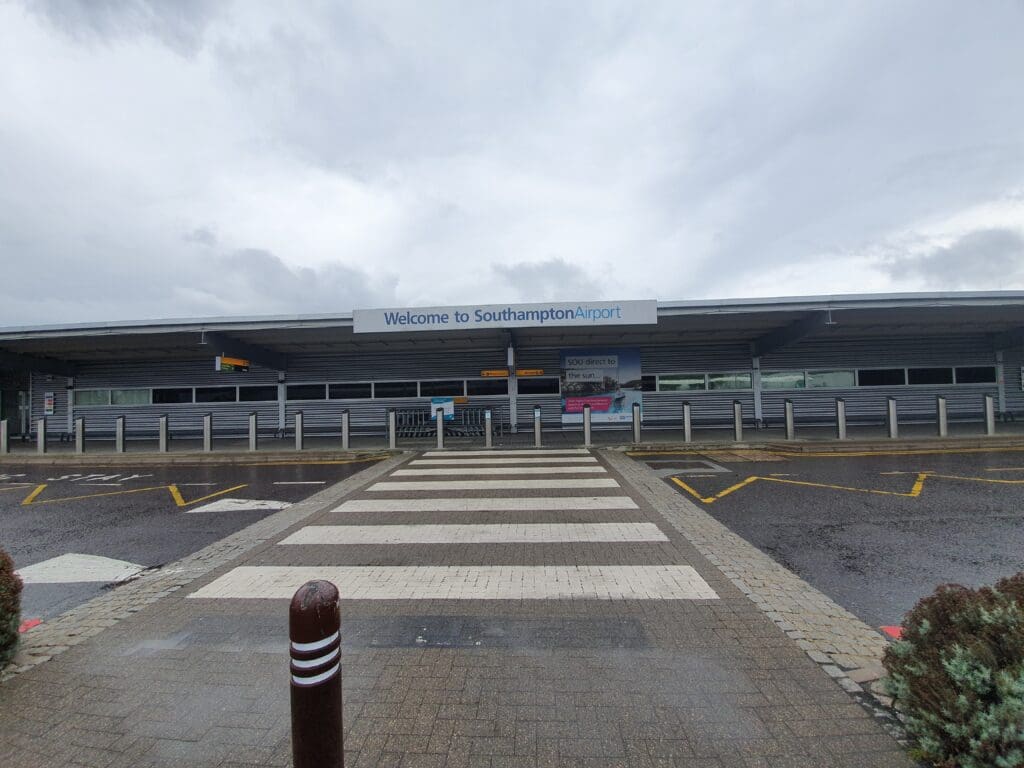
From the outside, Southampton Airport’s terminal is modern yet appears rather small and architecturally unassuming, however on the inside, this is relatively spacious. That morning, with only one other departure scheduled before the Teesside/Aberdeen flight, an Eastern Airways service to Newcastle, this was deserted with only one other passenger to be seen. Meanwhile, the local branch of WHSmiths, Costa Coffee and the airport’s bar-restaurant were unsurprisingly closed at that time. As one would expect, this area appeared to be in a superbly clean and tidy state and was also spacious and modern. At the time of my arrival, thanks to Eastern Airways’ earlier service to Newcastle, two friendly Swissport staff members could be seen manning Eastern Airways’ check-in desks. With no queues, I headed up to these and inquired as to whether it would be possible to check in for the flight to Aberdeen. Much to my surprise, this was and so I handed over my driving licence and within no more than thirty seconds I was handed in two boarding passes for my flight up to Aberdeen. This revealed that boarding was set to commence a very cautious thirty minutes before departure and that there would be a free seating policy onboard.
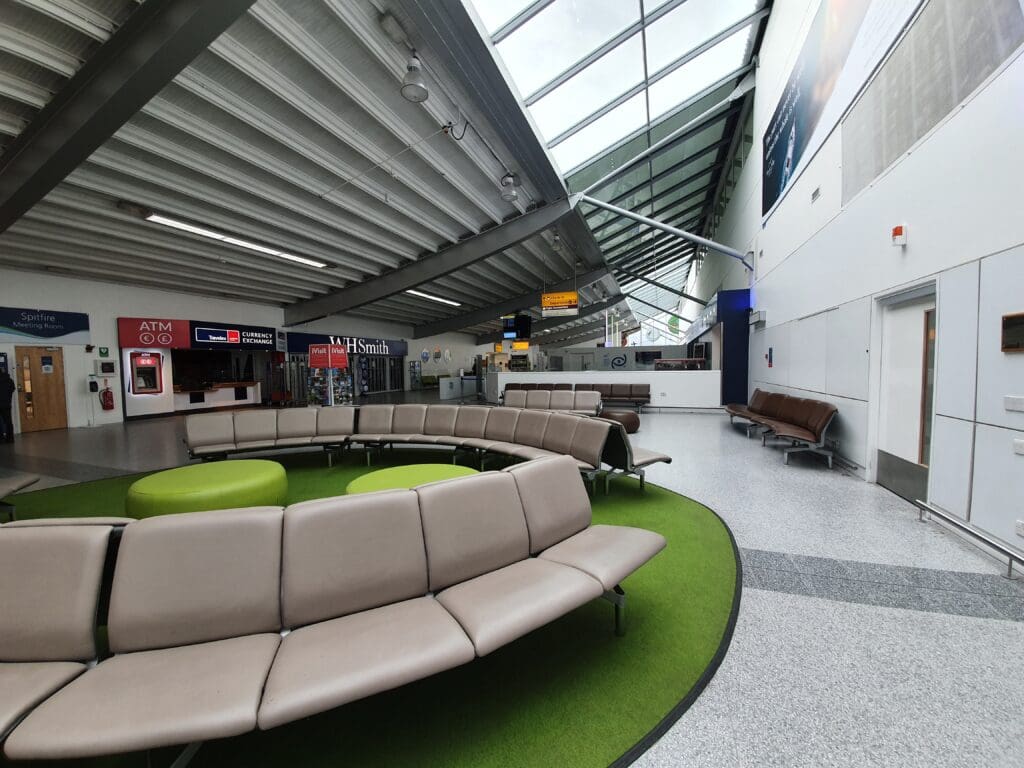
After receiving my two boarding passes, I had little reason to remain in the landside area and thus made my way to the empty security check area. Once my boarding pass was scanned, I headed over to the x-ray scanner where I was greeted by a very friendly security worker. Without any issues arising, it took about a minute to pass through the checkpoint before I entered Southampton Airport’s small landside area. At that time, a grand total of just three other passengers could be seen there, and so, as with the landside area, there was plenty of space to stretch out and relax. That said, back in the days of Flybe and more ‘normal’ times, I have little doubt that the area would have likely become rather crowded. There, a Costa Coffee kiosk, a World Duty Free store and a branch of WHSmiths could be found on the ground floor, whilst a Costa Coffee, the Olive Tree bar-restaurant and the Spitfire Lounge could be found in the small upstairs portion of the terminal. However, that day, of these, only the WHSmiths was open. Meanwhile, several vending machines, including one exclusively selling Magnum ice creams could be found in the terminal.
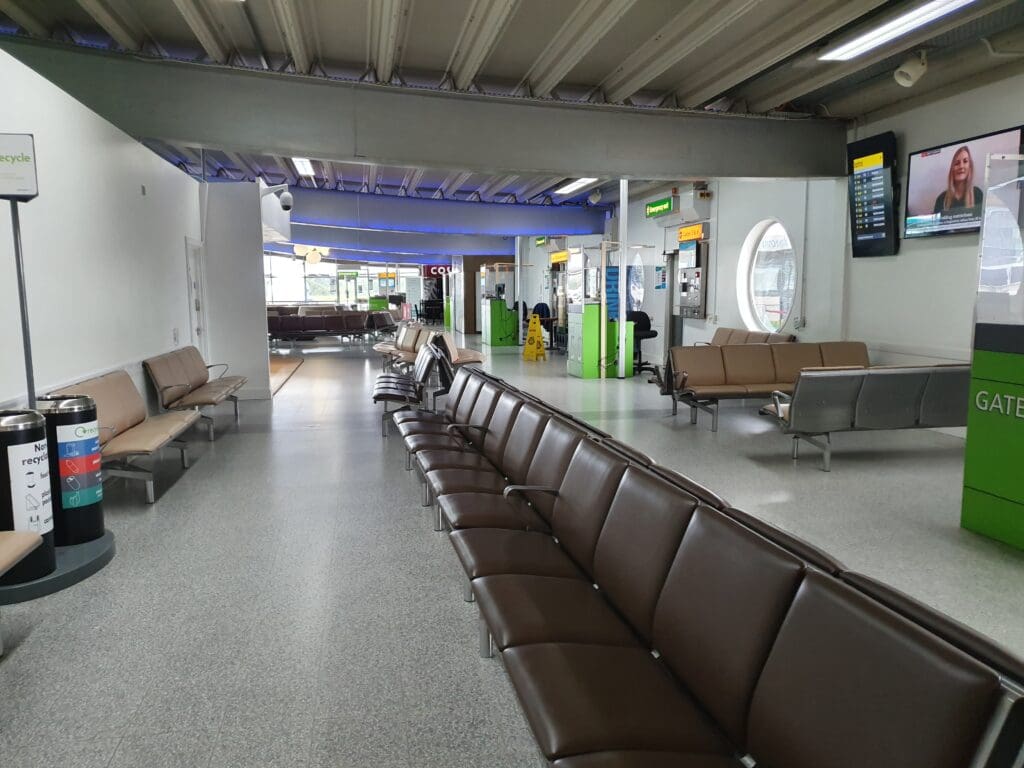

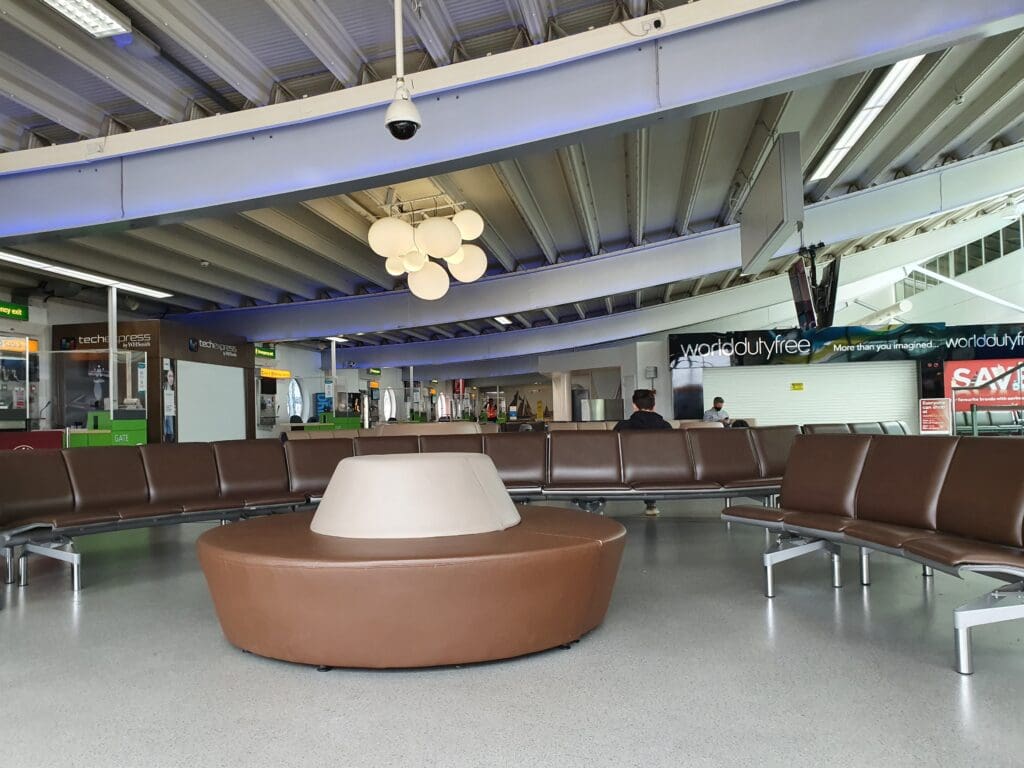
After grabbing a £3.99 meal deal from WHSmiths, I took one of the many empty seats and fired up my laptop to do some work as I waited for the flight. Thankfully, plenty of plug sockets could be seen dotted throughout the terminal and passengers are offered four hours of fast complimentary wifi. Unfortunately, for aviation enthusiasts, only a very small portion of the ramp can be seen from the airside area and at that time two Eastern Airways ATR 72 turboprops could be seen outside. Aside from the free wifi, inside the terminal entertainment was limited to several television screens which broadcast BBC News. At 1235, boarding for the Newcastle flight commenced and the three other passengers in the terminal headed off to the aircraft, leaving me as the sole passenger remaining. Around ten minutes later, the terminal was filled with noise as the engines of the Jetstream 41 that had been sitting idle in Southampton for the past day started up before the aircraft made its way to the runway.
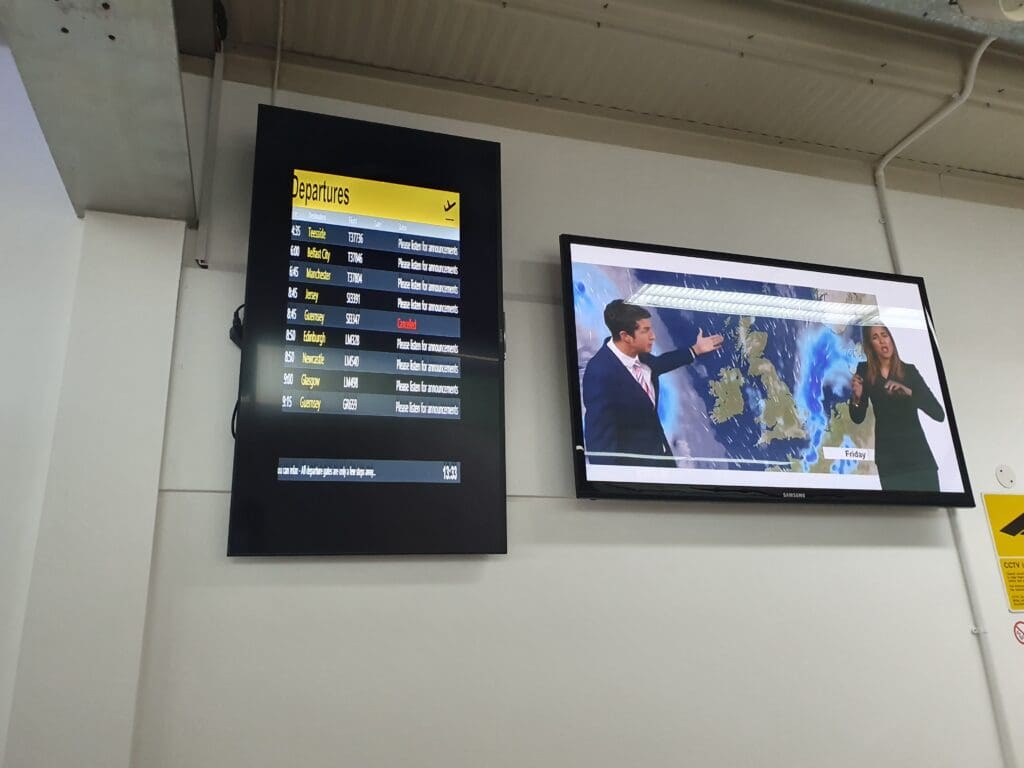
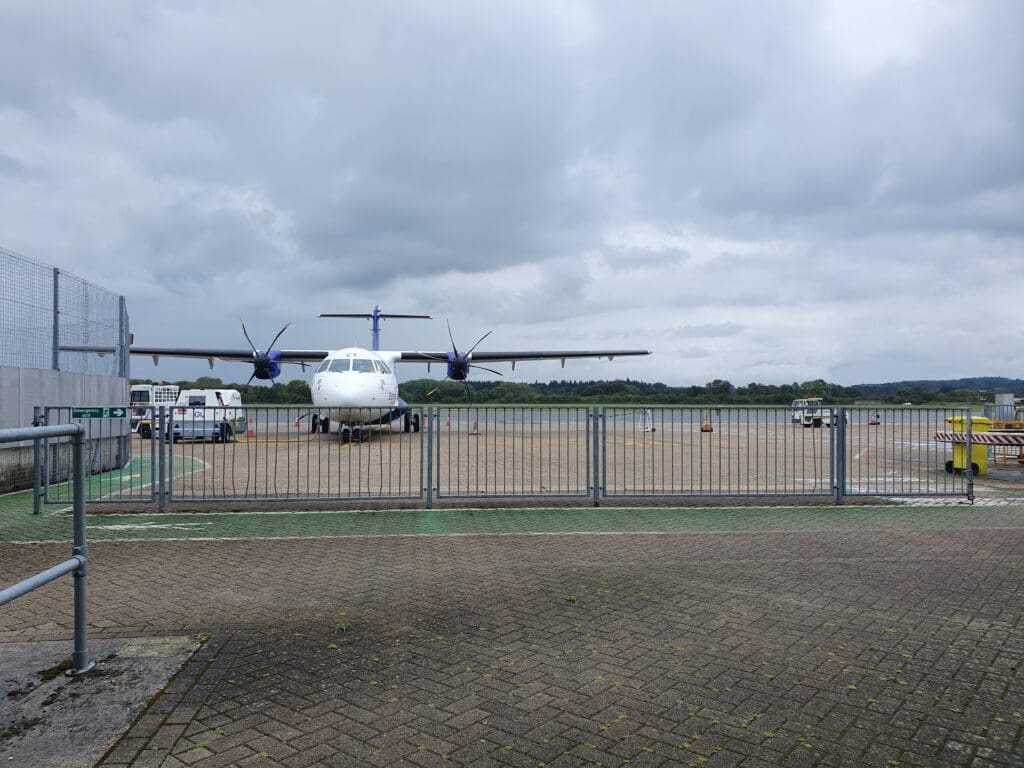
As time passed, four other passengers filtered through into the departure hall as well as an additional passenger who I would later discover was bound for Belfast City. As I had hoped, no last-minute equipment changes had been undertaken at 1340, Jetstream 41 G-MAJL touched down in Southampton at the end of its journey from Aberdeen via Teesside. Manufactured at British Aerospace’s Prestwick factory, this particular aircraft first took to the skies in April 1996 with the test registration G-4-087. In May of that year, the aircraft was delivered to British Airways’ long-defunct regional franchise partner, Manx Airlines who several months later rebranded themselves as British Regional Airlines. Here, the aircraft initially sported the British Airways Express Landor livery and repainted into the airline’s new livery in 1999, complete with the long-gone ‘Chelsea Rose’ tail and small British Regional Airlines titles. In September 2001, the aircraft was repainted into an all-white livery and the following month was handed over to its current operator, Eastern Airways where it received the airline’s colours. In 2006, the aircraft was repainted into Eastern Airways’ new colours which was soon slightly edited following minor adjustments to the airline’s motif. In the week before my flight, the aircraft had flown at least 4,700 miles over the course of 24 flights, connecting Aberdeen with Southampton, Sumburgh and Teesside.
Once on the ground, the aircraft noisily taxied past the terminal before pulling in to Stand 2 near the end of this, corresponding to Gate 9 in the terminal. Given the boarding’s overambitious scheduled commencement time of 1405, when this time arrived, I was not too surprised to find that there was no sign that boarding was set to commence. Several minutes after this the flight attendant and first officer appeared in the terminal and made their way over to WHSmiths for some late lunchtime refreshments. At 1425, the Swissport worker who had checked me in several hours earlier made an announcement from the podium at gate 9 advising all bound for Aberdeen to proceed to the gate for boarding. Seeing as I was sitting near the gate in preparation for this, I ended up being the second person to have their boarding pass scanned and identity checked before I headed outside and walked a short distance along the edge of the terminal, soon crossing the ramp and making my way towards the waiting aircraft. Given the Jetstream 41’s lack of overhead lockets, a baggage valet cart had been placed by the aircraft’s steps although seeing as I was carrying only a laptop bag and a camera bag, I did not make use of this.
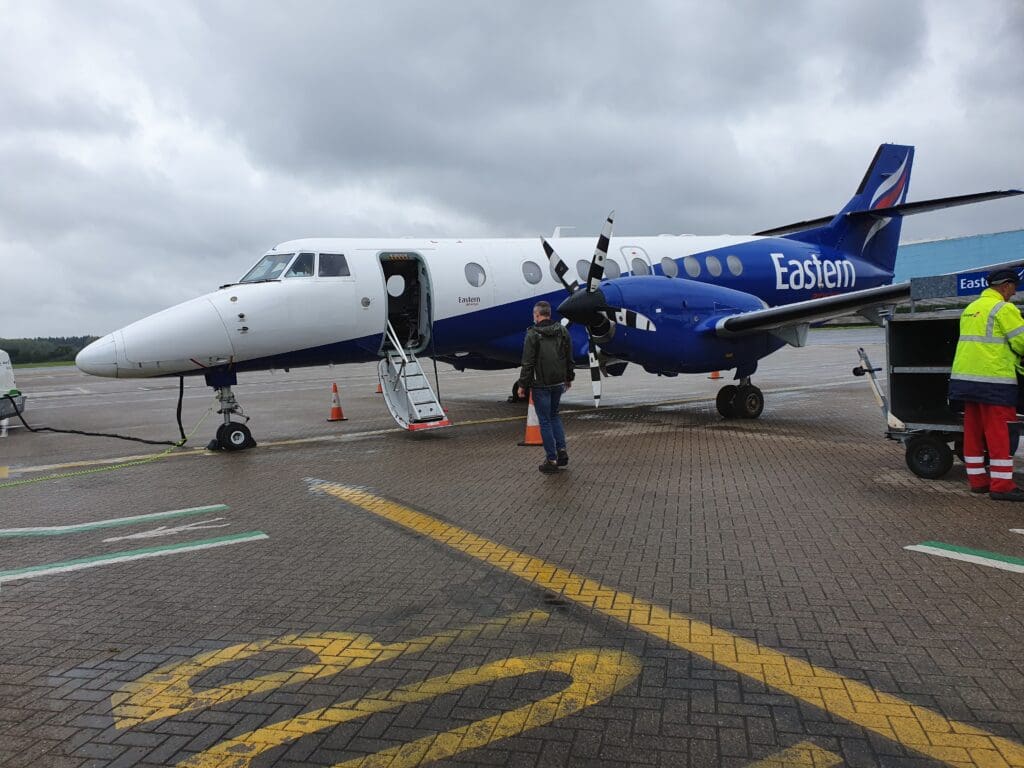
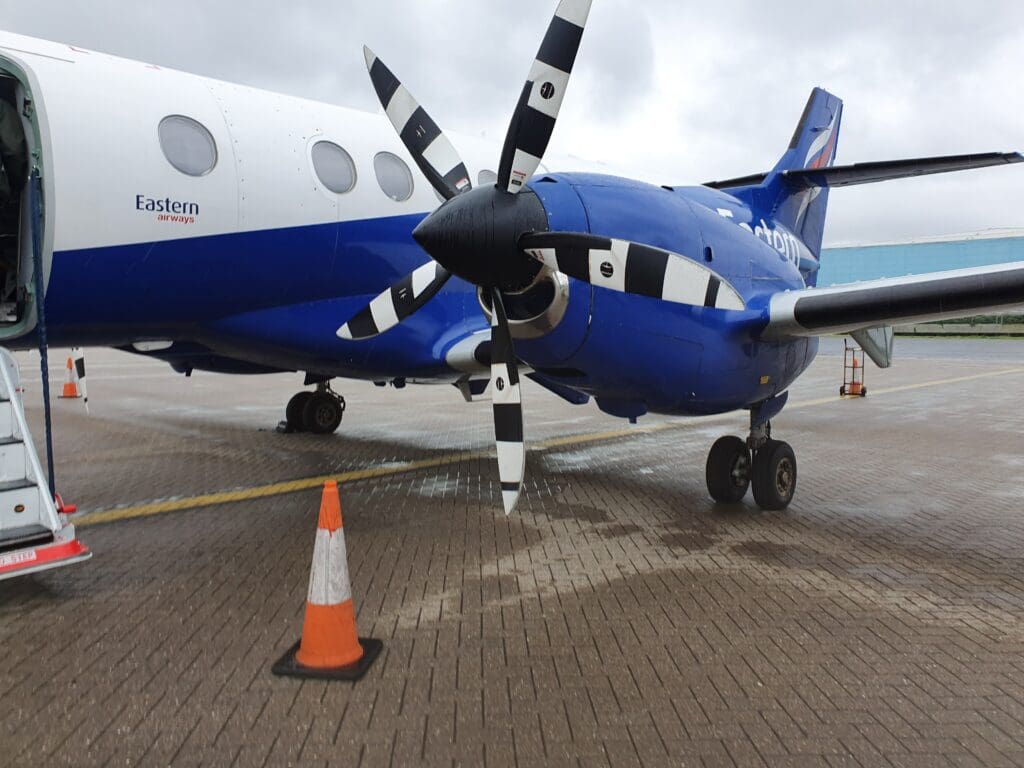
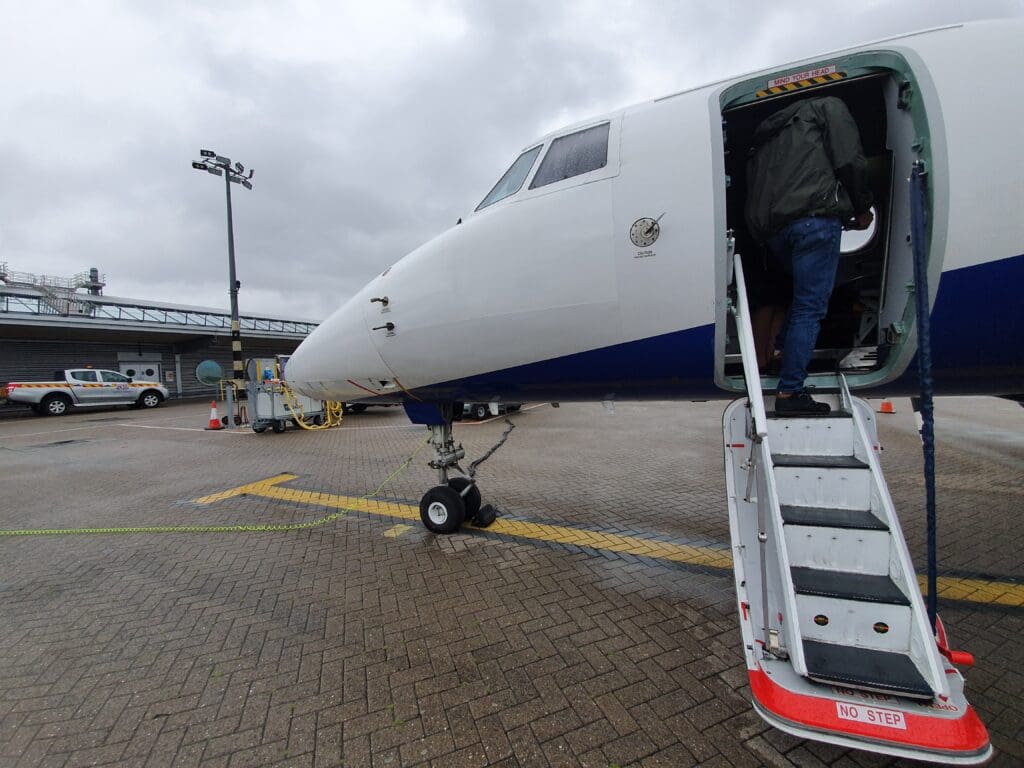

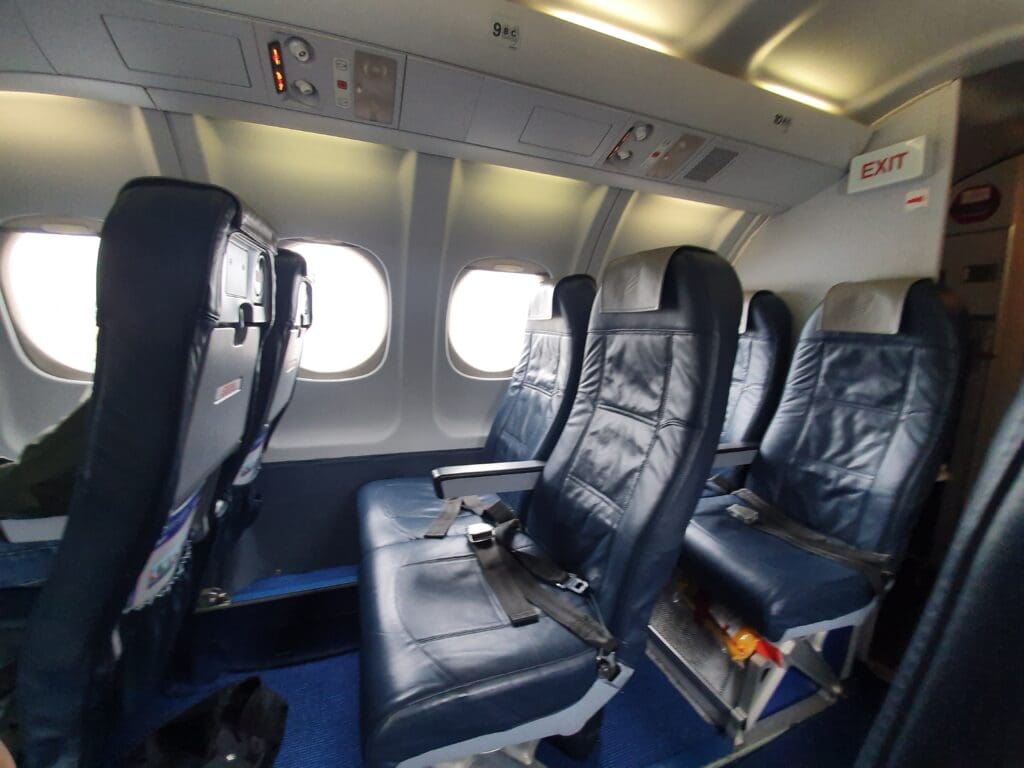
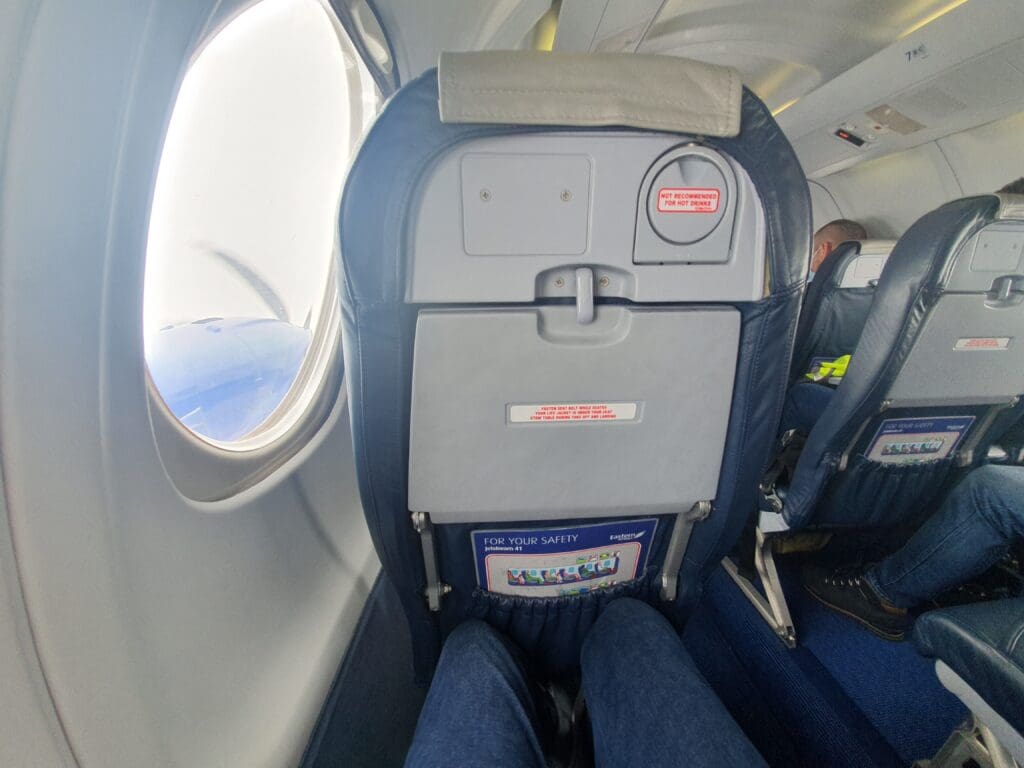
After a short wait at the bottom of the aircraft’s built-in steps to allow for social distancing as the first passenger headed onto the aircraft, I climbed up into the small cabin of the aircraft. Upon entering this, I was greeted by a friendly flight attendant who requested to see my boarding pass. After showing this, I was asked to take a seat in rows seven to nine – presumably for weight and balance purposes. I soon shuffled along the blue carpeted floor, my head very slightly bent to avoid banging this on the cabin ceiling. At the very rear of the aircraft, a cabin crew assessor could be seen in the rear row who assisted the flight attendant at various points during the flight. Well-aligned with one of the aircraft’s ten large circular portholes on the port side of the cabin I settled into Seat 9A in the Jetstream’s penultimate row. Onboard, each of the aircraft’s 29 seats is covered in a dark blue (faux?) leather topped with a grey leather antimacassar on which Eastern Airways’ motif is debossed. As with Saab’s turboprops, the cabin’s seats are located on slightly raised platforms on either side of the aisle and are in a 1-2 configuration. Whilst these appeared to be a little thin, especially considering they originated in the pre-slimline seat era, upon taking my seat I was pleased to find that these were acceptably soft. However, the legroom could not be described as particularly fantastic, although the amount of this provided did not seem to be too dissimilar to comparably sized small airliners. Given the aircraft’s state, the area around my seat appeared to be in an acceptable condition, although several marks and scratches could be seen dotted about. The most annoying of these took the form of three long horizontal scratches on my window which got in the way of several of my photos. Importantly, the aircraft appeared to be in a clean and tidy state. Turning to the seatback pocket, this featured a plain and very wrinkled sickbag as well as the aircraft’s safety card. As has been the case at many airlines during the COVID-19 pandemic, the airline has not published their inflight magazine.

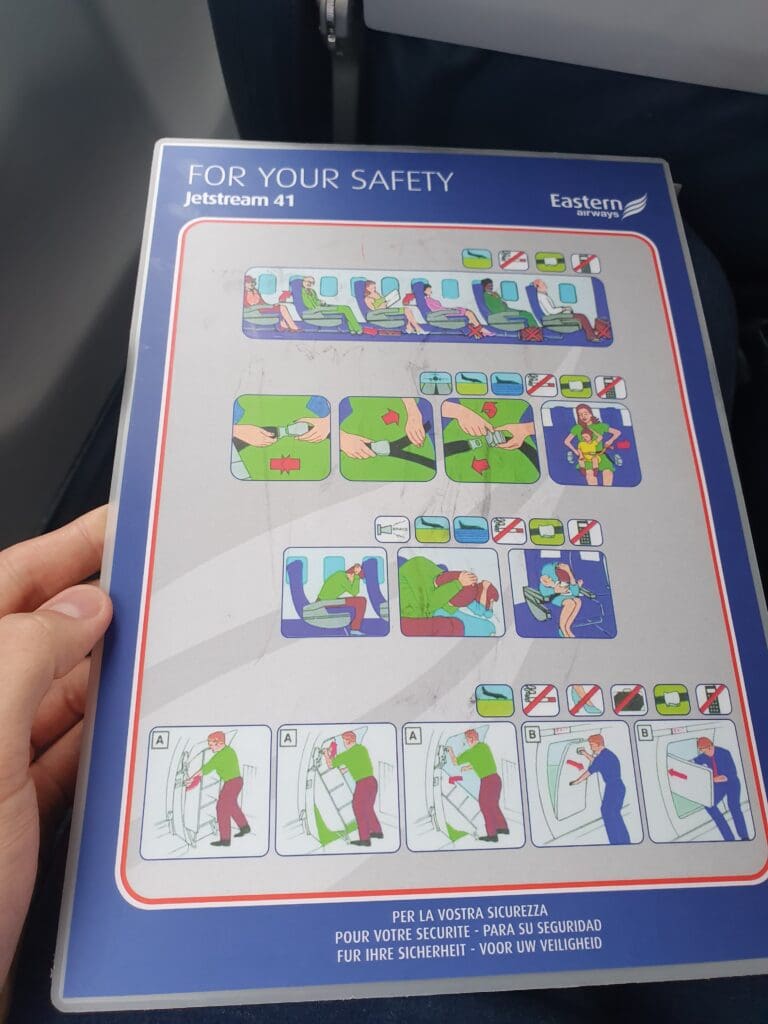

Within around two minutes, all five passengers had boarded the aircraft, with the forwardmost passengers taking the form of two off-duty Eastern Airways employees occupying the exit seats in Row 6. As soon as all were onboard, the flight attendant headed to the rear galley and performed their welcome announcement whereby, as expected, it was announced that there would be no snack service onboard, however bottles of water would be available upon request. Meanwhile, passengers were advised to remain seated wherever possible and sanitise their hands regularly. After this welcome, the flight attendant made their way to the front of the aircraft where after some dialogue with the cockpit, the cockpit door and main cabin doors were both closed in preparation for the flight. A few moments later, one of the two captains in the cockpit performed a welcome announcement whereby the flight time was announced as 1H05, although the captain did say that shortcuts would be taken en route if possible before ending this with a brief briefing of the weather in Teesside noting this to be very similar to Southampton. As soon as this came to an end, the flight attendant then performed the safety demonstration. Although passengers were all seated in the rear half of the cabin, the flight attendant performed this from the front of the aircraft. Interestingly, Eastern Airways appears to be the only airline in the UK to still enforce the policy that all electronic items (including those with flight mode) must be switched off during take-off and landing.
As the brief safety announcement came to an end, the aircraft’s two Allied Signal TPE331-14 engines noisily fired up and whirled into life and at 1339, the aircraft pushed back away from the stand under its own power. After leaving the terminal behind, without any pausing the Jetstream, known to air traffic control that afternoon as ‘Eastflight 7736’ soon taxied onto the runway and made a quick backtrack down to its northerly end for a Runway 20 departure. During this taxi, two business jets could be seen before the aircraft turned around. After a ten-second or so pause, the aircraft’s cabin was filled with vibration and the aircraft commenced a very short and powerful takeoff roll, rotating upwards incredibly quickly before the landing gear was soon retracted. After leaving the airport behind, the aircraft headed out over Southampton’s northern suburbs and over the city centre where the aircraft turned northwards before rising into the clouds.

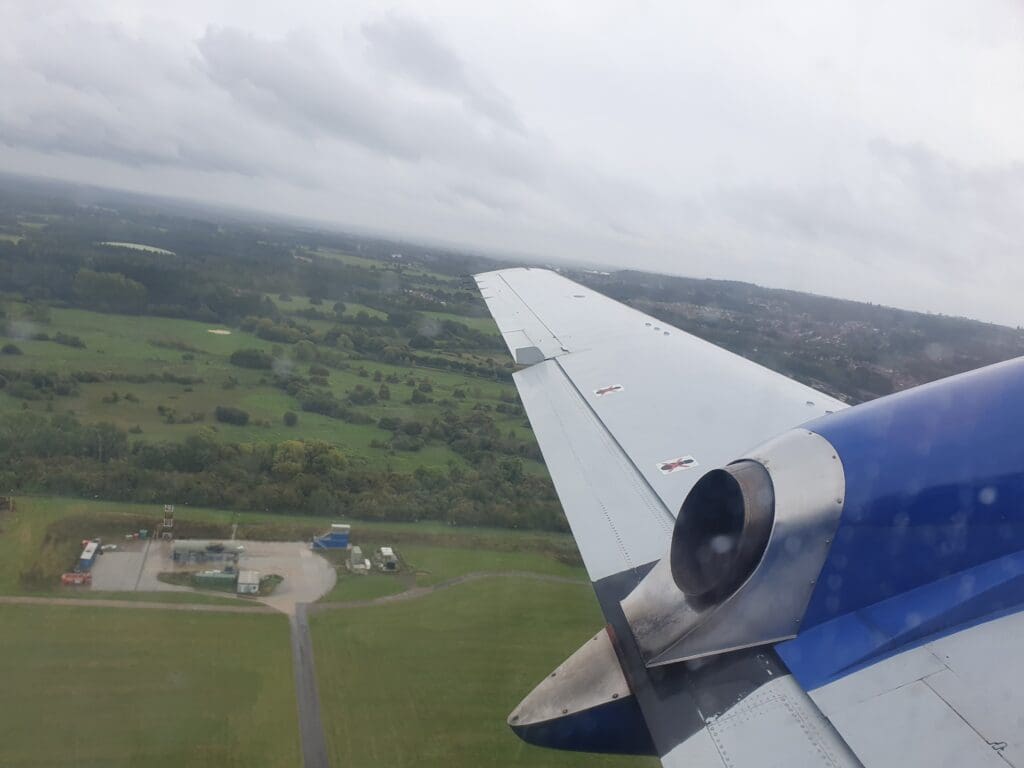
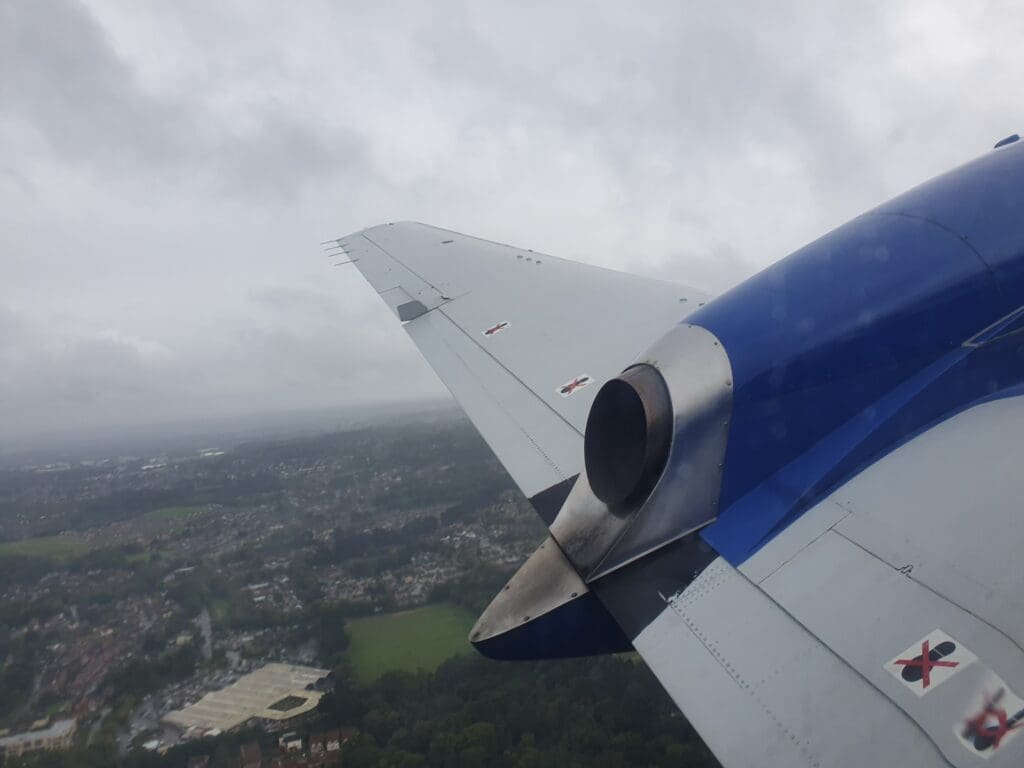
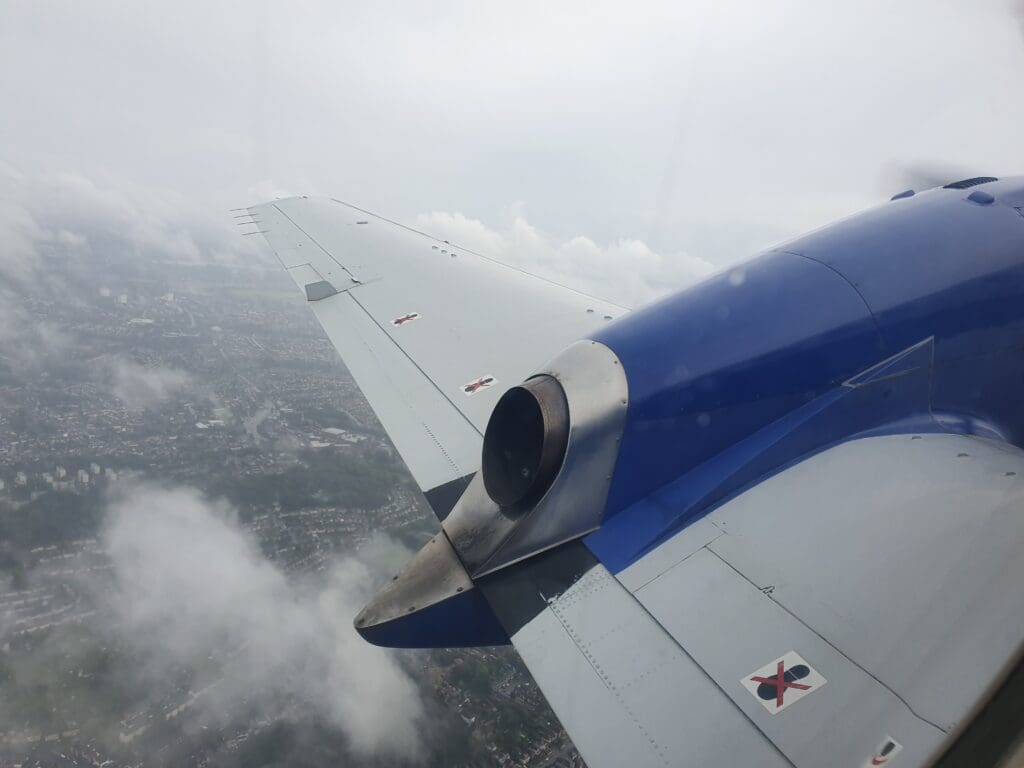

As the Jetstream cut through the clouds, things became a little bumpy and, rather surprisingly seeing as the fact that the turbulence did not appear to be letting up, the seatbelt signs were extinguished a relatively short time after departure. This was followed by the usual announcement requesting passengers remain in their seats for the duration of their flight and keep their seatbelts fastened. Whilst little could be seen outside, after leaving Southampton, the aircraft headed north towards the Chiltern Hills, passing just to the west of Reading. The aircraft then turned onto a heading of 350 degrees and levelled off at its low cruising altitude of 17,000 feet around ten minutes after departure. At 1500, the aircraft broke free of the clouds after passing Oxford and continued to fly northwards, passing to the east of Royal Leamington Spa and Coventry.
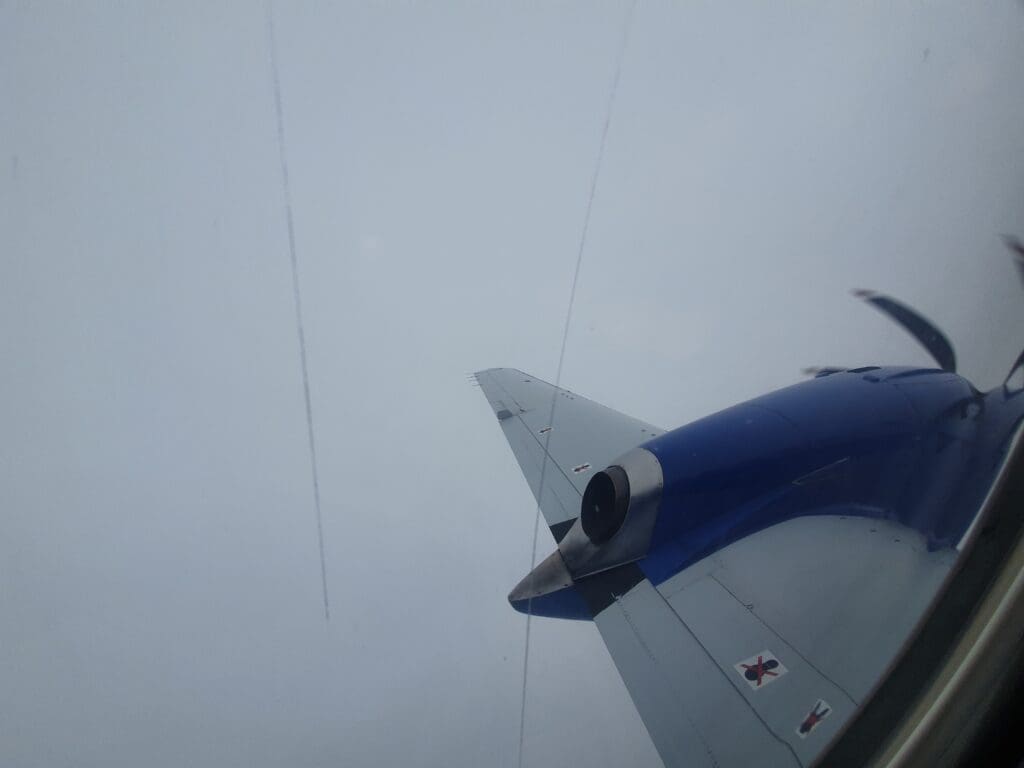
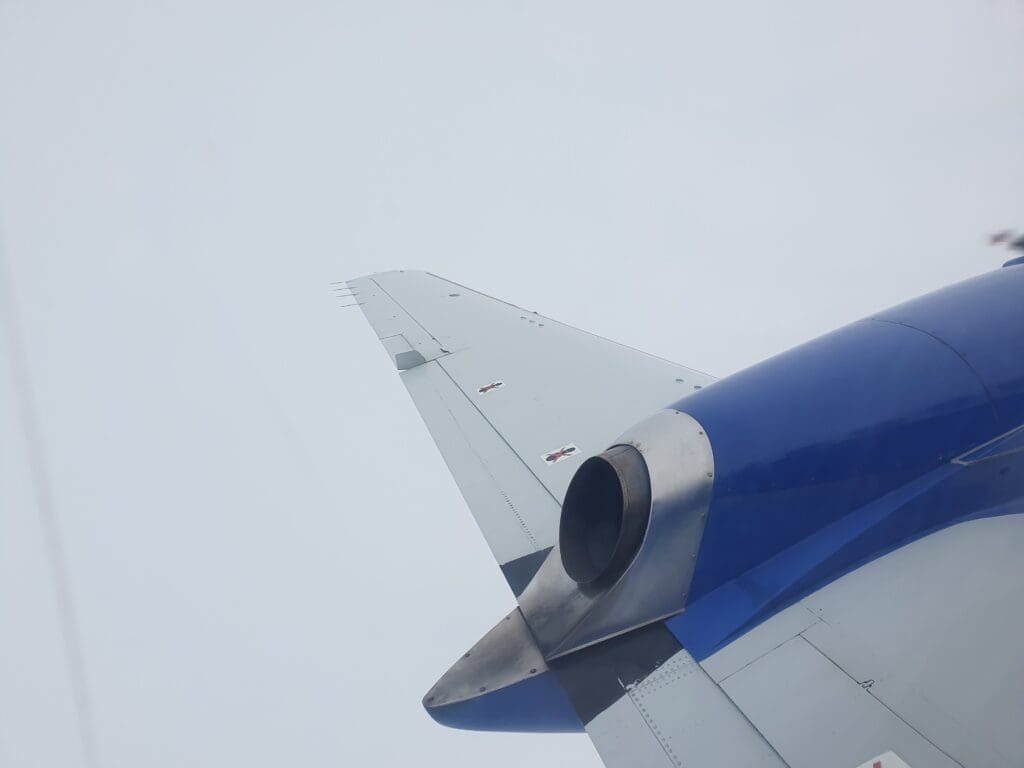
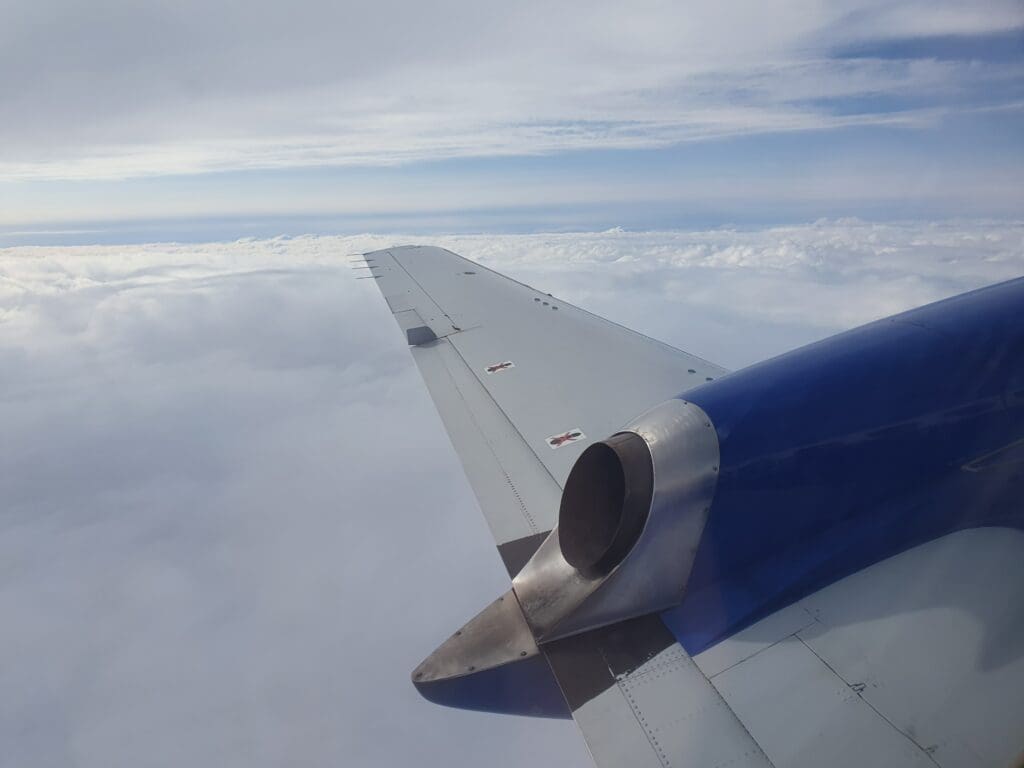
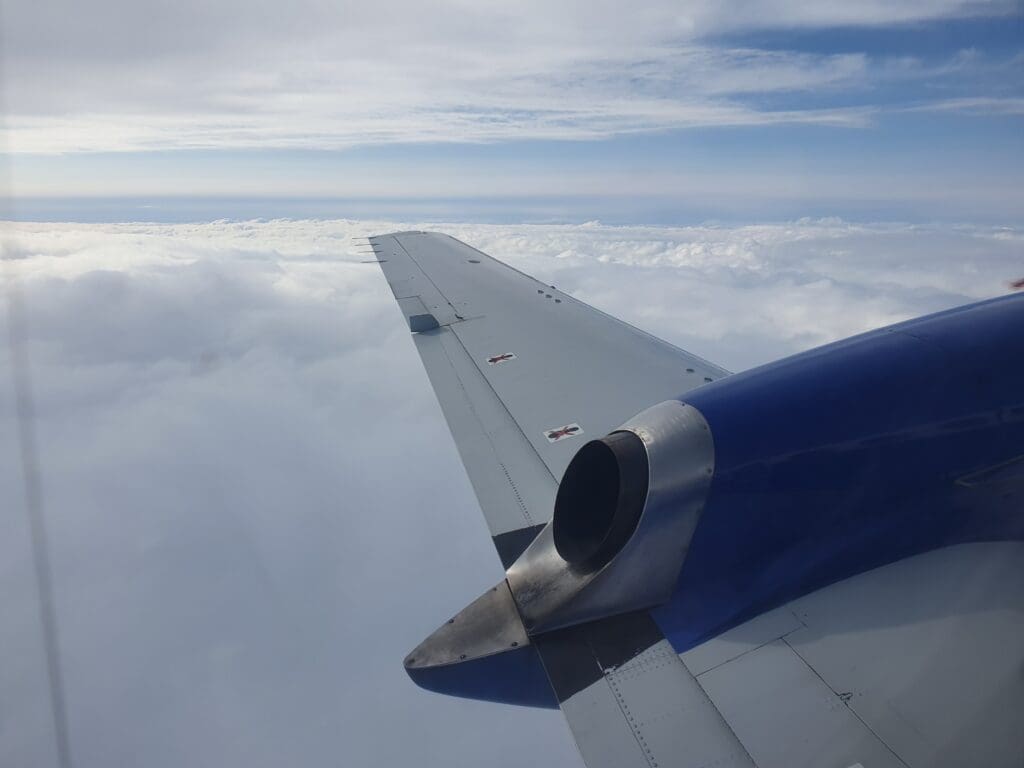
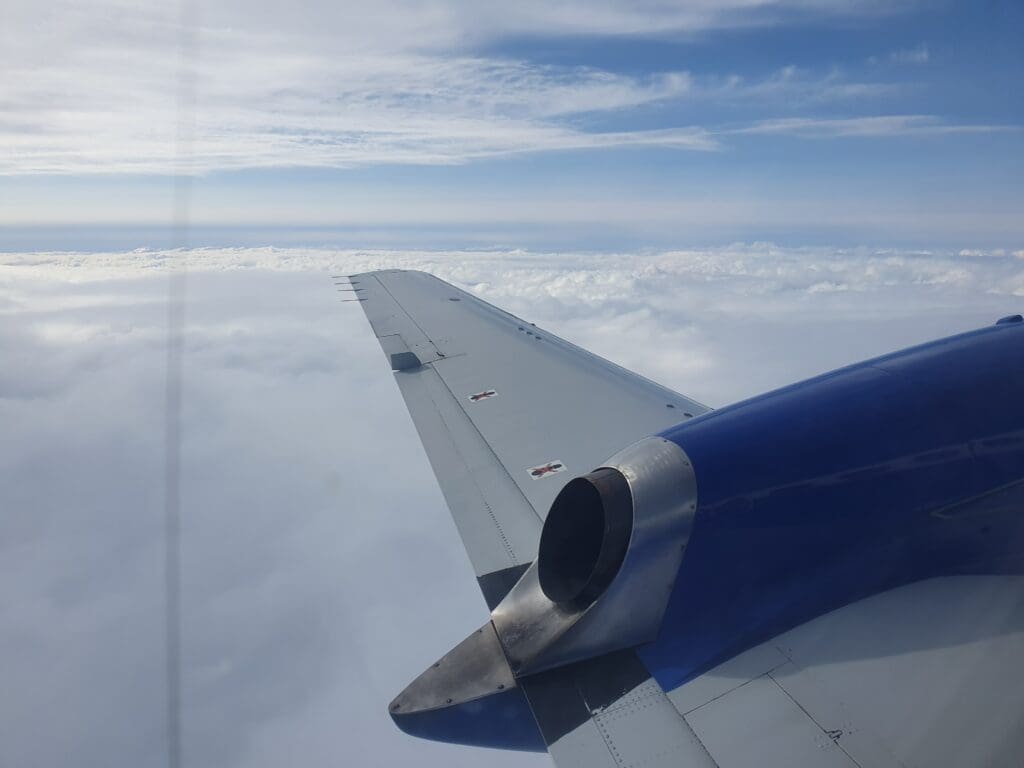
As the aircraft headed from the West Midlands to the East Midlands, a small gap in the clouds brought a glimpse of the town of Nuneaton. Unfortunately, views of the ground below were soon swallowed up by another patch of clouds, however around ten minutes later, a larger gap in the clouds allowed significant swathes of the southern portion of the Peak District to be seen. Unfortunately, as the aircraft headed northwards into the Dark Peak, an area I am incredibly familiar with seeing as I hail from neighbouring Sheffield, the clouds came up and swallowed all views of the ground below once again.
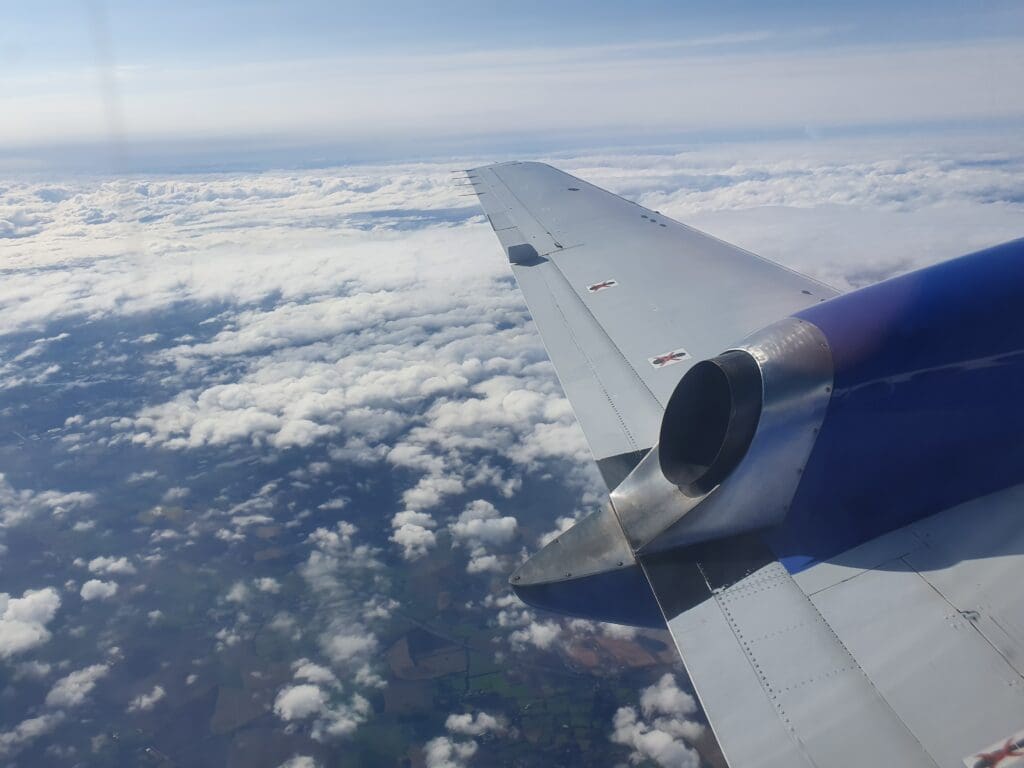
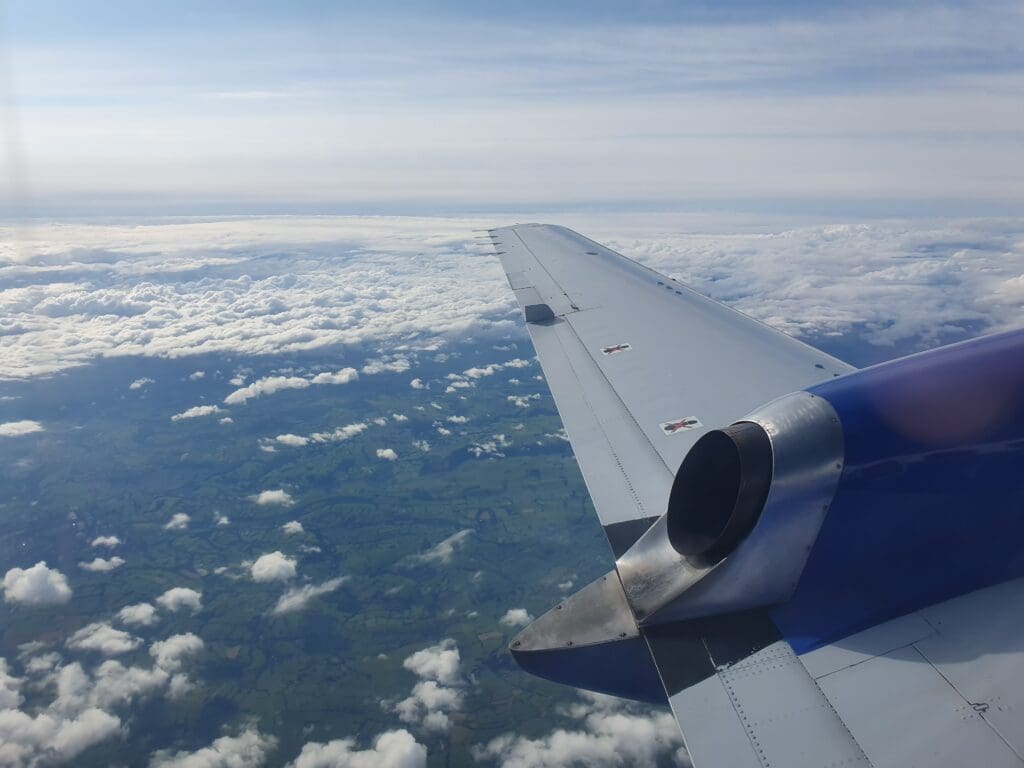
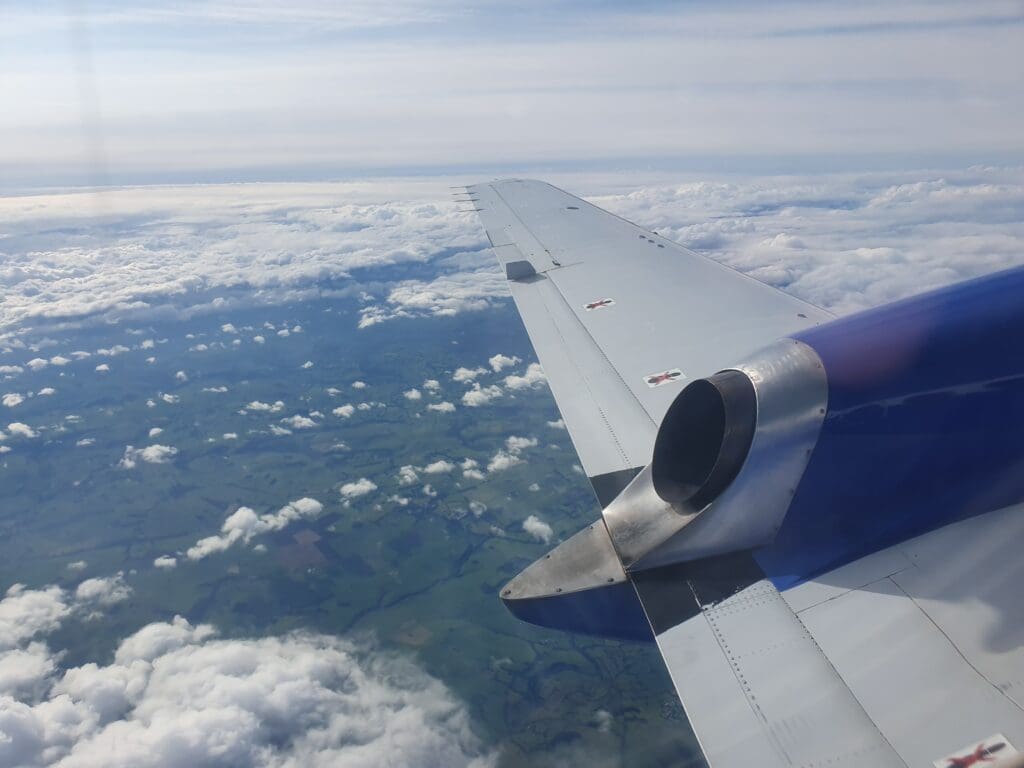
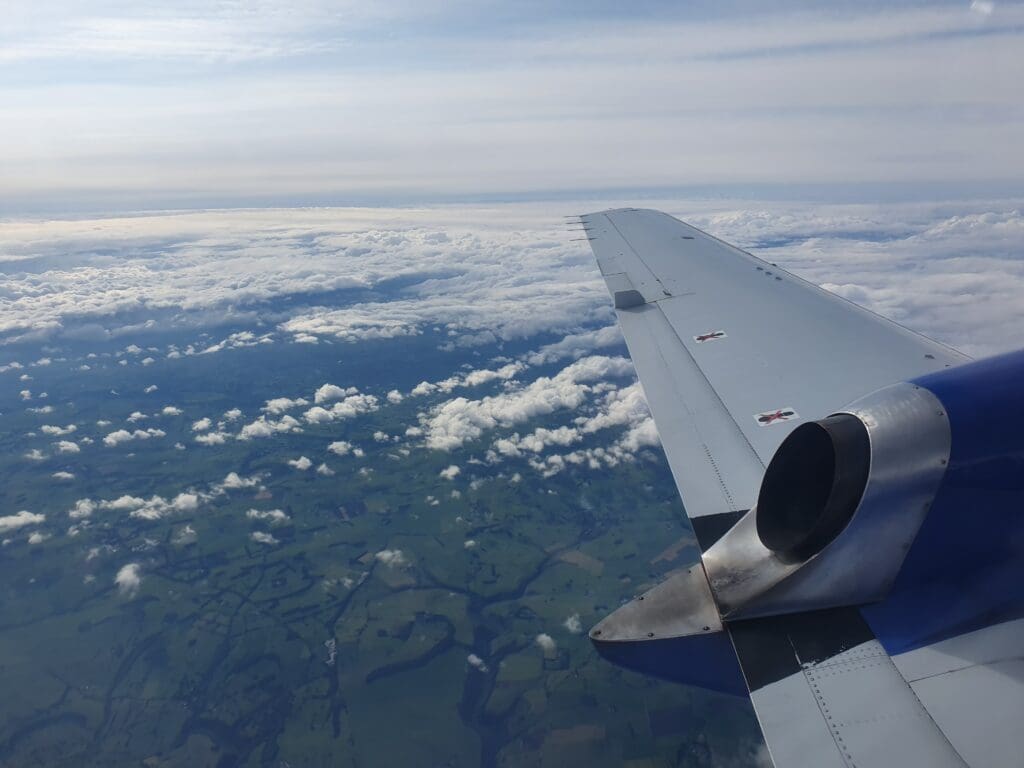
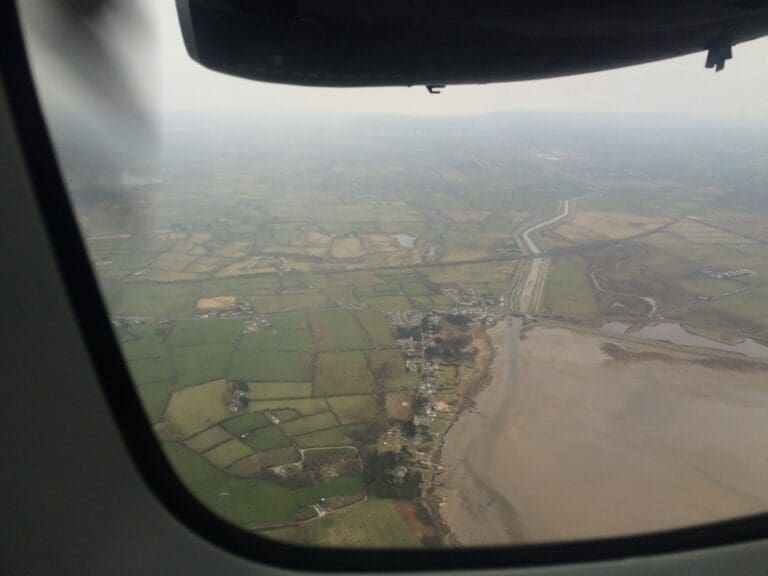
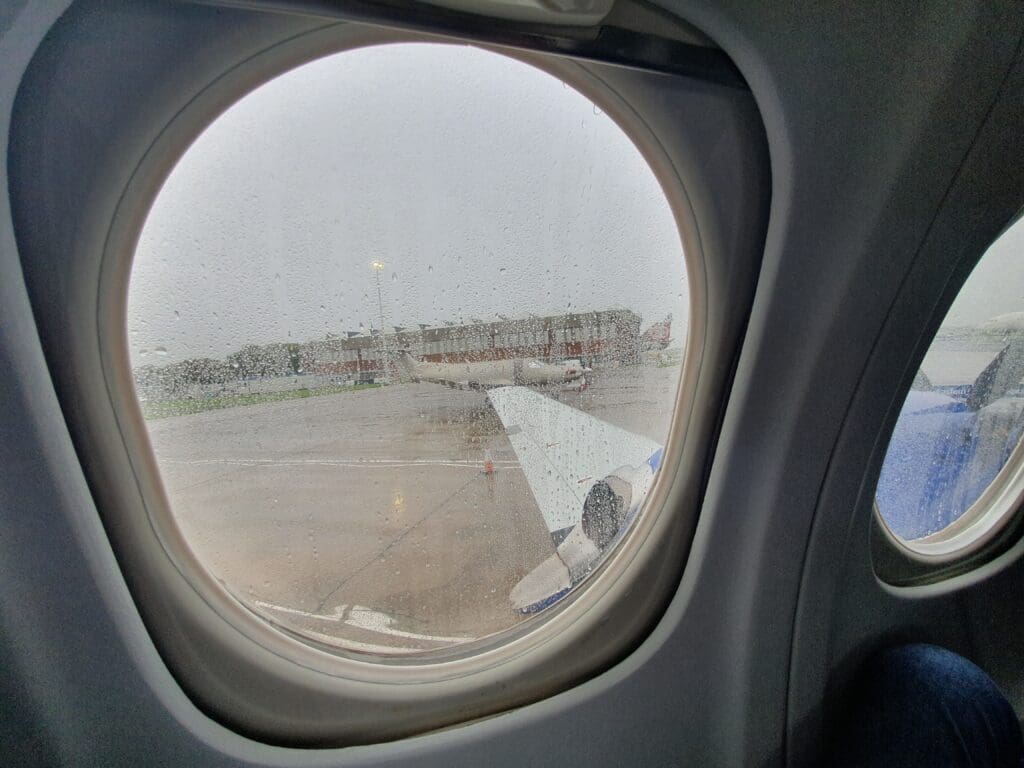
After leaving the Peak District behind, the aircraft passed directly over Huddersfield and Bradford. At 1520, the aircraft could be felt commencing its descent and almost immediately after beginning its way back down to the ground, the seatbelt signs were reilluminated. This was accompanied by an announcement from the flight attendant with the usual pre-arrival requests, after which they passed through the cabin ensuring all was in place for the aircraft’s arrival. Following some rather significant bumps as the aircraft cut through the clouds, the flaps and landing gear were extended whilst the picturesque countryside near the border between County Durham and North Yorkshire could be seen whizzing past below. As the aircraft neared Teesside Airport, the remnants of the former heavy bomber station, RAF Croft, now home to Croft Circuit could be seen and the Jetstream passed over the winding River Tees no fewer than three times. Unfortunately, seeing as the two cabin crew members were sat almost right behind me, I could not take any photos during this stage of the flight (although I was a little braver doing this upon departure from Teesside and arrival in Aberdeen!). Several villages and farms and many fields later, the aircraft floated over the perimeter fence before making a very heavy touchdown on Runway 05 at 1435.
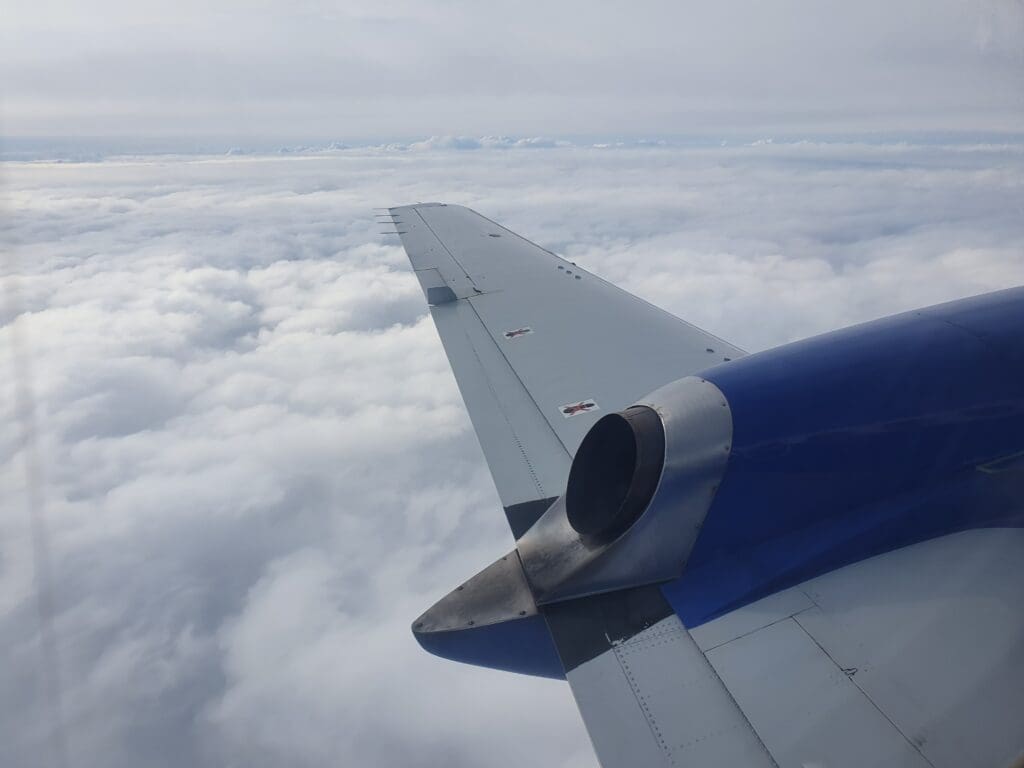
Once firmly on the ground, the aircraft braked rather harshly and taxied left onto the remnants of one of the former RAF station’s runways. At this time, the flight attendant welcomed all onboard to Teesside and advised those heading to Aberdeen to remain onboard the aircraft albeit with their seatbelts unfastened as the aircraft would be refuelled during the turnaround. Looking outside, that afternoon an interesting smorgasbord of aircraft could be seen standing on the apron. Outside the airport’s small single-storey terminal, a trio of fellow Eastern Airways aircraft could be seen. These included a Jetstream 41, an all-white Embraer 170 and a Saab 2000 sporting the basic colours of its former operator, SkyWorkAirlines. A minute or so after exiting the runway, the aircraft arrived at stand 5R and slotted itself in between the Jetstream and a Jetfly Aviation Pilatus PC-12 which would later head down to Fairoaks Airfield near London. Away from the terminal, a vintage Jet Provost, three locally based Cobham Falcon 20s, an IAS Medical King Air, a Castle Air Agusta 109, a Diamond DA-62 and a stored former Scandinavian Airlines Boeing 737-600 could be seen. However, the highlight came in the form of a Fiji Airways Boeing 737-700 whose tail could be seen poking out of a nearby hangar. This particular aircraft had arrived several days before my flight after a long trek over from Nadi. This had seen the aircraft make stops in Honolulu, Los Angeles and Bangor before touching down in Northeast England where the aircraft would meet its end.
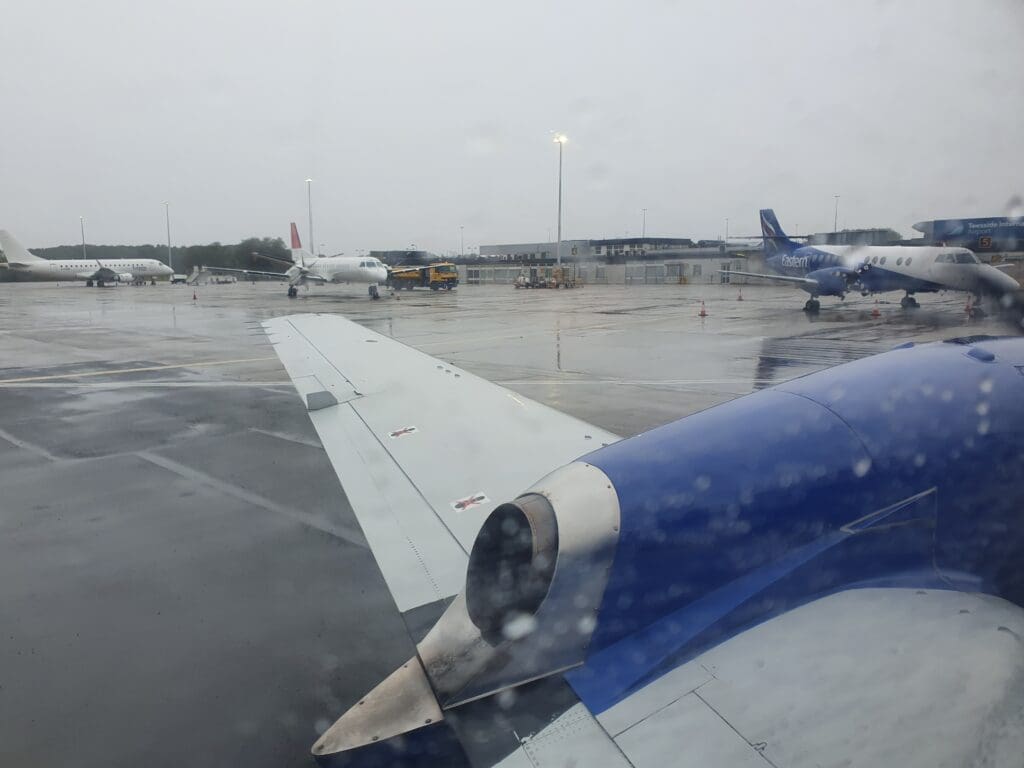
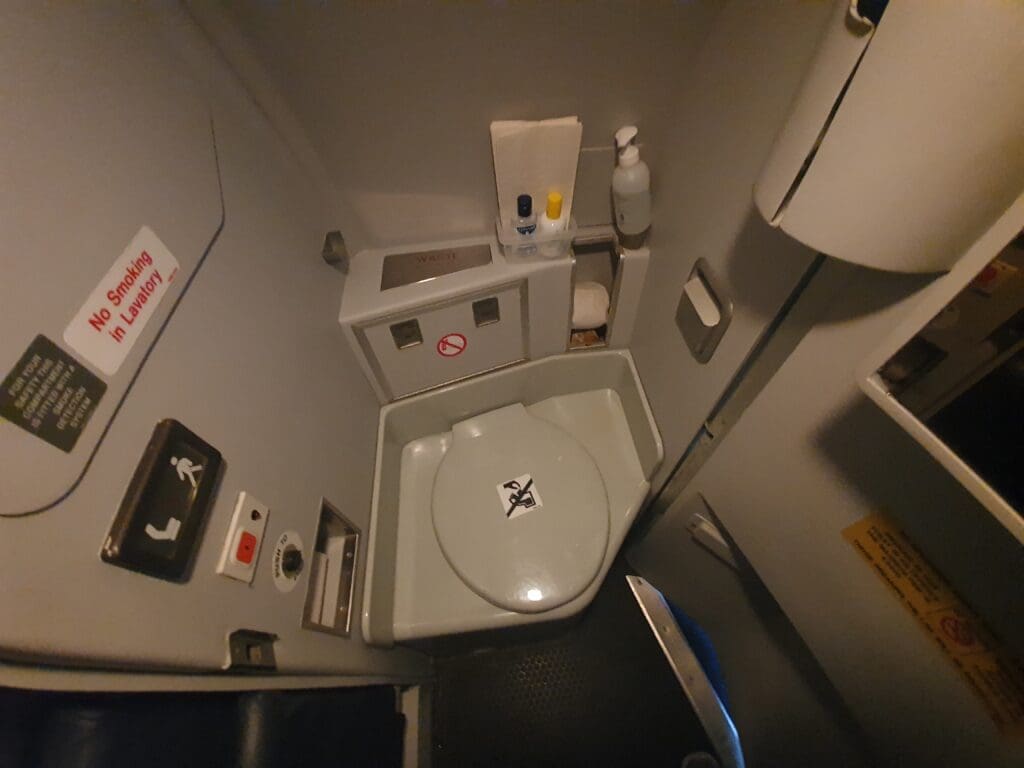
Once the aircraft came to a halt, the engines were shut down and the propellers made a sort of winding down noise whilst outside a fuel bowser and a luggage cart were brought up to the aircraft. Once the propellers stopped turning, the flight attendant opened the cabin door and was immediately greeted by the dispatcher. Once the valet luggage cart had been positioned at the front of the aircraft disembarkation for the two passengers ending their journey in Teesside (both Eastern Airways employees) commenced. Seeing as the two cabin crew members would leave the aircraft in Teesside, after these two passengers disembarked both donned their hats and reflective jackets in preparation to leave the aircraft. After confirming it was okay to do so, I made my way to the rear of the aircraft to use the lavatory. Whilst I was expecting this to be small, I did not realise that this was located in a cupboard. When the door of this opened, this serves as a toilet door that separates the occupant from the cabin with the whole rear galley area turning into a toilet. Whilst clean, this lacked running water although hand sanitizer, toilet roll and tissues were provided. In addition, perhaps as the aircraft was on the ground, this did not flush.
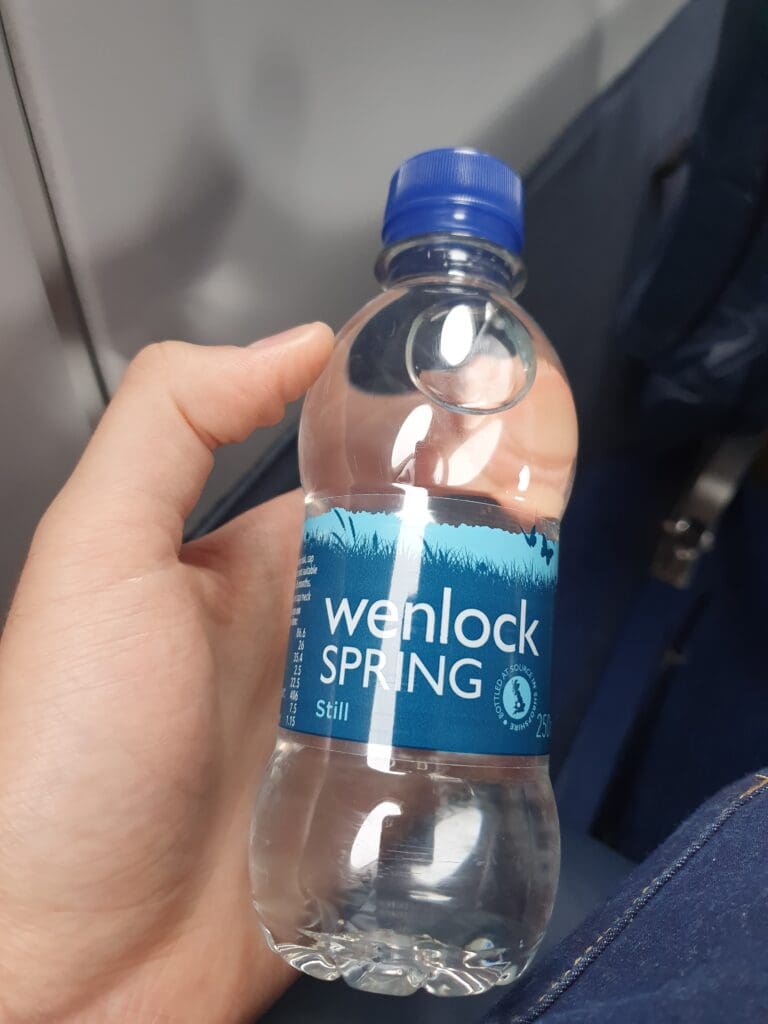
Soon enough, I returned to my seat and waited for the next leg of the journey to commence. Meanwhile, at the front of the aircraft, once one of the captains returned from their walkaround, the cockpit door was left open, allowing the ATIS and several cockpit dings to be heard. Around ten minutes after the aircraft’s arrival, the two cabin crew members left, with a single flight attendant joining the aircraft for the journey up to Aberdeen. Upon boarding, I was pleased to find that this crew member was as polite and friendly as the two that had operated the flight thus far and the staff member soon got to work handing out bottles of water to the flight’s three passengers. Meanwhile, at the rear of the aircraft, a surprising amount of baggage could be seen being fed into the aircraft indicating that the second leg of the flight to Aberdeen would end up being rather full.

Almost forty minutes after touching down in Teesside, at 1613 the first of twenty passengers joining the flight made their way into the aircraft’s small cabin. Overhearing the flight attendant’s greetings, these passengers were advised to fill seats from the rear of the aircraft and so, with the load going from 17% to 79%, things soon started to get a little cramped. Virtually all of these passengers took the form of offshore oil and gas workers heading up to Aberdeen to commence a new shift, this demographic served as a reminder that the oil and gas industry is very much central to much of Eastern Airways’ operations. Many of these passengers appeared to be regulars on the route and a number were even greeted by name by the flight attendant! Whilst most passengers were travelling alone, many seemed to recognise each other and spent much of the flight exchanging tales from their time offshore.
Whilst the flight became reasonably busy, given the aircraft’s size, boarding was completed in around eight minutes and as soon as this was completed the main cabin and cockpit doors were shut. After making a standard welcome announcement from the rear galley, the flight attendant headed to the front of the aircraft where they performed a safety demonstration. This was followed by an announcement from the Captain who noted that he expected the flight to take around fifty minutes and that the weather in Aberdeen was thankfully much better than in Teesside. Once this had been completed, the cabin was filled with noise as the engines fired up and the two five-blade black and white McCauley propellers spun into life.
At 1625 the aircraft noisily propelled itself forward out of its stand and made a quick and short taxi over to Runway 05. After a quick backtrack, the aircraft turned around and commenced a rolling takeoff. As was to be expected given the increased load, this was neither as powerful nor instant as the departure from Southampton. Nevertheless, the aircraft rotated into the skies just before reaching the terminal which allowed for good views of the collection of aircraft on the ground at Teesside. After leaving the airport behind, the Jetstream headed out over the fields that surround the airport and soon climbed up into the clouds.
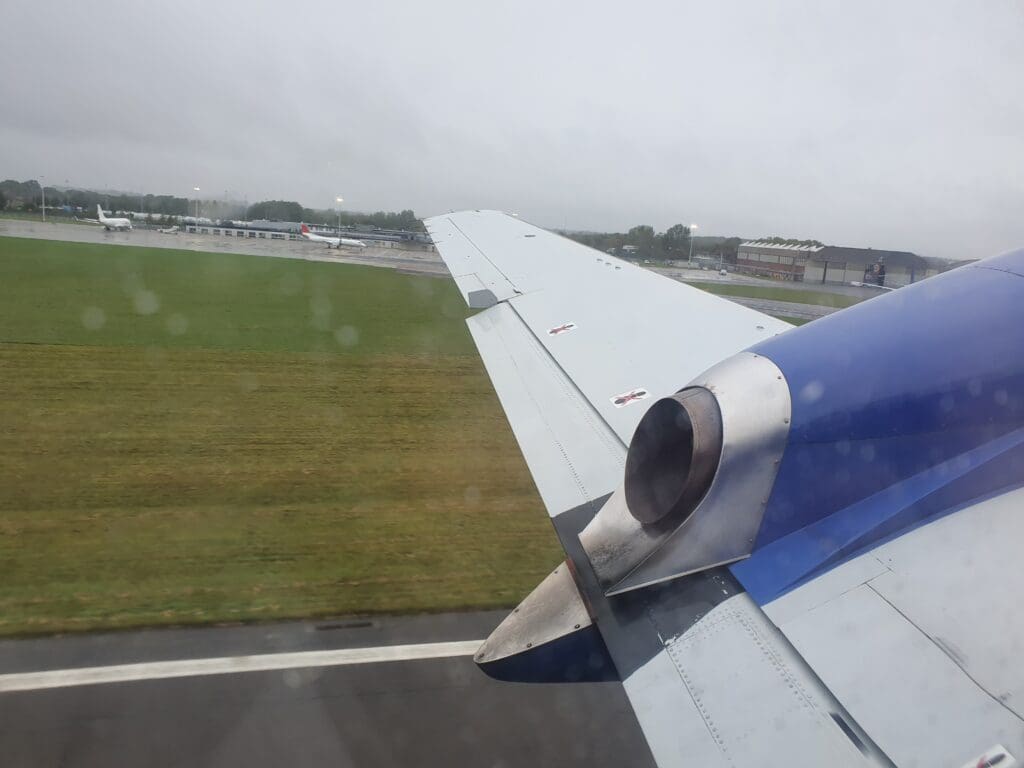
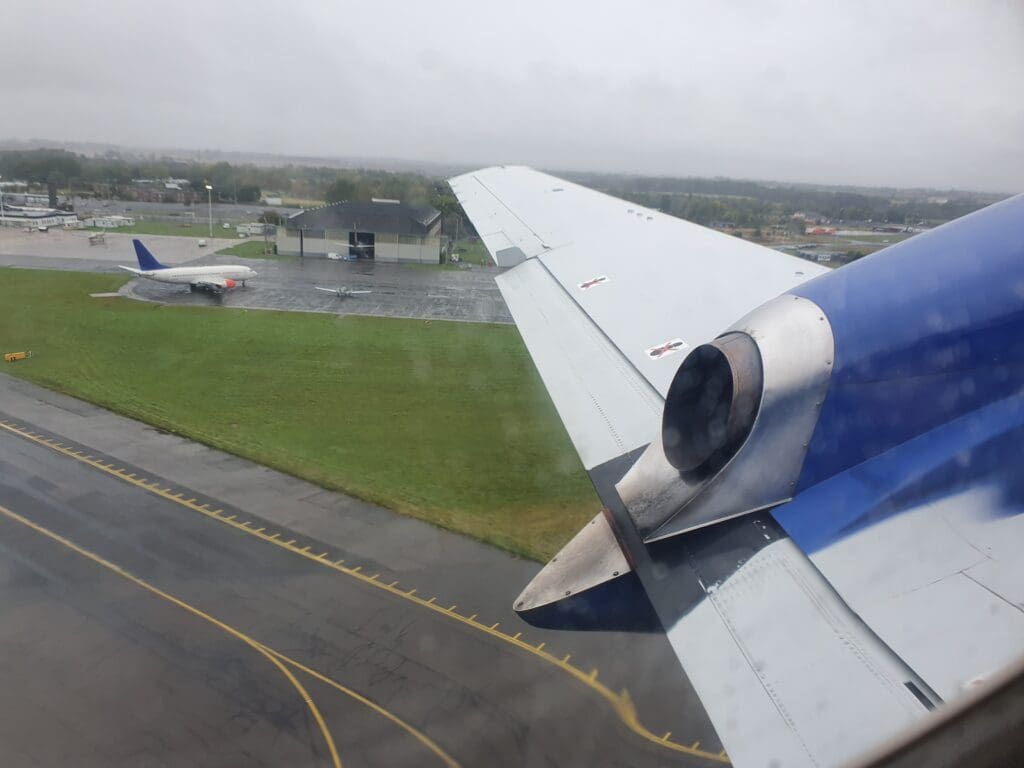
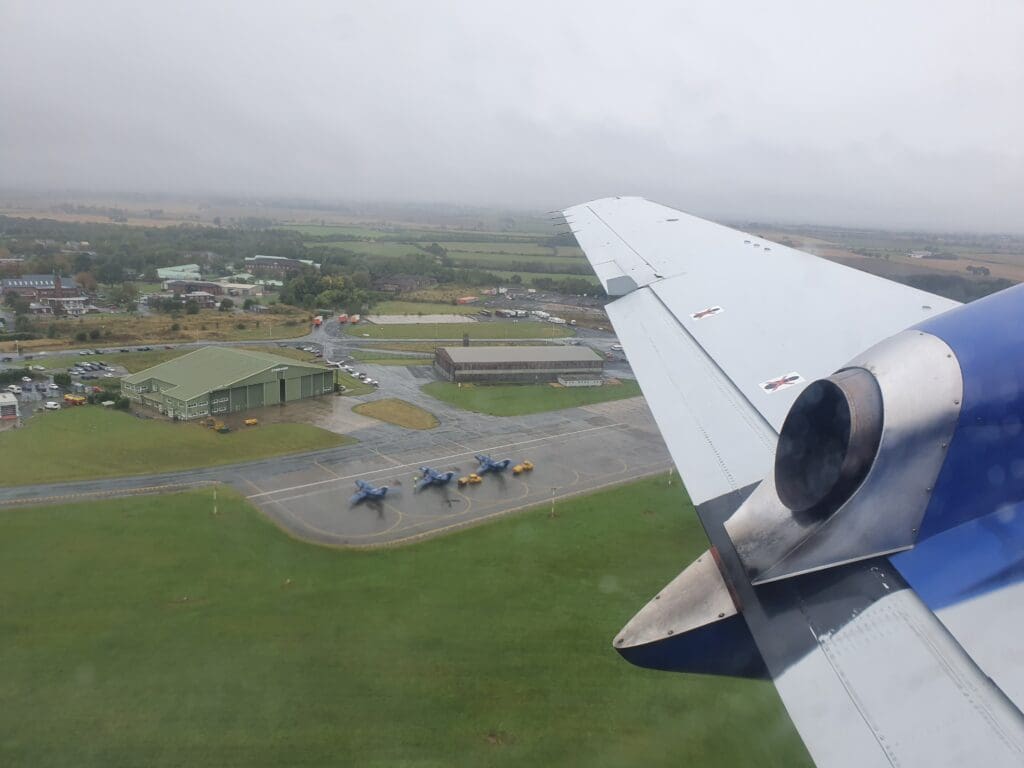
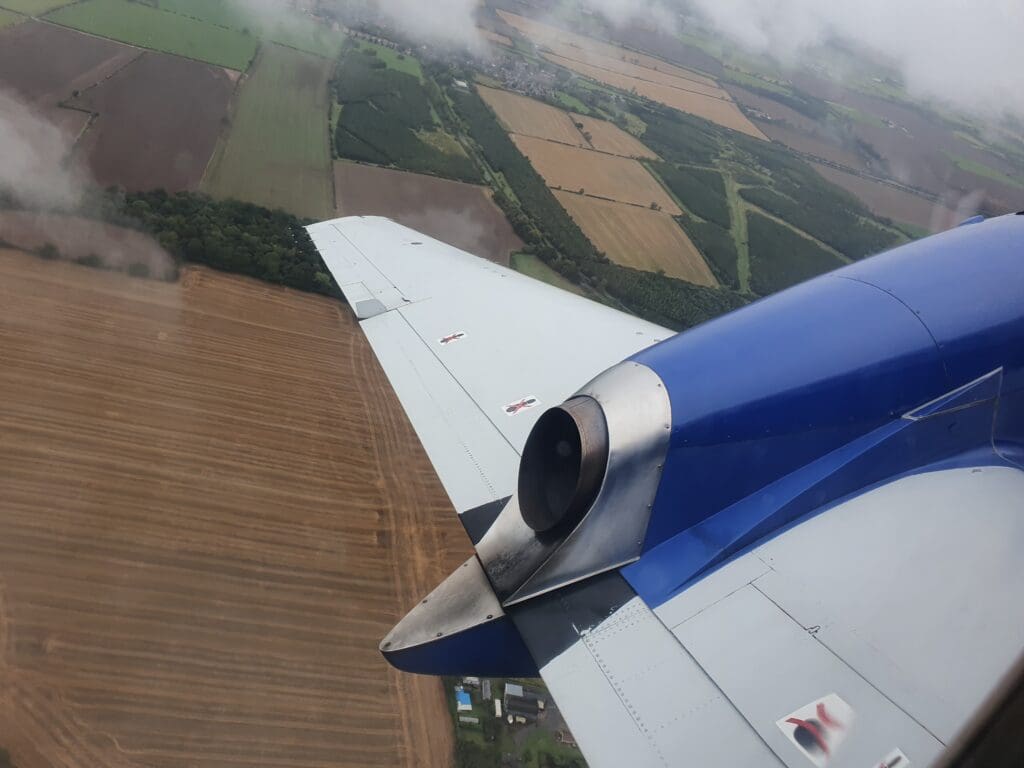
As the Jetstream climbed through the clouds, this was thrown about somewhat although this did not appear to cause much alarm to the passengers who were likely accustomed to flying through North Sea storms in helicopters. After leaving Teesside, the aircraft made a beeline for the Northumbrian coastline and crossed this just to the south of Sunderland. As would have been the case earlier on, had the weather been clear, sitting on the left-hand side of the aircraft I would have been treated to fantastic views of England’s northeast. After passing the mouth of the Tyne at Tynemouth, the aircraft continued up the coast, passing Whitley Bay and Blythe before reaching the Northumberland Coast AONB. At 1645, the aircraft levelled off at its low cruising altitude of 16,000 feet and the seatbelt signs were switched off before the usual warning announcement regarding keeping these fastened during the flight was made.
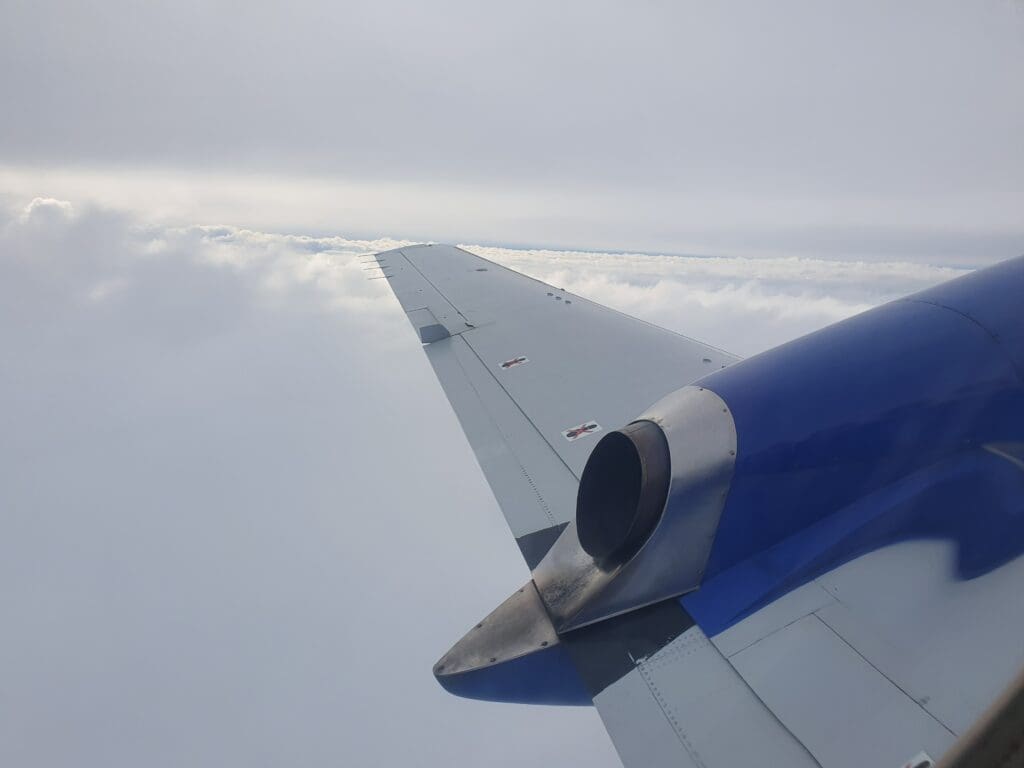
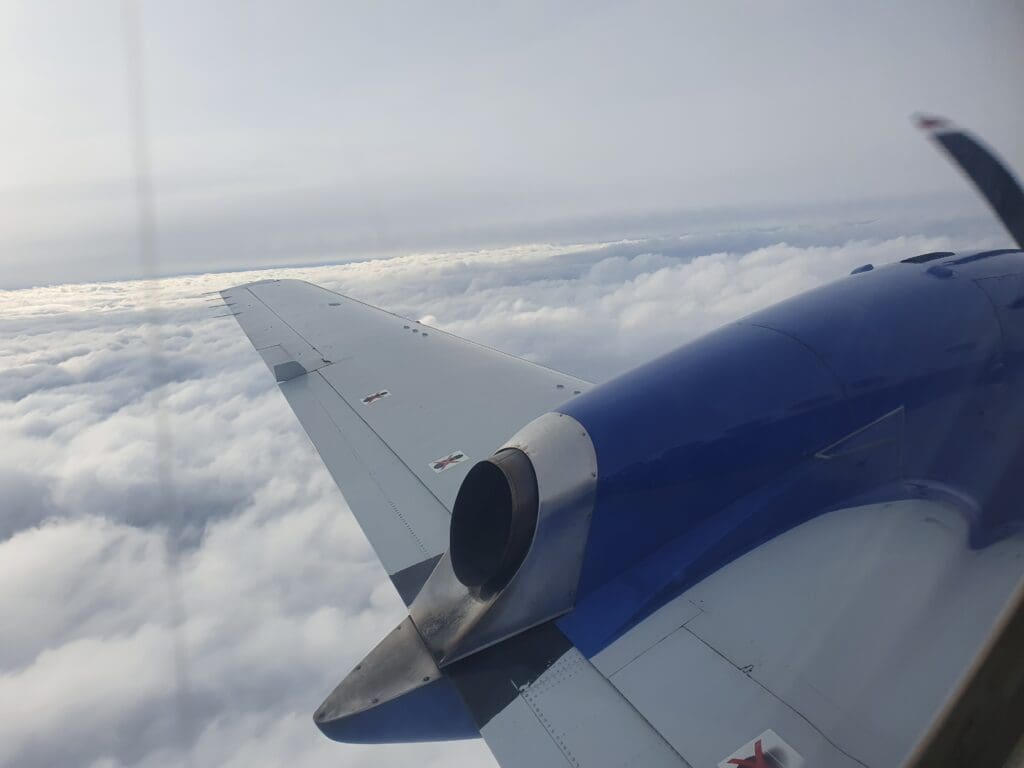
A couple of minutes after levelling off, the aircraft emerged between two layers of clouds, with the low-lying clouds beneath the aircraft largely dissipating around ten minutes later. Upon doing so, the blue waters of the North Sea were revealed alongside the Scottish coastline and the Firth of Forth, in the distance. Only ten minutes after levelling off, the seatbelt signs were reilluminated and an announcement was made regarding our impending arrival into Aberdeen. Outside, as the aircraft commenced its descent, the Angus and southern Aberdeenshire coastline got closer and good views were offered both of this and of the picturesque Cairngorms in the distance as the aircraft edged towards Aberdeen.
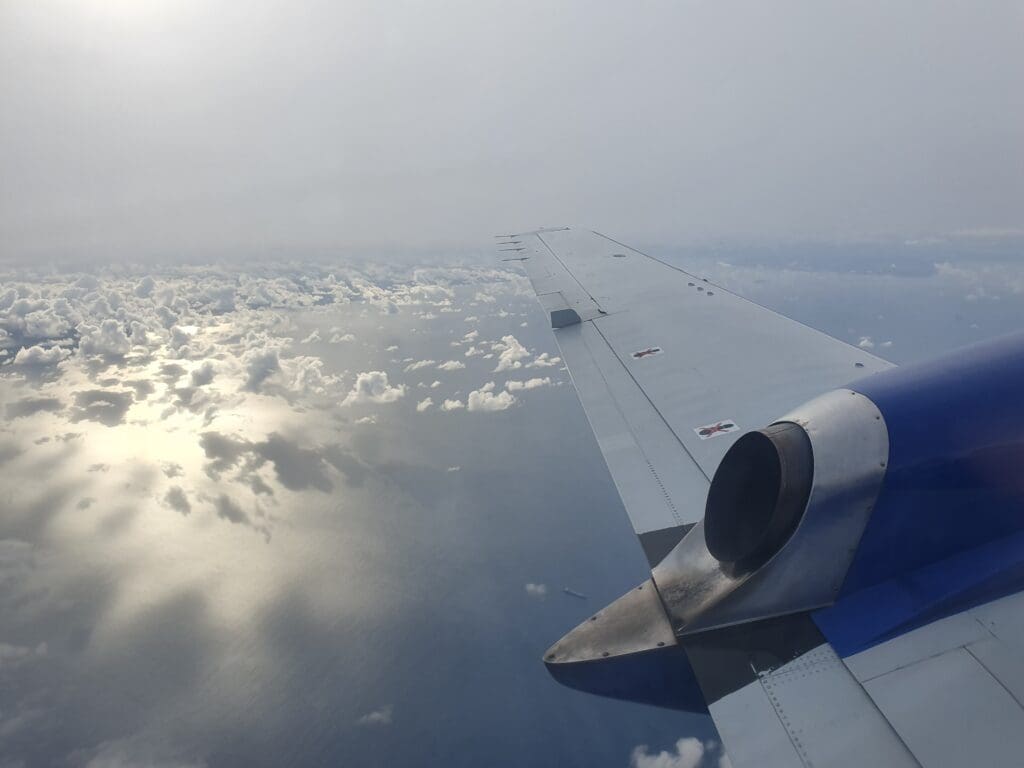
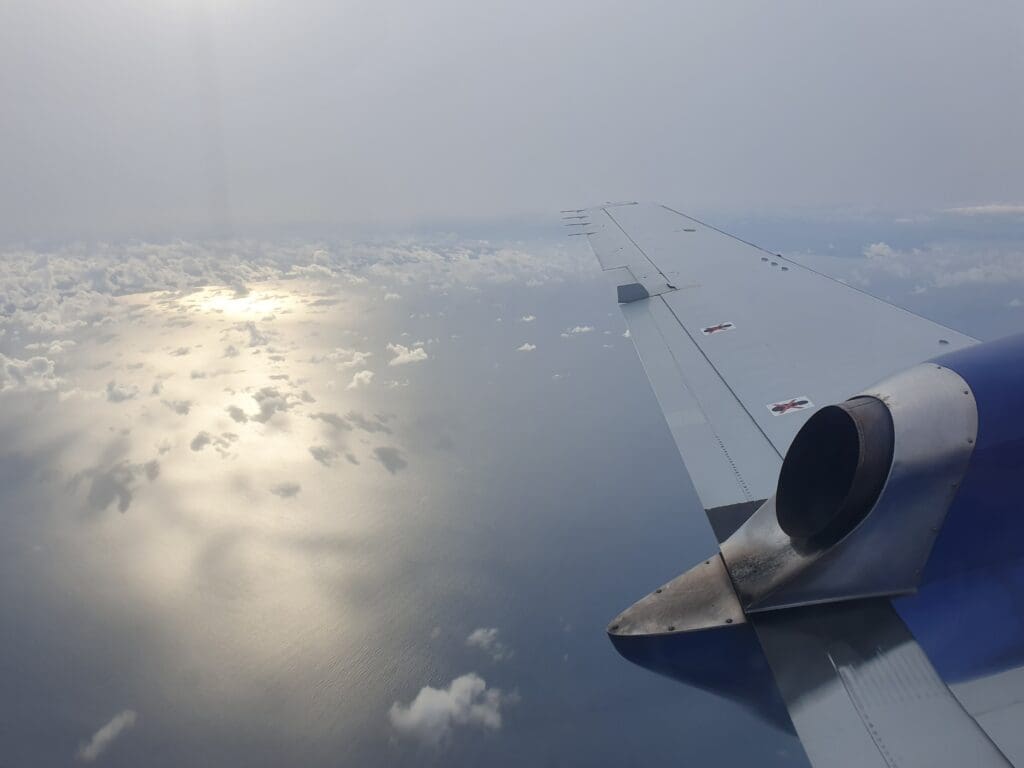
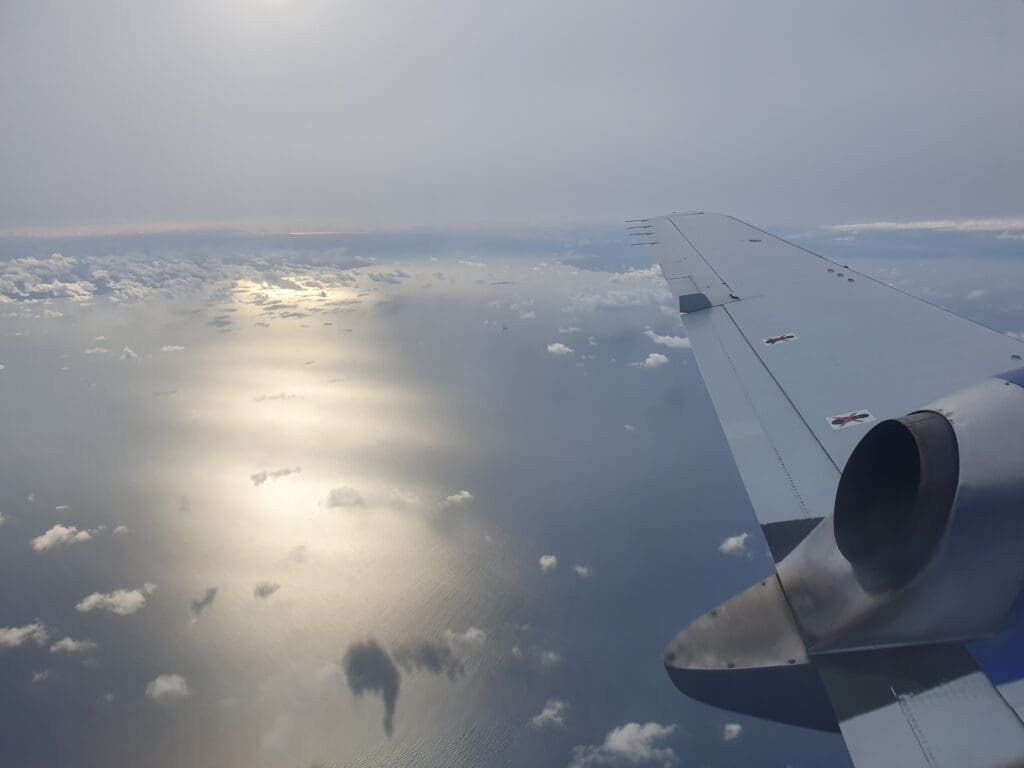


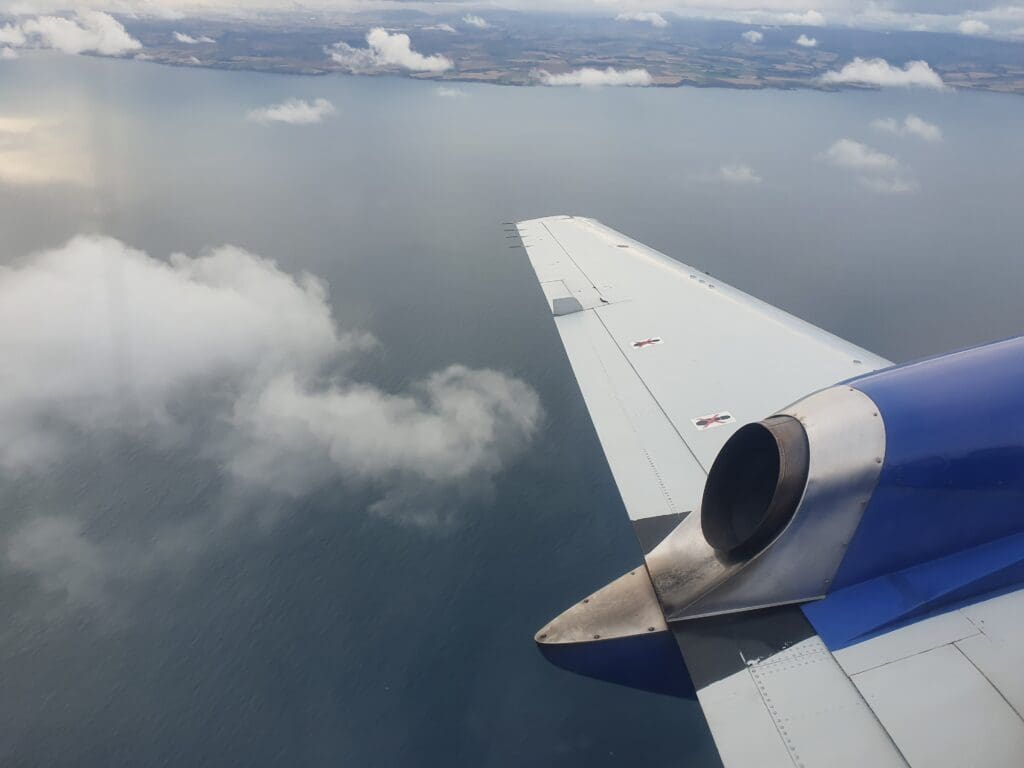
After making the pre-arrival announcement, the flight attendant passed through the cabin ensuring all was in place for arrival before taking the jumpseat at the rear of the aircraft. Ten minutes after commencing its descent, the aircraft crossed over the Scottish coastline near Portlethen at which point the flaps and landing gear were extended. From there the aircraft headed over the River Dee and the western suburbs of Aberdeen. After passing Aberdeen’s interestingly designed Event Complex, the Jetstream whizzed over Wellheads Drive and the perimeter fence, as a selection of both cargo and passenger aircraft as well as helicopters appeared. At 1710, the aircraft firmly planted itself down onto Aberdeen’s Runway 34 and braked rather harshly, soon exiting this and taxiing left towards the terminal.

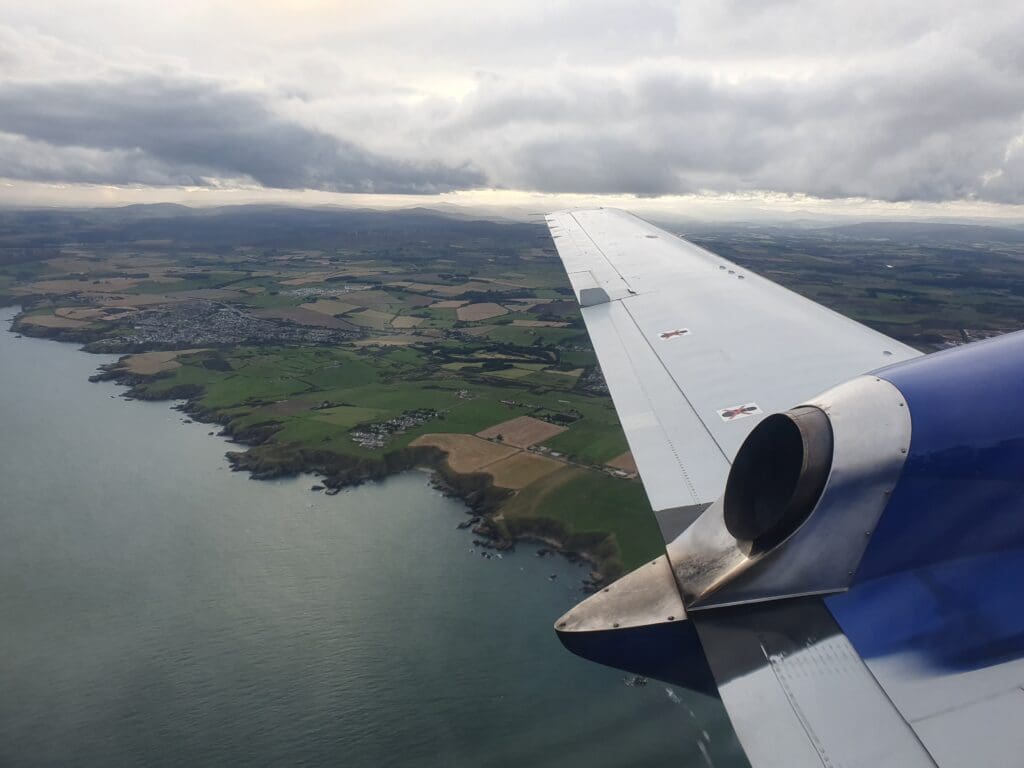
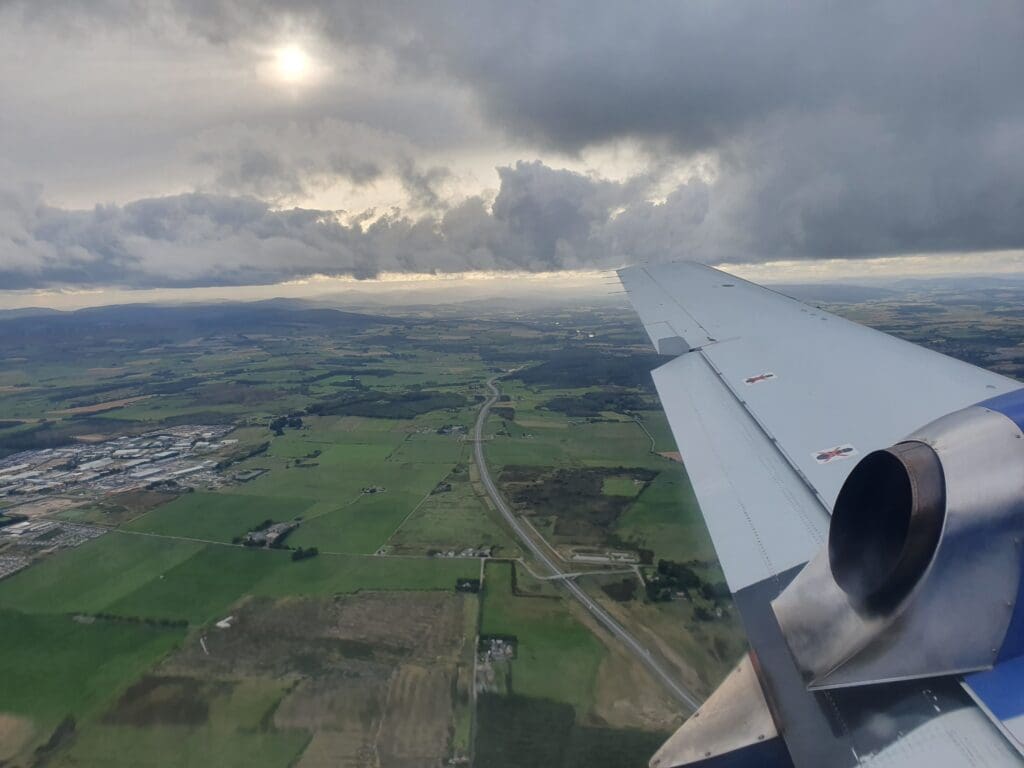

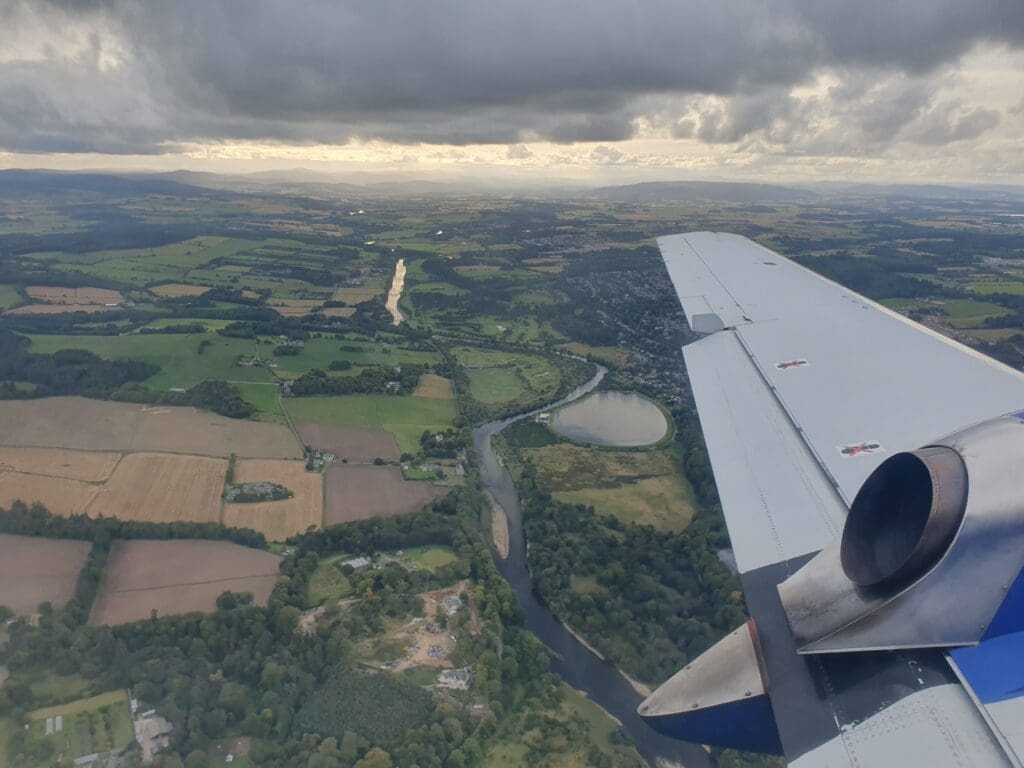


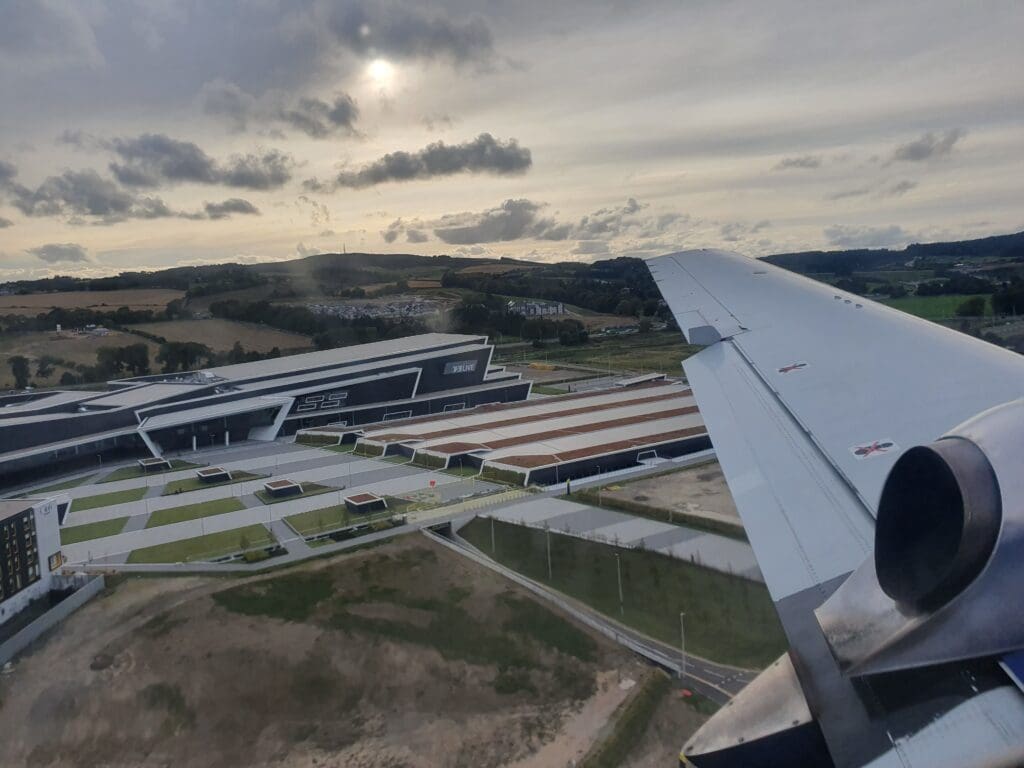
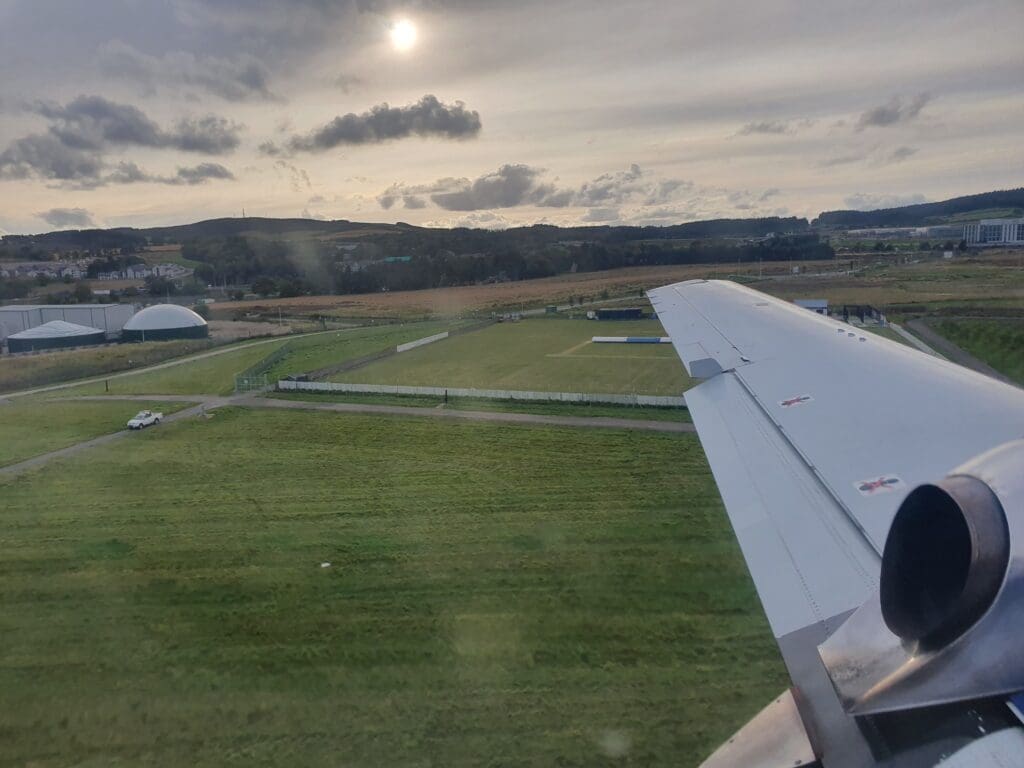
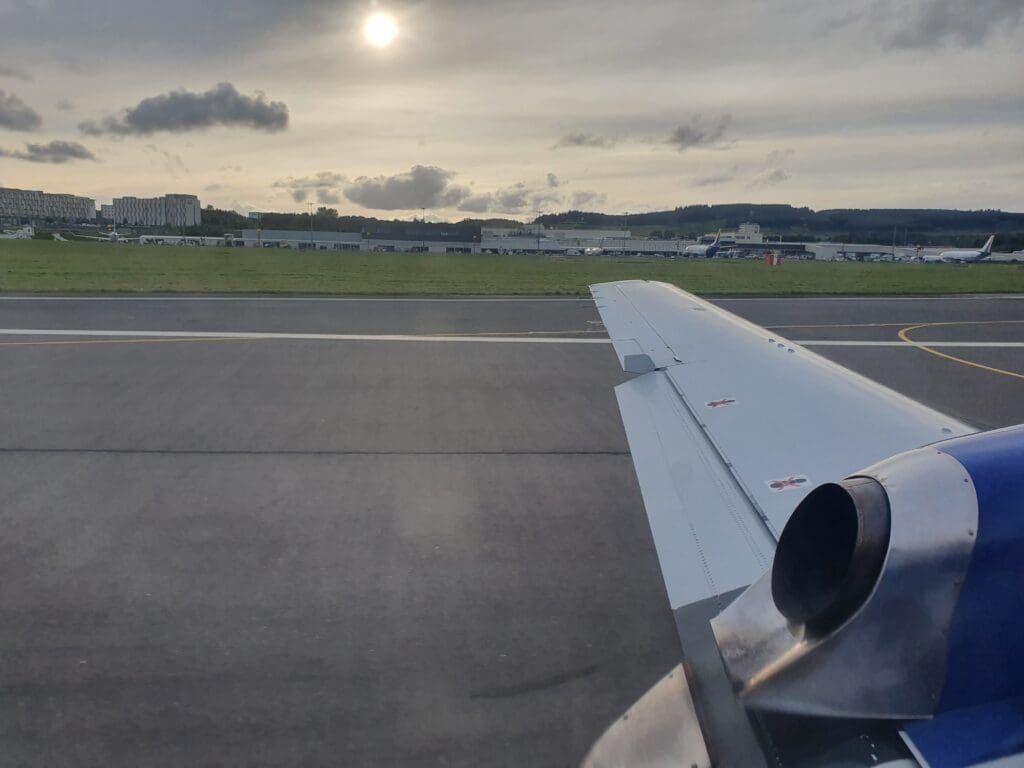
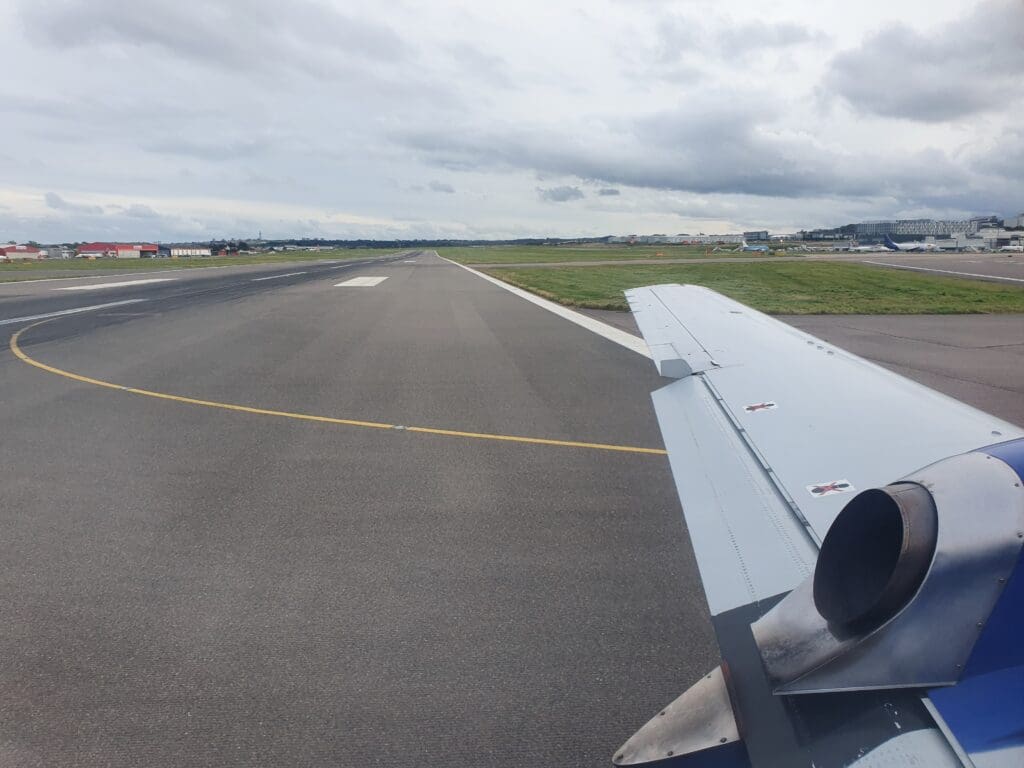
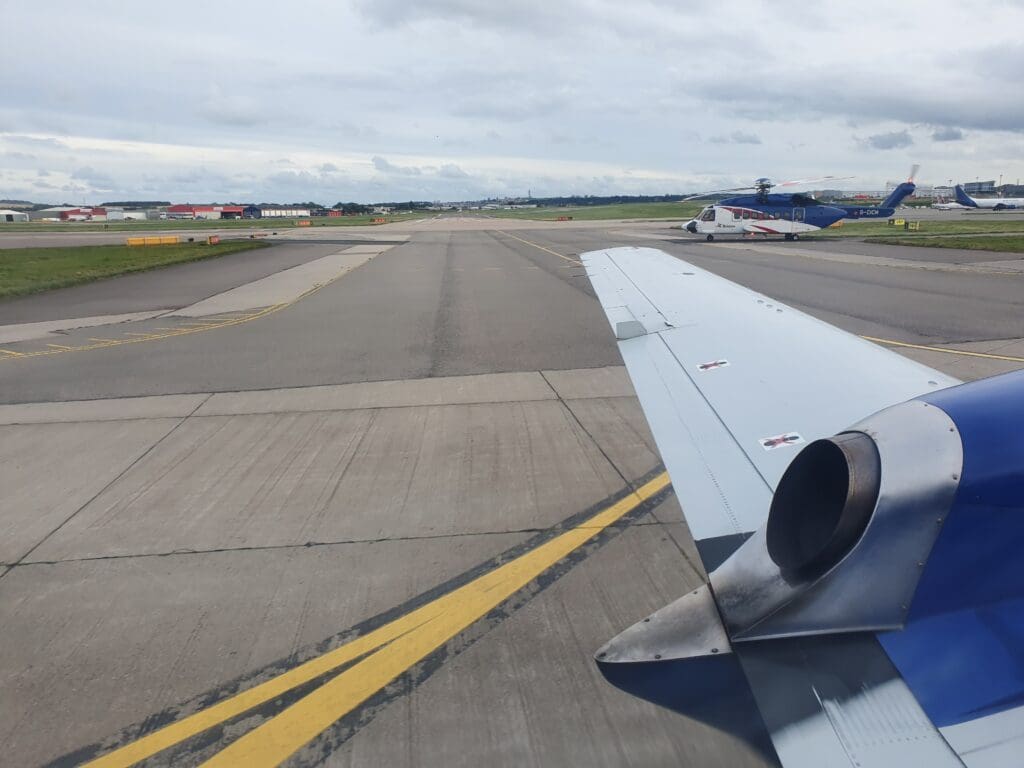
Once the aircraft taxied past a Bristow Sikorsky S-92 making its way to depart off to an offshore platform, the Jetstream soon arrived at Stand 10. Unlike more ‘regular’ flights, once the engines spooled down, likely realising that disembarkation was not to be immediate, all passengers remained in their seats. Inside the cabin, the flight attendant headed to the front of the aircraft and, once the propellers stopped whirling, the main cabin door was opened. However, as had been the case upon arriving in Teesside, disembarkation did not commence until the baggage valet cart had been moved to the front of the aircraft. Once this did commence, disembarkation was quick and passengers made their way off the aircraft row by row. Upon reaching the front of the aircraft, I was thanked by the flight’s friendly crew member and made my way down the aircraft’s steep steps and into the tunnel which leads to the main terminal. After a long walk, I finally arrived at the terminal’s main landside area and exited into the chilly late afternoon Scottish air, ready to head around the airport’s perimeter to the hotel where I would spend the night.

Summary
Ignoring the initial cancellation and schedule change, all-in-all Eastern Airways left me with little to complain about. Whilst the Jetstream 41 is unlikely to win any awards for comfort, this was sufficient for a couple of short hops although perhaps those more used to Airbus A320s and Boeing 737s may complain about the cabin size and noise levels onboard. Meanwhile, all three crew members I interacted with were very friendly, and, arriving in one piece and ahead of schedule (according to the new schedule), I cannot make any complaints. Thus, I would be more than happy to fly with Eastern Airways again at some point in the future.