Busan to Ulaanbataar: A MIAT Mongolian Airlines Boeing 737 Review
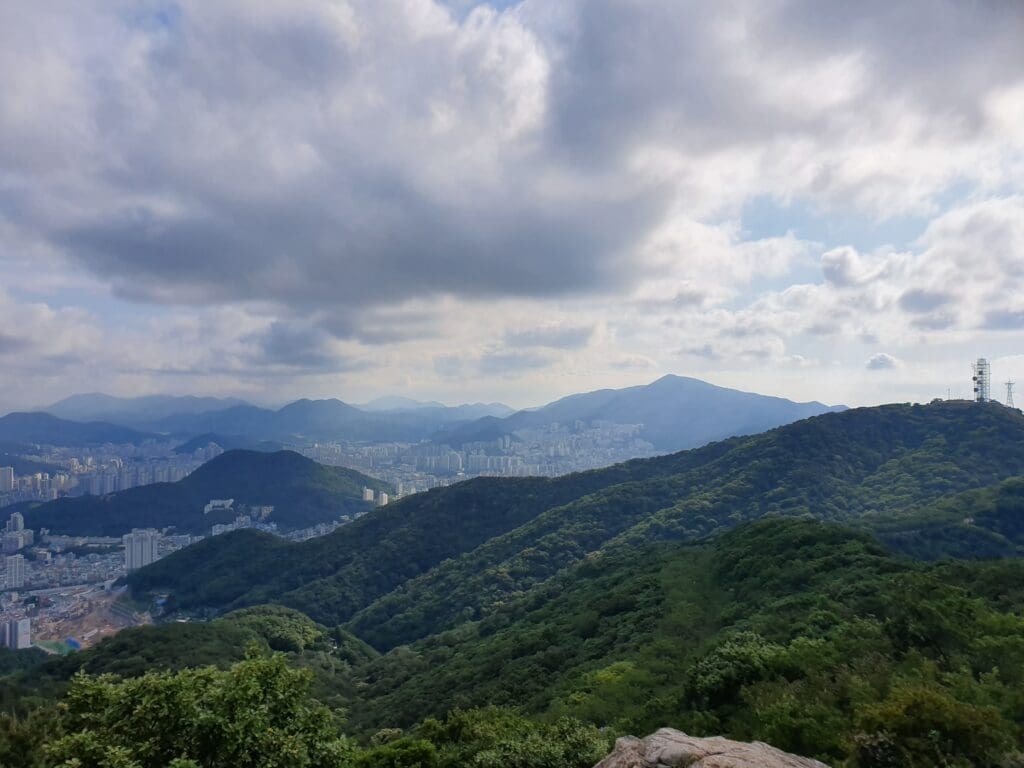
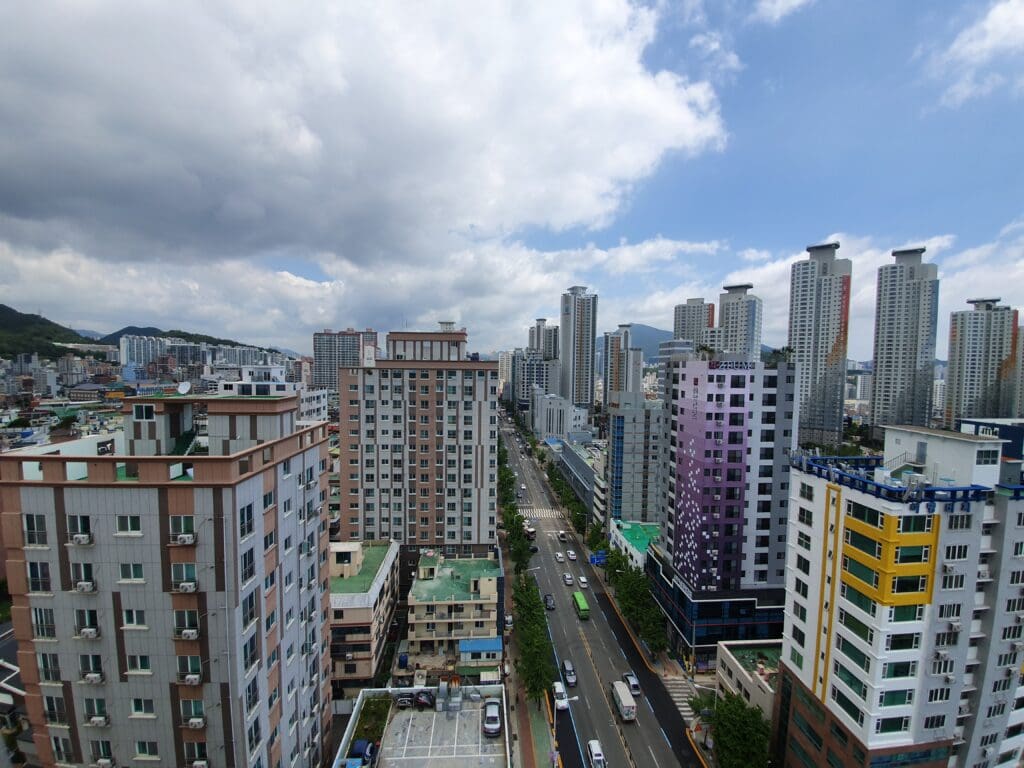
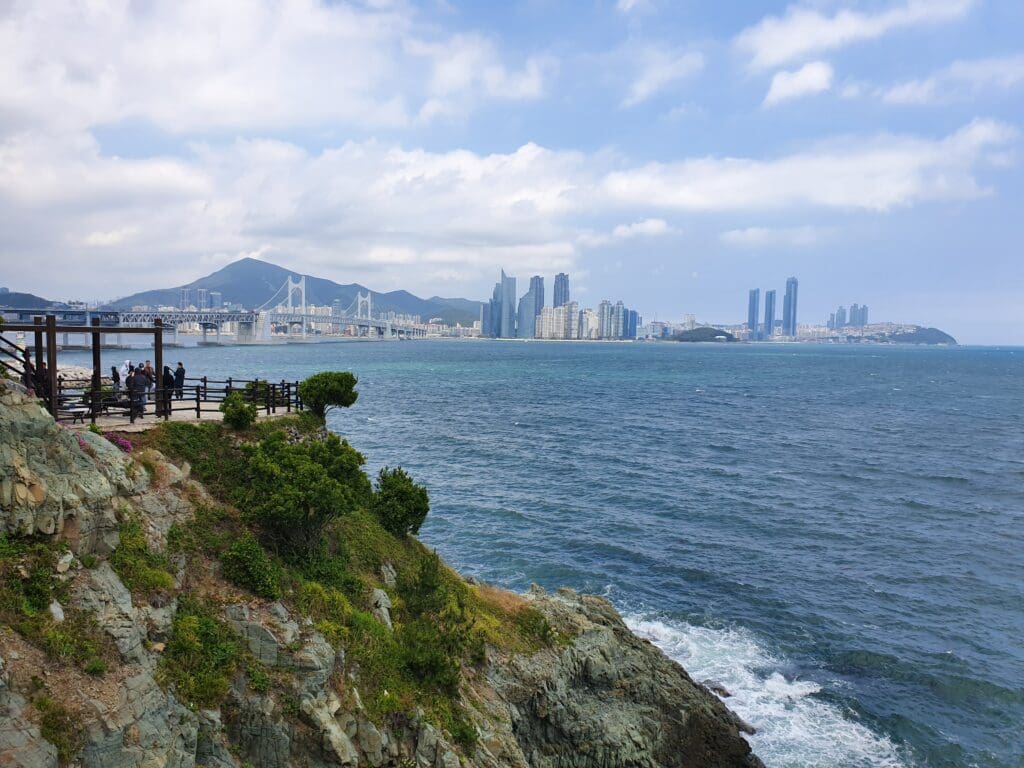
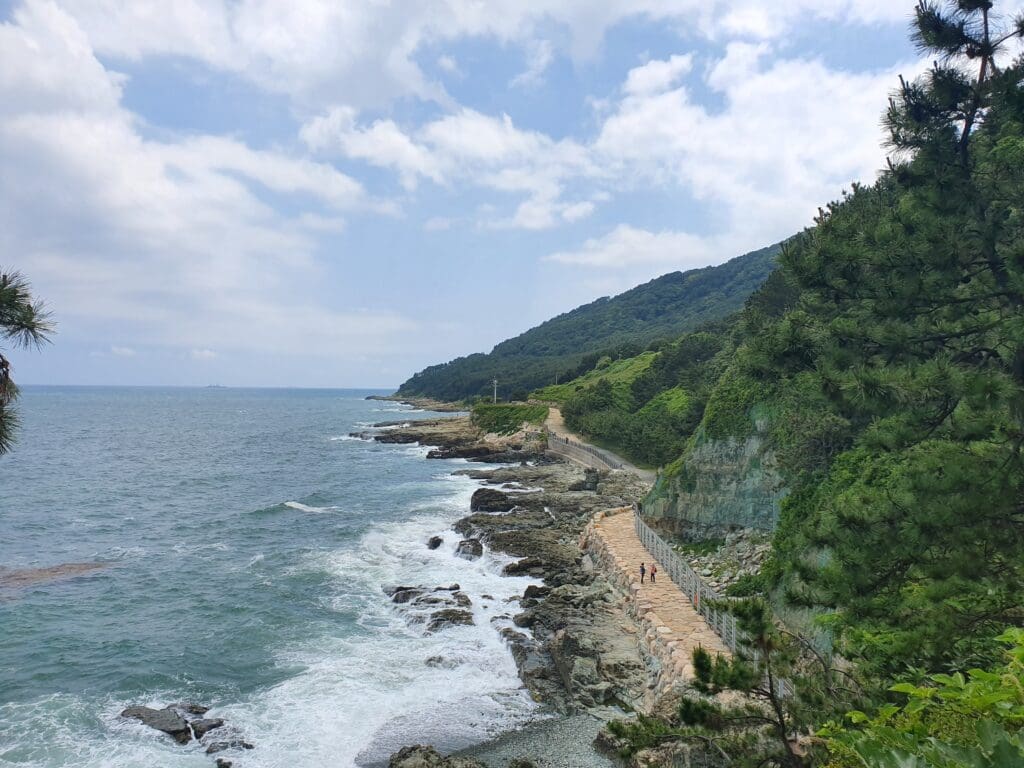
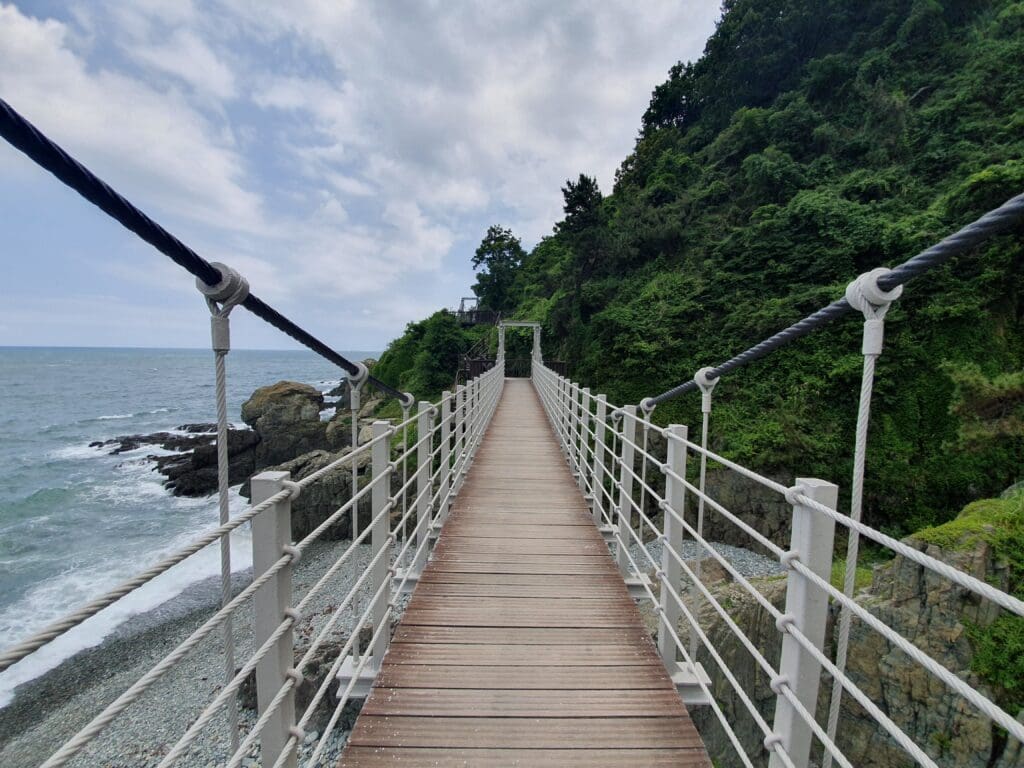
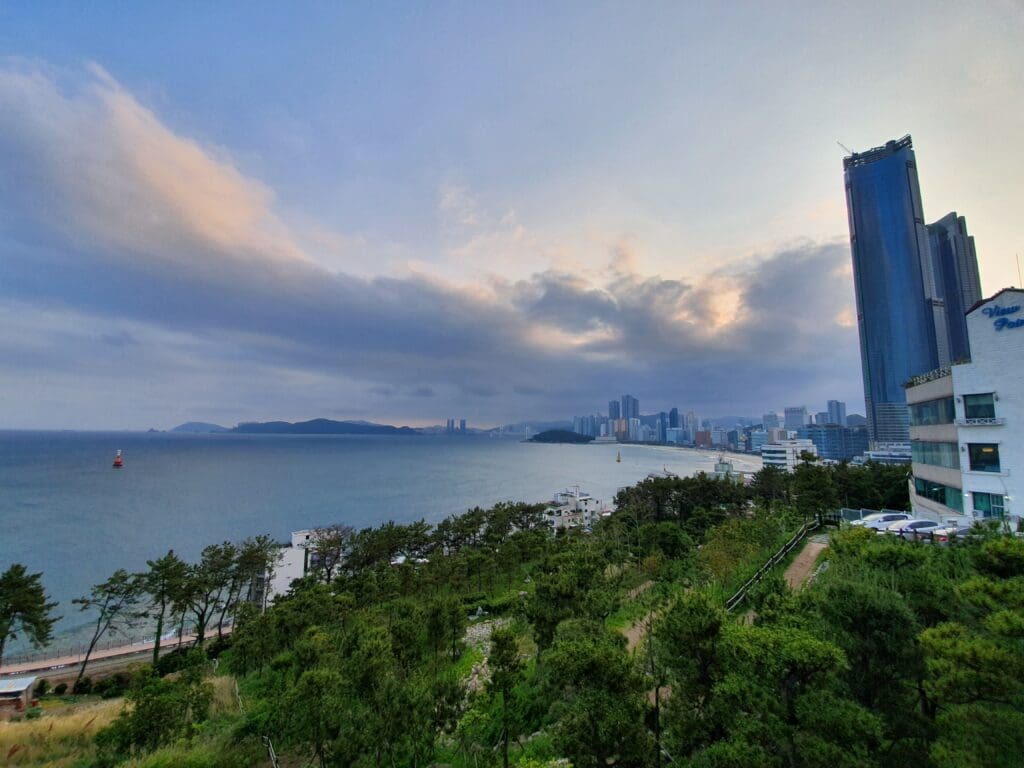
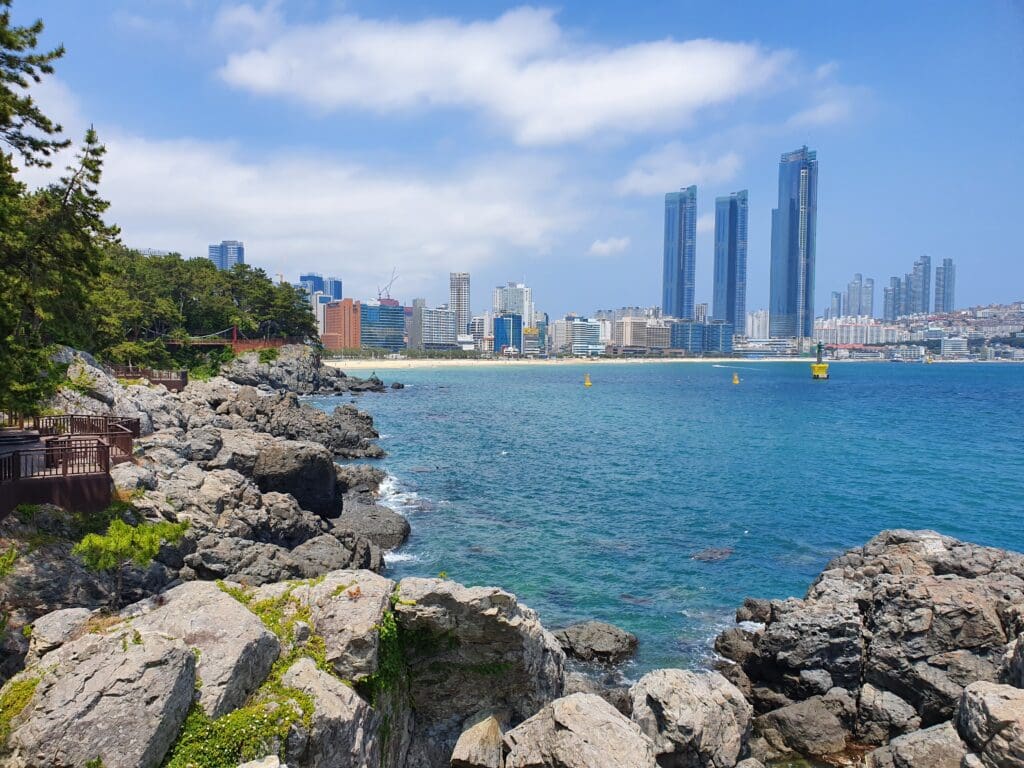
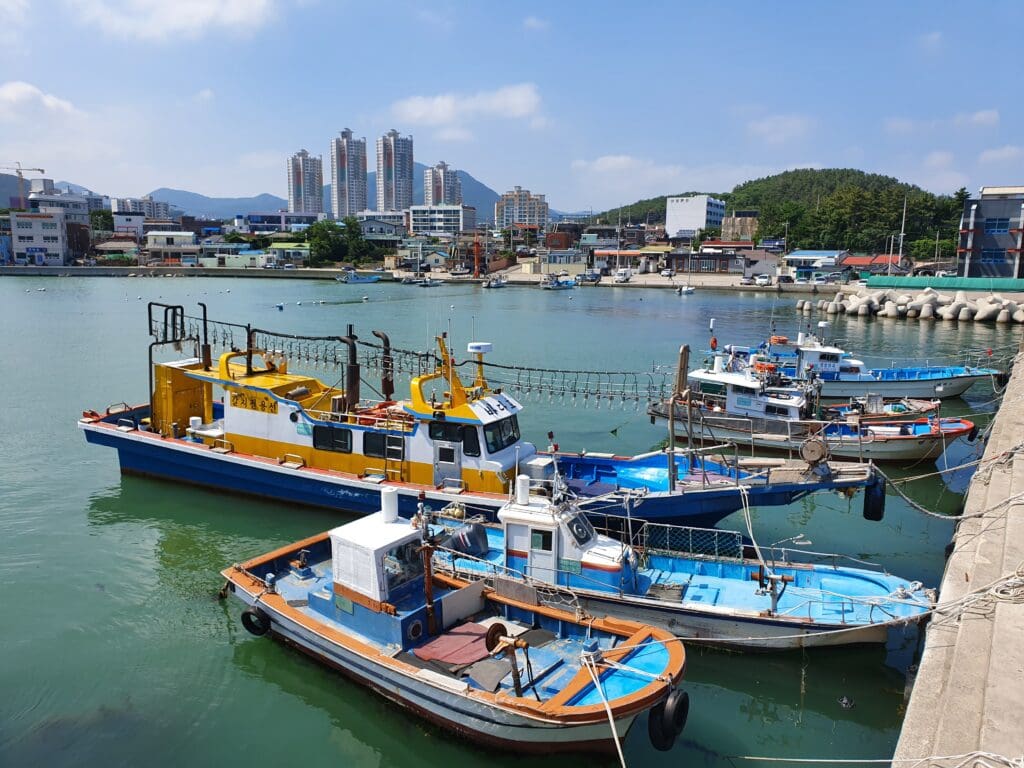
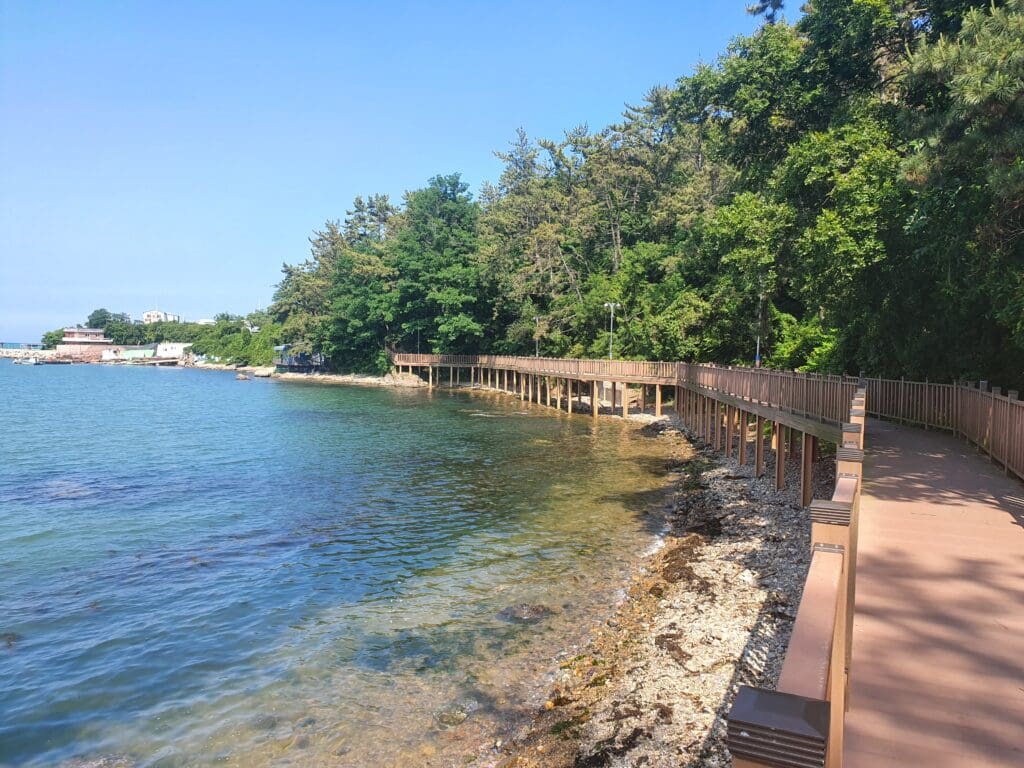
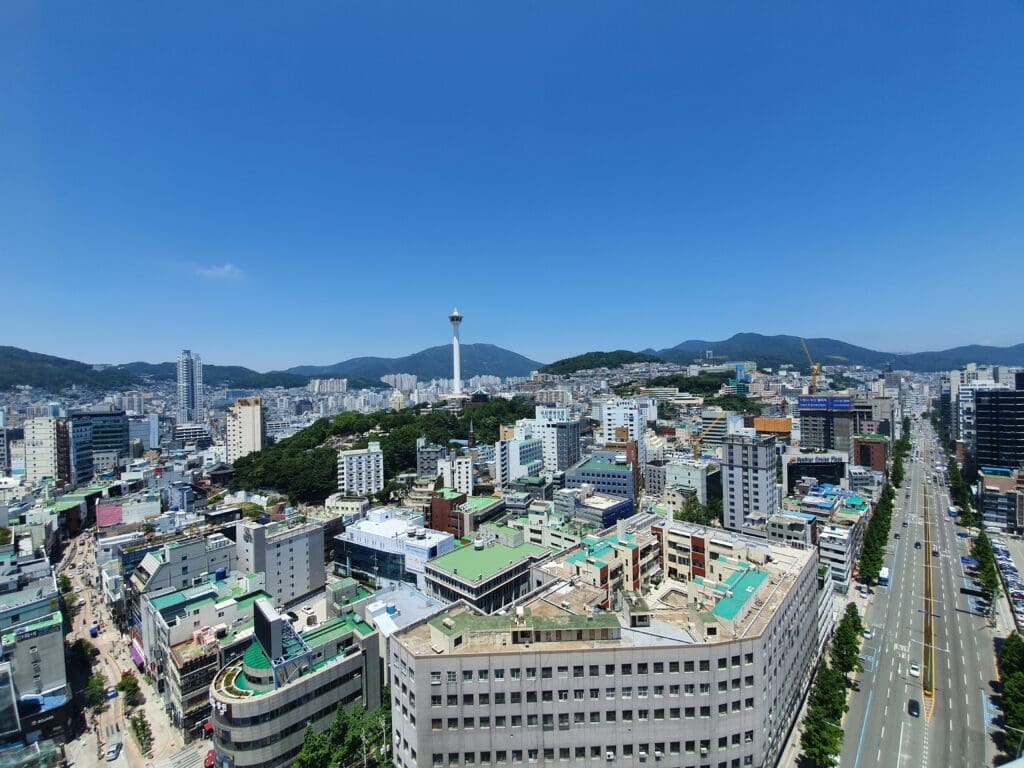
To start, here are some photos of Busan


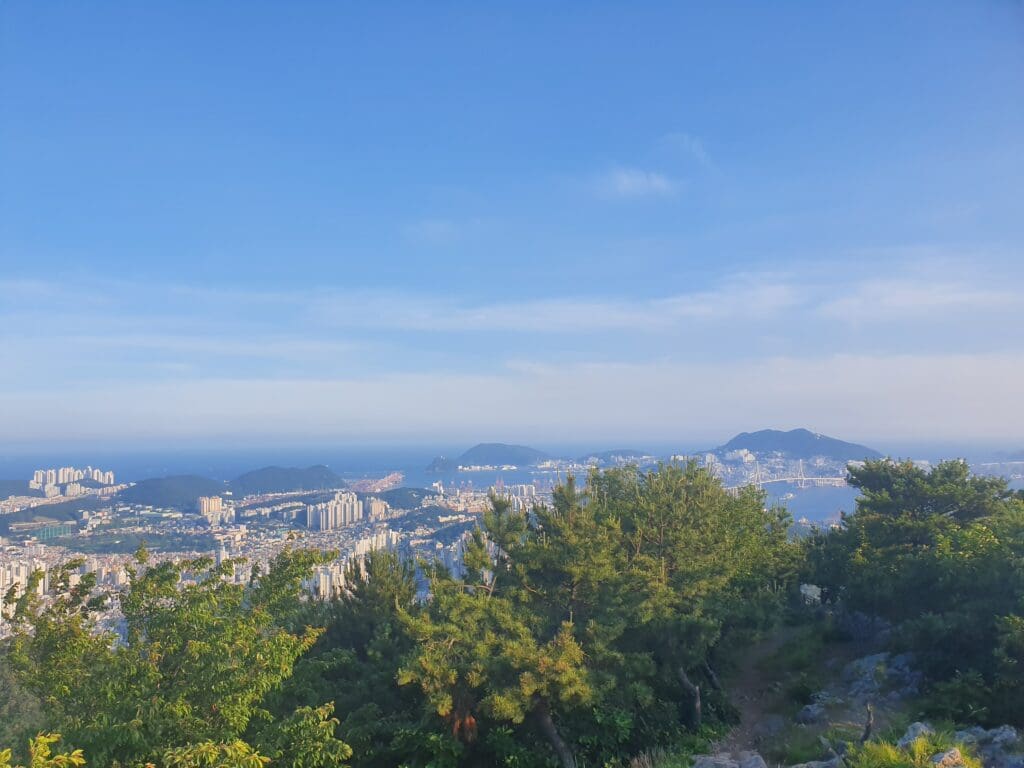
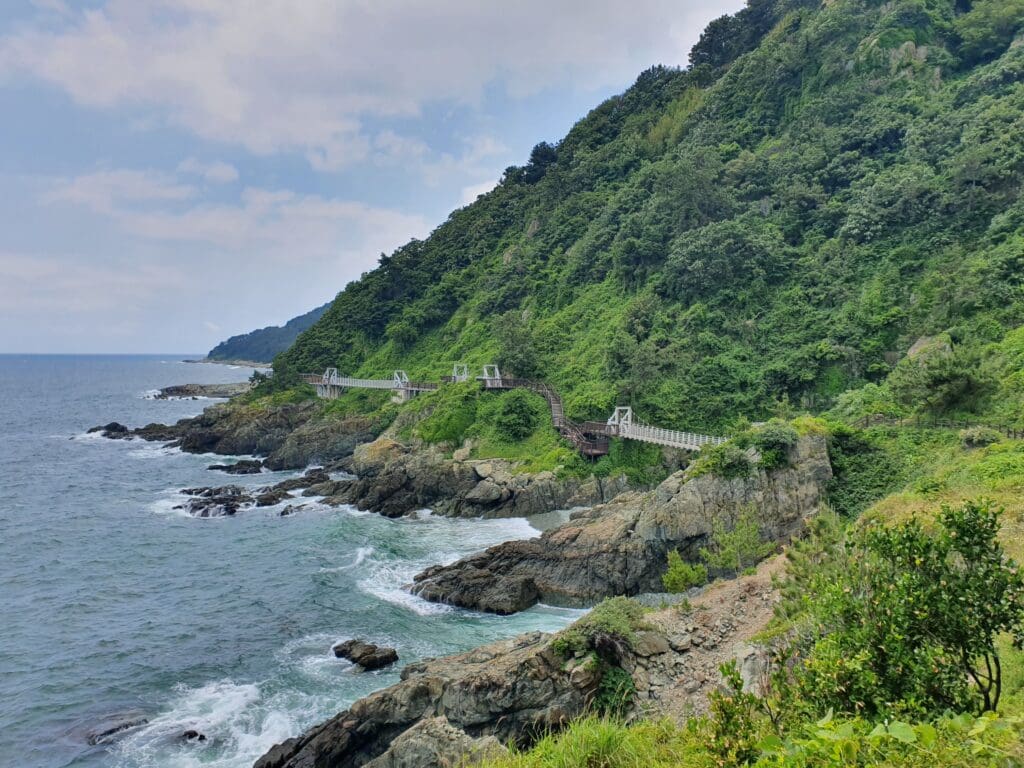
Background
At the time of my flight, operating a compact fleet of Boeing 737-800s and Boeing 767-300ERs between Ulaanbaatar and just ten destinations, MIAT Mongolian Airlines can hardly be described as one of the world’s major flag carriers. Nevertheless, having stumbled upon the carrier’s jets in Busan, Frankfurt, Seoul Incheon and Tokyo Narita, I had sought to fly with Mongolia’s national airline for quite some time. As a fairly regular flyer between Korea and Europe, I had long attempted to work in a ride onboard their jets on a trans-Eurasian slog, although MIAT Mongolian Airlines’ comparatively high ticket prices had dissuaded me from doing so.
Having booked a series of one-way flights from London to Seoul Incheon via Paris, Astana, Almaty and Tashkent, sampling WDL Aviation’s BAe 146, Air Astana’s Boeing 757-200 and Airbus A321, and Uzbekistan Airways’ Boeing 757-200 and Boeing 787-8 Dreamliner, I needed to find a cost-effective way of returning to London at the end of my trip. Upon searching for flights, as is often the case Air China, China Eastern Airlines and China Southern Airlines topped the list and offered the cheapest fares via Beijing Capital, Shanghai Pudong and Guangzhou respectively. Whilst yet to fly with Air China, my disastrous experiences with the latter two carriers convinced me to search for other options. After some experimenting, I found that for £100 more I could construct an itinerary that would enable me to sample a total of three sectors onboard MIAT Mongolian Airlines. This would see me take the Mongolian carrier’s twice-weekly Boeing 737-800 service on a Thursday afternoon from Korea’s second-largest city, Busan, to Ulaanbataar. After two days of sightseeing in the Mongolian capital, I would then continue onwards to Berlin Tegel on MIAT Mongolian Airlines’ Boeing 767-300ER that makes a mid-journey stop in Moscow Sheremetyevo.
Whilst I usually prefer to book directly with the airline, seeing as I found MIAT Mongolian Airlines’ website to lack a multi-city function, and given the fact that booking my flights as two separate itineraries would have doubled the cost, I was left with no other option but to book via a third-party site. Attracted by a 2% cashback deal which I could then convert to British Airways miles at a favourable rate, I decided to book via Opodo for £308.99.
After selecting the flights and entering my details, I was presented with a couple of seat maps where I could select seats for £9.14 per flight. After declining the offer as well as several other add-ons, I entered my card details and following thirty seconds or so, my booking was confirmed and I received a confirmation email within five minutes or so.
About MIAT Monoglian Airlines
Formed in Ulaanbataar in 1956, MIAT Mongolian Airlines initially served as the Soviet-backed national carrier of the then Mongolian People’s Republic. Initially, the rough and rugged Antonov An-2 was deployed on services between the Mongolian capital and Irkutsk, however, it wasn’t long before the larger Ilyushin Il-14 piston engined airliner was brought in, with this being more suitable for longer slogs between airports. The airline continued to exclusively operate these two types until it took delivery of the brand-new Antonov An-24 turboprop airliner in 1964, with these soon joined by Antonov An-26s. During this time, MIAT Mongolian Airlines primarily focused on serving destinations across the expanse of Mongolia, whilst also operating to several destinations in the Soviet Union. Over two decades later, MIAT Mongolian Airlines took delivery of its first jet aircraft, a Tupolev Tu-154 leased from Aeroflot which allowed the airline to expand its destination list and serve the likes of Beijing and Moscow.
The collapse of Mongolia’s long-term ally, the Soviet Union, brought massive political change and in 1992 resulted in an end to communist rule. The rapidly shifting foreign policy was soon reflected in MIAT Mongolian Airlines’ fleet, with two Harbin Y-12s and two former Korean Air Boeing 727s joining the fleet in 1992, whilst the airline became long haul capable in 1998 with the addition of an Airbus A310. Meanwhile, the turn of the millennium brought with it further fleet modernisation with the delivery of MIAT Mongolian Airlines’ first Boeing 737NGs, replacing the Boeing 727s, and the retirement of the airline’s Antonov An-24s and Harbin Y-12s. More recent developments include the introduction of Boeing 767-300ERs, replacing the sole Airbus A310, as well as the recent introduction of the Boeing 737 MAX 8 (although these were grounded at the time of my flight these aircraft were grounded). At the time of my flight, MIAT Monglian Airlines’ flying fleet consisted of one Boeing 737-700, three Boeing 737-800s and two Boeing 767-300ERs, with a fairly standard average fleet age of 12 years. Since taking my trip, the airline’s three Boeing 737 MAX 8s have re-entered service, whilst the carrier also operates two Boeing 787-9 Dreamliners.
Despite being perfectly located to serve as a hub for those flying between East Asia and Europe, MIAT Mongolian Airlines’ network of routes remains rather limited, although in early 2019 the airline announced its intention to commence services to Abu Dhabi, Chengdu, Munich and Shanghai, with the long term goal of opening up a route to the United States, although at the time of writing all of these remain a pipedream for the carrier.
Whilst I cannot comment on the booking engine feature of MIAT Mongolian Airlines’ website, I found this to be modern and easy-to-navigate, featuring all the features that one would expect to find on an airline’s website. Whilst available in Mongolian only, one particularly interesting, and perhaps reassuring feature for nervous flyers is the website’s inclusion of MIAT Mongolian Airlines’ flight safety magazine. On the downside, I did note that despite MIAT Mongolian Airlines’ services to China, Germany, Hong Kong, Japan, Korea and Russia, the airline’s website was only available in English and Mongolian. In addition to their website, the airline appears to be fairly active on Facebook, with relatively frequent updates and promotions posted onto their official page (with an impressive 72k followers). Meanwhile on Instagram, whilst there are several accounts which appear to be associated with MIAT, at the time of writing only the airline’s Hong Kong based account appeared to be somewhat active.
Check-In
Shortly after I had arrived in Busan onboard a Korean Air Airbus A220, I received an email informing me that three days later, my flight to Mongolia would be delayed from 1305 to 1810, however, allowing for more time in what is perhaps my favourite city in the world, I could not really complain about this.
Hoping to secure a window seat, I opted to check-in online. Fortunately, online check-in for all MIAT Mongolian Airlines services opens 48 hours before departure, and I decided to do so via the airline’s app. Upon entering my surname and booking reference I was transported to the usual summary of prohibited materials and after confirming I would not attempt to transport these I was taken to an overview of my booking. Noting that I had been automatically assigned an aisle seat, I opened up the seat map in order to select another seat. Thankfully, this showed a sea of empty seats and so I selected Seat 23A before entering all the required data. Once this was done, the check-in process was completed and I received a PDF boarding pass via email almost instantly. All in all, my online check-in experience was as quick and easy as that of any major airline and so I was left with nothing to complain about at that stage of the trip.
The Journey
Given my fondness for Busan, had I had no commitments back in London, I could have easily stayed in the coastal city for another few weeks or months! Fortunately, the excitement of travelling to a new country with, what was for me, a rare airline, assisted in alleviating the gloom of leaving Busan. Plus, the last minute schedule change allowed me to spend a few extra hours in the city before I commenced my long trek back to Europe. Having spent much of my stay on the beaches, coastal walkways and mountains at the eastern end of the city around Gwangan and Haeundae, that morning, I decided to have a leisurely stroll around Nampo at the opposite end of the city. This district is a popular tourist hotspot that sits near the city’s main station, however, my choice to visit that day was mainly based on the fact that it is somewhat closer to the airport. After leaving my AirBnb at around 1000, I caught a Line 2 subway westwards, changing once in Seomyeon onto Line 1 before eventually arriving at Nampo. Still with a small suitcase in tow, as I had planned, I left this in a locker at the station before I journeyed into the warm morning air. Despite spending the second week of June in Korea, I had been very lucky in the fact that the weather for much of my stay had been very springlike, with the boiling hot days and humidity of summer yet to arrive. However, that day, things appeared to be changing and the weather was forecast to transform from the low to high twenties over the following few days.
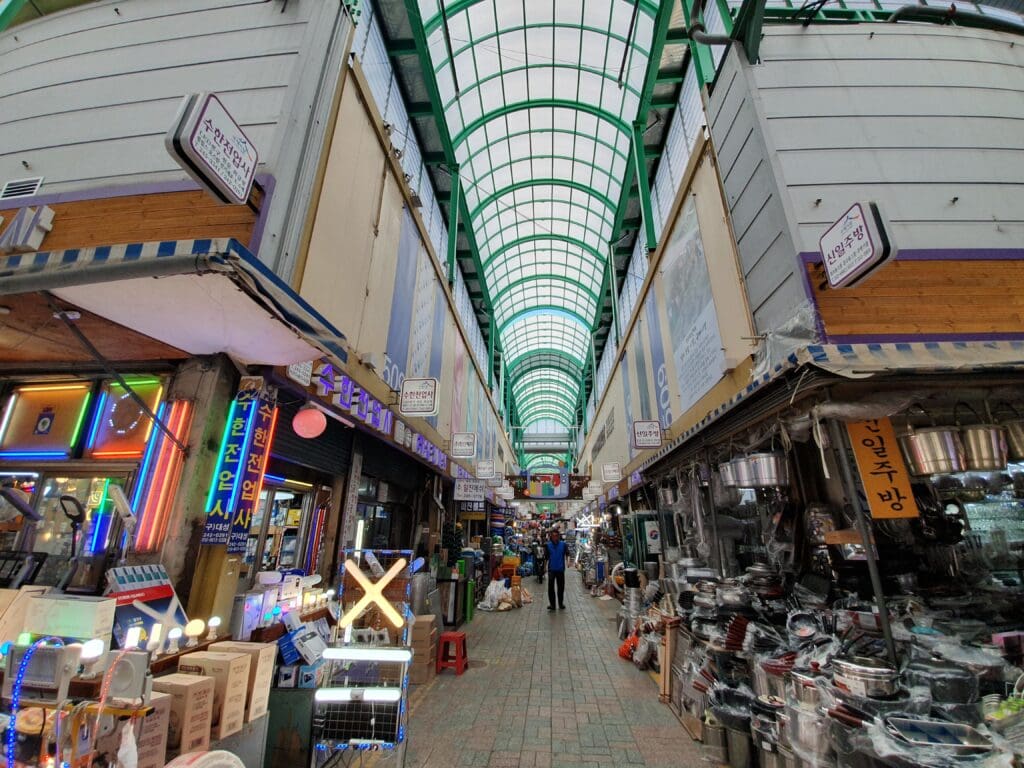
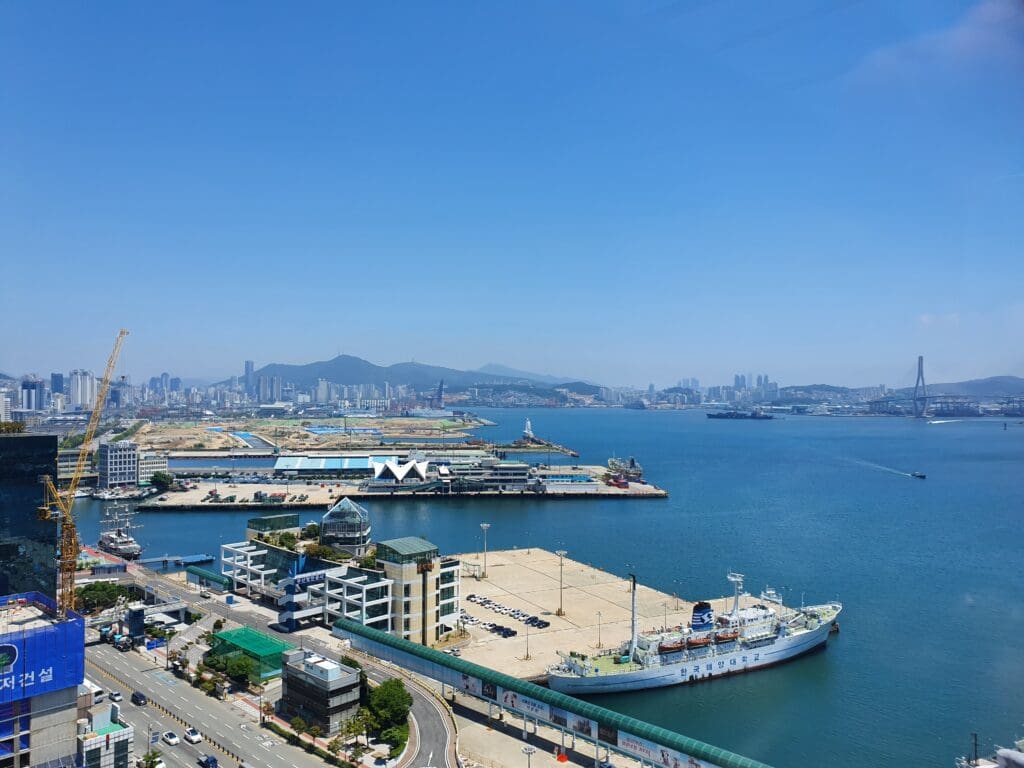
After stopping for a coffee, having a decent wander around and a spot of light lunch in the form of a convenience store dosirak, it was time to head over to Gimhae Airport. Whilst a direct bus service from Nampo to the airport exists, this is a local bus and so seats are not guaranteed, plus making plenty of stops, this takes around an hour. Seeing as I was carrying a suitcase, I opted to take the quicker albeit less geographically direct metro option. Thus, after collecting my suitcase, at around 1400 I stepped onto a crowded yet spotlessly clean and well air-conditioned vintage Line 1 train dating back to the 1980s. After riding a small fraction of the 40.5 kilometre line the train pulled into Seomyeon Station where I transferred onto a Line 2 service bound for the city of Yangsan. However, in order to reach the airport, one final transfer was needed, this taking place in Sasang where I headed above ground and boarded a driverless Busan-Gimhae Light Rail train. At 1445, several short minutes after leaving Sasang, the train pulled into Busan Gimhae Airport’s dedicated station and like many onboard, I disembarked and took the escalators down to the ground floor level.
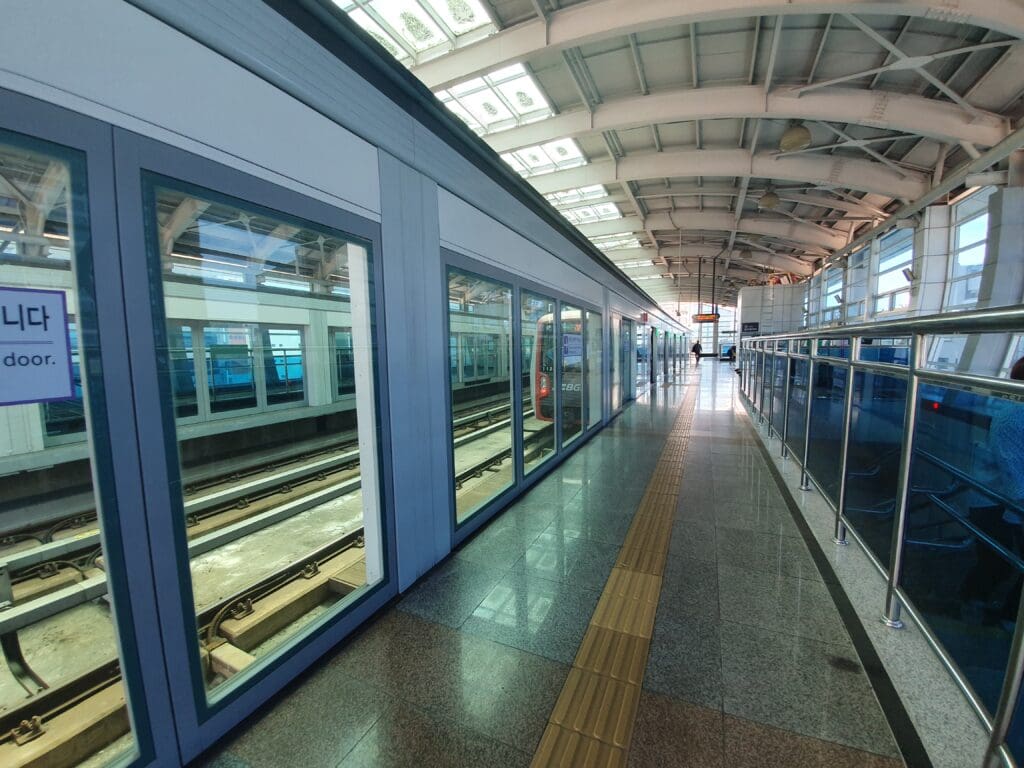
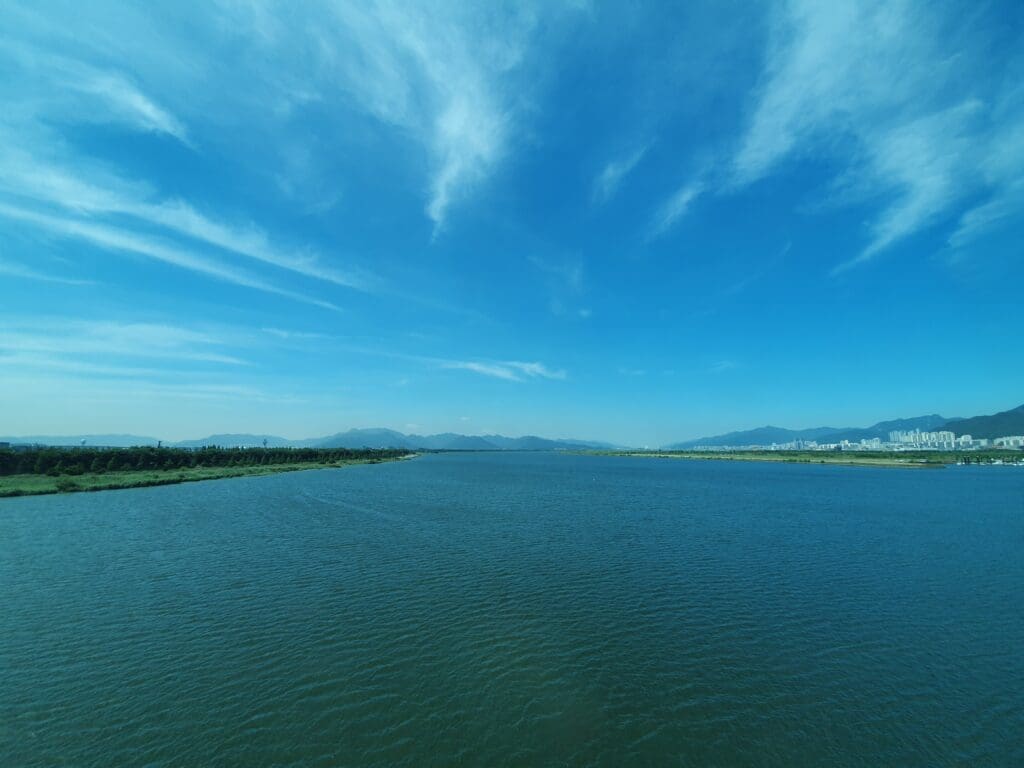
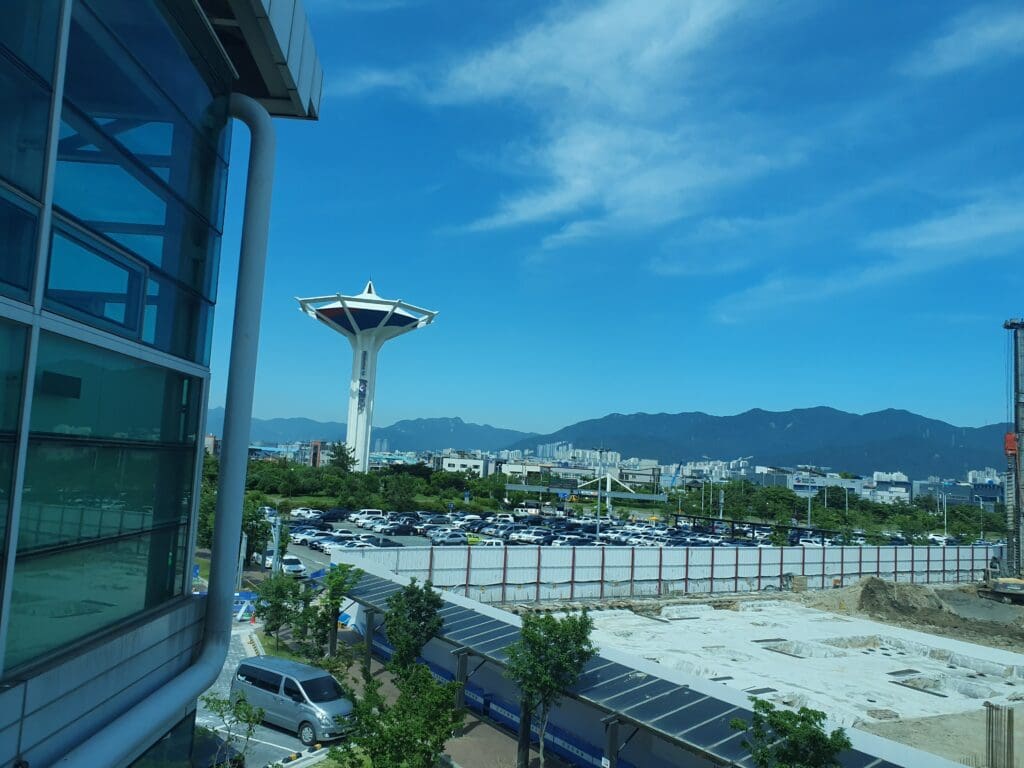
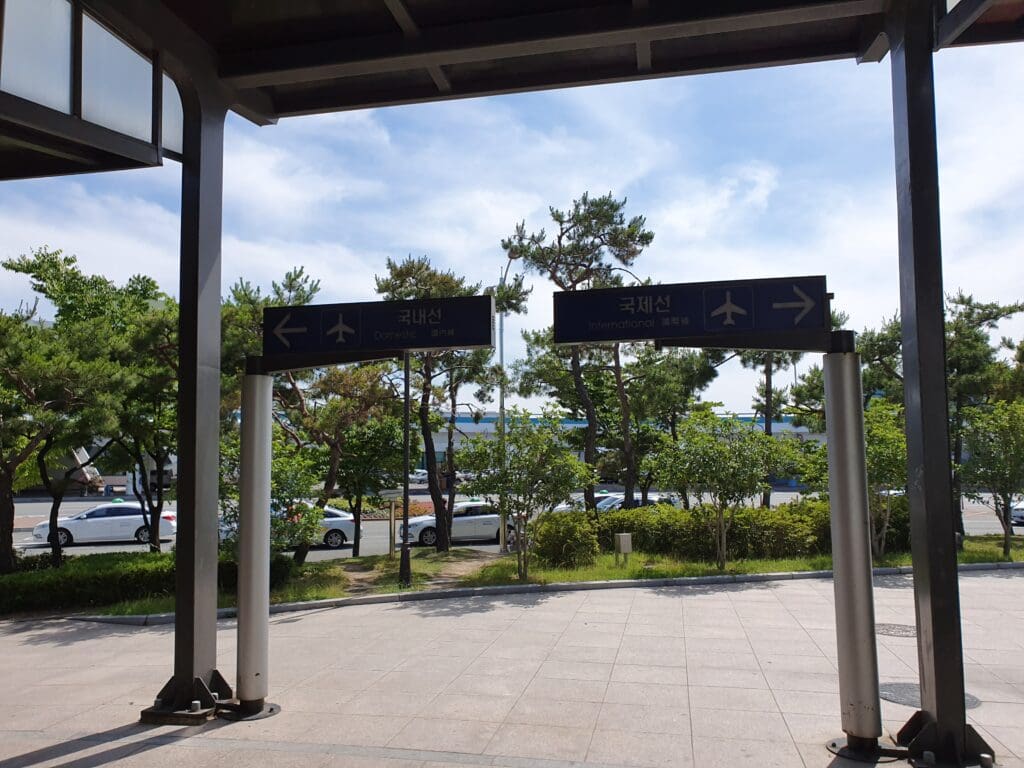
Seeing as the airport’s station conveniently sits opposite the airport’s two terminals, connected to both via covered walkways, I did not have far to lug my luggage until I entered the ground floor arrivals level of the international terminal. With a fair amount of time to go before departure, as I had suspected, the check-in desks for the flight to Ulaanbaatar were yet to open. I thus decided to pass the time by wandering around the terminal before taking a seat on the upper level. Unfortunately for aviation enthusiasts, no airside views can be had from the landside portion of Busan Gimhae Airport’s international terminal.
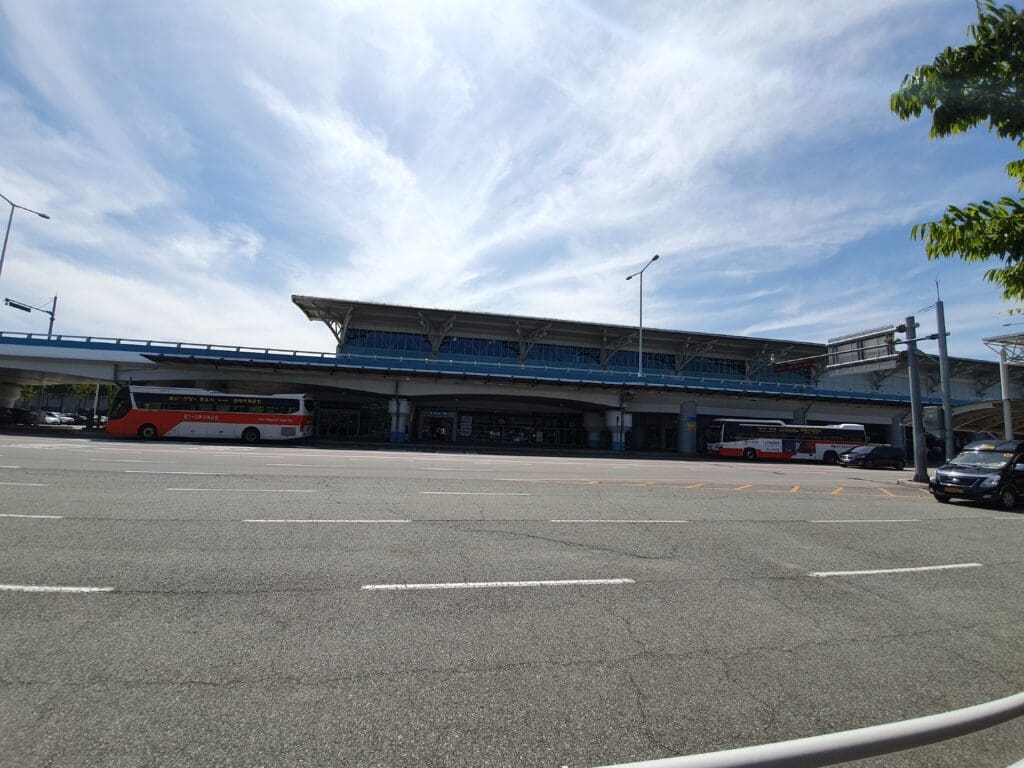
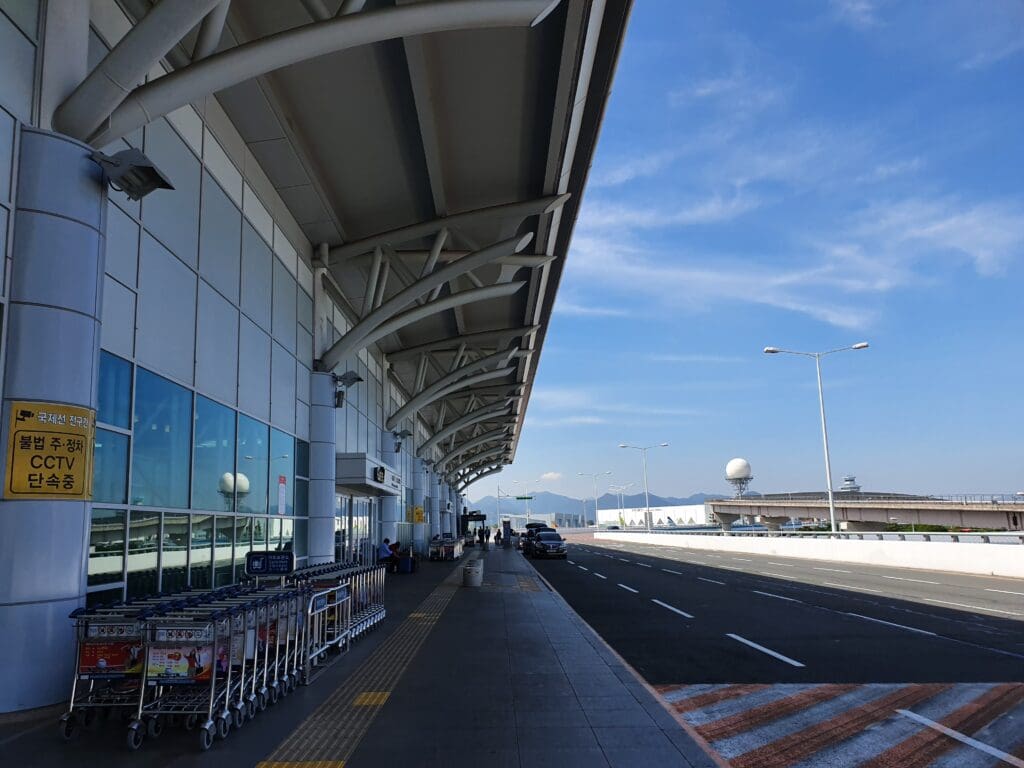
That afternoon, a respectable total of thirteen international flights could be seen on the departure boards before my Ulaanbaatar. However, despite this, the landside portion of the terminal was not particularly busy and there were an abundance of places to sit and wait for the duration of my stay, and only a few short queues at several check-in desks. Those with time on their hands in the landside area can spend this at multiple cafés, restaurants and shops, most of which were chain stores such as Lotteria, Holly’s Coffee and Tous Les Jours. Having already had lunch, I headed to Tous Les Jours where I ordered an overpriced coffee, cautiously sipping this as I surfed the airport’s quick and reliable wifi network. Upon doing so, I opened up a flight tracking app and was pleased to see that the inbound flight had made an early departure from Mongolia and was well on its way to Busan.

In both Busan and Seoul Incheon, MIAT Mongolian Airlines is handled by Korean Air owned handling company, Air Korea. Thus, at 1525, wearing Korean Air’s ground staff uniform arrived at the four check-in desks reserved for MIAT Mongolian Airlines’ early evening service and a small queue leading up to these could be seen. With the opening of these desks appearing imminent and not wanting to get left behind, I headed downstairs by which time the first passengers appeared to have been called forward to the desks. Interestingly, there were no separate desks for those flying in Business or for those who had checked-in online. However, seeing as I was not flying in Business and as the queue was relatively short, I could not make any complaints. As I slowly shuffled forward, I found myself standing behind a group of weary looking travellers from the United States who were armed with large trekking bags. Whilst the presence of such passengers was far from surprising given Mongolia’s status as a popular adventure holiday destination, I could not help but notice the luggage labels on their bags. These revealed that the passengers had flown with Japan Airlines from the United States to Tokyo Narita, connecting onwards to Busan where they had arrived that morning on one of the airline’s Boeing 737-800s. Whilst this is not the most indirect route, I couldn’t help but think that flying to Ulaanbaatar with Air China via Beijing or Korean Air via Seoul Incheon would have saved them the hassle of an extra stop. However, who knows, maybe they were aviation enthusiasts like me, eager to sample the delights of Mongolia’s national carrier.
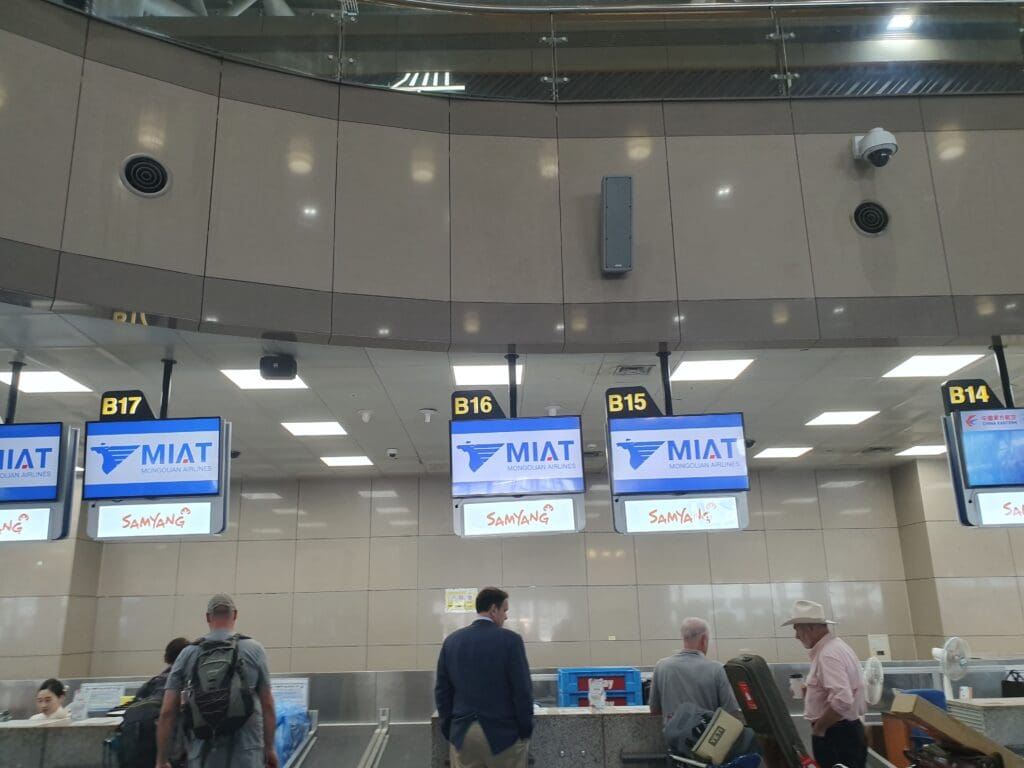
After a ten minute wait, I arrived at one of the desks and was warmly greeted by the agent. After some typing, my passport and Mongolian visa were checked before a Korean Air branded boarding pass and baggage tag were printed off. After the gate and boarding time were circled in the usual manner, I was advised that boarding would be undertaken via a bus before being sent on my way. Following a brief stop at a spotlessly clean toilet block, I headed through to security and immigration. Thanks to the efficient staff and the fact that I was not carrying any significant electronic items or liquids in my bag, I was able to pass through the security check within a couple of minutes. However, seeing as only two out of the ten immigration desks reserved for those with foreign passports were manned, officially exiting Korea took a little longer to do. This served to be the exact opposite of Seoul Incheon Airport where I find security can take longer to pass through than immigration. That said, seeing as I made it to the airside area in a little under 25 minutes after joining the check-in queue, I am not entirely qualified to complain about waiting.
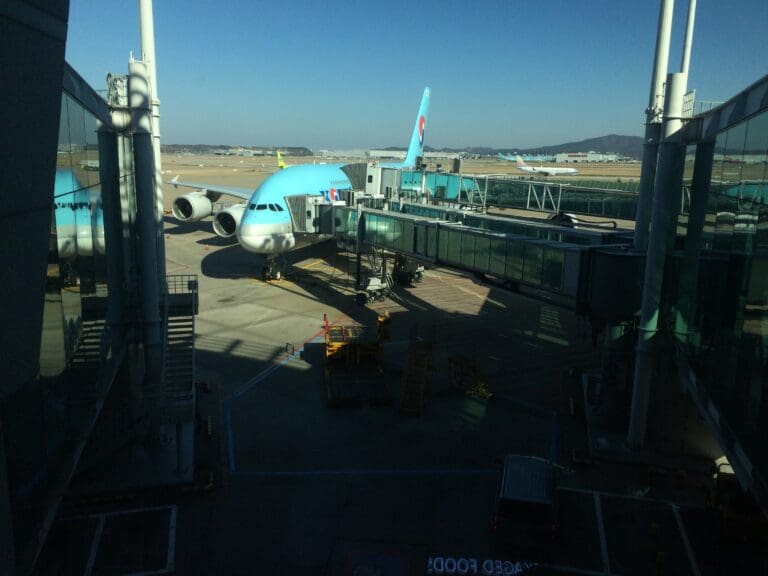
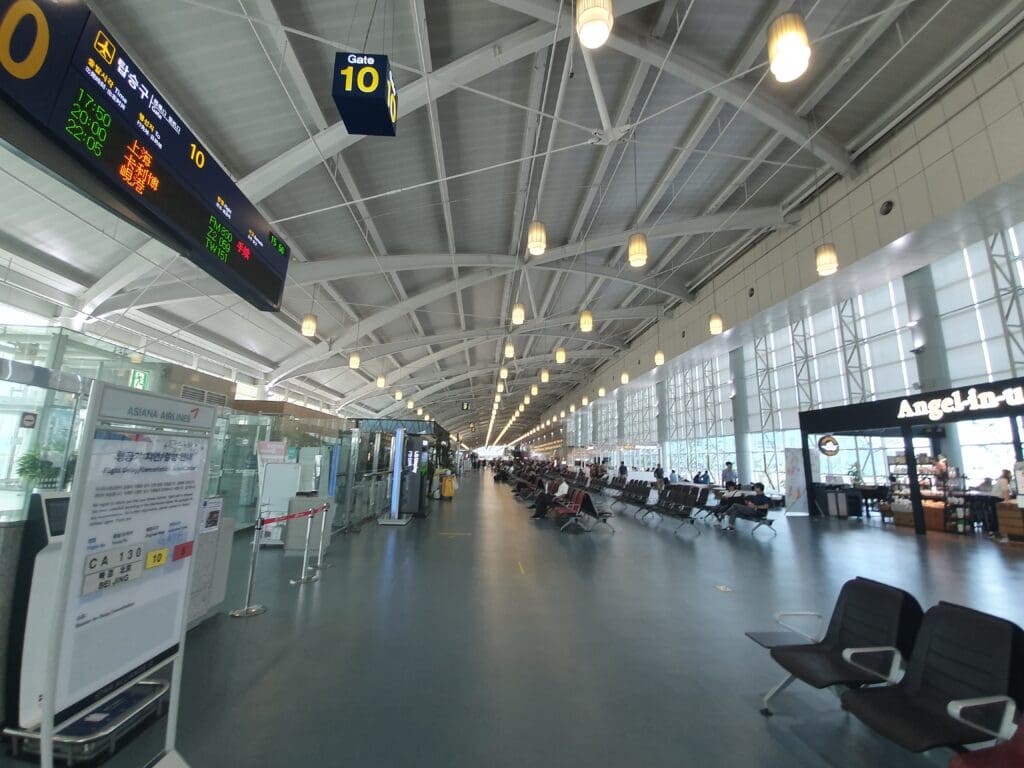
Before this trip, my one and only time departing from Busan Gimhae Airport’s international terminal had taken place in October 2014 when I departed on a Peach Airbus A320 bound for Osaka Kansai. Since then, the terminal had undergone significant expansion. That afternoon, I found this to be spacious and home to plenty of shops, cafés and restaurants for its size. Crucially, despite being a little busy, I found plenty of places to sit, plus those needing to power or charge their devices will be pleased to hear that a good number of plug and USB-A sockets could be spotted throughout the terminal. As I have found is usually the case at Korean airports, the terminal appeared to be spotlessly clean throughout. My only real complaint about the terminal was that thanks to multiple layers of glass, any decent photography of aircraft outside the terminal was a little difficult. However, this is only an issue for the relatively small number of aviation enthusiast passengers and I thus doubt that most who pass through the terminal will complain about this!
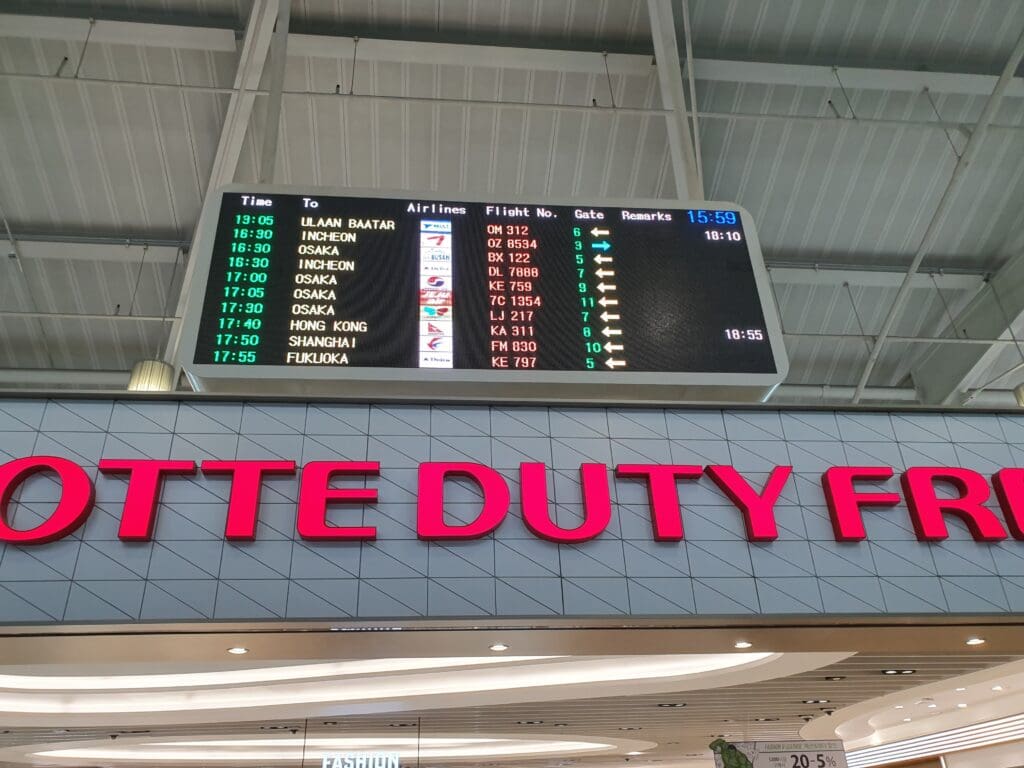
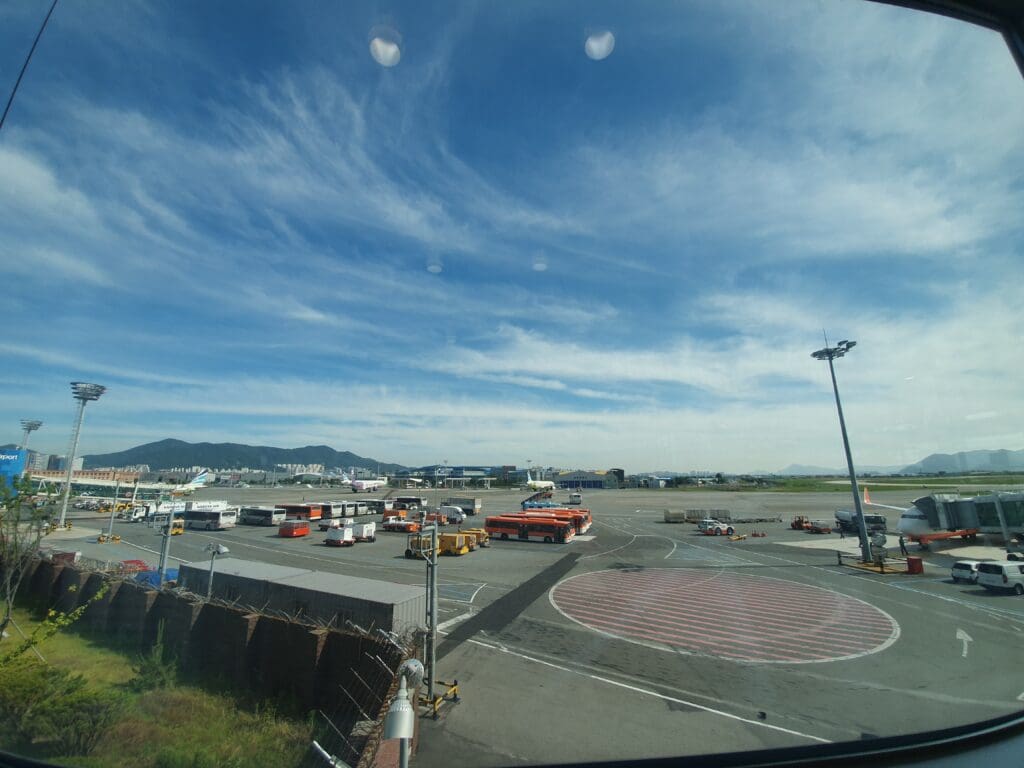
Having seen almost 111,000 movements in 2018, Busan Gimhae Airport is Korea’s fourth busiest, and that afternoon, a relatively constant stream of traffic was present. As one would expect, many of the aircraft outside could be seen wearing the mostly silver livery of hometown airline, Air Busan. In addition to plenty of flights to both domestic and international destinations, as well as a large maintenance facility on the opposite side of the airfield, a significant number of Korean Air aircraft ranging in size from their small Airbus A220-300s to one of their Boeing 747-8s could be seen. Alongside aircraft from these two carriers, a fair few aircraft from Korea’s low cost carriers could be seen heading to and from the domestic terminal, alongside a couple of Asiana Airlines Airbus A320s operating geographically domestic but technically international flights to Seoul Incheon. Finally, in addition, Airbus A320s from Cathay Dragon, China Eastern Airlines, China Southern Airlines and Peach were visible during my stay as was a Shanghai Airlines Boeing 737-800. Like many of Korea’s regional airports, Busan Gimhae Airport is also home to several squadrons of military aircraft, with much of the airfield occupied by the ROKAF. Specifically, this is home to a selection of military tanker, transport and AWACS squadrons. Thus, as I waited, several locally based ROKAF Boeing 737 AEW&C Peace Eye, CASA 235 and Lockheed C-130 Hercules aircraft could be spotted practicing all manner of interesting approaches and departures.

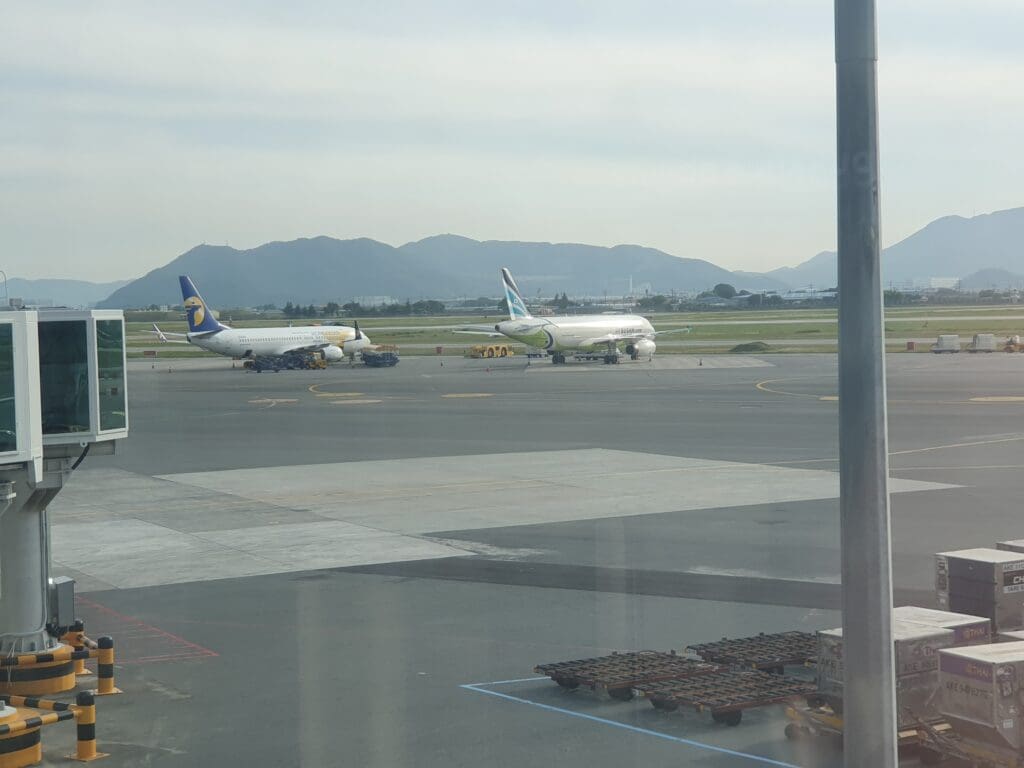
After a reasonable wait, at 1650 I watched as one of the six aircraft in MIAT Mongolian Airlines’ fleet came floating down over the Nakdong River estuary before making a smoky touchdown on Runway 36L. The aircraft’s arrival came a reassuring twenty minutes ahead of schedule (or almost five hours late, depending on which way you see it!). That evening, the aircraft taking me to Mongolia would be Irish registered Boeing 737-8AS, EI-CSG. This particular aircraft took its first flight over the skies of the Northwestern United States in May 2000, and, as you may have guessed from the aircraft’s customer code, began its commercial life with Ryanair a short time later. At the time, this was the seventh Boeing 737-800 to be delivered to the airline, with Boeing 737-200s forming the backbone of the low cost carrier’s fleet at that time. After eight years of flying around the skies of Europe, during which time the aircraft was fitted with winglets, in April 2008 the aircraft was flown to Southend. Here, the aircraft’s Ryanair titles and tail motif were replaced by those of MIAT Mongolian Airlines however the basic Ryanair colours were retained. Christened with the name Ogedei Khaan (the third son of Genghis Khan), the aircraft headed to Asia to commence its new life with MIAT Mongolian Airlines. Once there, the aircraft soon received a more permanent white and blue livery which lacked Ryanair’s yellow before being painted into the airline’s current livery in late 2011. During summers between 2015 and 2018, EI-CSG operated stints transporting European holidaymakers on behalf of Czech carrier Travel Service Airlines. In its current configuration, this particular Boeing 737 is capable of carrying up to 174 passengers (162 in Economy and 12 in Business) and operates mostly on flights from Ulaanbaatar to destinations across Northeast Asia. However, the aircraft has occasionally been used on MIAT Mongolian Airlines’ only year round connection to Europe, the service to Berlin Tegel via Moscow Sheremetyevo. In the week before my flight the aircraft had operated a total of 31 flights, covering over 28,000 miles, connecting Ulaanbaatar with Beijing, Busan, Guangzhou, Hong Kong, Khanbumbat, Seoul Incheon and Tokyo Narita.
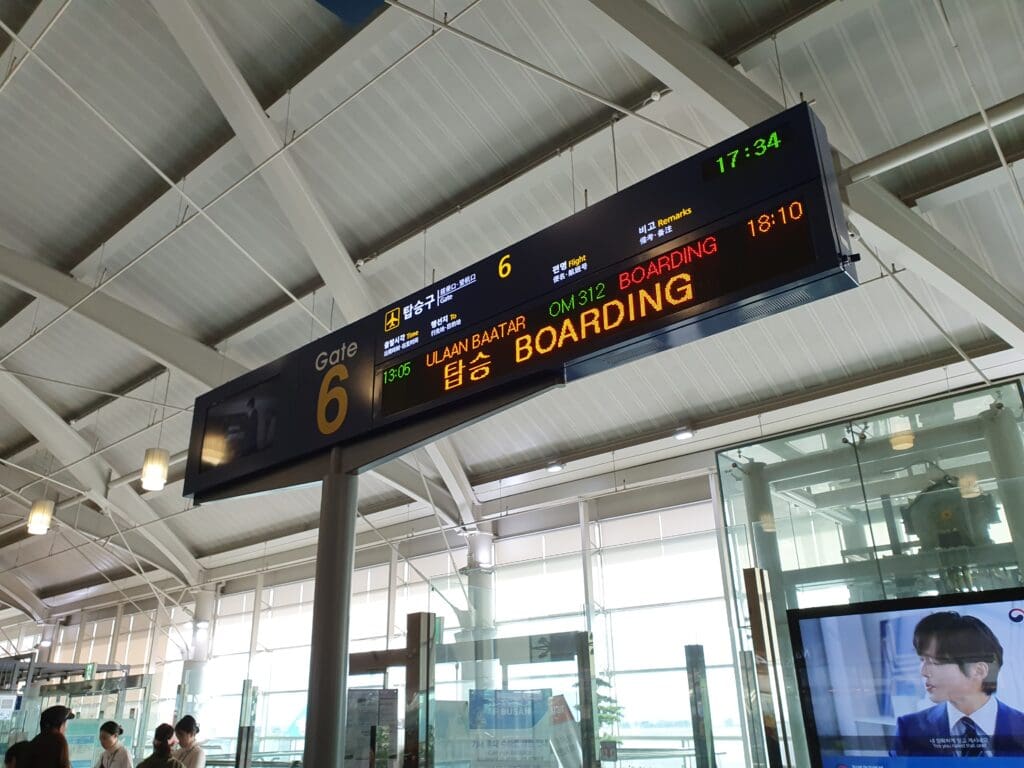
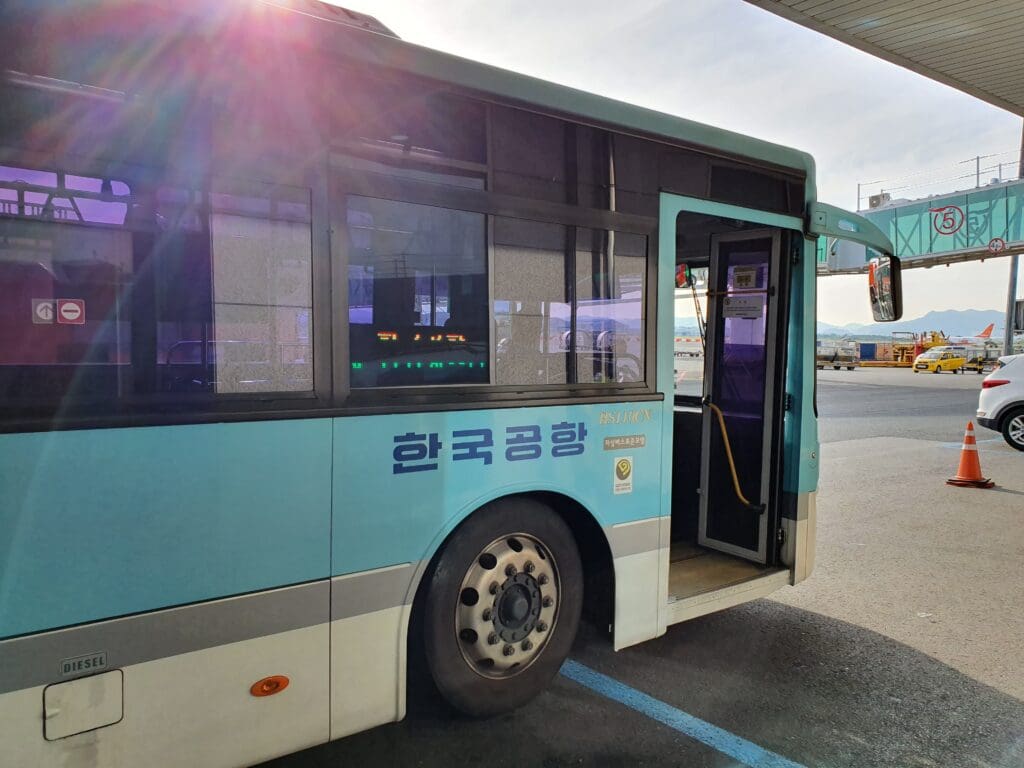
After a long walk around the rectangular terminal, at 1725 I headed over to Gate 6 which is located in the middle of the twelve-gate terminal. True to neither the boarding time given on my boarding pass, nor the information given on the departure boards, boarding commenced at 1730. At this time, I joined the short queue of eager passengers and soon had my boarding pass scanned and passport checked before I was allowed to head down the stairs and onto the waiting Air Korea bus. Whilst many airlines and handling companies enjoy squeezing as many passengers as is physically possible onto buses, that day this proved not to be the case. With a seemingly constant shuttle of buses heading to and from the aircraft, the bus doors slid shut with a fair few vacant seats and we soon headed off. Upon pulling away from the terminal, the bus headed down the relatively empty flight line. During this journey, we passed two modern aircraft both being prepared for the 140-mile hop down to Fukuoka- a sharklet-equipped Air Busan Airbus A321 and a Korean Air Airbus A220-300.
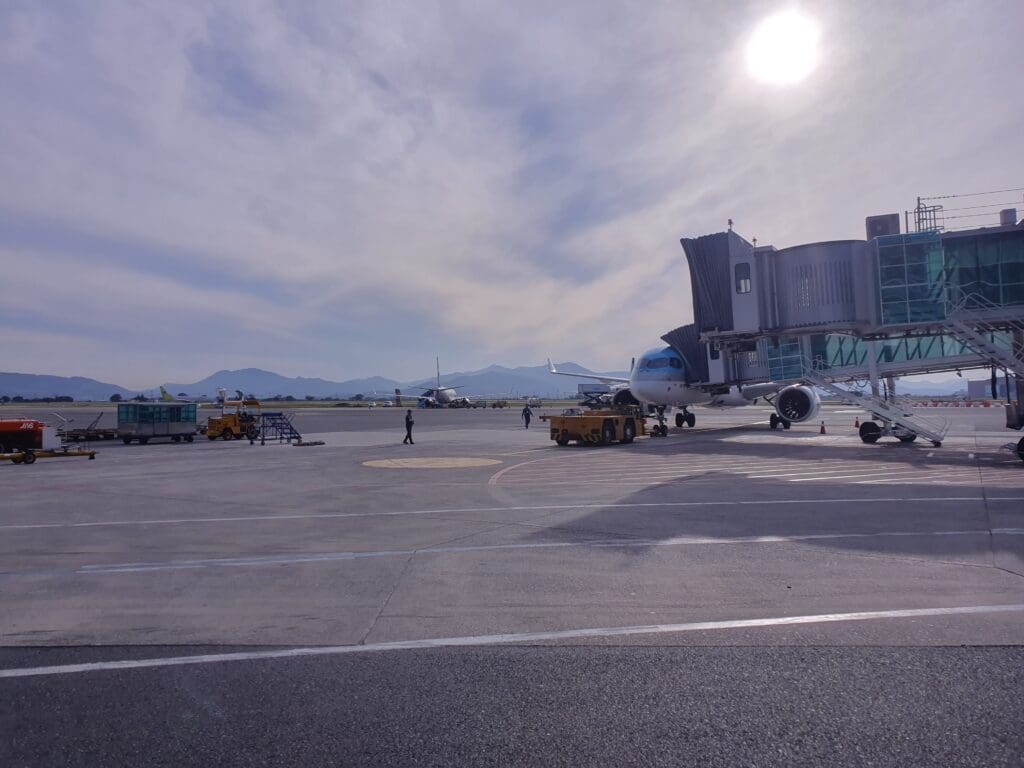
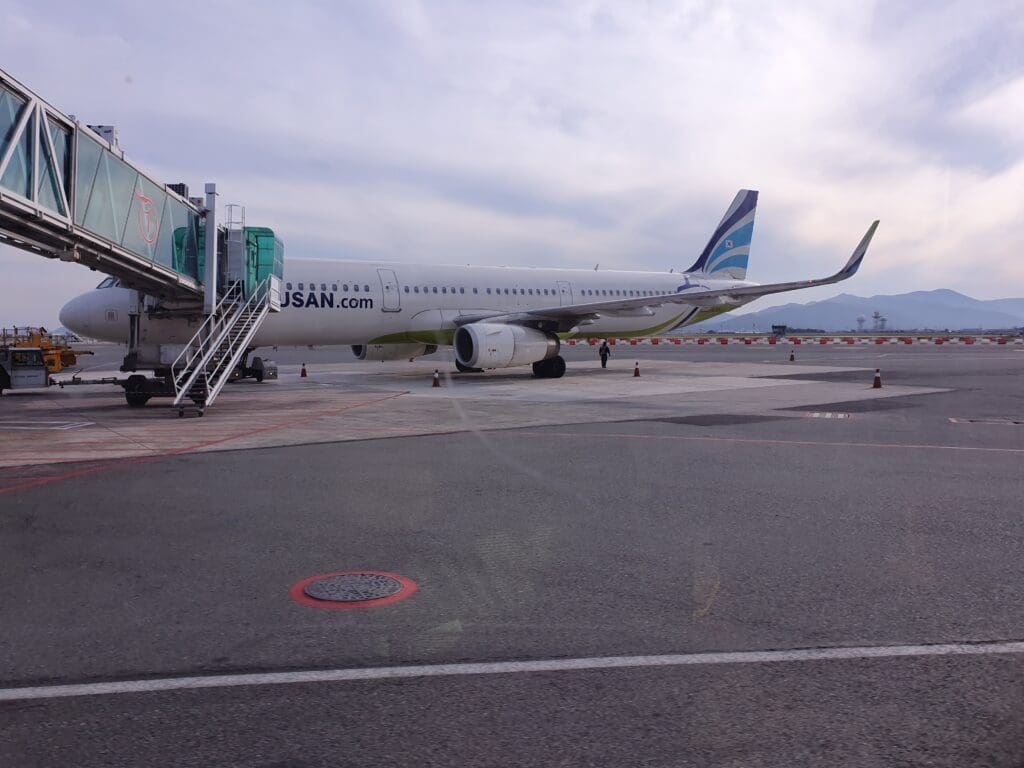
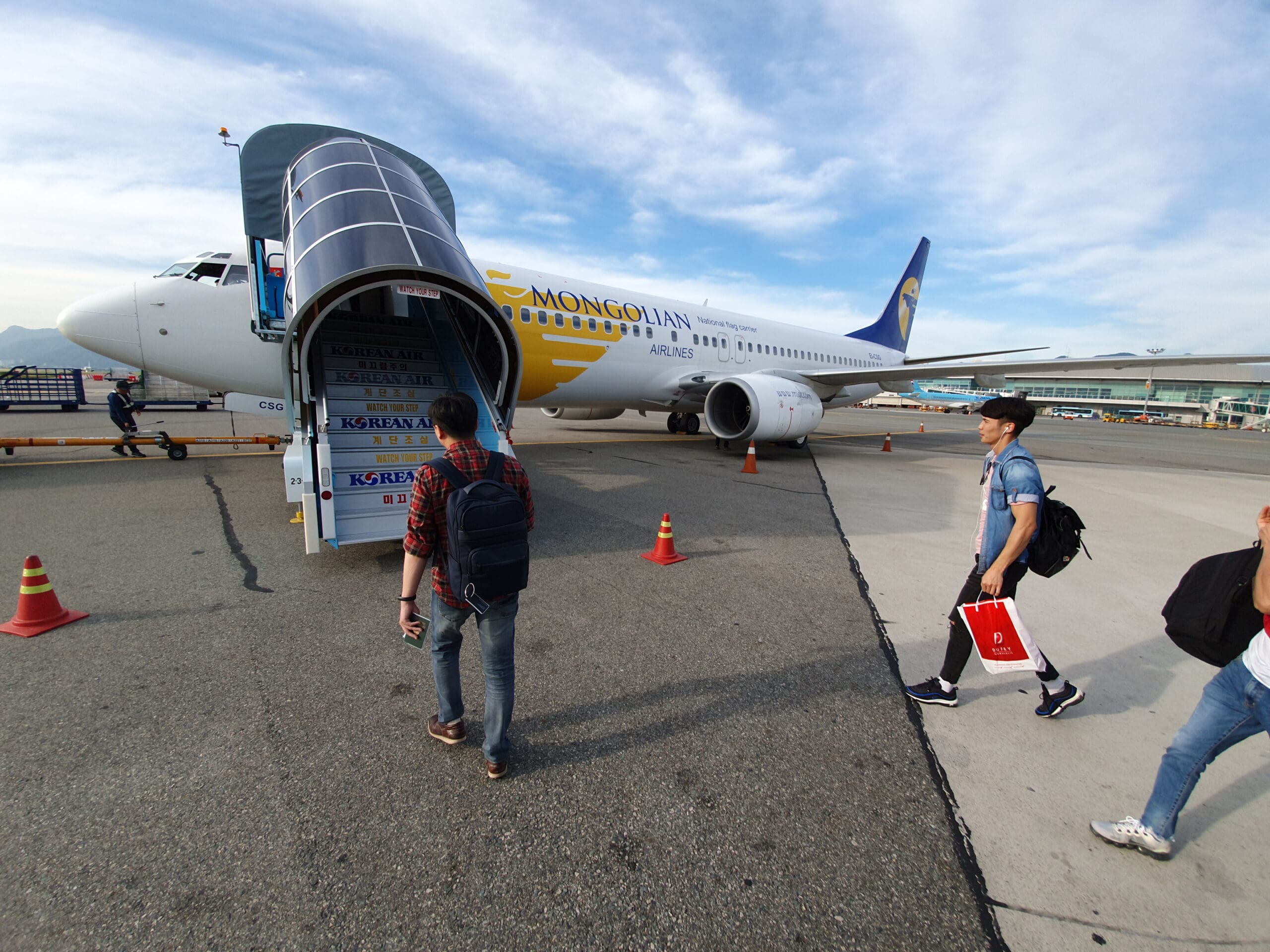
A short time after leaving the terminal, at 1740 the bus slowed as it neared an Air Busan Airbus A320 before arriving at Stand 20 where the MIAT Mongolian Airlines Boeing 737 could be seen waiting to take a fresh load of passengers to Mongolia. As soon as the bus came to a halt, the doors slid open and we began to spill onto the apron. Being one of the first passengers off the bus, I was able to proceed up the stairs and head into the boiling hot aircraft with absolutely no waiting.
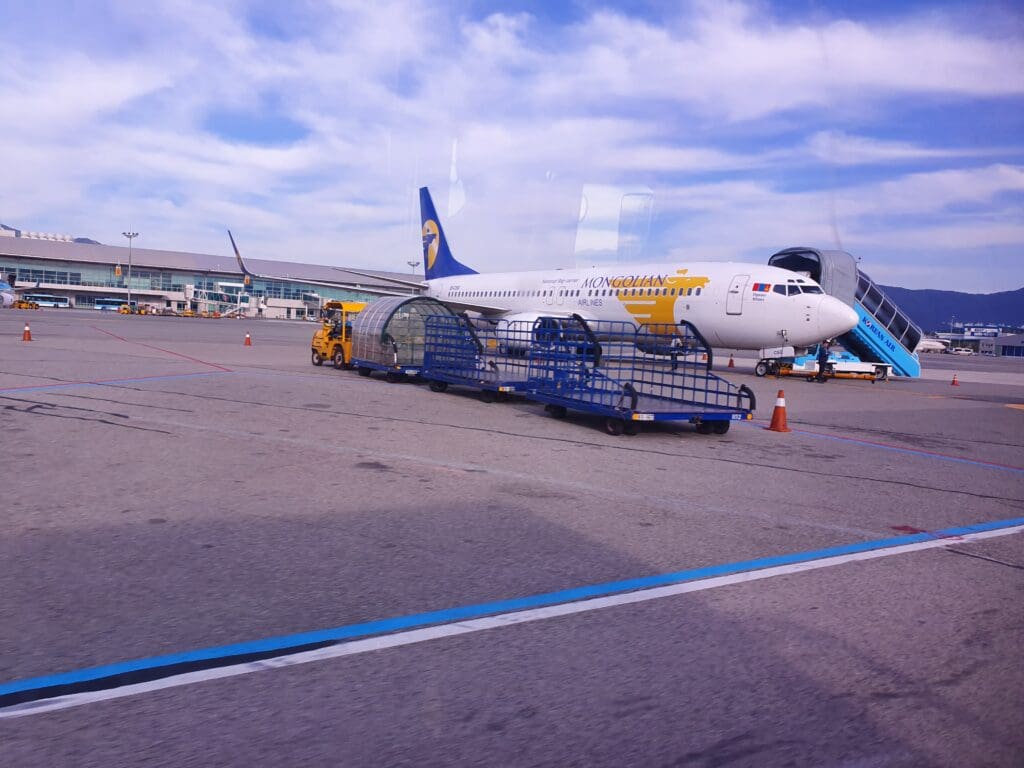
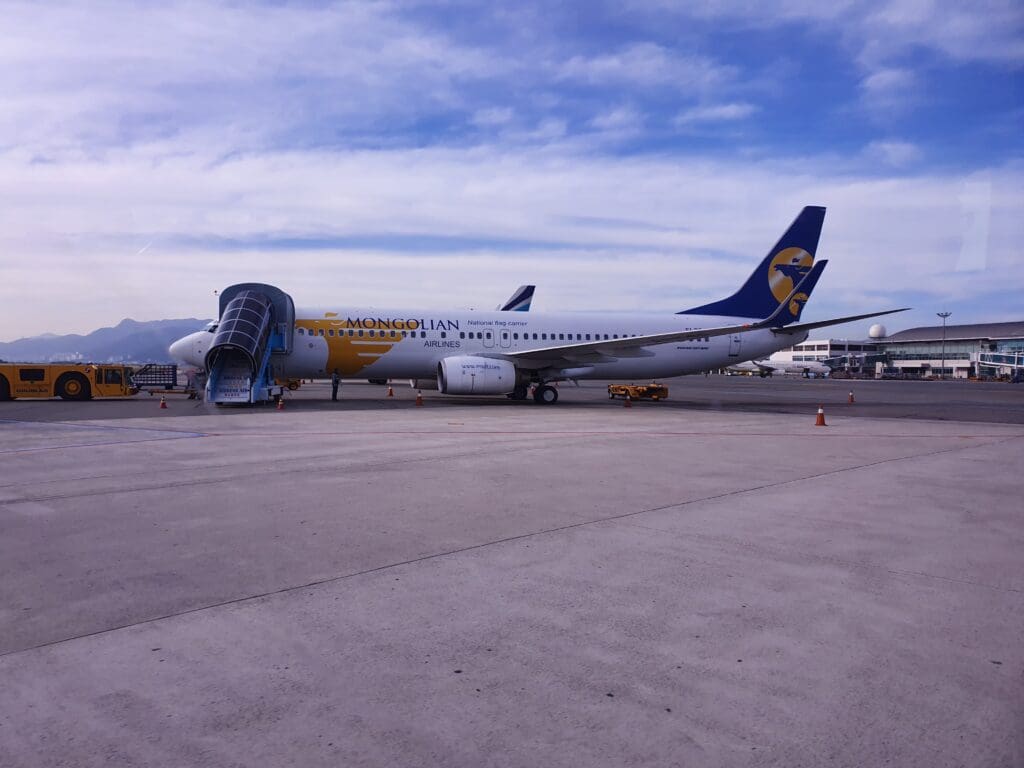
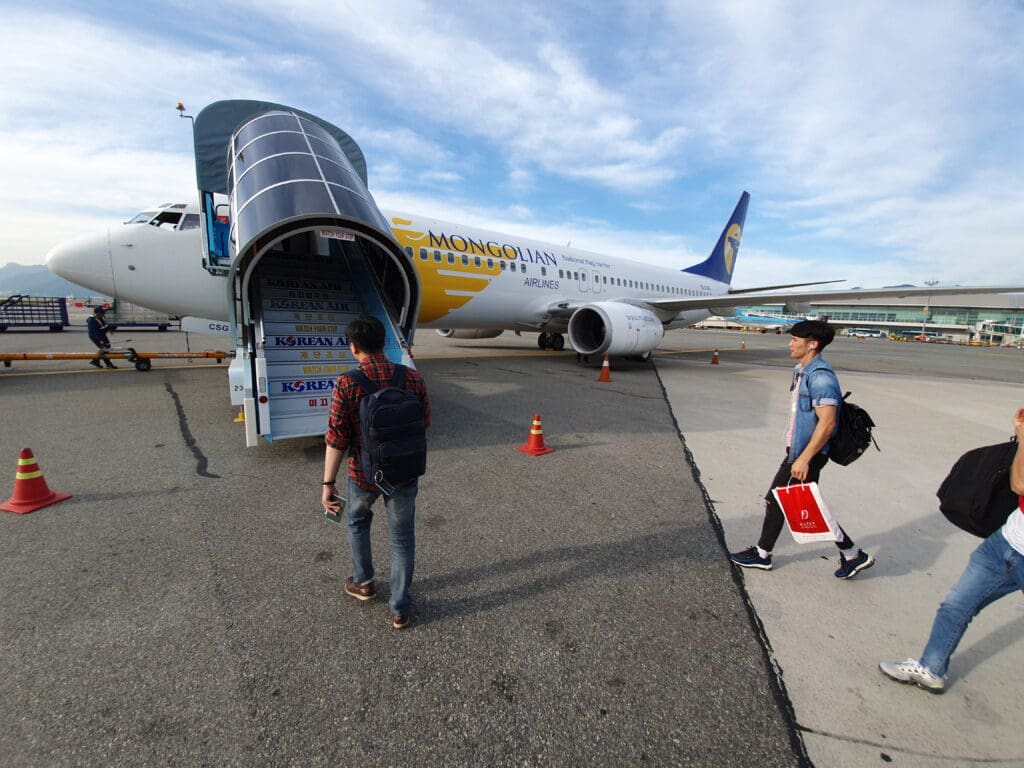
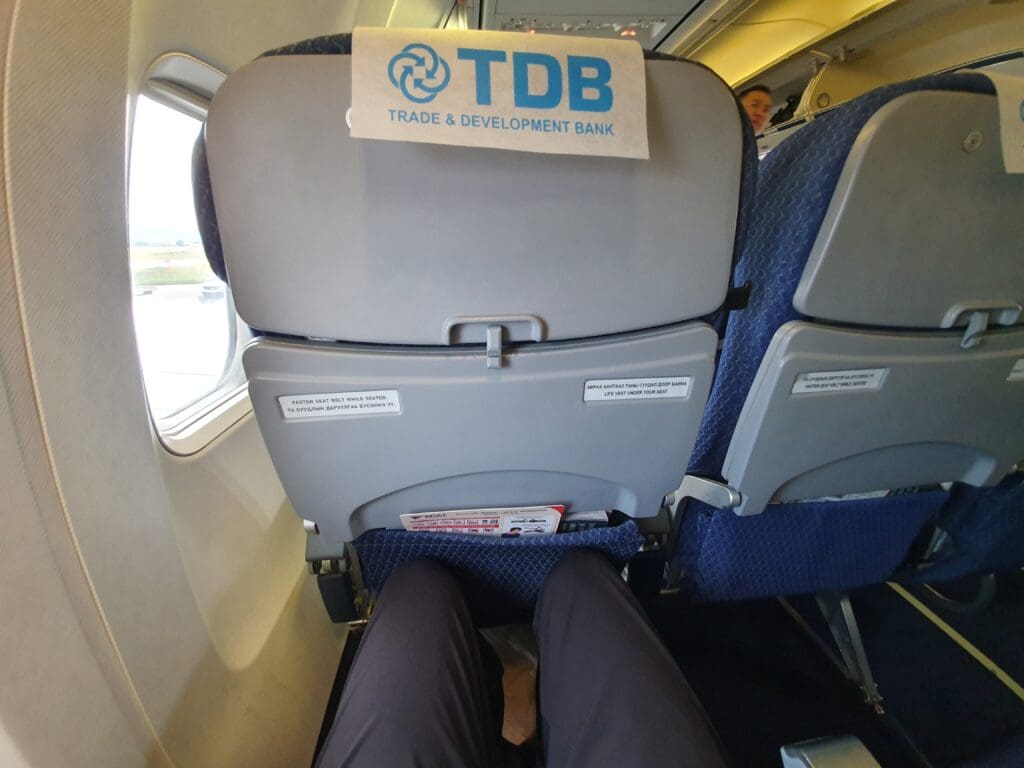
Upon entering the forward galley I was given a lukewarm greeting by two of the flight’s five strong cabin crew members. With only one way to go, I soon turned right into the aircraft’s business class cabin where I was greeted by classical music and the sight of three rows of very comfortable old school leather covered seats in a 2-2 configuration. All bar one of which was empty, with one seat being occupied by a tough-looking reflective jacket-wearing crew member who I assumed to be a mechanic or a security guard. Within seconds I arrived in the aircraft’s large economy cabin where mismatched orange-yellow lighting illuminated the 162 seats in front of me. All of these were covered in blue fabric featuring a repeating pattern and sported a disposable fabric headrest cover which featured an advertisement for Mongolia’s Trade and Development Bank. Seeing as the cabin was almost entirely empty at that time, I made it to my Seat 23A in no time and soon made myself comfortable.
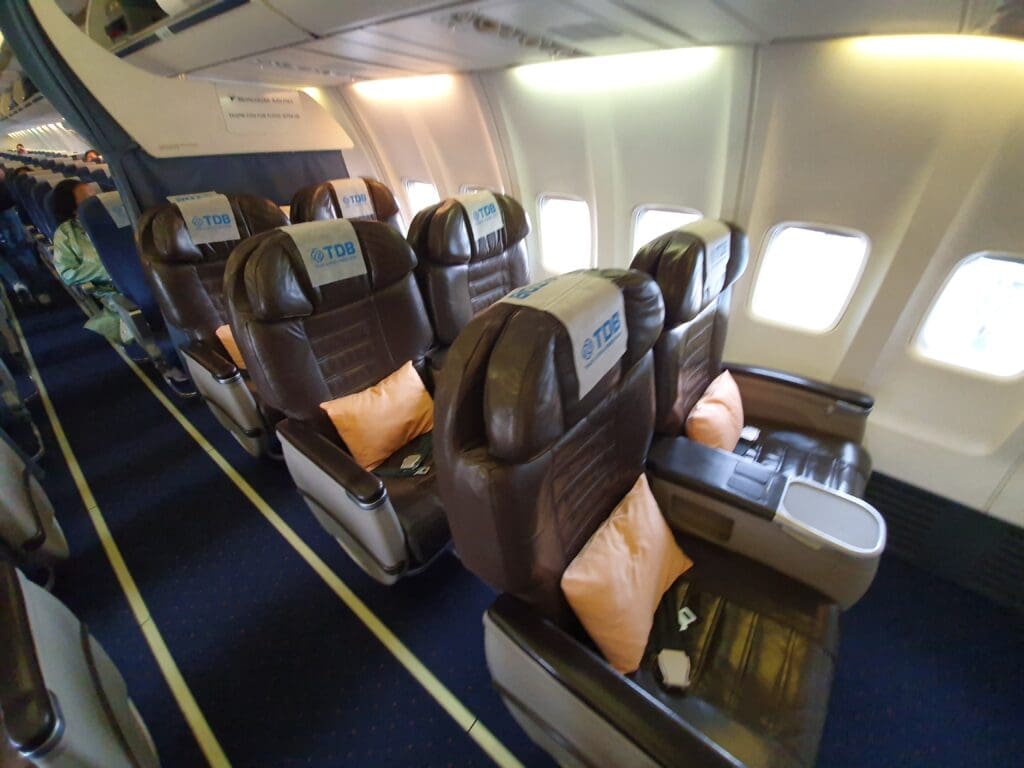
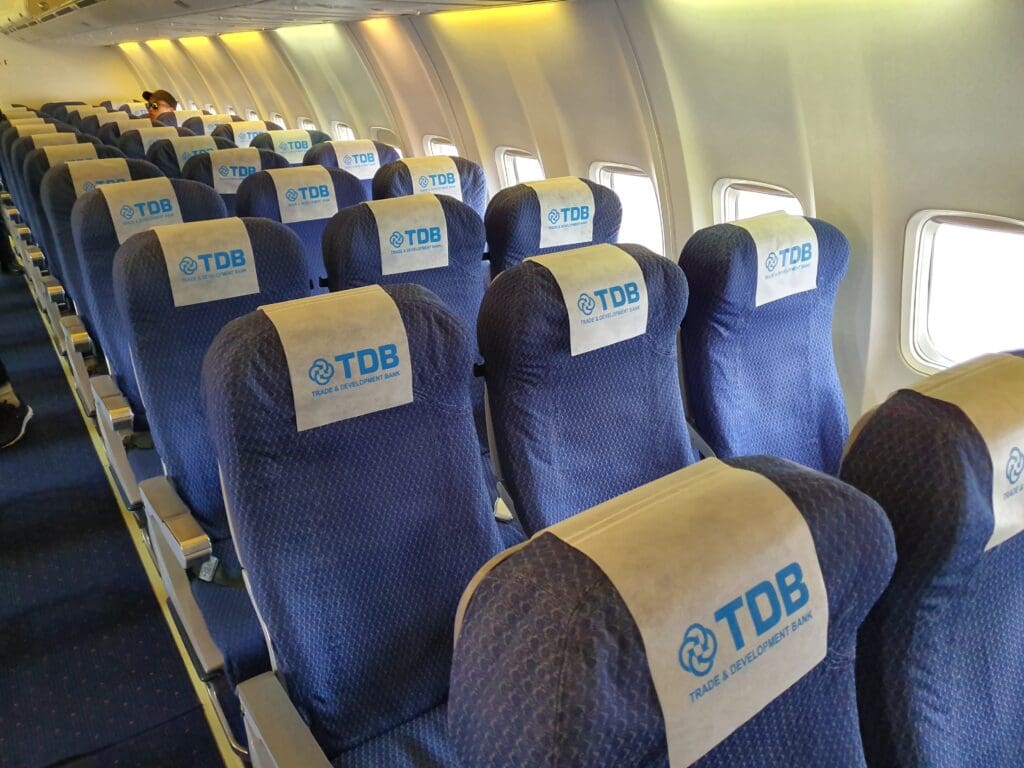
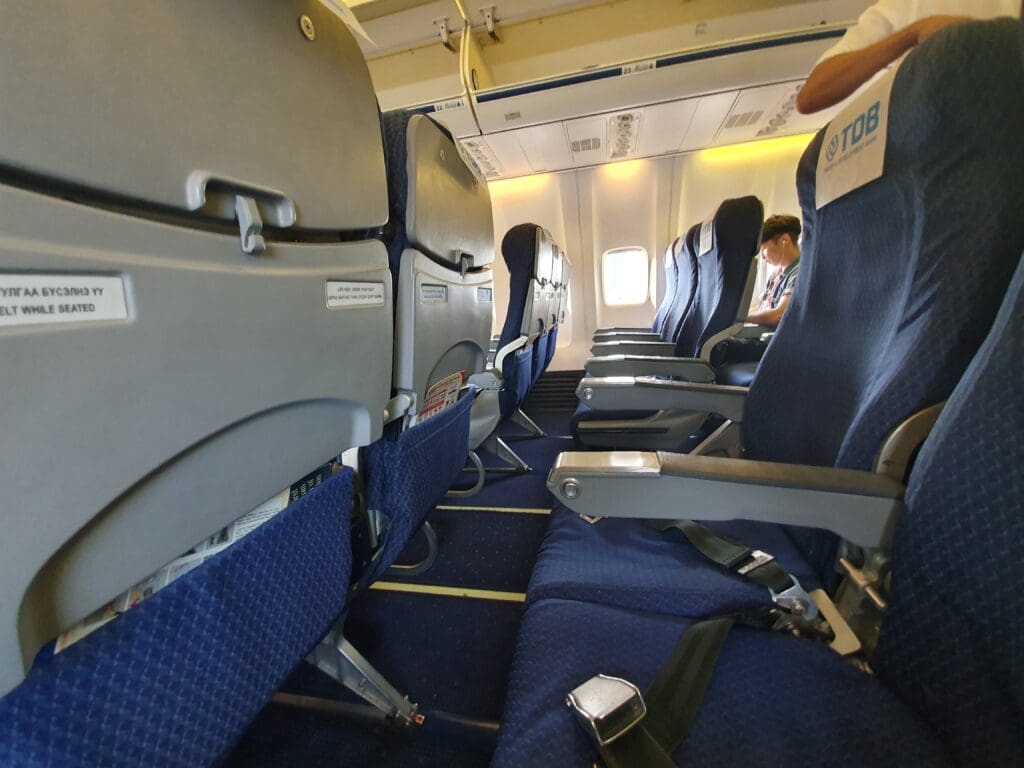
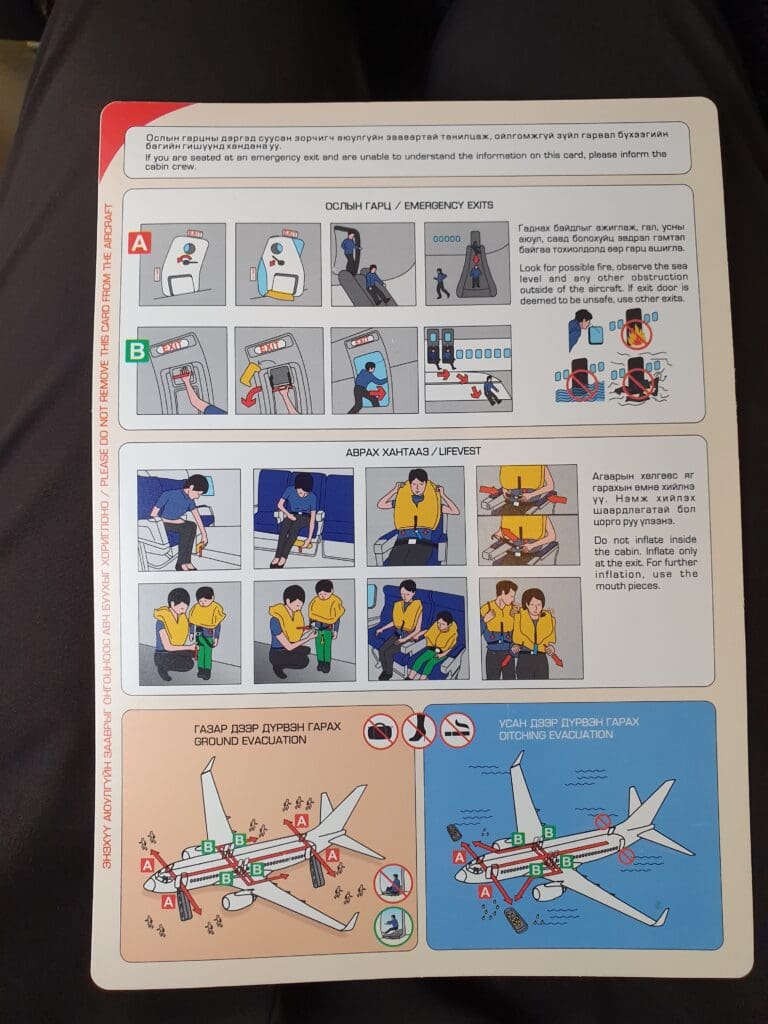
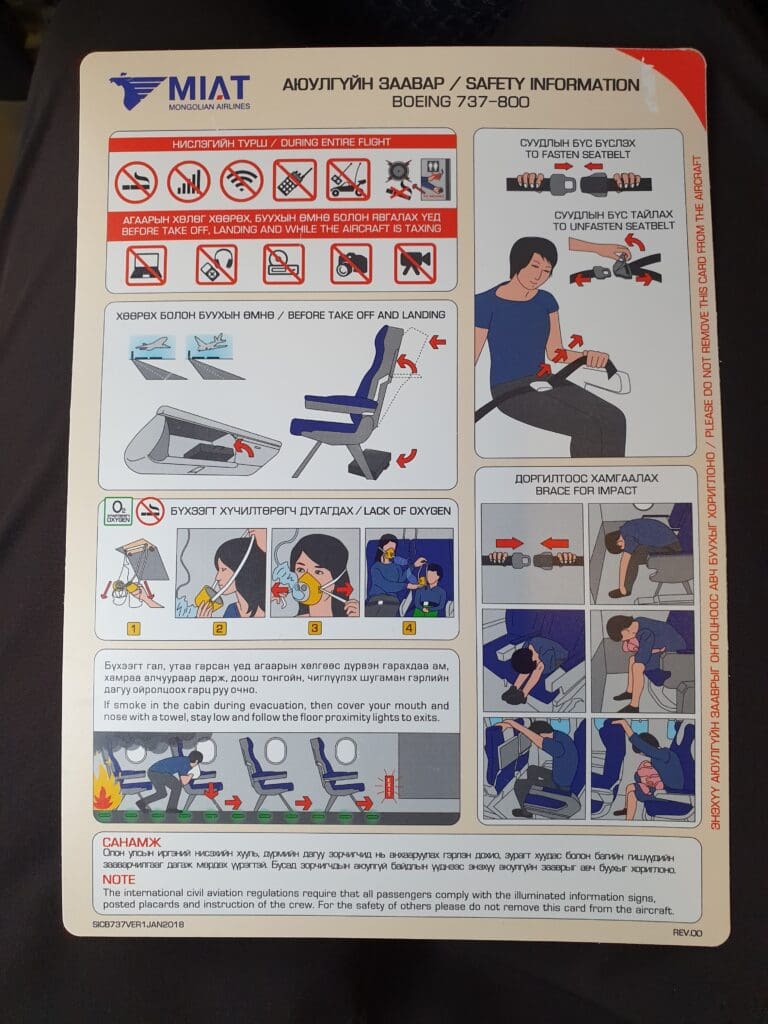
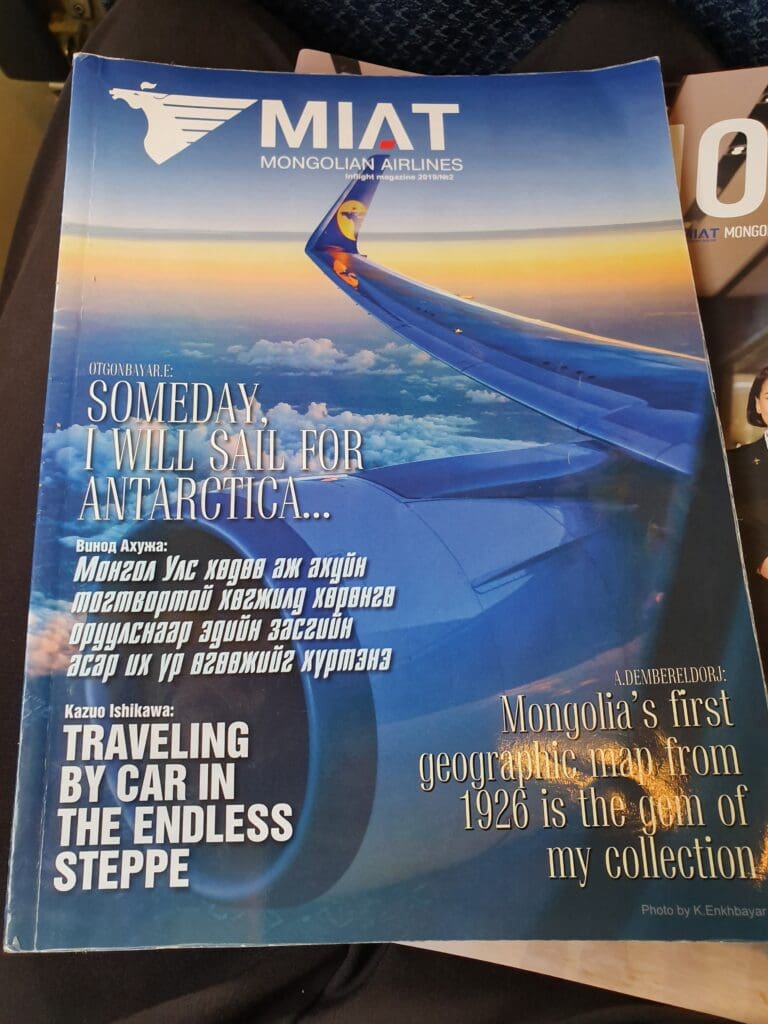
Despite being well padded and featuring pleasantly large ‘old-style’ armrests, the legroom was far from great. Whilst I cannot find any data for this, I would claim this to be akin to the aircraft’s initial owner, Ryanair. Thankfully, the aircraft appeared to have been well cleaned during its turnaround with few (if any) traces of rubbish however wear and tear was omnipresent, with plenty of scratches and marks visible across the cabin. Moving to the seatback pocket, this contained a safety card, a MIAT Mongolian Airlines branded safety card, a copy of the airline’s self-titled quarterly inflight magazine and their Sky Shop catalogue. Interestingly, Skyshop is the name given to the inflight shopping service onboard Korean Air. Whilst the aircraft had been near empty upon boarding, thanks to the constant stream of buses showing up at the aircraft, the cabin soon filled up and the economy cabin ended up being almost entirely full. Thanks to the early commencement of boarding and the efficient work of Air Korea, boarding was announced as complete ten minutes before our scheduled departure time. That evening, around 40% of those in Economy appeared to be fairly young lone passengers from Mongolia, who were likely studying in Korea and returning to the country for a break. Meanwhile, I would say around 50% were from Korea, with many middle aged travellers forming part of a large church group and the remaining 10% being from a selection of nations including Germany, Japan and the United States.
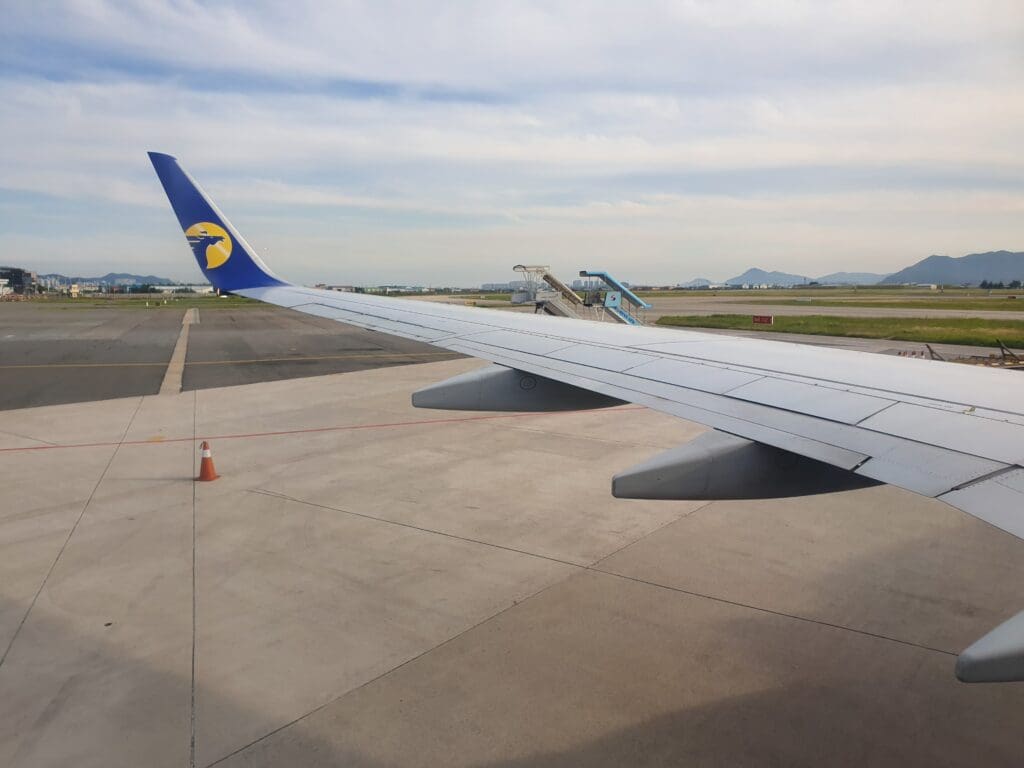
Moments after boarding was completed, a welcome announcement was performed by the Purser in Mongolian and English featuring the usual thanks for flying with MIAT Mongolian Airlines. Considering the linkages between Korea and Mongolia, the significant number of Korean passengers onboard and MIAT Mongolian Airlines’ relatively high number of services to Korea, I was a little surprised that no Korean version of any announcement, pre-recorded or otherwise was made throughout the flight. Turning my attention back outside, as soon as boarding was completed, the stairs were backed away from the aircraft and at 1801, our pushback commenced. As we headed backwards, four cabin crew members headed to the aisle where they performed the manual safety demonstration whilst the Purser read through the safety instructions. A short while after coming to a halt, the Boeing 737’s two reliable CFM56-7B26 engines powered up and our flaps were partially extended. Four minutes after the aircraft’s pushback had commenced, at 1805 the Boeing powered forward, beginning its taxi to one of the airport’s runways. As is common in Northeast Asia, as we headed off, several of the ground crew waved farewell to the jet.
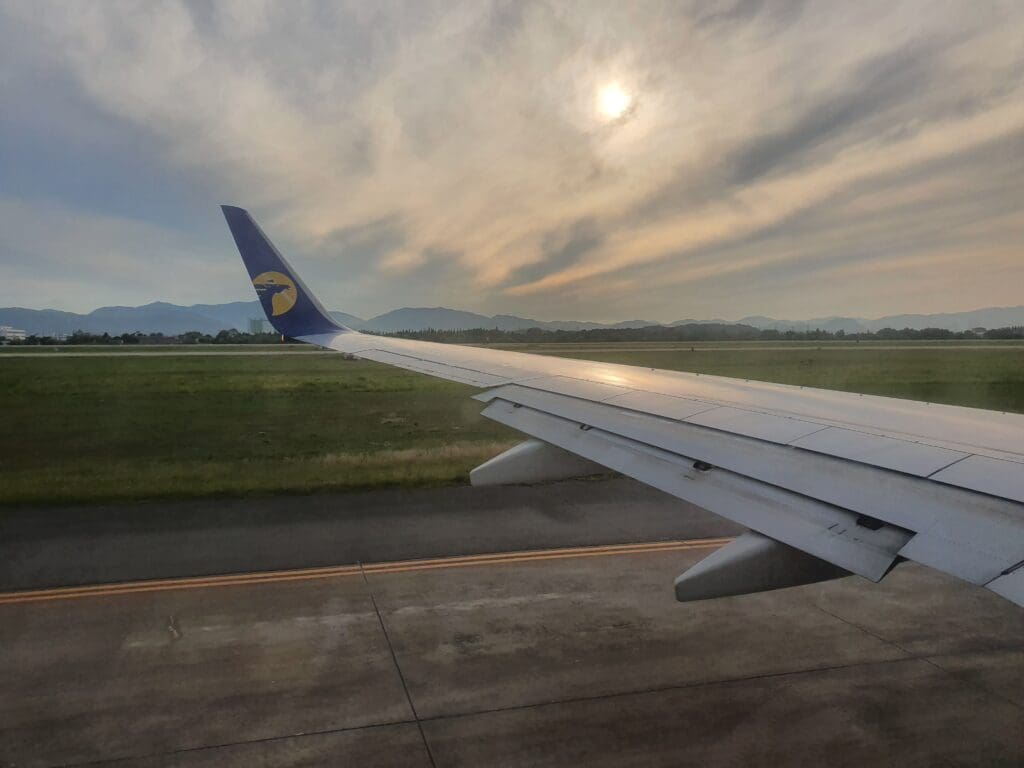
Seeing as all movements that afternoon had utilised Runways 36L and 36R, I was a little surprised at the fact that the Boeing 737 appeared to be heading to the opposite end of the airfield. Following a short taxi, the aircraft came to a halt at E1 whilst, in the far distance, a line of aircraft could be seen waiting to depart at the opposite end of the runway. After waiting for an Air Busan A320 to depart from Runway 36R and a Philippines AirAsia Airbus A320 to land on Runway 36L after a flight from Kalibo, the aircraft crossed Runway 18L and headed onto Runway 18R. Taking into account the fact that our aircraft needed to head north, I did find the fact that our aircraft was the sole departure at that time to take off into the opposite direction a little odd. As we entered the runway, one of the pilots accidentally broadcast themselves repeating our take-off clearance over the cabin’s speakers! At 1816 our aircraft performed a powerful rolling take-off, speeding past the extensive collection of locally based military before rotating up past the two terminals before a birds eye view of two Airbuses waiting to depart from Runway 36R was offered.
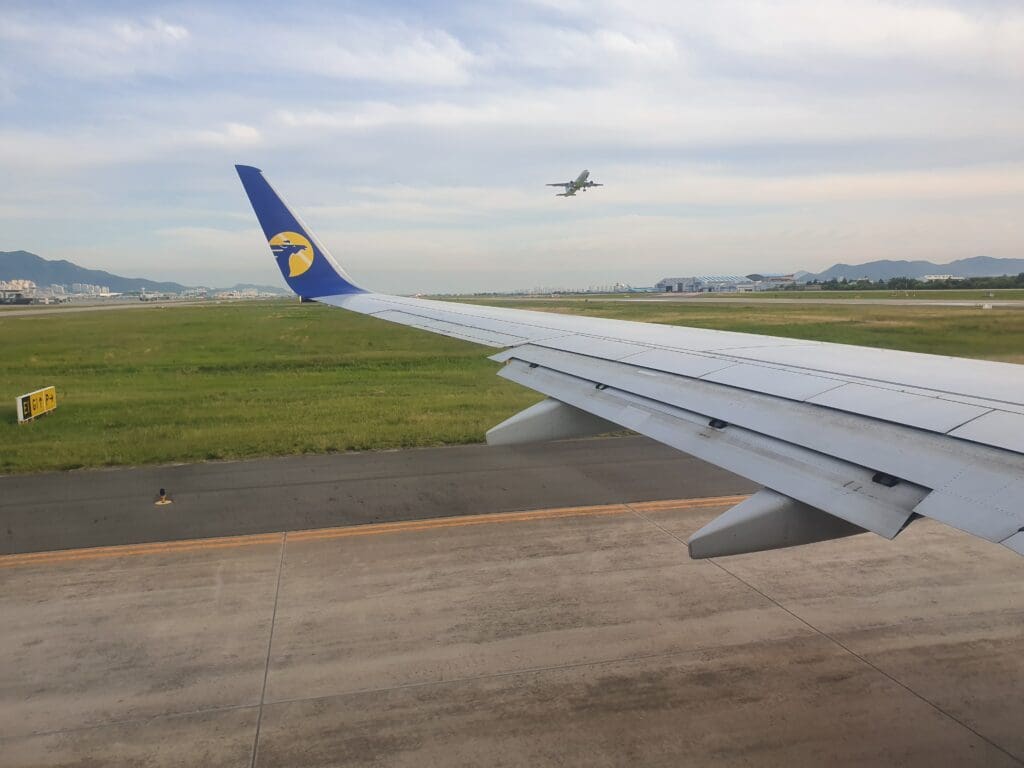
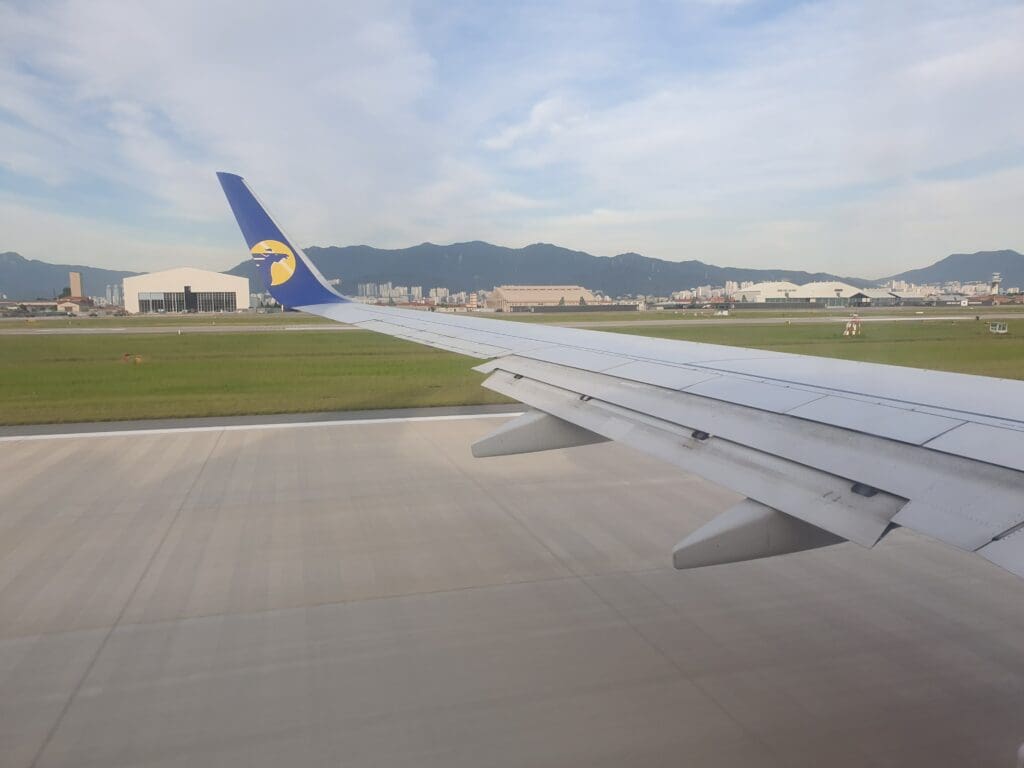
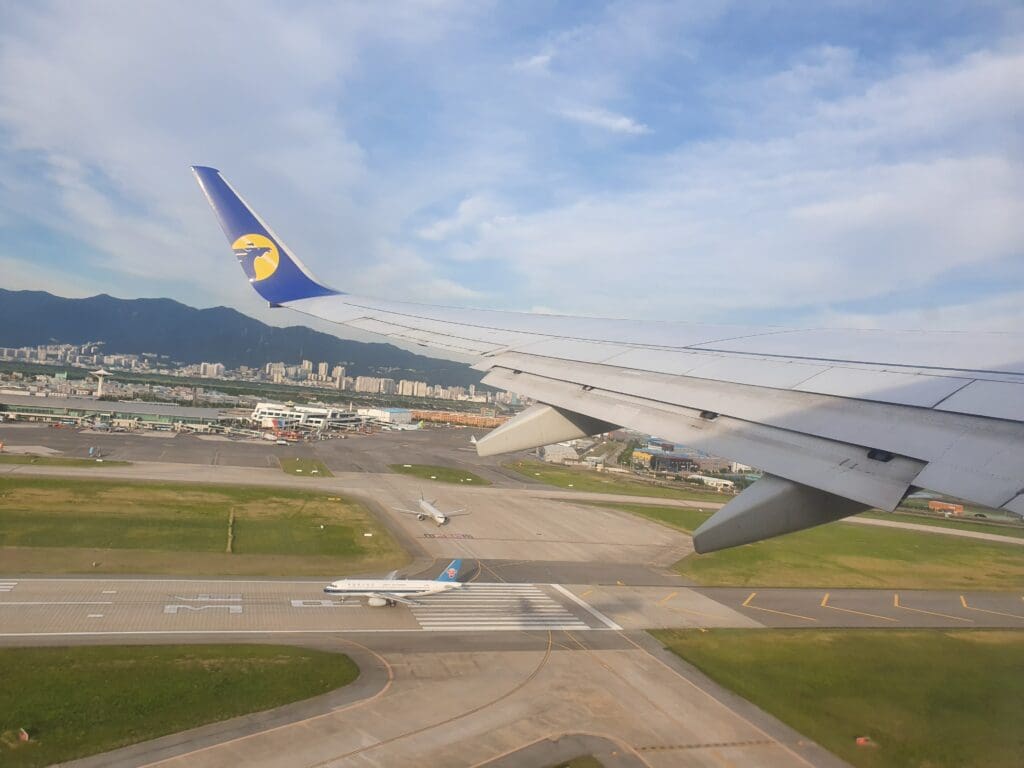
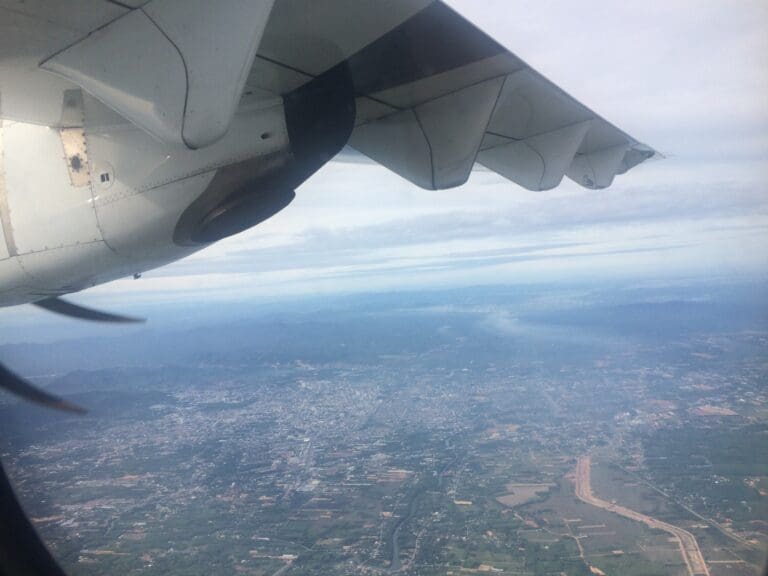
As the Boeing 737 powered away from Gimhae Airport, making a steep climb over the Nakdong River estuary, good views of the Sasang and Hadan areas of Busan could be had before the aircraft gently commenced a 180 degree turn to put us on course for Seoul. As we banked, the world’s sixth busiest cargo port came into view followed by the cities of Changwon and Gimhae alongside a collection of mountains, industrial areas and farmland. Around ten minutes after leaving the airport, a small portion of Korea’s fourth largest city, Daegu, could be seen below which was followed by the small city of Gumi. The latter is somewhat historically significant being the hometown of Korea’s controversial dictator Park Chung-hee, and his daughter, impeached former president Park Geun-hye.
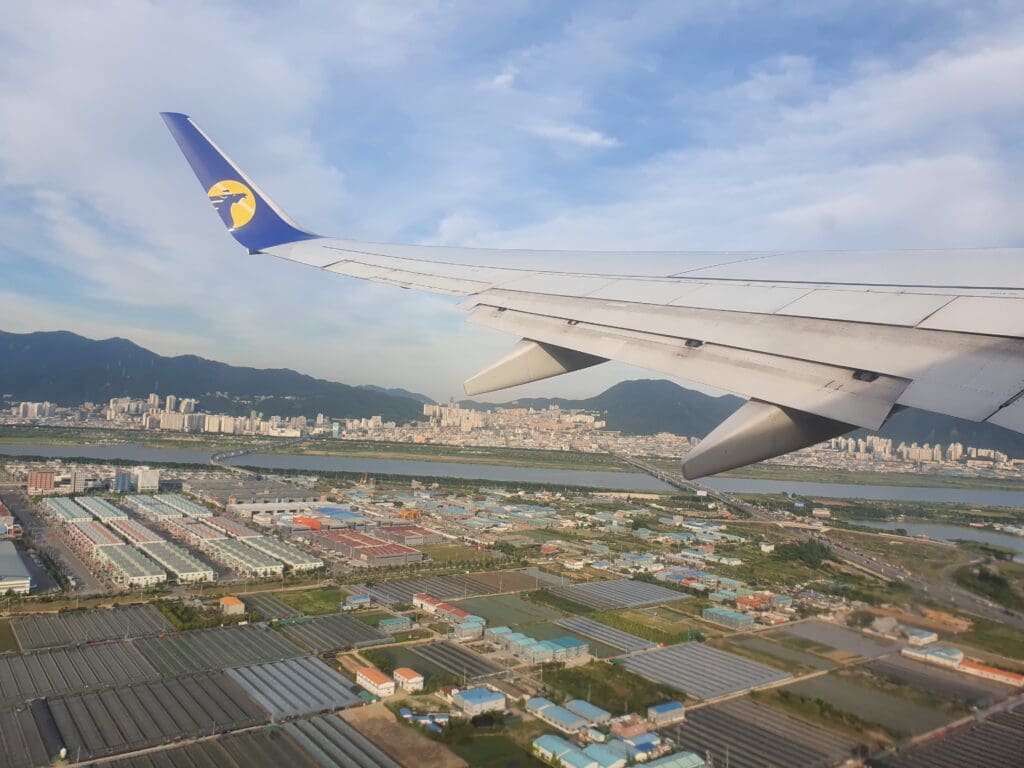
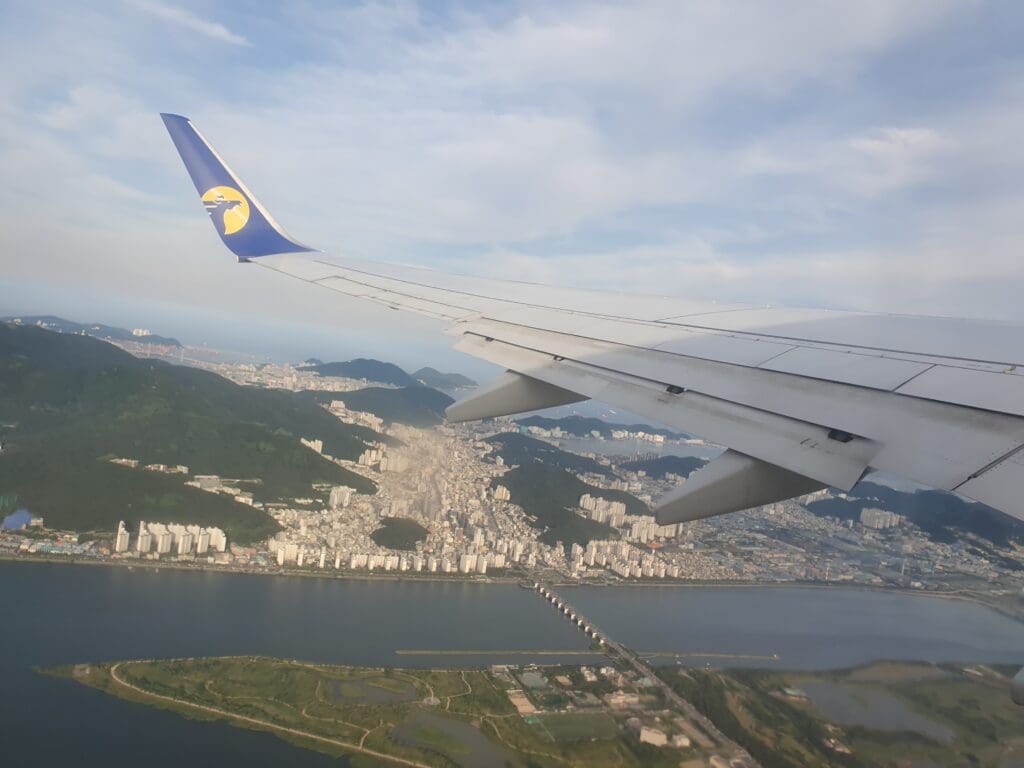
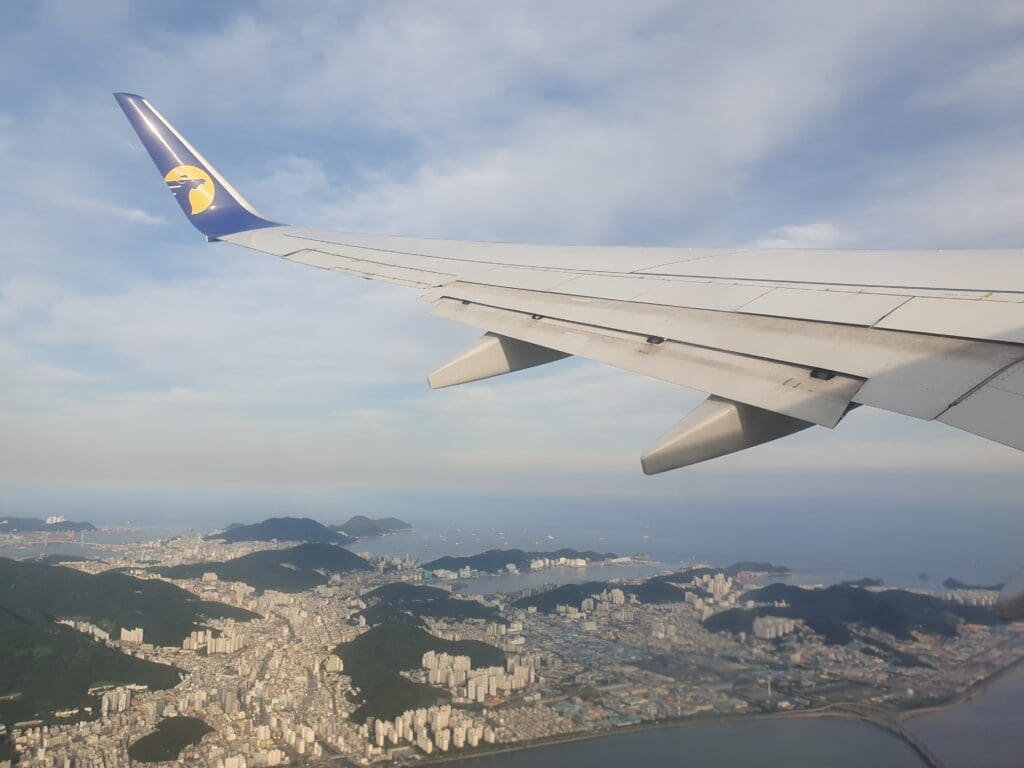
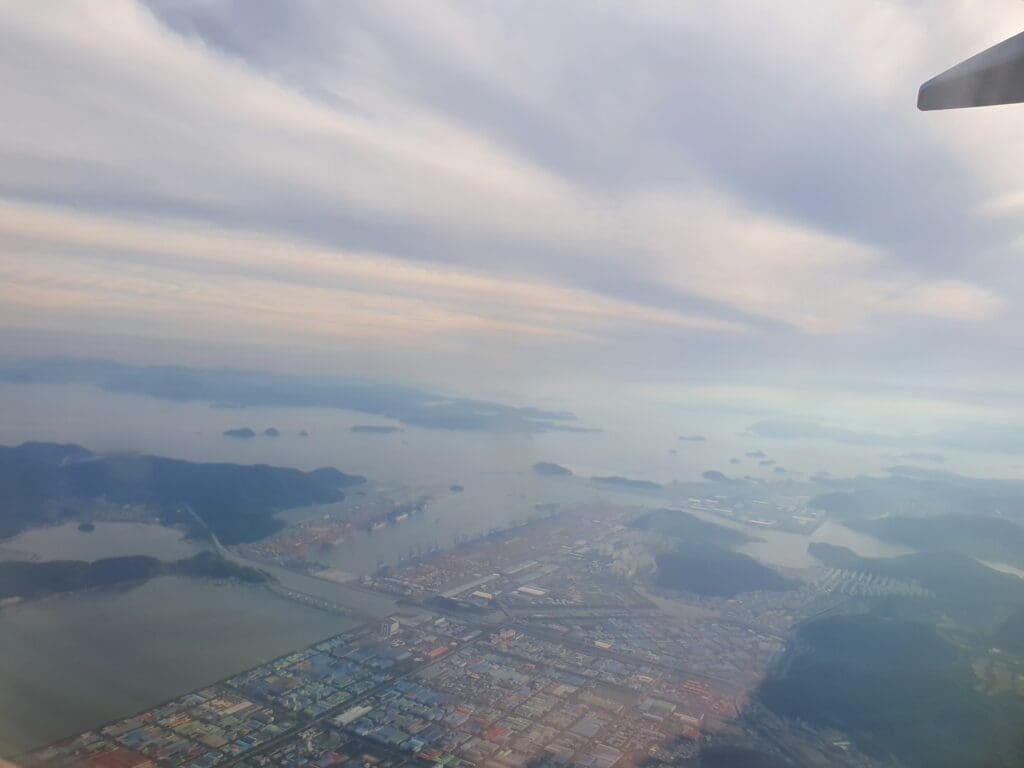
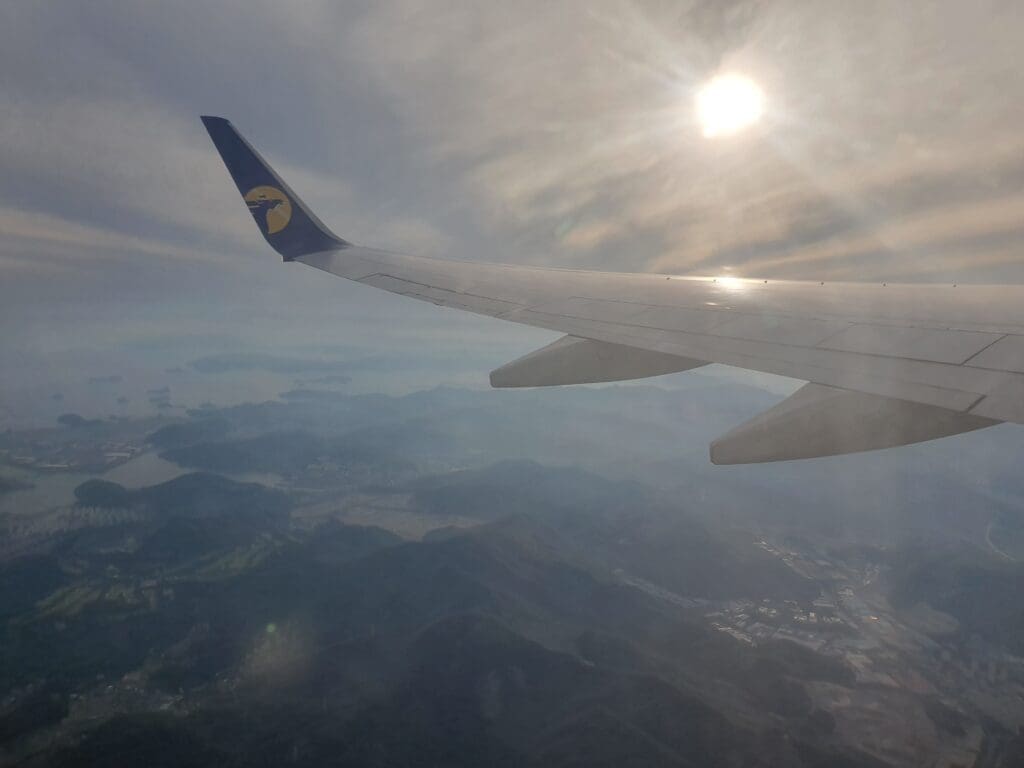
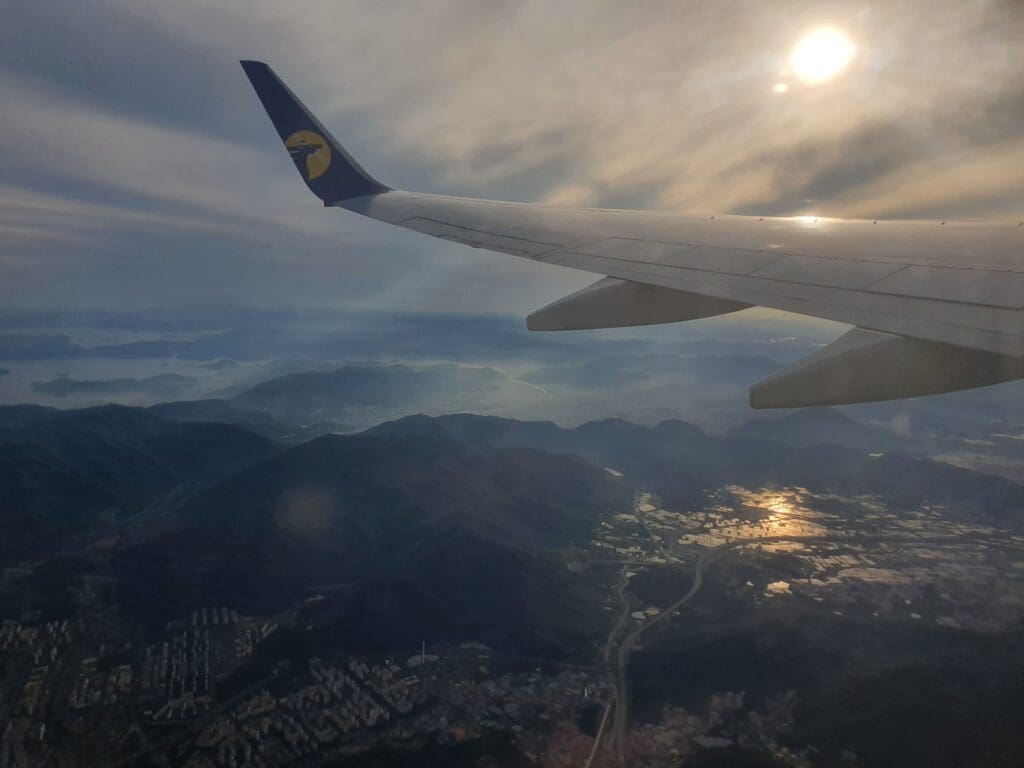
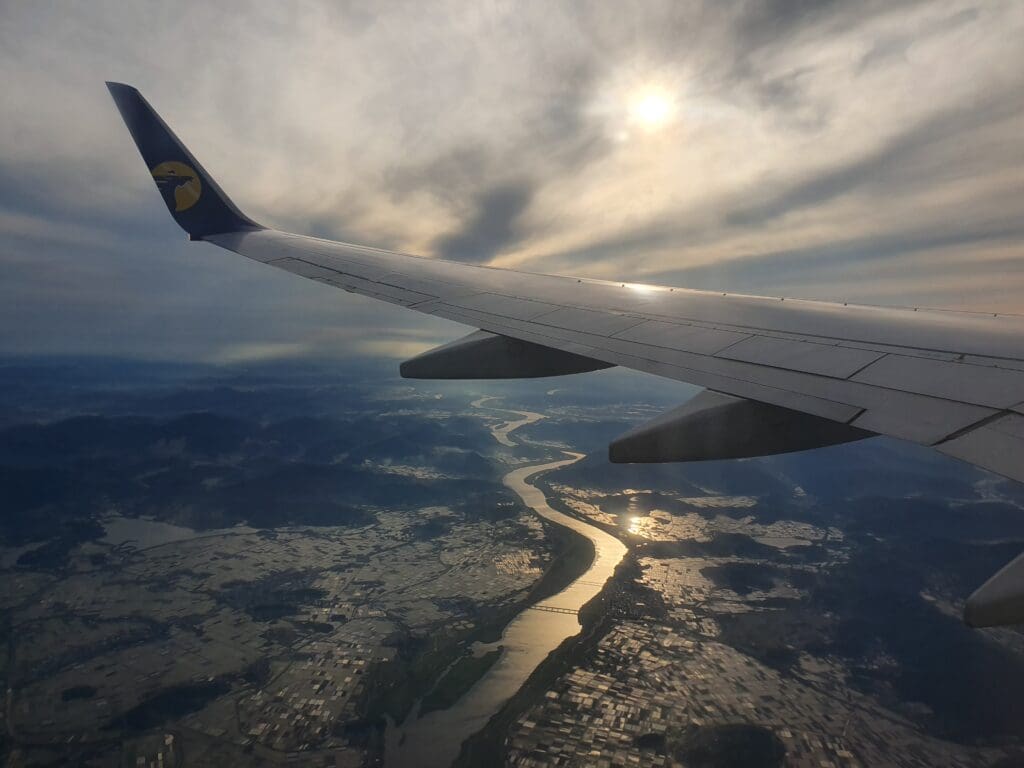
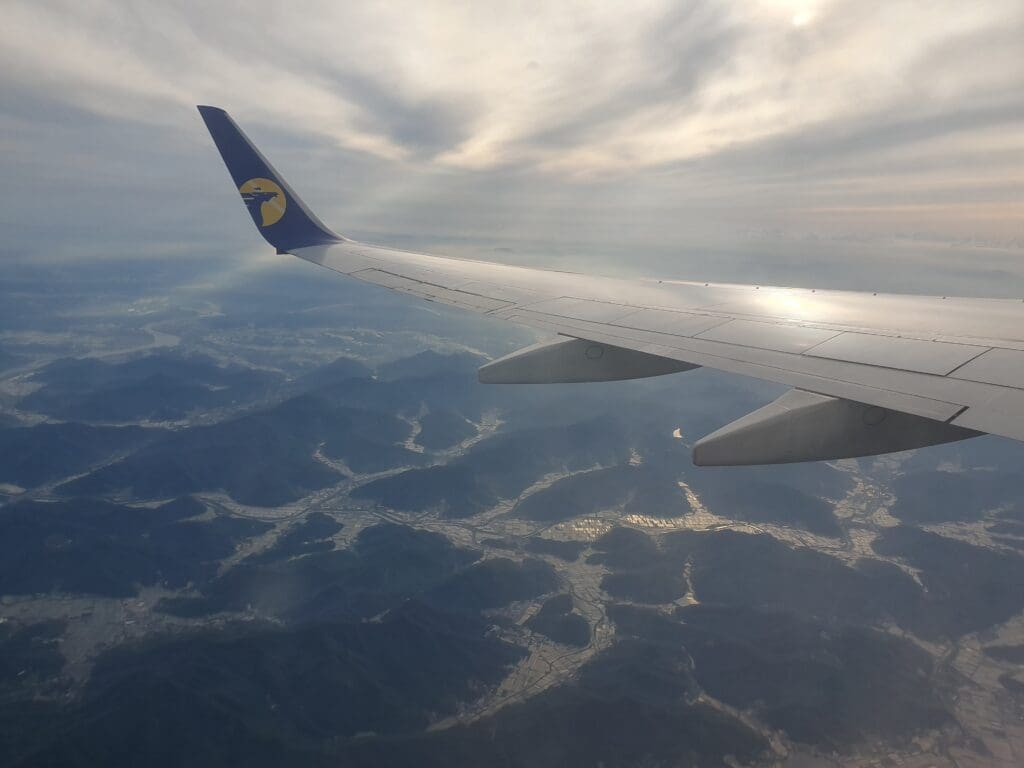
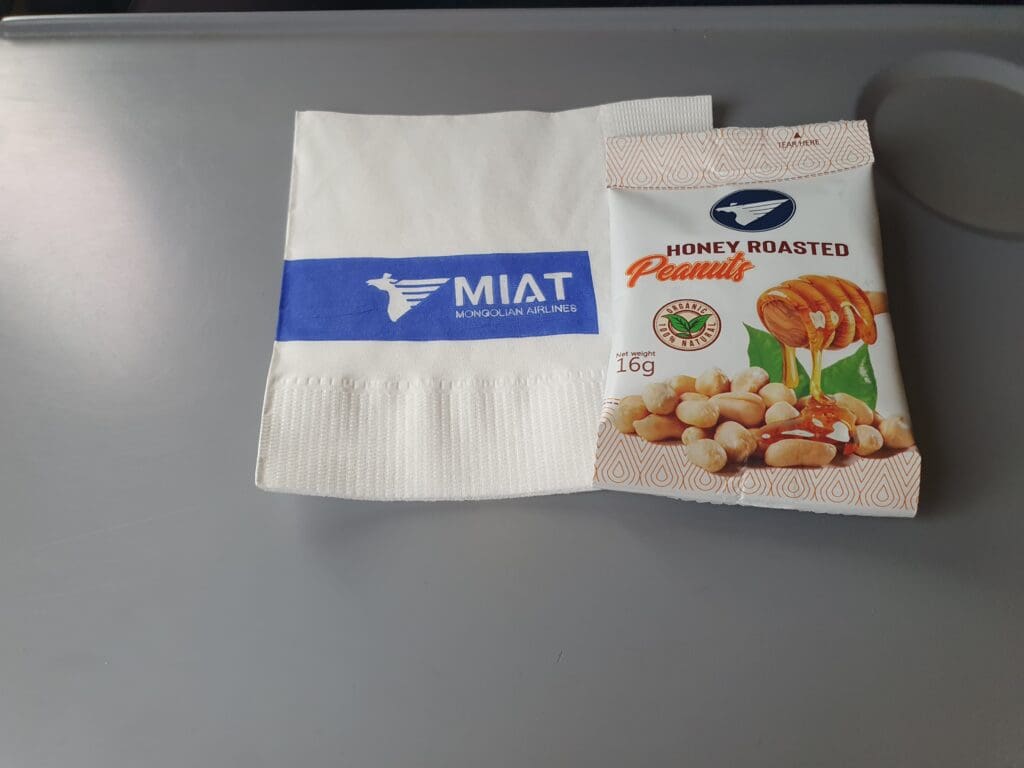
Whilst our departure and initial climb had lacked so much as a single noticeable bump, it was not until the aircraft ascended through 25,000 feet that the seatbelt signs were switched off. At this time the cabin lights were also turned back on and a couple of crewmembers passed through the cabin handing out immigration forms. Several minutes later, the aircraft levelled off at its initially cruising altitude at which point the Captain performed their brief welcome announcement in Mongolian and English. After leaving Korea’s southeast, unfortunately, a combination of haze and low clouds prevented any perfectly clear views of the mountainous landscapes below. However, as the aircraft neared Seoul, Osan Air Base could be seen before the aircraft turned towards the coastline and climbed once again to 36000 feet. Thirty minutes after leaving Busan, the crew passed through the cabin distributing packets of honey roasted peanuts which came in MIAT Mongolian Airlines branded packaging alongside serviettes featuring the airline’s logo. It is worth mentioning that whilst this pre-dinner was very much appreciated, no drinks were handed out, which, in my opinion, would have been rather welcome given the hot temperature of the cabin.
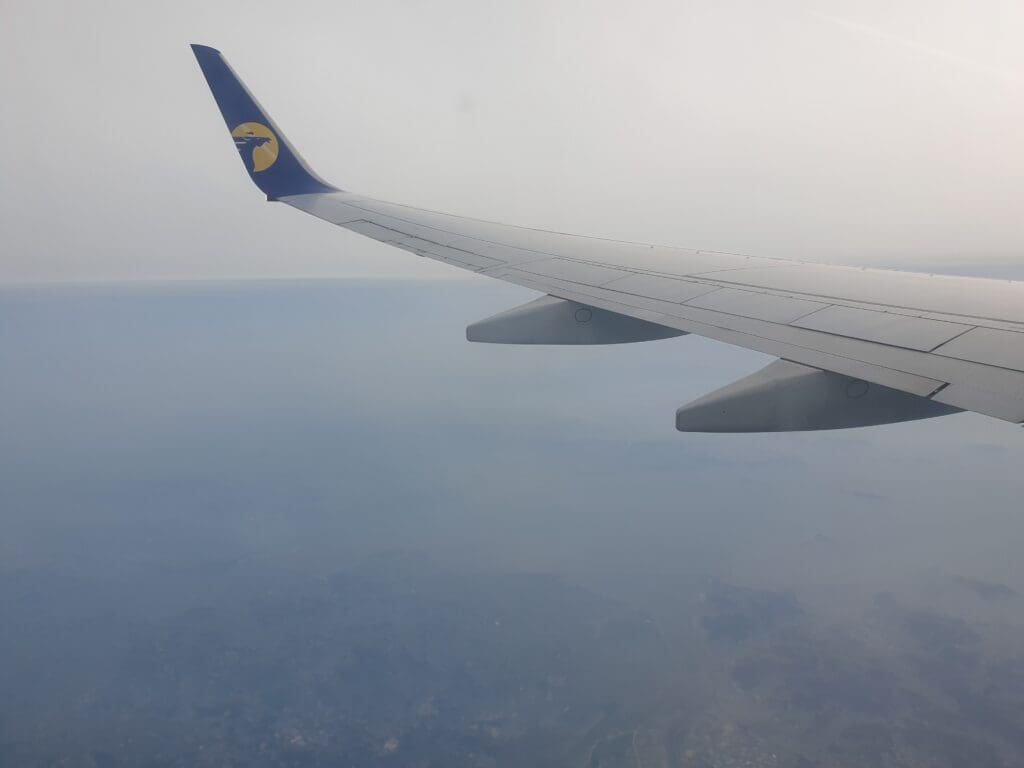
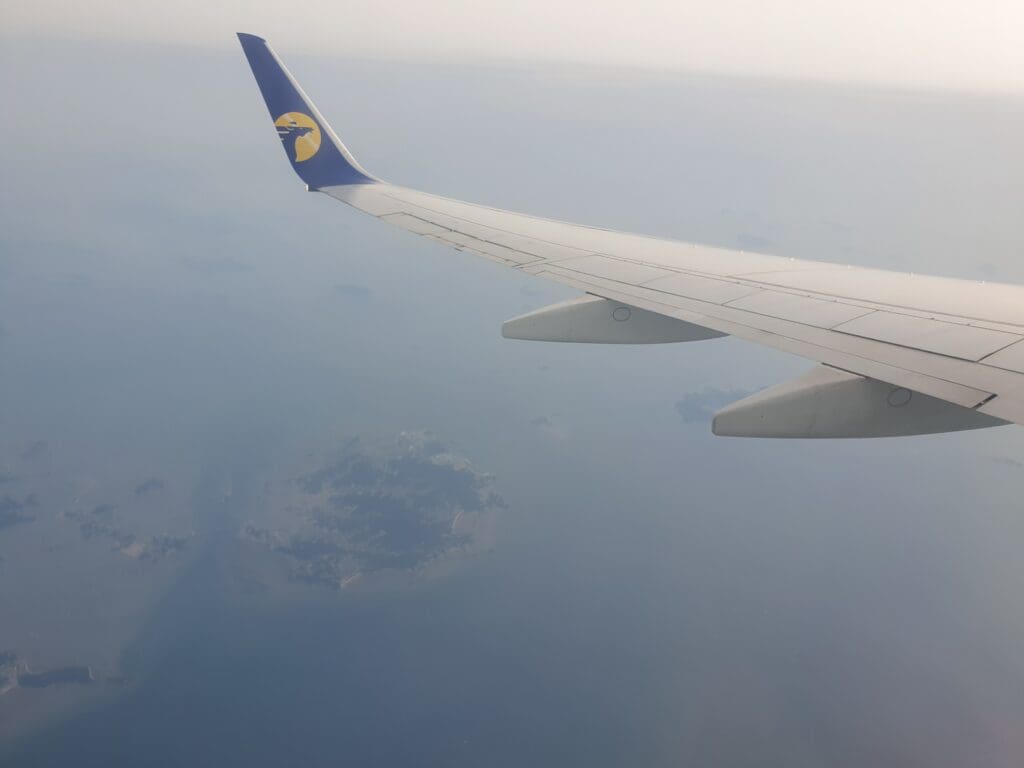

As I ate these, the aircraft headed out over the West Sea and I caught sight of a small selection of islands some distance from Korea’s western coastline. Unfortunately, as we headed out to sea, clouds soon rolled in below ensuring no views as we headed towards China’s Shandong Peninsula. As we reached the midpoint between mainland Korea and China, the seatbelt signs suddenly reilluminated and moments later the aircraft entered a rather strong patch of turbulence which proved unrelentless for a good twenty minutes. Following this extended period of bumping and shaking, once things had settled, at approximately 1930 Korean time, the crew commenced the dinner service. Whilst I cannot claim to be an expert in cabin service, this appeared to be done in a rather inefficient manner. First, two crew members each with their own drinks trolley proceeded to the front and middle of the aircraft and began to hand out drinks. Meanwhile, a couple of minutes later, a third crew member began handing out meals to several rows around the middle of the aircraft before retreating to the rear galley and allowing the other two crew members to finish serving drinks to all passengers. Once all passengers had their drinks, one of the crew members came around asking passengers whether they would like beef or chicken before handing meals out to passengers by hand. All in all, I cannot help but think that this was a rather strange and inefficient way to undertake the flight’s dinner service, however, I must assume that there was a reason for doing things in this unusual order!

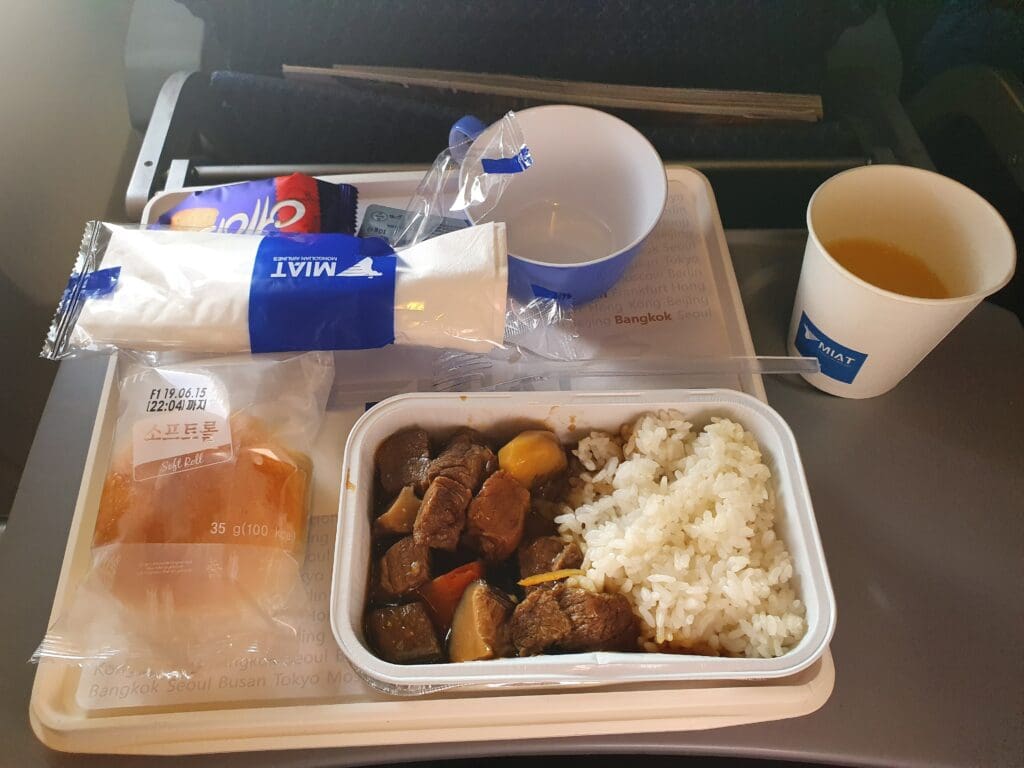
Opting for the beef dish, this was handed to me on a tray which, aside from the main dish, contained a limited selection consisting of a packaged bread roll, a packet of savoury crackers and a small tub of butter. I ought to mention that, everything on the tray, including the plastic mug, cutlery packet and butter appeared to have been heated. Consequently, the butter had melted entirely, although the inadvertently heated bread roll was also a nice touch! Upon opening up the foil container, I found the main dish to consist of chunks of beef in a sweet soy sauce which sat atop a bed of rice. Glancing over at my neighbour’s chicken dish, this appeared to consist of chicken with kimchi and rice, and upon seeing this I wished that I had opted for the chicken instead. Whilst the meal felt a little lacking, the quality of the main dish was not all too bad, although the rice did seem to be moderately overcooked and thus crispy. Once the majority of passengers had finished eating, at 1915 Mongolian time, the seatbelt signs were turned back on once again just as the hot drinks round commenced. Despite this, the crew pressed on first presenting passengers with a tray containing two different sorts of tea bags as well as a sachet of coffee. After this, another crew member came to fill passengers’ cups with hot water.
As the Boeing 737 crossed high above China’s northeast, thanks to the blanket of clouds below nothing could be seen of the region’s towns, cities and diverse landscapes. With little else to do, I decided to have a quick explore of the MIAT Mongolian Airlines provided entertainment onboard the flight. With no personal or overhead screens onboard this particular aircraft, this was limited to the airline’s quarterly inflight magazine. As is occasionally the case, I found this to be heavily laden with advertisements for a range of Mongolian businesses. With the services advertised ranging from newly constructed housing estates to questionable karaoke bars. Focusing on the magazine’s articles, these were plentiful yet ultimately lacked much diversity, virtually all of which consisted of interview style pieces with a range of characters – artists, celebrities and entrepreneurs. Perhaps slightly more of interest to aviation enthusiasts was the airline and fleet information pages at the rear of the magazine. Finally, it is worth mentioning that almost all articles appeared to be in both Mongolian and English. However, articles or information in any other language were completely absent from this publication.
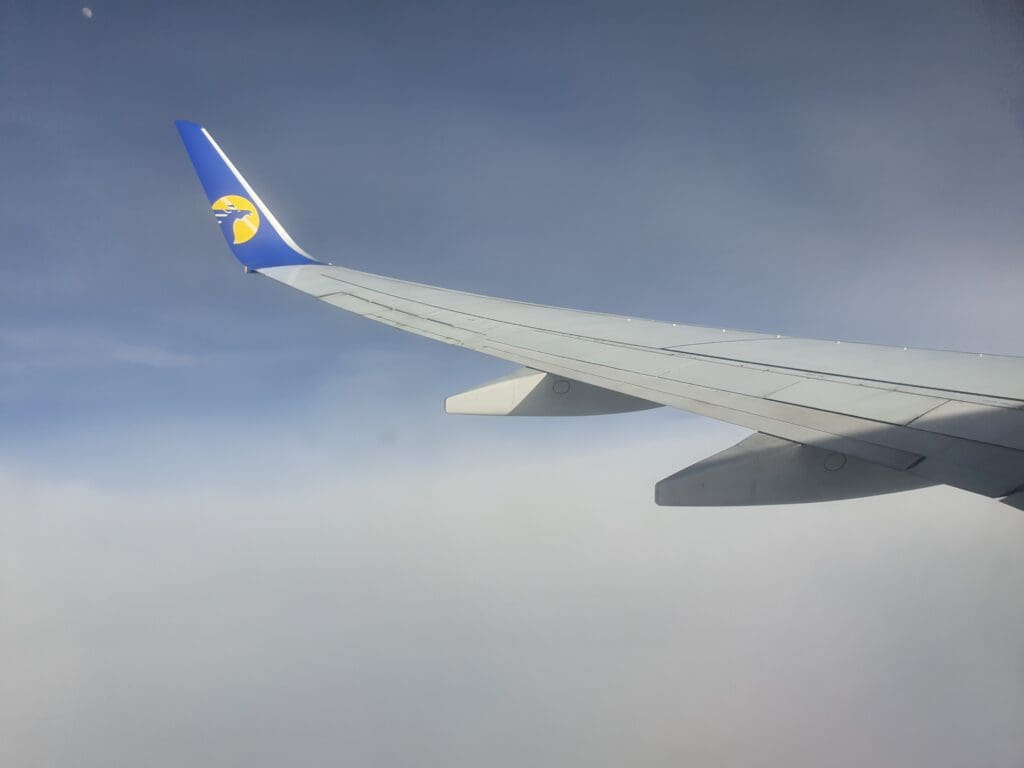
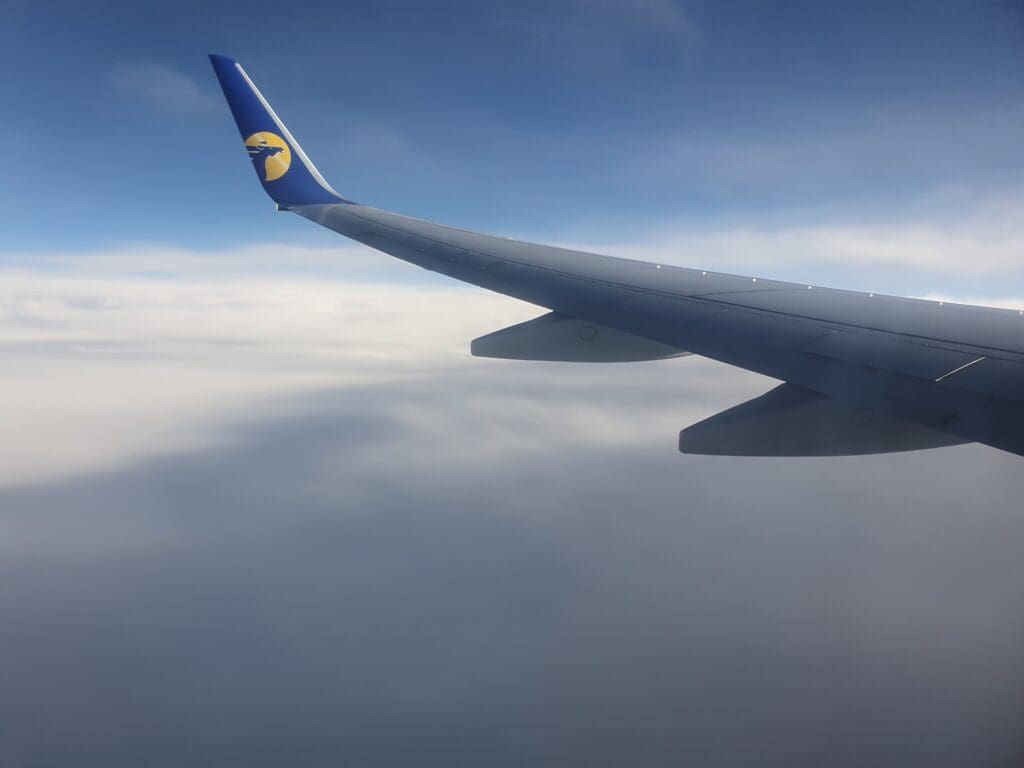
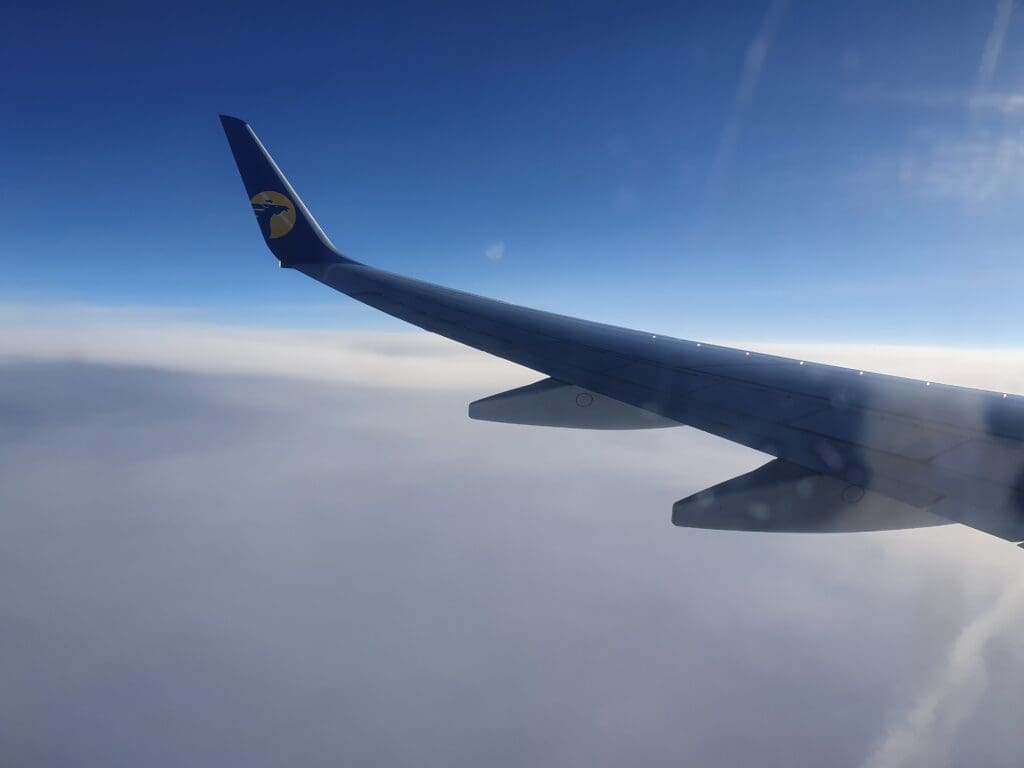
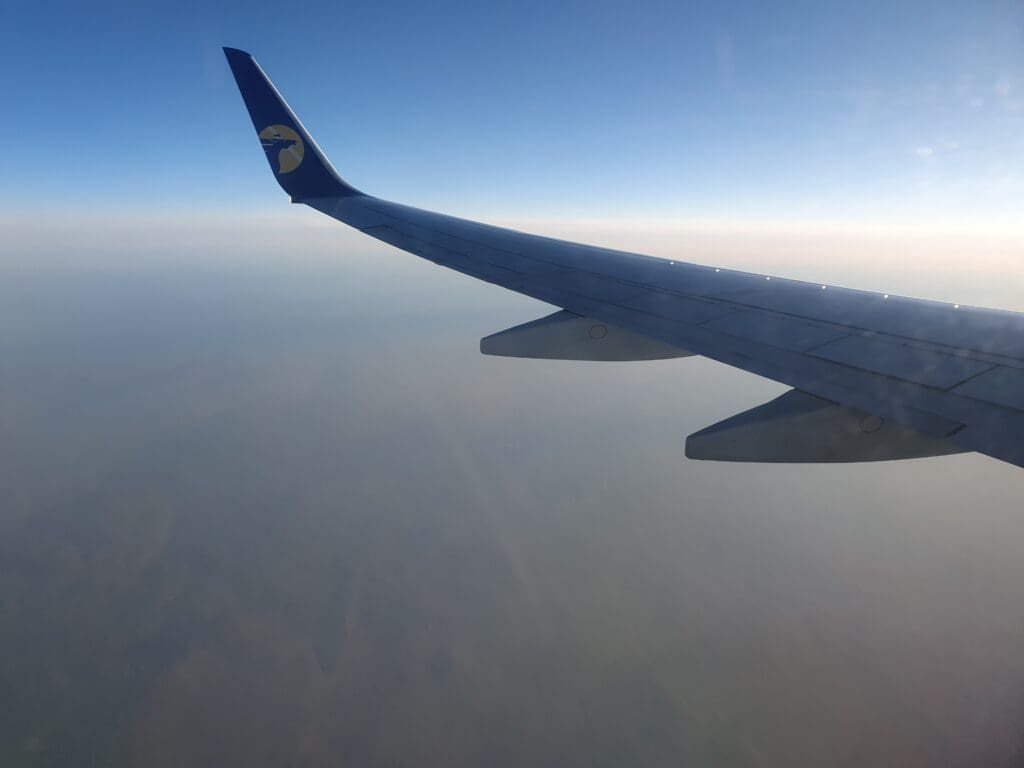
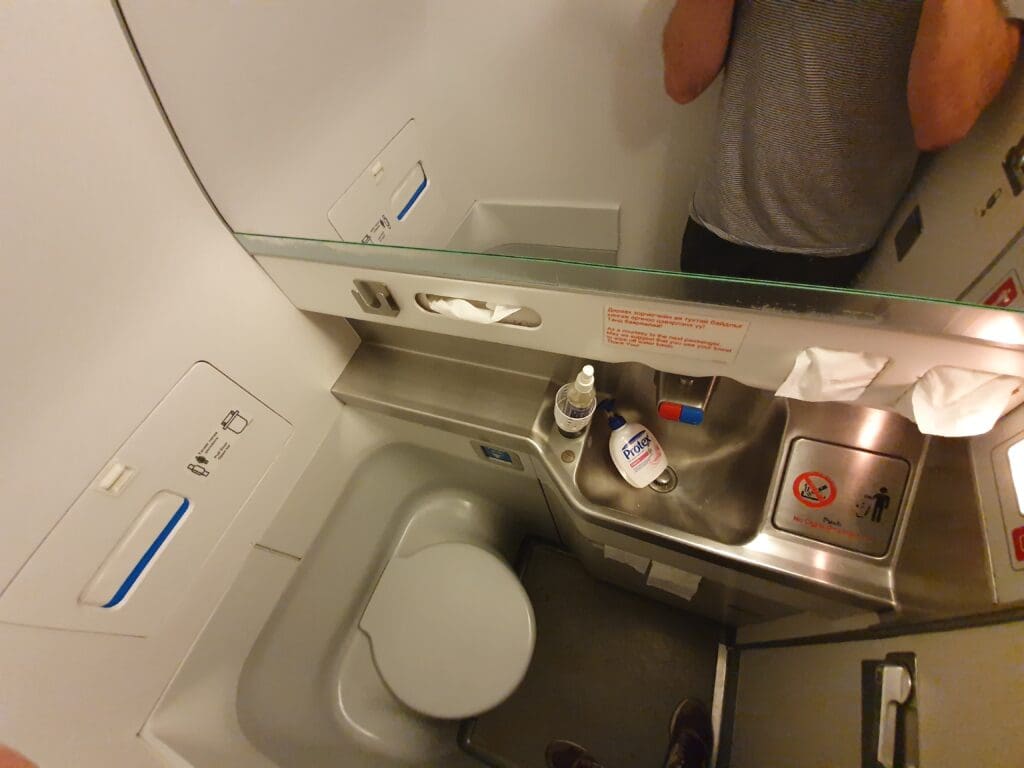
Once I had exhausted the inflight entertainment options, I was pleased to see that the clouds beneath the aircraft had begun to break up offering glimpses of the remote and sandy coloured landscapes of northern Hebei and Inner Mongolia. Meanwhile, almost an entire hour after the dinner service commenced the cabin crew passed through the cabin collecting trays from the front and middle thirds of the economy class section of the aircraft before retreating to the rear galley. Perhaps convinced that the crew would not return, my two seatmates who were travelling as part of the large church group proceeded to take matters into their own hands and carry their trays to the rear galley. Eventually, around thirty minutes later, the trays from the rear portion of the galley were removed. Once again, I was a little taken aback by the inefficient way that the crew appeared to be doing things that evening. After the trays had been collected, I decided to make a quick trip to the toilet. Despite looking a little tired, I was pleased to find this to be fairly clean and was stocked with all the basics.
After returning to my seat, the aircraft entered Mongolian airspace at which point an announcement was made regarding the duty free service. Unlike the previous rounds of service, the trolley sped through the cabin at lightning speed and not a single purchase appeared to have been made. Beneath the aircraft, my first glimpses of Mongolia’s golden landscape were offered as we sped across Sukhbataar Province, passing to the west of Naran. As we headed across Mongolia, dusk rapidly approached and at 2033, the seatbelt signs were reilluminated for the third time during the flight. However, this time these were switched back on in preparation for our arrival. A couple of minutes later, the Purser conducted a pre-arrival announcement informing all passengers of the local time in Mongolia before making the usual requests regarding tray tables, seatbacks, window shades and seatbelts. After miles of nothingness bar the sight of hills below, the first signs of life came only a relatively short distance away from the Mongolian capital. This involved glimpses of the town of Bagakhangai and its airbase coming at 2037. From there the aircraft continued to sink downwards over the hilly landscape where a few small industrial sites and settlements could be seen before we headed out over the Bodg Khan Uul Biosphere Reserve, here the occasional cluster of gers could be spotted indicating that we were definitely over Mongolia.
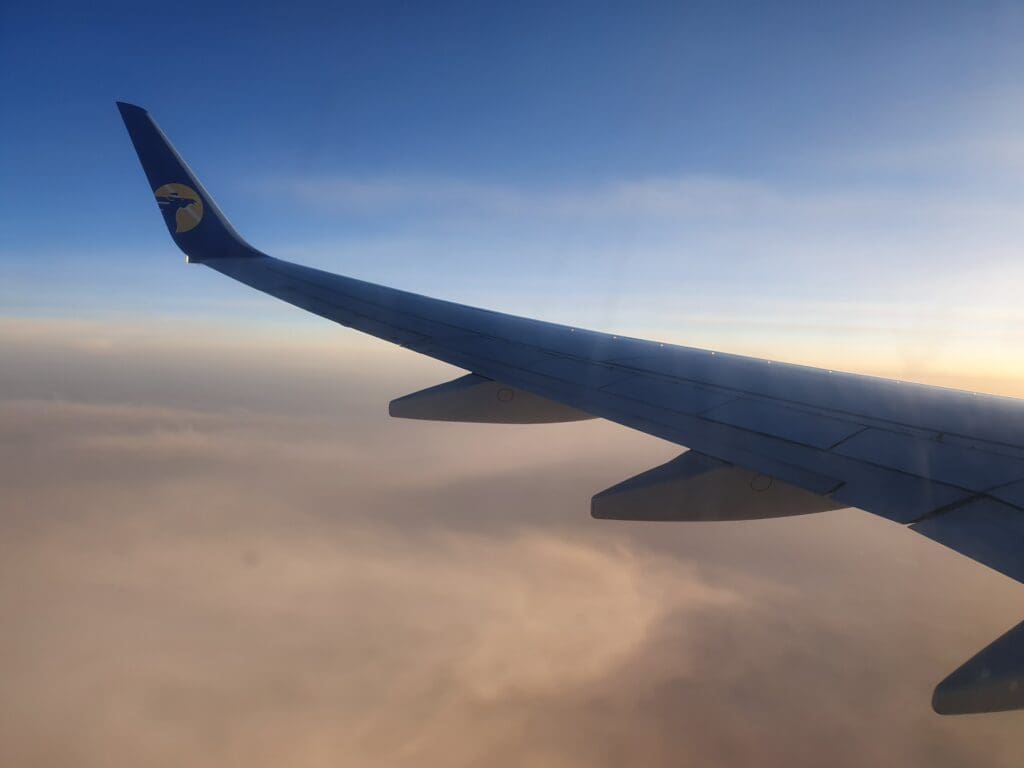
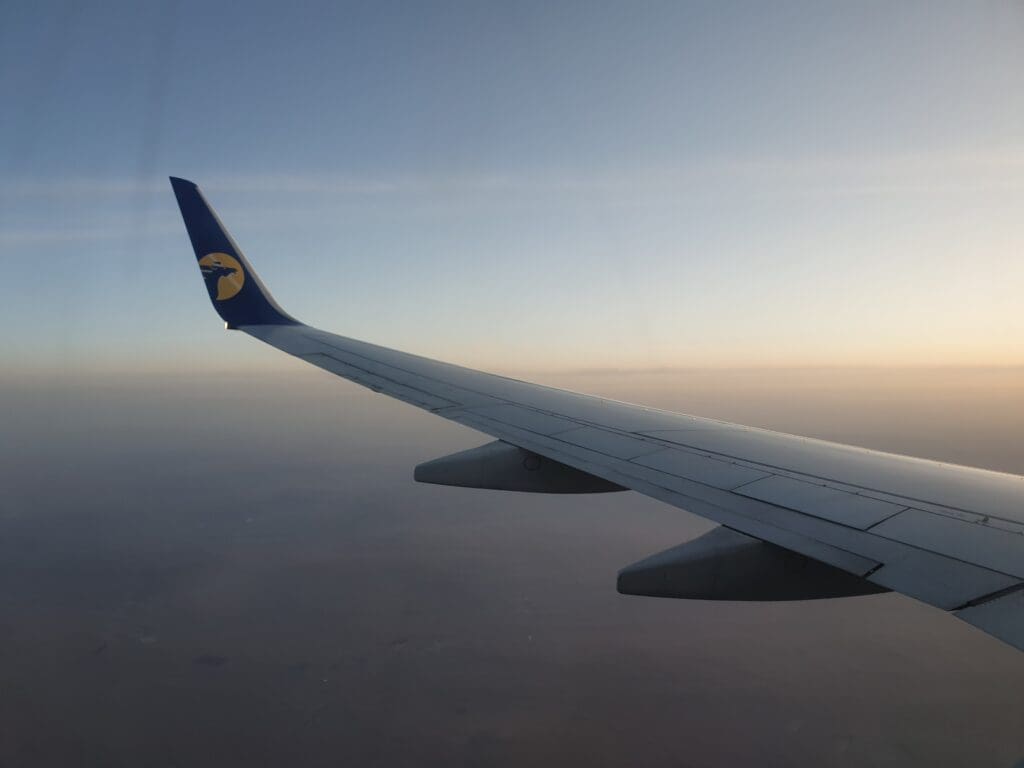
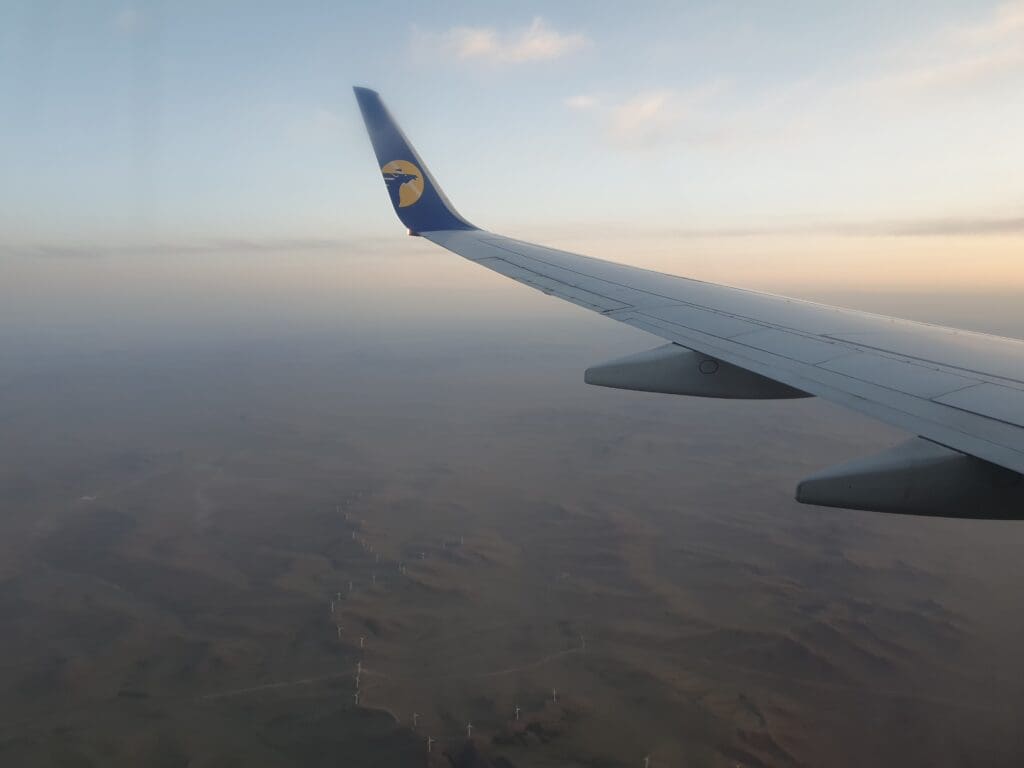
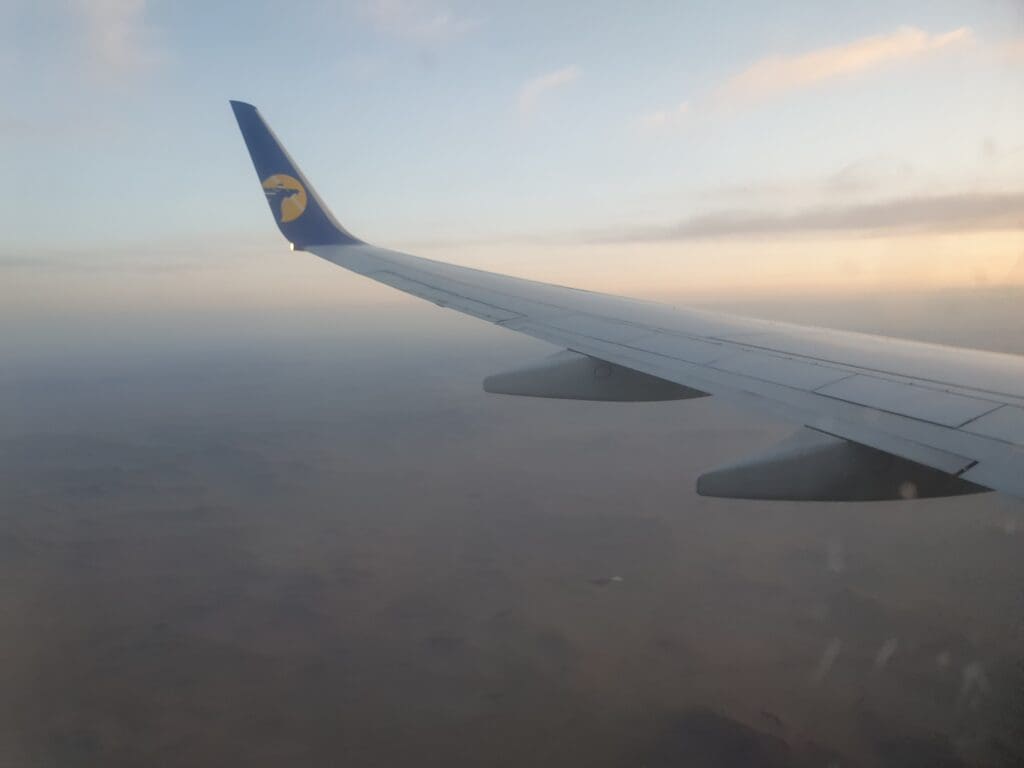
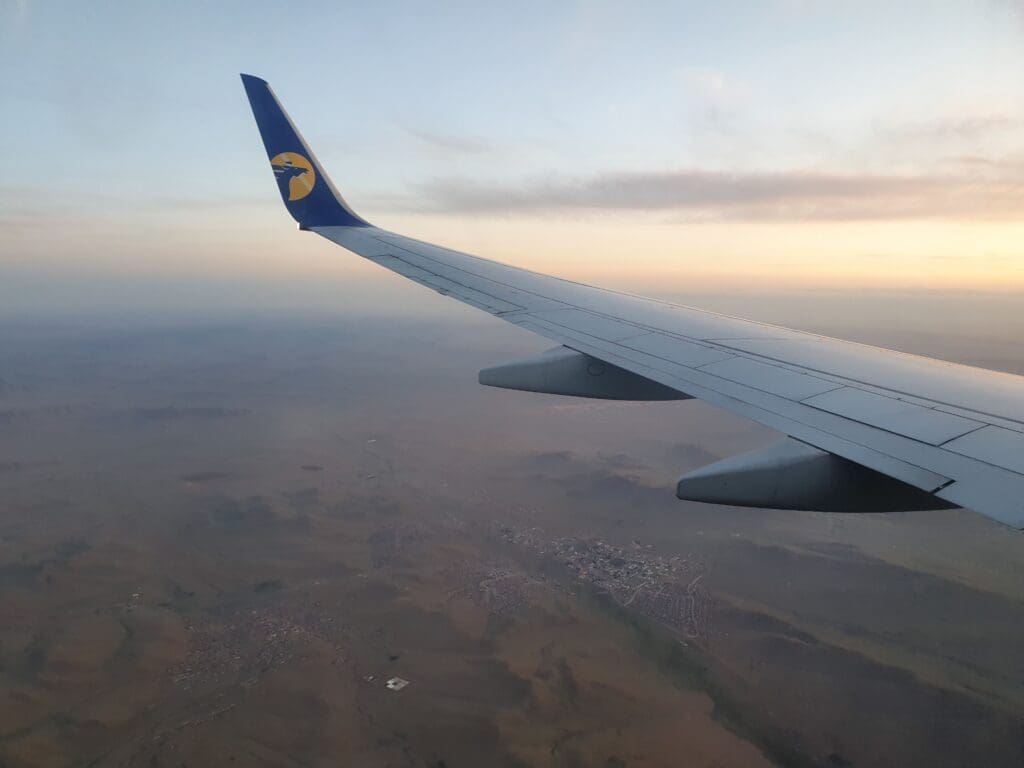
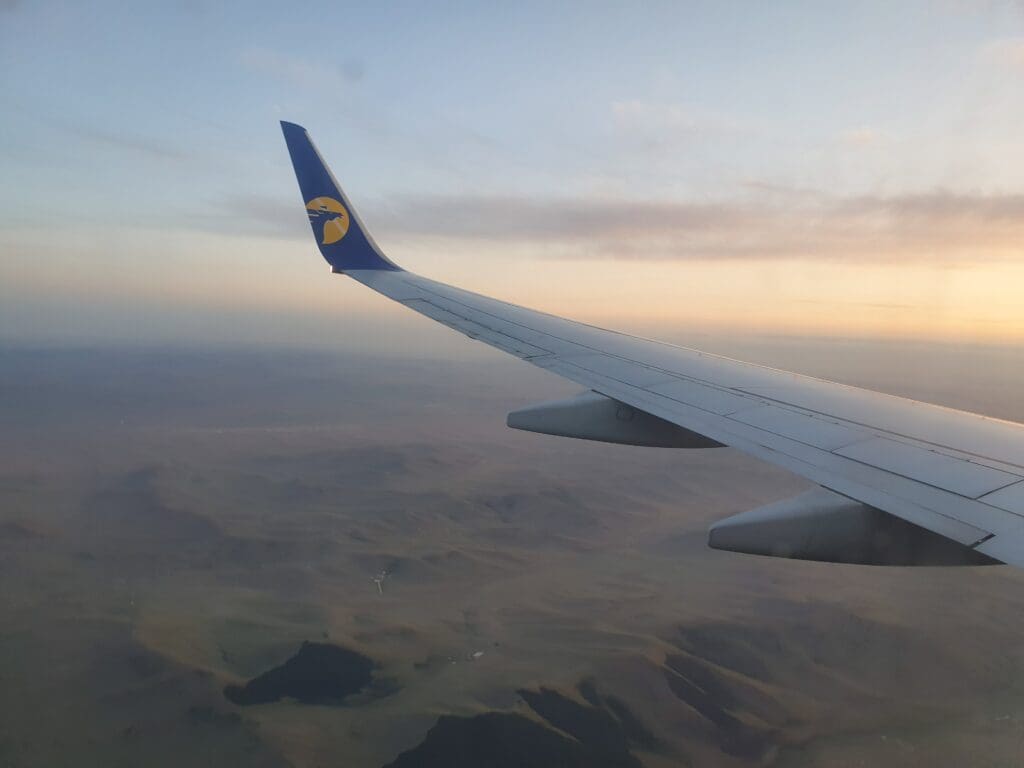
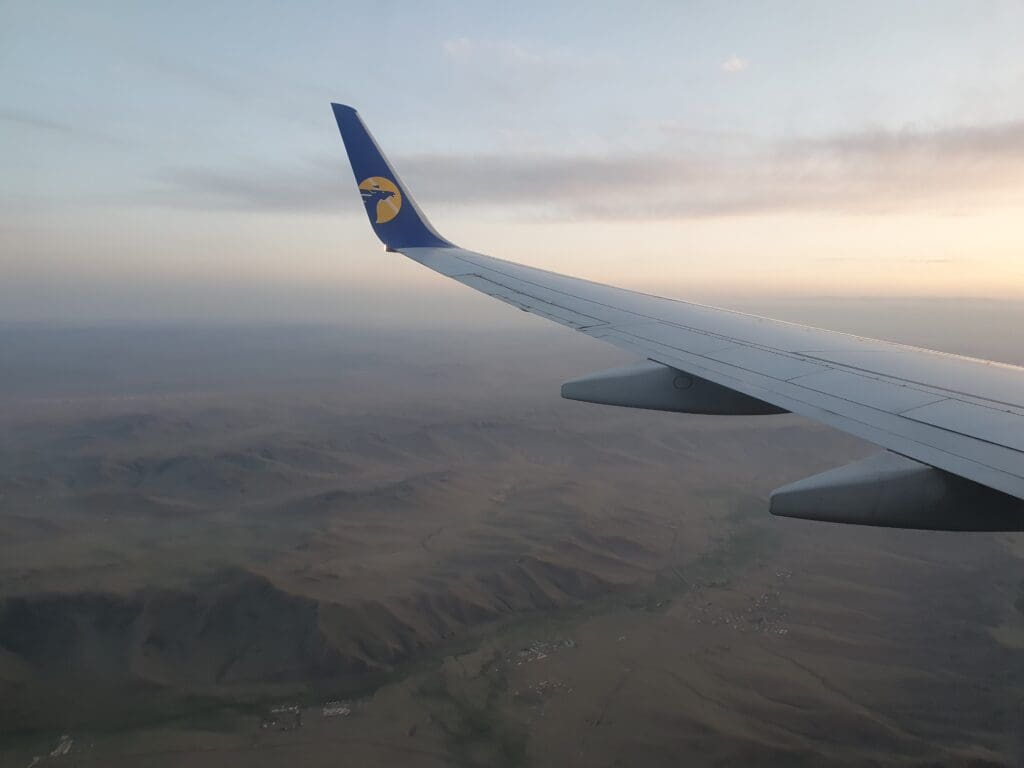
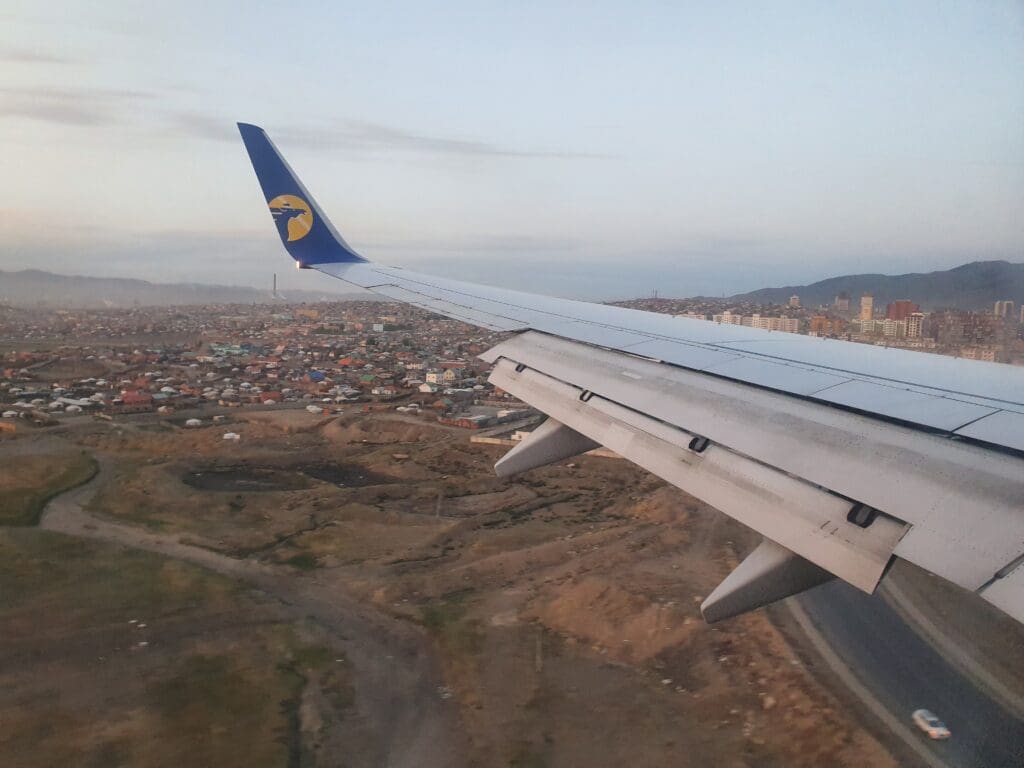
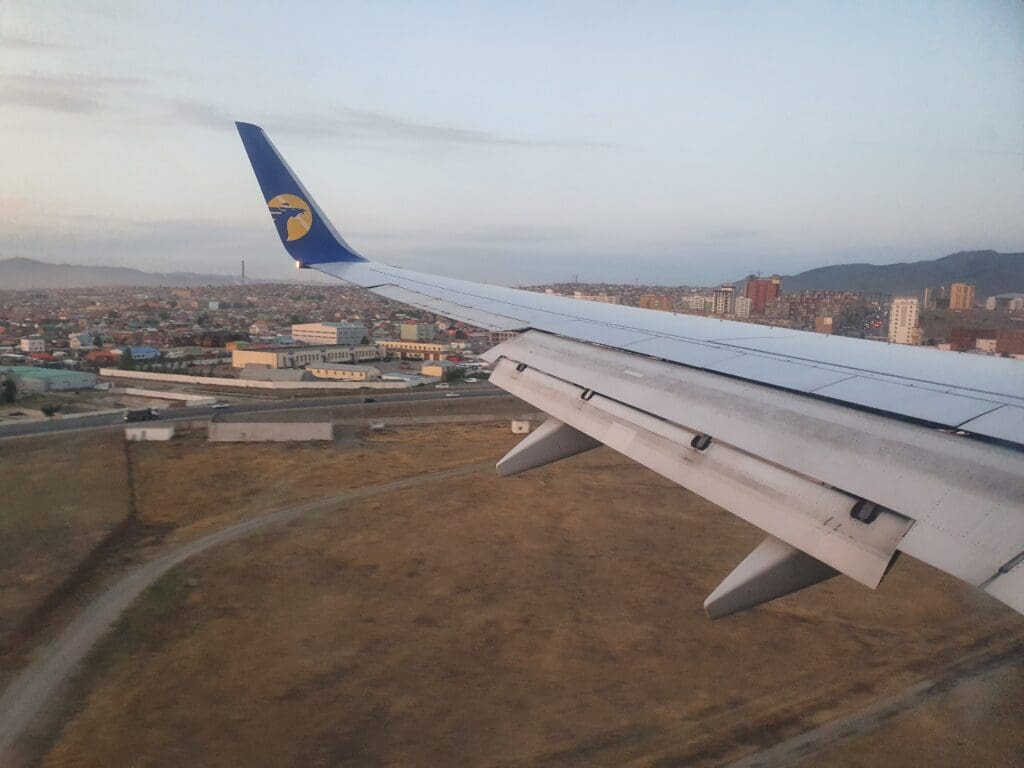
As the aircraft continued descending, a couple of cabin crew members passed through the cabin ensuring all was secure for the flight’s arrival and at 2043, the Boeing 737 passed over the airport at 9,000 feet. This presumably allowed those on the opposite side of the aircraft to get a good view of Ulaanbaatar and its airport. Four minutes later, the aircraft banked to the right in order to line up for an approach to Runway 14 whilst the aircraft’s flaps and landing gear were extended. Meanwhile, inside the cabin, one of the pilots made the ‘cabin crew prepare for landing’ announcement at which point the cabin lights were switched off.
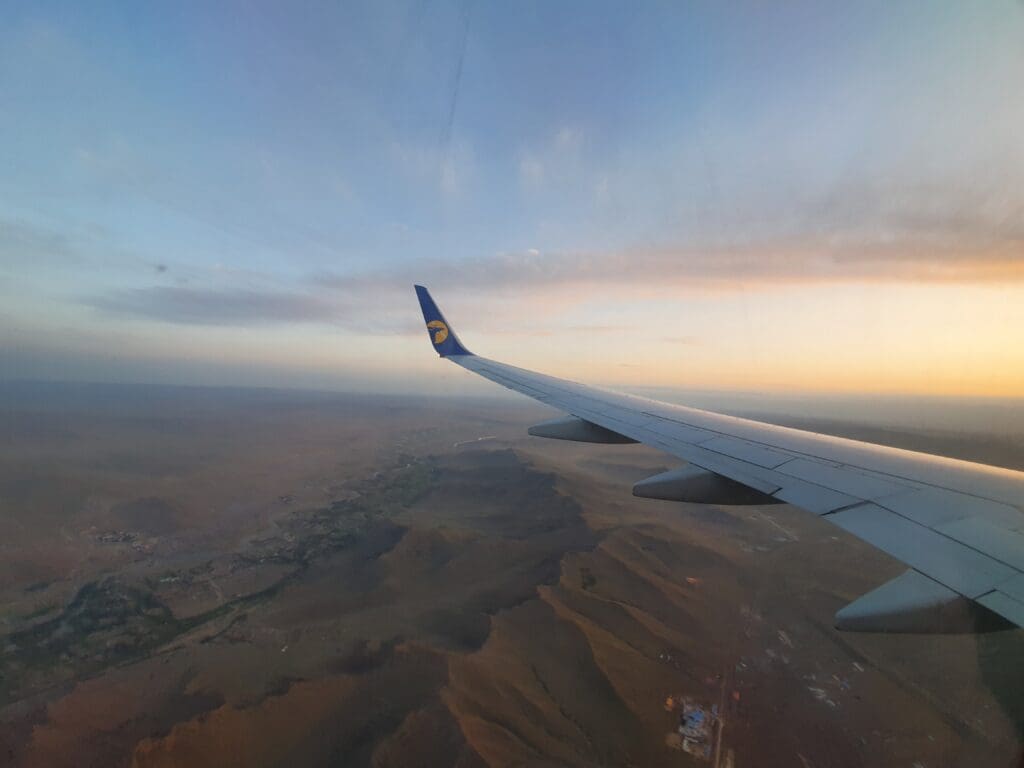
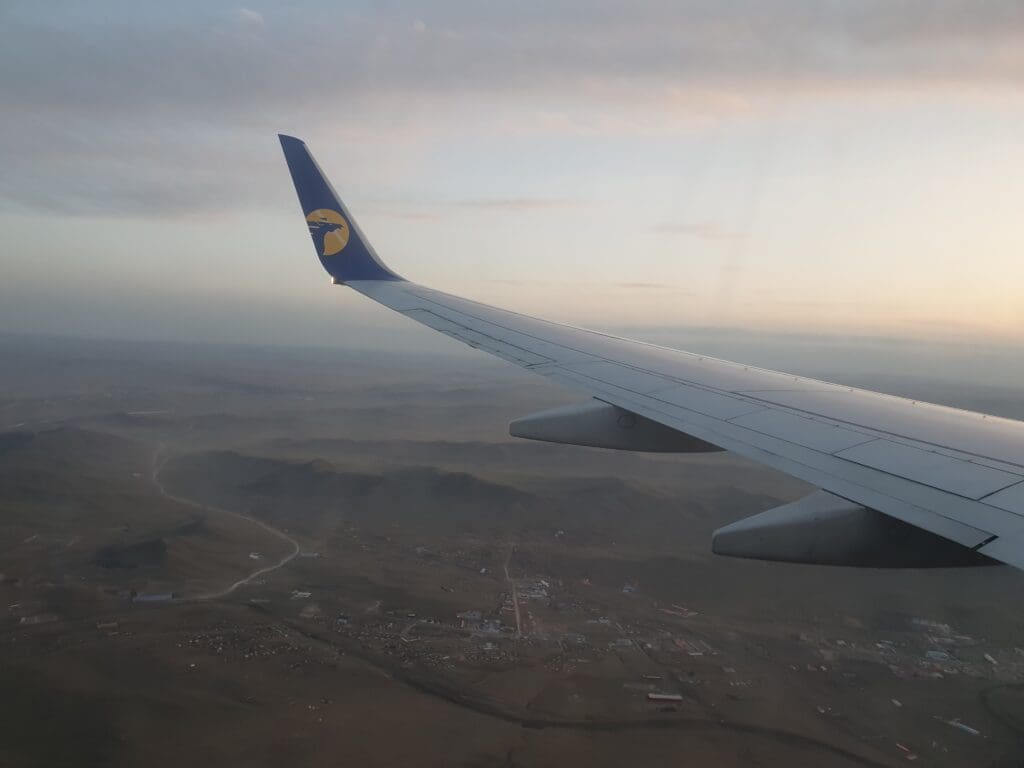
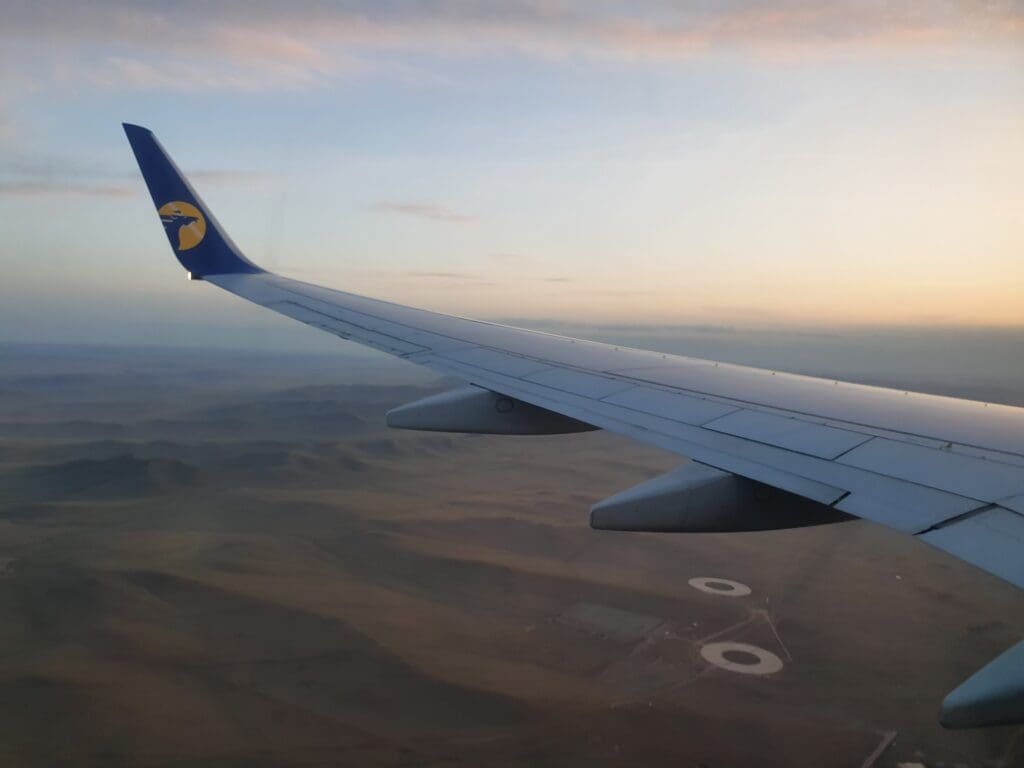
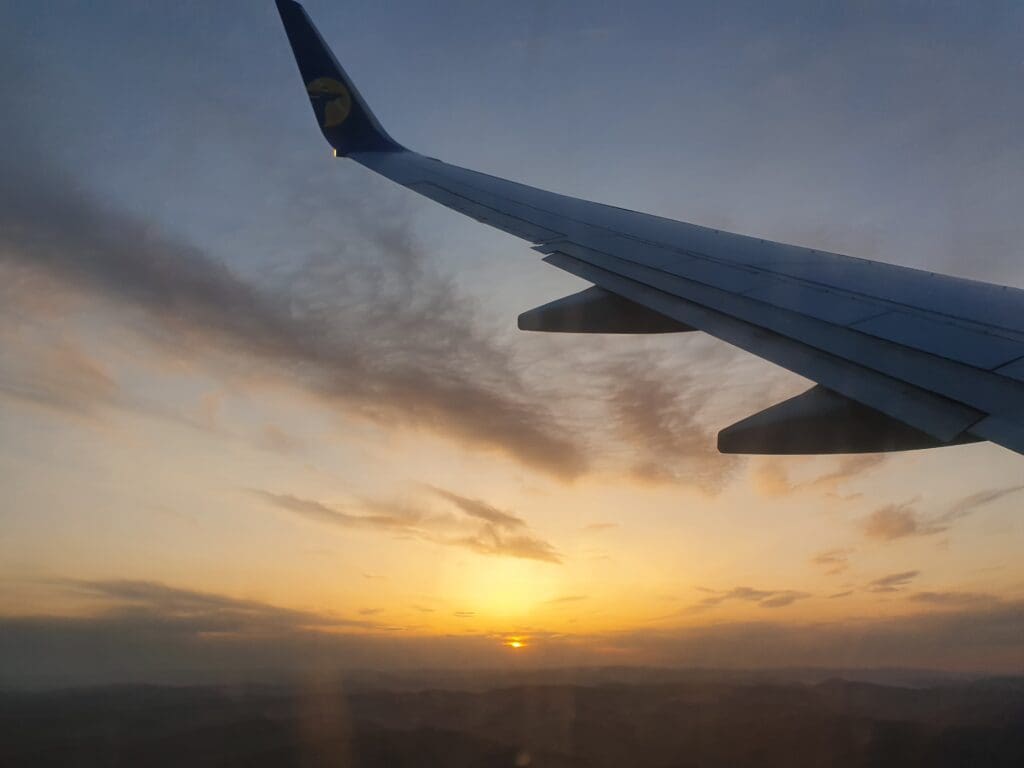
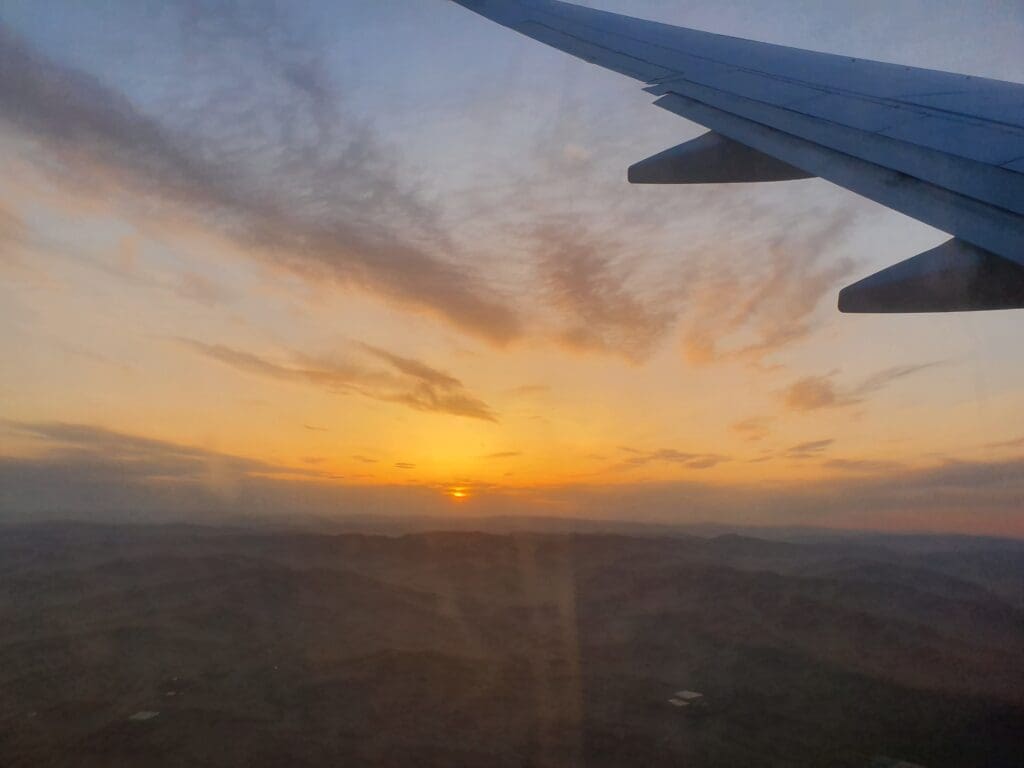
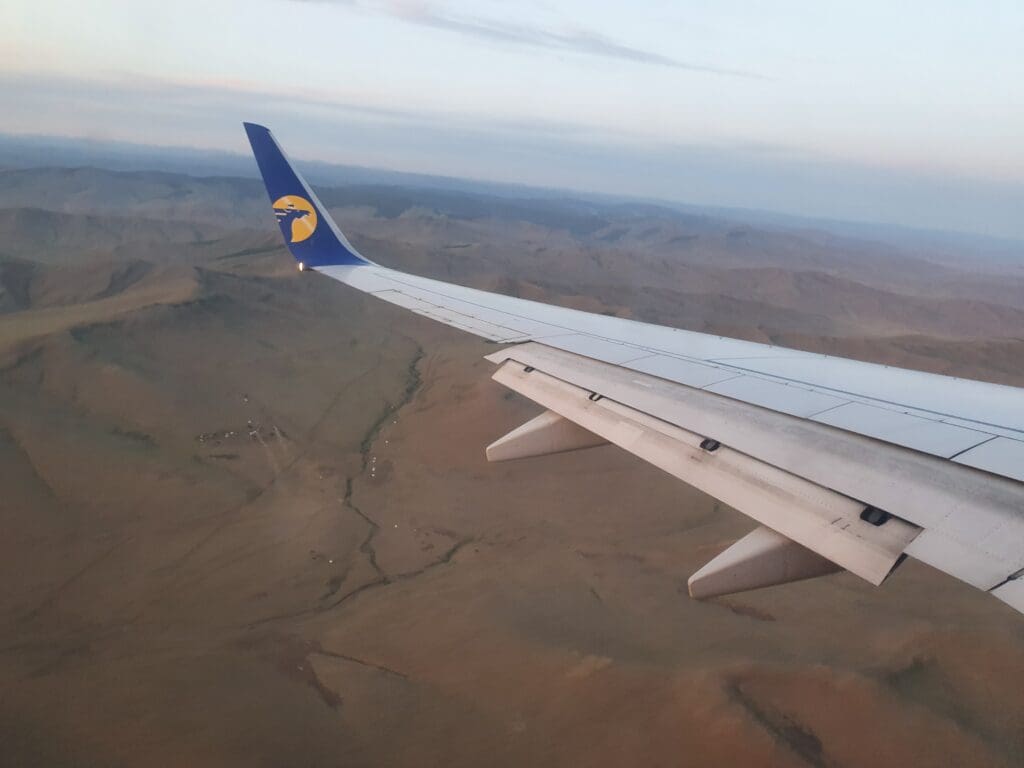
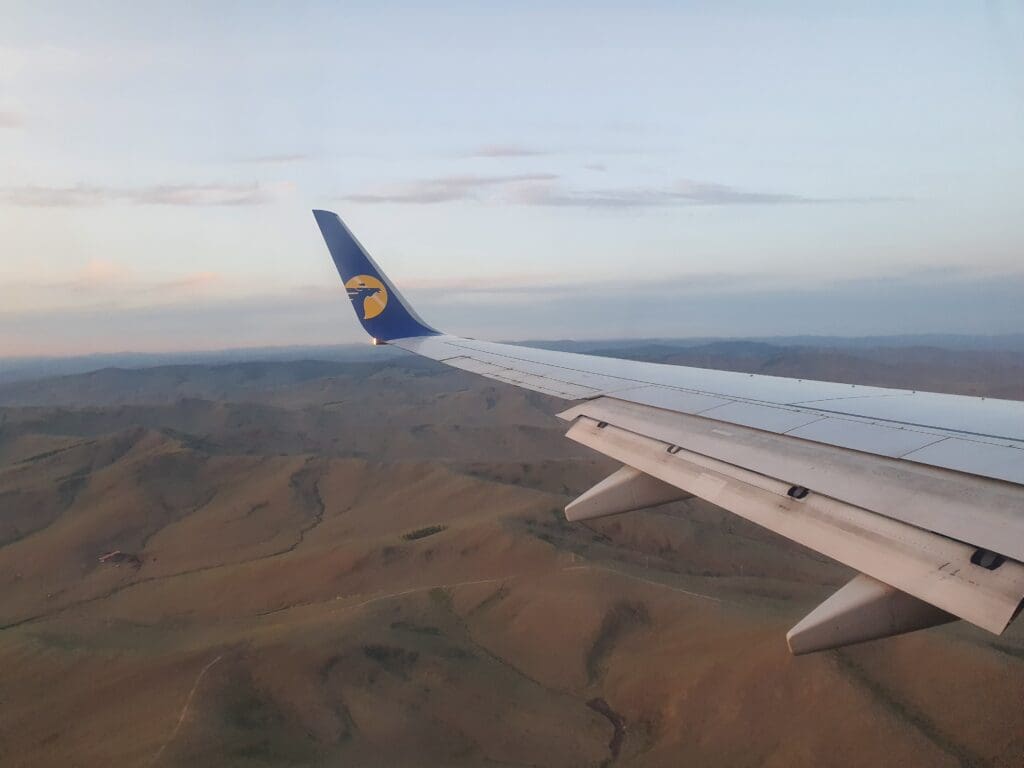
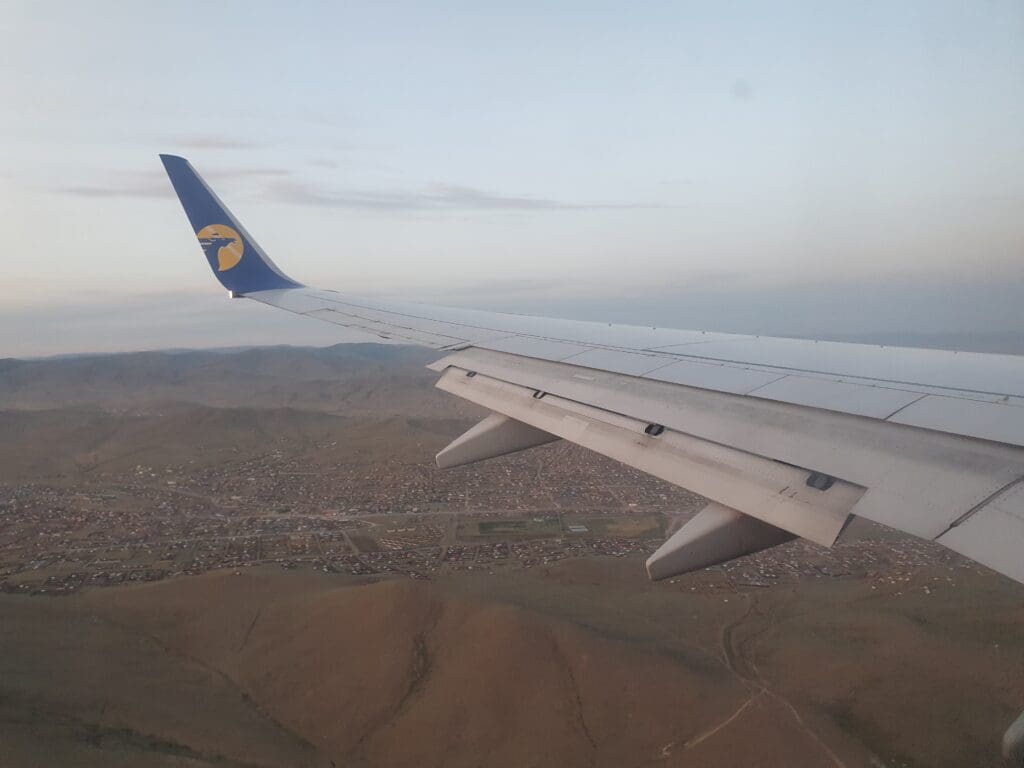
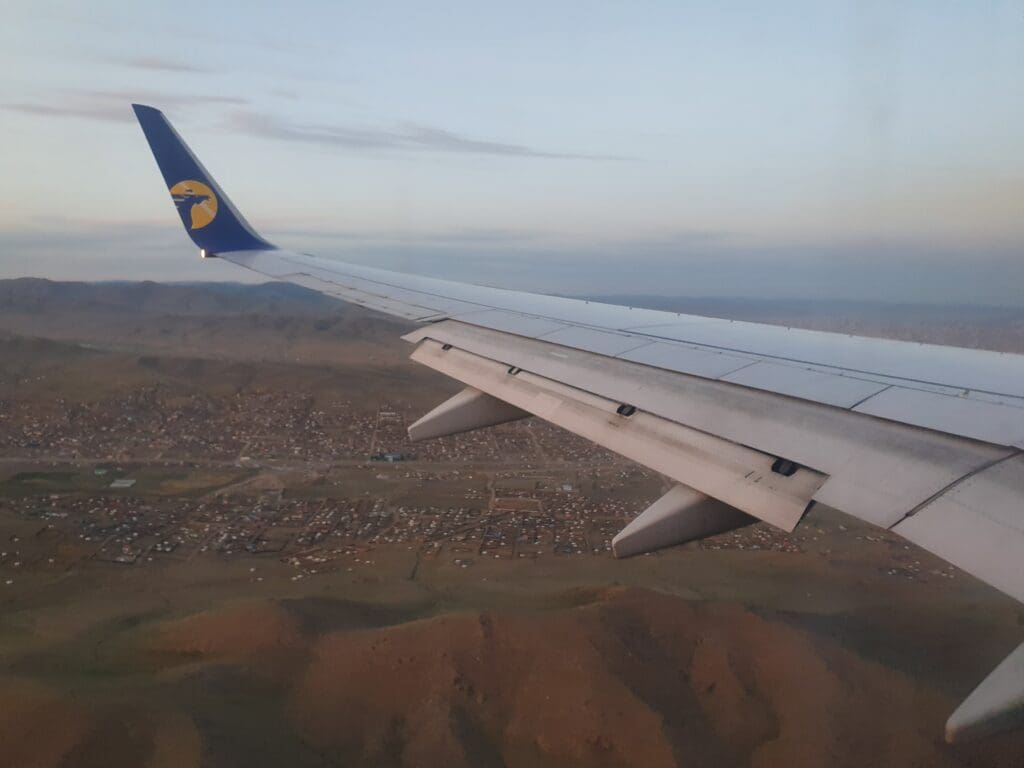
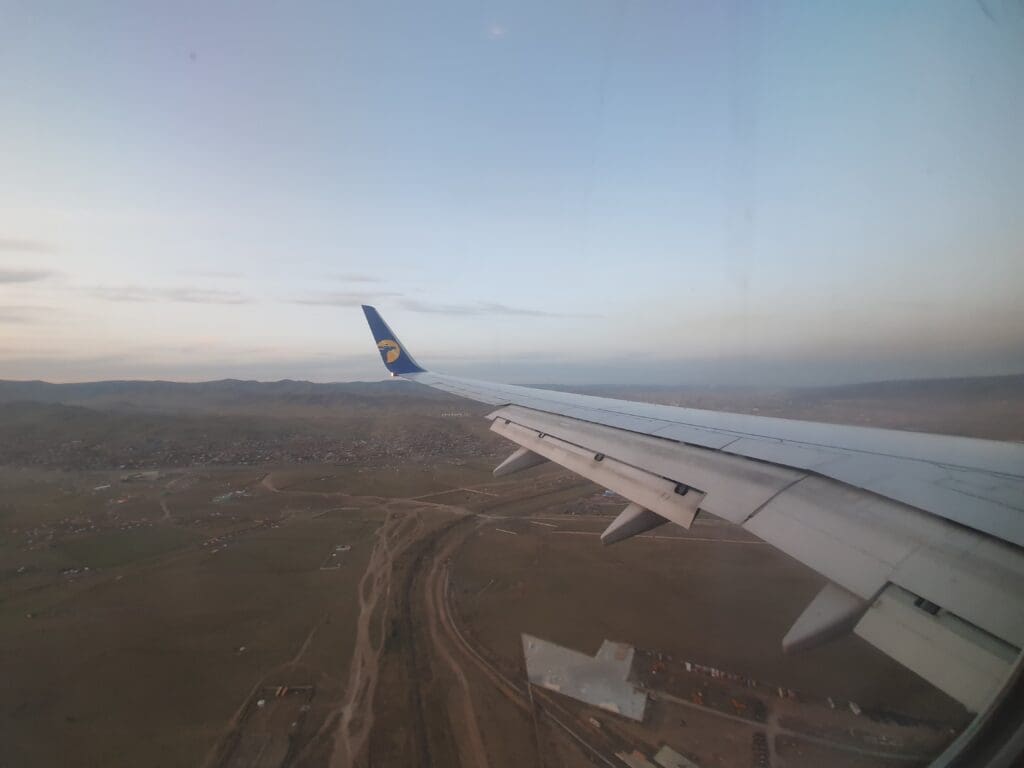
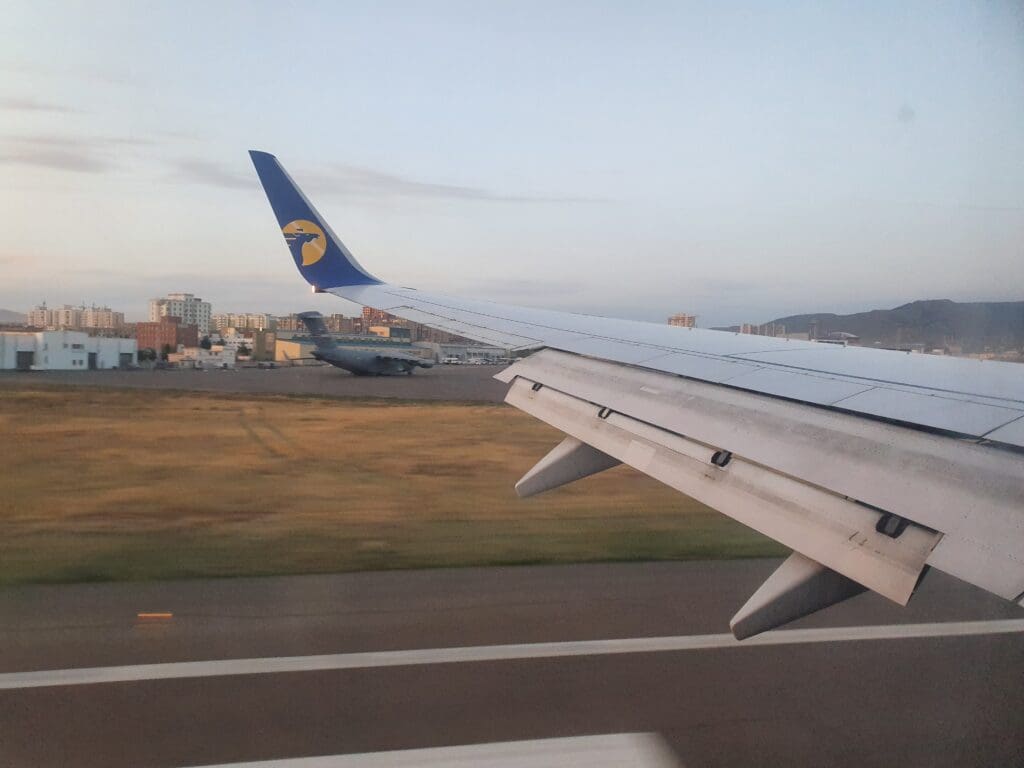
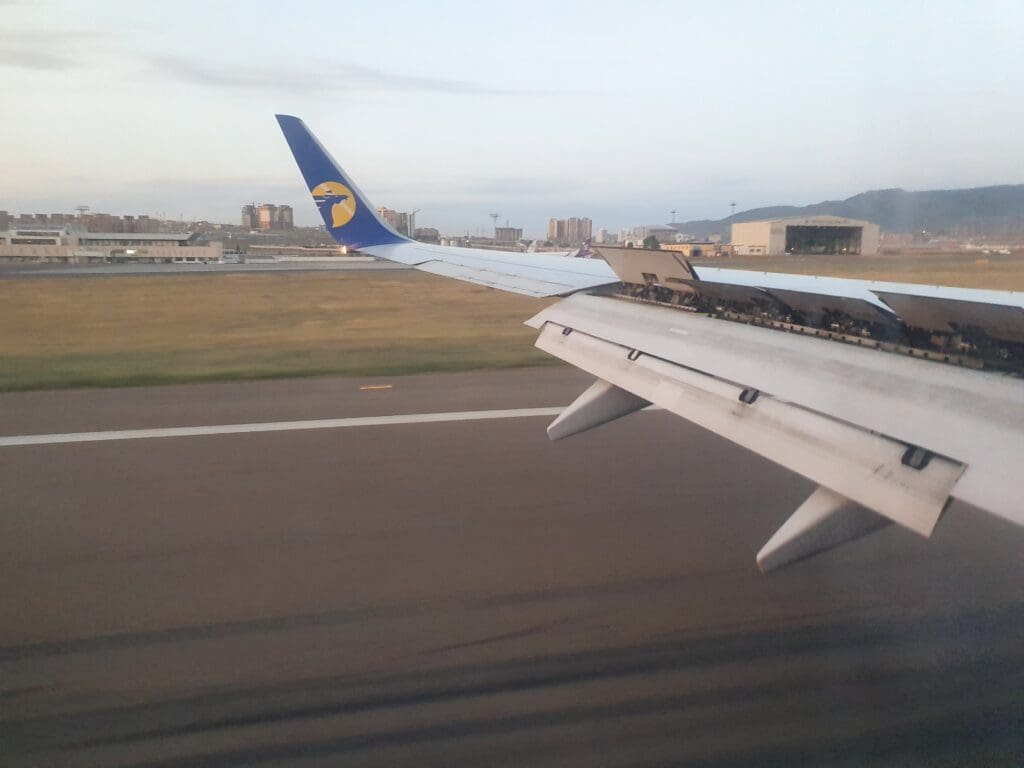
Not too long after the flaps and gear were extended, Ulaanbaatar appeared in the distance as did several residential and industrial areas before the aircraft crossed over the Tuul River. Moments later at 2052, the aircraft darted over the perimeter fence at which point an unexpected visitor could be spotted, a US Air Force Boeing C-17 Globemaster III. 3H37 after departing Busan, the aircraft made a gentle touchdown at which point another even more unexpected visitor appeared, a USAF Boeing C-40B sporting the blue, white and gold ‘Air Force One’ colours. Meanwhile, more expected yet equally rare (for me) aircraft could be seen in the form of one of Hunnu Air’s recently delivered Embraer 190s alongside a Boeing 737-700 operated by the reincarnated Eznis Airways. As we gently decelerated, the airport’s small aircraft graveyard came into view which featured former MIAT Antonov 24s, ex-Aero Mongolia and Hunnu Air Fokker 50s, a single LET 410 and some abandoned Soviet built helicopters. Eventually, the Boeing 737 taxied off the runway and made its way towards the empty terminal whilst a superb sunset filled the skies in the background. After the usual post-arrival announcement was made in Mongolian and English by the Purser, the aircraft reached the apron and slowly pulled into Gate 1.
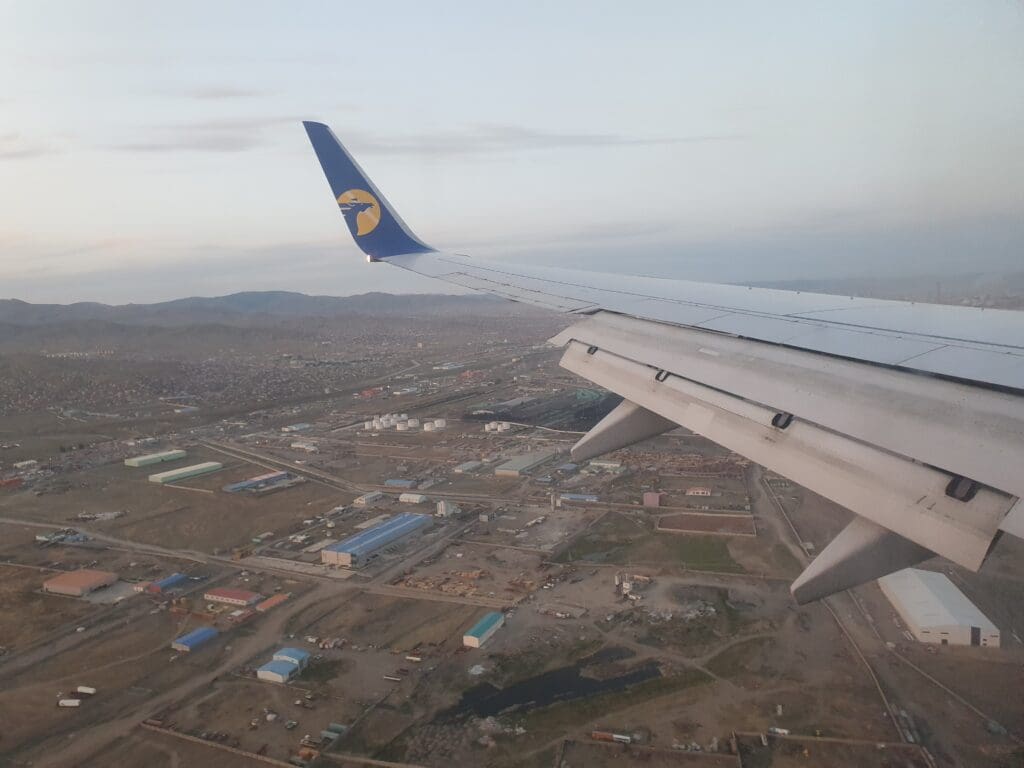
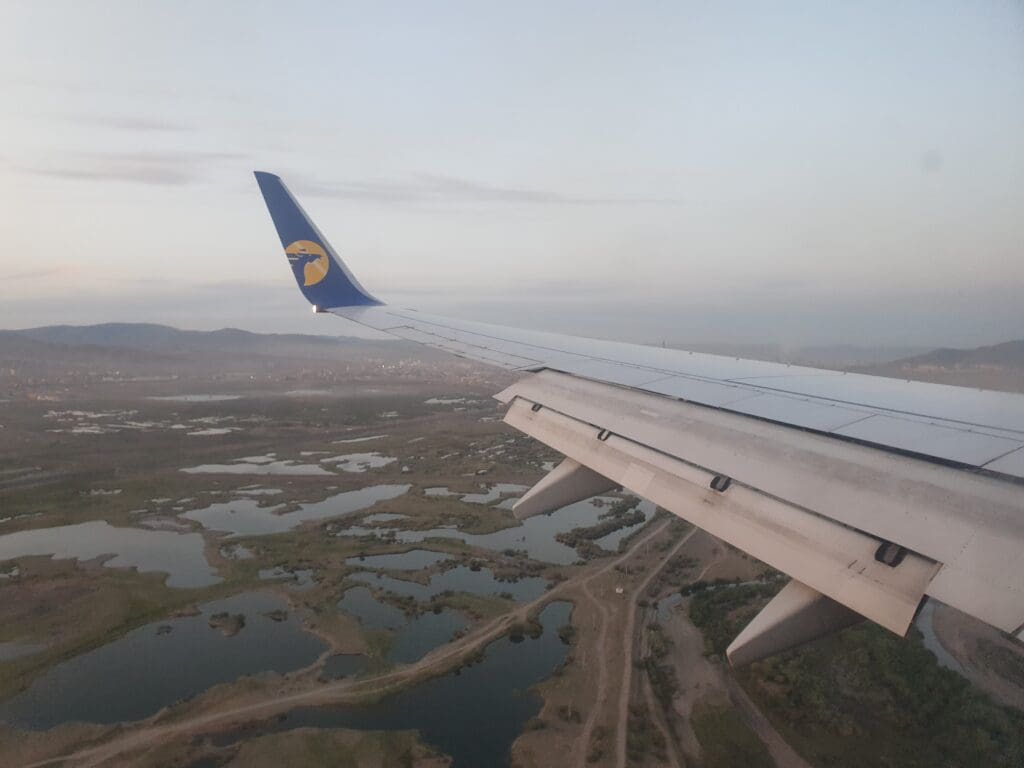
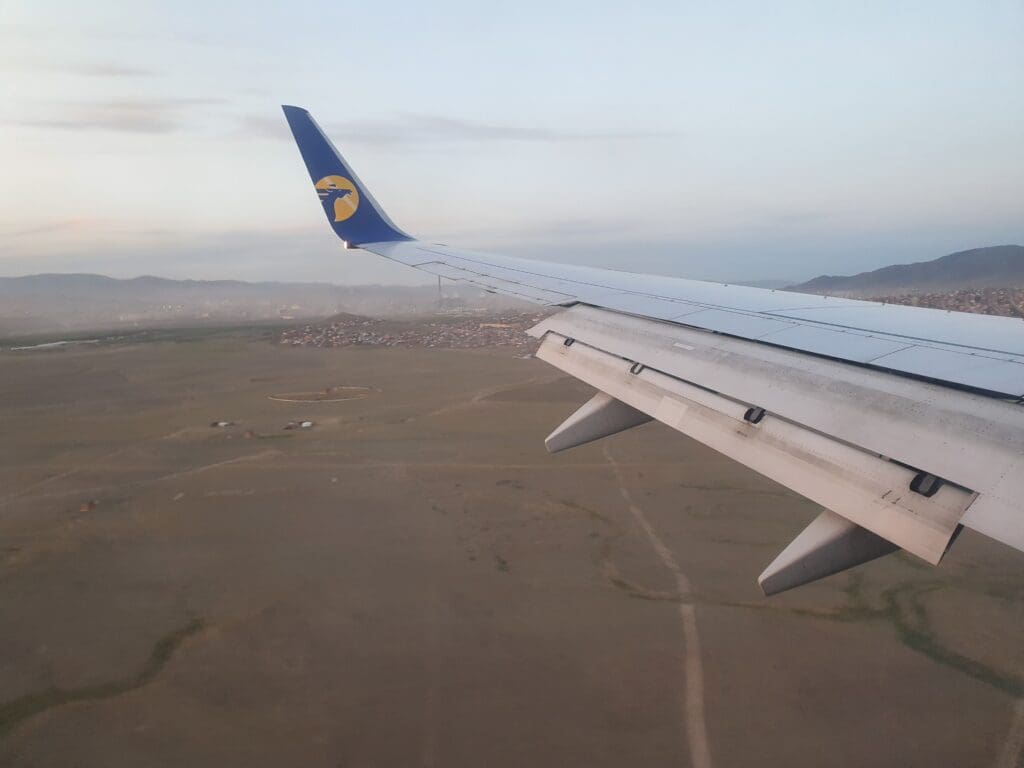

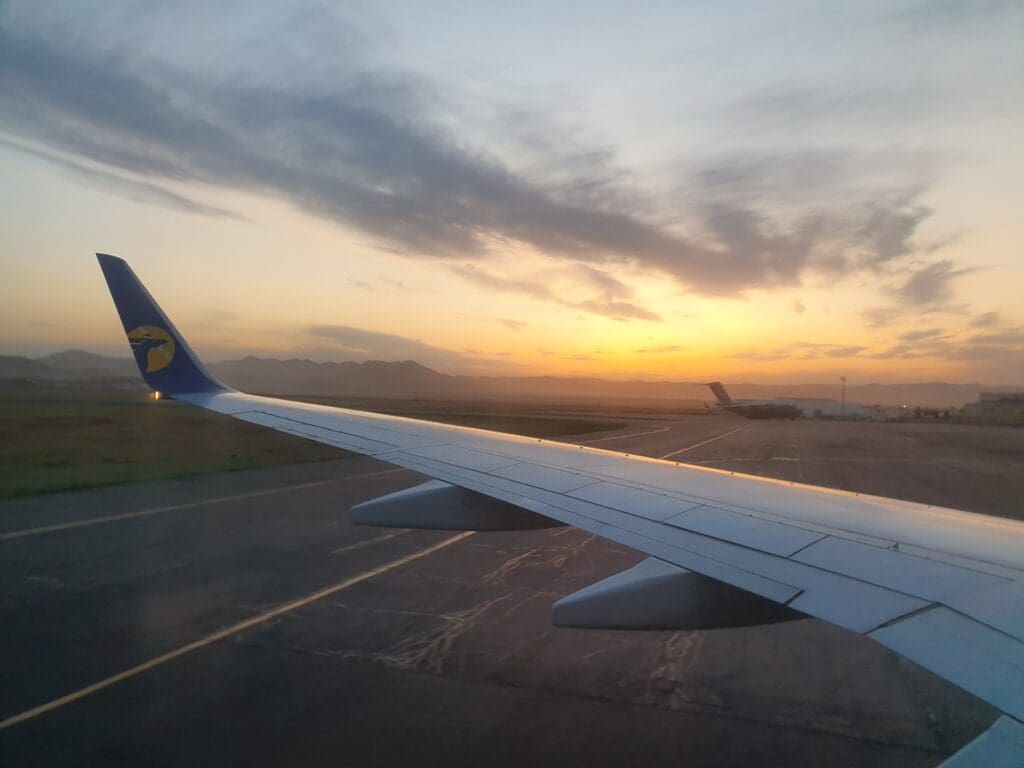
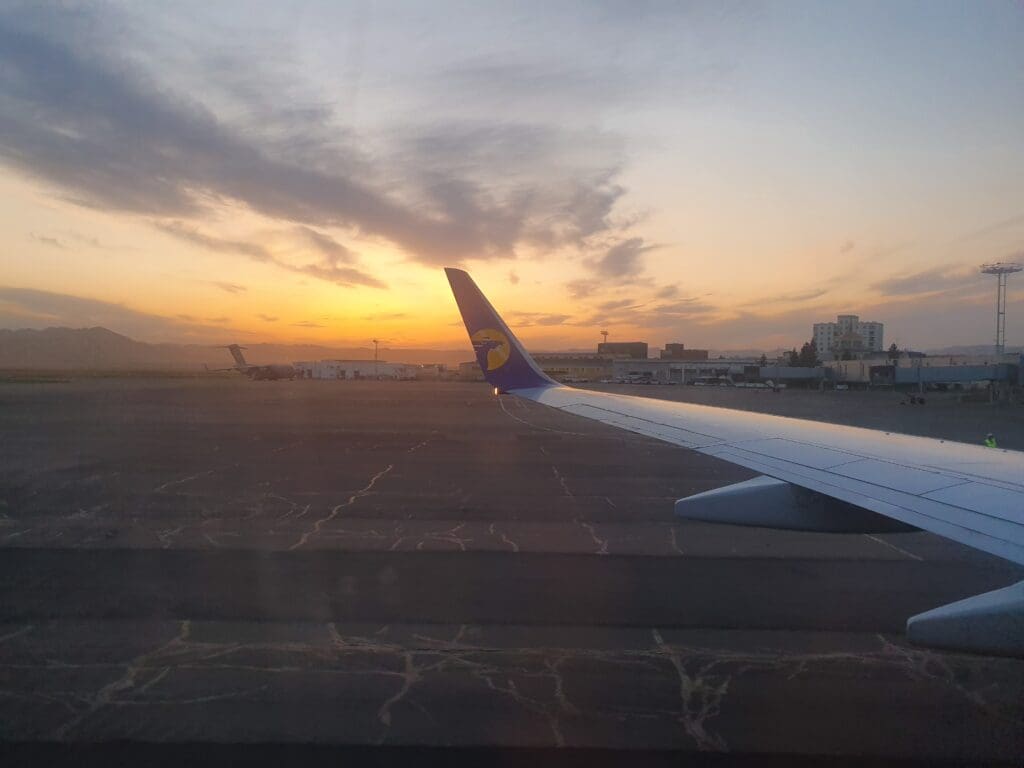
Within a few minutes the jetway was connected and at 2100 the aircraft’s L1 door was opened, by which time passengers could be seen standing in the aisles, raring to escape the jet. After thanking the crew, I stepped onto the jetway and made the very short walk over to the airport’s small immigration area. Despite the fact that all immigration booths were manned at that time, given the fact that there was only a very limited number of these and no automated gates or separate desks for those holding Mongolian passports, significant queues formed at each of these desks and it took quite some time to reach one of these. Seeing as our Boeing 737 had been the only international arrival at this time, I dread to think what this area looks like at the time of multiple or widebody arrivals. Following a twenty minute wait, I handed my passport to the immigration officer, who, like the majority of immigration officers I have encountered across the world displayed a facial expression best described as half-bored, half-angry. Being in possession of a Mongolian visa seemed to speed up my entry into the country a little and within a minute my passport was returned and I proceeded to the basic and old-fashioned baggage claim area where my bag could be seen waiting for collection on the stationary carousel.
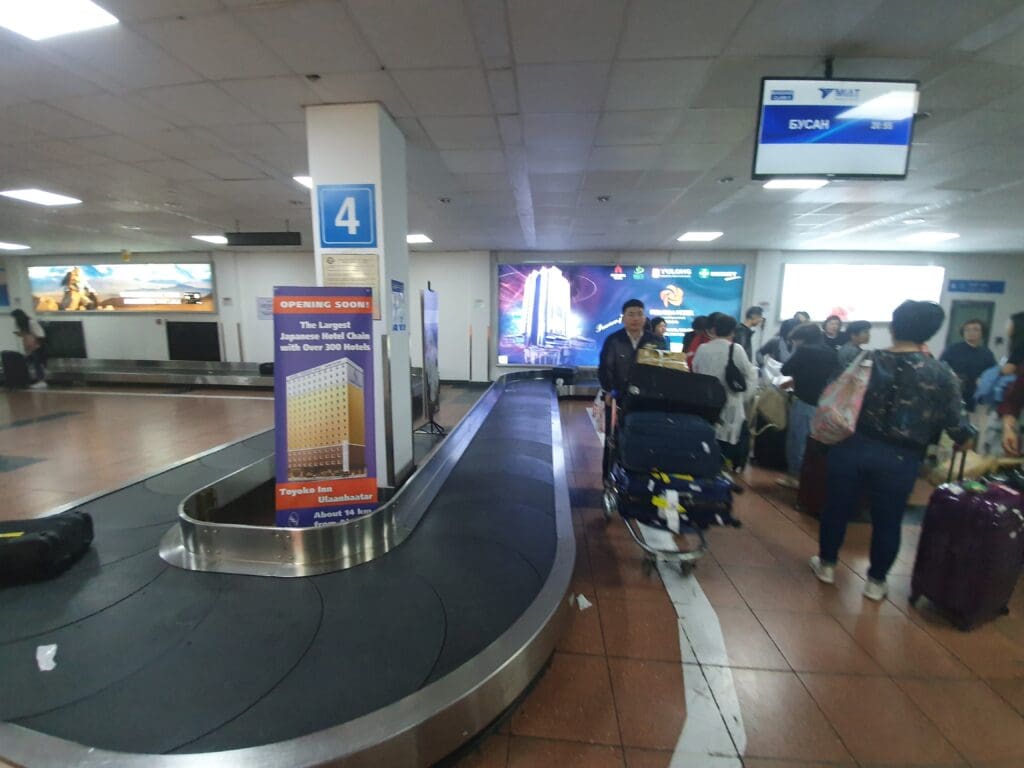
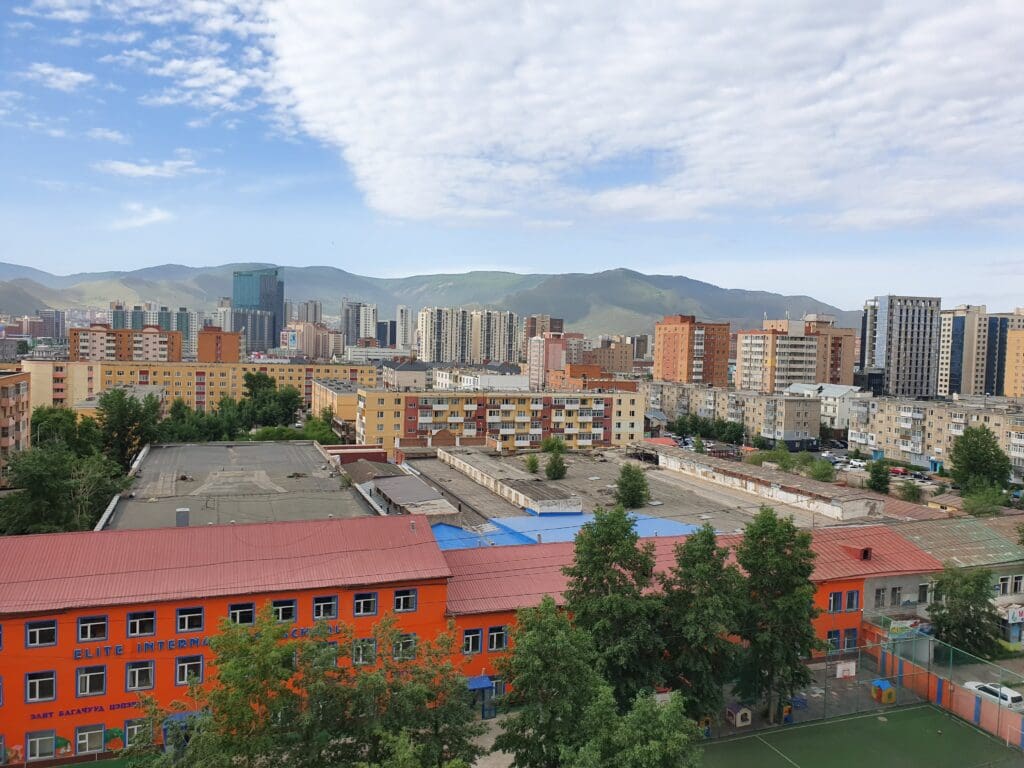
Upon picking up my suitcase I exited into the landside arrivals area, first heading upstairs to the small bank in order to change some money. After this, I descended back down to the arrivals level and made it through the army of unofficial taxi drivers, soon arriving at the official taxi rank. Stepping into the first car, I showed the driver the address of my Airbnb just off Seoul Street and was met with some puzzled looks. Nevertheless, the driver soon pulled away and sped at lightning speed down the main road into the city, worryingly spending much of the journey texting with both hands on her phone, holding this in the middle of the steering wheel. After a quick start to the journey, once with passed the city’s colourfully lit Power Plant No.3 we became trapped in traffic traffic and spent the remainder of the journey stopping and starting, weaving in and out of the jams. Despite the driver’s initial puzzled looks at the address, I was dropped off right outside the door of the apartment, thirty minutes prior to the time that I had arranged to meet the owner of this – however, in reality, a long wait was in store as he did not arrive until well after midnight and appeared to be in an rather worse for wear state!
Summary
Given the plentiful poor reviews of MIAT Mongolian, admittedly I was not expecting five star luxury or service and so, I was not disappointed with the airline. That said, there was nothing about my first experience with the carrier that had left me particularly impressed. The Boeing 737 that had brought me up from Busan was not in a great condition, nor was it greatly comfortable and I would not want to end up in that aircraft for any longer flight. Meanwhile the crew were largely unremarkable and ignoring the heated butter fiasco, the meal service was simply mediocre. However, all of these combined mean that for those not so interested in flying on an unusual airline, both Air Busan and Korean Air would likely prove far more enjoyable and comfortable ways of getting from Korea to Mongolia.