Flying an Old King Air on a Scheduled Commercial Flight: Stockholm to Sveg with Jonair
Background
First taking to the skies in 1963, the Beechcraft King Air has enjoyed enormous levels of success, demonstrated by the fact that the type continues to roll off the production line almost sixty years later! Designed to be a luxurious corporate turboprop transport aircraft capable of transporting the rich and famous in and out of all manner of airports both large and small, it is arguably this role for which the King Air is best known. Nevertheless, the aircraft has since received all manner of modifications and enhancements that enable it to undertake a diverse range of civilian and military taskings from evacuating the unwell from remote airstrips in the Arctic to working as a communications relay aircraft circling high above the battlefield. However restricted by its small size, one of the less common roles of the King Air is the transportation of ‘normal’ fee-paying passengers on scheduled commercial flights.
As of 2022, just three European carriers operate the King Air on bookable scheduled services. In France, carrier APG Airlines utilises the type’s luxurious features on a single expensive shuttle route between the Breton city of Lorient and Toulouse. Meanwhile, up in Iceland, Akureyri-based carrier Norlandair operates the King Air on several flights, including a semi-transatlantic service to Nerlerit Inaat in Greenland. Last but not least, small Swedish carrier Jonair operates two subsidised public service obligation flights with the King Air, one of which runs between Stockholm Arlanda and the small town of Sveg, and the other between Luleå and Pajala in the far north of Sweden. As a diehard enthusiast, I had long aimed to ride onboard one of these King Air scheduled services and as the world slowly recovered from the pandemic, I decided to head off and sample the delights of the King Air.
For an aviation enthusiast, as of 2022, Sweden is somewhat of a treasure trove of unusual aircraft types on scheduled services – namely the BAe Jetstream 31/32, the Beechcraft 1900C, Fokker 50 and of course the King Air. Having long wished to visit to sample flights onboard such aircraft, in March 2022 I decided to make the pilgrimage to Sweden and soon got to work devising an itinerary. After some planning, I decided that I would fly onboard Jonair’s Beechcraft King Air and Europe’s only passenger Beechcraft 1900C, within the space of two days. This would involve flying from Stockholm Arlanda to Sveg on the King Air, before catching an Inlandsbanan train northwards that afternoon to Östersund. The next morning, I would then fly on Jonair’s Beechcraft 1900C over to the coastal city of Umeå.
About Jonair
Formed in Umeå by local pilot Per Johnsson in 1973, whilst Jonair may not be particularly well known, especially outside Sweden, they have a well-established presence in the skies of Northern Sweden. For much of the company’s life, Jonair has specialised in shuttling cargo and passengers around on charters – initially with a fleet of twin-engined Piper aircraft. However, things changed in 2015 when the carrier took over the PSO route between Luleå and Pajala. This was initially operated with a Piper PA-31, however a short time later the carrier took delivery of the first of three Beechcraft King Airs. Two other scheduled routes followed, with these operating between Stockholm Arlanda and Sveg, and Östersund and Umeå. In addition, the carrier has also added a Cessna Citation XLS and Eurocopter EC120B helicopter to their fleet – and I would unexpectedly catch a ride on the former type on this trip!
Booking
As with many carriers across the globe, tickets for Jonair’s services can be booked via a range of online flight booking websites as well as through the carrier’s website – with the latter seeming to be the cheaper option. Once I had fixed my itinerary and was confident enough that Coronavirus would not put a spanner in the works, I voyaged over to Jonair’s website where I was greeted by a generic photograph of an Airbus A320’s wingtip (a type that the airline is yet to invest in). As well as operating scheduled public service obligation flights, Jonair also operates charter services and thus their website features plenty of information and photos of their fleet as well as the seat maps for each aircraft. As one would expect given their charter business, Jonair’s website offers a comprehensive overview of their fleet including a seat map for each operated aircraft. In addition, a page named ‘Jonair Airshow’ could be found which advertised Jonair’s aerobatic experience flights from Mora Airport onboard an ex-Swedish Air Force Scottish Aviation Bulldog and priced at 3000 kr (£237/€285/$318) for a thirty-minute joyride.
After a quick trip around Jonair’s website, I made my way over to the carrier’s WorldTicket-powered flight booking engine. Once I had entered all the required details, I was quickly presented with two options – a morning departure at 0855 and an evening departure at 1845. However, seeing as I was set to catch the train from Sveg to Östersund at 1537, only the former option suited my schedule. Tickets for both of these services were equally priced across all three fare categories – Full (1595 kr), Low (1195 kr) and Extra Low (595 kr). Taking the risk that I would not have to cancel or rebook, I decided to go for the Extra Low option and was then taken to a page where I entered my details. Once this had been done, I was presented with a booking summary and then journeyed on to the payment page. As with several smaller carriers, I found that Jonair does not accept American Express, with payment options limited to Maestro, Mastercard and Visa. Furthermore, cards from a total of 24 countries and territories could not be used to book flights with Jonair. After a quick and painless payment, I received my booking confirmation by email several minutes later and I was all set to head off to the town of Sveg.
As soon as I had completed my first booking, I repeated the process for my flight between Östersund and Umeå the next day. That day, my flight was scheduled to depart Östersund at 0740 and arrive in Umeå fifty minutes later at 0830. Once again, I decided to go for the Extra Low ticket with little hesitation which set me back the same amount as I had paid for the flight between Stockholm and Sveg, 595 kr. However, both Low and Full tickets were also available for 995 kr and 1195 kr respectively. As with booking the first time around, this was a quick and painless process and I soon received my booking confirmation by email.
The Journey
As is often the case with airports, Stockholm Arlanda can hardly be described as sitting a short distance away from the centre of the Swedish capital. Whilst this is no Beauvais, Hahn or Stansted, around 37 kilometres of suburbs, fields and forests separate Central Stockholm from Arlanda Airport. However, being Sweden’s main international hub, unsurprisingly a decent selection of public transport options is provided for those needing to reach the airport. These include various bus services, a commuter rail service which runs from Stockholm Central Station, and the high-speed Arlanda Express which runs non-stop between the airport and the city. Those short on time and with deep pockets may opt to take the latter train service, with this running throughout the day and departing at regular intervals, making the journey in as little as eighteen minutes. However, with a one-way journey to the airport for one adult totalling an eye-watering 299 Kr (approximately £24/€29/$31), this option was most certainly out of the question for me on the morning of my flight! The next quickest option is to ride the commuter train to Arlanda Central Station which takes almost forty minutes to make the journey from Stockholm Central Station. Whilst I held a 72-hour Access card that gave me unlimited rides on Stockholm’s public transport network, a 130 Kr supplementary ‘station access fee’ must be paid to alight at Arlanda Central. However, a slightly slower alternative that would remove the need to pay any additional fees could be had by taking a commuter train from Stockholm Central to the town of Marsta. From there, I could then transfer onto a local bus for the short ride to the airport. Having checked the early morning schedules for my departure day (Monday), I was pleased to see that I could opt to take this option and still make it to the airport in good time for my flight and I thus settled on this little hesitation.
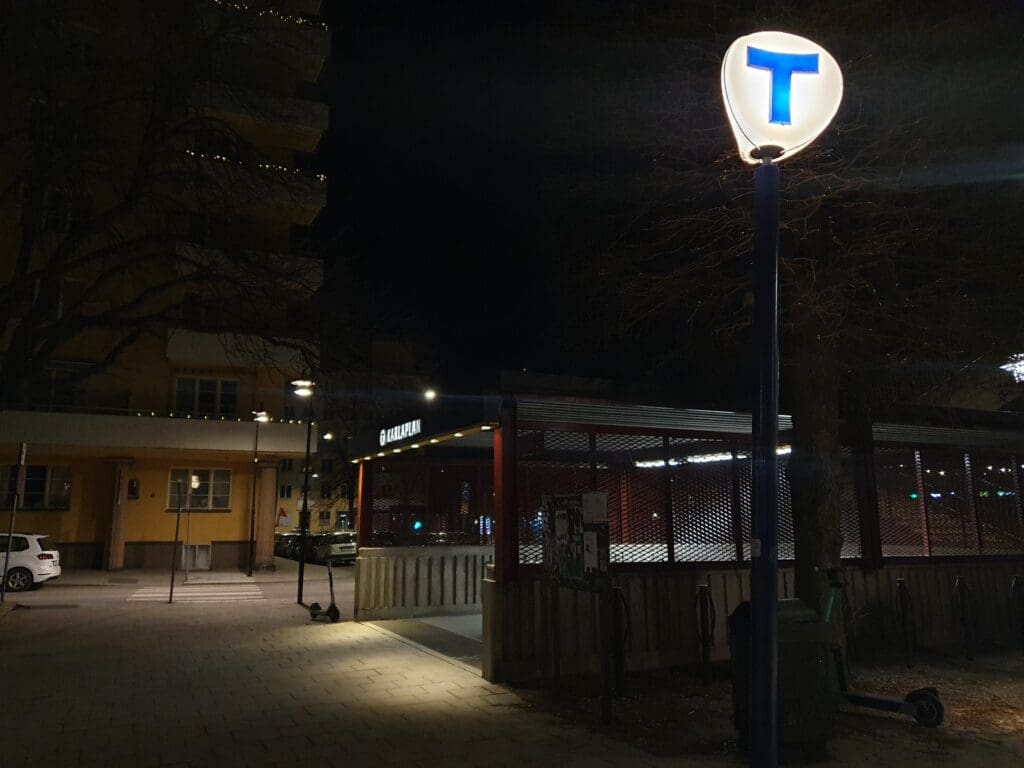
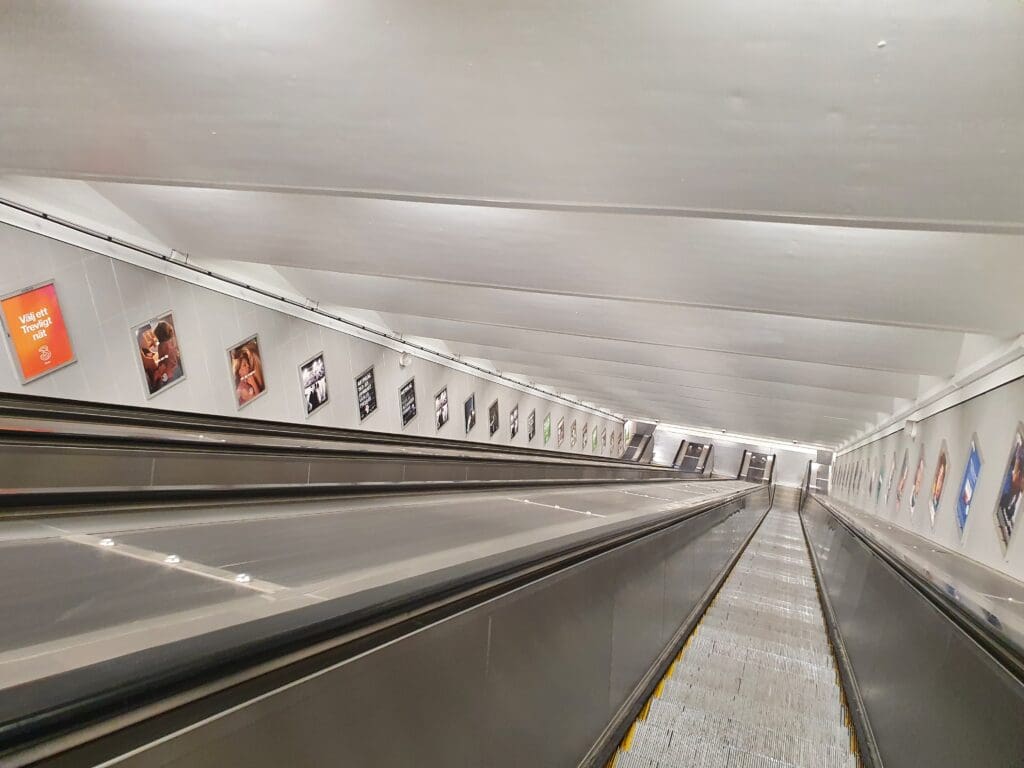
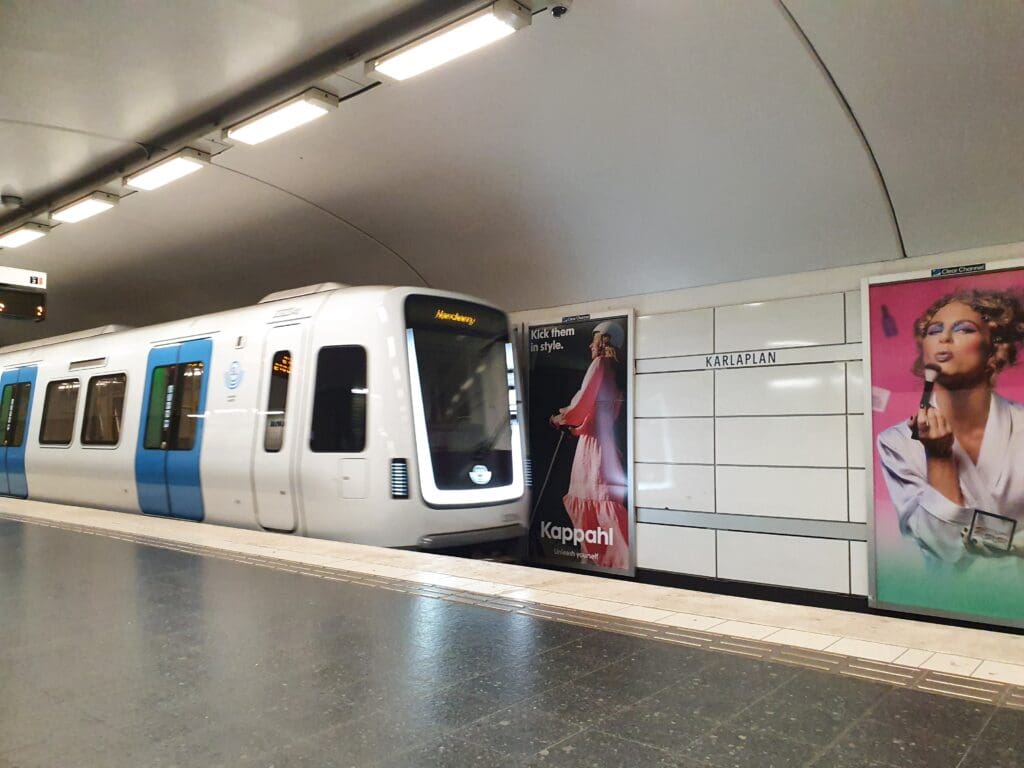
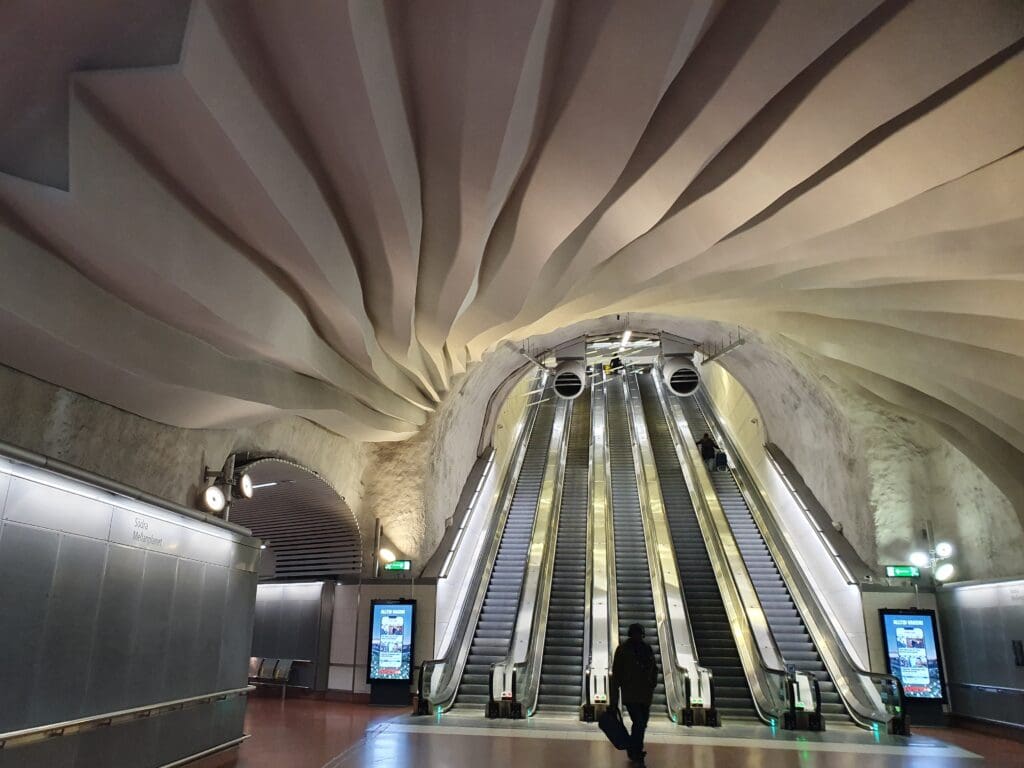
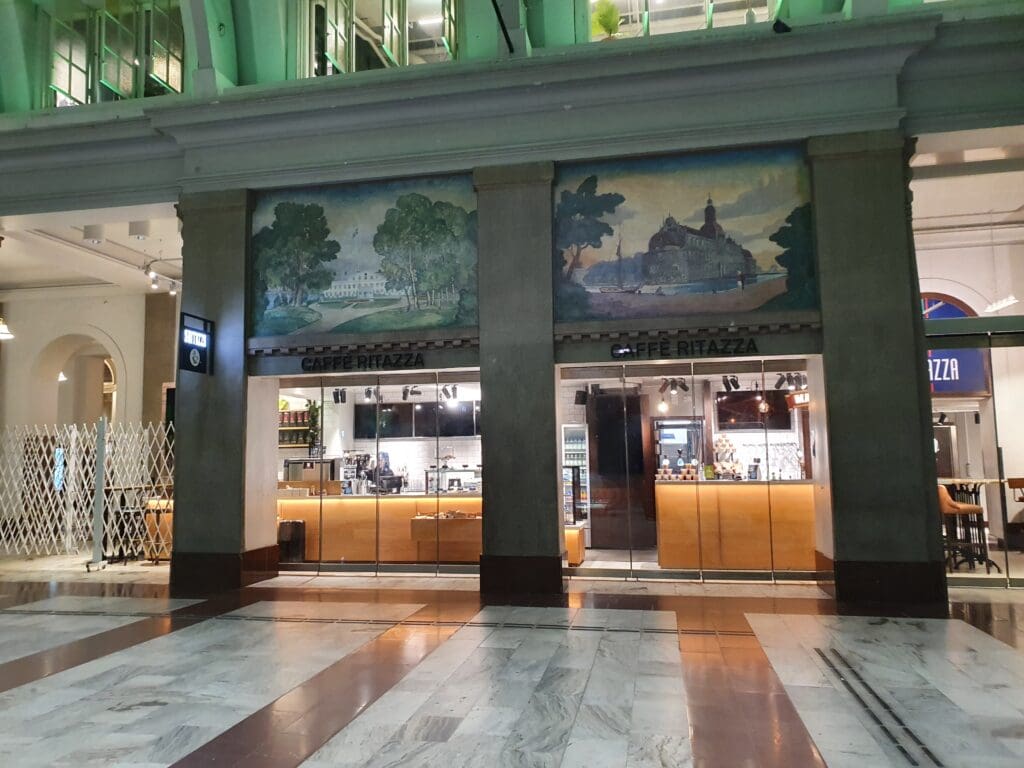
Following a few short hours of sleep, I woke up at 0420 and jumped in the shower before undertaking some last-minute preparations for my journey into the depths of rural Sweden. Having spent three nights at the Hotel Karlaplan, named after the fairly central neighbourhood in which it is located, getting to Stockholm Central Station would not prove to be an issue that morning. Once all was set and I had checked out from the hotel, I made my way into Stockholm’s very cold, dark and empty morning streets and trundled a short distance down Valhallavägen before arriving at Karlaplan metro station. Whilst several Stockholm Metro stations are famous for their artworks and interesting designs, Karlaplan Station is relatively unnoteworthy. However, this is conveniently located just two stops away from the Stockholm Central Station and would make the first part of my journey to the airport hassle-free. Or, at least this would have been the case had the station not been locked up upon my arrival, with this not being unlocked until just after the departure of the first southbound service of the day. Once this had been opened up, I descended a long way down into Stockholm’s subterranean world, arriving with seven minutes to go until the next departure. Eventually, a modern blue and white Bombardier SL C30 hurtled into the platform and I soon boarded the mostly empty train for the short journey to Stockholm Central Station. Unfortunately, having missed the first service of the morning, I also just missed my connecting train to Marsta and arrived with almost half an hour to spare before the next service. Having briefly pondered getting a commuter service to the airport and spending 130 Kr on Arlanda’s station access fee, I soon decided against this and instead made my way up to surface level to have a brief look around Stockholm Central Station’s waiting hall.
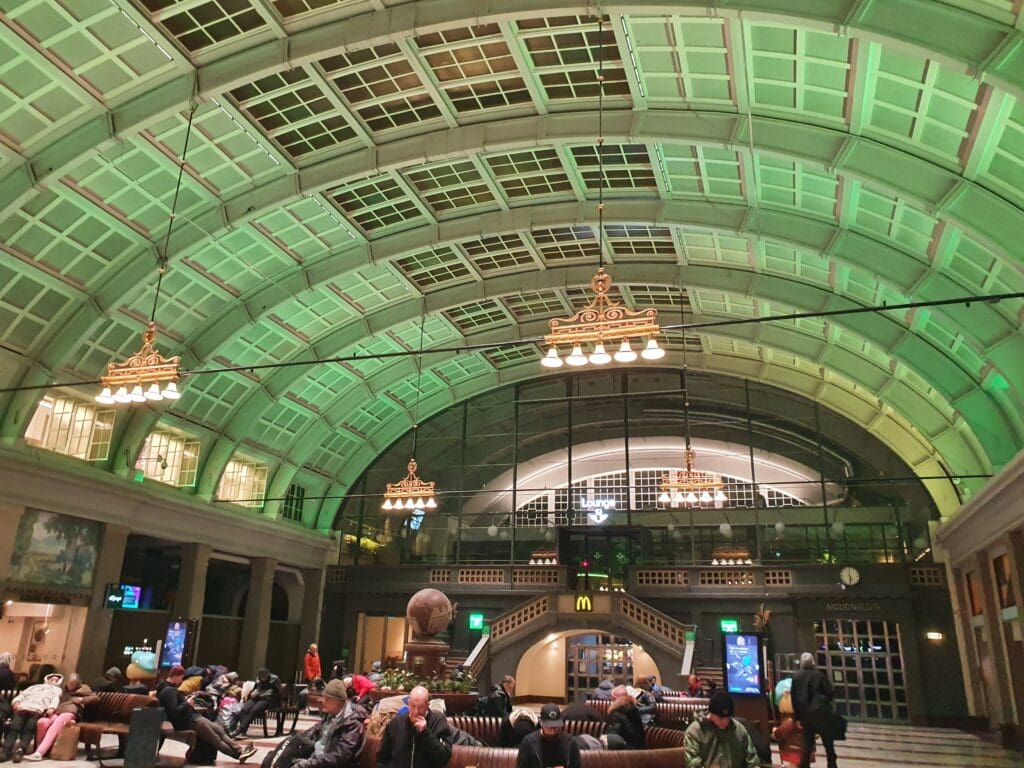
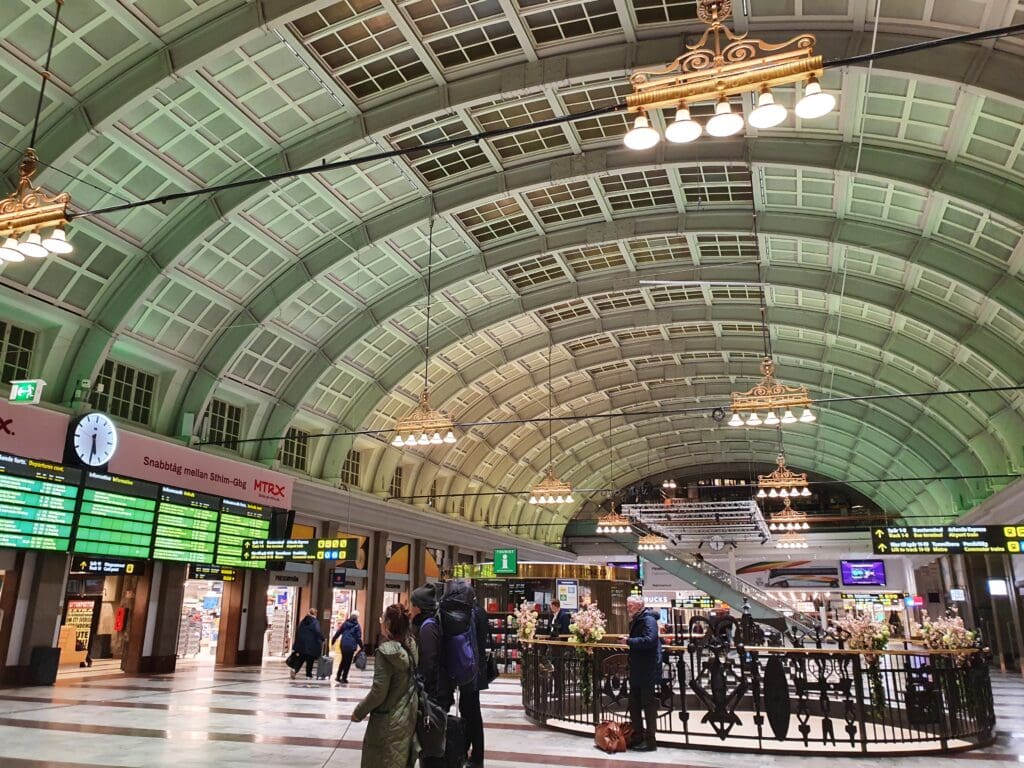
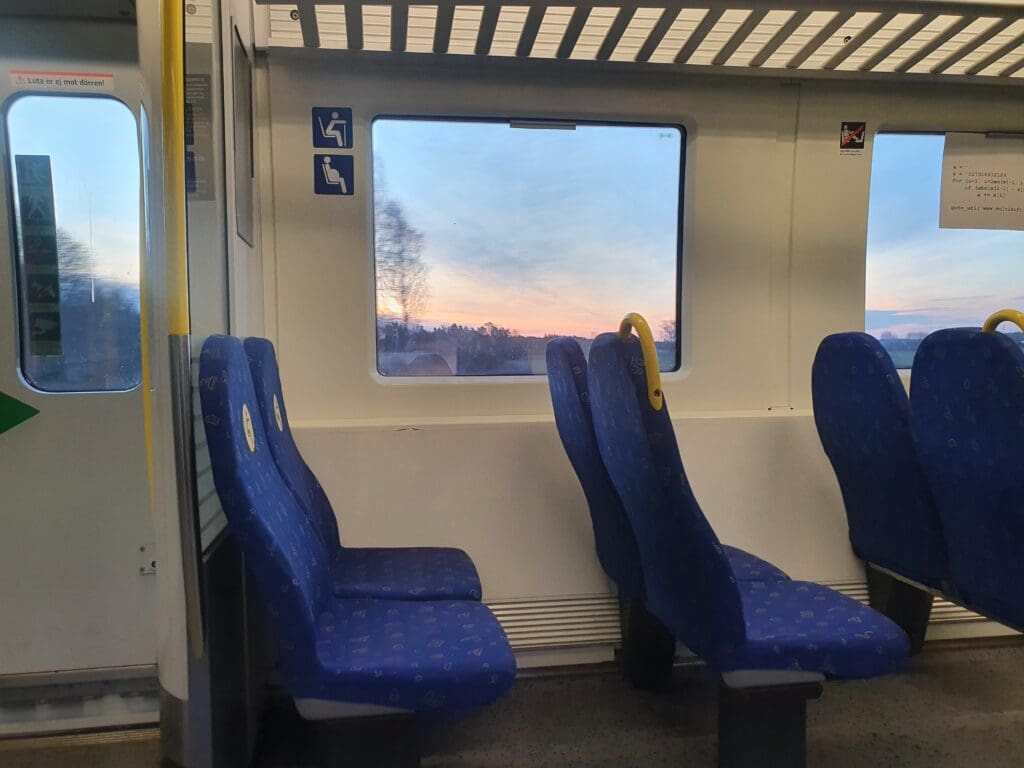
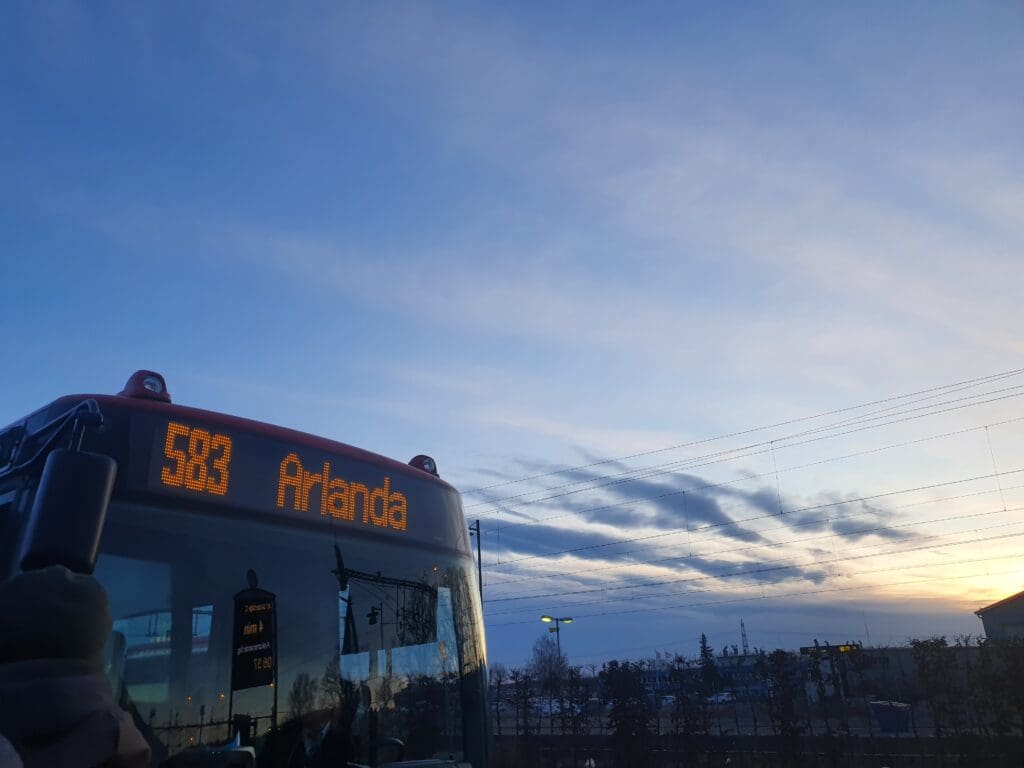
After grabbing a sandwich and a bottle of juice for breakfast, I headed back down to the commuter train platforms with five minutes to go until the Marsta service. Following a short wait a Coradia Nordic SL X60 train appeared and I boarded this along with plenty of other passengers. Despite being fairly busy, I managed to find a window seat although with the sun yet to rise for much of the journey, little could be seen as this ploughed northwards through Stockholm’s suburbs. Almost forty minutes after leaving Stockholm Central, the train pulled into Marsta where I disembarked and followed the crowds to the neighbouring rudimentary bus terminal. From there, the 583 bus regularly shuttles the short distance across to the airport, and I arrived with five minutes to spare until the next Arlanda-bound departure. As expected, this was full, with most onboard appearing to either be airport staff members or passengers. After leaving Marsta, the bus made a few stops before Arlanda Airport’s remote stands appeared. Almost two hours after leaving the hotel, the bus came to a gentle stop outside the entrance to SkyCity.
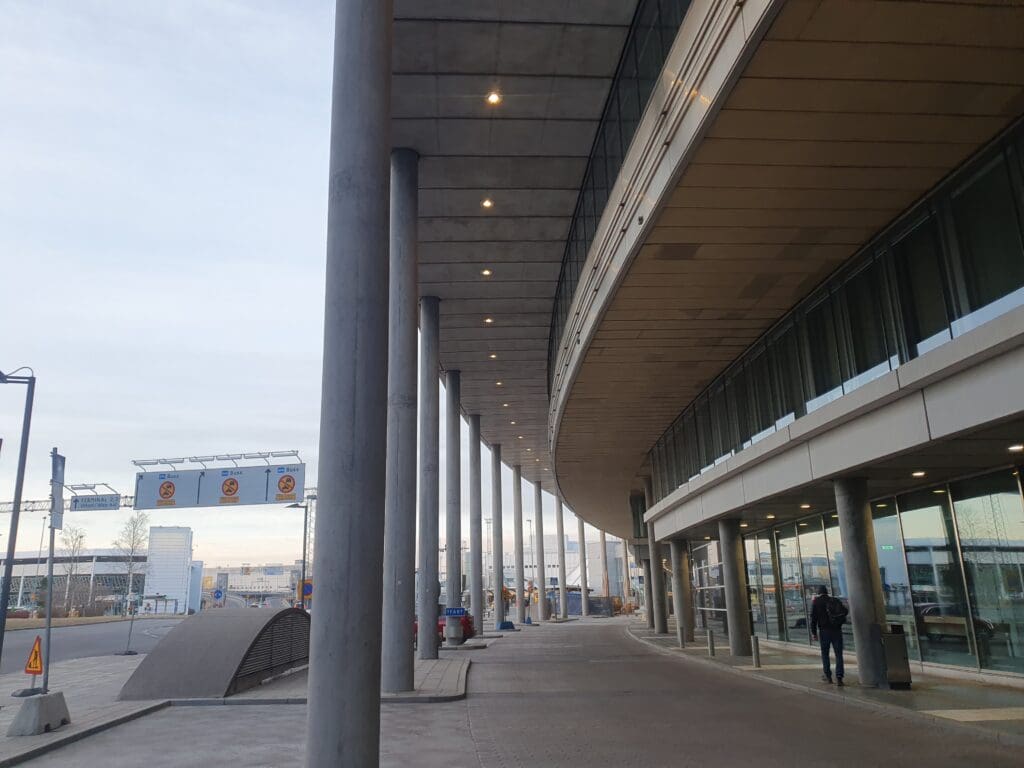
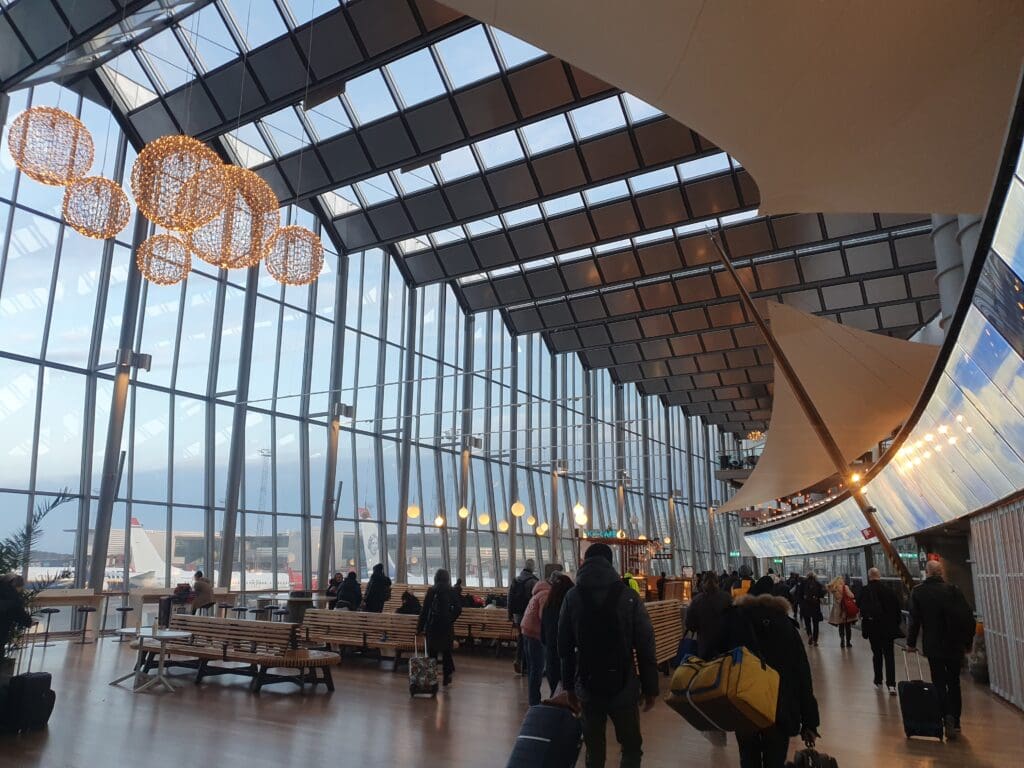
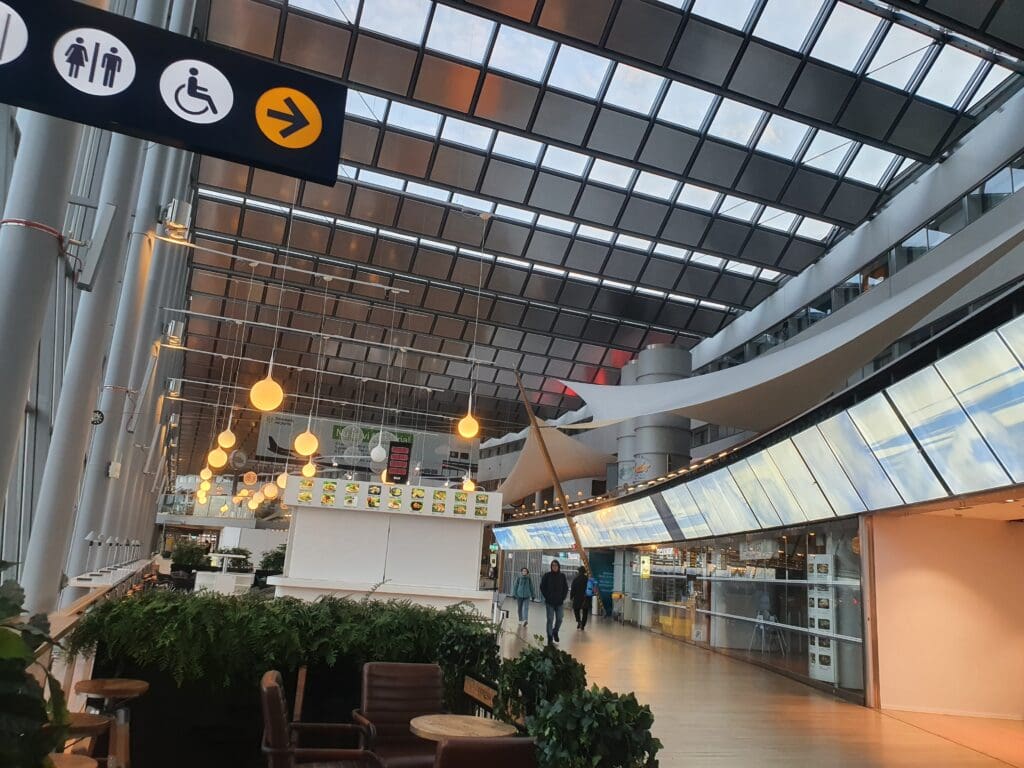
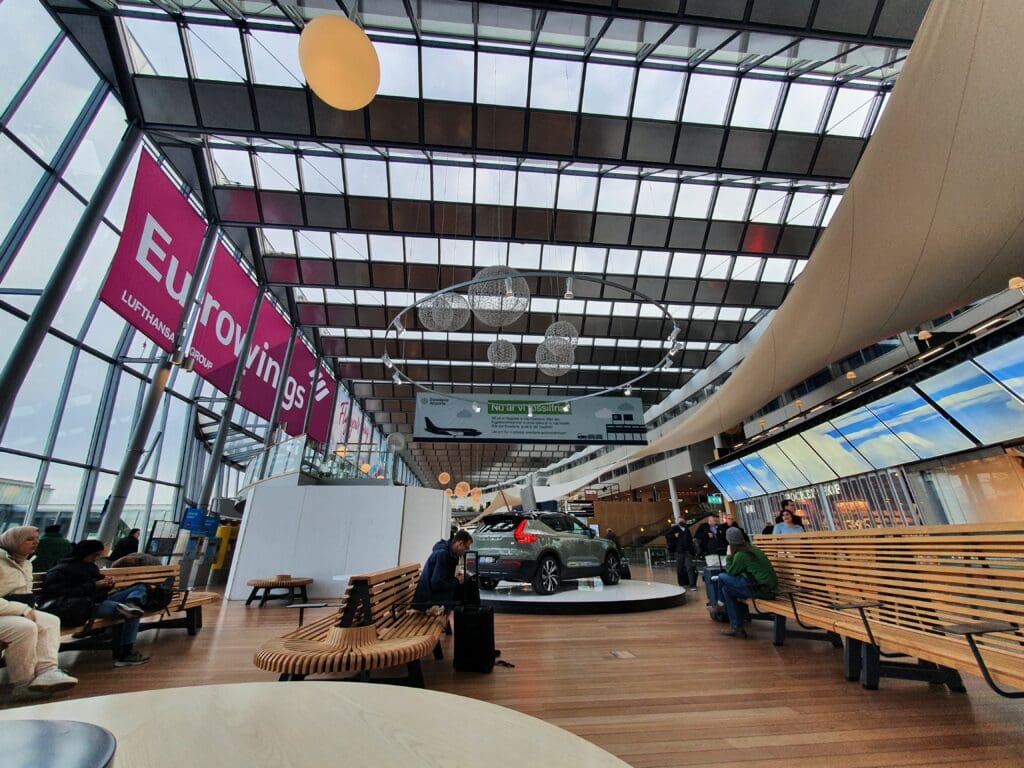
For those with plenty of time on their hands and needing to wait in Arlanda Airport’s landside area, the best place to do this is probably SkyCity. This sits centrally in between the terminals and is home to a reasonable selection of shops, cafes, restaurants and bars, although most of these were either closed or opened up during my stay. For enthusiasts, this portion of the airport allows for a reasonable view of the action outside and after a quick walk around I plonked myself down next to a window and watched as a regular stream of aircraft made their way over to runway 01L in preparation for departure. Finally, all will likely appreciate SkyCity’s bright, spacious and modern nature, with this featuring plenty of plug sockets and fast complimentary wifi.
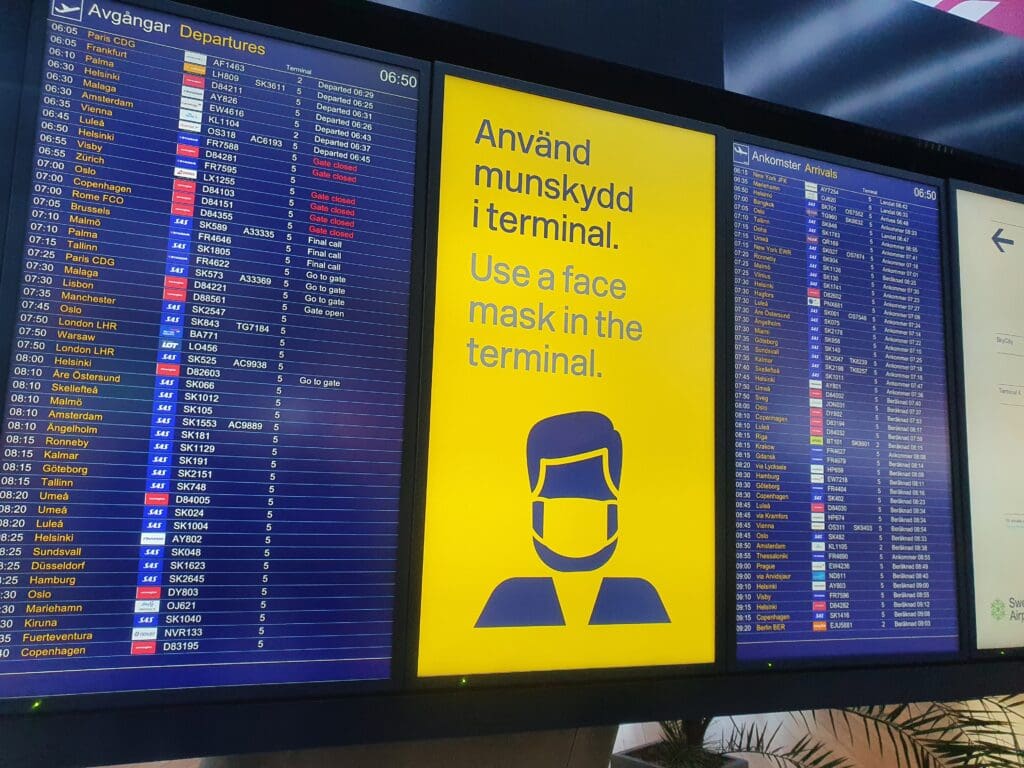
In the past, pre-flight arrangements for Jonair’s sole service from Stockholm Arlanda have caused some confusion amongst outbound passengers. Whilst Jonair is listed as utilising Arlanda’s Terminal 5, in reality, this is not the case and other than the Sveg flight appearing on the departure boards, there is no other sign of Jonair at all in the airport itself. Fortunately, Jonair now features a small piece of information on their website detailing the pre-departure information for those departing from Arlanda on their service to Sveg. Specifically, passengers are advised to wait at the main ground floor entrance to SkyCity no less than thirty minutes before the flight’s scheduled departure time. This is because Jonair does not actually utilise Terminal 5 at all, and akin to travelling on a private jet, those bound for Sveg are whisked directly from the landside area to the aircraft without passing through security or visiting one of the terminal’s check-in desks. Having spotted long snaking queues for Terminal 5’s security checkpoint that morning, I was rather thankful that I would not have to join this as I most certainly did not want a repeat of when I almost missed my flight to Tosby the previous Friday.
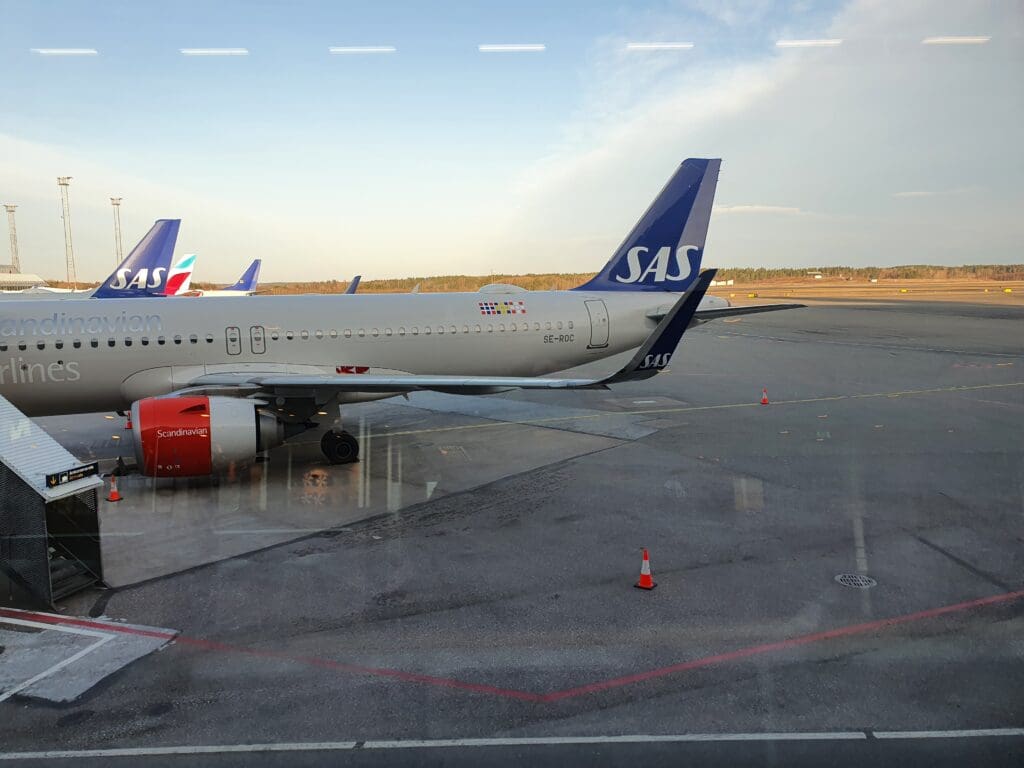
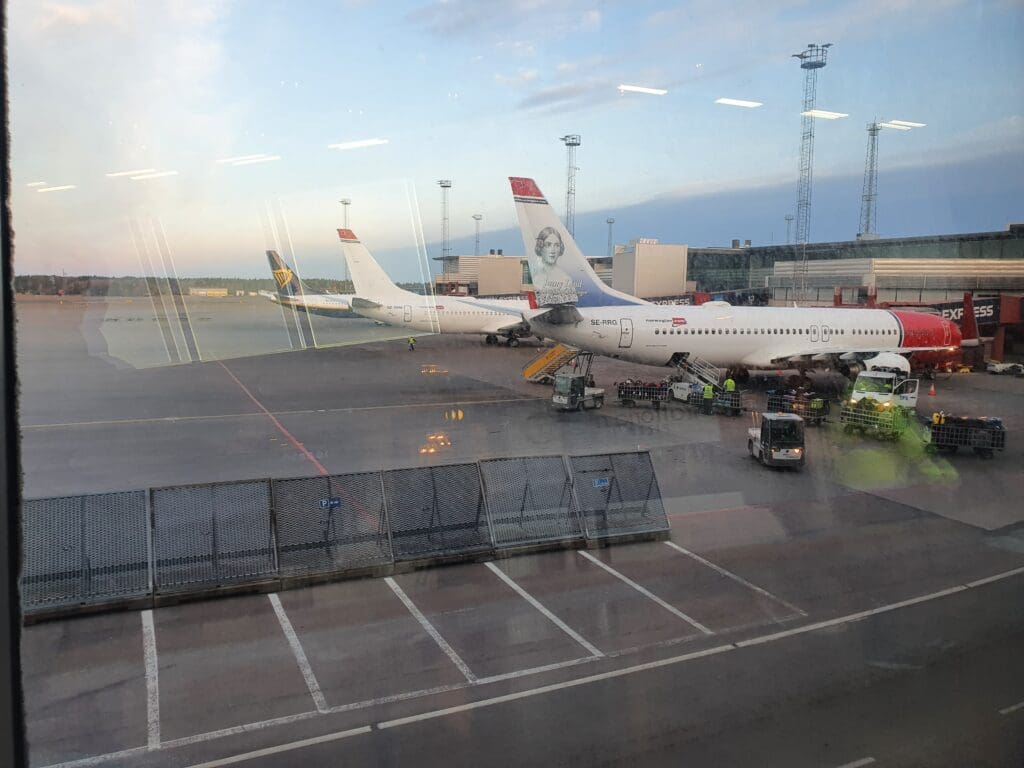
Having exhausted the sights of Arlanda’s landside area, I strolled down to SkyCity’s ground floor entrance at around 0820. Once there it was obvious that I was in the right place, and a small collection of other passengers could be seen, most of whom had plenty of luggage. In total, I counted ten people waiting there, although I managed to snag the last vacant spot on one of the two benches there. Around ten minutes after my arrival, a Grafair Jet Centre employee appeared and following a quick word in Swedish, led us out to a small white minibus that featured Grafair’s logo. Once the rear doors had been opened, passengers gathered there and one by one the ‘check-in’ procedure commenced. This consisted of the agent checking each passenger’s identity document before crossing their name off a list and placing their hold luggage in the boot of the van. Hoping to be one of the first passengers to disembark once at the aircraft, I held back and ensured that I was the last passenger to check in. This worked out and after a short wait, I boarded the minibus, taking the seat next to the door which was soon shut in preparation for our departure. As it turned out, a number of those who had been waiting in the terminal were not actually flying and thus a total of seven passengers would be making the journey to Sveg that morning.
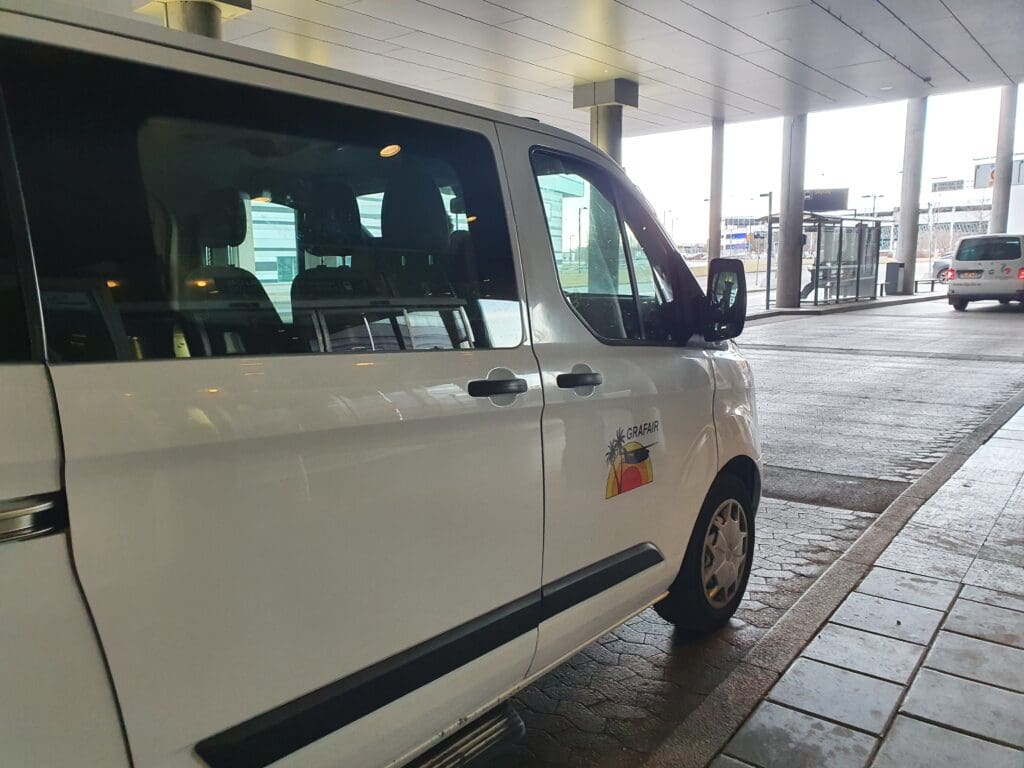
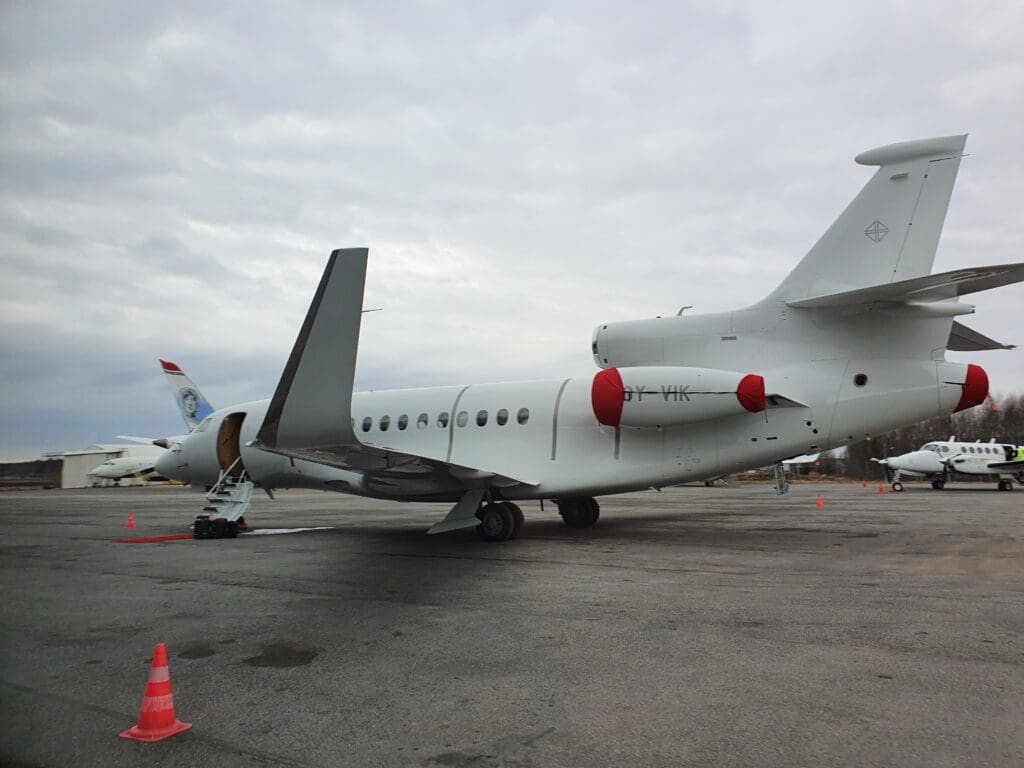
After all had taken their seats and strapped themselves in, the minibus pulled away from the terminal and made a quick journey through the fairly quiet streets of Arlanda Airport. No more than four minutes later, the minibus came to a halt just outside the Grafair Jet Centre whilst the gate to the apron slid open. Whilst the driver had seemed to have been somewhat of a speed demon on the public roads, as expected, once airside the minibus slowed down as it cautiously skirted around a luxurious Dassault Falcon 7X, operated by Danish carrier Air Alsie. Behind this, two King Airs could be seen, a Babcock air ambulance that was being readied for a morning mission to Mora via Stockholm Bromma, and the weathered-looking Beechcraft Super King Air 200 that would be heading up to Sveg.
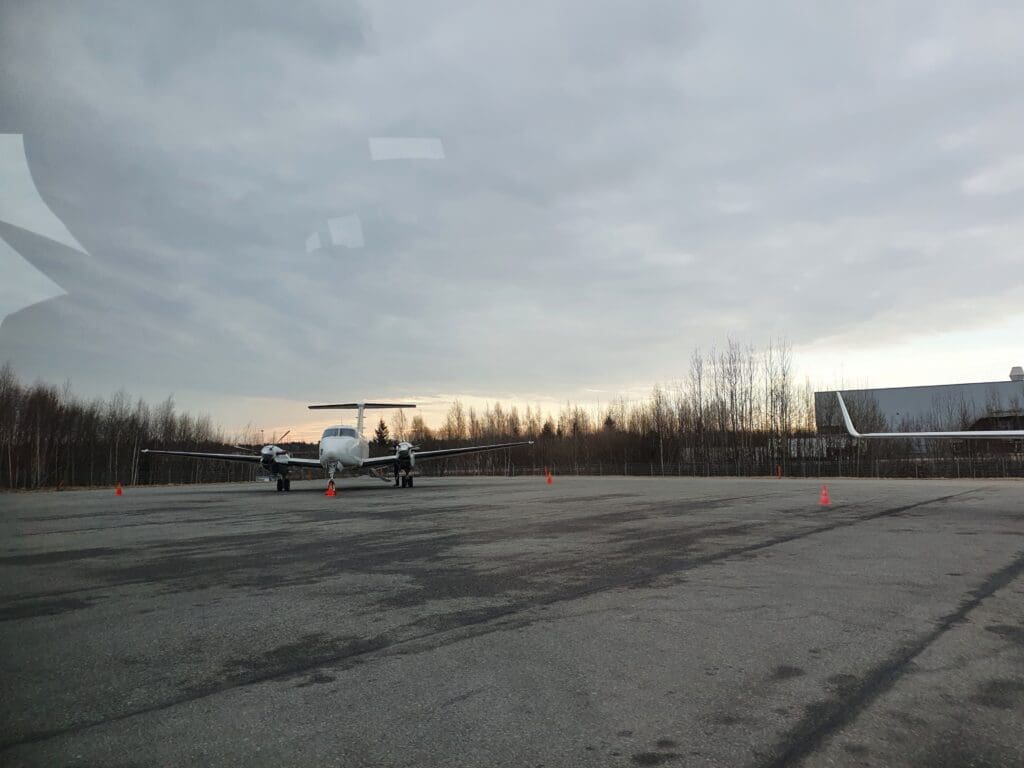
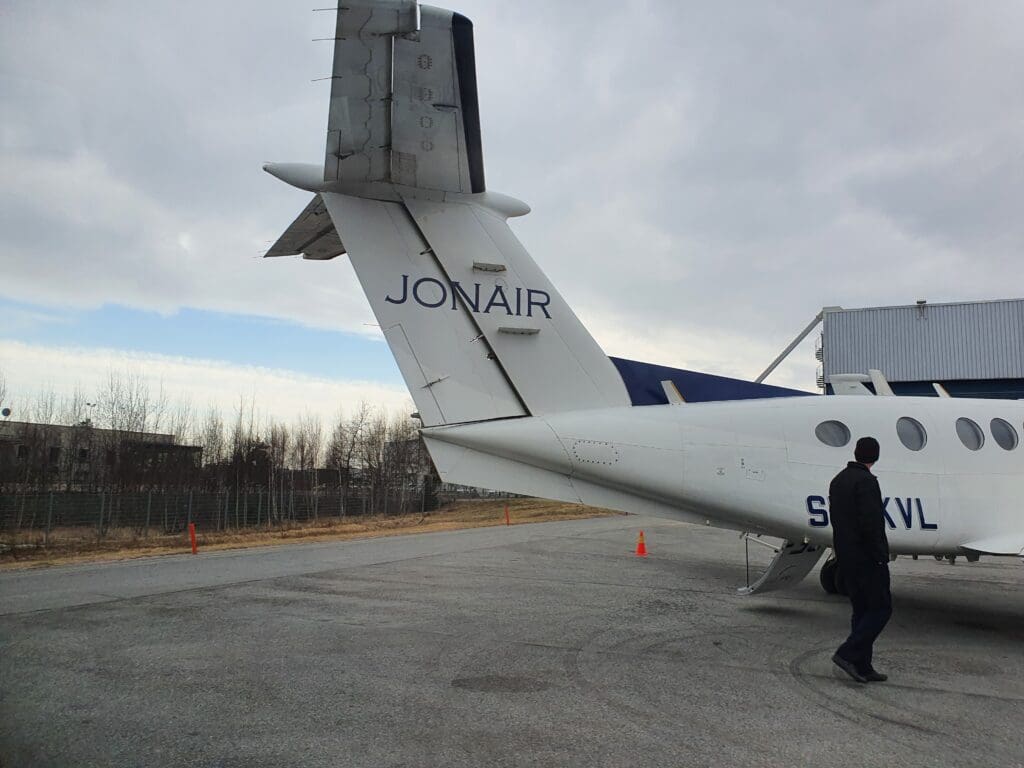
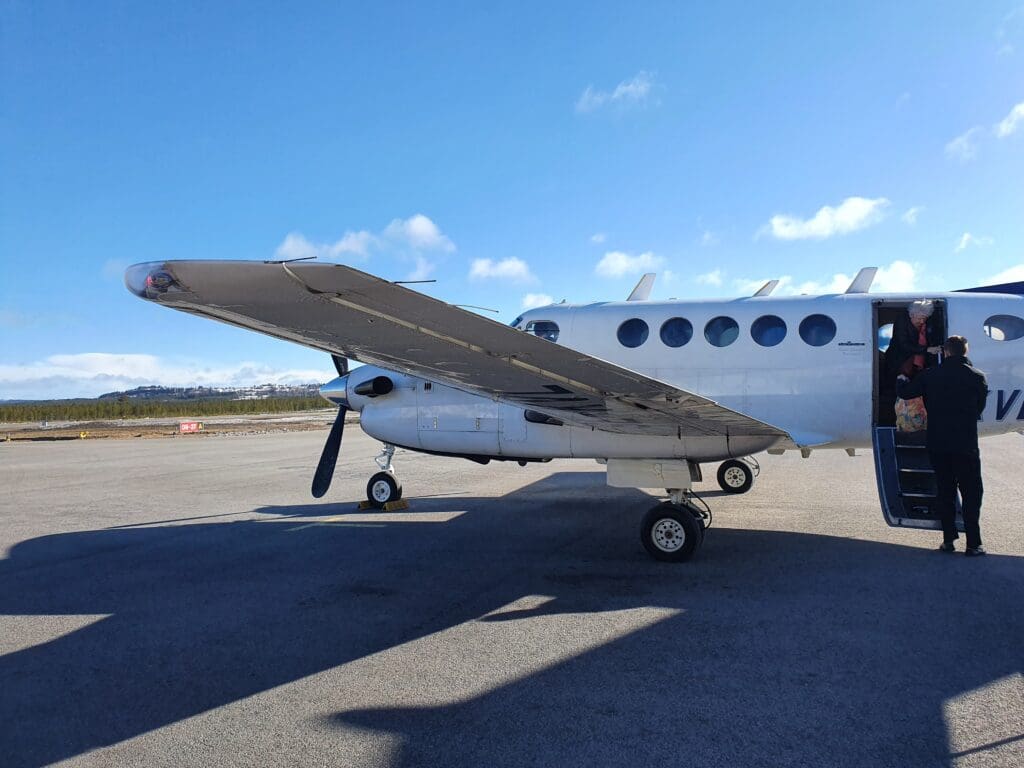
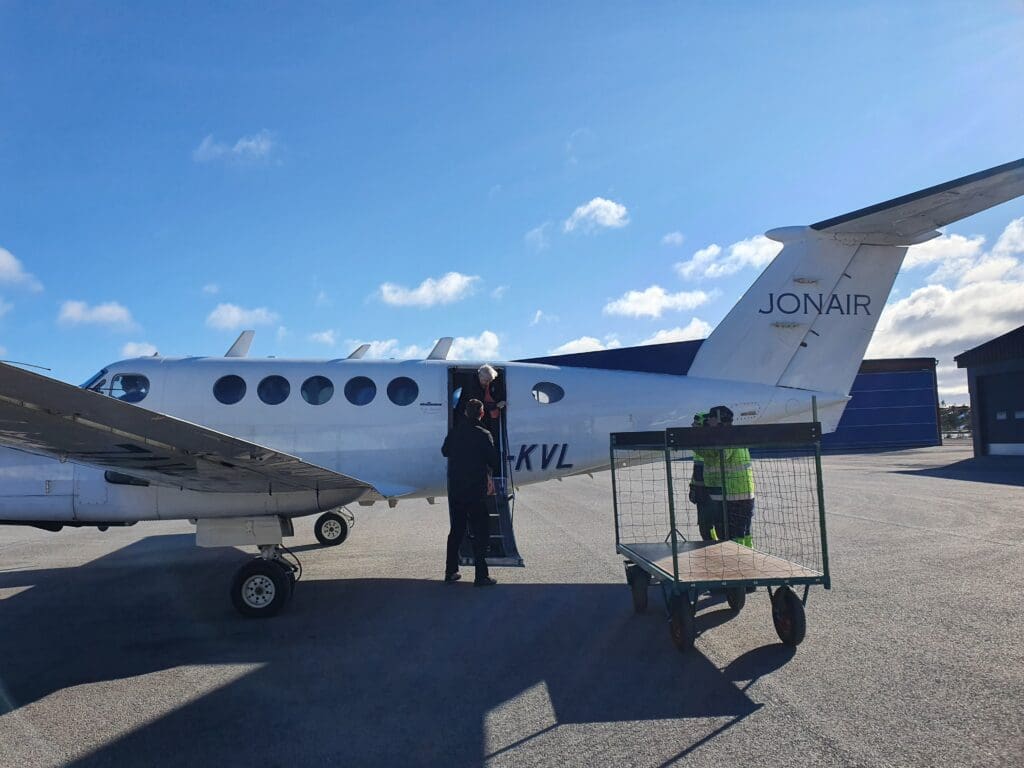
Seeing as the same King Air had operated Jonair’s service between Stockholm and Sveg for years, I had initially assumed that SE-MJU would be operating the service that morning. However, the Friday before my flight this had been temporarily removed from service to allow for scheduled maintenance to be undertaken and as a result SE-KVL had stepped in to replace this. This slightly older King Air is usually found on Jonair’s far northern PSO route between Luleå and Pajala. Manufactured at Beechcraft’s Wichita factory in 1981 with the construction number BB-829, this particular King Air was an impressive 41-year-old at the time of my flight. Commencing its life in the United States as N225HP and later N225JL, the aircraft hopped about between various operators across the country before temporarily migrating to Mozambique in 1990 as C9-SWE. Following its time in Africa, in 1994 the aircraft returned to the US where it flew with various operators as N829AJ, although in 1996 the turboprop was ferried back across the Atlantic where it settled in Norway as LN-NOA. Spending over 22 years in Norway, during this stage of the King Air’s career, this first flew for Førde based Airlift A/S followed by Nor Aviation A/S, Sundt Air A/S and Airwing Utleie A/S. In late 2018, the aircraft was ferried a short distance eastwards to Sweden where it was given its current registration of SE-KVL and began operating for Umeå based Jonair. In the week before my flight, this particular aircraft had spent most of its time on the ground at Nykoping Airport to the south of Stockholm – presumably in maintenance. Following a swap with SE-MJU, the King Air was shuttled up to Arlanda and entered commercial service. This had flown a total of seven flights, six of which were between Sveg and Arlanda, flying at least 1291 miles. Unlike Jonair’s other two King Airs, both of which sport a nondescript ‘corporate’ livery with no mention of its operator, this sports something of a Jonair livery – with this painted in almost all white except a dash of dark blue near the tail as well as Jonair markings on the tail.
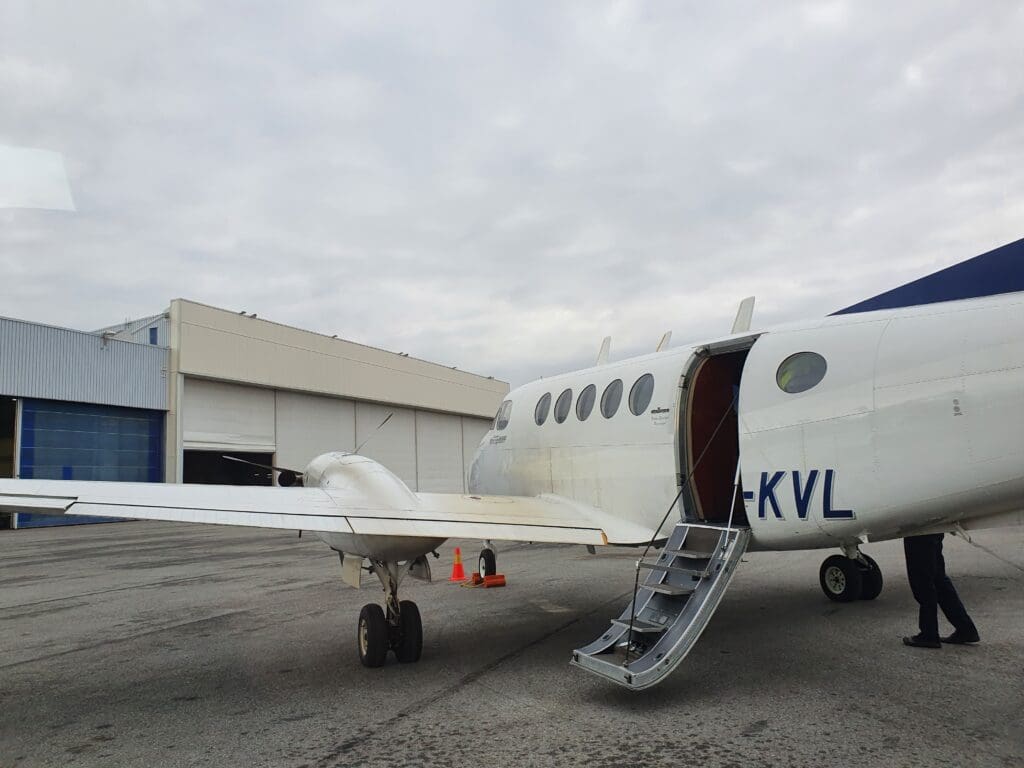
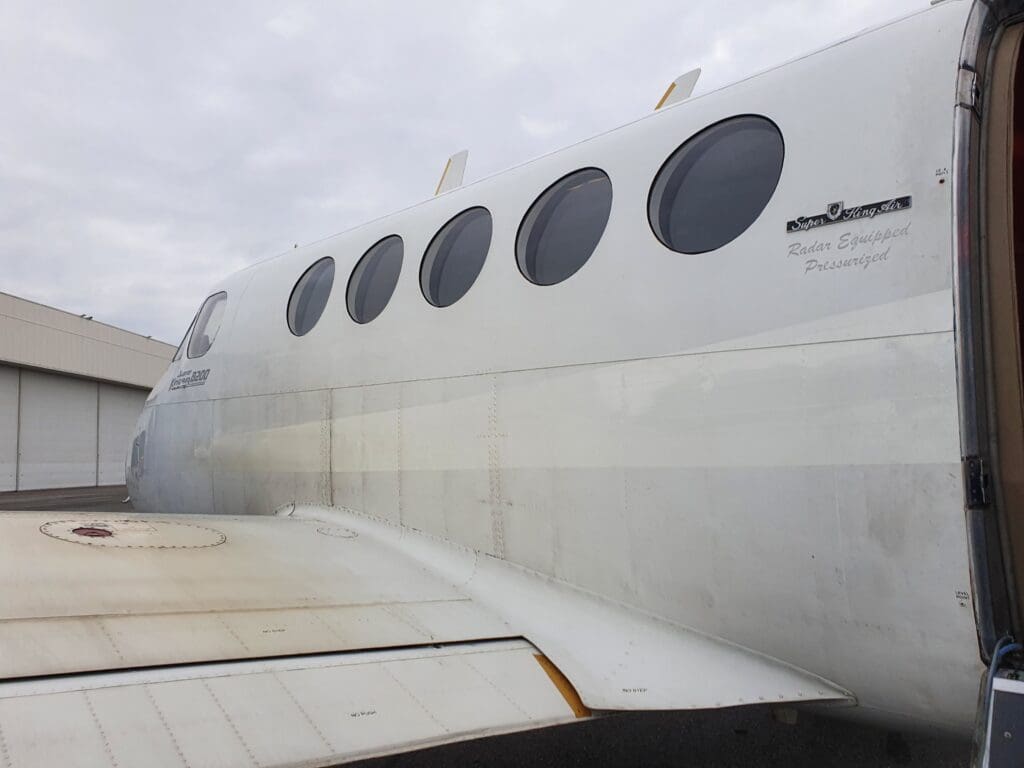
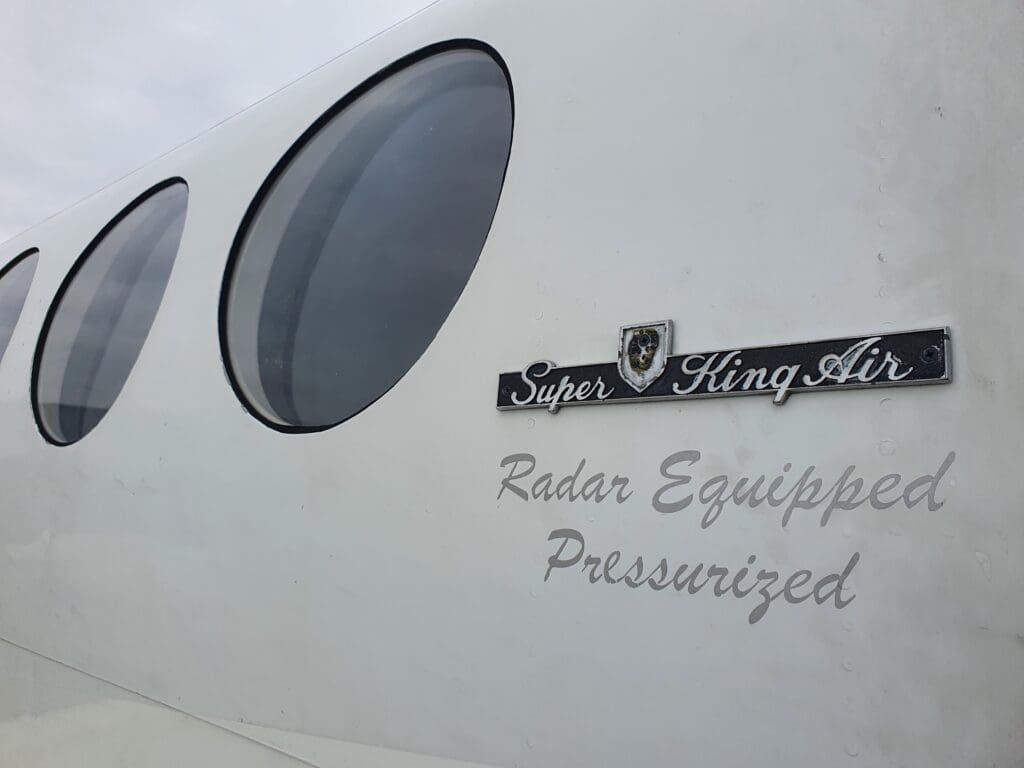
As soon as the minibus came to a halt, the driver said some words in Swedish before disembarking and having a word with the First Officer who could be seen standing at the bottom of the aircraft’s steps waiting to welcome passengers. Following what appeared to be a quick exchange, the driver opened up the minibus’ side door at which point without delay, I darted out into the chilly morning air and made my way towards the rear of the waiting executive turboprop. Upon arriving there, I exchanged a ‘god morgon’ with the First Officer before cautiously clambering up the built-in steps and making my way into the Beechcraft. As soon as I entered the King Air, I was hit by the strong mixed scent of leather, oil and fuel, whilst the baggage compartment could be seen to my right and the inwards-facing toilet seat sat up ahead. Briefly examining the latter, as is the case on many small corporate aircraft, the King Air features an ‘emergency’ toilet underneath a leather-covered lid which enables it to double up as a seat on busy flights.
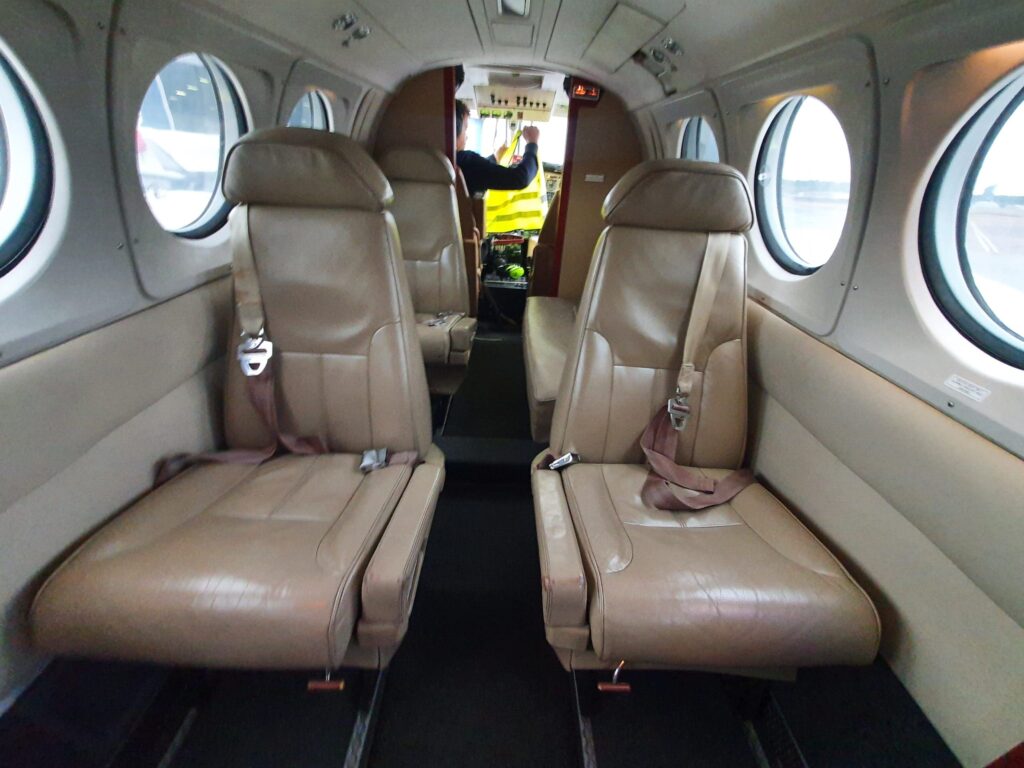
Turning left, I made my way into the King Air’s cabin, which, standing at just 1.46 metres tall and 1.37 metres wide, felt a little cramped whilst stood up. Whilst I would have been happy to fly on any old King Air that morning, one reason I was particularly happy that SE-KVL was operating the flight was that this has retained its corporate interior. Meanwhile, the route’s usual King Air, SE-MJU has been retrofitted with forward-facing seats in a style and layout similar to that seen on other small turboprop airliners. Focusing on SE-KVL’s cabin, this comes complete with two pairs of large and comfortable-looking leather seats on either side of the aisle, with these positioned facing one another allowing for either easy discussion or awkward eye contact and battles over leg space. Separating these seats from the cockpit, a small inwards facing chaise longue capable of seating two passengers could be seen on one side of the cabin, whilst a rearwards-facing recliner could be seen on the other – with the King Air featuring a total of nine passenger seats. Wanting both a good vantage point from where I could peer into the cockpit, and not wishing to end up spending the flight awkwardly staring into the eyes of a fellow passenger, I decided to take the single rear-facing seat behind the Captain, what would be Seat 1A were the aircraft to have seat numbers.
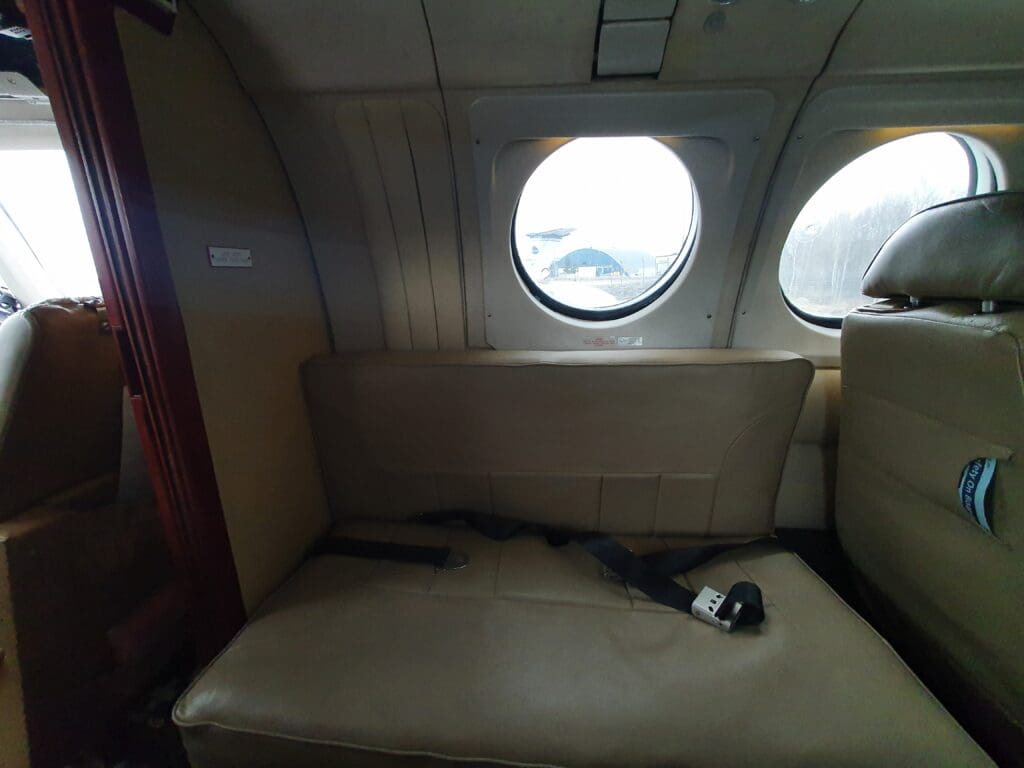
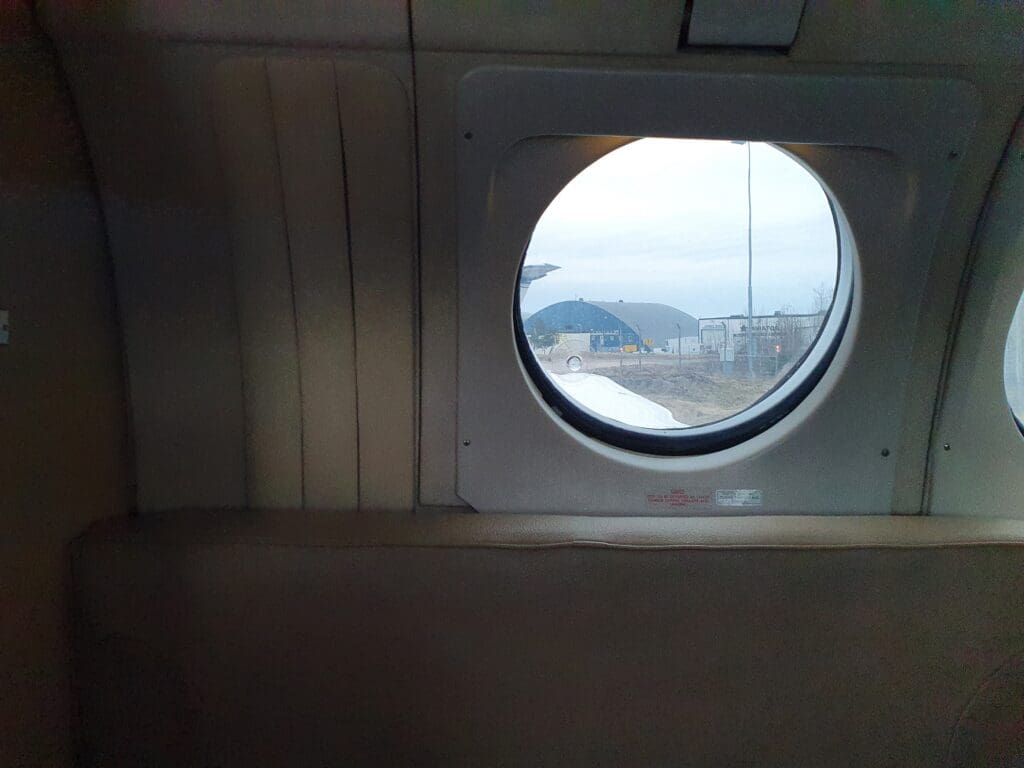
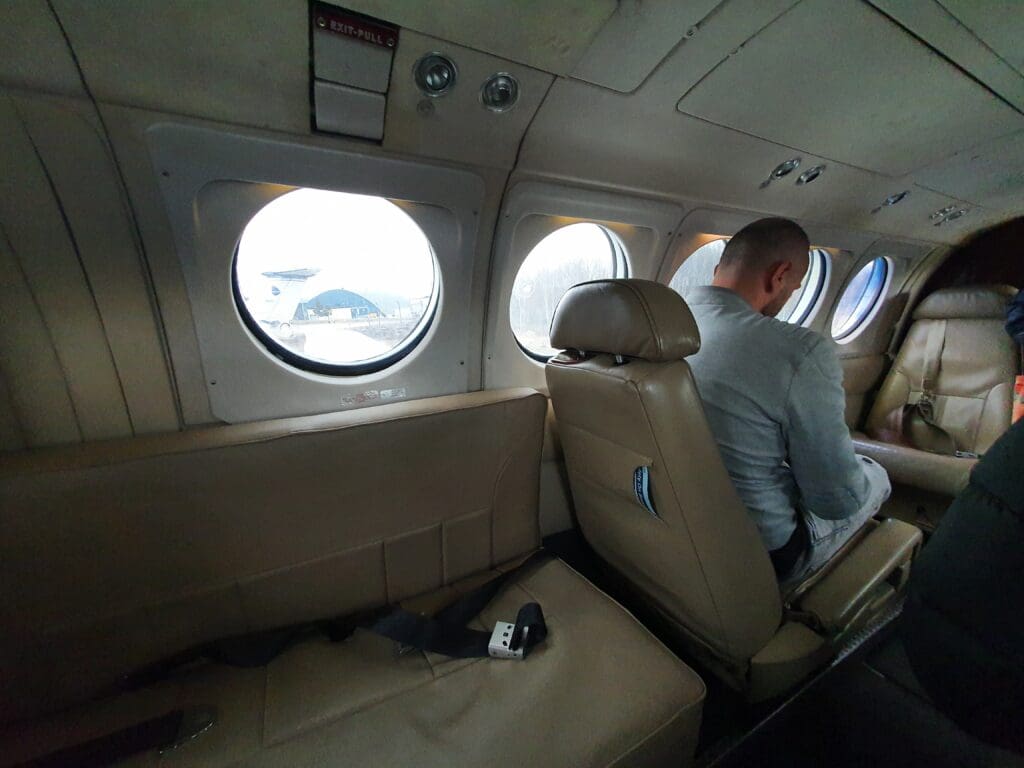
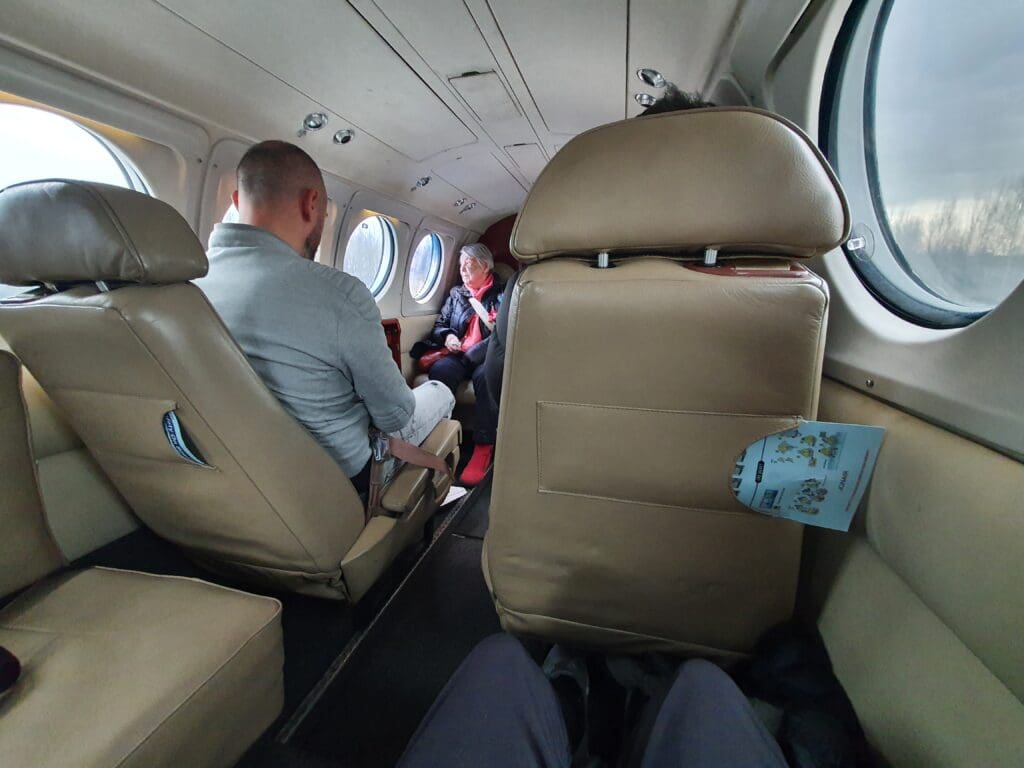
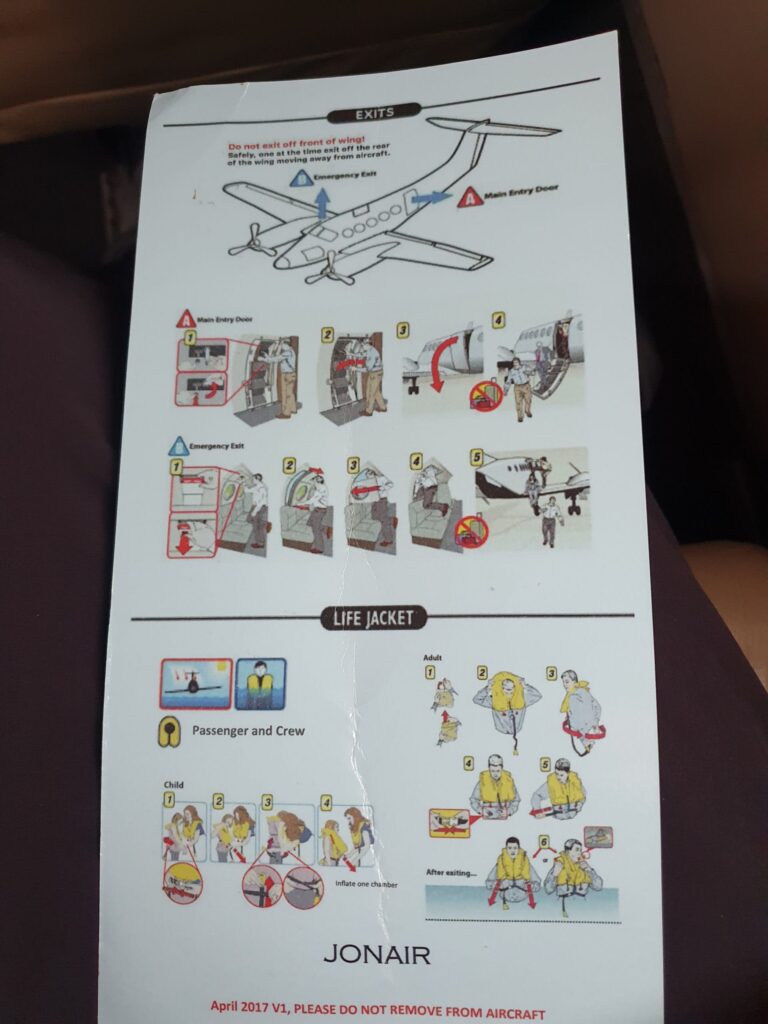
As was to be expected given the fact that I was on a corporate transport aircraft, upon sitting down I found the seat to be soft, comfortable and provide an abundance of legroom. Although slightly annoyingly this did automatically recline a fair way each time I leant back – however, I did soon get used to this. Inside, the cabin appeared to be clean and tidy, although this did display signs of its old age with an abundance of marks, scratches and smudges seen almost everywhere I looked. Whilst this was not an issue for me on the scheduled flight up to Sveg, I may have been slightly disappointed with the state of the interior had I hired the aircraft for a luxury charter. As with most airliners, each seat came complete with an individual air vent and a reading light, with those positioned above my seat working without any issue. Onboard, cabin illumination came in the form of a lighting strip that ran above the King Air’s large circular windows. Meanwhile, the portholes themselves lacked any sort of window blind – with these being dimmed by means of a handle which served as a sort of low-tech version of the Dreamliner’s dimmable windows. Examining the contents of the seatback pocket, this contained nothing other than a Jonair-branded safety card. Finally, no tray table could be found, and the tables once in position between each pair of seats facing one another appeared to have been removed
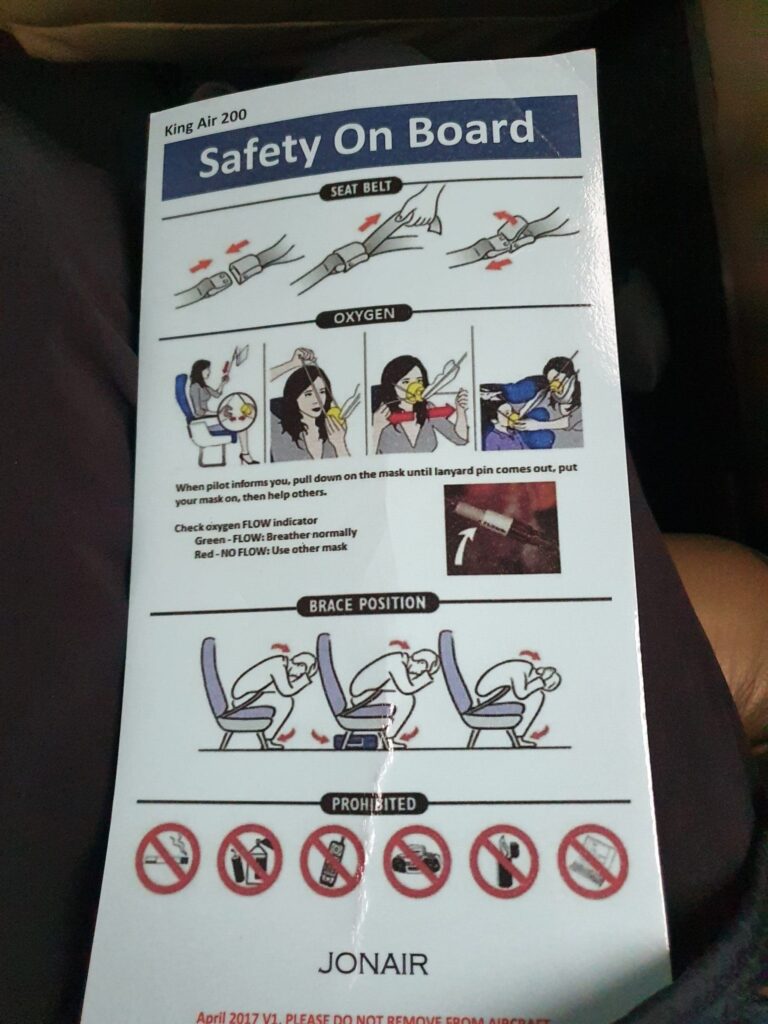
.
After taking my seat, it wasn’t too long before all my fellow passengers made their way into the small cabin. Perhaps not regulars on Jonair’s service, most appeared to take plenty of photos and seemed to be rather surprised at the fact that such a small and luxurious aircraft would shuttle them to Jämtland that morning. Once all passengers were onboard their bags were then transferred from the back of the minibus and into the cargo compartment at the rear of the cabin before the first officer and Grafair agent exchanged a few parting words. With nine minutes to go until our scheduled departure time, at 0846, the cabin door was closed and the First Officer performed what I assume was a short welcome and safety speech, conducted in Swedish only, from the rear of the cabin. After this had been completed, the pilot then passed through the cabin ensuring that all onboard had successfully strapped themselves into their three-point harness before diving into the cockpit and sliding into the King Air’s right-hand seat.
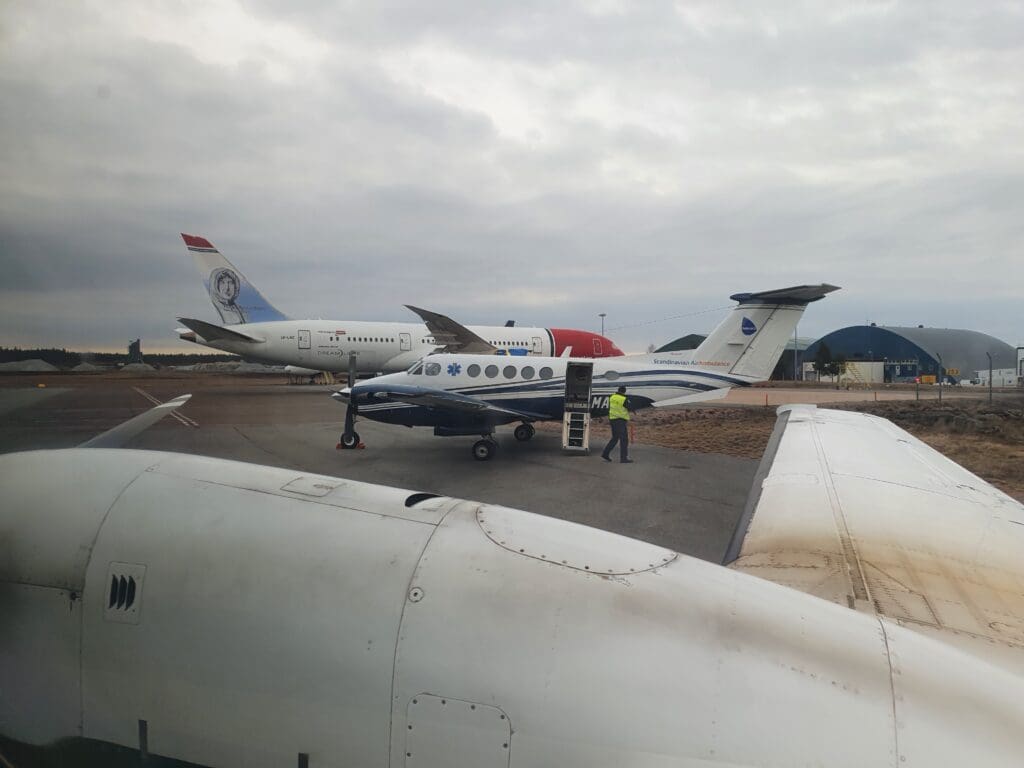
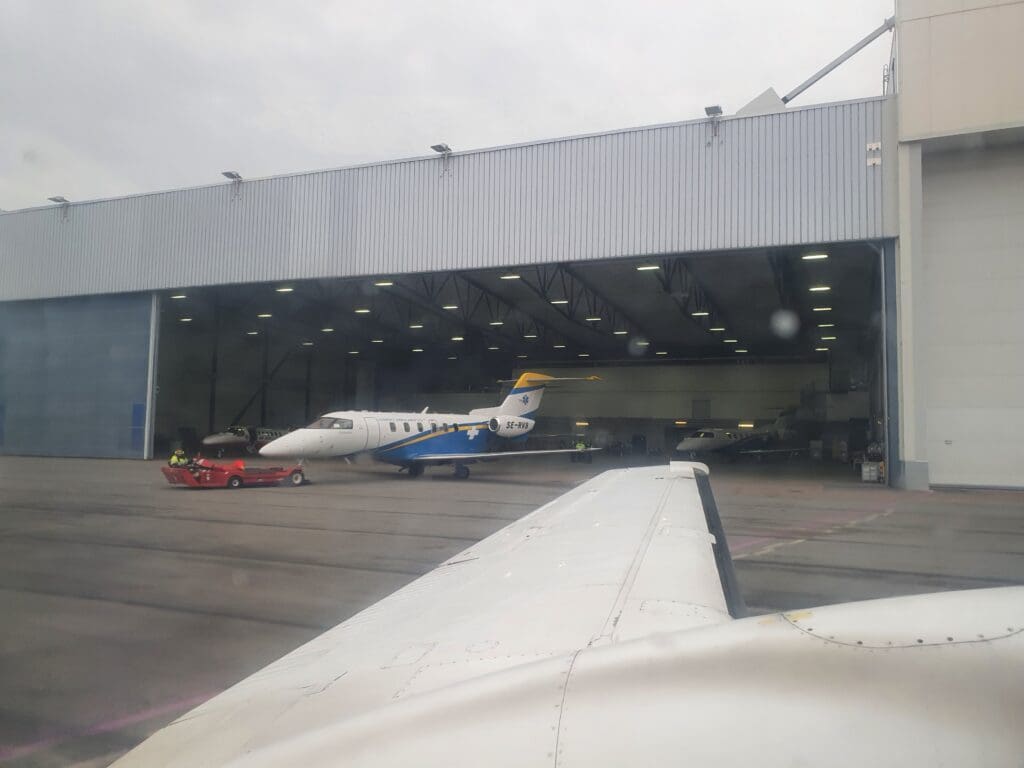
Once the two pilots were in position in the cockpit, they could be heard running through various checklists and a short time later the King Air’s two turboprop engines began to whine as they fired up into life. As with most King Airs, this particular aircraft is fitted with two Pratt and Whitney PT6 turboprop engines – a popular model utilised by a vast plethora of different aircraft types from military trainers and UAVs to STOL-capable airliners such as the Cessna Caravan and Twin Otter. Given the small size of the cabin and my position right next to the engine, I had expected the two engines to produce a decent racket and a fair amount of vibration. However, perhaps the result of the King Air’s cabin soundproofing, the engines seemed to be much quieter than I had expected. A couple of minutes after the two turboprop engines had spooled up, the King Air jolted forward and commenced its taxi as the Grafair agent waved us off at the start of our journey to Sveg. From the stand, the aircraft cautiously made its way past the aforementioned Danish Falcon, meanwhile, a host of jets could be seen inside one of the two hangars. These came in the form of a Gulfstream G550 operated by local company European Flight Service, an air ambulance configured Grafair Cessna Citation 560 Ultra and two brand new Svenskt Ambulansflyg Pilatus PC-24s which are dedicated to transporting medical patients to and from Sweden’s remote regions – one of which could be seen being readied for a morning mission to Mora. Other than this, a stored Boeing 787-9 Dreamliner that once operated for Norwegian and a long-retired vintage Douglas DC-8 could also be seen.
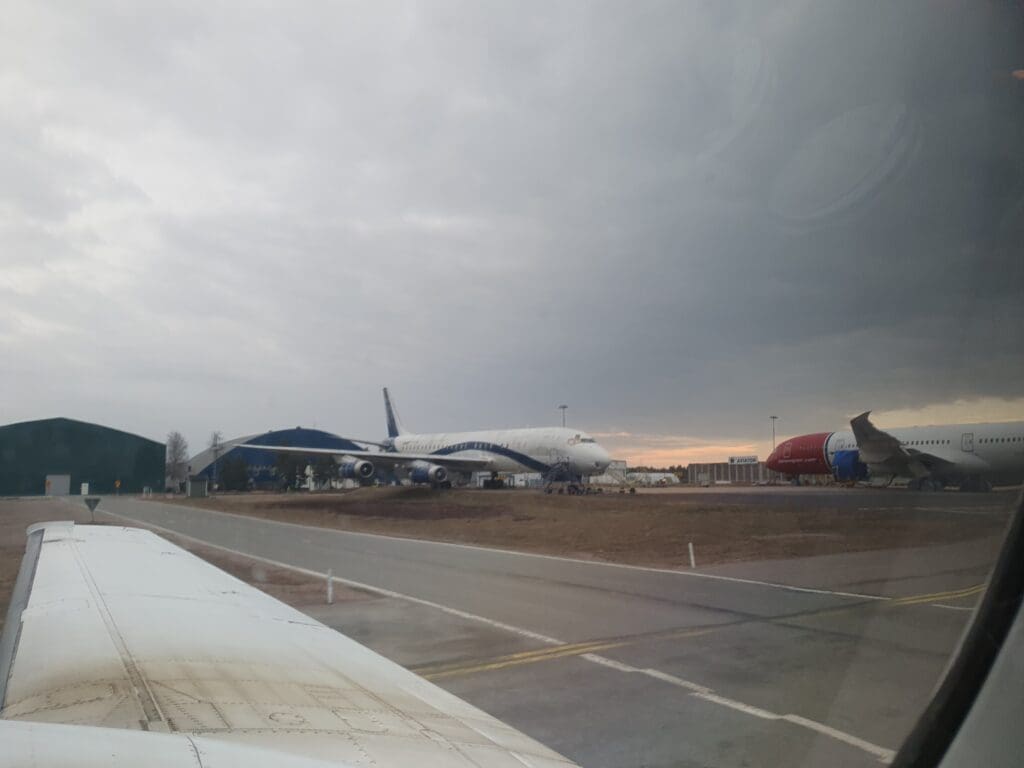
Once away from Arlanda Airport’s business aviation apron, the King Air turned left and began a fairly lengthy taxi around the terminal complex, enabling a glimpse of most waiting airliners on the ground that morning. As one would likely expect at Arlanda, the majority of waiting aircraft came in the form of airliners operated by Scandinavian Airlines and their subsidiaries – ranging in size from ATR-72s and Bombardier CRJ-900s, to Airbus A330s and Airbus A350s. Other than this, plenty of Norwegian Boeing 737s could also be seen waiting to jet off to destinations across Europe whilst foreign guests were provided by Austrian Airlines, British Airways, Eurowings, KLM and Qatar Airways. After leaving the terminals behind, the aircraft then made its way out past the airport’s remote stands, where a total of four Amapola Flyg Fokker 50s could be seen waiting for their next flights across Sweden, one of which took the form of the same aircraft that I had flown from Dublin to Donegal and back the previous year.
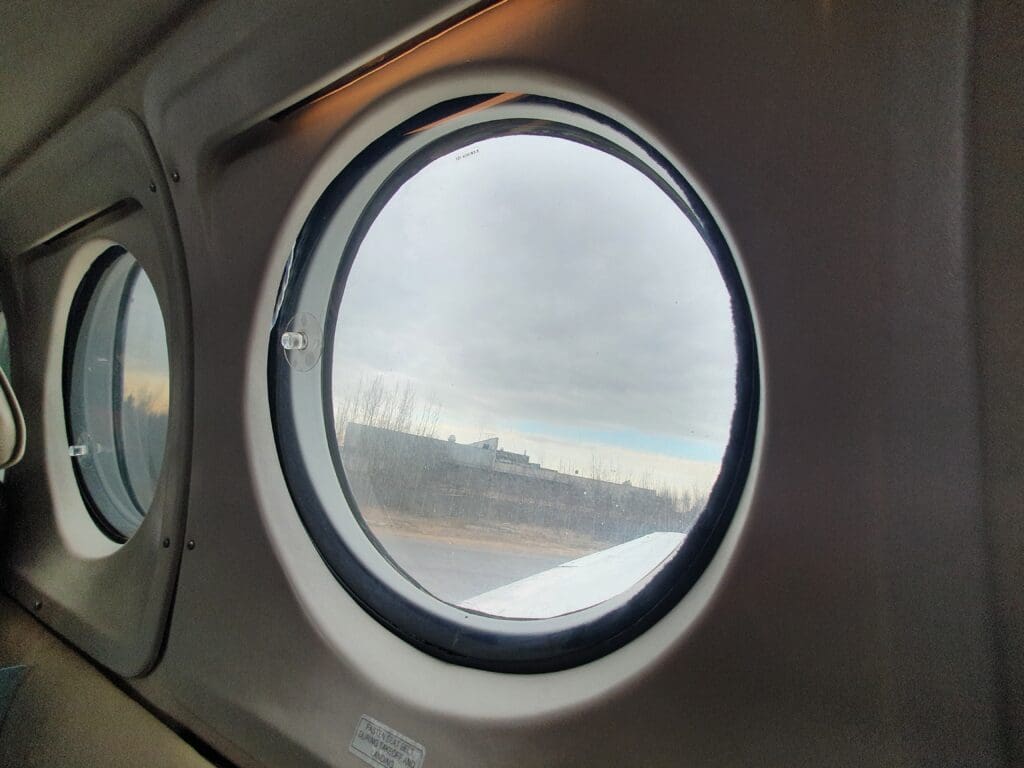
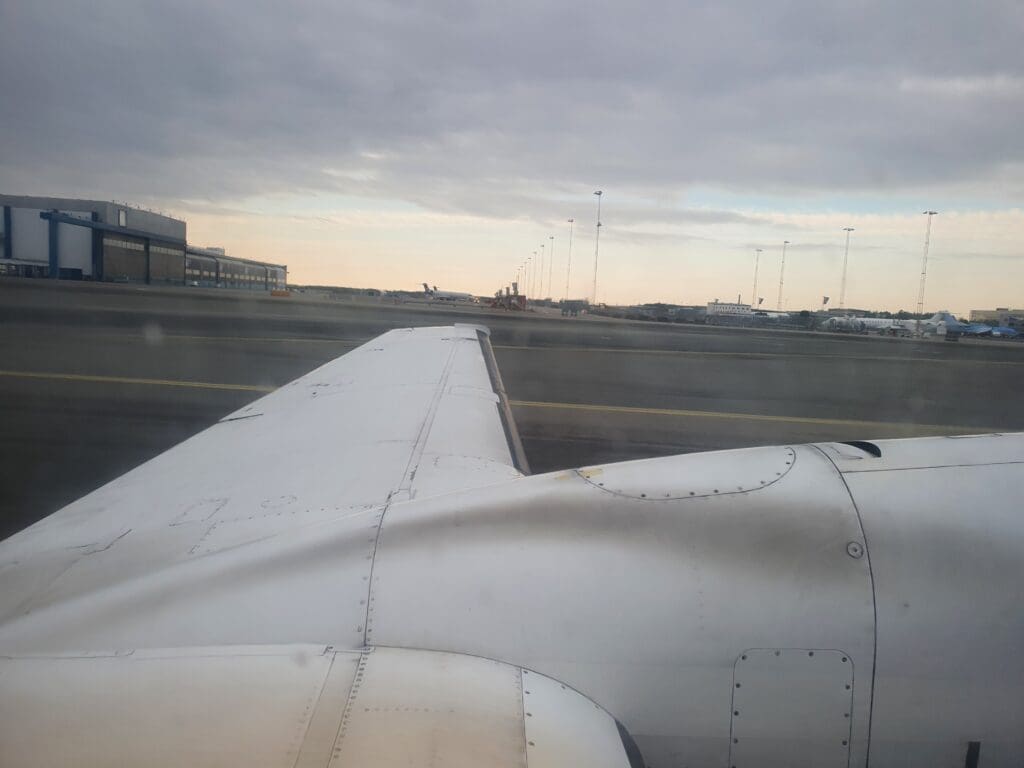
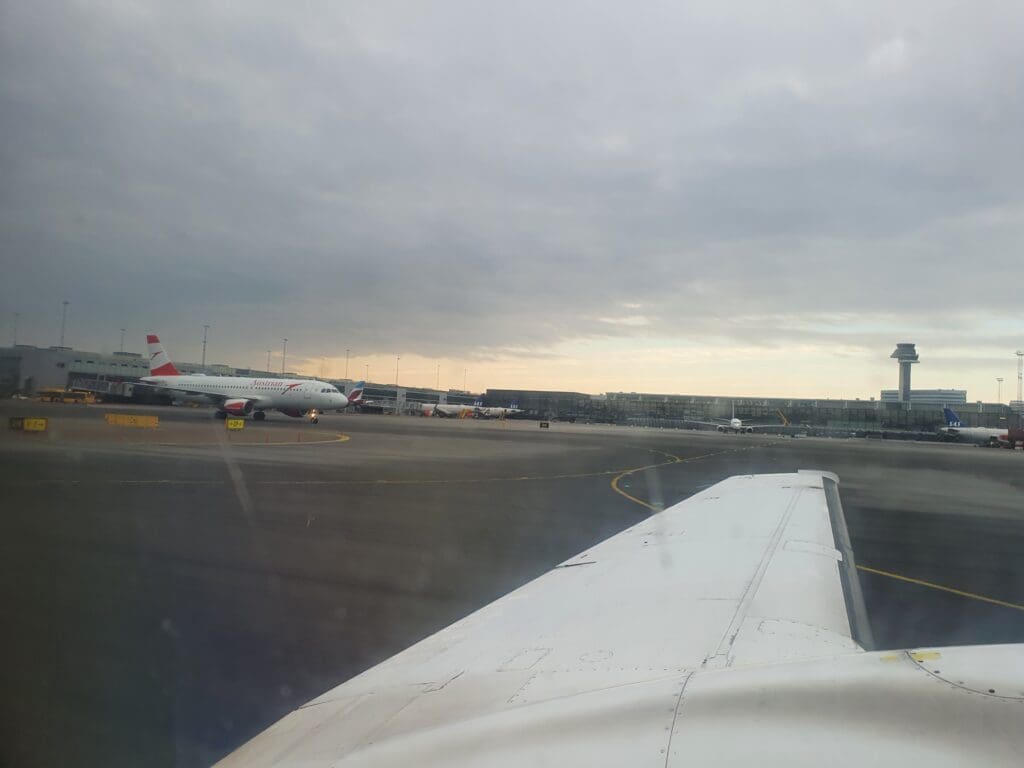
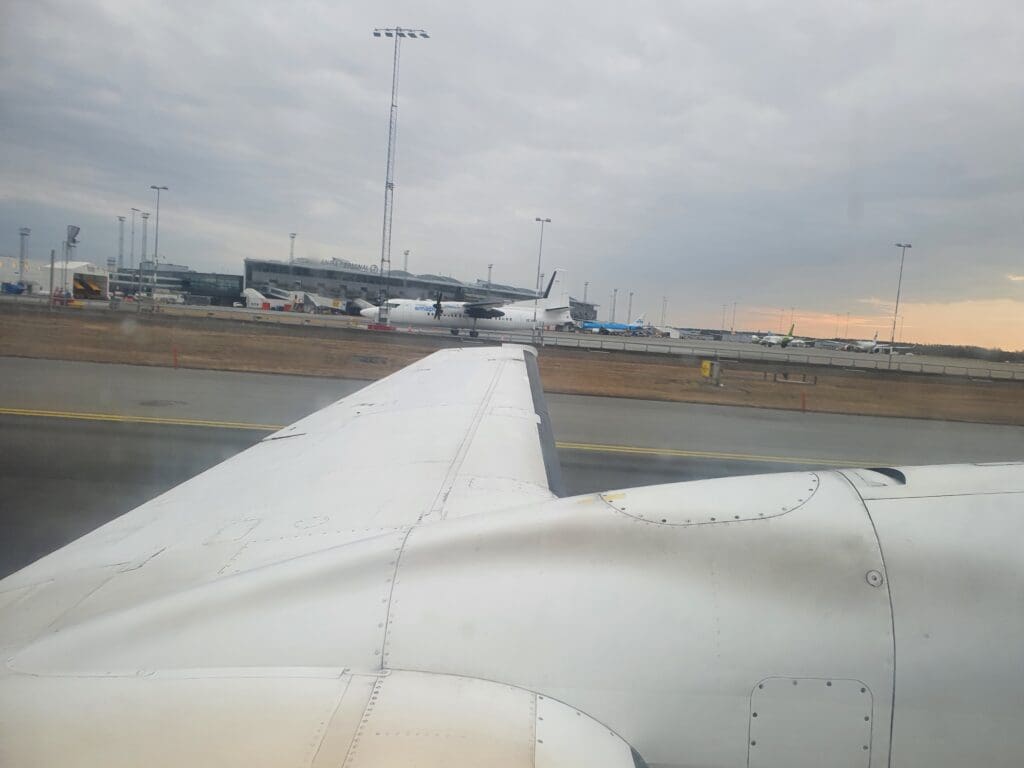
Following a long taxi, the King Air arrived at the end of Runway 01L and entered this via intersection Y1 just as an Estonian Bombardier CRJ-900 operated by Xfly on behalf of Scandinavian Airlines could be seen rolling down the runway at the start of its flight to Hamburg, Waiting for this to clear the skies up ahead and to allow for any wake turbulence to dissipate, we sat on the runway for a couple of minutes and at 0903 the two turboprops on either side of the cabin whirred into life. At this stage, facing backwards, I experienced the unusual sensation of being pushed out of my seat as the King Air rapidly accelerated down the runway. That morning, the aircraft’s take-off roll was brief with the King Air shot up into the skies in what seemed like no time at all before the distinctive Beechcraft vacuum cleaner sound could be heard as the gear was retracted.
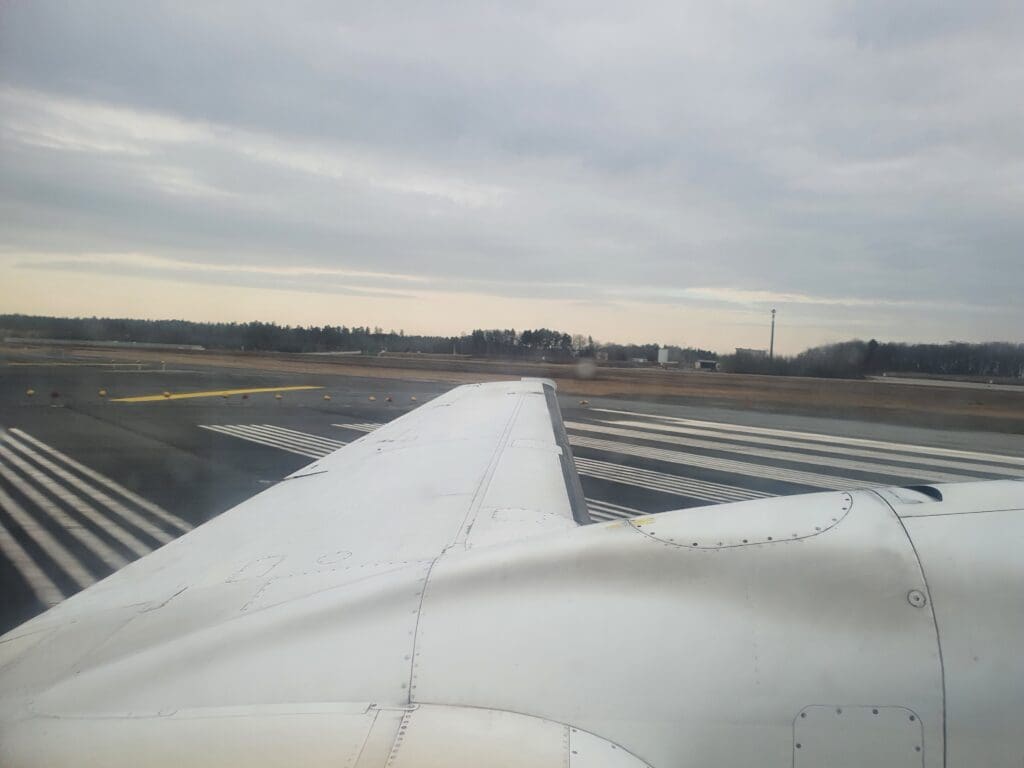
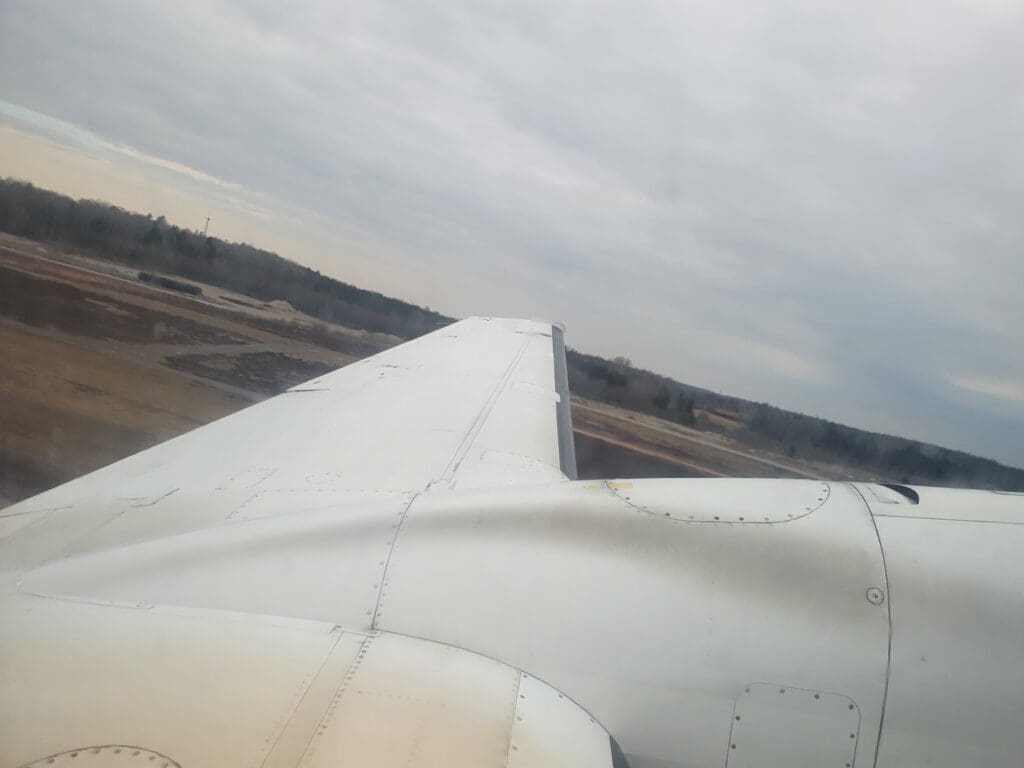
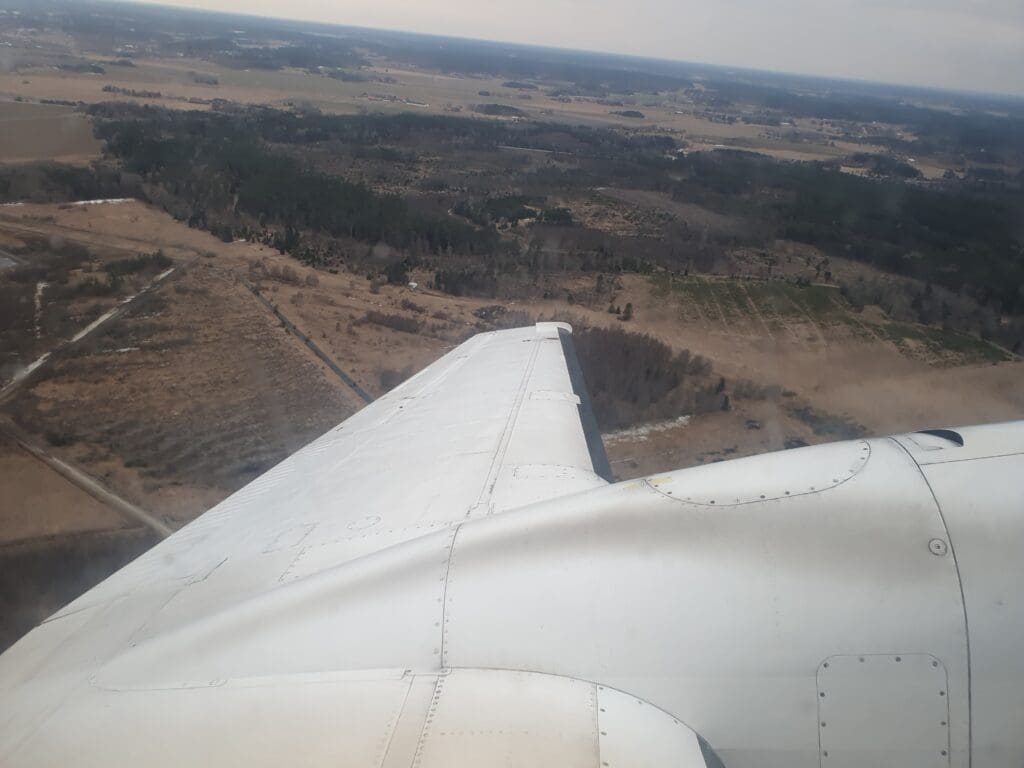
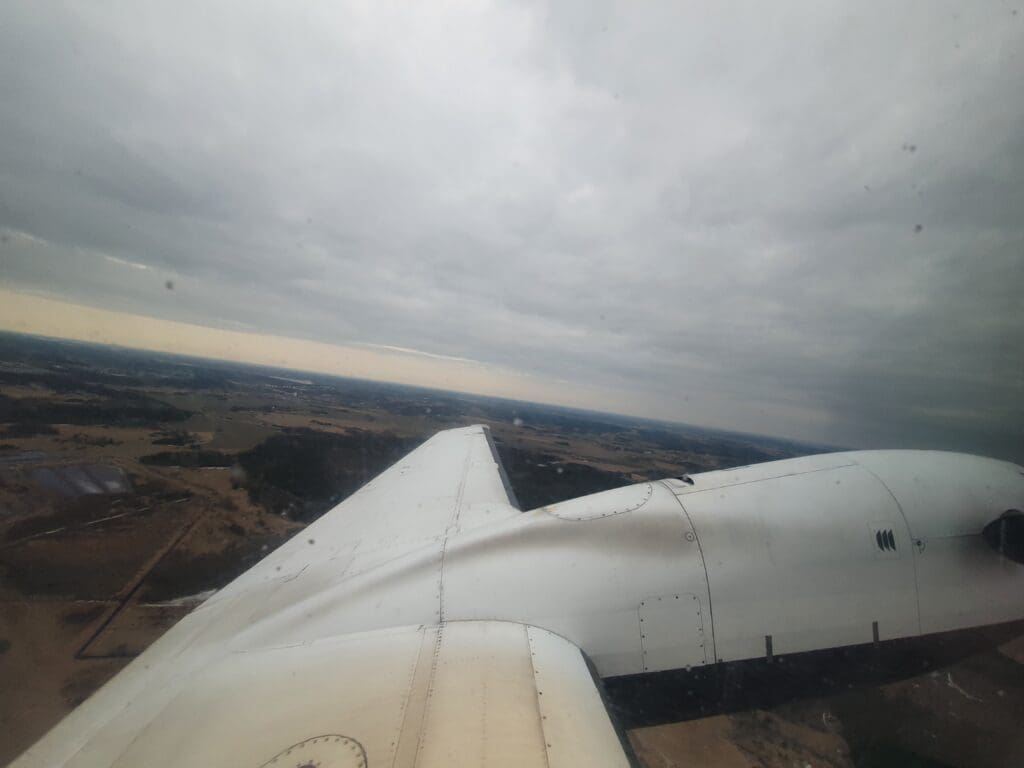
As the King Air rocketed away from Arlanda Airport, things got slightly bumpy although this turbulence did not last for long. During the first few minutes of the flight, the aircraft climbed over a mixture of fields and forests, with the nearby Uppsala town of Knivsta visible to the east as we made our way towards the clouds. A short time after taking off, the aircraft banked slightly before rolling out onto a northwesterly heading that would take us up to Sveg with only minimal further changes to our course. A total of four minutes after leaving Arlanda Airport behind, the King Air rose into the clouds and passed through these quickly ensuring that nothing more of the county of Uppsala could be seen. Meanwhile, after passing the city of Uppsala, the King Air levelled off at which point the seatbelt sign was extinguished around eighteen minutes into the flight. Nevertheless, with no galley provided and a passenger occupying the emergency toilet seat at the rear of the cabin, there was nowhere for passengers to go and thus all remained firmly in their seats for the duration of the flight.
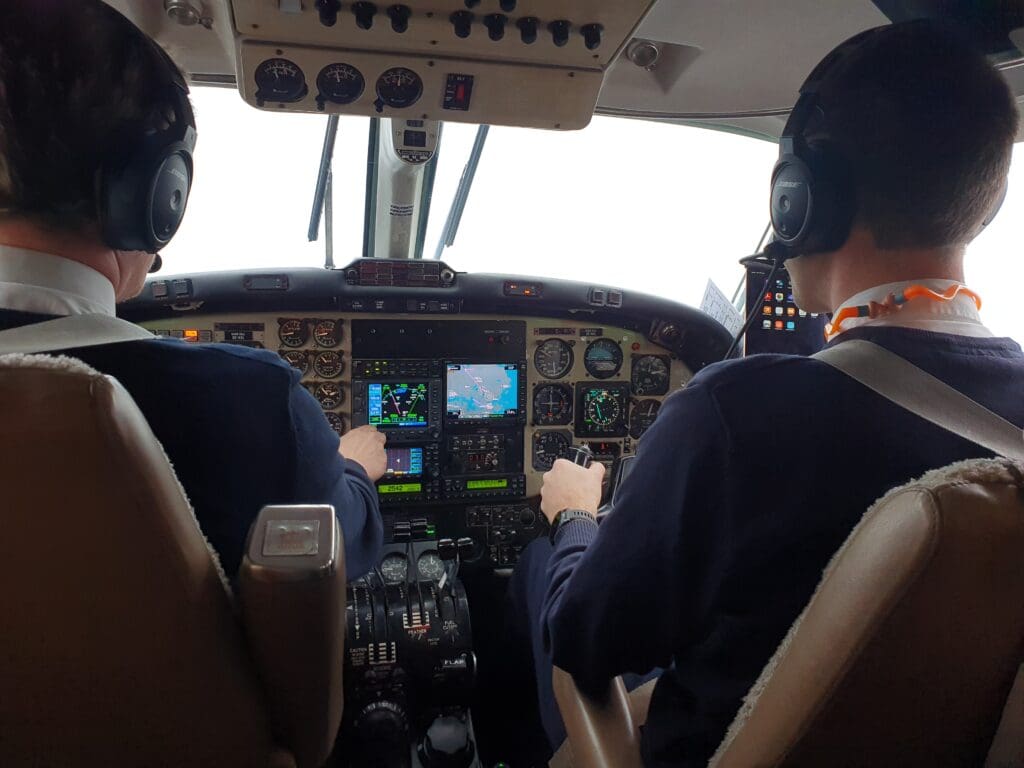
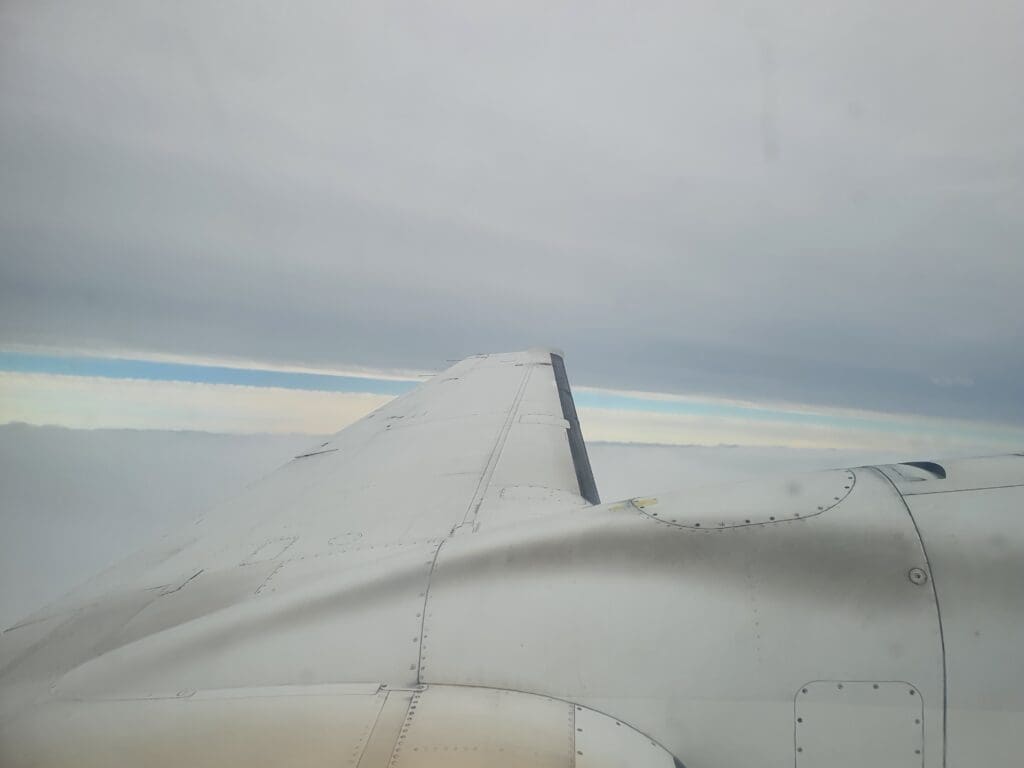
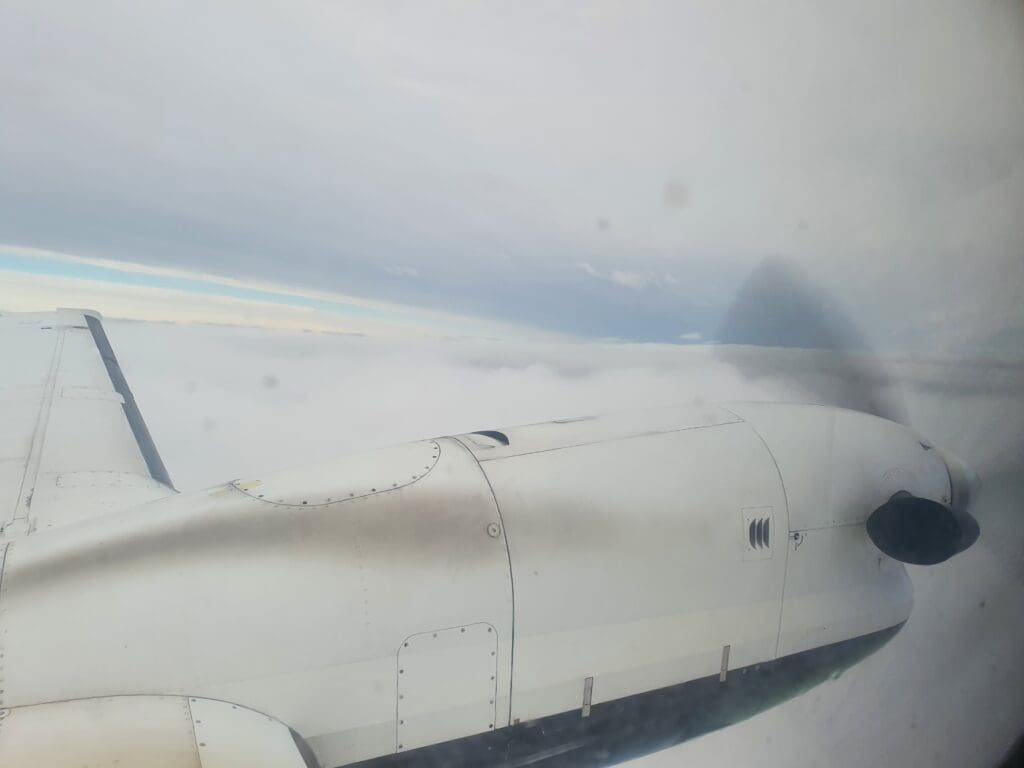
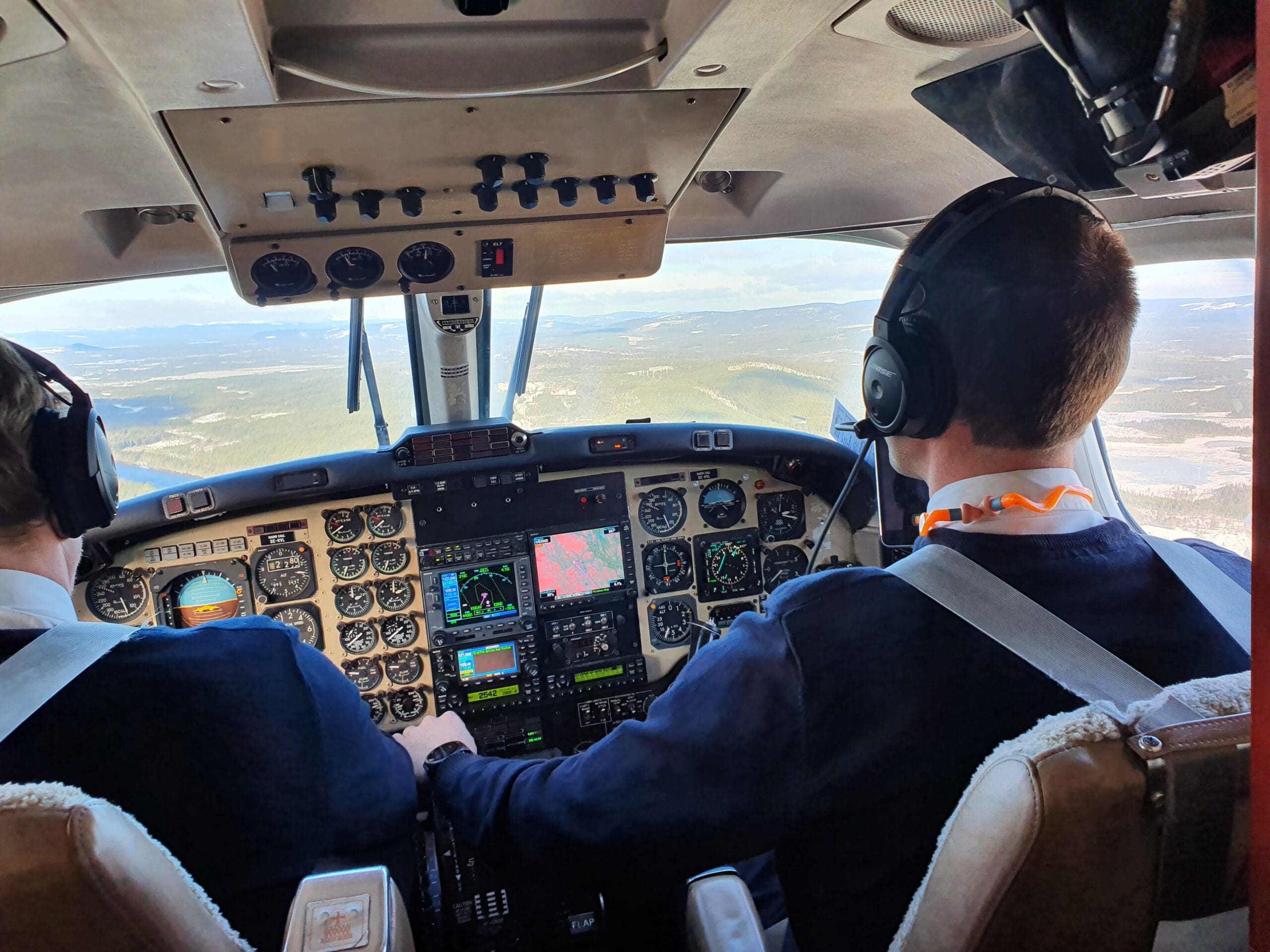
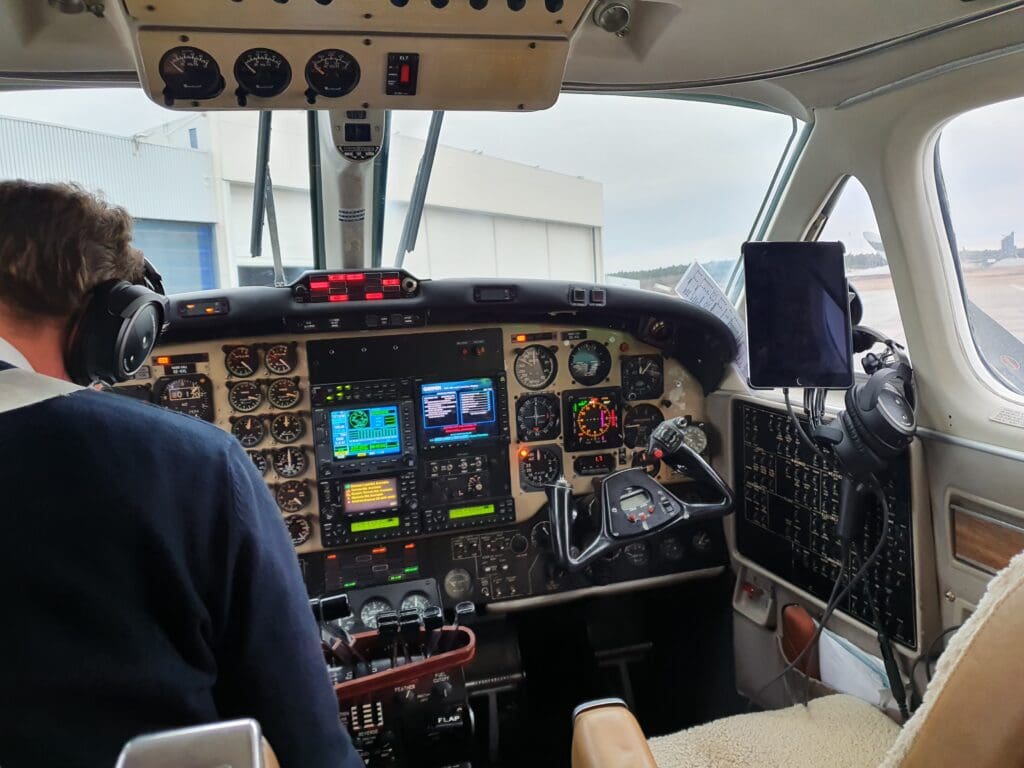
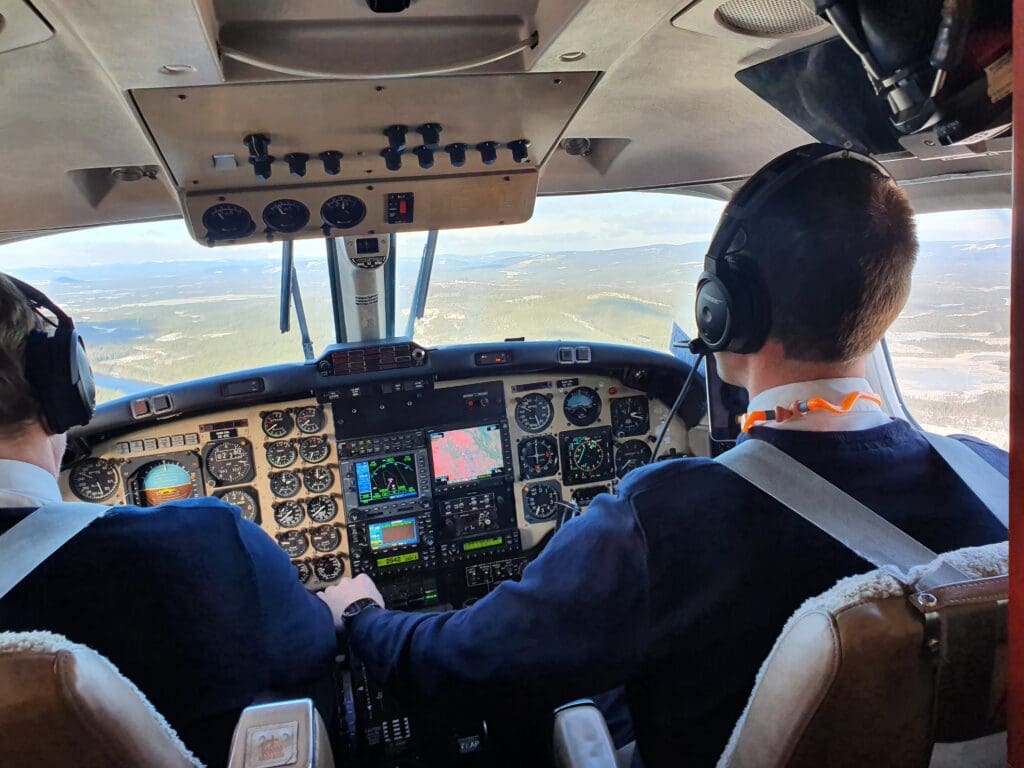
Whilst more modern King Airs often come complete with entertainment screens, as well as amenities such as plug sockets and USB chargers, unsurprisingly none of these could be found on this ageing turboprop. Fortunately, perhaps unlike a more ‘normal’ passenger, I was content with simply passing the time by simply soaking up the atmosphere of the aircraft and occasionally turning around and peering into the cockpit up ahead. There, a glance at the instruments revealed that the aircraft was cruising at an altitude of 20,000 feet and travelling at a speed of 200 knots. Meanwhile, the other passengers spent the journey sleeping, chatting with their fellow passengers and entertaining themselves on their own devices. Meanwhile, returning to noise and vibration levels, once in the cruise I found both of these to be fairly minimal with those chatting away onboard seeming to have no difficulty in sustaining a conversation.
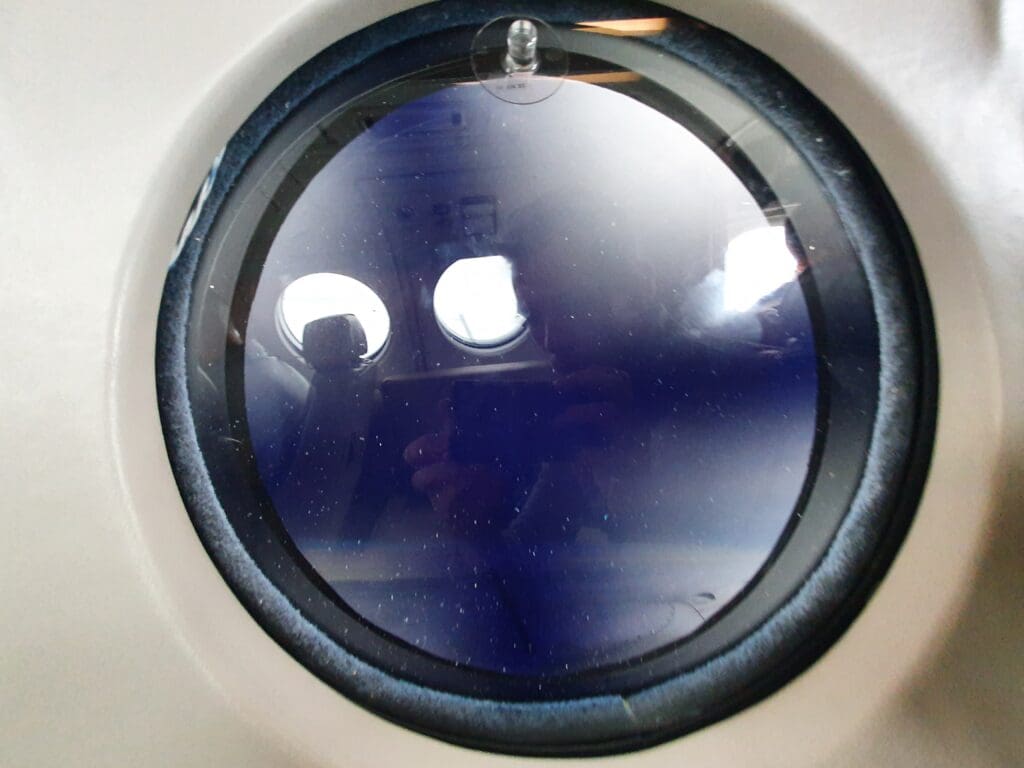
Turning to examine our route to Sveg, once away from the city of Uppsala, the King Air journeyed towards the small municipality of Östervåla which sits near the county of Uppsala’s border with the county of Gävleborg. Crossing over into the county, the King Air passed over the municipality of Sandviken before travelling northwards along Gävleborg’s western border with the province of Dalarna. As we trekked northwards towards the county of Jämtland, the clouds cleared below and revealed the snow-covered landscapes of rural Sweden. However thanks to the ice that had formed on the King Air’s large windows, no decent views could be had of the passing landscape for the remainder of the cruise.
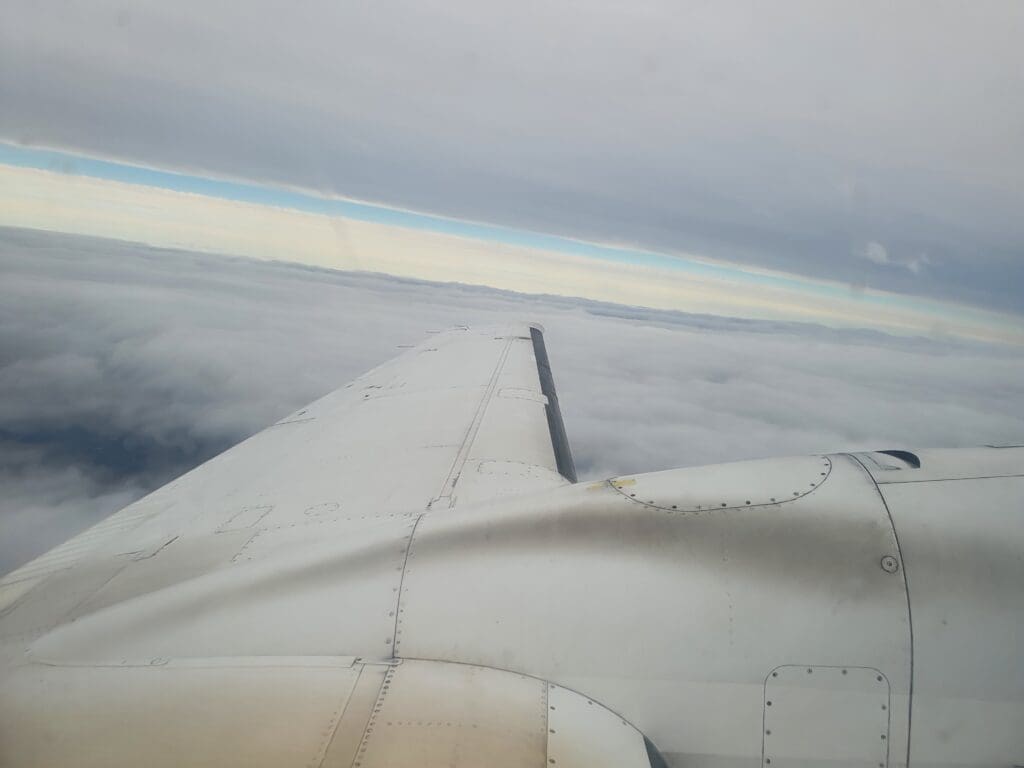
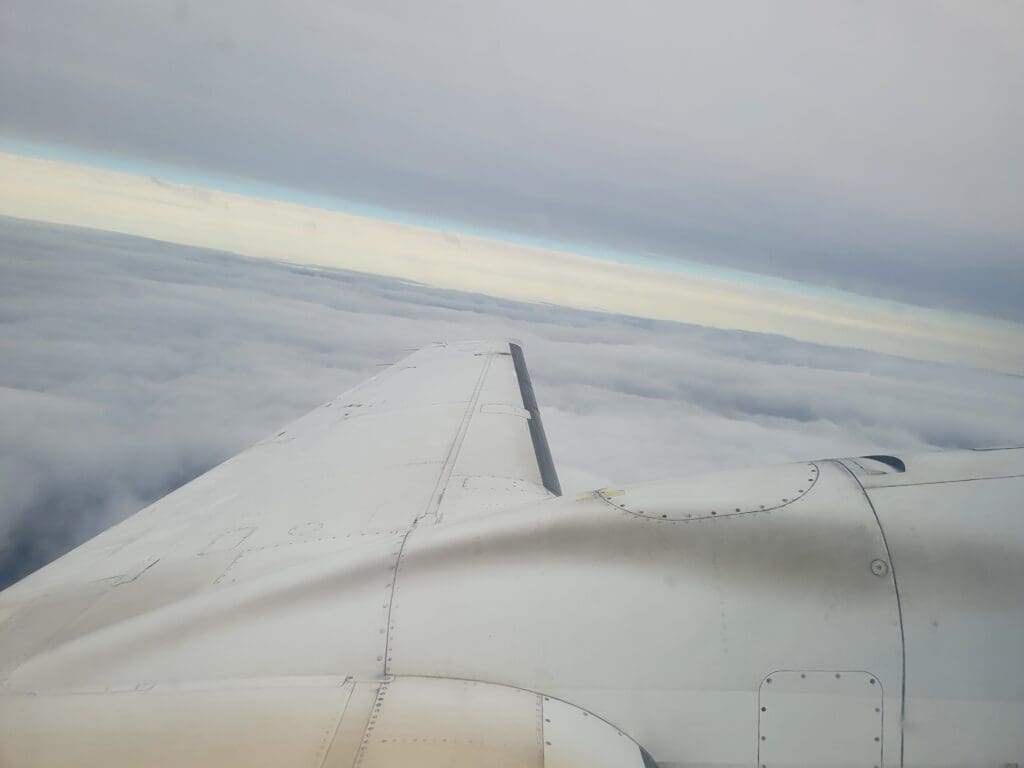
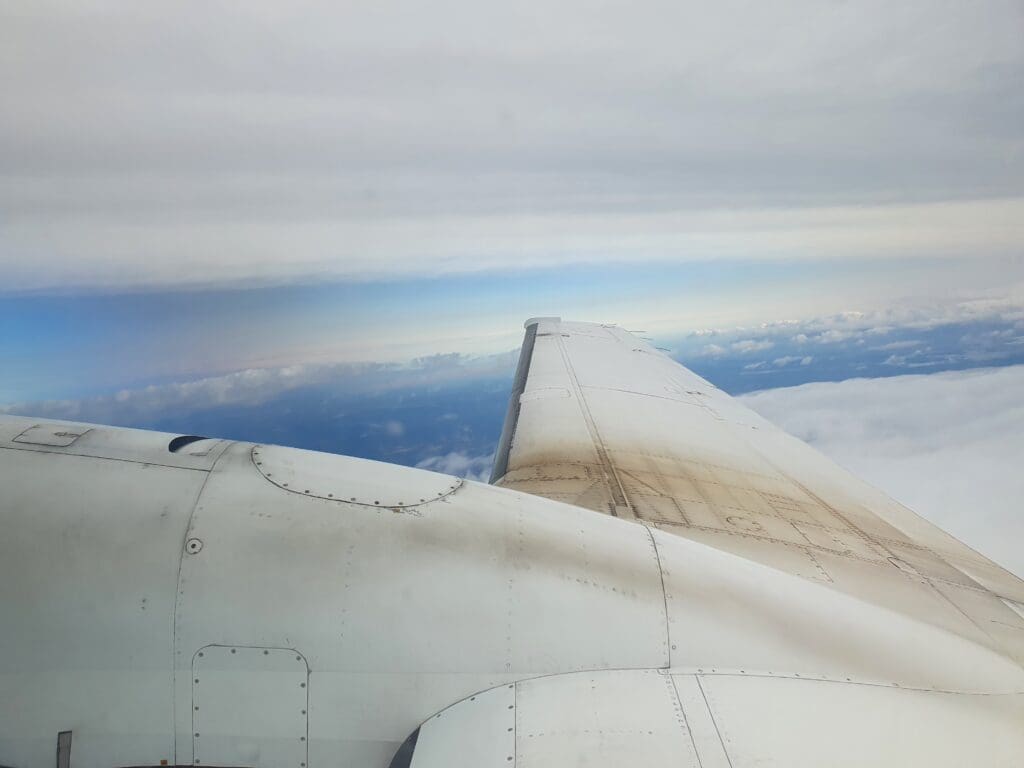
With the Garmin GPS up in the cockpit serving as my version of the moving map, I watched as the number of nautical miles to run until Sveg decreased and soon we hit a couple of rough patches of turbulence – with each lasting a couple of minutes. At 0945, the King Air could be felt commencing its slow descent towards the snowy Swedish landscape sitting below. As we descended through 13,000 feet, the Captain unstrapped themselves and squeezed out of the cockpit before performing a pre-arrival speech in Swedish from the chaise longue. Not only was this concerningly long, but this resulted in a few worried looks on the faces of my fellow passengers and thus, worried that I might be missing out on some vital information, I asked the Captain if they could summarise this in English. Happily providing a condensed version of this, the Captain warned that we would be in for some very heavy turbulence on our approach to Sveg and that we would land in around ten minutes.
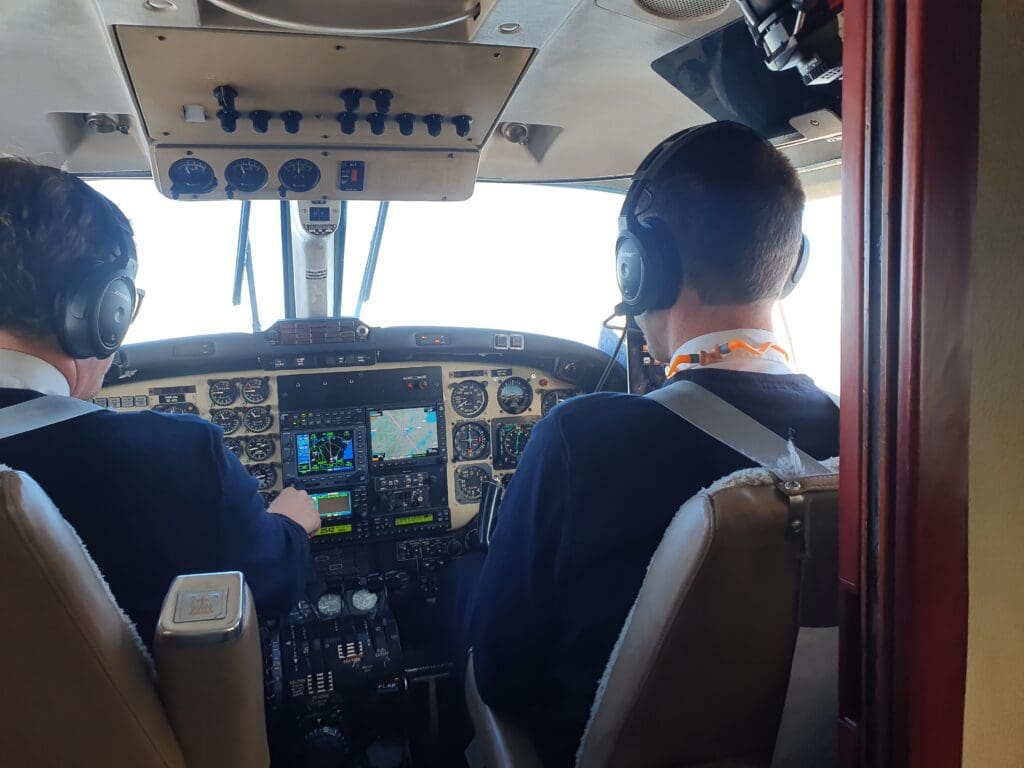
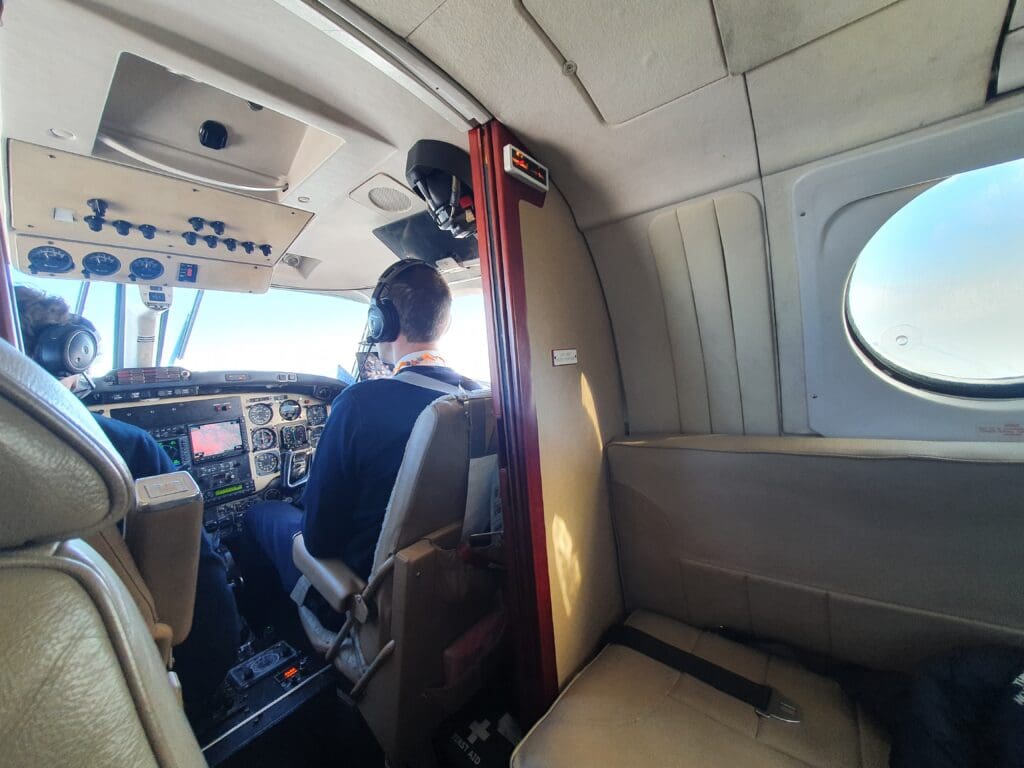
Even though the Captain had offered their own personal warning, having experienced a fair few bumpy flights and not suffering from motion sickness, I was not particularly worried. Indeed, as we sank downwards, we passed through a few bumpy patches although for the first few minutes following their speech, none of these seemed to be particularly rough. However, this changed as we neared Sveg when all of a sudden, I came to experience what was undoubtedly the most violent turbulence that I have encountered in my entire life. With gusts of up to fifty knots blowing in from the northeast, our approach was accompanied by unrelenting shaking, swaying and sudden rises and falls which resulted in a fair number of my fellow flyers letting out what I assume were Swedish expletives, whilst some spent the remainder of the flight with their head in their hands. To highlight the severity of the turbulence, a sudden bump resulted in my glasses flying off and ending up broken and lodged under the seat.
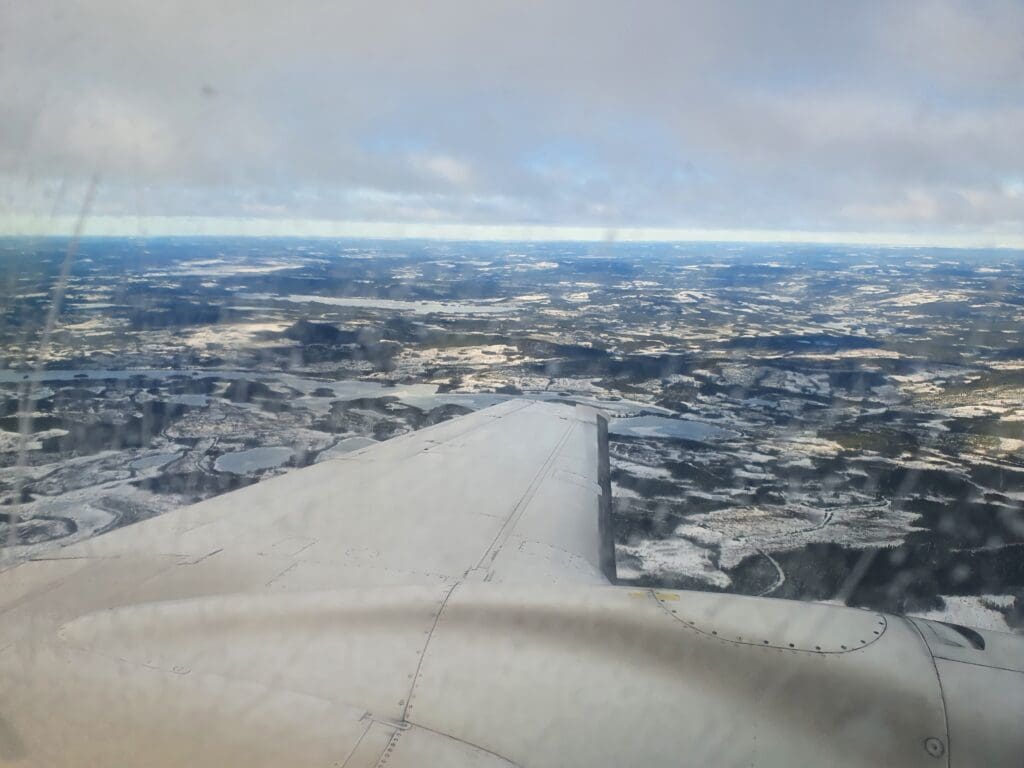
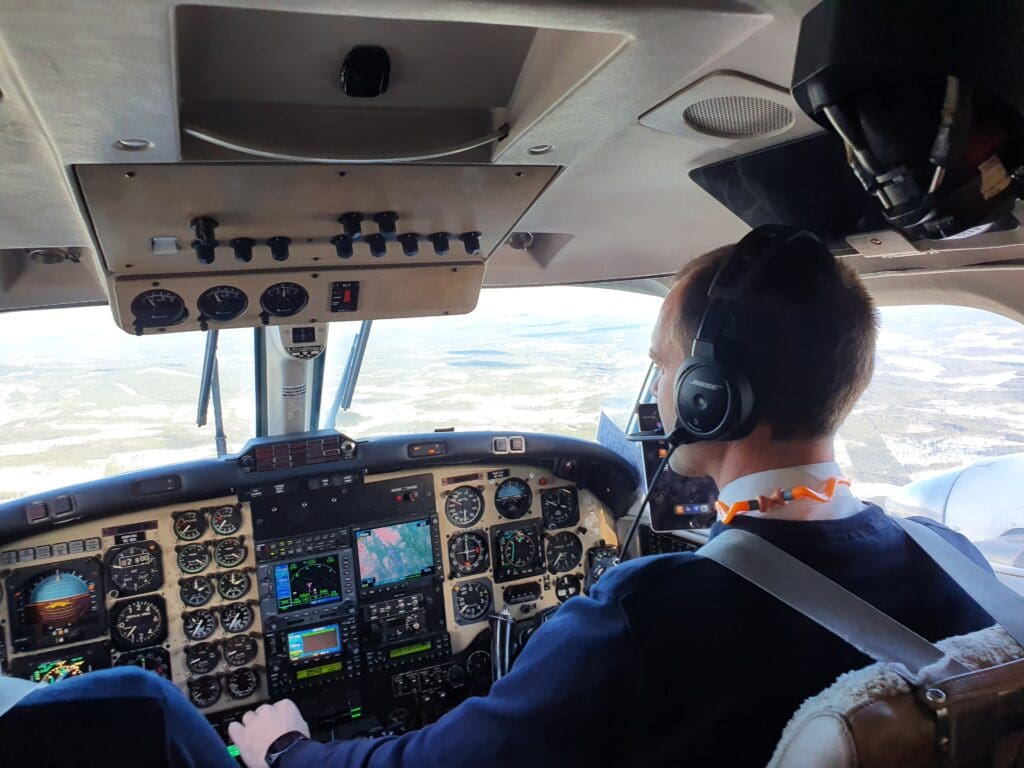
Aware that this was to be my last King Air flight for quite some time, whilst I should have savoured my last few minutes onboard, by this stage, I simply wanted to safely return to Terrafirma. I was thus delighted when the vacuum cleaner sound could be heard once more and the flaps and gear fell into position for our arrival into Sveg. Turning around, I caught a glimpse of the airport’s runway up ahead whilst the Captain could be seen fighting with the yoke and power levers as they guided the King Air down towards this. As we descended, the King Air whizzed past the tops of the tall pine trees that sit around the airport and soon passed over the perimeter fence. Just metres above the runway, the throttles were pushed forward at which point I was a little worried as it appeared that a go-around had been initiated although thankfully this was not the case and a few moments later the King Air made a surprisingly gentle touchdown on Sveg Airport’s Runway 27 after a total of 1H09 in the air.
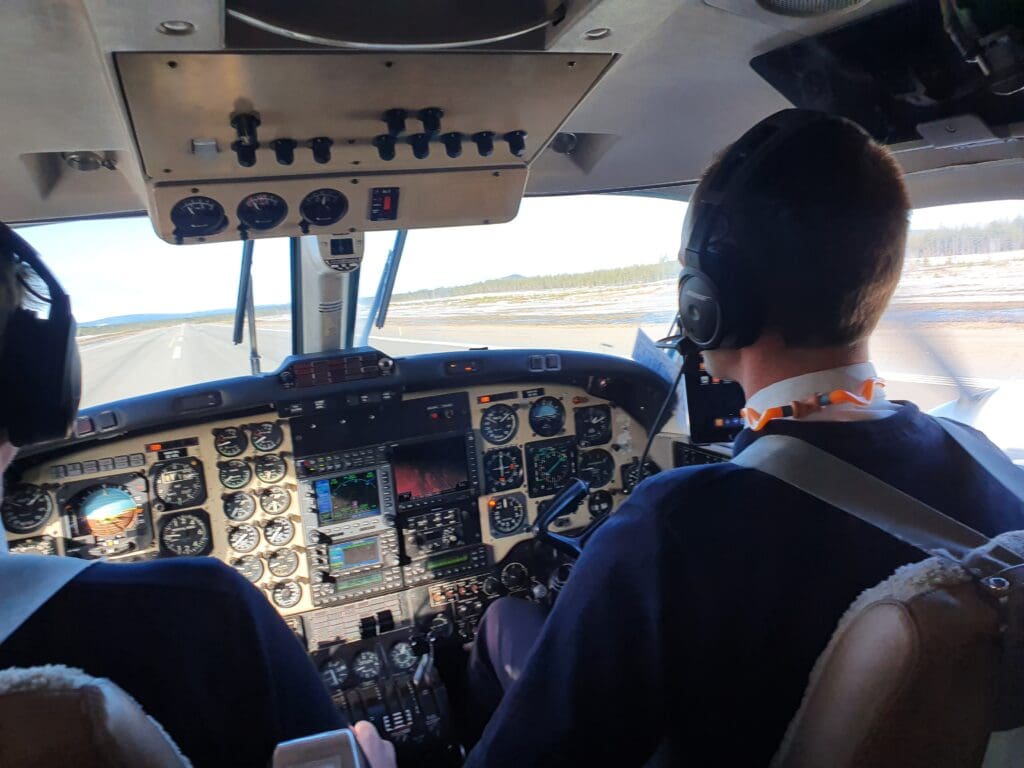
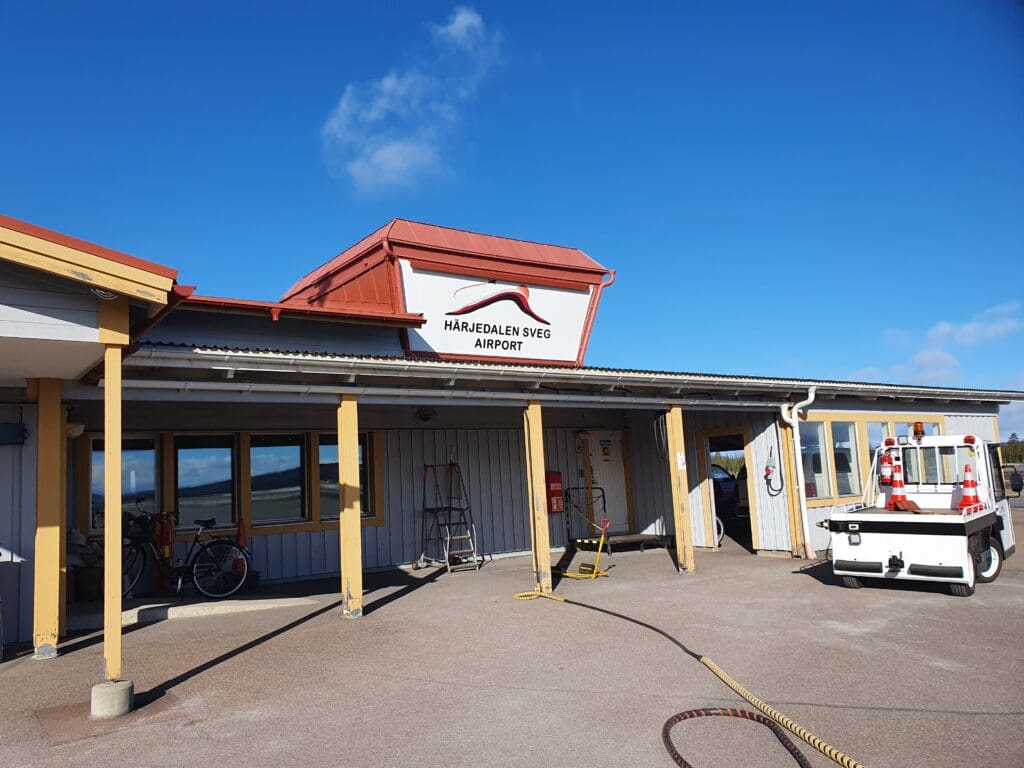
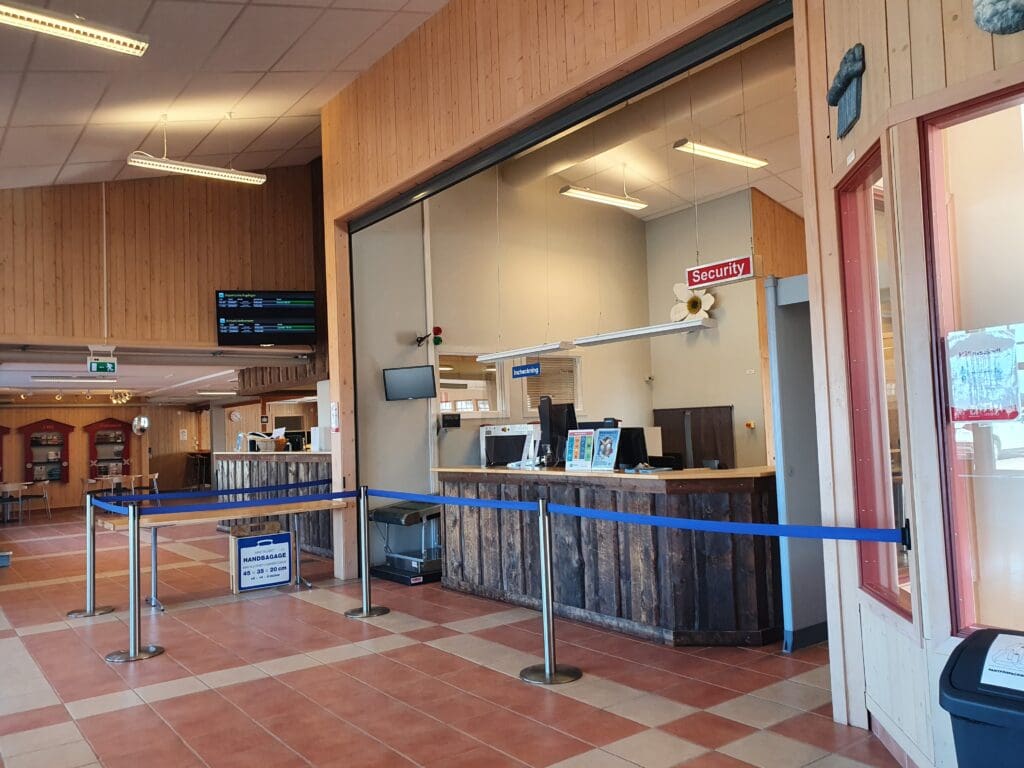
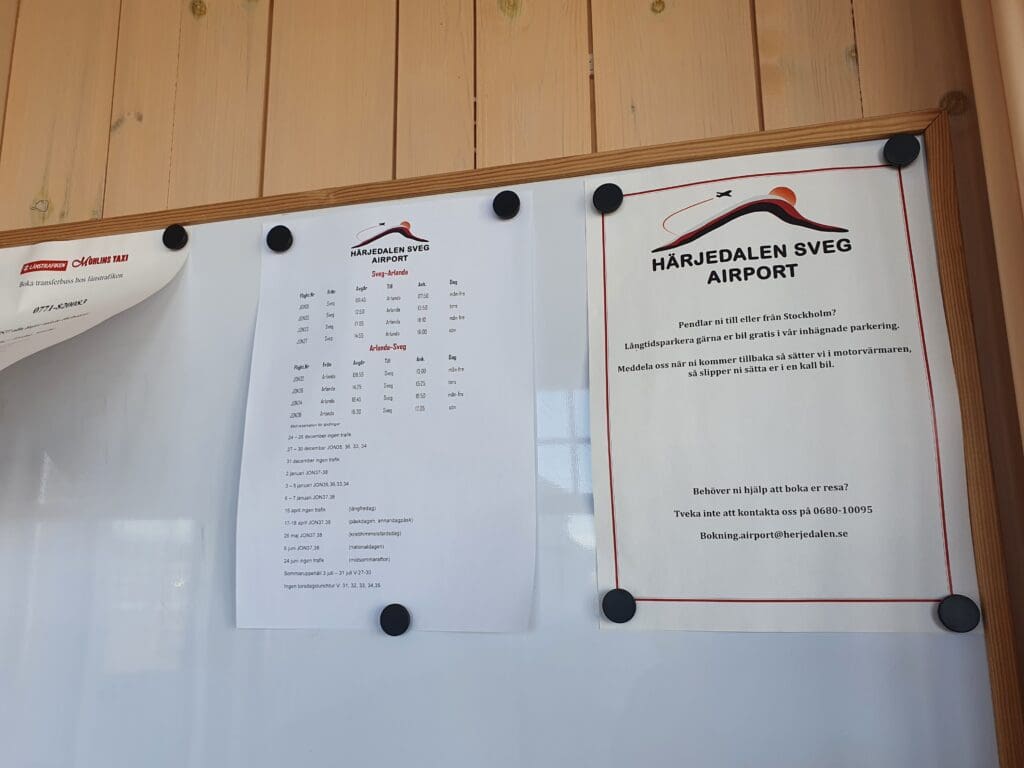
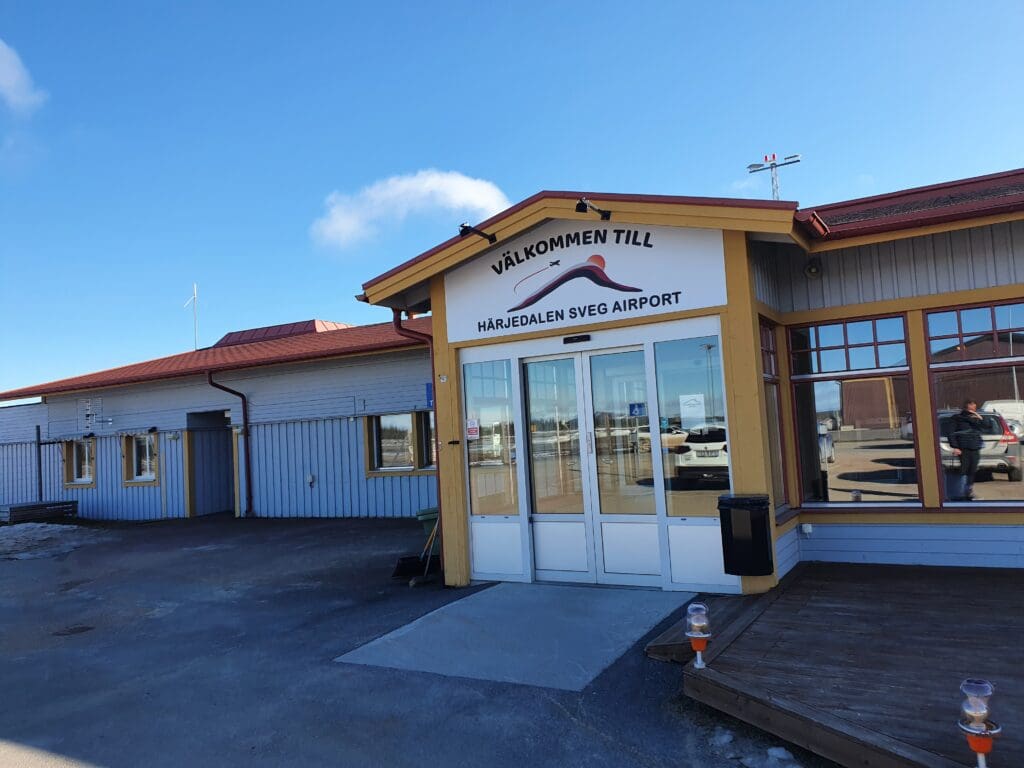
Once on the ground, all inside the cabin appeared to be very delighted to have made it to Sveg in one piece and the King Air decelerated rather quickly before vacating the runway to the left and making its way over to the terminal building. With Sveg Airport being far from Sweden’s busiest hub, unsurprisingly the terminal is rather small and consists of a single-story structure complete with traditional wooden panelling and featuring a control tower that protrudes out of this. Other than the terminal, several hangars can also be seen although these were firmly closed for the day so no other aircraft could be seen that morning. Soon coming to a halt directly outside the terminal building, the King Air’s two PT6 engines spooled down and the first officer emerged from the cockpit. At this stage, it appeared that the passengers were rather happy to be back on the ground and appreciative of the hard work of the pilots, thanking the first officer as they made their way down the cabin.
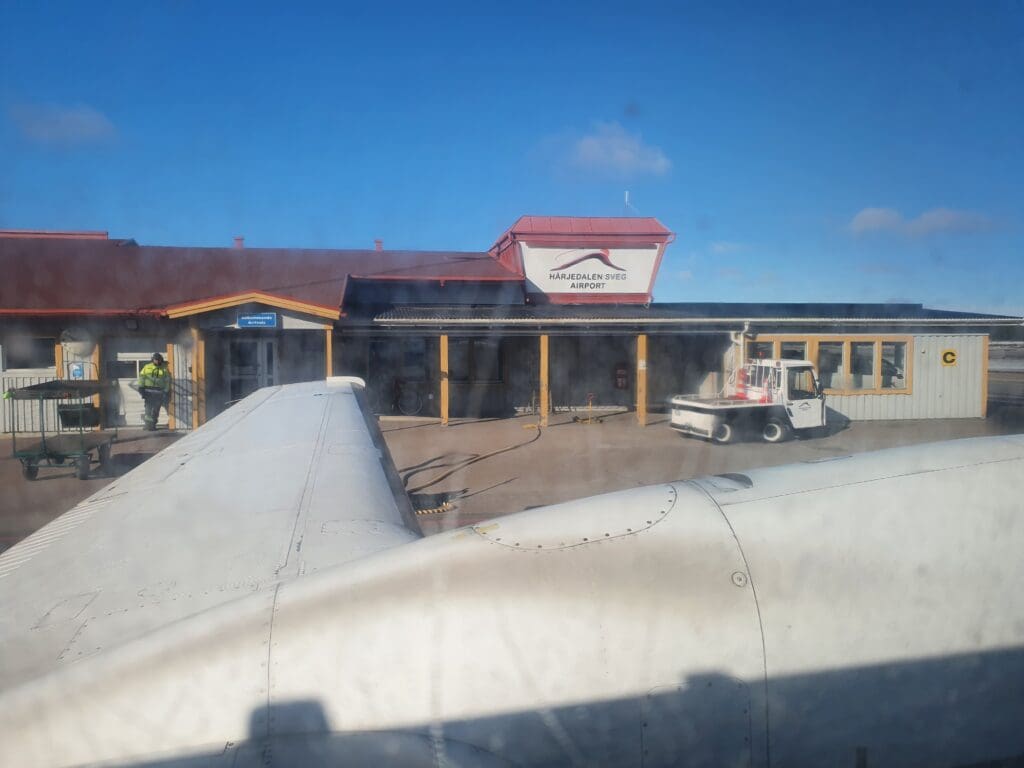
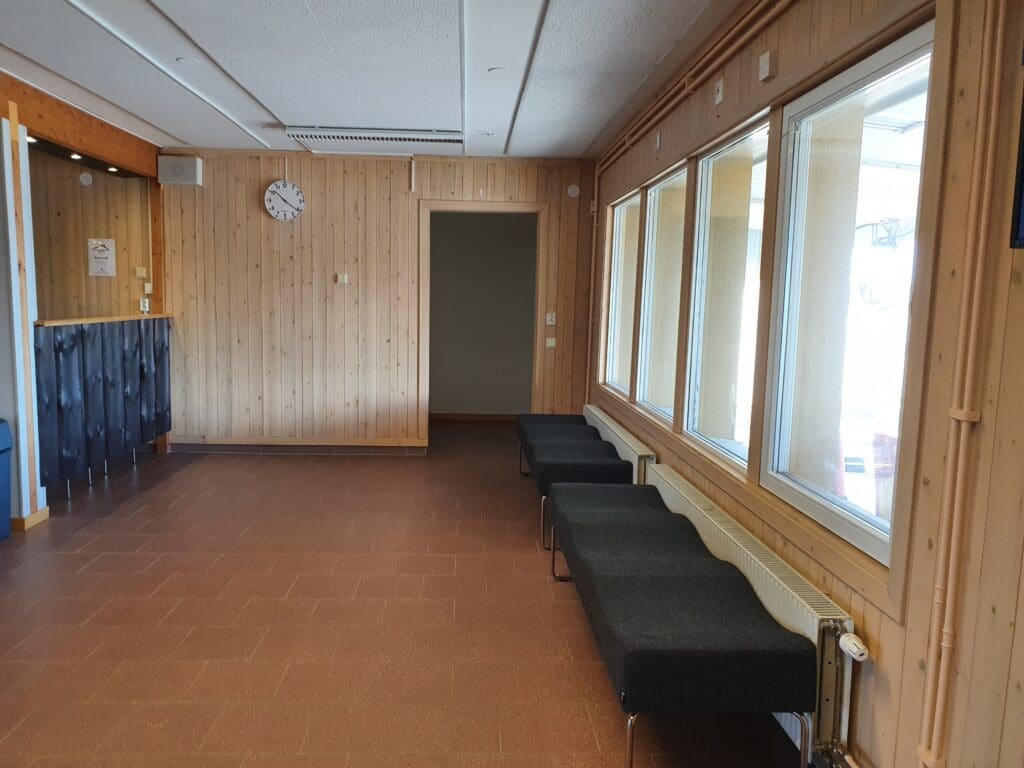
Once the cabin door had been opened, my fellow passengers wasted no time in making their way out of the aircraft. After finding the remnants of my broken glasses from under the seat, I stood up and made my way down the cabin. As I cautiously made my way down the built-in steps and was welcomed to Sveg by one of the ground crew, I was almost blown over by the very gusty wind before I walked the short distance to the small terminal. Upon entering the terminal, I found this to be pleasant and modern, clean and tidy, featuring lots of local wood in its design giving it both a homely and unique feel. Other than the usual amenities such as plug sockets, toilets and complimentary wifi, a free hot drinks machine is offered and so after picking up my bag, I decided to grab a cappuccino before beginning my journey to the bright lights of the metropolis that is Sveg.
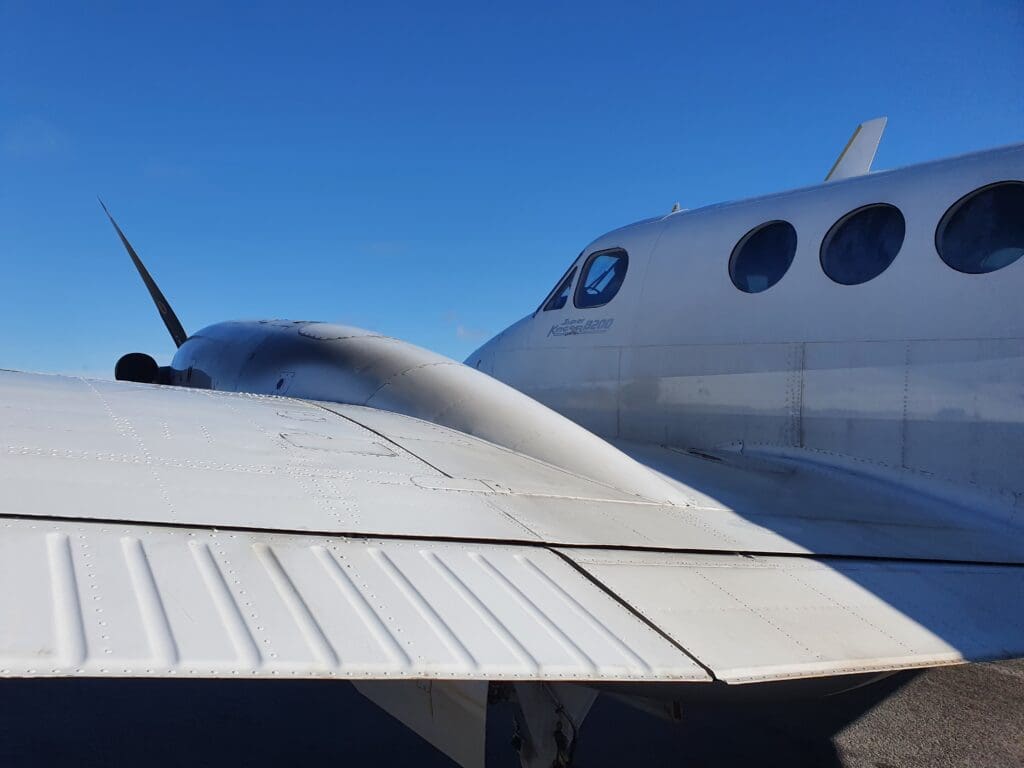
With plenty of signs in the terminal advertising the small collection of local taxi companies, I am sure that I would not have much difficulty in finding a ride to take me three kilometres into Sveg. However, with just under five hours until my train to Östersund, and not wanting to part with a small fortune, I decided to make the journey on foot. From the terminal, I made my way down a quiet road through the pine forests, making sure to whistle as I walked to avoid startling any brown bears. From there, I walked along the main road and a while later arrived in the centre of Sveg, making stops at the world’s largest wooden bear and a local church before stopping by for an appropriately Swedish lunch of meatballs. Admittedly, whilst the local area is known for its winter sports and other outdoor activities, Sveg itself is not home to a massive number of tourist attractions and I was thus able to see much of the town within an hour or so!
Beaten back by the blustery wind and freezing temperatures, I decided to spend the last couple of hours of my stay in the warm station waiting room where I did some work and had a nap. A little before the train’s scheduled departure time, I made my way out to the platform and a short time later the old single-carriage Y1 diesel railcar came to a squeaky halt on its journey between Mora and Östersund. That afternoon I was to be the only passenger to board in Sveg, and so once I had clambered up onto the train, this thundered away into the incredibly remote snow-covered countryside, where little sign of life other than the odd herd of moose proved to be non-existent. Other than the local wildlife and the rare rolling stock, this proved to be an interesting journey, with the train stopping multiple times for the driver to go and have a look at something – usually following large thumps. Inside, the train was comfortable and clean, with USB ports provided for those needing to charge their devices. Meanwhile, a selection of drinks and snacks was available to purchase from the train’s conductor. However, the only negative about this journey was the fact that the toilet broke down with over an hour to go and was reduced to the status of emergency use only. Following three hours spent trundling through the wilds of remote Sweden, at 1840 the train rolled into Östersund where I disembarked and began the journey over to my Airbnb where I would spend the night before my next Jonair adventure.
Summary
As flights go, this one was rather unique and I thoroughly enjoyed my first ever flight onboard the Beechcraft King Air. Not only did this serve to be the easiest and cheapest way for me to fly onboard the King Air, but I found all those I interacted with on my journey to be polite and friendly. Furthermore, my itinerary also enabled me to catch a glimpse of life in small-town Sweden and experience a unique rail journey through the deepest countryside. Needless to say, I would recommend this option to any enthusiasts who are looking to ride onboard a King Air in Europe for a relatively low price.