
Flying the Rare Boeing 737-500: An Indonesian Adventure with Sriwijaya Air
Background
Ending up with a day in Jakarta, like any aviation enthusiast, I decided to use this time to attempt to fly on something rare and interesting! Once upon a not-too-distant era, Indonesia’s skies were filled with aircraft types that were extremely rare, often non-existent, in the skies of Britain. These included vintage Boeing 737-200s, Boeing 737 Classics, McDonnell Douglas MD-80s and Xi’an MA60s. Unfortunately for enthusiasts seeking rides on rare airliners, today, most major routes across Indonesia are operated by much more mundane Boeing 737-800s and Airbus A320 Family jets. However, all was not completely lost, as at the time of my visit to Indonesia in late 2023, two operators continued to fly the Boeing 737-500. Namely, Sriwijaya Air and its subsidiary NAM Air. Seeing as no European operators fly the Boeing 737-500 on scheduled passenger services, as a diehard enthusiast, it was impossible to resist the opportunity to fly on this rare aircraft type.
Following some experimentation with itineraries, I deciphered that Sriwijaya Air typically deploys its sole Boeing 737-500 on the route between Jakarta and Palembang. Leaving Jakarta Soekarno-Hatta Airport in the early morning, this makes stops in Tanjung Pandan and Pangkalpinang on the islands of Belitung and Bangka, respectively, before continuing onwards to Palembang, the capital of South Sumatra. This roundabout routing transformed what would be a 260-mile hop into an elongated 478-mile trek, enabling me to bag three sectors on the rare Boeing 737-500. The other option, given my schedule, was to fly on NAM Air’s service up to the island of Batam, which sits near Singapore.
In the end, I decided to book a ticket on Sriwijaya Air’s three-leg service from Jakarta to Palembang, opting to book this via Trip rather than directly with the airline. This set me back a total of £92.30, which was significantly pricier than my direct flight back to Jakarta with Super Air Jet, which cost £35.60. Nevertheless, this was a small price to pay for the opportunity to fly on a rare variant of Boeing 737 Classic. However, all was not plain sailing as a few days before departure, my Super Air Jet flight was cancelled, although thankfully I received a prompt refund from Trip and soon rebooked myself onto a similarly priced Citilink flight.
About the Airline
Unless you are based in Indonesia or are knowledgeable about Southeast Asian aviation, there is a good chance that you will not be all too familiar with Sriwijaya Air. Operating just four Boeing 737-800s and a single Boeing 737-500 at the time of my trip, they are minuscule compared to the major players in Indonesia’s aviation scene. However, established in 2003, Sriwijaya Air has been around for over twenty years. Having operated the Boeing 737 for the duration of its existence, the carrier initially flew the now ultra-rare Boeing 737-200, deploying this from Jakarta Soekarno-Hatta to destinations across Indonesia. Going some way to modernise their fleet, in 2007, the carrier added a cluster of second-hand Boeing 737 Classics and soon came to operate the aircraft family’s three constituent types (-300, -400 and -500).
Unfortunately for enthusiasts, Sriwijaya Air began to retire its Boeing 737-200 fleet in the early 2010s, with its final example leaving the fleet in 2013. This was the same year that the carrier created its subsidiary, NAM Air, which operates both ATR 72s and Boeing 737 Classics. Further modernising its fleet, in 2012, Sriwijaya Air welcomed its first Boeing 737-800, which soon became the airline’s main aircraft type. Whilst Sriwijaya Air’s focus has primarily been on Indonesia’s domestic aviation scene, the carrier did once operate international services to Fuzhou, Hangzhou and Wenzhou in China, Dili in East Timor, and Kuala Lumpur and Penang in Malaysia. However, today, the carrier only operates within Indonesia, serving eleven destinations across the country.
Sadly, several Indonesian carriers are not well-known for their impeccable safety record, and Sriwijaya Air is no exception. Since 2008, the airline’s Boeing 737s have been involved in no fewer than five major accidents. The most recent of these occurred in January 2021 when one of the airline’s Boeing 737-500s crashed into the sea following departure from Jakarta. This was later attributed to a faulty autothrottle – a known issue with this particular airframe, resulting in thrust asymmetry that the pilots did not adequately handle, thereby causing the aircraft to enter an upset position and crash.
A Spanner in the Works
Sriwijaya Air offers online check-in, and I found this to semi-work. Heading to the airline’s website the day before my flight, I was able to check in and download my boarding passes. However, this was missing the crucial QR codes that would enable me to enter security and board the aircraft, and instead, these featured a red ‘x’ where these codes should have been. As it turned out, my flight from Pangkalpinang to Palembang was cancelled, albeit without any sort of communication. After panicking for a few moments, I was happy to find that I could still book a direct Lion Air service for £33 from Pangkalpinang to Jakarta, departing a few hours after I was scheduled to arrive there. Whilst this did mean that I lost around £30 as I was unable to get a refund on my Citilink flight from Palembang to Jakarta, this was thankfully no major disaster.
The Journey
Having touched down in Indonesia onboard a Cathay Pacific Airbus A330 at 1925 the previous evening, I was left with just under eleven hours until my Sriwijaya Air adventure. With this considered, and not knowing how long it would take to get through immigration, I thought it best to stay as close to the airport as possible. I was thus led to the local branch of the Indonesian budget hotel chain D’primahotel. With this located inside Terminal 1A itself, it would have been nearly impossible to find anywhere more convenient to stay, and with rooms costing £33 per night, this did not seem to be too bad a deal considering its location. Following a quick exit from the surprisingly deserted Terminal 3, I caught the train over to Terminal 1 and soon found myself standing in the evening heat outside the terminal’s exterior. After spotting the hotel’s small and unassuming entrance, I made my way over to it and was soon greeted by the security guard standing at the door before heading inside and up the stairs to the reception area. Delighted to see that my booking had not gotten lost in the ether (as had been the case with every single hotel booking on a recent trip to Uzbekistan!), check-in was quick and easy, and I soon settled down for the night. Not expecting five-star standards of luxury, I was not disappointed with the small and basic room. This consisted of a windowless bunker with a single bed, bathroom and little else, and whilst not particularly suitable for longer stays, I found the room to be perfectly fine given my need to be back in the terminal at the crack of dawn.
Having not properly slept in almost two days, despite the hard bed and slight electrical hum that accompanied my stay, I fell asleep with no issue and woke up at 0330 ready and raring to sample the delights of the Boeing 737-500. Making use of the kettle and complimentary instant coffee, I had my first drink of the day, and as I sipped on this, I decided to see if I could check in for my TransNusa ARJ21 service to Kuala Lumpur, scheduled to depart the following morning. With the opportunity to ride the rare Comac ARJ21 having been a large part of my reason for flying the indirect route to Malaysia that took me to Indonesia, I was a little disappointed to see that a last-minute equipment swap had taken place. Unfortunately, this flight was now scheduled to be operated by one of the airline’s three mundane Airbus A320s.
Not giving up easily, I checked the other TransNusa services to Kuala Lumpur that day and found that all of these were to be operated by the Airbus A320, whilst their ARJ21 was scheduled to fly to Johor Bahru. However, I did find that the ARJ21 was scheduled to operate to Kuala Lumpur in twelve hours, and I could pay around £70 to bring my flight forward and depart at 1650. Fortunately, thanks to my new itinerary, this was possible, and I decided to splurge out and bring my flight forward in the hope that this would enable me to fly this rare Chinese-manufactured aircraft.
Indonesia’s capital city is currently home to two airports with scheduled passenger services. One is Halim Perdanakusuma International Airport, which is currently used exclusively by Batik Air and Citilink, whilst Jakarta’s main air gateway is Soekarno-Hatta Airport. Named in honour of Indonesia’s first president and vice-president following independence from Dutch rule, Soekarno and Hatta, the airport opened its doors in 1985. In terms of passenger throughput, as per 2018 statistics, the airport is the busiest in Southeast Asia, having seen almost 67 million passengers pass through that year. Covering a large area, the airport consists of three detached terminals, which are all a fair distance away from one another, with transport between these primarily provided in the form of an elevated above-ground rail service. These are the original two terminals, Terminal 1 and Terminal 2, as well as the recently constructed Terminal 3. Focusing on the former two, these are largely identical in their layout and consist of a central hub with three piers splitting off from this. Designed by the French architect Paul Andreu, whose repertoire includes plenty of terminals across the world, their design takes inspiration from traditional Javanese architecture and is, in my opinion, far more distinctive than the all-too-common concrete and glass box-like terminals that seem to be omnipresent today. At the time of my flight, alongside Sriwijaya Air, Terminal 1A was utilised by AirAsia Indonesia, NAM Air and Super Air Jet.
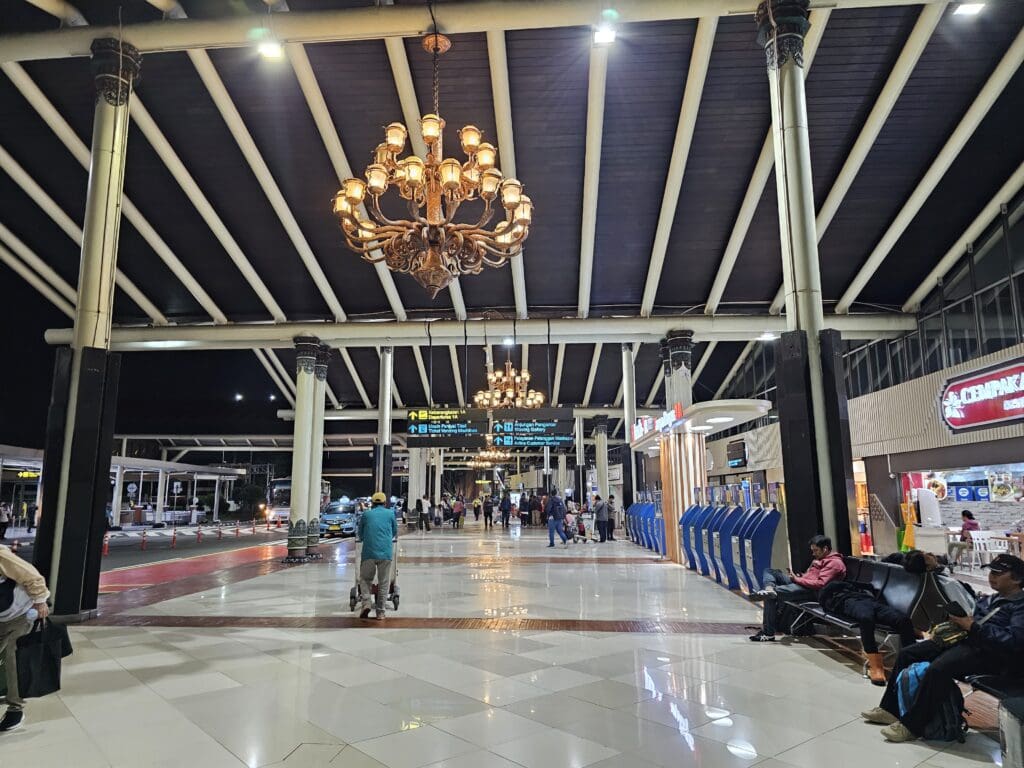
Whilst it was only 0400, the air was already hot and humid, so I decided to make a beeline for the entrance to departures rather than explore the myriad of shops, cafés and restaurants that run along the terminal’s exterior. At that time, a fair number of both staff and passengers could be seen enjoying an early morning nap on the benches outside the terminal, whilst up above, a series of large chandeliers hung down and illuminated this area. Soon, I stumbled across a row of self check-in kiosks outside the terminal’s entrance, which were available to use by Sriwijaya Air passengers. Seeing as I did not need to drop off any luggage, and with Sriwijaya Air’s passengers able to use these machines, I decided to make full use of them to print my boarding pass. After entering my reference number, the machine buffered for thirty seconds before spewing out a boarding pass for my flight to Pangkalpinang via Tanjung Pandan. With this in hand, I journeyed onwards to the entrance of the terminal, which was guarded by several security officers who ensured that only those with valid tickets entered.
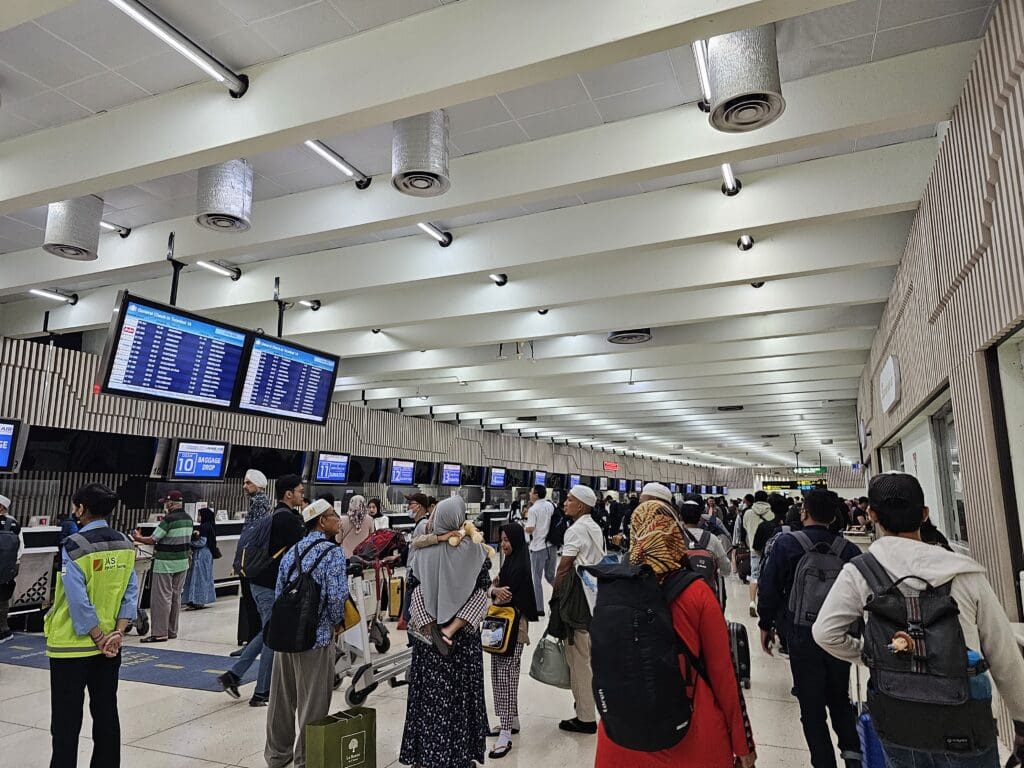
With no security check on the door, after a very quick glance at my boarding pass, I walked straight into the terminal’s long check-in hall. Whilst Terminal 1 is well known for its use of Javanese designs, this is not evident in this part of the terminal, which instead was bright, fairly modern and slightly clinical in its appearance. As was to be expected given the morning rush of departures, this part of the terminal was rather chaotic with crowds of passengers, many of whom had plenty of luggage, swarming around the check-in desks.
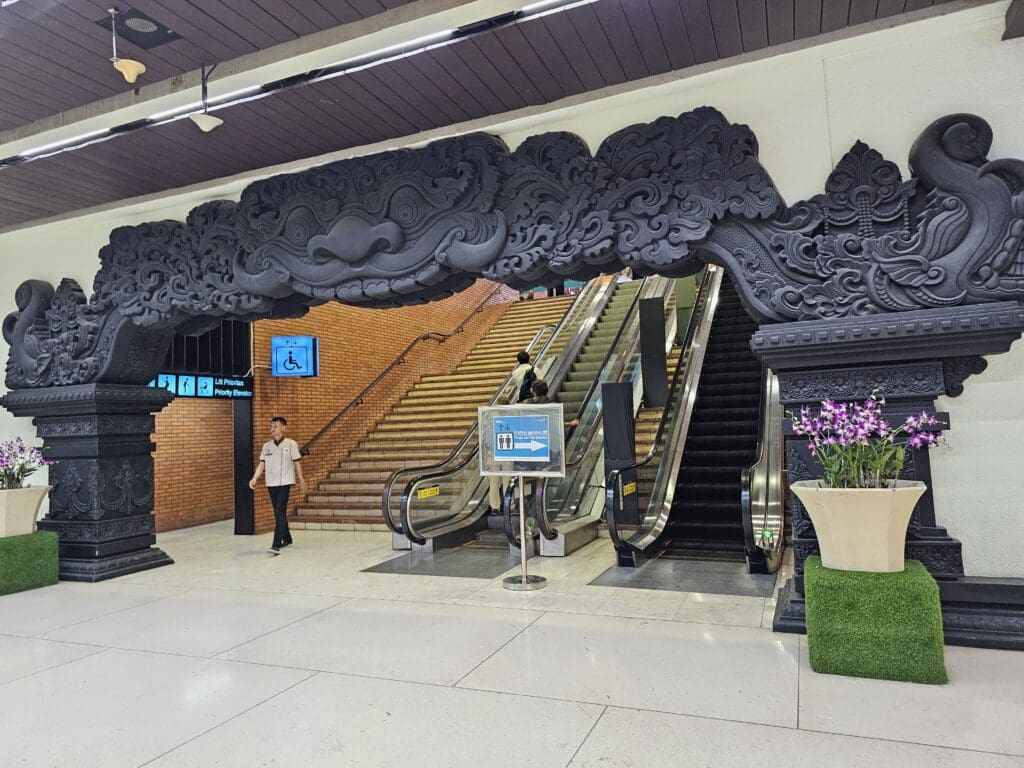
With no reason to remain in the check-in hall, I followed signs for departures and passed through the grand arch before heading up a short escalator. Once at the top of this, I found myself standing in a large and airy hall with cafés and shops on either side, and calming music ringing out that, whilst slightly hidden, this would have proven to be a nice place to wait for those who were not yet able to check-in and pass through security. At the end of this hall, two queues could be seen, and, not wanting to stop to purchase anything, I soon joined one of these and shuffled along. Fortunately, these moved quickly, and I soon reached a counter where a security officer took my passport and boarding pass and ensured that the names on the two documents matched. After this, I reached the security checkpoint where no waiting was required. There, I parted with my bags and had a full body scan before the friendly staff members manning this sent me on my way.
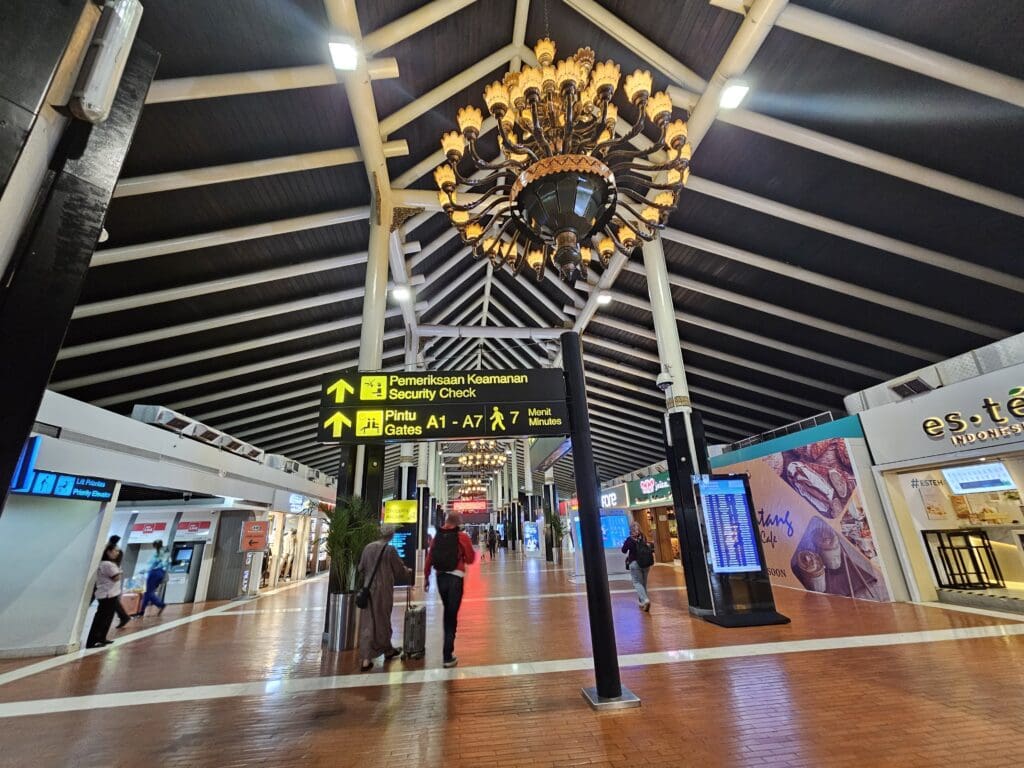
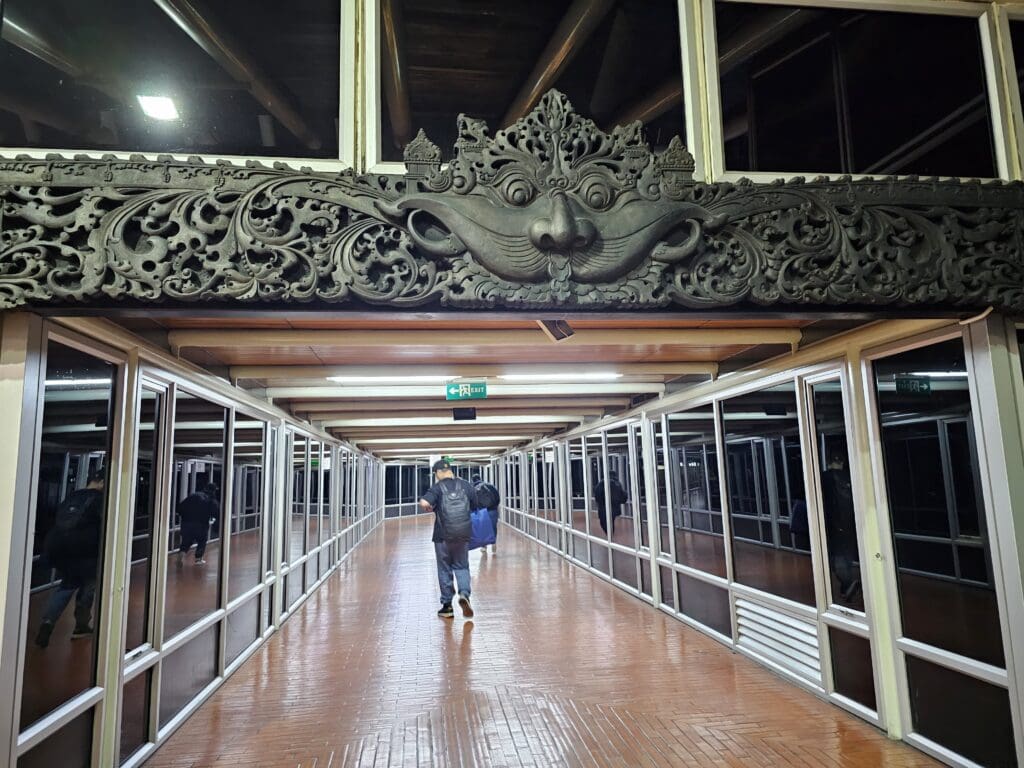
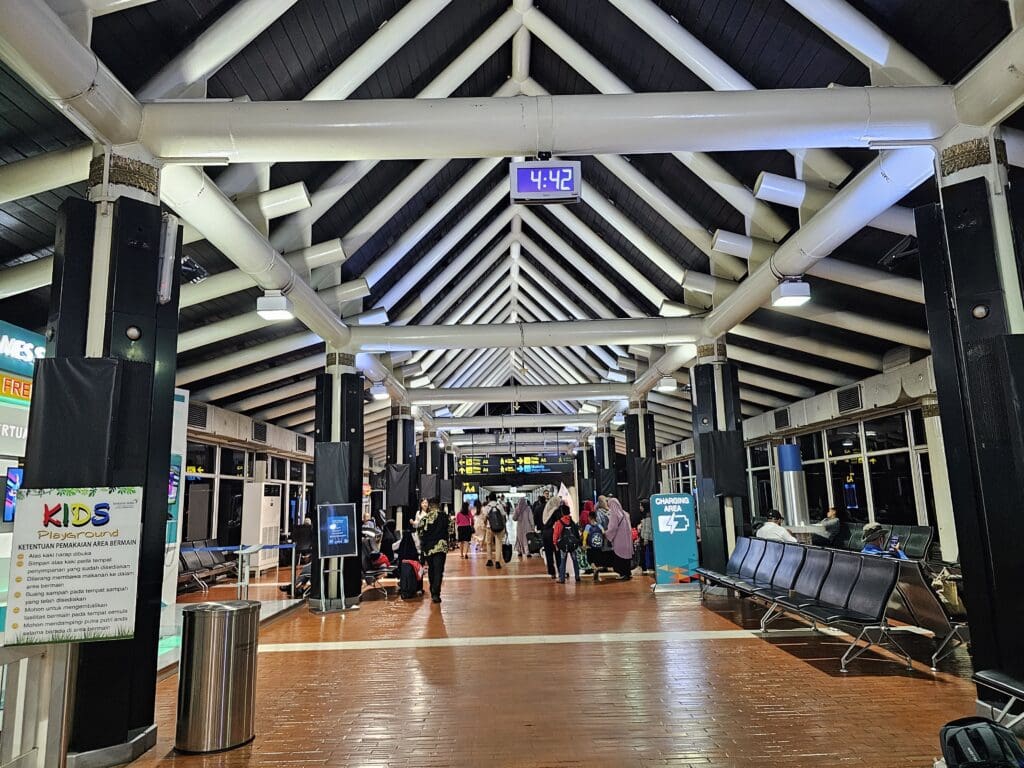
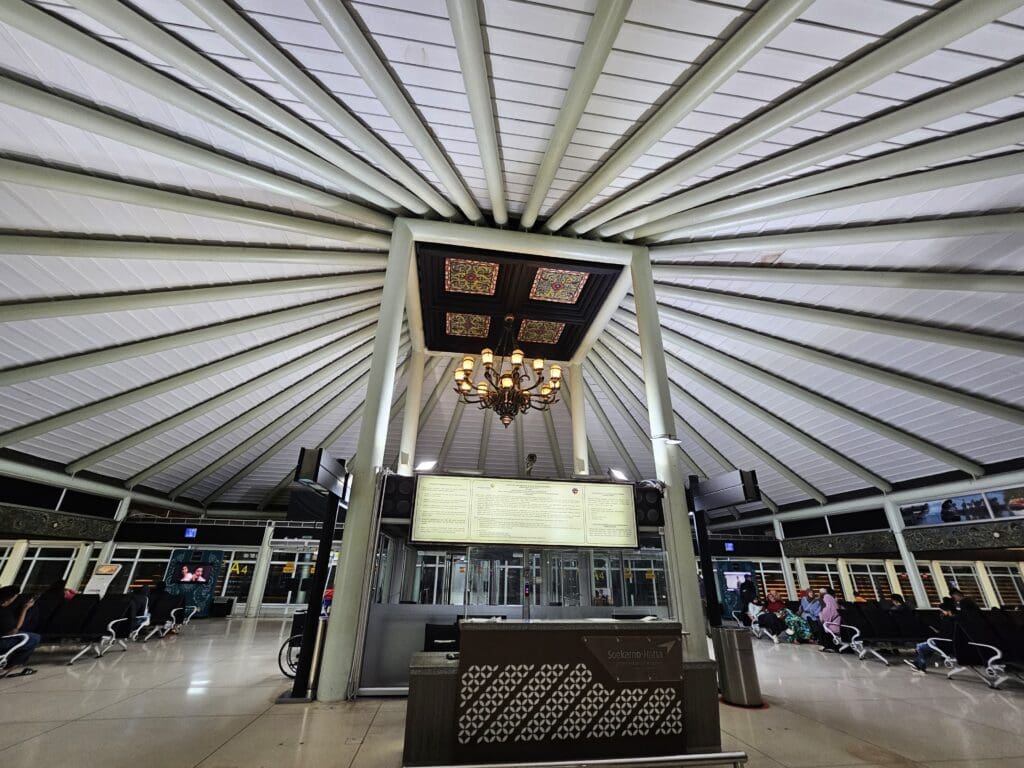
Given the fact that plenty of flights were departing that morning, I was not too sure of just how long it would take to get from the landside to the airside areas, and I had left myself a reasonable amount of time. In the end, this was not needed, and I was left rather impressed with the efficiency of everything and how quickly I had made it to the airside portion of the terminal. Thus, my first impressions of Terminal 1 were all positive, and I was left with absolutely no complaints.
Once through security, three corridors lead to the terminal’s three separate piers. Whilst my flight would be boarding through Gate A5, I first decided to wander around and explore the terminal’s sights. Inside, each pier is virtually identical in style and layout, consisting of a cavernous waiting area with a tall pointed roof from which a chandelier hangs down. In each, plenty of seats can be found as well as a few charging points and televisions which either broadcast the local news or a series of music videos. Each pier also featured a café-kiosk selling drinks and a range of snacks and other items, whilst toilets and a prayer area could be found on the ground floor underneath each waiting area. Whilst some may claim that the terminal seems to be a little dated in parts, this is most certainly unique, and I rather liked its Javanese character and style. Furthermore, this appeared to be clean and tidy, and even though it was eternally busy, there seemed to be an adequate amount of seating throughout.
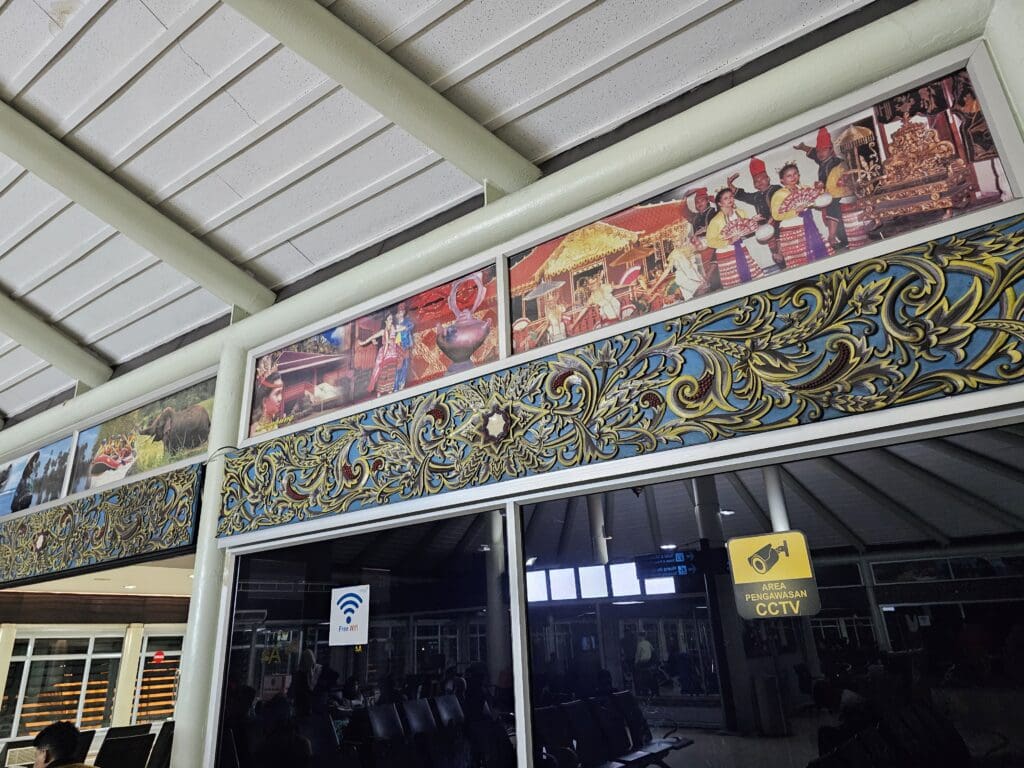
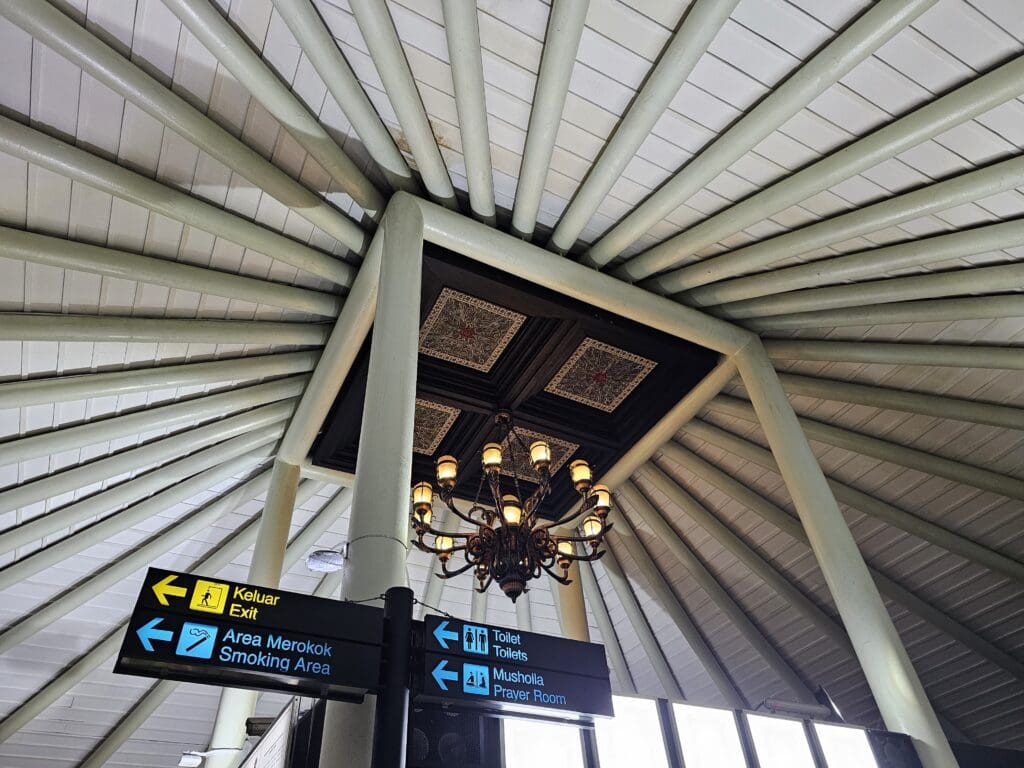
Moving to examine the slight negatives, other than the café-kiosks, once airside, there were few other facilities, and so if looking to do some shopping or in search of something more substantial to eat than snacks, I would advise stopping by the cafés and restaurants located before security. Meanwhile, that morning, whilst complimentary wifi networks appeared to be present, I was unable to connect to any of these. Lastly, aviation enthusiasts will be disappointed to hear that, thanks to the angle of the slats that cover the terminal’s windows, views of the airport’s plentiful and diverse movements could not be had from the airside waiting area.
According to my boarding pass, boarding for the flight was scheduled to commence at 0540, and as per the departure boards, this was heading to Tanjung Pandan and not Pangkalpinang via Tanjung Pandan. Hoping that there had not been another last-minute leg cancellation, I settled down in a seat near the gate. Around me, a fair mixture of families, tourists and smart-looking business people could be seen waiting, with some fast asleep, others chatting away happily, and a few deeply engrossed in their work. Had I not wanted to head off on Sriwijaya Air, as I waited, two AirAsia Indonesia services departed to Denpasar, three Super Air Jet flights jetted off to Batam, Denpasar and Pekanbaru, and a NAM Air service departed to Pangkalan Bun. Indicative of their recent poor reliability, plenty of cancelled Super Air Jet services could also be seen on the departure boards.
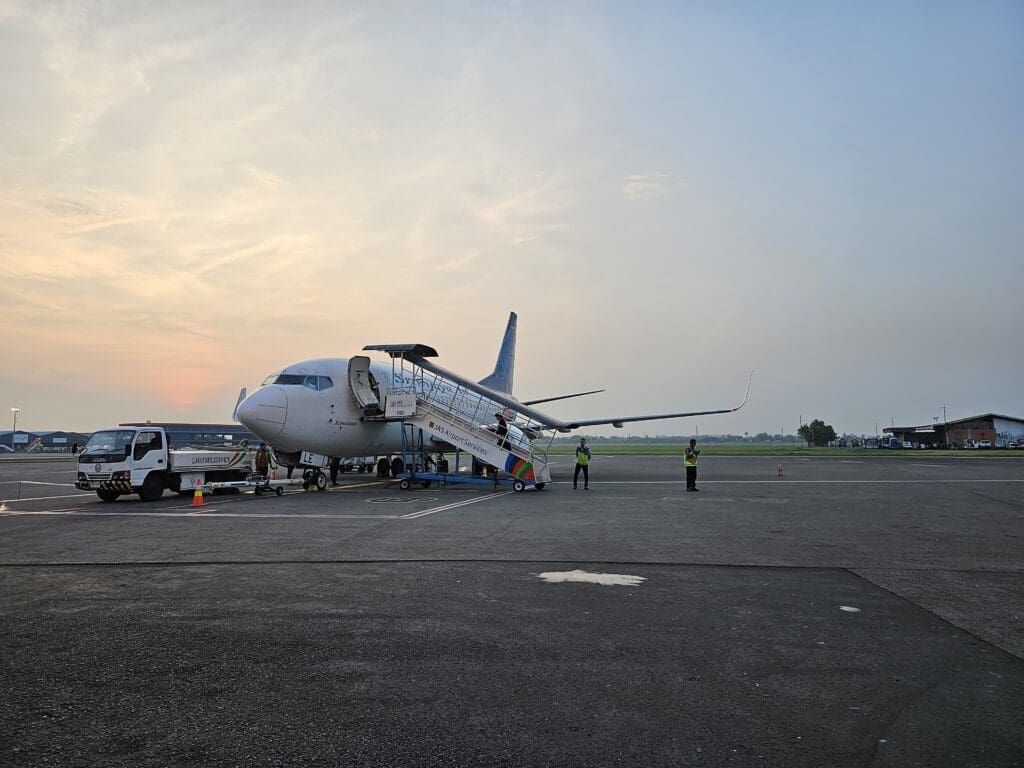
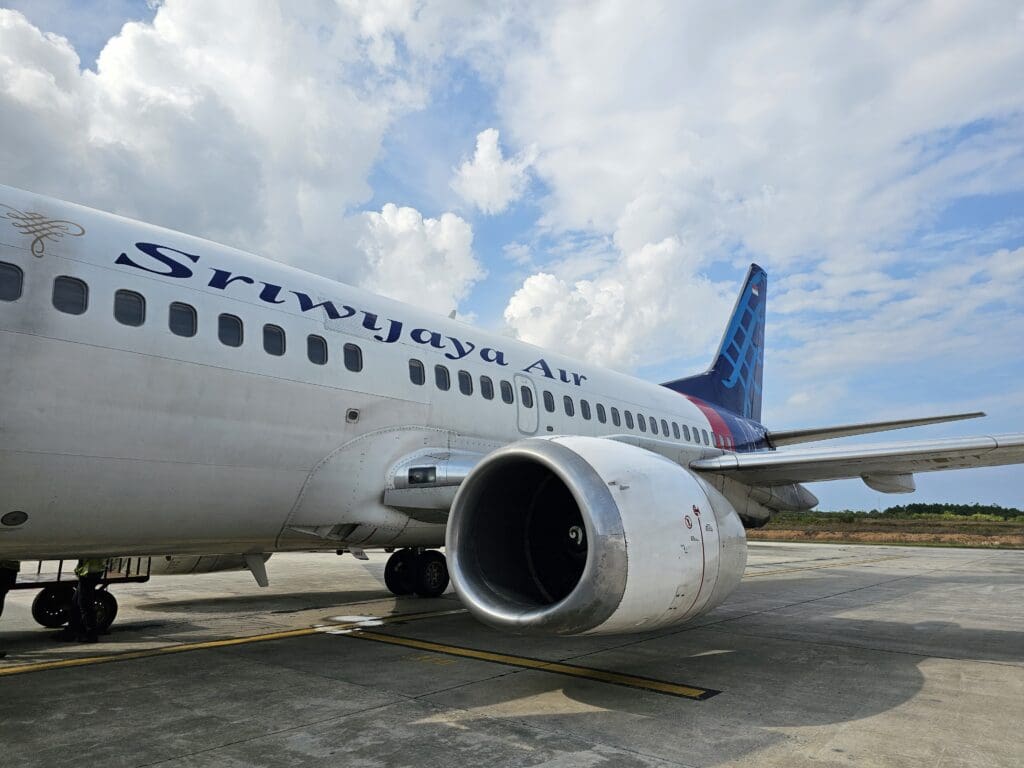
That morning, as soon as all passengers for NAM Air’s service had made their way to the gate and boarded, boarding for the morning Sriwijaya Air flight was called in Indonesian and English at 0535. At this time, a long queue of customers soon formed; however, with boarding commencing almost immediately and not being done in any particular order, I soon had my boarding pass checked and torn before I turned left and headed down the corridor. As I walked along, I was soon pointed down a flight of stairs, indicating that I would be treated to a good close-up view of the rare Boeing 737-500, with boarding undertaken via a set of airstairs. Seeing as Sriwijaya Air operates just one single Boeing 737-500, it wasn’t hard to predict which aircraft would be operating the flight that morning. Nevertheless, with the service occasionally upgraded to a Boeing 737-800, as I walked down the corridor, I was delighted to see PK-CLE standing outside at Stand A53 being readied for a new day of flying.
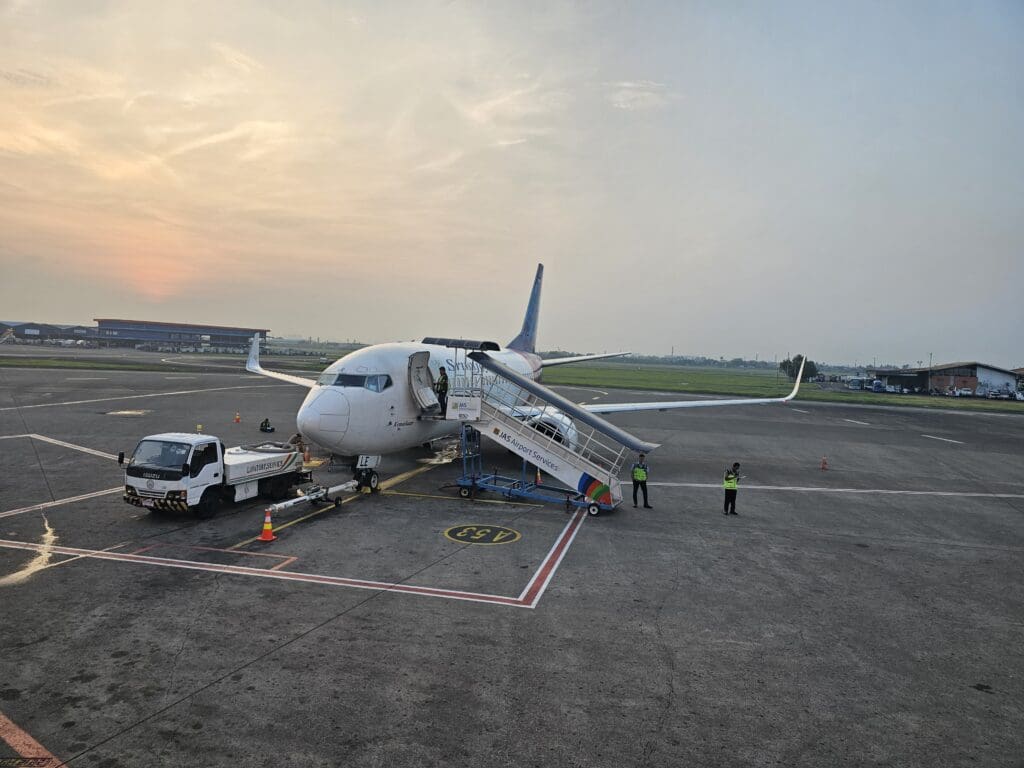
Assembled at the Boeing Company’s plant in Renton with the line number 2633, this aircraft first took to the skies in July 1994, making it an elderly 29.4 years old at the time of my flight. Later that summer, the aircraft joined the fleet of Continental Airlines as N14613 and became the giant’s thirteenth Boeing 737-500. There, the aircraft had a long and largely uneventful career shuttling passengers across North America and sported the fleet number 613. In July 2008, the aircraft received winglets and following Continental Airlines’ merger with United Airlines, the aircraft temporarily entered storage in the Arizona desert at Phoenix Goodyear Airport. Fortunately, this period of storage did not last too long, with the aircraft soon pressed back into service. However, with United Airlines being eager to retire the Boeing 737 Classics that they had inherited following this merger, the aircraft was withdrawn from American service for good in June 2012. The aircraft was then ferried across the Pacific, where it was given the name Kemuliaan and registration PK-CLE before entering service with Sriwijaya Air.
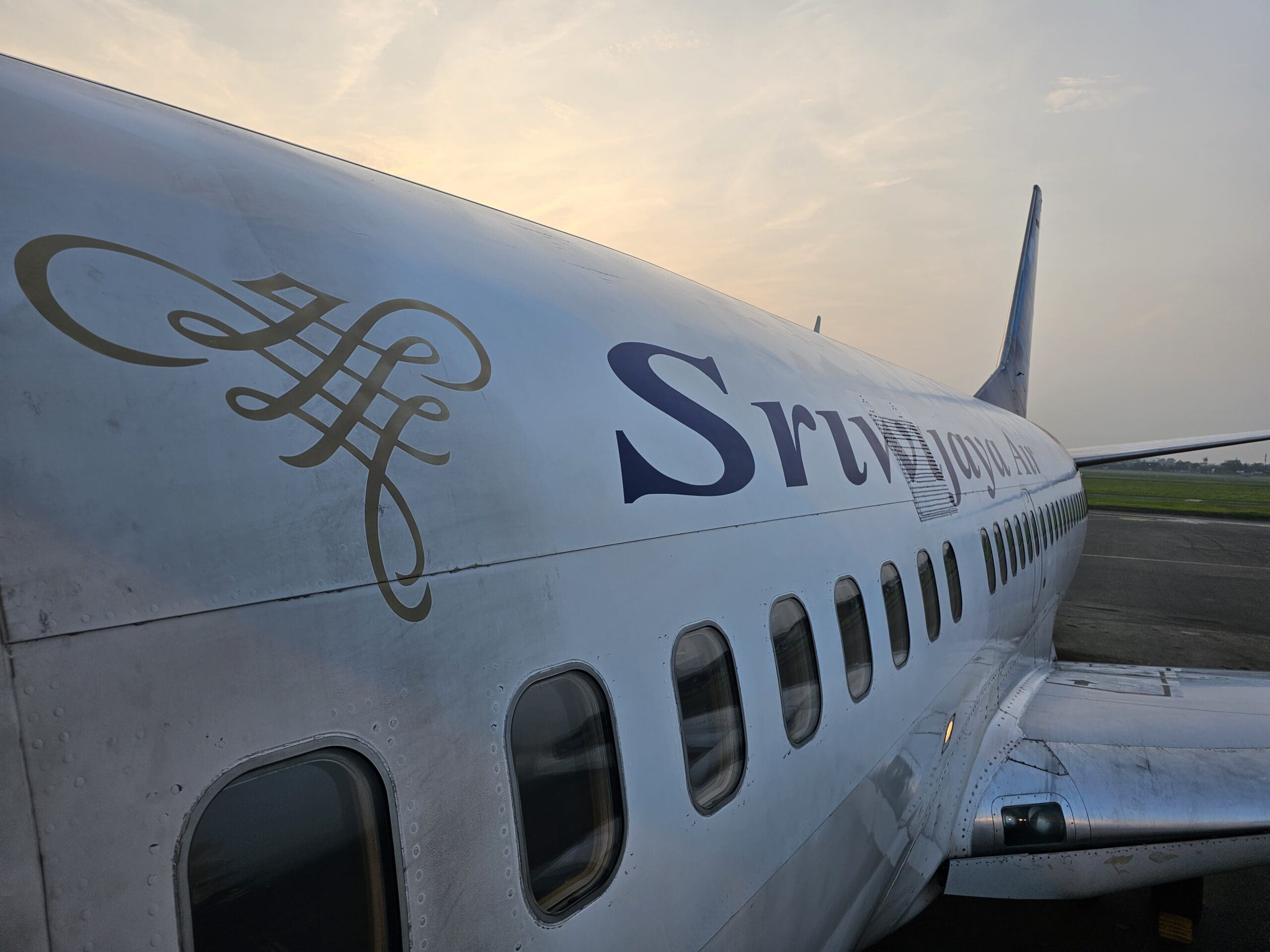
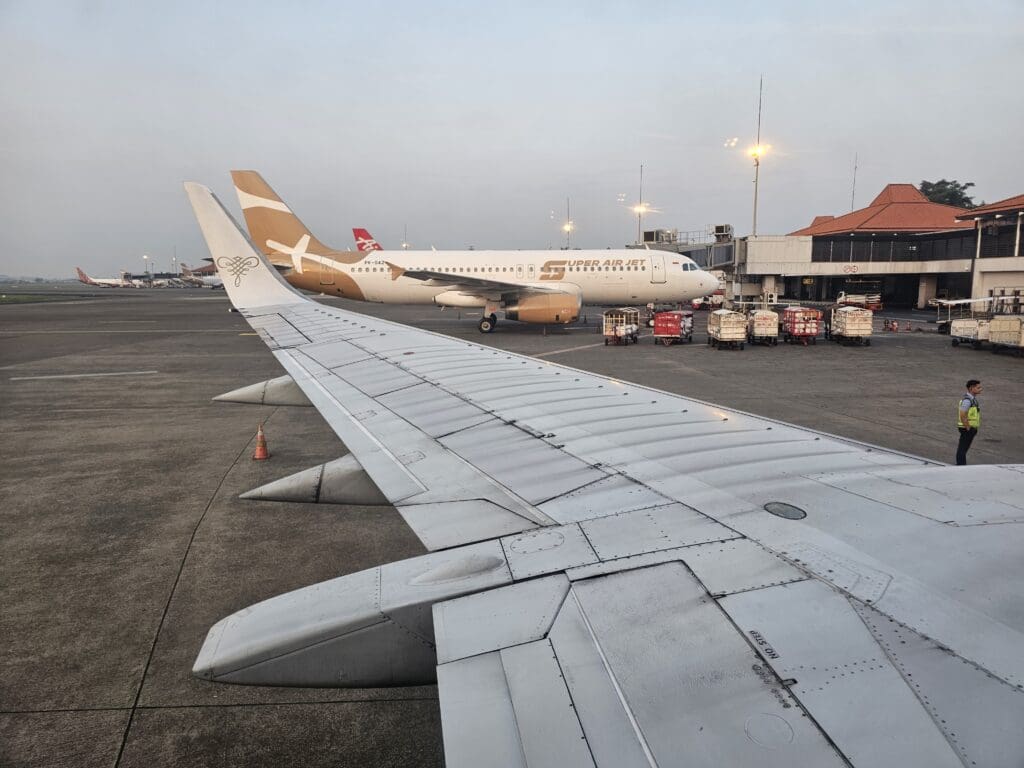
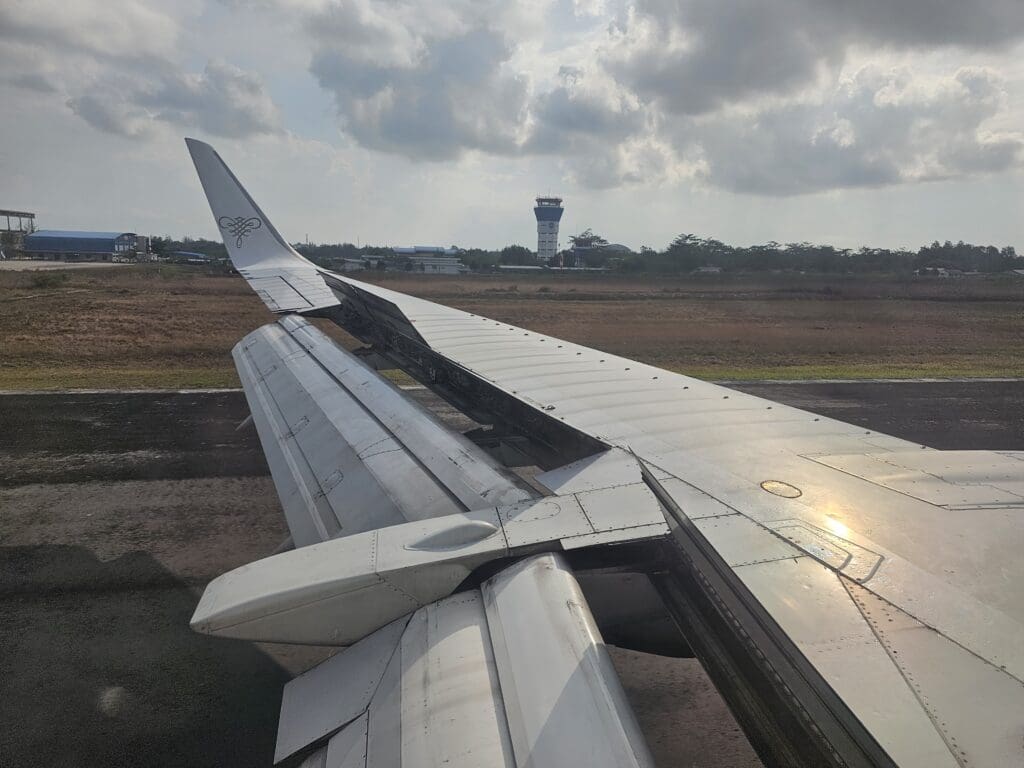
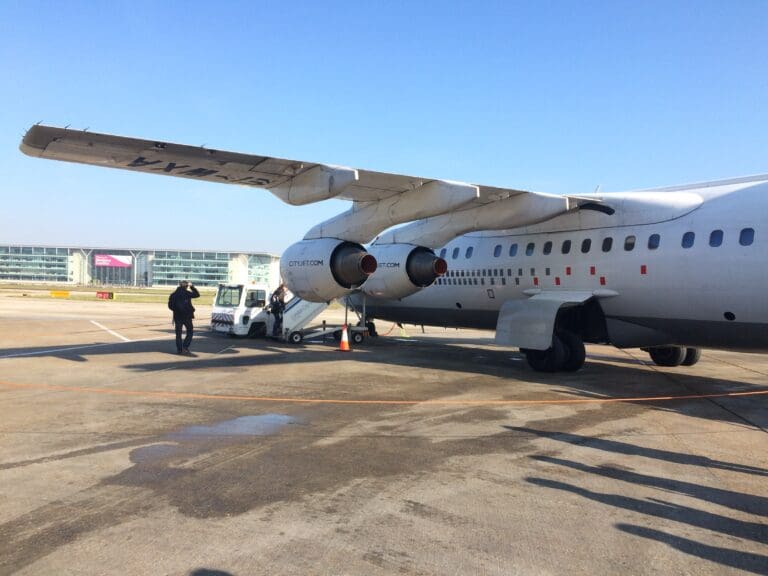
Making my way outside, I was once again hit by the warm and humid morning air and walked the short distance over to the waiting Boeing. Either recognising the rarity of this particular Boeing or simply happy to be flying, many passengers could be seen taking photographs of the waiting area, and the ground crew had no issue with this. Looking at the aircraft, this did seem to need a wash, with its mostly white livery failing to hide the dirt that this had picked up on its travels. Meanwhile, a few skin patch repairs could also be seen, indicative of this aircraft’s long life!
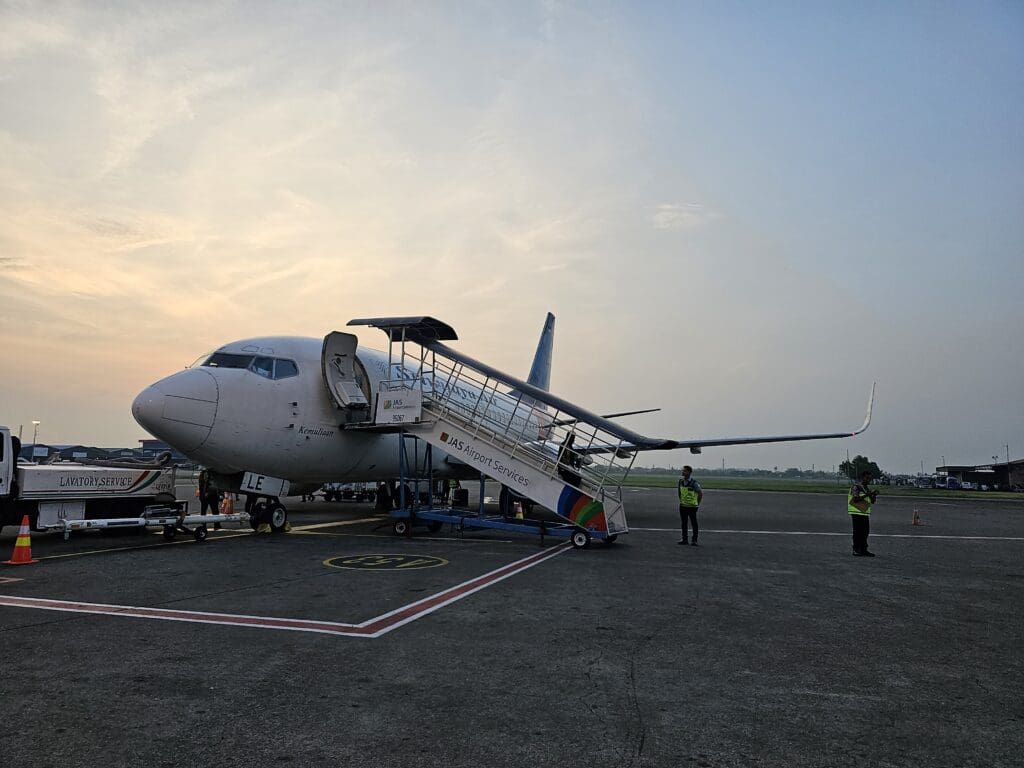
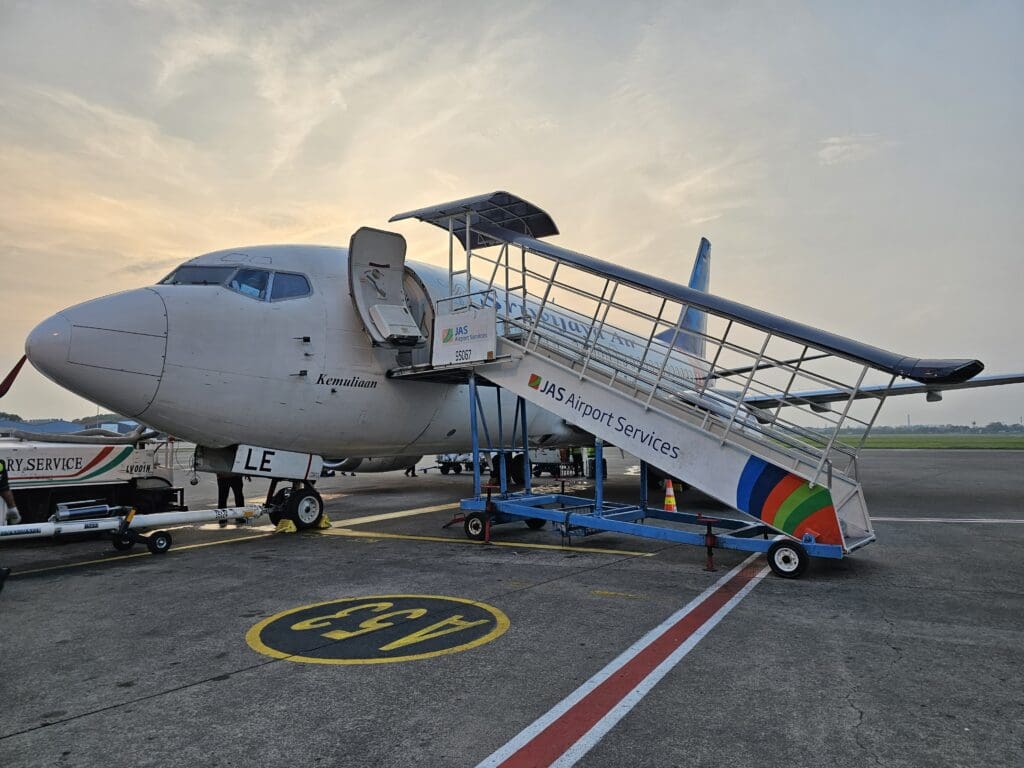
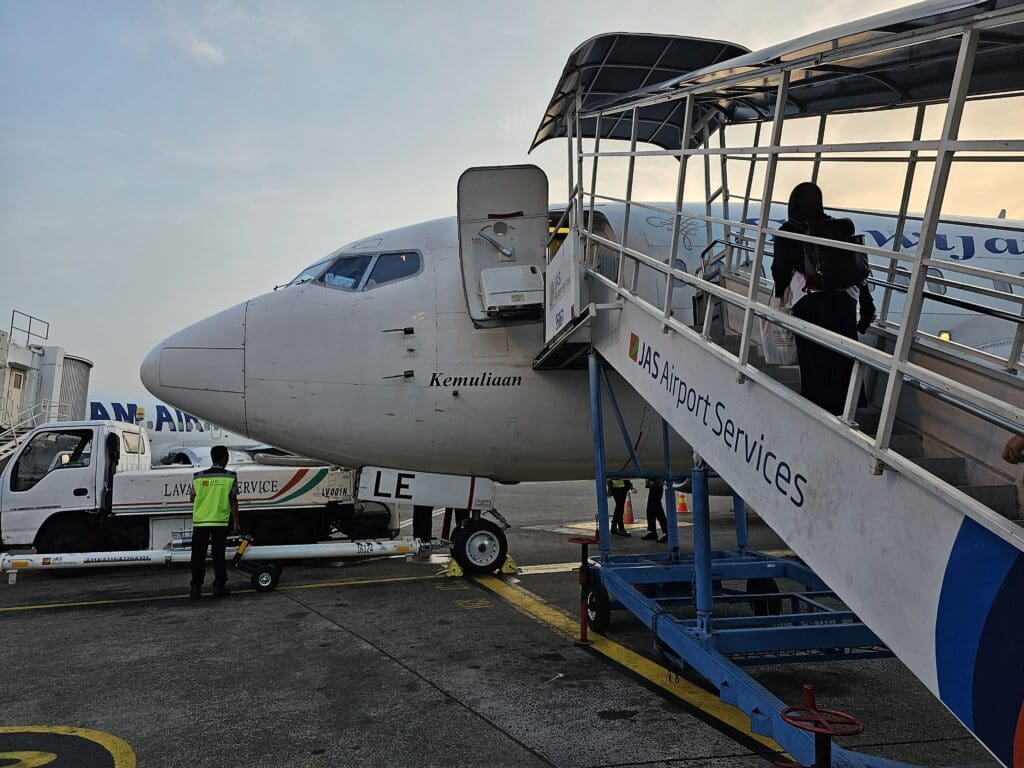
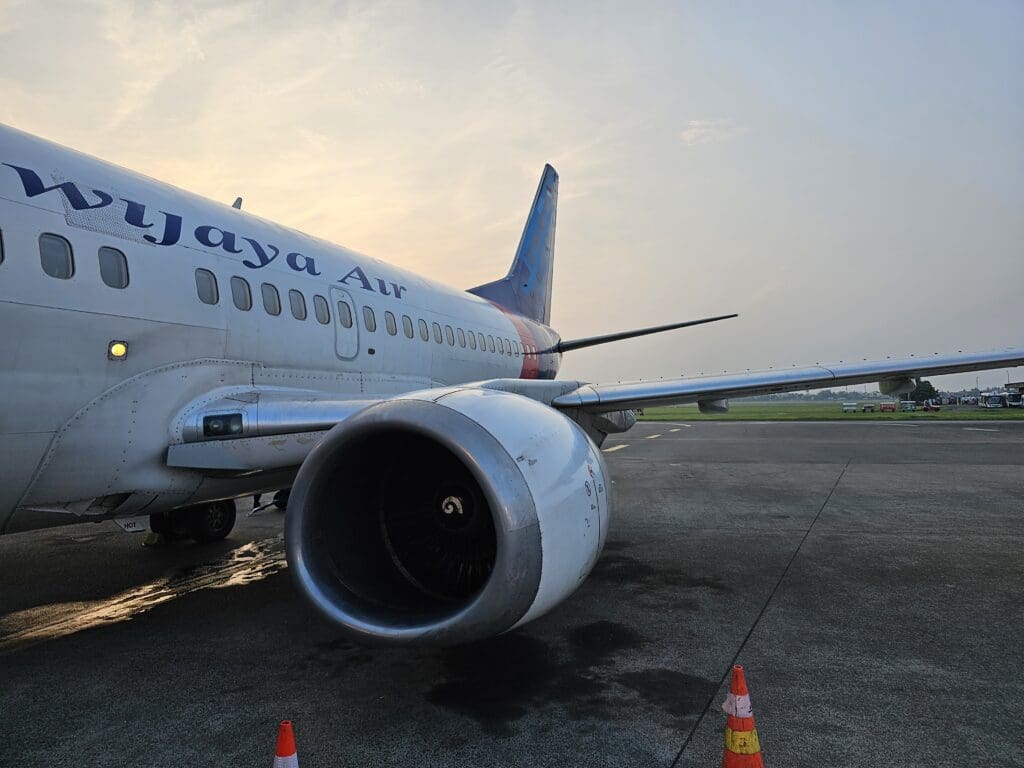
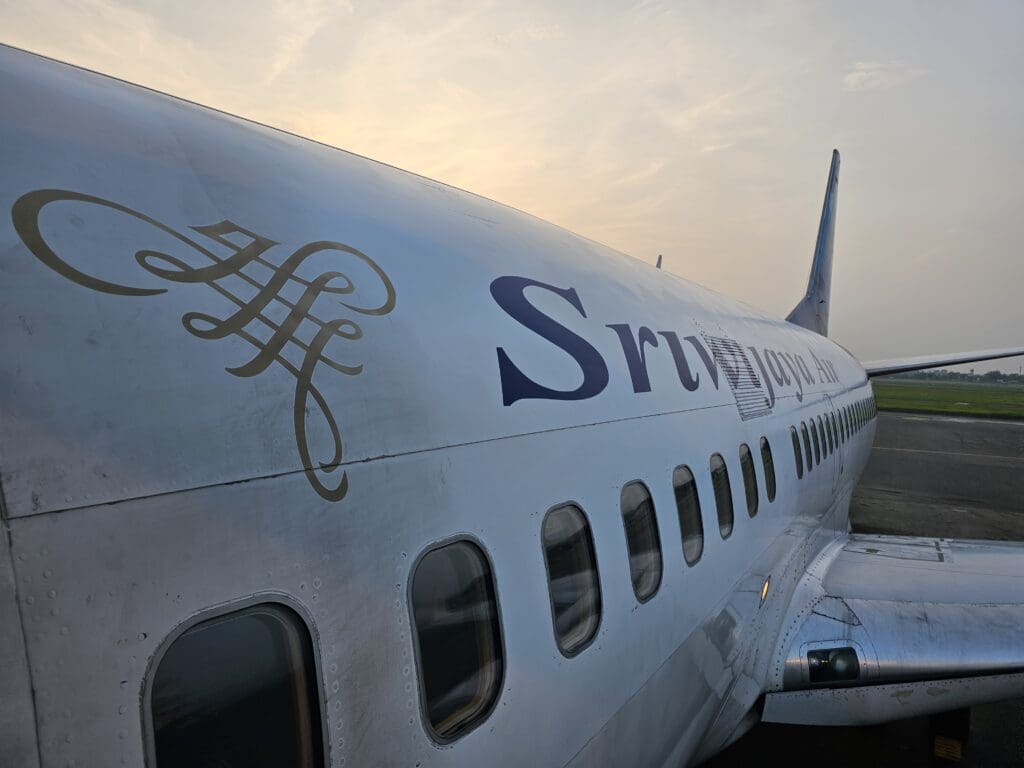
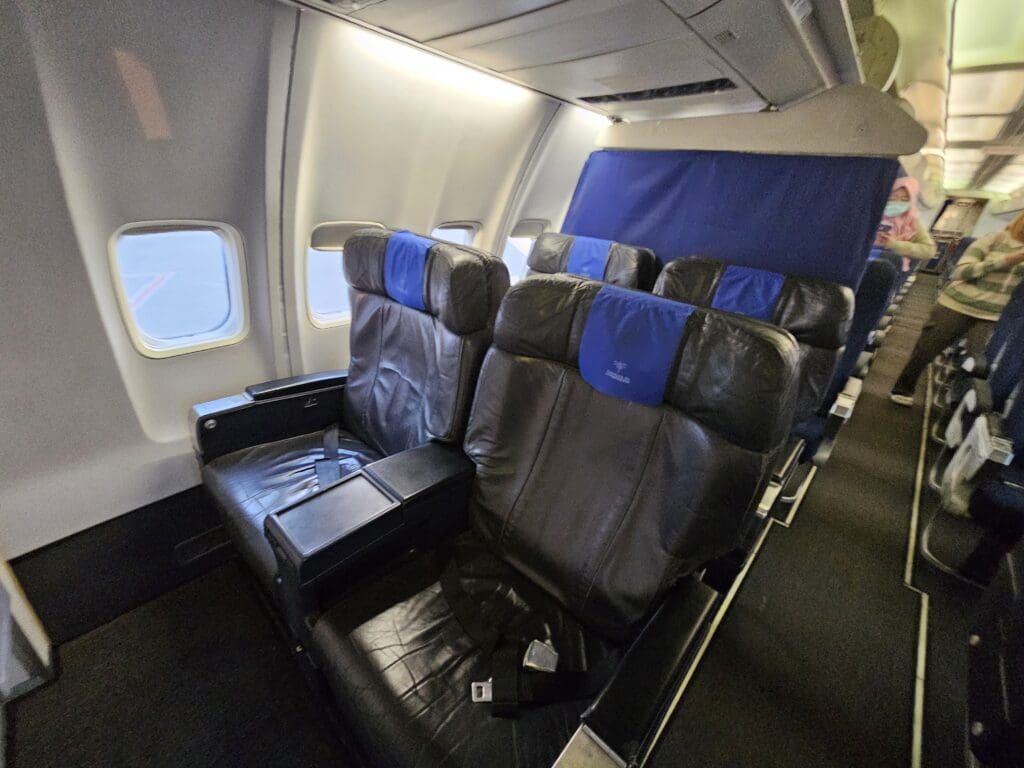
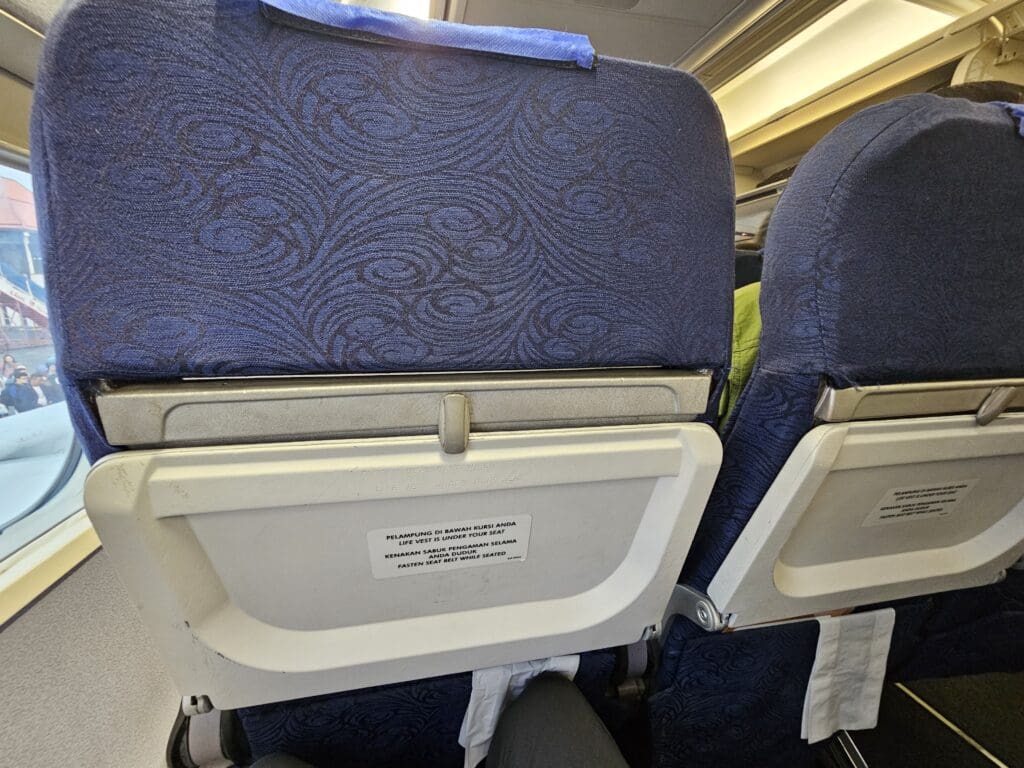
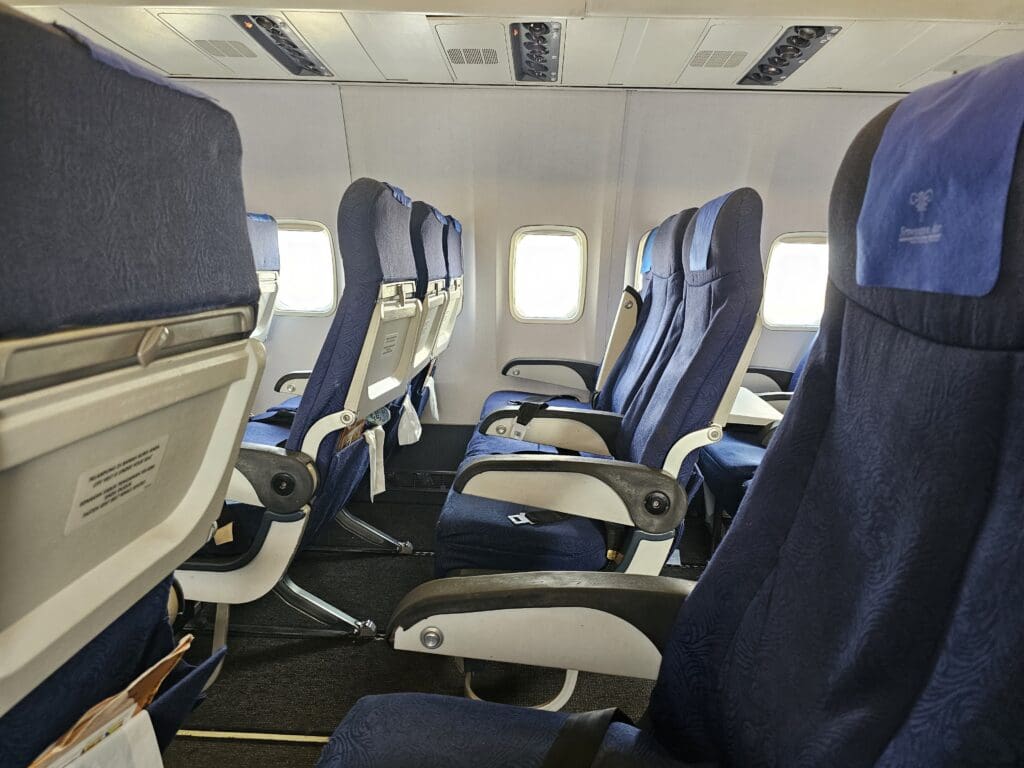
Once I had snapped plenty of photos, I made my way up the covered airstairs and stepped into the Boeing’s forward galley. Immediately upon entering the aircraft, I was given a friendly welcome in English by one of the flight attendants sporting Sriwijaya Air’s very royal blue uniform and contrasting bright red hijab. The latter was more aligned with the colours of sister airline NAM Air. Turning right, I then journeyed into the aircraft’s Business Class cabin, which is marketed by Sriwijaya Air as their ‘Golden Seats’. This consisted of two rows of very comfortable and retro-looking leather recliners that, like the aircraft’s other seats, had been inherited from Continental Airlines. Continuing onwards, I reached the aircraft’s Economy class section, which is home to a total of 112 seats. Each of these sported a dark blue fabric cover with a swirling pattern and was topped with a Sriwijaya Air-branded antimacassar. Whilst a little chunkier than the ironing board seats of many low-cost carriers today, for older seats, these appeared to be a little on the thin side.
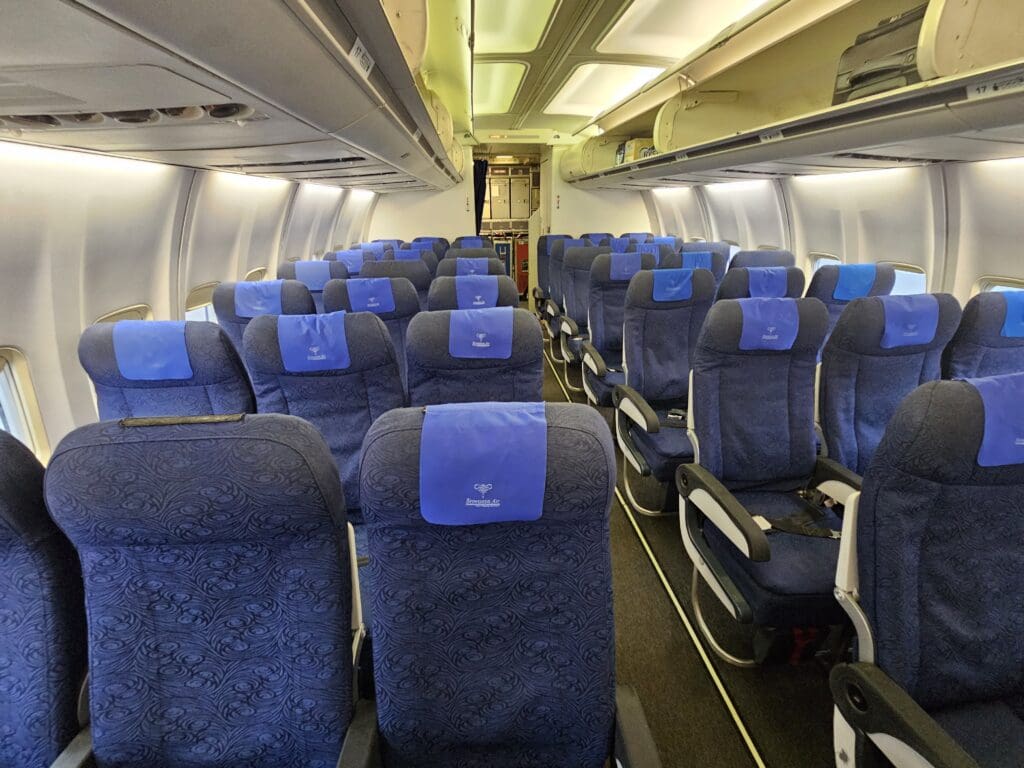
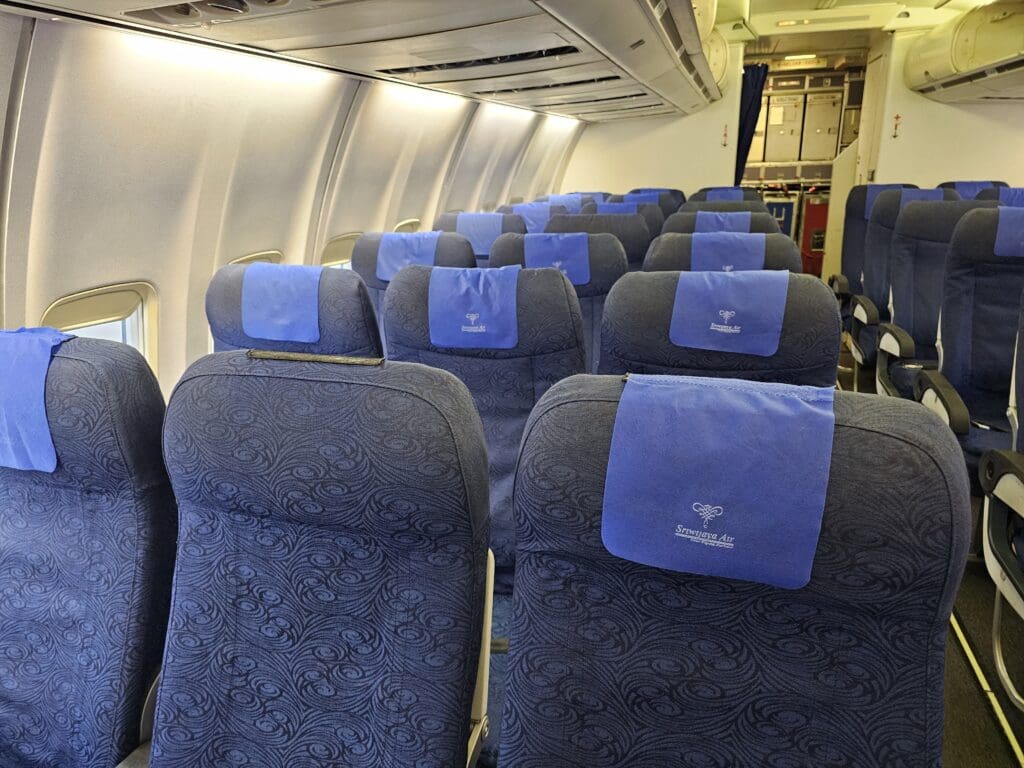
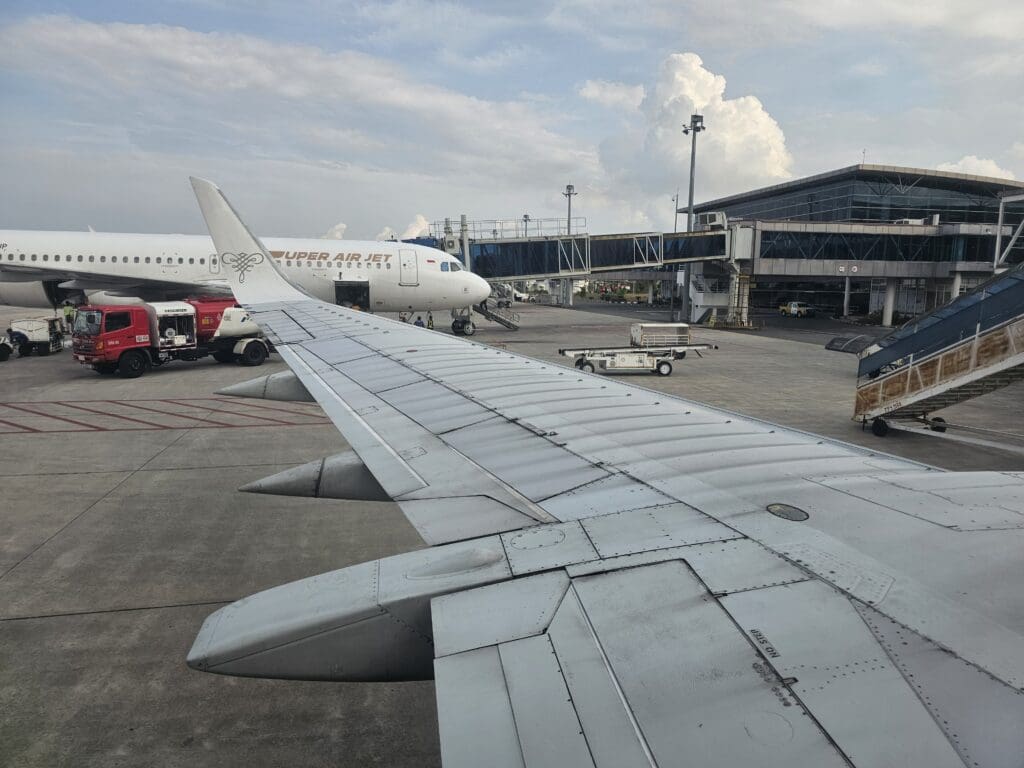
As I made my way to Seat 15A, I received two more friendly welcomes. Perhaps looking lost, one flight attendant guided me to my seat, and overall, I was left with a very positive first impression of the crew onboard the service that morning. Seeing as I would likely be trapped for the next hour or so, I decided to use the toilet before departure. Heading to one of the two toilets at the rear of the cabin, upon opening this, this was expectedly dated and a little battered, yet was clean and served its important purpose. However, I should note that this did lack soap. Returning to the cabin, I voyaged the short distance against the flow of traffic and soon returned to Seat 15A. Whilst I had not picked this seat, I was pleased to find that this aligned well with the window and offered a superb view of the dirt-covered wing and the world outside, with a Super Air Jet Airbus A320 visible at the neighbouring gate.
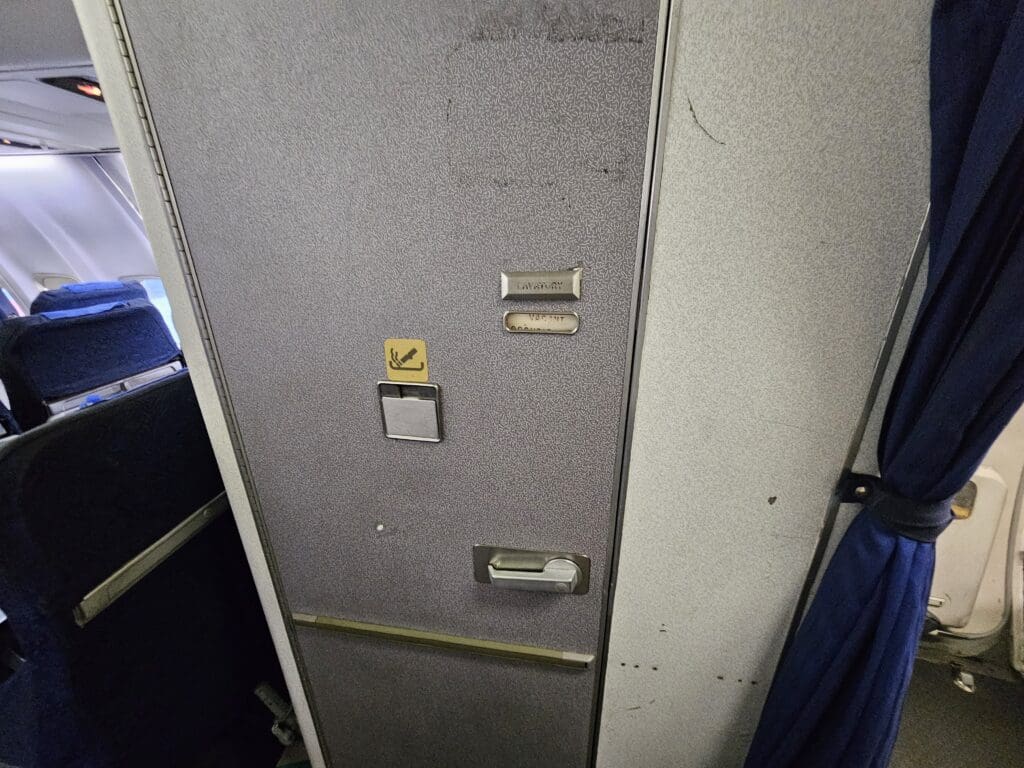
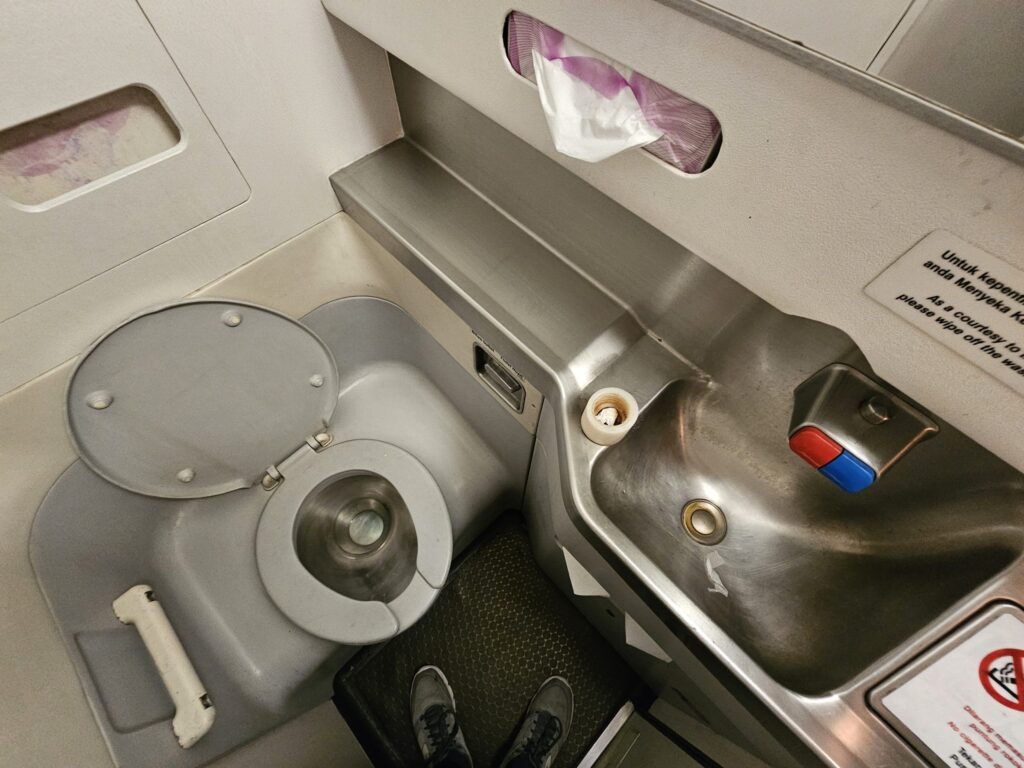
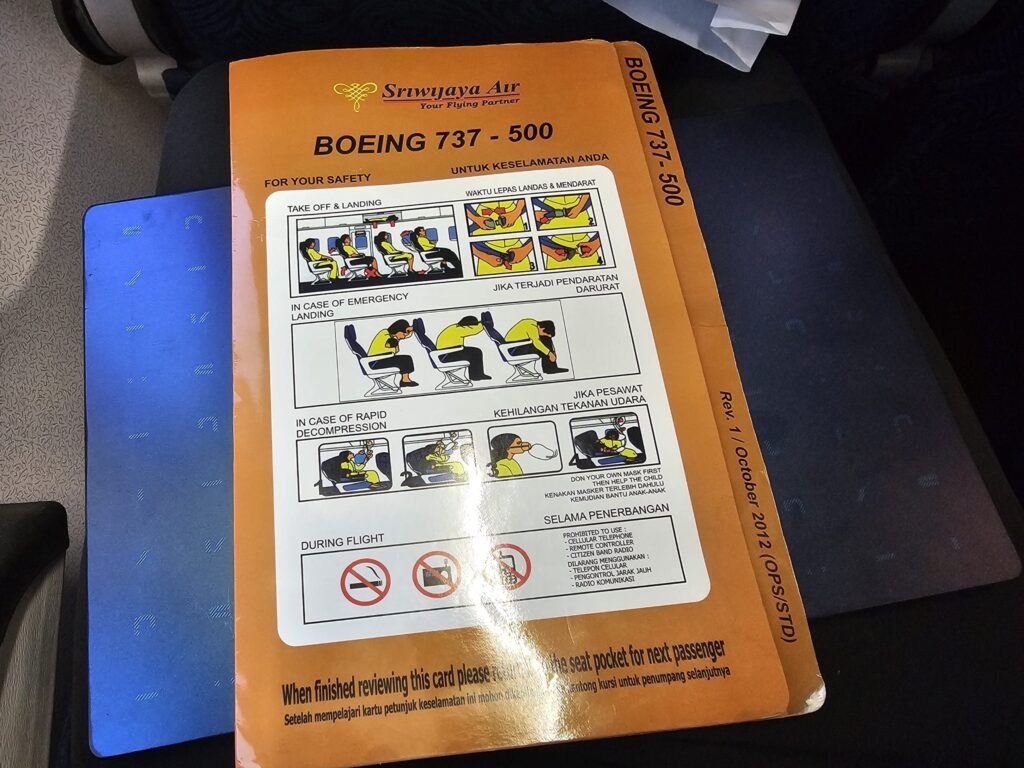
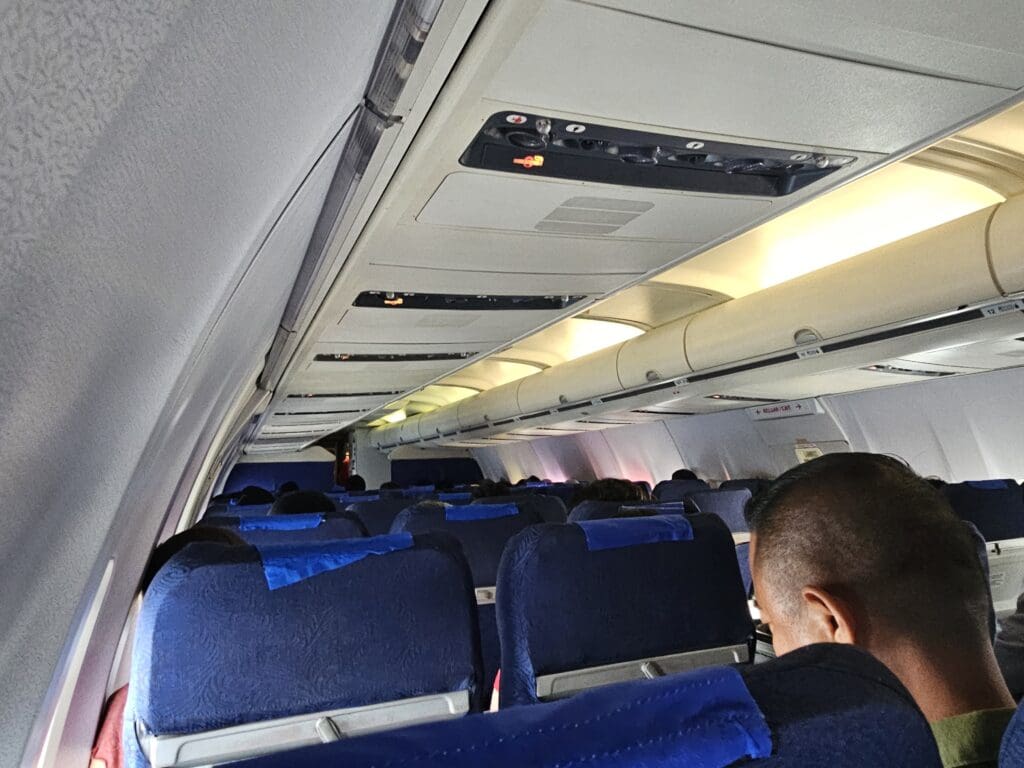
Upon sitting down, I found the seat to be soft and comfortable, and whilst the legroom was not fantastic, it was most certainly sufficient for the two short flights that morning. As you would expect given the aircraft’s age, the cabin did seem to be a little retro with a mishmash of various tones of cabin lighting, clunky-looking passenger service units and chunky armrests, whilst the seats themselves were most certainly not a new design. Meanwhile, plenty of marks and scratches could be seen throughout the aircraft. Nevertheless, the cabin was clean and tidy and left me with relatively little to complain about, especially since I had been expecting a dated aircraft! In the seatback pocket, a dated-looking safety card and a plastic bin-bag-type sickbag could be found.
That morning, passengers boarded the aircraft quickly and efficiently, and it wasn’t long before the seats around me began to fill up. Soon, both neighbouring seats were filled, and fifteen minutes after boarding had been called in the terminal, the last passenger made their way onto the aircraft. After this, the crew passed through the cabin with clickers, counting and then recounting the total number of passengers. That morning, the flight seemed to be totally full and as one may expect, given the destination and the fact that Sriwijaya Air is barely known outside of Indonesia, most passengers appeared to be Indonesian. Indicating that we were set for a punctual departure, at 0554 the cabin door was closed with a loud thud and the steps were immediately backed up away from the aircraft. With the operation appearing to be an efficient and well-oiled machine, almost immediately after the steps were clear of the aircraft, our quick pushback commenced with no waiting whatsoever.
As we headed rearwards, the Purser performed their welcome announcement in Indonesian and English which consisted of the usual thanks and welcomes, a mention of the Captain’s name and our fifty-minute flight time up to Tanjung Pandan. As this was underway, a series of clunks and whines could be heard as the two CFMI CFM56-3C1 engines, used exclusively on the Boeing 737 Classic, powered into life. As they did so, the cabin was temporarily filled with the scent of jet fuel whilst the crew took to the aisles and the safety demonstration commenced. This consisted of the purser reading through the safety instructions whilst the three other crew members performed a demonstration in the aisle at various points in the cabin.
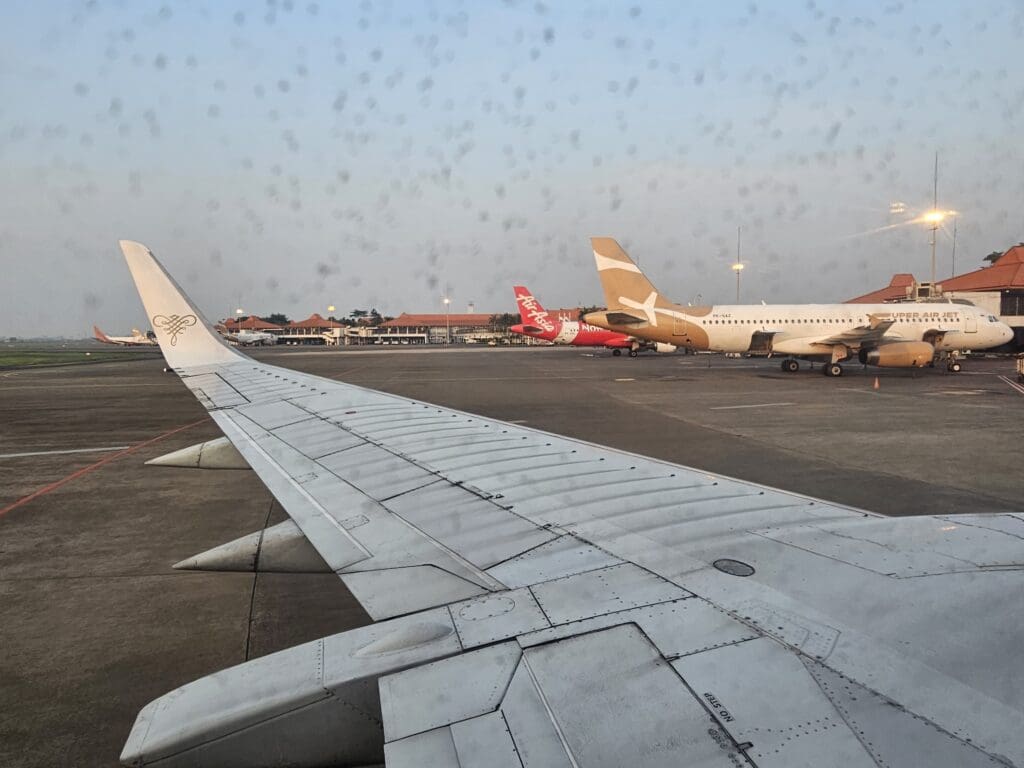
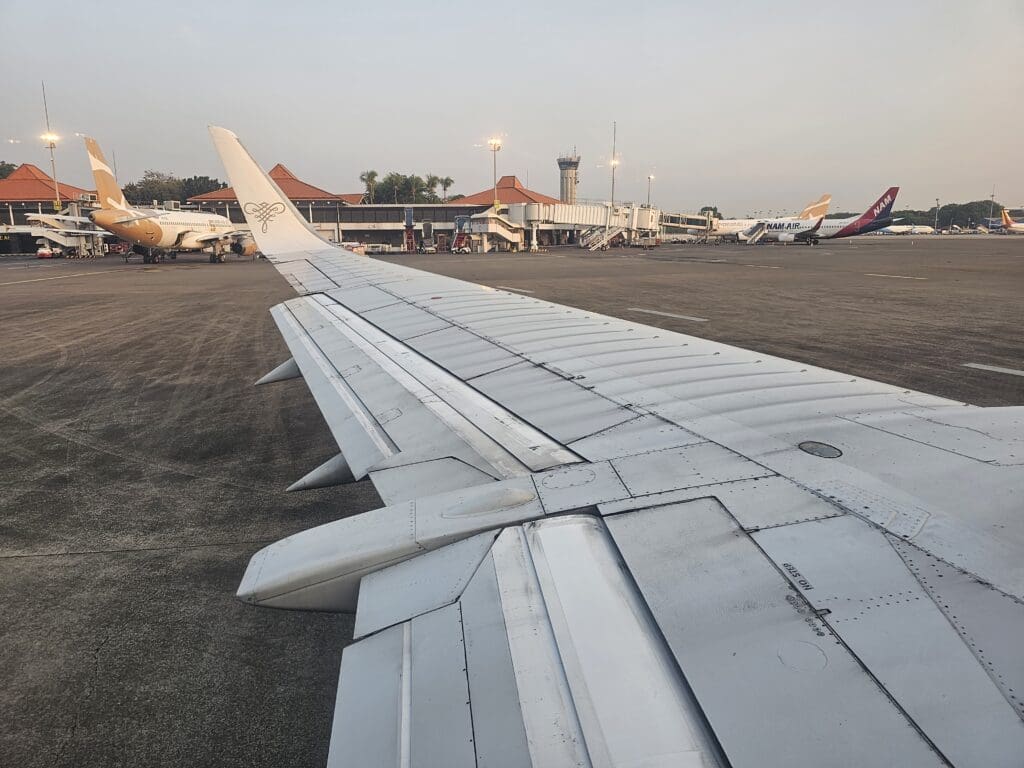
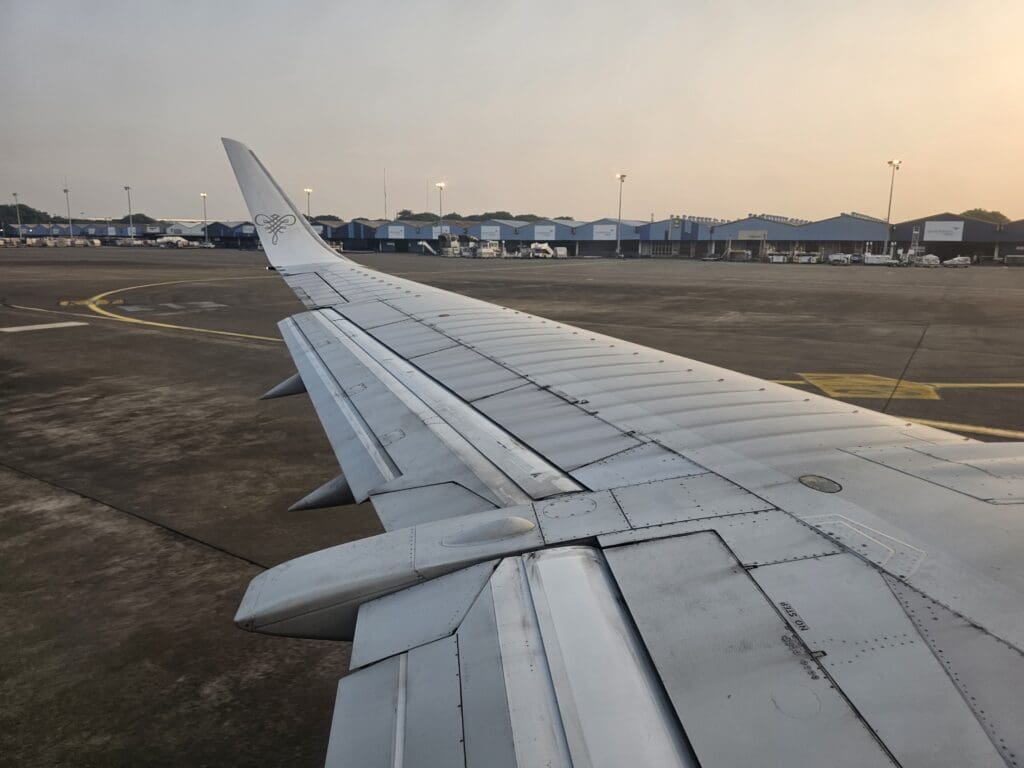
Upon coming to a halt, the tug was disconnected, and with just under ten minutes until our scheduled departure time, the Boeing commenced its taxi to the end of Runway 25L. Upon leaving the terminal behind, the aircraft passed two freighters – a Boeing 737 Classic operated by Express Cargo Airlines and a newer Boeing 737-800 operated by Raindo United Services. Both, of course, are airlines that, seeing as I am based in Britain, are ones that I am by no means familiar with! Once away from the stands, the Boeing made what seemed to be a quick and bumpy taxi past the sprawl of airport warehouses and soon reached the end of the terminal.
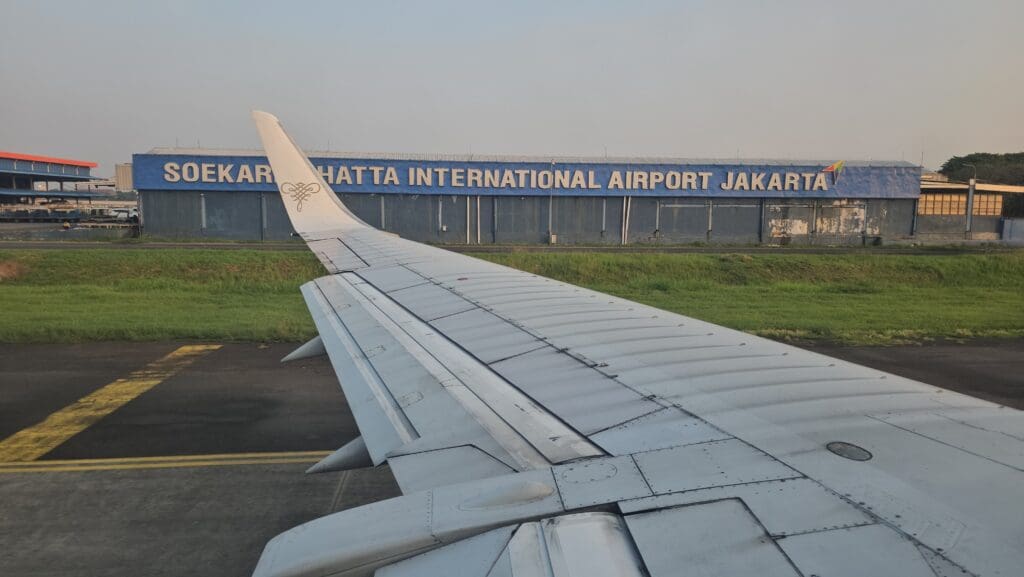
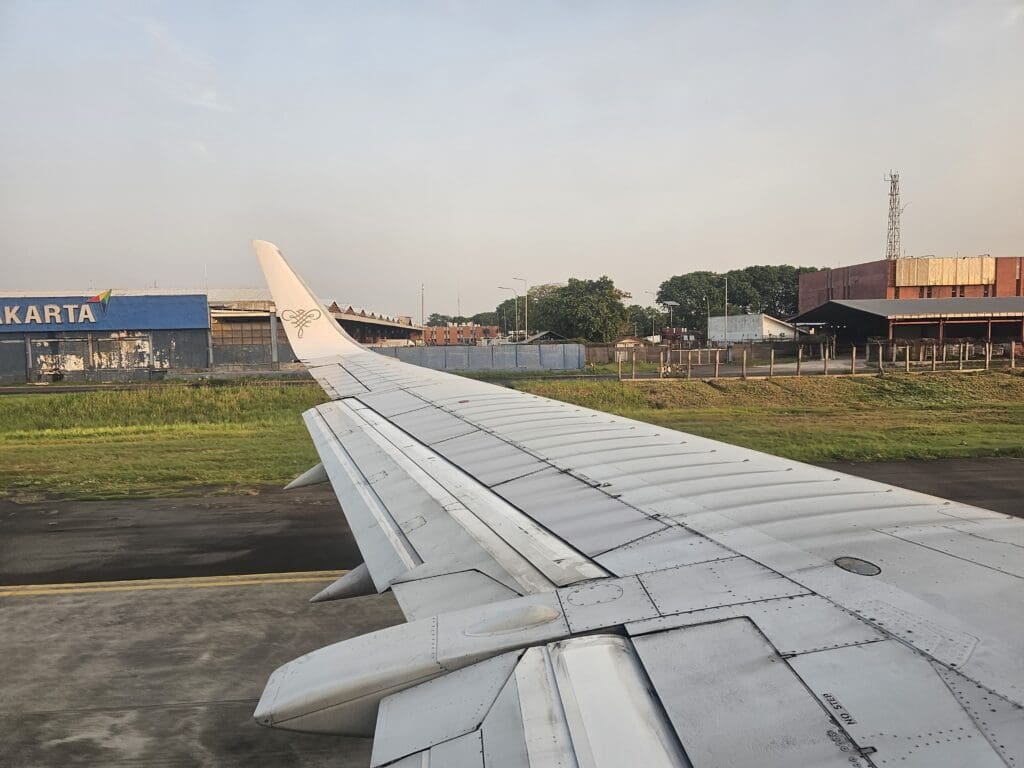
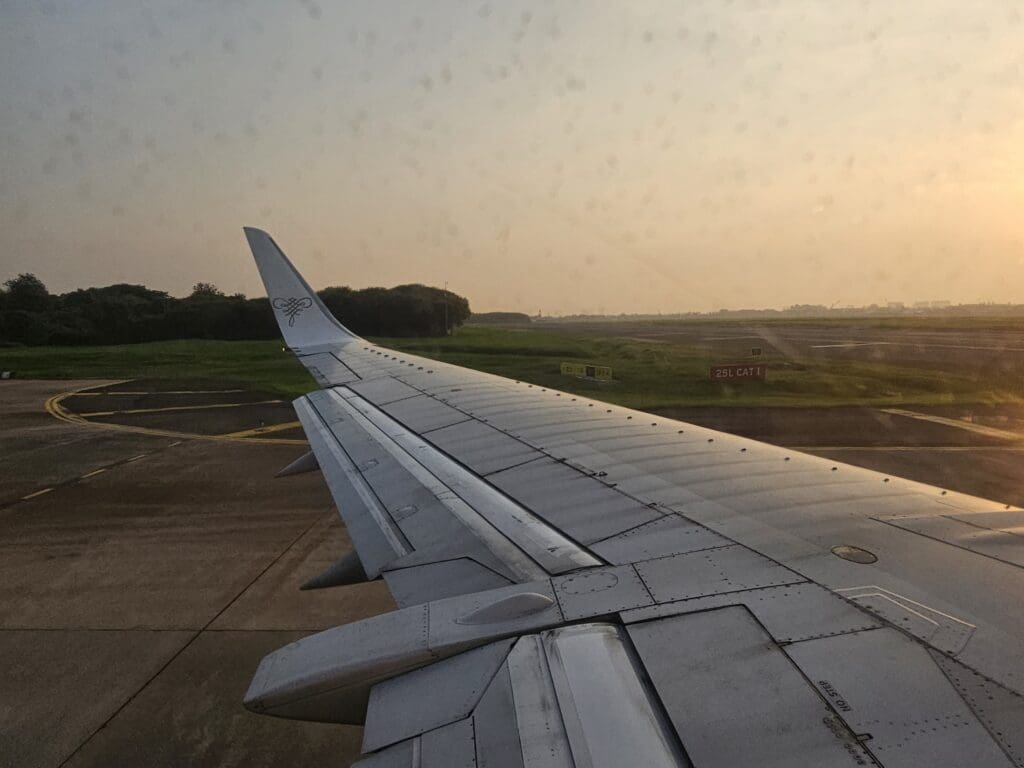
Wasting no time, even though we would be departing during the morning rush, once at the end of the runway no holding was required and we soon made our way onto this. Without stopping, at 0604, the two engines roared into life, and the Boeing commenced its powerful rolling takeoff. With the runway perhaps being a little uneven, this seemed to be far bouncier than usual, and soon we rotated upwards into the hazy morning Indonesian skies.
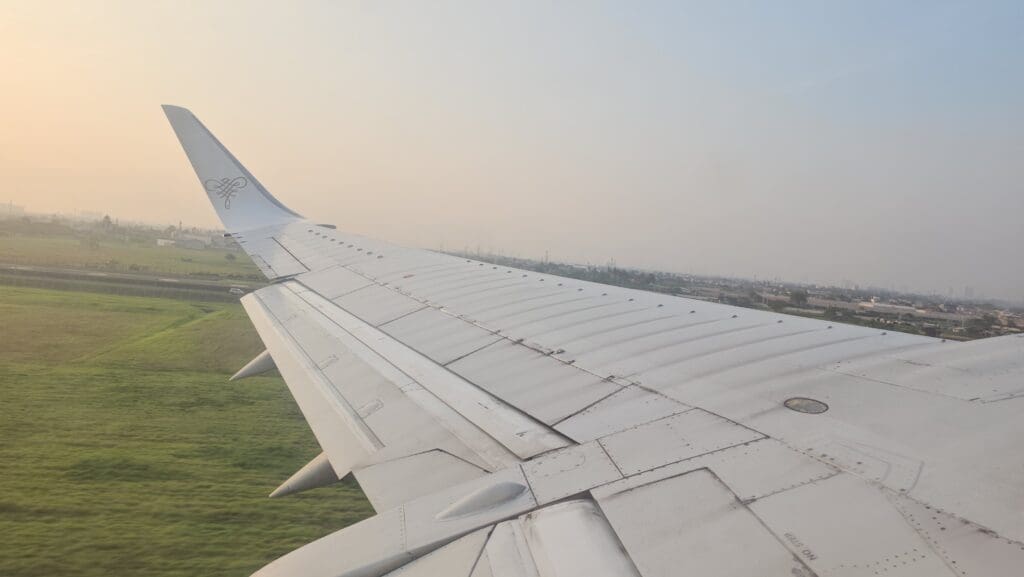
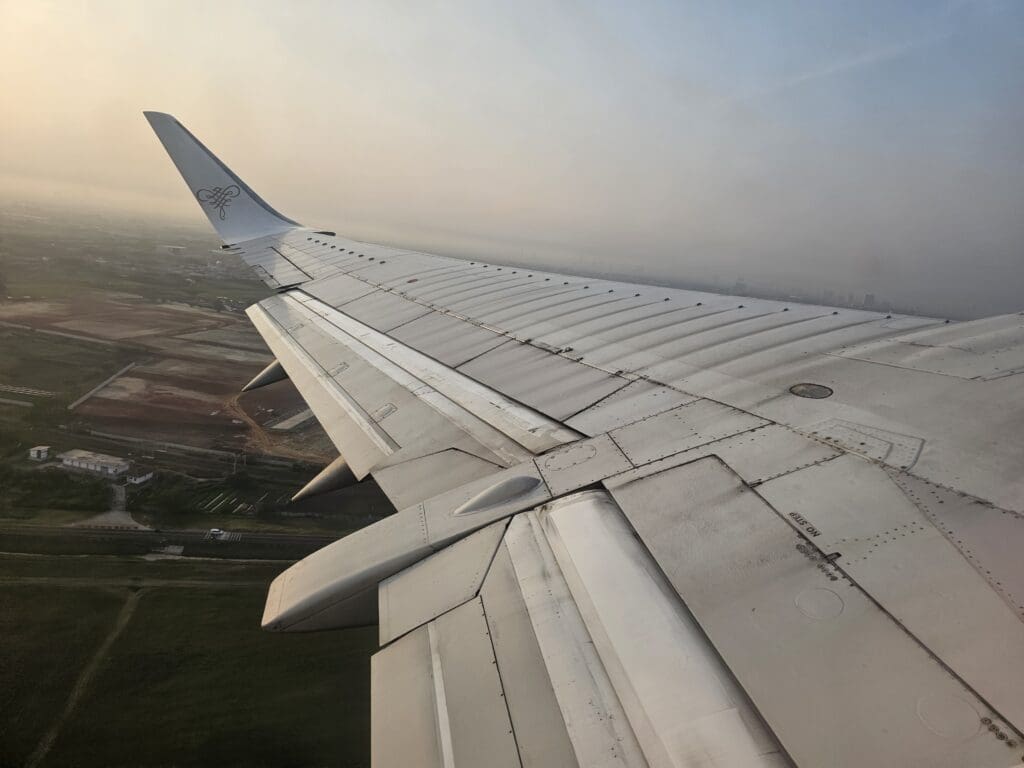
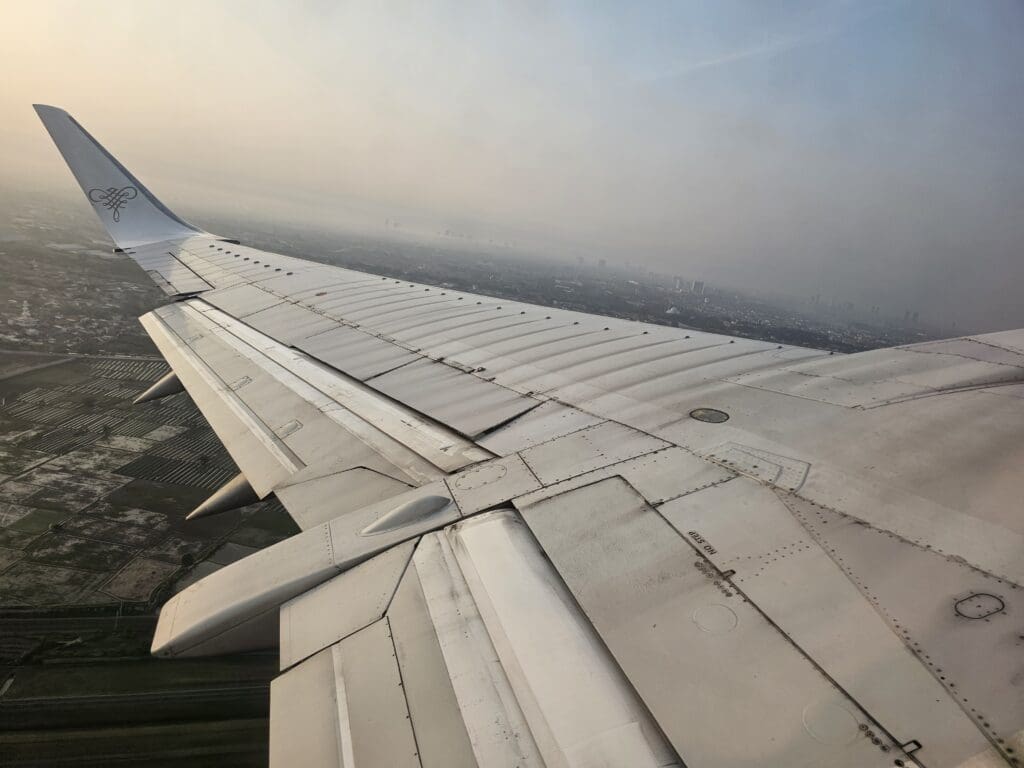
After leaving the sprawl of Jakarta Airport behind, the aircraft continued flying on a southwesterly course towards the town of Kutabumi. Three minutes after departure, the aircraft gently banked to the left and looped back around, making its way back towards the airport. By the time we reached this, the aircraft was climbing through 15,000 feet, at which point the seatbelt signs were extinguished, accompanied by the usual announcement from the Purser advising passengers to keep these fastened whilst seated. A short time later, another announcement was made, noting the imminent commencement of the onboard snack service. Given the short flight time and the full aircraft, understandably, all four crew members soon jumped up and rolled two service carts into the aisle.
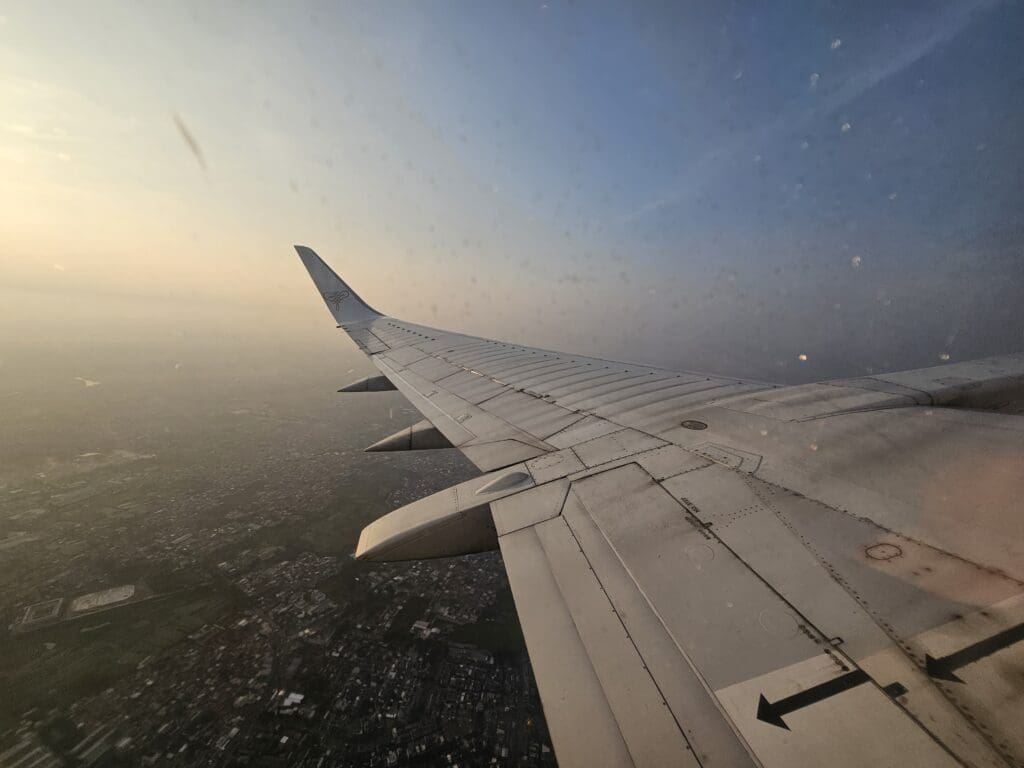
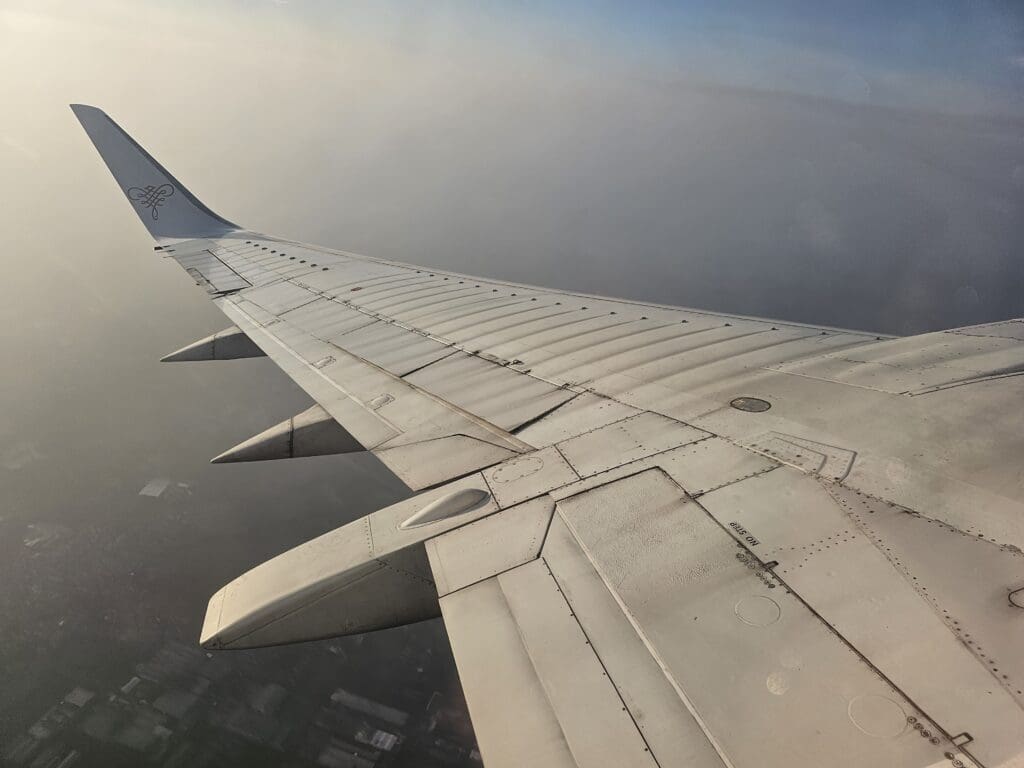
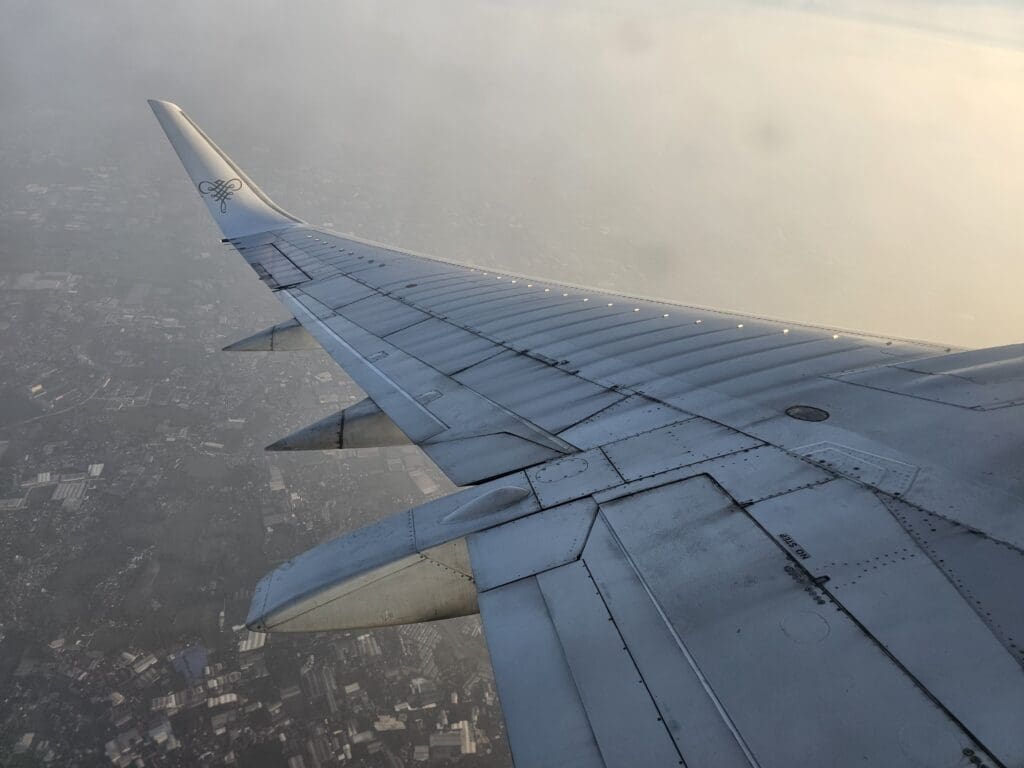
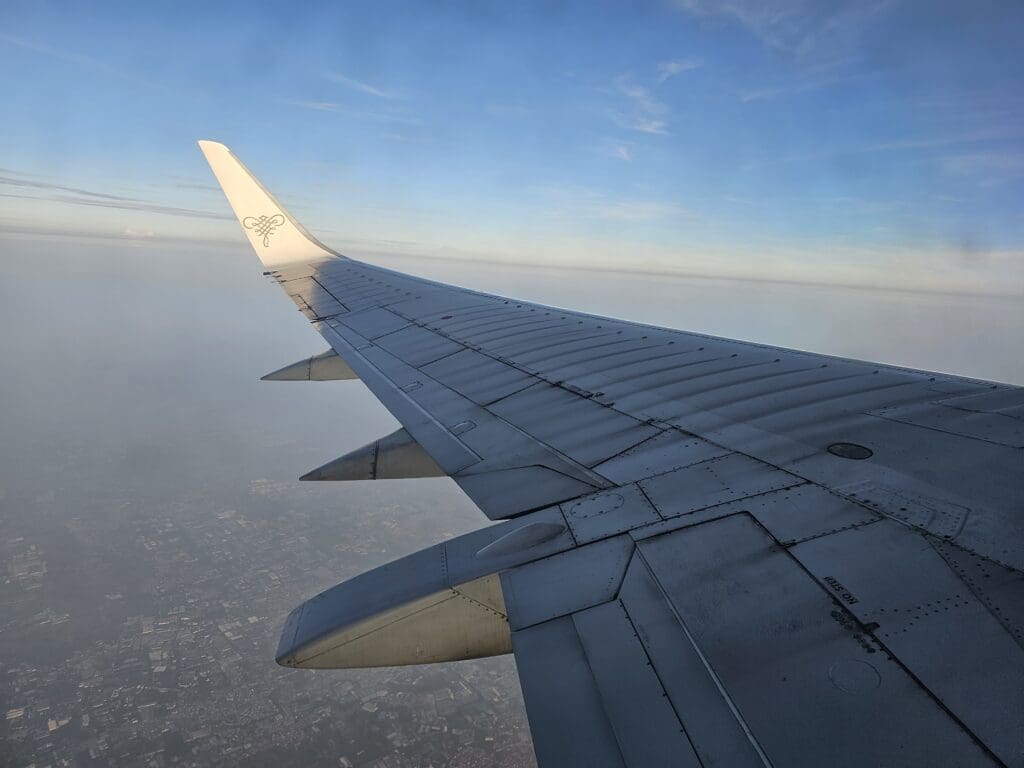
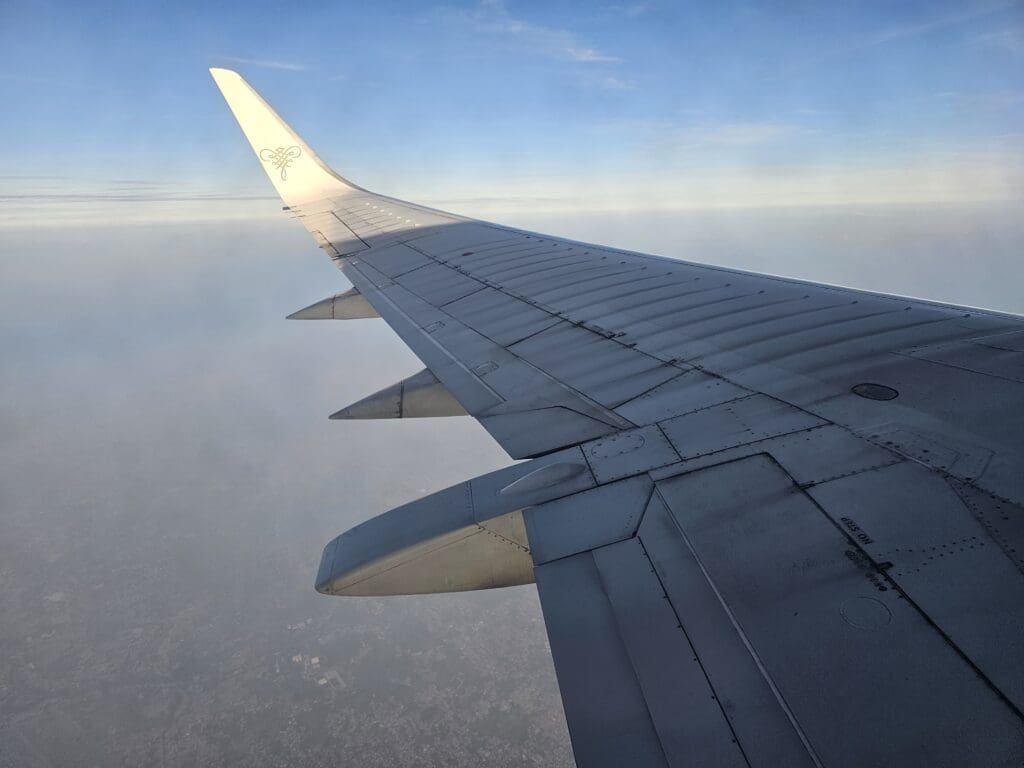
Turning my attention back outside, moments after passing the airport, the Boeing whizzed over the coastline and made its way out over the waters of the Bay of Jakarta. With Jakarta and Tanjung Pandang separated by 244 miles, most of which takes the form of the Java Sea, once away from Indonesia’s massive capital city, little could be seen outside other than the sea below.
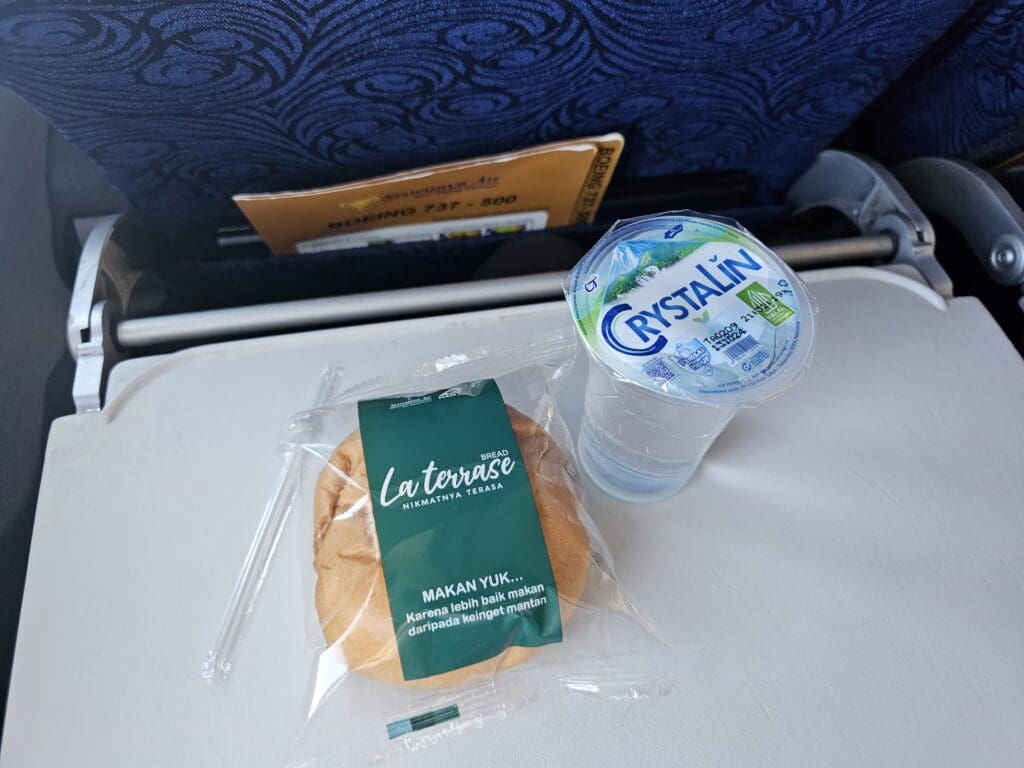
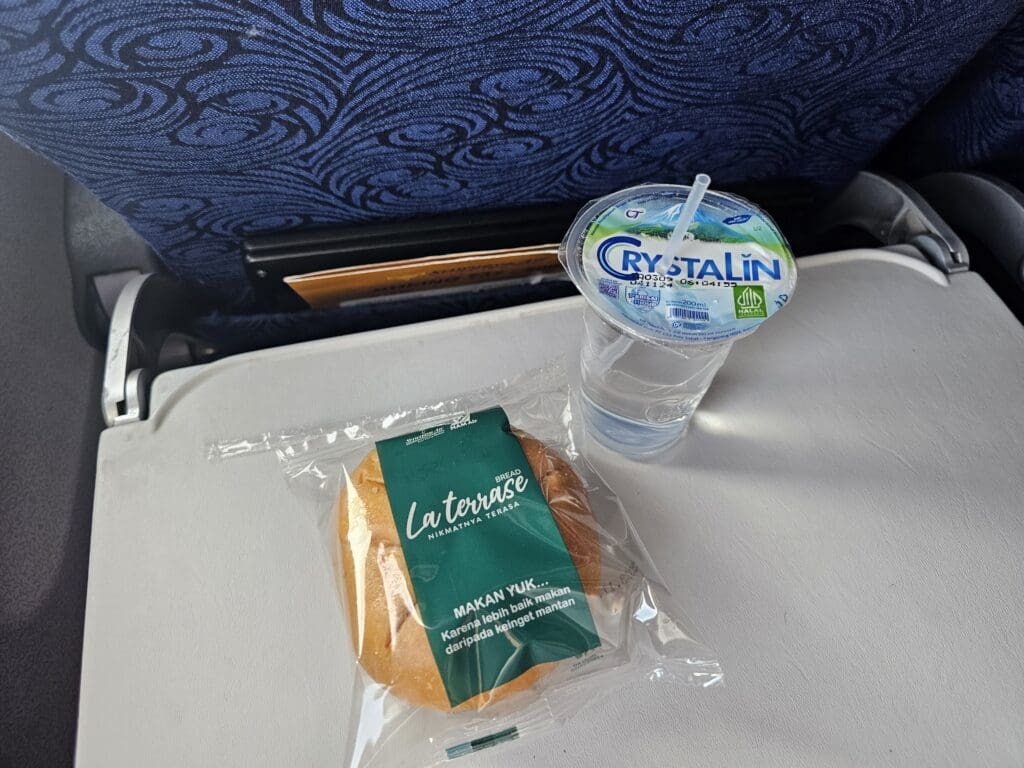
Back inside the cabin, I was soon handed a NAM Air-Sriwijaya Air-branded packaged bun, which contained a sweet custard filling, along with a small tub of still water and a straw. Whilst this service will most certainly not win any awards for its creativity, this was appreciated given the short flight duration. Working non-stop, as soon as all snacks had been handed out, another cart was rolled and the crew attempted to sell items from Sriwijaya Air’s inflight shop, with these goods mainly taking the form of perfumes. However, seeing as most passengers were asleep, the crew seemed to have no luck in selling anything and soon retreated to the galley.
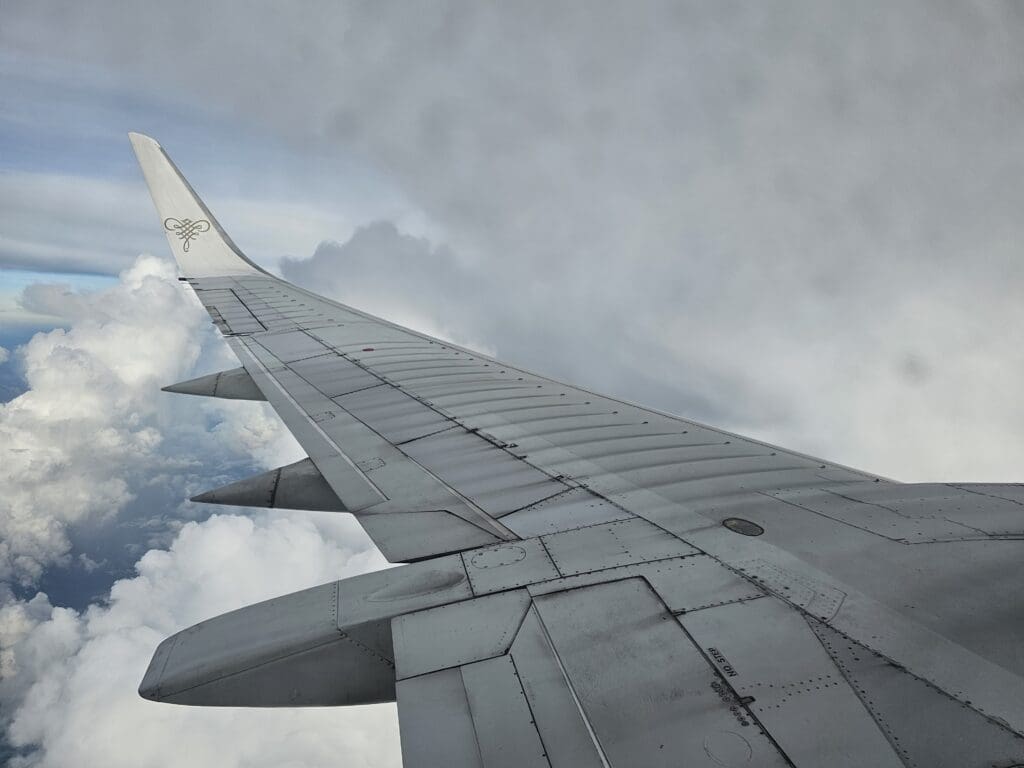
Outside, little could be seen other than the clouds and sea below as we sped northwards at 27,000 feet. Just ten minutes after levelling off, the Boeing could be felt commencing its descent towards its first stop of the day, Tanjung Pandan’s H.A.S. Hanandjoeddin International Airport. Before long, the speedbrakes were partially extended, causing the aircraft to decelerate with a few shudders and at 0637, the seatbelt signs were reilluminated in preparation for our arrival. This was accompanied by the usual warnings about seatbelts, tray tables, seatbacks and window shades, and soon the crew passed through the cabin, ensuring that all was in place for our arrival into Jakarta.
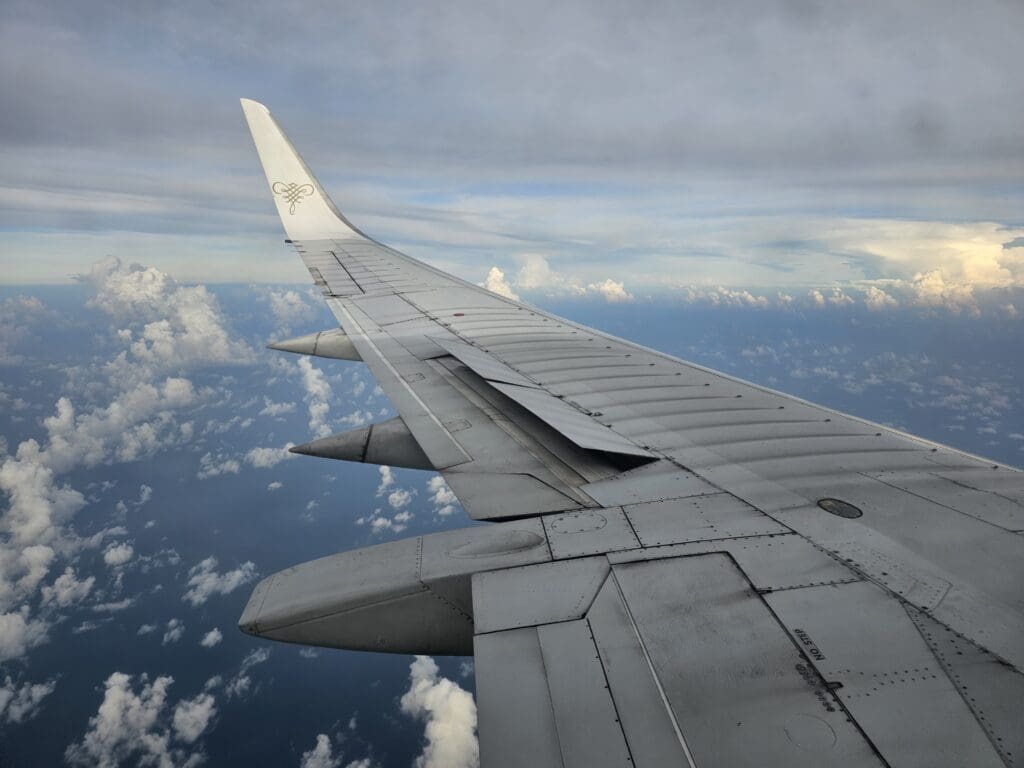
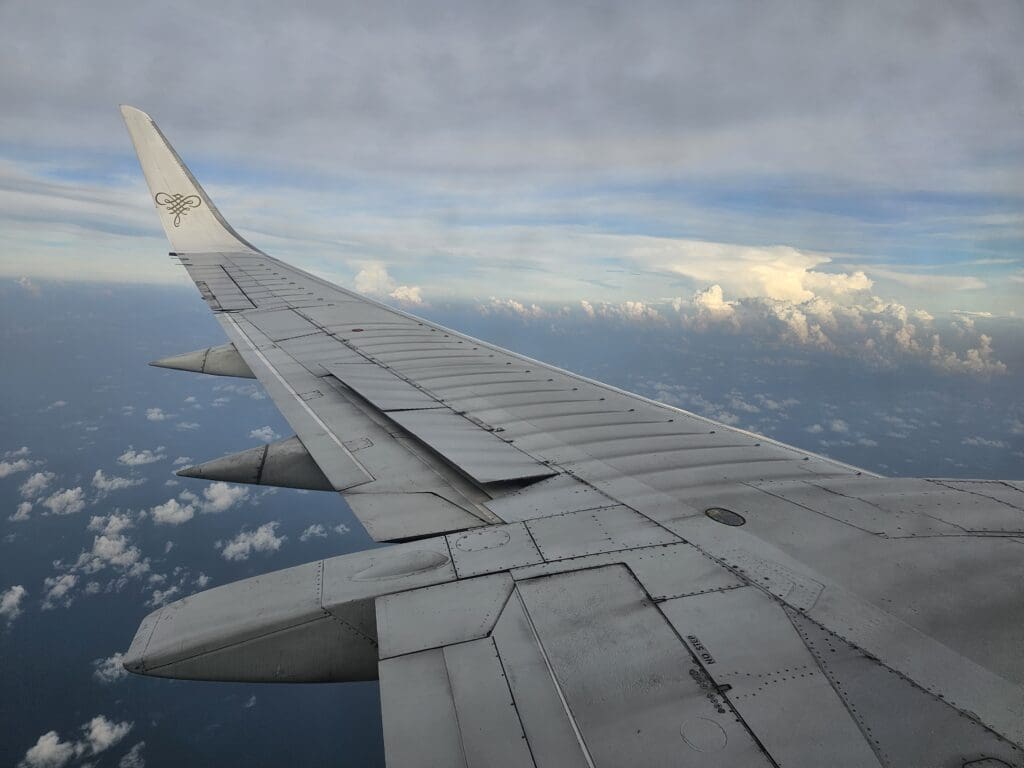
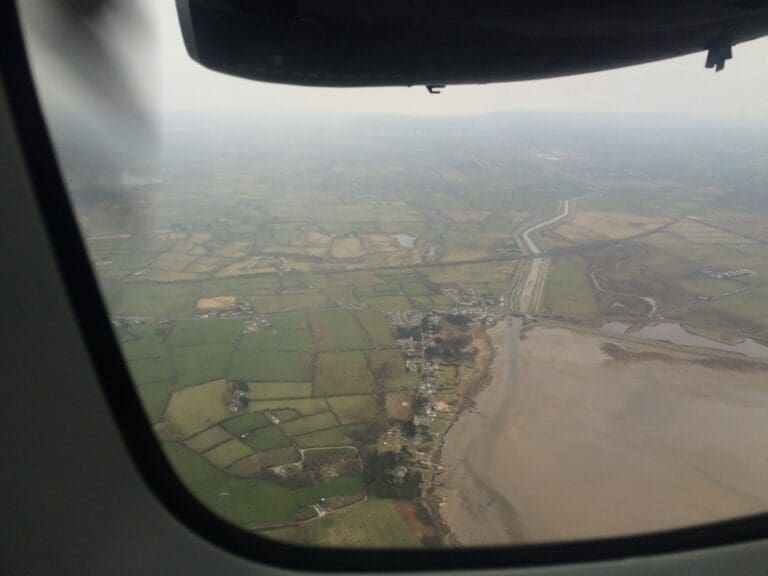
As we descended, the aircraft began to bounce around, and it wasn’t long before we made landfall over the island of Belitung’s southwestern tip near the village of Tandjungkiras. From there, we continued over the rural and green interior of the island, passing the occasional village as we descended back towards Earth.
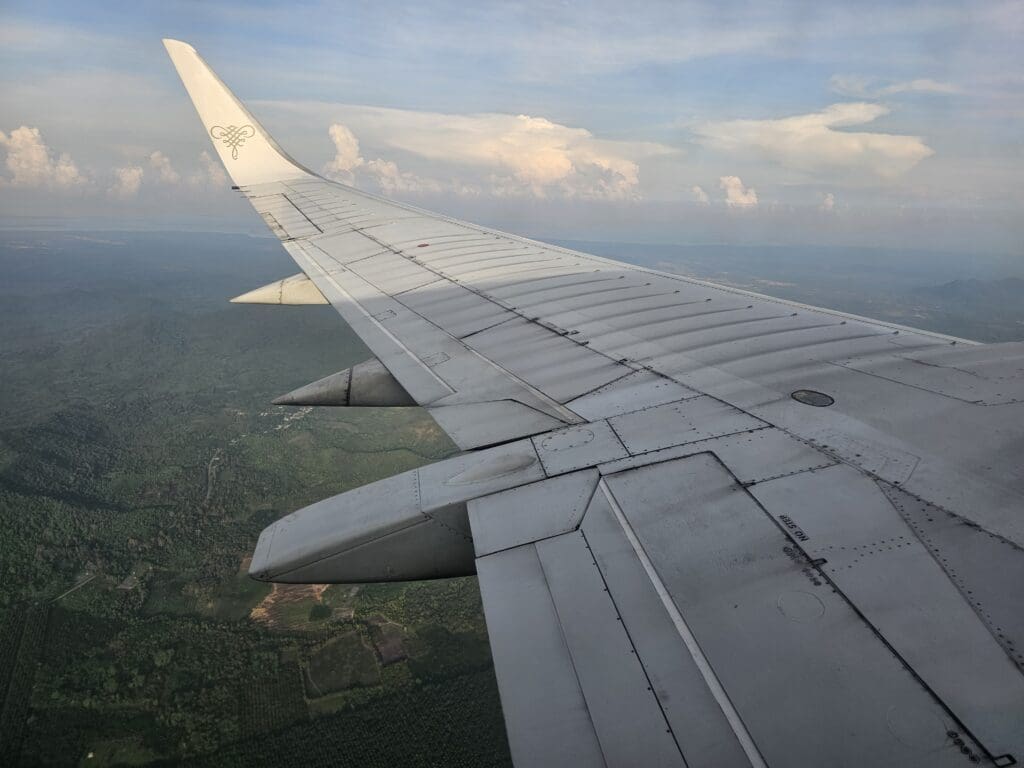
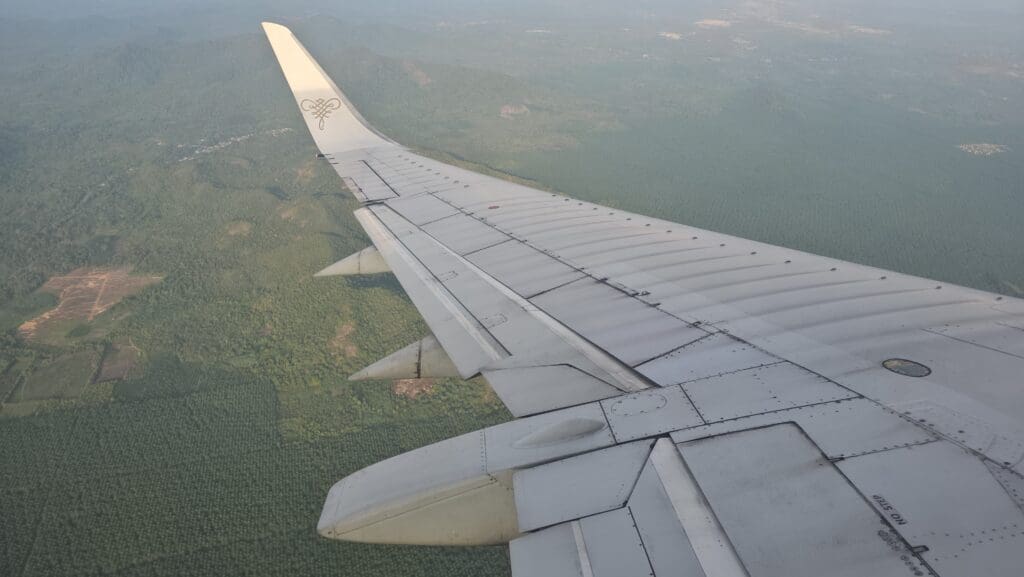
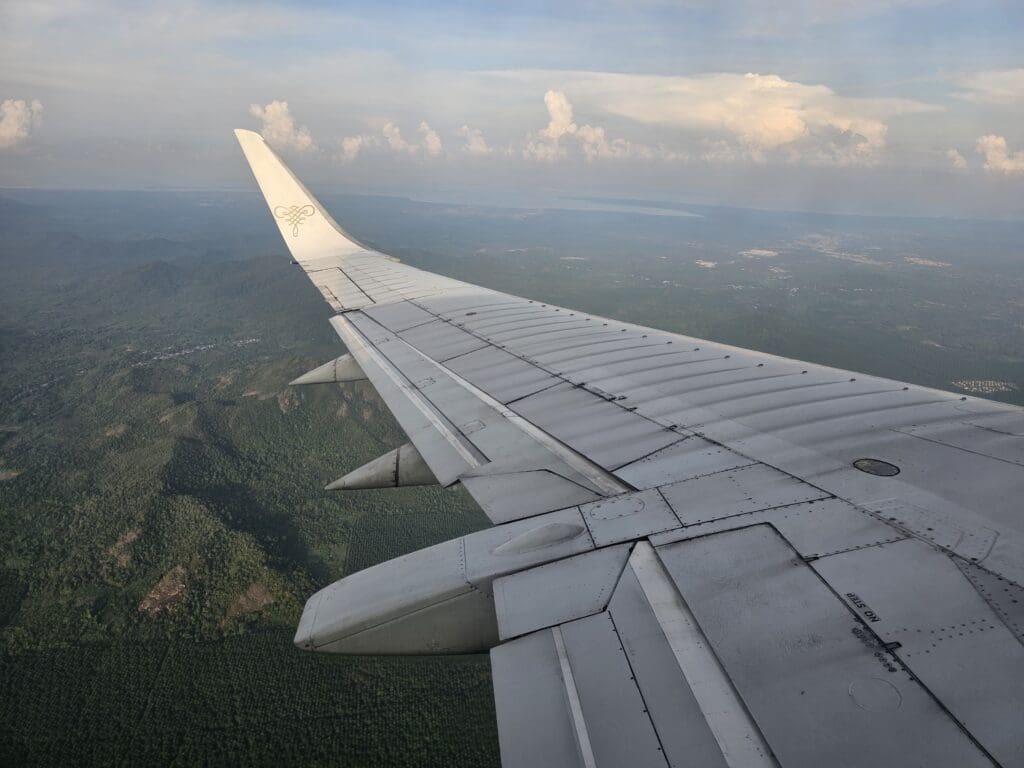
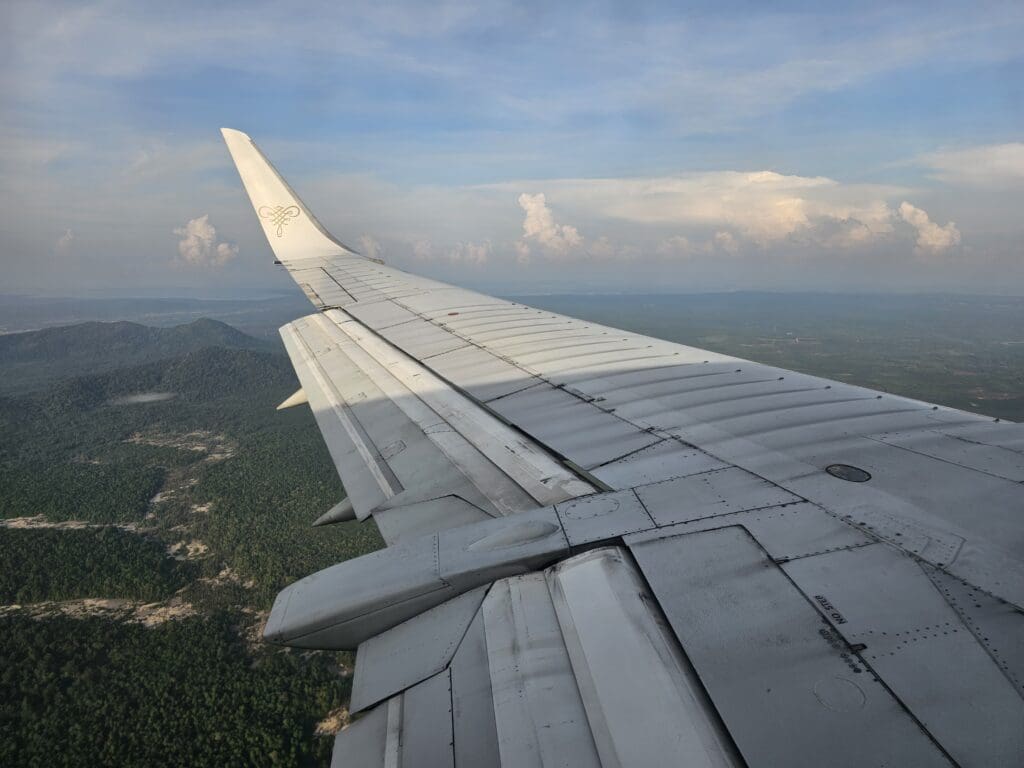
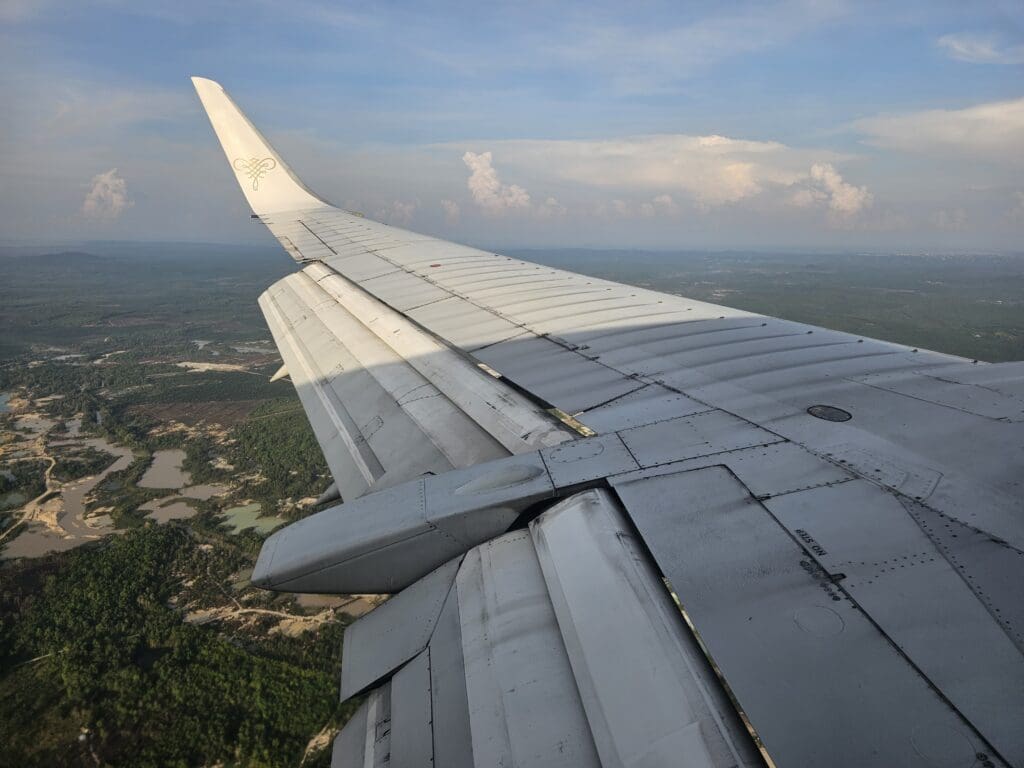
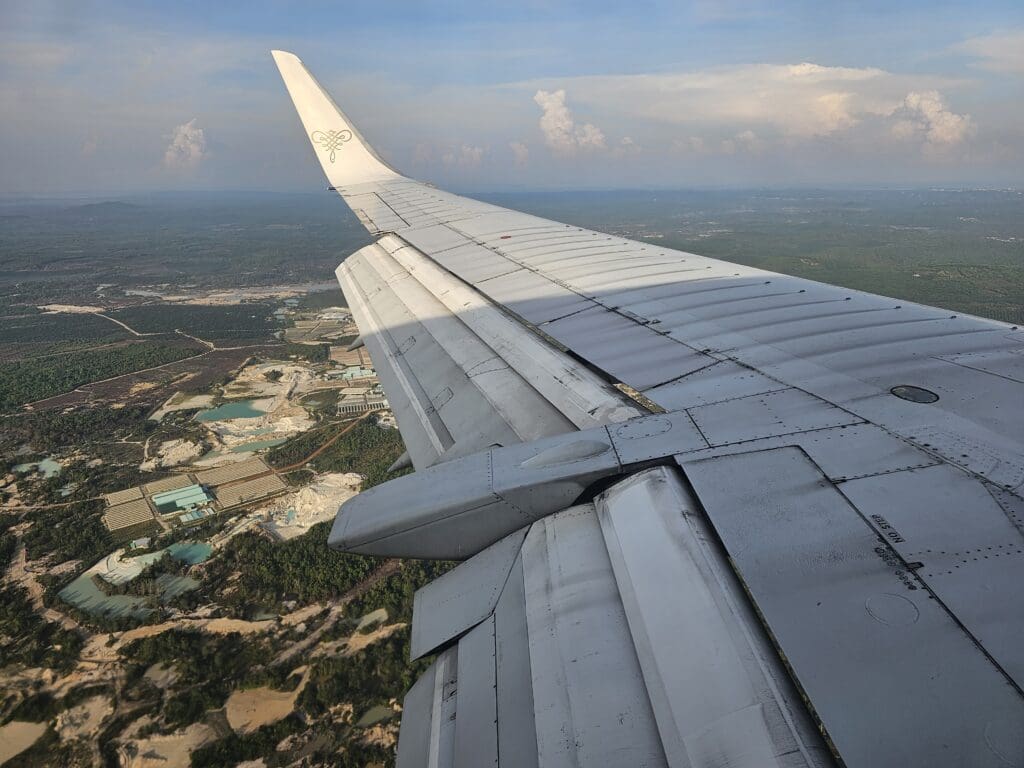
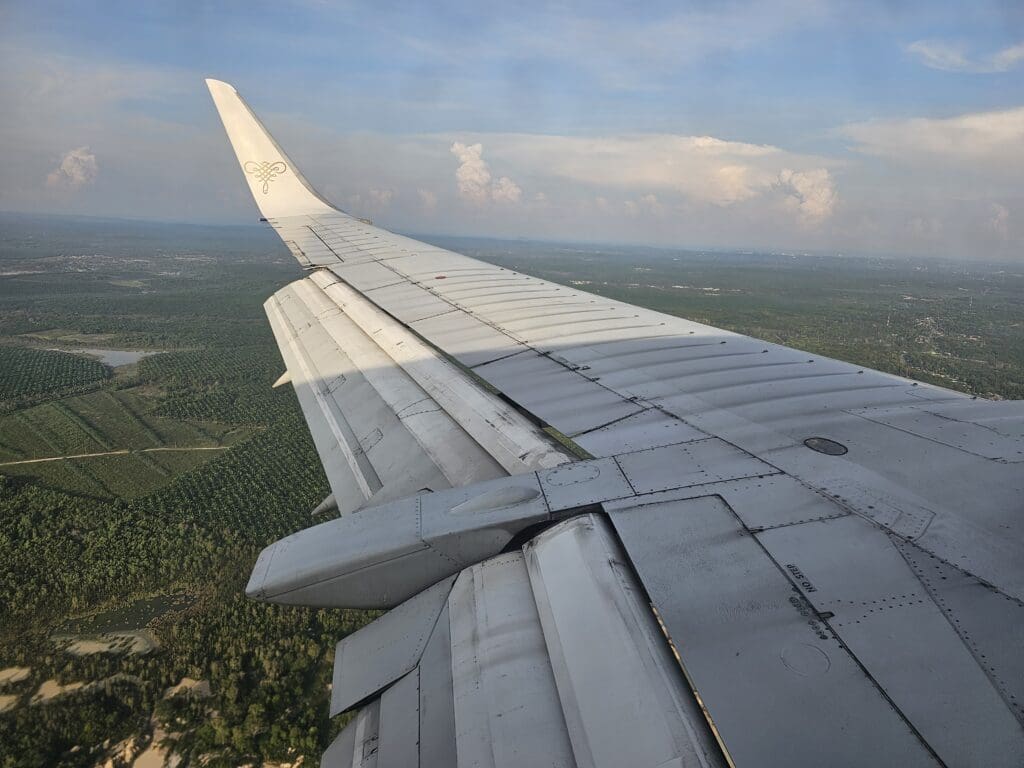
With H.A.S. Hanandjoeddin International Airport featuring just one runway, which runs directly from north to south, landing into the north on Runway 36, very few turns were needed to line us up for an approach to this. Soon, the flaps were lowered as we passed the villages of Asem and Bantan before our landing gear fell into position with a loud clunk. Descending downwards, as we approached Tanjung Pandan, more signs of human life could be seen with various industrial facilities as well as more roads and villages seen below as we neared the city’s southern fringes.
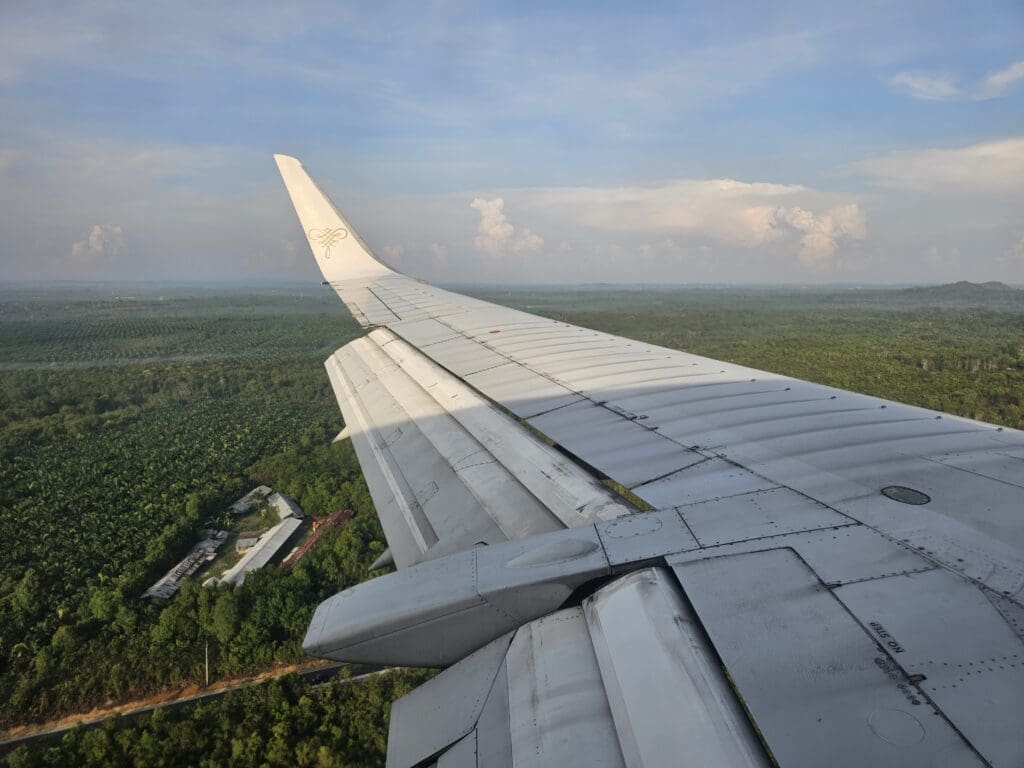
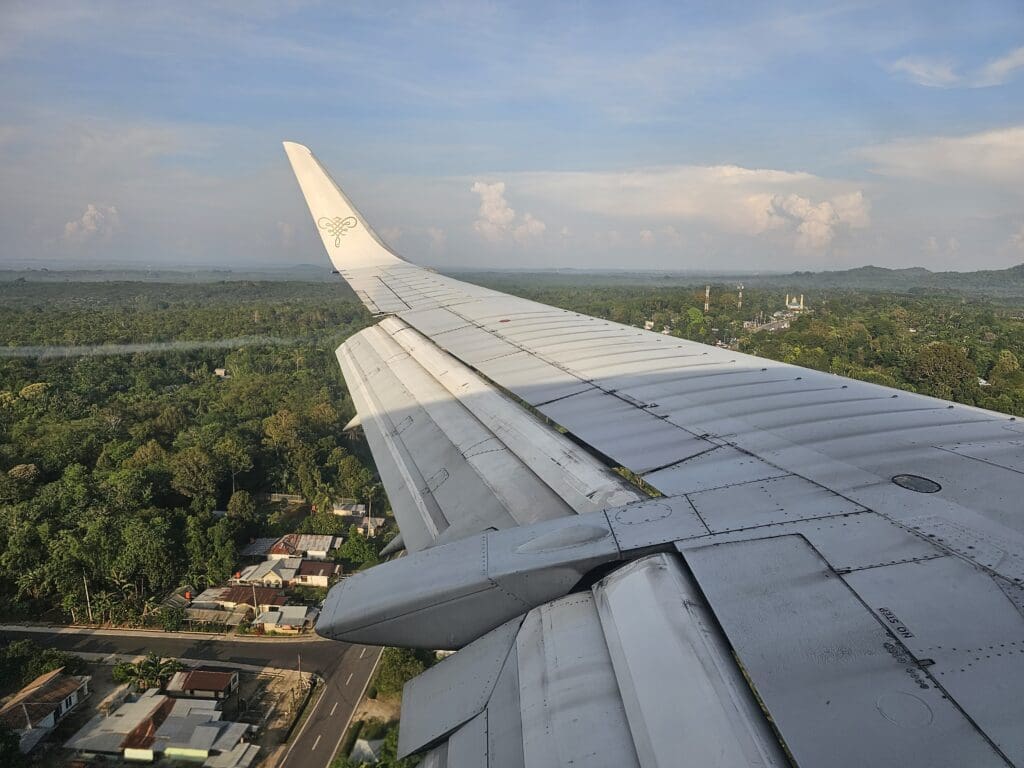
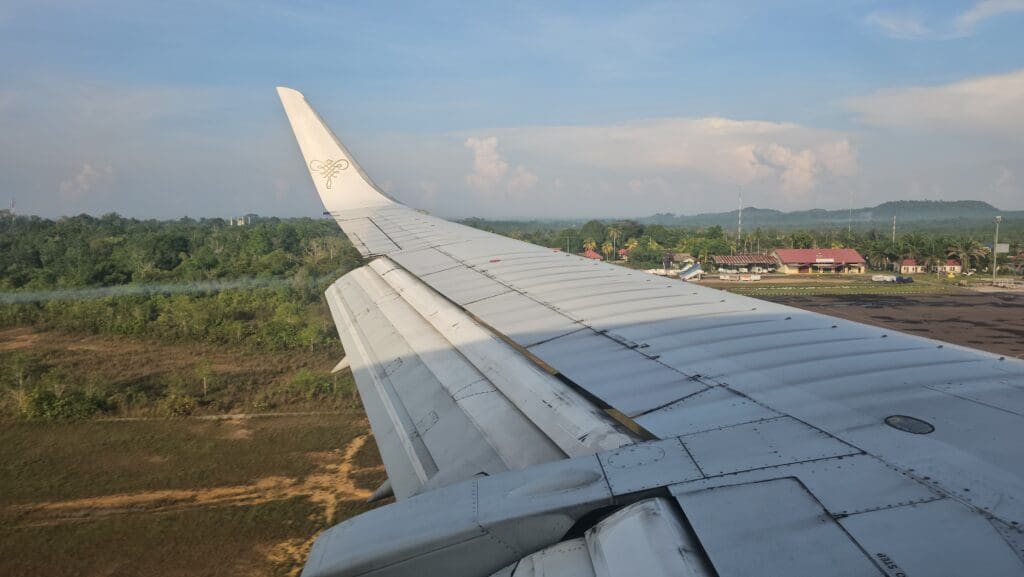
After a total of just 44 minutes in the air, the aircraft crossed over the perimeter fence and small ramp where a Lion Air Boeing 737-800 could be seen being readied for its flight to Jakarta. A few moments later, the aircraft touched down with a thud, and we decelerated quickly. Whilst the airport is the only one located on the island of Belitung and thus serves an important infrastructural role, as you would expect given the island’s population of around 300,000, this is far from one of Indonesia’s busiest airports and serves just a handful of flights each day. At the time of my flight, Citilink, Lion Air and Super Air Jet connected this to the capital city, with Lion Air, like Sriwijaya Air, also operating to Pangkalpinang. In terms of the airport’s layout, the terminal and small apron sit in the far southwestern corner of the airfield, with the latter connected to the runway by just two taxiways, thus ensuring a long backtrack either after arrival or before departure (unless arriving and departing in opposite directions).
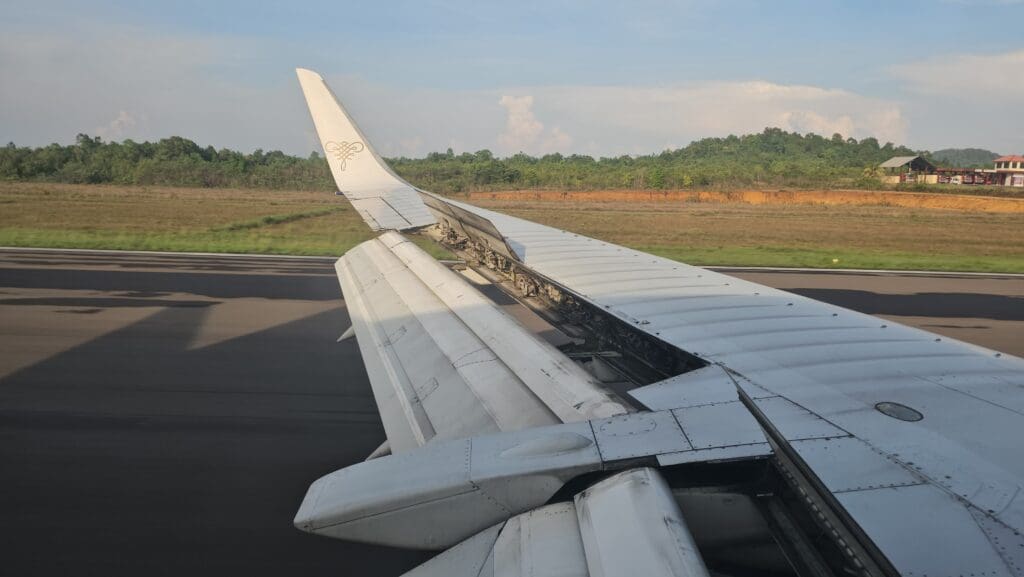
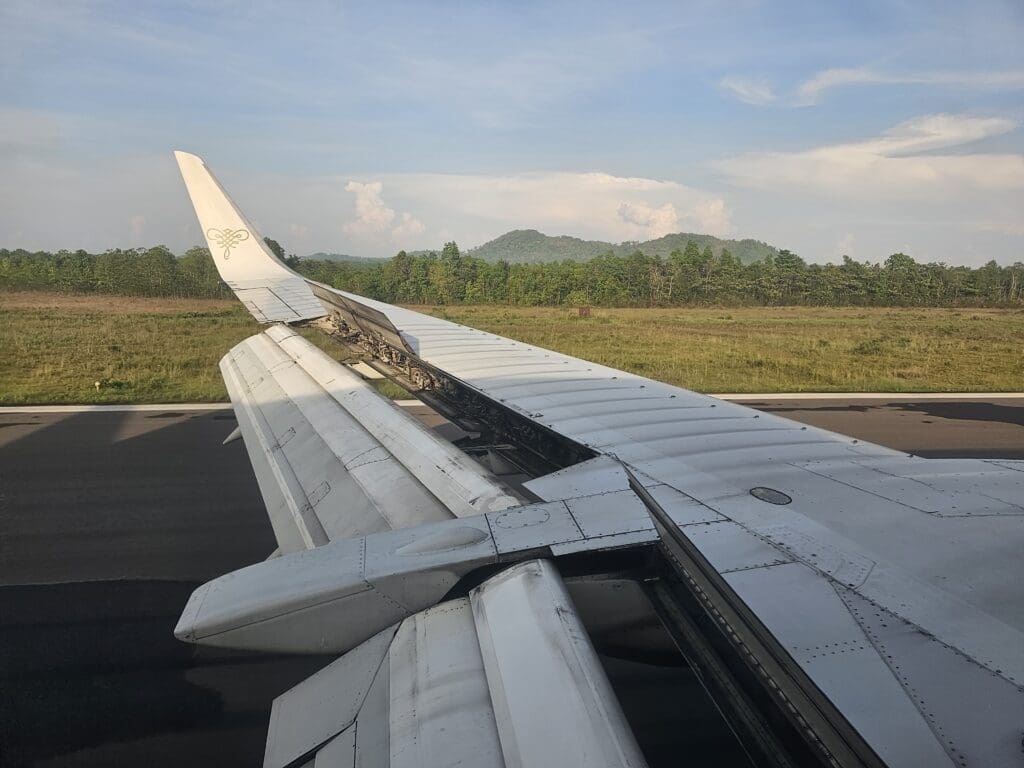
Soon reaching the end of the airport’s 2,500-metre runway, the aircraft performed an about turn and returned down the runway towards the ramp. As we journeyed back to the other end of the airport, the Purser performed their welcome announcement in Indonesian and English, alongside the usual thanks for flying with Sriwijaya Air, and finally, those continuing onwards to Pangkalpinang were requested to remain onboard the aircraft during the turnaround, with this scheduled to depart after thirty minutes on the ground.
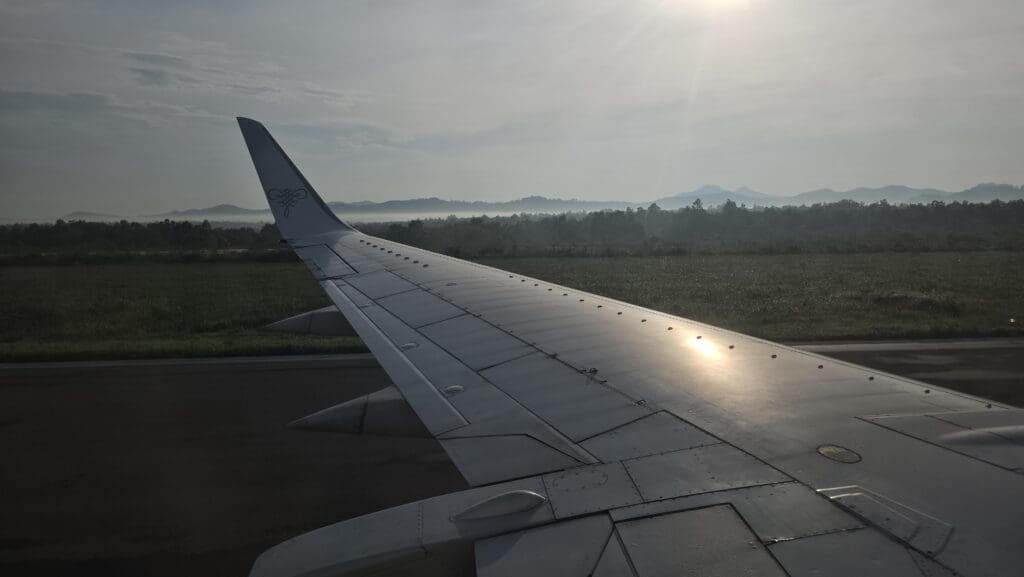
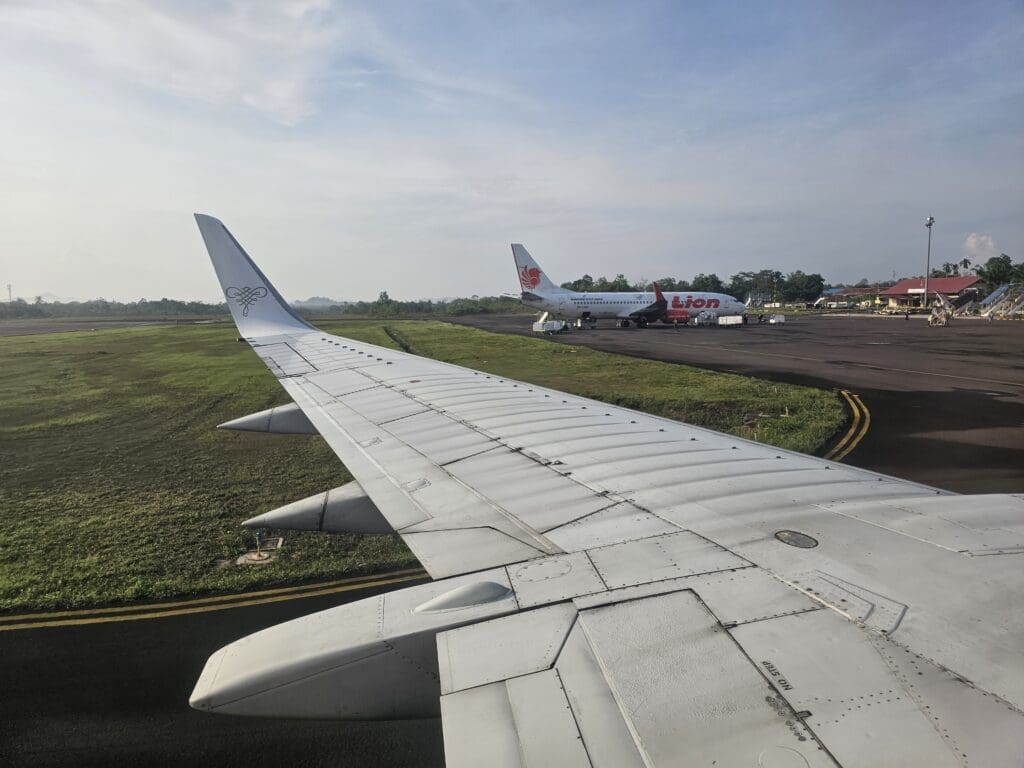
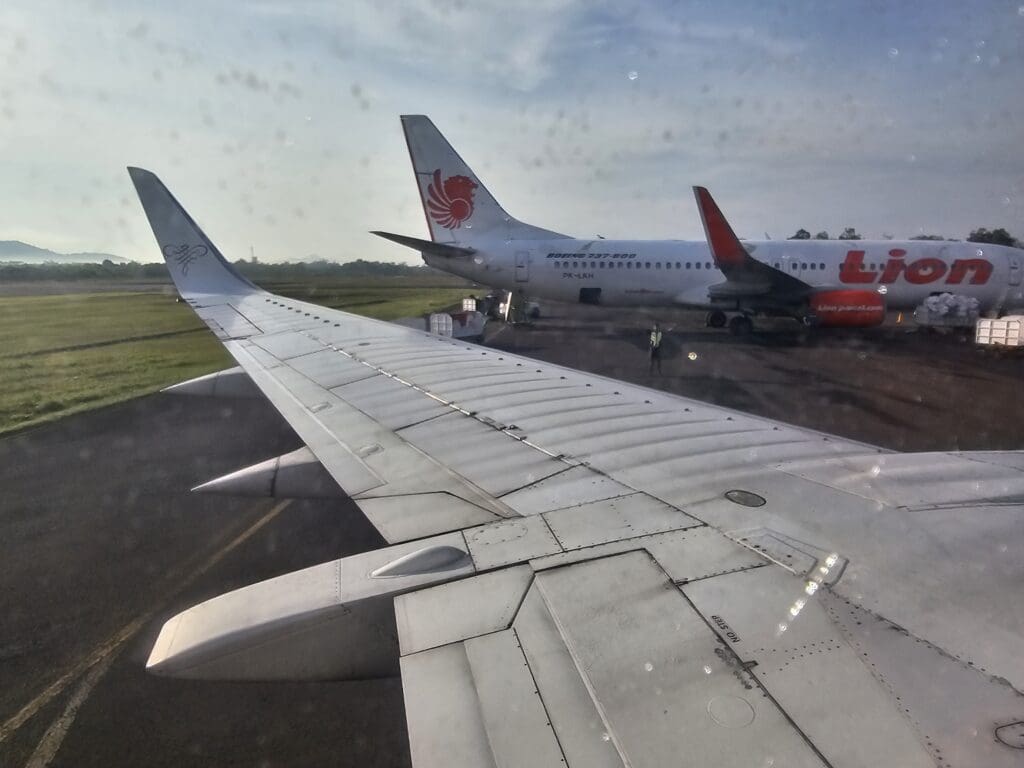
After trundling down the runway, the aircraft turned right and made its way onto the ramp, coming to a halt moments later at Stand B1 next to the rather battered-looking Lion Air jet. Soon, the engines spooled down at which point the usual crowd of passengers flocked to the aisle in an urgent rush to disembark. Beating most major airports, two sets of rather battered-looking Sriwijaya Air-branded steps were positioned up to the front and rear doors almost immediately after the engines spooled down, with disembarkation commencing in a very timely manner. Looking around, it seemed that everyone except myself would be ending their journey in Tanjung Pandan. Indeed, this was the case, and I was soon the only passenger left remaining onboard the aircraft, at which point the flight attendant approached me and confirmed that I was indeed bound for Pangkalpinang.
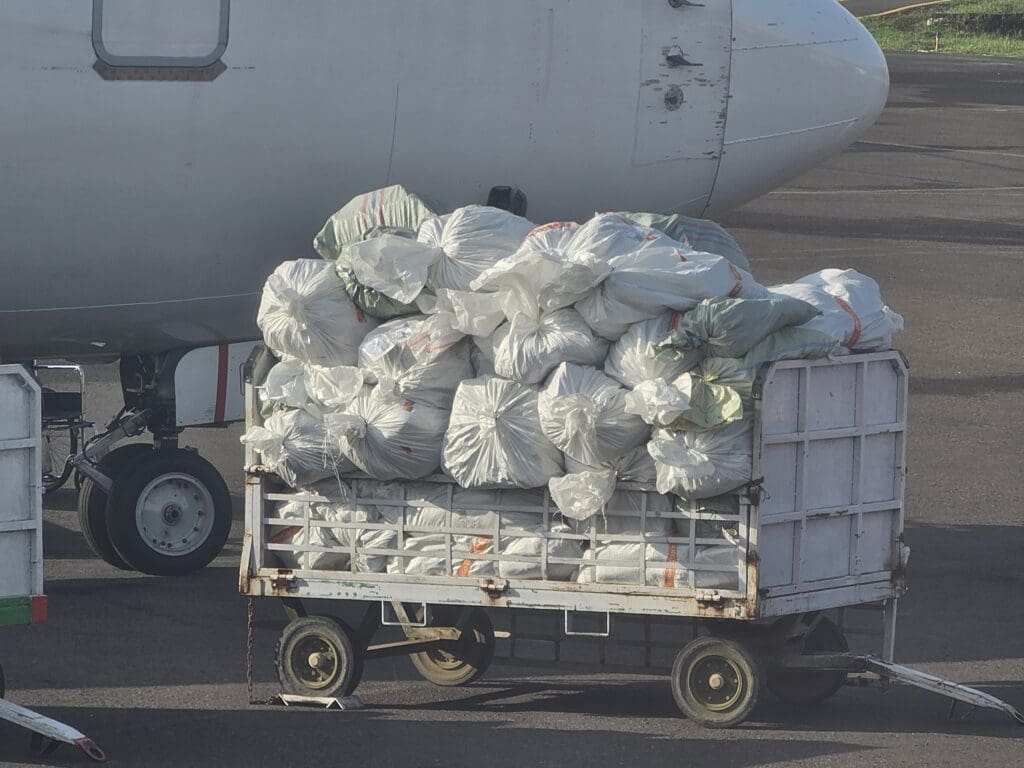
After all passengers had disembarked, a security officer and two cleaners boarded the aircraft. The former undertook a quick check of the cabin to ensure nothing untoward had been left onboard, and the two cleaners removed any rubbish. This took around five minutes, after which the crew passed through the cabin, ensuring that all was in place for the next load of passengers. As they did this, there was little for me to do other than watch as an endless stream of mail sacks, boxes and other weird and wonderful cargo was loaded into the holds of the neighbouring Boeing 737. At 0715, a total of forty minutes before our scheduled departure time of the second flight, the Purser announced, ‘cabin crew boarding positions, passengers boarding’ and soon passengers could be seen walking over from the airport’s small terminal. With direct ferries running between Pangkalpinang and Tanjung Pandan, making this journey in around four hours, I was not too sure just how busy this short hop would be. However, it seemed that this flight was popular with elderly tourists, with at least three large groups onboard the aircraft, and, seeing as they were on holiday, many seemed to be in a good mood, spending much of the flight chatting and laughing away. This contrasted with the quiet and subdued mood of the first flight up from Jakarta.
After a while, all the passengers had made it onto the aircraft, and it appeared that, like the first flight that day, this sector would be totally full. Once all were onboard, the rear steps were backed away from the aircraft whilst those at the front remained in place as the dispatcher spent the next few minutes shuttling in and out of the aircraft. As we waited, the purser performed their welcome announcement in Indonesian and English; however, thanks to the loud and joyful conversation of my seatmates, little of this could be heard. A total of fifteen minutes before our scheduled departure time, the cabin door was closed at 0740, and the steps were removed from the aircraft. With no pushback required, the two engines immediately began to spool into life once more in preparation for carrying us over the short stretch of sea that separates the islands of Belitung and Bangka.
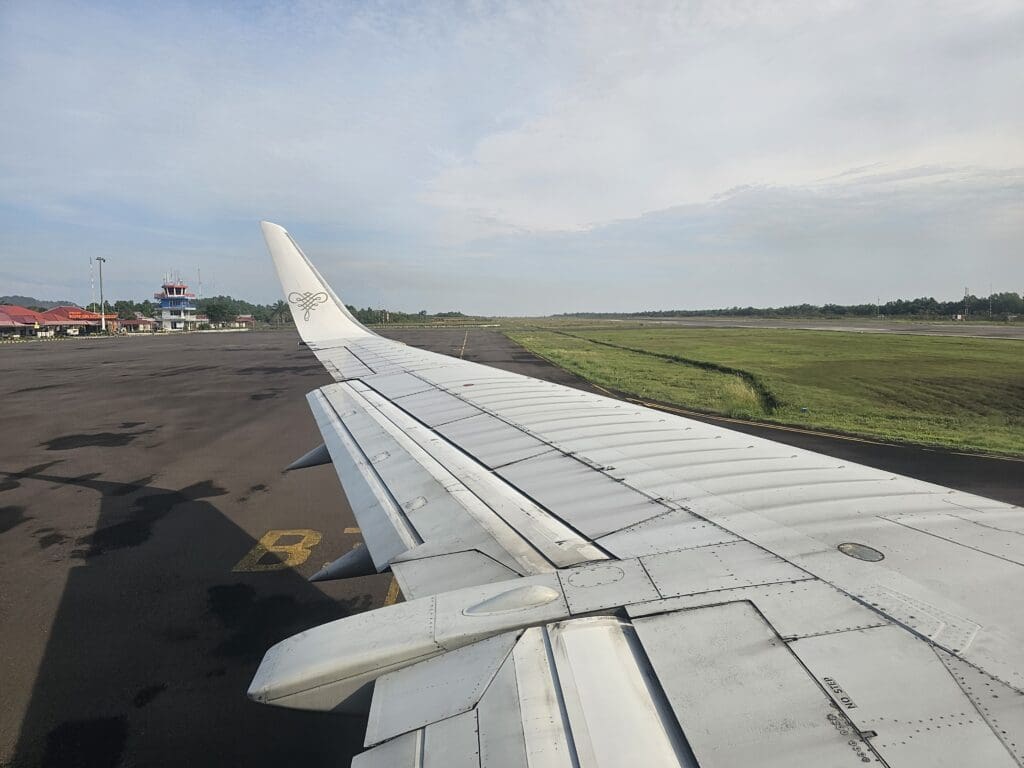
As the engines powered into life, the purser read through the safety instructions once more whilst a demonstration was performed in the aisle and at 0744, the Boeing powered forward out of its stand under its own steam. Immediately turning left, the taxi to the end of the runway took no time at all, with the cabin crew finishing the demonstration and strapping themselves into their seats seconds before we made our way onto the runway. Once there, the aircraft paused for a few seconds before the engines spooled up, sending us flying down the runway. Whizzing past the terminal and fire station, the aircraft eventually rotated upwards into the blue skies of Belitung and climbed out over the green surroundings.
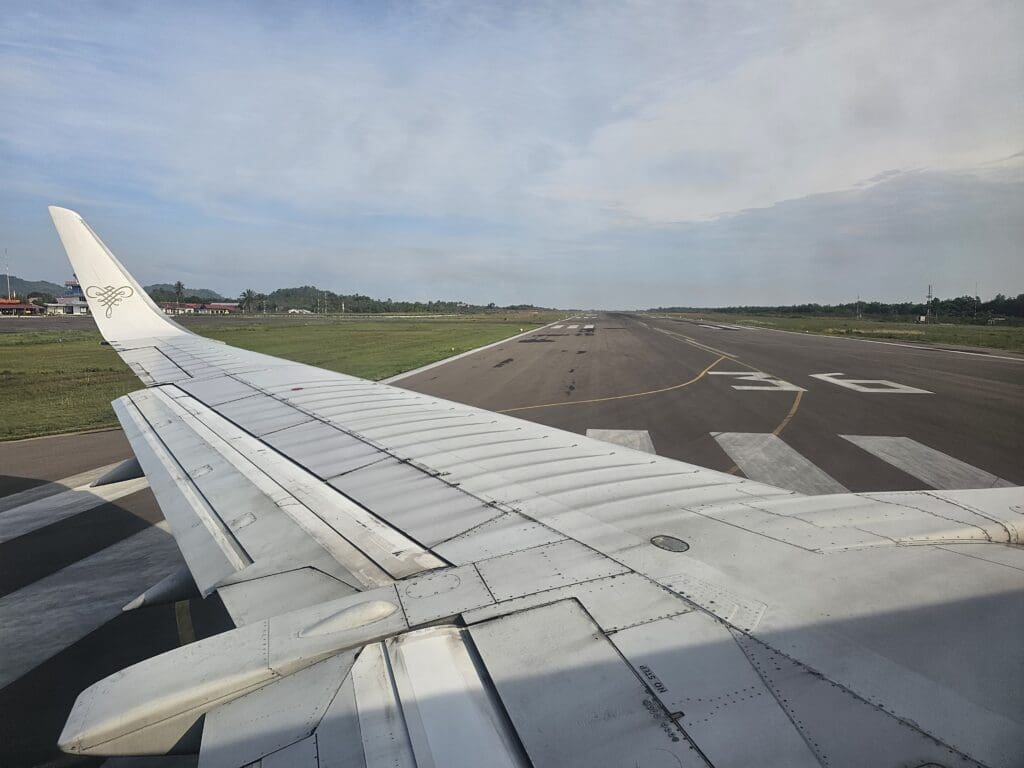
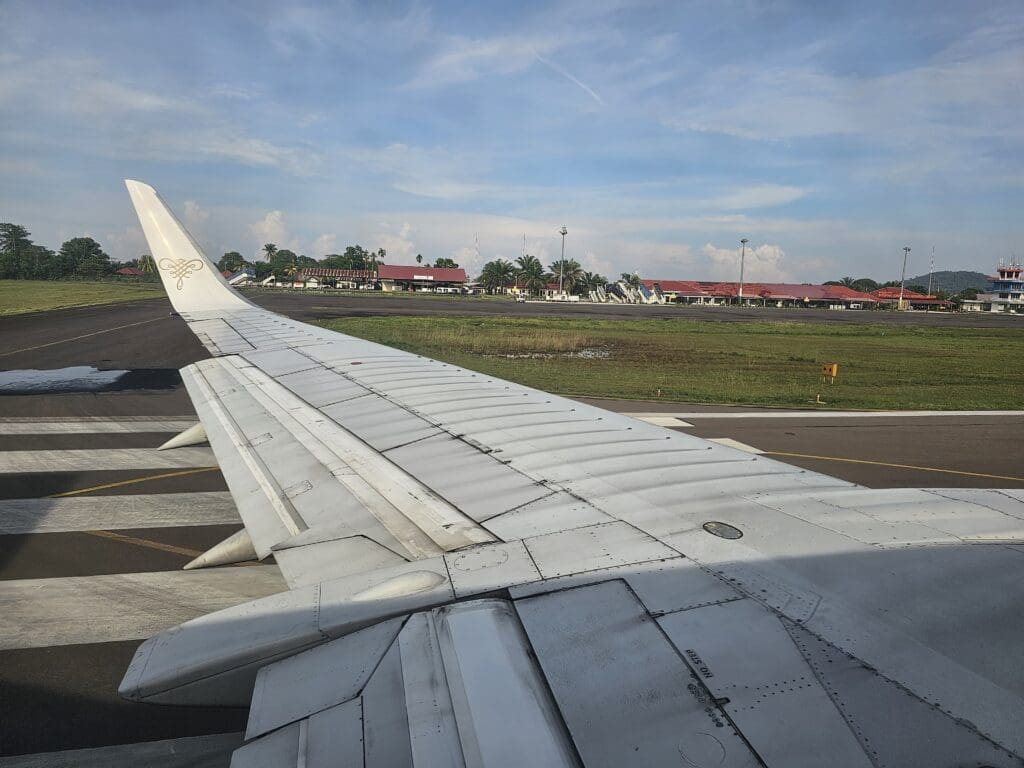
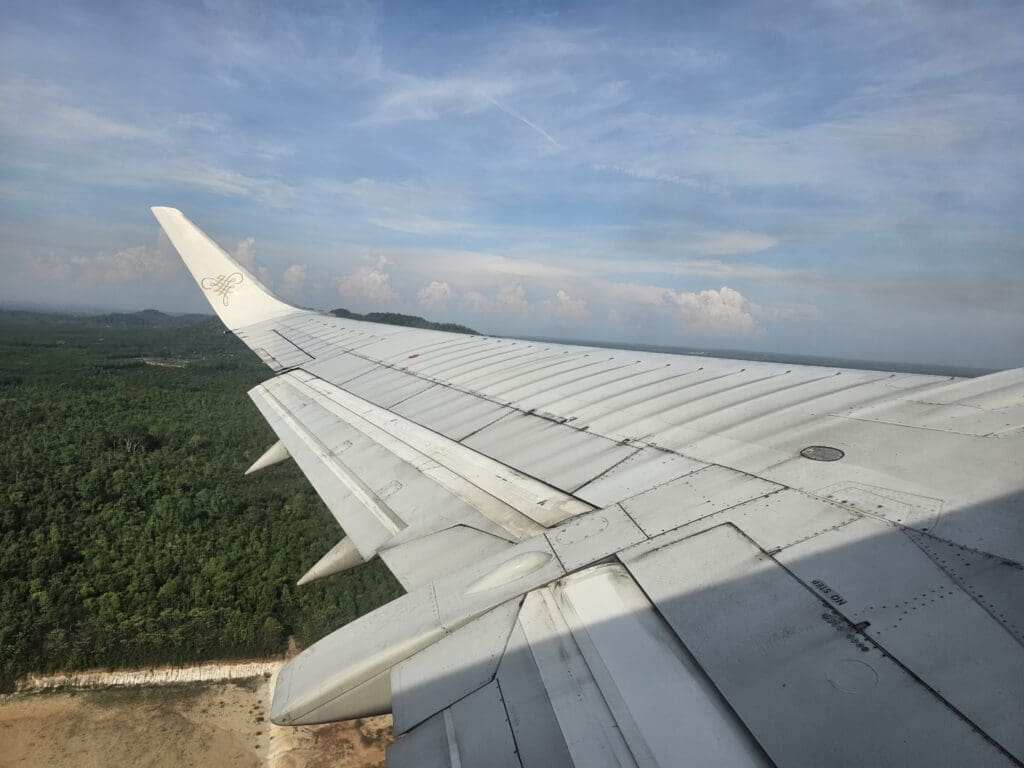
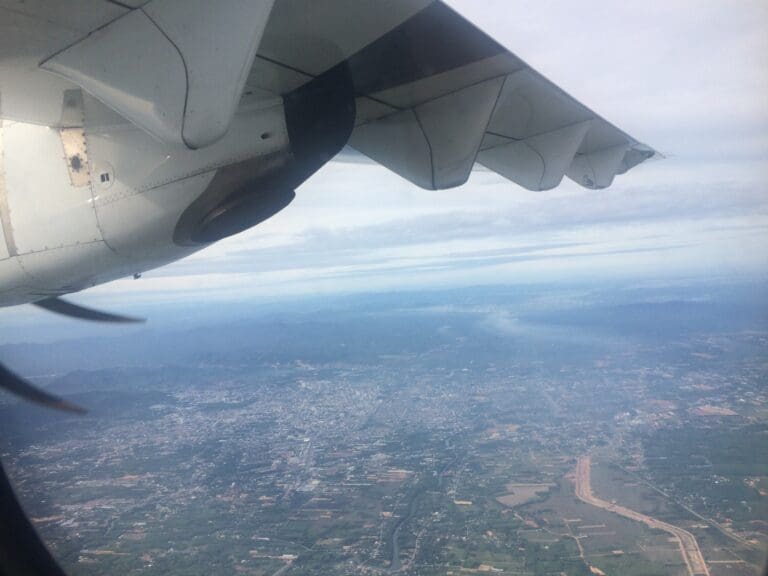
Seconds after leaving the airport behind, the aircraft banked to the left and soon rolled out on a northwesterly course that would take us straight to the island of Bangka. Soon, the entirety of the island’s largest town, Tanjung Pandan, which is home to around 100,000 residents, appeared. Sitting on the island’s coastline, after passing over Tanjung Pandan, we headed out over the blue waters of the Gaspar Strait. As we climbed up towards our low cruising altitude of 14,000 feet, the island of Mendanau could be seen to the south, followed a few minutes later by Liat.
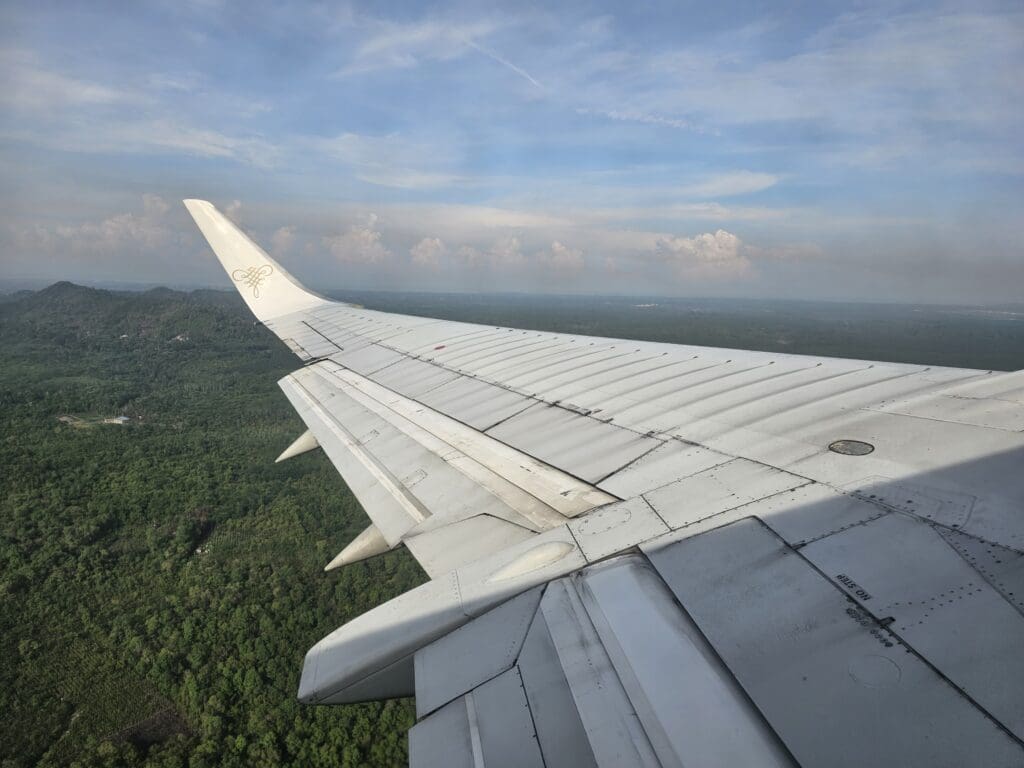

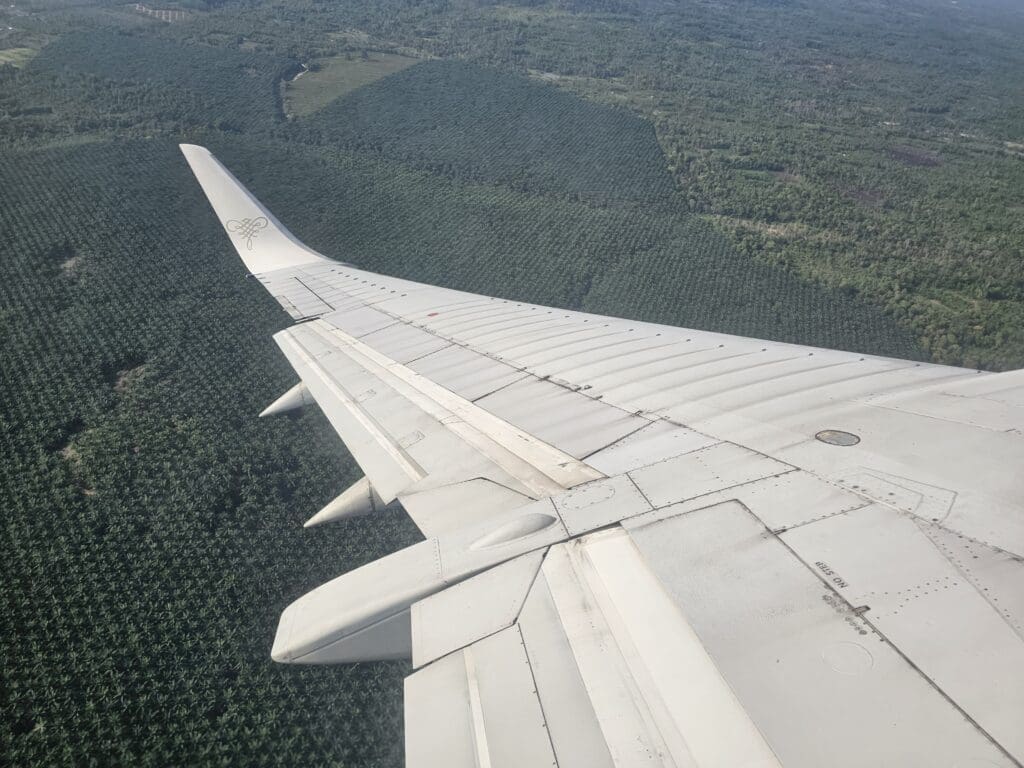
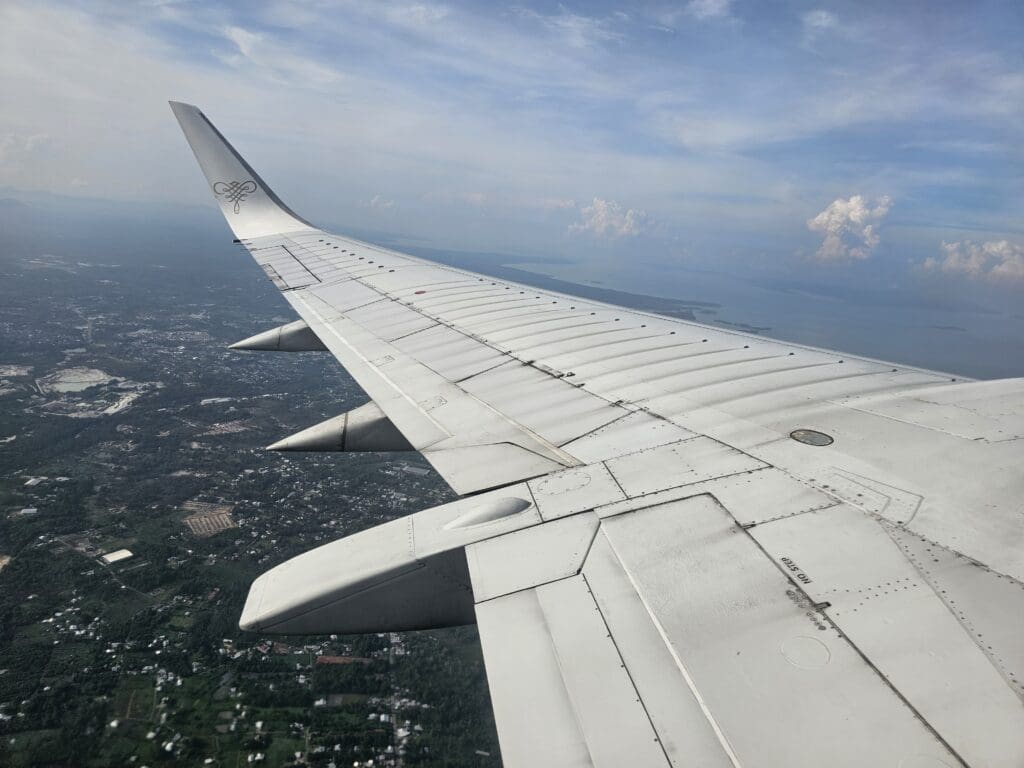
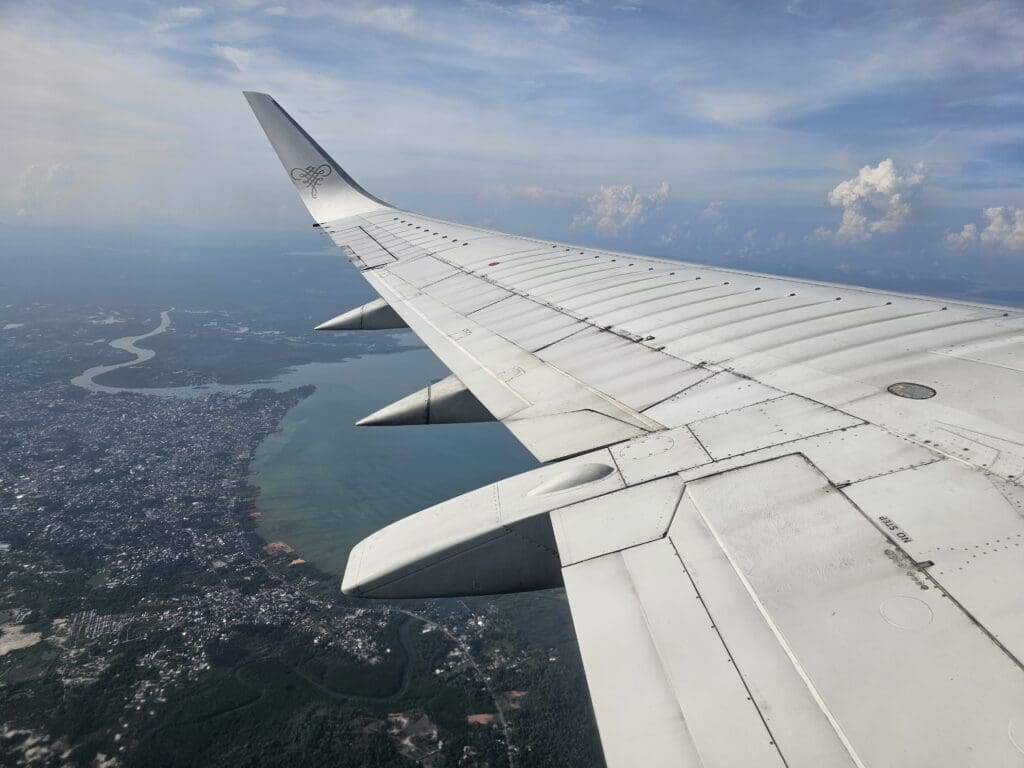
Upon reaching 10,000 feet, the seatbelt signs were extinguished, and the Purser performed the familiar announcement regarding keeping these fastened whilst seated. Surprisingly, given the very short length of the flight, the same snack service was to be undertaken, and so, once released from their seats, the four crew members took to the aisle and began to hand out the cups of water and filled buns once more. However, this time around, no inflight shopping service was undertaken. As I ate my second custard bun of the day, the aircraft could be felt commencing its descent, with the seatbelt signs switched on immediately as we soon entered some rather menacing-looking clouds.
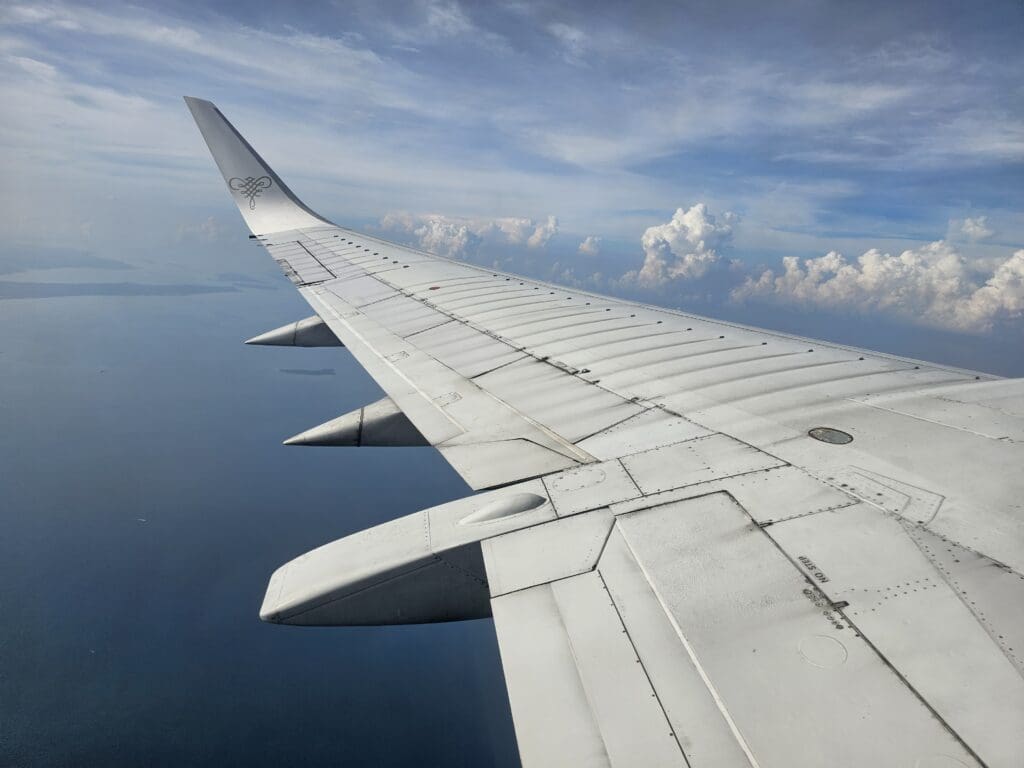
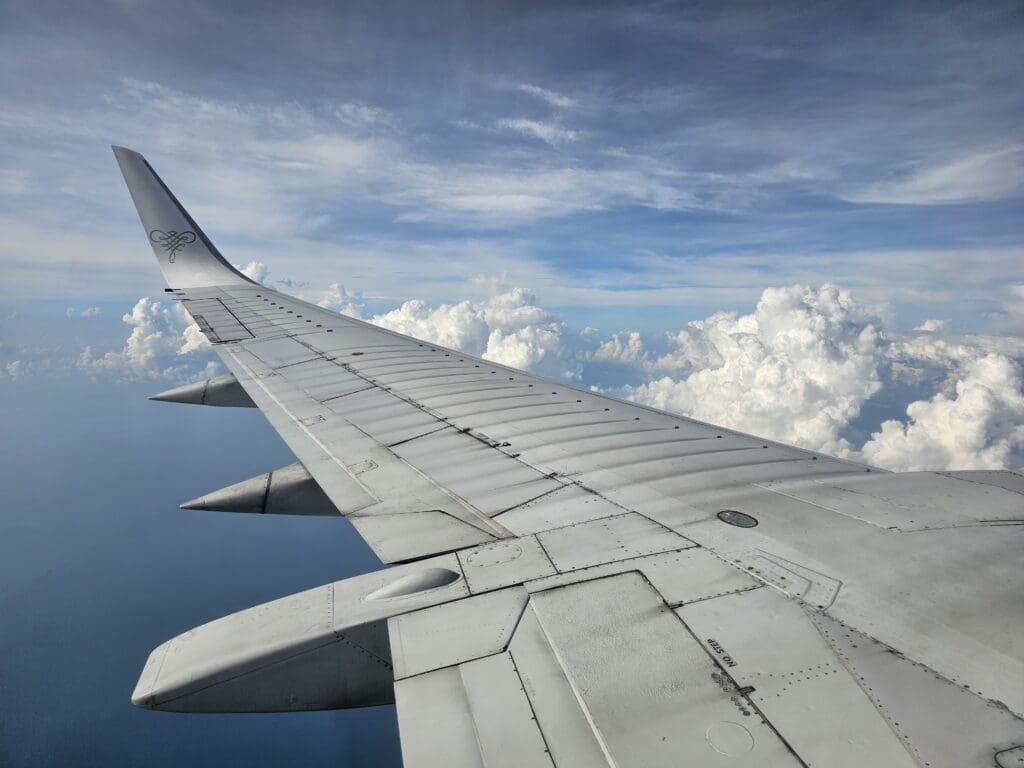
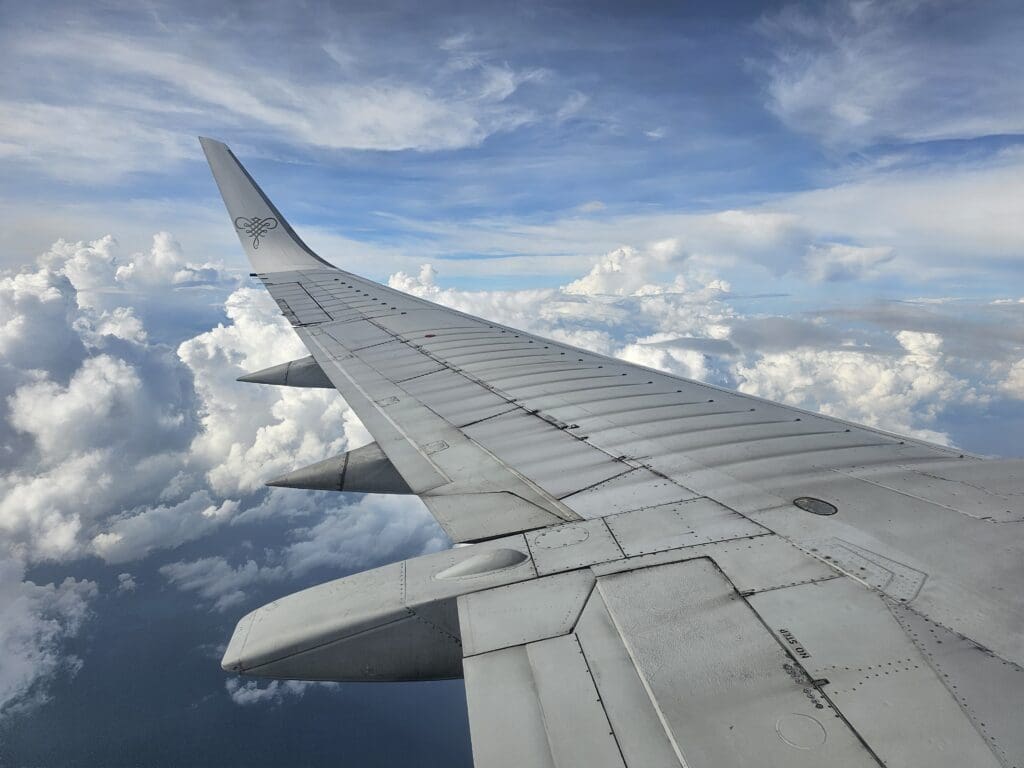
As we passed through the clouds, we experienced a short bout of some rather significant turbulence and were shaken from side to side and up and down for a couple of minutes, causing some rather worried looks on the faces of those around me. Now strapped into their jumpseats, no rubbish collection round was made, nor was any check of the cabin made before landing, even once things had smoothed out once we were out of the clouds.
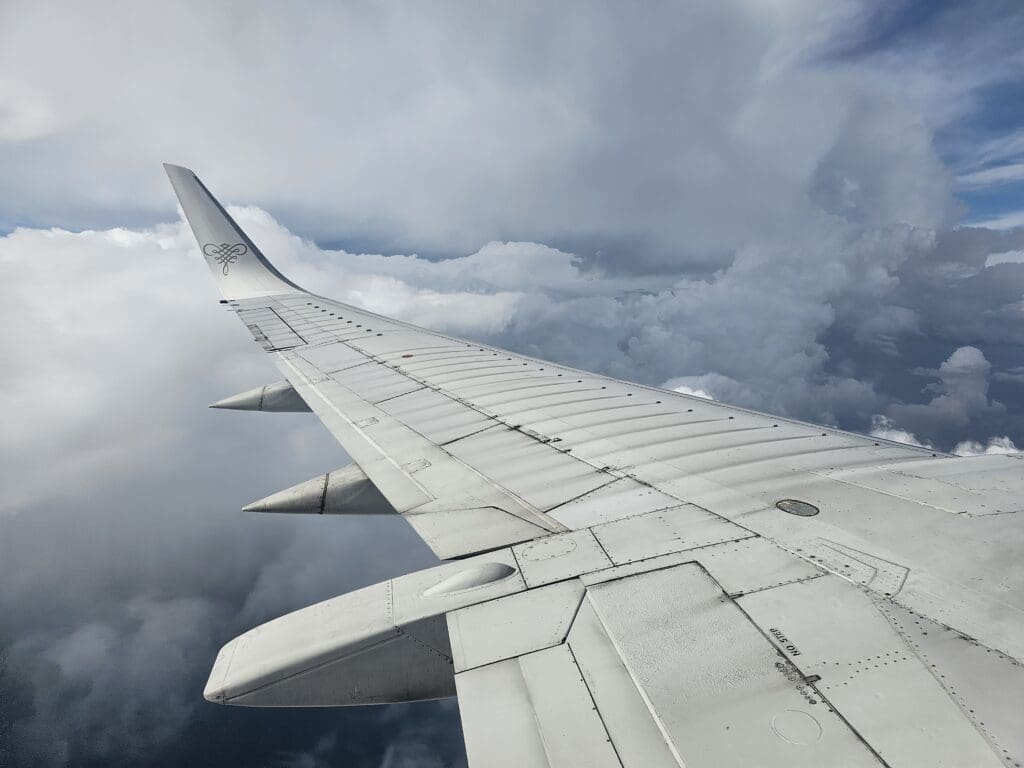


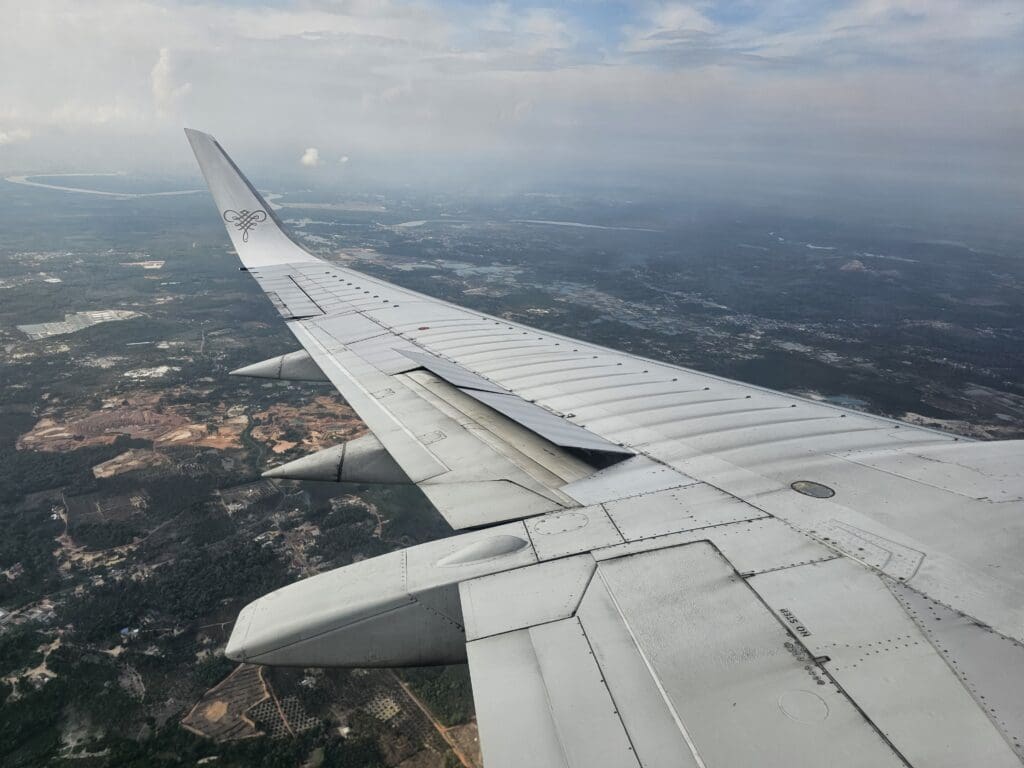
After descending through the thick clouds, the blue waters below, as well as Bangka’s coastline, came into view through the haze before we crossed over to the north of Pangkalpinang. After making our way across the coastline, the flaps were partially extended as we sank over the semi-rural and industrial areas on the fringes of the city before we turned to the south and lined up for an approach to the airport’s Runway 16.
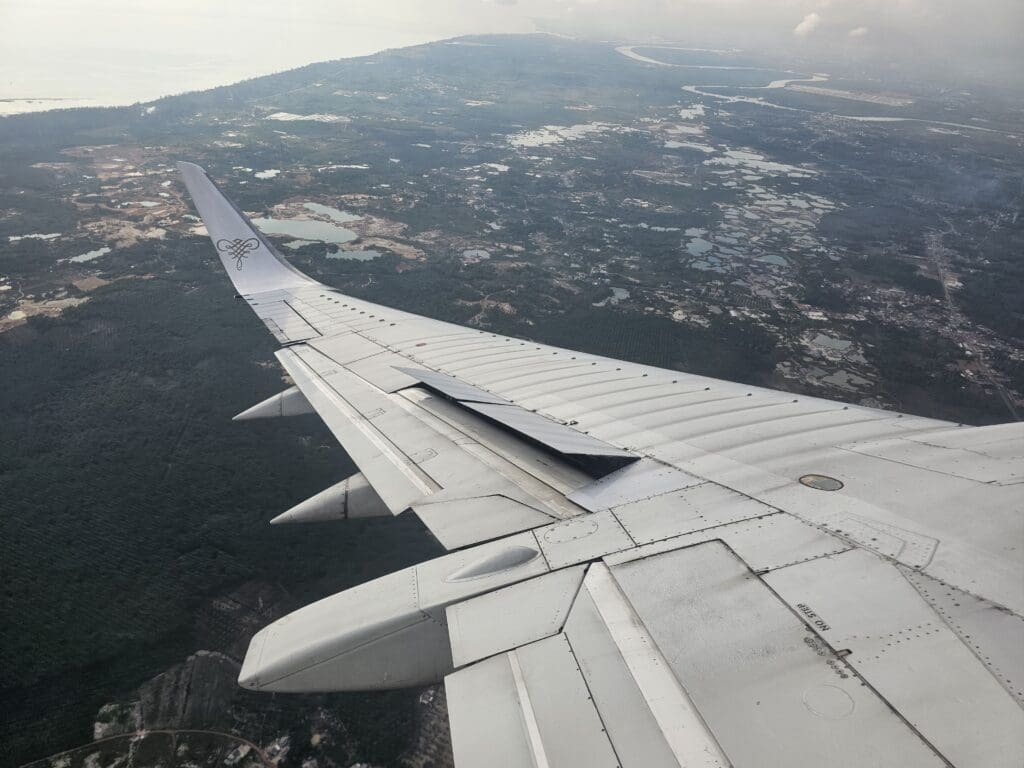
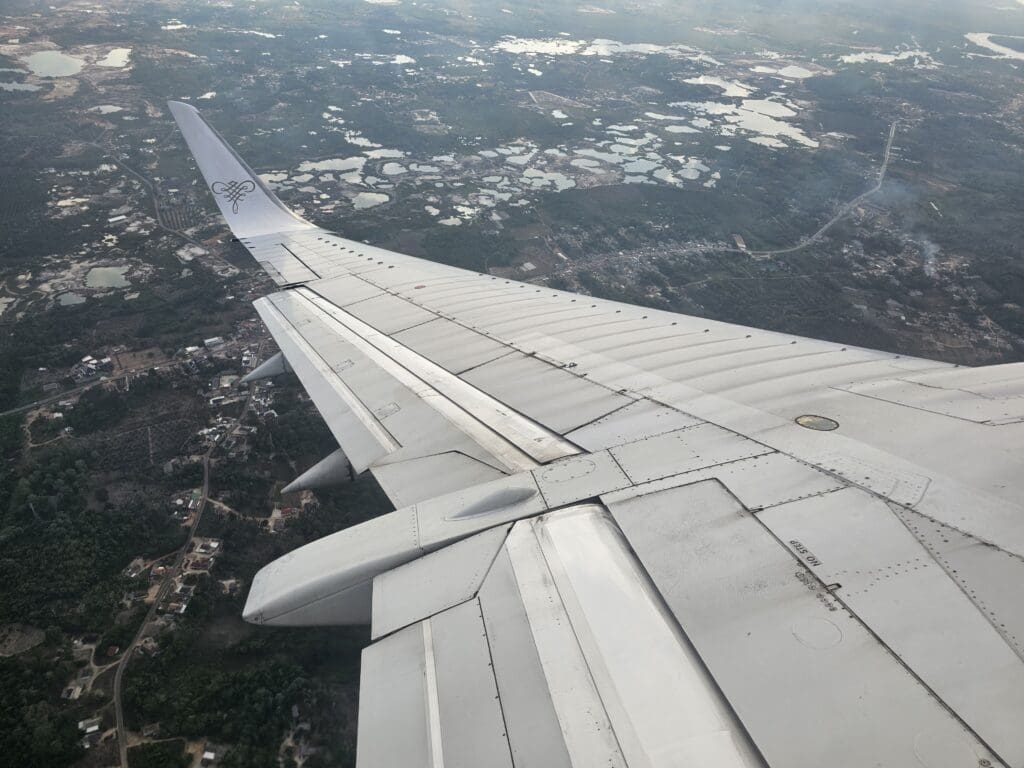
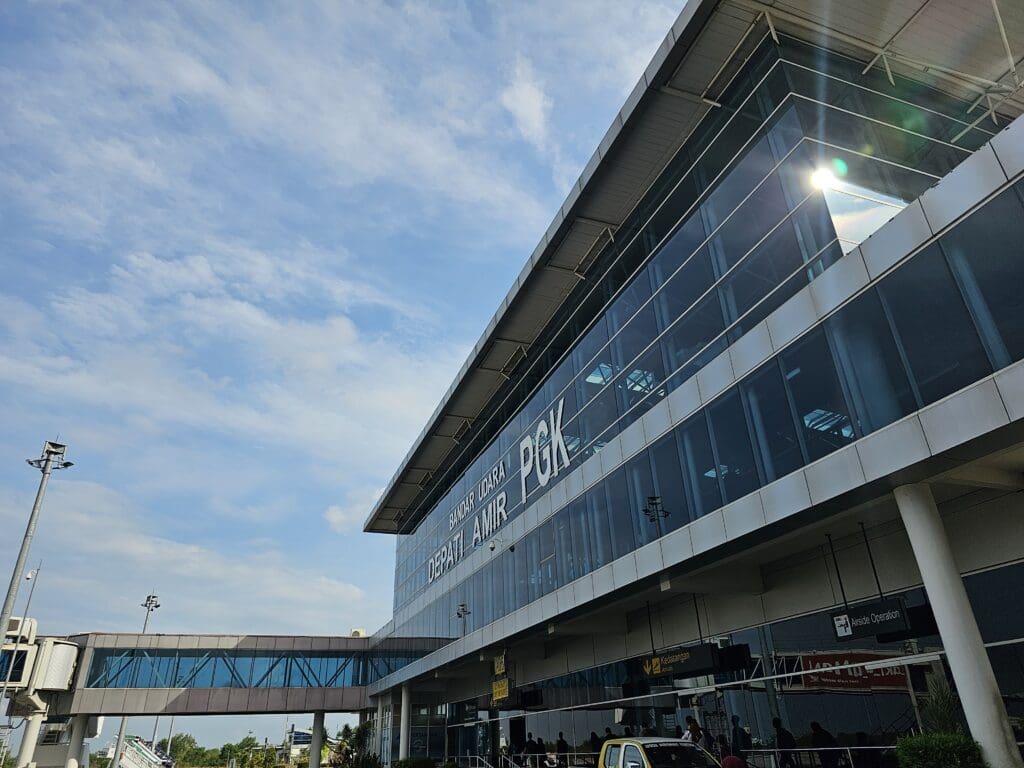
With the airport sitting to the southeast of the city, those on the opposite side of the airport would have been treated to vistas of Pangkalpinang whilst on approach. However, from my seat on the left-hand side of the cabin, I was instead provided with views of the Rangkui River Estuary and coastline as we made our way towards the airport. Soon, the aircraft crossed over the perimeter fence, and Depati Amir Airport’s modern terminal came into view, where a Super Air Jet Airbus A320 could be seen being readied for its flight to Jakarta.
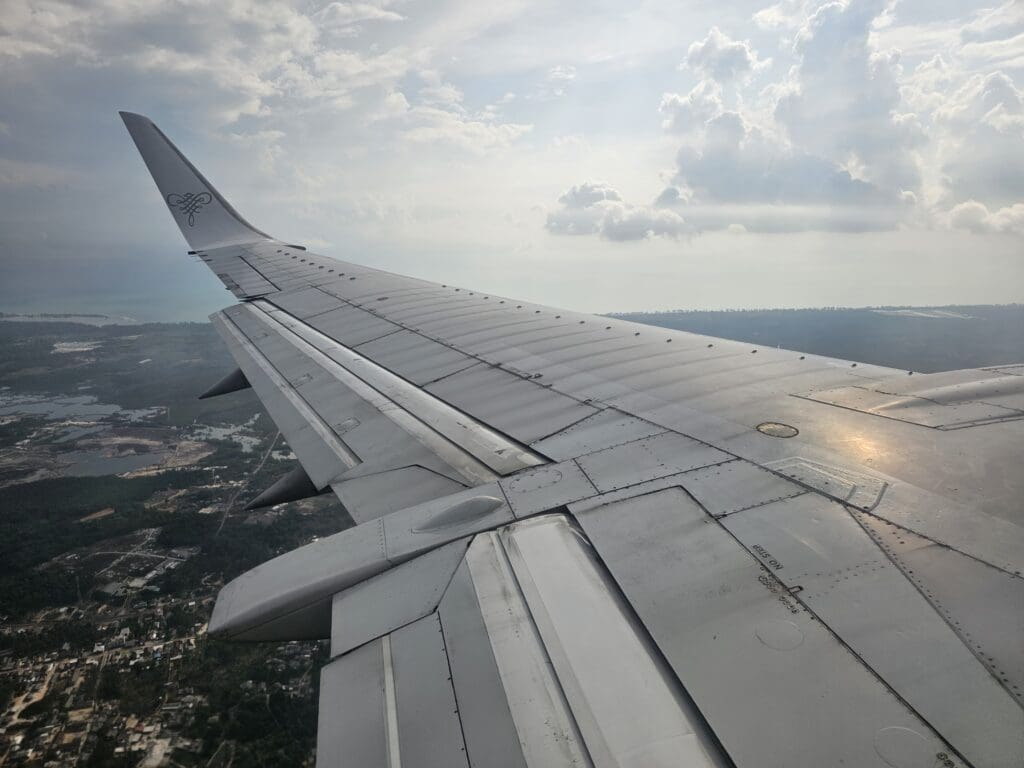
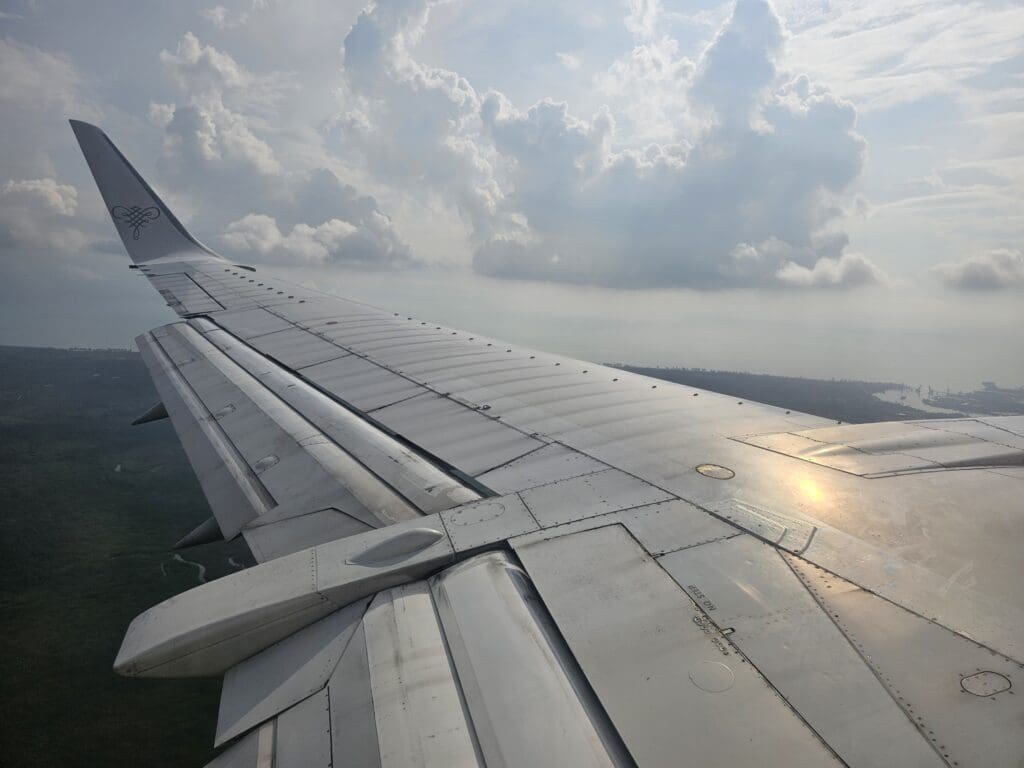
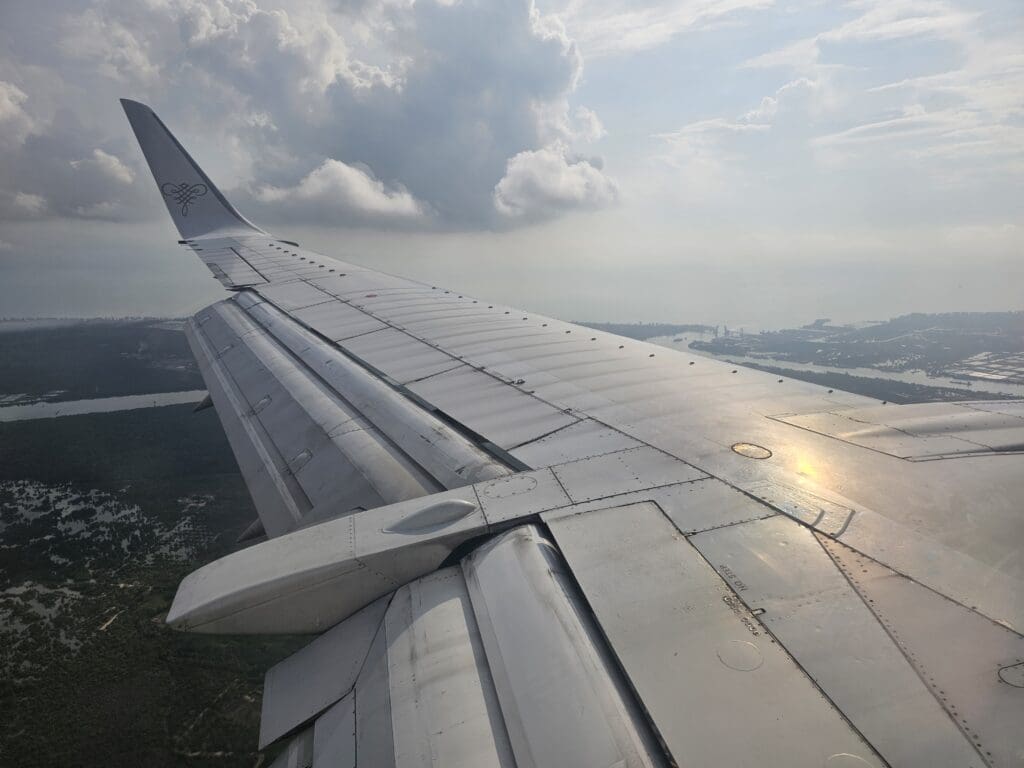
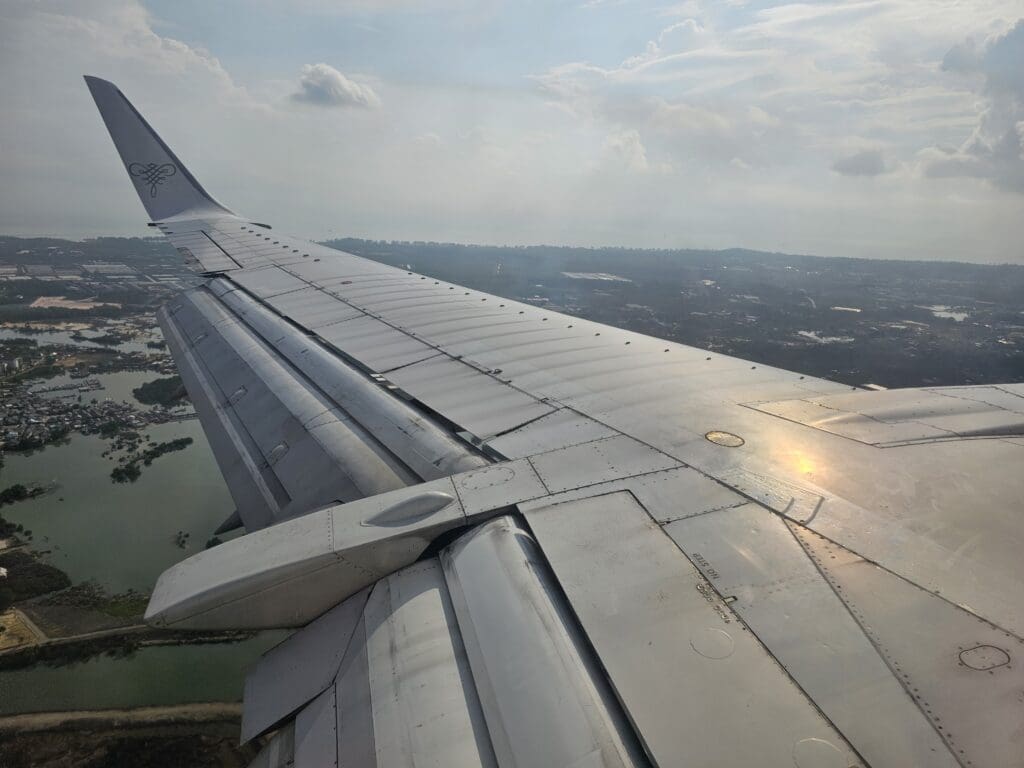
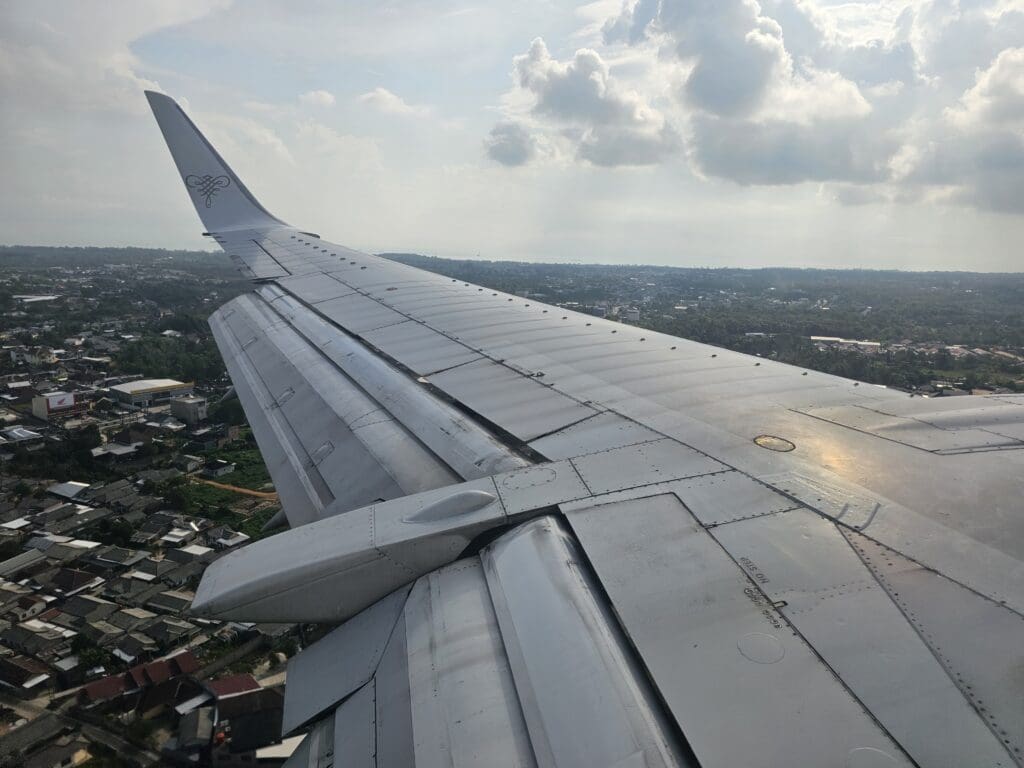
Following a total of just 24 minutes in the air, the Boeing made another firm touchdown on the runway before we braked rather heavily and made a quick exit, vacating the runway to the left. In the usual manner, once on the ground, passengers were welcomed to Pangkalpinang and thanked for flying with Sriwijaya Air before being instructed to remain seated until the aircraft had arrived at the gate and the seatbelt signs had been extinguished. As we journeyed over to the new terminal, the old and rather dated-looking terminal could be seen on the opposite side of the runway, where the carcass of an old unidentified aircraft could be seen rotting away. A short time later, the Boeing turned right and slowly made its way into Stand A03, where the engines spooled down, and a set of Sriwijaya Air-branded steps were wheeled into position at the front of the aircraft.
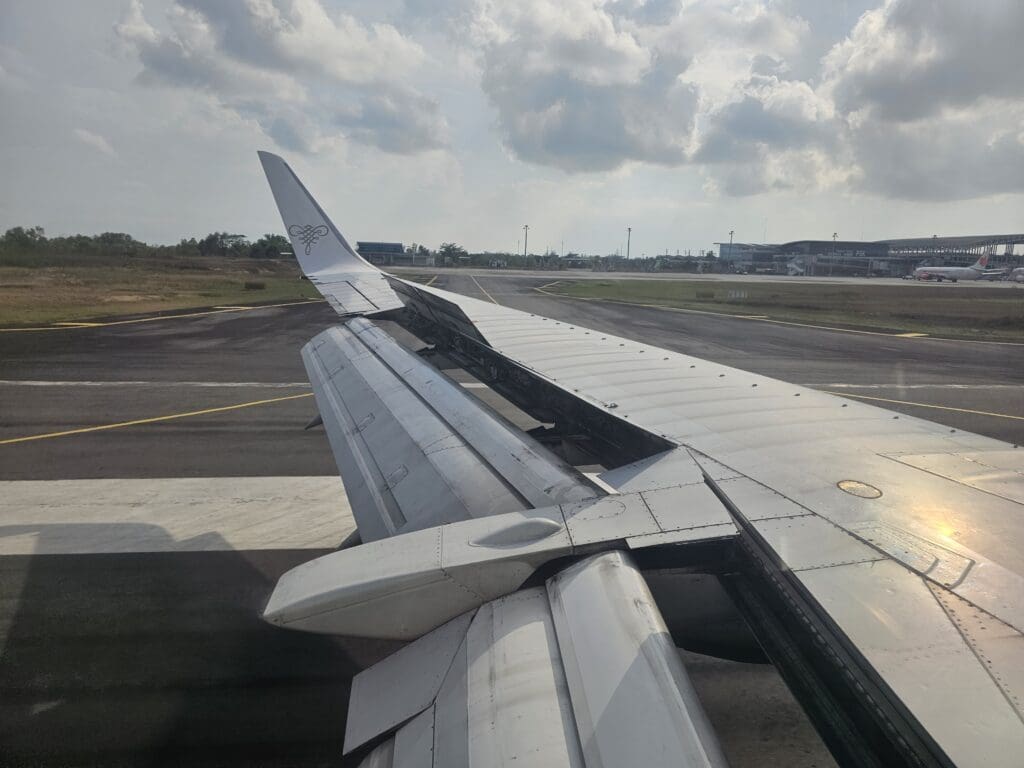
With disembarkation soon commencing, it wasn’t long before I stood up and made my way forward through the now rather messy cabin. Upon reaching the front of the aircraft, two of the crew members thanked me before I exited the aircraft and was immediately hit by the hot and humid air. From our stand, a short walk over to the main terminal was in order, and before I knew it, I had passed through the small baggage collection hall and was in the landside portion of the terminal, bringing an end to my first experience with Sriwijaya Air.
Summary
Whilst my main purpose of flying with Sriwijaya Air had been to sample their rare Boeing 737-500, overall, I was left very impressed by their onboard service. Not only did I land ahead of schedule and in one piece, the aircraft, whilst battered, was clean and comfortable, the crew were friendly, and the complimentary offerings were appreciated. Whilst it is very unlikely that I will end up flying with Sriwijaya Air anytime again soon, I would probably not hesitate to do so.
This is a ton of words, most of which not directly tied to the 737-500, as the title of the article suggests.
If you have this much to say about so many topics, it will be better received if you break it up into different articles addressing specific aspects of the trip.
Hello – thank you for reading! This is a trip report that offers a comprehensive overview of my entire journey from start to finish. I also have a flight review section of my blog that details my trips in more manageable chunks