Mission 737 Classic Failed: Foggia to Milan on a Greek Embraer
Background
The Boeing 737 Classic is a dying breed of aircraft that is becoming increasingly rare, especially passenger variants of the type. Once upon a not-too-distant time, the type was seen in service with major carriers across the globe although their retirement has been swift and now nothing more than a relatively small handful of carriers continue to operate these venerable classics. Thankfully, being based in Europe, whilst the type is most certainly not commonplace, flying onboard the aircraft is a little easier to do than in some other parts of the world. Calling Britain home, the easiest way to secure a ride on one would be to fly onboard one of the eight Boeing 737-300s that remain in service with leisure giant, Jet2, who deploy these on routes from Leeds Bradford to destinations across Western Europe. Other carriers included French carrier ASL Airlines, Bulgaria’s GP Aviation who operate services to and from Kosovo, and Greece’s Air Mediterranean who at the time of my flight in Autumn 2023 seemed to operate several flights from Dusseldorf and Stockholm to Damascus via their base in Athens. In addition, a small number of airlines operate these on ad-hoc and wet-leased services across the continent. Meanwhile, fellow Greek carrier Lumiwings operated the Boeing 737-300 on a network of scheduled services from the small Italian city of Foggia to Bologna, Milan, Mostar, Turin and Verona.
Finding myself in Foggia in order to fly with local helicopter operator Alidaunia to the Tremiti Islands and back, given the cheap fares on their domestic services, I would have been failing my duties as an aviation enthusiast were I not to attempt to schedule in a ride on Lumiwings’ sole Boeing 737-300. Following some experimentation, I decided that I would book a flight on the longest route, the 448-mile flight up to Milan Malpensa from where I would connect to a cheap Ryanair service back to the UK.
A Bit About Foggia
Having opened in 1915, Foggia Airport has a long history although it has enjoyed nothing more than sporadic connections to other Italian cities. In 1971, Foggia welcomed its first regular commercial service which came in the form of an Alitalia Fokker F27 flight connecting this to the capital. However, this did not last long and ended in 1975 with the retirement of the Fokker F27; Foggia’s prohibitively short runway meant that the carrier had little choice but to withdraw from this route as they lacked any suitable aircraft to operate this. Further attempts to restore service to the airport came in 1989 when Aliblu Airways reopened the route to Rome with a BAe Jetstream 31. However, once again, this was short-lived and came to an end with the closure of the carrier several months later. Nevertheless, service continued and the famed locally based helicopter operator, Alidaunia, took over this route with the fixed-wing Mitsubishi MU300 and continued operating this until the mid-1990s.
Following another break in scheduled commercial fixed-wing services, Federico II Airways commenced flights to and from the airport with a Dornier 228 although this also did not last too long and ended in 2002. In early 2008, flights recommenced when MyAir operated Bombardier CRJ-900 services to Milan, Palermo, Rome and Turin. Unfortunately, these came to a halt with the carrier’s bankruptcy in 2009, after which Skybridge AirOps temporarily served the airport with the Embraer EMB-120 although once again these services did not last long and were axed in 2010. Finally, Saab 2000 operations commenced and connected the airport to Milan, Rome and Turin, with these operated by Darwin Airline on behalf of Alitalia.
Owing to the high costs of running the airport and low passenger numbers, in 2010 the decision was made to stop the facilitation of scheduled commercial passenger services, with these ceasing in 2011. However, seeing some potential, the following year a €14 million loan was granted to extend the runway up to 2000 metres and enable larger aircraft to use this. Following the completion of this extension, in September 2022 Greek carrier Lumiwings deployed their sole Boeing 737-300 in Foggia and commenced flights to Catania, Milan (both Linate and Malpensa), Turin and Verona, later adding seasonal services to Mostar, in Bosnia and Herzegovina. Whilst Italy enjoys a comprehensive rail network, Lumiwings’ domestic services reduce the travel time rather significantly, with trains to Catania, Milan, Turin and Verona taking 9H49, 5H46, 7H24 and 6H29 respectively.
About Lumiwings
It is fair to say that Lumiwings is not the most known European carrier, so much so that at the time of my flight they even lacked a page on the English version of Wikipedia! Established in 2015 with ties to the now defunct Thessalonikan carrier, Astra Airways, the carrier was established with the purpose of specialising in ACMI and charter services. In 2018, Lumiwings received their first of two Boeing 737-300s, whilst a newer Boeing 737-700 was added in 2021. Being headquartered in Athens, some may be surprised to hear that the carrier operates no scheduled services from their homeland. Instead, their scheduled operations are entirely focused on Foggia. Today where Lumiwings maintains a monopoly on fixed-wing commercial services.
Booking
Opting to book directly through Lumiwings, upon arriving at their modern and easy-to-use website I was presented with an advertisement for the carrier’s services to Mostar. Given the nature of Luminwings’ operations as an ACMI and charter specialist, unsurprisingly their website features plenty of information about the carrier, its aircraft and its capabilities in an attempt to attract potential customers. Aside from this, prospective passengers are provided with all the information they need, and the website contains plenty of promotional material in the form of blog posts advertising various things to do in Puglia – the carrier presumably having a decent relationship with the local authorities. Perhaps surprisingly, this website is only available in English and Italian, with no Greek version offered.
Following my short explore, I undertook a quick search for flights and was presented with the single option between Foggia and Milan Malpensa that day. This was scheduled to depart at 0800 and arrive at 0945. Three classes of tickets were offered for this flight – Shine-light, Shine-classic and Shine-gold. Seeing as I would not be travelling with hold luggage and hoped that I would not have to make any changes to my booking, I steamed ahead with the cheapest of the three and was soon taken to enter my details.
Mission 737 Classic Failed
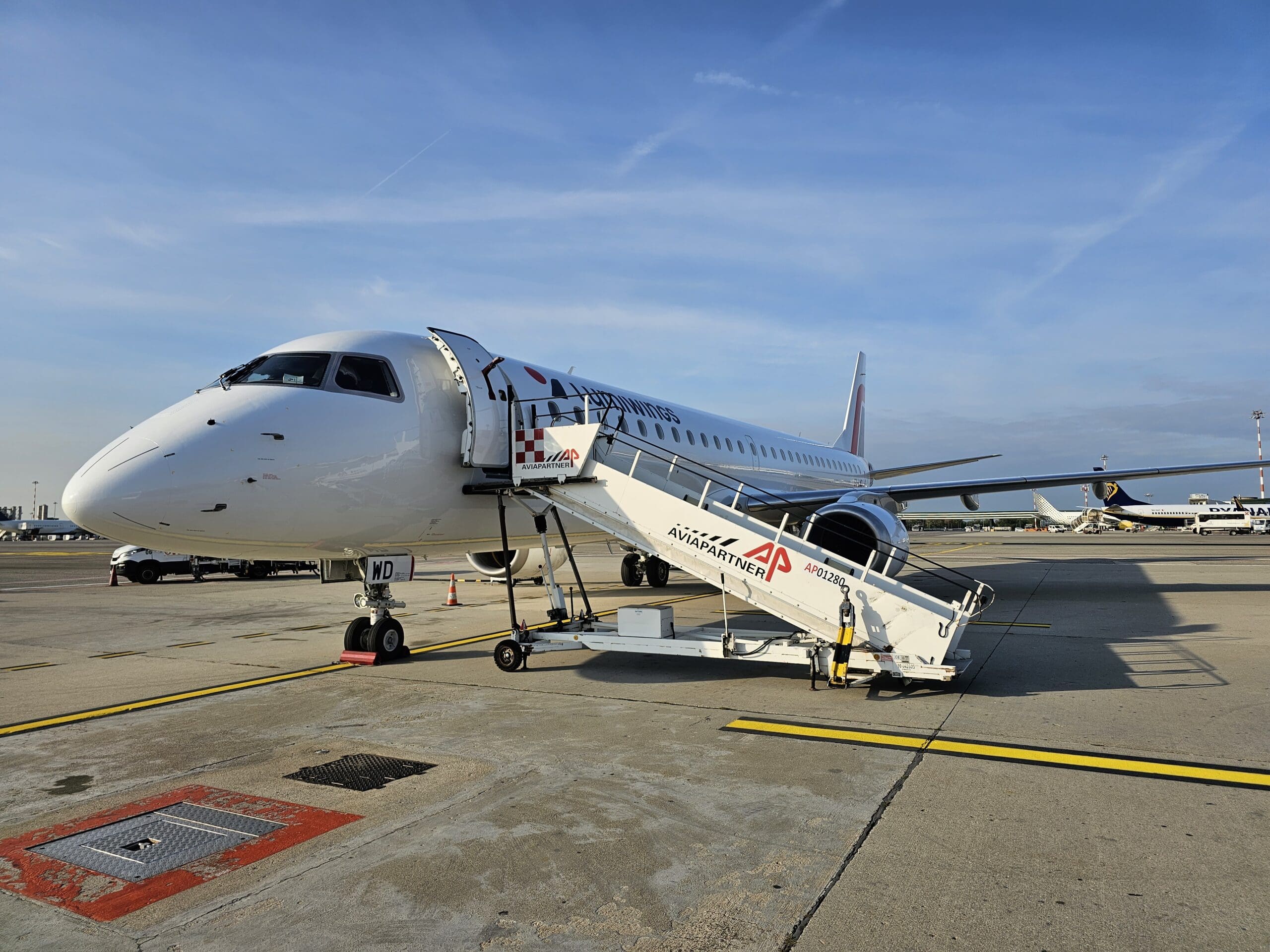
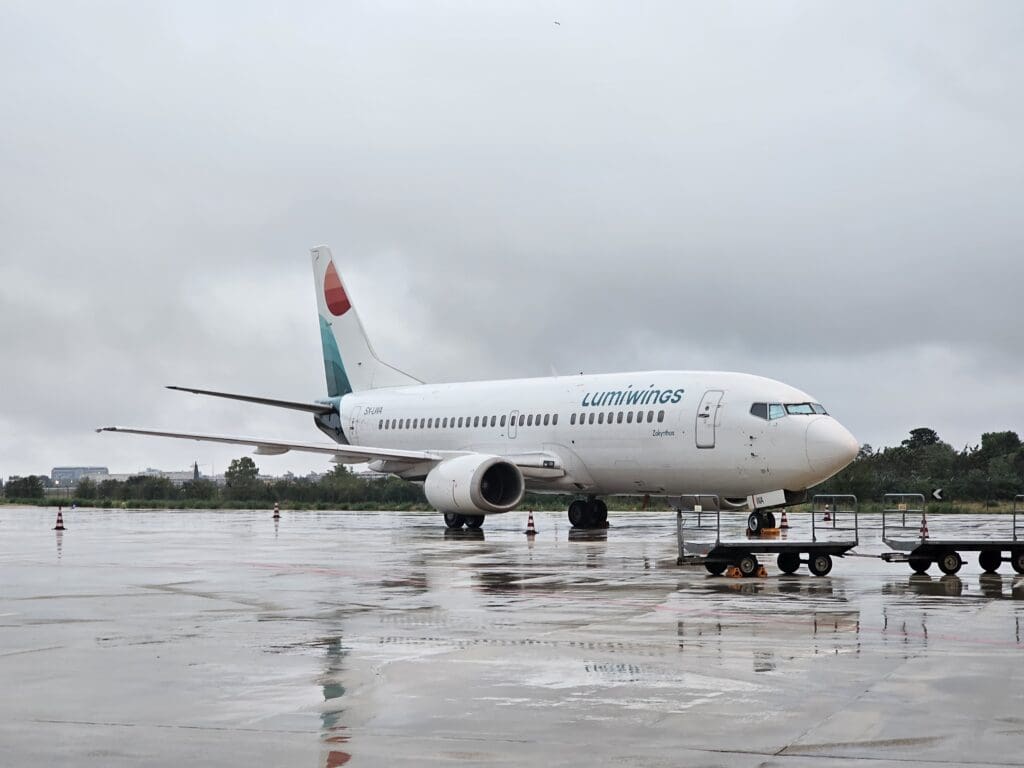
Once I had booked my flight, I soon came to realise that an Embraer 195 was in the process of being painted into Lumiwings’ livery at one of my local airports in the UK, East Midlands. Given the nature of Lumiwings’ operation, whilst a little concerned, I didn’t lose hope entirely as this may have ended up in Greece and dedicated to the company’s ACMI and charter operations. However, when this rocked up in Foggia in early October 2023, it was clear that this aircraft had been brought in to take over the company’s network of scheduled services in Italy. However, all was not lost as initially as this remained on the ground for around two weeks, yet just four days before my flight, this commenced operating the airline’s scheduled services at which point it became clear that my mission to sample Lumiwings’ sole remaining Boeing 737 Classic had failed!
The Journey
As Italy’s fifteenth-largest city and home to around 150,000 Foggians, it is fair to say that Foggia is not particularly large. Covering a relatively small area and being a keen walker, the city can be easily seen on foot. Sitting just three kilometres from the city centre, I had initially planned on walking to the airport on the morning of my flight, with Foggia Airport being one of the most centrally located airports that I have ever passed through. Having spent two nights in a rustic bed and breakfast in the heart of the city, on the morning of my flight I woke up bright and early at the ungodly hour of 0455. That morning, the noisy pitter-patter of rain served as a natural alarm clock and looking outside, I was presented with the unwelcome scene of a torrential downpour. Hailing from the UK, the odd shower rarely ruins my plans but, not wanting to end up absolutely soaked and miserable for my long journey back to the UK, I thought it best to consider alternative ways of getting to the airport. With Foggia not served by any ride-hailing apps, and my chances of being able to flag down a taxi or find a fleet of these waiting at the station at such an early hour were incredibly slim. I thus turned to the city’s bus network. With few of the city’s services showing on Google Maps, I instead turned to the app Moovit which presented me with three possible departures that would enable me to arrive at the airport in good time for my 0800 flight.
Seeking to minimise my time in the rain, I decided to go for the 0535 departure from the bus stop nearest to the hotel. After packing my things, I made a quick dart through Foggia’s dark rain-soaked streets and sheltered under a building’s air-conditioning unit as I waited for the bus to arrive. Thankfully an old beaten-up bus appeared just a minute behind schedule, with the destination board reassuring me that this would stop at the airport. To a non-Italian speaker, there is little to no information about Foggian bus tickets available online although I hoped that I could pay in cash. Realising that I was not a local, when I attempted to hand over my change, I was instead waved on and I made my way onto the empty bus which soon sped through the streets of Foggia. At first, things were going well and tracking the journey on Google Maps, it seemed that were heading in the right direction. Following a long, and I presume scheduled stop during which the driver had a very animated conversation with a fellow bus driver, we continued onwards although worryingly we headed back in the opposite direction. Around ten minutes later I was rather concerned to see the bus stop where I had boarded the bus passing by on the opposite side of the street. At this time, I thought it best to check with the driver that the bus was indeed bound for the airport. Unfortunately, this was met with the understandable phrase of ‘aeroporto, no, no’ and so I thought it best to disembark in the city centre.
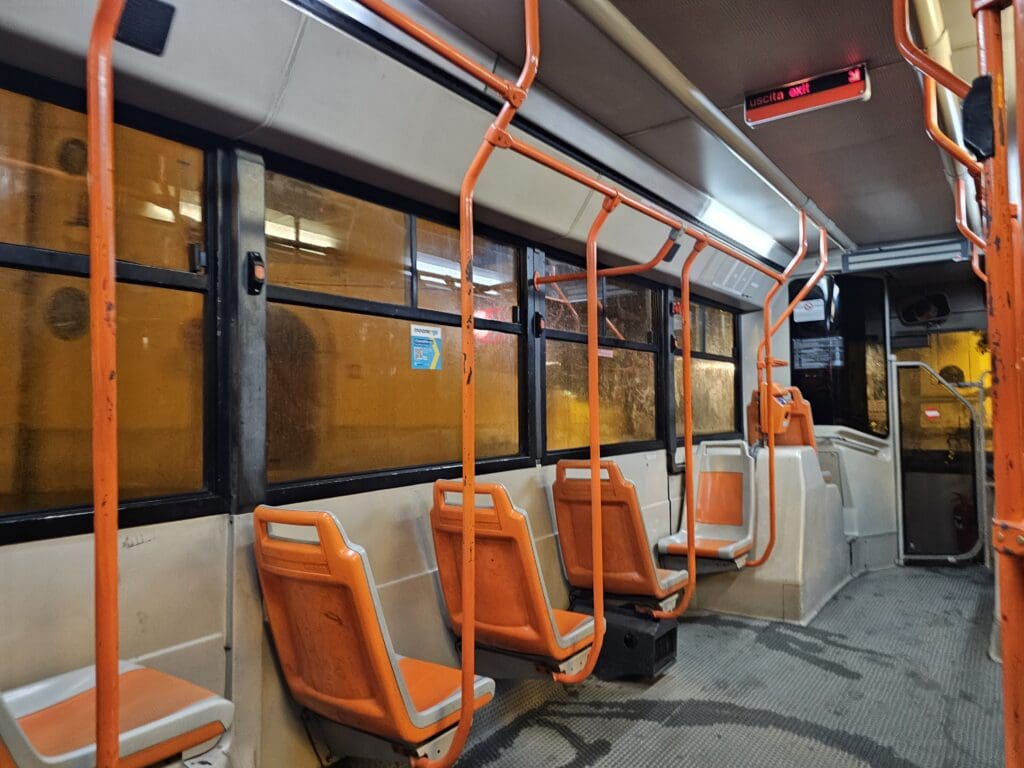
Being deposited in the heavy rain, no longer trusting Moovit and with no alternative options, I thought it best to brave the torrential downpour and made the forty-minute journey to the airport on foot. Admittedly, this was one of the worst journeys to an airport that I have ever made, although it was all part of the experience and I had nothing to blame other than my stinginess for not wanting to pre-reserve a taxi, my failure to check the weather forecast and the questionable accuracy of Foggia’s bus destination boards. Whilst not too interested in the local sights, this journey took me first through the residential neighbourhoods of Southern Foggia, followed by industrial estates and a large shopping mall before finally, the very welcome sight of the airport terminal appeared.
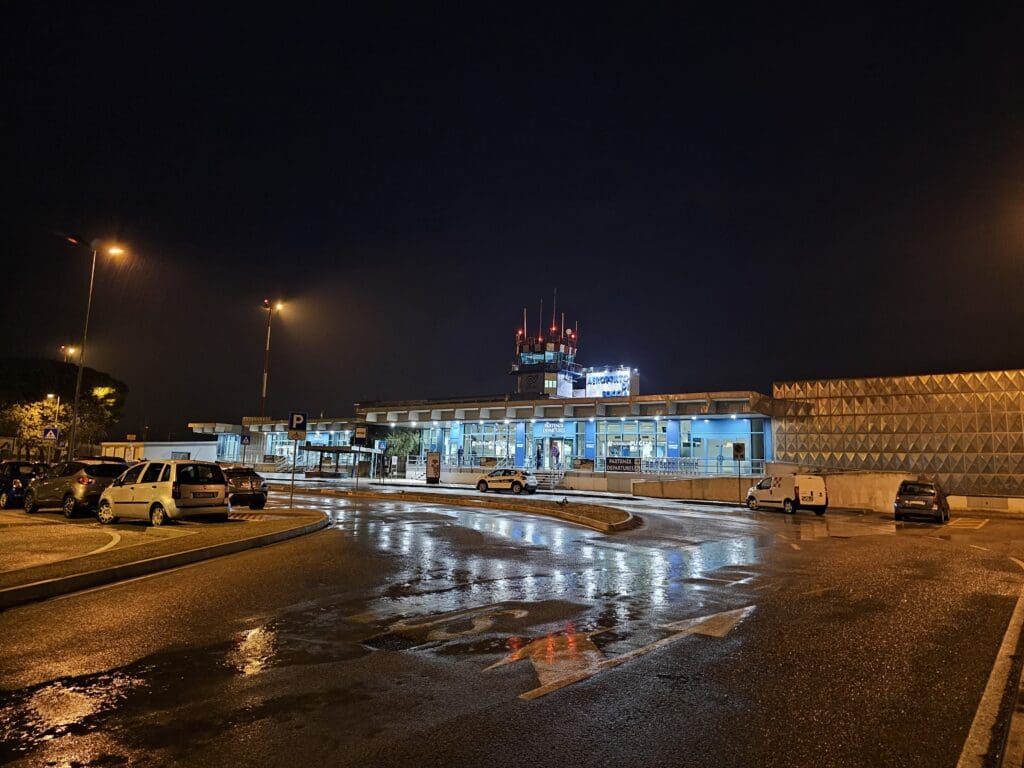
Eager to get inside, I rushed towards Foggia Airport’s small terminal building and with an hour and twenty minutes to go until departure, I found myself standing in the small check-in hall. At that time, this was completely devoid of passengers although an army of staff, most of whom sported Aeroporti de Foggia’s smart mostly red uniform could be seen ready and raring to assist passengers. Seeing as I was now completely drenched, my first port of call was the bathrooms where I changed into the now partially damp clothes that were in my backpack. On a side note, these bathrooms were clean and tidy, although it is worth noting that like many public Italian bathrooms, the toilets themselves lacked any form of seat.
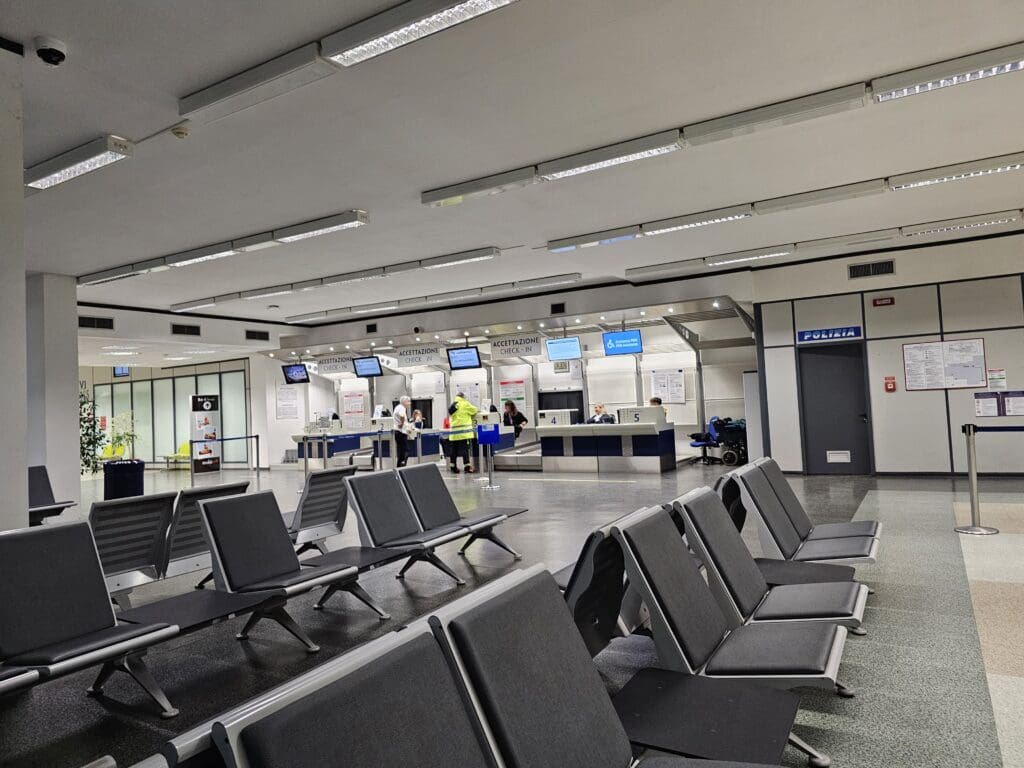
Now marginally dryer, I returned to the main landside area and began my short exploration of this. As you would expect from a small regional airport with relatively few flights, those expecting the luxury and number of facilities of the likes of Changi, Doha or Incheon would have been disappointed. However, given the airport’s size, I found the terminal to be pleasant enough, with this being clean, bright and reasonably modern. In the landside area, two vending machines could be found serving drinks and snacks, whilst a café was located next to the arrivals area which was open and ready to serve customers. Despite the lack of passengers, all five check-in counters were open and staffed, as was the shared information desk and ticket counter. On the walls throughout the terminal, photos from around Puglia could be seen on the walls promoting some of the region’s sights.
Whilst I had checked in online, seeking to conserve my phone’s battery (especially as I was now unable to charge this thanks to moisture in the charging port), I thought it best to pick up a traditional paper boarding pass at one of the desks. With no queues, I walked straight up to one of the counters and handed over my passport. There, the friendly agent typed away before advising me that my seat had been swapped to Seat 18D due to a change of aircraft. Admittedly, this was slightly surprising seeing as the Embraer 195 most definitely features a Seat 18A however seeing as this was still a window seat, I had no opposition and soon an Aeroporti di Puglia boarding pass was handed over to me and I was all set to go.
At that time, the security checkpoint was yet to open so I took a seat in the landside area and waited. As time passed, my fellow Milan-bound passengers began to trickle in and at 0550 the cabin crew arrived, all wearing Lumiwings’ rather distinctive green uniforms, followed a short time later by two pilots and several other plain-clothed staff who were identified by their Lumiwings lanyards. As they wandered in, it became clear that the aircraft was to be staffed by a higher-than-normal crew complement, which I assume was due to familiarisation purposes.
With an hour to go until departure, at 0700 three airport staff members arrived at security and this opened for business. There, two checkpoints, each with the usual x-ray scanners and metal detectors could be seen, although only one of these was open. Nevertheless, with just one scheduled flight departing that day, this was not an issue and ending up fourth in the queue, I was not left waiting for any significant length of time. Following a quick and easy check, I arrived in the airside portion of the terminal. As was the case with the landside area, the airside portion of the terminal was not particularly exciting. Whilst Foggia does not see all too many flights, this featured a total of four gates, one of which could be used for services to non-Schenghen destinations thanks to its positioning behind an empty police checkpoint. Other than the gates, two sets of toilets, as well as two vending machines could be found. Meanwhile, complimentary wifi was offered and seemed to work well, although I failed to spot any plug sockets available for passengers to use as I wandered through the terminal. All-in-all, I was not left with any complaints about this part of the airport, although aviation enthusiasts will be disappointed to hear that whilst windows exist, these are completely frosted and thus not a single view of the action outside can be had from this part of the terminal.
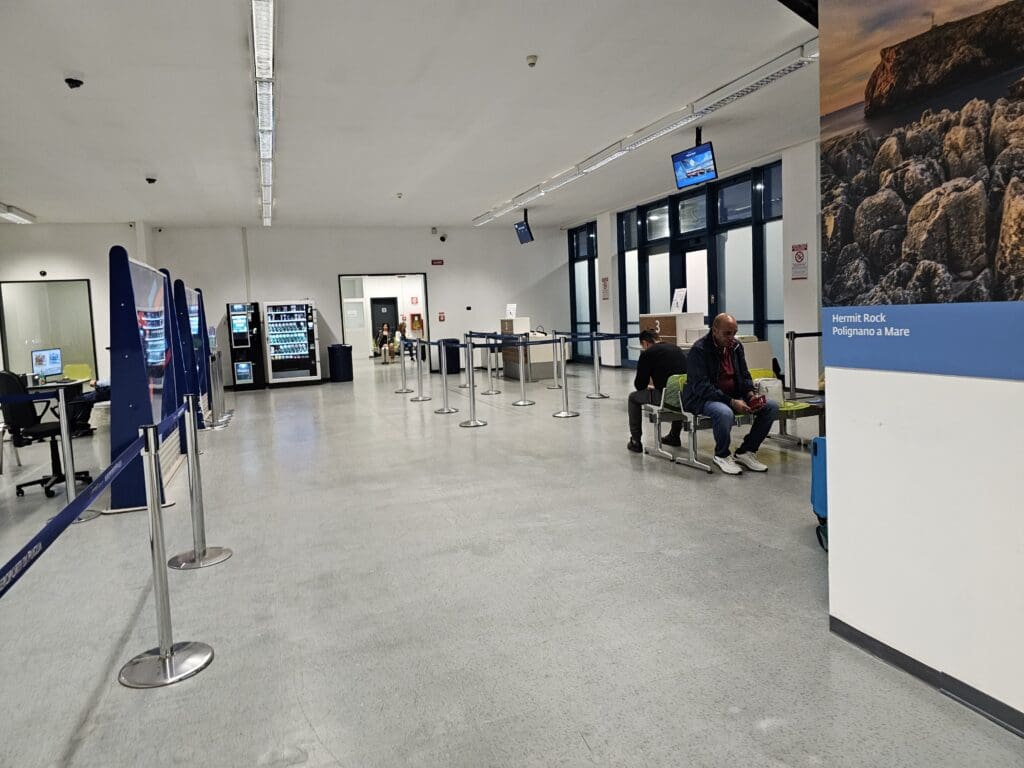
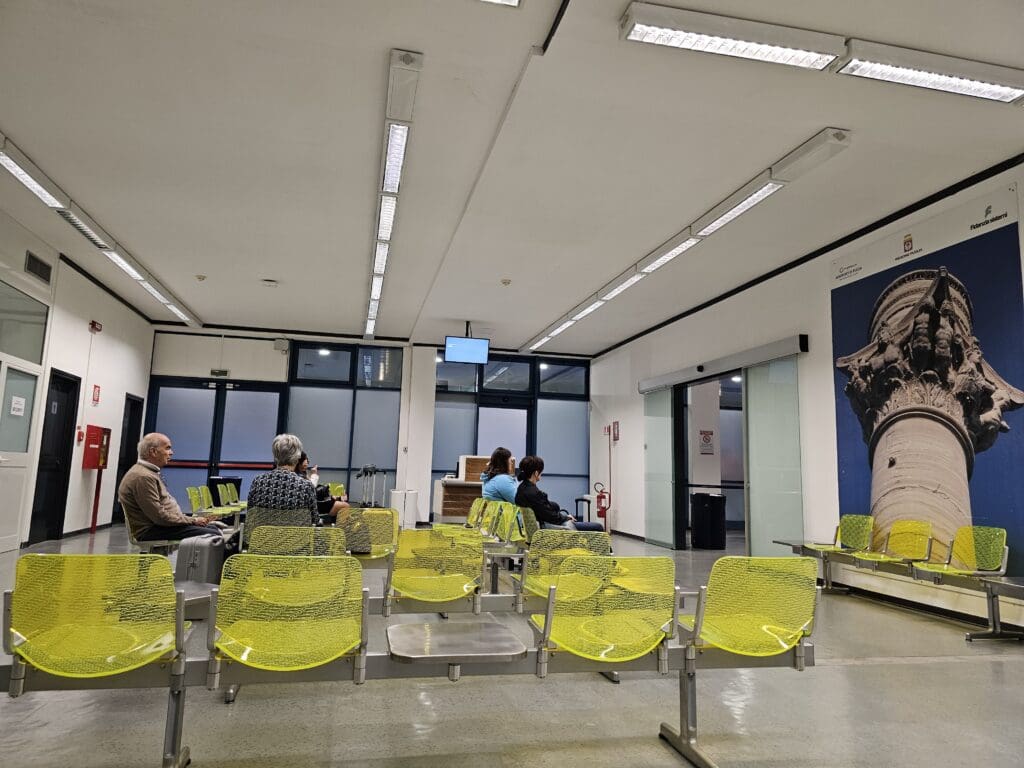
Following a very quick wander around, I headed for the vending machine where I grabbed a ginseng-infused cappuccino for the very reasonable sum of €1.10 before taking a seat and waiting for boarding to commence. As time passed, more passengers squeezed into the departure area and it appeared that the number of those waiting was well below the 118 required to fill the Embraer 195. With most seats ending up taken, I can only imagine that the terminal must feel rather cramped when there are multiple departures within a short space of time. Glancing at my boarding pass, this indicated that boarding for my flight would commence at 0730, although this time came and went with no sign of any movement at Gate 2.
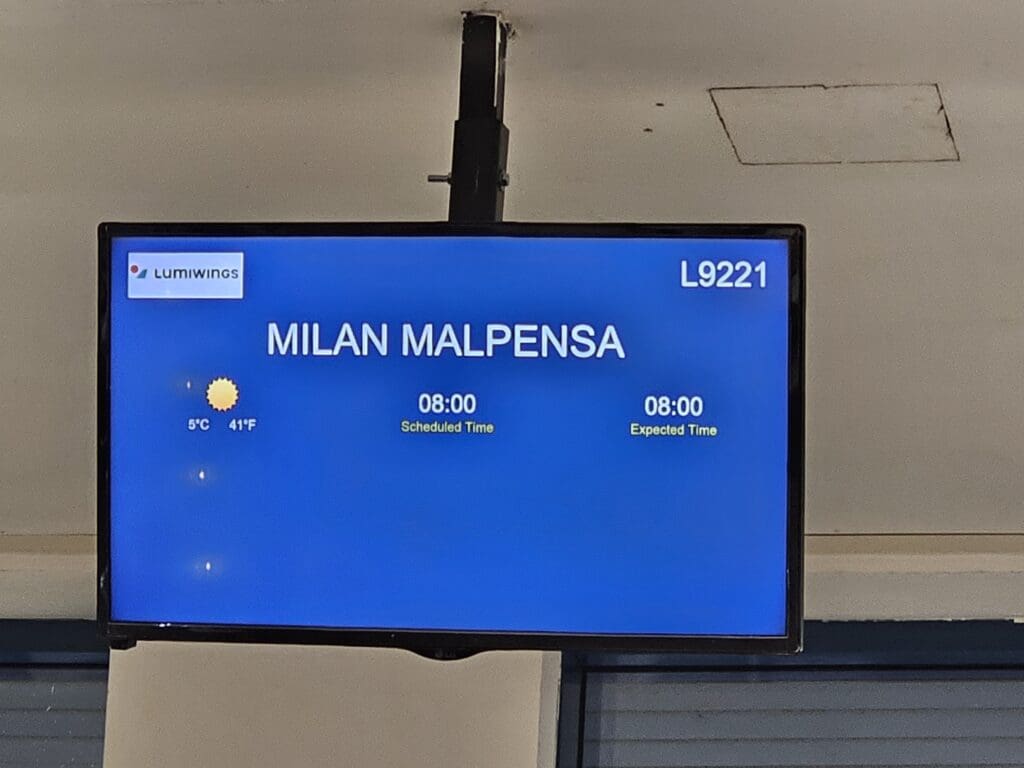
Several minutes later, one of the smartly dressed Aeroporti di Puglia staff members arrived and at 0739 they performed an announcement in Italian and English inviting passengers to board. Soon joining the queue, it wasn’t long before my boarding pass was scanned and passport checked, after which I was wished a nice flight. Providing a very pleasant end to my positive experience at Foggia Airport, just before heading outside I was handed a large Aeroporti di Puglia branded umbrella to protect me from the rain as I walked out the aircraft. This is something that I had only ever previously experienced whilst flying domestically in Korea, and so I was left rather impressed!
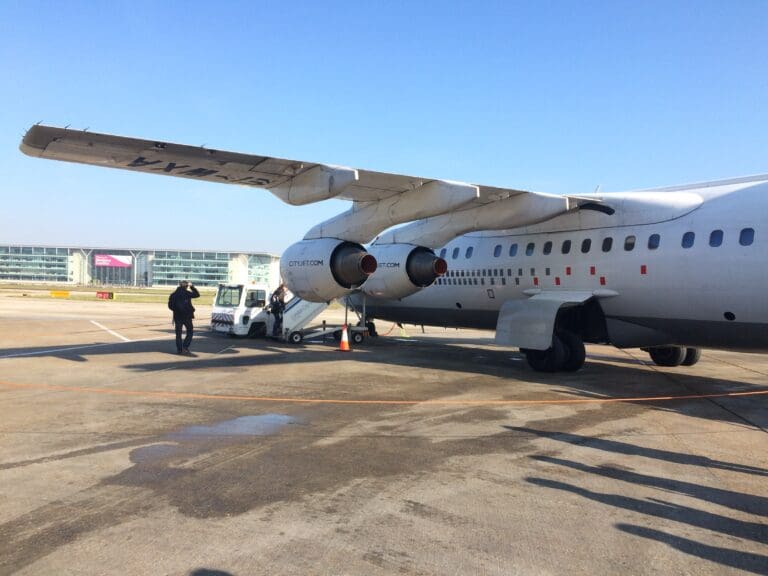
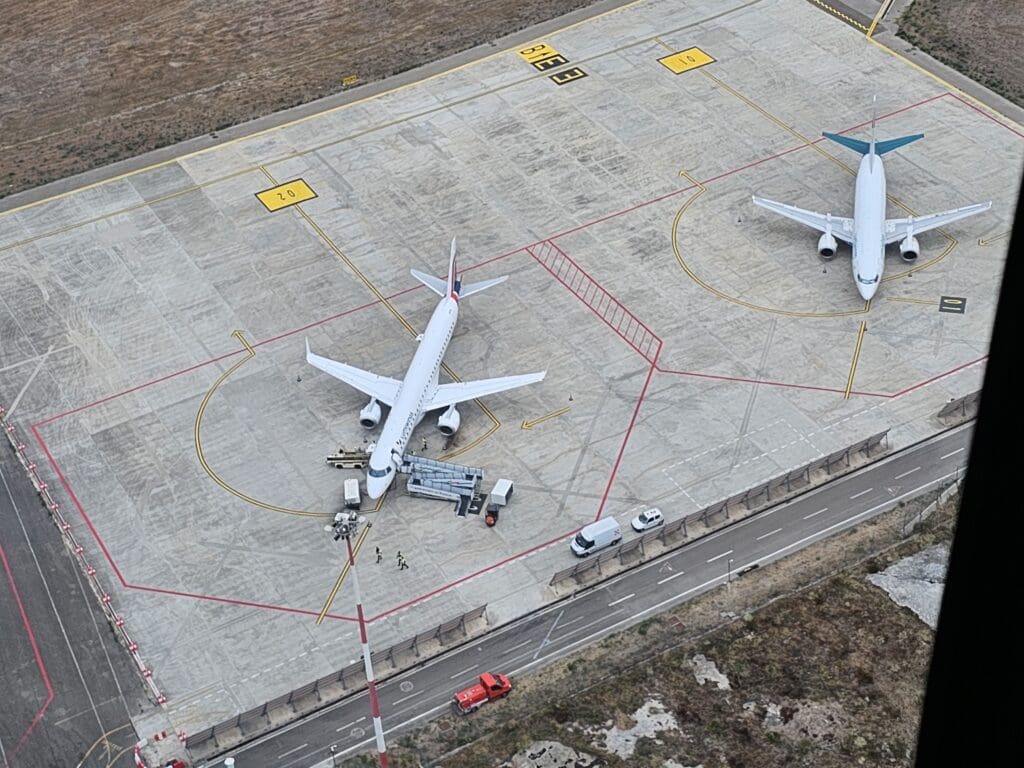
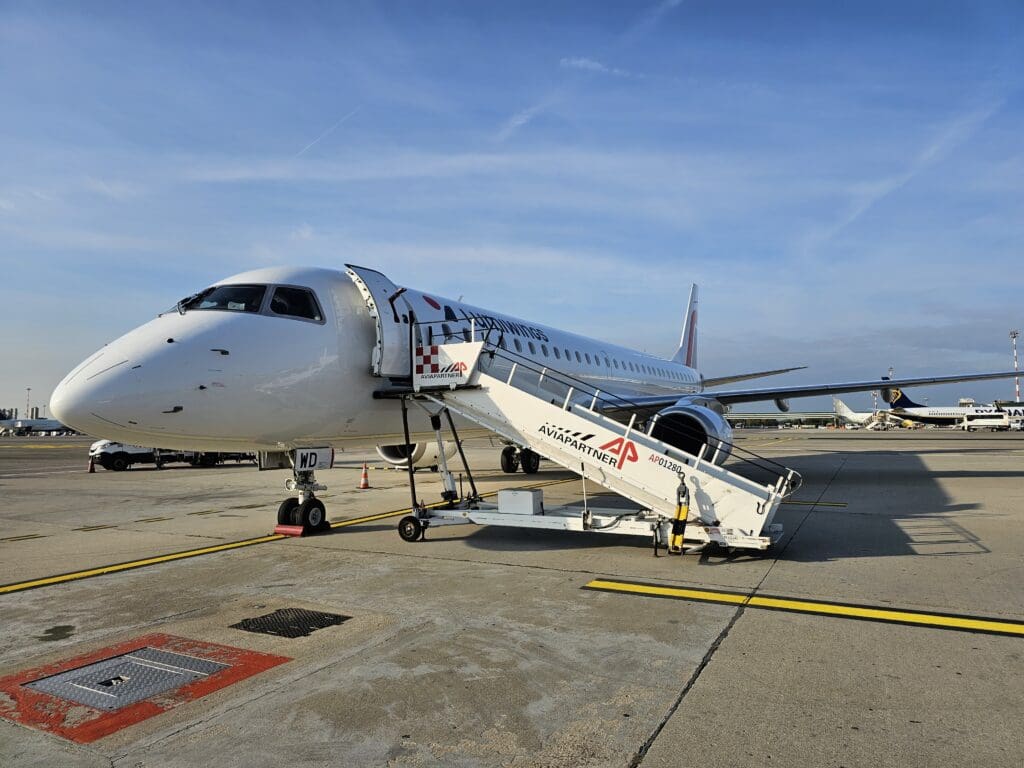
After leaving the terminal, I made the short walk over to Stand 2, where Lumiwings’ latest addition, Embraer ERJ-195LR, SX-LWD, could be seen standing next to the Boeing 737-300 that it had replaced. Manufactured at Embraer’s plant in São José dos Campos, not too far from the city of São Paulo, this aircraft first took to the skies in Autumn 2010 making it thirteen years old at the time of my flight. Destined for Brazilian carrier Azul, this aircraft did not have far to go on delivery and it spent the next ten years there, shuttling passengers primarily across the country where it sported the registration PR-AYO and name Rosa e Azul, and wore the airline’s Pink Ribbon livery. With the onset of the pandemic in 2020 and the drop in passenger demand, the aircraft took on a new role as a preighter aircraft and was repainted into Azul Cargo colours and renamed ‘Full Cargo’. Flying cargo for around two years, in August 2022 the Embraer was withdrawn from service and entered storage, initially in Campesinas before being ferried to Sorocaba. In August 2023, the aircraft returned to its birthplace and spent a month on the ground where I assume it was readied for its return to passenger service. Whilst retaining its Azul Cargo colours, it was given the American registration of its lessor Azorra Aviation, N391AZ. At the end of August 2023, the aircraft was ferried across the Atlantic to one of my local airports, East Midlands, where it was repainted into the colours of Lumiwings, and given the name Kefalonia and its current registration before being shuttled to Athens in early October 2023, and then onwards to Foggia. Having entered service just four days before my flight, this was to be the aircraft’s fifteenth revenue flight with Lumiwings!
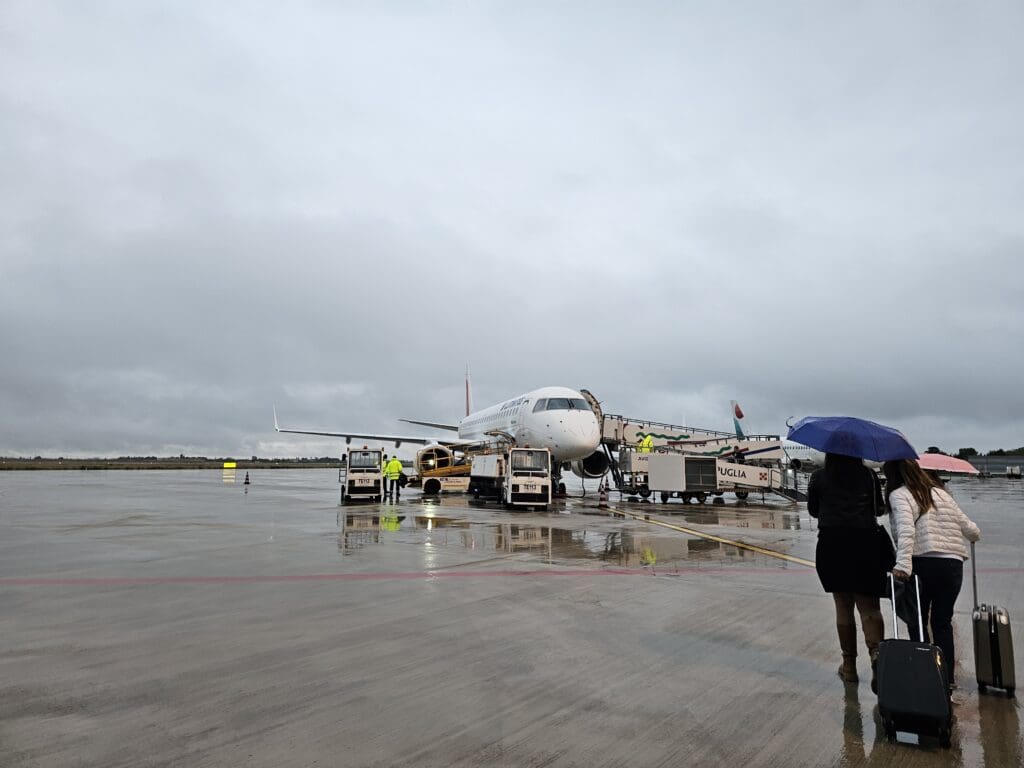
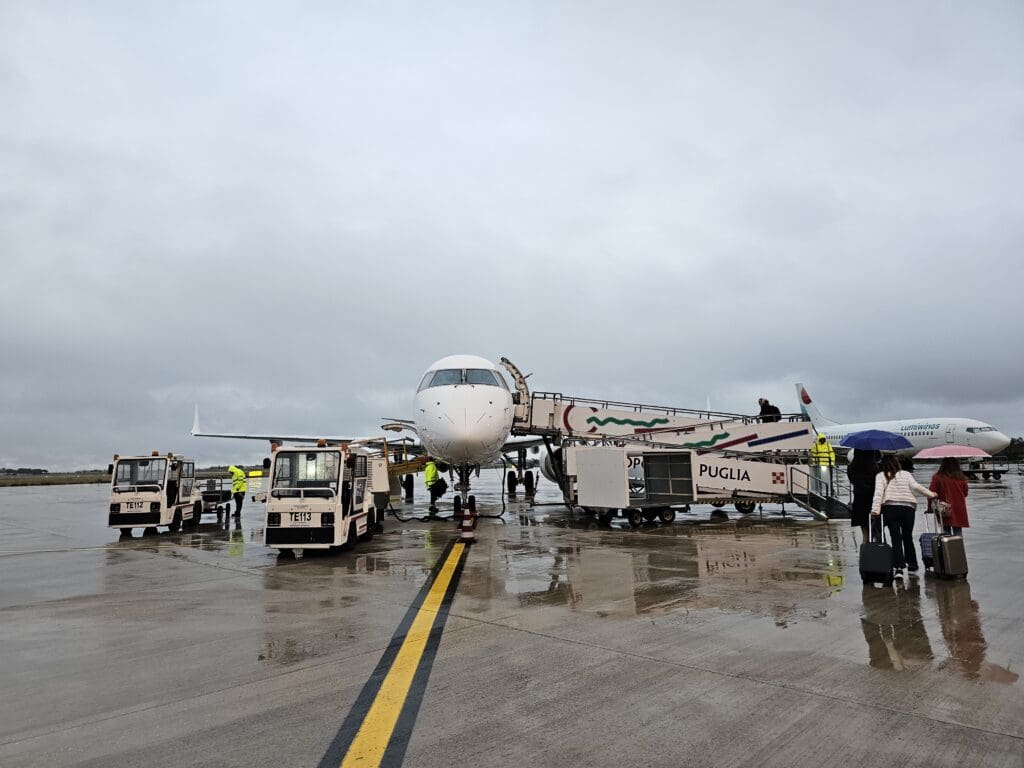
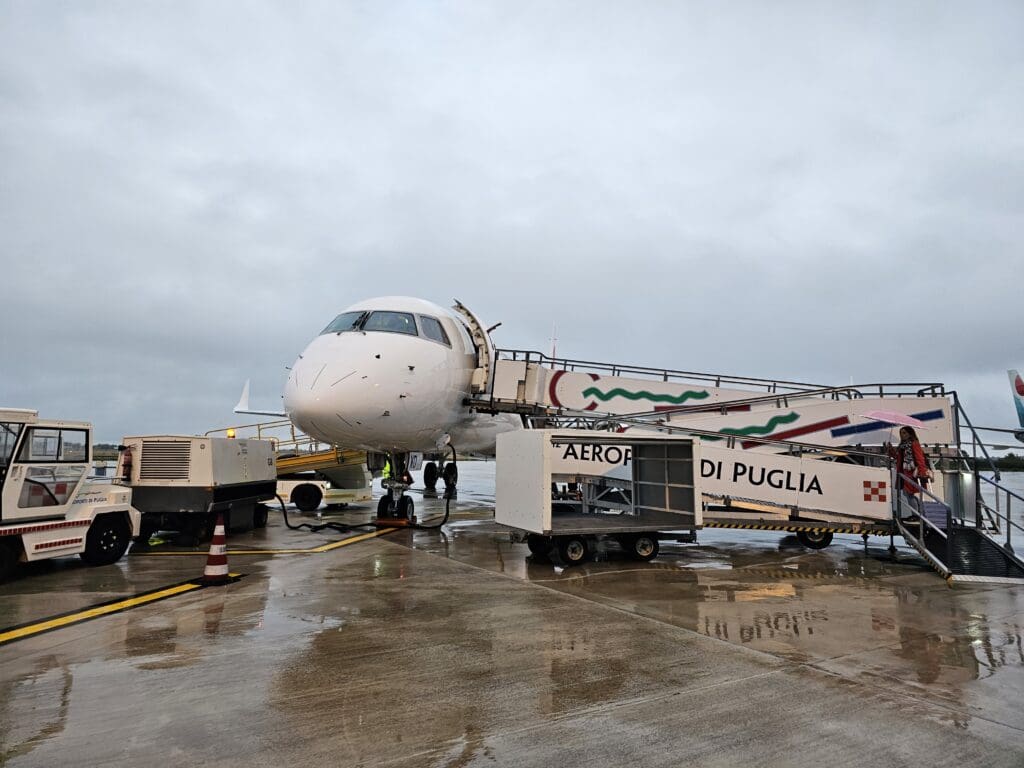
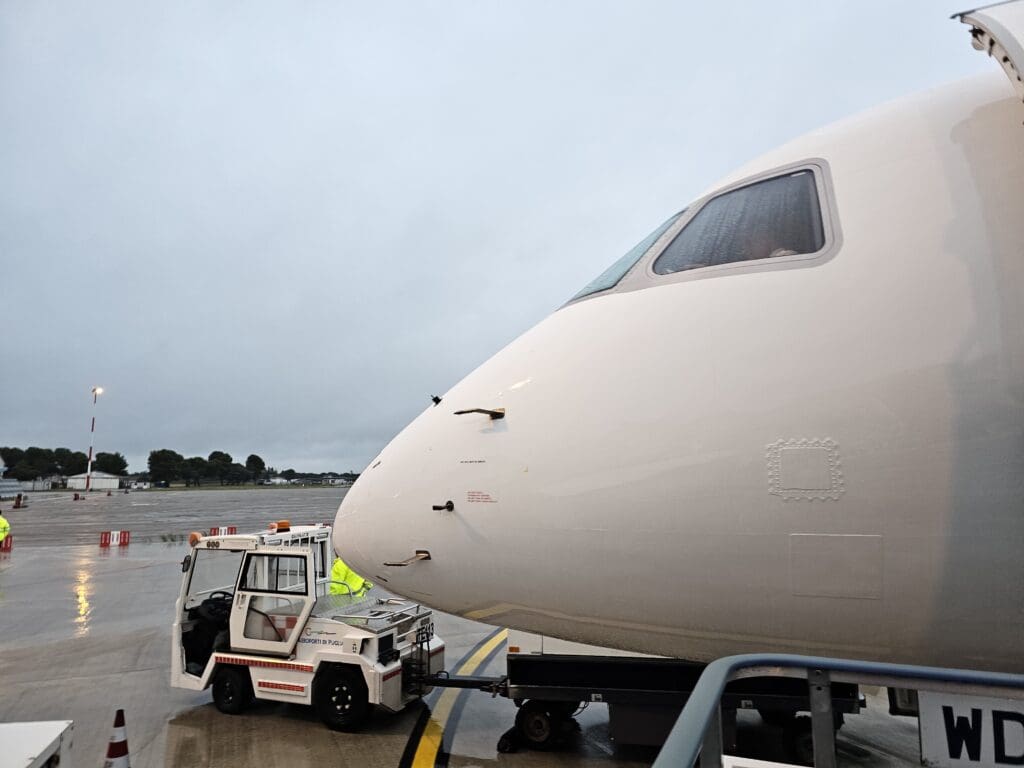
As I neared the aircraft, I was impressed to see that a step-free ramp had been wheeled up to the aircraft’s L1 door. Whilst such a device is common in North America and across much of Asia, I had only ever seen these once before in Europe, namely in Inverness. However, I am a firm believer that such technology is something that more handling companies should be investing in! After making my way up the ramp I joined a short queue and soon returned my umbrella to a rather rain-soaked member of ground staff.
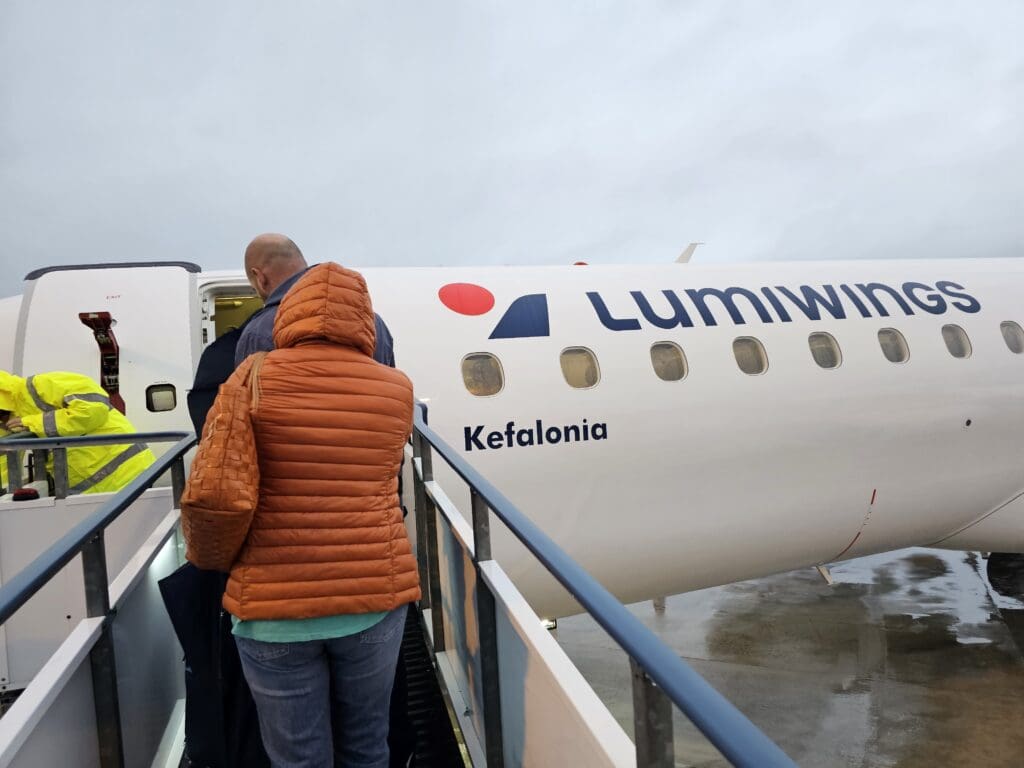
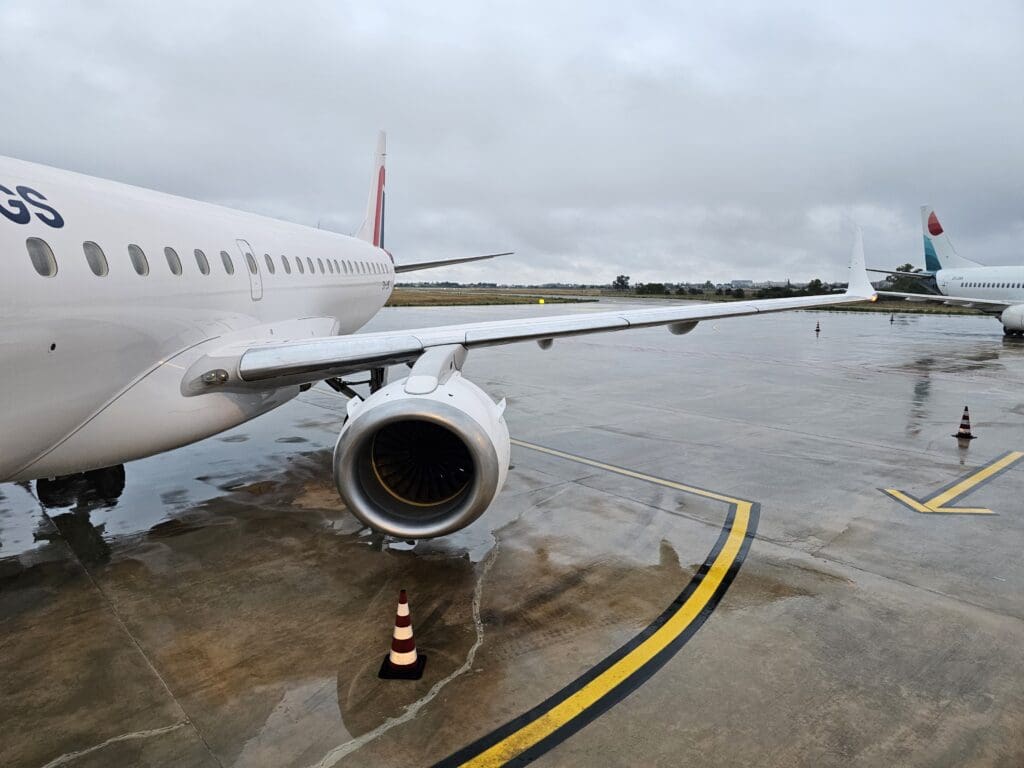
From there, I stepped into the small forward galley of the Embraer where I received a friendly greeting in Italian from one of the flight attendants before turning right and entering the cabin. As with all Lumiwings aircraft, their Embraer does not feature a business class and all seats onboard are arranged in the ERJ-195 standard 2-2 configuration. In terms of the seats themselves, these are the standard E-Jet seats which can be seen across the world. Those in the first few rows were covered in a light grey pleather which I believe was inherited from Azul, whilst the majority of seats sported elephant grey pleather covers. Despite this mismatch in seat covers, the interior of the jet appeared to be smart, clean and tidy, and my first impressions were good. This was also assisted by the fact that I received a further two friendly greetings as I trundled down the cabin to my seat.
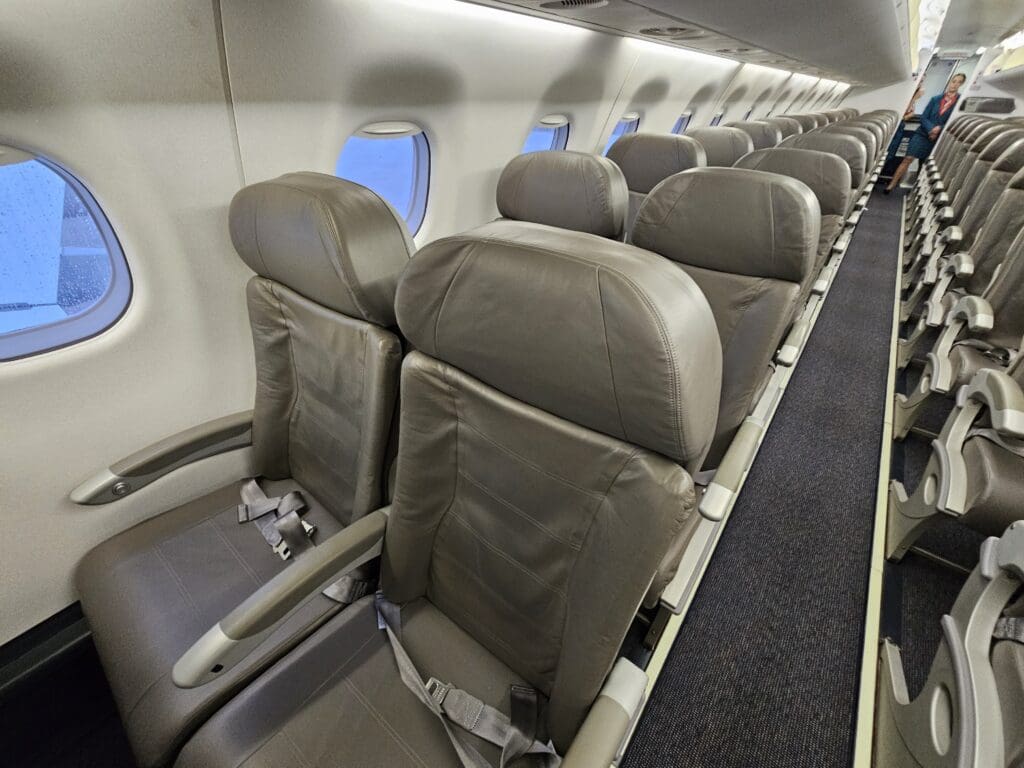
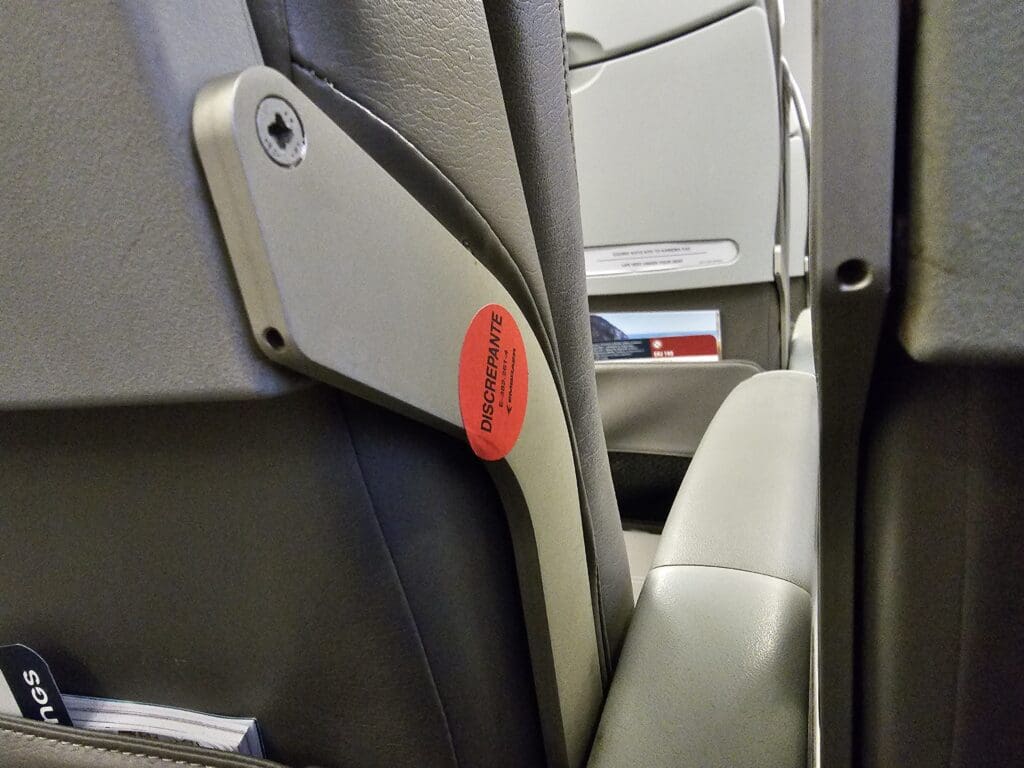
Upon arriving at Row 18, I squeezed my bag into the Embraer 195’s smaller-than-usual overhead lockers and slid into the seat before settling in for the journey. Examining the area around my seat, this appeared to be in tip-top condition, with the seat itself proving to be comfortable and offering a decent amount of legroom. To the non-enthusiast, there was little to suggest the aircraft to be anything other than a few days old! Furthermore, all signage onboard was in English and Greek, and I failed to spot anything in Portuguese during the journey. Turning to the seatback pocket, this contained a plain white sickbag, a safety card and Lumiwings’ Luminosa inflight magazine.
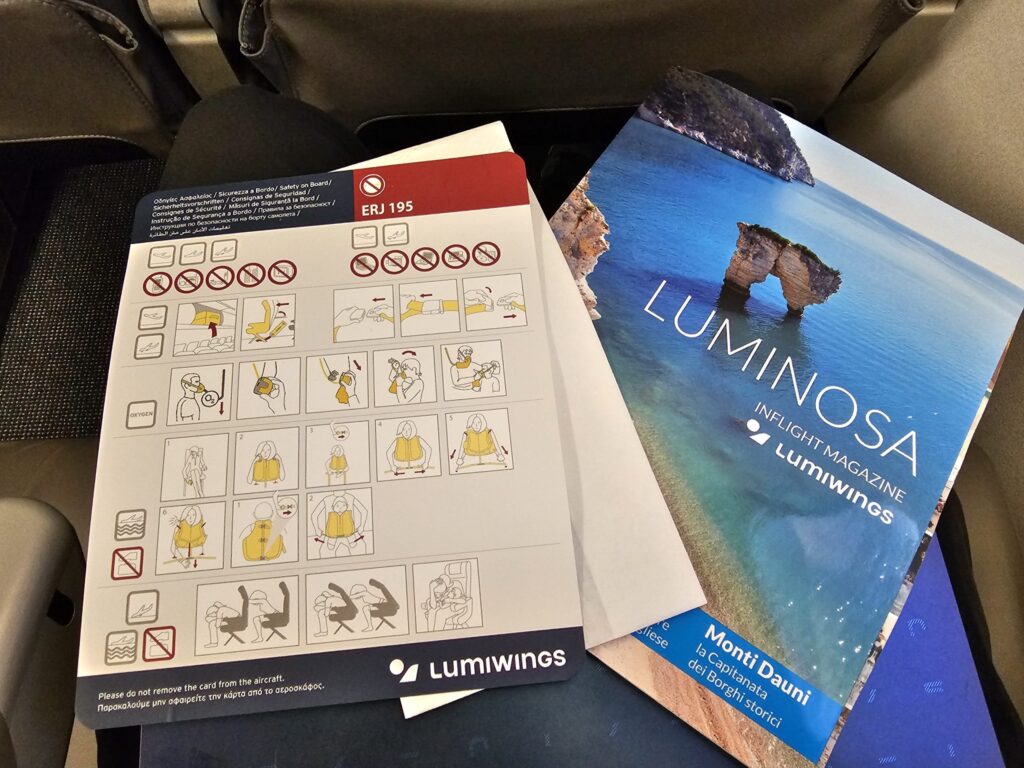
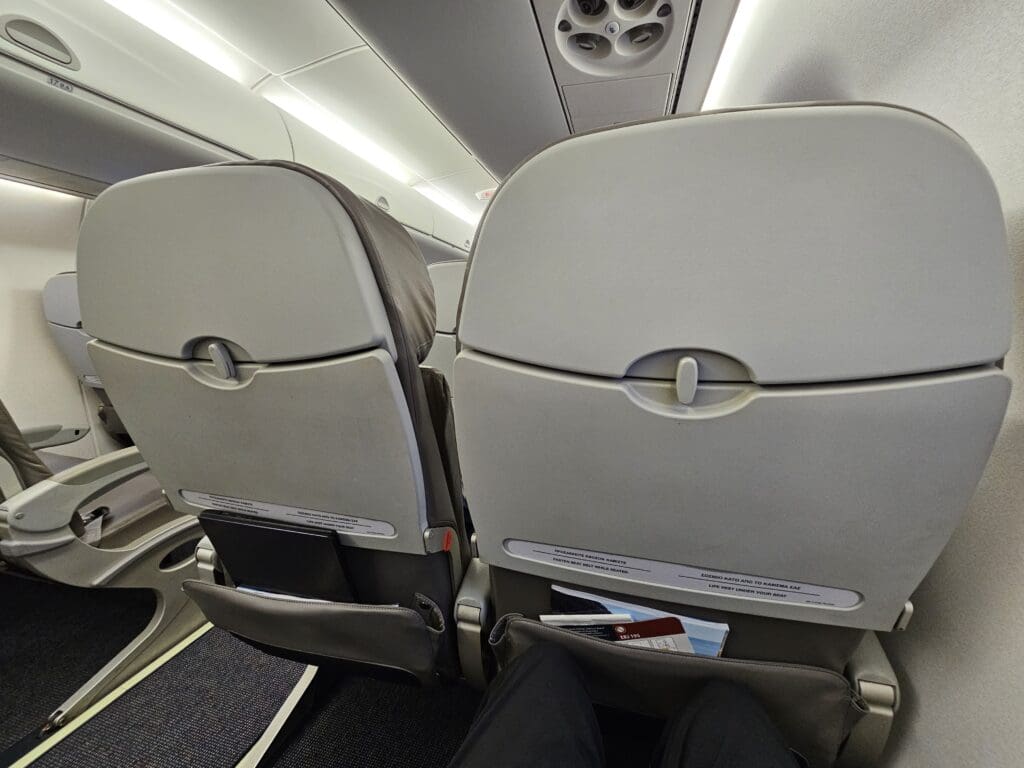
Considering the light load, and with many of my fellow passengers taking the form of well-versed smartly dressed business travellers with only small amounts of luggage, boarding was a quick process and was completed no more than ten minutes after this had been called in the terminal. That morning, I would estimate there to have been no more than thirty passengers onboard the aircraft, with most sitting in the forward half of the cabin with the majority of seats at the rear of the aircraft remaining empty or taken by Lumiwings staff. As I waited for departure, a huddle of high-vis-wearing ground staff could be seen in the forward galley although thankfully there was no issue and at 0801 the L1 door was closed and armed in preparation for our departure.
Once the cabin door had been shut, it wasn’t long before one of the flight attendants performed their welcome announcement in Italian and English which then transitioned into the safety demonstration. This consisted of the safety instructions being read out and a couple of crew members performing a demonstration in the aisle. Talking of the crew, that morning the flight seemed to be staffed by a mixture of both Italian and Greek flight attendants, although unsurprisingly all of the latter crew seemed to speak at least a basic level of Italian. On a side note, there was no word from the cockpit for the duration of the flight, although this was perhaps owing to the assumed pilots’ lack of Italian language skills. As the demonstration came to an end, the usual humming could be heard as the Embraer’s two General Electric CF34-10E7 engines spooled into life.
At 0811, the aircraft slowly edged forward and immediately wheeled to the right as it made its way out of the stand under its own steam. Consisting of a rather straightforward layout, Foggia Airport’s small main apron is connected to both ends of the single runway by two taxiways. However, that morning, the taxiway leading to the end of the active runway, Runway 33, was closed. We thus headed to the opposite end of the runway and without any holding we taxied onto this. Once there, the aircraft made its way down the runway at a regular taxi speed, the wet conditions and subsequent risk of skidding and ending up on the grass perhaps preventing any sort of high-speed backtrack.
Eventually, the aircraft reached the opposite end of the runway and came to a quick halt. At 0817, with the brakes held, the engines partially spooled up before being released causing us to power down the runway with some vigour before rotating upwards into the rainy skies. Seconds after taking off, the rain-soaked industrial and retail areas neighbouring the airport could be seen although we headed into the clouds before reaching the city centre and so I was not treated to any final glimpses of Foggia’s main sights.
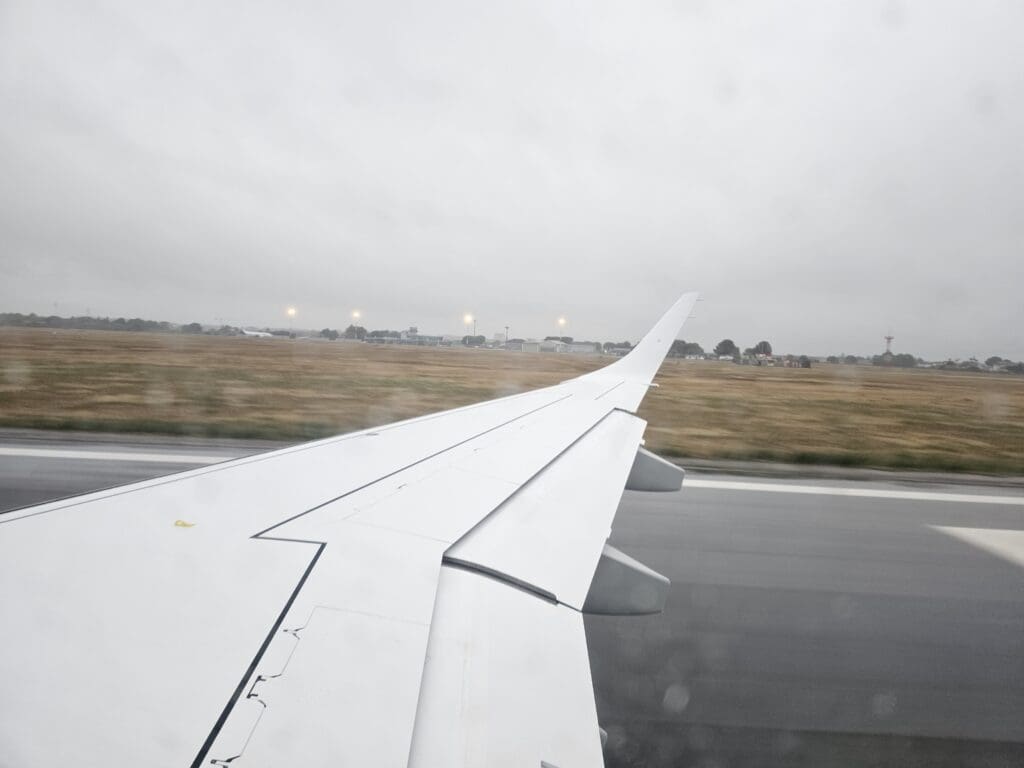
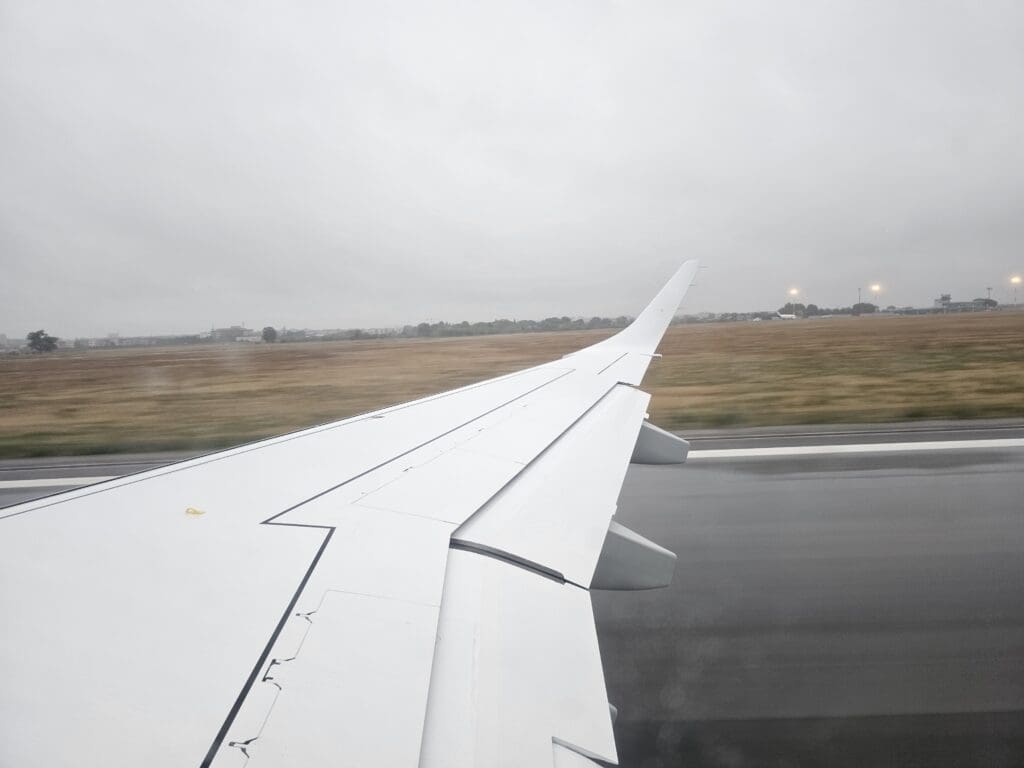
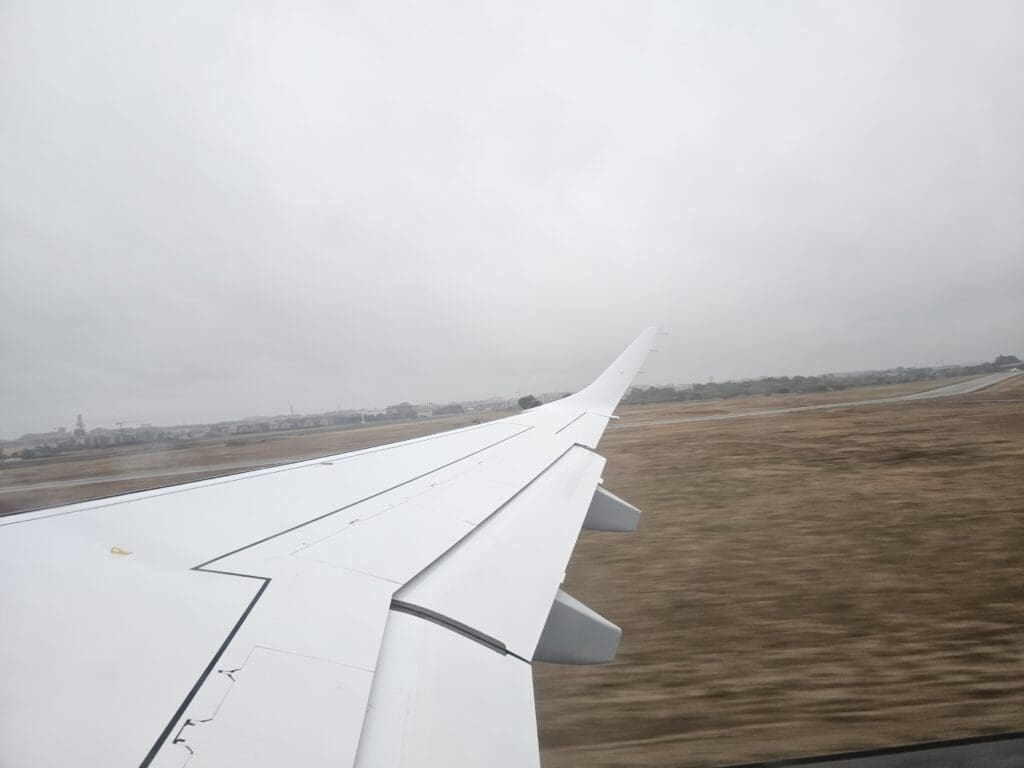
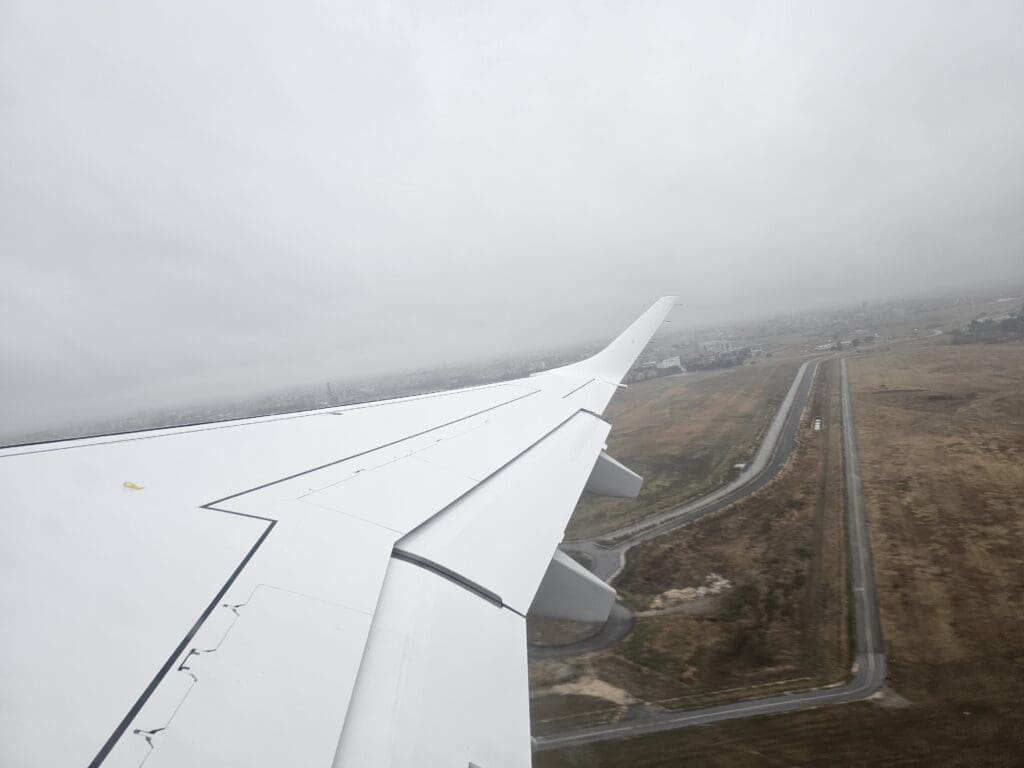
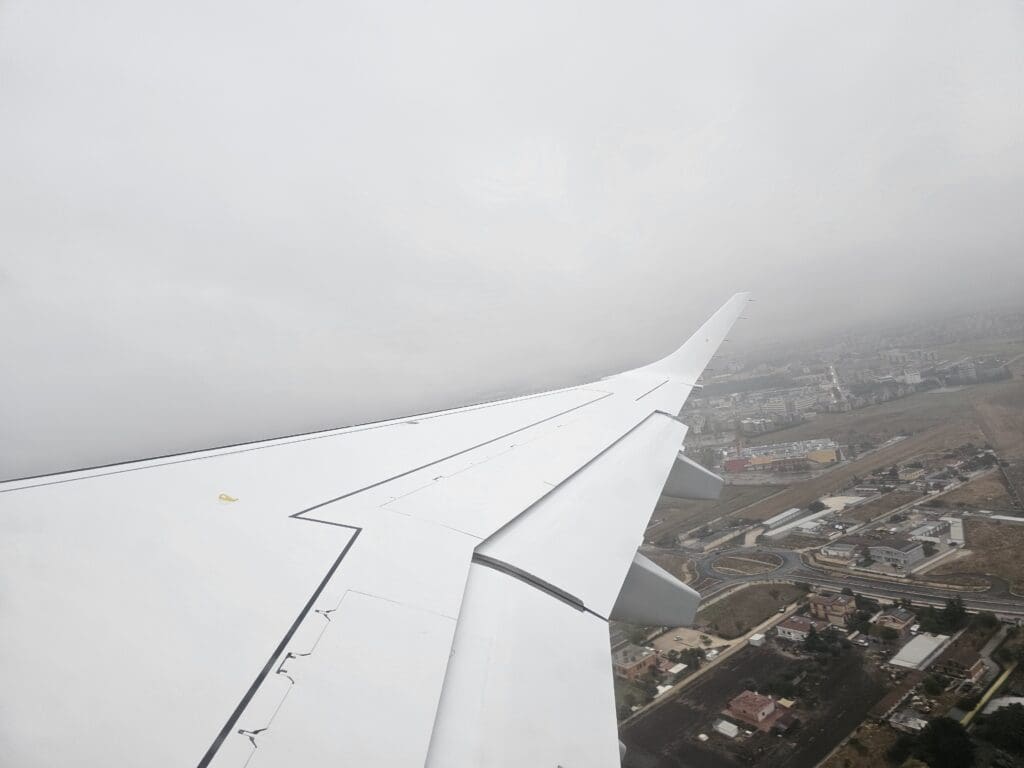
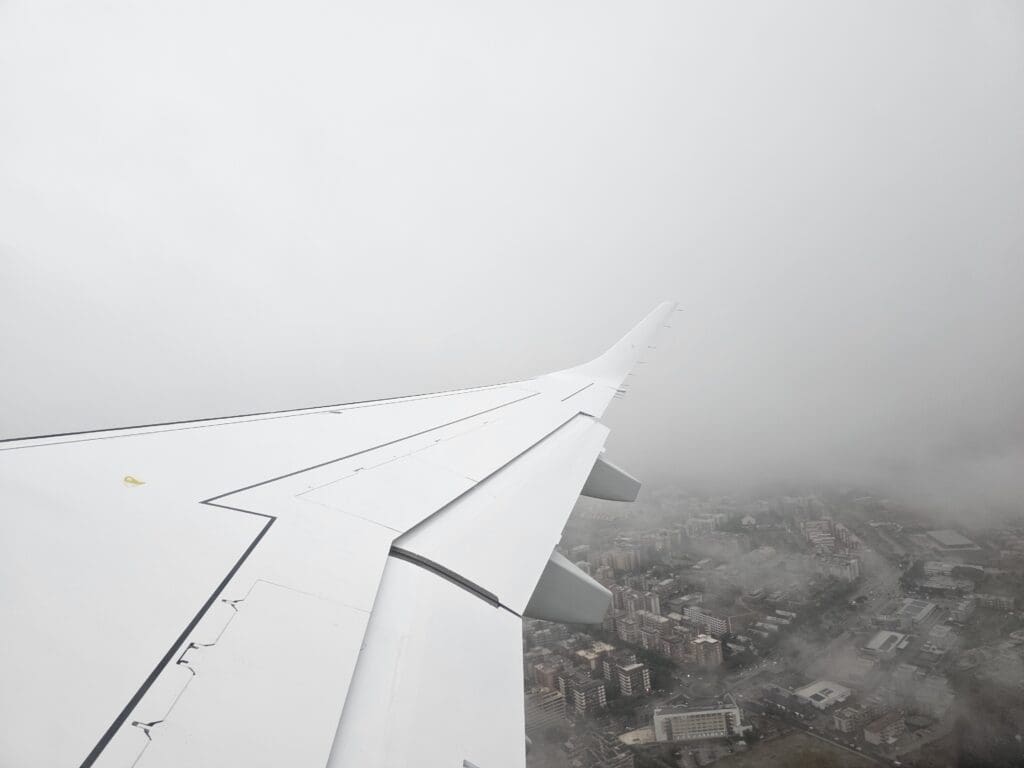
As we climbed through the thick clouds, we bumped around slightly although this was not particularly rough. Nevertheless, I was still surprised to see that the seatbelt signs were extinguished whilst still fully in the clouds, with this occurring immediately upon climbing through 10,000 feet. From Foggia, the aircraft continued virtually on the runway heading, making its way north towards the coastline before flying along this and passing the coastal cities of Termoli, Vasto and Pescara. After passing the latter, the aircraft levelled off at 34,000 feet at which point one of the flight attendants made an announcement with the usual information regarding keeping seatbelts fastened before mentioning that the inflight service would commence soon and passengers would be offered a range of drinks as well as snacks.

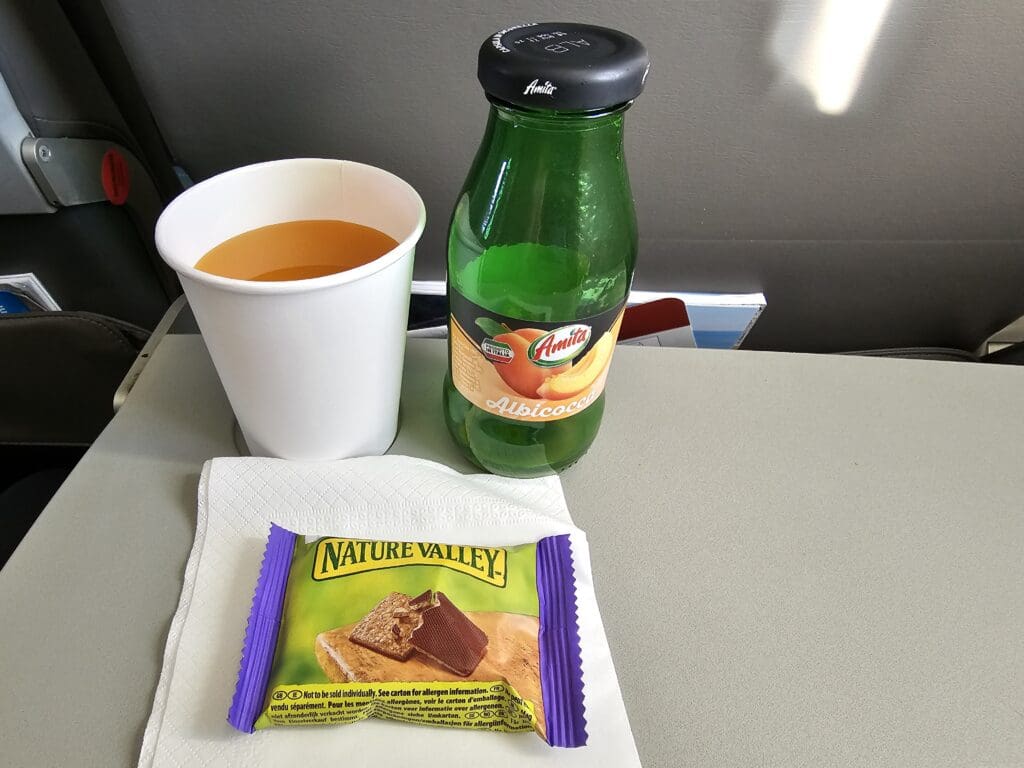
Soon, a service cart was rolled out from the rear galley and wheeled to the front of the cabin and was followed by another from the forward galley. After several minutes, the first cart arrived at which point the flight attendant went through the vast array of drink options in English, and advised that teas and coffees would come from the next trolley. Opting for an apricot juice, this was handed over to me in a 200ml glass bottle and was accompanied by a plain paper cup and a serviette. I was then offered the choice of either ‘yoghurt’ or ‘chocolate’. Choosing the latter, a packet of Nature Valley chocolate-coated biscuits was placed on the large tray table. Next up was the hot drinks cart, which was staffed by equally polite and friendly flight attendants. Upon reaching my row, I decided to go for a black coffee and was also presented with a basket containing two types of Greek baklava! Choosing one at random, I placed this on my tray and soon got to work on this very impressive (for a short-haul European flight) snack service.

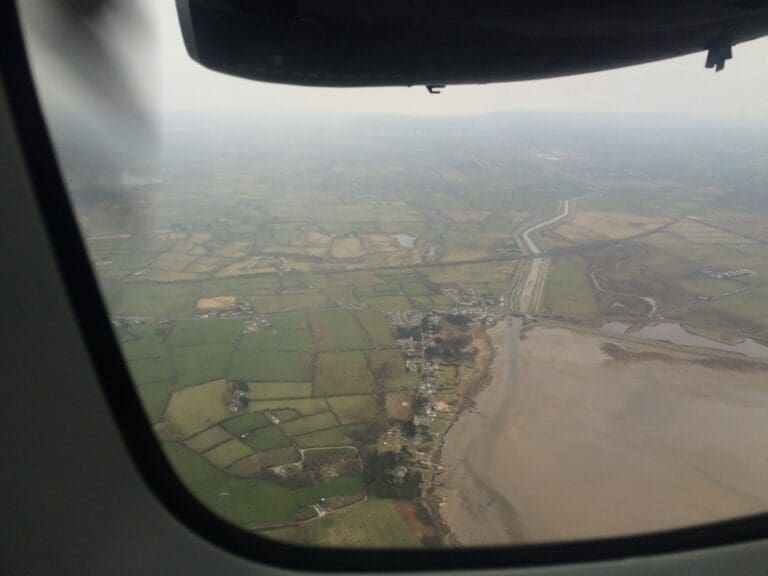
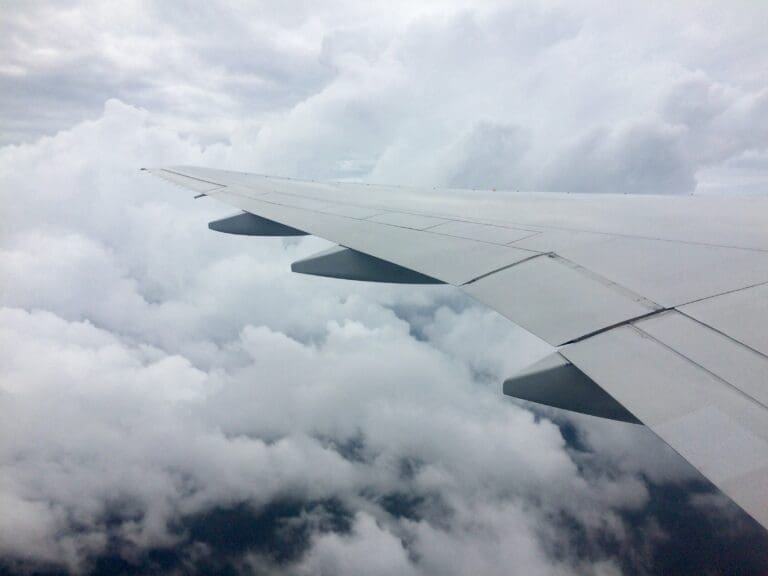
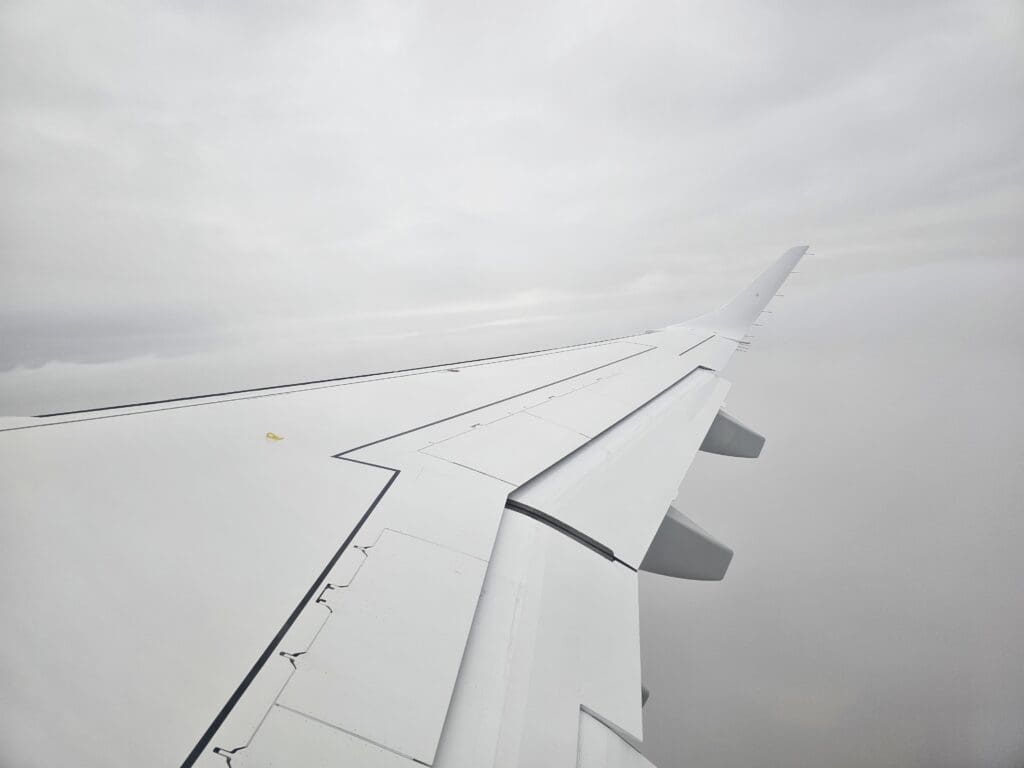
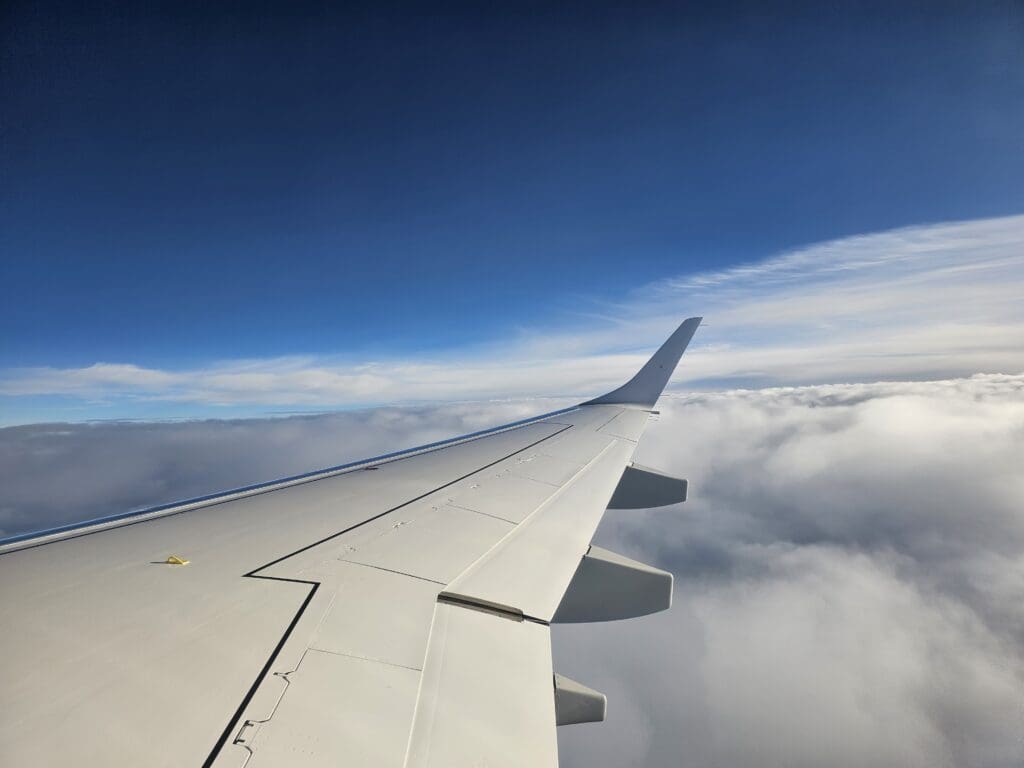
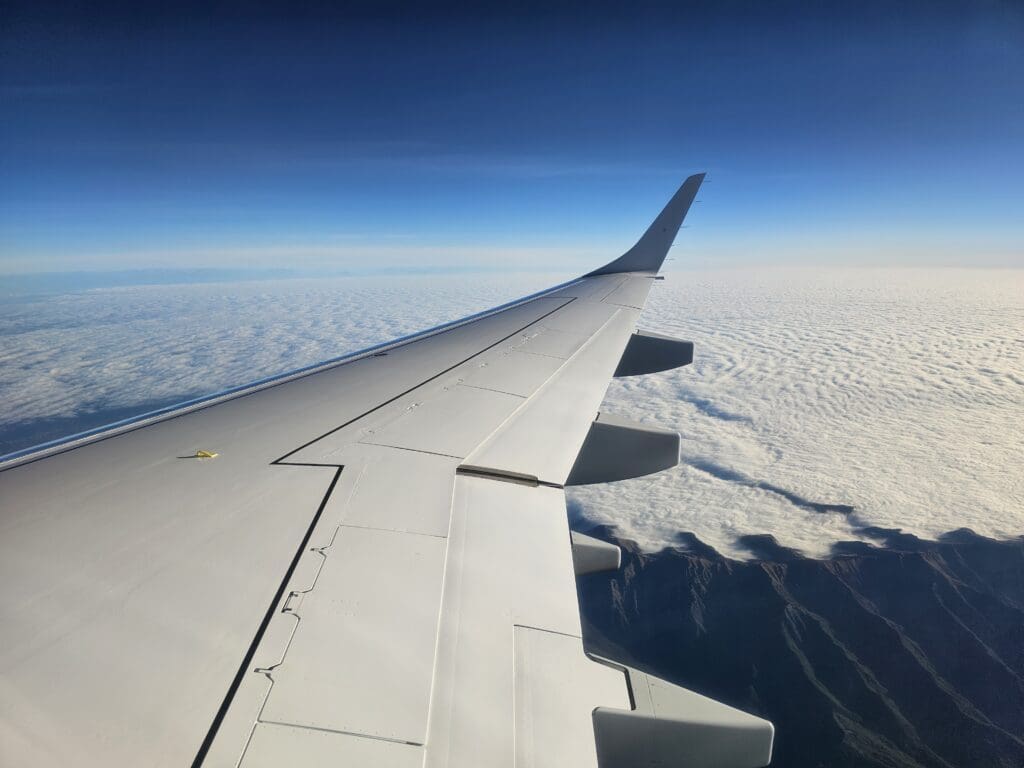
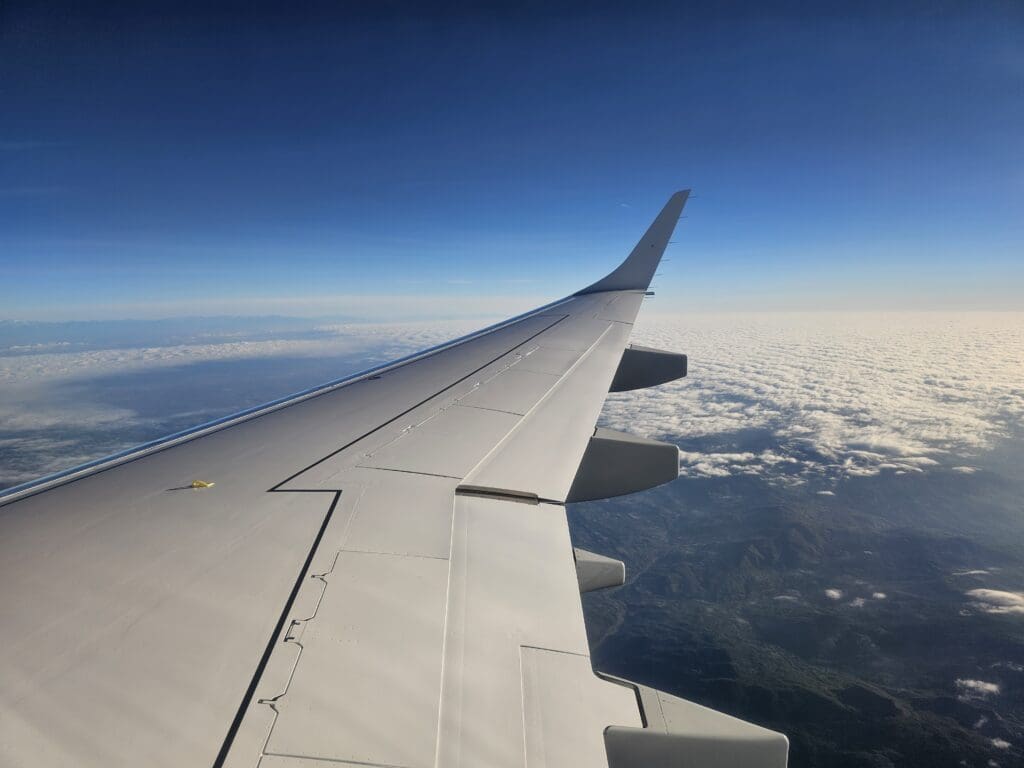
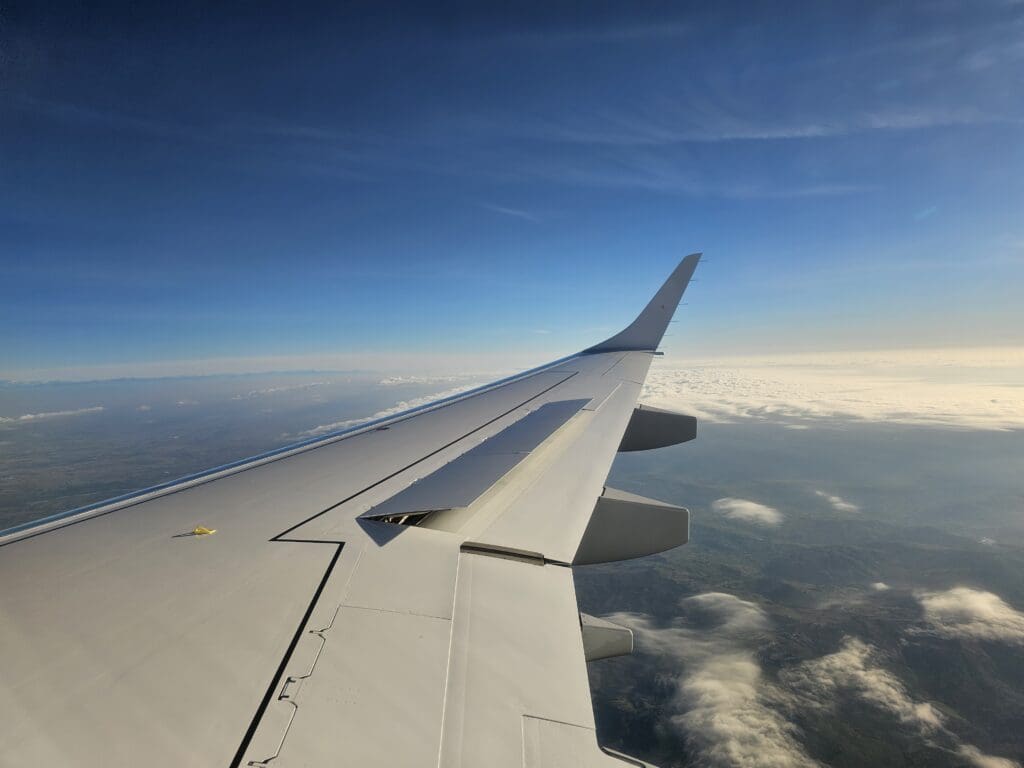
In good weather conditions, I would imagine that this flight offers superb views of much of Italy, passing over several national parks, the picturesque coastline and a selection of hills and mountains. However, thanks to the clouds below, little of interest could be seen other than the Embraer’s wing and an EasyJet Europe Airbus A320 which passed over us on its journey from Milan to Marsa Alam. Examining the route, after leaving Pescara, the aircraft headed inland and crossed over Abruzzo and the Monti Sibillini National Park. From there, the aircraft headed northwards above Italy’s mountainous interior passing to the east of Perugia and continuing towards Arezzo and Florence.
With little to see outside, I decided to flick through the 96-page inflight magazine. This featured an impressive total of over twenty articles which primarily focused on topics related to their Italian destinations and things to do in the vicinity of these. These came in addition to a small section about Lumiwings and plenty of advertisements for a wide range of goods and services. Published by an Italian company, only some articles were translated into English although this was neither surprising nor a complaint as I appeared to be the only non-Italian passenger on that morning’s service. Whilst I was unable to find the magazine’s date of publication, this did not seem to be relatively recent as it still listed Catania as a destination and lacked any mentions of both Lumiwings’ route to Mostar and their latest delivery.
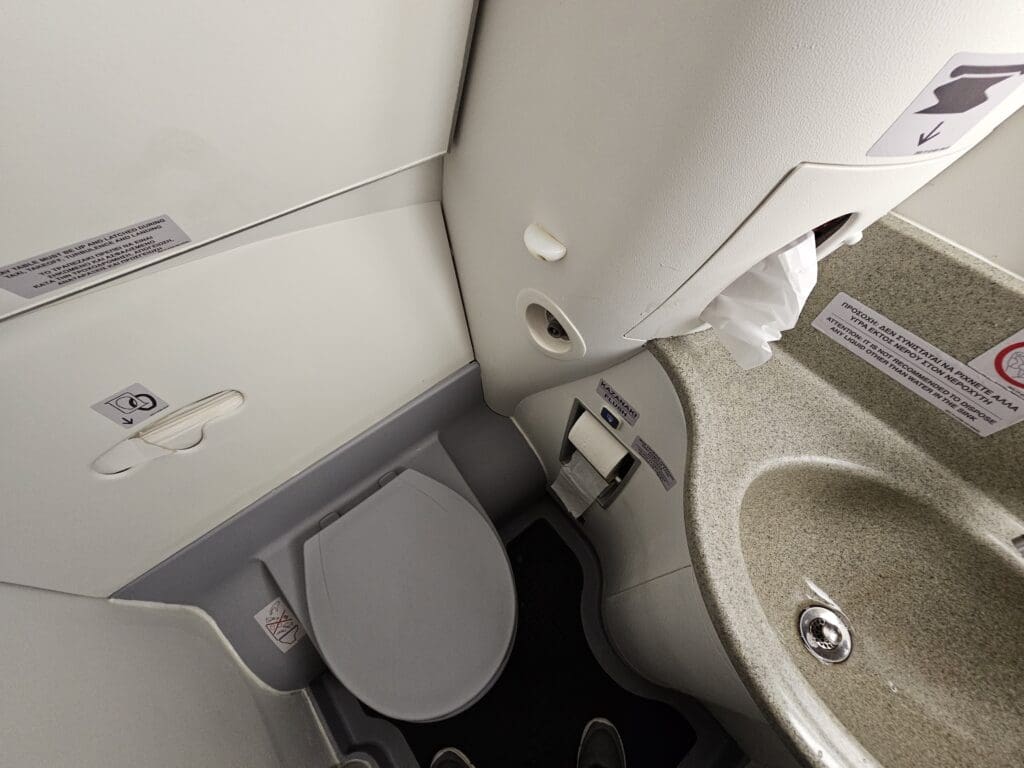
At 0853, the aircraft seemed to descend at a fairly steep rate, which was a little confusing as we were only over Florence and thus had a fair distance to go until Milan. However, the descent was only temporary and we soon levelled off at 30,000 feet. Nevertheless, with this hinting that we were speeding towards the end of the flight, I opted to make a trip to one of the Embraer’s two lavatories – one of which is located at the rear of the aircraft and the other at the front. With a queue having formed for the rear lavatory, I decided to head to the vacant forward lavatory. Upon entering this, I found this to be more cramped than a typical E-Jet’s rear lavatory, primarily due to the curvature of the fuselage which meant that I was unable to stand upright. However, Lumiwings was hardly to blame for the Embraer’s design and I was left with few complaints, with this being stocked with the basics and in a clean and presentable state. Once again, there were no signs of the aircraft’s previous career in Brazil, with all Portuguese signs having been replaced by their Greek equivalents.
Soon returning to my seat, the clouds had partially parted below and the tops of the mountains that sit to the north of Florence could be seen poking out of the clouds providing a rather scenic view. Several minutes later, the aircraft could be felt commencing its descent for good as the clouds continued to clear below. With the aircraft soon hitting a patch of turbulence, the seat belt signs were illuminated and remained on for the rest of the flight, with the crew soon passing through the cabin collecting rubbish and ensuring that all was in place for our arrival into Milan.
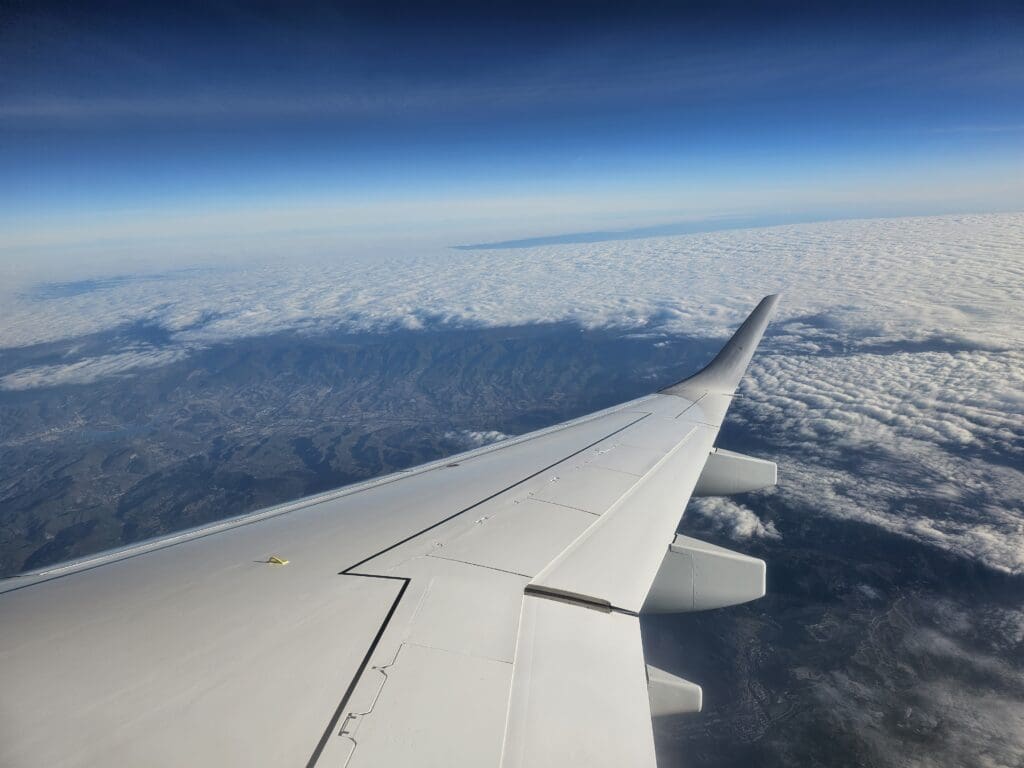
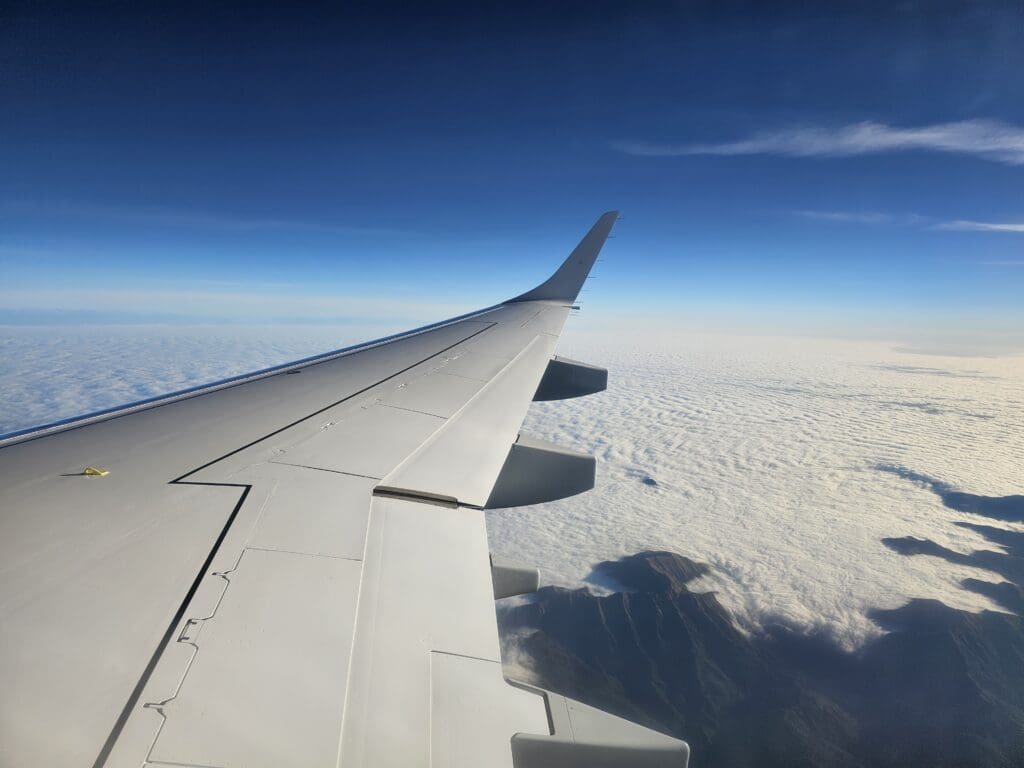
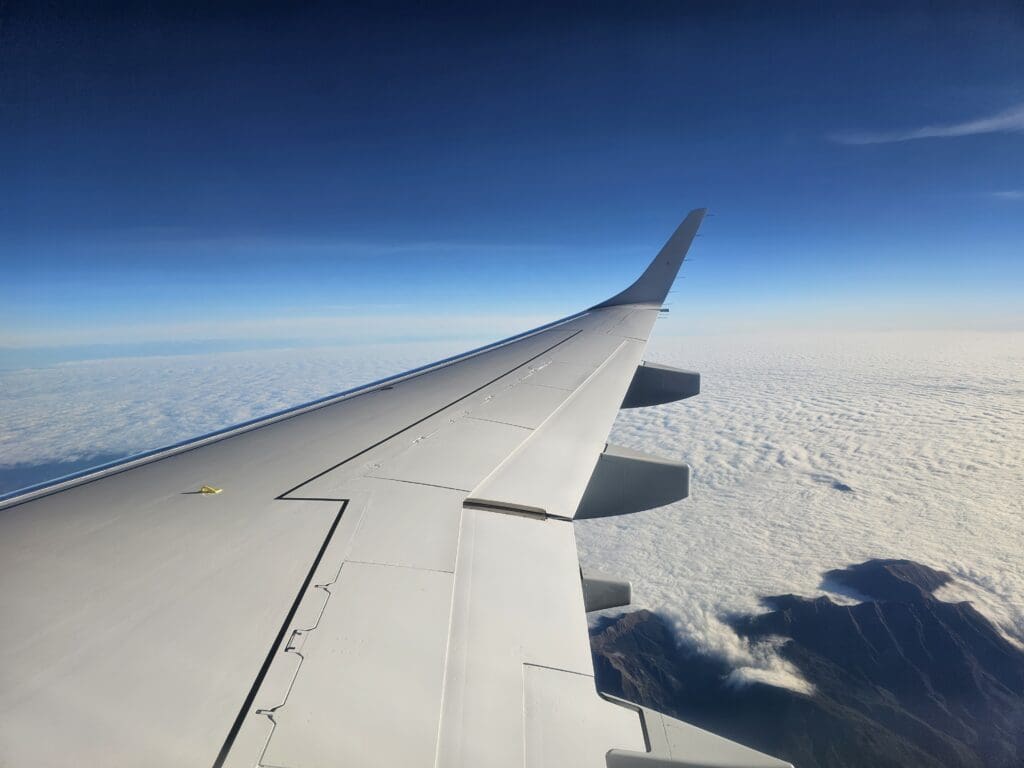
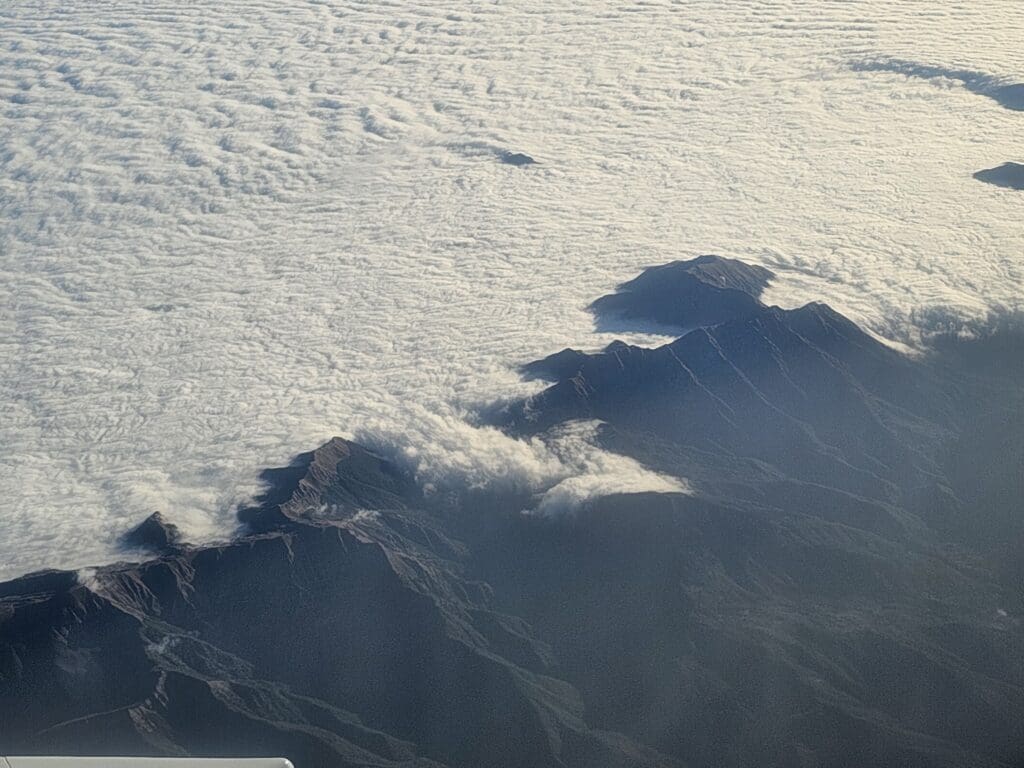
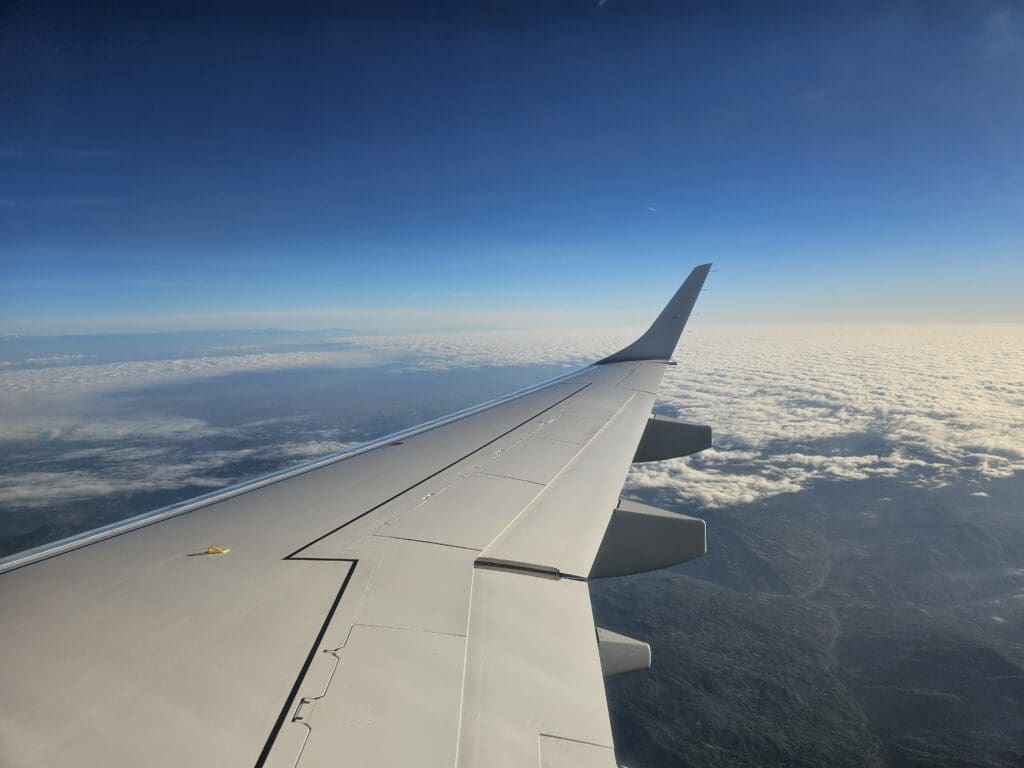

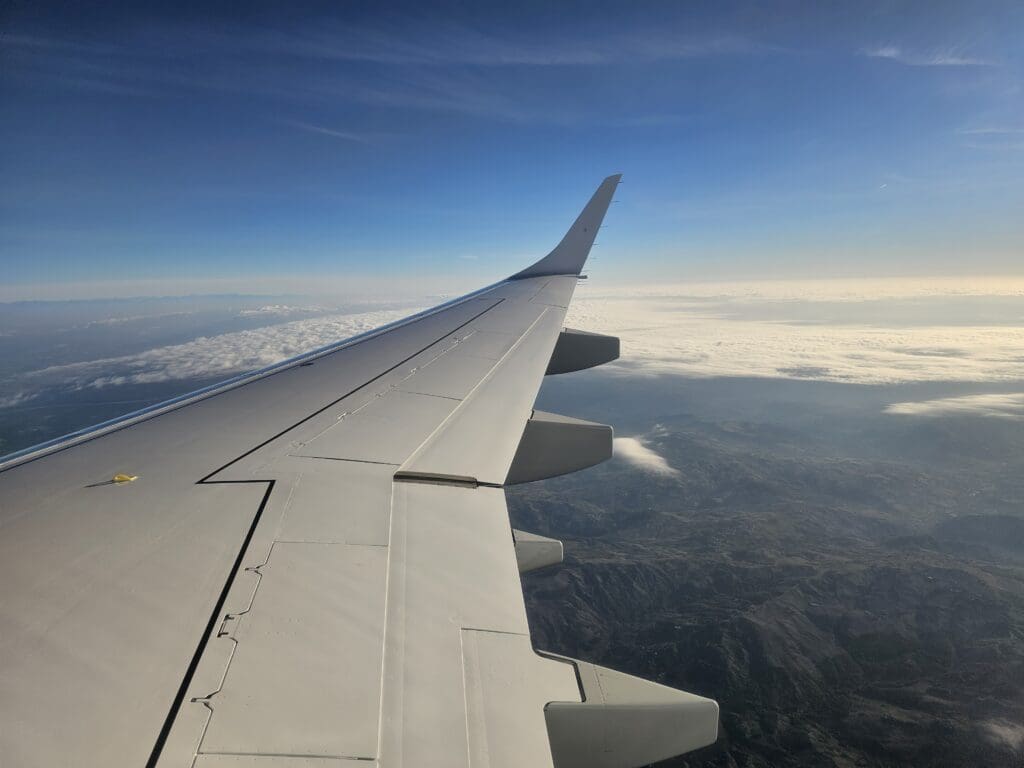

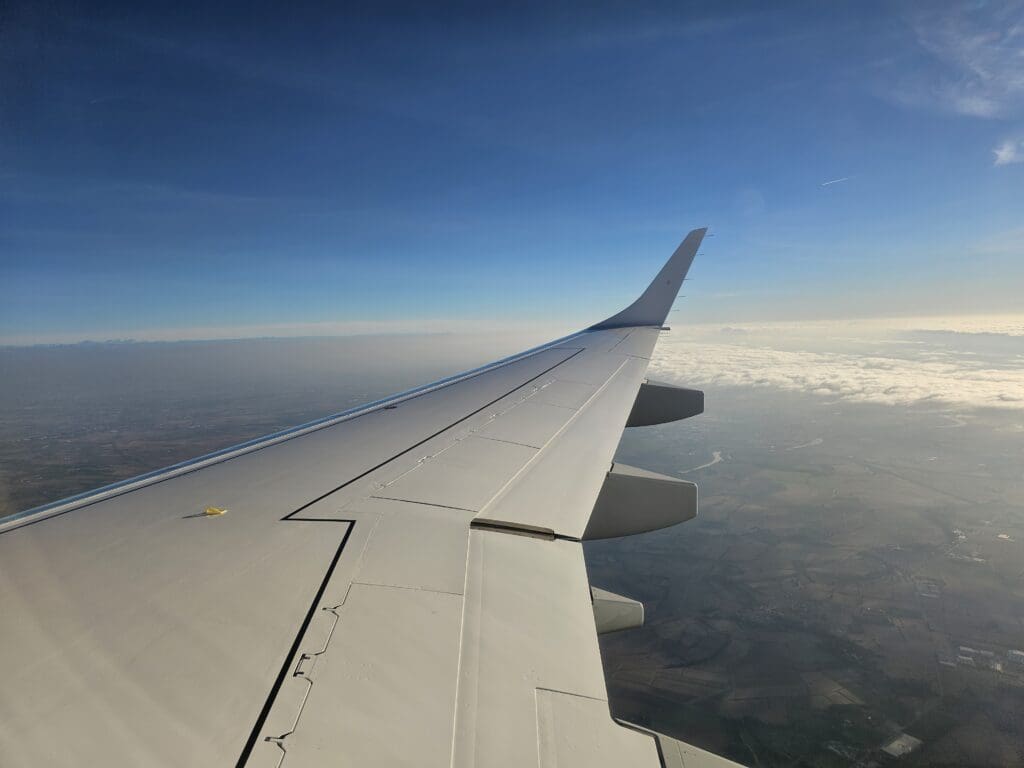
As we sank, one of the flight attendants performed an announcement advising that we could expect to land in twenty minutes before giving a brief overview of the weather in Milan. Below, good views of the mountainous terrain continued until the mountains suddenly disappeared and were replaced by the sight of fields as we passed the town of Pavia. From there, the aircraft continued northwards and flew parallel to the course of the Ticino River, following this to Milan. With the wind blowing in from the north, and arriving from the south, nothing more than very slight changes to our course were required as we approached Milan and it wasn’t long until the Embraer’s flaps were lowered in preparation for our arrival.
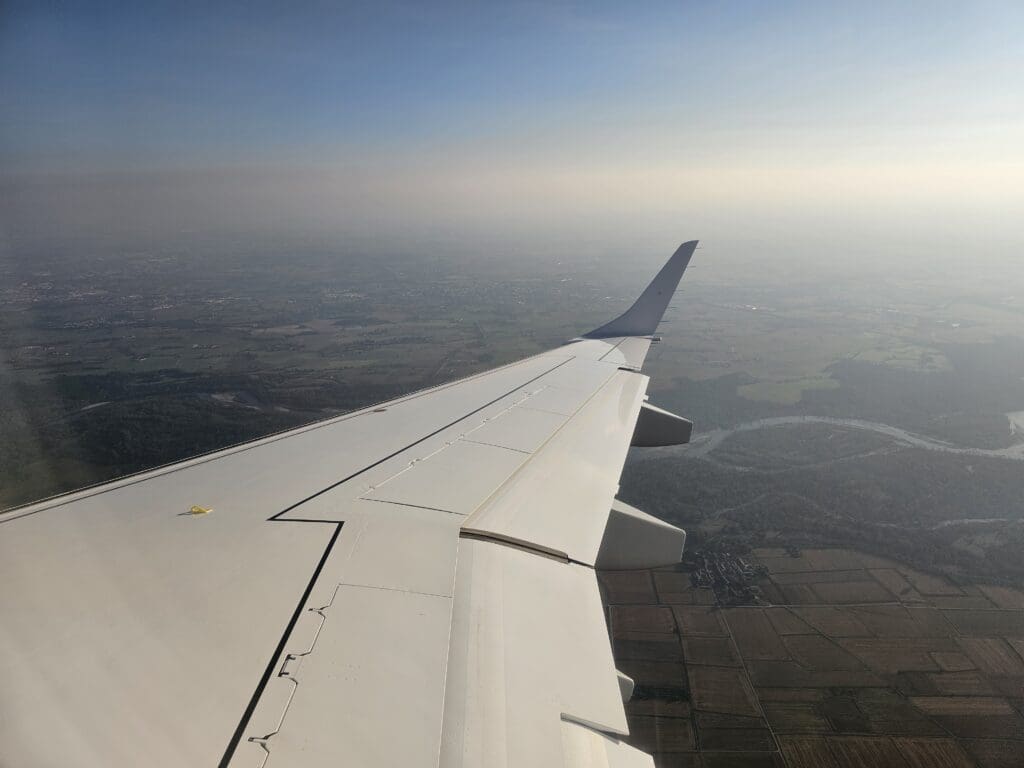
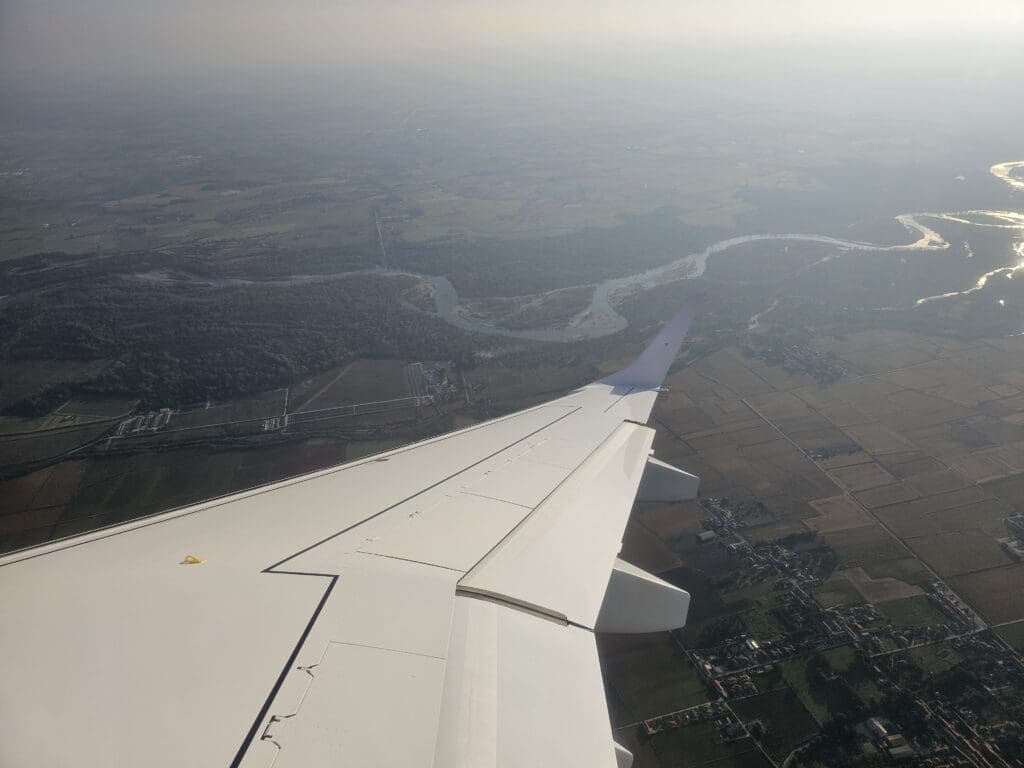
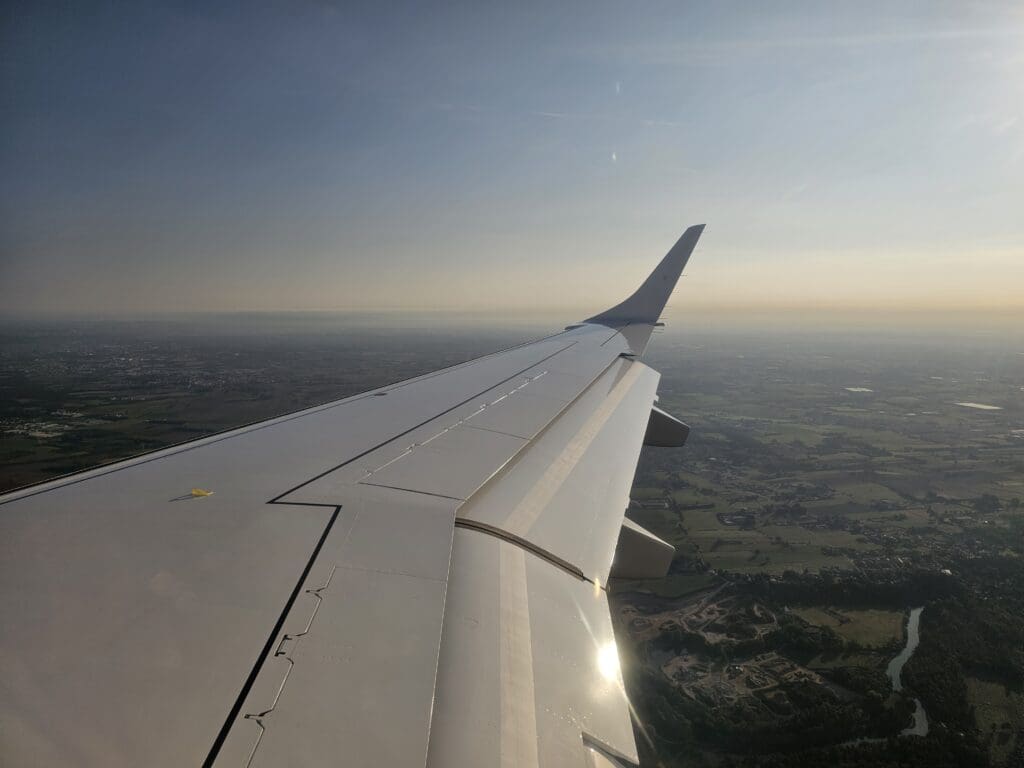
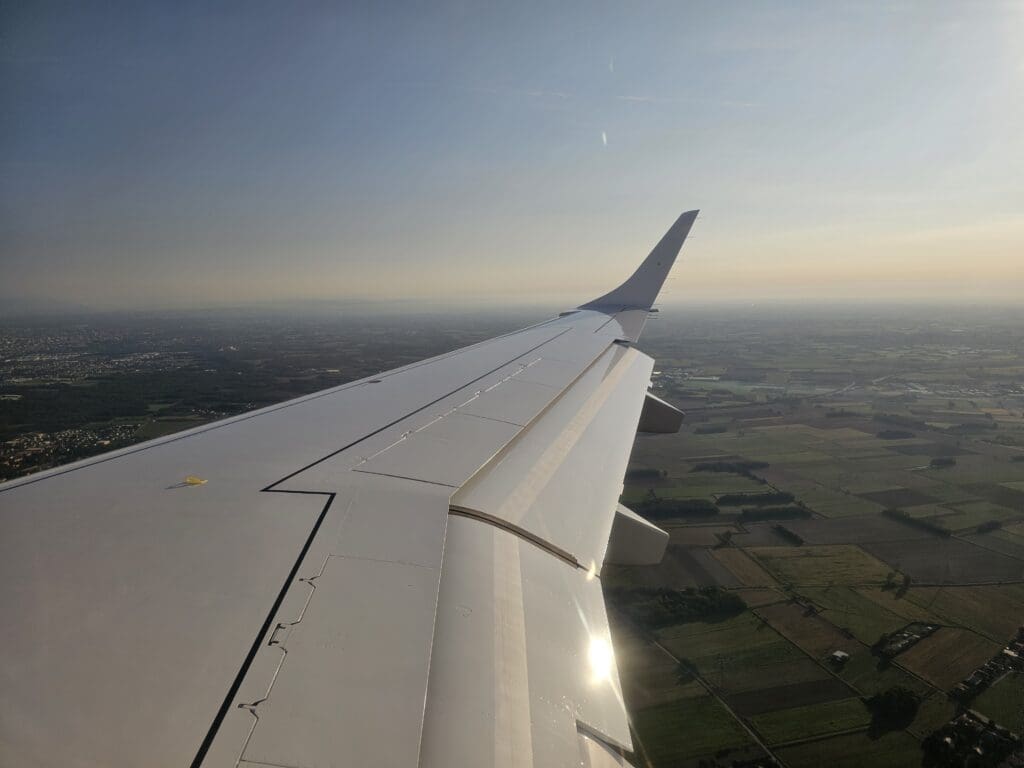
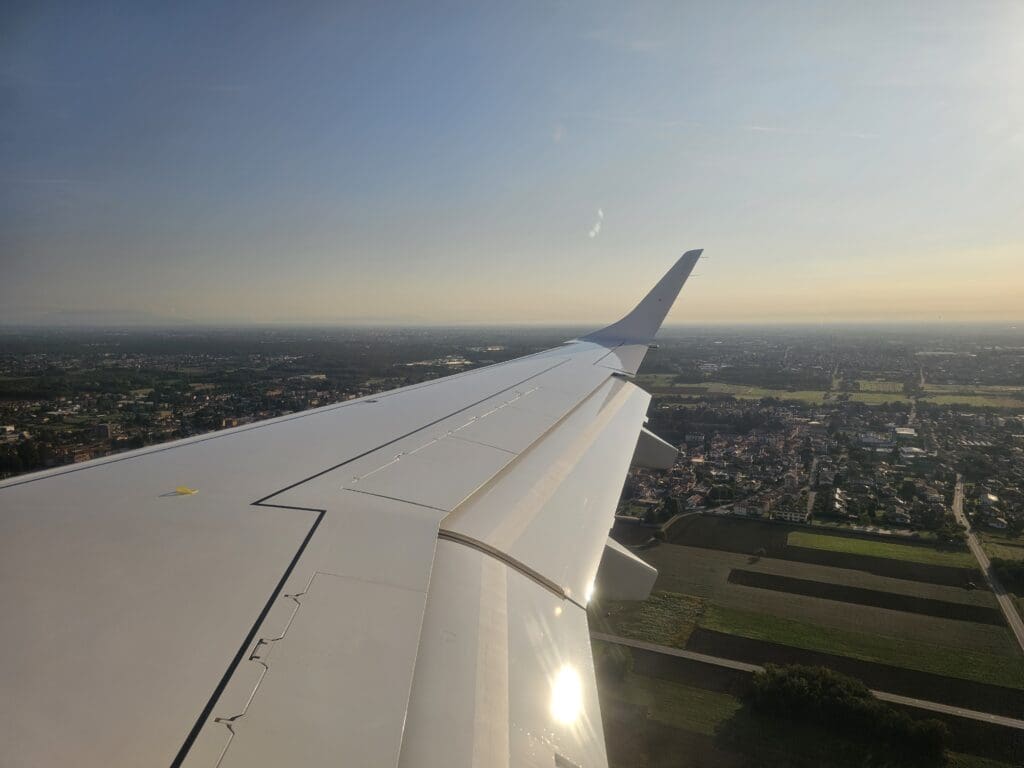
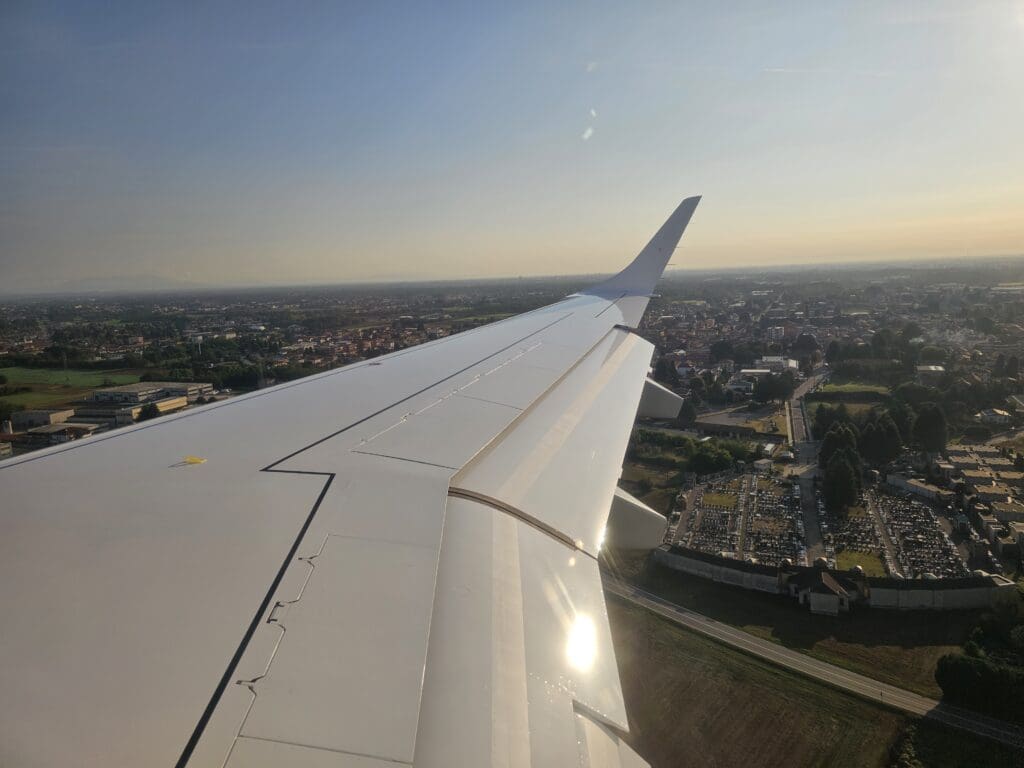
Once the crew had performed their final check of the cabin, the sprawl of Milan could be seen in the distance whilst we passed a series of towns to the west of the city such as Vigevano, Trecate, Magenta and Castano Primo at which point the gear could be felt and heard falling into position. Soon, the Embraer sank over Milan Malpensa’s southern perimeter and made a firm touchdown on the airport’s Runway 35R. Whilst sitting on the wrong side of the aircraft for any good views, I did spot two Vigili del Fuoco, or fire service, helicopters waiting for their next missions. With one taking the form of an AgustaWestland AW109, and the other a larger AW169.
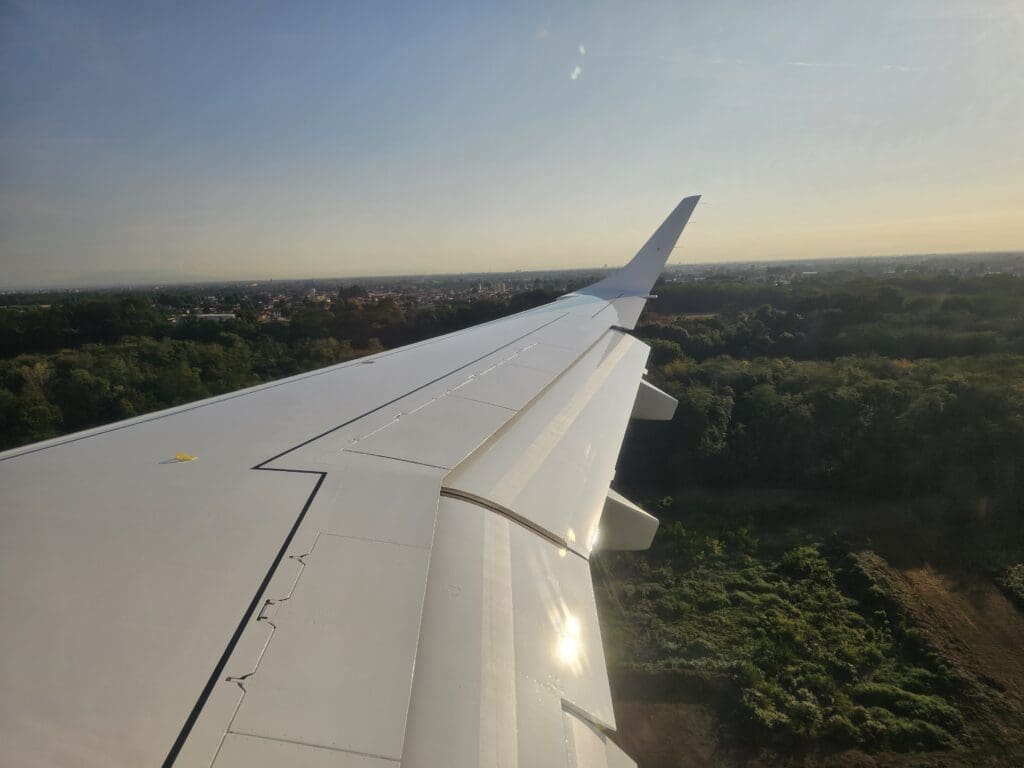
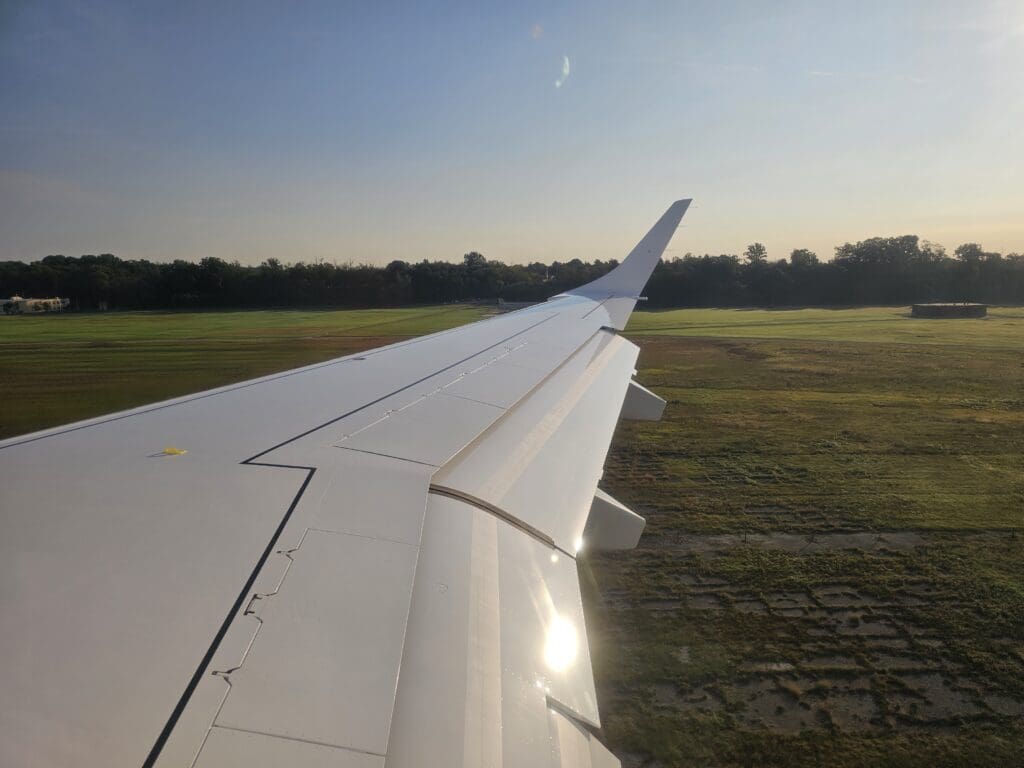
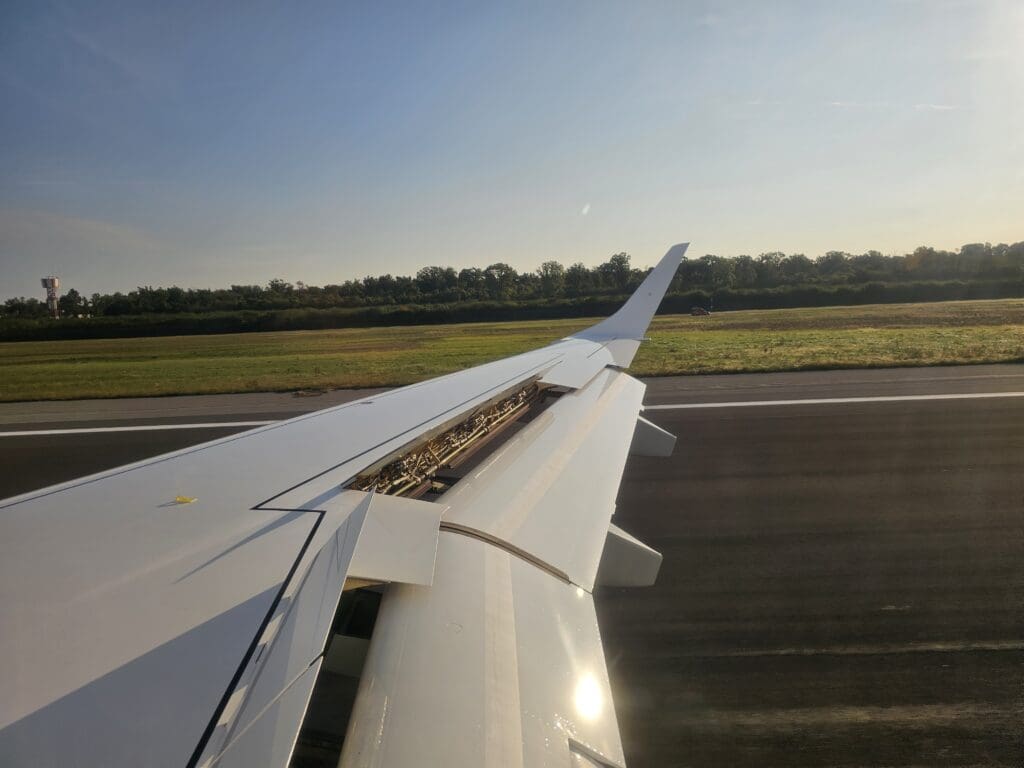
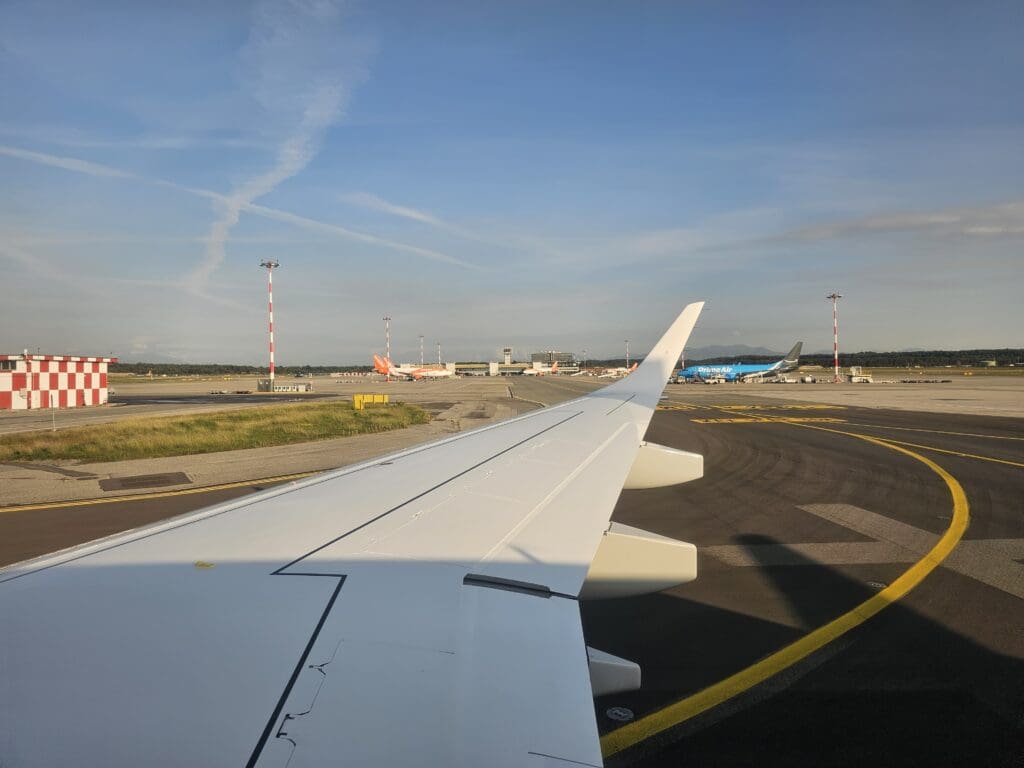
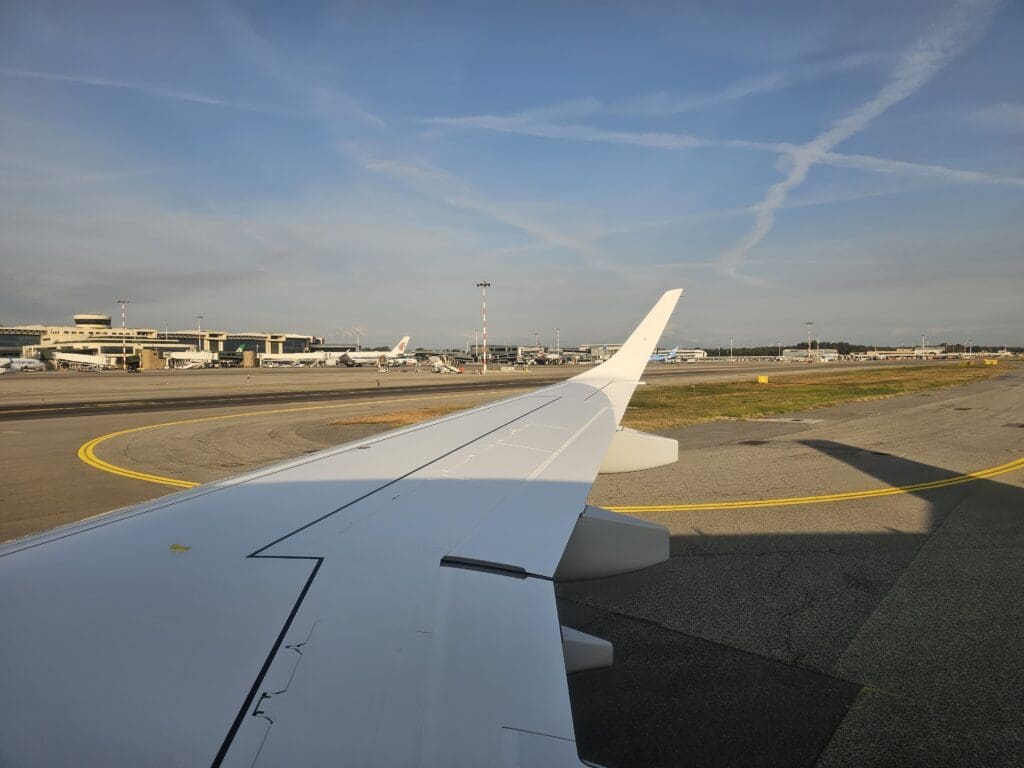
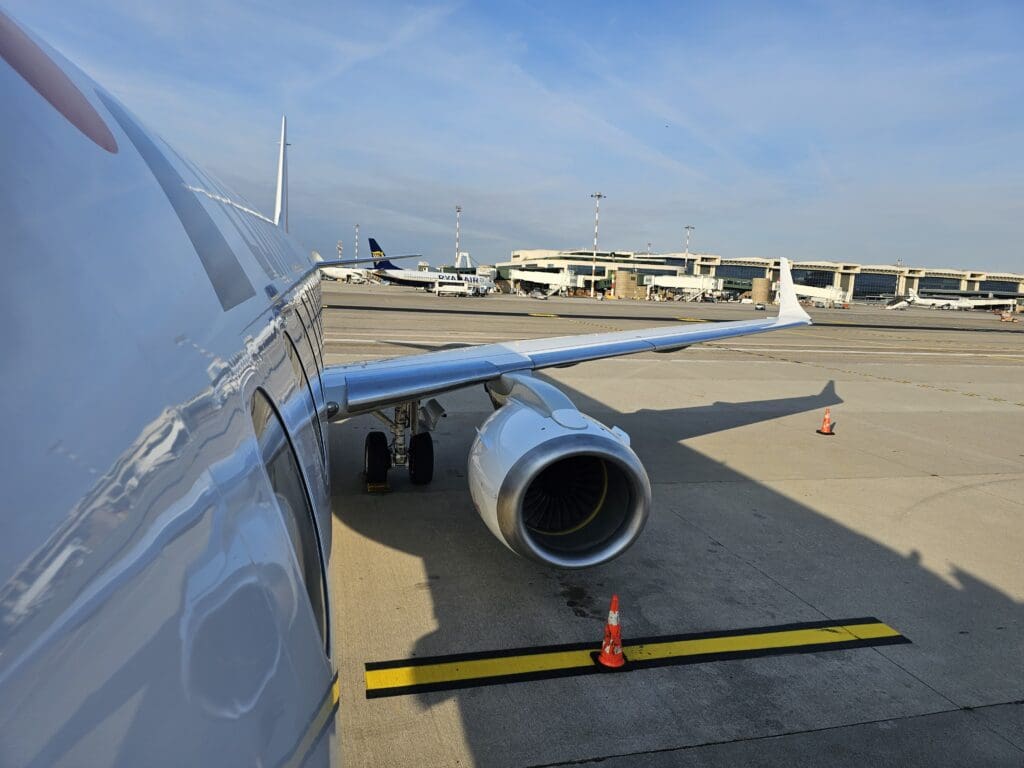
After vacating the runway, I was offered views of the diverse selection of airliners from across the world which could be seen waiting at the terminal’s B gates, which are used by those services to and from non-Schenghen destinations. Continuing onwards, following a short taxi the aircraft turned left and pulled into a remote stand where an army of equipment and staff members could be seen ready and waiting to tend to the flight. Once the engines spooled down many passengers stood up in an apparent rush to vacate the aircraft and thankfully for them, steps were positioned up to the L1 door fairly quickly and disembarkation soon commenced. Knowing that all passengers would be shuttled over to the terminal on one bus and seeing as I had plenty of time before my flight to Manchester, I sauntered off at a leisurely pace and after thanking the two flight attendants at the front of the aircraft, I disembarked and was hit by the chilly Northern Italian air blowing down from the Alps. Having been one of the last passengers to disembark the aircraft, the bus doors soon slid closed and we began a very short journey over to the terminal, bringing a close to my first flight with Lumiwings.
Summary
Reflecting on my experience, being an aviation enthusiast, I can’t deny that I was somewhat disappointed that the Boeing 737-300 that had been initially scheduled to operate the service was replaced by the modern Embraer just days before my flight. However, all-in-all, Lumiwings left me rather impressed thanks to their wonderful crew, the good complimentary service and the comfortable, modern and clean cabin of the Embraer. Furthermore, I also cannot fault Foggia Airport and I faced no issues at all during my short stay there that morning. Whilst it is unlikely that I will fly with Lumiwings again any time soon, were the need to do so arise, I would happily fly with the airline again.