Riding a Boeing 737 Classic Across the Adriatic: Forli to Tirana with Albawings
Background
Having been a common feature across the skies of Europe in not-too-distant times, traditionalists may argue that the Boeing 737 Classic (i.e. the -300/400/500 series) may not yet be considered to be a rare aircraft. However, as of 2022, flying onboard a Boeing 737 Classic across much of the world is not a particularly easy task with just a small handful of carriers operating the type, with the pandemic having done little to help slow their retirement. However, for those eager to fly on such Classics, several continue to operate these venerable jets in the skies of Europe.
Based in the UK, in recent years local low-cost carrier Jet2 has provided the easiest means of flying onboard a Boeing 737 Classic and back in January 2020, I made my first trip with the airline, flying from Paris to Leeds Bradford onboard one of their Boeing 737-300s. Today, the carrier continues to operate a small number of such aircraft, with these primarily flying routes from their bases in Belfast and Leeds Bradford. Meanwhile, Copenhagen Air Taxi operates charter services with two Boeing 737-400s under the recently established Airseven brand. Frequently seen flying between Denmark and the Canary Islands, the carrier operates some of the longest Boeing 737 Classic services in the world. Unfortunately, with these being charter flights, I was unable to find any means of booking these as a standalone flight-only deal.
The focus of this trip report however will be Albanian low-cost carrier, Albawings, who operate a fleet of three Boeing 737-400s from their base in the country’s capital, Tirana. As per the carrier’s 2022 schedules, these classic jets are deployed on routes from Albanian to destinations across Italy, also visiting London Stansted during the summer months. Having wanted to visit Albania for a while, Albawings provided me with the motivation to finally do so, able to combine this trip with a flight onboard an increasingly rare aircraft type. Of the airline’s flights, Albawings’ Stansted service would have proven to be the most logical, however, prices for this appeared to be significantly higher than for their Italian flights, not to mention that I intended to fly over the Easter weekend in April, before the summer recommencement of their London services. Once I had examined Albawings’ schedules and ticket prices, I decided that I would fly from Bologna to Tirana on their Friday afternoon service.
Booking
Seeing no point in not booking directly with Albawings, I made my way to the airline’s website and soon arrived at the flight search engine. Once I had inputted all the required details, I was presented with the sole flight between Bologna and Tirana that day. This was set to depart at 1430 and come to a halt on Albanian soil an hour and thirty minutes later at 1600. Once I had clicked on this option, I was offered two fare options – Value and Flex, priced at €55.99 and €80.99 respectively. Deciding on the former, I clicked on this before being whisked off to enter my details. Despite Albawings’ status as a low cost carrier, my ticket included a complimentary luggage allowance of 20kg and free seat selection in much of the cabin. Once I had entered my details, I was taken to the optional extras page where I could select a seat, add additional luggage, protect my trip with cancellation protection and reserve space in the cabin for an animal companion. Only interested in the seat reservation option, I clicked on this and was soon presented with a mostly empty seat map. As mentioned, most seats in the cabin could be reserved without an additional fee, the exception being extra-legroom seats, referred to by Albawings as ‘Comfort Seats’ (i.e. the bulkhead and two emergency exit rows) which could be reserved for €20, as well as the and the four rows behind the bulkhead row which could be selected for €10. Opting for Seat 20F, I selected this before going ahead and paying for my booking, after which I received my booking confirmation instantly by email.
Once I had successfully booked my ticket with Albawings, I then began looking at options for reaching Bologna in time for my afternoon flight to Albania. Whilst it would have been nice to spend some time in the capital of Emilia-Romanga, unfortunately, a combination of time and money, or rather a lack of both, meant that I decided that I would fly down to Italy on one of the two early morning services from London. One of these was an EasyJet flight from London Gatwick, and the other a Ryanair service from London Stansted. In the end, I settled on the former owing to its slightly cheaper cost, leaving me with over four hours in between flights at Bologna Airport.
However, several weeks after booking, I received an email from EasyJet informing me that my flight had been cancelled and I was given the option of booking on the same morning service albeit on the preceding day. With the Ryanair flight having now risen significantly in cost, I rejected the option of a refund and after some deliberation decided to add a day onto my trip. Unfortunately, matters were complicated further when Albawings undertook a similar move and cancelled my flight from Bologna, booking me onto their afternoon service from Forlì which would also depart on the preceding day. This left me with a total of four hours and forty minutes between arriving at Bologna Airport and departing from Forlì Airport. Furthermore, this also meant that my pre-selected seat had been cancelled, and I was unable to select a new seat on the Forlì flight. With Google Maps informing me that this journey could be done in under two hours, I decided to go ahead rather than cancelling the entire trip in the hope that my flight down from London would arrive punctually and that I would be able to sail through immigration in Bologna before darting off to Forli.
Check-In
Given the whole pre-flight fiasco, I did not have high hopes for online check-in, which opens up for Albawings’ passengers a total of fifteen days before departure. However, not realising this, I entered my name and booking reference into the website three days before my flight and commenced the check-in process. With no passport data required, and no documents needing to be uploaded, I was able to skip through this quickly and with little fuss. To my delight, this allowed me to select my own seat and so I opted for Seat 23A, one of the relatively few window seats remaining at the time I checked in. Once I had done this, check-in was complete and I soon received my boarding pass for the flight via email.
The Journey
On the day of my voyage to Albania, my journey to Forlì had not been entirely smooth and I had ended up worrying at various points as to whether I would make it to the airport in time for my flight on the rare Boeing 737 Classic. As had been well documented, during Easter 2022, as with many airlines, EasyJet had suffered from Covid-related staff absences and in the week before my flight between London Gatwick and Bologna, this service had been chopped on multiple days. Fortunately, this service was not cancelled on my departure day although the Airbus A319 operating this took to the skies bound for Bologna almost an hour behind schedule. With this decreasing my time between flights, I spent much of the hour and forty-minute flight worrying that I would not make it to Bologna Centrale Station in time for my train to Forlì. Thankfully, once on the ground, I sailed through Bologna Airport however a thirty-minute wait was in store for the Marconi Express, the monorail service that connects the airport to Bologna Centrale Station and set me back a whopping €9.20 for the one-way journey!
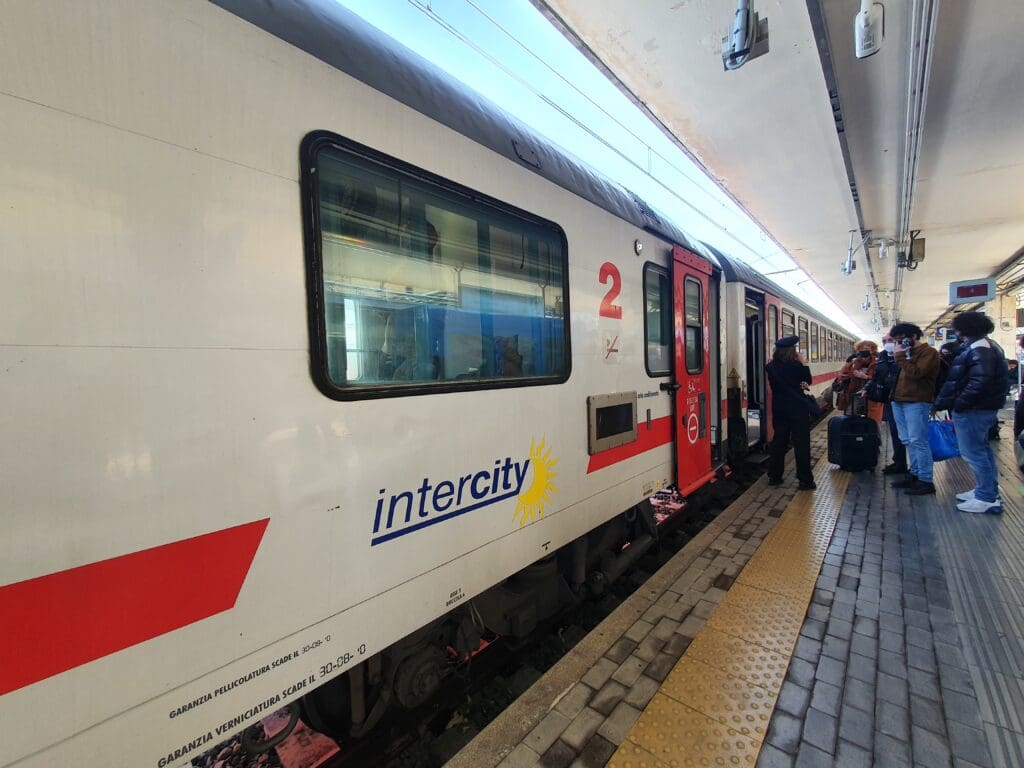
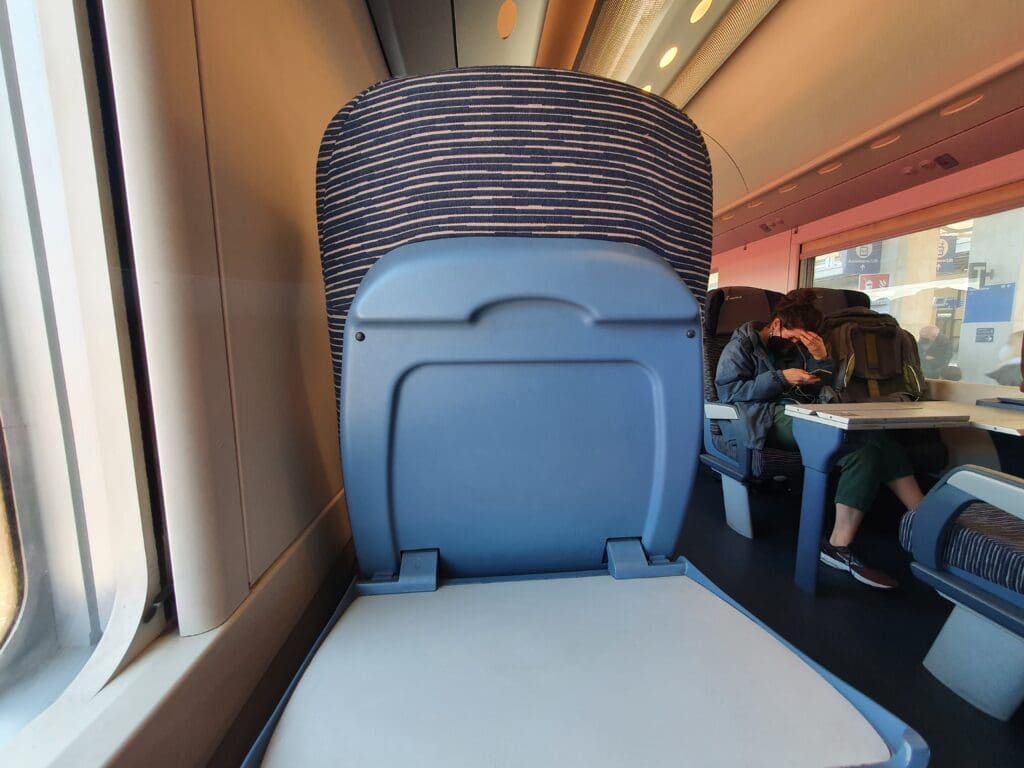
Following an eight-minute ride squished into an absolutely packed minuscule monorail carriage, I arrived at Bologna Centrale with about twenty minutes to go until the departure of the 1200 Intercity service which was bound for the city of Lecce at the other end of the country. Easily and swiftly purchasing a €10 ticket for this on Trenitalia’s app, I made my way through Bologna’s maze-like station and arrived at the platform with about fifteen minutes to go until departure. With the train service commencing its journey in Bologna, upon arriving there, a long rake of somewhat battered and retro-looking carriages could be seen waiting at the platform and I thus boarded the train without delay. To my delight, despite its dated-looking exterior, inside I found the train to be clean, modern and comfortable, with the seats arranged in a 1-2 configuration more atypical of first class back in the UK! Adding to my nerves, the train pulled away from Bologna four minutes behind schedule before crawling through the city’s suburbs at a slow pace and not seeming to pick up much speed as it crossed through the countryside that sits between Bologna and Forlì. Whilst this train ride should have taken 37 minutes, that lunchtime this ended up taking a little under an hour.
As airports go, Forlì Airport does not sit a particularly long way away from the centre of the city that it serves – around 3.5 kilometres to be precise. For those arriving by rail and departing by air, or vice versa, two bus routes run between the city’s main station and its airport, with both of these taking around fifteen minutes to complete the journey. Meanwhile, alternatives come in the form of a ten-minute taxi ride, or an hour-long walk. Travelling on a budget, I intended on utilising the bus for the final portion of the journey to Forlì Airport and so after arriving I made my way through the station’s small yet ornate ticket hall and headed over to the bus shelters. However, after over ten minutes of waiting and no sign of an airport-bound bus, I ended up making my way over to the taxi stand where I jumped in a taxi which transported me over to the airport in around ten minutes. Following a far-from-smooth journey, the taxi pulled up outside of Forlì Airport’s small terminal building with around an hour and a half prior to go until the scheduled departure time of my flight across to Tirana.
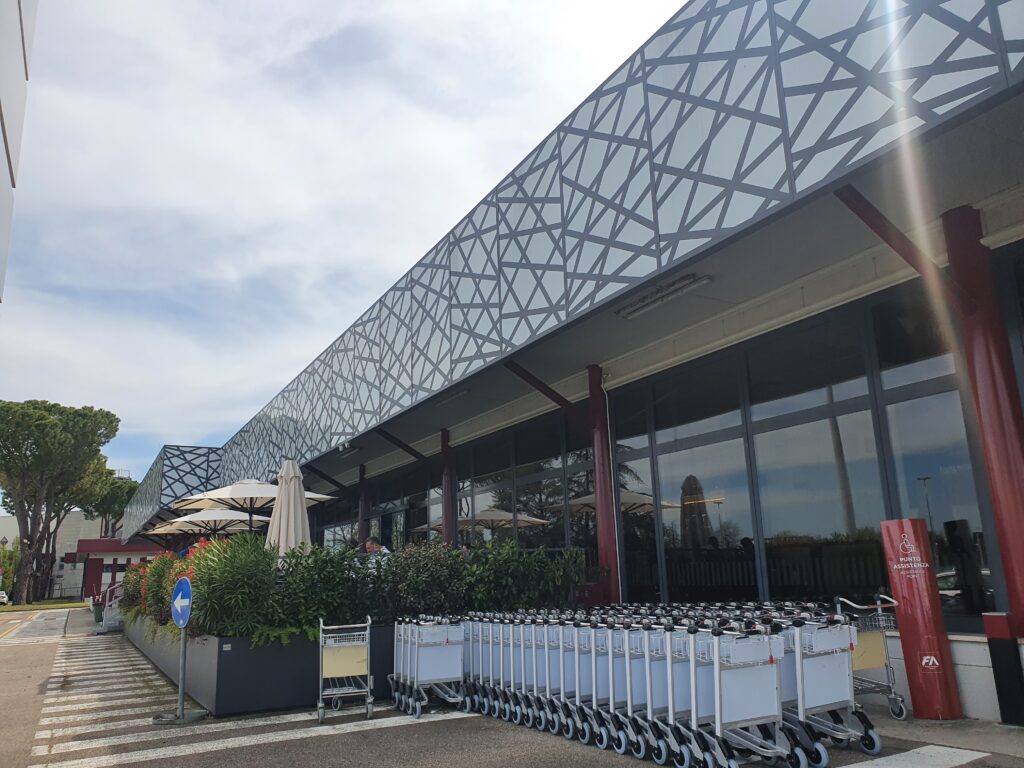
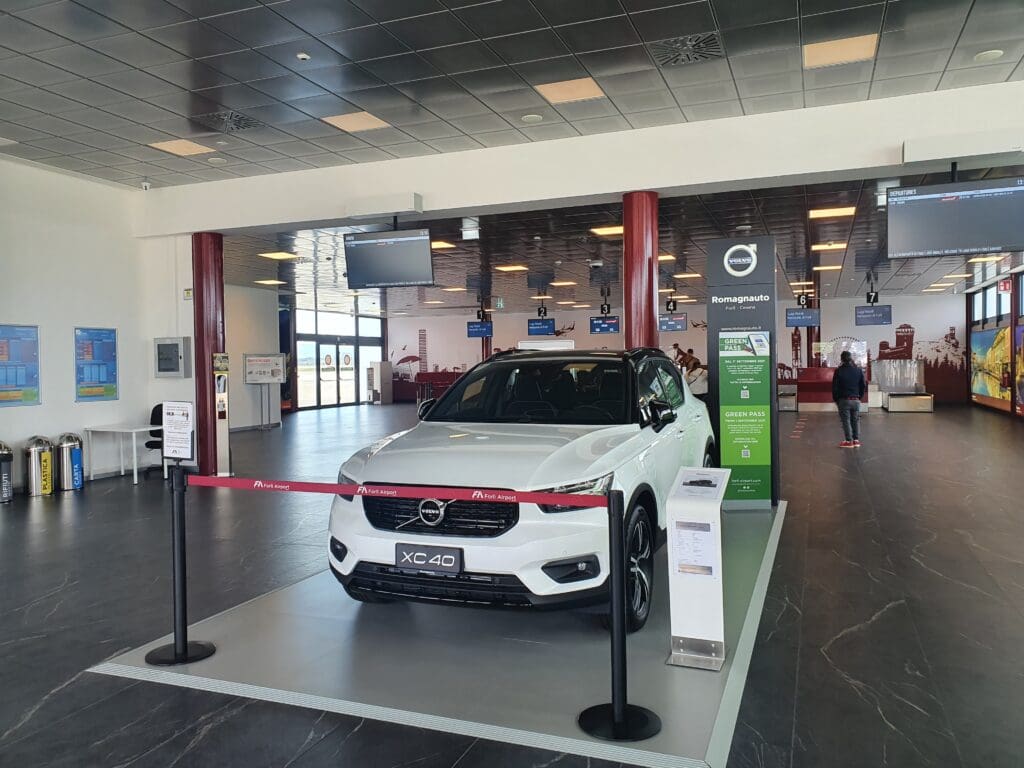
Whilst I do not usually like to cut things so fine, given the terminal’s small size and the fact that the Albawings’ thrice weekly service to Tirana was the only scheduled passenger service to serve Forlì at that time, despite my late arrival I did not foresee any issues with catching my flight that afternoon. Once I had paid the extortionate €15 fare to my taxi driver, I got out of the car and stopped for a few moments to admire Forlì Airport’s terminal building. Admittedly, it would be hard to claim that the exterior of this serves to be an architectural masterpiece, instead taking the form of a rather nondescript-looking small single-story building. Upon entering the terminal I was greeted by a brand new and shiny Volvo XC40 on display, behind which the terminal’s seven check-in desks could be seen. Of these, at that time three were staffed by Albawings staff, all dressed smartly in the airline’s mostly grey ground crew uniform.
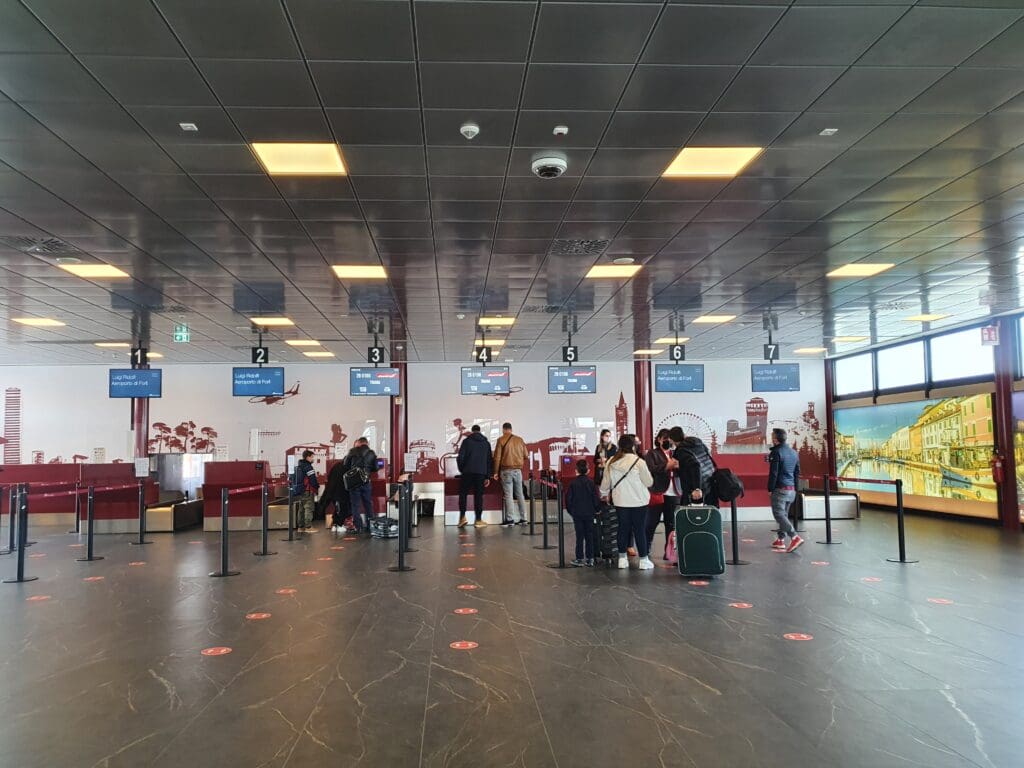
Seeing as I had checked in online and lacked any luggage to check-in, upon arriving in the terminal I did not have any particular reason to head to the check-in desks. However, fancying a paper boarding pass, I decided to join one of the very short queues and upon doing so another Albawings agent checked my vaccination documents. Once at the counter, a friendly and helpful check-in agent went through my stay in Albania, requesting the date that I would leave the country and had a quick flick through my passport before printing off my boarding pass and handing this over to me. Given the likely high amount that Albawings seems to have invested in smart uniforms for their ground crew, I was very slightly disappointed to see that this was printed on a blank boarding card as opposed to an Albawings-branded boarding pass. However, this is most definitely not something that I would imagine that many passengers complain about, and overall my interactions with two of Albawings’ Forlì-based staff were highly positive.
Other than the check-in desks, on-display car and toilets, Forlì Airport’s compact landside area also features a café and an adjoining small kiosk selling a range of drinks and snacks, with tables and chairs laid out next to these, offering a dedicated area for patrons to savour their purchases. That afternoon, this appeared to be relatively busy, although judging by the reflective jackets sported by many of those enjoying a late lunch, at that time it appeared to be a popular staff hangout. Despite being a little parched, hoping that a similar offering would be provided in the airside portion of the terminal, I decided to make a beeline for security without stopping for some refreshments. For some reason, the security area is located in perhaps the most interestingly designed part of the terminal, featuring a high ceiling painted blue and sporting tens of yellow stars. After another short wait, I made my way through the checkpoint without any issues and was pointed in the direction of passport control by a police officer watching over the security checks. As I neared these, two customs officials requested to know how much cash I was carrying, before being given the all-clear to head to passport control. Once again, another short wait was required after which I was greeted by an unusually friendly immigration officer. Admittedly they were a little stumped as to why I had arrived at a different Italian airport several hours earlier, however, a quick bit of explaining did the trick and I was soon stamped out of Italy. On that note, that afternoon I should mention that all staff members I interacted with on the ground were incredibly friendly – something that seems to be far more common at small homely airports compared to major international hubs.
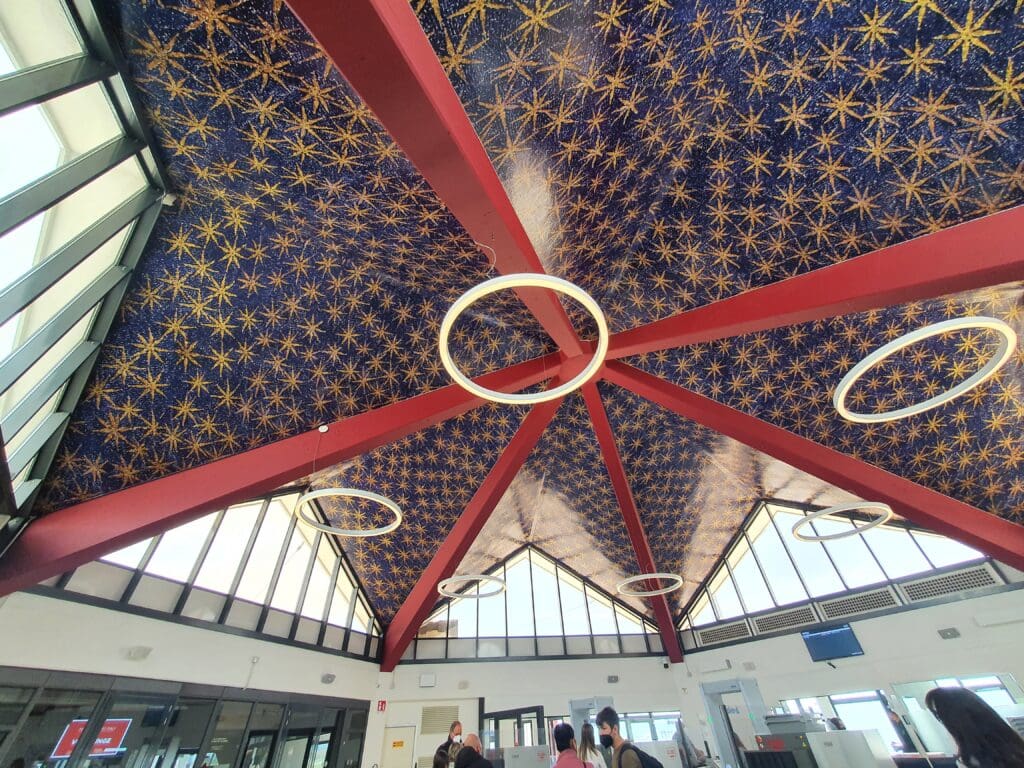
Once airside, it became evident that this portion of the terminal was most certainly not designed for any long waits. This consisted of nothing but a hall with a relatively small number of benches, a drinks and snacks vending machine and another for hot drinks, toilets and a very small number of plug sockets – with this appearing to be more akin to a bus terminal rather than an international airport. However, on the plus side, large windows along one side of this provided a good view of the apron and runway, where for the duration of my stay Diamond and Piper aircraft belonging to the local flying school, Professione Volare, could be seen passing by. Meanwhile, the terminal appeared to be in a clean state and fast complimentary wifi was also provided which I found to work well. Inside, I managed to spot large adverts and several bits of equipment belonging to the now defunct EGO Airways – a short-lived company that never commenced commercial flights, as well as Greek airline Lumiwings who appear to have halted their scheduled operations since the start of the pandemic. In dire need of a drink, as soon as I arrived I made my way over to the vending machine however I was let down to find that this only accepted coins rather than notes and cards. Defeated, I sat down on one of the few remaining empty seats.
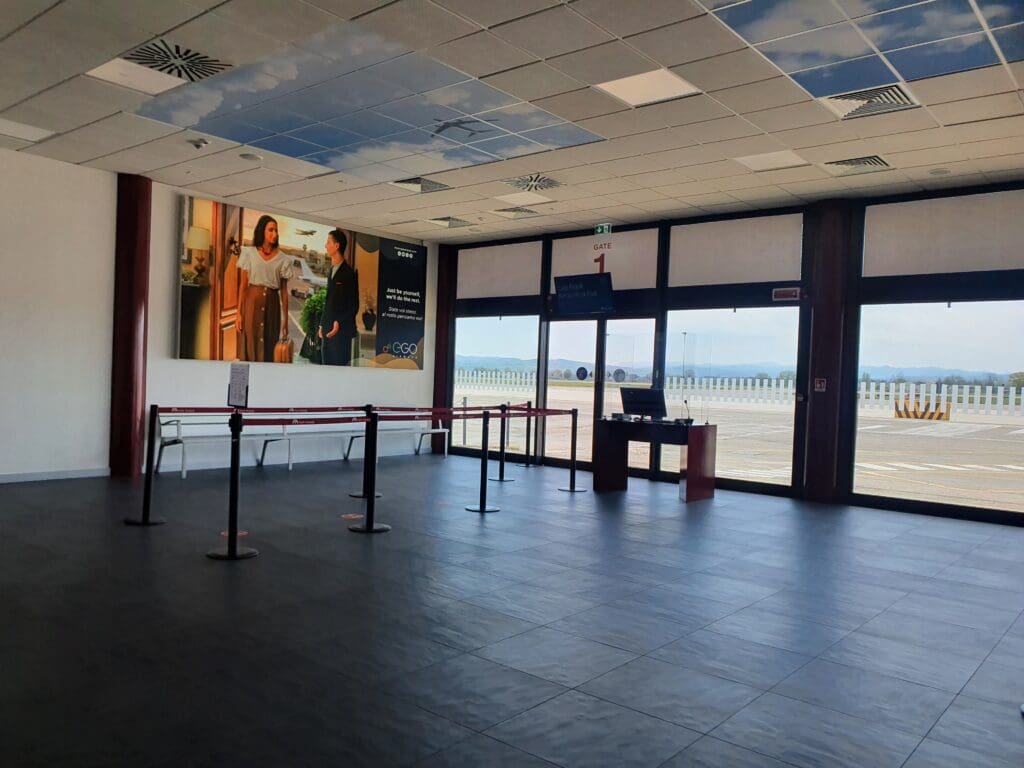
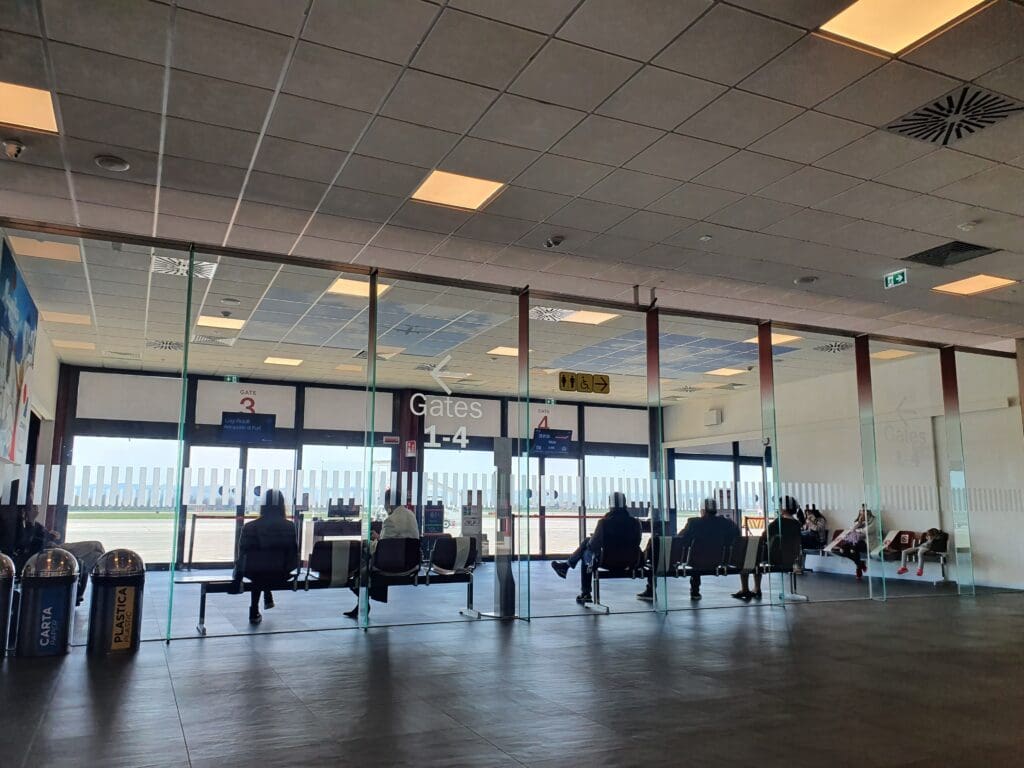
As time passed, the terminal filled up and it became clear that the flight across to Tirana would likely be full. As was to be expected given the fact that it was the start of the Easter holidays, many of those travelling took the form of Italian-Albanian families returning to Albania to visit relatives over the short break. During this time, announcements were made every ten minutes or so in Italian and English requesting Tirana-bound passengers to head through to security. Whilst the inbound aircraft had been scheduled to arrive in Forlì at 1330, outside nothing could be seen during the first part of my wait other than the locally based aforementioned light aircraft. However, as if tracking the inbound flight’s progress, at 1410 several passengers in the terminal flocked to the windows and a couple of minutes later the distinctive red and white liveried Albawings Boeing 737 Classic touched down on Runway 12. At this point, perhaps in a rush to get people from the landside to the airside portion of the terminal, an announcement was made informing passengers that boarding would be commencing shortly.

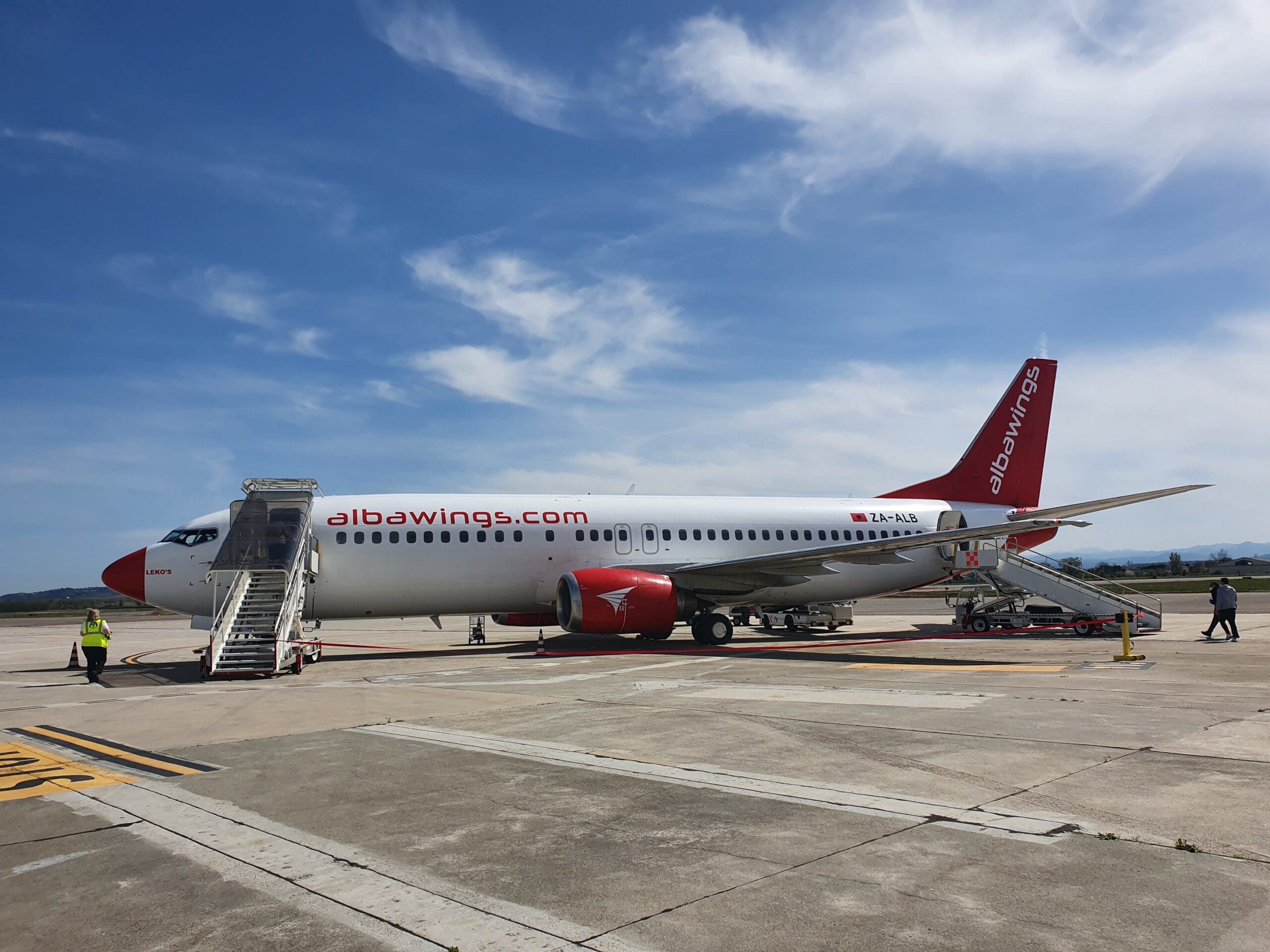
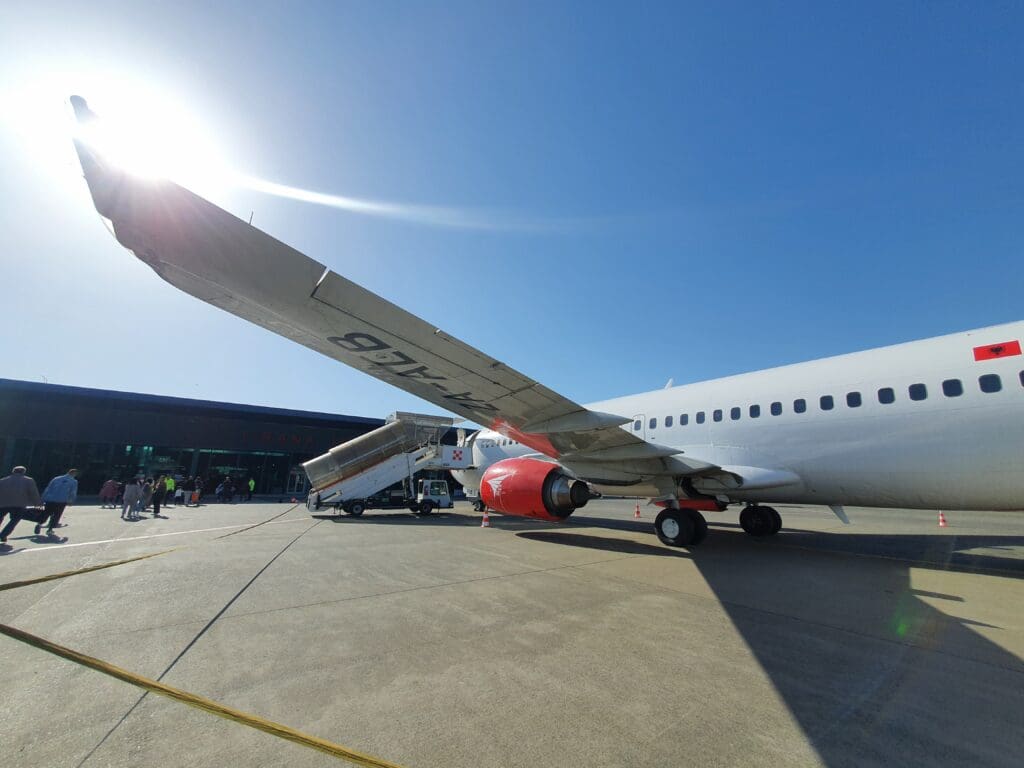
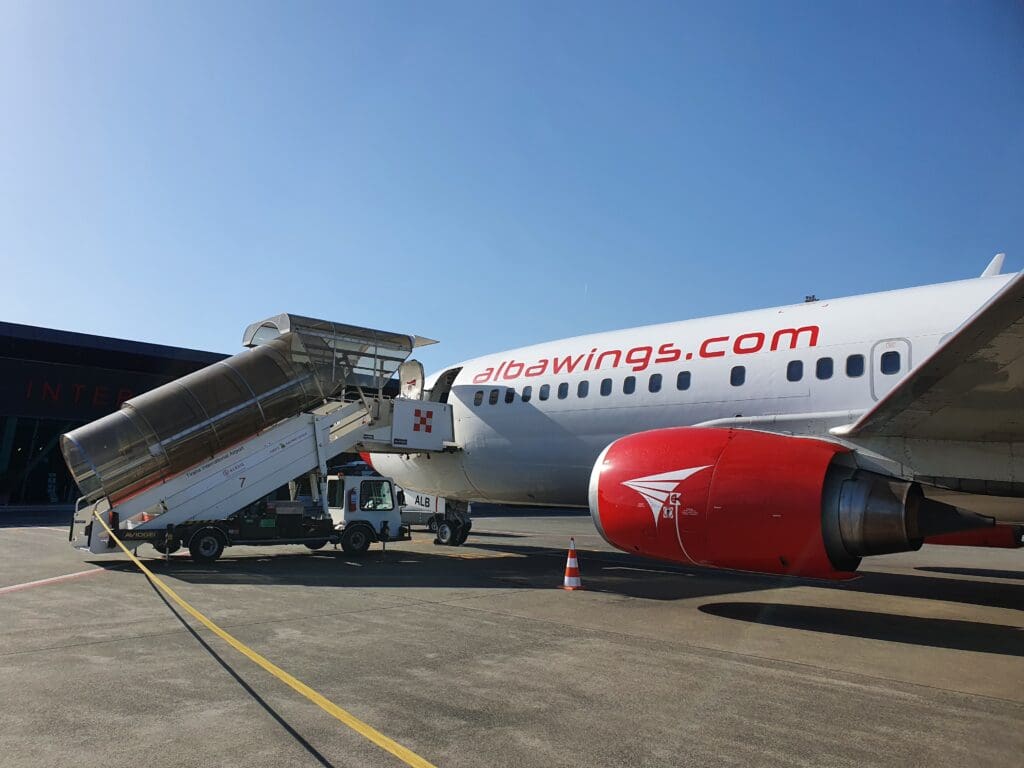
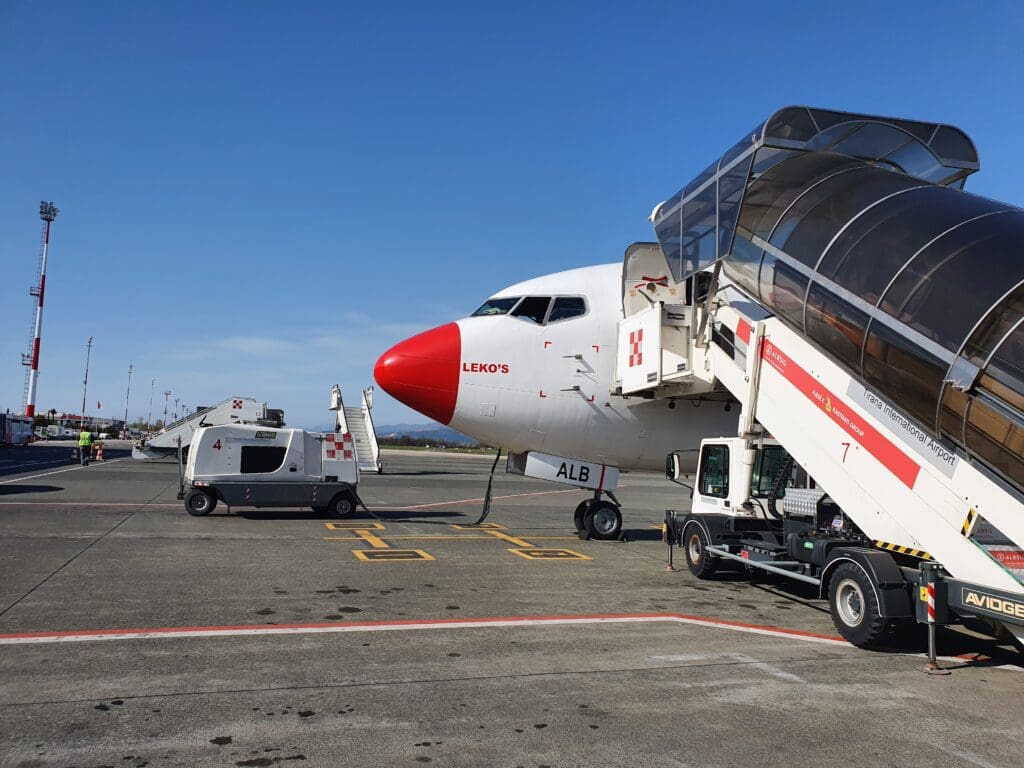
A couple of minutes or so after the aircraft had landed, the sound of screaming children in the departures hall was temporarily muffled by the noise of the Boeing’s two jet engines as the aircraft came to a halt directly outside the terminal at Stand 205. This particular aircraft took the form of ‘Zeko’s’, a Boeing 737-46J bearing the registration ZA-ALB. Assembled at Boeing’s facility in Renton with the line number 2465, this aircraft first took to the skies in April 1993, making it almost exactly 29 years old and the youngest aircraft in Albawings’ three-strong fleet although the aircraft has still enjoyed a very diverse career before its life in Albania. Boeing enthusiasts may be able to tell from the customer code that this aircraft commenced its commercial life with Air Berlin where it flew across Europe as D-ABAE. Painted in Air Berlin’s white, brown and silver colours, the aircraft continued in this role until May 1999 when it headed southeast to Greece and entered service with the country’s Macedonian Airlines as SX-BMA. The aircraft remained there until Macedonian Airlines’ operations were amalgamated into those of its parent carrier, Olympic Airlines, in early 2003, and in June 2004 the aircraft began a new life with Italian low-cost carrier Air One as EI-DGL. However this did not last long, and in 2008 the aircraft was returned to its lessor before it received the bright lime green colours of Russian low-cost giant S7 Airlines at Bournemouth Airport, and entered service with the carrier’s subsidiary Globus Airlines in December 2008 as VP-BQG. In March 2015, the aircraft was placed into storage before being delivered to Slovakian ACMI specialist Go2Sky in June of that year as OM-GTD. There, it operated charters across Europe and spent significant periods flying for Austrian carrier Niki – receiving the carrier’s basic titles, and Cape Verdean national airline, TACV. However, with Go2Sky shifting its focus to an all-Boeing 737-800 fleet, the aircraft was placed into storage in late 2018 with the Manx registration of M-ABLR. Fortunately, this did not last long, and by the end of the year, the aircraft had entered service with Albawings. In the week before my flight, the aircraft had undertaken nineteen short hops between its base in Tirana and cities across Italy – namely Ancona, Bari, Forlì, Perugia, Venice and Verona, travelling over 7,700 miles in the process.
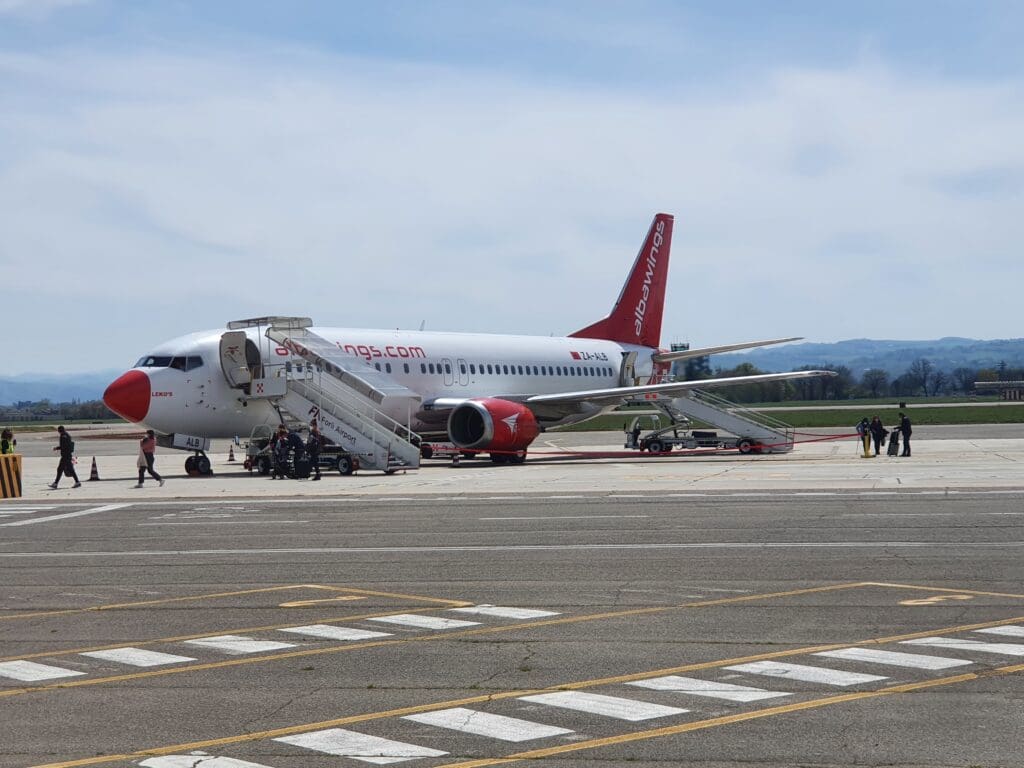
Once the aircraft came to a halt, the seemingly small number of Forlì bound passengers disembarked and made their way over to the arrivals portion of the terminal whilst Albania-bound passengers’ bags could be seen being towed out to the waiting jet. By this time, passengers could be seen crowding around the two gates to be used for boarding – 4 and 6. Interestingly, Gate 4 was to be used by those passengers boarding via the front steps, and gate 6 was to be used by those boarding at the rear of the aircraft. Travelling in Seat 23A I found myself waiting at the latter gate. At 1435, a boarding announcement was made throughout the terminal in Italian and English. This was not done in any order, with no particular groups of passengers invited to board first, although the gate agents did appear to let those travelling with young children head out to the aircraft first, so long as they were able to push past the hoards of eager flyers waiting at the two gates. Following a short wait, I had my boarding pass scanned and torn, with the stub returned to me, and my passport quickly checked before I made my way out into the pleasant Italian afternoon sunshine and walked over to the red and white Boeing 737.
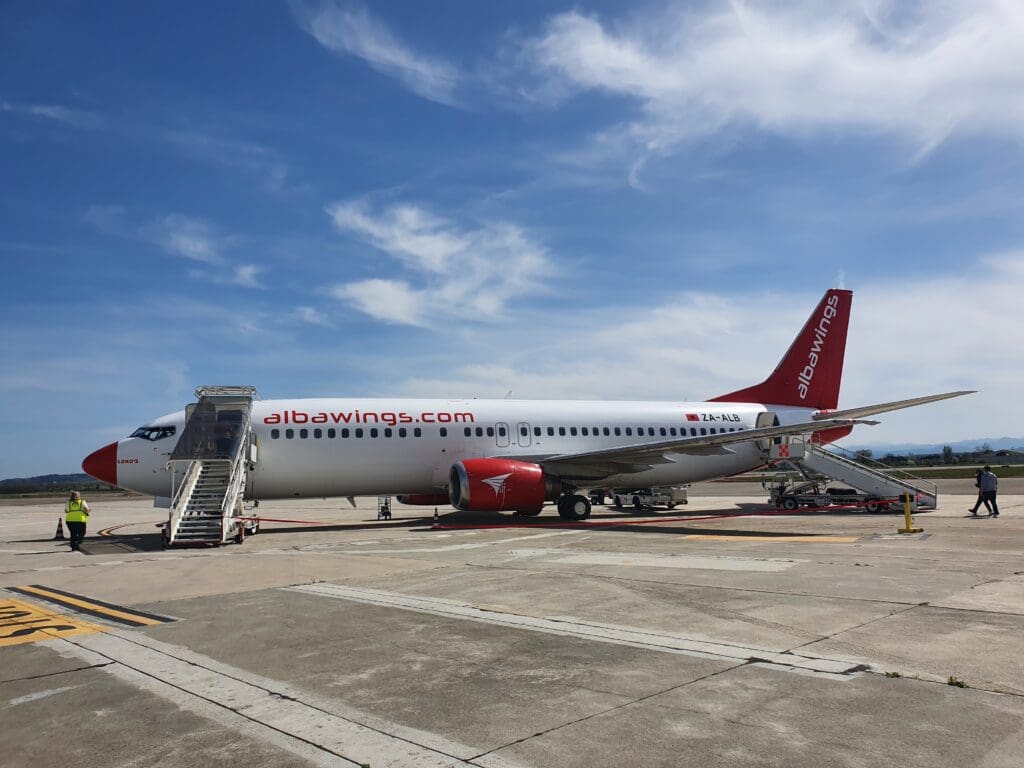
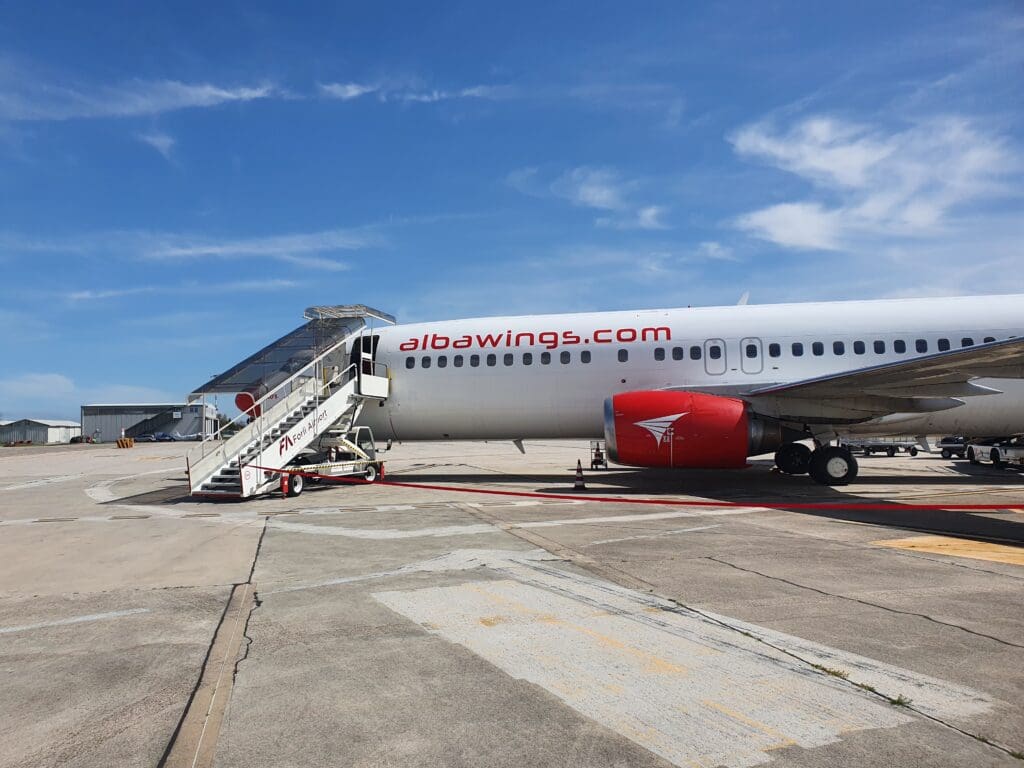

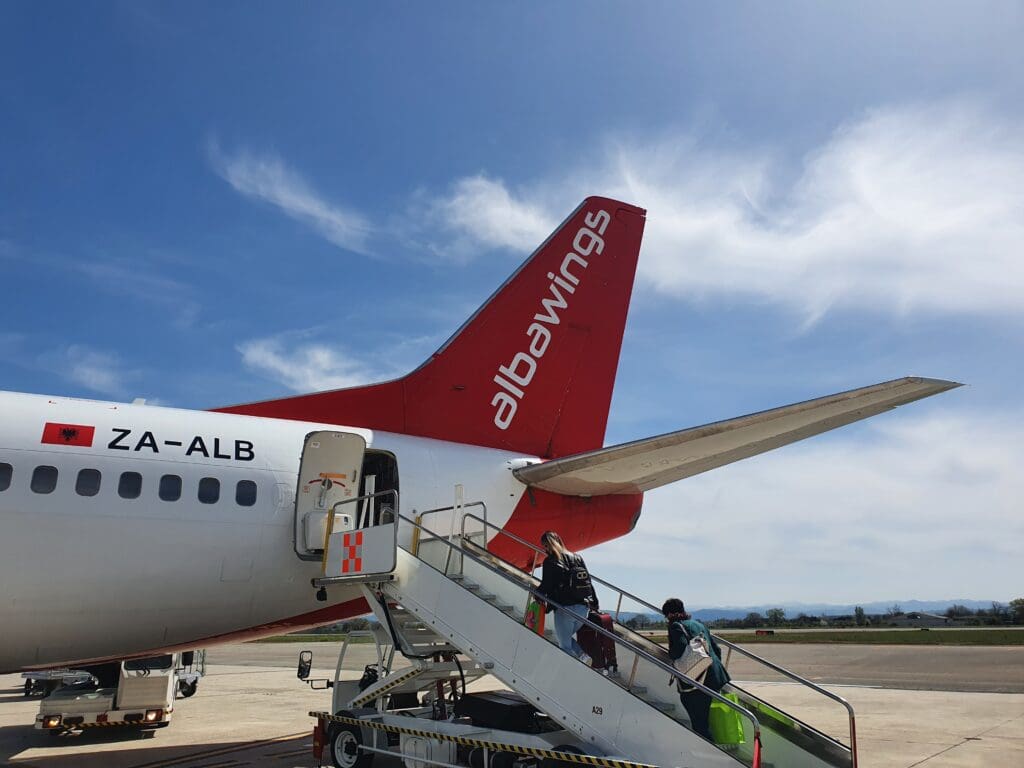
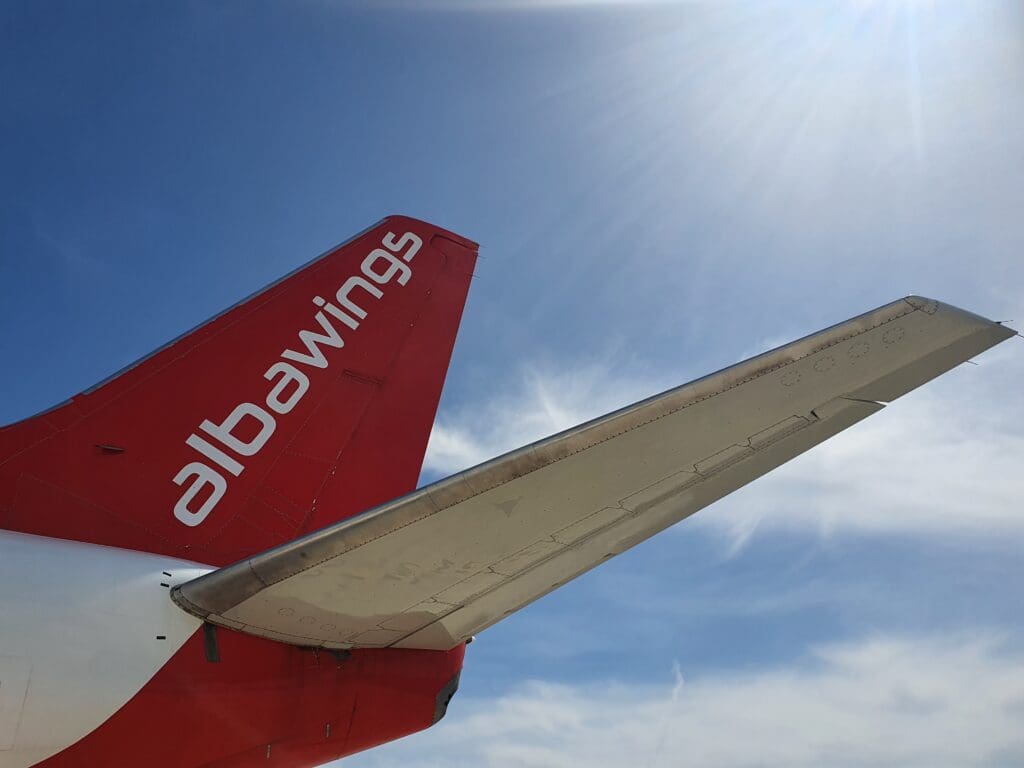
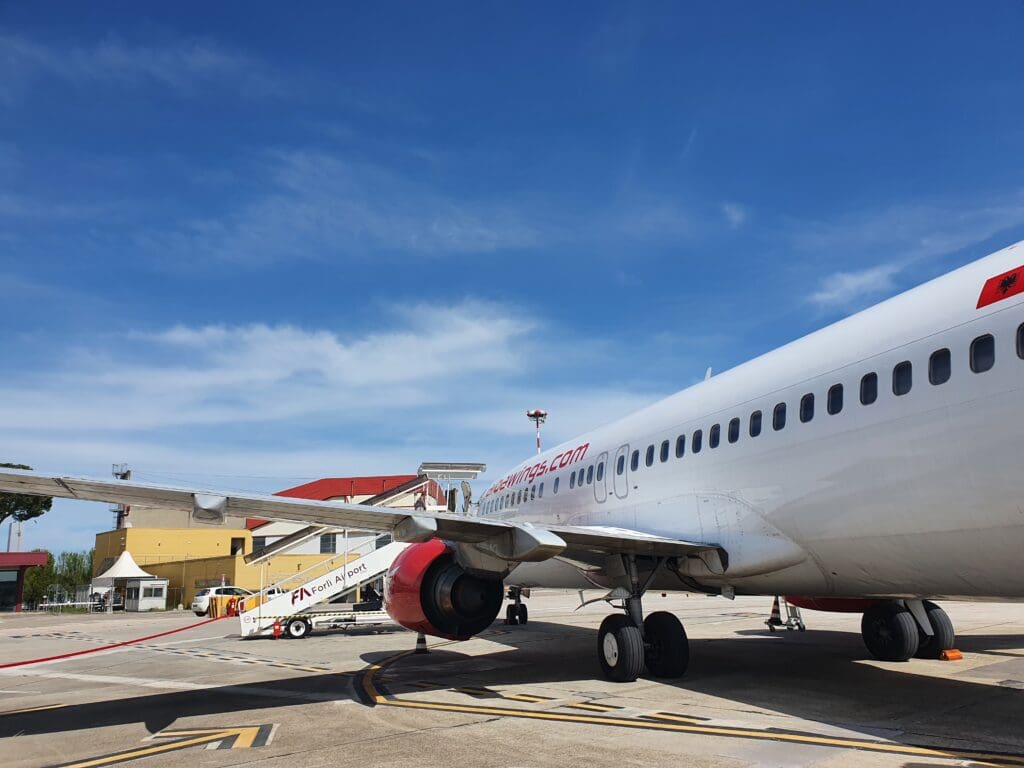
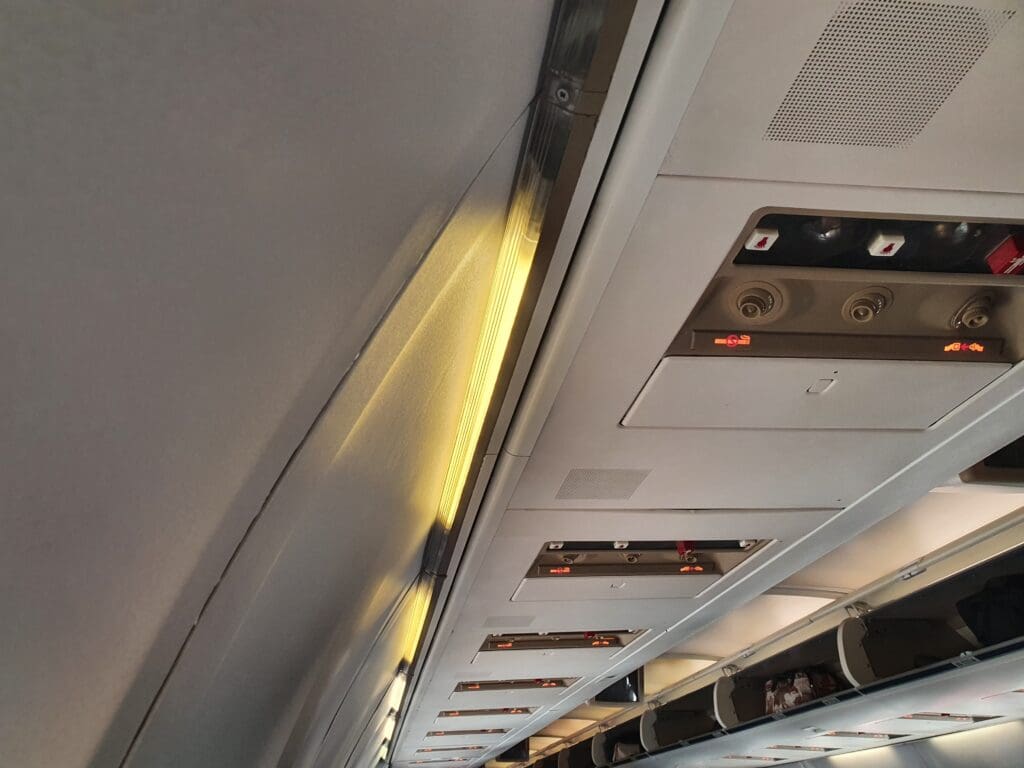
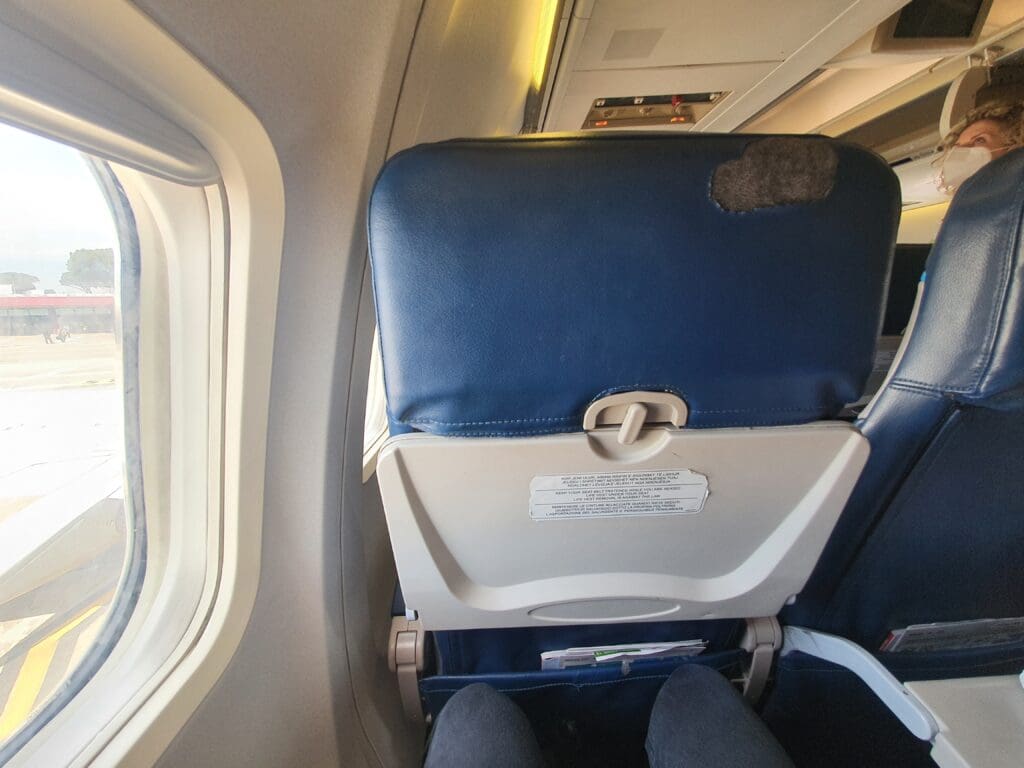
After taking several photos, I climbed up the steps at the rear of the aircraft and stepped into the jet’s rear galley where I received a lukewarm greeting in Albanian by one of the four flight attendants, receiving another from a fellow crew member just after entering the cabin. Onboard, the aircraft features an all-economy configuration, with each of the jet’s 167 seats covered in mostly dark blue (faux?) leather covers with patches of light blue and grey. It is worth noting that this interior is unique to this particular aircraft, with at least one of Albawings’ other two aircraft featuring grey and red seat covers in line with the airline’s branding. Above the aisle, a total of five very vintage-looking overhead televisions could be seen hanging down, however, these are simply the remnants of a previous operator and are not utilised by Albawings. Meanwhile, the slightly orangey tinge of the cabin lighting and the retro-looking passenger service units also served to allude to the aircraft’s old age.
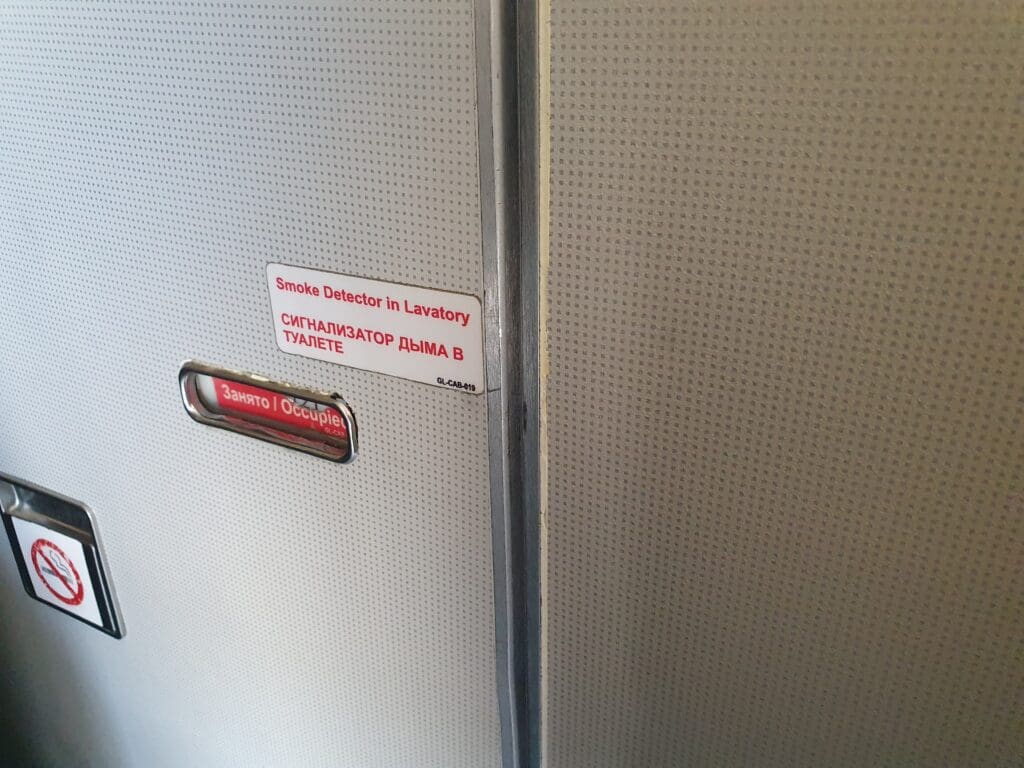
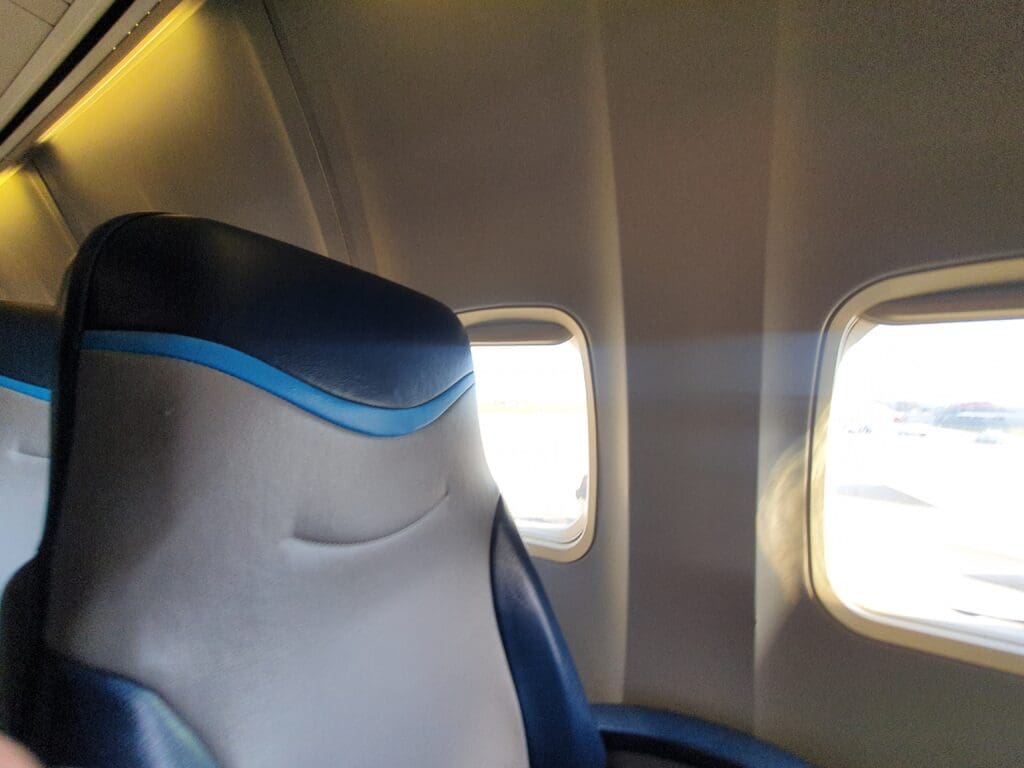
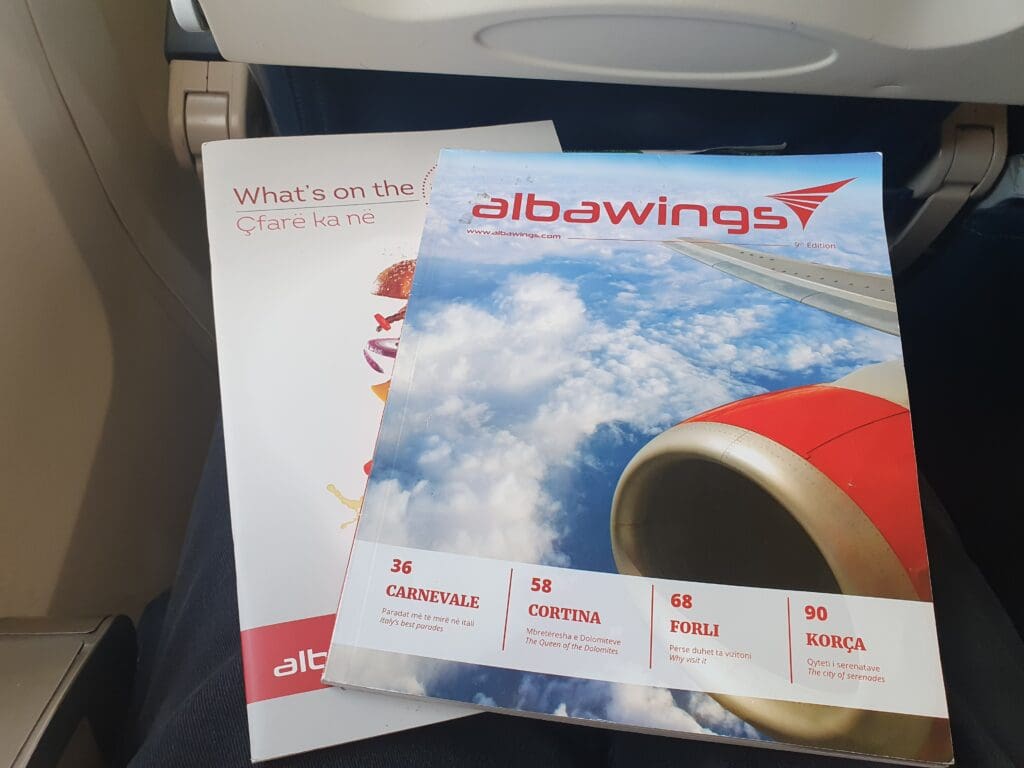
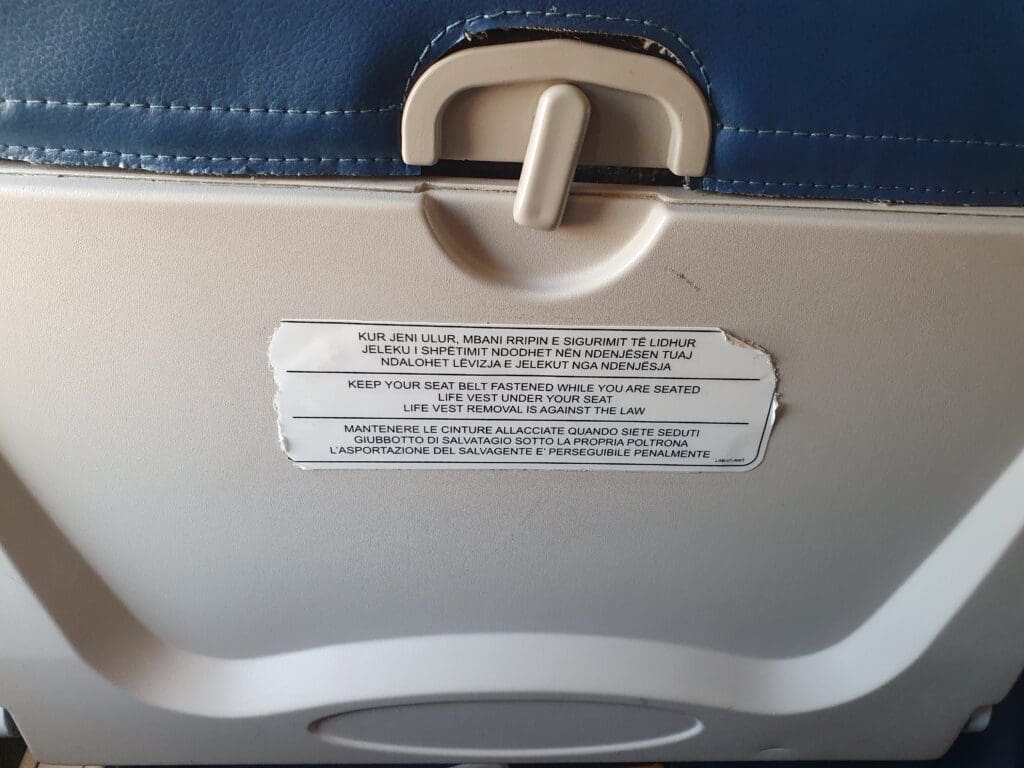
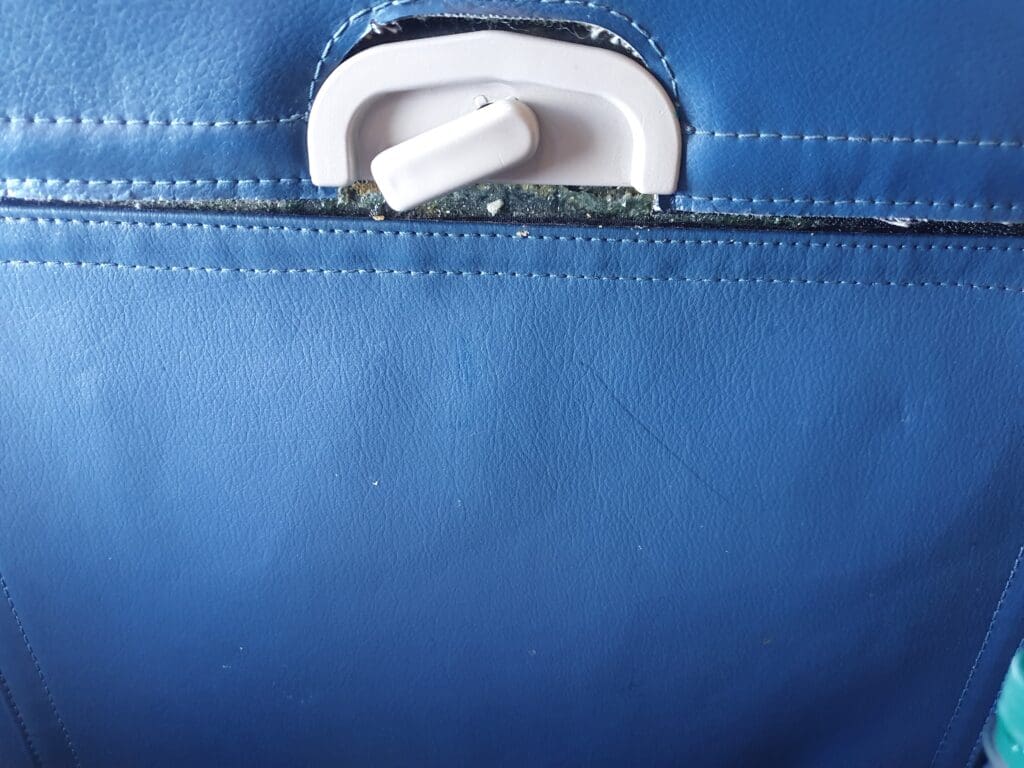
From the rear of the aircraft it did not take too long for me to reach my row, and upon arriving there I found that I already had two seatmates in 23B and C. After taking my seat, I was pleased to find this to be nicely soft and offer a reasonable amount of legroom for a low-cost carrier, whilst the area around this appeared to be clean despite the aircraft’s short turnaround time. Turning to the seatback pocket, this was full, containing the safety card, a menu, an Albawings branded sickbag, a leaflet regarding COVID-19 as well as the now rare sight of a real inflight magazine! However, unfortunately, not all was positive, the cabin appeared to be in a very battered and worn state, with plenty of marks and scratches, and a patch of the seat cover was missing from the back of the seat in front of mine. However, expecting some signs of the aircraft’s age to be present in the cabin, I was neither surprised nor particularly bothered by this. Interestingly, whilst the aircraft ended its service in Russia several years ago and had served for Go2Sky since leaving S7 Airlines, several Russian signs could still be seen in the cabin.
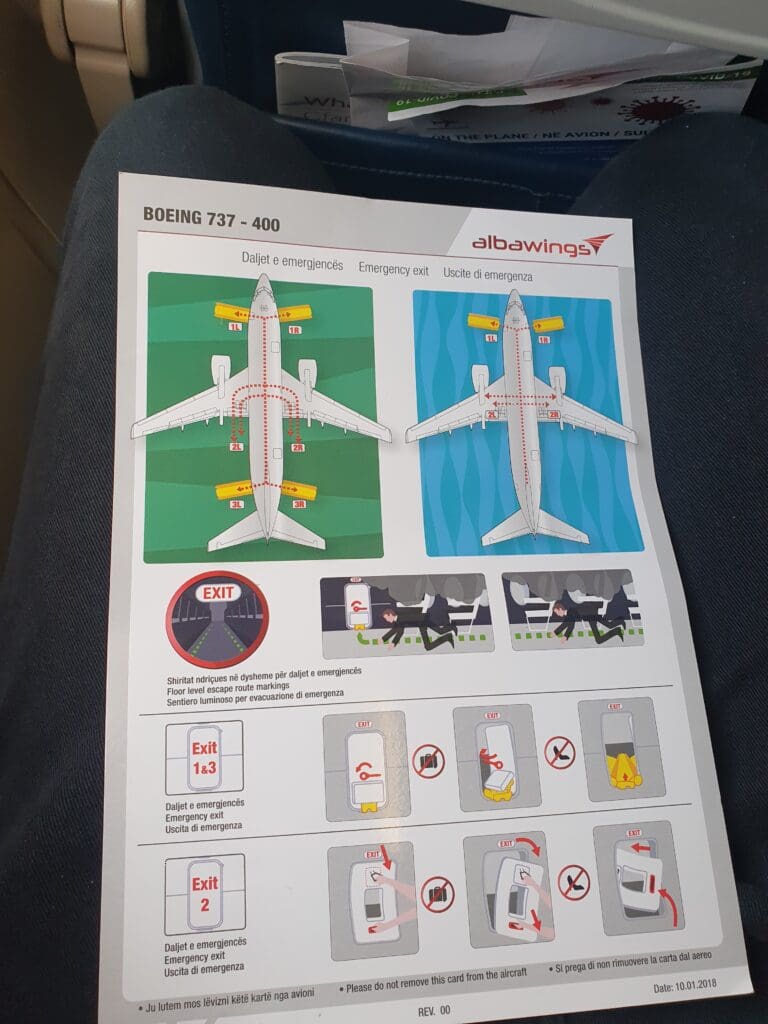
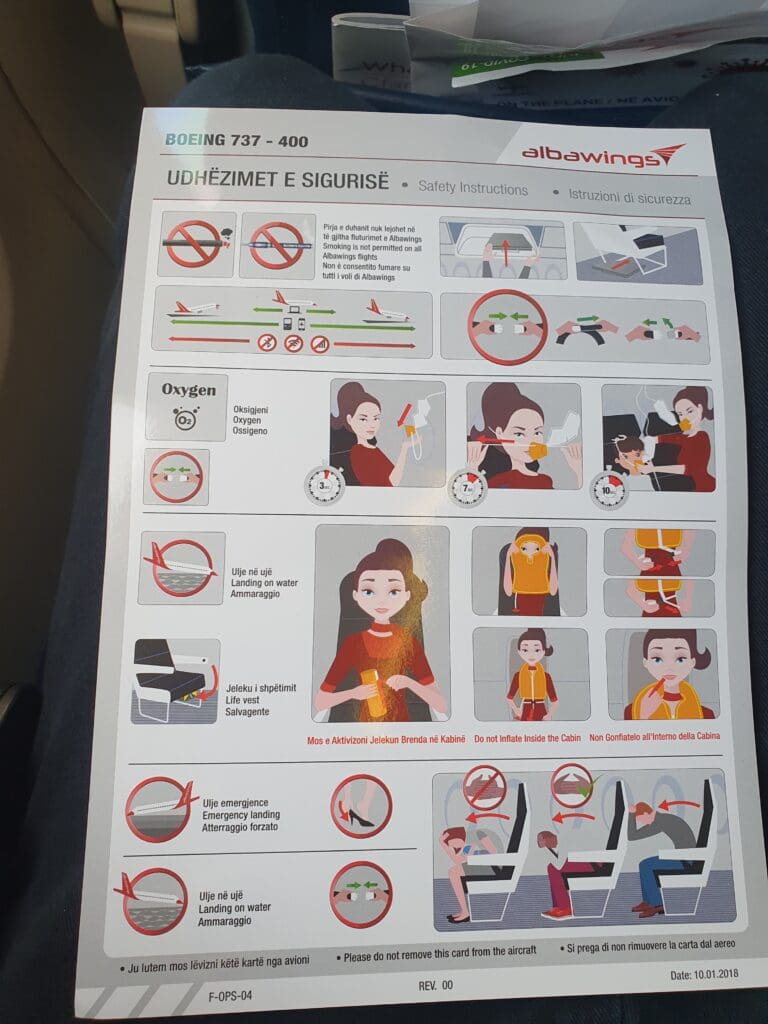
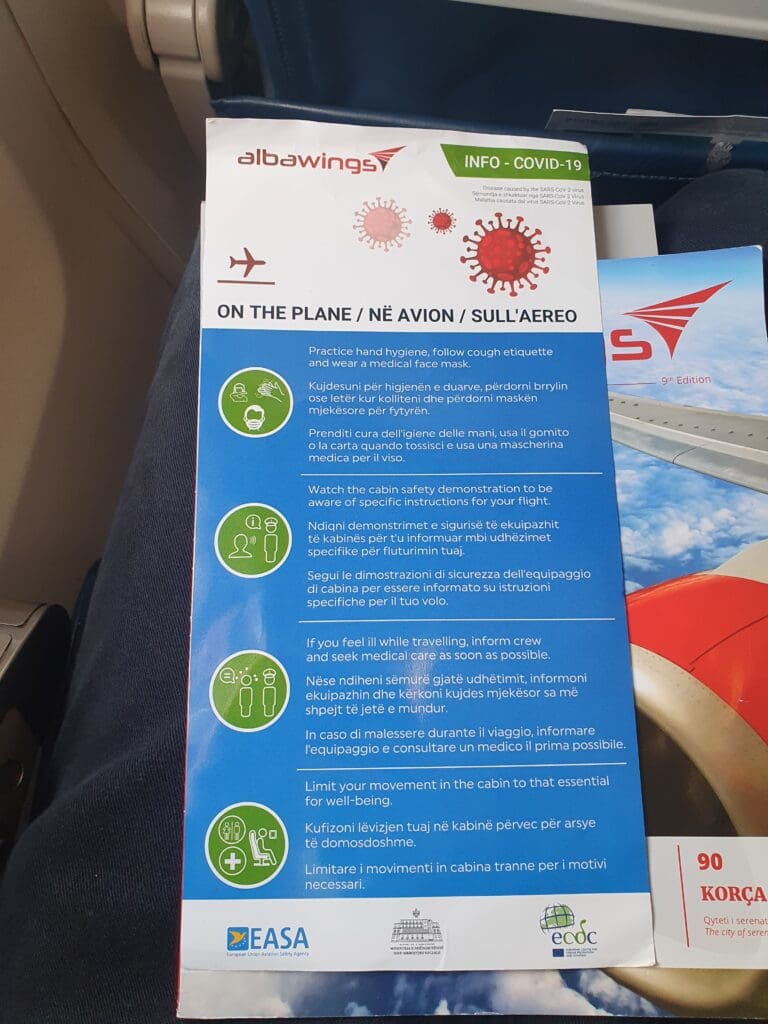
Once seated and strapped in, from my position on the left-hand side of the aircraft, I watched as passengers made their way over from the terminal – with the flow of passengers turning to a trickle as the scheduled departure time neared. In preparation for our departure, the rear stairs were pulled away from the aircraft and just after 1500, the final three passengers slowly trundled out to the jet. Once they had made their way into the cabin, a flight attendant performed an announcement regarding the compulsory wearing of FFP2 face masks whilst onboard, first in Albanian and then in English. A few minutes after the cabin door at the front of the aircraft was closed, the Purser made a longer welcome announcement in Albanian and English during which they mentioned that the flight time to Tirana would be an hour and ten minutes.
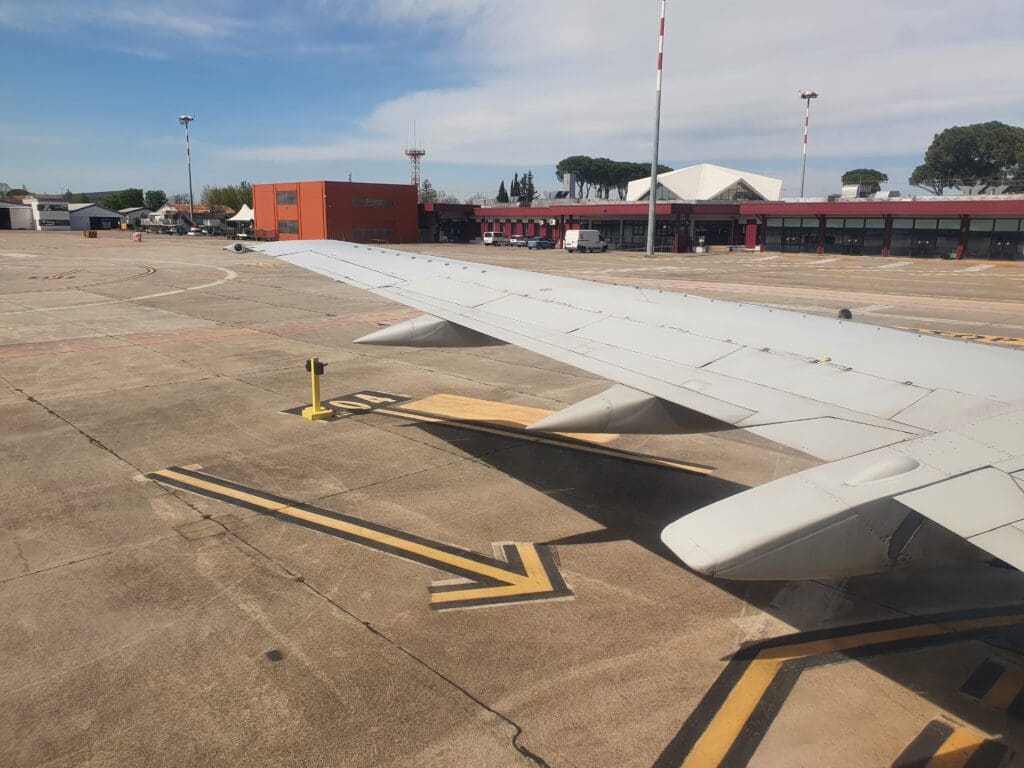
A couple of minutes after the Purser had completed their main welcome announcement, they took to the cabin speakers once again as they began to read through the safety instructions whilst the other three crew members performed a demonstration in the aisle. As the demonstration was underway, the Boeing’s two CFM56-3C1 could be heard powering up and vibrating into life resulting in a reasonable amount of noise whilst the scent of jet fuel filled the cabin. In addition, I also noticed the cabin to become rather hot at this time however fortunately my air vent worked without an issue. As the crew passed through the cabin ensuring all was in place for the aircraft’s departure, at 1506 the aircraft powered forwards out of its stand and quickly turned right, being much of Professione Volare’s fleet of light aircraft into view before the Boeing made a very quick taxi over to holding point bravo.
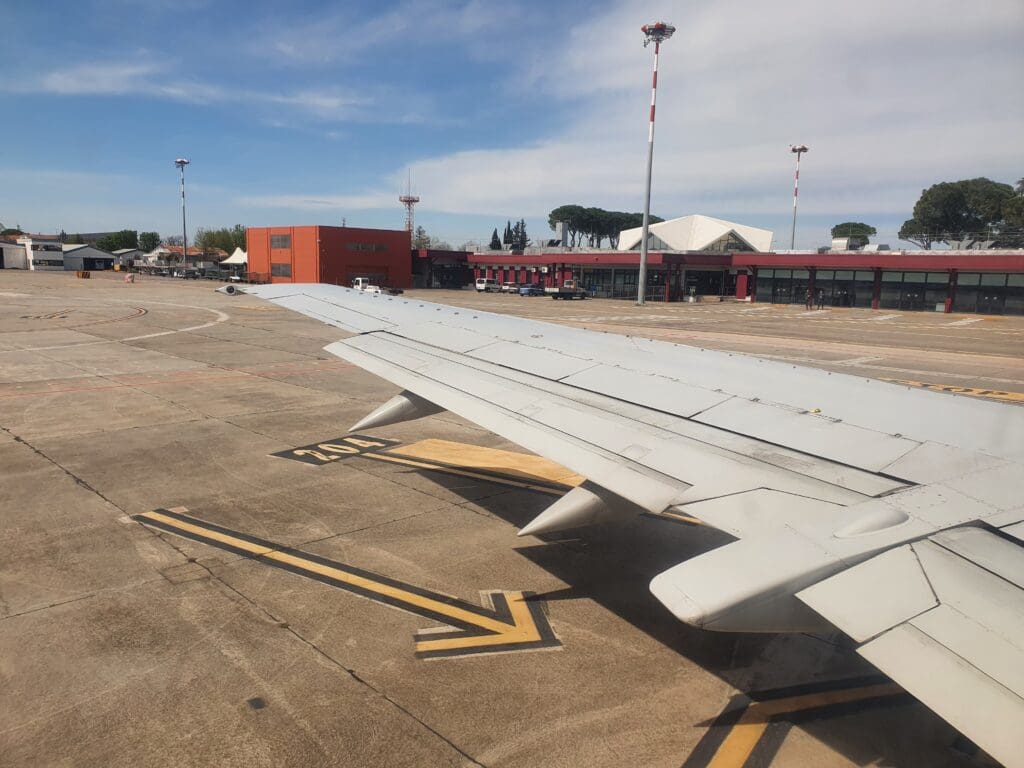

No more than a minute after the Boeing had left its stand, the aircraft came to a halt at the holding point where it waited for three minutes. Following this wait, the aircraft made its way onto the runway at 1510 and turned right, commencing a speedy backtrack to the end of this before turning around. Without stopping, once pointing in the correct direction, the Boeing’s two CFM International engines roared into life as the jet began a powerful rolling takeoff down Runway 12. That afternoon, the Boeing seemed to use most of Forlì’s 2.5-kilometre runway before reassuringly rotating upwards and rocketing upwards into the skies of Italy. Passing over the airport’s perimeter fence a few moments later, the Boeing passed over the nearby town of Forlimpopoli which dates back to 132 BC.
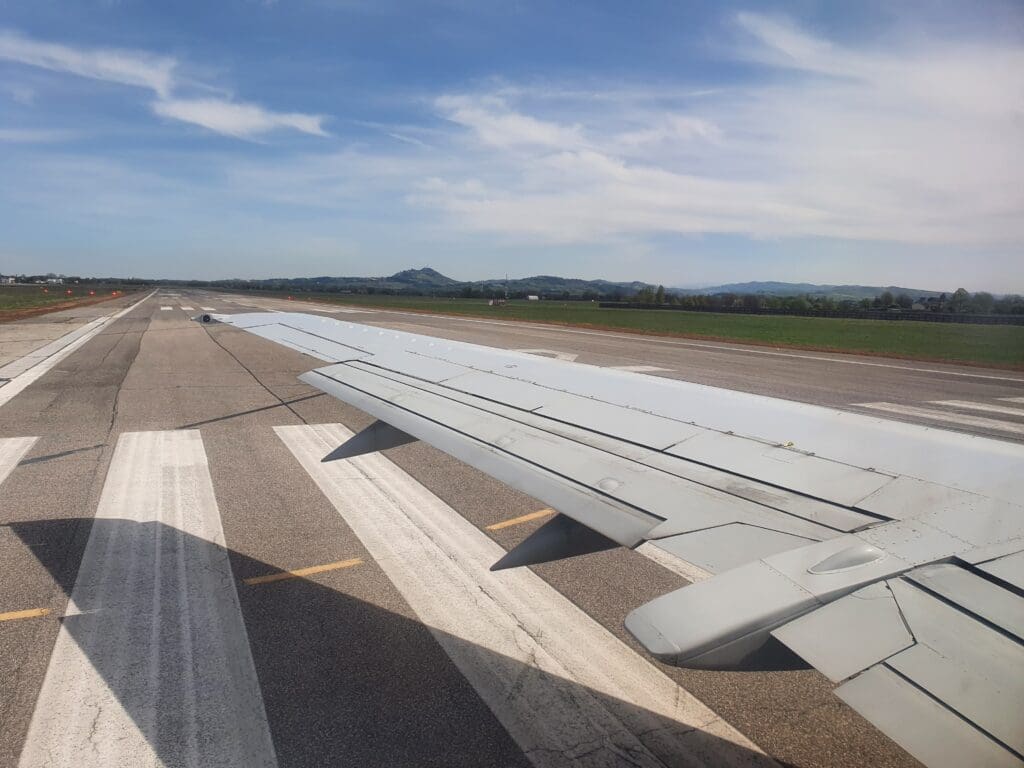
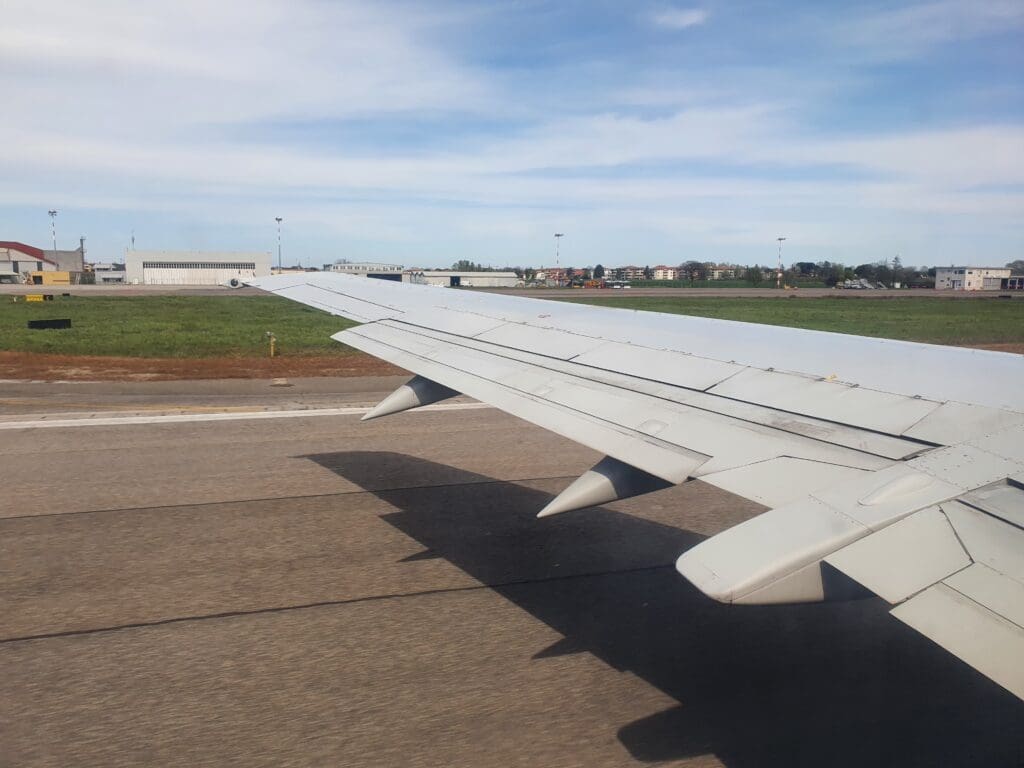
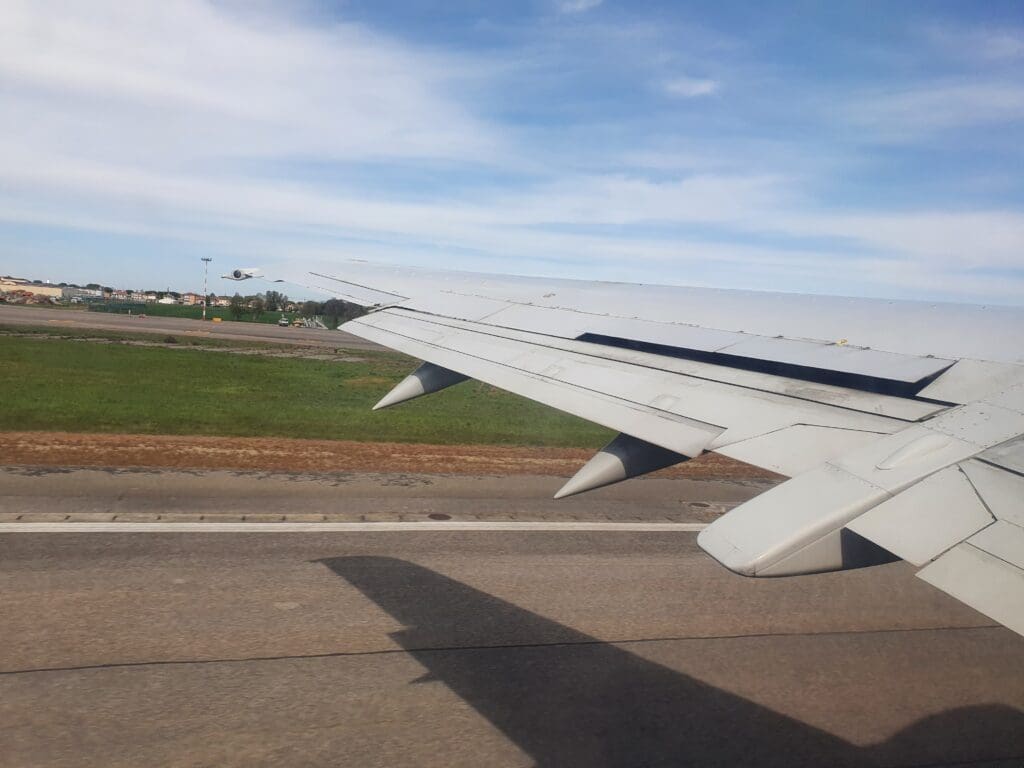
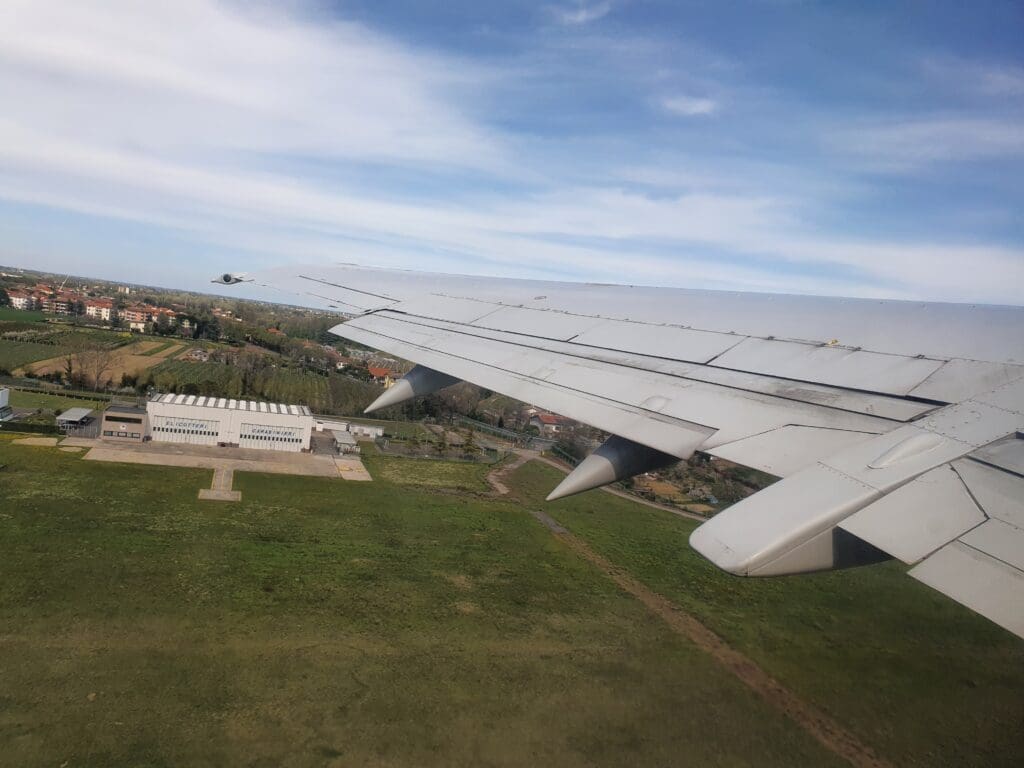
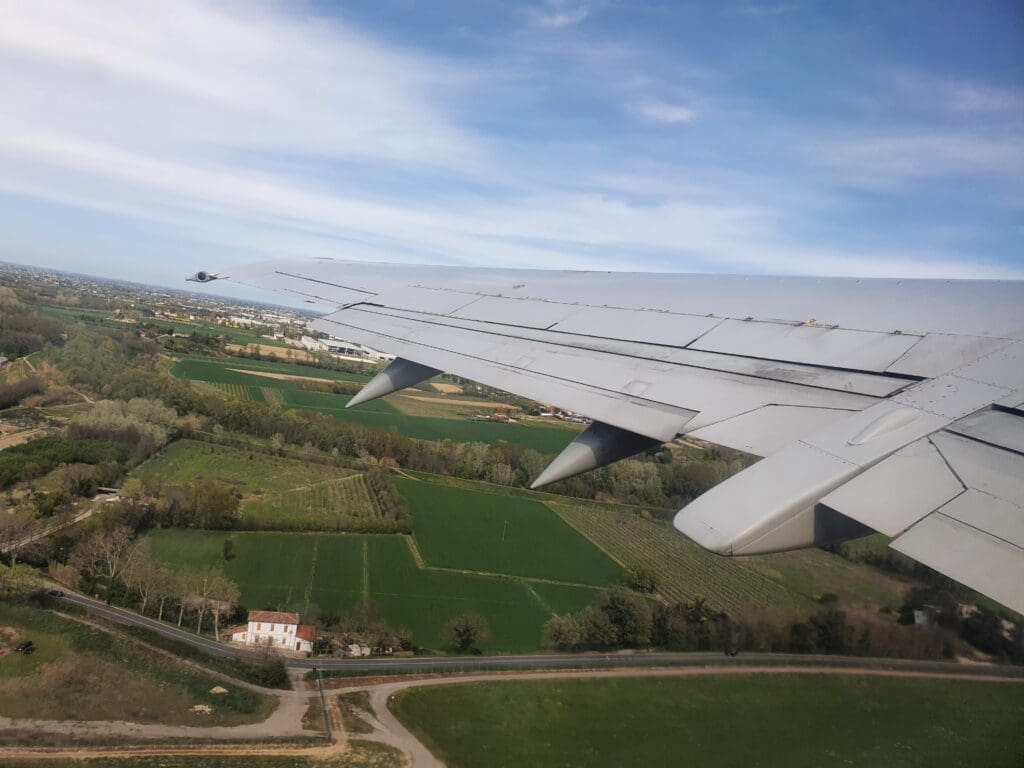
From Forlimpopoli, the Boeing made a smooth climb over the green fields of Emilia-Romagna, flying roughly parallel to the E55 motorway which runs all the way from the Swedish city of Helsingborg, all the way to Kalamáta in Greece – albeit with three ferry crossings on the way. With Forlì sitting around 25 kilometres away from the coastline, no more than two minutes after taking to the skies, the blue waters of the Adriatic could be seen as the Boeing made its way southeast, flying along the coastline and allowing for a few of Eastern Italy’s beaches and seaside resorts for several minutes. As we made our way southwards, it wasn’t too long before the city of Rimini appeared hugging the coastline, accompanied by its airport. After leaving Rimini behind, the aircraft soon crossed from the skies of Emilia-Romagna to Marche at which point the coastal city of Pesaro could be seen.
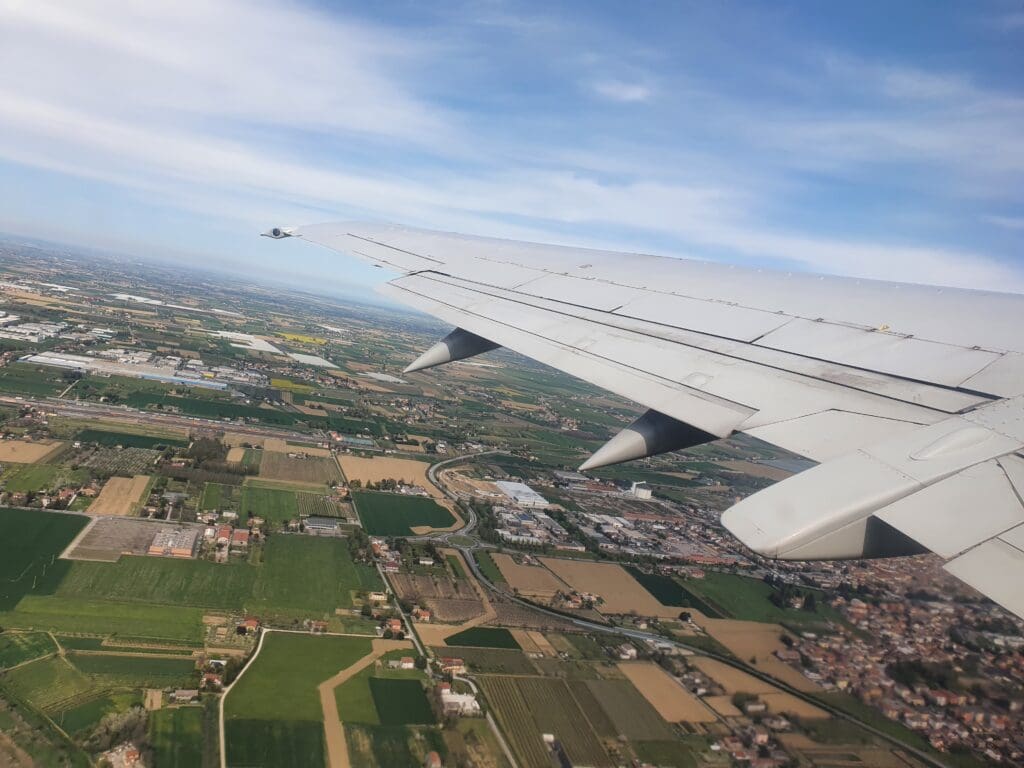
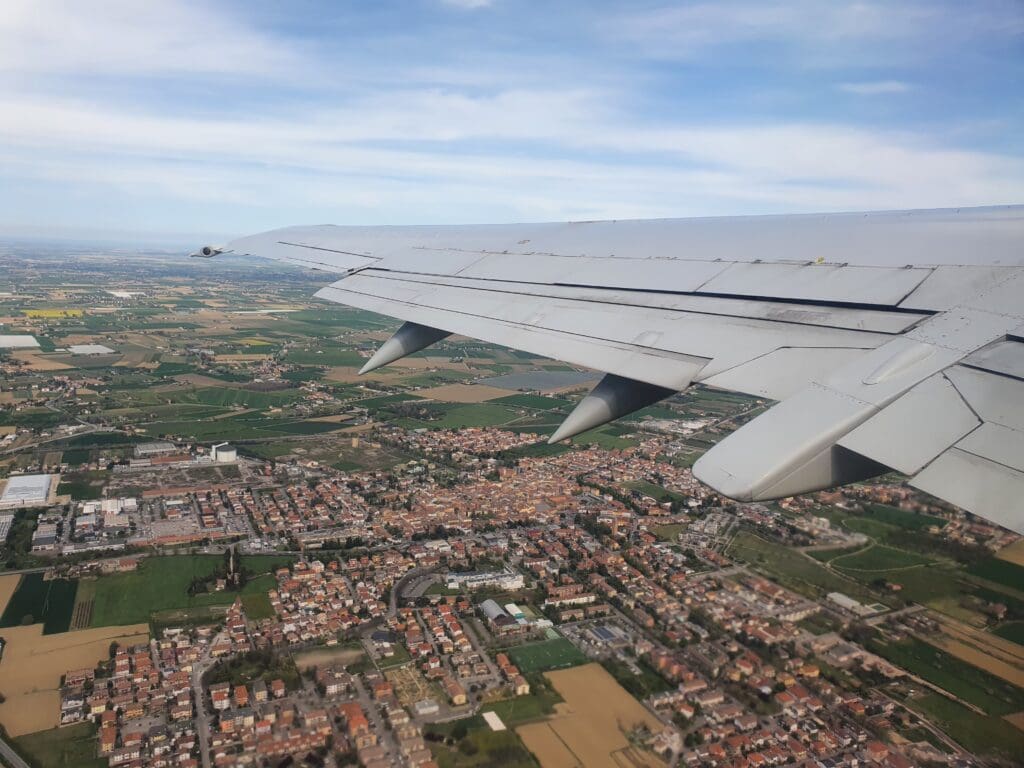
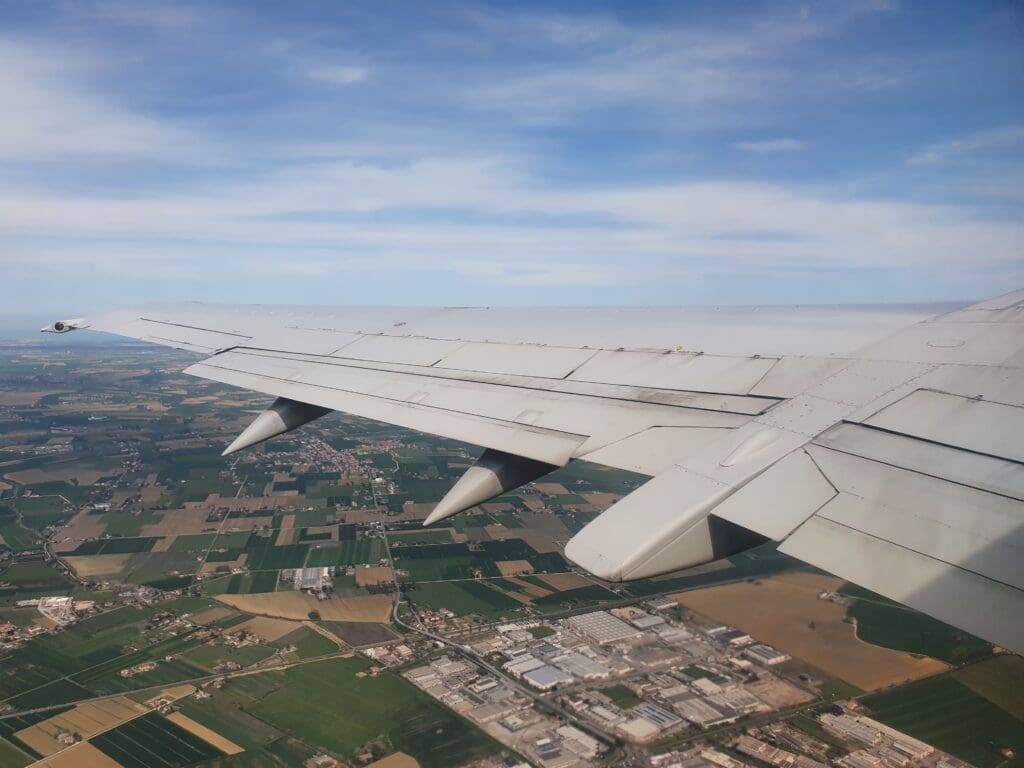
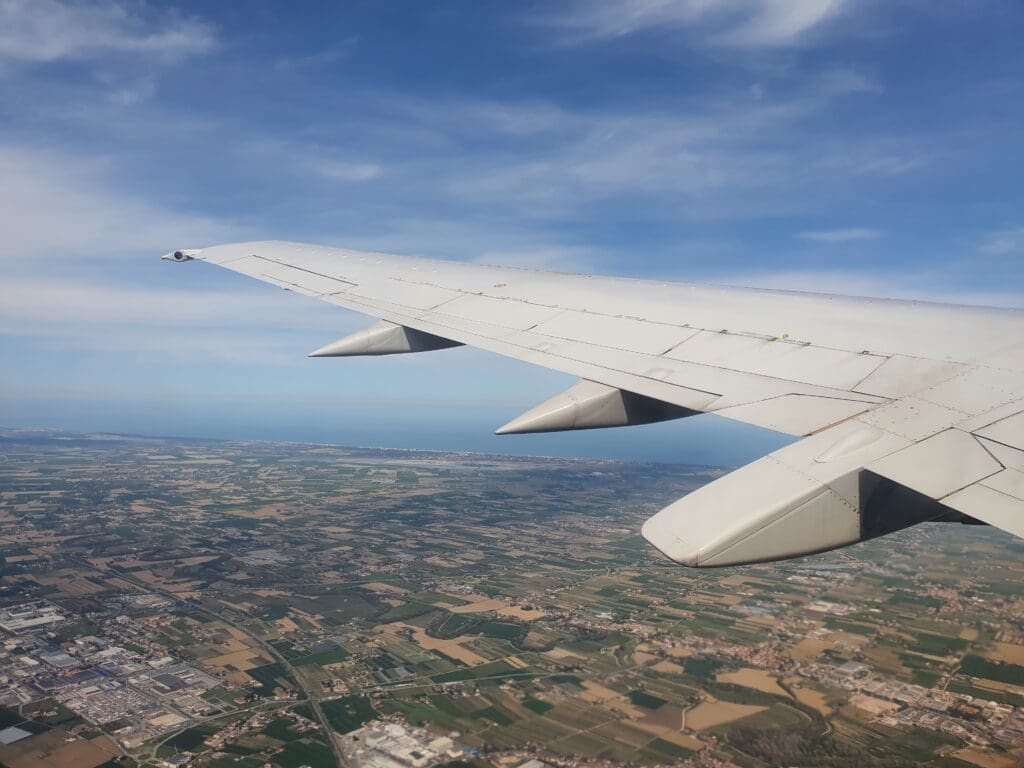
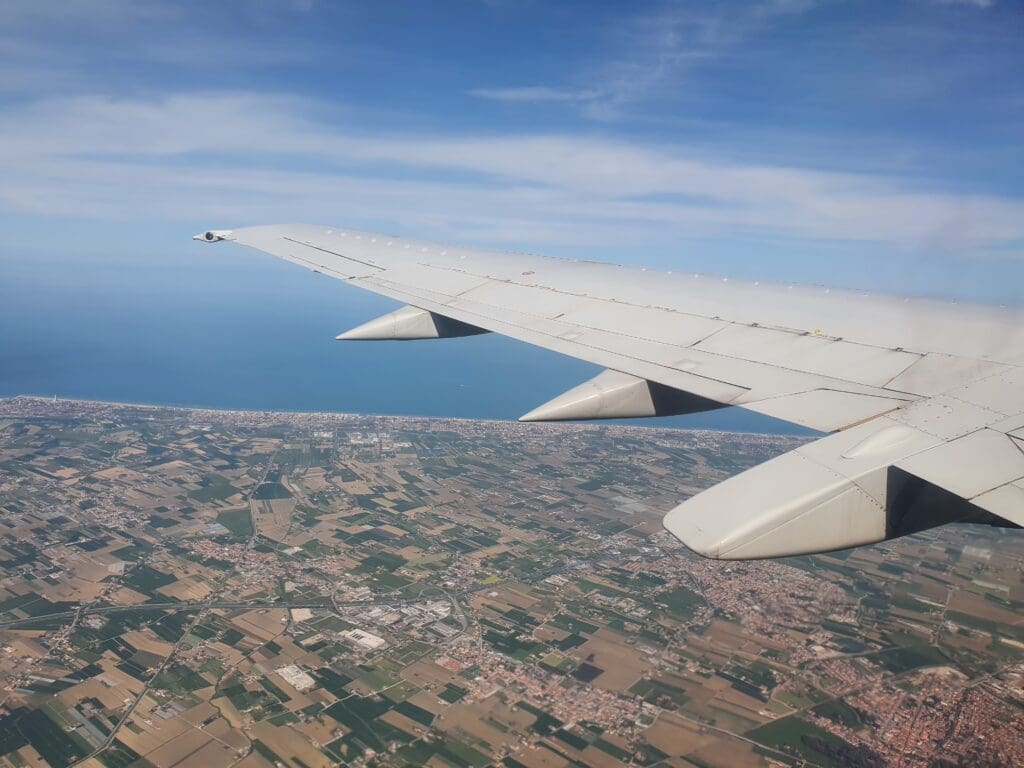
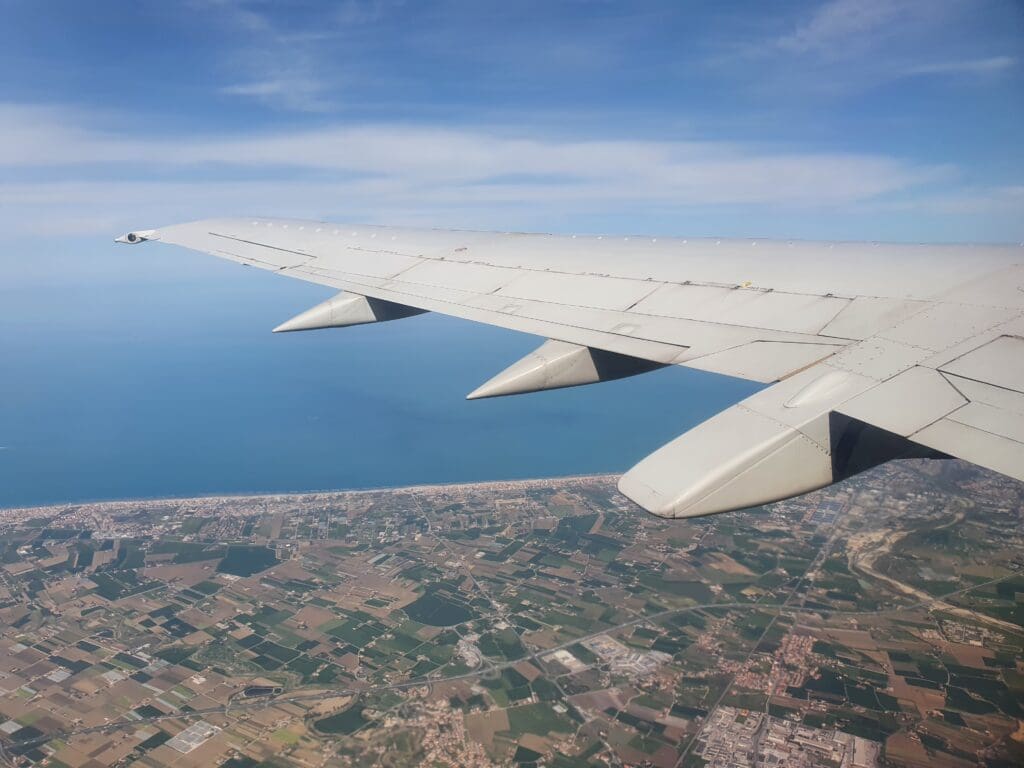
Back inside the cabin, at 1520 the seatbelt signs were extinguished as we passed through 20,000 feet. However, before this time, I did notice that several passengers had stood up to either stretch their legs, retrieve items from the overhead lockers or head to the bathrooms, with the crew doing seemingly little to reprimand them. Once the seatbelt signs had been switched off, given the short length of the flight, the crew soon got to work commencing the onboard service with one trolley rolled out from the front of the cabin and another from the rear.

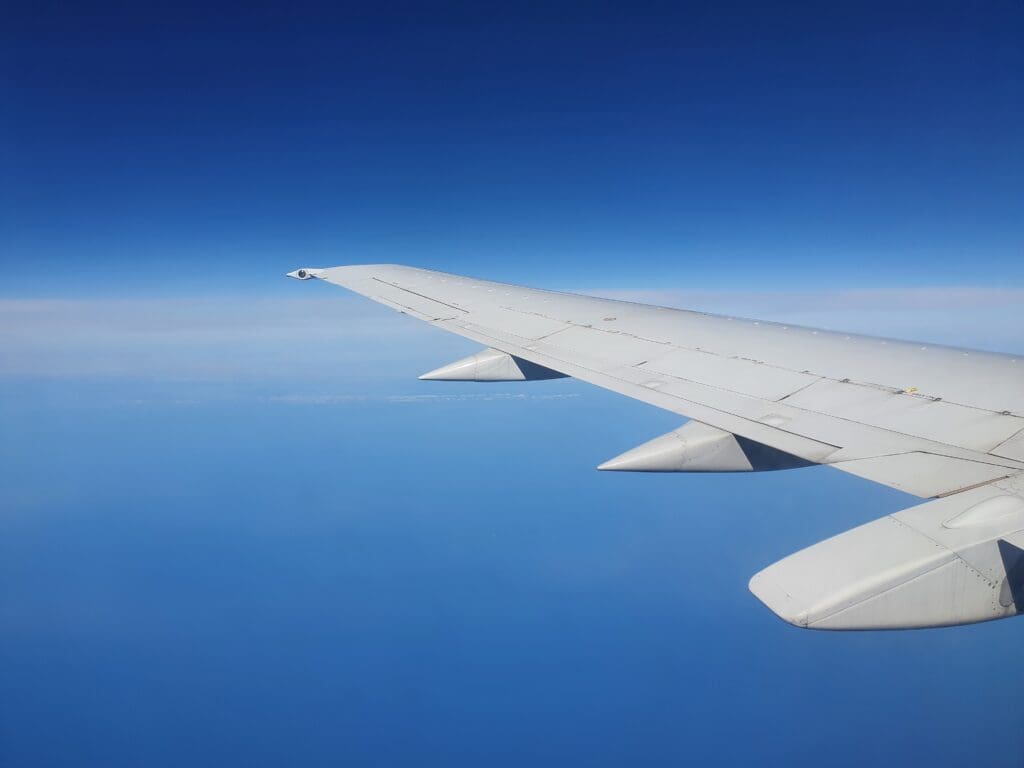
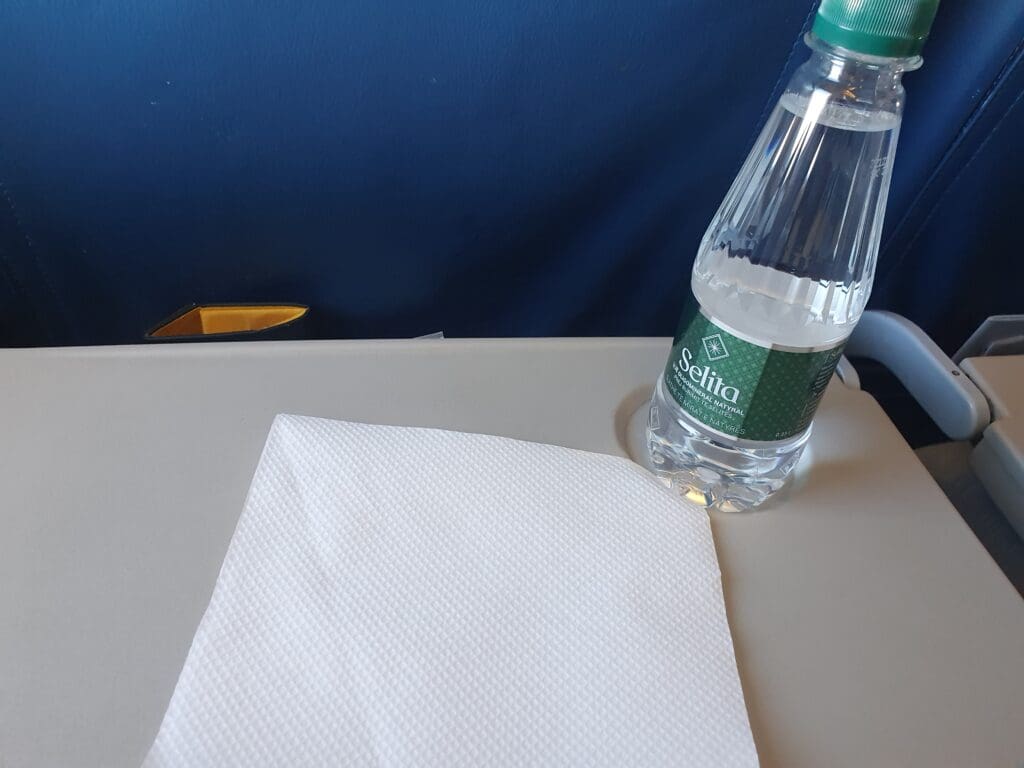
As a low-cost carrier, I was not surprised to find that Albawings fails to offer any sort of complimentary inflight offerings. Instead, a buy-on-board service is provided for those needing some inflight refreshment. Browning Albawings’ menu, the usual selection of hot and cold, hard and soft drinks are offered alongside a range of sweet and savoury snacks – with prices for individual items ranging from €1.50 or 200 Lek for a tea or instant coffee, up to €6 for spirits. As with many carriers, Albawings offers combination deals, with four of these provided – the most expensive of which was priced at €9 or 1000 Lek, allowing passengers to pair a sandwich with a Kit Kat and soft drink. Despite the short length of the flight that afternoon, there appeared to be plenty of takers for the drinks and snacks that afternoon. Whilst I did not initially intend on purchasing anything onboard, given the lack of offerings on the ground and in dire need of drink, I decided to purchase a bottle of Albanian spring water for a pricey €2. Upon reaching my row, the flight attendant that served me did seem to be a little cold and there were a few language barriers during our interaction. Whilst I had asked for a water, the crew member initially thought I had requested a tea, and then a vodka, before finally realising that I wanted a bottle of water. With payment possible in both Euros and Lek, I handed over a €5 note before being informed that they were short on change and would return later to give me €3. Sure enough, a few minutes later I received my €3 change.
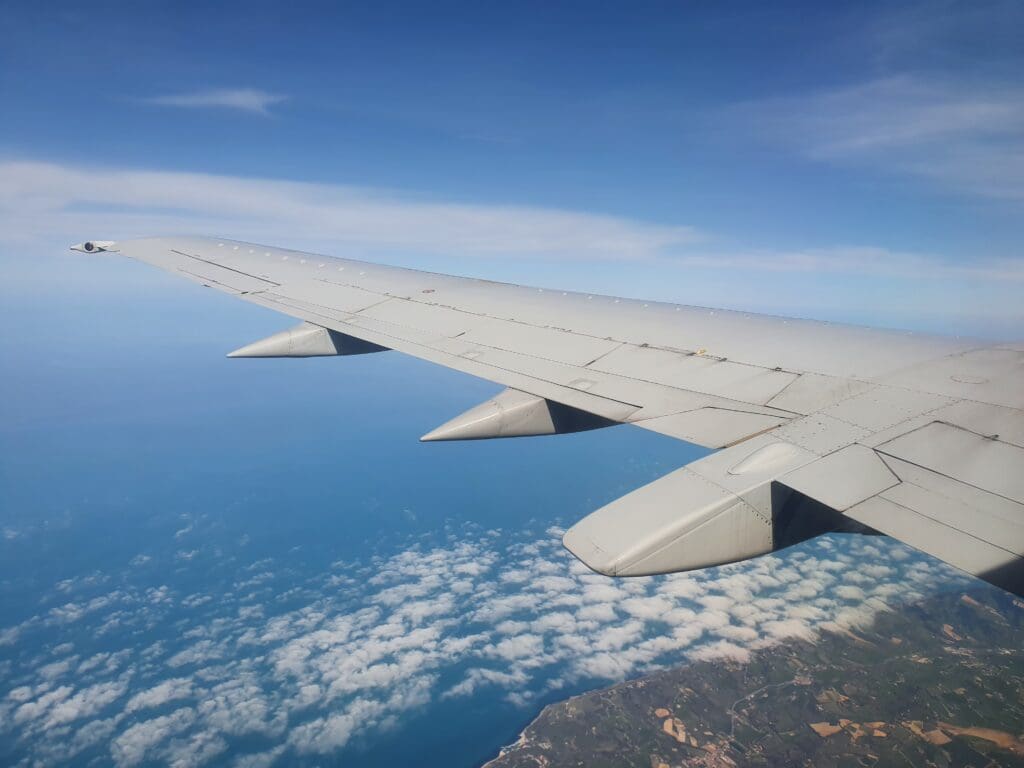
A total of thirteen minutes after the Boeing had rocketed up into the Italian skies, the aircraft left the Marche coastline behind near the city of Ancona and journeyed out over the blue waters of the Adriatic Sea, soon levelling off at 33,000 feet. Heading southeastwards, it wasn’t long before the coastline of Croatia’s Dalmatia province appeared off the Boeing’s port wingtip, with Vid, the farthest Croatian island from the mainland appearing around fifteen minutes after leaving Italy behind. Meanwhile, in the distance, the Croatian mainland could be seen and I was able to make out Split, where I had been exactly a month before this flight to sample Van Air Europe’s Let L-410. At this time the first lumps and bumps of the flight could be felt, although these were not particularly heavy and failed to warrant the reillumination of the seatbelt signs. Turning to the inflight entertainment, as mentioned the overhead televisions remained off for the entirety of the flight with the only Albawings’ inflight magazine offered to entertain passengers. Published in Albanian and English, this included articles on a range of topics including Valentine’s Day, Italy’s Carnevale, fashion and Italian ski destinations, as well as travel guides for Cortina, Forlì and Korça. Meanwhile, at the rear of the magazine, horoscopes plus pieces of information such as the airline’s fleet and destinations could be found. As is often the case, I found this to be heavily peppered with advertisements, unusually some of which seemed to be a little risqué!
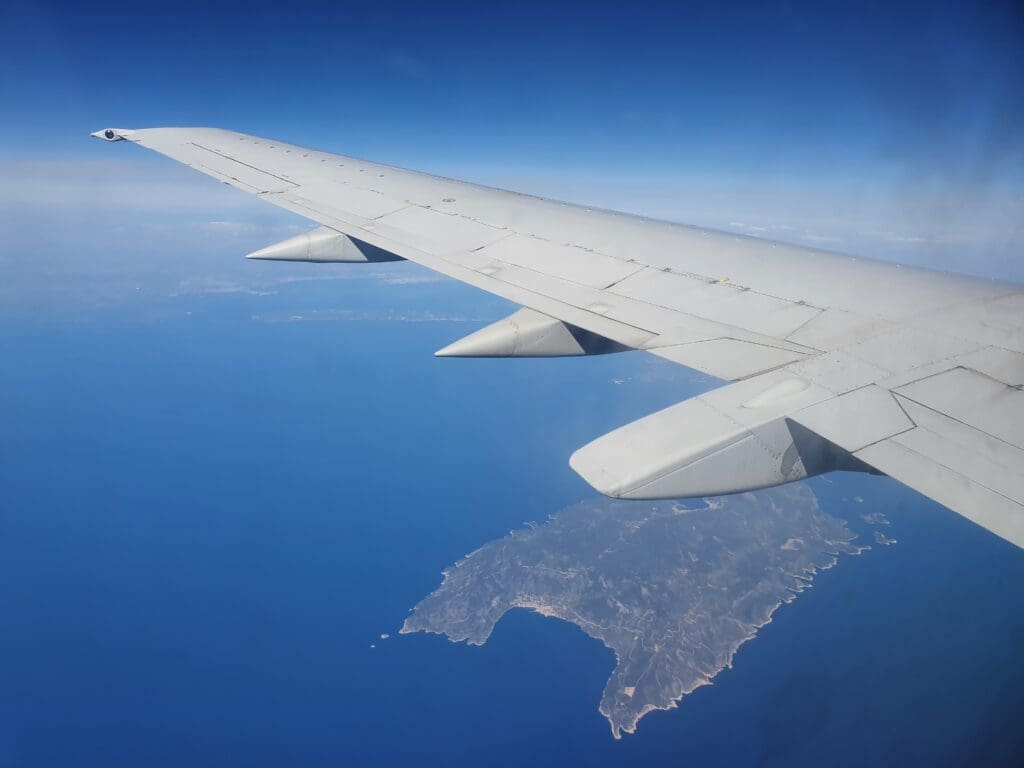
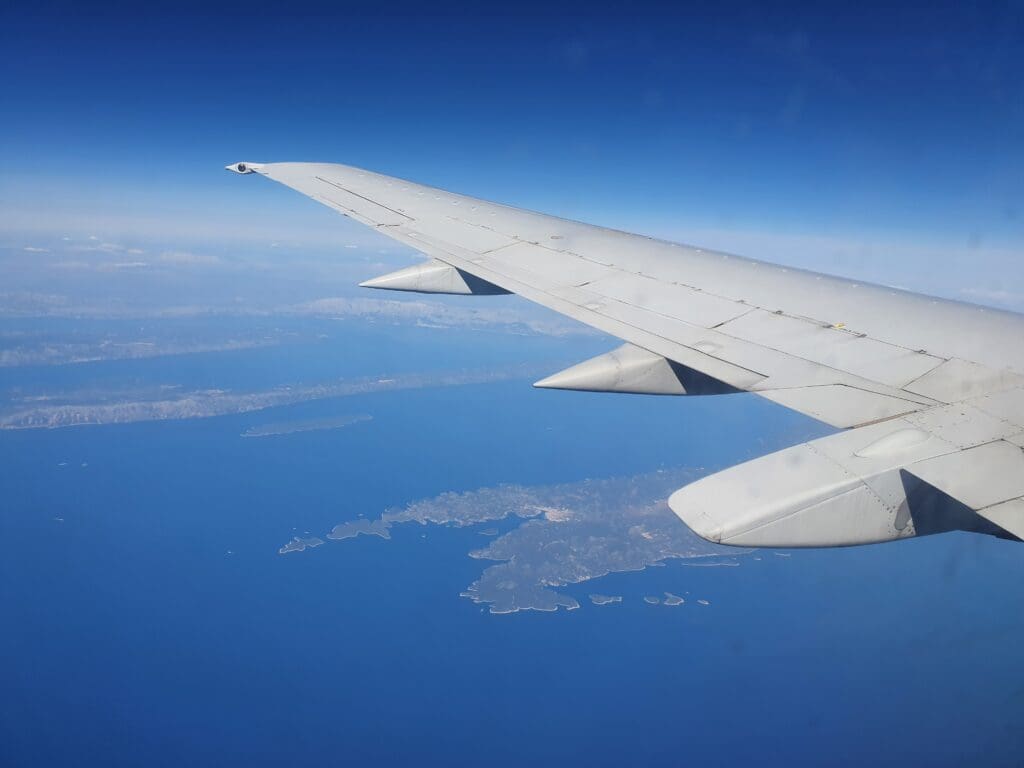
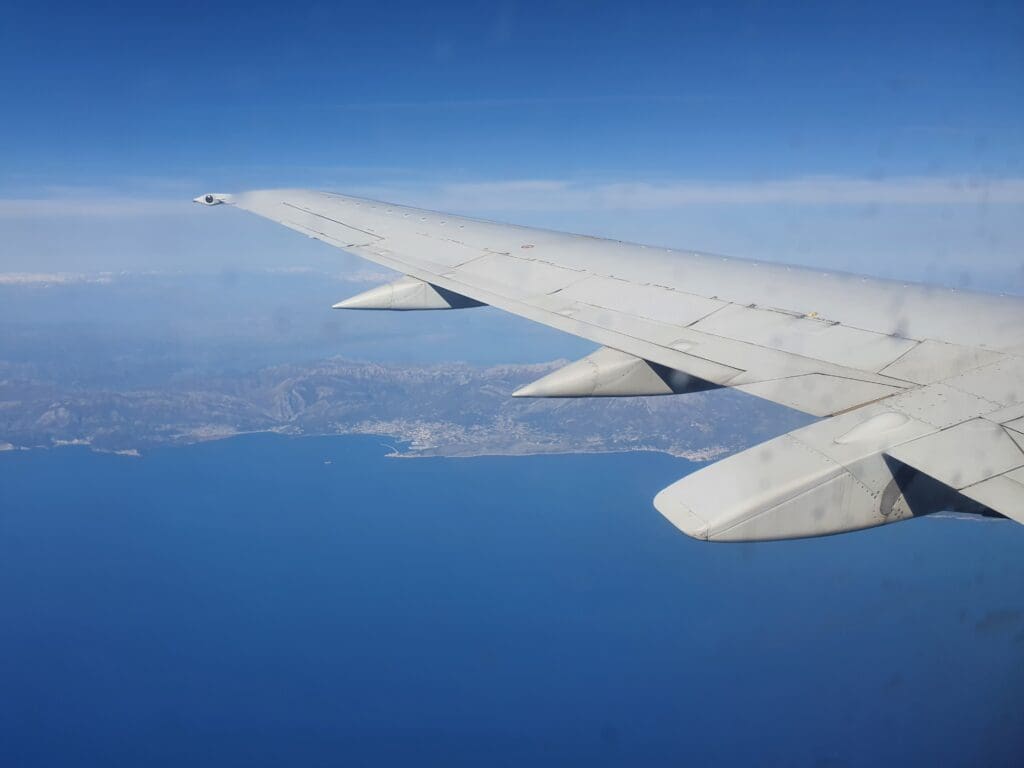
After passing the island of Vis, several larger Croatian islands appeared including Hvar, Korčolu and Mljet as the aircraft continued to fly southeast along the Croatian coastline. After passing Dubrovnik, the Boeing could be felt commencing its descent and the seatbelt signs were soon reilluminated. At this time, the crew passed through the cabin collecting rubbish whilst at the same time ensuring that all was in place for our arrival into Tirana. Interestingly, I noticed that once in the air, the crew did not perform any announcements whatsoever. As the aircraft journeyed southeast, the Croatian coastline transformed into that of Montenegro and a good view of the southern portion of the country was offered as we neared Albania, the speed brakes were partially extended causing the aircraft to shudder a little as it decelerated.
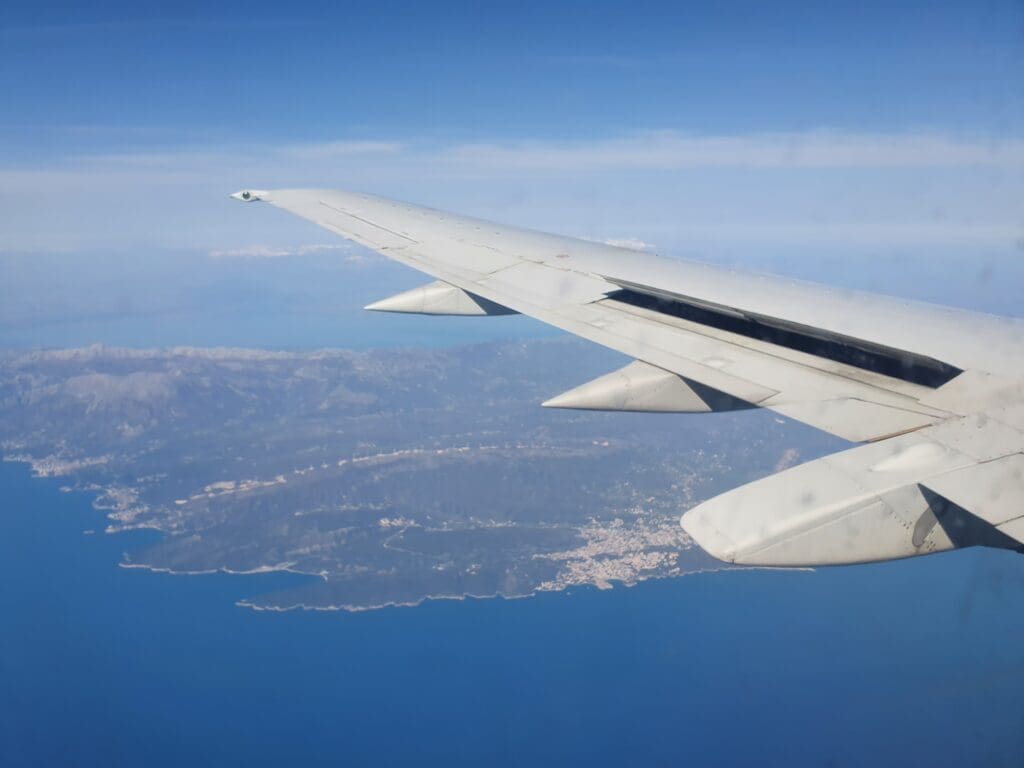
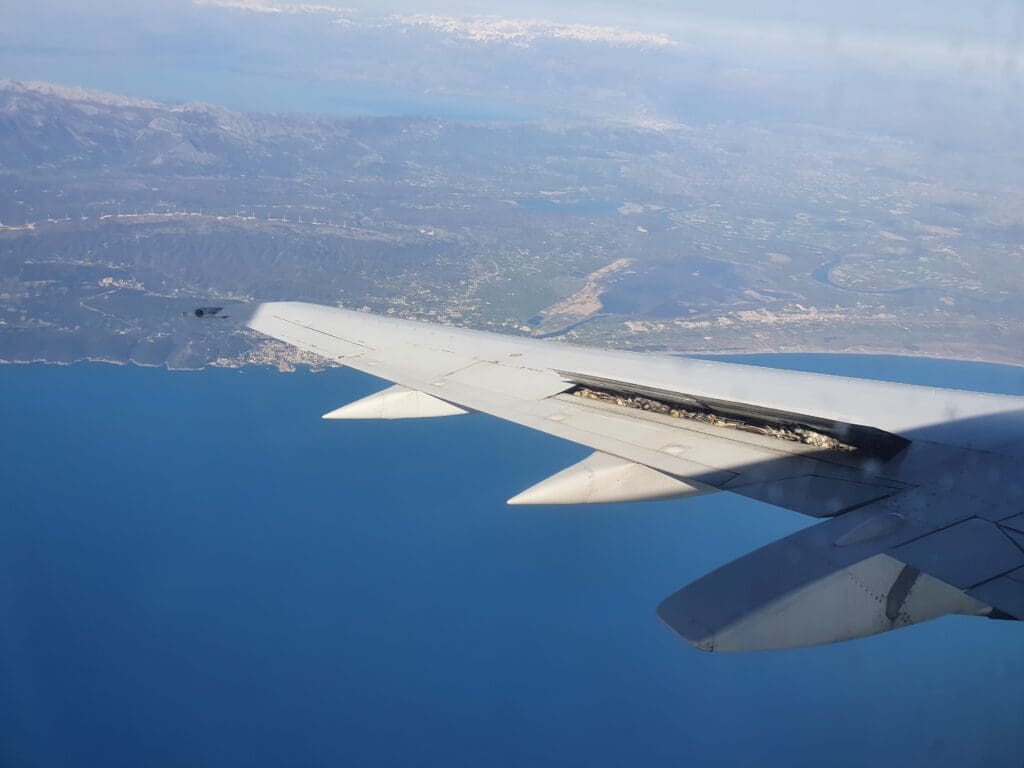
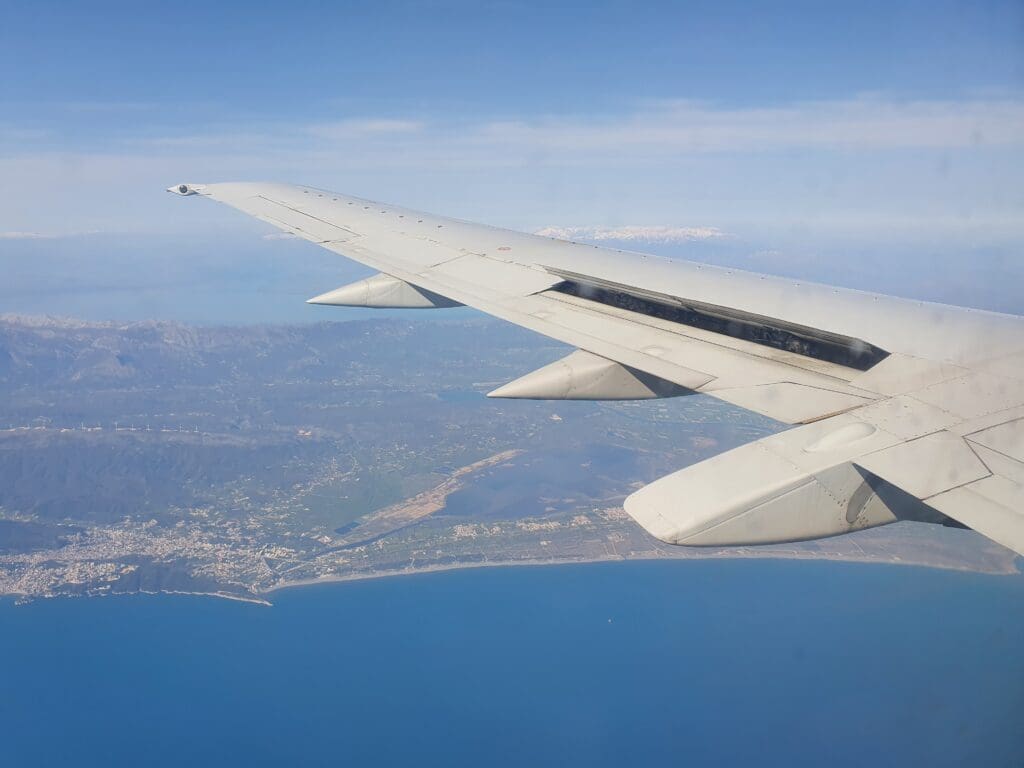
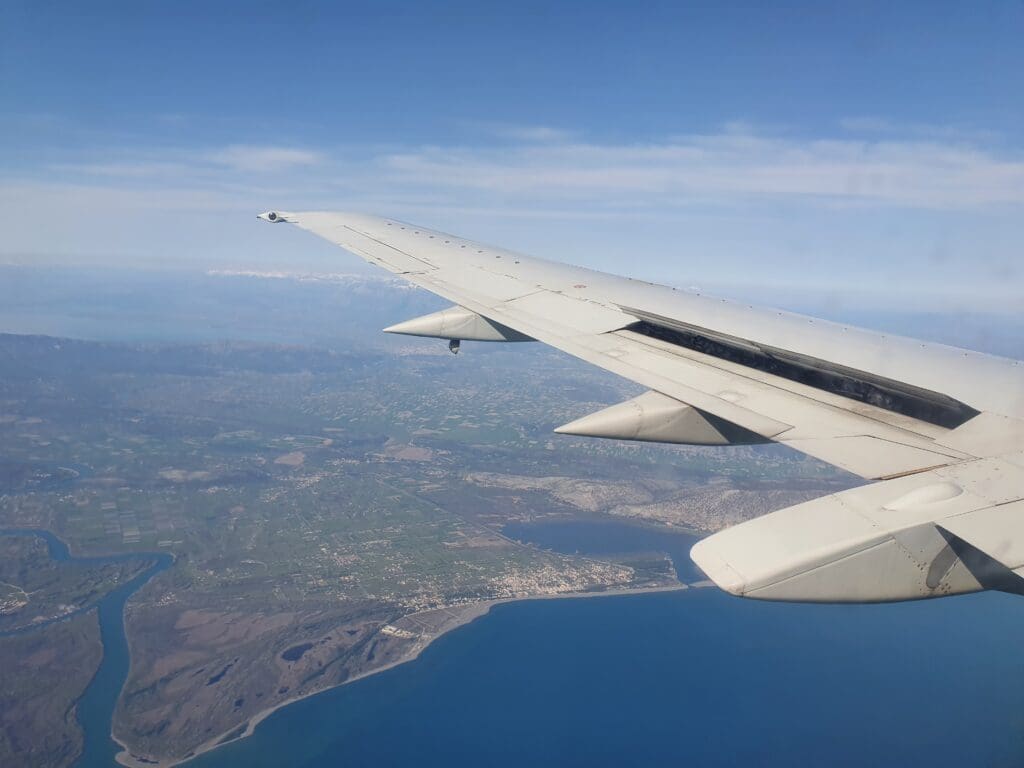
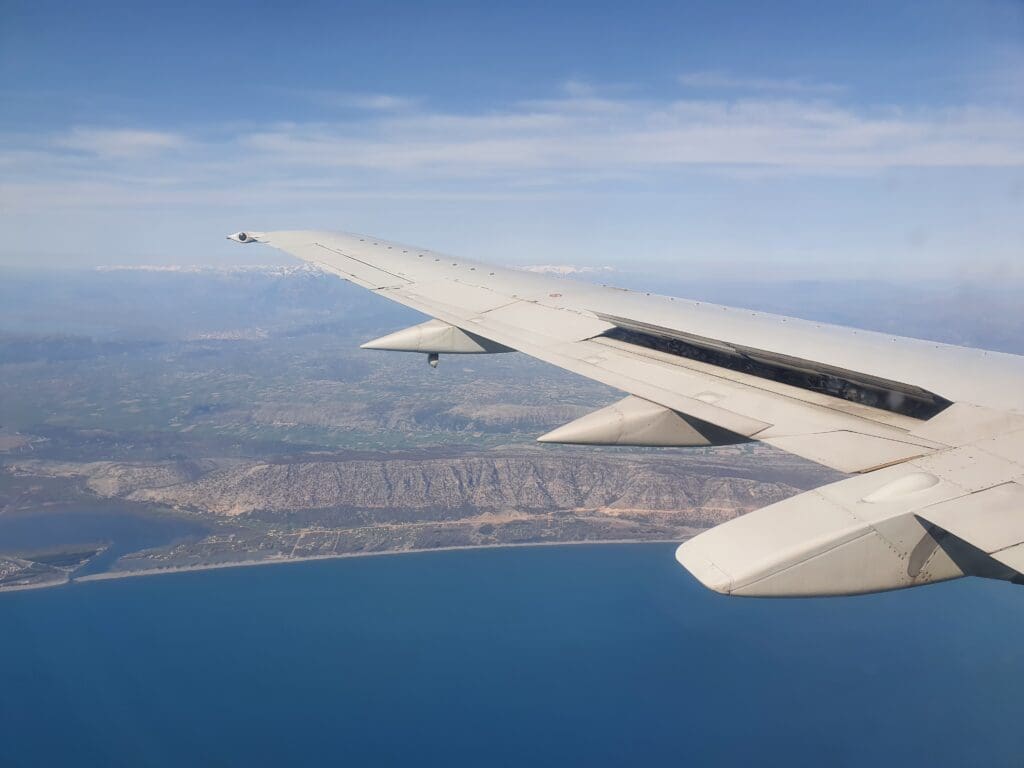
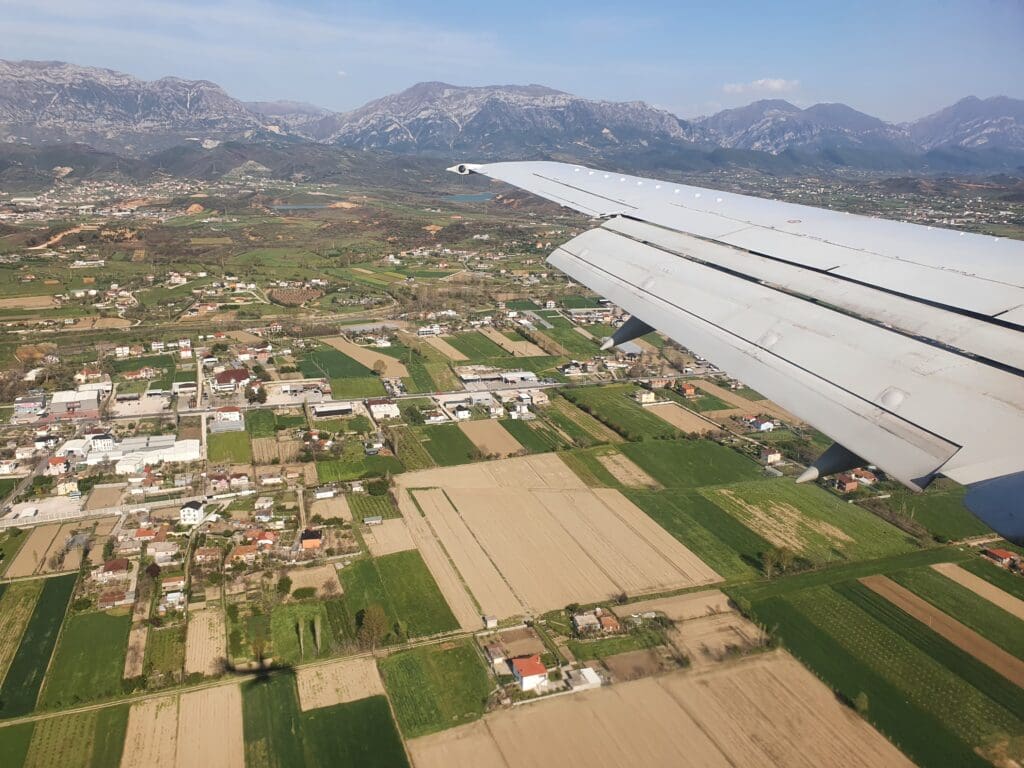
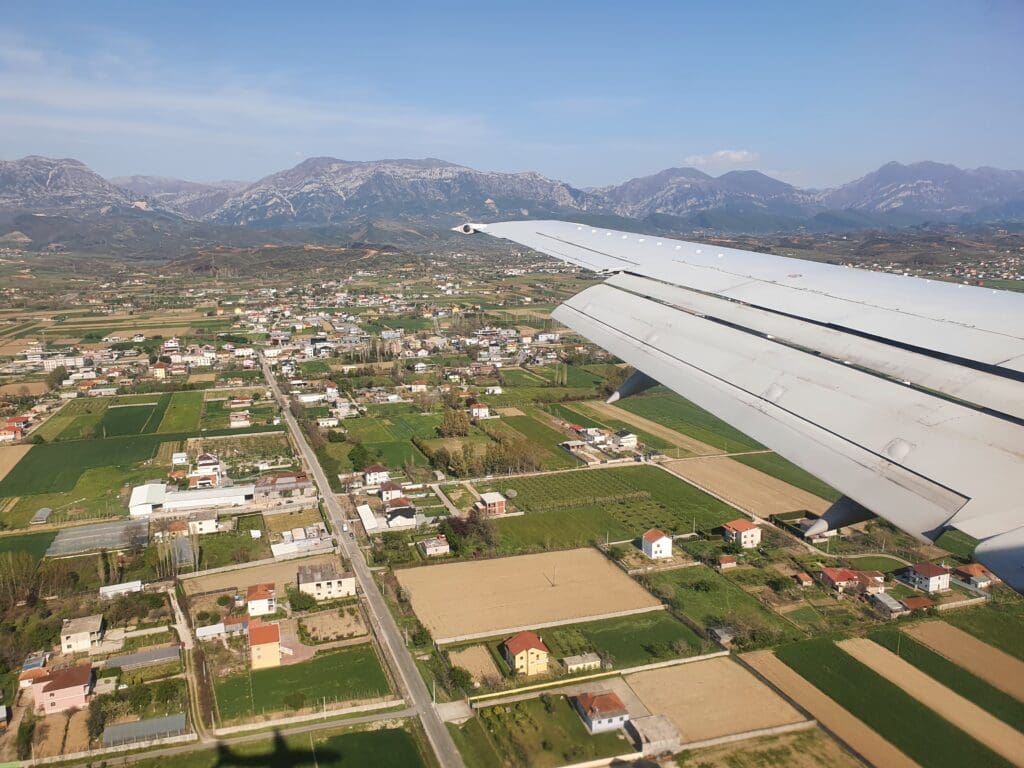
After passing the Montenegrin coastal town of Ulcinj, the hills of Albania’s rocky coastline around the town of Rrjolli could be seen before the aircraft crossed the coast just to the south of the town of Shëngjin. With this town serving to be a popular holiday destination, there, a long beach could be seen stretching down the coastline. From Shëngjin the Boeing turned southwards to line itself up from an approach to Tirana Airport’s Runway 17 whilst I was treated to spectacular views of the Albanian countryside, hills and mountains as we trundled towards the capital.
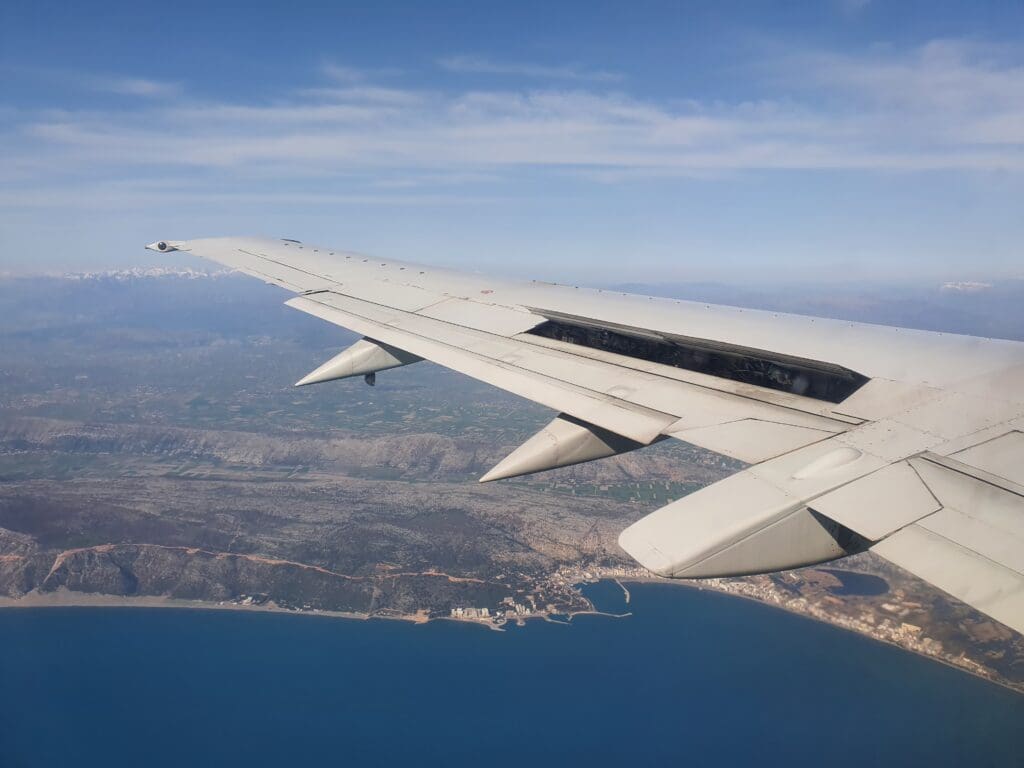
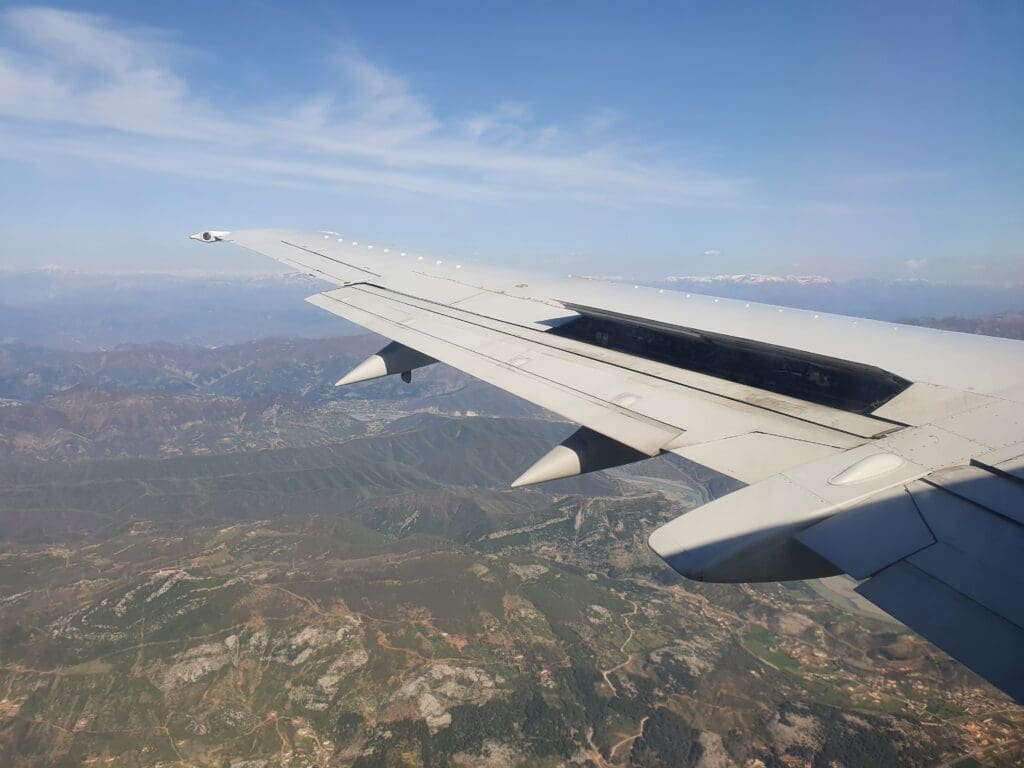
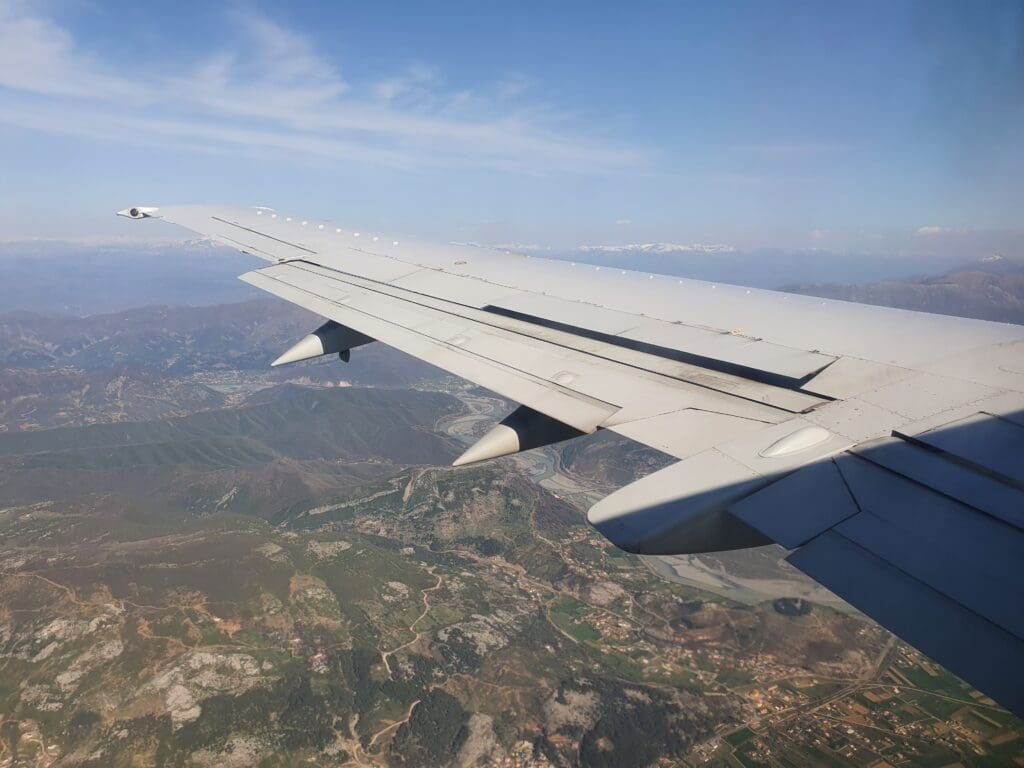
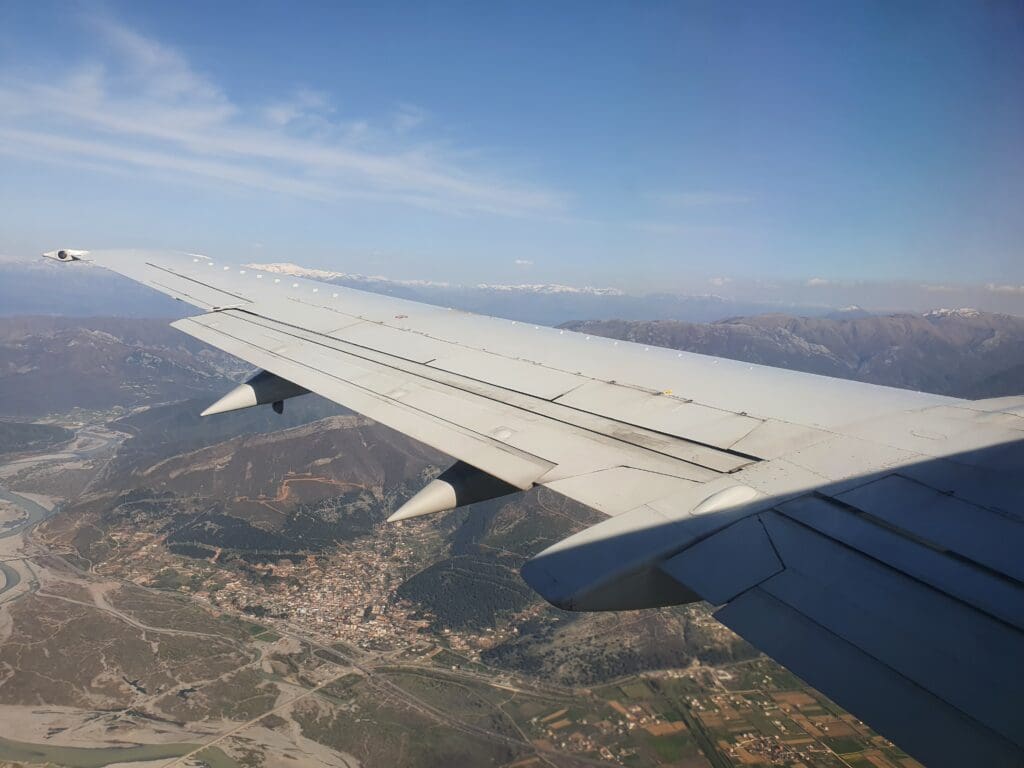
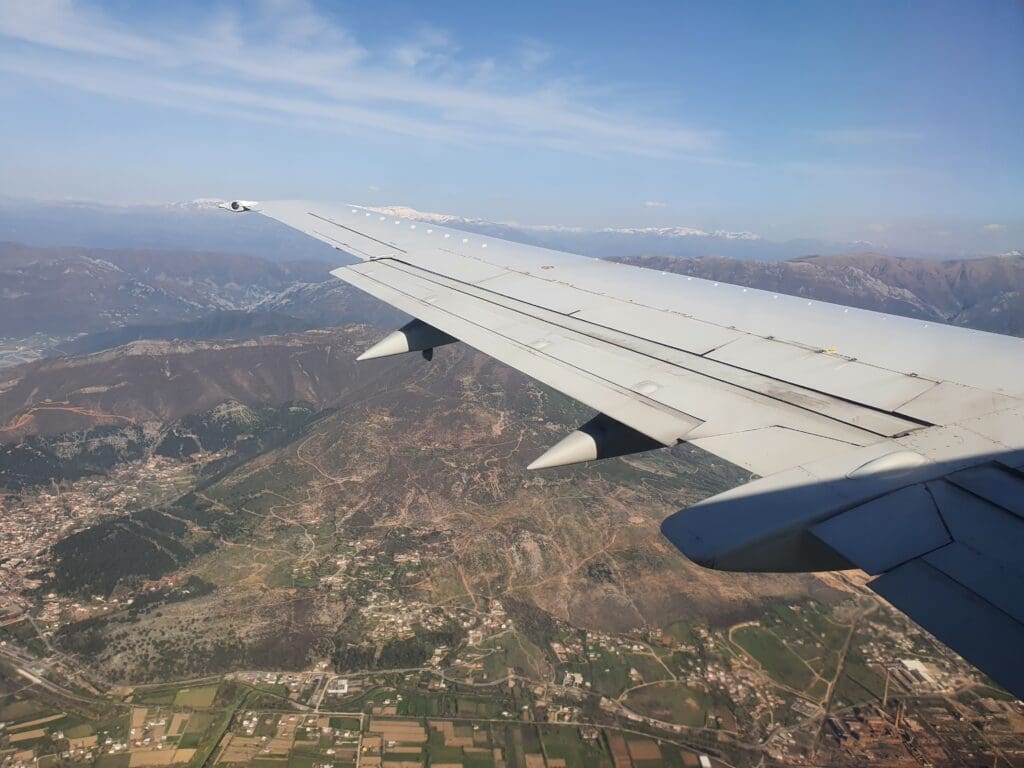
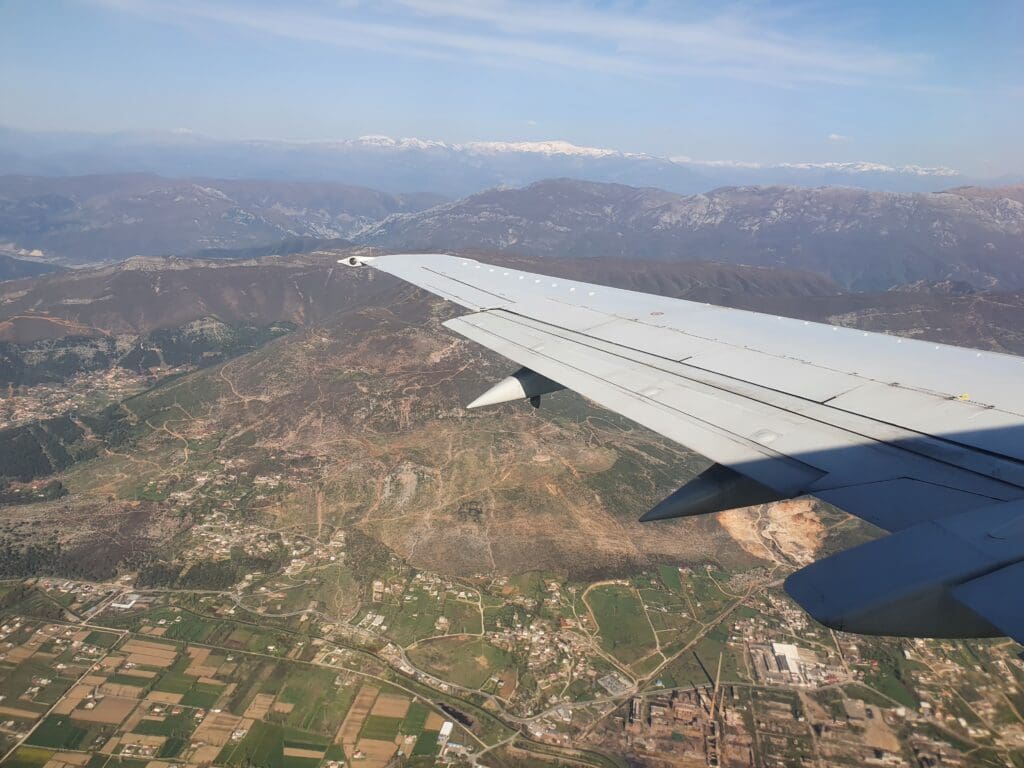
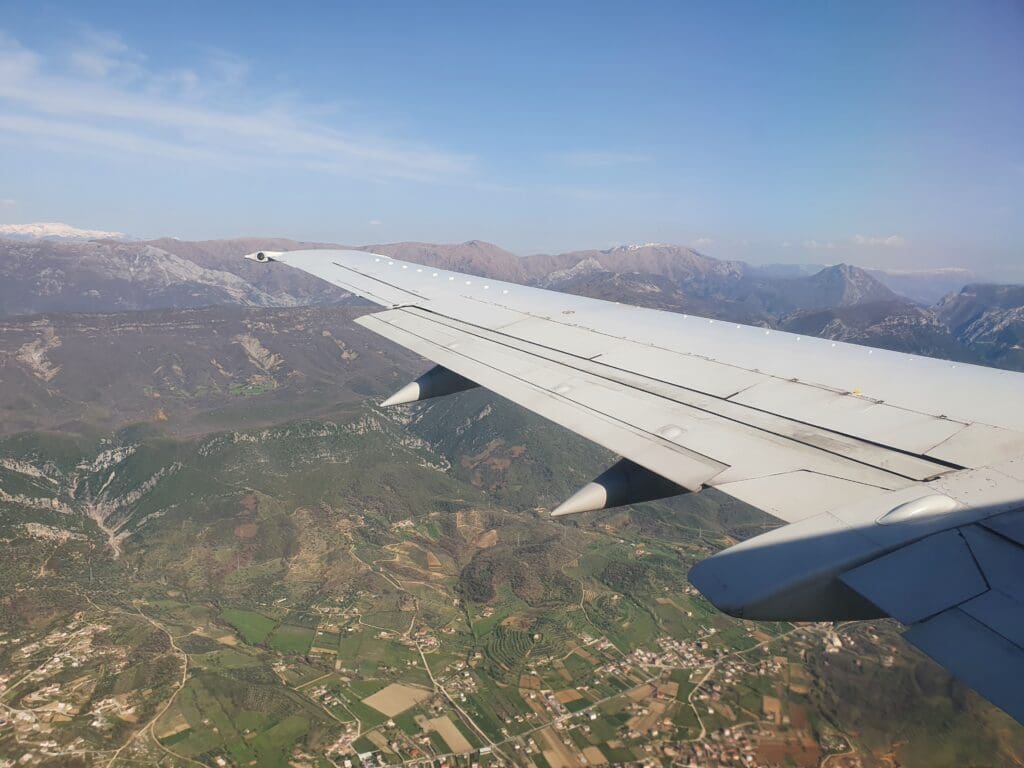
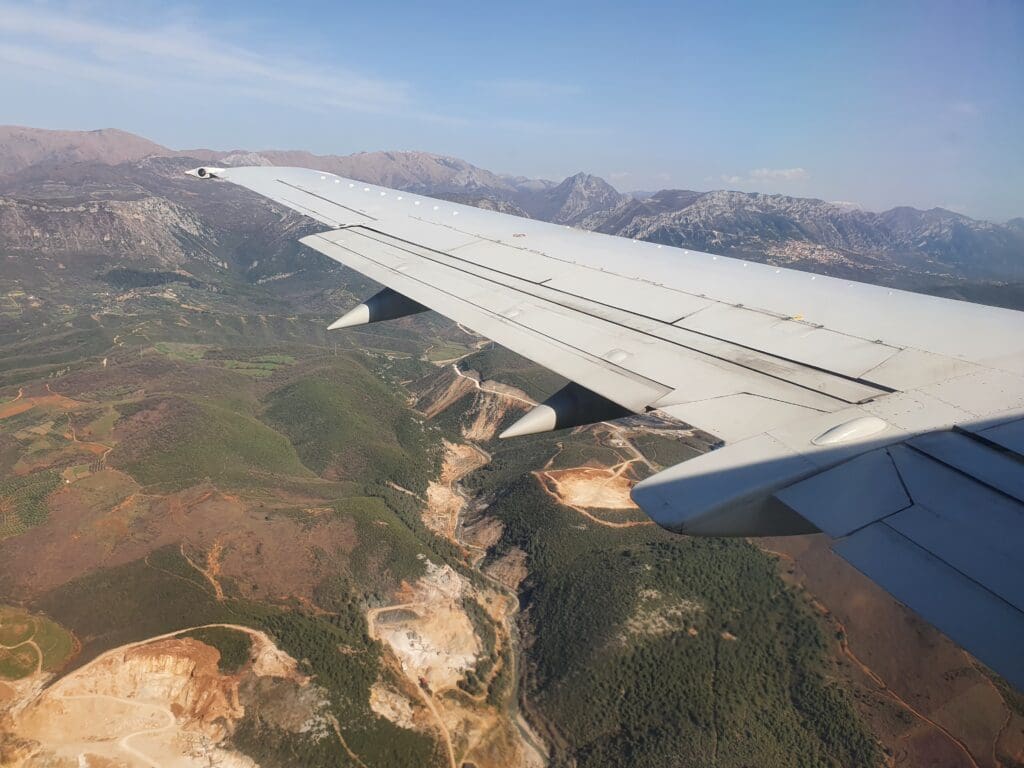
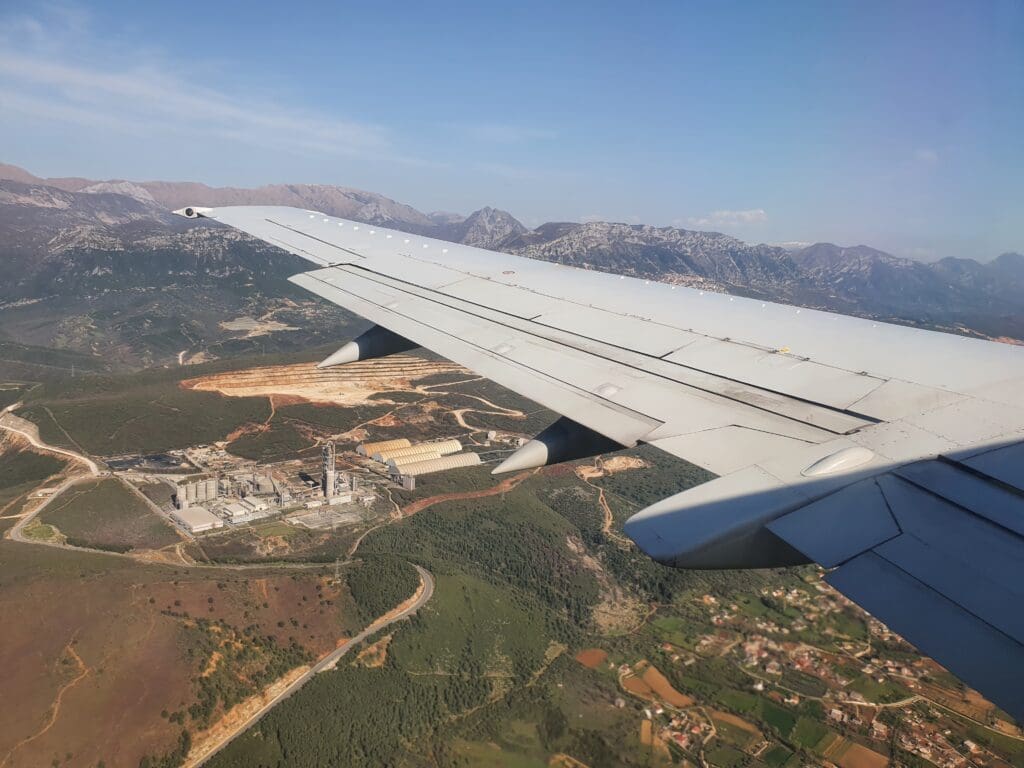
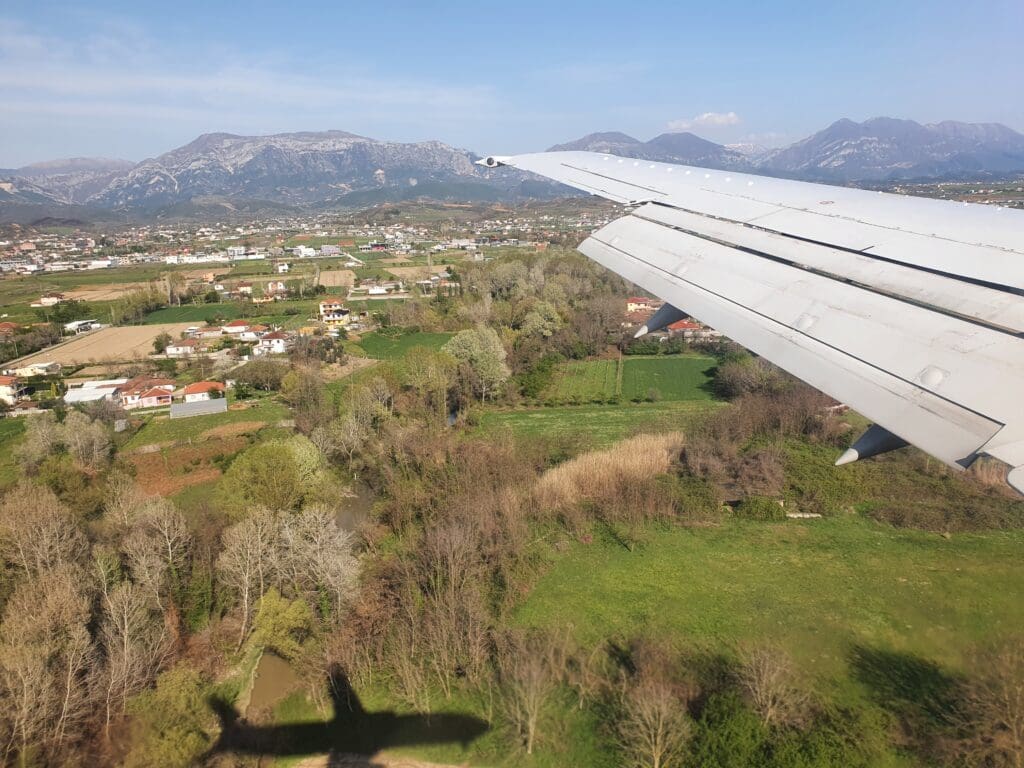
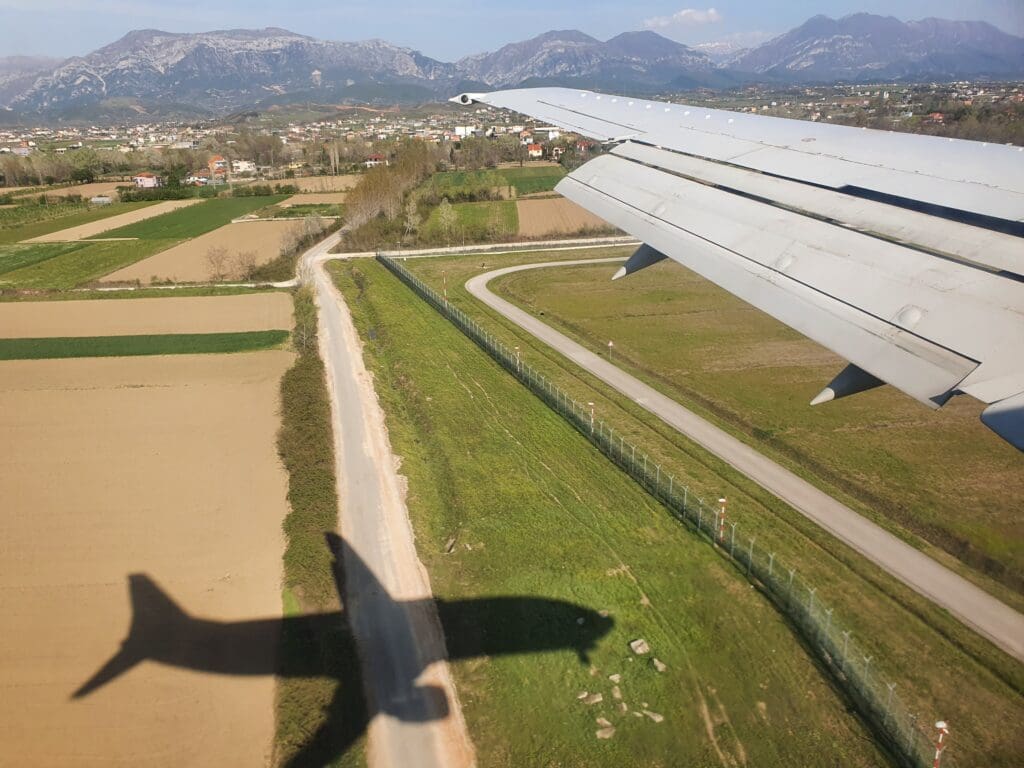
As the aircraft neared the airport, the hills flattened out a little and soon the flaps and landing gear were extended as we crossed over a cluster of villages sitting near the airport. Following an hour and three minutes in the air, at 1615 the Boeing crossed over Tirana Airport’s perimeter fence and touched down with a gentle bump on Tirana Airport’s Runway 17. Once on the ground, the sound of the engines filled the cabin as the reverse thrust was applied and the jet decelerated rather quickly before vacating the runway to the right and following a follow-me car to the terminal. In the usual matter, at this time a flight attendant welcomed all to Tirana and thanked passengers for flying with Albawings.

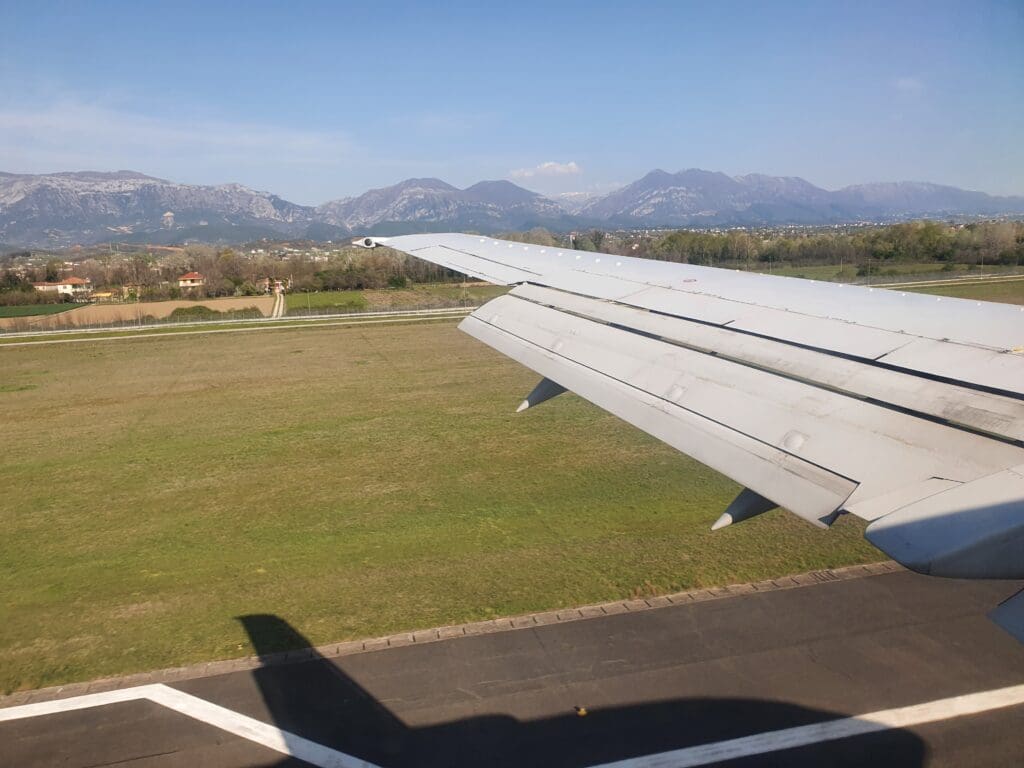
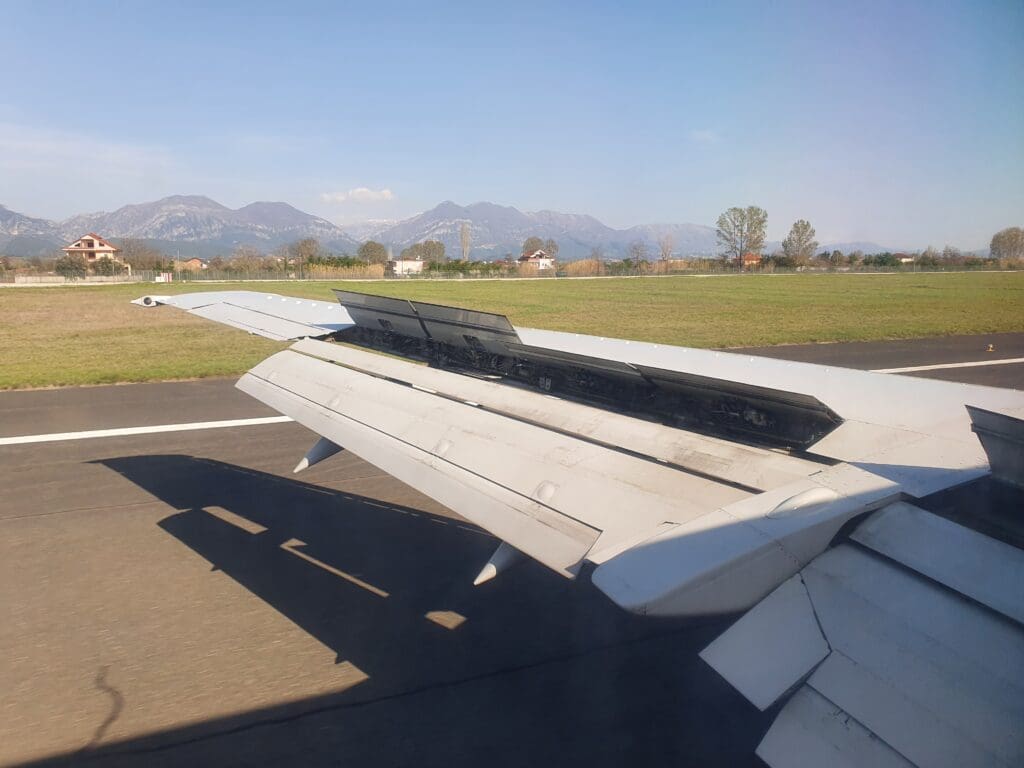
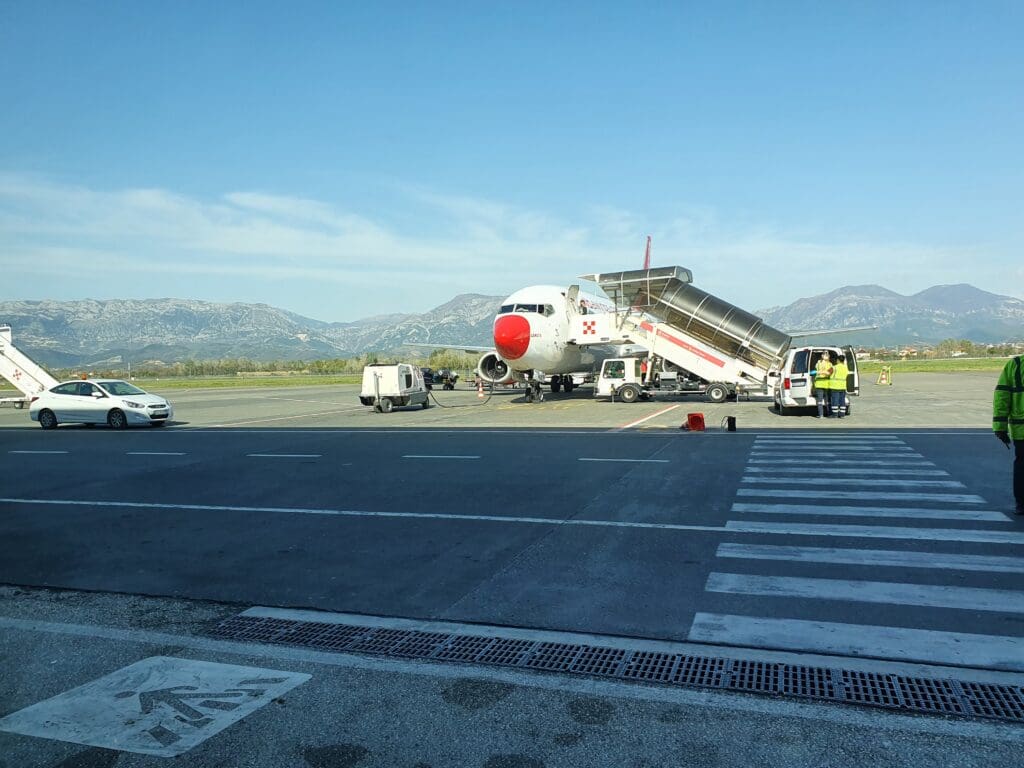
As the Boeing made its way to the terminal, a selection of very rare Chinese-manufactured former Albanian Air Force aircraft could be seen in varying states of disrepair – some well-preserved and others appearing to be falling apart. These included a Harbin H-5 and plenty of Shenyang J-5/6s. After passing these rare aircraft, the Boeing made its way past another third of Albawings’ three-strong fleet before turning left and pulling into a stand right outside the terminal building. Soon, the Boeing came to a sudden squeaky halt and the engines spooled down.
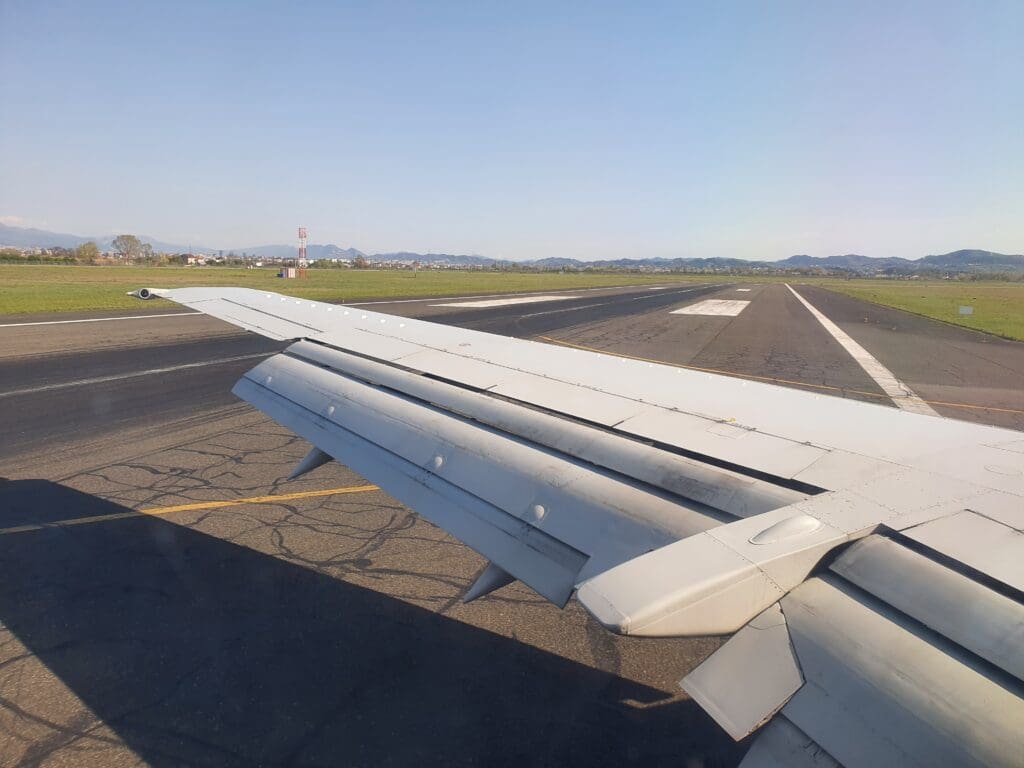
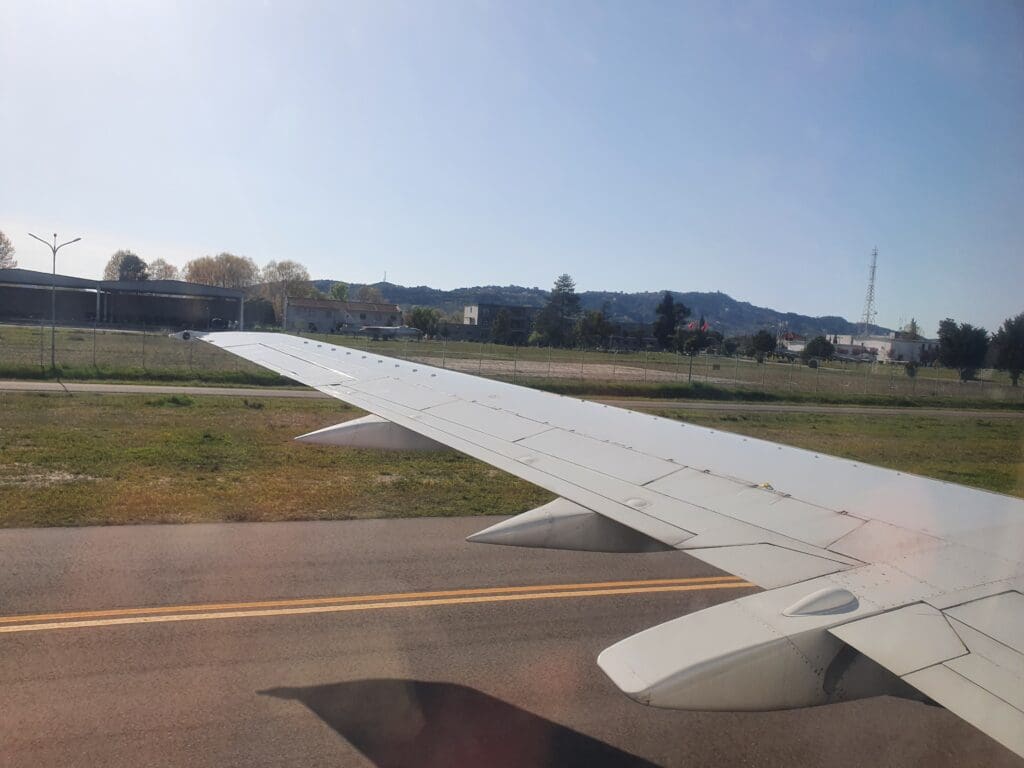
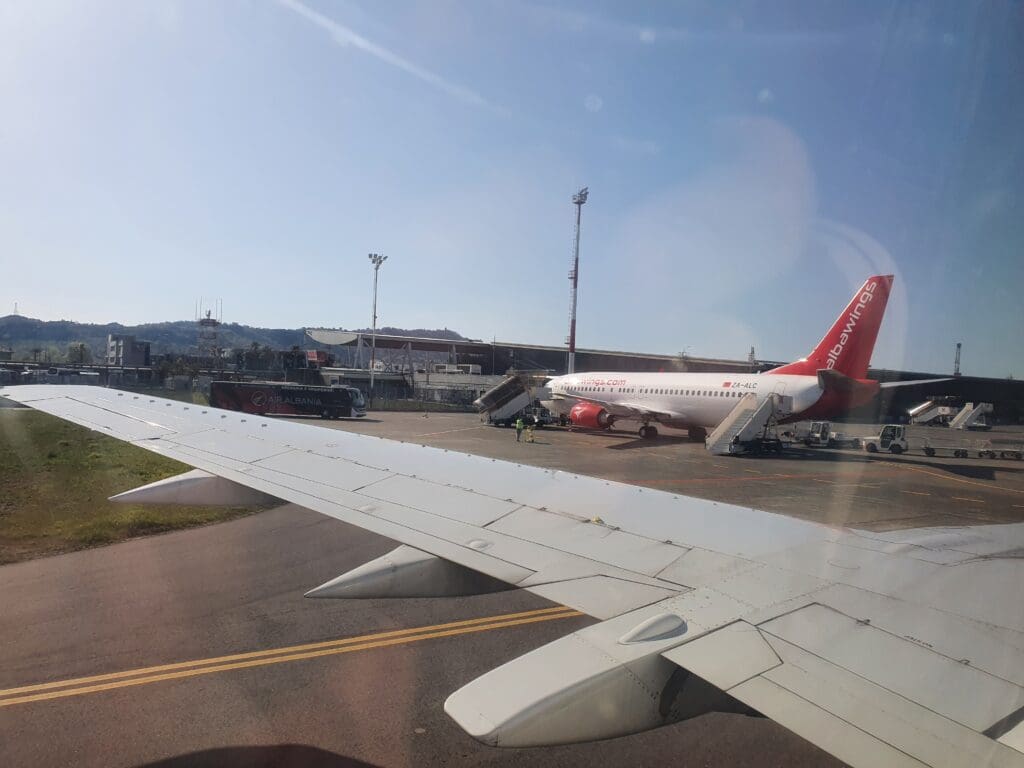
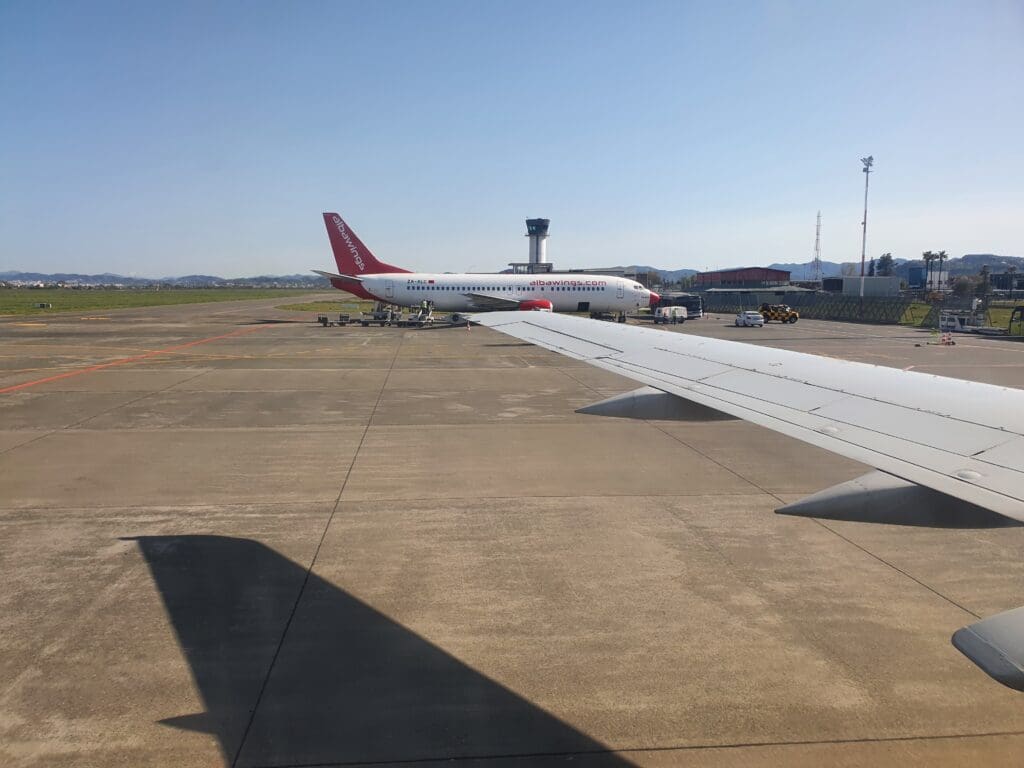
Almost as soon as the aircraft came to a halt, the cabin stood up although it did take a fair while for stairs to be connected to both the front and rear doors of the aircraft. Once disembarkation commenced, in no hurry to exit the aircraft, I waited around for a bit before standing up and making the short walk to the rear of the aircraft. After thanking one of the crew members, I made my way out into the warm afternoon sunshine and headed down the airstairs before walking around the wing and heading directly into the terminal’s immigration hall. Seeing as the neighbouring Boeing 737 had touched down from Verona just three minutes ahead of our flight, at that time the hall was packed with long queues leading up to each immigration desk – of which around half were manned. With no other option, I joined one of these queues and stood in line for around twenty minutes. For those arriving in Tirana, it is worth noting that there are no toilets or other facilities available between disembarkation and the baggage claim hall, so arriving passengers may wish to use the facilities onboard before arriving in Tirana.
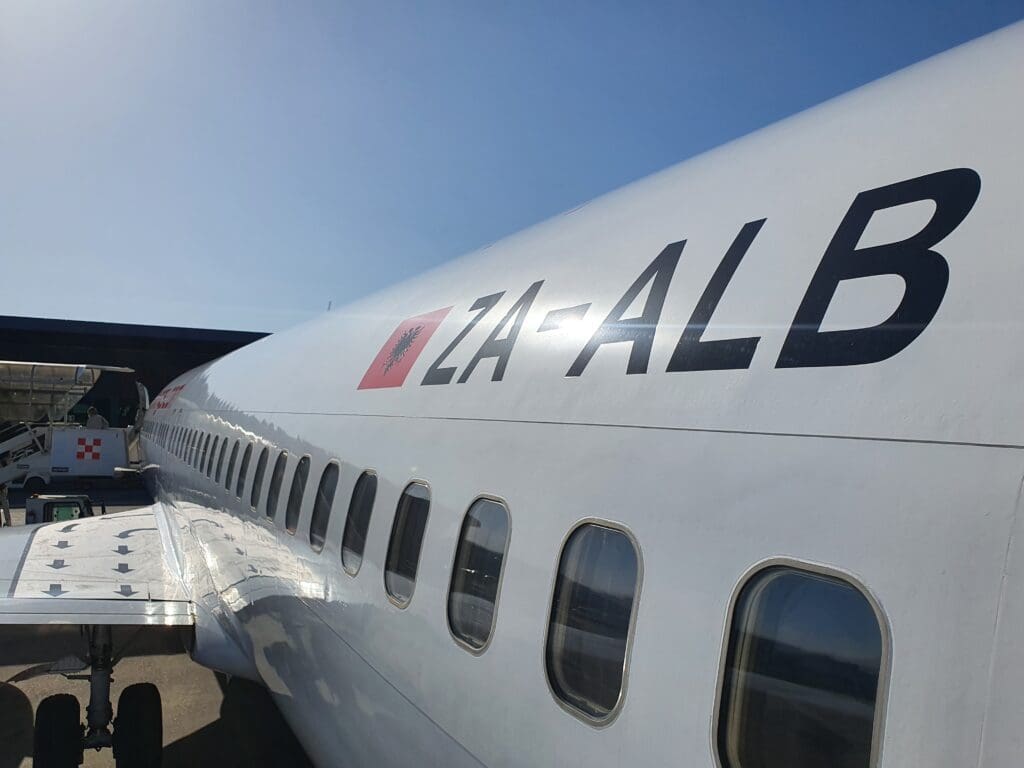
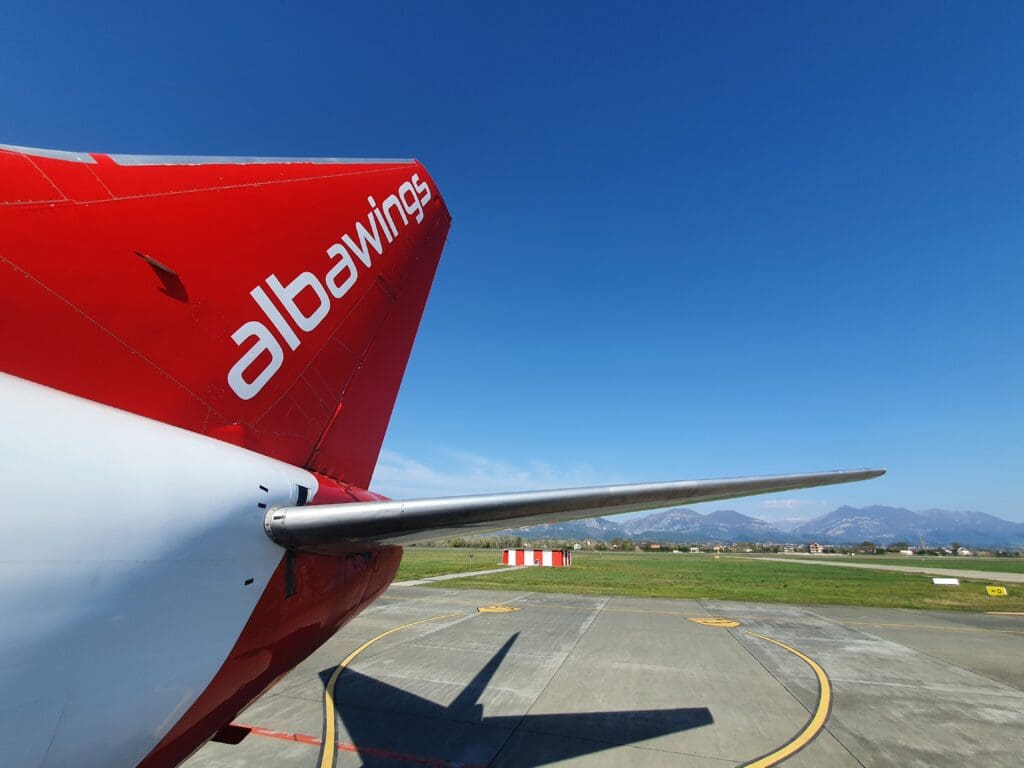
After around twenty minutes of queuing, I handed over my passport to a typically stony-faced immigration officer who returned this to me a short time later without any questions or stamping. With no baggage to collect, from there I was able to make my way out into the very busy landside portion of the terminal where I purchased a local SIM card from the Vodafone kiosk before heading outside to the bus stop to catch the shuttle bus to the city centre. With departures running every hour, I had inadvertently timed things just right to make it in time for the 1700 service to the city. Taking one of the few remaining seats onboard the small bus, I paid the 400 Lek fare to the conductor before speeding out onto the quiet streets around the airport, before soon hitting traffic and crawling alone once we had reached the capital city’s outskirts. Around an hour later I arrived at the bus’ final stop near Skanderbeg Square and made my way over to my Airbnb near the city’s fairly upmarket Myslym Shyri Street, finding this without much of an issue.
Summary
Judging by their plentiful branding and staff members’ fancy uniforms, it is clear that Albawings has invested a fair bit into their small airline. Starting with the positives, the airline managed to get me to Tirana in one piece and the seat proved to be relatively comfortable. Furthermore, the nowadays rare complimentary seat selection was very much appreciated as would have been the free baggage allowance were I to have opted to bring along any hold luggage. However, the crew onboard that flight seemed to be fairly mediocre – leaving me with neither a terrible nor fantastic onboard experience, and that was instead easily forgettable. Meanwhile, the cabin did appear to be in an incredibly tired state and in dire need of a refit, however, given the aircraft’s age, I am uncertain as to whether this will ever happen. Nevertheless, despite these minor grievances, I was happy to fly on what is today a rare aircraft and assuming these remain in service with Albawings for some time, I would not hesitate to fly with them again.