Riding the World’s Last Passenger Boeing 767-300: Seoul Gimpo to Jeju on Asiana
Background
Separated by just under three hundred miles, those needing to make the trip between Korea’s capital, Seoul, and the country’s largest island, Jeju, are offered a cornucopia of flight options. As is famously known, the route between Seoul Gimpo Airport and Jeju is the most well-served in the world, with over thirteen million passengers flying between the two in 2023. Indeed, at the time of my flight in May 2024, every single Korean passenger airline other than Cheongju-based Aero K and Dreamliner operator Air Premia, had a presence on this route.
Ignoring the curious luxury of short-lived boutique carrier Air Philip, my experience of flying domestically in Korea has always proven to be much of a muchness. Regardless of whether I end up on a full service or low cost carrier, I have yet to have a particularly bad experience in the Korean skies and thus, when flying within the country, I usually have no qualms with going for the operator who offers the cheapest fare. Unlike in many parts of the world, many of Korea’s low cost carriers offer passengers 15kg of complimentary luggage, even if they are travelling on the cheapest ticket, and whilst the likes of Asiana Airlines and Korean Air serve passengers a free drink on all domestic routes and complimentary seat selection, in many cases I find that such perks do not usually warrant paying a price premium on very short domestic hops.
However, being an aviation enthusiast, I also often consider the type of aircraft operating the flight. Seeing as Asiana Airlines operate the world’s final remaining passenger Boeing 767-300 exclusively on the route between Seoul Gimpo and Jeju, and with this set to bow out of service before the end of 2024, needing to get to Jeju, I could hardly pass on the opportunity to take my third and likely final flight onboard an Asiana Airlines Boeing 767-300.
A Bit About Asiana Airlines and the Boeing 767
Asiana Airlines is Korea’s second largest and second oldest airline, yet established in 1988, it is by no means elderly when compared to many other legacy carriers across the globe. Asiana Airlines came about as something of a byproduct of South Korean democratisation and the associated liberalisation of the business world that accompanied the country’s transition away from authoritarian rule.
For decades, South Korea’s aviation scene had been dominated by Korean Air Lines. Once wholly owned by the state and known as Korean National Airlines, this was privatised and sold to the Hanjin Group in 1969. Thanks to this shipping magnate’s amicable relationship with the state and high levels of restrictions governing the business arena, Korean Air Lines was able to reap the benefits of a total monopoly on the industry and a lack of any domestic competitor. However, as both the South Korean economy and demand for flights grew, so did the demands of chaebols (large conglomerates) to get in on a slice of the aviation action. Eventually, in the final years of South Korea’s authoritarian rule, after much debate and contemplation, the government permitted tyre giant, Kumho Group to establish an airline to challenge the monopoly of Korean Air. Thus, Asiana Airlines was born.
Initially commencing operations with a fleet of Boeing 737 Classics, in September 1990, Asiana Airlines’ first Boeing 767 touched down in Seoul Gimpo Airport. Fresh from the Boeing factory, this brand new jet far exceeded the capabilities of their Boeing 737-400s and enabled the carrier to operate medium haul flights, with a particular focus on Southeast Asia. Throughout the decade, Asiana Airlines continued to take delivery of the aircraft and in total, nineteen examples joined the carrier’s fleet up until 2001. However, just three years later, in 2004, Asiana Airlines took delivery of their first Airbus A330. Being more efficient and fitted with the luxury of personal inflight entertainment screens, these aircraft began to take over some of the routes that had been the mainstay of the Boeing 767, and the older type came to be relegated to short haul high-density routes to China and Japan, plus a few other short and medium haul routes. . In addition, a number of these were re-configured into an all-Economy configuration and operated exclusively on the route between Seoul Gimpo and Jeju.
As the years passed, fewer and fewer Boeing 767s remained in passenger operation with Asiana Airlines, and by 2024, just one single passenger example remained in the airline’s fleet. With this scheduled to retire later on in the year, I couldn’t resist the opportunity to fly this for a third and final time during a two week trip to Korea.
Booking
When booking domestic flights in Korea, I have rarely found any price differences between booking directly with the operating carrier and through a third-party site. Thus, I decided to book directly via Asiana Airlines’ website and upon landing on their British homepage, I was presented with a banner that promoted their Airbus A350 operated services between London Heathrow and Seoul Incheon. Wasting no time, I undertook a search for flights and was almost instantly presented with 31 direct options between Seoul Gimpo and Jeju that day. As I had expected, the vast majority were operated by Asiana Airlines’ Airbus A321s, with a few Airbus A330 and Boeing 767 services thrown in for good measure. In addition, a number of these were also operated by Asiana Airlines’ low cost subsidiary, Air Busan. That day, flights were priced between 42,100 won (£24.12) and 102,000 won (£58.44) in Economy, and on those aircraft with Business class cabins (select Airbus A321s and all Airbus A330s), tickets were sold for a flat fee of 141,100 won (£80.84).
Determined to fly aboard the Boeing 767 and hoping to get the best part of a full first day in Jeju, I decided to go for the first Boeing 767 departure of the day. This would depart Seoul Gimpo at 0725, arriving in Jeju an hour and ten minutes later at 0835. Selecting this, I was presented with just three fare options – Economy Special, Economy Discount and Economy Normal. With the cheapest fare still including 20kg of hold luggage and free seat selection across much of the cabin, I went for this, which was priced at 57,100 won (£32.71). Once I had entered my personal details, I selected my seat and ticked several boxes to confirm that I understood the fare conditions and rules before being taken to the payment page. Unfortunately, paying on Asiana Airlines’ website is a little more convoluted than you would expect for a major international airline. However, this is not particularly unusual for a Korean carrier and is somewhat explained by the overly complicated payment security protocols in place in Korea.
Being a domestic flight, with a day to go until departure, I was automatically checked in and had my boarding pass emailed over to me, leaving me with one less thing to worry about as my stay in Seoul neared its end.
The Journey
As airports go, Seoul Gimpo Airport is very well connected to the local public transportation network and is located much closer to Seoul than its counterpart, Seoul Incheon Airport, usually making for a relatively quick and easy journey to and from the airport. With that considered, I had not envisaged any major problems in reaching the airport in good time for my 0725 flight to Jeju. Furthermore, with this being my nineteenth ever departure from Gimpo Airport, despite departing during the morning rush, I was confident that I would not face too many issues in passing through this quickly and with ease. Nevertheless, I aimed to be at the airport around ninety minutes before departure. For those in more of a rush, check-in closes for Asiana Airlines’ domestic services just thirty minutes before departure; however, I would never want to leave things so fine!
As of 2024, no fewer than four subway lines connect the Seoul Gimpo Airport to Incheon, Seoul and various towns across Gyeonggi Province. In addition, Korail’s all-stop Airport Express services from Seoul Station to Incheon Airport also make a stop at Gimpo Airport, further assisting with easy access to the airport. Starting my journey halfway between Aegogae and Gongdeok Stations on the western edge of Central Seoul, I aimed to wake up bright and early at 0430. Unfortunately, having had a late night, I managed to sleep through my alarm and instead hurriedly jumped out of bed at 0500 in the belief that I was going to miss my flight! Fortunately, having packed my bags the night before, there was little I needed to do other than have a quick shower before I darted down the fourteen floors to ground level and began the short walk to Aegogae Station.
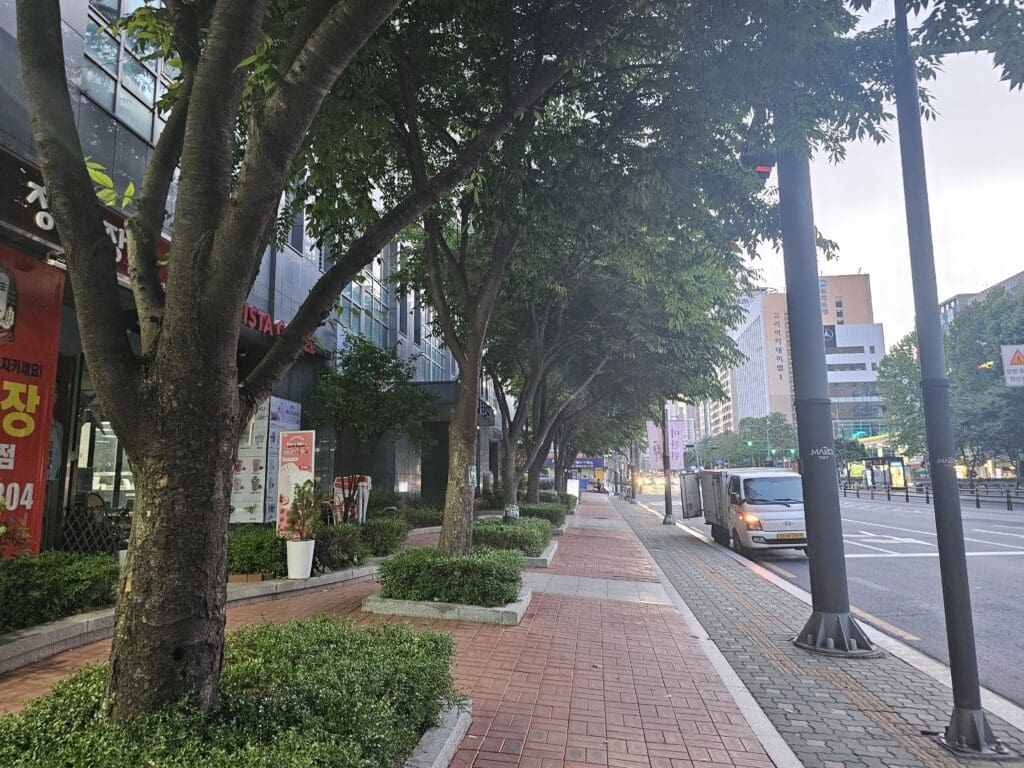
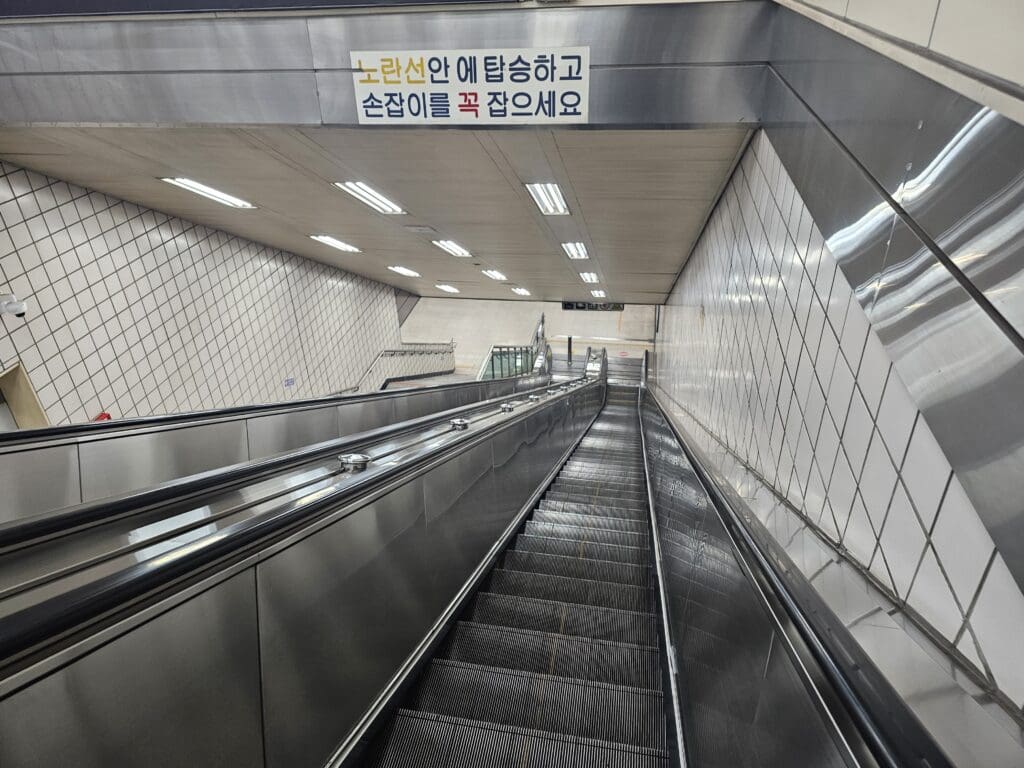
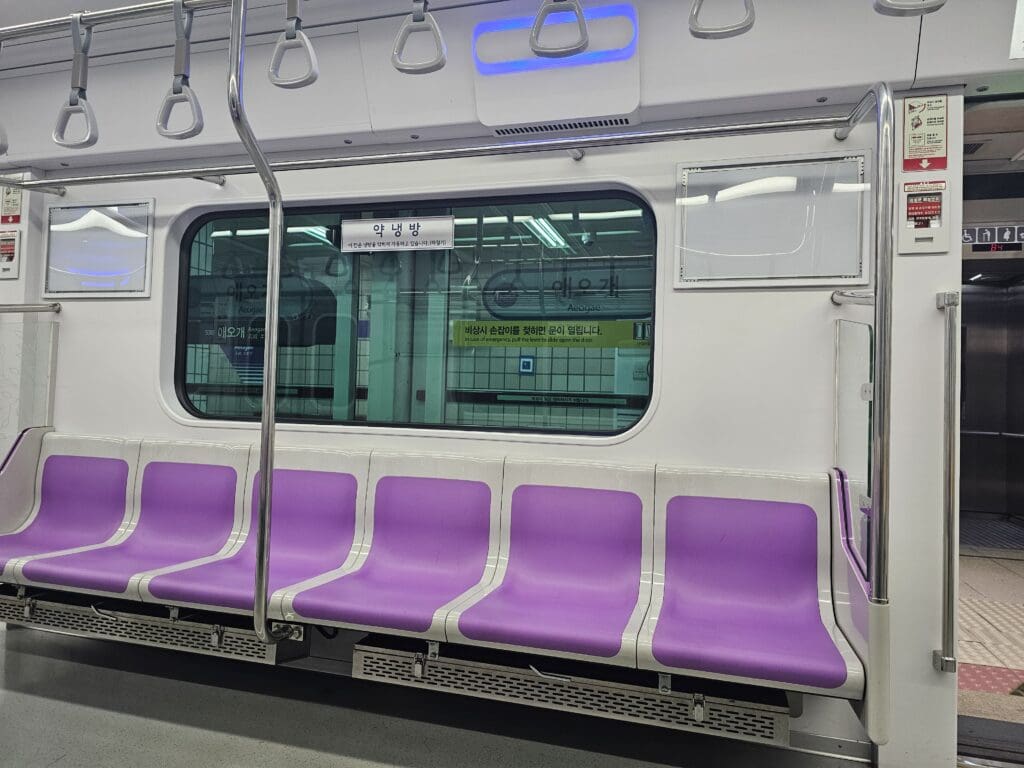
After struggling with my battered three-wheeled suitcase, I headed underground, tapped in and boarded a near-empty, modern and spotlessly clean Line 5 train at around 0540. Soon, we sped away from the station, and a mixture of weary-eyed early morning commuters and travellers piled onto the train at each of the seventeen stops between Aegogae and Seoul Gimpo Airport. Unsurprisingly, given Line 5’s former status as the world’s longest underground railway line, nothing could be seen outside for the duration of the journey other than the dark tunnels and an uneventful thirty minutes later, the train pulled into Seoul Gimpo Airport station. With this being near the western end of the line, most passengers disembarked there, and I followed the masses of passengers heading towards the station’s atrium. Eventually, I tapped out and had the very reasonable 1,400 won fare (£0.80) deducted from my T-Money card. Following signs for the domestic terminal, I soon turned left and made my way along the series of long well-polished underground passageways that connect the station with the this terminal. After a few minutes of trundling along travelators, I headed up the escalators and arrived in the bustling check-in hall. At that time, this was awash with school groups, suited business people, young couples, middle-aged couples, old couples, conscripts and jovial elderly tourists. With the morning rush in full swing and an unrelenting list of flights (most of which were bound for Jeju) seen on the departure boards, I was not particularly surprised at the hustle and bustle in the terminal that morning.
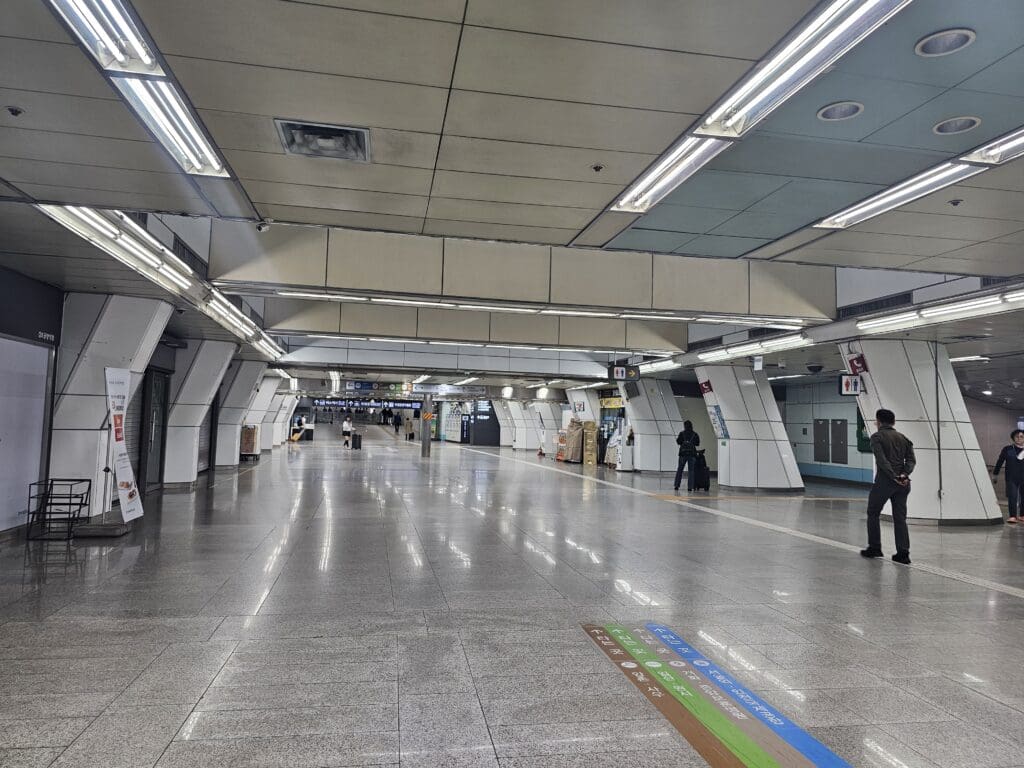
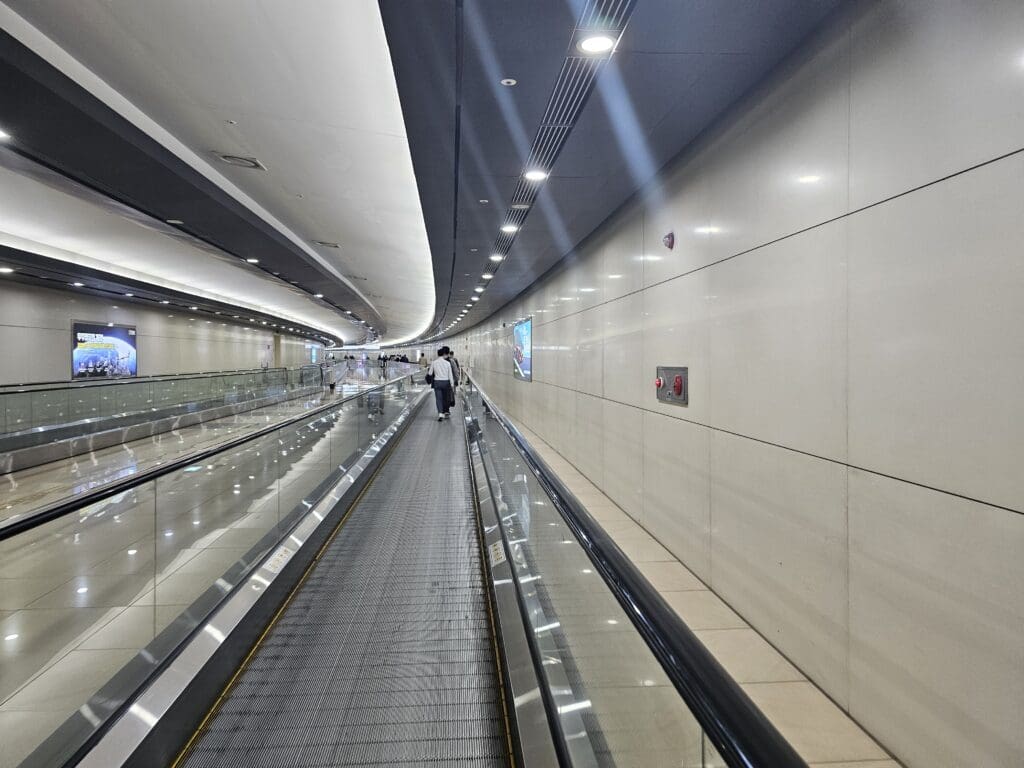
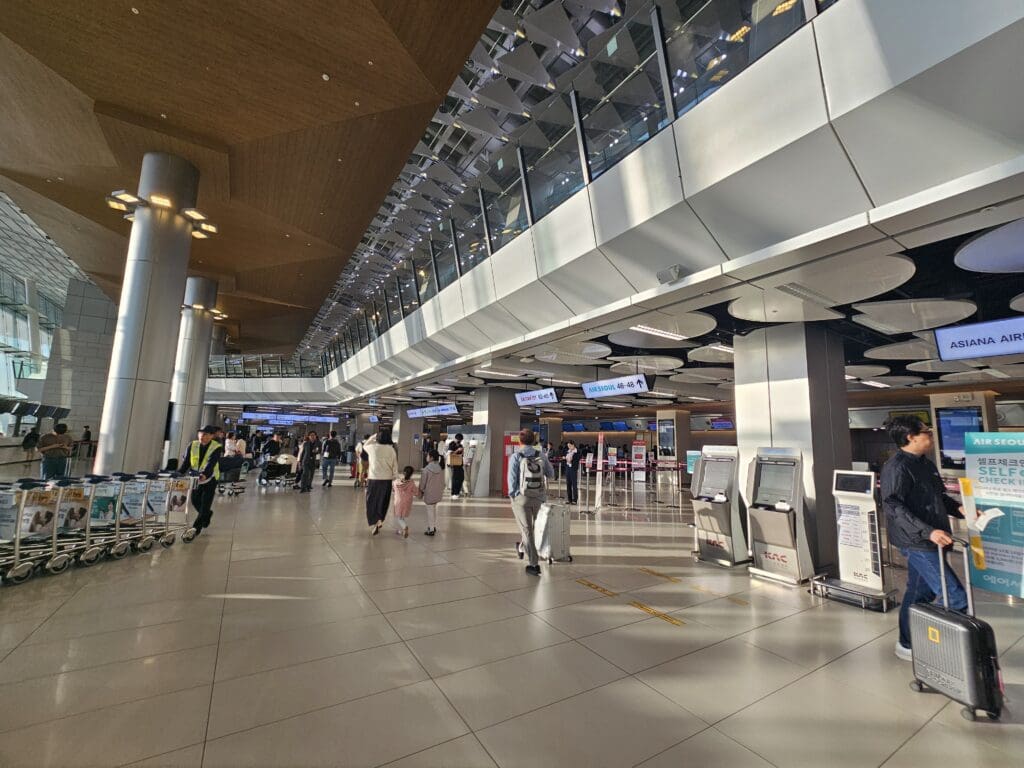
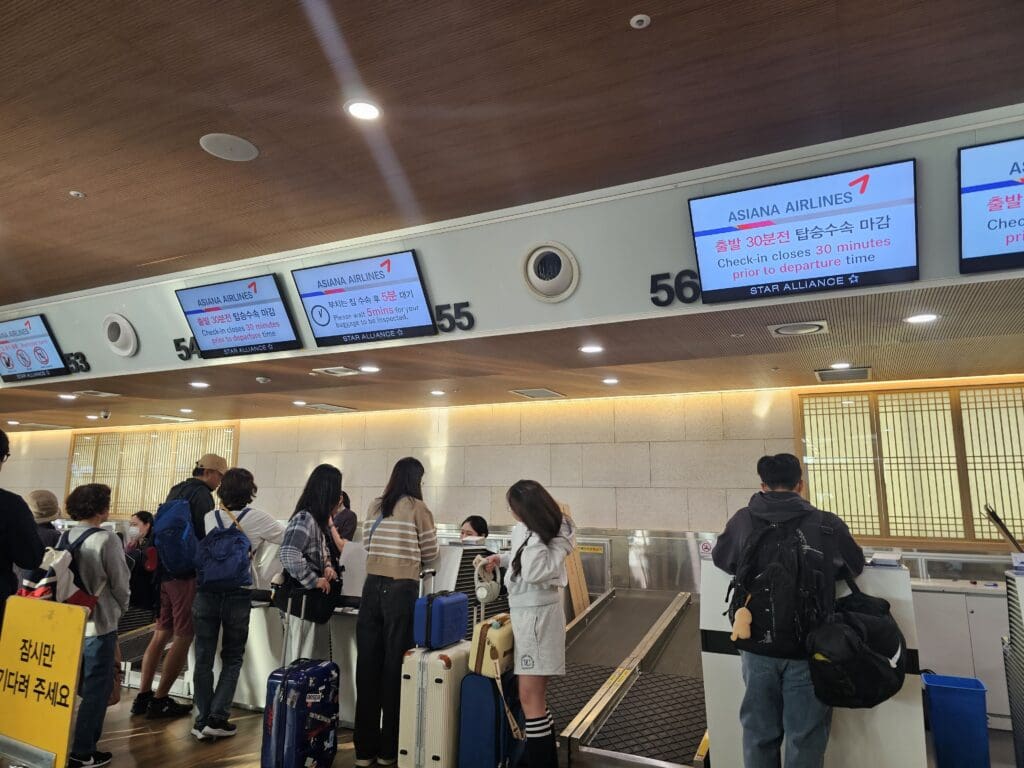
Seeing as I now had around an hour to go until departure, I thought it best to head straight to Asiana Airlines’ check-in area in order to drop off my bag. With no automated drop-off counters available, I joined the reasonably long queue leading up to Asiana Airlines’ Economy desks. Admittedly, given the massive size of Asiana Airlines’ operation at Seoul Gimpo Airport, I was a little surprised to find that only three desks had been assigned to Economy passengers, although as I waited, a fourth desk was opened, and the queue did move along at a reasonable pace. After queuing for a few minutes, I was directed towards the next available desk, and once there, I was greeted in both English and Korean, and my bag was soon tagged and sent off into the depths of the airport for its quick journey out to the aircraft. During this process, I was offered the chance to be moved forward to a bulkhead seat, although seeing as this would not be a window seat I politely rejected the agent’s offer and was then requested to linger around for five minutes to ensure that my hold luggage cleared security (this is not required for those in possession of a Korean phone number). Interestingly, the agent kept hold of my passport until this had cleared, and so, after almost exactly five minutes, they waved me back over to the desk, at which point my passport was returned, and I was advised to head upstairs to security.
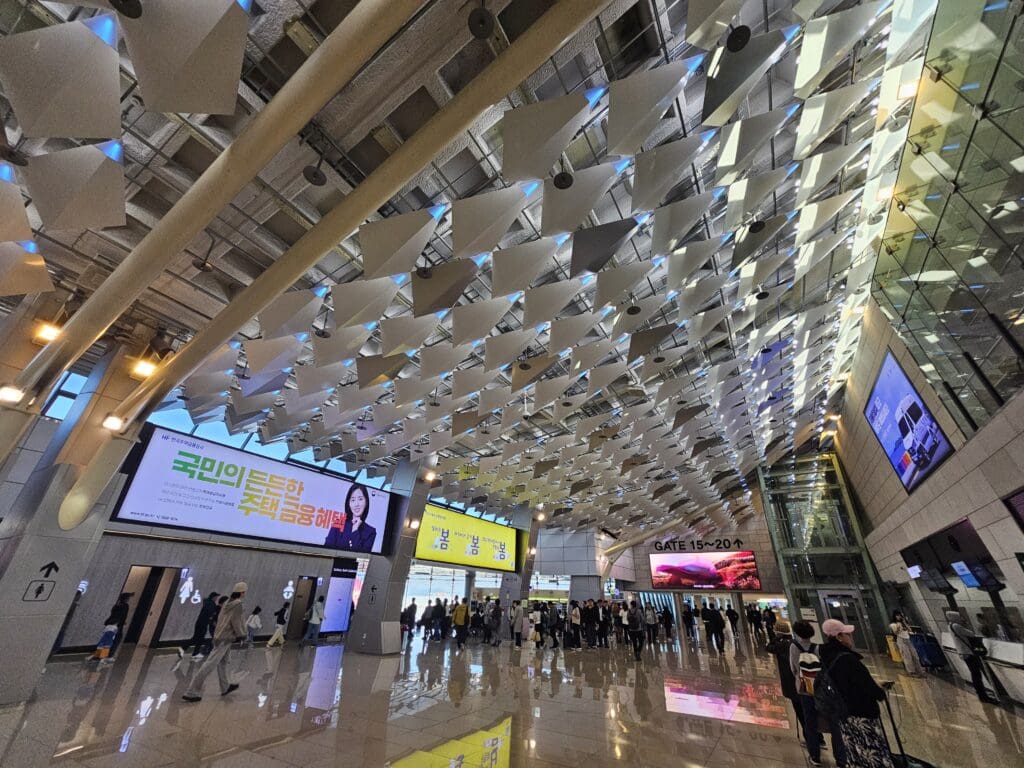
Unfortunately, once I had made it upstairs, I was greeted by the sight of the longest security queue that I have ever seen at Gimpo Airport! There, long snaking queues could be seen leading up to both the biometric scanners (for those with a Korean identity card) and the traditional entrance to security. With no other option, I joined the queue and slowly shuffled along. Eventually, my boarding pass was scanned and my passport checked by a rather weary-looking security worker, and I was then required to join another queue leading up to the checkpoints. After around fifteen minutes of waiting, I parted with my possessions and had a painless check before being cleared to enter the airside area. I have to say that, considering my previous experiences of passing through Seoul Gimpo Airport, I was left rather disappointed that morning, especially considering that I wasn’t travelling during any holiday or festival. I’m not entirely sure what was wrong that morning, however, since this trip I have passed through the terminal quite a few times at a similar time of day and I can happily say that since then security has been a breeze requiring only minimal waiting.
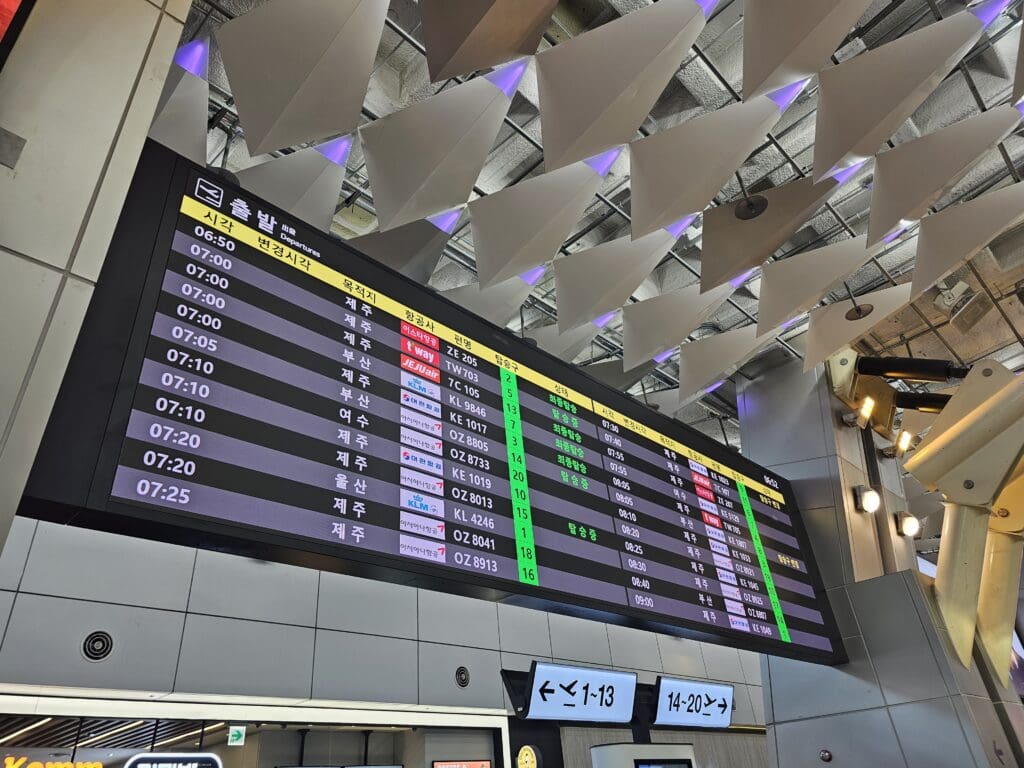
Once airside, Seoul Gimpo Airport’s domestic terminal is not the largest in the world and it is not home to any great abundance of facilities. Indeed, unless you happen to be an aviation enthusiast who enjoys watching the regular stream of movements outside, you may well end up bored if you have to spend more than an hour or so there. With the terminal designed with speed and convenience in mind, I would caution against arriving at the airport with hours to go until your flight. Turning to the facilities on offer, several cafés and a convenience store can be found. In terms of its layout, the terminal consists of a central hub, with two strips of gates jutting off this. With all the renovation work having been long completed, this is modern and comfortable, and enthusiasts will be glad to hear that large windows provide a good view of the stands outside and the airport’s two runways. Furthermore, throughout this, a good number of charging points can be found, whilst complimentary wifi is provided, which seemed to work without issue. Importantly, I found the terminal to be in a very clean and tidy condition.
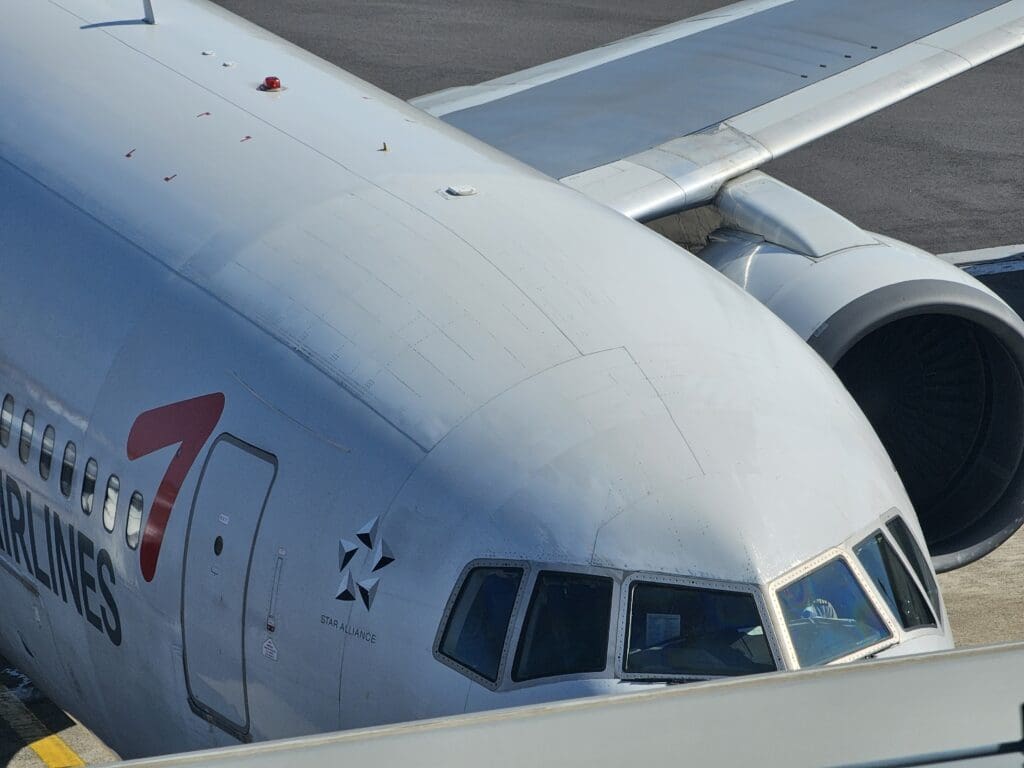
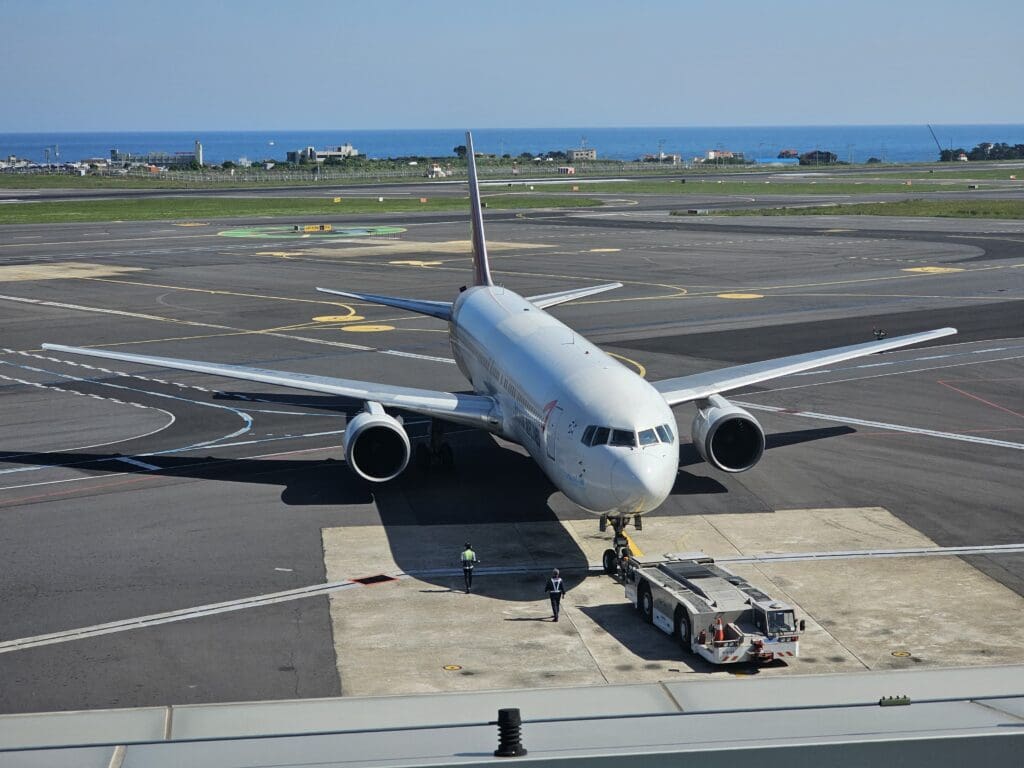
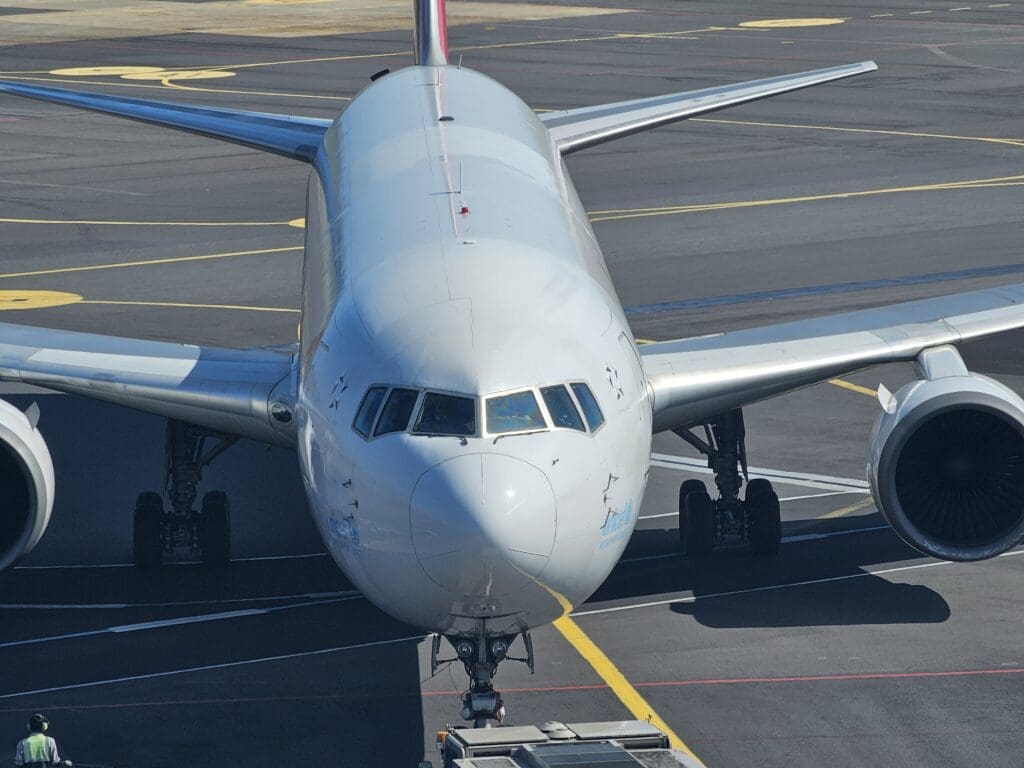
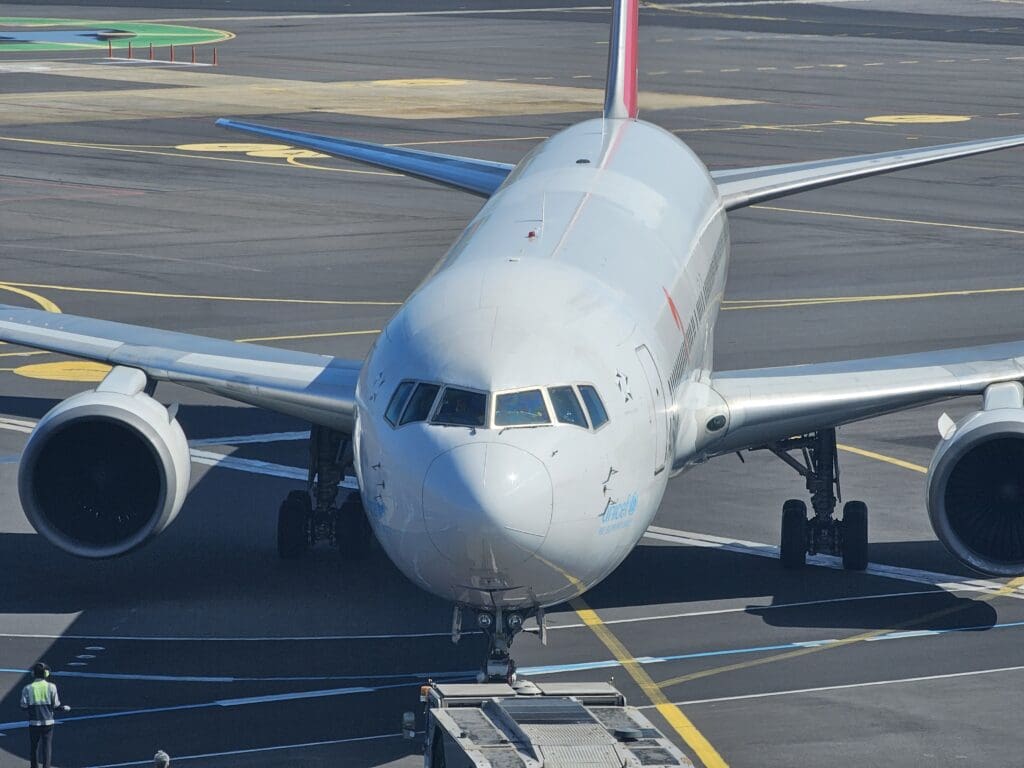
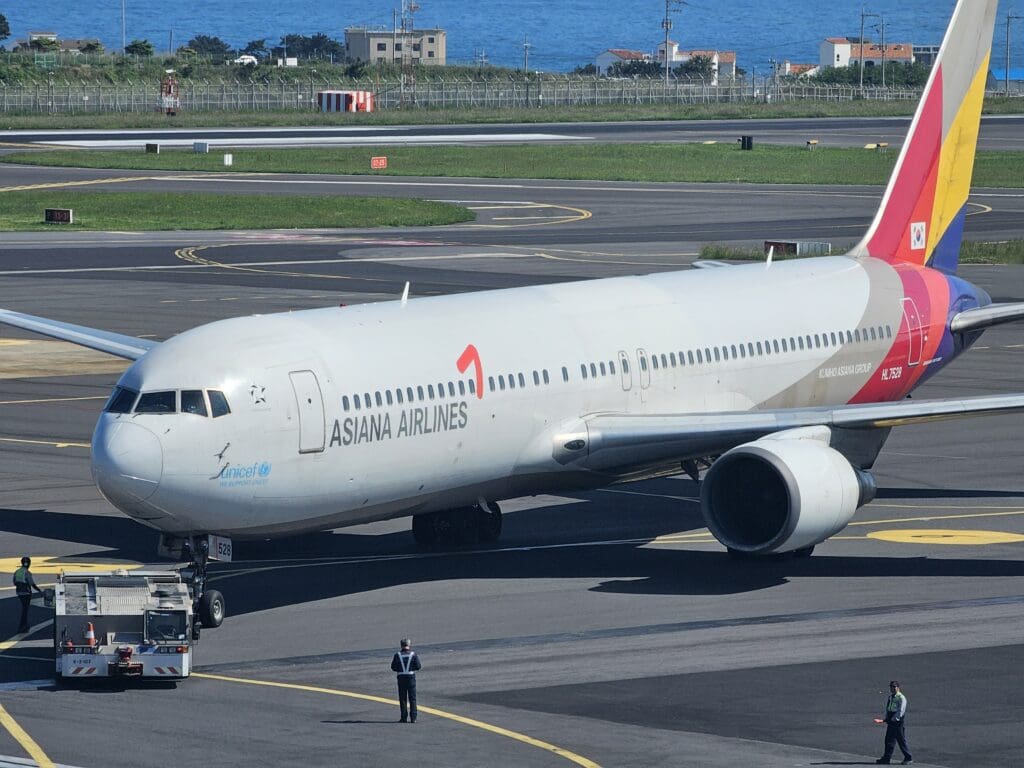
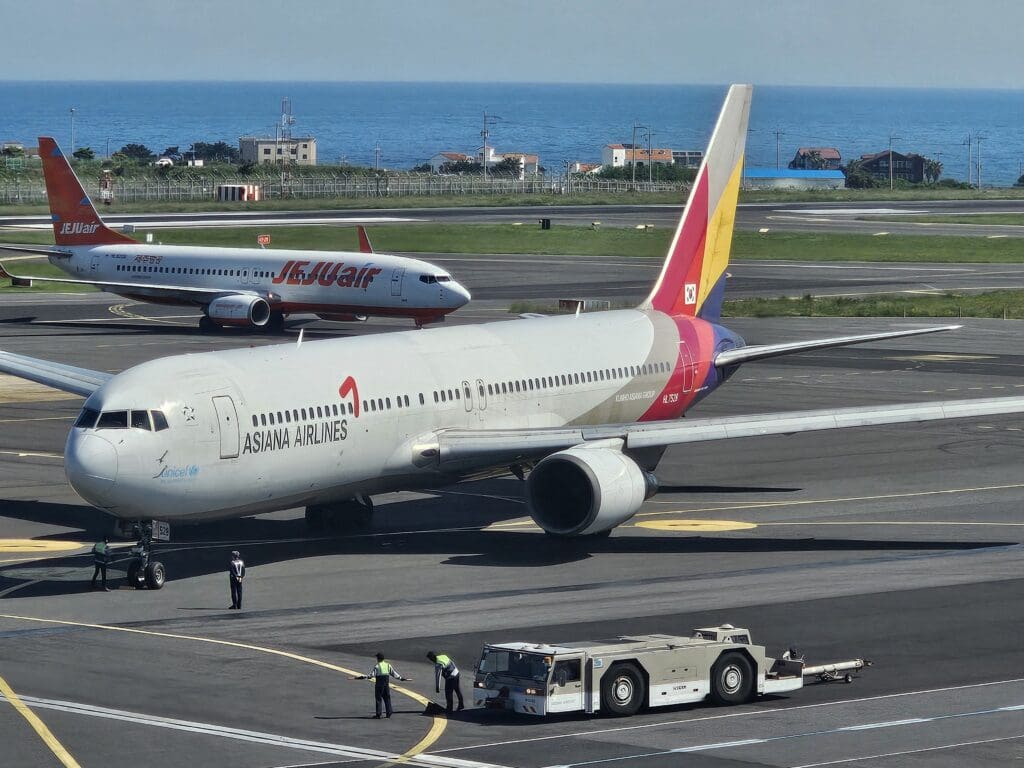
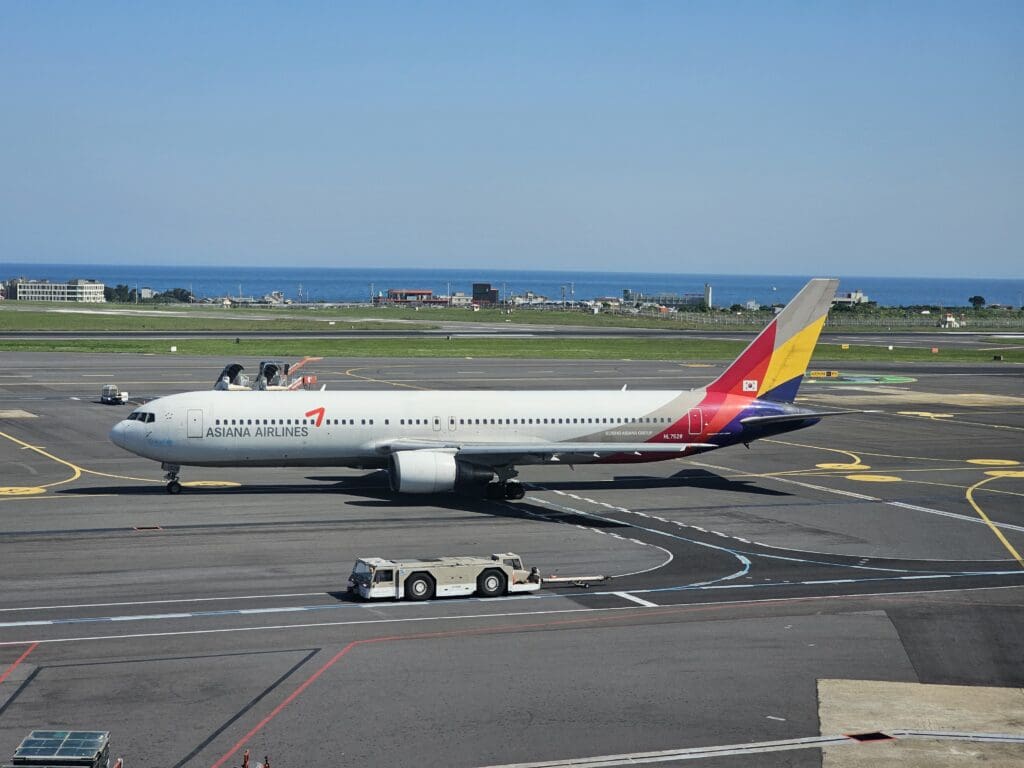
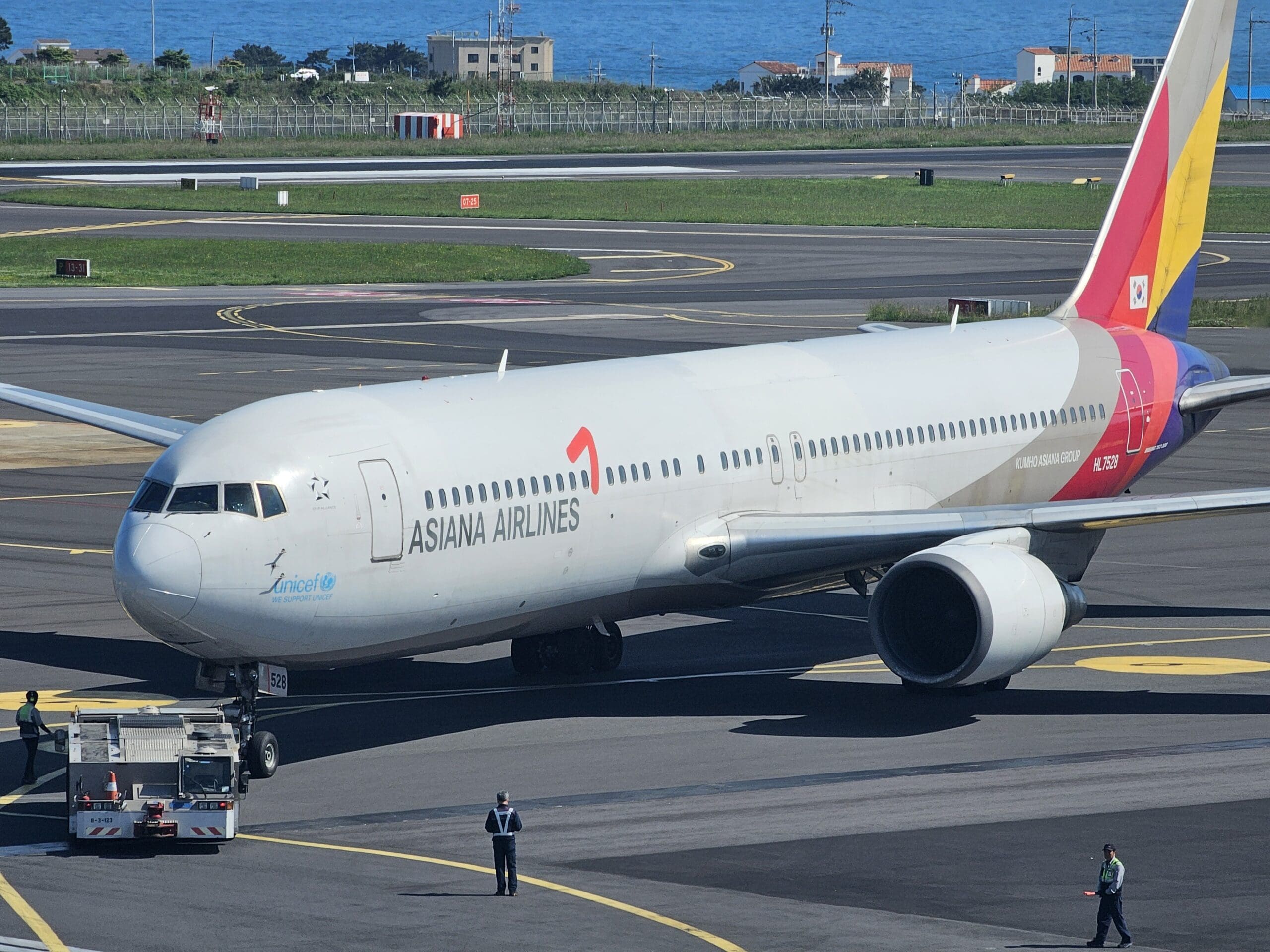
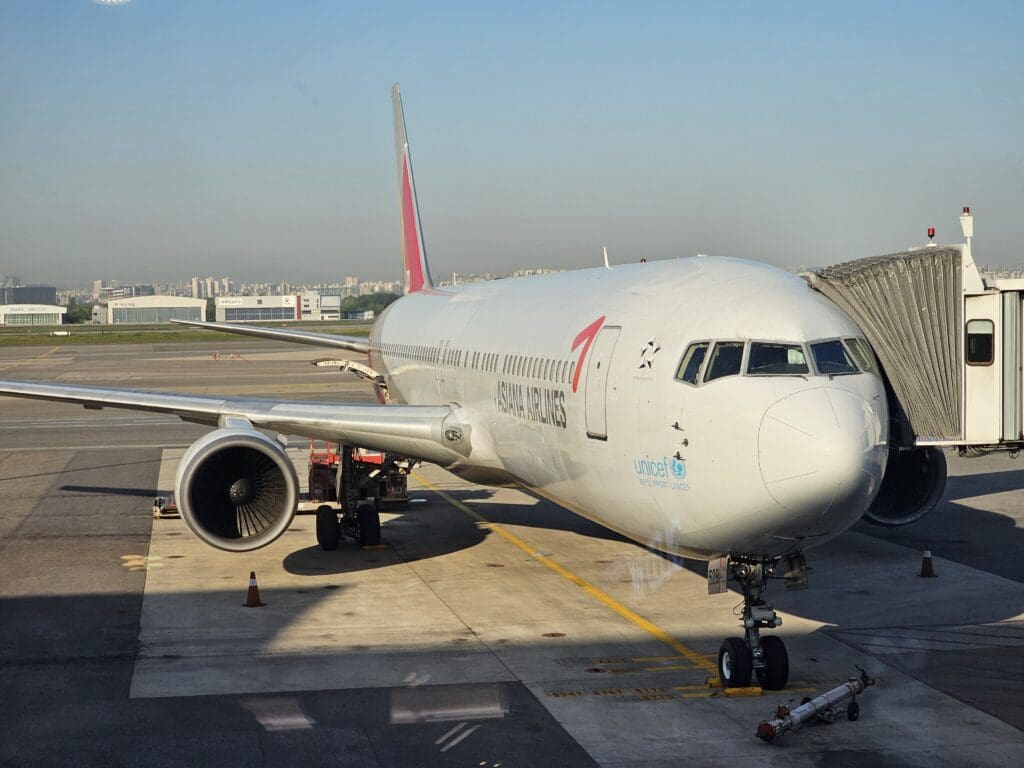
By the time I made it through security, I was left with just eight minutes to go until boarding for my flight to Jeju was scheduled to commence. Not having too much time to dilly dally, I made a quick detour for the toilets, which, on a side note, I found to be in tip-top condition, before wandering over to the gate. Seeing as Asiana Airlines operated a single Boeing 767 at the time of my flight, I had no difficulty in predicting which aircraft would be taking me to Jeju that morning. As I had hoped, there had been no last minute equipment changes and Boeing 767-38E HL7528 could be seen being readied for the first of six flights that day at Stand 16. Assembled at Boeing’s Everett plant, this aircraft first took to the skies in March 1998 and was thus a little over 26 years old at the time of my flight. Whilst by no means elderly, this happened to be the oldest South Korean airliner in passenger service! Following testing and some time spent in storage, in September 1999 the aircraft was ferried across the Pacific to Korea and was soon pressed into service with Asiana Airlines.
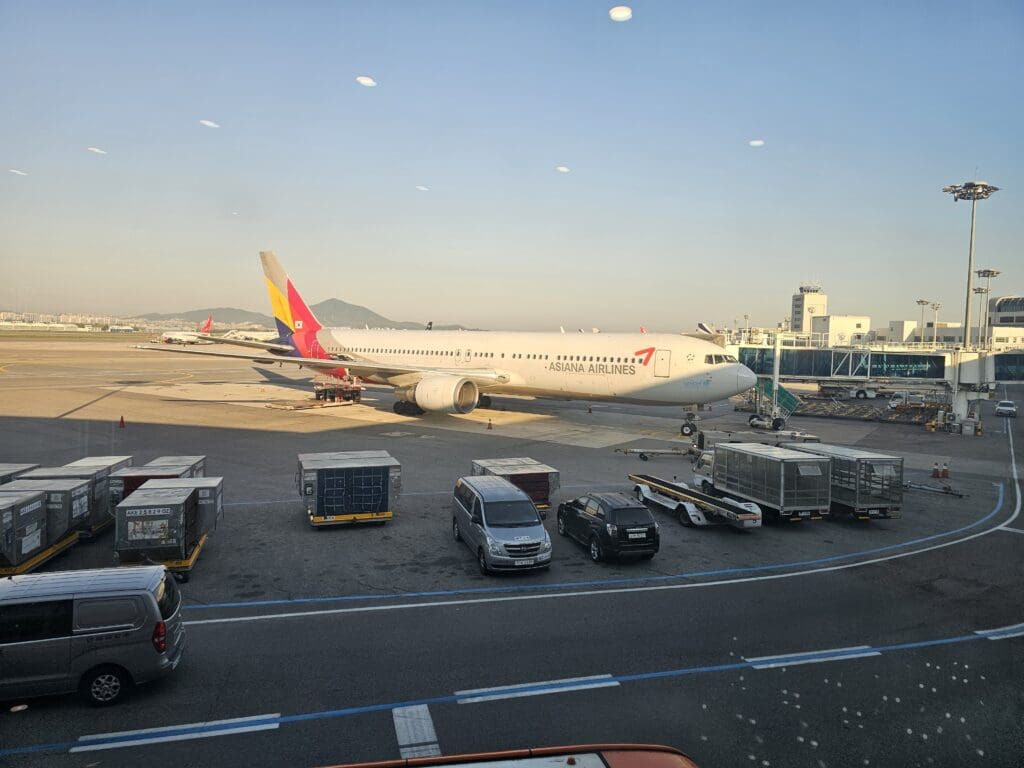
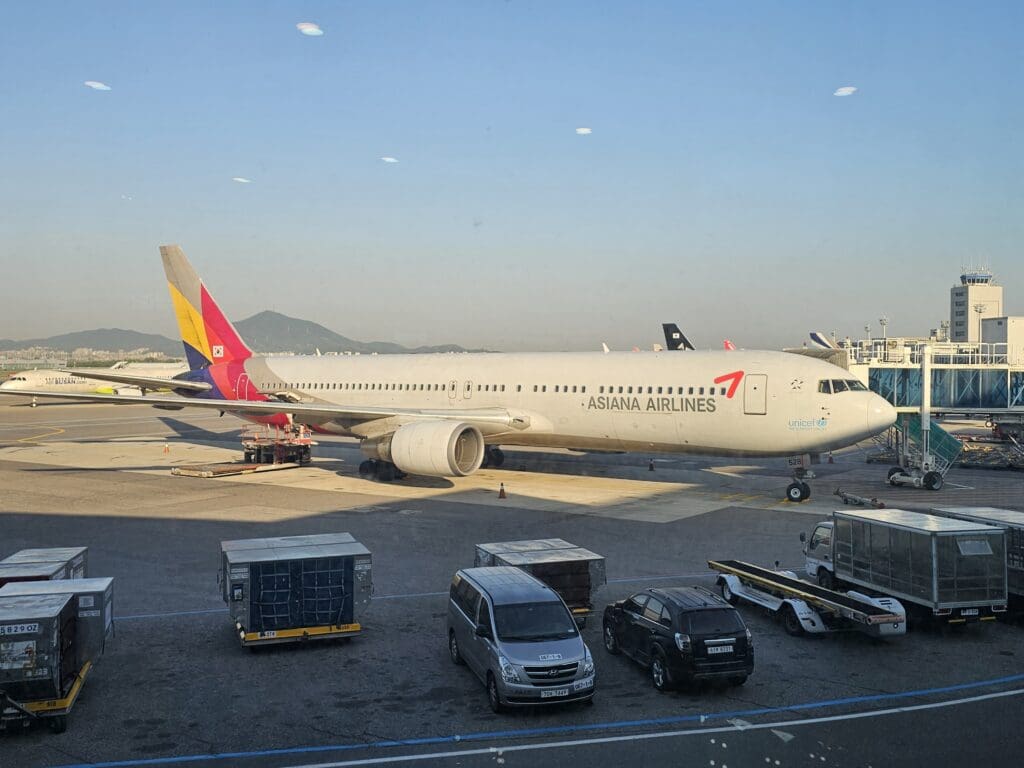
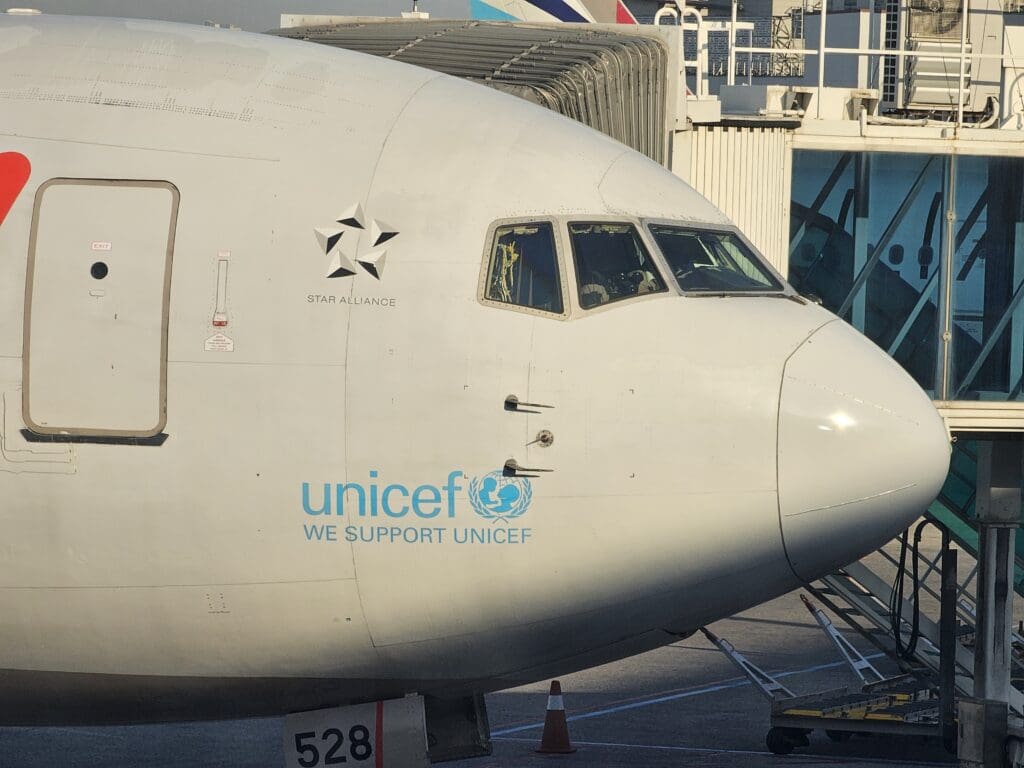
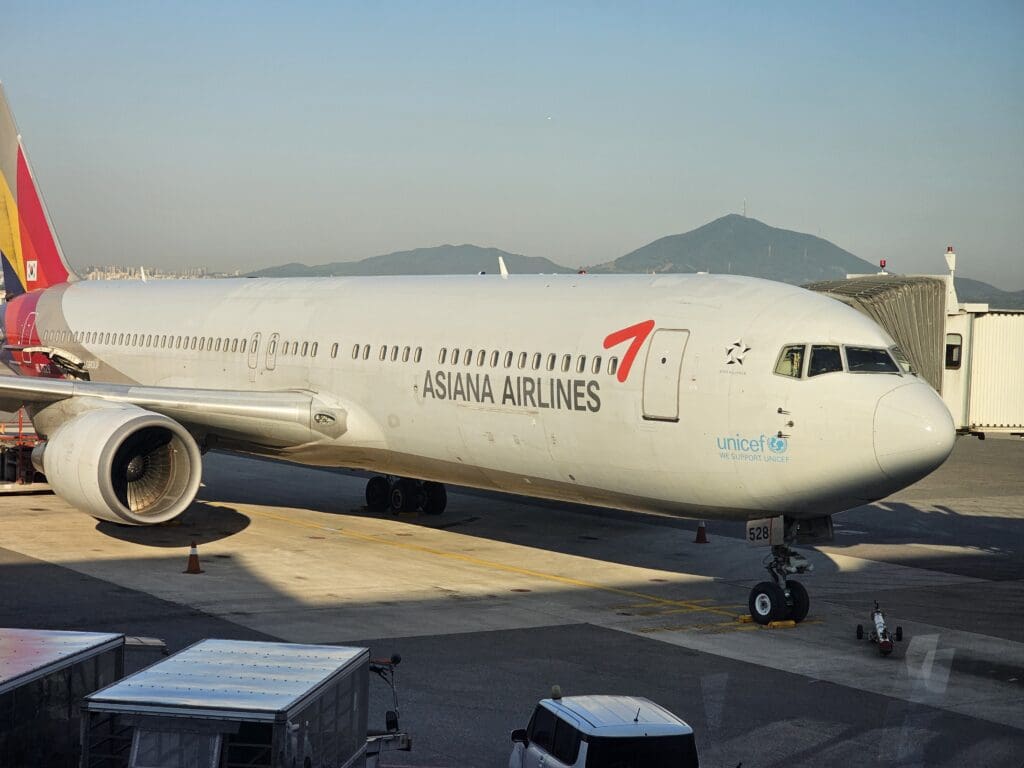
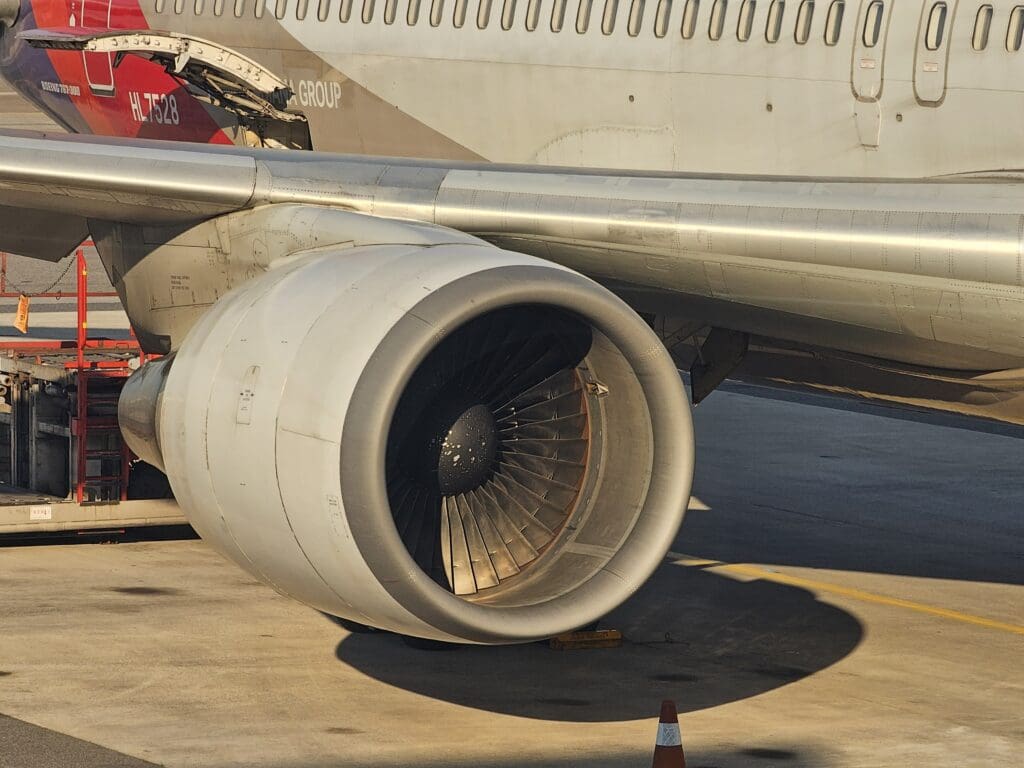
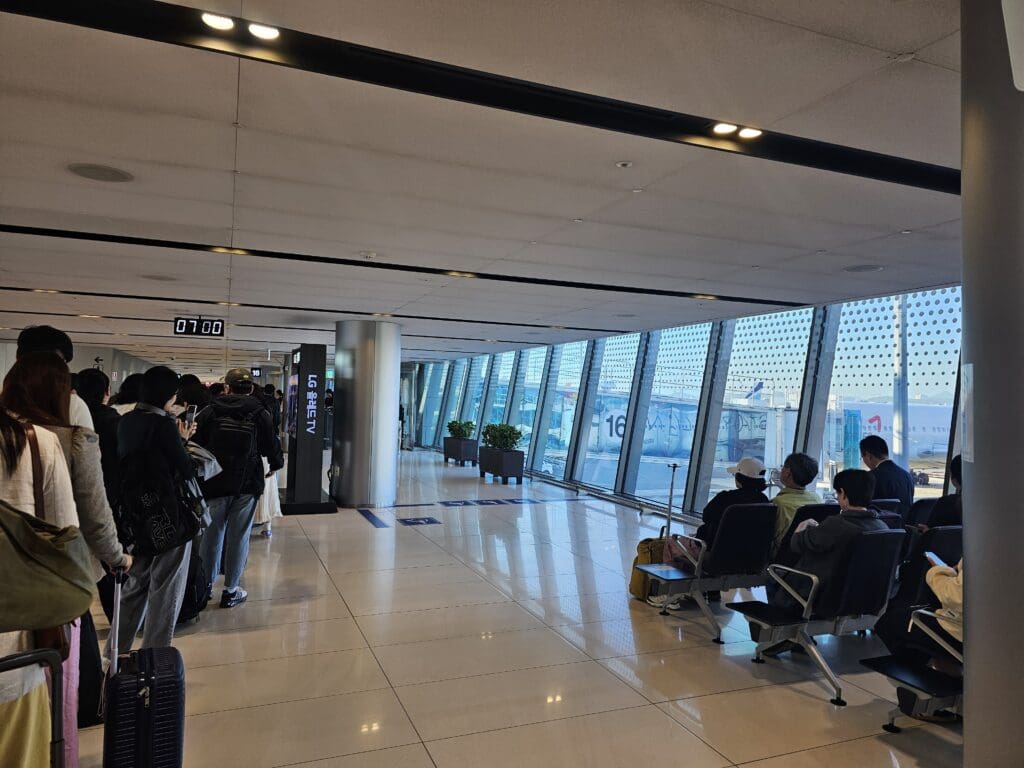
By the time I arrived at the gate, a fairly long line of Jeju-bound passengers could already be seen raring to go. Running an efficient operation, at 0700 on the dot, a pre-recorded announcement in Korean and English rang out which invited those in Business class (despite this Boeing 767’s all Economy layout!), elite members of Asiana Club and those requiring assistance to board the aircraft. A minute or so later, a second pre-recorded announcement was playe,d which invited all those in Economy to board. At this point, I began to shuffle forward and before I knew it, I scanned my boarding pass on the gate podium scanner before being wished a nice flight by the Asiana Airlines ground staff member who was supervising the proceedings.
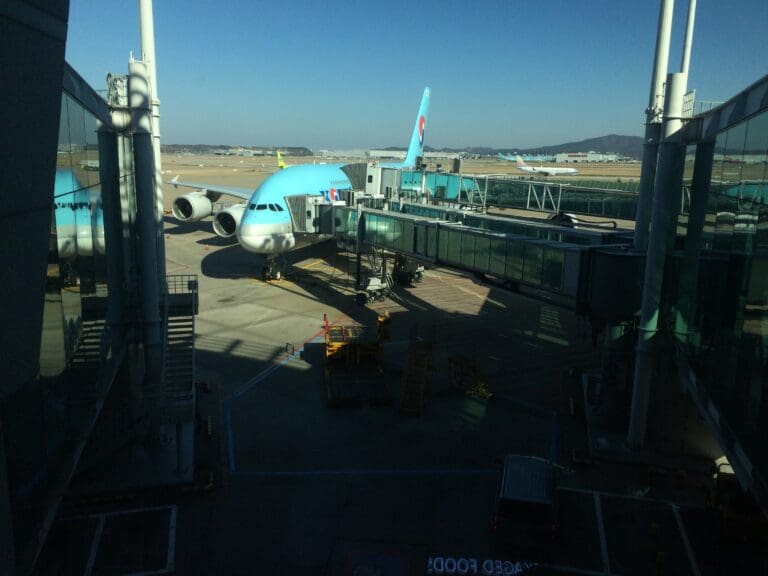
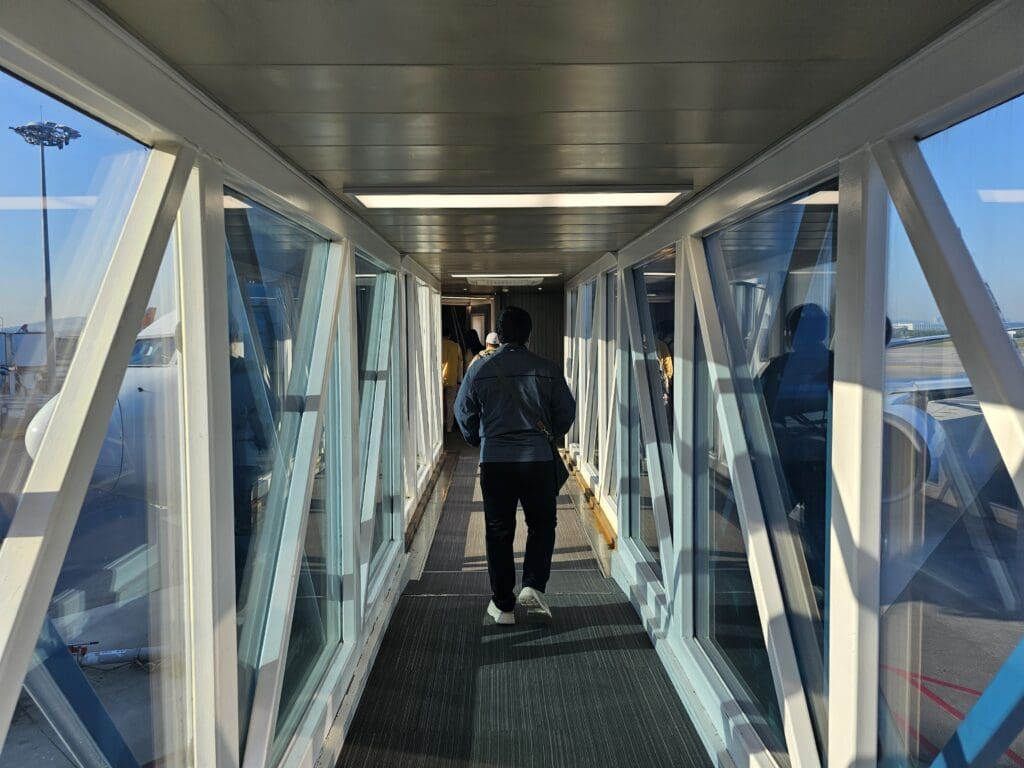
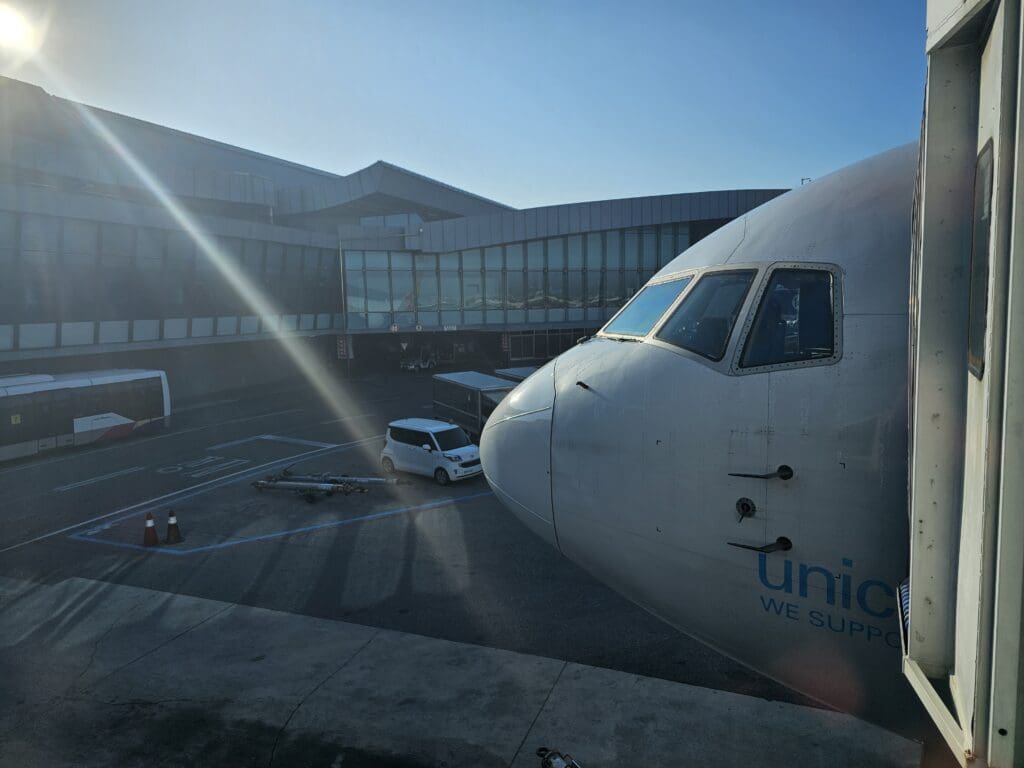
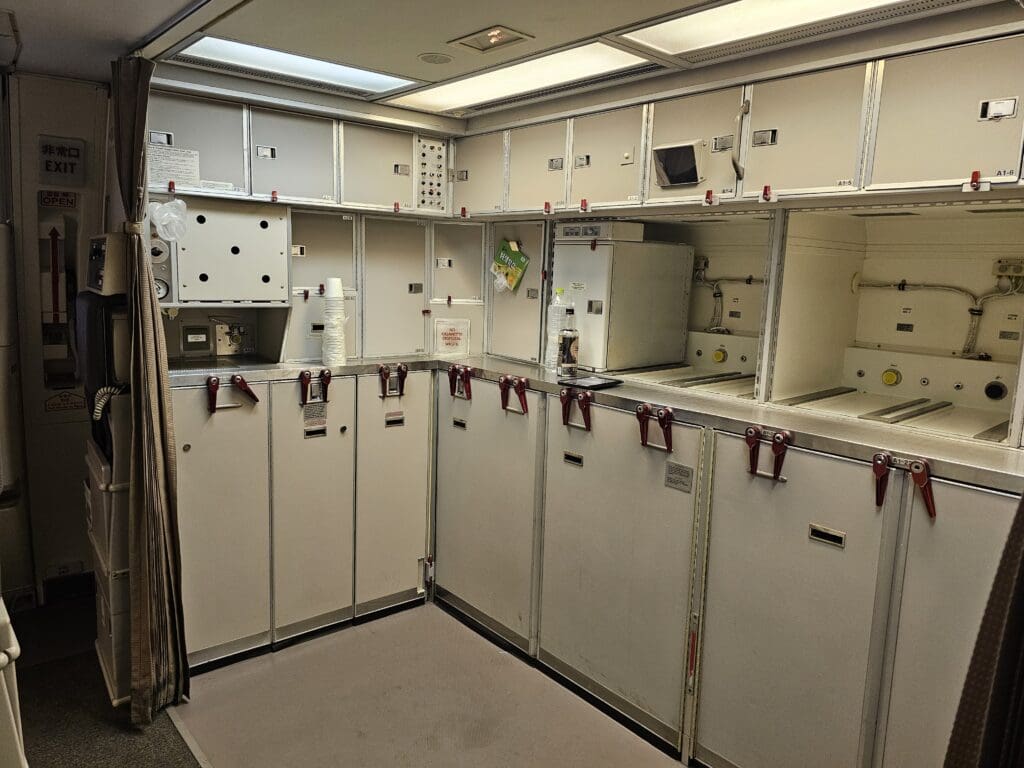
Steaming onwards, I immediately found myself on the glass jetbridge and admired the mighty Boeing 767 through the tinted windows as I slowly trundled towards the aircraft’s L1 door. Moments later, I stepped into the forward galley of the Boeing 767, and as soon as I did so, I received a warm and friendly greeting in English and Korean from the senior flight attendants aboard who had been tasked with welcoming passengers. After showing them my mobile boarding pass, I was instructed to head down the first aisle, and without any delay, I turned right and made my way into the cabin.
Unlike most Boeing 767s, those of Asiana Airlines lack any sort of bulkheads, cabin dividers, galleys or lavatories in the cabin, and so once inside, this configuration really accentuates the length of the aircraft, perhaps making this seem longer than it actually is. Being an older Boeing 767, the aircraft featured the type’s distinctive square-shaped windows and comparatively small rectangular overhead lockers. Working in tandem with the yellow glow of the cabin lighting and the retro seats, the cabin aesthetic of this jet was unarguably retro!
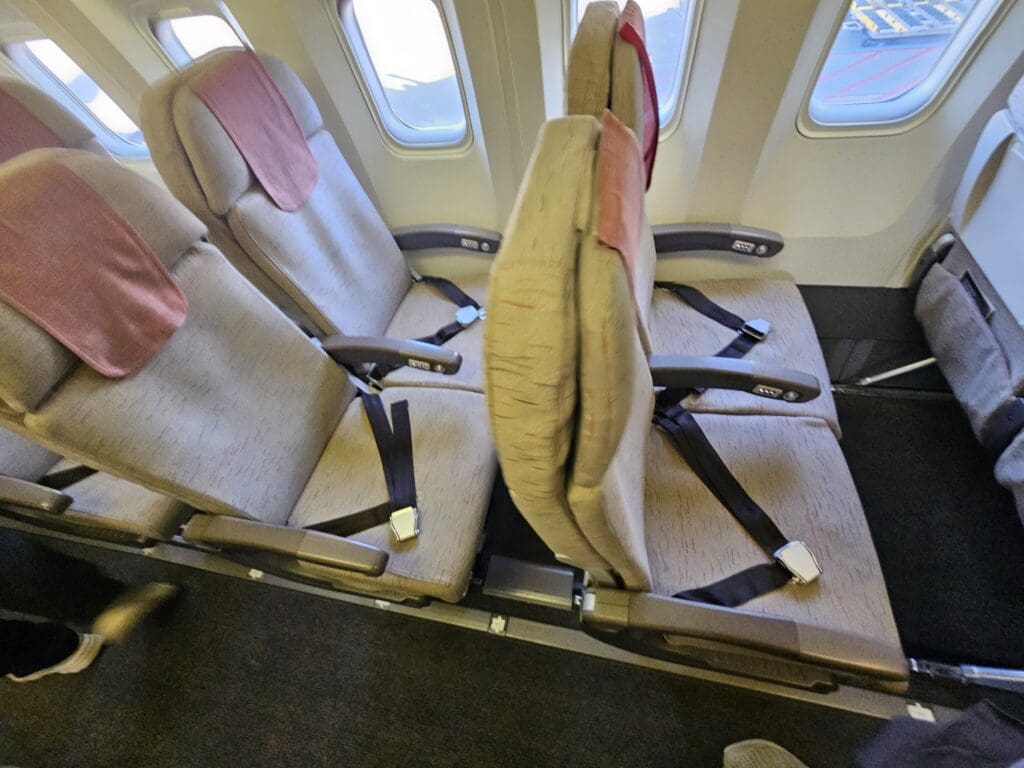
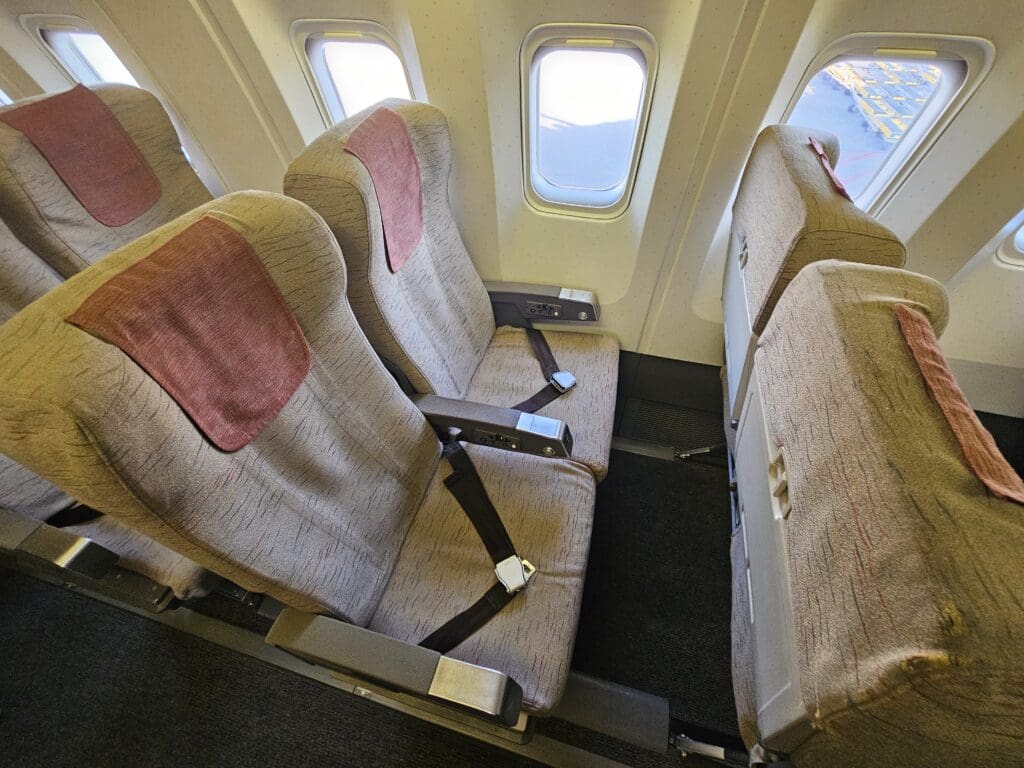
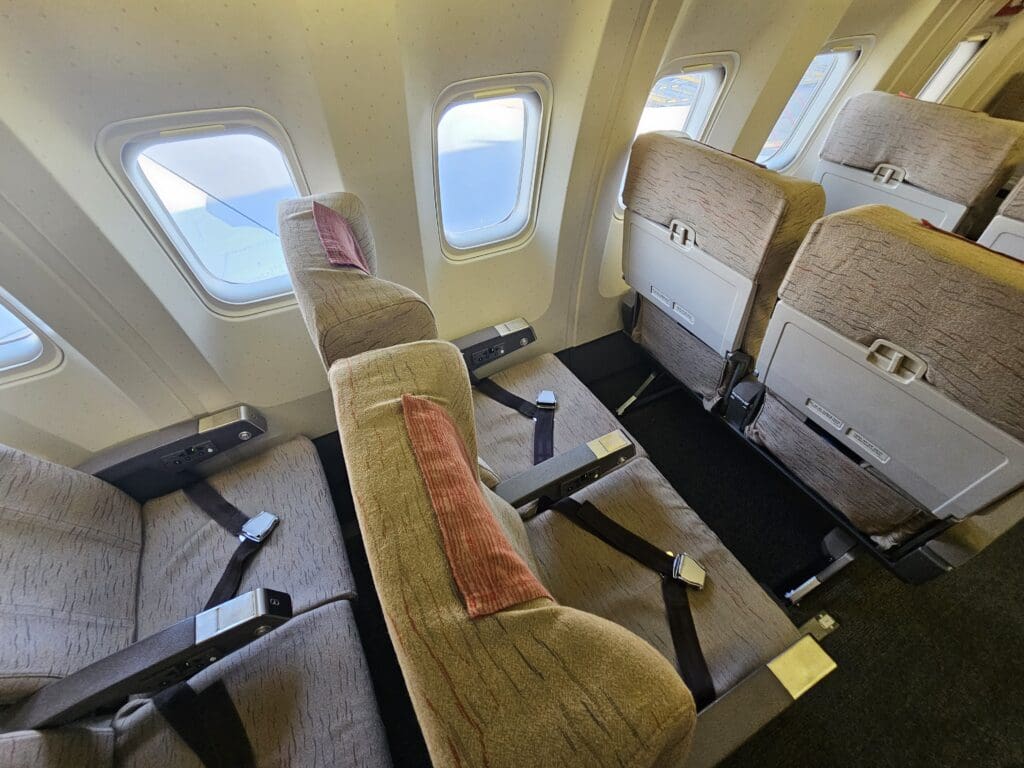
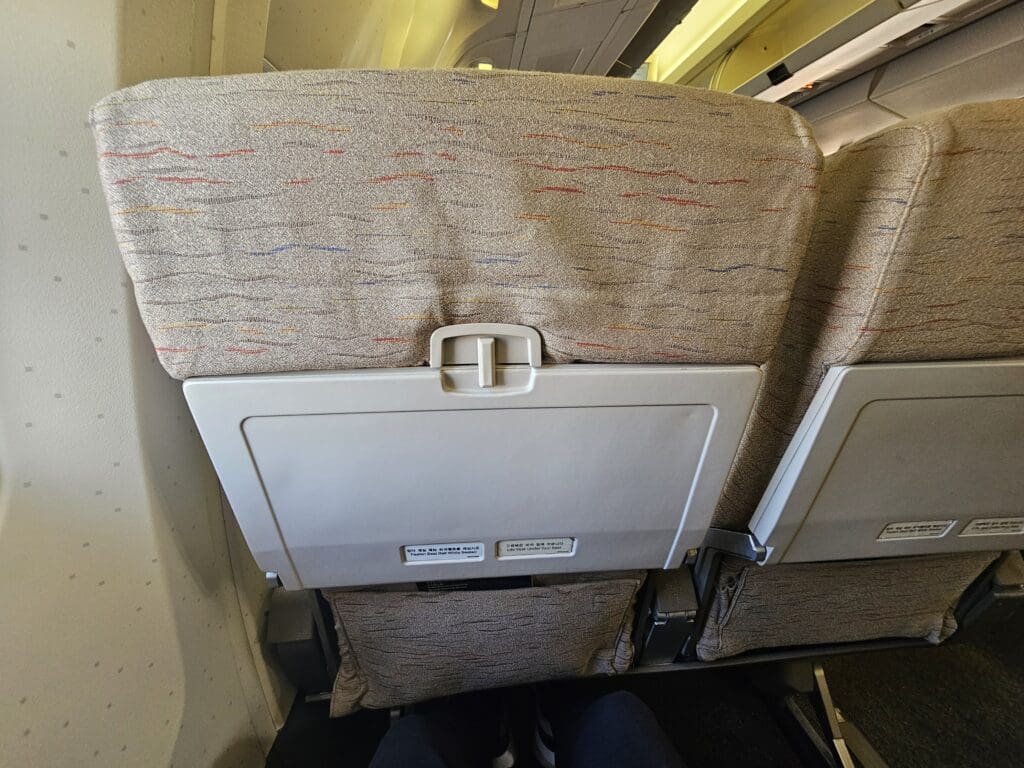
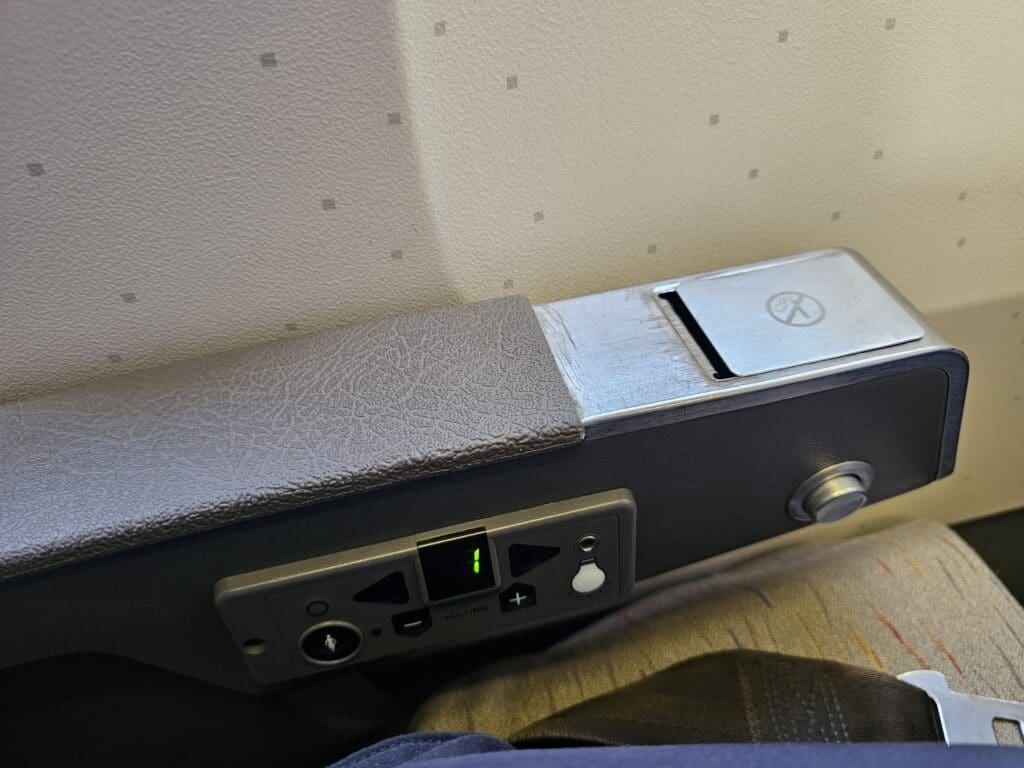
Onboard, the majority of seats are dated in their appearance, being welcomingly chunky and complete with large armrests that feature sealed-off ashtrays and chunky audio channel selector and volume buttons. However, those in the first few rows are much more modern in their appearance and feature an adjustable headrest. The reason for this being that these seats were retrofitted to the aircraft when its Business class cabin was removed, and I assume that Asiana Airlines lacked enough older seats to fit into all of their Boeing 767s that had their Business class cabins removed. Regardless of their design, all seats onboard featured Asiana Airlines’ standard beige fabric and were topped with a red-orange fabric antimacassar.
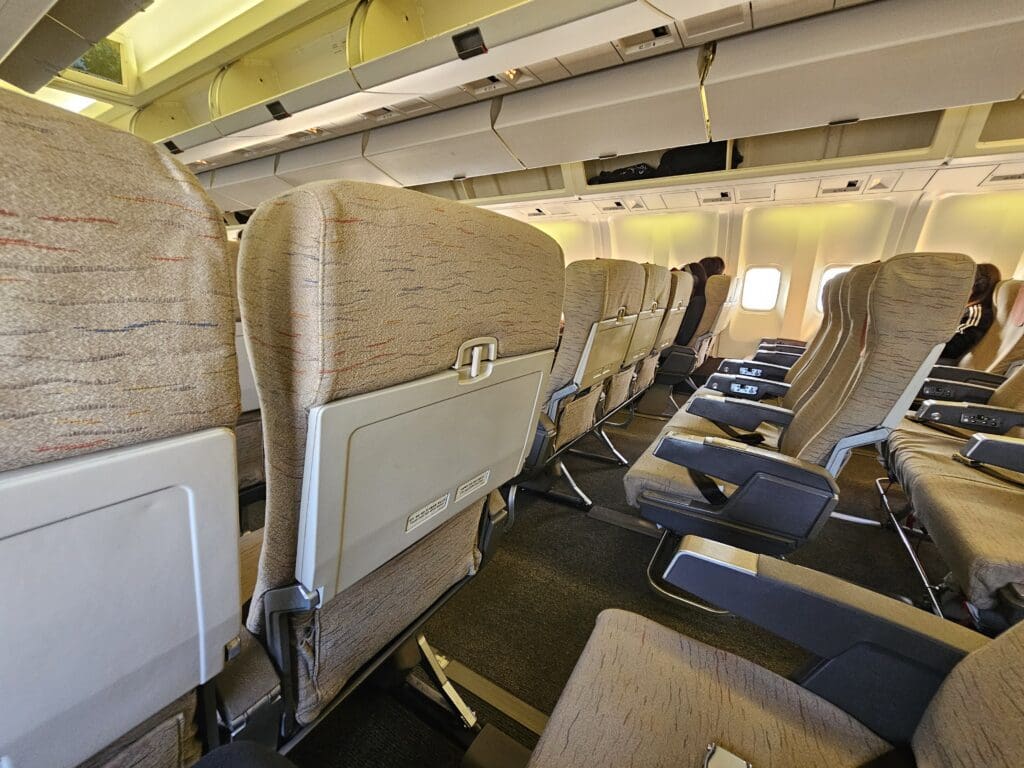
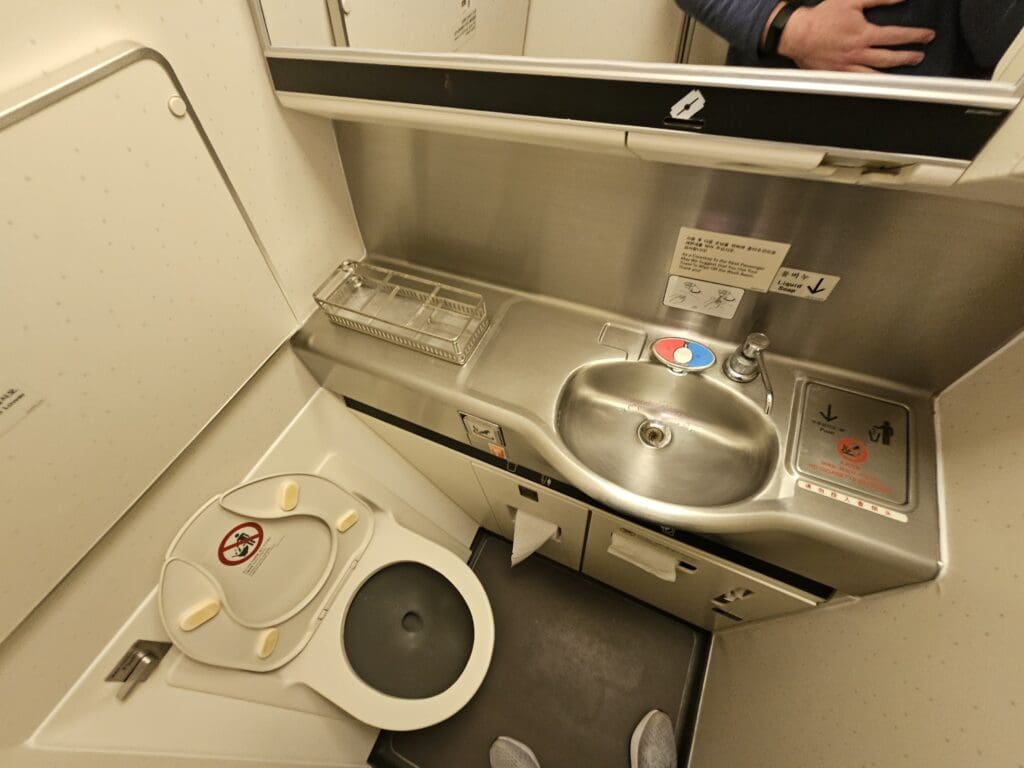
Above both aisles, fixed televisions could be seen at regular intervals and upon boarding broadcast a welcome message that was accompanied by a mixture of calming music. I should note that I soon found these to be not particularly well positioned, and it proved difficult to view these from the window seat. As I made my way down the aircraft, I was greeted in a polite and friendly manner by each flight attendant that I passed, and, seeing as I didn’t have to stop too many times to allow those in front of me to store my luggage, I soon reached Seat 43A near the rear of the aircraft. Once there, seeing as I would be unlikely to otherwise do so, I decided to head to one of the two lavatories at the rear of the aircraft. Upon opening this up, I was pleased to find this to be in a clean and tidy state and stocked with all the basics, thus leaving me with no complaints.
Once back at my seat, I belted myself up and settled in for the journey ahead. Looking around, my first impressions were very positive. Despite the retro appearance of the seat, this was incredibly comfortable and spacious, and in pristine condition, being both clean and devoid of any major signs of wear and tear. Of course, being a domestic aircraft, entertainment was limited, and I didn’t get the opportunity to connect my headphones to the port in the armrest. Turning to the seatback pocket, this contained the all-important safety card, an Asiana Airlines branded sick bag and a donation envelope for the airline’s charity partner, Unicef.
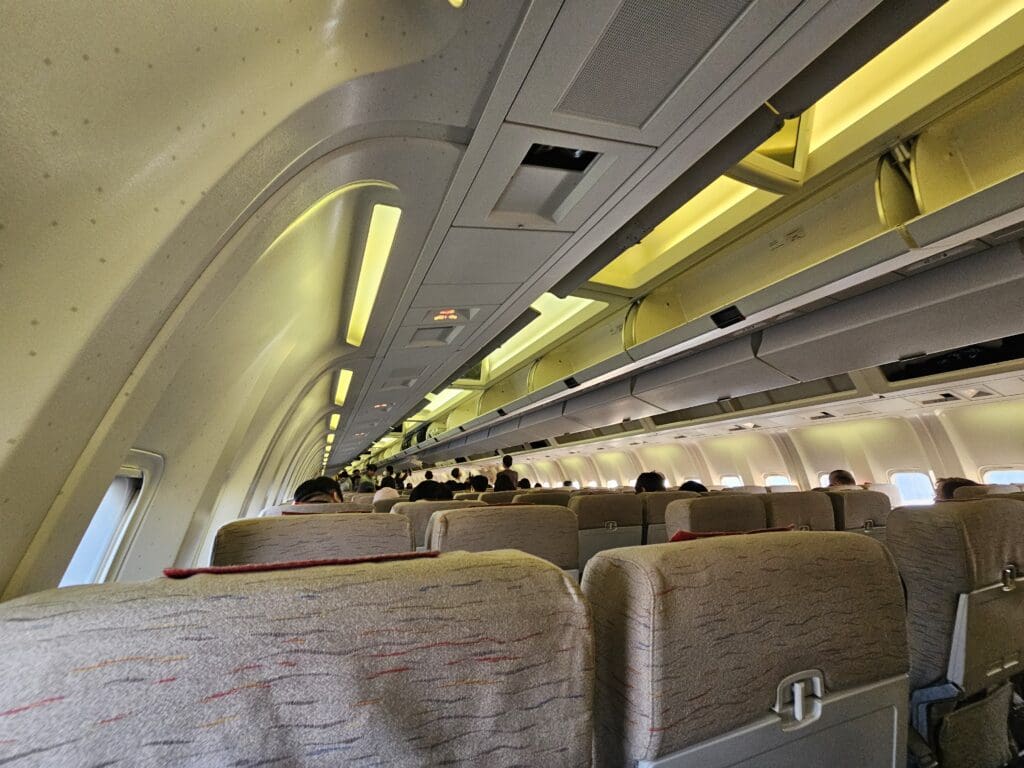
As the minutes passed, more and more passengers streamed onto the aircraft, and it wasn’t long before the aircraft was virtually full. Looking around, most of my fellow passengers appeared to hail from Korea and took the form of tourists of all ages, most of whom were couples, small groups of friends or larger school groups. As our scheduled departure time of 0725 approached, looking outside, all remaining ground service equipment was removed from around the aircraft, followed by the cones, indicating that we would be making a punctual departure from Seoul. At 0725 on the dot, the music came to an end and was replaced by a very short welcome from the Captain. Interestingly (and for my first ever time on a Korean carrier), this was undertaken in Korean only, with no English announcement from the flight deck undertaken. Furthermore, this was also the only announcement that was made from the flight deck that morning. This gave a welcome and thanks before detailing the weather in Jeju.
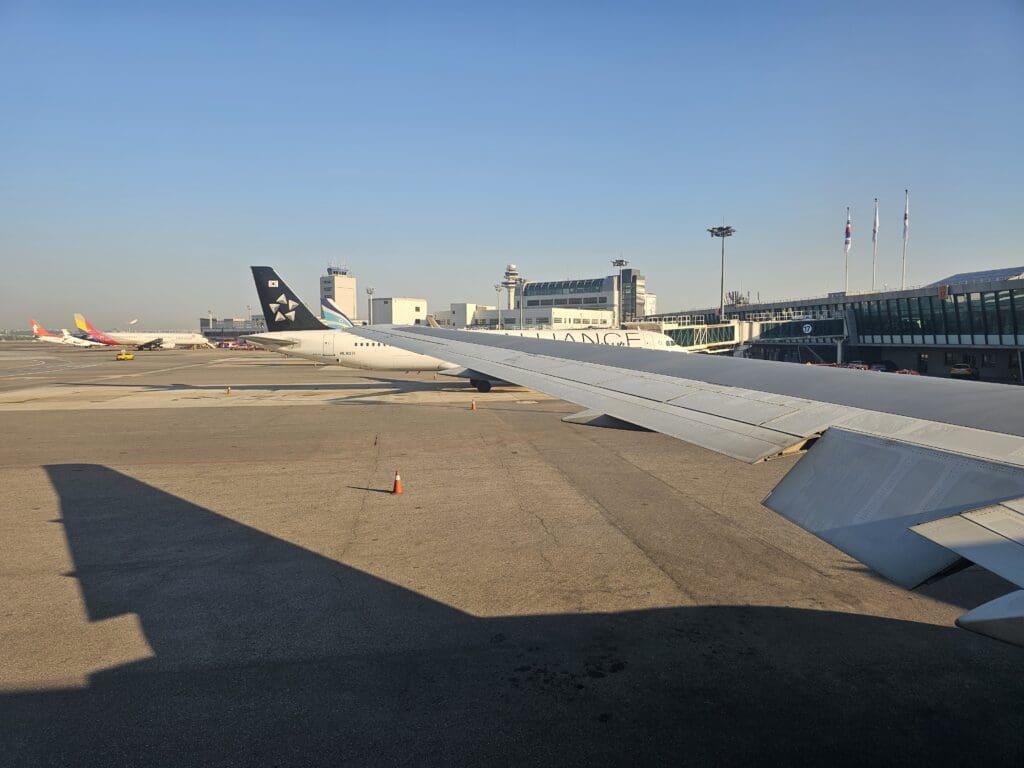
Following the Captain’s welcome message, the Purser’s voice filled the cabin as they performed their welcome in Korean and English. This consisted of all the usual welcomes, thanks and warnings, and whilst underway, the Boeing jolted backwards, and the two General Electric CF6-80CB7F engines quietly spooled into life. At this time, the safety video was broadcast on the overhead screens and the crew passed through the cabin, ensuring that everything was secure and in place for our departure. Once the flaps had been partially extended and the tug disconnected, the ground crew bowed and waved the aircraft goodbye as we commenced our short taxi to the end of Runway 32R.
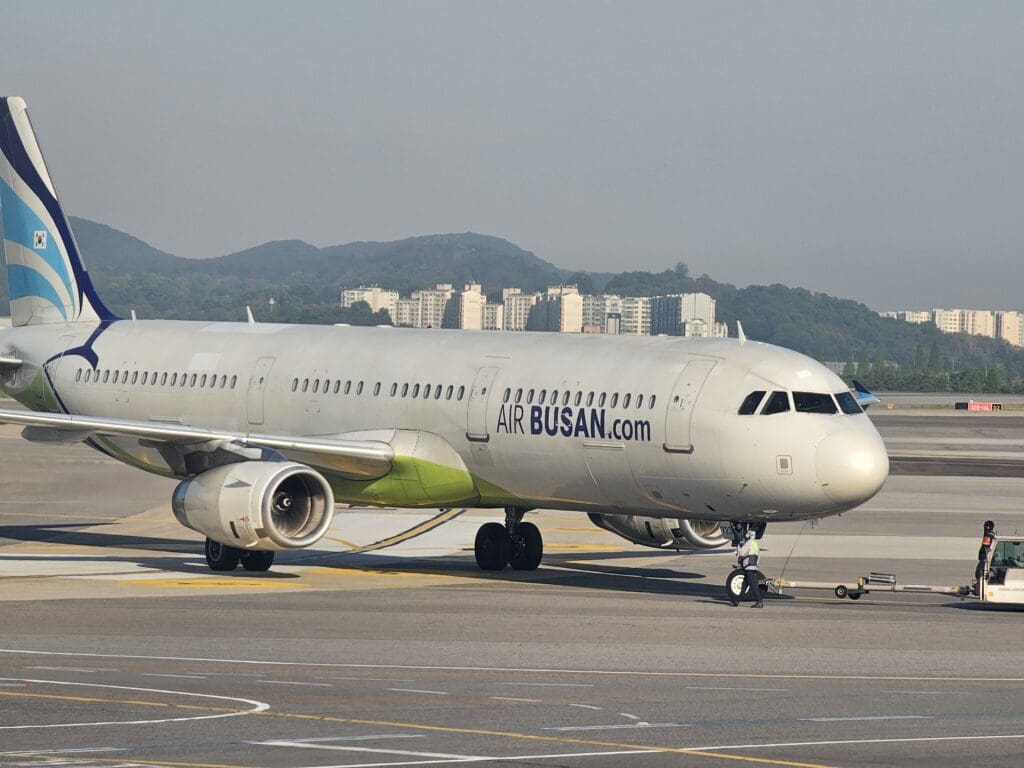
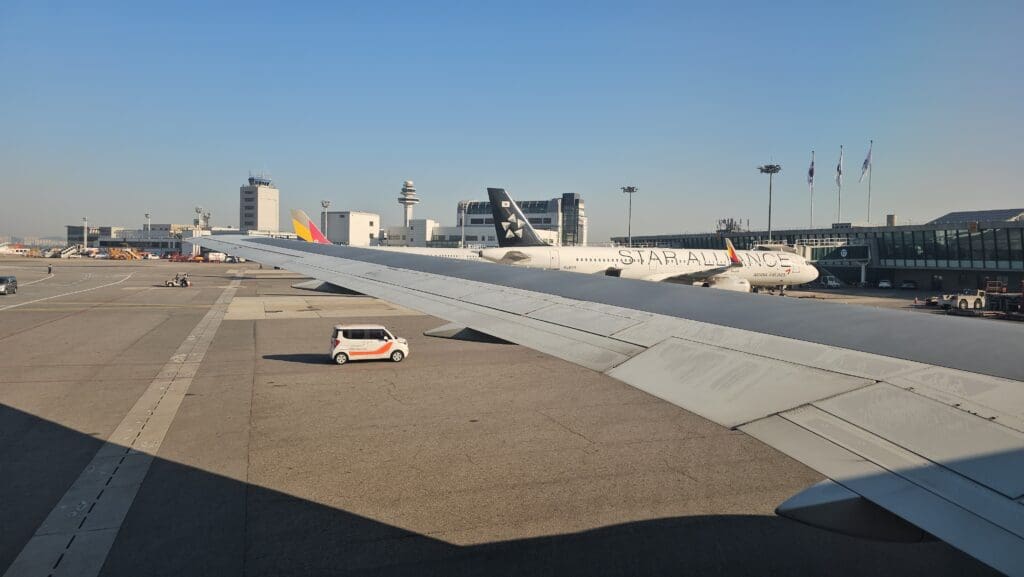
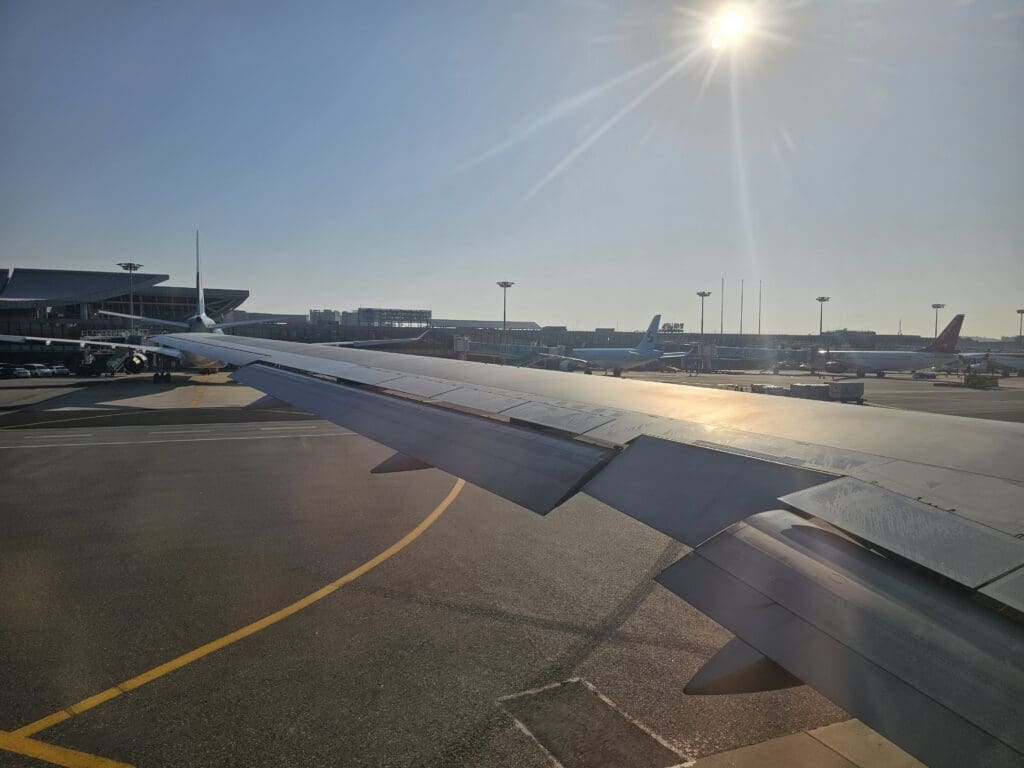
From Stand 16, the aircraft slowly trundled along the terminal, passing the masses of jets that ranged in size from Airbus A220s to Airbus A330-300s. Soon, we left this behind and within a few short minutes of leaving our parking position, we arrived at the end of the runway. Despite departing in the midst of the morning rush, no holding was needed and without coming to a halt, the Boeing trundled onto the runway and paused for a few moments.
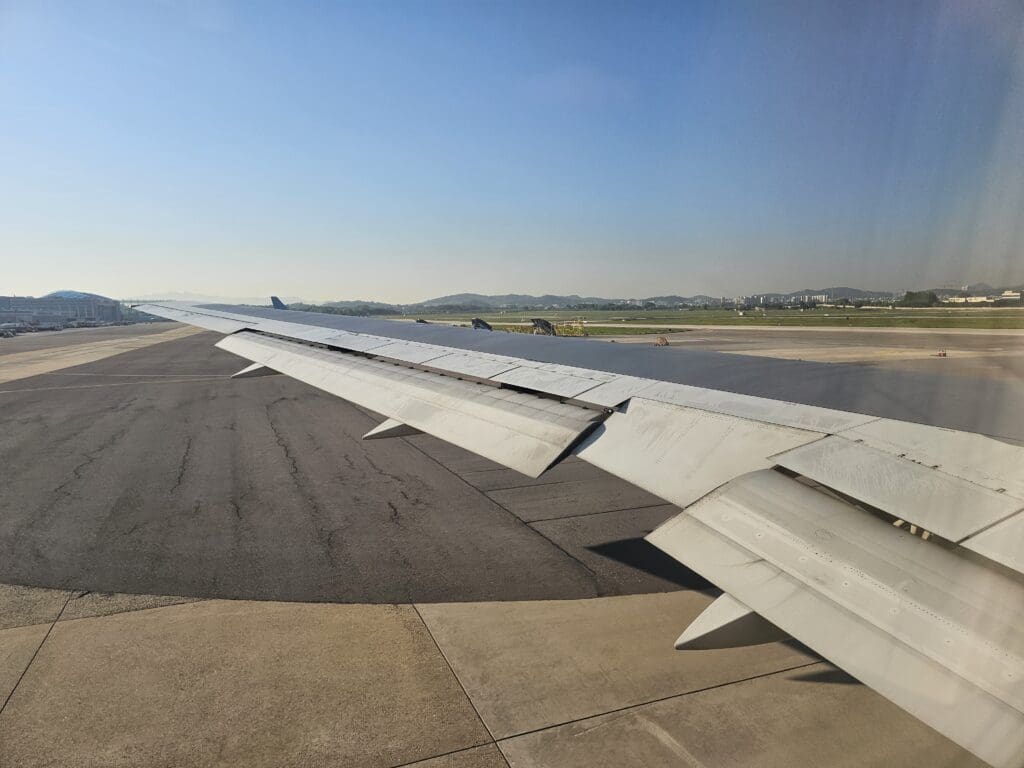
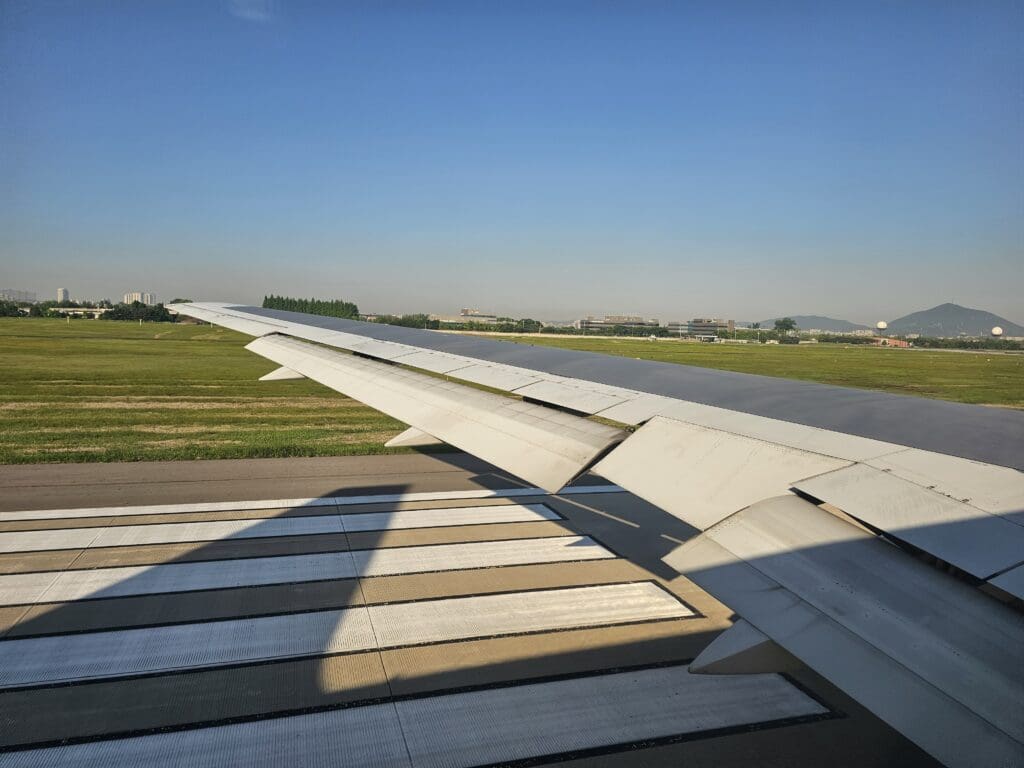
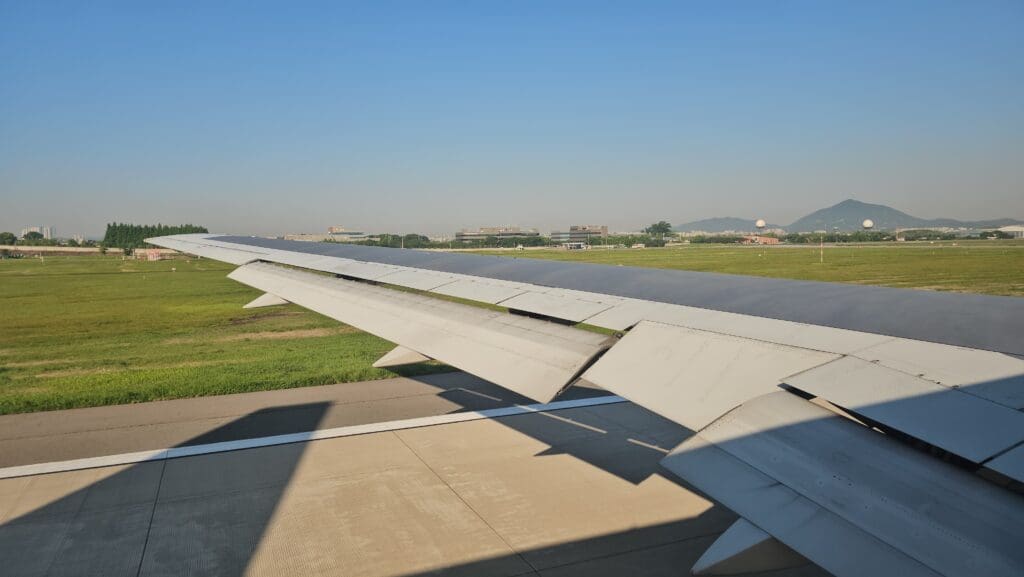
After waiting for no more than thirty seconds, the Boeing’s two General Electric engines spooled up and sent us flying down the runway for what turned out to be a short and sporty take-off roll. As we whizzed down the runway, soon, the line of hangars on the south side of the airfield appeared where an interesting mixture of locally based aircraft could be seen waiting for their next missions. These included light aircraft repurposed for survey flights, floatplanes, corporate helicopters and a KUH-1 Surion and Kamov Ka-32 operated by the Korean Forestry service.
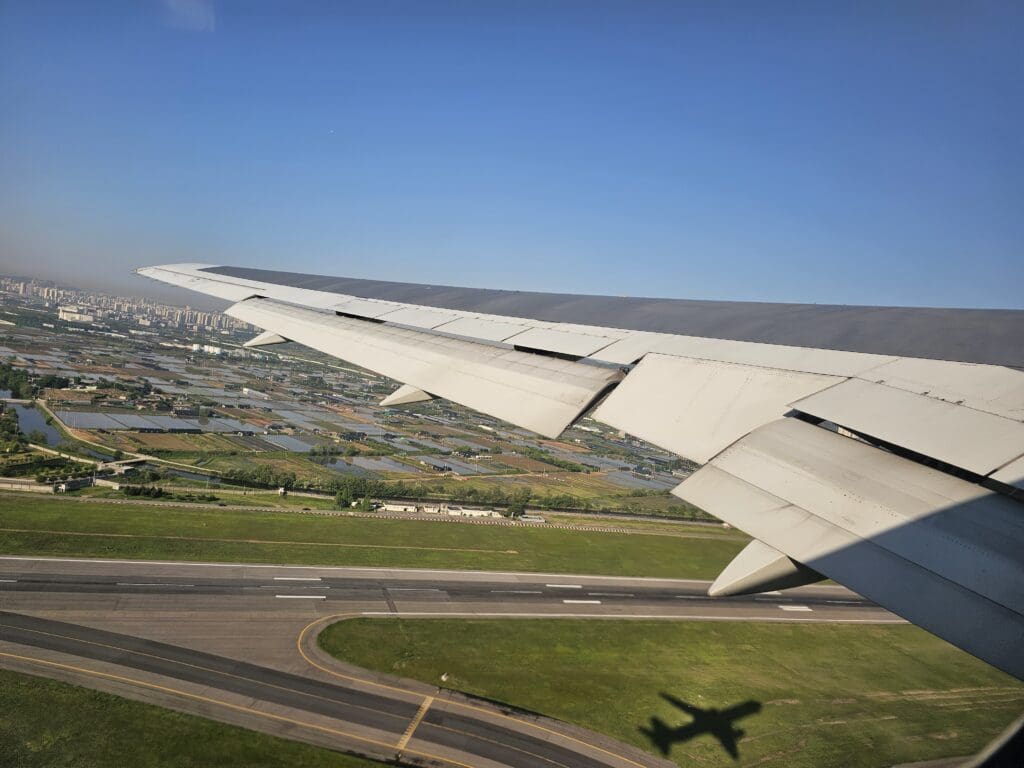
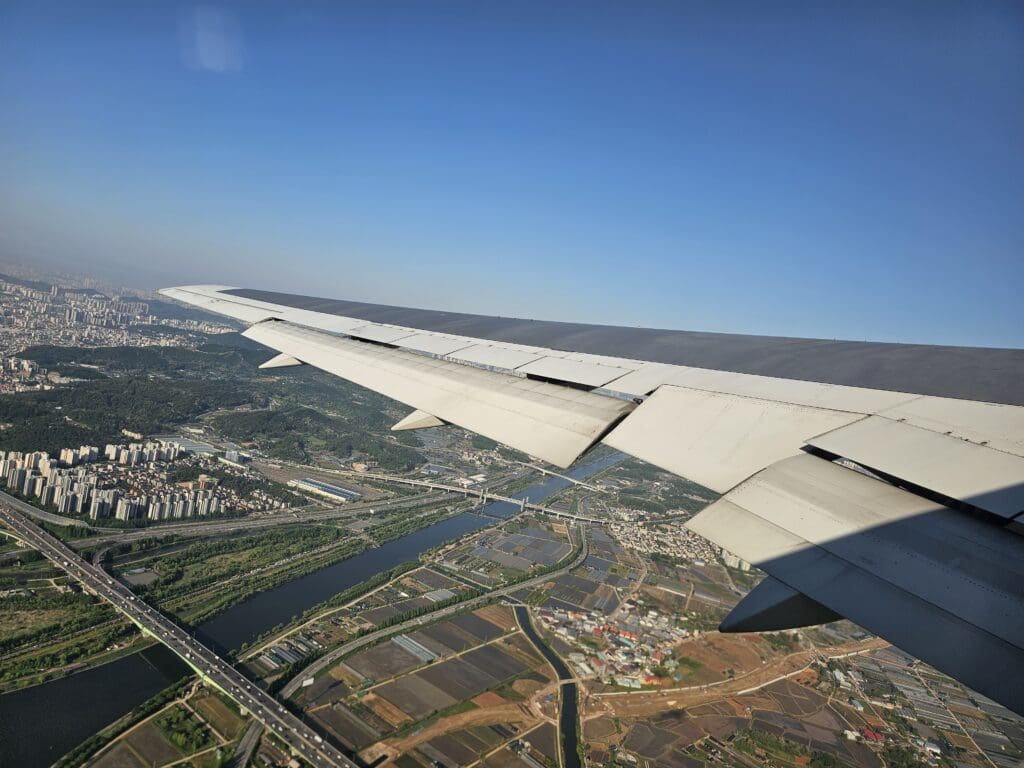
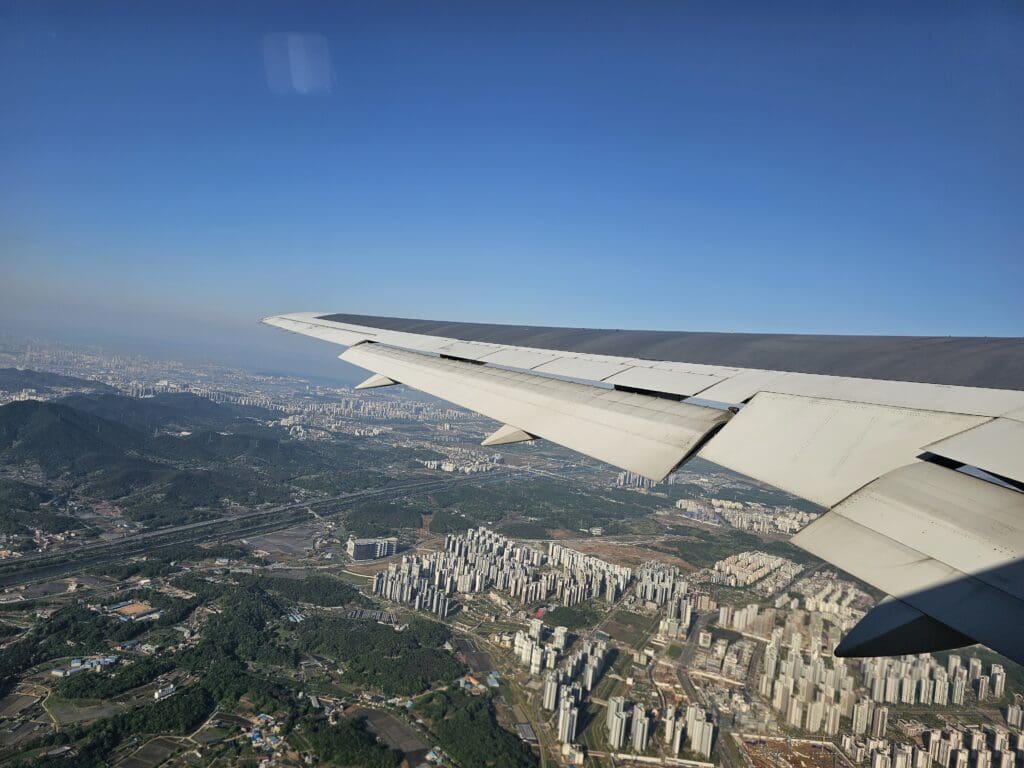
Following our short take-off roll, the Boeing climbed upwards and rocketed up into the sunny Korean skies, crossed over the perimeter fence and climbed over the mixture of industrial facilities and fields that surround the airport. For the first minute or so of the flight, the Boeing flew roughly parallel with the course of the Han River, heading northeastwards along this before turning onto a southerly heading and making its way towards Korea’s third largest city, Incheon. Thanks to the clear skies that morning, those on the opposite side of the Boeing would have been treated to superb views of Yeongjong Island, home to Seoul Incheon Airport and the smaller islands that sit around this. However, from my seat on the left-hand side of the aircraft I was instead treated to vistas of Incheon’s urban sprawl before we left this behind and continued down the coastline of Gyeonggi province.
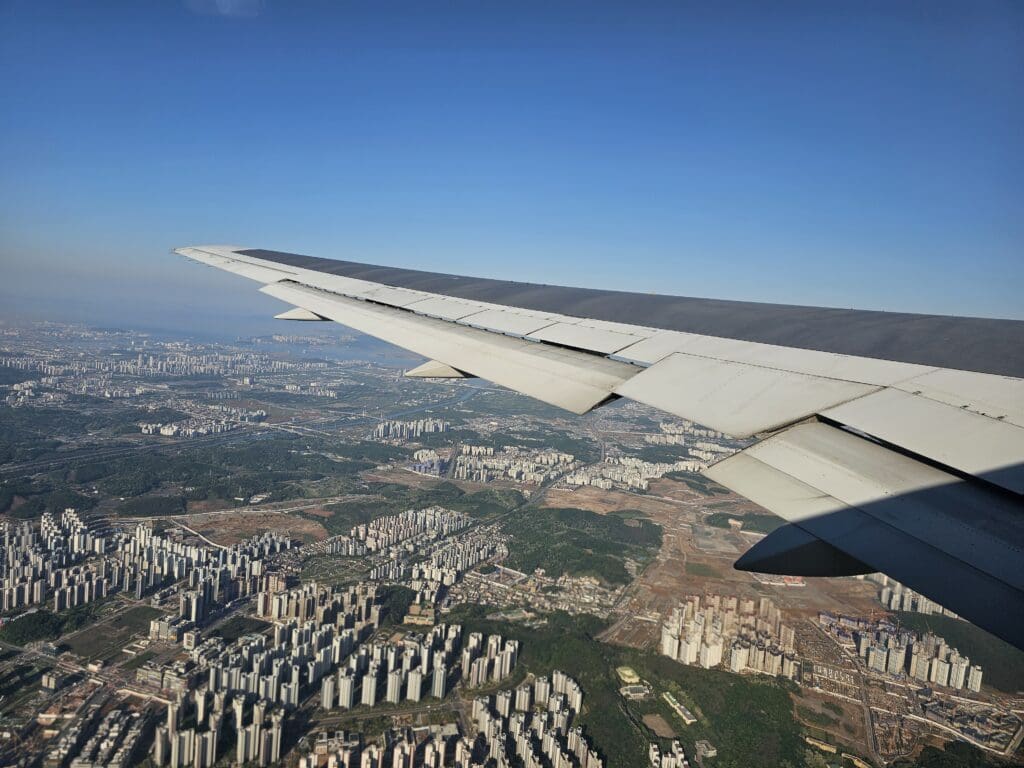
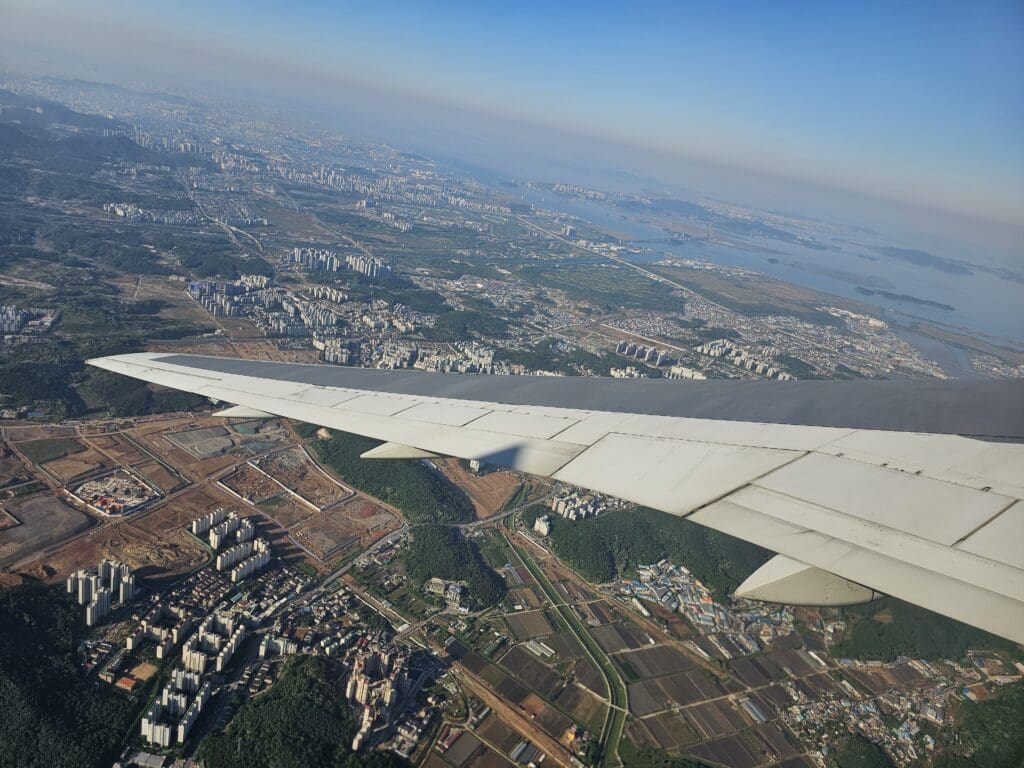
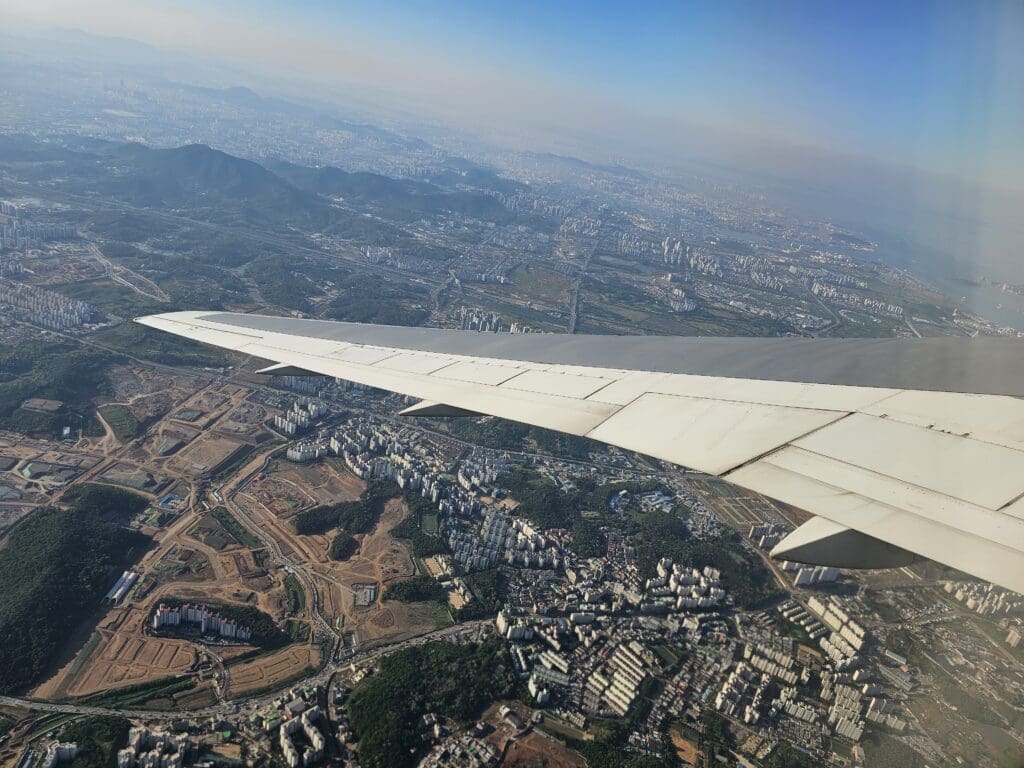
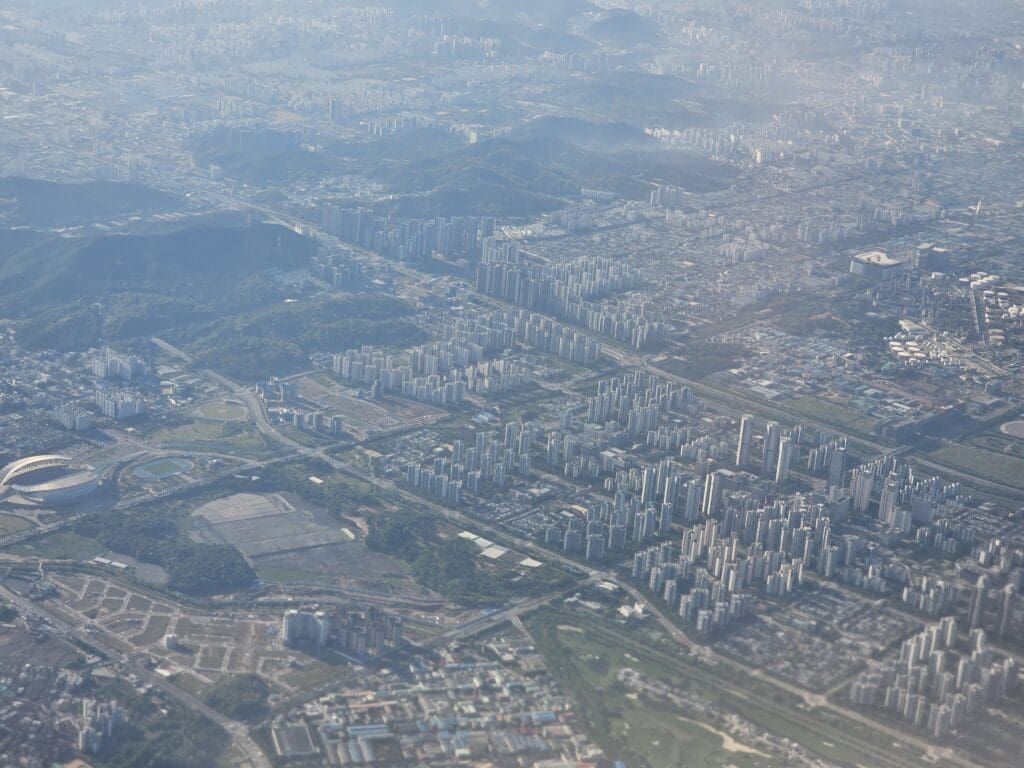
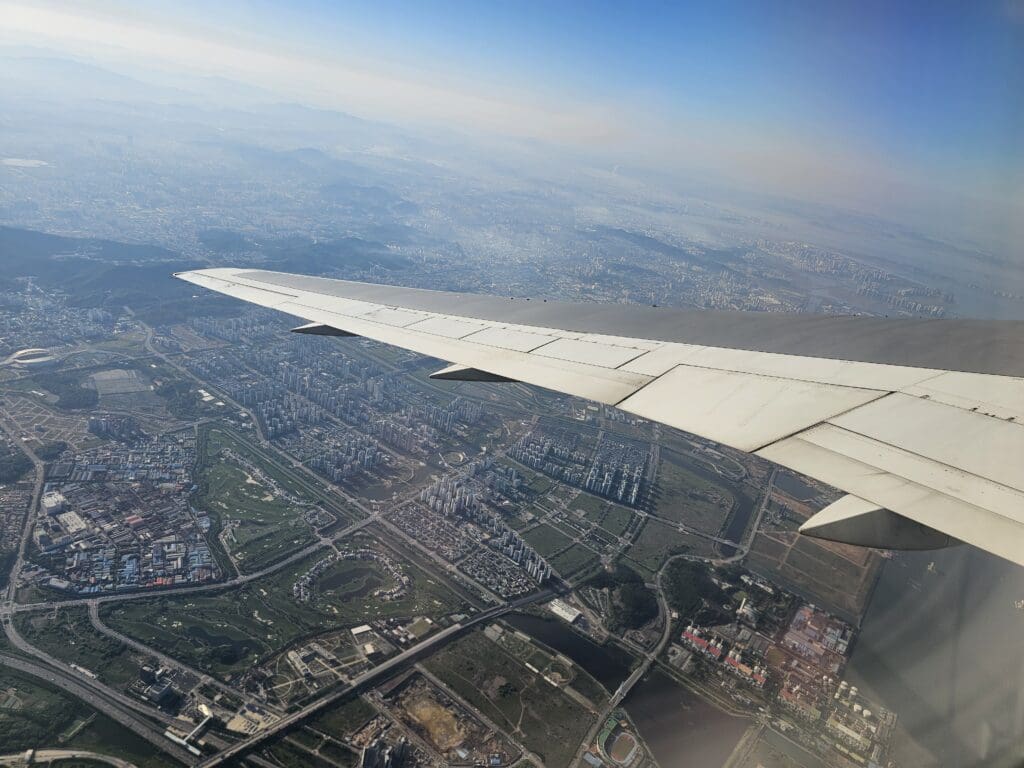
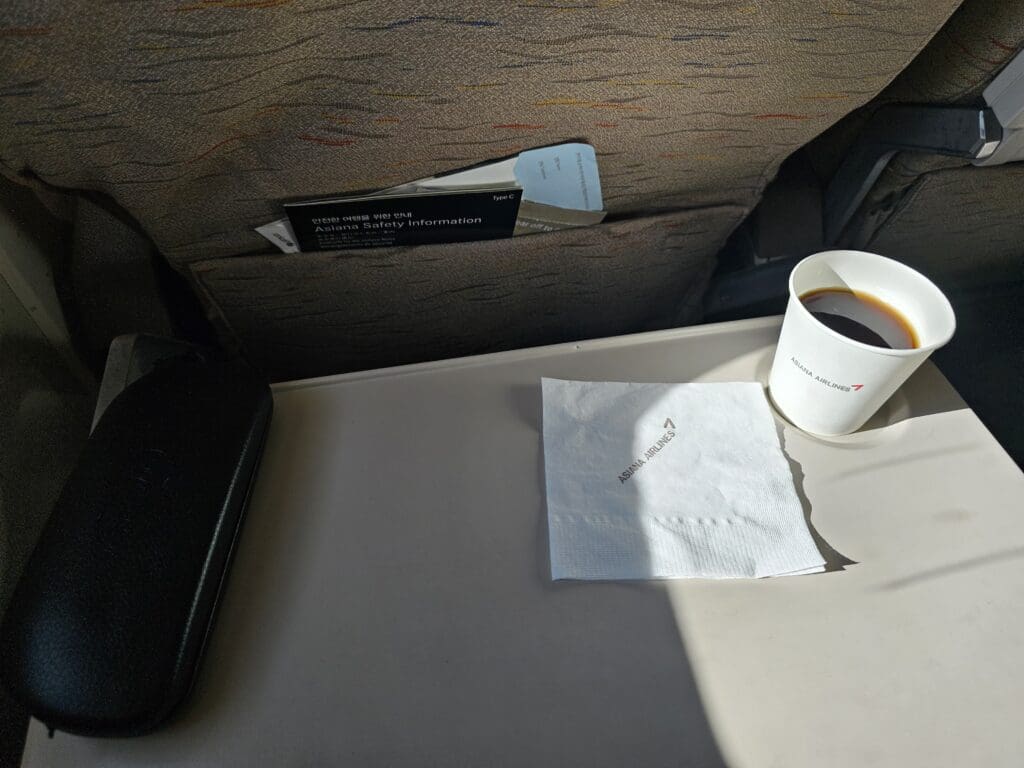
Thanks to the smooth conditions, the seatbelt signs were extinguished as soon as we climbed through 10,000 feet at which point we were high over the southern fringes of Incheon. With somewhere in the region of 290 passengers to serve and a limited amount of time to do this, moments later, the service carts were rolled out into the aisles, and the onboard service commenced. Working efficiently whilst serving passengers in a polite and friendly manner, it wasn’t long before I was offered a choice of drink. Admittedly, Asiana Airlines’ domestic service does not provide too much to get excited about, with nothing other than a selection of soft drinks offered. However, given the fact that few Korean domestic flights are in the air for more than fifty minutes, I found this service to be perfectly adequate given the length of the flight. That morning, passengers could choose from barley tea, Coca-Cola, cold brew coffee, orange juice and Sprite. Opting for a coffee, this was poured into a paper cup and handed over to me with a serviette. Once this service had been completed, the crew had a quick wander through the cabin, asking if passengers would like another drink.
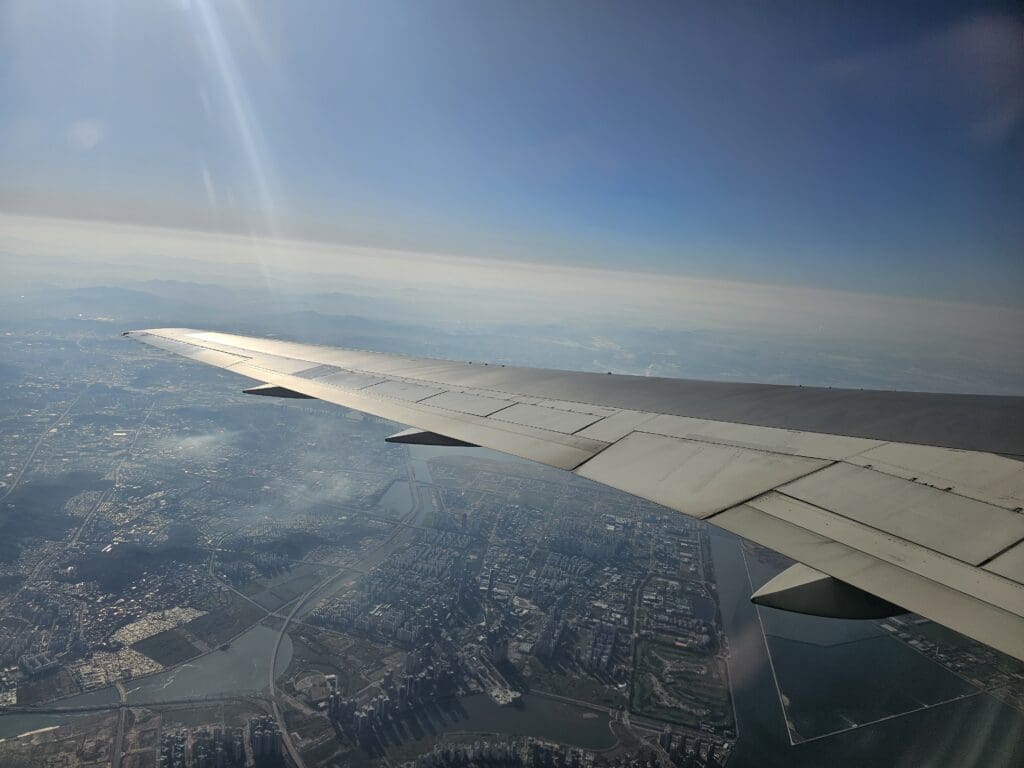
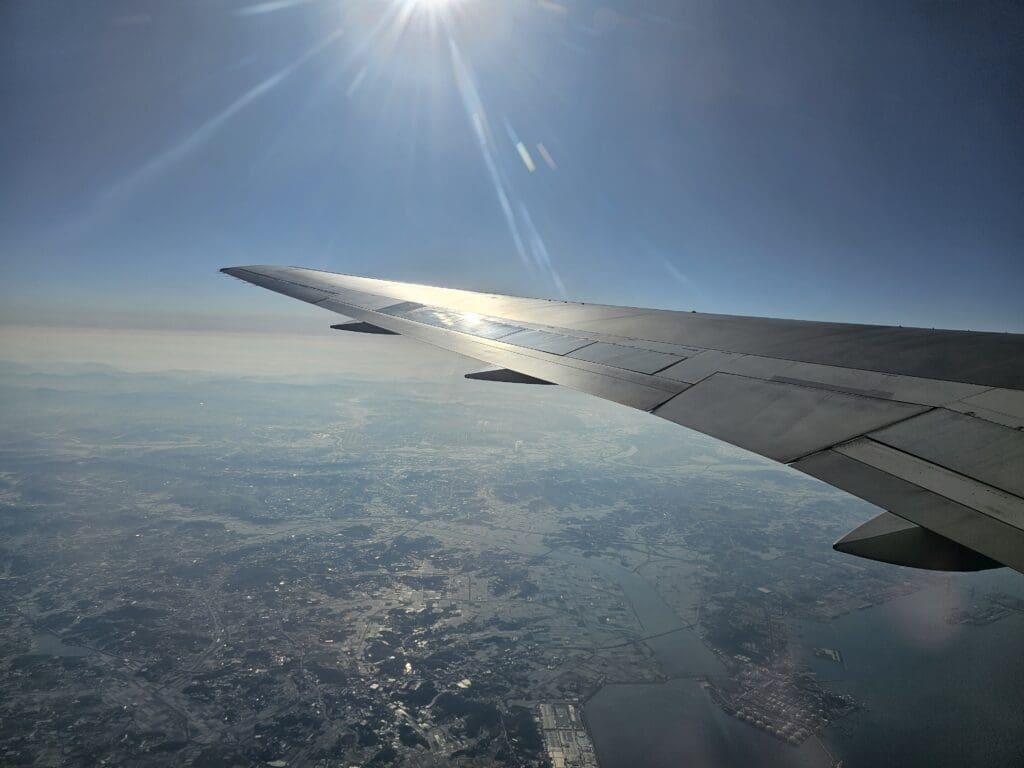
Returning to the progress of our flight, once away from the sprawl of Seoul, Incheon and the Gyeonggi region that circles the capital city, the Boeing cruised down the Korean Peninsula’s western coastline at an altitude of 24,000 feet. Thanks to the good weather, much of the country’s countryside and towns could be seen and we soon reached the city of Gunsan. Home to around a quarter of a million residents and sitting on the southern banks of the Geum River Estuary, this city isn’t the most well-known outside of Korea. However, it has long been home to several squadrons of both ROK Air Force and US Air Force F-16 Fighting Falcon fighter jets.
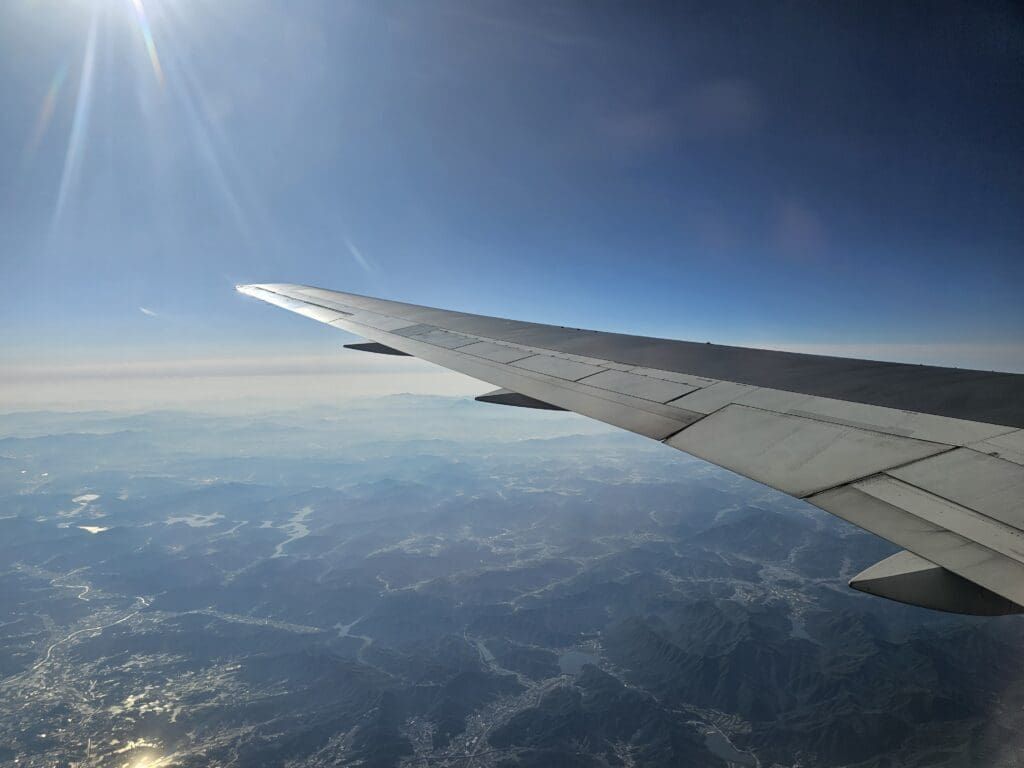
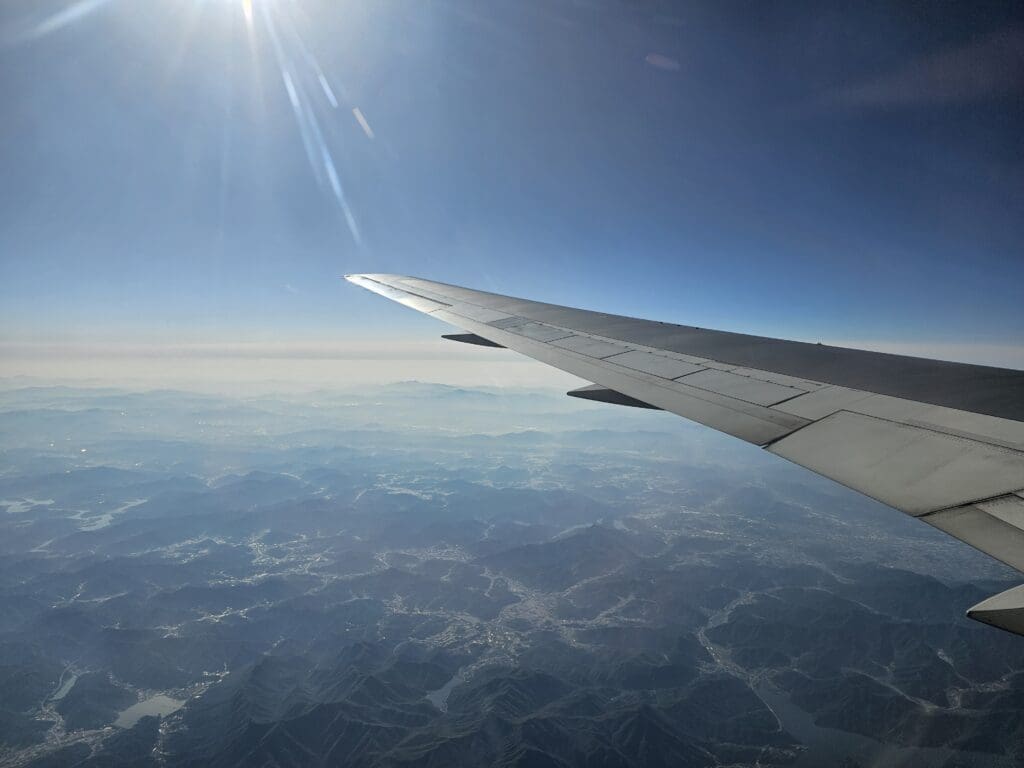
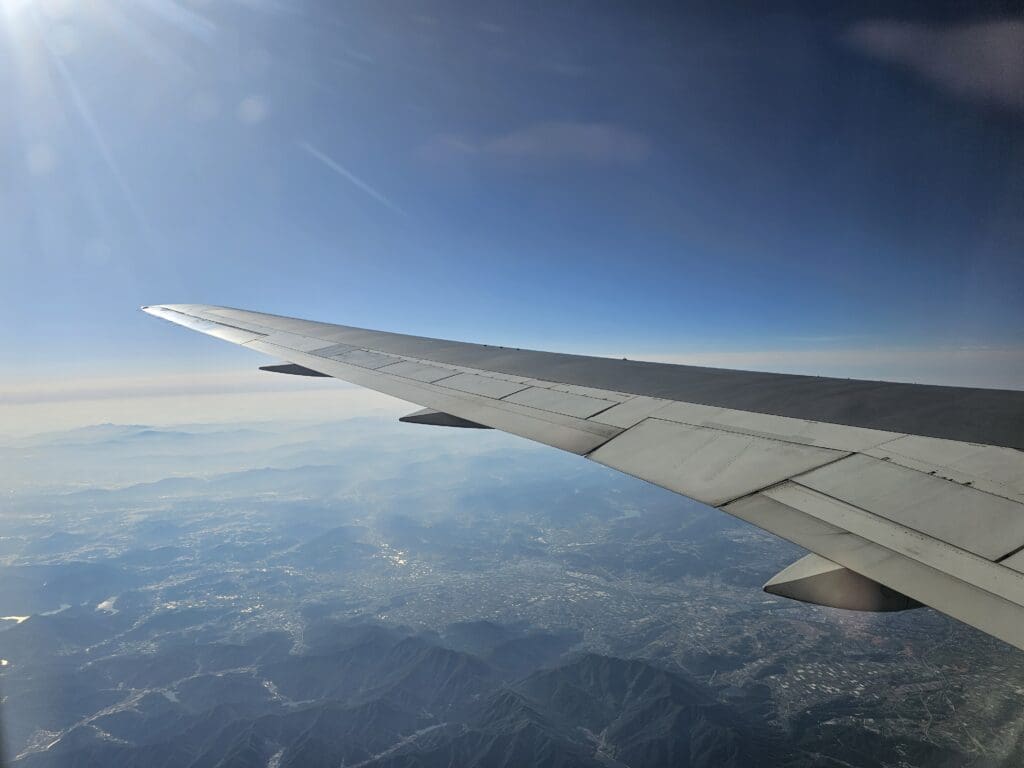
After passing Gunsan, the aircraft continued down the coastline and entered the skies of Korea’s North Jeolla Province. Once there, the Boeing trundled to the west of the city of Jeonju, which is well known for its traditional hanoks and famous local dish, Jeonju Bibimbap. A few short minutes later, we reached the fringes of Korea’s sixth-largest city, Gwangju, which is home to 1.5 million residents. Looking outside, a clear view was offered of the city’s airport which primarily serves as a key ROKAF base and is home to three squadrons of KAI T-50 fighter jets. In addition, the airport features a small domestic terminal from where passengers can fly to Jeju on Asiana Airlines, Jeju Air, Jin Air, Korean Air and T’way Air, and to Seoul Gimpo on Asiana Airlines.
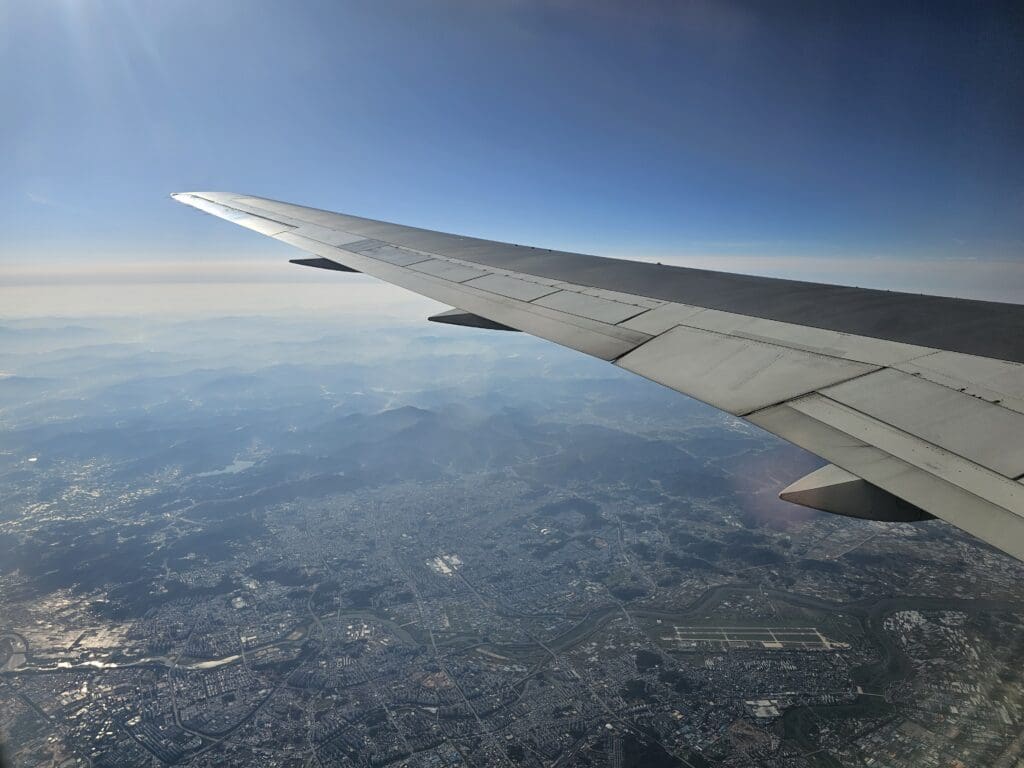
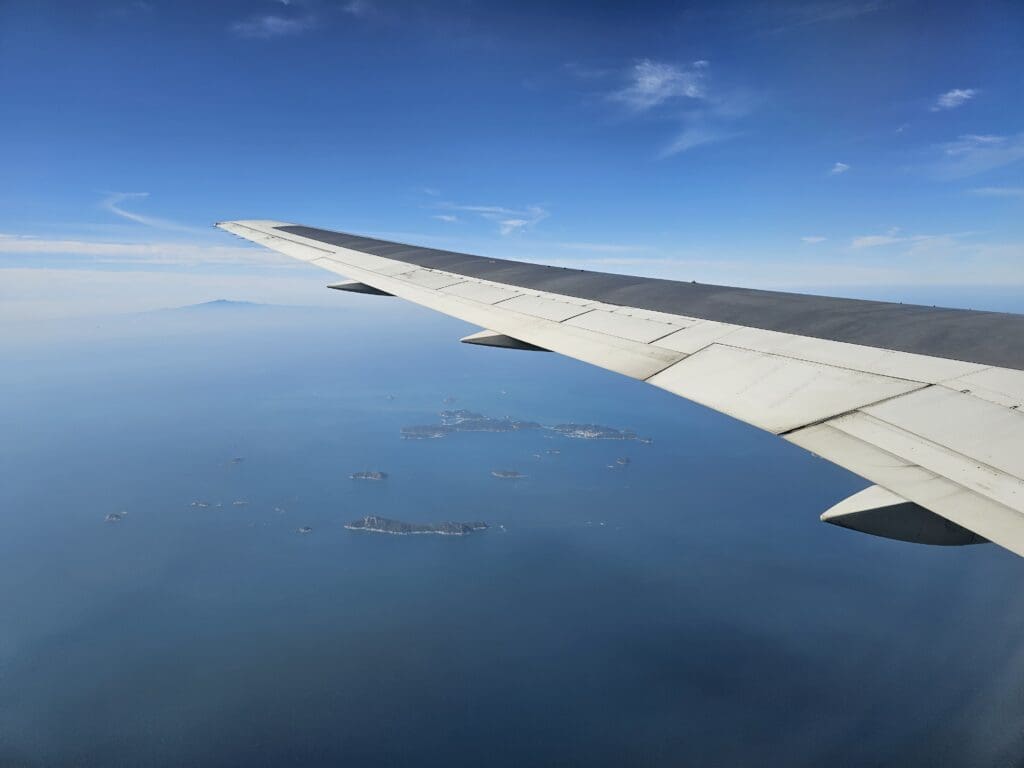
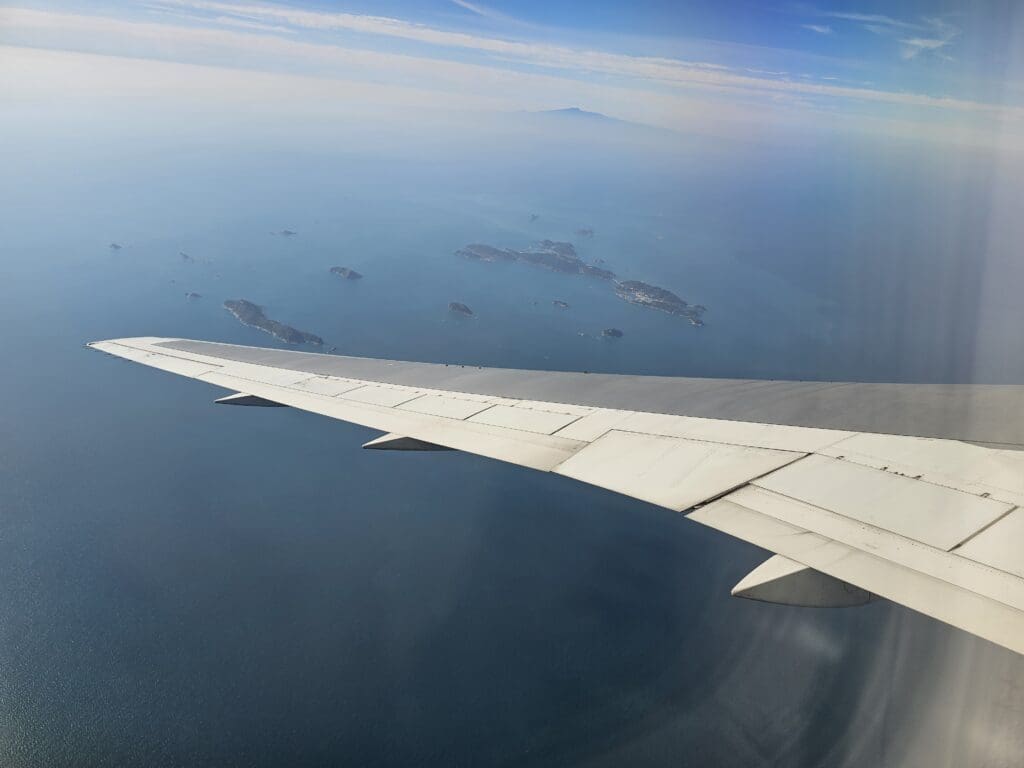
Upon leaving the sprawl of Gwangju behind, the mountains of South Jeolla Province rose up once again, although it wasn’t long before these were replaced by the many islands that sit off the province’s southern coastline. As soon as we left the mainland behind, a ding could be heard as the seatbelt signs were reilluminated and was immediately followed by an announcement from the Purser which contained the usual information and requests regarding seatbelts, tray tables, seatbacks and window blinds as we commenced our descent. Soon, the crew took to the aisles, first undertaking a rubbish collection round before returning to ensure that everything was secure and in place in preparation for our arrival.
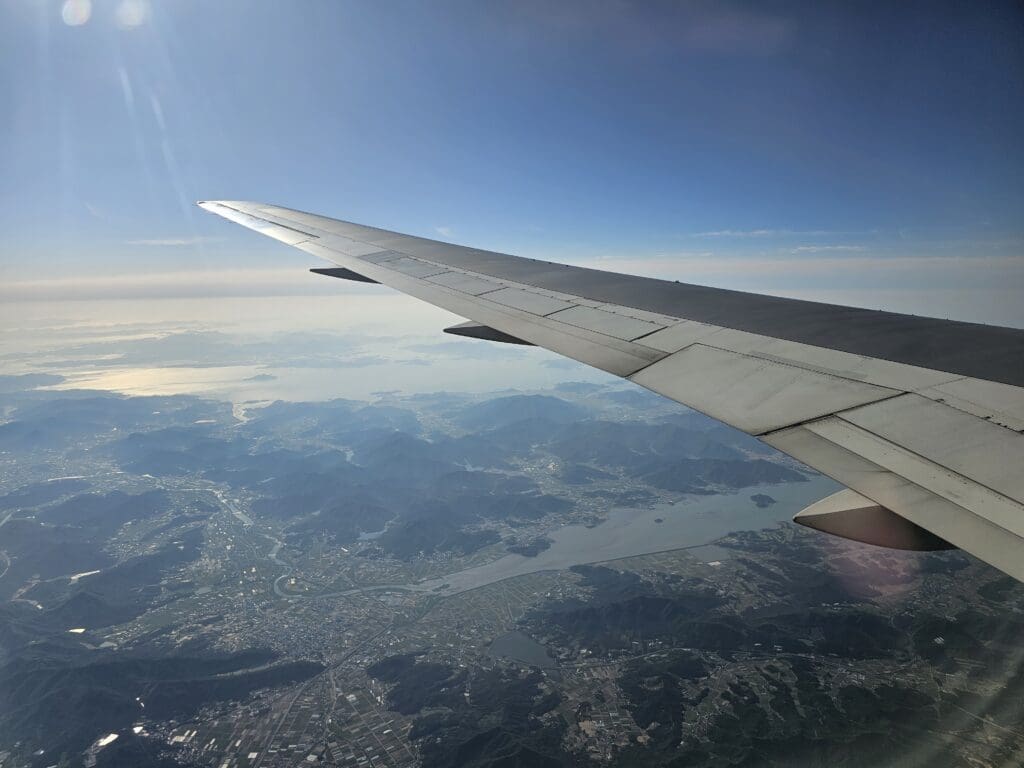
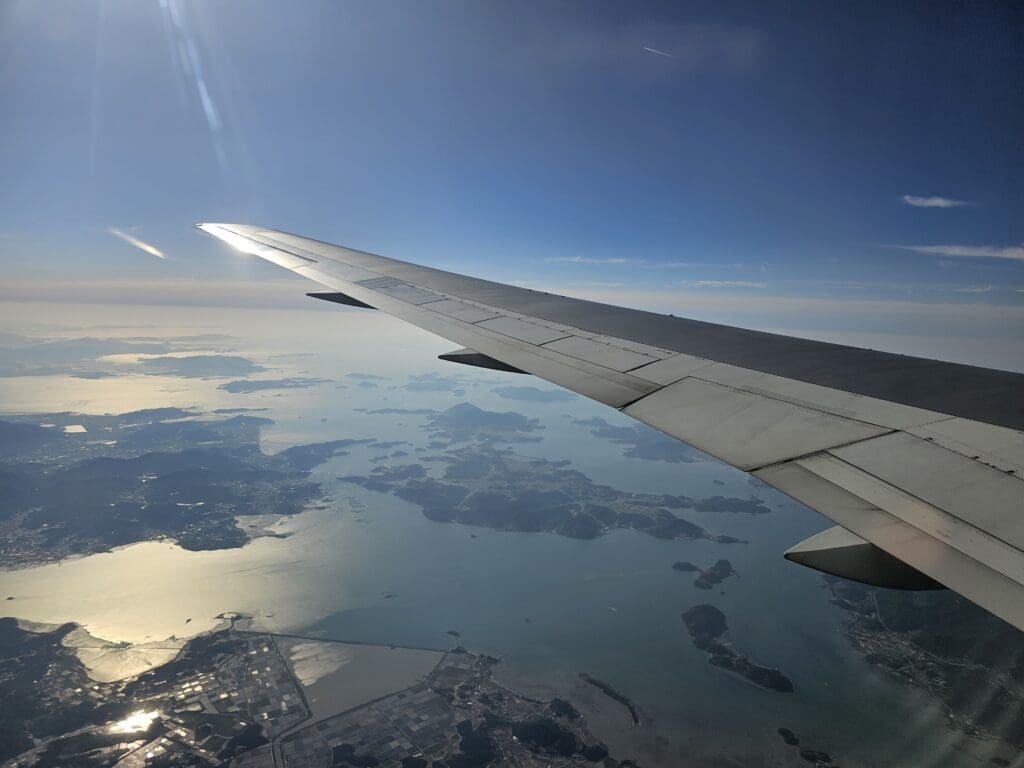
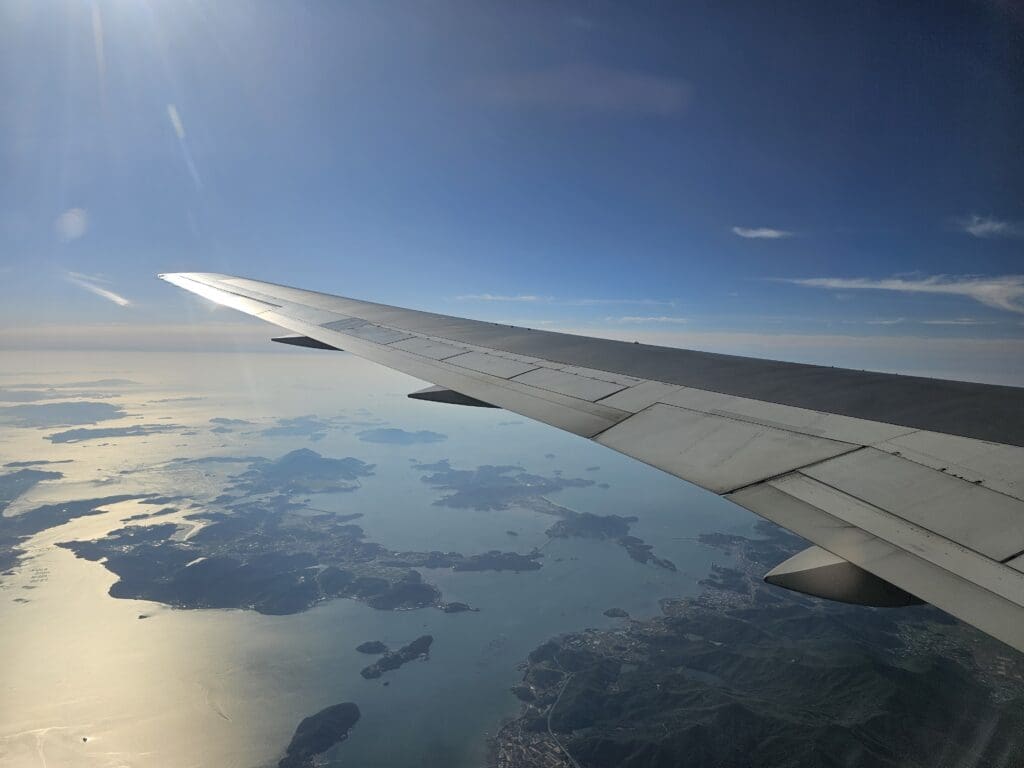
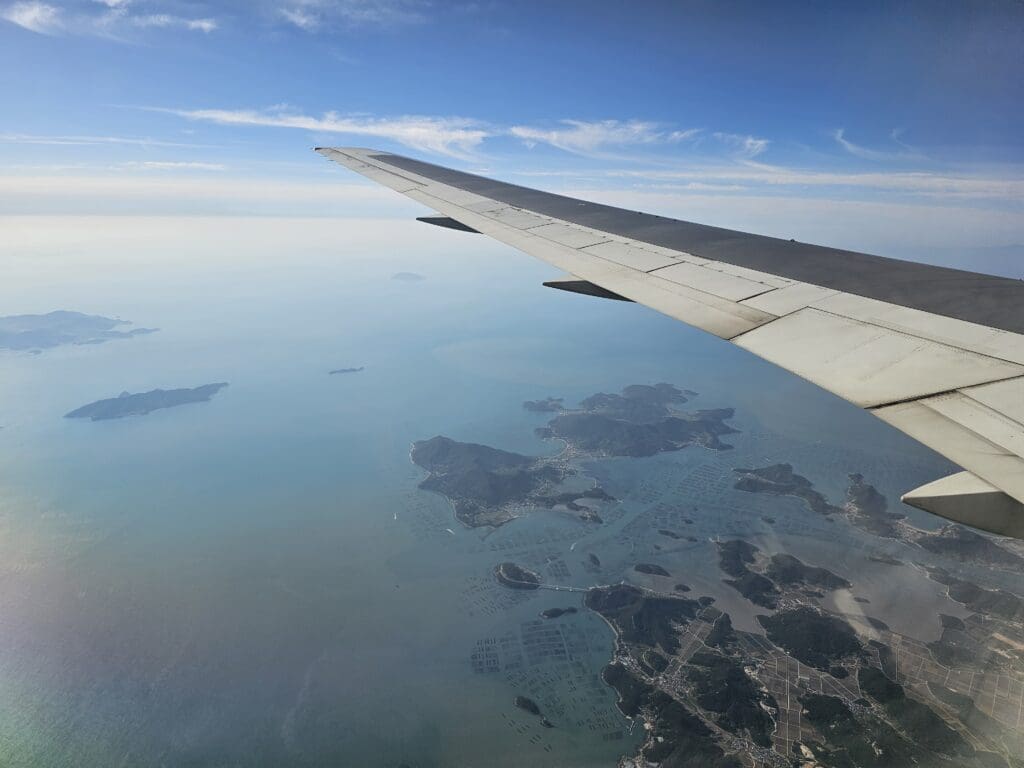
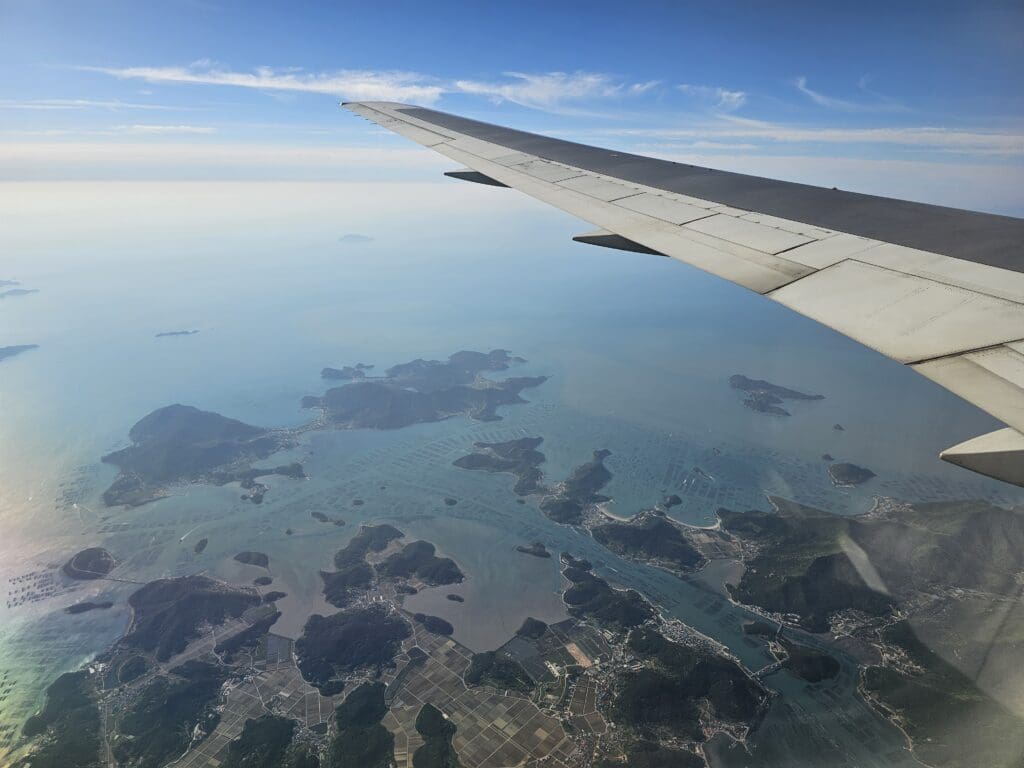
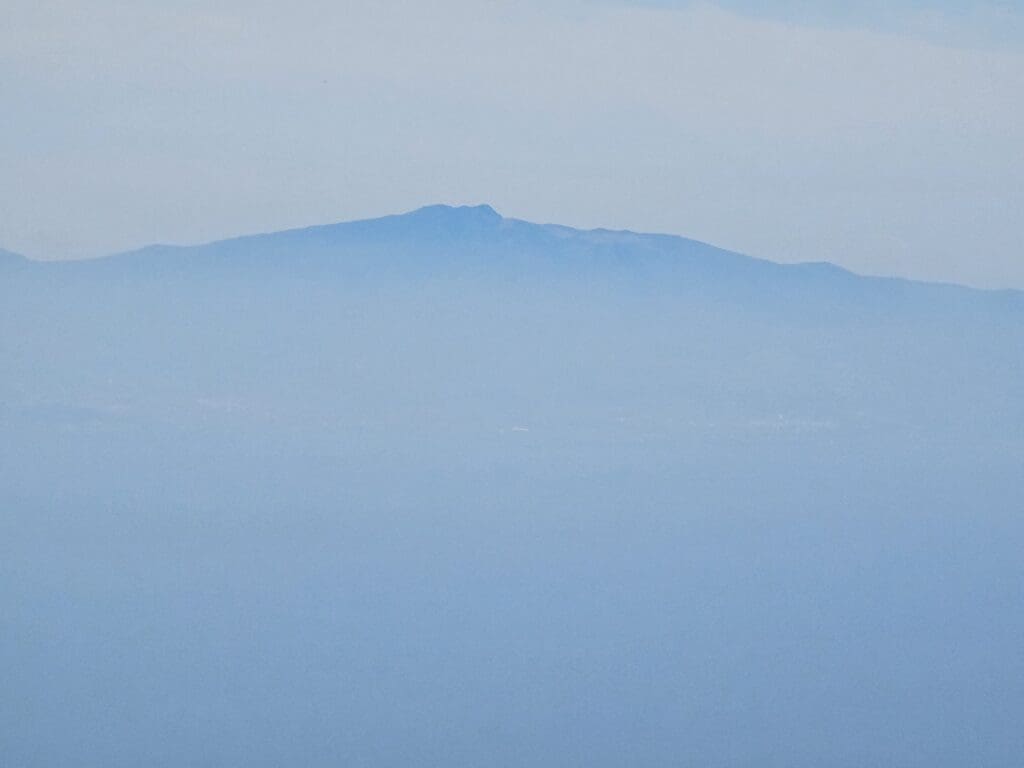
Looking outside, once we had left the mainland behind, the Boeing descended over the islands that sit a short distance off the coastline, and soon the peak of Mount Halla, Korea’s largest mountain, appeared through the morning haze, providing a further indication that we were nearing the end of our journey.
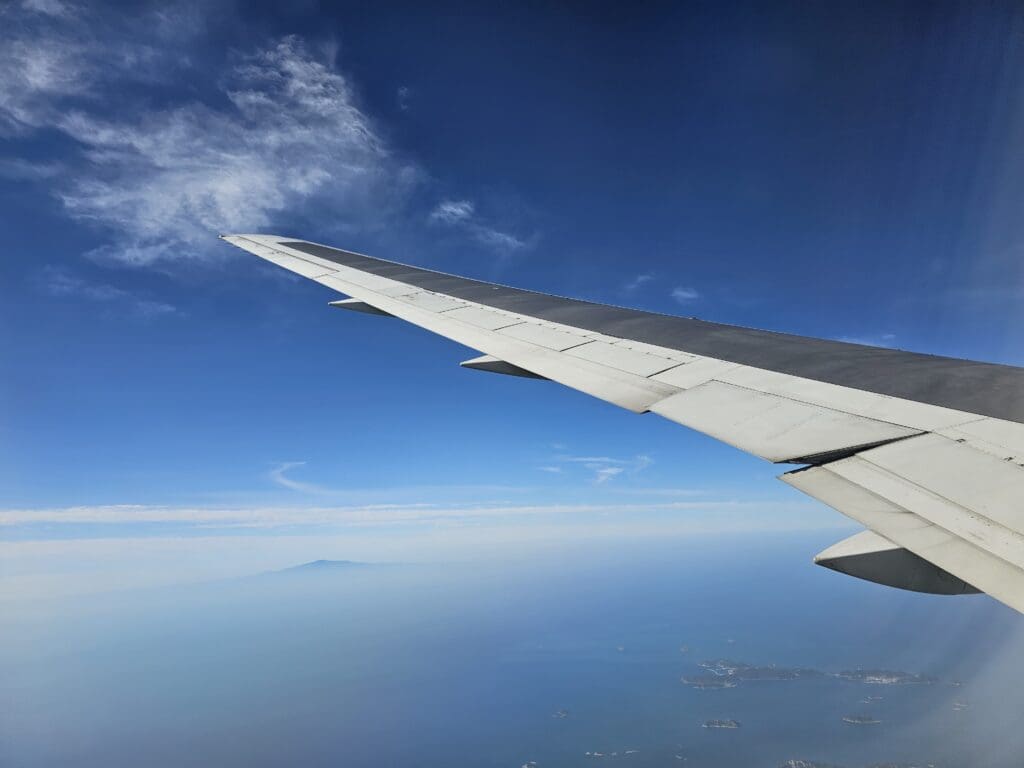
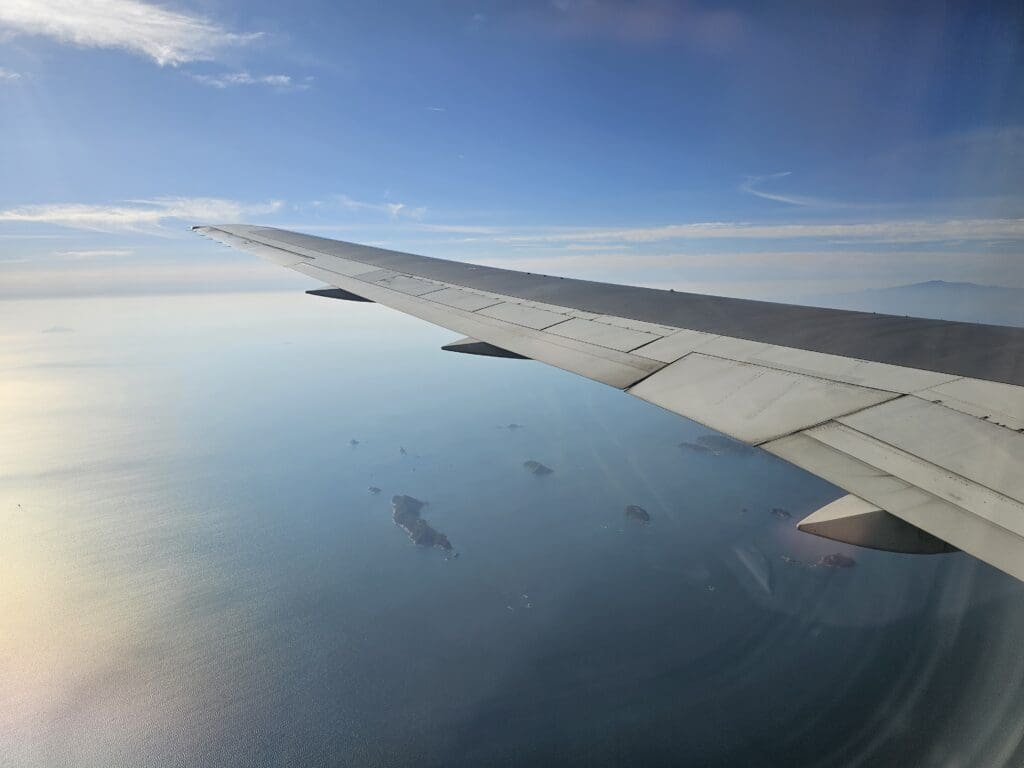
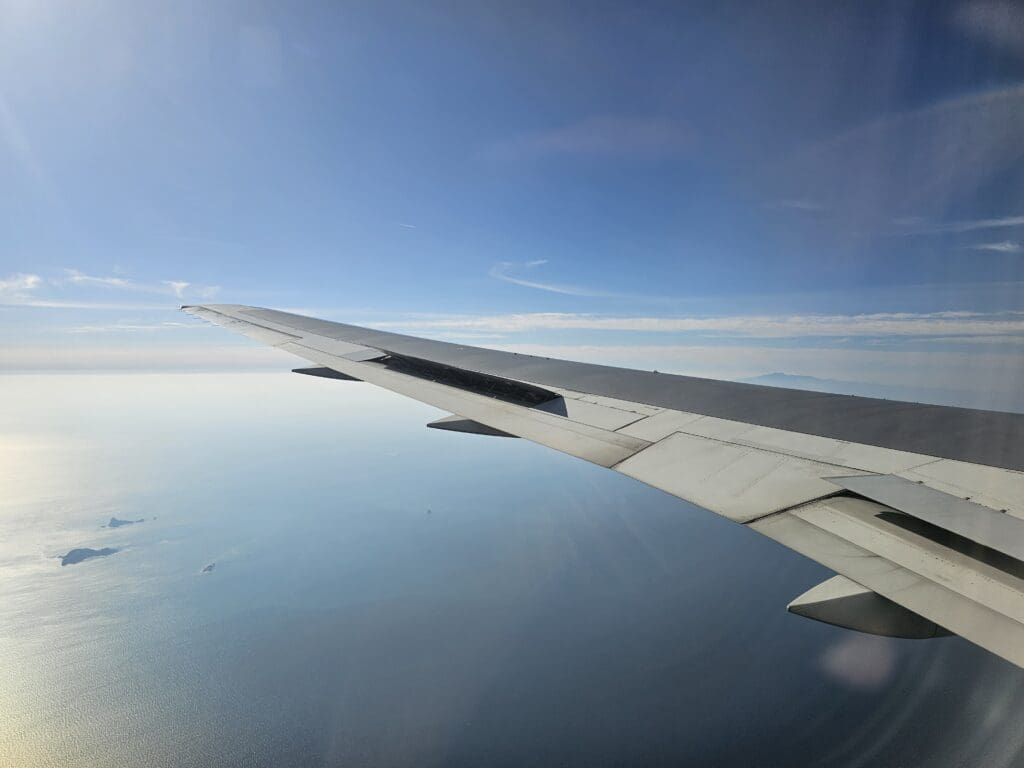
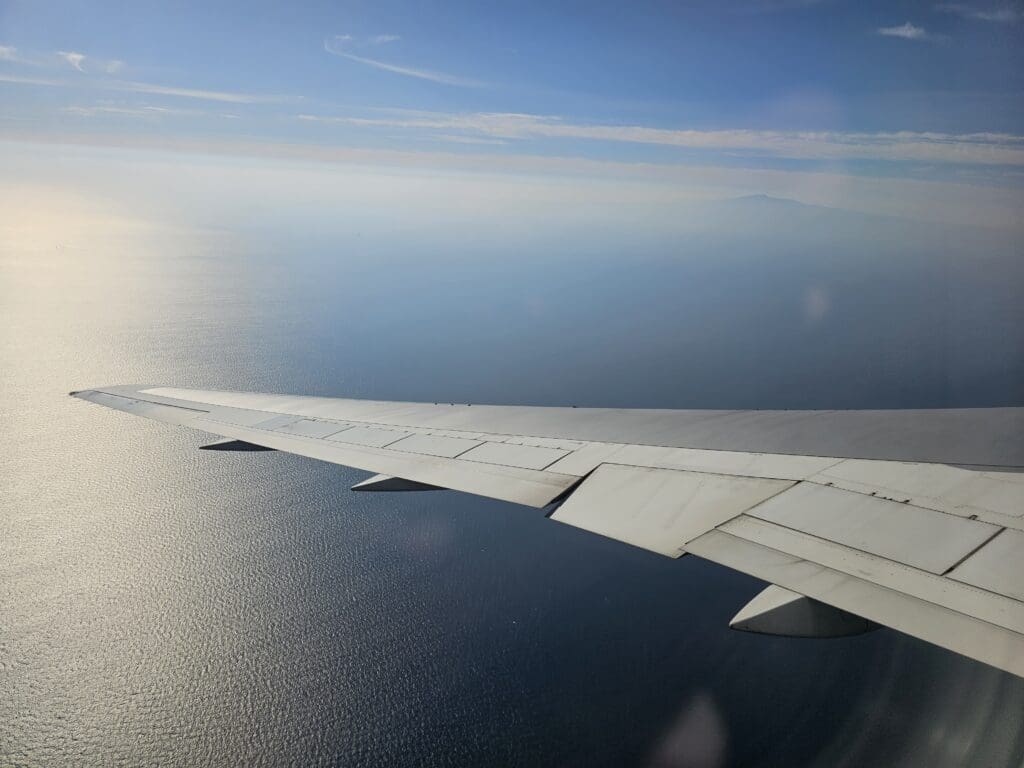
Following a very short crossing of the stretch of sea between South Jeolla and Jeju, the Boeing made landfall just to the west of Aewol in the far northwest of the island, and soon, the flaps and landing gear were extended in preparation for our arrival. From there, the Boeing bounced around a little as we flew parallel to the coastline, crossing over the island’s fields and passing the occasional town as we slowly edged towards the airport. Whilst this approach was debatably not as scenic as that of Runway 25, which takes passengers straight past Jeju City, this still provided some nice welcoming vistas of Jeju, with both the green fields and blue seas visible for the last few minutes of the flight.
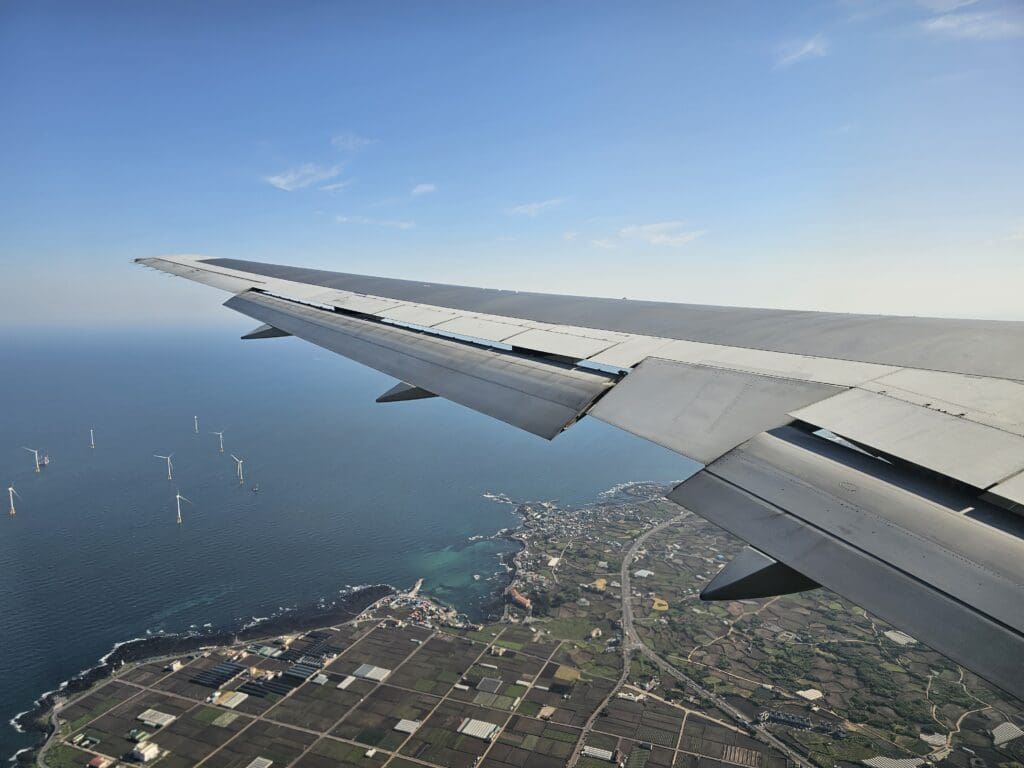
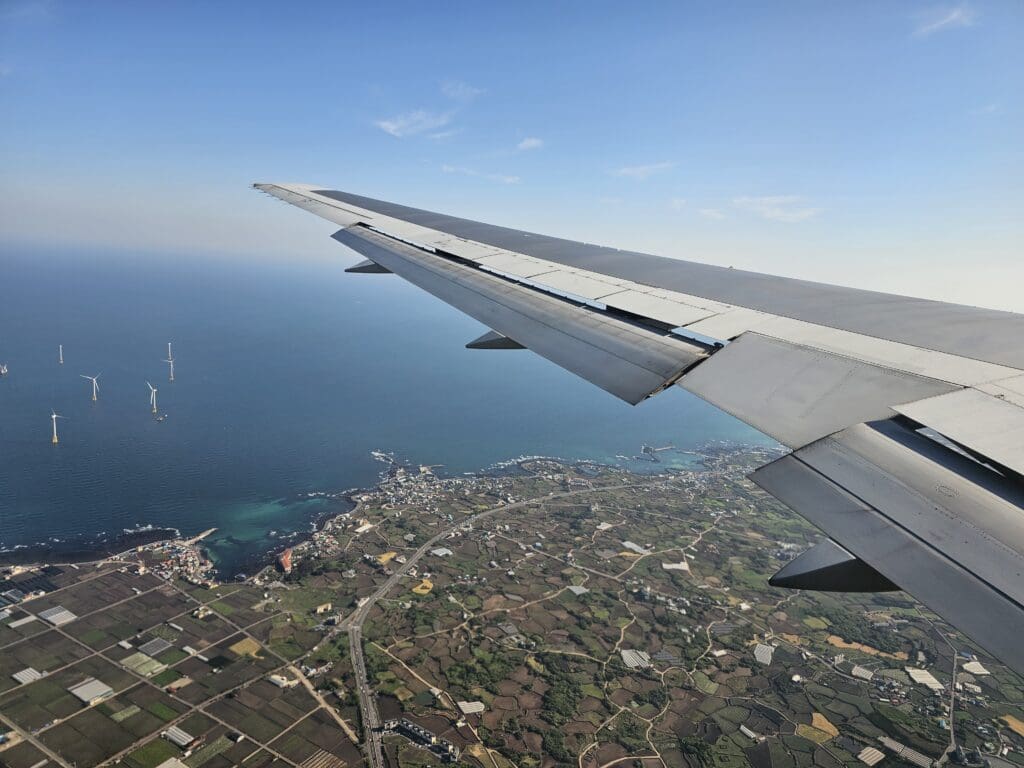
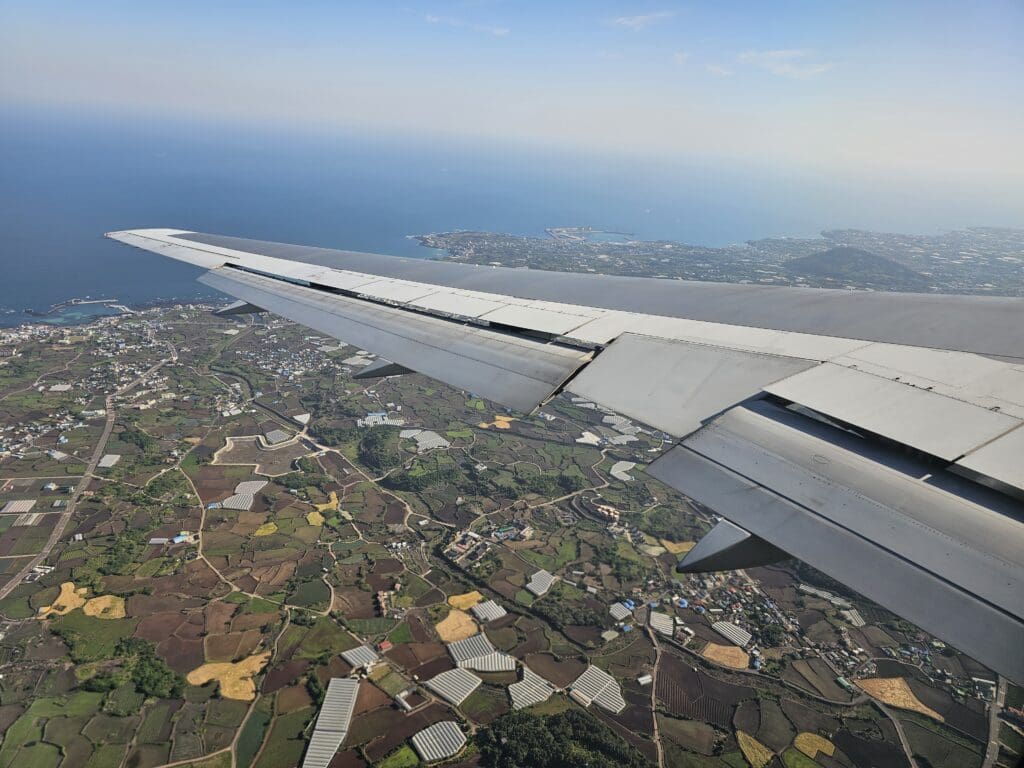
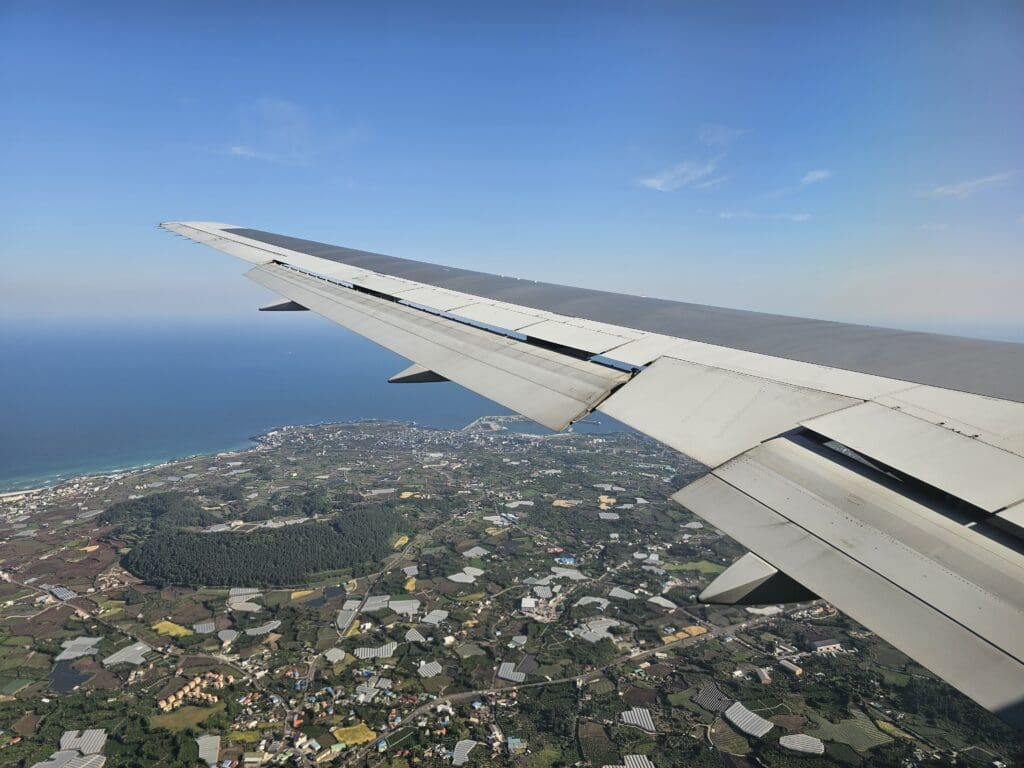
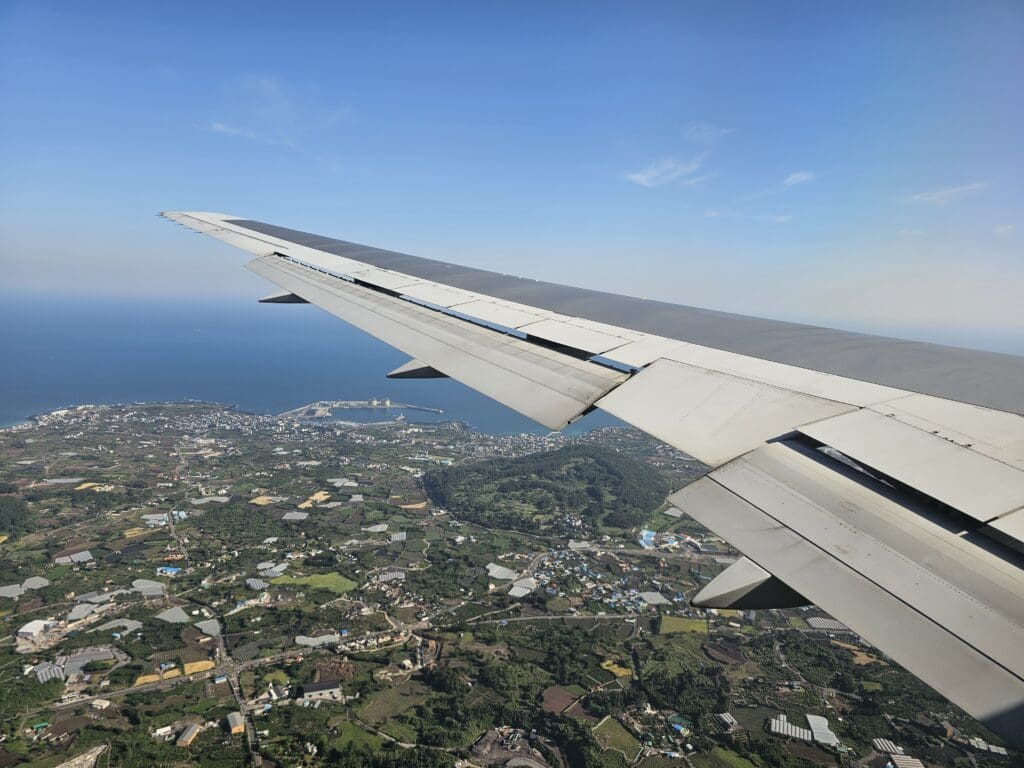
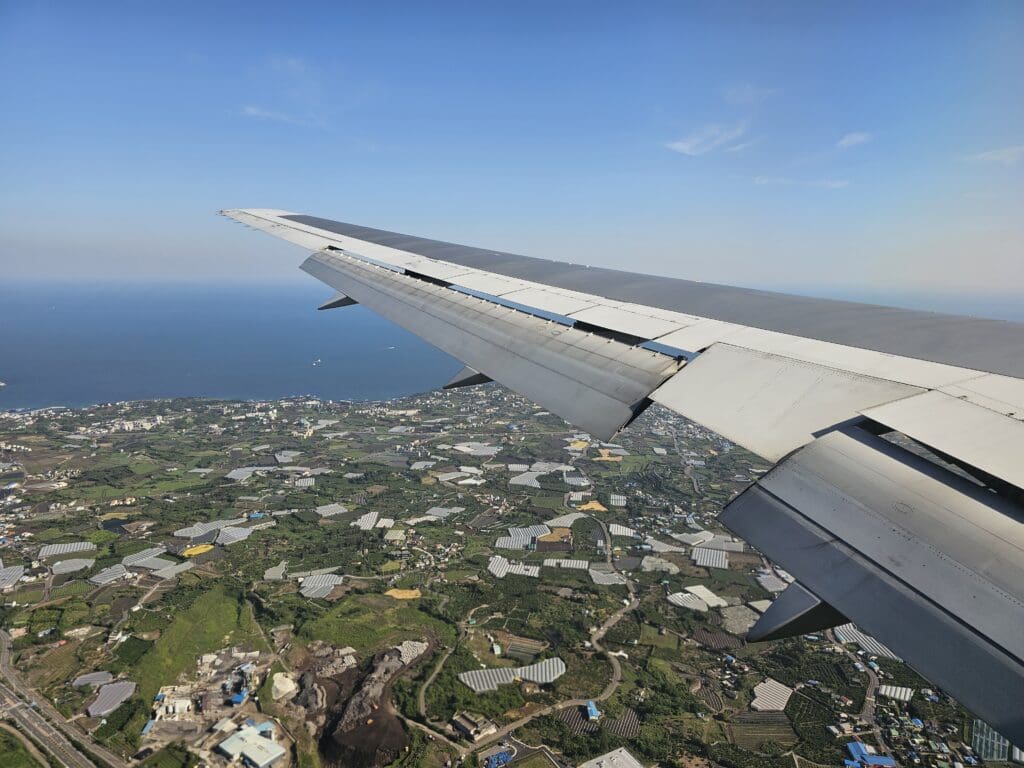
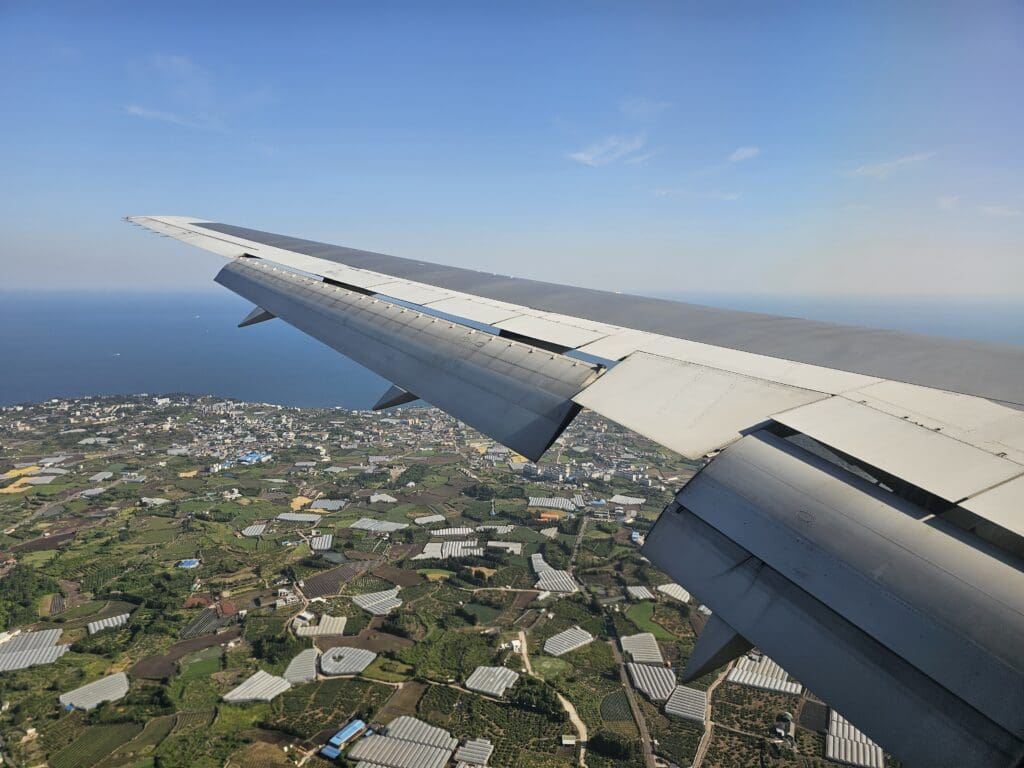
Before I knew it, Iho Tewoo Beach and the coastal village of Dodu appeared before the Boeing crossed over Jeju Airport’s western perimeter fence. Ending our smooth flight with a bump, at 0829, the aircraft was firmly planted down on Runway 07. Once back on the ground, the aircraft decelerated with vigour in what was a likely move to reduce our taxi time and ensure we cleared the runway in good time for the next arrival.
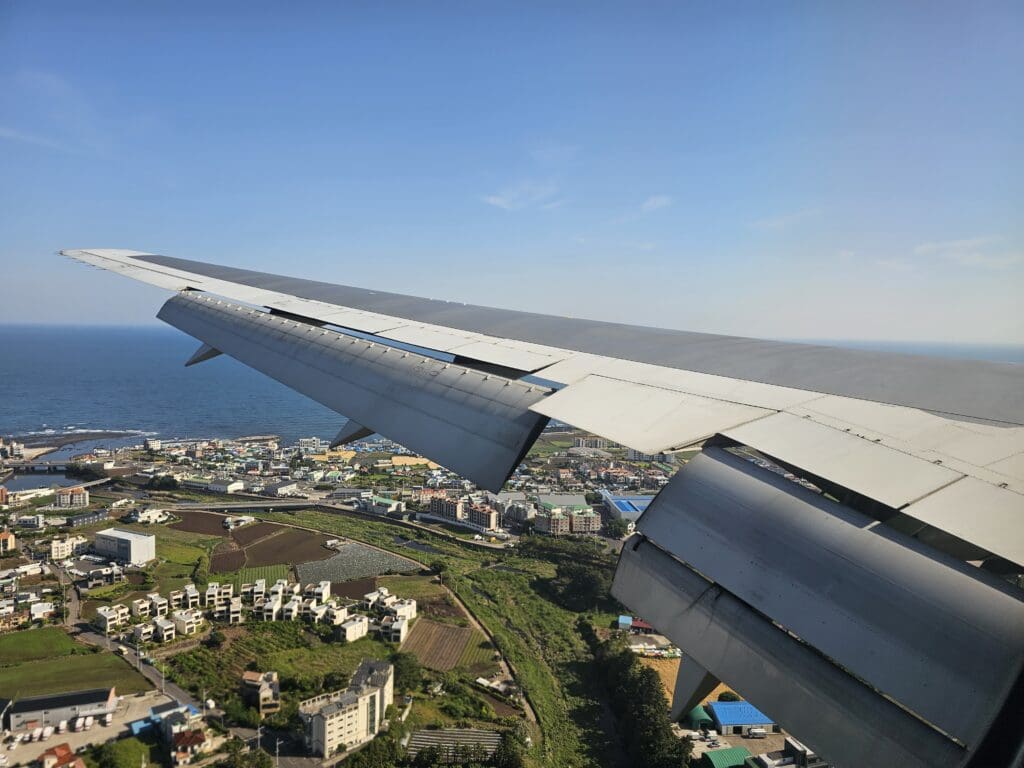
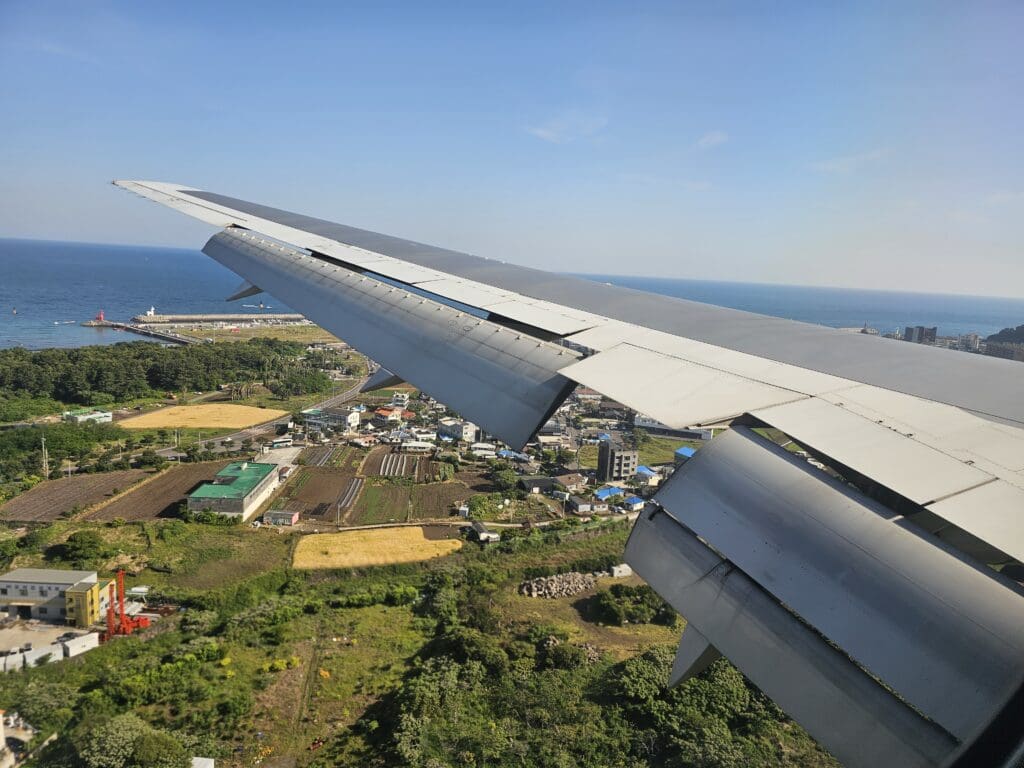
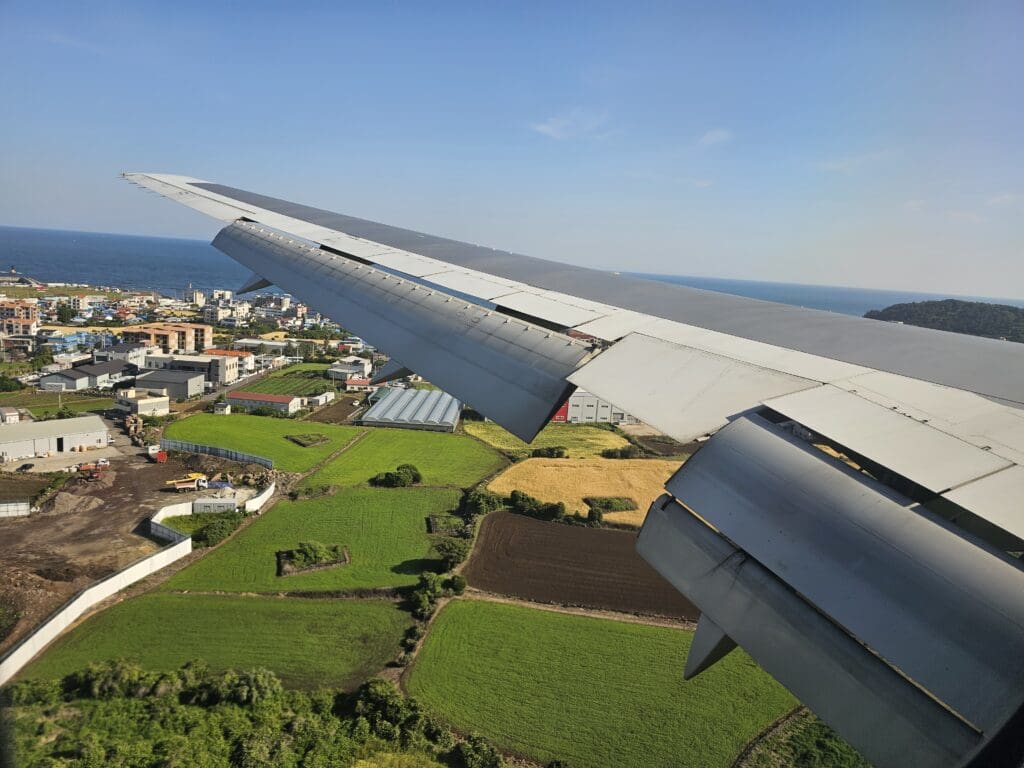
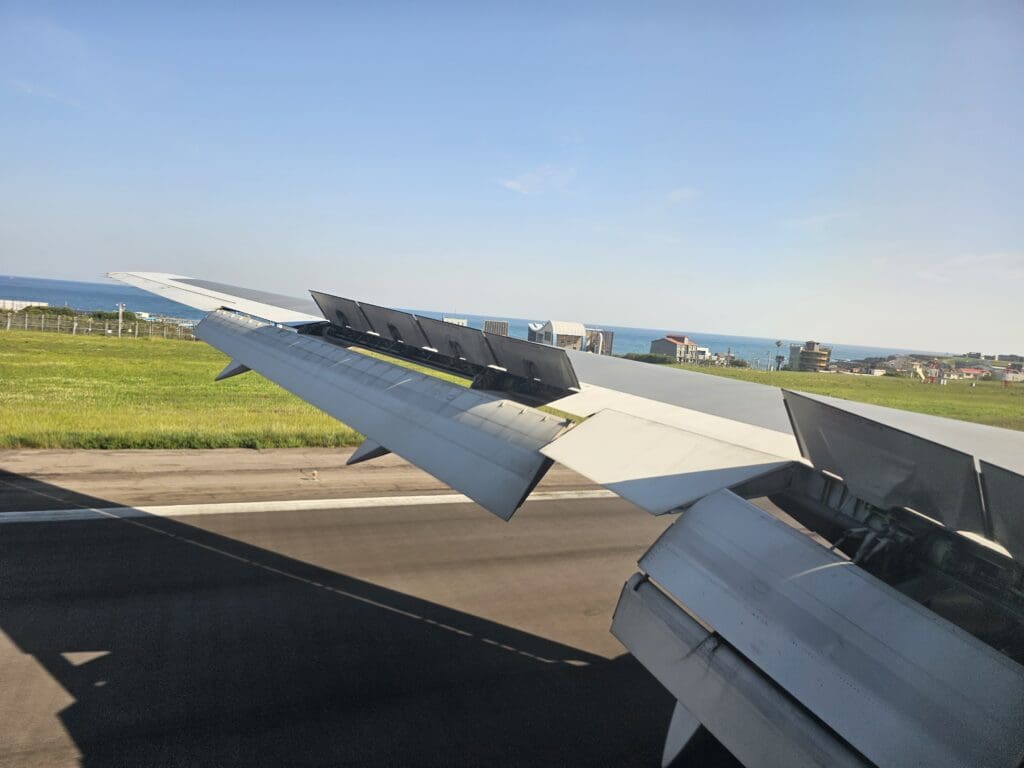
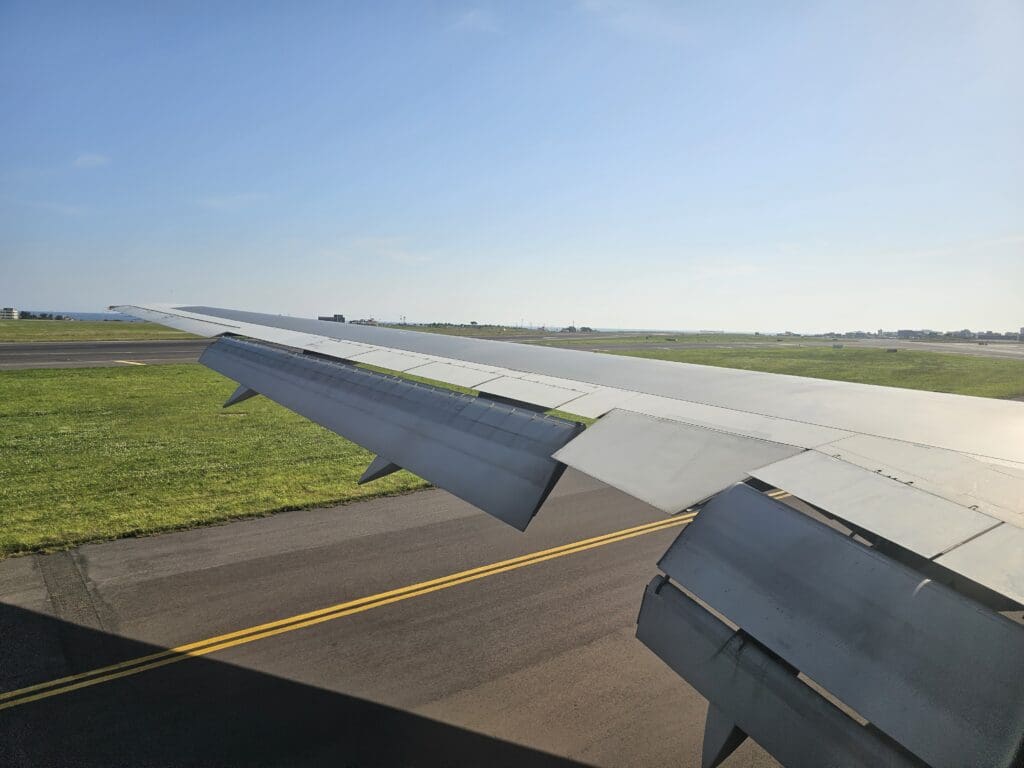
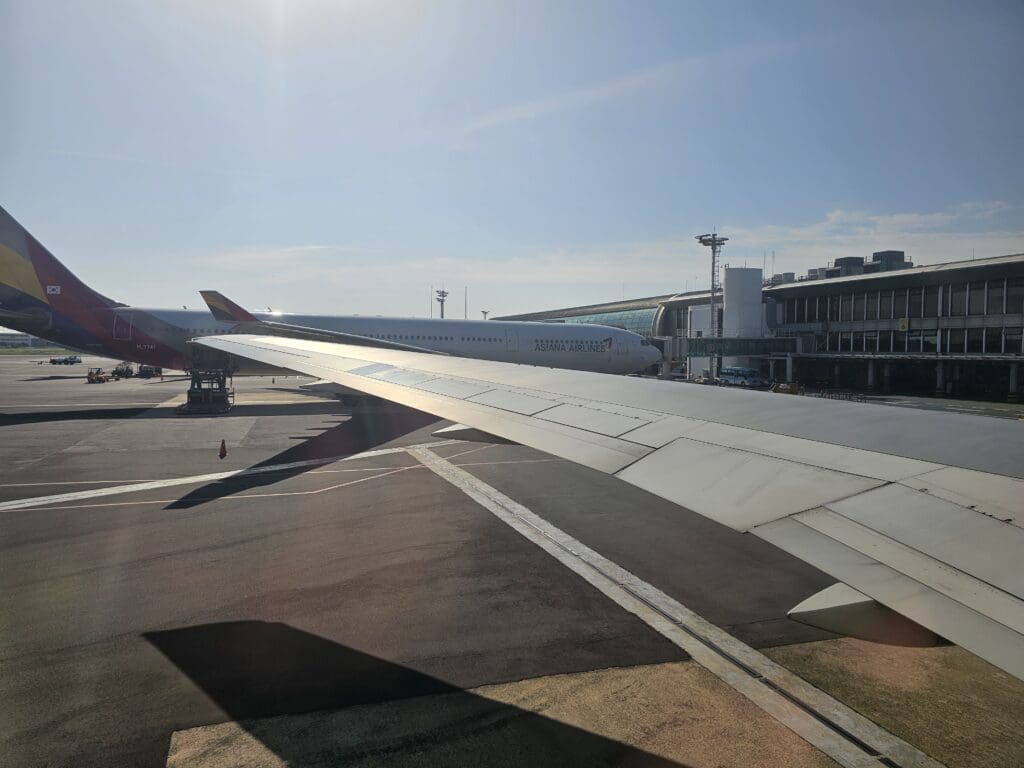
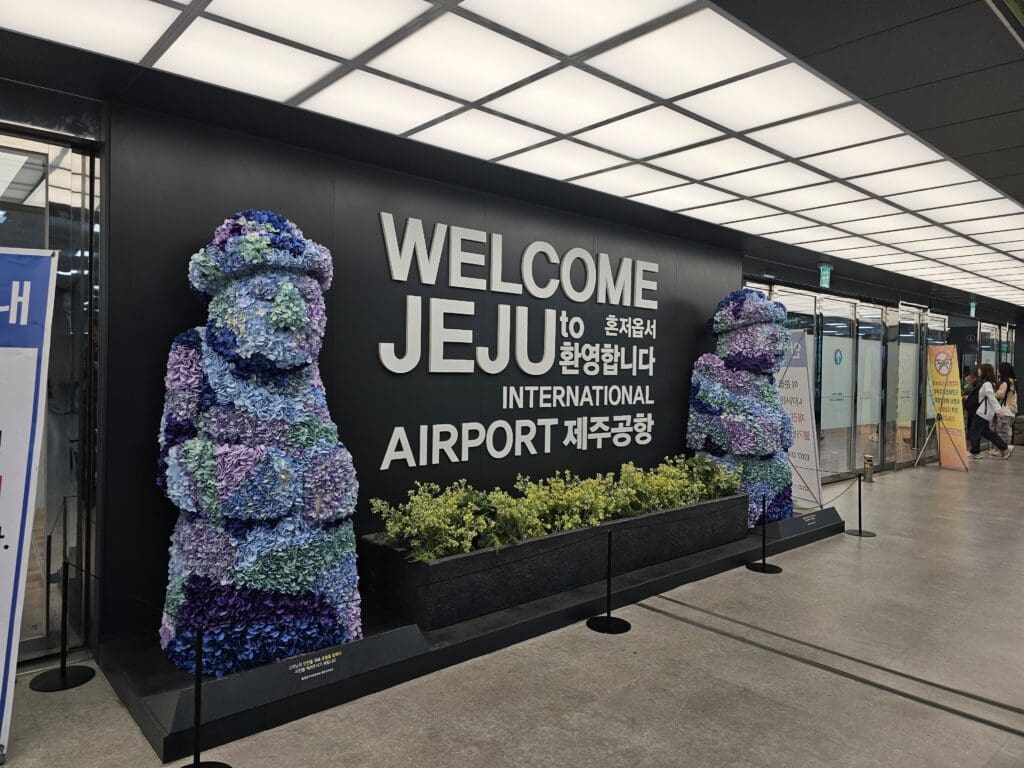
As we taxied off the runway, the flaps were retracted with a loud whine and the Purser welcomed all to Jeju, thanked passengers for flying with Asiana Airlines and advised passengers to remain seated and buckled up. From the runway, nothing more than a short taxi was required to deliver us to Stand 7 at the terminal. Slowly and cautiously, the aircraft made its way into the stand before the two engines powered down, temporarily filling the cabin with silence before upbeat music filled it once more. At this time, perhaps a rush to leave, many jumped up and fortunately, with an army of staff ready and waiting, it wasn’t long before the jetbridge was connected and disembarkation commenced. Not being in any major rush, eventually, I picked up my bag and made my way through the aircraft before thanking the two cabin crew members in the forward galley and stepping off the aircraft. From the jet, only a very short walk was in order to reach the airport’s surprisingly small baggage collection hall, and once there, I was rather surprised to see that my bag was already spinning around on this, despite the fact that the aircraft had only come to a halt around ten minutes prior! Picking this up, I walked several steps over to the exit and soon found myself in the landside portion of the terminal, ending my journey with Asiana Airlines.
Summary
Other than the slightly chaotic check-in experience, Asiana Airlines left me with absolutely no complaints. Once onboard, I found the crew to be incredibly polite and friendly, and despite its age, the Boeing 767 was clearly well-maintained and thus in tip-top condition! Meanwhile, this also offered a very comfortable ride, and based on this experience, I would have been happy to fly with Asiana Airlines again on either a short domestic hop or one of their longer international services.