
Trying Out Air Astana’s Airbus A321: Astana to Tashkent via Almaty
Having arrived on an international flight from Paris CDG and departing on a domestic service to Almaty, once I had made it through the Kazakhstani border, I found myself in the landside area of Nursultan Nazarbayev International Airport’s modern international terminal and was required to head over to the slightly older neighbouring domestic terminal. One con of making an international to domestic connection in Astana (and vice-versa), is there is no option for transit passengers to remain airside, or even within the terminal, as this requires a short walk in the open air. Thankfully, being the first day of June and not January or February, when the average low is around -18 degrees, the walk between the two terminals was not an overly chilly experience and it was good to breathe some fresh steppe air following my short overnight hop from Paris.
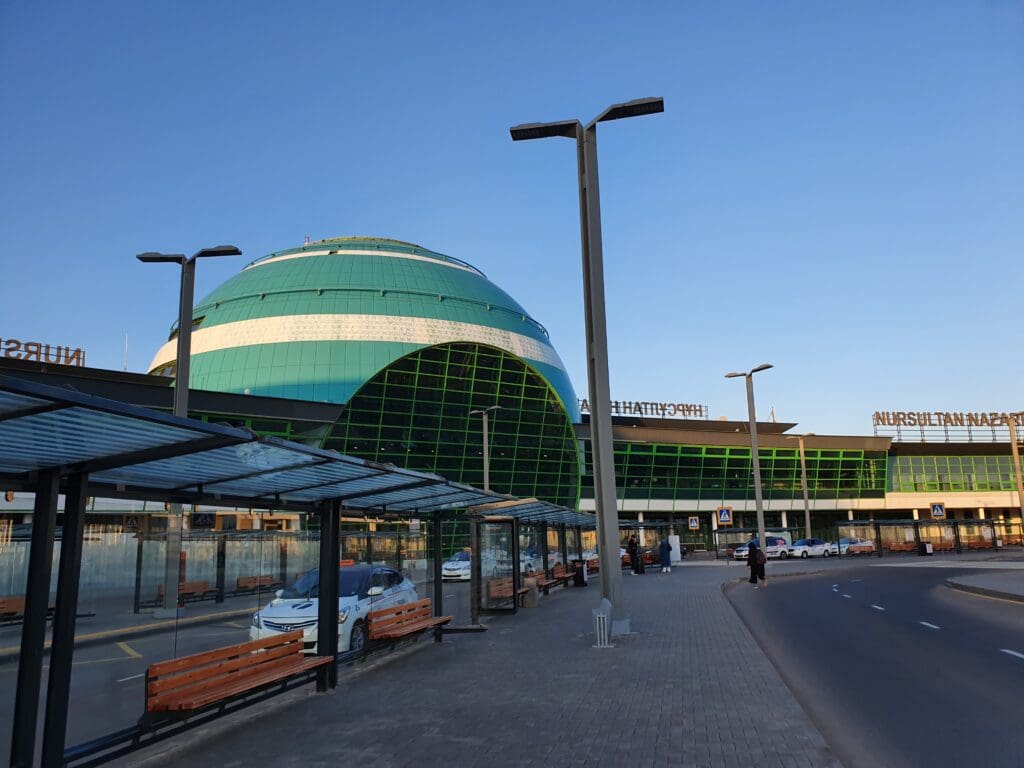
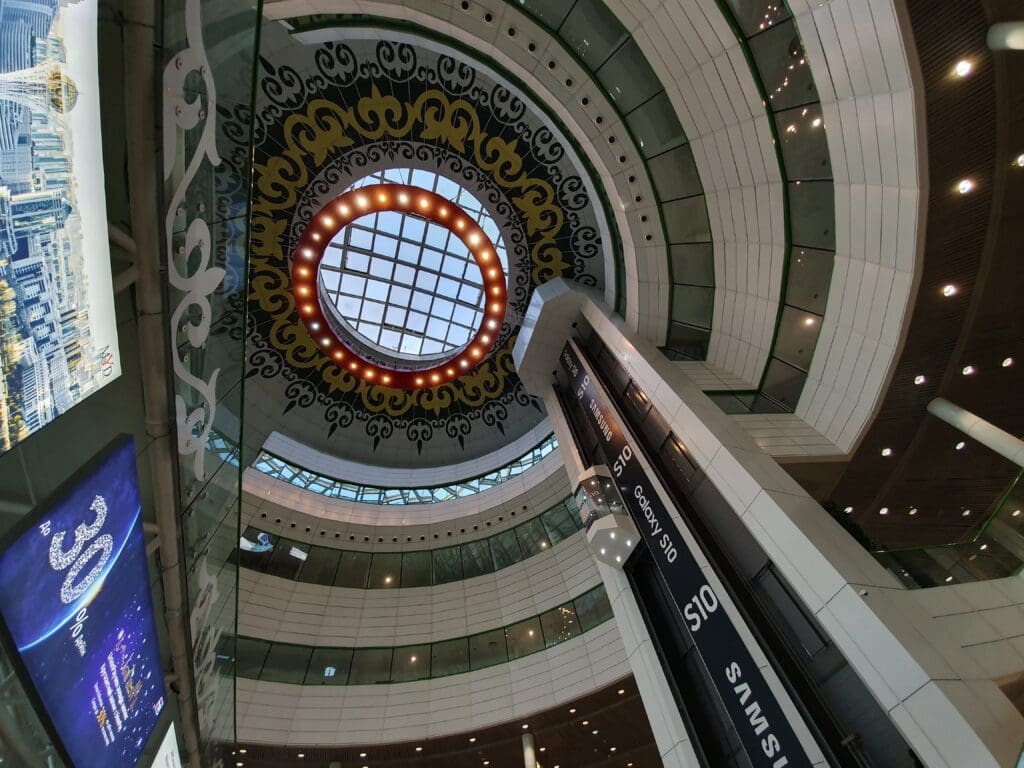
Since the last time that I had passed through the airport in August 2017, the security check at the terminal’s entrance had been removed and I was thus able to head straight in. Designed by Japanese architect Kisho Kurokawa, like many of the buildings in the Kazakh capital, Terminal 2 is modern and features an air of grandeur, combining modern architectural styles with traditional Kazakh design. After admiring the atrium for a few moments, I made my way up the escalators. Seeing as I had received all required boarding passes in Paris, and with my suitcase somewhere in the depths of the airport, I had no reason not to head airside. Thus, a few minutes after arriving in the terminal, I made a beeline for the identity and boarding pass check, after which sits the security entrance. Seeing as neither had any queues, both turned out to be quick and pleasant and before I knew it, I was standing in the airside area.
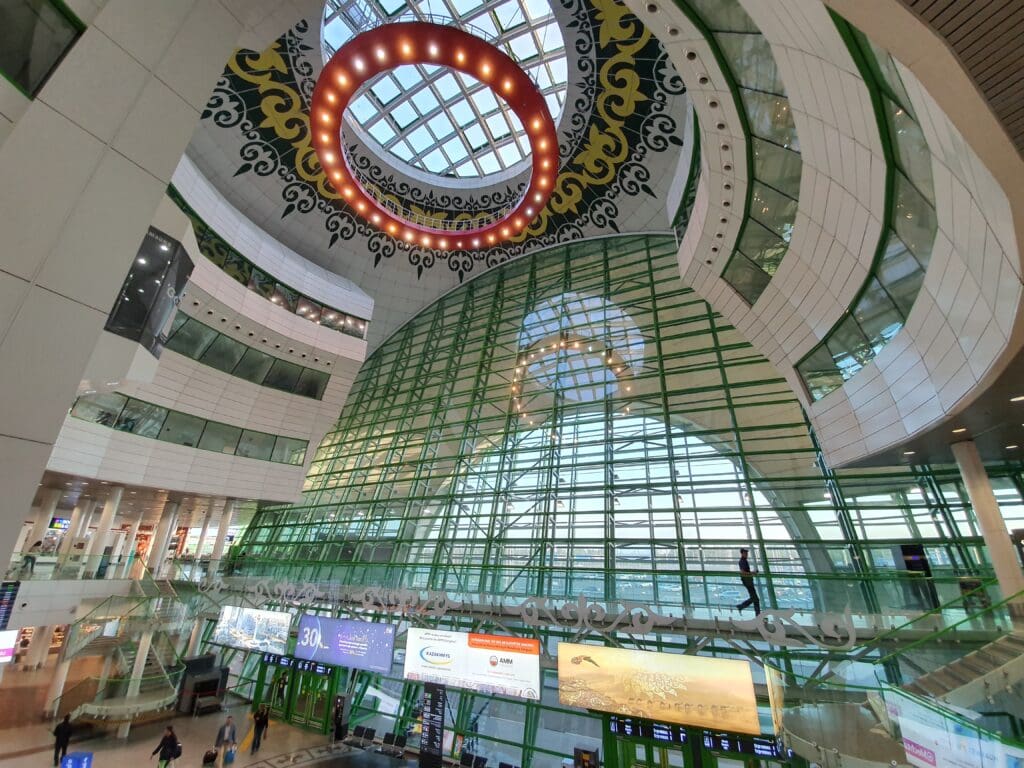
Whilst the landside area’s impressive atrium may give passengers hope of an equally impressive airside area, sadly this lacks any architectural marvels. Nevertheless, this portion of the terminal appeared to be clean and tidy with a few facilities such as shops selling a range of items, a trio of cafés, and a bar. With no Kazakhstani Tenge, no ATM, and having failed to inform my bank that I would briefly pass through Kazakhstan, I was uncertain whether my card would work in the country. Not wanting to suffer from the embarrassment of ordering a coffee, only for my card to be declined after this had been made, I had little choice but to sit on the terminal’s rather uncomfortable seats and wait several hours until my flight’s departure time. To add insult to injury, upon connecting to the complimentary wifi, I received an email notifying me that the departure time for my flight to Almaty had been altered once again, this time to 0920 – 20 minutes after the original scheduled departure time and 35 minutes after the first adjusted departure time. Also, it should be noted that after checking my emails, my phone disconnected from the wi-fi, after which I was asked to sign up via a code received by SMS. However, unfortunately, I never received this code after entering my phone number, and I was unable to use the Wi-Fi for the majority of my three-hour stay.
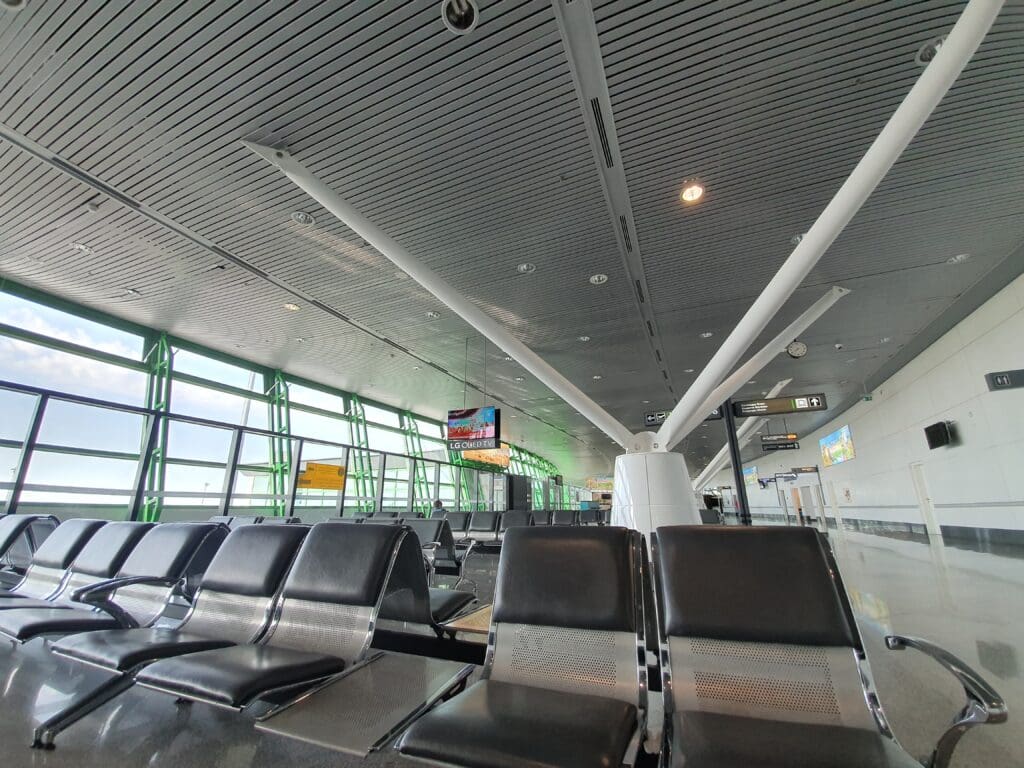
Given the fact that it was the middle of the night in Western Europe, as I started my wait, I felt extremely tired. However, the uncomfortable seating and ice-cold air conditioning blasting down into the terminal made sleep a virtually impossible task. After drifting off a couple of times, I finally gave up on this and turned my attention to the regular stream of arrivals and departures outside. Thankfully, a decent view could be had of the apron and runway from various points throughout the terminal. However, unfortunately, Kazakhstan is not known to be the friendliest country when it comes to understanding aviation enthusiasts’ innocent intentions, and so I avoided drawing too much attention as I took several photographs of the aircraft outside. Unsurprisingly that morning, hometown airline Air Astana operated the bulk of the movements, with every single type of aircraft in their modern fleet viewable during the wait. Next up was Kazakhstan’s second-largest airline, SCAT Airlines, whose second-hand Bombardier CRJ-200s could be seen heading off to a selection of the nation’s smaller cities and towns, with a couple of their Boeing 737 Classics arriving later on during my stay. Seeing these jets reminded me of my flight from Xi’an to Almaty on a battered SCAT Boeing 737-500 back in August 2017. That morning’s foreign visitors took the form of an Aeroflot Airbus A320 from Moscow Sheremetyevo alongside a LOT Polish Airlines Boeing 737-800 from Warsaw. During the wait, I happened to notice the Boeing 757 I had arrived from Paris on pushing back from the terminal before making its way to the runway and soon roaring into the sky at the start of its short flight over to Urumqi.
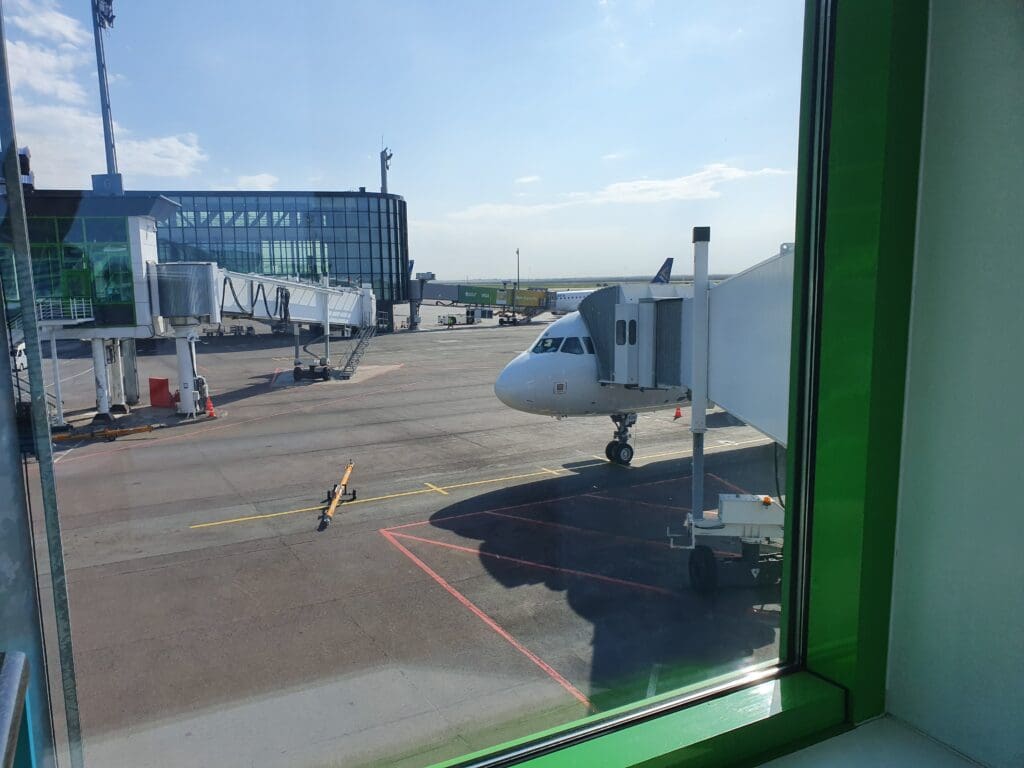
With around an hour to go until the flight’s departure time, a fair few passengers could be seen congregating at the gate from where the flight to Almaty was scheduled to depart. However, outside, no aircraft could be seen, although fortunately, at 0830 an aircraft appeared. Initially scheduled to be operated by one of Air Astana’s new Airbus A321neo aircraft and having noted that the seat map hinted this would be the case, I was a little disappointed to see that this was a regular Airbus A321, plain and simple. Wearing the Aruban registration, P4-KDA, this particular Airbus was assembled at Airbus’ Finkenwerder plant and took to the skies for the first time in November 2012 before being delivered to a chilly Kazakhstan at the end of the month. Today this aircraft can transport up to 175 passengers (28 in Business and 147 in Economy), flying as far west as Amsterdam and as far east as Beijing. In the week before my flight, this Almaty-based aircraft had been in the skies almost non-stop, completing a total of 27 flights covering an impressive total of almost 50,000 miles. This took the aircraft to Aktobe, Beijing, Dubai, Dushanbe, Istanbul, Kyiv, Moscow Sheremetyevo, Astana, and St Petersburg.
Turning back to the activity in the terminal, at 0840 the departure boards claimed that boarding had commenced, and thus a queue formed which soon grew rather long. Whilst I was sceptical that boarding would occur anytime soon, not wanting to get left behind, like a sheep, I followed the flock and joined it. As I waited, a well-dressed man in a suit walked down the line, eyeing up passengers and soon approached me. As I had noticed on my previous domestic flights in Kazakhstan, this particular person wanted me to transport a letter for him to someone who would be waiting in the arrivals area of Almaty Airport. Fortunately, after rejecting his request, I received no further hassle, and he continued to head down the line in his search for a suitable messenger. At 0900, an announcement was made in Kazakh, Russian, and English, and boarding commenced. Within a couple of minutes, my boarding pass was scanned and my passport quickly checked before I was allowed to proceed down the jetway and onto the waiting aircraft.
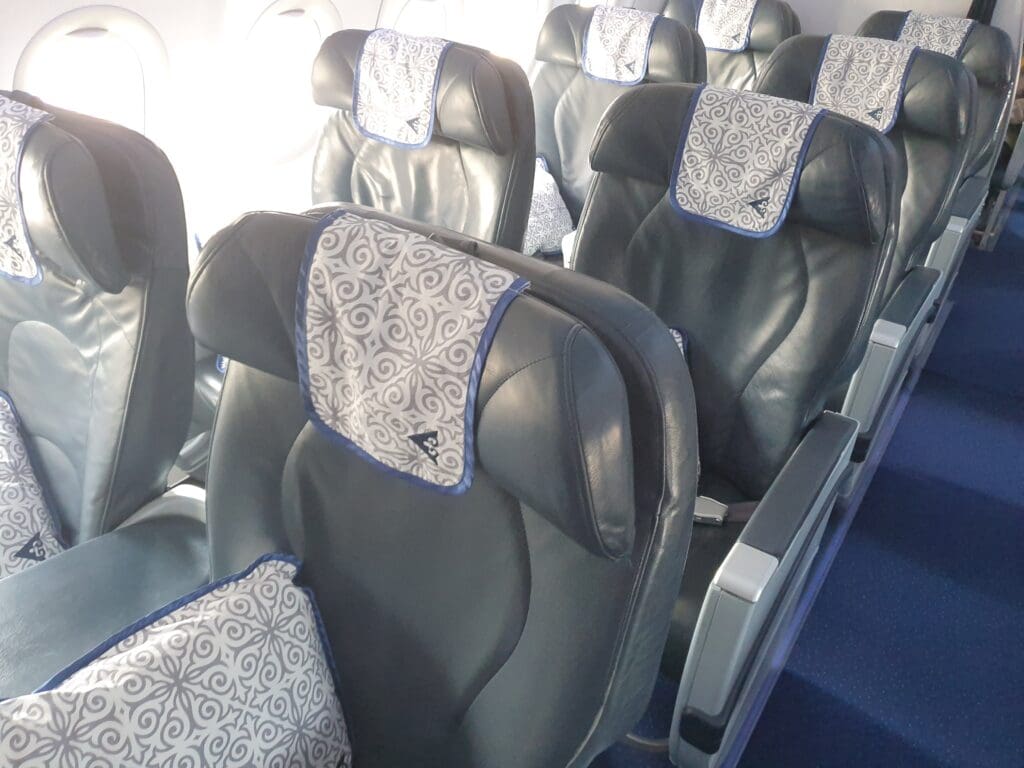
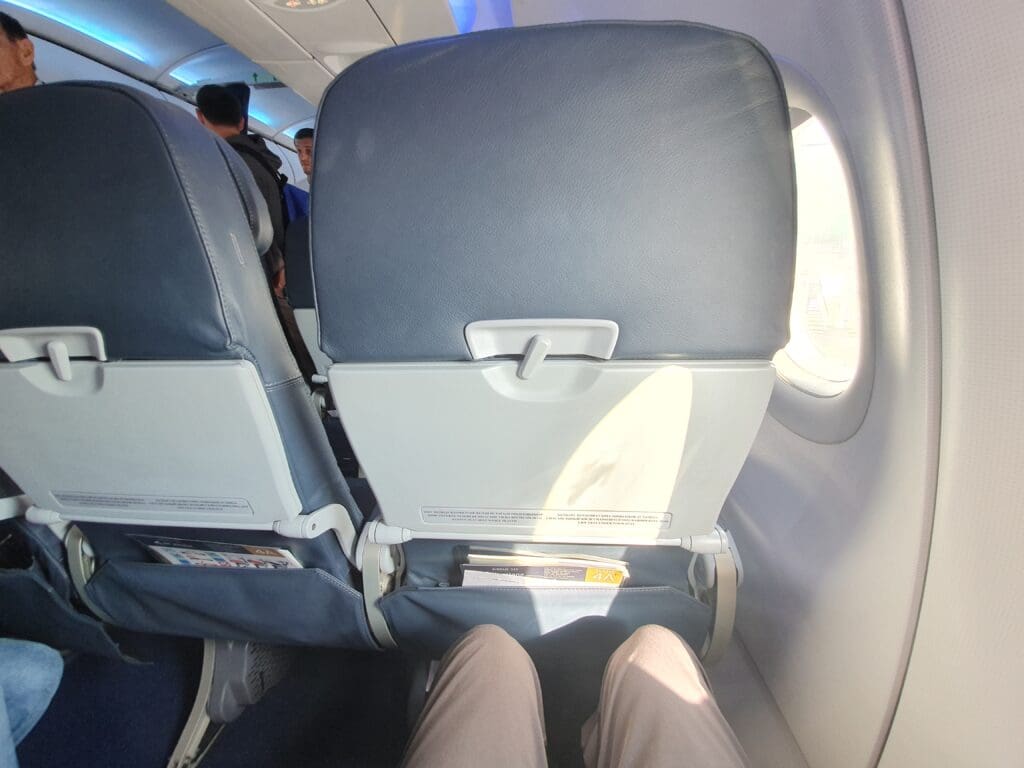
As I stepped onto the aircraft and into the forward galley, I was greeted in Russian in a hasty yet friendly manner by one of the three cabin crew members that could be found here before I turned right and began the journey to my seat. First up was the large Business class section consisting of seven rows of large and comfortable seats in a 2-2 configuration. After passing through this, I found myself in the much larger blue mood lighting-lit Economy cabin, where I soon arrived at my seat in the third row of this. Despite only having been on the ground in Astana for a short amount of time, I was happy to see that the interior appeared to have received a thorough clean during its turnaround, and I failed to spot any crumbs or rubbish. Meanwhile, the cabin seemed to be in a well-maintained state with few signs of wear and tear. In Economy, each seat is covered in a dark blue faux leather and features an adjustable headrest partially covered by a disposable headrest cover complete with the airline’s logo. With a decent amount of legroom and a soft seat, the seat was most definitely not uncomfortable. However, I would say that the comfort of the seats onboard their Boeing 757s (and 767s) is somewhat better. Turning to the seatback pocket, this contained the same selection of items as had been present on my previous flight, namely a copy of the airline’s Tengri magazine and entertainment guide alongside a safety card and a sick bag. Finally, whilst the most obvious difference is perhaps the lack of a PTV, both plug sockets and USB-A ports could be found hiding underneath each seat.
Only a short time after taking my seat, both the middle and aisle seats were filled, and unlike my ride over from Paris, it soon became clear that the flight down to Almaty would be full. That morning, whilst most passengers were from Kazakhstan, I also noticed passengers from China, Korea, Russia, and the US. By 0917, boarding appeared to have been completed, and the cabin door was closed three minutes later. Once this was done, the Irish Captain performed a very brief welcome announcement in English only, featuring the usual word of thanks for flying with Air Astana. This was immediately followed by a much longer announcement from the Purser in Kazakh, Russian, and English. As I have noticed is often the case on airlines across the former Soviet Union, boiled sweets were soon passed around by the crew just before the overhead screens extended and commenced playing Air Astana’s silhouette safety video three times in the above three languages. Turning my attention outside, at this time a SCAT Boeing 737-500, which would also later head down to Almaty, was towed into the neighbouring gate in preparation for its morning flight.
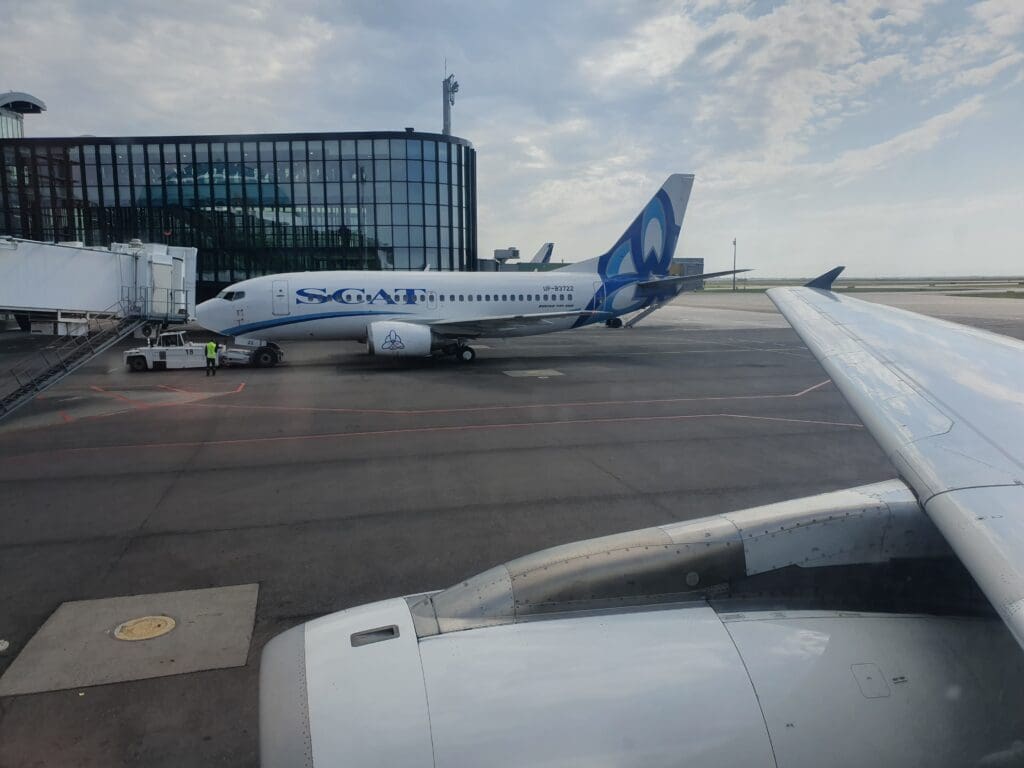
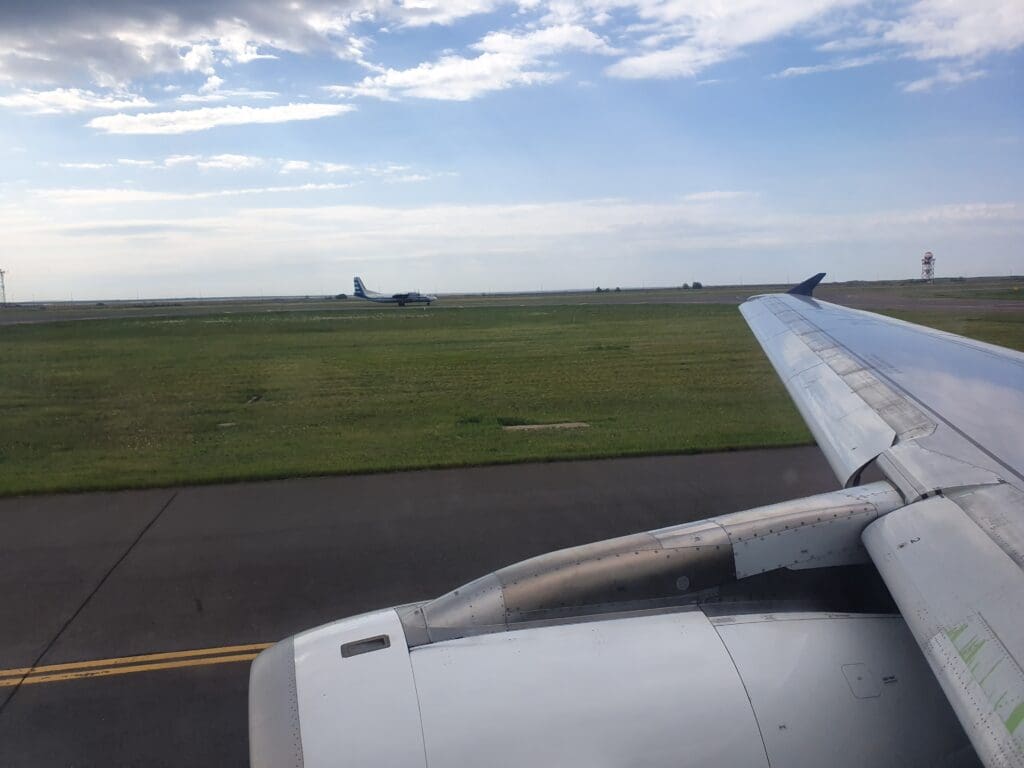
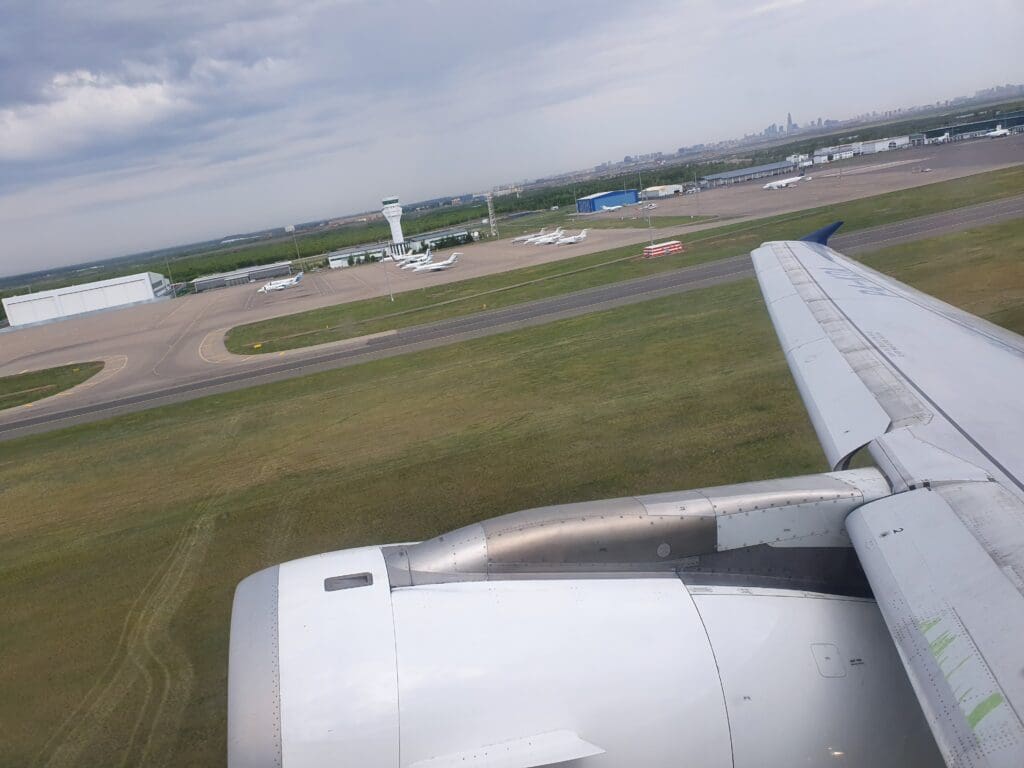
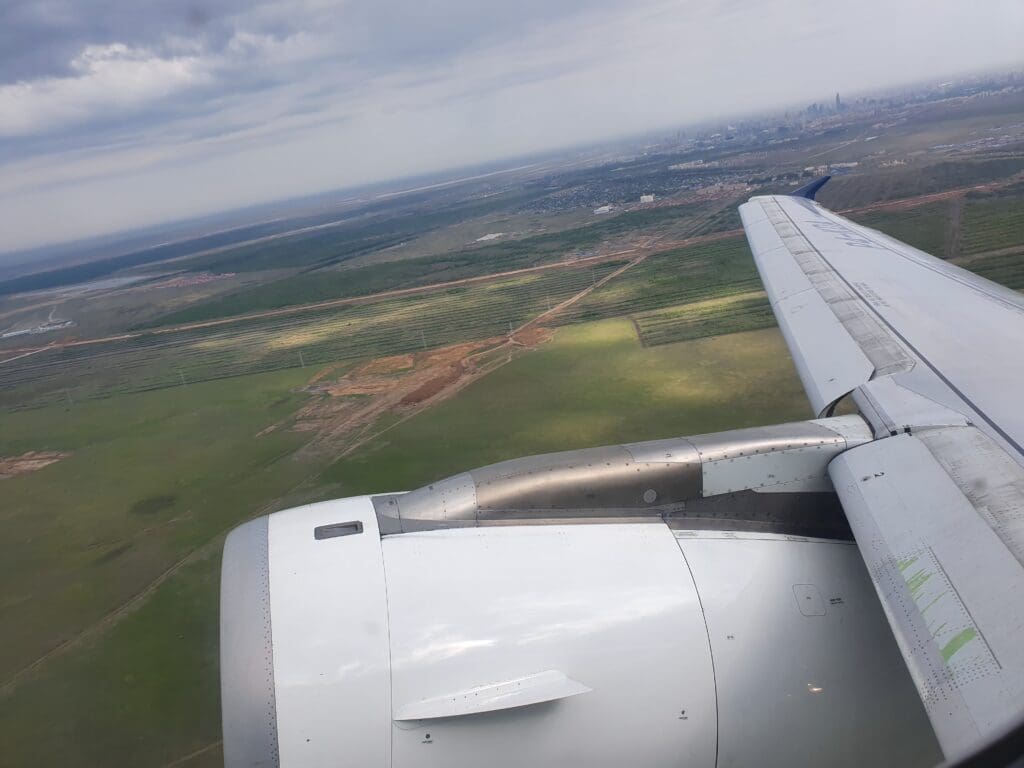
After some waiting, at 0927 our aircraft pushed back, and the aircraft’s two IAE V2533-A5 ‘hairdryer’ engines powered up as we made our way backwards. Once this came to an end, our aircraft paused for a few minutes before commencing its short taxi to runway 22. As we made our way to the runway, one of the airport’s more interesting visitors, a Southern Sky Airlines Antonov An-24, could be seen and heard commencing its rumbling takeoff roll before making its typically shallow and smoky climb. Ten minutes after our pushback had commenced, the Airbus A321, known to air traffic control as ‘Astanaline 952,’ headed onto the runway, from where it soon commenced a powerful takeoff. After speeding past the empty-looking terminal where a grand total of five aircraft could be seen waiting for their next flights, our aircraft rotated as we were roughly parallel with the remote stands. Here, a collection of modern business jets plus a couple of classic aircraft – an Antonov An-24 and a Yak-40 plus a pair of SCAT CRJ-200s – could be seen. Meanwhile, in the distance, the skyline of Nursultan came into view, rising out of the steppe.

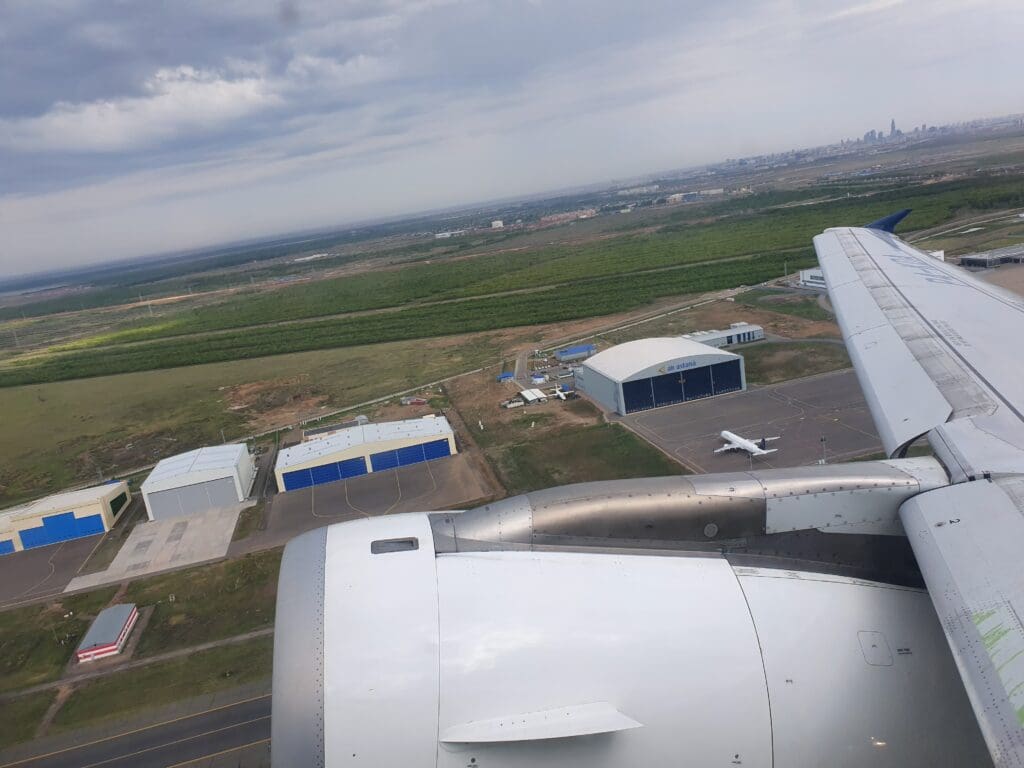
After watching the flat and mostly green landscapes below pass by for five minutes or so, our aircraft headed up into the clouds, and once through these, the seatbelt signs were immediately extinguished. Given the full load and relatively short flight time, unsurprisingly, the crew soon got to work conducting the breakfast service. Sitting near the front of the cabin, I ended up being one of the first in the Economy section of the aircraft to receive this. Despite hoping for a hot meal, seeing as I had read various reports by passengers travelling with Air Astana between Kazakhstan’s two main cities which featured these, I was handed a cardboard box by one of the friendly flight attendants before I was offered a drink. Whilst no hot offering was made, this box contained a more-than-decent selection of items – namely a yoghurt, a pancake filled with jam, a fruit bar, a cold bread roll, and a cheese triangle. Accompanying the edible items were a wet wipe and a packet containing plastic cutlery, a serviette, and salt and pepper. Having previously flown the route with Bek Air and Qazaq Air, I can say that the offering by Air Astana clearly beat that offered by these two carriers.
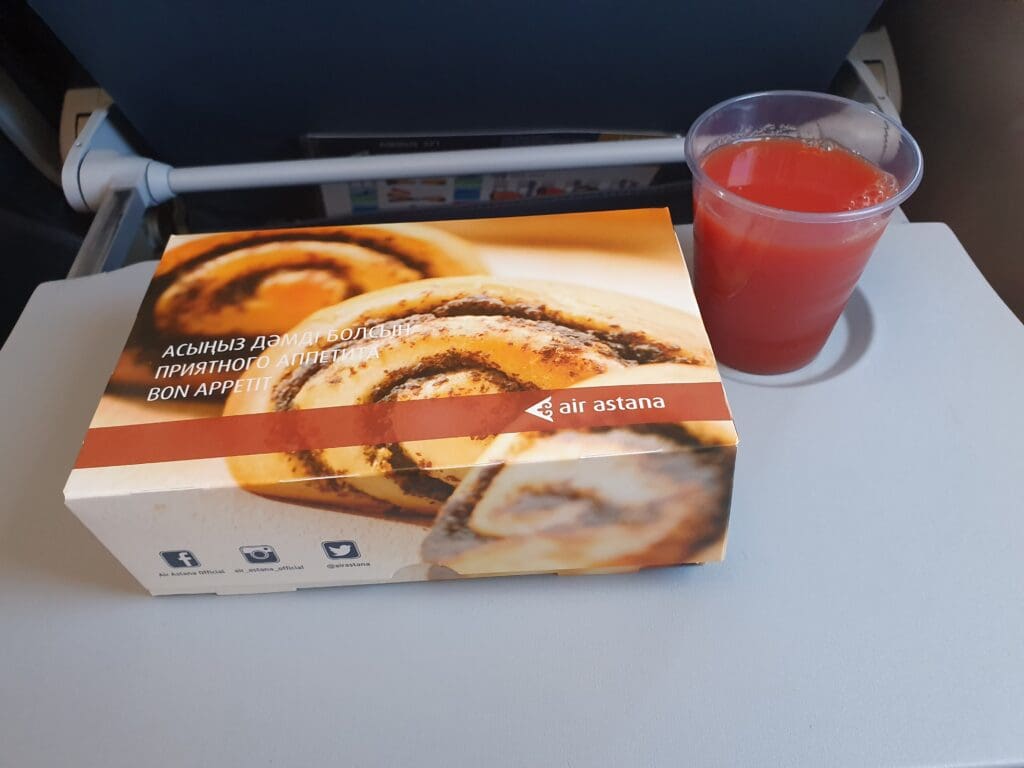
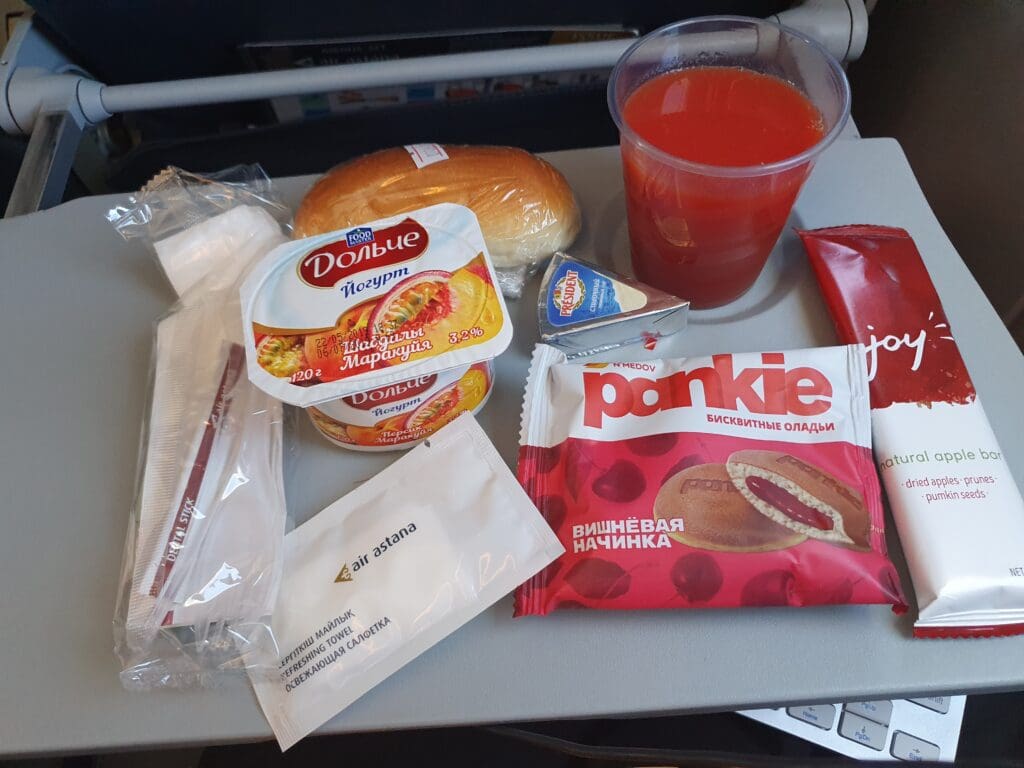
Turning to the entertainment, a read of Air Astana’s inflight magazine would likely prove sufficient enough inflight entertainment for those with little else to occupy themselves on the short flight between Nursultan and Almaty. However, considering how many of the aircraft’s flights are several hours long, the KCTV IFE system can be accessed via a streaming service. Although, the catch to this is that those who wish to access this must first download the KCTV app, a fact that I found to be poorly advertised. I can thus imagine that a significant number of non-regular Air Astana flyers on the aircraft’s longer flights will be disappointed upon finding they cannot access this system. Whilst I was aware of this, I completely forgot to download the app and thus I cannot review this, although content-wise, I assume this is exactly the same as that offered on the PTVs of their Boeing 757, 767, and NEO fleet.
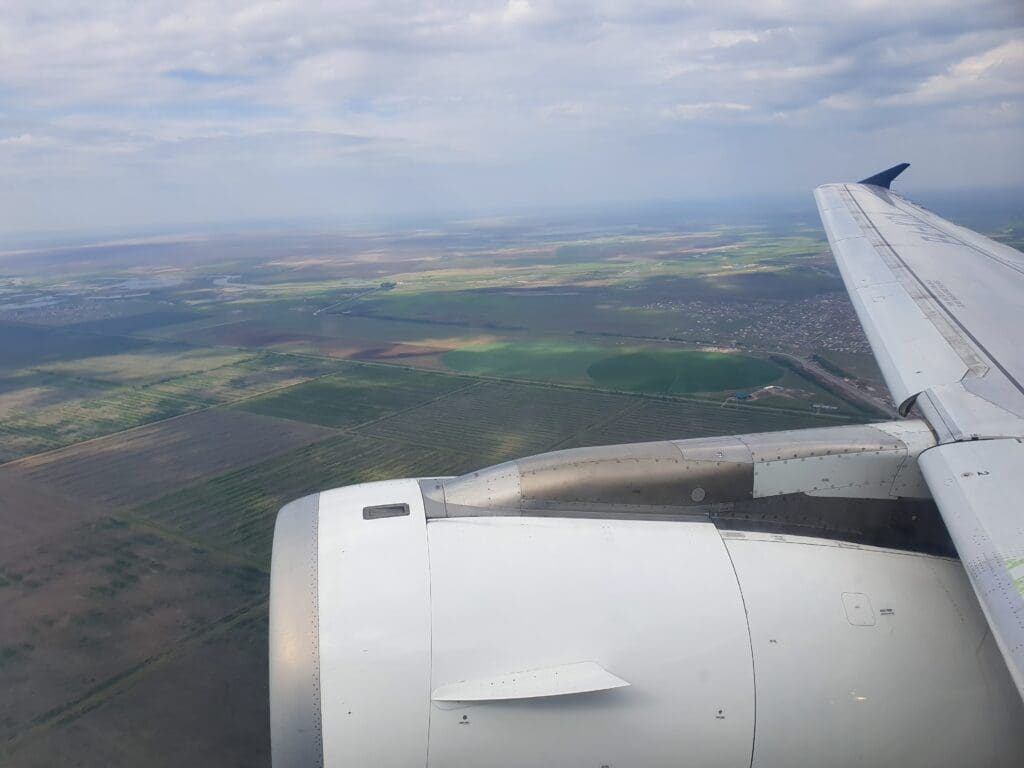
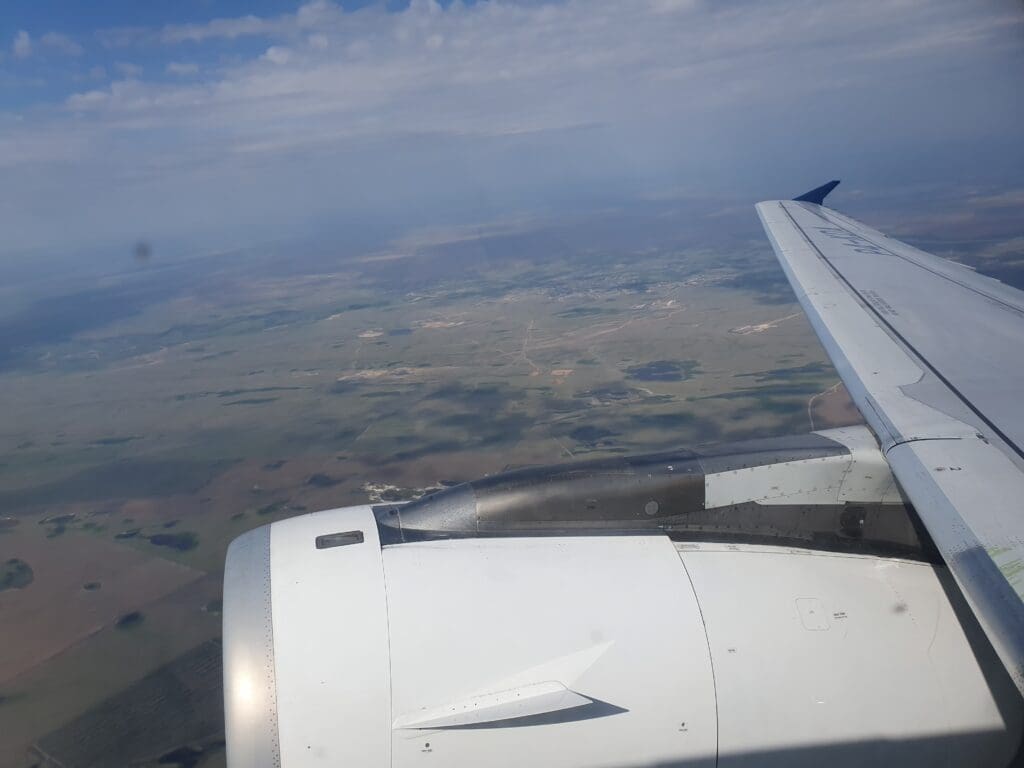
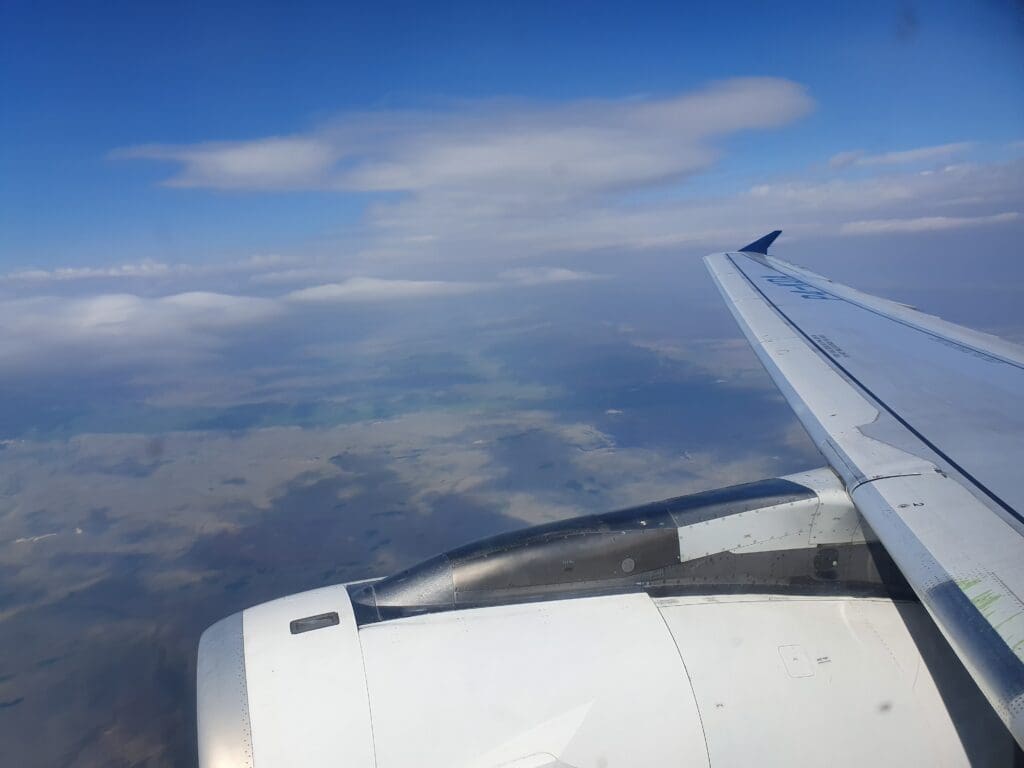
As I enjoyed the contents of the light breakfast box, the cloud cover beneath the aircraft soon dissipated, allowing for good views of the rocky hills to the south of Karagandy as we steamed towards Lake Balkhash. Once I finished the meal, I briefly fell asleep, waking up at 1010 to find an impressive chalky white, almost lunar-like landscape below. As we journeyed southwards at an altitude of 37,000 feet, outside of the remote villages, very few signs of life could be spotted below aside from the occasional road or lonely building. After falling asleep again, I woke up to find that the rubbish on the tray table in front of me had been cleared, and outside another change of landscape had occurred—this being rather dry, arid, and sandy-looking with several small hills.
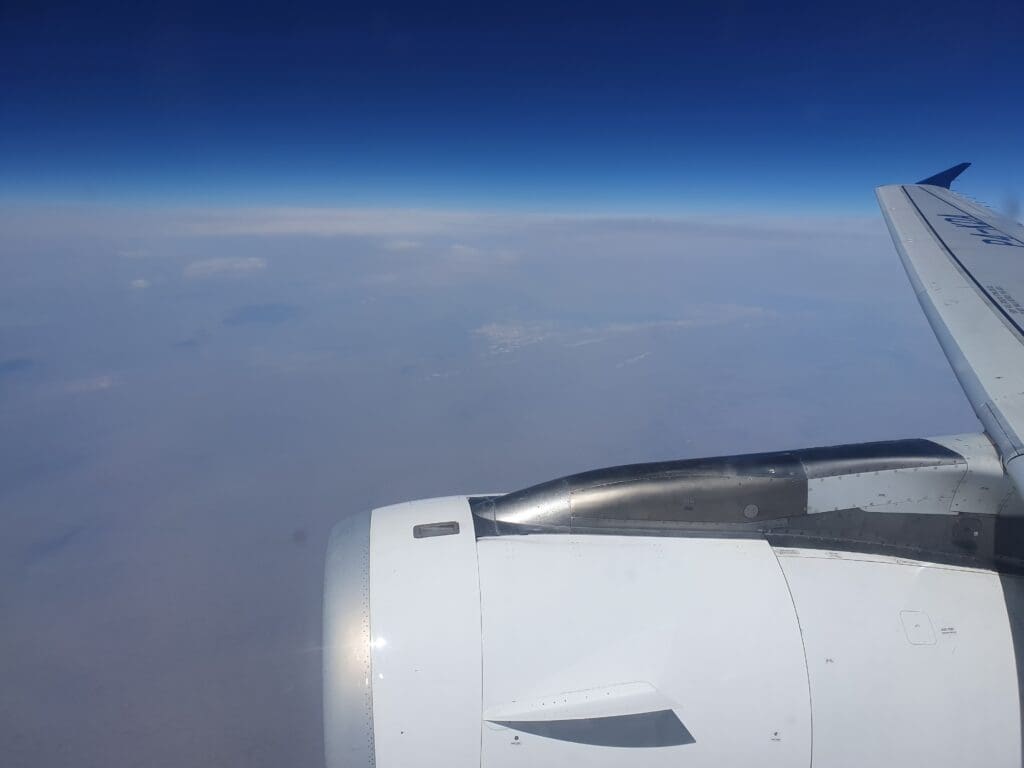
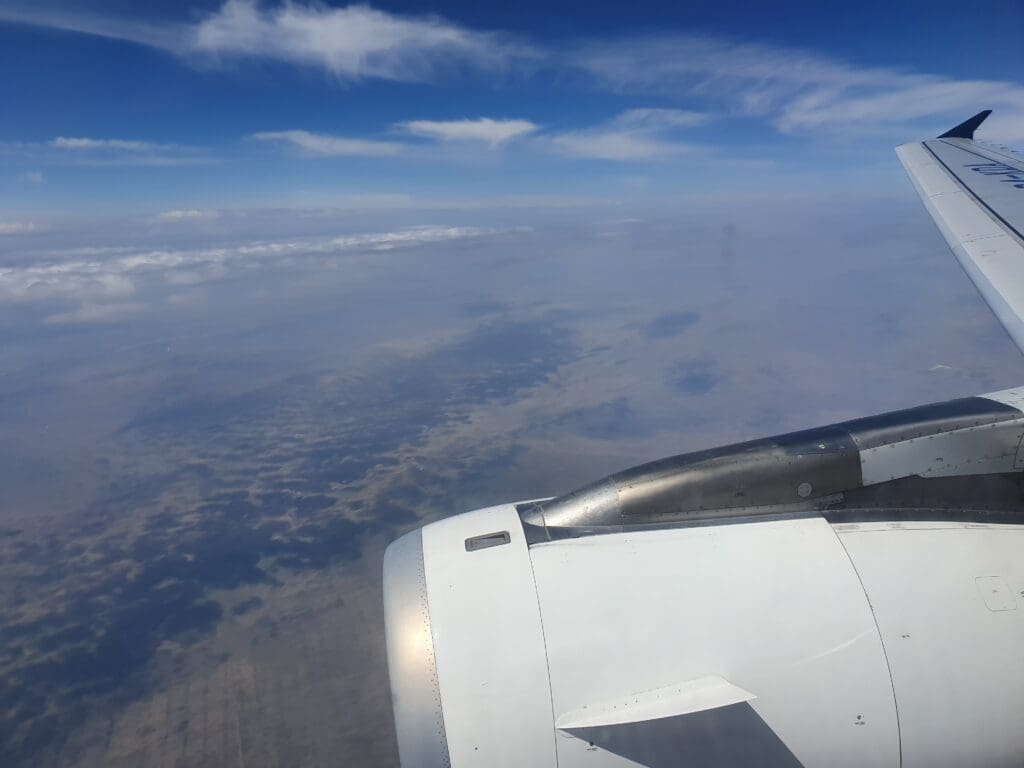
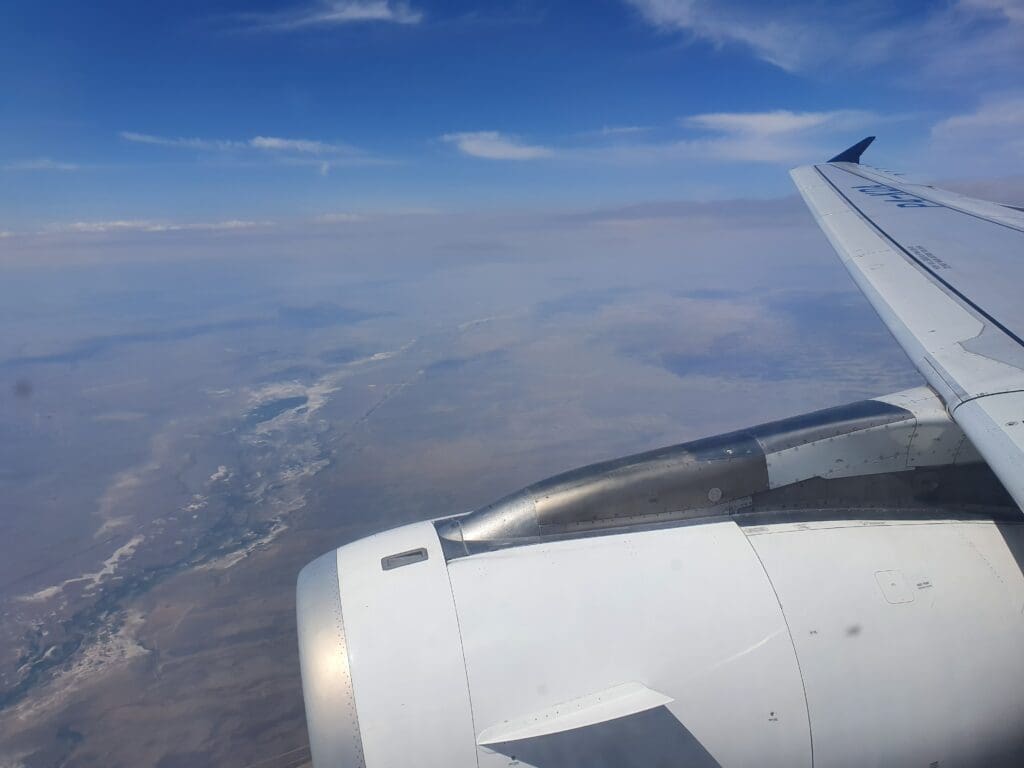
At 1030, the Captain addressed the cabin once again, informing us of the pleasant, if somewhat hot, weather in Almaty and noting that we would land at around 1100, allowing for 1H20 before my departure to Tashkent. A few moments after this announcement was made, our aircraft began its descent, at which point a few signs of life returned on the ground well below the aircraft. As we sank, the landscapes transformed once again from beige to green, fertile fields with plenty of villages and the occasional hill. Just like the rest of the flight, our descent into Almaty was smooth, and at 1045 the seatbelt signs were reilluminated as we sank through 10,000 feet before the aircraft gently banked southeast towards Almaty.
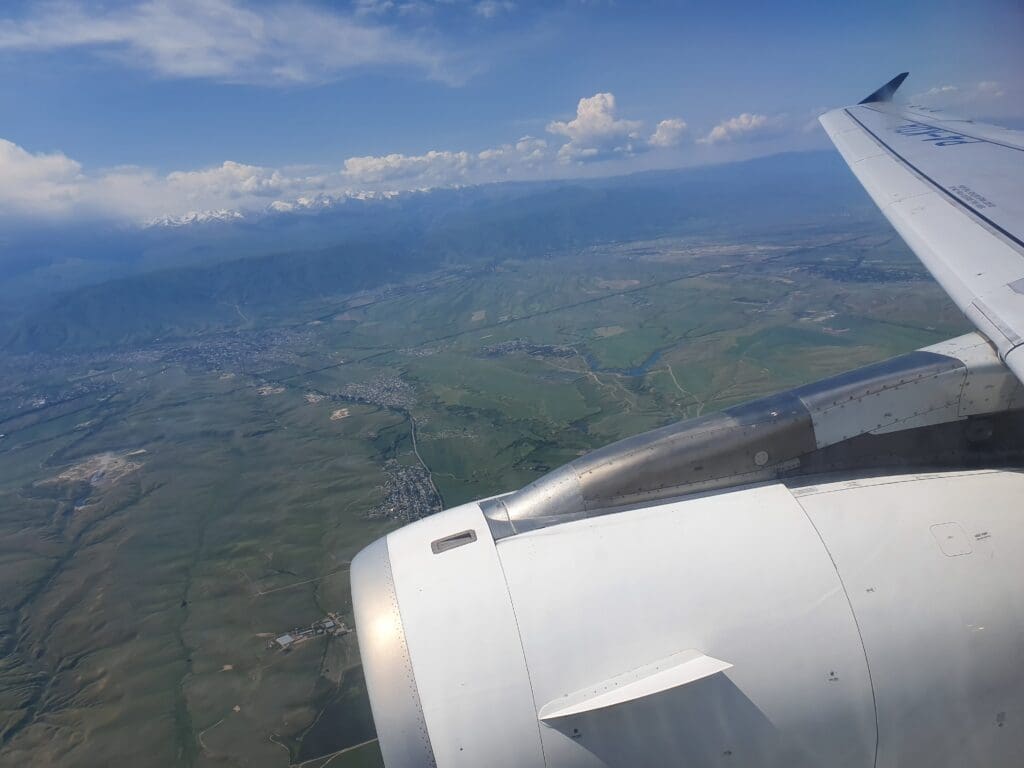
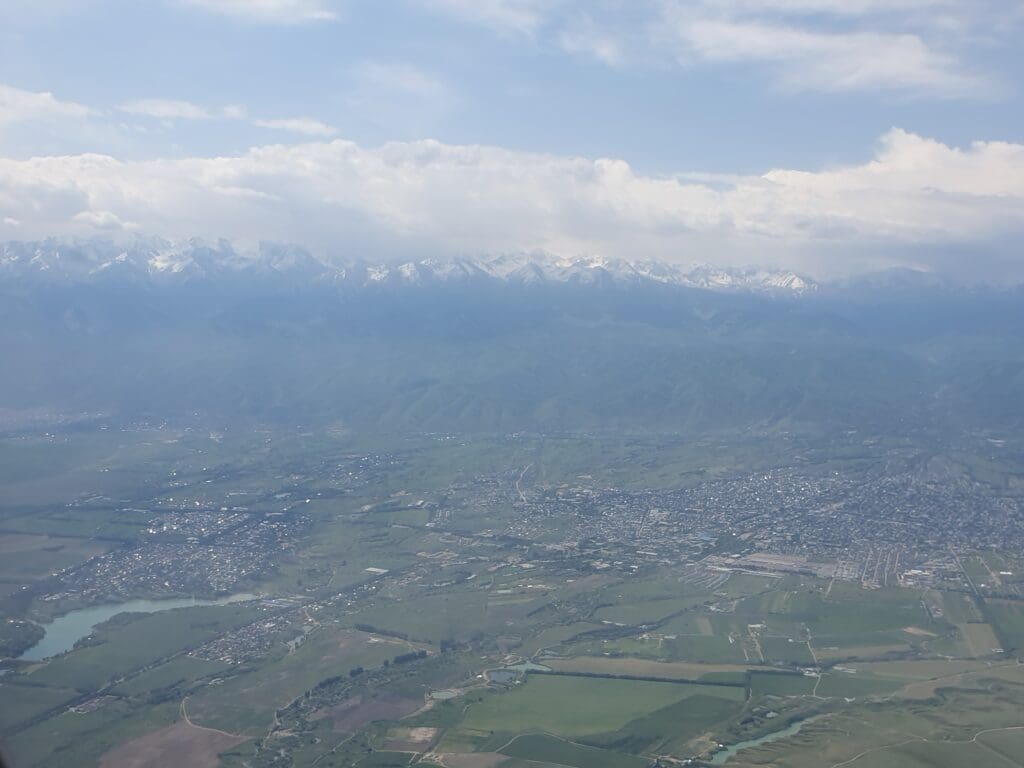
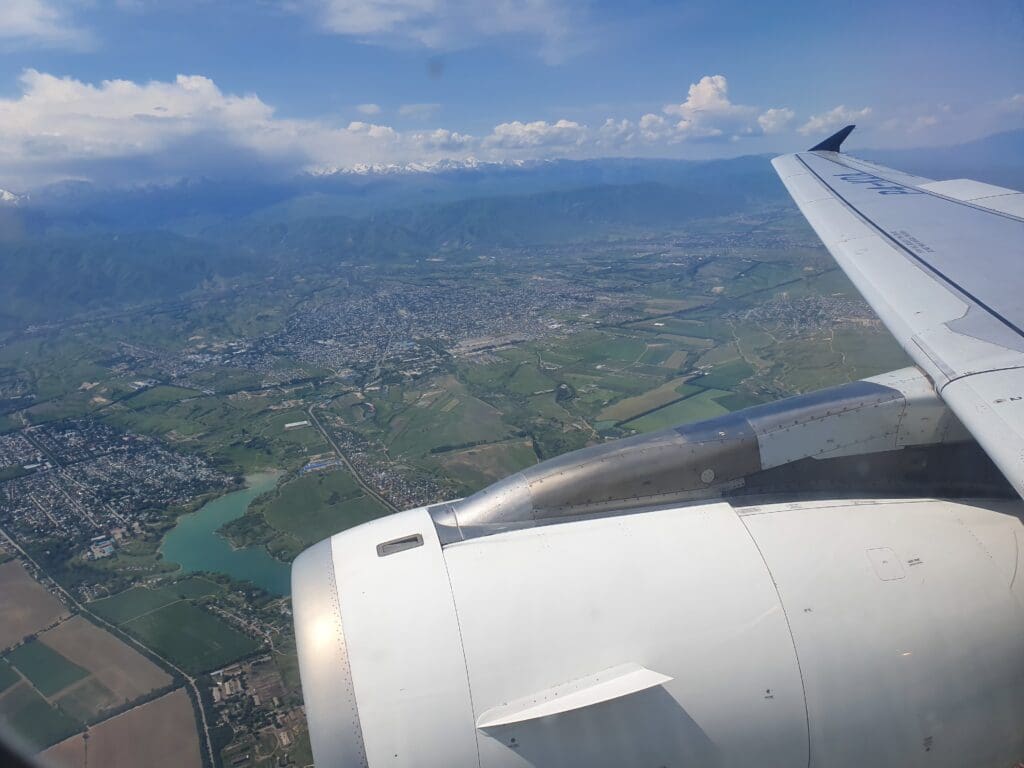
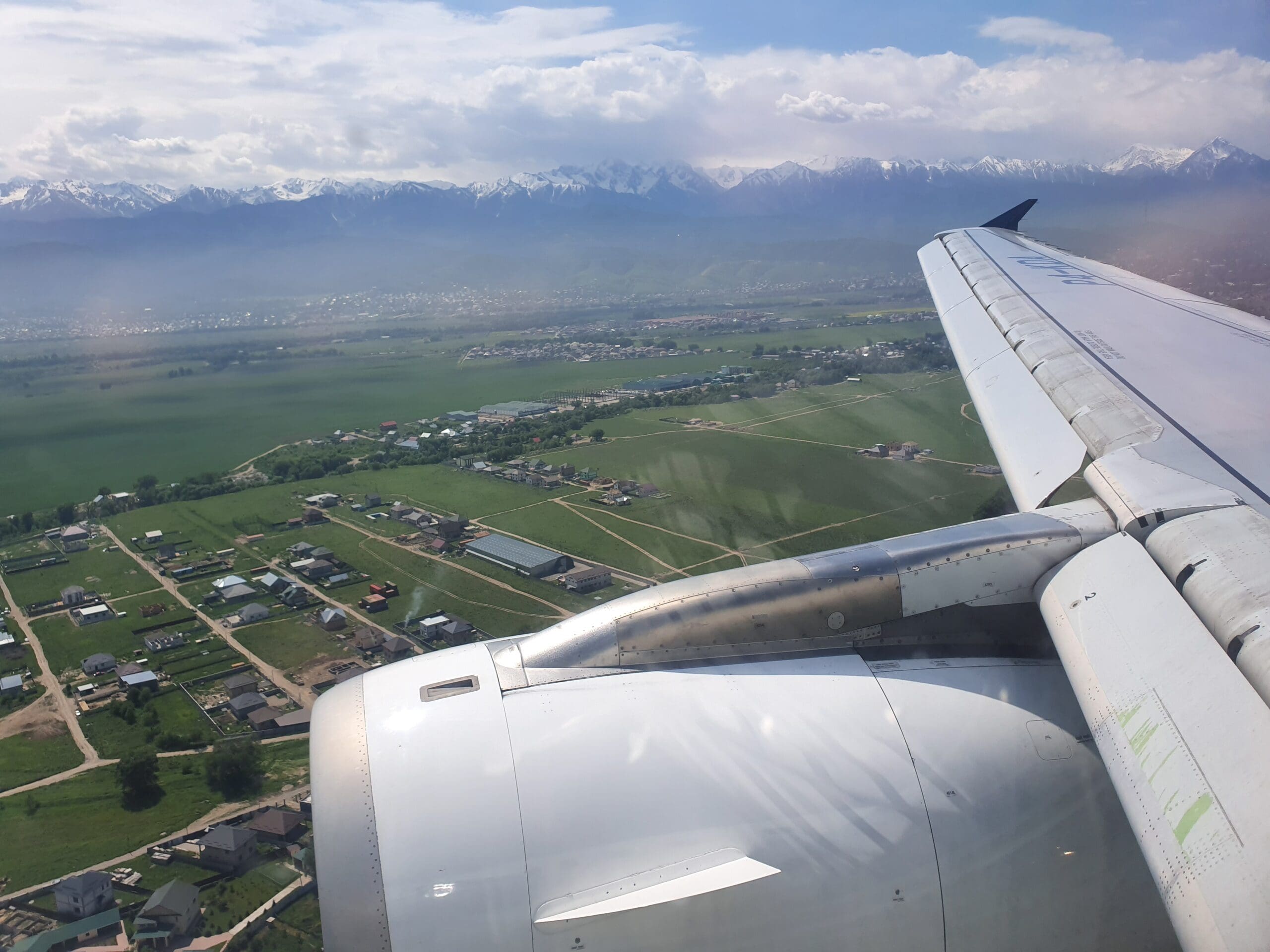
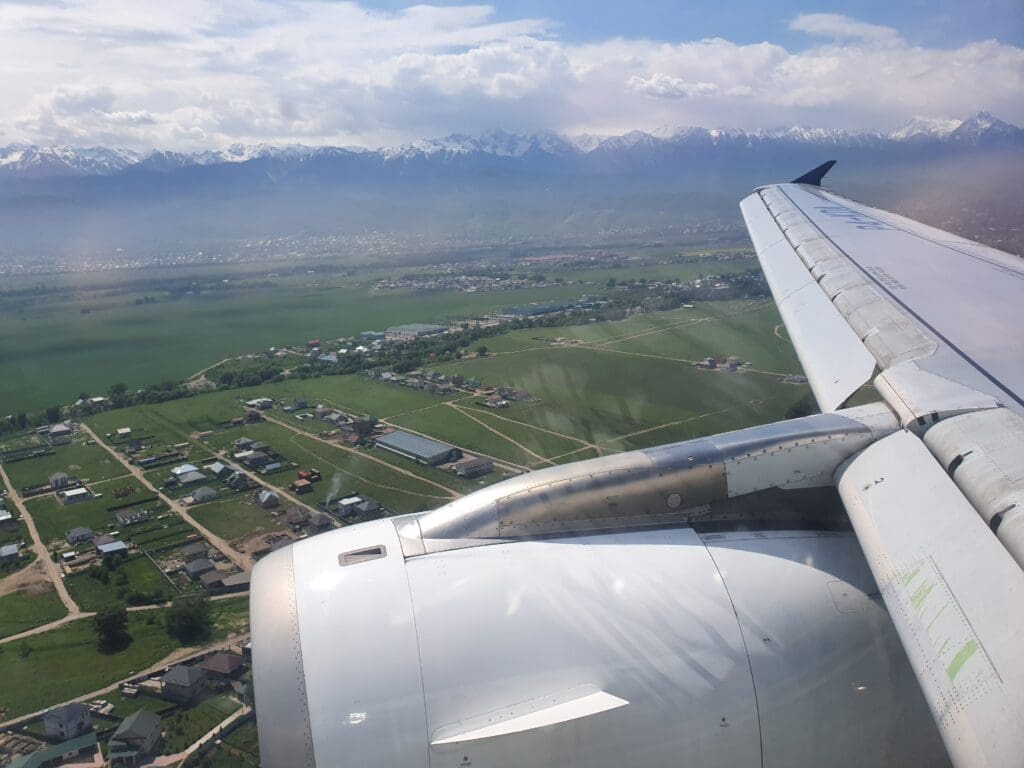
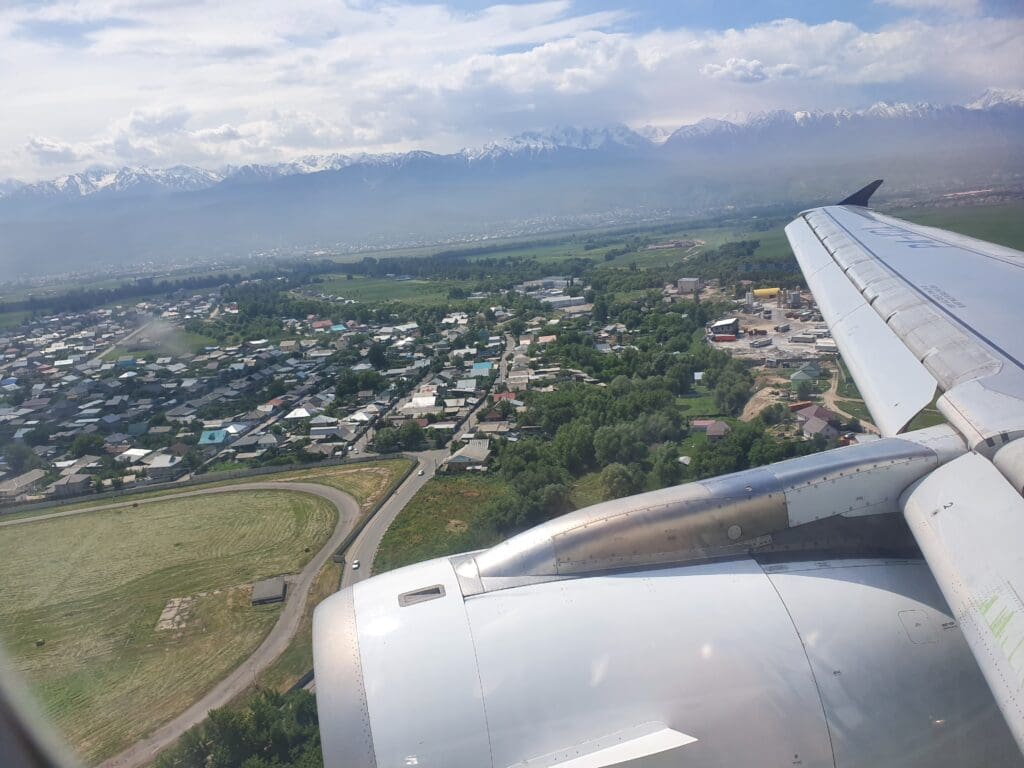
As we headed towards the city, the snow-capped jagged mountains that sit just behind Almaty appeared as we headed down, before the urban sprawl of Kazakhstan’s largest city came into view. As we passed by the center of the city, its most prominent landmark, Kok Tobe Mountain and the TV tower that sits atop it, came into view, and our flaps and gear were extended. After passing over mostly residential areas, at 1055 our aircraft made a gentle touchdown on Runway 05L, which was followed by some heavy braking. A short while later, our aircraft taxied off to the right and made a quick taxi down Runway 23L before making its way towards the terminal.
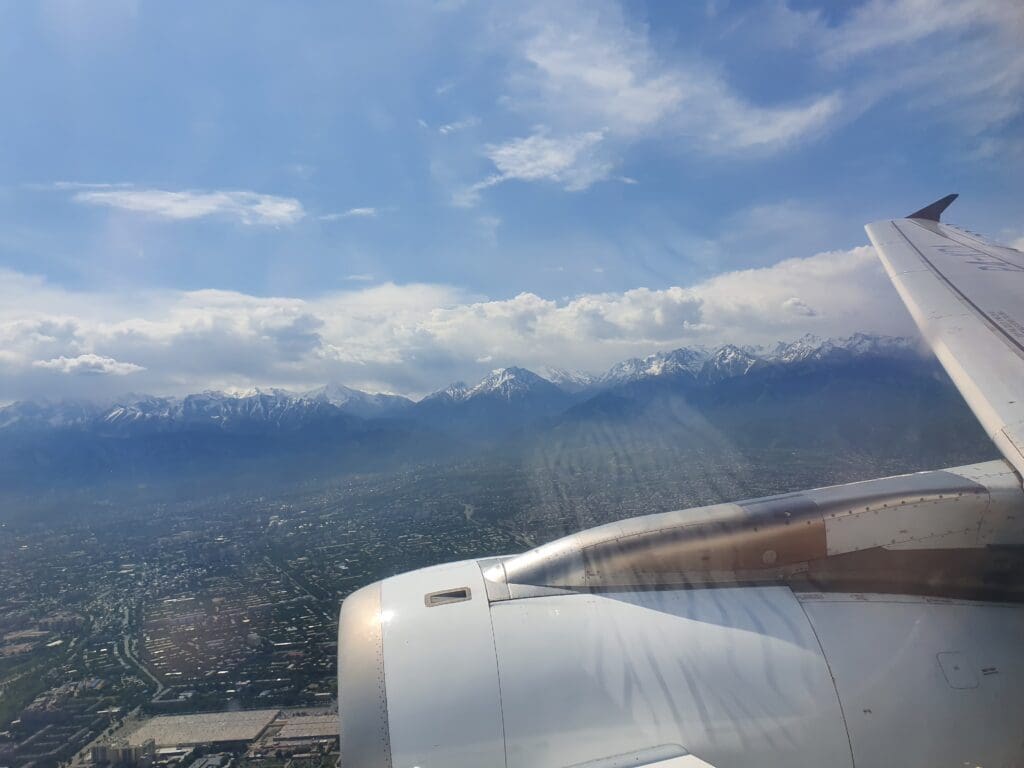
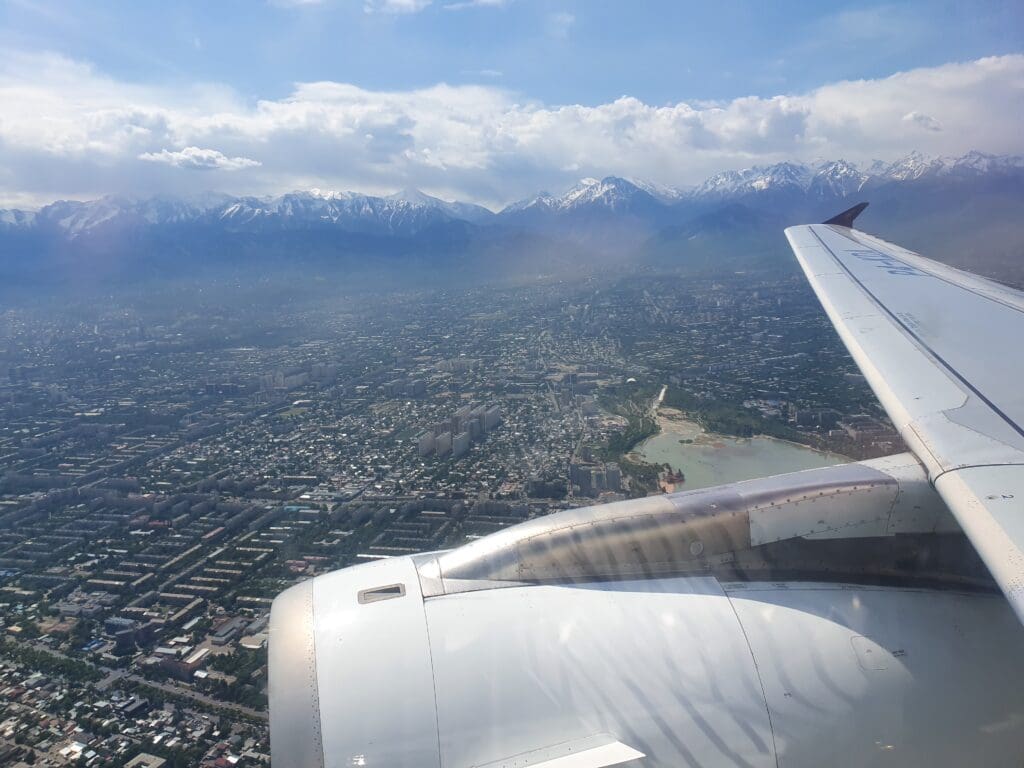
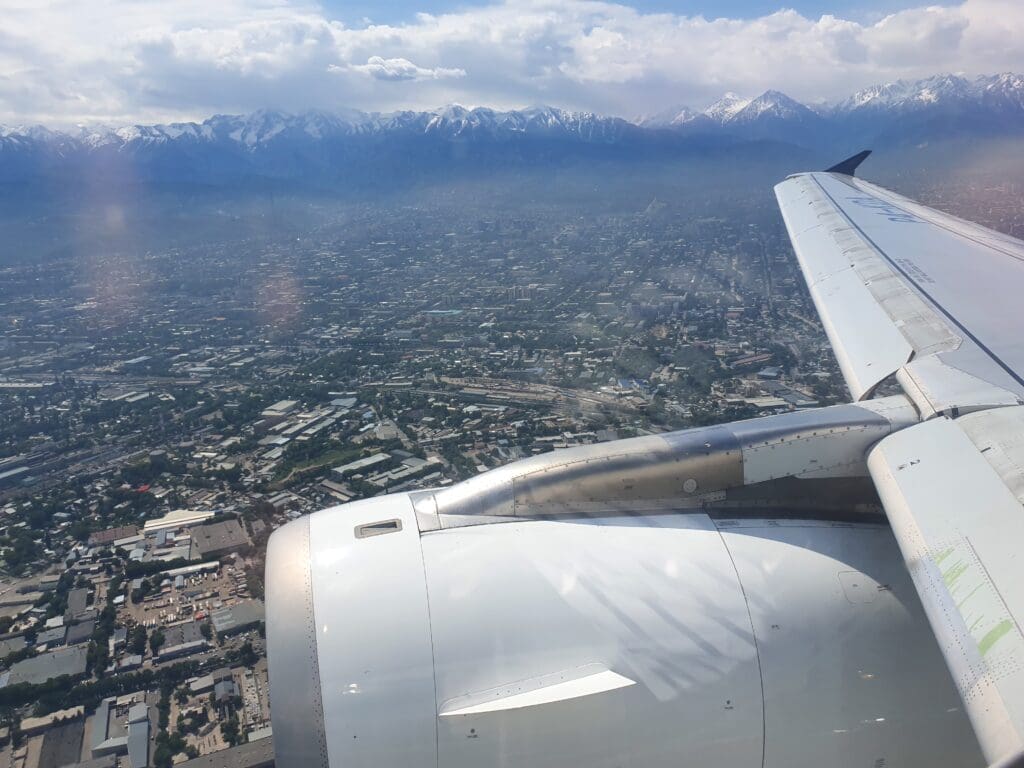
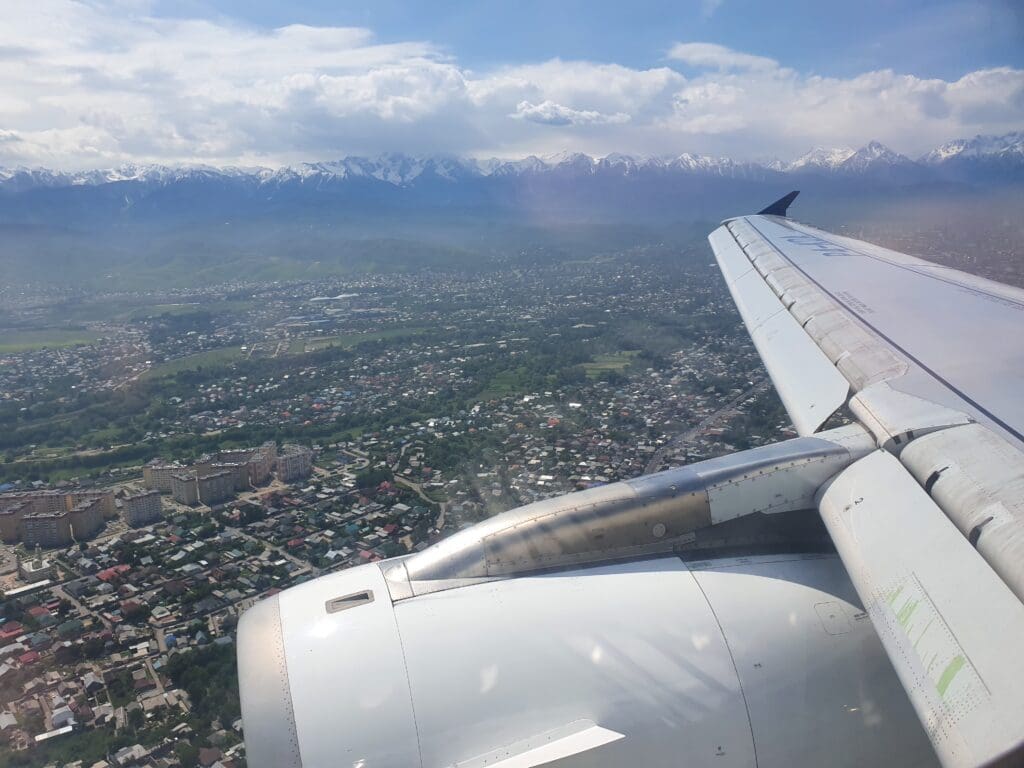
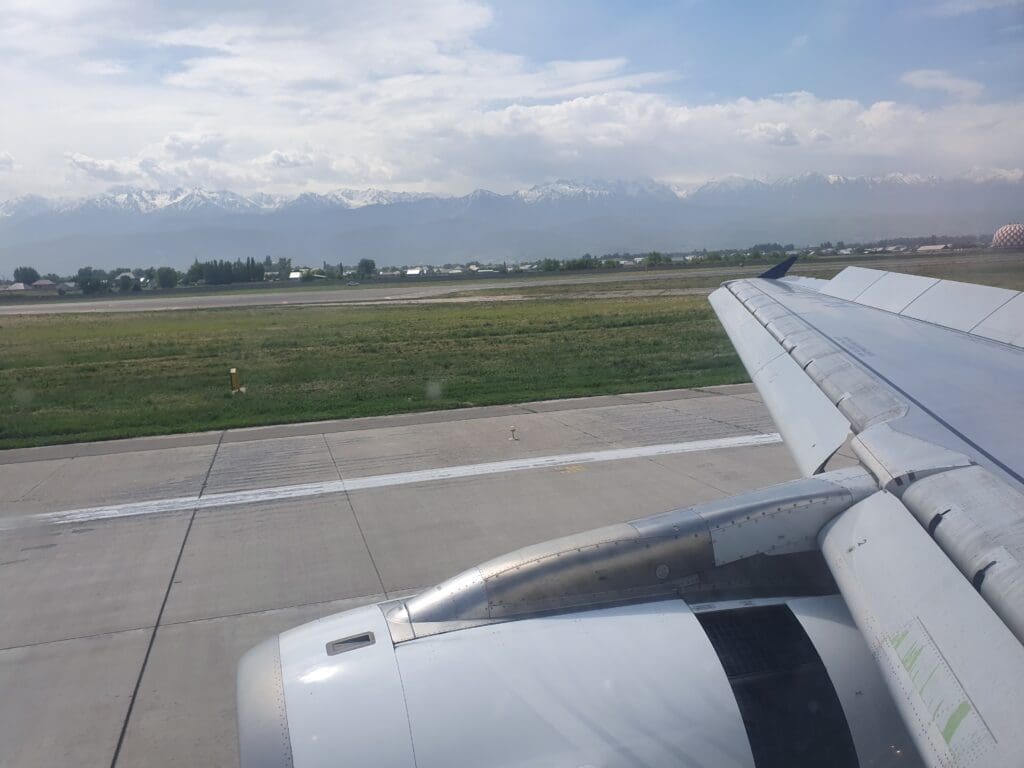
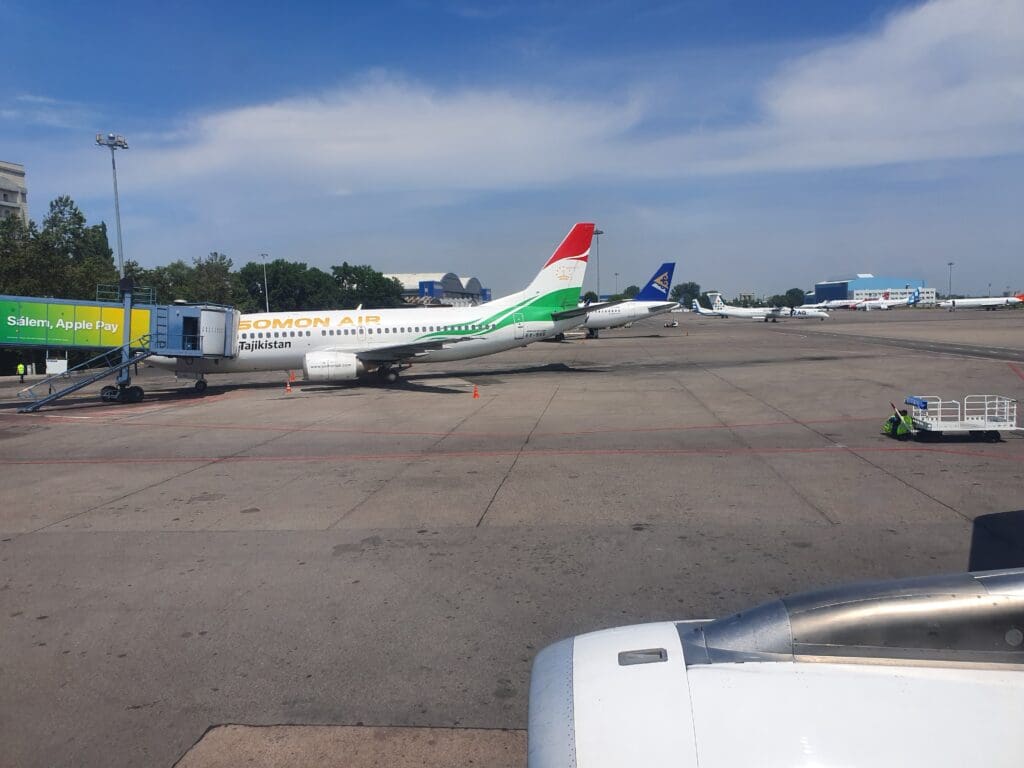
After landing, our long journey to gate 3 at the main terminal took us first past the airport’s military area, where a selection of mostly Antonov An-72 and CASA 295 cargo aircraft could be seen before two much larger civilian cargo aircraft came into view. These were a Qatar Airways Cargo Boeing 777F and a Volga-Dnepr Airlines Antonov 124. From there, the aircraft headed onto the main ramp, where a selection of interesting aircraft, including an Antonov An-24 and a Yakovlev Yak-42, could be seen. Despite hoping to make a quick exit from the aircraft, here the aircraft came to a halt for several minutes, and the Captain announced that a short wait was in order whilst the stand was vacated. A short while later, our aircraft pulled into the gate, slotting in between an Air Astana Boeing 767-300ER and a Somon Air Boeing 737-300 preparing to return to Dushanbe. Once our engines spooled down, the airbridge was connected in no time, and disembarkation commenced equally as quickly. Seeing as I was near the front of the aircraft, I managed to escape the aircraft by 1107, stepping out onto the warm jetway before walking up into the terminal.
Given the flight’s delayed departure from Nursultan, the comfortable 1H40 my connection in Almaty had initially allowed had transformed into a little over an hour, with around half an hour until boarding for my flight to Tashkent commenced. However, not being the largest terminal in the world, I hoped that I would be able to pass through the airport without too much rushing, even though I would need to pass through immigration. Seeing as the Airbus A321 I had arrived on would be the same aircraft that would transport me to Tashkent, the flight arrived at a gate directly opposite the international departure lounge in preparation for its next flight. Thus, some walking was required to reach the domestic arrivals area. Upon arriving here, I proceeded confidently past the hordes of taxi drivers touting for custom and out into the boiling hot summer air. From there, I dashed across to the main terminal (used for both international arrivals and all departures), where I was pleased to see that, as with Nursultan Airport, the security check appeared to have been removed. Without any waiting, I headed up the escalators to the terminal’s departure level, where I proceeded to one of the multiple manned immigration booths where not a single passenger could be seen. For the next couple of minutes, the officer checked my passport, giving several inquisitive and suspicious glances before doing some typing. Fortunately, without any issue, my passport was returned, and I was permitted to exit Kazakhstan.
Once through immigration, my next stop was the security check, which, like immigration, was entirely devoid of passengers. I was thus able to pass through quickly and without any issues whatsoever. Overall, my fears about a slow passage through the airport had been unfounded, having transited the entire airport within just over ten minutes. Of course, I realize I was incredibly lucky to encounter no queues whatsoever on my trip through Almaty Airport.
Unlike immigration and security, Almaty Airport’s small and relatively basic departure lounge appeared to be almost entirely full with three international services departing in quick succession. These were two Air Astana flights to Tashkent and Tbilisi, and the Somon Air service to Dushanbe. With much focus on the development of Nursultan as the main international hub of Kazakhstan, whilst the airport there features a modern and gleaming international terminal, the same cannot be said for Almaty. Whilst serving its purpose, aside from being small, this appeared rather tired and in need of some sort of refurbishment. However, given its size, a fair number of facilities were on offer—these being a bar, two cafes, a wine shop, and two duty-free stores. After a very quick wander, I located a vacant seat and made this my home for the short time left prior to the commencement of boarding. As with Nursultan Airport, upon attempting to connect to the WiFi, I was unable to do so as I never received the verification code required after entering my British phone number. However, given my short stay, this was no major problem. To summarize my experience, if you are departing on an international flight from Almaty, assuming immigration and security aren’t too busy, I would delay passing through to the airport’s airside area until an hour prior to your flight’s departure.
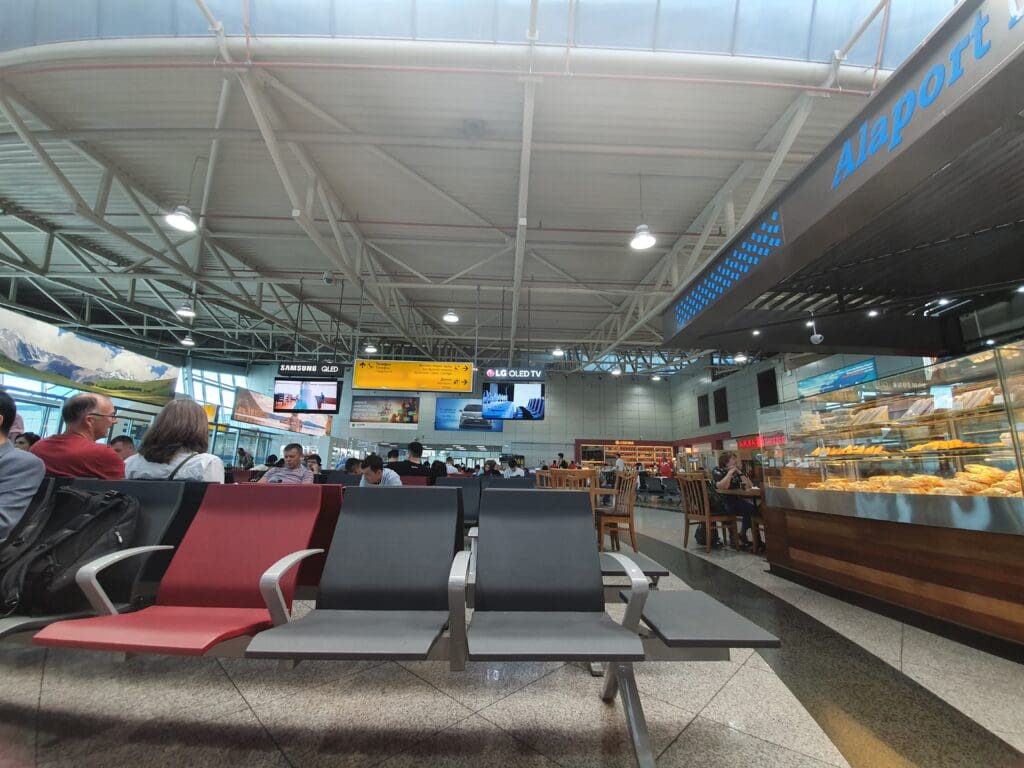
At 1145, the gate for my flight to Tashkent opened, and I soon found myself heading back down the jetway towards P4-KDA. Interestingly, prior to boarding, my passport was checked, and my boarding pass scanned on the jet bridge itself rather than being checked before I headed down. Upon scanning my boarding pass, a warning tone rang out, at which point I hoped that I had been upgraded into Business. Unfortunately, after some typing, the gate agent crossed out the seat number printed on my boarding pass and wrote 35A on it instead. Once this was done, I headed towards the aircraft with one final boarding pass check made by an airport security guard before I was allowed to enter the aircraft. As I stepped into the forward galley once again, I was greeted in Russian by a completely different set of crew members. Fortunately, these crew members appeared to be as friendly and welcoming as the airline’s other staff I had interacted with on my previous two flights. As I made my way through Business and into Economy, I was welcomed once again by another crew member before I slid into Seat 35A.
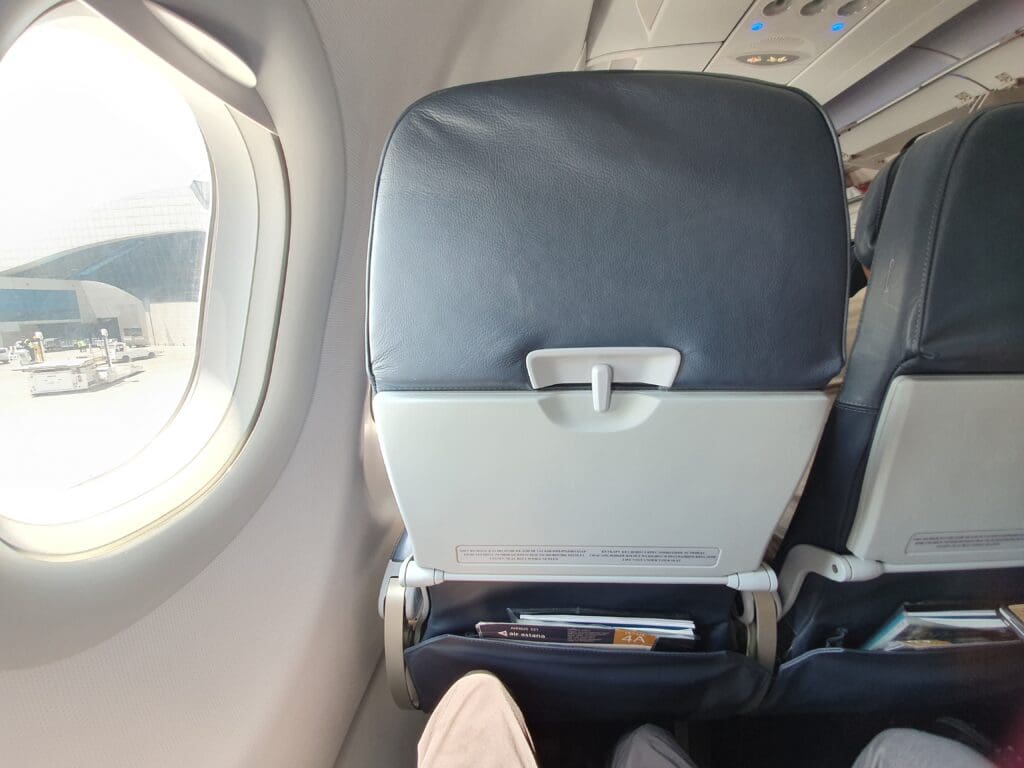
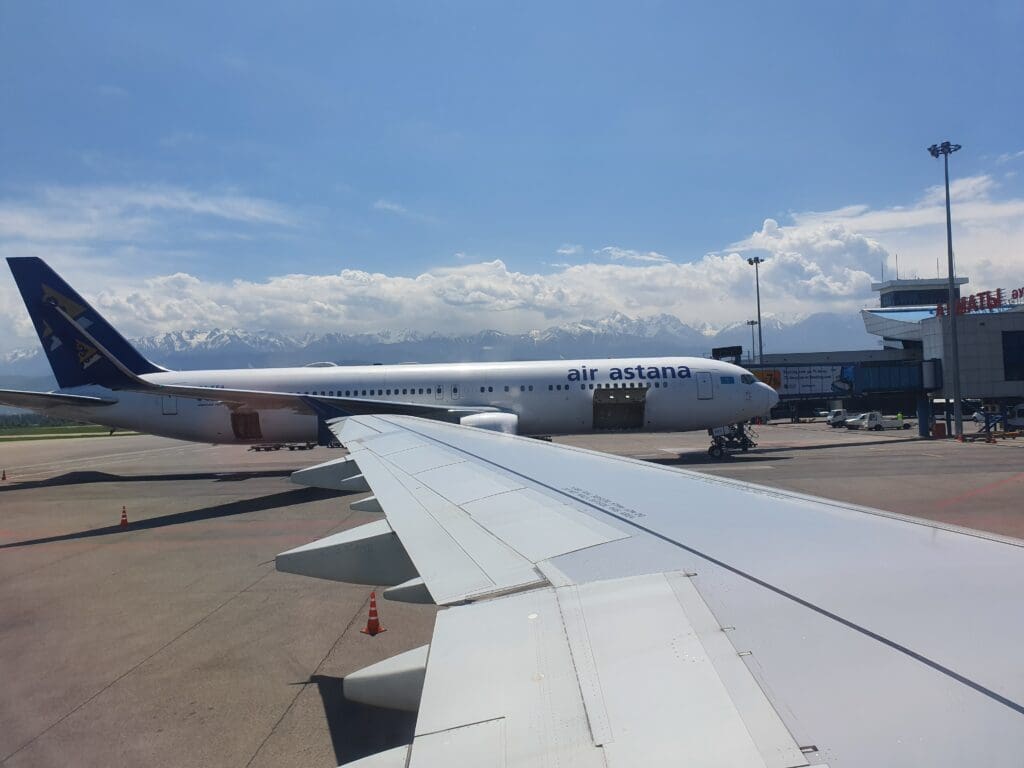
As with the area around row 12 where I had spent the previous flight, I failed to spot any major signs of wear and tear, and the cabin appeared to have been thoroughly cleaned during the turnaround. A few moments after sitting down, I was joined by two neighbours, and within fifteen minutes, all passengers appeared to be onboard the aircraft. That lunchtime, the Economy cabin appeared to be entirely full with, as one would expect, the majority of passengers being from either Kazakhstan or Uzbekistan. That said, I did notice several passengers from Australia, China, and the US, most of whom appeared to be tourists. After a short wait, at 12:05, the Captain performed a welcome announcement in both Russian and English, informing us of the 1H10 flight time and requesting that we pay attention to the safety video. Following a quick announcement by the Purser in Kazakh, Russian, and English, the safety video played for the final three times during my trio of flights with Air Astana, whilst outside, the cones were removed from the aircraft.
At the flight’s scheduled departure time of 12:20, the aircraft jolted backwards, with the two engines starting up whilst the pushback was underway. After this, a five-minute pause occurred during which time the crew passed around the cabin with boiled sweets whilst ensuring all was secure for our departure. Once our engines had fired into life, the flaps were partially extended, and the aircraft commenced its short journey to runway 05L. Sitting on the left-hand side of the aircraft, I received the same selection of views as I had done following our arrival. These consisted of a wide range of civilian aircraft, including a stored SCAT Boeing 737 MAX 8 and an equally modern Air Astana Airbus A321neo, to more venerable aircraft such as the Antonov An-24, An-26, and a host of Bek Air Fokker 100s.
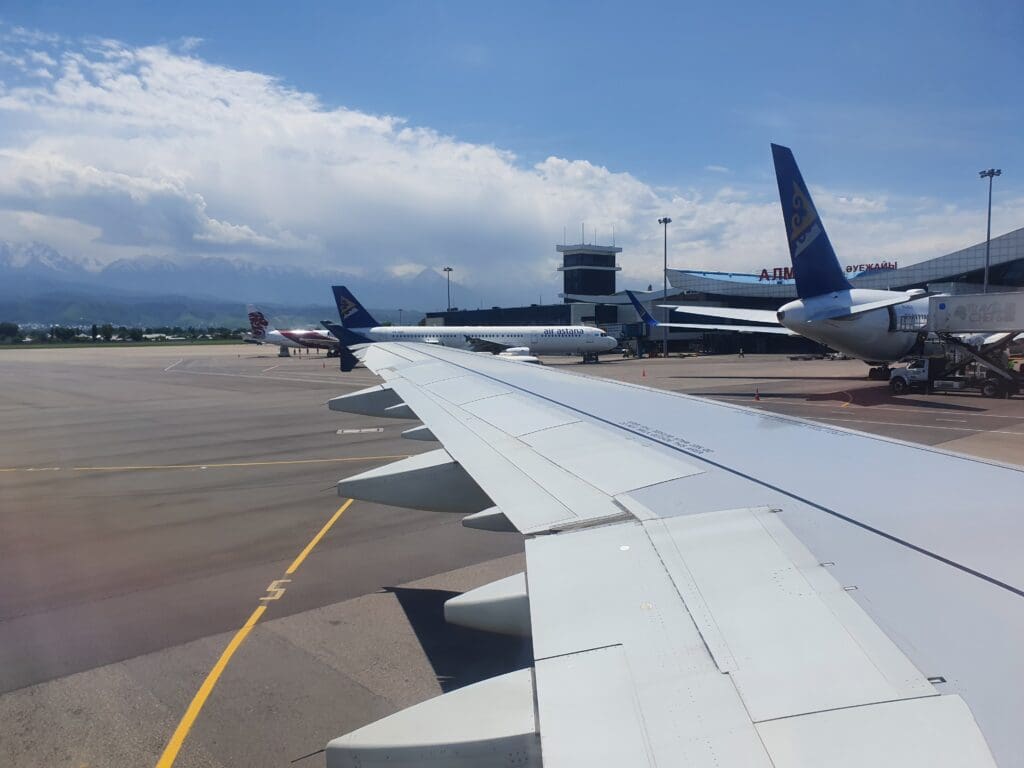
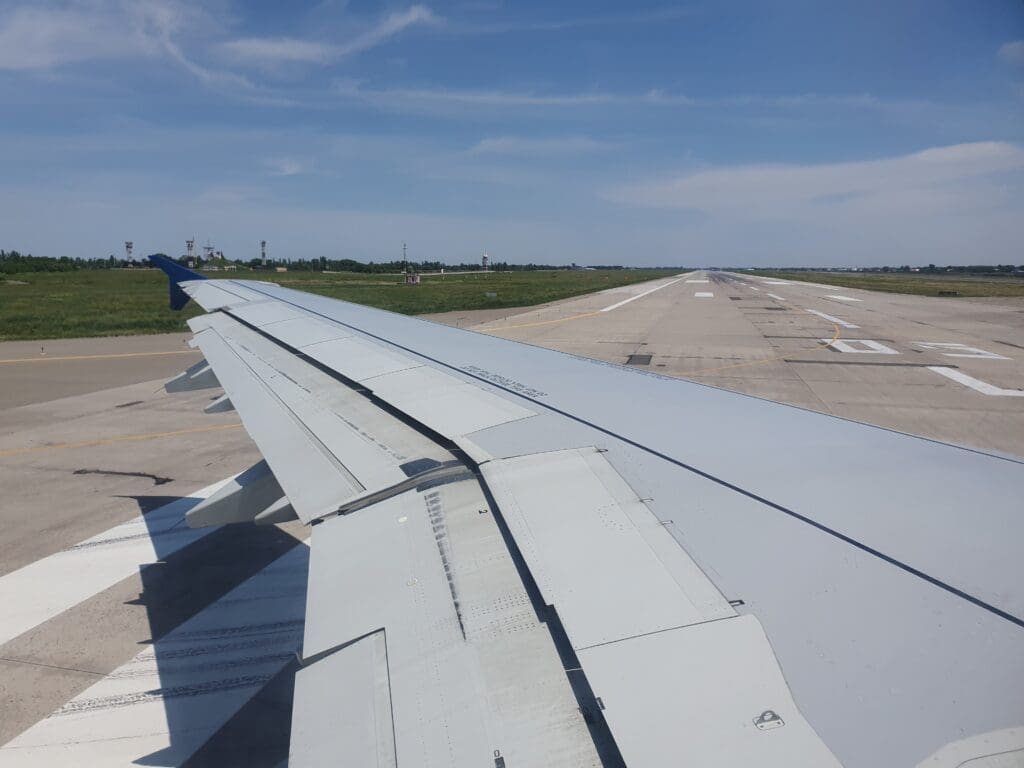
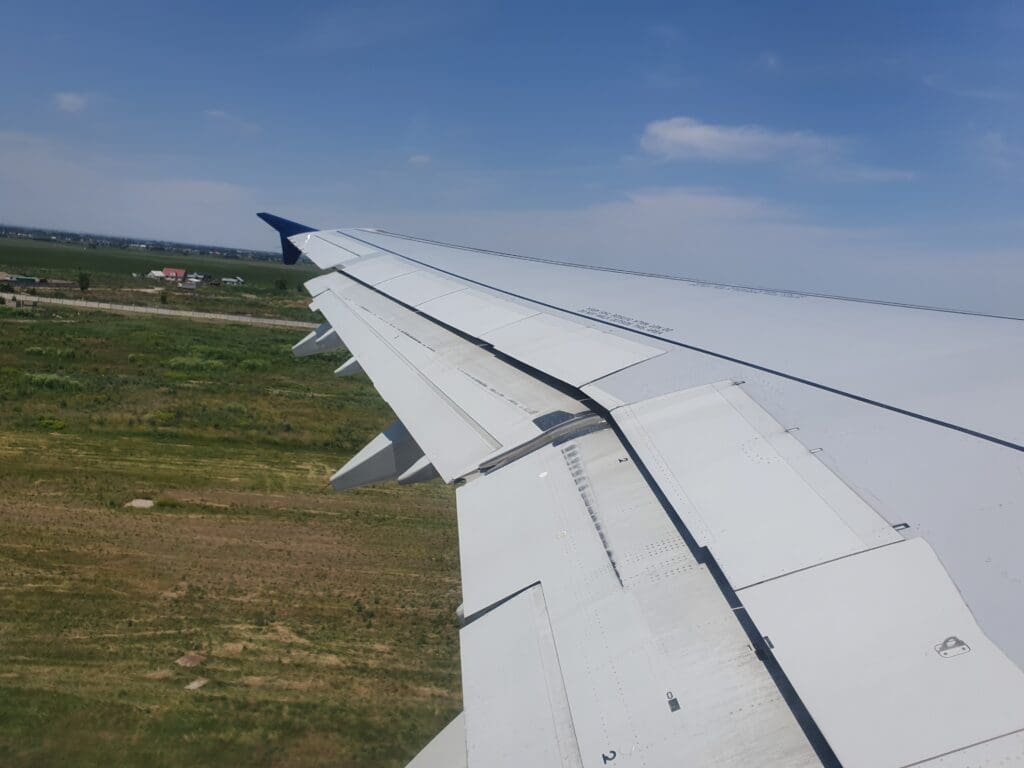
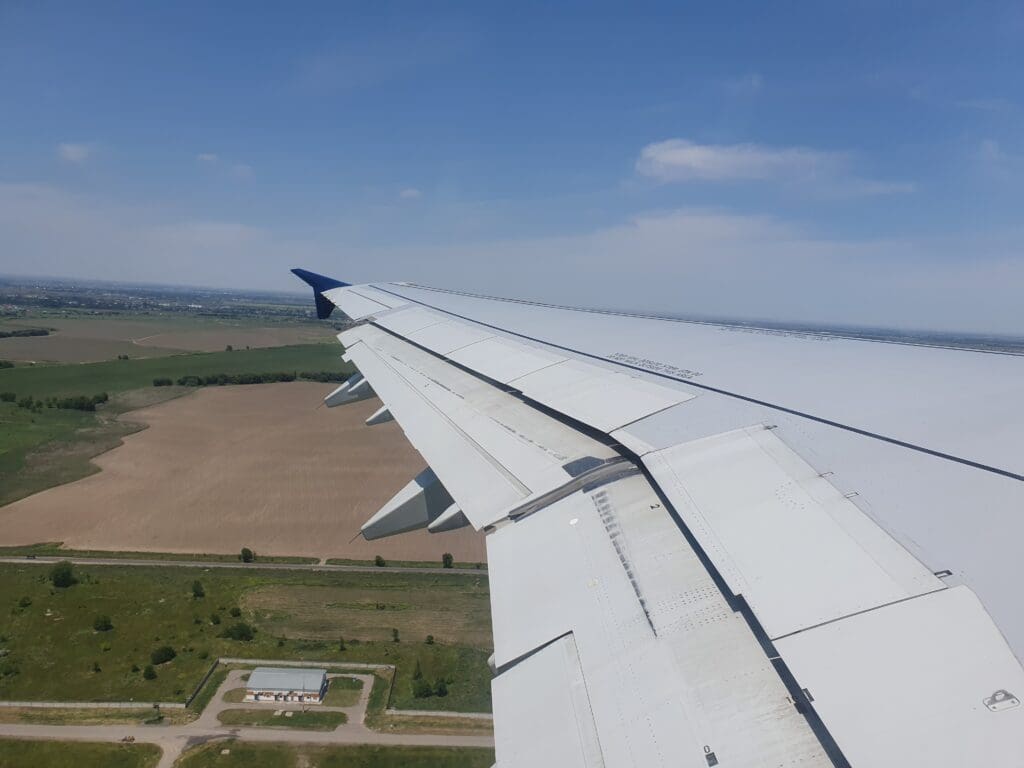
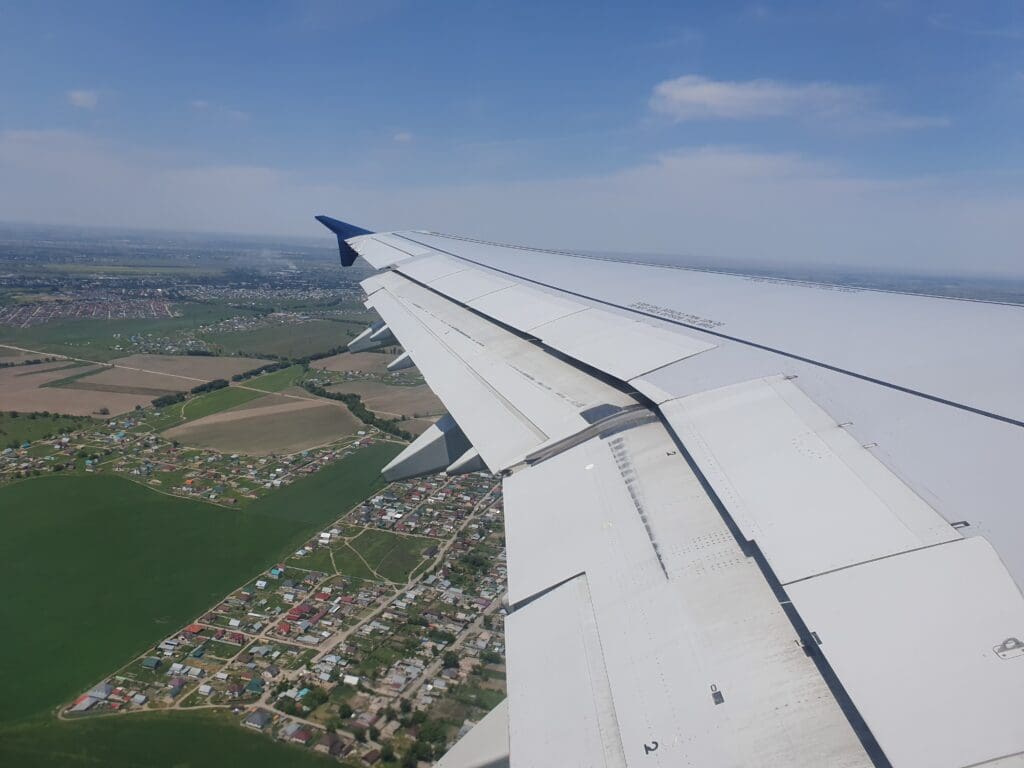
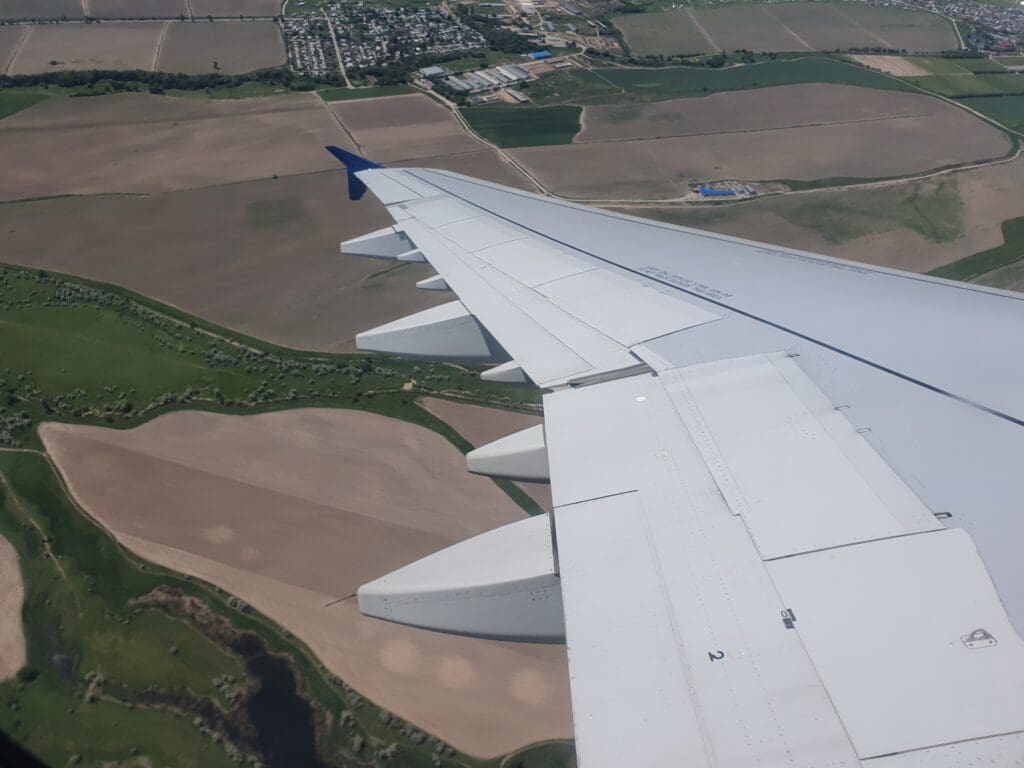
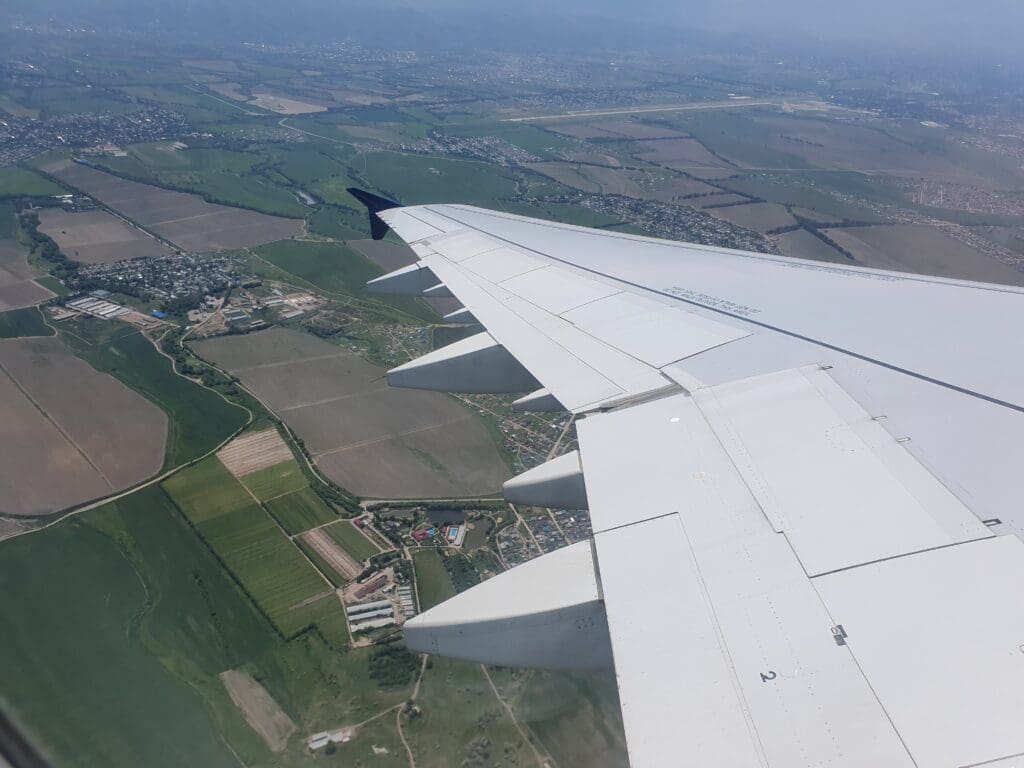
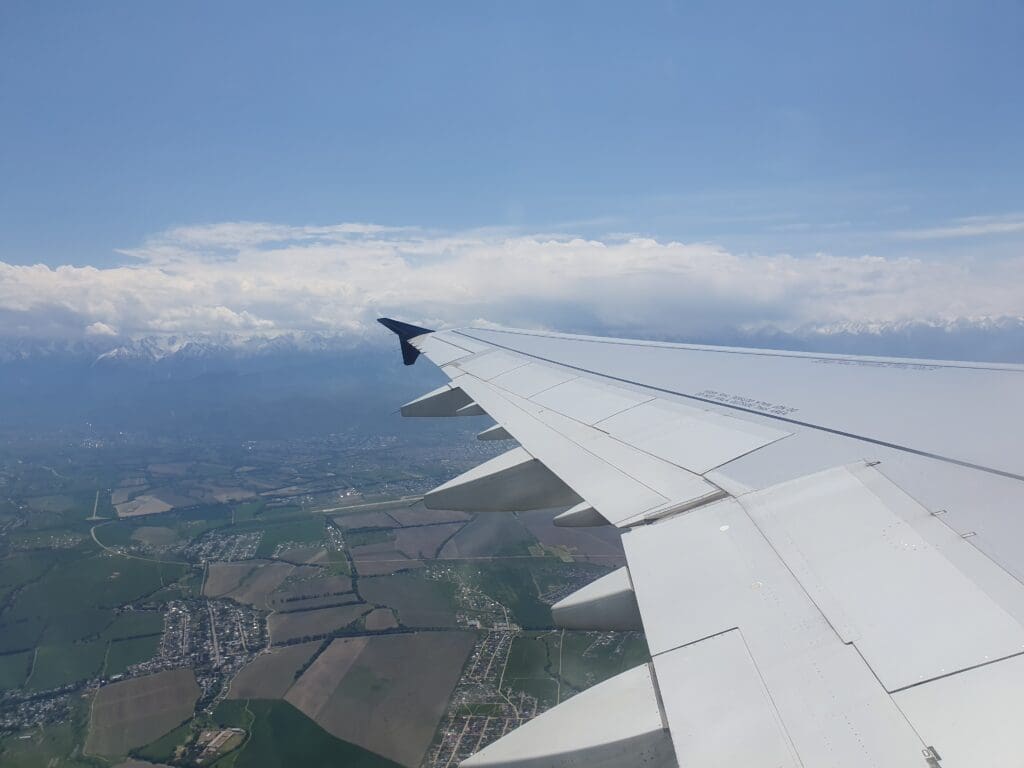
Following a short taxi, the Airbus A321 arrived at Runway 05L and commenced a long takeoff roll. Unlike the previous flight, this departure seemed to be somewhat gentler, and as such, the aircraft seemed to take a while to climb up into the sky. Once the aircraft left the ground, a shallow climb was made, which allowed for good views of the green, semi-rural landscape that surrounds the airport. Almost immediately after leaving Almaty, the aircraft banked to the left before rolling out on a heading that would take us westward towards Tashkent. Beneath the aircraft, as we climbed, the countryside turned from green to beige, and not too long later, the clouds rolled in below, coming to block our view of the ground. Around twenty minutes after our departure, the aircraft levelled off at 34,000 feet as we skirted around Kyrgyzstan.
By this time, the lunch service had already commenced, and, seeing as this was done from both the front and rear of the Economy cabin, given my position in the middle of the aircraft, I ended up being one of the final passengers to receive this. As with the flight down from Nursultan, understandably given the length of the flight, I was handed a small cardboard box instead of a hot meal. This contained a delicious and fresh-tasting sandwich containing meat, cheese, and salad, a chocolate and peach cake, as well as an Air Astana-branded packet of cheese-flavoured crackers—the same type I had received prior to the meal service on my flight over from Paris. With a drinks round accompanying this, I opted for a coffee, which seemed to taste reasonable enough, although it was nothing particularly special.
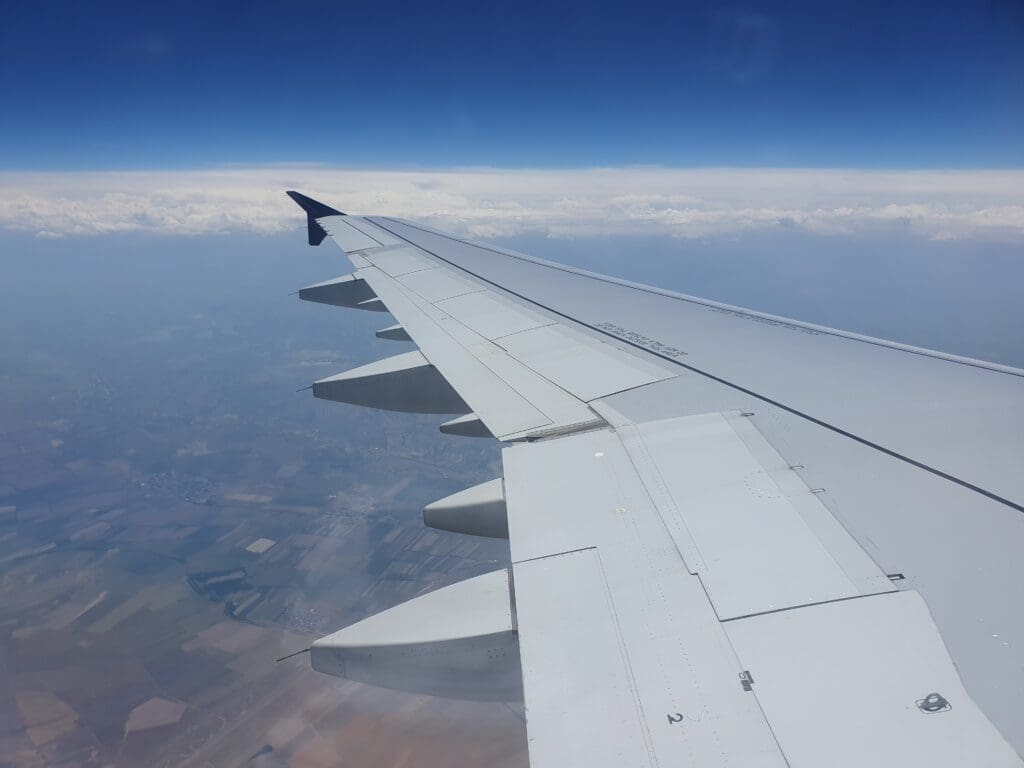
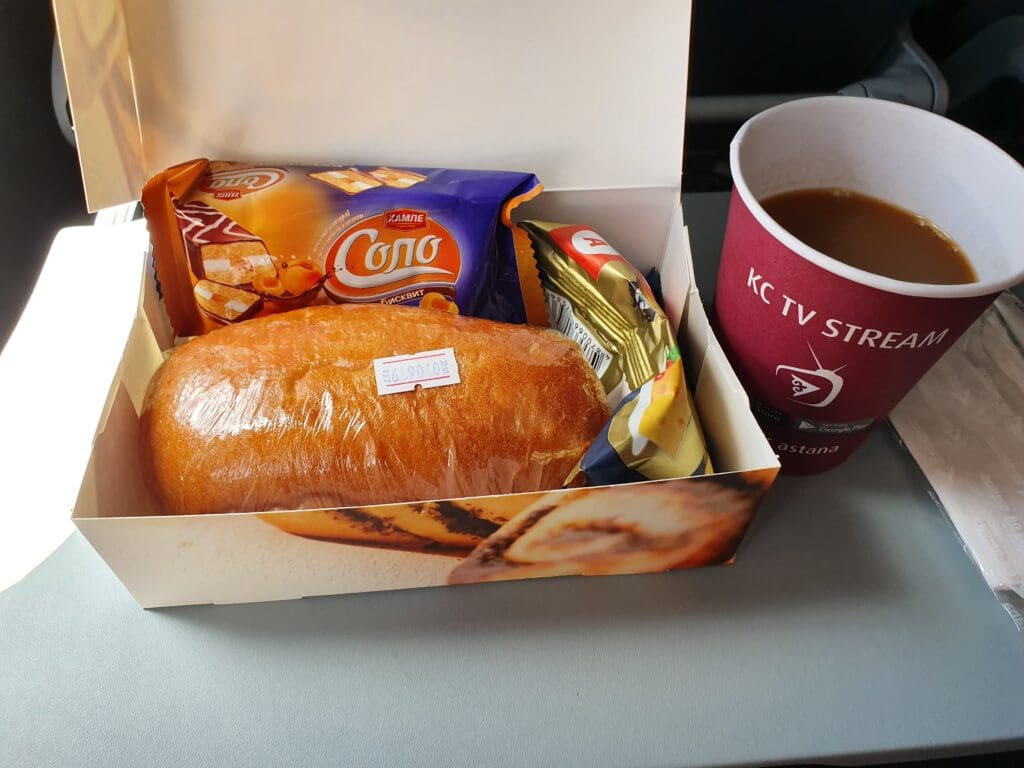
By the time I received my lunch, the aircraft had risen up after its temporary pause, climbing to 36,000 feet as we passed over the Kazakh city of Taraz and journeyed toward Shymkent. Unlike on the previous flight, the overhead screens were utilized and first played a short documentary regarding the Spanish football team Atlético Bilbao before moving on to the map channel. However, it is worth mentioning that no headphones were provided for this. Several minutes after the lunch boxes had been distributed, the cabin crew passed through the cabin collecting the remains of these, and with 106 miles to go until Tashkent, an automated announcement was made in Kazakh, Russian, and English asking us to prepare for our arrival. Immediately after this, the seatbelt signs were switched on, and our aircraft could be felt commencing its descent.
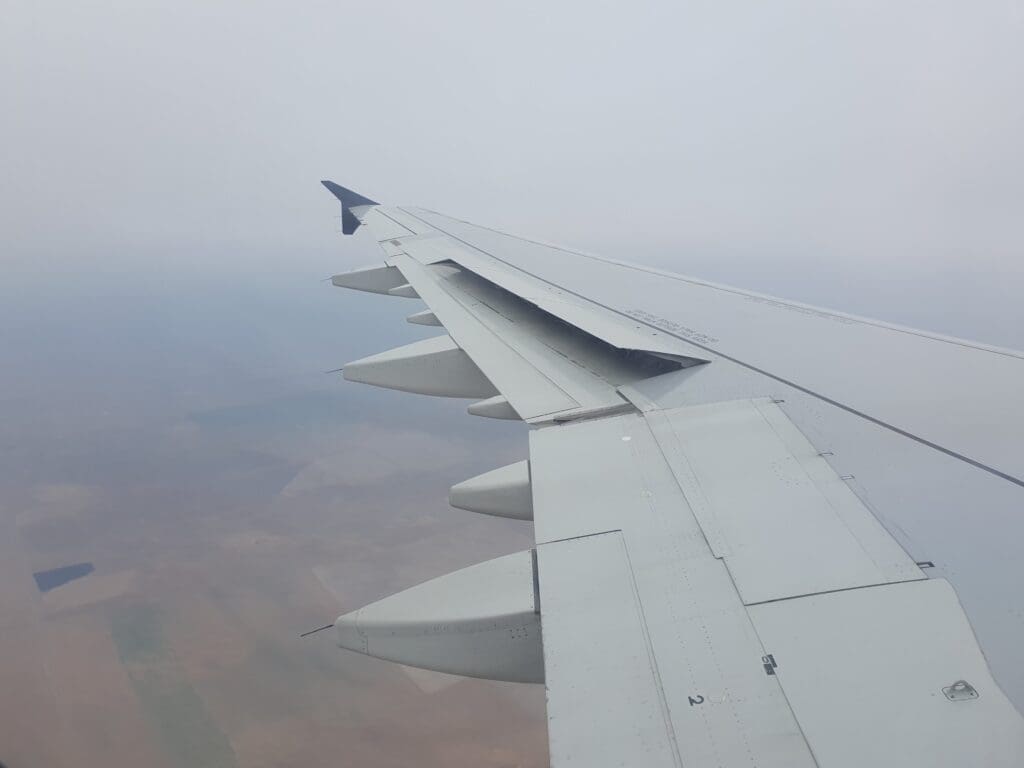
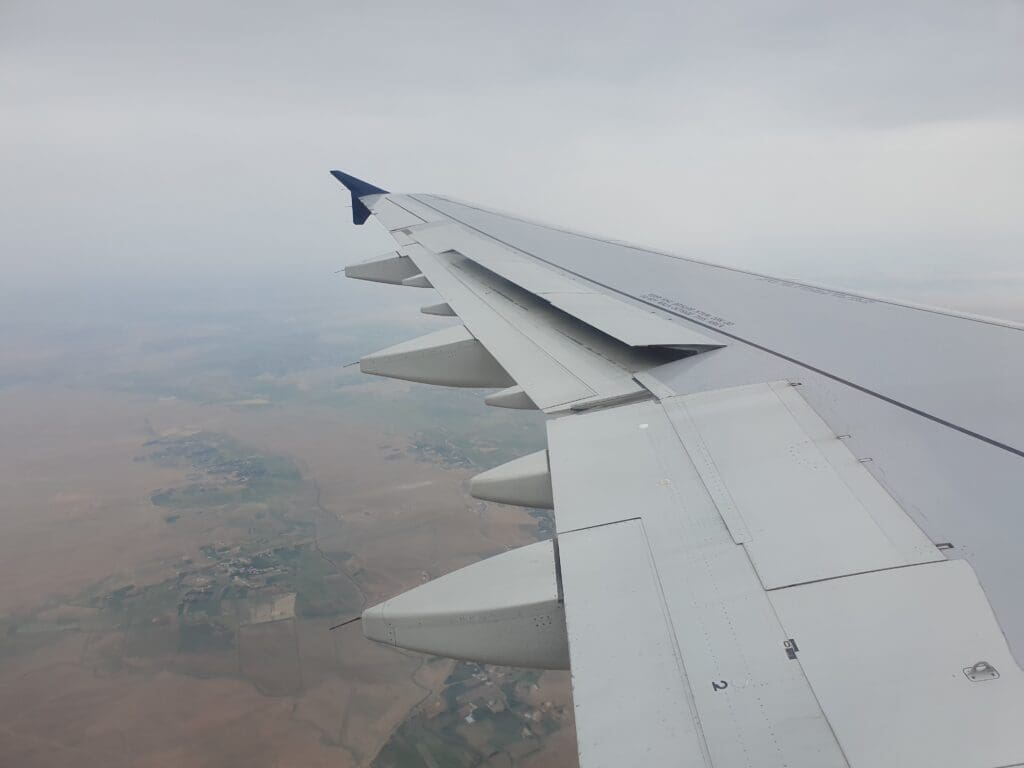
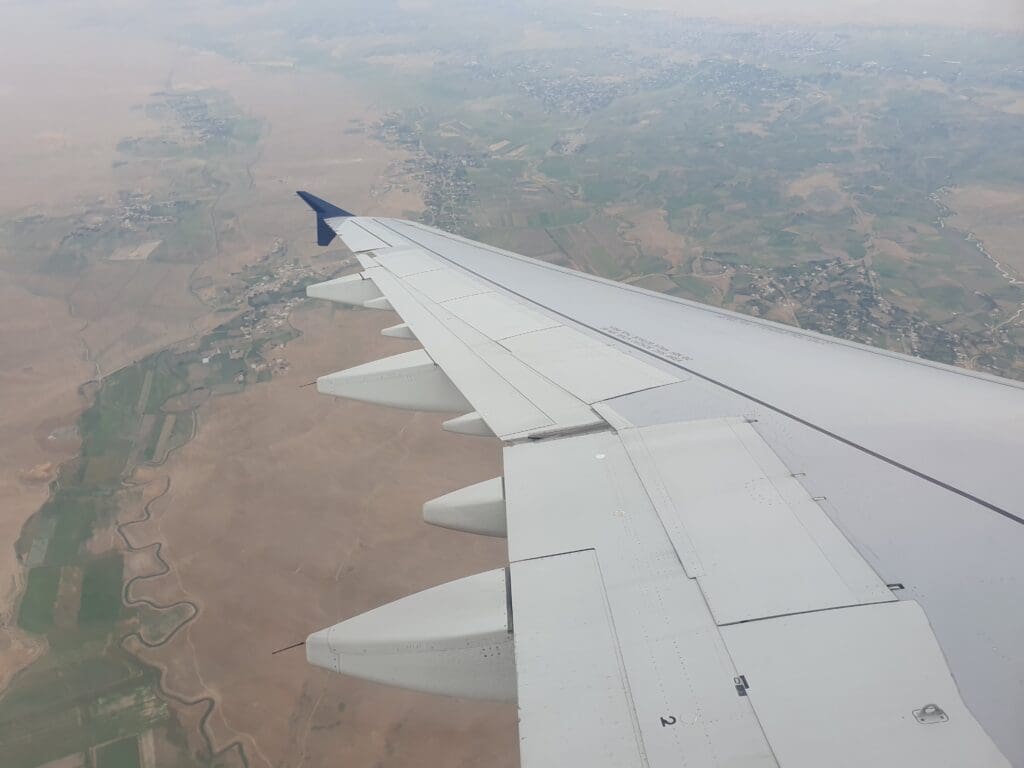
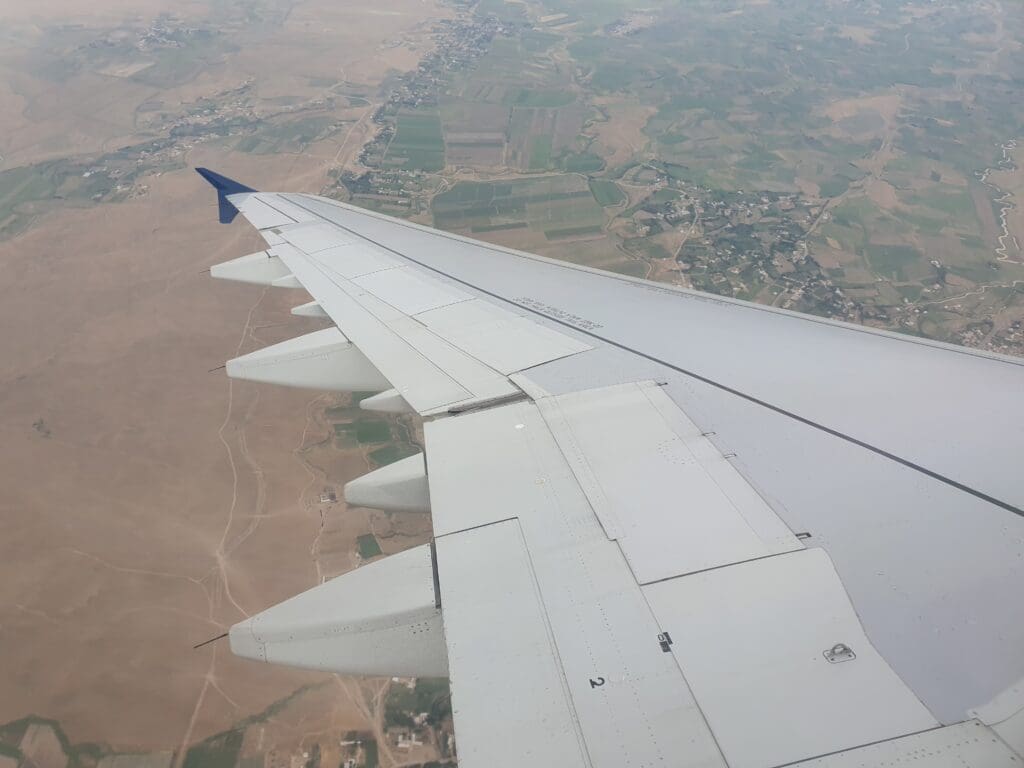
Given the fact that Tashkent sits only a very short distance below Uzbekistan’s border with Kazakhstan, the majority of the flight took place within Kazakh airspace. By the time the Airbus A321 sank below the clouds at 12:35 (Tashkent time), the aircraft was still above Kazakhstan. In fact, the aircraft did not cross the border until 12:40, at which point we were passing through 4,000 feet and only minutes away from landing. After the aircraft lined itself up for an approach to Tashkent Airport’s Runway 08R, the semi-rural green and beige landscape transformed into Tashkent’s suburbs, and eventually, the aircraft’s flaps and landing gear were extended.
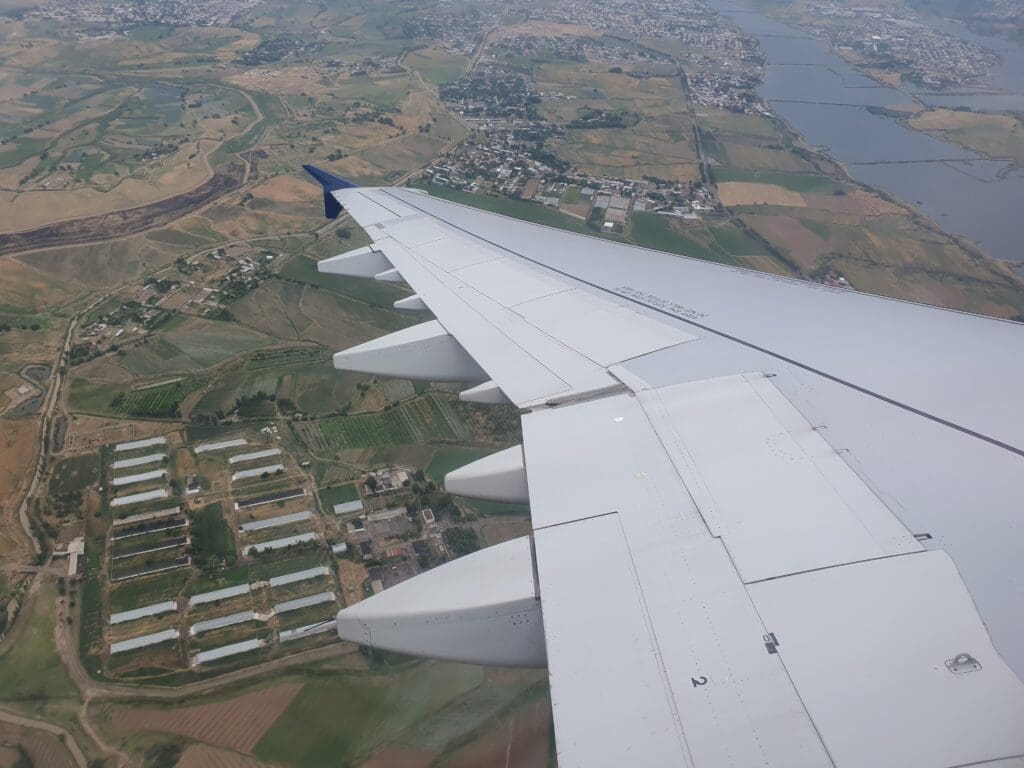
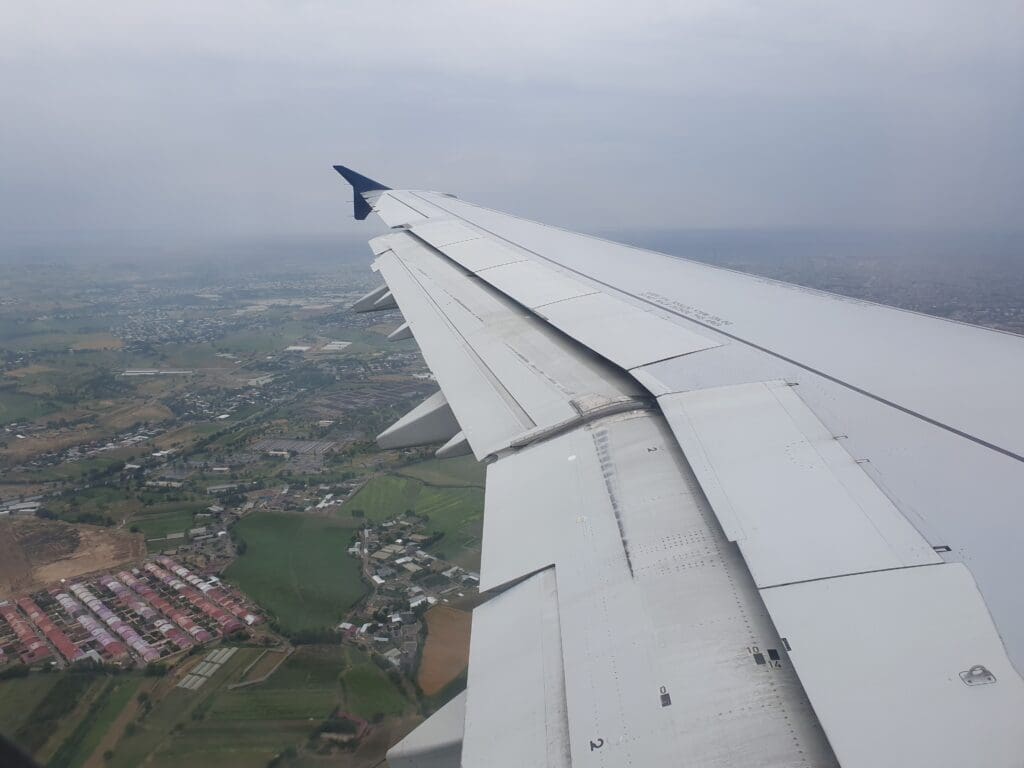
After several minutes, the Airbus gently floated down over the well-guarded perimeter boundary of Islam Karimov Tashkent International Airport. Reassuring me that I had not boarded the wrong flight, within a few minutes, masses of jets sporting Uzbekistan Airways’ bright livery appeared. These came in addition to a very interesting McDonnell Douglas MD-80, with this operated by Afghan carrier Kam Air and making its way to the runway at the start of its return hop to Kabul. In addition to this, I soon spotted another very interesting aircraft, an active Russian Tupolev Tu-154. At 1244, our aircraft made a soft touchdown on the rain-soaked runway, which was accompanied by a round of applause and some rather vigorous deceleration.
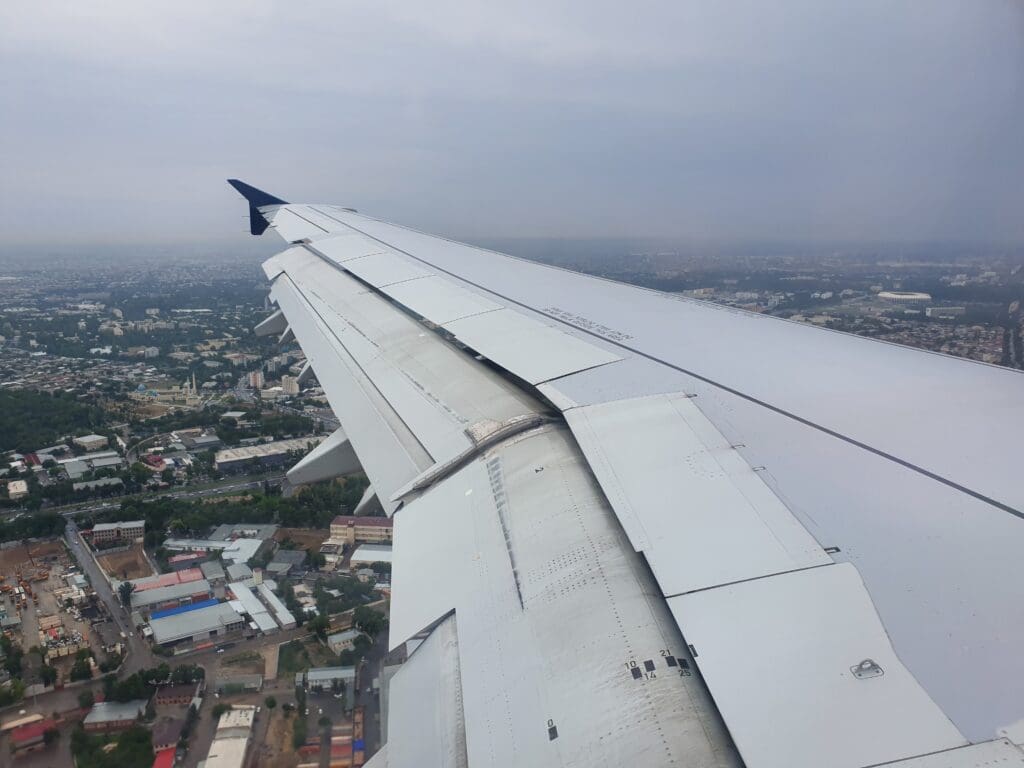
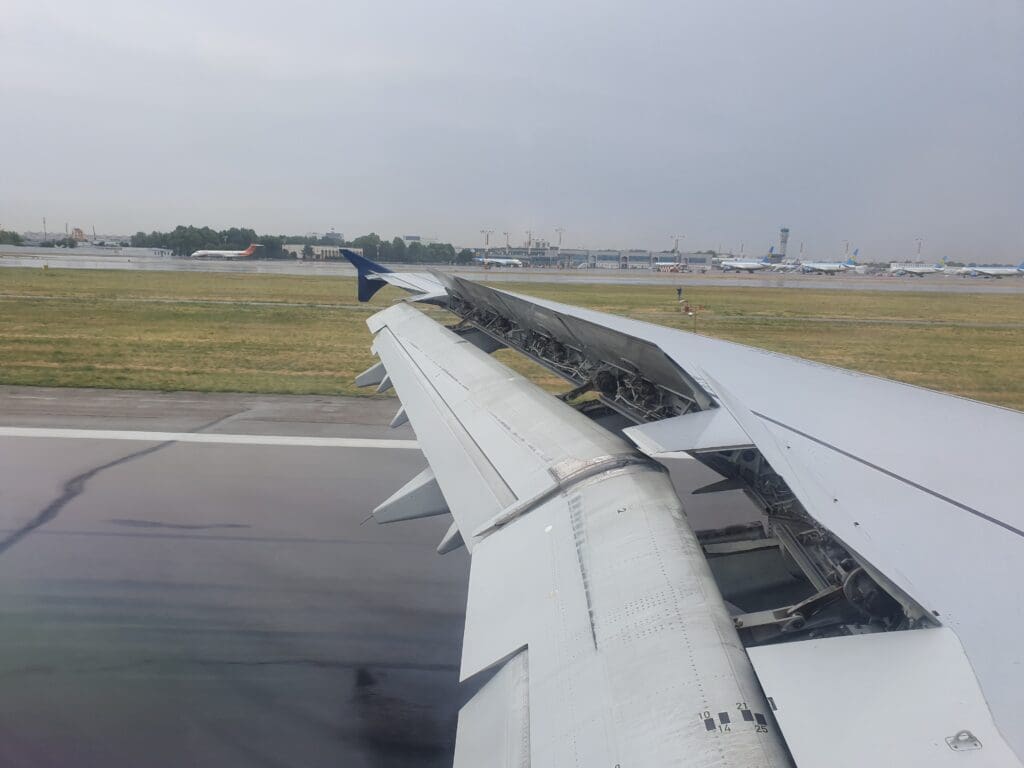
From the runway, the aircraft turned left and headed towards the airport’s international terminal, pulling into stand B1 only a short time later. In the usual manner, once the aircraft came to a halt, the engines were shut down, and many passengers made a beeline for the front of the aircraft. Meanwhile, strong blue mood lighting once again filled the cabin, perhaps in an attempt to calm those passengers who were desperate to leave the aircraft. As we waited for the airbridge to be connected, the Captain came on the speakers once again, this time to give a farewell message and thank us again for flying with Air Astana. Once the jetbridge was connected, passengers began to slowly filter off the aircraft, and at 13:00, after thanking the yet-again friendly crew, I disembarked into the somewhat retro-looking arrivals area of the terminal.
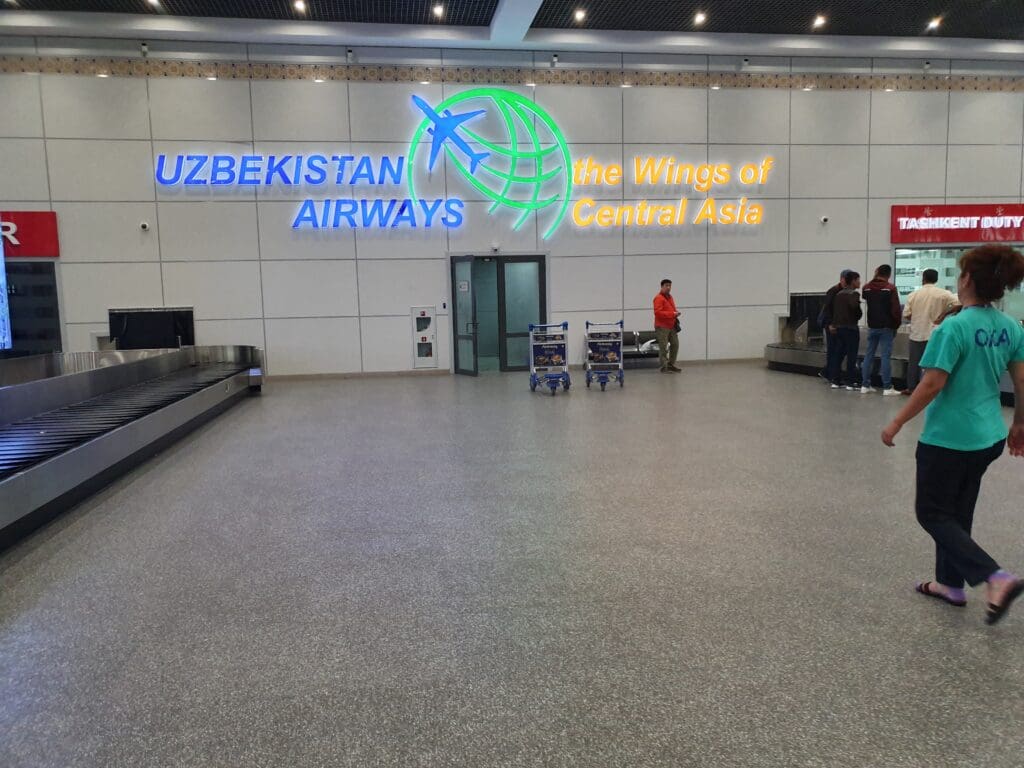
Once in the terminal, a fairly lengthy walk was in order prior to reaching the terminal’s large arrivals hall, which is home to immigration, baggage claim, and customs. Fortunately, upon arriving here, it became clear that our flight was the only international service to arrive at that time, with not a single passenger in sight who had not just arrived from Almaty. Thankfully, there were plenty of immigration booths, and almost all of these were manned, so I was able to walk straight up to a desk without any standing in line. Looking online, one can easily find a plethora of accounts of difficult and time-consuming entries into Uzbekistan via Tashkent Airport. With this in mind, I was somewhat expecting to be asked plenty of questions about my trip to the nation and had printed out a range of documents showing my booked hotels, and domestic and international flight tickets. I was, however, incredibly and pleasantly surprised by the immigration process. After handing the immigration officer my passport, within around thirty seconds, he stamped it without any dialogue and returned it to me with an approving nod, allowing me to enter the baggage claim hall.
It was, however, at this point that I reached my first delay, as luggage did not appear on the carousel for almost thirty minutes. During this long wait, I changed a total of eighty dollars into Uzbek Som (which would prove more than enough money for my four-day stay), visited the relatively clean toilets, and picked up a free map from the tourist information booth. Eventually, perhaps after having been driven by lorry from Almaty, the flight’s luggage showed up, and, with nothing to declare, nor the customs officers seeming to take much interest in me, I was able to exit the terminal less than a minute after picking up my small suitcase.
Thank you for sharing such a detailed and immersive travel experience! Your vivid descriptions made me feel like I was walking through the terminals and boarding the flights alongside you. The small observations about architecture, seating comfort, food service, and even aircraft types really add depth for aviation and travel enthusiasts. I especially appreciated how you balanced the positives (friendly crew, smooth connections) with the challenges (Wi-Fi issues, uncomfortable seating) — it makes the account both honest and relatable. Looking forward to reading more of your journey stories!
When was this trip? I was hoping you had some photos and insights from Almaty’s new international terminal that opened in 2024 because photos/videos of real world experiences have been very elusive. I used to travel quite often through ALA with their old terminal (as you’ve reviewed here) and I personally rank it as one of the worst airports I’ve been to, but supposedly their new terminal is a major upgrade.
So this was before the new terminal opened – it was under construction at the time but agreed, Almaty’s old international terminal was rather poor. I’ve also flown through it a few times and can confidently say that the ‘new’ terminal at Astana is far superior.