Very Short Haul Done Very Well: Abu Dhabi to Doha on a Qatar Airways 737 MAX
Background
Having booked Etihad Airways’ promotional fare from Rome to Abu Dhabi to sample the delights of their Boeing 777-300ER for almost nothing, I now needed to find a reasonably cheap way to get back to Britain. Whilst plenty of options exist for those needing to travel between the United Arab Emirates and Britain, most options that weekend seemed to be priced at above-average levels unless I fancied squeezing myself into a Pegasus or Wizz Air seat for the long journey back via Istanbul or Bucharest.
Fortunately, having a few miles to spend in my British Airways Executive Club account, I was delighted to stumble across reward seat availability from Abu Dhabi to Manchester via Doha on fellow OneWorld carrier Qatar Airways. Costing 22,500 points and a surcharge of £108 for a one-way Economy ticket, this seemed like a reasonable option, and after a few taps, this was all booked and I received an email confirmation of my booking almost immediately. This would see me depart Abu Dhabi at 0555 onboard one of Qatar Airways’ recently delivered Boeing 737 MAXs before continuing onwards to Manchester on the airline’s many Boeing 777-300ERs following a 1H50 connection at the carrier’s mega-hub in Doha. Having previously flown with Qatar Airways from Manchester to Kathmandu in 2013, and Edinburgh to Seoul Incheon in 2015, I had a decent idea of what to expect from Qatar’s generally highly regarded flag carrier. However, seeing as plenty of time had passed since my last trip with them, I was eager to see how the carrier had changed in the eight or so years since I had flown with them.
As one would hope, my booking reference number worked on Qatar Airways’ website and I was able to add the usual range of optional extras through this. Had I wished to pre-select a seat, the cost of doing so stood between 40 AED and 140 AED on my first flight and 120 AED and 610 AED on my second. Meanwhile topping up my complimentary 30kg hold luggage allowance would have set me back by between 250 AED (5kg) up to 5,000 AED for the maximum additional extra of 100kg. Of more interest to me was the inflight menus which were provided, revealing that I would be served a light breakfast on the first flight, followed by brunch and a snack on the second.
About Qatar Airways
Unless you happen to have been living in a cave for the past few decades, the chances are you will have heard of the Middle Eastern giant, Qatar Airways. Operating a fleet of over 250 aircraft to over 150 destinations across all inhabited continents, the Qatari national carrier is one of the world’s largest. Furthermore, having consistently won awards since the early 2000s for its high levels of onboard service, Qatar Airways enjoys a good reputation amongst the travelling public.
Qatar Airways can trace its roots back to 1993 when the airline was established by the state. A far cry from the tens of aircraft that are based in Doha today, back then, the airline started with a compact fleet of Airbus A310 and Boeing 727s, which were sent to a handful of destinations across Africa, Asia and Europe, primarily focusing on point-to-point traffic. However, with the new millennium and the withdrawal of Qatar from the once multinational Gulf Air, Qatar Airways underwent massive expansion and transitioned from being a point-to-point to a hub-and-spoke carrier. Since then, the carrier has continued to grow and is, by all accounts, a major player in the global airline industry.
Check-In
Most passengers jetting off on Qatar Airways can check-in online up to 48 hours before departure, and upon reaching this window, I loaded up the carrier’s app. After entering my passport details, I was presented with my two randomly assigned seats. Whilst I had been assigned a window seat in the rearmost cabin for my second flight, Seat 40K, I opted to swap my aisle seat for a window seat for my first flight, settling on Seat 24A. Once done, I continued onwards and received my mobile boarding passes for the two flights quickly and without issue.
The Journey
With my flight to Abu Dhabi scheduled to depart at 0555, I had initially considered either camping out in the terminal or spending the night in the luxurious surroundings of the airport’s Premier Inn. However, seeing as the latter option was priced at least twice as high as what you would expect to spend on a Premier Inn back in Britain, and not fancying a night in the terminal, I began to examine other options. In the end, I found a reasonably priced deal at the Holiday Inn near the Sheikh Zayed Grand Mosque, located around halfway between the airport and the Corniche. Following a very pleasant yet short stay, I woke up bright and early at the ungodly hour of 0250, and following a quick shower, I descended seven floors and returned my key at reception to the incredibly polite and friendly army of staff. In exchange, seeing as I was leaving well before breakfast commenced, I was handed a breakfast bag containing an impressive selection of croissants, pastries, yoghurt and even a cooked selection of hashbrowns, chicken sausages and eggs.
Sitting just under 31 kilometres to the east of the centre of Abu Dhabi, Abu Dhabi Airport is not particularly centrally located within the capital city. For those looking for an economical means of riding between the airport and the city, a regular city bus runs at all hours and slowly wends its way to the airport. Tickets for this cost 4 Dirhams (about £0.90); however, departing at intervals of every forty minutes and with the hotel located a fair walk away from the bus stop, I decided that I would be better off taking a taxi. Fortunately, you are unlikely to face much difficulty in finding a taxi in Abu Dhabi, and these are relatively cheap compared to taxis back home in the UK. With a taxi already waiting at the hotel, having dropped a passenger off, as soon as I checked out, I took a few steps into the already boiling Arabian heat before diving into a taxi.
Soon, we hit the busy streets of Abu Dhabi and came to a halt at a petrol station where the meter continued to run as the driver filled up the car. Whilst I could have complained about this and almost certainly had my Dirhams refunded, I decided that this was not worth the hassle and overlooked this before we continued on our journey to the airport. Soon speeding out of the city on the motorway, I was treated to one last glimpse of the majestic Sheikh Zayed Grand Mosque before this was replaced by the sight of a mishmash of tall residential and office buildings, industrial facilities and houses, as we headed out into the desert. Whilst a fair number of cars could be seen on the road that morning, we encountered no jams and no more than fifteen minutes after leaving the hotel, the sprawl of Abu Dhabi Airport appeared. Travelling in October 2023, a little over a month before the opening of the airport’s new terminal, at the time of my trip, Abu Dhabi Airport was comprised of three terminals, logically named Terminals 1, 2 and 3. Of these, Terminals 1 and 3 are conjoined, whilst Terminal 2 is smaller and sits some distance away from the other two terminals. In terms of users, Terminal 3 served as Etihad Airways’ dedicated terminal, whilst the other two terminals serve a smorgasbord of other operators at the airport, with most flights using Terminal 1.
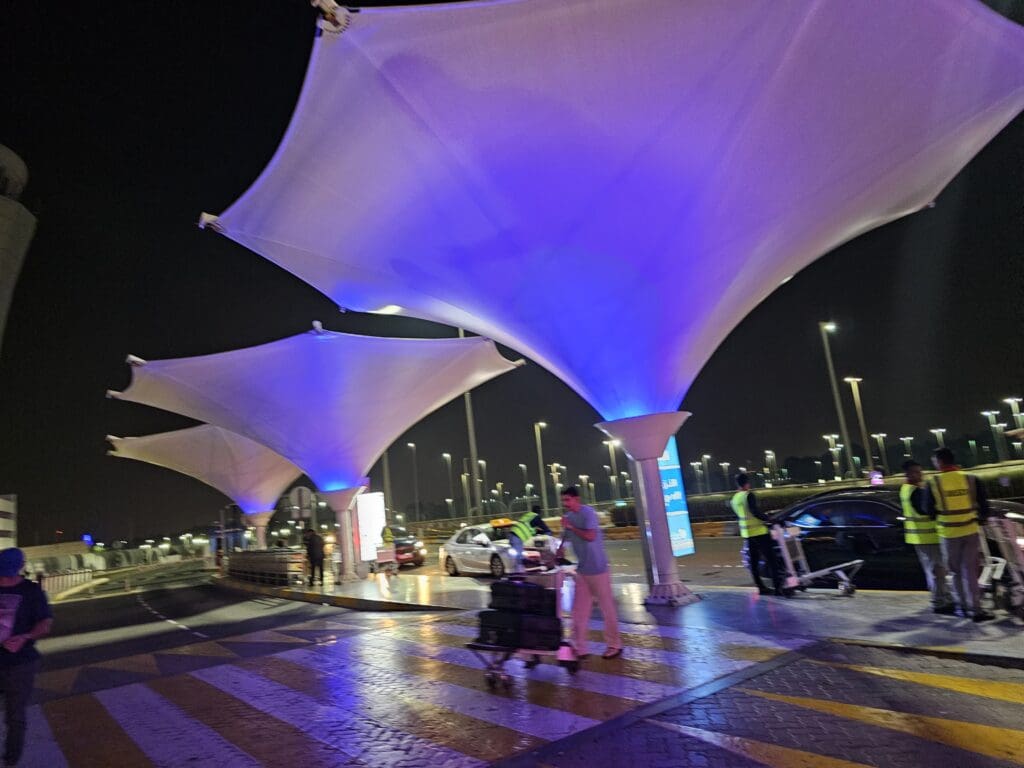
Once I had paid the reasonable fare of 59 Dirhams (around £13.20), I made my way into the check-in hall where I was welcomed by scenes of relative chaos. At that time in the morning, check-in was underway for the thirteen early morning departures of Air Arabia, Pegasus, Qatar Airways, Royal Jordanian, Turkish Airlines and Wizz Air Abu Dhabi. Thus, crowds of passengers, many of whom appeared to be travelling with massive piles of luggage, could be seen leading up to many of the terminal’s check-in counters. In terms of size, the landside portion of Terminal 1 is relatively small and undoubtedly harks back to an era before planners could have envisaged Abu Dhabi transforming into the major international hub that it is today. Yet, despite the crowds, I found the landside portion of the terminal to be clean and functional and home to a few cafés and shops for those with some time to spend before heading airside.
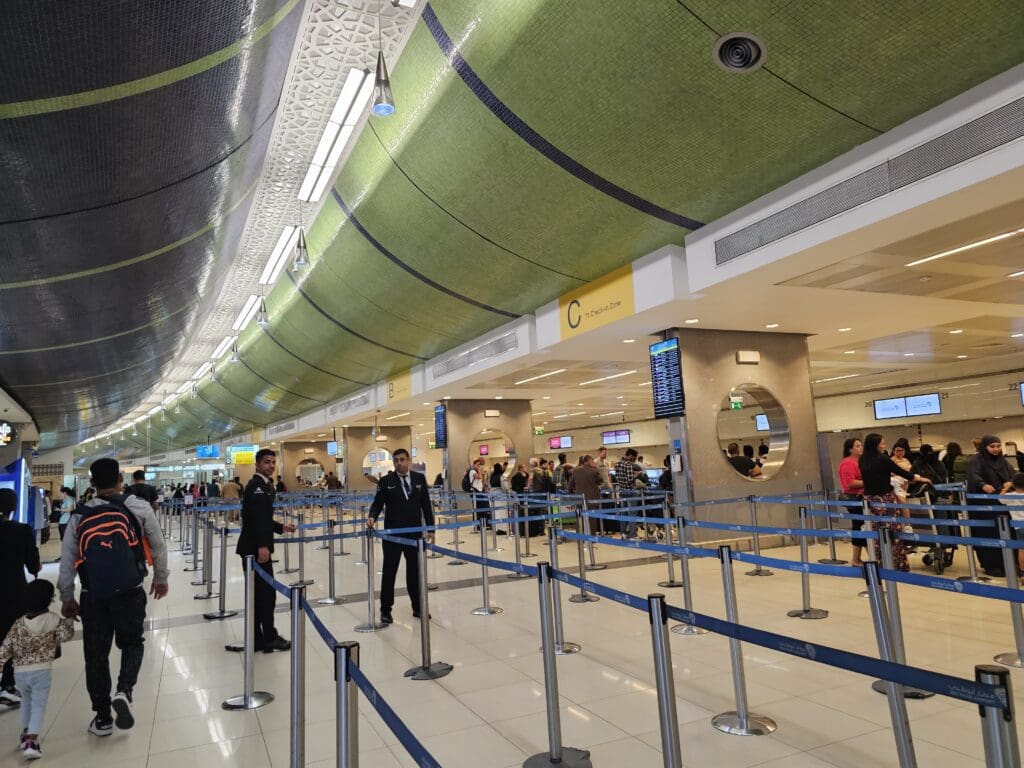
Seeing as I had already checked in online and downloaded my boarding passes, following a very quick walk through the terminal, I saw no reason to stay there and made a beeline for the entrance to the passport control area. Soon joining the scrum of passengers waiting to pass through, a couple of minutes later I reached the line of automated barriers, where one of the assistants took a look at my boarding pass before advising me to head back to check-in to receive a paper pass. With around two hours to go before my flight was scheduled to head off to Abu Dhabi, I was not particularly perturbed by this, although at the same time, I wasn’t too enamoured by the prospect of additional queuing. Turning around, I soon reached Qatar Airways’ check-in zone where four desks had been assigned to the Doha flight – three for those in Economy and one for those in Business and with Silver, Platinum or Gold status of Qatar Airways’ Privilege Club.
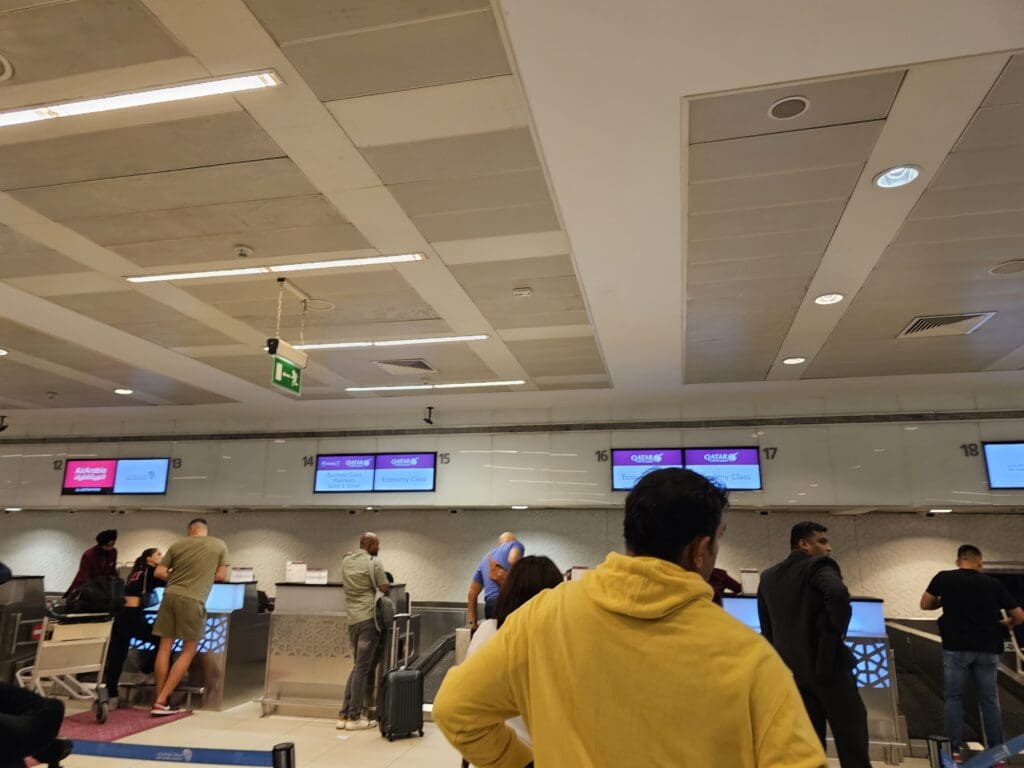
Upon joining the queue, I found myself standing in position ten and with most of those in front of me travelling with large amounts of luggage, a fair amount of waiting was in order. As I shuffled forward, given the fact that Qatar Airways operates up to five daily flights between Abu Dhabi and Doha, I was slightly surprised at the lack of the carrier’s branding around the carrier’s check-in area. Eventually, I reached one of the desks, and after handing over my passport and confirming my final destination, Manchester, my two boarding passes were printed off and I was requested to be at Gate 5 at 0455. Wasting no time, as soon as I had these in hand, I made my way back to the entrance to passport control, where I was delighted to see that the queues had now subsided. Once the automated gates had let me through, I found myself standing in the terminal’s small yet near-empty immigration hall. On one side of this, a line of mostly manned booths could be seen, whilst several e-gates could be seen on the other. Soon, I was directed towards one of the e-gates, and after having my passport scanned and my photograph taken, I was able to exit quickly and without issue and arrived at the security checkpoint located immediately after this. With just a small number of checkpoints offered, I can imagine that this area gets very busy during peak times, although thankfully, this was mostly empty, and I was able to walk straight up to a checkpoint and go through the usual checks. All in all, I was left impressed by my smooth journey from the landside to the airside portion of Terminal 1, taking a total of just two minutes!
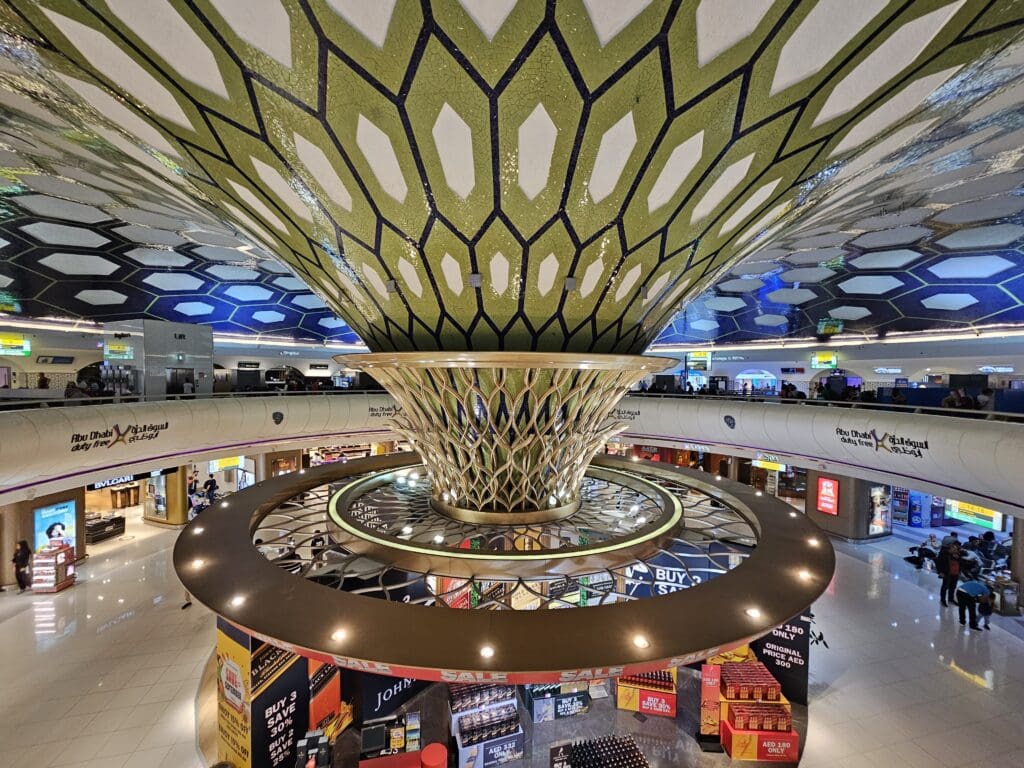
Once airside, I followed the crowds, and after stopping for a quick coffee, I arrived at Terminal 1’s central circular hub, in the centre of which is one of Abu Dhabi Airport’s most famous sights. This takes the form of a tiled funnel-like structure that rises from below, around which sits a good number of cafés, shops and restaurants, as well as plenty of seating. Five piers branch out from this central area, each with two jetbridges, whilst bus boarding gates can be found on the floor below. Whilst busy and slightly dated, appearing to be relatively clean, with ample seating, fast complimentary wifi and having enjoyed a quick journey from the landside to the airside areas that morning, Terminal 1 left me with little to complain about. However, it is worth noting that aviation enthusiasts may be disappointed to hear that airside views in this terminal are hard to come by, even at many of the terminal’s gates. However, these can be had away from the main circle, with the corridor from Terminal 1 to Terminal 3 providing a decent view of some of both terminal’s stands as well as the runway in the distance.
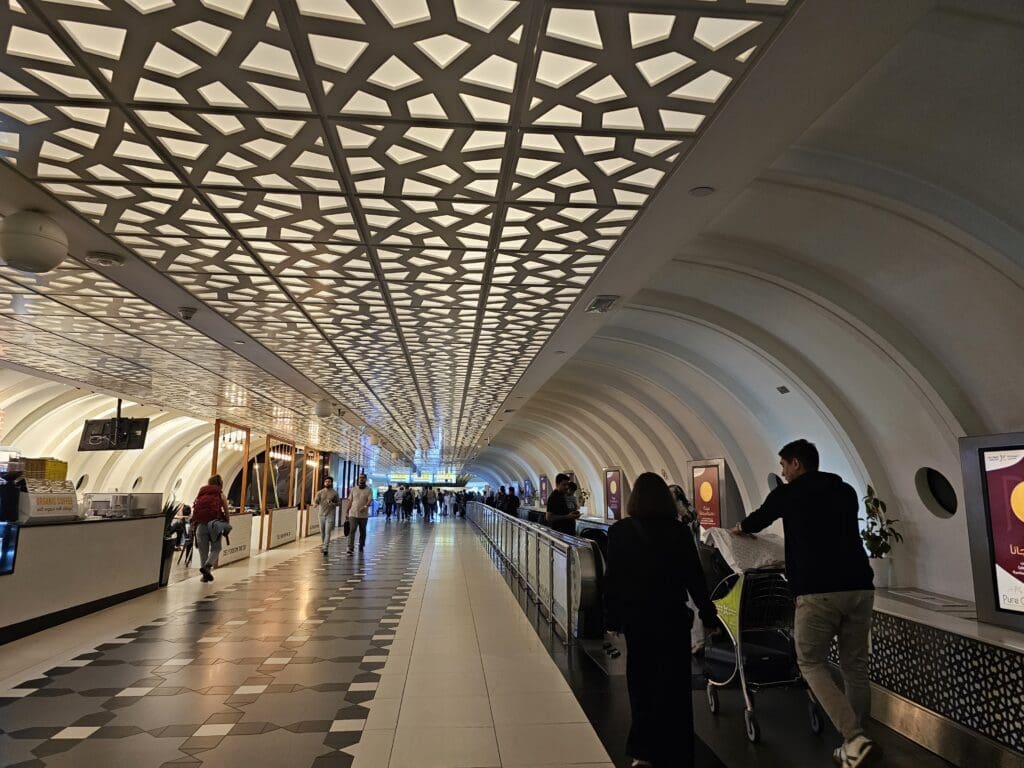
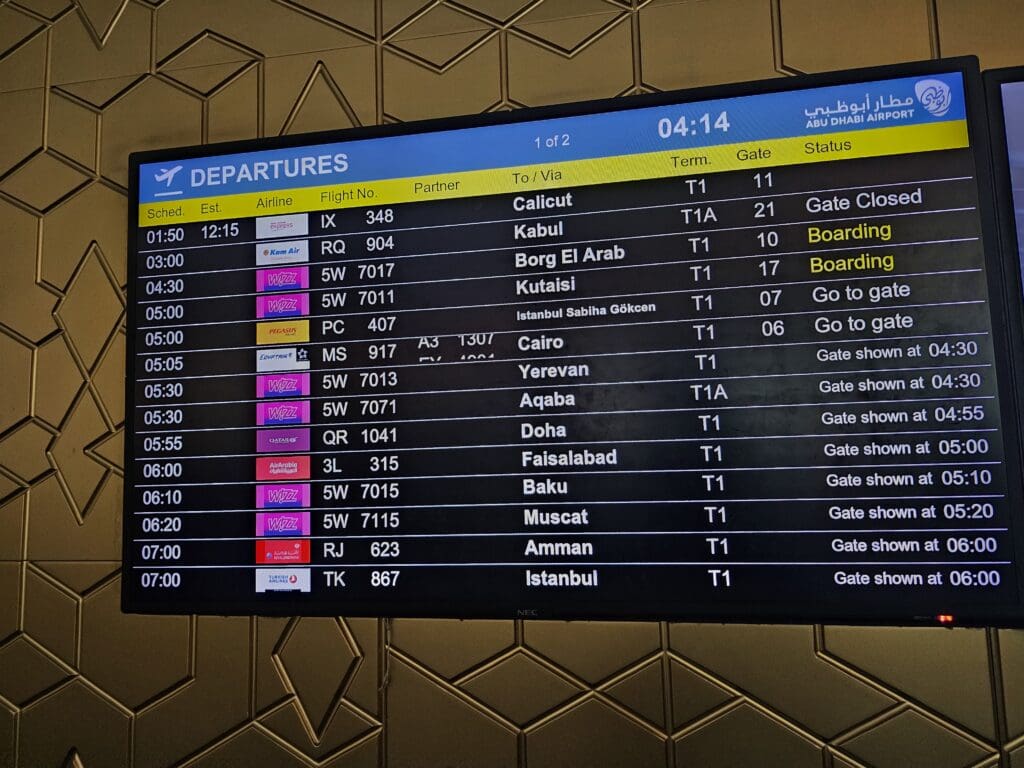
Looking at the departure boards, a total of thirteen flights could be seen on the departure boards up until 0710. Other than my flight to Qatar, I could have instead journeyed to Armenia, Azerbaijan, Egypt, Georgia, Jordan, Oman, Pakistan, Saudi Arabia or Turkey. Of these, a little over half were operated by Wizz Air’s local subsidiary, Wizz Air Abu Dhabi and as expected, a number of their pink, purple and white Airbus A321s could be seen waiting outside under the apron’s floodlights. As a UK-based enthusiast, the highlight movement seen during my stay in the terminal took the form of an Airbus A321 operated by Pakistani carrier Airblue – a carrier that once operated to Birmingham and Manchester. Unfortunately, I had arrived too late to see Kam Air’s Boeing 737 Classic departing off to the Afghan capital, Kabul, on its daily 0300 service.
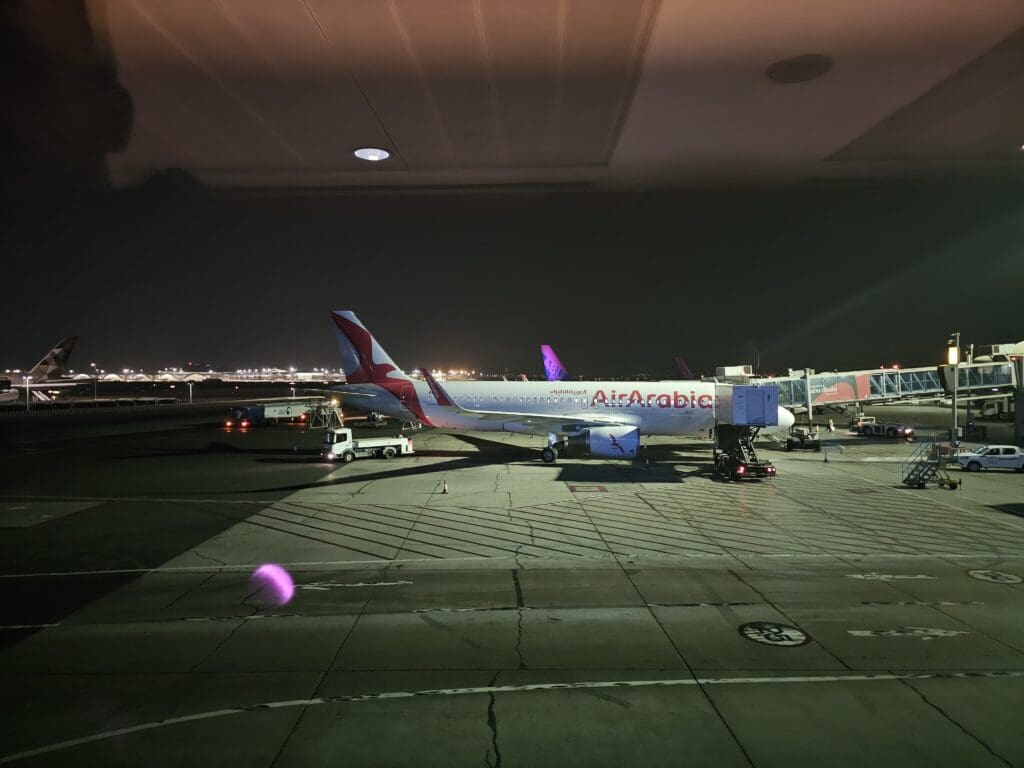
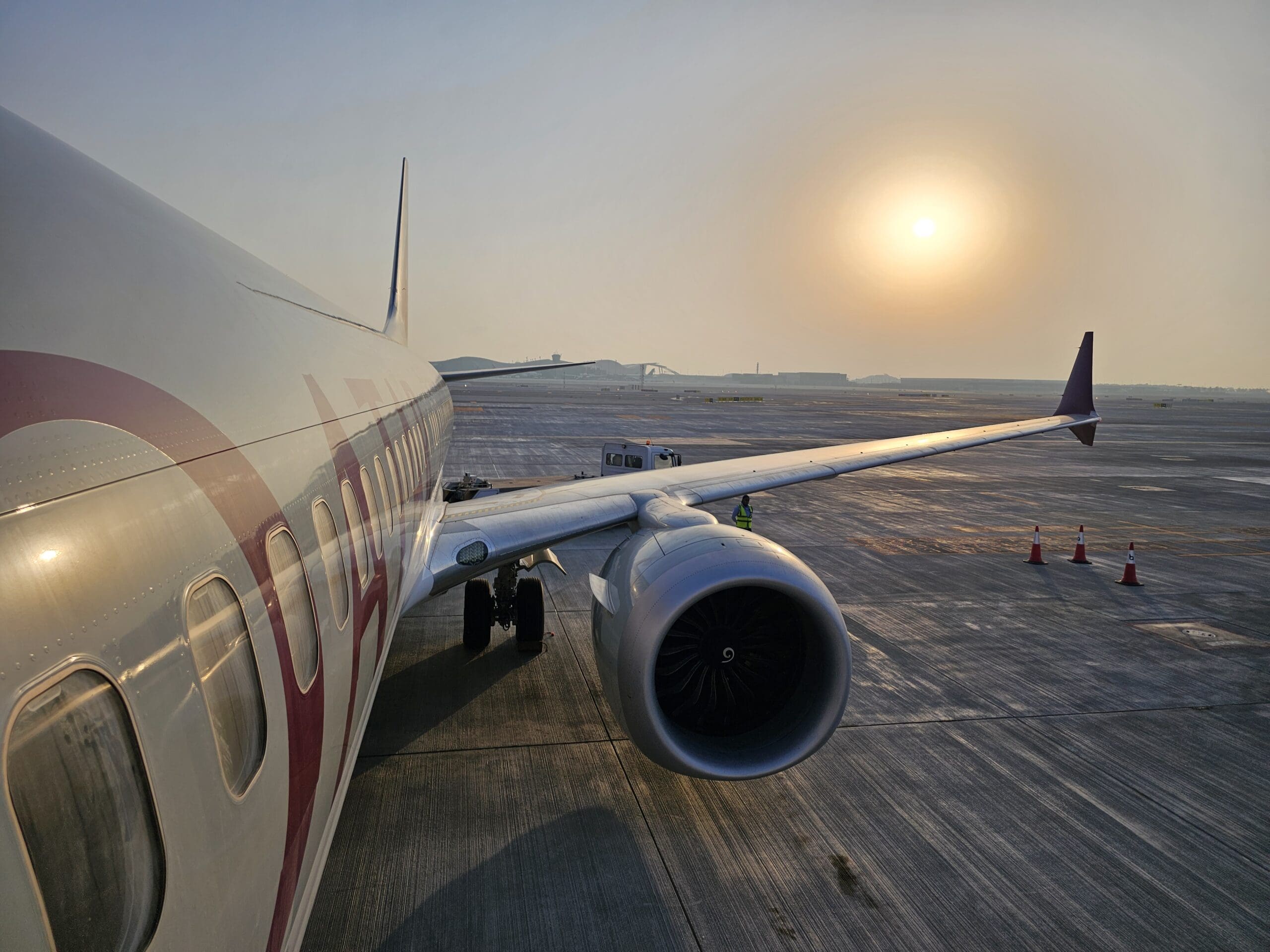
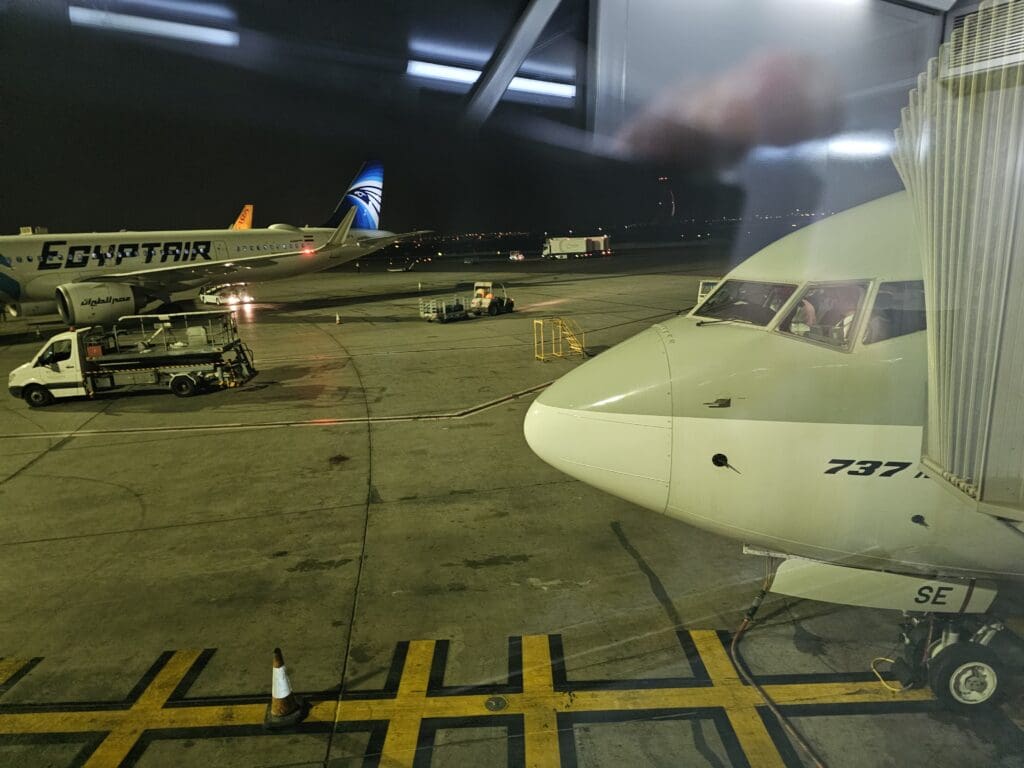
As I looped around the terminal, at 0417 the inbound Boeing 737 MAX 8 touched down in the Emirati capital at the end of its very short 39-minute hop over from Doha and soon came to a halt at Stand 121. This particular aircraft came in the form of A7-BSE, which, like Qatar Airways’ other Boeing 737s had originally been part of Russian carrier S7 Airlines’ order for ten Boeing 737 MAX 8s to be leased from the Air Lease Corporation. Assembled at Boeing’s Renton plant in early 2022, this aircraft made its first flight in April 2022, making it around a year and a half old at the time of my flight. However, the then recently commenced Russian invasion of Ukraine and consequent sanctions meant that this was never handed over to S7 Airlines. Instead, the aircraft was painted into Qatar Airways’ unmistakable livery, and a year following its first flight, the aircraft entered service with the Qatari carrier. Whilst the Boeing 737 MAX is known for its range capabilities, which are comparable to the Boeing 757, Qatar Airways has thus far only deployed its new addition on short regional flights to destinations across the Middle East. For example, in the week before my flight, this had made trips to Abu Dhabi, Baghdad, Bahrain, Medina, Najaf, Salalah and Sharjah, with its longest sectors being just under two hours.
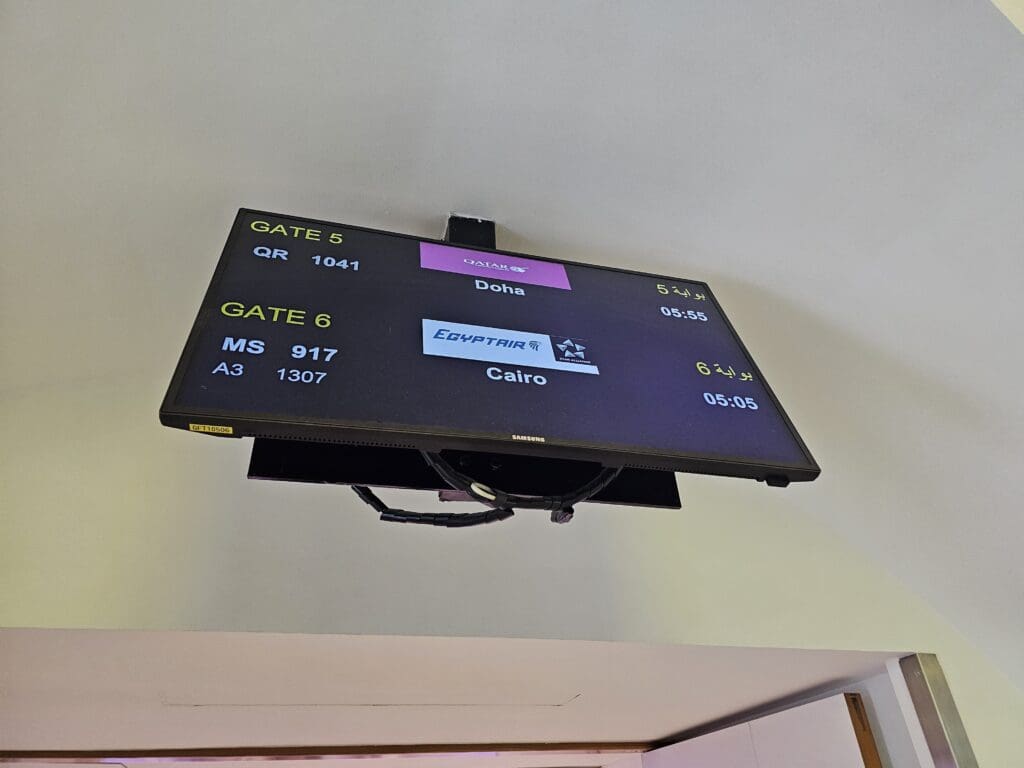
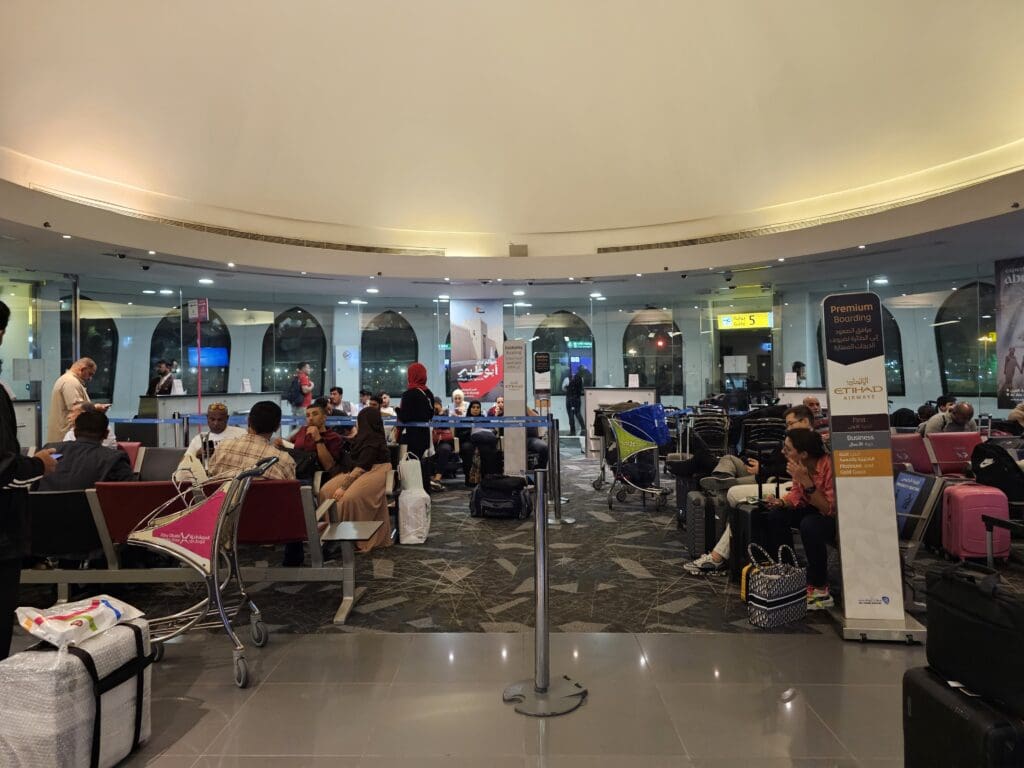
After a wander around the terminal, I decided that I ought to head down the pier that is home to gates 5 and 6. Upon arriving there, with a Cairo-bound EgyptAir Airbus A321neo about to start boarding through the neighbouring gate, this was rather busy, although this soon began to empty once boarding for this flight commenced at 0450. Whilst boarding for the Doha service had been advertised as commencing at 0455, this time came and went with no gate staff appearing and no sign that this was to commence any time soon. However, sceptical that it could take an hour to fill a 176-seat Boeing 737, this was not particularly surprising. Soon enough, several gate staff appeared, at which point a crowd of eager passengers swarmed around the gate podium. At 0510, an announcement was made inviting those travelling in Business, requiring assistance and/or elite members of the Privilege Club frequent flyer programme to proceed forward for boarding. This was followed by those passengers in Zone 1 at which point the floodgates opened, and all passengers shifted forward, however, the gate staff ruthlessly turned back all those passengers who did not fall into this category.
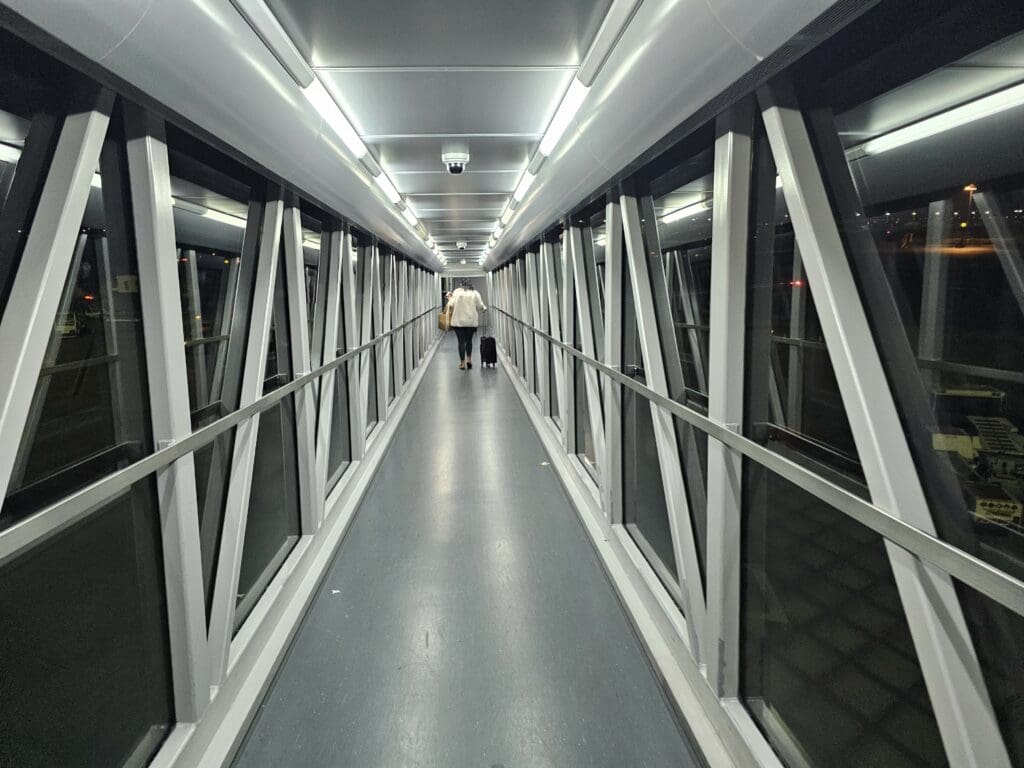
Following a short wait, I reached the podium where a friendly gate agent checked my passport and scanned my boarding pass before I was free to head down the jetbridge to the aircraft. Soon, I found myself stepping onto the aircraft and was immediately given a friendly ‘good morning’ by one of the five members of the cabin crew working the service to Doha. Upon checking my boarding pass, I was given the personalised greeting of ‘Welcome onboard Mr XXXX’, which, having not happened to me for quite some time, got my flight off to a fantastic start!
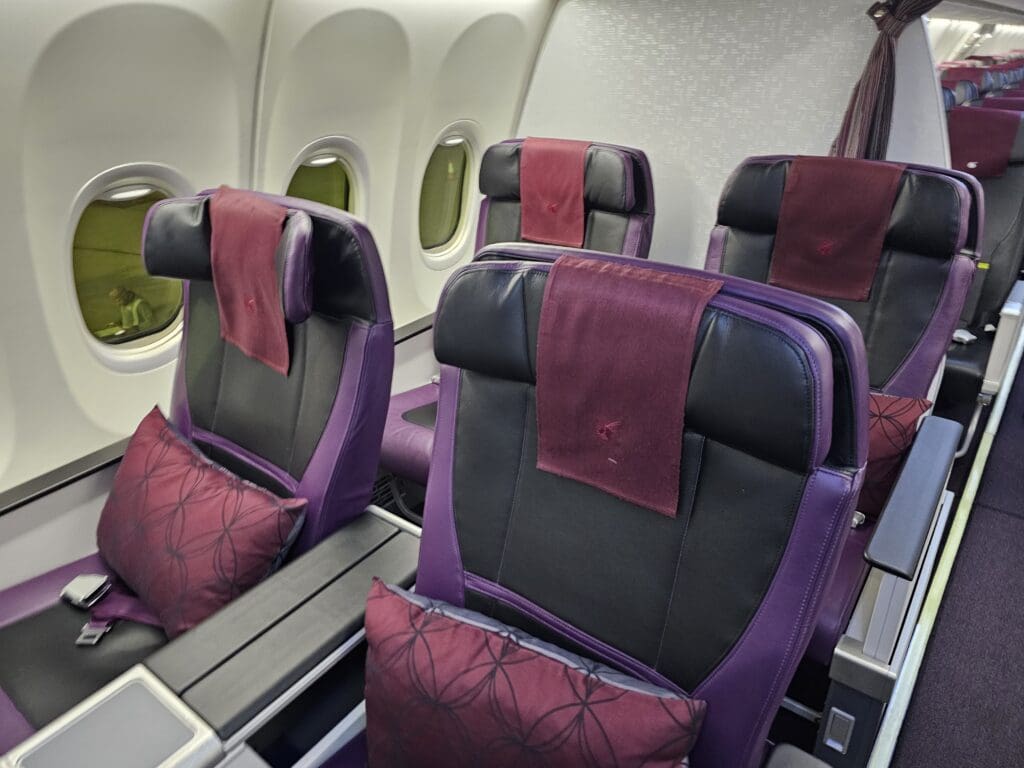
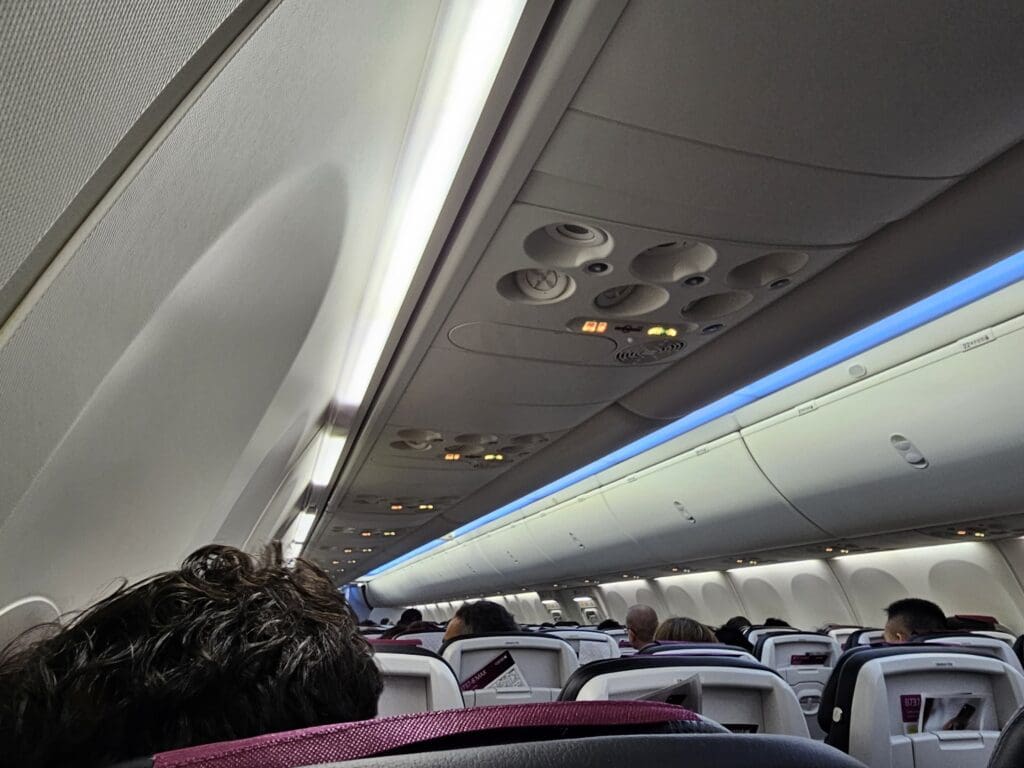
Turning right, I entered the Boeing 737 MAX’s bright and airy cabin where Qatar Airways’ boarding music – a fusion between Arab and Western classical music beamed through the cabin at a respectable volume for the early hour. Onboard, Qatar Airways’ Boeing 737 MAXs have a non-standard interior that does not bear a great resemblance to the cabins of any of their other aircraft, with very little burgundy. These aircraft instead feature the basic interiors of their original intended operator, S7 Airlines. Upon entering the cabin, I was greeted by the sight of the small Business Class cabin, which comprises of two rows of recliner seats in a typical 2-2 layout covered in a dark and purple pleather cover. Heading past these, I entered the Economy cabin, which is home to a total of 168 seats.
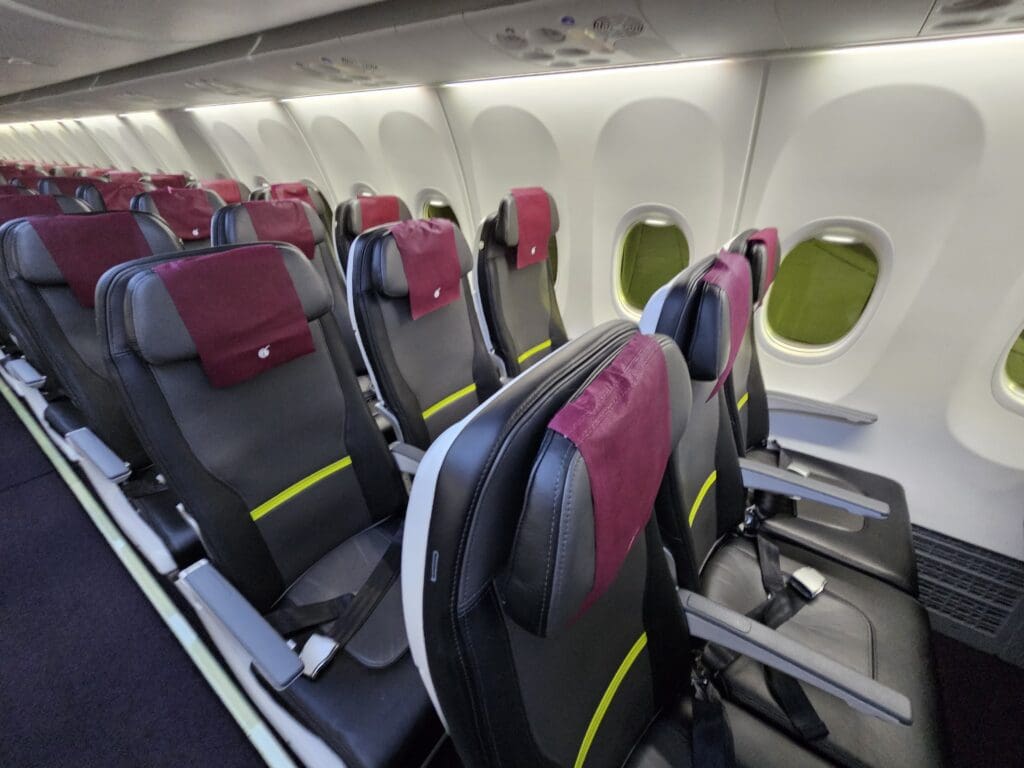
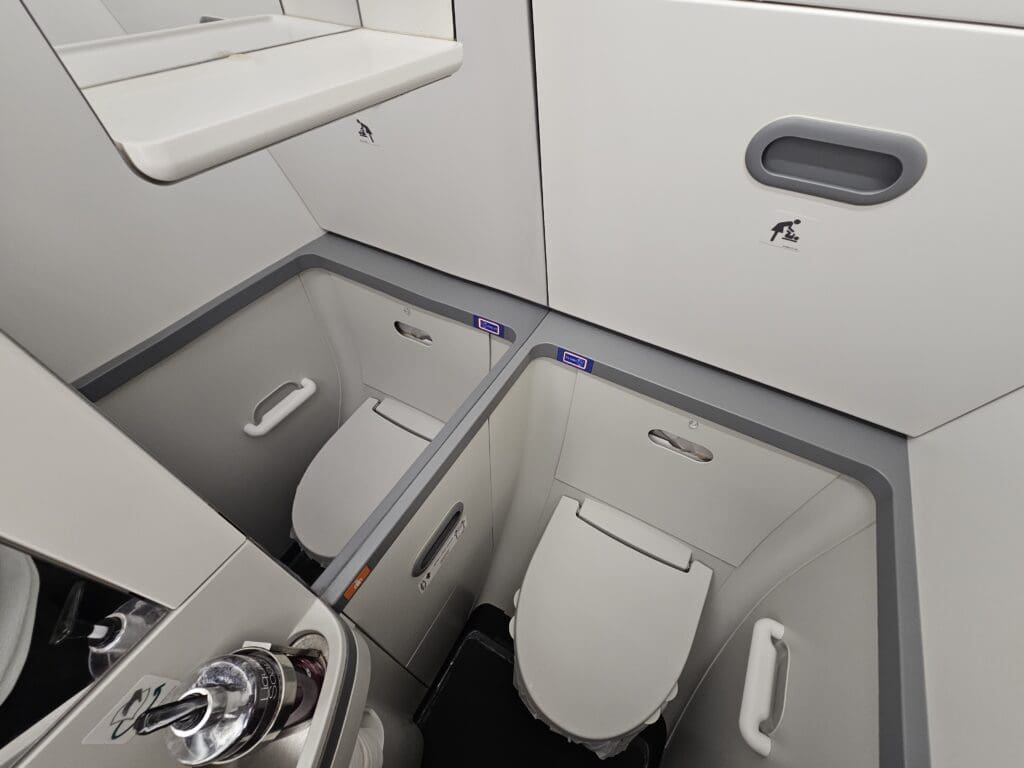
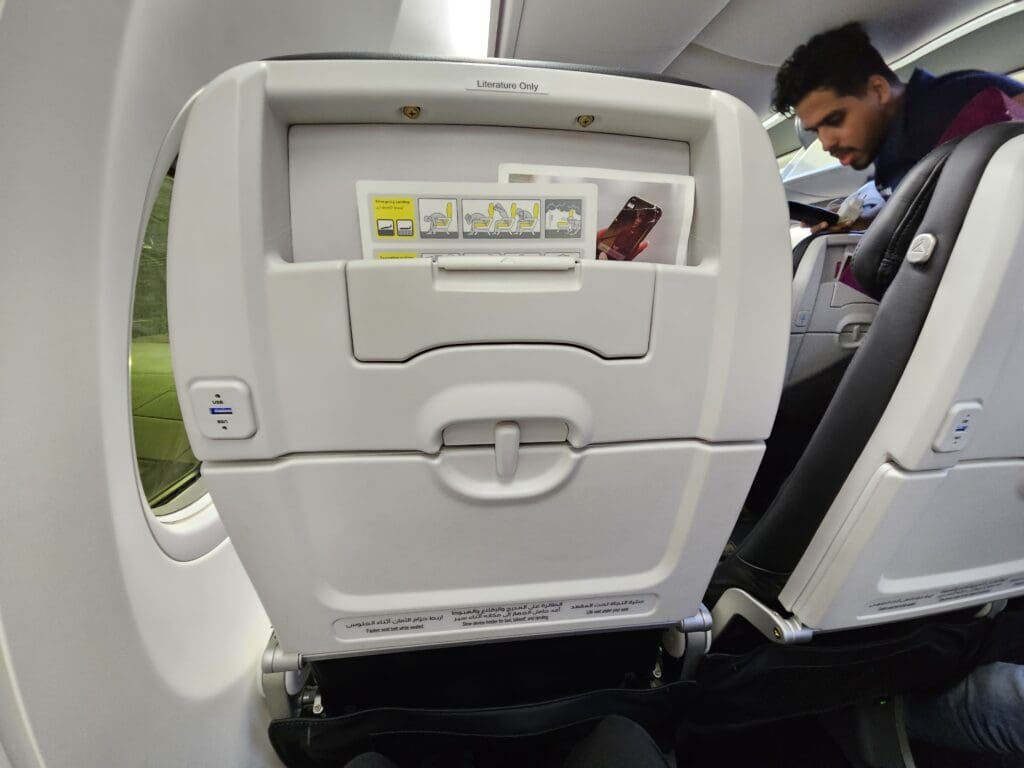
Appearing to be atypical of many seats on today’s narrowbody airliners, in Economy each seat was modern and slim. These were complete with an adjustable headrest, USB-A port, plug socket, fold-out device holder, seatback pocket and a literature compartment containing a sick bag, safety card and an information card detailing the onboard personal device streaming service named Oryx One Play. Focusing on their design, these are covered in a dark grey pleather cover with lime green stitching that reflects S7 Airlines’ branding. However, adding a Qatari touch, these also feature the airline’s burgundy disposable headrest covers. Whilst they are unlikely to be missed on the short flights that Qatar Airways’ Boeing 737 MAX 8s operate, unlike most of their other aircraft, these jets do not feature personal inflight entertainment screens. Once seated, I was pleased to find the seat to be comfortable and very spacious, with a fantastic amount of legroom. Unsurprisingly, this was in great condition, and I failed to spot any signs of wear and tear whilst the area around this appeared to be in a spotless condition. After stowing my bag, knowing that I would likely not get the opportunity to visit them later on during the flight, I decided to visit the lavatories at the rear of the Boeing. Unlike on my first and only Boeing 737 MAX ride that I had flown at this point, an Air Canada hop from Calgary to Vancouver, these were not squeezed into one corner of the galley and were instead located on either side of the aisle at the rear of the cabin, as they are on most Boeing 737NG aircraft. Upon entering one of these, I was pleased to find this to be clean, bright and relatively spacious and I was left with nothing to complain about.
A short time after sitting down, a fellow passenger took the middle seat and slowly but surely, the cabin began to fill up. As passengers made their way onto the aircraft, one of the flight attendants made the occasional announcement regarding stowing luggage correctly and the prohibition of smoking and vaping onboard. Around thirty minutes after boarding had commenced, boarding was announced as complete and at a rough guess, I would say that around 85% of seats in Economy ended up being filled. That morning, passengers seemed to hail from all over the world, with no one single dominant nationality. Turning to the crew that morning, these hailed from Eastern Europe, the Philippines and South Asia.
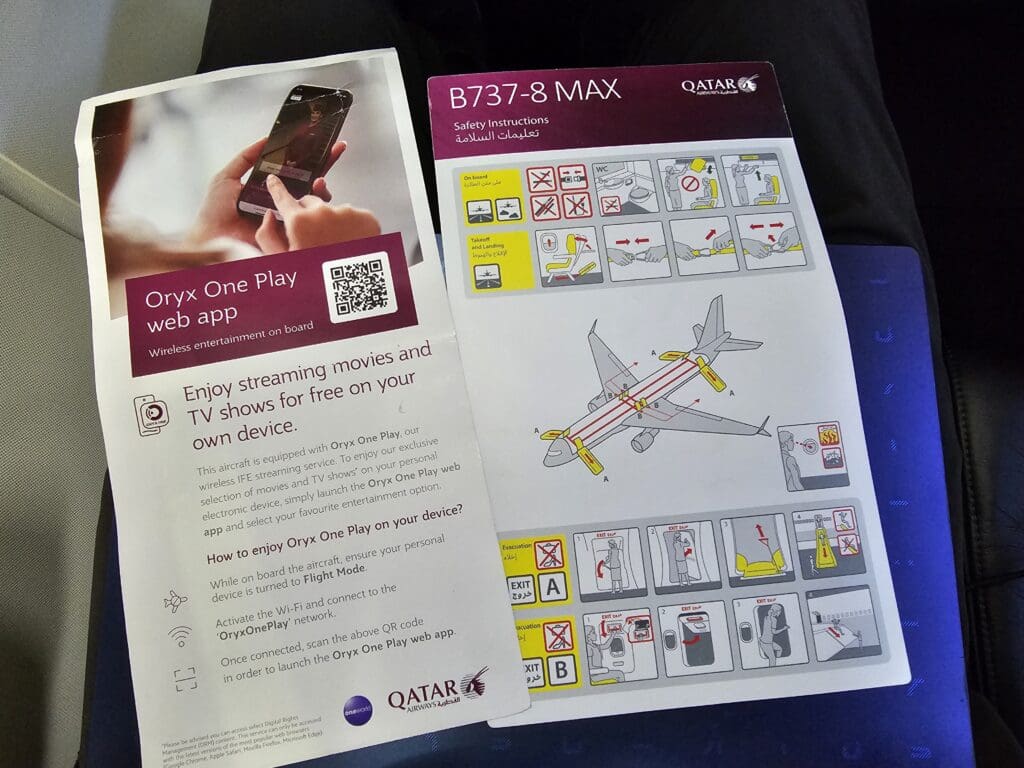
Almost as soon as boarding was announced as complete, ground staff were advised to leave the aircraft, and the reassuringly calm-sounding French Captain performed their welcome announcement. During this, they thanked passengers for flying with Qatar Airways, advised that we would be cruising at an altitude of 18,000 feet and would have a journey time of 54 minutes, introduced the First Officer and Purser, and ended this with a promise to update us with latest weather and encouraging us to enjoy the carrier’s ‘world-class service’. This was followed by the purser’s welcome, after which the crew took to the aisle and commenced a manual safety demonstration whilst the purser remained on the PA and read through the safety instructions. Given the start and end point of the flight, I was slightly surprised to find that no Arabic version of this was undertaken, either in person or via a pre-recorded announcement.
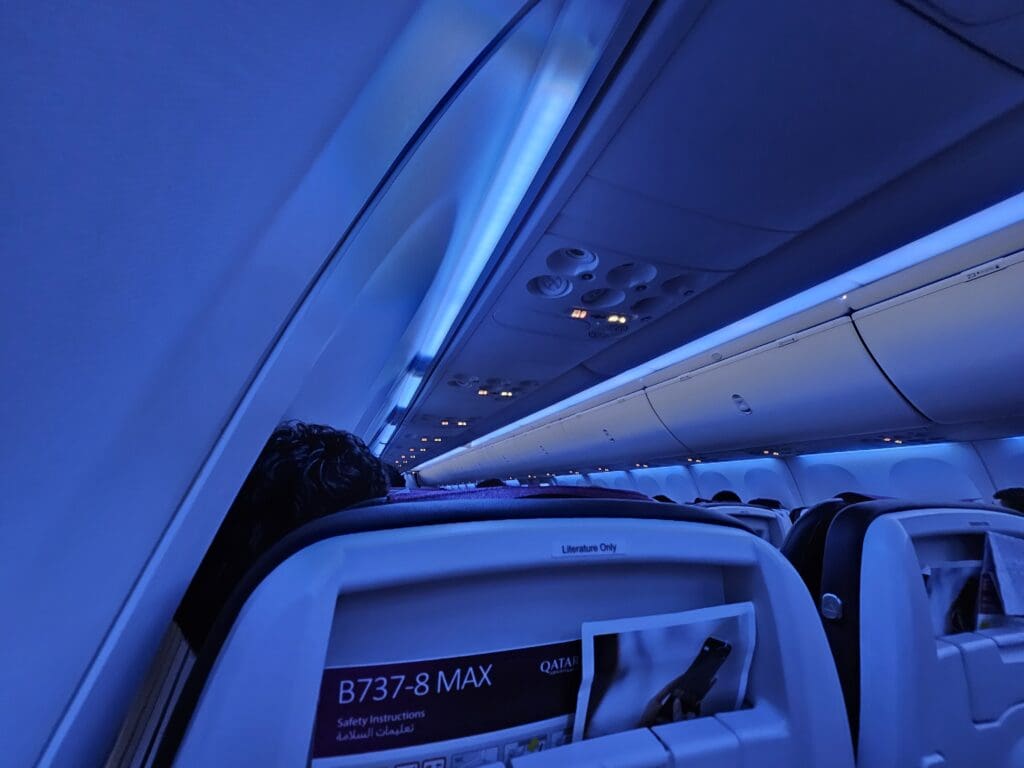
As the safety demonstration was underway, with three minutes to go until our scheduled departure time the aircraft jolted backwards and soon its two CFMI LEAP-1B engines could be heard quietly humming and whirring into life. Following the usual short pause whilst the engines stabilised and the tug was disconnected, at 0558 the aircraft began its journey to the southeastern end of the airfield. From my seat on the port side of the aircraft, a short time after leaving the terminals behind, a selection of stored Etihad Airways Airbus A320 and A330 aircraft could be seen in the early morning glow, soon followed by some real gems. Namely, two old Boeing 747-200s, one from Georgia and the other from Kyrgyzstan, as well as a Kyrgyzstan-registered Ilyushin Il-76 – all of which primarily seem to operate cargo flights between Abu Dhabi and various destinations in Africa.
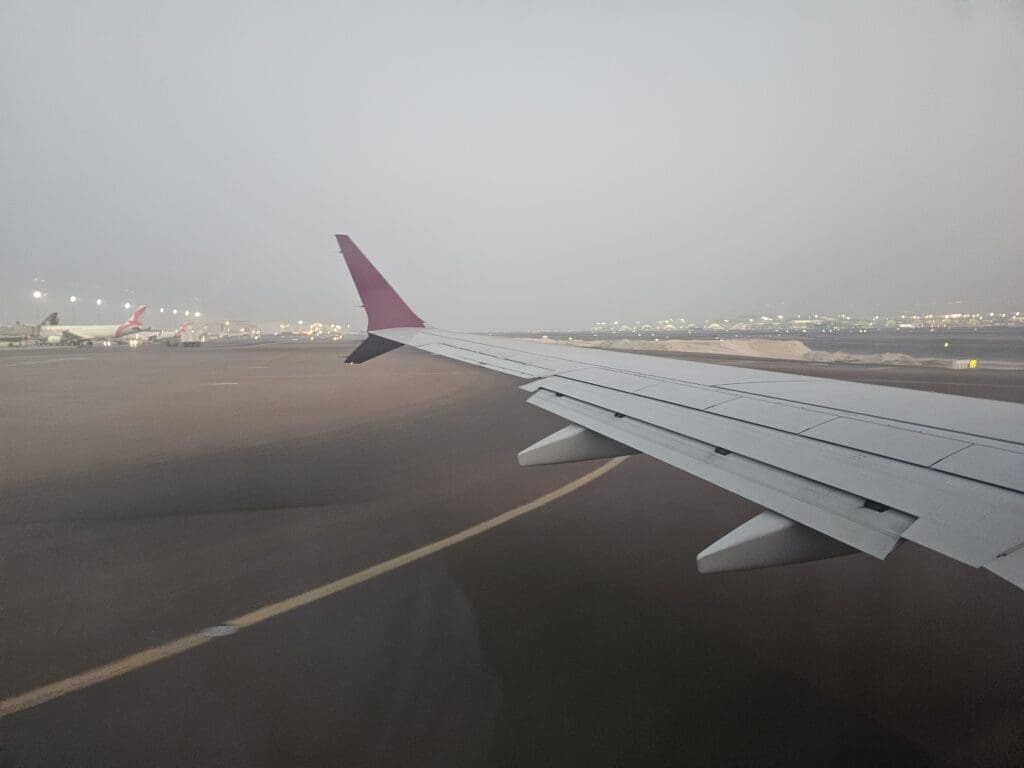
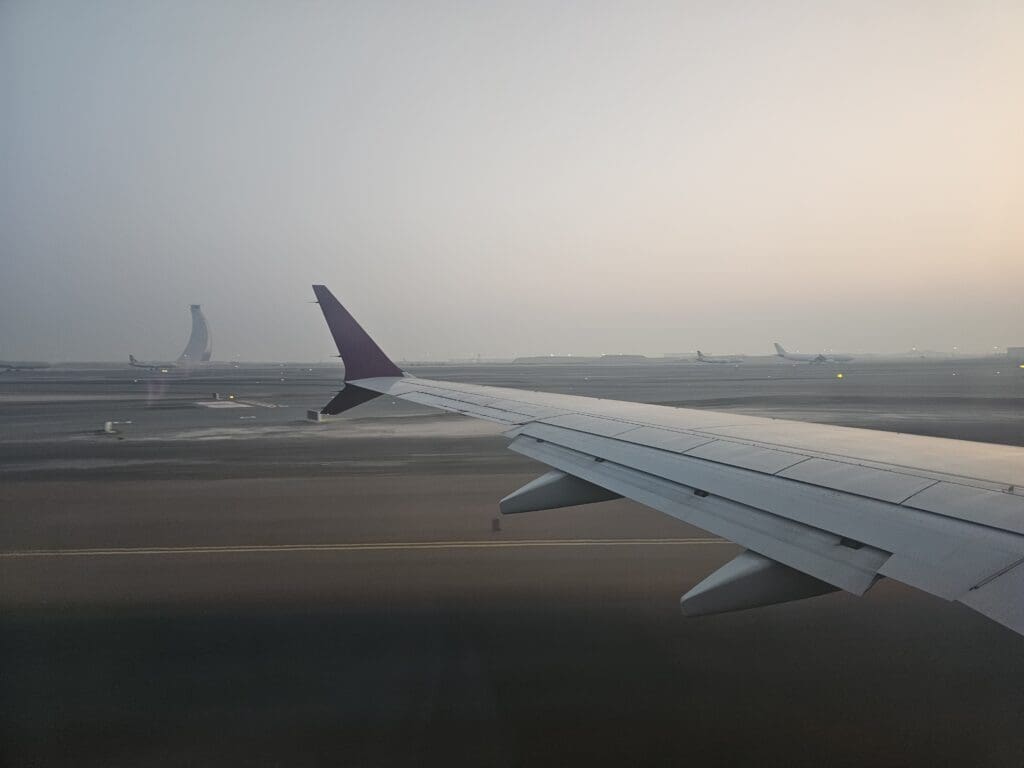
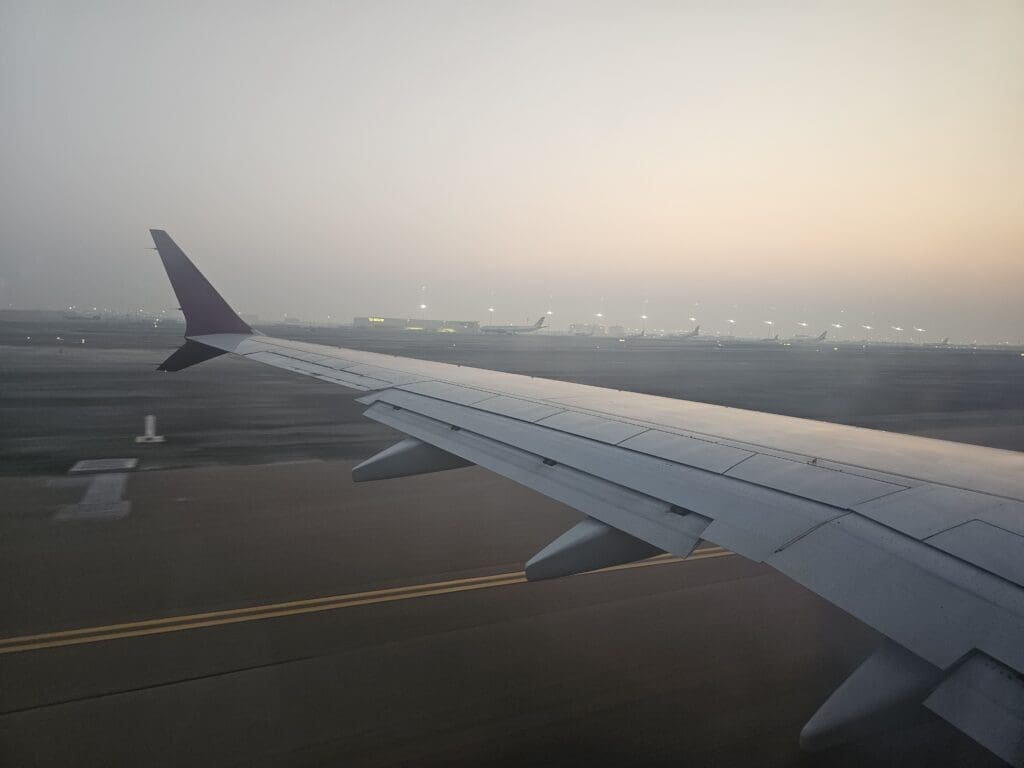
That morning, with a light breeze blowing in from the coast, the Boeing would depart from Runway 31L, and thus a relatively short taxi was in store. Soon, we came to a halt at the end of the runway and held there whilst an Etihad Airways Boeing 777-300ER whizzed past and touched down at the end of its flight from Mumbai. After this had passed us, the aircraft made its way onto the runway, at which point a row of ultra-luxurious Boeing 737 BBJs belonging to the locally based carrier Royal Jet could be seen along with several smaller business jets and a pair of Abu Dhabi Aviation Dash 8s.
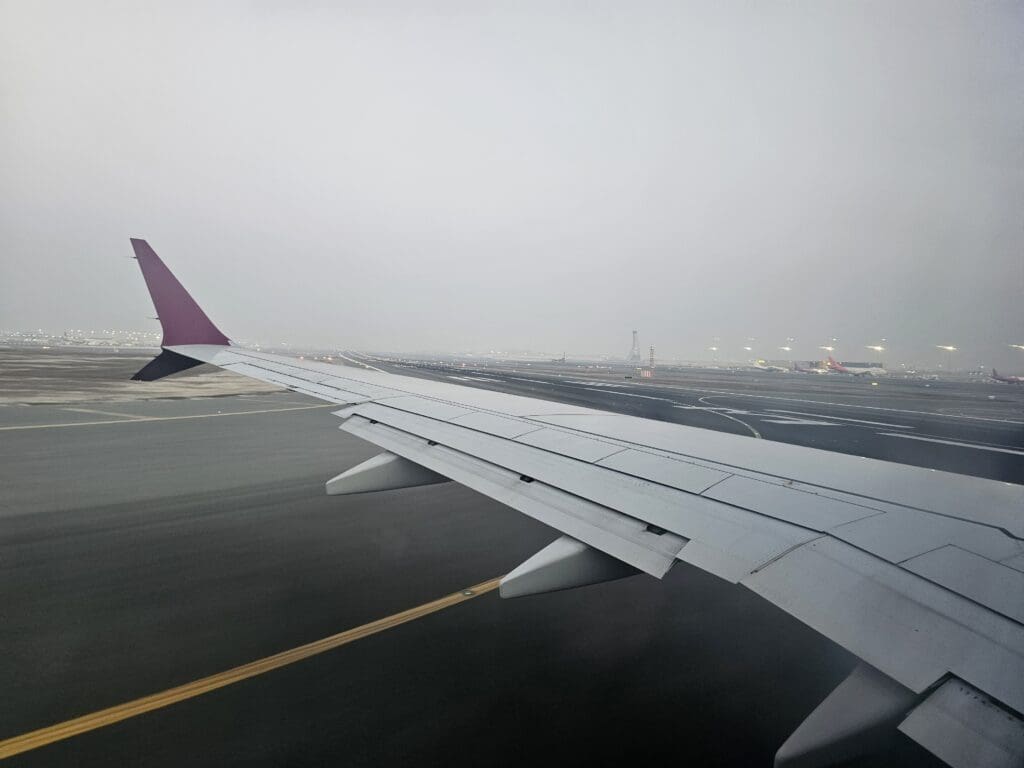
Once the Boeing 777 was clear of the runway, the two engines whined into life and we commenced our powerful take-off roll. Upon reaching the airport’s terminals, the Boeing rotated upwards and smoothly climbed into the morning misty skies of Abu Dhabi. From my seat on the port side of the aircraft, I was treated to good views of the terminal’s remote stands and maintenance areas where several interesting visitors including a Batik Air Airbus A320, an A350 once operated by Hong Kong Airlines and two long-stored ex-Norwegian Dreamliners could be seen along with the rail of a Deer Jet Boeing 787 BBJ poking out of the hangar. Next up was the luxury royal terminal.
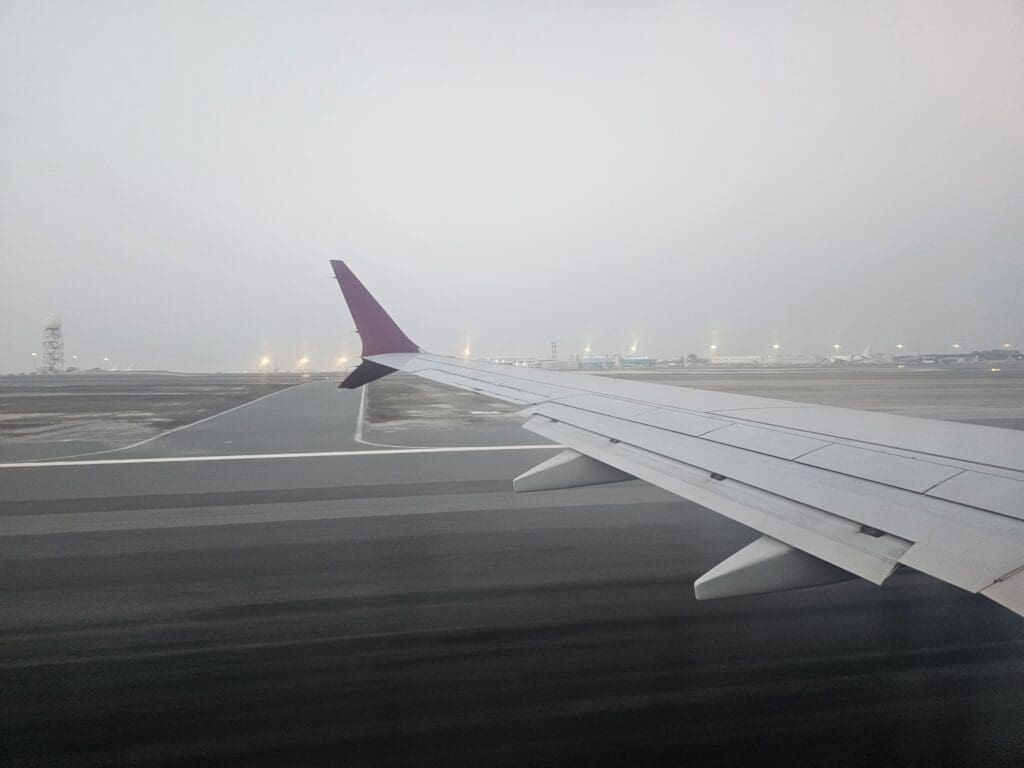
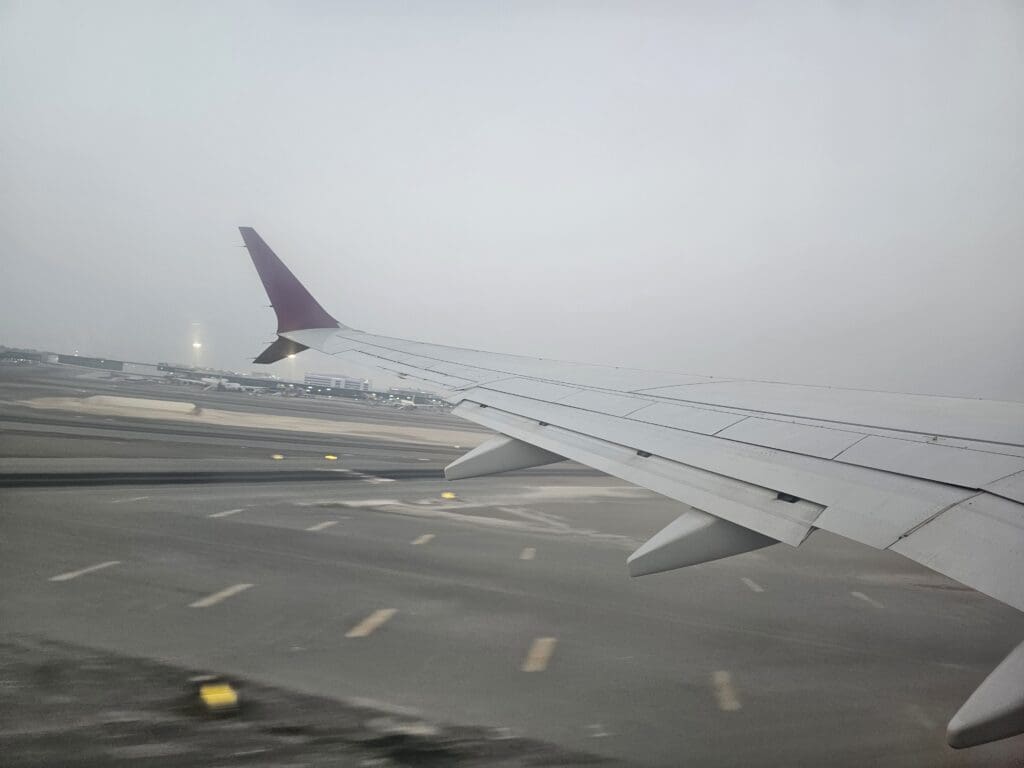
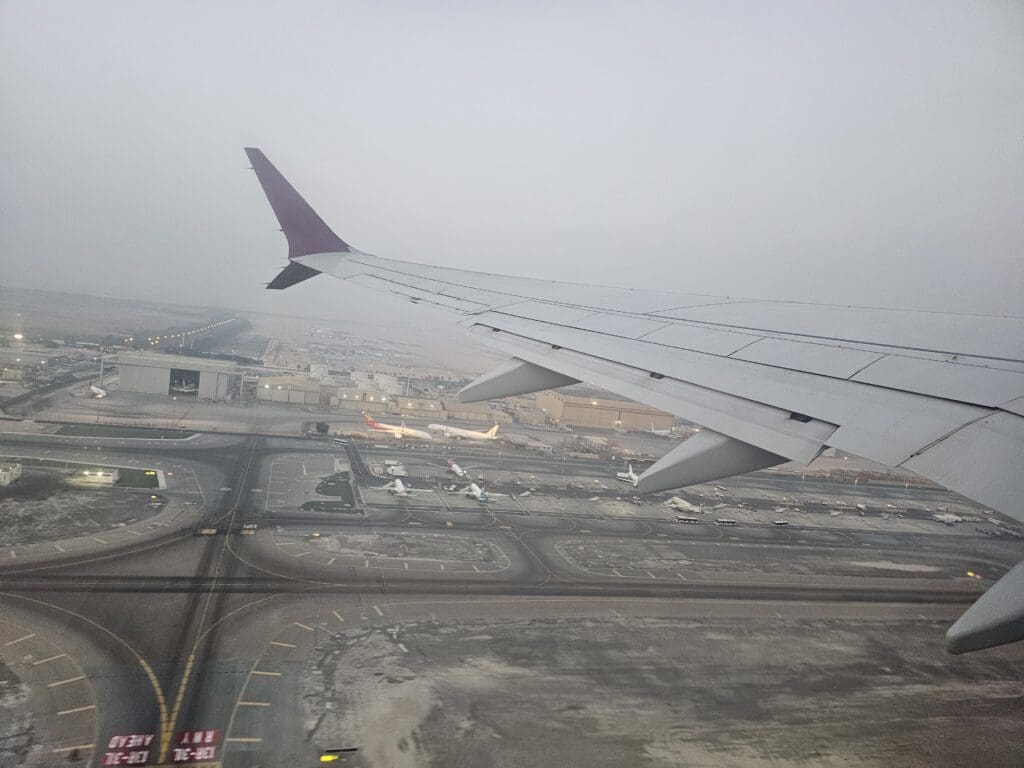
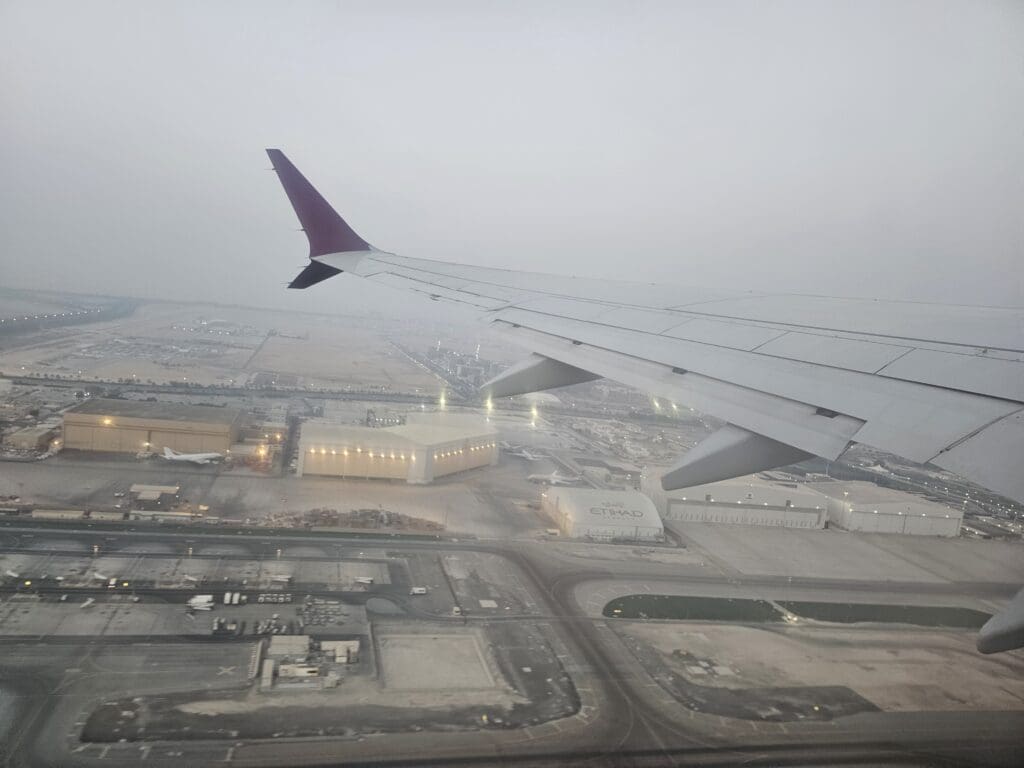
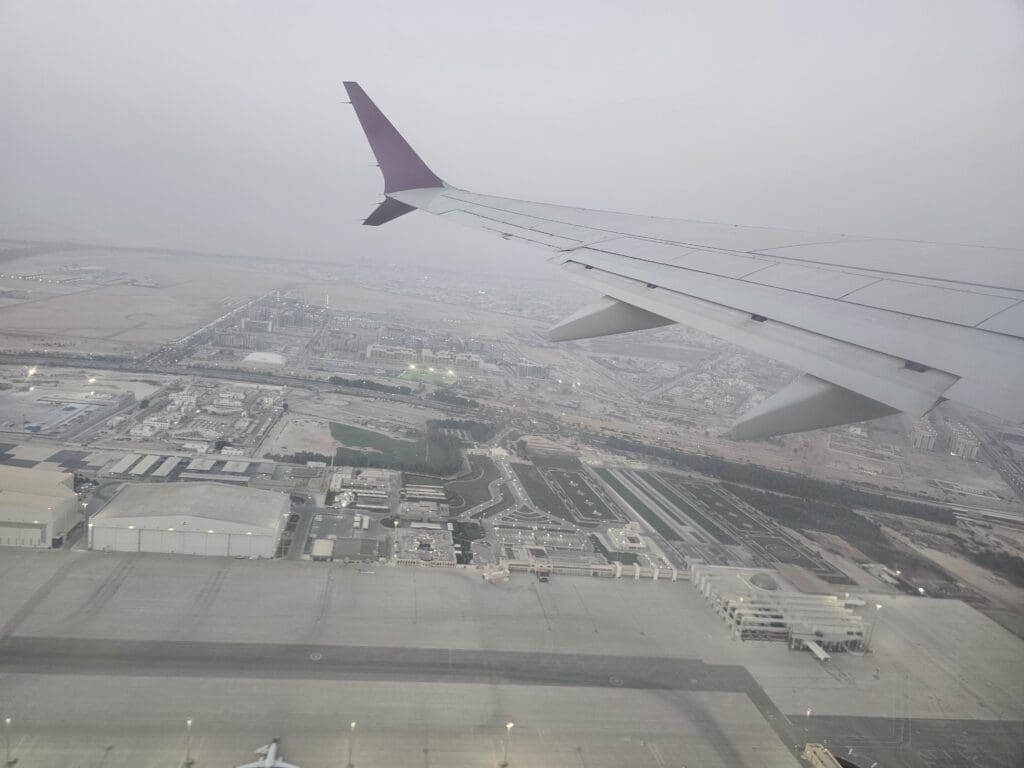
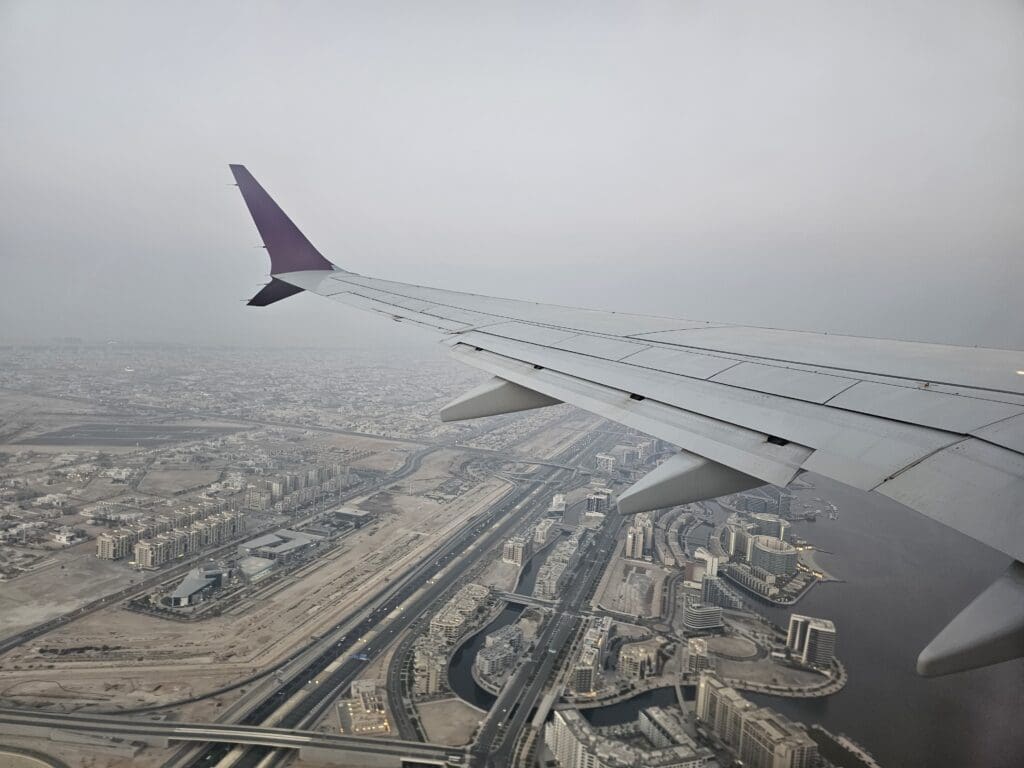
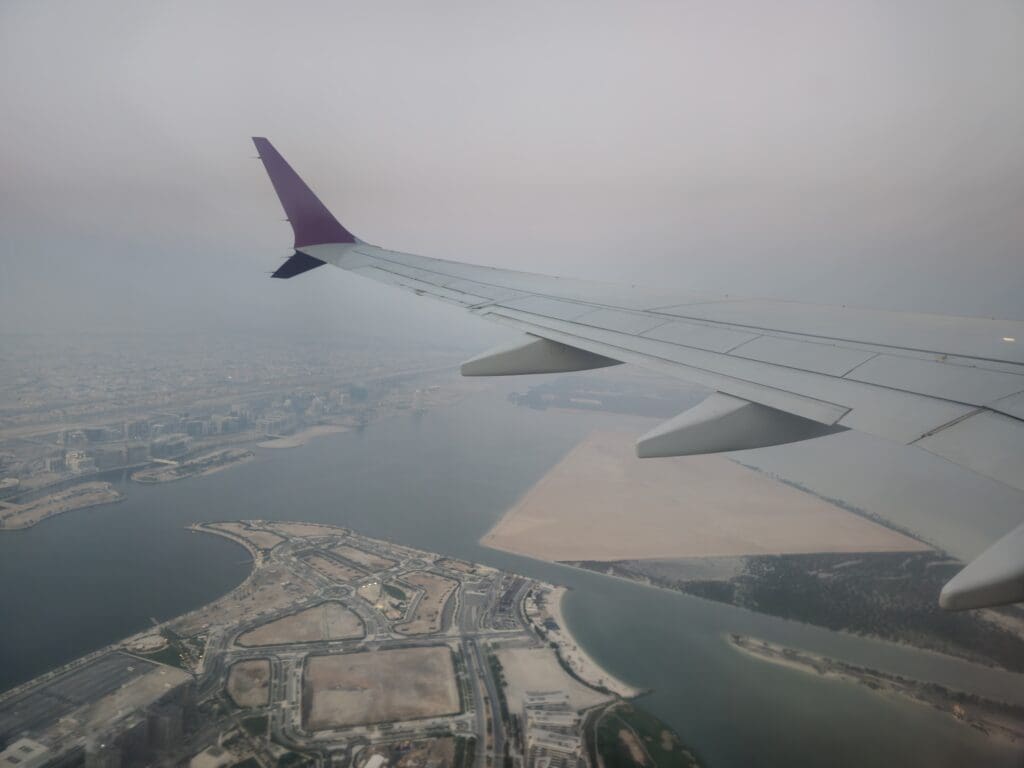
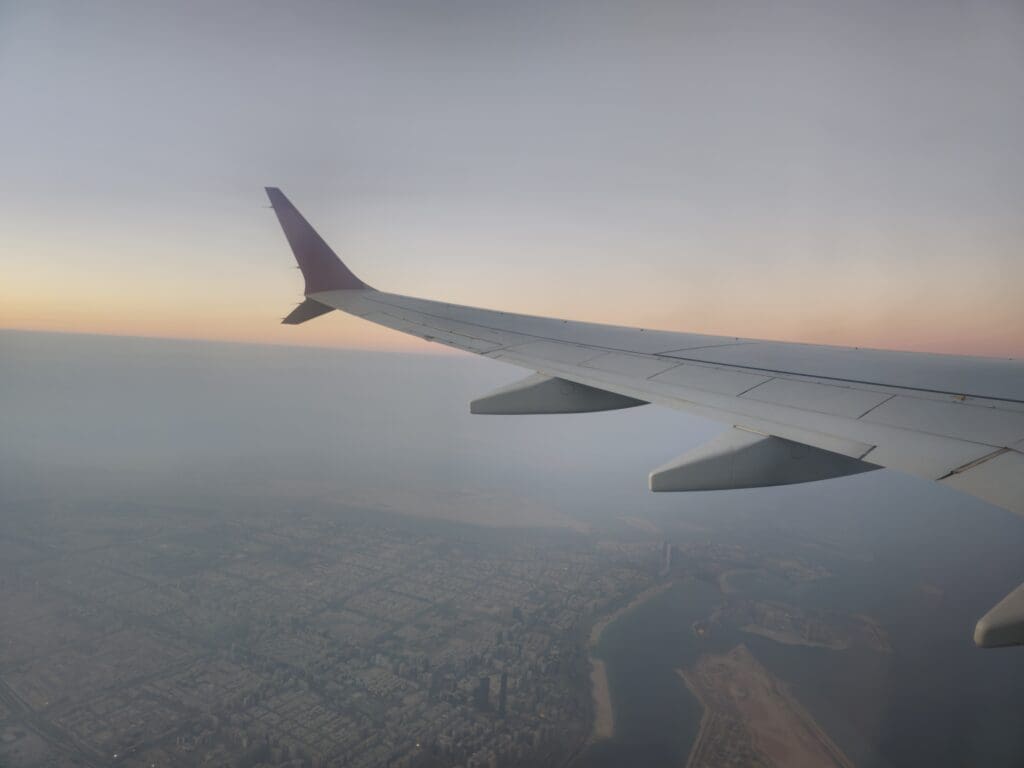
Upon leaving the airport behind, the Boeing almost immediately climbed out over Yas Bay and Al Raha Creek, making its way towards Al Jubail Island where the aircraft banked, rolling out on a heading that would take us roughly towards the centre of Abu Dhabi. Four minutes after our departure, the Corniche and Al Lulu Island appeared, providing one last view of the United Arab Emirates before we headed out over the waters of the Arabian Gulf.
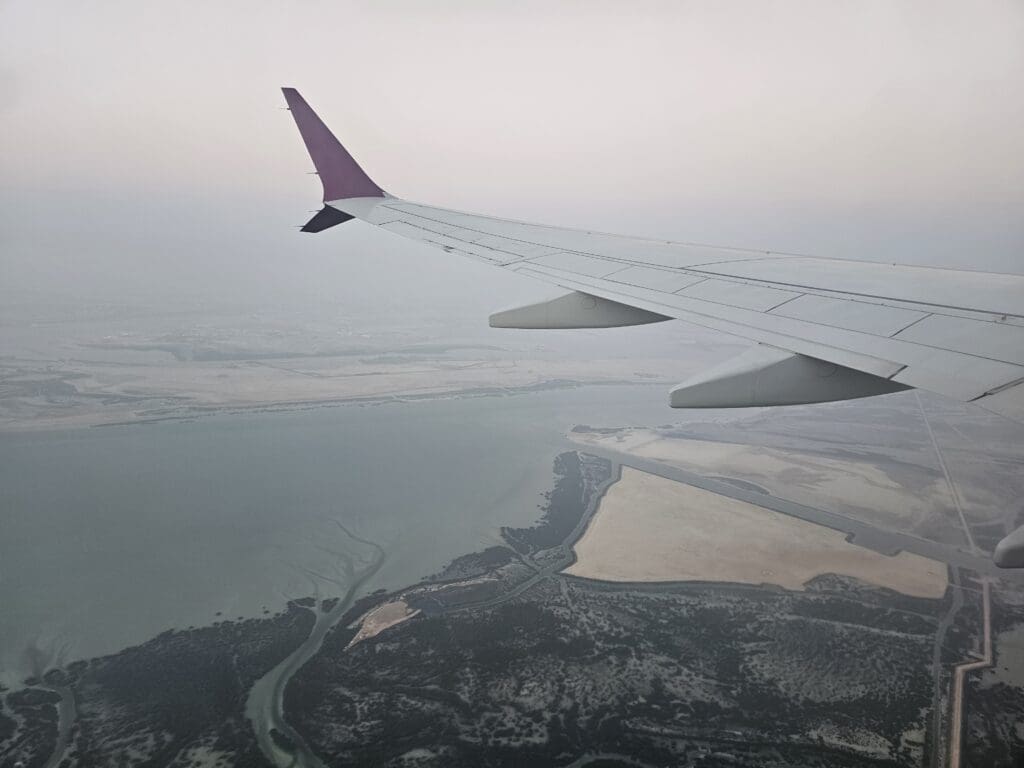
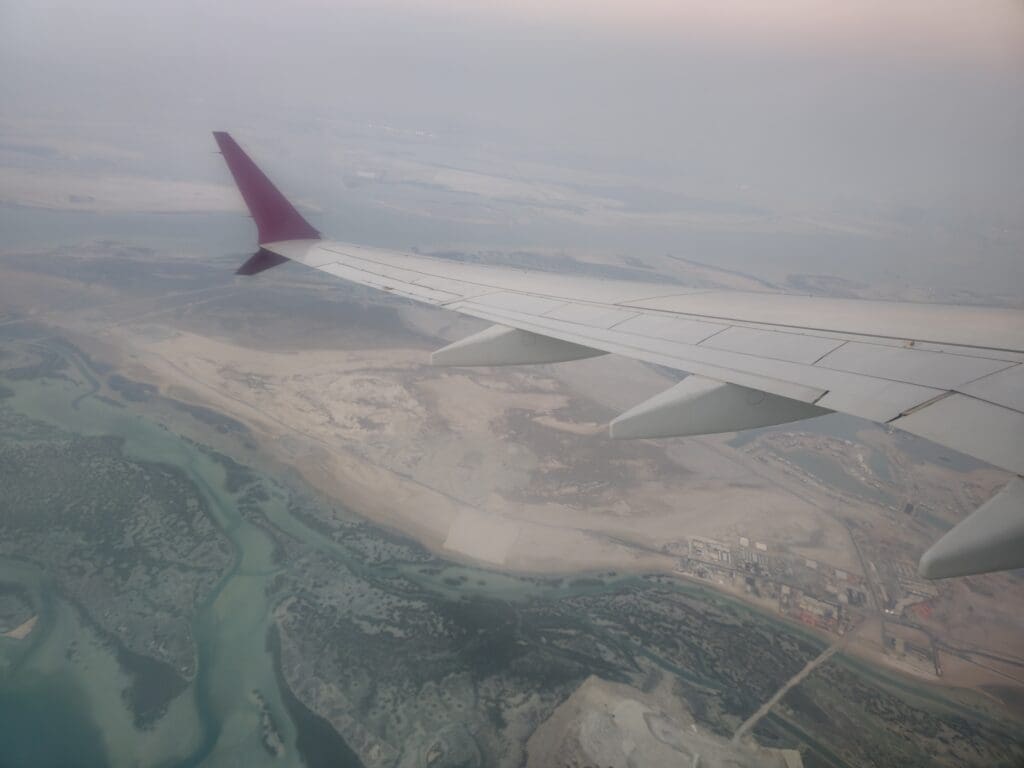
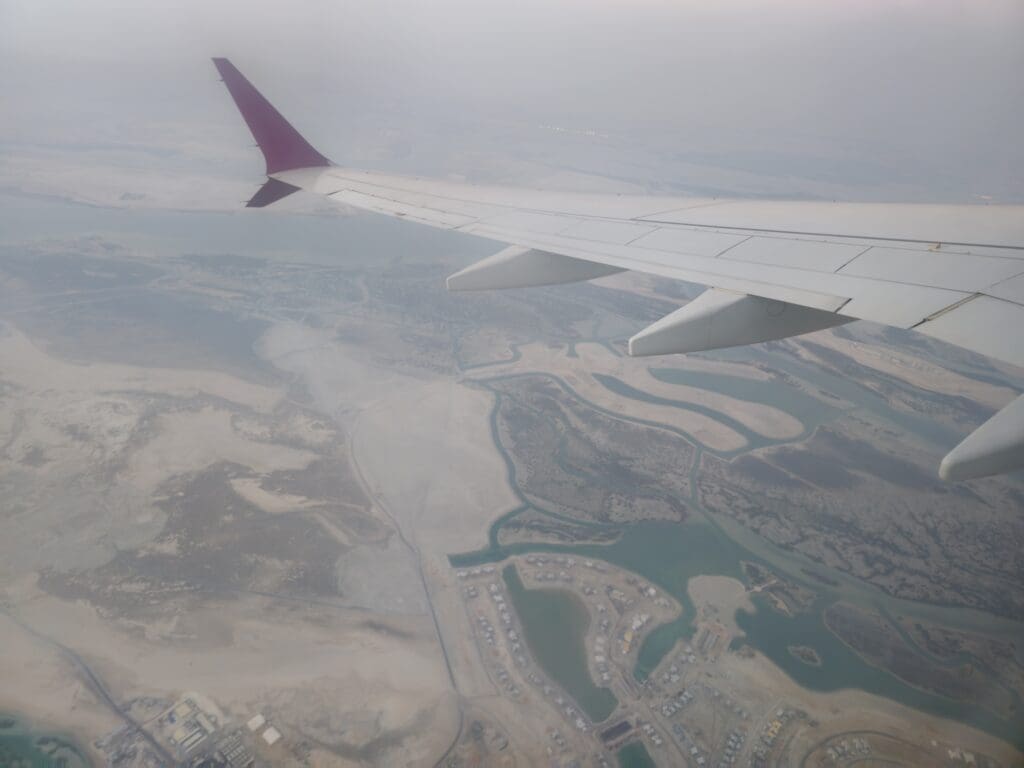
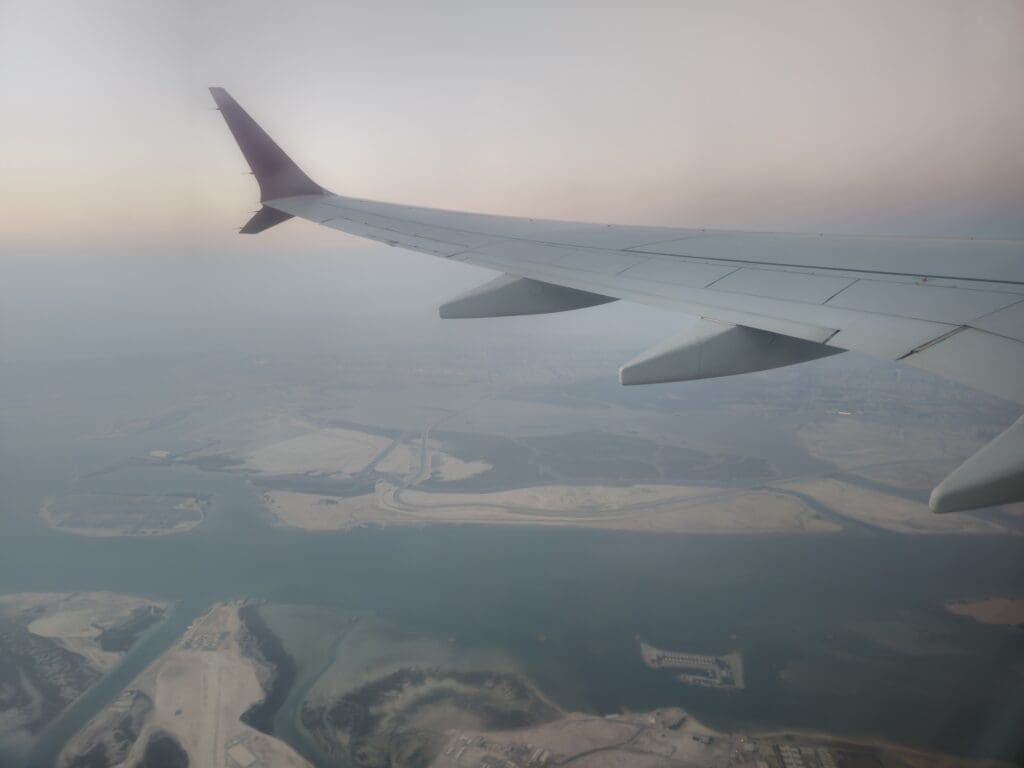
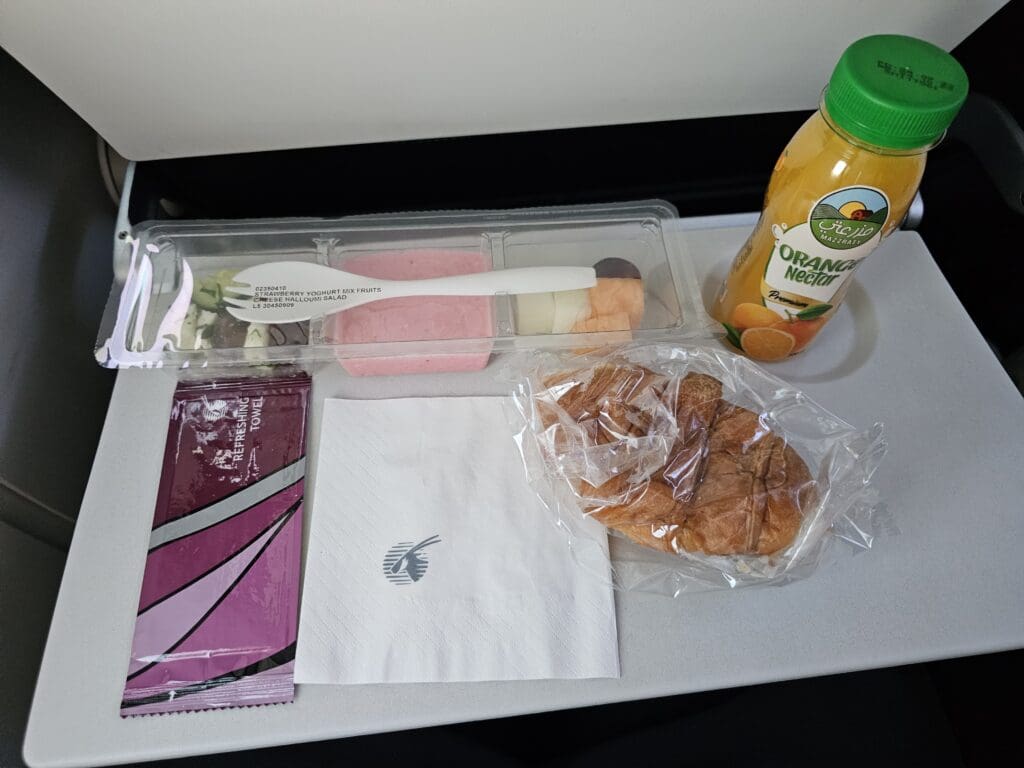
After leaving the Corniche behind, the crew took to the aisles at which point the onboard service commenced. Wasting no time nor resources, four crew members undertook this service in Economy with one trolley serving those in the front half of the cabin, whilst the other started at the exits in the middle and worked rearwards. Working diligently yet not sacrificing friendly or polite service, I was soon handed the offering onboard the flight. This came in the form of a warm packaged croissant, a plastic container with three small dishes – an olive and halloumi salad, a strawberry yoghurt and a small fruit salad, and a small bottle of orange juice. This was accompanied by a serviette adorned with Qatar Airways’ oryx logo and a packaged wet wipe. No other drinks were offered, although this was completely understandable given the short duration of the flight. Soon getting to work on the offerings, whilst someone hailing from France would have likely complained about the quality of the slightly soggy croissant, I was left with nothing to make a complaint about and soon polished this off.
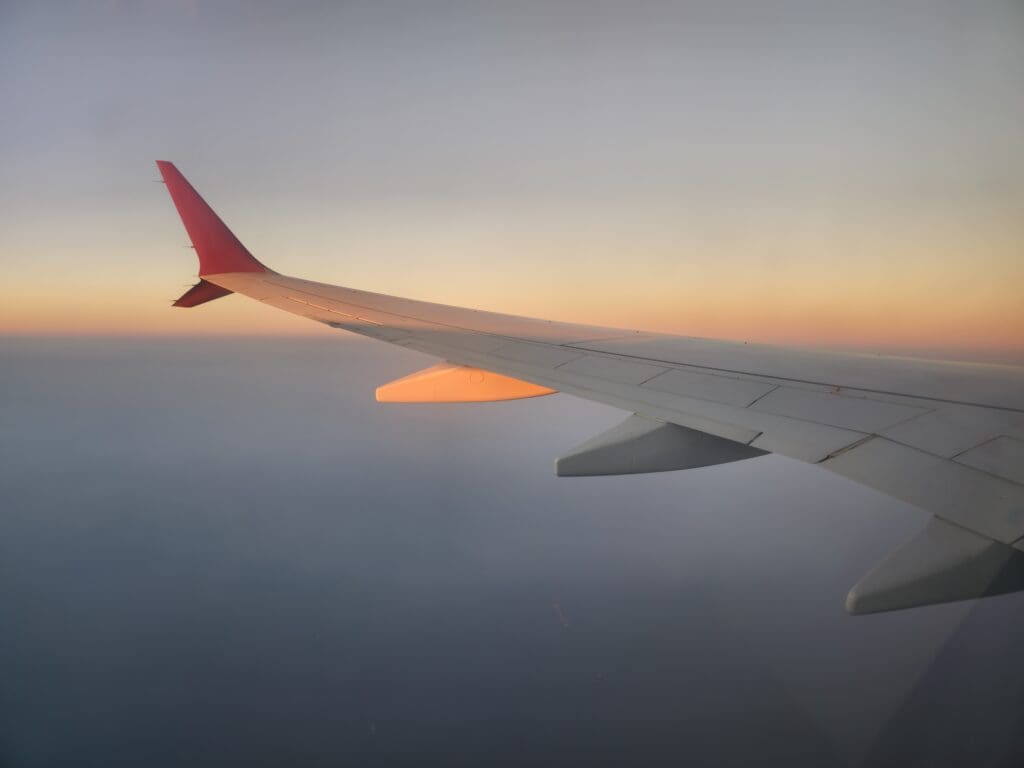
As the aircraft cruised over the blue waters of the Gulf, I was treated to picturesque dawn scenes with the orangey-yellow glow illuminating the cabin as we sped towards Qatar. At this point, I decided to have a quick explore of the Oryx One Play service. Connecting to the onboard wifi network without issue, I was pleased to find this to offer an easy-to-navigate and quick-to-load streaming system providing the same massive selection of content as on Qatar Airways’ seatback inflight entertainment systems, with a range of other features such as a moving map, plenty of information on Qatar Airways and its home, Qatar.
Heading westwards, there was little to be seen below although I did manage to catch a glimpse of the islands of Mubarraz and Bu Tinah, both being part of the Emirate of Abu Dhabi. As we passed the latter, the aircraft levelled off at its cruising altitude a grand total of fourteen minutes after departure. At this point, the Captain’s voice filled the cabin once more as they announced that we would shortly be commencing our descent into Doha and thanked passengers for flying with Qatar Airways. This was followed by the Purser’s pre-arrival announcement and soon the crew passed through the cabin collecting the remains of the breakfast service.
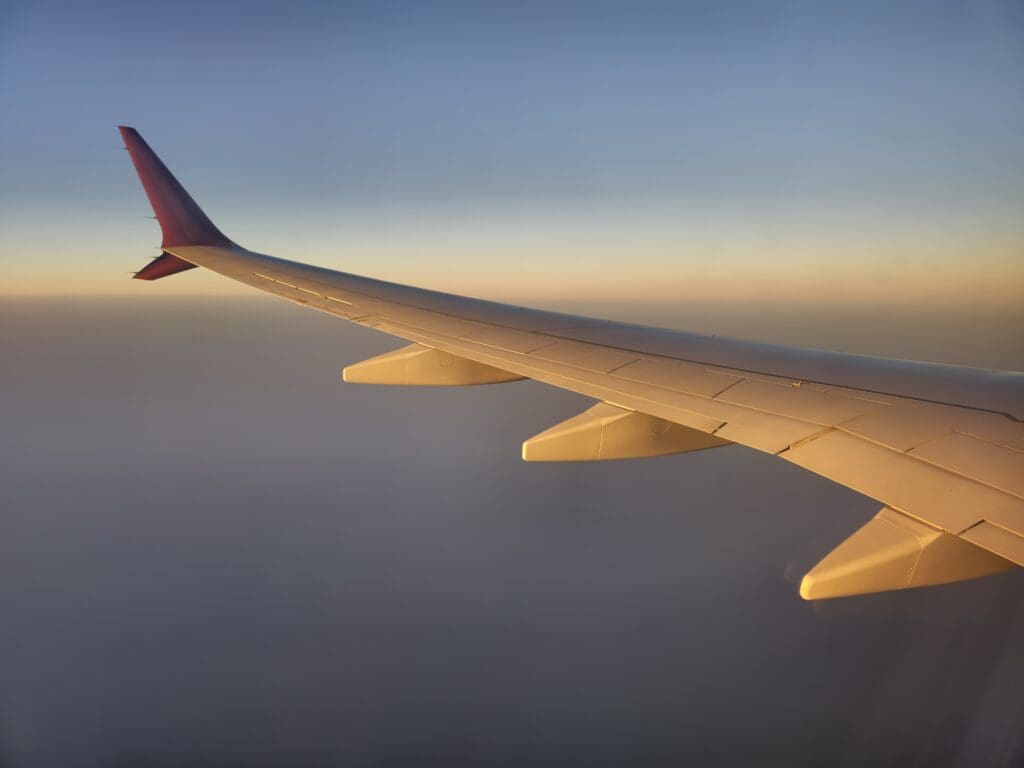
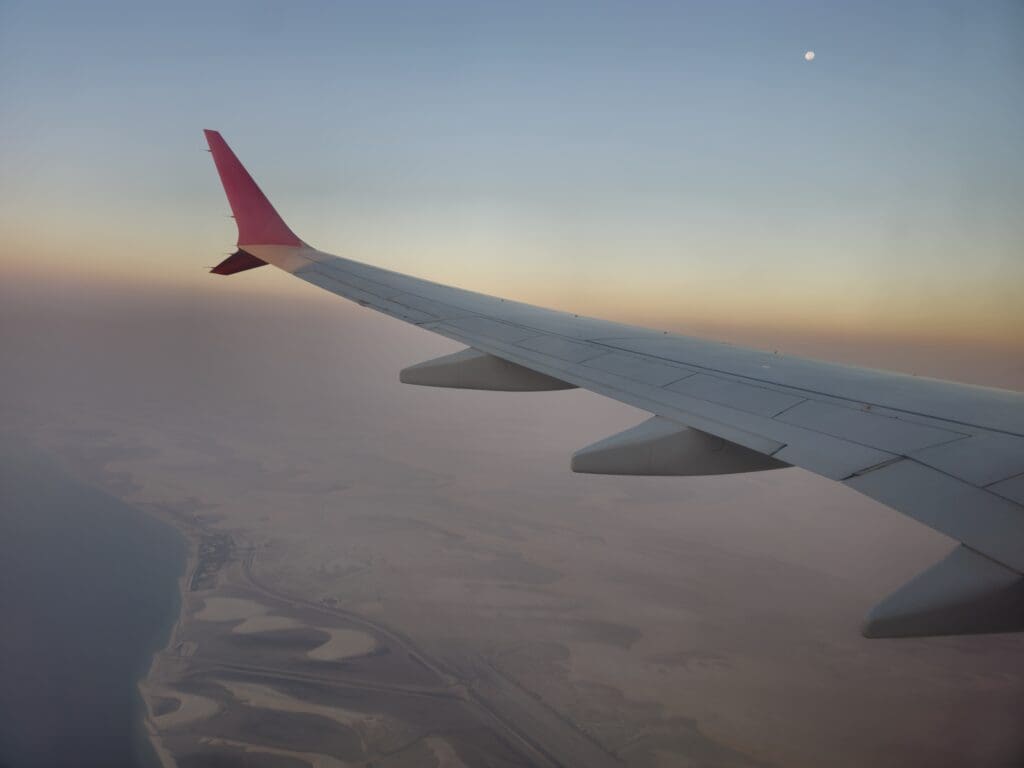
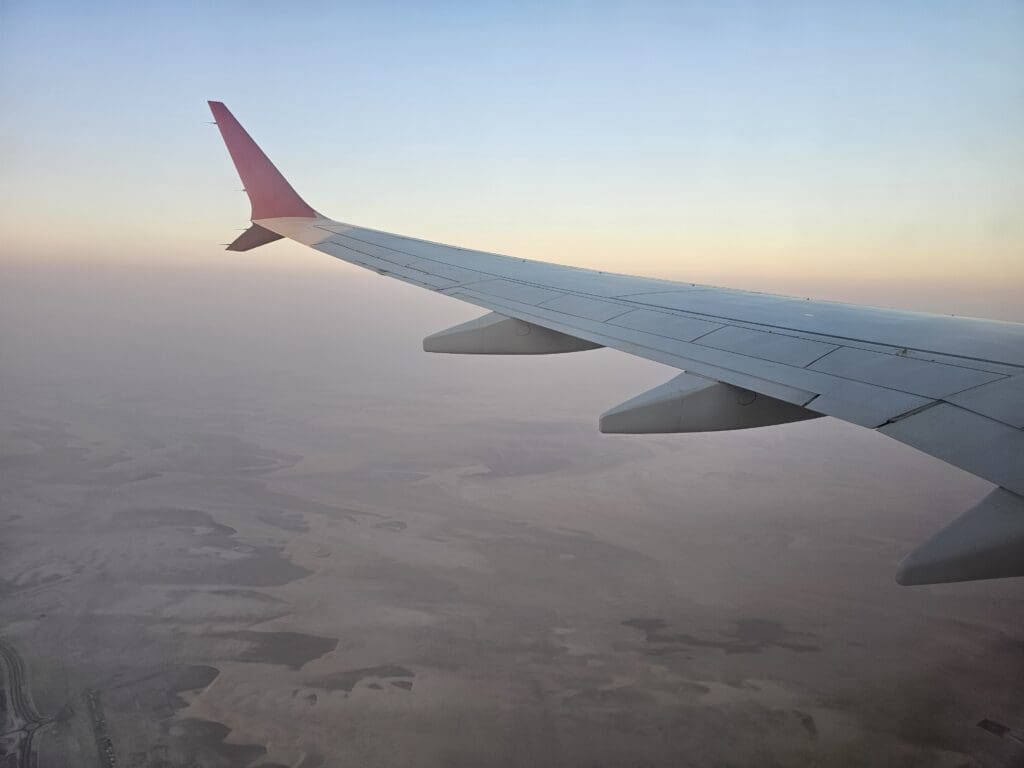
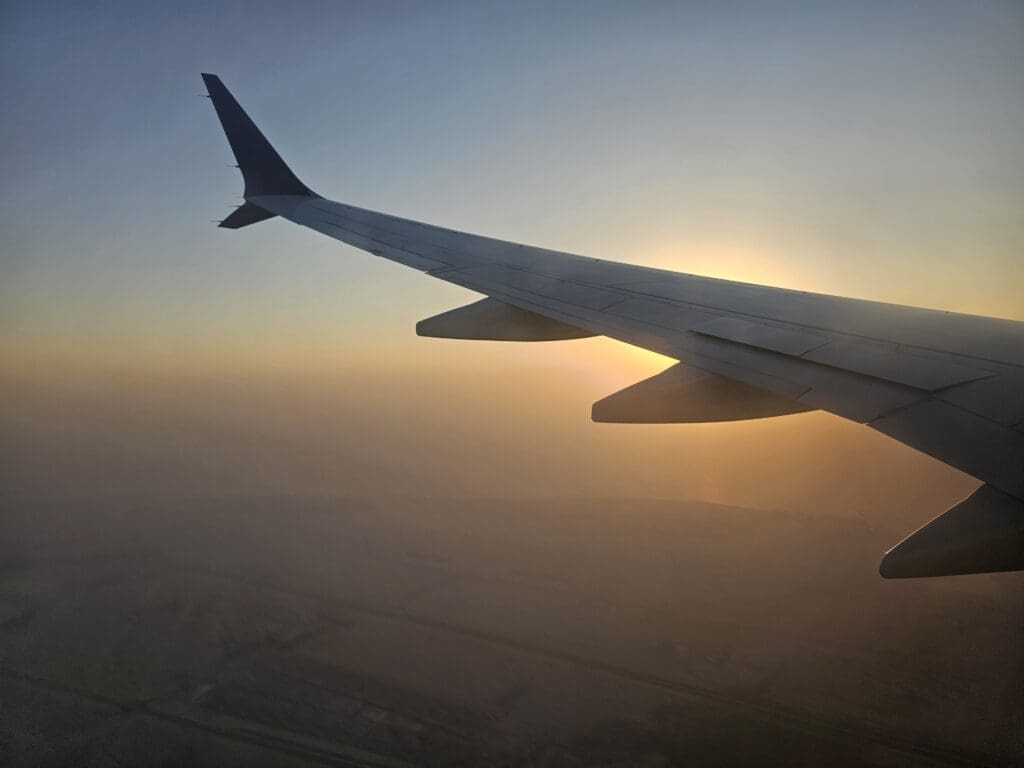
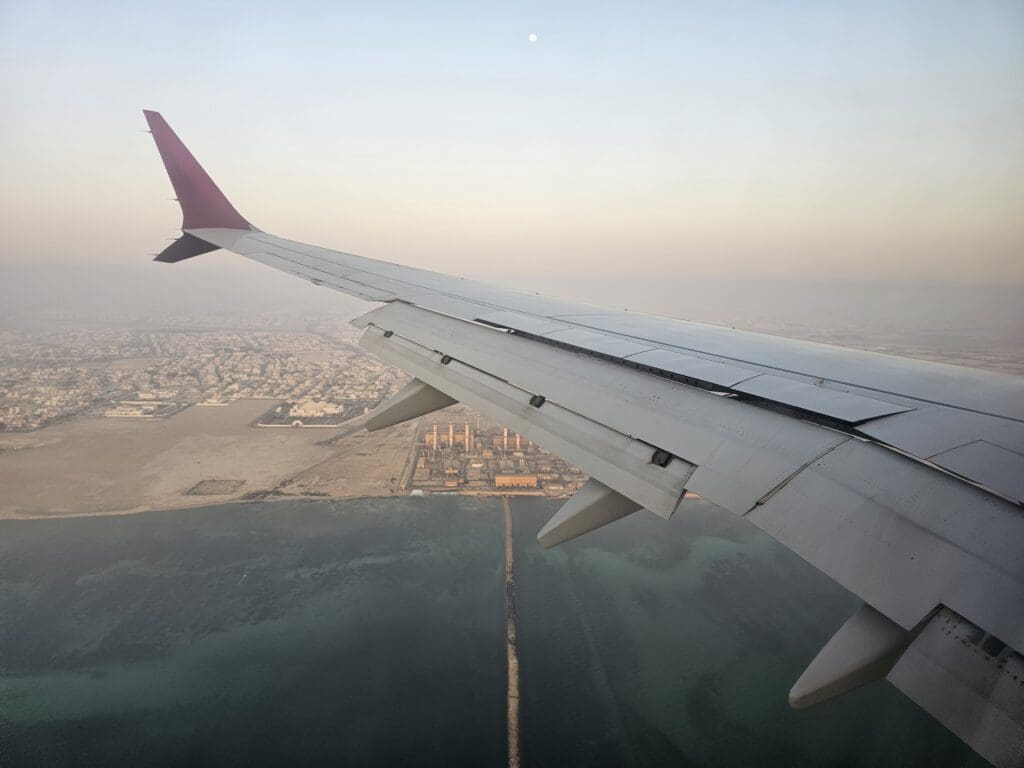
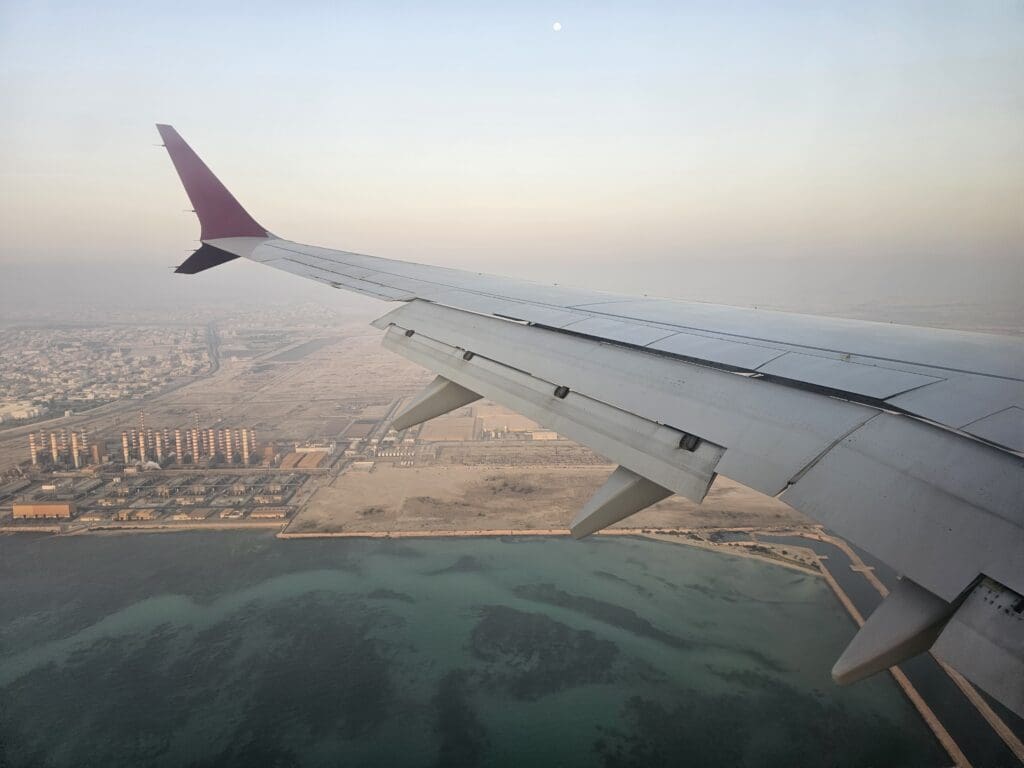
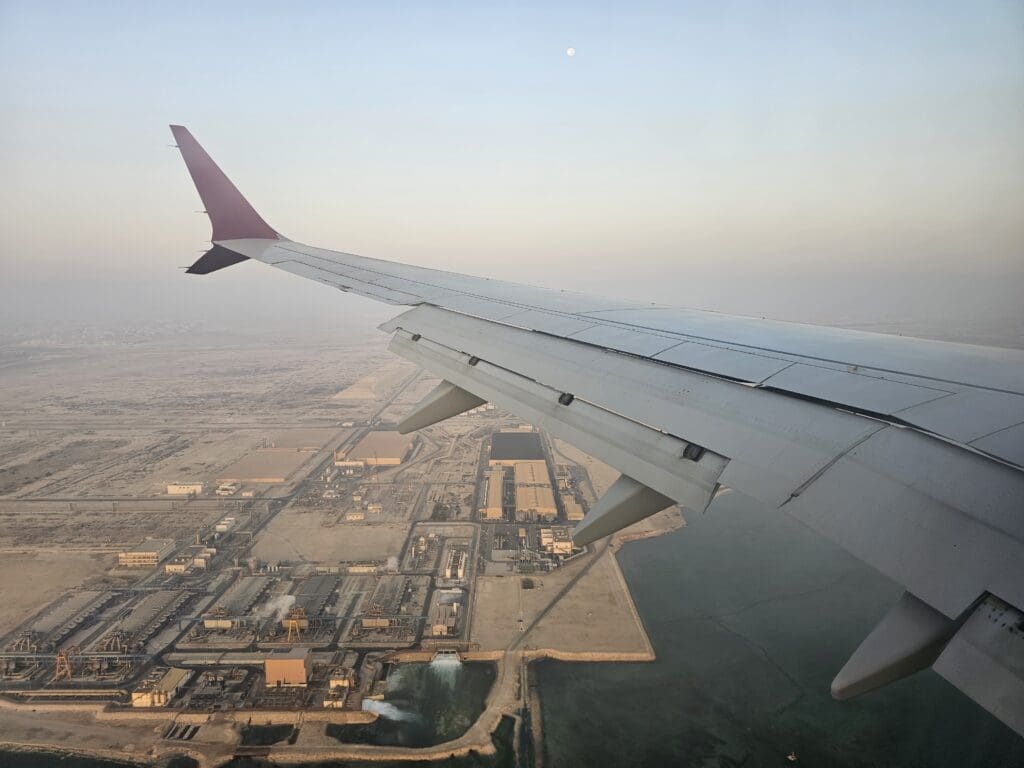
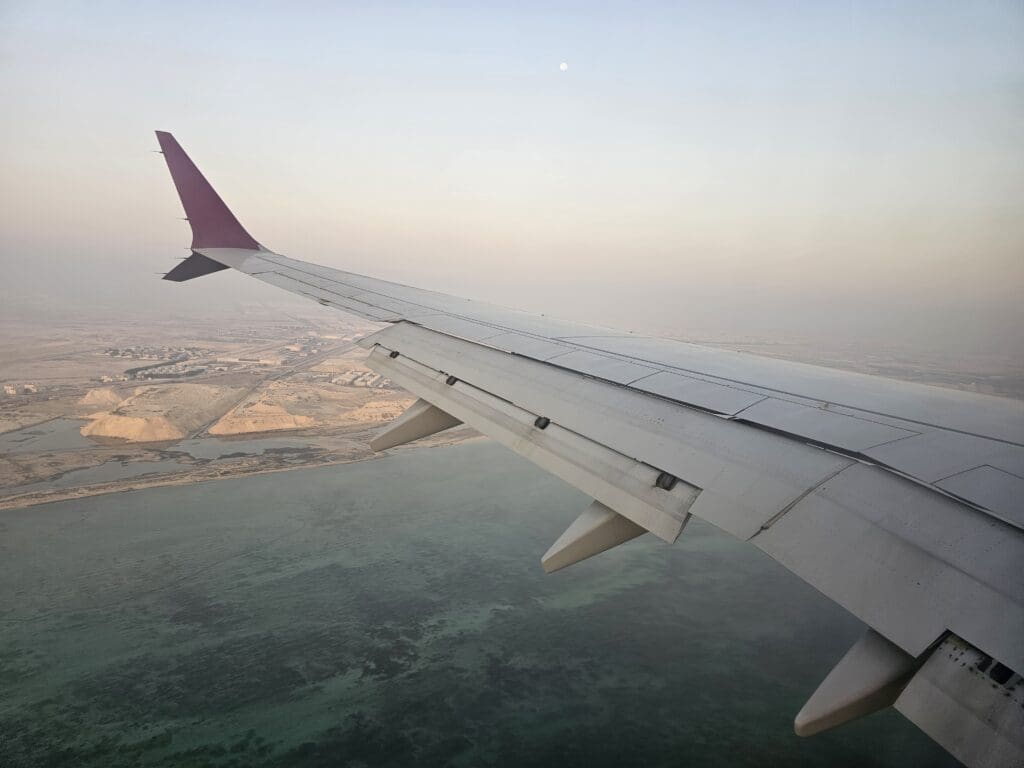
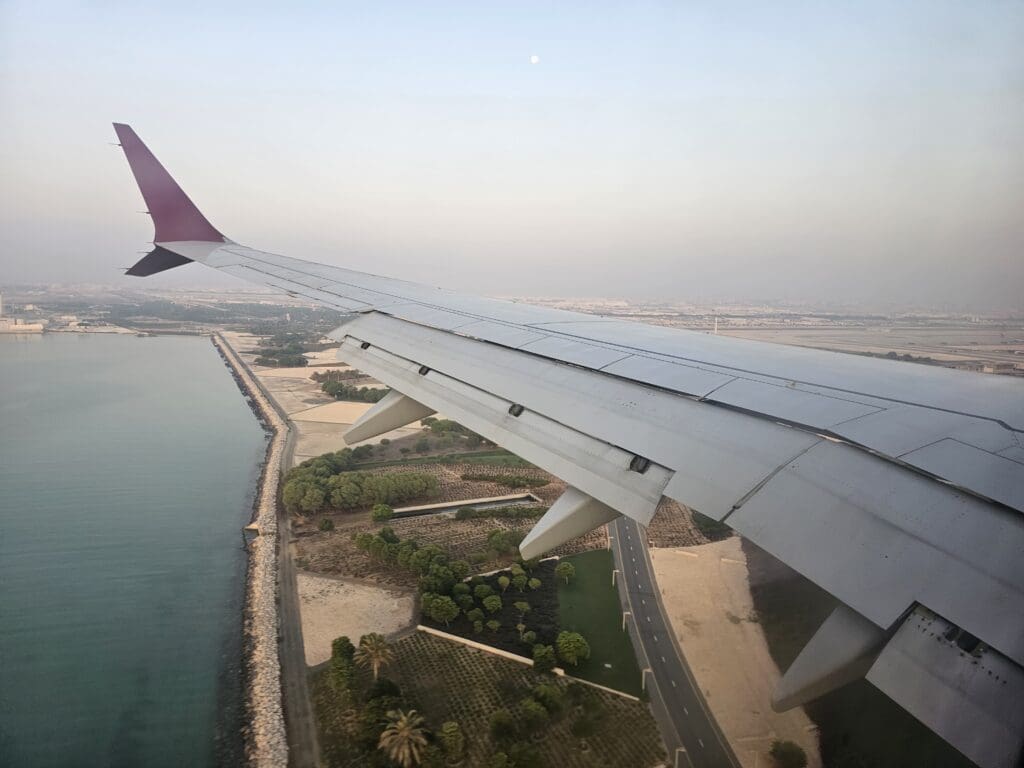
Upon reaching the island of Arzanah, which, like the others we had passed during the flight sits in the Emirate of Abu Dhabi, just seven minutes after levelling off the aircraft could be felt commencing its descent. At this point, the crew undertook one final pass through the cabin to ensure all was in place for our arrival. Outside, we soon crossed over the sandy shores of Qatar, making landfall near the city of Mesaieed. Heading northwards towards Doha, upon reaching the town of Birkat Al Awamer, which lies just beyond the capital’s southern fringes, the aircraft turned south away from the city and sped towards the massive but almost empty Hamad Container Port. From there, we turned north once again as the flaps dropped into position and we lined up for an approach to Doha Hamad’s Runway 34L.
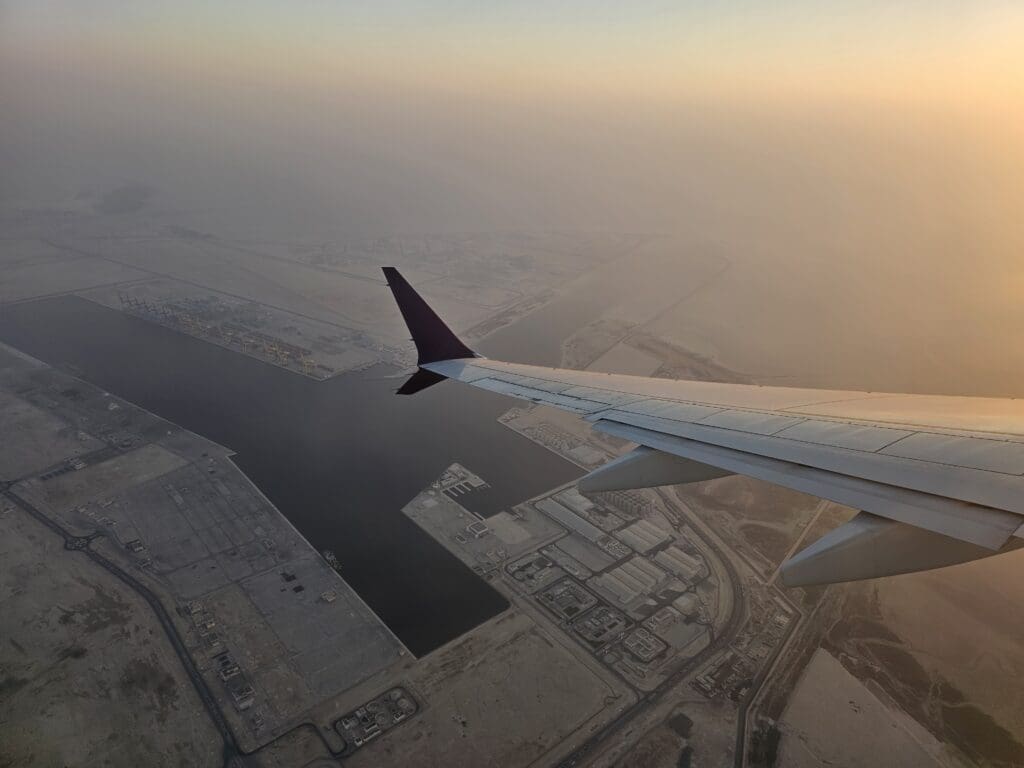
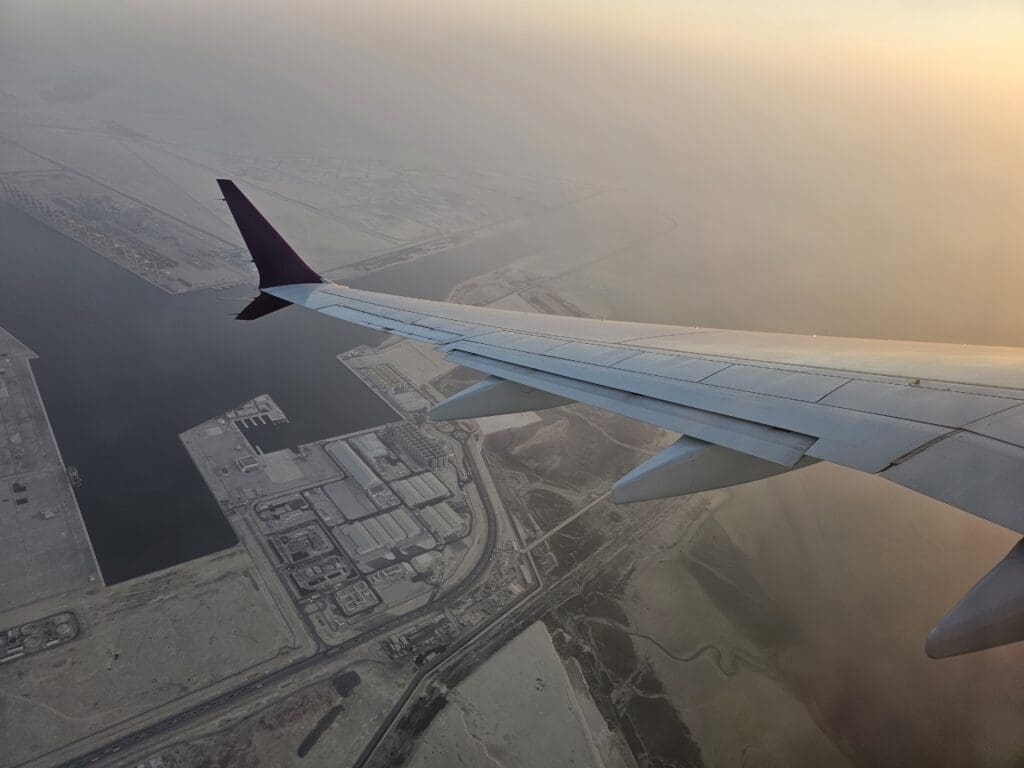
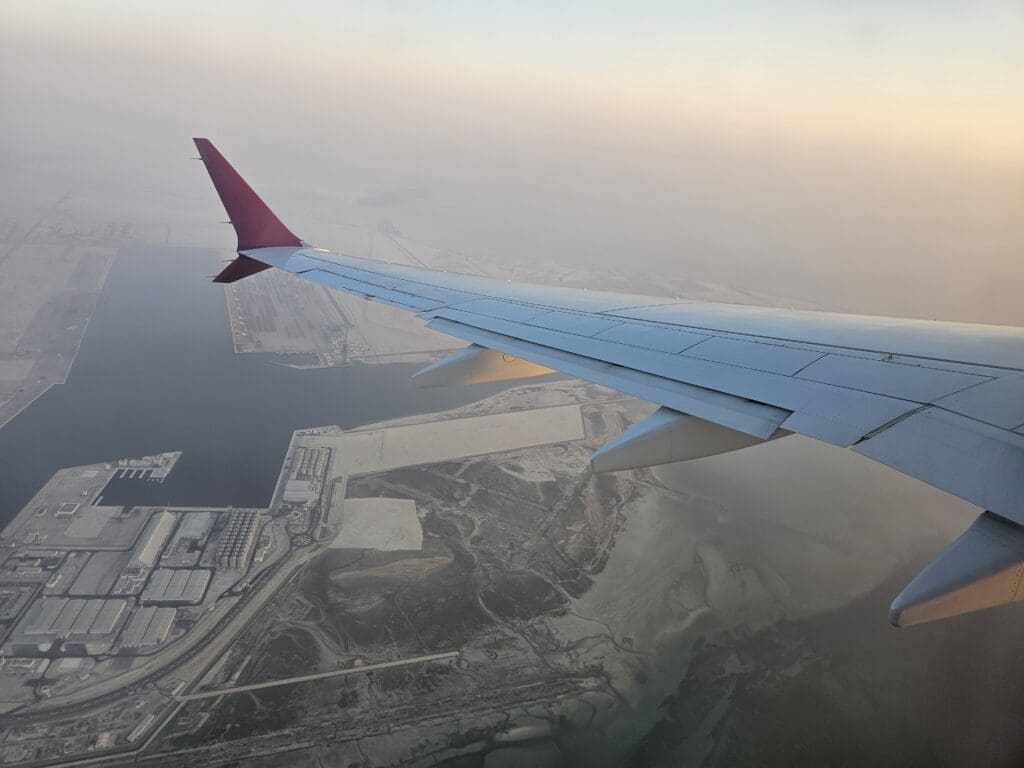
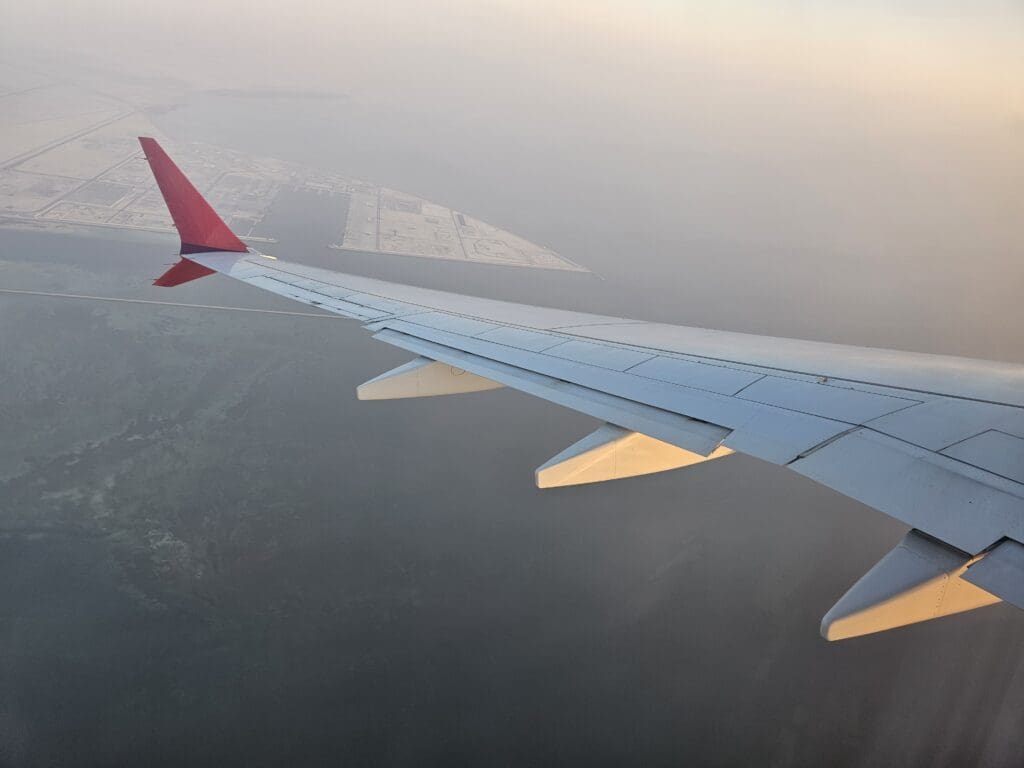
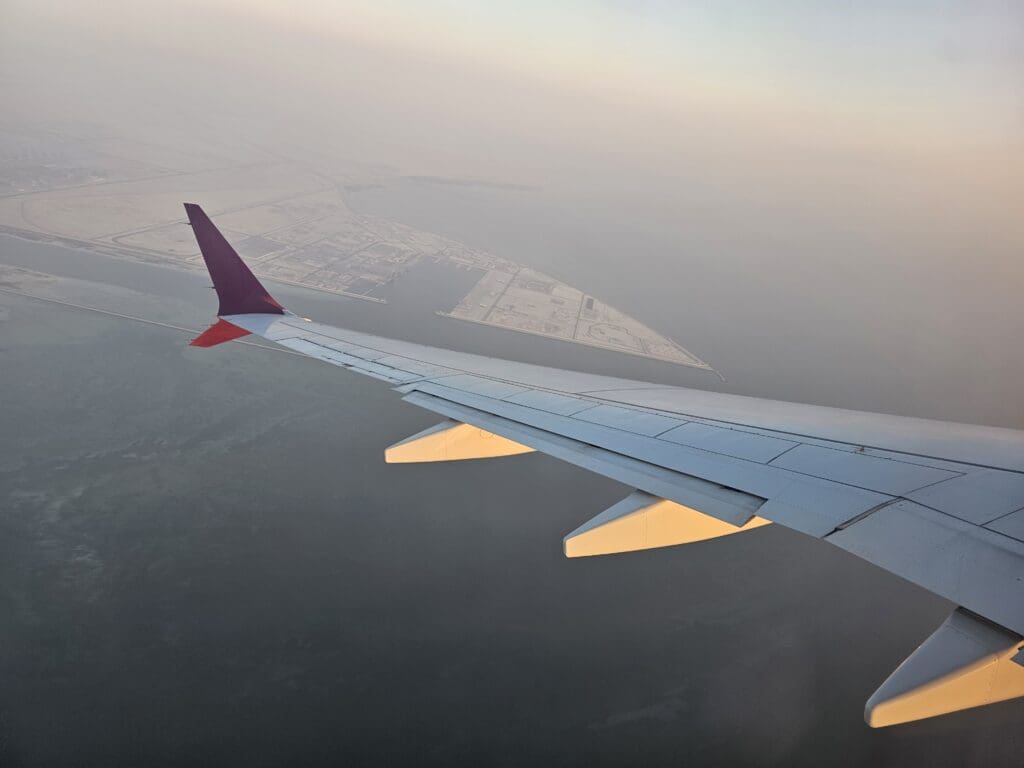
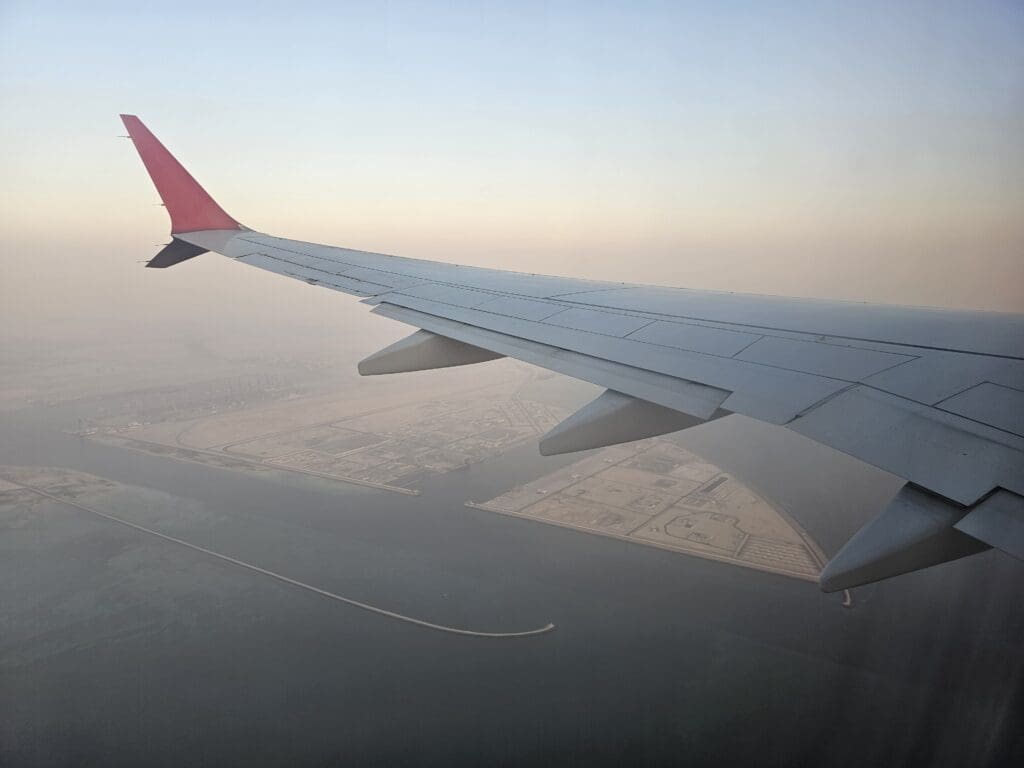
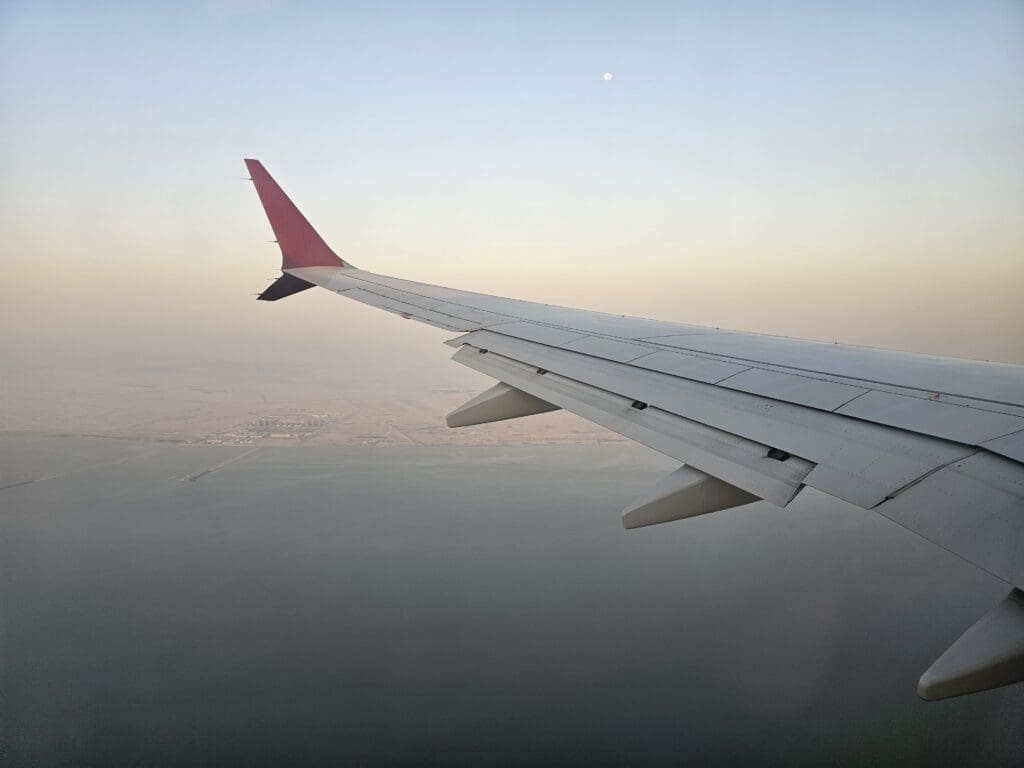
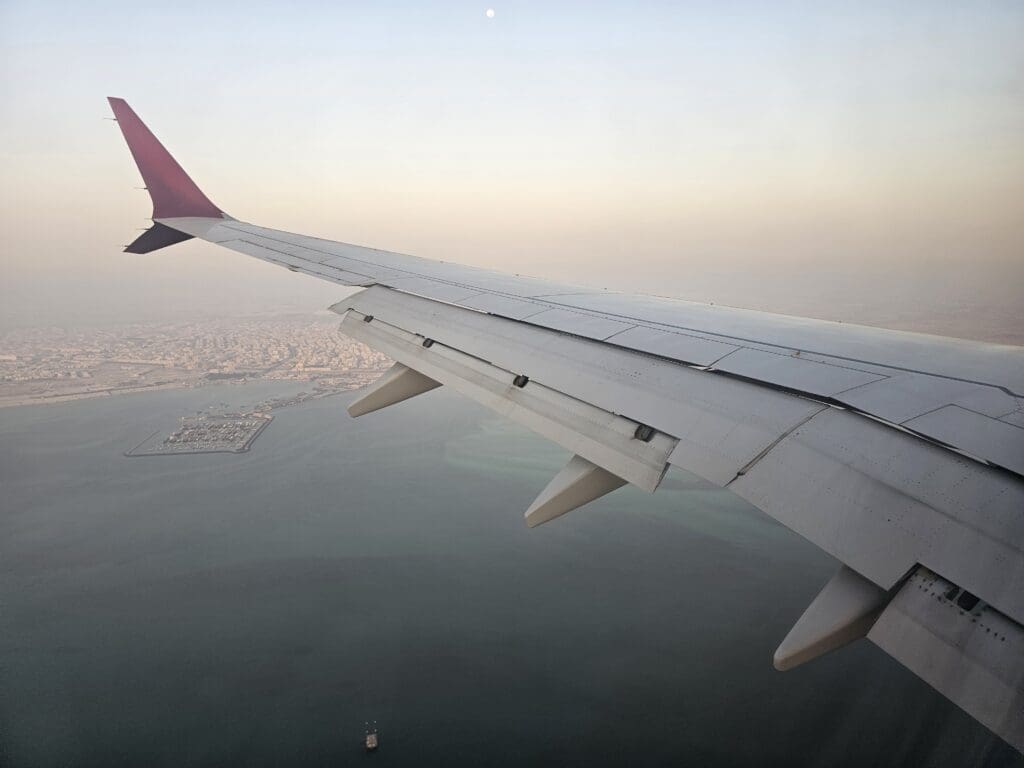
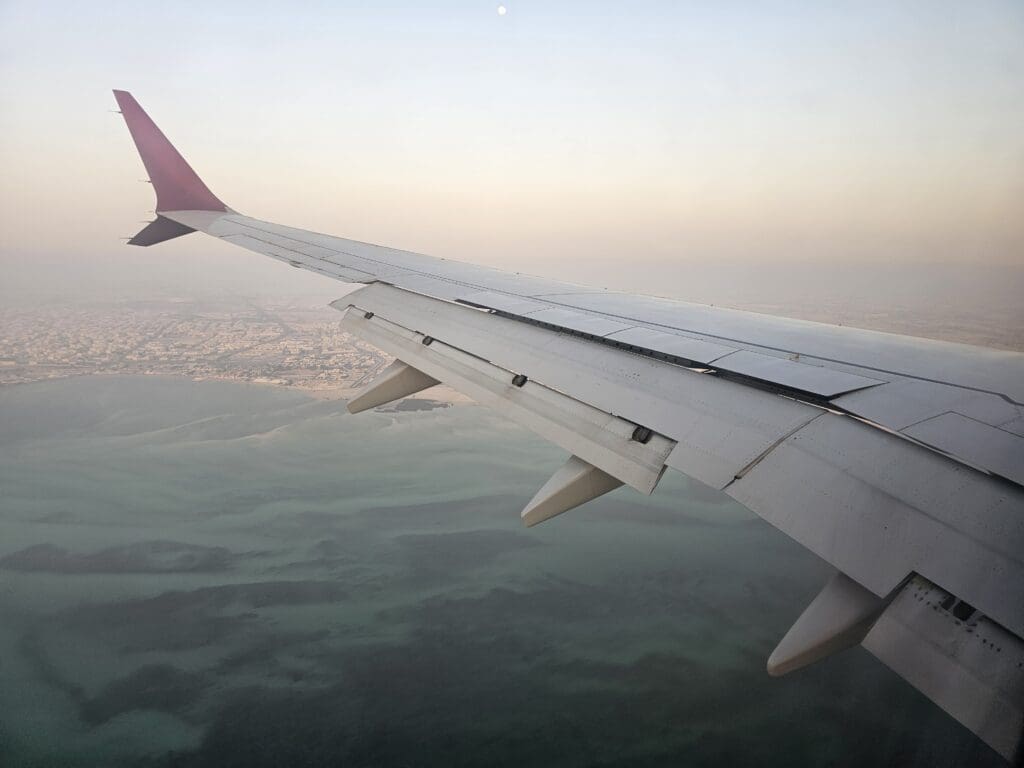
As we trundled up the coastline towards Doha, the city of Al Wakrah could be seen alongside a cluster of industrial facilities. A few short moments later, the Boeing sank over the green southern perimeter, which, were planespotting to be an acceptable pastime in Qatar (apparently it’s not), would have proven to be a wonderful place to watch the morning arrivals. Reaffirming the fact that we were landing in Qatar, it wasn’t long before a sea of Qatar Airways jets of all sizes could be seen at remote stands. Ending our smooth 45-minute flight over from Abu Dhabi, the aircraft touched down on Runway 34L with a thud before decelerating with some vigour either to minimise our taxi time or clear the runway before the next arrival.
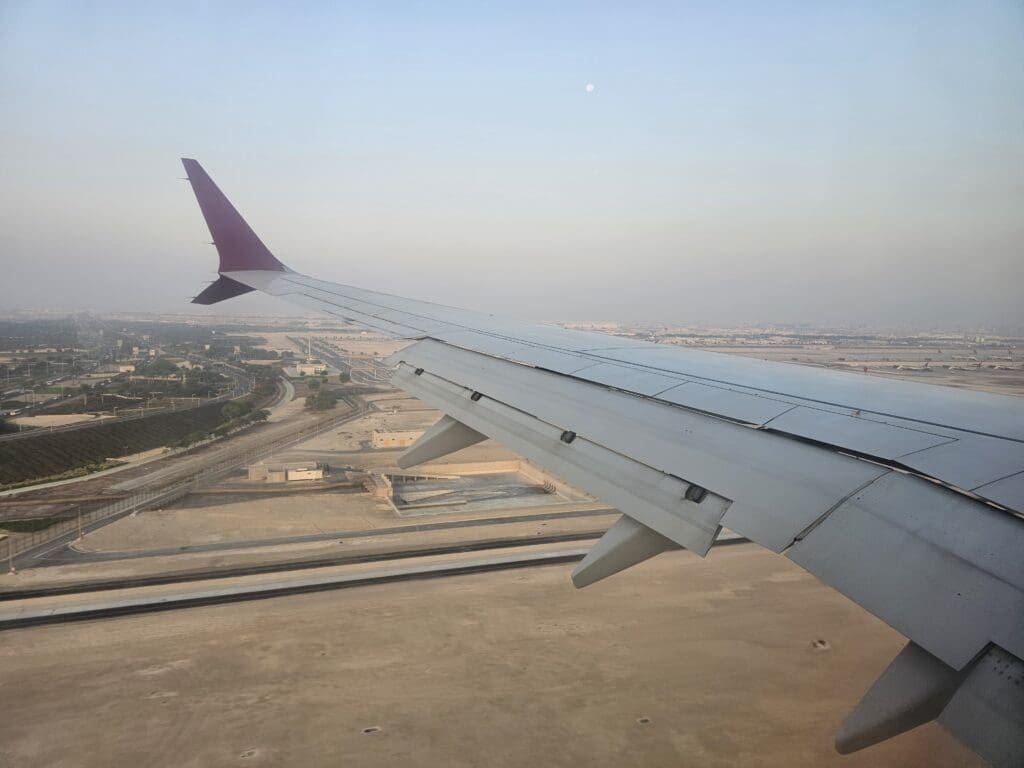
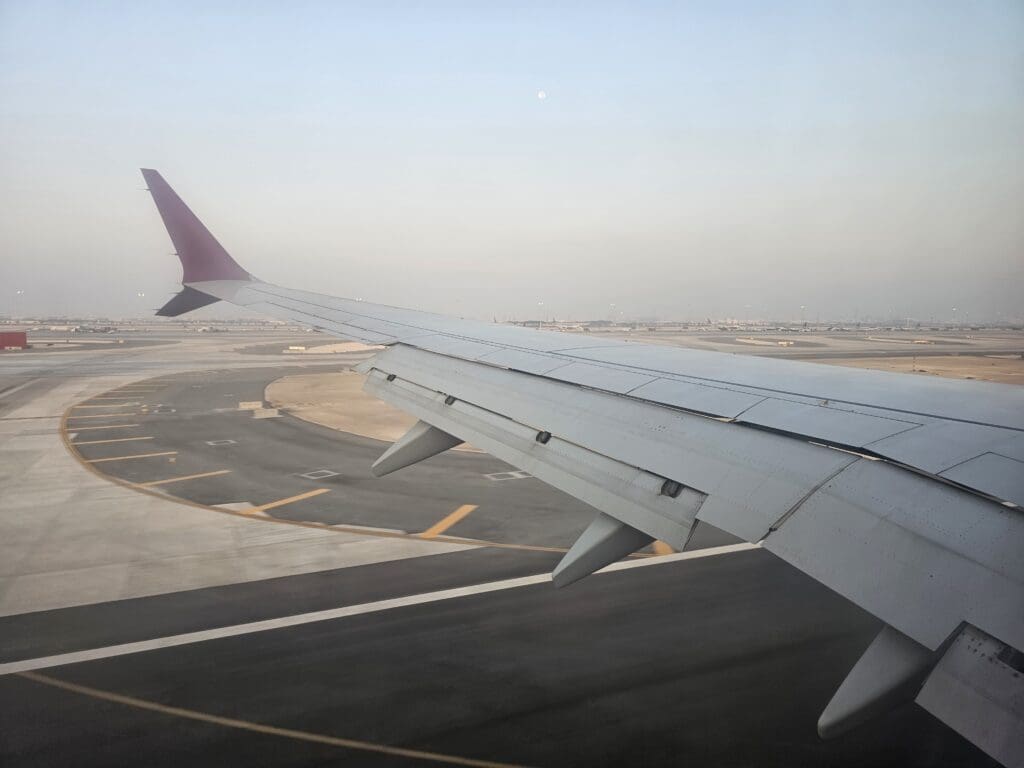
Indicating that we would be ending the journey at a remote stand, soon the aircraft vacated the runway to the left at which point the purser welcomed all to Doha and advised passengers to remain seated – an instruction which all thankfully obeyed. A few minutes later, the Boeing slowed as it neared a cluster of remote stands where plenty of Airbus A320s and Boeing 737 MAXs could be seen waiting for their next missions. Turning into the stand, once the aircraft came to a halt the cabin jumped up as if in a rush to exit the aircraft and there seemed to be some slight commotion at the very front of the aircraft as Economy passengers attempted to storm the Business cabin. As expected, ground operations in Doha seemed to be a well-oiled machine and almost as soon as the engines spooled down, a set of airstairs appeared, as did the luxury bus reserved for the exclusive use of those travelling in Business. This was soon replaced by two standard Cobuses for those in Economy, at which point we regular folks were allowed to disembark.
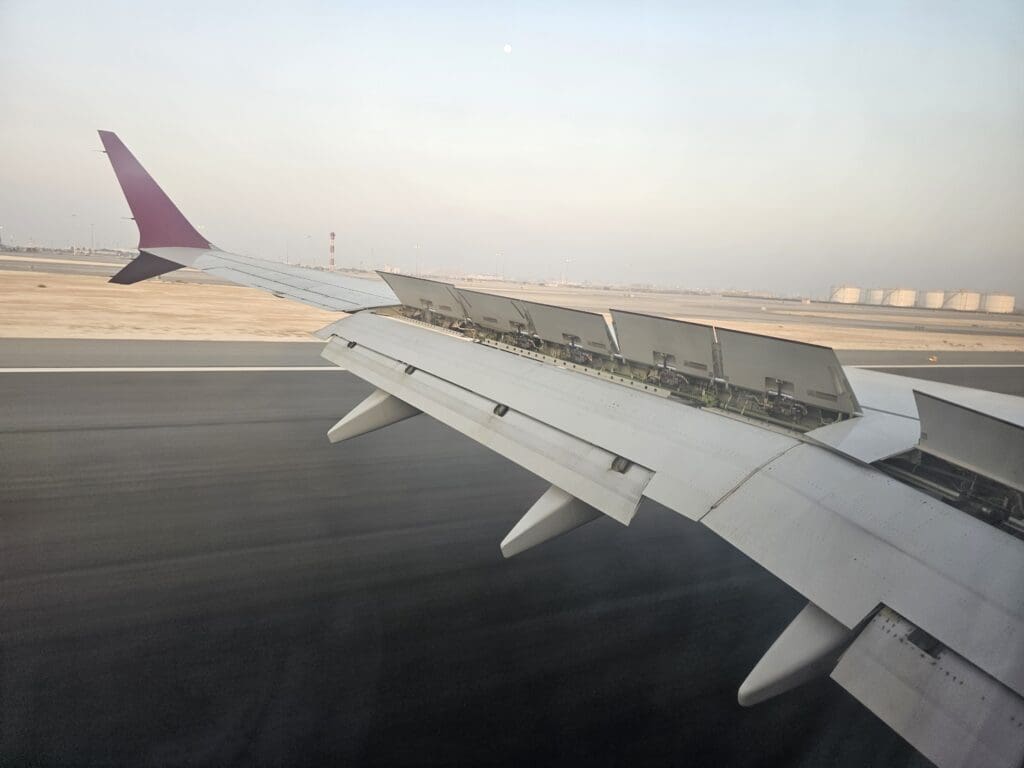
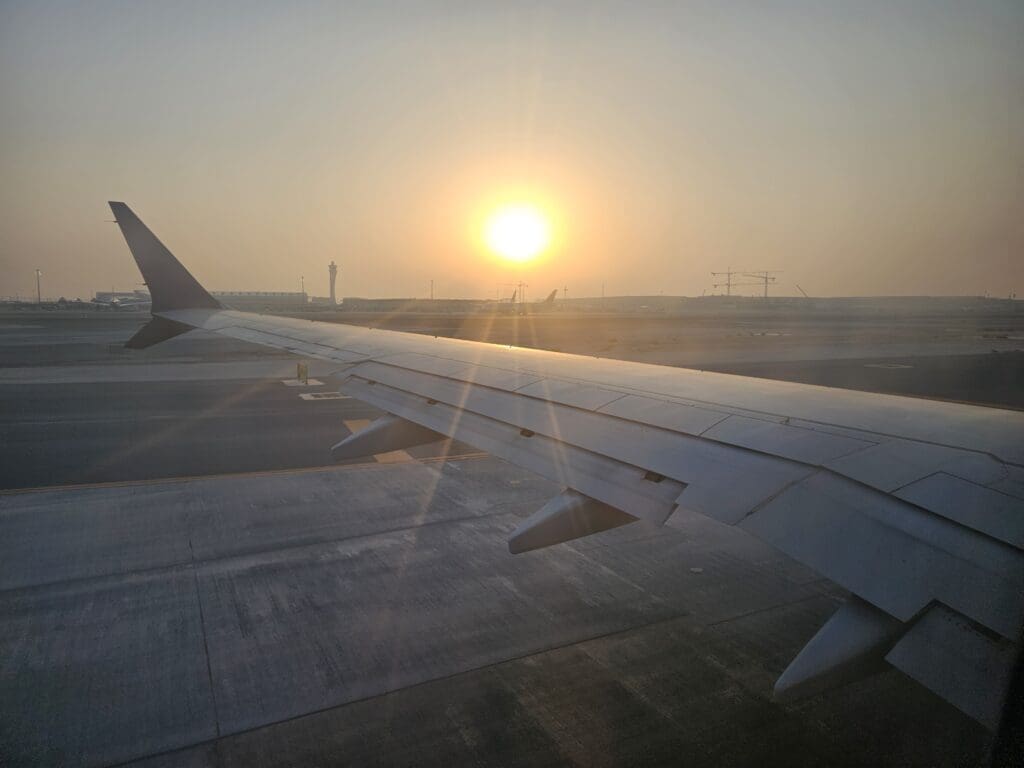
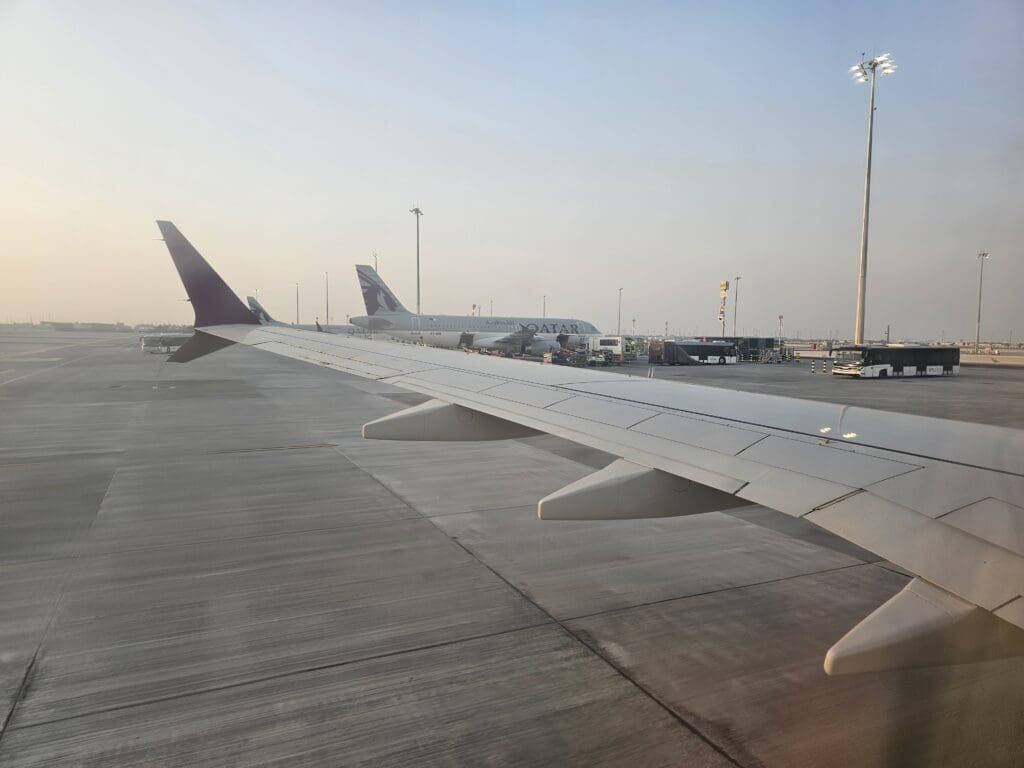
Eventually, I stood up and shuffled forwards before reaching the forward galley where I thanked a couple of the crew members before heading outside. With the cabin having been kept at a reasonably cool temperature, as soon as I stepped onto the steps I was hit by a wall of morning heat, with the air temperature already nearing 30 degrees! After snapping some photos of the sleek-looking Boeing 737 MAX, I made my way onto the very well-air-conditioned and thus chilly bus. Even though I had been one of the last few passengers to disembark, once the last passenger had made their way onto the bus, another jumped off, ran up the steps and made their way back into the cabin, presumably in search of something that they had left behind. After a couple of minutes, they were escorted back to the bus empty-handed at which point the doors slid closed and we commenced the long drive around the runway to Doha Hamad’s massive terminal building.
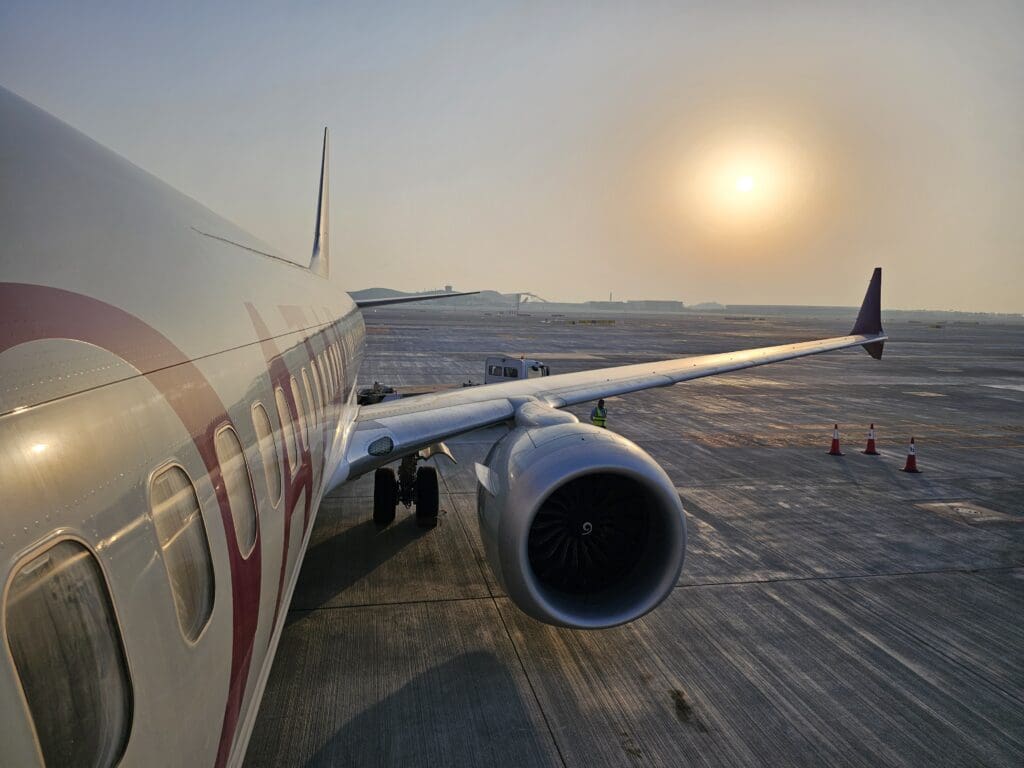
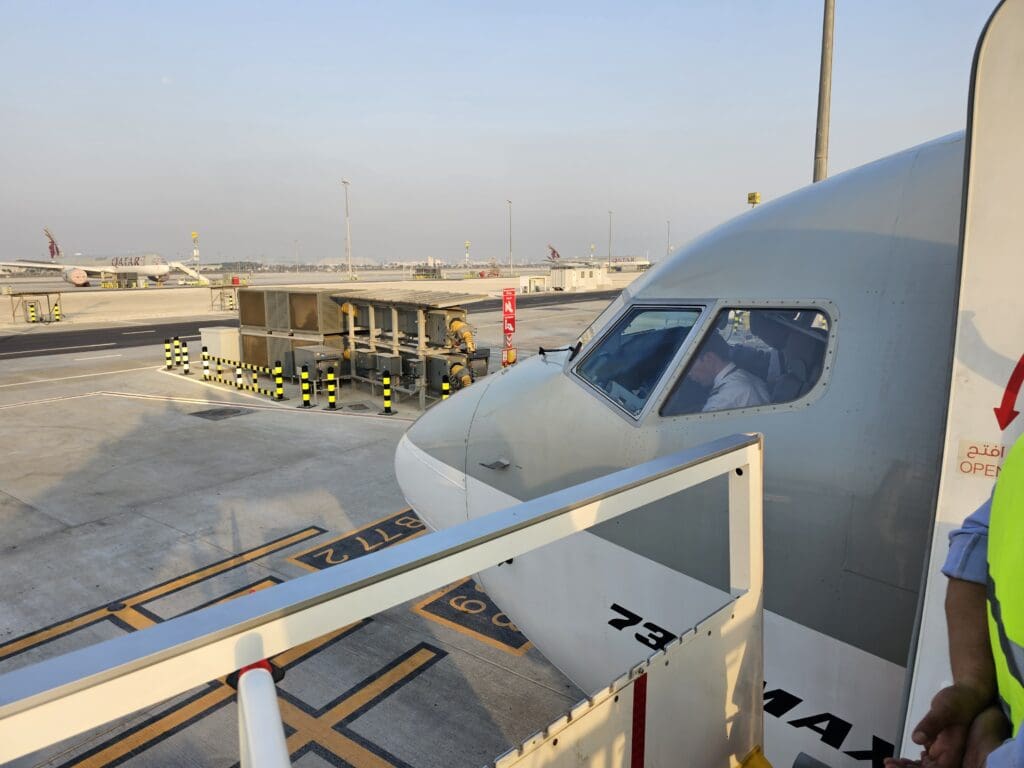
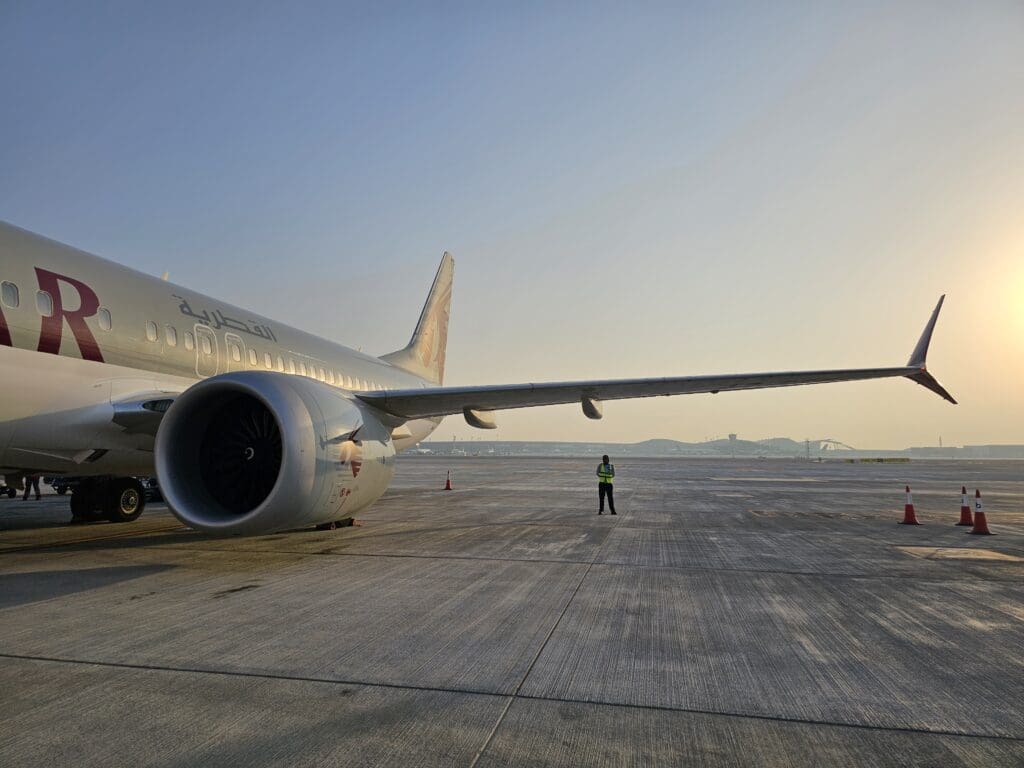
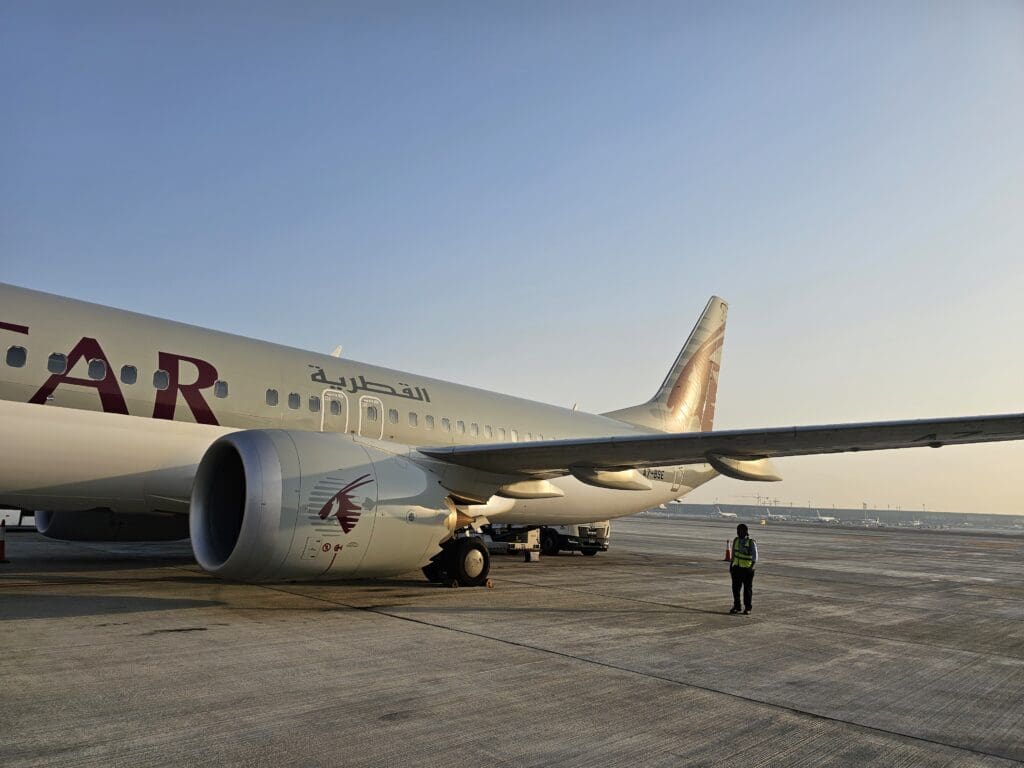
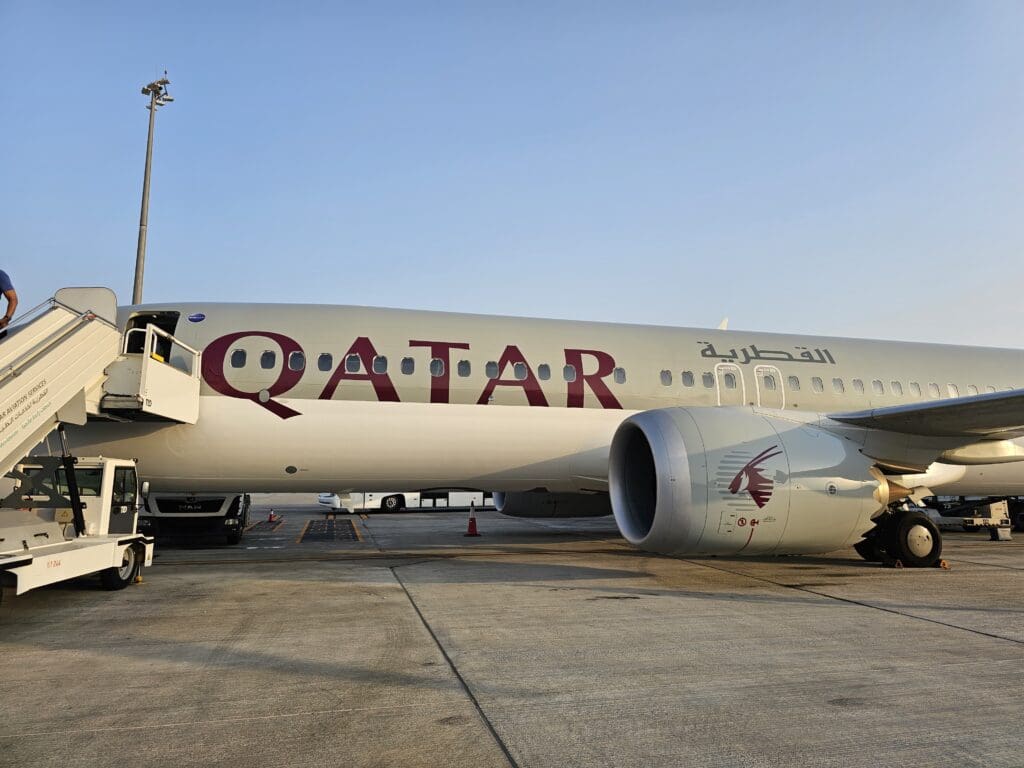
That morning, a sea of Qatar Airways jets could be seen and for my entire stay at the airport, I caught sight of just three passenger aircraft not operated by (or for) the hometown carrier. These took the form of a Royal Jordanian Airbus A319, an Air Seychelles Airbus A320 and a Malaysia Airlines Airbus A330. After a few minutes, the bus came to a halt outside the main terminal building, at which point I disembarked and commenced my short transfer in the Qatari capital.
Summary
Overall, I was left very impressed with my short hop on Qatar Airways. Onboard, the crew were fantastically polite and friendly, the aircraft was clean and comfortable, and I was pleased with the decent offerings for such a short flight. Needless to say, there was incredibly little that could have been done to make this flight much better, and the experience left me with high hopes for my next slog over to Manchester.