Virgin Australia Long Haul Reborn: Doha to Manchester on a Qatar Airways Boeing 777-300ER
This report is part of a trip from Abu Dhabi to Manchester, and you can read all of the background information in the report of the shorter flight by clicking here.
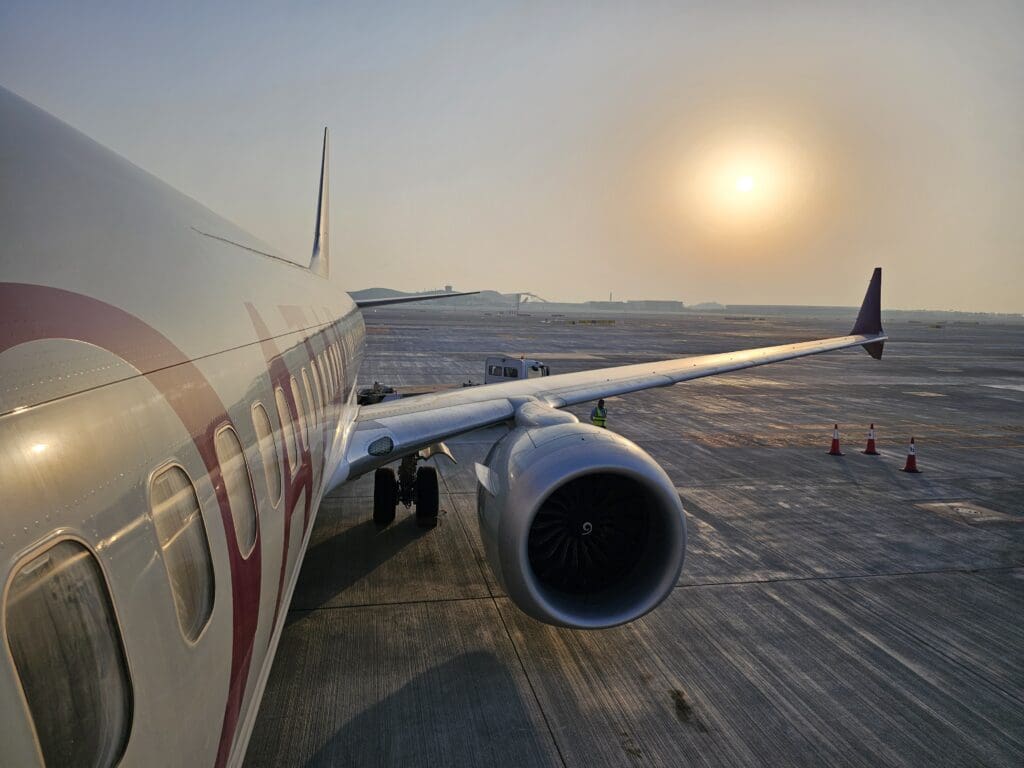
Following a very short hop over from Abu Dhabi on one of Qatar Airways’ new Boeing 737 MAX 8, my superb experience onboard left me with a great impression of the airline and I was looking forward to sampling the delights of one of the airline’s Boeing 777-300ERs for the much longer slog back to Britain.
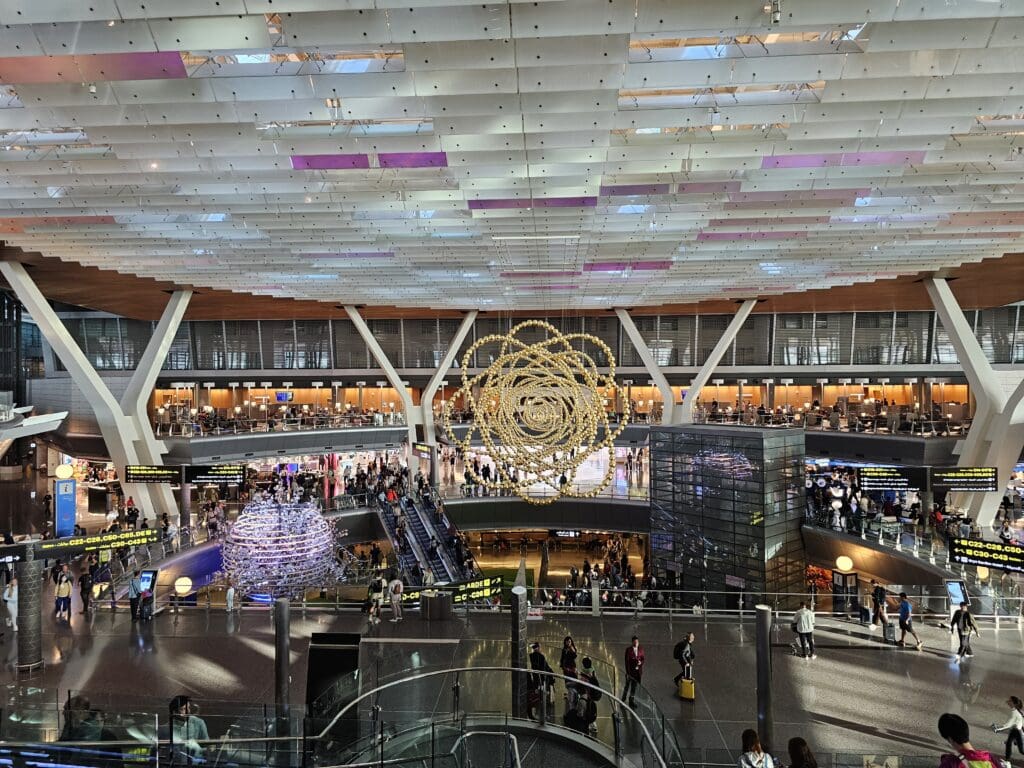
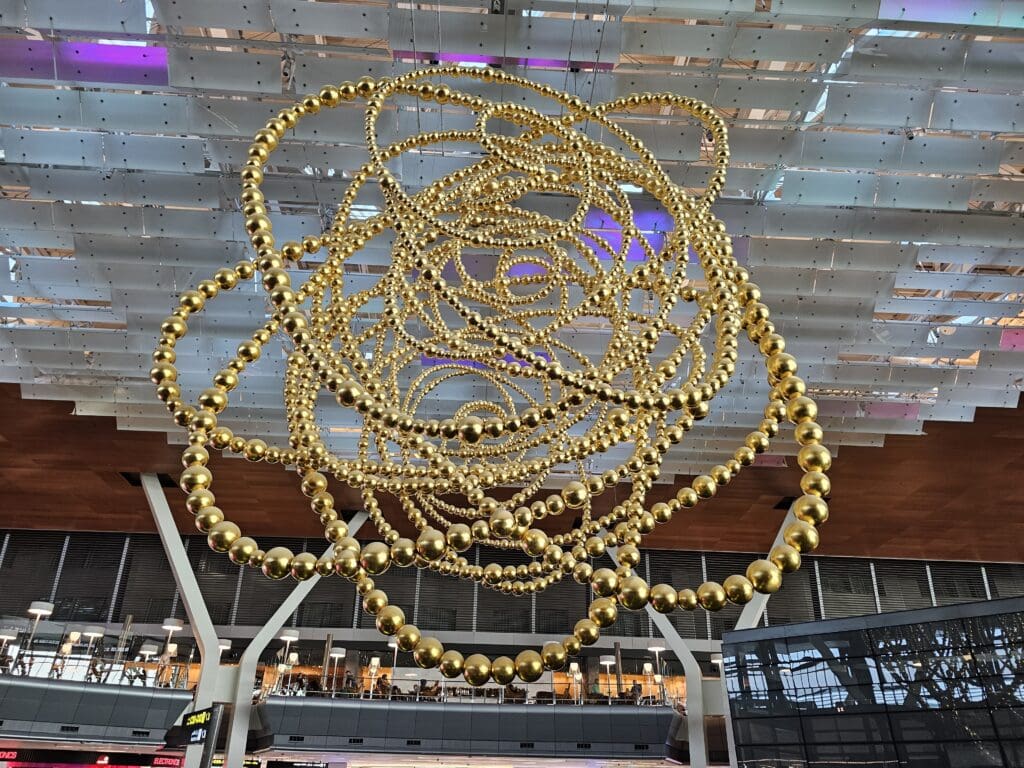
As seemed to be the case with most of Qatar Airways’ narrowbody operated services that morning, the inbound flight arrived at a remote stand located quite some distance away from the terminal. Following a long bus ride around the airfield, by the time I entered the terminal, I was left with less than ninety minutes until my flight to Manchester was scheduled to depart. However, seeing as Doha Hamad International Airport is designed with connections in mind, I was not overly worried about this short transit, although I sadly would not have enough time to explore this mega terminal in all of its glory. Following a long escalator ride, I reached the busy hall where those bound for Qatar are funnelled off and pointed in the direction of immigration, whilst transit passengers must pass through security before continuing onwards. Getting things off to a good start, despite the hoards of passengers, I found security to be a breeze, assisted by the fact that most checkpoints were open and there was no need to remove electronics or liquids from my bag.
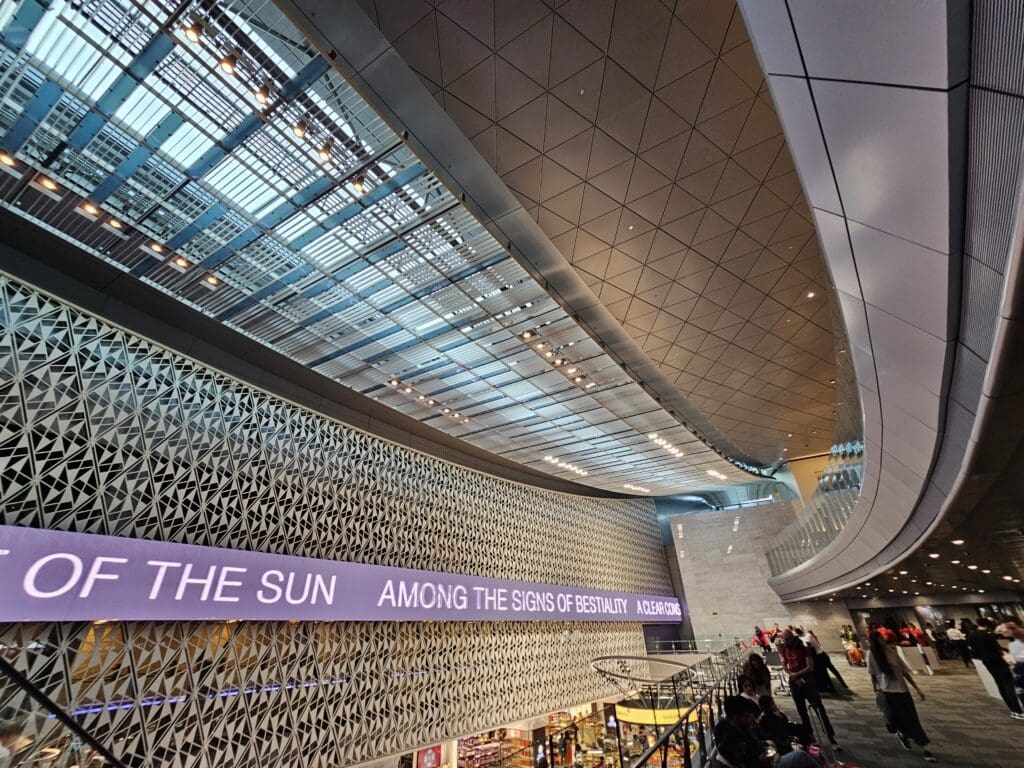
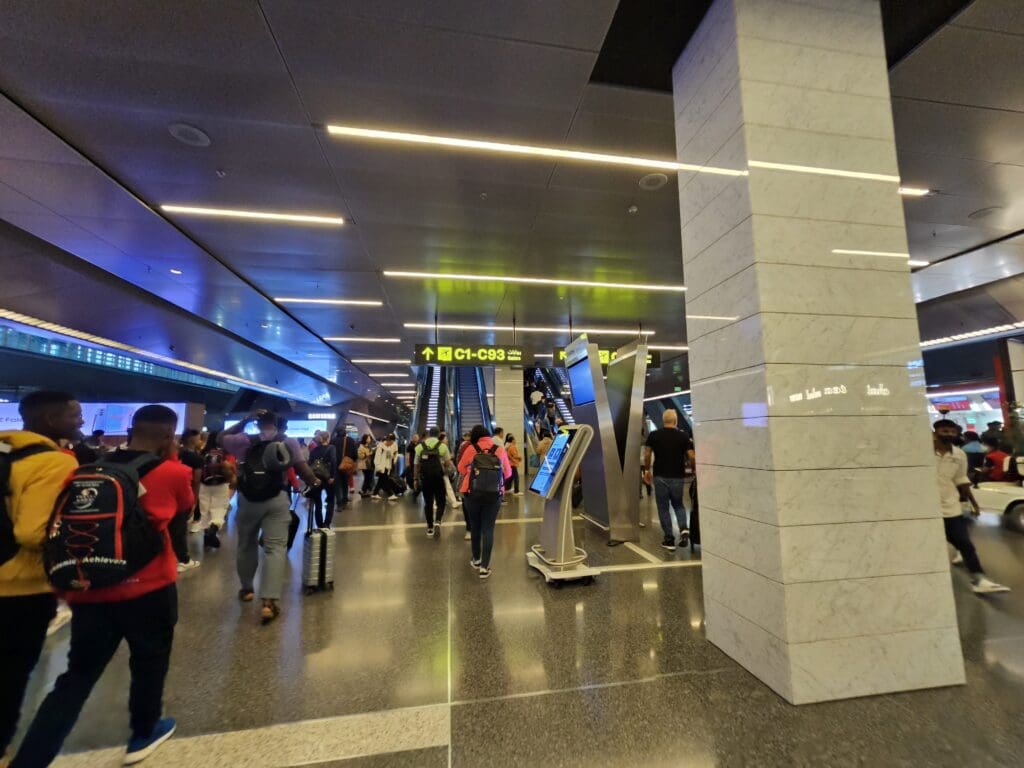
As soon as I entered the airside departures area, I connected to the airport’s complimentary wifi network and instantly received a notification from the Qatar Airways app advising me that boarding had commenced through Gate C19. Seeing it best not to linger around, I battled through the crowds and followed the signs for Concourse C, which is located at the northern end of the terminal. Since my last trip through Doha Hamad way back in September 2015, the terminal appeared to have undergone significant change and expansion, and the most notable addition was a cable-propelled people mover, which shuttles passengers at speeds of up to 45km/h through the terminal. Following the many signs for the C gates, I was taken to the people mover station and having timed things just right, I jumped on the waiting train before its doors slid closed before being whisked through the terminal.
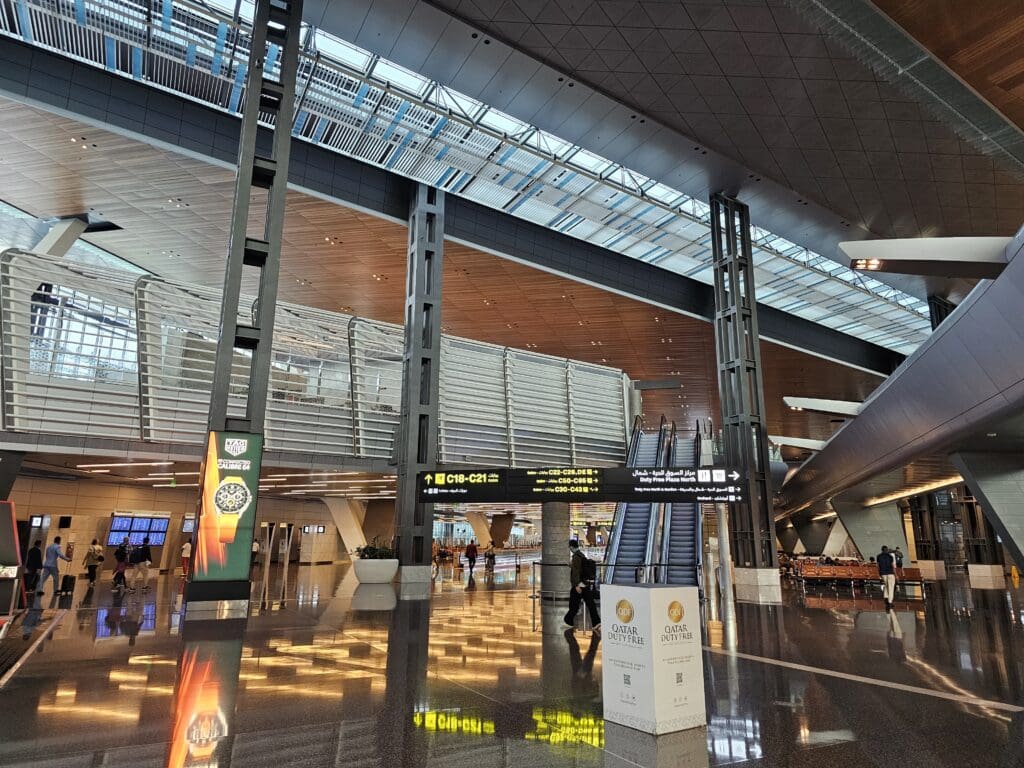
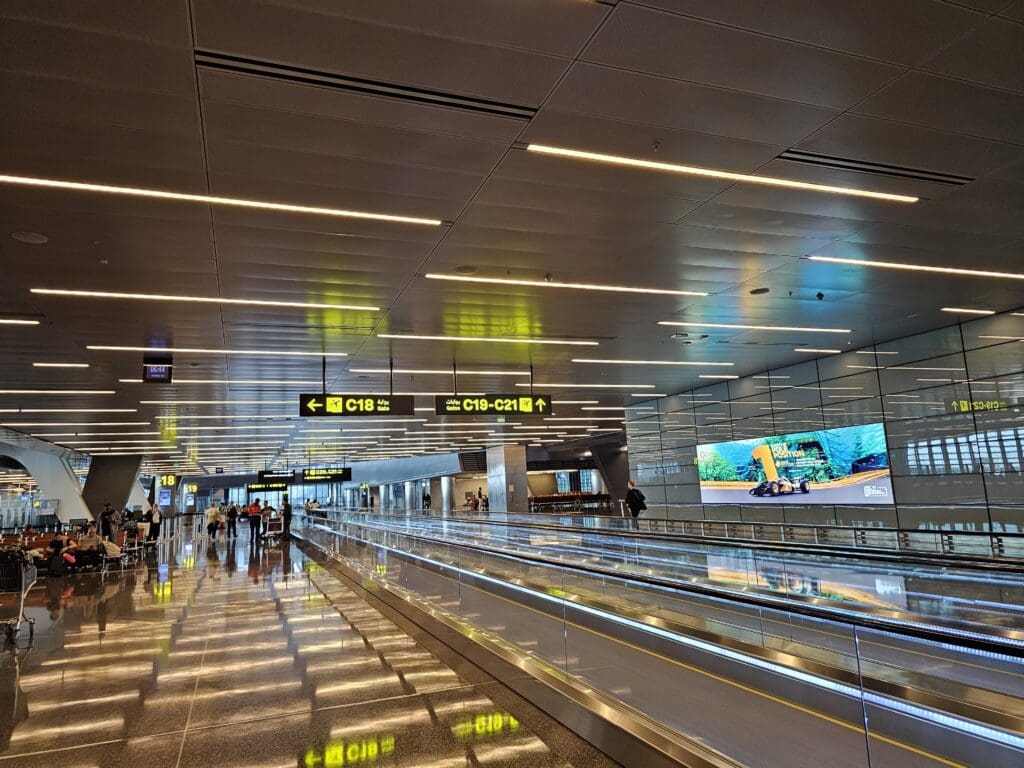
Located at the end of the terminal, Concourse C is a Y-shaped space, the centrepiece of which is The Orchard, a vast green space that rival’s Singapore Changi’s jewel. Unfortunately, given my short transit, I would not have time to visit this, although from what I did see, I found the terminal to be clean, tidy, modern and home to plenty of shops, eateries and other facilities for those with longer transits. However, I did notice that planespotting opportunities are rather limited, as most windows are filled with dots to prevent the hot Arabian sunlight from pouring in and heating up the terminal. In fact, as far as I could see, only each gate’s boxed-off waiting areas offered clear and unobstructed views of the action outside.
At the time of my flight, Qatar Airways had over ninety Boeing 777s in their fleet, the majority of which took the form of the Boeing 777-300ER. This made the type the most common aircraft in Qatar Airways’ fleet, and the airline is the third-largest operator of the Boeing 777 after Emirates and United Airlines. These aircraft are dispatched on routes to destinations as close as Dammam and Dubai, and as far away as the likes of Melbourne, São Paulo and Seattle. Thus, unsurprisingly, the type seemed to be omnipresent across the terminal’s stands that morning.
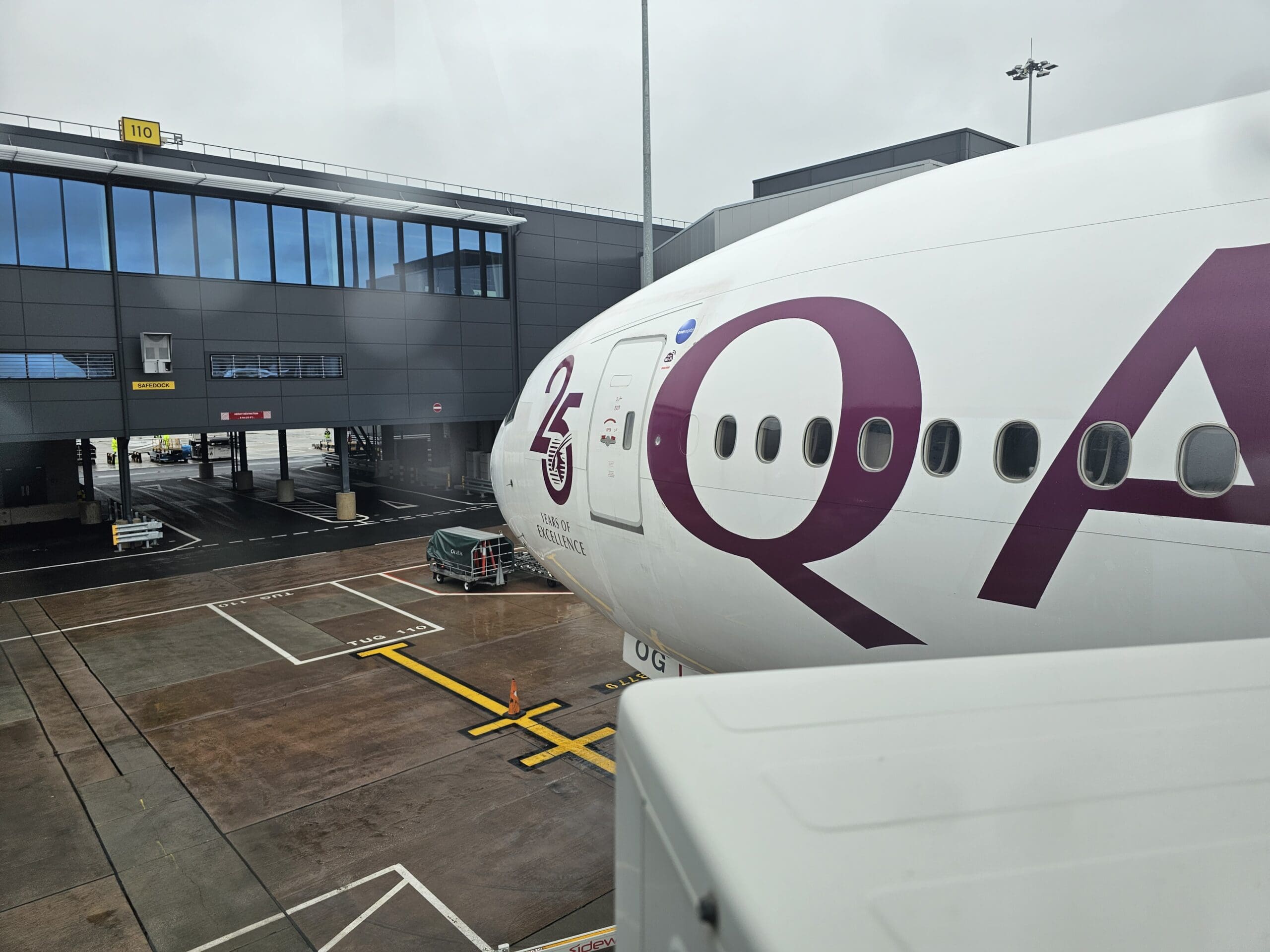
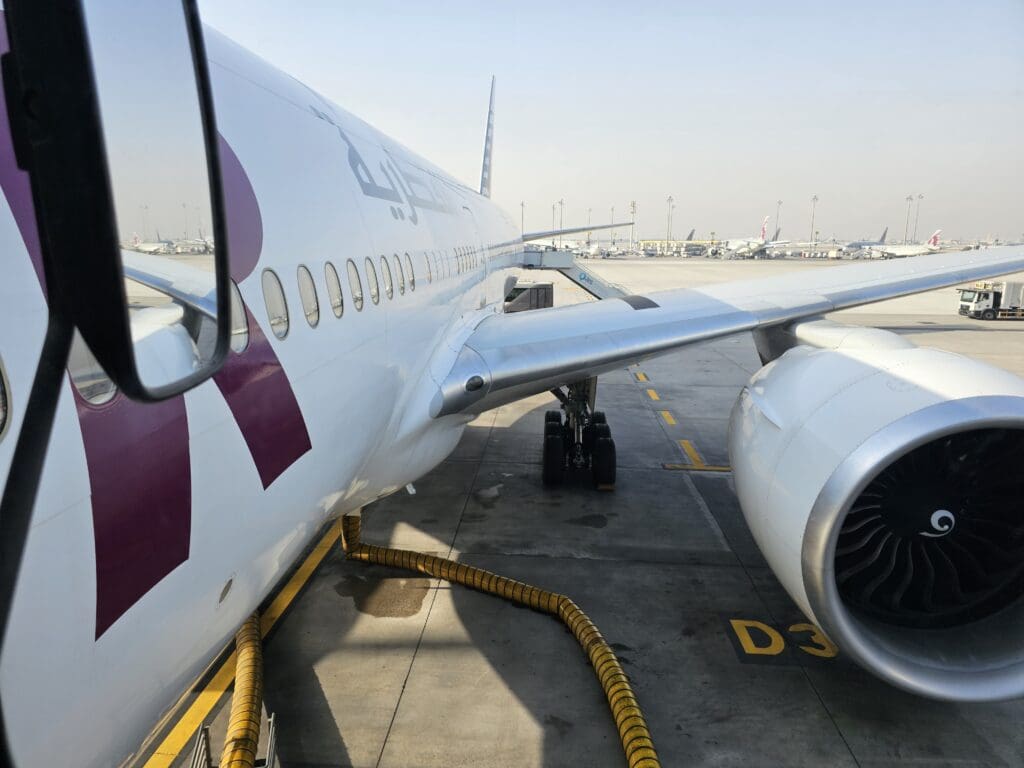
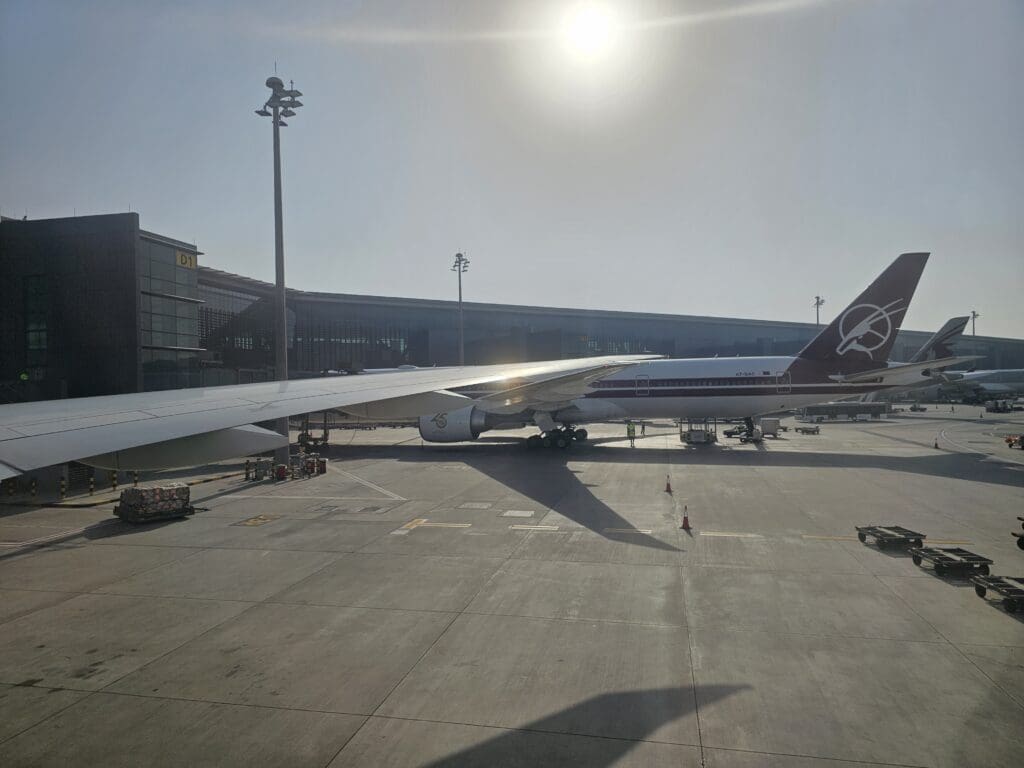
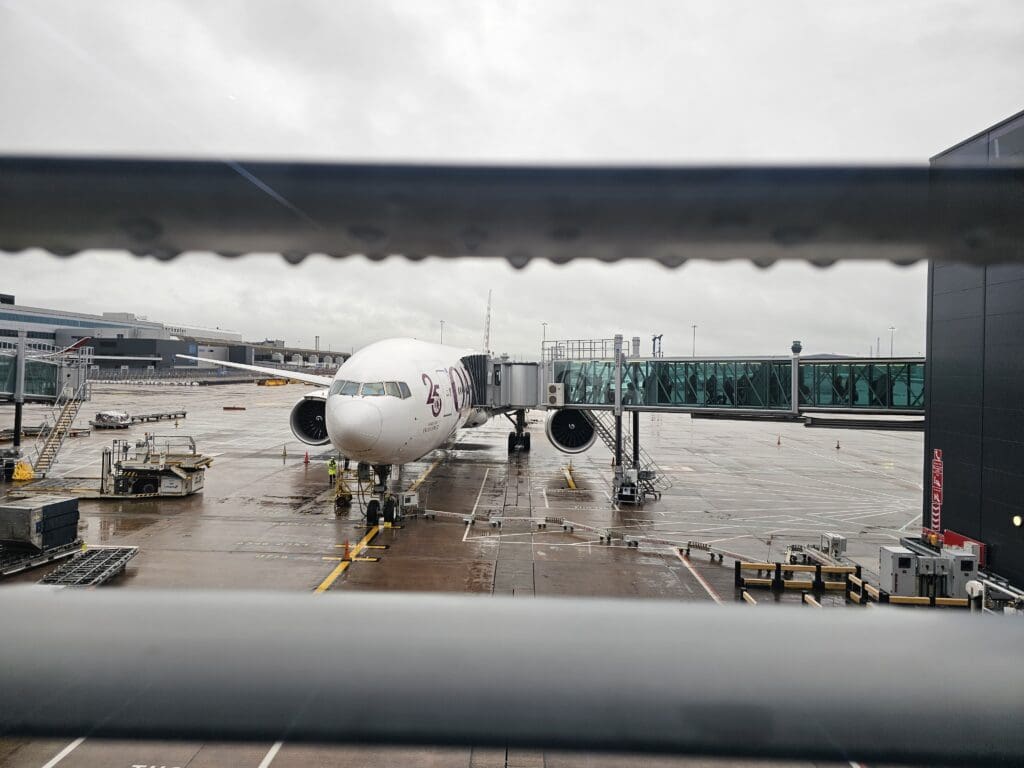
That morning, Qatar Airways’ two ‘special’ liveried Boeing 777-300ERs could be seen parked next to one another at Stands D1 and D3. One of these came in the form of Qatar Airways’ retro liveried aircraft, which rolled out of the paint shop in early 2022 and commemorates the airline’s 25th anniversary of operations, with this being readied for its long slog across the world to Montréal. Sitting next to this was the slightly less special aircraft which sports an almost all-white livery bar its large Qatar Airways titles, a decal commemorating ‘25 Years of Excellence’ and the airline’s distinctive Oryx motif of the tail. At the time of my flight, a total of nine Boeing 777-300ERs sported this plain livery, with all of these jets being second-hand aircraft that had previously been operated by Cathay Pacific and Virgin Australia and were delivered to Qatar Airways between 2021 and 2023.
With Qatar Airways not having updated the cabins of these aircraft at the time of my flight, examining the seatmap before departure, I was able to decipher that I would travel to Manchester onboard one of the Boeing 777-300ERs that had previously operated for Virgin Australia. Indeed, this was verified when I rocked up to the gate and saw A7-BOG being readied for the trip over to Europe. Assembled in Everett in 2010, this Boeing was originally part of an order for six aircraft made by Virgin Australia’s long-haul subsidiary, V Australia. These were intended to be deployed on routes to Johannesburg, Los Angeles, Nadi, Phuket and later Abu Dhabi and Hong Kong. Making its first flight in November 2010, the aircraft entered service as VH-VPH later that month. Following the consolidation of V Australia into the Virgin Australia brand in 2011, that year, the aircraft was repainted and renamed in honour of Melbourne’s St Kilda Beach. Working in tandem with the airline’s Airbus A330 fleet, the aircraft spent the next nine years shuttling passengers to and from Australia.
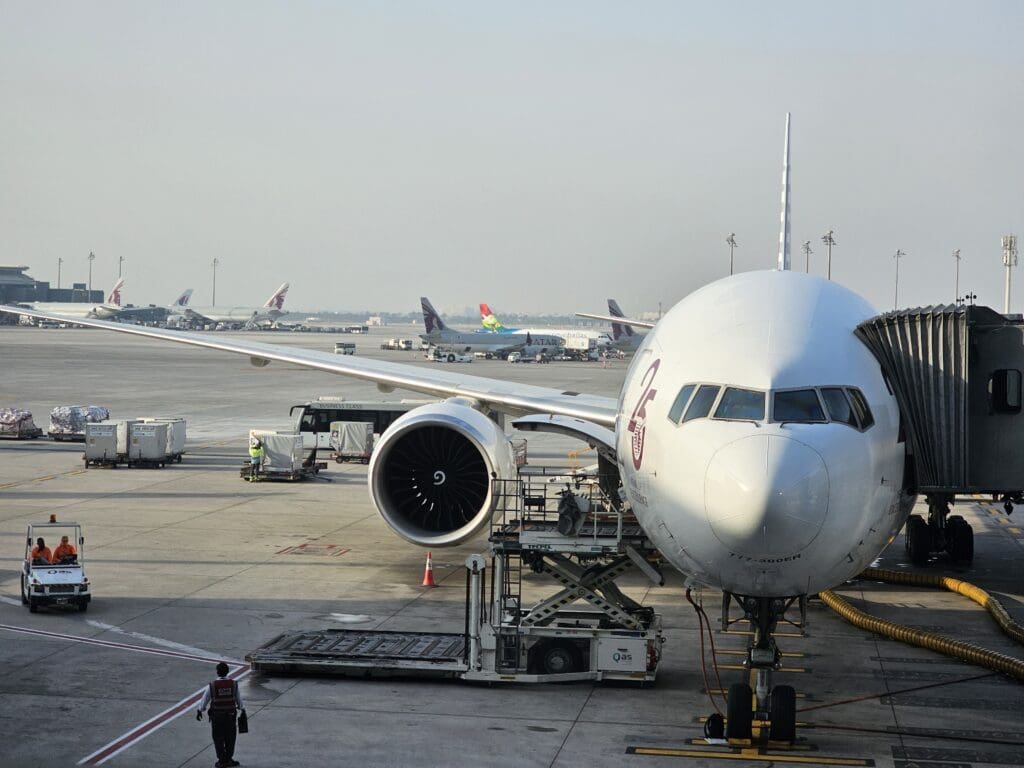
Unfortunately, when the pandemic hit, Virgin Australia opted to suspend its long haul route network and halt operations of its Airbus A330 and Boeing 777 fleet. As a result, the aircraft entered storage in 2020, initially being parked in Melbourne before being shuttled to Queensland’s Toowoomba Wellcamp Airport. In September 2021, Virgin Australia made the executive decision to wave farewell to its widebody jets and instead operate an all-boeing 737 fleet. Eventually, Qatar Airways opted to take on two former Virgin Australia Boeing 777s to support their massive operation, and in May 2023, the aircraft was registered as A7-BOG and finally left Toowoomba. Retaining the exact same configuration as when it flew for Virgin Australia, the aircraft is capable of carrying fifteen fewer passengers than Qatar Airways’ other Boeing 777-300ERs, and at the time of my flight, these mainly stuck to the same routes – namely Bangkok, Manchester, Penang and Phuket.
Returning to the journey, despite notification, once I arrived at Gate C19 I discovered that boarding had not commenced. Instead, passengers had been invited through to the holding area in preparation for boarding. Deciding to head into this, as rarely seems to be the case, I was not selected for the random security check and was instead able to walk straight up to the counter where my boarding pass was scanned and my passport checked before I arrived at the waiting area. Whilst there was still an hour to go until my flight was scheduled to depart, by this time, this was almost full indicating that it would be a busy flight. Looking outside, I watched as a stream of containers was fed into the hold, whilst several catering vehicles surrounded the jet and loaded this with service carts.
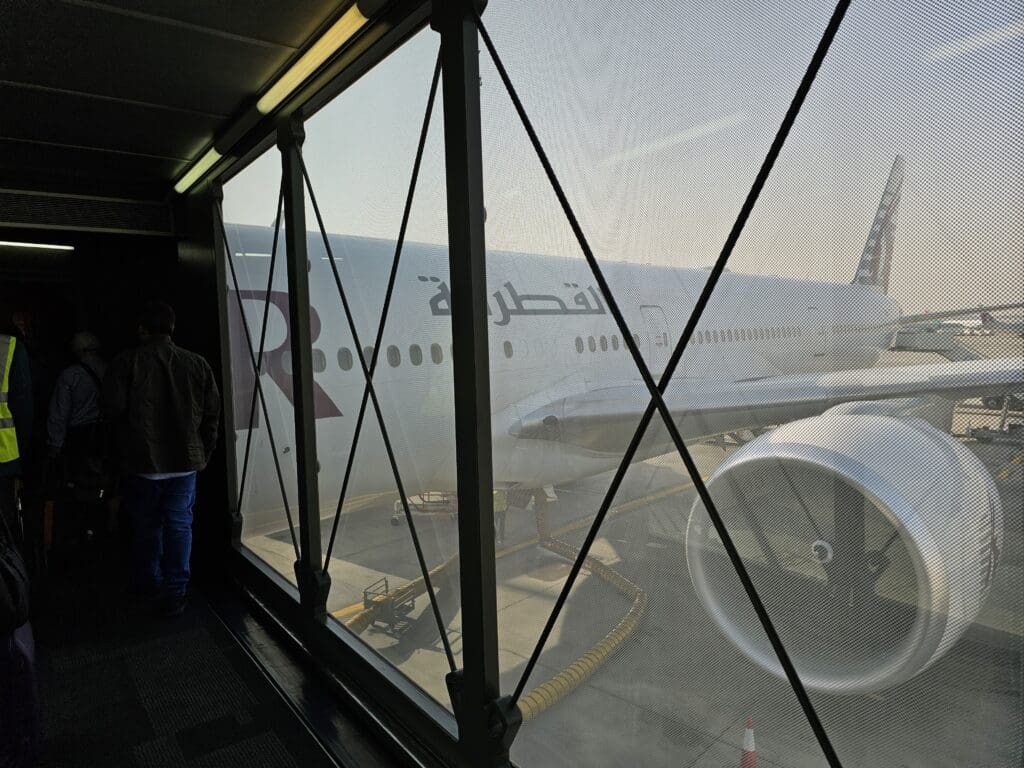
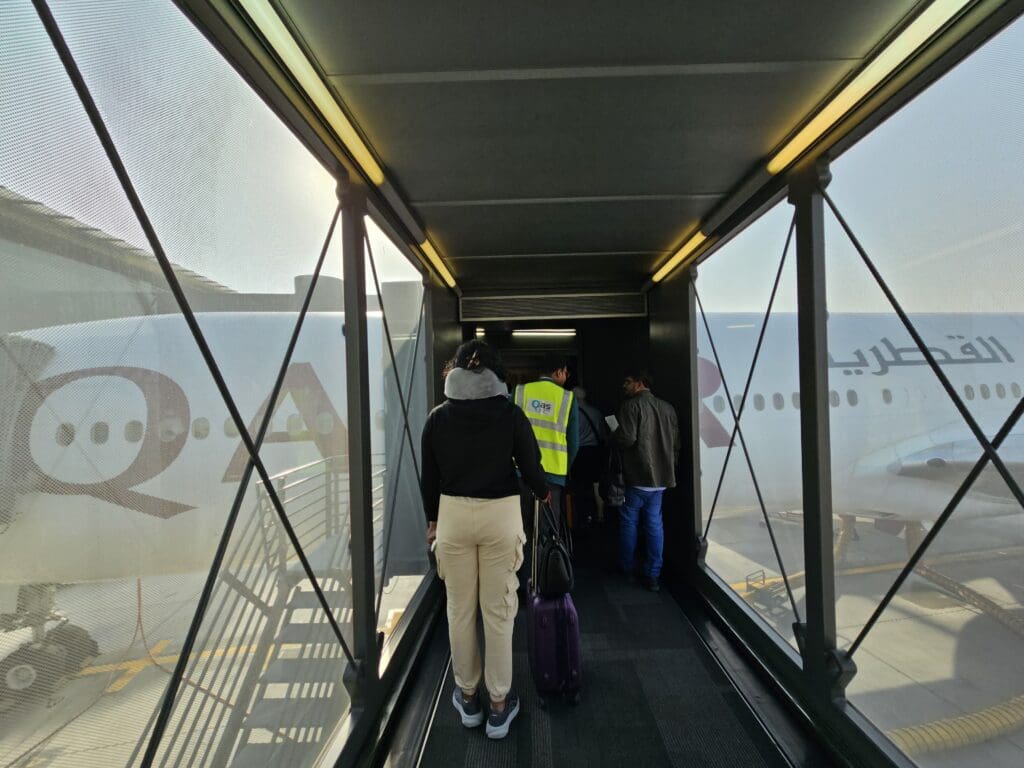
With forty minutes to go until departure, one of the many gate staff performed an announcement requesting those requiring assistance to board the aircraft, and noting that those in Business or with silver, gold or platinum status holders of Qatar Airways’ Privilege Club could board either then or at their leisure. Following a five-minute wait, boarding for those in Zone 2 commenced, at which point I made my way forward and had my boarding pass scanned before heading down towards the aircraft. As is often the case with widebody jets, two jetbridges were connected to the aircraft, with premium passengers boarding via the L1 door, and all others via the L2 door. Knowing my place, I journeyed down the second jetbridge and soon found myself passing one of the Boeing 777’s famously gigantic engines.
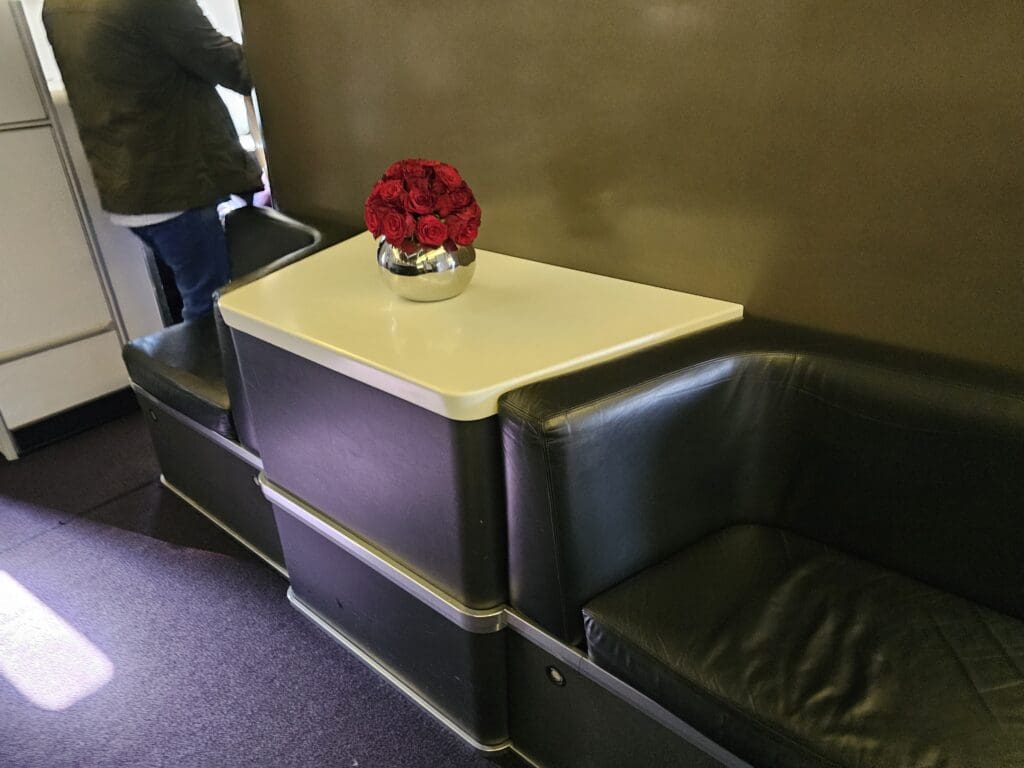
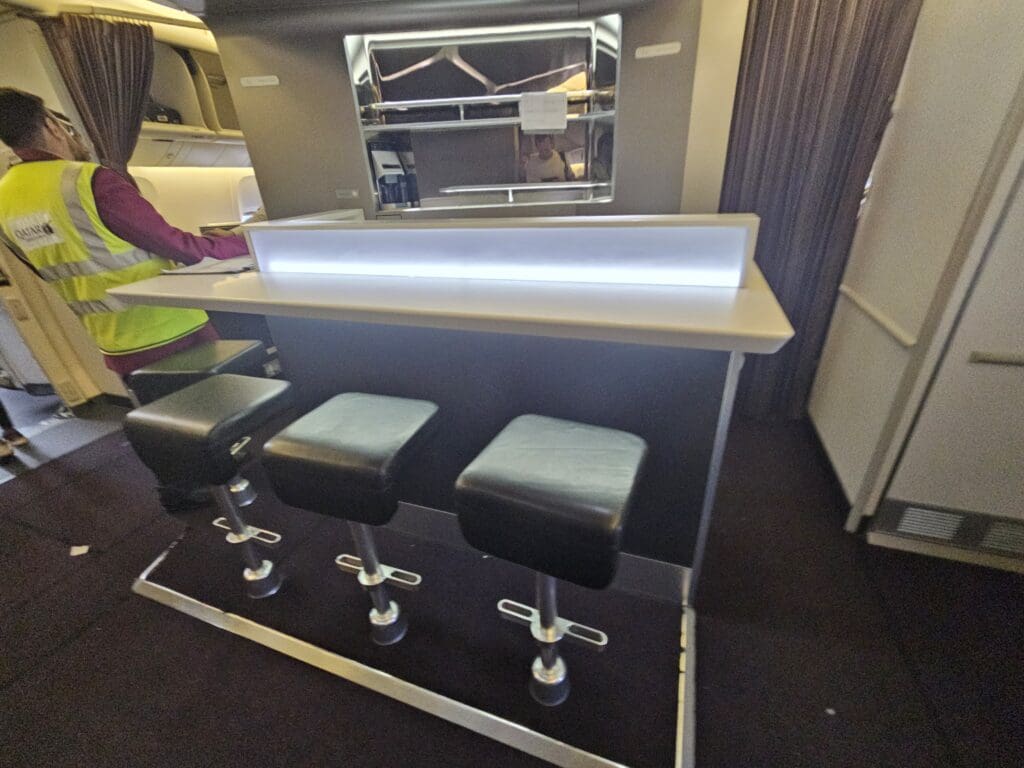
Following a short wait, I stepped into the bar-lounge area that is sandwiched between the aircraft’s two Business cabins and immediately received a lively and friendly greeting from one of the senior cabin crew members. Those lucky readers who are well-acquainted with the pointy end of Qatar Airways’ Boeing 777s will know that this is not a standard feature on these aircraft. Instead, this was inherited from Virgin Australia. With a four-stool bar on one side and two comfortable-looking chairs on the other, I’m not entirely sure if this is used for its intended purpose, although it is worth noting that Qatar Airways’ Airbus A380s are fitted with a similar facility.
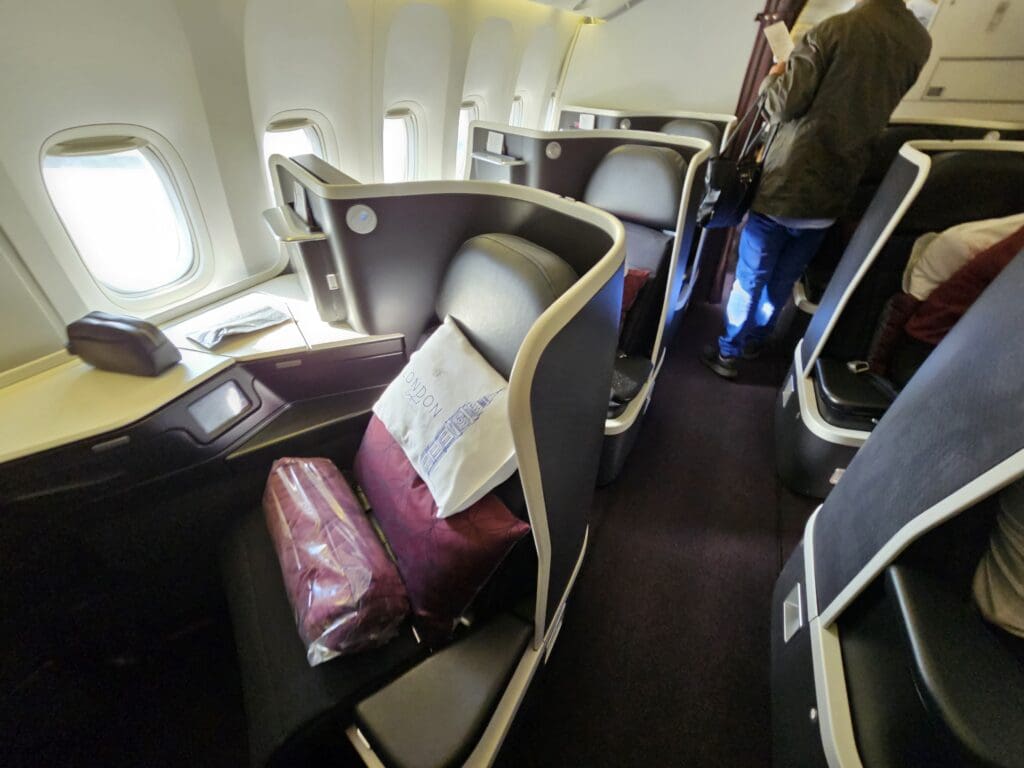
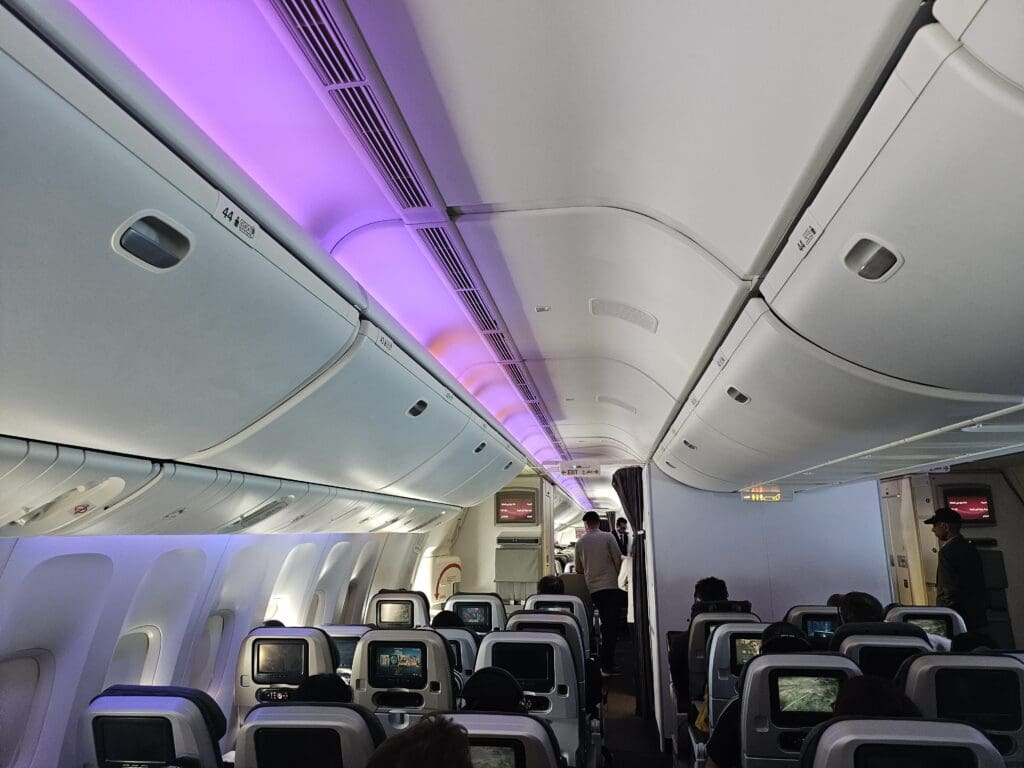
After turning right, I voyaged into the smaller of the aircraft’s two Business cabins. This cabin features semi-private lie-flat seats in a 1-2-1 configuration, covered in dark leather/pleather. Compared to the famous Q-Suites installed on most of Qatar Airways’ other Boeing 777s, these appeared to be a step-down and thus, regular clientele may have been a little disappointed. However, I would not have complained about making the trip to Manchester in one of these seats! Next up was Virgin Australia’s old Premium Economy cabin, home to three rows of recliner seats in a 2-4-2 configuration, each covered in purple fabric and topped with a leather/pleather grey adjustable headrest. As Qatar Airways does not offer a Premium Economy product, these seats could be pre-reserved for a total of around £135, and I assume that the unsold seats either remain vacant or go to those in Economy with elite Privilege Club status.
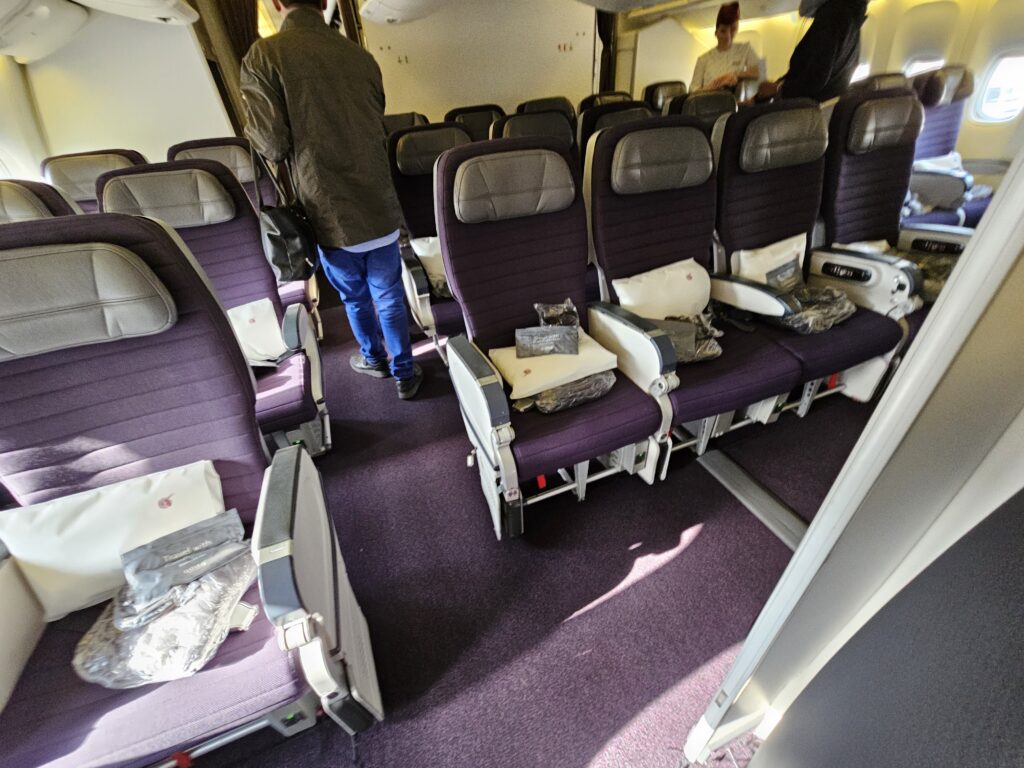
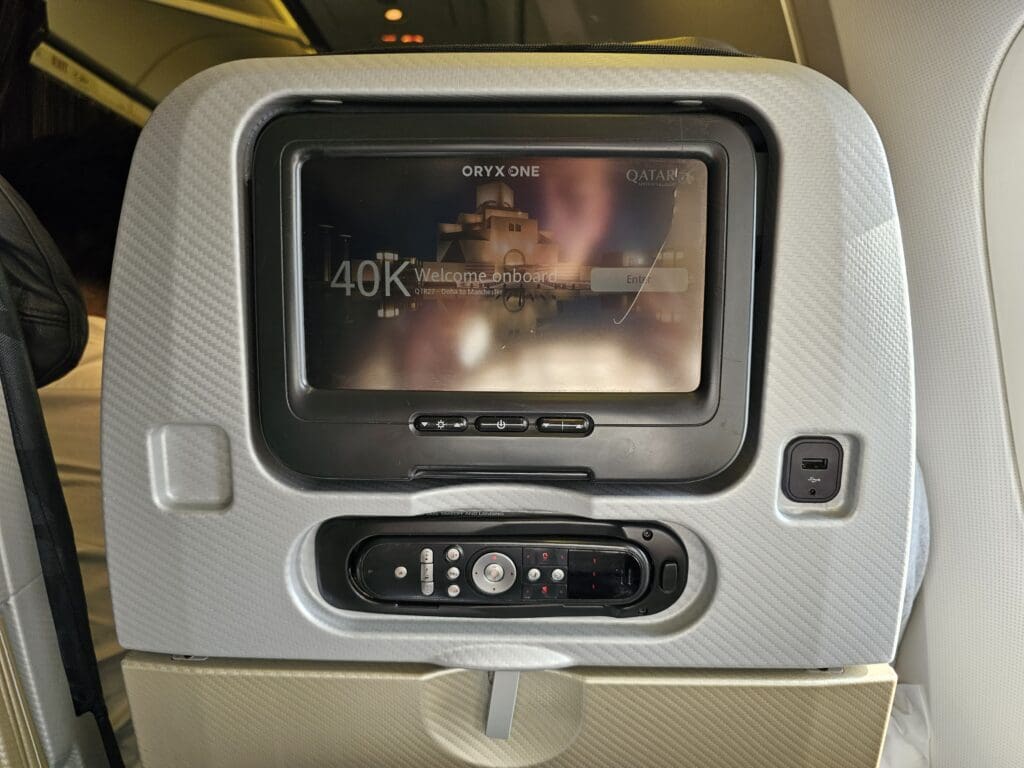
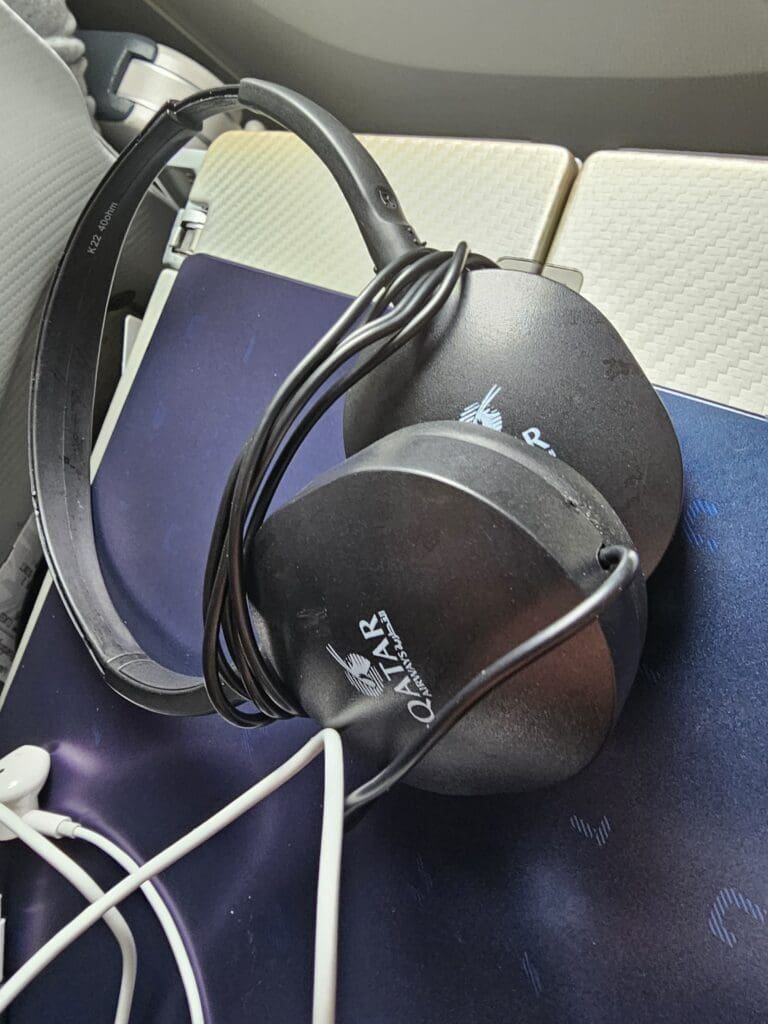
With few passengers standing in the aisle in front of me, I continued down the aircraft, receiving multiple greetings from the friendly crew as Qatar Airways’ boarding music rang through the cabin. Soon reaching the forwardmost Economy cabin, I was pleased to see that this was arranged in a 3-3-3 configuration, whereas the seats on Qatar Airways’ standard Boeing 777s are laid out in the more squeezed 3-4-3 layout. In terms of their design, these were covered in a dark fabric with a diamond pattern and topped with a dark pleather/leather adjustable headrest. Meanwhile, the backs of these were covered in silvery plastic and featured a comparatively small and dated-looking inflight entertainment screen, a clunky controller, a USB-A port and a seatback pocket in which a sickbag and safety card could be found. Interestingly, unlike the Qatar Airways Boeing 737 MAX that I had flown over from Abu Dhabi, no Qatar Airways branded antimacassar covered the headrest. Upon boarding, a packet containing headphones (which I later found to be of better quality than those usually provided in Economy), a Travel with Confidence kit (containing a mask, gloves and hand sanitiser), a packaged pillow and a blanket were placed on top of these.
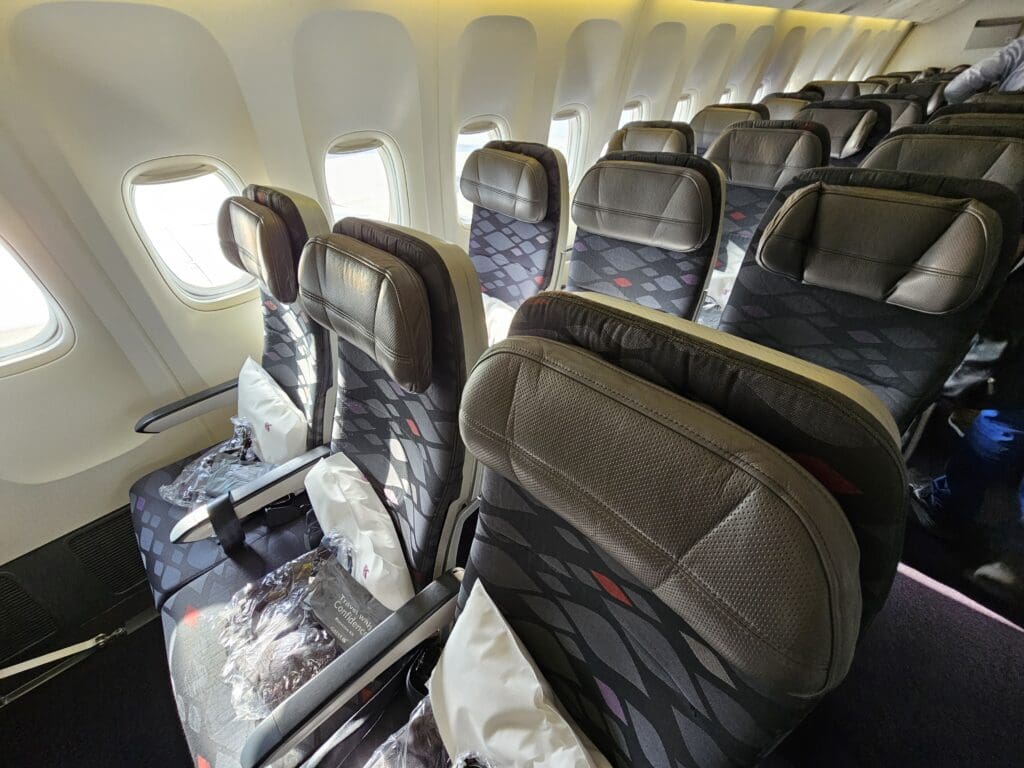
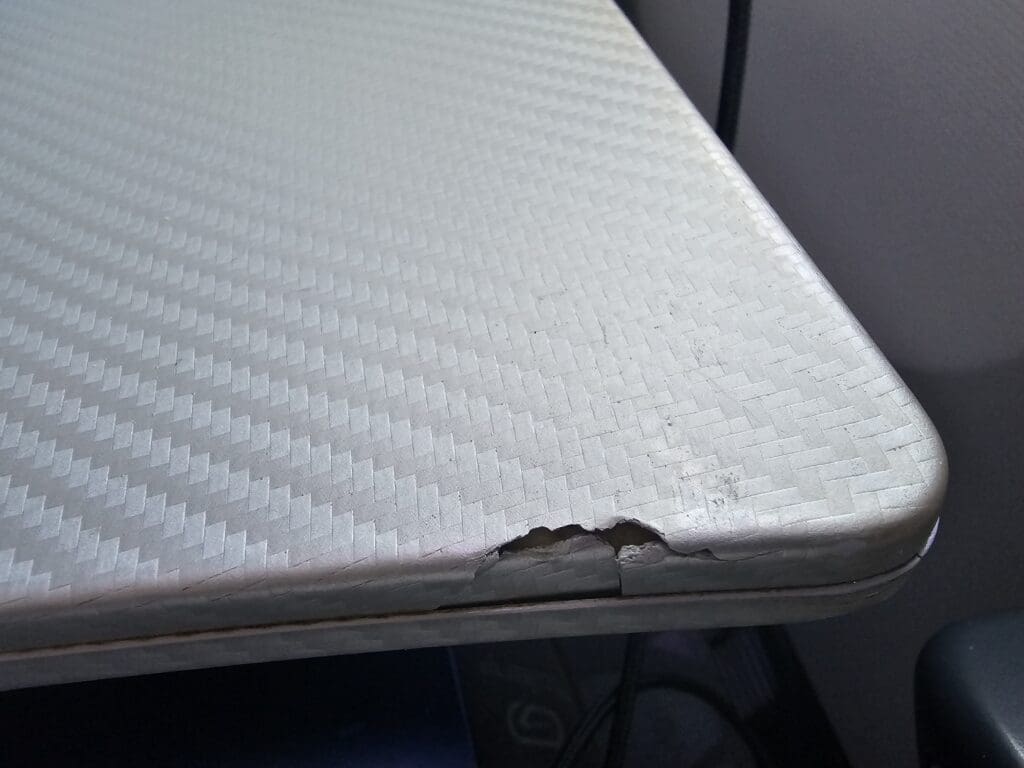
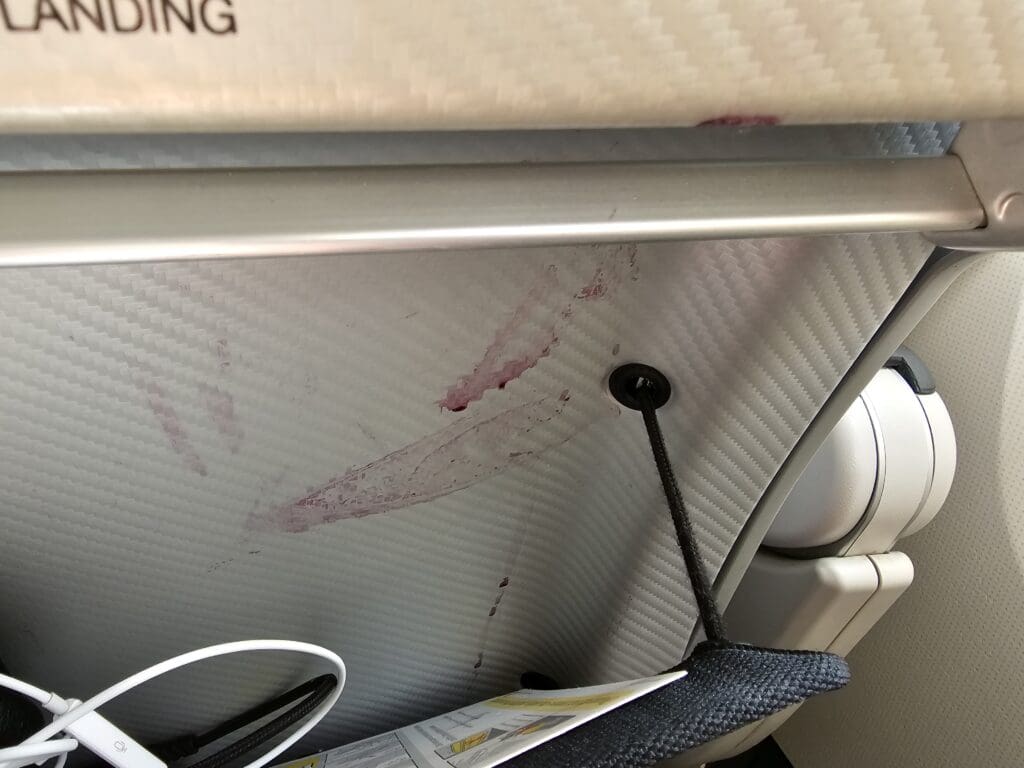
Seated in the second row of the rearmost Economy cabin, yet to be joined by any neighbours, I slid into my seat and settled in for the journey ahead. Once settled in, I was left with mixed first impressions. Importantly for a long haul airliner, I found the seat to be very comfortable and spacious, with absolutely no shortage of legroom. However, the seat was definitely in somewhat of a tired-looking state, with a fair number of marks and scratches, including a rather significant one on the screen. Furthermore, the seat itself was not exactly the most modern, with the only form of power being the USB-A port, which charged my phone at a snail’s pace. In terms of cleanliness, whilst the floor and seat appeared to be free from rubbish, crumbs and other debris, I did notice some red stains on the seatback which appeared to have been missed by the cleaners.
Returning to the journey, I was soon joined by two neighbours – a father and his daughter who were returning from the Philippines, and the cabin soon filled up until it was virtually full. That morning, most passengers appeared to have connected in Qatar from across Africa, Asia and Australasia and hailed from across the globe, with the biggest cohorts appearing to come from the Philippines and South Asia. As the final few straddlers made their way onto the aircraft, at 0737 the Captain performed their welcome speech in which they went through their usual welcomes and thanks, noted that the flight time would be seven hours and the weather conditions en route would be good although they included the usual caveat about keeping seatbelts fastened whilst seated. As they went through this, the last of the containers could be seen being fed into the aircraft, and at 0743, boarding was announced as complete, and ground staff were requested to vacate the aircraft.
Once all passengers were onboard, the Purser, or Cabin Services Director, as they are known at Qatar Airways made their welcome announcement, which was then repeated in Arabic by another member of the crew. After this, a prayer rang out through the cabin and took over the inflight entertainment screens, which then transitioned into the carrier’s safety video. Introduced in early 2023, this is entitled ‘Postcards from Qatar to the World’ and highlights some of the country’s sights, as well as several destinations that the carrier flies to. This consists of crew members going through the safety instructions in both Qatar and Cape Town, Kuala Lumpur, London, Los Angeles, the Maldives and Sydney.
As the safety video played, at exactly 0750 on the dot, the Boeing jolted rearwards and was pushed back away from its stand. Once clear of this and nearing the end of our pushback, the Boeing 777’s enormous GE90-115B engines powered into life, temporarily filling the cabin with plenty of vibration and noise before things calmed down. Around eight minutes after leaving the stand, the Boeing powered forward under its own steam and commenced its journey to the end of Runway 34L. From the terminal, this was not a particularly long journey and soon we came to a halt at the end of the runway. Once there, a few minutes of waiting was required as we allowed for a Boeing 777-200LR to head off on its long slog to São Paulo and a Boeing 787-8 Dreamliner on its comparatively short flight to Beirut.
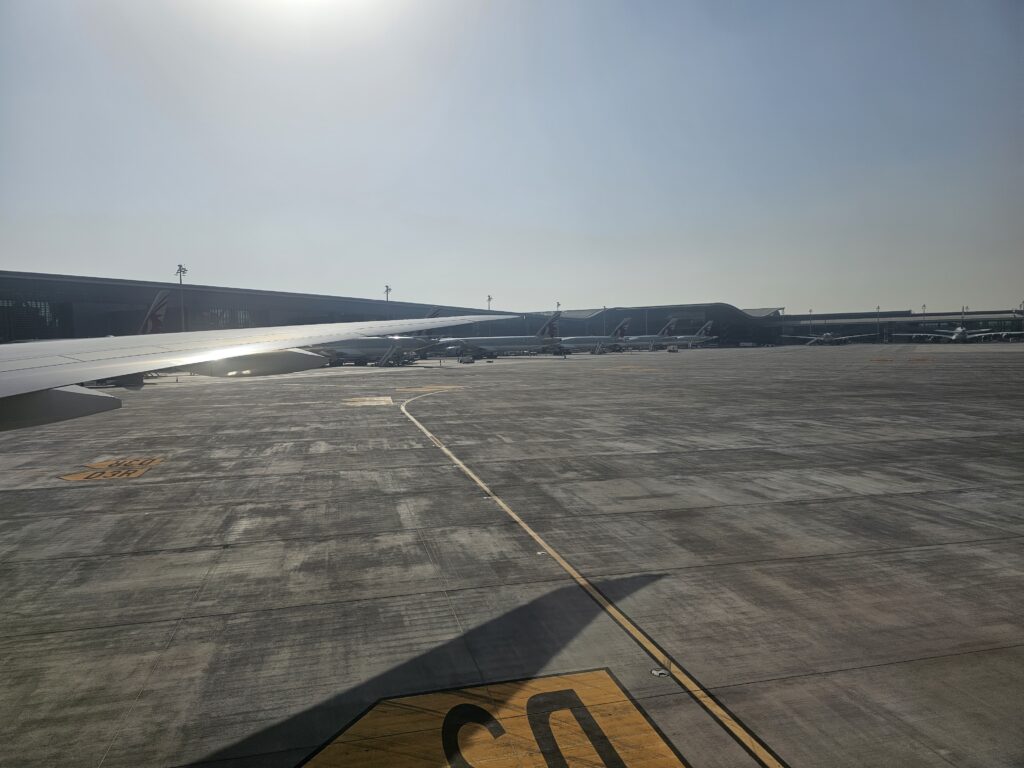
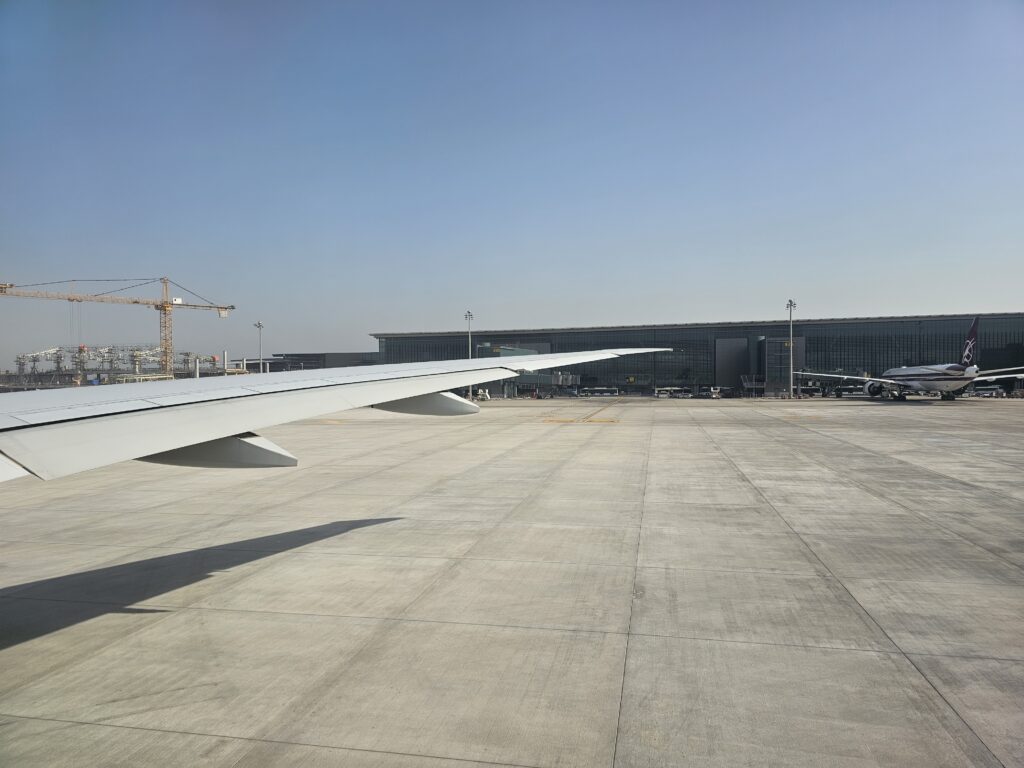
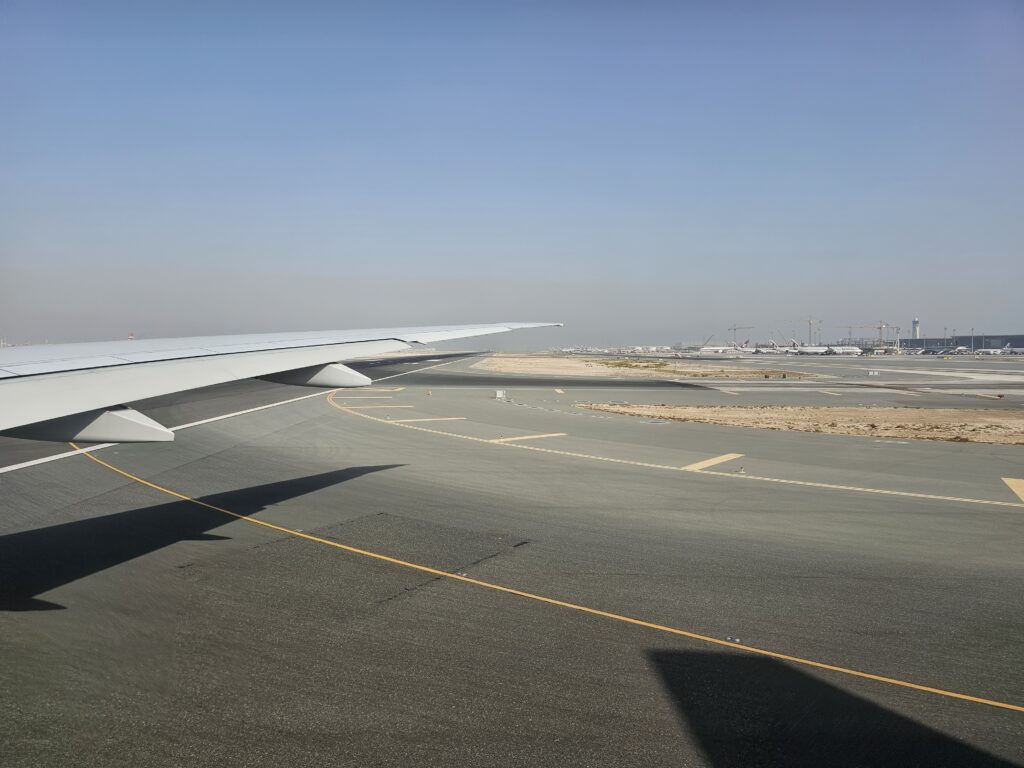
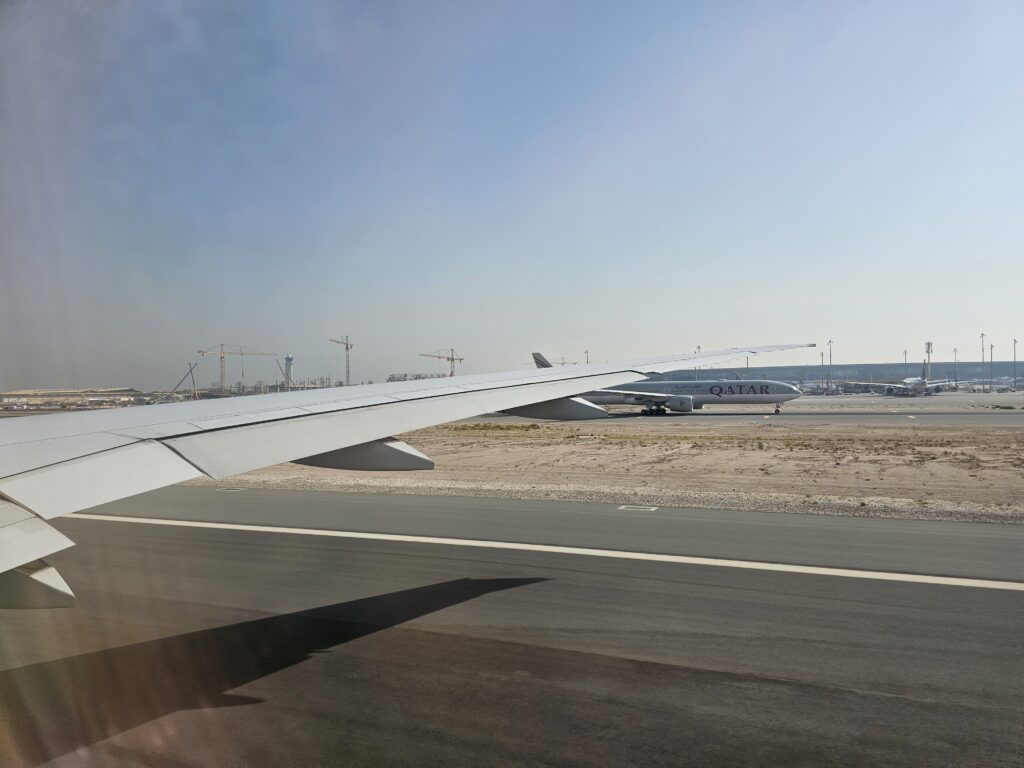
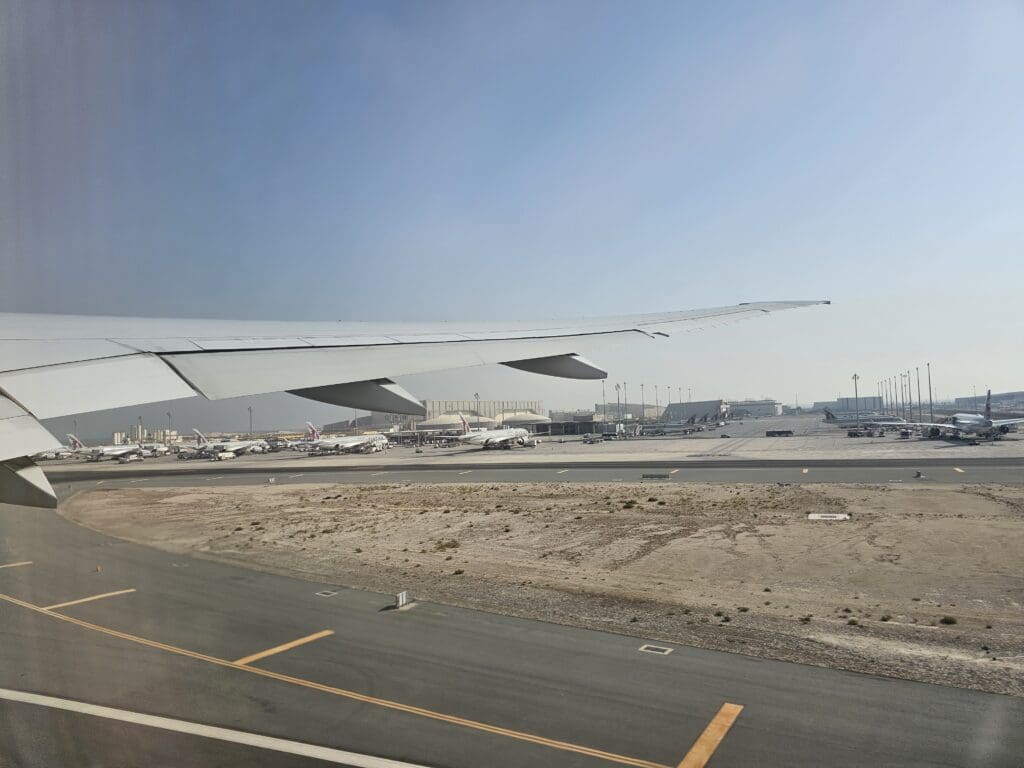
Once both aircraft had taken to the skies, the Boeing lumbered onto the runway and following a short pause, at 0805, the two General Electric engines roared into life, and the jet began its long and powerful takeoff roll. From my seat, I was offered parting views of Doha Hamad’s massive terminal building before we rotated upwards and gently took to the skies, allowing for a bird’s eye view of several remote stands and Qatar Airways’ large hangar at the northern end of the airfield.
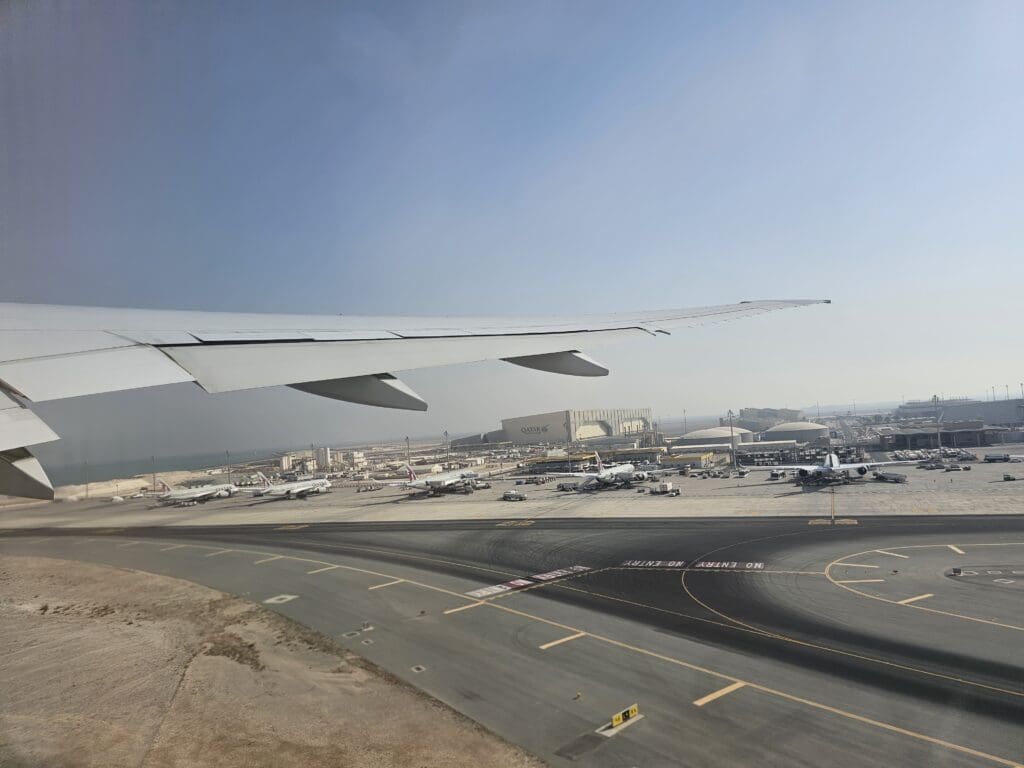
Seconds after taking to the skies, the Boeing left the expanse of the airport behind and made its way over the turquoise, blue and green waters off the coast of Doha, and soon passed the partially constructed luxury Isola Dana development jutting out into the sea. On one of these islands sits a royal palace, a good view of which could be had as we crossed over this at an altitude of 2500 feet. From there, the aircraft continued north along the coastline, although on the wrong side of the aircraft for views, little could be seen other than the Persian Gulf below. After passing Lusail, Sumaysimah, Al Khor and Al Dhakira, the Boeing banked to the left and crossed over the northern tip of Qatar before leaving this behind around ten minutes after takeoff. From there, the aircraft made a beeline for Bahrain and passed over a very small portion of this before heading out to sea and making landfall until we reached Kuwait.
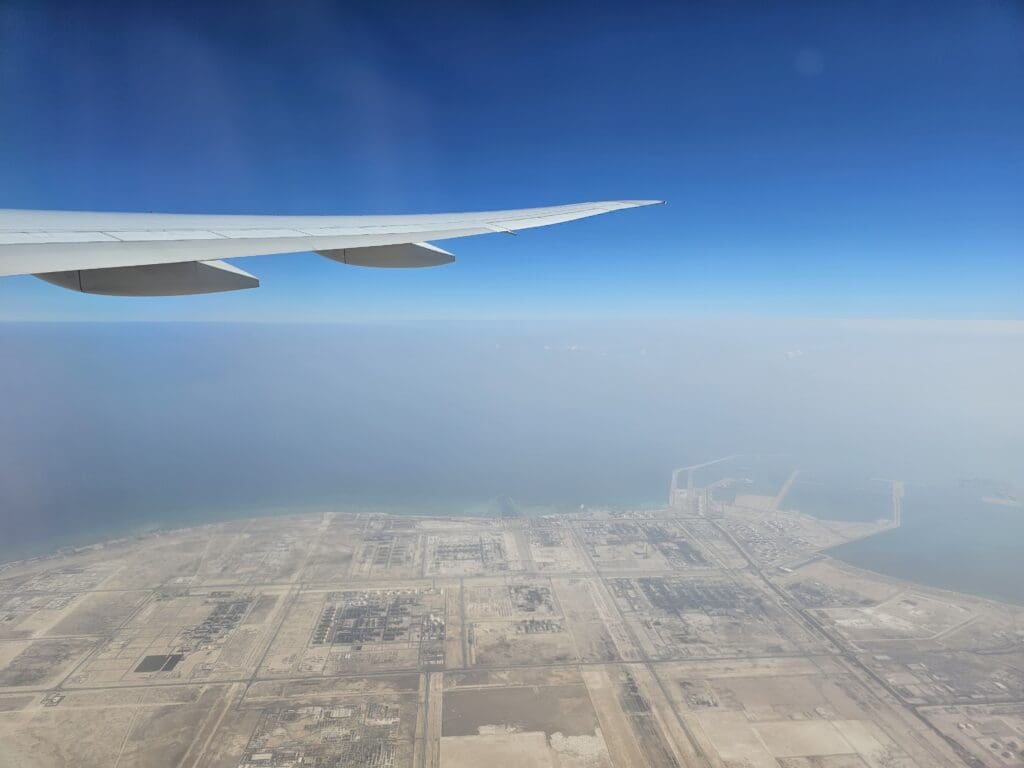
With our climb being rather smooth, the seatbelt signs were soon extinguished, although, by this time, many of my fellow passengers appeared to be fast asleep, with few standing up. Around twenty minutes into the flight, the Boeing levelled off at our initial cruising altitude of 34,000 feet, and as we sped northwest, there was little to see outside during this first hour or so of the flight. Inside, there appeared to be some commotion as two passengers in the bulkhead row were asked to move to allow a passenger travelling with a baby to sit there and a bassinet to be set up. Whilst they moved without making a fuss, for some completely unknown reason the new passenger did not take too kindly to this and seemed to spend a significant portion of the flight complaining to the crew – at one point three senior cabin crew members all came to the passenger although there appeared to be little that could console them!
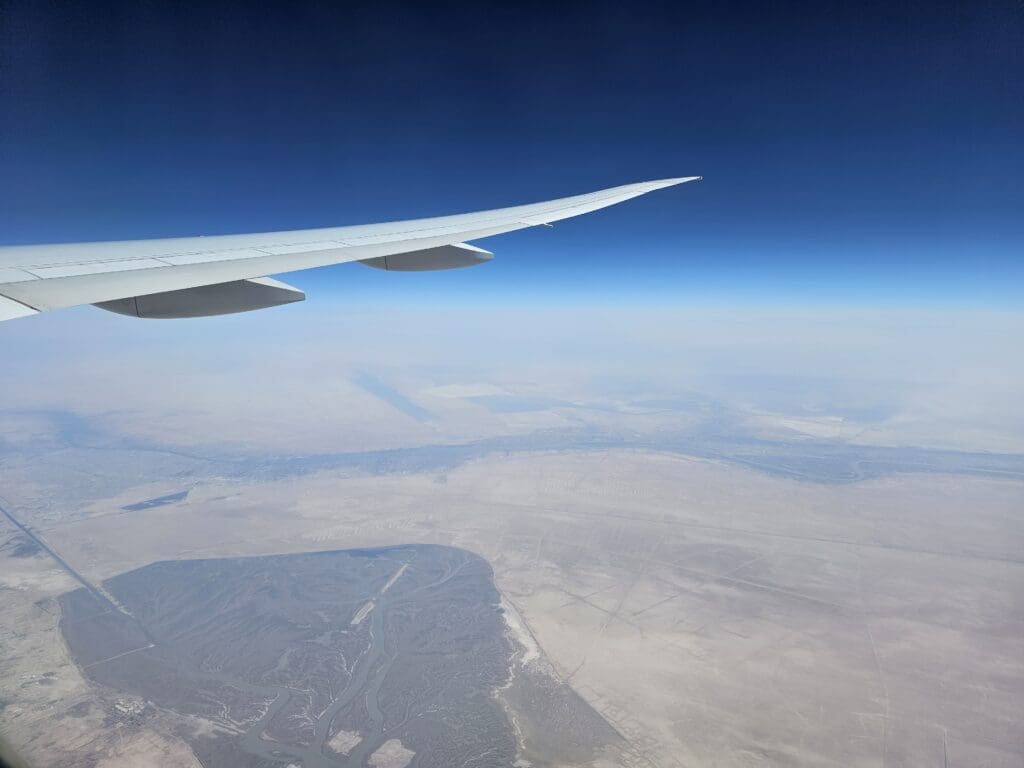
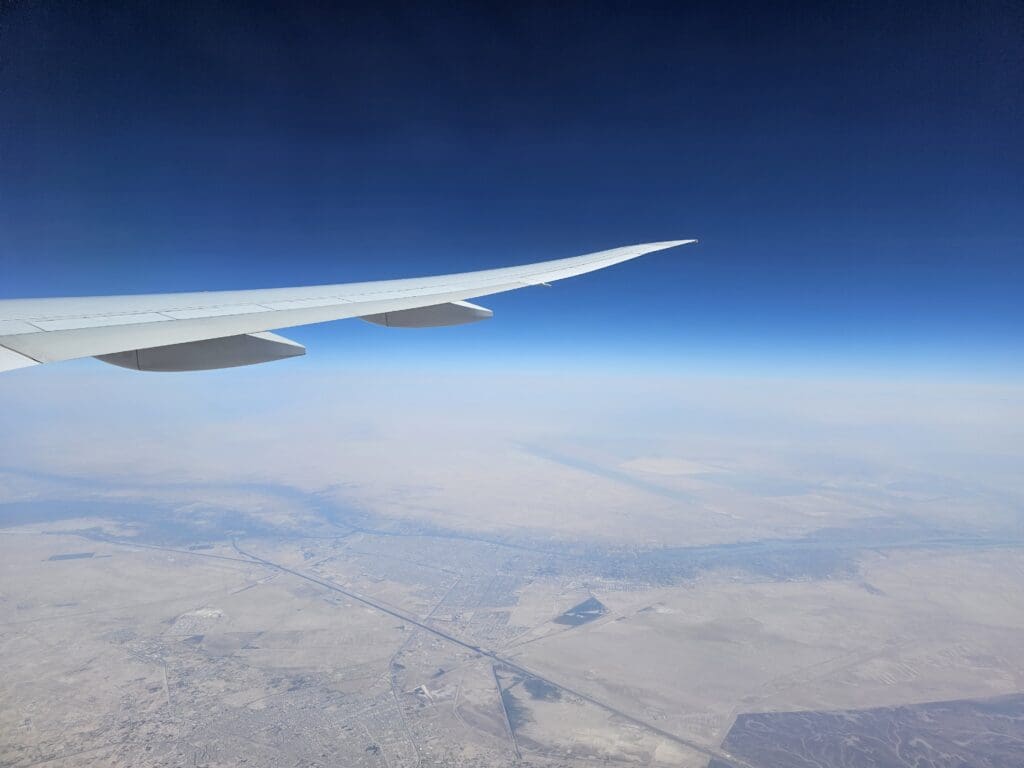
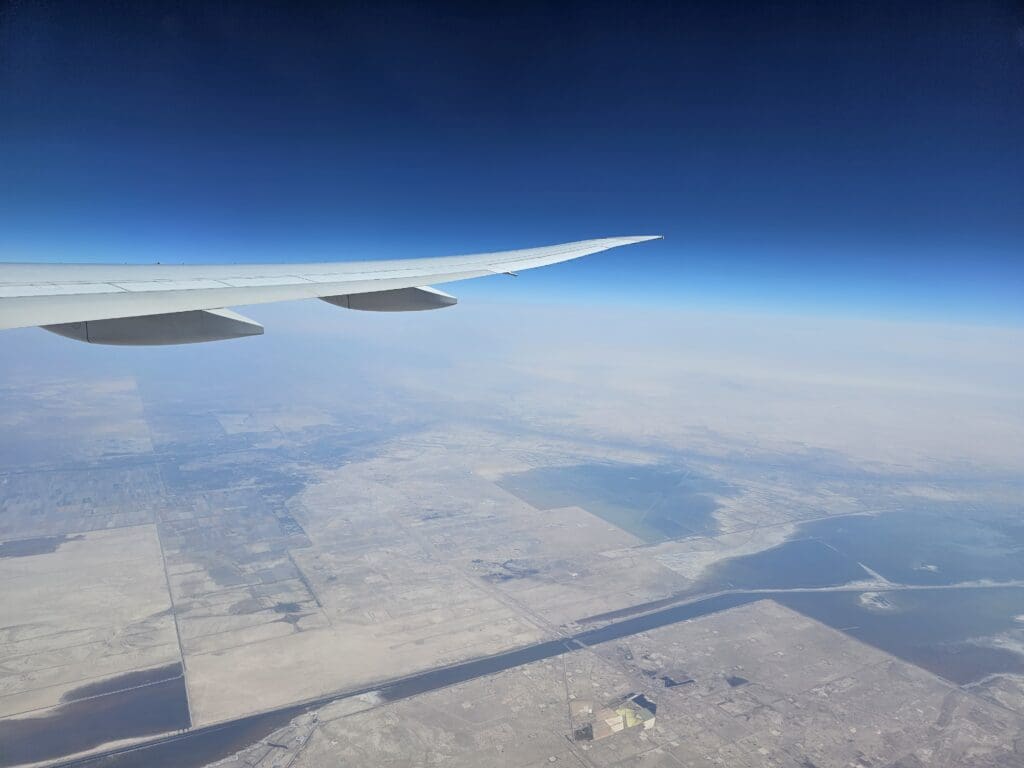
Around 45 minutes into the flight, the aircraft reached dry land and cut across Kuwait’s Bubiyan Island before passing over the border with Iraq around a minute later, just to the south of the city of Basra. With no clouds below, I was offered a good few of this sprawling city, which is home to around 1.4 million people. From there, the aircraft continued heading northwest, at which point the scent of warming food wafted through the cabin. Around twenty minutes later, as we cruised high above Iraq, the service carts rolled out and the brunch service commenced. With the menu for the flight available online, I had already browsed this and knew that the options that morning consisted of a hand-rolled cheese omelette with chicken sausage, braised beef with potato gratin or penne pasta in herb cheese sauce. All of these would be accompanied by a fruit salad and a more ‘proper’ dessert of white chocolate and mango mousse. Whilst advertised as a brunch service, this was served at around 0930 Qatari time, and thus more of a breakfast. However, of the options, only the omelette could be considered breakfast-y, and I suspect that the choice to have two dishes that are more akin to a lunch or dinner takes into account the fact that many passengers will have been offered breakfast on their way into Doha that morning.
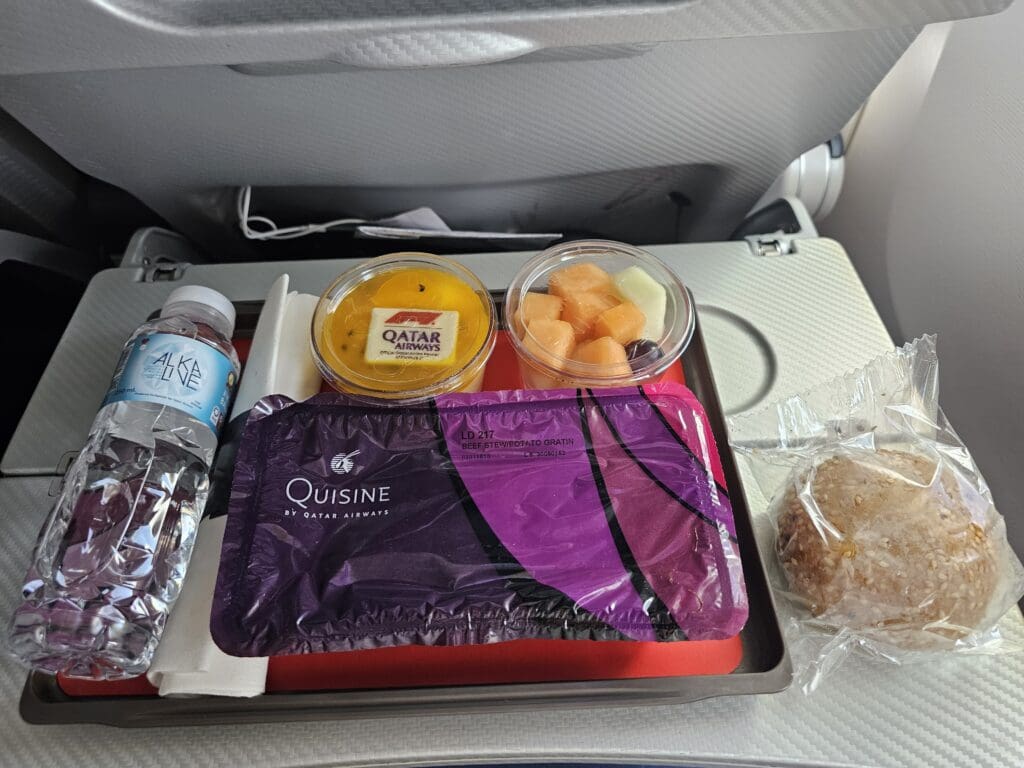
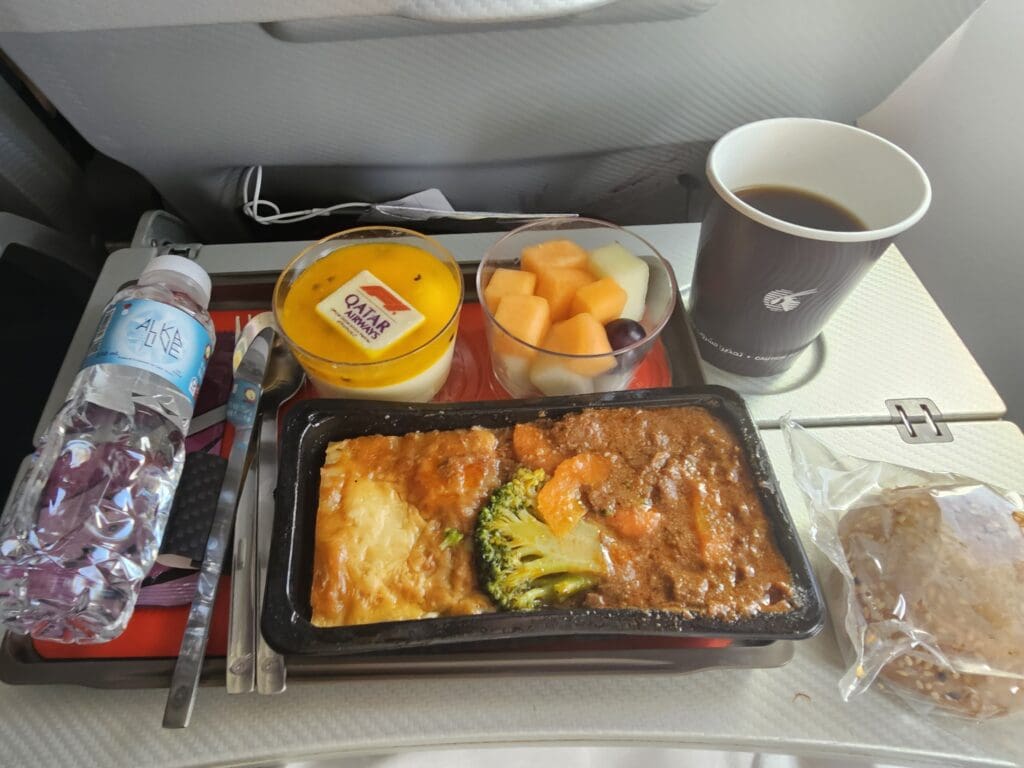
A short time after the service had commenced, the friendly flight attendant went over the options, at which point I opted for the beef. This was soon passed over to me on a tray and served with a warm bread roll and a small bottle of water. In addition, this came with real metal cutlery featuring Qatar Airways’ oryx motif, a fabric serviette and a wet wipe. Strangely, although not a proper complaint, no butter was served with the bread roll. To drink, I opted to pair the meal with a black coffee, which was soon carefully handed over to me in a paper cup. Soon getting started on the main meal, I found this to be of high quality and good quantity, leaving me with nothing to complain about. However, the real highlight was the mousse, which was undoubtedly one of the best desserts that I have ever eaten onboard an aircraft.
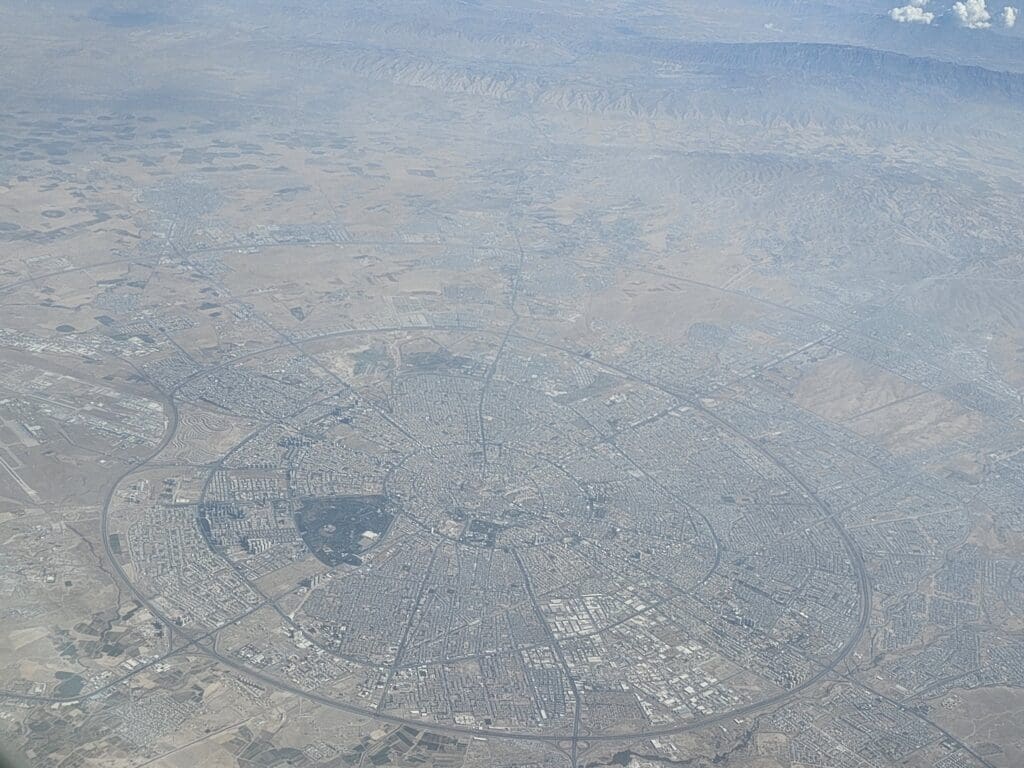
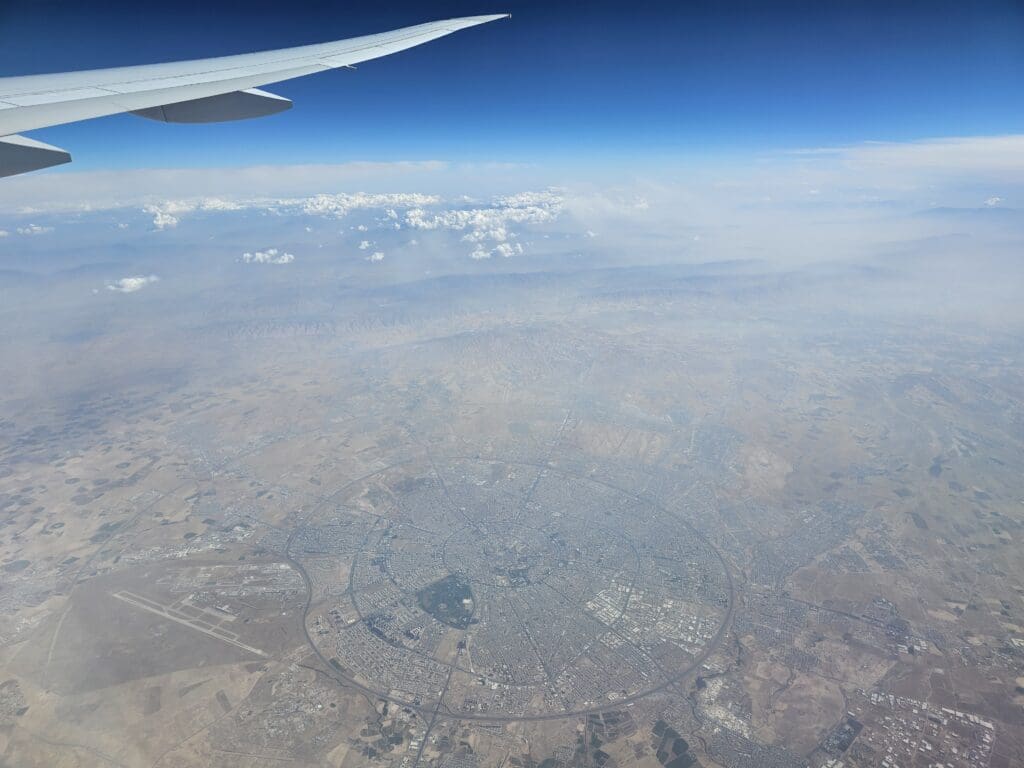
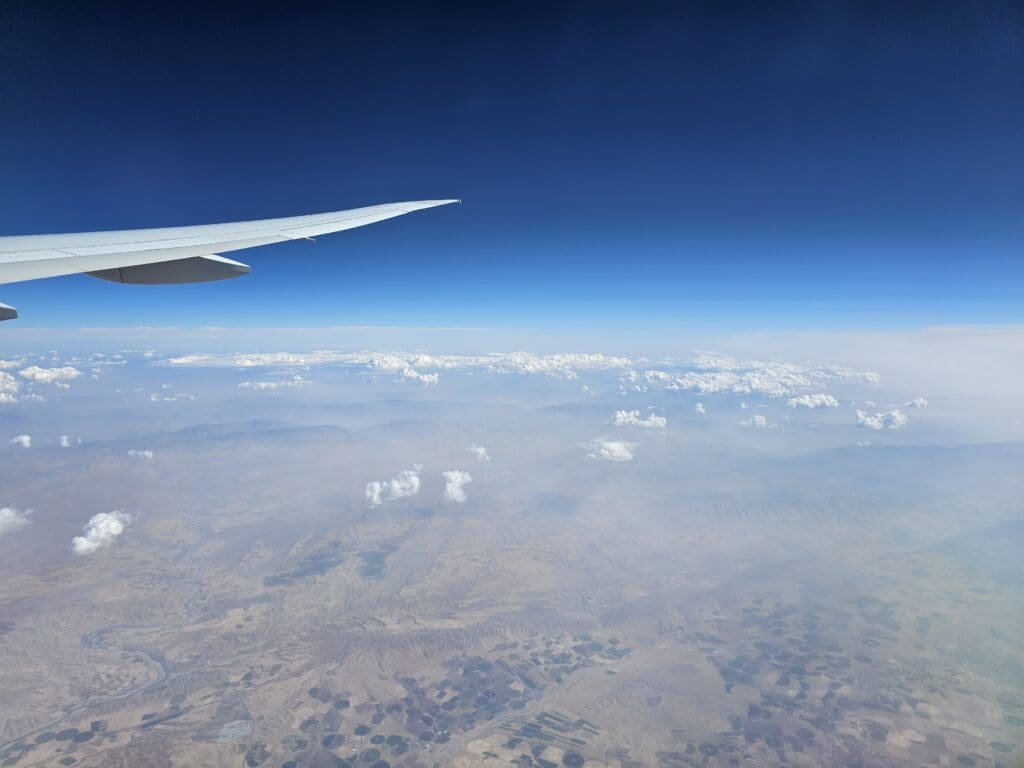
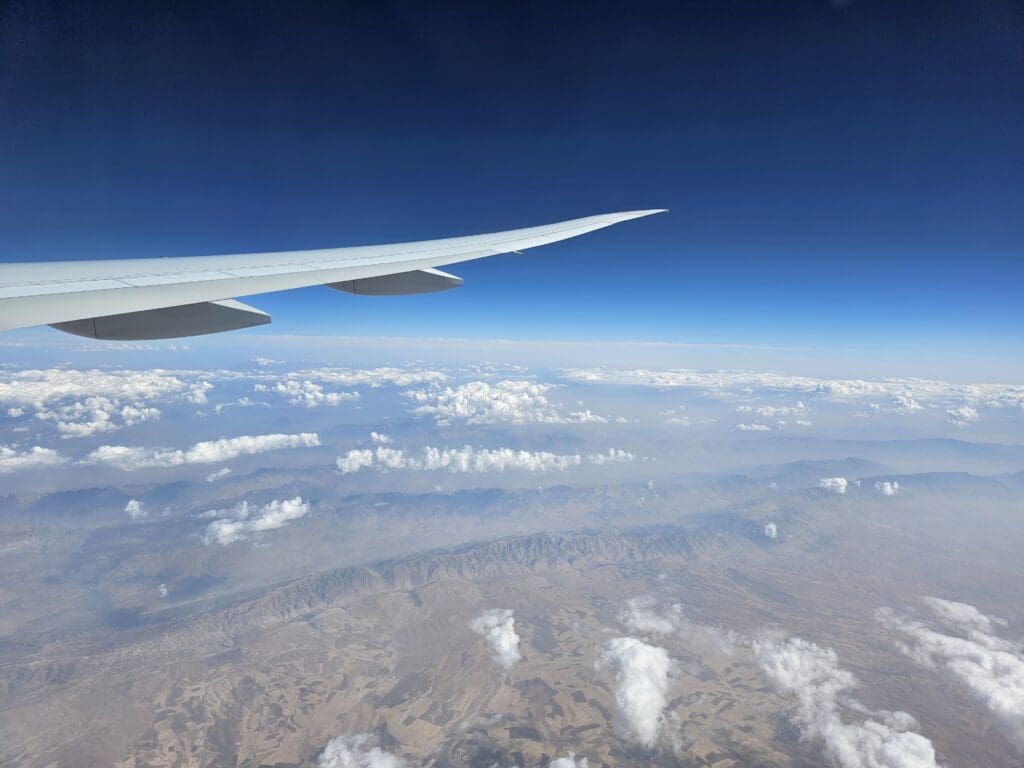
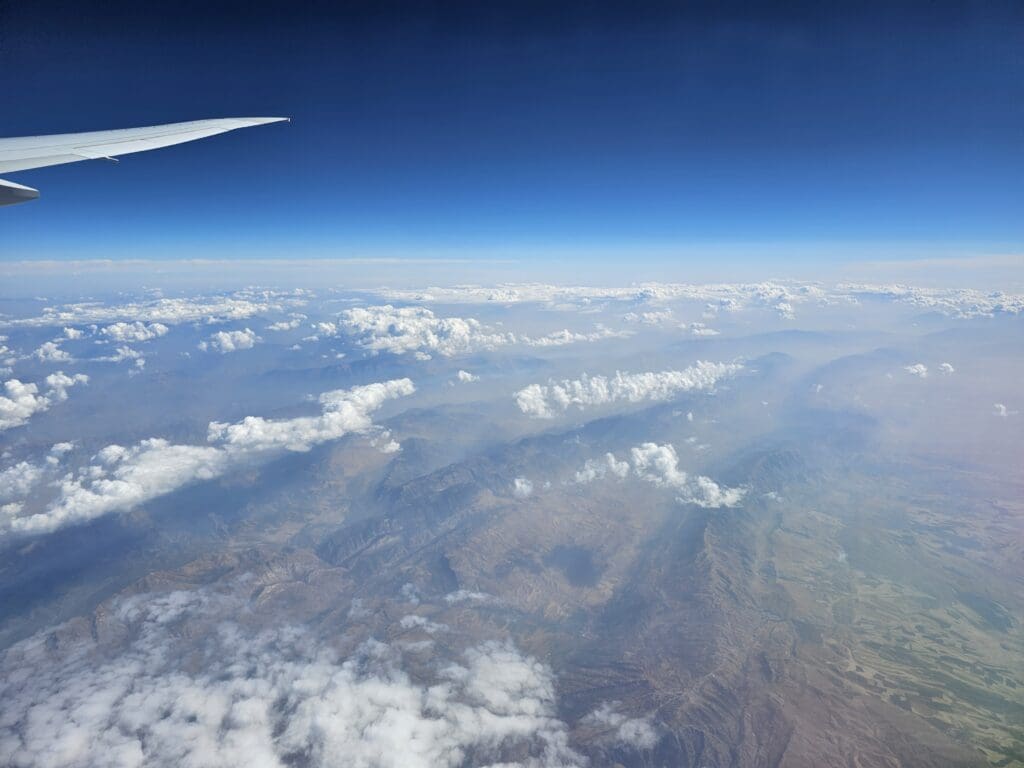
By the time I had polished my meal off, the aircraft had passed Baghdad and was now in the skies of Iraqi Kurdistan. Below, a good view was offered as we cruised over the region’s capital, Erbil, easily identifiable thanks to its circular layout and the modern airport that sits near the centre. After leaving this behind, the scenery below rose and became more mountainous as we sped towards Iraq’s border with Turkey.
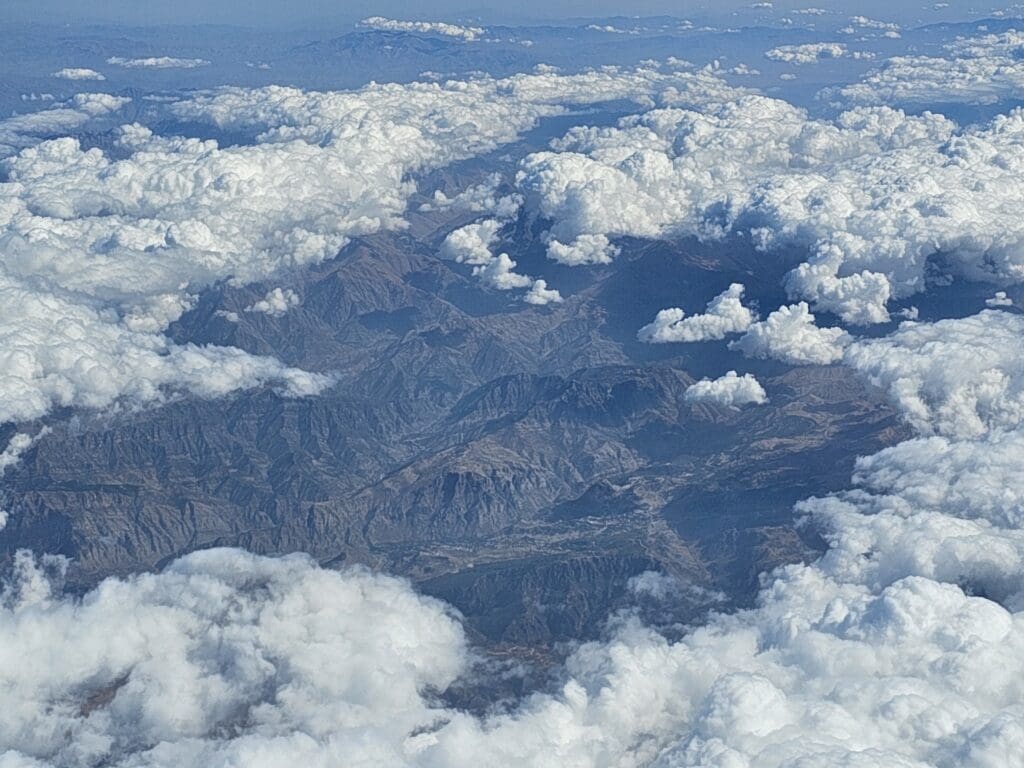
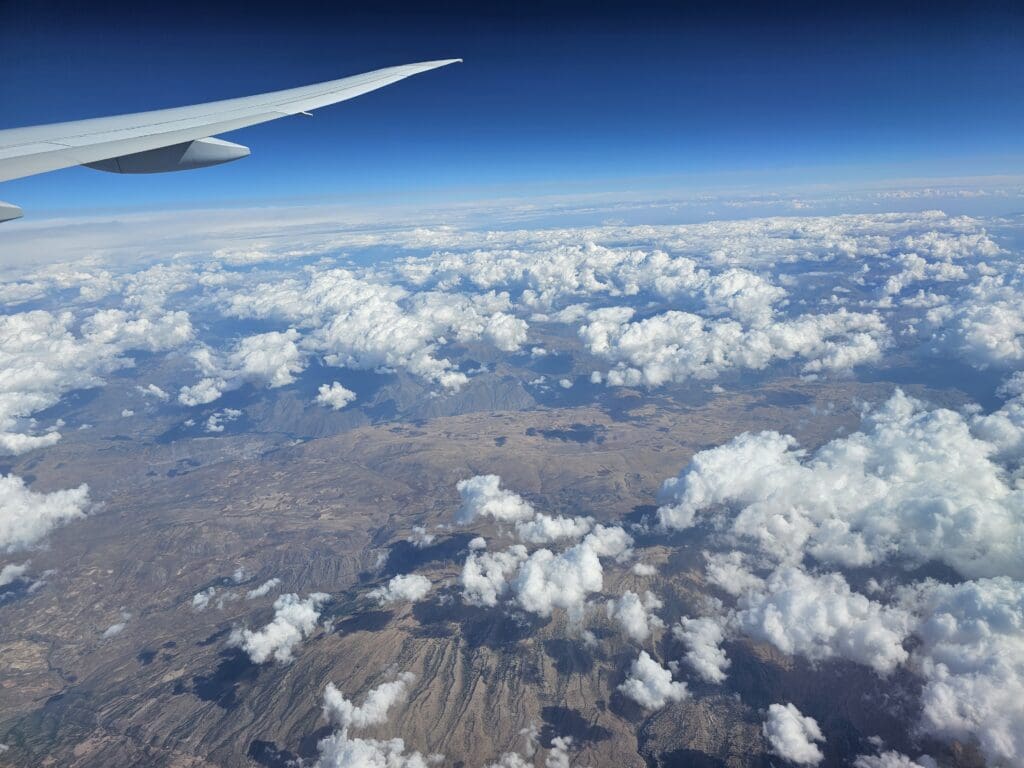
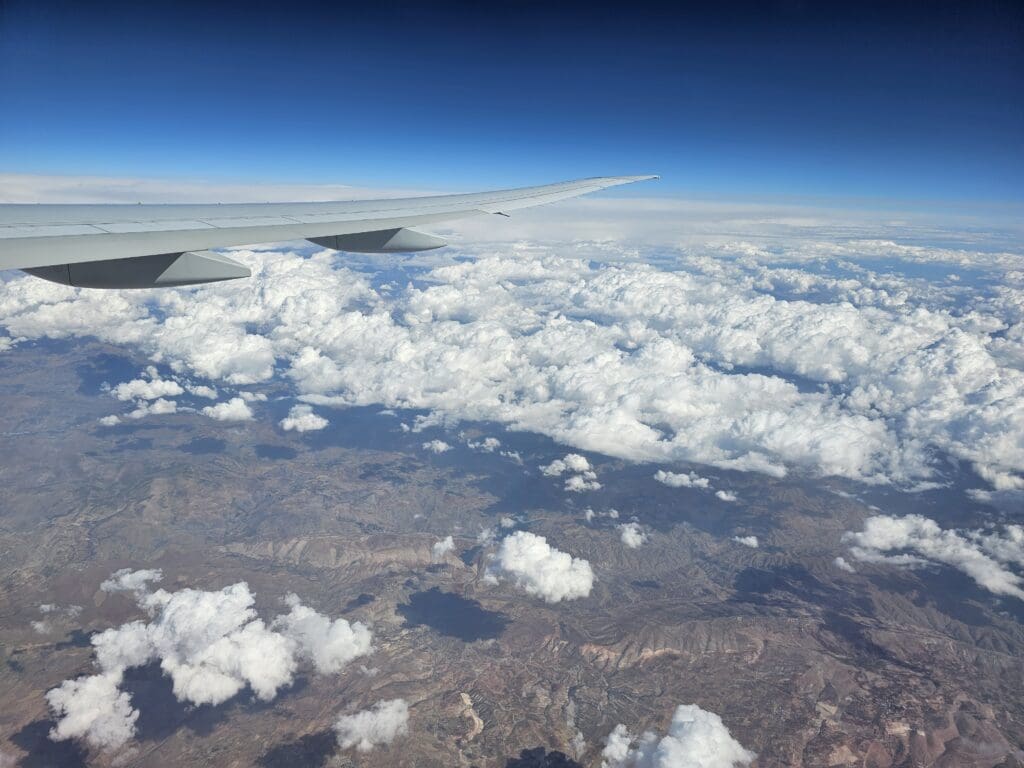
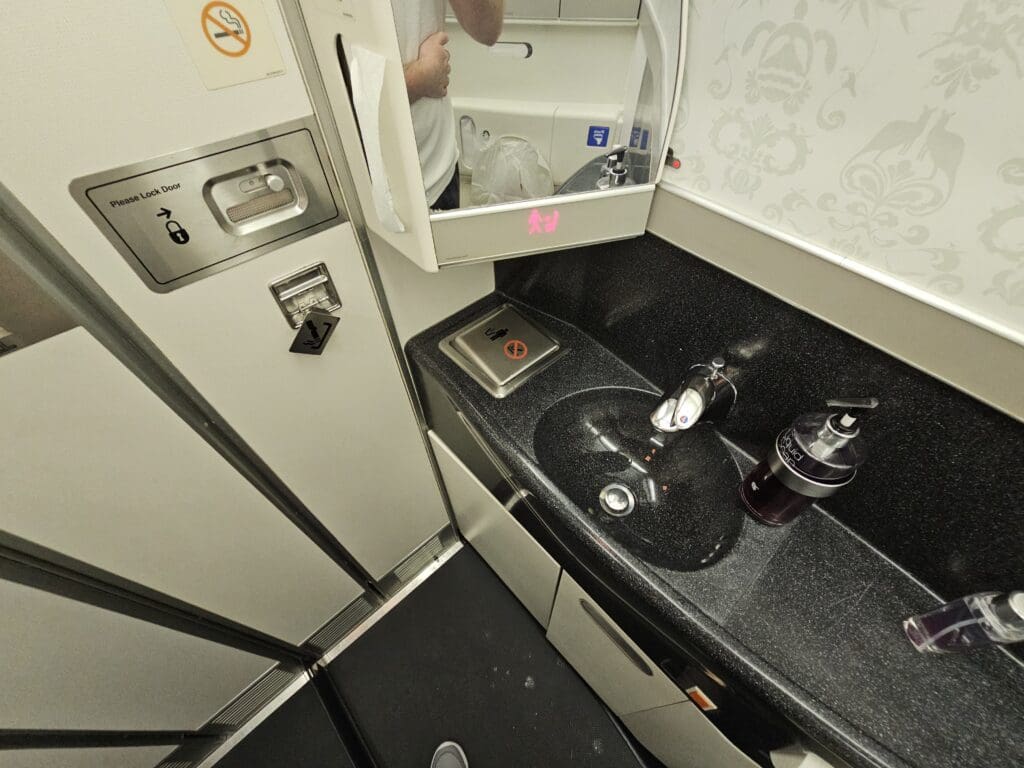
Whilst I had been left with no complaints about the meal, unfortunately, it did take quite some time for the crew to come round and collect the trays. In fact, a fair number of passengers did ding the call button for the crew to take their trays so they could get up and use the lavatory. It is also worth noting that there was no turbulence at this stage in the flight and thus no obvious reason as to why the crew did not collect these earlier. Finally, around 1H20 after the meal service commenced, trays were collected and following many, I decided to get up and use the lavatory. Following a queue, I entered the spacious lavatory at the rear of the aircraft. Inside, I found this to be relatively clean and soon spotted koalas, kangaroos and turtles on the walls, which all served to be a clear sign of the aircraft’s former operator!

By the time I made it back to my seat, clouds had rolled in below and blocked the view of Central Turkey and so I decided to explore the delights of the Oryx One inflight entertainment system. Just like its rivals, Qatar Airways boasts about the expansive nature of its entertainment system, offering thousands of hours worth of content from across the world. However, the system installed onboard this particular Boeing 777 was perhaps the most basic version of Oryx One, and far more spartan than those of their other Boeing 777s. Available in English only, this came with no option to search through the inflight entertainment library, and the only way content could be found was by scrolling through the various pre-defined categories (namely recent releases, family, Arabic, Bollywood and World Cinema). That day, visual content commenced with advertisements for Doha Expo 2023 and Qatar National Bank.
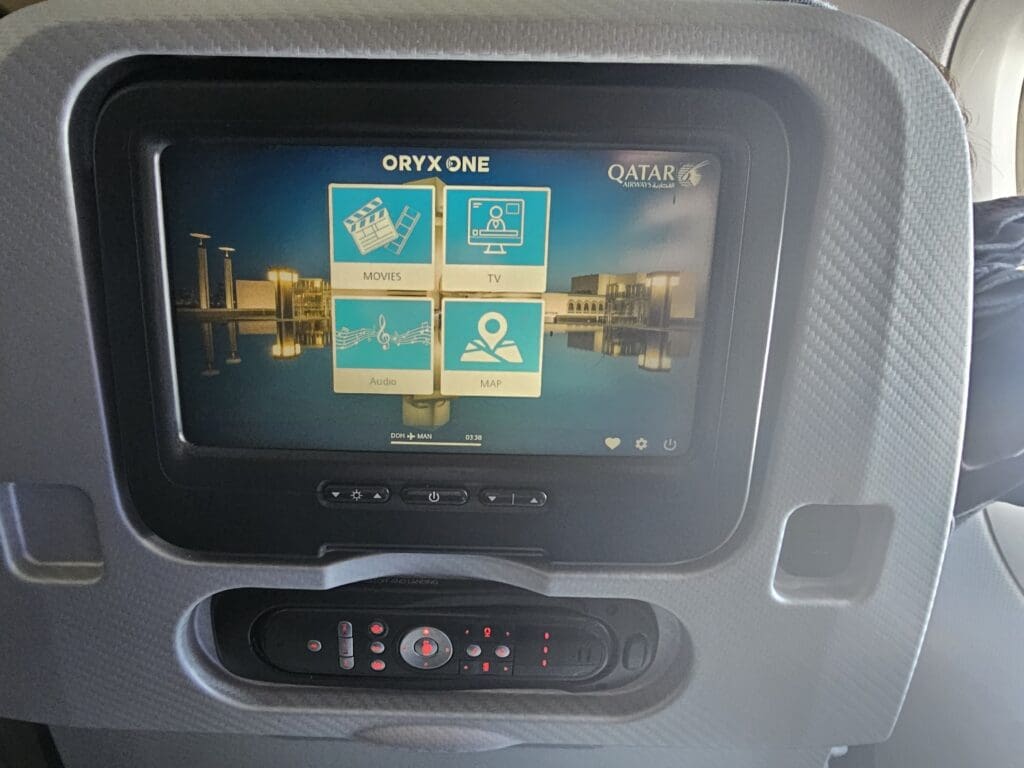
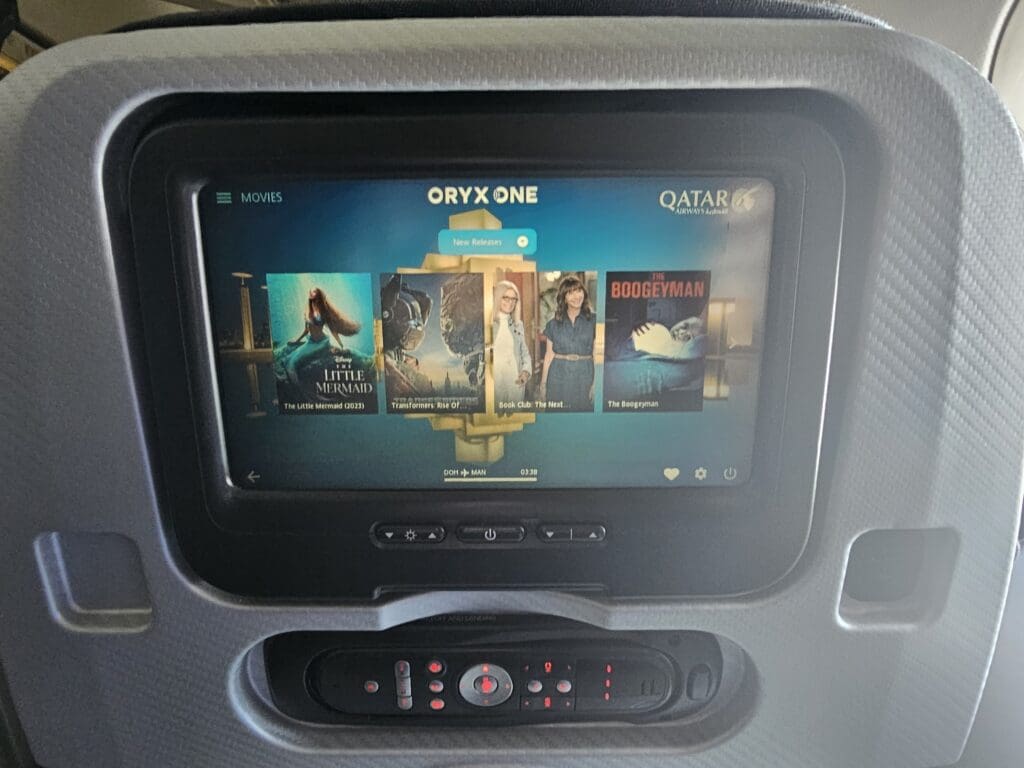
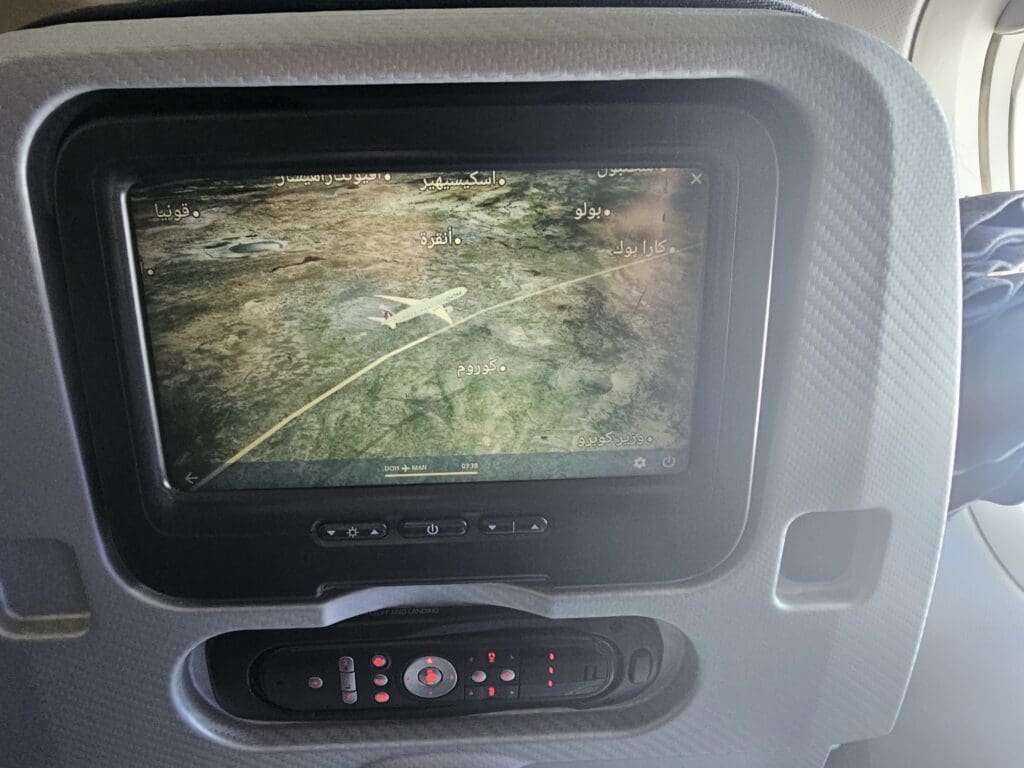
Overall, I found the system to be old and primitive, with nothing other than the options of Movies, TV, Audio and maps being offered, with no kids section, no live television, no games, no information on Qatar or Qatar Airways. Furthermore, the moving map appeared to freeze whilst over Iraq and did not come back to life for the remainder of the flight. In terms of the screen itself, this was dated and not of the best quality, and I found this to be far from responsive to touch and poorly calibrated. Whilst I was aware that this particular system is limited to this aircraft (and perhaps the other recently delivered ex-Virgin Australia example), other passengers may not have known this, and thus, this system may have left a negative impression. In addition to this, Qatar Airways’ onboard Oryx One Wifi was offered onboard and priced at a reasonable flat fee of $10 for the duration of the flight. However, passengers could connect to this without paying and check the weather in Manchester and read the menu for the flight.
Having comprehensively explored the inflight entertainment system, I had a short nap as the aircraft left Turkey behind and made a 25-minute crossing of the Black Sea. Making landfall near the Bulgarian coastal city of Varna, a short time later, I woke up and upon glancing outside, I was delighted to see that the clouds had parted. At that time, the Danube could be seen as we crossed the border into Romanian skies just downstream from the town of Ruse. Coincidentally, I had flown in the exact same airspace exactly two weeks prior on my McDonnell Douglas MD-82 flight from Varna to Leipzig. A short time later, the sprawl of Romania’s capital Bucharest came into view and we continued heading northeastwards towards the border with Hungary. Returning to the service, I ought to mention that following the brunch, no drinks rounds were made for quite some time, and the crew members appeared to stay in the galley.
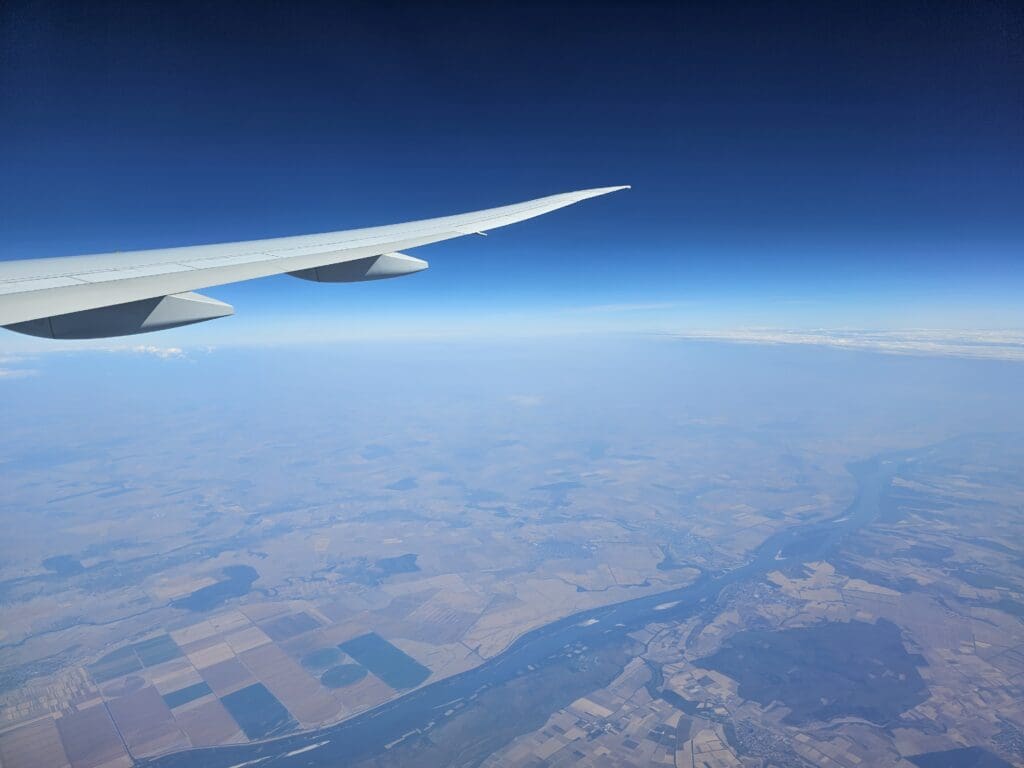
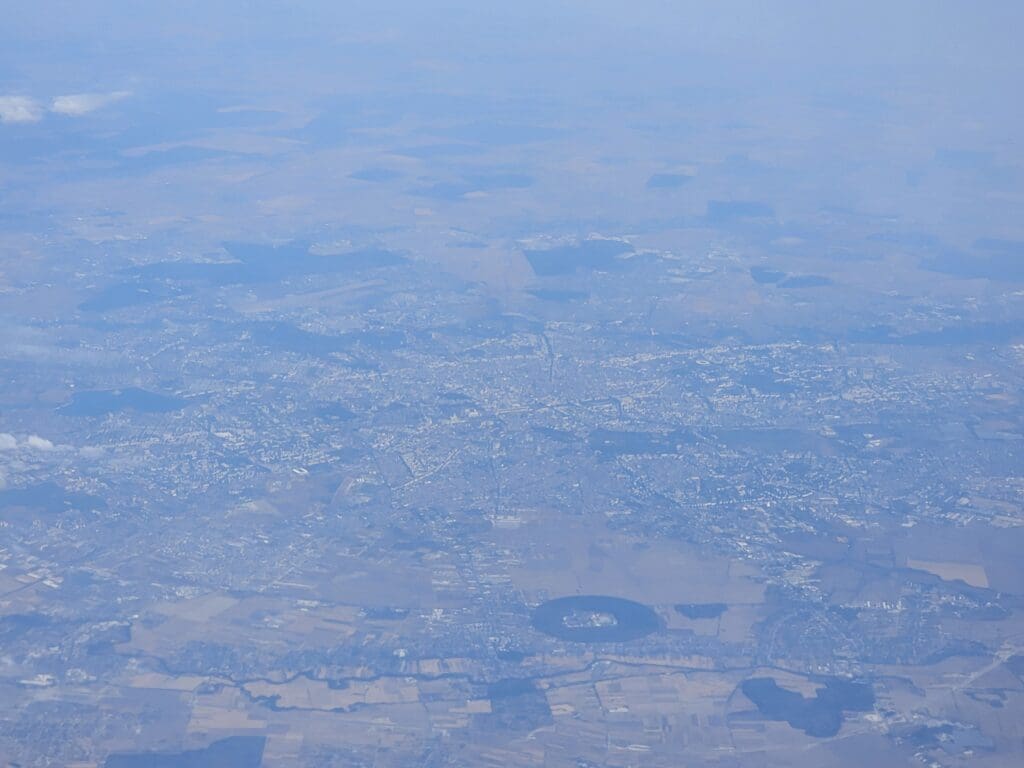
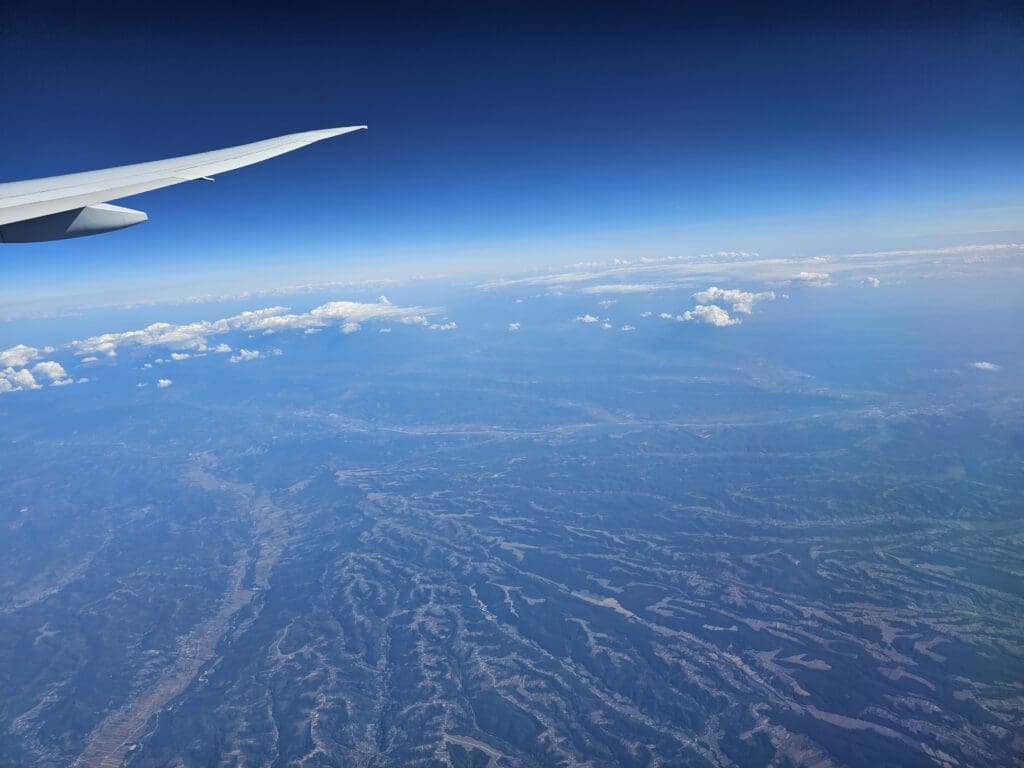
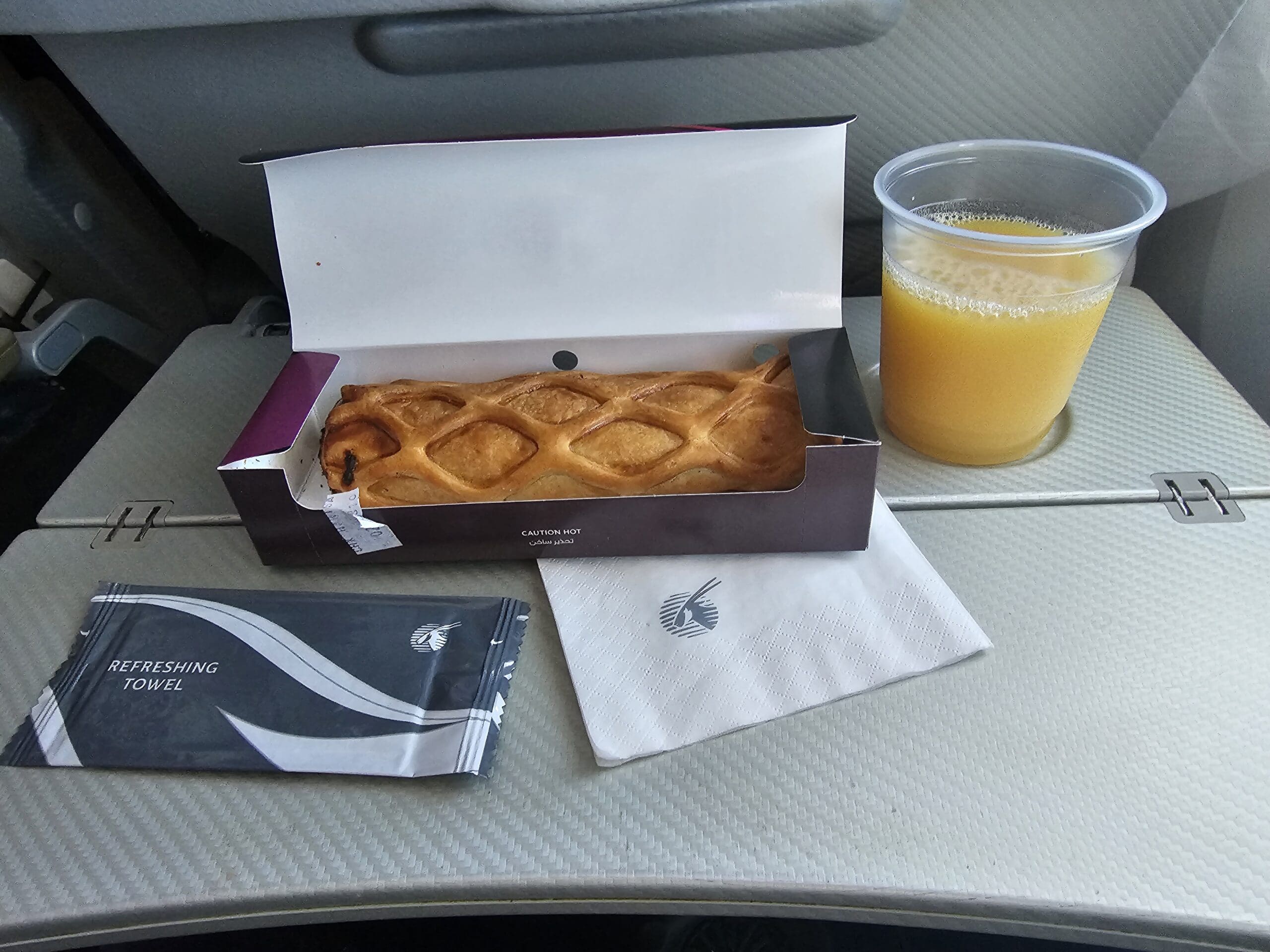
Once away from Bucharest, the aircraft continued flying northwest and crossed over the Carpathian Mountains before reaching Hungary, ending our 35 minutes over Romania. Crossing the border to the east of the city of Szeged, we soon passed Kecskmét and then the capital, Budapest. After passing the city of Gyor, the aircraft then entered Austrian airspace, and we passed the city of Vienna. At this time, carts were pushed out into the cabin as the pre-arrival snack service commenced. Once again, I was served a short time after this service began, at which point the same flight attendant offered me the choice of a harissa chicken pastry or a pizza slice. Deciding to go for the former, I then requested an orange juice to wash this down which was cautiously passed over to me. Overall, this was of okay quality, if not slightly dry. However, the fact that a second hot food service was undertaken when several airlines have removed this on services between the Gulf and Europe ought to be recognised. Unfortunately, once again an unreasonable amount of time passed before the remains of this service were taken away, with a gap of an hour between these being handed out and the rubbish being collected.
From Vienna, the aircraft cut across a small portion of northern Austria and made its way towards Linz before arriving at the German border at Passau. Continuing onwards through the sunny skies of Europe, the aircraft made its way past Regensburg before Nuremberg popped into view where the city’s airport and the cluster of aircraft waiting for their next flights could be seen. Next up was the city of Wurzburg, followed by Frankfurt and a short time after this, the neighbouring cities of Cologne and Bonn could be seen to the north.
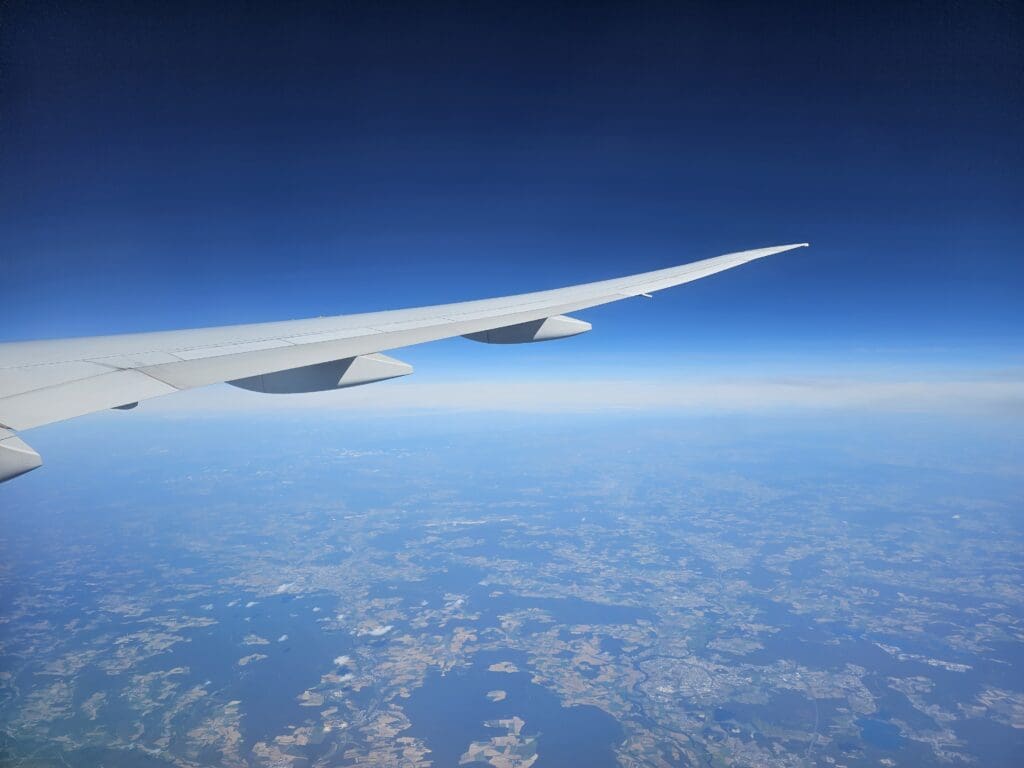
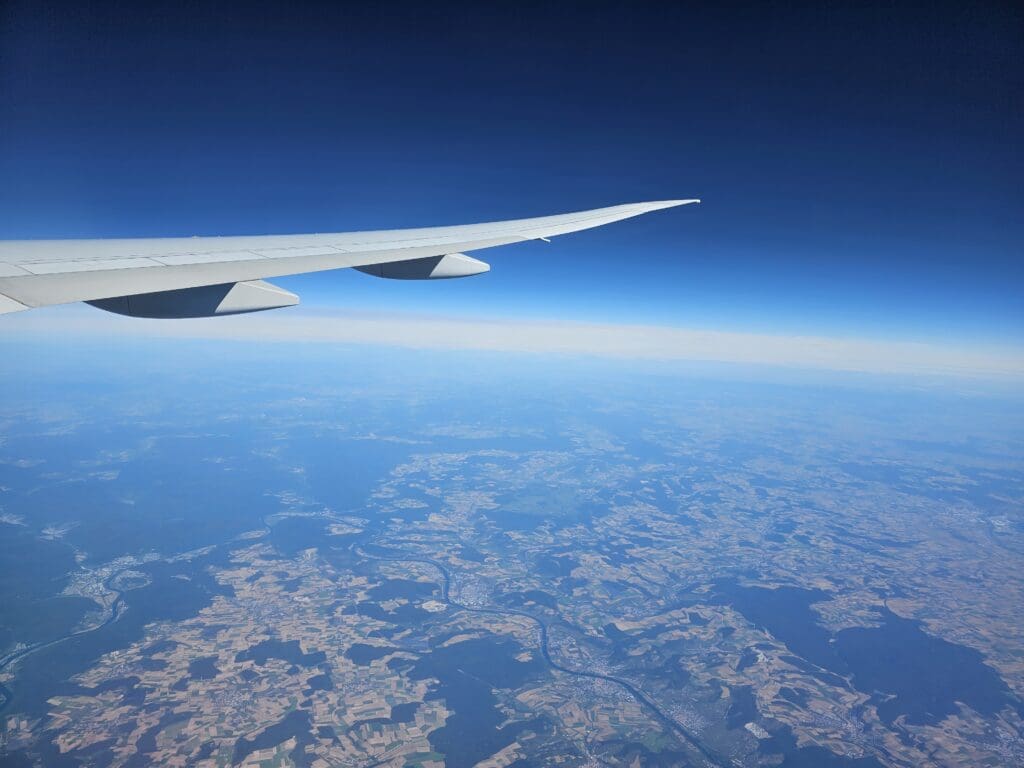
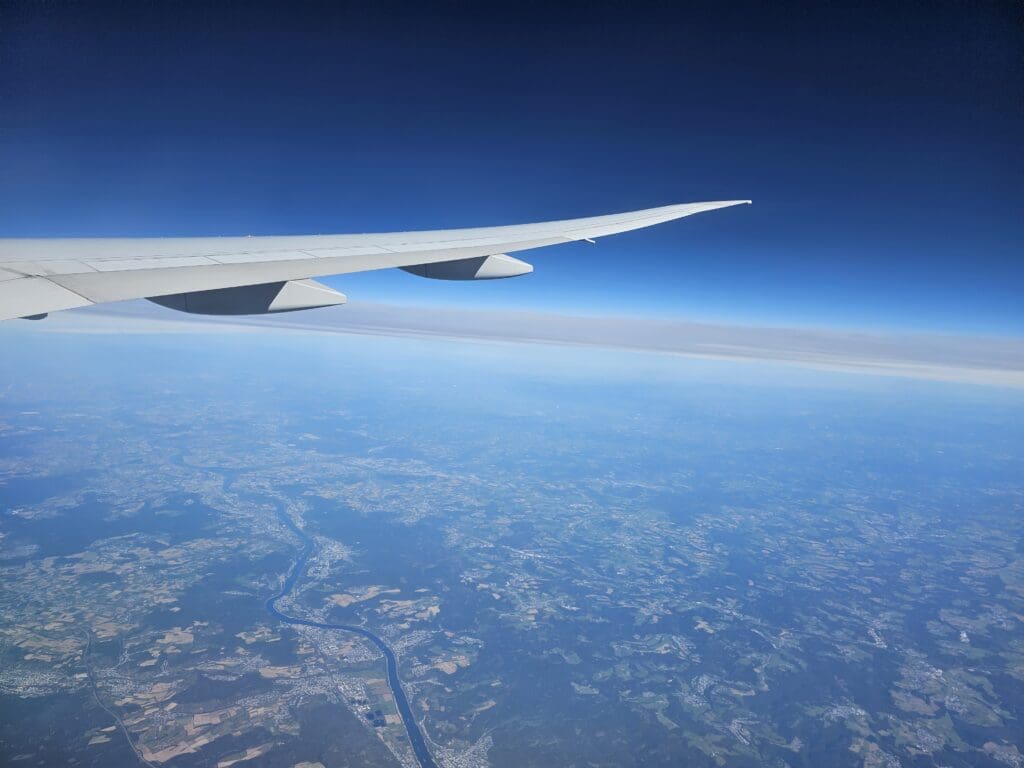
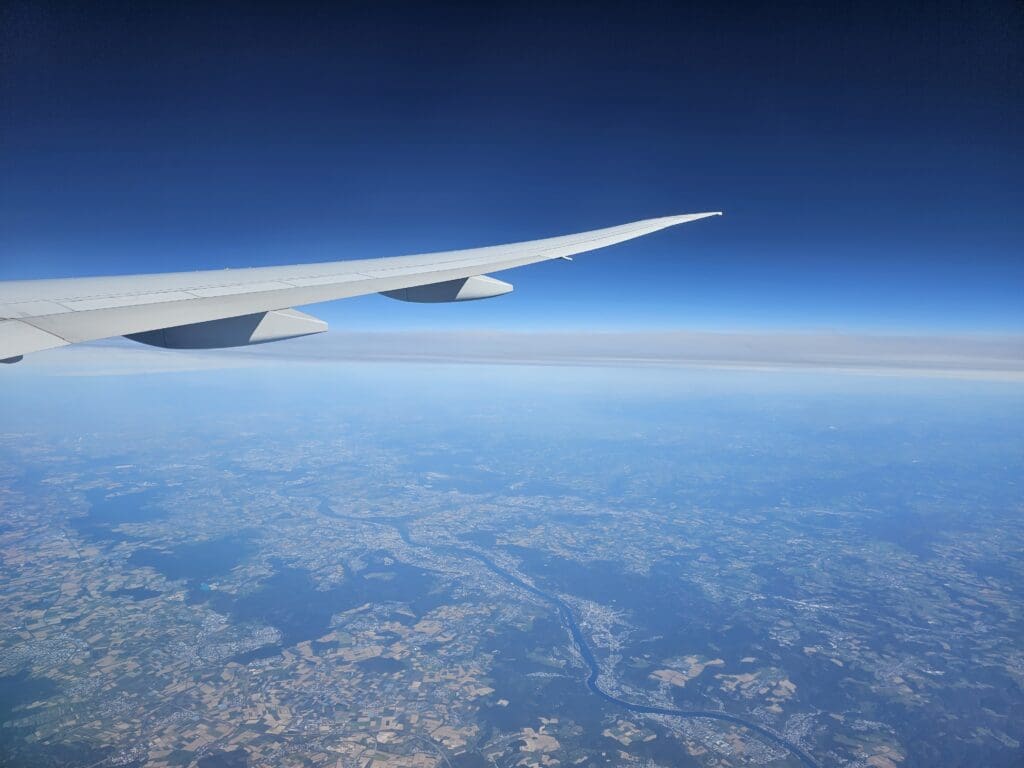
Upon reaching Aachen, the aircraft left Germany behind and crossed into the skies of Belgium, although the Dutch city of Maastricht could be seen to the north of the aircraft. Whilst over Belgium, the remains of the snack service were collected and following the crowds, I decided to make a pre-arrival trip to the toilet. Following a short queue, I entered one of the lavatories at the rear of the aircraft and found this to be in a clean and pleasant condition, indicating that the crew had looked after this during the flight.
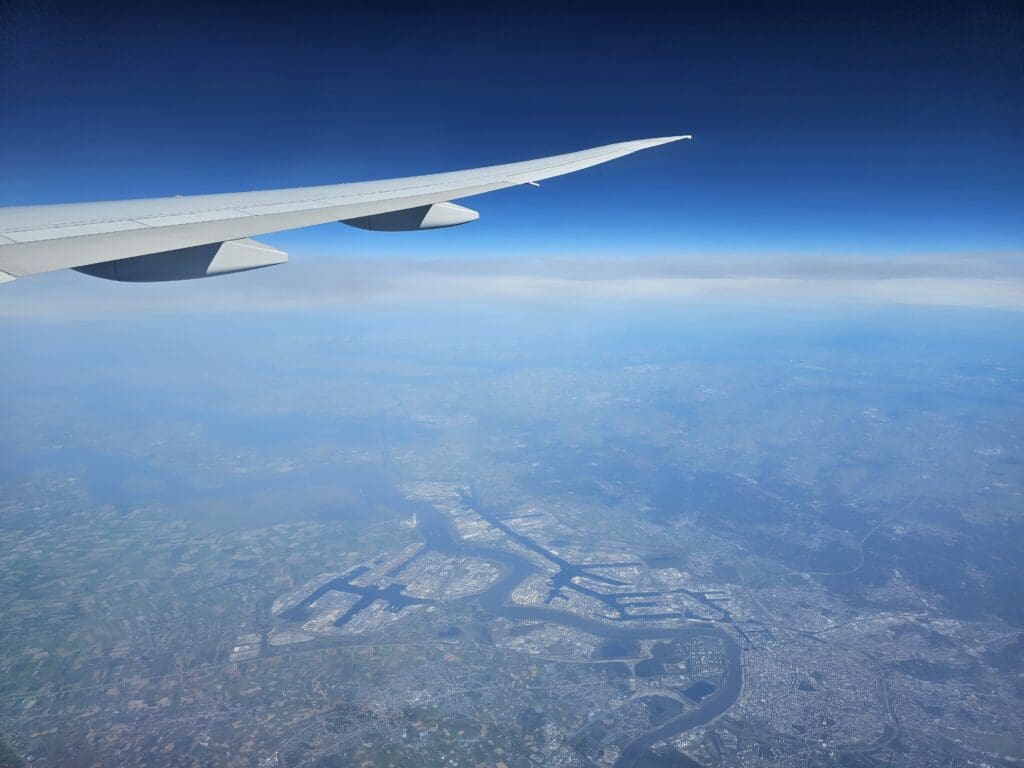
By the time I returned to my seat, the docks of the Belgian city of Antwerp could be seen to the north as we continued westwards along the Scheldt Estuary. After passing the Dutch towns of Breskens and Vlissingen on the south and north banks of this, we journeyed out over the blue waters of the North Sea at which point the captain performed their pre-arrival announcement. During this, they advised that we could expect to be on the ground in 40 minutes, provided an update on the grim and drizzly weather in Manchester and thanked passengers for flying with Qatar Airways. Below, almost as soon as we left land behind the sight of endless wind turbines came into view although these soon disappeared behind clouds as we neared British shores.
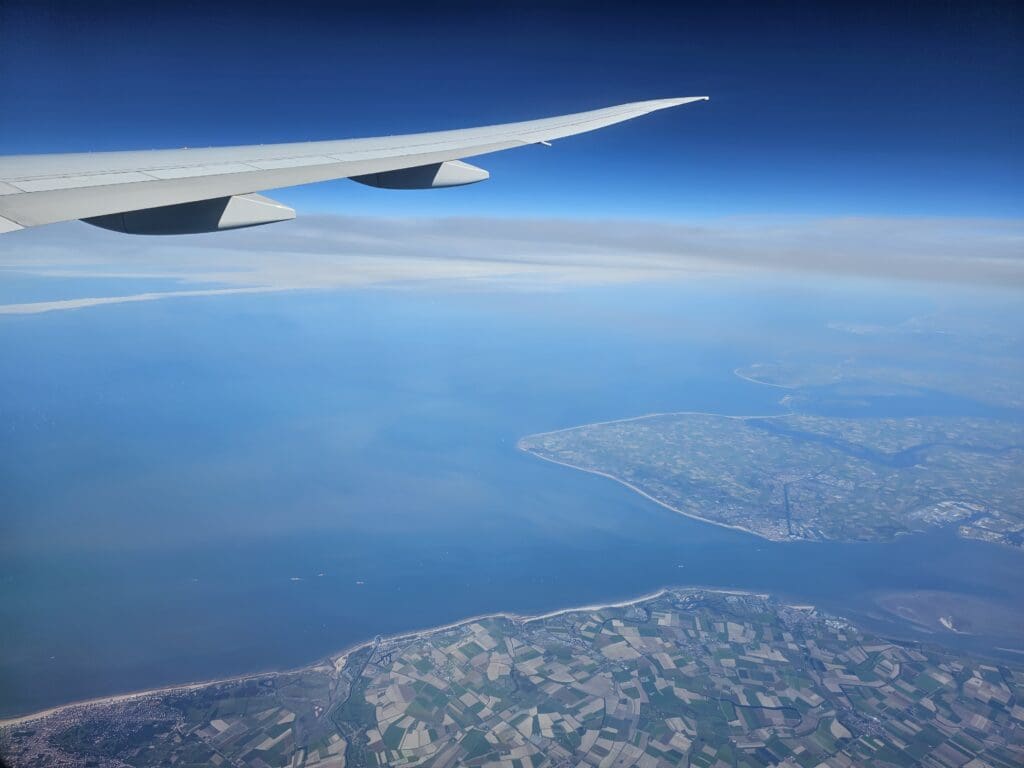
A few moments later whilst cruising high above the North Sea, at 1223 the Boeing could be felt leaving its cruising altitude and commencing its journey back to earth. Unfortunately, thanks to the thick clouds that lingered over the UK that afternoon, nothing could be seen of the country until on approach. Following a ten-minute crossing of the North Sea, the aircraft made landfall over the Essex town of Clacton-on-Sea before heading inland and passing Colchester and Cambridge, at which point the seatbelt signs were illuminated and the crew passed through the cabin, ensuring that all was in place for our arrival.
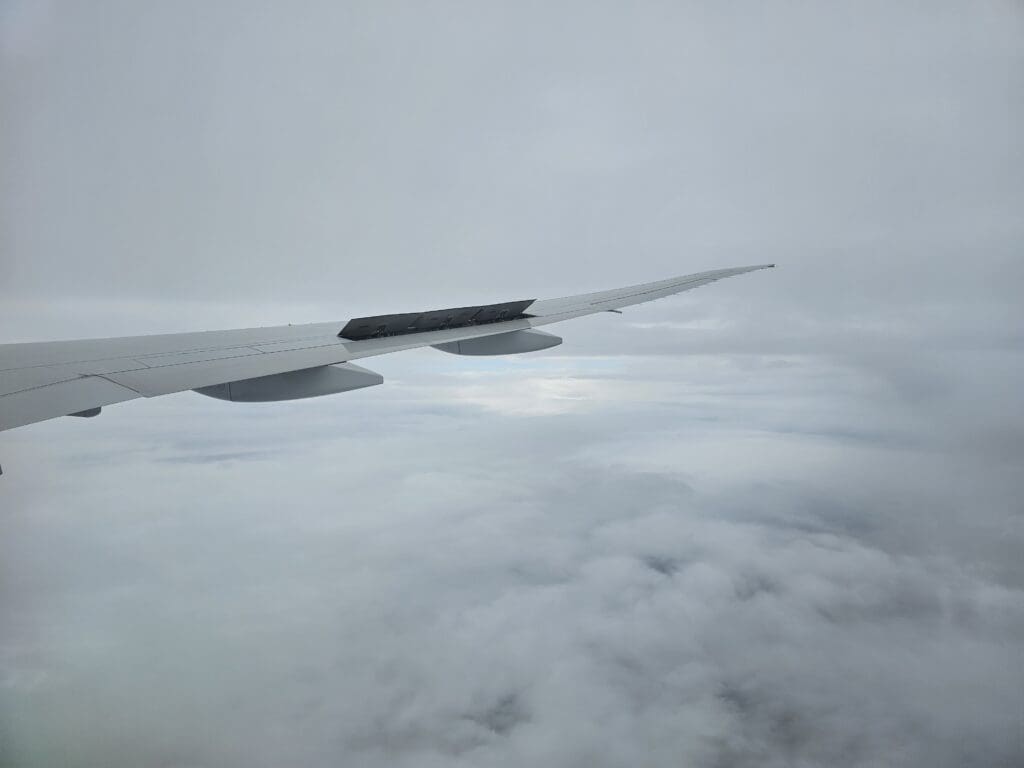
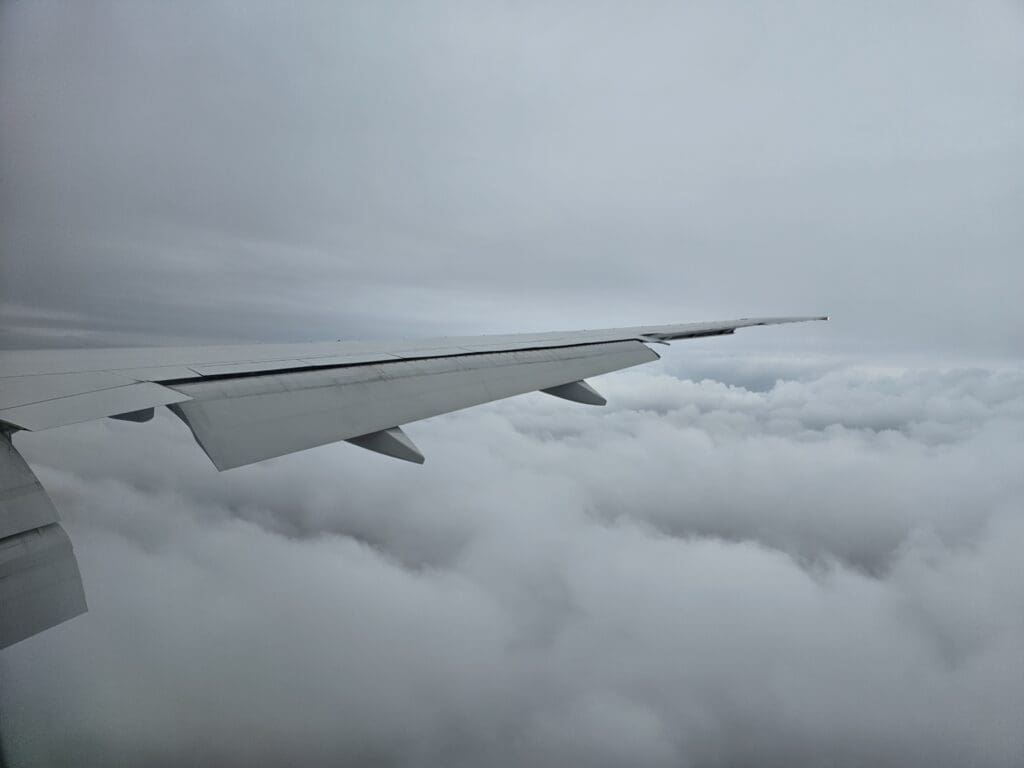
After passing Cambridge, the Boeing continued on its journey northwards and reached the East Midlands, passing Corby, Leicester and Loughborough, followed a few minutes later by Derby. At this point, I drifted off to sleep for about five minutes, although our journey to Manchester took us over the southern half of the Peak District National Park before we skirted along the western fringes of this before turning around and lining up for an approach to Runway 23R.
With all crew members and passengers strapped in, we bounced through the clouds and after passing over the centre of Stockport, the ground came into view below. At this stage, Stockport’s B&Q store, an instantly recognisable sight that has for years reminded many a northerner that they are almost back home, came into view. This was followed by the sight of plenty of houses and a few parks as we descended over the rain-soaked Manchester suburbs of Cheadle and Heald Green.
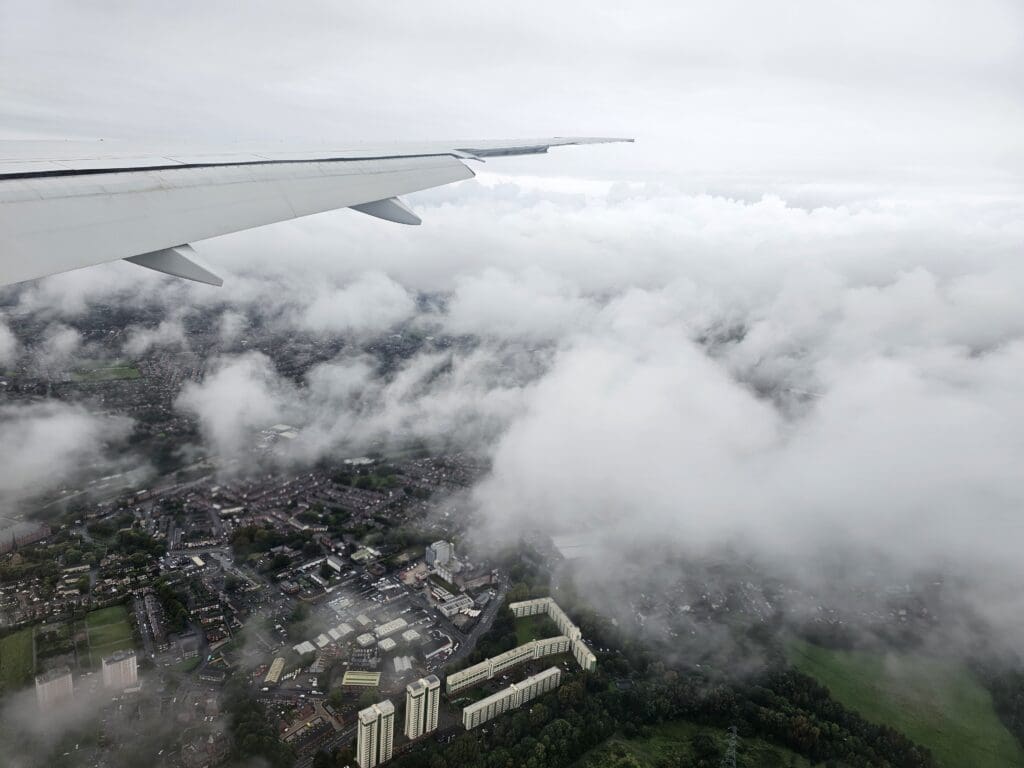
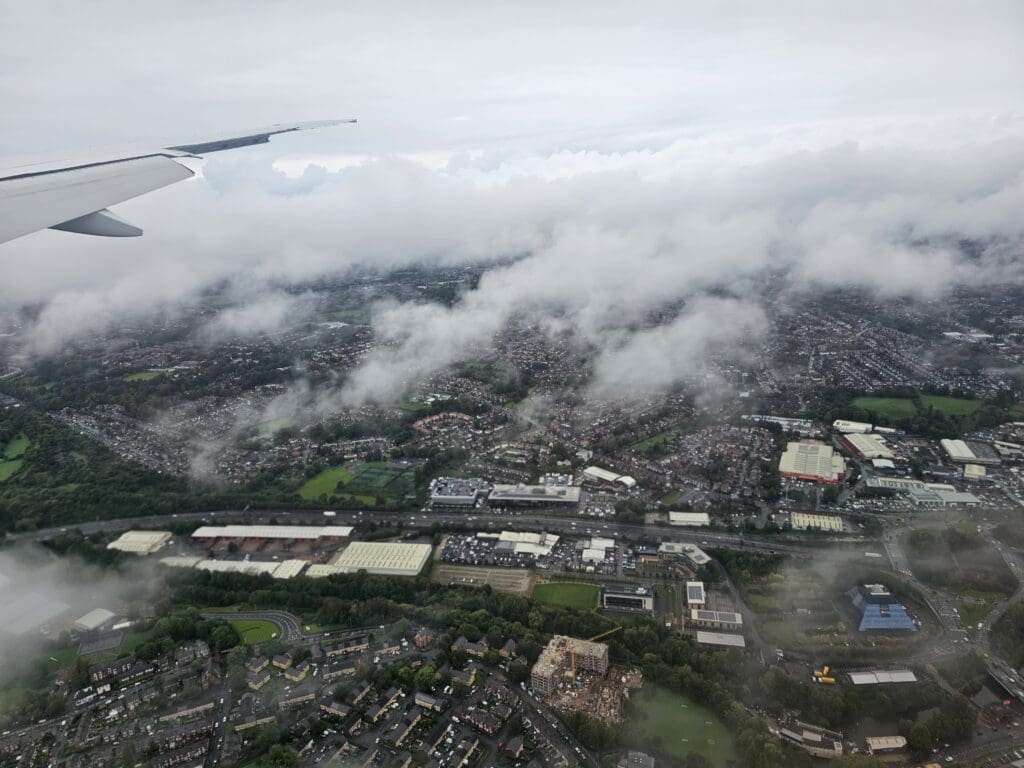
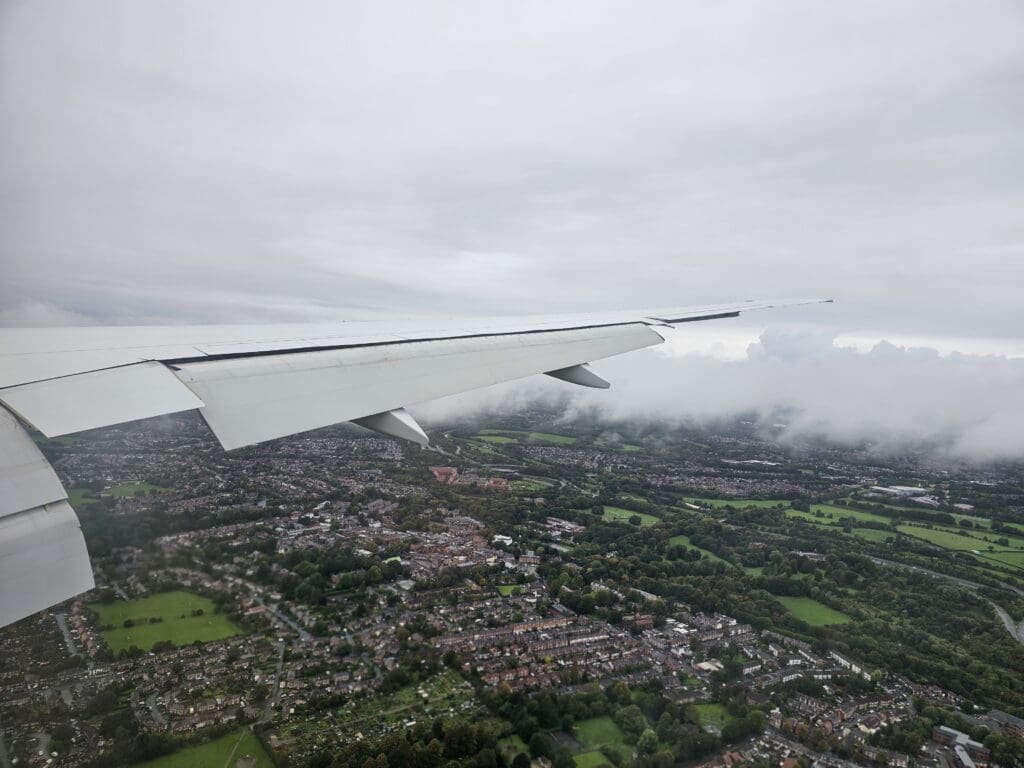
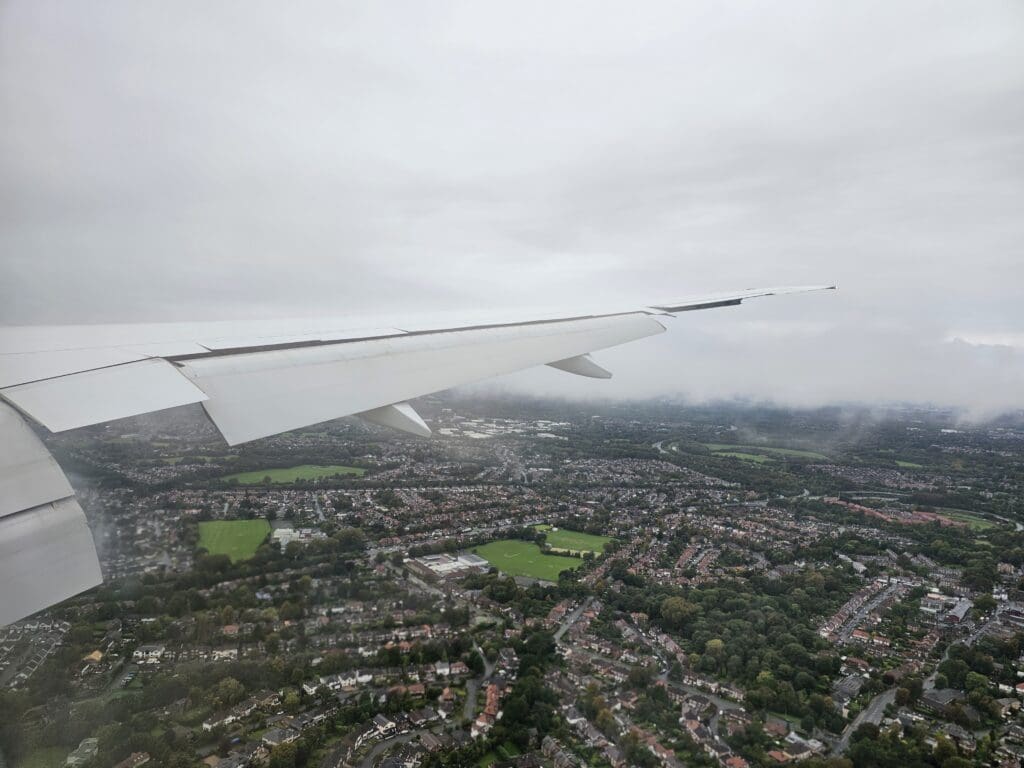
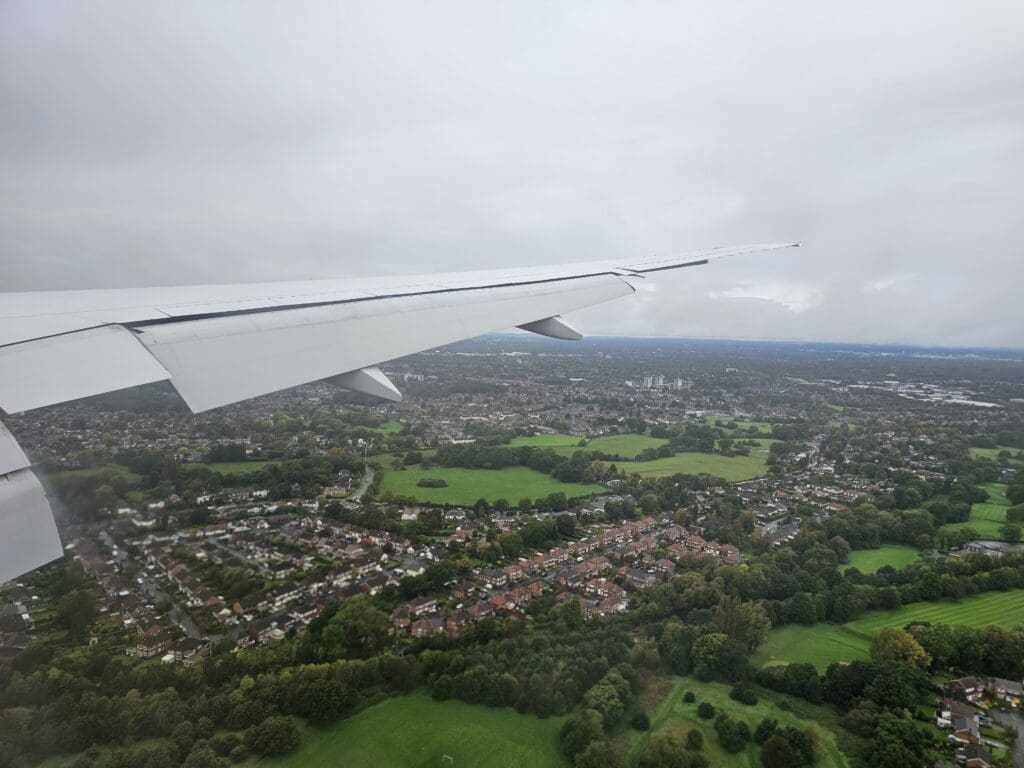
Soon enough, the aircraft passed the perimeter fence and the famous pub at the end of the runway. At 1304, just under seven hours after taking to the skies of Qatar, the Boeing 777 slammed down on the runway and the aircraft decelerated rather heavily, throwing up plenty of spray behind it. After passing the terminals, the aircraft vacated the runway to the right, at which point all onboard were welcomed to Manchester and we began our taxi over to Terminal 2. At that time in the afternoon, several other visitors from the region could be seen on the ground at Manchester including an Emirates Airbus A380, two Gulf Air Boeing 787-9 Dreamliners and the comparatively small Airbus A320neo operated by Kuwait Airways.
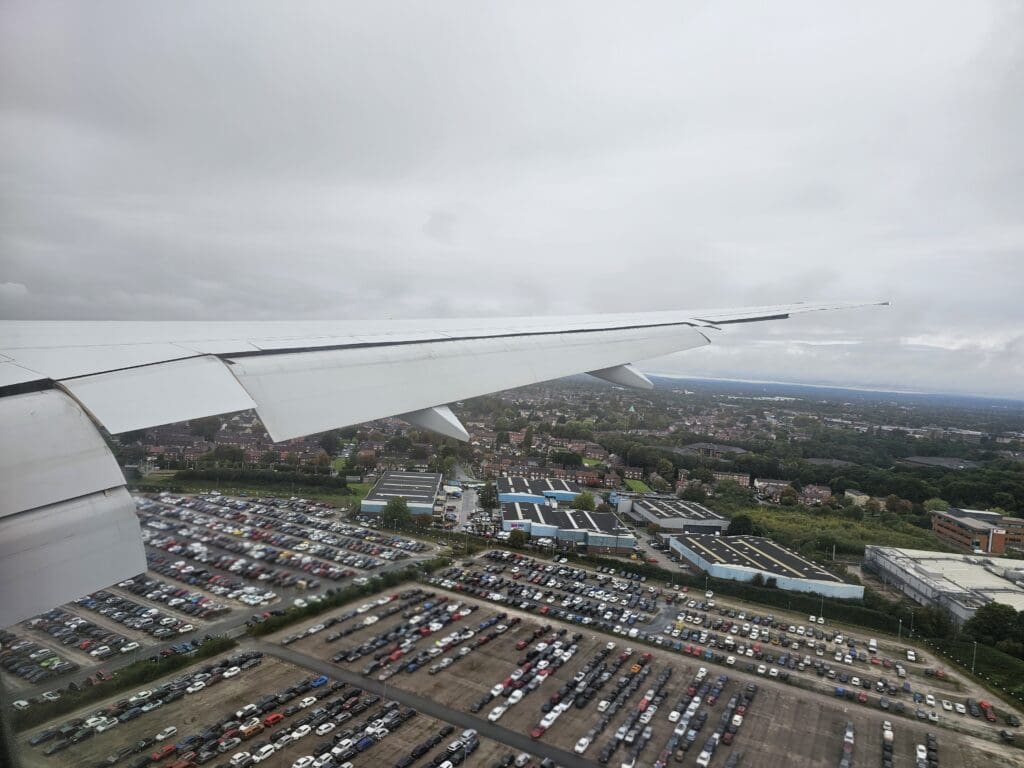
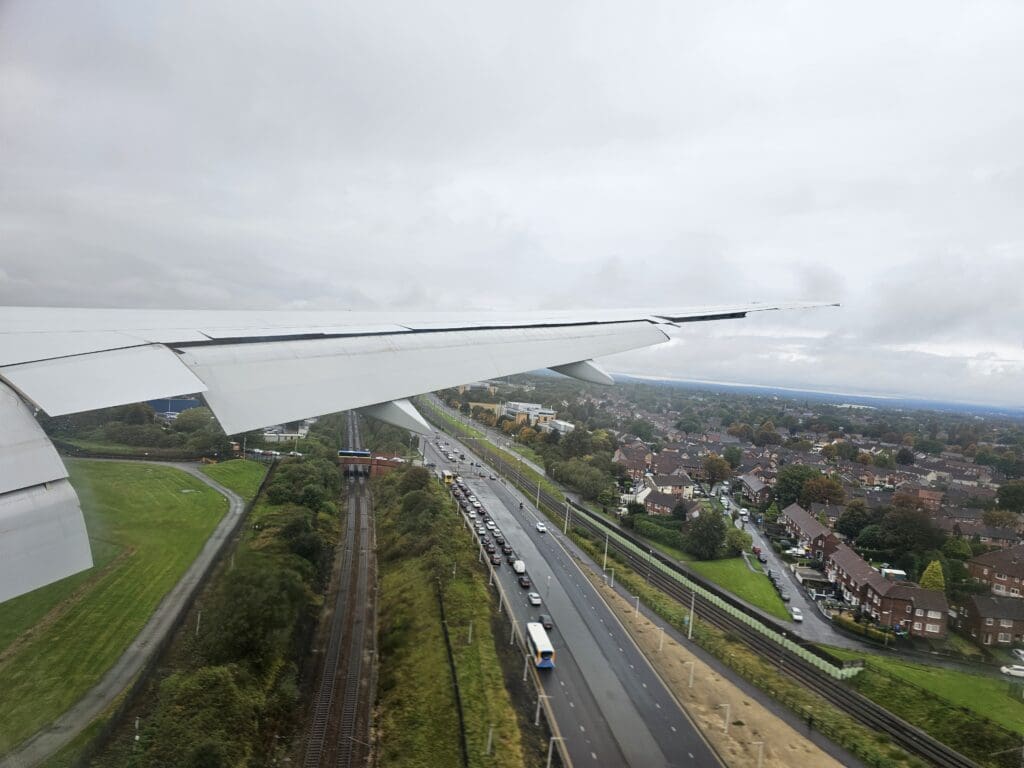
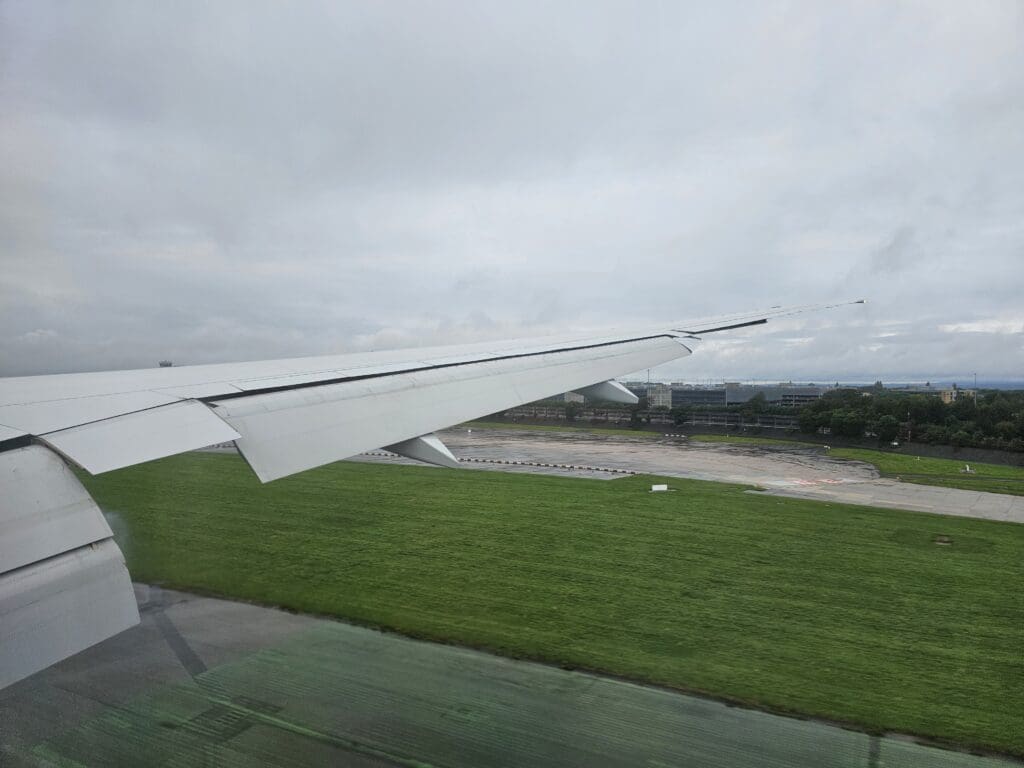
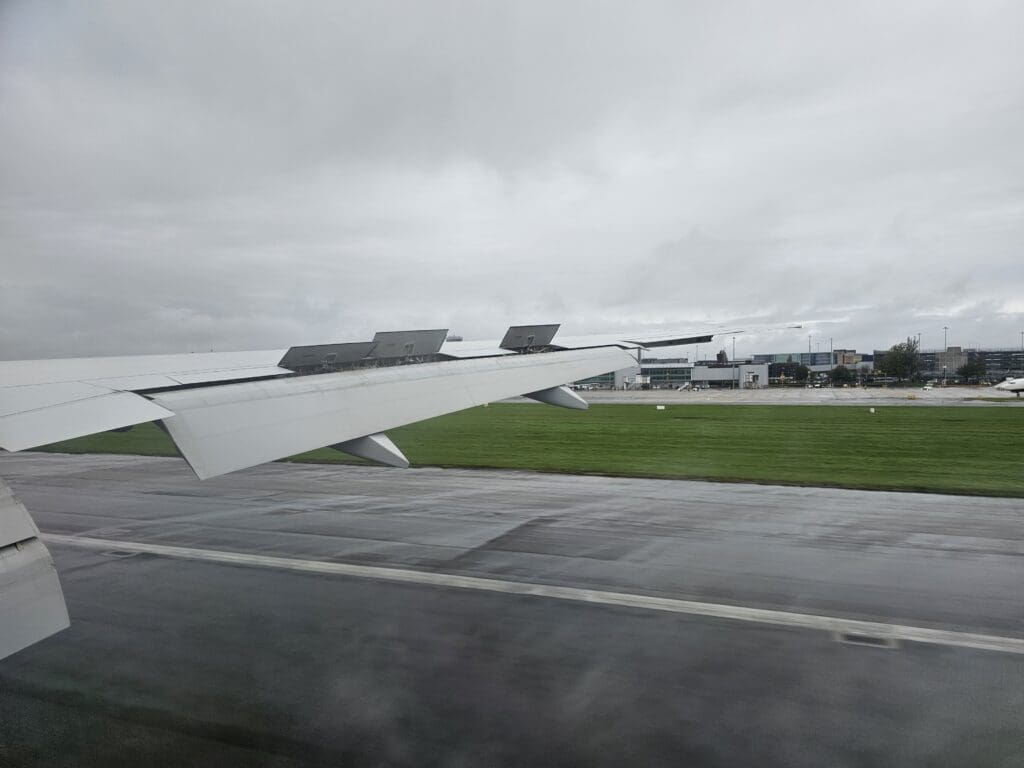
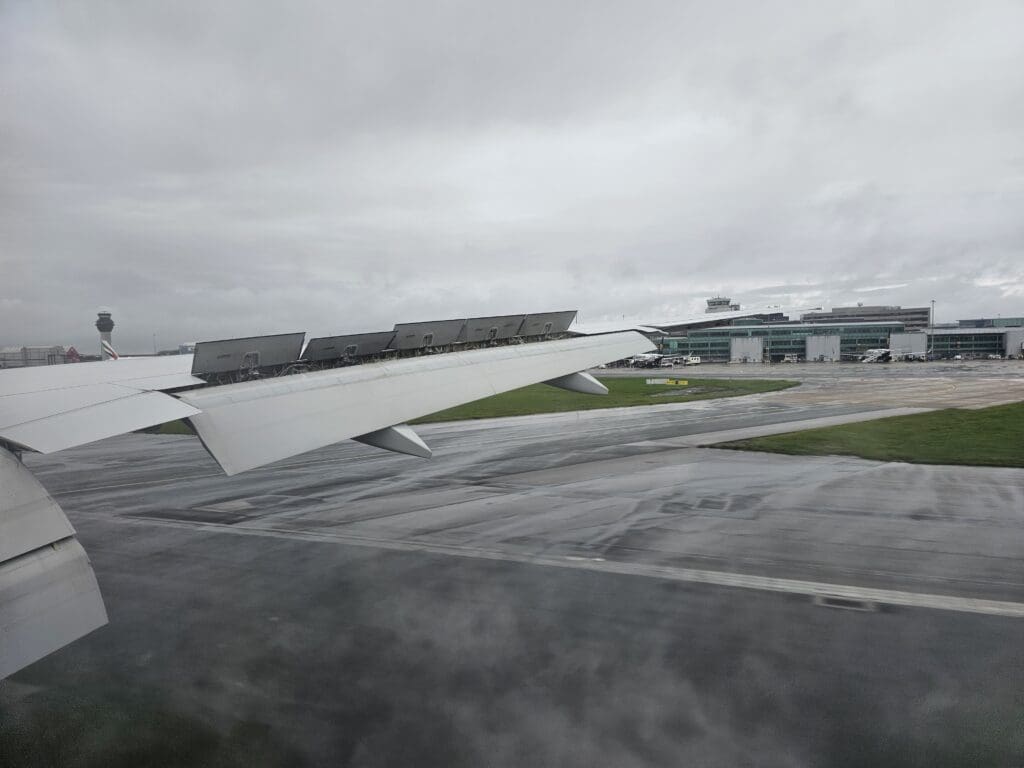
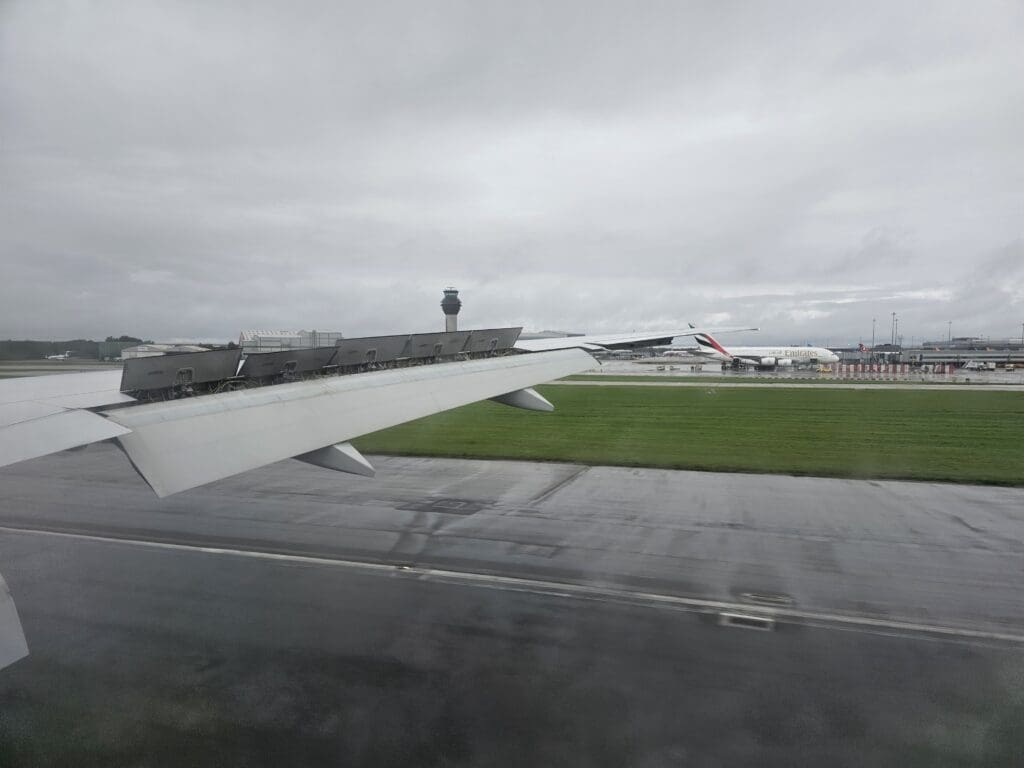
Unfortunately, after landing, the windows steamed up, and so little of the airport could be seen before we pulled in between two Virgin Atlantic Airbus A350-1000s around ten minutes after touching down at the terminal’s new pier. In the usual manner, once the engines spooled down, the cabin stood up, although it took some time before the L2 door was opened and disembarkation commenced. After a while, I stood up and shuffled forward, thanking various crew members as I passed through the now untidy cabin before I stepped off the aircraft and made my way up the jetbridge. From the aircraft, a fairly long walk was in store to the immigration area, and once there, it seemed as if over half of the passport e-gates were out of service. Nevertheless, not a great deal of waiting was in store and with no baggage to collect, I made it landside within around fifteen minutes of disembarkation.

Summary
That day, I was very pleased with my experience onboard Qatar Airways. On my first flight from Abu Dhabi, the crew was fantastic. On the second, whilst not as amazing, they were friendly and polite. On both flights, I found the aircraft to be comfortable, and importantly, I landed on time and in one piece.
In terms of this particular Boeing 777, I was left with mixed feelings, and I am not too sure whether I would have had a better or worse experience if I had ended up flying onboard a ‘real’ Qatar Airways jet. On the plus side, my Virgin Australia seat was comfortable and more spacious than those onboard most of Qatar Airways’ triple sevens, however, this was dated and battered and featured a rather basic and limited entertainment system. Meanwhile, I am confident that despite the addition of a bar/lounge area, those expecting Q Suites would have been disappointed with the aircraft’s business cabin.
Whilst I am not entirely sure what the long-term plan is for those Boeing’s received from Cathay Pacific and Virgin Australia, I suspect that if they are scheduled to remain with Qatar Airways for much longer then they will end up being reconfigured and fitted with Qatar Airways’ standard interior. Of course, alongside perhaps not meeting some customers’ expectations, these aircraft’s non-standard cabins and configurations surely add an extra layer of complications to Qatar Airways’ operation.
.