The Best Economy Legroom Ever (on an LCC!?!): Tokyo to Seoul on an Air Premia Boeing 787
Background
If looking to travel between Seoul and Tokyo, you’d be unlikely to struggle to find flights between the two Northeast Asian capital cities’ airports. As per the latest data, the route between Seoul Incheon and Tokyo Narita is the fifth busiest international route in the world, with over 4.15 million passengers flying this in 2023. As per Summer 2024 schedules, a total of thirteen airlines’ aircraft ploughed between the two, with flights departing at all times of day and night. These include each of Korea’s ten scheduled passenger airlines, alongside the relatively new Dreamliner operating low-cost subsidiaries Air Japan and Zipair Tokyo, owned by ANA and Japan Airlines respectively. Meanwhile, the wildcard comes in the form of Ethiopian Airlines who fly between their hub at Addis Ababa and Tokyo Narita with a stop at Seoul Incheon in either direction and have the right to sell tickets for the short fifth freedom leg. Meanwhile, those looking to get between Seoul Incheon and Tokyo Haneda can fly with Asiana Airlines, Korean Air or Japanese low-cost carrier Peach, whilst ANA, Asiana Airlines, Japan Airlines and Korean Air all operate multiple daily services between Seoul Gimpo and Tokyo Haneda.
To get to Tokyo, I was drawn in by the opportunity to sample the delights of Asiana Airlines’ Airbus A380 on the type’s shortest scheduled flight anywhere in the world (as of July 2024). Continuing on the theme of large aircraft, naturally, as an enthusiast, I had hoped to return to Korea on Korean Air’s afternoon Boeing 747-8 operated service between Tokyo Narita and Seoul Incheon. Disappointingly, yet unsurprisingly, seeing as I was booking tickets just five days ahead of my scheduled departure day, a one-way ticket on this service proved to be unjustifiably expensive. Furthermore, seeing as I had previously sampled the delights of the Boeing 747-8 (albeit with Lufthansa between Palma de Mallorca and Frankfurt), I turned to examine other options. Not particularly excited about catching a ride onboard an Airbus A320 or Boeing 737-800, I was pleased to find that tickets for all three low-cost Dreamliner operators on the route were all reasonably priced. Of these, I decided to fly with one of Korea’s latest carriers, Air Premia, an airline known for being one of the world’s very few hybrid low-cost-full service airlines. Having heard great things about the airline, I was eager to sample a ride with Air Premia, and, seeing as Tokyo is the only short-haul destination in their compact route network, it looked unlikely that I would otherwise get the opportunity to do so.
About Air Premia
As in many parts of the world, establishing an airline in Korea is a long and arduous process that involves galloping through a myriad of complex, and to an outsider, confusing regulations. If you are successful in doing so and get to the stage where you are ready to operate your first service, you are welcomed by the hostile surroundings of a very saturated market that often appears to be far from conducive to success. Indeed, in recent years this has been demonstrated by the likes of start-up carriers such as Air Philip, Air Pohang, Fly Gangwon and Hi Air who all came and went in the blink of an eye, often remaining unknown to the average passenger. Yet despite the long list of short-lived carriers, every year or so, brave and/or foolish entrepreneurs tout their new ideas for Korea’s next airline. However, naturally, it often proves difficult not to view such proposals through a pair of sceptical spectacles.
Examining Korea’s recent start-up carriers, many have appeared to have followed a broadly similar operating model. Many were established by business leaders who lacked direct industry experience, and for better or worse, targeted regional airports across Korea, focusing first on domestic operations before international expansion. Meanwhile, bar Fly Gangwon’s sole Airbus A330, these have operated a fleet of second-hand narrowbody aircraft. However, doing things differently, Air Premia, did not seem to follow this model and it is for this reason that the carrier drew significant attention from observers both in Korea and across the globe.
Going some way to instil confidence, Air Premia was formed in 2017 by veteran industry executive Kim Jong-chul, the former president of Jeju Air, who had seen the carrier grow to become Korea’s third-largest airline. Soon making clear their plans, Air Premia intriguingly positioned itself as a ‘Hybrid Service Carrier’, offering many of the trimmings of Korea’s full-service airlines at low-cost carrier prices. The airline even promised to go beyond existing industry norms for Economy by proposing seats with a whopping 35 inches of pitch! Unlike other recent airline start-ups, Air Premia had its sights set on Seoul Incheon, from where they would operate a primarily long-haul route network. Doing so with a fleet of factory-fresh Boeing 787-9 Dreamliners. Despite a clear vision and a seemingly experienced leadership team, proposing such grand plans for a start-up carrier, many experts, enthusiasts and potential passengers were rather sceptical that the airline would ever take to the skies.
Over the following few years, Air Premia worked to obtain all the required licences from Korea’s Ministry of Land, Infrastructure and Transportation before securing the lease of three brand new Boeing 787-9 Dreamliners from the Air Lease Corporation in 2019. The first of these jets appeared on the flight line at Everett in 2020 and in April 2021 was flown to its new home at Seoul Incheon. Despite the airline’s international aspirations, for its first three months of operation, Air Premia joined the masses on the 280-mile hop between Seoul Gimpo and Jeju, flying this between August and October 2021. After this, Air Premia commenced international preighter operations between Seoul Incheon, Ho Chi Minh City and Singapore, before transitioning to international passenger services in Summer 2022. Over the next couple of years, Air Premia continued to grow. Once they had received their remaining two Boeing 787-9 Dreamliners, Air Premia opted for an additional two examples, with these having previously operated for Norwegian’s British long haul arm. Meanwhile, its route network continued to evolve and as per Summer 2024 schedules, the airline serves Bangkok, Los Angeles, New York Newark, San Francisco and Tokyo Narita, and regularly undertakes charters to the likes of Dhaka, Frankfurt and Oslo.
Booking
Seeing as I wanted to book my outbound and return tickets in one go, I decided to book with Trip rather than Air Premia. With that considered, there is very little that I can say about Air Premia’s booking process. However, I did find the airline’s website to be sleek and modern and provide everything you would expect to find on an airline’s website, thus leaving me with few complaints. In terms of languages, this was available in English, Japanese and Korean, with the only missing language considering their route network being Thai.
Despite booking via a third-party site, I was pleased to encounter no issues when entering my booking reference and managing my booking via the Air Premia website. This enabled me to add several (limited) optional extras such as topping up my complimentary 23kg hold luggage allowance or selecting a seat. Examining the seat selection option, I was delighted to find that I could pre-reserve a regular seat across much of the cabin for free. However, had I wanted to select one at the front of the cabin, or a seat with extra legroom, then I would have had to part with 1,300 yen (£6.80) or 2,000 yen (£10.47) respectively. In the end, I reserved a window seat in the rear Economy cabin for free, opting against any paid add-ons.
As we edged closer to departure, I hoped to make full use of Air Premia’s online check-in facility. Once less than 24 hours away from departure, I returned to Air Premia’s website and entered all the required details. However, unfortunately, I was soon presented with an error message and ended up being unable to check-in online. Whilst this was no great shake, especially seeing as I had already selected my seat, looking online, this does appear to be a common issue, indicating that Air Premia’s check-in system is not yet properly up and running.
The Journey
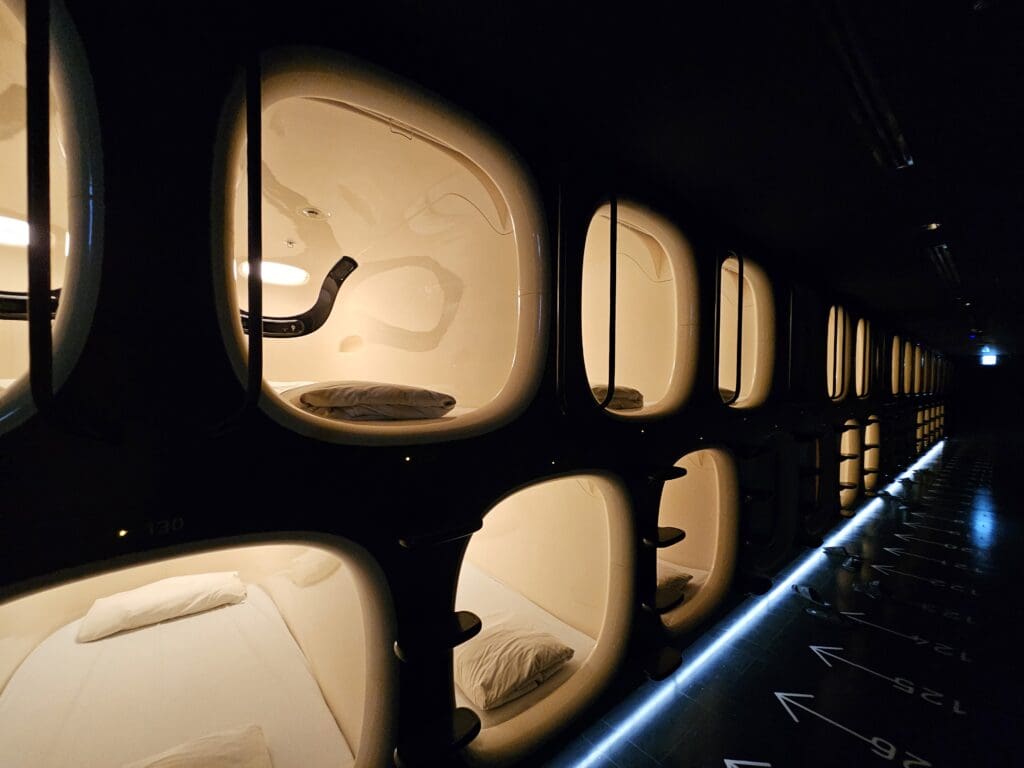
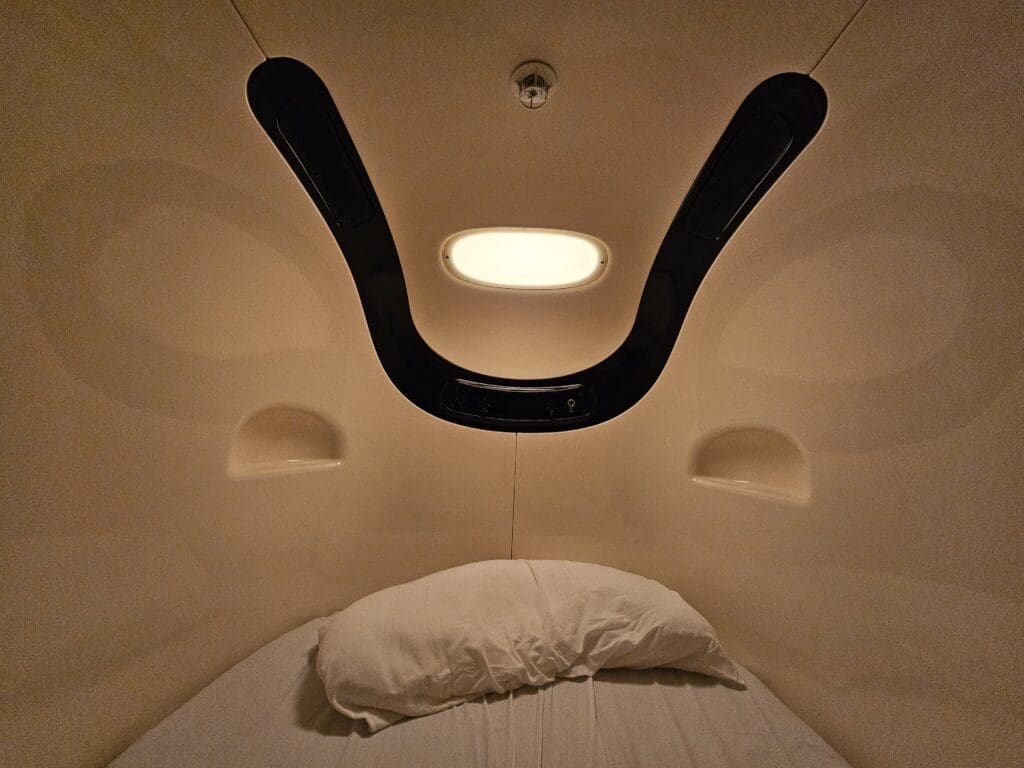
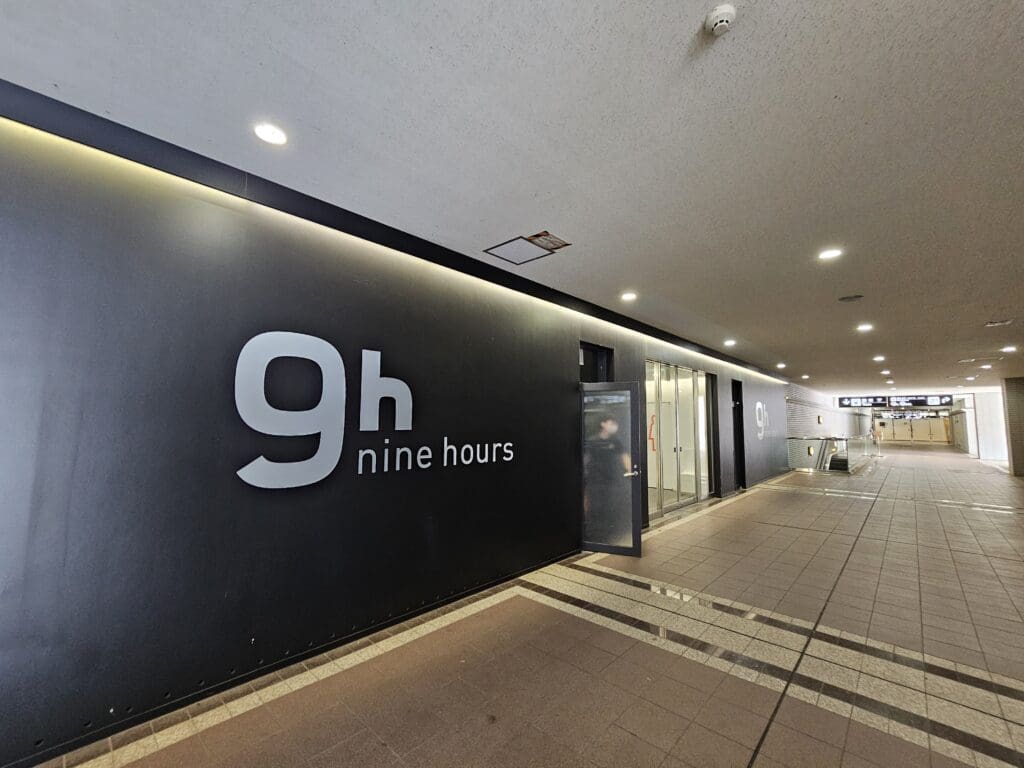
Following a pleasant day spent spotting the near-constant stream of aircraft from across the world at Tokyo Narita Airport, I retired to my capsule in the basement of Terminal 2. Being Japan’s second busiest airport and located quite some distance from Tokyo itself, unsurprisingly there are plenty of accommodation options dotted around Narita Airport, both on the airport grounds and in the surrounding area. As far as airport hotels go, I found many of these to be reasonably priced, with virtually all also offering a complimentary shuttle service to and from Narita Airport’s terminals. Despite being tempted to book a hotel in a nearby town, given the limited amount of time available, I decided to book the cheapest and most convenient option, the 9 Hours Capsule Hotel and parted with £27.13 for a night there. Whilst this was the most convenient option and ideal for those with early morning departures or late evening arrivals, it perhaps goes without saying that wouldn’t recommend this for any long stays, and even those on a budget can find equally priced hotel rooms around the airport.
Examining its layout, Tokyo Narita Airport covers a massive area and is home to three detached terminals, logically named Terminals 1, 2 and 3. Of these, passengers can walk between Terminals 2 and 3, however, moving between these two terminals and Terminal 1 requires either a long winding walk along some busy roads, or a ride on the complimentary shuttle bus that runs in a loop between the three terminals. In terms of their roles, Terminal 1 and Terminal 2 both serve a mixture of full-service and low-cost carriers from across the globe. Terminal 1 acts as All Nippon Airways’ Narita hub and serves almost all Star Alliance carriers that serve the airport, except Air India who curiously operate from Terminal 2. Meanwhile, Terminal 2 acts as Japan Airlines’ Narita hub and serves all of the airport’s Oneworld carriers, whilst SkyTeam members, non-allianced and low-cost carriers are spread out across the two terminals. Finally, Terminal 3 is Narita Airport’s smallest and newest terminal and serves several low-cost carriers. Specifically, this is the Tokyo hub for Jetstar Japan and Spring Airlines Japan, also serving the associated Australian and Chinese arms of each carrier respectively. This also is utilised by Korean low-cost carriers Aero K and Jeju Air, alongside Philippines AirAsia.
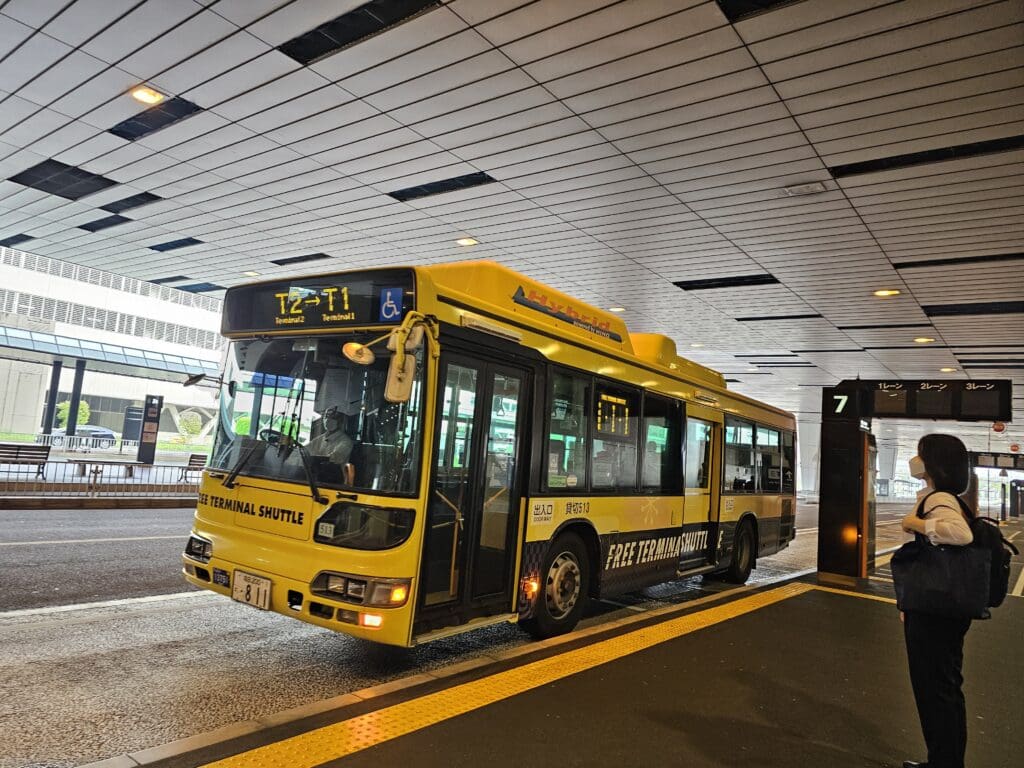
Air Premia operates from Narita’s Terminal 2 and thus I could have vacated my capsule at 1100 and probably still comfortably made it to the gate in time for my 1230 flight. However, being an aviation enthusiast and having suffered from a poor night’s sleep thanks to the snoring in stereo from those on both sides of my capsule, I decided that I would have an early morning spotting session at Terminal 1’s observation deck before returning to the hotel for a quick shower. With my camera bag in tow, I made my way to the ground floor arrivals level and waited at the bus stop for the next Terminal 1 bound shuttle bus to appear. Being bright yellow and with large titles advertising its role as the complimentary inter-terminal shuttle bus, this could not be missed, and the bus soon appeared at which point I piled on along with a mixture of passengers and airport workers. Soon pulling away from Terminal 2, we trundled over Terminal 1, taking a slightly winding route before pulling up to the terminal around eight minutes later.
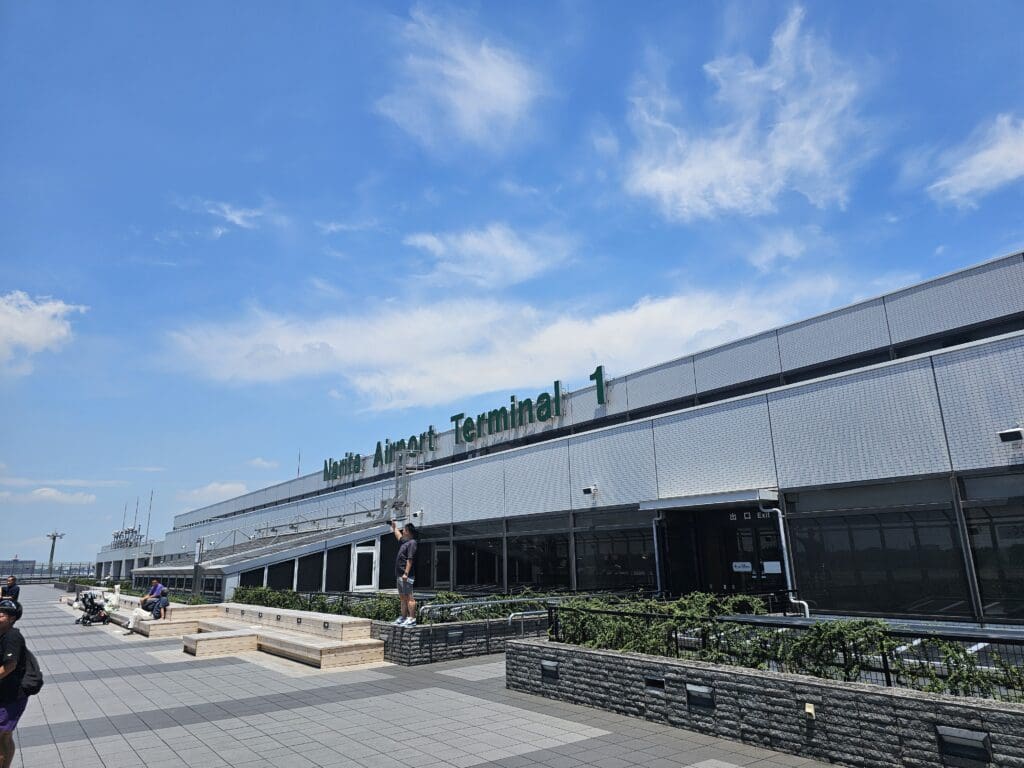
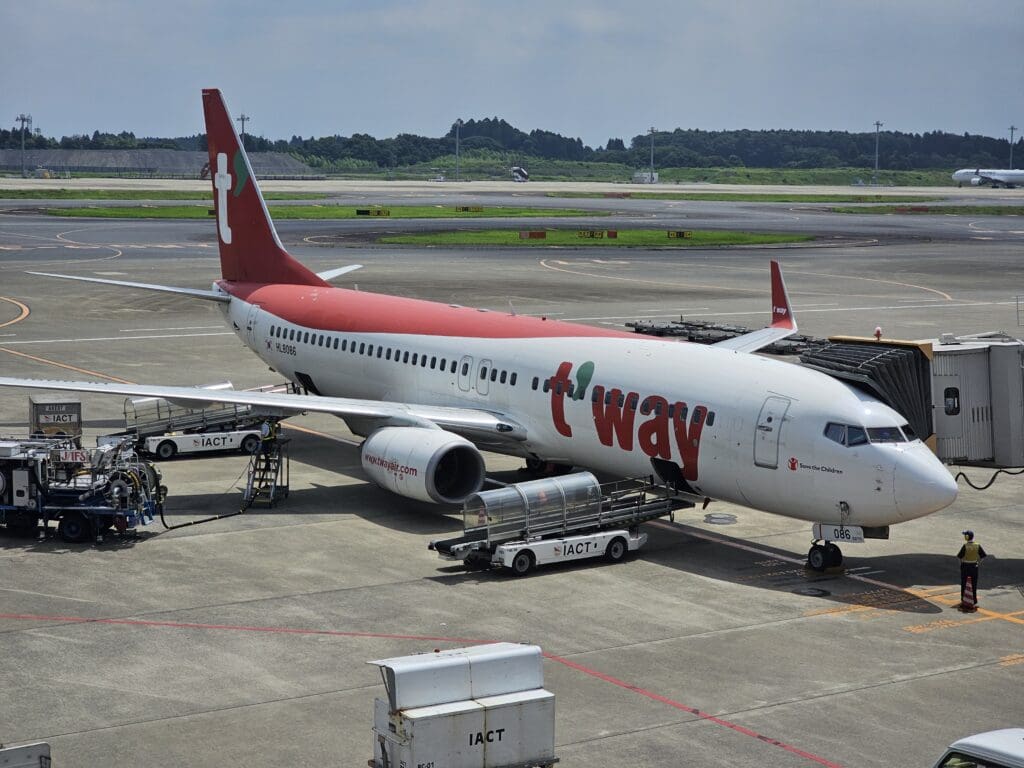
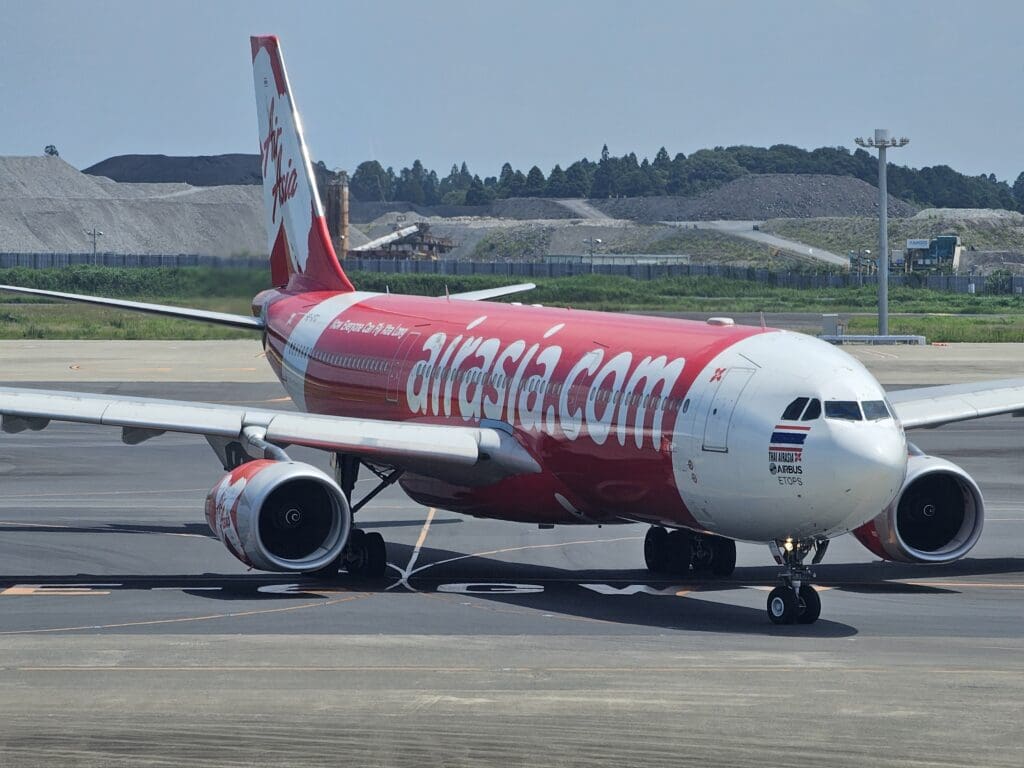
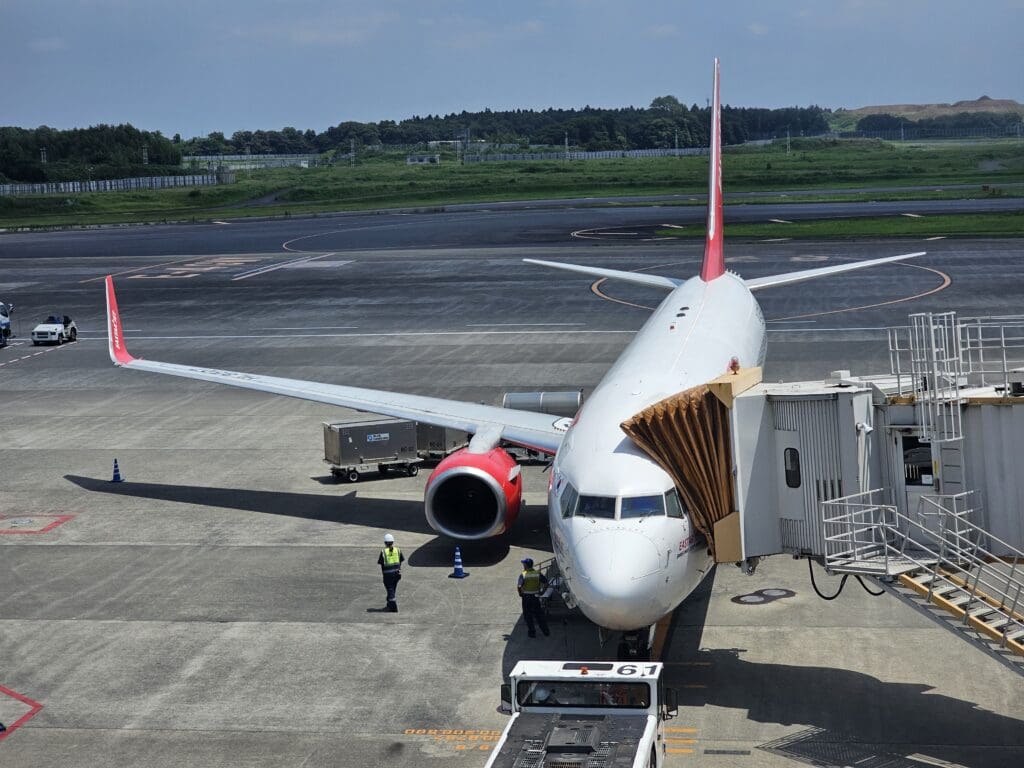
Once inside Terminal 1, I headed up to the top floor and made my way outside to the terminal’s open-air observation deck. This provides superb vistas of Runway 16R/34L and a bird’s eye view of many of the stands just below. Like most observation decks at Japanese airports, this is a great place to spot, with plenty of benches and holes for photographers to stick their lenses through allowing for unobstructed photographs to be taken. Meanwhile, this is convenient and there is a range of cafés, shops and restaurants located right next to this, alongside several blocks of toilets. That morning, most of the arrivals on the runways in front of me took the form of cargo widebodies including Boeing 747, Boeing 767 and Boeing 777 freighters, plus a few aircraft arriving after overnight flights from destinations such as Brunei, México and Vietnam.
After just under two hours of spotting, I was beaten back by the heat and humidity and decided to trek back to the capsule hotel. Once there, I had a quick shower and changed my clothes for the day ahead. After darting in and out of the shower, I returned to my locker where I had a quick repack of my bag, ensuring that I had everything with me before handing in my locker key at the front desk. Whilst 9 Hours had not offered me the most comfortable or luxurious stay, given its location and price (being far cheaper than other on-site accommodation options at most major international airports), I had little reason to complain. Importantly, Terminal 2’s check-in hall was no more than a five-minute walk away, with this being reachable via a series of moving walkway-fitted air-conditioned corridors and several escalators. Following a brisk walk, I arrived in Terminal 2’s massive check-in hall with a little under three hours to go until my flight’s scheduled departure time.
Having opened in December 1992, the Terminal 2 check-in hall isn’t the most modern in the world, however, I found this to be massive, very clean and functional. Vitally, this seemed to serve its important purpose as one of Japan’s busiest international airport terminals without issue. Inside, the check-in hall features twelve check-in islands and is divided into two wings, the North Wing and the South Wing, with each having its security checkpoint and immigration area. However, it is worth noting that there is no physical division between the two wings and all those departing from Terminal 2 can pass through either security point and are still able to access all of the terminal’s gates once airside. At that time in the morning, the terminal didn’t seem to be particularly busy and as I wandered around, the only particularly long queue I spotted was at China Eastern Airlines’ counters where passengers were checking in for that morning’s Shanghai Pudong service. Above the check-in hall sits the terminal’s Airport Mall, where plenty of shops, cafés and restaurants can be found, offering a wide variety of goods for sale and cuisines from across the world. As I had discovered the previous evening, a good variety of Japanese cuisines is offered there at very reasonable prices for airport eateries. Next to the Airport Mall sit the terminal’s two observation decks, with one at the north end of the terminal and another at the south, offering views of the terminal’s two ramps.
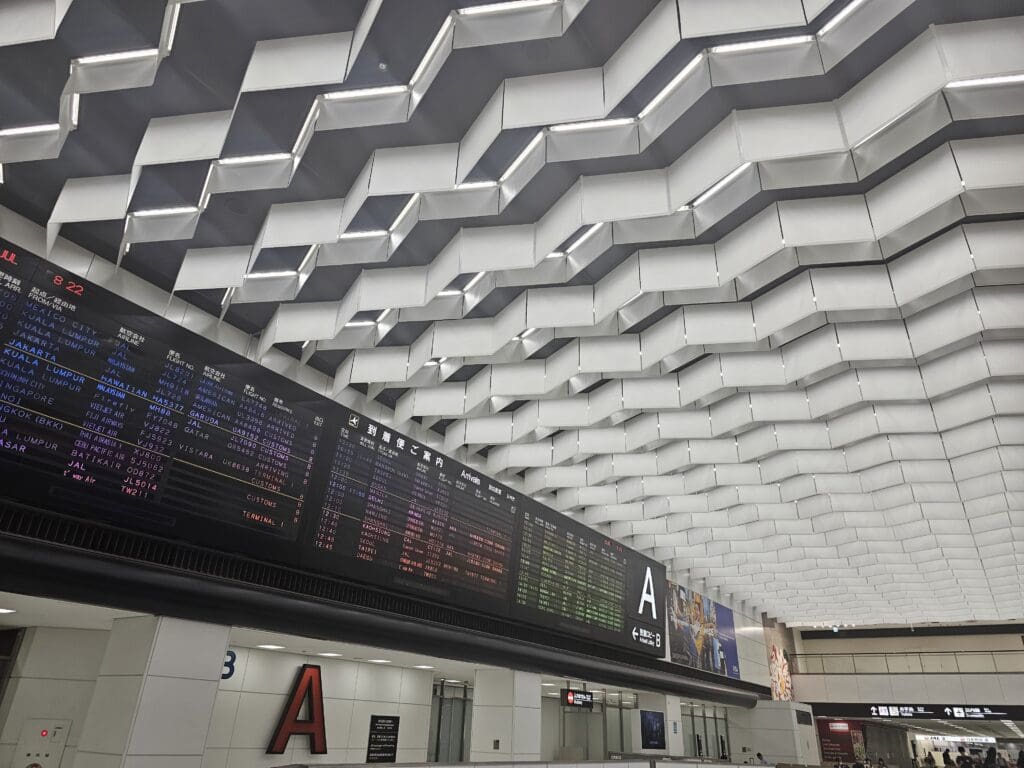
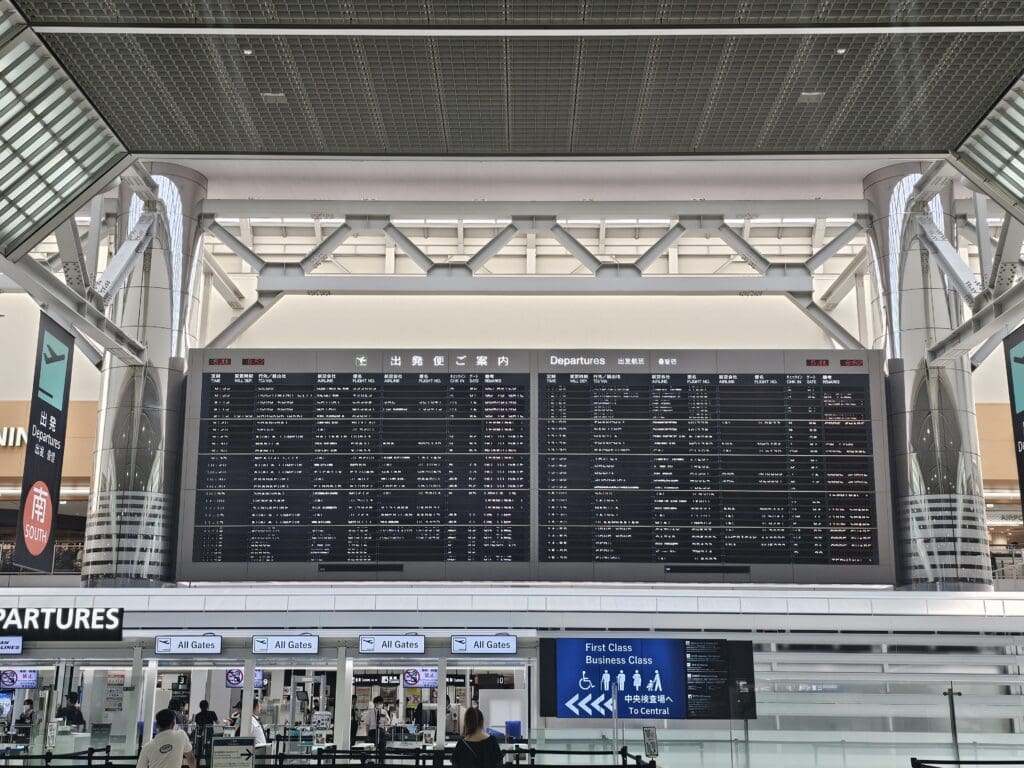
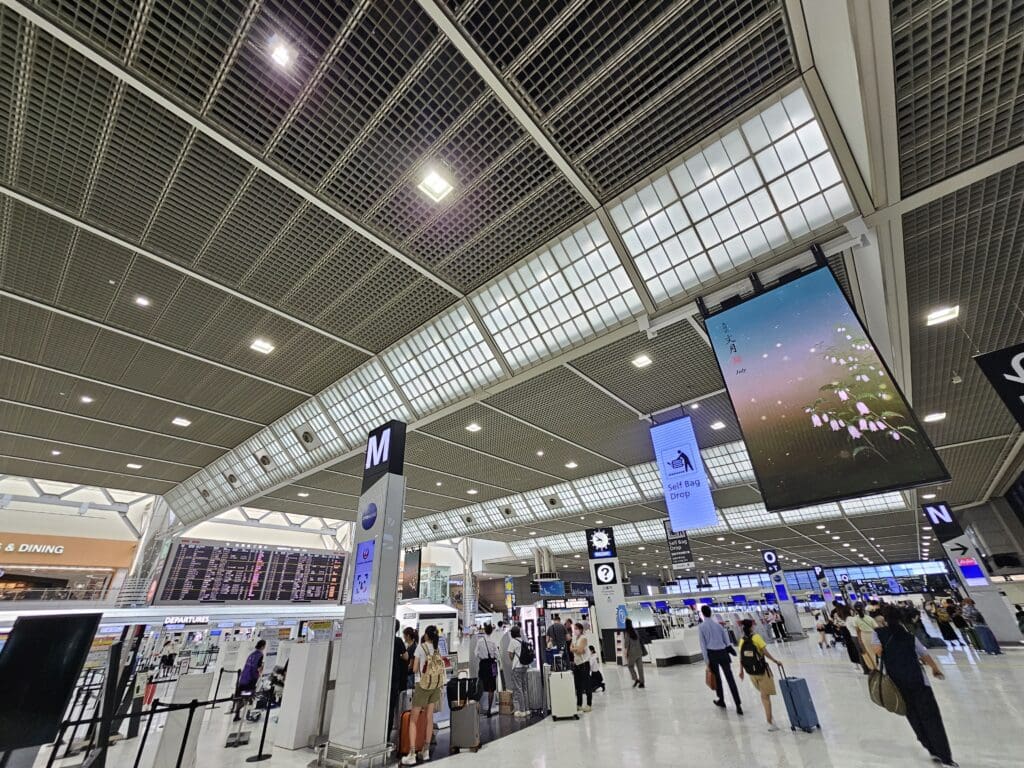
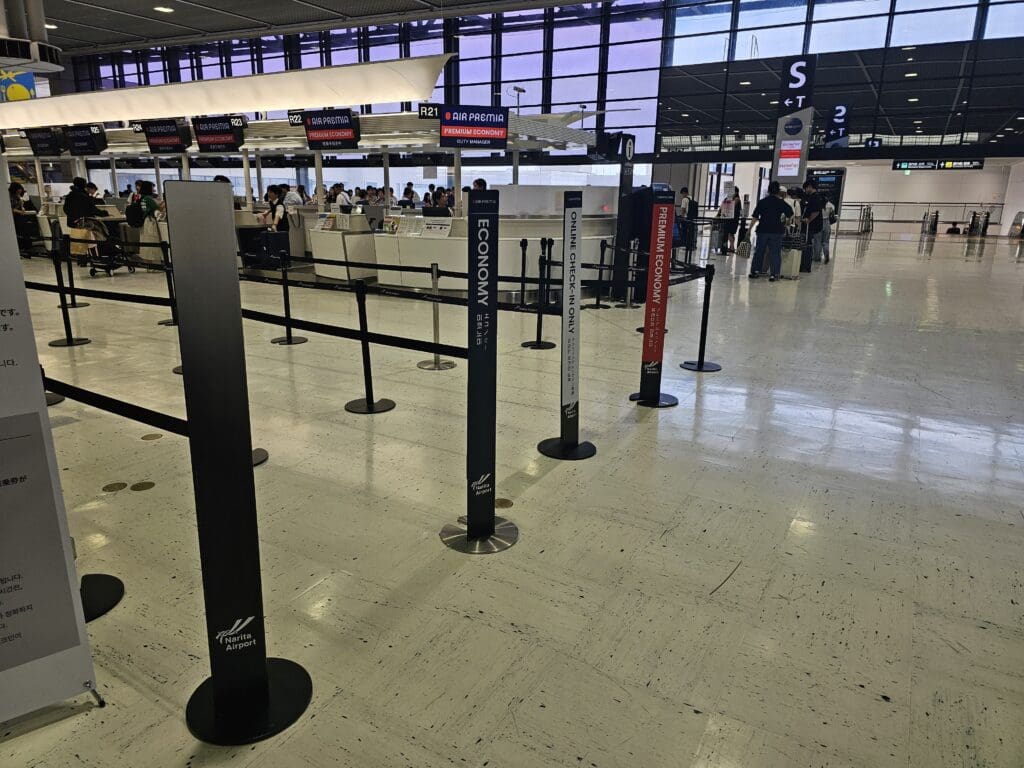
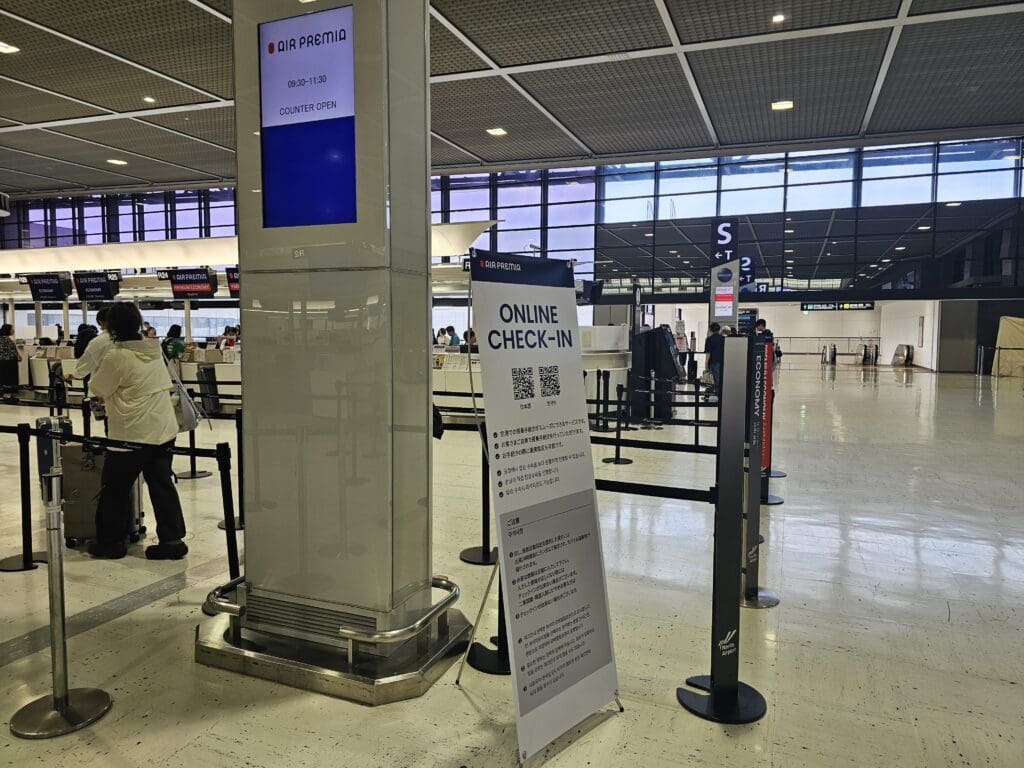
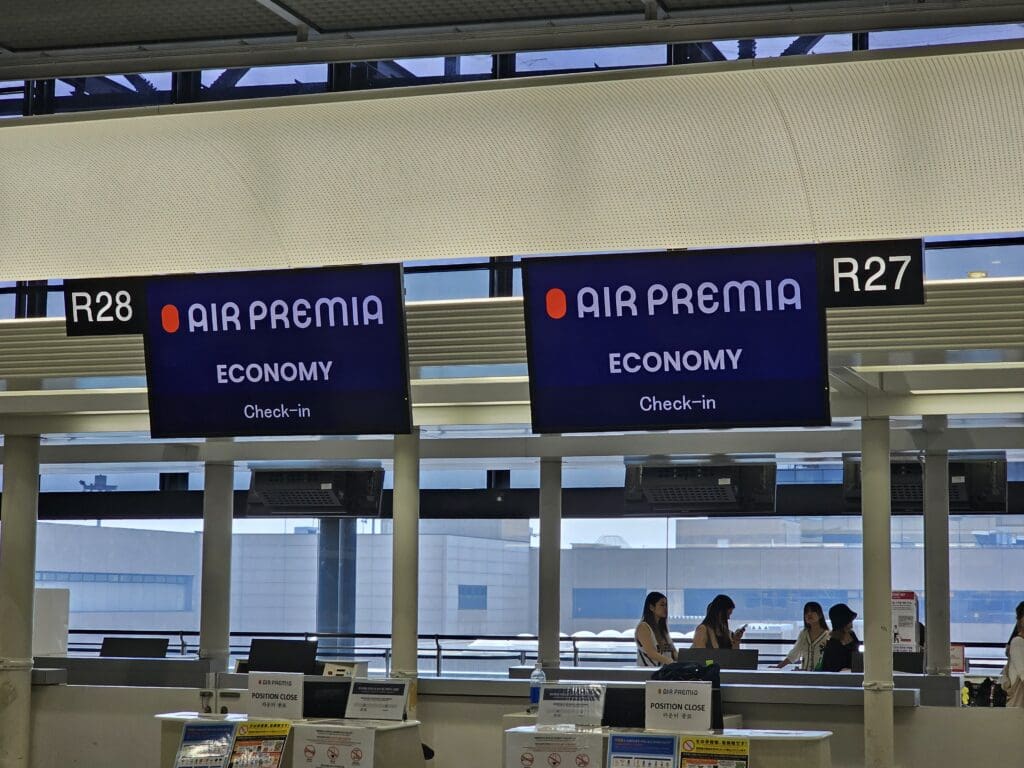
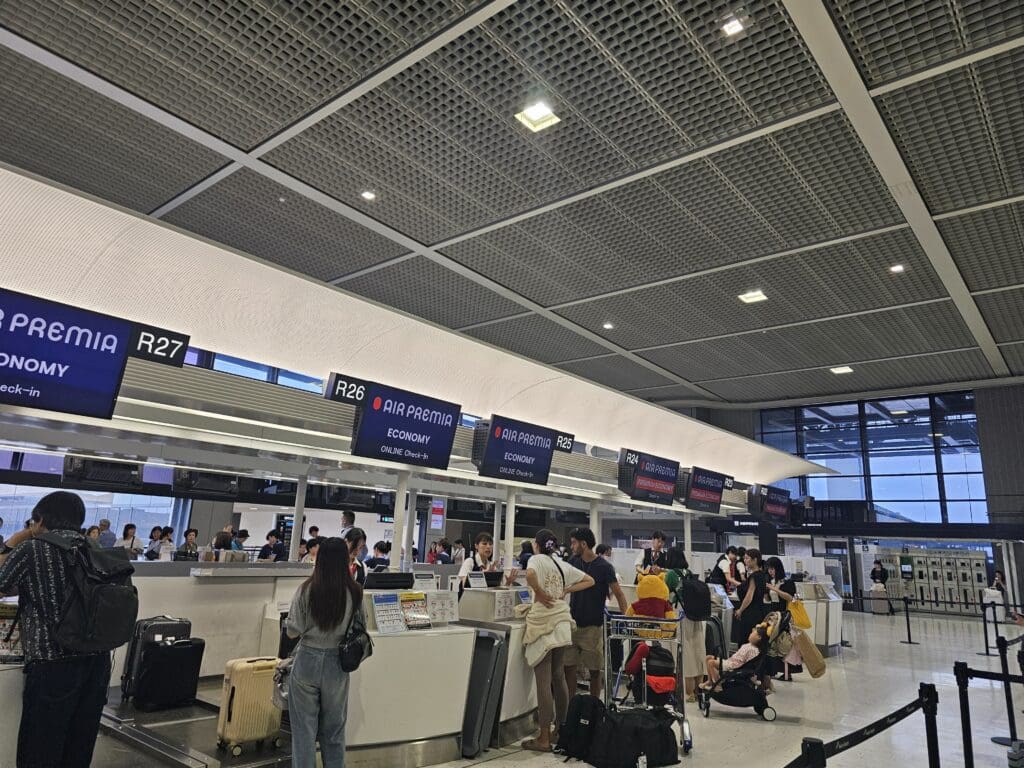
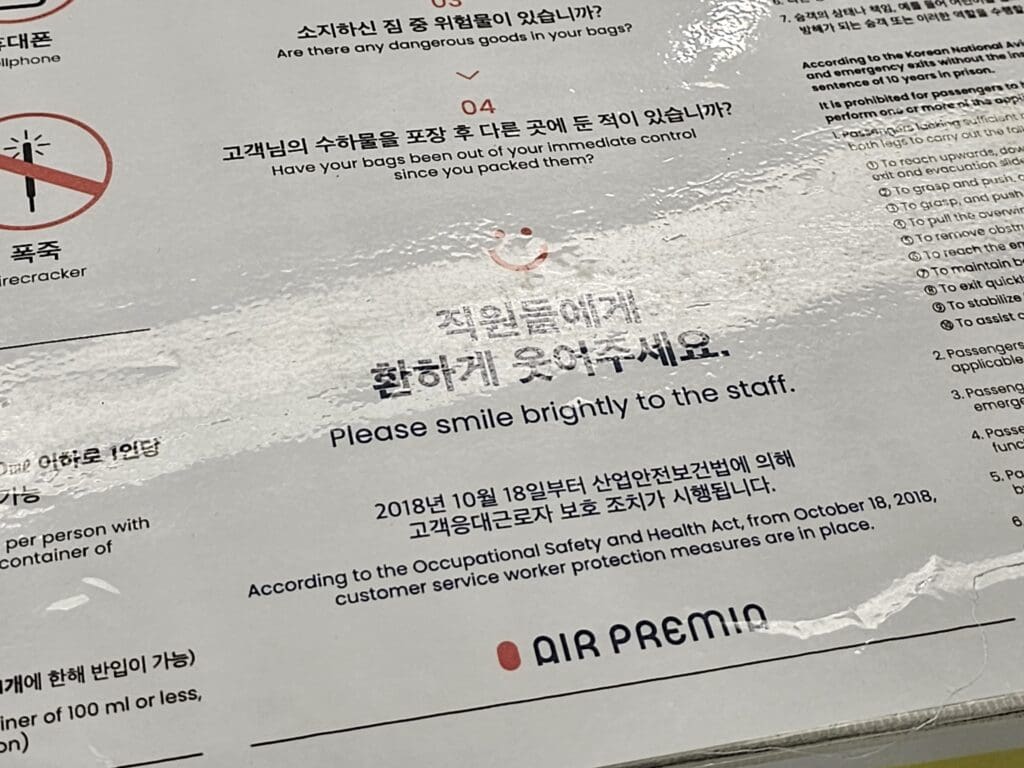
Following a quick breakfast stop at 7-Eleven and a short final visit to the observation decks, I headed back down to the check-in hall and scanned the departure boards which revealed that check-in for Air Premia’s lunchtime service to Incheon would take place in the North Wing. Upon making it there, I was greeted by the sight of plenty Air Premia signage and a line of Air Premia desks, with an impressive total of seven of these offered (four for those in Economy and three for those in Premium Economy). At that time, the local Swissport team could be seen being briefed and at 0930 on the dot, the staff members bowed at the line of passengers and took their positions behind the desks before check-in commenced. At the same time, the Air Premia supervisor performed an announcement in English, Japanese and Korean and soon the queue began to shuffle forward. Whilst I had ended up eighteenth in line, seeing as most of those in front of me lacked large amounts of luggage, and with the check-in staff working diligently and efficiently, it took all of just six minutes of waiting before I reached one of the open desks. After handing over my passport to the quiet, but otherwise friendly agent, they began to type away. A short time later, I was asked for my booking reference and the duration of my stay in Korea, before being asked to confirm that I had pre-selected a seat online. Once I had answered all of these questions, my boarding pass was printed off and I was advised of Air Premia’s cabin baggage policy, specifically concerning the number of duty-free bags that I could carry onboard.
Once I had my boarding pass, whilst I was not anticipating any delays, having exhausted the sights of the landside portion of the terminal, I decided to make a beeline for security and immigration. Upon successfully tapping my boarding pass on the automated gates, I joined the very short queue for security and passed through this quickly and without the need for any additional checks. Next up was immigration, and, thanks to the fact that most passport holders can simply pass through immigration e-gates, this was a quick and painless affair that required absolutely no queuing whatsoever. Once the doors of the automated gate swung open, I was free to explore the delights of Terminal 2’s airside area.
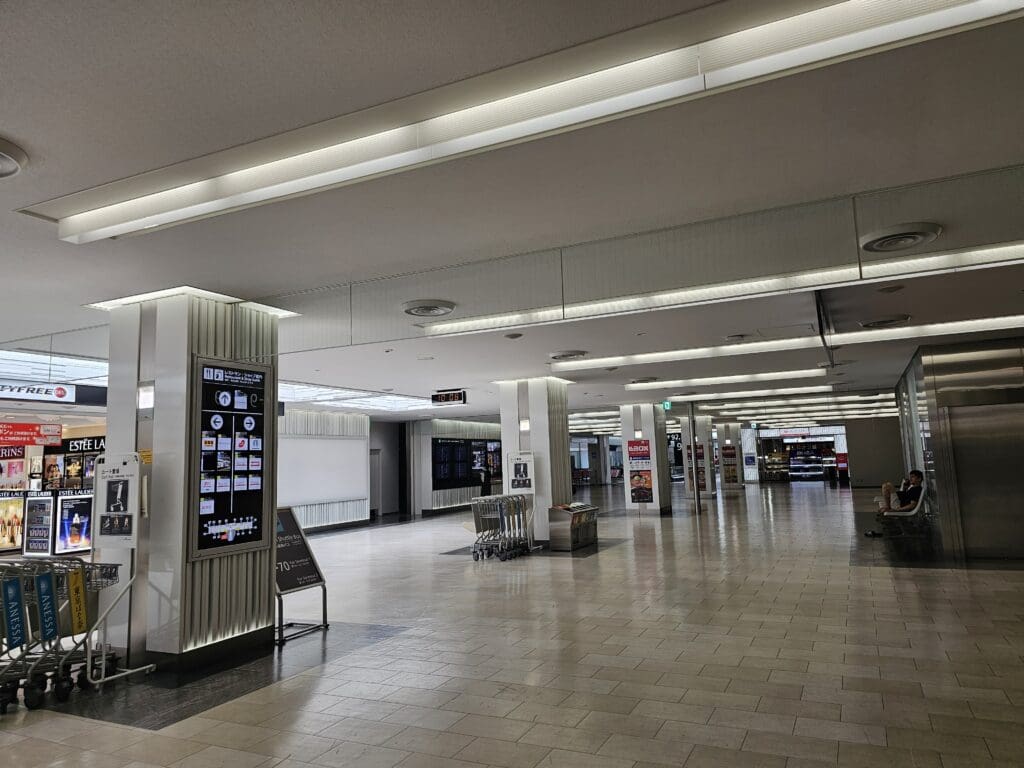
I emerged from immigration in Terminal 2’s main shopping complex. Named 5th Avenue, this primarily hosts a mixture of duty free and luxury brand stores. Unlike some airports where duty free providers have a monopoly on all outlets, at Narita there was a diverse array of outlets, with these operated by Fa-So-La, Ginza, Japan Duty Free, JAL Duty Free and Lotte. Meanwhile, those with heaps of cash to spend could have made some pre-flight purchases at the likes of Bottega Veneta, Boucheron, Burberry, Bvlgari, Cartier, Chanel, Gucci, Hermes, Prada, Tiffany & Co. Beyond this shopping area sat the Japan Food Hall, home to ten outlets selling mostly Japanese cuisine, whilst several other cafés and eateries could be seen dotted around.
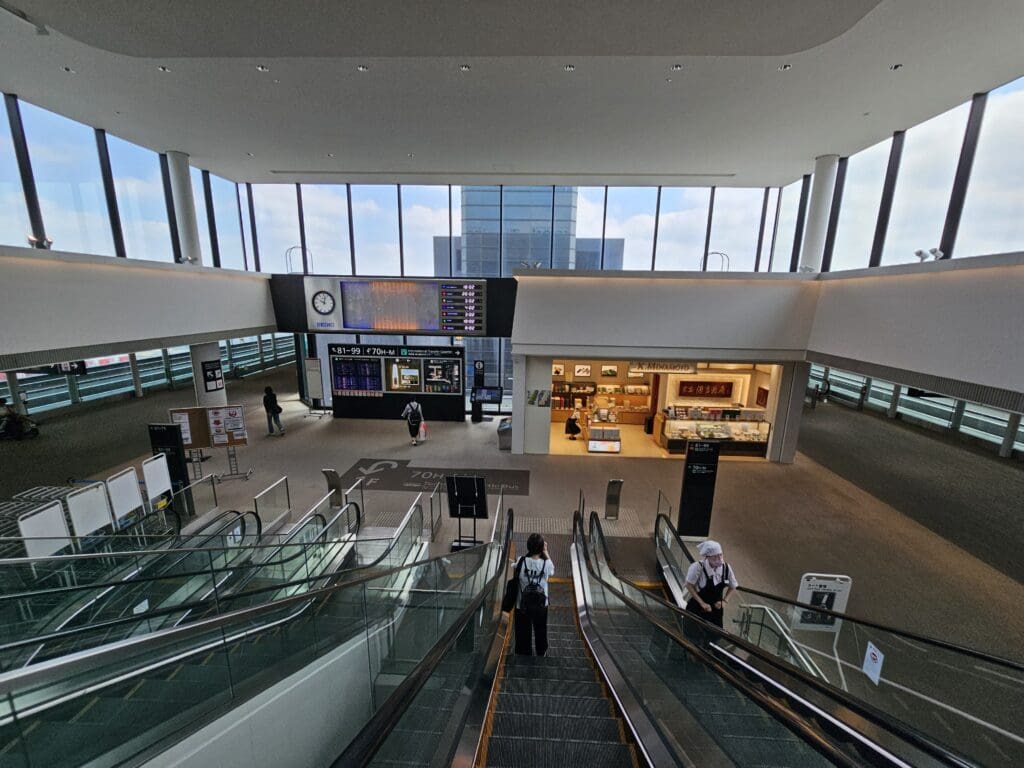
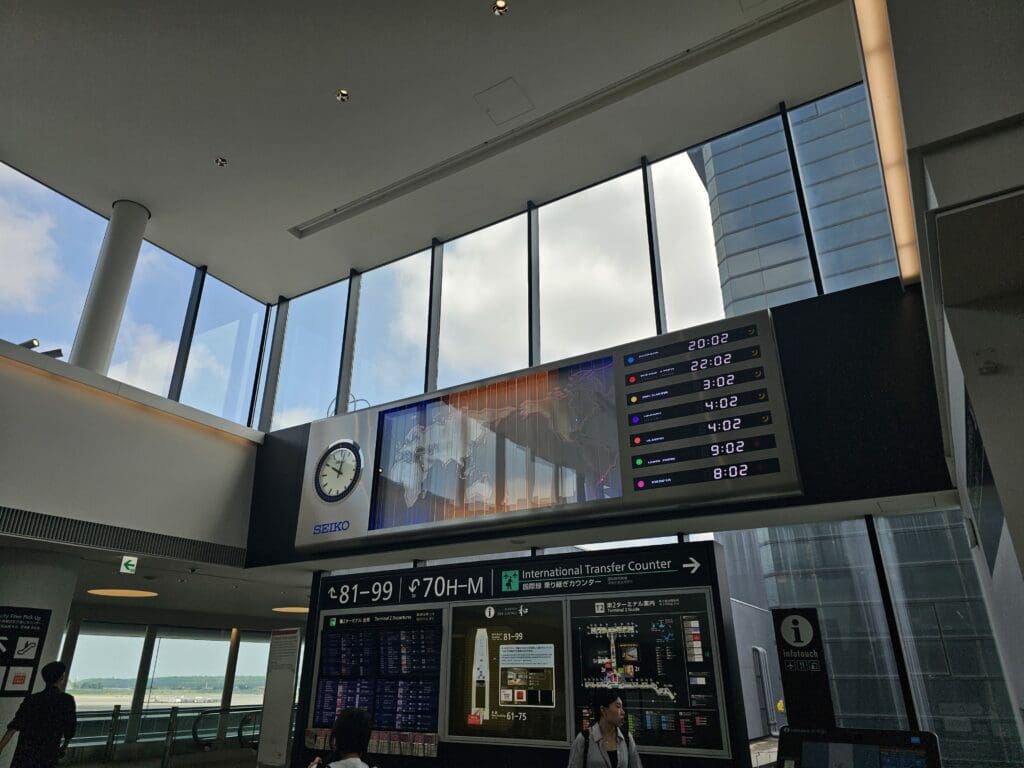
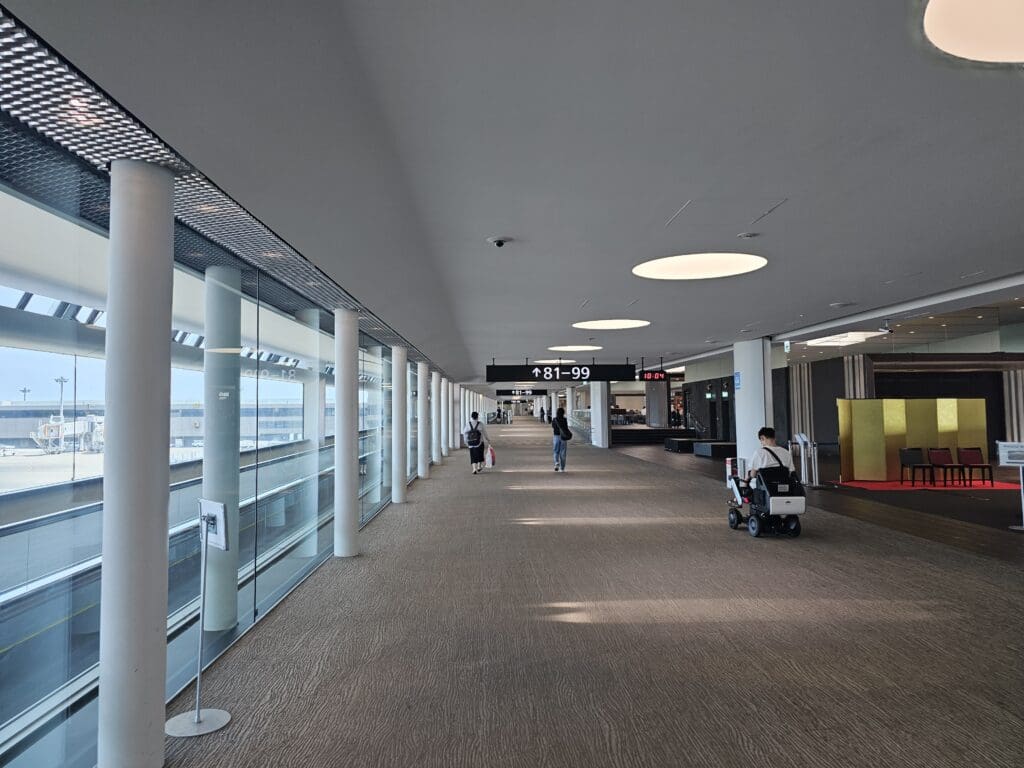
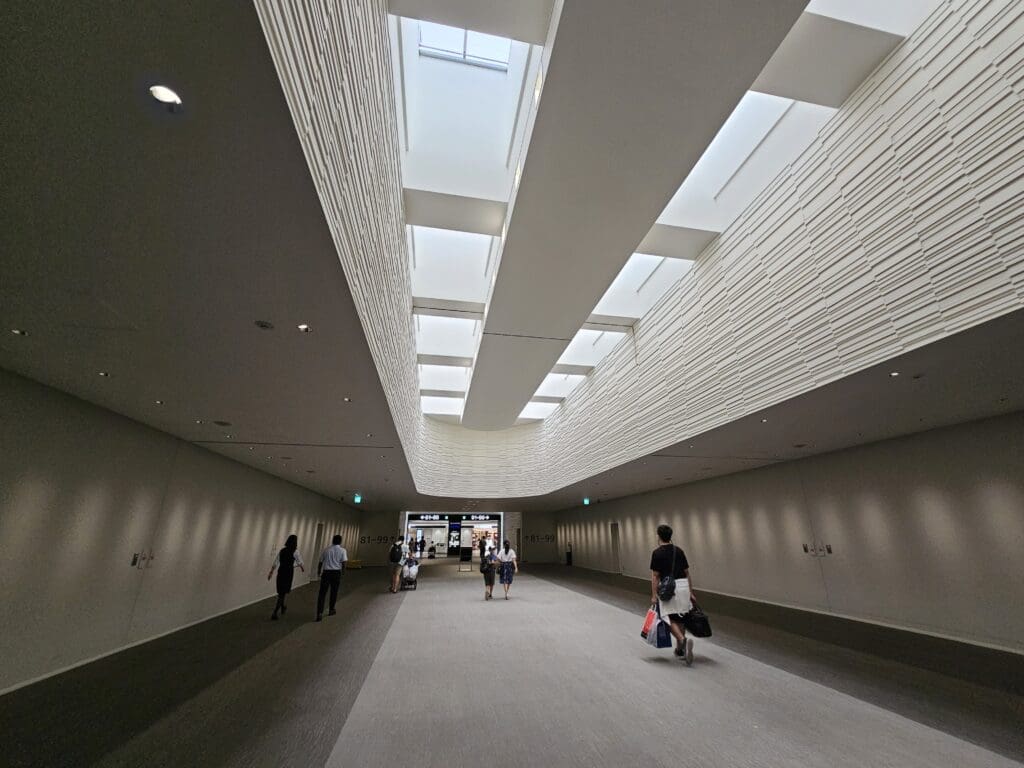
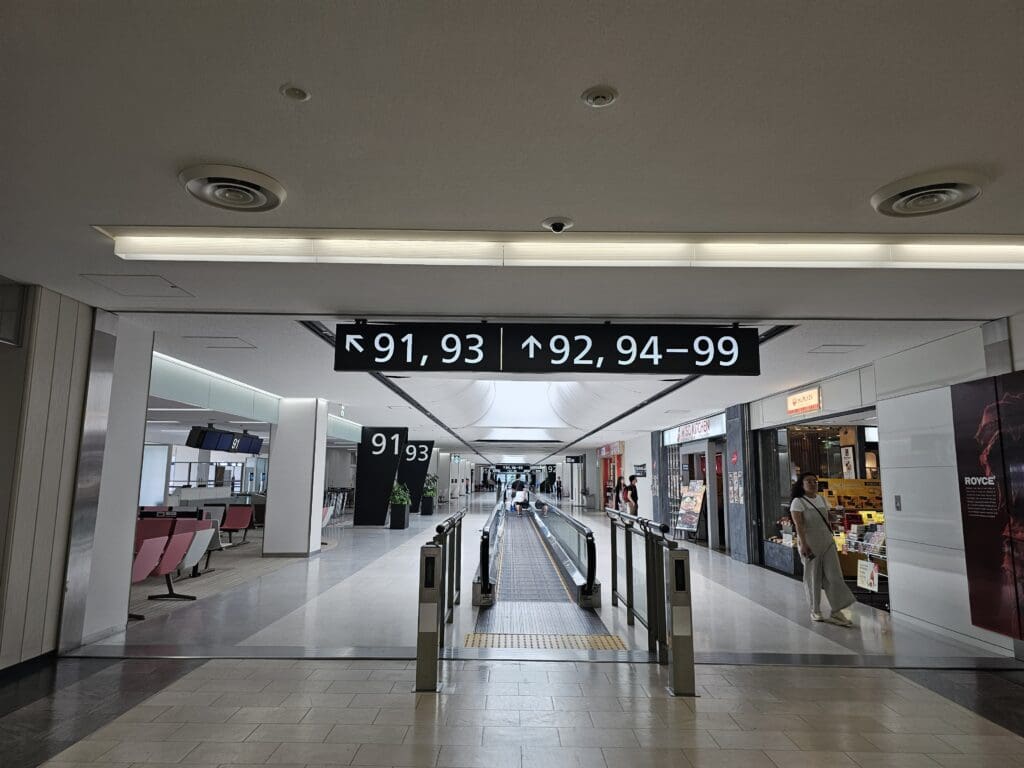
Taking the form of a low-cost passenger, not needing to make any fashion purchases and having filled up on 7-Eleven onigiri, with my flight scheduled to depart from Gate 94, I followed signs for Gates 81 to 99. In terms of its layout, Terminal 2 consists of the main terminal and what is sort of a satellite terminal. Once upon a time, the latter was completely detached from the main terminal and could only be reached by driverless train. However, since 2013, matters have been simplified and the two are connected by a bridge which takes a few minutes to cross via a series of moving walkways. This bridge also features an array of comfortable-looking seats and seemed to be a great spot for those seeking a comfortable wait or a quick power nap.
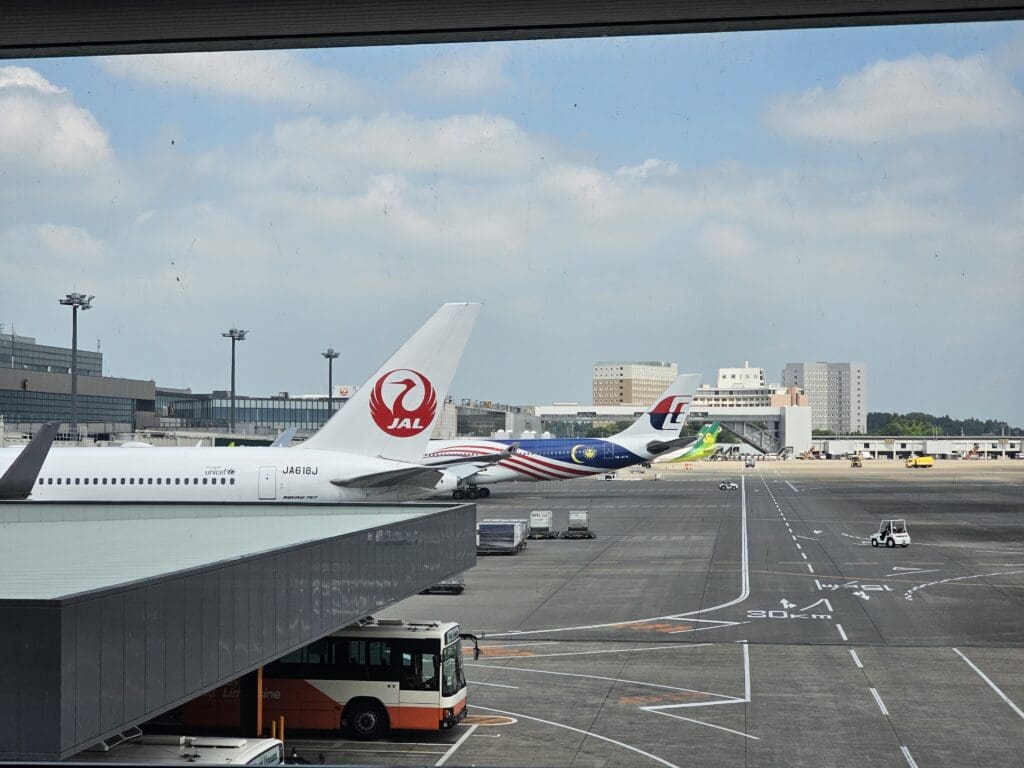
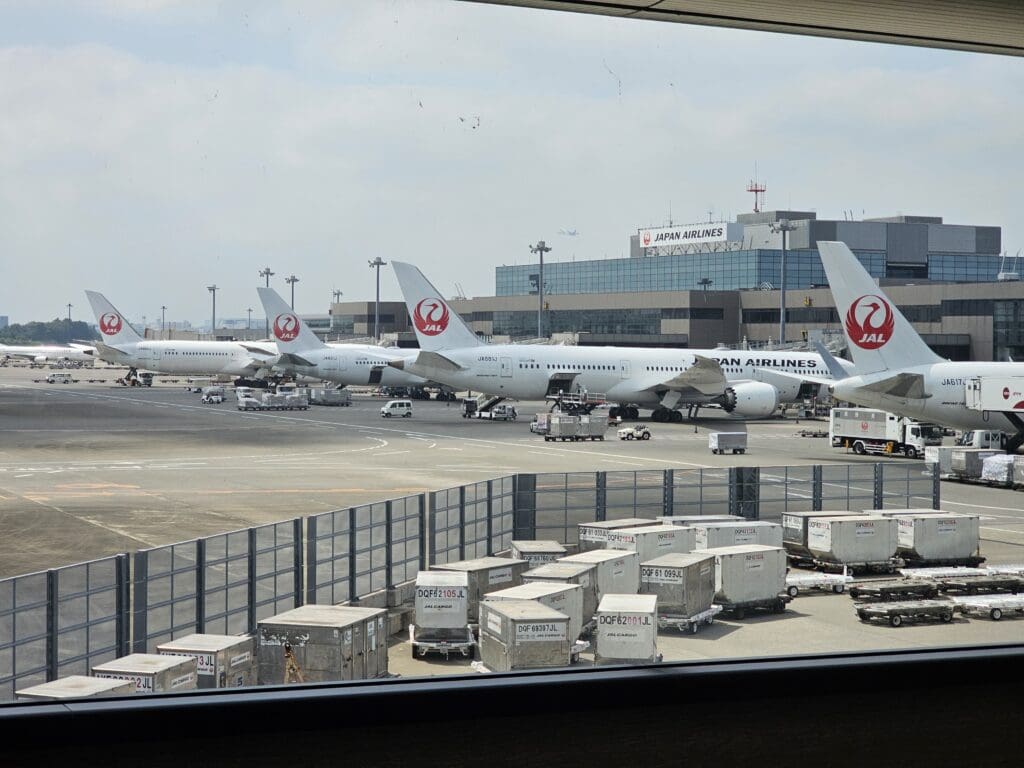
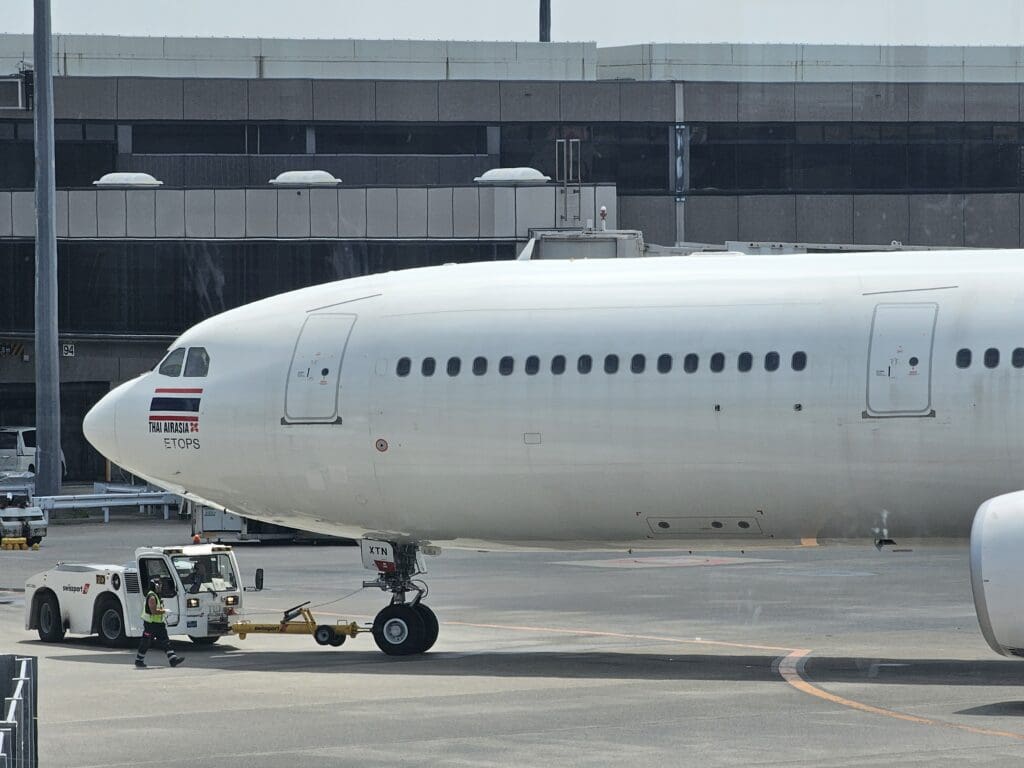
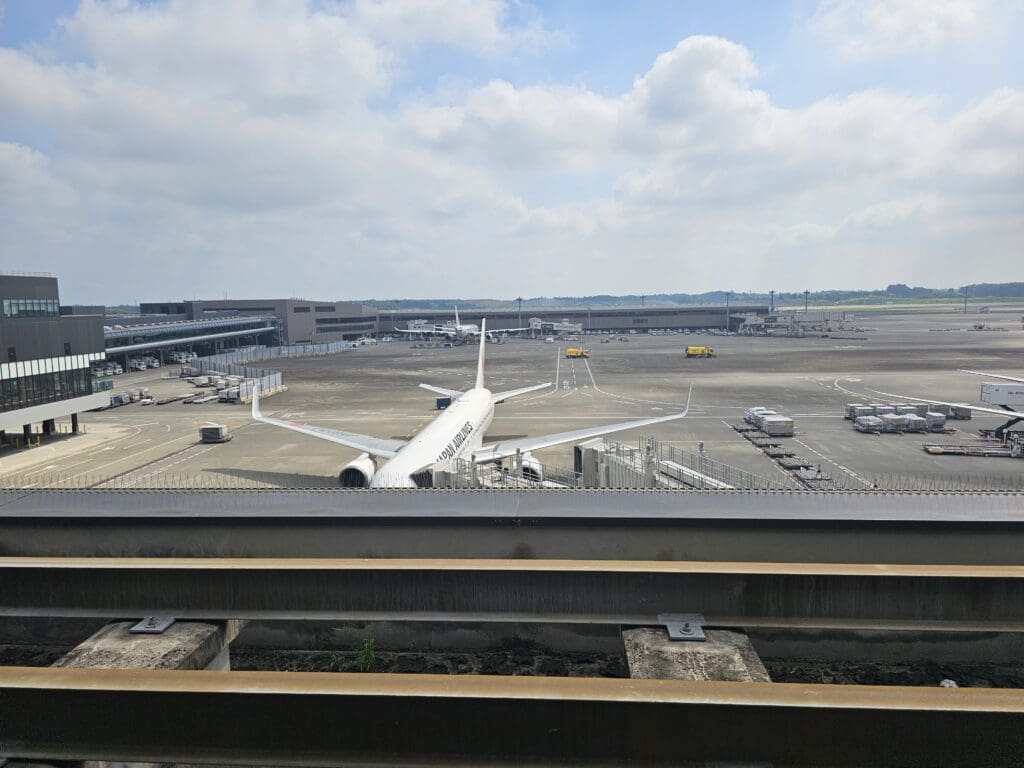
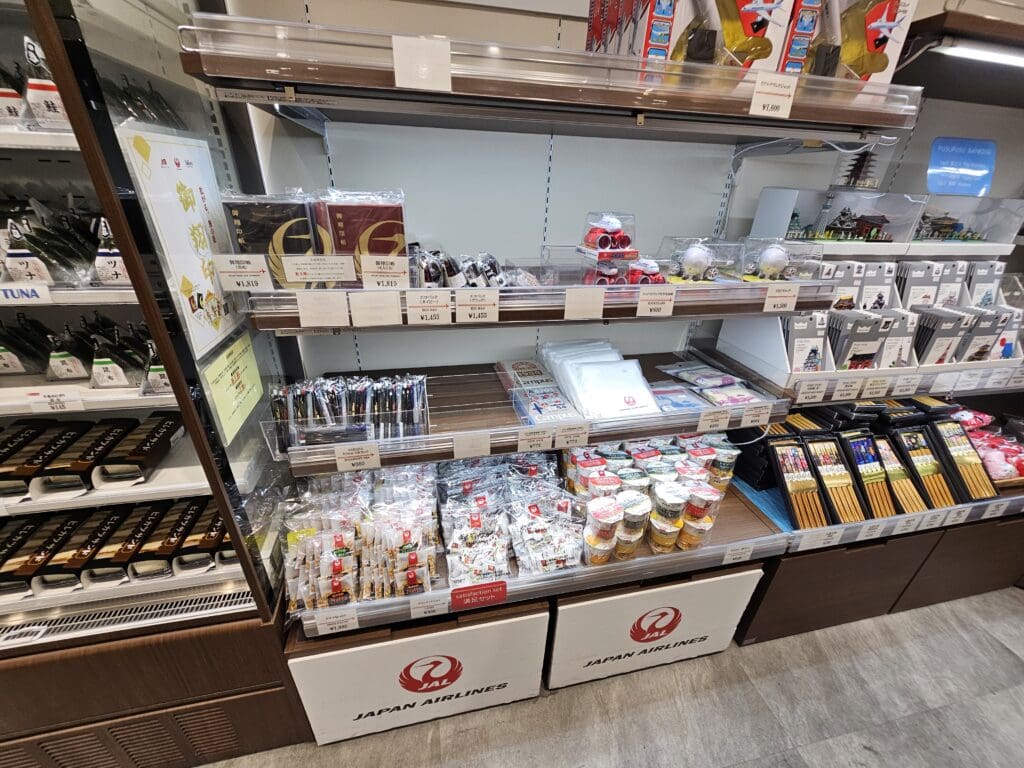
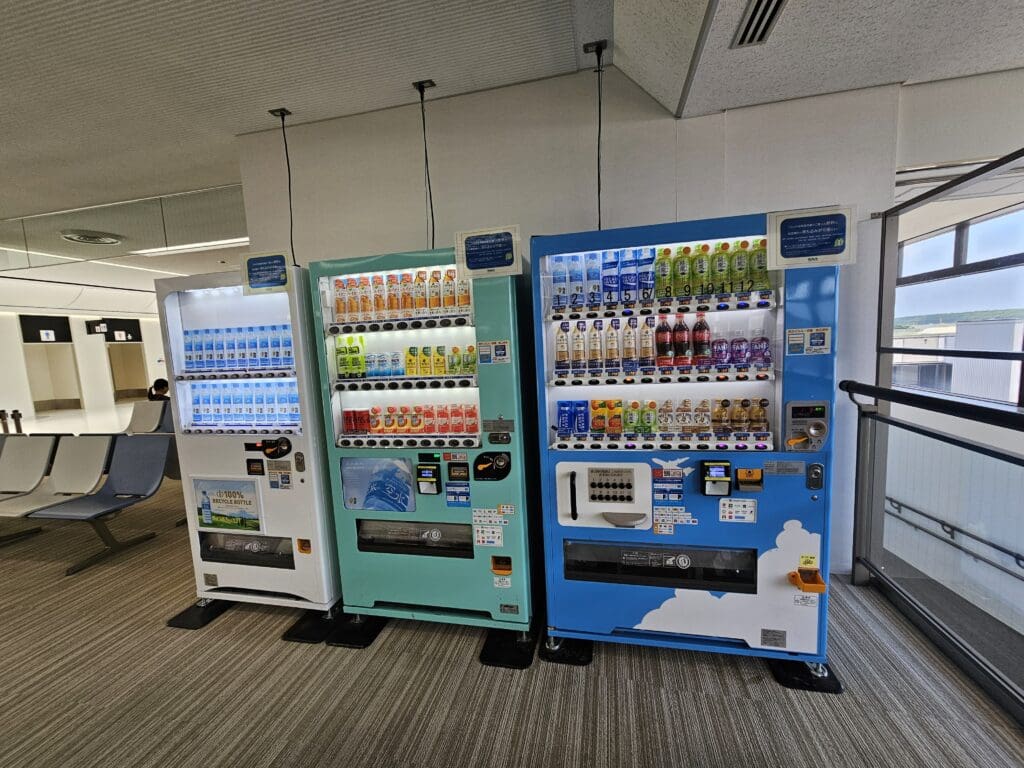
Upon making it to the satellite terminal, I made a quick lap of this and whilst finding this to lack any particularly notable architectural features, this was bright, modern, spacious, airy, spotlessly clean and featured plenty of plug sockets for those looking to charge their devices. When it came to facilities, these were limited to a few JAL Plaza Shops selling a mixture of food, drink and souvenirs, including a fair number of Japan Airlines branded goods, two restaurants (Miso Kitchen and Yoshinoya) and two cafés (Dean & Deluca and Starbucks). Meanwhile, with Japan being Japan, plenty of vending machines could also be seen dotted throughout selling an array of drinks and snacks. In terms of its layout, the satellite terminal is long, thin and rectangular, and unfortunately, decent views of the action outside could only be had from the terminal’s two cafés.
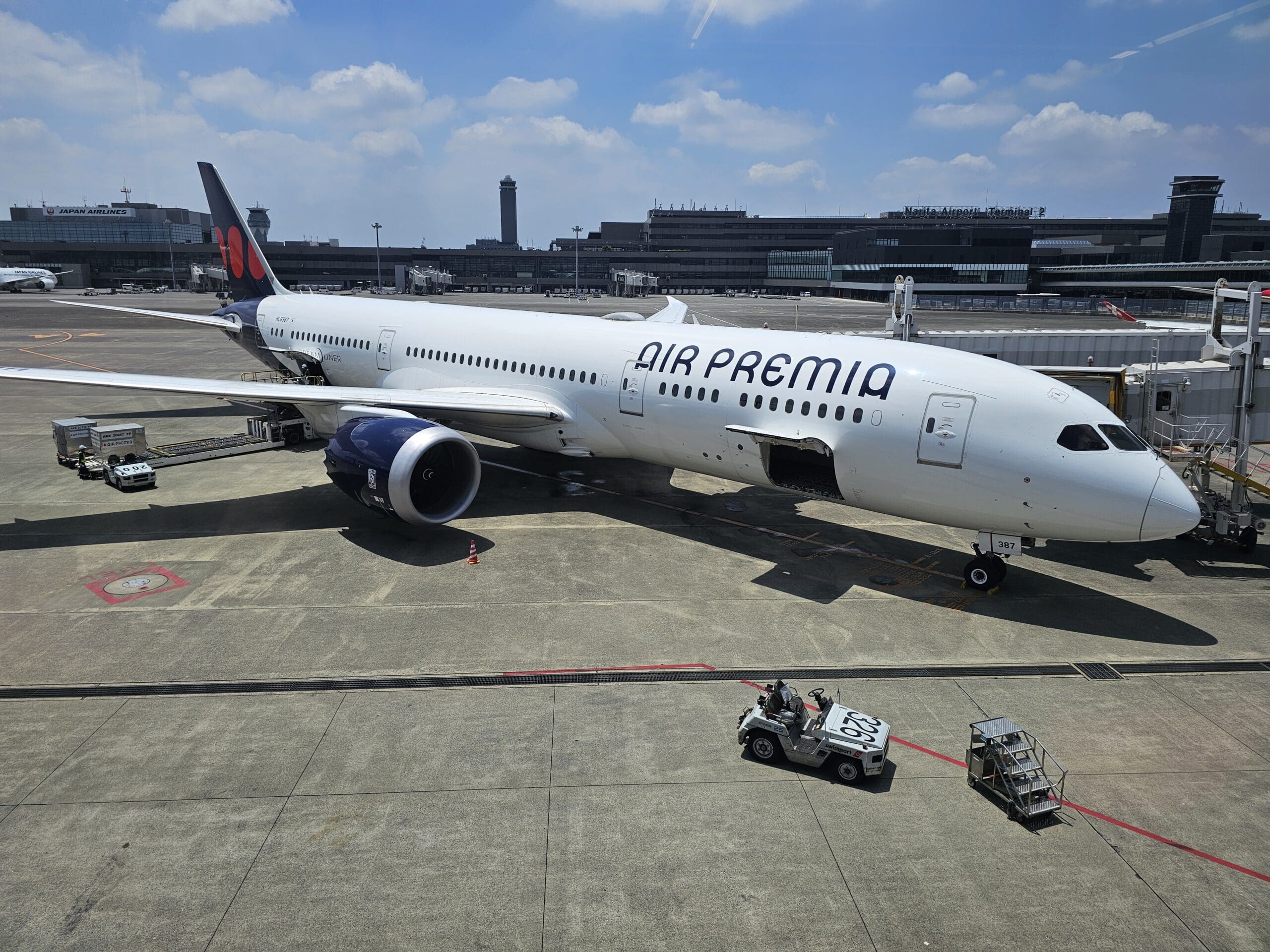
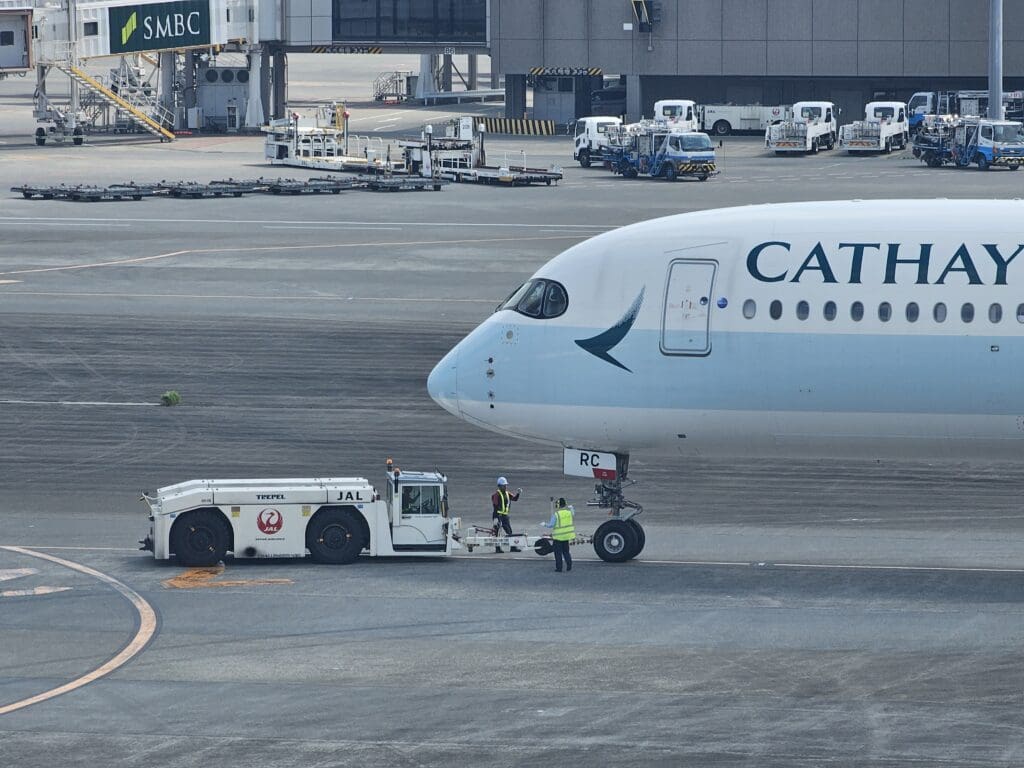
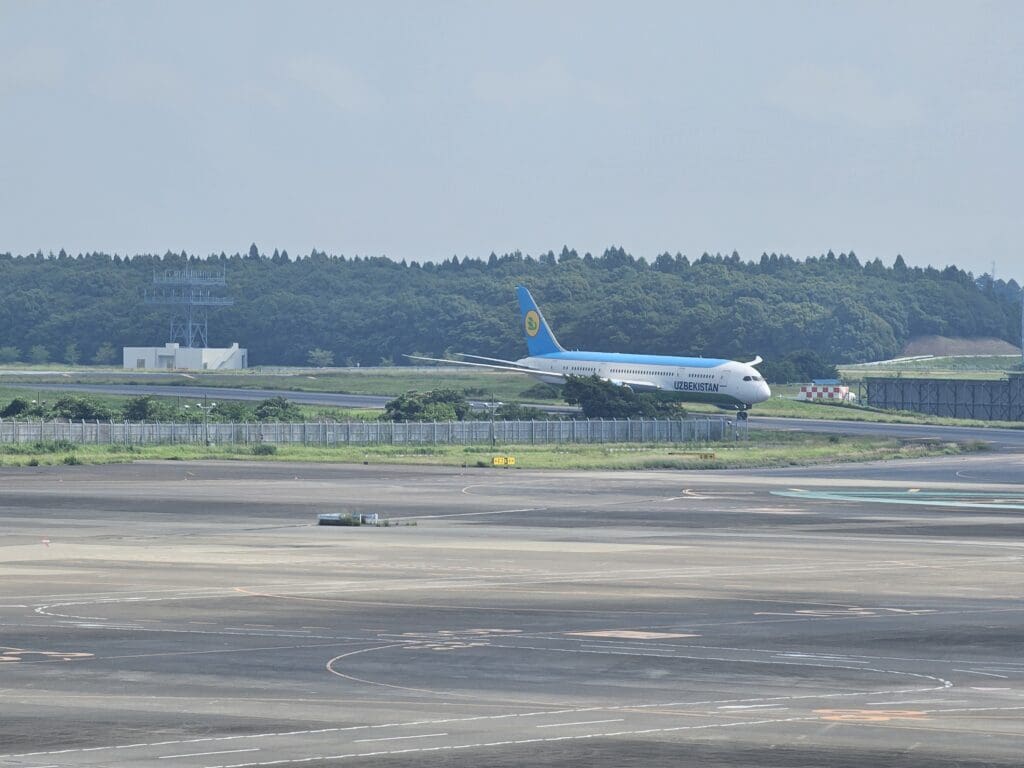
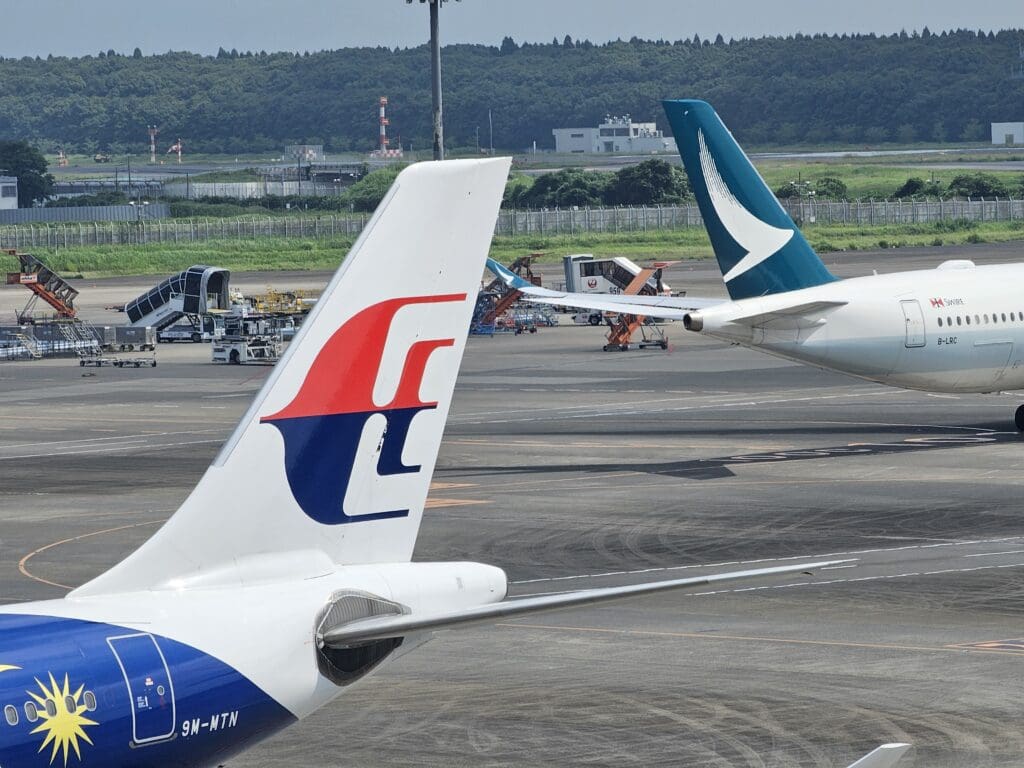
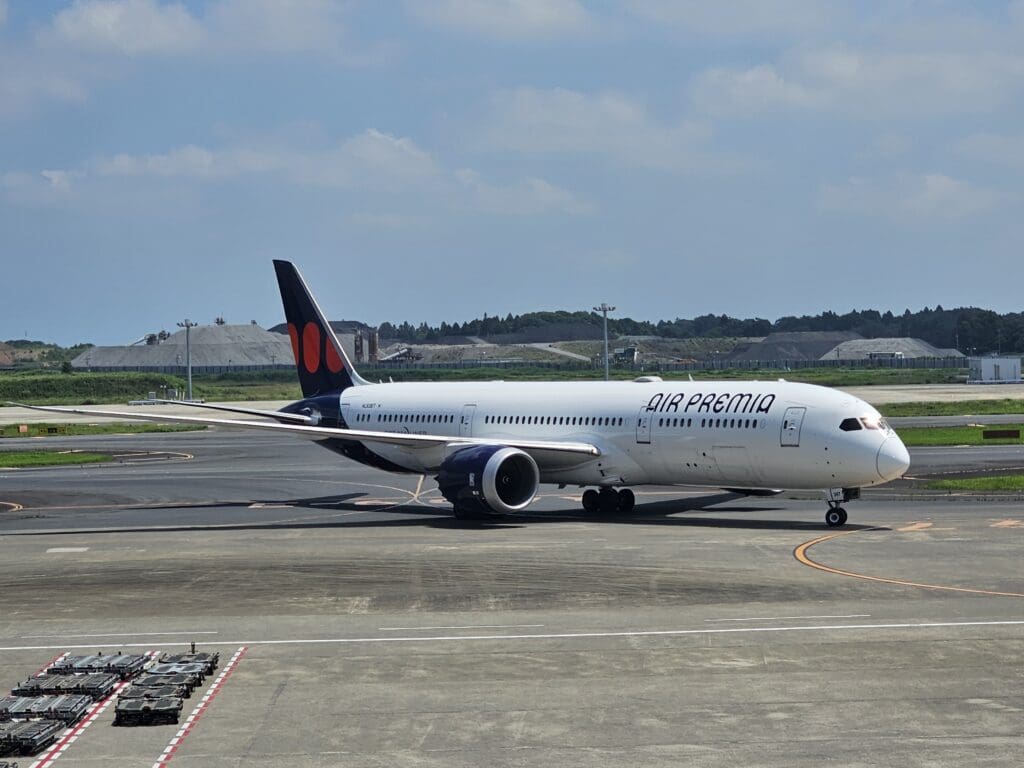
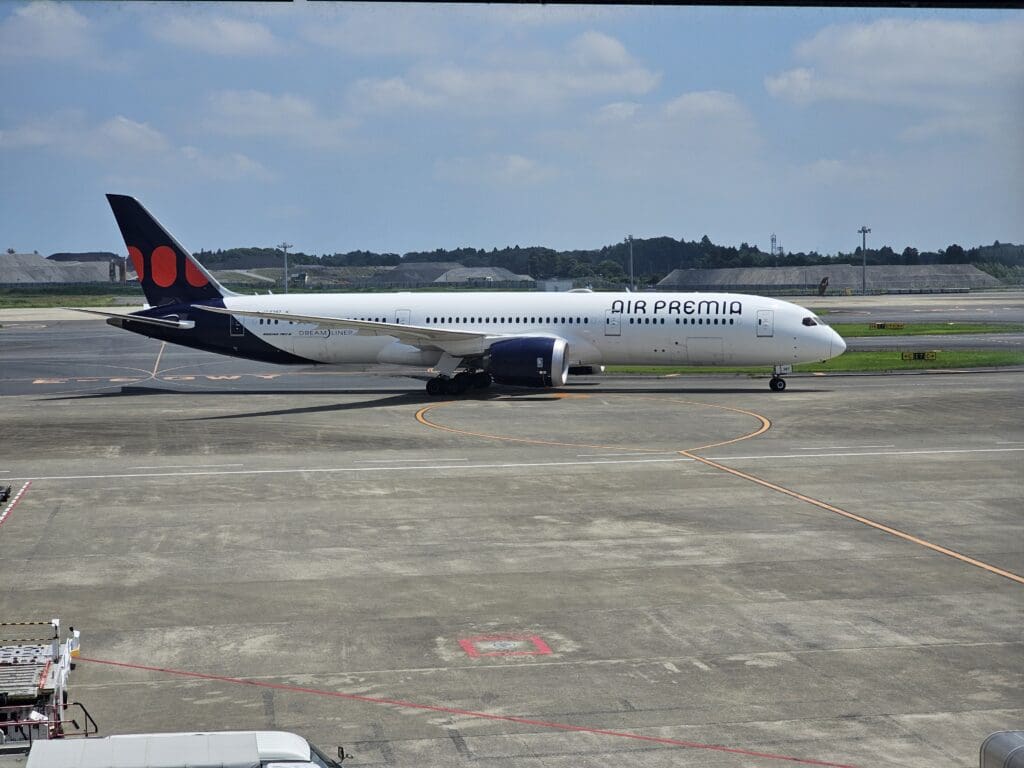
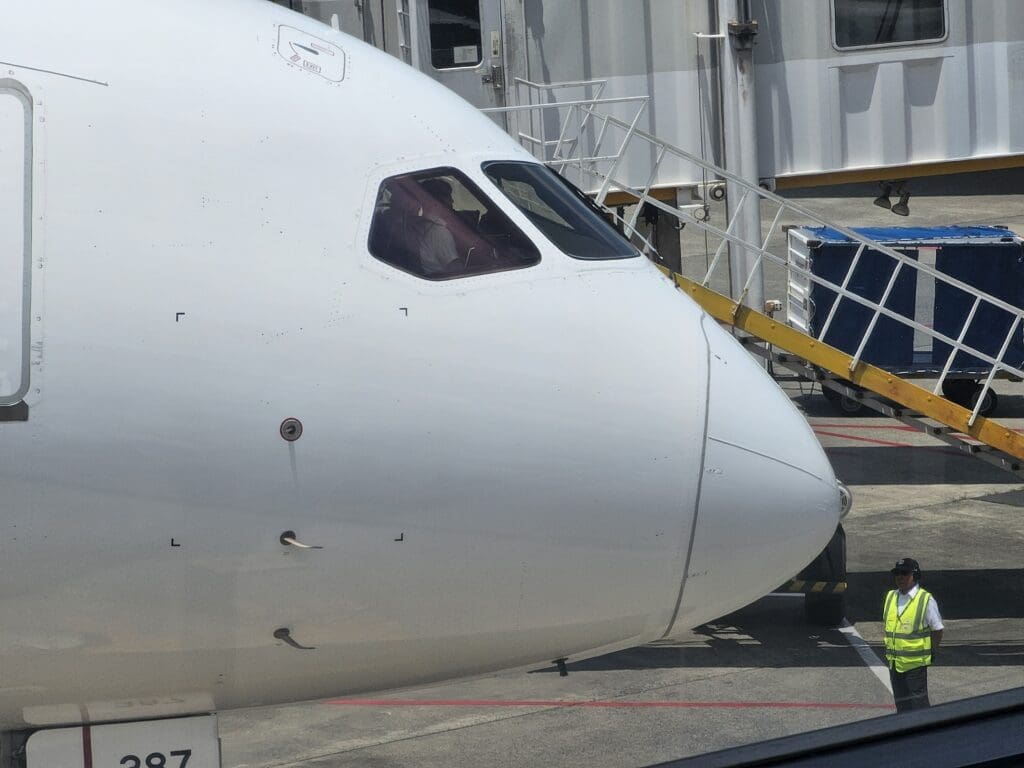
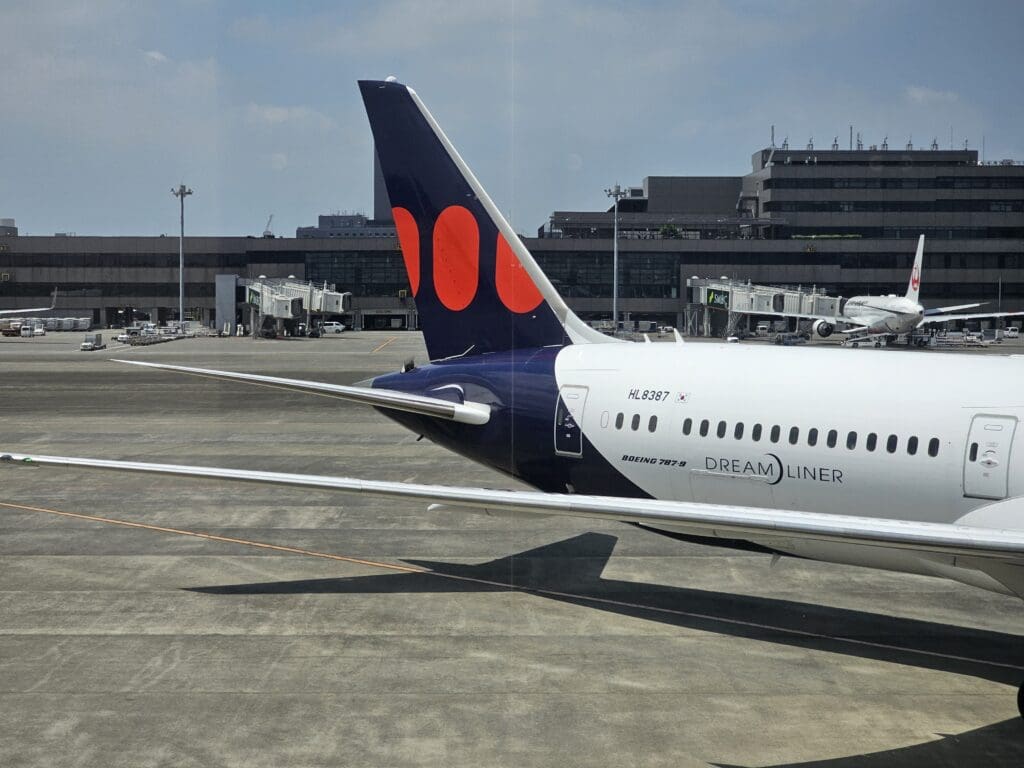
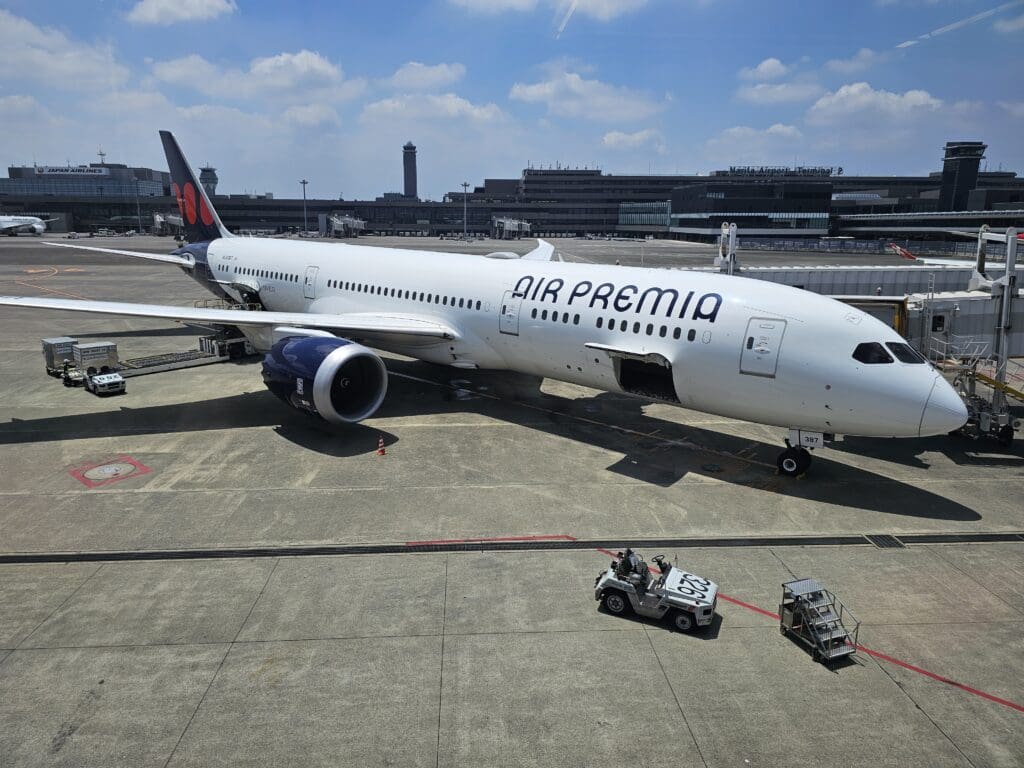
Once I had walked around, I grabbed a coffee from Starbucks, sat down and watched the fairly constant stream of diverse aircraft from across Asia and beyond taxied past following their arrivals on Runway 16L. Soon, the sleek Dreamliner that would be taking me over to Korea appeared, having touched down on Japanese soil over thirty minutes ahead of its scheduled arrival time. Seeing as I had studied the seat map for the aircraft on Air Premia’s website, this was identical to that of those aircraft that had previously flown for Norwegian’s long haul arm. Whilst this was no disaster, I was a little disappointed that I wouldn’t end up sampling Air Premia’s uniquely spacious seat, with this limited to the airline’s three aircraft that were delivered directly from Boeing. However, as the jet taxied in, I was delighted to find that there had been a last-minute swap of aircraft and I would instead be flying on HL8387, a Boeing 787-9 Dreamliner that had been delivered directly from Boeing!
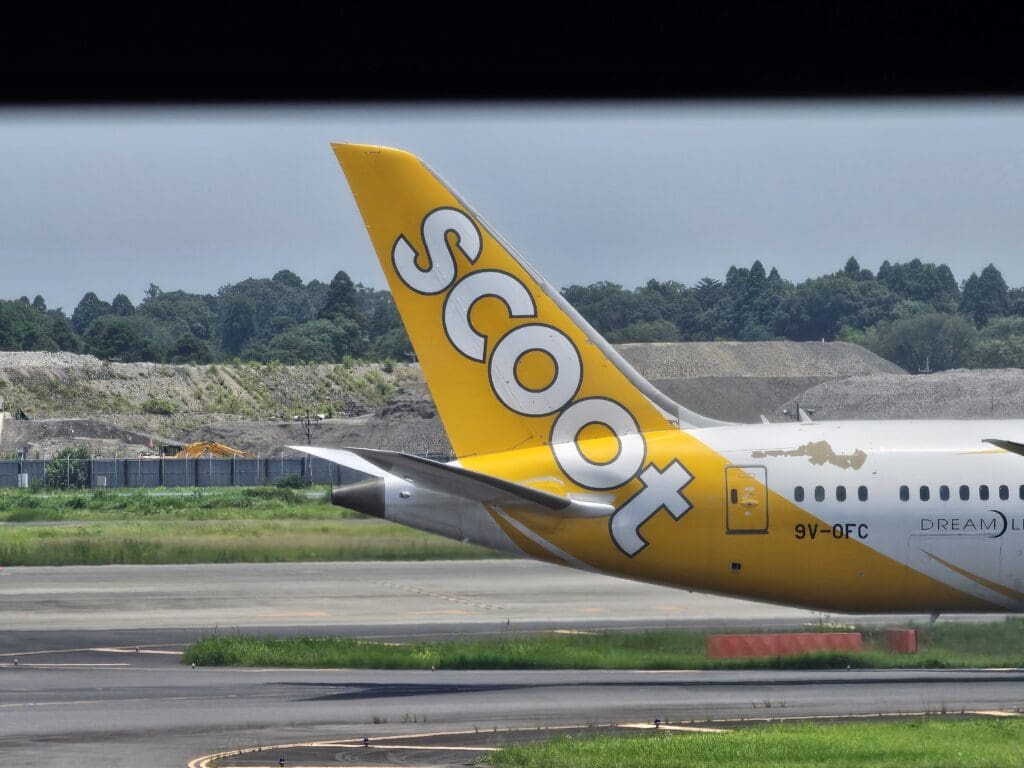
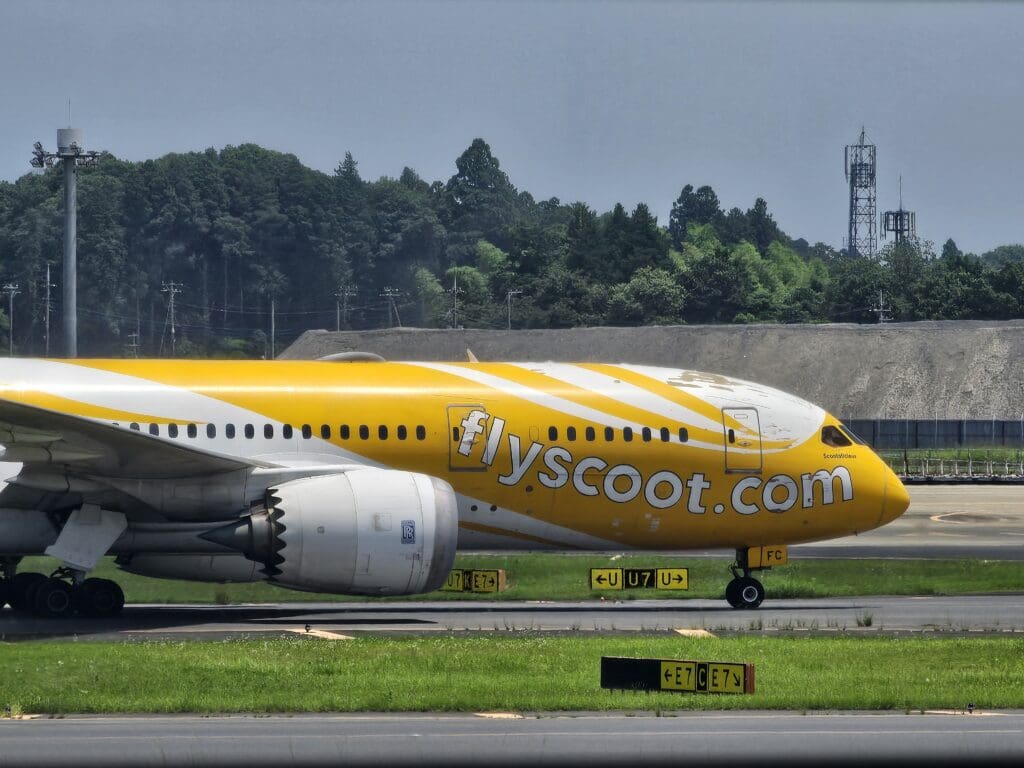
Assembled at Boeing’s ‘original’ Dreamliner production line in Everett and carrying line number 1047, this particular aircraft took to the skies for the first time in November 2020 before being handed over to Air Premia in April the following year. This made the aircraft exactly 3.64 years old at the time of my flight. Leased from the Air Lease Corporation, as Air Premia’s first aircraft, this touched down at Incheon Airport to much celebration. After several months of training flights, the aircraft was put into revenue service on the short route between Seoul Gimpo and Jeju, with this route flown for several months to meet Korean regulatory requirements, demonstrating Air Premia’s operational capabilities on domestic routes before being permitted to operate internationally. Since then, the aircraft has been sent to destinations across Air Premia’s scheduled route network, alongside charter destinations such as Barcelona, Dhaka and Oslo. Inside, this aircraft is home to 309 seats – 56 in Premium Economy arranged in a 2-3-2 layout, with this cabin squeezed in between the first and second doors and 253 in Economy in a 3-3-3 configuration spread out across two cabins. In the week before my flight, this particular Dreamliner had undertaken a total of five rotations, connecting Seoul Incheon with Los Angeles and Newark, before heading over to Tokyo.
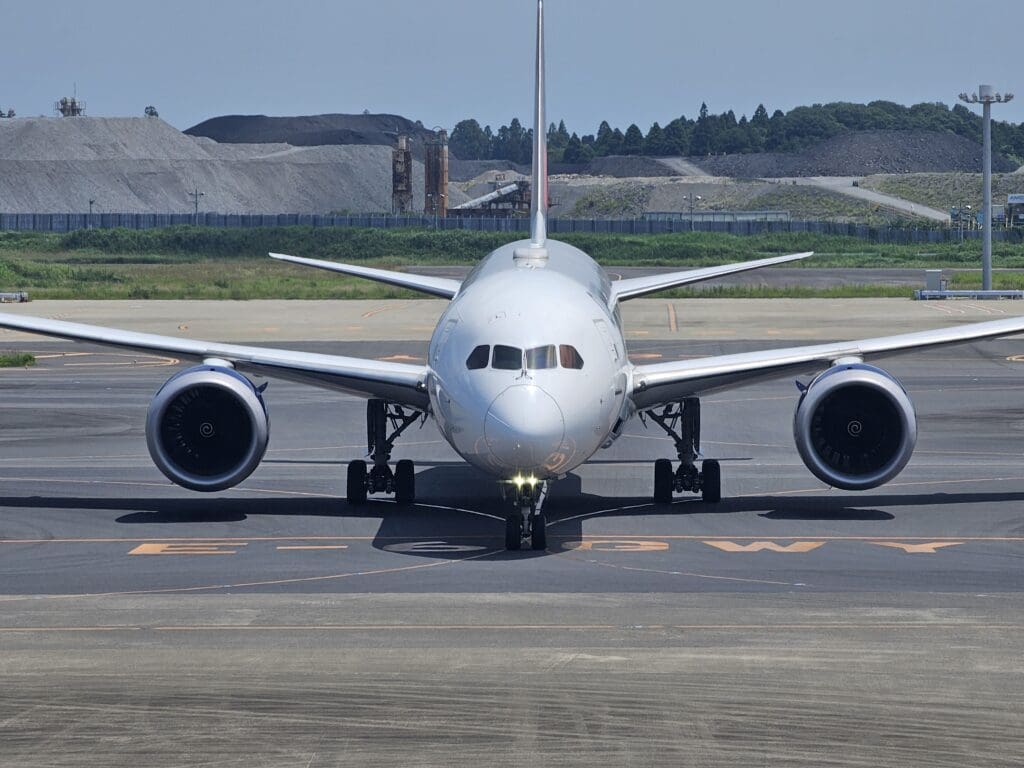
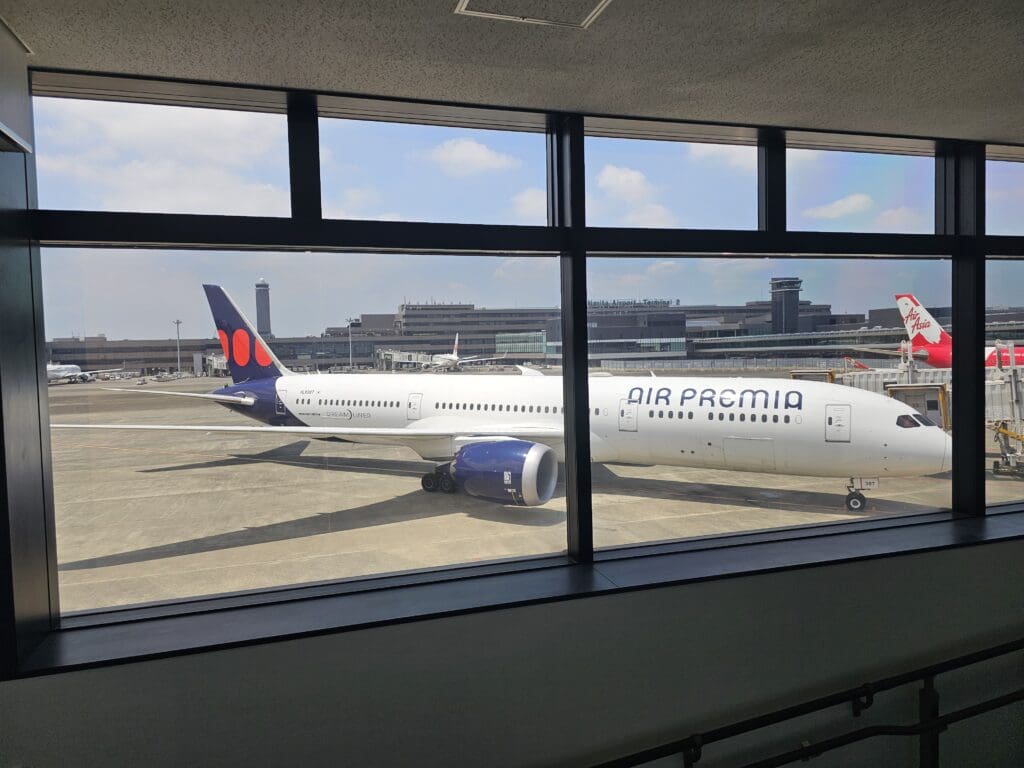
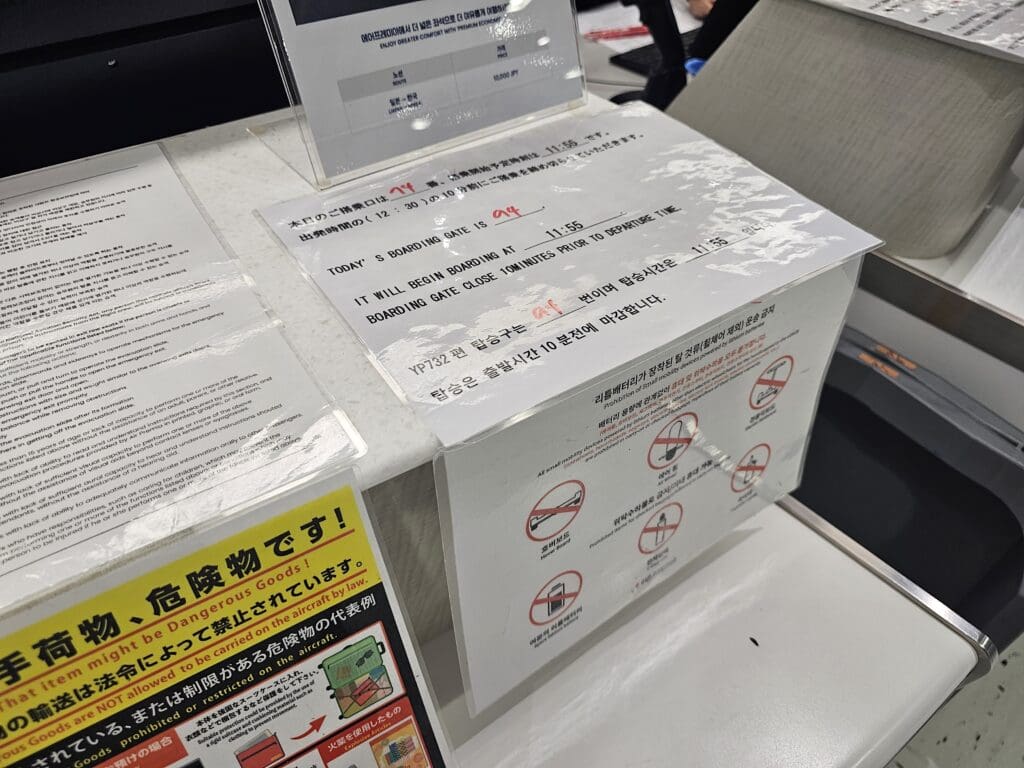
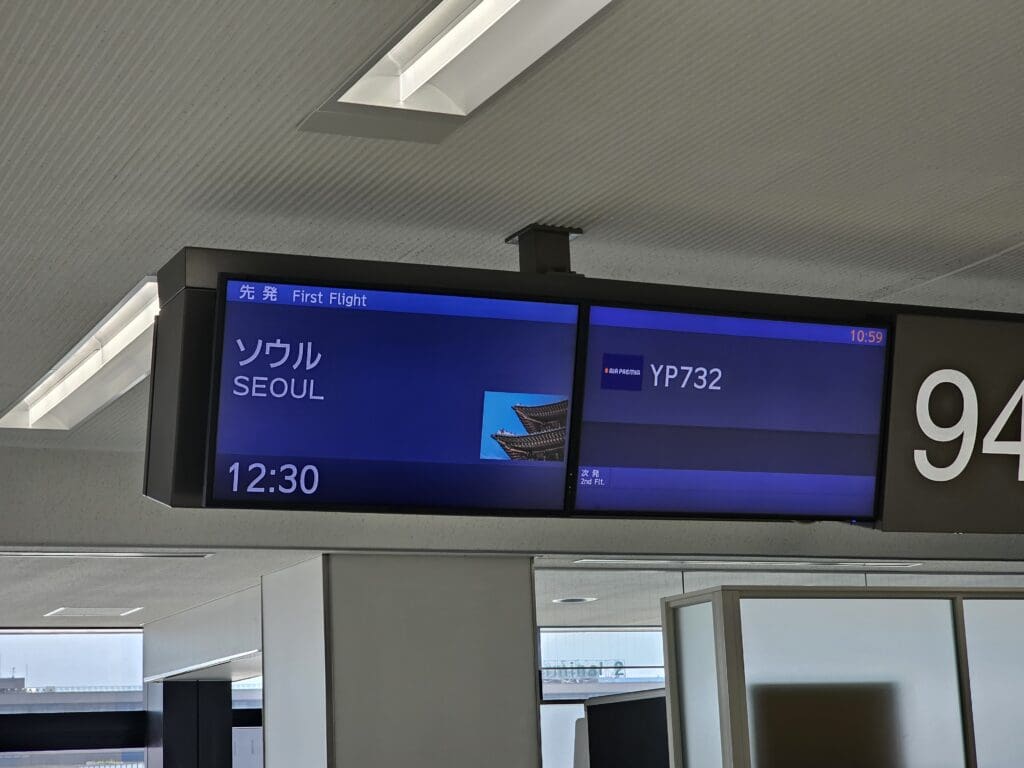
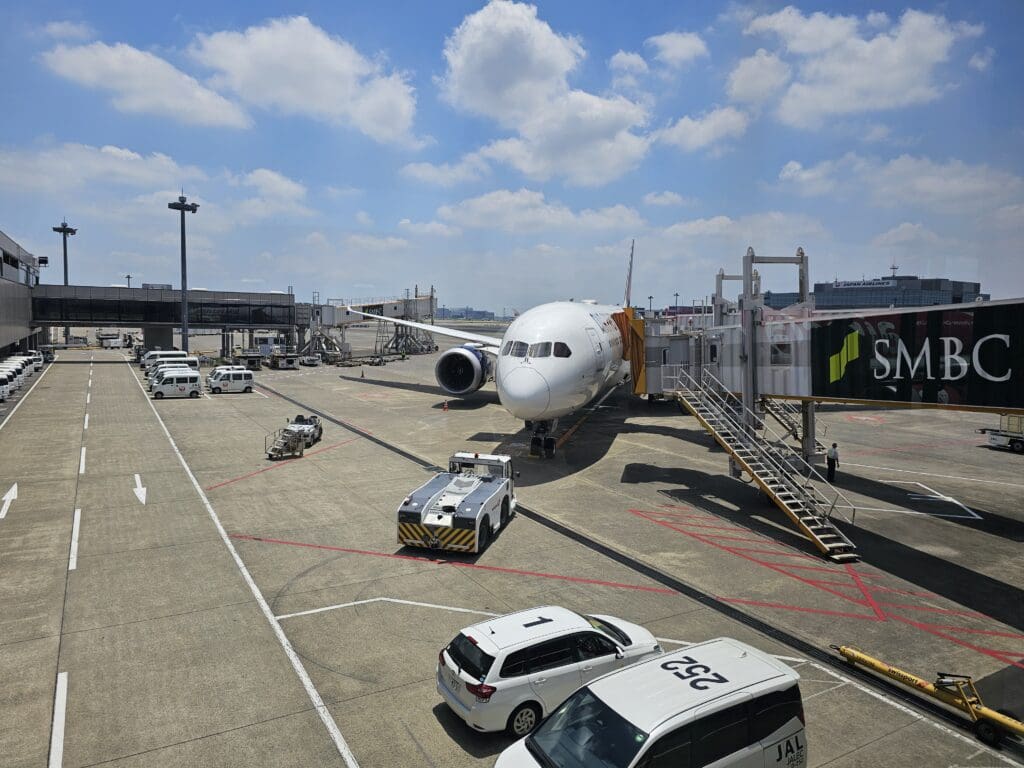
Following another walk around, I spent some of my final remaining yen for ten minutes in a massage chair, costing 300 yen (£1.60) before wandering over to Gate 94. Inside, this featured just a small waiting area that was probably not designed to handle the number of passengers on a widebody aircraft and was rammed with nowhere to sit down. Hovering around, I watched as the mixture of Air Premia and Swissport staff readied the gate for boarding whilst outside, the Dreamliner could be seen being loaded up for its short hop westwards across the East Sea. That morning boarding for my flight was scheduled to commence 35 minutes before departure at 1155, however, five minutes ahead of this time, the gate agent made an announcement in Korean, Japanese and English requesting those requiring assistance and those in Premium Economy to board the aircraft. Meanwhile, several signs had been erected at the gate and two queues of Economy passengers formed – one queue for those in the rear cabin, and one for those in the forward Economy cabin, with, in the usual manner, the former boarding first. Ending up near the front of the queue for those seated in the rear Economy cabin, soon, the queue began to shuffle forward and I had my boarding pass scanned before one of the polite Swissport agents wished me farewell in Korean.
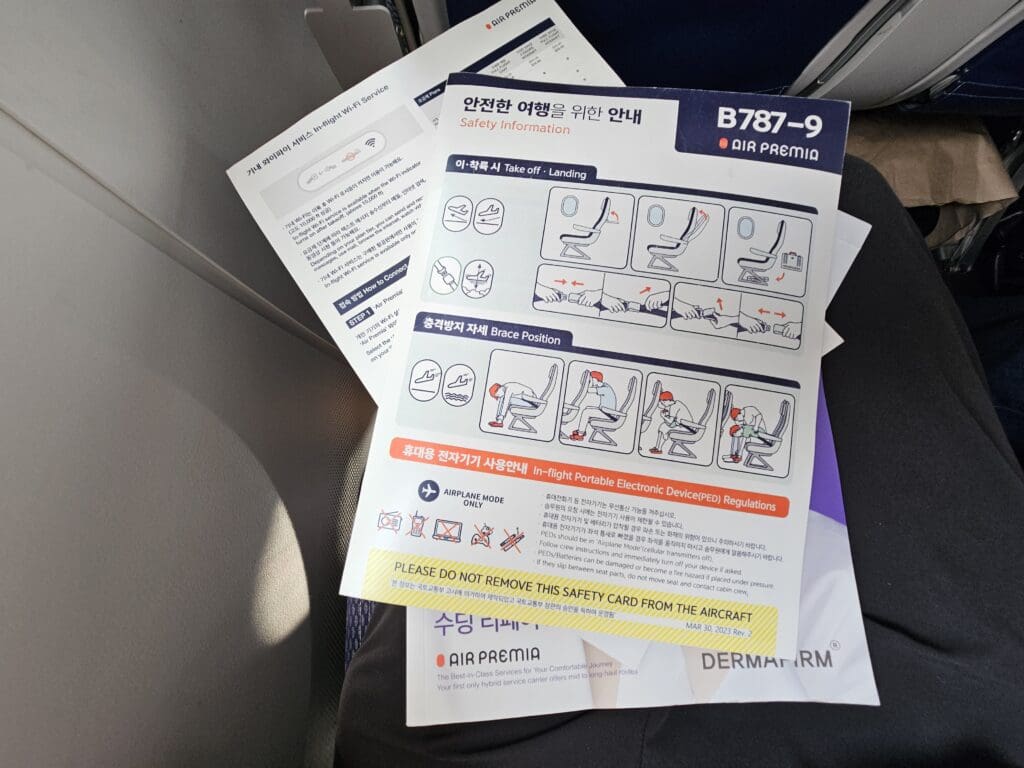
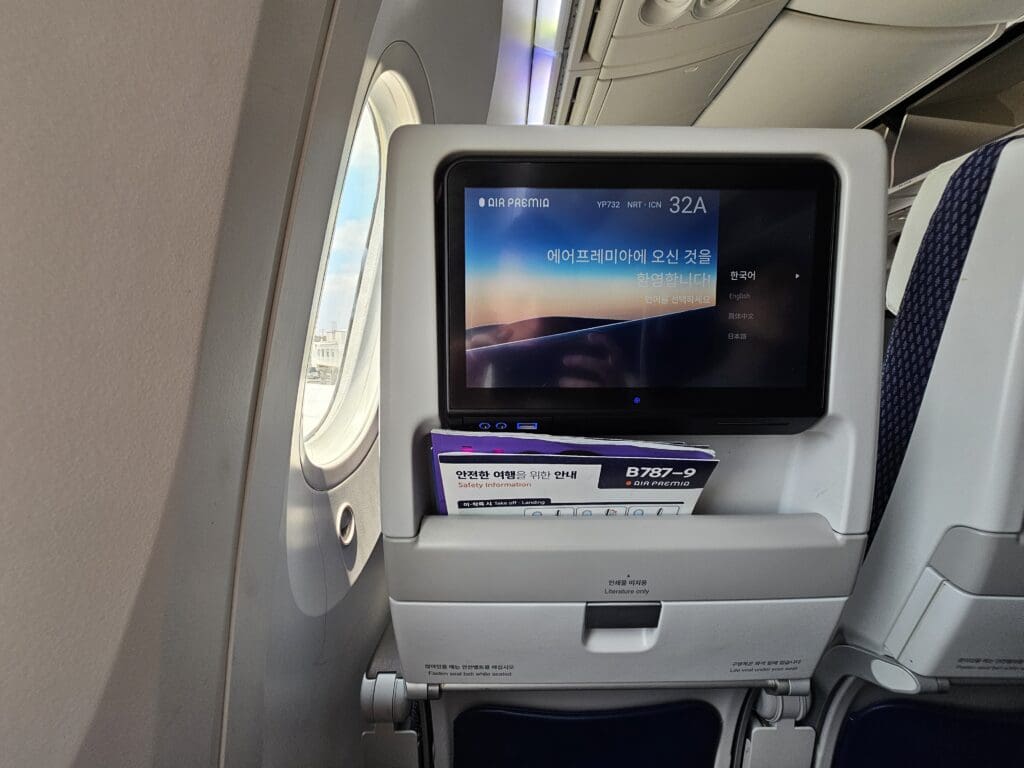
From the gate, I made my way down the boiling jetbridge and with nothing more than a very short queue at the 2L door, I soon stepped aboard and received a lively greeting in English from one of the smartly dressed flight attendants. Once they had checked my boarding pass, I was pointed down the first row and entered the forward Economy cabin. Onboard, the three Air Premia Dreamliners that were delivered directly from Boeing are fitted with Recaro’s modern and fairly common CL3710 seat. Each of these sports a dark blue fabric cover with a pattern consisting of grey ovals and are topped by an adjustable pleather headrest. Meanwhile, the rears of these come complete with an inflight entertainment screen, a literature compartment, a seatback pocket, a bifold tray table and a coat hook. Turning to the literature compartment, this contained a safety card, sick bag, wifi information card and a duty free catalogue. Finally, in-seat power came in the form of a USB-A port, with no universal power outlet provided.
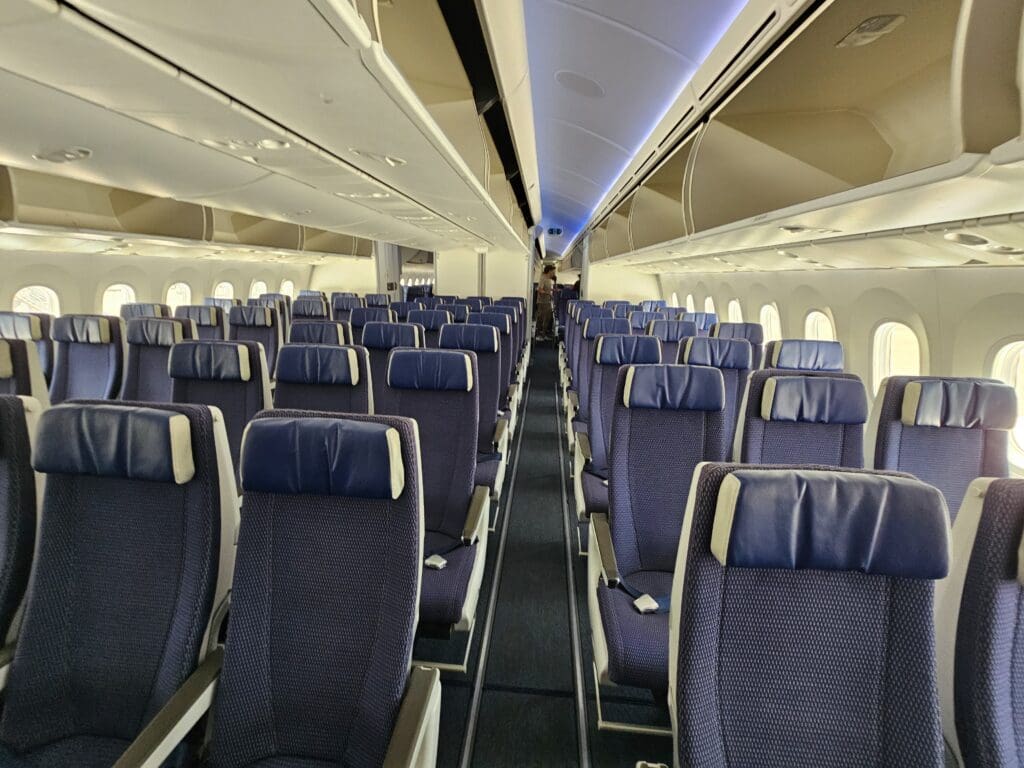
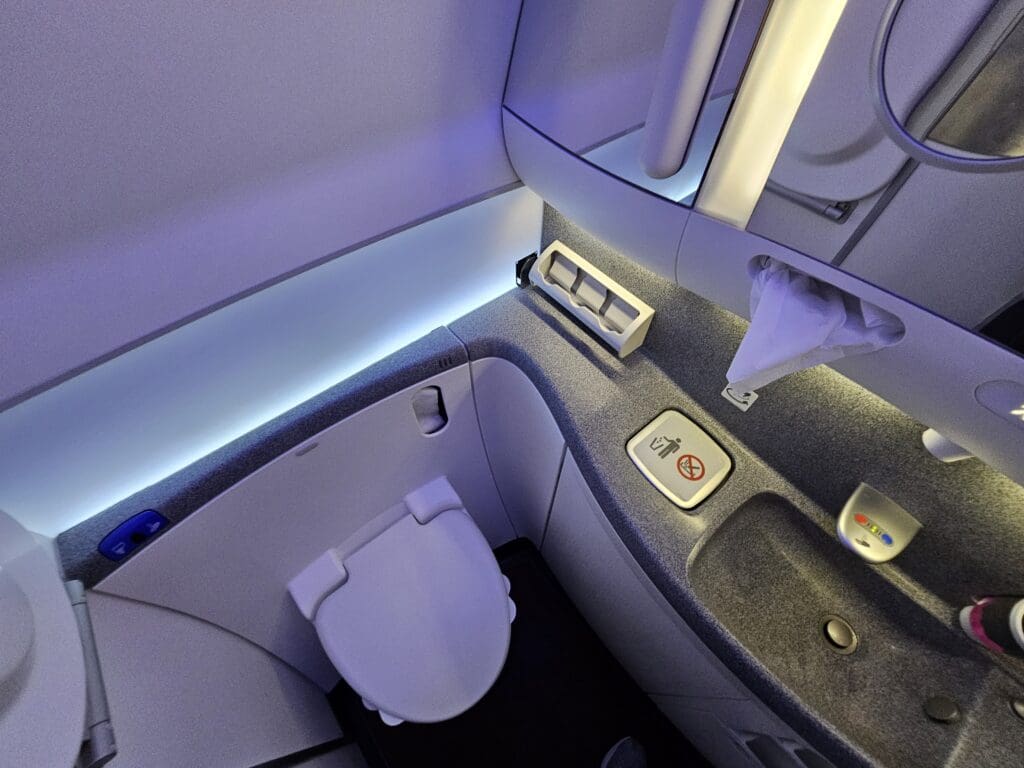
As I trundled down the aircraft, calming music rang out and I was greeted in English by each flight attendant that I passed as I journeyed to my seat. Upon making it to Row 32, I was delighted to find that Seat 32A aligned well with one of the Dreamliner’s large windows. Seeing as I may well end up trapped in, after stowing my bag I made my way to the rear of the aircraft to make a pre-departure lavatory visit. In total, six lavatories were available for Economy passengers to use, with two at the rear of the jet and four sandwiched in between the two Economy cabins. Upon opening this up, I found this to be modern, spacious and in a spotlessly clean and tidy condition with no obvious signs of wear and tear, thus leaving me with zero complaints.
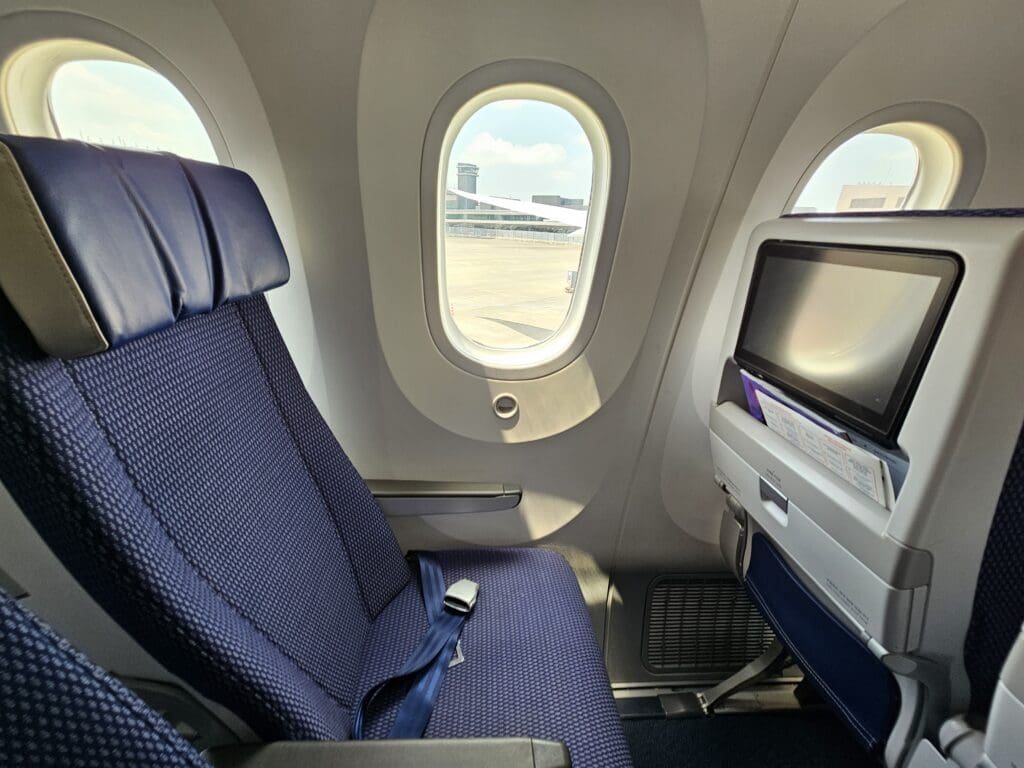
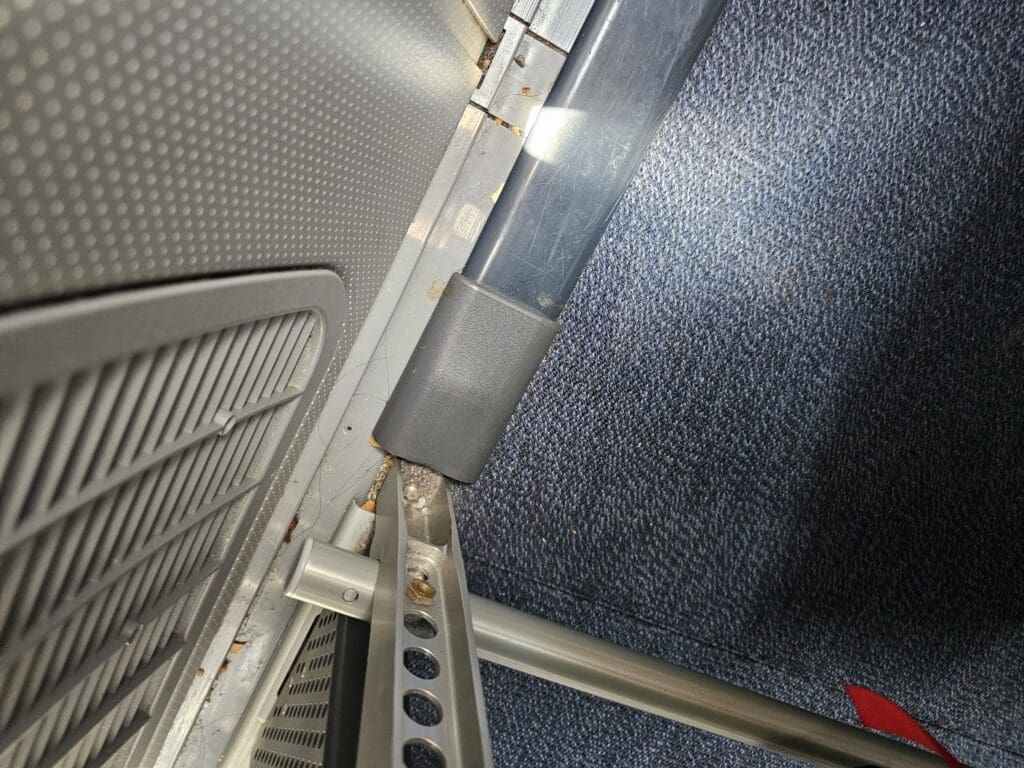
Following my quick trip, I returned to my seat and settled in for the journey ahead, by which time I had already been joined by two seatmates. First and foremost, I was delighted by just how comfortable and spacious this seat was. Living up to the high expectations that I had for this, not only was this nicely padded and soft, but the seat was by far the most spacious Economy seat that I have had the pleasure of sitting in, and I had to remind myself multiple times that I was on a semi-low cost carrier! Looking around, signs of wear and tear were minimal, although as seems to be a common problem on Dreamliners the world over, there were some marks on the window dimmer. Likewise, this was relatively clean although not completely spotless and crumbs could be seen along the bottom of the cabin side walls, whilst I also spotted some ink marks around the literature compartment. Looking ahead, upon boarding, the inflight entertainment screens displayed their welcome screen although these could be used from boarding until disembarkation, except of course during announcements and the safety video.
As passengers filtered onto the aircraft, every few minutes one of the flight attendants made an announcement in Korean and English requesting passengers to store their luggage correctly in accordance with its size and take their assigned seats. Around thirty minutes after boarding had commenced and ten minutes before our scheduled departure time, an announcement was made advising the ground crew to leave the aircraft, indicating that boarding had been completed and we would soon depart. Considering Air Premia’s status as a small and somewhat niche Korean airline that isn’t particularly well known outside of the country (or indeed within it for that matter!), I wasn’t too sure what the demographics would look like on that day’s flight. However, being a Friday, I expected to see a fair number of Japanese weekend trippers heading to Seoul, with most Koreans likely heading in the opposite direction for a weekend in Tokyo. Indeed, it seemed that at least 60% of those around me were Japanese, whilst interestingly a fair number of Filipino and Vietnamese passengers could also be seen plus a few other Westerners. In total, I would estimate the rear Economy cabin to have been around 85% full, with it being a relatively busy flight to Korea.
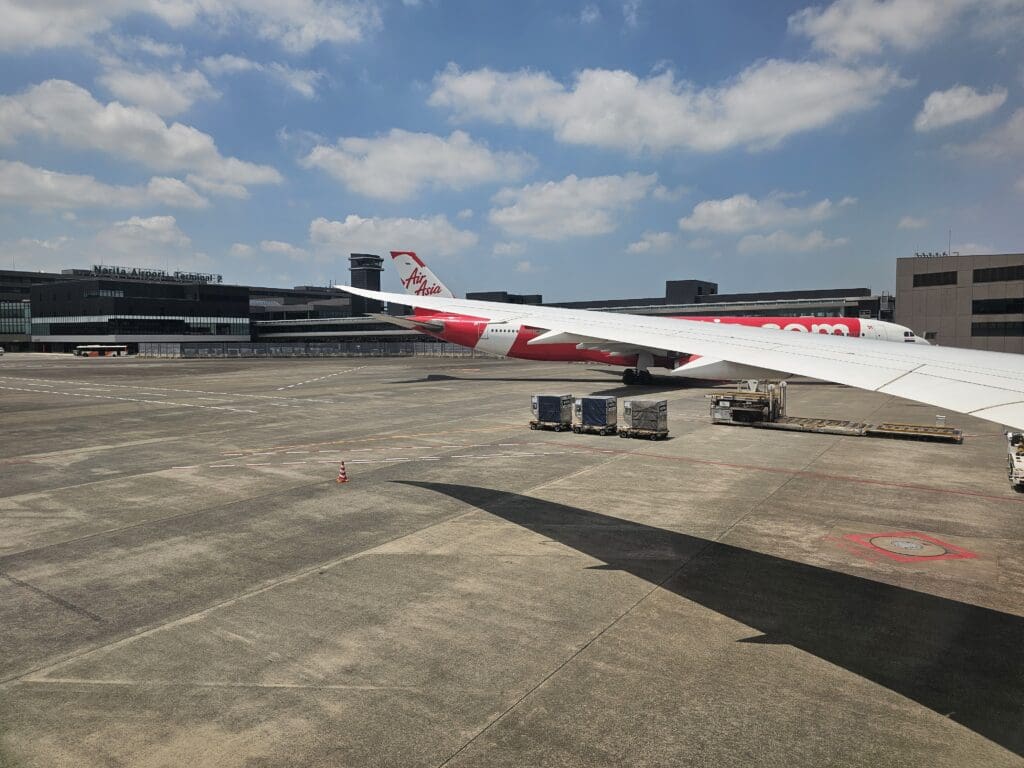
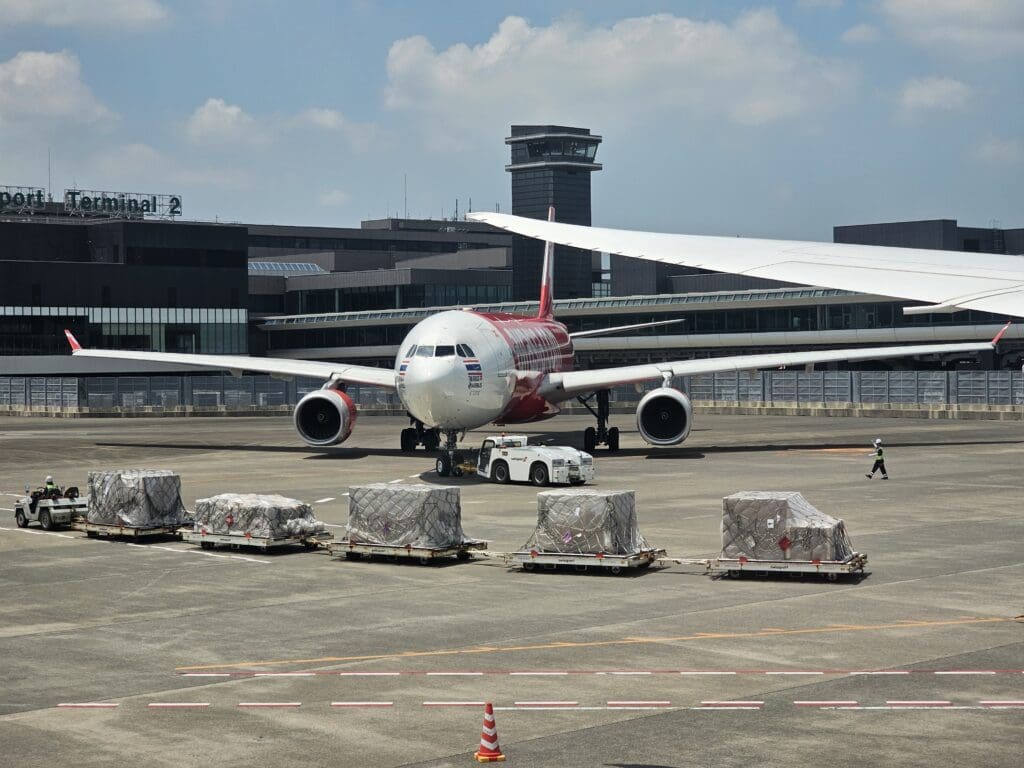
At 1228, the last of the ground service equipment could be seen being removed from the aircraft and inside the cabin, the Purser commenced their welcome announcement in Korean and English. This contained all the usual warnings, thanks and introductions, and a mention of our 1H55 flight time to Incheon Airport. As soon as the Purser had completed the announcement, the safety video took over the inflight entertainment screens. This was a fairly standard animated safety video that lacked any notable gimmicks, going through the safety instructions in Korean only, with English subtitles provided. It is worth noting that neither Japanese subtitles were offered, nor was a Japanese version of this announcement made, which was a little surprising given the relative ease at which Air Premia could create some pre-recorded Japanese safety announcements. Indeed, that day, unlike my flight over to Tokyo on Asiana Airlines, there did not seem to be any Japanese-speaking crew members onboard and thus announcements were made in Korean and English only.
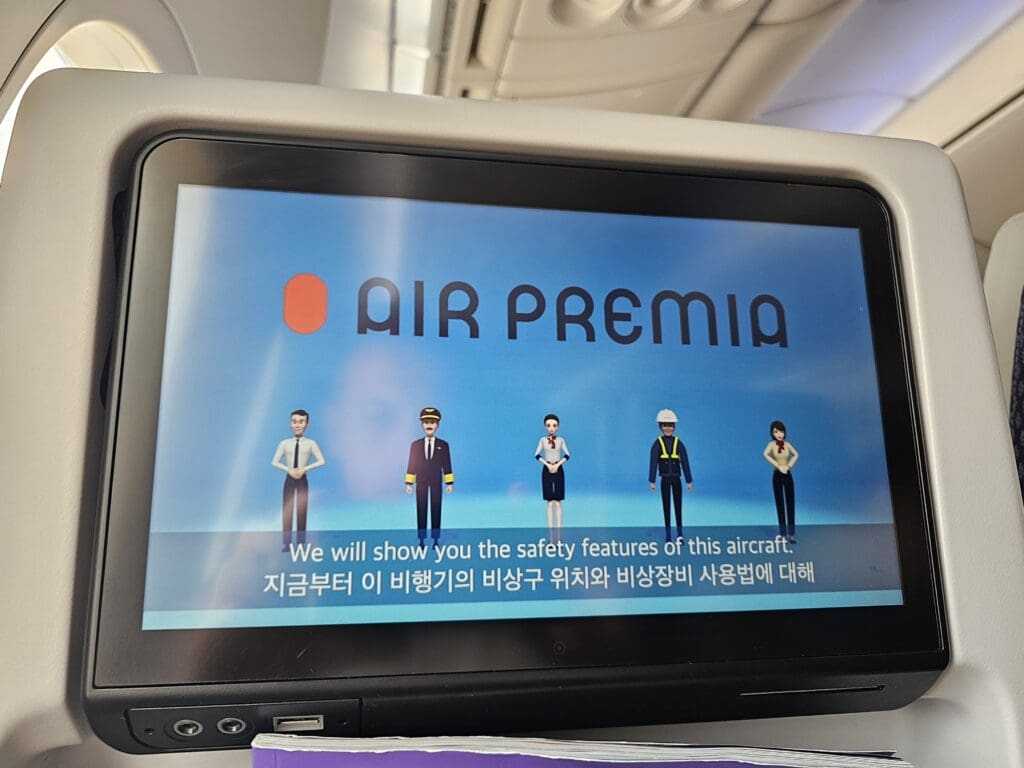
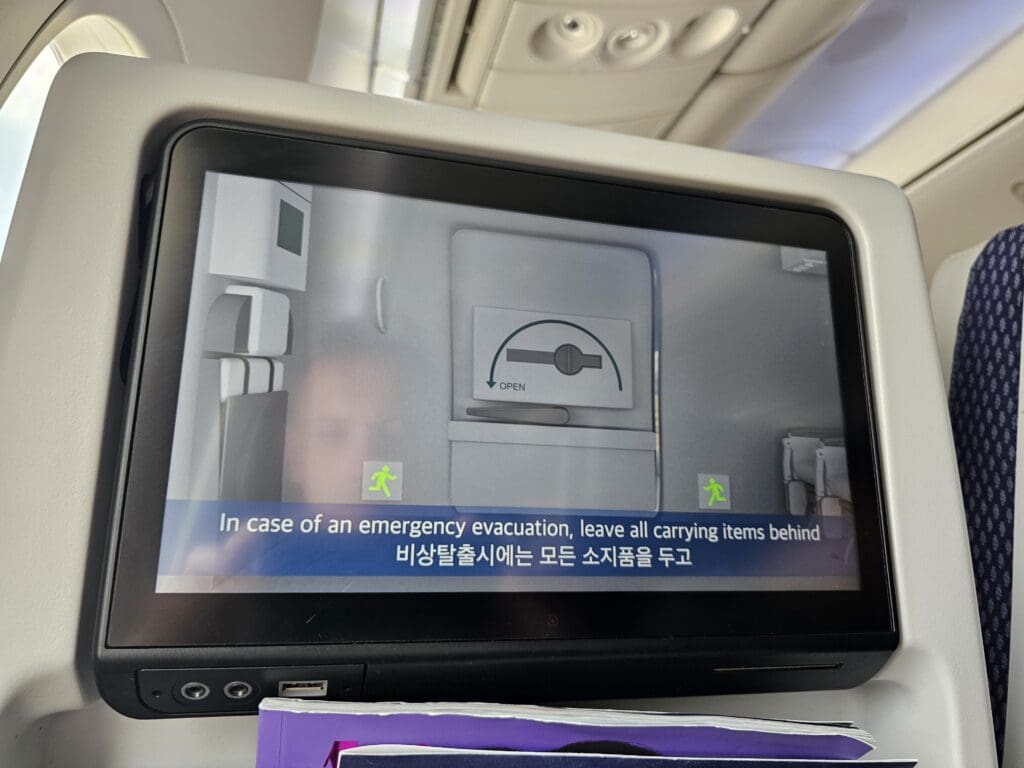
Following a few minutes without action other than when the crew passed through the cabin distributing headphones, at 1238 the Dreamliner was pushed back from the gate. As this was underway, a series of whines and whirs could be heard which preceded the start-up of the Dreamliner’s two large Rolls-Royce Trent 1000 engines. A few minutes and plenty of vibrations later, another whine was heard as the flaps were partially extended as we powered away from the ramp under our own steam. From Terminal 2, a fairly long taxi was required to reach the end of Runway 16R, and a short time after commencing this, the aircraft trundled past a cluster of private jets ranging from the mini Honda Jet, right up to luxurious Bombardier Global 7500s and Gulfstream G650ERs. From there, the aircraft trekked past Terminal 1, taxiing parallel to Runway 16R. Sitting on the wrong side of the aircraft to get any views of Terminal 1 and Narita Airport’s main cargo area, I instead received a view of two American freighters rolling down the runway at the start of their journeys to Anchorage. One of which took the form of a FedEx Boeing 767-300ER, whilst the other was a UPS Boeing 747-400F. After several minutes, the Dreamliner made it to the end of the runway and once there we came to a halt. Despite the lack of aircraft on approach to this and ending up first in the queue to depart, the aircraft remained holding for three minutes before continuing onto the runway.
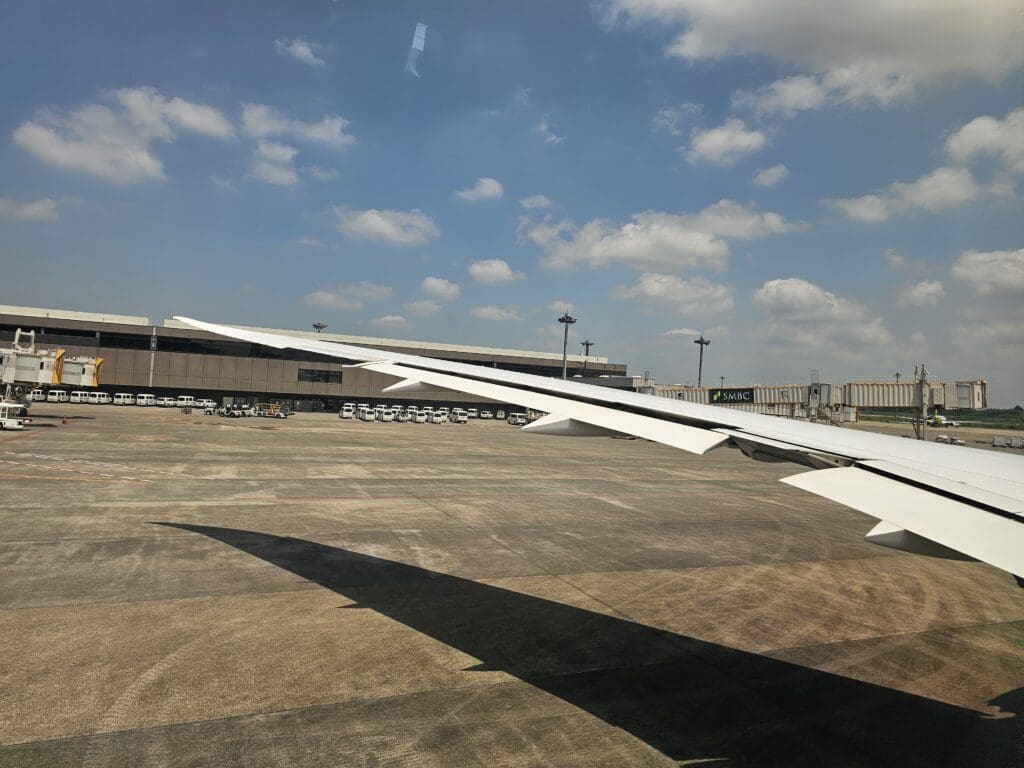
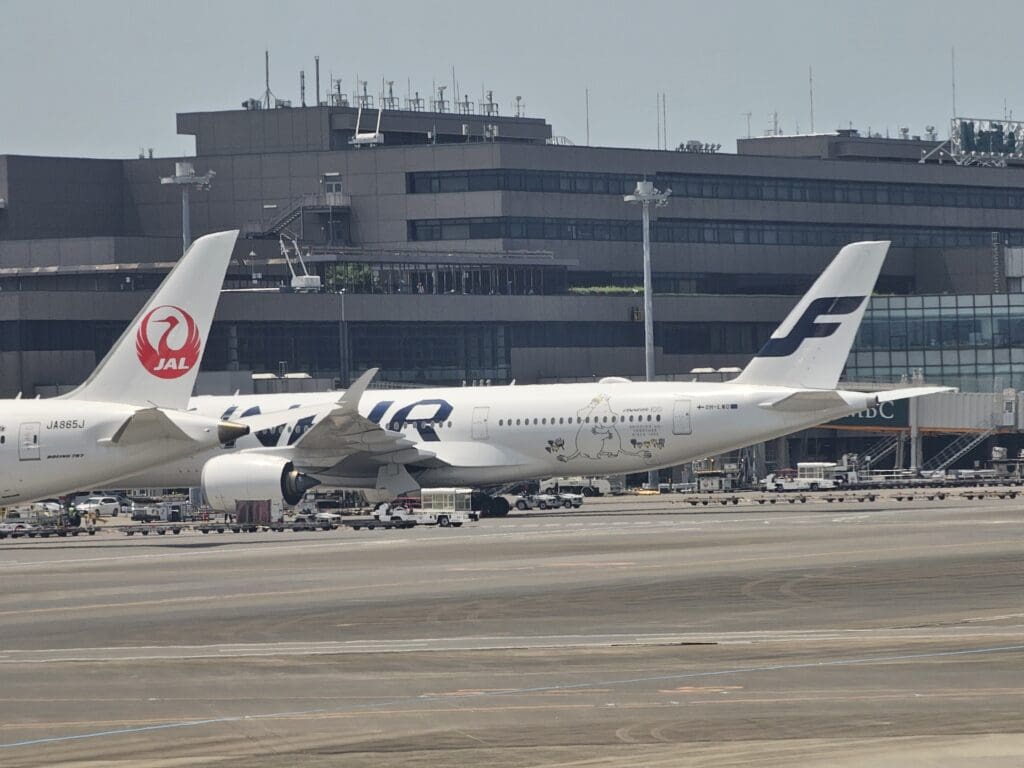
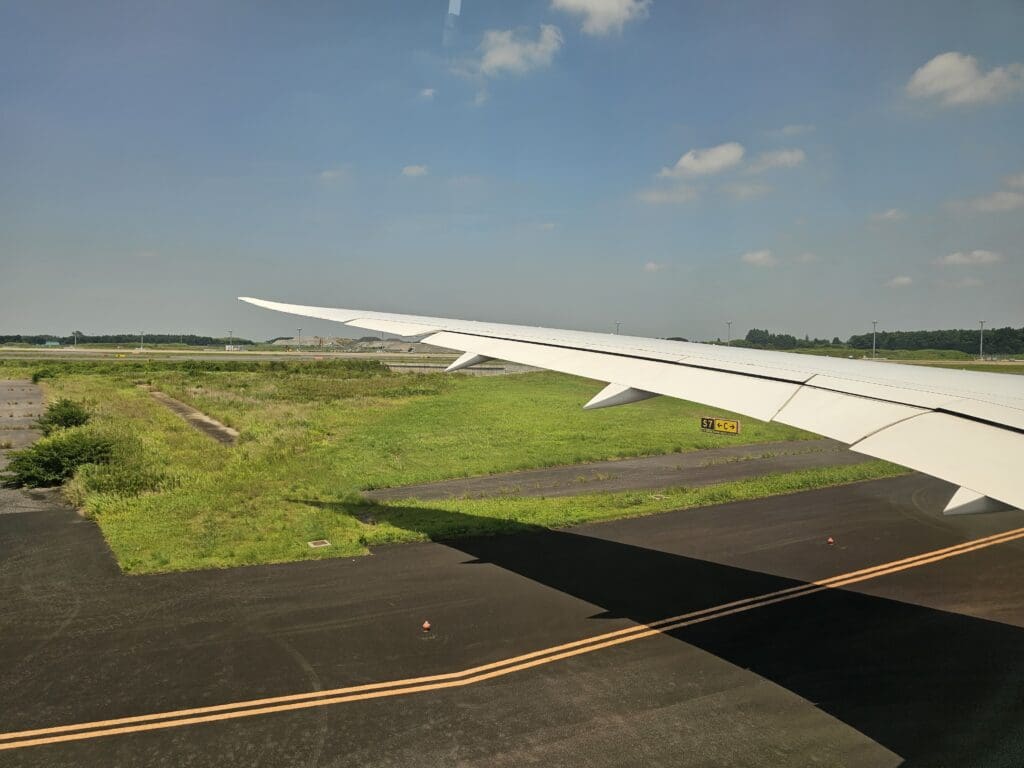
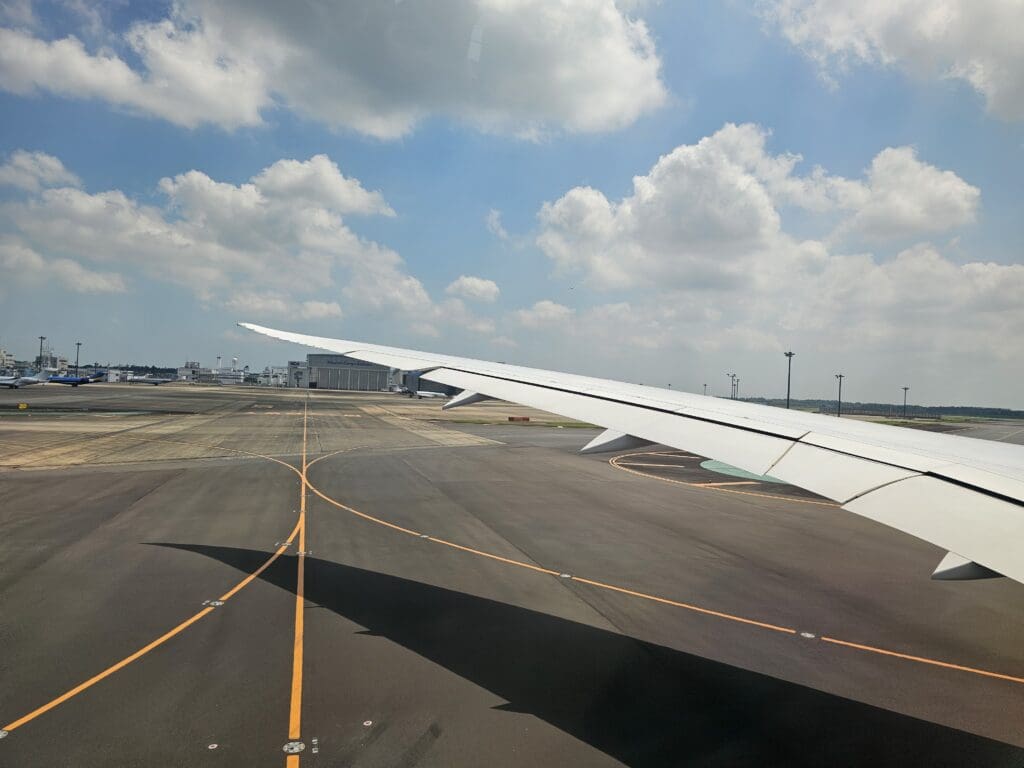
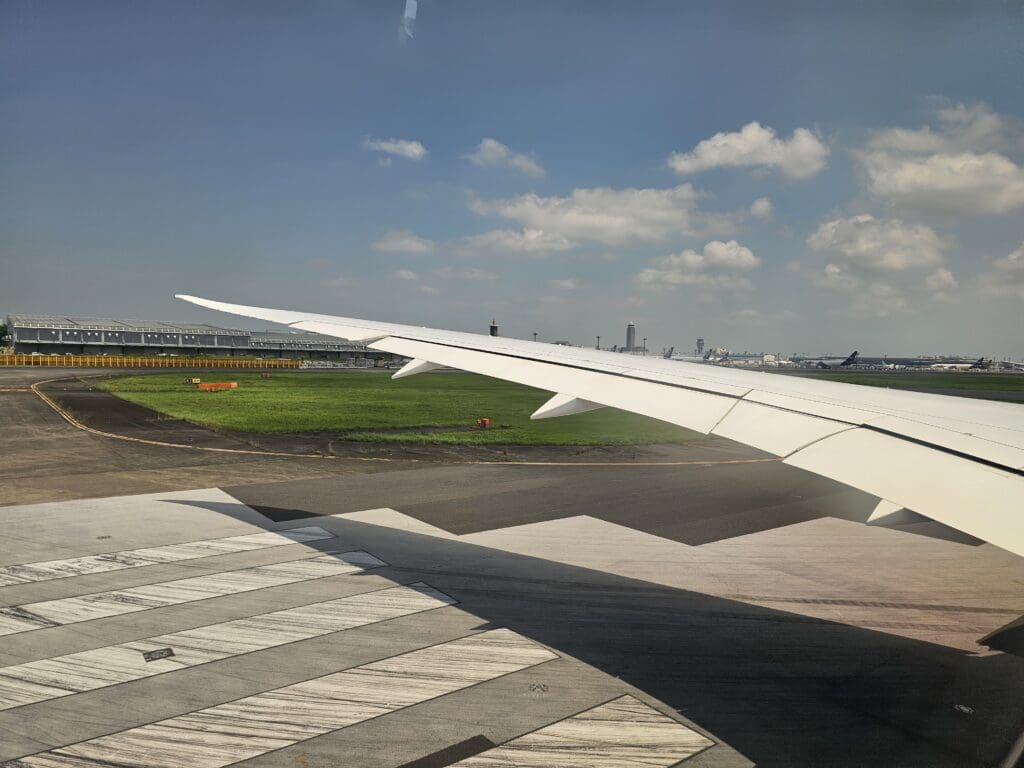
Eventually, at 1301, the Dreamliner’s two Rolls-Royce engines spooled up and we performed a powerful rolling take-off. After accelerating past the cluster of ANA Cargo and FedEx widebodies at the main cargo area, we whizzed past Terminal 1 where I spotted what had been my first choice flight back to Seoul Incheon, a Korean Air Boeing 747-8. Soon, the Dreamliner smoothly rotated upwards into the sunny skies of Chiba Prefecture at which point I was treated to a good view of the private jet area alongside the All Nippon Airways, Delta Air Lines and Japan Airlines hangars at the far southern tip of the airport complex. Seconds after taking off, the Dreamliner crossed over the perimeter fence and we climbed out over the luscious green picturesque countryside that surrounds Narita Airport.
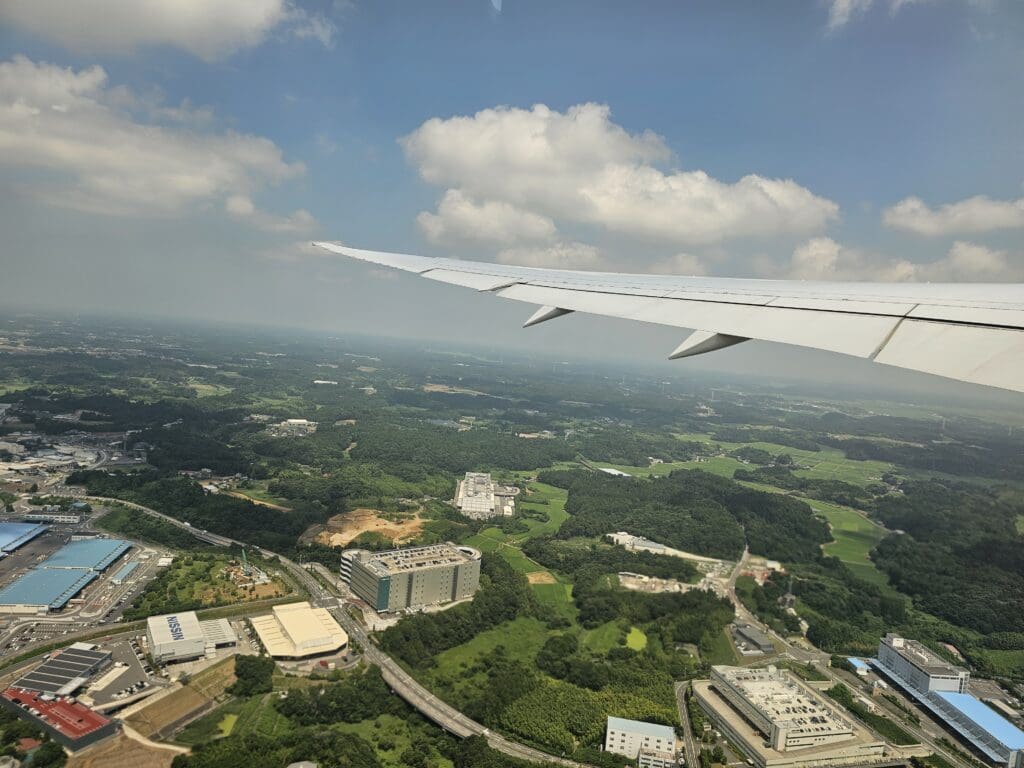
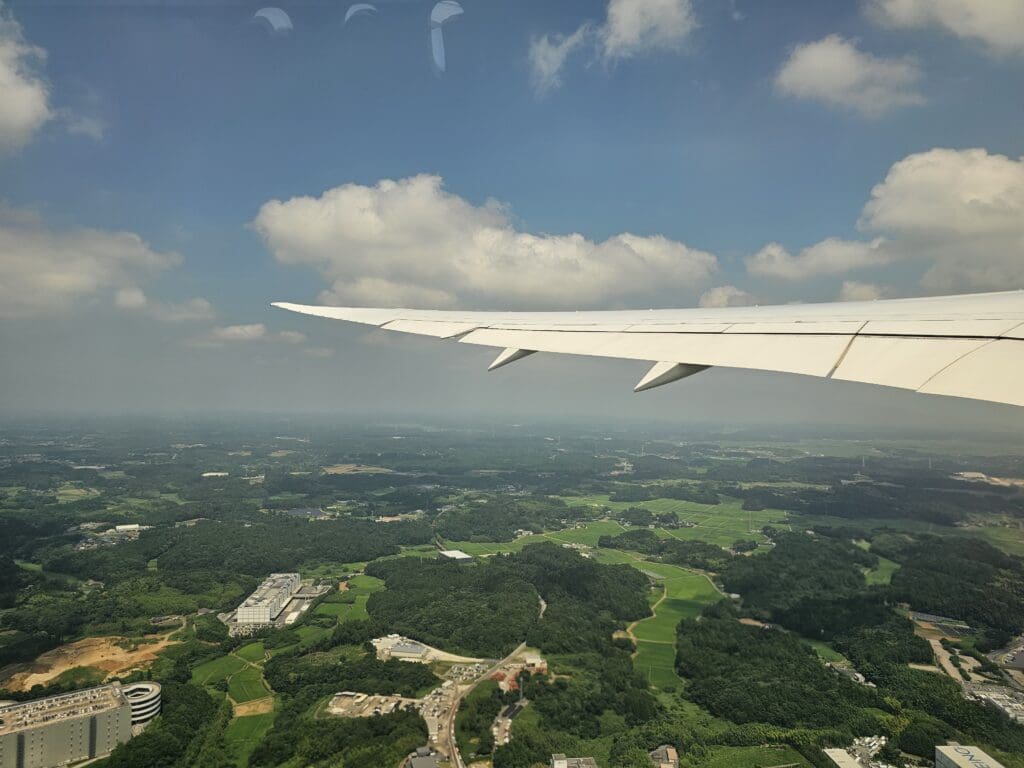
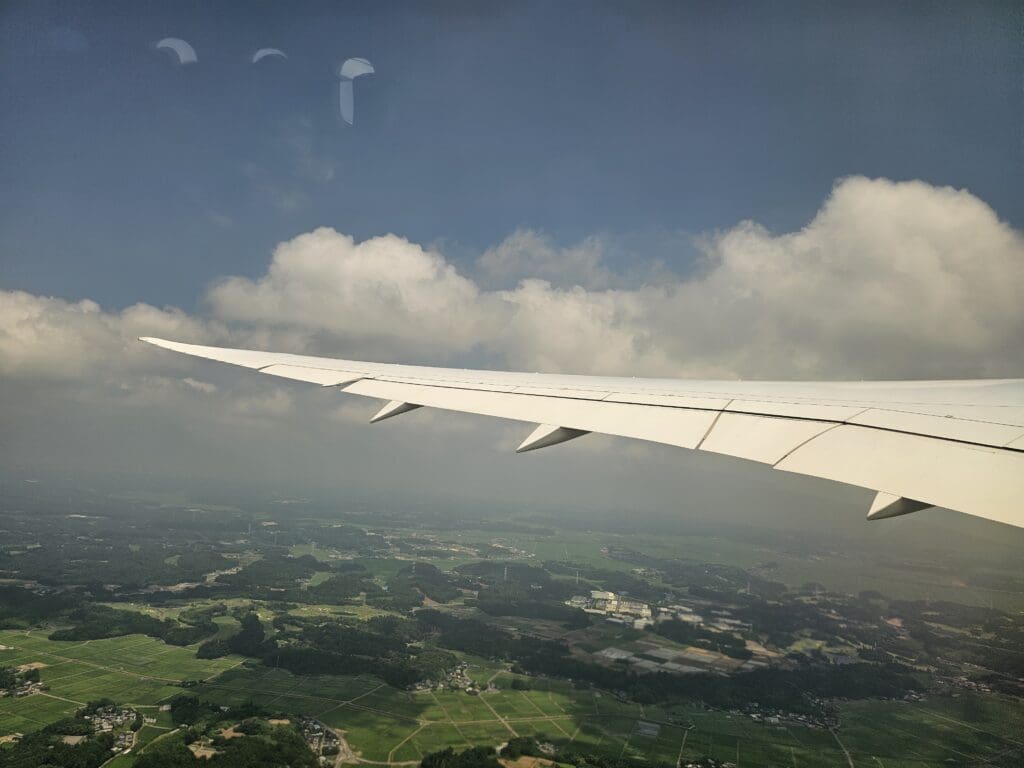
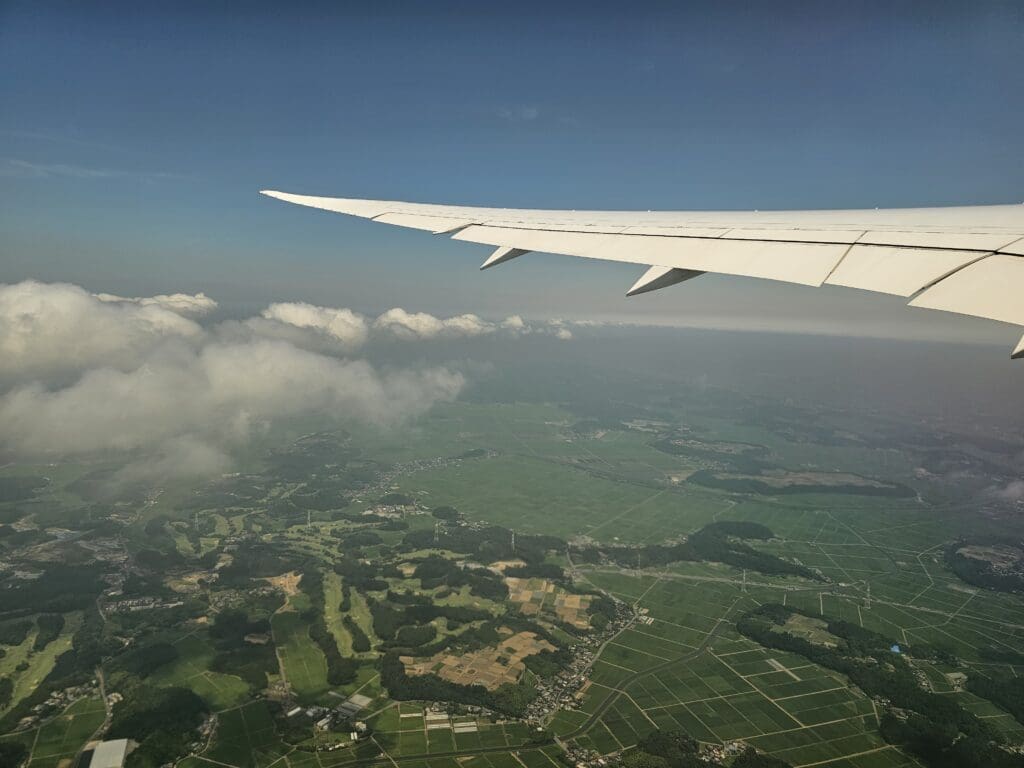
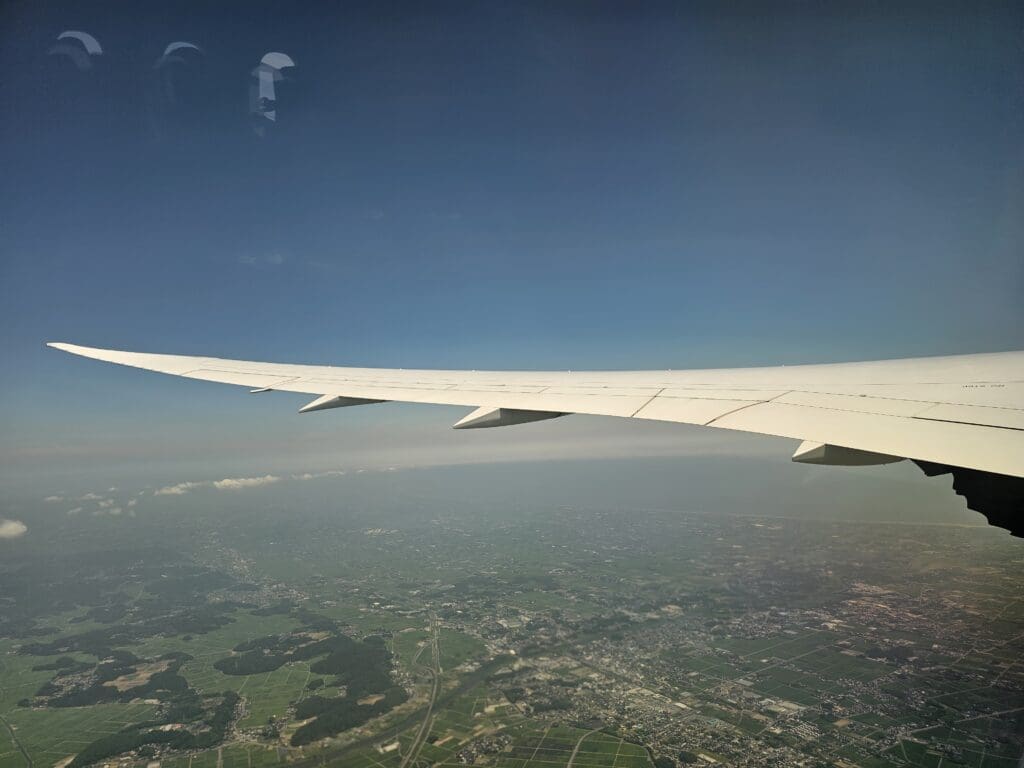
Thanks to the good weather that lunchtime, a good view was offered of the countryside as we continued on the runway heading and made our way towards the coastline, soon passing the town of Yokoshibahikari and the East Japan Railway Company’s Sōbu Main Line before we crossed over the long stretch of sandy coastline and ventured out over the blue waters of the Pacific Ocean in the complete opposite direction to Korea! Thankfully, the pilot was not lost or mistakenly heading for North America and a short time after crossing the coastline the aircraft banked to the right and headed back towards Chiba’s coastline, at which point the seatbelt signs were extinguished as we climbed through 10,000 feet. At this time, the usual announcement was made advising passengers to keep their seatbelts fastened, along with an announcement advertising the onboard wifi.
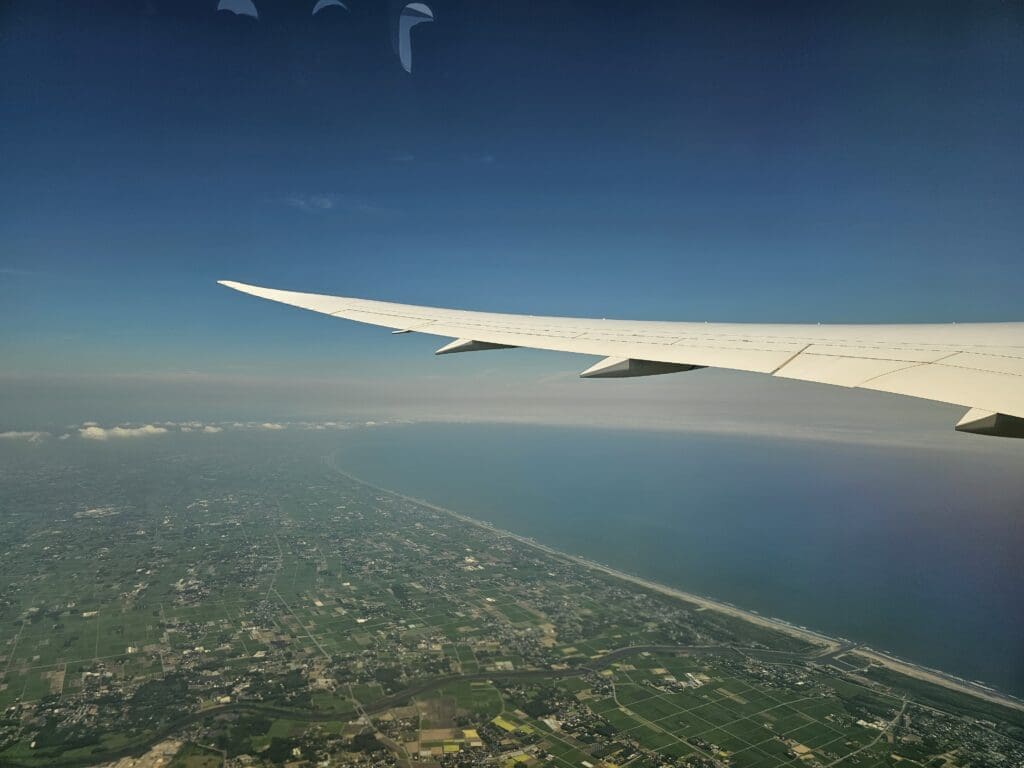
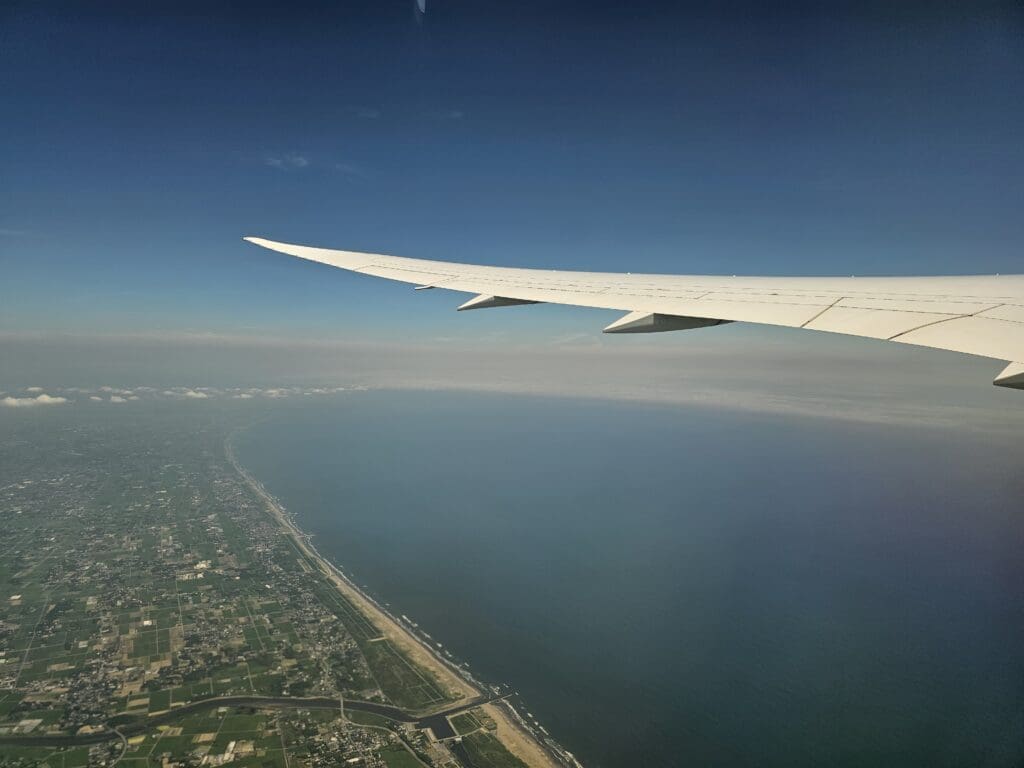
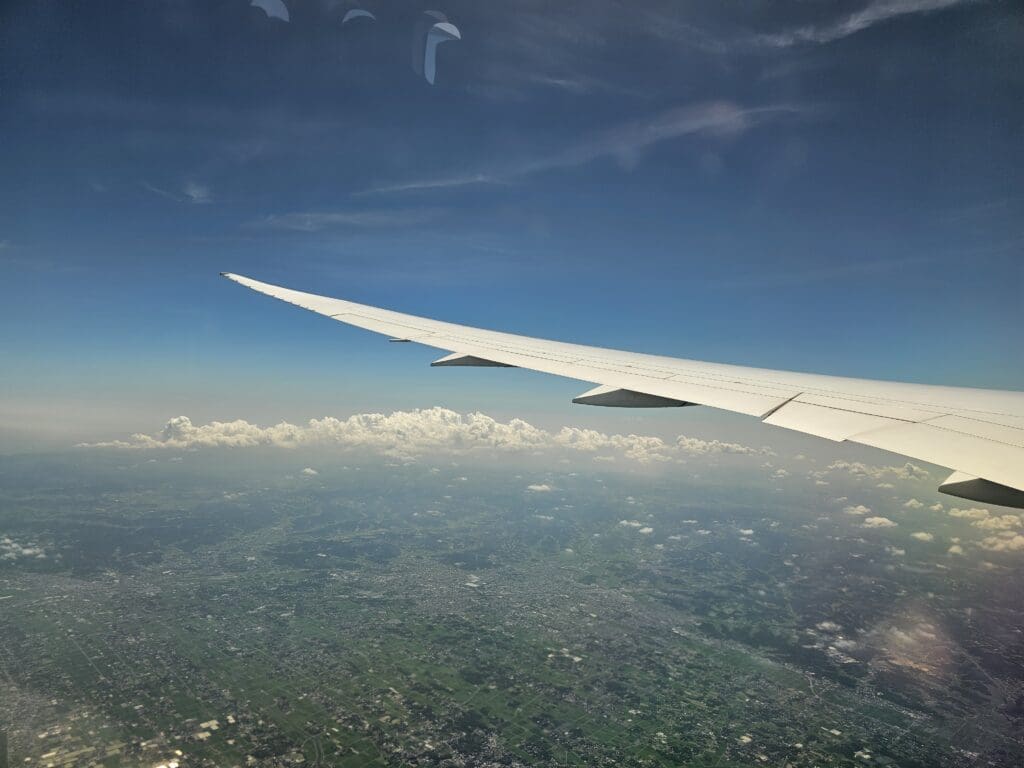
Soon, the jet crossed over the coastline between the towns of Kujukuri and Shirako, before making it to the city of Chiba, which sits in the northeastern corner of the Tokyo Bay, a few minutes later. As we passed Chiba, I caught sight of Haneda Airport to the south, alongside Central Tokyo’s tall skyscrapers as we skirted around the northern fringes of the Japanese capital, passing directly over the likes of Kamagaya, Nagareyama, Koshigaya and Saitama. Soon, amid the urban sprawl, I spotted Iruma Air Base which serves to be the home of six Japan Air Self Defence Force units, operating a wide array of aircraft including locally produced types such as the NAMC YS-11, Kawasaki C-1 and the Kawasaki C-2.
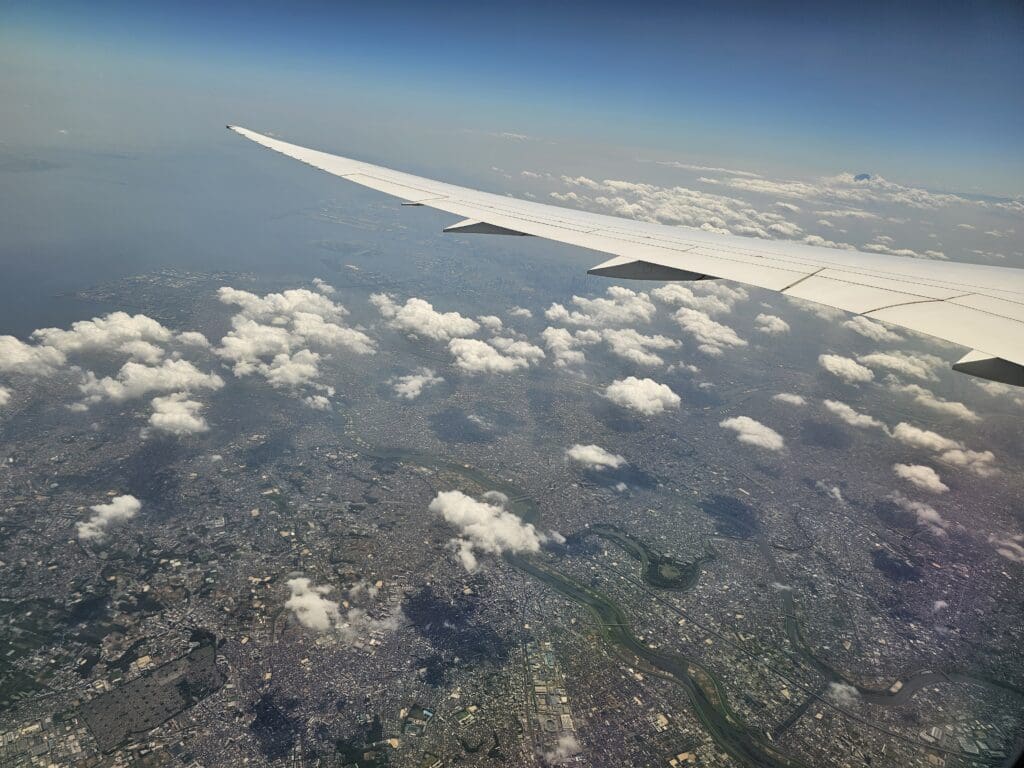
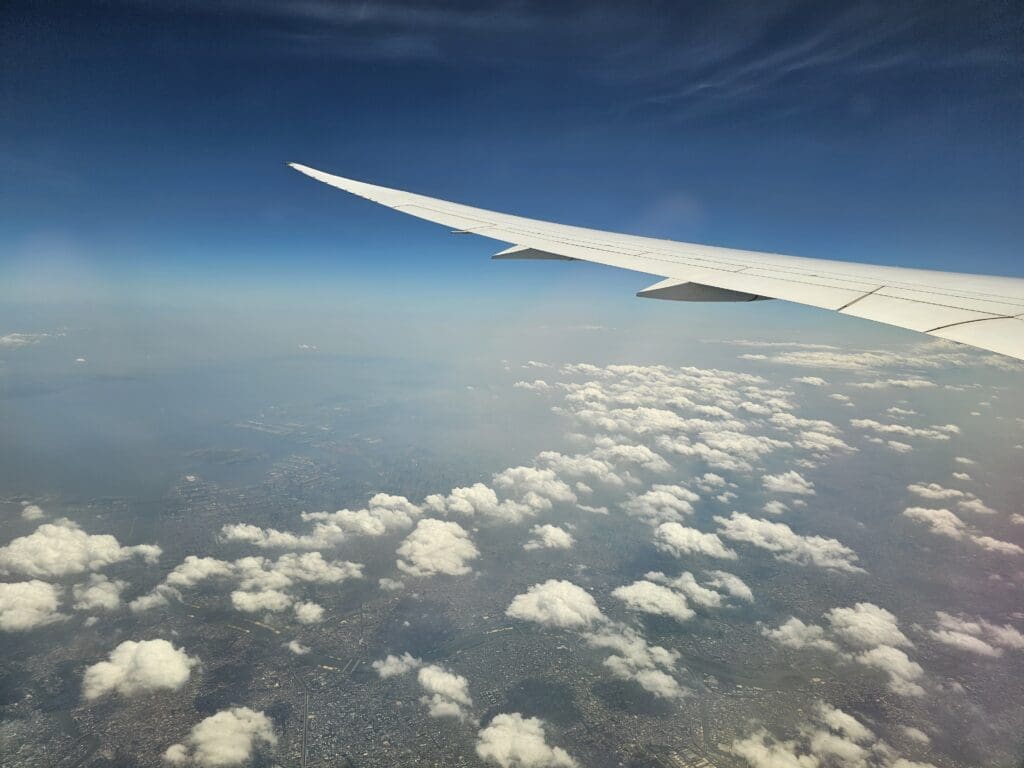
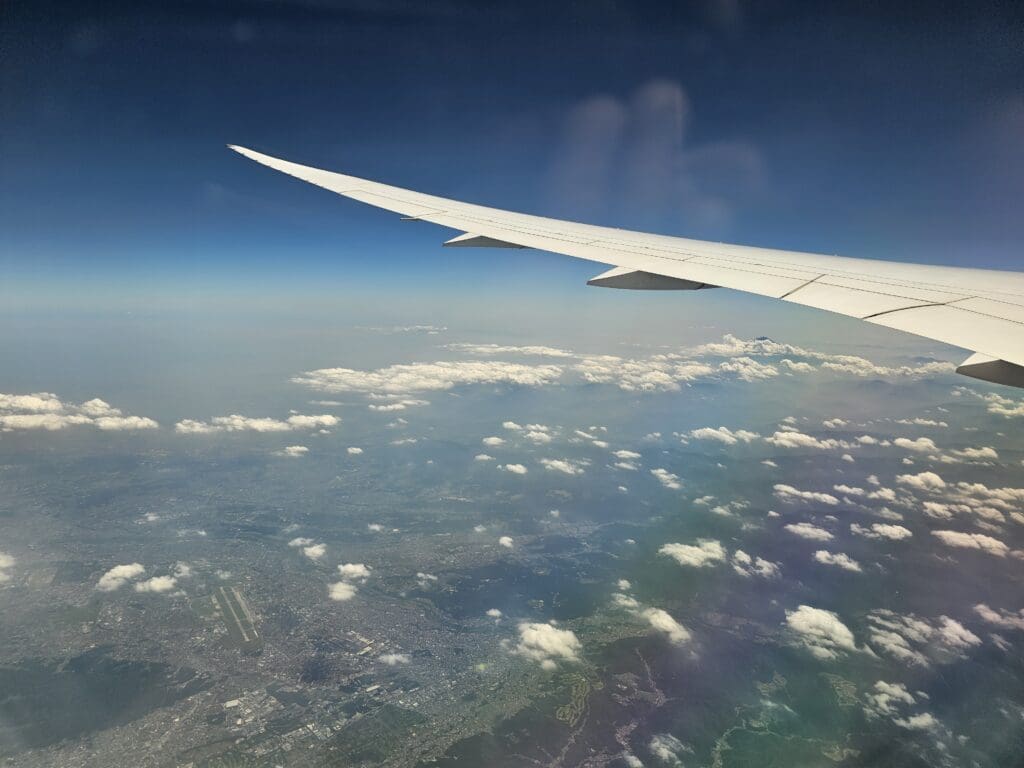
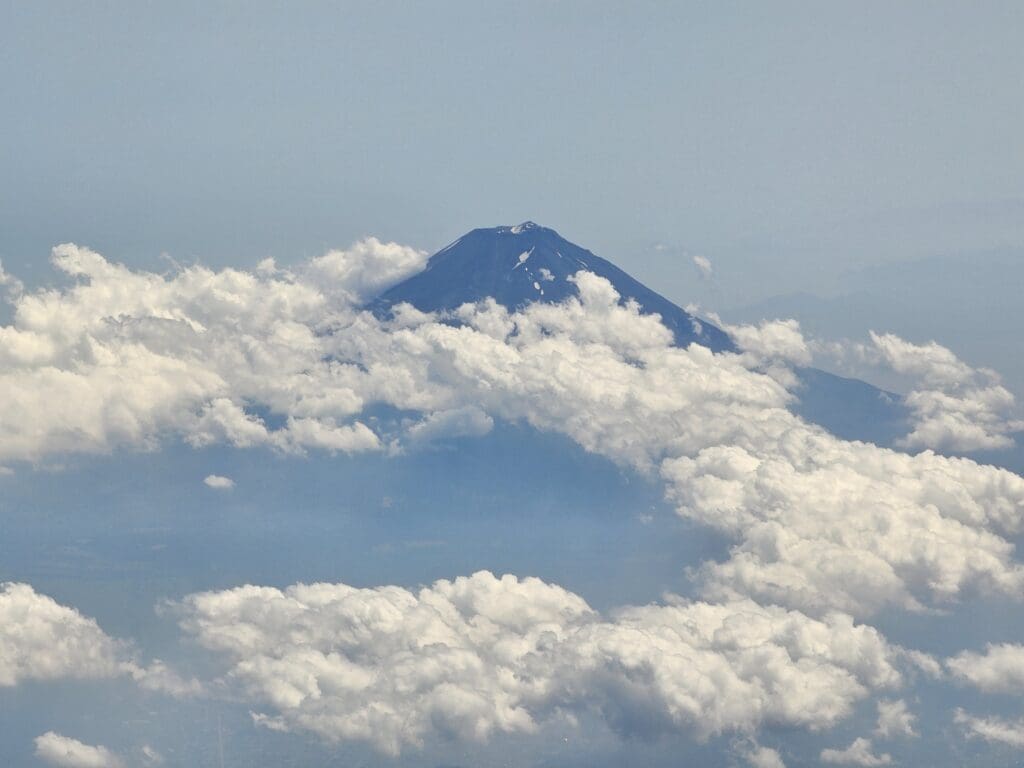
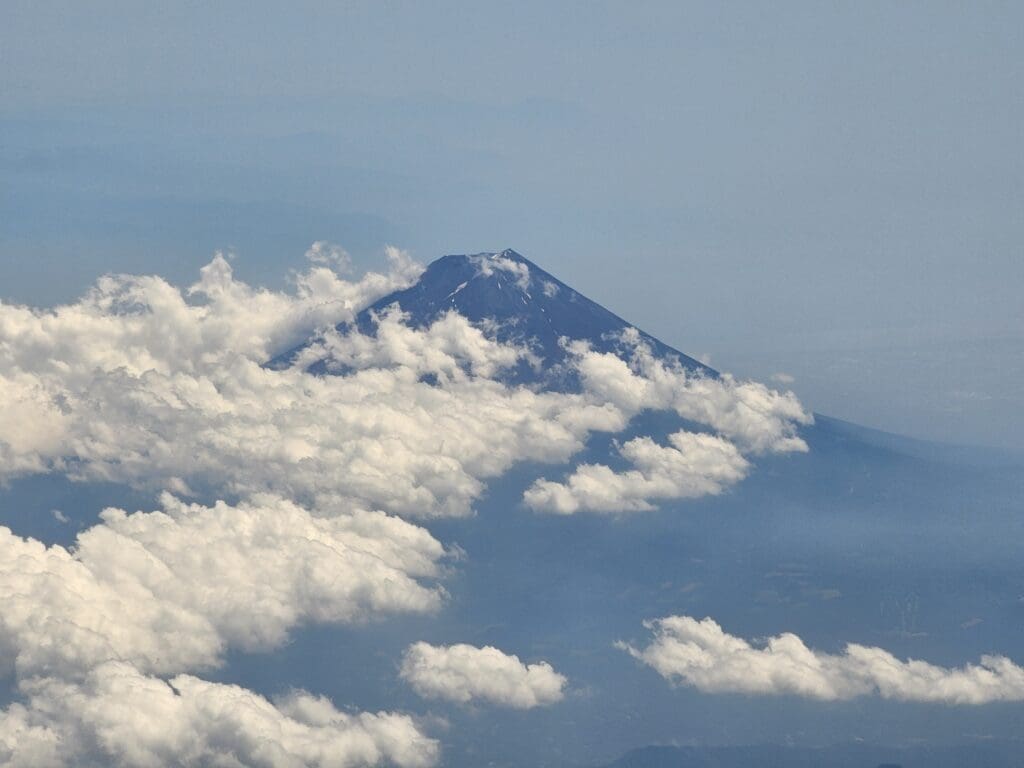
Of perhaps more interest to most passengers was the majestic sight of Mount Fuji in the distance, surrounded by the picturesque valleys of Yamanashi Prefecture, providing a wonderful view and an appropriate farewell to Japan as we neared the final stages of our climb.
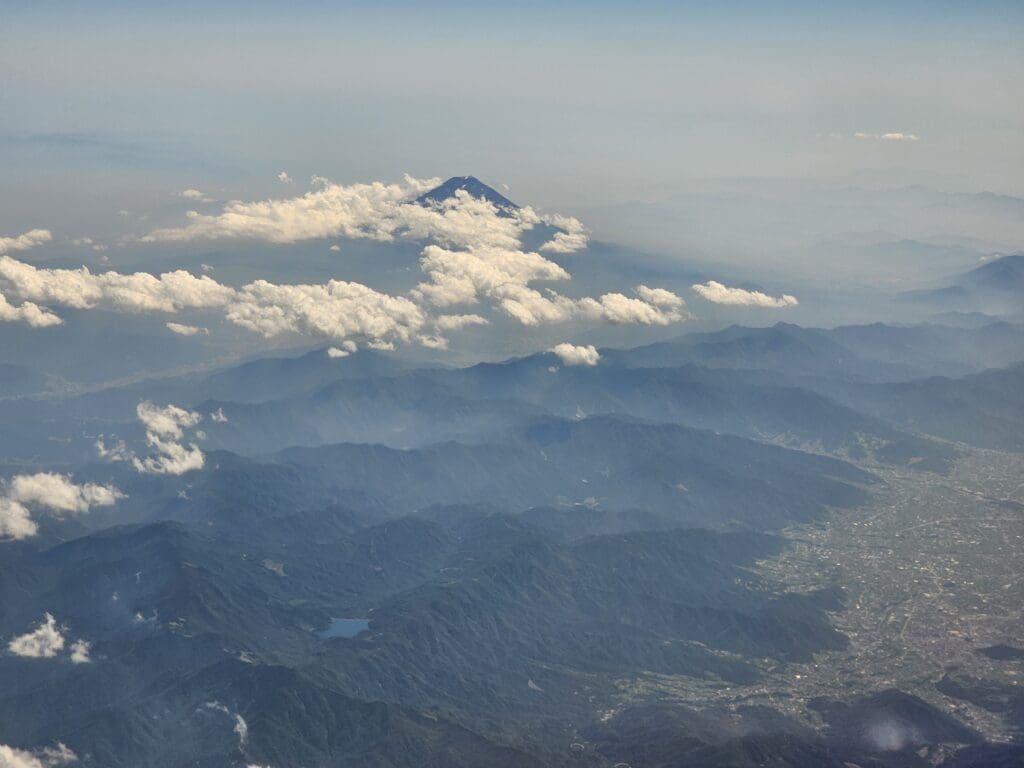
Upon leaving Tokyo behind, the Dreamliner cut across the prefectures of Saitama and Nagano, before levelling off at our cruising altitude of 40,000 feet around thirty minutes into the flight. At this point, the crew took to the aisles and began the complimentary inflight service. Given Air Premia’s status as a hybrid low-cost carrier, unsurprisingly this lags behind the offerings of All Nippon Airlines, Asiana Airlines, Japan Airlines and Korean Air, but still beats the wholly buy-on-board service of the plethora of low-cost carriers that operate the route. Soon, a polite and friendly flight attendant handed me an Air Premia packaged cranberry and chia seed cookie before I was offered a cup of either still water or coffee. Once the complimentary offering had been dished out, the crew then took to the aisles once more and began the buy-on-board service. However, perhaps unsurprisingly given the length of the flight, there were few takers for this. Browsing the menu on the inflight entertainment screens, a compact selection of beers, spirits, soft drinks and ramyeon was offered, which, price-wise seemed to be in line with other Korean low-cost carriers. For example, Air Premia’s own lager, Beer Premia, would have cost 6,000 won (£3.43), a 330ml can of Coca Cola would have cost 3,000 won (£1.73), whilst ramyeon would have cost 5,000 won (£2.81). Overall, I found the complimentary offering on that afternoon’s service to be perfectly adequate given the short length of the flight.
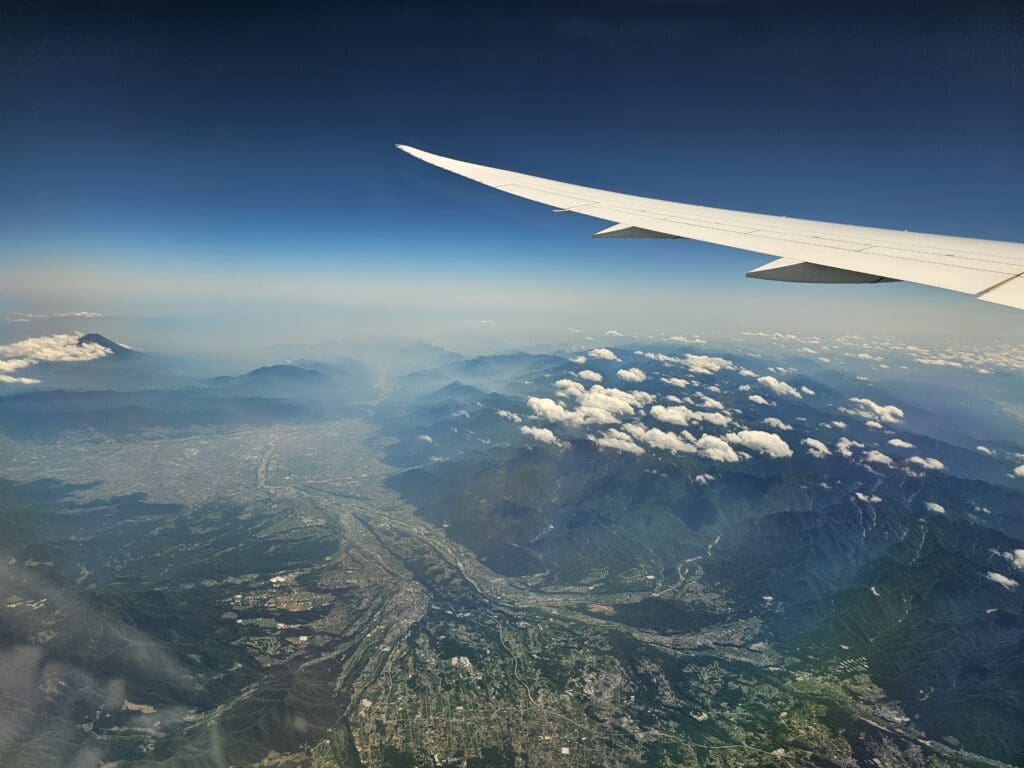
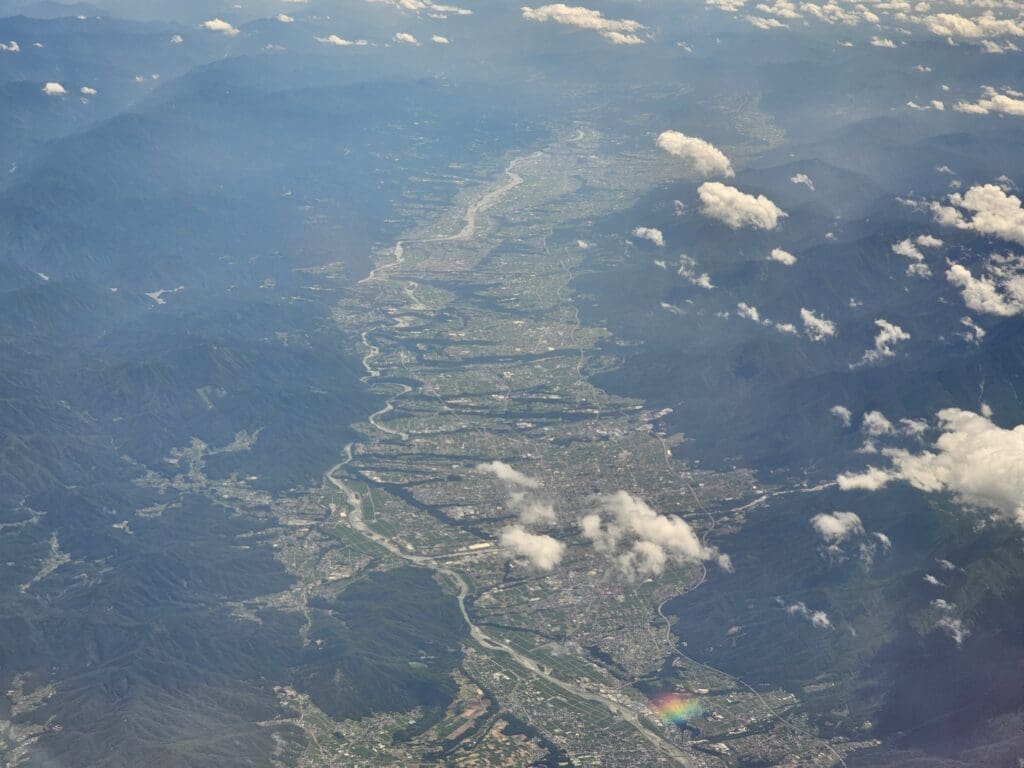
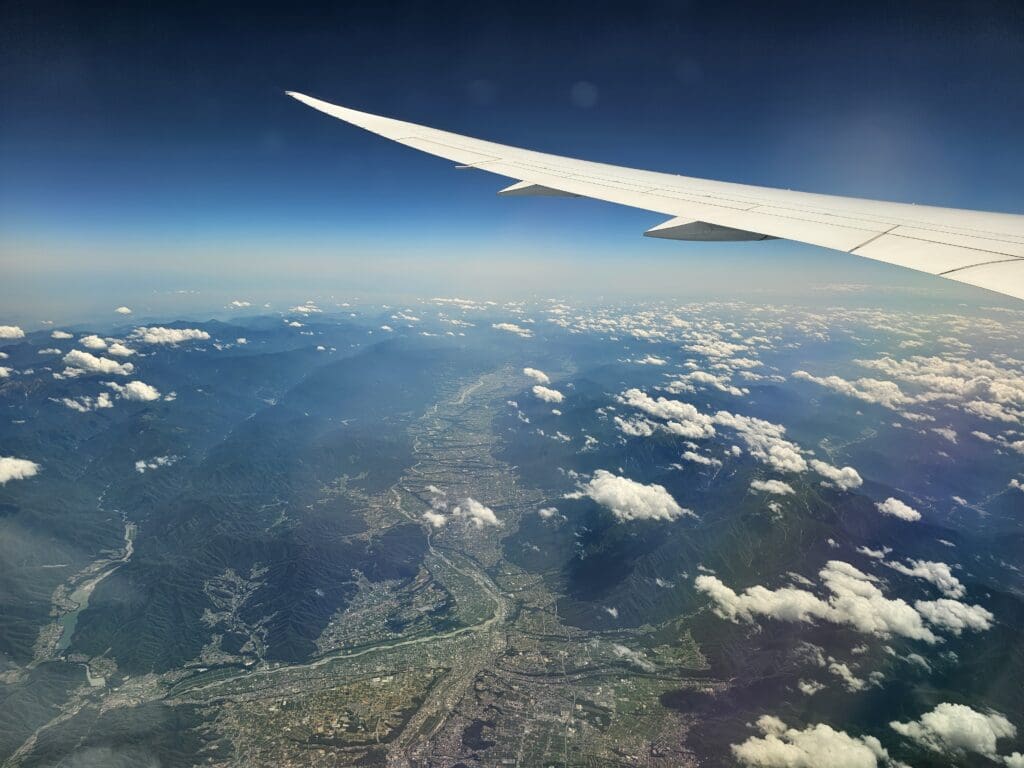
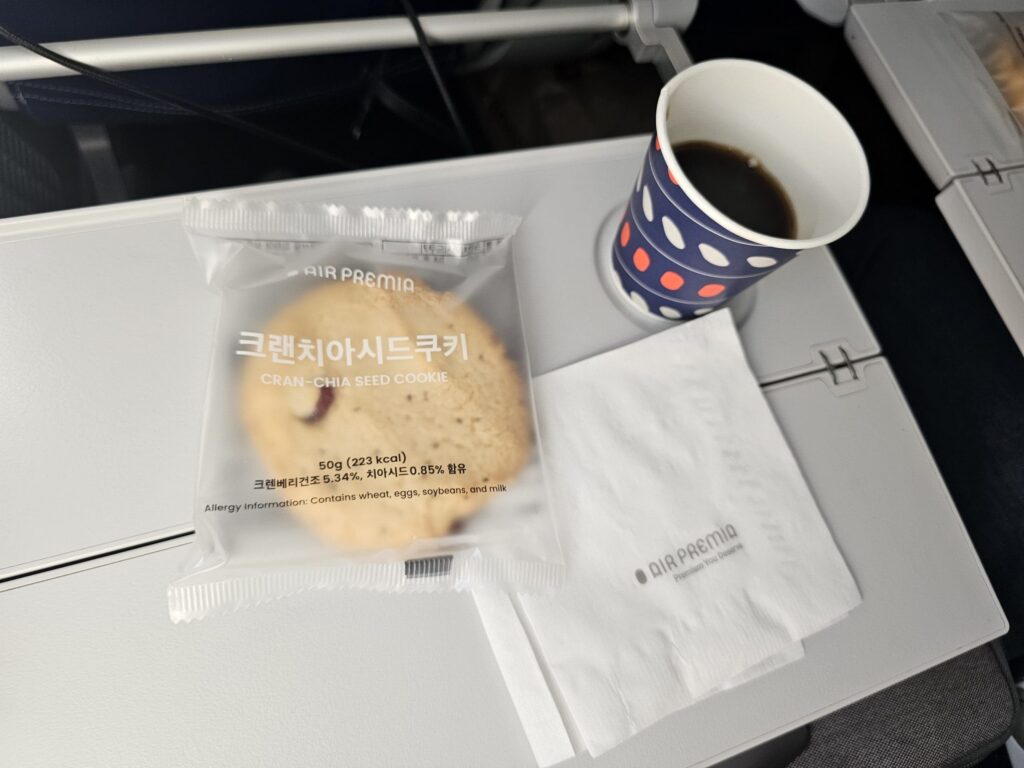
As I sipped on my black coffee, the Captain’s voice filled the cabin as they performed their welcome announcement in Korean and English. This consisted of the usual introduction, a mention of our flight time and the weather on the ground in Incheon. They then ended this with a word of thanks for flying with Air Premia and by advising passengers to keep their seatbelts fastened whilst seated. From Nagano, the aircraft passed into the skies of Gifu where the green and mostly rural scenery could be seen beneath the dots of clouds that lingered around a significant distance below. Next up was the coastal prefecture of Fukui before we crossed the Echizen Coast and left the Japanese coastline behind around 38 minutes after taking off from Narita Airport.
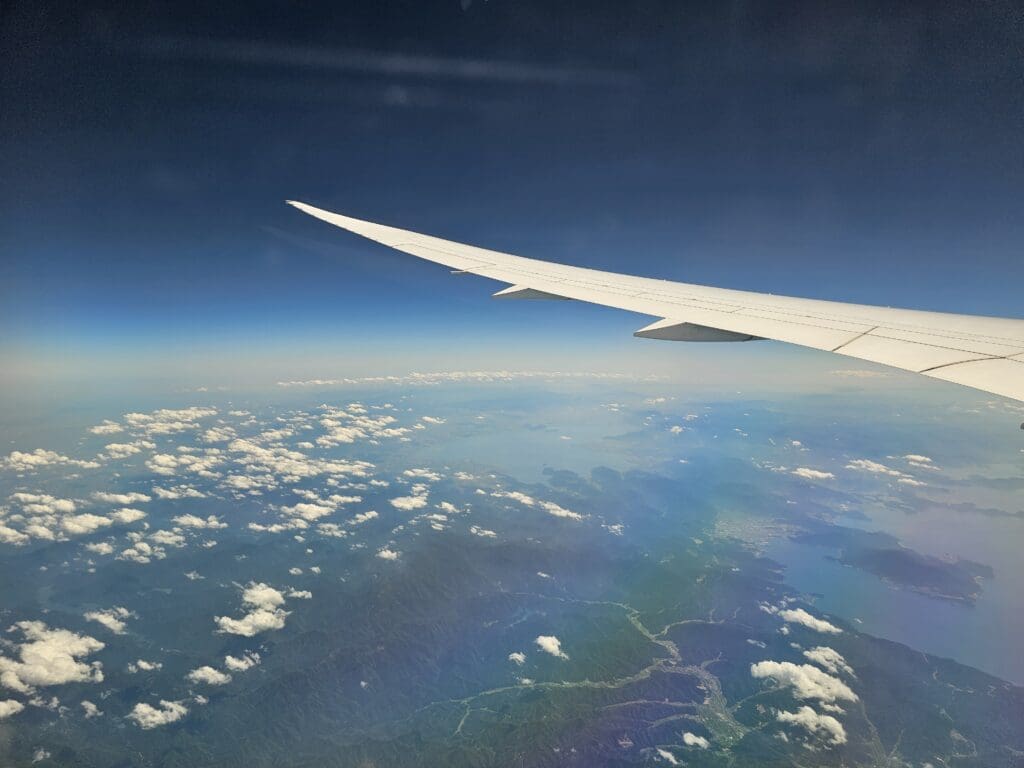
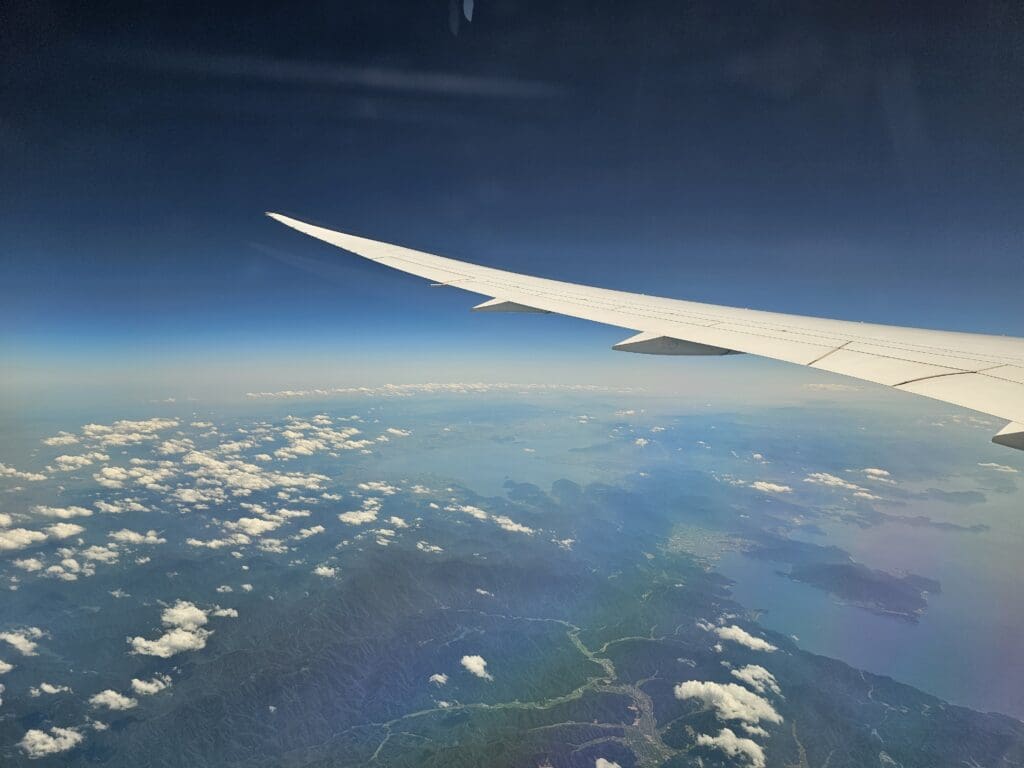
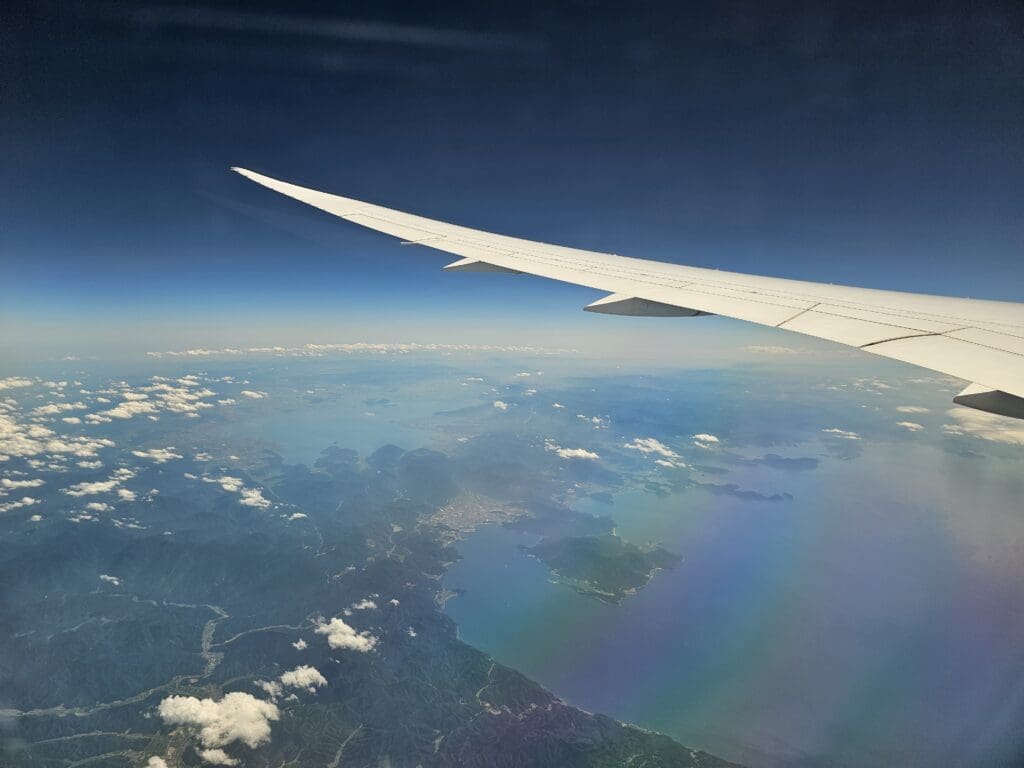
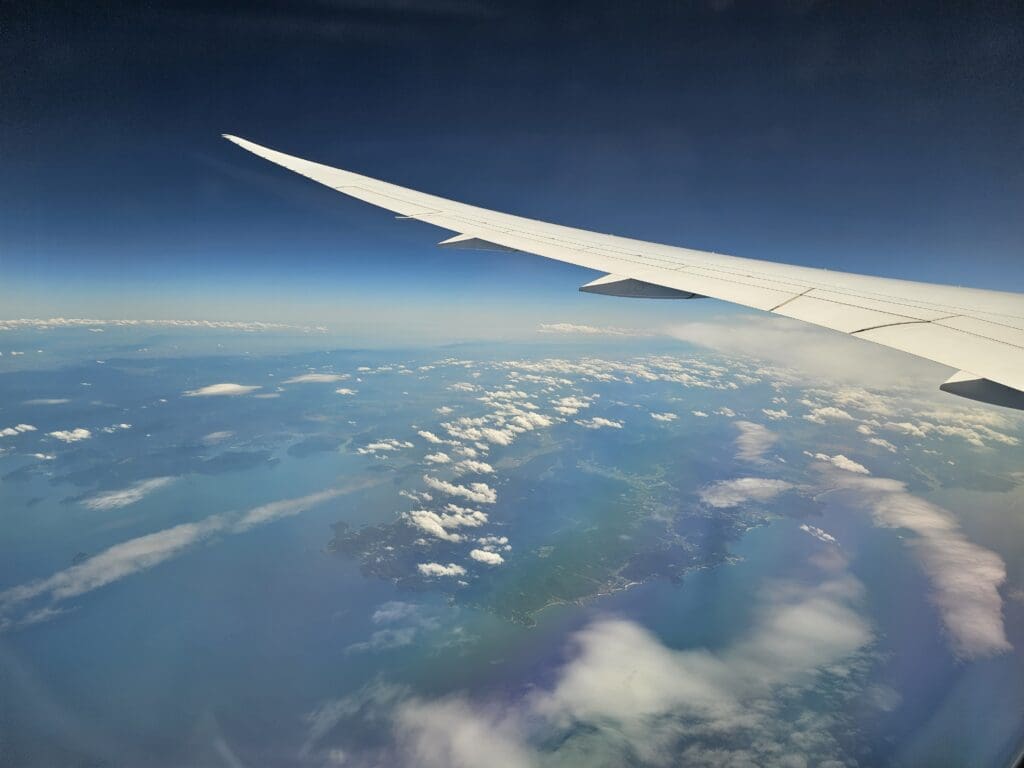
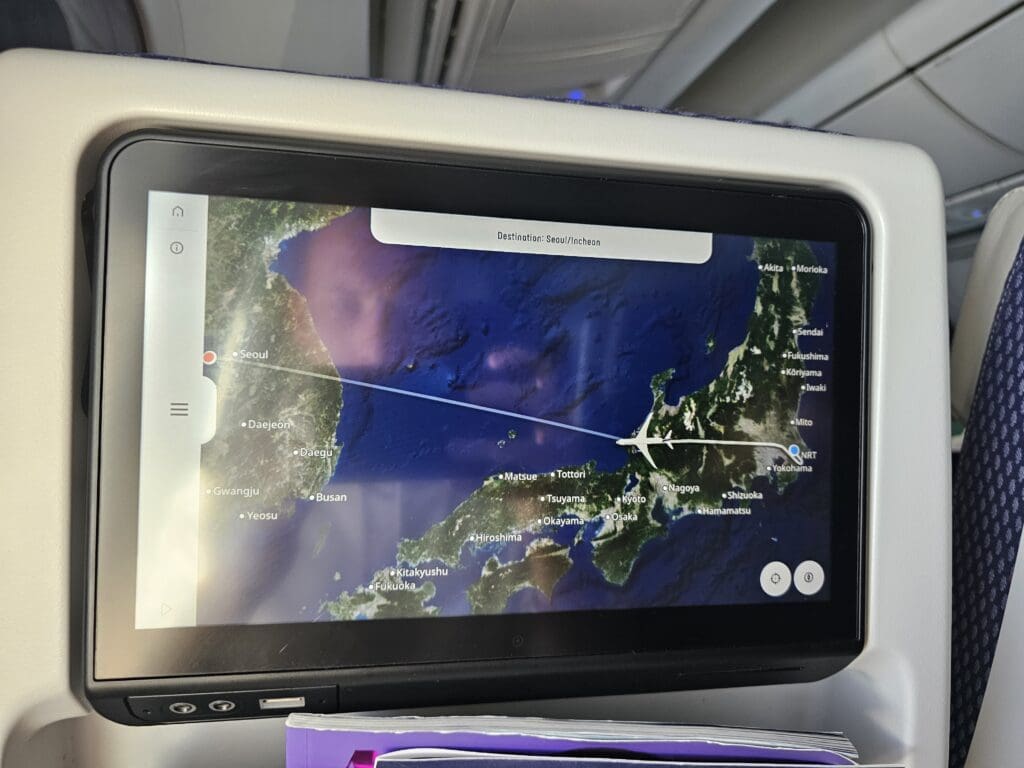
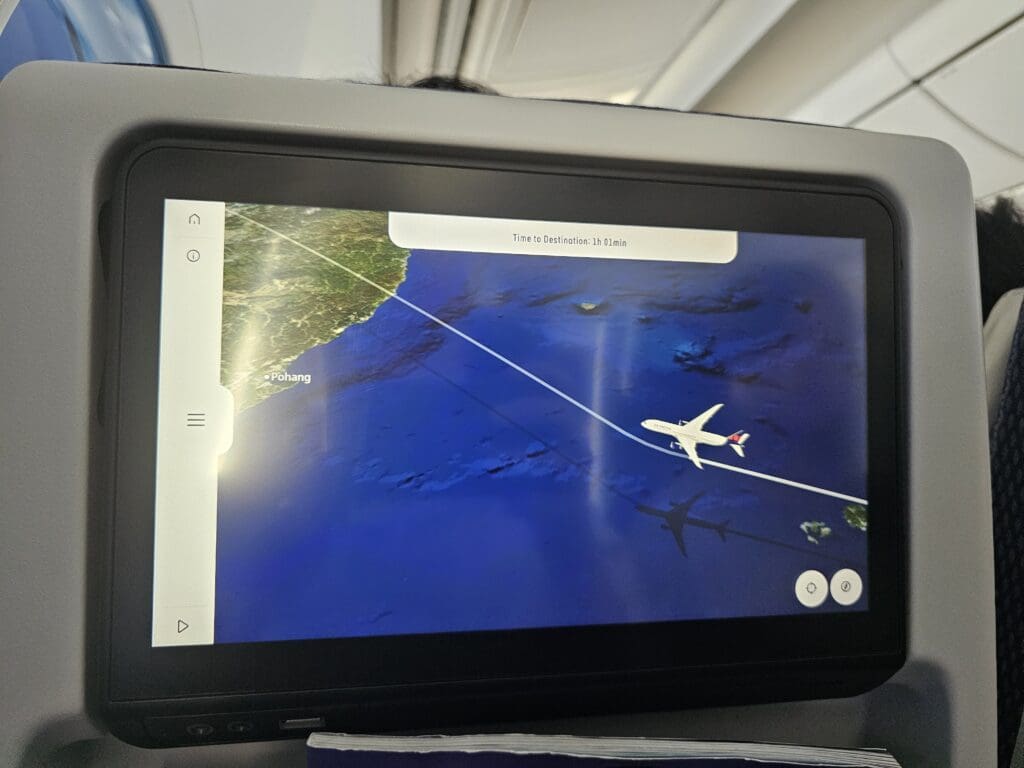
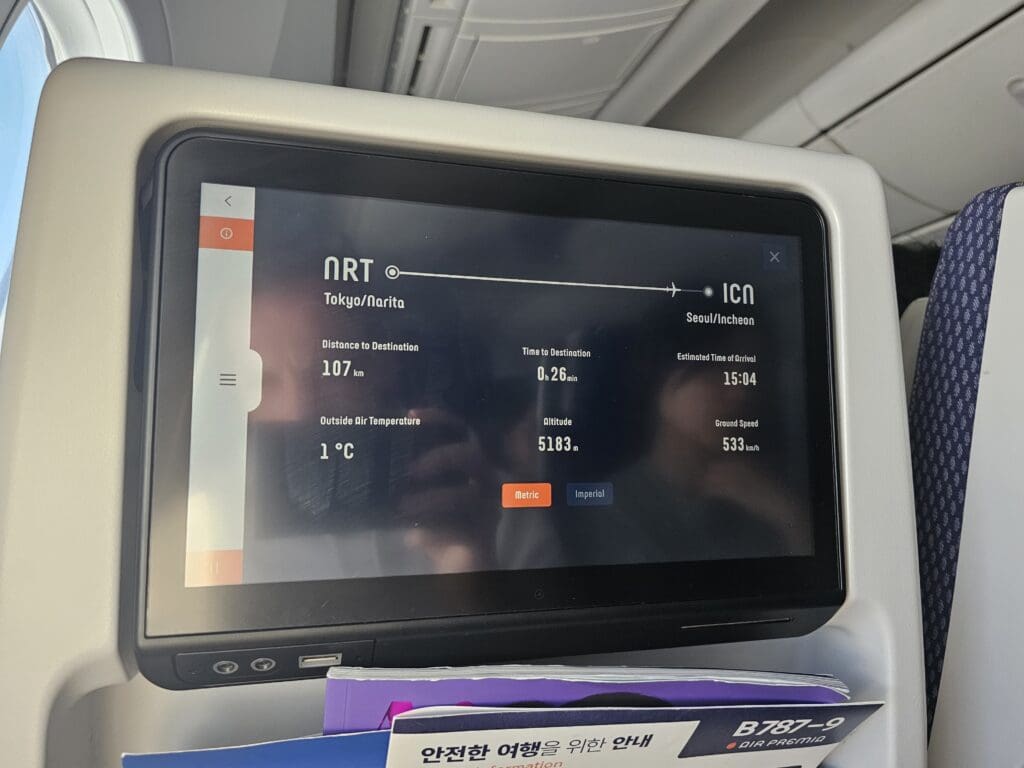
As we passed over the Japanese coastline, the cabin crew passed through the cabin handing out immigration forms to those who required these, and looking outside, upon reaching the East Sea, a layer of clouds rolled in below so I decided to turn my attention to Air Premia’s inflight entertainment system. Starting with the basics, this system was available in the same limited selection of Northeast Asian languages as those of many of the region’s major airlines – Chinese, English, Japanese and Korean. Upon selecting the English option, I was almost instantly presented with the main menu, and on that note, I found the system to respond well to touch whilst this transitioned between screens quickly and without issue. Navigating my way through the system, I found this to be modern in its design and easy to navigate, whilst I found the Flightpath3D moving map worked well throughout the flight. Other than the entertainment content and the moving map, Air Premia’s system also featured the inflight BoB menu and duty free catalogue, tips for flying, instructions on how to connect to the wifi network, a map of Incheon Airport and a promotional video on Air Premia.
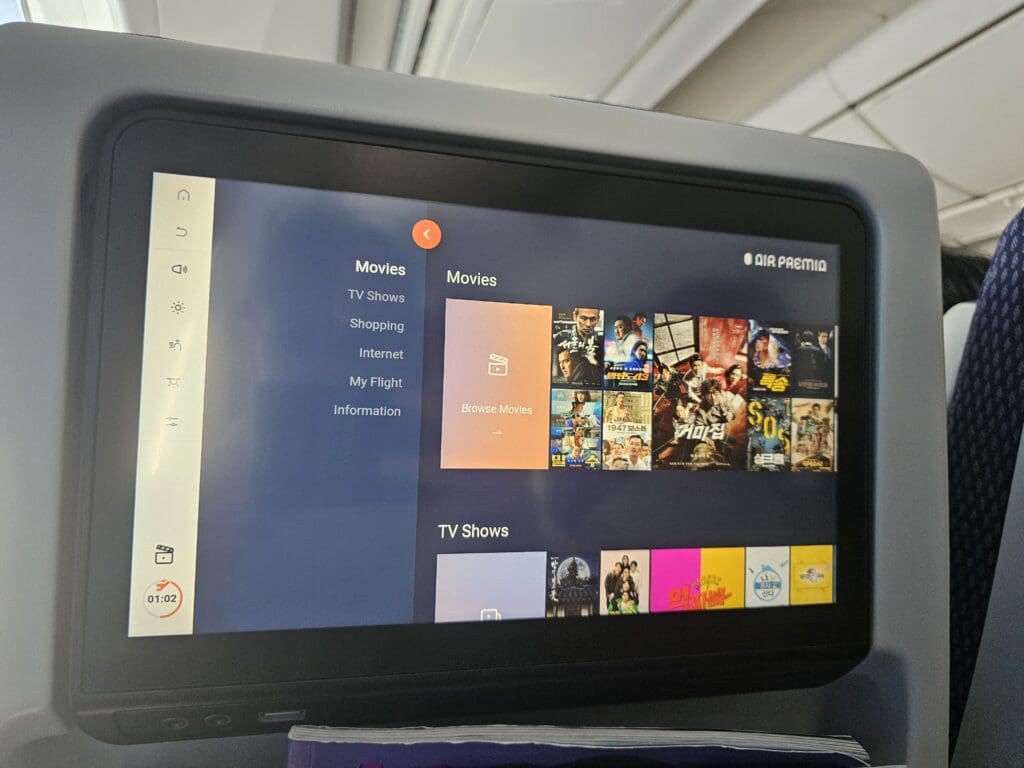
Having examined previous reviews, it seems that most peoples’ main gripe with Air Premia’s inflight entertainment system is its lack of content and upon looking through the options, I was left with no choice but to agree with this. In total, just thirteen films, six television programmes and three kids’ shows were offered, with these taking the form of reasonably new Korean blockbusters and popular programmes such as Running Man. Meanwhile, no non-Korean television shows or films were offered, whilst the system featured absolutely no audio content. Whilst this lack of content was not a major issue given the length of the flight, those on long slogs to Newark or Oslo may end up getting rather bored and so I would advise those who aren’t massive fans of Korean films or television to load up their devices with their own entertainment. Finally, whilst I had no intention of watching anything, all content commenced with around a minute of commercials, with these advertising Andong, a historical city in Korea’s North Gyeongsang province, and a skincare brand, Aromatica.
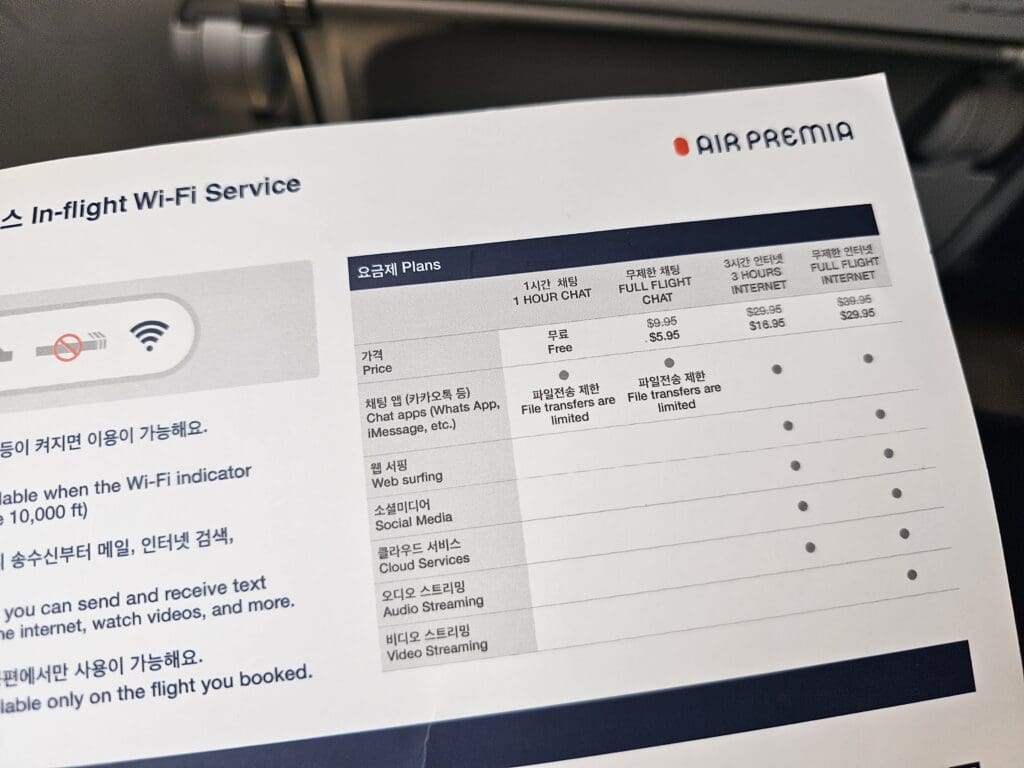
Once I had explored the somewhat lacklustre inflight entertainment system, I turned my attention to the onboard wifi. Fortunately, I was able to connect to this without issue, and once I had entered my email address and agreed to the terms and conditions, I could stay in touch with the world via most major messaging apps without paying a penny for up to an hour. Testing this out, this worked well, and I was able to send and receive photos and messages without issue. Had I wanted to use this for the entire flight, I could have parted with $5.95 (£4.51). Whilst I could have paid $16.95 to surf the internet for three hours, or $29.95 (£22.71) for the entire flight. The latter option not being applicable on Air Premia’s Tokyo route!
As we sped towards the southeastern coastline of the Korean Peninsula, all of a sudden the aircraft was battered around a bit as we hit a patch of clear air turbulence. This was significant enough to cause the immediate re-illumination of the seatbelt signs and the crew promptly passed through the cabin ensuring all were belted up. Following a very standard route between Tokyo and Seoul, around 42 minutes after leaving the Japanese coastline behind, the Dreamliner crossed over the Korean coastline of South Gyeongsang Province, making landfall just to the south of the Homigot, a peninsula that serves as the easternmost point of South Korea, before crossing directly over the industrial coastal city of Pohang. At this time, the Purser performed their usual announcements in Korean and English on behalf of the Korean Customs Service and the Korea Disease Control and Prevention Agency regarding the limits and restrictions on what can be brought into Korea and a list of symptoms that passengers must declare upon arrival if feeling unwell.
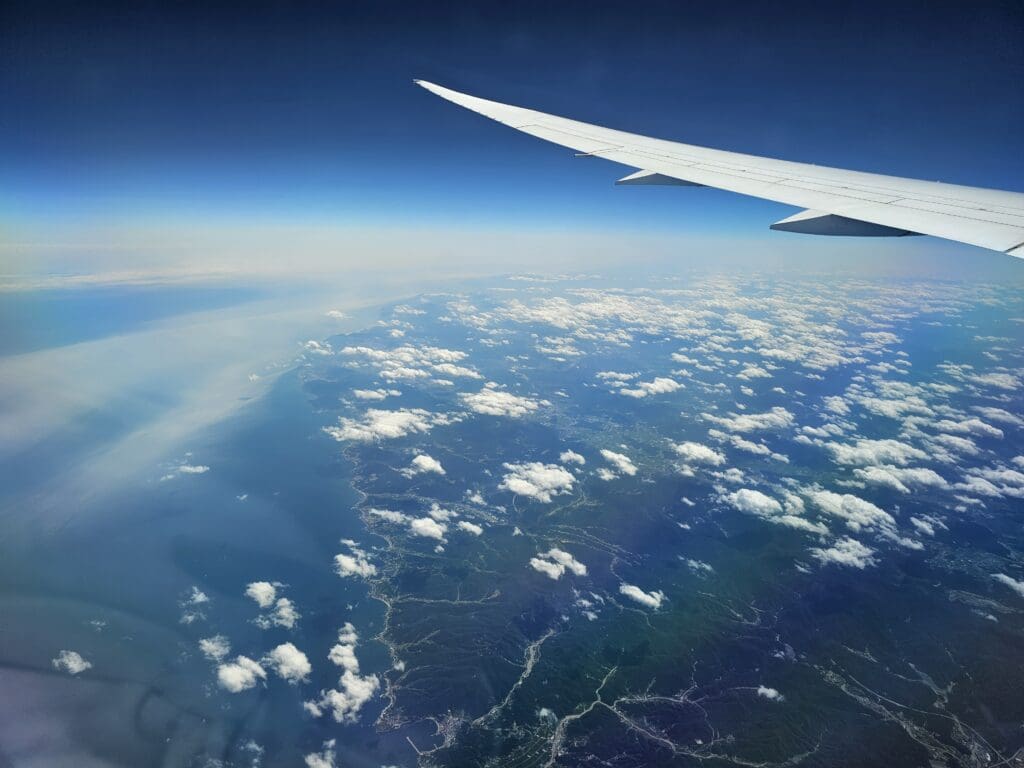
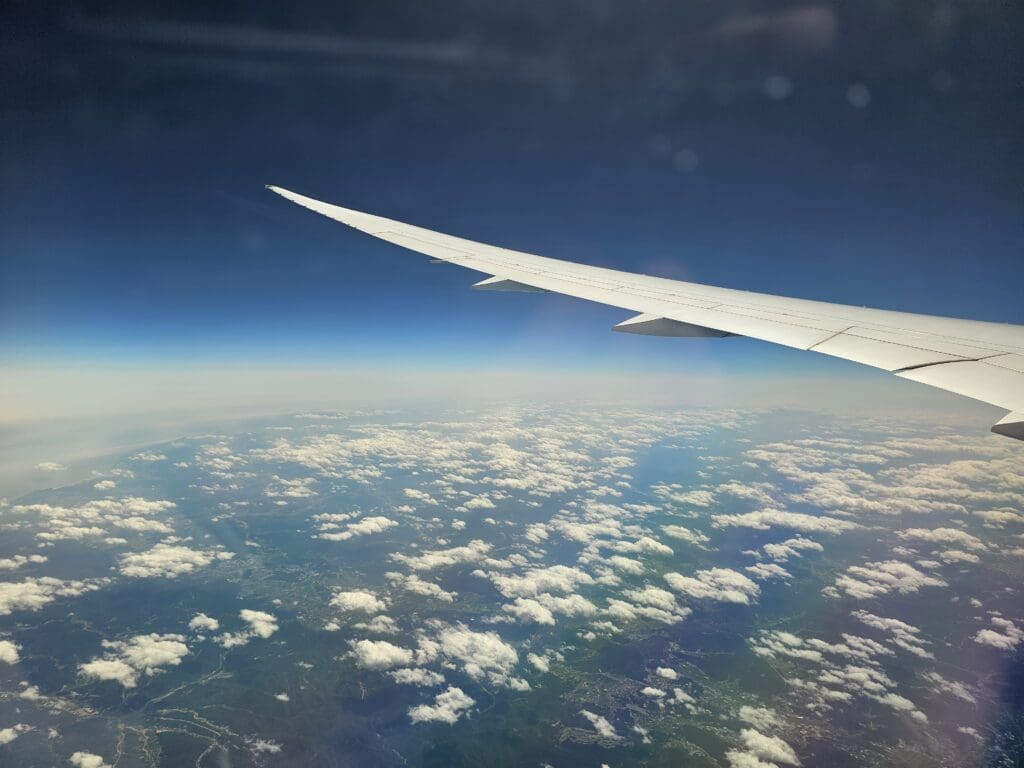
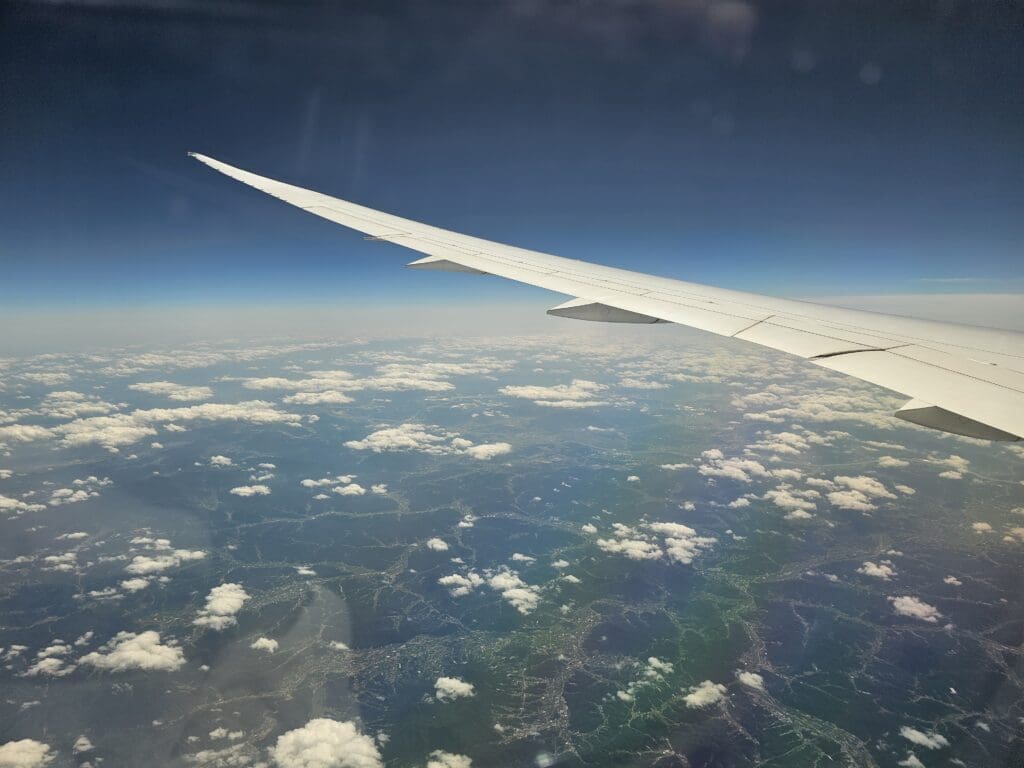
No more than three minutes after the seatbelt signs had been reilluminated, these were extinguished. However, it wasn’t long before the Dreamliner could be felt commencing its descent back towards Earth, and after an hour at 40,000 feet, the aircraft began to sink over the mountainous heart of North Gyeongsang Province. Unfortunately, with the clouds having rolled in below, nothing of this, or indeed of Korea, could be seen until the aircraft was on approach to Seoul Incheon Airport. Inside the cabin, at this point, the crew walked through the cabin undertaking the last of three rubbish collection rounds.
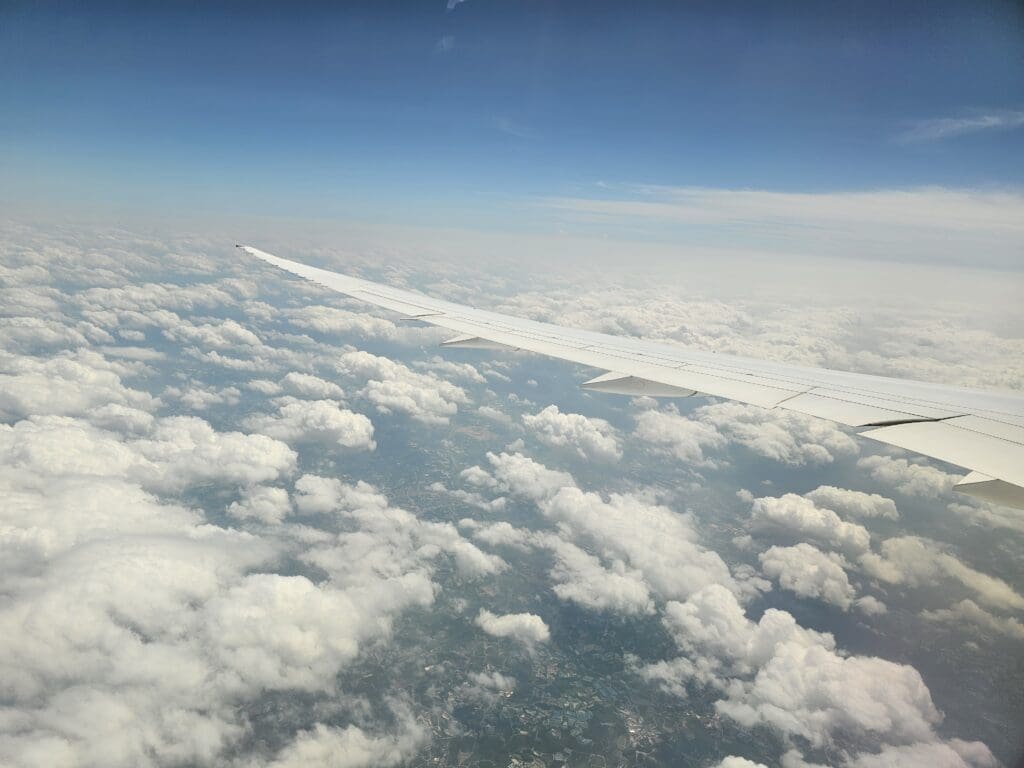
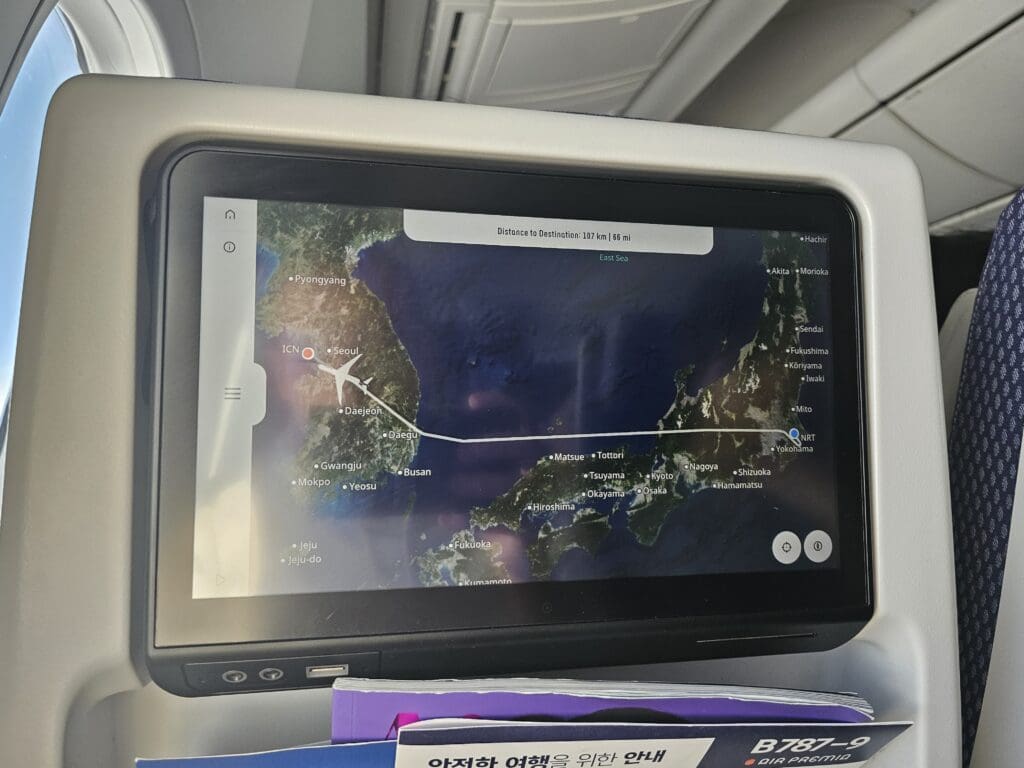
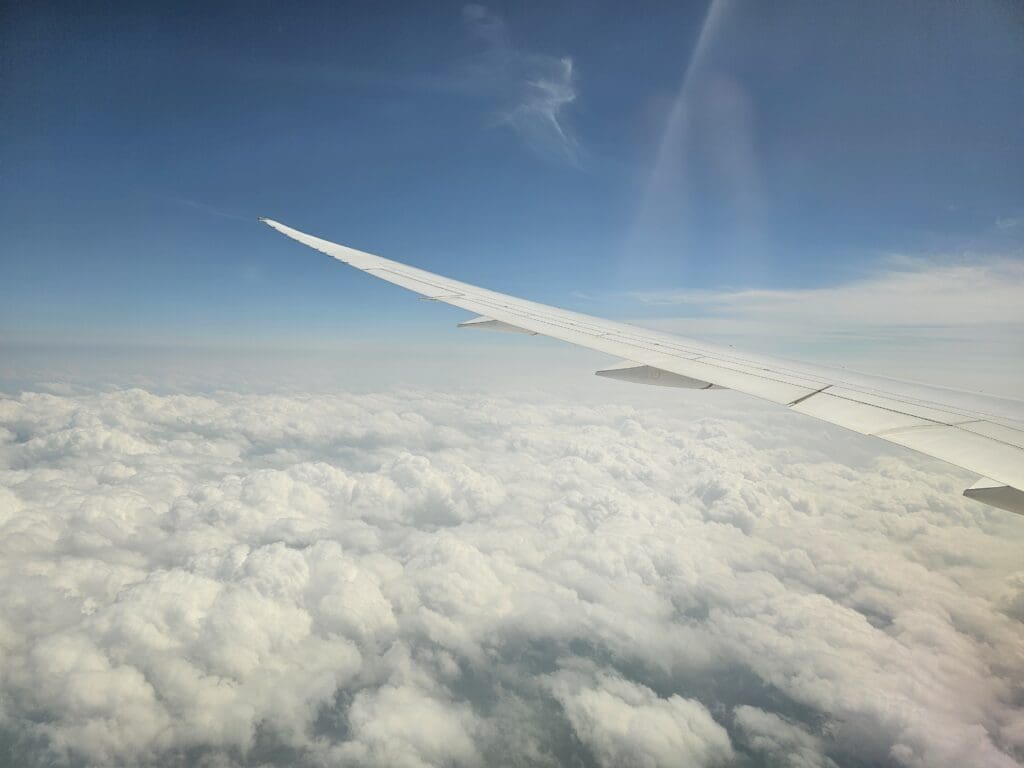
Cutting straight across Korea, the Dreamliner did not pass over any sizable towns or cities until we crossed into the skies of North Chungcheong Province and reached the city of Chungju. At this point, the aircraft descended through 20,000 feet and the seatbelt signs were re-illuminated, with the Captain promptly requesting the cabin crew to prepare the cabin for landing. Almost immediately, the crew took to the aisles and comprehensively ensured that everything was secure and in place for our arrival, checking every single overhead locker to guarantee that these were properly closed and secure. Returning to our route, after passing over North Chungcheong, the Dreamliner headed eastwards through the south part of Gyeonggi Province, the region that loops around the capital city, passing to the south of the cities of Suwon and Yongin.
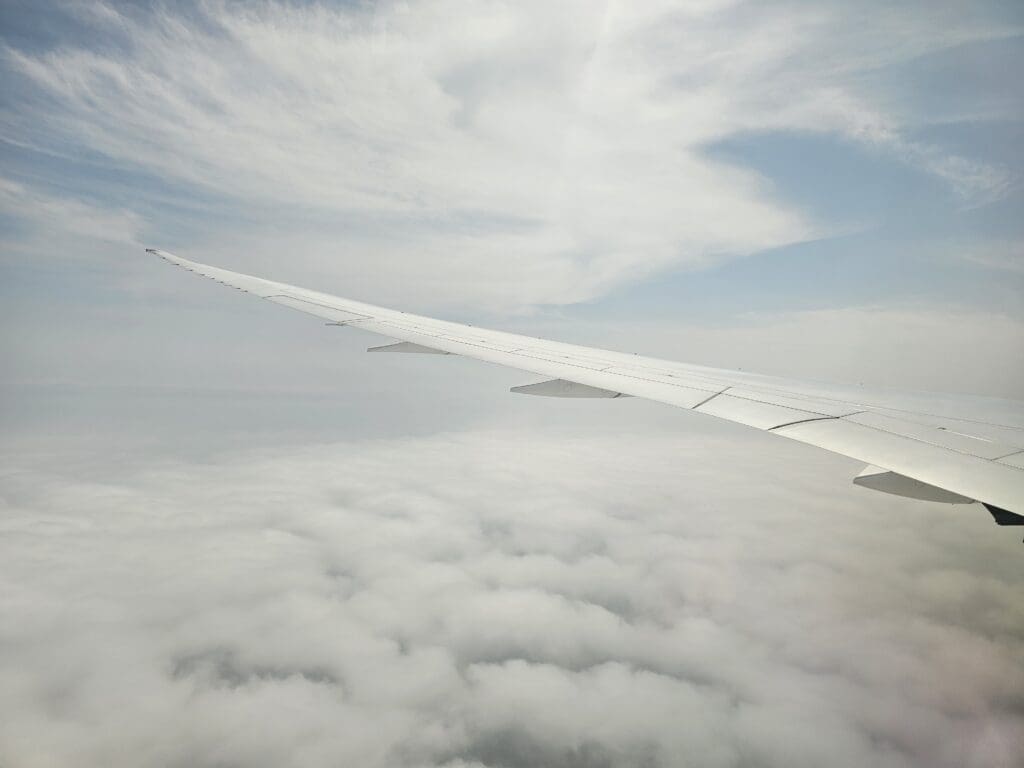
Around thirty minutes after passing over Korea’s eastern coastline, the Dreamliner made it to the country’s western shores and I soon spotted Bangameori Beach before we headed out over the waters of the West Sea and made a beeline for Yeongjong Island, home to Incheon Airport. Descending lower and lower, a clear view was offered of the Tracy Island-esque Palmi Island, home to some administrative buildings and a lighthouse before continuing onwards to Incheon Airport.
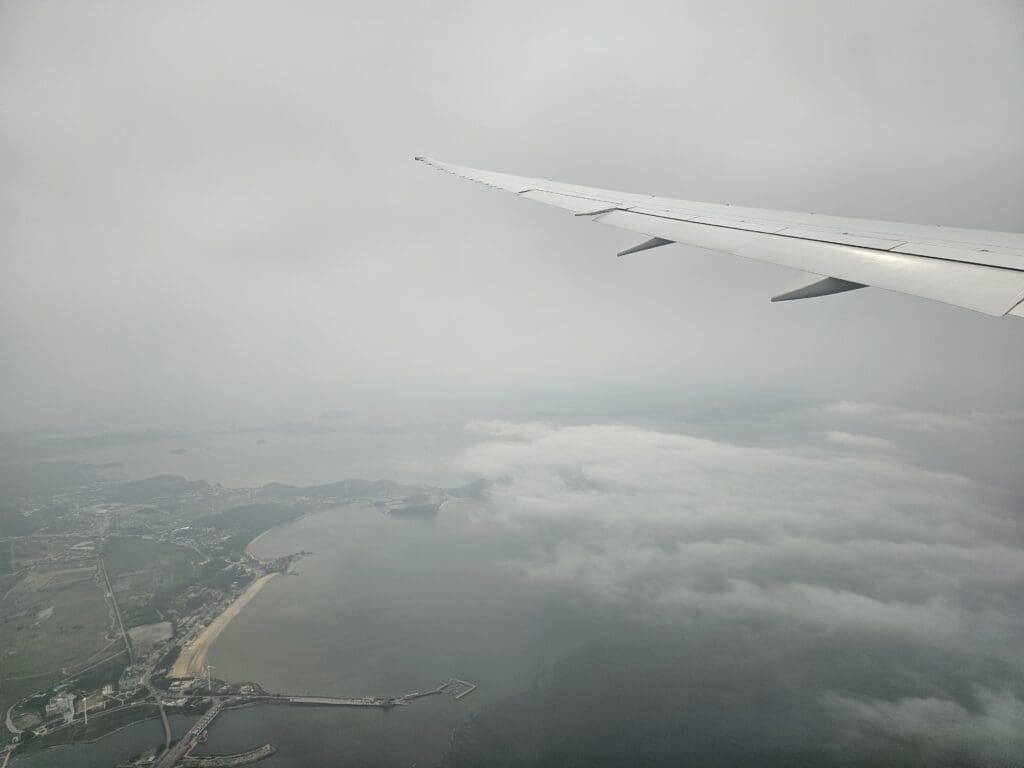
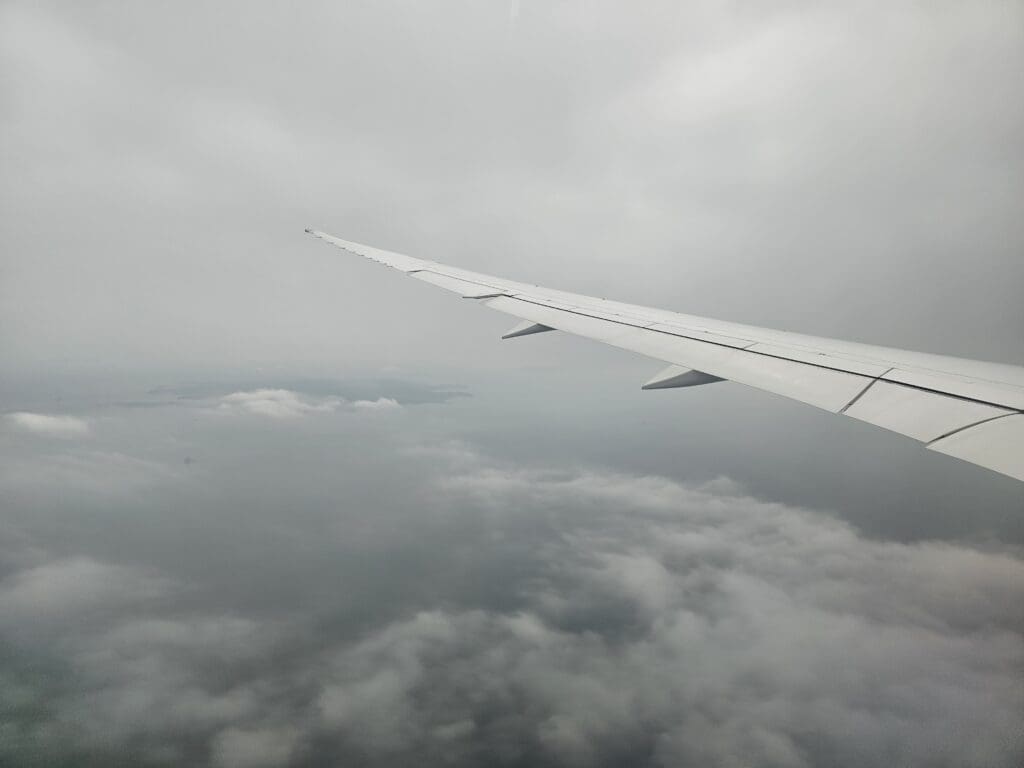
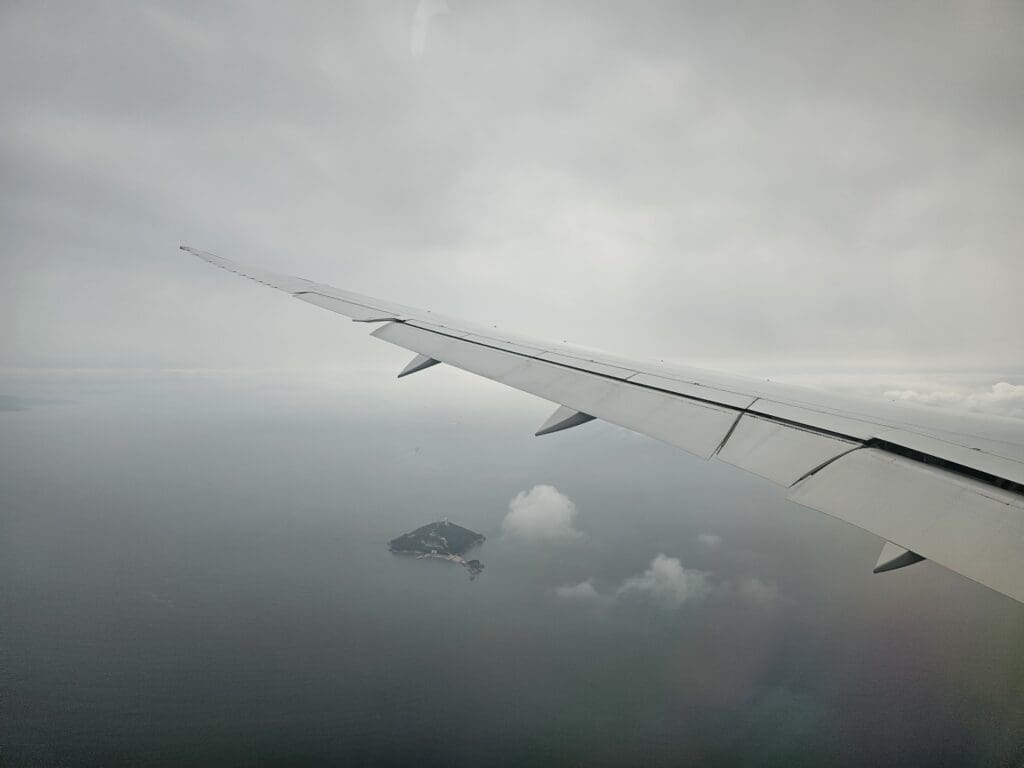
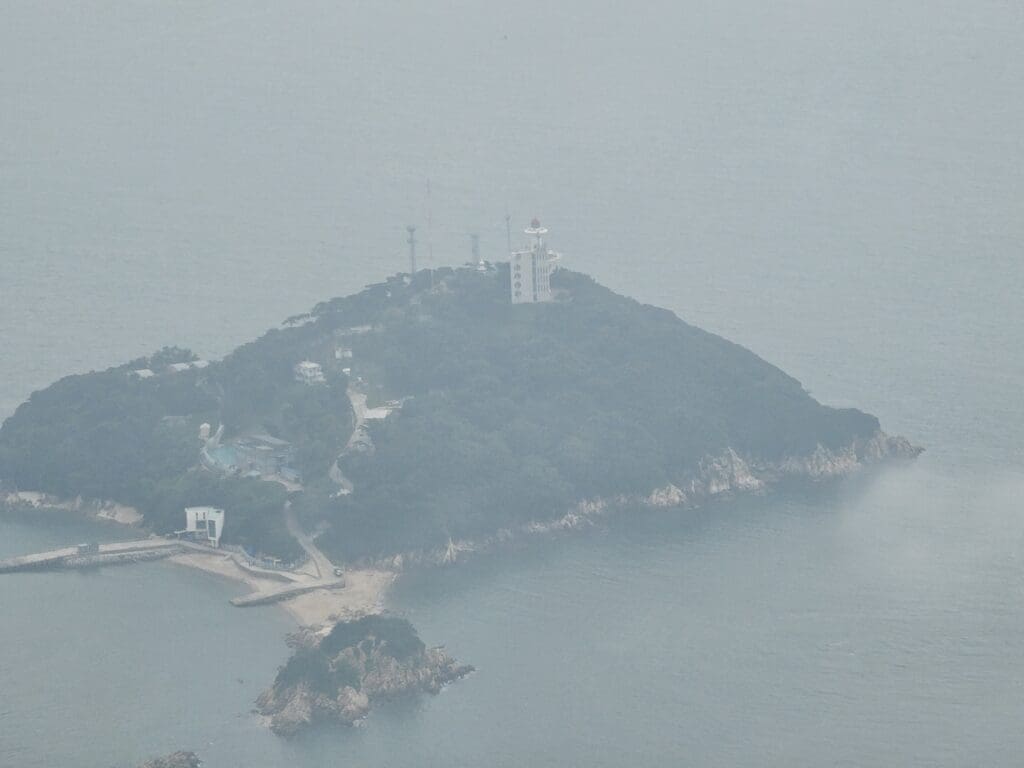
Once we had floated down past the complex of offices and hotels that sit just to the south of the airport, the Dreamliner crossed over the perimeter fence and whizzed past Terminal 1 before making a reasonably firm touchdown at 1456. True to the Captain’s speech, our flight had lasted a total of 1H55 and soon we decelerated rather rapidly before vacating the runway to the left. In the usual manner, as we vacated the runway the Purser performed the usual welcome announcement in Korean and English before calming music filled the cabin as we voyaged over to the gate. During the taxi, I was offered a superb view of a Korean Air Boeing 747-8 Freighter touched down at the end of its long flight from Frankfurt.
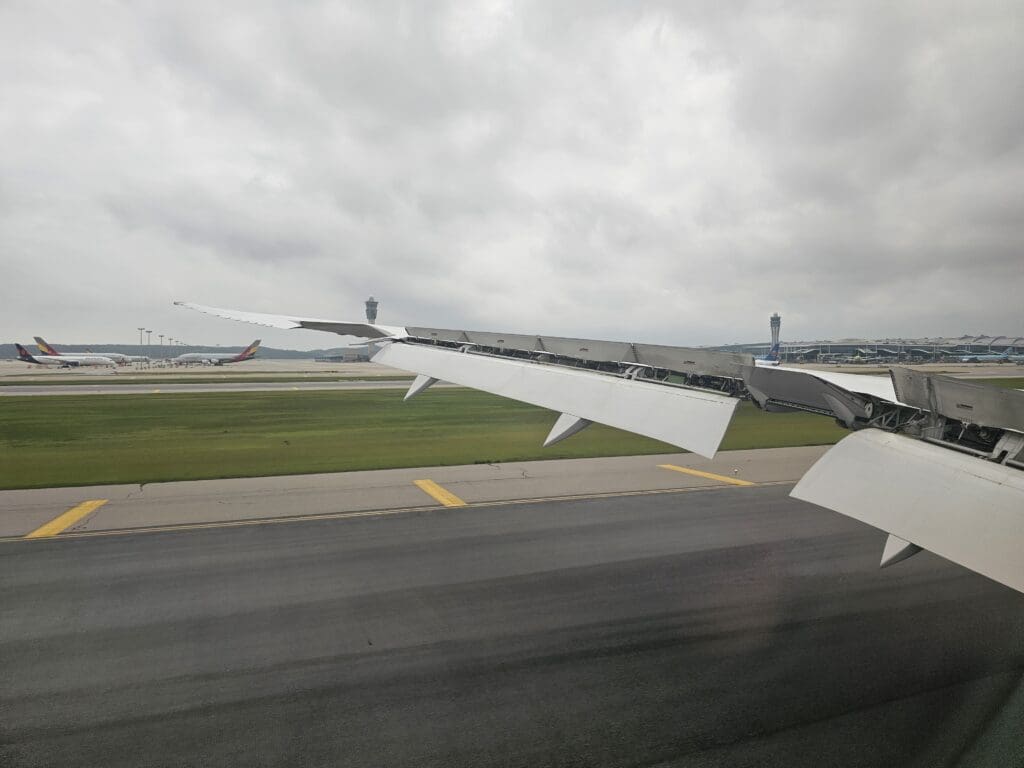
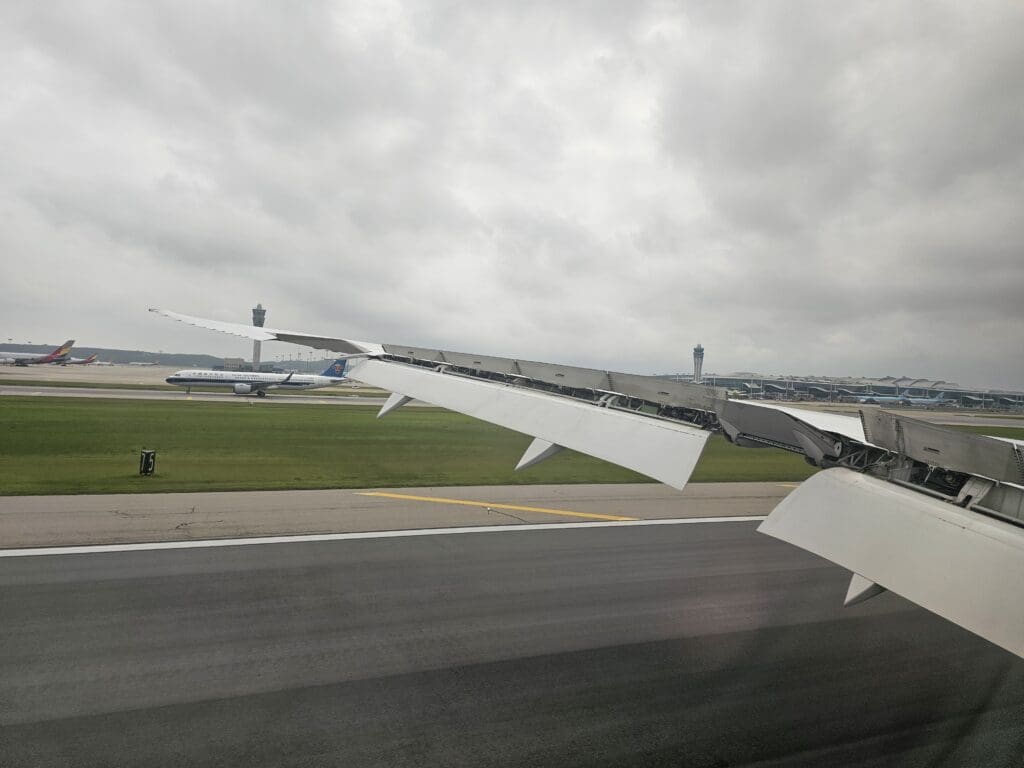
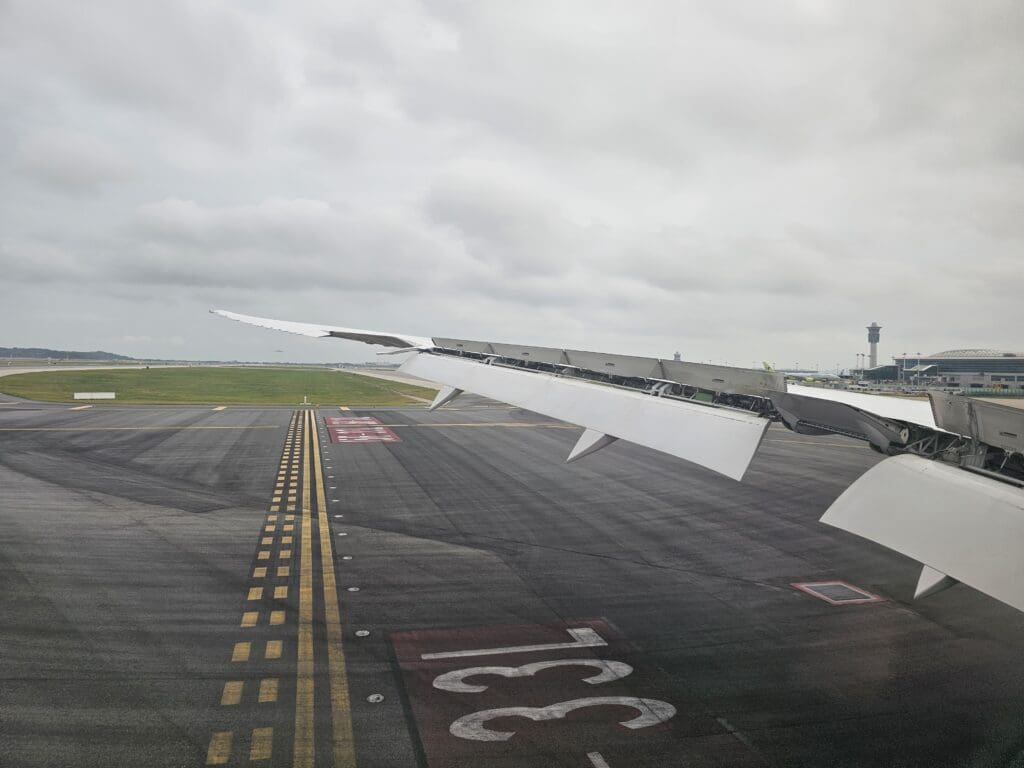
After a few minutes, the Dreamliner cautiously came to a halt at Stand 19, arriving there an impressive 26 minutes ahead of schedule. As is often the case, as soon as the seatbelt signs were extinguished those around me jumped up in an urgent rush to disembark. Fortunately, it didn’t take too long for the jetbridge to be connected and for disembarkation to commence. Not being in any particular rush, after a while I picked up my things and slowly trundled through the aircraft, receiving a friendly farewell from each flight attendant I passed as I made my way to the 2L door. Soon, I stepped off the aircraft and headed into the modern surroundings of Incheon Airport Terminal 1, and commenced the trek over to the airport. From our arrival gate, a fairly long walk was in store to reach the immigration area and with crowds of passengers piling in at virtually every gate I passed during this journey, I wasn’t particularly hopeful of a speedy journey through immigration.
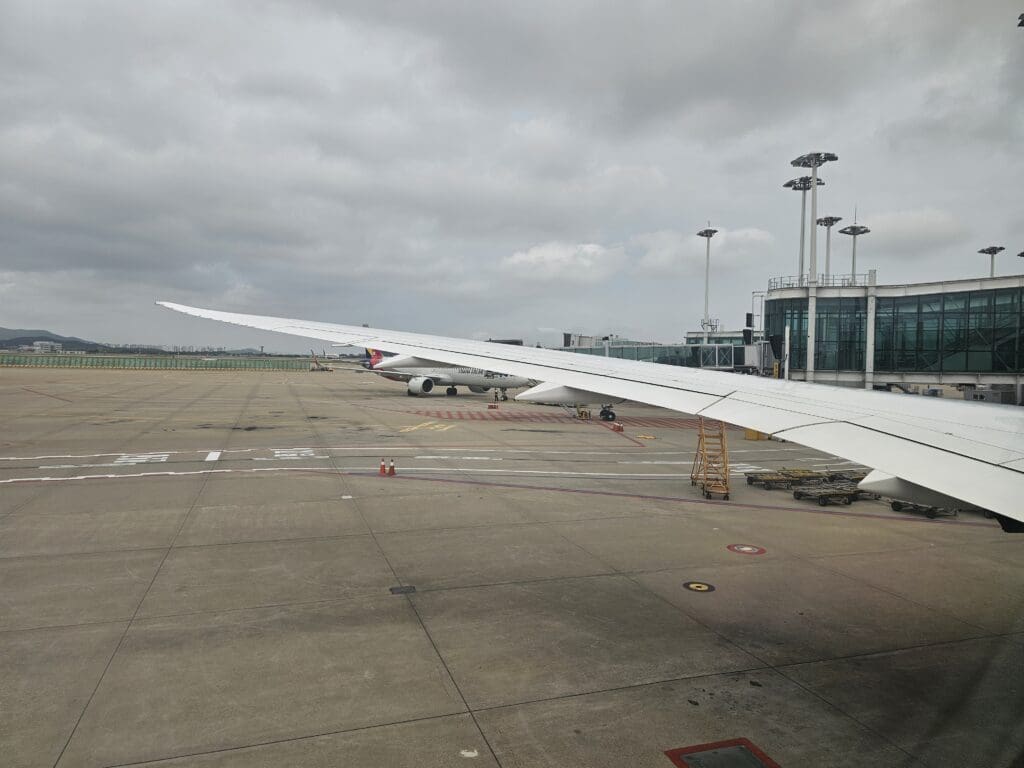
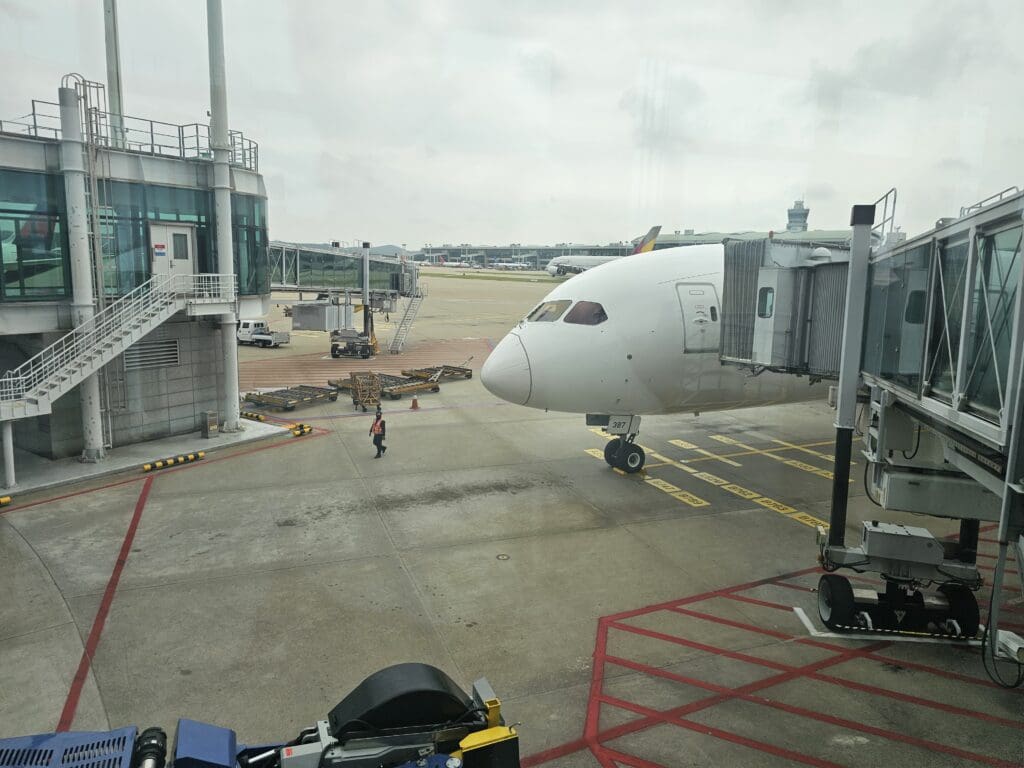
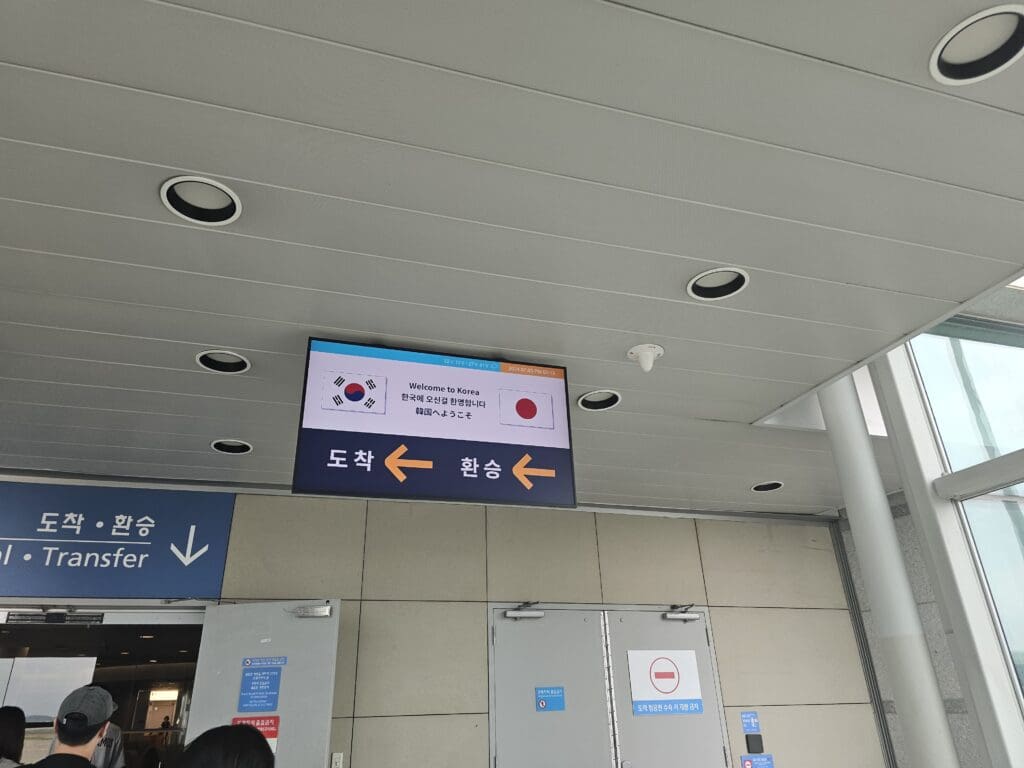
After a few minutes, I reached the long snaking queue to the line of immigration desks and much to my delight, this moved along at a reasonable pace, however, with this taking around twenty minutes of waiting until I made it up to one of the desks, this was still one of the longest waits I have experienced at immigration at Incheon Airport. Eventually, I handed over my passport and had my fingerprints taken before I was free to enter Korea. From there, I headed down the escalators to the terminal’s large baggage collection hall, however, with nothing to pick up, I sailed through this and made it out into the busy landside arrivals portion, ready to catch the all–stop AREX train into Seoul.
Summary
Given the price I paid, I was delighted with my ride on Air Premia. Not only did I land in Incheon well ahead of schedule and in one piece, I found the crew to be exceedingly polite and friendly, whilst I appreciated the onboard snack and drink offering. Importantly, I found the seat to be spacious and comfortable and was thus left with no complaints in this respect. Despite appreciating the onboard wifi, I do have to mention the entertainment system which was completely fine, other than it being lacking in content! Whilst not an issue on the short flight between Tokyo and Seoul, this is something that many on longer slogs would likely complain about. Would I fly them again? Most definitely!