Ending my Greenlandic Adventure: Kangerlussuaq to Copenhagen on a Rare A330-800
You can find my other reports from this trip below:
Copenhagen – Kangerlussuaq, Air Greenland, A330-800 (including trip background)
Kangerlussuaq – Aasiaat – Ilulissat, Air Greenland, Dash 8 Q100
Ilulissat – Kangerlussuaq, Air Greenland, Dash 8 Q100
Before I knew it, one of the most adventurous and exciting long weekends of my life came to an end, and it was time to leave Greenland and begin the trek back to Britain. Having started our journey in the coastal town of Ilulissat, my father and I touched down in Air Greenland’s hub in Kangerlussuaq onboard one of the airline’s domestic workhorses, the Dash 8 Q200. By the time we made it into the airport’s minuscule terminal, we were left with an hour and ten minutes until our flight to Copenhagen was scheduled to depart. Whilst this may have been a tight connection at the likes of Frankfurt or London Heathrow, this was more than enough time to soak up everything that Kangerlussuaq Airport had to offer, and there was no need to rush through the terminal.
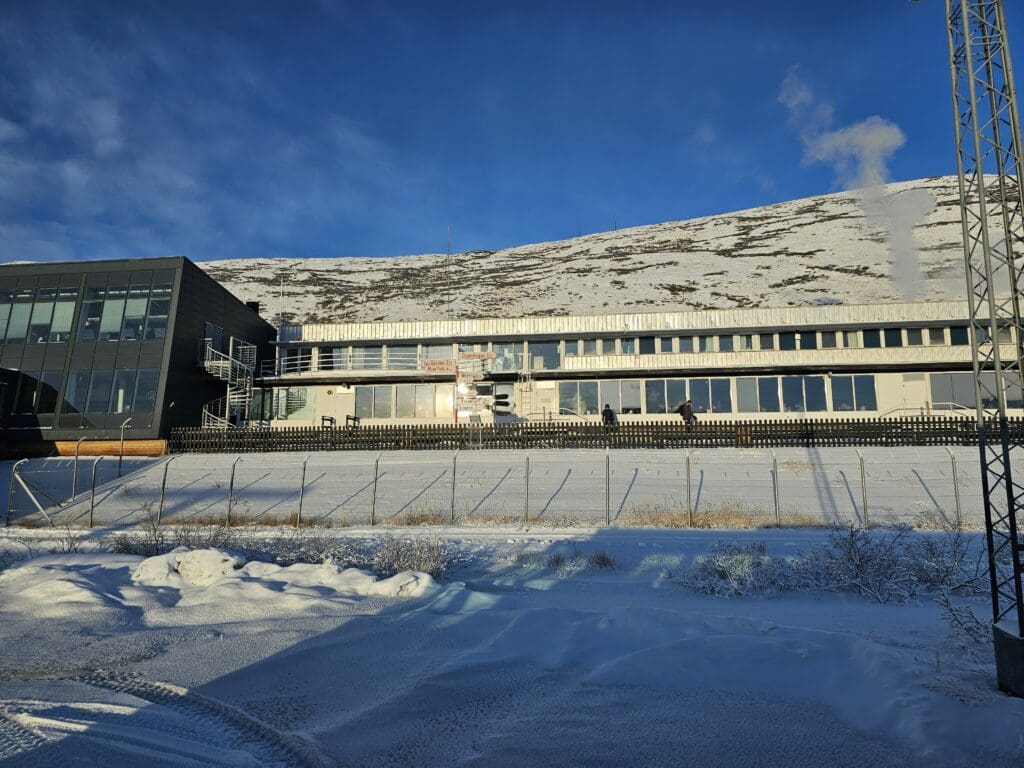
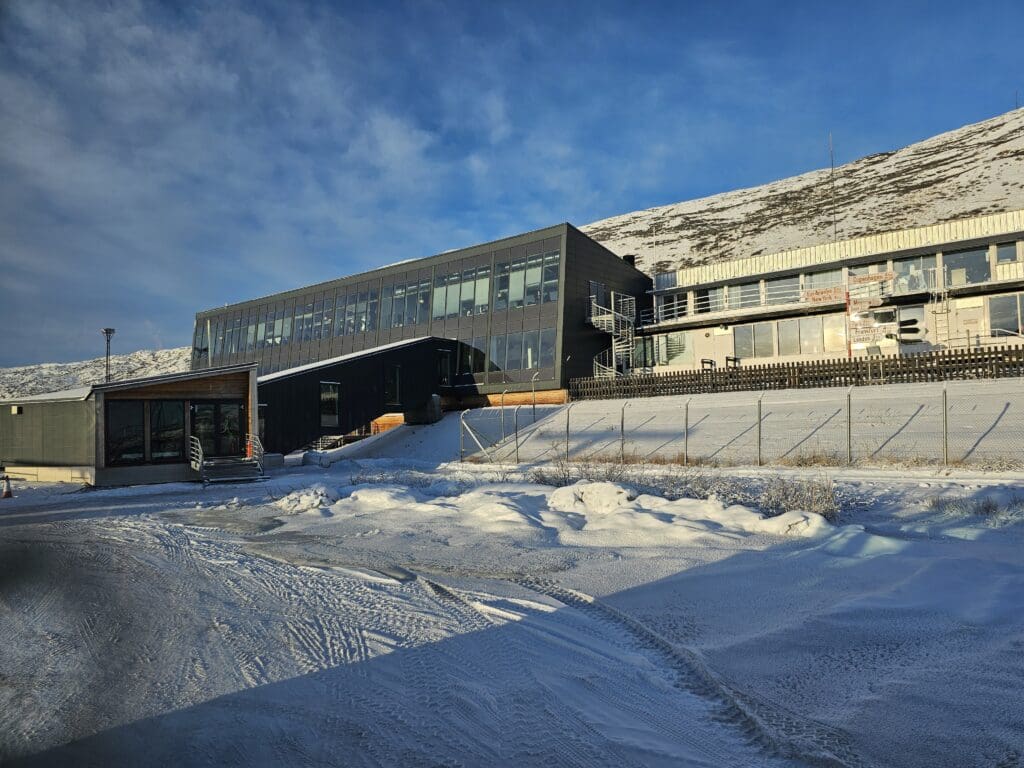
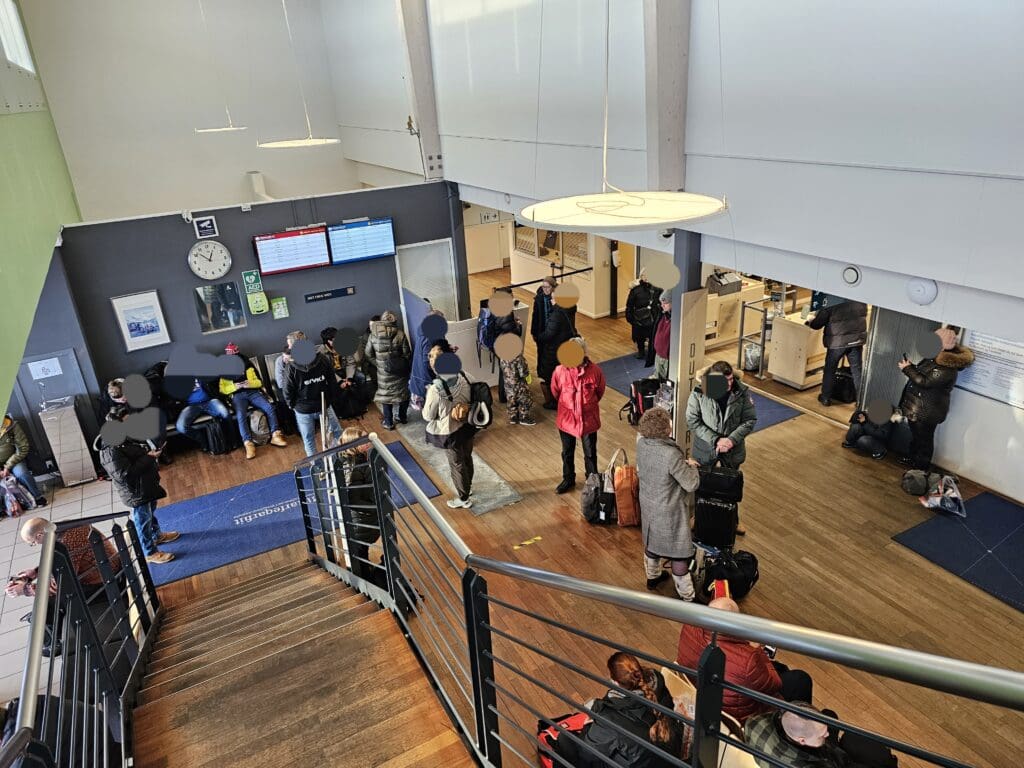
Having been deposited in the terminal’s main landside waiting area, this was packed with a mixture of passengers who had arrived from Copenhagen and were waiting to depart on flights to all corners of Greenland, alongside those heading off to Denmark. Following a quick stop for some souvenirs from the terminal’s shop, we decided it best to join the somewhat long queue for the security checkpoint. At Kangerlussuaq Airport, this checkpoint only exists to serve those passengers bound for destinations outside of Greenland, with no security check required for flights taking place within the territory. Thus, this is fairly compact with just two x-ray machines and one scanner. Furthermore, with the security staff undertaking their checks properly and thoroughly, it took a good ten minutes of standing in line before it was my turn to pass through this check. As with most passengers, once my bag had been through the scanner, it was then searched by hand before I was finally free to enter the small secure area of the terminal.
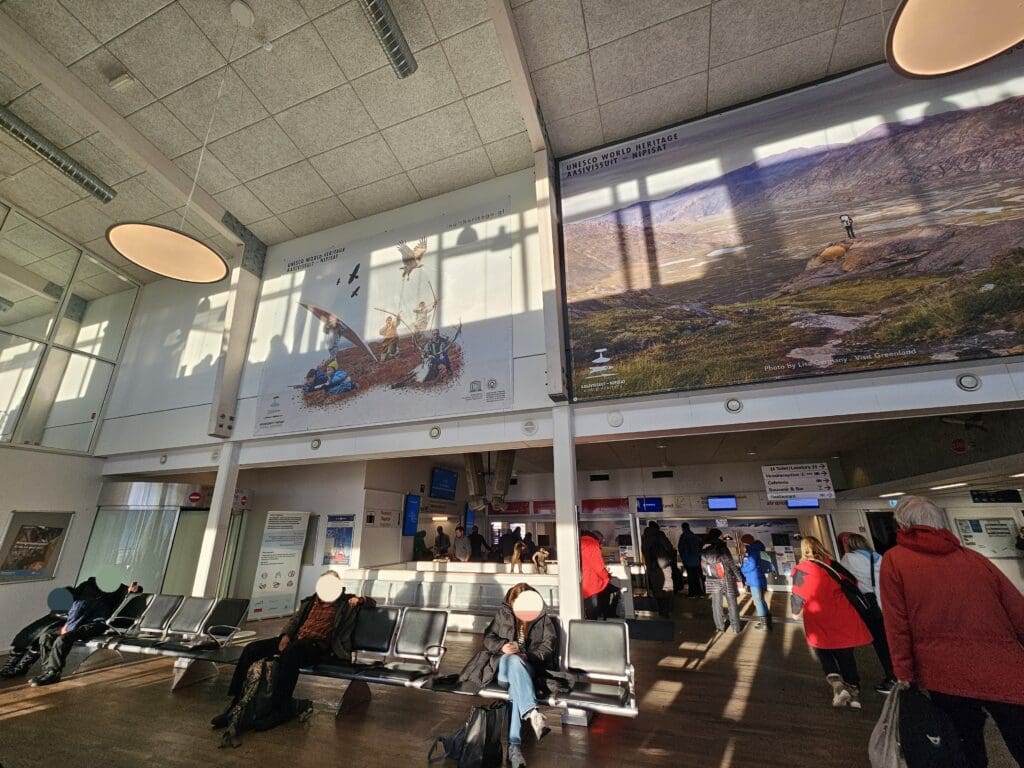
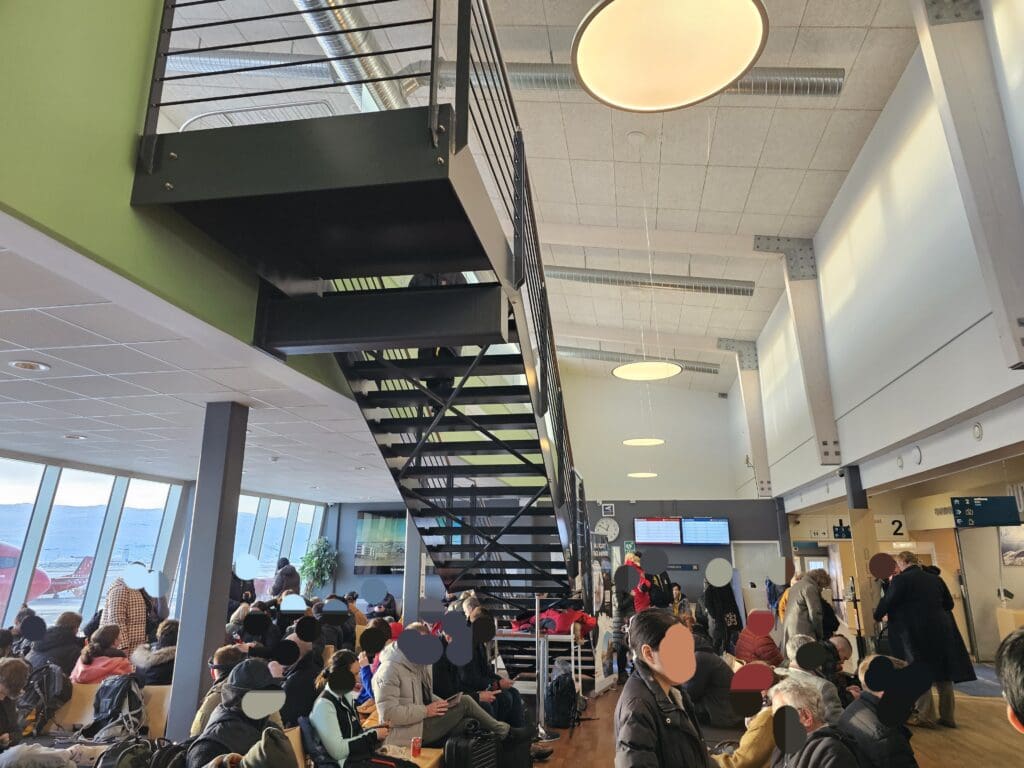
According to my boarding pass, boarding for the flight to Copenhagen was scheduled to commence fifty minutes before departure, so once through security, I wasn’t left with too long to linger around until boarding commenced. Whilst this part of the terminal would likely have proven to be spacious had I been heading off on a Dash 8 operated service to the likes of Canada or Iceland, given the size of the Airbus A330, this was rammed. Seeing as I had arrived with not too long left to go until my flight was scheduled to depart, by that time, seating was at a premium, with very few spots remaining available to sit and wait. As with the rest of the terminal, Mittarffeqarfiit seems to have done a good job in squeezing as much as possible into the airside area. On the ground floor, this features a decent-sized duty-free store which seemed to be a very popular spot, whilst above this, a café and smoking area could be found. Meanwhile, throughout the terminal l,arge windows offered a decent view out onto the apron and runway. Despite being very busy, the terminal seemed to be mostly clean, and the complimentary wifi worked without issue. However, turning to the negatives, other than the lack of seating, I should mention that a number of the toilets were out of service and thus a long queue had to be endured for those looking to use the facilities before jetting off.
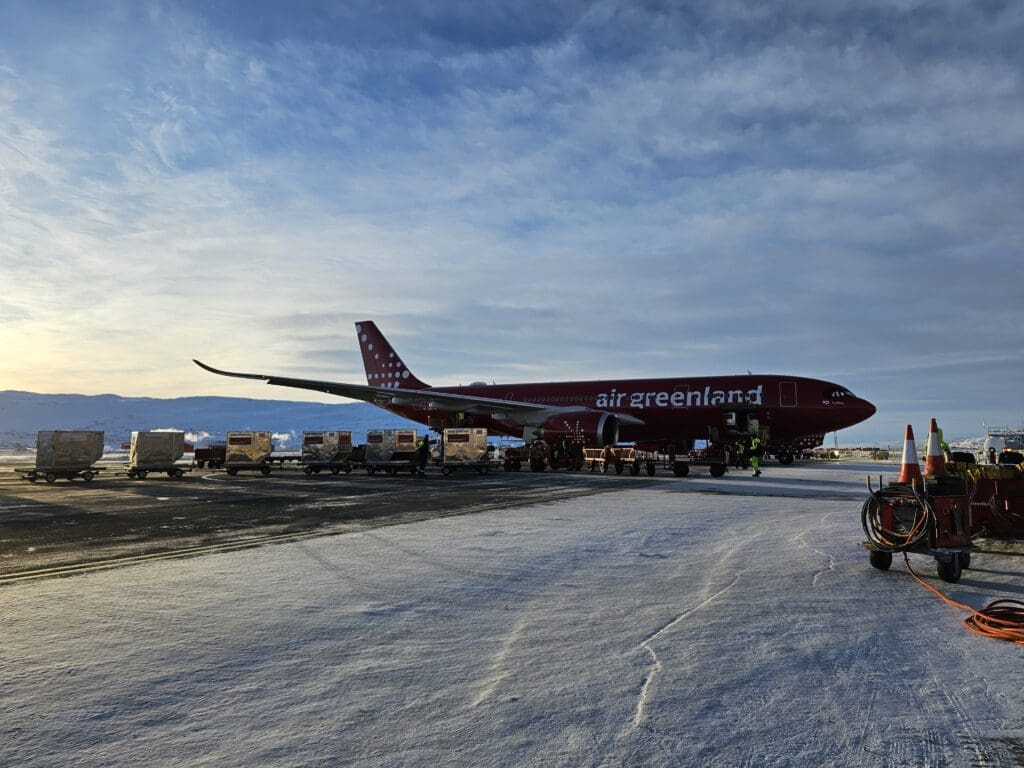
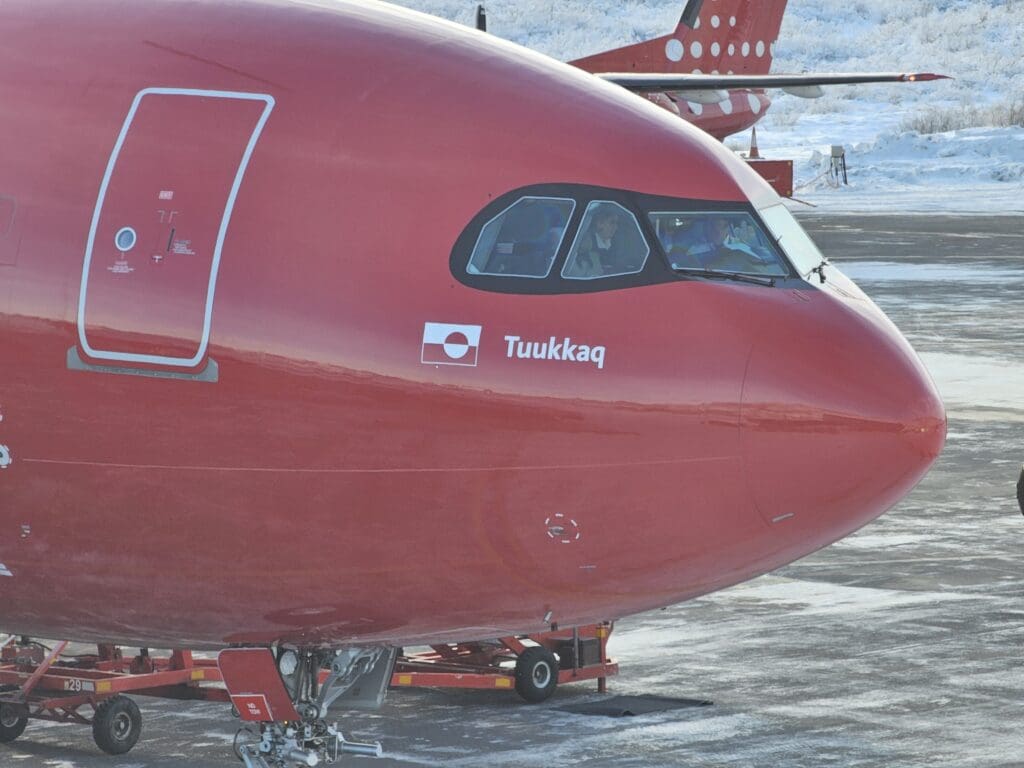
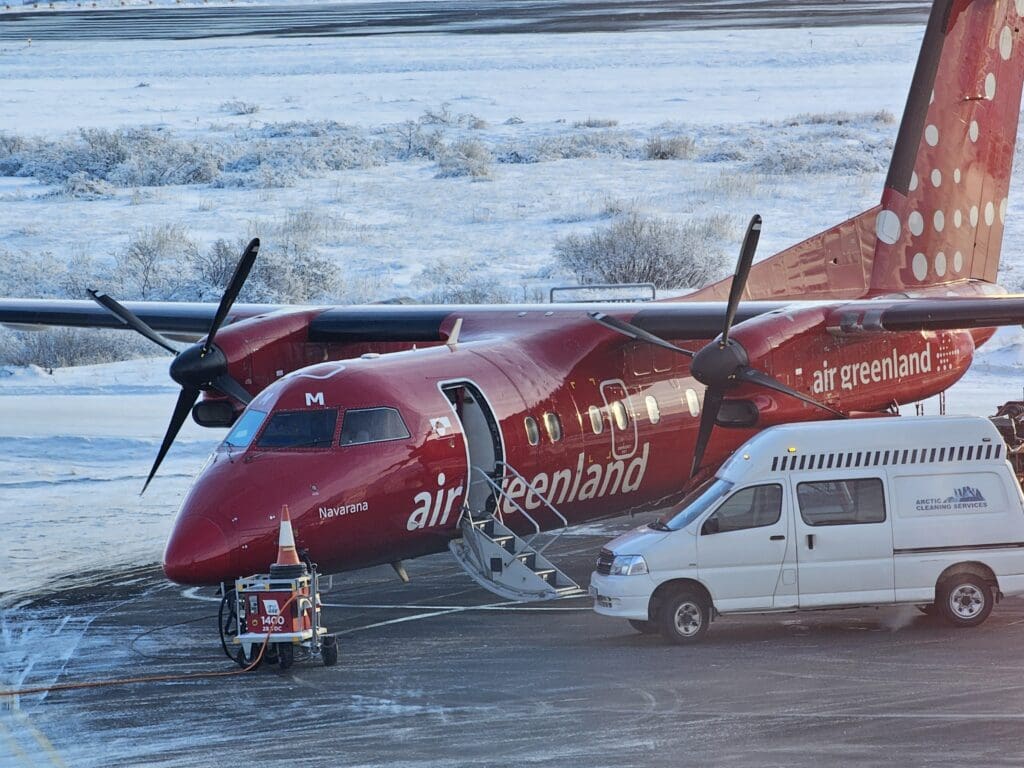
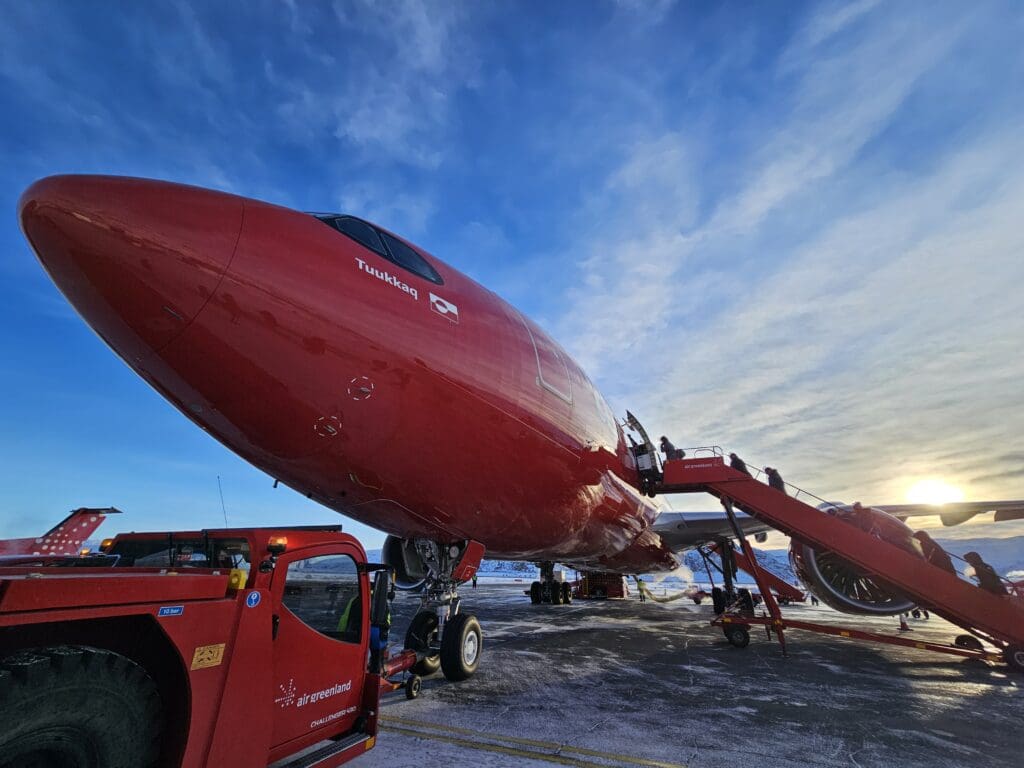
Following a quick wander around, I hovered near one of the windows as I waited for boarding to commence. Directly outside the terminal, the comparatively massive Airbus A330-841 could be seen being loaded up for its flight over to Copenhagen, meanwhile, multiple Dash 8 Q200s could be seen coming and going, making quick turnarounds before heading off to destinations across Greenland. Unsurprisingly, this Airbus came in the form of Air Greenland’s flagship aircraft and its only Airbus A330, OY-GKN. Assembled at Airbus’s Toulouse Blagnac plant, this particular Airbus A330-841N carries the manufacturer serial number of 2020 and first took to the skies in late October 2022, making it just 1.3 years old at the time of my flight. Following testing, in early December 2022, the aircraft was given the registration OY-GKN and named Tuukkaq before entering service and replacing the 1998 model Airbus A330-200 that had operated Air Greenland’s Copenhagen service since 2002.
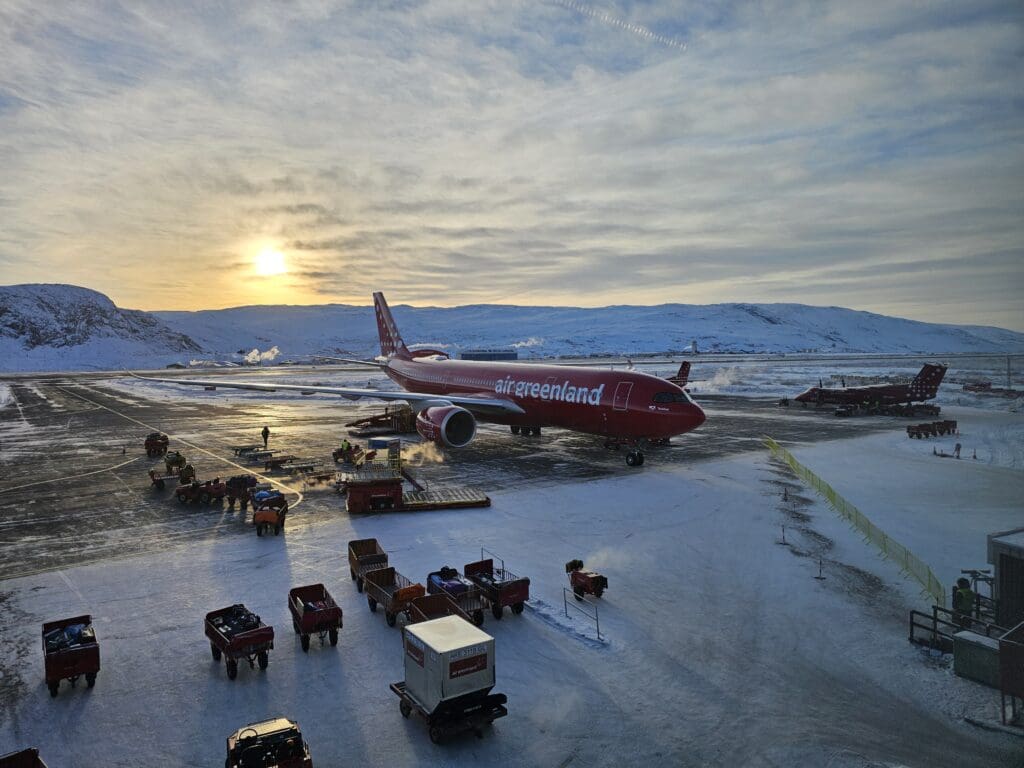
By the time the flight’s scheduled boarding time of 1250 rolled around, a small queue had formed leading up to the gate podium, however, it wasn’t until 1300 that an announcement was made in Greenlandic, Danish and English advising passengers that boarding would soon commence. Ten minutes later and twenty minutes behind schedule, the queue began to shift, and passengers were permitted to board the waiting Airbus. This was not announced in any particular order, with all passengers invited to board the aircraft at once with no priority given to those in Premium Class.
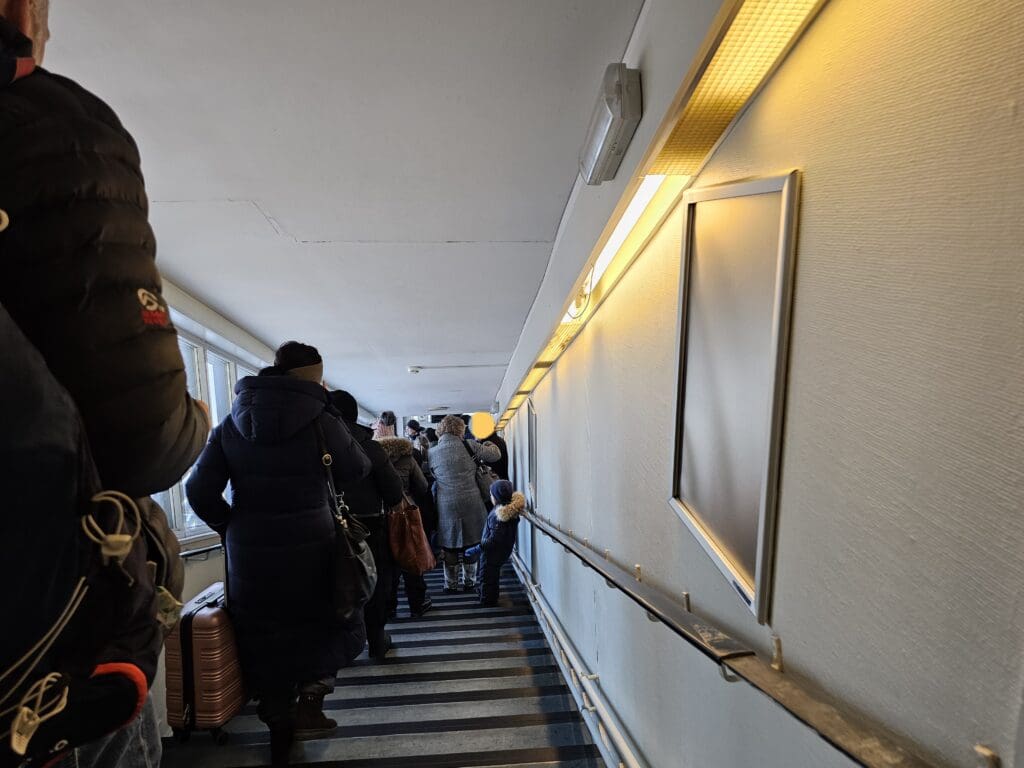
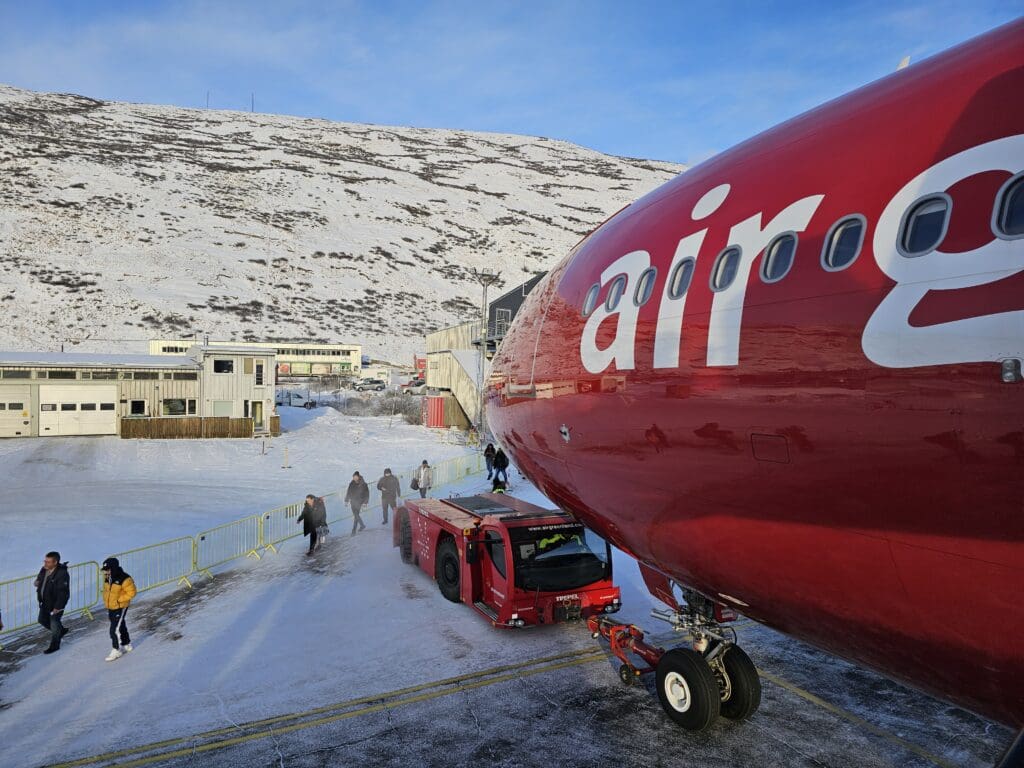
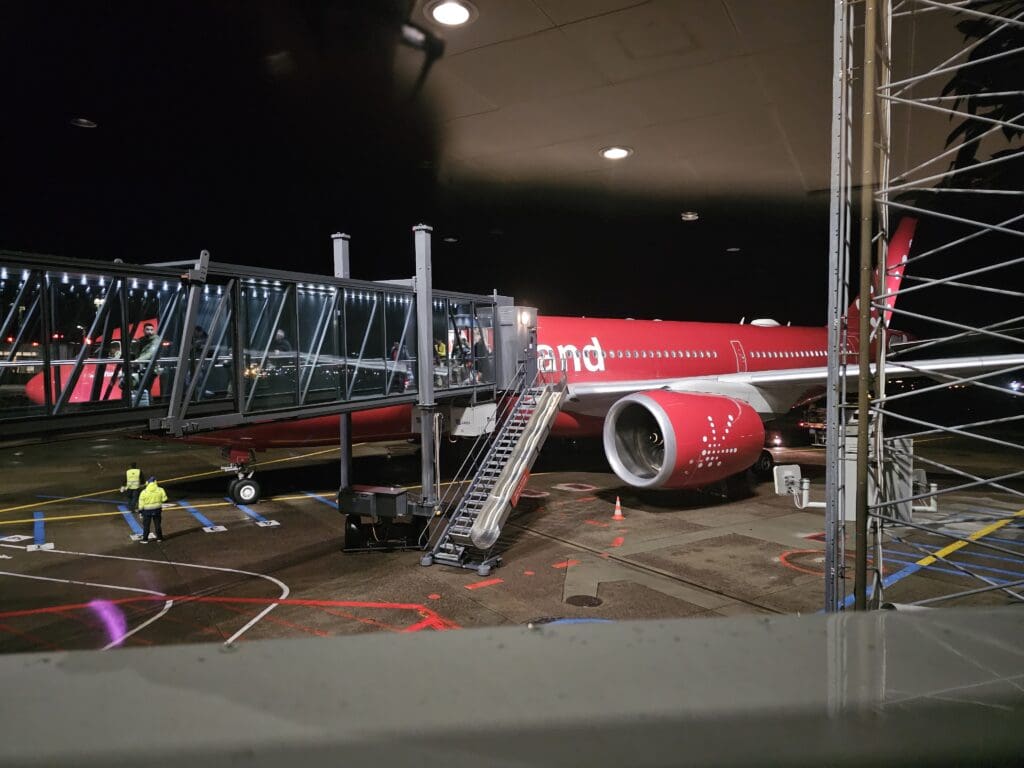
Soon, I had my boarding pass scanned by a friendly agent who wished me a ‘very nice flight’ before I made my way down the boarding tunnel. However, it soon became evident that boarding had not actually commenced, with passengers instead being held in the heated tunnel that led out to the apron. Fortunately, after no more than a few minutes, passengers were allowed out into the freezing Arctic cold and over to the waiting Airbus. That afternoon, boarding was undertaken via two long sets of airstairs that had been positioned up to the 2L and 4L doors, and, seeing as I would be travelling in the forwardmost Economy row, I decided it sensible to board via the former door.
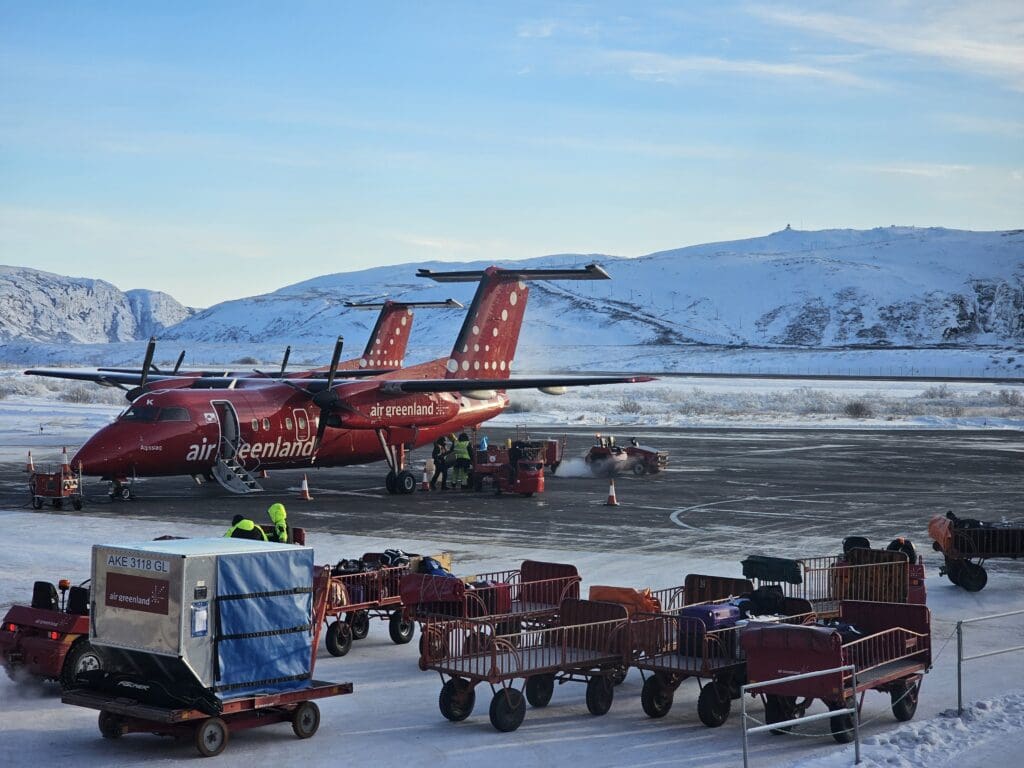
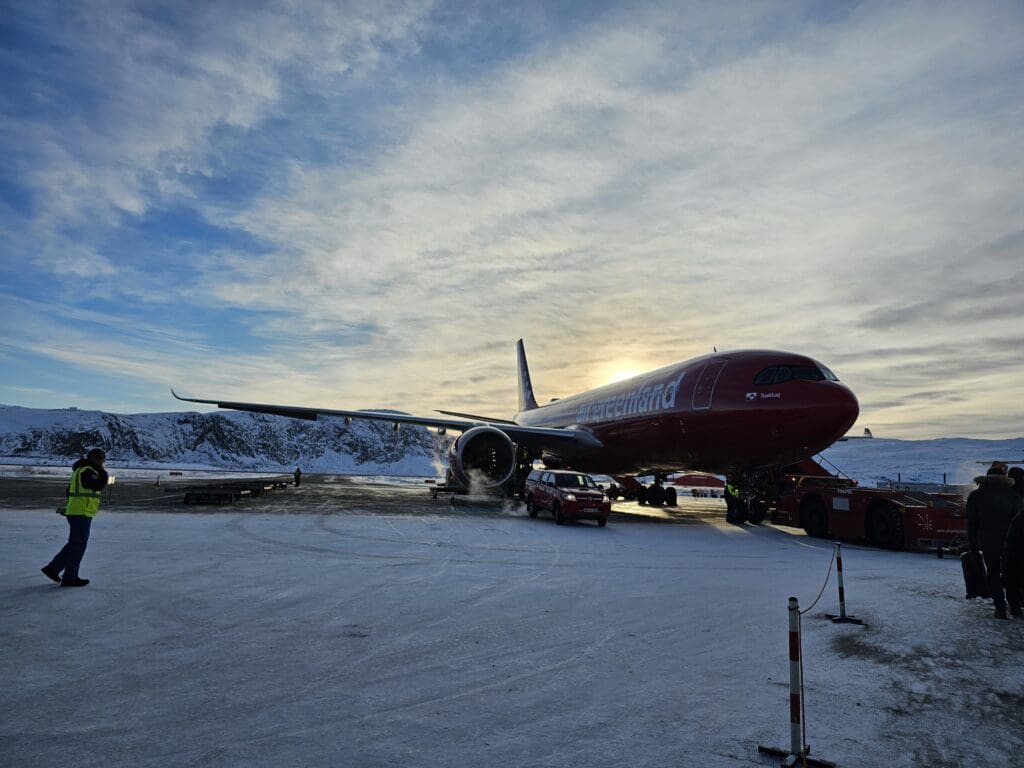
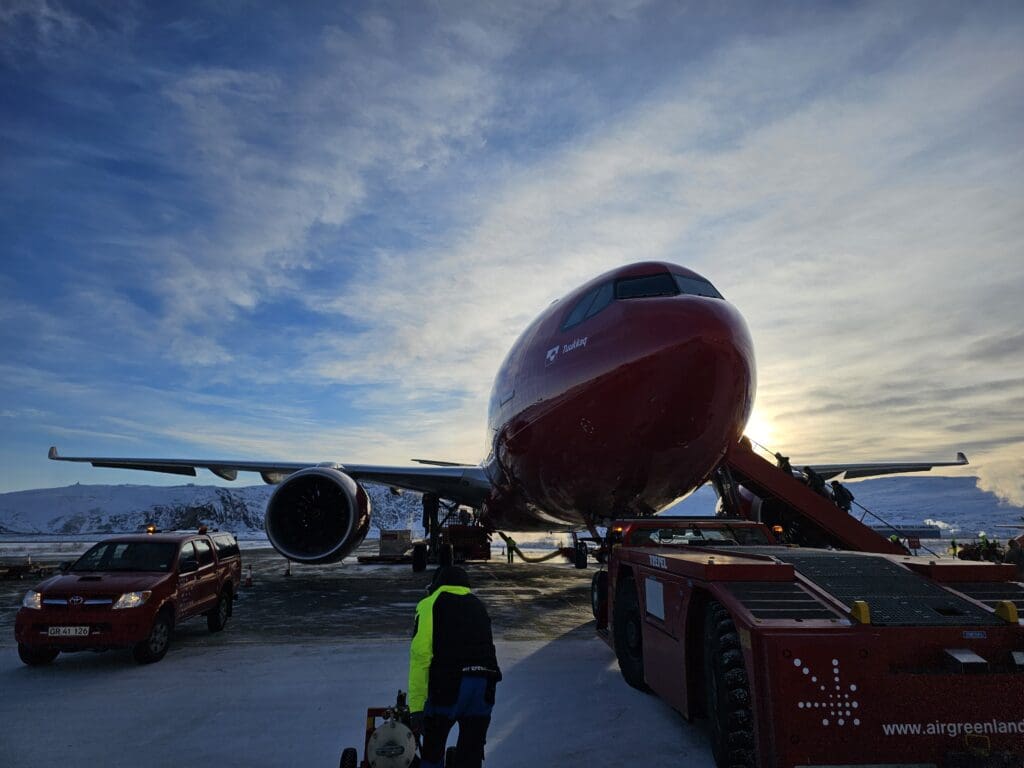
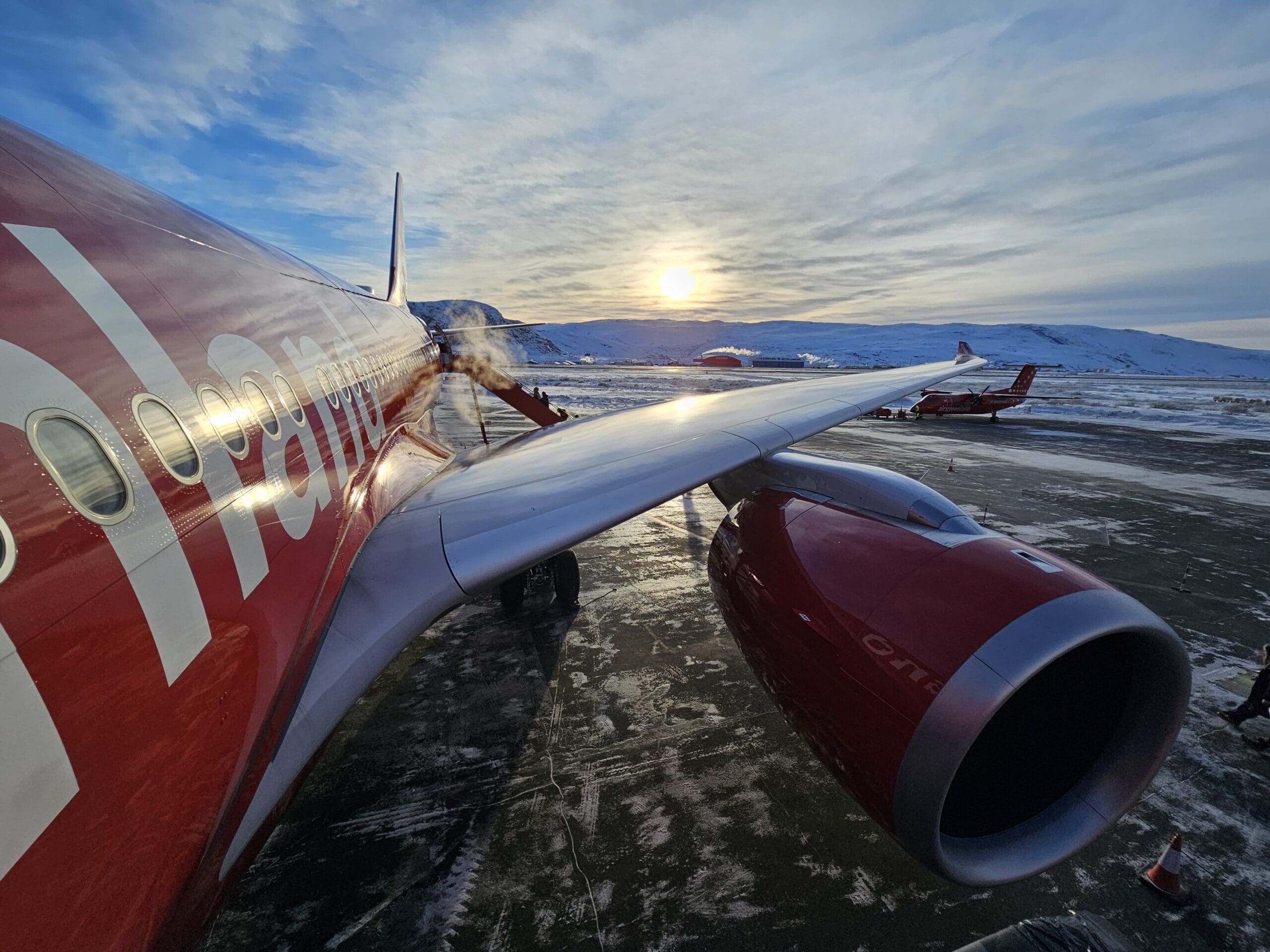
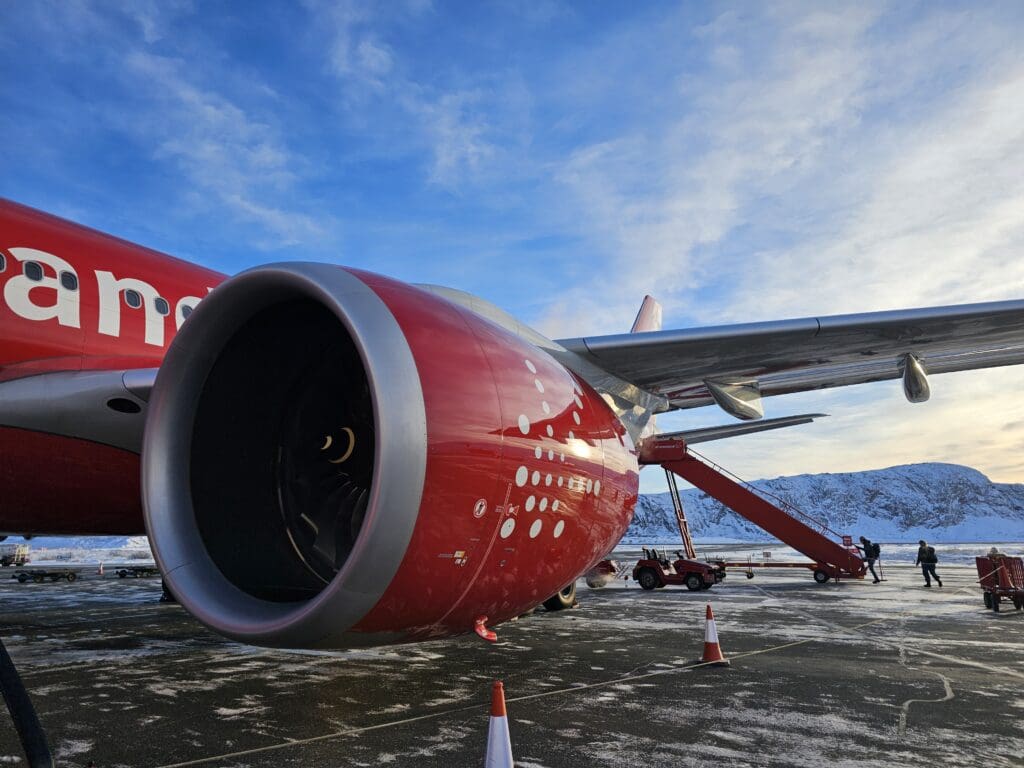
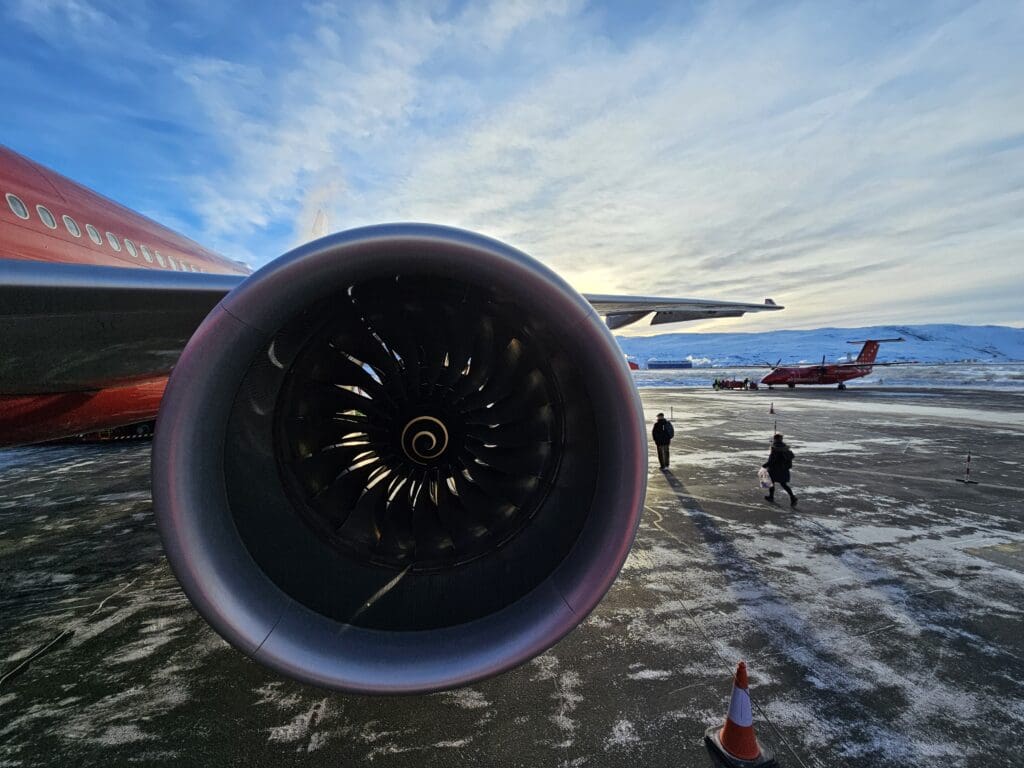
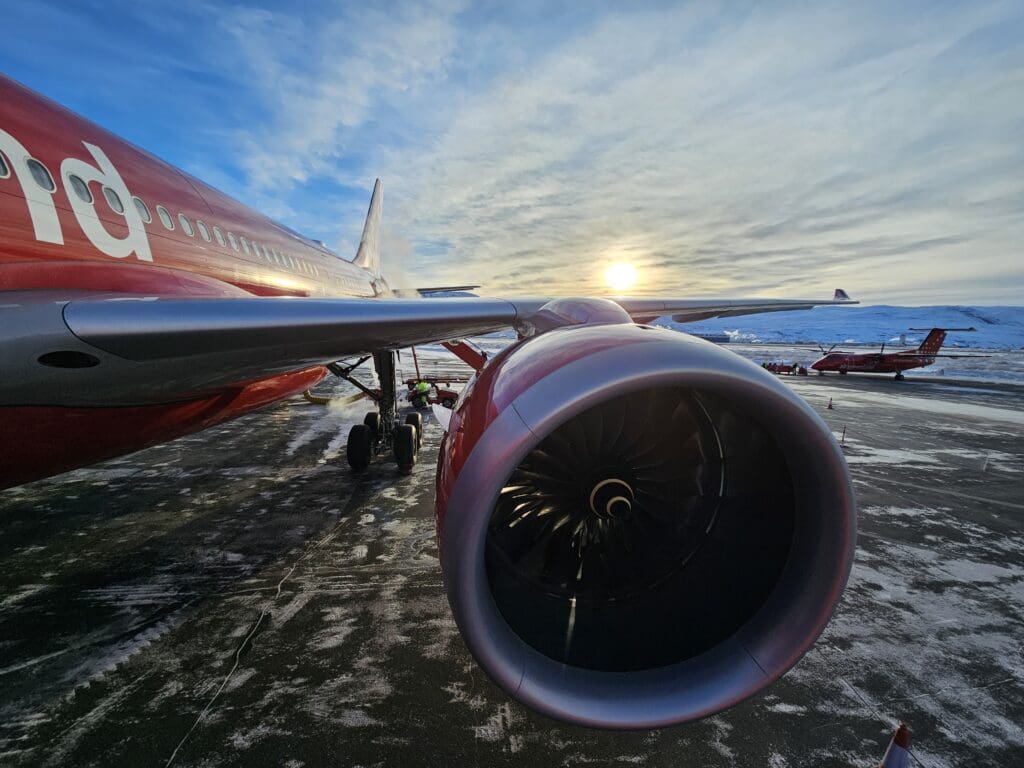
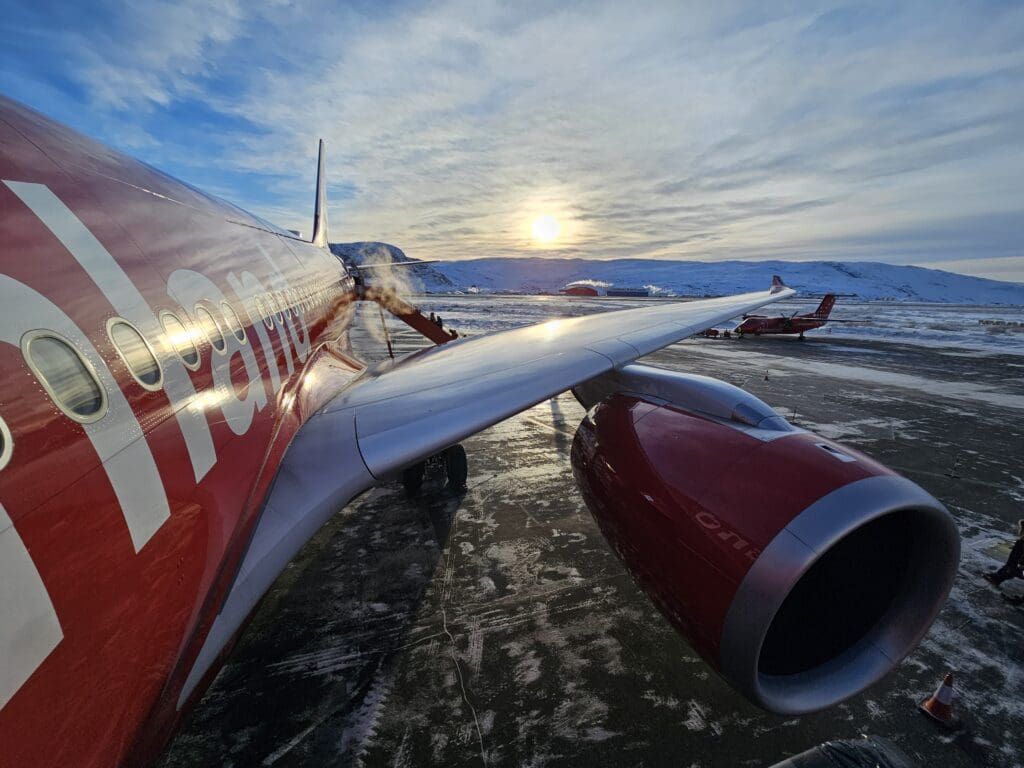
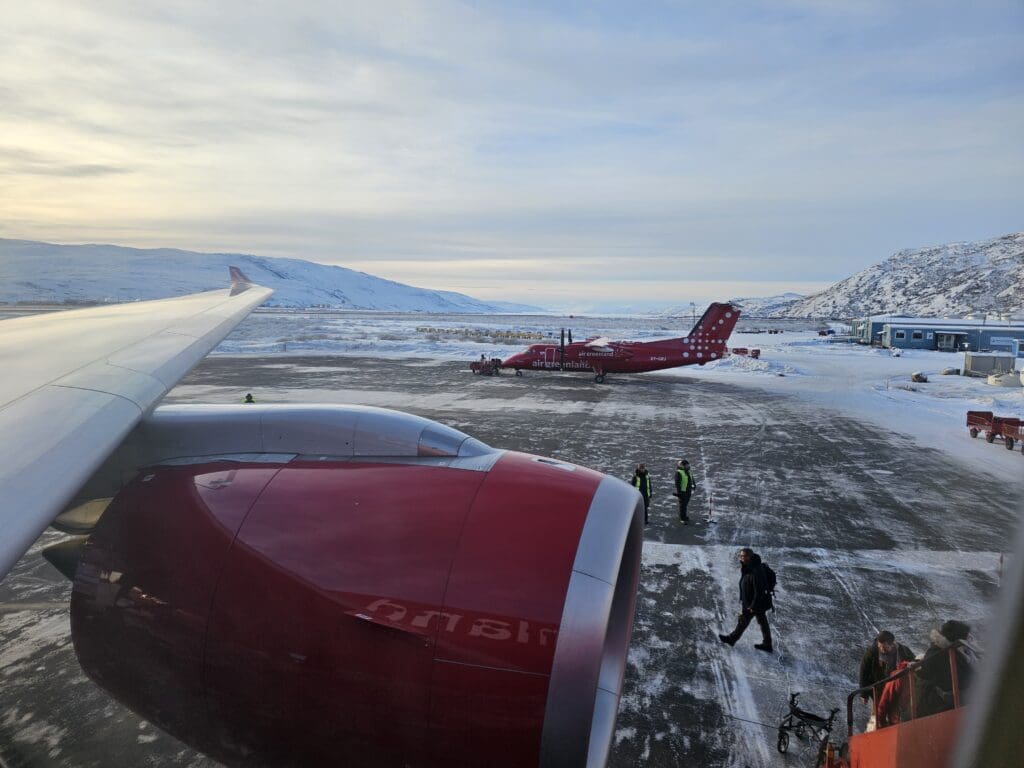
Skirting around the Tuukkaq’s shining red nose, I snapped a few photos before making my way up the airstairs, allowing for a superb view of the Airbus’ modern Rolls-Royce Trent 7000-72 engines. Just before completely freezing up, I stepped into the welcoming warmth of the aircraft and entered the galley that separates the aircraft’s Premium cabin from the forward Economy section. As I did so, I received a slightly cool greeting in Danish from one of the flight attendants, contrasting with the warm and friendly welcomes that I had received on all other Air Greenland flights. Turning right, I arrived at my seat in a matter of seconds and after stowing my bag in the overhead locker, I sat down and settled in for the ride ahead.
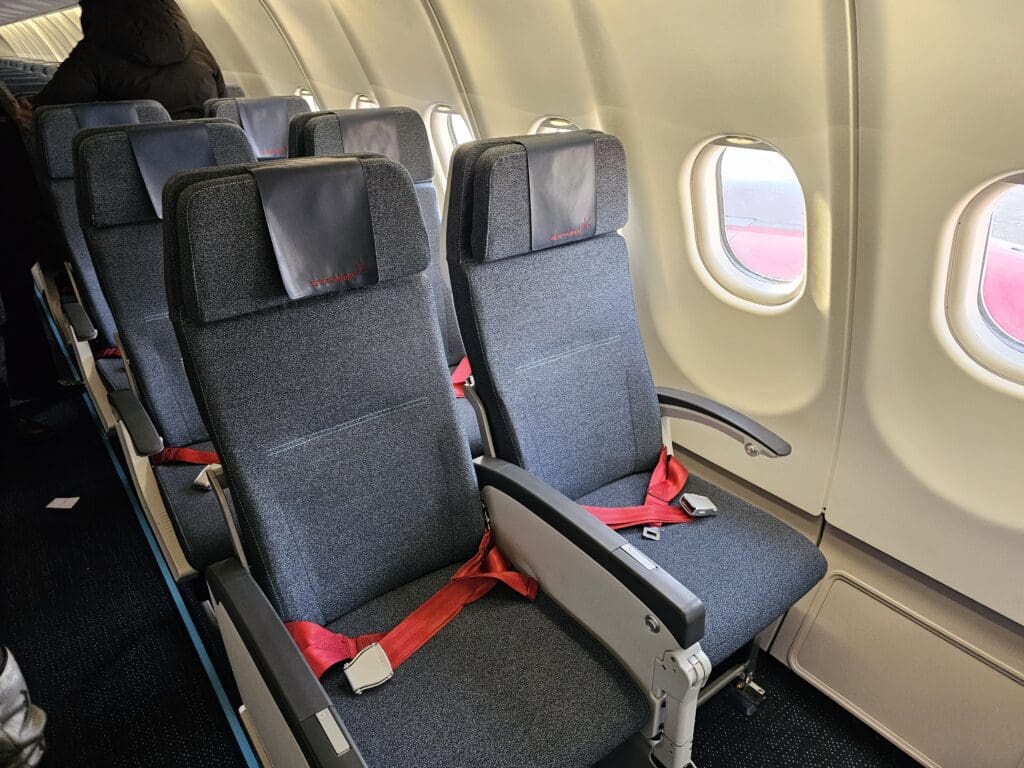
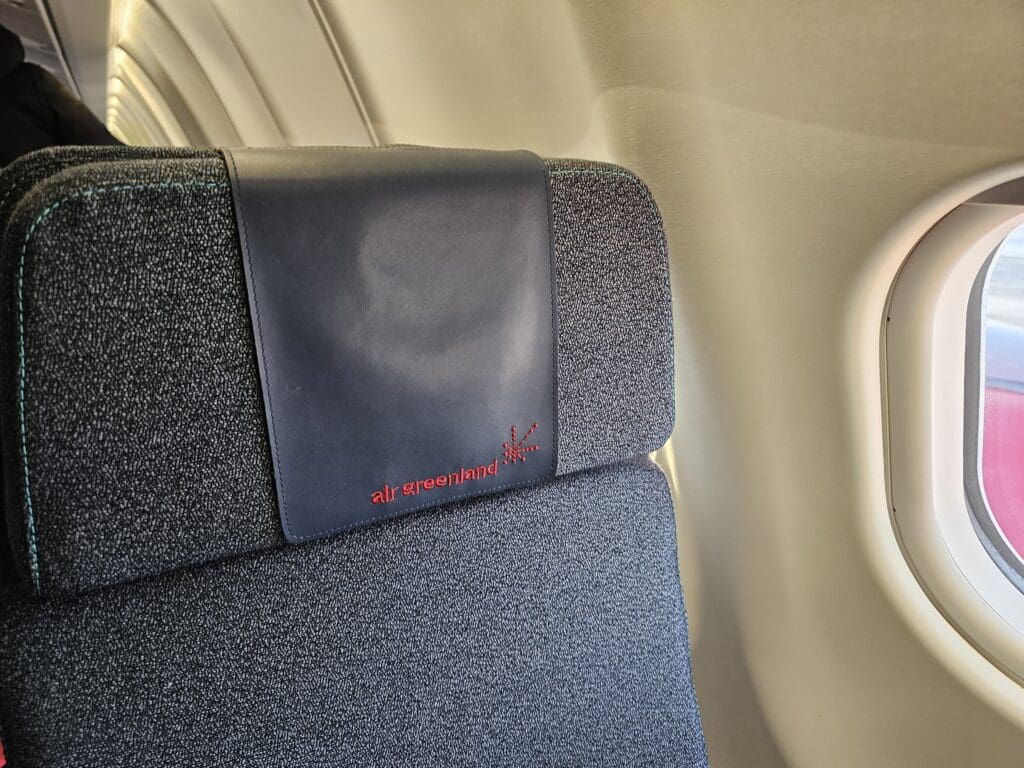
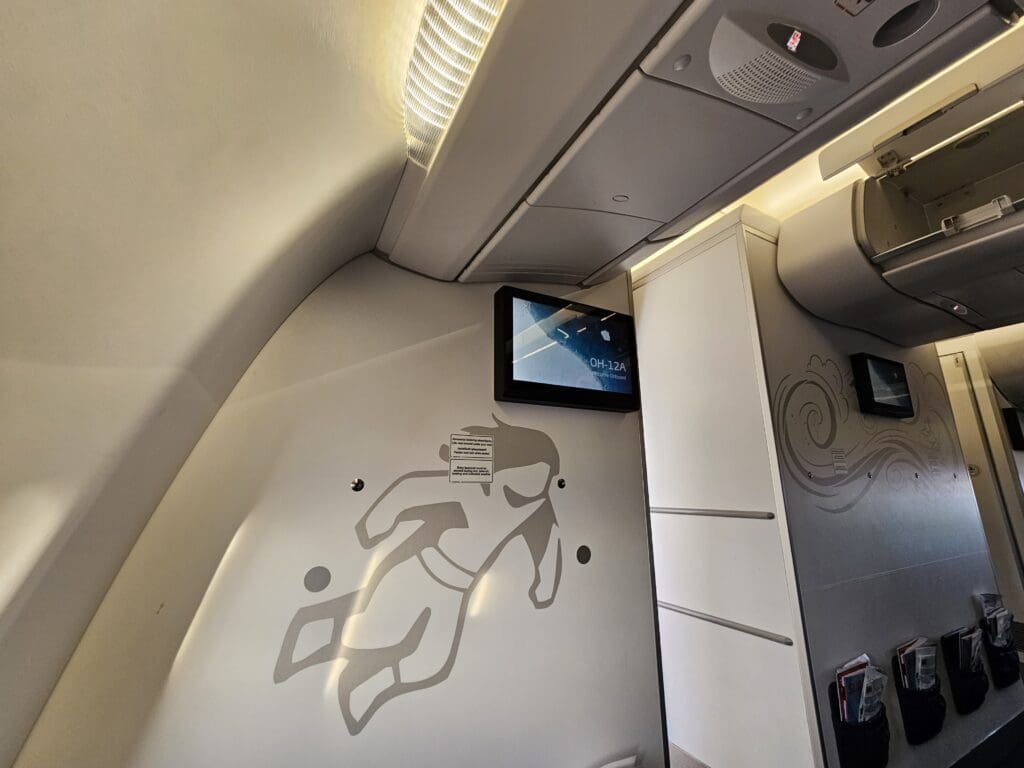
Given the young age of the aircraft, Tuukkaq features a sleek, modern and smart cabin. In Economy, each seat comes in the form of the Recaro Safran Z316, with these arranged in a 2-4-2 configuration. These are covered in a smart grey fabric cover, whilst leather antimacassars cover each seat’s adjustable headrest. Meanwhile, entertainment is provided in the form of high-definition inflight entertainment screens powered by Safran’s RAVE 3 system. Additionally, Air Greenland has further customised the aircraft’s cabin, with graphics depicting the ‘Myths of Asiaq, the spirit of wind and weather’ seen on the cabin bulkheads, providing a rather unique interior. Once seated, I examined the area around my seat and was pleased to find this to be in a clean and tidy state with few signs of wear and tear. Being a bulkhead seat, both the tray table and inflight entertainment screen could be pulled out from the armrest, whilst a pocket on the bulkhead contained a safety card, a wifi information card, a sick bag, a duty free catalogue and the latest copy of Air Greenland’s Suluk inflight magazine.
As passengers streamed onto the aircraft, calming music rang out, interrupted every few minutes by trilingual announcements regarding seatbelts, the correct stowage of baggage and charging devices. Meanwhile, looking outside, I watched as the Dash 8 Q200 that had delivered me from Ilulissat noisily headed off on its next mission, heading back to Ilulissat with a stop in Aasiaat – the same flight that I had made several days earlier. Beyond this, the clear conditions offered a good view down Kangerlussuaq Fjord, serving as a reminder that I was departing from what is far from your typical airport!
That afternoon, passengers boarded fairly quickly and I was soon joined by a neighbour who emitted a fairly heavy scent of a mixture of beer and cigarette smoke, and by 1334, the final passenger could be seen making their way onto the aircraft. Later, walking around during the flight, I would estimate the load to have been around 70%, with a fair number of empty seats spotted in the rear Economy cabin. As with the flight to Kangerlussuaq, those onboard seemed to be a fair mix of passengers from Denmark, Greenland and elsewhere, with many taking the form of tourists and workers, as well as those heading to Denmark for a variety of other reasons such as medical treatment and study. Running an efficient operation, as soon as the final passenger had boarded the jet, the door was closed, and the steps were backed away from the aircraft. Inside the cabin, at this time, the Purser performed their trilingual welcome announcement, consisting of the usual welcomes, thanks and warnings, and before I knew it, the aircraft was slowly pushed back away from its parking position. As had been the case on the outbound leg, strangely, whilst the inflight entertainment system featured a safety video, this was not played and instead a manual demonstration was made whilst the Purser read through the safety instructions.
As we neared the end of our short pushback, the Airbus’ two Rolls-Royce engines powered into life, temporarily causing a fair amount of noise and vibration before quieting down as the flaps and slats were lowered into position. Given the small size of Kangerlussuaq Airport and the fact that we would be departing from Runway 27, once moving under our own steam, the Airbus reached the end of the runway in no more than a minute. With no need for any holding, the Airbus taxied onto the runway, came to a halt and paused for a few moments.
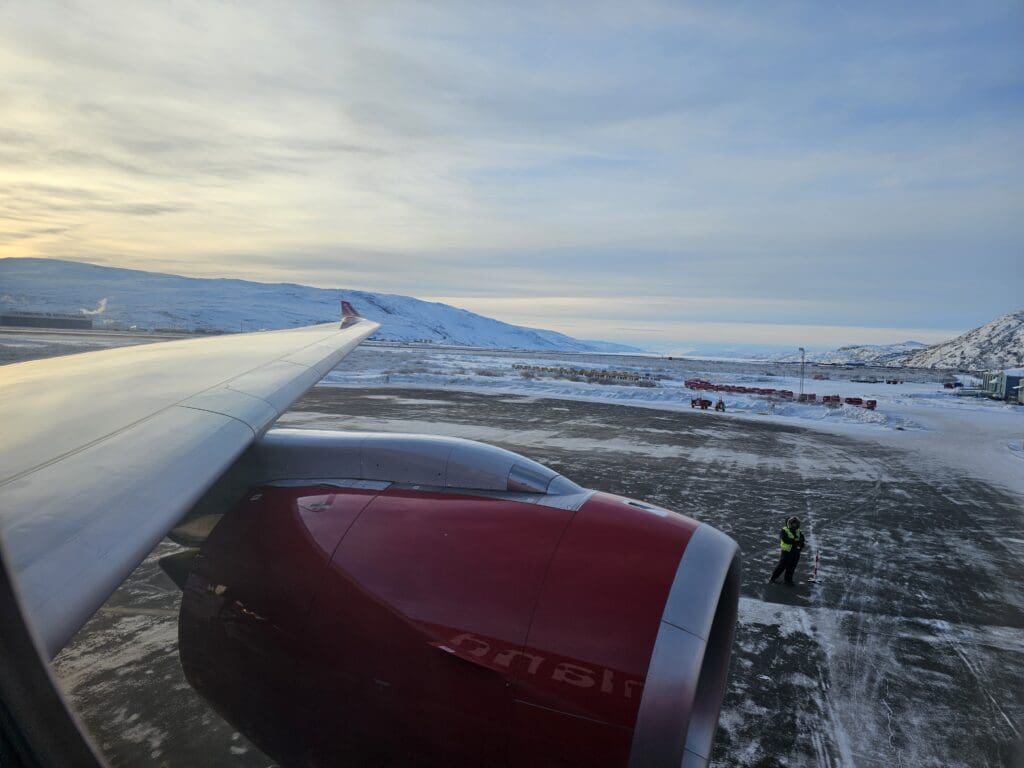
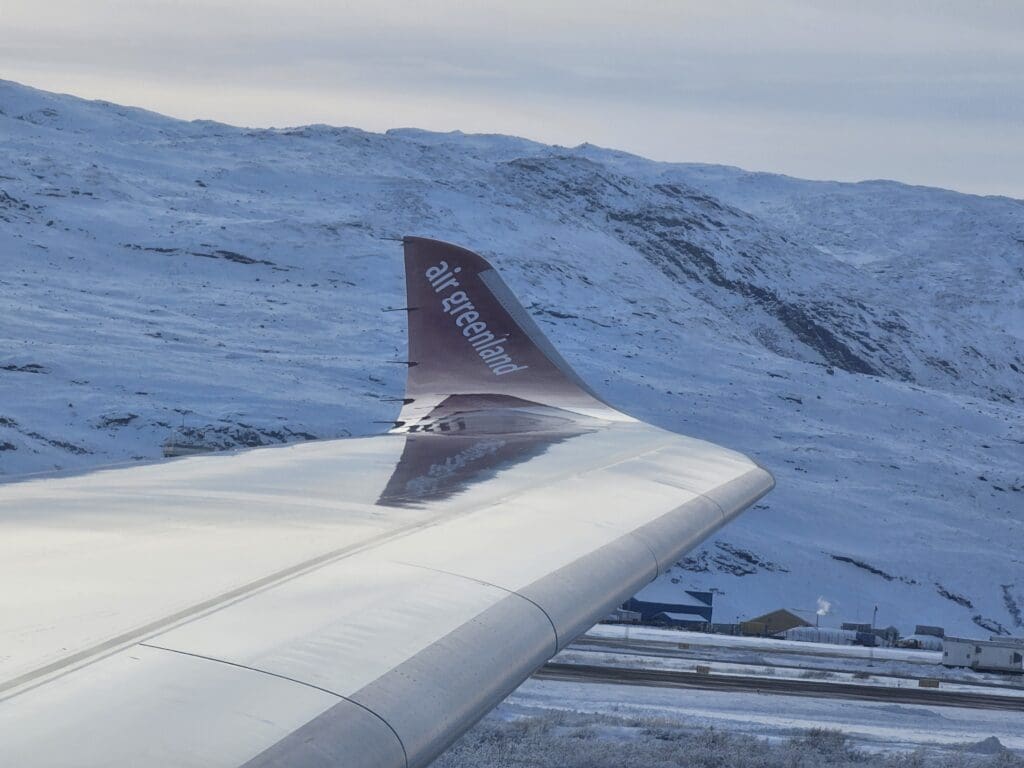
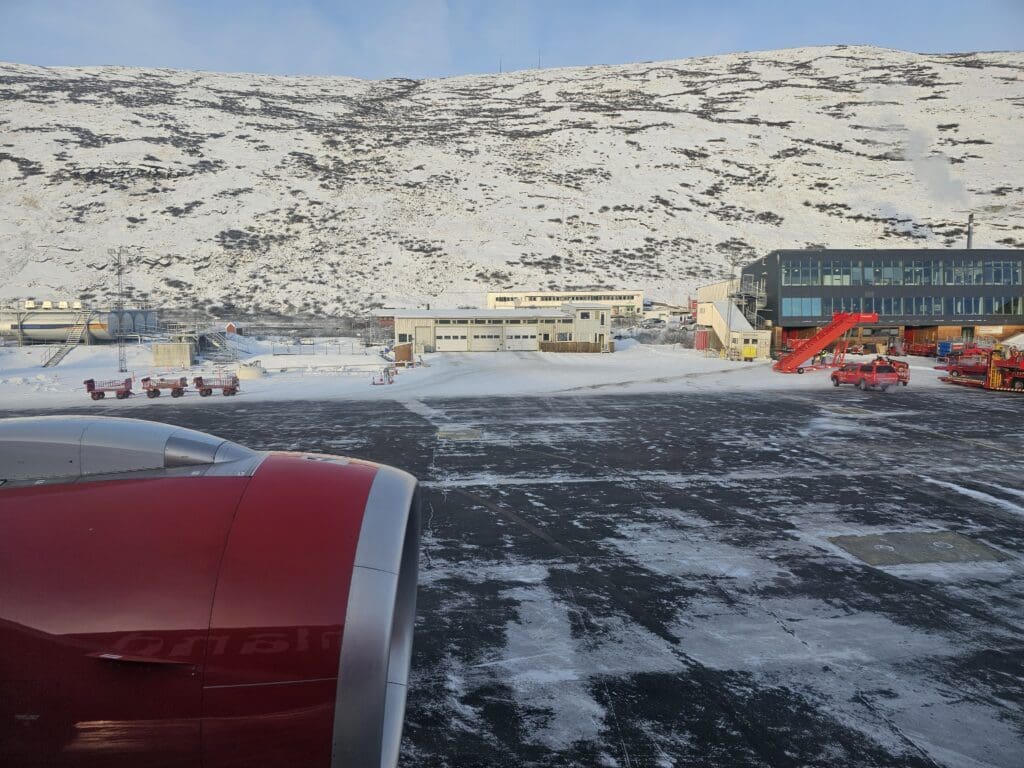
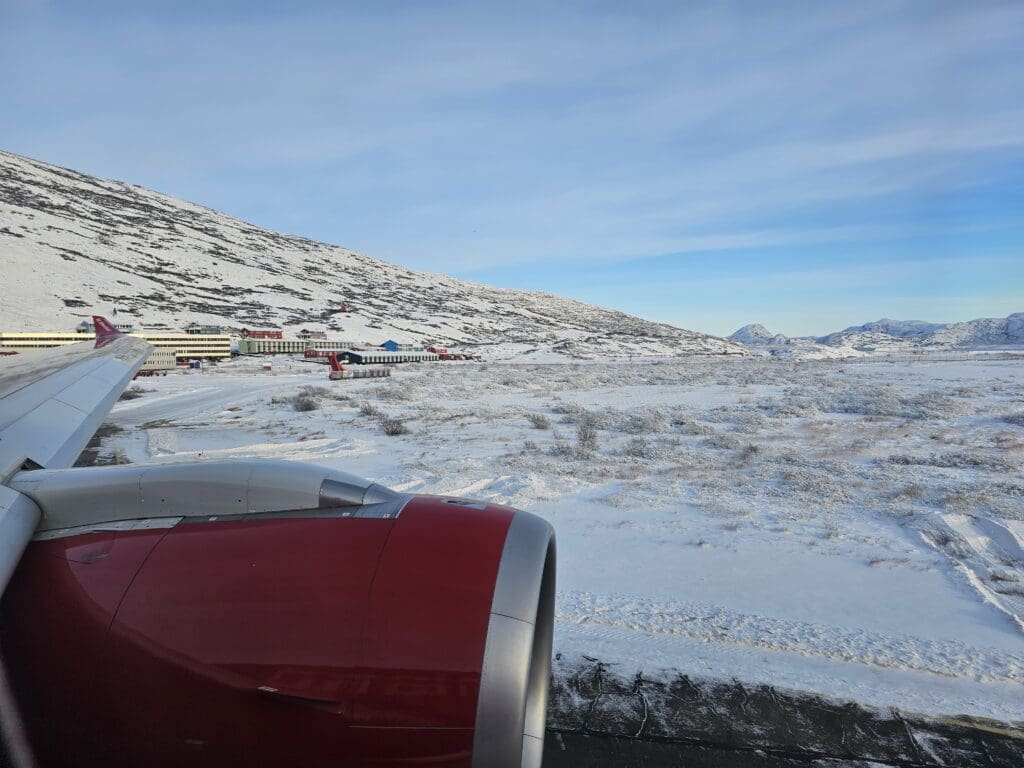
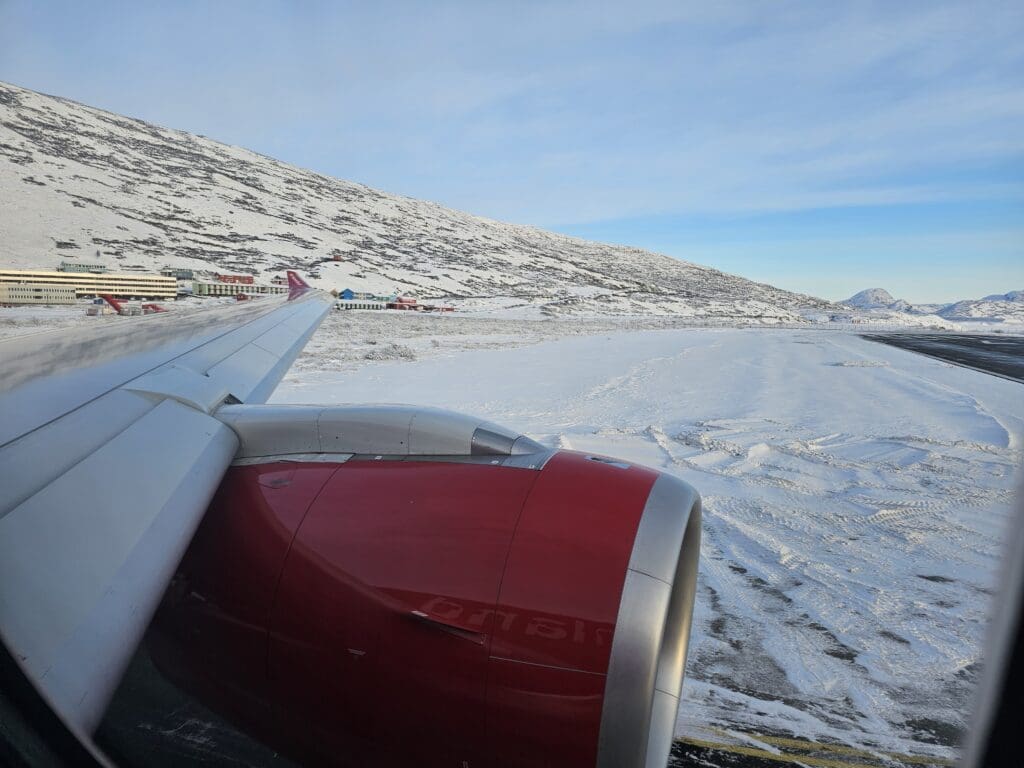
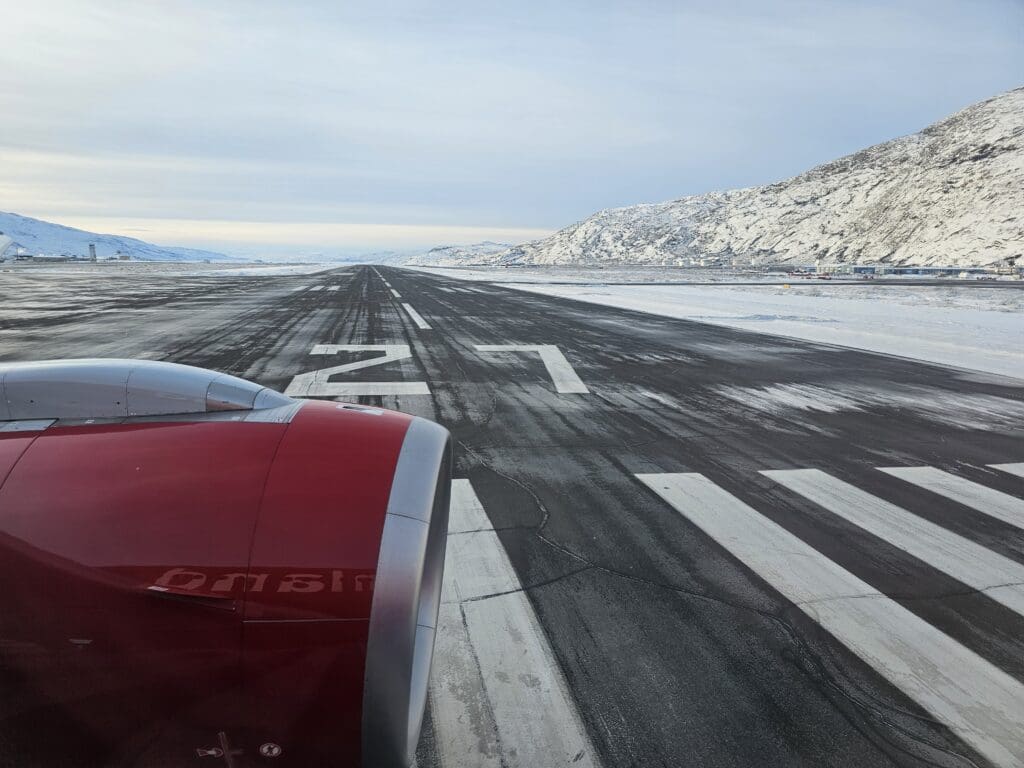
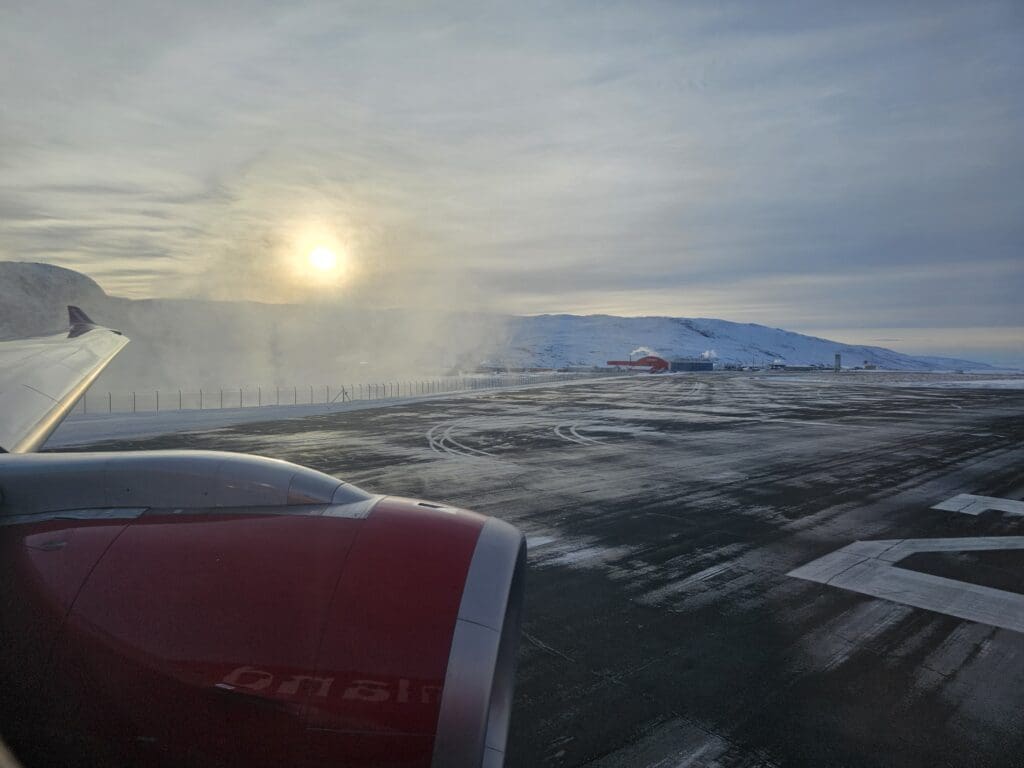
Following our short pause, the two engines spooled up, blowing plenty of snow and ice out of the way before the brakes were released, causing us to go flying down the runway. Accelerating past the hangars on the south side of the runway, which are home to Air Greenland and the Danish military’s Arctic Command, the nose was soon pointed skywards, and we rotated upwards into the sunny Greenlandic skies with the usual shakes and shudders. Soon leaving Kangerlussuaq Airport behind, the aircraft made its way down Kangerlussuaq Fjord and rose above the high ground on either side of this before gently banking to orientate us in the direction of Copenhagen.
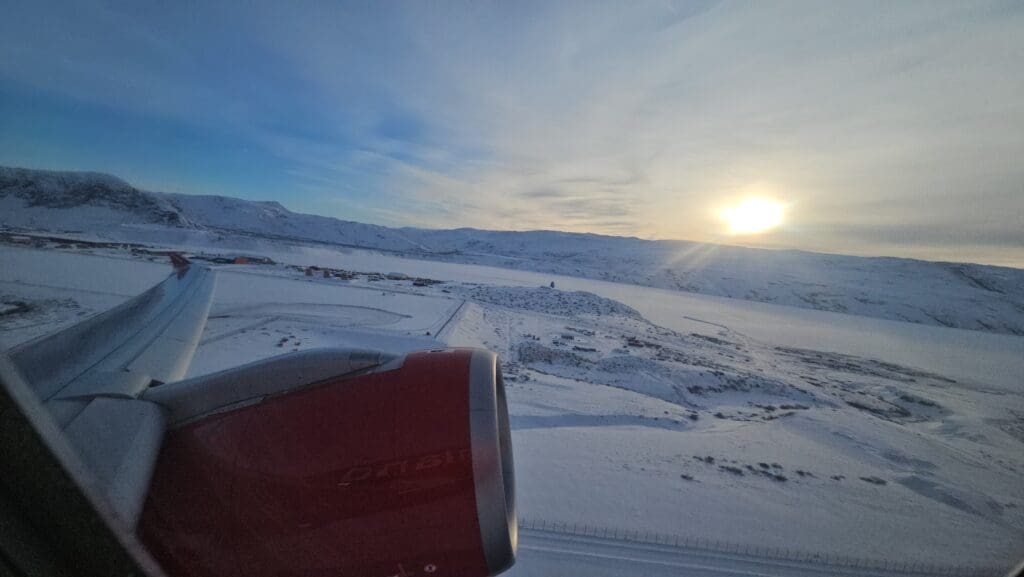
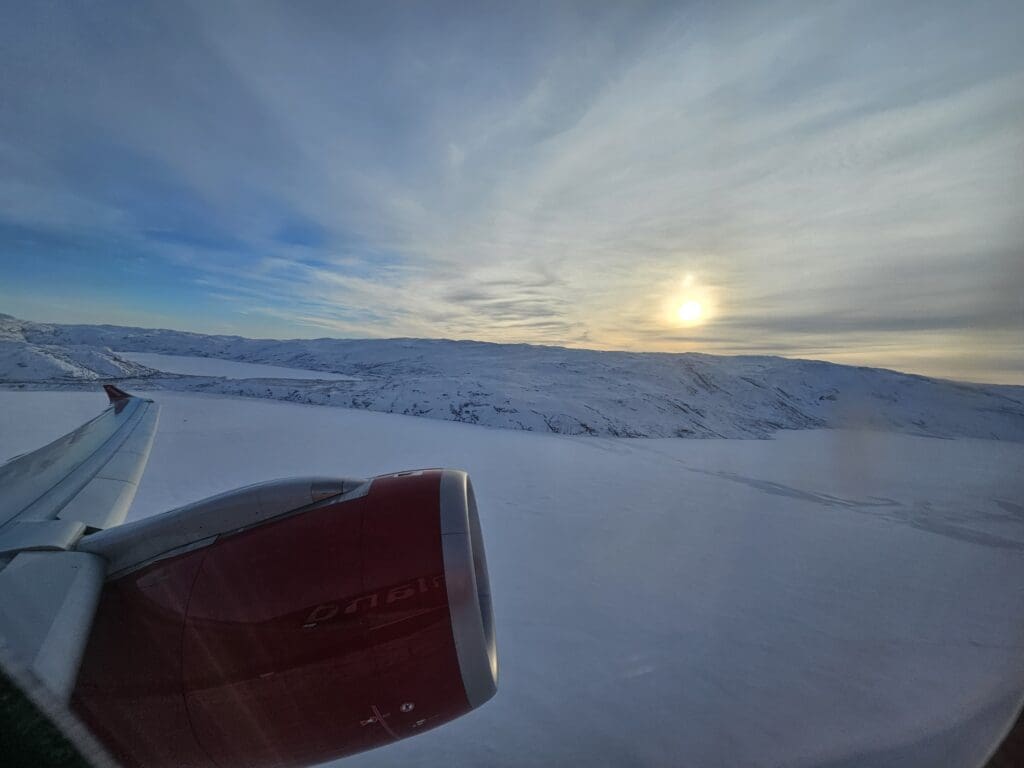
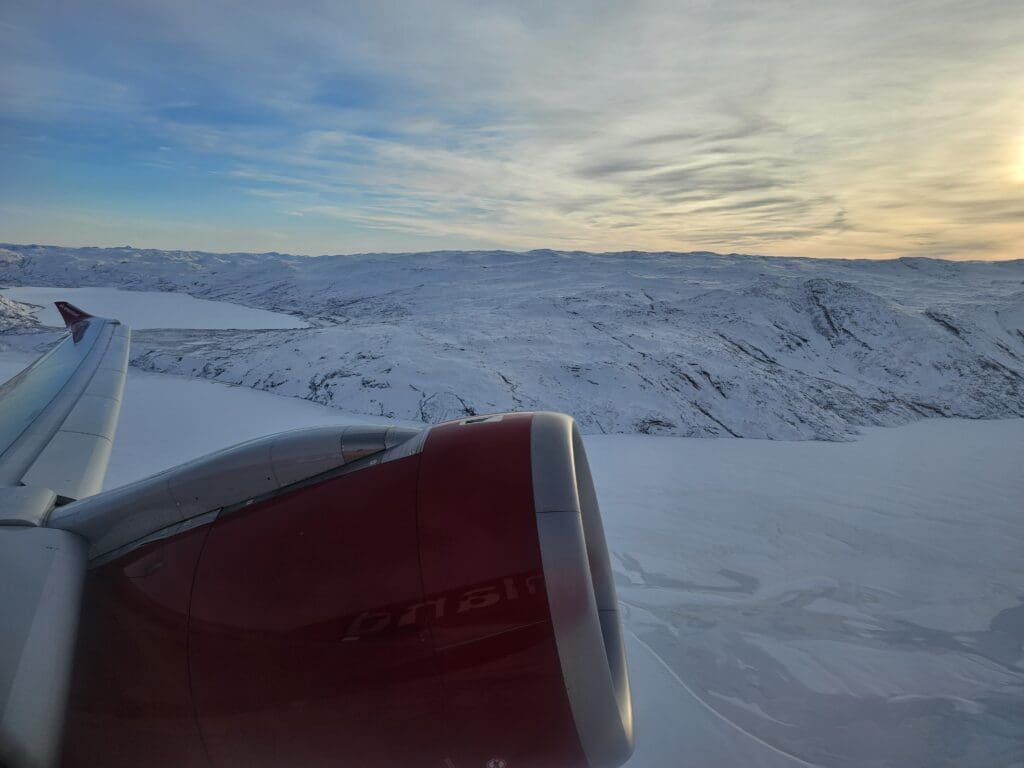
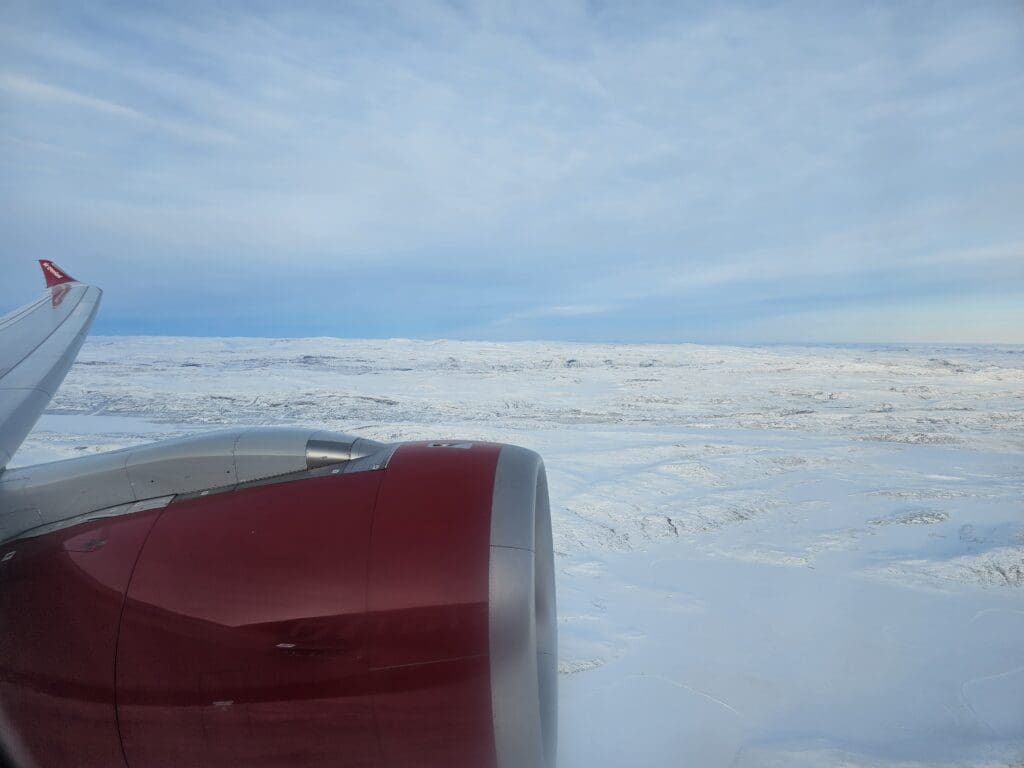
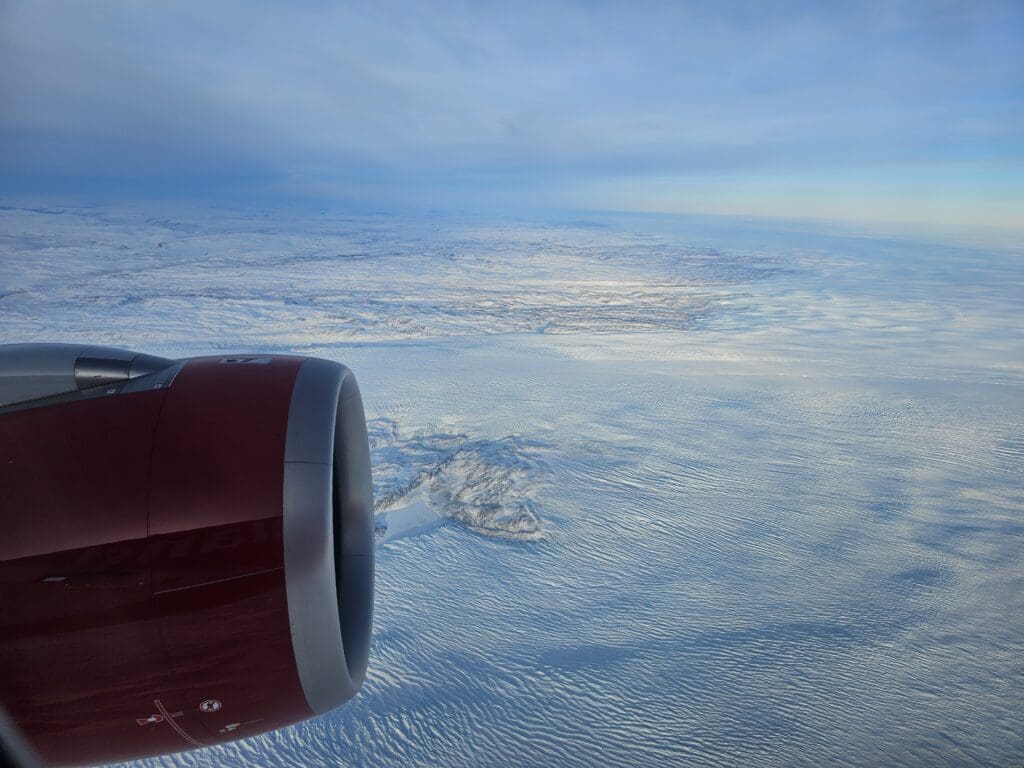
Once heading eastwards, it wasn’t long before Greenland’s rocky hills and mountains were replaced by the seemingly endless icecaps that cover most of Greenland. With our climb having proven to be a mostly smooth affair, it wasn’t long before the seatbelt signs were extinguished as we climbed through 10,000 feet at which point the usual announcement was made encouraging passengers to stay buckled up when seated and reminded passengers that smoking was prohibited onboard the aircraft. From this time, a fair amount of clattering could be heard from the galley ahead, indicating that preparations for that day’s late lunch (or early dinner) service were underway.
Despite being a full-service airline, those who do not have any wired headphones and wish to enjoy the delights of Air Greenland’s entertainment system have no option other than to purchase these onboard, with no complimentary headphones provided to those in Economy. Thus, as we neared the final stages of our climb up to 41,000 feet, several flight attendants passed through the cabin with baskets of headphones and a card reader, with these sold for 35 krone (£3.96). Having no intention of watching anything, I decided against splurging out and purchasing what appeared to be standard economy class quality earbuds. At this stage of the flight, I extended my screen in the hope of charging my phone using the USB-A port beneath it. However, sadly, I was out of luck as this failed to charge my device or even sustain its battery level.
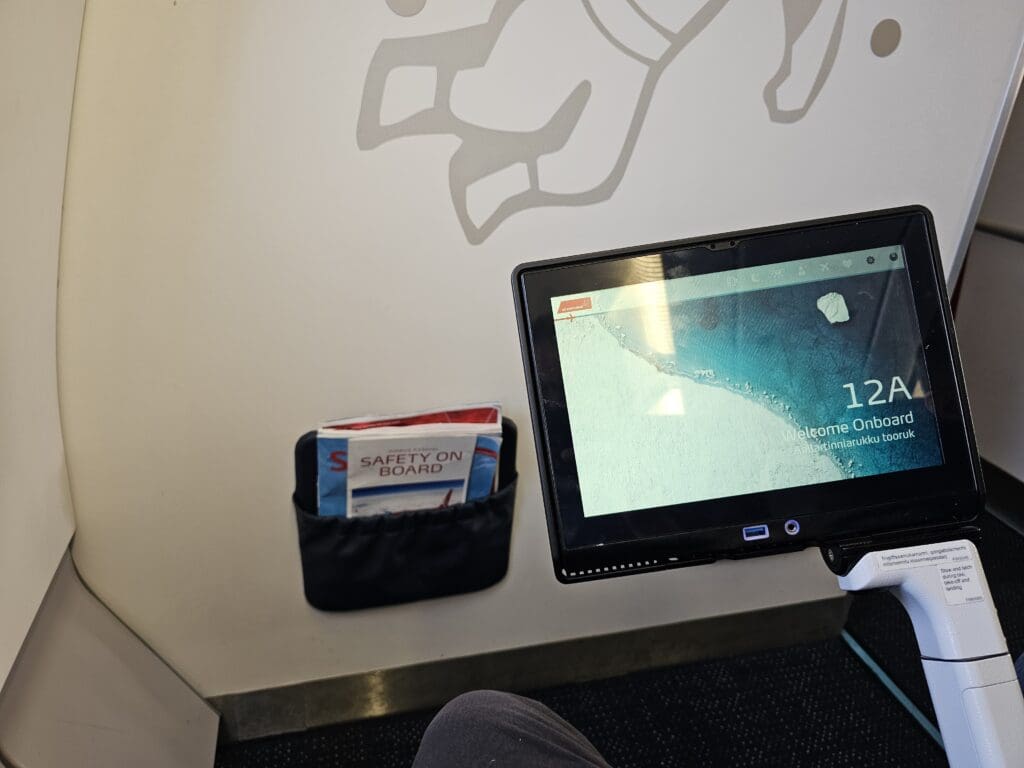
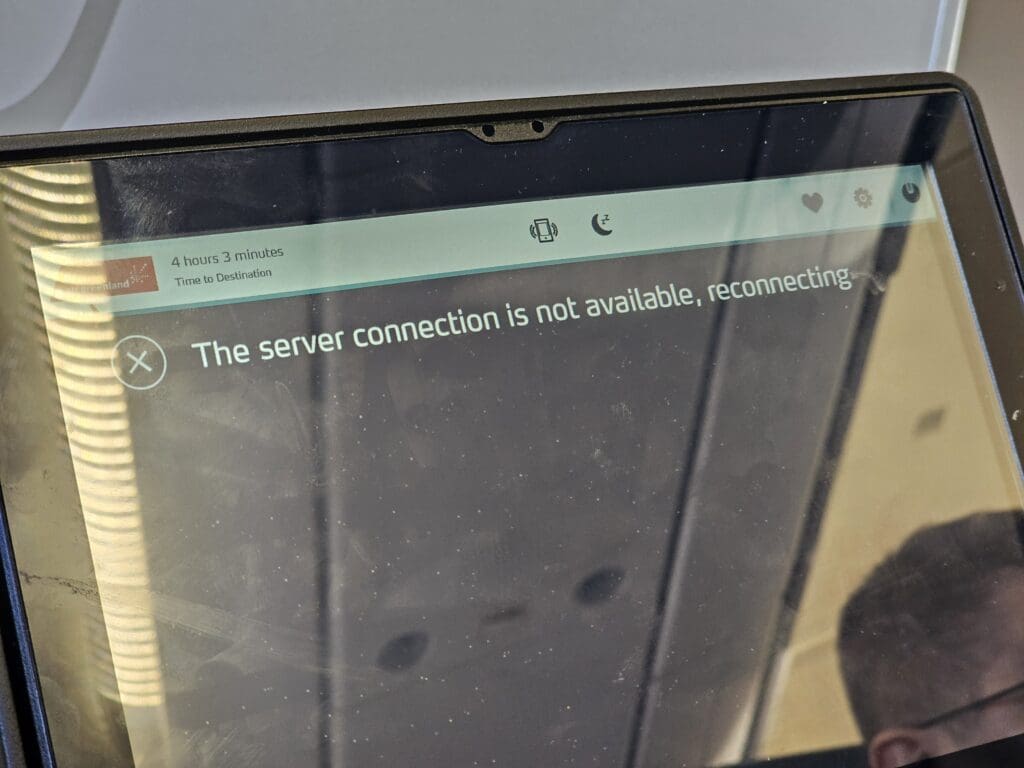
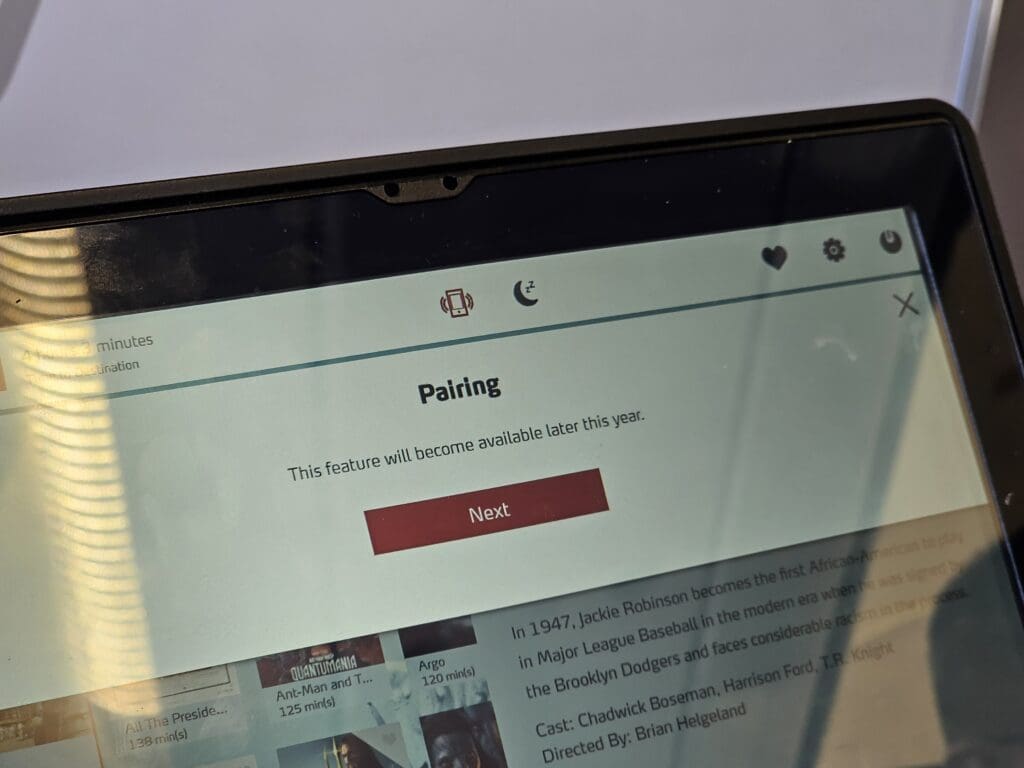
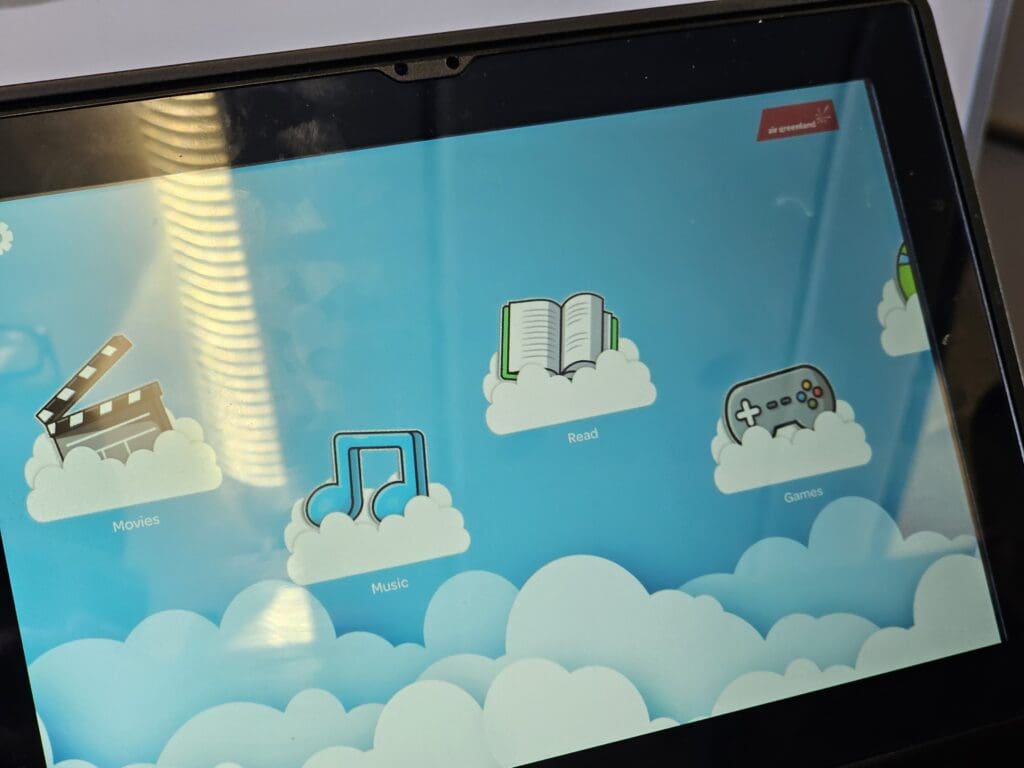
Once I turned the screen on, I played around with the inflight entertainment system. This is modern, sleek and available in the three languages that you would expect from Air Greenland’s system – Danish, English and Greenlandic. Furthermore, this is home to both a normal system and a kids system, the latter not always being available, even on some of the world’s larger airlines! Given the size of Air Greenland and the fact that their Airbus A330 is the airline’s only aircraft fitted with an inflight entertainment system, content-wise, this is unsurprisingly not as expansive as those of many other airlines. However, this still offers a reasonable selection of 78 films. The majority of these take the form of Hollywood blockbusters, whilst three Greenlandic films could also be found alongside several Danish productions. For those preferring to listen to music, a total of 32 albums, all by Greenlandic artists, could be listened to inflight. Meanwhile, this system is also home to five games and plenty of content related to both Greenland and the airline, including destination guides for many of the airline’s destinations across the country. Last but not least, a FlighPath 3D interactive moving map could be found on the system along with cameras looking both forward and down; however, sadly, none of these seemed to work on the return leg to Copenhagen, which was a slight disappointment. In addition to the inflight entertainment screens, wifi is provided for those needing to stay connected whilst onboard. This is complimentary for those in Premium Class and can be accessed for a flat fee of $6 for all others to remain connected for the entire flight. Whilst I did not need to connect to the internet, assuming that this worked, this seemed to be a very good deal and significantly cheaper than five hours of wifi on many other airlines.
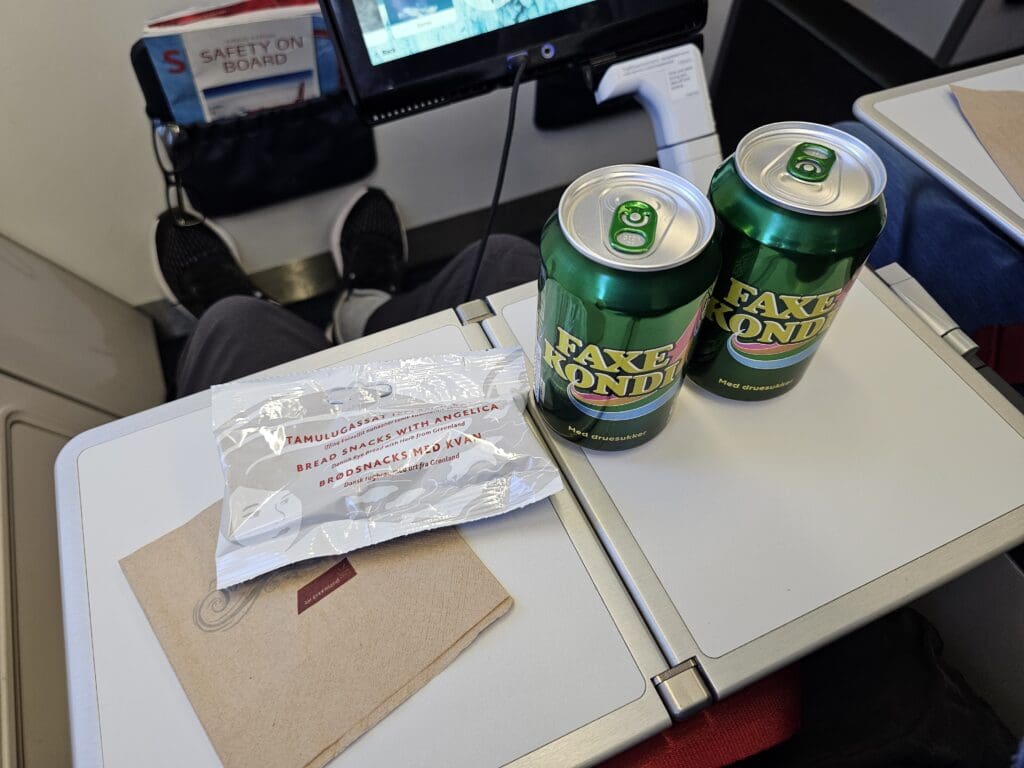
Around thirty minutes after rocketing into the skies above Greenland, the inflight service commenced. Just like on the outbound flight, this commenced with a generous drinks round, with passengers offered two drinks accompanied by a rye bread-based snack in a fancy Air Greenland packet. This was then followed by a cold light meal. With the service starting from the rear of the cabin, once the service carts had been rolled out into the aisles, it took a fair while before I was offered a drink. Unfortunately, once one of the flight attendants reached me, I can’t say that they were particularly warm and friendly, undertaking this service in a very cool manner and with minimal dialogue. However, on the plus side, Air Greenland offers passengers a fairly reasonable selection of complimentary drinks. Namely, 500ml bottles of water (still, sparkling and lemon flavoured), 330ml cans of Coca-Cola, Diet Coke, Faxi Condi and Fanta, and apple and orange juice. Meanwhile, those fancying a tipple could opt for red or white wine, and 330ml cans of Carlsberg (regular and non-alcoholic) and Tuborg. Opting for the Danish fizzy drink Faxe Kondi, I was handed two 330ml cans.
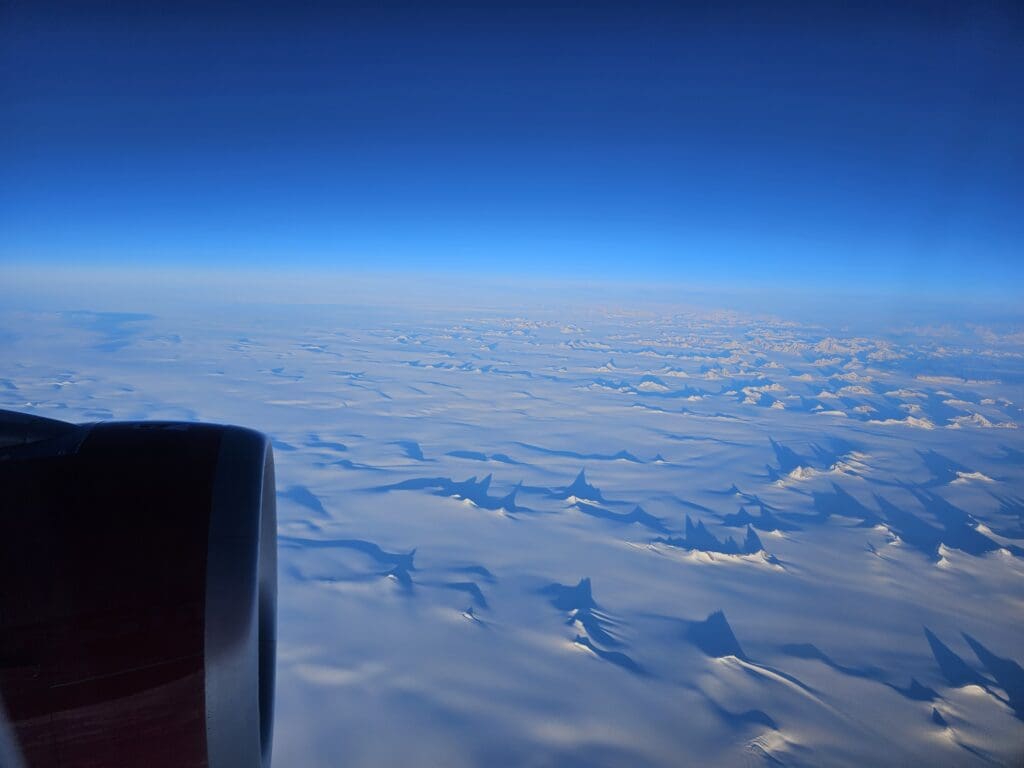
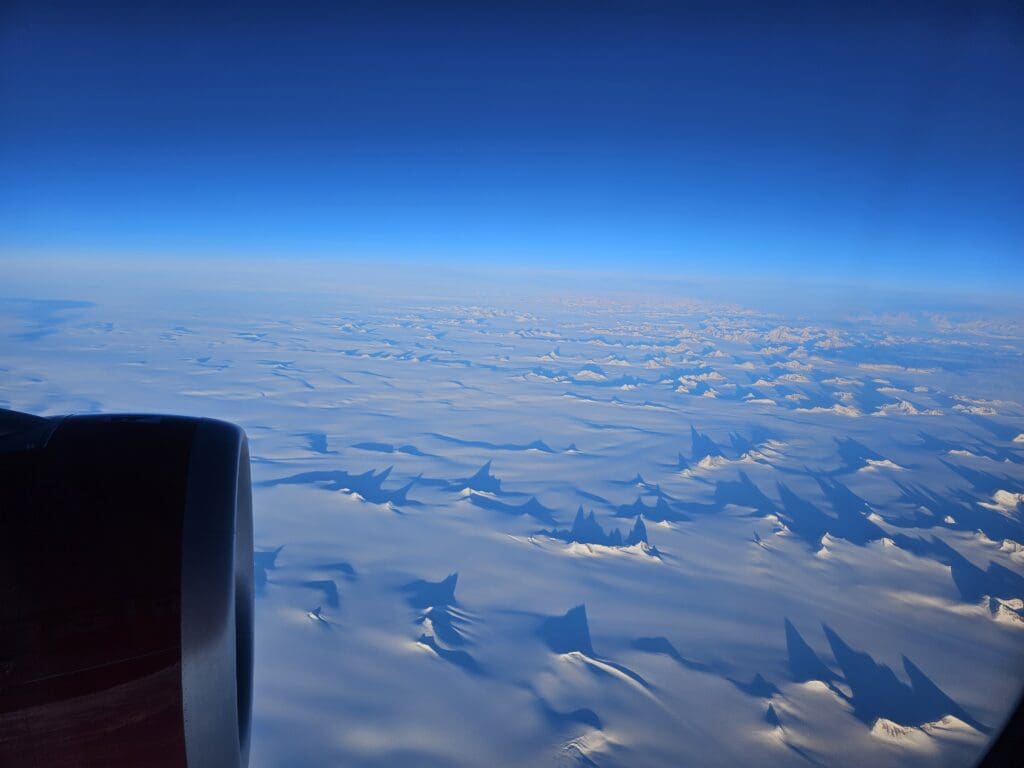
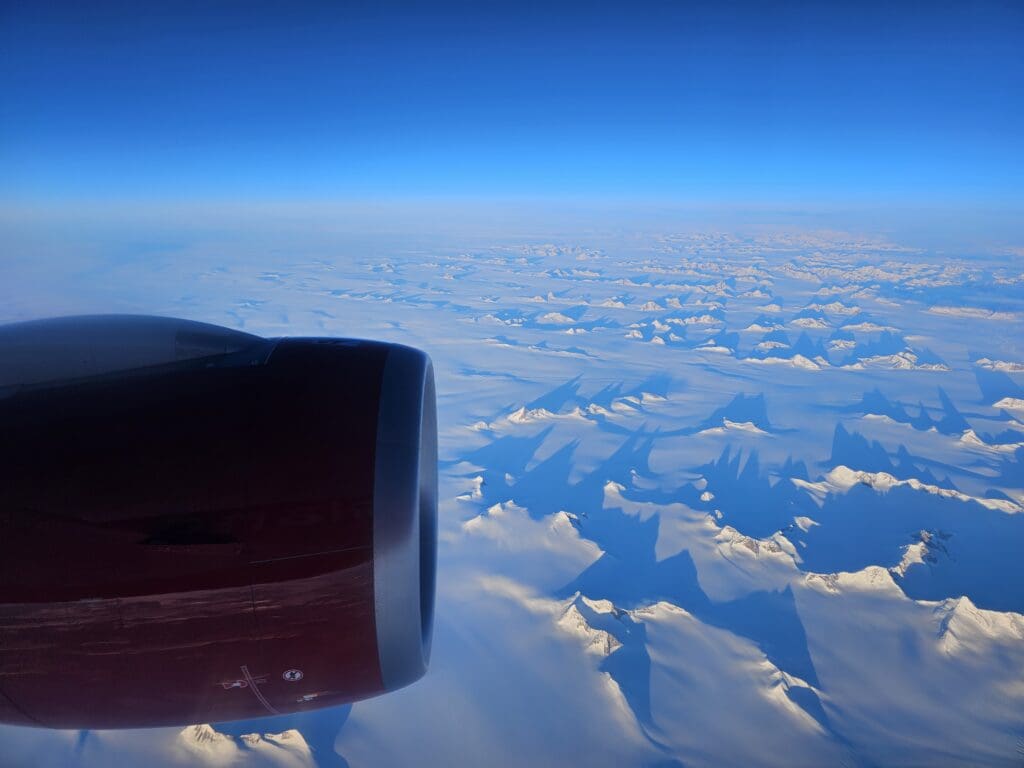
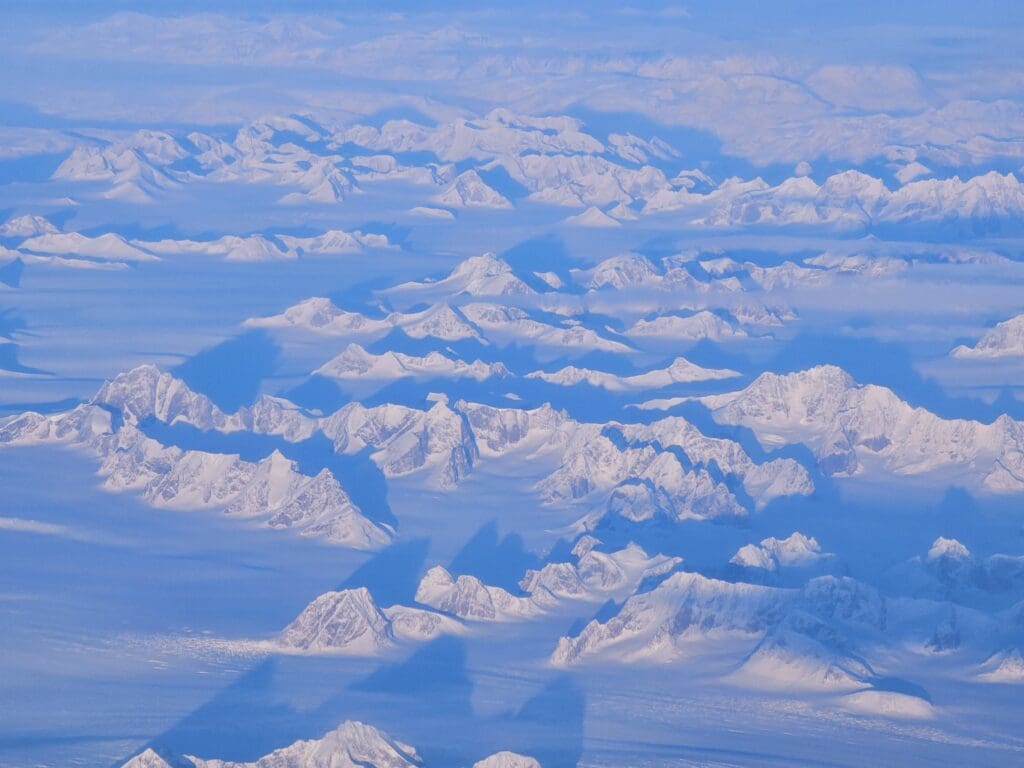
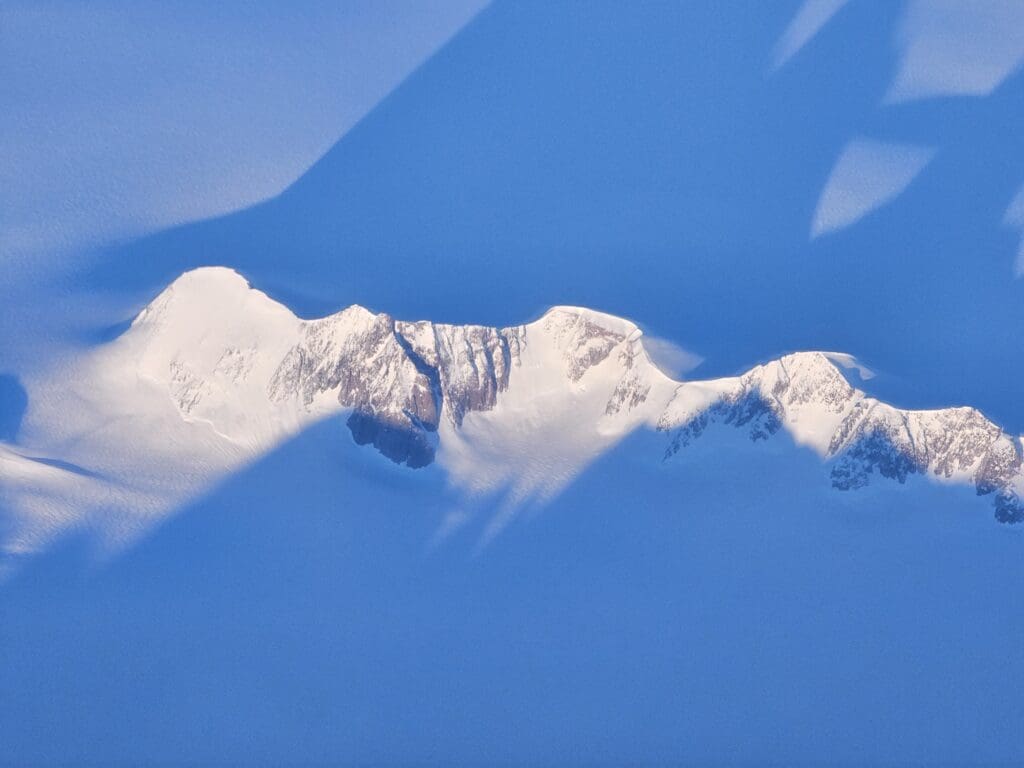
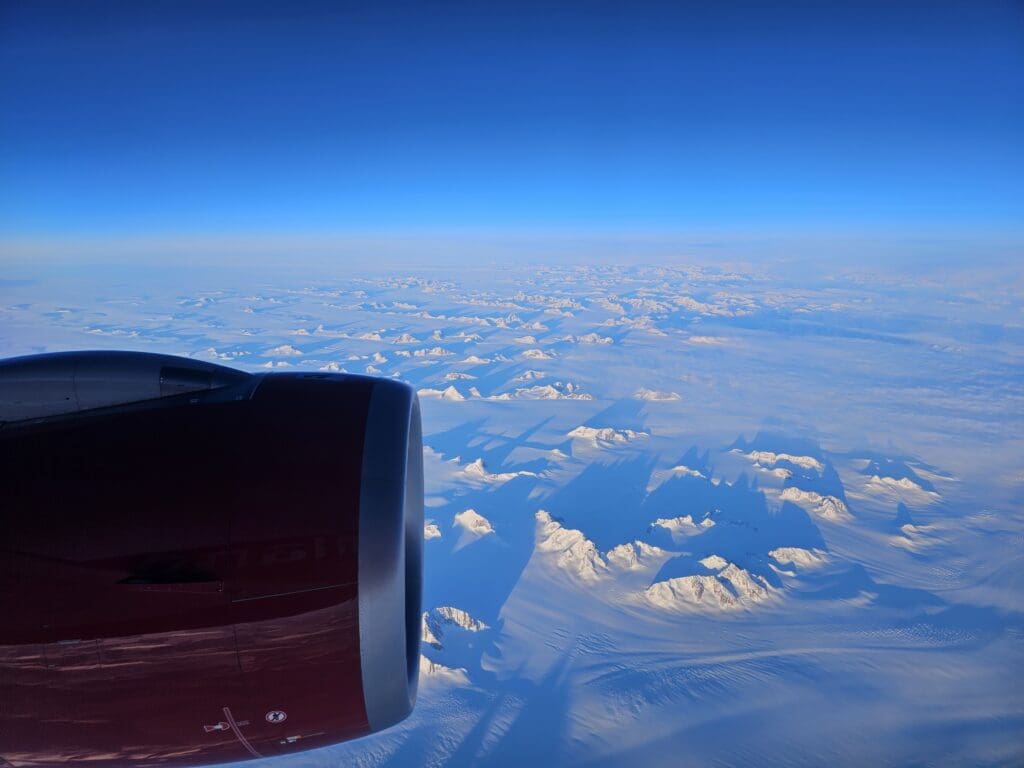
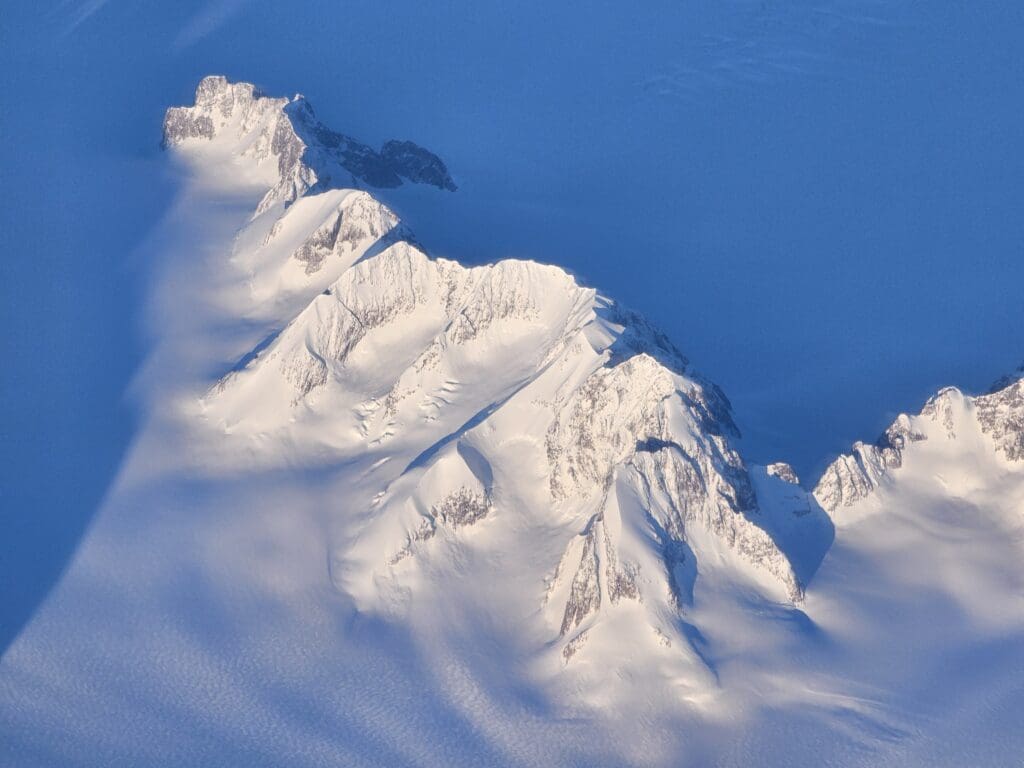
As I sipped on my Faxi Condi, the Greenlandic Captain commenced their first announcement of the flight, doing so in Greenlandic, Danish and English. This consisted of the usual welcomes and thanks, an overview of our route, the weather in Copenhagen (which was to be a relatively tropical seven degrees!) and advised the passengers of our estimated time of arrival, 2055. Looking outside, virtually nothing could be seen other than the vast remote icecaps as we crossed over into the skies of East Greenland. However, as we edged towards the country’s eastern coastline, the impressive sight of clusters of jagged peaks could be seen poking out from the land below.


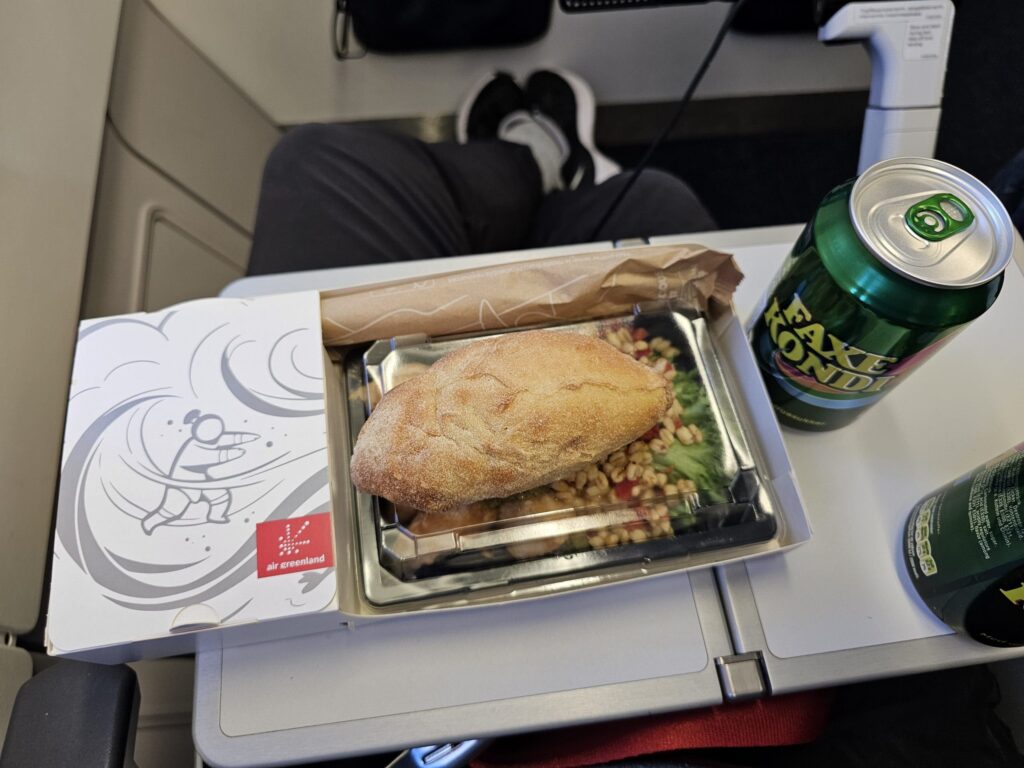
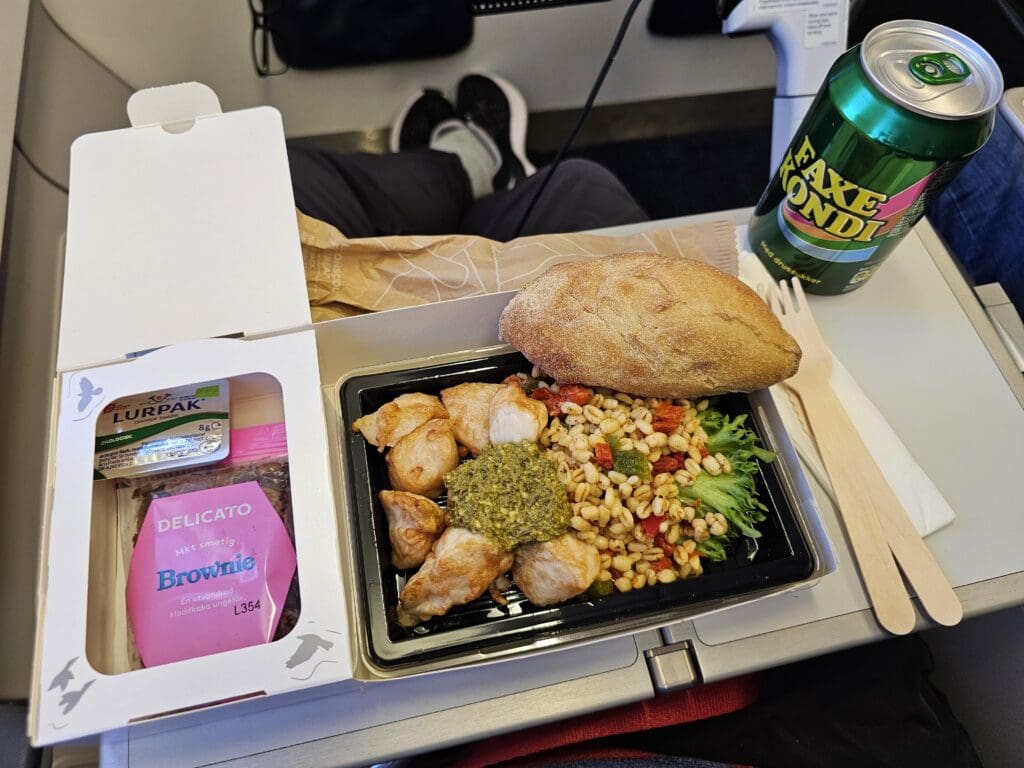
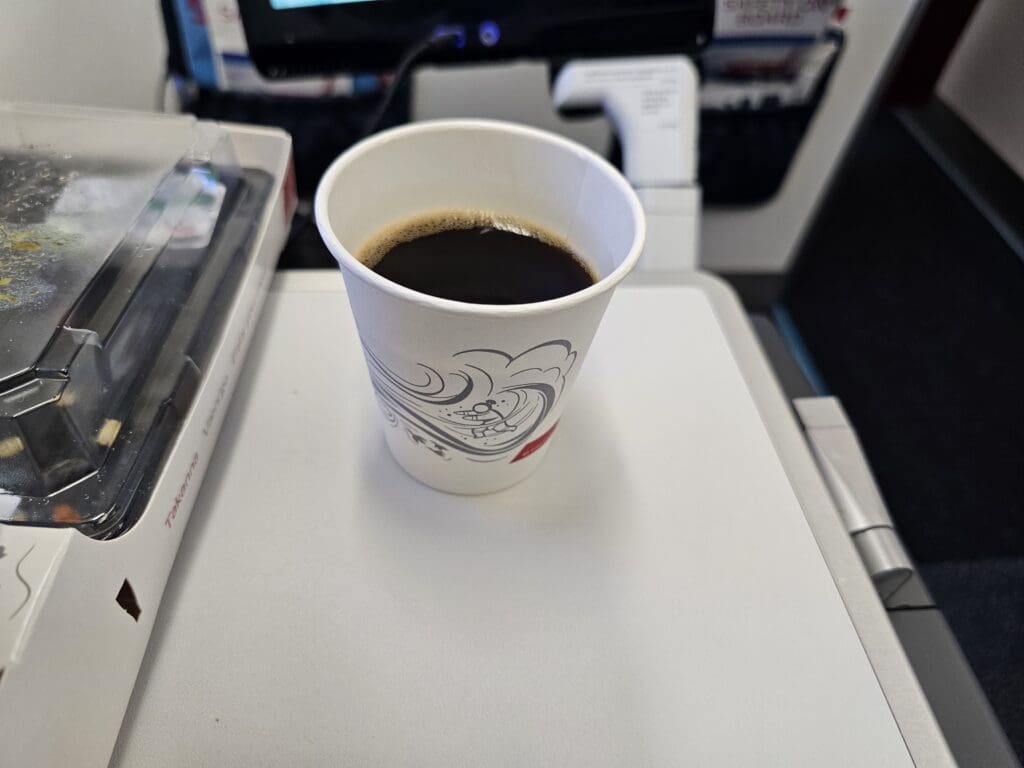
Around an hour into the journey, the service carts were rolled out once again and the meal service commenced. A short time later, without a word, I was handed a rather nicely designed Air Greenland box which proved far more attractive than the plastic container that I had been served on my flight over from Copenhagen. This contained a cold main dish of chicken and barley salad with green pesto, a warm bread roll, a small sachet of Lurpack butter and a brownie, Meanwhile, this came with a sachet containing the usual accompaniments and sustainable wooden cutlery. Seeing as I hadn’t eaten since breakfast, by this time, I was rather hungry and soon got to work on this meal. Overall, this hit the spot and left me with nothing to complain about, being of good quality and quantity, and seemingly healthy for an inflight meal. A few minutes later, this was followed by a round of tea and coffee, followed ten minutes later by another round. Meanwhile, the crew seemed to take no issue in handing out additional drinks to those who requested these, with my neighbour accumulating an impressive total of six 500ml bottles of water during the flight!
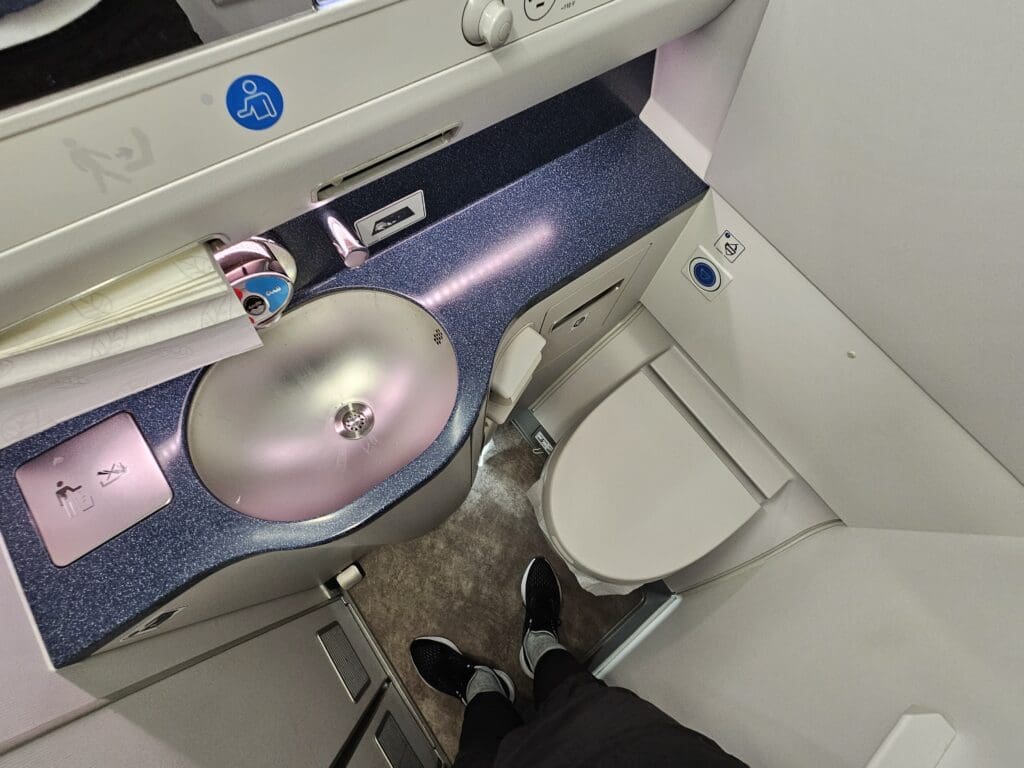
Almost forty minutes after the main meal had been handed out, the remains of this were cleared away, by which time the aircraft had left Greenland’s eastern coastline behind and was now speeding eastwards across the Atlantic. With the skies having darkened and with nothing to see below, I decided to pass the time by having a short nap as we made our way towards Iceland. This meant that I missed the inflight duty free service, although not wanting to make any purchases, this was no major issue. Once awake, I decided to climb over the legs of my slumbering neighbour and went for a short walk around the cabin before visiting one of the six lavatories available to those in Economy. Upon opening this up, I found this to be clean, tidy and stocked with all the basics, therefore leaving me with absolutely nothing to make a complaint about.
Turning to the route, after crossing the stretch of the Atlantic Ocean that separates Greenland from Iceland, the Airbus made landfall over Honstrandir Nature Reserve, located in Icelands far northwestern tip. Continuing onwards, the aircraft made its way over Iceland’s northern coastline and soon reached Akureyri, crossing over the regions of Norðurland and Austurland before reaching the western shores of the country. Following a quick crossing of Iceland, the Airbus headed eastwards and once again ventured out over the vast expanse of the eastern reaches of the Atlantic Ocean. At this time, I had another quick nap and woke up just as the aircraft was passing to the north of the Faroe Islands, indicating that we were entering the final third of our flight from Kangerlussuaq to Copenhagen. As we cruised towards Norway, the crew took to the aisles once more and began their second full drinks round of the flight. As with the first round of drinks, all passengers were offered two drinks of their choice from the complimentary menu. However, whilst being served by a different crew member, I was disappointed to find that they too were cold and distant, failing to leave me with a particularly good impression.
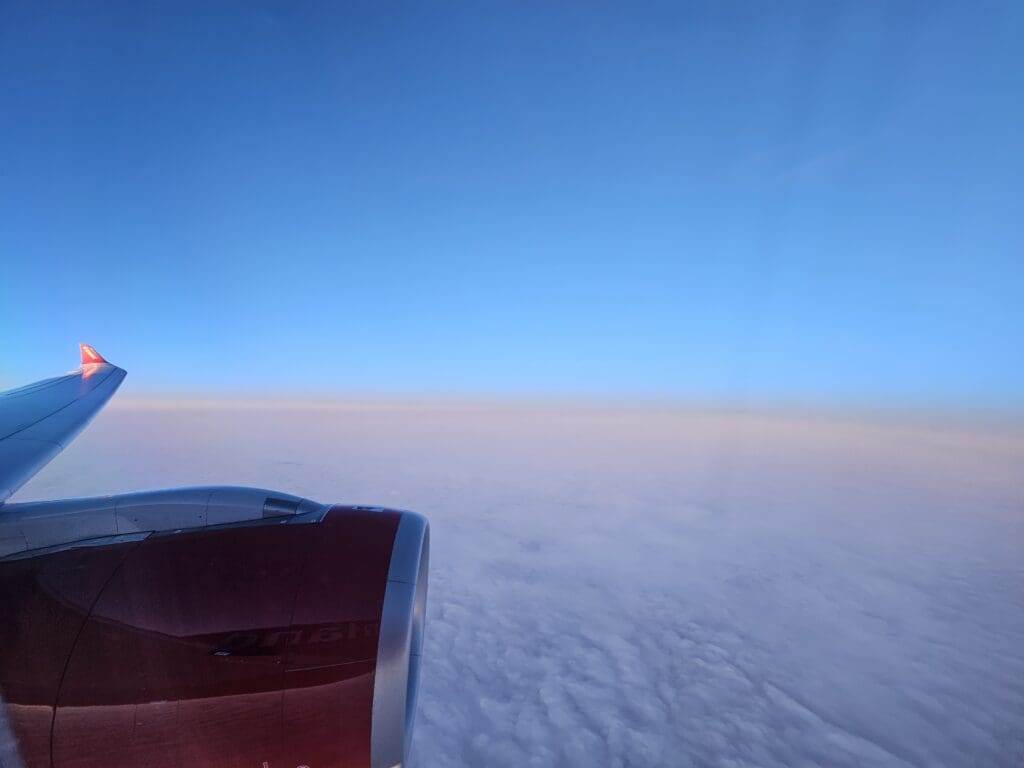
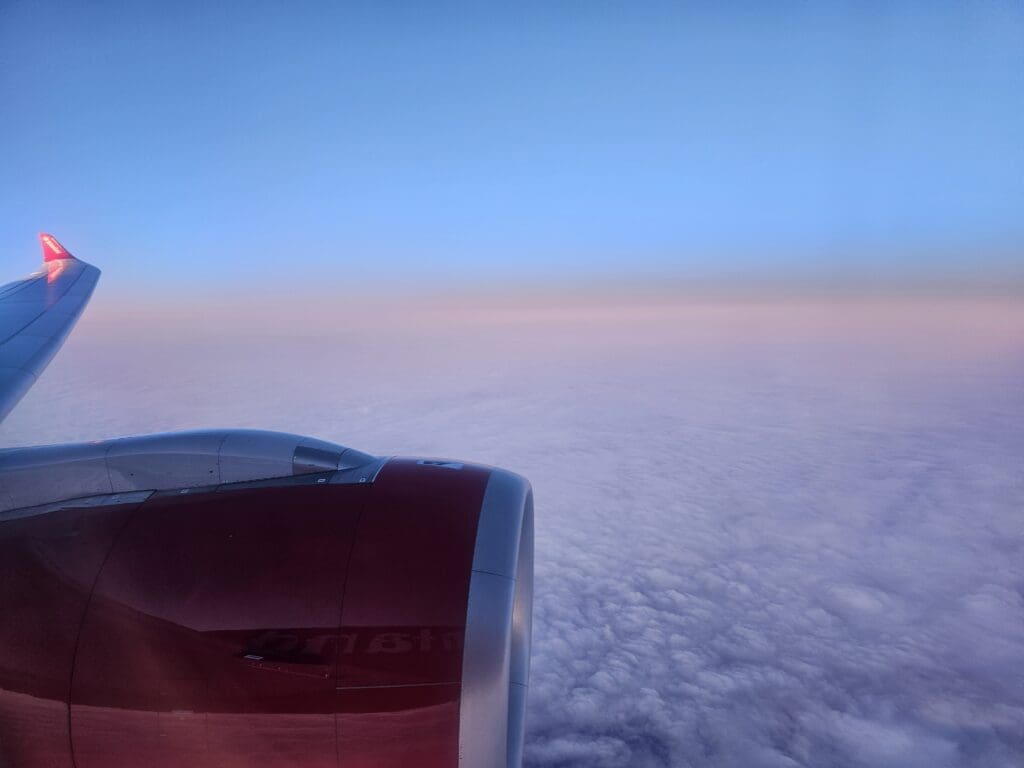
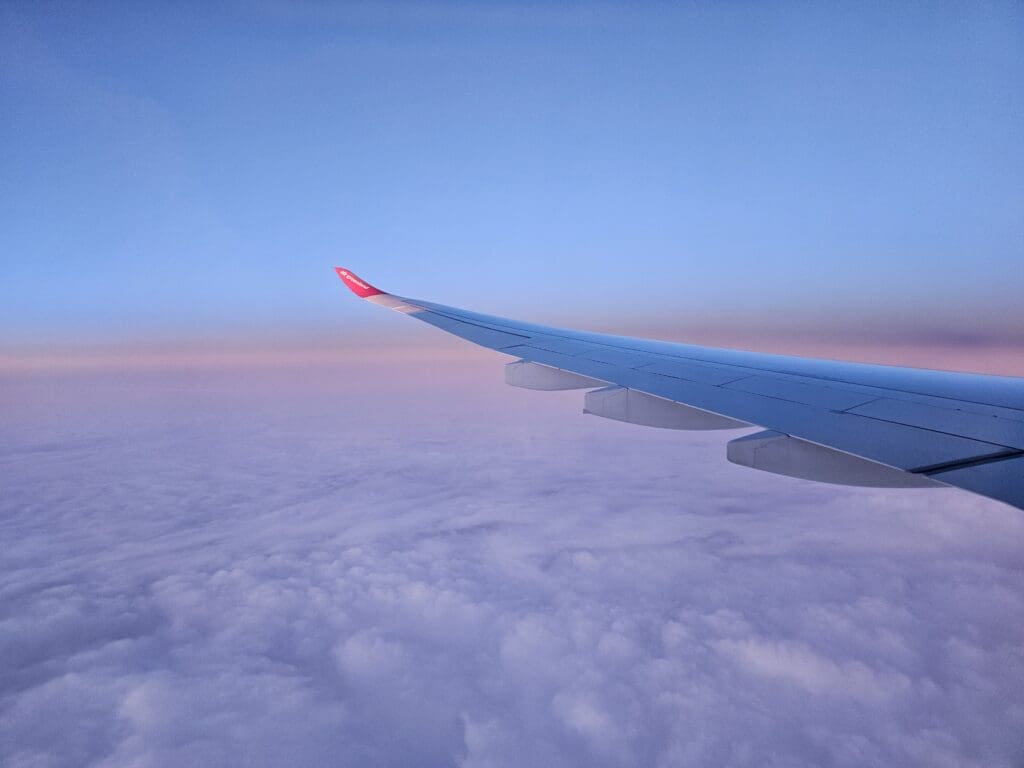
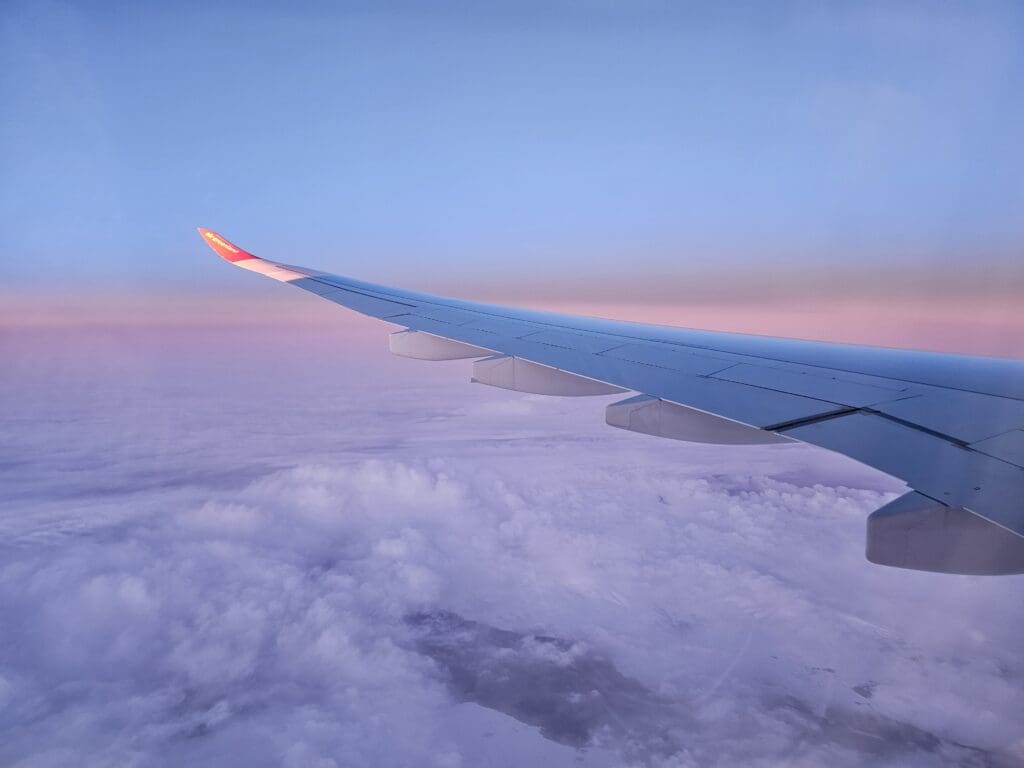
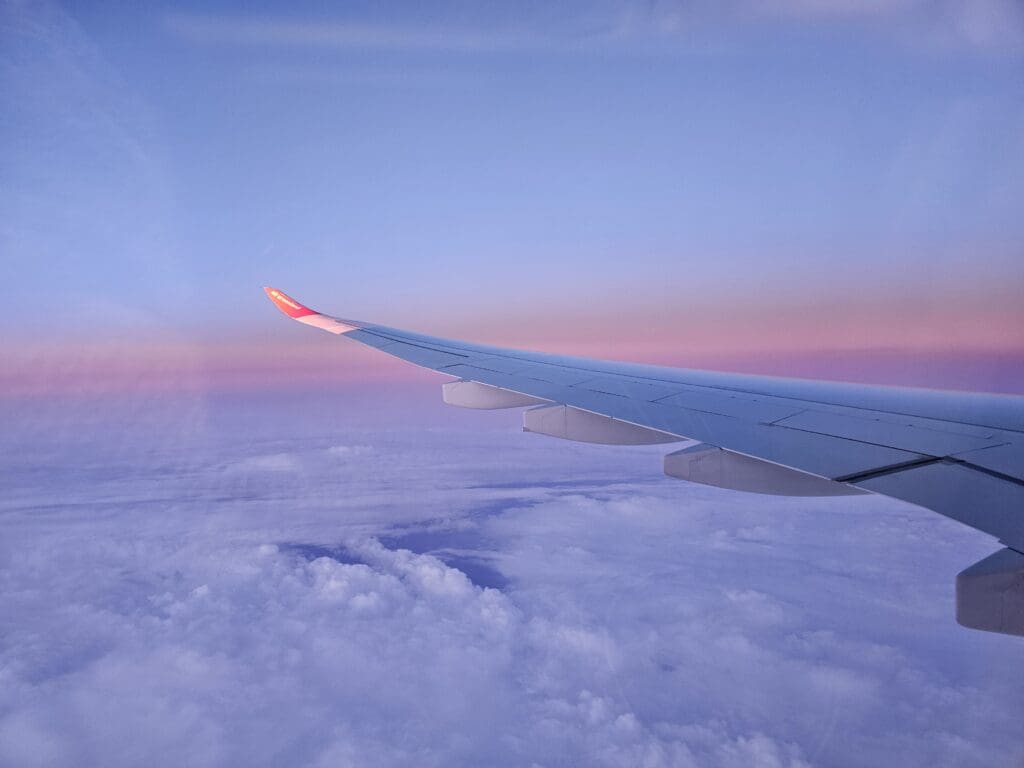
Just over two hours after leaving Greenland behind, the Airbus made landfall just to the south of the Norwegian city of Stavanger. There, I caught a glimpse of the glow of the city’s flights before they faded away as we crossed the countryside of the regions of Rogaland and Agder in the far south of the country. Passing over a very small portion of Norway, it wasn’t too long until the aircraft left Norway behind and crossed over the waters of the Skagerrak, the stretch of water that separates Norway from Denmark’s Jutlandic Peninsula.
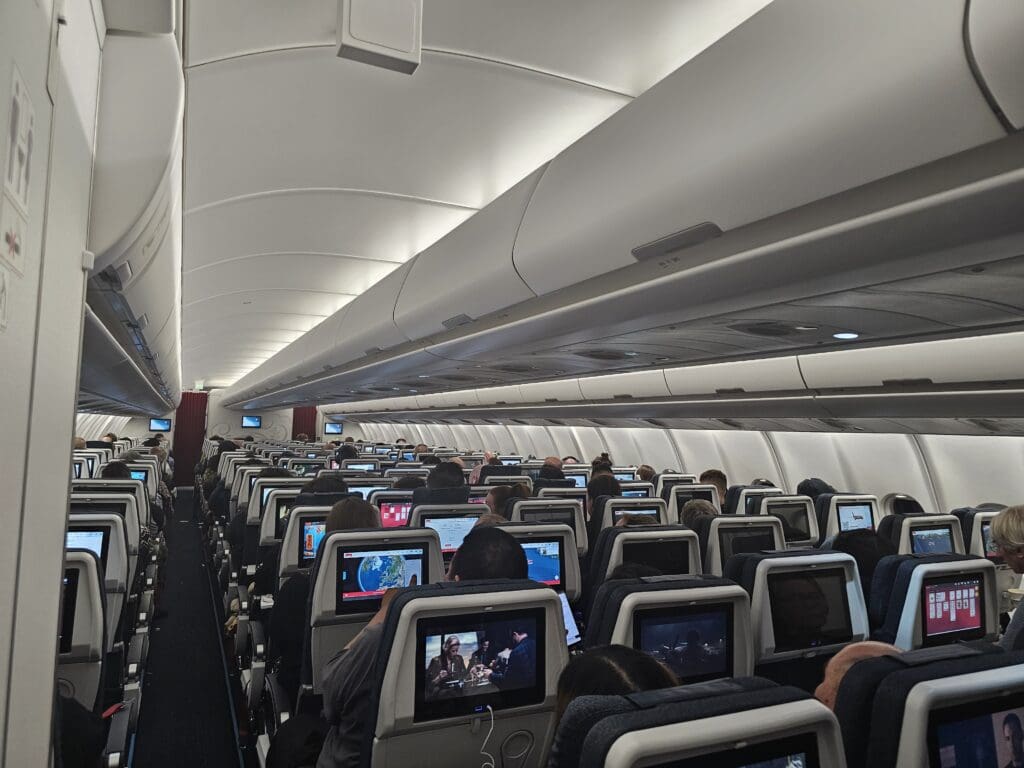
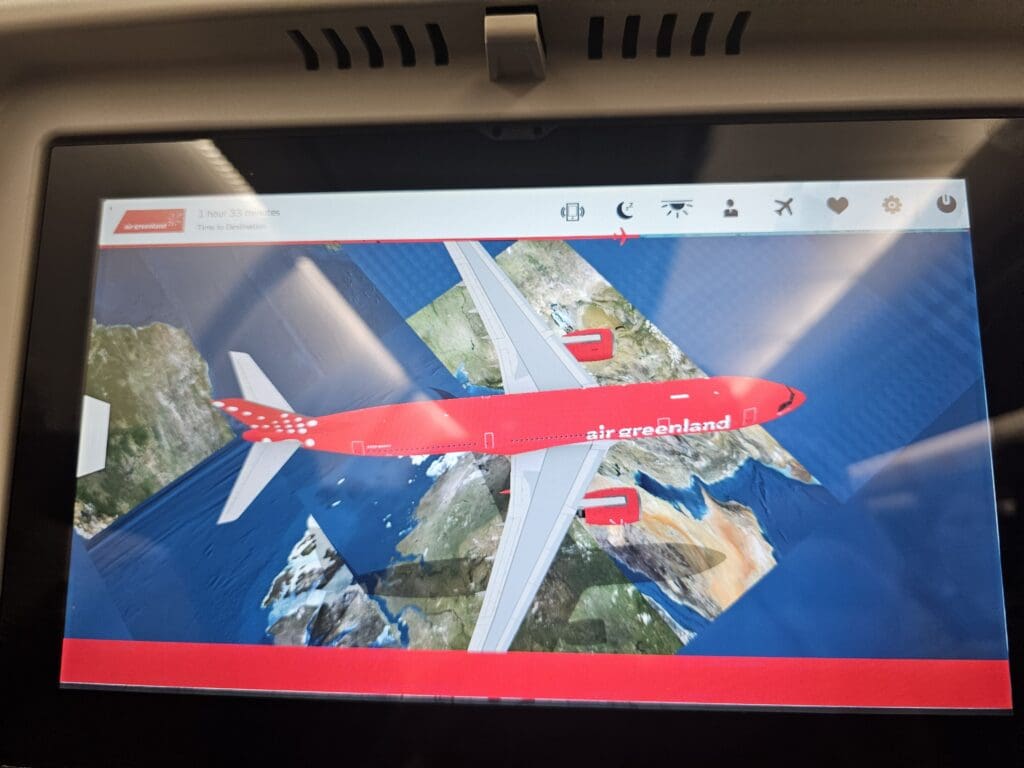
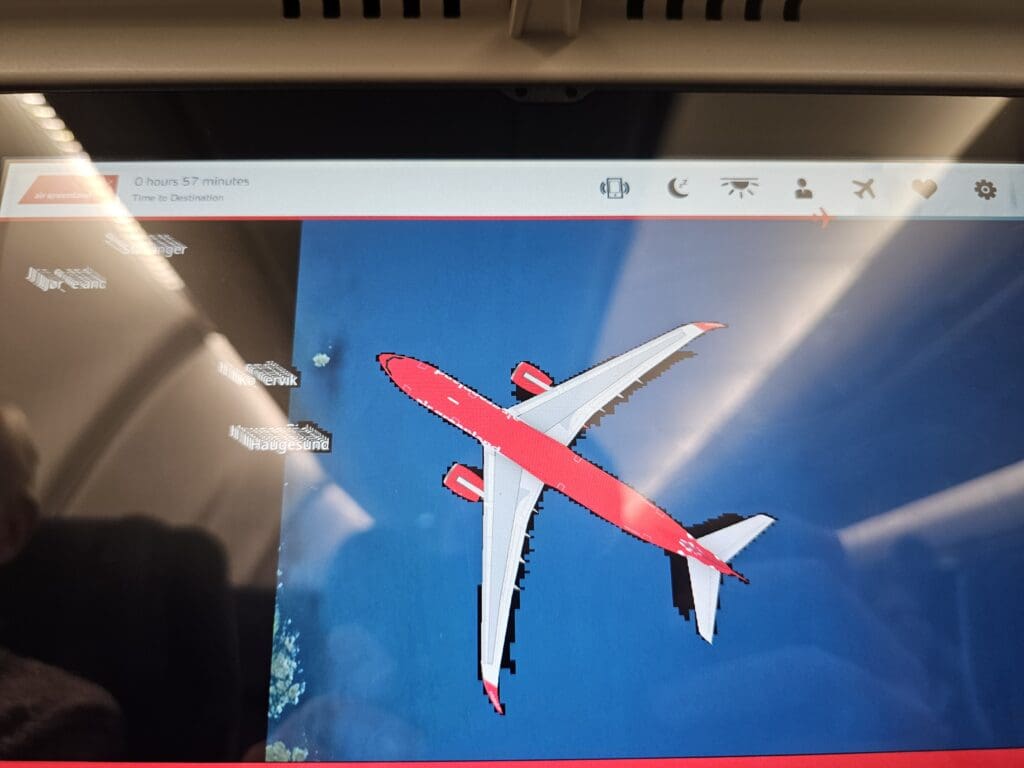
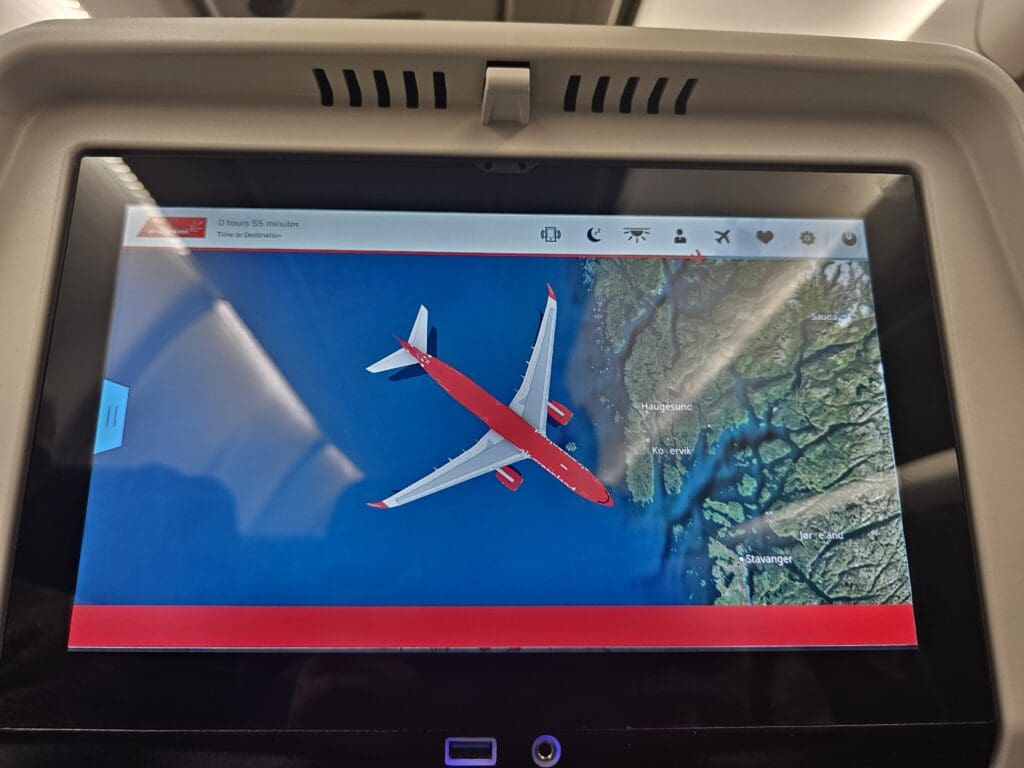
Soon, the Airbus entered Danish skies and made its way over Jutland, at which point the aircraft could be felt commencing its descent. A short time later, the Captain’s voice filled the cabin once again as they performed a trilingual pre-arrival announcement in which they thanked passengers for flying with Air Greenland, gave passengers an update on the weather in Copenhagen and advised that we could expect to touch down in around thirty minutes’ time. As they performed this announcement, several flight attendants passed through the cabin collecting rubbish, before the seatbelt signs were reilluminated as we descended through 20,000 feet.
After leaving Jutland behind, the Airbus made a speedy crossing over the Kattegat before making landfall over the town of Frederiksvaerk on the island of Zealand. At this time, the crew passed through the cabin, ensuring all was secure and in place for our arrival before the lights were dimmed ,allowing for a birds eye view of the orange glow of Zealand’s towns before we made our way out of the Øresund. Soon, the flaps were extended as we turned to line up for an approach to Copenhagen Airport’s Runway 22L before the landing gear could be heard being extended before clicking into position with a thump.
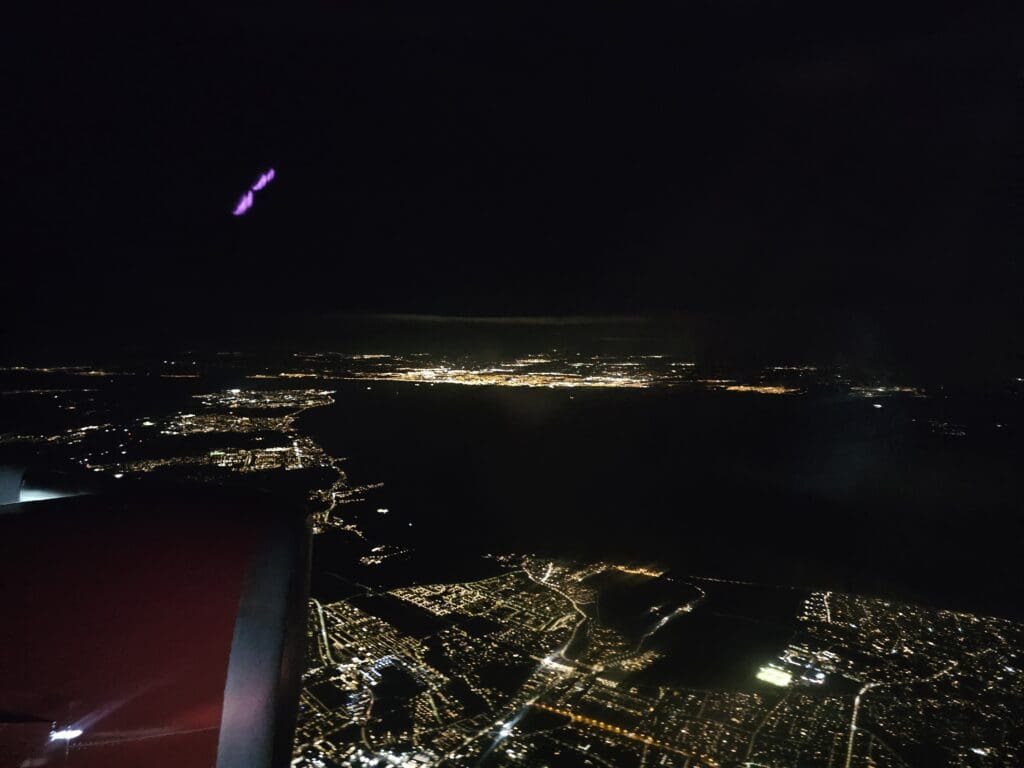
At this stage of the flight, little could be seen outside, bar the glow of Copenhagen’s coastline in the distance and a myriad of flashing lights being emitted by the buoys and wind turbines in the Øresund below. Before I knew it, the Airbus sank over the shoreline of the island of Amager before making a smooth touchdown in Copenhagen at 2045, ending our speedy flight over from Kangerlussuaq, having spent just under four hours in the air.
Once back on Earth, the Airbus decelerated rather quickly before vacating the runway to the right and making a short taxi to its stand at the end of the airport’s ‘B’ finger. Several minutes later, the Airbus came to a hentle halt at Stand B17, arriving at the very same gate from where I had departed the previous week. Looking outside, an army of airport staff could be seen ready to meet the aircraft and a grand total of three minutes after coming to a halt, the jetbridge was connected and the cabin door opened. Once all Premium passengers had been allowed to disembark, disembarkation for the masses commenced and, being sat at the front of the Economy cabin, I soon stood up, retrieved my backpack, thanked the crew members in the galley and stepped out of the aircraft.
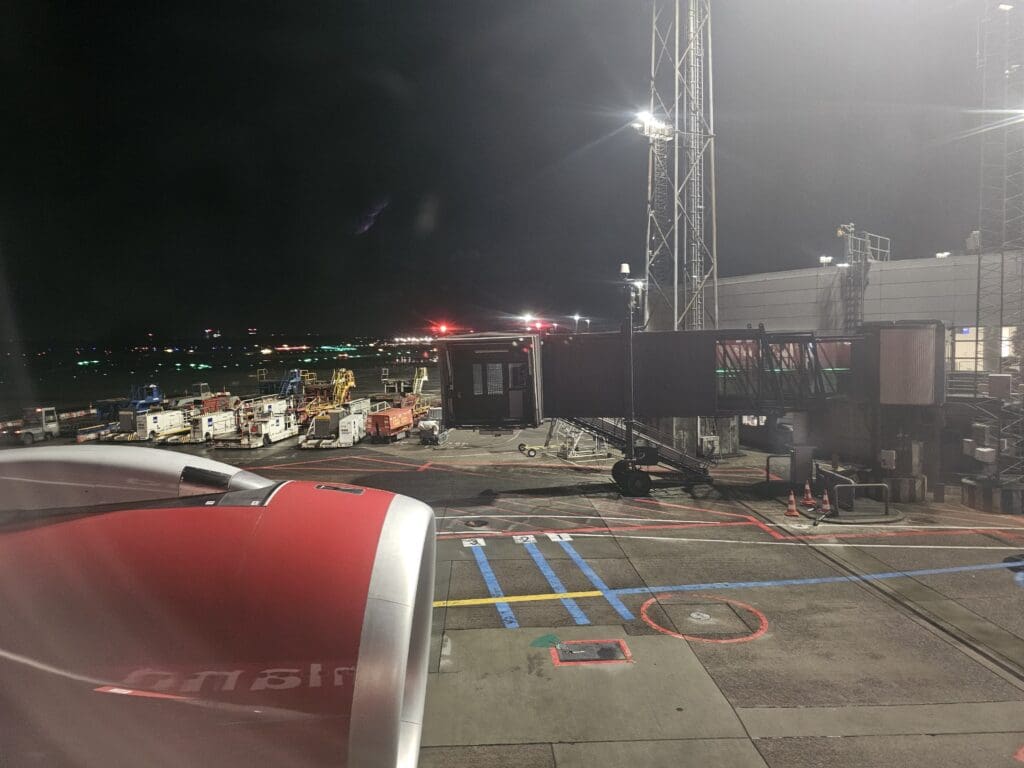
Heading up the jetbridge, I soon found myself in the airside Schengen departures area, and followed signs for arrivals, I made a long walk through the terminal before heading down the escalators and arriving at the baggage collection hall. Once there, a ten-minute wait was in store, and eventually, my suitcase appeared, and I picked this up before heading out into the landside arrivals area, ending my Air Greenland adventure.
Summary
To start with, this flight was far from terrible, and I found the jet to be comfortable, clean and in good condition. However, of the five Air Greenland flights that I had undertaken during my trip to Greenland, I have to say that this was the least impressive. Onboard, virtually all crew members that I interacted with were cold, distant and quite frankly did not seem to be happy at work that day, with this being quite some contrast to all other crew members that I had interacted with on my other Air Greenland flights. Meanwhile, the entertainment system was slow and jumpy, the moving map did not work, the external cameras were not accessible, and the USB-A port did not work. Nevertheless, given my overall experience of Air Greenland on this trip, I can safely say that I would be more than happy to fly with the airline again at some point in the future.