Long Haul with Japan Airlines: London Heathrow to Tokyo Haneda on a Boeing 787-9 Dreamliner
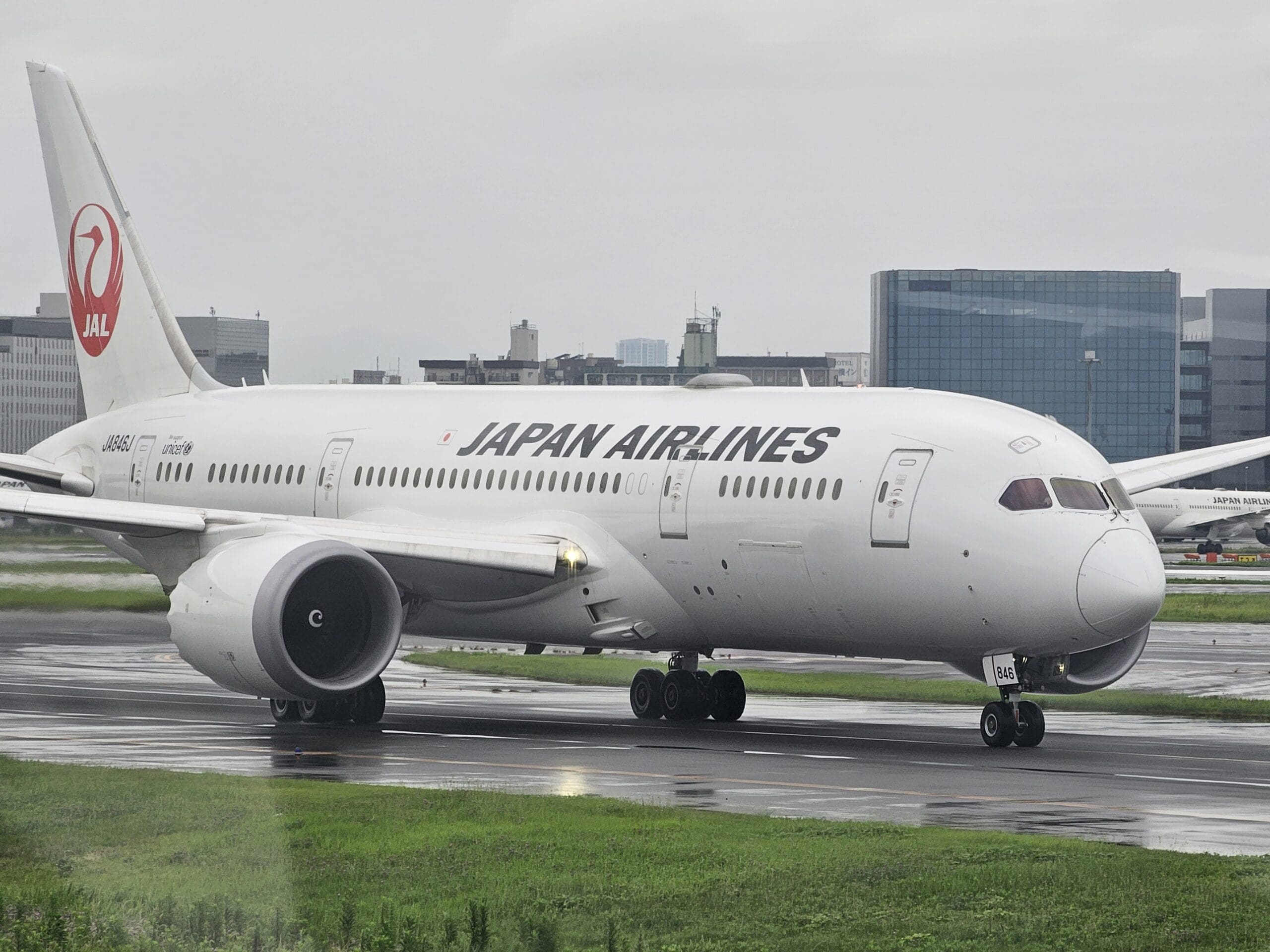
For someone living in Europe, Japan Airlines isn’t synonymous with low fares. Whether from Frankfurt, Helsinki, London or Paris, opportunities to sample Japan’s famed national carrier on a shoestring budget are as rare as finding fugu in a fish and chip shop. Once a regular traveller between Korea and the UK, I had never encountered a Japan Airlines ticket via Tokyo for less than about £1,500, around three times what I would have expected to pay on the likes of a Chinese carrier or the ME3.
Nevertheless, in October 2018, I bagged a ride onboard a Japan Airlines Boeing 787-9 Dreamliner. Having taken a joy ride on one of Asiana Airlines’ now-retired Boeing 747-400s from Incheon to Manila, needing to return to Northeast Asia I had cashed in on my Avios in exchange for a one-way ticket from Manila to Tokyo Narita. Whilst not quite as long as the slog between the UK and Japan, this four-hour ride left me nothing short of impressed. Whether it be the pristine and comfortable cabin, the high-quality catering, or the polite and friendly crew, from the moment I stepped off the aircraft in Japan, I had longed to fly with Japan Airlines again. Fast forward to May 2024, needing a last-minute one-way ticket to Korea and with all other options being rather extortionate, I decided to see if I could splurge some Avios and fly with Japan Airlines once more.
First commencing flights between the Japanese and British capitals in the 1960s, London has long been a stalwart destination in Japan Airlines’ route network and is today served by two daily flights. Each day, the first of these departs London Heathrow at 0940 and is operated by a Boeing 787, arriving in Tokyo Haneda early the next morning, whilst the other takes the form of an evening Boeing 777-300ER operated service that departs at 1920 (as per the Summer 2024 schedules). At the other end, Japan Airlines operates a morning, afternoon and evening service between Tokyo Haneda and Seoul Gimpo, with these usually operated by the airline’s Boeing 787s. Upon taking a search for flights between London and Seoul on Japan Airlines’ website, unsurprisingly, these came in at an eye-watering £2000 for a one-way itinerary, and, despite my desire to fly with the carrier, I couldn’t quite justify spending this much when I could fly with China Southern Airlines for about £450 (still very expensive for them!). Doing some experimentation with my Avios, I opened up British Airways’ website and much to my delight, not only were flights available on my chosen departure day, but by parting with just 14,500 points I could almost quarter the fare to a much more reasonable £548. Whilst still on the pricey side of things, this was only around £100 more expensive than the cheapest fares on the route and would enable me to sample the delights of Japan Airlines once again.
Granted, this wasn’t the quickest route and just one option was available. This involved departing London Heathrow on Japan Airlines’ Boeing 787-9 Dreamliner operated morning service at 0940. Taking a somewhat indirect route to avoid Russian airspace, the aircraft was scheduled to touch down in Tokyo Haneda 13H35 later at 0715. Once on the ground, I would have a long 8H25 connection before heading off on the relatively short hop to Seoul Gimpo onboard a Boeing 737-800, arriving there at 1800 on Friday evening. Nevertheless, with enough time on my hands, and seeing as I would be unlikely to get the opportunity to sample the delights of Japan Airlines again in the near future, I committed to this and soon made a quick and easy payment via British Airways’ website before receiving my booking confirmation and e-ticket via email a few moments later.
Managing my Booking
Despite booking via British Airways, thankfully, Japan Airlines’ website recognised my PNR and I was thus able to log into this to manage my booking without any issue. By doing so, I was able to pre-select seats for the flight and I was able to select any standard seat in the cabin for free. After some deliberation, given the length of the flight and the inevitability that I would have to make multiple lavatory visits, I decided to opt for an aisle seat on the first long slog to Asia. However, for the second flight, I decided to go for a window seat on the right side of the aircraft, with the logic behind this being that this would offer good views of Seoul in the event that both the weather was good and the aircraft was to land on either Runway 32L or 32R. In addition to this, the website allowed me to request a special meal, pre-order items from the onboard shop and check information about my flights, including reading up on the menu for each of these which could be downloaded in a PDF format.
Check-In
Two days prior to departure, I received an email from Japan Airlines inviting me to pre-book a timeslot at security. Whilst this was a wise idea, uncertain of my exact timings I decided to pass and hope that I wouldn’t have to wait too long. Check-in for Japan Airlines’ services opens up 24 hours prior to departure, however, with a one-way ticket to Korea, I wasn’t too sure whether I would actually be able to do this. As it turned out, I was able to do this and without too much issue, I received a boarding pass for both my flight to Japan and onward connection to Korea. Nevertheless, considering that I had pre-selected a seat and would still have to visit a counter to drop off my bag, this was not a massive victory!
The Journey
If you’re reading this, you are likely already well aware of London Heathrow Airport’s status as one of the world’s busiest airports and its role as a vital piece of Britain’s transport infrastructure. Considering the airport’s importance, unsurprisingly it is fairly well connected to regions across the UK. Thanks to the airport’s three mainline railway and London Underground stations, countless towns and cities across the UK sit within a one-stop change of trains from Heathrow. Meanwhile, the airport is also well connected with the country’s road network, sitting just off the M4 and M25 motorways.
Once upon a not-too-distant time, I had called the West London suburb of Ealing home and located no more than a fifteen-minute train ride away, Heathrow was very much my local airport. However, like many of the capital’s disgruntled late-twentysomethings, drawn in by affordable prices and easy access to the hills, I returned to my homeland, Yorkshire. Thus, I would be starting my long trek to Korea in the green city of Sheffield. From there, the most obvious route to Heathrow involves taking a two-hour train ride to London St Pancras and changing onto a Heathrow-bound Piccadilly Line service. However, that day, my early departure time necessitated another plan as were I to take the first service of the day from Sheffield to London, I would be cutting things a little too close for comfort, with this not scheduled to arrive into Heathrow until 0810. Examining the other options, I could take a direct overnight Flixbus or National Express coach service. However, in the end, it turned out that a locally based family member needed to be in London that day and kindly agreed to give me a ride down to Heathrow!
After a four-week wait, my departure day finally rolled around and following a three-hour sleep, I woke up bright and early at the ungodly hour of 0230. Seeing as I was travelling on the longest day of the year, upon opening the curtains, I was greeted by June’s light night skies and the short night was already drawing to a close. Having wanted to avoid any last-minute panics, I had packed up everything I would be taking with me to Korea the night before and so that morning I had little to do before departure other than dart through the shower and do a final check to ensure that I had placed my passport into my cabin bag. According to Google Maps, the 160-mile journey to Heathrow would take three hours, and given our early departure time, I didn’t anticipate stumbling into any traffic jams on the journey down south. Nevertheless, we decided to err on the side of caution and headed out just before 0300. After swinging my three-wheeled suitcase and backpack into the boot of the Kia Niro, we descended one of Sheffield’s many hillside tree-lined streets, accompanied by the odd fox, taxi, delivery van and boy racer before reaching one of the main arteries that runs out of the city. Around ten minutes after leaving home, we sped from South Yorkshire and entered Derbyshire, heralding our exit from the North and our entry into the Midlands. Soon, Chesterfield’s famous Crooked Spire appeared as we cut through the town centre before continuing onwards to the M1 motorway. Joining the motorway, at that time of the morning this seemed to be one massive convoy of lorries from across Europe, hauling goods around the country and beyond.
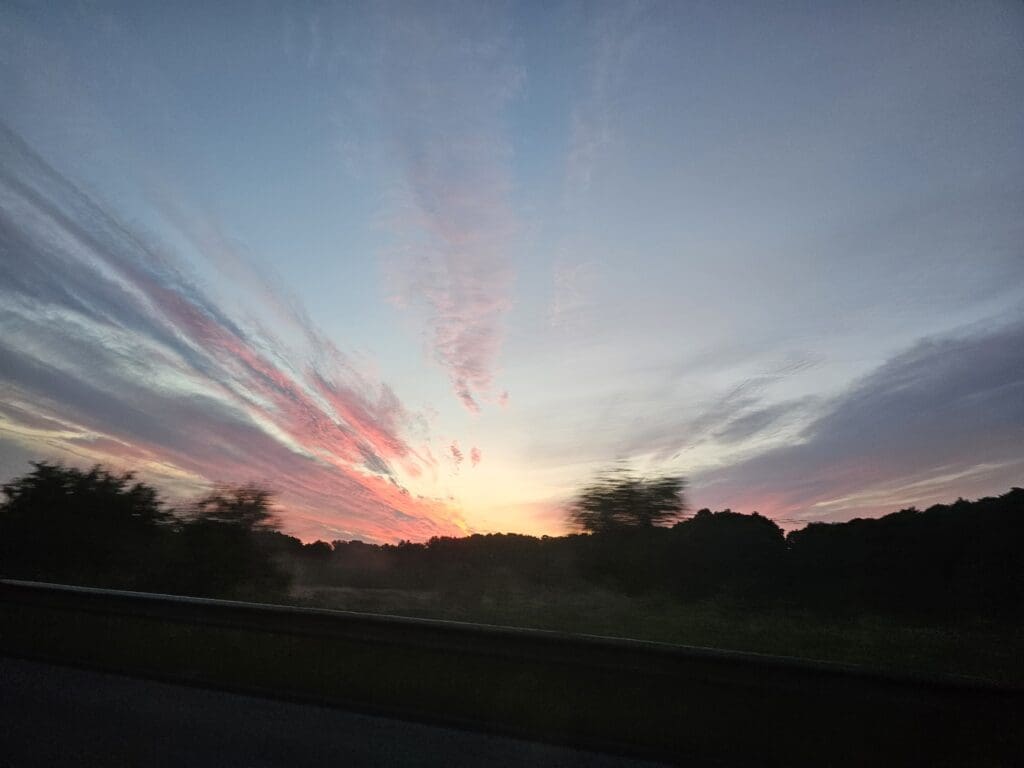
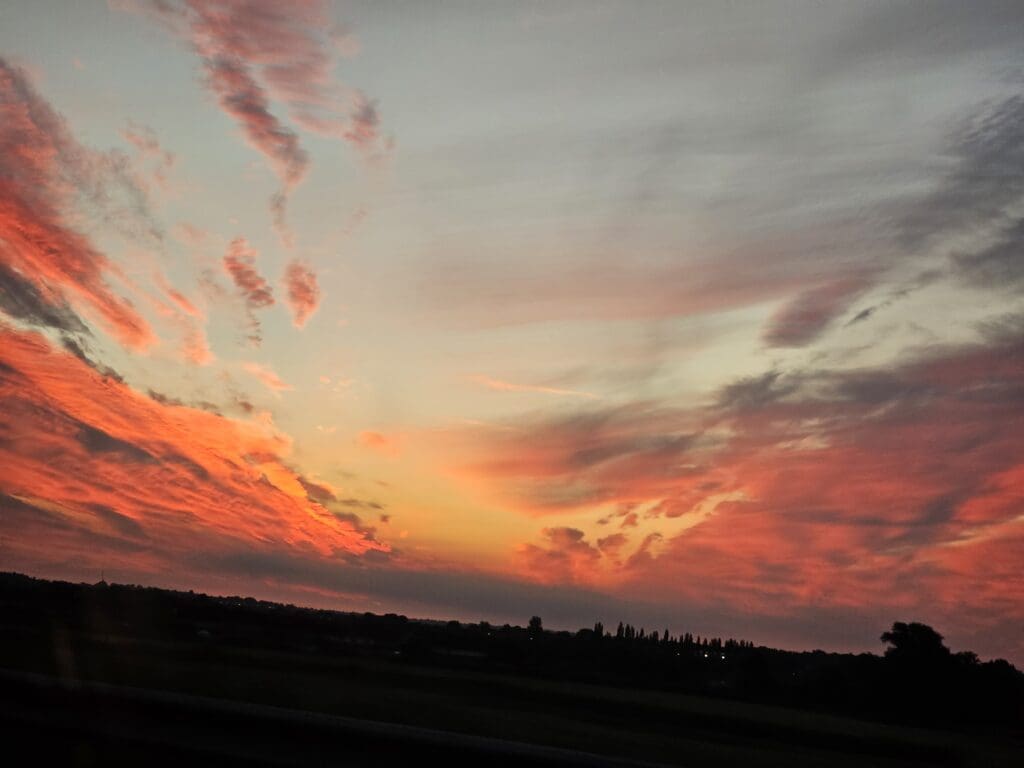
As we journeyed southwards through the Midlands, it wasn’t long until the sun began to rise and by the time we reached East Midlands Airport around fifty minutes into the journey, an impressive palette of reds and oranges could be seen strewn across the eastern skies. Making good progress, as we neared Luton and the end of our journey along the M1, we stopped for a coffee and I indulged in what was to be my final Greggs for a few weeks. Following this pit stop, we headed anticlockwise along the busy M25 motorway whilst up above, every minute or so aircraft could be seen overhead as they neared the end of their overnight flights to Heathrow, indicating that we were nearing our destination. Following a smooth journey, the sprawl of Heathrow Airport appeared and after a few wrong turns, we came to a halt in the drop-off zone of Terminal 3 a little over three hours after leaving home.
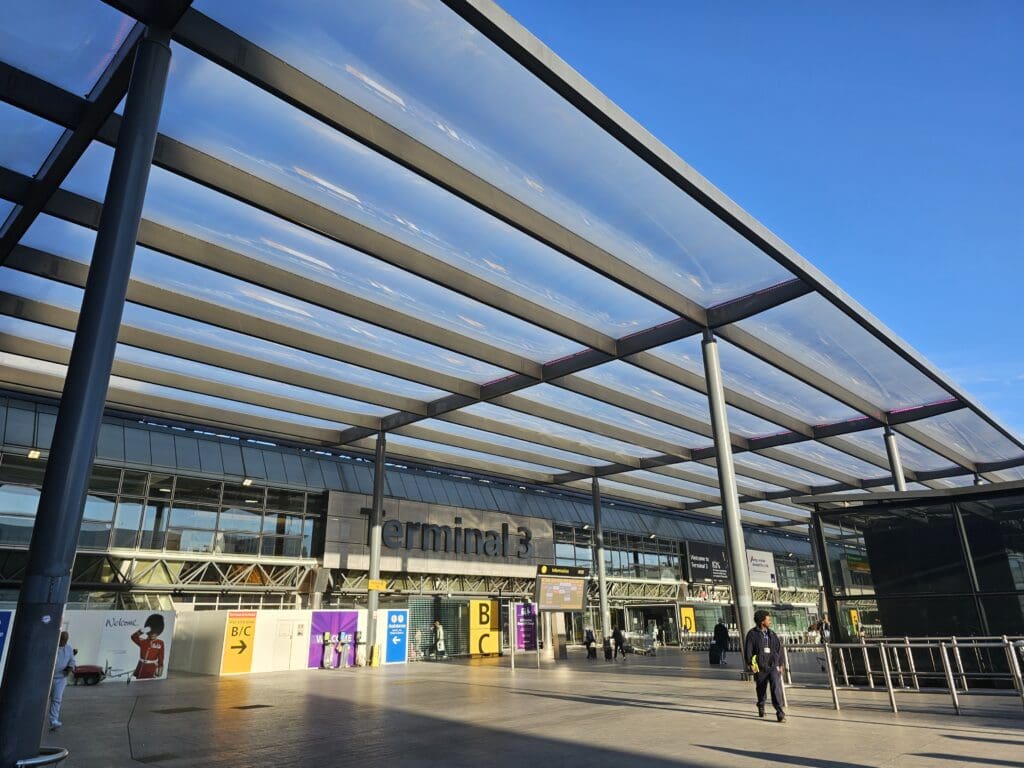
Even though Heathrow is no longer my local airport, I still have the ‘pleasure’ of passing through this on a semi-regular basis. However, I always seem to end up departing from either Terminal 4 or Terminal 5 and thus rarely visit Heathrow’s other two terminals. With this being my first time departing from Terminal 3 in almost two years, my memories of this had largely faded, and, ignoring the plethora of negative reviews online, I started my journey with a clear and open mind. Once I had bid my farewells, I lugged my three-wheeled suitcase through the usual morning scrum of passengers shuttling oversized suitcases between car boots and luggage carts and trundled the short distance through the morning sunshine to one of the terminal’s entrances. Looking around, I couldn’t help but notice that Terminal 3’s exterior was modern and comparatively grand for a British airport terminal, featuring plenty of glass, giving me some hope that its interior would be equally up-to-date.
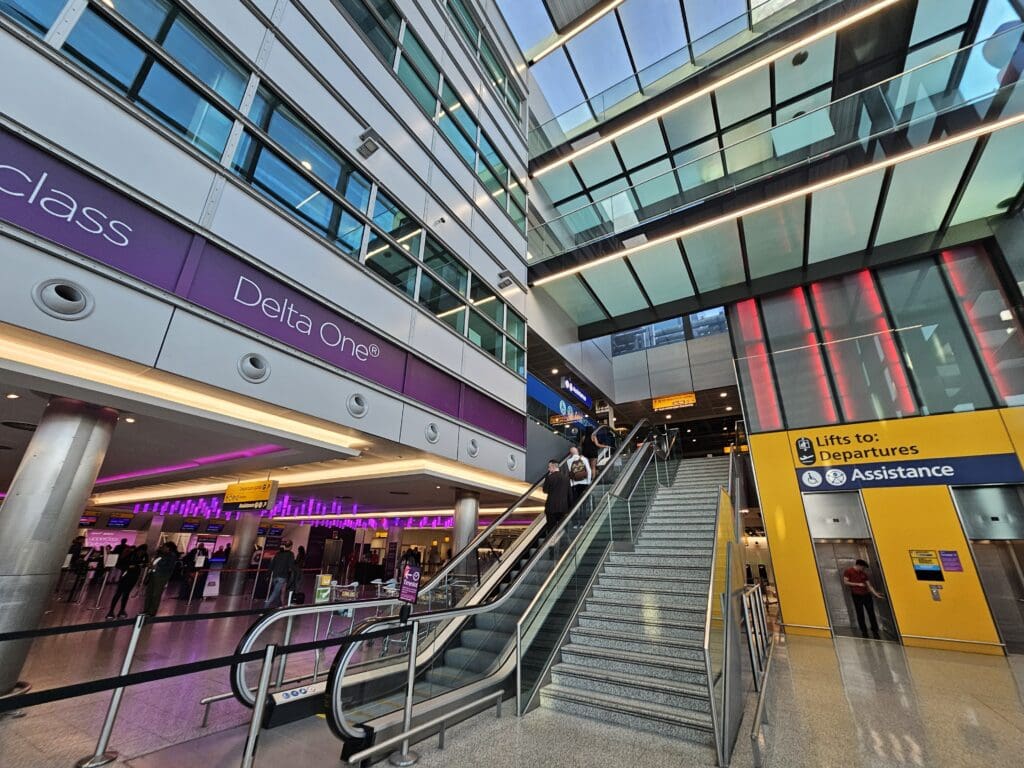
Briefly examining the layout of the landside portion of Terminal 3, its seven check-in zones are located on the ground floor and are spread out over a roughly L-shaped space. Today, the terminal is perhaps best known for being Virgin Atlantic’s largest hub by quite some margin. Having inadvertently entered the terminal via the doors to Delta Air Lines and Virgin Atlantic’s shared check-in area, I was immediately greeted by a sea of red branding as well as an army of staff on hand to assist the masses of North America bound passengers who were checking in there at the time. Once inside, I checked the information boards and soon discovered that Japan Airlines utilises check-in Zone D, located a short walk away. Making my way away from Virgin Atlantic’s large, spacious, modern and well-branded area, I was disappointed to discover that the rest of the landside area was far more cramped and less modern. Furthermore, plenty of construction site hoarding could be seen erected and a constant banging sound could be heard throughout much of this space, creating a somewhat ramshackle first impression. Unlike Heathrow’s other terminals, I was surprised to find that there was a clear lack of facilities in the landside departure area, with no shops, cafés or eateries provided. Thus, those in dire need of refreshment were left with no choice other than to purchase something from the limited selection of overpriced snacks and drinks from the multiple vending machines or head over to the landside arrivals area. Before making my way to check-in, I did make a quick pit stop at the toilets and found these to be in a disappointing and disgustingly filthy condition, leaving me with a rather negative first impression of the terminal.
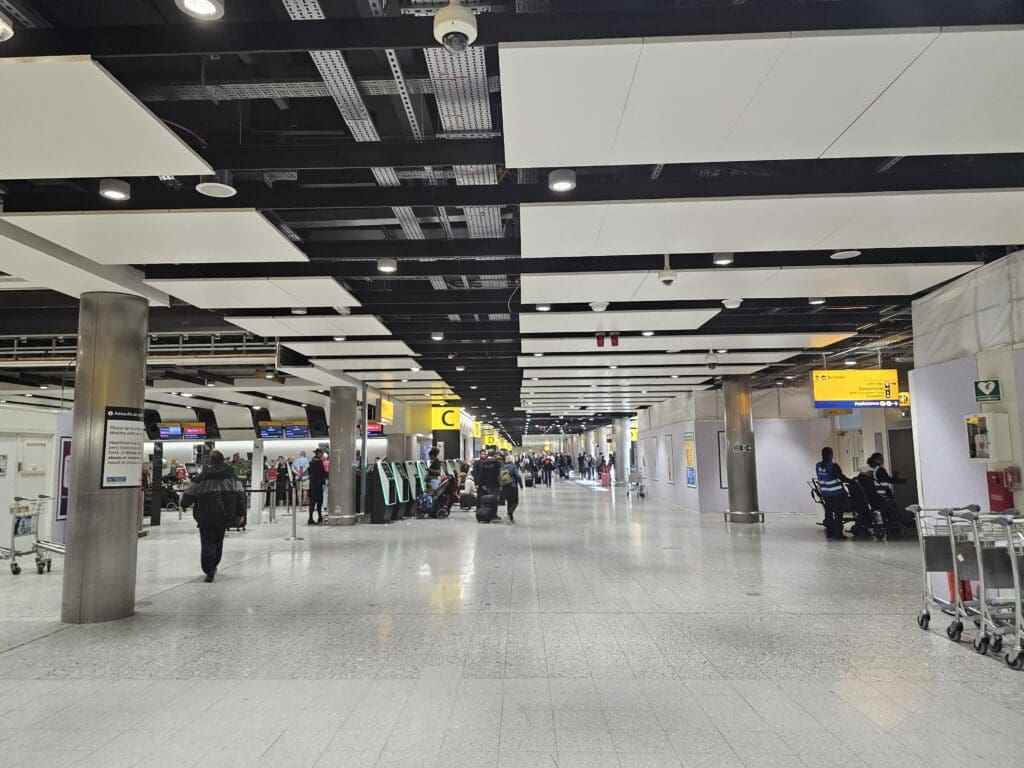
As I approached Zone D, I noticed that Japan Airlines’ passengers could British Airways’ self-check-in machines. Not only could these print off flimsy paper boarding passes, but they also had the ability to print off baggage tags. Deciding to use these in the hope that this would save time when dropping off my bags, I soon printed off my baggage label, affixing this to my suitcase before trundling over to Japan Airlines’ check-in area. With two daily flights, unsurprisingly Japan Airlines’ check-in desks were well branded, with seven of these offered (three for Business, two for Premium Economy and two for Economy), along with a ticket desk and service counter. In addition, plenty of smartly dressed bilingual Japan Airlines staff could be seen lingering around the check-in area, welcoming passengers and guiding them to the correct queue, with these staff supplemented by Menzies staff. I should however note that whilst sporting different uniforms, the Menzies staff all wore a Japan Airlines name badge which displayed their name in both English and Japanese.
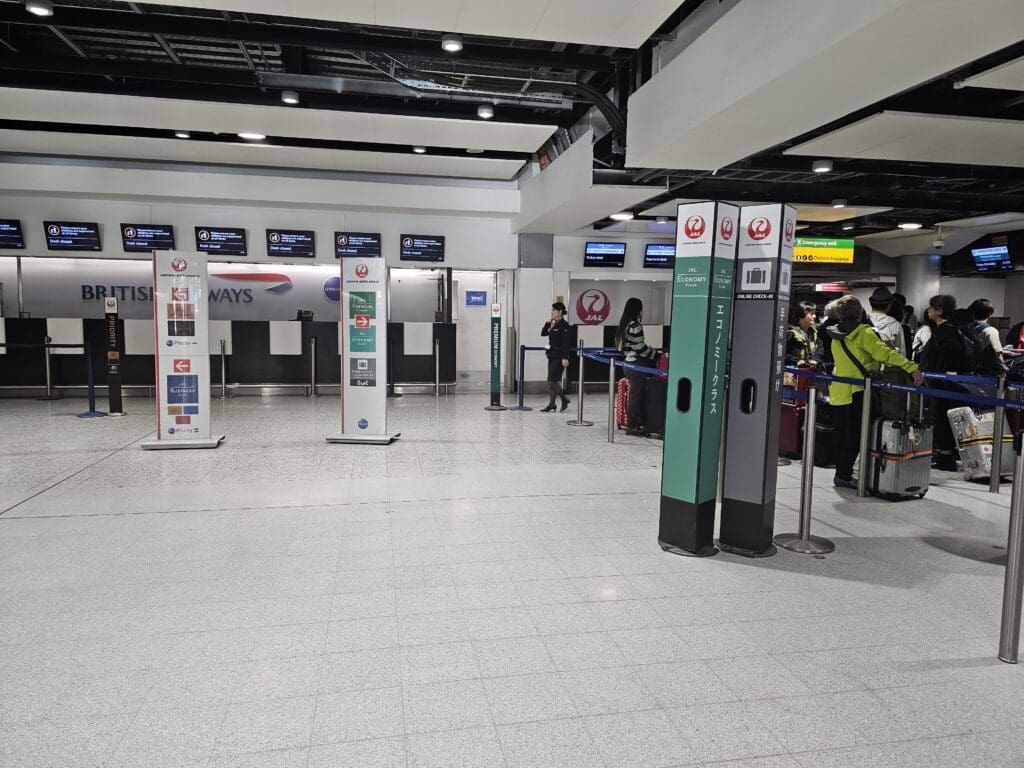
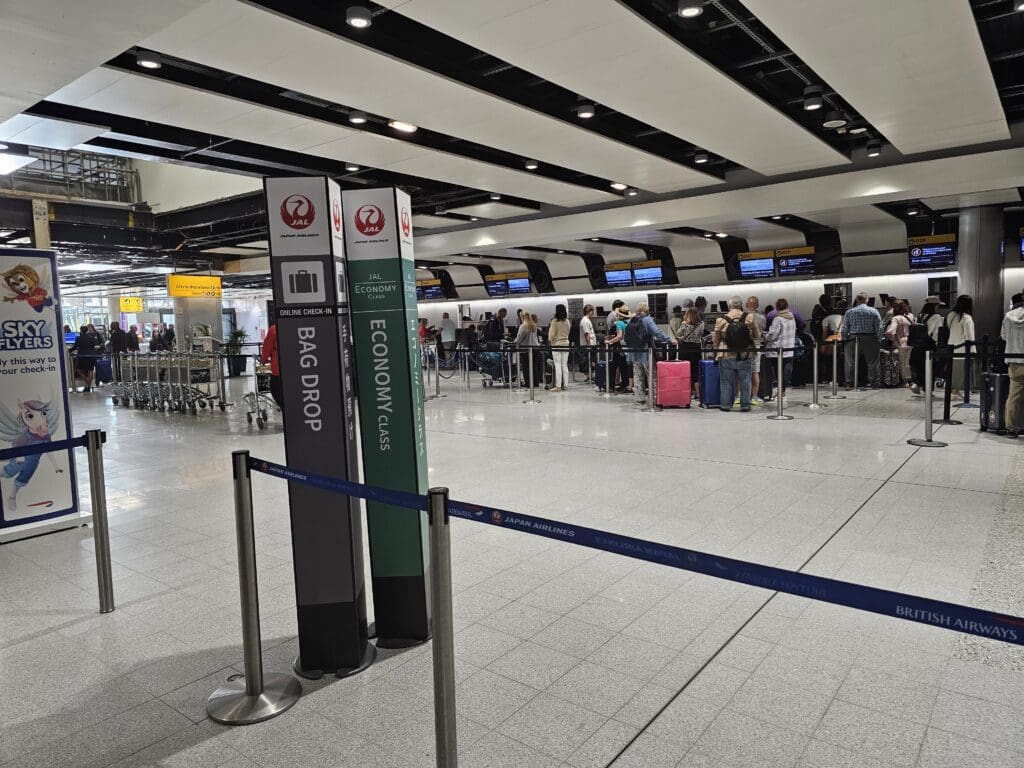
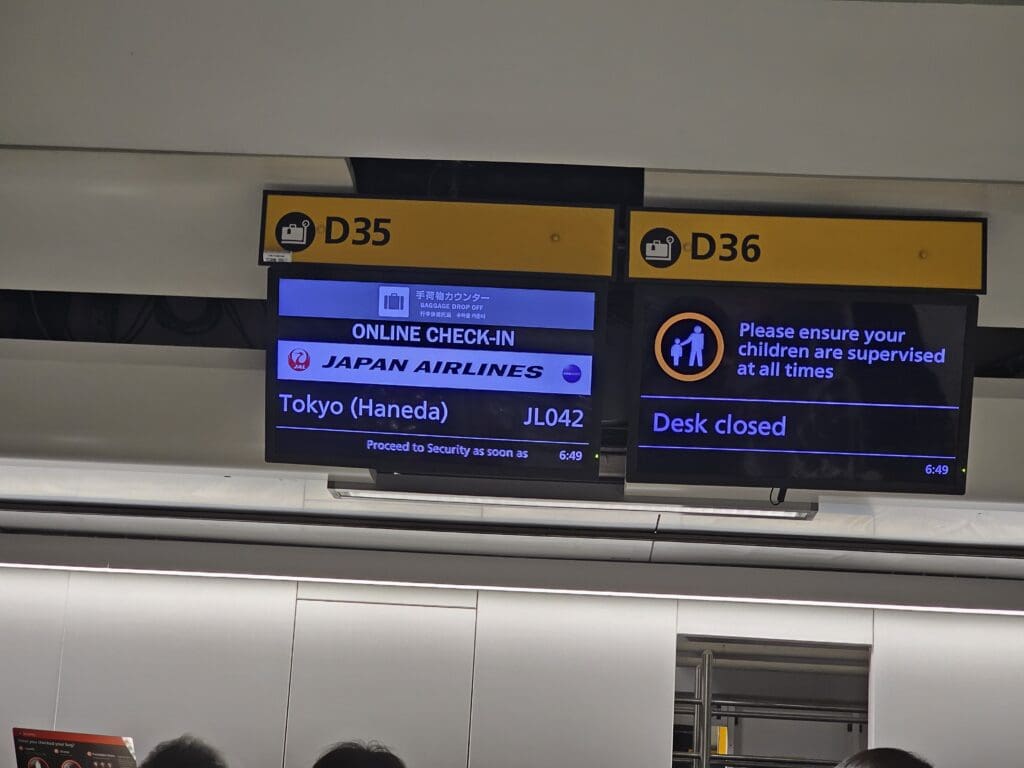
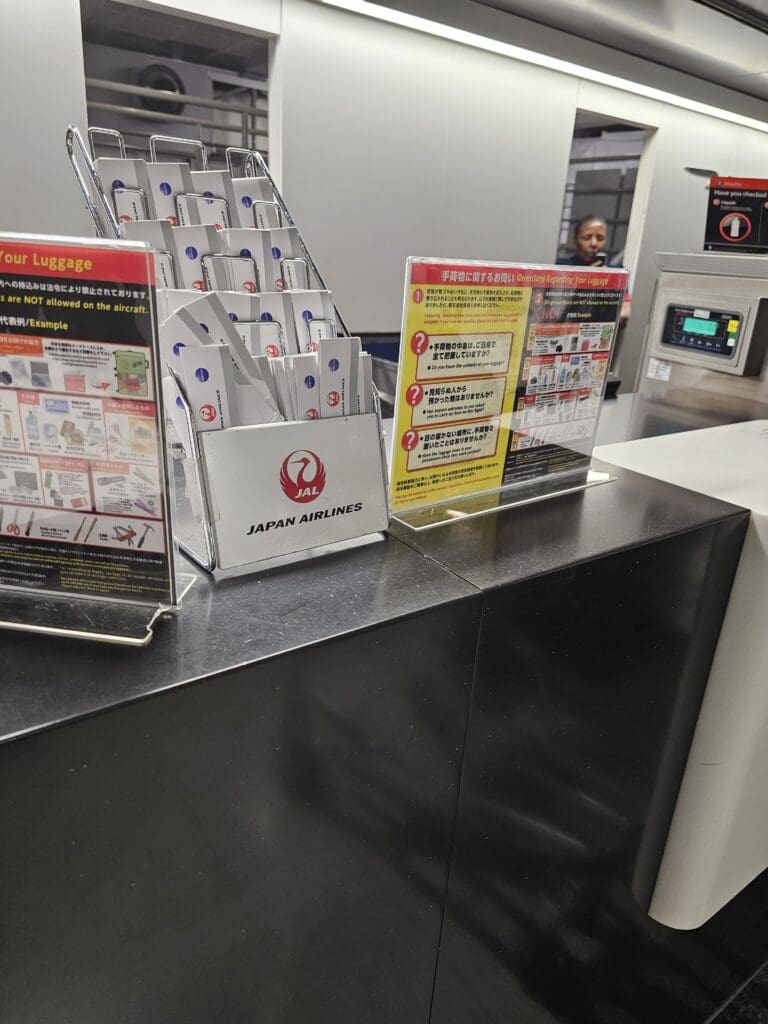
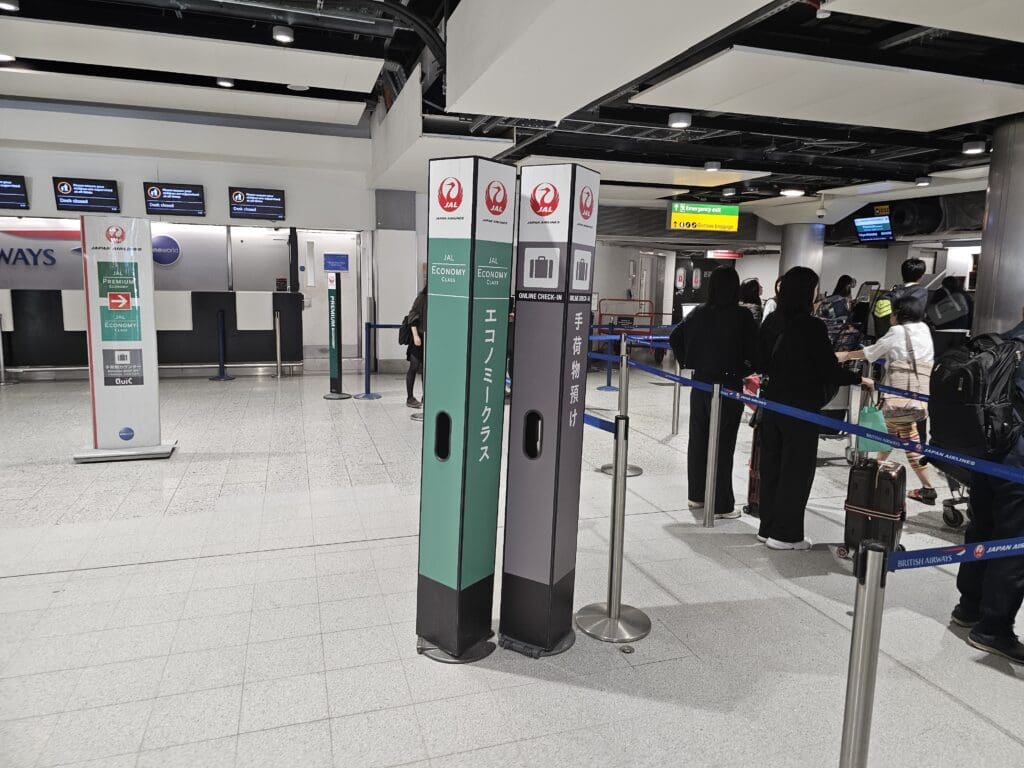
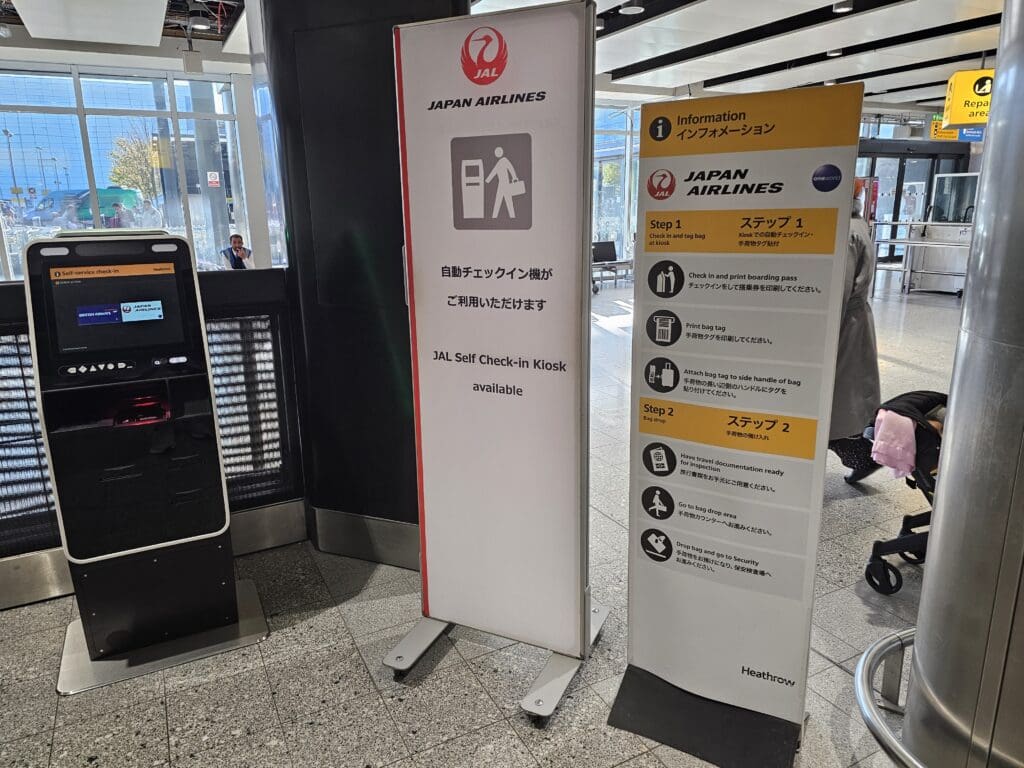
Unfortunately, unlike in Terminals 2 and 5, there were no self-bag-drop-off facilities and despite already affixing my baggage tag to my suitcase, I was left with no option but to join the standard Economy check-in queue. Having arrived after a large elderly Japanese tour group, many of whom seemed to be making the most of Japan Airlines’ generous luggage allowance, it took about fifteen minutes of waiting in the snaking queue before I was directed towards a free desk. Once at the desk, I found the Japan Airlines agent to be friendly and polite, and after handing over my boarding passes they tore these up and printed off two equally plain yet slightly less flimsy passes before sending my suitcase into the depths of the terminal, advised me of the boarding time and wished me a nice flight.
Given the landside area’s lack of facilities and airside views, once I had checked in, I was left with no reason to remain there and thus decided to continue onwards to the terminal’s airside area. From check-in, I headed up the escalators to the entrance to the security check area which is located on the first floor. Indicating that I would be in for a wait that morning, as soon as I reached the first floor, I was presented with a short queue of waiting passengers who were being held at the automated gates before being allowed to continue onwards into the security area. The reason for this was that the security check area at Terminal 3 is comparatively small and features limited room to queue, thus, passengers were being allowed into this in drips and drabs. Despite the initial queue, security wasn’t too chaotic that morning and I found the staff to be pleasant and friendly. Within about ten minutes, I had passed through this and was free to explore the airside portion of the terminal.
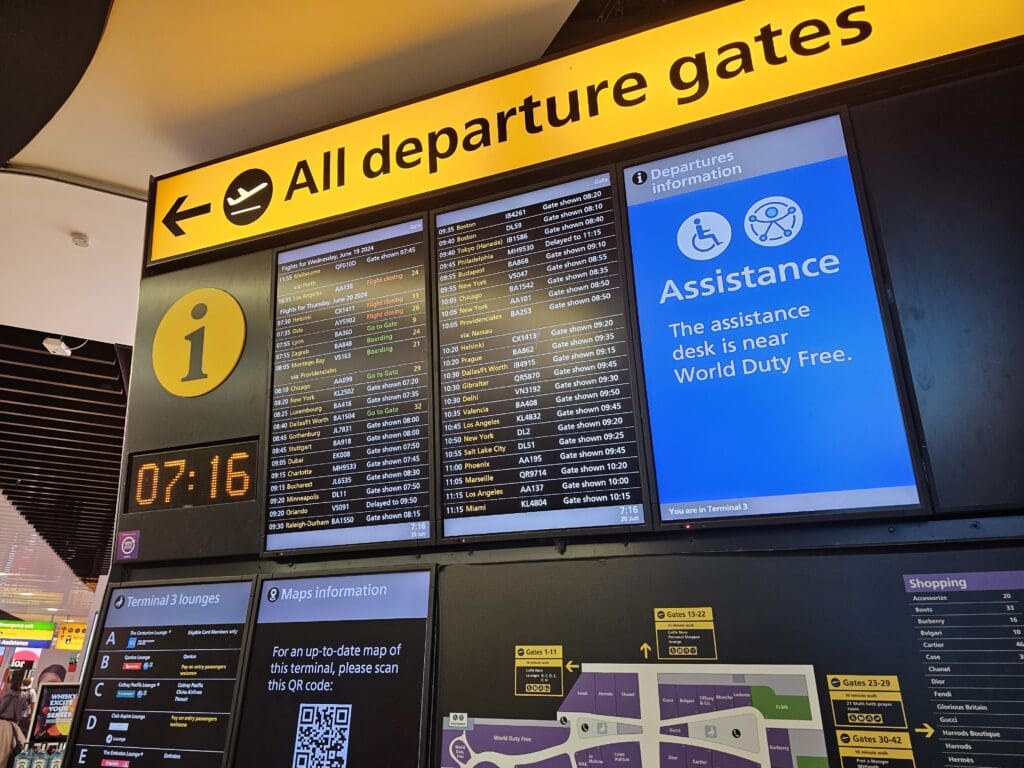
As tends to be the case at most major British airports, once passengers have made it through security, they are forced to endure a route march through the local branch of World Duty Free. In Terminal 3, this was your bog standard large duty free store, with all the usual offerings and tacky overpriced London souvenirs. With no need to buy anything, I stormed through this and soon arrived at the terminal’s main airside hub. There, a fairly small and cramped waiting area could be found that was complete with rows of hard benches and a few charging stations. Alongside this, most of the terminals’ cafés, shops and eateries could be found in this space. Of the thirty or so shops that are located in the airside portion of the terminal, the vast majority of these seemed to take the form of upmarket luxury brand outlets such as Bvlgari, Gucci and Tiffany & Co to name just a few. For those looking to grab something to eat or drink, the Caviar House & Prunier Seafood Bar, Evergreen Bar & Kitchen, Spuntino, Wagamana and YO! Sushi all provided substantial food options. Meanwhile, no fewer than five branches of Caffè Nero and two Pret a Mangers offered lighter food and drink options. Last but not least, whilst Terminal 3 likely sees far fewer early morning beer drinkers than the likes of Manchester or Stansted, The Curator Pub, was on hand to quench any perishing thirsts.
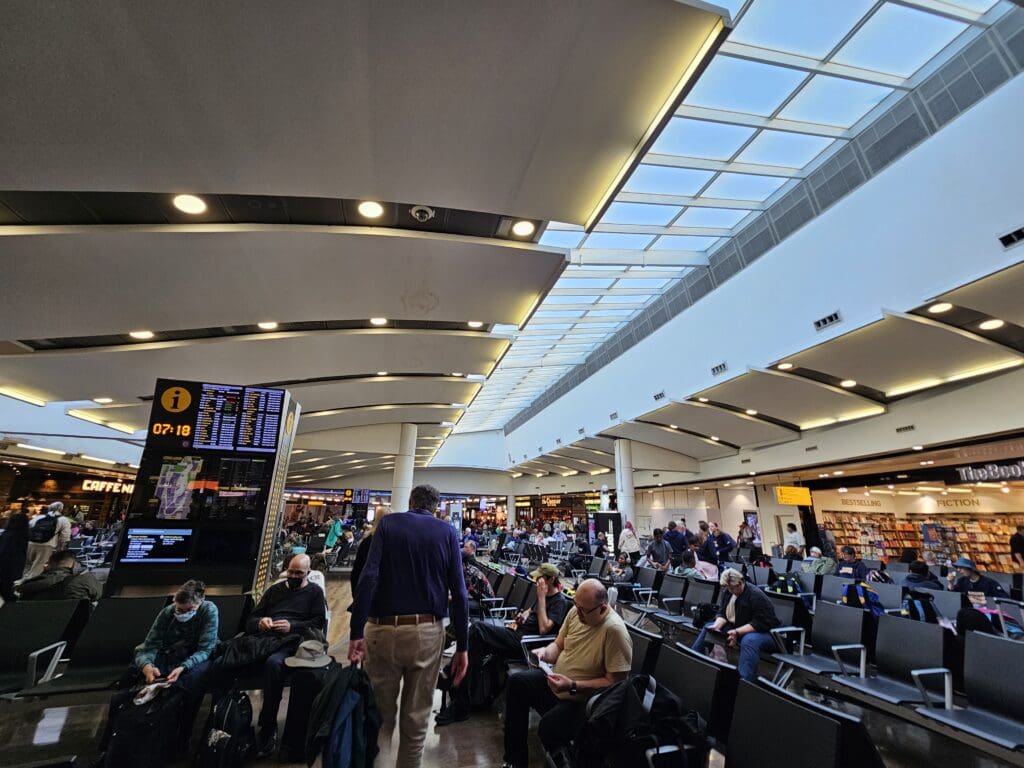
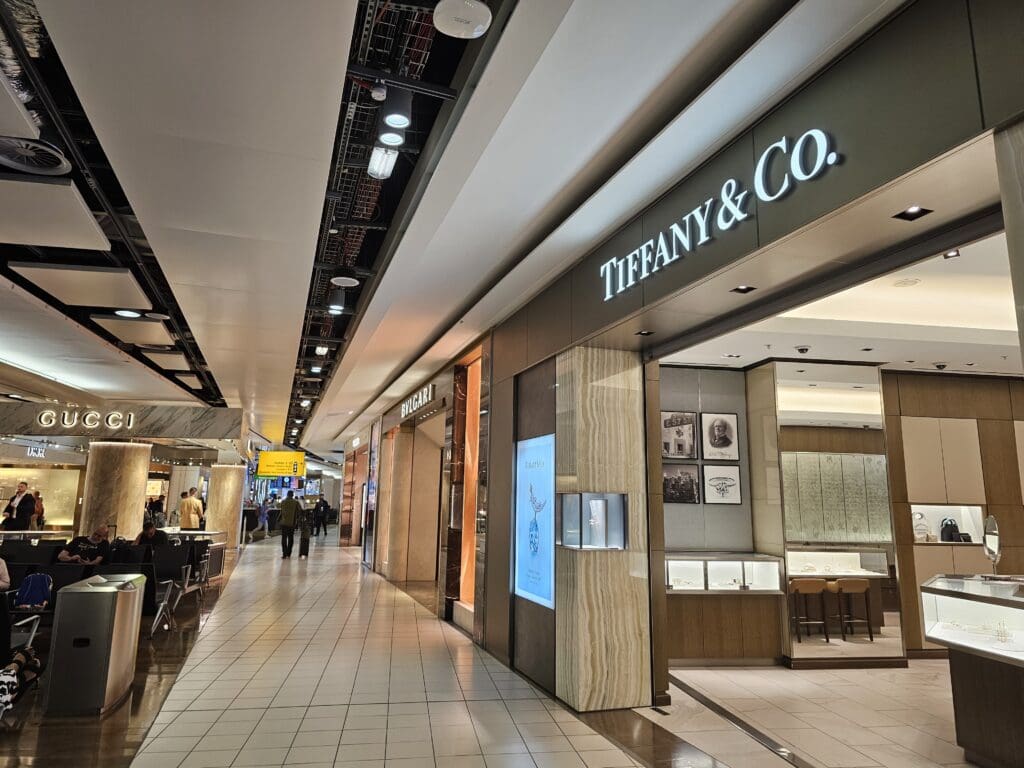
As I wandered around, it was impossible to claim that the airside portion of Terminal 3 provided any sort of inspiring or memorable architecture or ingenious design features. However, ignoring the poor state of the toilets, for the most part, the terminal appeared to be in a clean and tidy state. Furthermore, a good number of charging stations could be found throughout and I encountered no issues when connected to the terminal’s complimentary wifi network. Examining the terminal’s layout, three piers jut off the main hub and are home to the terminal’s gates. Deciding to go for a wander, I found most of the piers to lack any sort of notable facilities, other than a few coffee shops, and it is worth mentioning that many of the gates are located quite some distance away from the central hub and I was thus advise passengers not to cut things too fine. For aviation enthusiasts, decent views of the aircraft outside can be had from the terminal’s piers.
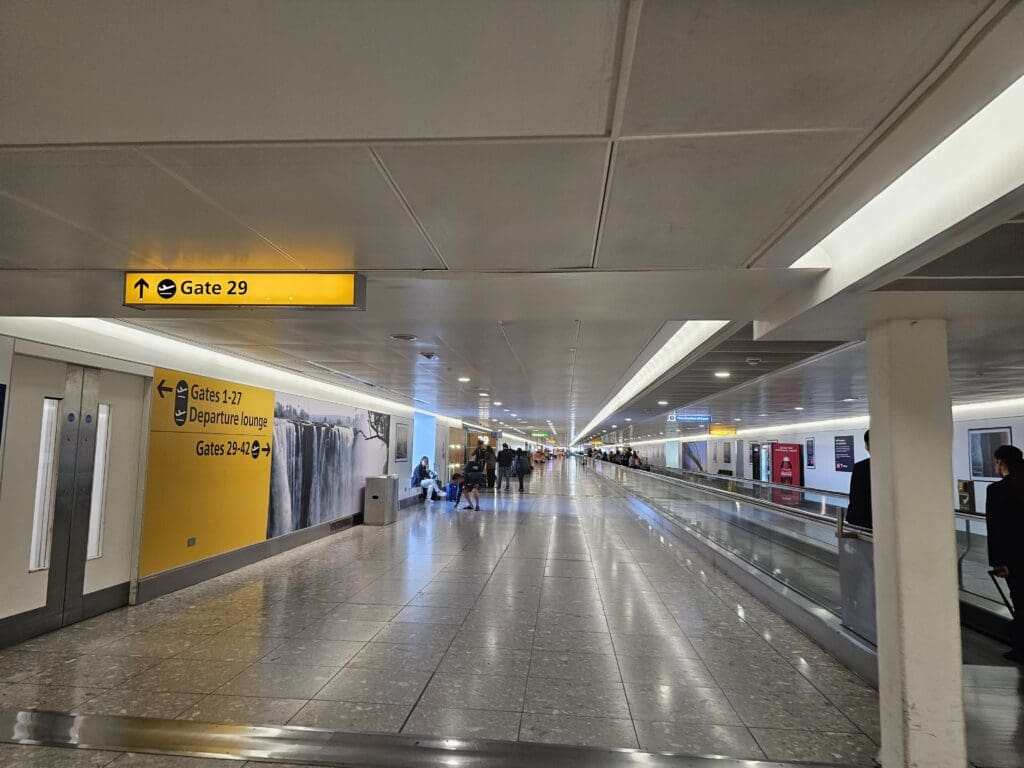
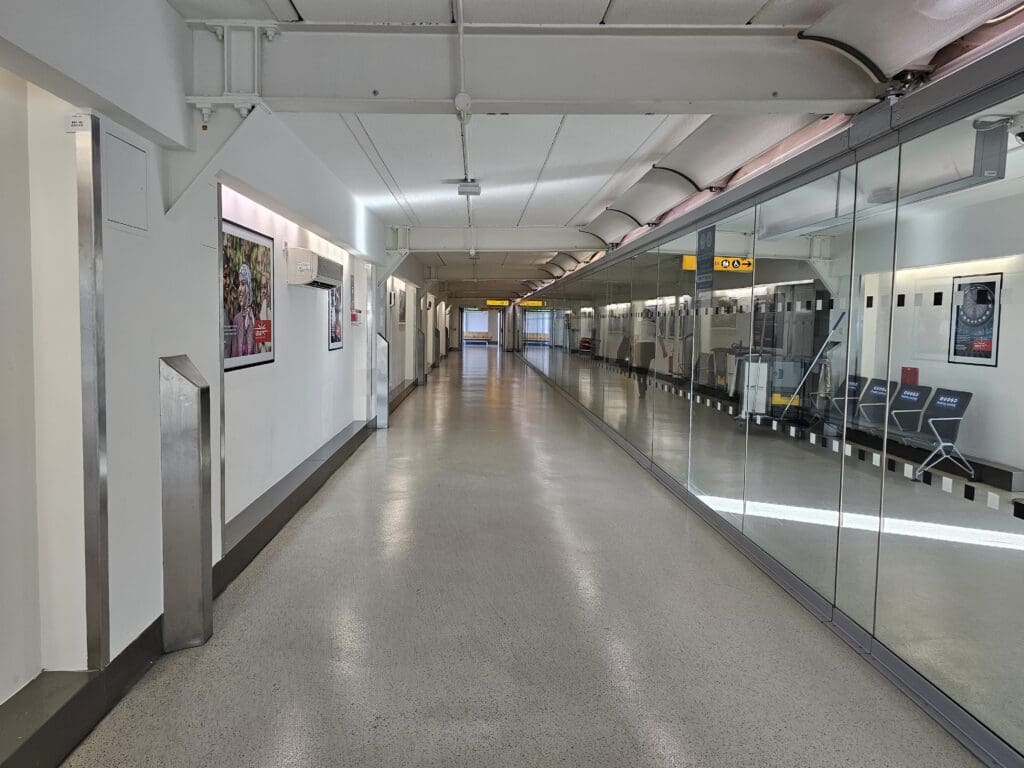
Examining Terminal 3’s role, beyond Virgin Atlantic Airlines and its American partner, Delta Air Lines, the terminal hosts plenty of airlines from across the globe. Specifically, Terminal 3 has long served as the airport’s OneWorld hub and hosts the majority of the alliance’s members that serve Heathrow. The exceptions to this is Iberia who share Terminal 5 with fellow IAG member British Airways, and Malaysia Airlines, Royal Air Maroc and Qatar Airways, who all utilise Terminal 4. The terminal also hosts a few Skyteam carriers, specifically, China Airlines and Middle East Airlines, plus non-allianced airlines such as Emirates, Iran Air and LATAM Airlines. Finally, British Airways also operates a few services from the terminal, although as is well known, the bulk of their operation takes place in Terminal 5.
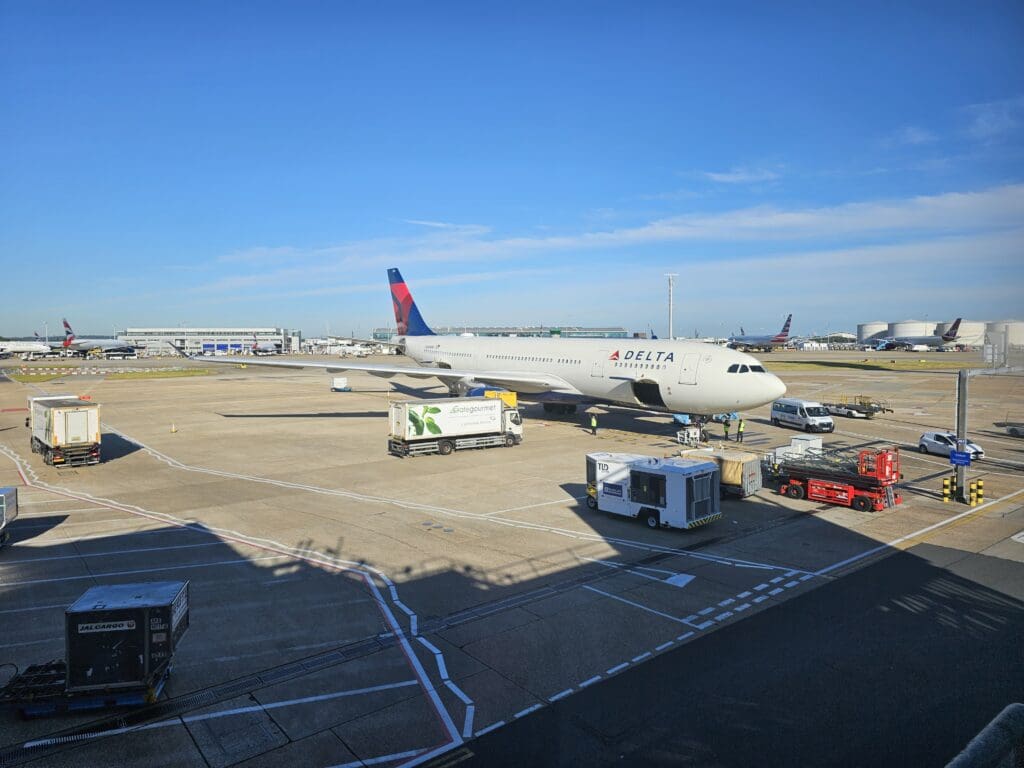
At that time in the morning, parts of Terminal 3 resembled the likes of Atlanta, Chicago or Dallas thanks to the many American Airlines and Delta Air Lines widebodies that could be seen resting on the ground at the end of overnight slogs. Meanwhile, as expected the terminal proved to be a superb place for getting a close-up view of Virgin Atlantic’s Airbus A330s, Airbus A350s and Boeing 787-9 Dreamliner jets, with a near-constant stream of these aircraft seen arriving and departing. Finally, clear vistas of both the southerly and northerly runway could be had from points in the terminal, and after a long explore, I plonked myself down at an empty gate that afforded me a good view of the constant stream of departures from Runway 09L. Despite being a rather exciting place for an aviation enthusiast, that morning, other than a couple of Qatar Amiri Flight Airbus A330s, there weren’t any aircraft that were particularly rare or unusual for a British aviation enthusiast. Nevertheless, I would never complain about getting the opportunity to sit and watch the endless stream of movements at Heathrow!
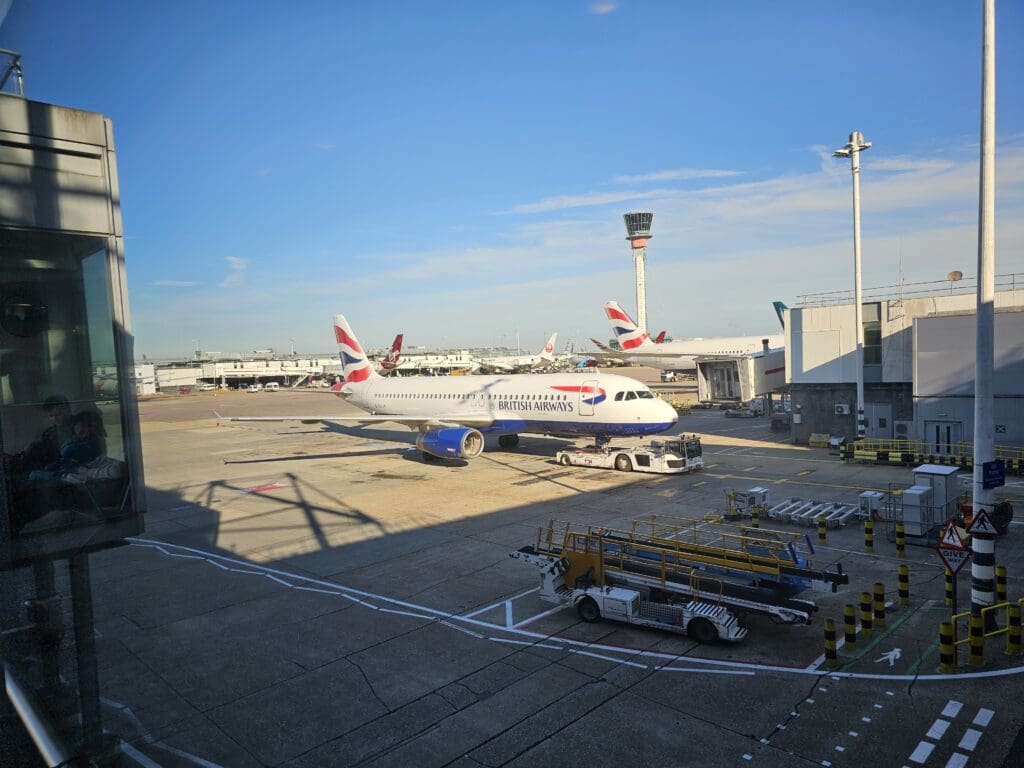
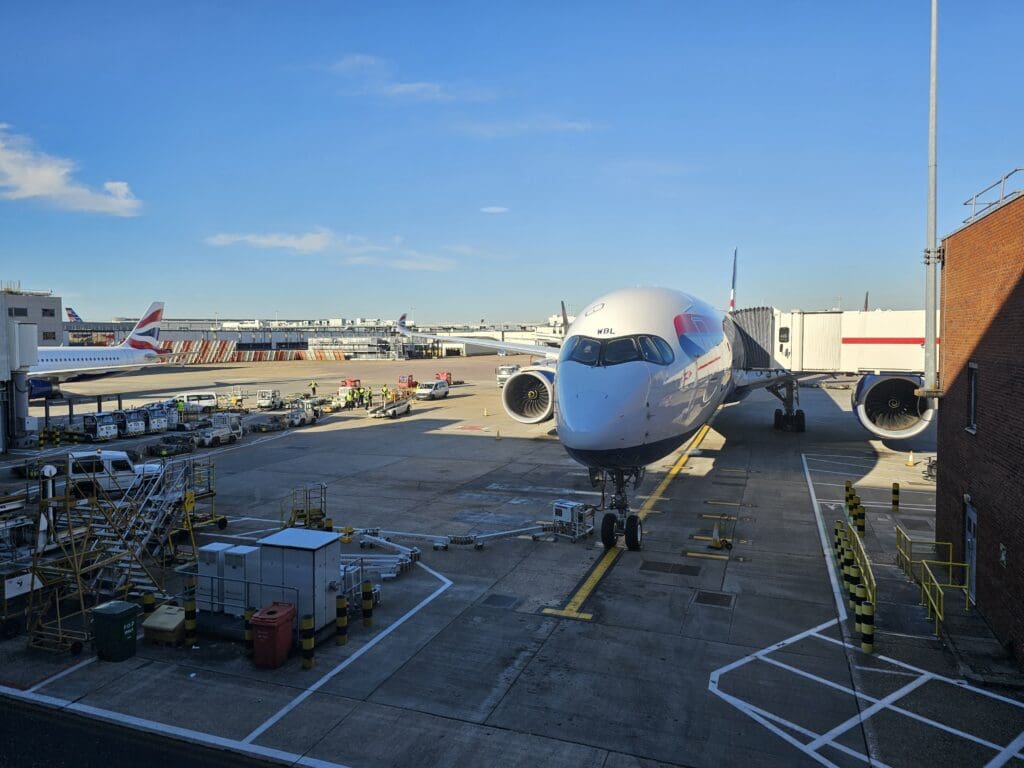
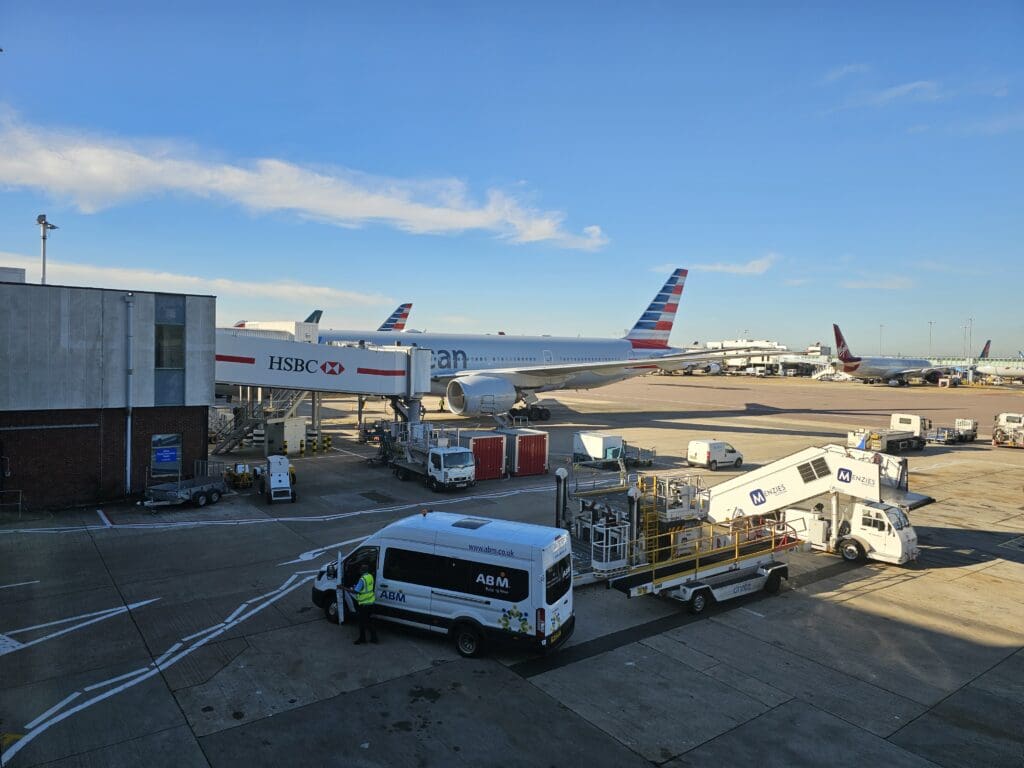
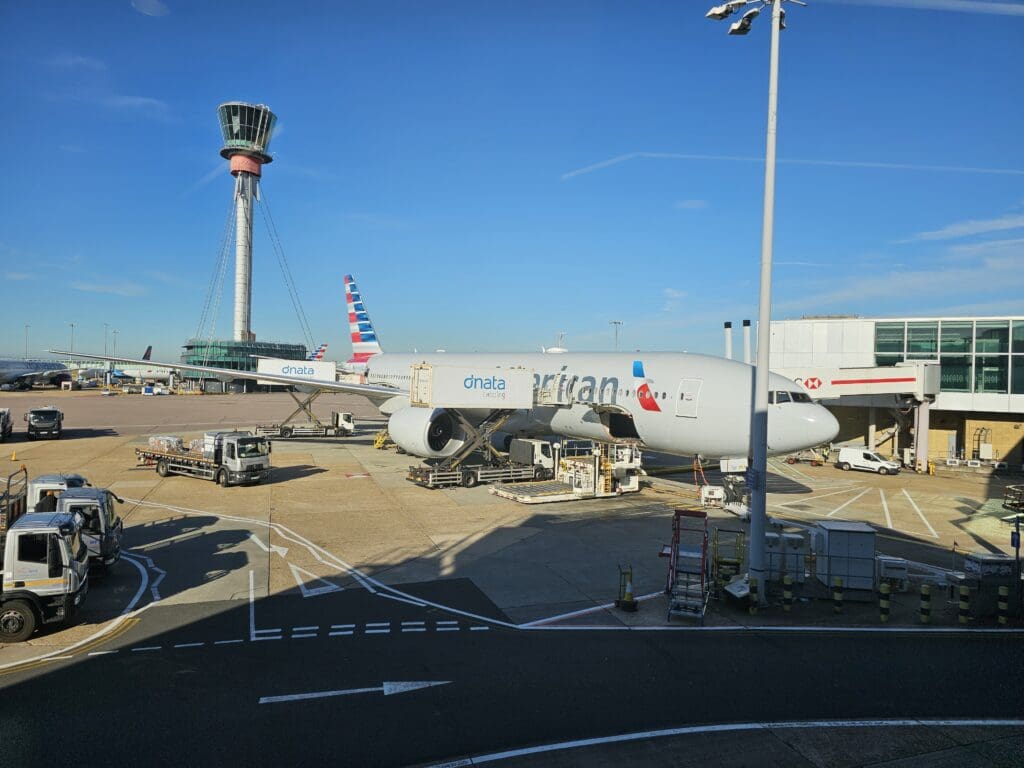
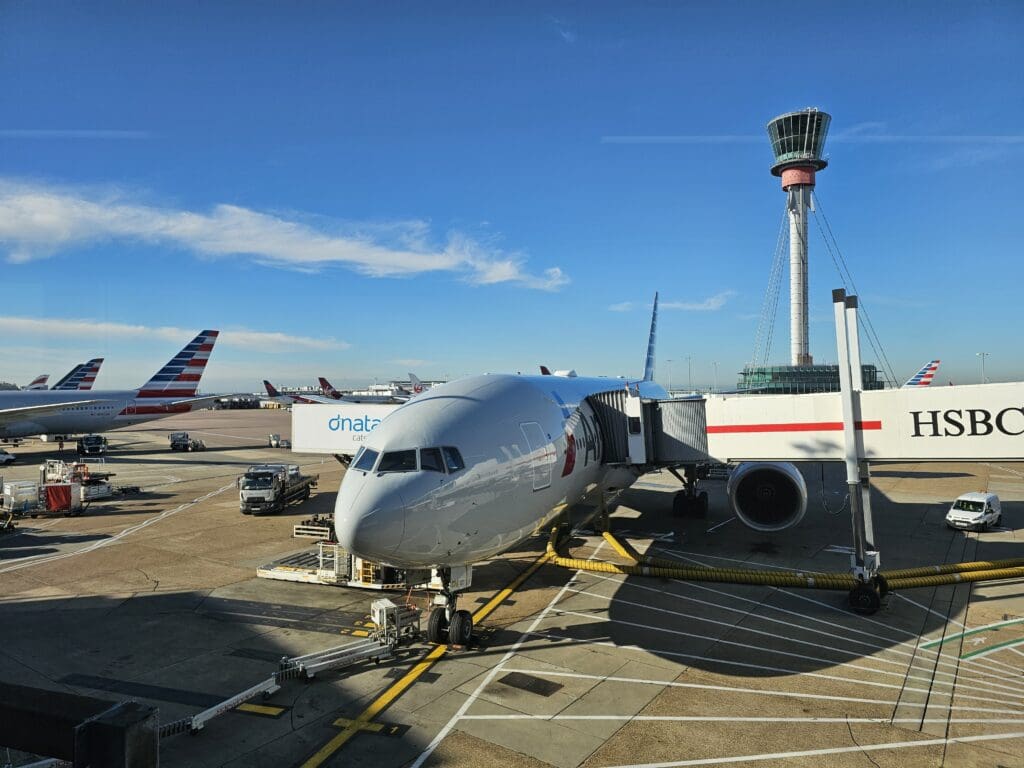
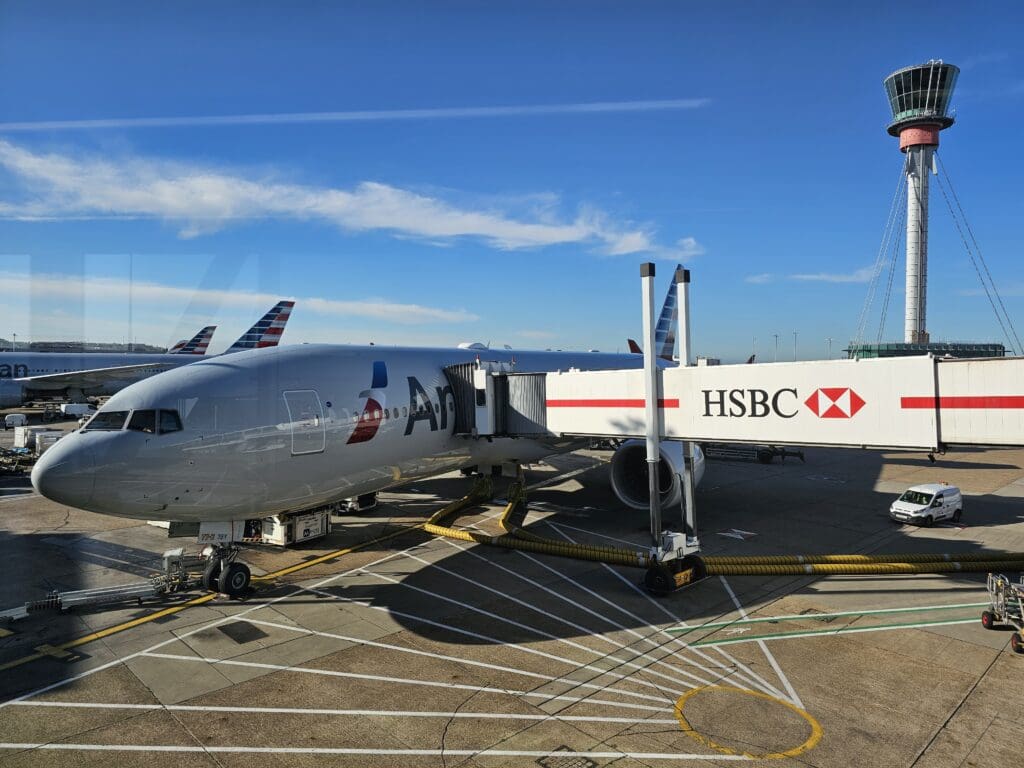
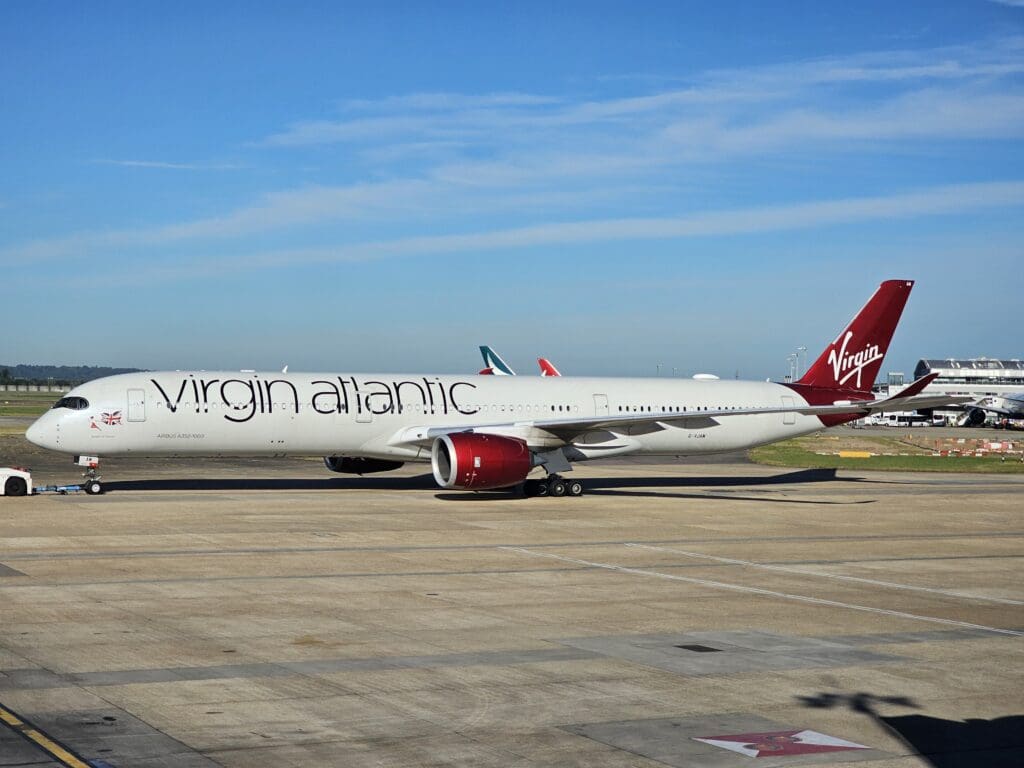
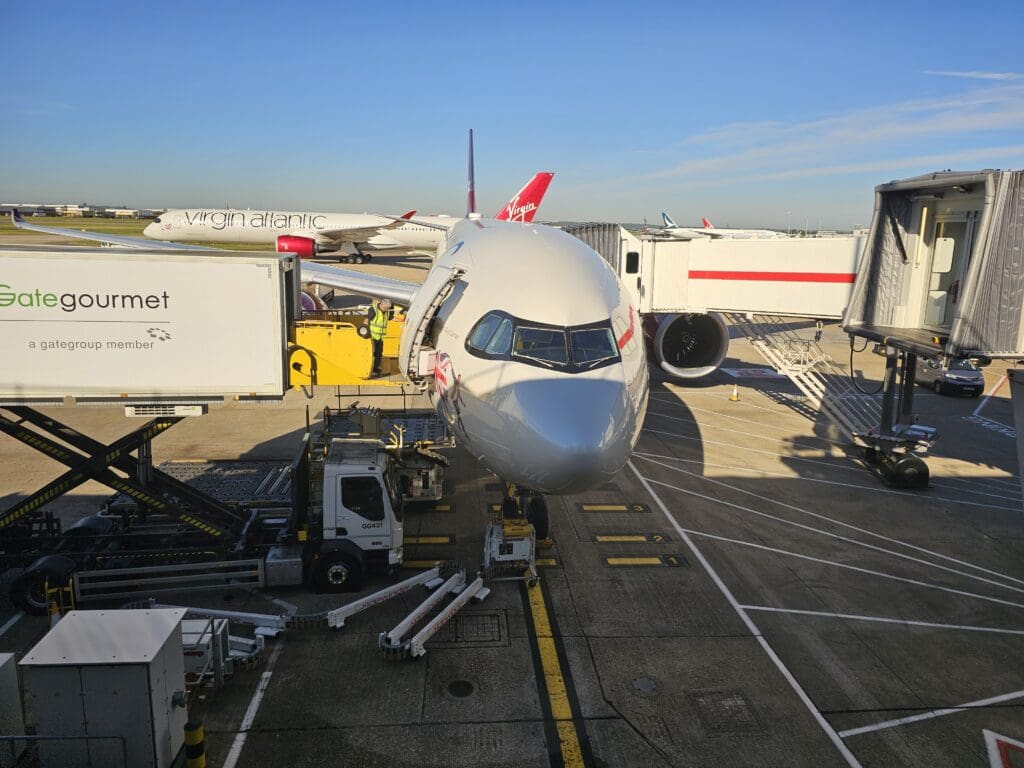
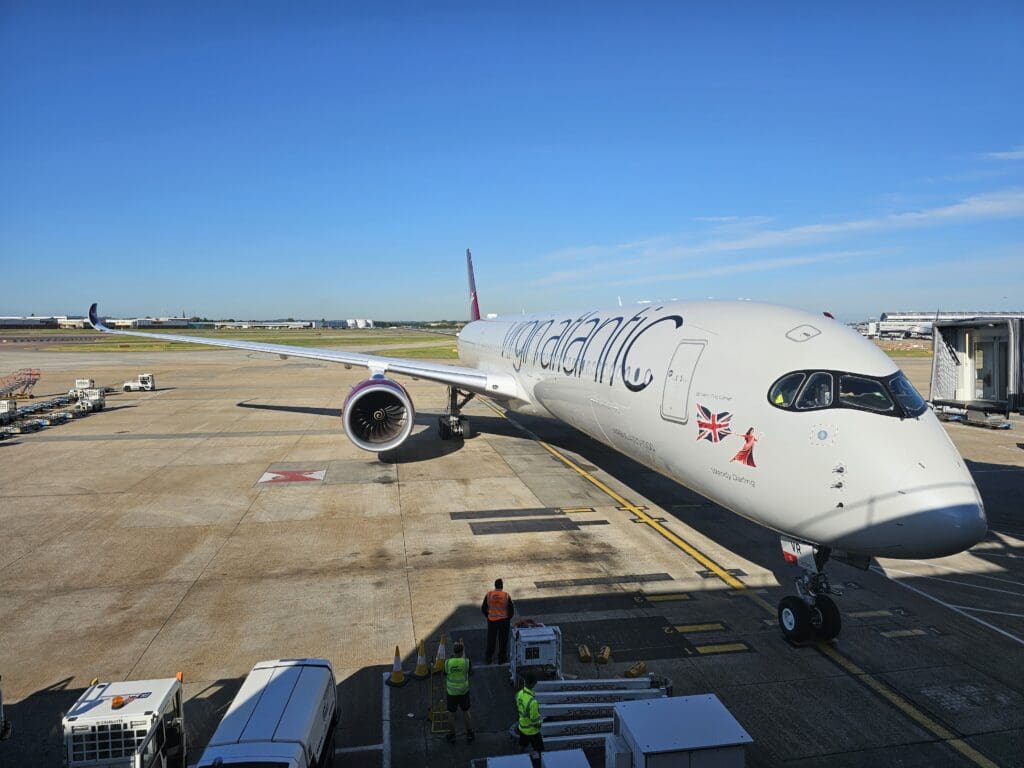
Japan Airlines schedules their Dreamliner-operated Tokyo service to have a ground time of a little over three hours in London each morning, allowing this to be thoroughly cleaned and serviced after its long overnight slog from Japan. With only a single Japan Airlines aircraft on the ground at the time, and with this having arrived on time, as I wandered around the terminal this aircraft could already be seen sitting at Stand 322, which corresponds to Gate 22. This is located on the thin rectangular pier that hosts Gates 13 to 22 and is one of the furthest gates from the main waiting area. Once I had spotted myself out, I wandered over to the gate with a little over an hour to go until departure. However, upon arriving there, I soon discovered that this is a boxed-off gate which requires passengers to have their boarding pass scanned before entering the gate waiting area. With the ground staff still readying this for the flight, once there I turned back and took a seat at a nearby vacant gate before returning to this with around 45 minutes until the flight was scheduled to depart.
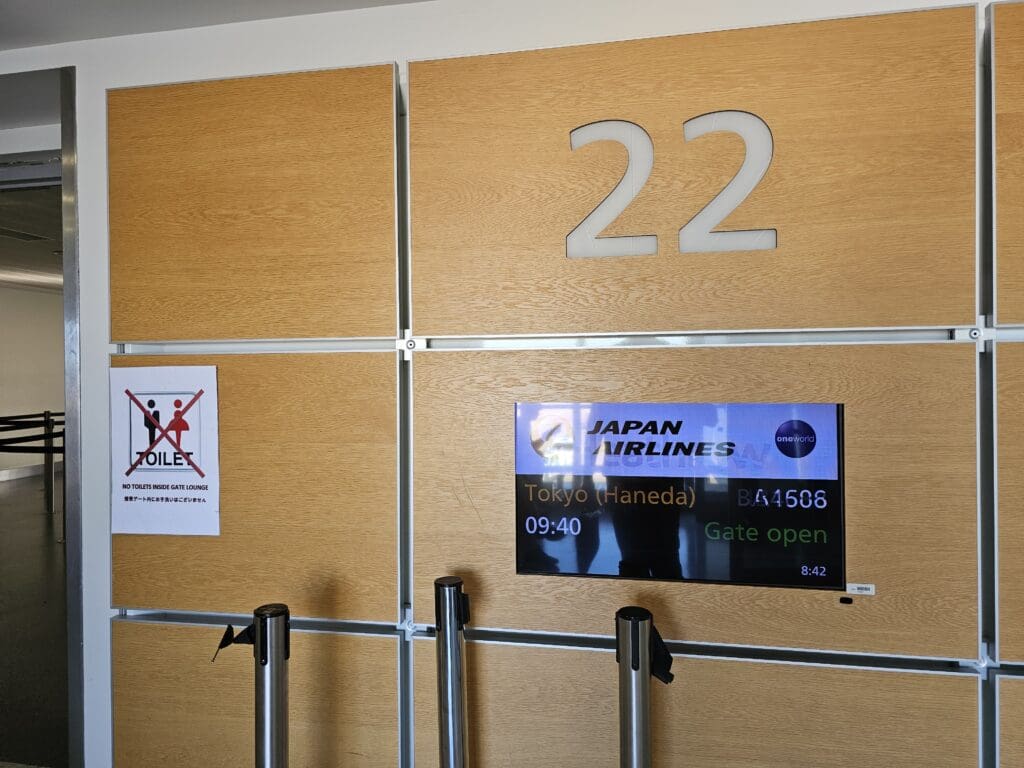
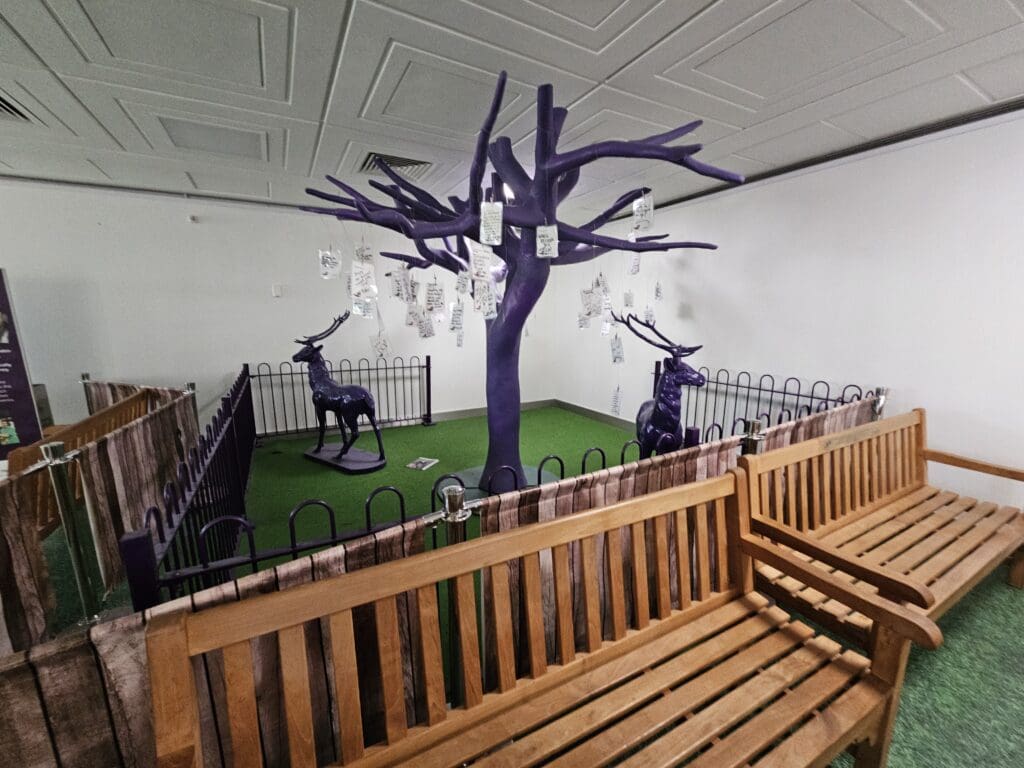
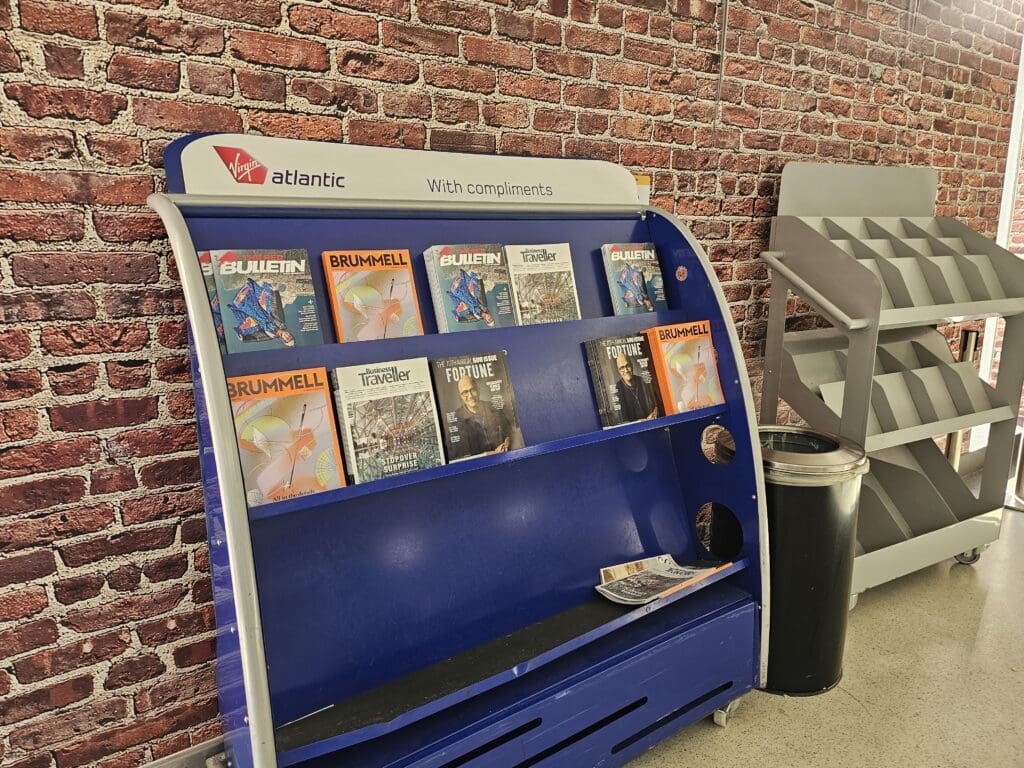
Once I returned to the gate, I was greeted by a friendly Japan Airlines staff member who asked me if I was heading for Tokyo, and, once I had confirmed that I was, I was guided towards the Economy side of the podium. With no queuing required, I had my boarding pass scanned and my passport checked before being allowed to enter the waiting area. This waiting area was compact, and I wouldn’t have liked to spend any significant amount of time there before heading off on say a full high-density seating widebody aircraft. Interestingly, part of the waiting area appeared to have been designed to resemble a park and came complete with real wooden benches, two purple deer and a purple tree. Later research revealed these to have been installed following the 2012 Olympics, whilst messages from Olympians and staff could be seen hanging from the tree’s branches. Other than this, the area was home to vending machines selling drinks, snacks and ice creams, a television, a payphone(!) and a Virgin Atlantic branded magazine rack with copies of Brummell, Business Traveller, Fortune, The Red Bulletin and Stylist for passengers to take and read at their leisure. Despite not being the most spartan gate holding area, this did seem to lack plug sockets, and more importantly, toilets! However, rather thoughtfully a sign had been erected in Japanese and English at the entrance to the gate warning passengers about the lack of lavatories in this area.
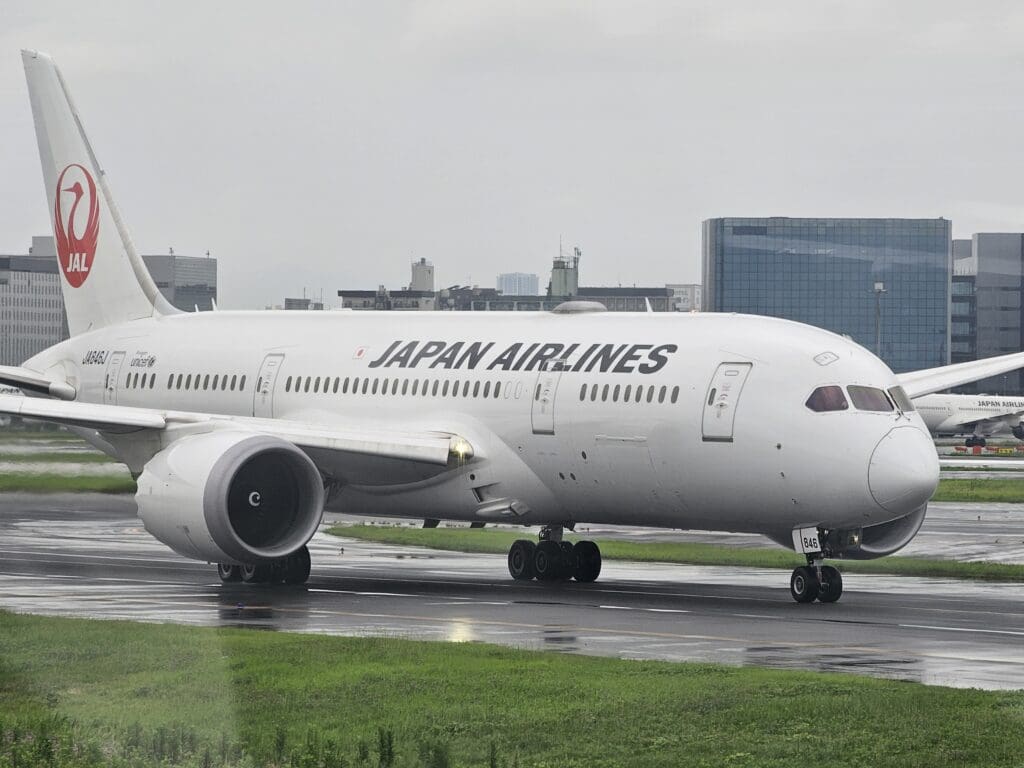
Whilst the gate failed to offer the best views of Stand 322, the waiting Dreamliner could be seen through a few dirty and tinted windows. That day, I would travel to Japan onboard Boeing 787-9 Dreamliner, JA866J. Hailing from Boeing’s South Carolinian plant in Charleston, this Dreamliner carries the line number 479 and first took to the skies in October 2016. This made it a ripe 7.6 years old at the time of my flight. Destined for Japan Airlines, in December that year the aircraft was ferried directly to the airline’s Tokyo Narita hub where it was soon pressed into service, connecting Japan with short, medium and long haul destinations across the world. In the week before my flight, the aircraft had undertaken eleven sectors and connected Tokyo Haneda with Beijing, Helsinki, Hong Kong and London Heathrow. Fortunately, these seem to have all gone to plan, although the aircraft had suffered one notable incident during its lifetime. This took place in July 2017 when the aircraft experienced engine issues at the start of a flight from Kuala Lumpur to Tokyo Narita which saw it return to Malaysia. Returning to the present, looking outside, impressively, despite the aircraft’s very white livery, this appeared to be clean and in good condition, with few dirt streaks or marks visible on the fuselage, giving me hope that the interior would be equally spotless!
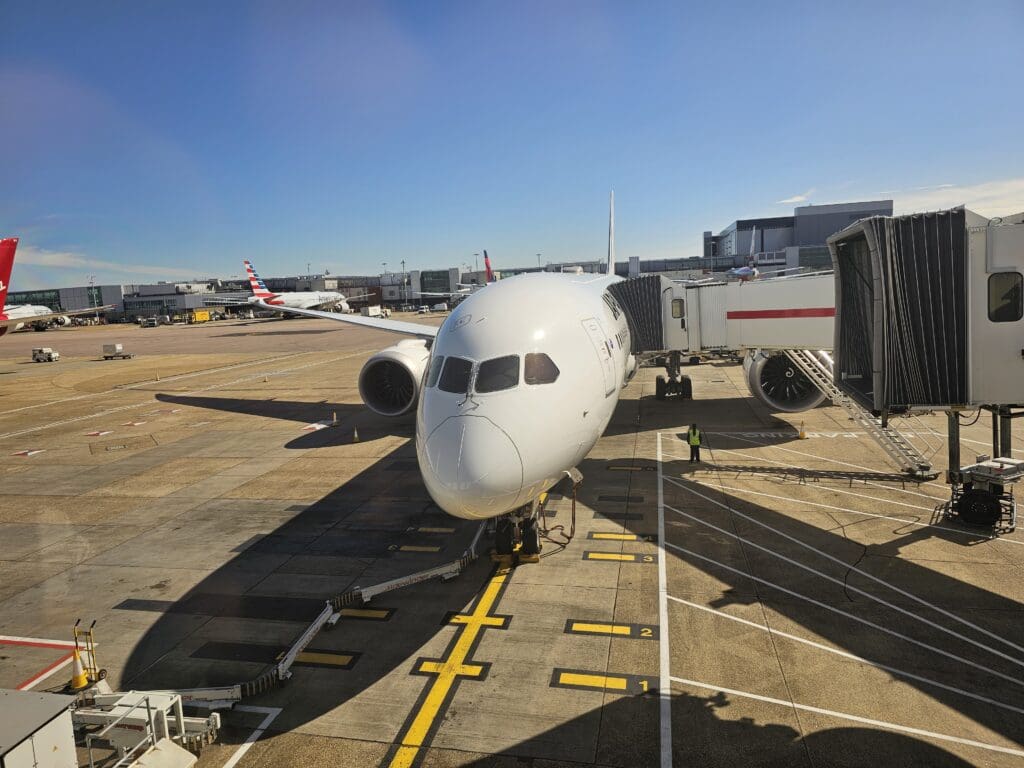
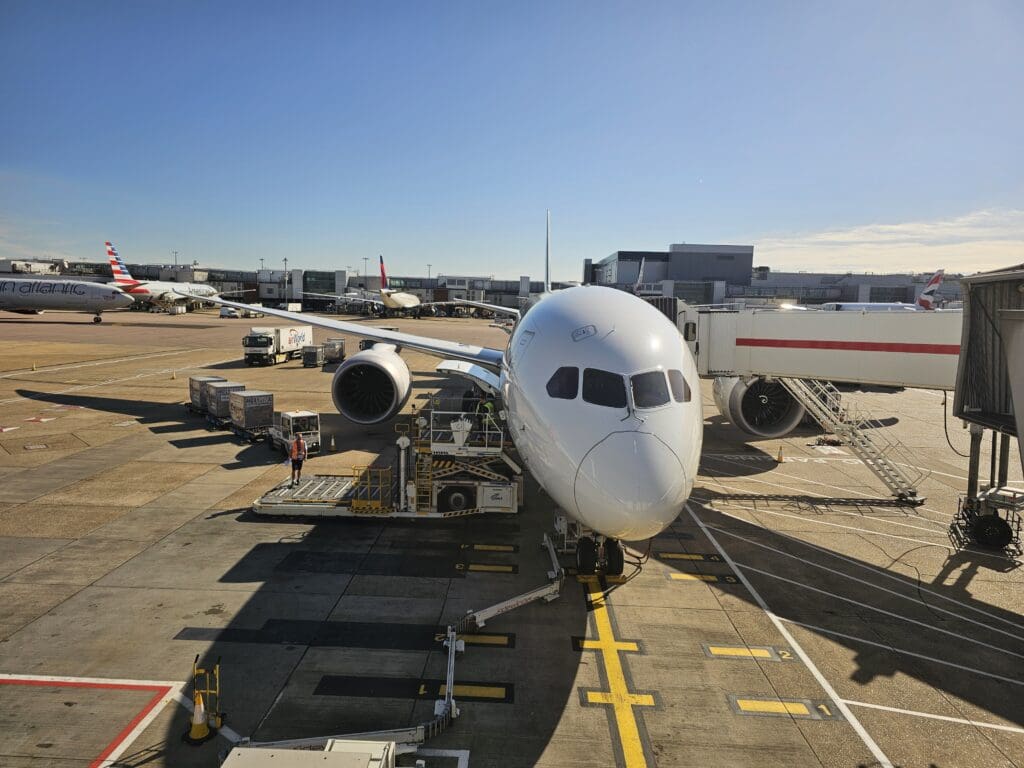
Kicking off proceedings, at 0910, a long pre-recorded announcement rang out in Japanese and English at which point the cluster of waiting passengers seemed to fall silent. This went through the boarding process and consequently gave the impression that boarding was to be a well-ordered and structured affair. This was to be undertaken in six stages and importantly, passengers requiring assistance, passengers travelling with young children and expectant mothers were invited to board the aircraft first, followed by Groups 1 to 5. Seated in the rear half of the Economy cabin, I was to be in the penultimate boarding group and the first cohort of Economy passengers to board the aircraft. Despite this positive start, 0915 soon came and went with no sign of any movement, however, at 0917 an announcement was made in English only and advised passengers that boarding had been pushed back to 0930 owing to delays in aircraft preparation. On the plus side, looking outside, by this time it seemed that most ground equipment had been cleared from around the aircraft and the tug had already been connected to the aircraft.
Contrary to the gate agent’s announcement, at 0925 the first cohort of passengers were invited to board the aircraft and the staff soon worked down the boarding order. Seeing as passengers’ boarding passes and passports had been checked at the entrance to the gate holding area, boarding was undertaken on a trust-based system with no further boarding pass checks made. Therefore, dishonest passengers could have attempted to rush onboard as soon as Group 1 was called, however, thankfully this wasn’t the case and boarding was a calm and civilised affair. After around five minutes of lingering around, Group 4 was invited to board and without any further checks, I steamed down the viewless jetway before successfully making it to the Dreamliner’s L2 door. Following a short wait, I stepped into the galley and received a polite greeting in English from the two smartly dressed flight attendants who stood in this galley and welcomed passengers. Within moments, one of the flight attendants checked my boarding pass and instructed me to take a right and head down the first aisle before I commenced the voyage down the aircraft to my seat.
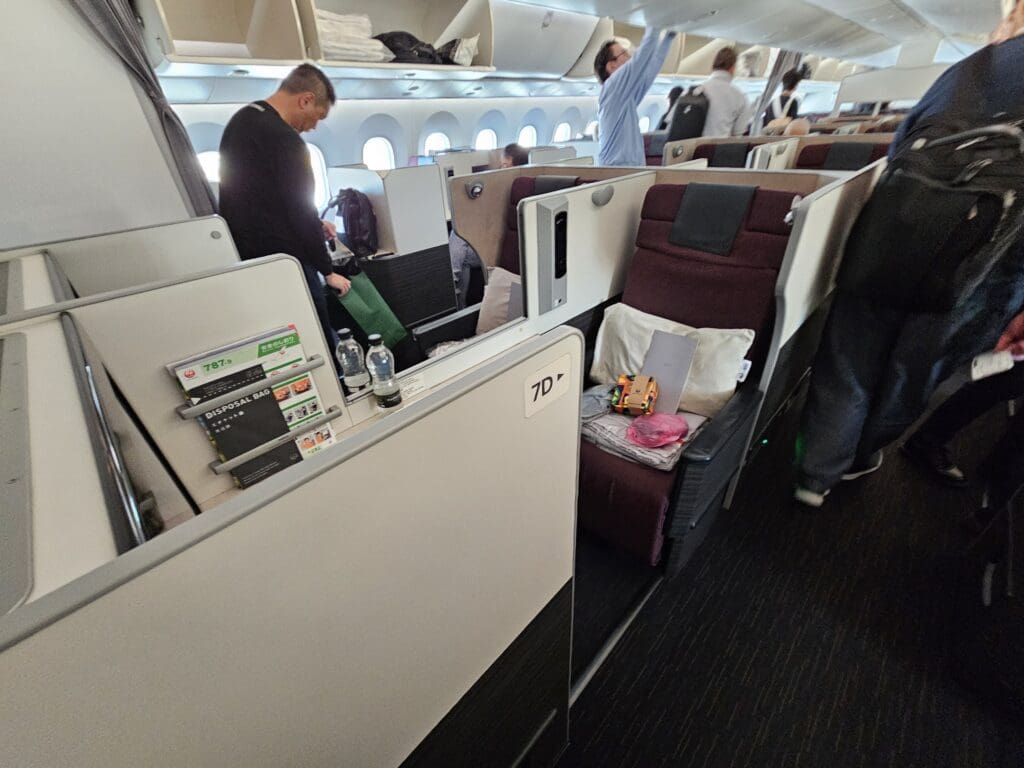
Japan Airlines’ Boeing 787-9 Dreamliners are kitted out in a premium-heavy configuration. Onboard, Business Class is spread out across two cabins. At the time of my flight in June 2024, Japan Airlines offered two different Business Class seats on their Boeing 787-9 Dreamliner fleet. These are the Safran Aries seat and the private and luxurious Collins Aerospace Apex suite. These are marketed by Japan Airlines as the JAL Sky Suite III and the JAL Sky Suite respectively. Unsurprisingly given the long flight time of their London service, JA866J was equipped with their more luxurious and spacious Business class product, the JAL Sky Suite. Once in the smaller rear Business cabin, I was greeted by the sight of twenty of Japan Airlines’ highly regarded suites and upon boarding this section of the aircraft already seemed to be rather full. Without thinking too much about the splendid luxury that the flight’s lucky minority would be treated to over the next thirteen hours or so, I steamed on and received another warm and friendly greeting as I entered the flight’s Premium Economy cabin.
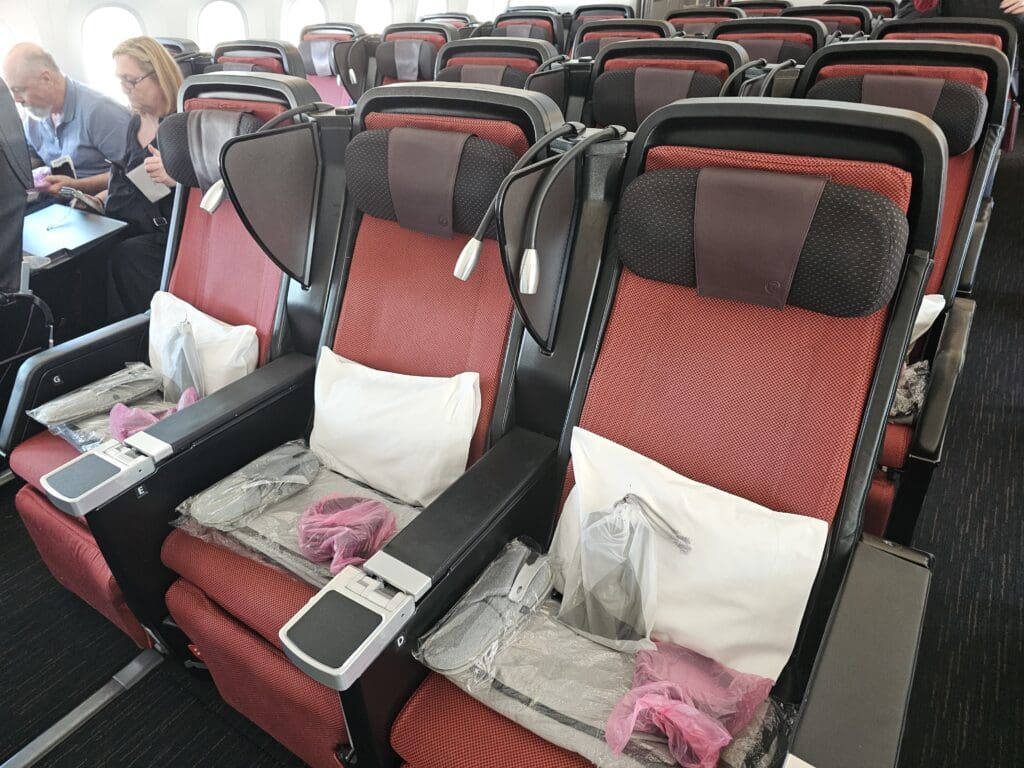
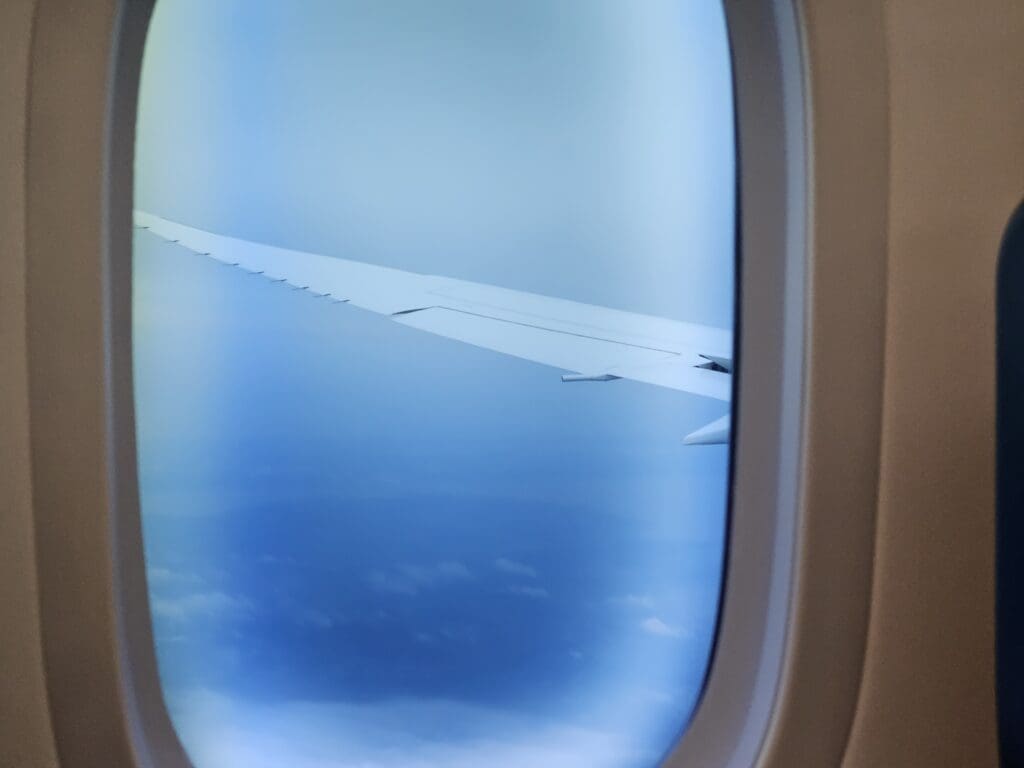
Despite being no connoisseur in anything other than airlines’ economy products, at first glance, Japan Airlines’ Premium Economy cabin seemed to be a little more upmarket than those of many other major airlines. This was largely due to the presence of a privacy screen between each seat, however, other than these, the seats came in a rather standard 2-3-2 configuration. Meanwhile, further research revealed these to be no larger than most other premium economy seats. As I made my way down the aircraft, upbeat piano music filled the cabin and bright lighting beamed down from above. Interestingly, upon boarding, the Dreamliner’s electronic window dimmers were set to a slight tint and remained on this setting throughout our departure until being dimmed later on in the flight. As I made my way to my seat, I received a polite and friendly greeting from each flight attendant that I passed during this journey, whilst the cabin crew were also proactive in escorting passengers to their seats.
Before I knew it, I passed the galley and arrived in the rearmost cabin of the Boeing 787. Thanks to its premium-heavy layout, Japan Airlines squeezes all Economy seats into this rearmost cabin. This is home to just 116 Economy seats. Perhaps one of the first things that many passengers will notice when flying on Japan Airlines’ Dreamliners is not the small size of the Economy cabin but its spacious eight-abreast layout. Indeed, Japan Airlines is the only airline in the world to fit eight seats across the cabins of their Dreamliner fleet as opposed to the usual nine. These are arranged in a 2-4-2 configuration, which as a solo flyer, I find to be a better layout than the usual 3-3-3 arrangement. Just like how those seats in Business and Premium Economy have a unique name, Japan Airlines markets their Economy seats onboard their long haul Boeing 777 and Boeing 787 Dreamliner fleet as Sky Wider seats. Indeed, with 18.5 inches of width, this is not without reason!
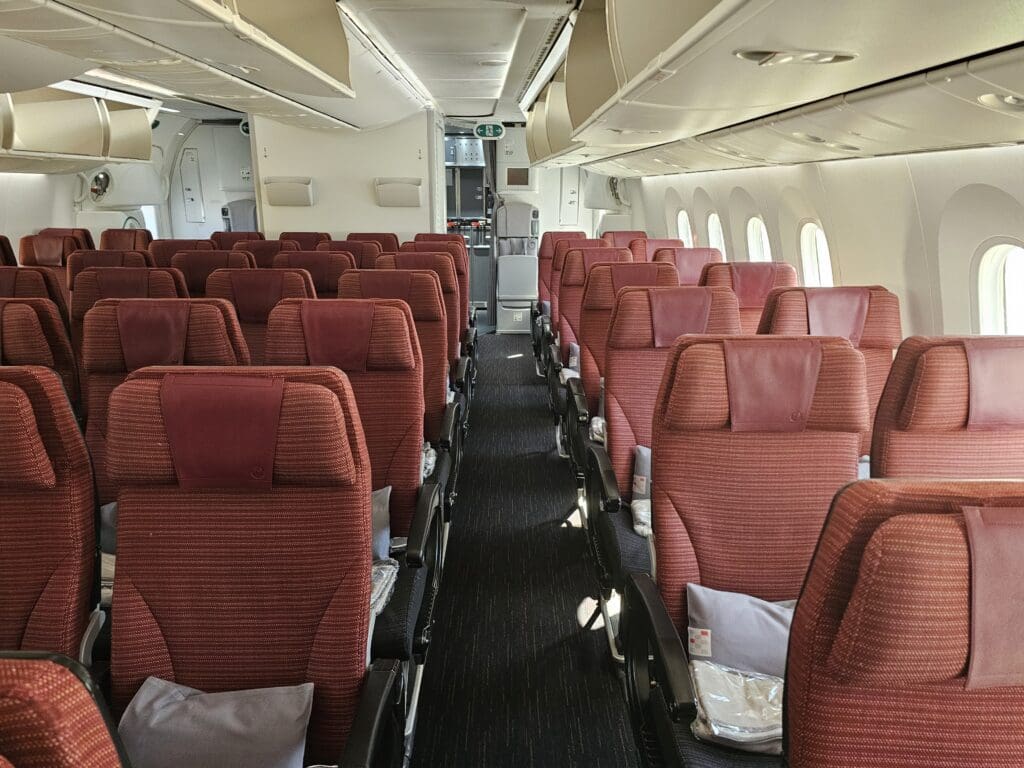
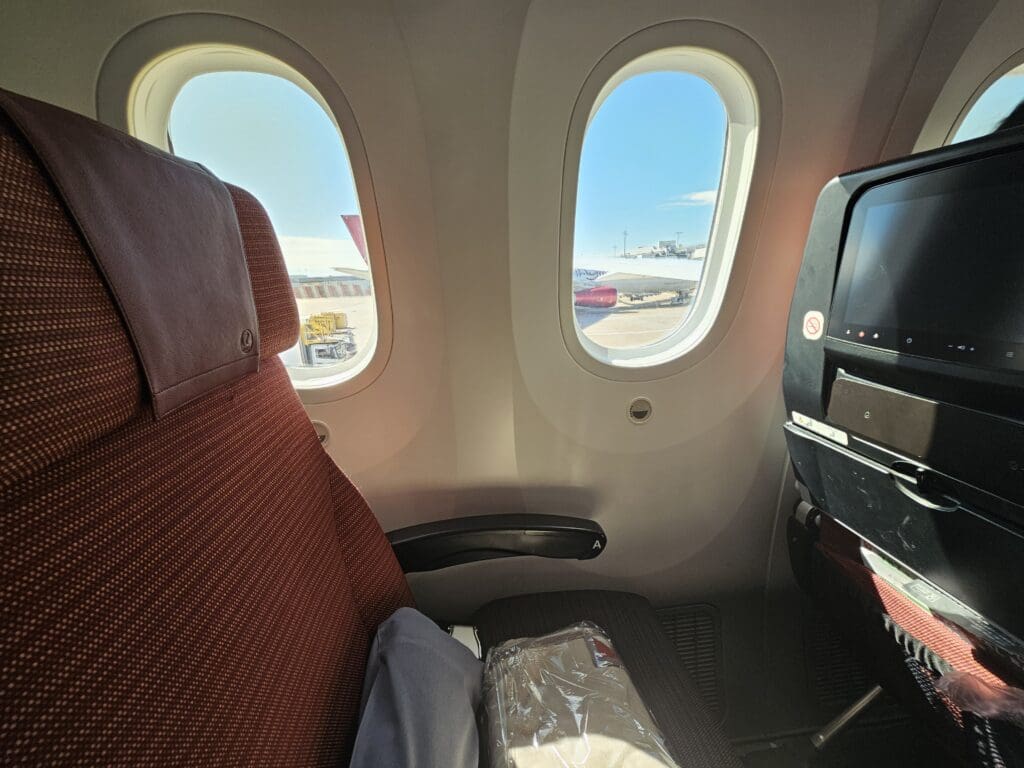
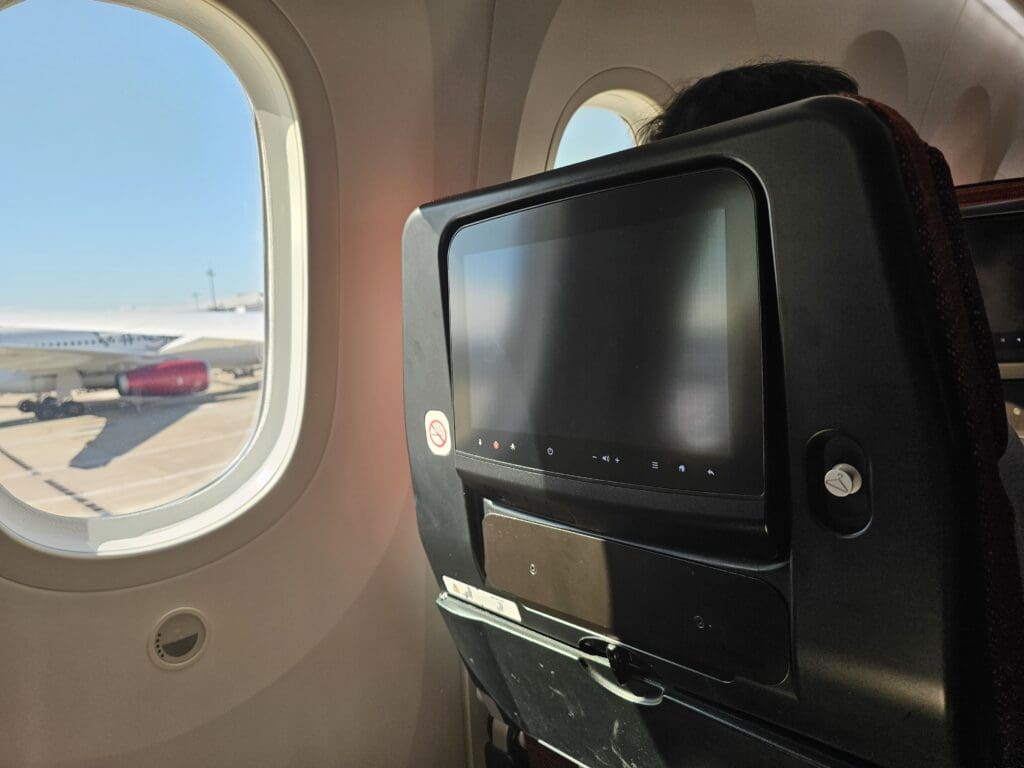
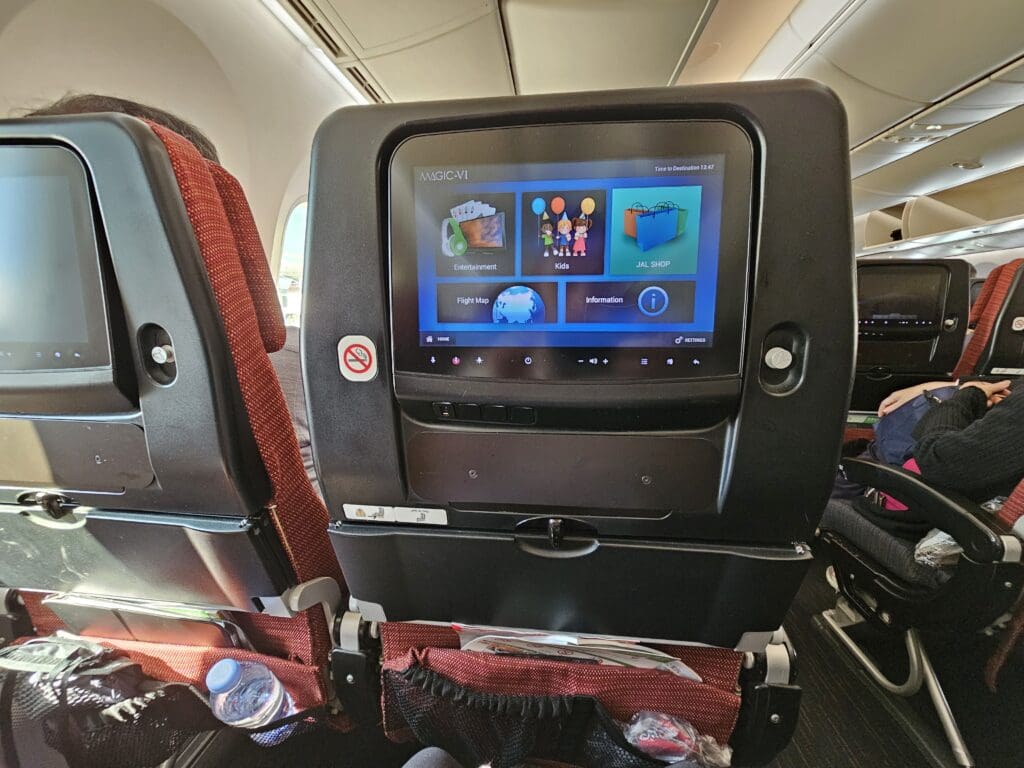
In keeping with Japan Airlines’ brand identity, each Economy seat is covered with a red fabric cover that sports subtle horizontal lines, whilst the seat base is covered by black fabric. These are topped with a decent adjustable headrest that was partially covered by a burgundy pleather antimacassar on which Japan Airlines’ famous motif was embossed. Meanwhile, the rears of these were covered by a black plastic backing which was slightly more unique than your typical light coloured plastic that is seen on most seats. Examining the seats’ features, these came with a seatback pocket, a bi-fold tray table, coat hook and two smaller pockets to hold devices and personal items. The centrepiece of each seat was a high definition 10.6 inch wide touchscreen inflight entertainment screen, powered by Thales’ AVANT inflight entertainment system. Beneath this, a cover could be seen which seemed to be hiding a space that was either once occupied by the inflight entertainment controller, or where this was originally intended to have been installed. Last but not least, a USB port could be found underneath the screen and a universal power outlet was positioned underneath each seat. Using these later on during the flight, I can happily report that both worked without issue, enabling me to charge my phone and laptop.
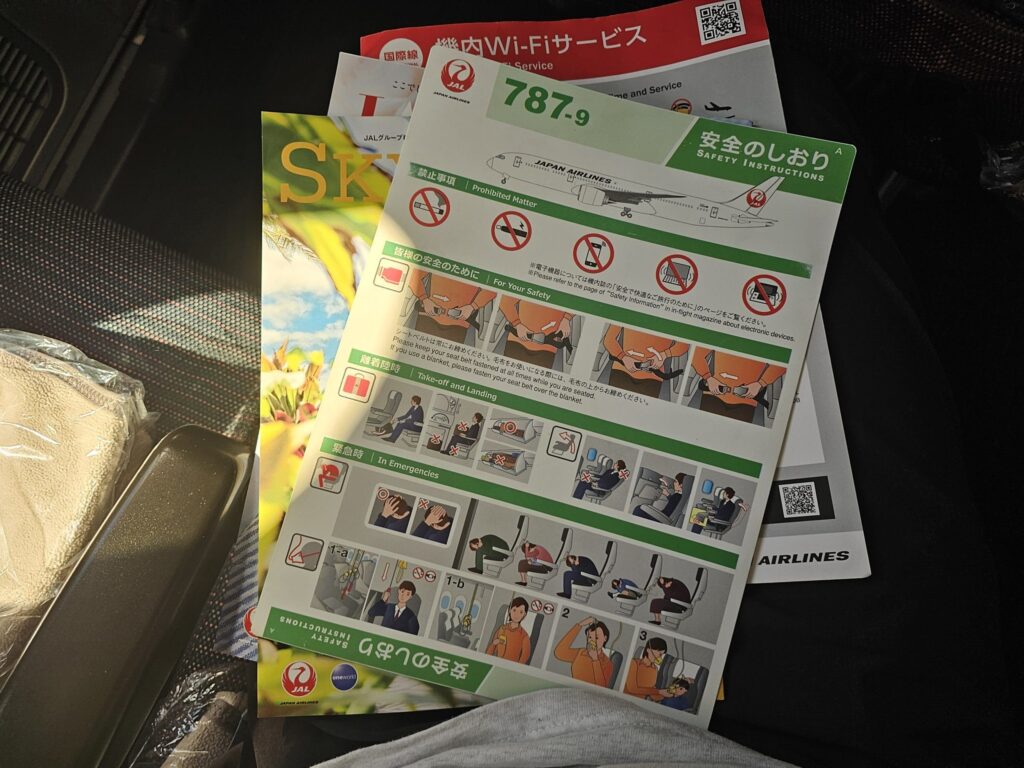
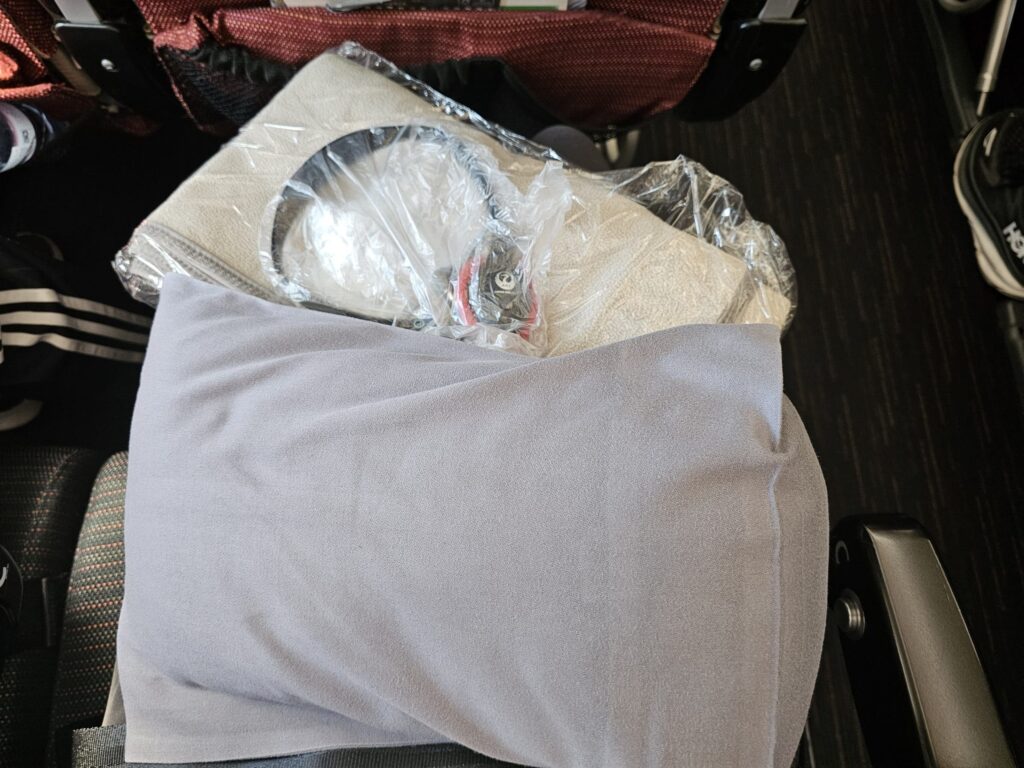
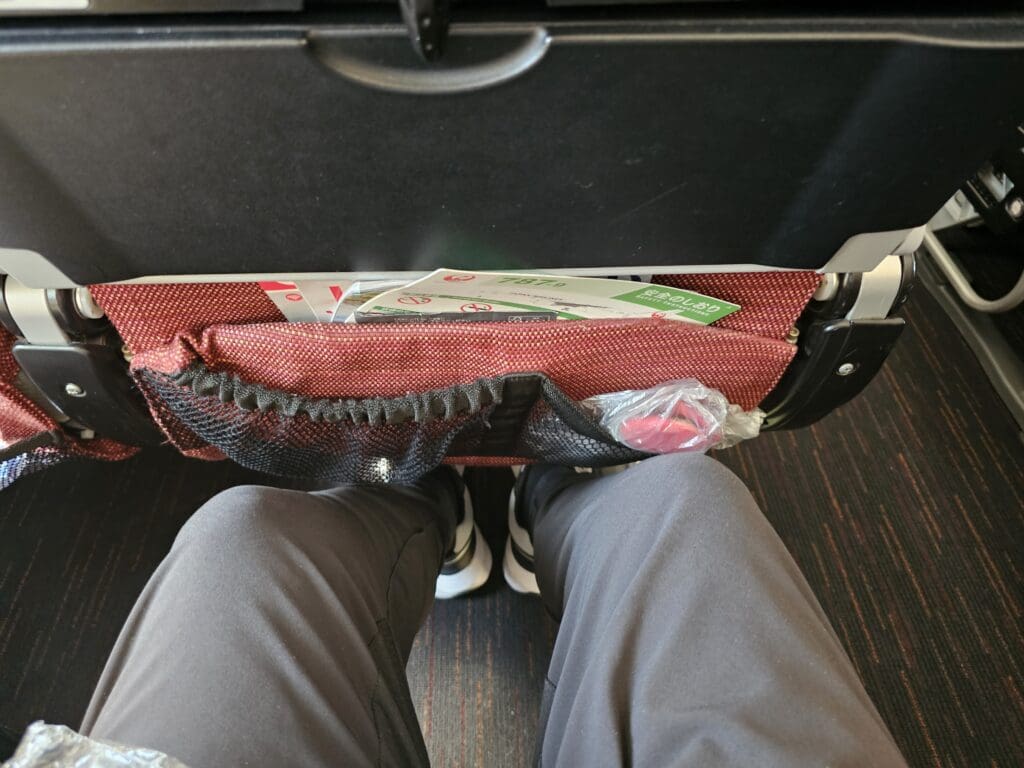
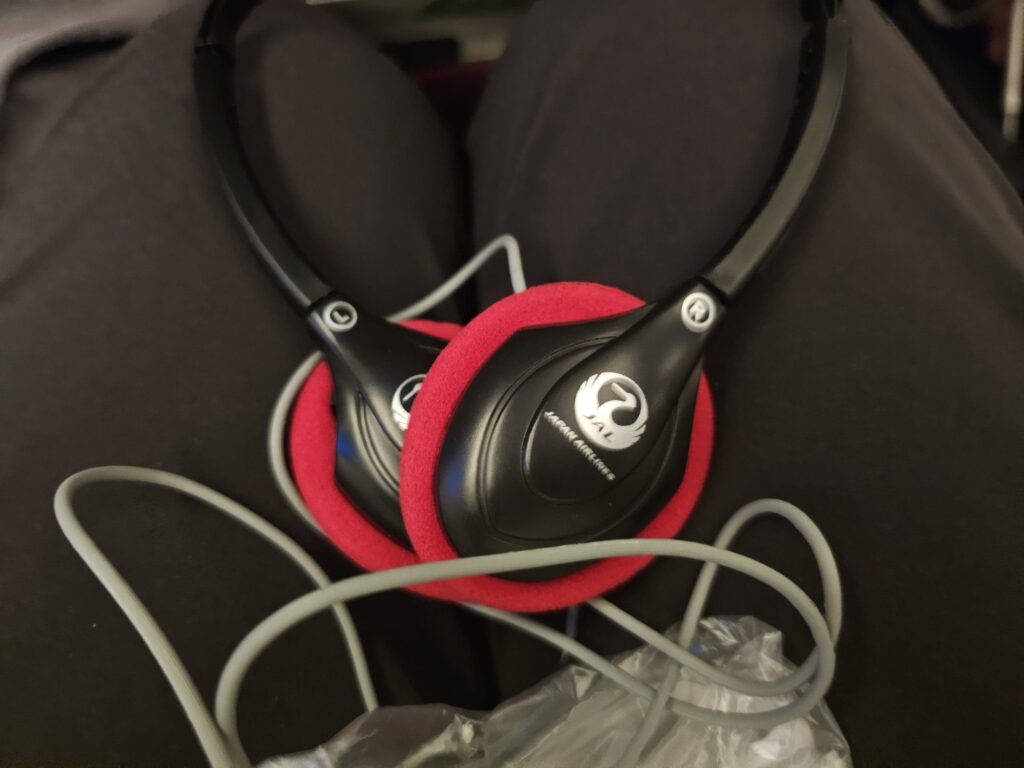
Turning to the seatback pocket, this contained the all-important safety card, as well as a sickbag, an information card advertising the onboard wifi, a copy of the latest JALshop catalogue and a copy of the international version of Japan Airlines’ monthly Skyward inflight magazine. Being a long haul flight, expectedly, a set of Japan Airlines branded headphones, a packaged blanket and a pillow were all provided. These all seemed to be of above-average quality when compared to the usual Economy class offerings and thus left me with zero complaints. My only slight gripe was that despite the long length of the overnight slog to Tokyo and Japan Airlines’ stellar reputation, nothing by means of an amenity kit was offered. However, perhaps my amenity kit expectations had been skewed, having recently been provided with no fewer than two of these on the five-hour hop from Baku to London with Azerbaijan Airlines!
Once I had made it to Row 53, I decanted everything I thought that I would need for the next fourteen hours (of course, I ended up failing in this task and would have to retrieve more belongings later on in the flight!) before settling in for the journey ahead. Once seated, I was delighted to find that the area around my seat was spotlessly clean and tidy. I did however notice a few marks and scratches on the seat’s black backing, as well as on the inflight entertainment screen itself, however, it is fair to say that this particular Dreamliner was in a much better state than many aircraft that I have flown on. When it came to comfort levels, the seat itself offered an abundance of legroom, however, I did find the seat itself to be a little firm which became evident seven or so hours down the line!
Having been one of the first Group 4 passengers to board the aircraft, soon, the empty cabin around me began to fill up and within a couple of minutes I was joined by a neighbour in the window seat. Given Japan’s location on the eastern edge of East Asia, Japan Airlines doesn’t enjoy all too many geographical advantages when it comes to connecting passengers travelling between Asia and Europe. Additionally, Japan Airlines isn’t well known for having particularly cheap prices! Thus, looking around, I wasn’t overly surprised to find that most of my fellow flyers seemed to be ending their journeys in Japan, with Japanese passengers making up the majority of the flight’s demographic that day. In particular, there seemed to be a fairly high number of both elderly tourists and young university students. The latter demographic made sense given the fact that we were at the tail end of most British universities’ examination seasons. That day, I would estimate the load to have been around 80% in Economy, and it seemed that a fair few solo passengers sitting in either the window or aisle seat ended up enjoying the luxury of having two seats to themselves.
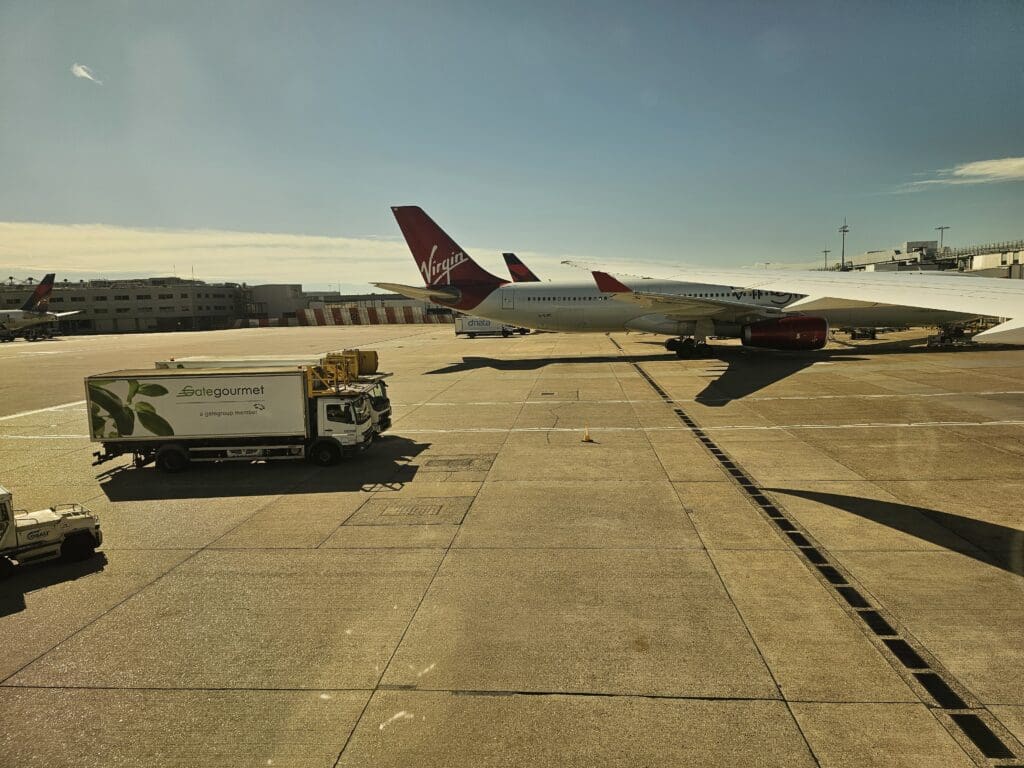
Turning to the army of crew members onboard, the flight was staffed by a mixture of Japanese crew and Chinese-speaking staff, who, judging by their interactions with my fellow passengers, appeared to be unable to communicate in Japanese. Whilst I did overhear a couple of language barrier-related issues later on in the flight, these seemed to be mostly avoided by pairing a Japanese-speaking crew member with a non-Japanese speaker during each round of service. Interestingly, all cabin crew members appeared to be female, with not a single male flight attendant seen onboard the Dreamliner that day.
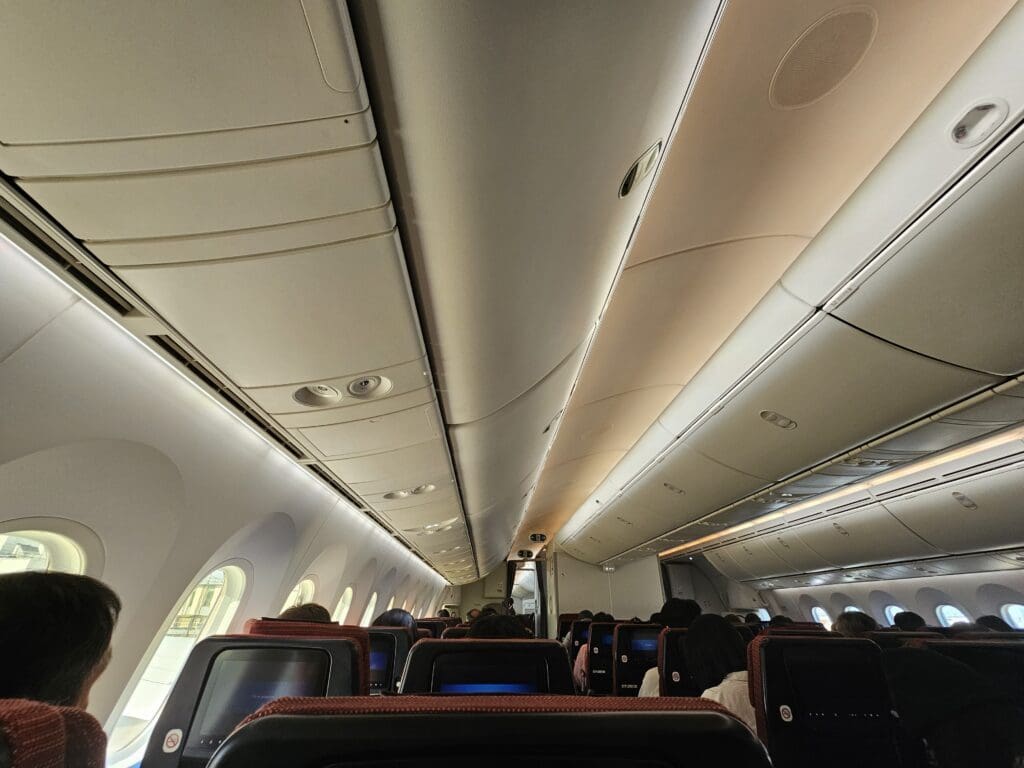
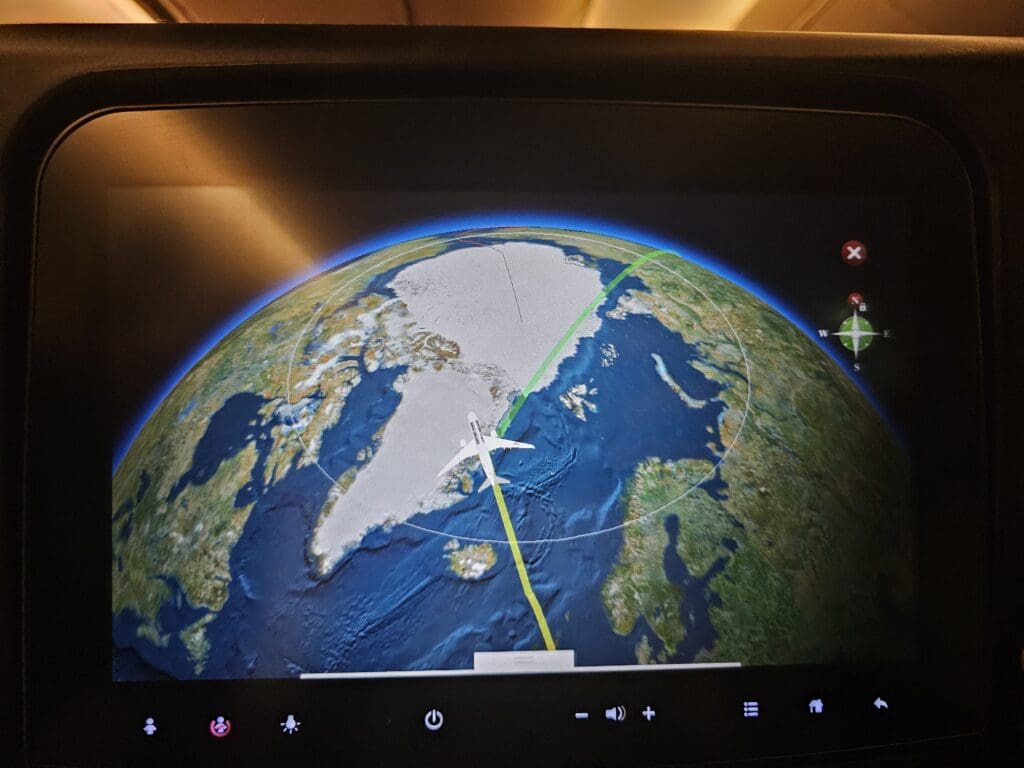
Despite the late start to boarding, this had been an efficient and quick affair, with the last passenger making it onto the aircraft no more than fourteen minutes after boarding had commenced. With all cargo having already been loaded, as the clock struck 0940, the L2 door was closed and the jetbridge was backed away from the aircraft. As soon as the cabin door was closed, the Purser commenced their long welcome announcement in Japanese and English, whilst the rest of the crew took to the aisles and performed a brief bow before returning to their duties. At that point, I noticed that the announcement system was both quiet and a little crackly. Unfortunately, once in the air, this became more evident and most announcements were inaudible. That morning, this announcement consisted of the usual welcomes, thanks and warnings, alongside a mention of our long 13:40 flight time. Like most airlines operating between Europe and East Asia, since March 2022, Japan Airlines has avoided Russian airspace and thus routes their services between London and Tokyo either northwards and over the Arctic, or eastwards through Central Asia. Much to my delight, the Purser announced that our flight would cross Greenland and Alaska before heading southwards to Japan. This meant that I would be in for my first experience of crossing the International Date Line!
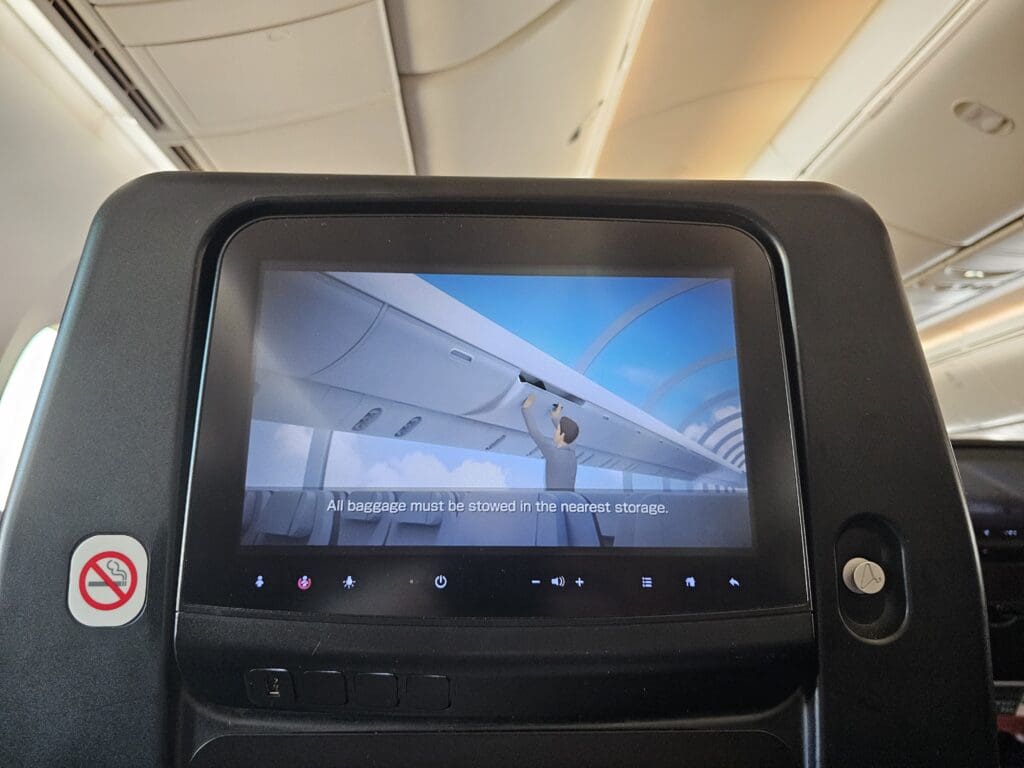
Despite the late start to boarding, the aircraft jolted backwards and our pushback commenced just four minutes behind schedule at 0944. As this was underway, Japan Airlines’ safety video took over the inflight entertainment screens whilst several crew members took to the aisles to point out the exits and demonstrate how to use the aircraft’s lifejackets and seatbelts. Released in 2020, Japan Airlines’ current safety video is gimmick-free and mostly animated, and as you would expect, goes over the safety instructions! Whilst some may complain that this is a little dry when compared to some other major airlines’ safety videos, lacking any poor jokes, Lord of the Rings characters, comedians or Hollywood actors, this goes over the safety instructions in a clear, concise and unambiguous manner and I could thus find little reason to complain. Once the safety video had run its course, the crew passed through the cabin, taking their time to undertake a thorough pre-departure check, making sure that everything was safe, secure and in position for our departure from London.
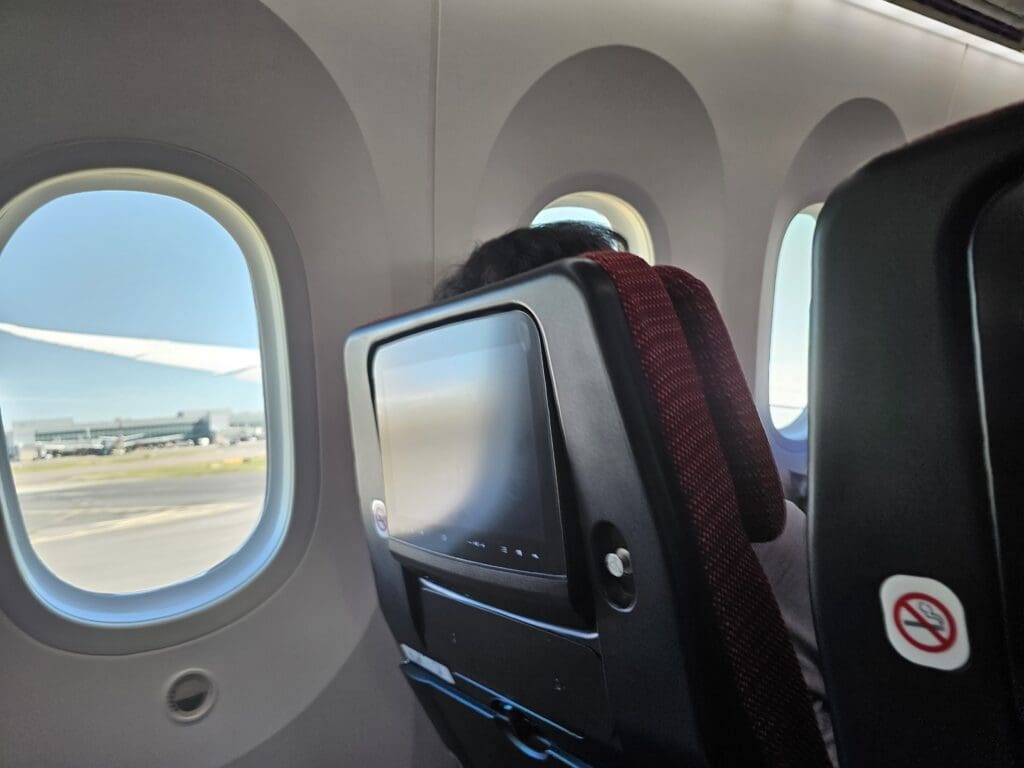
As our pushback neared completion, a symphony of modern whines and whirrs could be heard as the Dreamliner’s two large General Electric GEnx-1B engines powered up in preparation for the long journey ahead. Within a few minutes, the aircraft powered forward under its own steam and joined the procession of aircraft on the ‘elephant walk’ to the end of Runway 09R. Seeing as the morning rush was in full swing, unsurprisingly it wasn’t long before our pace slowed as we joined the back of the queue of departing aircraft. That morning, we ended up spending a good fifteen minutes or so slowly edging forward whilst all manner of aircraft departed before us. These aircraft ranged in size from one of Loganair’s miniature ATR 42s operating a morning service up to Dundee, right up to an Airbus A380. Once the Star Alliance liveried United Airlines Boeing 767-300ER ahead of us had rocketed off at the start of its trek to Newark, the Dreamliner lumbered onto the runway before coming to a halt. Following a short pause whilst the Boeing 767 cleared the skies ahead, the Dreamliner’s two large engines spooled up as we commenced our fairly powerful takeoff roll down the runway. Presumably being heavily loaded for our long trip, the Dreamliner ended up using plenty of runway before reassuringly rotating upwards just before reaching Terminal 2 and climbing into London’s unusually clear and sunny skies. As we left the sprawl of Heathrow Airport behind, the landing gear whined as it was retracted, followed a short time later by the flaps.
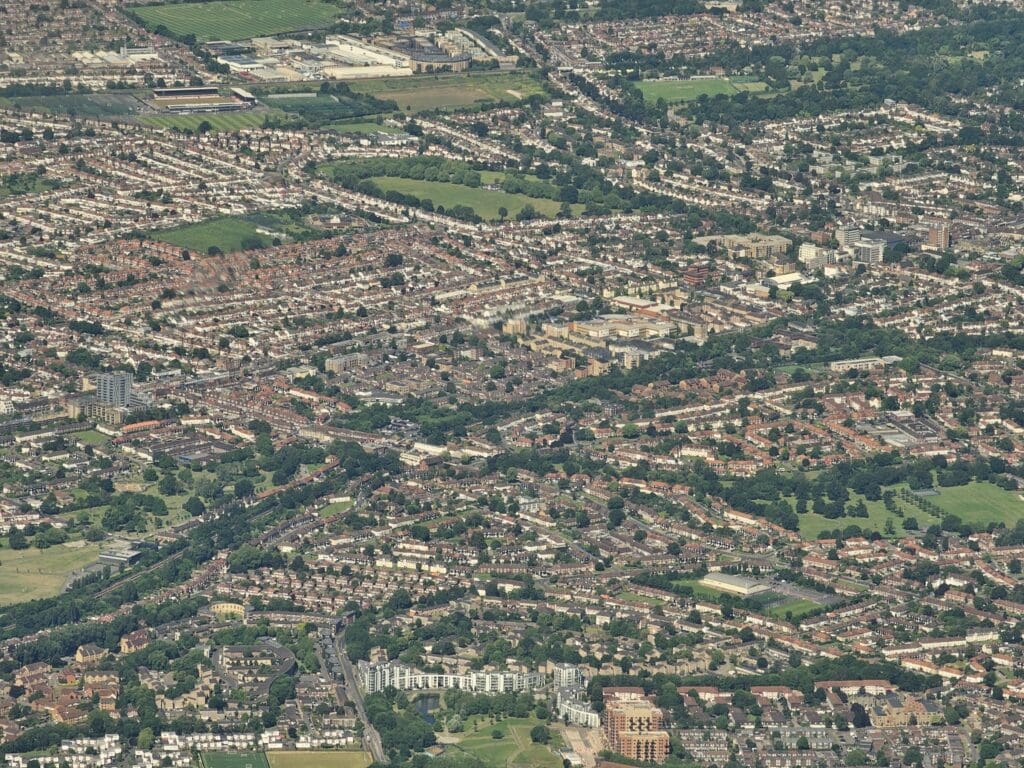
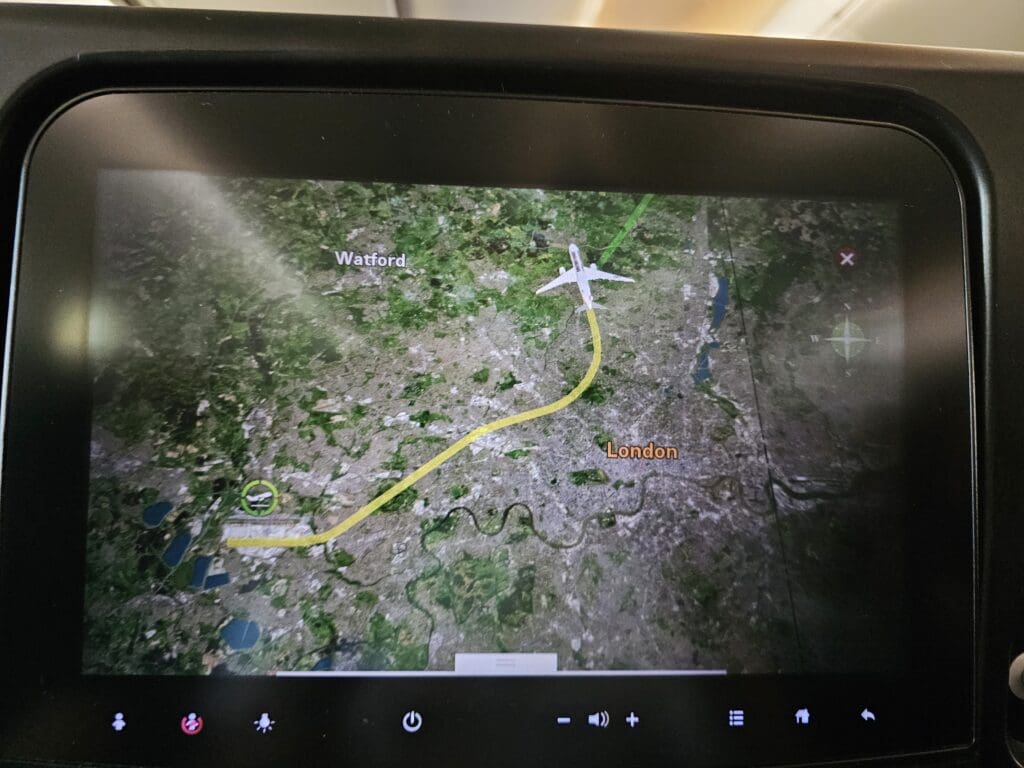
Departing into the east that morning, the Dreamliner followed a BPK6J standard instrument departure. This saw us bank to the left moments after leaving Heathrow behind, before performing a shallow climb out over the suburbia of Northwest and North London. Thanks to the good weather, a fantastic view of the green fringes of the capital could be had, with a fairly clear view of the flat scenery below offered, even though I was sitting in the aisle seat! This initial route saw us cross over the areas of Hounslow, Hanwell, Ealing, Harlesden, Cricklewood, Muswell Hill and Barnet, before crossing the M25 and leaving Greater London behind.
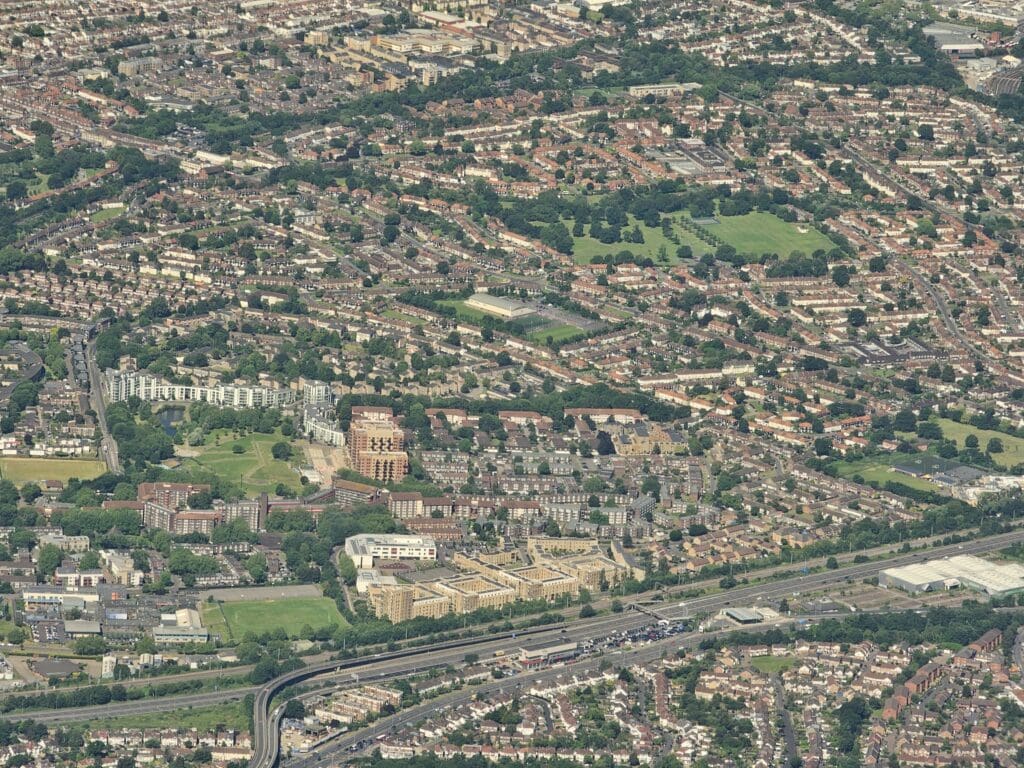
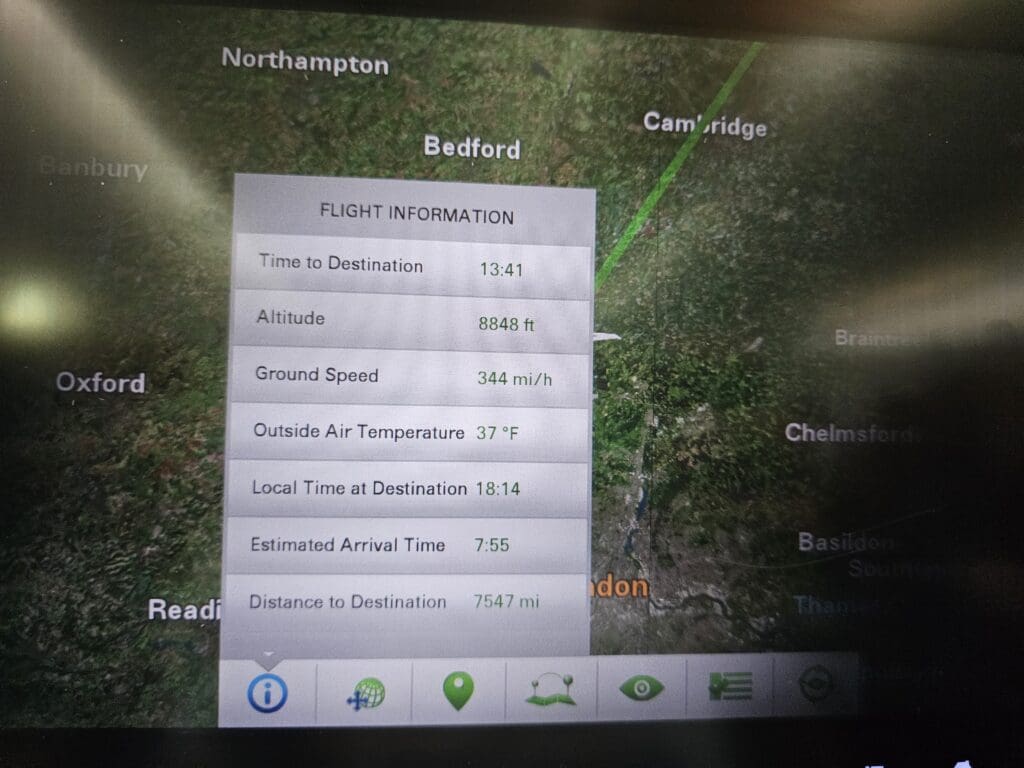
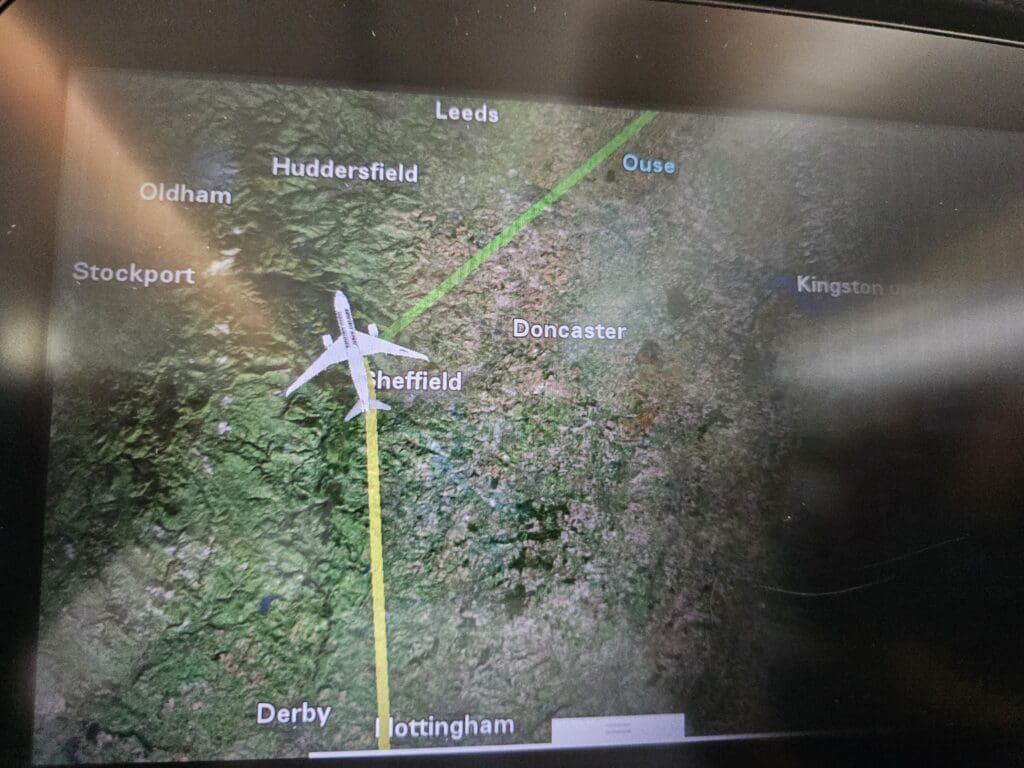
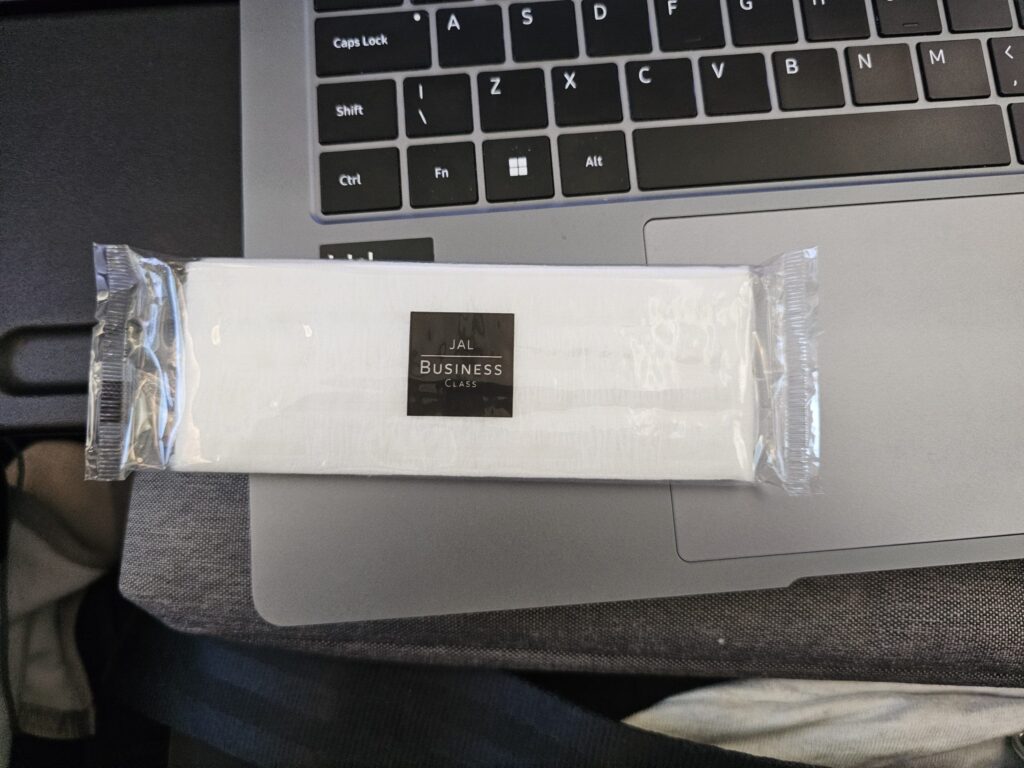
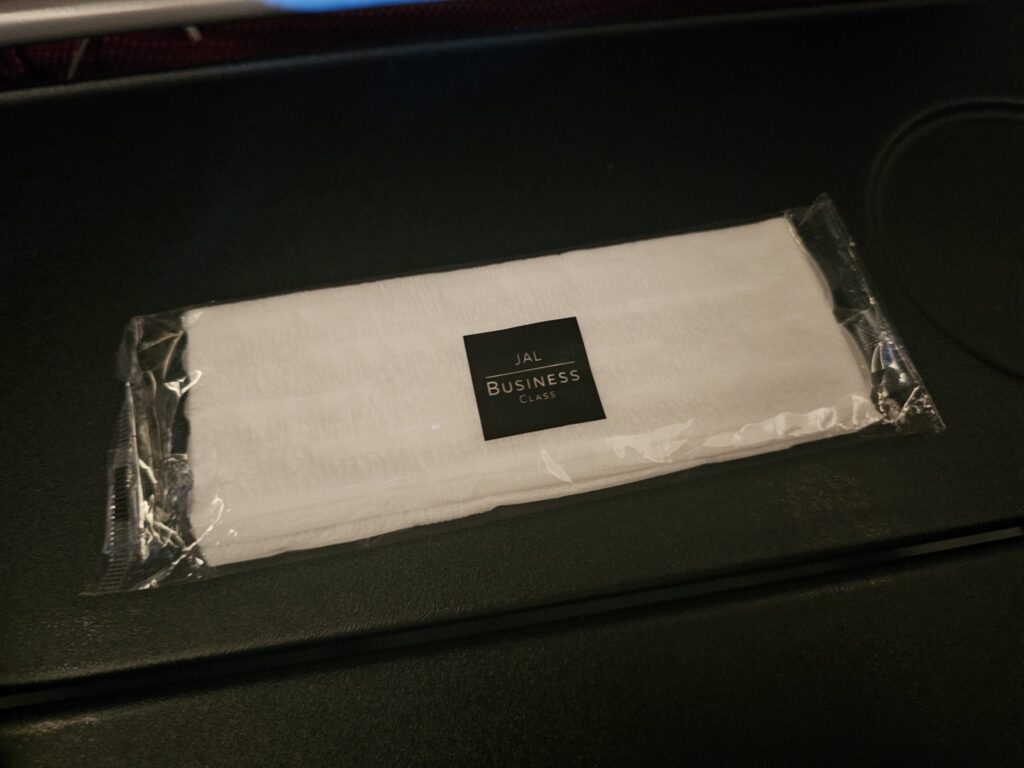
Thanks to the good weather, the climb ended up being a smooth affair and thus the seatbelt signs were extinguished as soon as we passed through 10,000 feet. By this time, the Dreamliner was passing over the Hertfordshire conurbations of Hatfield and Welwyn Garden City. Inside the cabin, this was followed by what I assume was the usual announcement regarding seatbelts although unfortunately thanks to the aforementioned issues with the PA system, this could not be heard. After passing Luton, the Dreamliner headed northwards up the centre of the UK and roughly followed the course of the M1 motorway. This took the aircraft past the likes of Bedford, Northampton, Leicester, Loughborough and Nottingham. A total of just 21 minutes after rocketing off from Heathrow, the aircraft cut above the skies of Sheffield where I had started my journey earlier that morning before reaching Leeds a couple of minutes. As we soared over West Yorkshire, the Dreamliner levelled off at our initial cruising altitude of 34,000 feet where it would remain for the next six hundred miles or so. Inside the cabin, as we passed through Yorkshire’s skies, passengers were handed ‘JAL Business Class’ packaged wet wipes before the service carts were rolled out into the aisle.
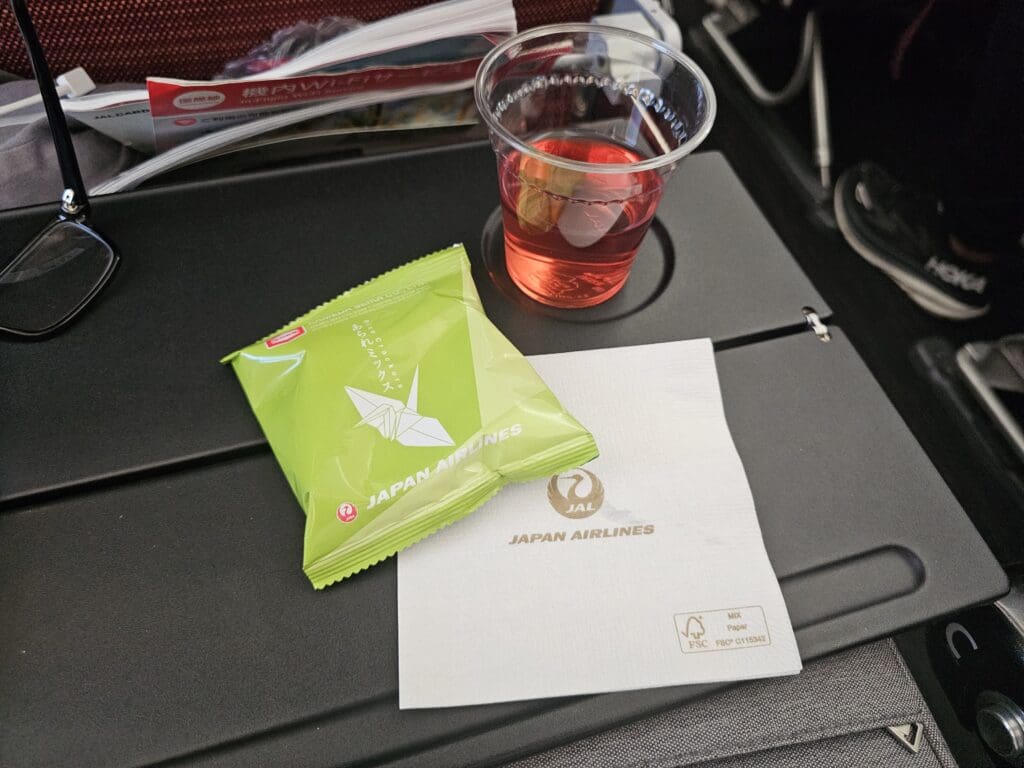
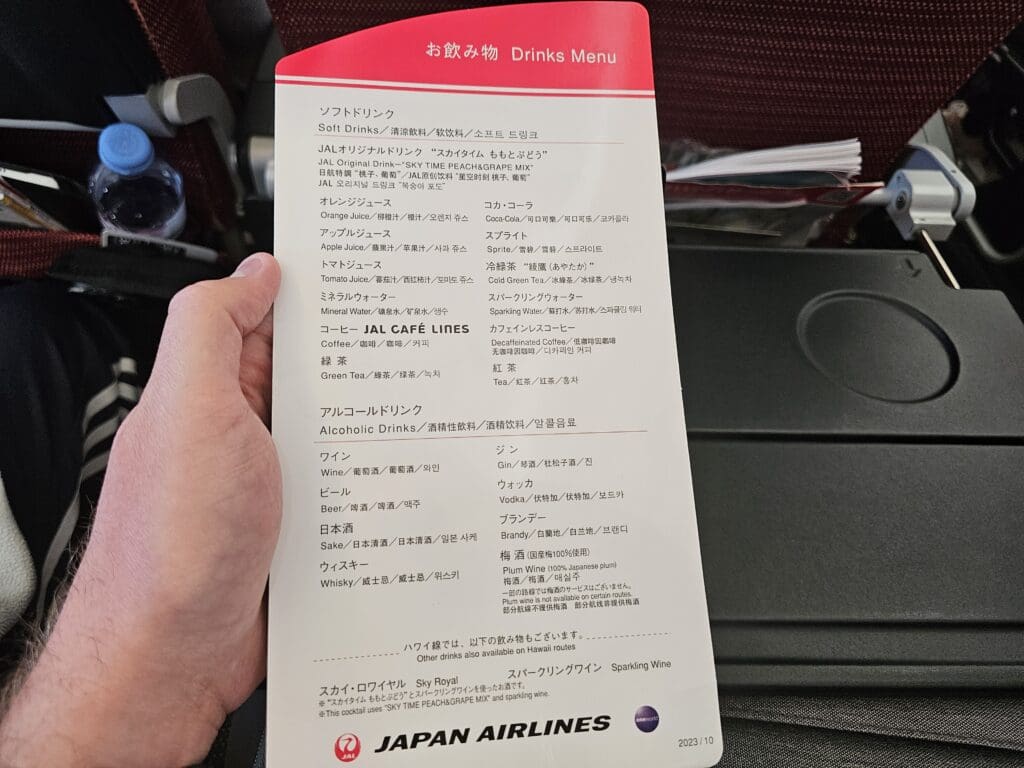
In the usual manner, lunch, or rather brunch, was to be preceded by a round of drinks. Once this began, this seemed to take place at a slower-than-usual pace. However, I soon discovered that this was due to the fact that passengers were handed a menu and given a few moments to glance over this, before stating their drink choice and handing back the menu which would then be passed onto those in the next row. Much to my delight, an impressively expansive range of hot and cold, hard and soft beverages were available. Upon reaching my row, I opted for a cup of Japan Airlines’ signature Sky Time peach and grape juice, which I paired with a black coffee from the airline’s JAL Café. Whilst I found the flight attendant to be pleasant and friendly, they did end up accidentally forgetting to give me a snack along with this. However, upon requesting this, they were very apologetic and soon handed me a packet of Japan Airlines branded rice crackers and a serviette. When it came to the quality of the beverages, the juice was refreshing, although it was, well, juice! Although I do have to say that the coffee did seem to be a cut above your usual gloopy inflight coffee offering.
Speeding up through Britain’s central spine, after passing over Leeds, the aircraft continued northwards over the UK and crossed over the Yorkshire Dales National Park as well as the North Pennines AONB before passing Carlisle and making our way into the skies of Scotland. No more than five minutes after reaching Scotland, the aircraft passed directly above Edinburgh before reaching the Cairngorms National Park a few minutes later. This was followed by Inverness and the most northerly counties of the Scottish mainland – Ross and Cromarty, Sutherland and Caithness. A little over an hour after taking to the skies, the aircraft neared the northern shoreline of Scotland’s Caithness Peninsula. At this point, the carts were rolled out into the aisles indicating the commencement of the flight’s first meal service. No more than fifteen minutes later, my neighbour and I were shown a laminated card which displayed photographs of the meal options along with a description in Japanese and English. This undoubtedly served to be a nice touch, far preferable to the standard ‘chicken or beef?’ and second only to each passenger receiving a physical paper menu! Interestingly, this seems to be the norm with Japanese airlines and I had previously experienced a similar service arrangement when flying with competitor ANA between Germany and Japan.
For those who, like myself, had been looking forward to Japan Airlines’ veritable inflight cuisine since booking, Japan Airlines publishes the inflight menu for each of its services several months in advance on its website. Thus, despite pretending to show interest in the menu card, I was in fact already well aware of that day’s choices! As on most Japan Airlines medium and long haul services, passengers were given the option of a Japanese (chicken with grated radish sauce and steamed rice) or Western (beef meatballs with cream sauce) meal. Both of which were accompanied by sides of salmon and ratatouille, spinach and bean sprout namul, simmered vegetables and a small side salad with a sachet of Italian dressing. This also came with a packet of Walkers’ shortbread and a 250ml bottle of Harrogate Spring Water, whilst eating utensils were provided in the form of real metal cutlery and disposable wooden chopsticks.
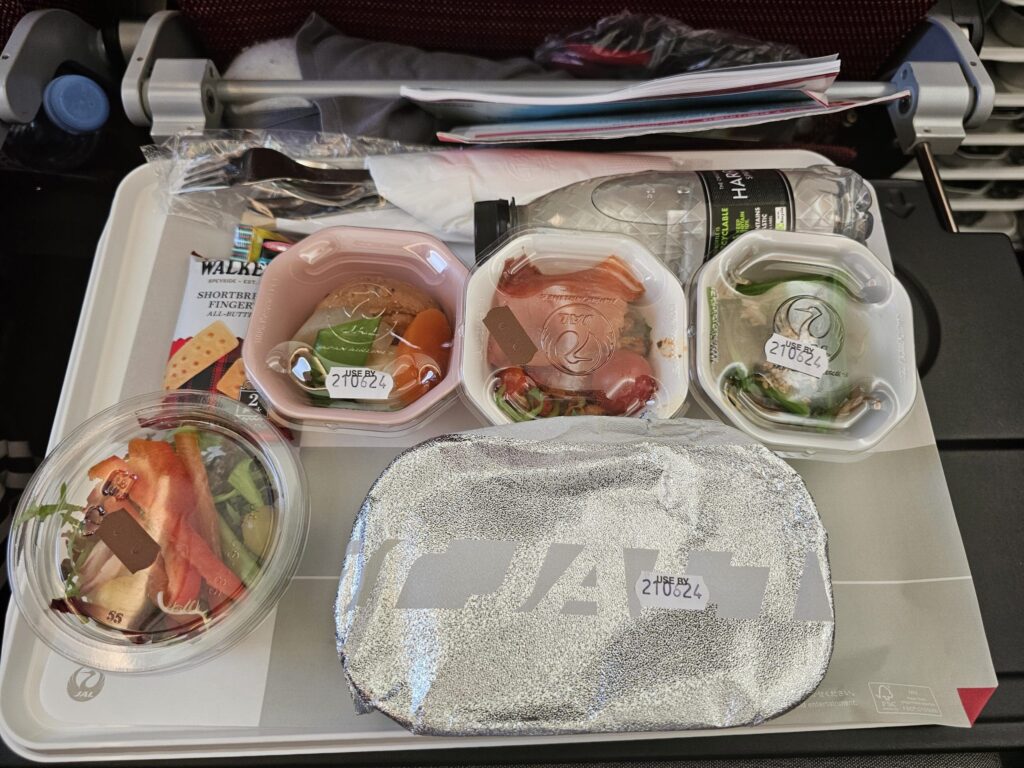
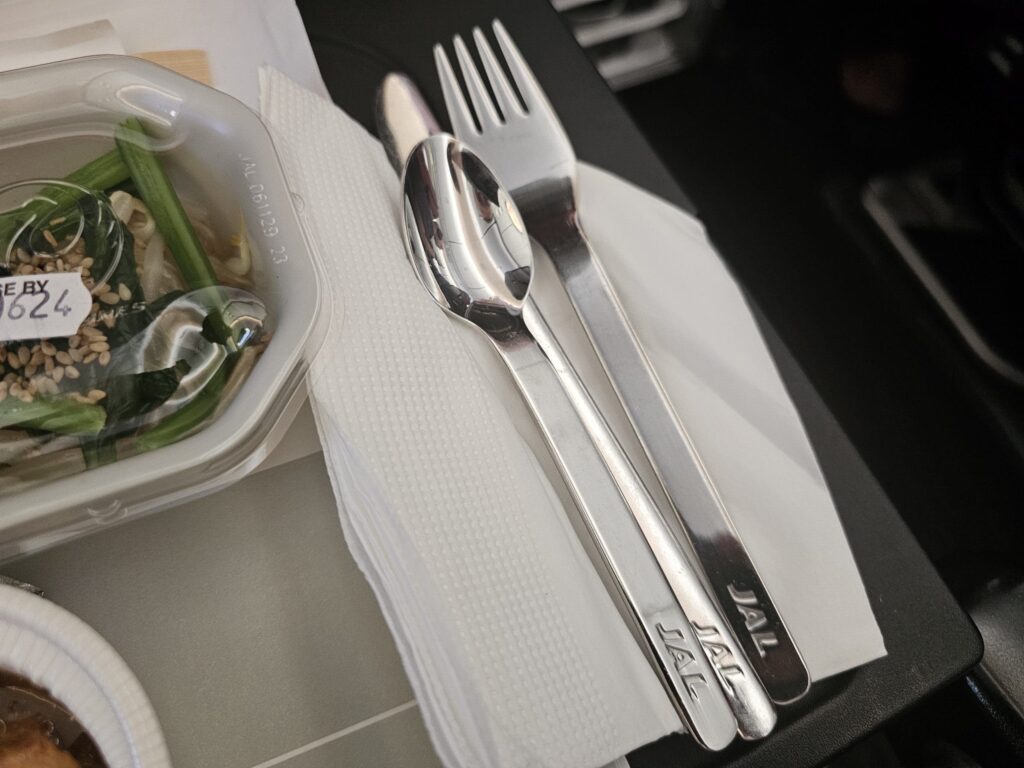
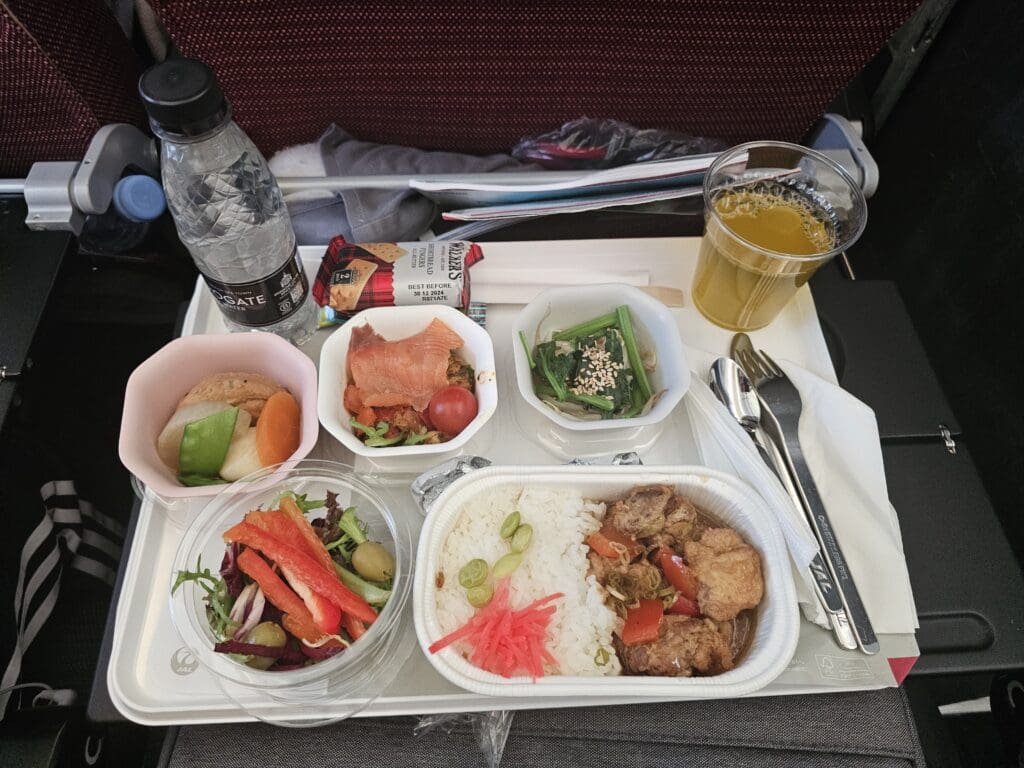
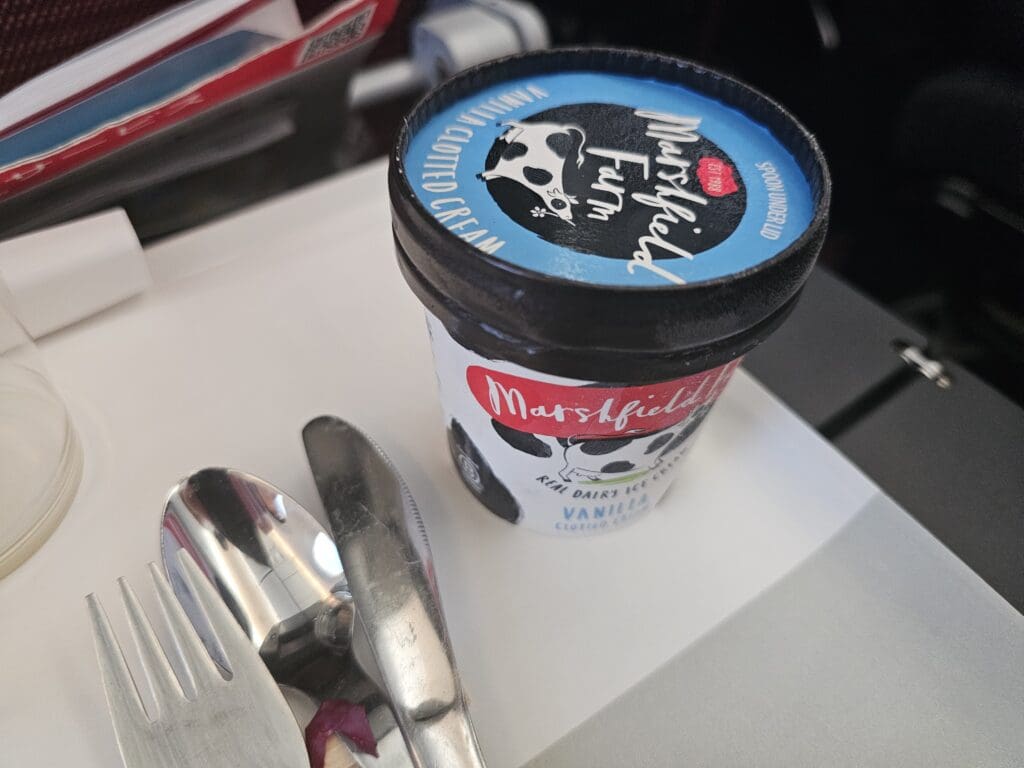
Seeing as I was flying aboard Japan Airlines, it would have been sacrilege not to go for the Japanese option! Without hesitation, I opted for the chicken and a large tray was soon cautiously placed on my tray table. Whilst I was tempted to pair this with the plum wine, cautious of drinking on such a long sector as I wished to conserve as much energy as possible, I instead paired this with a simple cup of cold green tea. As inflight meals go, I have to say that this lunch was most definitely one of the more high-quality meals that I have had the pleasure of eating. Not only was this delicious and comparatively healthy but I was left with nothing to complain about when it came to the portion size and found the meal to be sufficiently filling. Almost as soon as I had vacuumed up everything that was on my tray, a flight attendant appeared and began handing out small tubs of rock-solid vanilla ice cream, before several crew members passed through the cabin distributing hot green tea and coffee.
Around thirty minutes after handing out the main meals, the trays were collected and a short time later, the crew passed through the cabin undertaking their duty free service. Whilst I had no real intention of making a purchase, I nevertheless decided to flick through the duty free catalogue. Alongside the usual perfumes, watches and gadgets, passengers could purchase branded Japan Airlines items such as t-shirts, bags and even the same designer aprons sported by the cabin crew (albeit with a hefty price tag!). Looking around, it seemed that the crew had a decent amount of success in attracting customers that morning, with many of the homeward-bound tourists perhaps wishing to part with the last of their holiday spending money!
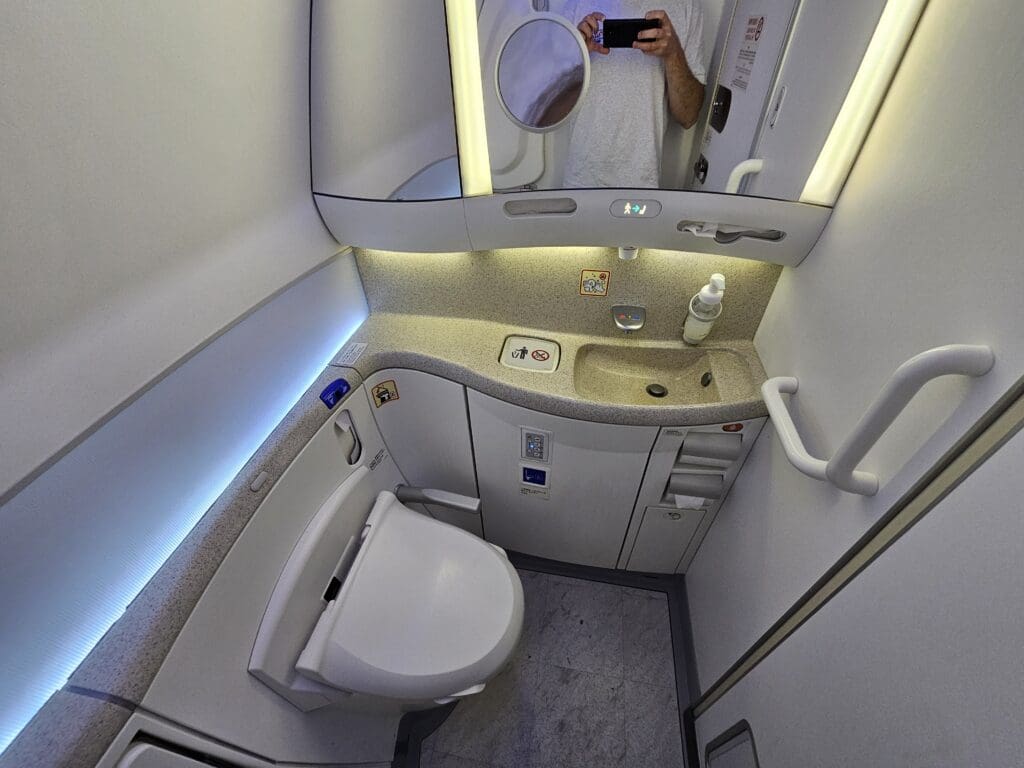
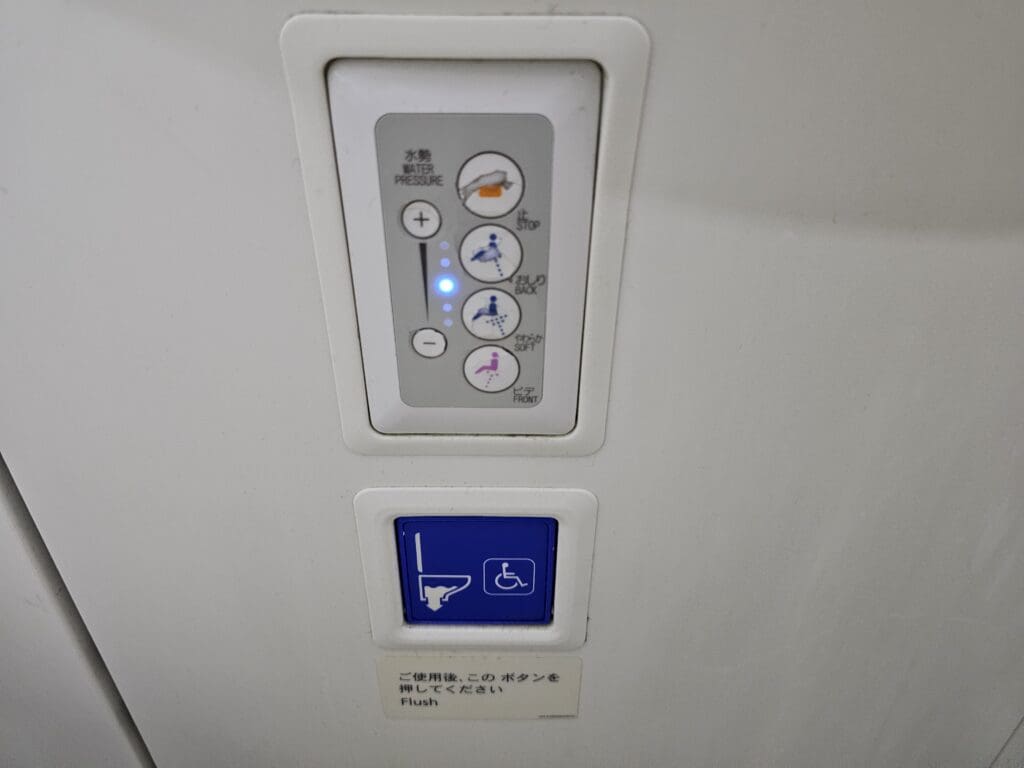
Once the crew had made it through the cabin with the duty free, like many passengers, I took to the aisle and made my way to one of the four lavatories that sit between the Premium Economy and Economy cabins. Shared between the 151 passengers in the two cabins, this equates to 38 passengers per lavatory, which is a fairly middle-of-the-road figure for a widebody aircraft. Following a short wait, I entered the most spacious of the four of these and found this to be in tip-top condition, being both ultra-tidy and largely devoid of any signs of wear and tear. As is the norm on long haul Japanese jets, the toilet also featured a bidet function although admittedly I was unable to strike up the courage to make use of it on the flight that day! My only slight complaint given the length of the flight was that other than a fabric freshener spray, the lavatory was stocked with nothing more than the basics, and it would have been nice if the airline had offered toothbrush-toothpaste sets given the overnight nature of this slog.
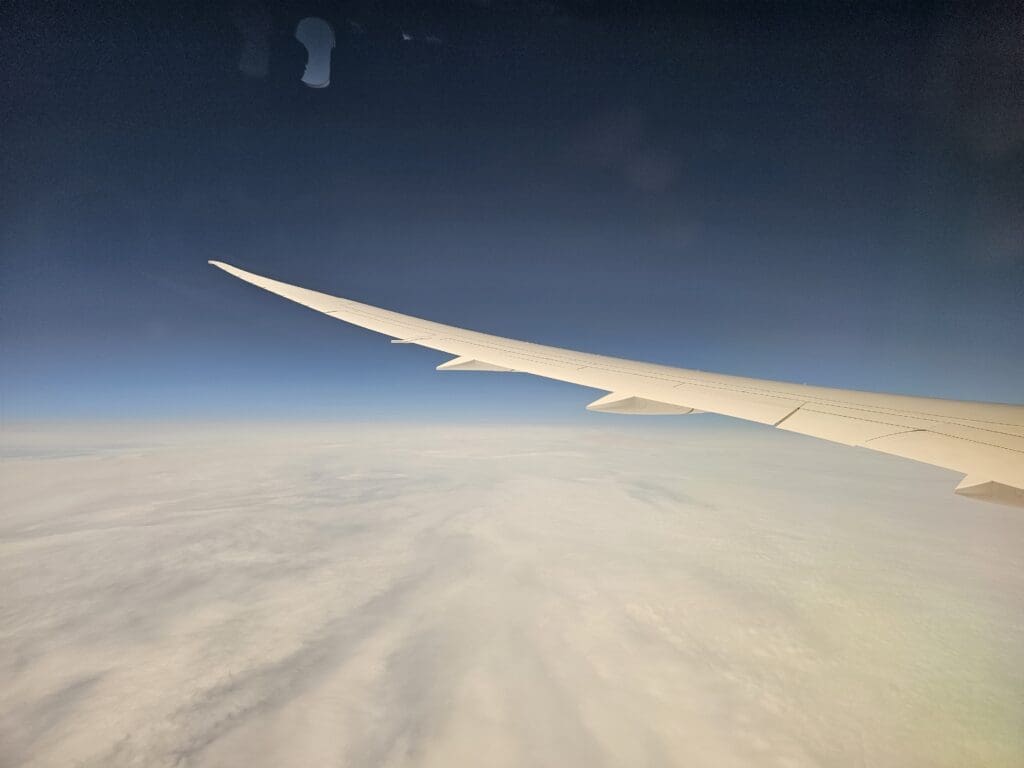
Around twenty minutes after leaving the Scottish coastline behind, the Dreamliner trundled past the southernmost Faroe island, Suðuroy, before passing over the islands of Sandoy and Streymoy, the latter being home to the Faroese capital, Tórshavn. After around ten minutes, the islands fell behind us and we continued heading northwards over the frigid waters of the North Atlantic Ocean.
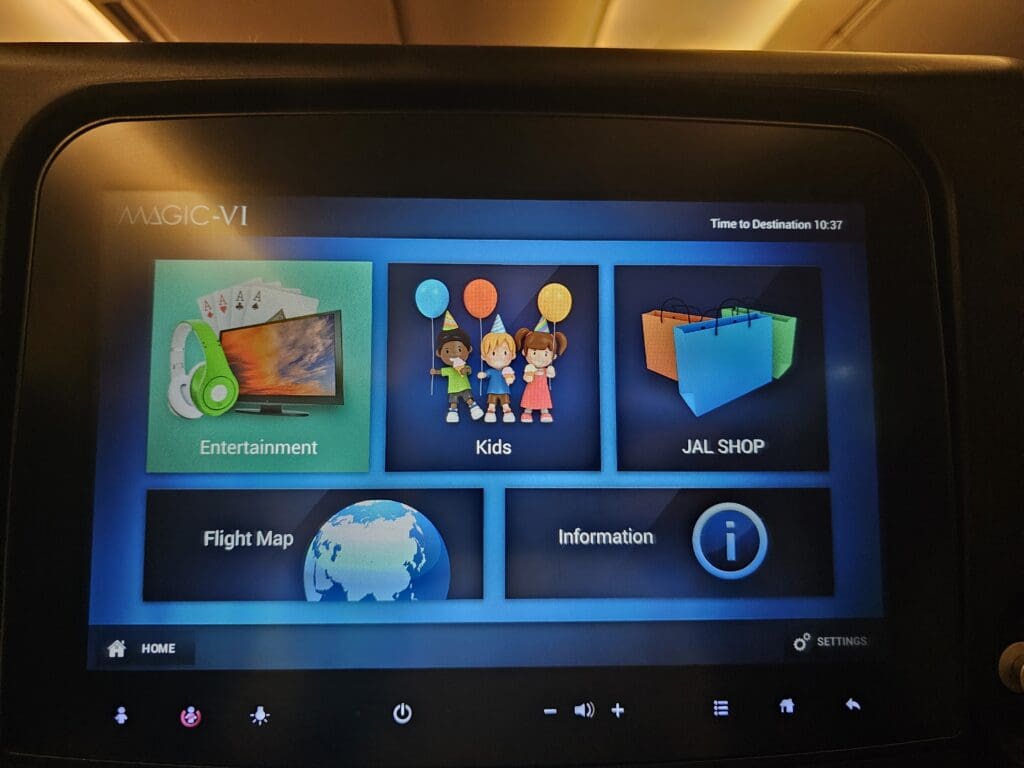
Seeing as I wasn’t quite ready for a nap, I decided to turn my attention to Japan Airlines’ MAGIC-VI system. Considering Japan Airlines’ reputation and my very good experience with the flight thus far, I had high expectations for the system. After turning my inflight entertainment screen back on, I selected English from the five language options. Other than Japanese and English, passengers could use the system in both Simplified and Traditional Chinese, as well as Korean. Whilst this language selection was a little better than some of the world’s other top airlines (ahem…Etihad Airways!), this was far from representative of the destinations that Japan Airlines sends its Dreamliners and other widebody jets to. Turning to the system’s layout, looking around, this was neither the most stylish nor modern system in the world and instead, seemed to be arranged in a practical, simple and easy-to-navigate layout. Upon reaching this page, passengers are presented with five options – Entertainment, Flight Map, Information, JAL Shop (although this was not working) and Kids. Crucially, the touchscreen function worked without issue and I found the system to be quick to load and transition between screens.
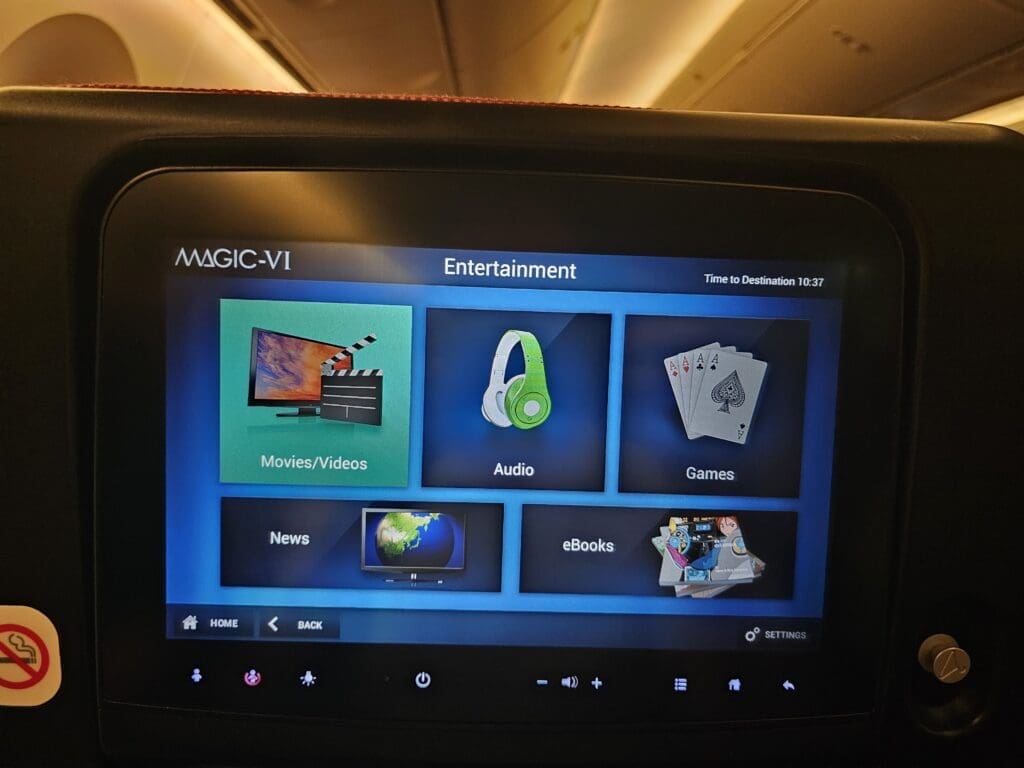
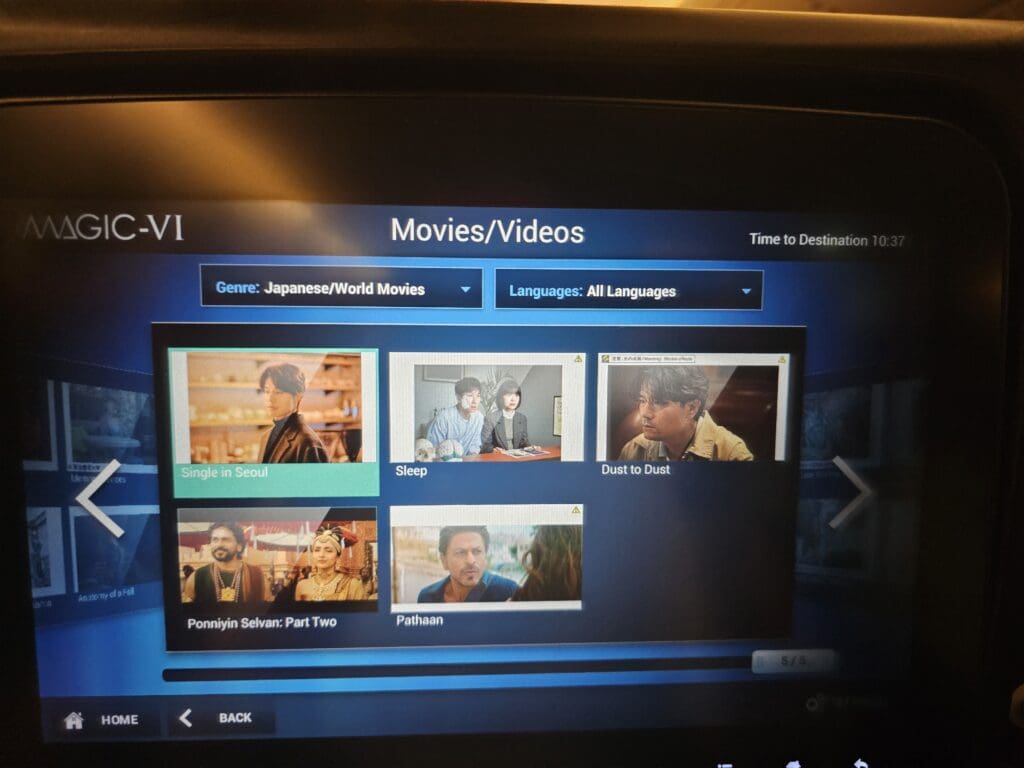
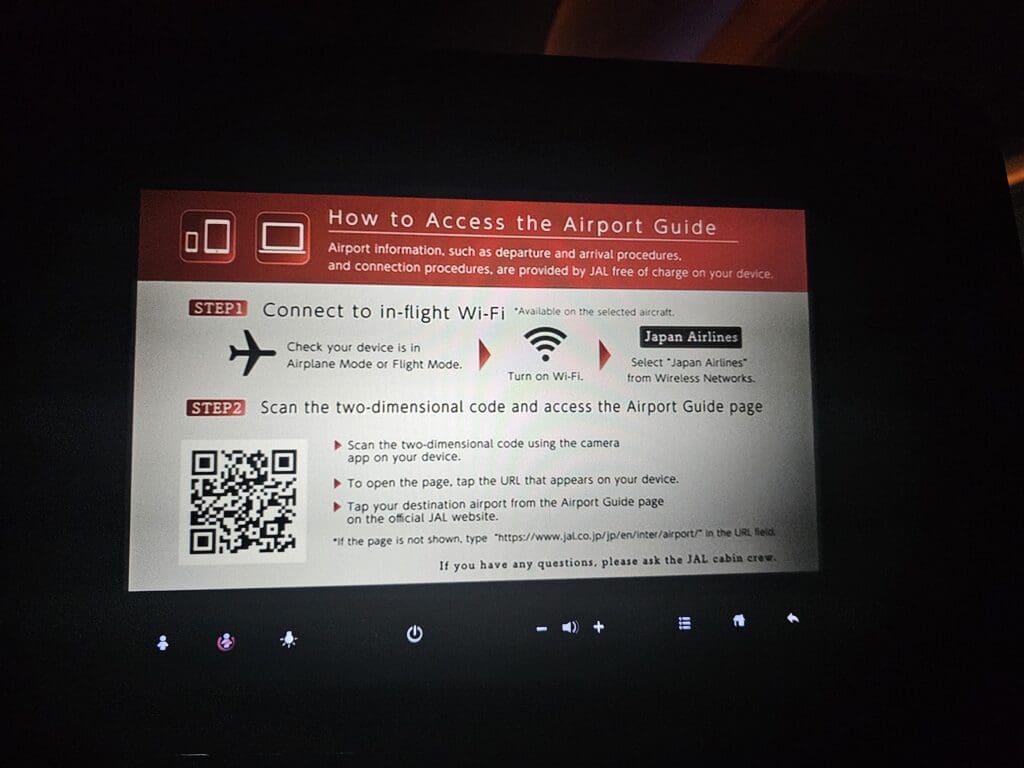
When it came to the content, in total I counted the system to be loaded with 104 Hollywood films which ranged in era from the 1942 classic Casablanca to the recently released Dune 2, along with 18 Japanese films, 2 Korean films, 2 Bollywood films, as well as a single film from France and Canada. Additionally, travelling during Pride month, a promotional video named ‘JAL X PRIDE’ could also be found on the system which highlighted some of the LGBTQ+ films that were available to watch. Moving on to the television programmes, I found the system to feature a fair number of Japanese shows, along with episodes from popular American programmes such as Modern Family, NCIS Hawai’i, The Office, and White Lotus. Alongside these, plenty of travel-related programmes that highlighted Japanese sights, culture and food, or things to do in some of Japan Airlines’ international destinations could be found. Meanwhile, for aviation enthusiasts, plenty of interesting Japan Airlines produced content offering an insight into the airline and its operations were available to watch. All visual items commenced with a little over a minute’s worth of advertisements for Global Wifi, Onitsuka Tiger, Freedom and Fairfield by Marriott, ending with a sensible message about keeping seatbelts fastened whilst seated. Turning to face the music, the system featured 93 different audio options, offering music from a wide variety of genres along with a few Japanese audiobooks and an English study guide!
Alongside the entertainment content, the system also featured Thales’ GeoFusion 3D map, which offered plenty of different screens and views for those looking to follow our flight’s progress and seemed to work without issue for the duration of the flight. Meanwhile, BBC News and NHK Daily News excerpts were offered, although as far as I could tell these were not live. Last but not least, those travelling with children will be happy to hear that a separate kids section was offered on Japan Airlines’ system.
To conclude, Japan Airlines’ Magic-VI inflight entertainment system left me with few real complaints. This was easy to use, laid out straightforwardly and featured a reasonable selection of content. However, I should mention that the content did not seem to be quite as extensive as on most other five-star carriers. In particular, options that were neither American nor Japanese were limited, although, for the most part, the system was perfectly acceptable and was far from the worst inflight entertainment system that I have had the pleasure of using. In addition to the inflight entertainment system, wifi was also offered onboard, with paid-for plans enabling passengers in Economy to connect to this for an hour ($10.50), three hours ($14.40), or the entire flight ($18.80). Whilst I had no real need to pay to connect to the inflight wifi, the latter seemed to be a very good value option considering the long length of the flight. However, upon connecting via my laptop and phone, this did not load up any welcome screen and was thus, for all intents and purposes, non-existent.
Once I had exhausted the digital entertainment platforms, I decided to turn to the good old inflight magazine. This was a fairly thin publication, with the usual mostly travel-related articles interspersed by plenty of advertisements for a range of services, whilst a small section on the airline, its fleet, destinations and other information could be found at the rear of this. Surprisingly, despite being the international version of this publication, bilingual articles that had been translated into English were few and far between, with just a small number of such articles available. With that considered, I wouldn’t say that I was left too impressed by this publication, especially given the very international nature of Japan Airlines’ route network.
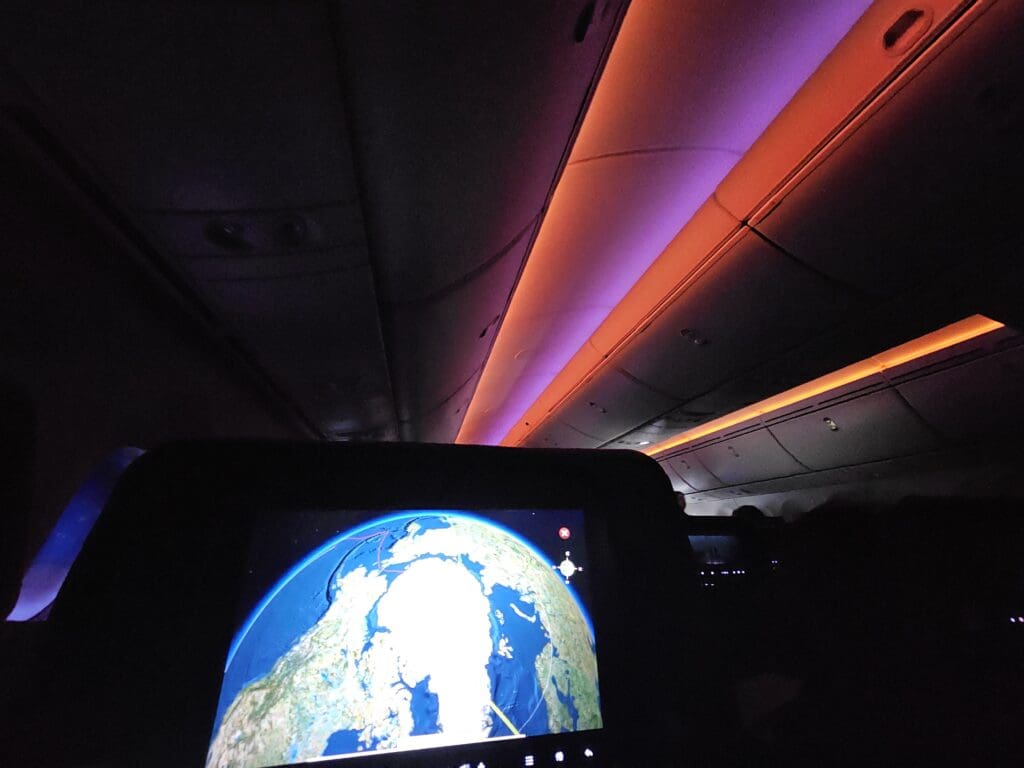
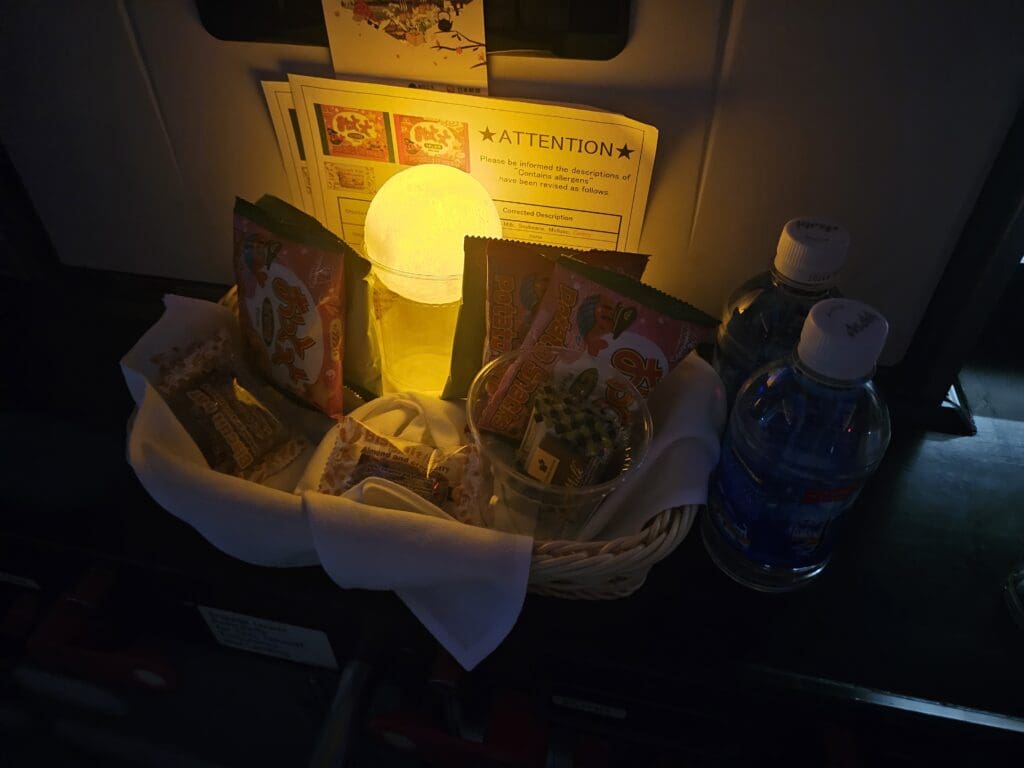
As the aircraft cruised high above the North Atlantic, with nighttime having arrived in Japan, the cabin lights were dimmed to a faint dusk orange glow before being turned off completely bar from a strip of orange and purple above the overhead lockers. Accompanying this, the window shades were dimmed to their darkest setting. At this time, the cabin crew set up a snack basket in the galley between Economy and Premium Economy. This contained biscuits, small squares of both milk and dark chocolates as well as salted snacks. For most of the flight, there seemed to be a flight attendant on duty guarding this basket and providing a drink to those who requested one. In addition, the flight attendants regularly patrolled the aisles throughout the flight, making frequent passes to distribute cups of still and sparkling water to thirsty passengers.
Returning to the route, around two hours into the flight, the aircraft crossed into the Arctic Circle and sped towards the coastline of Greenland. Almost three hours into the flight, the Dreamliner reached the southern shores of Greenland’s Clavering Island and we continued heading northwards over the world’s largest national park, Kalaallit Nunaanni nuna eqqissisimatitaq. After an hour-long nap, I woke up to find that we were, unsurprisingly, still over the national park. Now wide awake, I decided to grab a drink from the galley. Once there, I was greeted by a very polite and friendly flight attendant who soon poured me my drink of choice. In addition, I requested some Japan Airlines postcards, and after jotting down my seat number, the friendly flight attendant soon reappeared with three postcards featuring the airline’s latest addition, the Airbus A350-1000.
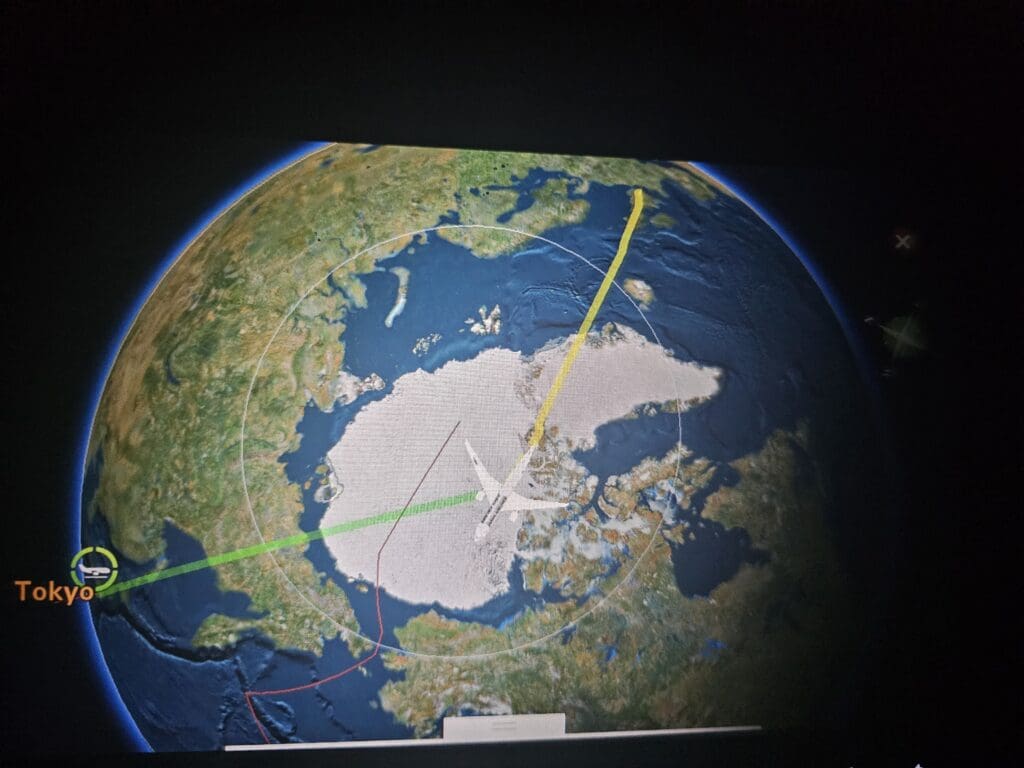
Flying northwards over the near totally empty heart of Far Northern Greenland, after around an hour and a half, the Dreamliner left the country’s far northwestern coastline behind. From there, the aircraft made a very short crossing of the Nares Strait which separates Canada and Greenland and is sandwiched between the iceberg-filled waters of Baffin Bay and the Arctic Ocean. Soon, we made landfall to the south of Nunavut’s weather station and military facility, and the northernmost continuously inhabited settlement, Alert. Given my aisle seat and the fully dimmed windows, I have no idea whether or not the far northern reaches of Ellesmere Island were visible, and whilst, assuming they were, I would have liked to catch a glimpse of these, I decided to be sensible and drifted off for another broken nap. From Alert, the aircraft crossed through the bright skies of the northern portion of the world’s tenth-largest island, Ellesmere Island at an altitude of 36,000 feet. Heading westwards, it took the aircraft about an hour to reach the island’s western coastline and during our trek across this, the Dreamliner passed a little to the north of the Parks Canada-operated all-weather camp, Camp Hazen.
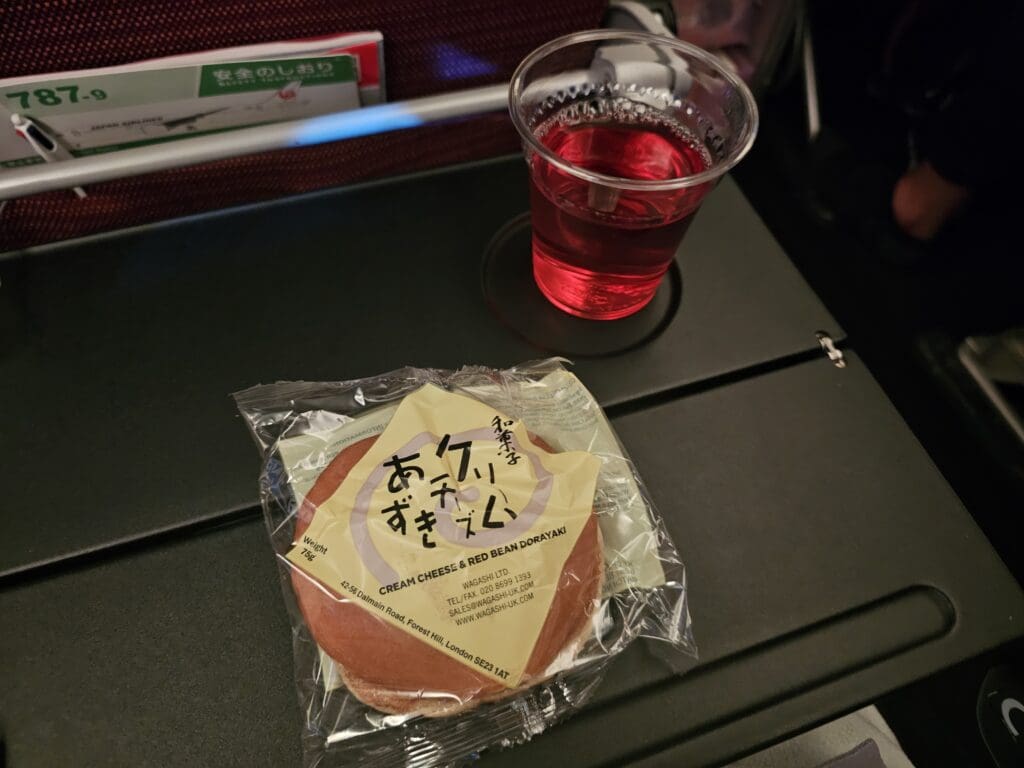
At 1800 in the UK, or 0200 in Japan, as we neared the northern coastline of Alaska, the cabin lights transformed into their sunrise orange glow and the crew soon took to the aisles indicating that the mid-flight snack service was soon to commence. A short time later, the same JAL Business Class packaged wet wipes were distributed before the crew rolled out the service carts into the aisles. Upon reaching my row, a cream cheese and red bean-filled dorayaki was placed on my tray table which I opted to pair with another cup of Japan Airlines’ Sky Time juice. Having been snacking in the galley, I was not overly peckish at this time, however, this mid-flight dorayaki most certainly left me with nothing to complain about. After this, two rounds of hot green tea were made before the rubbish was collected and the lights were dimmed once again.
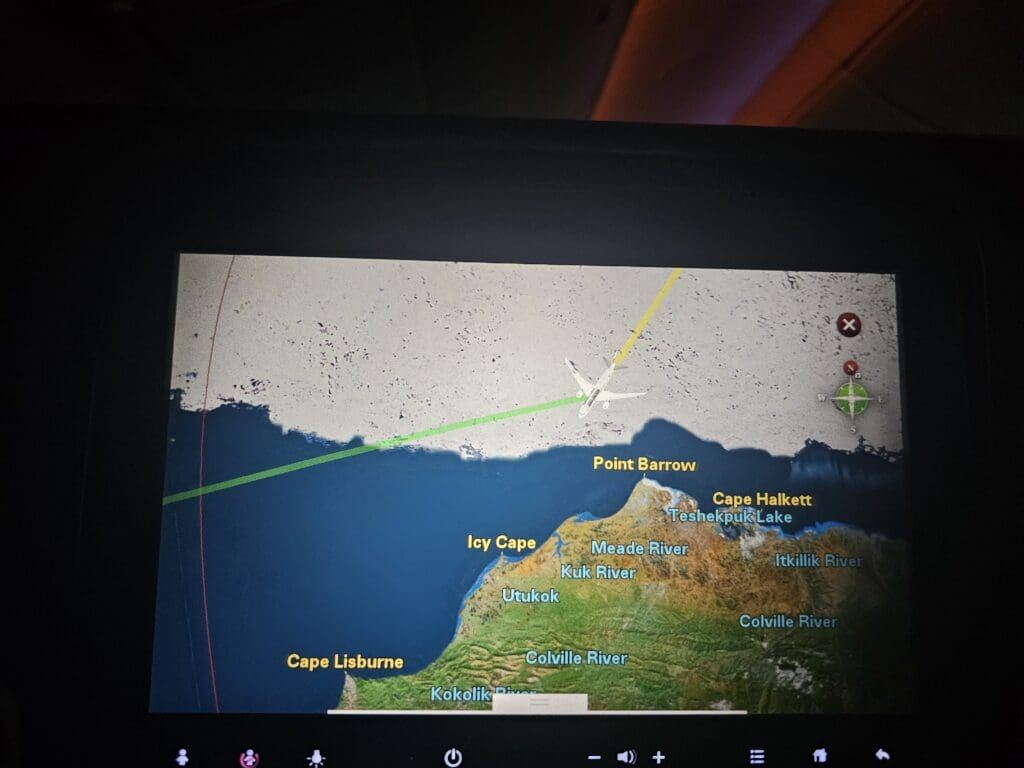
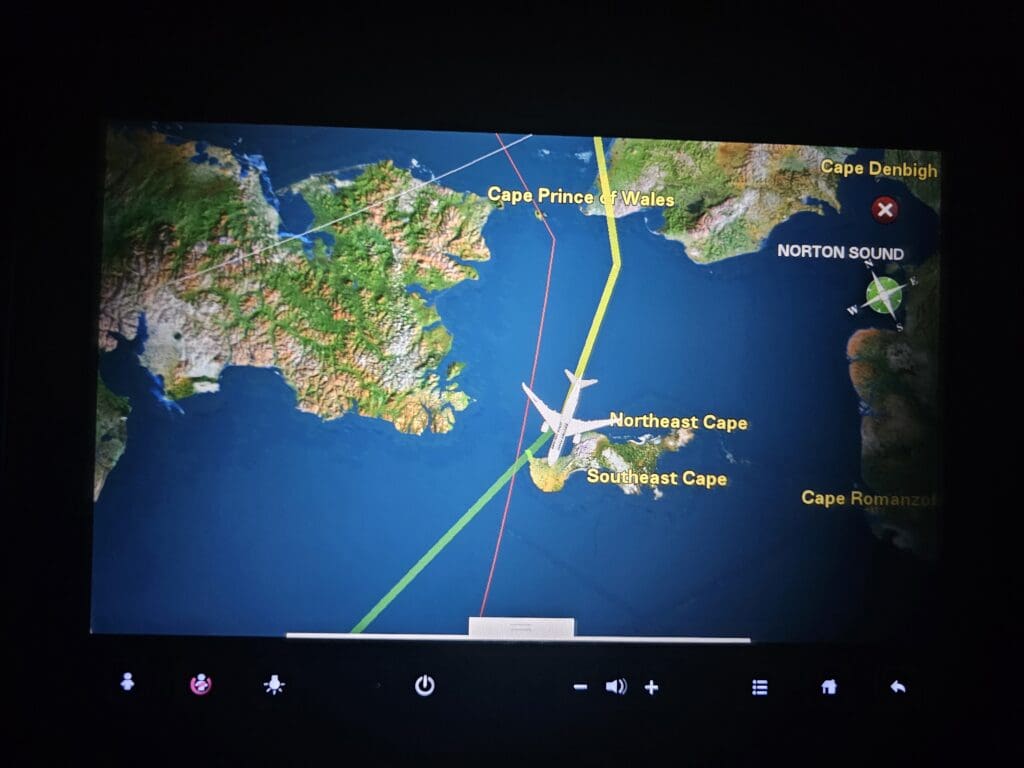
A little over two hours after leaving Canada’s Ellesmere Island behind, the Dreamliner made landfall over the remote northern coastline of the Alaskan borough of North Slope. A minute or so later, we passed high above the settlement of Point Lay, home to over three hundred residents and connected to the outside world by a small airport. This is served by Fairbanks-based Wright Air Service. From there, the Dreamliner continued heading down over the far western fringes of Alaska and the most remote reaches of the United States. After crossing the Kotzebue Sound, the aircraft reached the Seward Peninsula and made its way over the Cape Prince of Wales, the peninsula’s western tip and the westernmost point of the Americas! Near the tip of this is North America’s westernmost city, Wales. Named after the country, today, this can hardly be described as a sprawling metropolis and as per 2020 statistics, this was home to fewer than 170 residents! Passing just to the east of the city, the Dreamliner took about four minutes to cross the peninsula from north to south, and after passing directly overhead the former mining settlement of York, the Dreamliner headed out over the frigid waters of the Bering Sea.
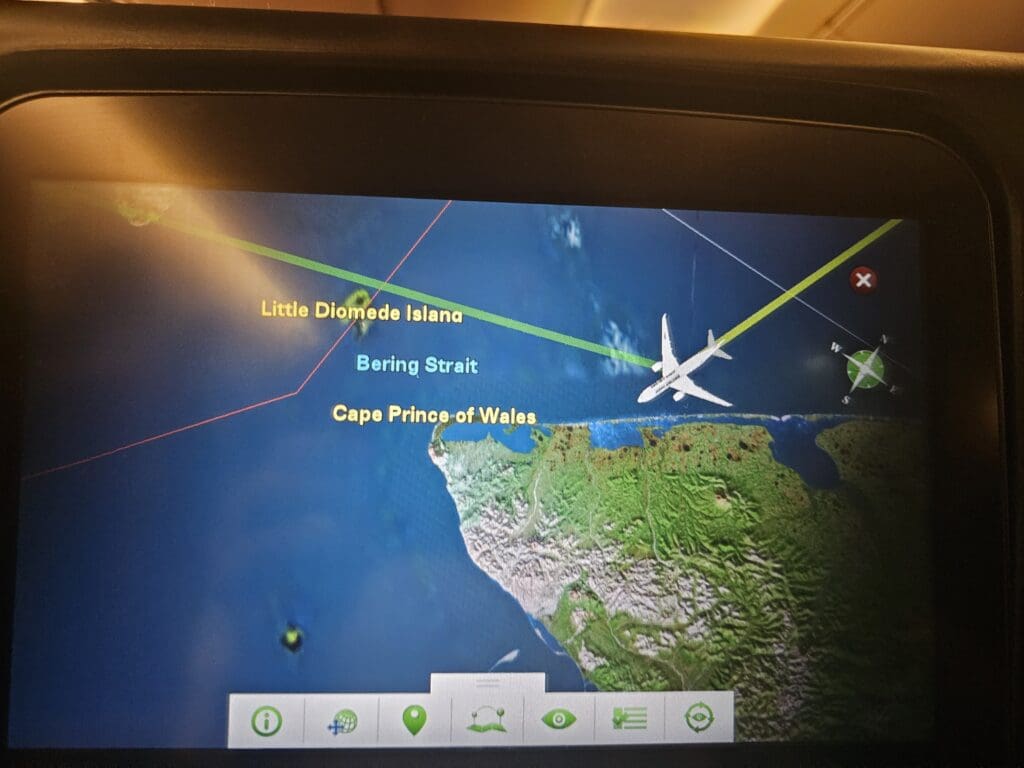
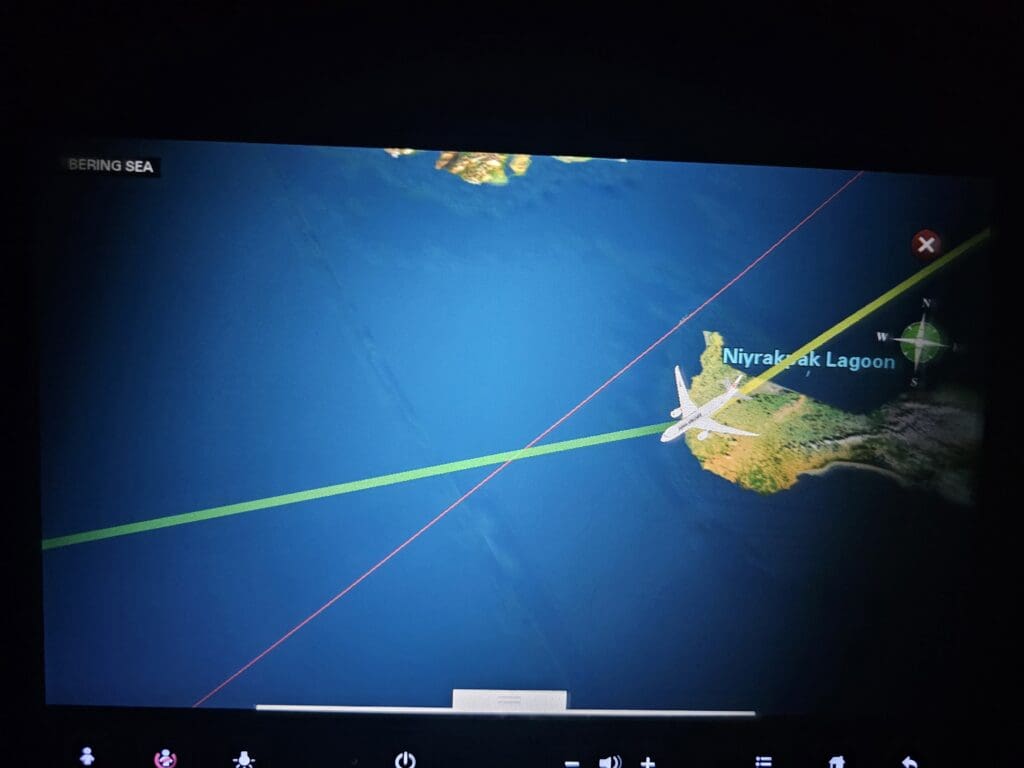
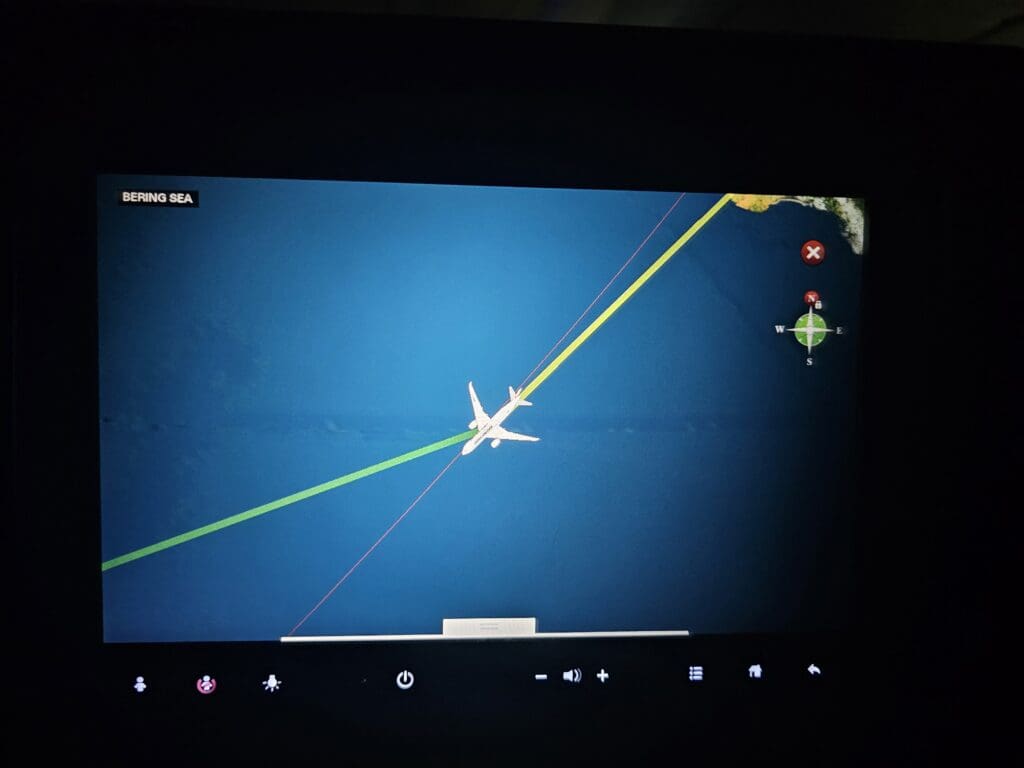
Around fifteen minutes after leaving the Alaskan mainland behind, the Dreamliner reached St Lawrence Island. Covering an area of 4,640 square kilometres, this is home to 1,475 residents (as per the 2020 census). This island is right at the fringes of the US and sits just under one hundred kilometres from Russia’s Chukchi Peninsula. Passing over the western portion of the island, we crossed this in no more than two minutes and continued making our way southwards over the sea. Highlighting the sheer expanse of Alaska, around two hours later the aircraft reached the Aleutian Islands chain, and slotted in between the Aleutian island of Attu, and the Diomede Islands. These serve as the famous border between Russia and the USA, with Big Diomede being a territory of the former and Little Diomede being a territory of the latter.
Continuing southwards over the Pacific Ocean, it wasn’t long before I was filled with excitement as we sped towards the International Date Line. Before I knew it, I made my first crossing of this, with the local time magically shifting from a Thursday morning to a Friday morning as we accelerated into the future at a rate that rivalled the DeLorean. After the excitement of this, I drifted back off into a light sleep for a couple of hours, waking up every thirty minutes or so. By the time I awoke for good, the aircraft was around four hundred kilometres south of Petropavlovsk-Kamchatsky, and heading southwestwards parallel to Far Eastern Russia’s Kuril Islands. With a little under three hours to run until our arrival, by this time, I was feeling a little restless and was simply watching the clock go by, eagerly awaiting our arrival! At this time, I decided to make another lavatory trip and I was delighted to find that this remained in a spotlessly clean condition, indicating that this had been tended to regularly throughout the service.
Following several hours in darkness, at 0455 Japan Standard Time, the lights were turned onto their sunrise orange glow and soon the scent of warming food wafted through the cabin. Whilst it was almost 2200 on Thursday evening in London, given our morning arrival into Tokyo, it was only appropriate for the flight’s second meal service to take the form of breakfast. Having studied the menu online before departure, that morning, I was already aware that just a single option would be offered. This came in the form of mushroom frittata with Hollandaise sauce, accompanied by a turkey sausage and paired with a yoghurt, fruit salad, and a typically Economy quality croissant that would have struck disgust into the heart of any French national! This was accompanied by metal cutlery, a packaged JAL Business Class wet wipe and a set of disposable wooden chopsticks.
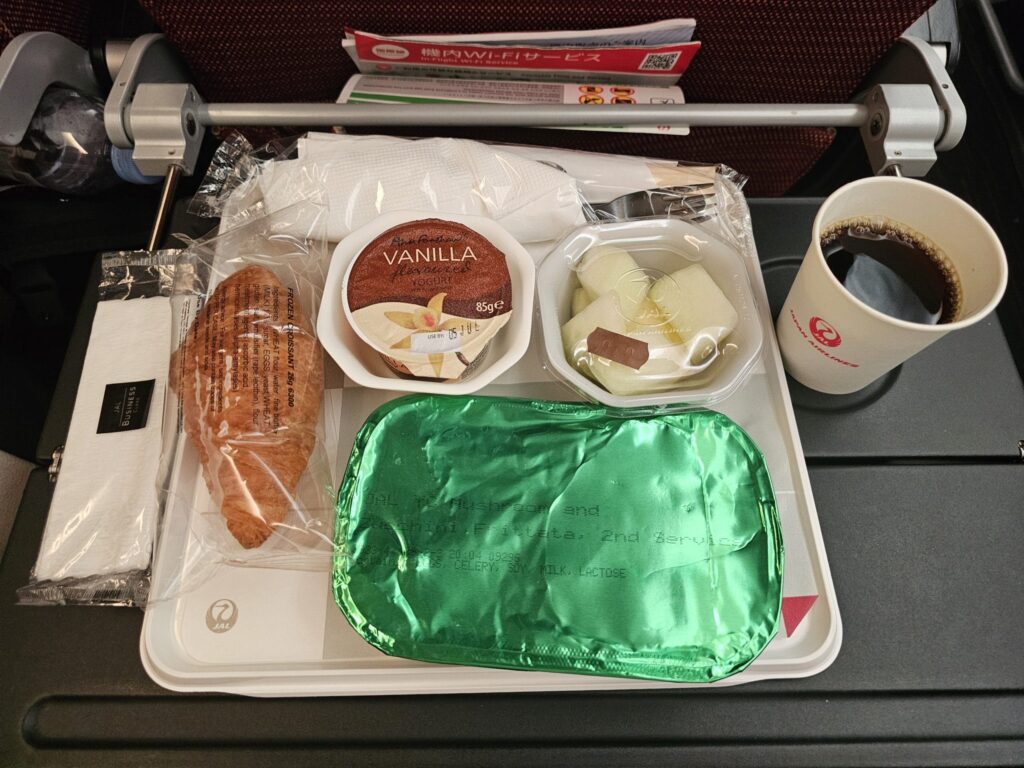
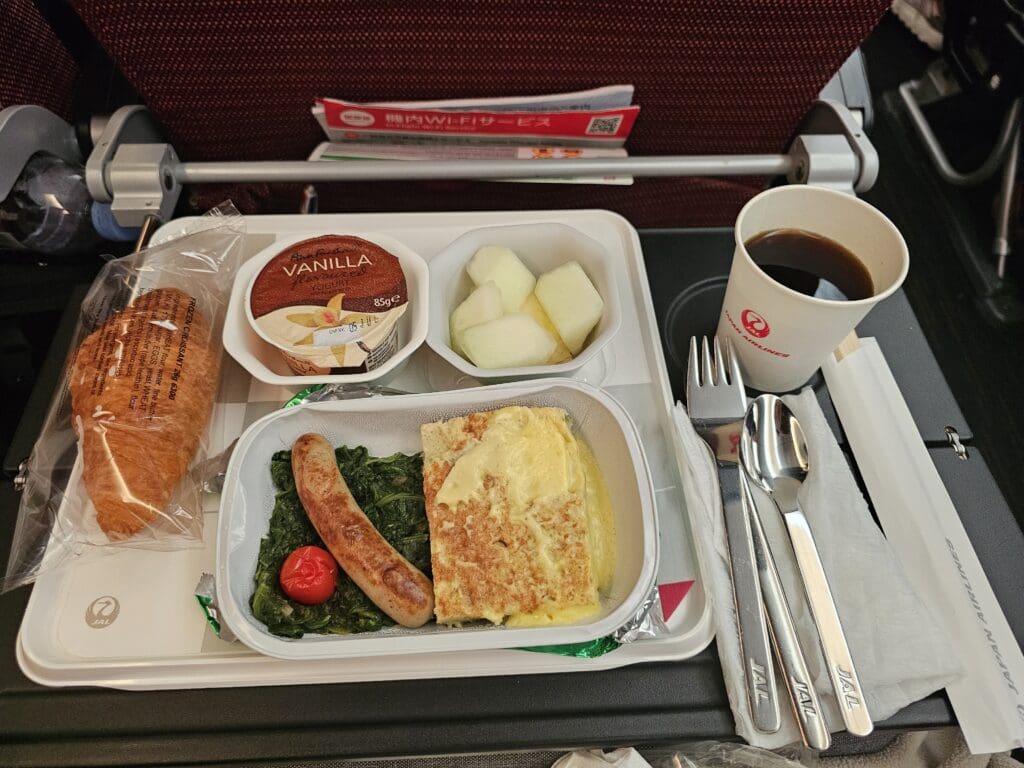
At 0510, the carts were rolled out into the aisles and around ten minutes later, another polite and friendly flight attendant placed the meal onto my tray table. When it came to drinks, tempted by a third and final Sky Time juice, I instead went for a JAL Café black coffee before getting to work on the breakfast offering. Whilst compact, with the exception of the croissant, this was of very good quality and was most certainly adequate given the length of the flight. Once all meals had been handed out, several crew members then passed through the cabin distributing hot coffee and green tea, before returning to collect the empty trays about twenty minutes later. Afterwards, the crew made a final pass through the cabin offering duty free sales, appearing to have much less luck this time around when compared to their first sales round several hours earlier.
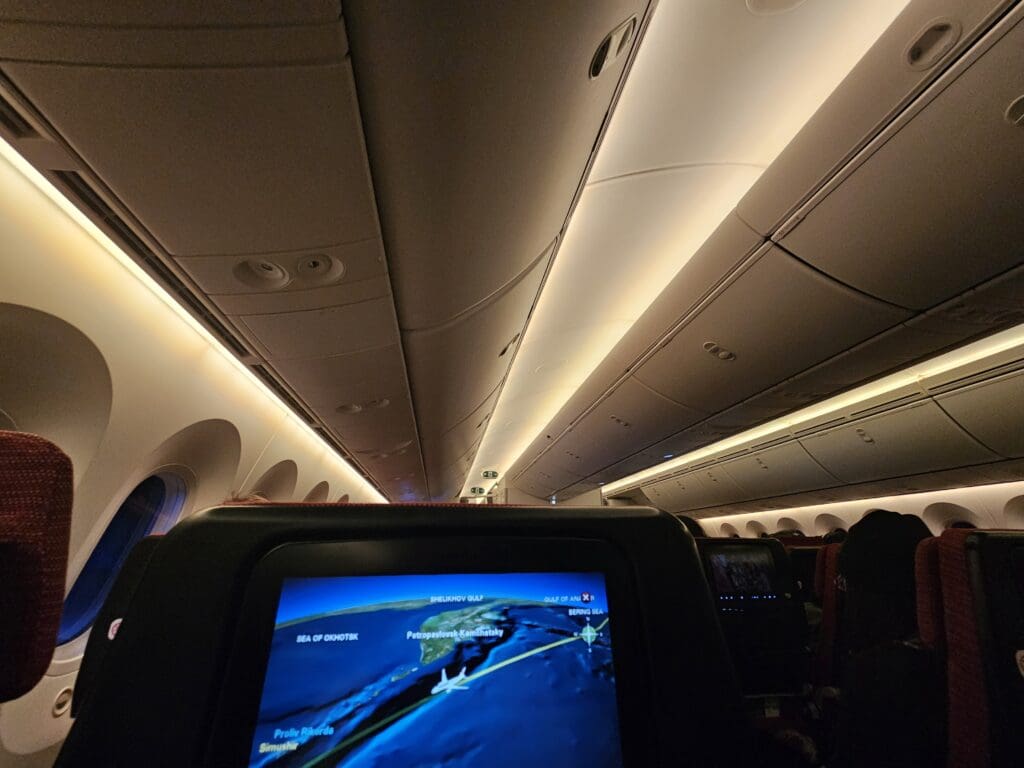
After steaming down the Kuril Islands for over an hour, the jet made its way down the eastern coastline of the Japanese island of Hokkaido at which point things became a little bumpy, although not turbulent enough to warrant the re-illumination of the seatbelt signs. Heading down Hokkaido’s coastline, the jet remained some distance offshore and I’m not too certain whether or not this was visible that morning from the right-hand side of the jet. At 0649, an announcement was made requesting passengers to fasten their seatbelts as the descent would be commencing a short time later and we would likely experience some turbulence throughout this. A short time later, the army of smartly dressed crew made their way through the cabin, ensuring everything was secure and in place for our arrival before strapping themselves in.
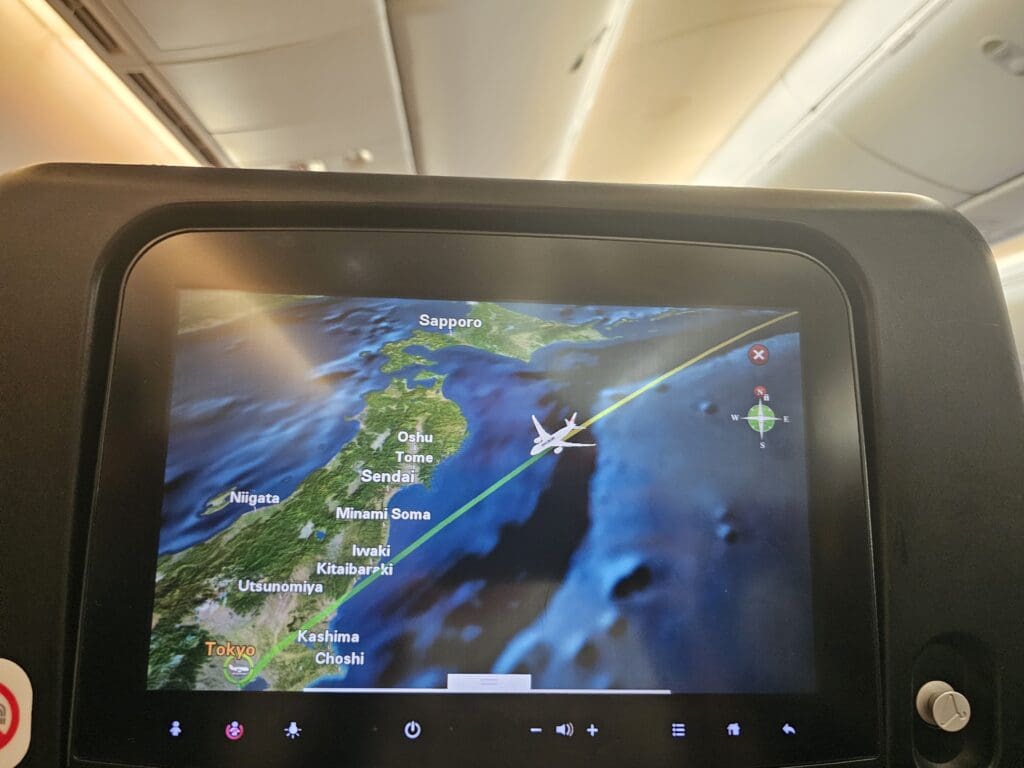
Soon, we reached the island of Honshu, and at about 0658, the Dreamliner could be felt leaving its cruising altitude of 41,000 feet and making its journey back to Earth as we neared our final destination. Heading down Honshu’s coastline, the Dreamliner continued on a southerly heading until it was roughly eighty kilometres to the northeast of Chiba Prefecture’s Cape Inubō at which point the jet turned to fly inland and around ten minutes later the Dreamliner made landfall near the city of Hokota in Ibaraki Prefecture. Continuing to fly northwards inland for another five minutes, at this stage nothing of Japan could be seen below thanks to the thick clouds. Indeed, as I had suspected having seen the weather forecast, that morning Tokyo and the regions were drenched in heavy rain showers.
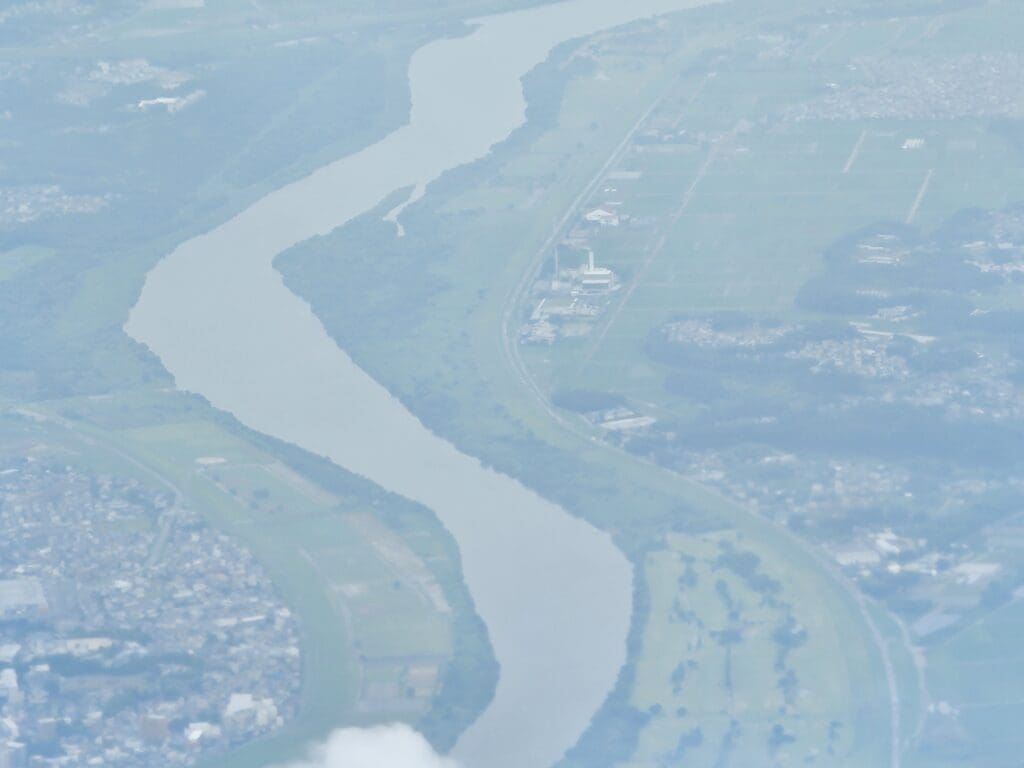
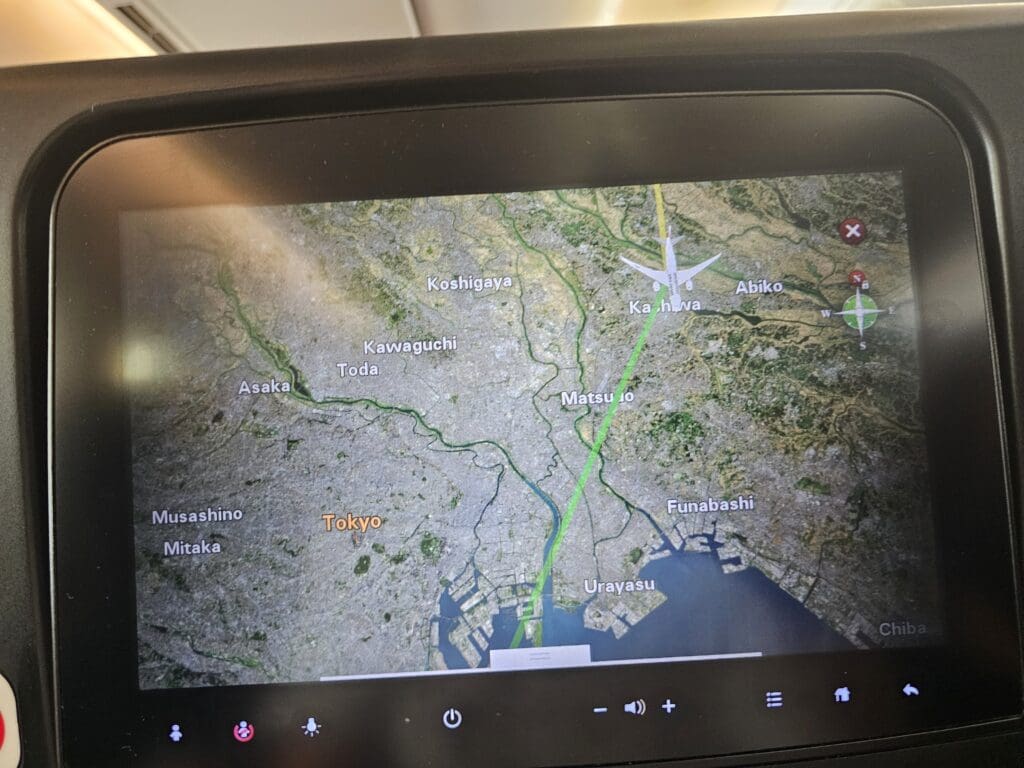
Upon reaching the city of Kasama, the Dreamliner turned southwards and made its way back towards Tokyo at which point one of the flight attendants made an announcement apologising for the delay, explaining that this was due to congestion and noting that we could expect to land in around fifteen minutes’ time. Peering out over my slumbering neighbour, the semi-rural landscape to the north of the capital city appeared as we neared the Tore River and sank through 6,000 feet, heralding our departure from Ibaraki Prefecture and entry into Chiba Prefecture. As we headed southwards, it wasn’t long before the sprawl of the satellite towns and cities to the north of Tokyo came into view as we passed over the likes of Kashiwa, Kamagaya and Matsudo. Soon, the waters of Tokyo Bay appeared and the flaps and landing gear were extended with a few whines and thumps, indicating that we were almost at our destination. Outside, I caught a glimpse of Tokyo Disneyland before we crossed over the ports to the north of Haneda Airport.
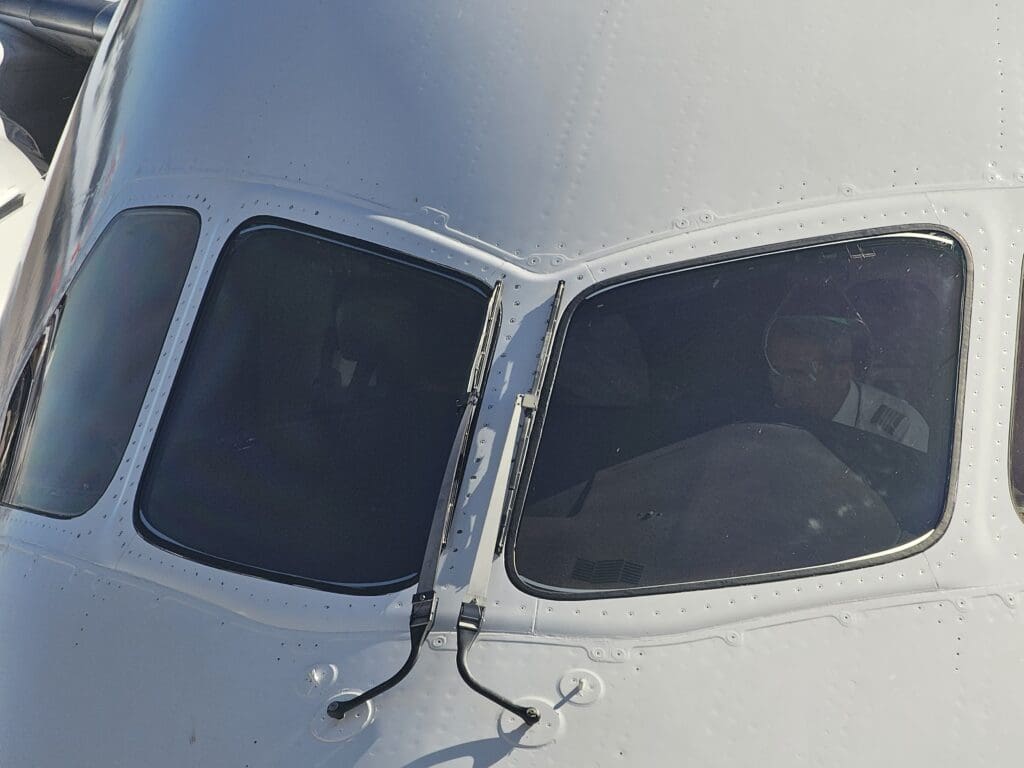
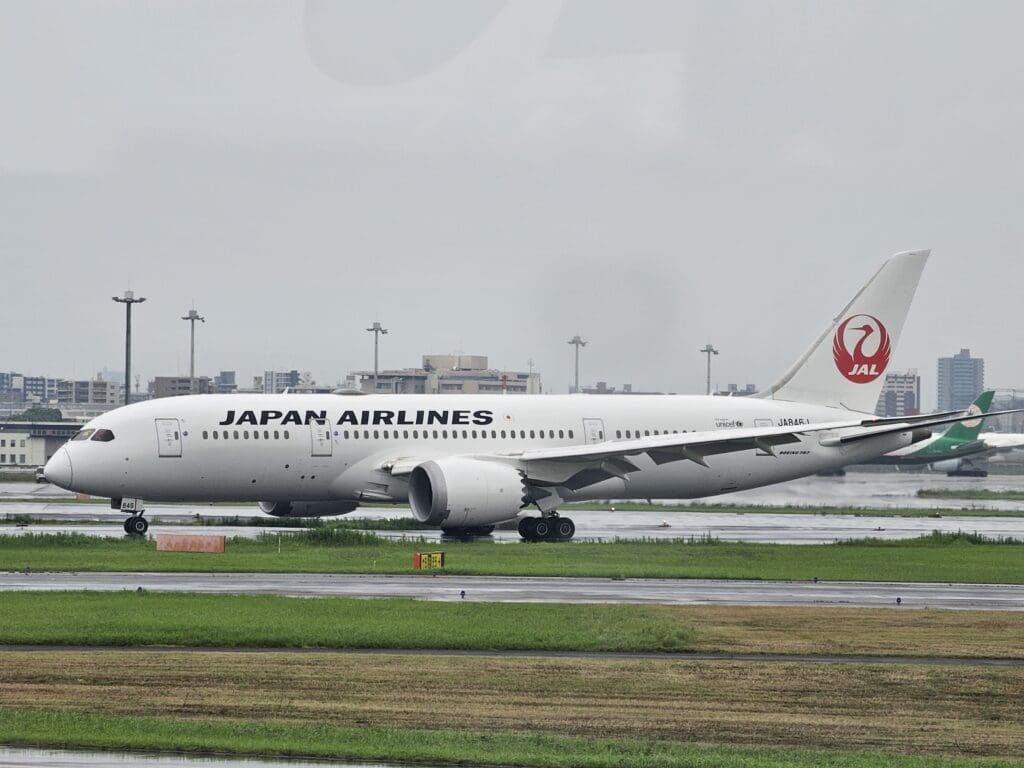
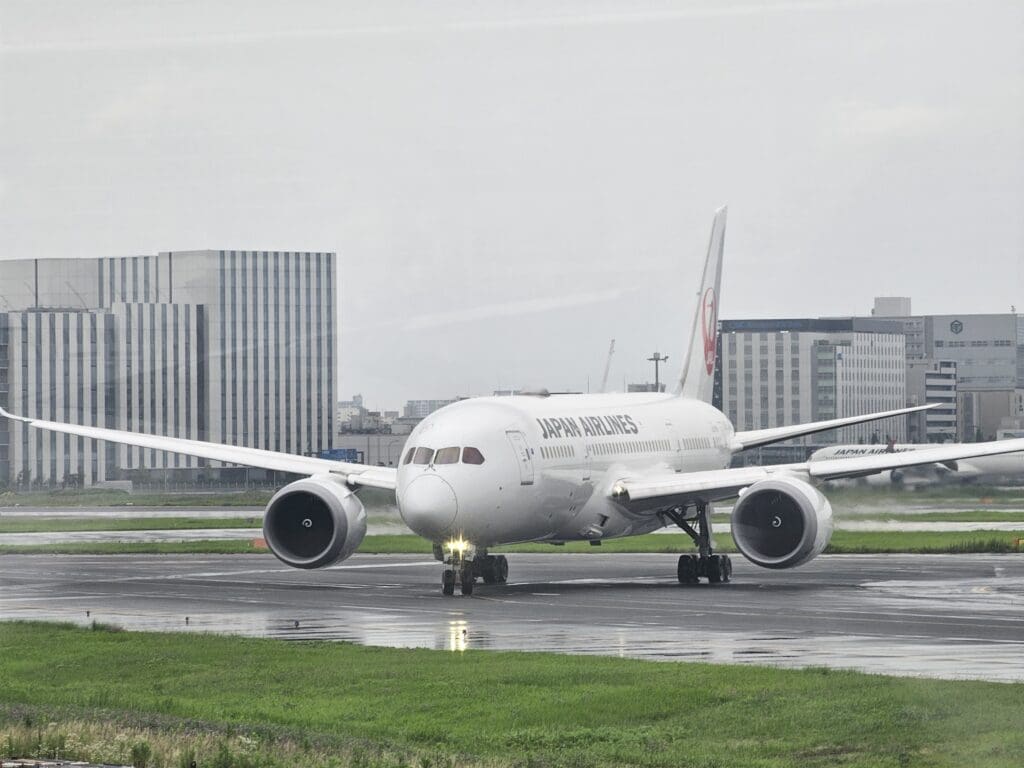
A grand total of 7526 miles and 13:44 after taking to the skies above London, my longest ever flight to date came to an end as we made a soft touchdown on Tokyo Haneda Airport’s Runway 09R at 07:50 in the morning. Once there, we decelerated rather gently before vacating the runway at which point the Purser welcomed all to Tokyo in Japanese and English, and undertook the usual post-flight thanks and warnings as we commenced our taxi over to Terminal 3. Talking of announcements, it is worth mentioning that no announcements were made from the flight deck at any point during the flight, which, whilst no reason to make a formal complaint, were a little missed, as like many passengers, I do like to hear from the pilots during the flight!
Having arrived during the morning rush, by that time, many of Terminal 3’s stands were filled and it soon became evident that we were bound for a remote stand. Five minutes after touching down, the Dreamliner came to a halt at Stand 151, arriving there a total of forty minutes behind schedule. Once at the stand, the engines spooled down and, perhaps desperate to escape after the long slog, many of my fellow passengers jumped up in an urgent rush to disembark. Once the engines had been spooled down, inside the cabin, calming piano music rang out and was accompanied by a video montage from across Japan, providing an appropriate end to our long slog.
Thankfully for those in an urgent rush to disembark, it didn’t take long for two sets of covered airstairs to be positioned up to the L1 and L2 doors and soon passengers began to shuffle down the aisle. Seeing as it appeared that my neighbour was in a rush to disembark, I stood up, collected my backpack and began the journey down the messy cabin, receiving a polite and friendly farewell and thanks from each crew member that I passed before stepping off the aircraft via the L2 door just as a bus was pulling away.
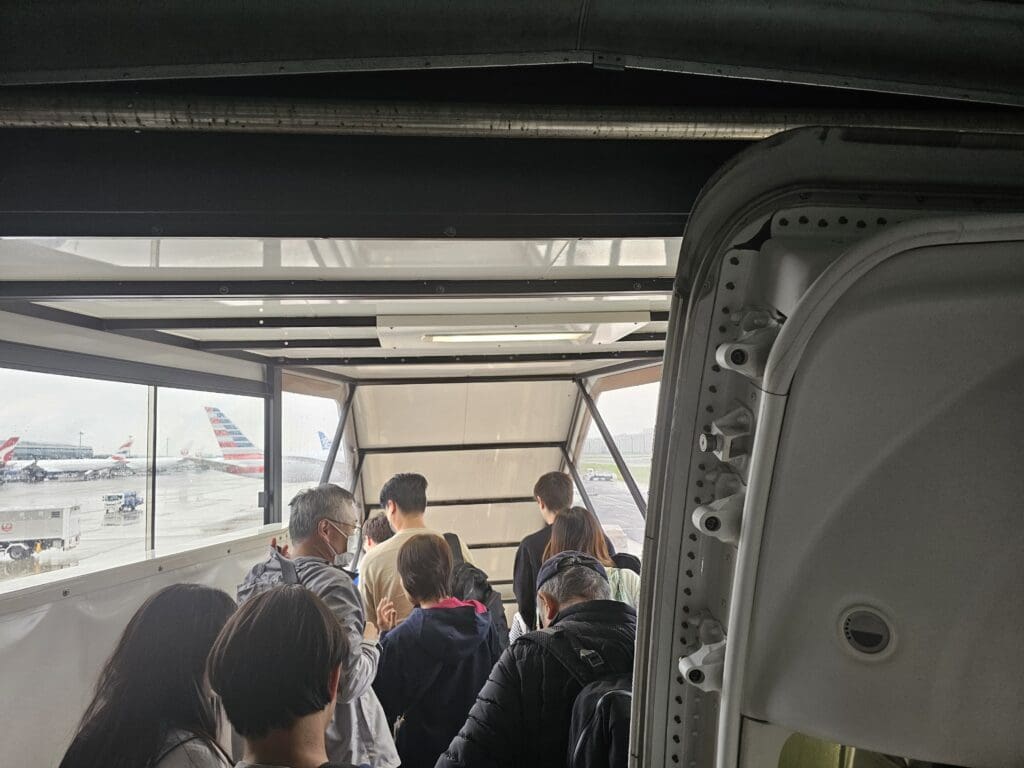
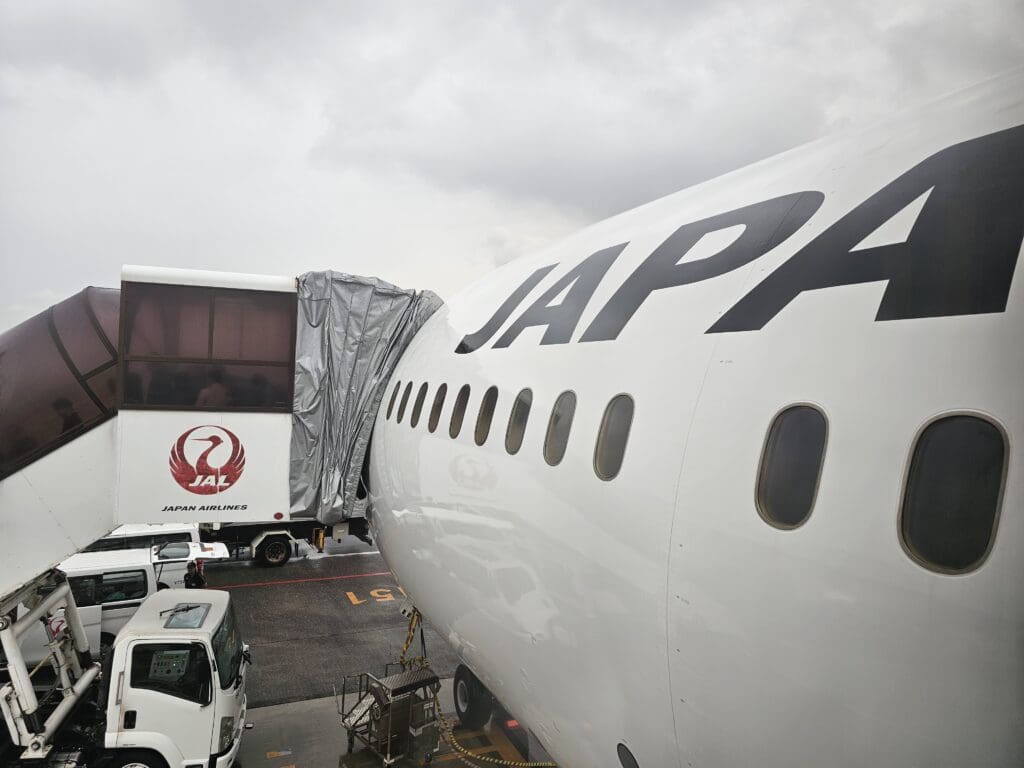
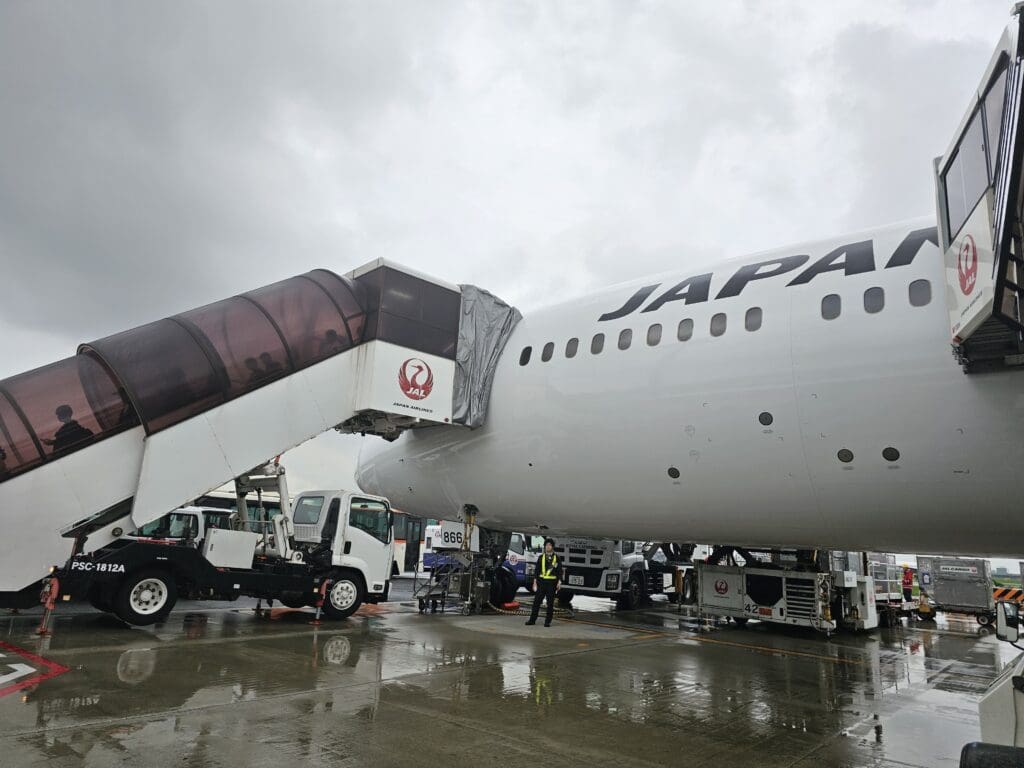
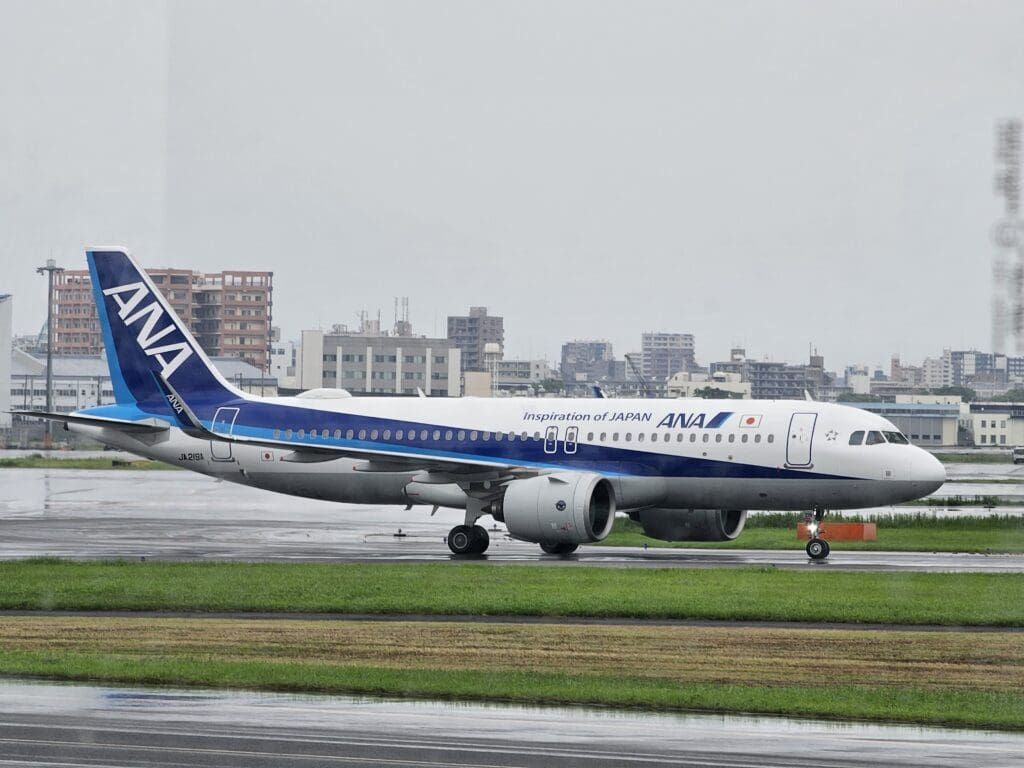
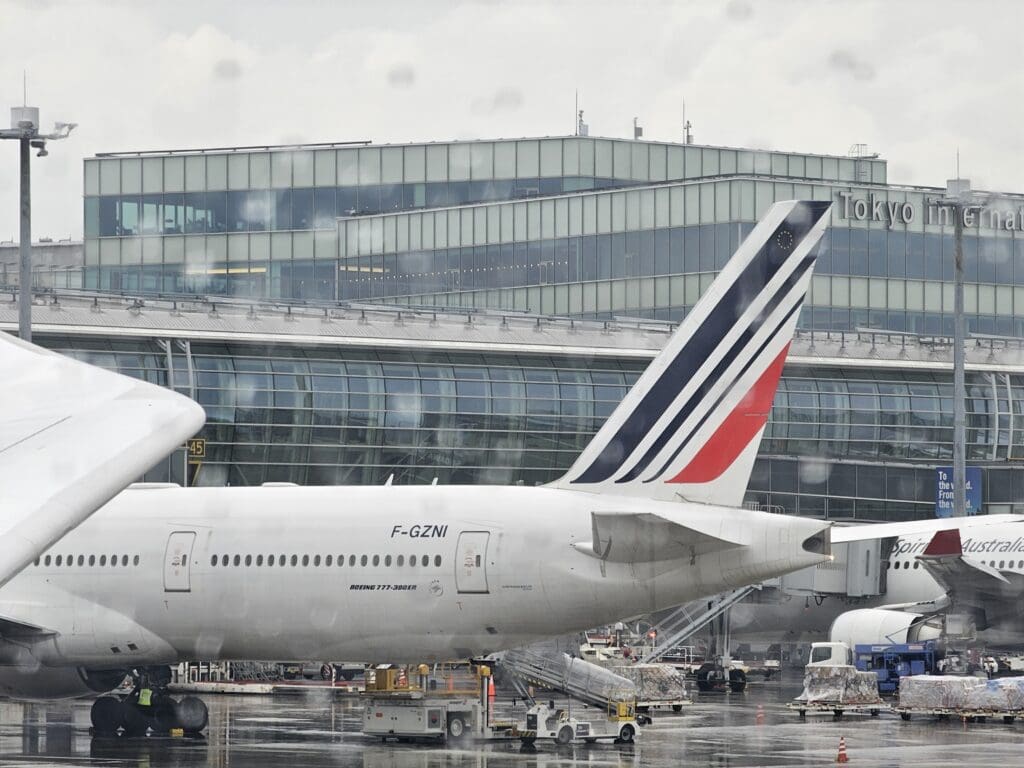
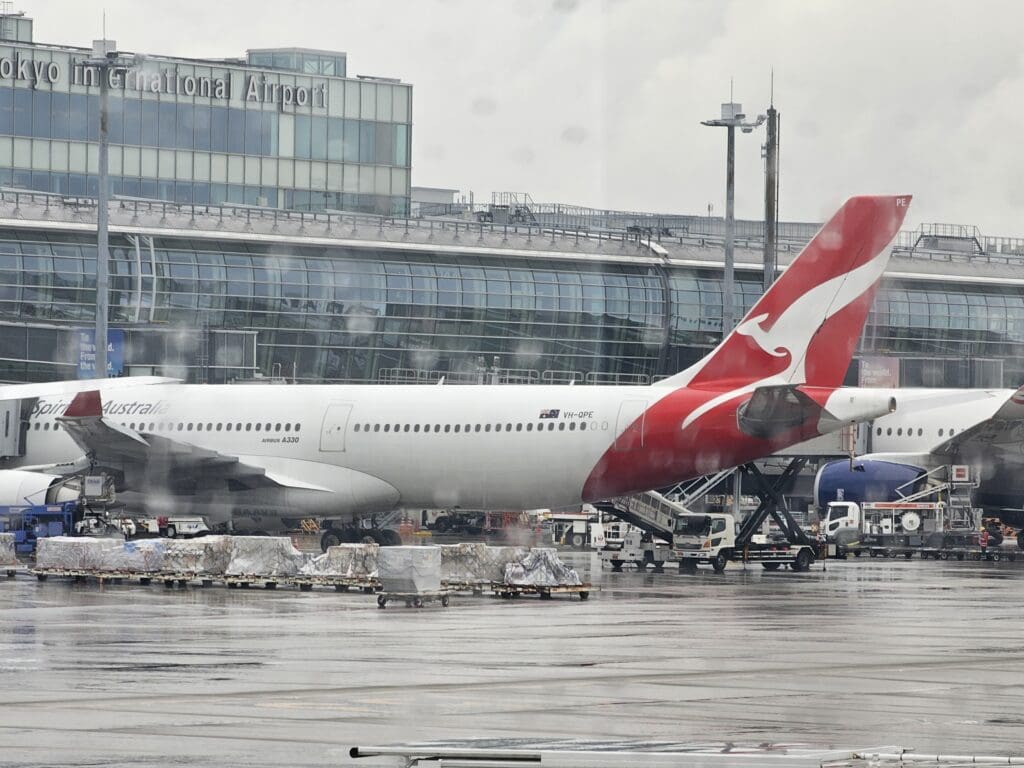
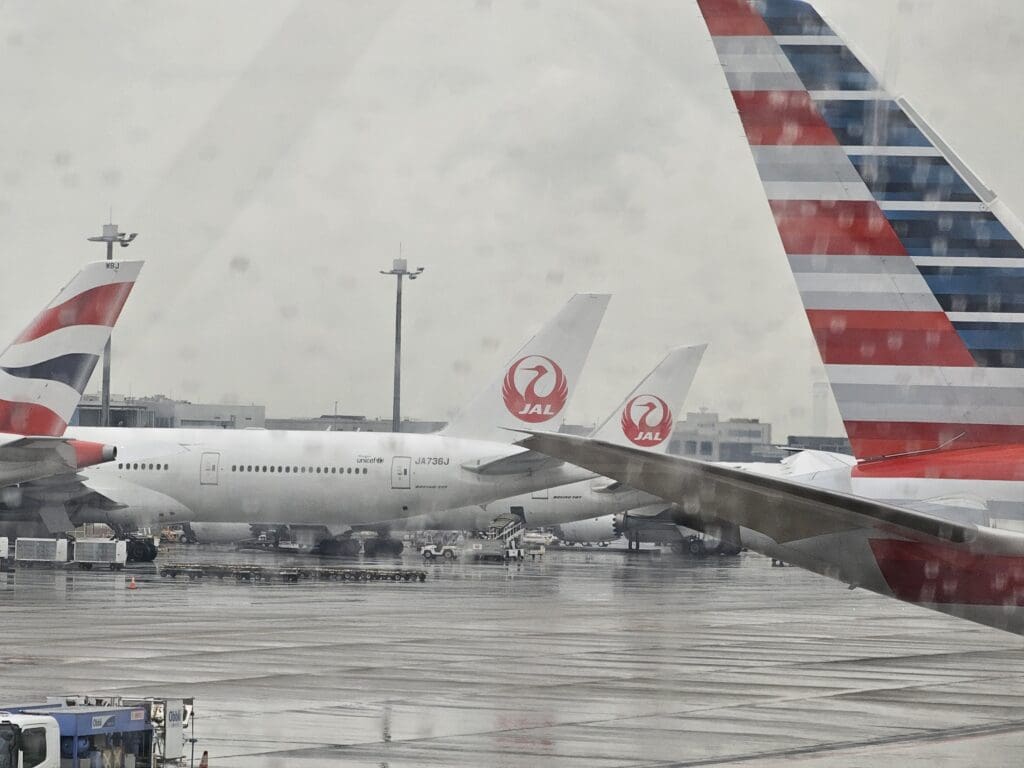
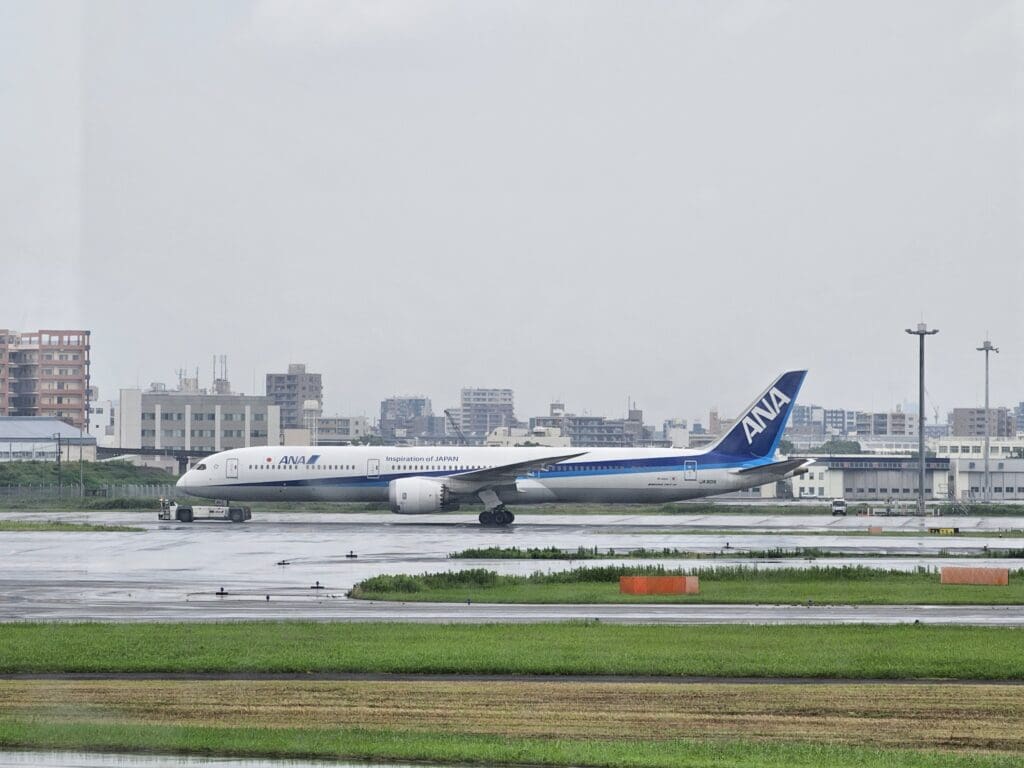
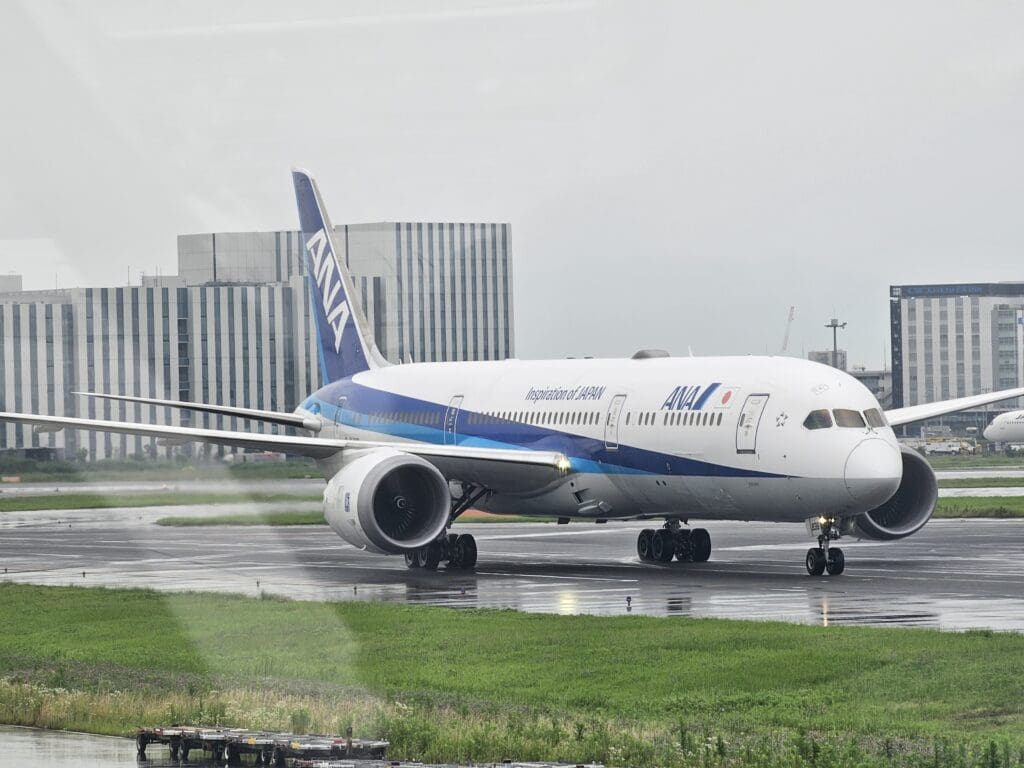
Failing to give off a particularly good first impression of Haneda Airport and going against Japan’s efficient reputation, I was then required to wait all of sixteen minutes before the next bus appeared – indeed, it seemed that they only had one bus available for the flight which was shuttling passengers to and from the terminal. Looking around, a number of the elderly passengers around me opted to sit on the stairs as they waited, however, I remained standing and watched as a veritable smorgasbord of aircraft taxied past following their arrival. Once the bus appeared, I soon made my way onto this and began a five-minute or so ride over to the terminal. Thankfully, once inside, immigration and customs was a very quick and smooth affair and I was able to enter the landside arrivals area no more than five minutes after disembarking the bus, thus bringing an end to my second-ever flight with Japan Airlines.
Summary
I have to say, for the most part, Japan Airlines left me with no complaints and I would be more than happy to fly onboard one of their long-haul services again at some point in the future. The crew were friendly, polite and welcoming, the food and galley offerings were good, and the seat was (ignoring its firmness) spacious and comfortable. Granted, whilst perhaps improvements could have been made to the inflight entertainment system and the wifi, and the provision of an amenity kit wouldn’t have gone amiss given the length of the service, these were, for the most part, minor nags at best.