My Turkmenistan Airlines Adventure: Ashgabat to Delhi on a Boeing 737-800
You can read all the background information regarding my trip in my report from London Gatwick to Ashgabat on the Boeing 777-200LR here.
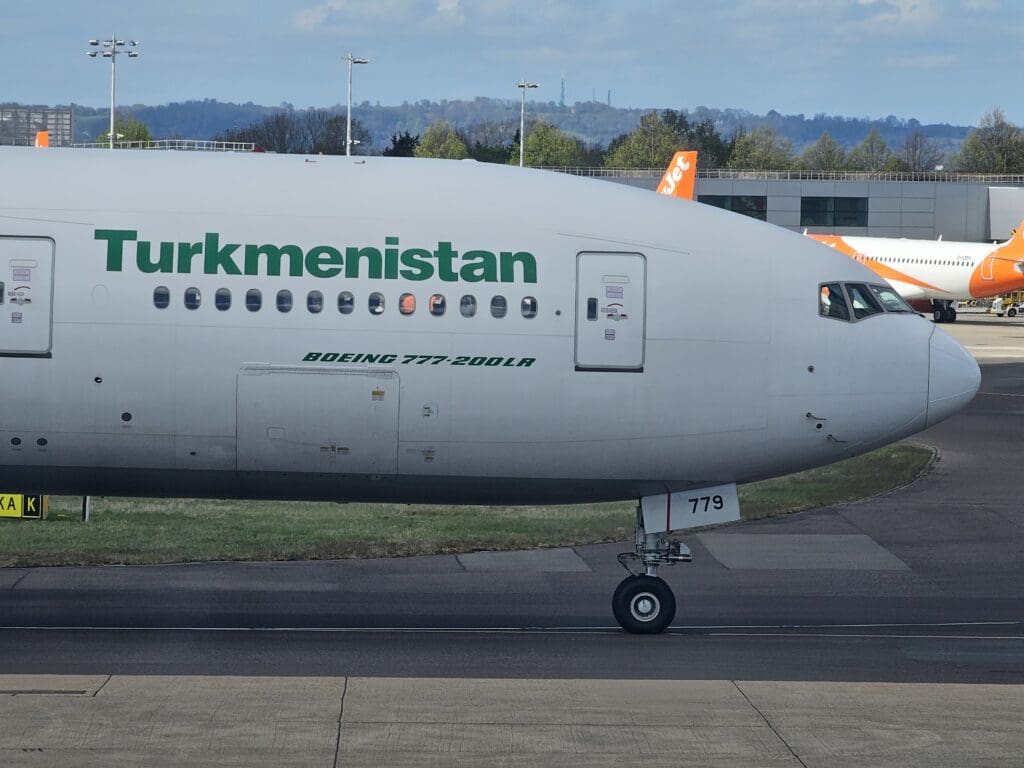
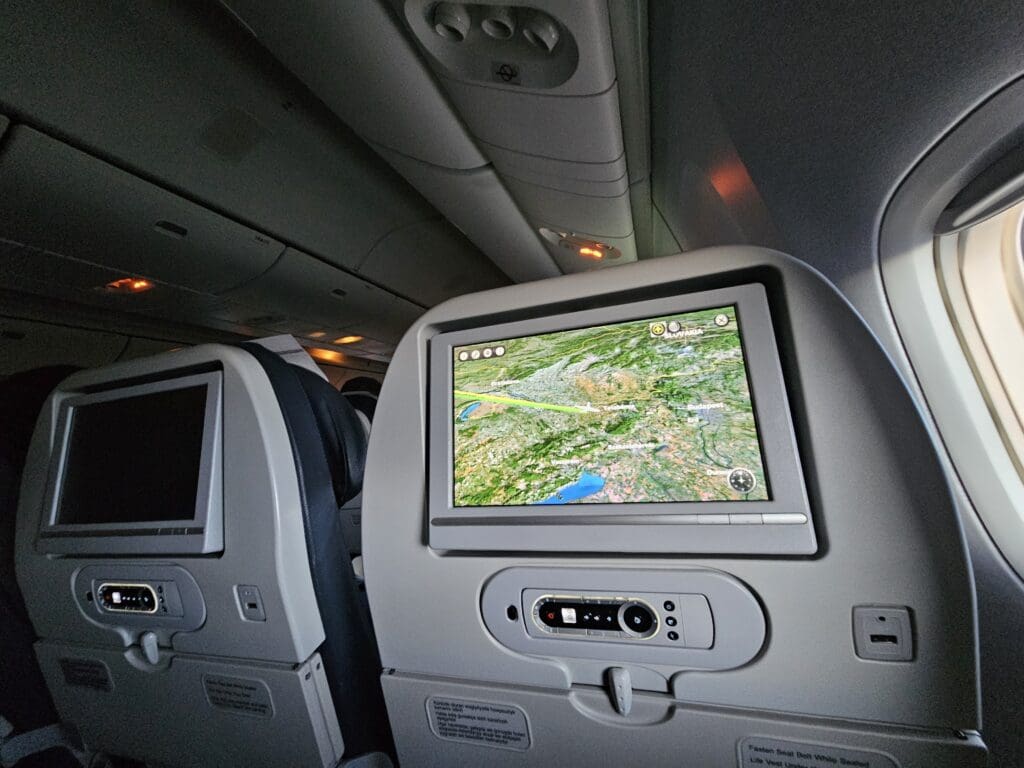
Following my surprisingly pleasant flight onboard one of Turkmenistan Airlines’ two ultra-rare Boeing 777-200LR widebodies, I touched down in Turkmenistan at 0314. Assisted by the fact that the flight over from London Gatwick had been almost empty, disembarkation was a speedy affair and I arrived in the terminal with a total of three hours and twenty minutes until my flight to Delhi was scheduled to depart. Once I had made it into Ashgabat’s bright and well-polished terminal, I started the short march along the main corridor that connects the gates with the airport’s immigration area, doing so under the watchful gaze of an army of stern-looking security personnel, almost all of whom appeared to be incredibly young and wore ill-fitting Soviet-esque uniforms, complete with the stereotypical wide-brim cap. Indeed, these guards could be seen throughout the terminal and I would argue that they appeared to outnumber the number of passengers that I spotted that night!
Once at the immigration hall, lacking Turkmenistan’s infamously difficult-to-obtain visa, I followed signs for international transfers and soon had my boarding pass checked by a cold and emotionless Turkmenistan Airlines agent who briefly glanced at this before giving me a nod. From there, I soon reached the transit security checkpoint where two sets of scanners and metal-detecting arches could be seen, although these were unmanned. Some passengers barged through with no fear, however, being one of the more cowardly passengers not wanting to fall foul of Turkmenistan’s aviation security laws, I decided to hang around and about fifteen minutes later, a stern-looking agent appeared. At this point, I passed through the checkpoint. Admittedly, the agent did not appear to care too much about passengers being thoroughly checked, with those who set off the metal detecting arch not required to undergo any additional checks.
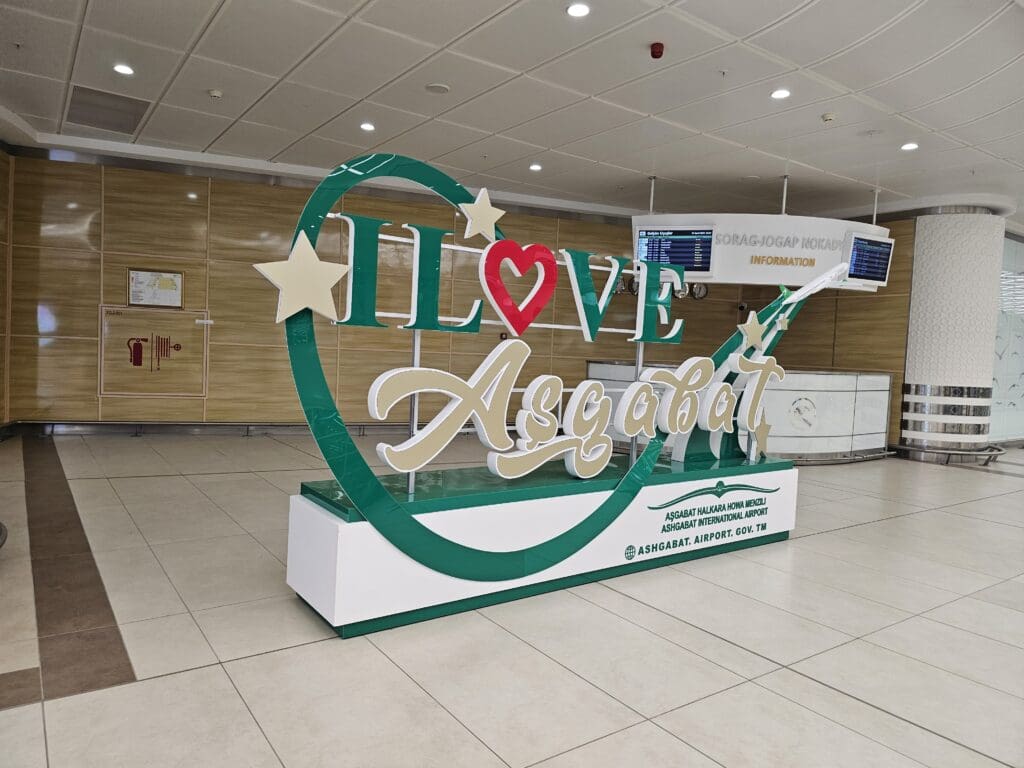
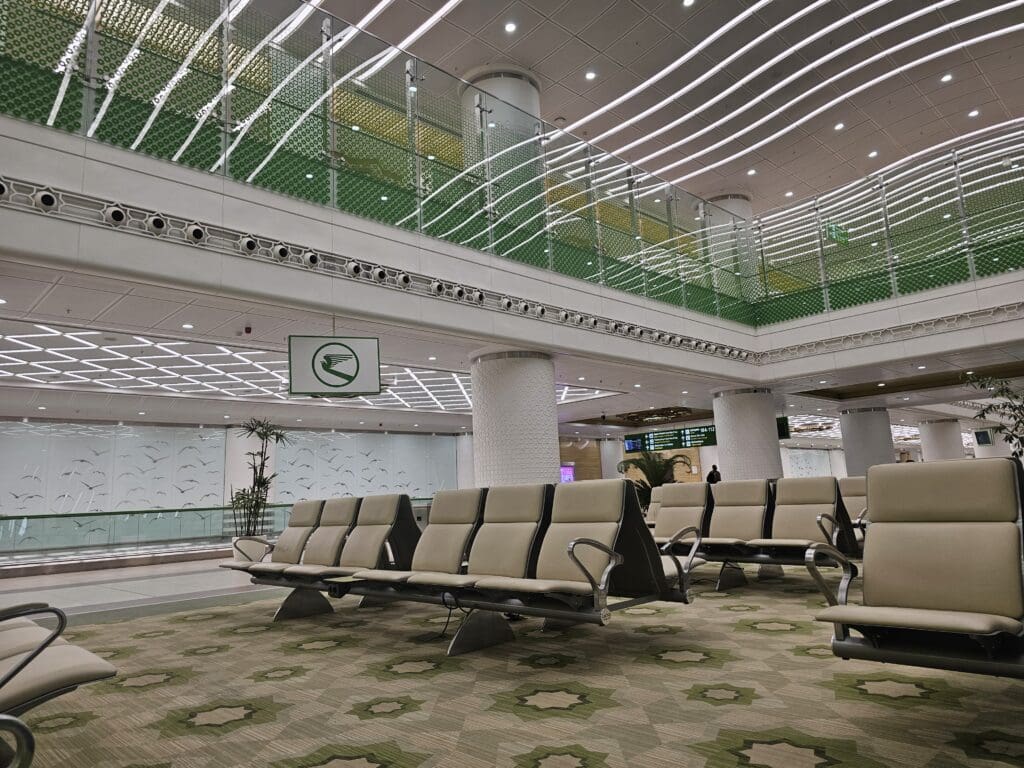
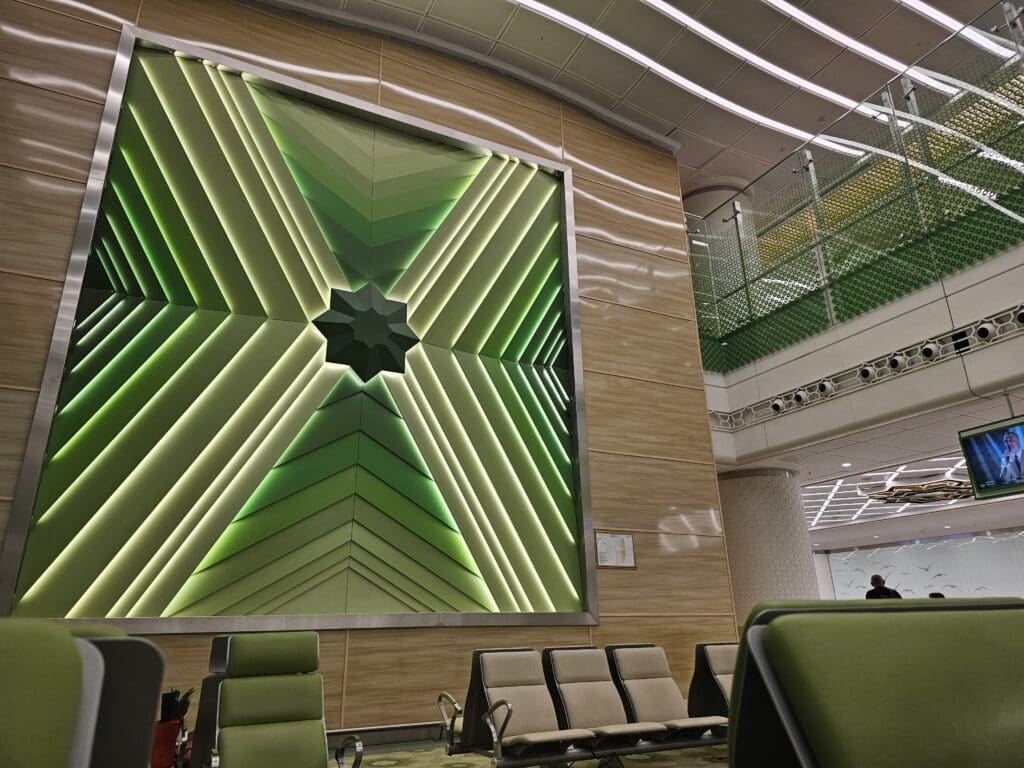
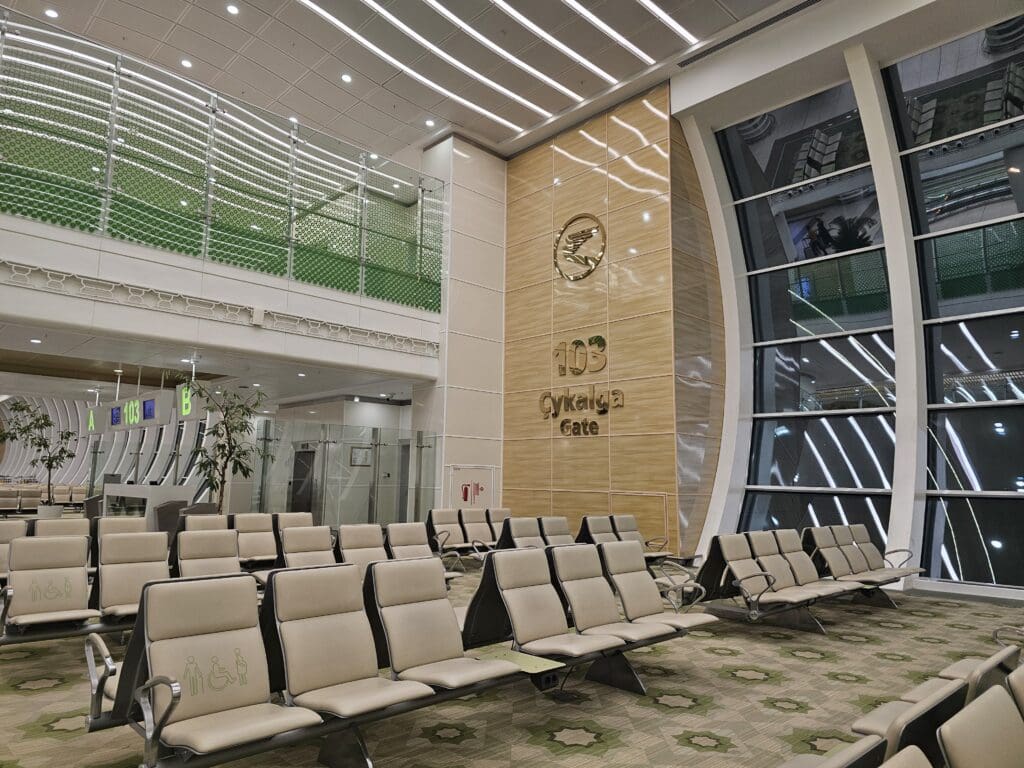
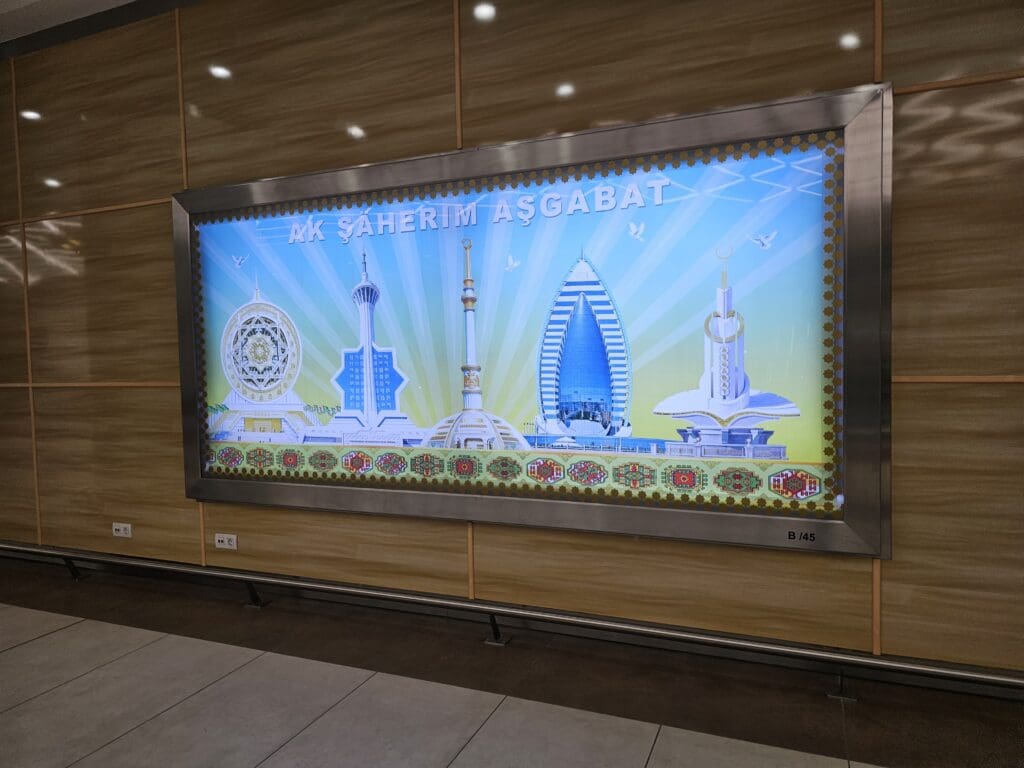
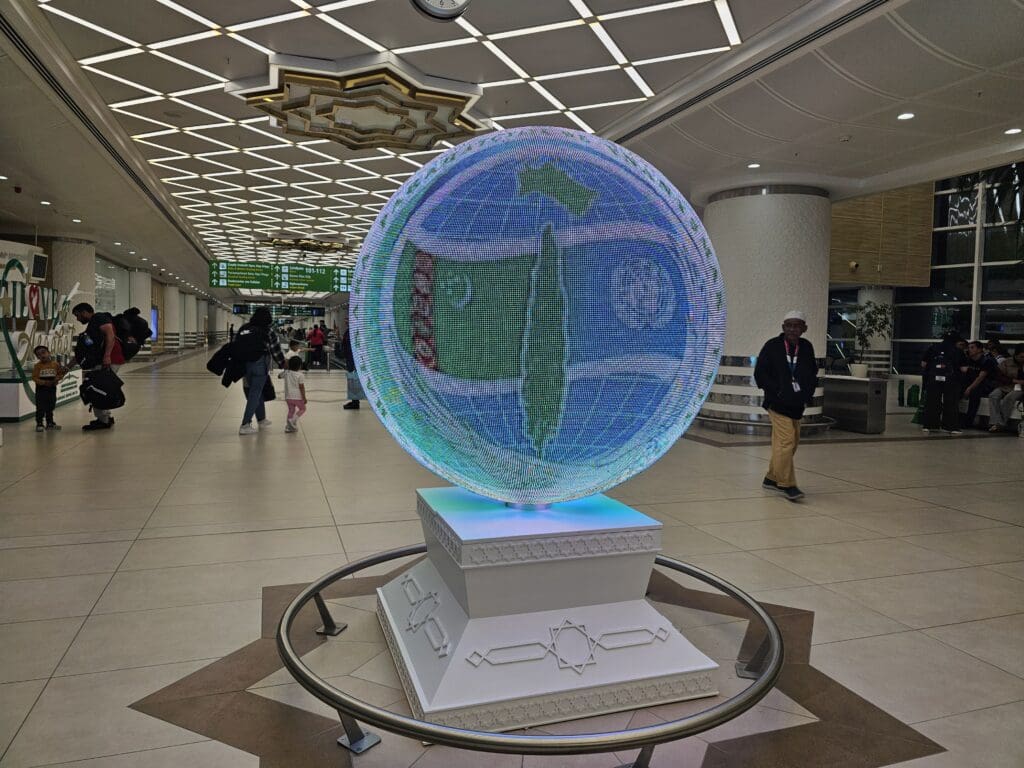
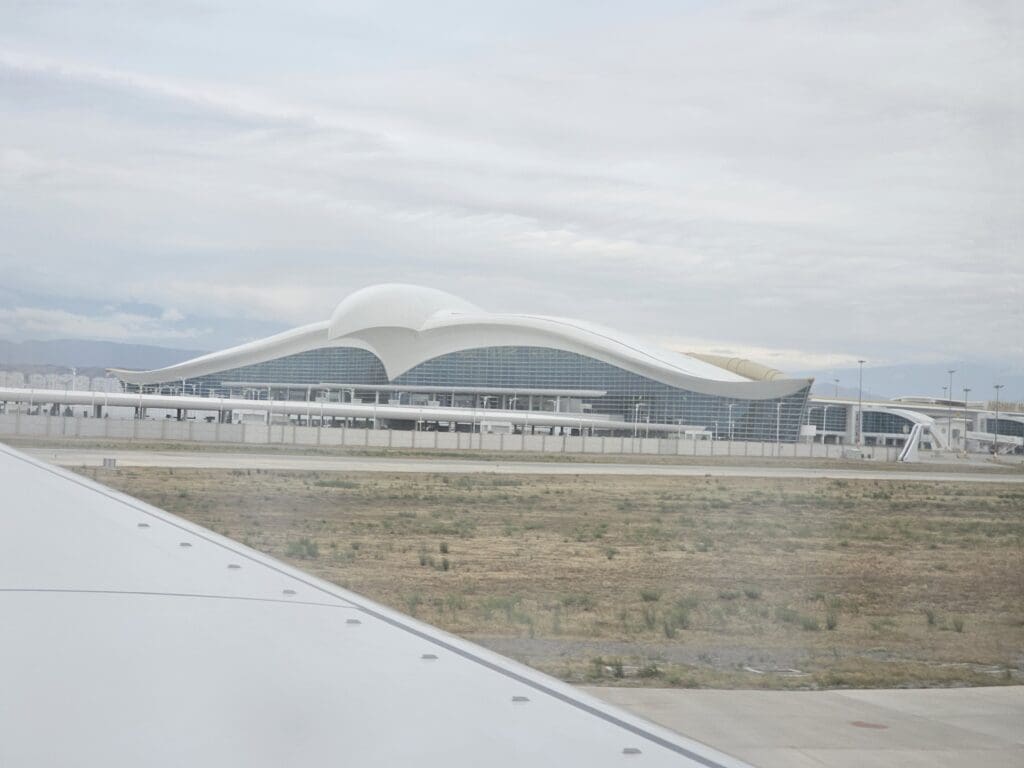
Once through security, I made my way down the escalators and soon reached the main portion of the terminal. Examining Ashgabat International Airport’s layout, the airport’s sole terminal features a single pier around which sit fifteen jetbridge-equipped stands. At the far end sits a space designed in the shape of Turkmenistan’s national emblem, whilst the other, at least from the outside, is shaped to resemble a falcon with its wings outstretched. Needless to say, Ashgabat International Airport is most certainly one of the more uniquely designed airports in the world! Upon entering the main waiting area, I found this to be home to most of the terminal’s shops and facilities, including a VIP lounge which non-premium passengers could enter for $40, a total of five duty-free stores and a couple of cafés, which, were the sole eateries in the terminal. Despite there being signs for a food court and an internet café, both were firmly closed and appeared to have been that way for quite some time. Meanwhile, as you would perhaps expect given the rather closed nature of Turkmenistan, public wifi networks were non-existent, although plenty of working plug sockets could be found for those needing to charge their devices before jetting off.
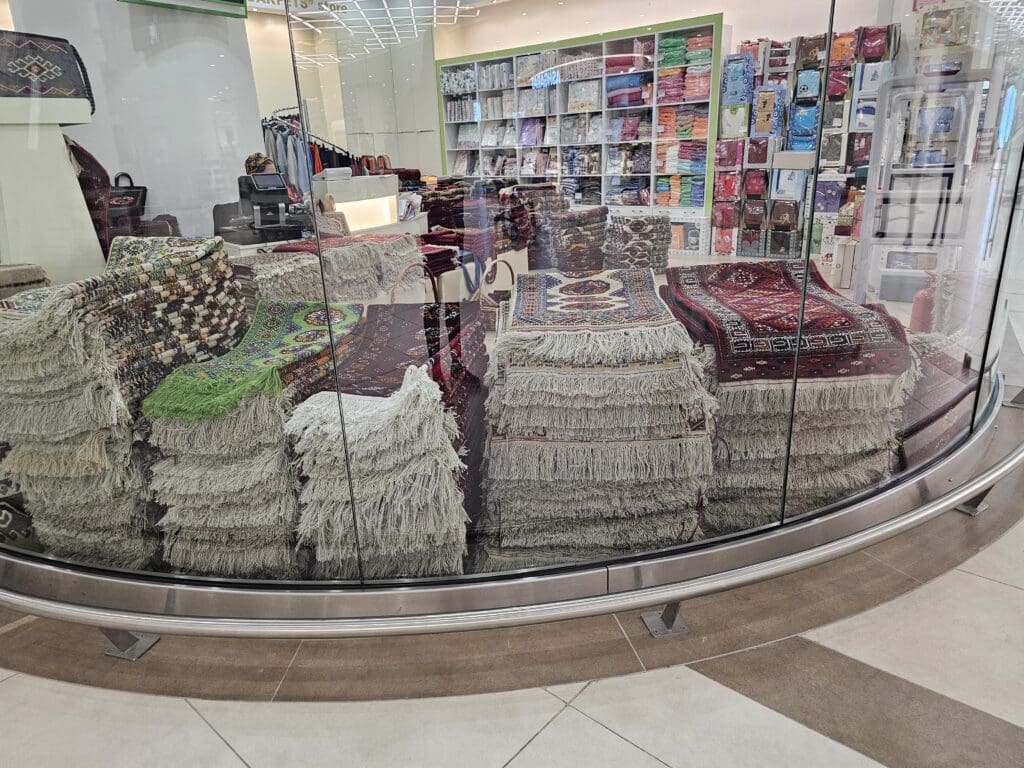
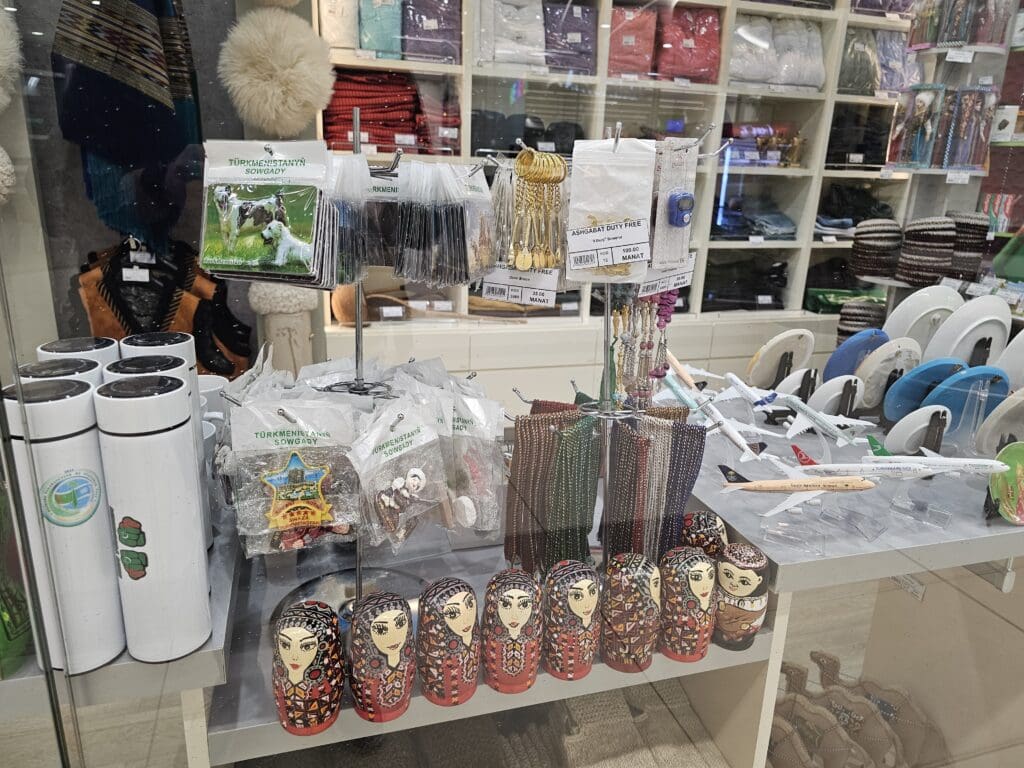
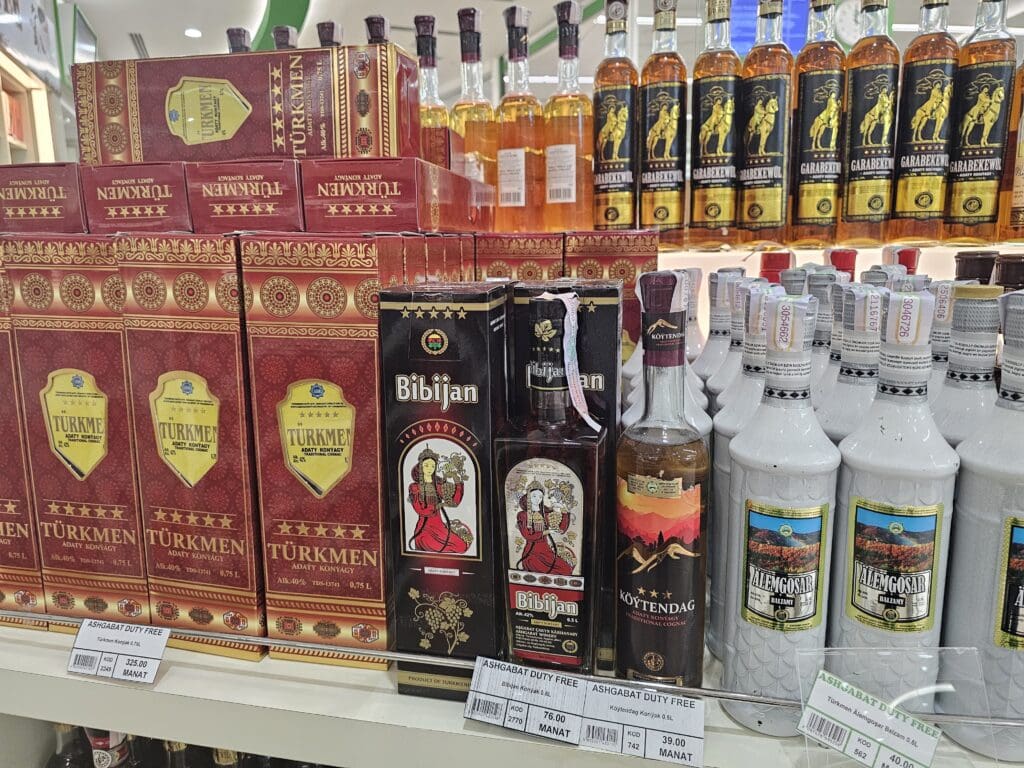

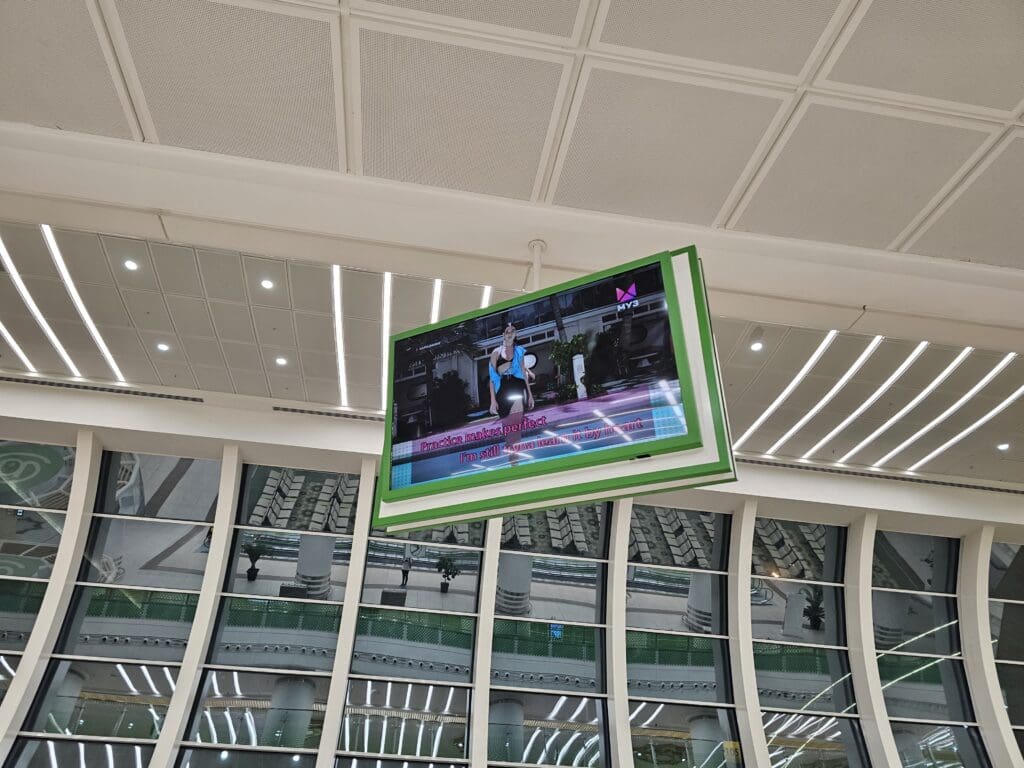
Having welcomed its first passengers in 2016, inside, I found the terminal to be bright, modern and well-polished, with an army of cleaners on hand throughout the terminal. For the most part, this was in good condition, although sadly this did not extend to the toilets which I found to be dirty and used as unofficial smoking areas by both passengers and guards alike. Meanwhile, as with everywhere else in the airport, an army of guards was omnipresent throughout and unless they happen to be aviation enthusiasts, I can’t imagine that standing around Ashgabat International Airport doing little all night proves to be a particularly exciting role! Admittedly, despite its novelty, I can’t that the airport was a particularly fun, exciting or comfortable place to wait. Throughout my stay, the airport seemed to be rather chilly, with air conditioning blasting out of the vents up above, perhaps to keep the guards awake. Meanwhile, loud music rang out for the duration of my stay, occasionally interrupted by trilingual announcements in Turkmen, Russian and English.
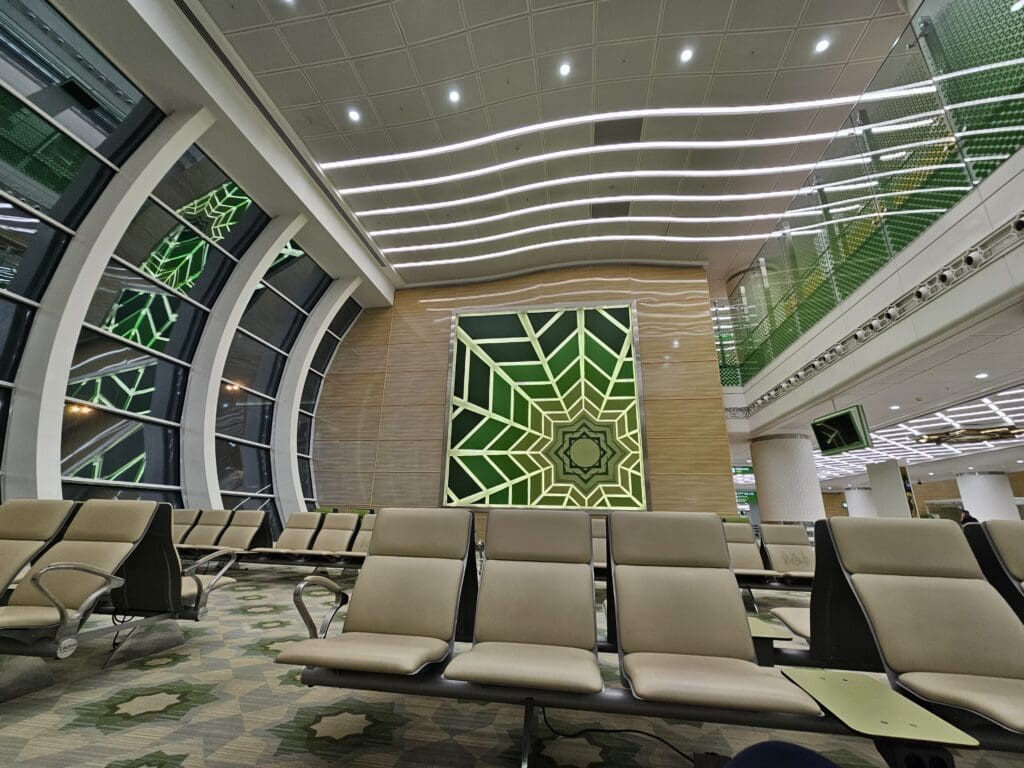
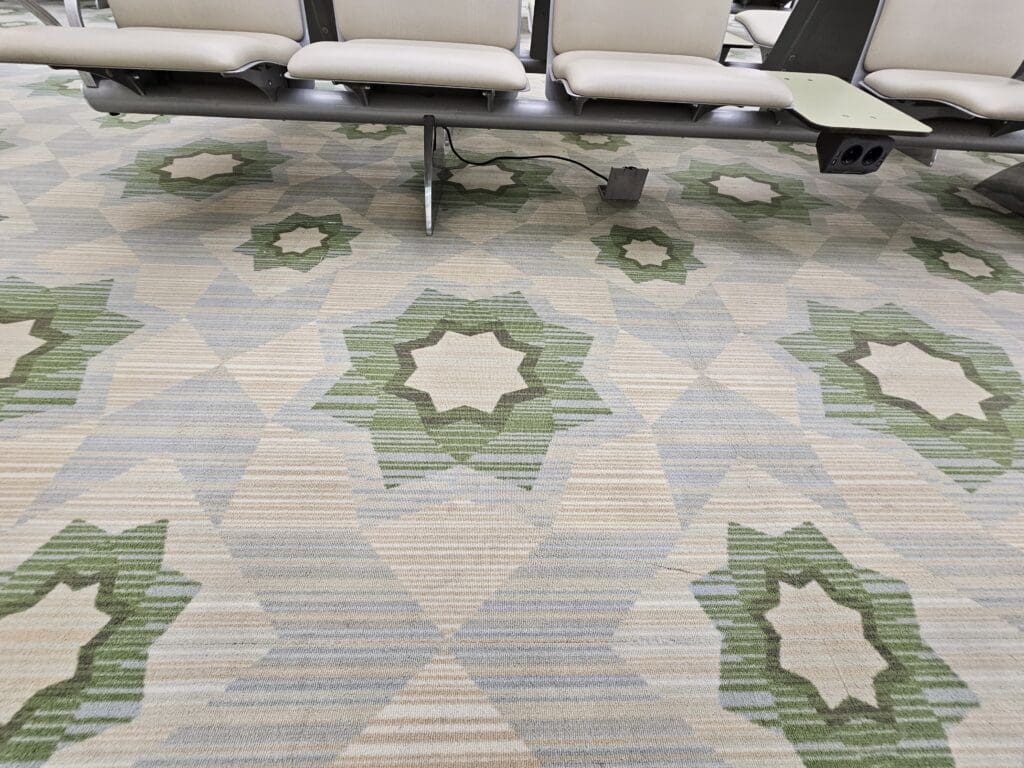
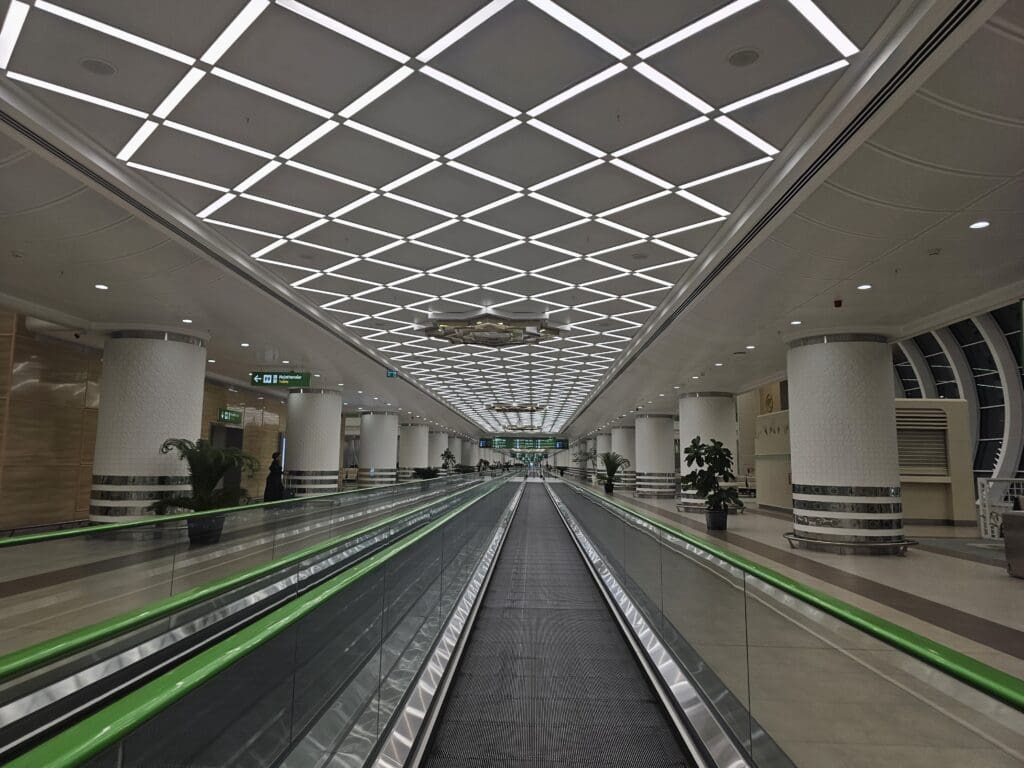
For a capital city airport, Ashgabat International Airport is not overly busy, especially in the dead of night. Other than hometown airline Turkmenistan Airlines, the only other passenger airlines to serve this are China Southern Airlines, FlyDubai, S7 Airlines and Turkish Airlines. Indeed, as I wandered around, large swathes of the terminal were devoid of passengers. That night, there would be just three flights departing before my flight to Delhi – these took the form of a FlyDubai service to, you guessed it, Dubai, and Turkmenistan Airlines services to Istanbul and Kuala Lumpur. Meanwhile, many of those inside the terminal took the form of a large group of pilgrims who had arrived from Jeddah and were heading to the Malaysian capital, and young wealthy Turkmens heading to Dubai and Istanbul.
Thanks to the terminal’s large windows, during daylight hours, I can imagine that good views out onto the terminal’s stands and runways can be had during the day, however, it remained almost pitch-black for much of my wait. Furthermore, overt planespotting is most certainly not recommended in Ashgabat!
Seeing as there had been no more than around thirty passengers in Economy on my flight from London to Ashgabat, I was hopeful that I would be in for another quiet ride down to Delhi. However, seeing as this service is well-timed to enable connections from Turkmenistan Airlines’ European destinations and given the smaller size of the Boeing 737-800, I was not confident that I would be in for a quiet ride. According to the boarding pass that I had received in London, boarding was scheduled to commence at 0555, a total of 45 minutes before the flight’s scheduled departure time. Following one final toilet stop, at 0540 I leisurely sauntered through the terminal and soon made it to Gate 102B. Crushing my hopes that this would be another quiet and spacious flight, the waiting area was absolutely packed with few vacant seats.
At that time, Boeing 737-82K EZ-A020, Turkmenistan Airlines’ newest Boeing 737 was being readied at the stand outside for its journey through the skies of Central and South Asia to Delhi. Assembled at Boeing’s Renton plant, this aircraft first took to the skies in June 2017 and was thus a little under eight years old at the time of my flight. Following testing, later that month, the aircraft made the long trek to its new home in Ashgabat, making stops in Goose Bay and Birmingham before arriving in Central Asia. Since then, the aircraft has flown from Turkmenistan Airlines ever since, connecting Ashgabat with destinations across Central and South Asia, the Middle East and Europe. Like many aircraft in Turkmenistan Airlines’ fleet, this particular Boeing did not seem to be particularly highly utilised, undertaking just a single rotation in the week before my flight which saw the aircraft head to Abu Dhabi and back.
Running a punctual ship, at 0550 one of the two Turkmenistan Airlines agents at the gate performed a short trilingual announcement advising passengers of the imminent commencement of boarding at which point many of those around me formed a scrum in a desperate rush to board. As had been the case in Gatwick, boarding was not announced in any order, and instead, all passengers were invited to board the aircraft at once. Once joining this crowd, the scrum’s disorganised nature coupled with the fact that many passengers had clearly exceeded Turkmenistan Airlines’ 5kg hand luggage limit meant that it took a fair few minutes to reach the gate podium. Once there, my boarding pass was torn (but not scanned!) after which I was free to trundle down the jetbridge where I soon hit another queue and waited under the stares of the last tough-looking Turkmen guard that I would spot during my Turkmenistan Airlines adventure!
Once again, despite the plentiful accounts of cold crew members, my first impression of the crew that morning was very good thanks to the warm and friendly welcome that I received as soon as I stepped into the forward galley. Trusting that I had boarded the correct aircraft, with no need to see my boarding pass, I turned right and immediately entered the Boeing’s bright and modern Sky Interior of this reasonably new Boeing 737-800. First up was Business Class, where three rows of modern recliner seats could be seen in a 2-2 configuration, each was covered in a dark pleather cover and featured a hard shell and a large adjustable headrest, although as far as I could tell, these lacked any sort of personal inflight entertainment system.
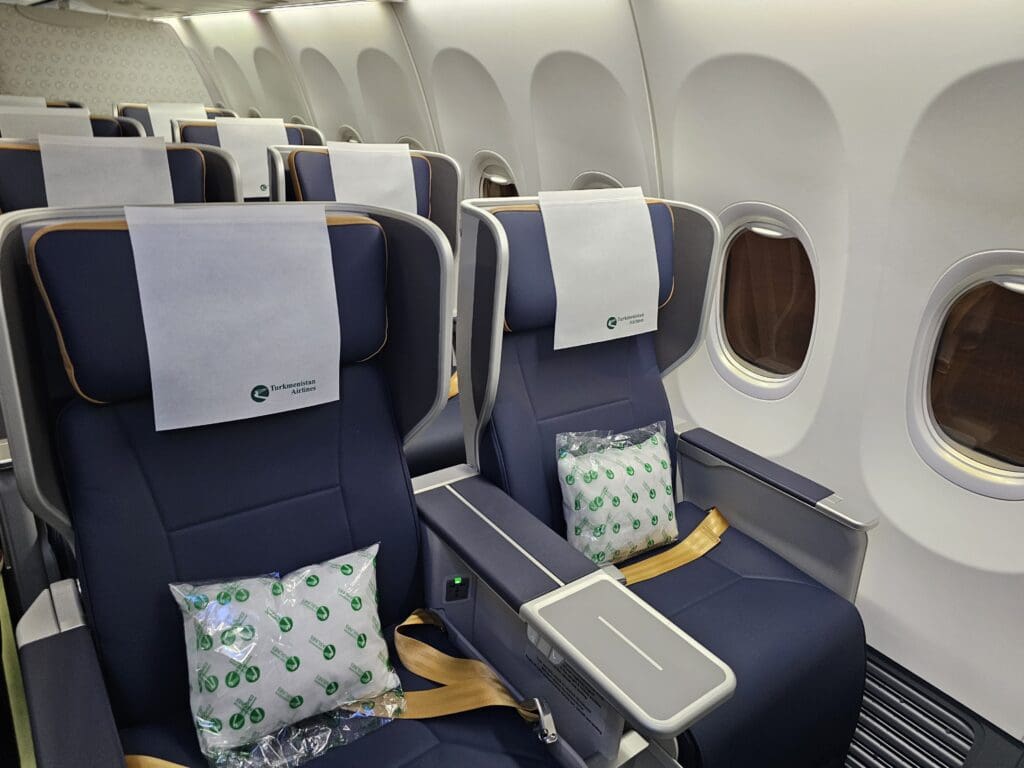
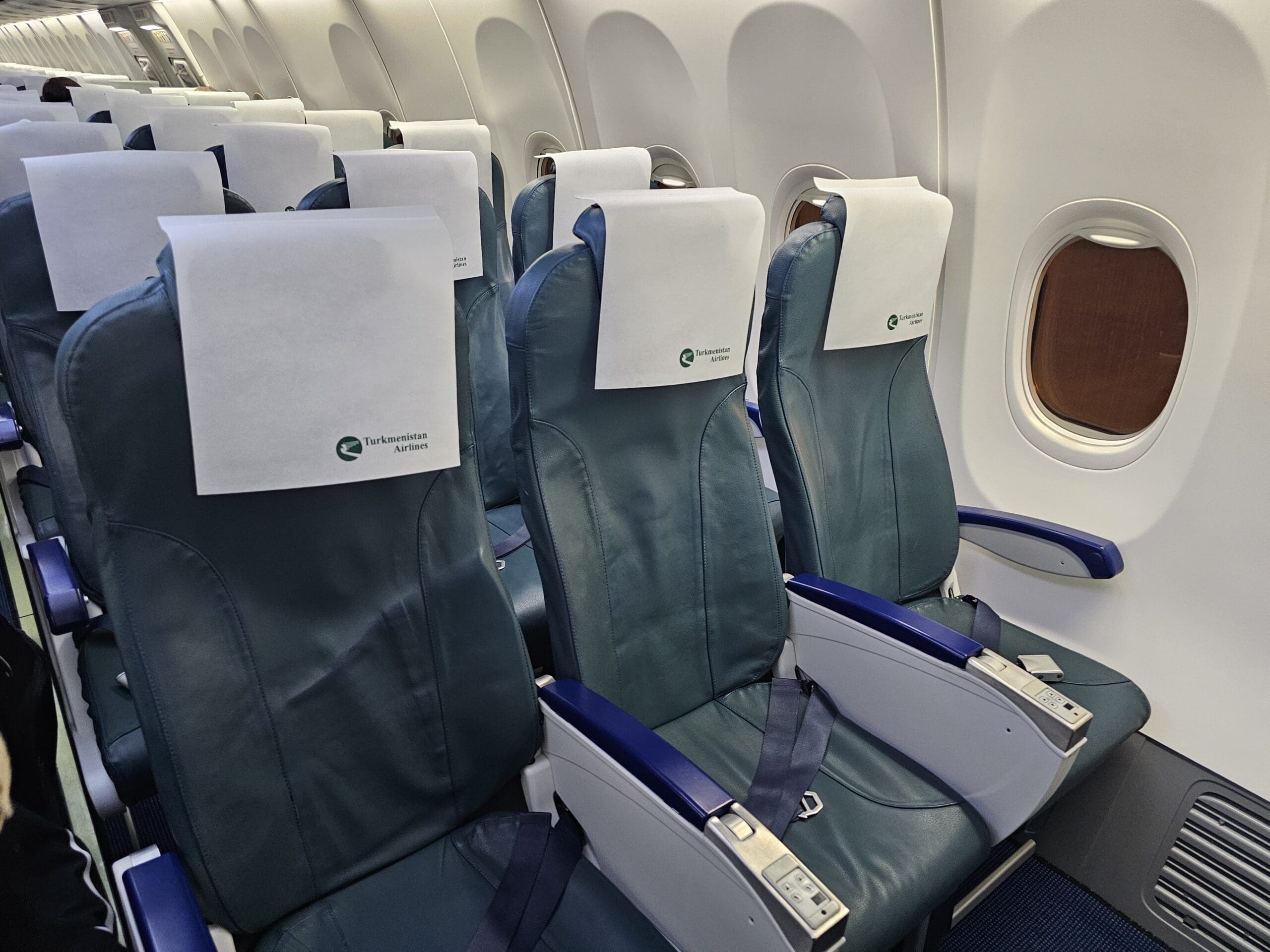
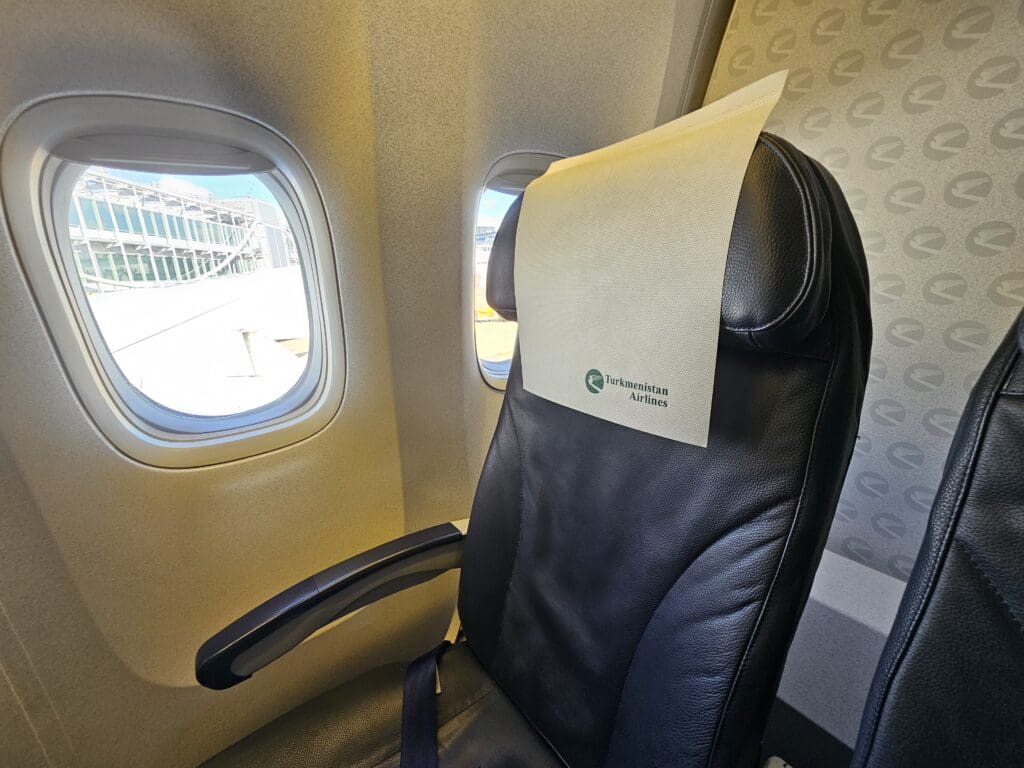
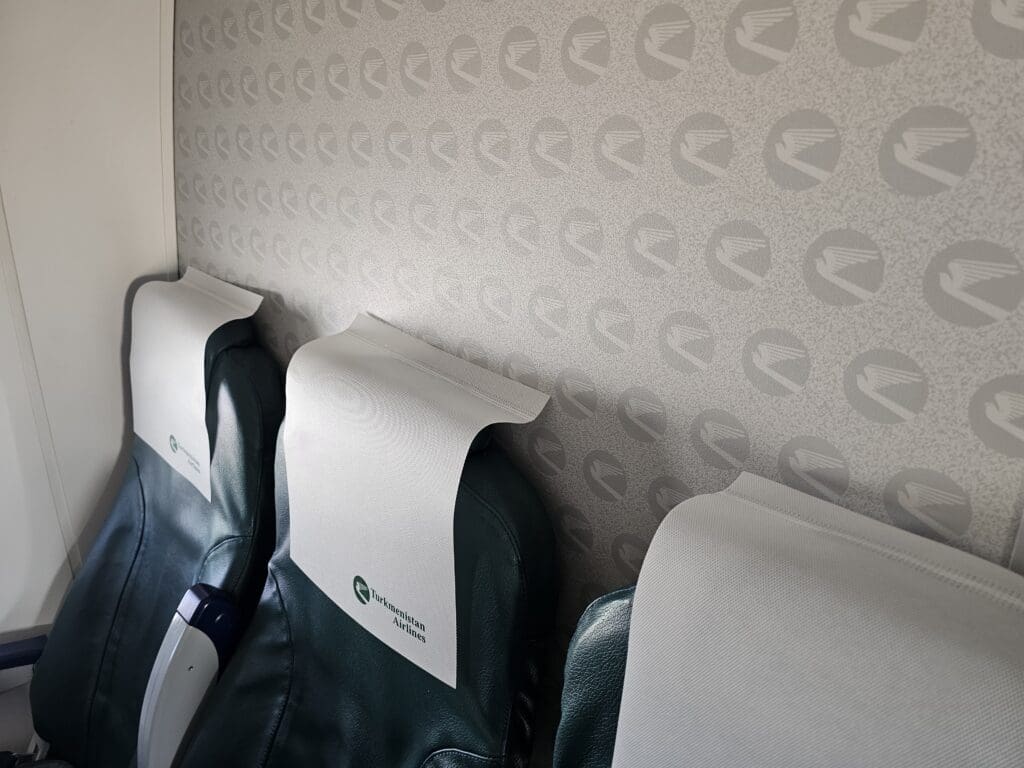
As on the Boeing 777, some level of customisation appeared to have been applied to the aircraft’s cabin, with the cabin dividers and bulkhead walls featuring a repeating pattern consisting of Turkmenistan Airlines’ motif. Soon, passing the cabin divider, it was not long before I arrived in the 144-seat Economy section where I promptly received another welcome, this time in Russian. Unlike in Business Class, each seat appeared to be modern and thin and was covered in a dark green pleather cover, whilst a disposable fabric antimacassar that featured Turkmenistan Airlines’ logo covered the tops of these. I believe these seats took the form of the Safran Z85. Unsurprisingly given their absence in Business Class, each seat did not feature any sort of inflight entertainment screen, although universal power outlets could be found under the seats, two of which were provided for each bank of three seats and I am pleased to report that these worked without issue throughout the flight.
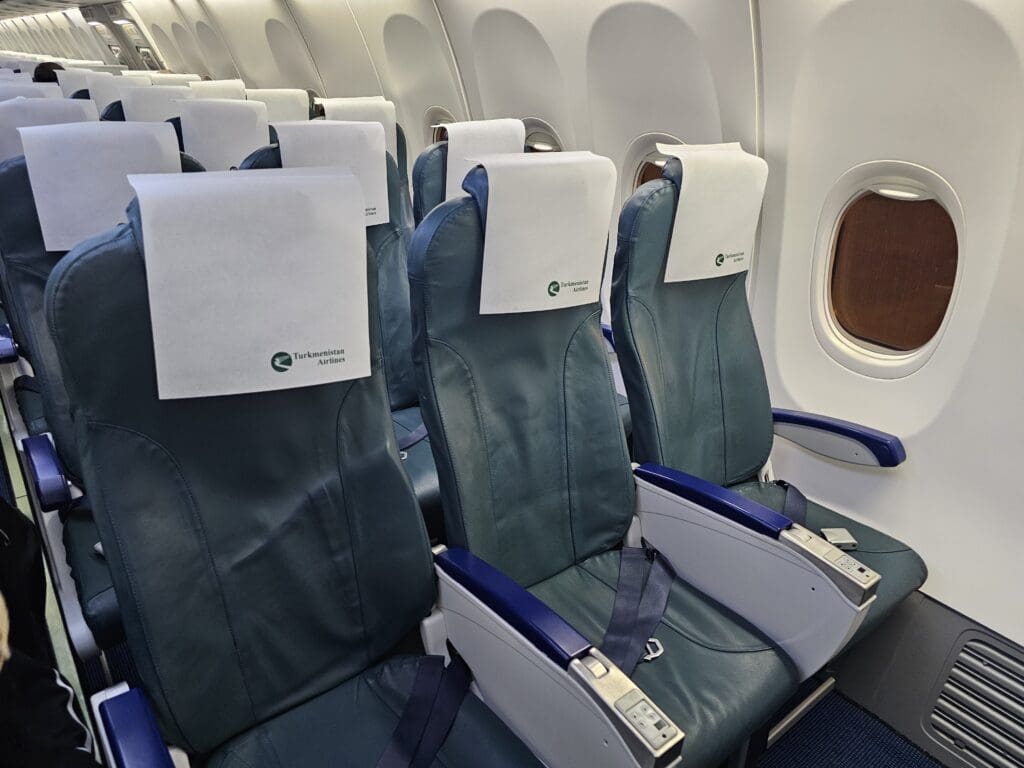
Seated almost right in the middle of the cabin, specifically, in the row behind the second overwing emergency exit, it took a fair while to trundle down the cabin to my seat thanks to passengers’ large amounts of hand luggage. Once there, yet to be joined by any seatmates I slid in with ease and settled in for the flight ahead. Commencing with the positives, I found the seat and the area around this to be spotlessly clean, and, for the most part, in good condition, with only a few minor signs of wear and tear – limited to the odd scuff and scratch. Importantly, I found the seat to be very spacious, with this undoubtedly being one of the most spacious seats that I have sat in on a narrowbody airliner. However, the seat itself was as thin and firm as it looked, failing to provide much padding and thus I ended up jiggling around a fair amount during the flight in an effort to avoid getting a numb behind! With that considered, I would not be too keen on the idea of sitting in this on a long six-hour plus flight to or from Milan! Moving onto the seatback pocket, this contained a pristine copy of Turkmenistan Airlines’ Lachyn inflight magazine, however, just as on the Boeing 777 that I had taken from London, this was the December 2024 issue, despite the fact that I was travelling in April 2025! This came in addition to the all-important safety card which appeared to be in a fairly good state.
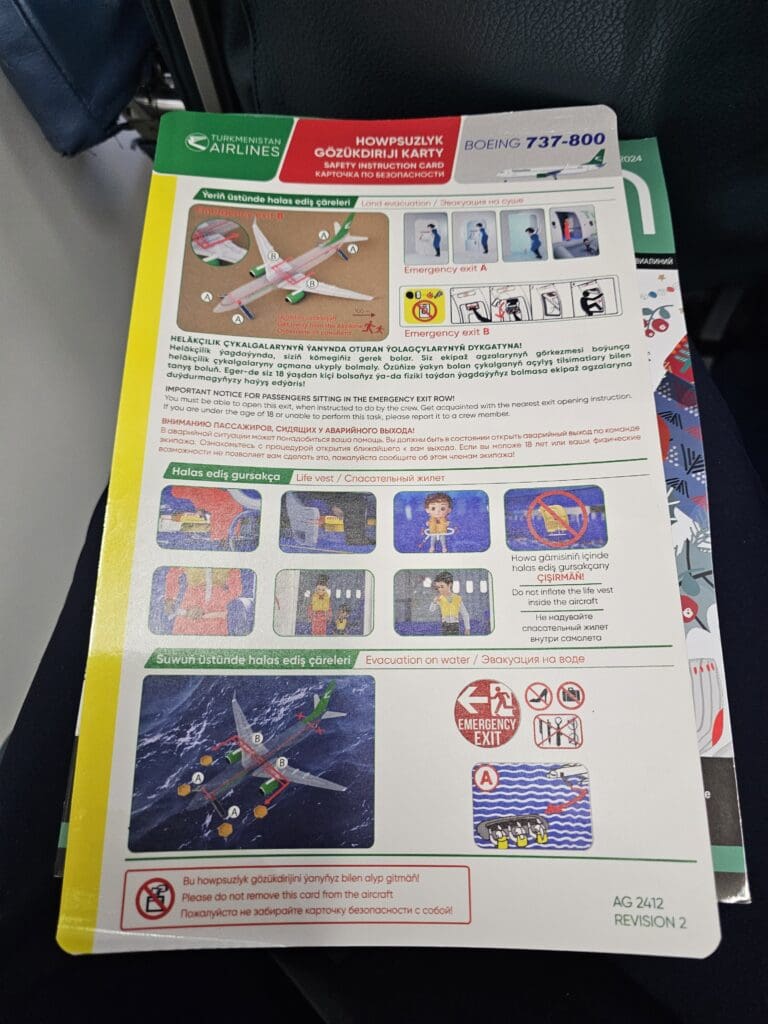
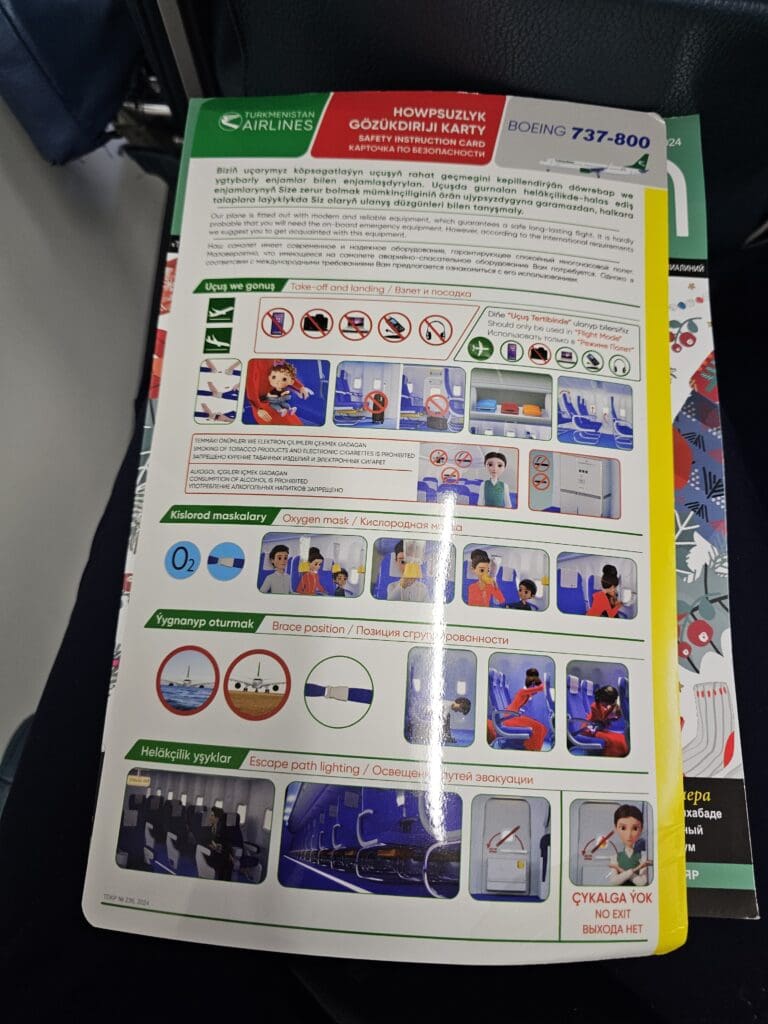
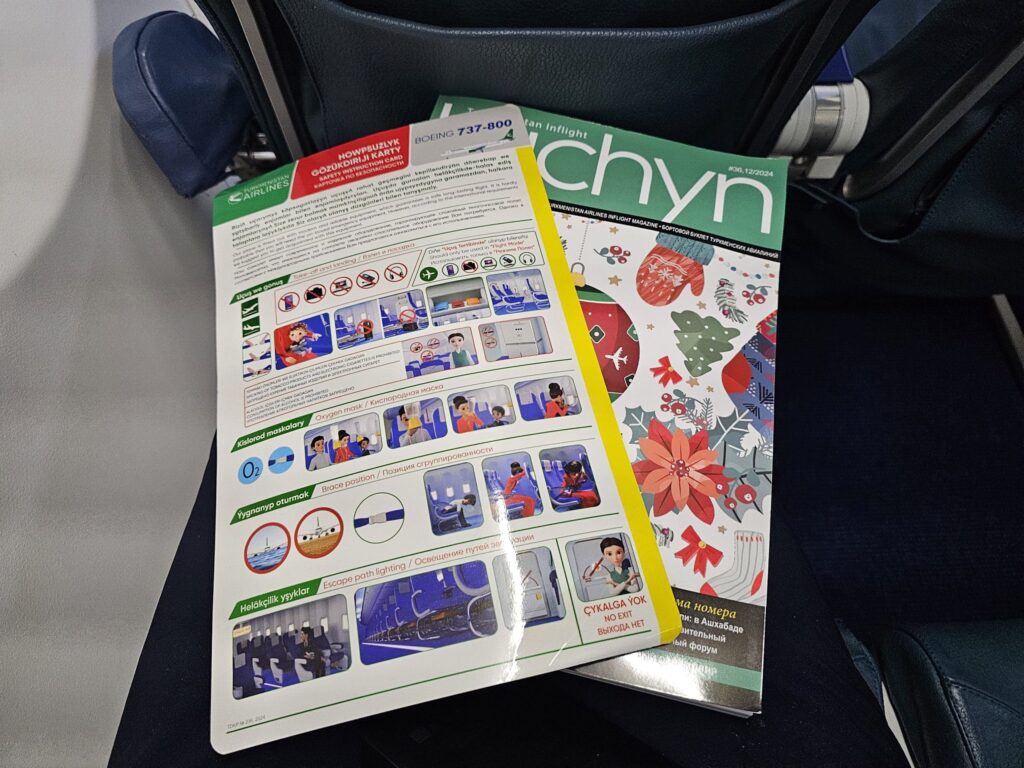
Once seated, passengers streamed on at a fair rate whilst upbeat traditional Turkmen music provided a lively soundtrack to boarding. Unfortunately, boarding was a chaotic process, with this down to passengers’ large bags and the fact that most passengers appeared to be sitting in the wrong seat, leading to almost total chaos in the aisles! In fact, passengers could be seen jumping up and down for quite some time, only finally ending this once the aircraft was on its way to the runway. On the plus side, this did mean that thanks to the fact that my neighbours were both sitting in the wrong seats, once they moved I was left with two empty neighbouring seats for the duration of the flight!
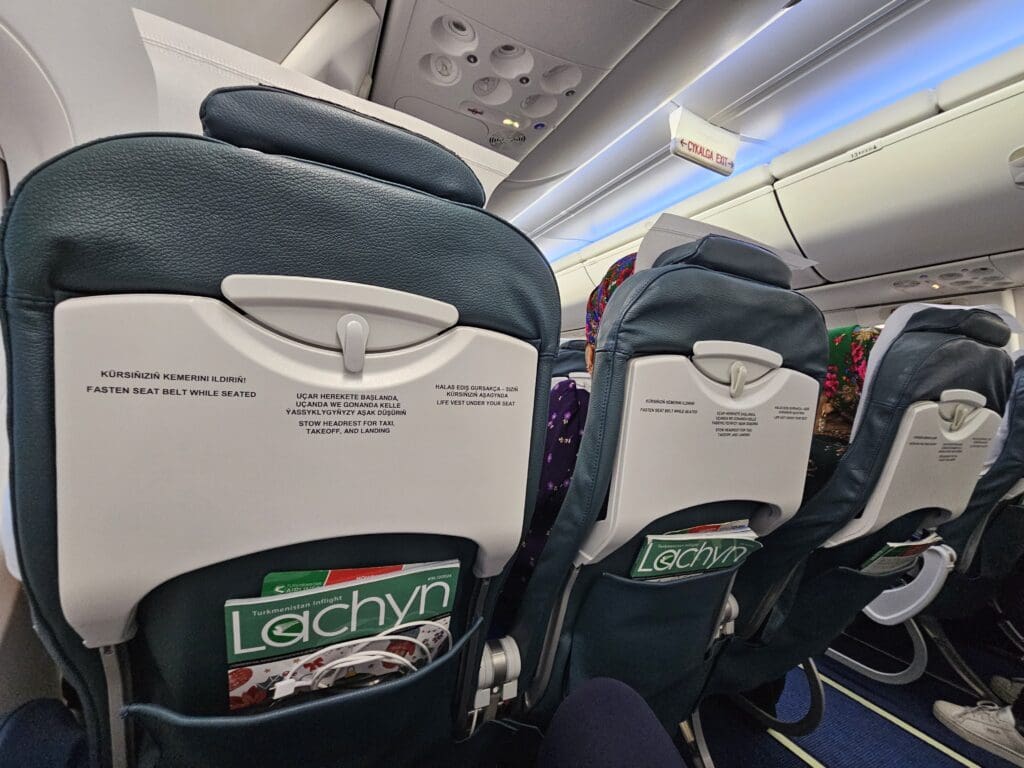
Given the chaos in the aisle, the last straggler did not board the aircraft until 0627, a total of 37 minutes after boarding had commenced. Despite this, still running ahead of schedule, I was hopeful that the aircraft would be able to make a punctual departure from Ashgabat. That morning I would say that the Economy cabin appeared to be around 80% full and I was lucky to end up with two empty neighbouring seats. Turning to the demographics, around two-thirds of those onboard appeared to hail from Turkmenistan and were of all ages, whilst the majority of the remaining passengers were either Indian or members of Indian diasporas in Europe.
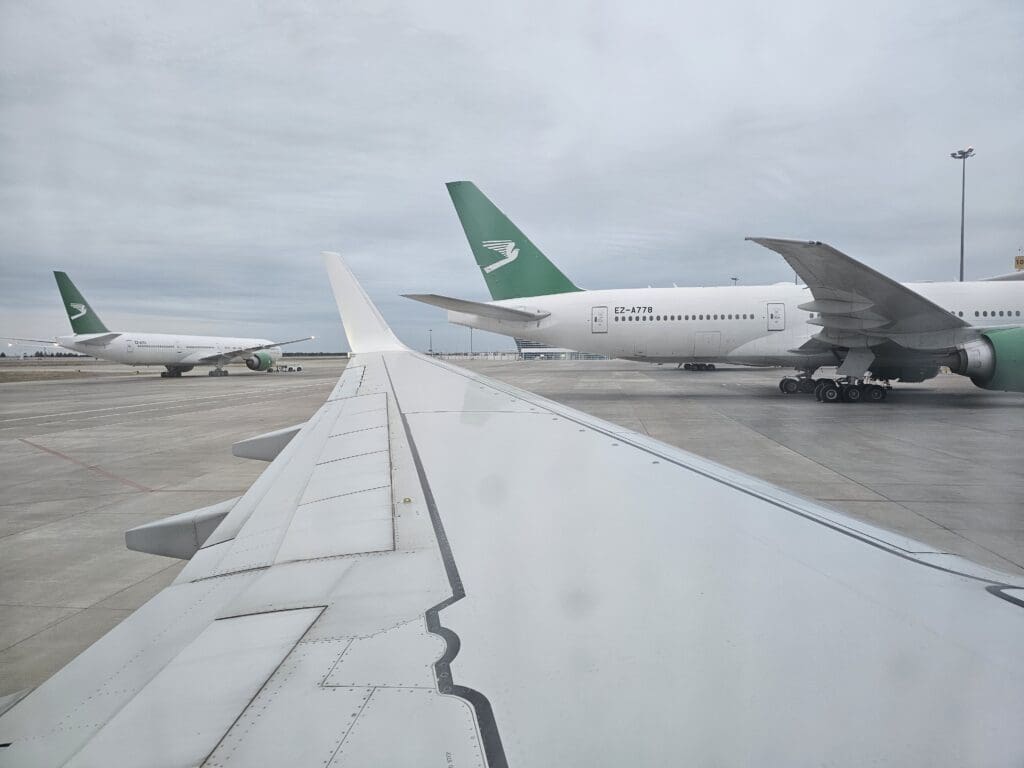
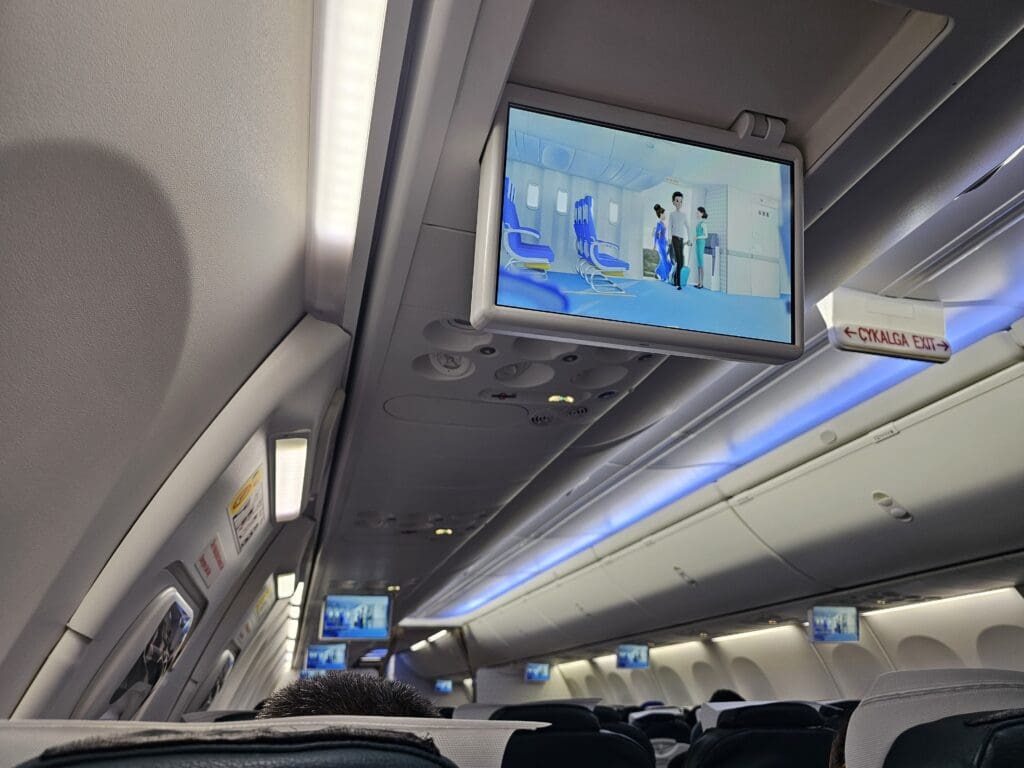
Soon, the friendly Purser who had welcomed me onto the aircraft performed their welcome speech in Turkmen, Russian and English which featured the usual welcomes, thanks and warnings. As they neared the end of this, up in Business there seemed to be some drama when a passenger fainted. Fortunately, they were quickly tended to by the cabin crew and two Turkmen medical staff who were flying as passengers, whilst a few minutes later, a nurse donned in full old-school uniform complete with a large hat and a briefcase appeared on the aircraft to assist. Thankfully, they appeared to make a quick recovery, and after about fifteen minutes or so, the doors were closed and armed and the jetbridge was backed away from the aircraft. At this time, the overhead screens dropped down and began to play Turkmenistan Airlines’ safety video which is complete with somewhat creepy-looking animated characters. This played first in Turkmen, and then again in English with Russian subtitles.
Twenty minutes after our scheduled departure time, the Boeing jolted backwards as this was slowly and cautiously pushed back away from the terminal. At this point, the aircraft’s two CFMI CFM56-7B24 hummed and vibrated into life, temporarily causing the scent of jet fuel to seep into the cabin, although this was neither overpowering nor worrying. Once our pushback had come to an end and the two engines had powered up, the aircraft remained in position for about ten minutes with no movement whatsoever. Seeing as Ashgabat is not the busiest airport in the world, nor are the skies of Turkmenistan filled with aircraft, I assumed that there was some sort of ground stop in place, perhaps as a result of a special or presidential movement. However, rather concerningly, at the end of these ten minutes, the Boeing taxied back into the stand at which point the engines spooled down and the jetbridge was manoeuvred back into position.
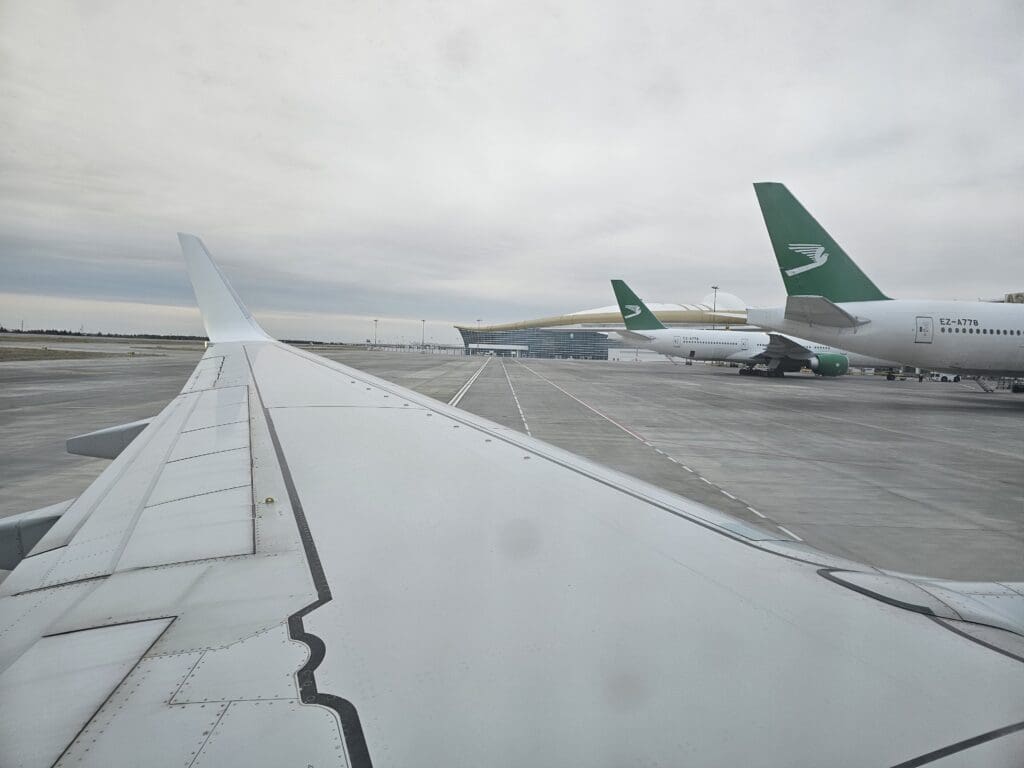
Considering the fact that I had five hours in Delhi and would have to pass through immigration twice and check in for my Nepal Airlines service to Kathmandu, admittedly I feared the worst – a missed connection in the Indian capital. This was not assisted by the fact that there was no word from the crew whatsoever. However as it turned out, the issue seemed to be paperwork related as, as soon as the cabin door was opened, the dispatched boarded, handing a sheet of paper to the pilots before heading off the aircraft at which point the cabin door was closed and the jetbridge was backed away from the Boeing. Following this short fiasco, at 0710, the Boeing was pushed back once again and the now-familiar start-up process of the two CFMI engines rang out as the engines powered into life once again.
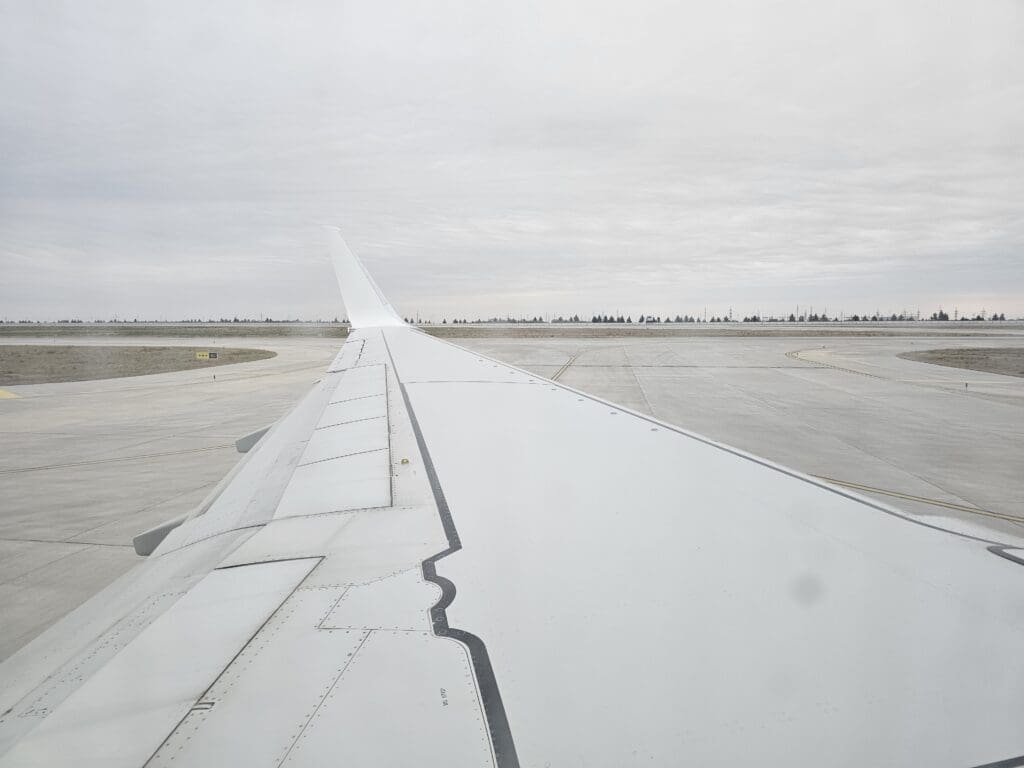
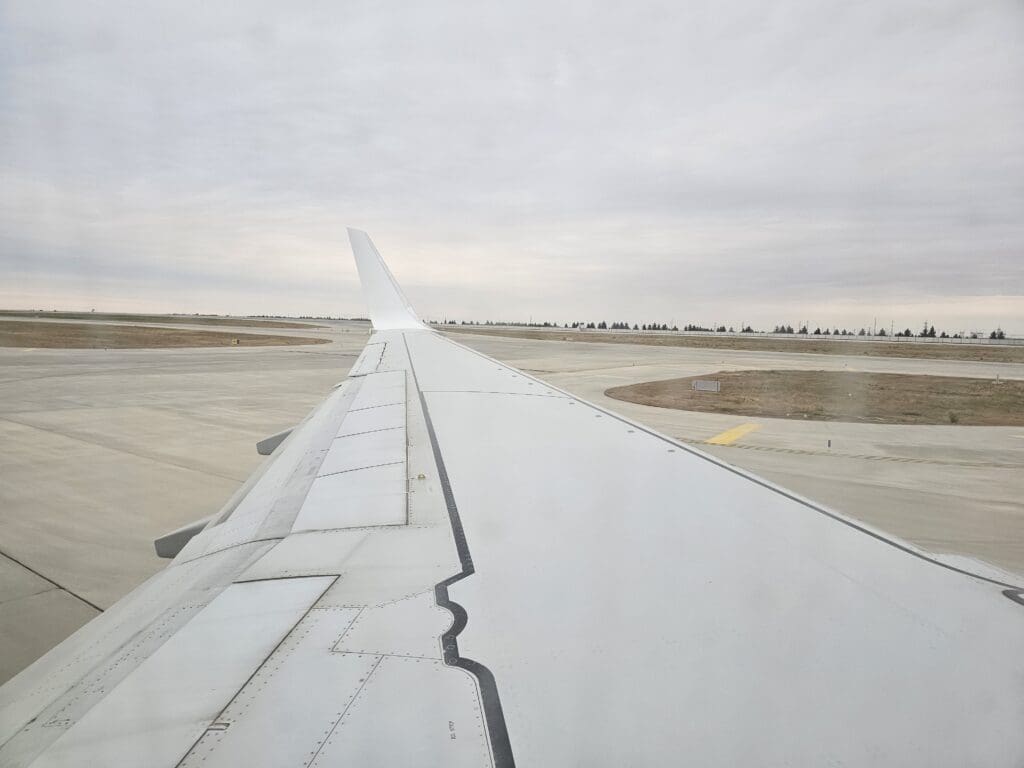
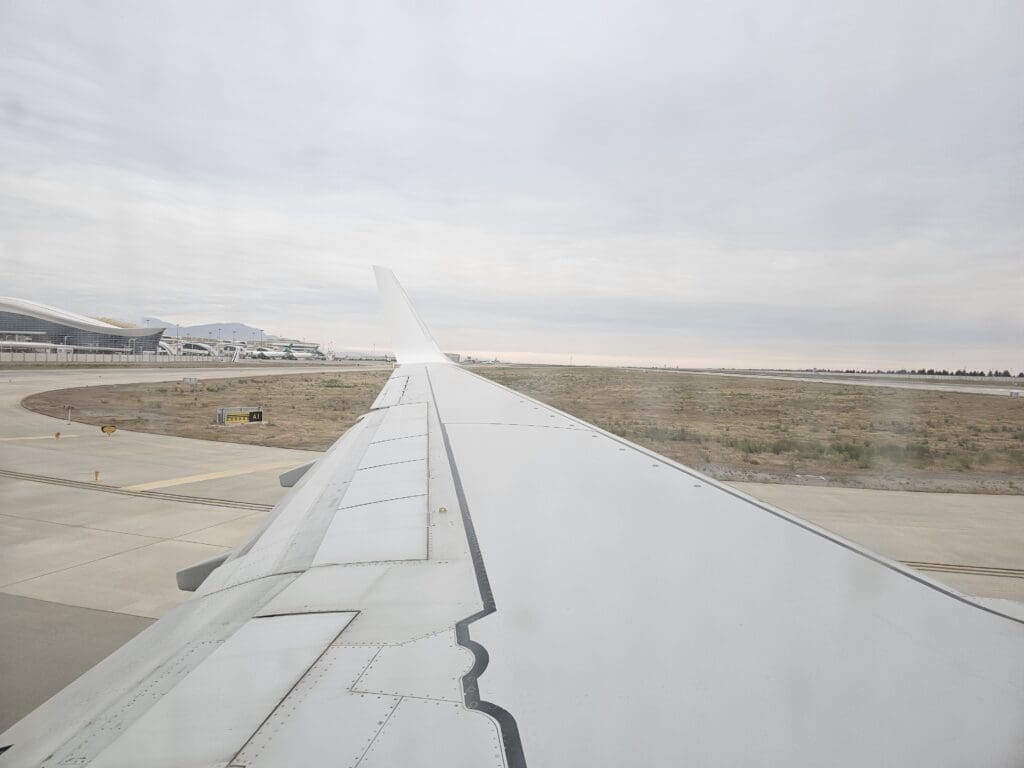
Fortunately, things ran much more smoothly the second time around, and as soon as the tug had been disconnected, the Boeing commenced its taxi to the end of Runway 29R. Seeing as this is the closest runway to the terminal, we arrived at the end of this no more than two minutes after commencing our taxi, and, unsurprisingly given the quiet nature of the Ashgabat International Airport, we were able to taxi onto this without any holding whatsoever. Once on the runway, the Boeing paused for a few moments, allowing me to admire the airport’s unique and majestic falcon-shaped terminal before the two engines spooled up and we began our reasonably sporty take-off roll. Sitting on the left-hand side of the aircraft, as we barreled down the runway, I was treated to good views of most of the airport, including the terminal, the cargo stands and Turkmenistan Airlines’ maintenance hangars. At that time, a smorgasbord of active white and green Boeing 737s and Boeing 777s could be seen waiting for their next missions, along with a few rare Ilyushin Il-76 operated by Turkmenistan Airlines’ cargo division, and several stored Boeing 757s. I also caught sight of the only foreign visitor on the ground at that time, a Cargolux Boeing 747-8 Freighter that had popped in for fuel on its journey between China and Luxembourg.
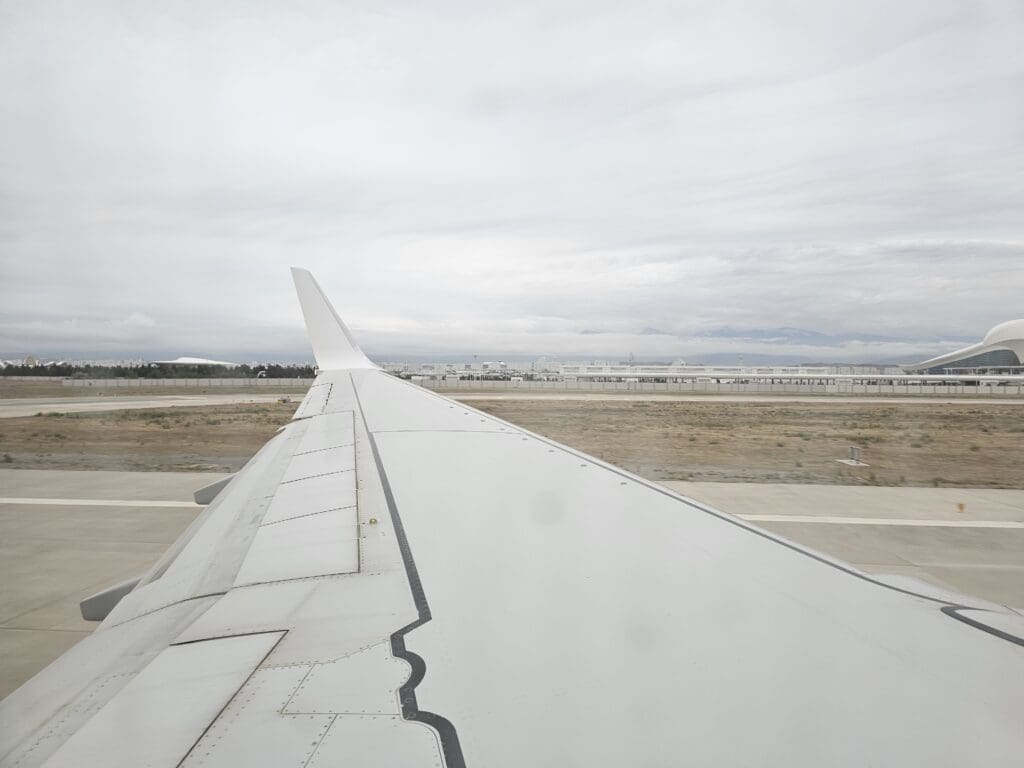
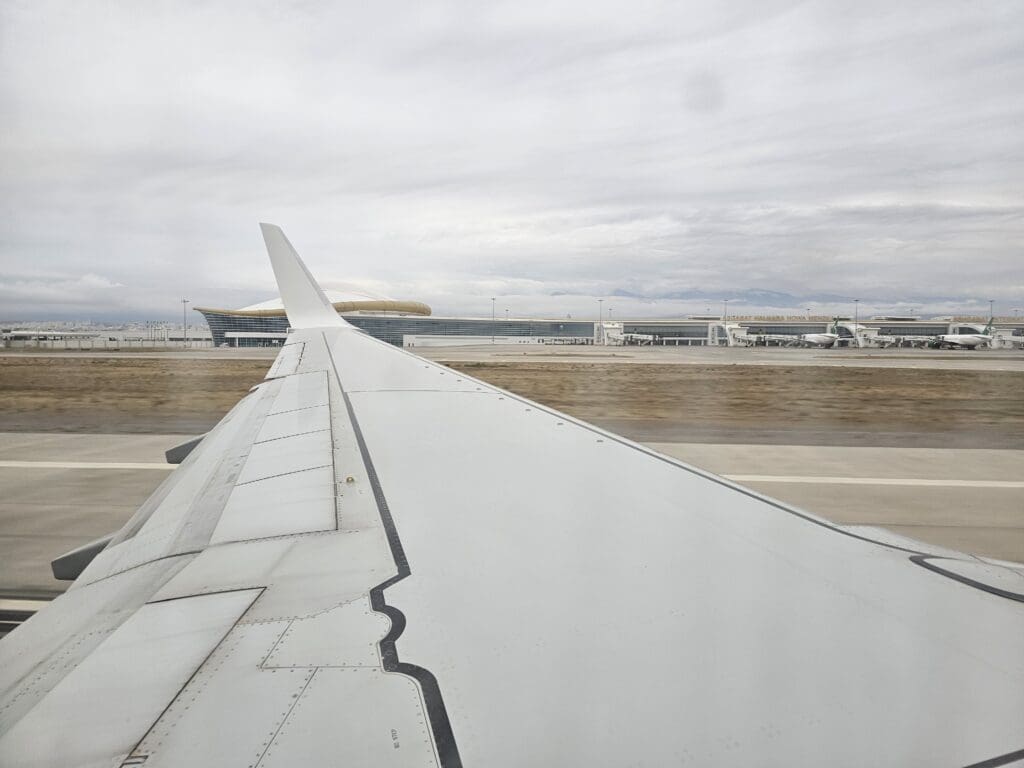
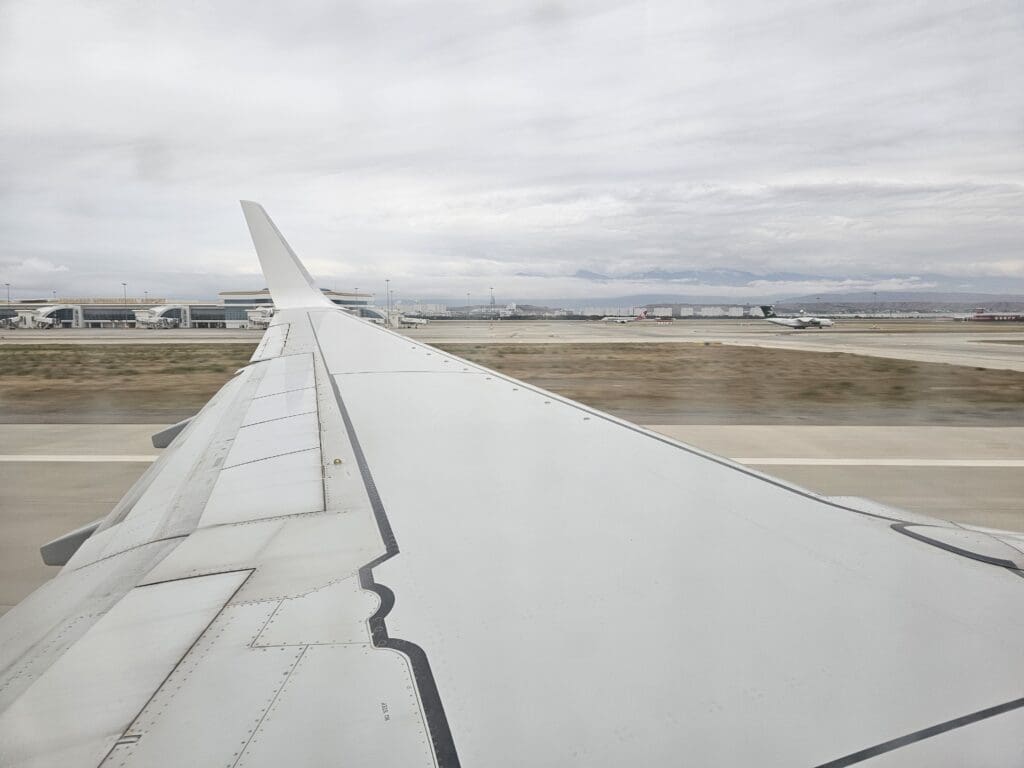
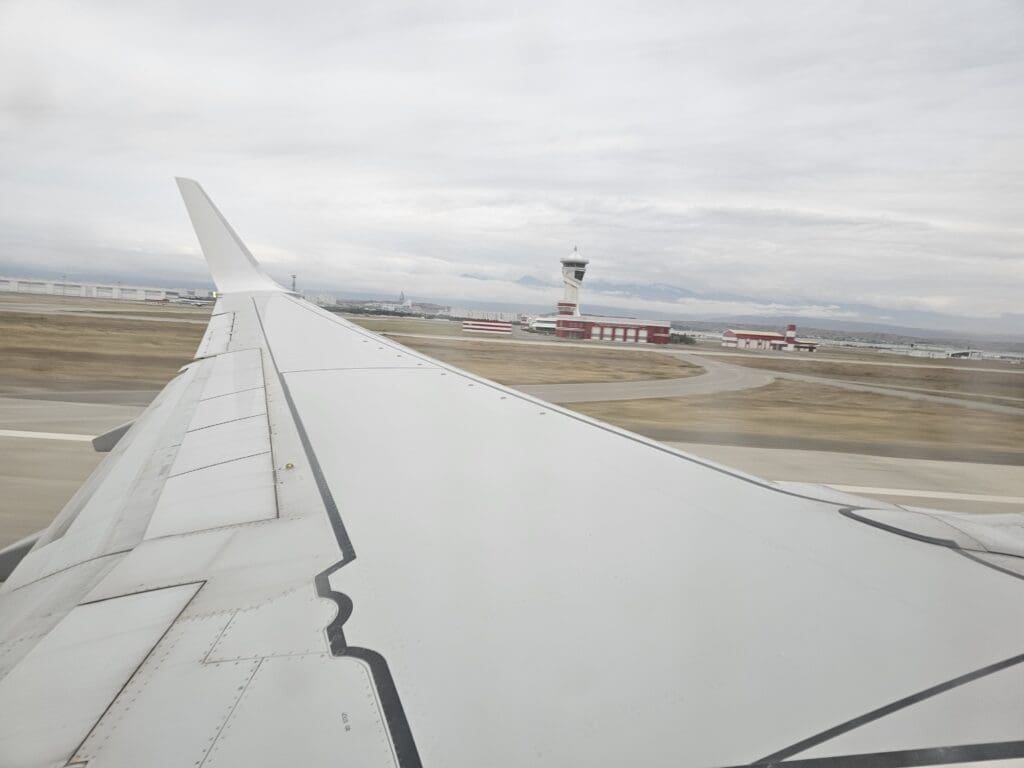
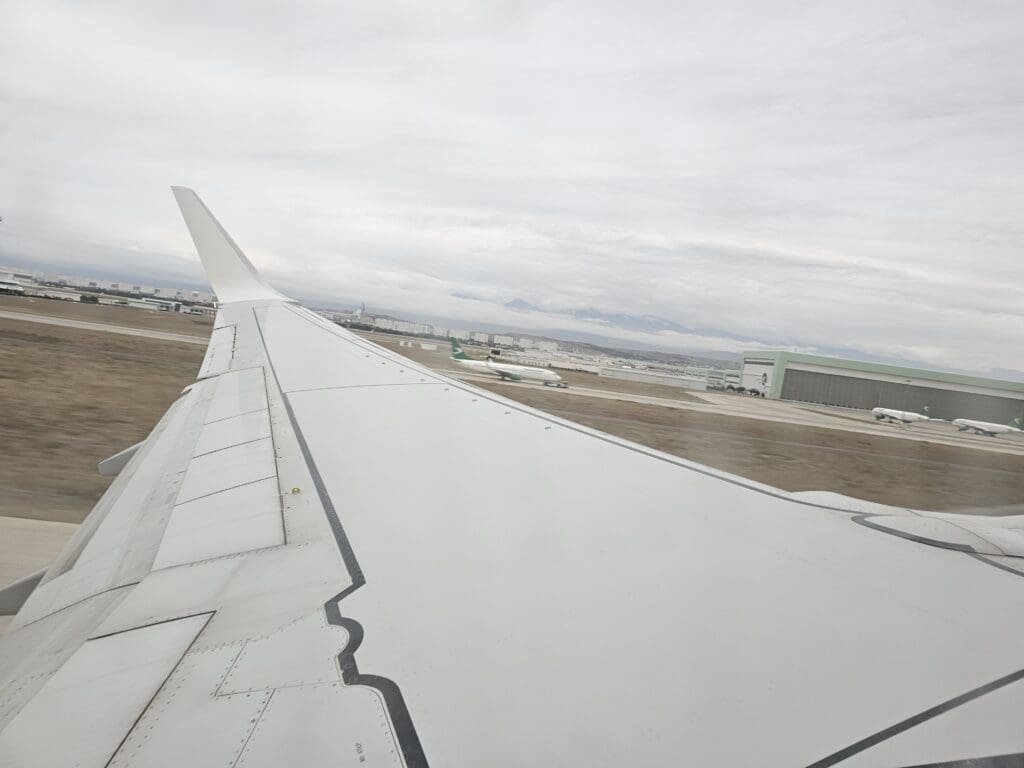
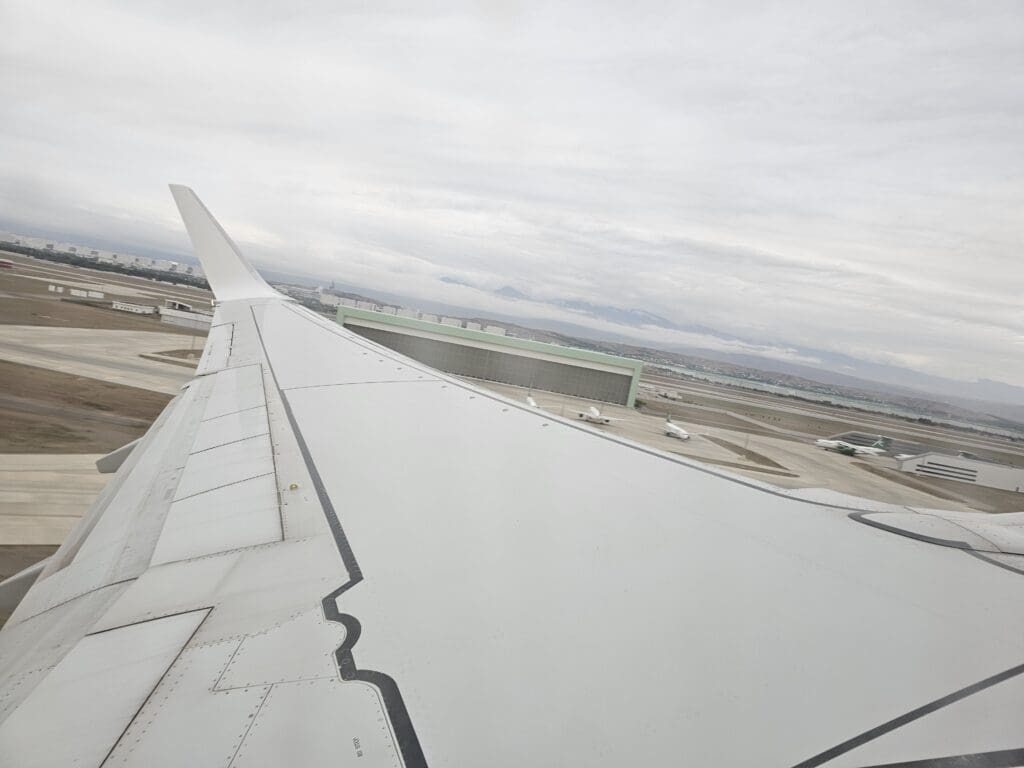
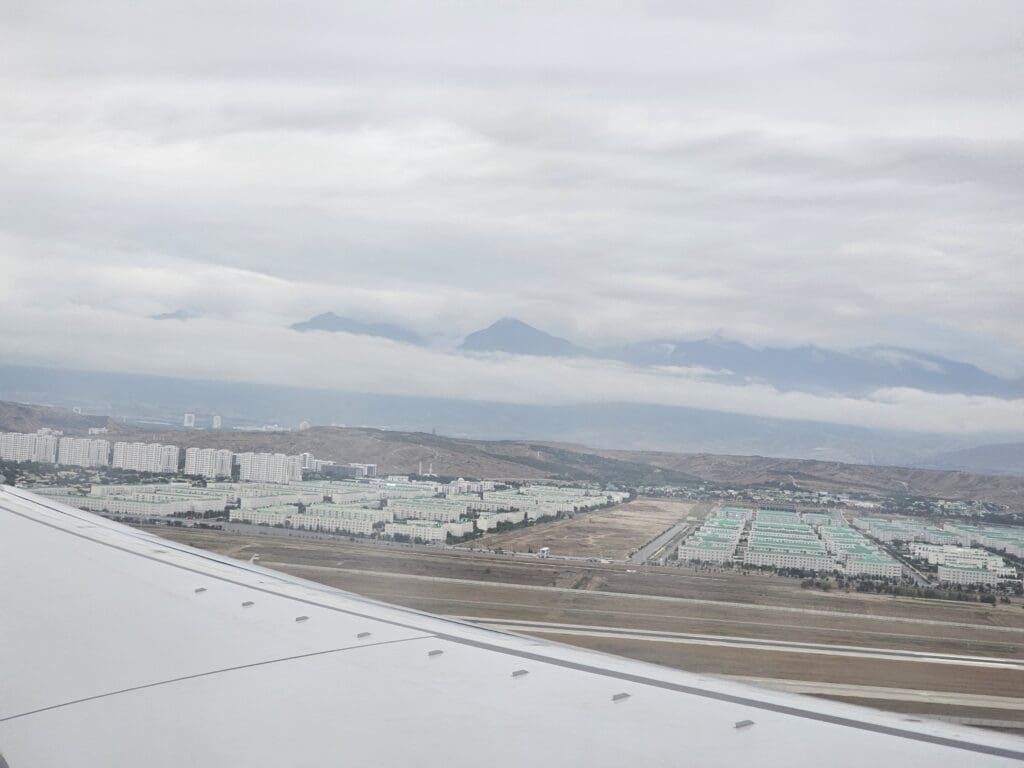
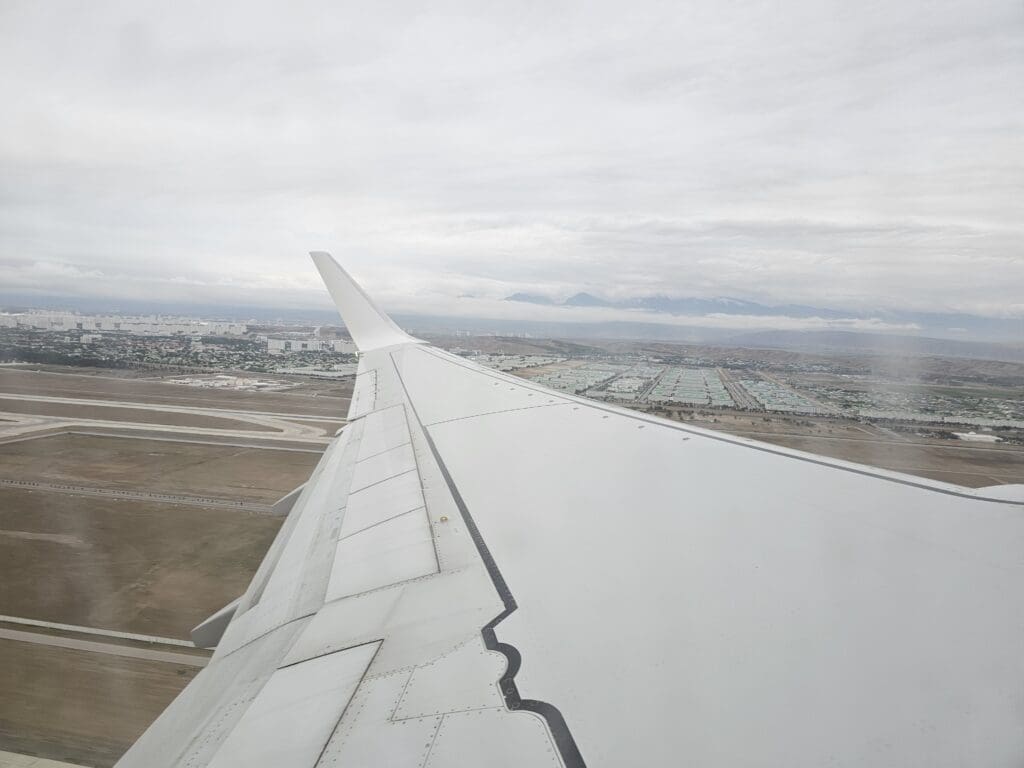
Soon taking to the skies, it wasn’t long before the Boeing soared over Ashgabat International Airport’s well-guarded perimeter before rows and rows of almost totally identical white apartment blocks could be seen along with the rocky mountains that surround Turkmenistan’s capital city. Home to around one million residents, Ashgabat is not the world’s largest capital city and it wasn’t long before we left this behind and turned to the north before rolling out on an easterly heading before heading southwards.
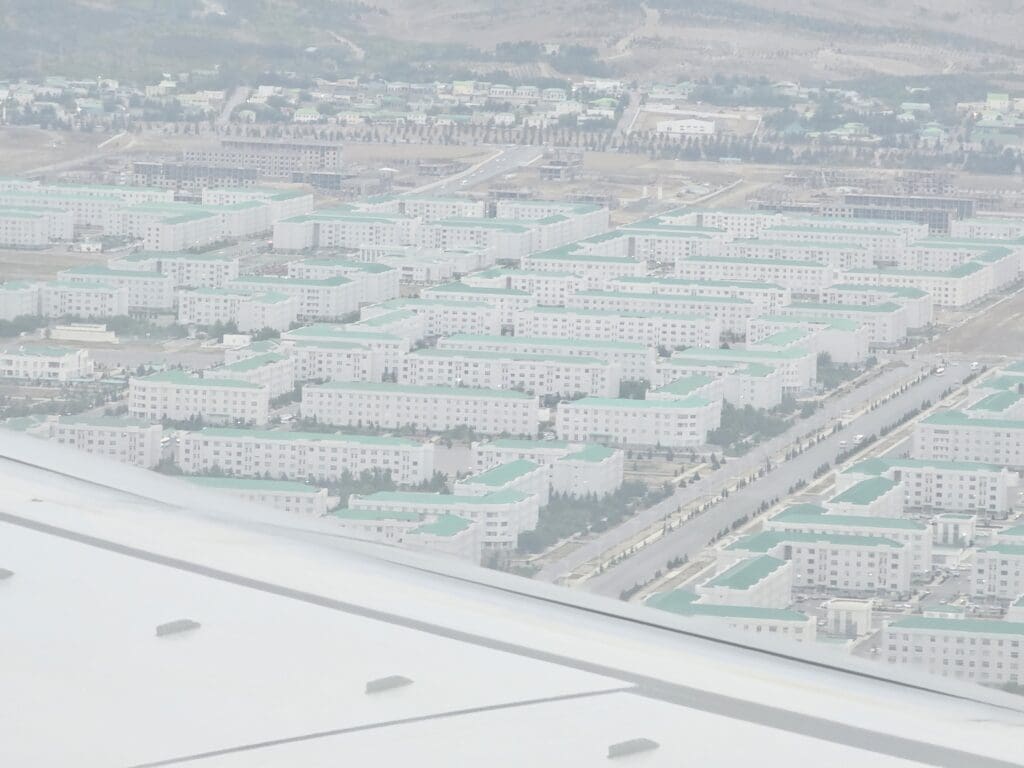
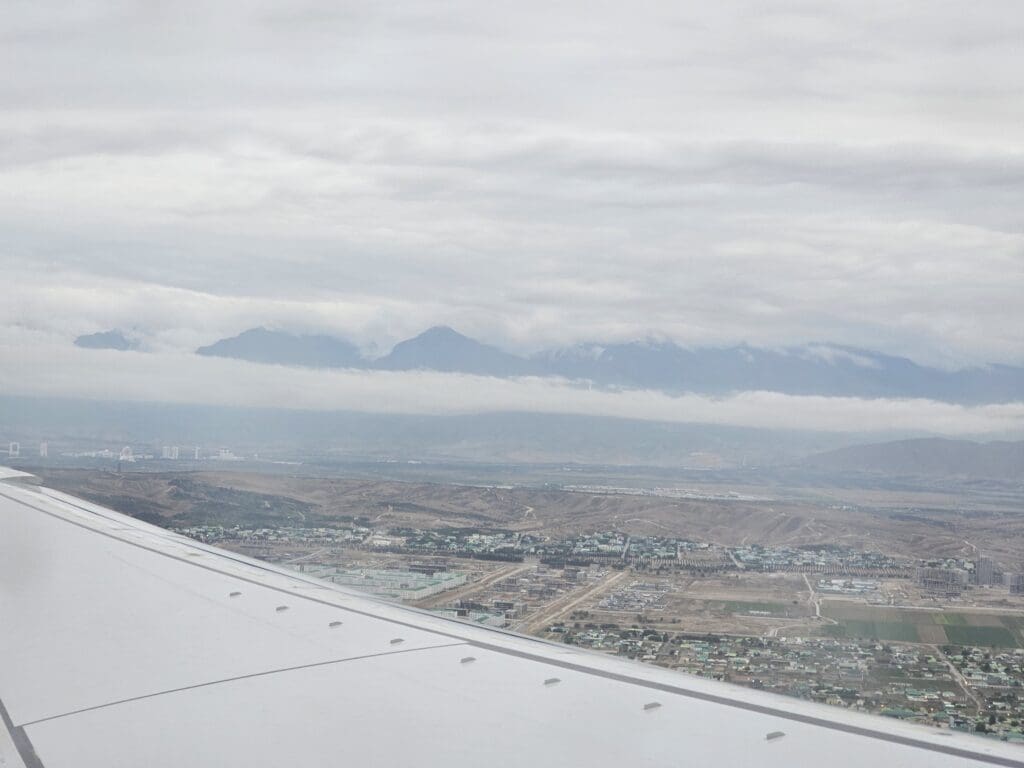
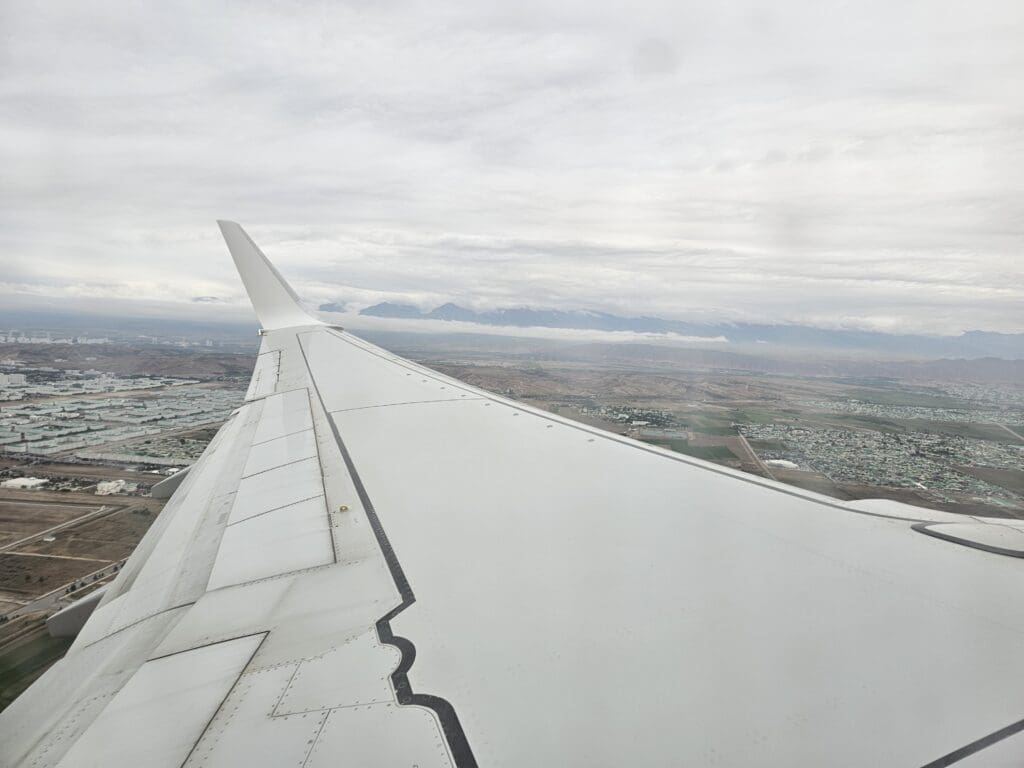
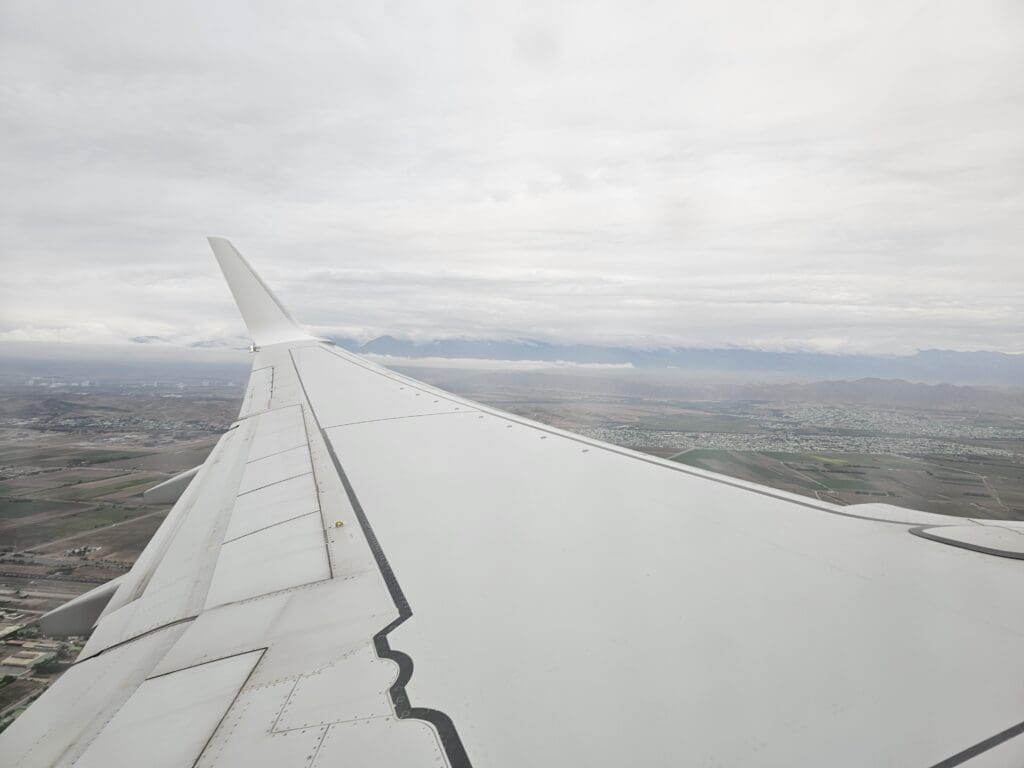
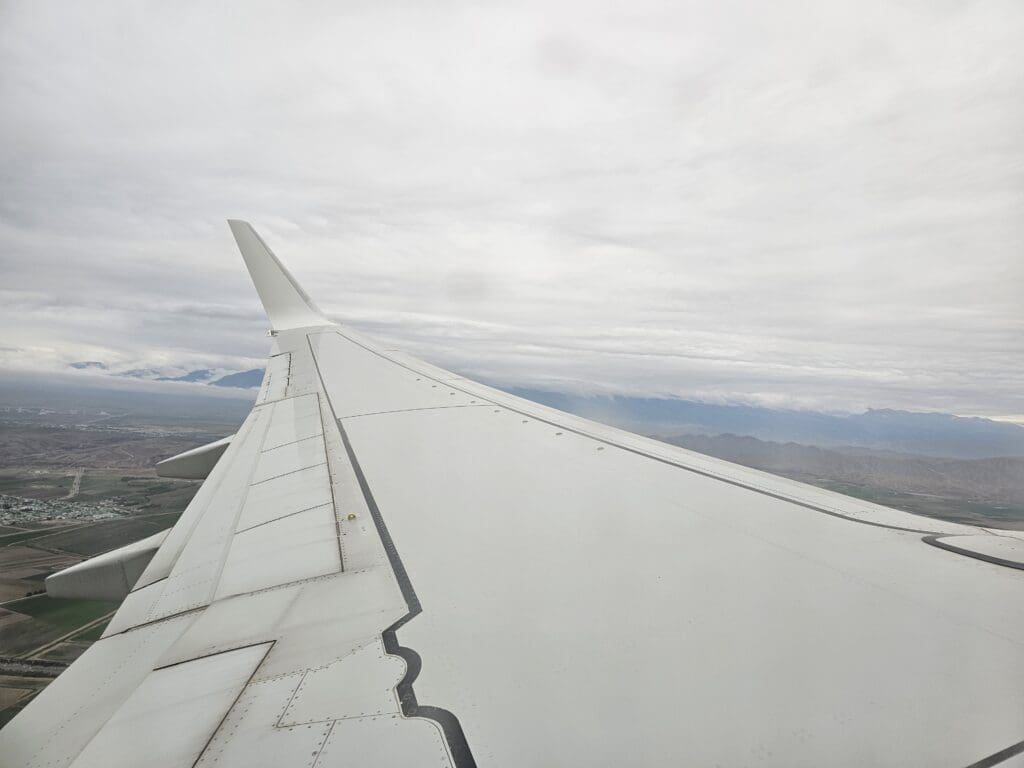
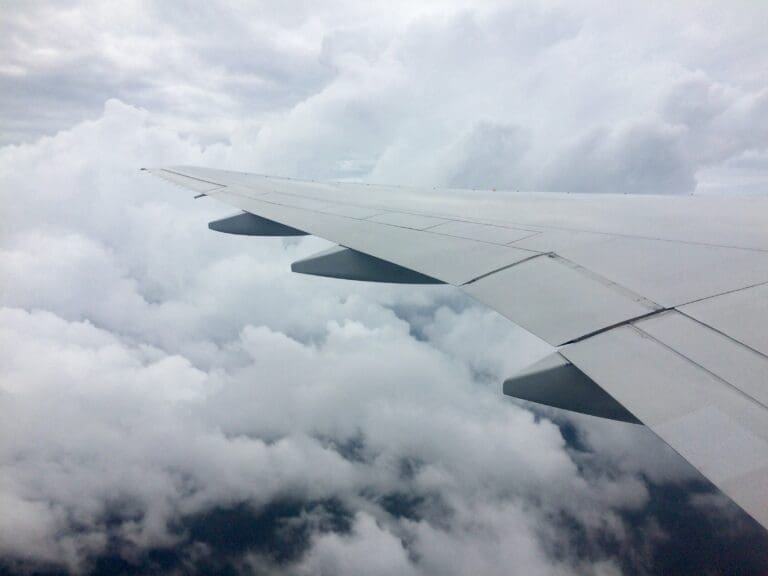
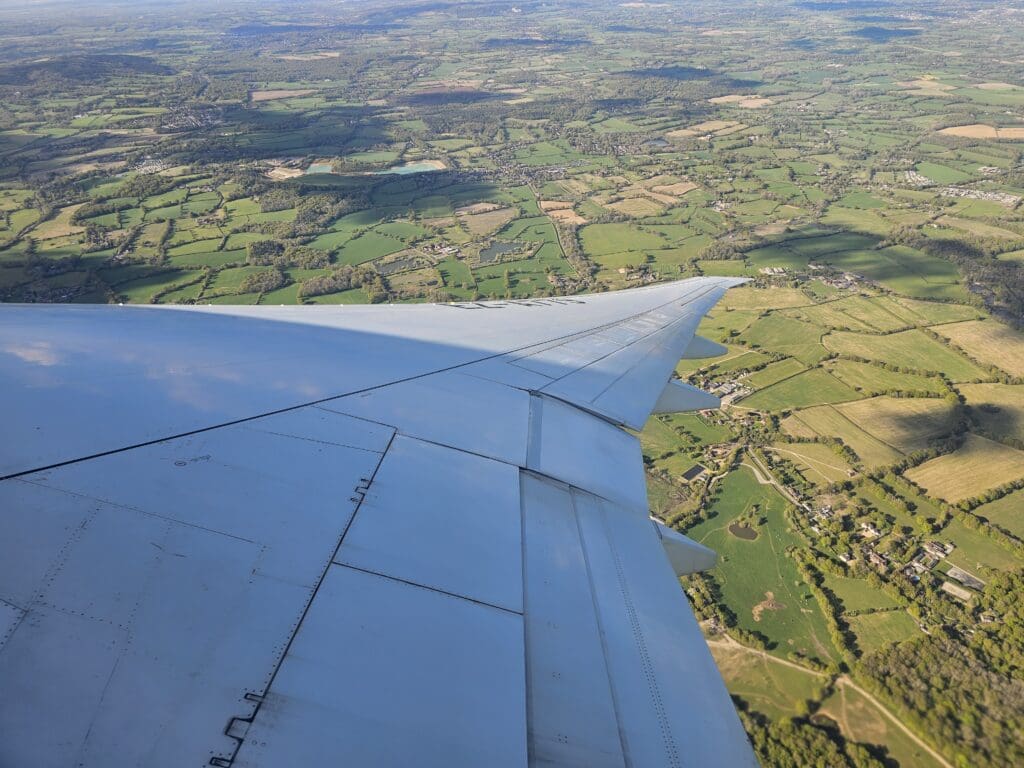
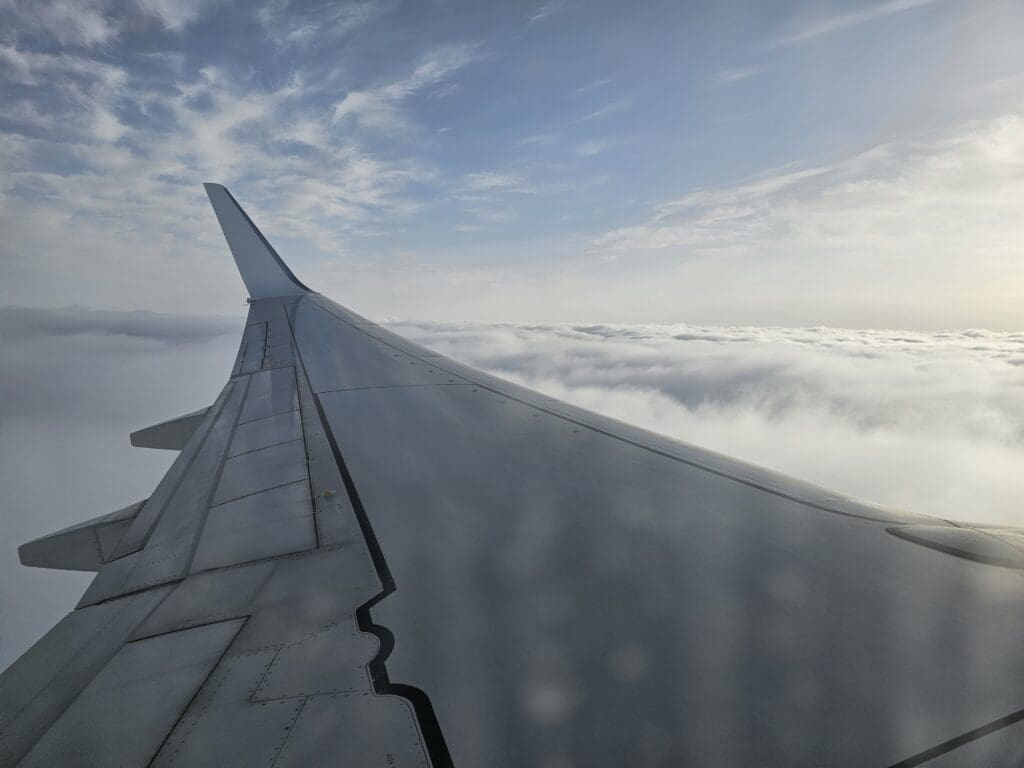
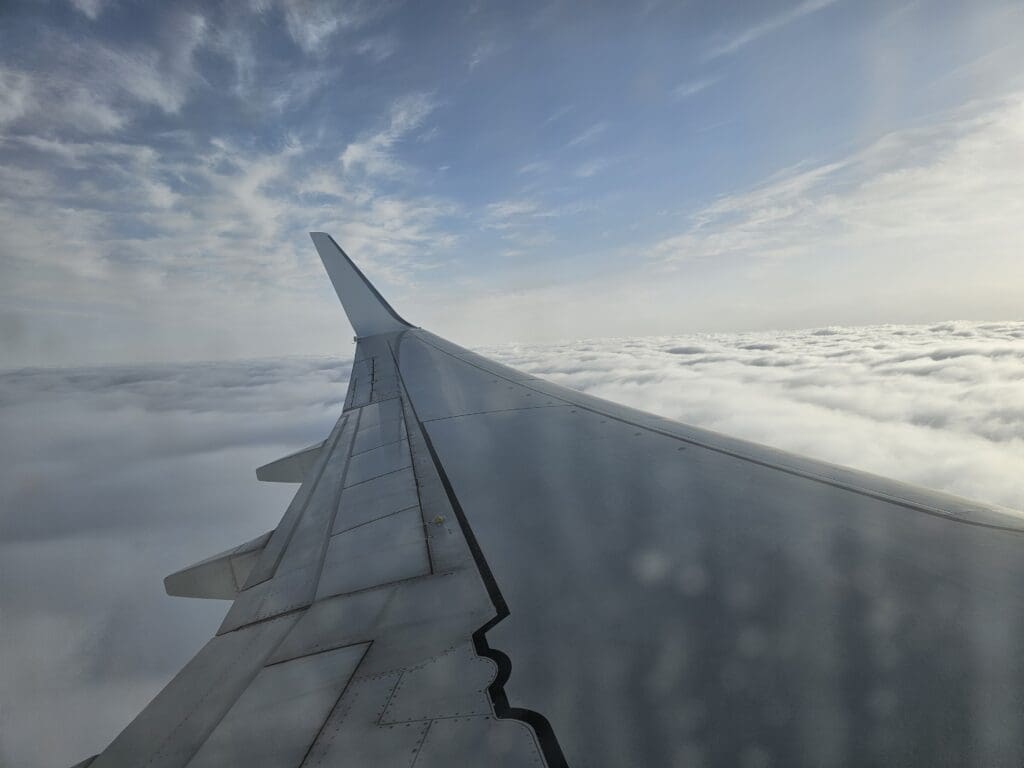
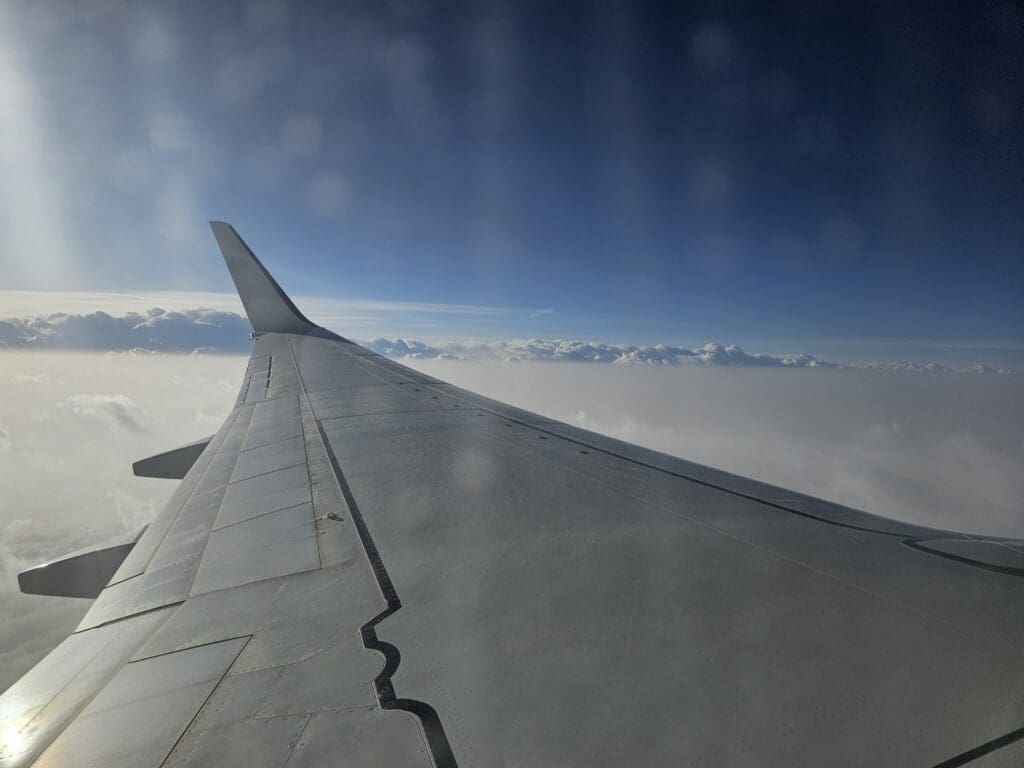
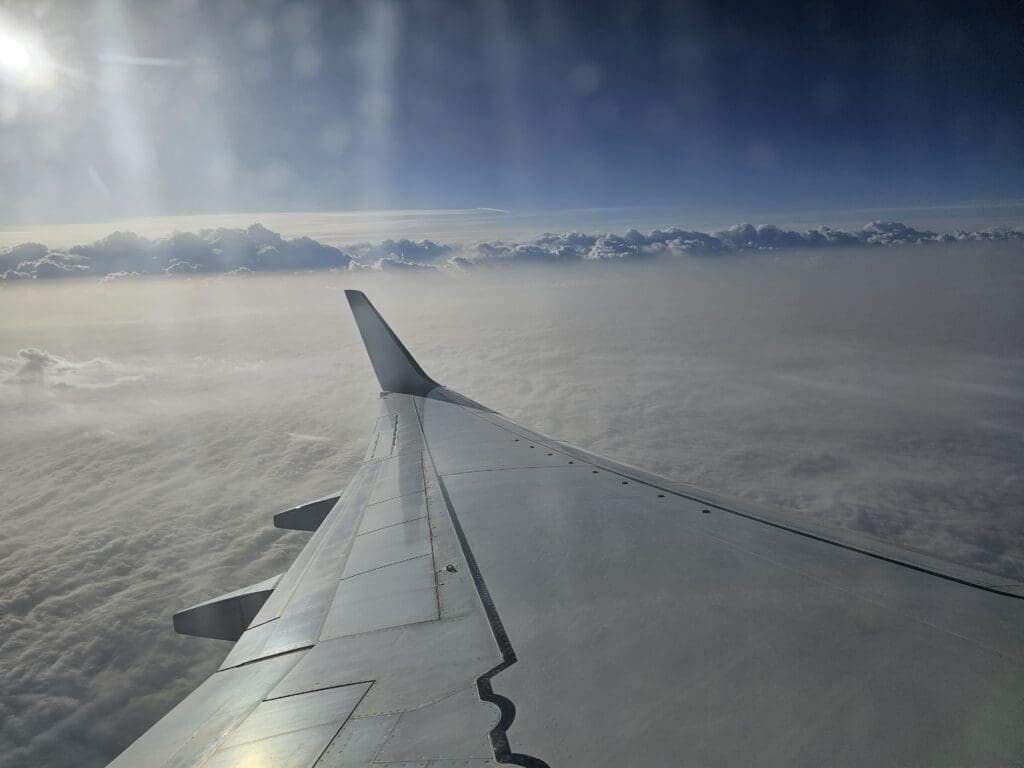
With Ashgabat located almost right on the border with Turkmenistan’s border with Iran, just twelve minutes after departure, the Boeing crossed into Iranian airspace and flew southwards over the country’s northeastern province of Razavi Khorasan. Upon reaching Iran’s second largest city, Mashhad, the aircraft levelled off at 35,000 feet and despite the smooth flying conditions, the seatbelt signs remained illuminated, although the crew seemed to have no issue with passengers moving around the cabin. Unfortunately, seated right over the wing, views of Iran’s diverse landscapes were limited although from the glimpses I did get, it appeared to be a sunny day below, although given the fact that I was enjoying three seats to myself, I could hardly complain.
Around twenty minutes after the aircraft had levelled off, the crew passed through the cabin distributing pre-booked special meals, with many onboard appearing to have pre-booked their breakfast. Once complete, the service carts were rolled out into the aisle and the main meal service commenced. Starting from the front of the cabin and making their way rearwards, thanks to the mostly full forward section of the aircraft, it took a reasonable time before one of the two flight attendants manning this cart offered me the choice of beef with rice or chicken with pasta, doing so in a pleasantly polite and friendly manner. As much as I had enjoyed my chicken on the flight over from London, I decided to shake things up and went for the beef, which was soon handed over to me before I was offered a choice of drink.
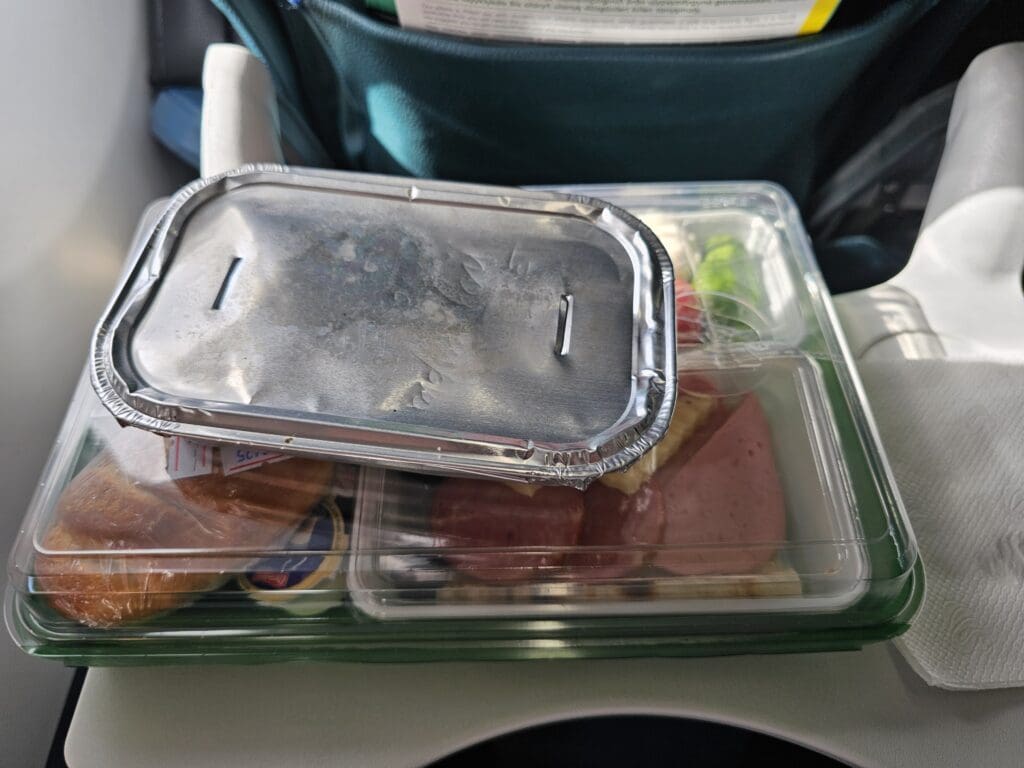
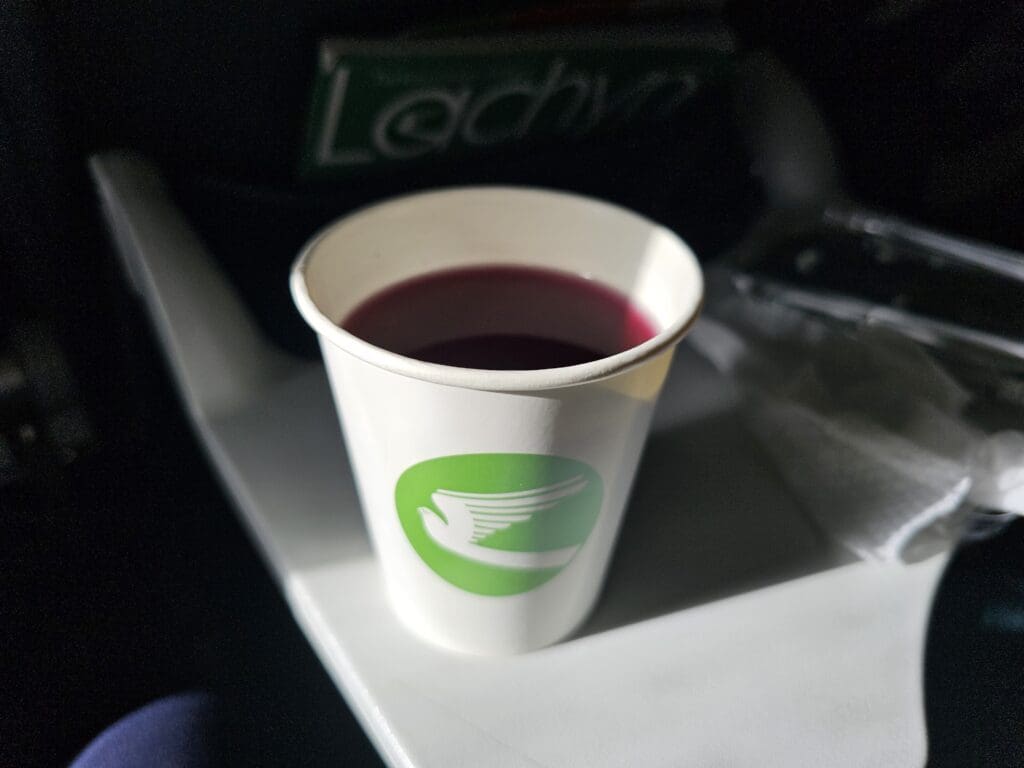
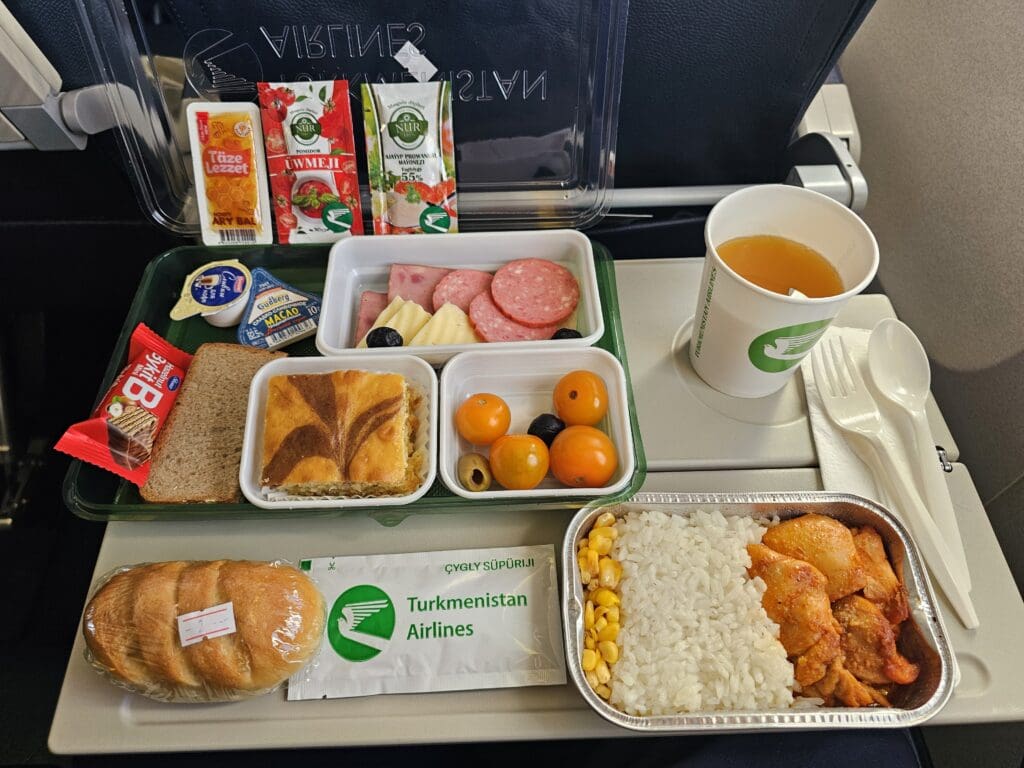
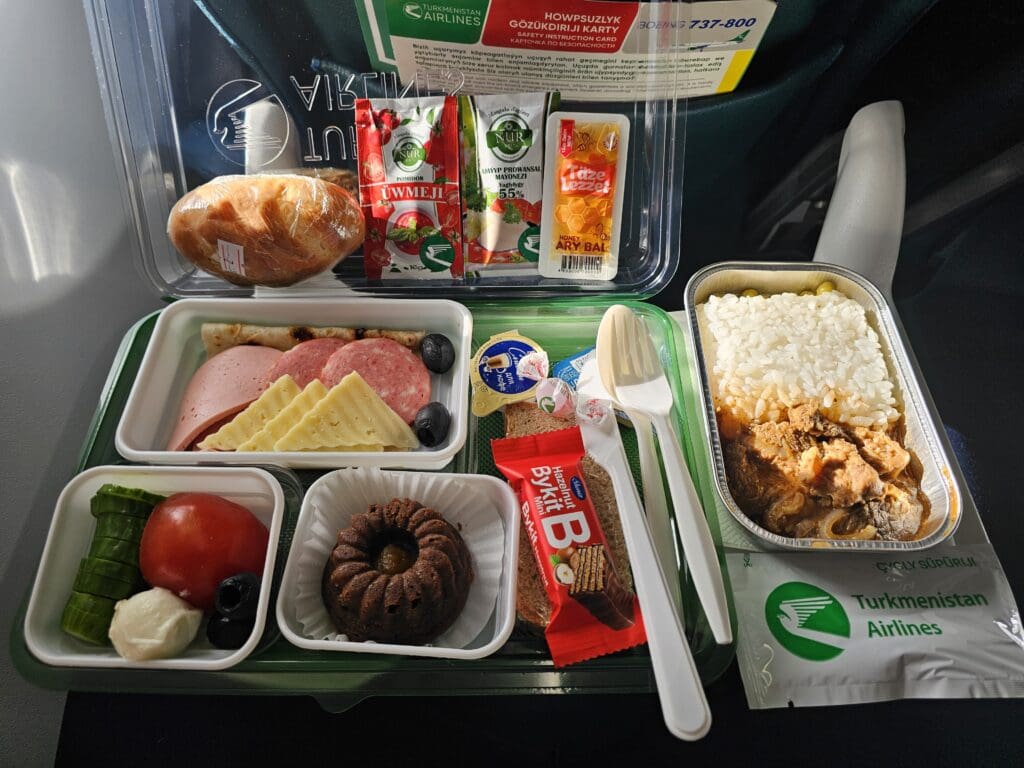
Just as on the first flight, that morning, I was treated to a massive feast which consisted of a plastic box full of food and the hot main dish. Opening up the plastic box, this contained a similar array of items as on the flight from London Gatwick to Ashgabat, bar a change in the type of cake, the addition of a boiled sweet and the inclusion of a more upmarket salad which consisted of small mozzarella ball, chopped cucumbers, olives and tomatoes. The other dishes consisted of cheese and cold cuts of meat with a sort of tortilla-like bread, a bread roll wrapped in clingfilm, a slice of brown bread, butter, milk, an Iranian chocolate wafer and sachets of Turkmenistan Airlines branded ketchup, mayonnaise and honey. Meanwhile, eating utensils came in the form of plastic cutlery. Turning to the main dish, this was as expected, consisting of pieces of beef in a tomato and onion sauce, accompanied by white rice. Once again, whilst not the pinnacle of inflight catering, I found the meal to be of fantastic quality and ultimately left me with nothing to complain about, especially given the length of the flight to India.
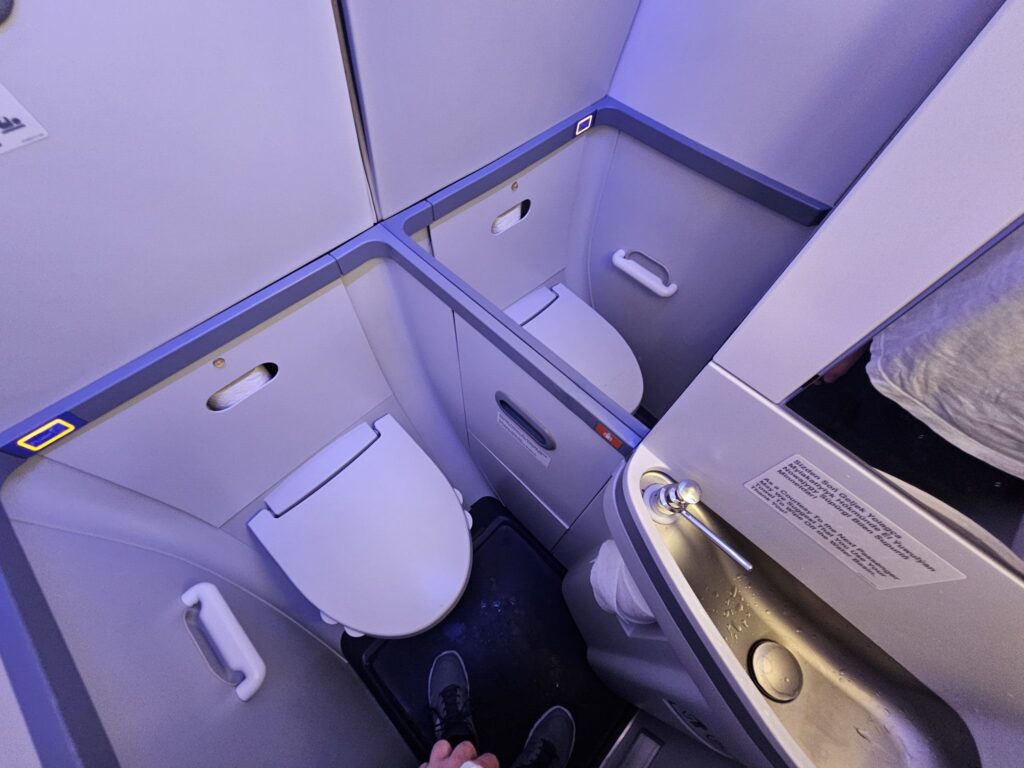
Once all meals had been handed out, the crew returned to undertake a hot drink round before collecting the remains from the service. Afterwards, I decided to venture to the rear of the cabin to sample one of the two lavatories available for Economy passengers. Opening this up, I found the toilet to be your standard Boeing 737 lavatory and was relatively clean and in good condition, although disappointingly this lacked soap.
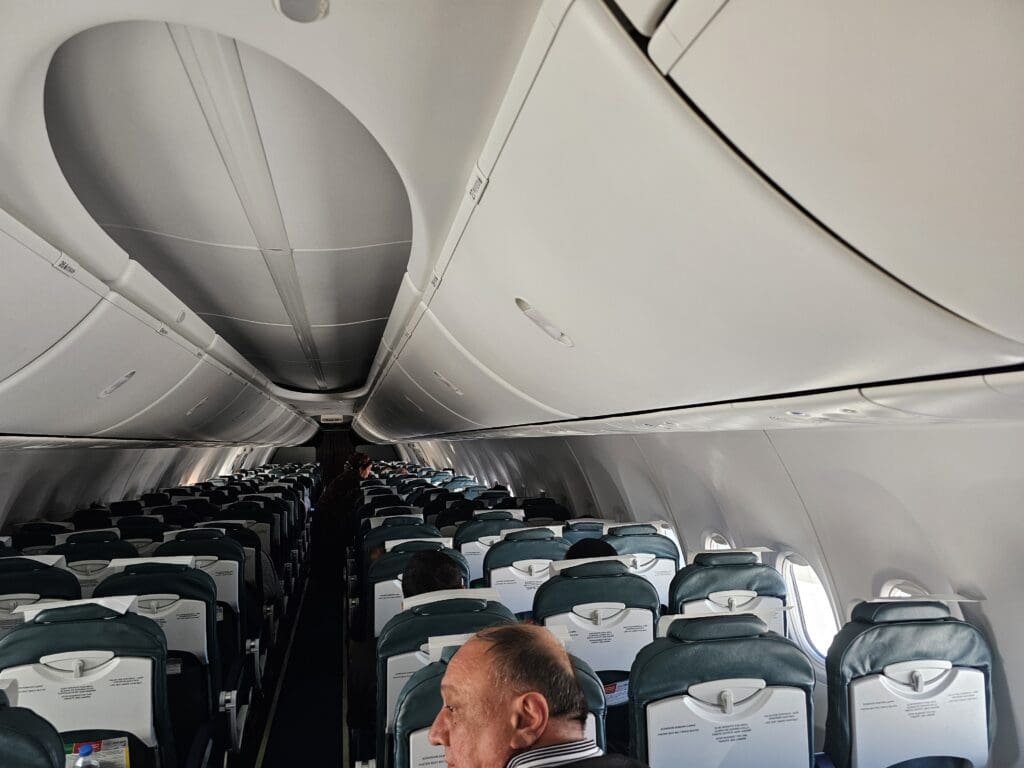
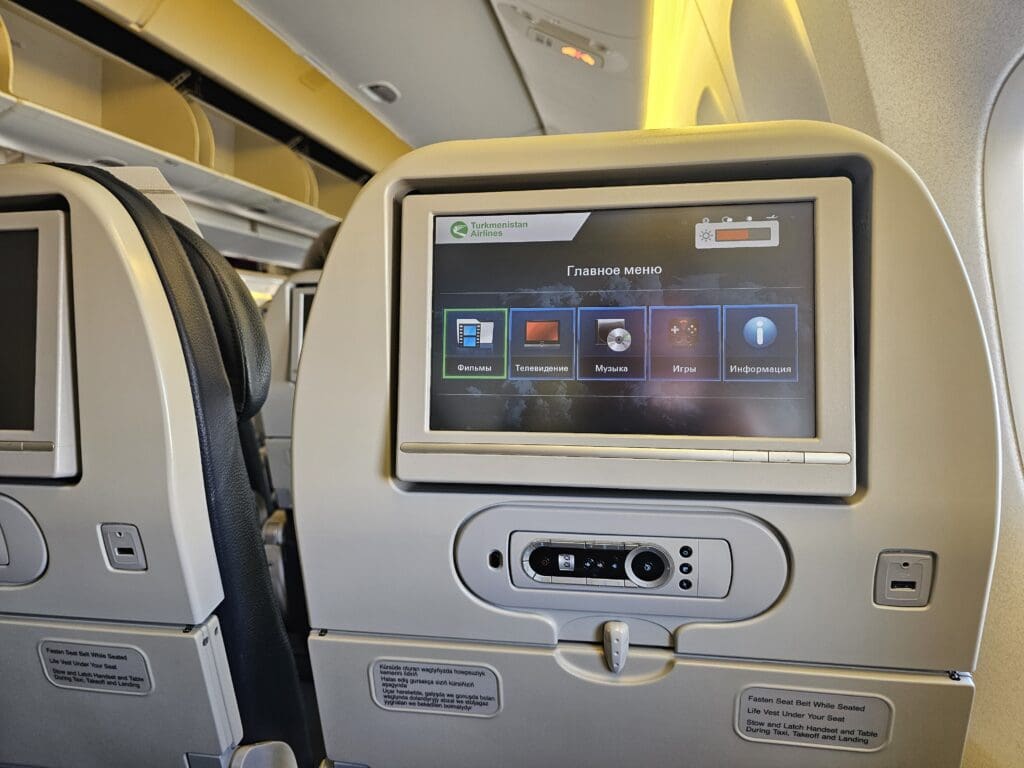
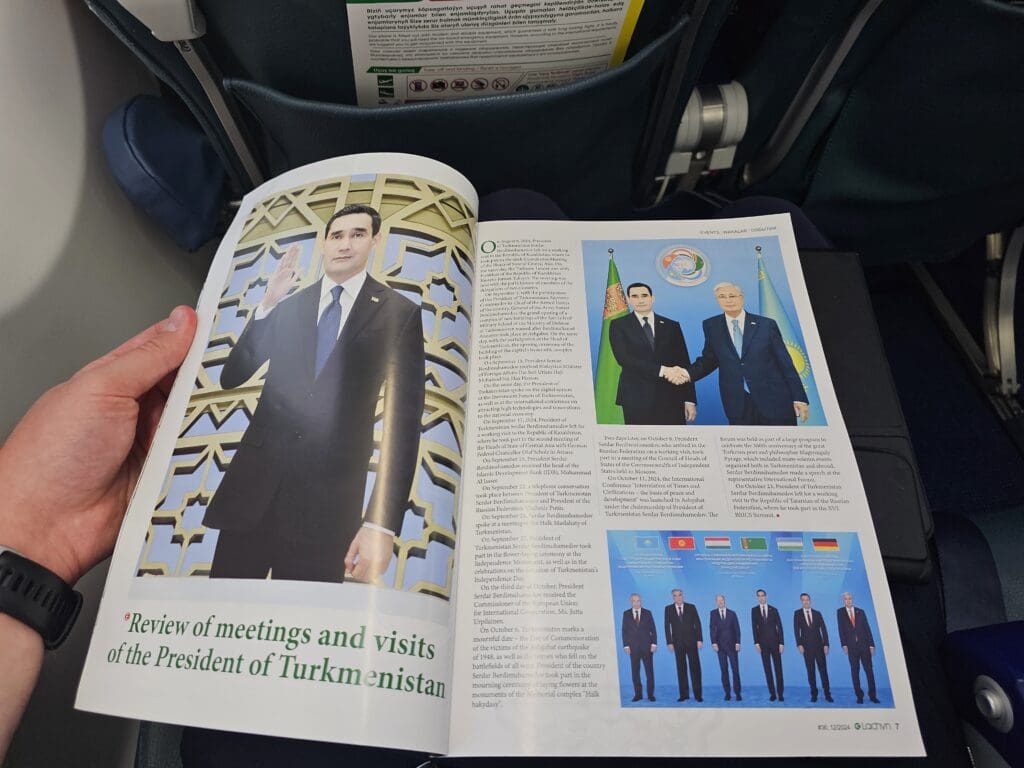
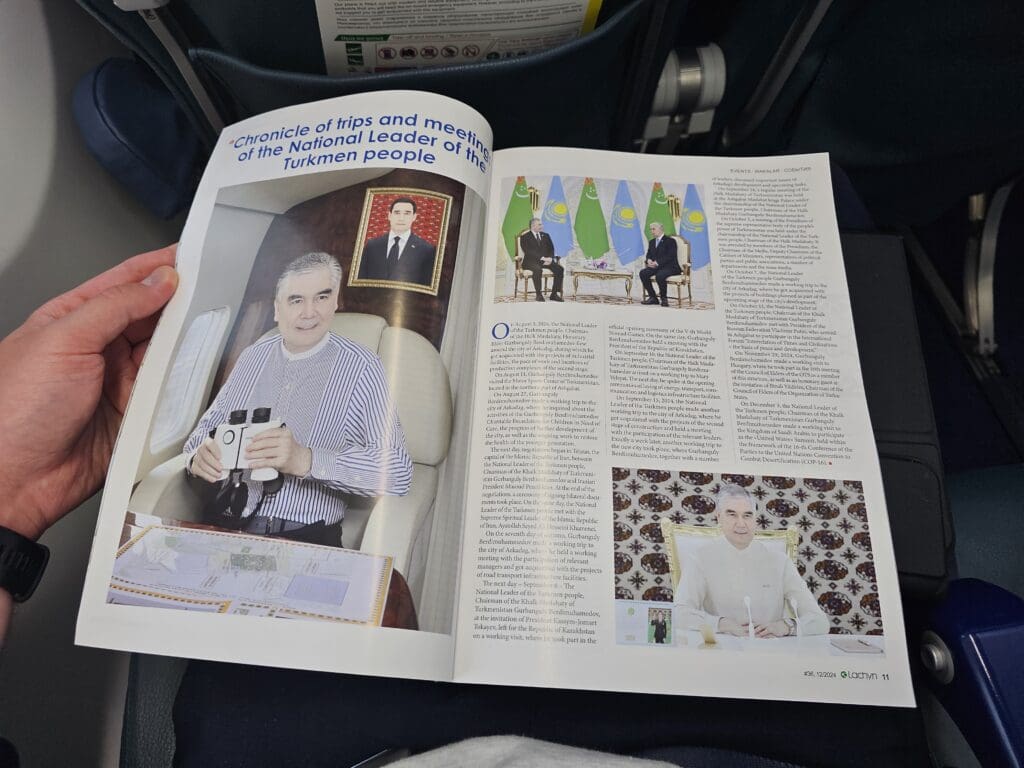
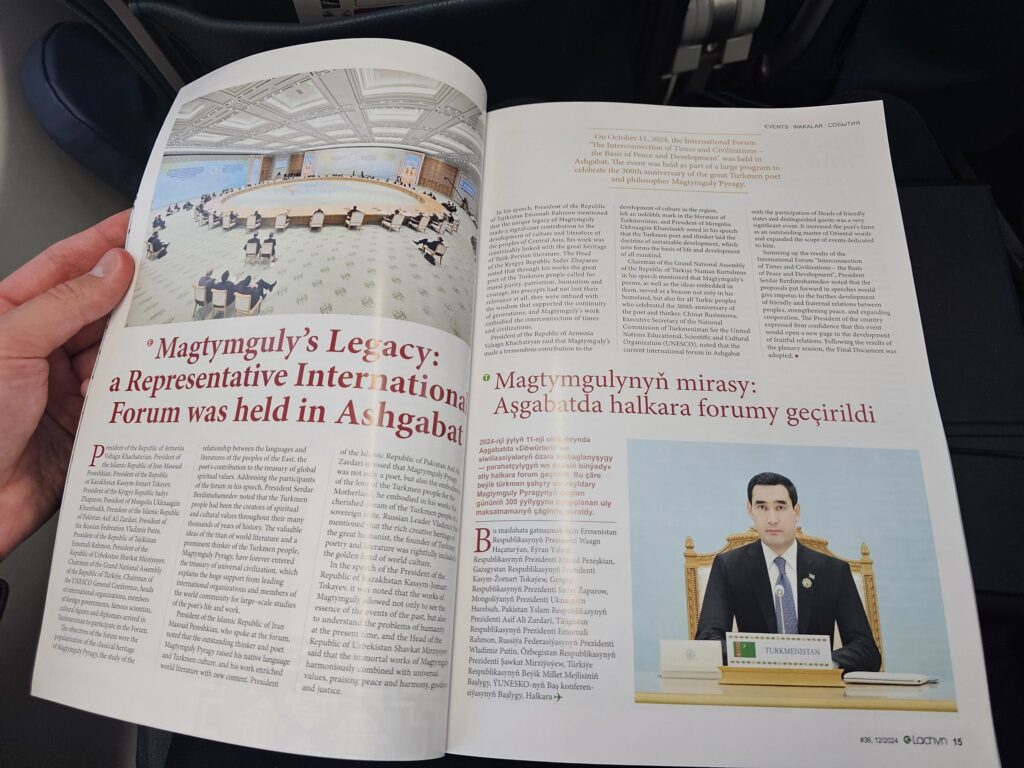
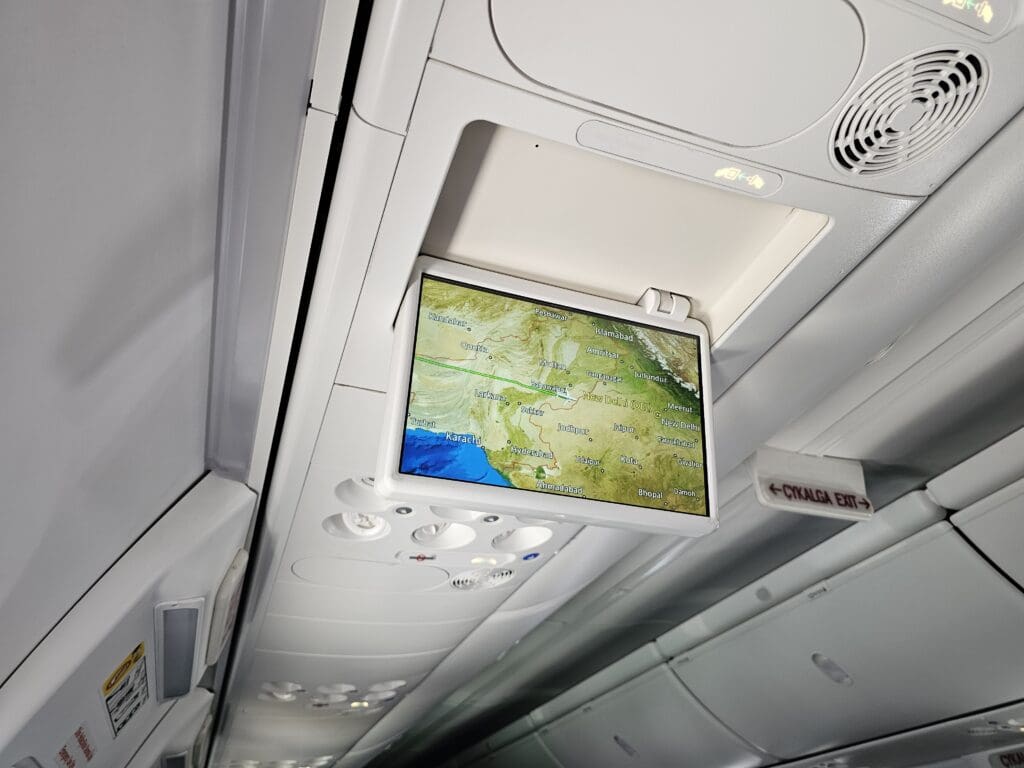
Returning to my seat, I settled in for the remaining two or so hours. Turkmenistan Airlines’ Boeing 737 fleet lacks any inflight entertainment system, and whilst this was not a problem given the duration of the flight between Ashgabat and Delhi, those on the type’s six-hour plus slogs to and from Milan may not be best impressed. However, up above, overhead screens could be seen extended which scrolled through the moving map pages for the duration of the flight. As you would perhaps expect, there was onboard wifi, and thus the only form of inflight entertainment came in the form of the five-months-out-of-date December 2024 edition of Turkmenistan Airlines’ Lachyn inflight magazine. Flicking through this, I have to say that this particular publication is definitely one of the most unique inflight magazines that I have ever come across. This primarily details information about government activities and visits and comes in Turkmen, English and Russian, whilst the last few pages were reserved for information about the airline.
Returning to the route, from Mashhad, the Boeing continued to fly southwards along the eastern edge of Iran, passing over the provinces of South Khorasan and Sistan and Baluchestan. Avoiding Afghan airspace, upon reaching Iran’s border with Pakistan, the aircraft turned to fly eastwards and made its way into Pakistani airspace, cruising high above the province of Balochistan. With little to see outside, and having had a sleepless transit in Ashgabat, as the aircraft made its way through the skies of Pakistan, I was unable to remain awake and drifted off into a light sleep. From the border near the Iranian city of Zahedan, the aircraft cut across the country and passed to the south of Quetta before entering the skies of the Pakistani province of Punjab.
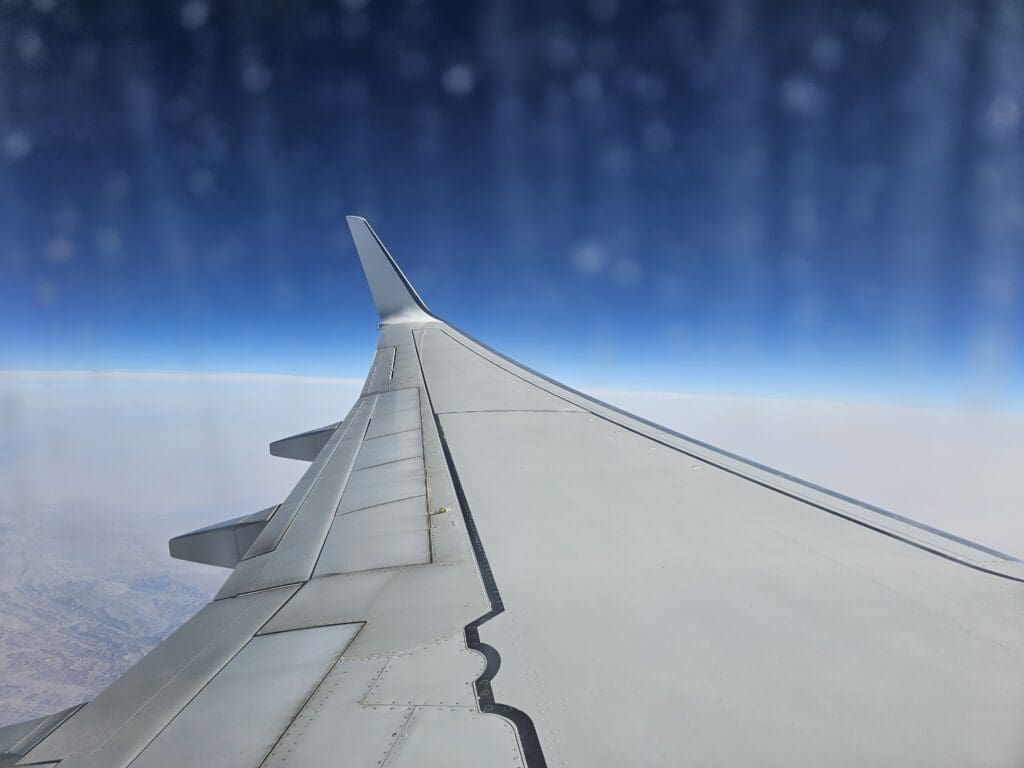
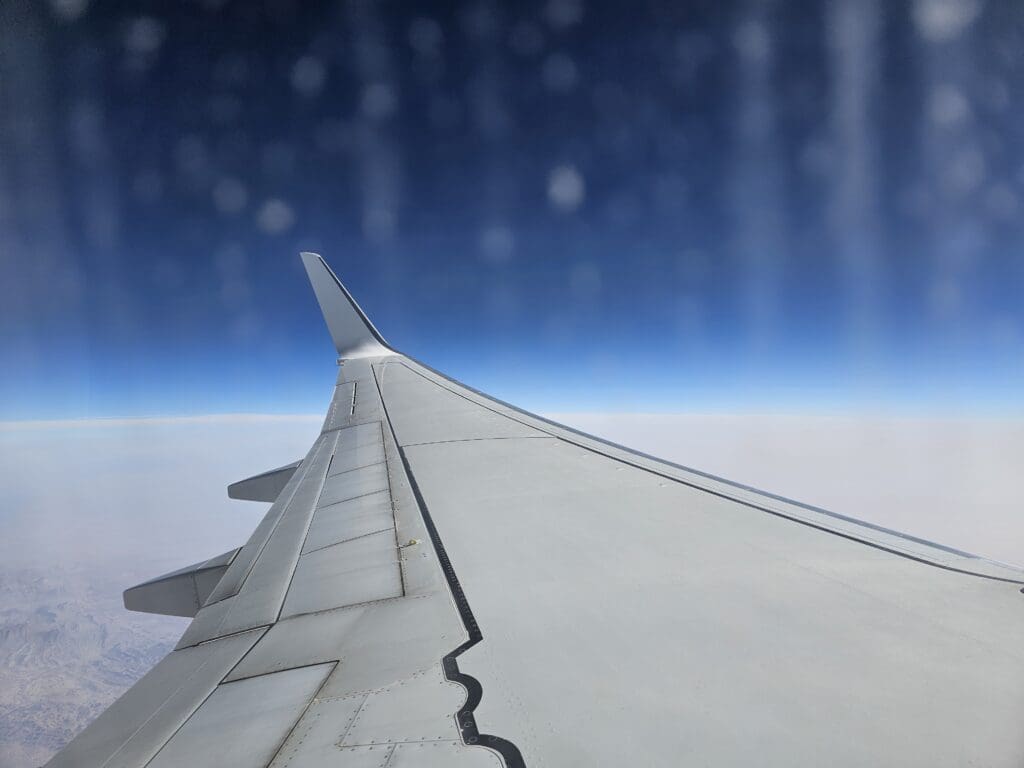
Soon, the flight entered its final quarter or so and I automatically awoke upon crossing into Indian skies, passing high over the state of Rajasthan. Realising that there was little of the flight remaining, I decided to make another trip to one of the lavatories at the rear of the aircraft, which, by this time, did not appear to be in as fantastic a state as it had been at the start of the flight. Returning to my seat, it wasn’t long before the aircraft could be felt commencing its descent and immediately, the Purser performed a trilingual announcement advising passengers of our impending arrival and making the usual warnings regarding seatbelts, tray tables and window shades as we began to sink down over the Indian countryside.
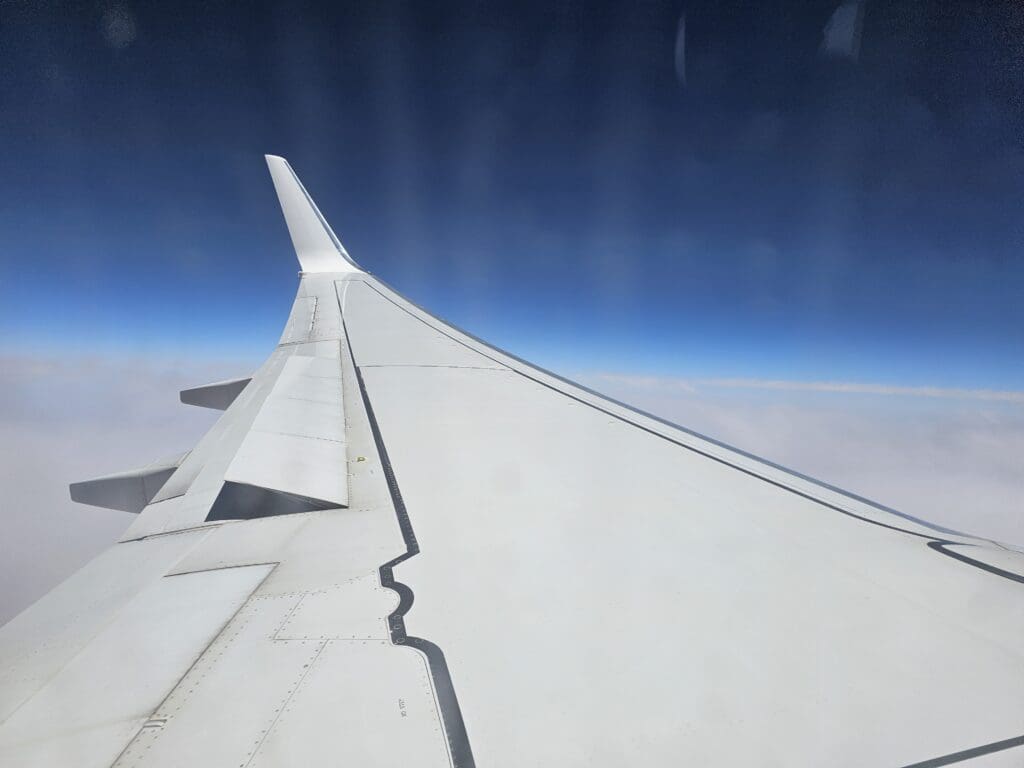
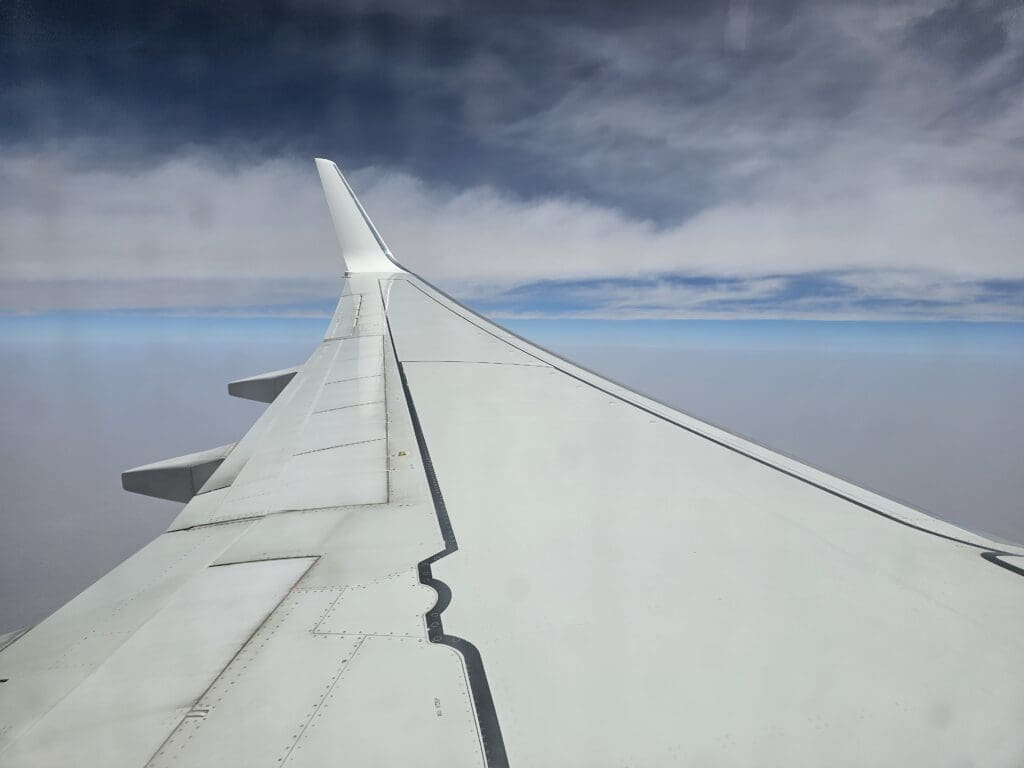
Unfortunately, a mixture of haze, cloud and smog meant that little could be seen of India as we crept towards Delhi and entered the skies of the state of Haryana. Meanwhile, inside the cabin, the crew passed through and seemed to have their work cut out, forced to wake up the many slumbering passengers and advise them to buckle up and put their seats in the upright position as we neared our destination. At this time, the aircraft seemed to bounce around a little as we encountered our first few significant lumps and bumps of the flight – these ended up being turbulent enough for a few of my fellow passengers to let out a few gasps as slowly but surely, the towns and countryside surrounding Delhi popped into view.
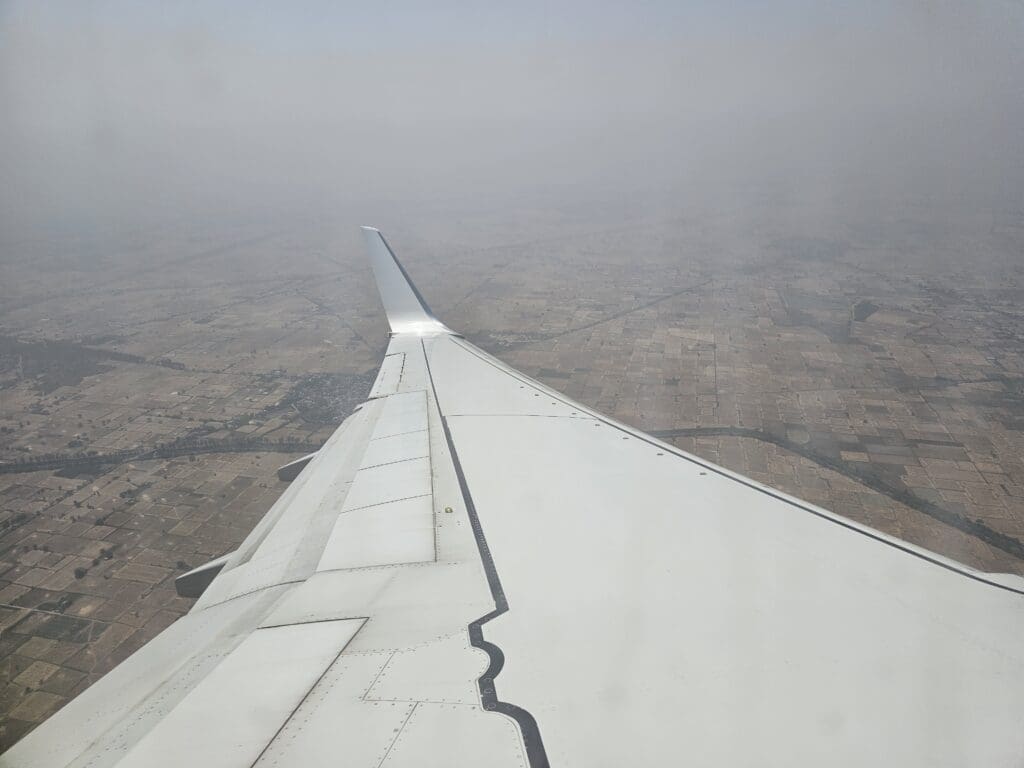
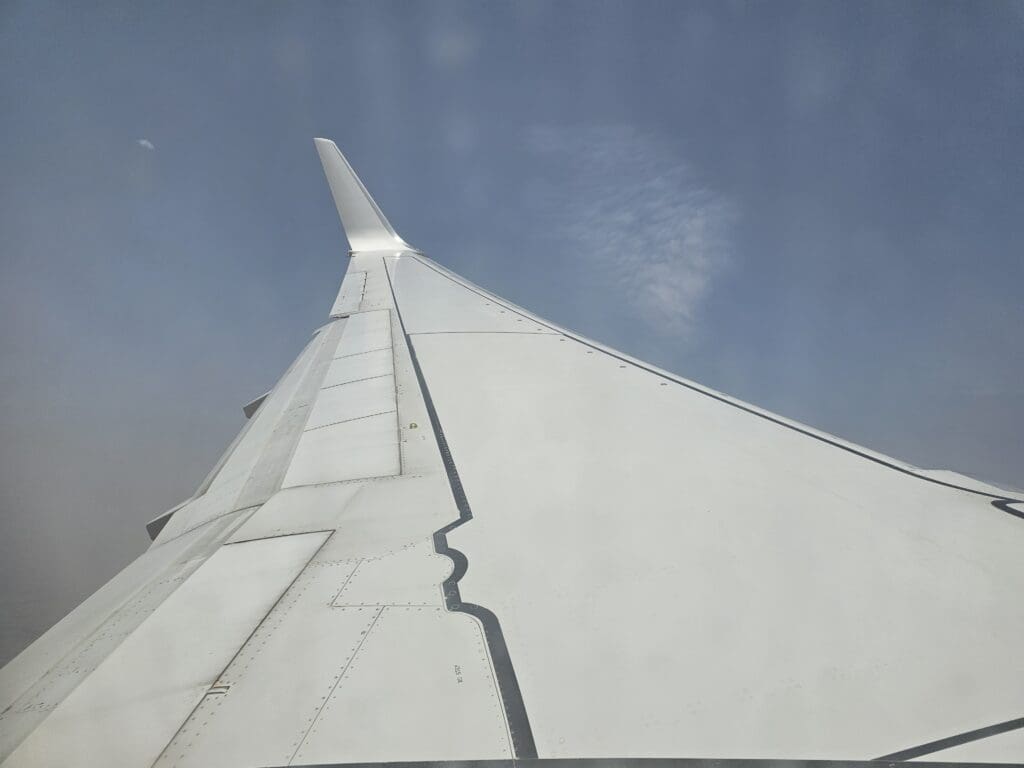
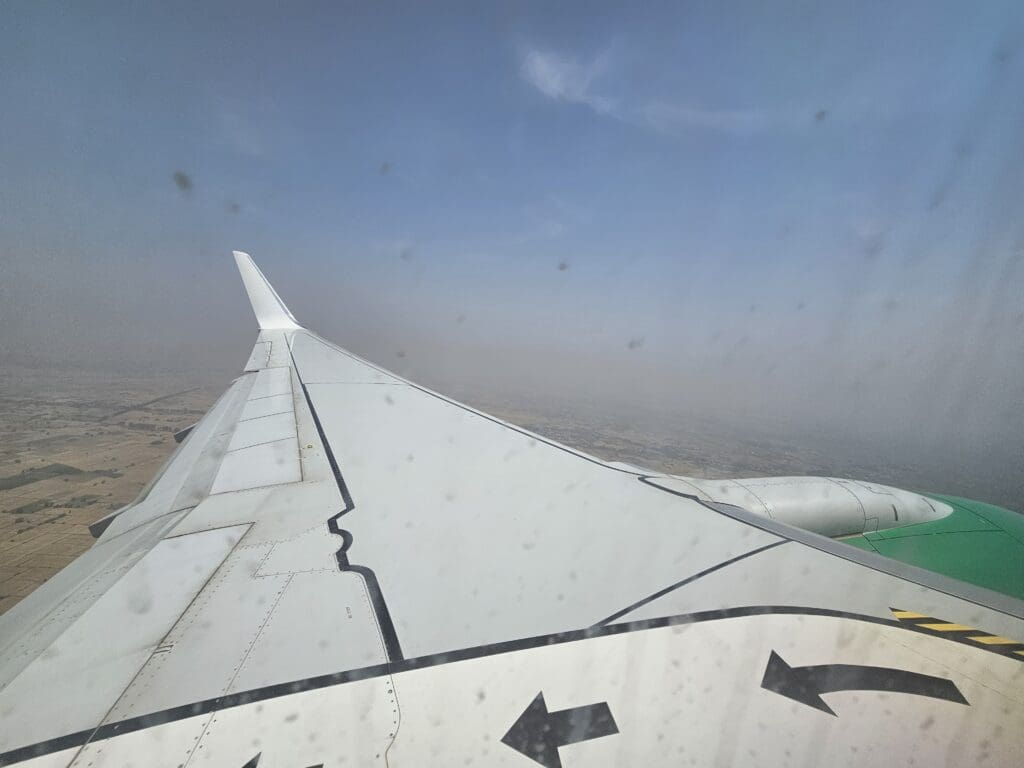
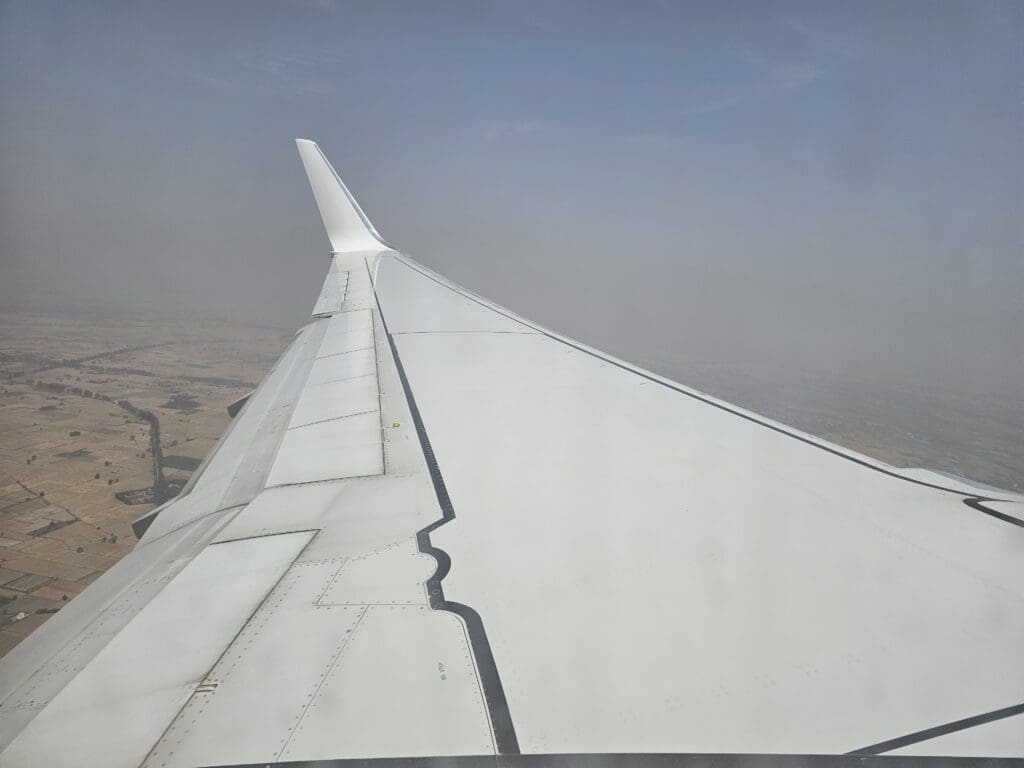
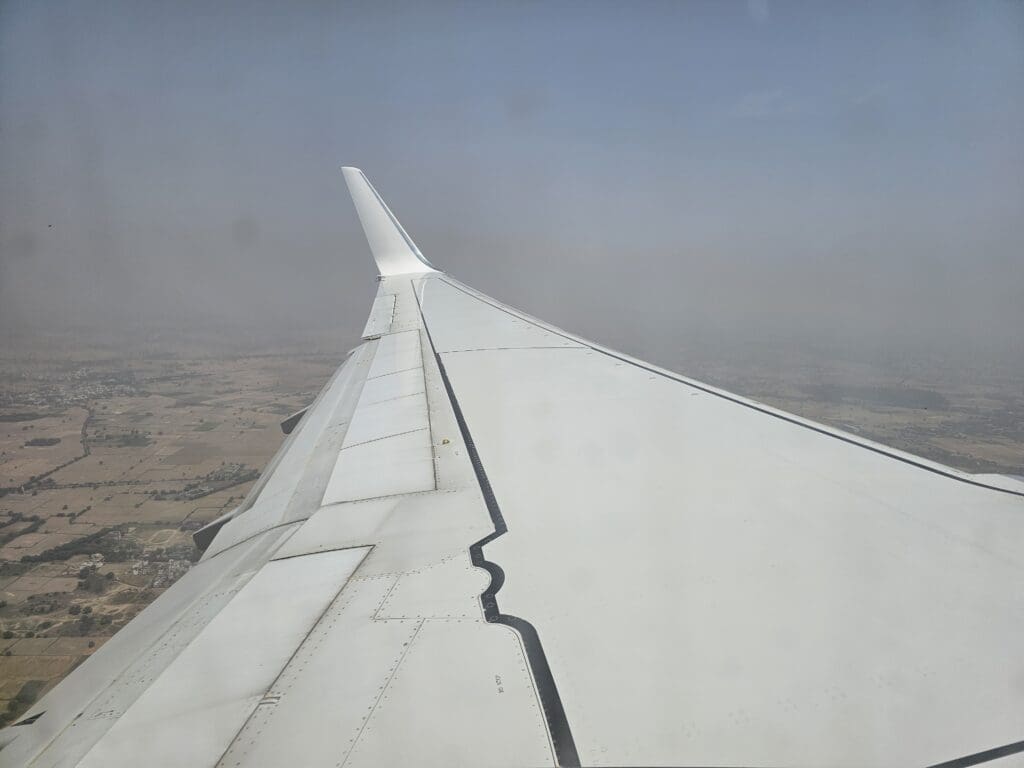
Approaching Delhi from the east, just before reaching Gurugram, the aircraft turned to fly towards Jhajjar and lined itself up for an approach to Runway 11R as our flaps and landing gear were extended in preparation for our arrival. As we sank lower and lower, the Boeing crossed from the state of Haryana and into Delhi, and it wasn’t long before the massive sprawl of Delhi Airport appeared along with a queue of aircraft waiting to depart from the parallel runway.
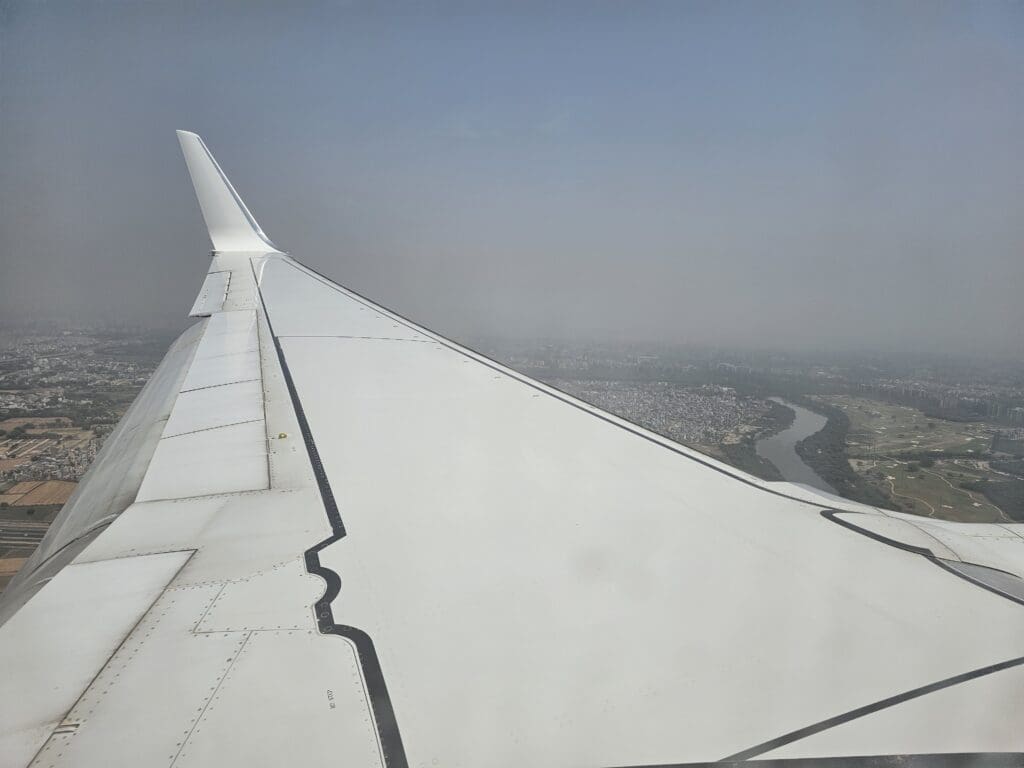
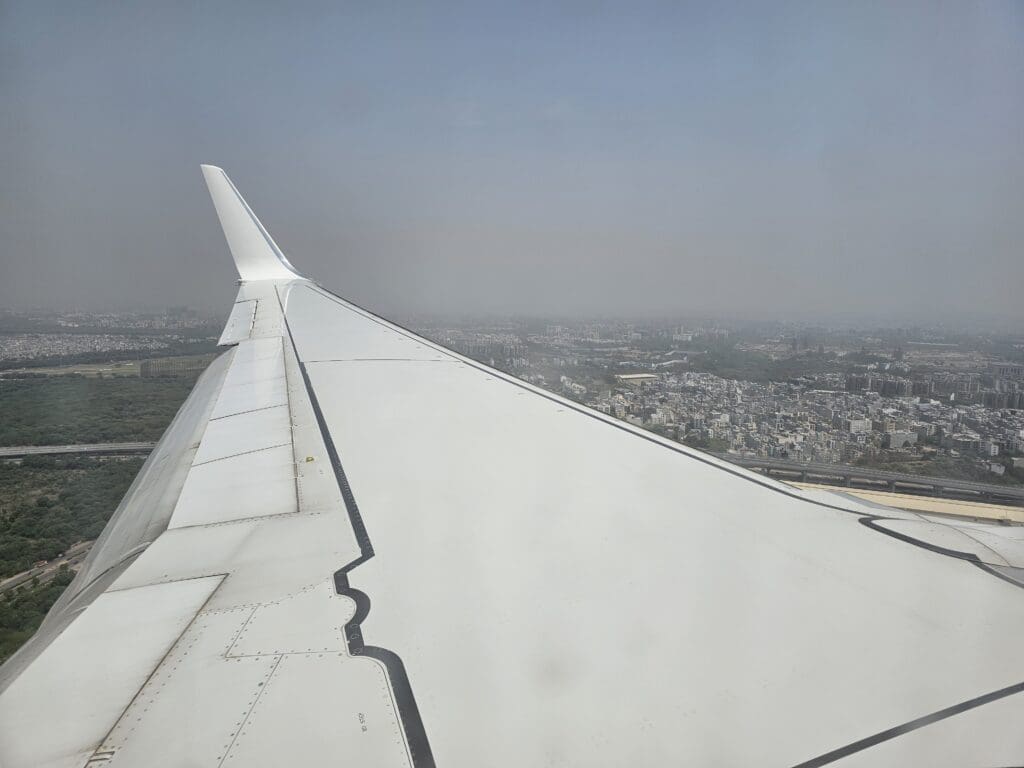
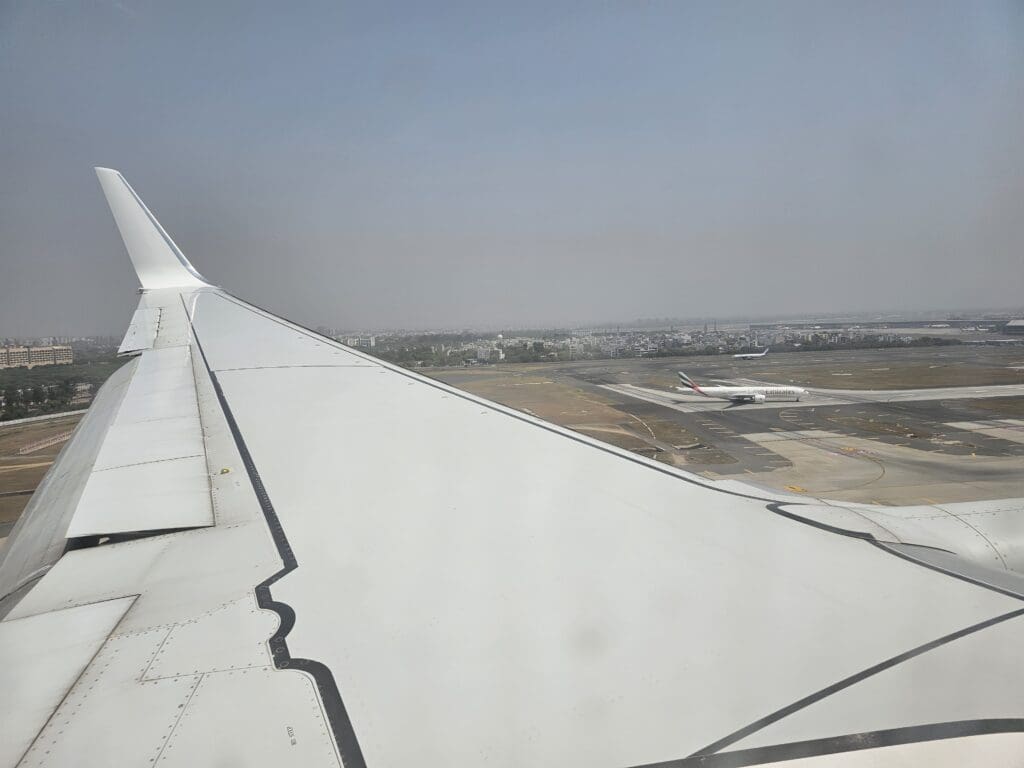
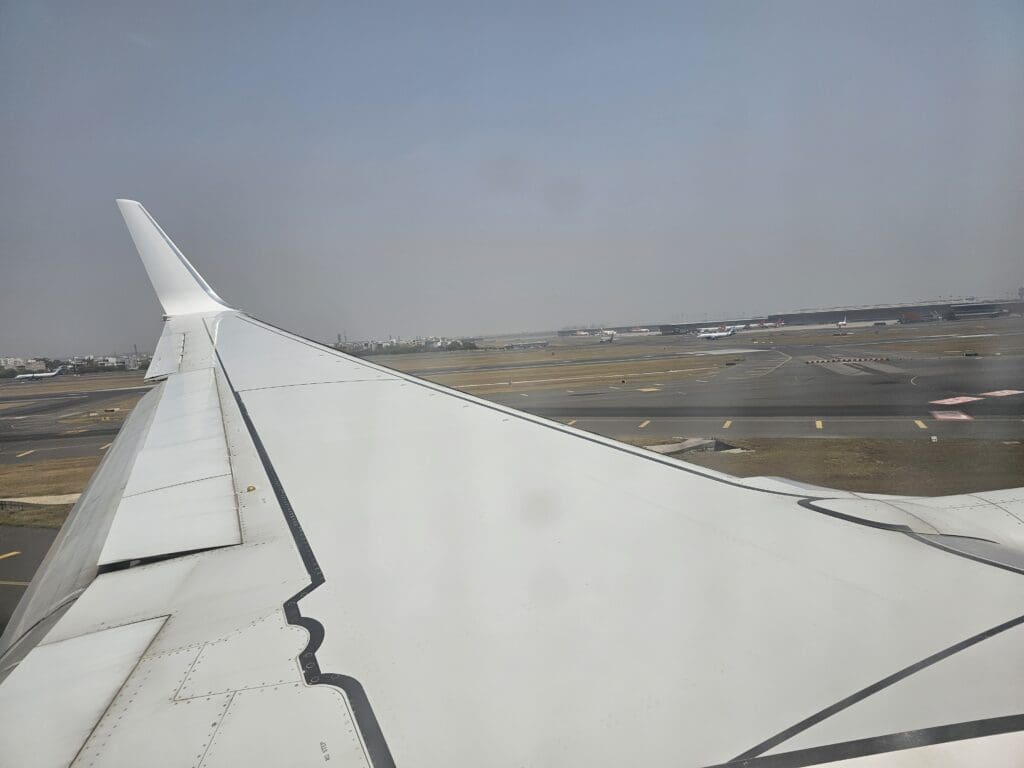
A grand total of 3H22 after taking to the skies of Turkmenistan, the Boeing 737 made a smooth touchdown on Indian soil at 1112, before braking gently and vacating the runway. As we commenced our taxi to the stand, the Purser welcomed all to Delhi, thanked passengers for flying with Turkmenistan Airlines and warned passengers to remain seated, something that needed to be repeated several times during our long taxi thanks to the fact that many passengers stood up and attempted to retrieve their bags.
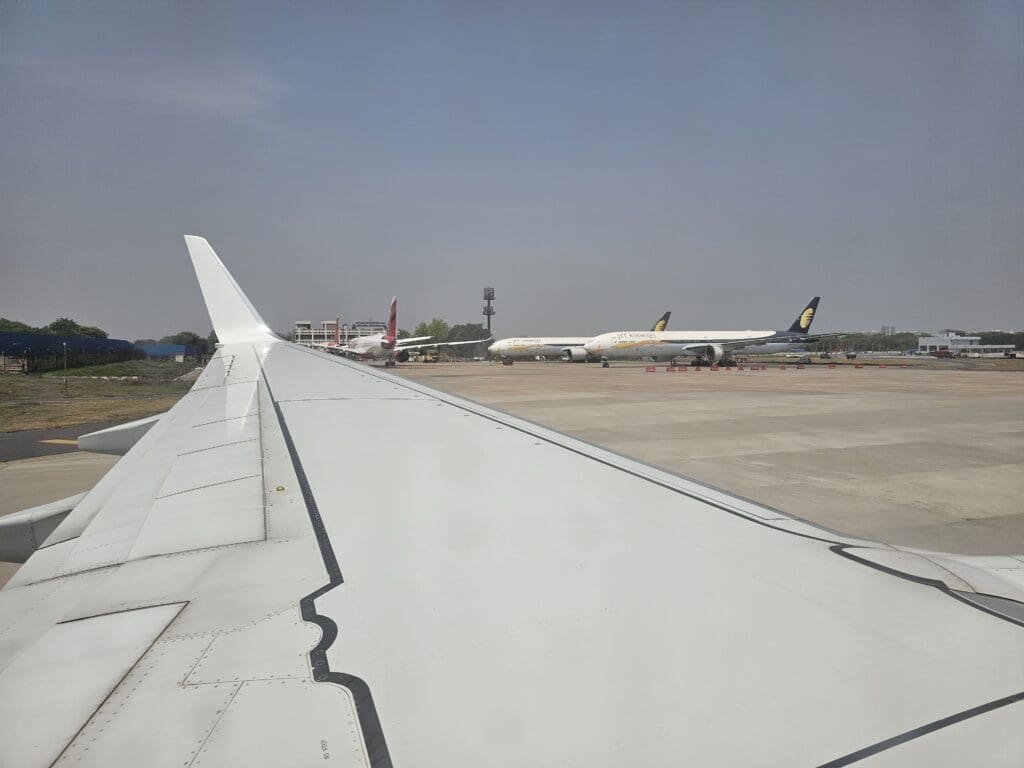
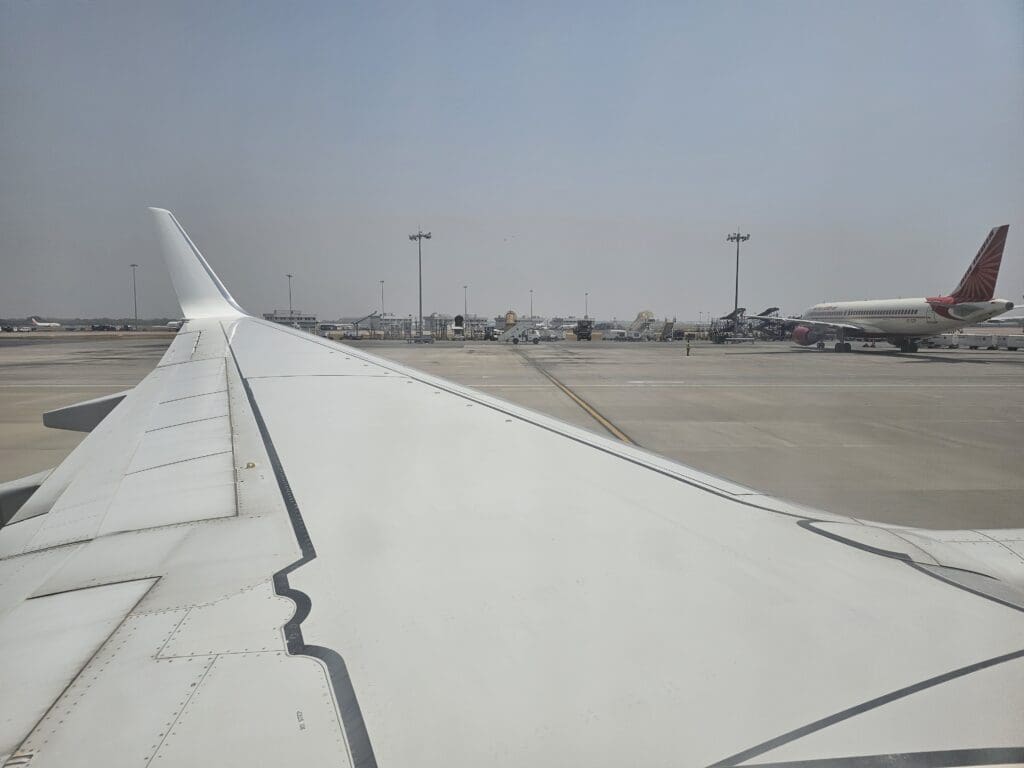
Following a long taxi around the airfield, eighteen minutes after touching down in India and forty minutes behind schedule, the Boeing cautiously pulled into Stand A06 at Terminal 3. As soon as the engines spooled down, many of my fellow passengers jumped up in a rush to disembark the jet. Fortunately for them, the ground crew appeared to be working hard and the jetbridge was soon connected to the aircraft, ensuring that disembarkation commenced within a few minutes of our arrival. Soon joining the scrum in the aisle, I headed up through the now incredibly messy cabin, feeling sorry for those who would have to clean it during the aircraft’s short stay on the ground in Delhi, before thanking two of the flight attendants and stepping off the aircraft.
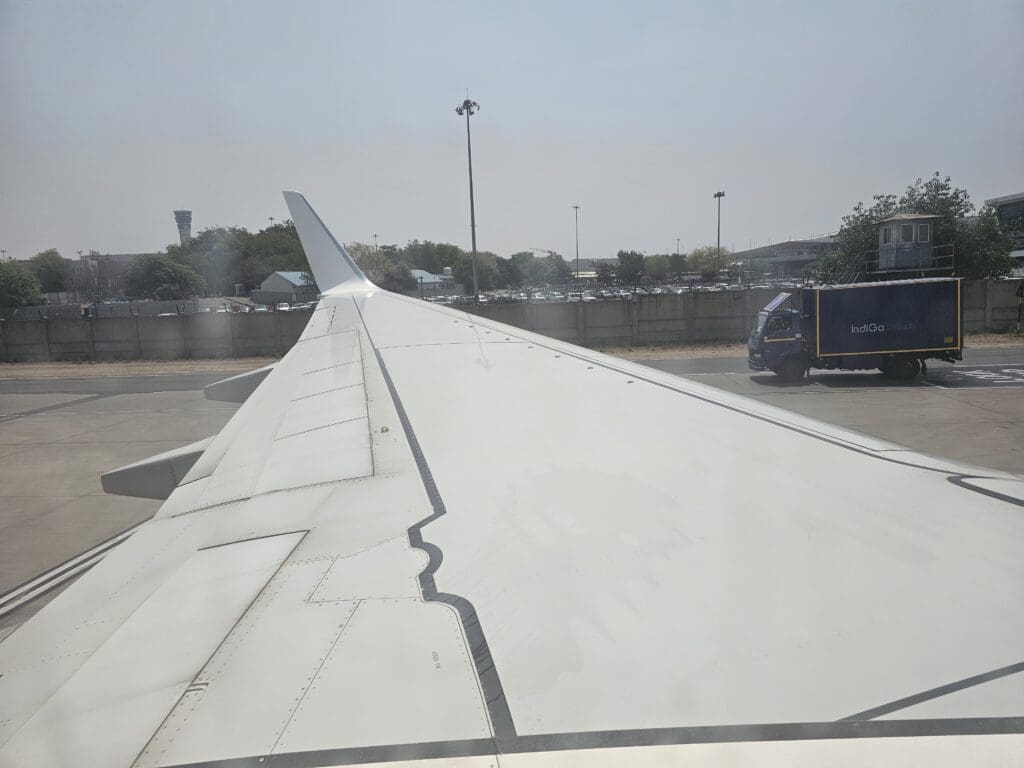
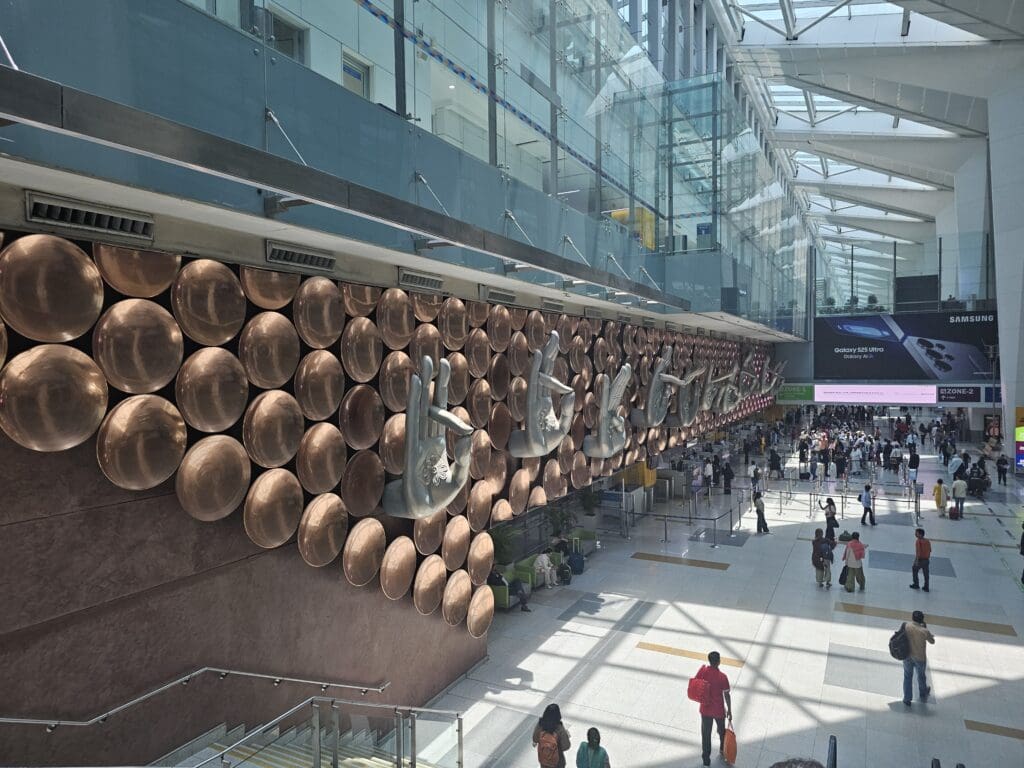
Indira Gandhi International Airport’s Terminal 3 is gigantic, which can result in long walks between the terminal’s gates and the immigration area located at the centre of the terminal. Indeed, that was the case that day, and it quite some time to march from the gate before the terminal’s famous hasta mudras that sit above the immigration area appeared. Much to my delight and surprise, the desks for those with Indian e-visas were totally devoid of passengers and so I was able to wander straight up to one of these where a friendly official scanned and stamped my documents. As I had noticed around a year and a half earlier in Kolkata, entering India is not necessarily a quick process, and there seem to be all sorts of procedures that need to be done behind the desk, which took about three minutes to complete before I was free to wander over to the baggage claim area. Thanks to the long walk, by the time I arrived at baggage collection my suitcase could already be seen spinning on the carousel, and so I picked this up and continued onwards through customs and out into the landside arrivals area, ending my Turkmenistan Airlines adventure.
Summary
Whilst Turkmenistan Airlines’ Boeing 737 was a little more spartan than the Boeing 777-200LR, for the most part, I was pleased with my experience. The crew were largely warm, polite and friendly in all interactions, and the aircraft was spacious and in good shape, despite being fairly firm. Whilst some may miss having the luxury of an inflight entertainment screen, this was not really needed given the length of the flight. Ultimately, given the price that I paid for my trip between London and Delhi, I was pleased with my experience and would be happy to fly with Turkmenistan Airlines again!