Flying Mysterious Turkmenistan Airlines on a Rare Boeing 777-200LR: London Gatwick to Ashgabat
Background
It is fair to argue that there are probably few passengers who would opt to fly with Turkmenistan’s state-owned carrier over a major legacy airline. Indeed, with Turkmenistan presently notoriously tricky to visit thanks to a complex and expensive visa regime, a rulership governed by a hereditary dictatorship, and intense and often trivial regulations governing virtually all aspects of daily life, Turkmenistan Airlines is not at the top of many passengers’ lists. However, the strange demographic of aviation enthusiasts who are simply content with a ride on the country’s only airline can get a taste of Turkmenistan by transiting through the country’s glistening eagle-shaped hub at Ashgabat International Airport.
Turkmenistan Airlines is an airline that I have been familiar with for quite some time. Growing up in Britain, I often saw the airline’s Boeing 757-200s and occasionally their smaller Boeing 737-800s operating scheduled services from Ashgabat to both Birmingham and London Heathrow. Some may be surprised at the presence of a regional airport on Turkmenistan Airlines’ route network, especially considering the lack of any sort of major Turkmen diaspora in Britain or other overt linkages between the two countries. However, alongside the likes of Kazakhstan Airlines, Kyrgyzstan Airlines, Tajikistan Airlines and Uzbekistan Airways, during the nineties, the airline partnered with local travel agencies to focus on serving the region’s Punjabi diaspora. Specifically, as with the airline’s aforementioned Central Asian competitors, Turkmenistan Airlines connected Birmingham with Amritsar, with a fuel and crew change stop in their hub in Ashgabat. However, with increased competition from both Air India and Middle Eastern giants, these interesting Central Asian visitors to Birmingham became increasingly rare, although Turkmenistan Airlines outlived their competitors in this field by quite some time.
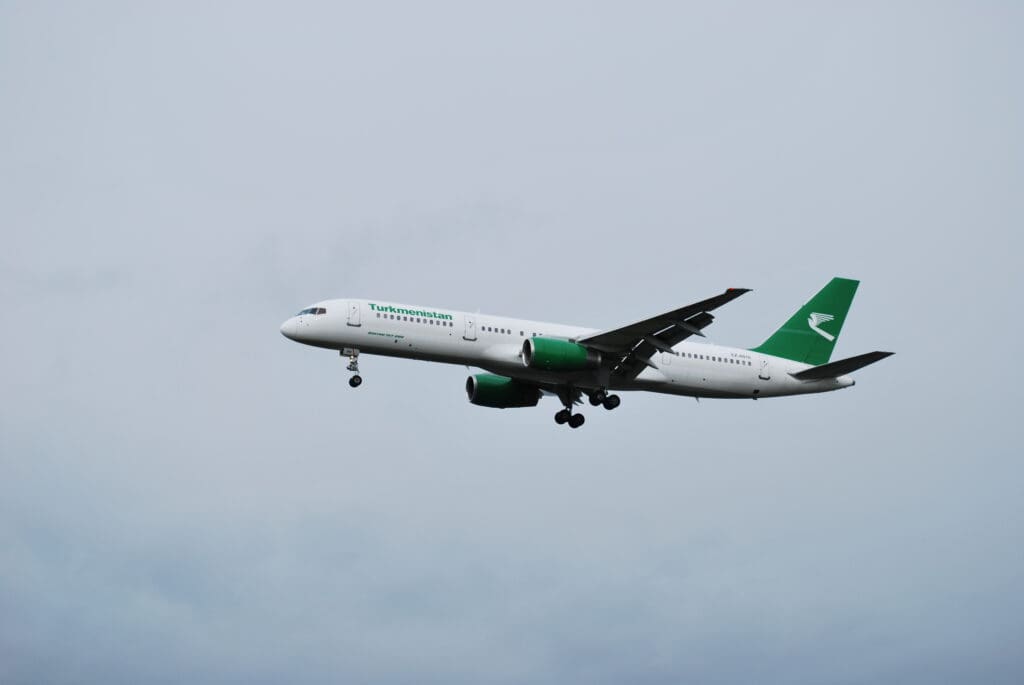
In February 2019, Turkmenistan Airlines’ services to both Birmingham and Heathrow came to an abrupt halt when the airline was placed on the European Union’s Air Safety List for failing to demonstrate appropriate levels of safety oversight. Despite this being a short-lived prohibition, once this was lifted, the pandemic ensured that regular operations to Britain were halted for an extended period. Finally, in March 2023, Turkmenistan Airlines reinstated direct services between Ashgabat and Britain. However, rather than return to Heathrow, Turkmenistan Airlines sent their Boeing 777-200LRs to London Stansted before relocating to the other side of the capital to London Gatwick. As of 2025, Turkmenistan Airlines operates its three Boeing 777-200LRs twice per week between Ashgabat and London Gatwick, with flights offered on Wednesdays and Saturdays.
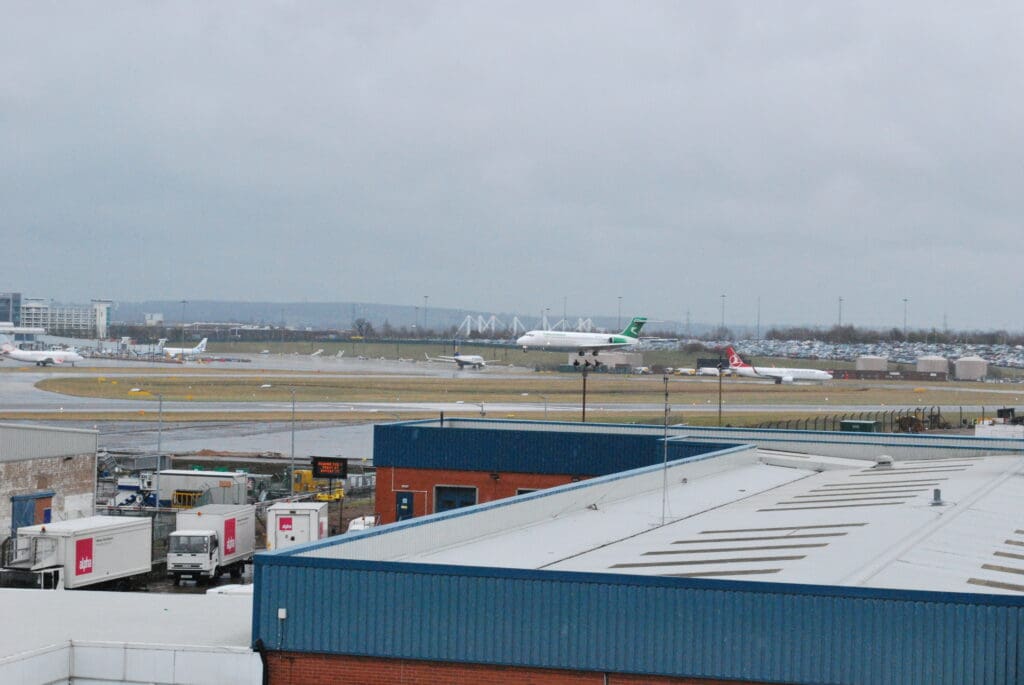
Given the slight mystique surrounding Turkmenistan Airlines, I had long wanted to sample the delights of the Turkmen flag carrier. However, purchasing tickets for the carrier’s services has long proven to be an infamously challenging affair. This once required going through a rather unofficial-looking third-party site, before only being bookable through Russian or Turkish online booking agencies. However, seeking to increase passenger numbers, in late 2024, Turkmenistan Airlines’ booking arrangements were simplified somewhat, and these can now be purchased via the Turkish version of the airline’s website.
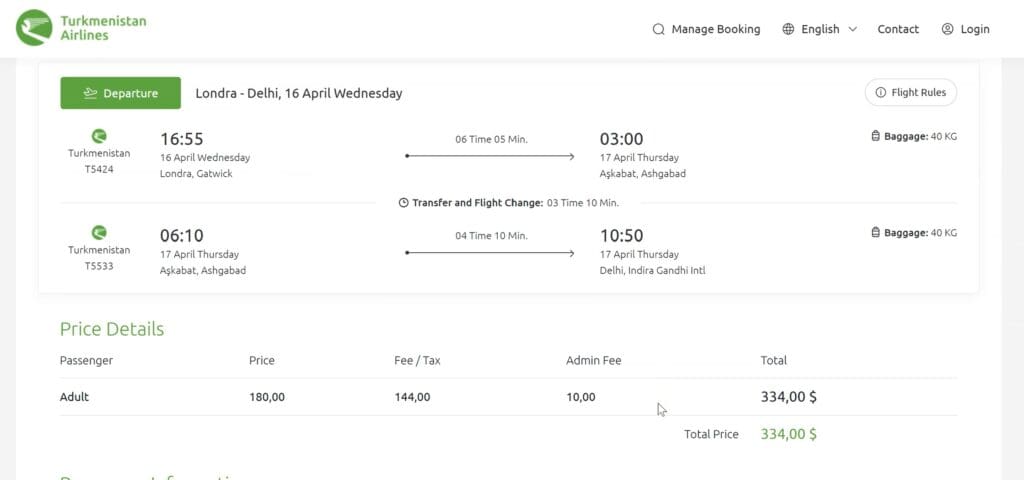
For quite some time, unless visiting Turkmenistan or on a travel agency booked ride to Amritsar, those seeking the delights of Turkmenistan Airlines could only do so by taking their connecting services from Frankfurt or London to just Bangkok or Delhi. However, since bouncing back from the pandemic, the airline appears to have made a more concerted effort to attract transit passengers, offering bargain fares between Frankfurt, Istanbul, Milan and London, and Bangkok, Delhi, Ho Chi Minh City and Kuala Lumpur, with most options having only a short connection time in Ashgabat. Heading to Nepal for some trekking in April 2025, I soon discovered that I could easily work a comparatively cheap ride with Turkmenistan Airlines into my itinerary. Specifically, I would depart London Gatwick on a Boeing 777-200LR at 1655 on a Wednesday afternoon, touching down in Ashgabat at 0300. After 3H10 on Turkmenistani soil, I would continue to Delhi onboard a Boeing 737-800. Arriving at 1050, later that day, I would head off to Nepal on a Nepal Airlines Airbus A330-200. This itinerary would enable me to sample not only the rarest variant of Boeing 777, but also try both Turkmenistan Airlines’ narrowbody and widebody products.
About Turkmenistan Airlines
As one of the fifteen constituent Union Republics of the Soviet Union, once upon a time, for decades, aviation in Turkmenistan was dominated by the local arm of the Soviet national carrier, Aeroflot. As was the case across the former Soviet Union, when Turkmenistan obtained independence in 1992, control of this fell into the hands of the new national government, and thus Turkmenistan Airlines was formed. Whilst inheriting a sizable fleet of Soviet manufactured airliners such as the Antonov An-24, Tupolev Tu-154, Yakovlev Yak-40 and Yakovlev Yak-42, with Turkmenistan soon establishing diplomatic relations with the West, the airline underwent some fleet modernisation. This saw Turkmenistan Airlines become the first carrier in the former Soviet Union to operate the Boeing 737-300, whilst a fleet of four Boeing 757-200s was also procured directly from Boeing for operations to destinations further afield, such as in Western Europe.
As time passed, Turkmenistan Airlines’ fleet modernisation continued, and in the early 2000s the airline became one of the few operators of the Boeing 717 – taking delivery of seven such aircraft, which focused on Turkmenistan’s domestic route network. Unfortunately, for fans of Boeing’s rarer types, all such aircraft were replaced by Boeing 737NGs, and retired from service in 2018. However, all is not completely lost as Turkmenistan Airlines’ first non-government widebody jets came in the form of two rare Boeing 777-200LRs, both of which were delivered in 2014. These were supplemented by a pair of larger former Cathay Pacific Boeing 777-300ERs in 2023, which were procured to support the airline’s growing long haul route network. Today, Turkmenistan Airlines’ fleet comprises three Boeing 737-700s, eight Boeing 737-800s, two Boeing 777-200LRs and two Boeing 777-300ERs, with these deployed on a network of routes connecting Ashgabat with Abu Dhabi, Bangkok, Beijing, Frankfurt, Delhi, Dubai, Ho Chi Minh City, Istanbul, Jeddah, Kuala Lumpur London, Milan, Kuala Lumpur, Kazan and Moscow, whilst within Turkmenistan the airline serves Balkanabat, Daşoguz, Kerki, Mary and Türkmenabat. In addition to this, Turkmenistan Airlines operates several Boeing 737s and Boeing 777s on behalf of the government, as well as two dedicated Airbus A330 freighters and eight Ilyushin Il-76TDs, which undertake both scheduled and charter cargo services.
Booking
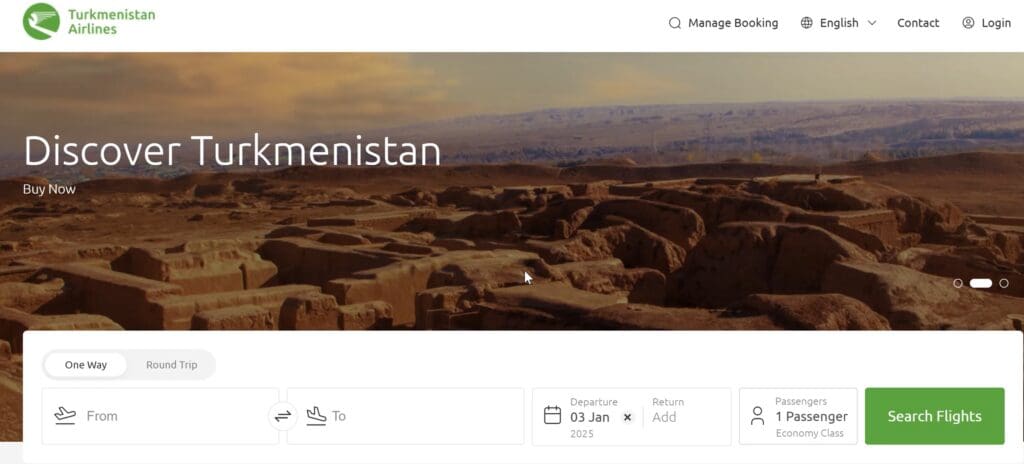
Whilst tickets for Turkmenistan Airlines can be booked through a small handful of online ticketing sites, I decided to try my luck with booking tickets directly with the airline. Being far from the largest or most international airline in the world, I was not overly surprised to find this site to appear a little clunky and dated. Furthermore, this did not seem to offer much information about the airline, offering little other than an overview of the refund rules and the address and contact details for the Istanbul branch of Turkmenistan Airlines’ offices. Upon landing on Turkmenistan Airlines’ homepage, I was greeted by a promotional banner that advertised Ho Chi Minh City and encouraged passengers to ‘Discover Turkmenistan’ with this message superimposed on scenic photos of Ashgabat and the country’s desert canyons. Beneath this, the flight search engine could be found alongside a list of Turkmenistan Airlines’ destinations and costs, presumably from Ashgabat, with Moscow, Frankfurt, Bangkok, Dubai and London listed.
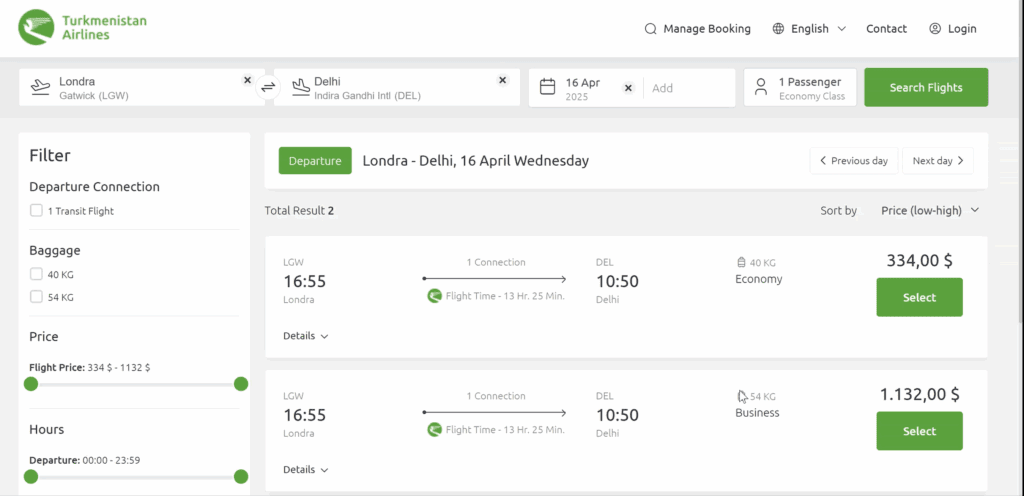
Without lingering around, I entered all the required details into the flight search engine and was soon presented with both an Economy and Business fare, priced at $334.00 and $1,132.00 respectively, the latter being the cheapest premium fares between London and Delhi that day. Meanwhile, focusing on Turkmenistan Airlines’ positives, those in Economy could bring up to 40kg of hold luggage on their flight. Selecting the Economy fare, I was taken to enter my personal and payment details without any optional extras. Soon, I received my payment confirmation in Turkish and was sent an e-ticket, meaning that I was all set to head off to Turkmenistan. Options to manage my booking were very much non-existent; however, this was not a particularly significant issue.
Check-In
Given the rudimentary nature of Turkmenistan Airlines’ international website, it did not come as too much of a surprise to find that this did not offer any sort of online check-in feature. This meant I had no choice other than to check-in at the airport. However, needing to stop by at the counters anyway to drop off my suitcase, this was no major issue. The only downside was that I was unable to select a seat in advance.
The Journey
After months of preparations, the day of my 26-day adventure to the Himalayas finally arrived. Following a short night’s sleep, I woke up bright and early, ready to commence my long journey to Kathmandu via Gatwick, Ashgabat and Delhi. Having already packed everything that I would need for my adventure, upon waking up, I did not have too much I needed to do other than dart through the shower and put on a fresh set of comfortable clothes before heading out.
Living in the West Yorkshire city of Leeds, over three hundred kilometres to the north of London, the first slog of my journey involved travelling down to Gatwick Airport. Despite being the furthest London airport from Leeds, Gatwick is one of the easiest to get to by railway. This trek involves nothing other than a short change of trains in either London Kings Cross or Stevenage, with the quickest journeys taking around three hours. Booking a ticket several weeks in advance, I ended up paying £39.55 for a one-way ticket departing Leeds at 0945 and arriving at Gatwick at 1304.
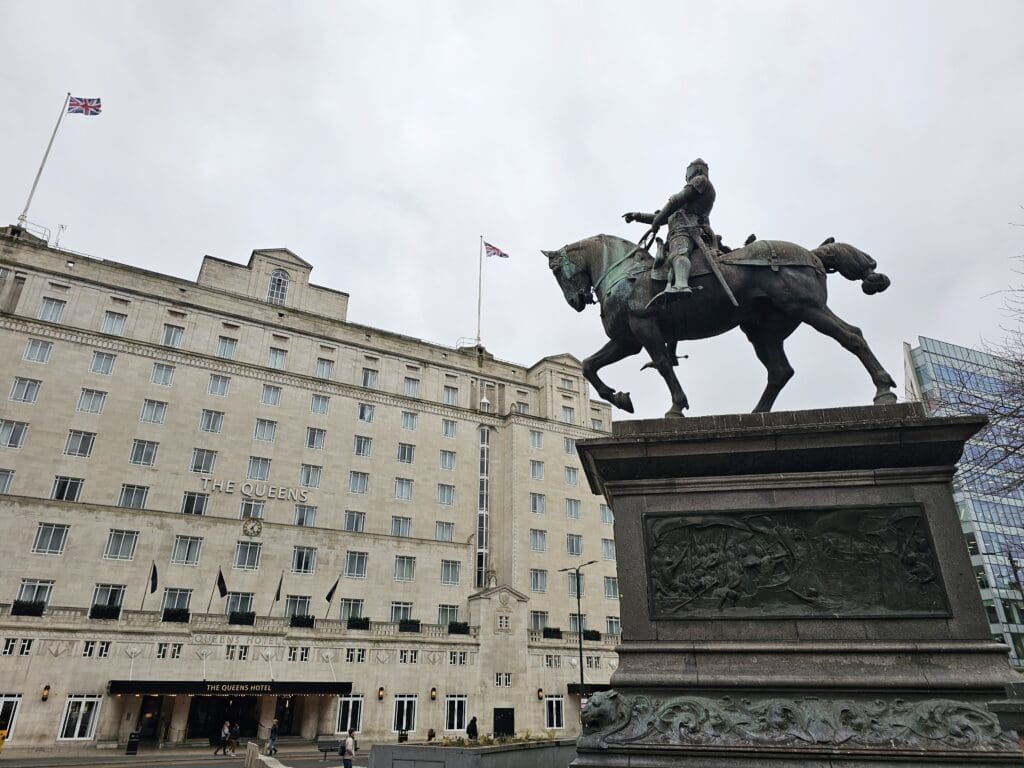
Despite enjoying a two-week period of uninterrupted sunshine where the temperatures reached a balmy twenty degrees, sadly, this early summer had been and gone, and my walk to the station was accompanied by the grey drizzle more atypical of the English weather. Trundling through the busy centre where morning commuters could be seen scurrying to their offices, after twenty or so minutes of cumbersomely lugging my suitcase through the city, I was rather glad to finally reach the station where I could relax and catch my breath. Having left home with an abundance of time, I made it to the station with about twenty minutes to go until my train down to London.
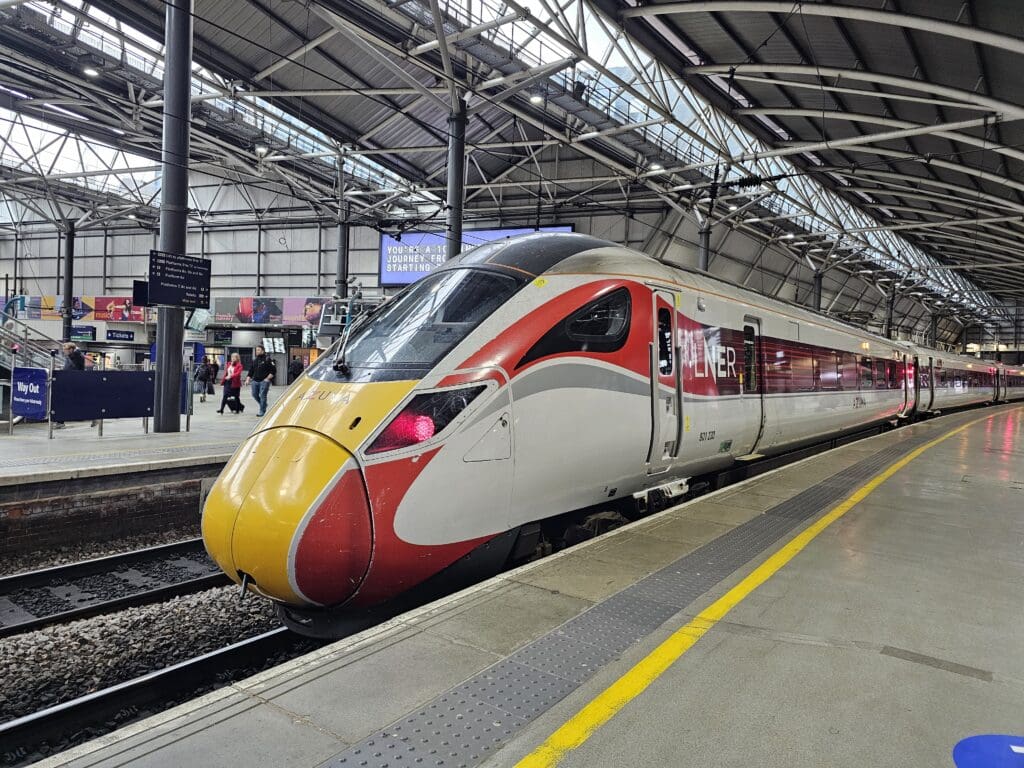
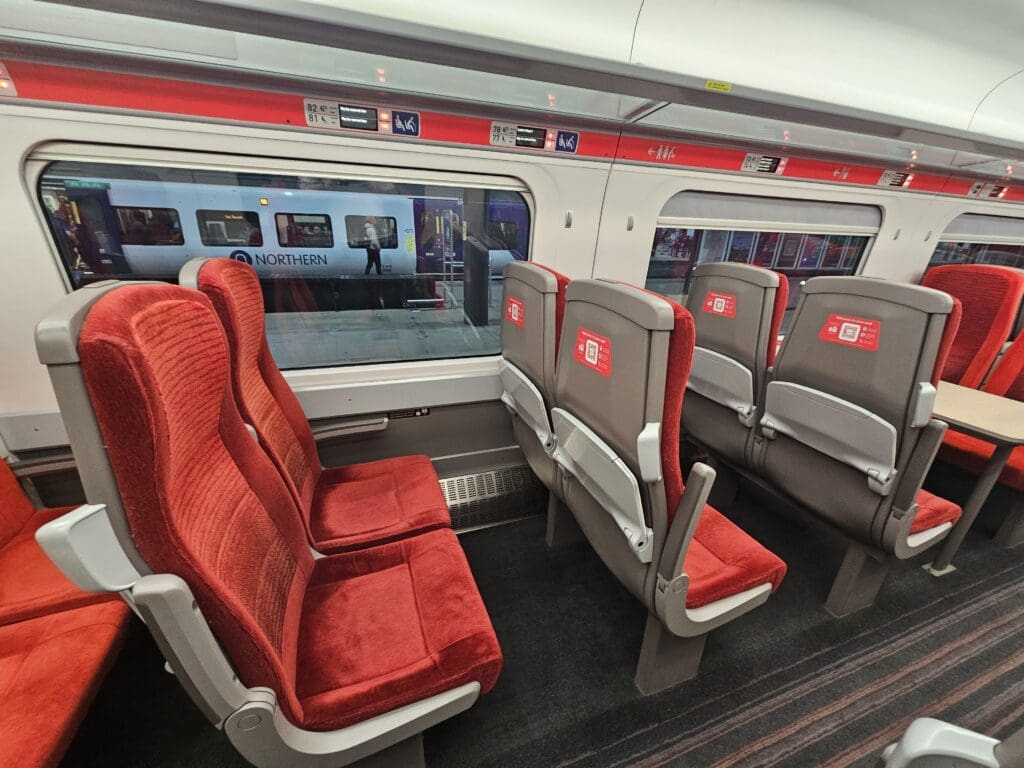
With my service starting its journey in Leeds, by the time I made it to the station, the nine-carrier LNER Class 801 Azuma train could already be seen at the platform, waiting to carry its next load of passengers to the capital. With boarding underway, I navigated myself to Coach J and made my way onto the train. In keeping with LNER’s brand identity, onboard, all Standard seats are covered in a bright red fabric and appear to be rather thin, although once seated, I found these to be acceptably spacious and comfortable. With these trains designed for long journeys across the country, they are complete with modcons such as plug sockets and at-seat ordering systems for those who fancy something from the onboard café but don’t want to trundle through the train. Departing after the morning rush of commuters and tourists heading down to London, the train ended up being delightfully empty and I was able to enjoy the luxury of a vacant neighbouring seat.
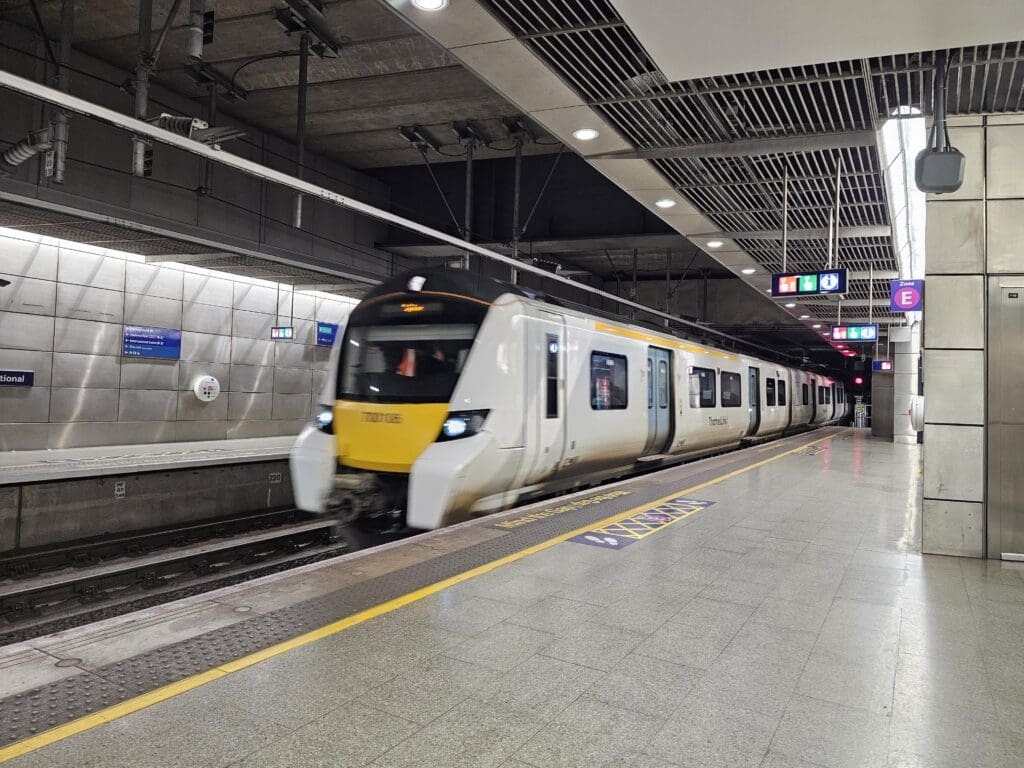
Two minutes behind schedule, the train sped out of the station and began its journey south. Waving goodbye to Leeds as we trundled out of the city centre and headed southwards past Elland Road, we soon reached our first stop, Wakefield. Following subsequent stops in Doncaster and Peterborough, two hours and fifteen minutes after leaving Leeds, the train came to a halt under the grand train shed of London Kings Cross. This left me with exactly 18 minutes until my Thameslink service to Gatwick Airport departed from the underground platforms at neighbouring London St Pancras International Station. Right on time, the modern Class 700 electrical multiple unit ploughed into the platform on its 103-mile long journey from Bedford to Brighton. Unlike the LNER service, this train was far more spartan and designed to pack in as many commuters as possible rather than offer comfort on long journeys. However, I sat in the declassified first class section at the rear of the train which allowed me to enjoy a slightly more comfortable seat for this 44 minute hop to the airport.
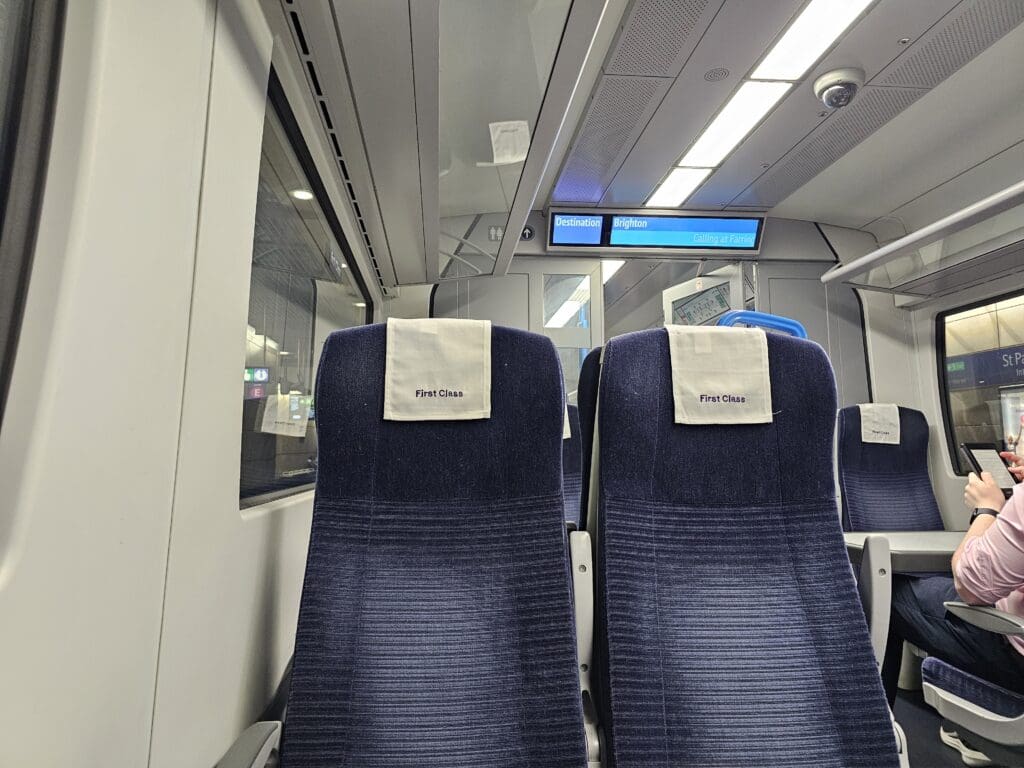
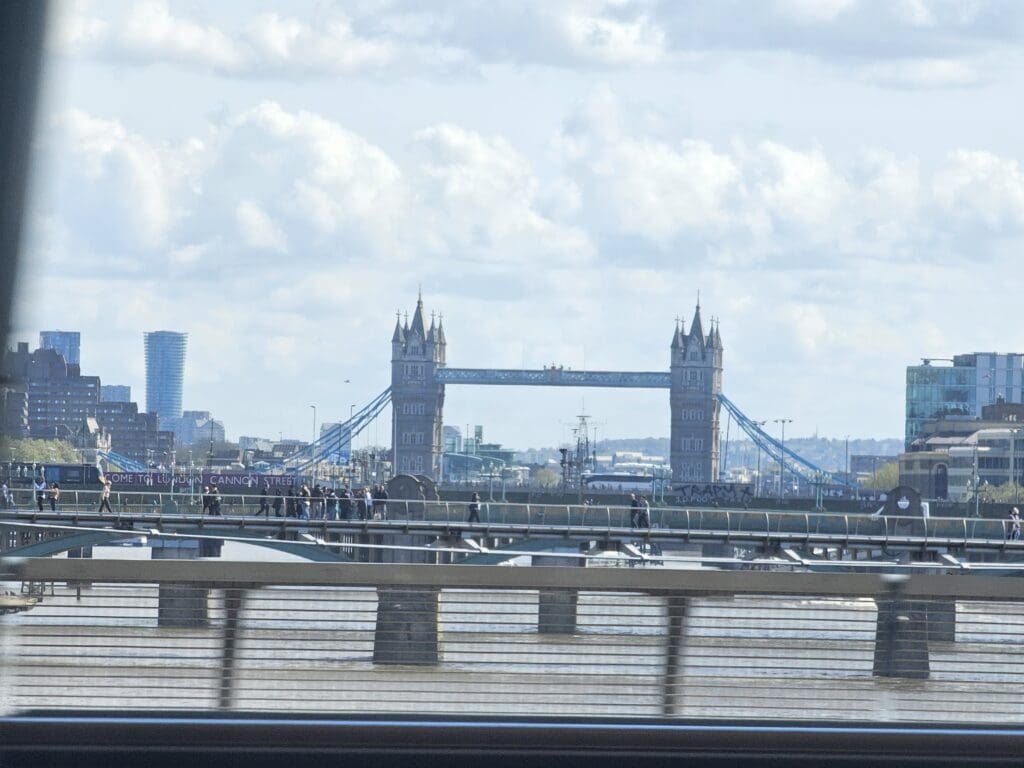
Following a short journey through the tunnels under Central London, the train emerged out in the open and we travelled over the Thames at which point I caught sight of some of London’s key landmarks such as Tower Bridge, the Shard and HMS Belfast before speeding out through the sprawl of Central London. Following stops in Farringdon, City Thameslink, Blackfriars, London Bridge and East Croydon, the train came to a halt at Gatwick Airport Station where I disembarked along with most other passengers, almost all of whom were, like me, armed with large suitcases and ready to head off on their holidays.
For a significant amount of time, Turkmenistan Airlines utilised Terminal 4 at London Heathrow Airport. However, once the airline’s ban from the United Kingdom had been lifted, the airline shifted operations first to London Stansted and then again to London Gatwick where today the airline operates from the South Terminal. This meant an easy walk over from the railway station compared to the North Terminal which can only be reached via a journey on the people mover. Within three minutes of disembarking the train, I found myself in the South Terminal’s busy landside arrivals atrium. Looking around, the landside portion of the terminal is by no means an architectural masterpiece and is arguably a little dated and shabby in its design.
However, this is home to a fair number of outlets including four chain cafés, a restaurant, a pub, and several shops including a Boots and an M&S Simply Food. In terms of its layout, the South Terminal’s check-in space sits adjacent to the arrivals atrium and consists of a rectangular hall where check-in desks are divided into seven zones. Travelling just before the Easter Bank Holiday weekend, unsurprisingly the terminal proved to be rather busy, with plenty of families seen rushing around ready to head off to grab some spring sunshine.
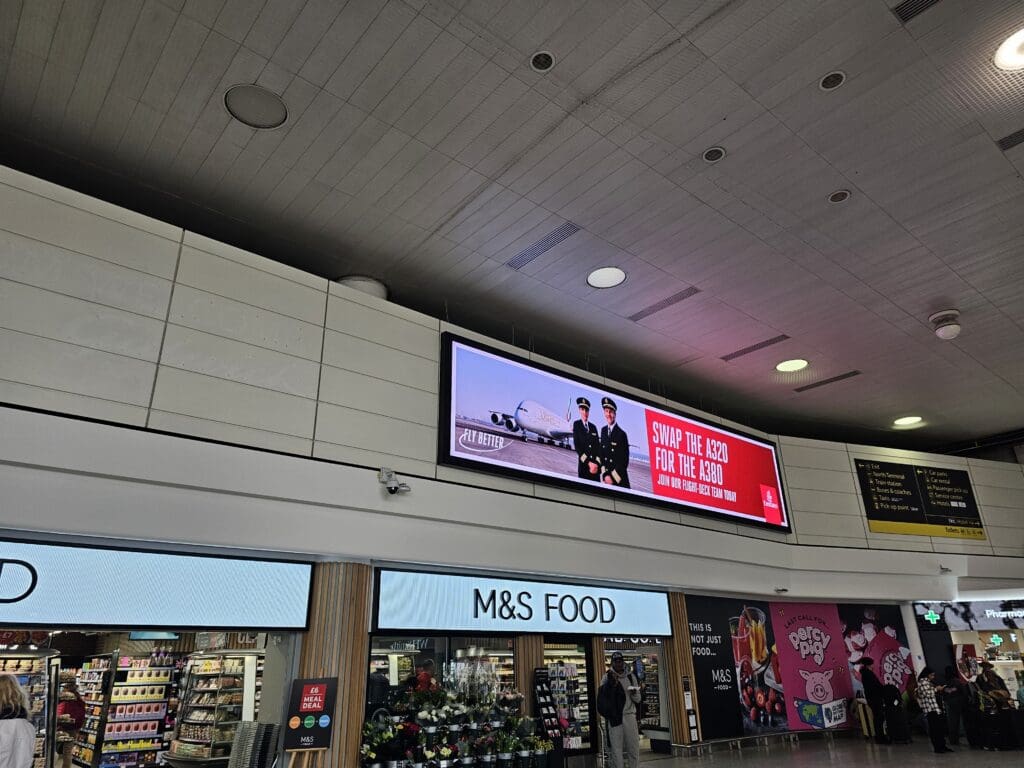
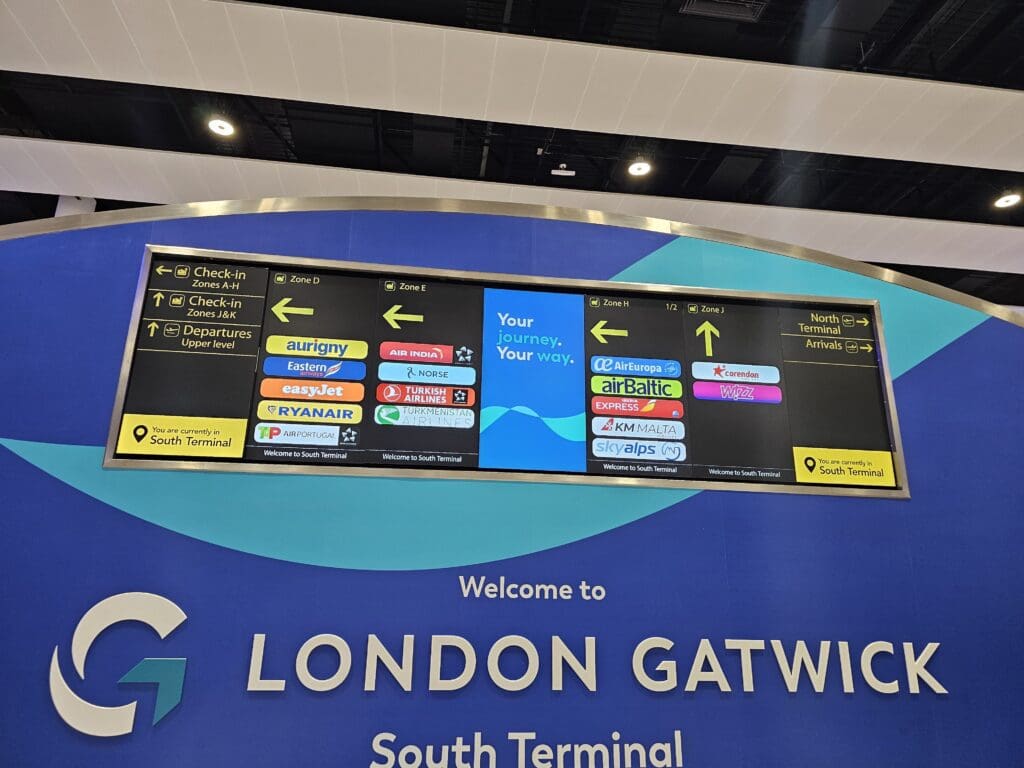
Once inside the terminal, I had a quick scan of the departure boards which revealed that check-in for Turkmenistan Airlines would be undertaken in Zone E, with the airline sharing this with Turkish Airlines’ large and well-branded check-in area. Without delay, I decided to wander over to this space in the hope that I would be able to part with my cumbersome suitcase. However, upon arriving there there was no sign of life so I made my way back to the arrivals area where I indulged in an overpriced meal deal for £6 from M&S Simply Food.
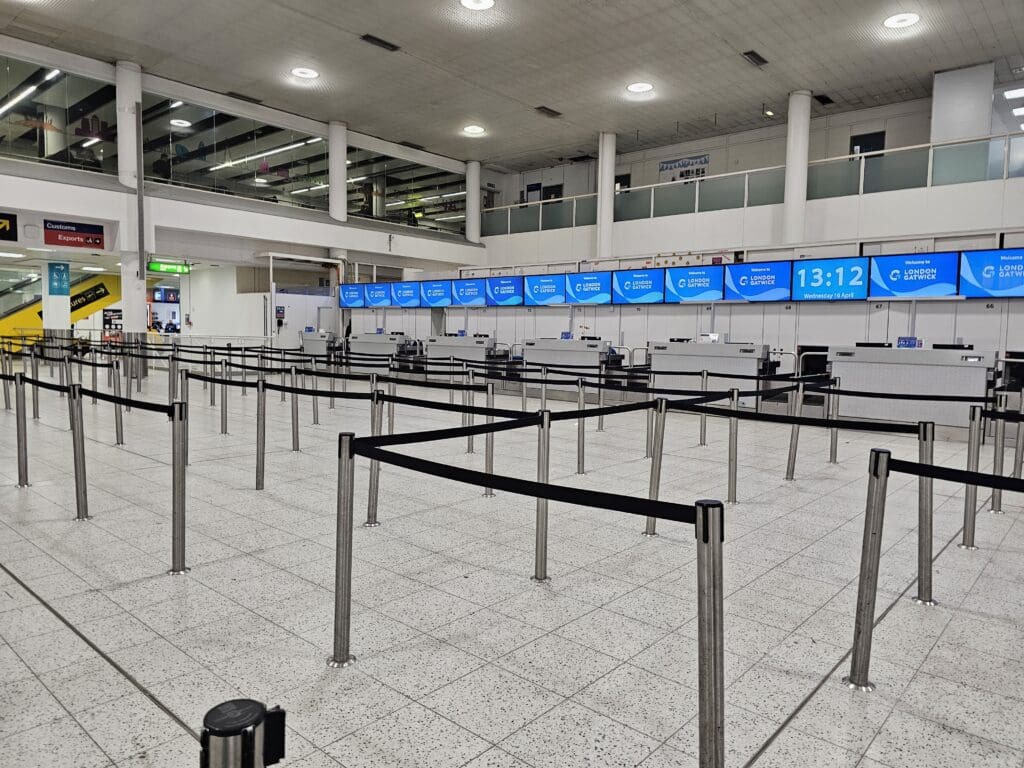
After polishing off my three-piece lunch, I journeyed back to the check-in area where three ASG Ground Handling agents, all of whom were smartly dressed in the company’s distinctive red and grey uniform could be seen undertaking their final preparations for the commencement of check-in, erecting signs advising where those in Business and Economy should queue. Meanwhile, at that time, a very small cluster of passengers could be seen milling around, consisting of myself and two passengers bound for Hanoi.
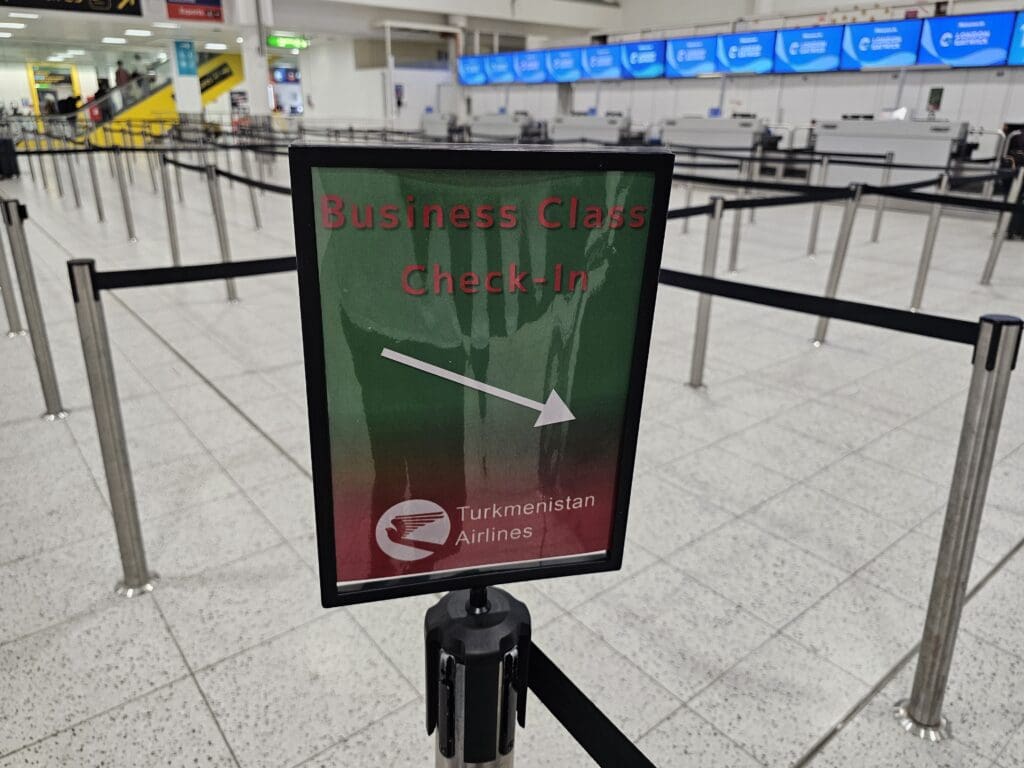
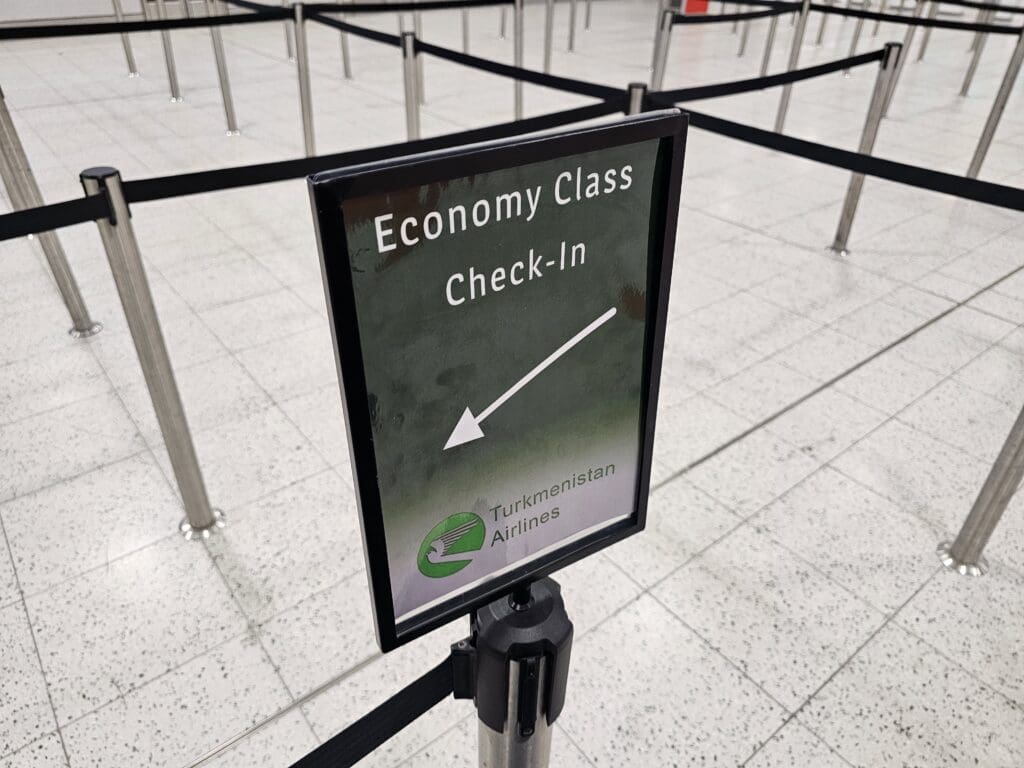
Just before 1330, check-in opened and I was directed towards one of the three desks. Leaving me with a great impression of the check-in staff, upon handing over my passport, I received a lively welcome from the friendly and talkative agent. However, they did seem to encounter a few issues when attempting to check me in, something that they noted to be a very common problem with Turkmenistan Airlines. Requesting a window seat, I was assigned Seat 21J for the first flight, and Seat 14A for the second, before two Turkmenistan Airlines branded boarding passes were printed off and handed over to me, whilst my bag was soon tagged and sent off into the depths of the terminal. Furthermore, as I had hoped, the agent remarked that the flight to Ashgabat would be nearly empty!
Given the lack of airside views in the landside portion of the terminal, once I had said farewell to my bag, I decided to head straight up the escalators to security. When I lived in London back in 2022, I was a more frequent visitor to the South Terminal and always found security to be very hit-and-miss – sometimes I would sail through and at other times I would end up standing in a snaking line for quite some time. However, that day, I was left with no complaints whatsoever. Despite being a fairly busy day for travel, once I had scanned my pass on the automated gates I was guided towards an empty checkpoint and passed through this quickly and easily with no need for any additional checks – making it through in no more than a minute.
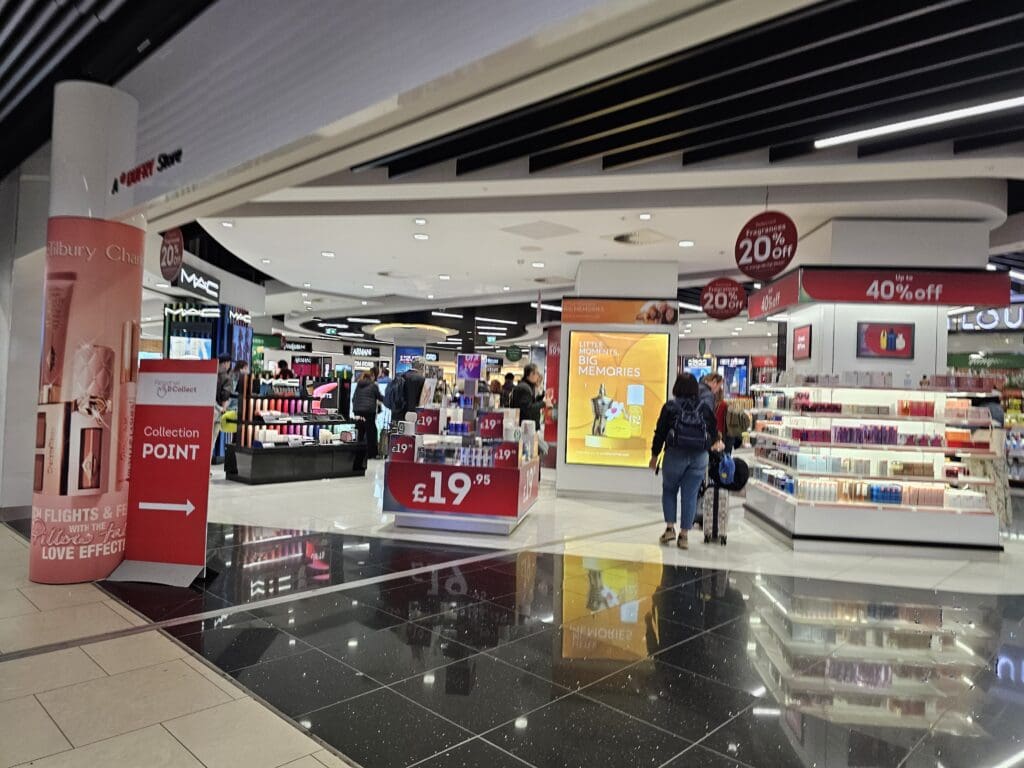
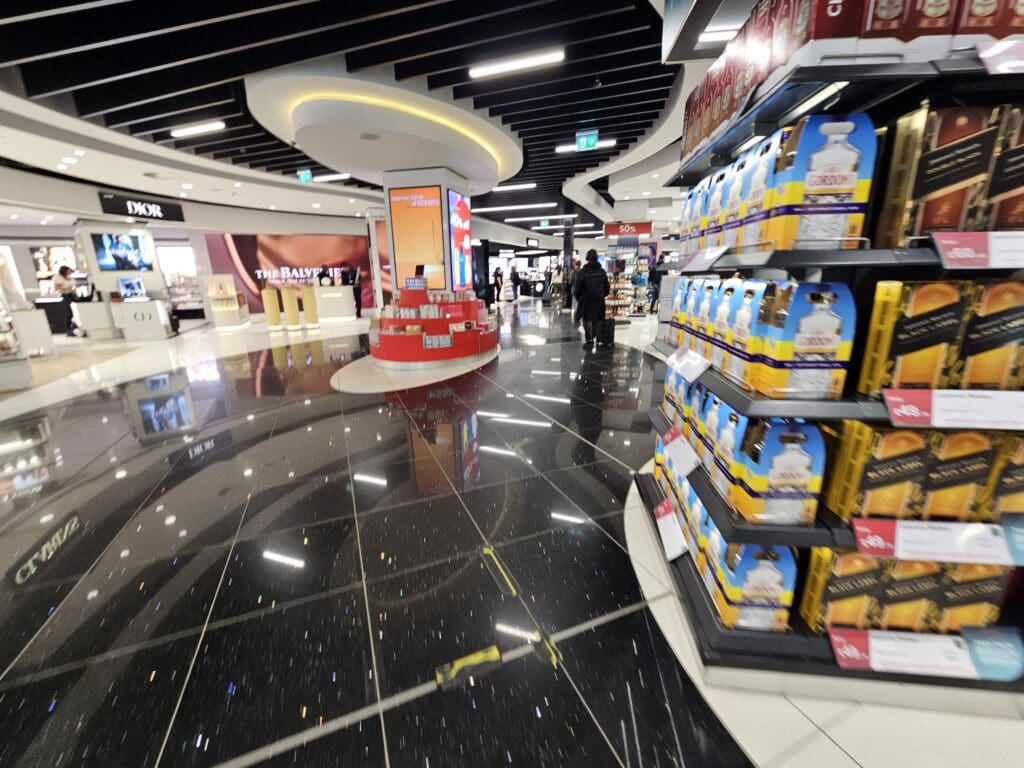
As with many airports across Europe and indeed further afield, once through security, I was forced to undertake a route march through the local World Duty Free outlet. As you would expect from one of Britain’s busiest airport terminals, this was rather large and sold all the usual array of items that you would expect to find in a duty free store alongside a range of overpriced souvenirs. Steaming through this without stopping, I soon arrived in the main airside waiting area which is sits across two floors and is home to most of the terminal’s facilities. In order keep passengers waiting there and spending money, as with many airports, gate numbers are not revealed until a reasonably short time before boarding. Thus, this part of the terminal can end up getting rather busy and that afternoon free seats seemed to be at a premium. Examining the facilities, this contained a fair selection of bars, cafés, restaurants and shops. All of these take the form of your usual high street chains, including the likes of Itsu, Nando’s, Pret, Starbucks and Wagamama. However, being an airport, prices for most items come with the usual airport markup and bargain options are virtually non-existent. Meanwhile, a fair selection of shops was offered, however, those expecting the same array of luxury goods outlets as can be found in Heathrow’s terminals would have been disappointed. Not needing to purchase anything, and with this part of the terminal being packed and lacking any airside views, I soon decided to explore the rest of the terminal.
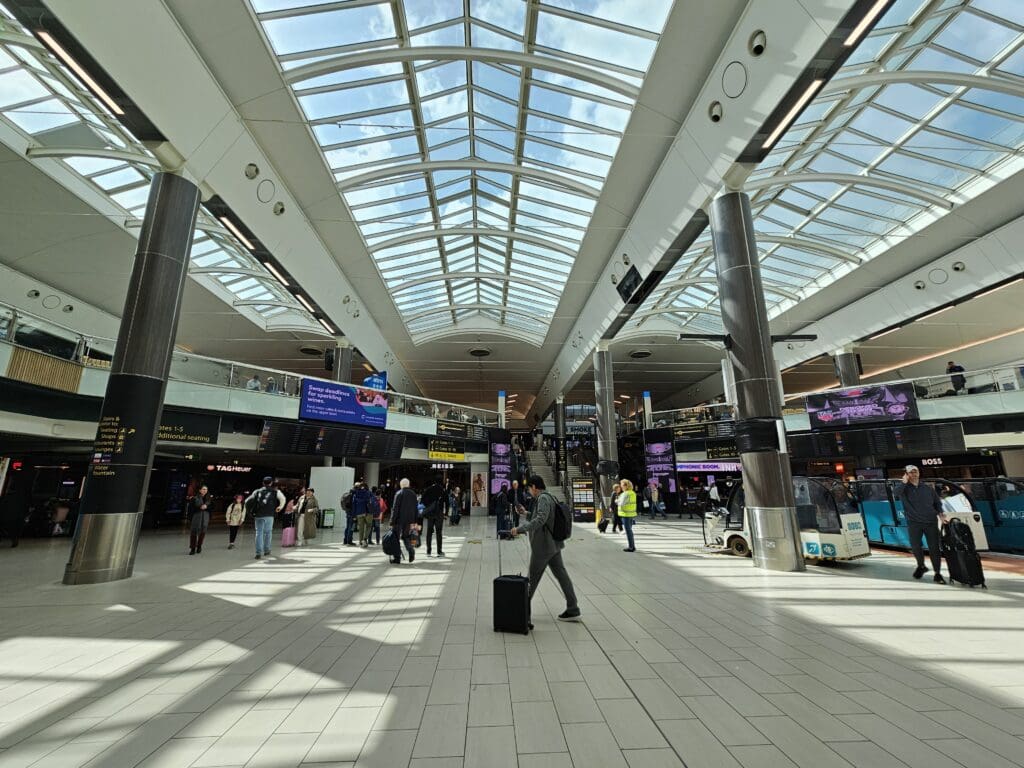
Examining its layout, the South Terminal is split across three piers that stretch out from the main airside waiting area and is home to 31 jet bridge-equipped stands. Wandering around, whilst I would not say that the terminal was dated in its appearance, I found it to lack any sort of memorable design features or facilities. In my opinion, it is quite simply, a rather forgettable terminal. On the more negative side, I did find that charging points were a little hard to come by, whilst the toilets were most certainly some of the most disgusting that I have come across at a British airport – although, for the most part, the rest of the terminal was reasonably clean.
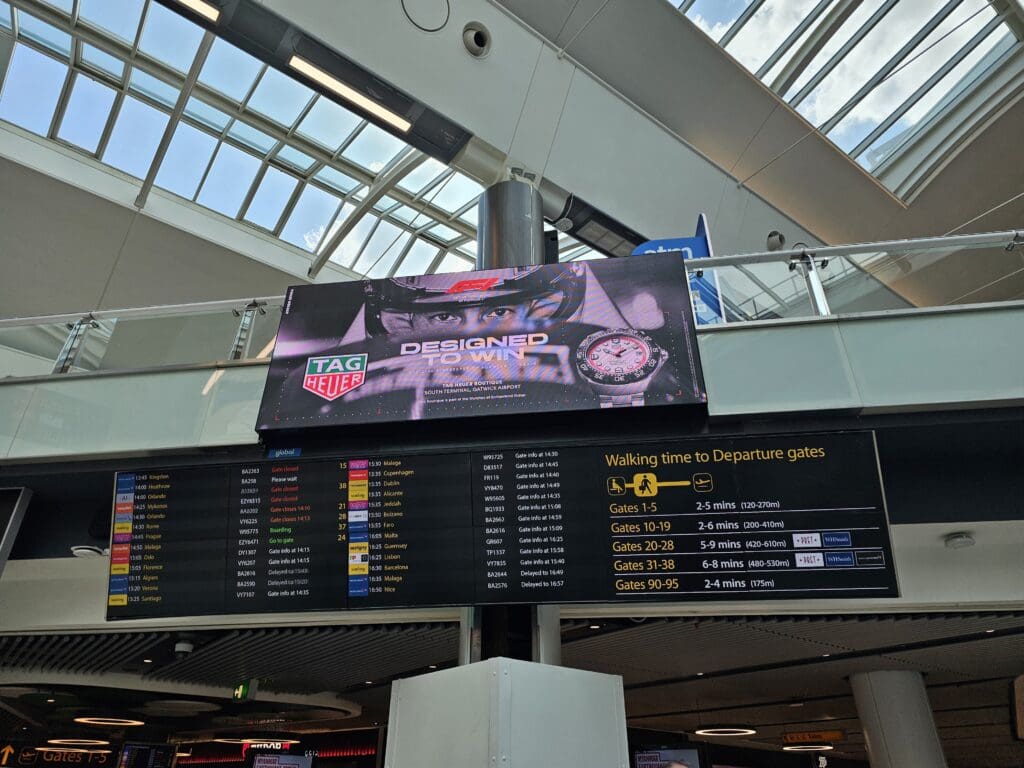
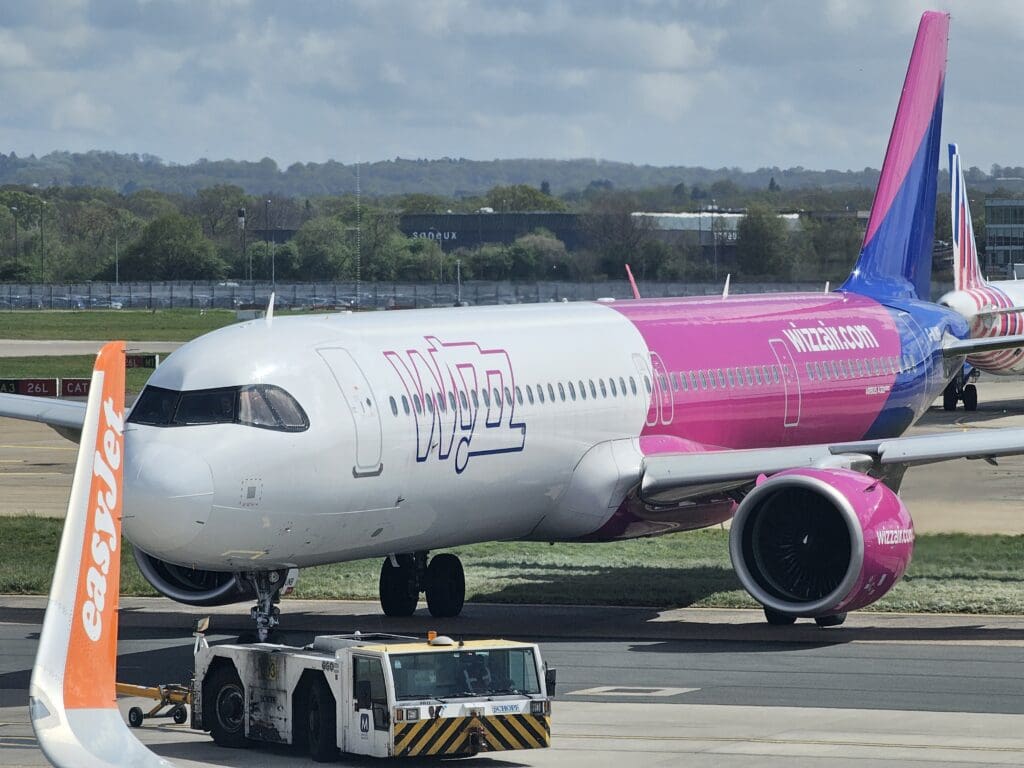
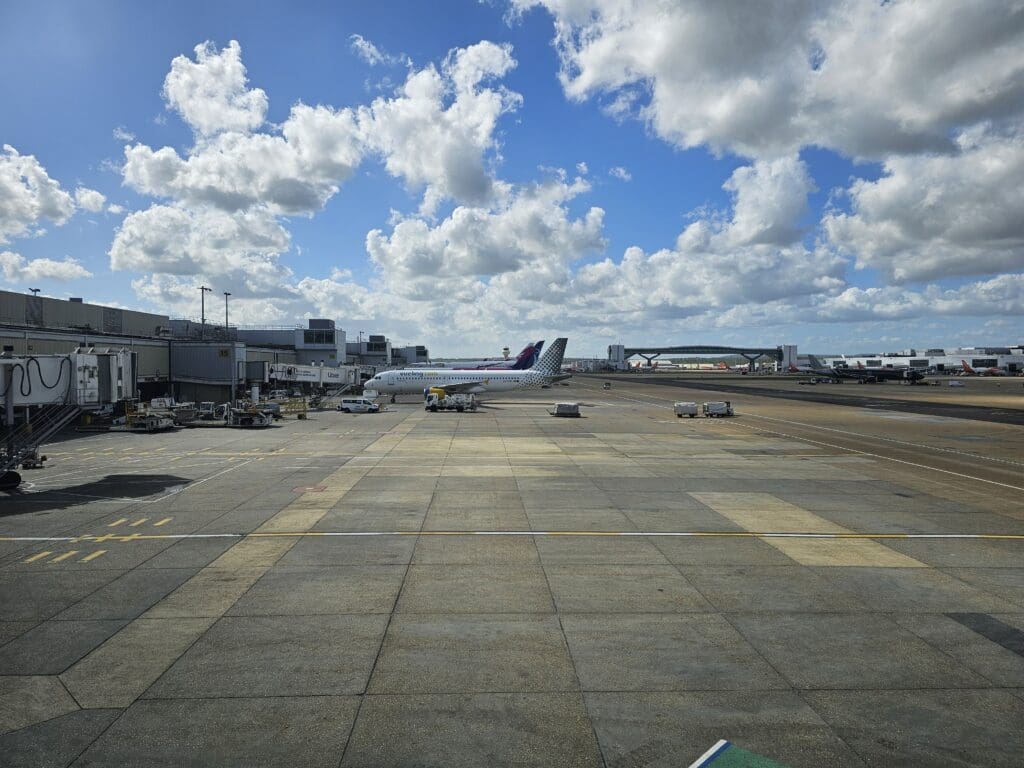
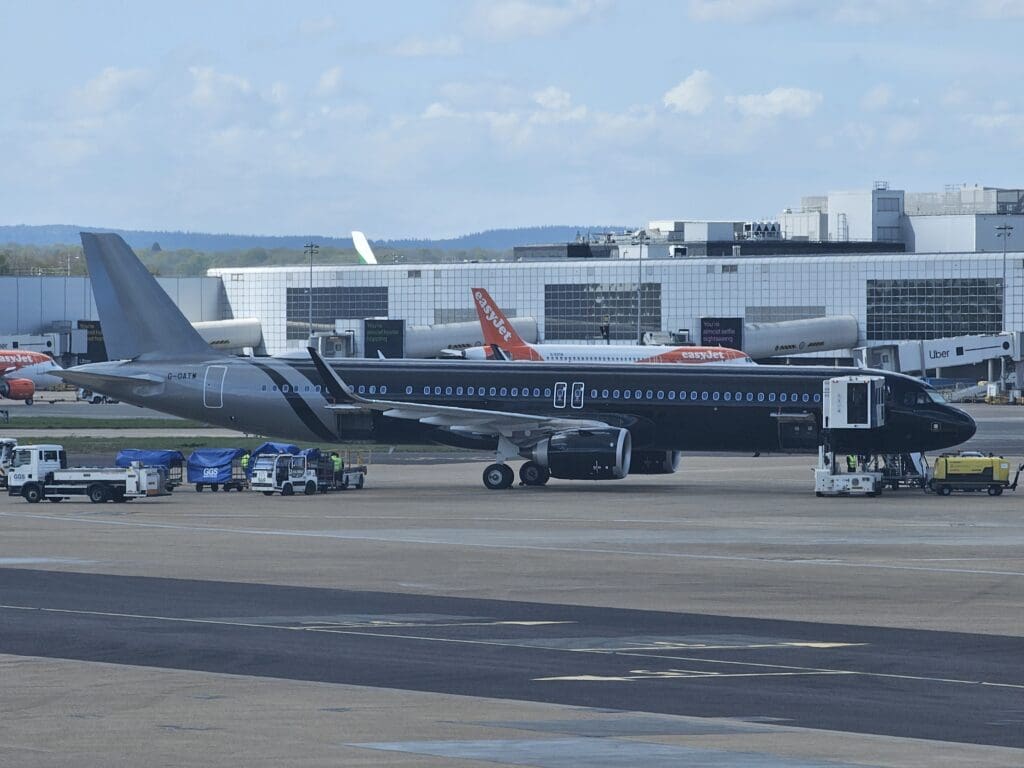
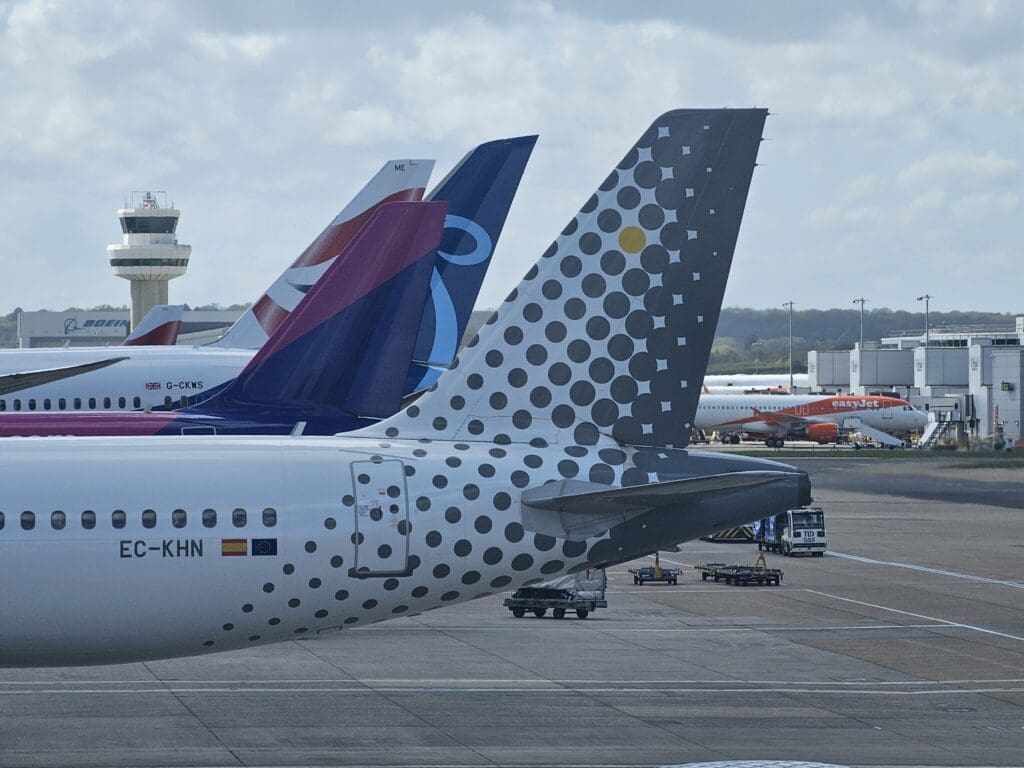
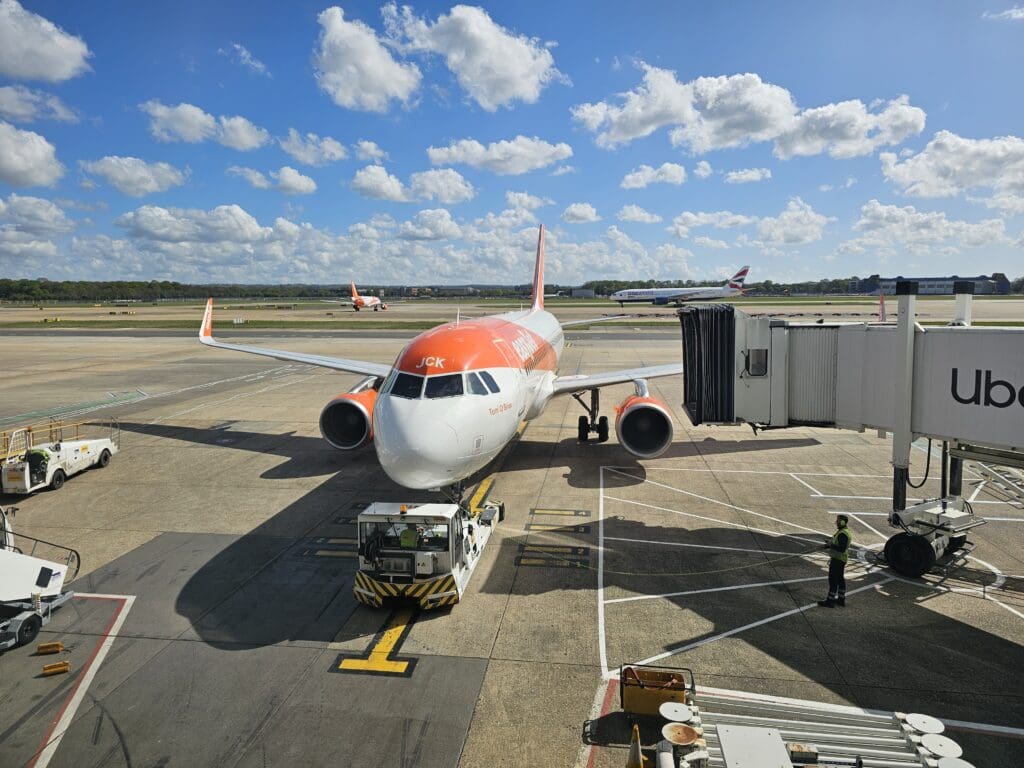
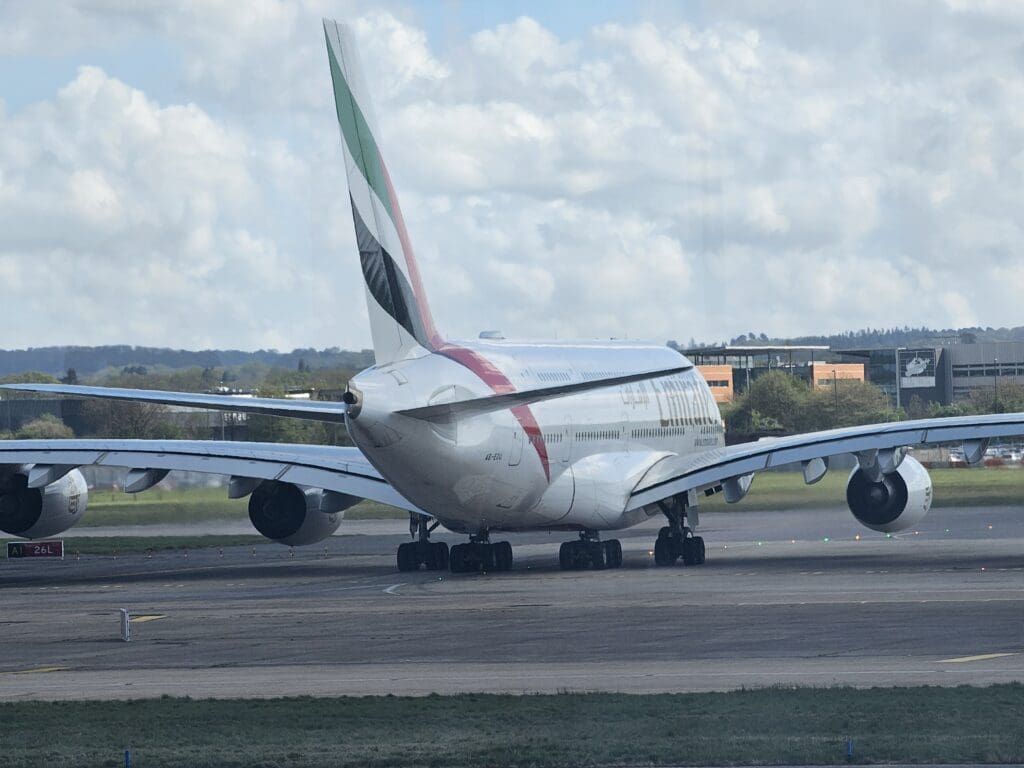
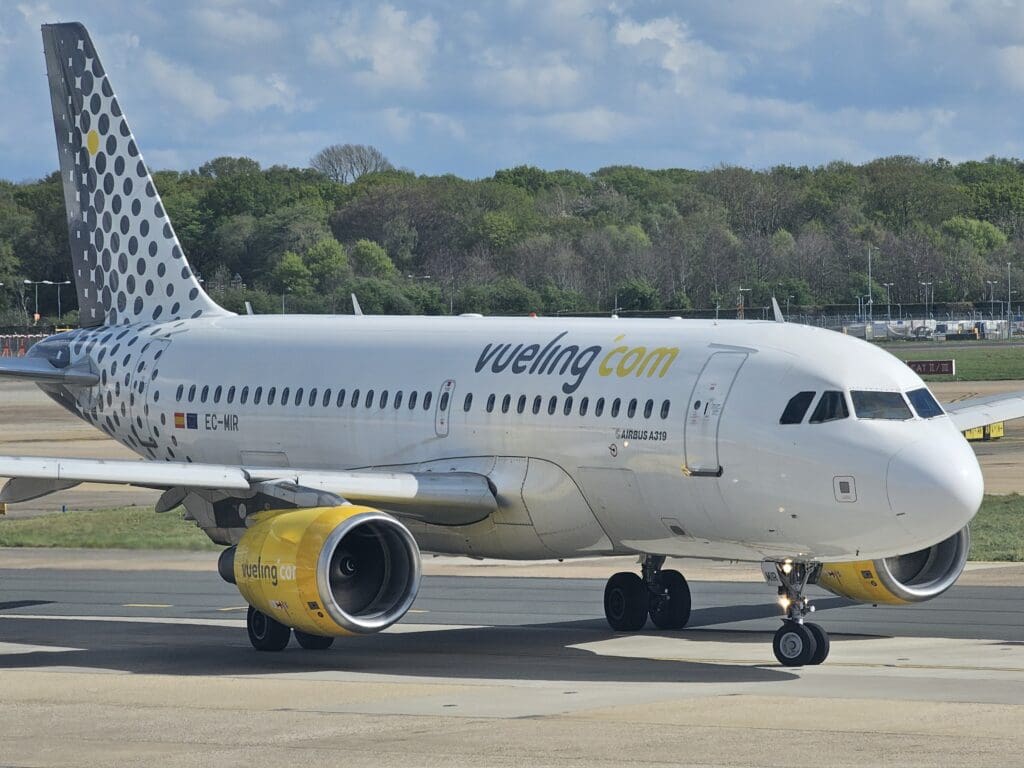
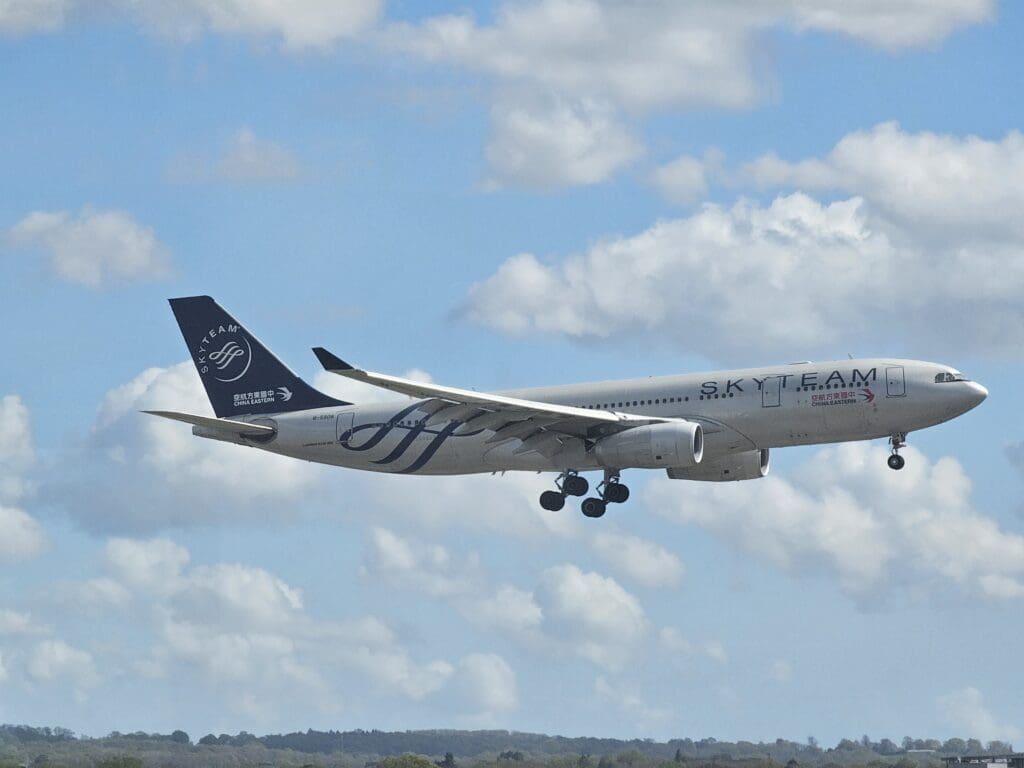
After wandering around, I plonked myself down near a gate that offered a good view out onto both the stands below and the runway. That day, a virtually constant queue of aircraft could be seen waiting to depart, with Gatwick being somewhat well-known for its departure queues thanks to the fact that it only has one operational runway. Today, the South Terminal hosts British Airways’ Gatwick operations, with its Airbus narrowbody flights operated by subsidiary BA EuroFlyer. Other key users include EasyJet, Norse Atlantic, TUI Airways, Vueling and Wizz Air. Alongside these, from a British enthusiast’s viewpoint, the terminal also hosts a few interesting carriers, including Nigerian operator Air Peace, and of course Turkmenistan Airlines.
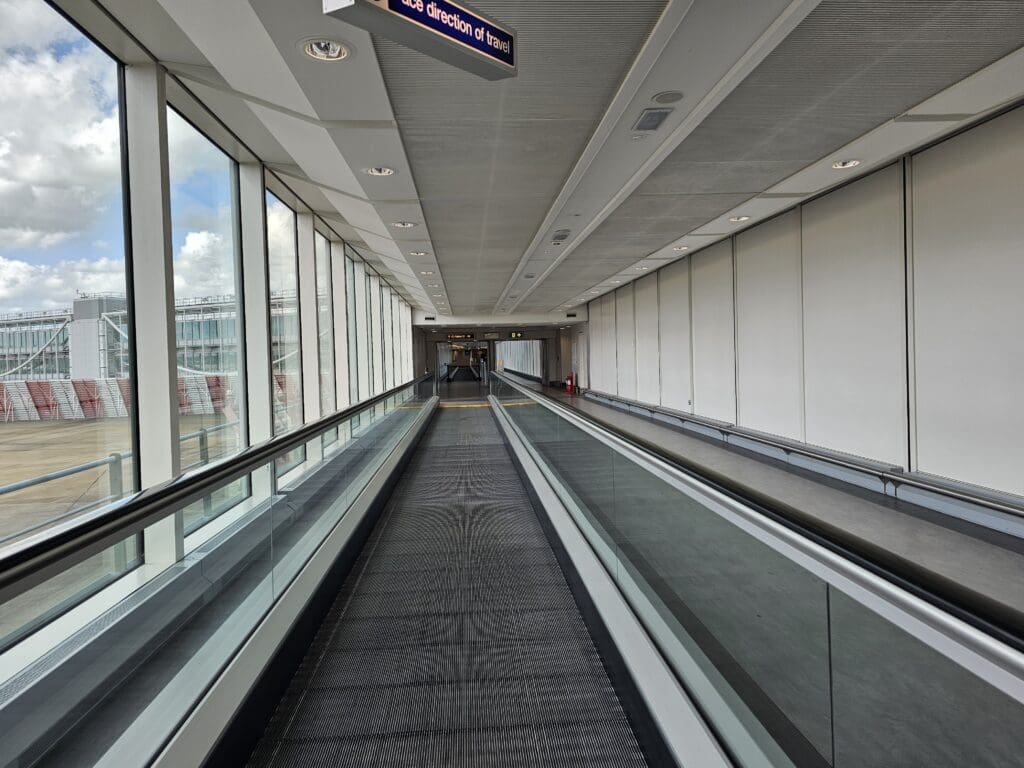
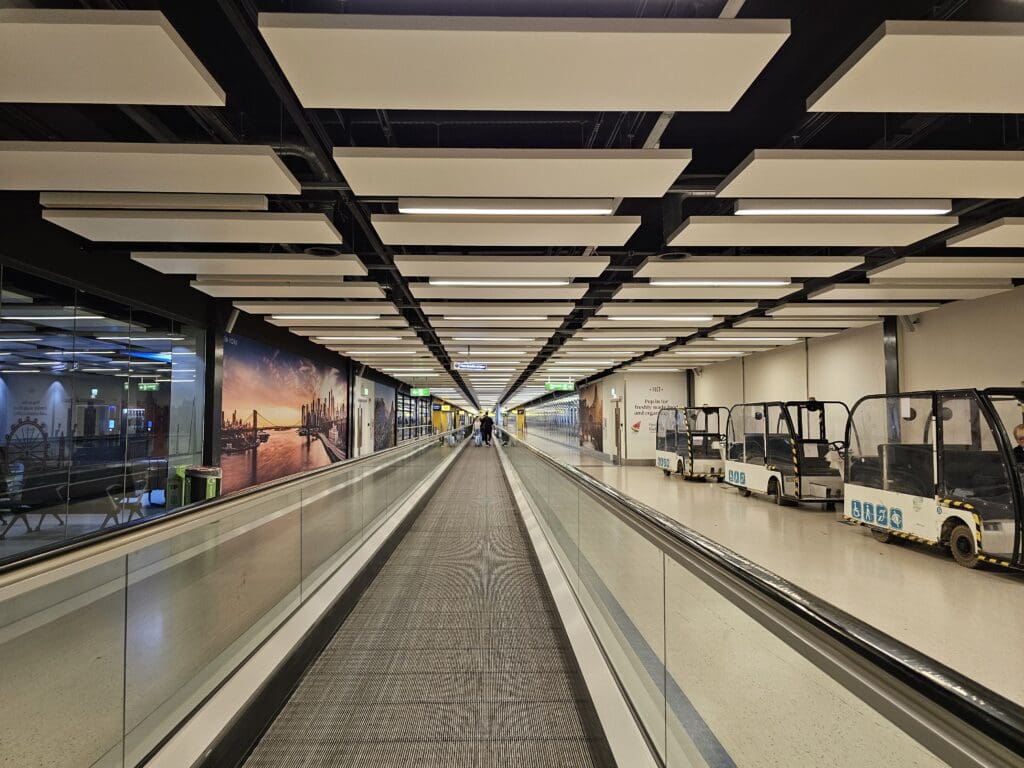
Had I not wished to jet off to Ashgabat, between arriving in the airside portion of the terminal and my departure, 27 flights operated by British Airways, EasyJet, Norse Atlantic, Norwegian, Ryanair, SkyAlps, TAP Air Portugal, Vueling and Wizz Air could be seen on the departure boards. These were operated by aircraft ranging in size from the Dash 8 Q400 up to the Boeing 777-200ER and Boeing 787-9 Dreamliner. Strangely, I spotted a British Airways flight to Heathrow on the departure boards – this was not a revival of the helicopter service that the airline once operated between the two airports but was instead a Dreamliner-operated positioning flight that had been flown in from Jeddah and had diverted into Gatwick rather than flying to Heathrow.
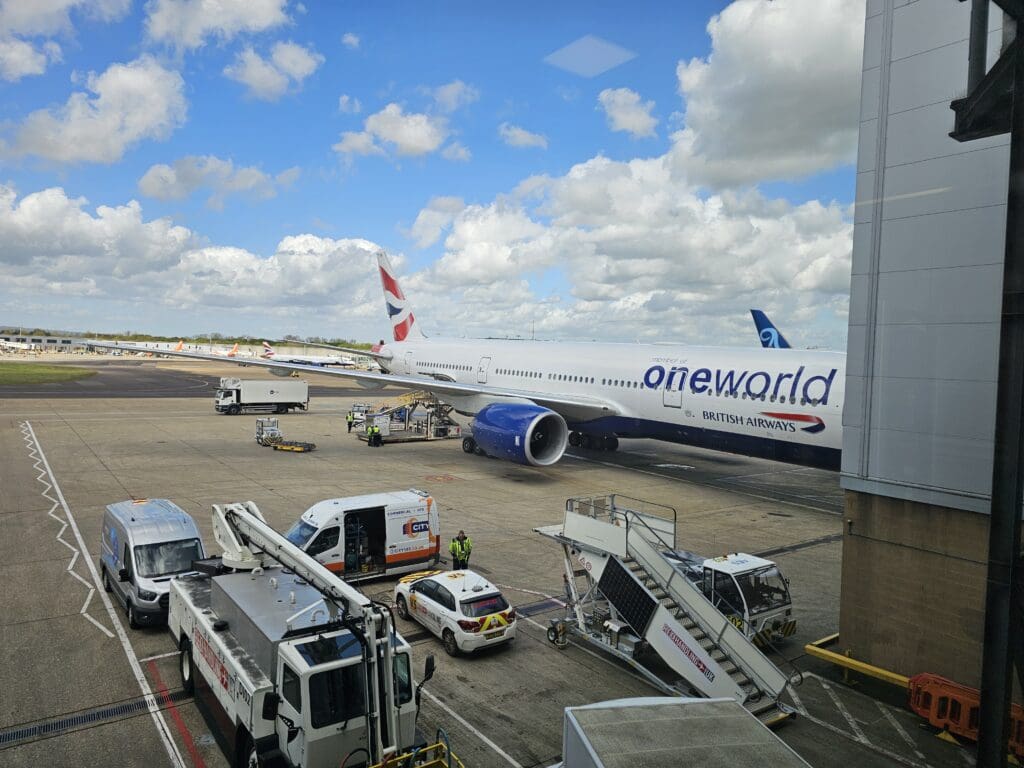
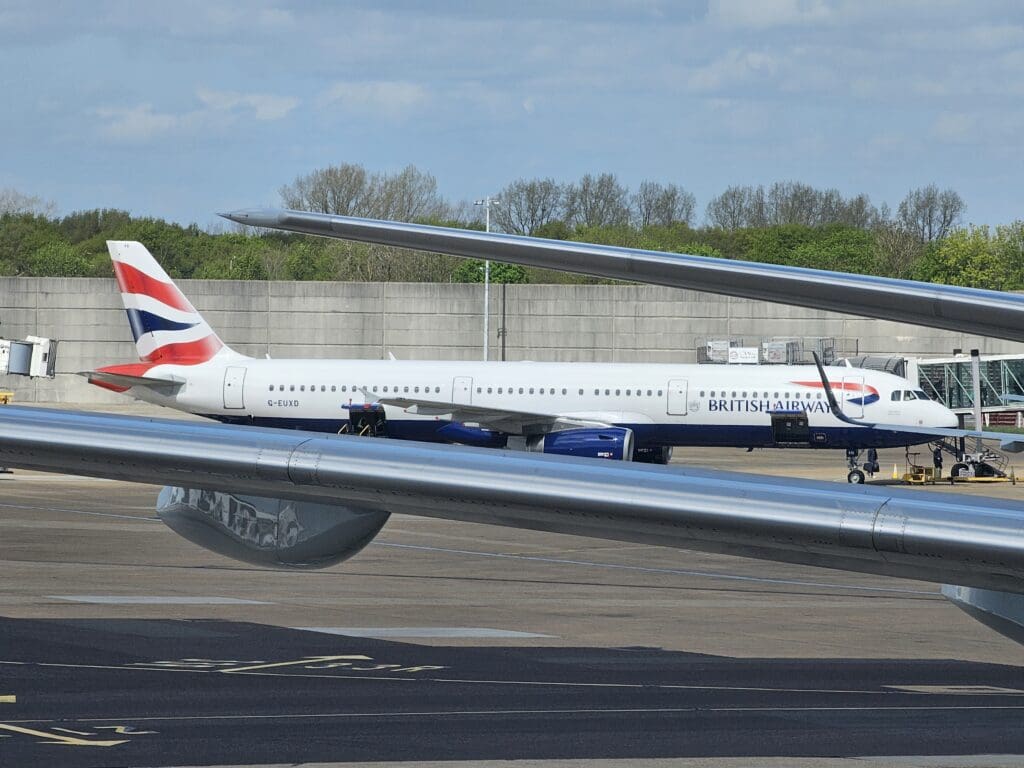
When flying to Heathrow, Turkmenistan Airlines’ services were usually operated by their now-retired Boeing 757-200 fleet, and occasionally upgraded to the Boeing 777-200LR or downgraded to the Boeing 737-800. Today, the route between Ashgabat and London seems to be one of the few that is almost exclusively operated by the Boeing 777-200LR. This is the rarest variant of Boeing 777, and the two examples in Turkmenistan Airlines’ fleet have a unique interior, as opposed to their Boeing 777-300ERs, which retain the interior of their former operator, Cathay Pacific. Thus, being an enthusiast, I was happy to see that the inbound service was operated by a Boeing 777-200LR and tracked this as it plodded across Western Asia and Europe to London.
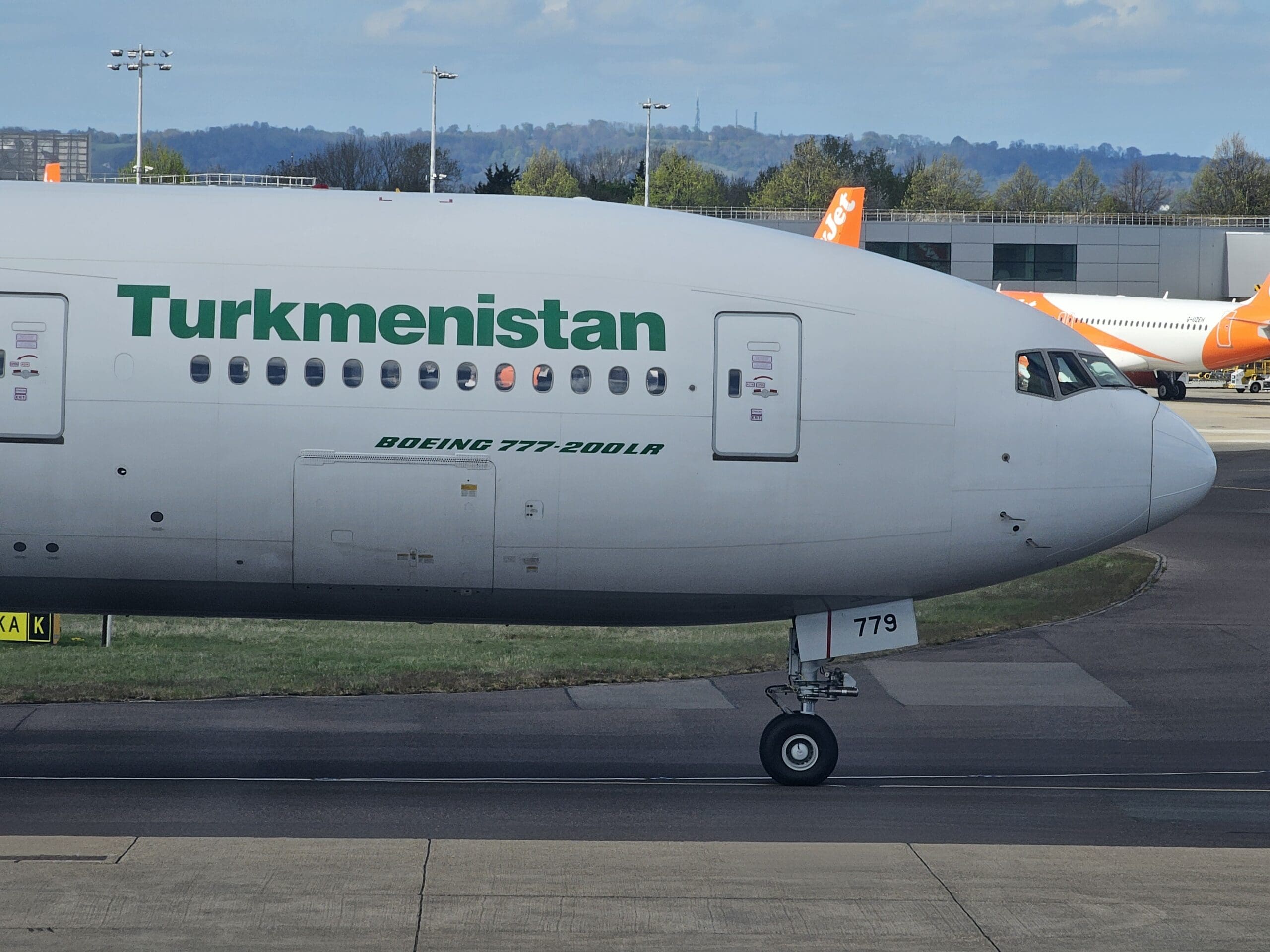
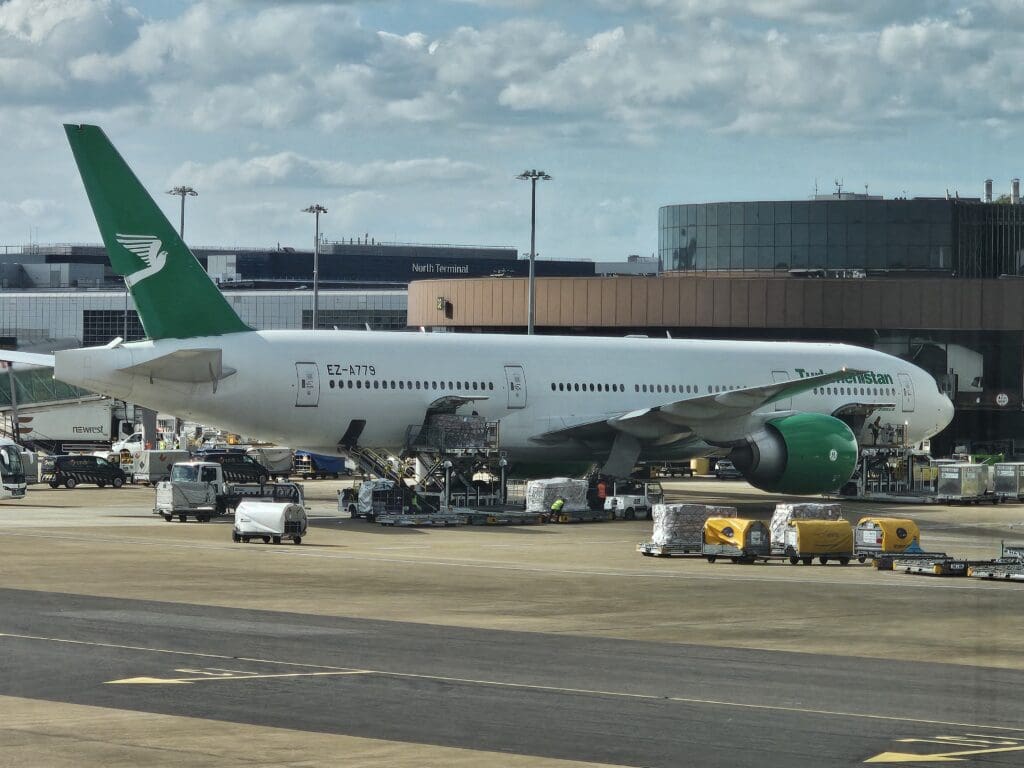
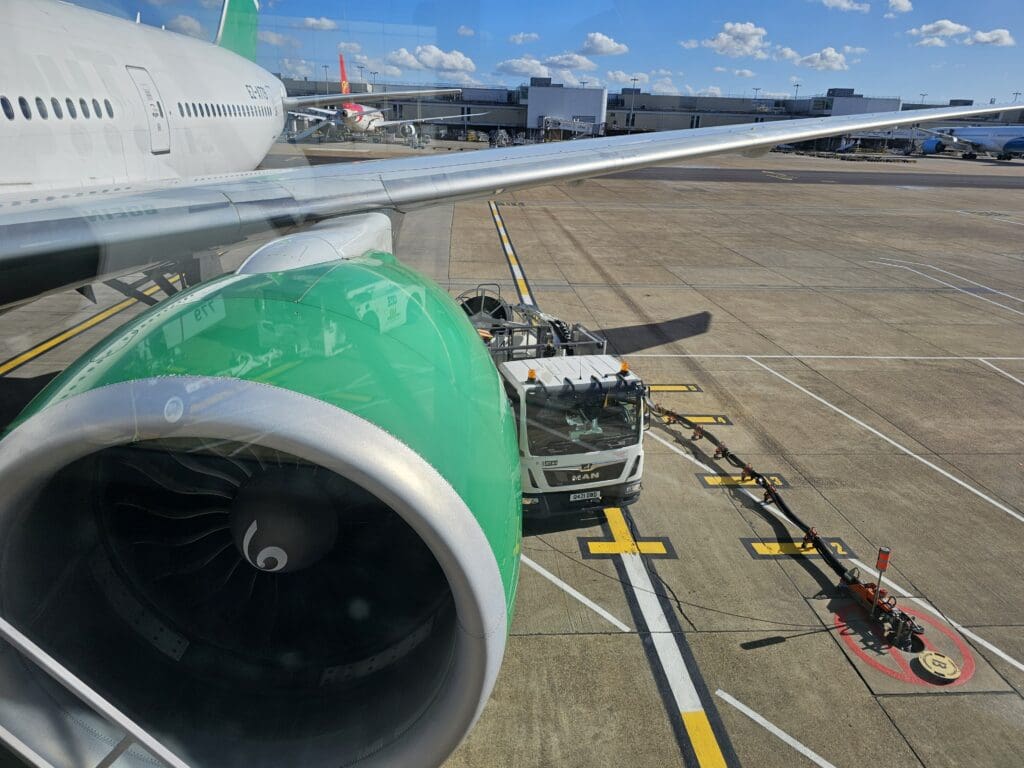
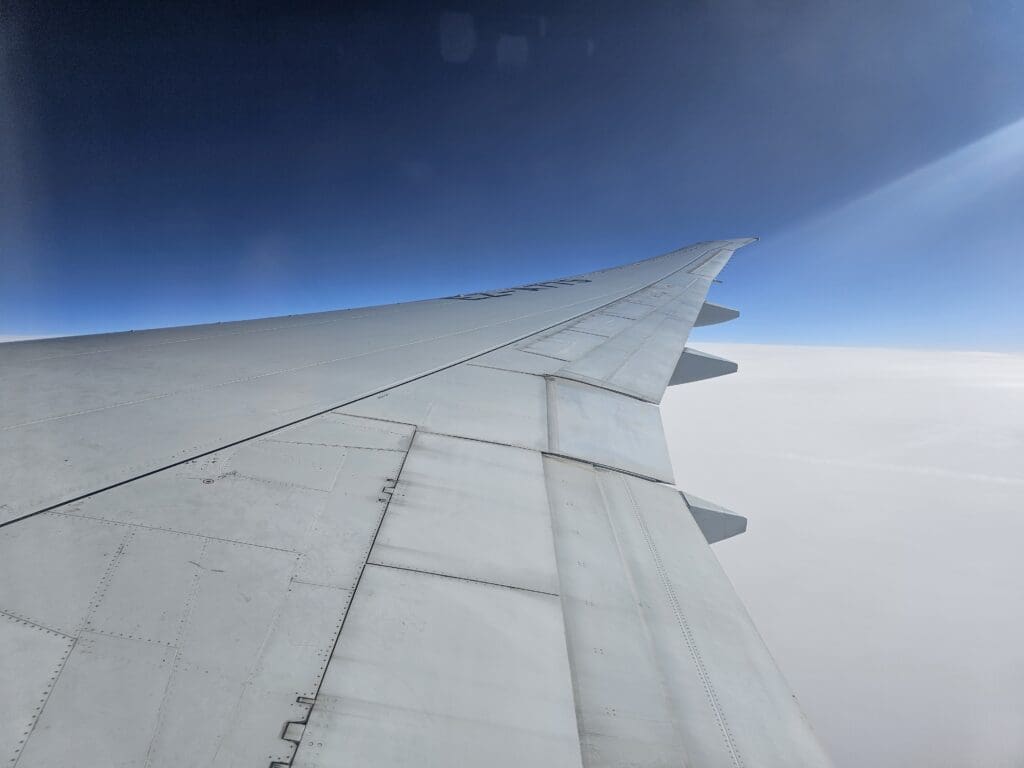
That day, I would voyage over to Turkmenistan onboard Boeing 777-22K(LR), EZ-A779. Assembled at Boeing’s Everett plant, this aircraft first took to the skies in early April 2014, thereby making it a modest eleven years old at the time of my flight in April 2025. Carrying the line number 1194, later that month, the aircraft was ferried across the world to Ashgabat, where it has been based ever since. Until the delivery of Turkmenistan Airlines’ first Boeing 777-300ER in 2024, along with its sister ship, EZ-A779 was the backbone of the airline’s long haul network, although today, this operates to a fairly limited number of destinations. In the week before my flight, this particular aircraft had visited Ho Chi Minh City, Istanbul Jeddah and London Gatwick, operating eleven sectors during this period, covering at least 25,200 miles.
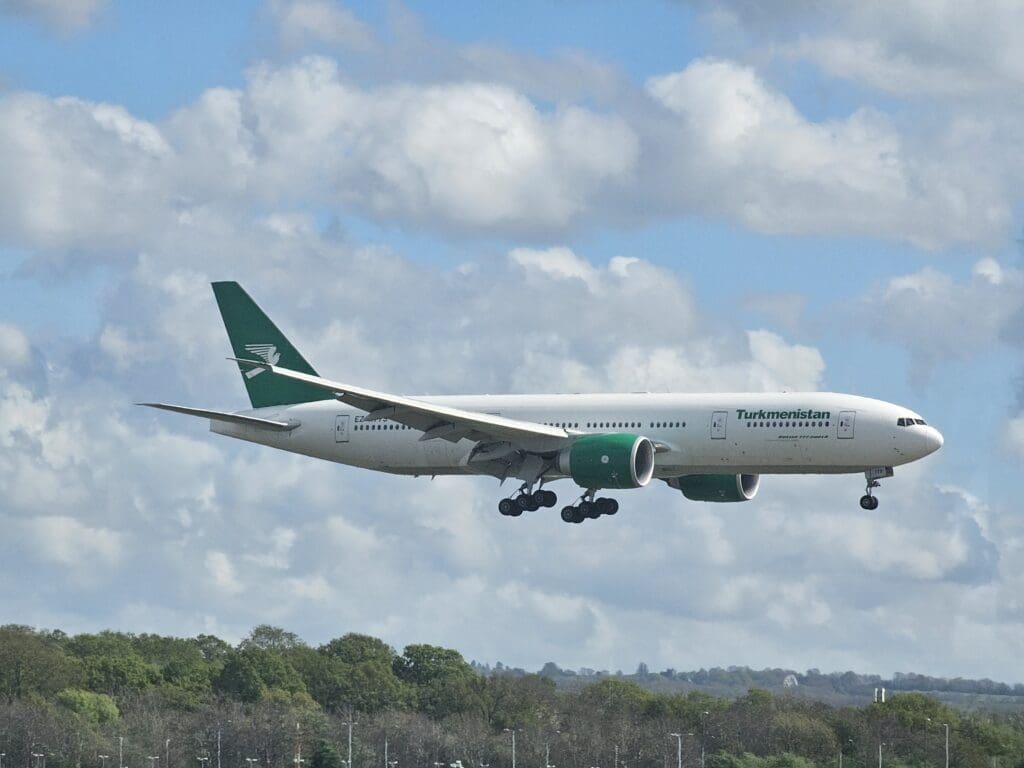
Looking outside, I watched as the majestic green and white Boeing came floating down over the runway and ended its slog over from Turkmenistan. Despite departing Ashgabat over an hour behind schedule, this touched down two minutes ahead of schedule, giving me hope that we would be able to make a punctual departure from Gatwick. Nevertheless, with a long stop in the Turkmen capital, I was not too concerned about delays. Several minutes later, the Boeing slowly and cautiously trundled past the terminal before cautiously making its way into Stand 31 where a team of ASG Ground Handling staff sprung into action and began to empty the cargo holds. I am not entirely sure what products the United Kingdom imports from Turkmenistan, but that day the holds seemed to be absolutely full of cargo and it took quite some time for all of this to be unloaded.
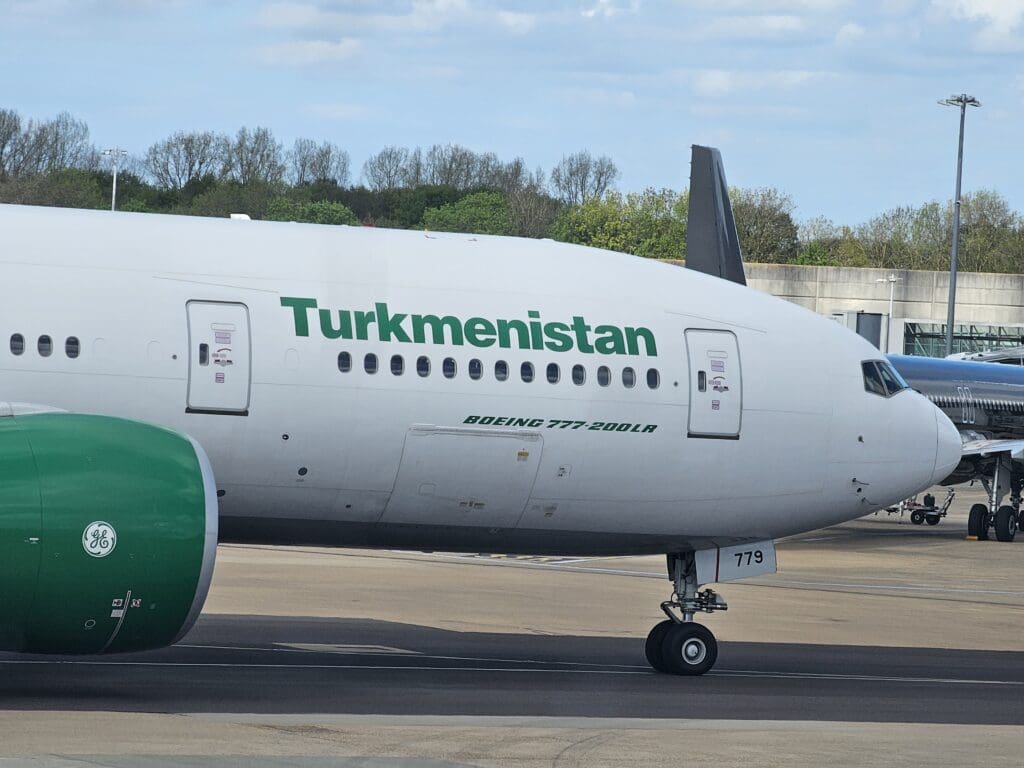
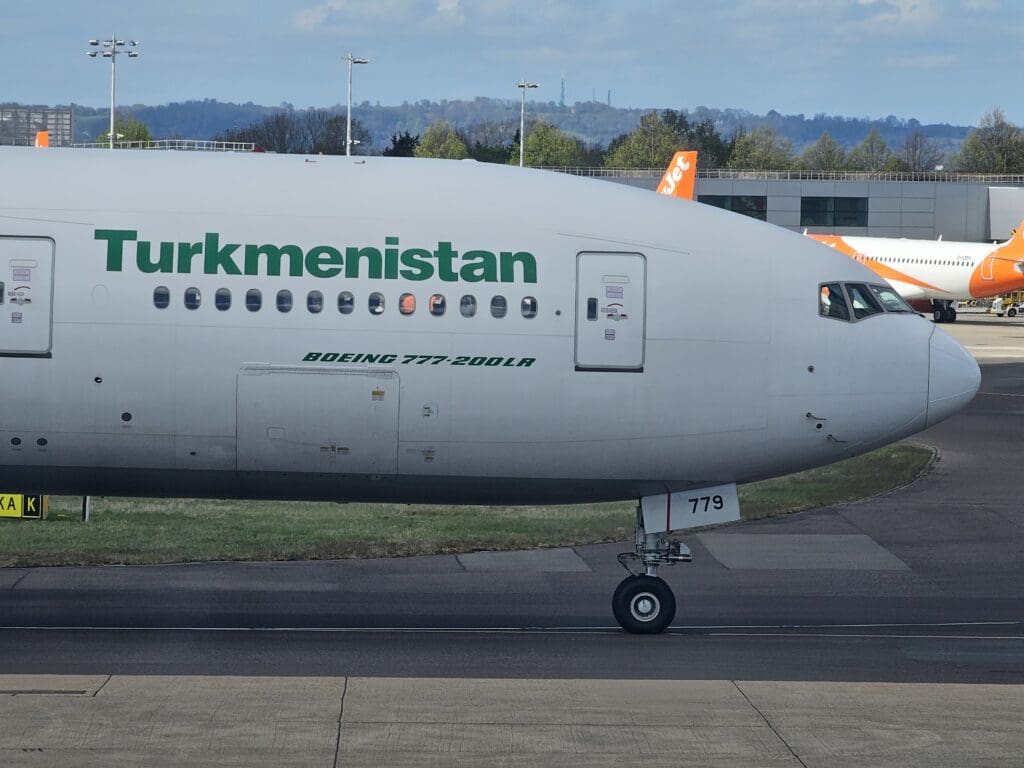
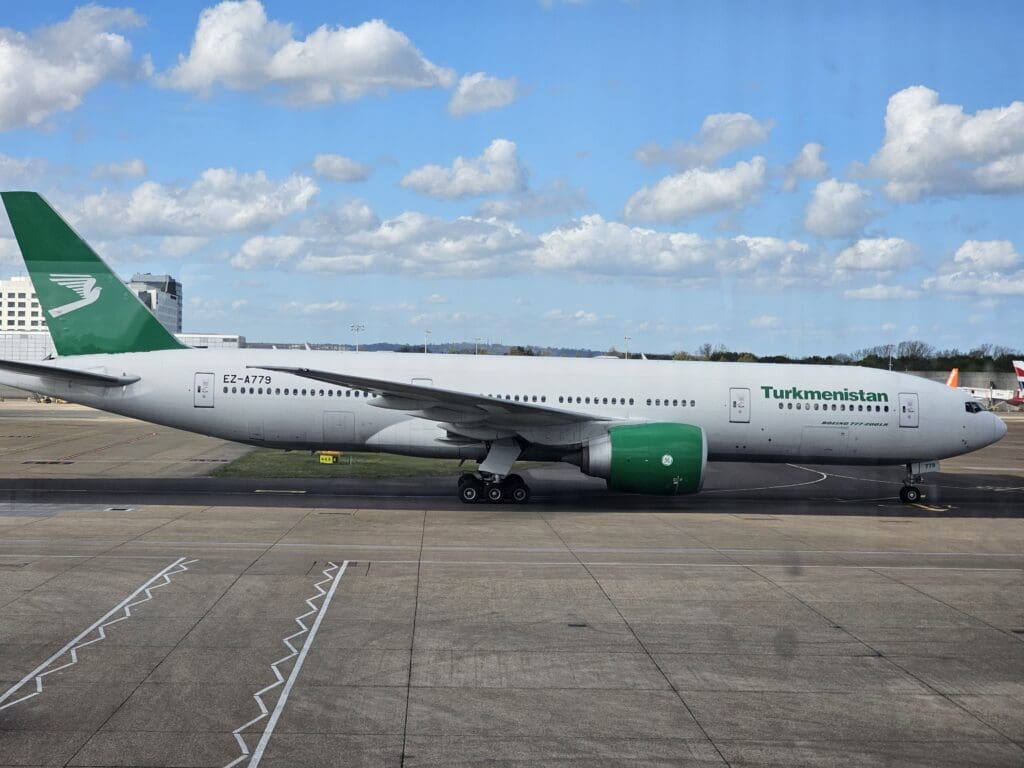
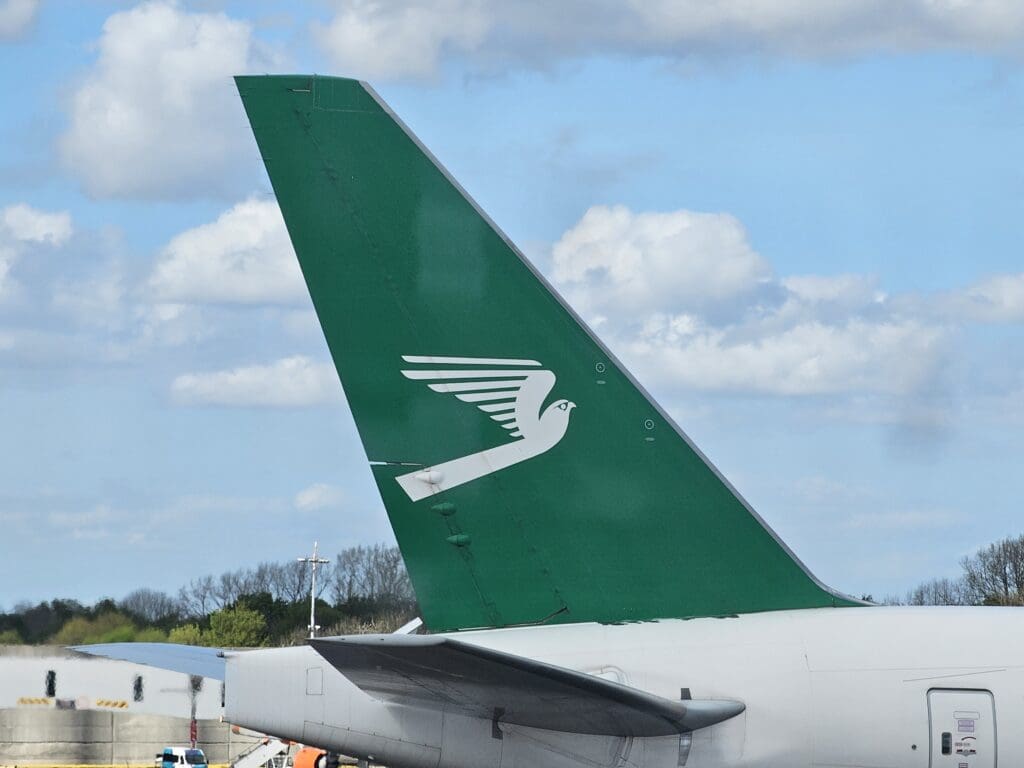
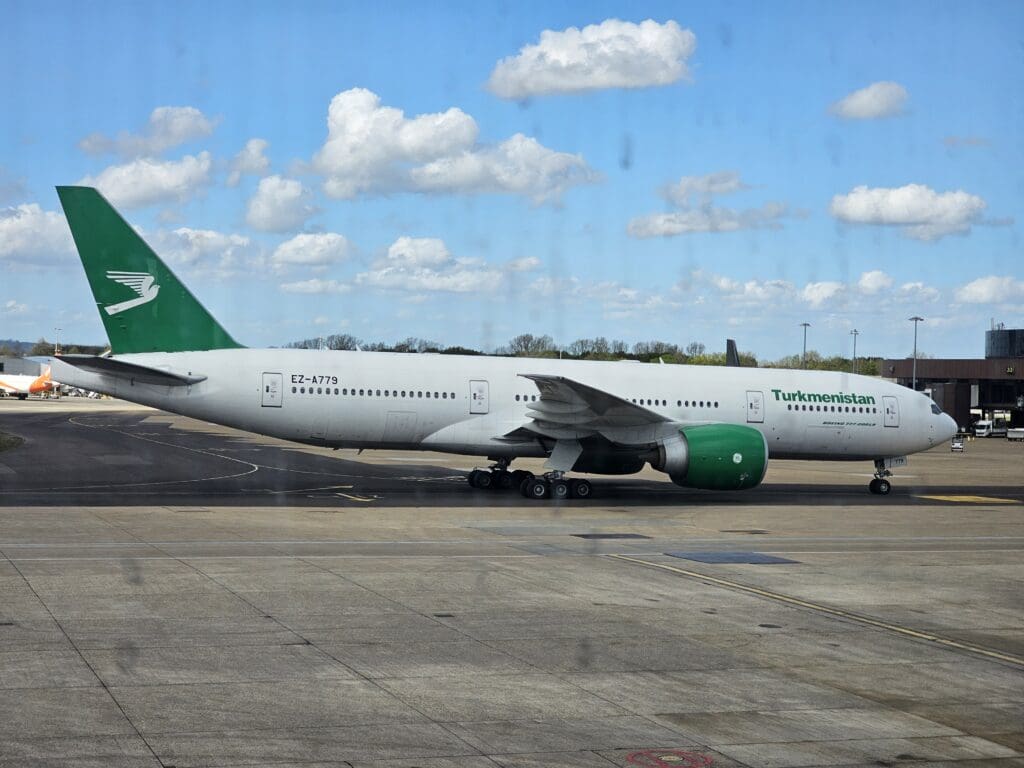
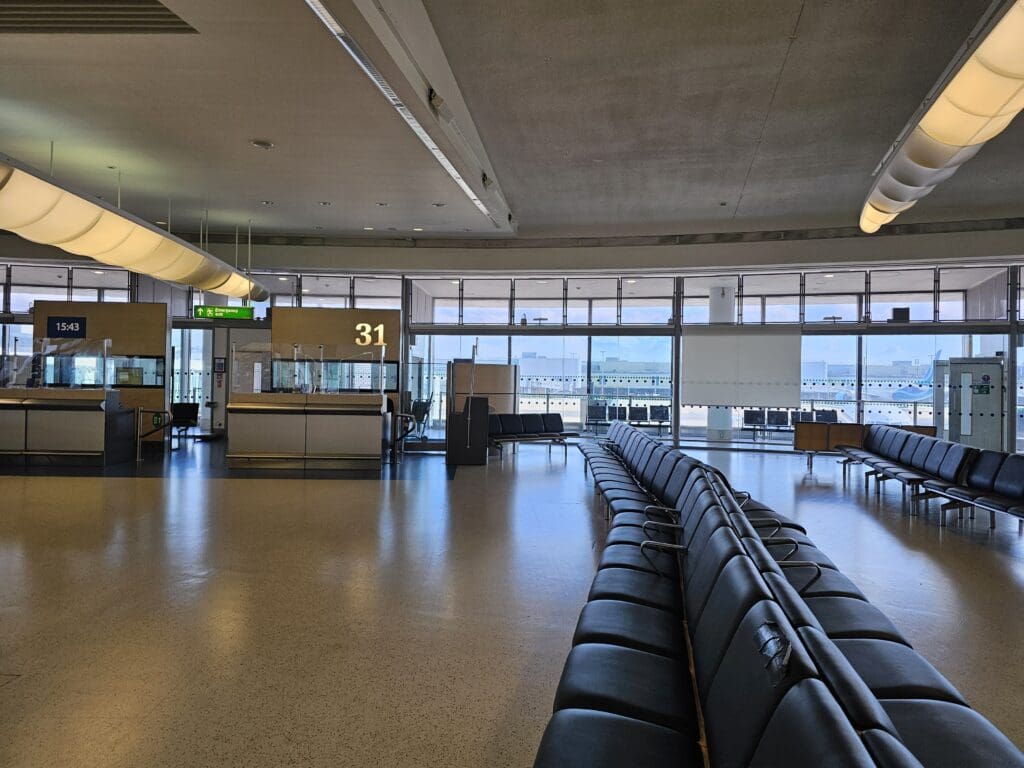
According to my boarding pass, boarding was scheduled to commence at 1610, although I was informed at check-in that boarding would commence an hour before departure. With around an hour to go until I was scheduled to jet off to Ashgabat, I sauntered over to Gate 31. This is located in the terminal’s circular pier, which at that time seemed to be filled by BA EuroFlyer Airbus A320s and Airbus A321s. Unfortunately, upon arriving at the gate, I found this area to lack unobstructed views of the action outside, whilst facilities there were limited to a Pret and a small duty free outlet.
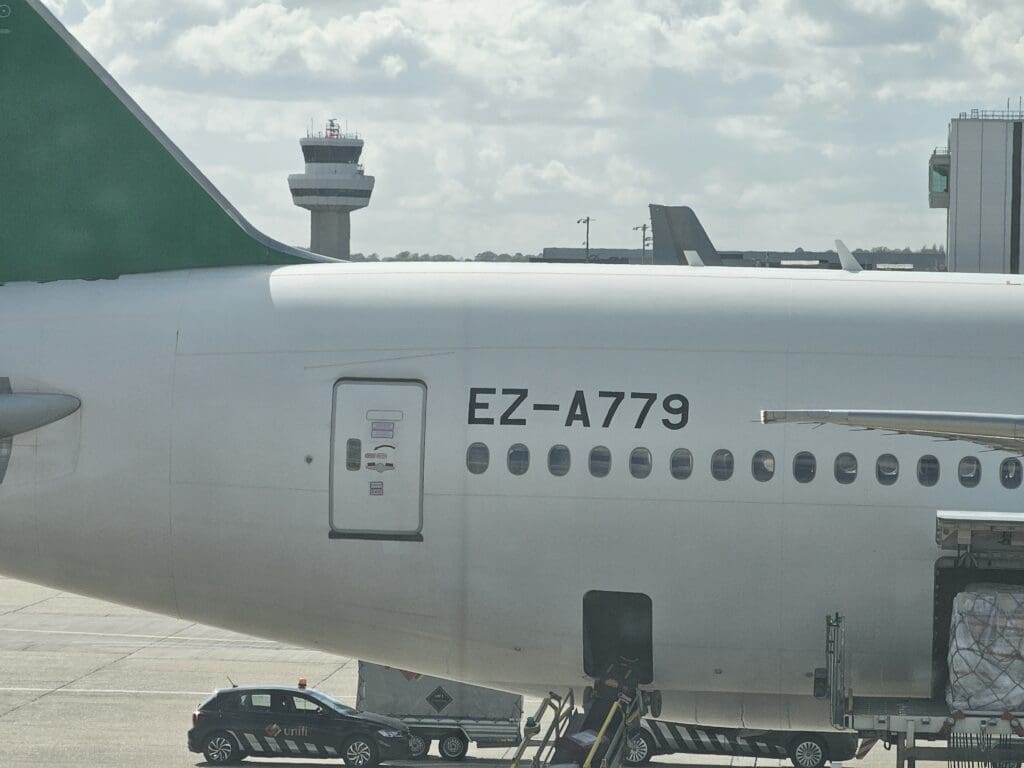
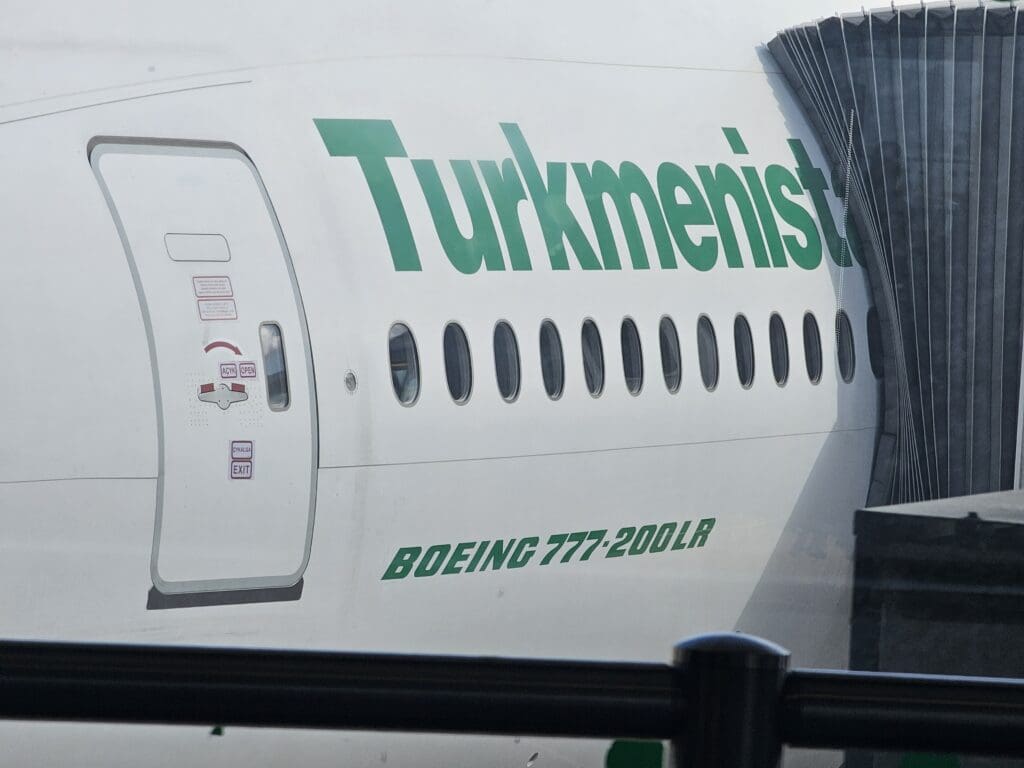
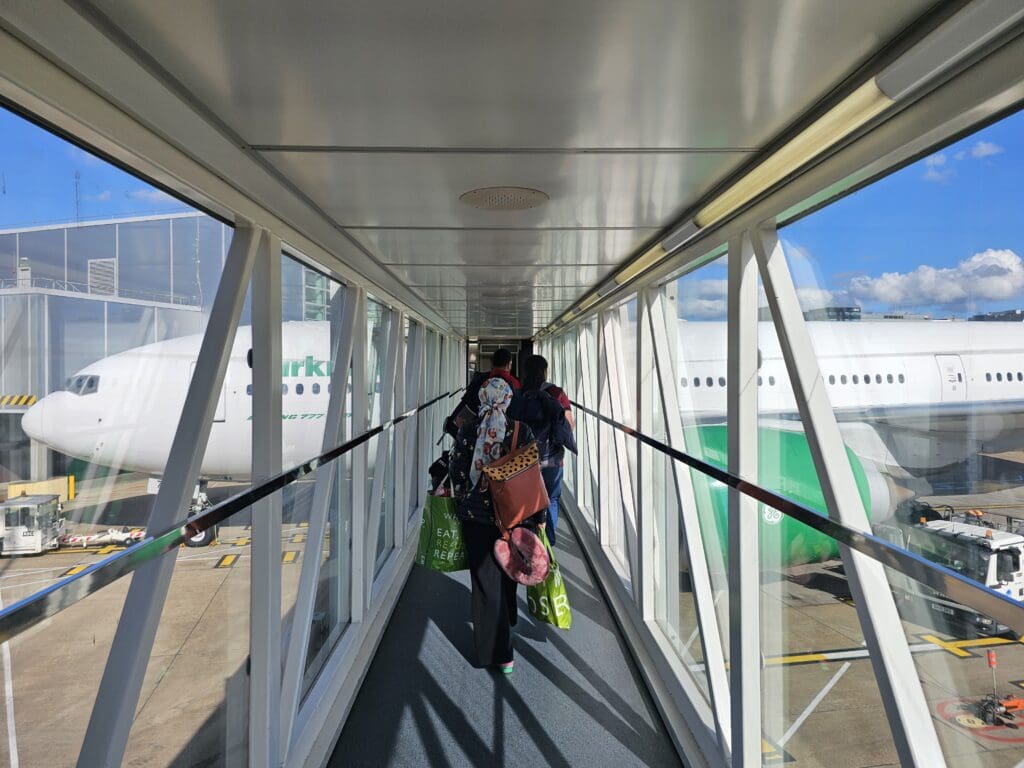
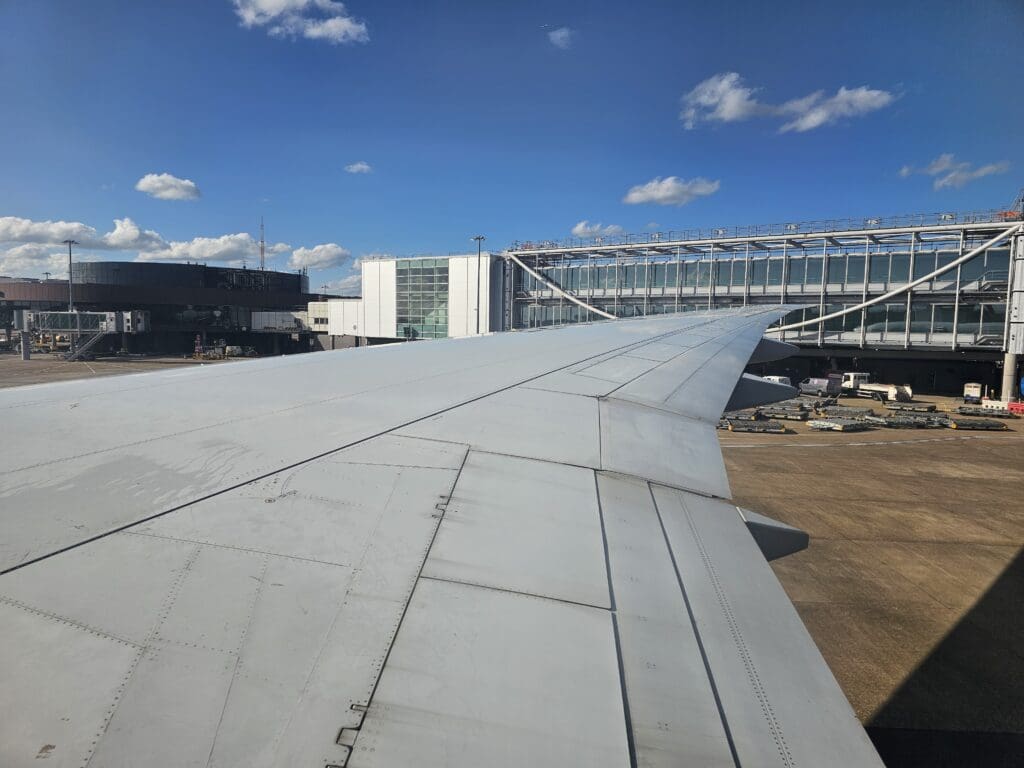
Once at the gate, I was greeted by the sight of a small cluster of Ashgabat-bound passengers, whilst two ASG Ground Handling agents could be seen chatting away at the gate podium and were soon joined by their supervisor. Eventually, a few more passengers arrived, however as our boarding time approached, I would say that there were no more than thirty passengers seen waiting at the gate. At 1627, an announcement was made inviting passengers to board the aircraft – with all passengers invited to board at the same time rather than by cabin class, frequent flyer status or boarding group. Joining the very short queue, one of the friendly ground agents soon scanned my boarding pass and checked my passport before I was free to continue down the glass jetbridge to the waiting aircraft. After walking past a rather large and burly-looking fellow with a Turkmenistan Airlines lanyard and reflective jacket, perhaps the flying spanner or security lead, I snapped a few photos, recognising that it was better to do so in Gatwick rather than in Ashgabat where photography is strictly prohibited!
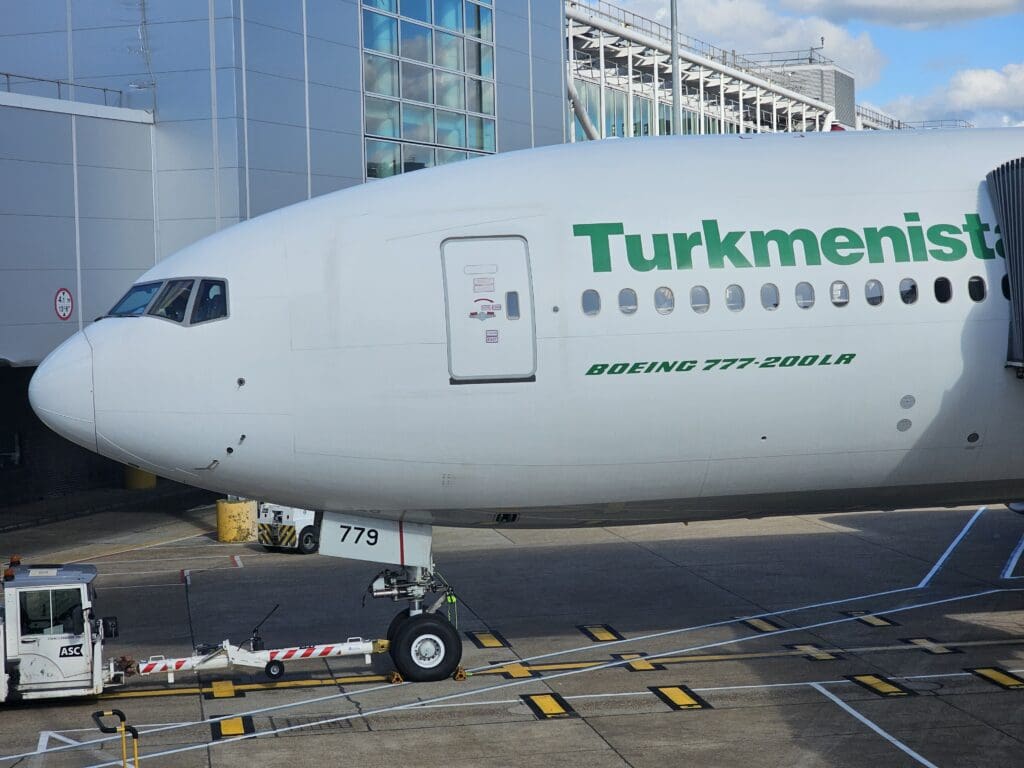
Without any queuing, I stepped into the aircraft via the L2 and entered the galley that separates the Business and forward Economy cabins. As soon as I entered the jet, I received a lukewarm greeting in both Russian and English from two flight attendants standing there, one of whom asked me if I knew where I was going. Responding that I did, no boarding pass check was needed and so I crossed the galley and turned right, immediately entering the Economy section of the aircraft where I received another lukewarm welcome.
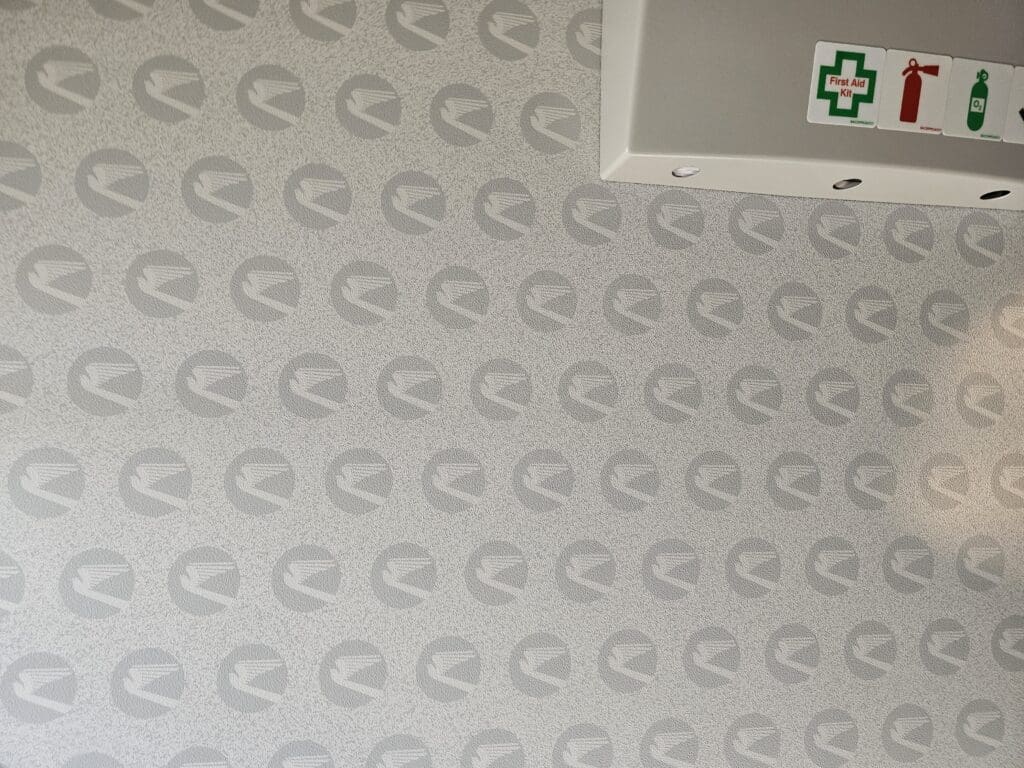
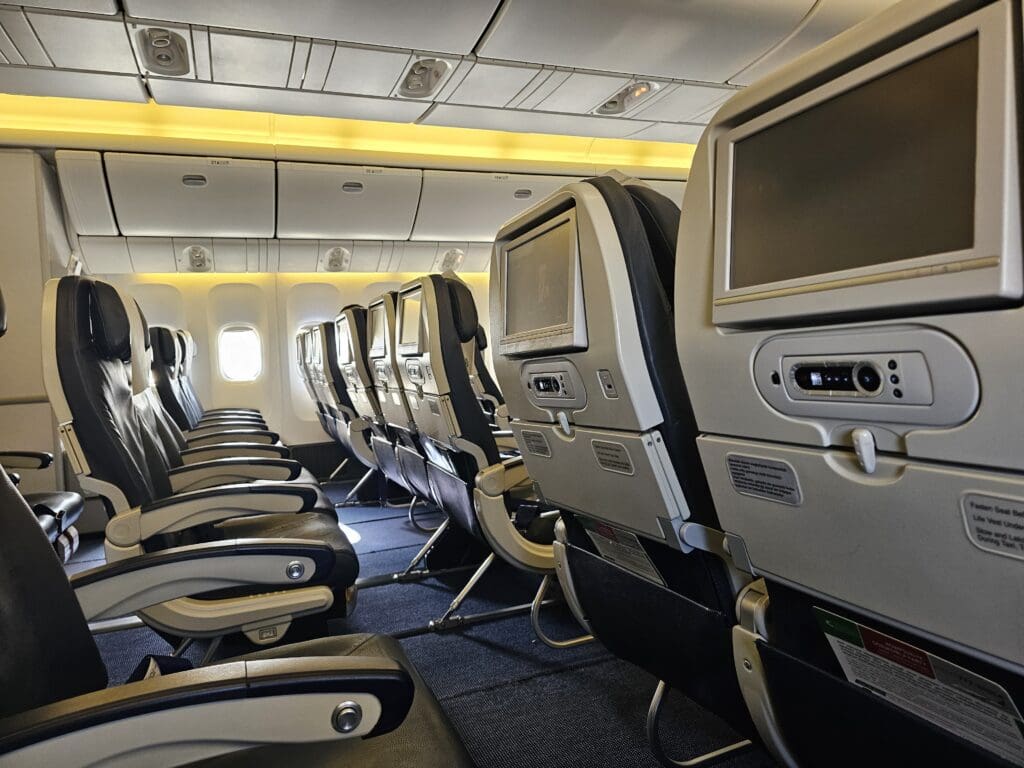
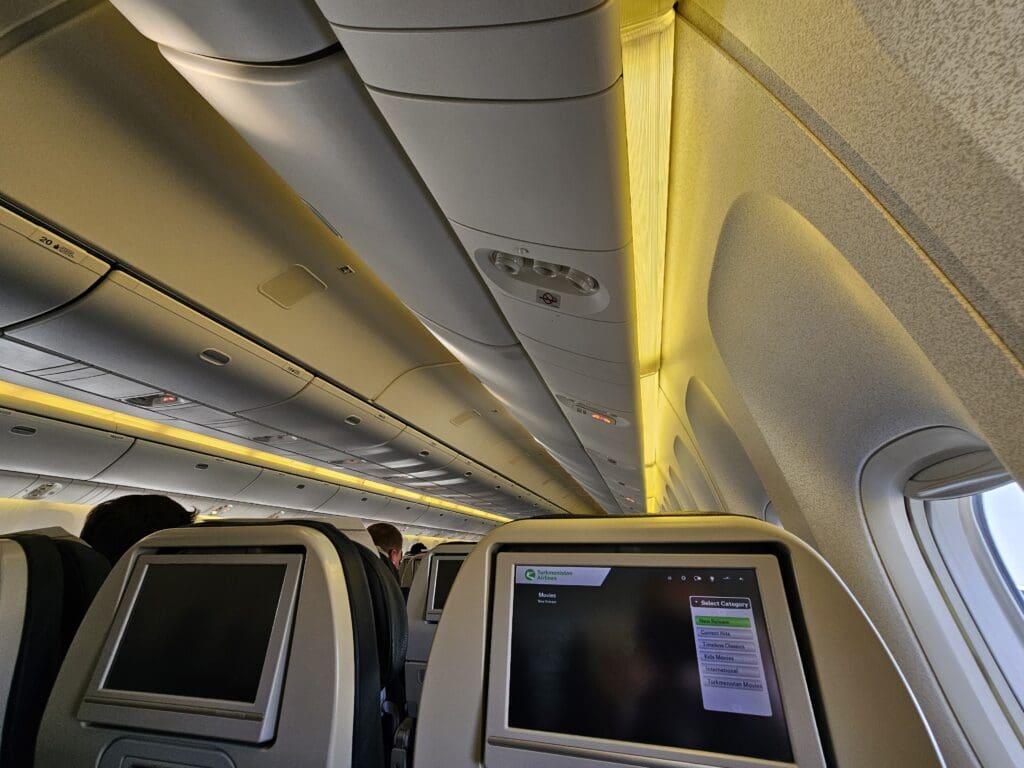
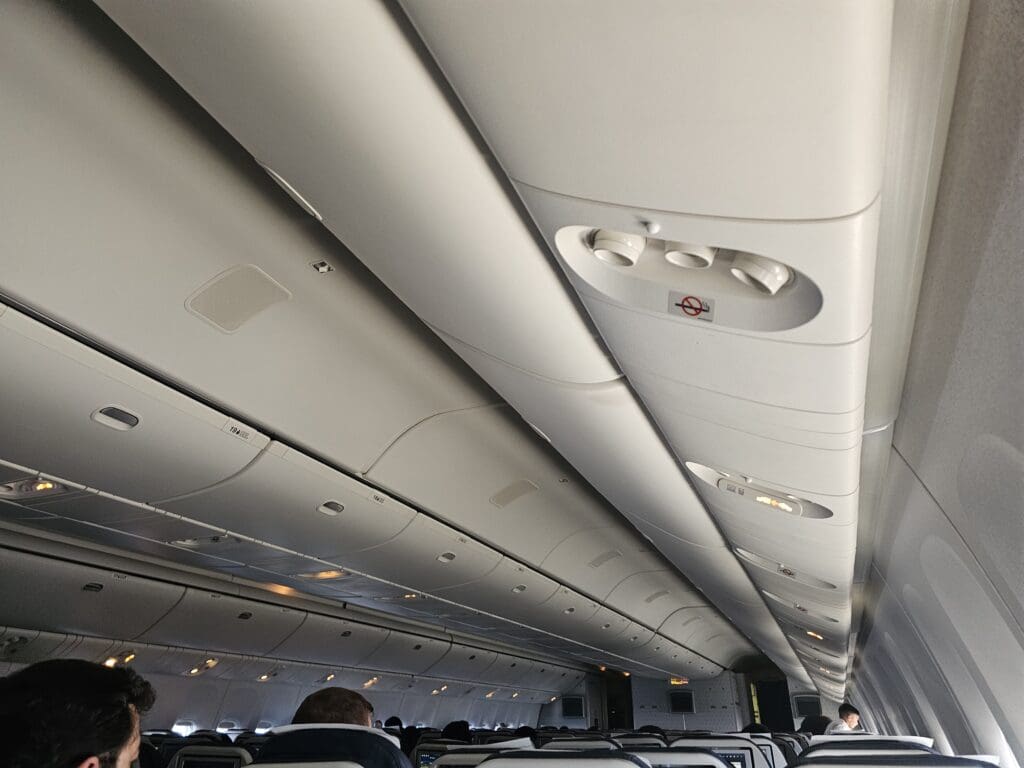
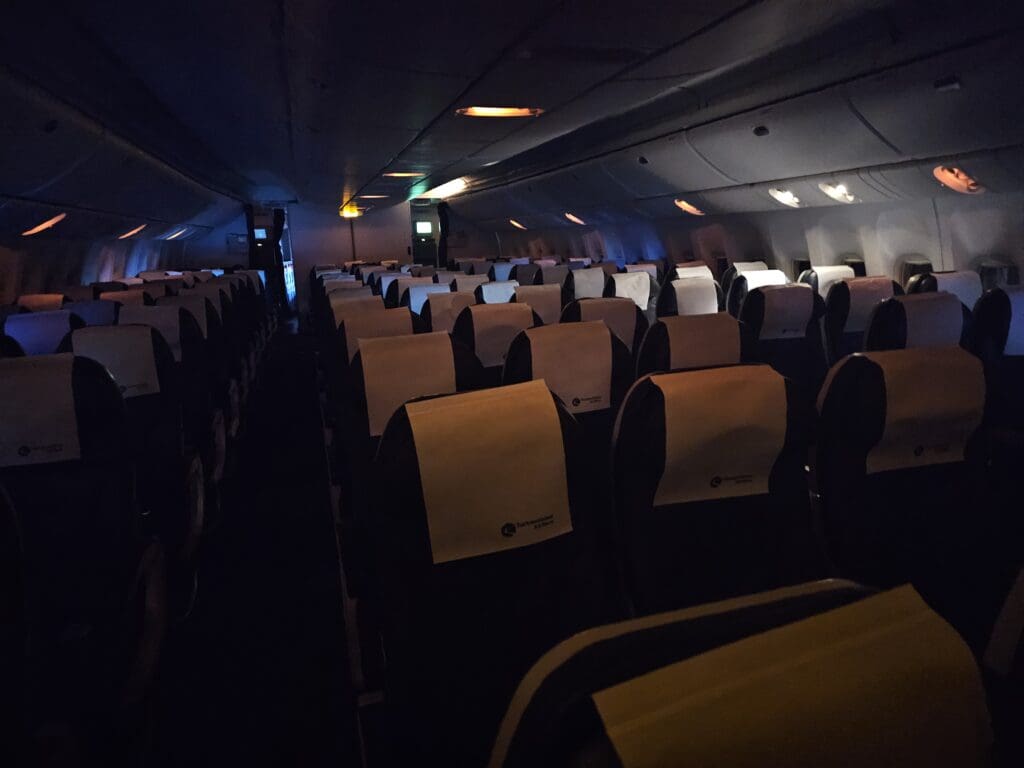
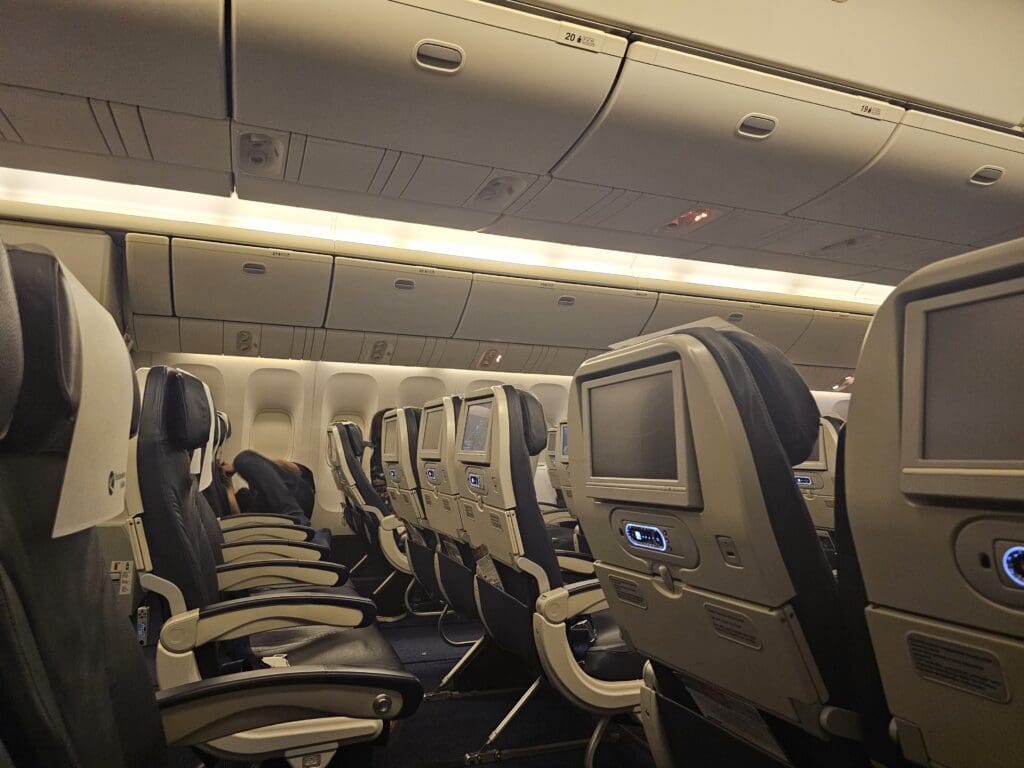
Whilst I would hardly describe the cabin as being luxurious, Turkmenistan Airlines appeared to have invested in giving this a unique identity, with a repeating pattern consisting of the airline’s motif visible on the cabin bulkheads. When it comes to space, Turkmenistan Airlines has most certainly not followed the depressing trend of attempting to squeeze as many seats as possible into the aircraft. Today, Turkmenistan Airlines is one of an increasingly small number of carriers whose Boeing 777s feature a nine-abreast configuration, with seats arranged in the usual 3-3-3 layout. Onboard, there are a total of 263 seats spread out across both a forward and rear Economy cabin.
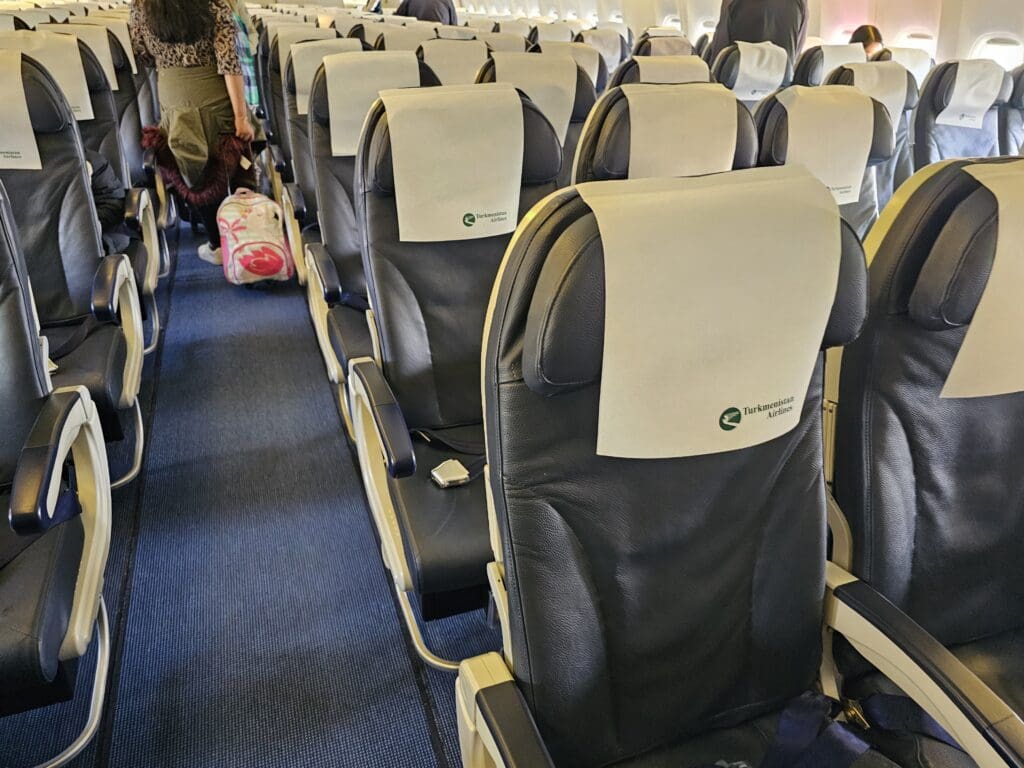
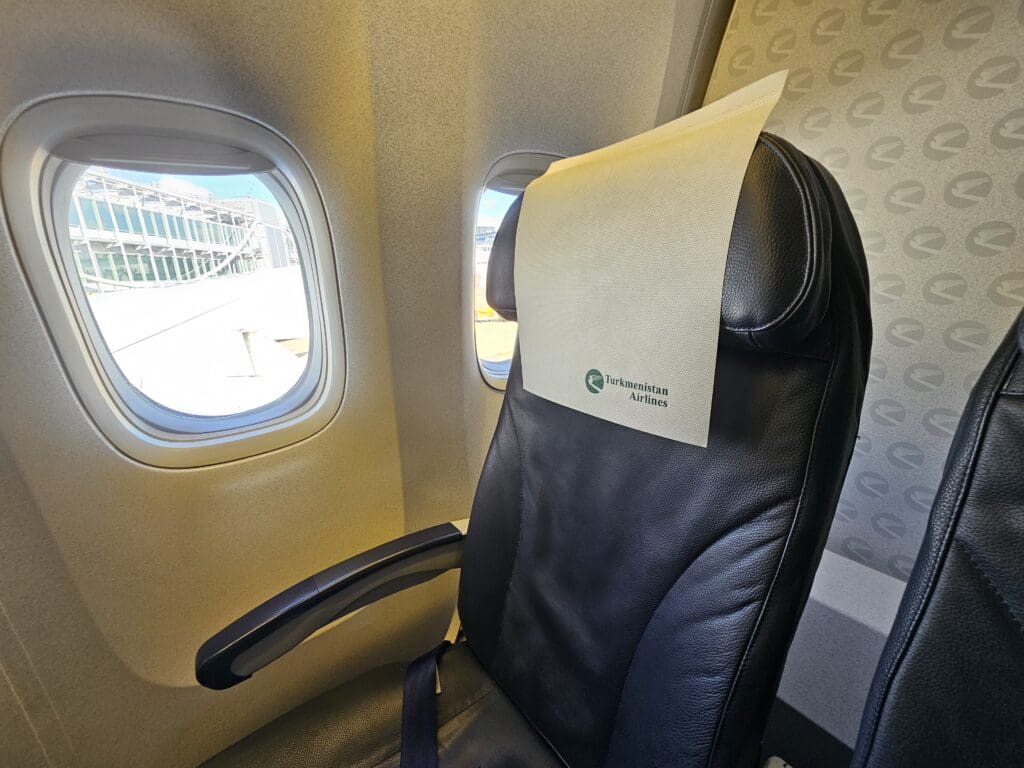
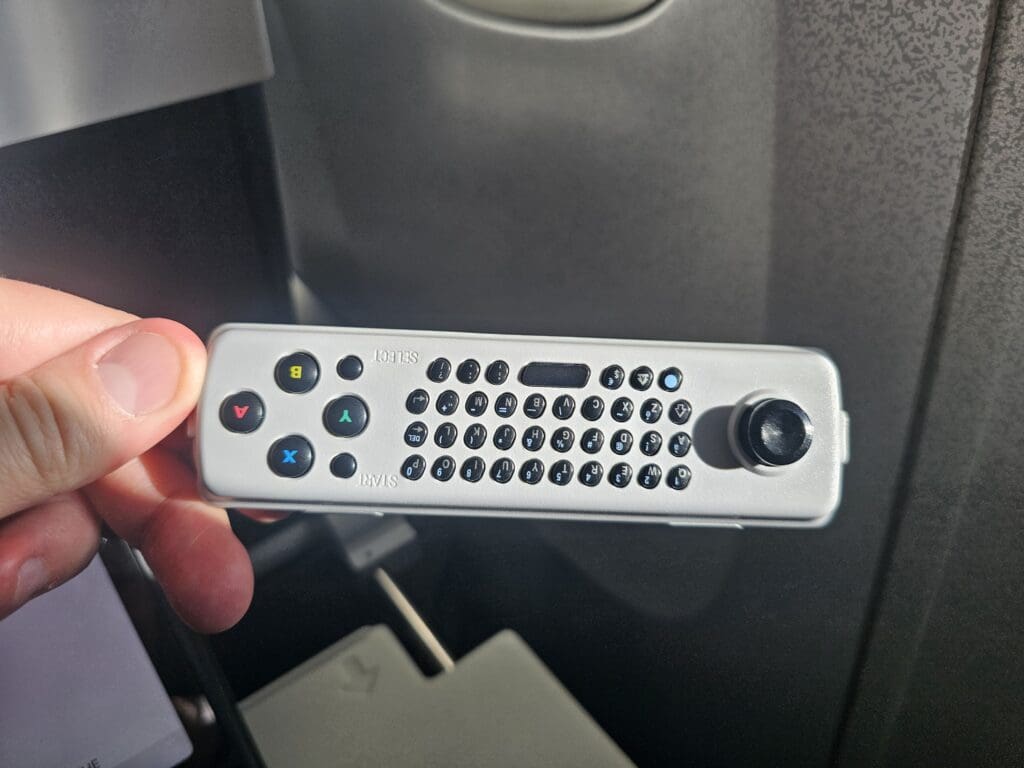
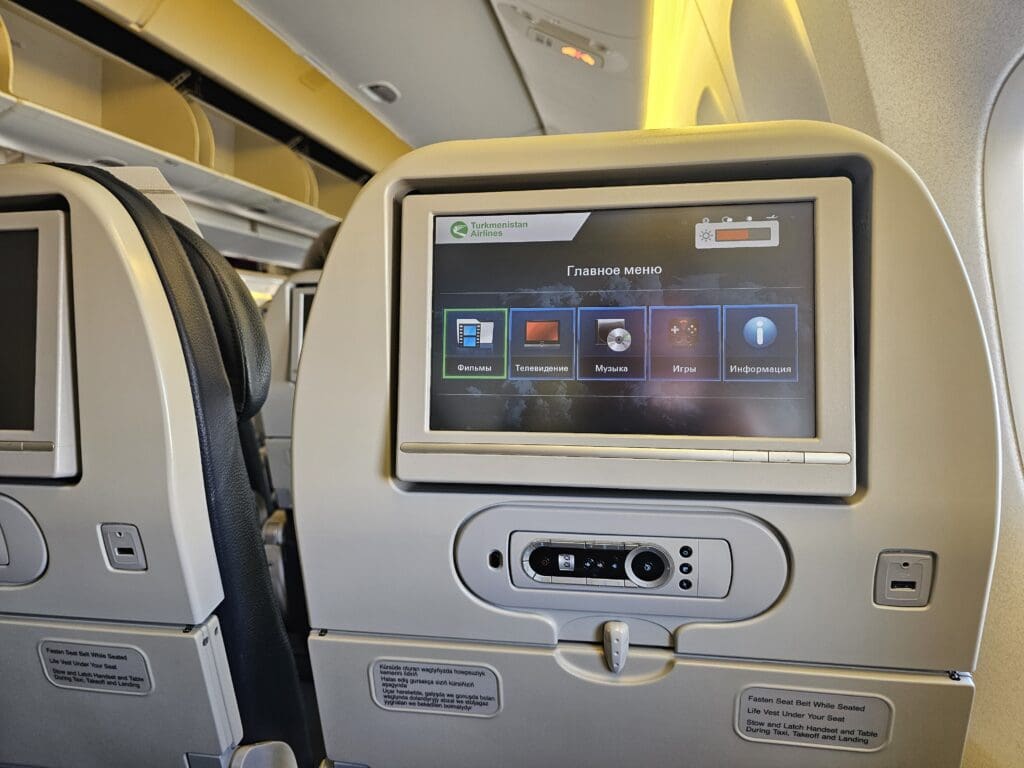
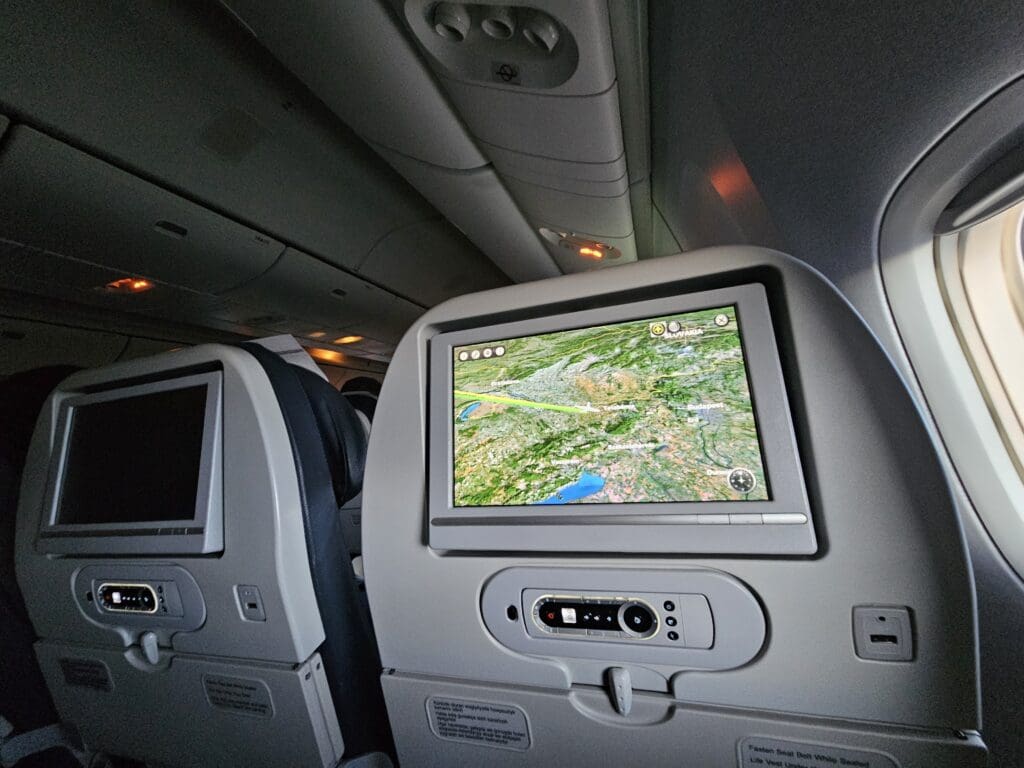
In terms of the cabin aesthetic, Turkmenistan Airlines has not made use of the country’s rich design heritage and the seats were nothing out of the ordinary. Specifically, each seat was covered in dark pleather and featured a disposable antimacassar with Turkmenistan Airlines’ logo that partially covered the adjustable headrest. Other features of the seat included a slightly dated 8.9-inch wide touchscreen inflight entertainment screen and controller, a USB-A port, a universal power outlet, and a seatback pocket containing nothing other than the safety card. Meanwhile, no pillows or blankets were offered as standard, although the crew did seem to be willing to distribute these to those who requested them.
Speeding through the cabin, I soon reached my seat, located in the rearmost row of the forward Economy cabin where I received another welcome before I placed my bag in the overhead locker and plonked myself down for the ride ahead. As I inspected the area around my seat, I was delighted to find this to be in tip-top condition, being both spotlessly clean and largely devoid of any signs of wear and tear. Vitally, the seat was soft and incredibly spacious, offering a massive amount of legroom that was second only to my experience on Korean Dreamliner operator Air Premia!
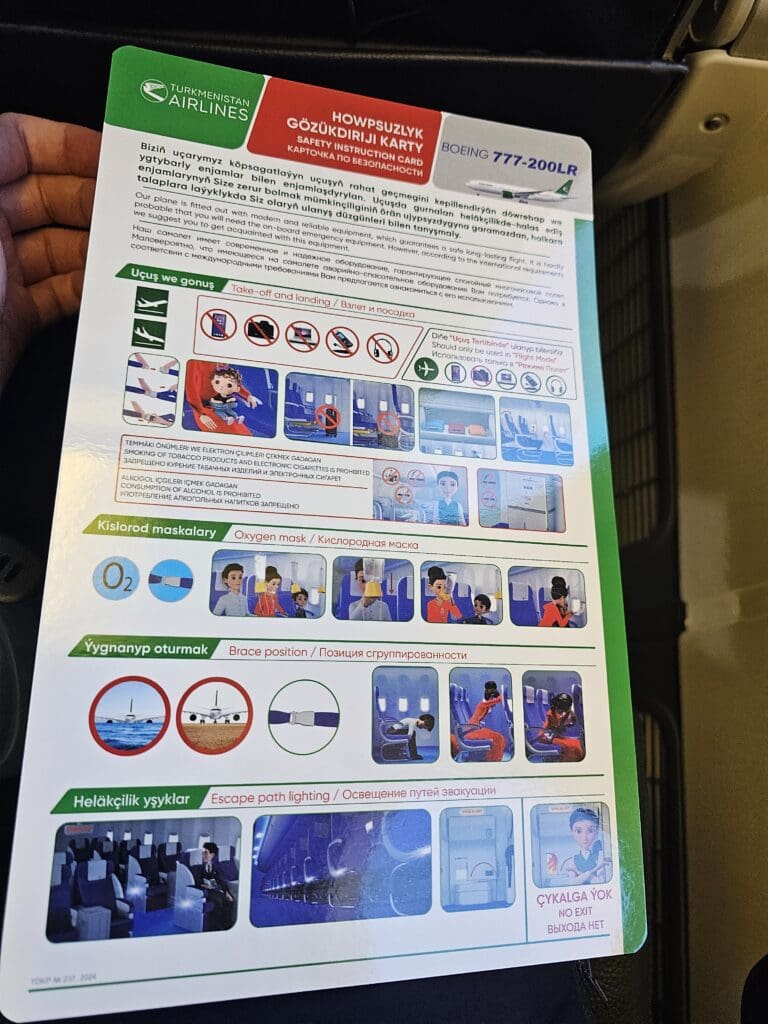
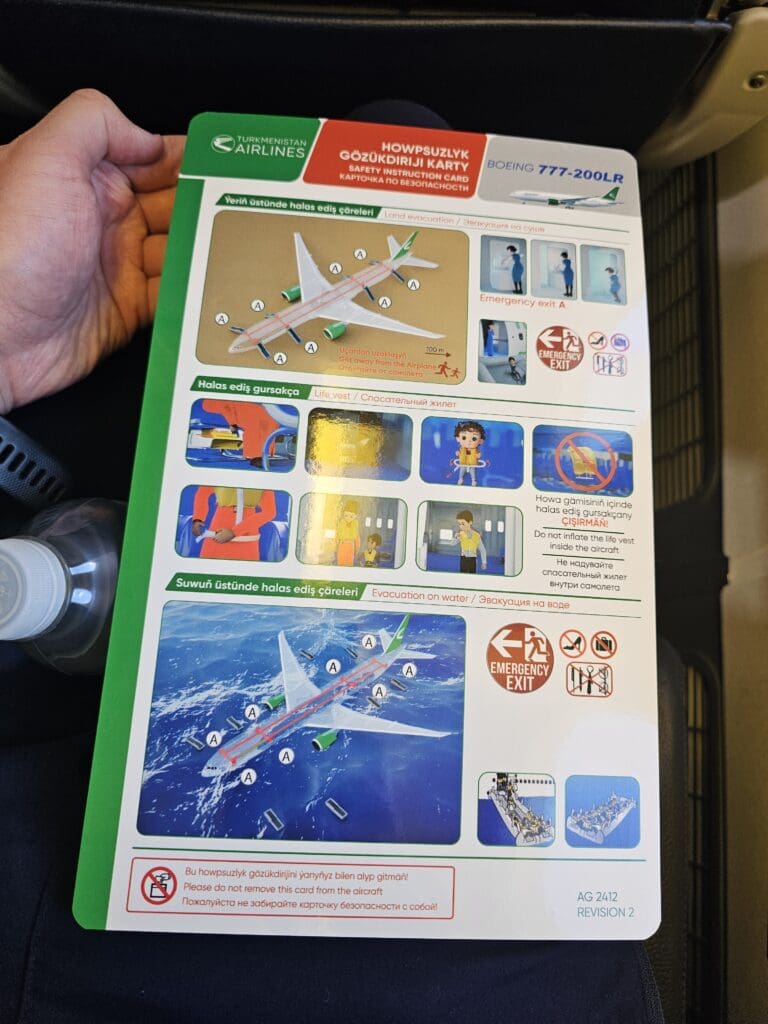
Just five minutes after passengers had been invited to board the aircraft, the Purser announced ‘boarding complete’. As I had anticipated, the flight to Turkmenistan was nearly empty in Economy and all passengers travelling alone seemed to enjoy the luxury of having an entire bank of seats to themselves, myself included. Meanwhile, the rear cabin was completely devoid of passengers and used a crew rest area later in the flight. This seems to be a common theme in reports detailing Turkmenistan Airlines’ European services. Examining my fellow passengers, I would estimate that around a third were from Turkmenistan, whilst almost all others hailed from India and Vietnam, and were thus presumably connecting onwards to Delhi and Hanoi. Turning to the flight attendants, there seemed to be an even split between men and women, and they were of all ages. Meanwhile, unlike some airlines that I have sampled recently, all the flight attendants that I came across seemed to be very smartly dressed.
As soon as boarding had reached its conclusion, the upbeat traditional music that had filled the cabin during boarding came to an end at which point the Purser undertook a rather muffled announcement in Turkmen and English. Admittedly, I am not entirely sure of what these contained, however, I assume that they consisted of the usual welcome, thanks and warnings. Up ahead, the cabin door was soon closed whilst Turkmenistan Airlines’ slightly creepy animated safety video took over the aircraft’s inflight entertainment screens, with this played first in Turkmen, followed by English with Russian subtitles.
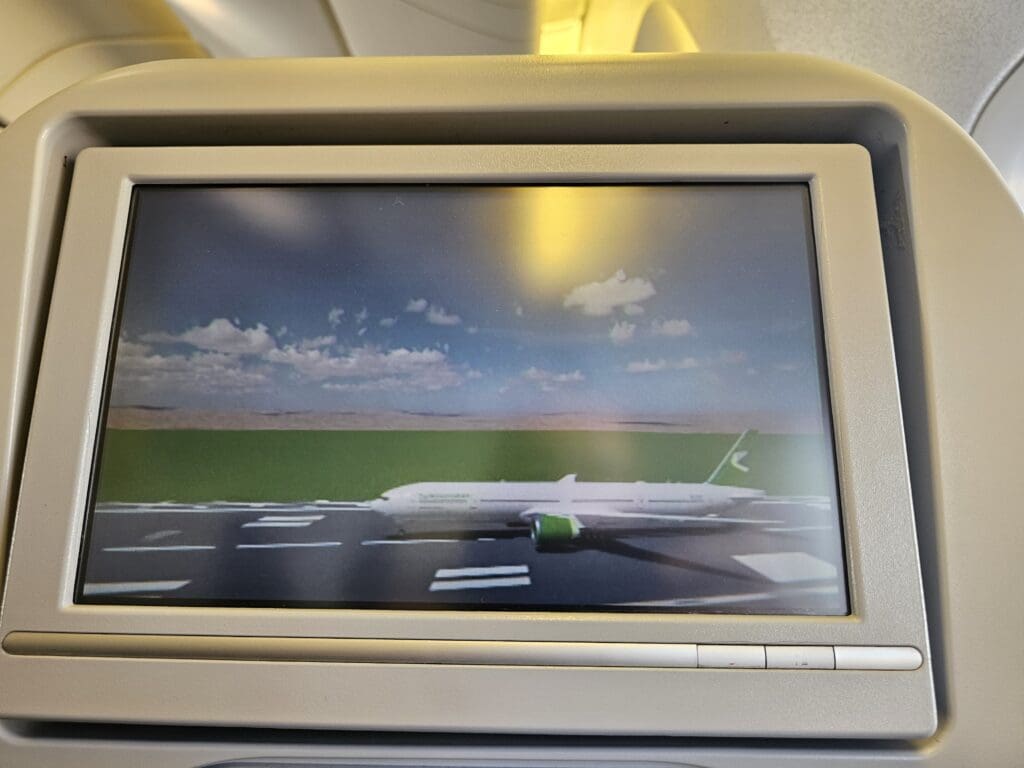
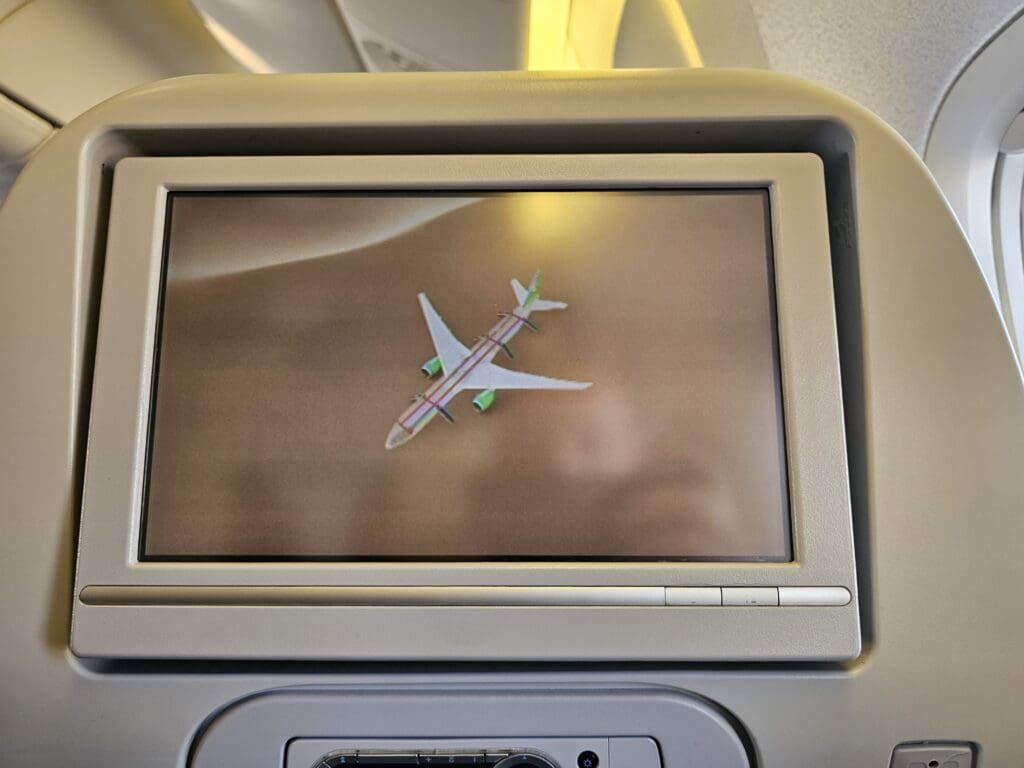
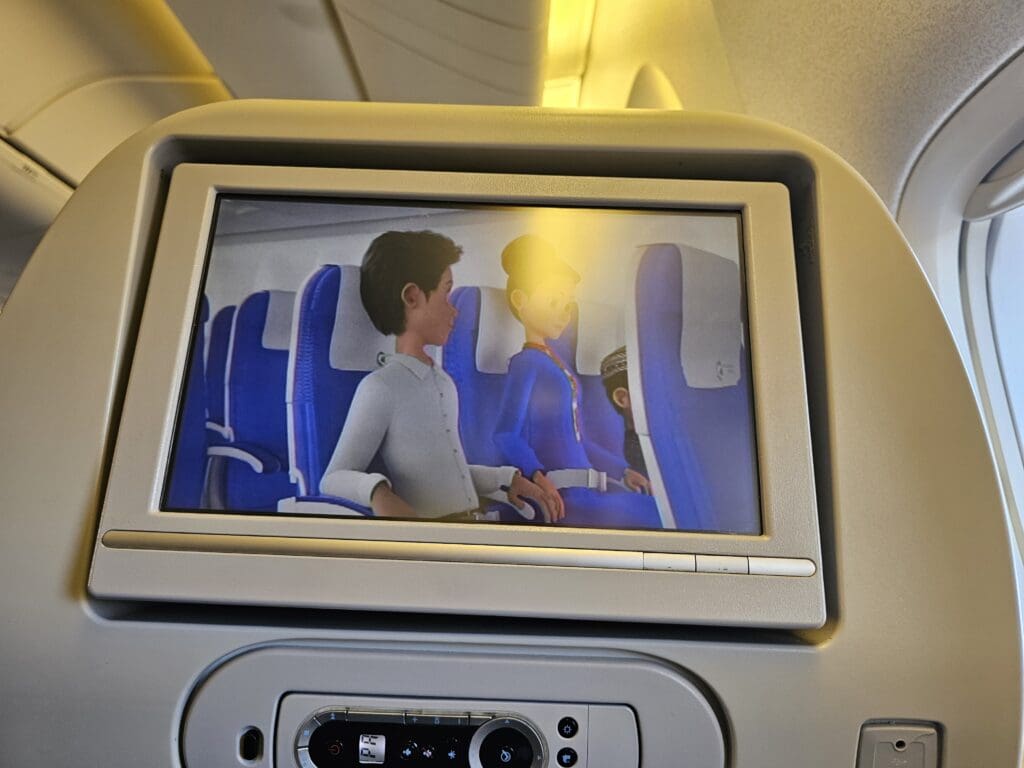
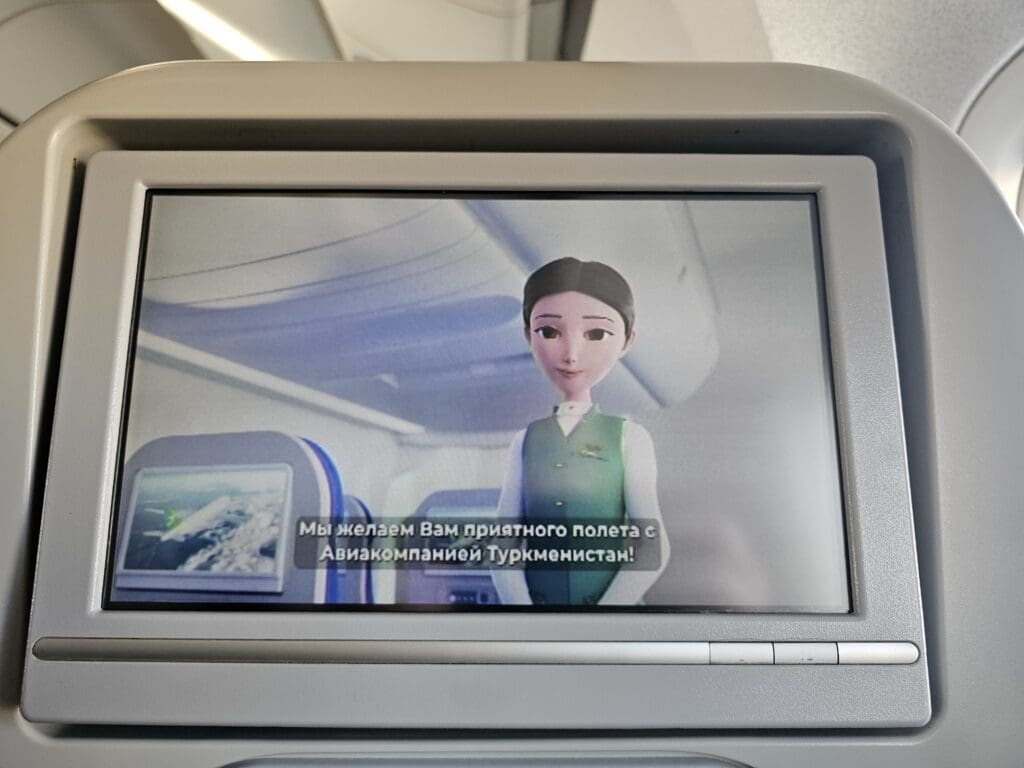
As the safety video played, seven minutes ahead of the schedule, at 1648, the Boeing jolted back and we were pushed back away from the stand. At this point, a cacophony of whirs and vibrations filled the cabin as the aircraft’s two impressively large General Electric GE90-115B engines powered up in preparation to carry us all to Central Asia. As the safety video neared its end, the flaps were partially extended with a loud whine before the Boeing powered away under its own steam and made its way around the South Terminal to the end of Runway 26L. In the usual manner, during the taxi, the crew passed through the cabin ensuring that all was secure and in place for our departure, reassuring taking their time to ensure that everything was as it should be.
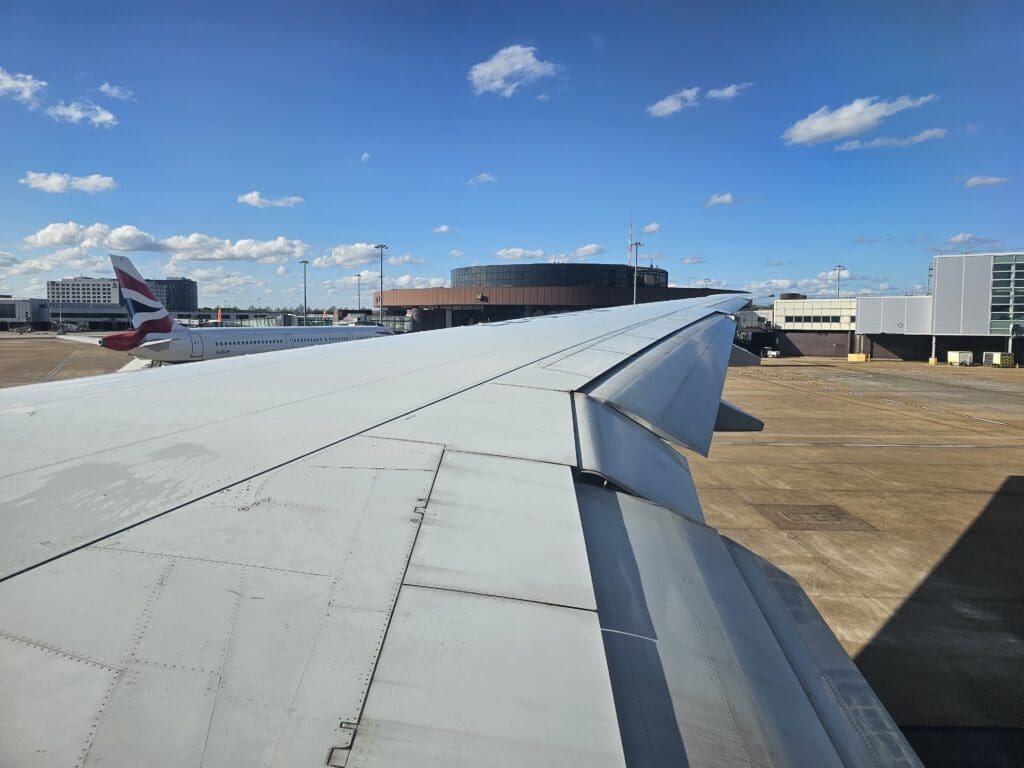
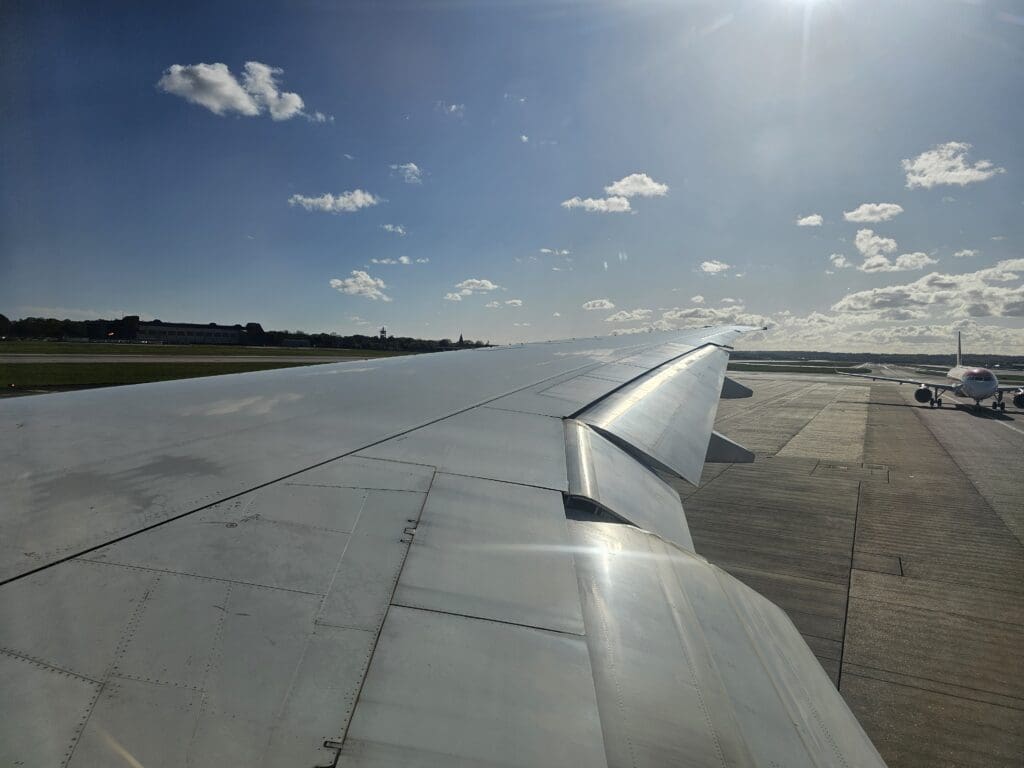
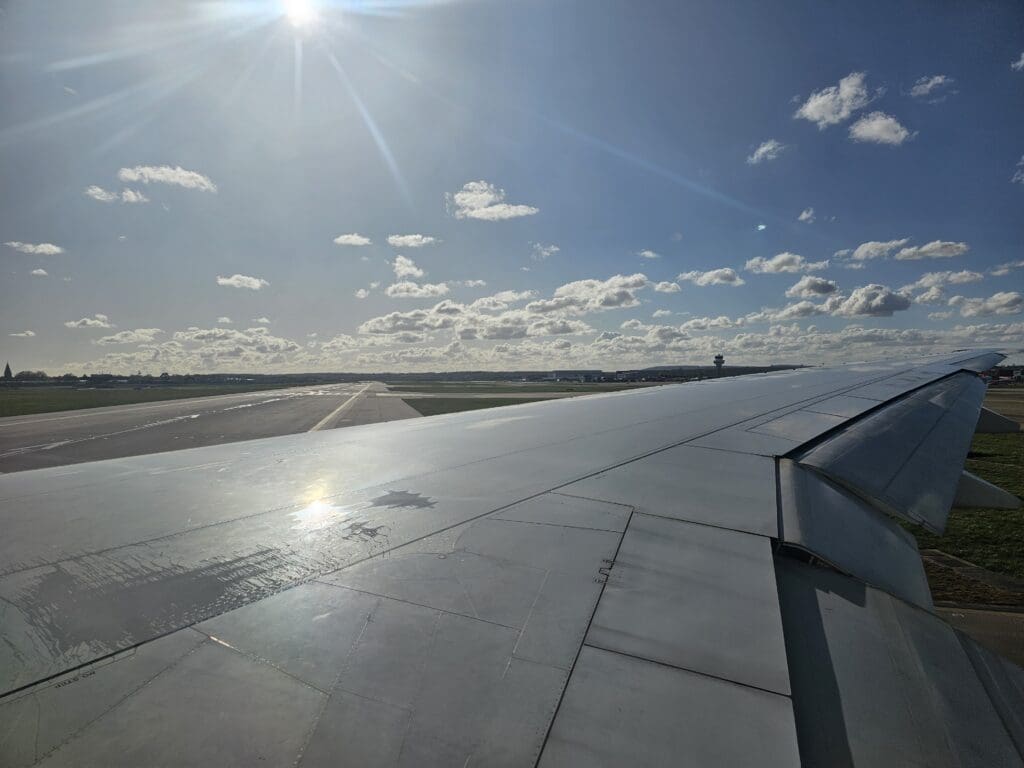
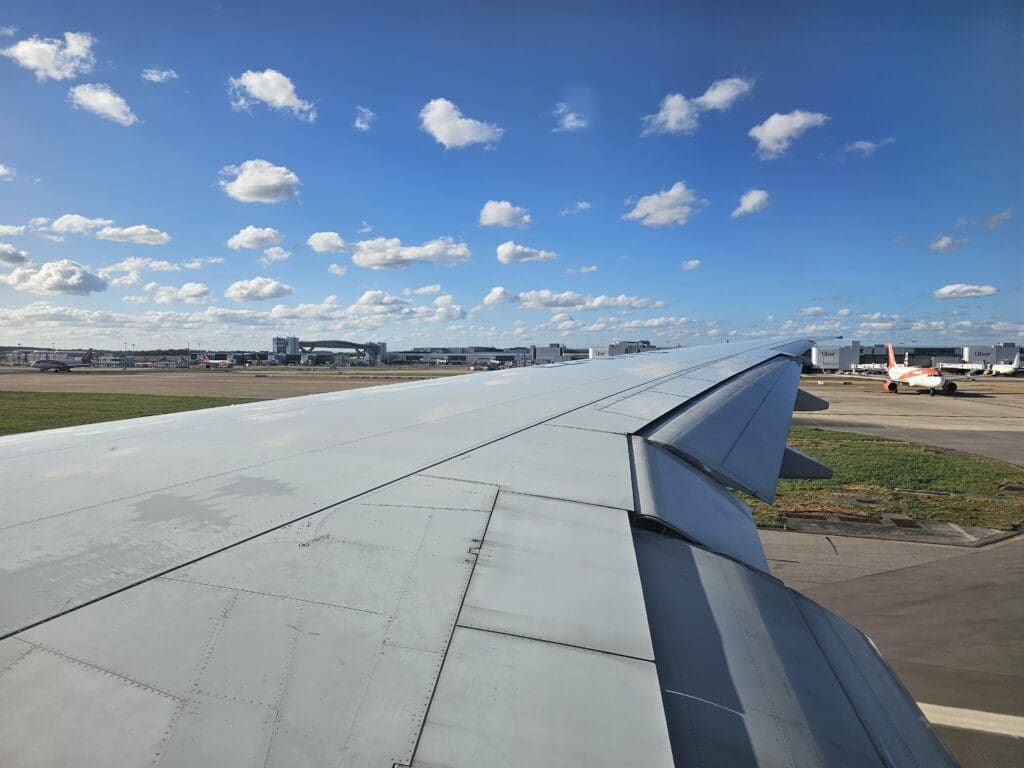
Despite Gatwick Airport’s infamous departure queues, we reached the end of the runway without a stop-start taxi. Once there, we paused for a few minutes to allow for an EasyJet Airbus A320 to touch down at the end of its flight from Aberdeen before we taxied onto this and came to a halt. Once the EasyJet aircraft was clear of the runway, at 1700 on the dot, our two General Electric engines powered into life and the aircraft commenced what seemed like a fairly gentle take-off roll. Whizzing past the terminals and control tower, eventually, the Boeing rotated into the sunny skies of Southeast England before a loud whine could be heard as the landing gear was retracted into the fuselage.
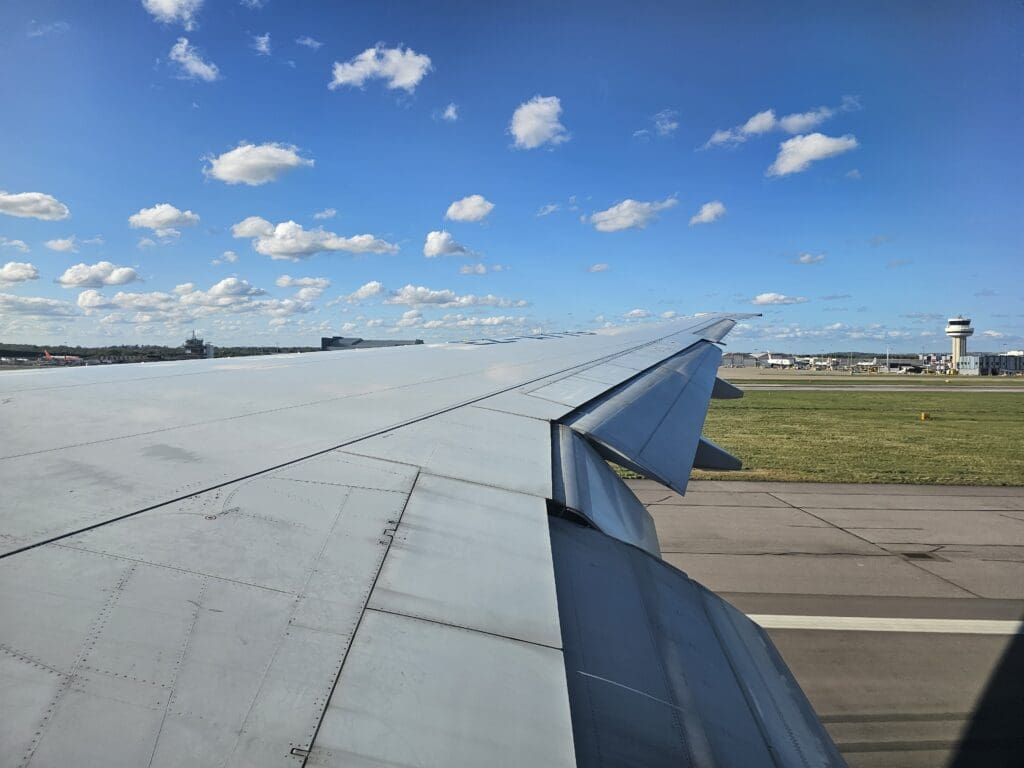
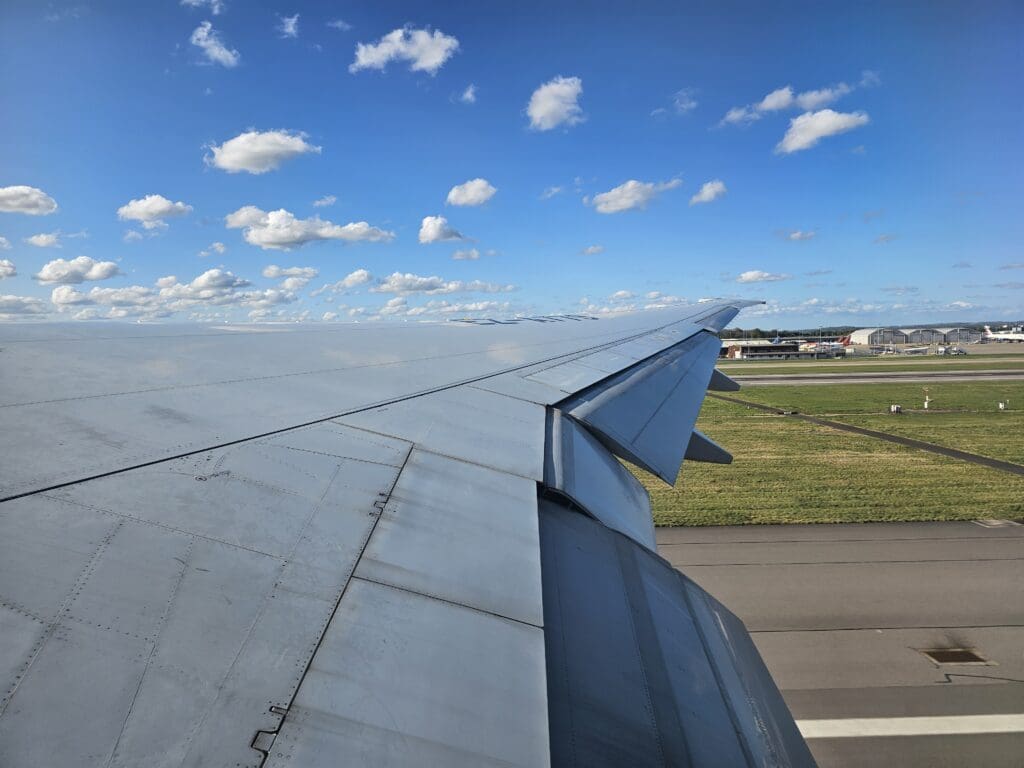
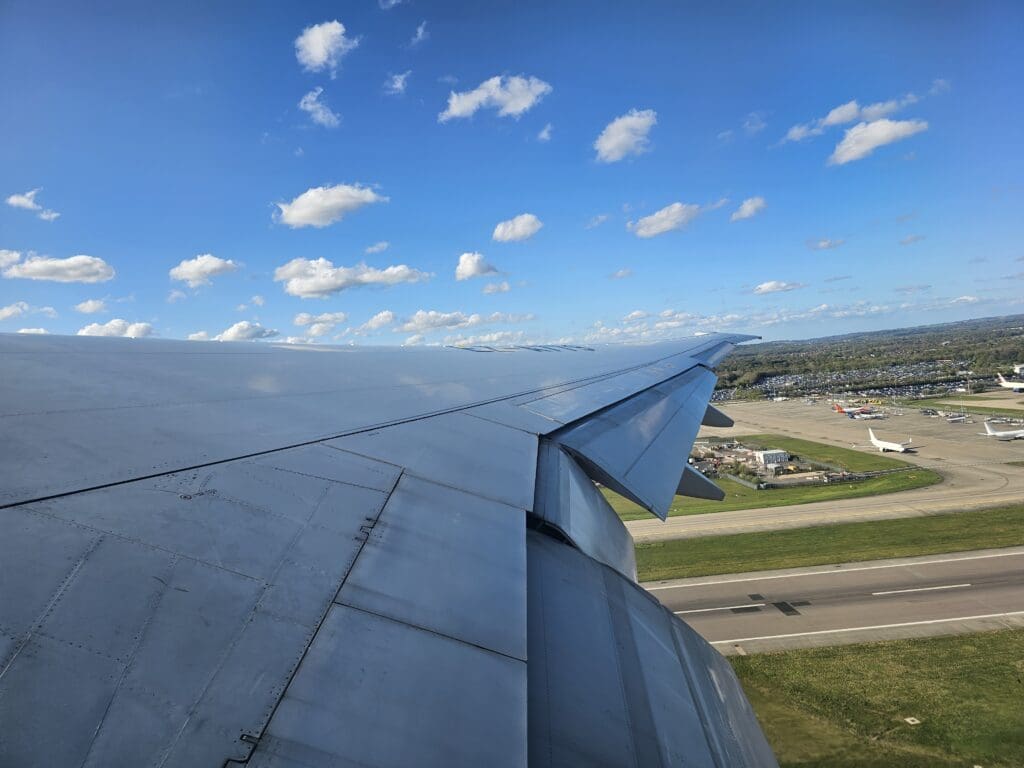
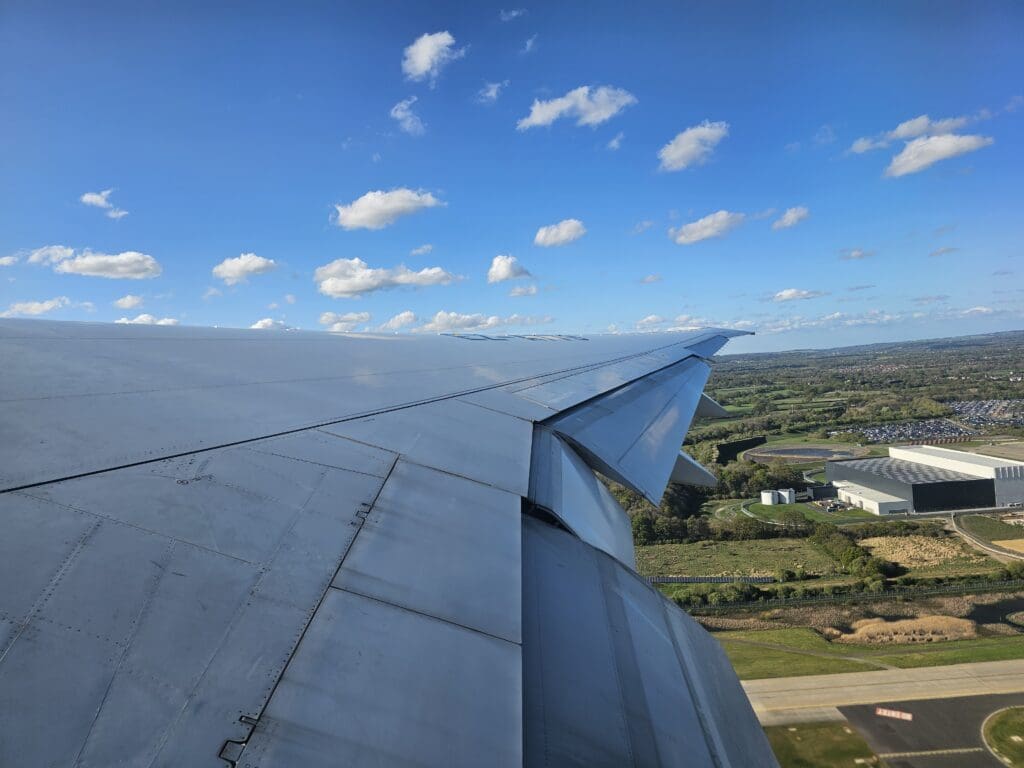
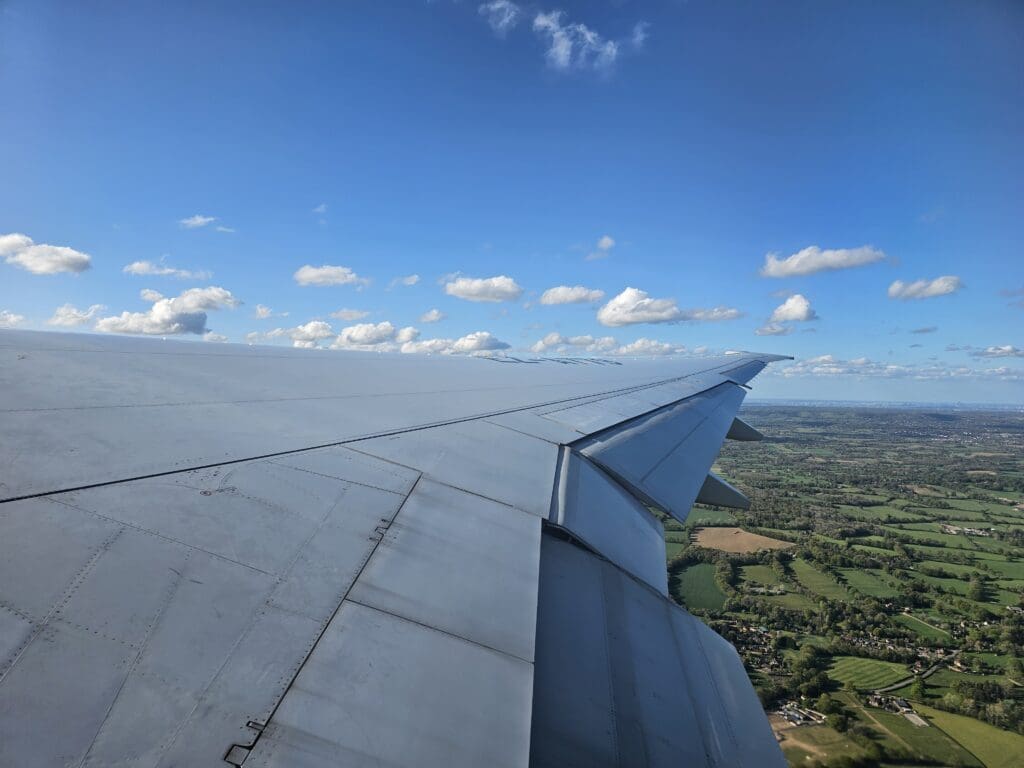
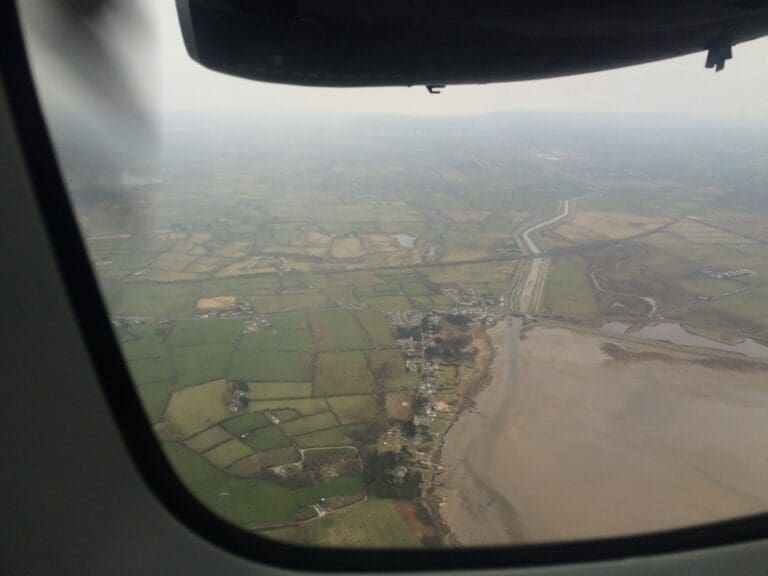
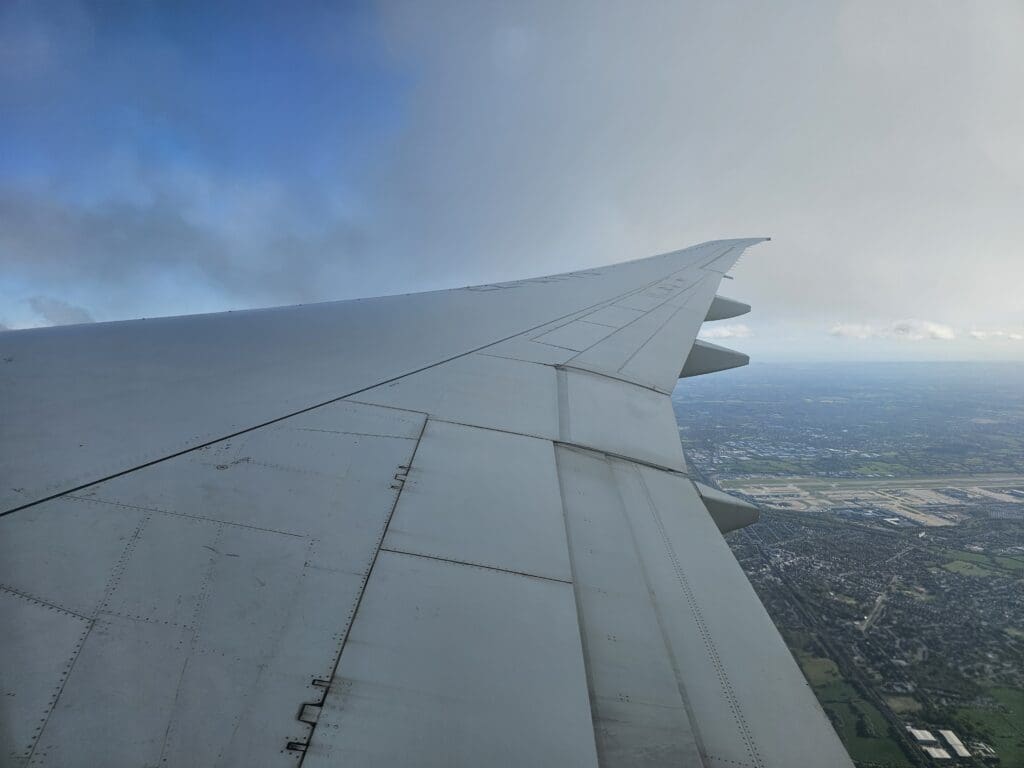
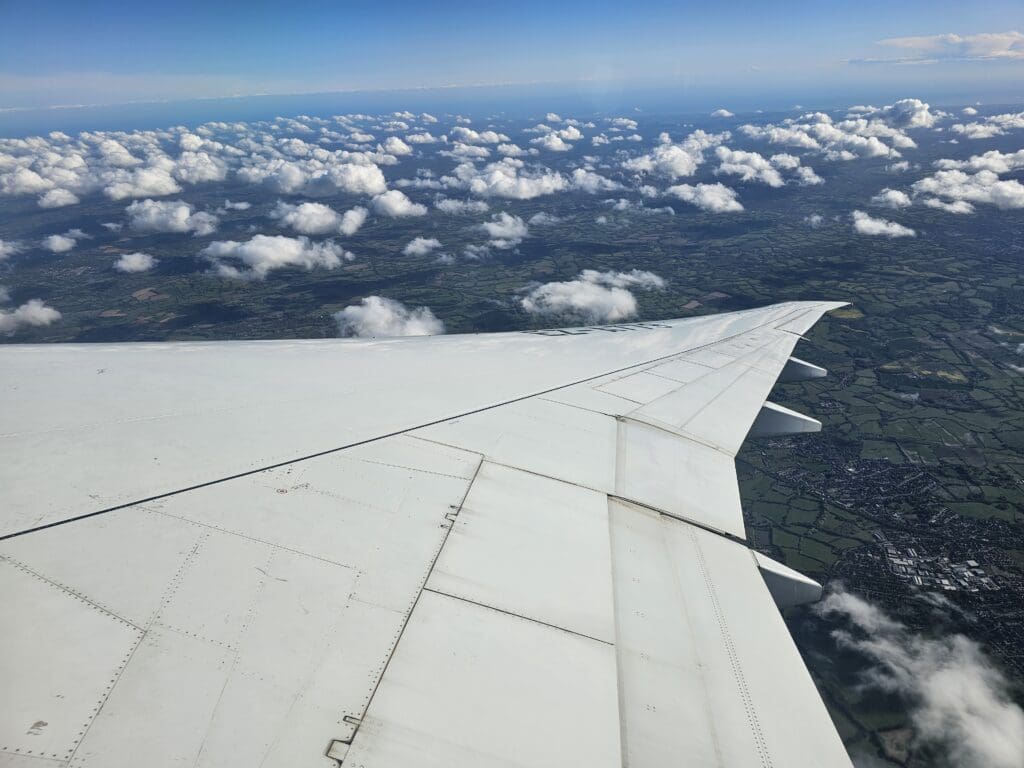
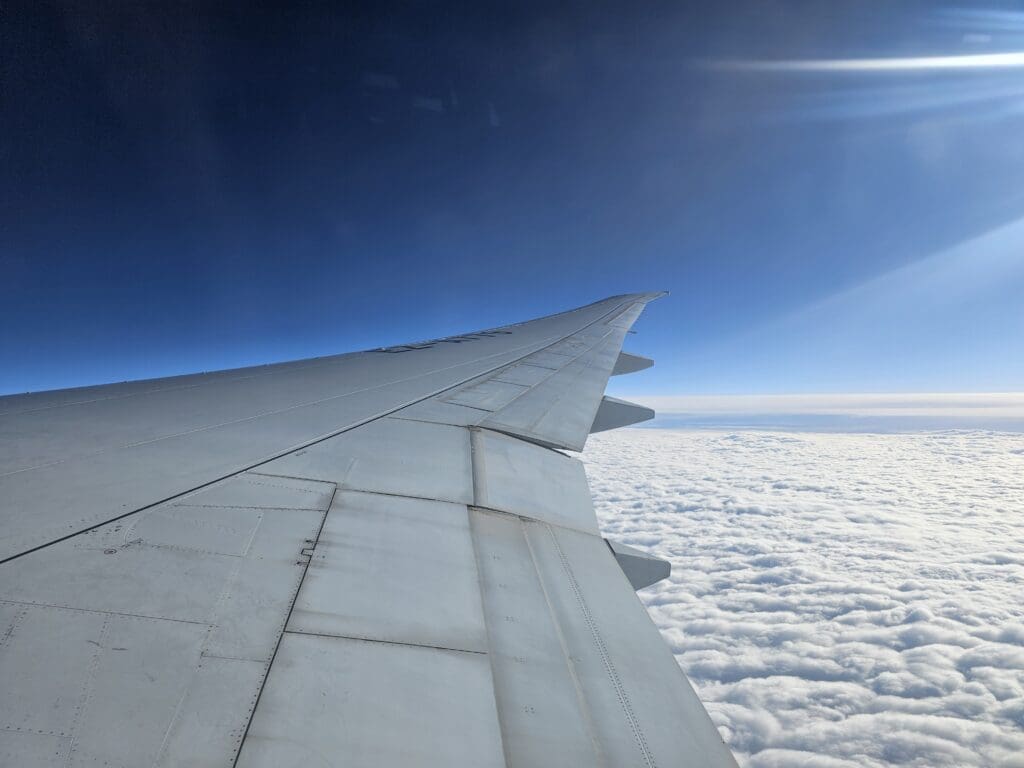
Thanks to the superb weather that evening, a great view of the green fields of Sussex could be seen outside as we undertook our initial climb out of Gatwick and soon banked to the right, rolling out on an easterly heading. Four minutes after departure, the aircraft passed just to the north of Gatwick, enabling a final view of the airport before we trundled into the skies of Kent, passing the likes of Oxted, Sevenoaks and Maidstone. Despite making a smooth initial climb, the seatbelt signs remained firmly illuminated for the duration of this, however, not needing the lavatory and glued to the vistas of green fields below, this was no issue for me.
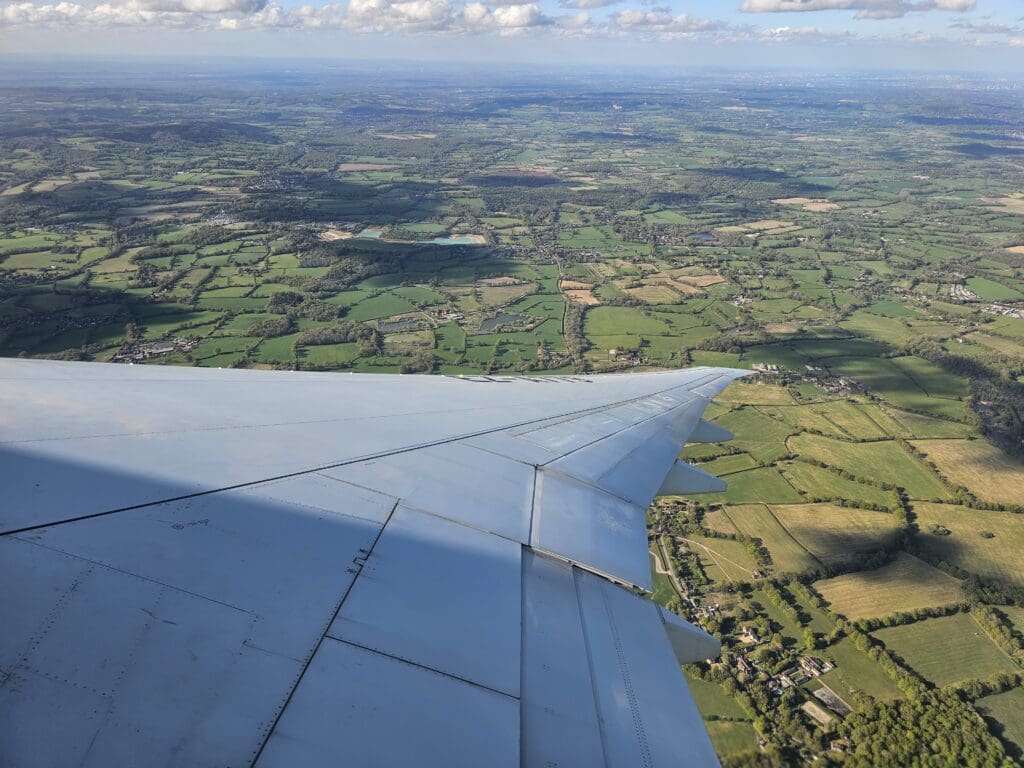
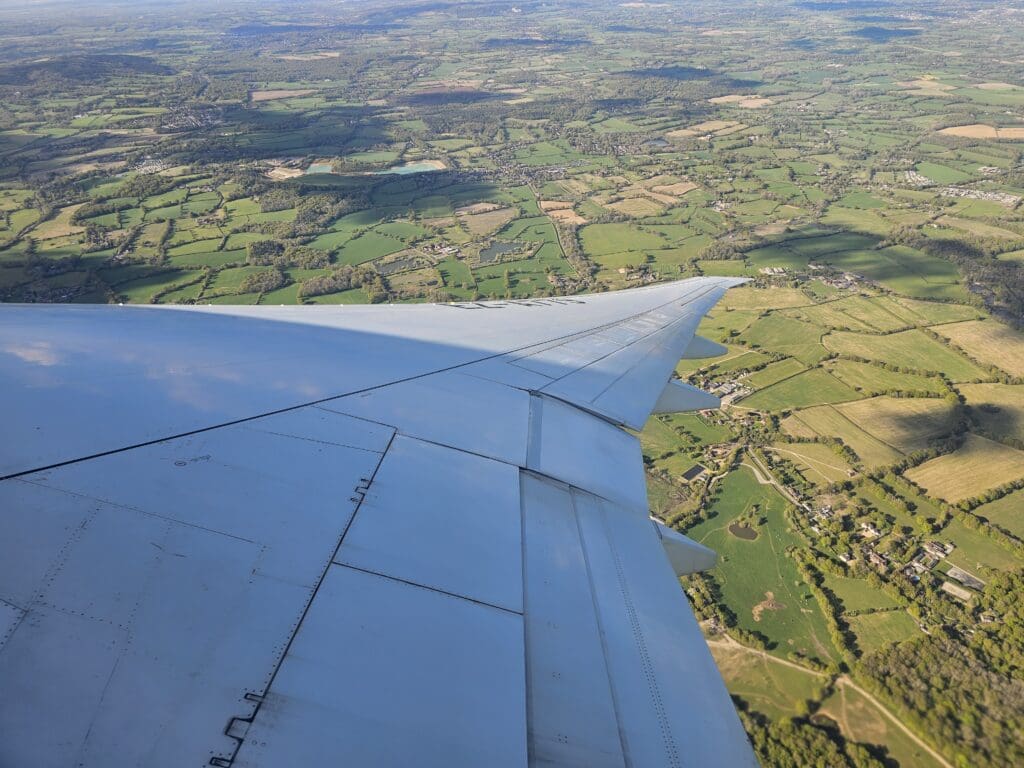
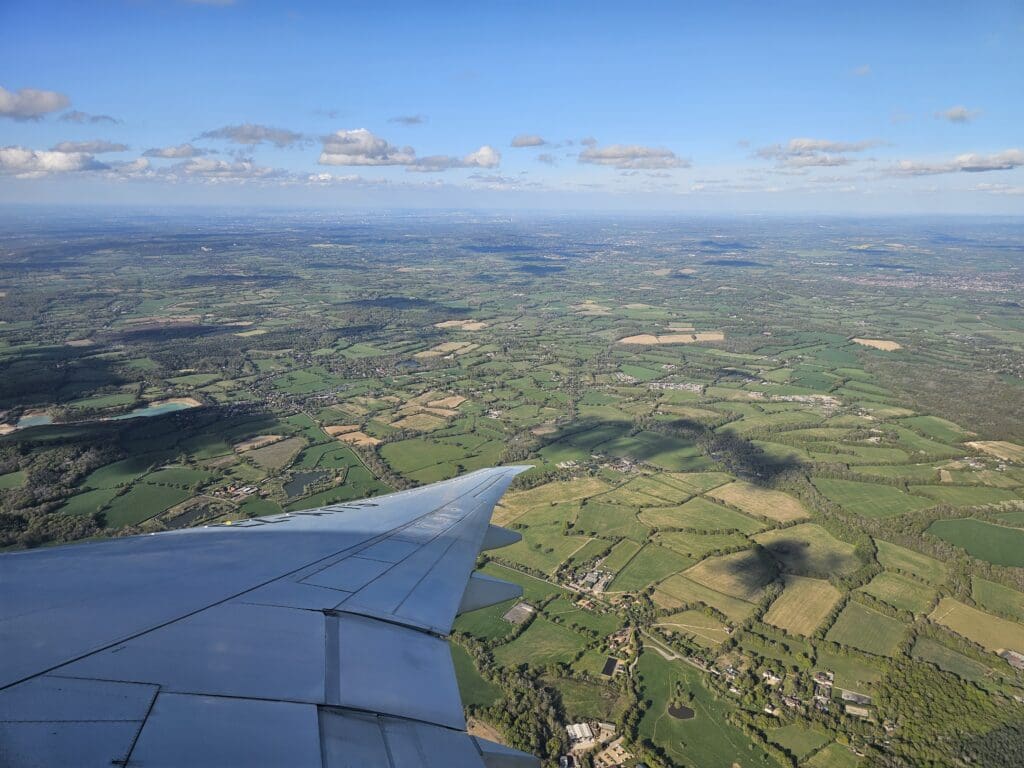
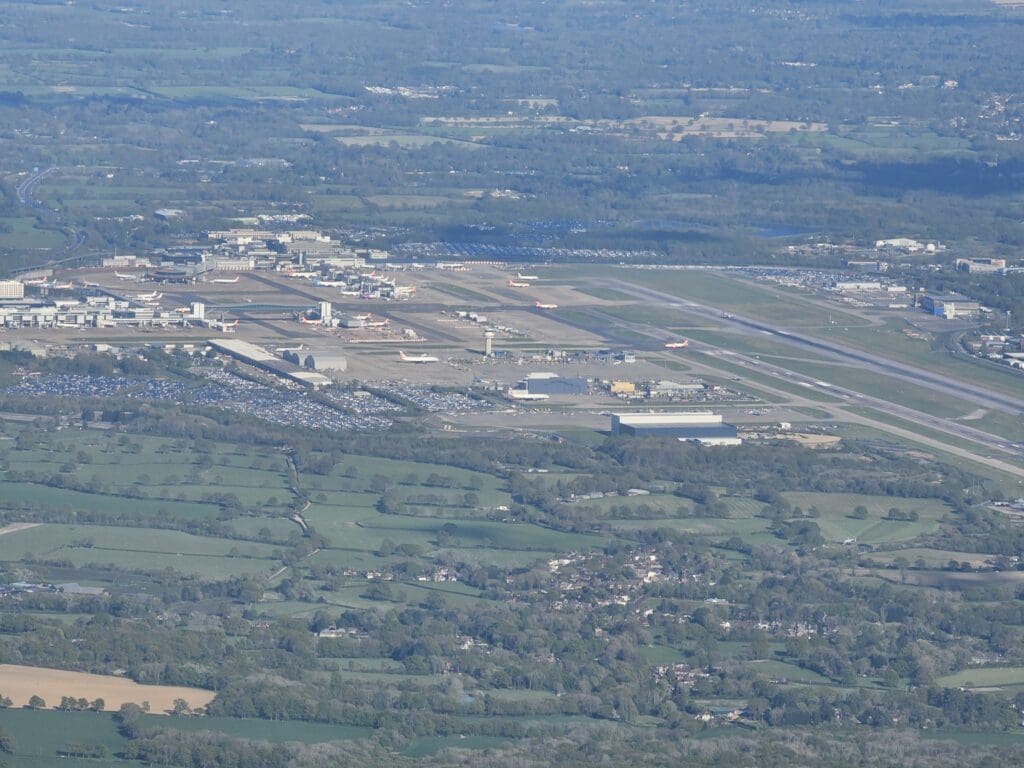
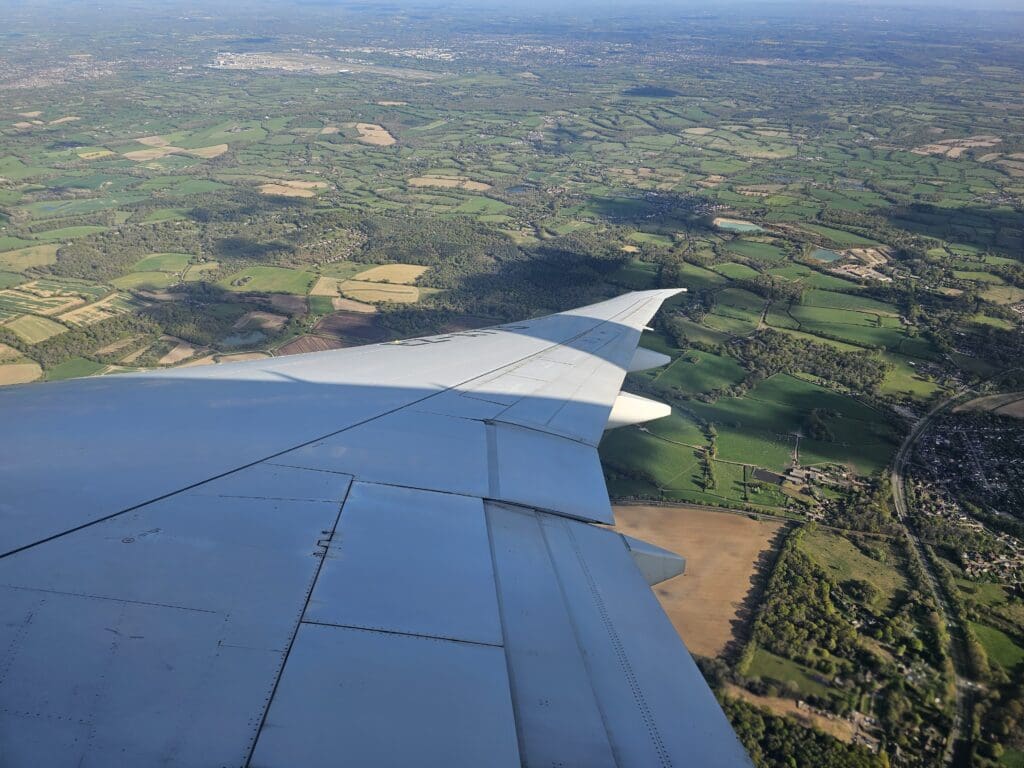
A total of fourteen minutes after departing Gatwick, the aircraft crossed over the Kent coastline in between Deal and Dover by which time we were already at 31,000 feet, with just 4,000 feet remaining until we levelled off. During our short four-minute crossing of the Channel, the aircraft was pummeled around which prolonged the illumination of the seatbelt signs for a while longer. Soon, the Boeing crossed over the famous French coastal town of Dunkirk in France’s far north, before entering Belgian skies moments later. Soon, the turbulence calmed down and the seatbelt signs were extinguished, followed by the usual announcement in Turkmen and English with the usual warnings to keep seatbelts fastened whilst seated. However, this lasted all of about ten minutes with a bout of turbulence resulting in the signs’ illumination and a rather robotic-sounding automated announcement in English only advising passengers to fasten their seatbelts.
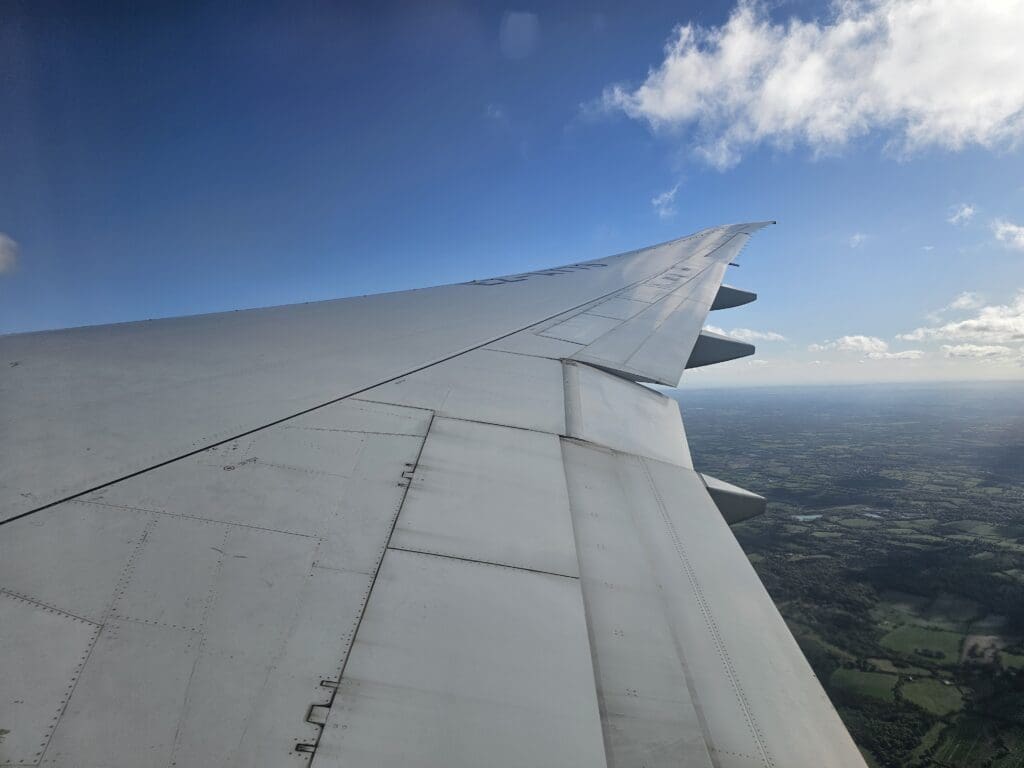
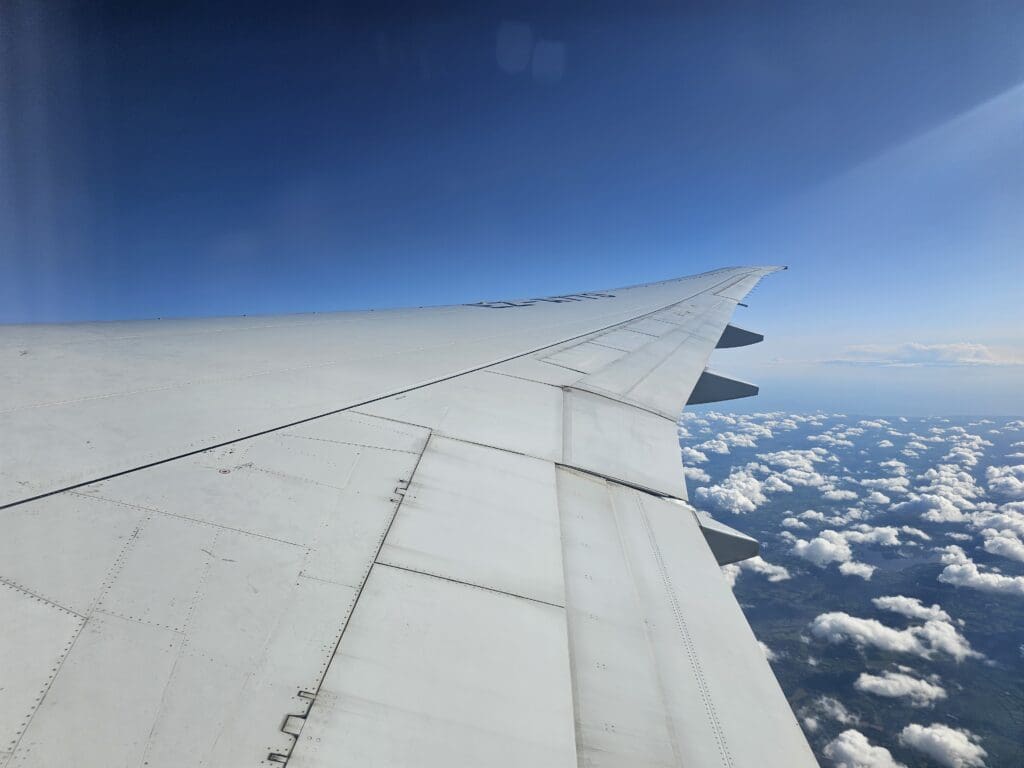
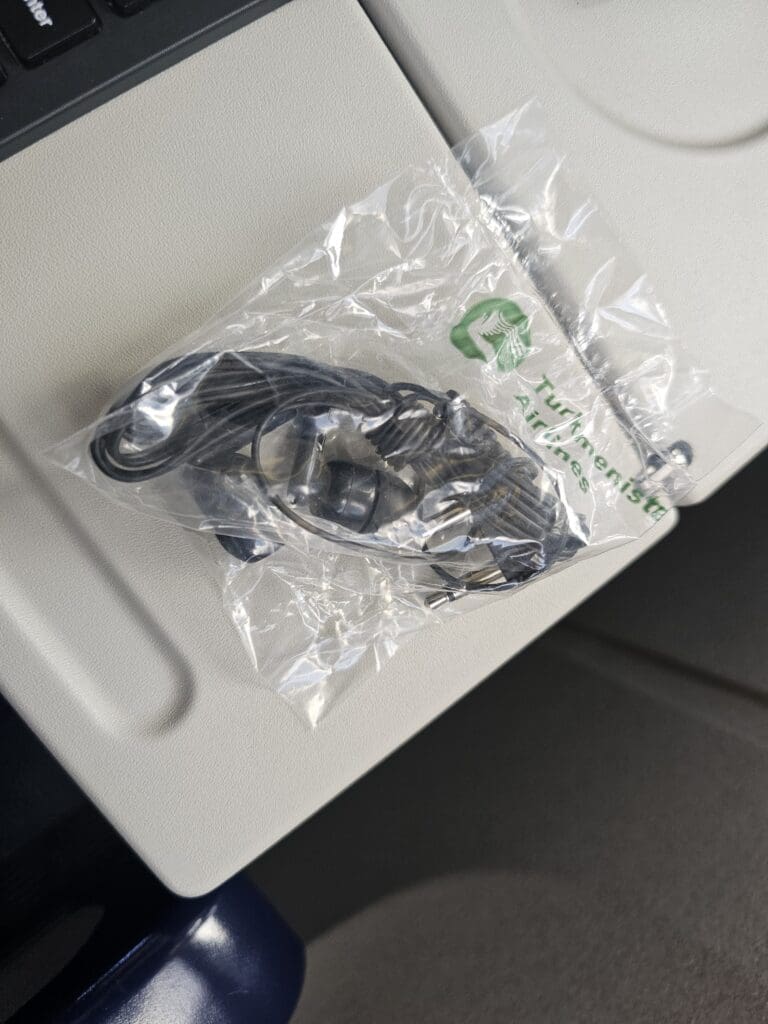
In the ten-minute turbulence-free gap, the aircraft cruised eastwards through the skies of Belgium, passing just to the north of Kortrijk, south of Ghent and directly overhead Brussels. Meanwhile, inside the cabin, one of the crew members passed through the cabin distributing earbud-type headphones. Soon, the aircraft passed Liège and entered the skies of the German state of North Rhine-Westphalia at which point things calmed down although the seatbelt signs remained illuminated. Despite this, the crew took no issue with passengers moving around the cabin.
Upon reaching the historic city of Cologne, a service cart was rolled out into the aisle indicating the commencement of the onboard service. Thanks to the light load, despite being the rearmost passenger onboard, no more than five short minutes after this commenced, I was asked for my choice of drink. Seeing as alcohol is prohibited onboard Turkmenistan Airlines, the drinks menu was simple -Coca-Cola, Fanta, Sprite, orange and apple juice, lemonade or still water. Opting for an orange juice, which was poured into a paper cup after which the surprisingly friendly flight attendant asked me whether I would like another drink. Declining this offer, I was then offered the choice of chicken with rice, or chicken with potatoes. Opting for the former, I was handed a large plastic box full of food, followed by the main dish, which was very similar to the service onboard Uzbekistan Airways. Furthermore, just like my experience with Uzbekistan’s national carrier, the quantity of food provided was ginormous!
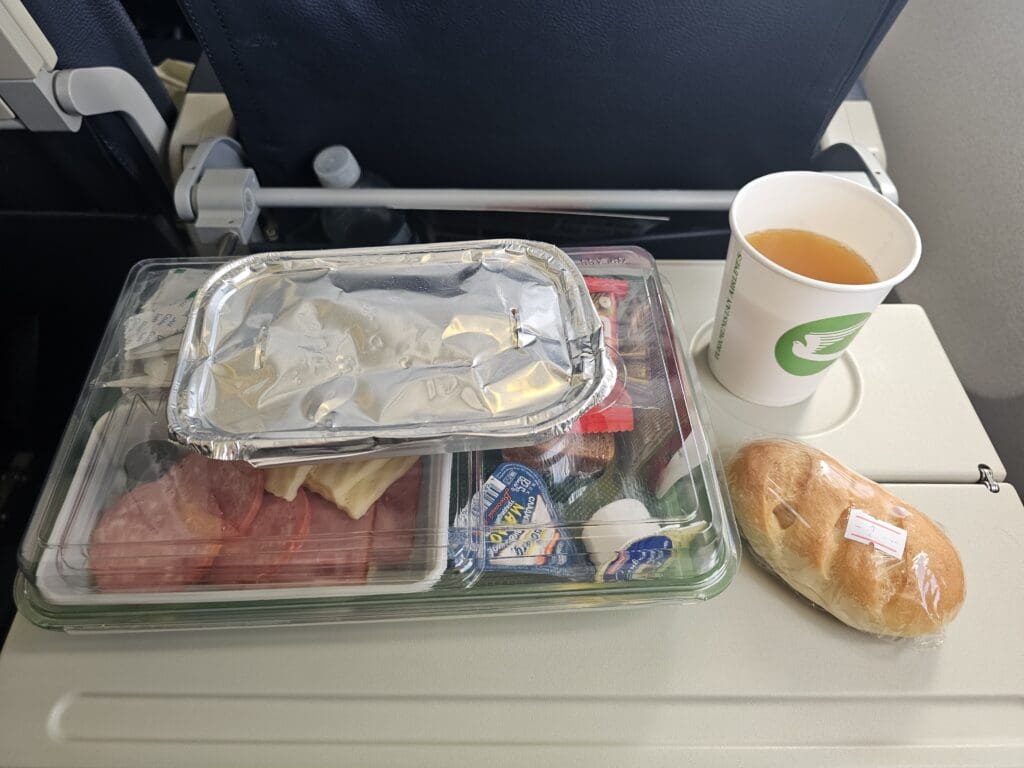
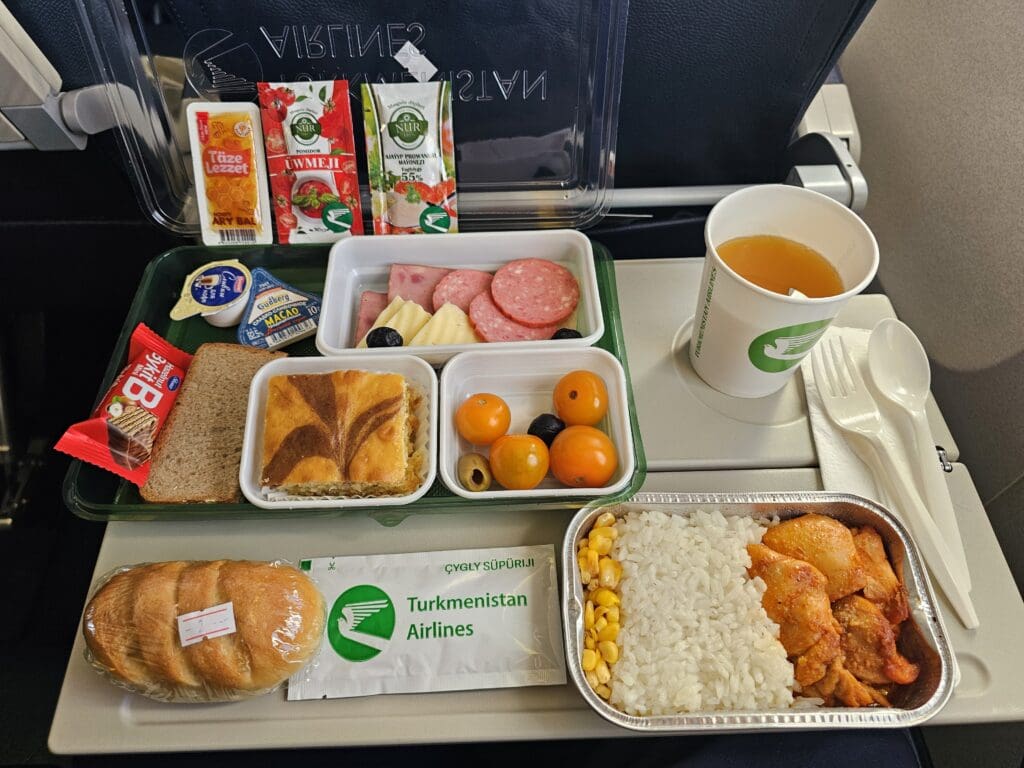
Upon opening up the plastic box, this contained a trio of dishes – one containing cold cuts of meat and cheese resting on a sort of tortilla, another containing a ‘salad’ consisting of three tomatoes and four shrivelled olives, and another containing a small marble cake. This came in addition to sachets of honey, ketchup and mayonnaise, as well as butter, a slice of brown bread, a white bread roll, milk and an Iranian made chocolate wafer biscuit. Meanwhile, eating utensils came in the form of plastic cutlery, accompanied by a serviette, a wet wipe and a toothpick. Finally, the main dish consisted of several pieces of chicken and a cluster of sweetcorn, separated by a bed of white rice. Not only was I impressed by the amount of food, but the chicken was some of the best that I have had onboard an aircraft, so top marks to Turkmenistan Airlines!
As I munched on my dinner, the service cart reached me again and I was offered another drink, opting for a coffee, I was asked whether I wanted the whole sachet of coffee or just half. This was then poured into a cup before once again, I was offered another drink that I declined. Whilst I found the flight attendant to be polite and friendly, and at odds with many accounts of cool service that I have read online, I should note that they did cough all over my cup without covering their mouth before pouring the coffee! This left me slightly worried about contracting a cold just before I headed off into the high Himalayas. Fifteen minutes later, another flight attendant appeared to collect the rubbish, which was undertaken with a smile but without a word.
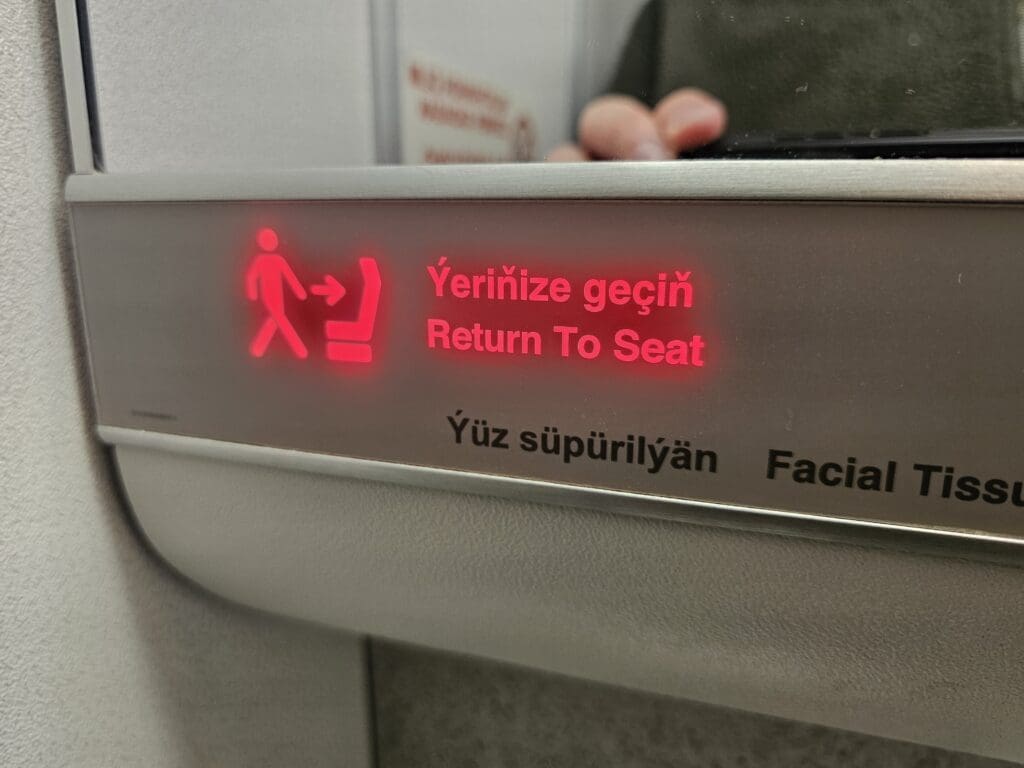
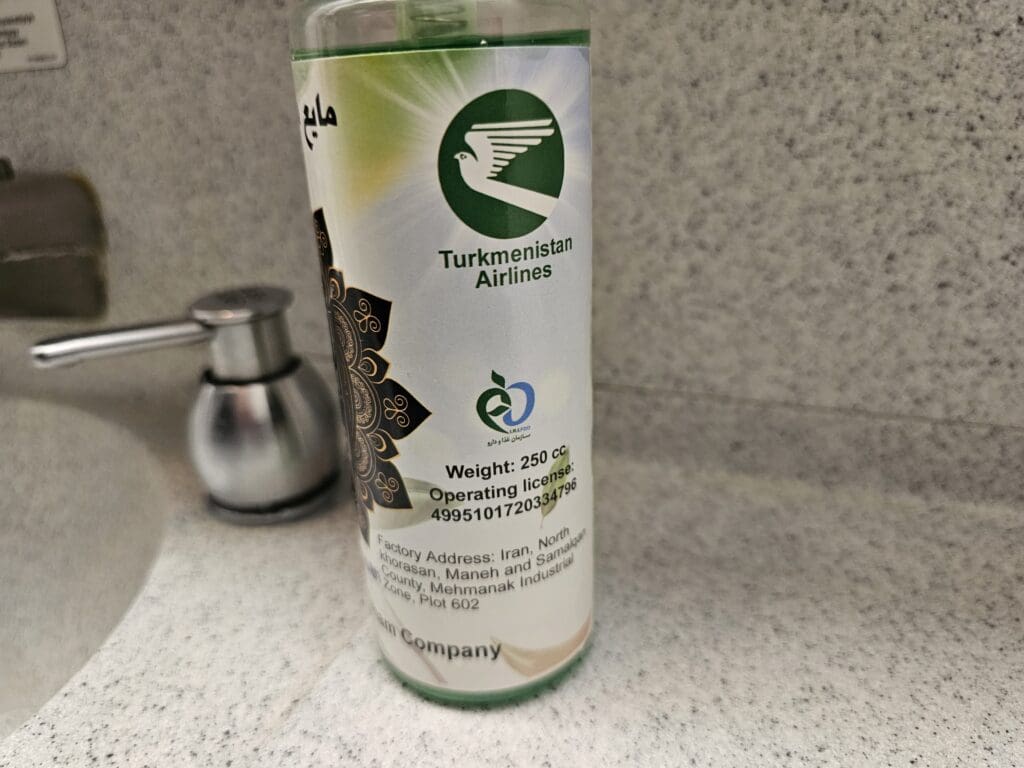
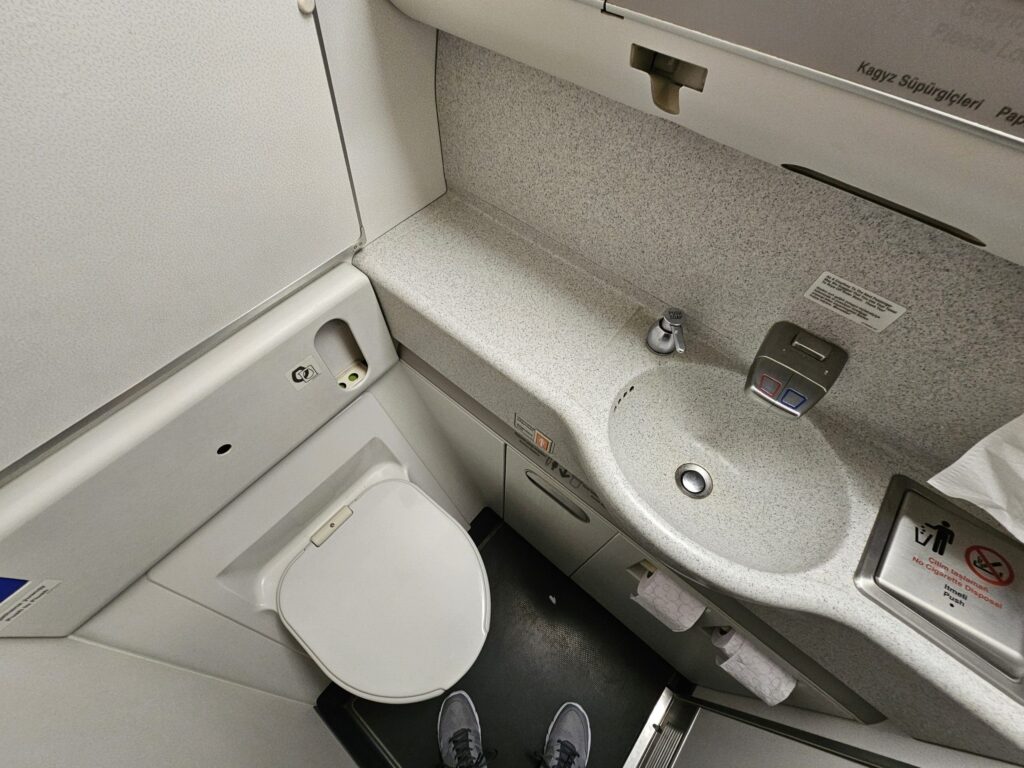
Once my box had been collected, I decided to visit one of the four lavatories sandwiched between the two Economy cabins. Upon opening this up, I found this to be stocked with the basics and nothing else, being reasonably clean and largely devoid of wear and tear. Granted whilst this was not the most luxurious aircraft lavatory that I have ever visited, it left me with nothing to complain about either.
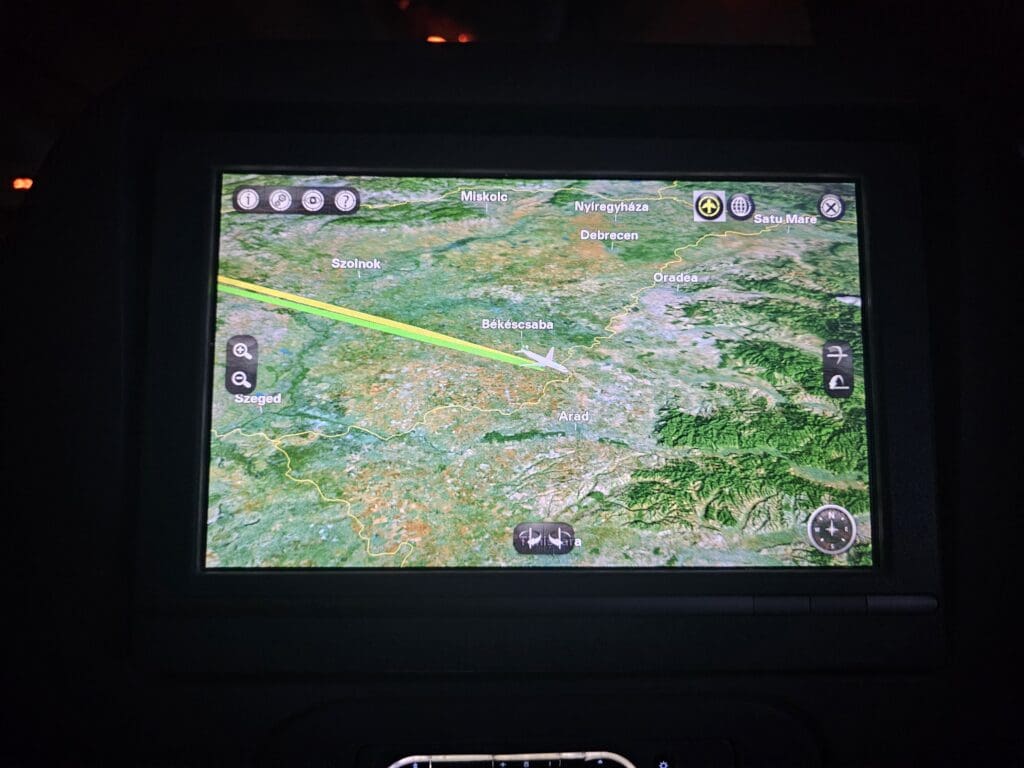
From Cologne, the aircraft cut across Germany, passing Frankfurt, Würzburg, Nuremberg and Regensburg before passing into Austrian skies near the city of Linz. This was somewhere that I had visited on my McDonnell Douglas MD-80 adventure back in 2022. Making a fifteen-minute crossing of the country, it wasn’t long before we reached the skies of Hungary. Onboard, I have to say that the cabin was boiling hot – something that was not helped by the lack of personal air vents. By the time we reached Central Hungary, things were starting to become dark outside, and with little to see, I decided to explore the delights of Turkmenistan Airlines’ inflight entertainment system.
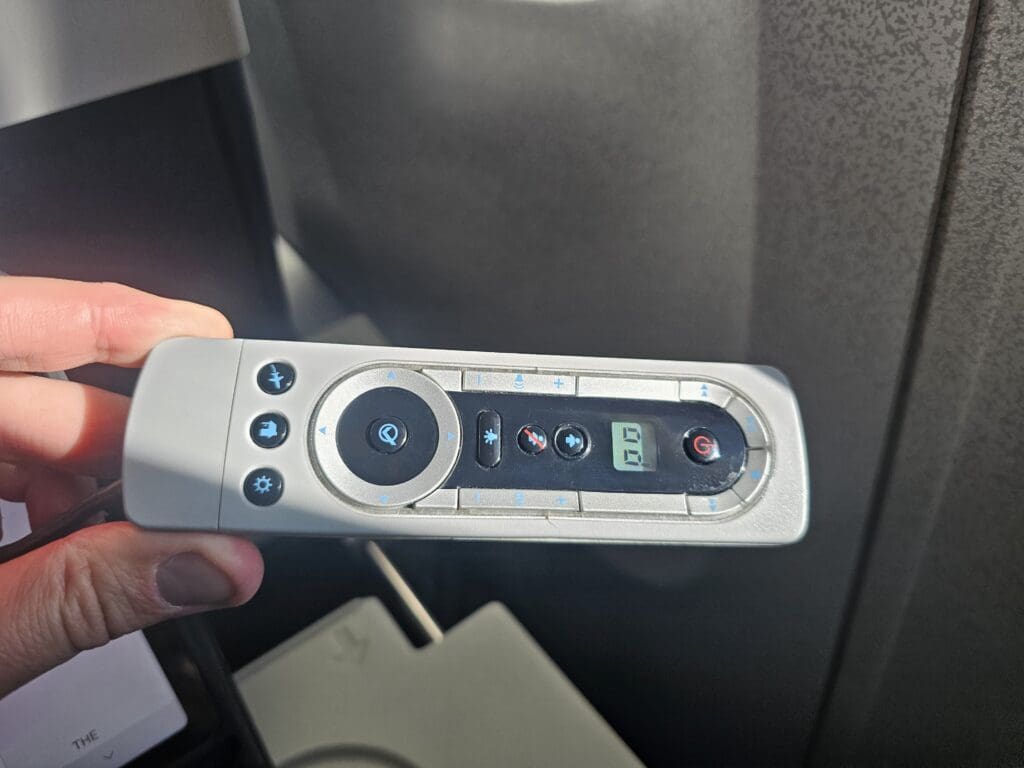
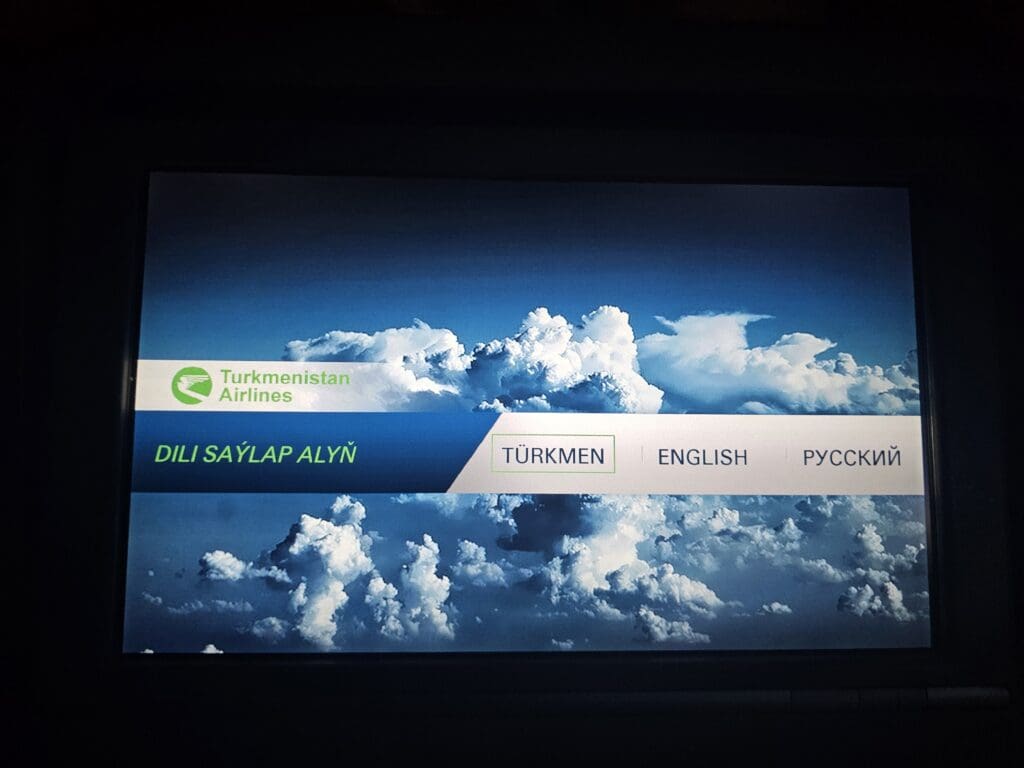
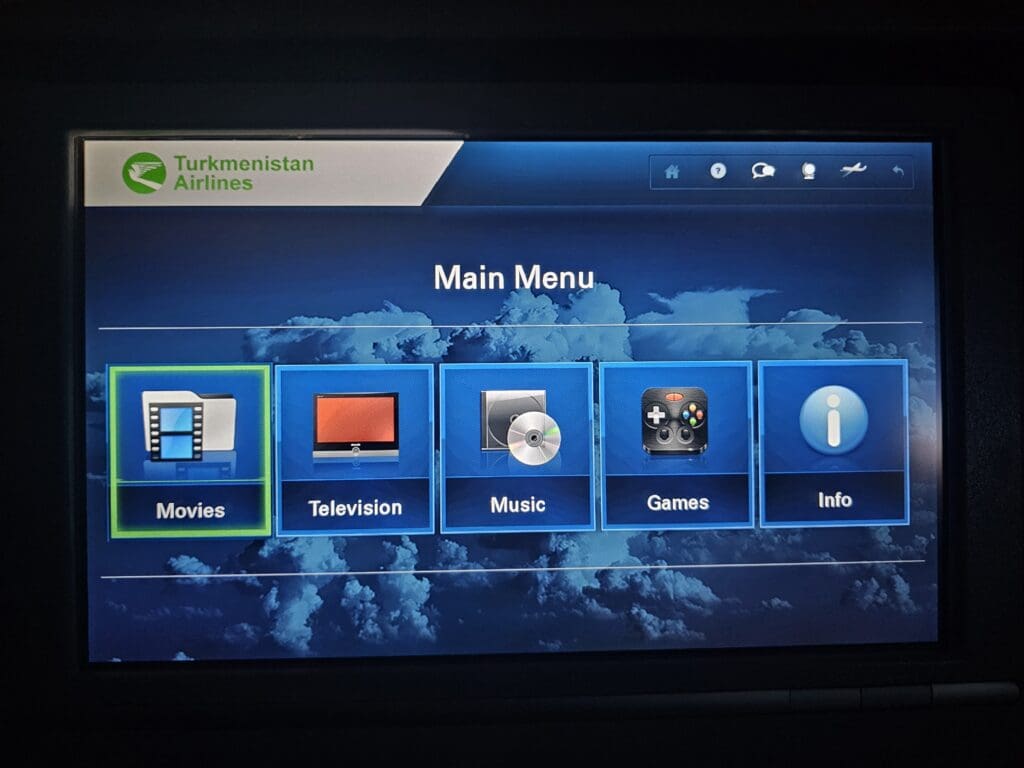
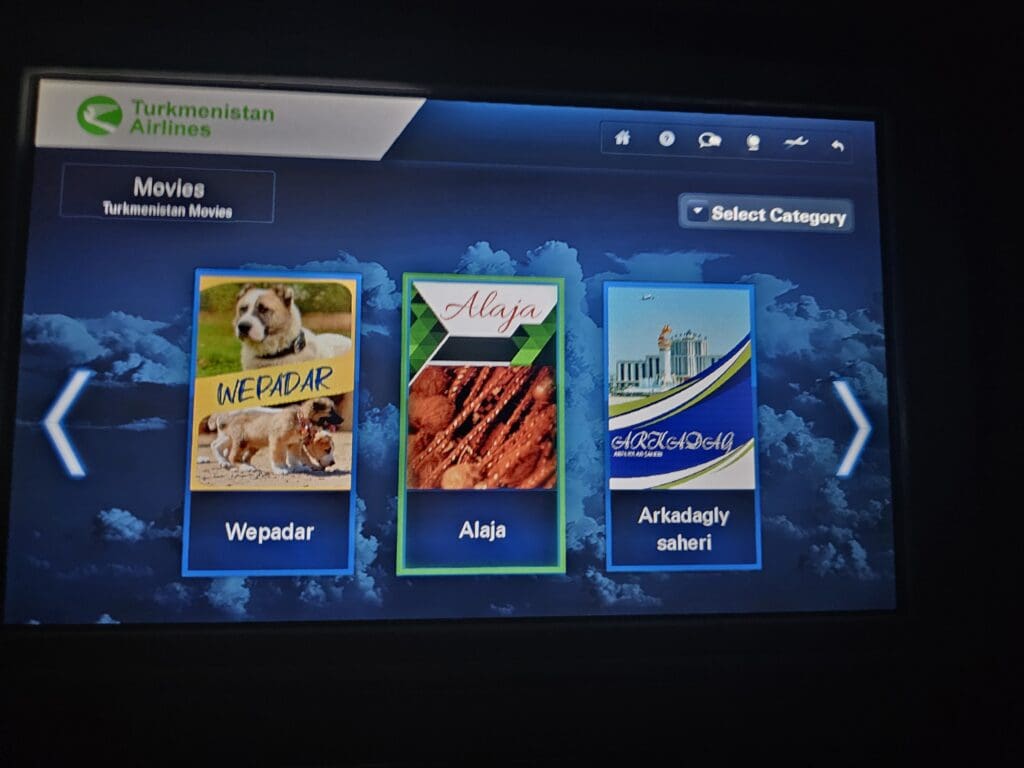
Interestingly, all Turkmenistan Airlines reviews that I had encountered up until my flights noted a lack of any sort of inflight entertainment despite the presence of inflight entertainment screens. However, much to my surprise and delight, this was loaded with an inflight entertainment system. Starting with the basics, this was slightly dated in its appearance and layout, and with available in the trio of languages that you would expect – English, Russian and Turkmen. Meanwhile, whilst the screen quality was acceptable, this was by no means comparable to the latest high-definition screens that can be found on many other airlines, and the touchscreen function could be described as temperamental at best, often leaving me with no option other than to navigate through this using the clunky remote.
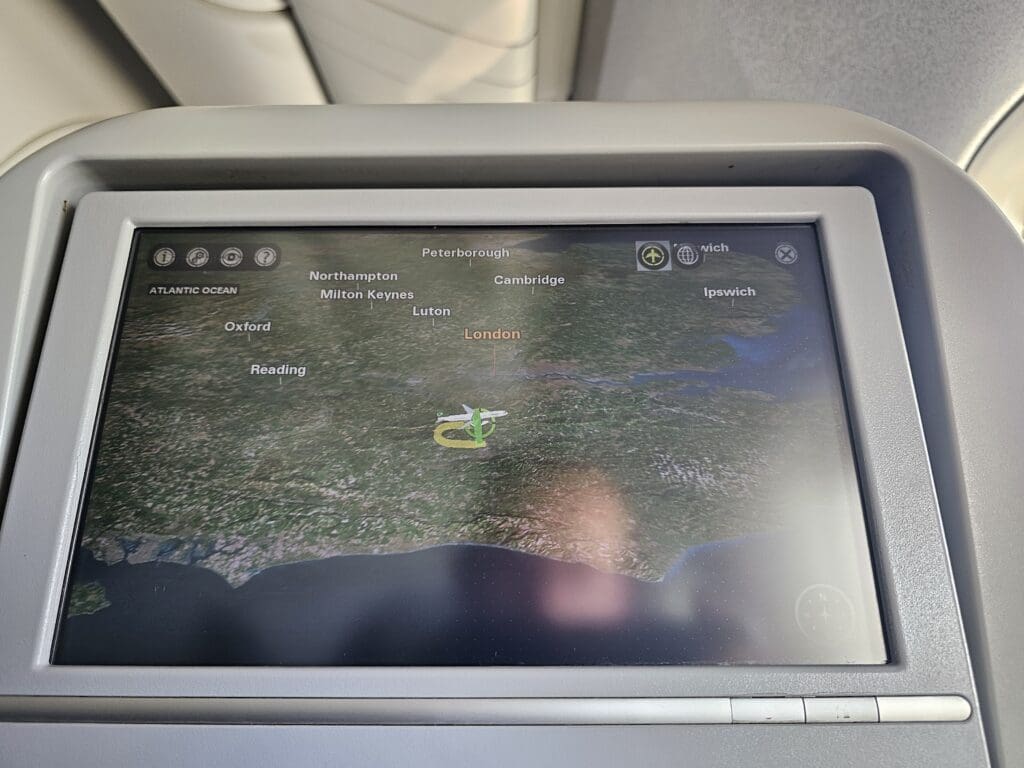
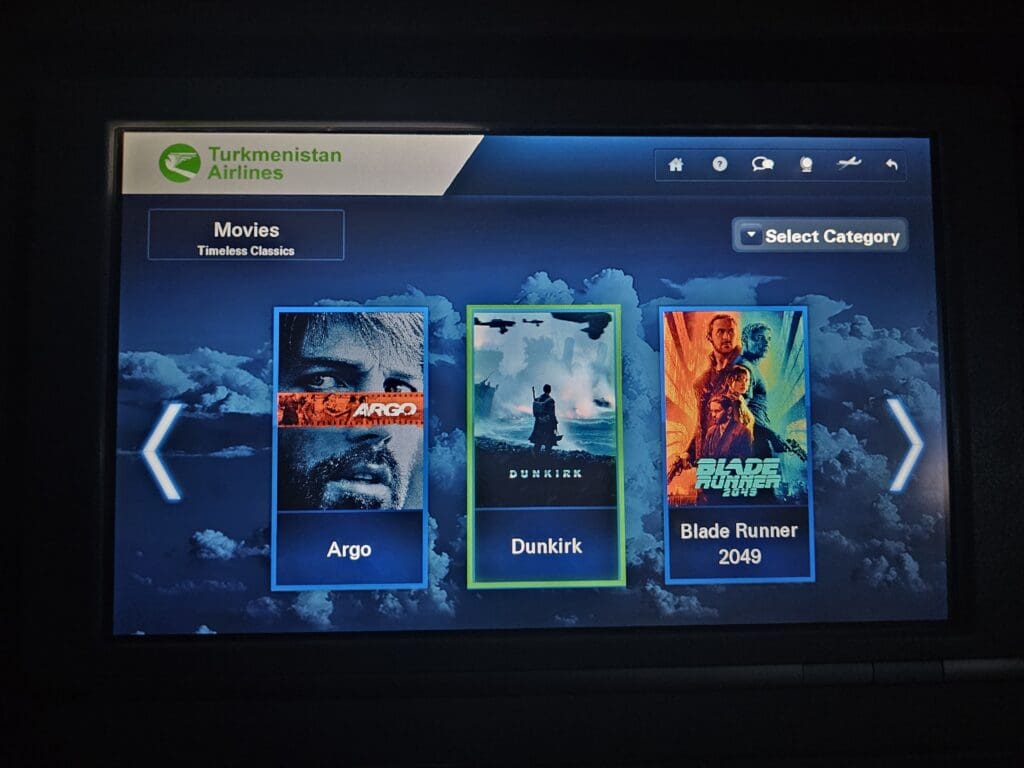
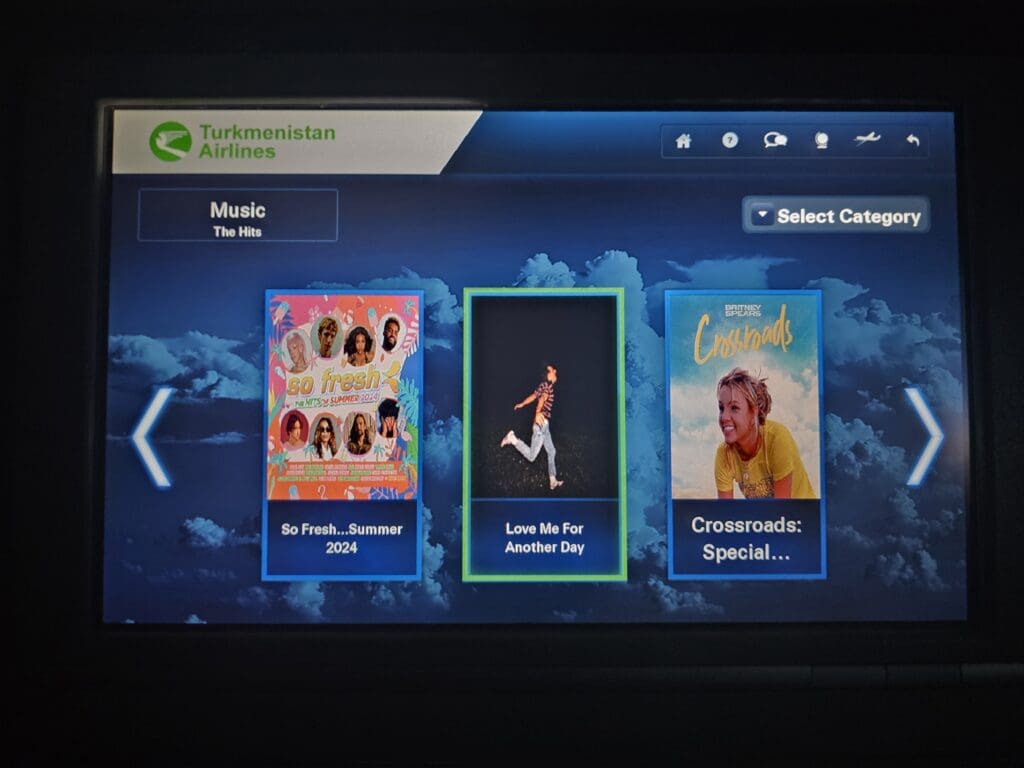
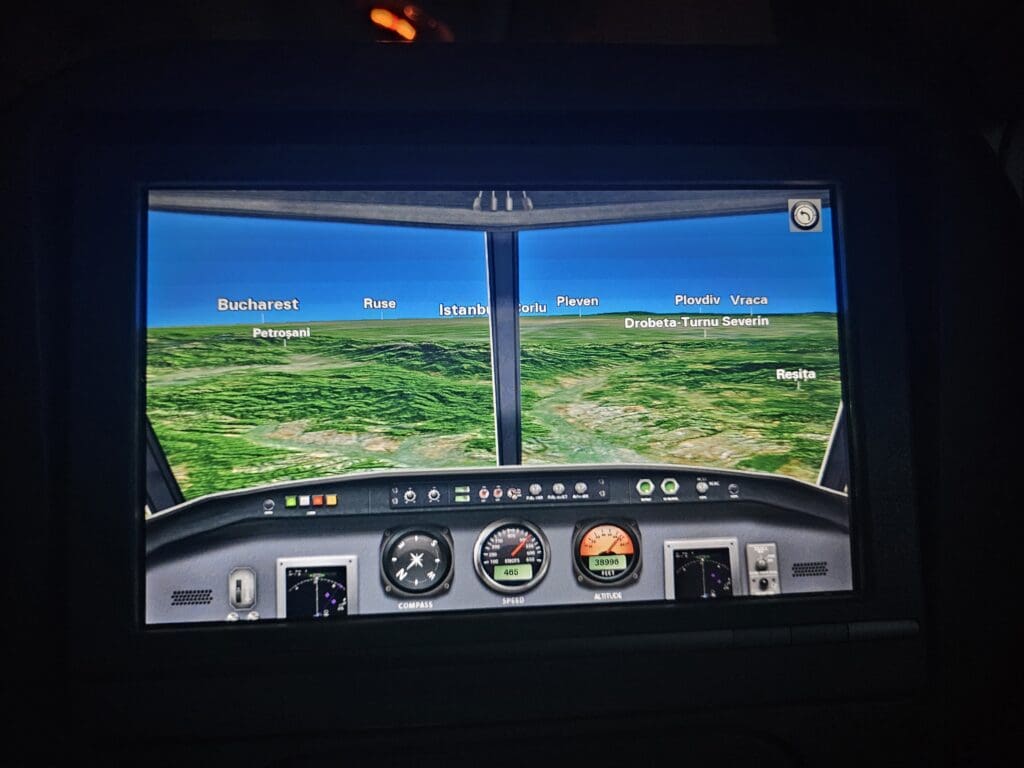
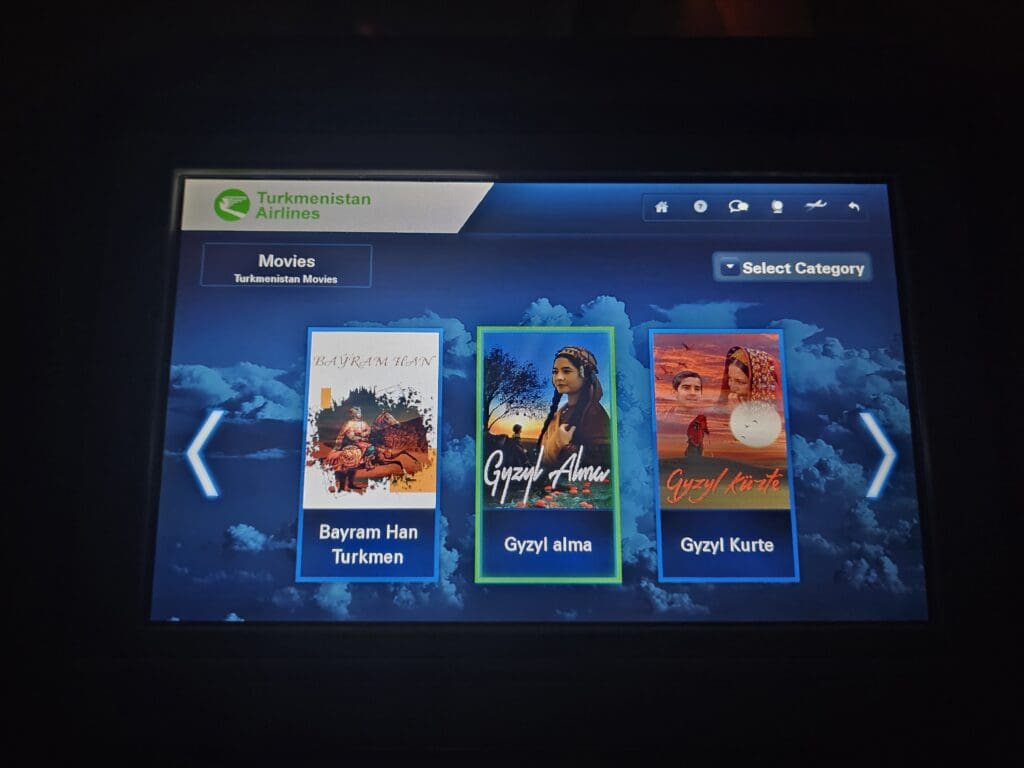
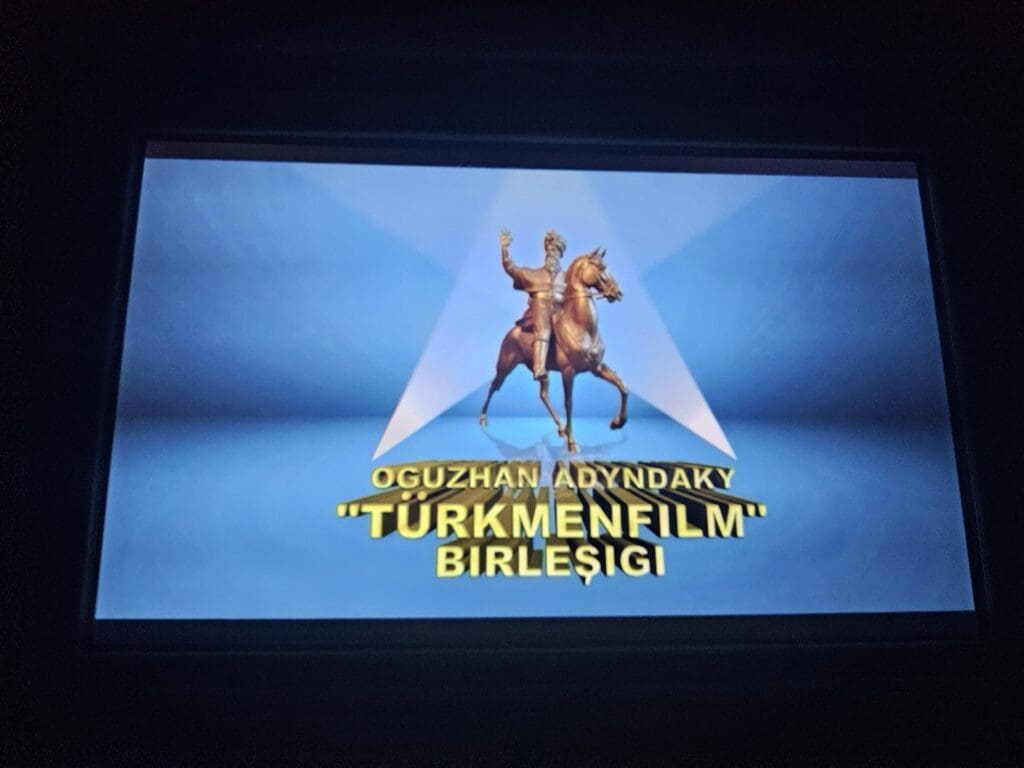
Once I had selected English, I was presented with five options – Movies, Television, Music, Games and Info, although the lattermost section featured nothing other than an error message. Turning to the content, a compact selection of mostly Hollywood and Turkmen films was offered. Specifically, this featured nineteen big-name Hollywood films, ranging in age from the 1994 classic Shawshank Redemption to 2023 film, Wonka. This also featured nine Turkmen films, two from Russia and one each from China, India and Turkey. This system allowed passengers to watch the trailers for most options, whilst films commenced without any advertisements. Moving on, despite there being a Television category, no programmes were offered. Meanwhile, when it came to music, an array of playlists featuring Bollywood, classical, dance, jazz and pop could be listened to, along with an eclectic compilation of albums by Alicia Keys, Daft Punk, Freya Micha and Maneskin. Whilst this was not the most expansive selection, expecting nothing and having somewhat low expectations, I was positively surprised by Turkmenistan Airlines’ inflight entertainment system. Last but not least, I found the Geofusion3D moving map to work without issue throughout the flight, offering a variety of ways for passengers to track our progress.
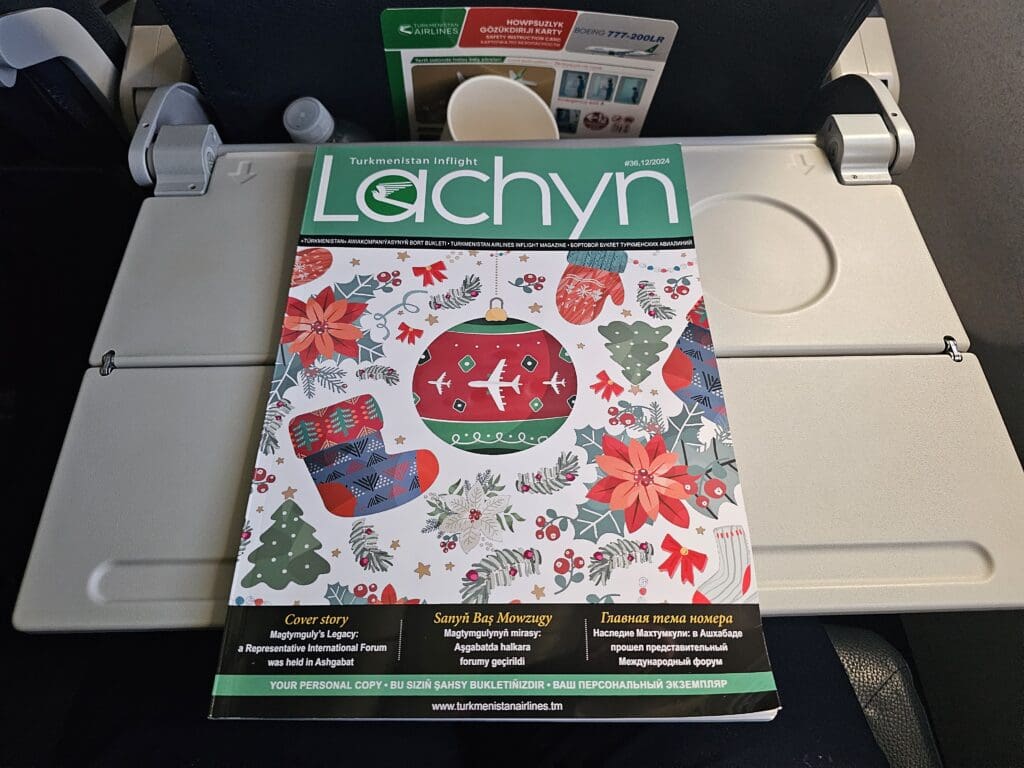
Despite there being no magazines in most seat pockets, I did later spot a cluster of Turkmenistan Airlines’ inflight magazines, Lachyn, in another seat pocket. Strangely, whilst this is theoretically a monthly publication, these were all the December 2024 edition of this, and thus were over five months old at the time of my flight. Giving this a read, I found Lachyn to definitely be one of the more peculiar inflight publications that I have ever browsed. This seemed to primarily focus on the latest movements of Turkmenistan’s president and the former president, his father. However, to its credit, this was published in both English and Turkmen, and lacked the same array of advertisements as many other inflight magazines. Much to my surprise, there was actually a ‘TUA_OnAir’ wifi network present, although whilst this could be connected to, this appeared not to work.
Once the skies had darkened, the cabin lights remained off, although most of my fellow passengers remained awake and passed the time on their personal devices or by browsing the wonders of the inflight entertainment system. Meanwhile, in the aisles, the crew passed through the cabin at regular intervals, presumably to ensure that all was as it should be.
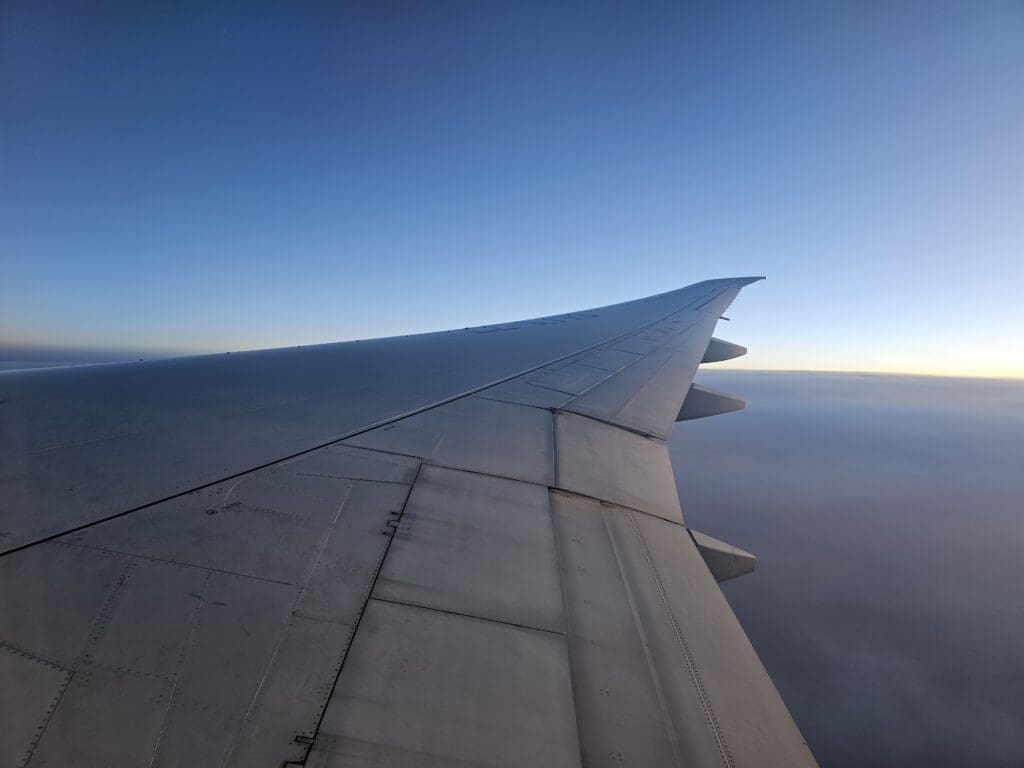
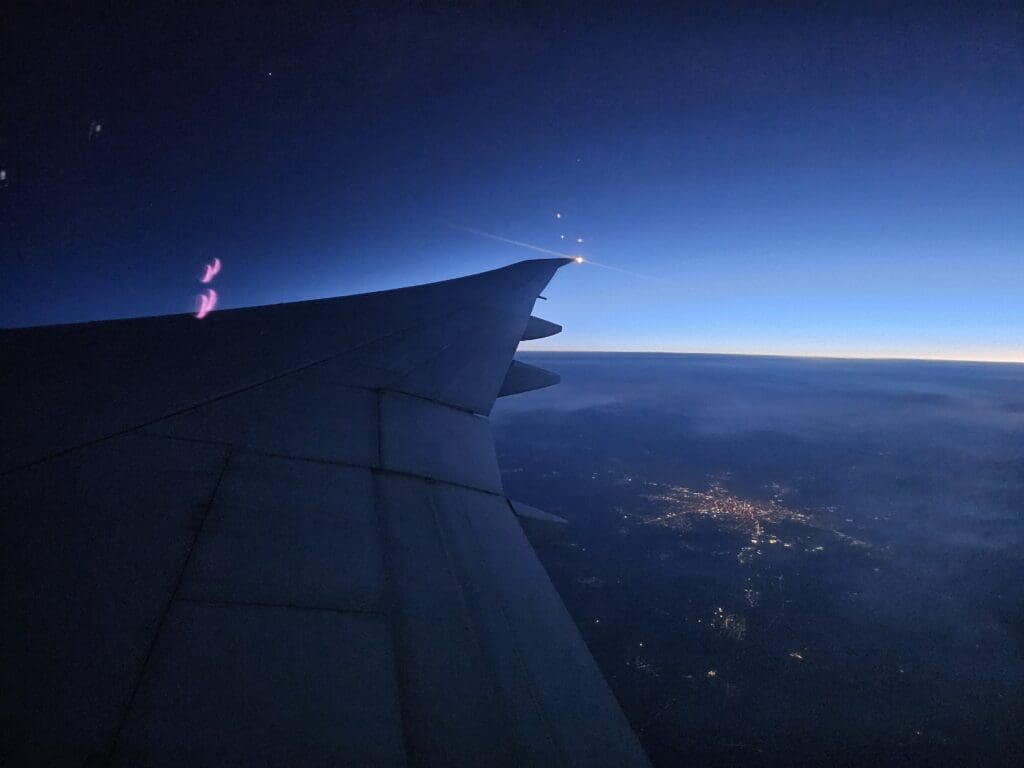
Looking outside, a combination of clouds and darkness meant that nothing could be seen for much of our crossing of Southeastern Europe. Upon Hungary, the aircraft crossed into the skies of Romania and made its way down the southwest of the country, passing the likes of Timișoara, Târgu Jiu and Craiova, before entering Bulgarian airspace about thirty minutes later. Making a shortcut across the north of the country, the Boeing passed over Ruse, Shumen and Burgas, before making its way out over the waters of the Black Sea.
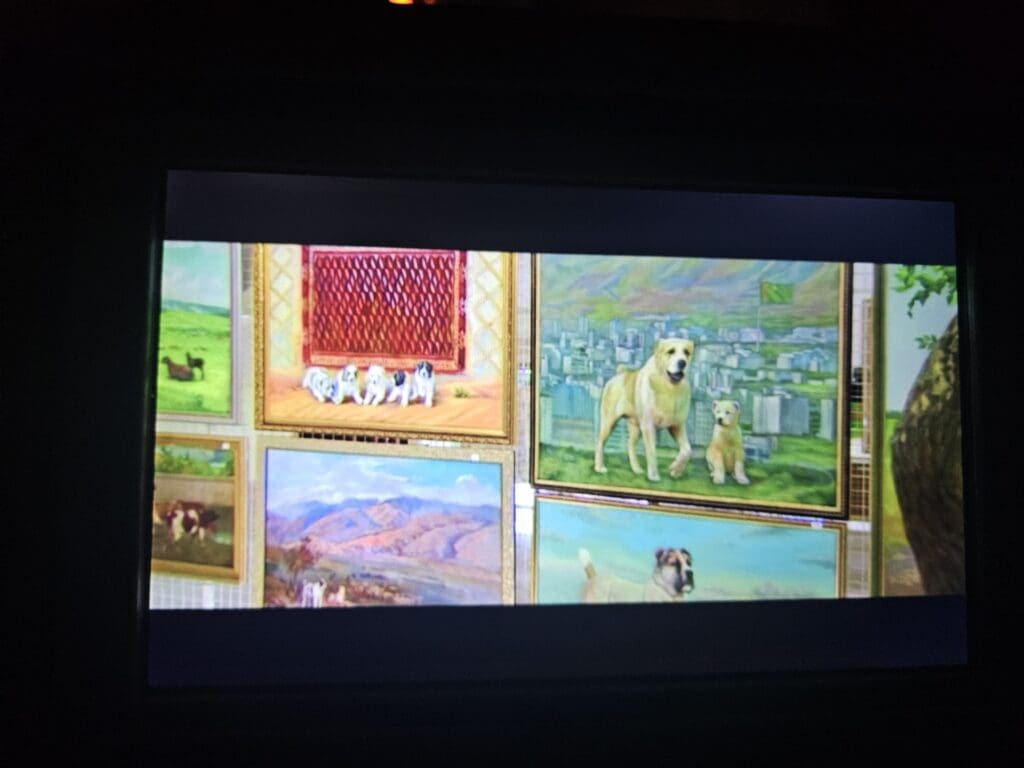
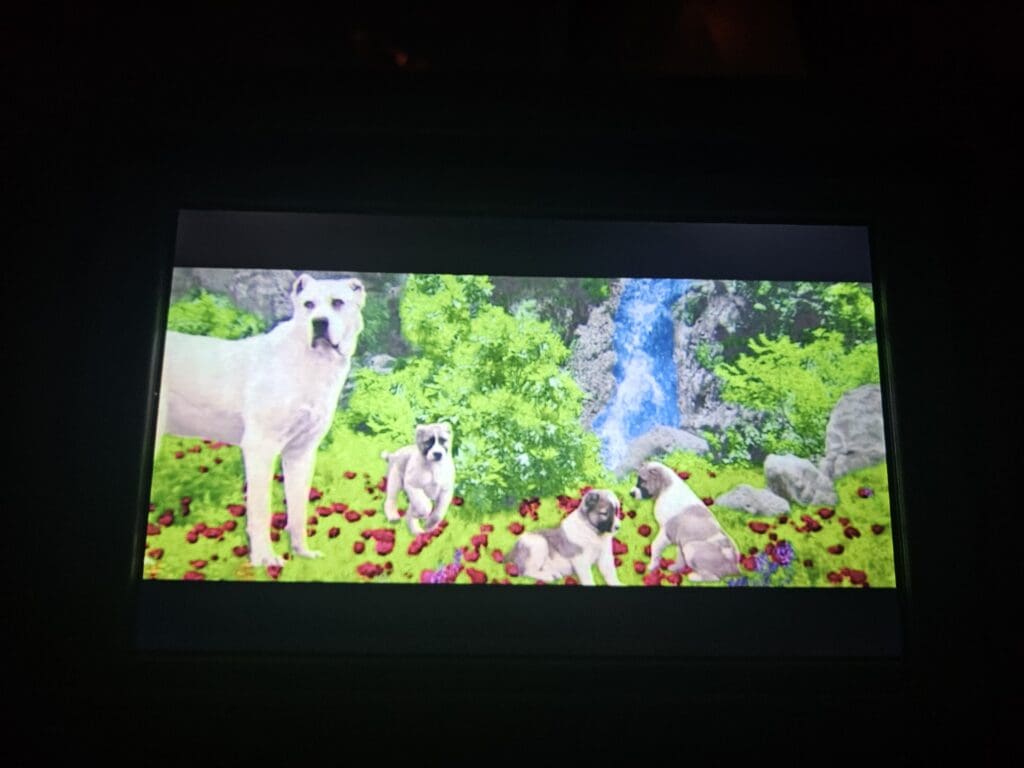
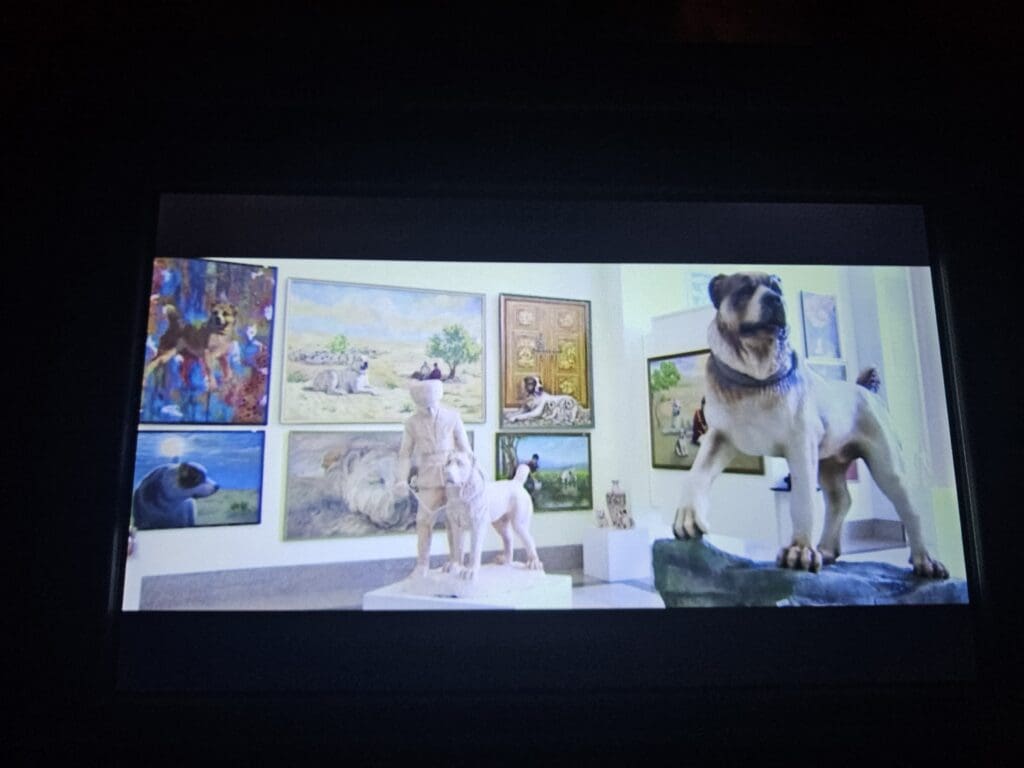
Perhaps due to the ongoing airspace restrictions as a result of the conflict in Ukraine, that evening, our aircraft did not take a particularly direct routing towards Turkmenistan. Rather than heading straight across the Black Sea and making a beeline for the Caucasus, we instead headed southwards to Turkey, heading all the way inland to Ankara before heading back up to the northern coastline of Samsun Province and following this past Trabzon and Rize, all the way to the coastal Georgian city of Batumi.
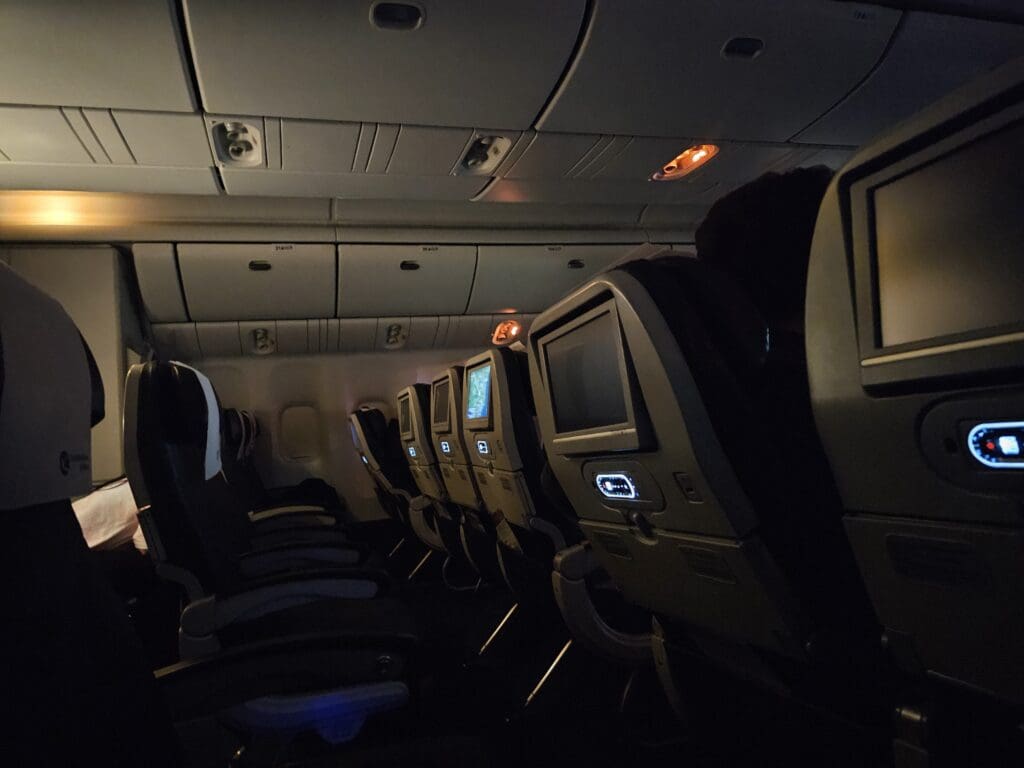
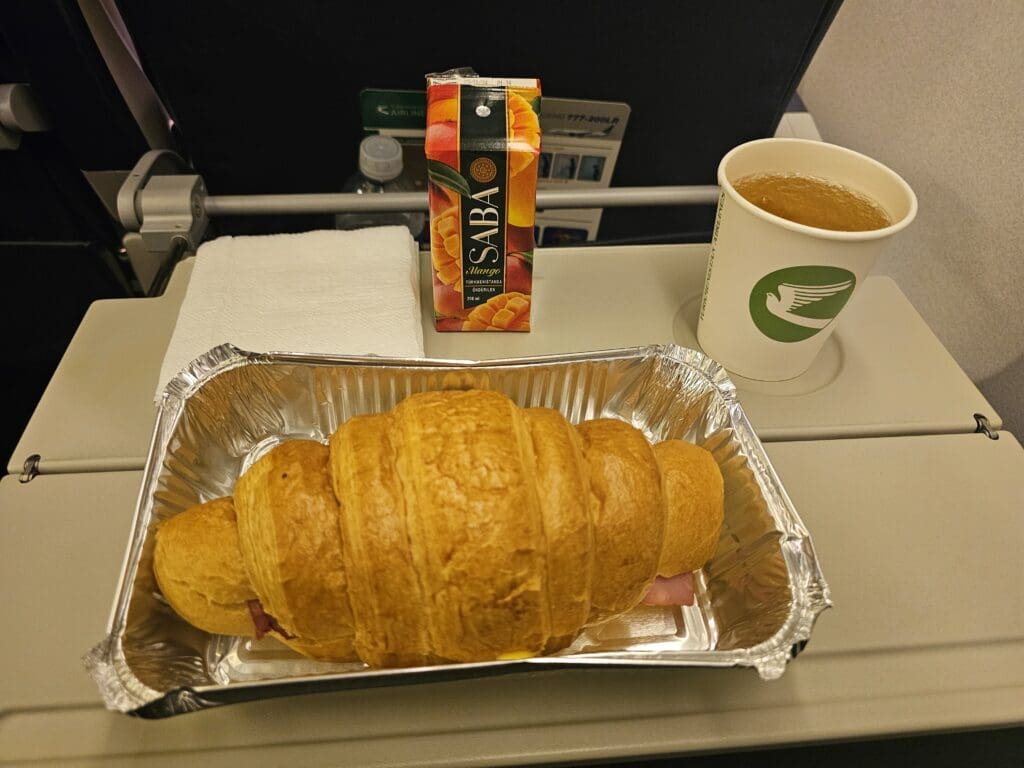
Upon entering the skies of Georgia, the cabin lights were turned on at full blast, and I assumed that we were to be treated to another round of drinks. This was then followed by an announcement in Turkmen and English advising of the soon-to-commence service. A short time later, the two friendly flight attendants reached my row and I opted for a Turkmen lemonade. Much to my surprise, I was also handed a massive croissant filled with meat and cheese, as well as a 200ml carton of mango Juice. Given the duration of the flight and quantity of food provided during the first meal service, I have to say that I think this service was somewhat unnecessary, yet wanting to get the full Turkmenistan Airlines experience, this was nevertheless appreciated. In terms of quality, whilst not quite the pinnacle of inflight catering, this offering left me with no major complaints and I happily munched away on this as we soared high above the Georgian mountains.
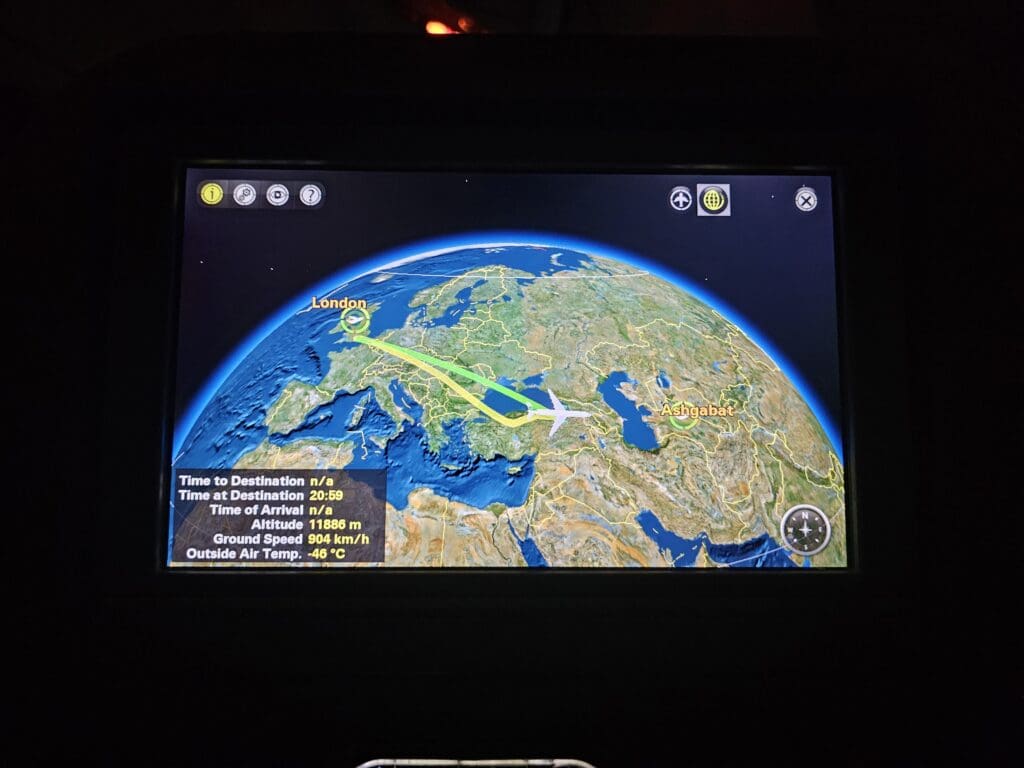
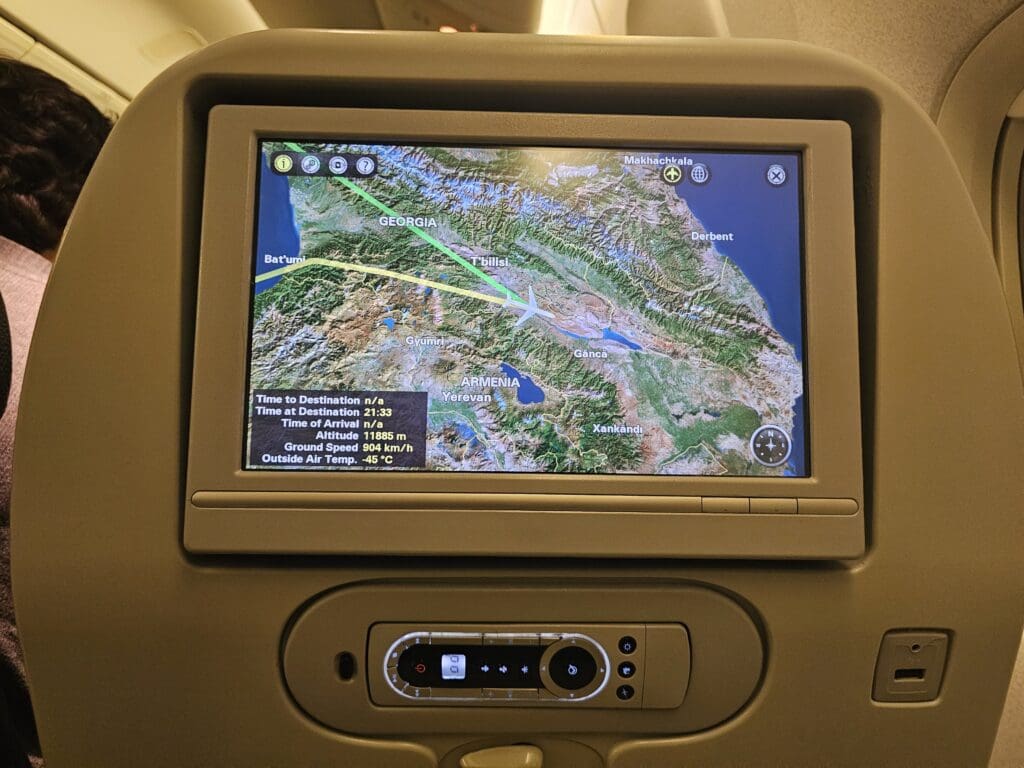
Once the rubbish was collected, the cabin was plunged into darkness as we passed Tbilisi and sped eastwards into the skies of Azerbaijan. Whilst this route would offer superb views of the diverse landscapes of the Caucasus by day, nothing could be seen as we made our way towards the coastline and after about thirty minutes, we passed just to the south of the capital Baku and made our way out over the Caspian Sea.
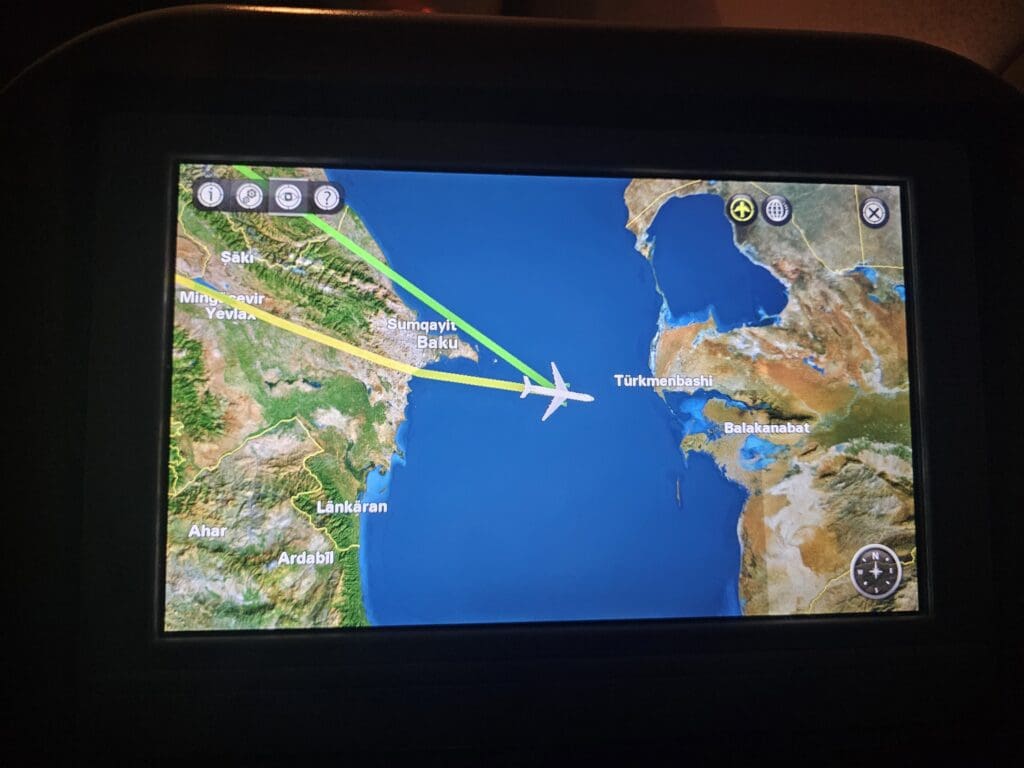
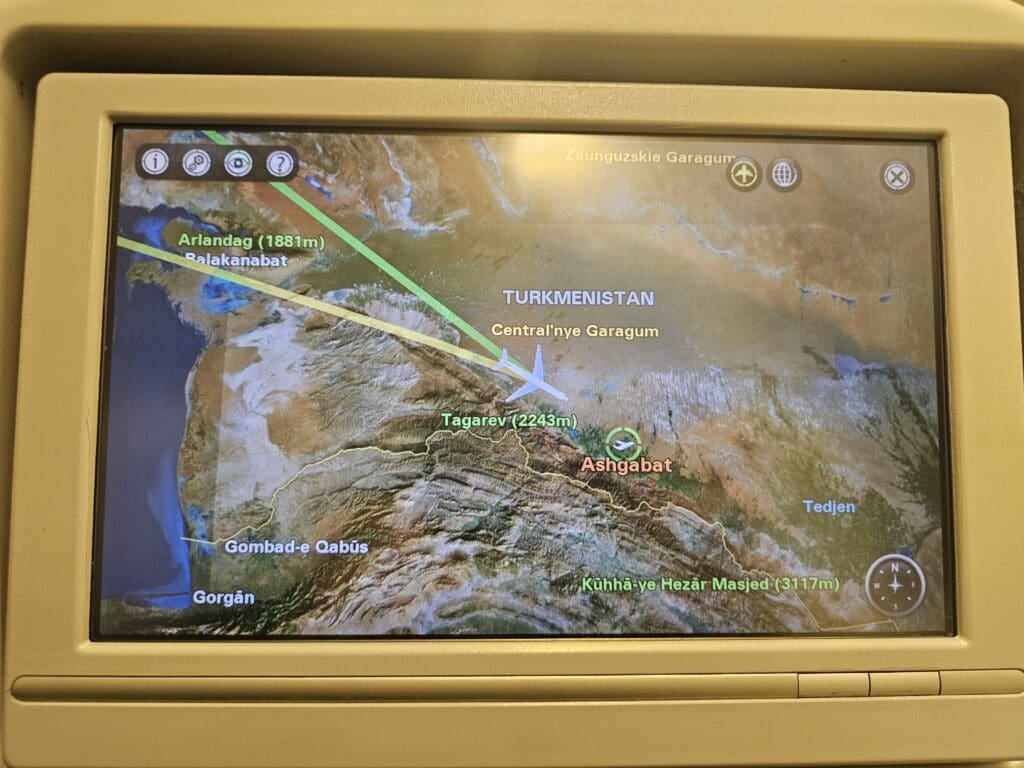
Around twenty minutes later, the aircraft made landfall over the city of Türkmenbaşy, somewhat famous for its large port and oil refinery. Heading inland, the aircraft followed the course of the M37 road and at 2235 UK time, or 0235 Turkmen time, the Boeing could be felt gently commencing its descent. Wasting no time whatsoever, this was almost immediately followed by an announcement from the Purser featuring all the usual information and warnings regarding seatbelts, seatbacks, tray tables and window shades, with the lights turned back on and the crew soon passing through the cabin ensuring all was secure and in place for our arrival.
Once all was secure for our arrival, the cabin lights were turned back off once again. However very little could be seen until all of a sudden the bright lights of Turkmenistan’s capital appeared, with the colourful illuminations of some of the city’s key sites including the Turkmenistan Independence Monument and Monument to the Constitution. That night, our aircraft would be landing into the northwest on Runway 29R and our approach took us past the capital to the north, before turning back towards Ashgabat at which point the aircraft’s flaps and landing gear were lowered in preparation for our arrival.
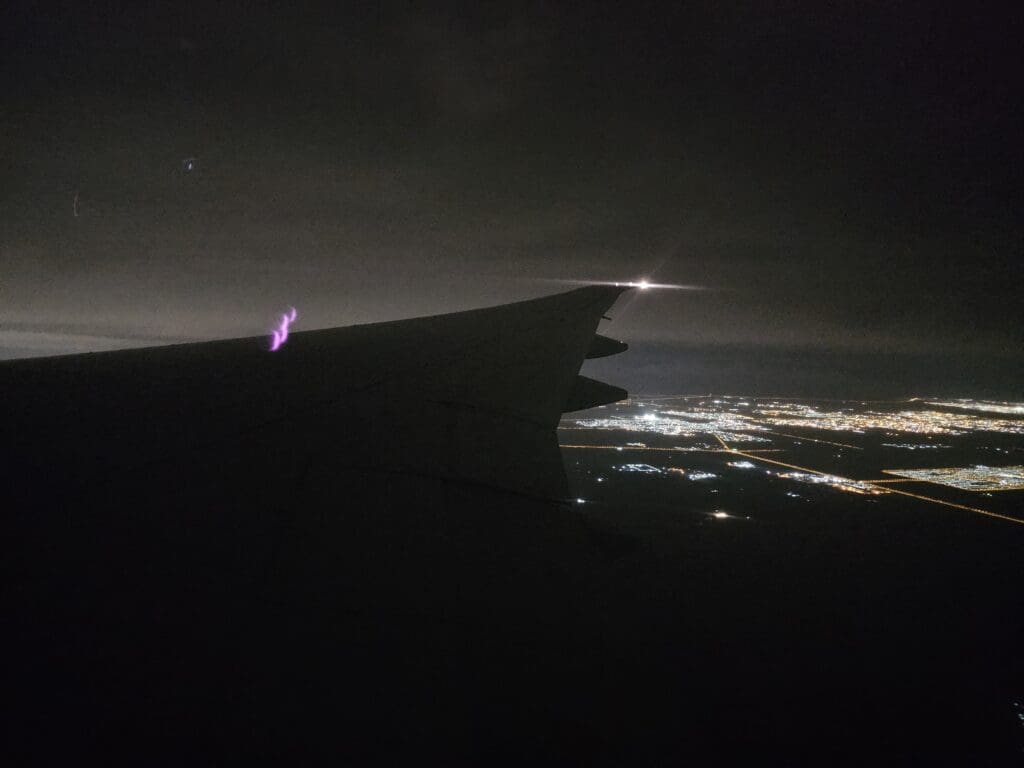
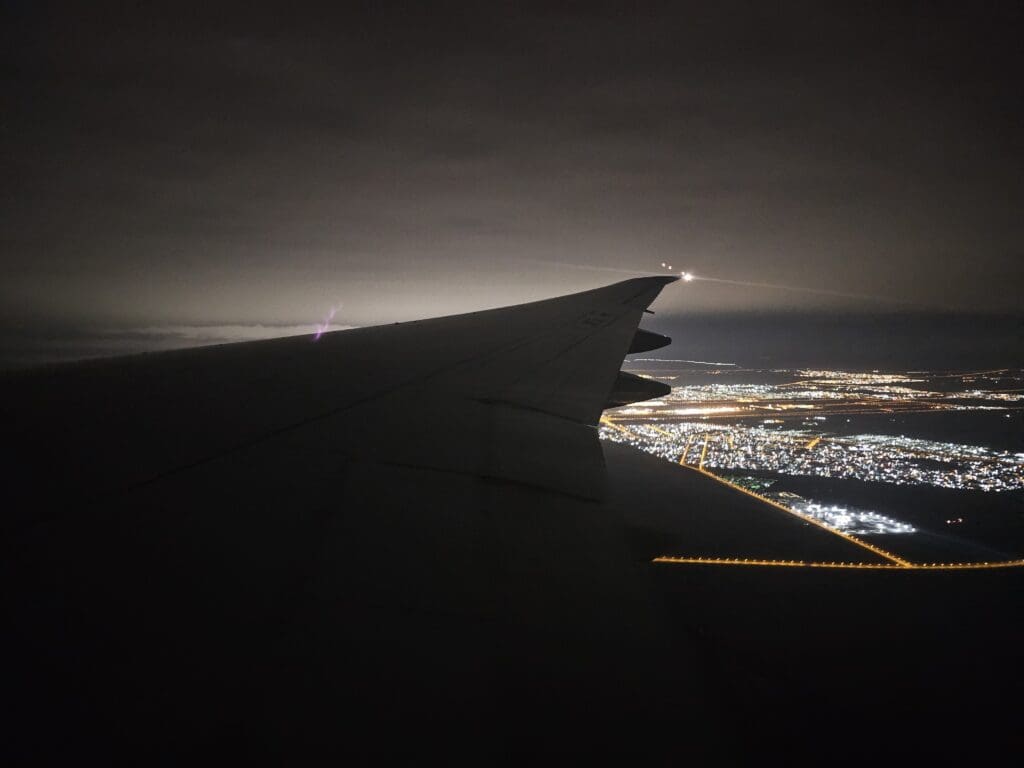
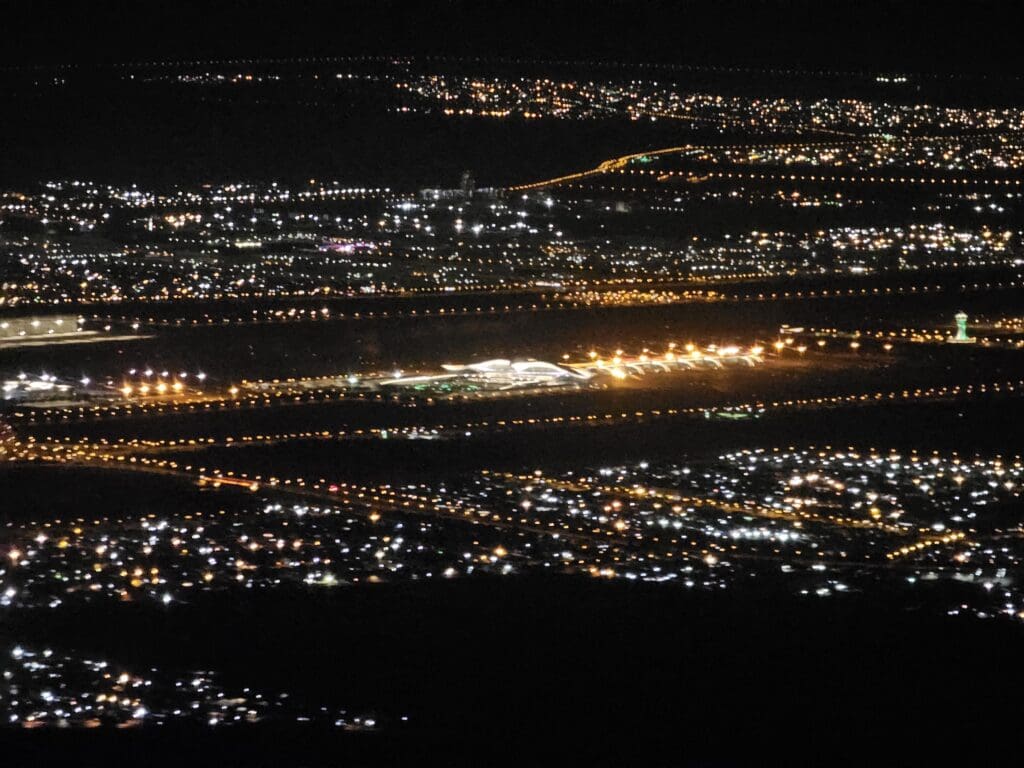
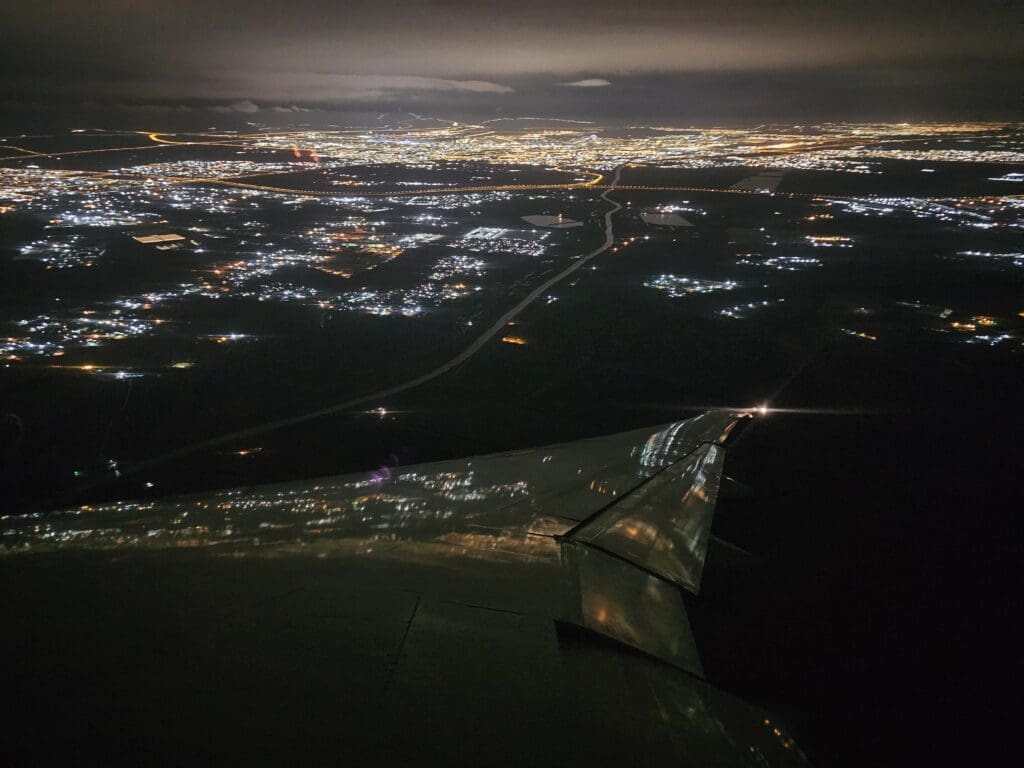
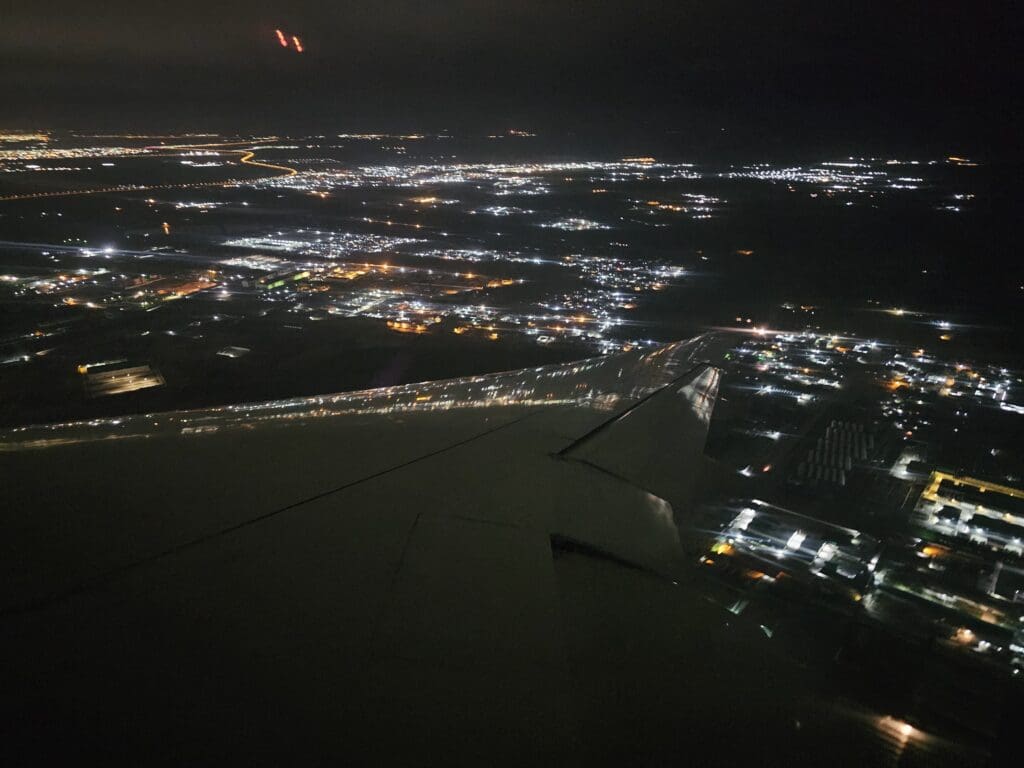
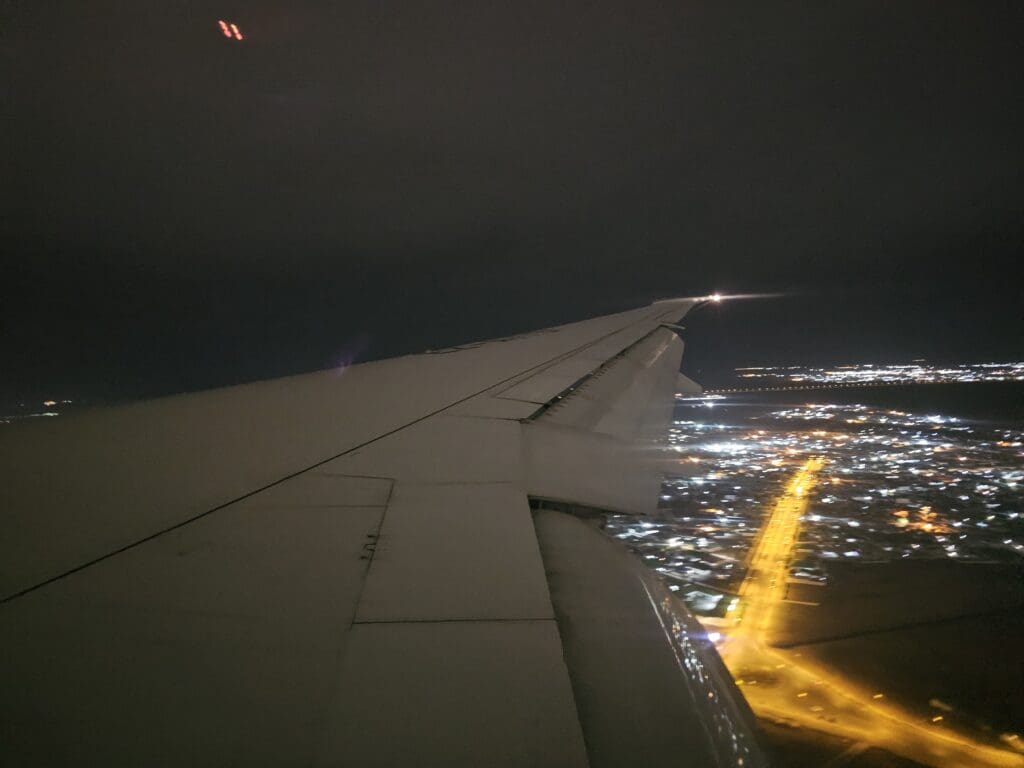
During the final few minutes of the flight, little could be seen from my seat on the right-hand side of the aircraft other than the lights of several apartment block complexes on the northern fringes of the capital as well as the glow of street lights before we gently sank over Ashgabat International Airport’s well-guarded perimeter. Following a grand total of six hours and five minutes in the skies of Eurasia, the Boeing 777-200LR returned to Earth with a gentle bump. Despite our punctual departure from London, perhaps as a result of our elongated route over Turkey, we touched down at 0314, fourteen minutes behind the flight’s scheduled arrival time. Once on the ground, the speedbrakes popped up and we decelerated with vigour before vacating the runway at which point the Purser welcomed all to Ashgabat, thanked passengers for flying with Turkmenistan Airlines and gave the usual warning regarding seatbelts.
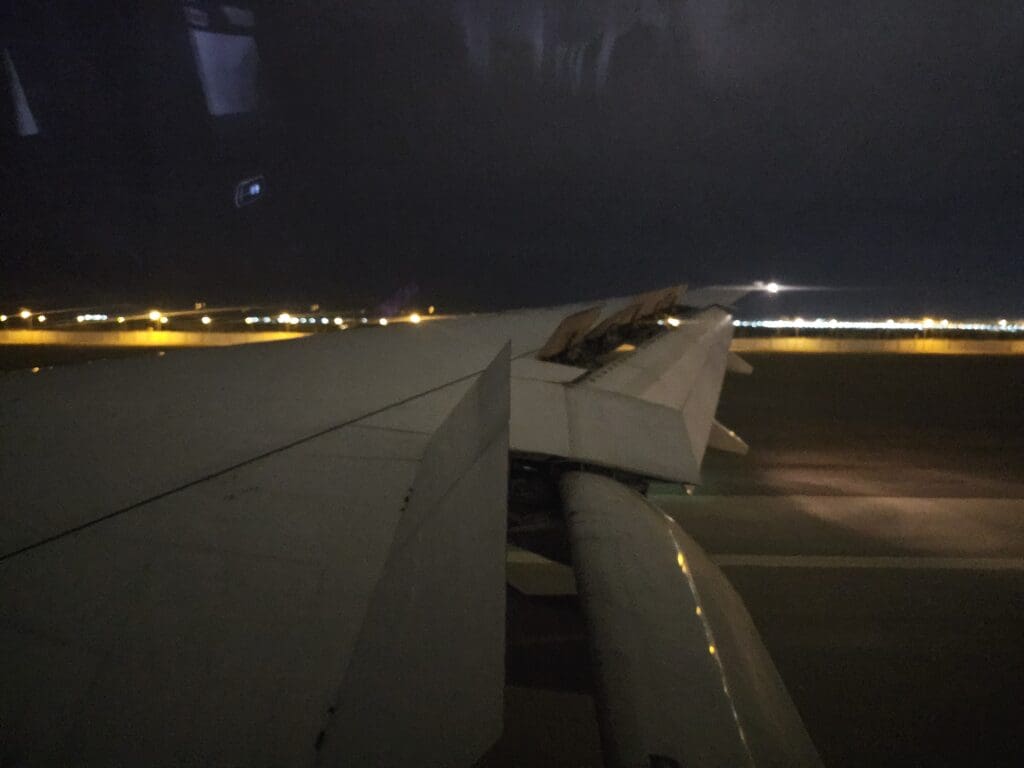
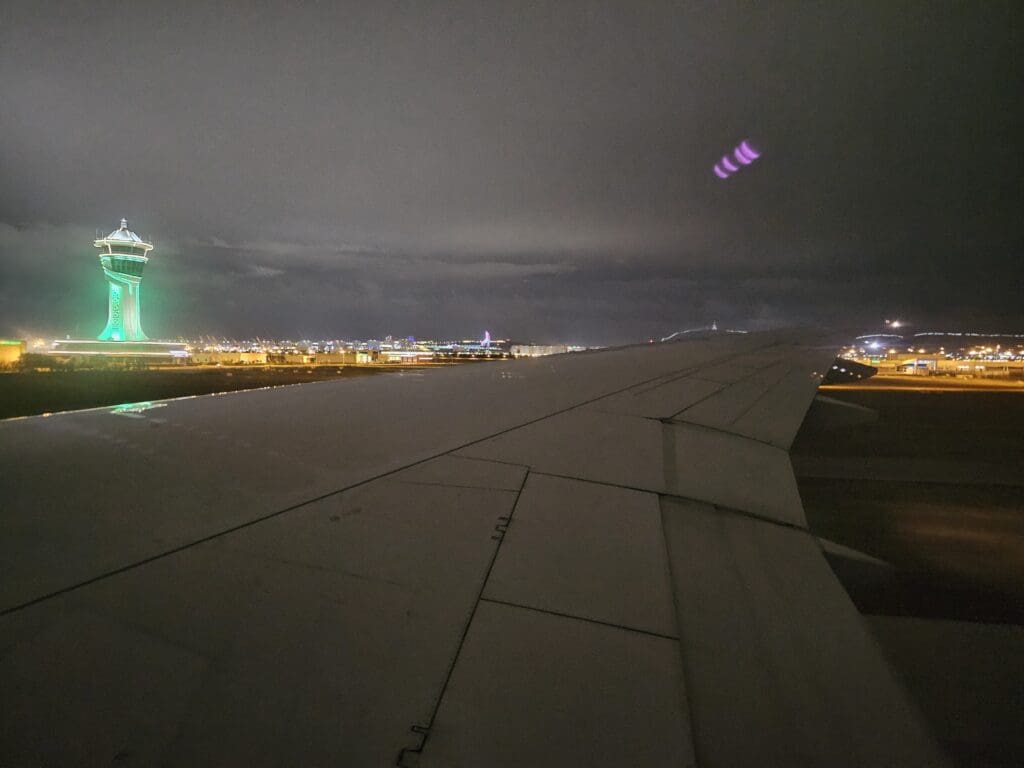
Looking outside, the Boeing soon made its way past the airport’s modern and distinctive control tower, as well as one of Turkmenistan Airlines’ hangars where a cluster of retired Boeing 757-200 aircraft could be seen – unlikely to ever take to the skies again. Next up was the cargo terminal, where two interesting aircraft, a pair of Ilyushin Il-76s operated by Turkmenistan Airlines’ cargo division could be seen, followed by another at a remote stand. Eight minutes after touching down on Turkmen soil, the Boeing reached the modern and bright terminal and turned right into Stand 102, coming to a halt next to sister ship EZ-A778 which had arrived from Jeddah earlier that night.
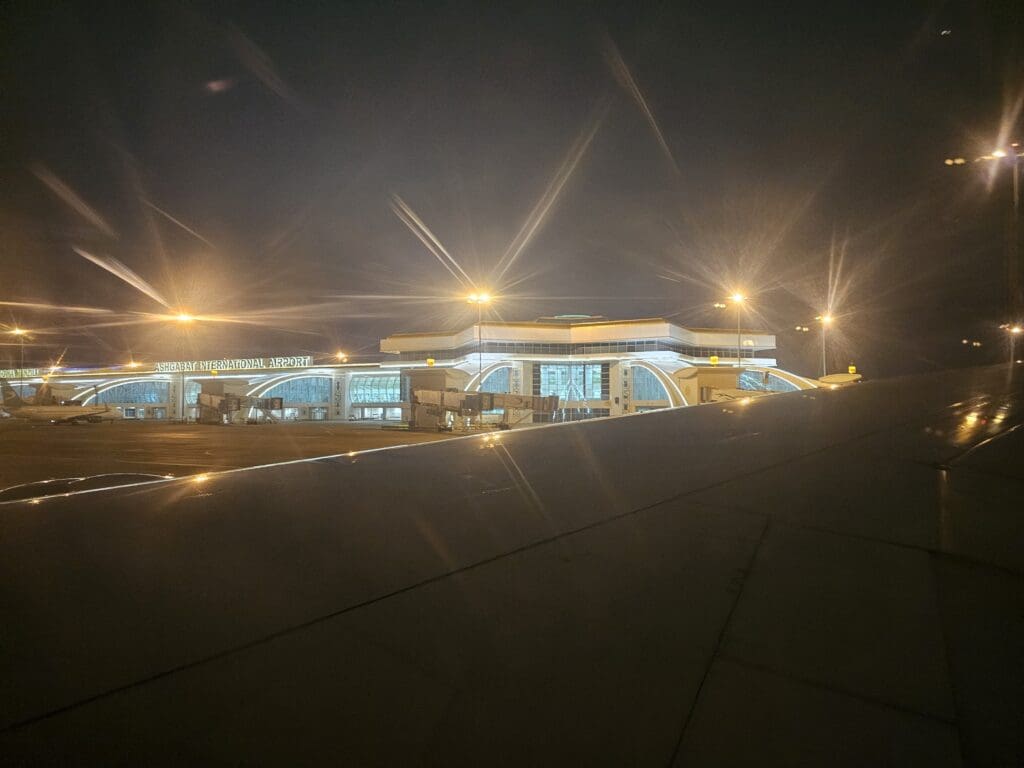
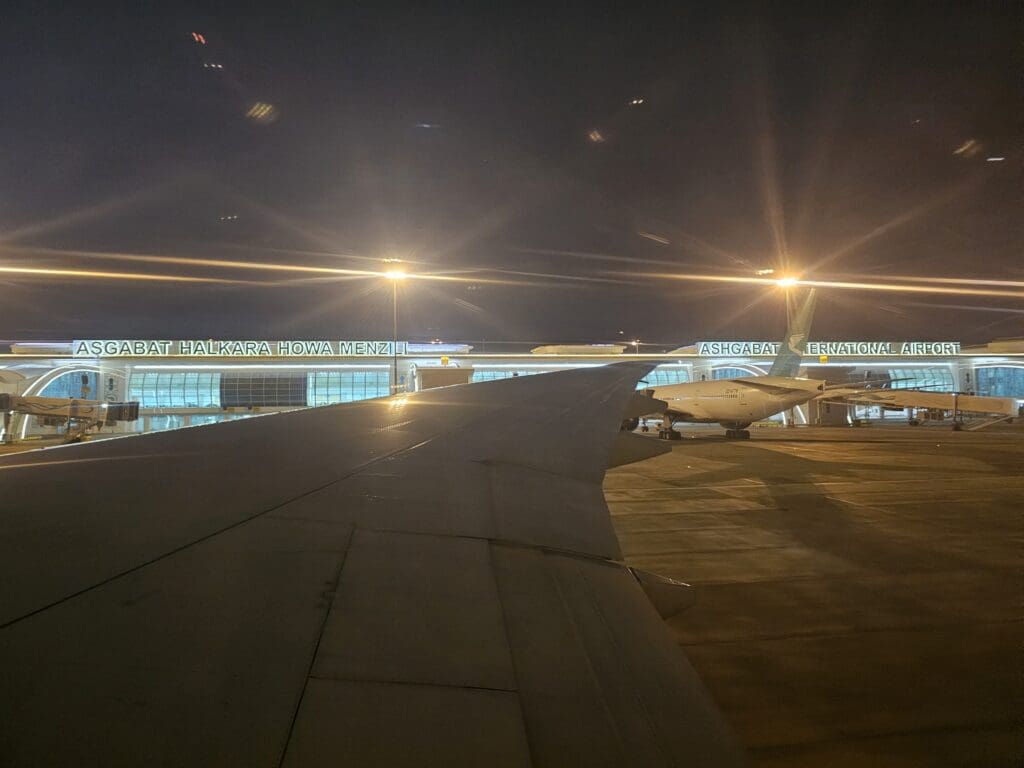
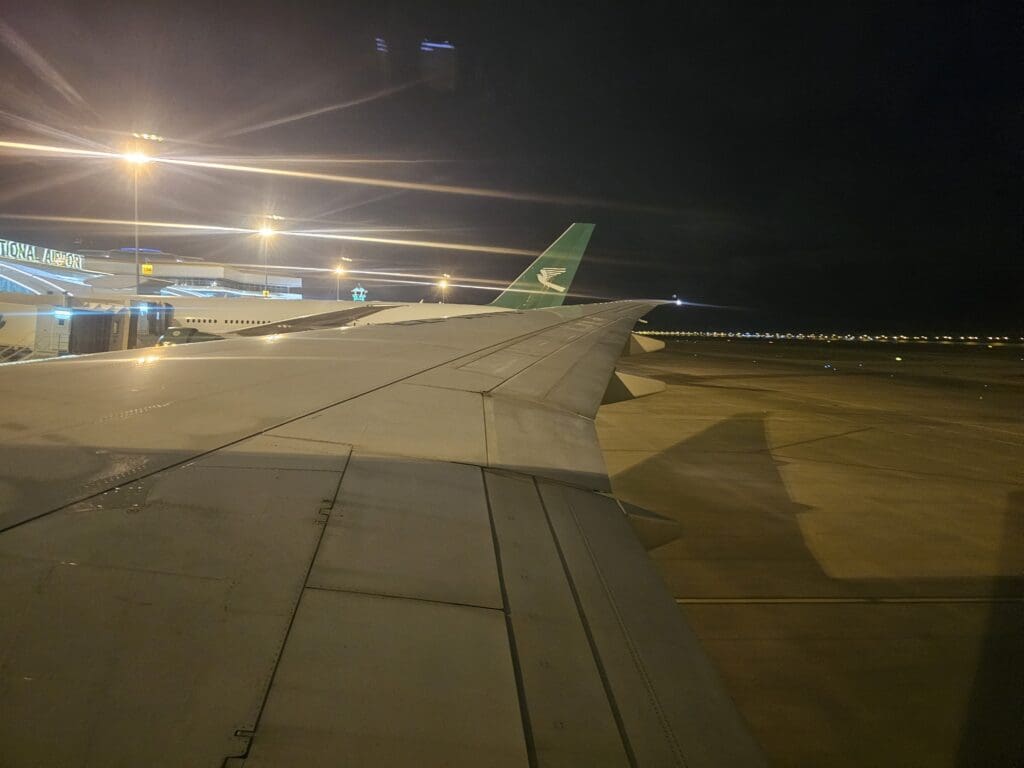
As soon as we came to a halt, the two massive General Electric engines spooled down and many onboard jumped up in a rush to leave the aircraft. Fortunately, with an army of ground crew expecting the aircraft, the jetbridge was soon cautiously manoeuvred up to the L2 door and within a few short minutes of our arrival, disembarkation commenced. Given the lack of passengers, this was a quick and painless affair, and I soon made my way through the forward Economy cabin to the galley where I thanked several of the flight attendants before making my way up into Ashgabat’s modern terminal.
Summary
To be honest, Turkmenistan Airlines exceeded expectations. Whilst my experience was by no means luxurious, the crew were friendlier than expected and I was delighted with the unexpected inflight entertainment system. Meanwhile, the catering was plentiful, the aircraft was comfortable and the cabin was clean and in tip-top condition. With everything considered, my Turkmenistan Airlines adventure was going well and I looked forward to my Boeing 737-800 ride down to Delhi.