Fifth Freedom on Bhutan’s Royal Airline: Guwahati to Singapore on a Drukair A320neo
Sandwiched between India and China, visiting Bhutan, colloquially known as the Land of the Thunder Dragon, is not a particularly cheap endeavour. Home to around three-quarters of a million people and straddling the southeastern Himalayas, Bhutan’s size and topography are not conducive to a particularly sizable aviation industry. At the time of my flight in 2026, this industry consisted of four airports and seven locally registered airliners, five of which are operated by the state-owned stalwart Drukair, whilst two are flown by the privately owned relative newcomer, Bhutan Airlines. This duopoly, coupled with the higher-than-usual operating costs in Bhutan, ensures that tickets for services to and from the country’s only international gateway, the world-famous Paro International Airport, remain expensive. Added to this, most of those visiting Bhutan must travel around the country with a government-approved guide and pay a Sustainable Development Fee of $100 per person per night, which further serves to add to the cost of visiting the Land of the Thunder Dragon.
However, for the peculiar demographic of aviation enthusiasts, flying on one of Bhutan’s two airlines does not require parting with a fortune to enjoy a white-knuckle ride into Paro. For years, both Bhutan Airlines and Drukair have operated fifth freedom flights that enable passengers to fly on these without visiting Bhutan. Specifically, many of both carriers’ services between Bhutan and Southeast Asia stop in India, whilst Bhutan Airlines’ service between Delhi and Paro makes a mid-journey stop in the Nepali capital, Kathmandu. In fact, in November 2023, I had enjoyed a fairly reasonable ride onboard Dorji, one of Bhutan Airlines’ Airbus A319s on a flight from Bangkok to Kolkata – you can read about this here!
| Airline | Departure | Arrival | Via |
| Bhutan Airlines | Paro | Bangkok | Kolkata |
| Bhutan Airlines | Paro | Delhi | Kathmandu |
| Drukair | Paro | Bangkok | Gaya |
| Drukair | Paro | Bangkok | Guwahati |
| Drukair | Paro | Bangkok | Siliguri |
| Drukair | Paro | Singapore | Guwahati |
So How Did I End Up Flying with Drukair?
In April 2026, I spent a couple of weeks in India, and, using up a year’s worth of annual leave before leaving my job to move to Spain to commence studying at a flight school, I would then jet off to spend four weeks in Korea, a country that I am very familiar with, having previously studied and lived there. Being an aviation enthusiast, I decided to see what unusual aircraft or airlines I could sample during this six-week period, and, getting things off to a good start, I would fly to India on board a Lufthansa Boeing 747-400. Wanting to end my time in the country on a similarly exciting note, I decided to book a seat on Drukair’s flight from Guwahati to Singapore, picking this route as tickets for this flight were cheaper than the airline’s other fifth-freedom services between India and Southeast Asia. From there, I would embark on a cheap overnight slog to Busan with Korean low-cost carrier Jeju Air.
Whilst I could have booked via various third-party ticketing platforms, I decided to try my luck with Drukair’s website. Upon touching down on Drukair’s homepage, I was presented with a computer-generated video of an Airbus A320neo flying over a landscape of snowy mountains, beneath which sat the search engine, prices for flights for Bhutanese nationals from Paro and a 20% discount promotion for the airline’s then-new services to Dubai. After entering all the required information into the flight search engine, I was presented with Drukair’s single flight from Guwahati to Singapore on my chosen departure day. This departed Guwahati at 0935 and touched down in Singapore at 1625, with a simple fare structure in place: $215.06 for Economy and $850.36 for Business.
As seems to be common with full-service carriers in South Asia, even the cheapest fare came with complimentary hold luggage – a whopping 30kg of this to be precise! Steaming ahead, I selected the Economy fare, after which I was required to enter my details before being given the option of adding extra hold luggage, with this priced at a bargain $3 per 1kg up to an additional 100kg. I was then taken to pay, with the option of paying in Thai, Bhutanese, Indian or US Dollars. Going ahead, I made a quick and easy payment, with this processed by the Thai bank, K Bank. Moments after the money had left my account, I received an e-ticket via email and was all set to go. I should, however, note that a change in itinerary meant that I ended up having to bring my flight forward by a couple of weeks. Much to my delight, this could be done quickly and easily via Drukair’s website, and I was only required to pay a change fee of $2!
As with many airlines, Drukair offers online check-in, with this possible 72 hours before departure. Wanting to ensure that I had a window seat for the journey south to Singapore, upon hitting this window, I opened up the airline’s app, which enabled me to check in quickly and easily, and select any vacant seat in the cabin without any sort of additional payment, thereby leaving me with absolutely nothing to complain about.
About Drukair
For centuries, the Kingdom of Bhutan maintained a policy of relative isolation, largely eschewing diplomatic relations in favour of isolationism. From the 1950s onwards, however, this approach began to shift. As a small but significant marker of this opening to the outside world, an airstrip was constructed in the Paro Valley in 1968, on the site that now hosts Bhutan’s only international airport. Eventually, aviation in Bhutan developed to the point that, after much consideration, in April 1981, Drukair was established by a royal charter, initially to establish a twice-weekly non-stop service to the Indian city of Kolkata.
Soon, work began to procure an aircraft suitable to operate between Paro and the Indian city of Kolkata. Whilst registered in Bhutan, owing to the limited infrastructure in Paro at the time, this aircraft was to be based in Kolkata. Furthermore, this had to have the ability to be turned around in Bhutan with minimal equipment and be capable of undertaking the round trip from India without being refuelled. In the end, Drukair opted to procure two Dornier 228 turboprops and soon commenced flights between Kolkata and Paro. Three years later, Drukair’s modest route network was expanded with services to the Bangladeshi capital, Dhaka, in 1986.
Whilst the Dornier 228 served Drukair’s initial operation well, the type was not particularly conducive to growth. This, coupled with infrastructure improvements and a project to lengthen Paro’s runway, meant that by the late eighties, Drukair began to examine larger aircraft types such as the ATR 42, British Aerospace BAe 146 and Dash 8. In the end, Drukair procured two BAe 146-100s quadjets, which arrived in 1988 and 1992, and their entry into service was supported by Thai Airways. The introduction of the BAe 146 saw Drukair expand its route network to incorporate Bangkok, Kathmandu and Yangon.
Despite the much larger size of the BAe 146 compared to its predecessor, improvements at Paro International Airport enabled this to be served by larger airliners. Thus leading Drukair to examine aircraft, namely the Airbus A319 and Boeing 737-700, to replace its British quadjets. In the end, Drukair opted to go with Airbus, receiving two of these in 2004, leading to the BAe 146s being retired in 2007. These new aircraft enabled Drukair to expand its route network across Southeast and South Asia, commencing services to the likes of Delhi, Kuala Lumpur and Singapore.
The 2000s marked a period of infrastructure development within Bhutan, with airports springing up in Gelephu, Jakar and Trashigang. However, as you would expect, these airports were all far too small to be served by Drukair’s two Airbus A319s, thereby leading Drukair to procure an ATR 42-600 in 2011. This fleet expansion continued throughout the decade with another Airbus A319 arriving in 2015, followed by an Airbus A320neo in 2020. Furthermore, in 2024, Drukair signed a purchase agreement for three Airbus A320neos and two Airbus A321XLRs.
The Journey
Admittedly, when my departure day arrived, I was slightly less excited to sample the delights of Drukair than I had anticipated. Plagued with my first cold of the year, and a rather bad one at that, and running on no more than an hour’s sleep after my short night in Delhi, part of me simply wanted to get to Korea and have a nice long slumber. However, having had a spree at an overpriced airport pharmacy in Delhi International Airport’s Terminal 2, I had pumped myself up on cold medicine in the hope that this would revive me in time for my first-ever ride on Bhutan’s national carrier.
Following a fairly average two-hour hop from the Indian capital on board an IndiGo Airbus A321neo, I touched down in a rather dreary Assam. Having rocketed away from Delhi on time, we made a punctual arrival, with the Airbus pulling into a stand at Guwahati’s older terminal, Terminal 1, at 0630. This left me with a very, if not too, comfortable six hours before my Drukair service to Singapore was scheduled to depart. Getting my transit off to a good start, disembarkation was a smooth and efficient affair, something that I have found to be a pleasant feature of all Indian domestic flights that I took during this trip – with disembarkation proving to be a much quicker affair than it often is back home in Britain. From the aircraft, I headed up the jetbridge, and by the time I arrived at the carousel, much to my delight, my suitcase could already be seen spinning around. Having done my research, I was aware that Terminal 1 features several ‘rest rooms’; not the American type, but rather several hotel-type rooms where passengers with long connections can rest and shower before jetting off. Whilst my experience at one of these in Kolkata was far from five-star, this would have been perfect for my long connection, enabling me to rest and freshen up before continuing on my long journey. Thus, once I had picked up my bag, I made my way over to the information desk, where a friendly staff member made a couple of phone calls about these rooms. Unfortunately, at that point, it was revealed that these rooms were now solely reserved for VIP use, and, not falling into this category, I had to come up with another plan.
Whilst the landside arrivals portion of Guwahati Airport can hardly be described as terrible, and is home to a few shops and cafés, this did not appear to be a particularly comfortable or entertaining place to wait for several hours. Furthermore, with the local Central Industrial Security Force (CISF) agents appearing to be eager to usher inbound passengers out of the terminal once they had collected their bags, I decided that it was sensible to explore other options. Fortunately, there is no shortage of hotels around the airport, and I decided to try my luck at one of these in the hope that I would be able to secure a reasonably priced room for a few hours. Taking an Uber to one of the closest establishments, once there, I had no luck, and so I continued on my search, ending up at the Kiranshree Grand – a luxurious five-star hotel and resort that sits near the airport’s new terminal. Upon arriving there, when the concierge insisted on rolling my suitcase to reception, I knew that a room would not be cheap. Indeed, this would have set me back 7,000 rupees (around £55) plus taxes for a three-hour stay. Being on a budget, I was unable to justify this cost for a few short hours of luxury, and instead, I enjoyed a hearty buffet breakfast for 1,121 rupees (£8.79) before lounging around in their spacious atrium, where I did some work on my laptop to pass the time.
Seeing as I had checked in online and considering the small size of Guwahati Airport, I was in no particular rush to leave the comfortable surroundings of the hotel and return to the airport, and seeing as the Drukair service to Singapore would be the only international departure from the airport that day, I was confident that I would not be in for any long waits. Eventually, at 0930, I ordered an Uber to take me back to the airport, and after a few short minutes, a small and battered Suzuki appeared outside. After the driver and hotel staff fought with my suitcase to fit it into the boot, with all secure, we soon whizzed off on the short journey around the airport’s eastern perimeter, making it to the rather unimpressive facade of Terminal 1 no more than five minutes later.
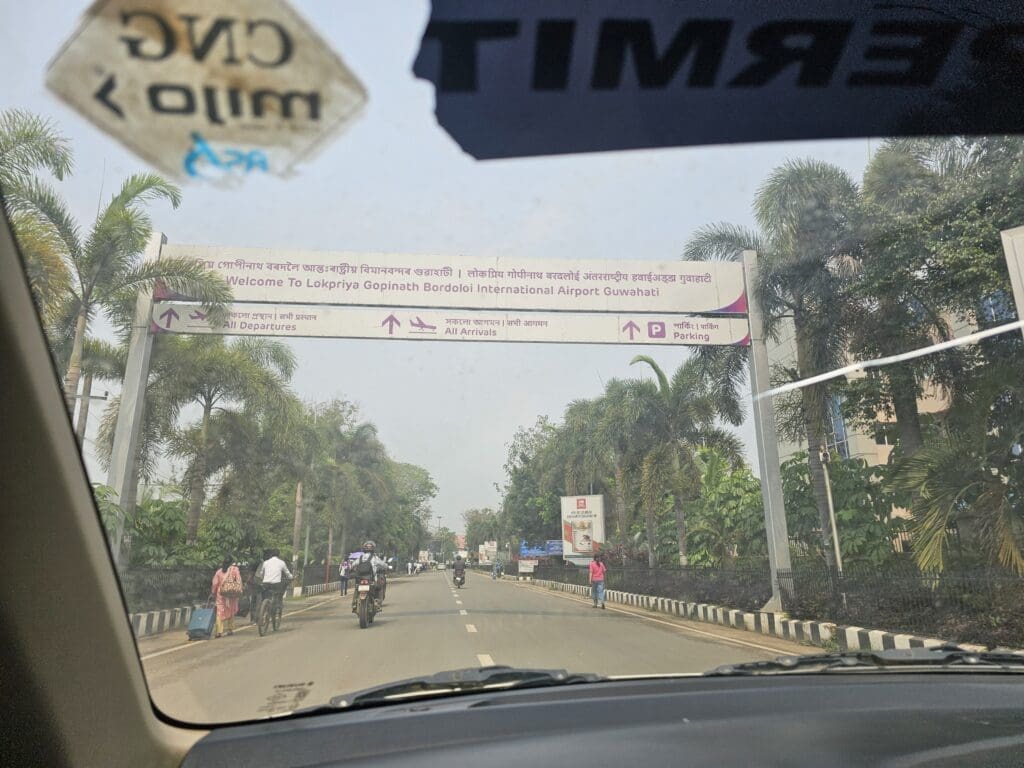
After thanking the driver and retrieving my suitcase, I made my way towards one of the terminal’s six entry gates. As is usually the case at Indian airports, only those with a valid ticket are permitted to enter the terminal. Thus, I ended up joining a short queue at the security checkpoint before a tough-looking camouflage-clad CISF agent checked my passport and ticket, before giving me an approving nod, which I took as my permission to enter the terminal. As I had found to be the case in Dharamshala and Leh, each airline was responsible for scanning its own passengers’ hold luggage, and so once inside, I was asked which airline I would be flying with before being directed to an X-ray scanner. Unsurprisingly, given the fact that Drukair operates no more than a small handful of flights to Guwahati each week, this scanner was shared with SpiceJet, and staffed by the Indian low cost carrier’s own security staff. As had been the case two days prior in Dharamshala, my suitcase was opened in order for one of the staff members to verify that the aerosols in my bag were deodorant and not something more untoward. Fortunately, this was a quick check, and soon, a sticker and a tamper-proof seal were attached to my bag before I was free to continue on my journey into the terminal.
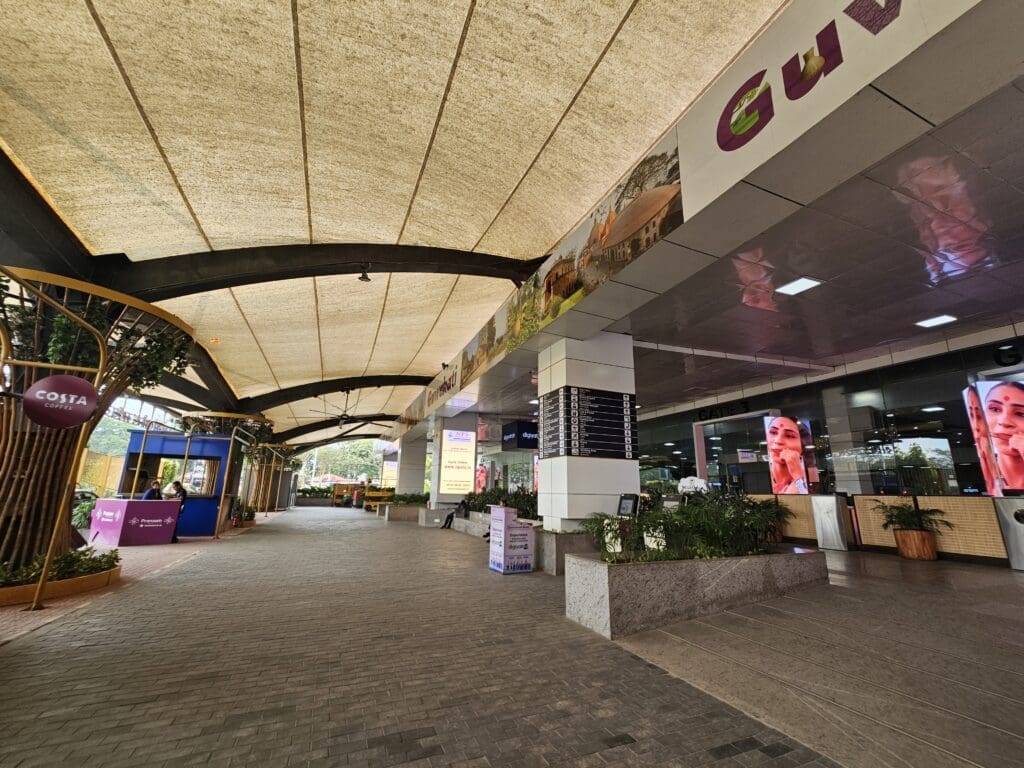
Until the grand opening of Terminal 2 in February 2026, Terminal 1 was the sole hub of operations at Guwahati Airport, and is thus of a reasonable size, with an impressive total of 45 check-in desks offered, with both the international and domestic desks located at the southern end of the building. That day, three of these were occupied by Drukair, and all appeared to be designated for the use by Economy passengers. Making my way up to one of these, with no passengers seen, no queuing was required, and I was soon warmly welcomed by several members of the army of staff provided by the ground handling company, IndoThai. Much to my delight, getting my journey off to a good start, I found the check-in staff to be polite and friendly, perhaps being the most welcoming airport workers that I had encountered during my two-week stay in India. However, on the flip side, check-in did take quite some time, and my e-arrival card and onward ticket from Singapore to Busan were checked twice with a fine-tooth comb to ensure that I had all the relevant permissions to enter Singapore. Additionally, despite looking rather weary and dishevelled, the agents also attempted to upsell me an upgrade to Business Class, although costing 40,000 rupees (around £315), this was something that I promptly declined! Eventually, about four minutes after arriving at the check-in desk, my bag was tagged and sent on its way into the depths of Terminal 1, and my Drukair-branded boarding pass was printed out before I was advised that passport control would open at 1000.
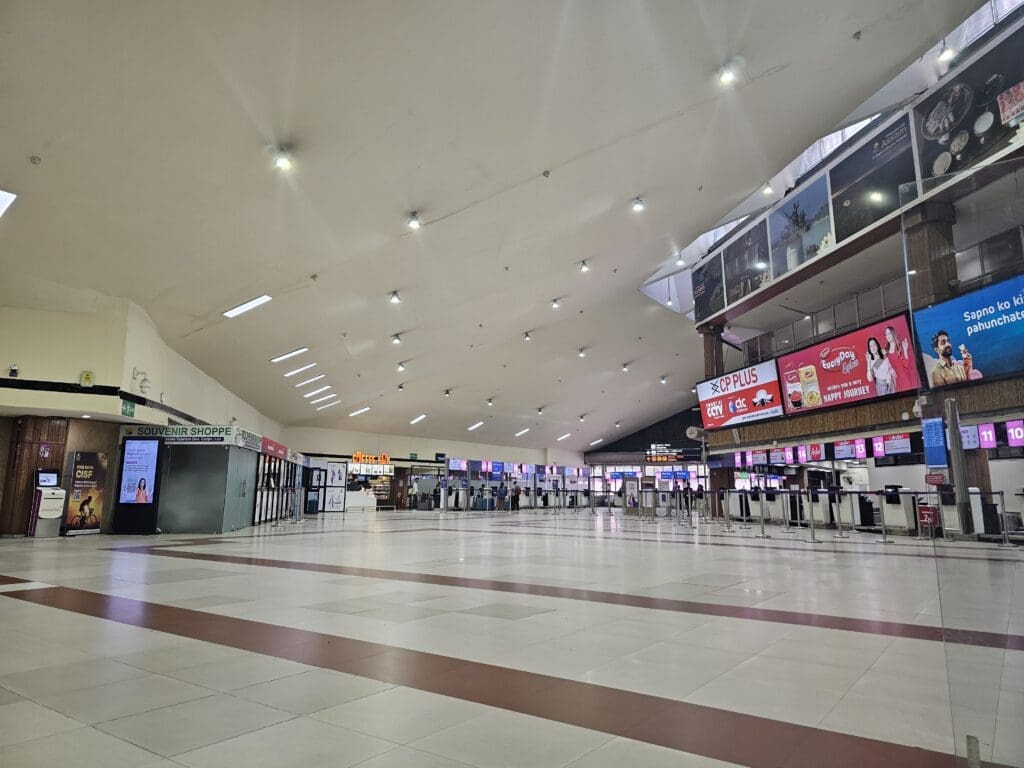
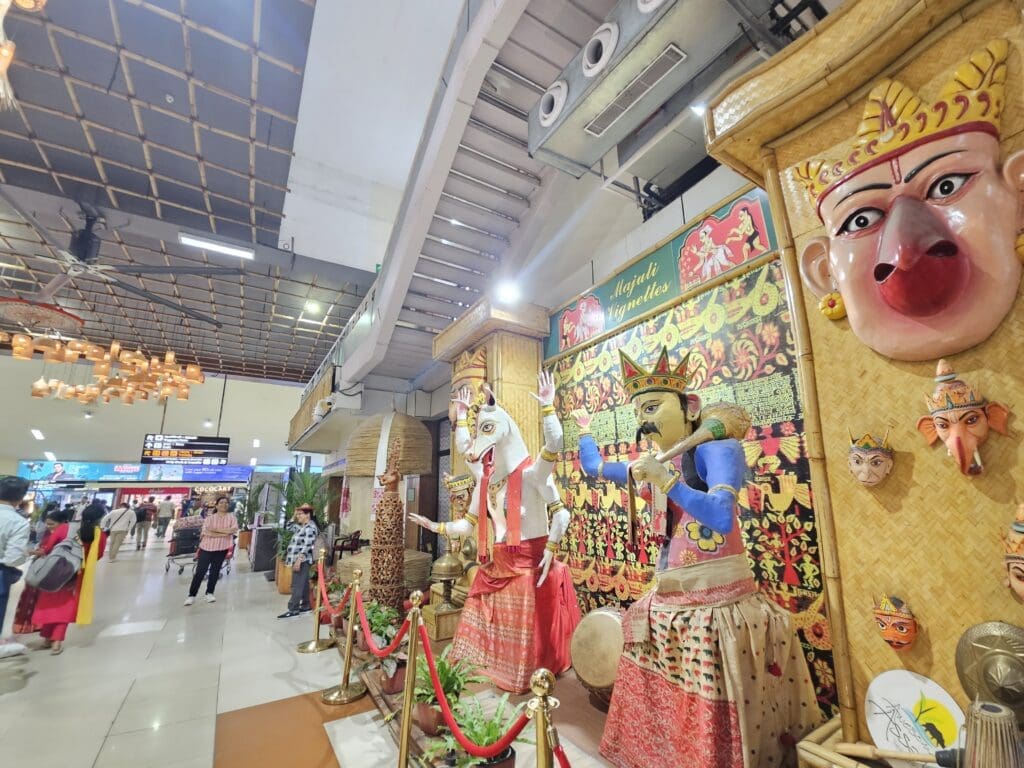
With my boarding pass in hand, yet with immigration yet to open, I had little to do other than wander around the cavernous yet compact landside departures area. Looking around, the terminal was not particularly modern and had a distinctively retro feel. If I had to hazard a guess at its age, I would say that this was constructed at some point during the seventies or eighties. Matching its dated feel, plug sockets and charging points were hard to come by; nevertheless, aside from these minor grievances, for the most part, the landside area was clean and tidy, thereby leaving me with no major complaints. For its size, the landside area featured an ample array of facilities that included a tea shop, a coffee shop and a pharmacy, as well as a lounge and a spa. However, despite these, I would say that unless you enjoy lingering around in a fairly average airport terminal, there is no reason for passengers to turn up well before departure. Finally, adding a nice local touch, various Assamese displays could be seen, whilst drawing inspiration from local architectural styles, a fair amount of bamboo appeared to have been used in the terminal’s design.
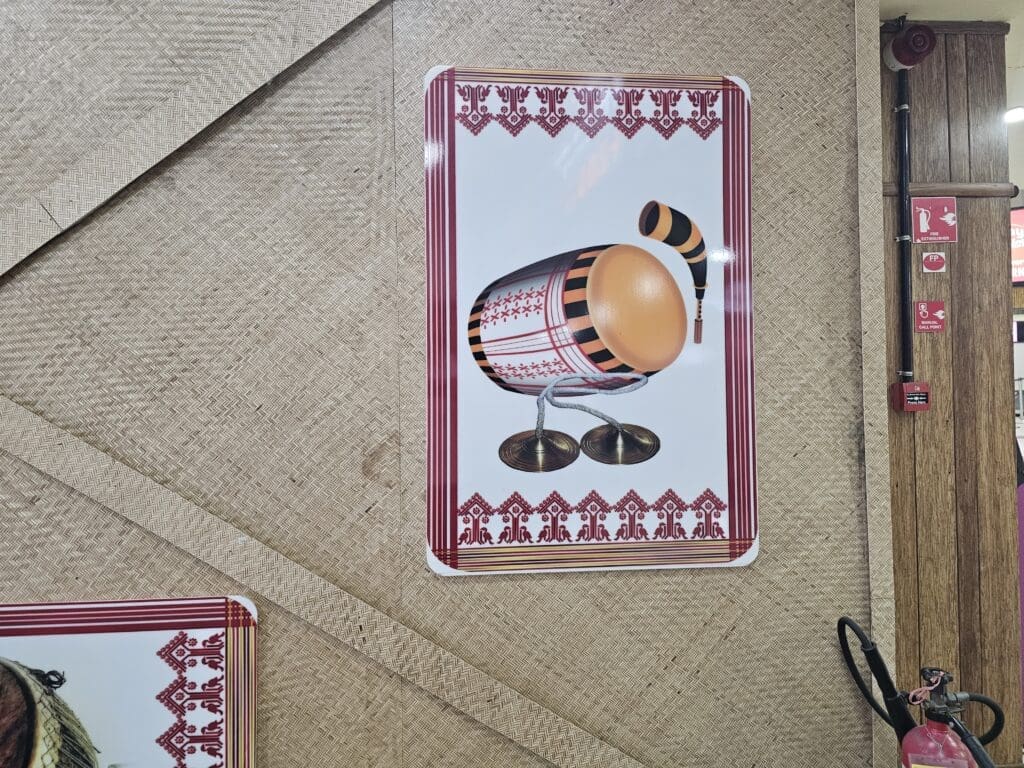
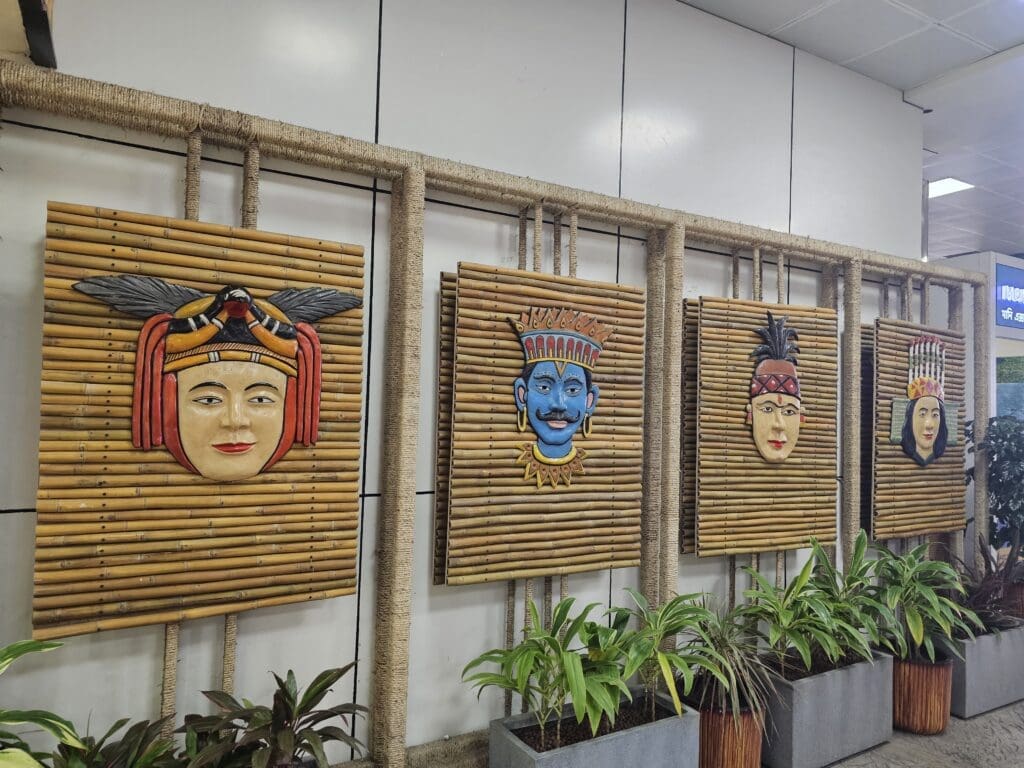
Following a pit stop to grab a lemon tea and some medicine for my worsening cold, seeing as immigration was yet to open, I had little to do other than plonk myself down and wait. Eventually, fifty minutes after immigration’s stated opening time, the immigration checkpoint opened. Staffed by just one rather stern-looking official, this may have been an issue were it not for the fact that there was just one international service departing that day! Making my way straight up to the counter, without waiting, I handed over my passport before being a few questions about my stay in India, with a particular focus on the reasons as to why I was in Assam. Satisfied with my responses, my photograph was taken before my passport and boarding pass were stamped, after which I was free to continue on my journey. From immigration, I wandered through an empty customs checkpoint and within seconds, I arrived at security, where an army of five camouflaged Central Industrial Security Force CISF officers could be seen ready and eager to undertake their security checks. As with all airports in India, security was not a particularly straightforward process as I was required to remove all electronics and associated cables from my bag. Being a tourist with a bunch of electronics, decanting and repacking these took a few minutes, although seeing as I was the only passenger there, this process was less stressful than usual, and overall my security experience was as pleasant and painless as possible. After passing through a metal detector and being thoroughly wanded down, I was free to continue on my journey to the airside waiting area with no additional checks required.
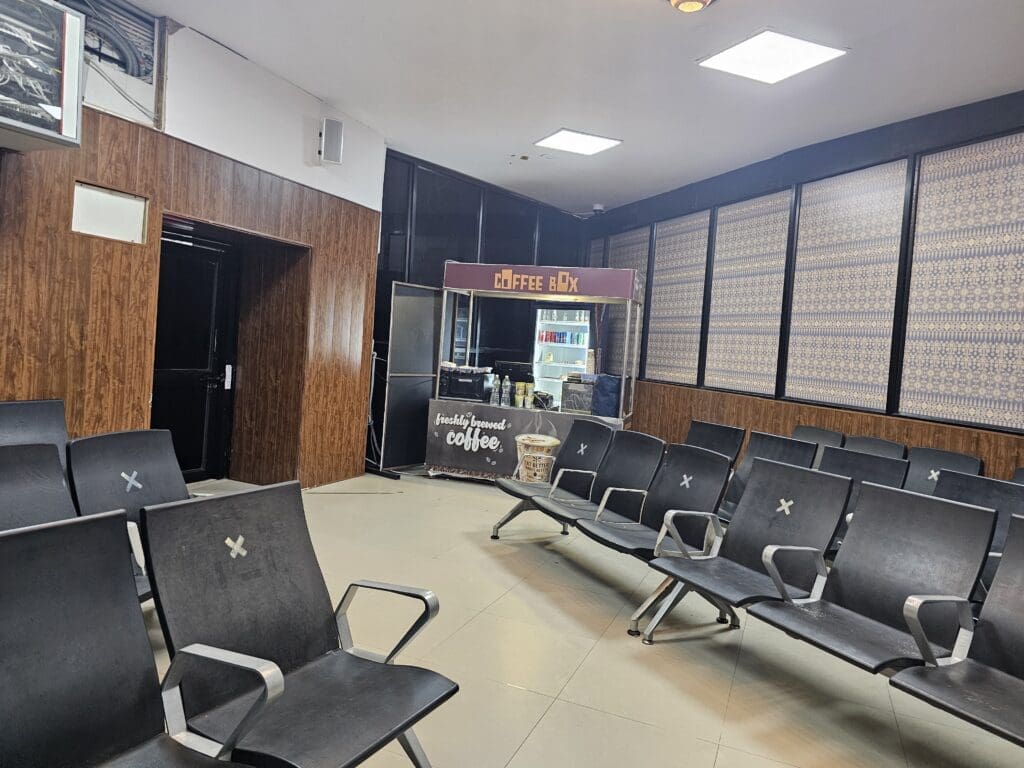
Guwahati Airport can most certainly not be described as being any sort of international flight, with just a small handful of flights to destinations outside India. At that time of my flight, these consisted of Drukair services to Bangkok Suvarnabhumi, Paro and Singapore, and several Thai AirAsia flights each week to Bangkok Don Mueang. Thus, unsurprisingly, once through immigration, I found the airside portion to be minuscule, with very little to see or do. Specifically, this features a single bus boarding gate, a small kiosk selling hot drinks and water, a water dispenser, some toilets and a television which, for the duration of my stay, broadcast an Indian Premier League cricket match.
By all accounts, the international airside area was very retro, appearing to have undergone scant changes since welcoming its first passengers. Meanwhile, plug sockets were hard to come by, and it was clear that this space was not designed for waits of more than an hour or so. Furthermore, given its small size, I dread to think of the chaos inside this if serving an entire Airbus A320’s worth of passengers. Inside, this was a little battered in places, and in particular, the toilets appeared to be in need of a refresh and modernisation; however, for the most part, the terminal was clean and tidy, with a dedicated cleaner seen doing the rounds for the duration of my stay. On a side note, during my stay in the airside area, the power was temporarily cut off on no fewer than three occasions; however, this did not seem to interrupt operations, and the staff remained totally unfazed, thereby implying that this was a common occurrence in Guwahati.
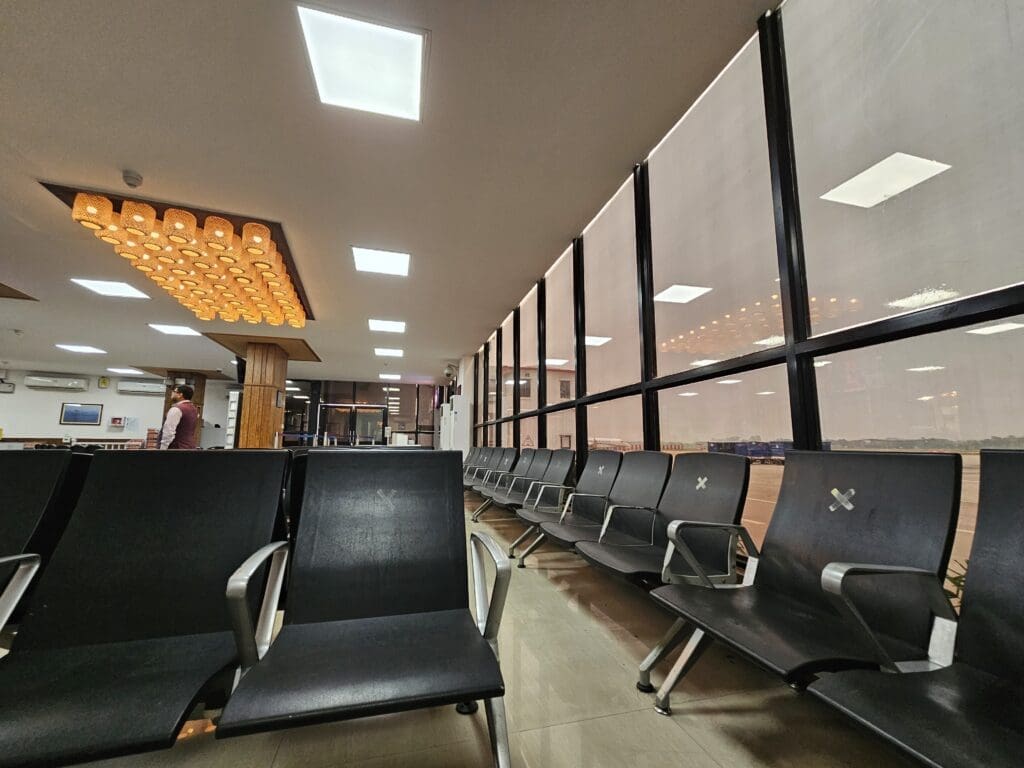
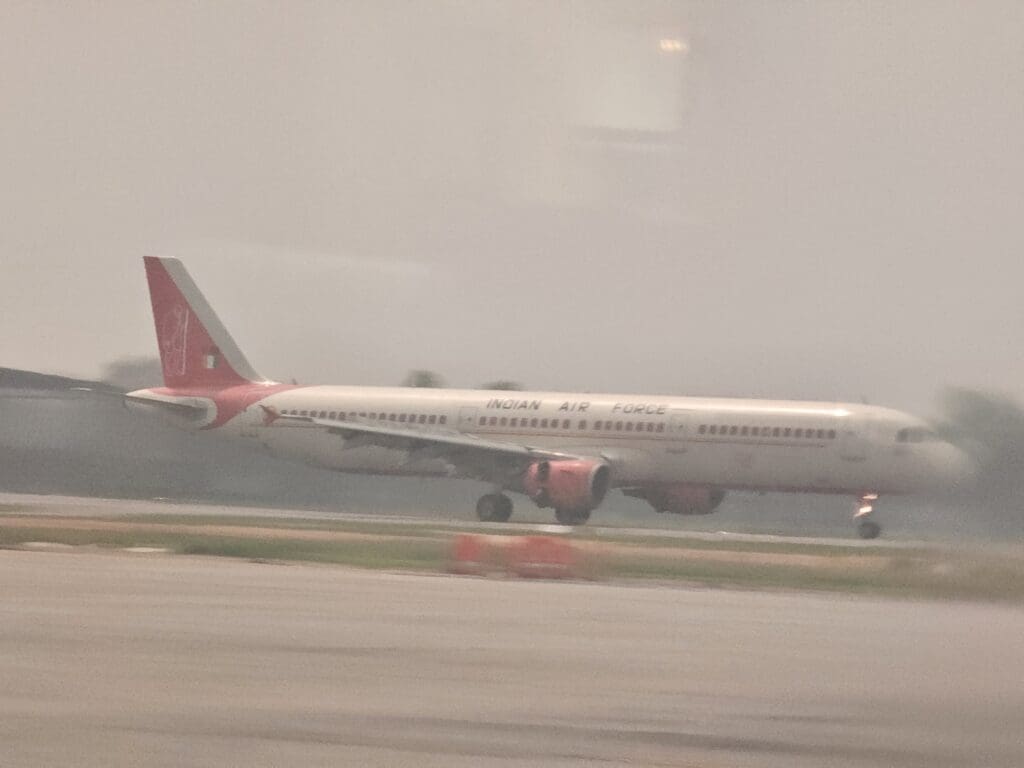
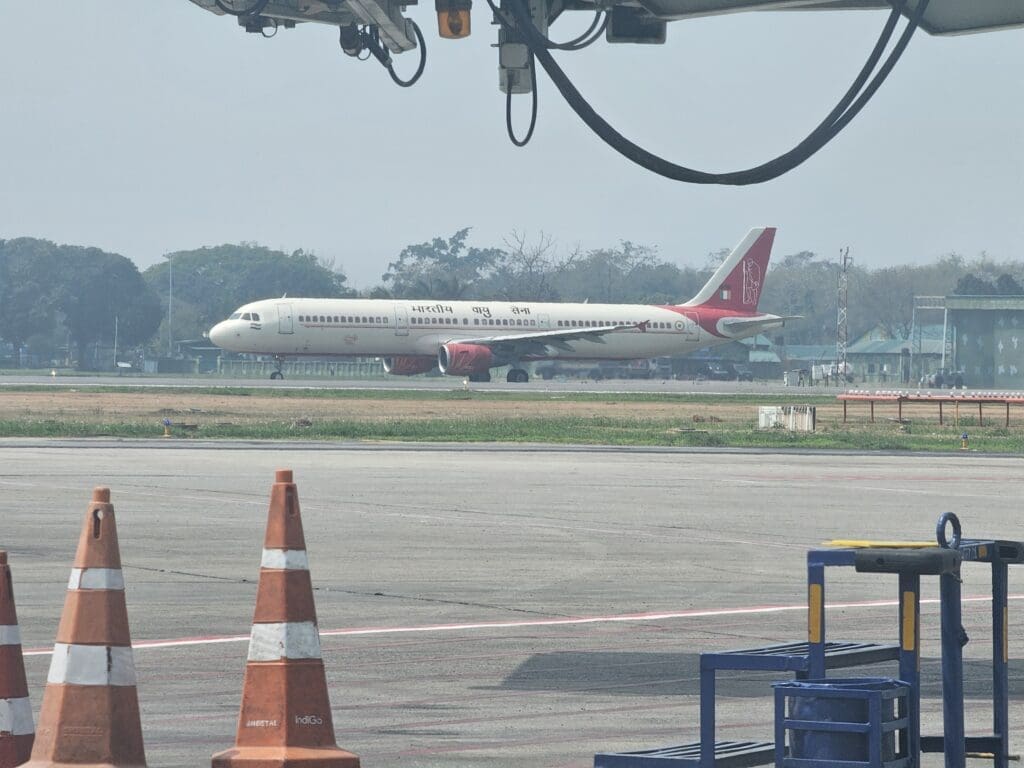
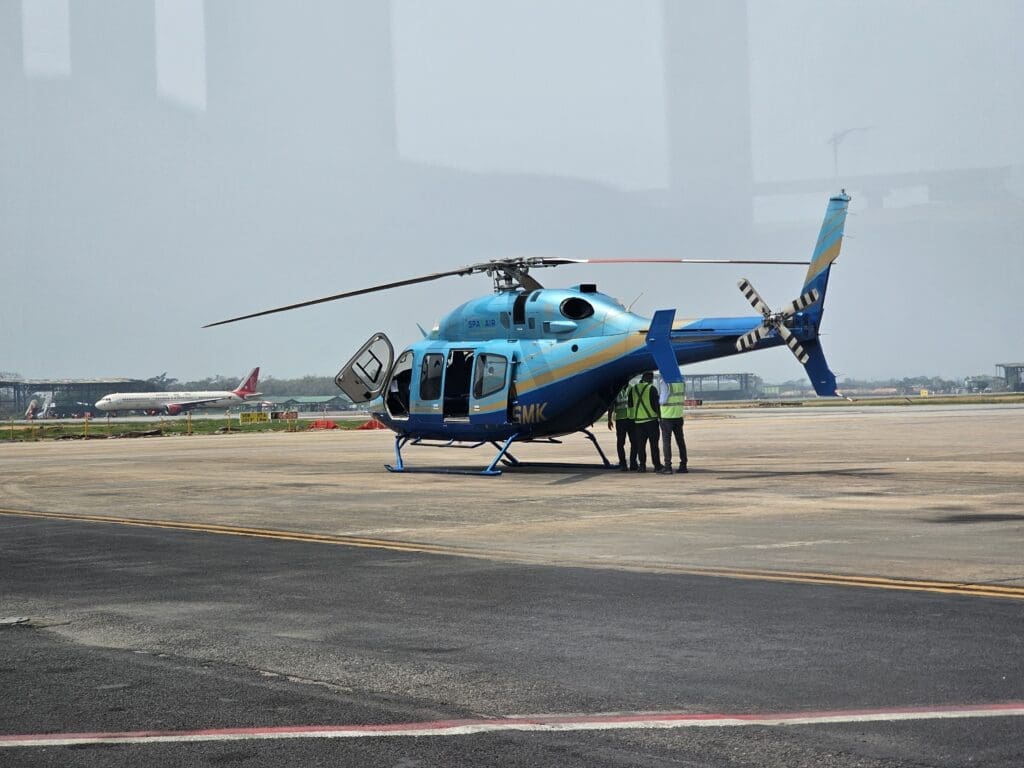
Guwahati Airport is not the most exciting place to planespot in India, and, with the windows being tinted and the waiting area being on the ground floor level of the terminal, this area was not ideal for enthusiasts to indulge in their hobby. Nevertheless, limited views could still be had out onto the apron and runway. As you would expect at an Indian regional airport, the country’s largest carrier, IndiGo, seemed to make up the bulk of the movements, followed by Air India Express’ Boeing 737 MAX 8s, with Air India’s low-cost subsidiary maintaining a major presence in Northeast India. These aircraft came in addition to the odd SpiceJet Boeing. However, the real highlights that day took the form of the airport’s non-scheduled movements, with a luxury Bell 429 and Embraer Legacy 600 seen arriving and departing just a short distance away from the terminal’s international waiting area. As with many airports, Guwahati shares its civilian operations with the military and is home to two Indian Air Force squadrons, one operating the Dornier 228 and Hindustan Aeronautics HAL-748 (a locally manufactured Hawker Siddley HS748), and the other flying the Mi-17-1V helicopter. That day, the highlight movement for me was visiting the military portion of the airfield on the other side of the runway, which took the form of a former Air India Airbus A321. This is now operated by the Indian Air Force on behalf of the Defence Research and Development Organisation, and will eventually be converted to an airborne early warning and control system platform. This specific example continues to sport the outline of Mahatma Gandhi on its tail, which it had worn during its final years with Air India.
Returning my attention to the happenings inside the terminal, as time passed, I found myself being one of just seven passengers who would be joining the aircraft in Guwahati for its slog down to Singapore, and I was the only non-Indian passenger to be flying exclusively on this sector. However, seeing as the flight originated in Paro, it was impossible to gauge just how busy this service would be until I boarded the aircraft. According to my boarding pass, boarding was scheduled to commence a whopping hour ahead of departure at 1130, something that often seems to be the norm in India, regardless of the size of the operating aircraft. However, this was impossible, as tracking the inbound flight, the aircraft did not depart its base in Paro until 1153, rocketing away from Bhutan 53 minutes behind schedule. Keeping passengers updated and furthering my positive impression of the IndoThai staff members, once our scheduled boarding time arrived, two agents passed through the gate area, approaching each passenger and notifying them that the flight was delayed by thirty minutes and that boarding would commence a short time after this had touched down in Guwahati.
Following a short 33-minute hop from Paro, at 1224, the sleek and modern Airbus that would be taking me to Singapore made a smoky touchdown in Guwahati, coming to a halt at Stand 6 a short time later, by which time this was running just over thirty minutes behind schedule. Despite being scheduled to be operated by one of Drukair’s Airbus A319s, that day I would instead be flying on Drukair’s latest delivery, Airbus A320-251N, A5-JKW. Ordered in October 2018 as part of Drukair’s fleet expansion and modernisation, this particular aircraft was assembled at Airbus’ Toulouse Blagnac plant and first took to the skies with the test registration of F-WWBH in March 2020, making it just over six years old at the time of my flight. Following three test flights around Southern France, the aircraft was handed over to Drukair and given its current registration, making the long trek over to Paro with a stop in Delhi, arriving at its new Himalayan home to much celebration in mid-March 2020. However, with the rapid onset of the pandemic, the sudden drop in travel and the tightening of Bhutan’s borders, the aircraft soon took on repatriation duties rather than its scheduled services, flying to destinations across Asia to return Bhutanese nationals who had ended up stuck abroad, and continued to fly throughout the pandemic ferrying freight to and from Bhutan before returning to more ‘normal’ scheduled operations. In the week before my flight, this aircraft had visited almost every international destination on Drukair’s route network, connecting Paro with Bangkok Suvarnabhumi, Dhaka, Guwahati, Kathmandu, Siliguri and Singapore Changi.
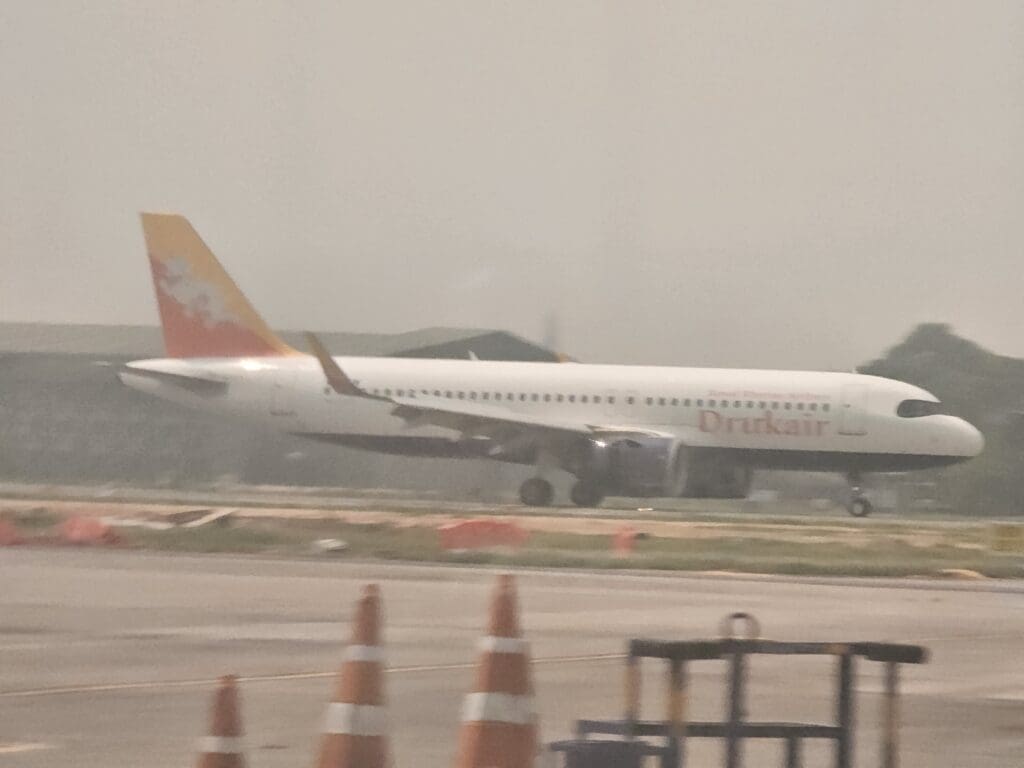
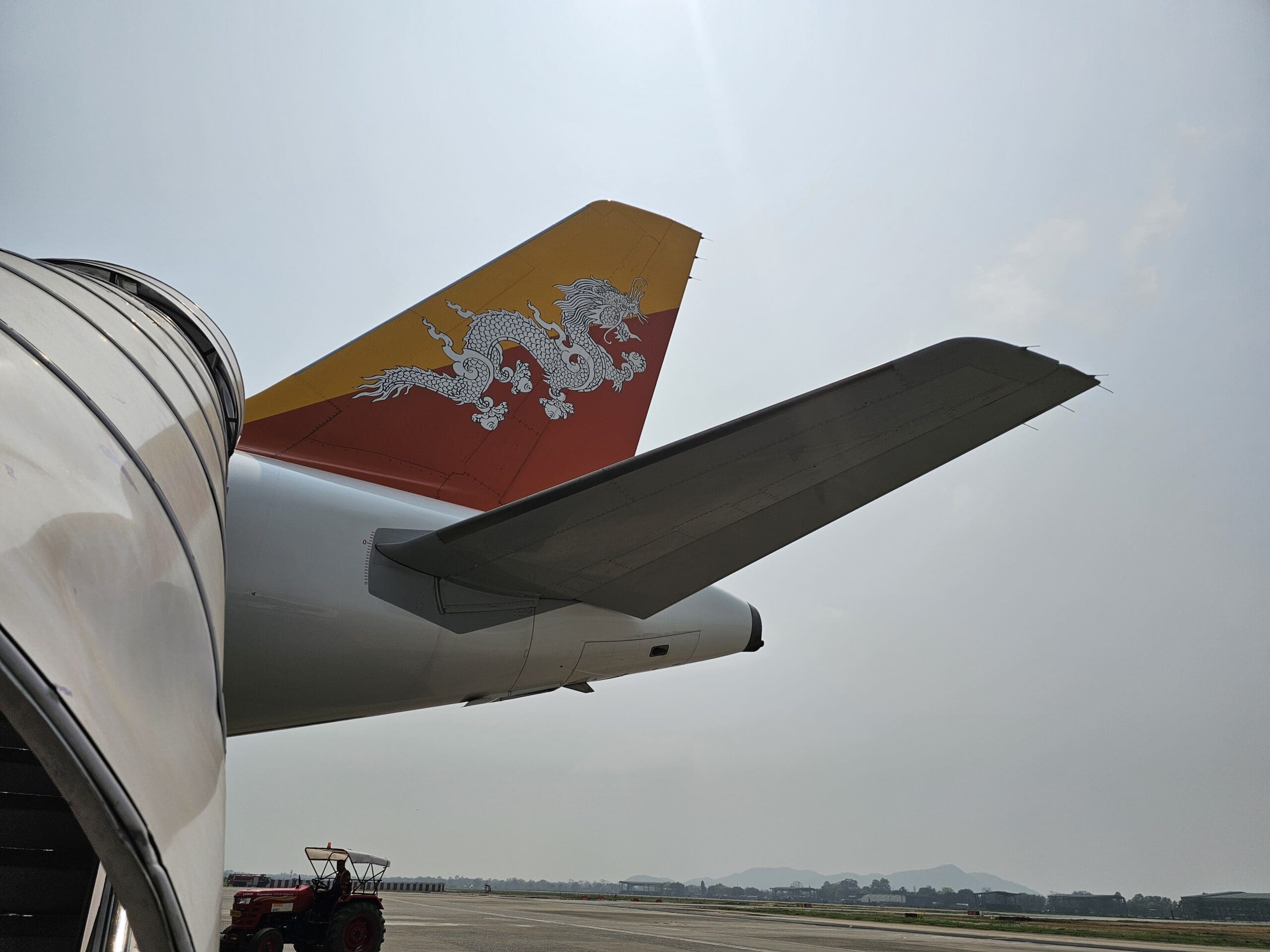
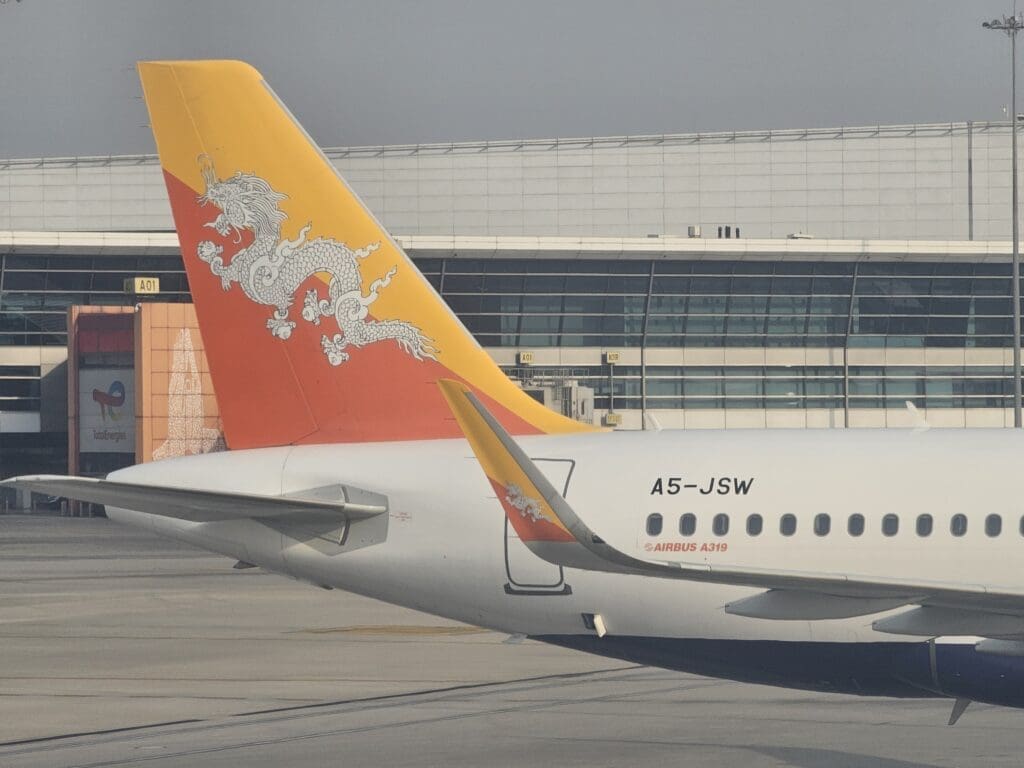
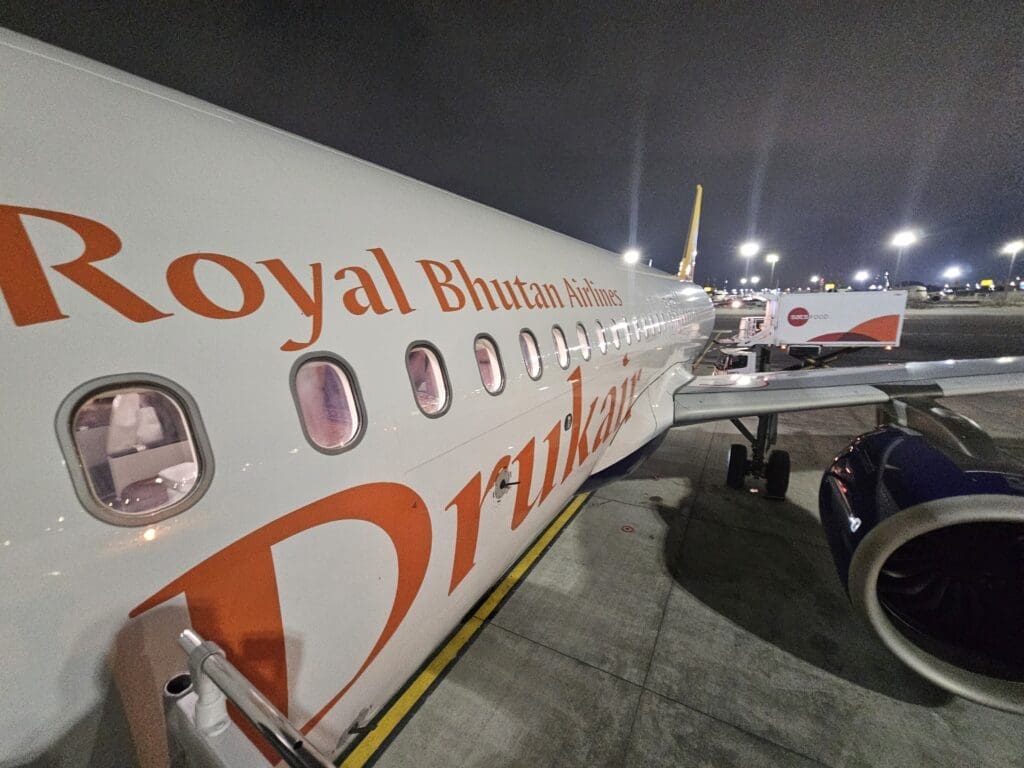
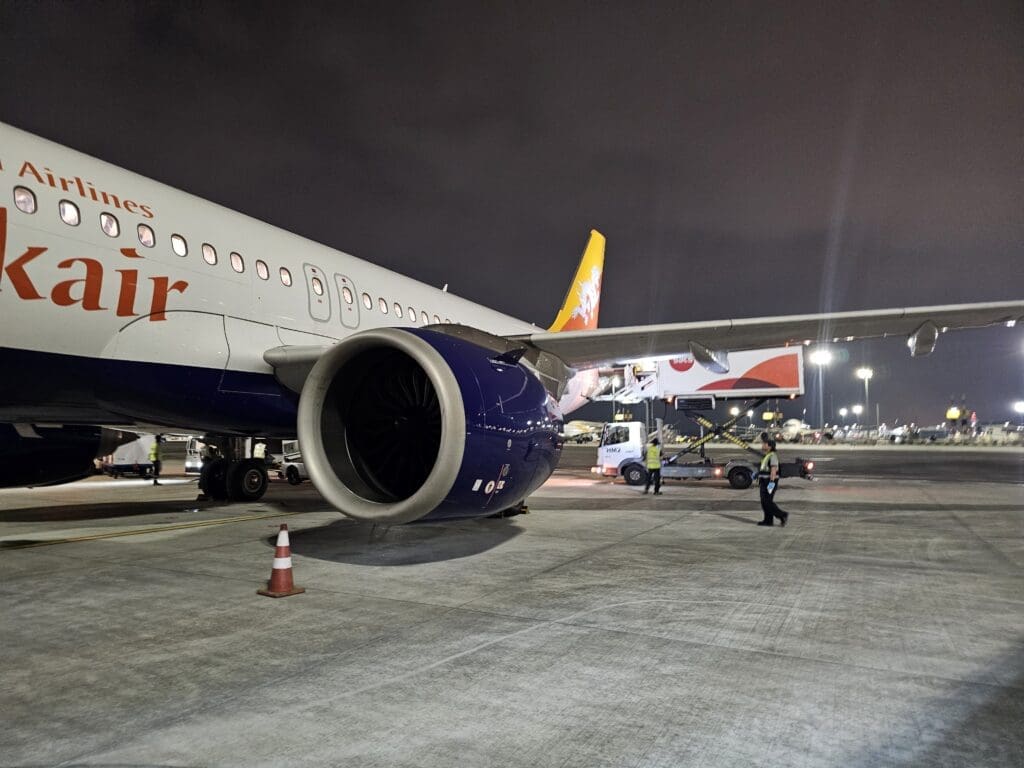
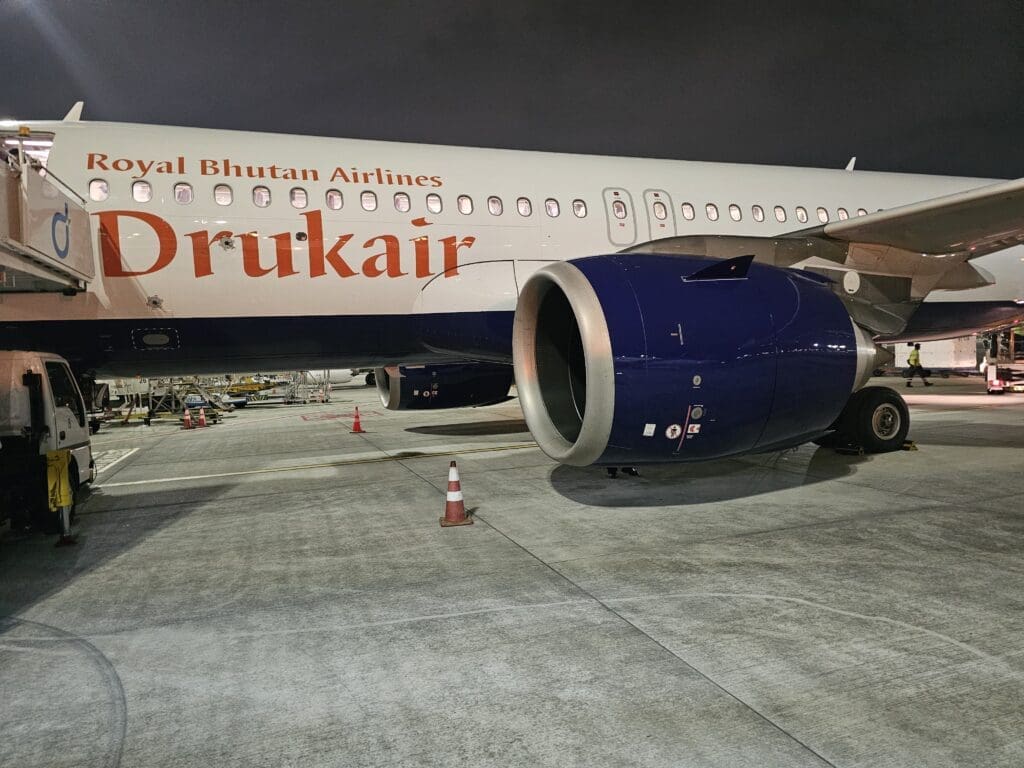
As soon as the aircraft had arrived on stand, the three IndoThai agents in the waiting area began to ready the gate for boarding and set up barriers, although these were not particularly useful given the low number of passengers! Soon, a bus appeared outside, ready to shuttle six other passengers and me the short distance down the terminal to our waiting aircraft. Sixteen minutes after the aircraft had touched down, one of the gate agents said a few words in Hindi, which I assumed was an invitation for Singapore-bound passengers to board, at which point all jumped up and formed an orderly queue at the gate podium. Despite ending up at the back of the queue, given the lack of passengers, it was a matter of seconds before my boarding pass was scanned and my passport checked before I was free to head outside. Interestingly, but as I had found to be the case in Leh, before boarding the bus, one final security check was undertaken, with this consisting of a very lacklustre wand down by one of the CISF agents. Once complete, I boarded the rather tired-looking bus for our short journey out to the aircraft. Being the final passenger, almost as soon as I had boarded the bus, the doors slid closed, and we trundled down the empty terminal towards the Airbus A320neo, which could be seen basking in the lunchtime sunshine. This was my first time seeing a Drukair aircraft up close, and I have to say that I am quite a fan of the airline’s livery, with this being uniquely Bhutanese thanks to the replication of the country’s flag on the Airbus’ tail and sharklets, with the national symbol, the Druk Yul, or Thunder Dragon, being both unmissable and unmistakable.
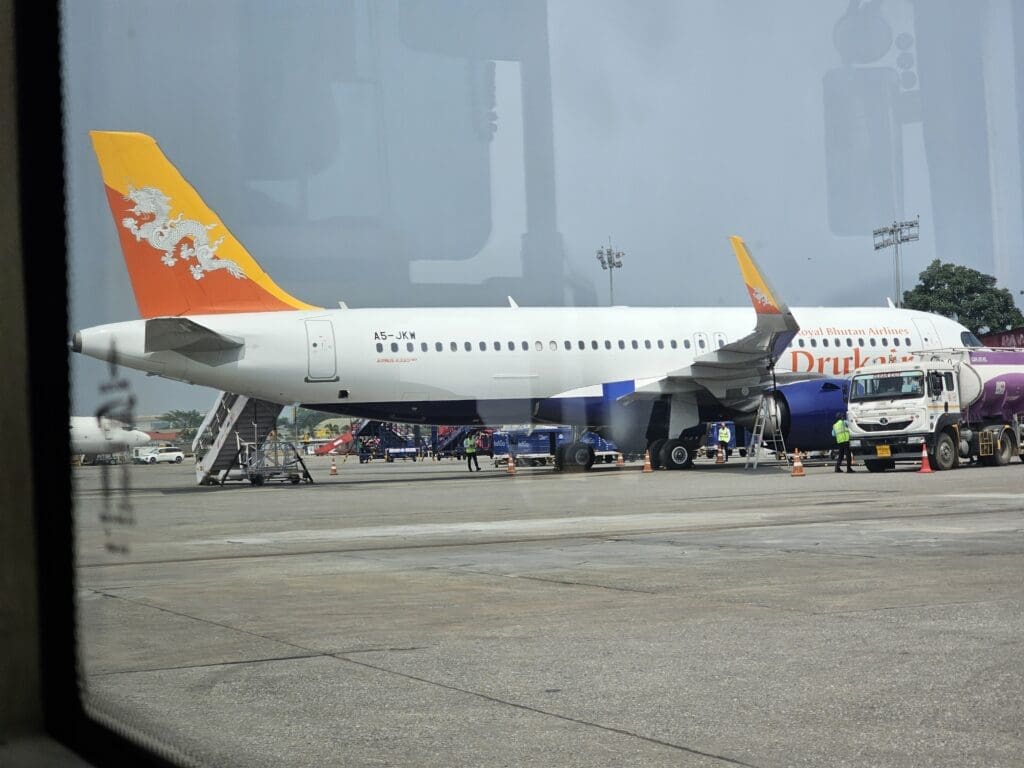
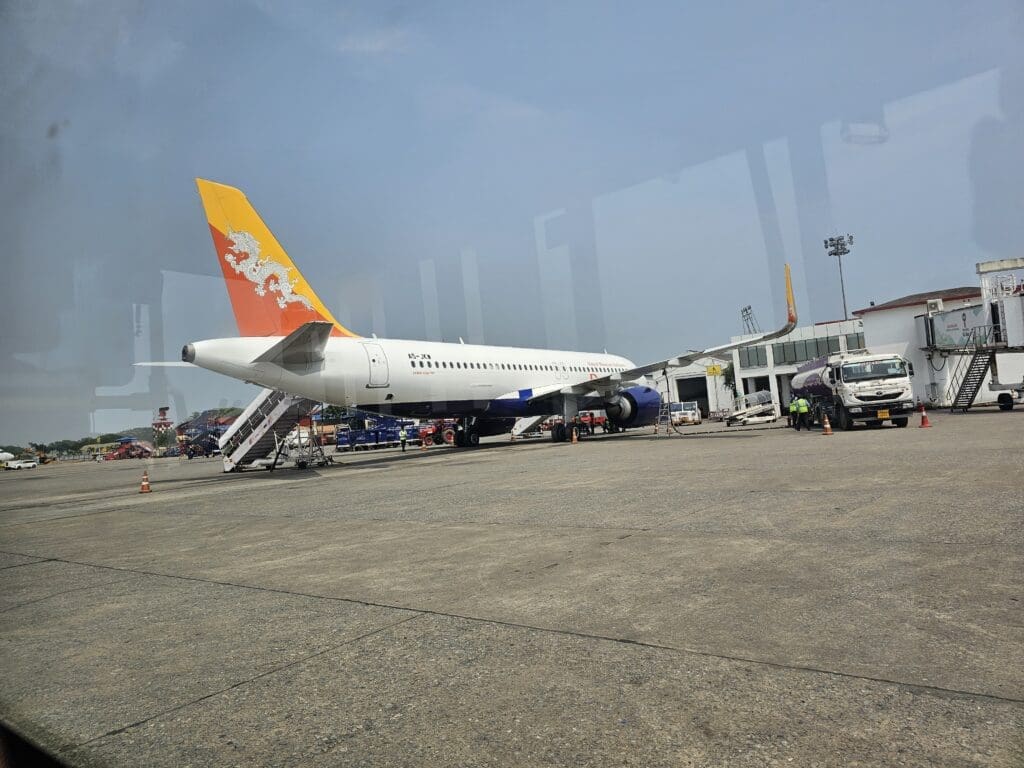
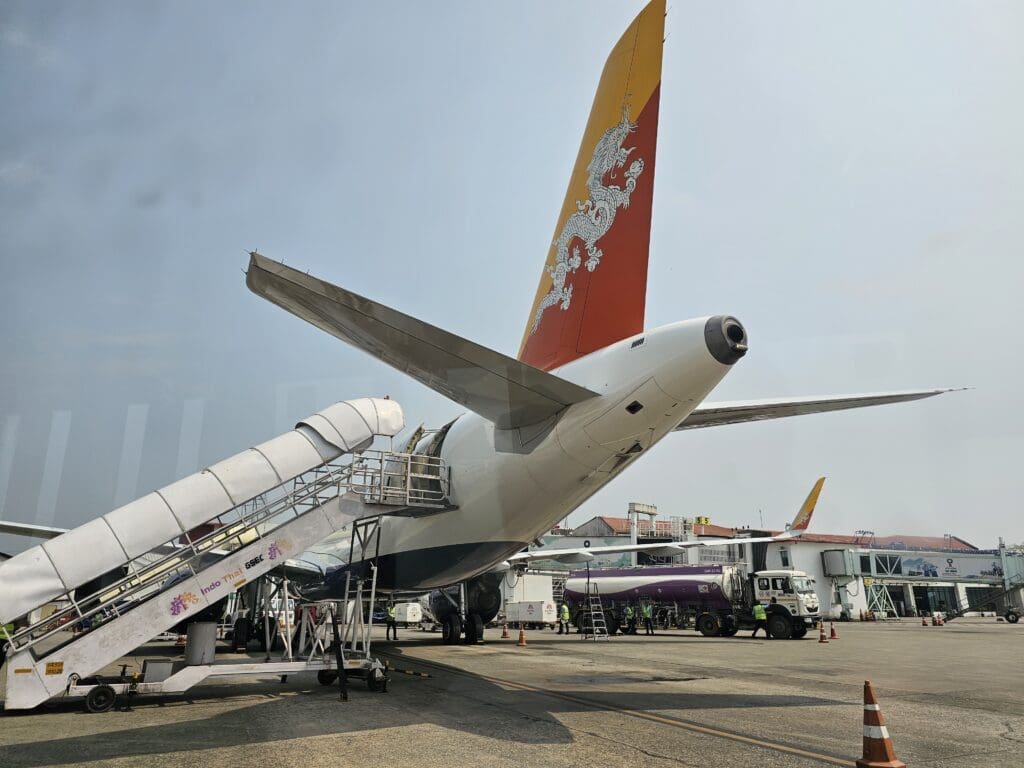
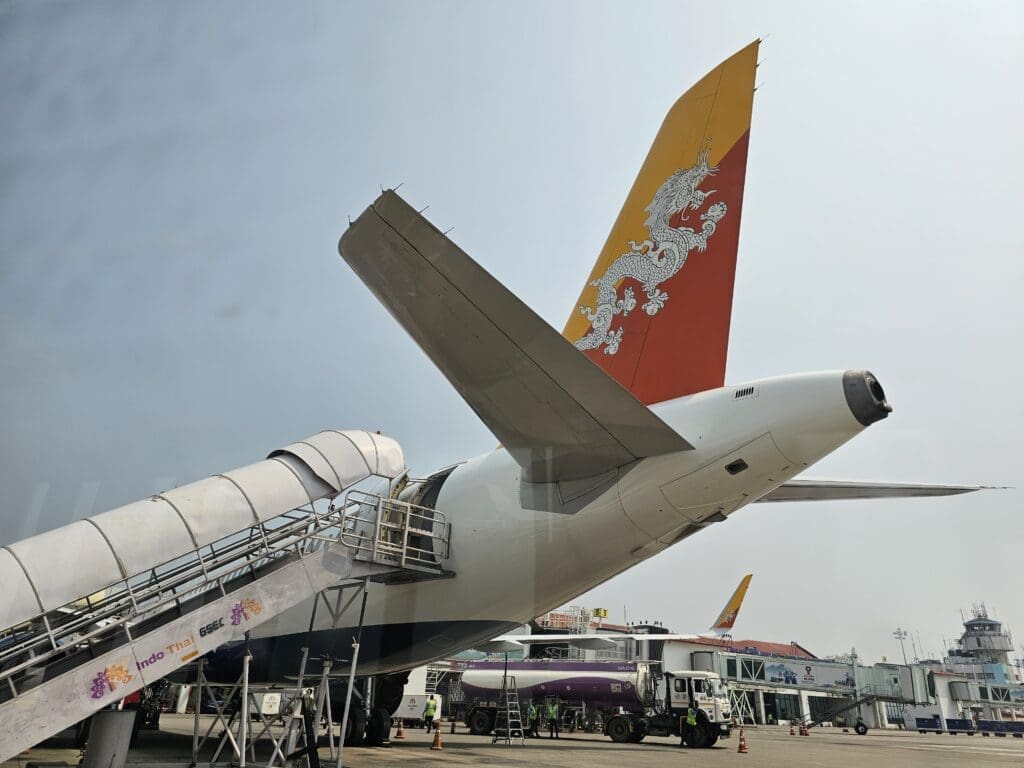
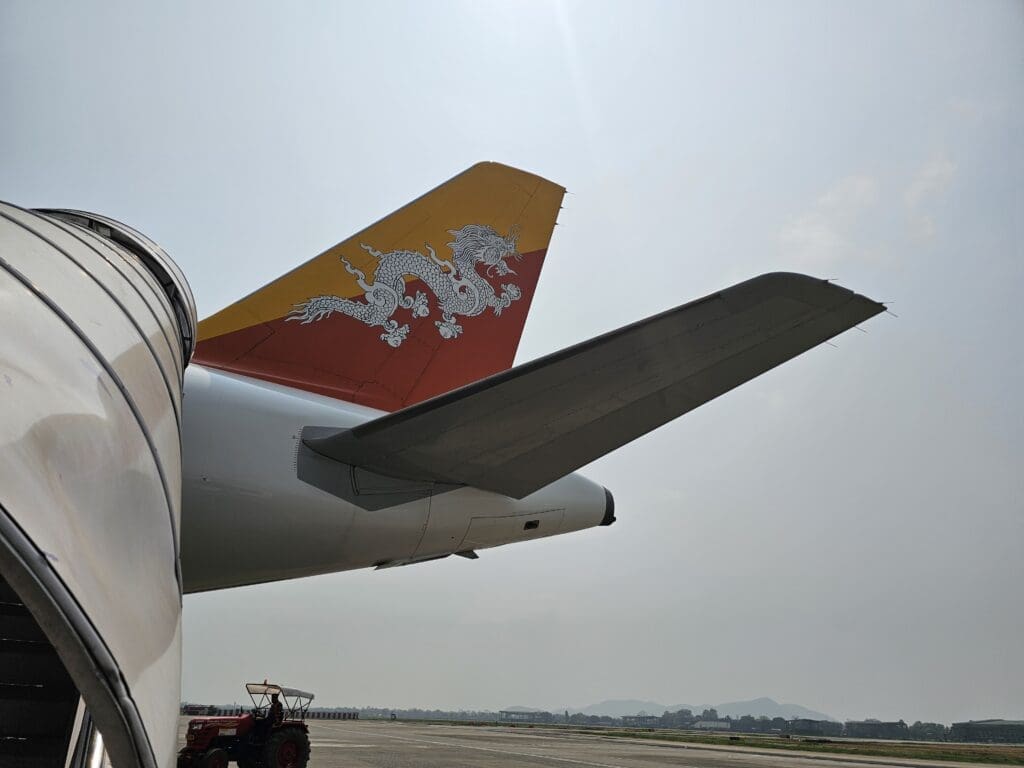
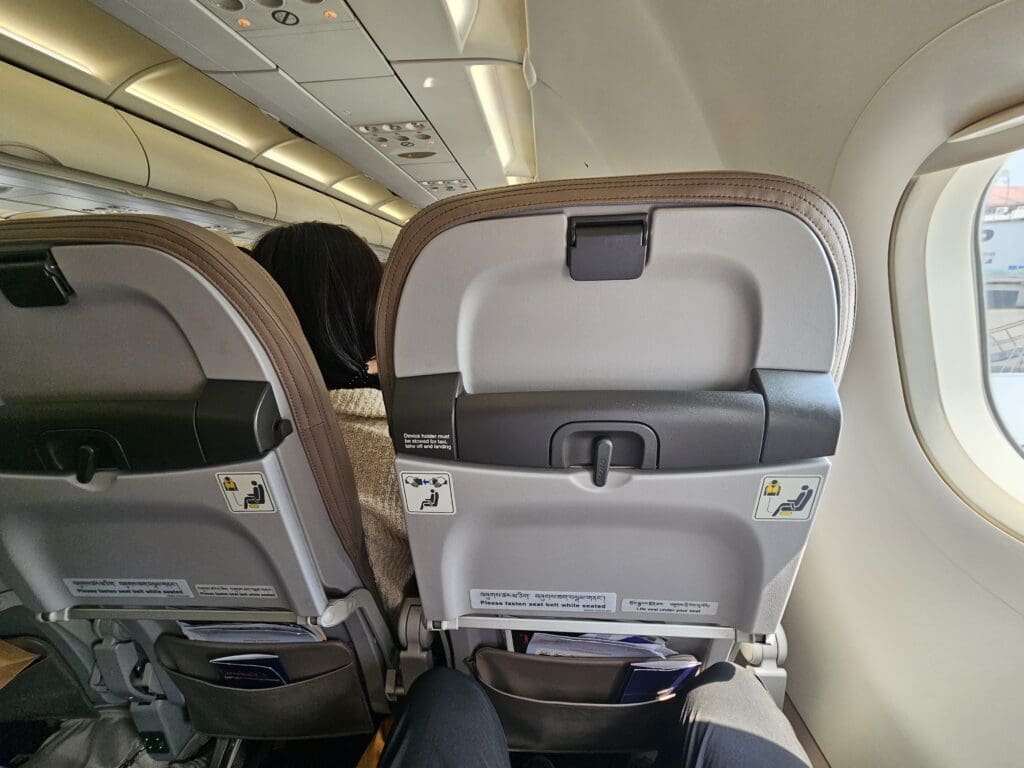
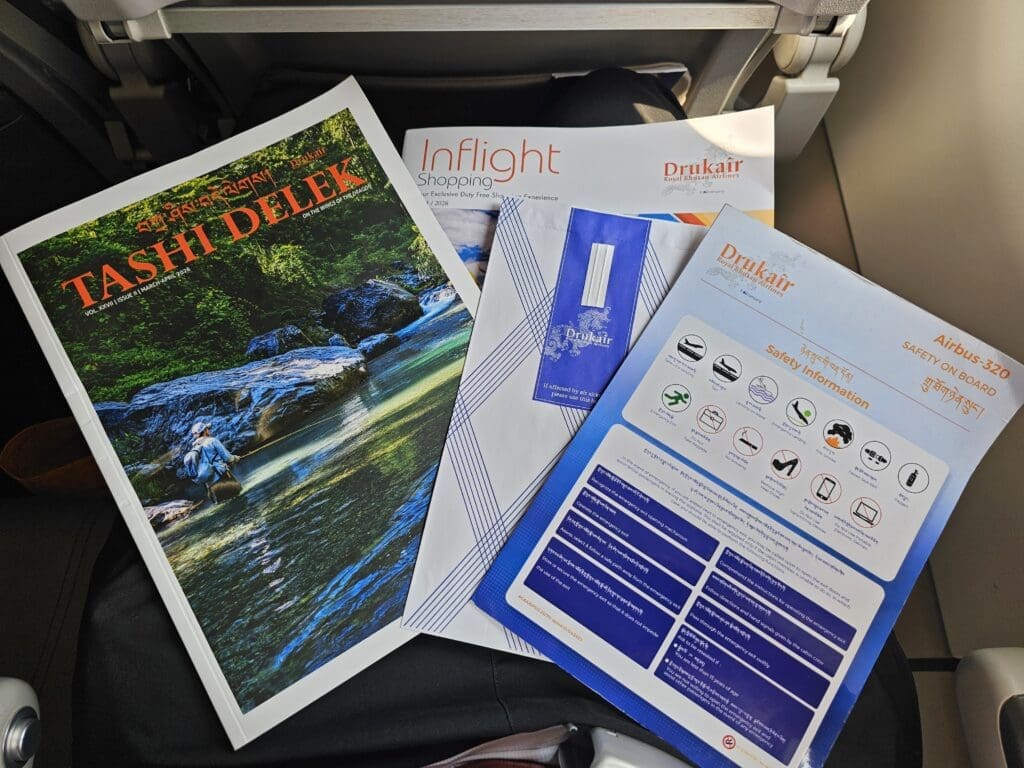
Soon, the bus came to a gentle halt at a set of airstairs that had been positioned up to the rear door, at which point the doors slid open, and we were free to board the aircraft. Venturing out into the hot and humid Guwahati heat, one final check of my boarding pass was required before I was permitted to head up the rear steps. With no waiting required, a few moments later, I stepped onto the rear galley’s faux wooden flooring, where I was warmly welcomed on board by two flight attendants, both of whom were dressed in Drukair’s distinctive uniform, which combines Christian Louboutin design with a traditional Bhutanese kira. Once onboard the aircraft, with nowhere else to go, I turned left and entered the Airbus Economy cabin, which was home to 120 Recaro seats in the standard 3-3 layout. Each of these was covered by a calming elephant grey pleather cover and came with a disposable fabric antimacassar that featured Drukair’s famous dragon motif. Despite being somewhat slim in their appearance, each seat came with what seemed to be a larger-than-standard adjustable headrest. Meanwhile, each seat came with two coat hooks, a device holder, a literature compartment and a seatback pocket which contained a safety card, a sickbag, a copy of Drukair’s duty free catalogue, the Tashi Delek on the Wings of the Dragon inflight magazine and a laminated pamphlet containing information on how to connect to the wifi-based entertainment streaming system. Finally, at-seat power came in the form of USB-A ports, with four provided for each bank of three seats. Adding some nice regional touches to the cabin, traditional Bhutanese patterns could be seen on the cabin dividers, whilst traditional music rang out as I made my way up the cabin to my seat.
Crushing my hopes of a quiet flight to Singapore, upon boarding, the cabin seemed to be at least 80% full, and unsurprisingly, once I had made it to my seat, a Paro-originating passenger could be seen in the aisle seat. Fortunately, they were awake and ready to move out of their seat in order to allow me to slide in, although, being the last passenger to board in Guwahati, I did feel a little sorry for crushing their hopes of having a bank of three seats to themself on the ride to Singapore.
Upon taking my seat, true to its appearance, I did find the seat to be a little firm. Although going some way to make up for this, this did feature a reasonable amount of legroom. Nevertheless, I do have to admit that the seat was still some way off being the most spacious Economy seat in the world (read my review of Air Premia here!). Glancing around, I was pleased to find the seat to be in reasonable condition, although I did spot the odd well-engrained stain that indicated that the cabin could have done with a deep clean. Furthermore, upon boarding in Guwahati, the cabin did look a little scruffy owing to the fact that a fair amount of rubbish appeared to have accumulated on the flight down from Paro, with the short flight time to Assam likely having prevented a rubbish collection service from having been made during the first sector. Finally, unlike on my Bhutan Airlines ride from Bangkok to Kolkata, neither blankets nor pillows were provided, which, considering the four-hour flight time, would have proven to be a nice touch.
Whilst boarding was over in no time at all, by the time I had strapped myself in, the Airbus was still in the process of being refuelled for its slog to Singapore. Given the remoteness of Paro, I can only assume that fuel is cheaper in Guwahati, providing another reason for Drukair’s stops in India on their services to Southeast Asia. After a few minutes, the fuel hose was unplugged, and the bowser soon disappeared down the flight line. At this point, the dispatcher could be seen leaving the aircraft, with the crew closing the door behind them with a thud, indicating that we would soon depart. Indeed, at this point, a pre-recorded announcement rang through the cabin in Bhutanese and English. This featured all the usual warnings about seat belts, and cautioned passengers against smoking, vaping, and chewing tobacco onboard the aircraft before ending with a message promoting Drukair’s wifi-based inflight entertainment streaming service.
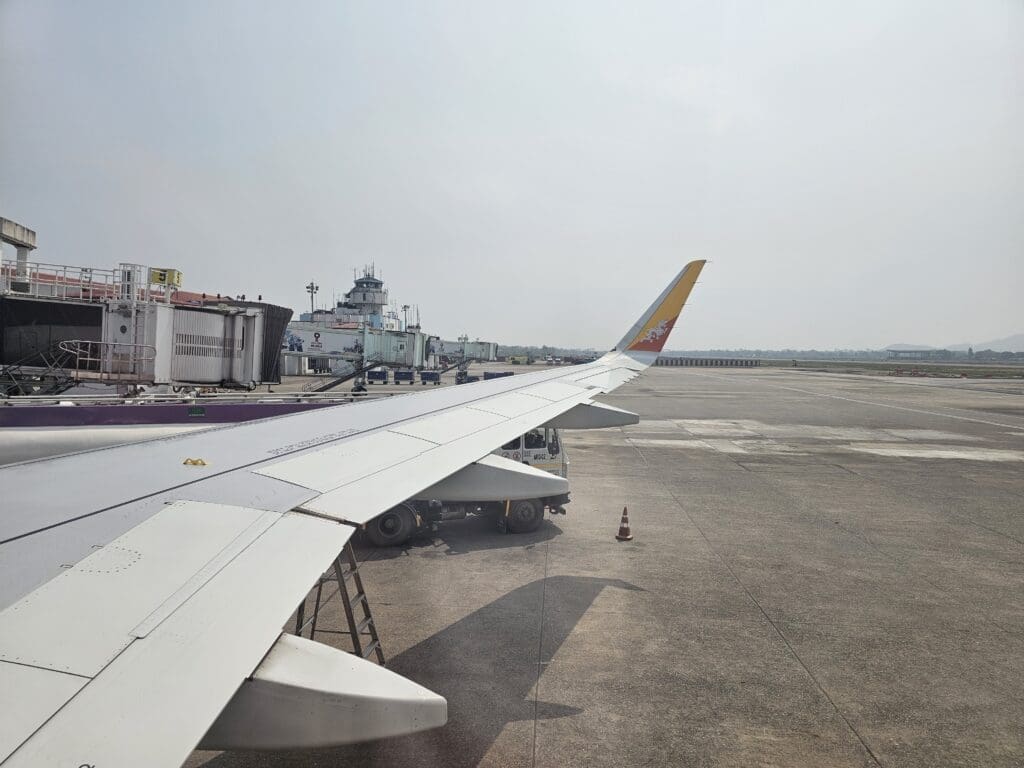
Wasting no time at all, almost immediately after the cabin doors had been closed, at 1304, now running 34 minutes behind schedule, a jolt could be felt as the aircraft was pushed back away from Stand 6. As we journeyed backwards, the Airbus’ two large and powerful CFMI LEAP-1A26 engines whined and whirred into life, albeit in a somewhat quiet manner that was eclipsed by the seemingly louder famous ‘barking dog’ noise as the power transfer unit kicked into life. As the pushback was underway, three cabin crew members took to the aisles to perform a manual safety demonstration to a pre-recorded safety announcement, which played in English only. In the opposite order to the norm, this was then followed by a brief welcome announcement from the Purser, which ran through all the usual warnings, before they thanked passengers for flying with Drukair.
Soon, the two CFMI engines had successfully spooled up, at which point the flaps were partially extended, and the ground crew disconnected the tug. Seeing as Terminal 1 is connected to Guwahati’s sole runway via a single short taxiway, our Airbus was required to hold for a few minutes whilst an IndiGo Airbus A320neo made its way off the runway and pulled into one of Terminal 1’s stands at the end of its short flight from Kolkata. Once this had come to a halt, we continued our journey, making it to Guwahati’s only runway in no more than a minute. With no need for further holds, the Airbus immediately taxied onto the runway and backtracked the short distance to the far southern end of this in order to make a departure from Runway 02. At this point, I was offered a good view of the military area where a host of locally based Mil Mi-17s, a single HAL Dhruv, and the aforementioned rare Airbus A321 could be seen waiting for their next missions.
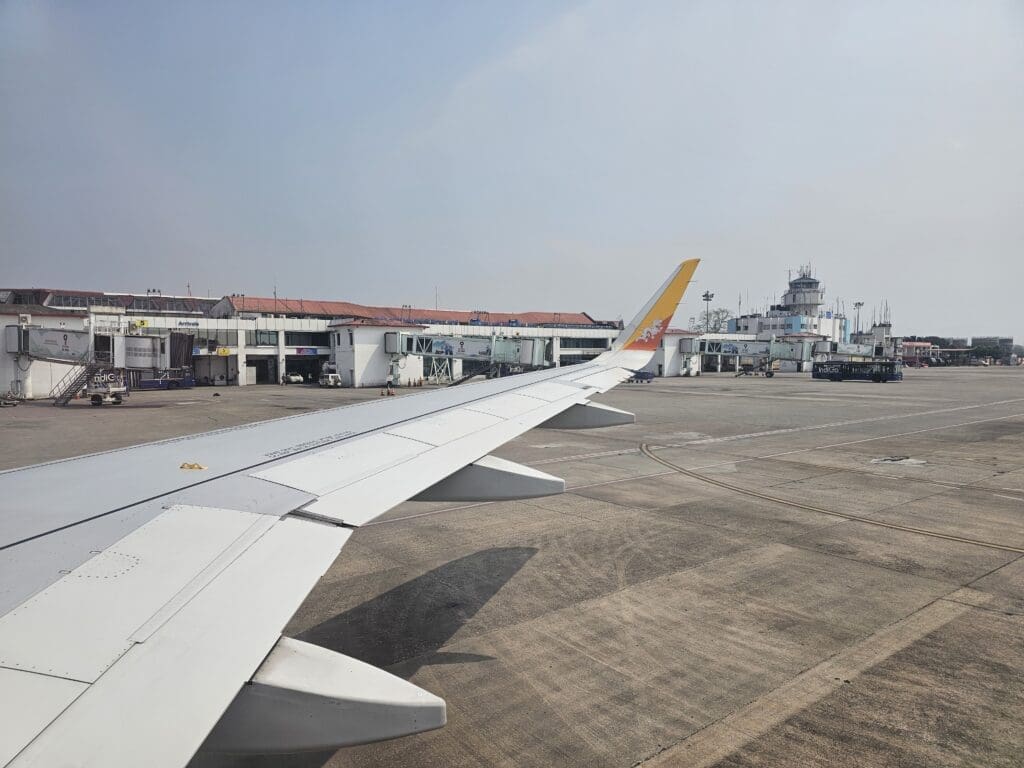
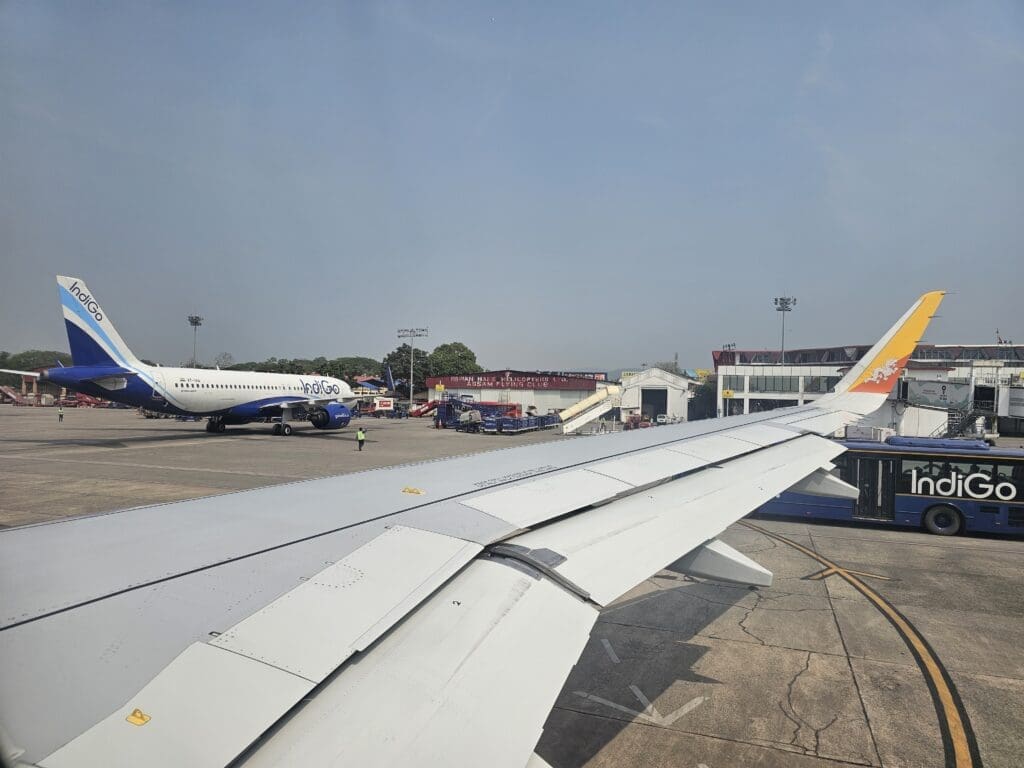
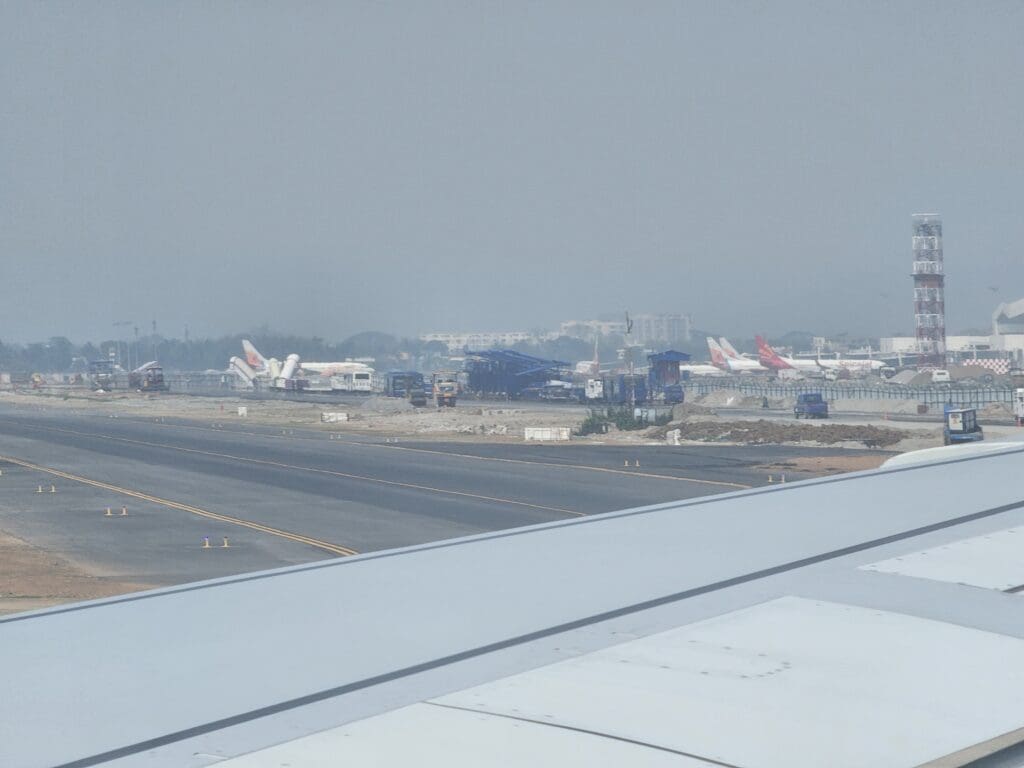
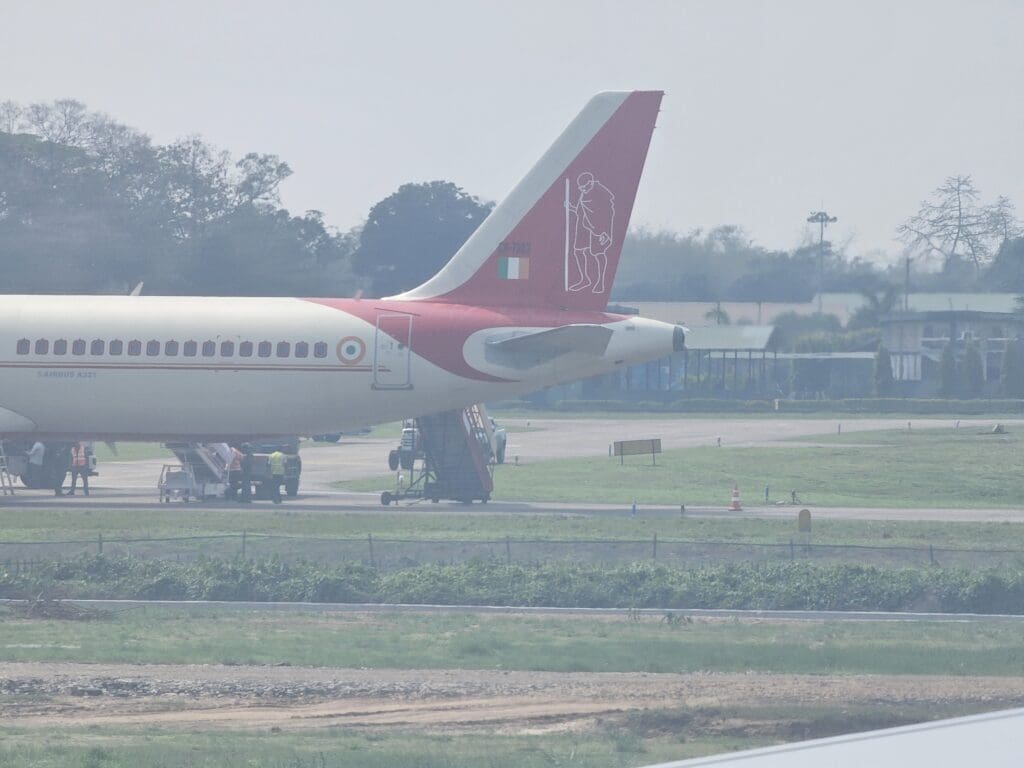
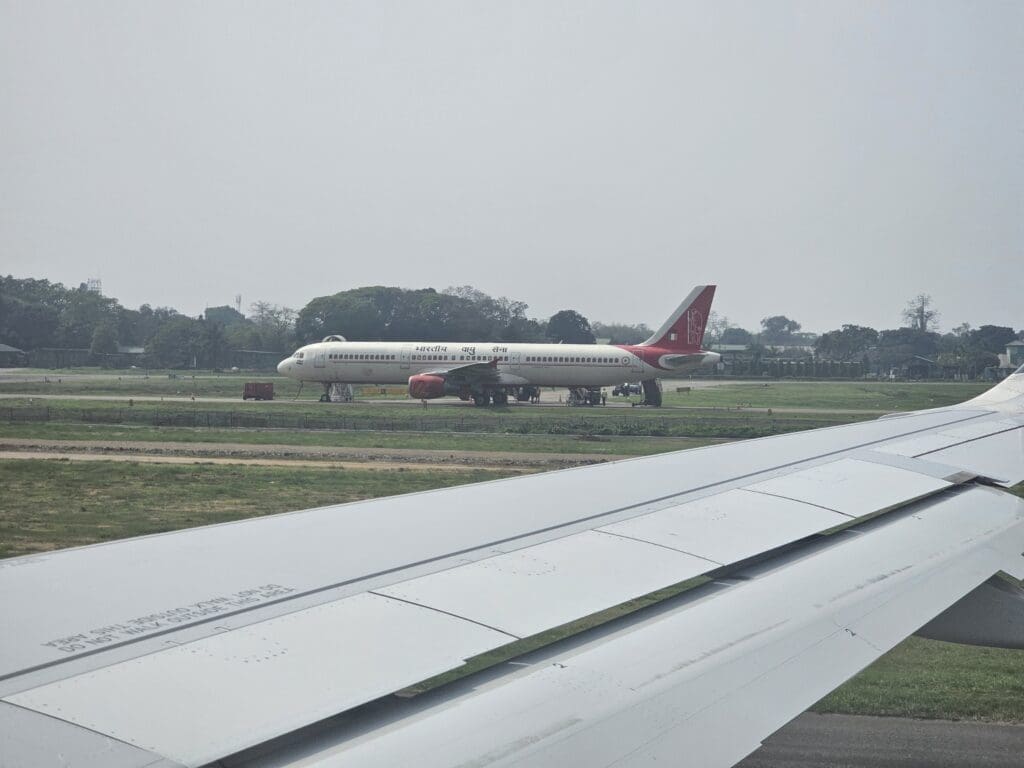
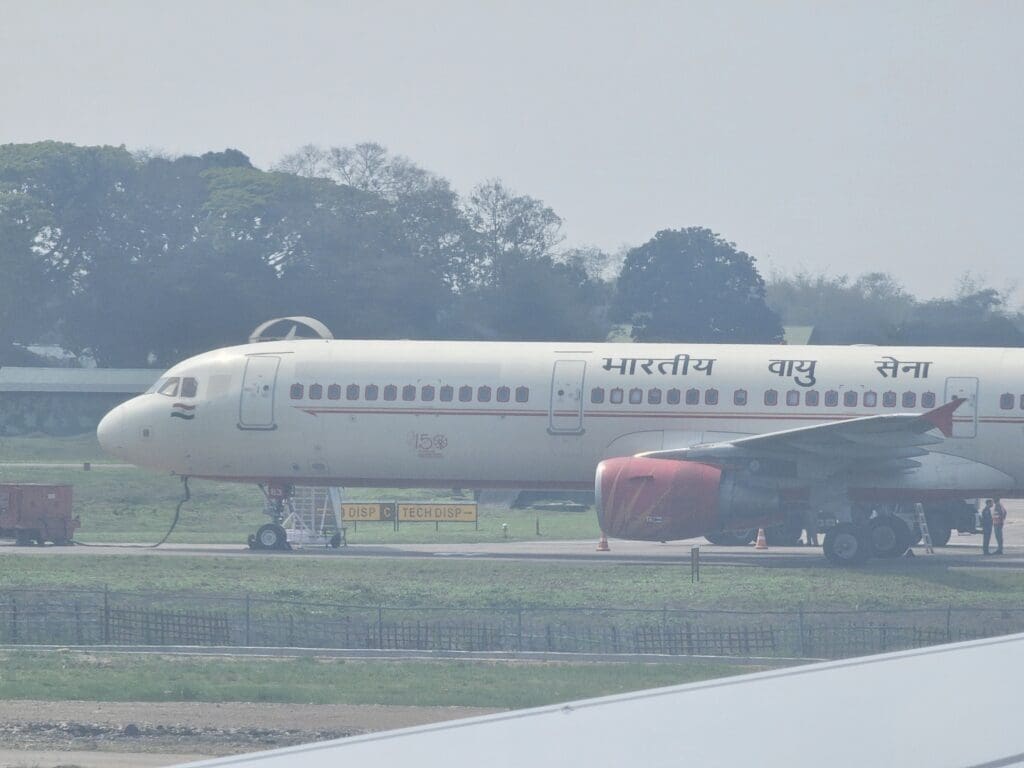
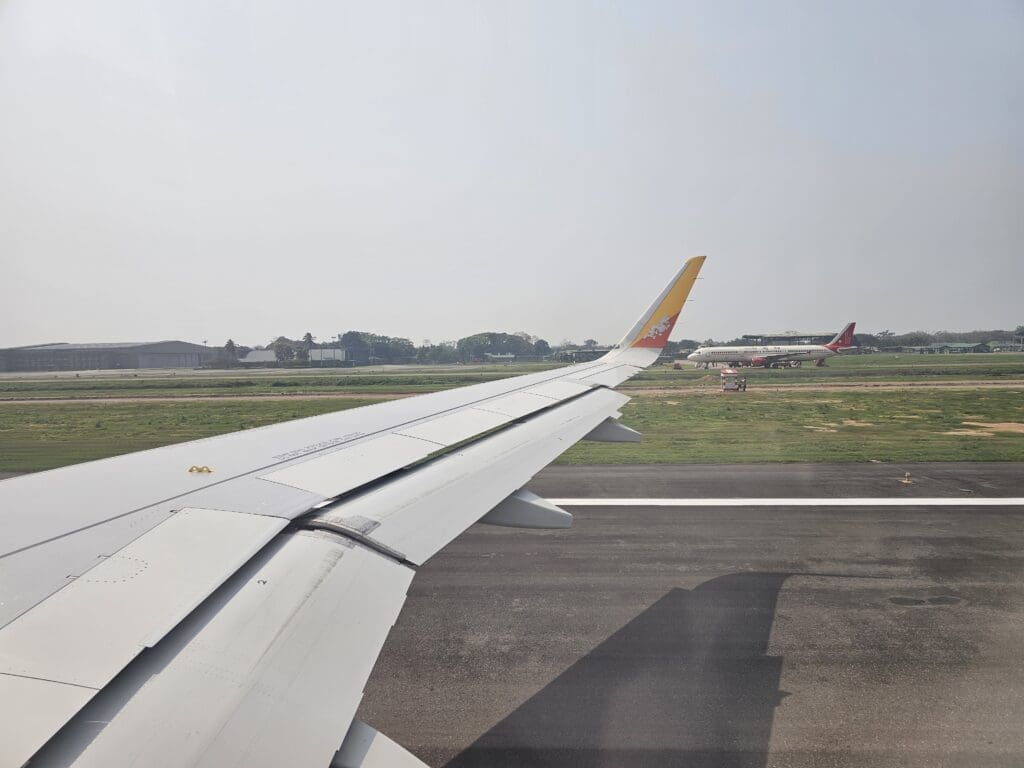
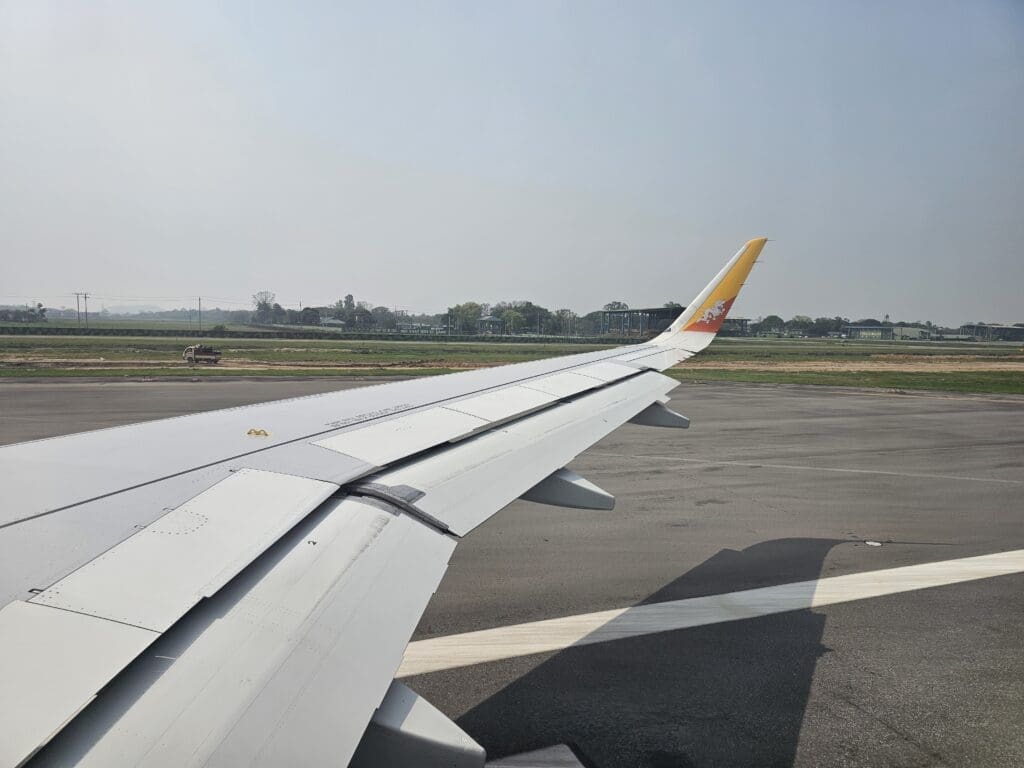
With ‘Royal Bhutan 540’ cleared for departure, once at the end of Runway 02, the Airbus cautiously turned around and lined itself up with the centreline. A few seconds later, at 1320, the throttles were pushed forward, at which point the LEAP engines howled into life as we commenced a gentle takeoff roll, slowly accelerating down the runway with few bumps or sways. Once roughly parallel to the stand that we had left several minutes earlier, the nose was pointed skywards, and we rotated up to the skies with a reasonable amount of vibration. Seconds later, I was treated to a bird’s eye view of Terminal 2, which at that time featured a host of Air India Express Boeing 737 MAX 8s as well as a couple of business jets. Soon, we rocketed over Guwahati Airport’s well-guarded perimeter fence and almost immediately crossed the waters of the wide Brahmaputra River, which runs for around 2,900 kilometres from Tibet to Bangladesh’s Bay of Bengal coastline.
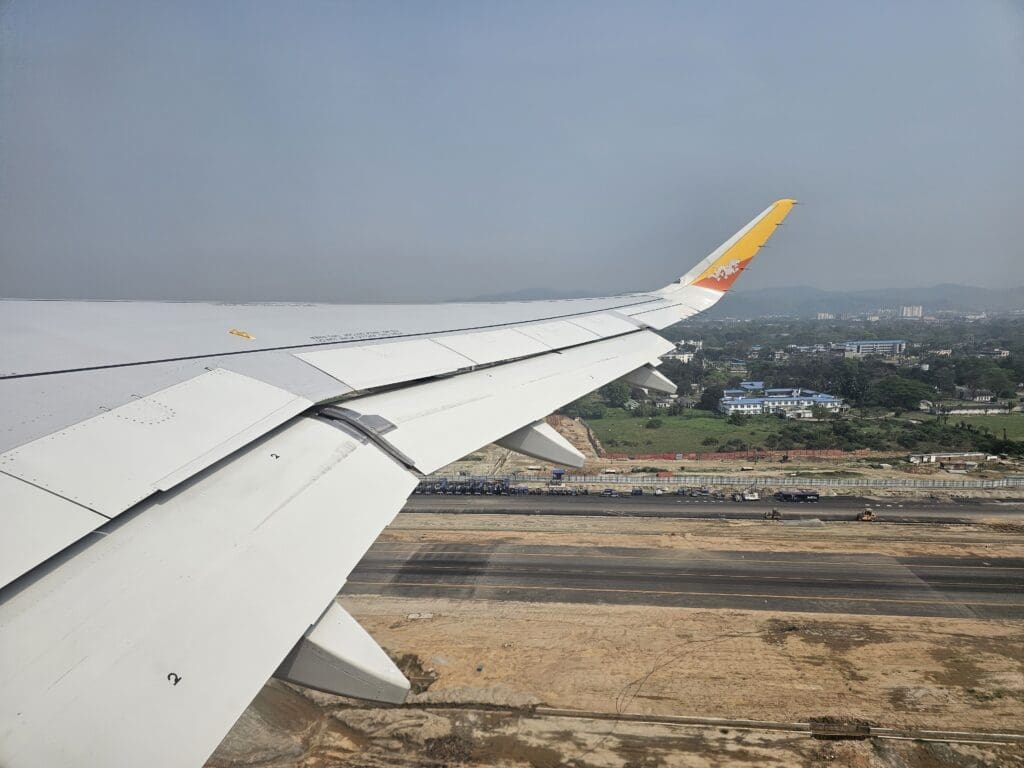
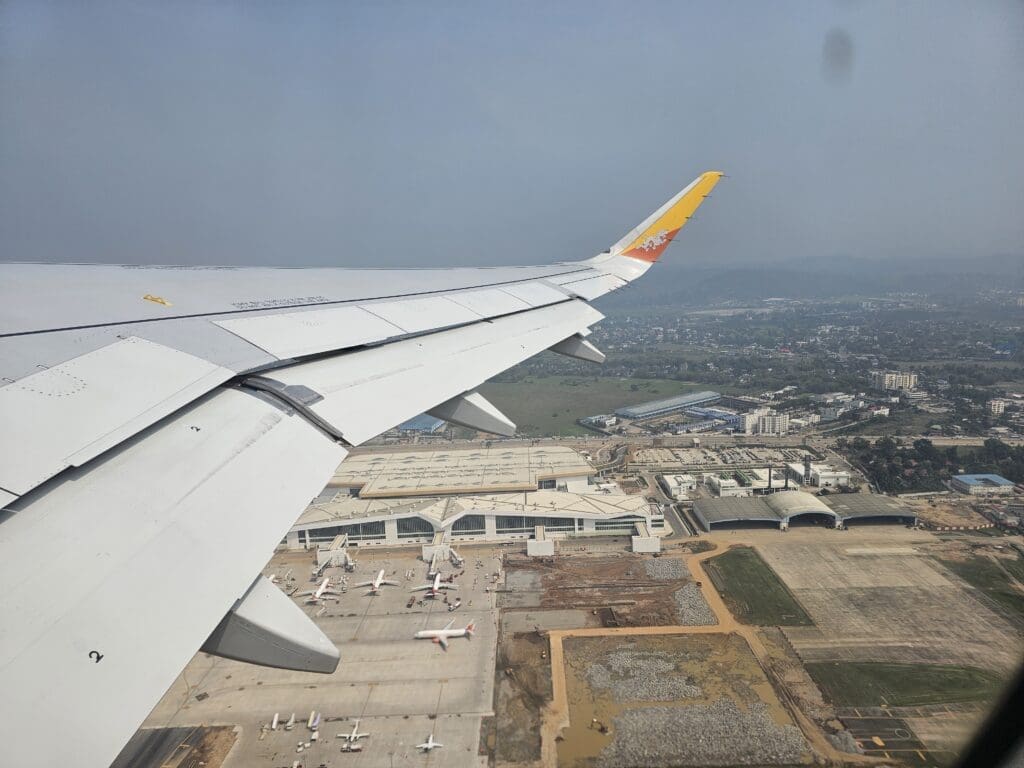
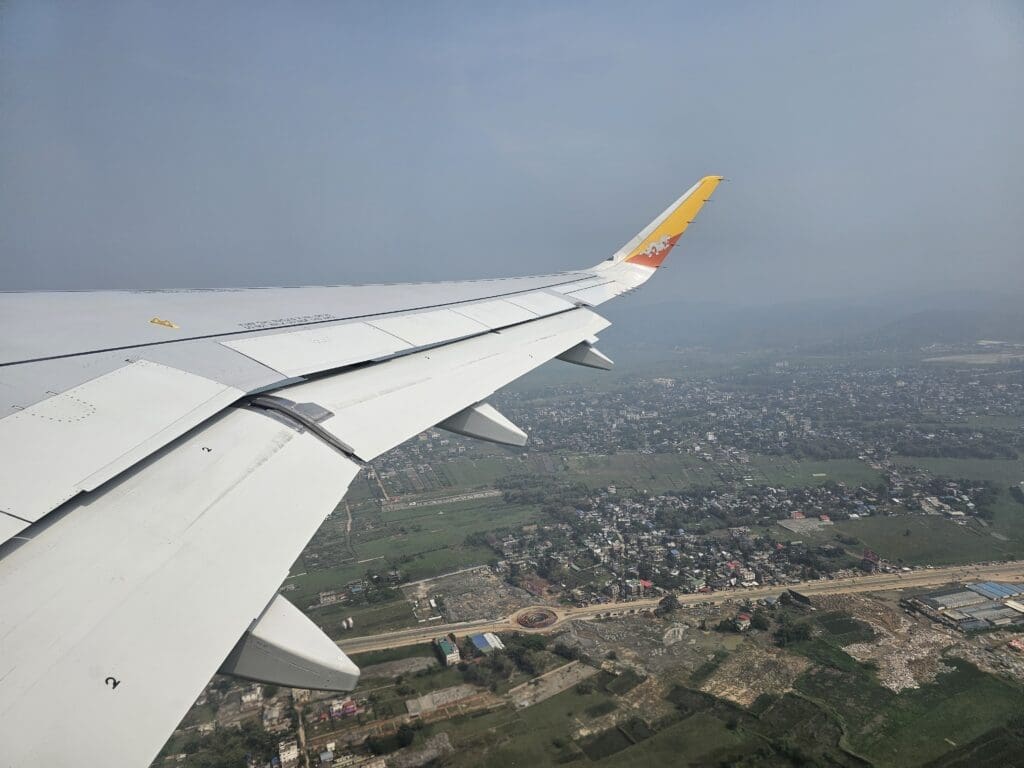
After crossing the Brahmaputra, the Airbus banked to the right and soon rolled out on a southerly heading before we cut straight across the centre of Guwahati. Despite this, sadly, the afternoon haze meant that relatively little could be seen as we climbed higher and higher into the skies of Northeast India, and passed from the skies of Assam to Meghalaya. Having made a smooth departure from Guwahati, almost as soon as we passed through 10,000 feet, a ding could be heard as the seatbelt signs were extinguished, although as far as I could tell, nobody in the cabin appeared to be in any sort of rush to jump up.
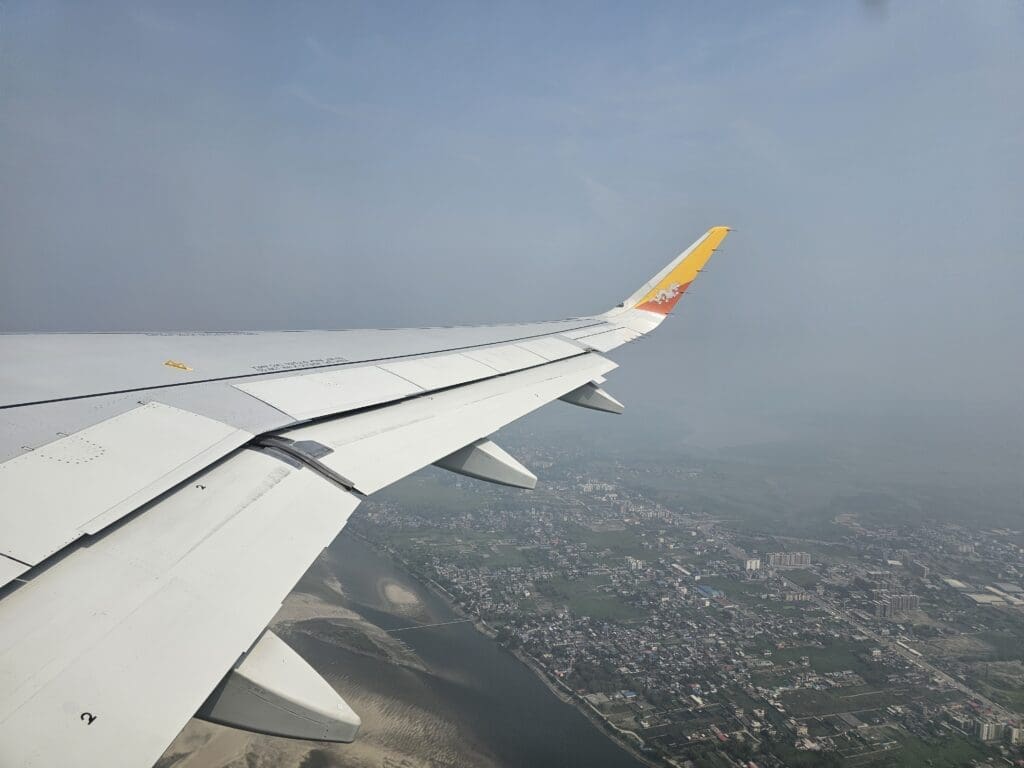
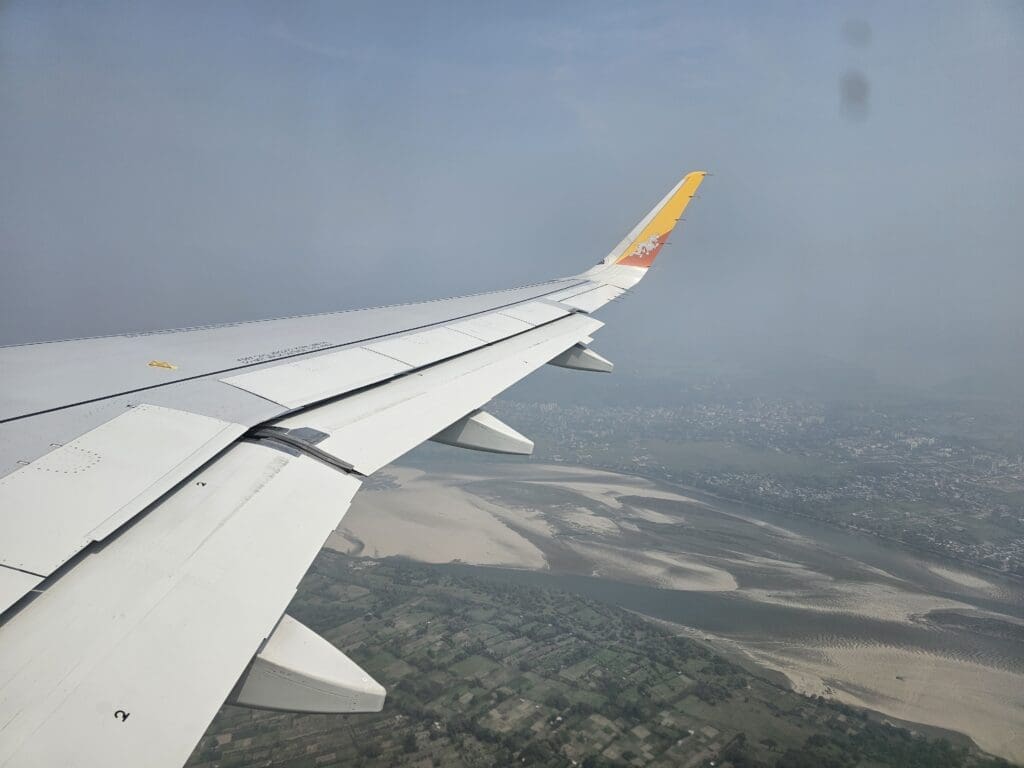
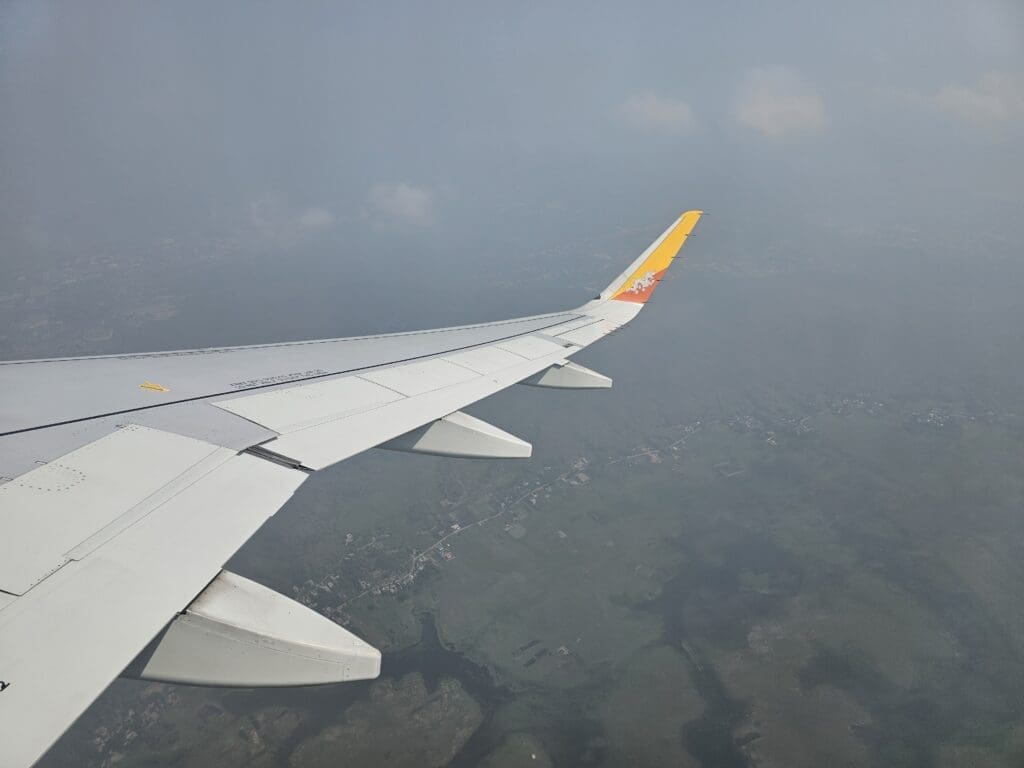
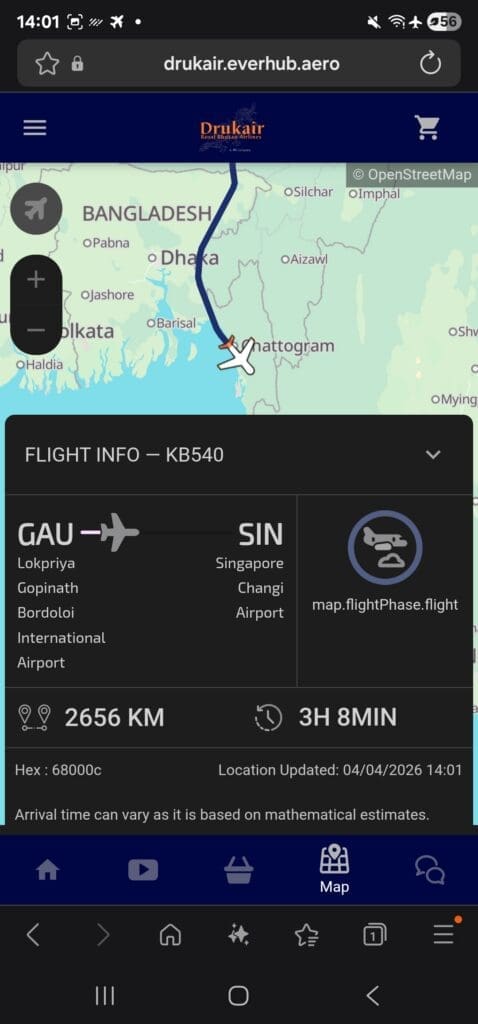
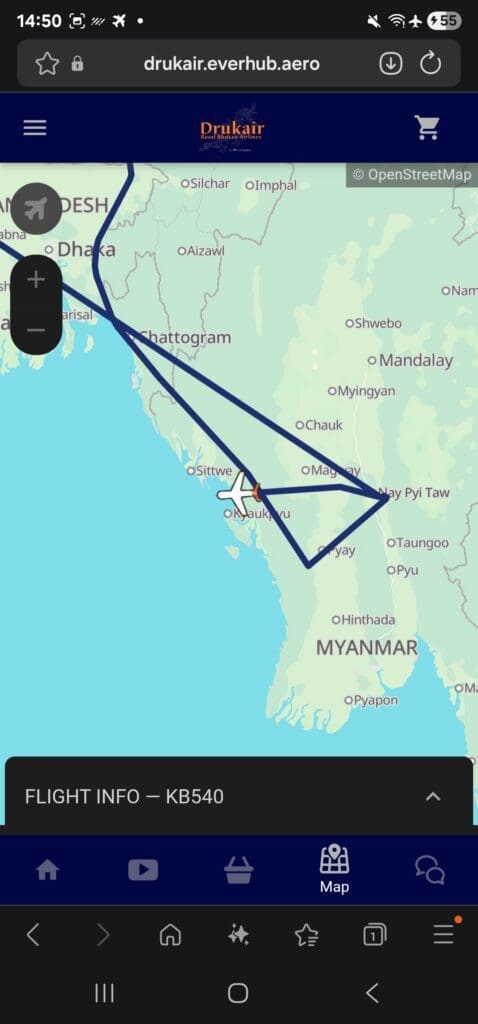
From Guwahati, it was not long before we reached the capital of Meghalaya, Shillong, and just fifteen minutes after departure, we left the skies of India and entered those of Bangladesh, soon reaching the country’s fifth-largest city, Sylhet. For a short while, the Airbus skirted along Bangladesh’s eastern border with the Indian state of Mizoram, and continued flying down the far east of the country at an altitude of 37,000 feet, which we maintained until commencing our descent into Singapore. As we trundled southwards, the Airbus passed the likes of Brahmanbaria, Cumilla, Chattogram and Cox’s Bazar, although sadly, the clouds and haze below meant that nothing of Bangladesh could be seen below. After about forty minutes in the skies of Bangladesh, the Airbus reached its third country of the flight, Myanmar, which heralded our departure from South Asia and entry into Southeast Asia. With Myanmar’s ongoing civil war, the country is a hotbed for satellite-guided navigation system interference and jamming, and our flight appeared to be subject to this, with it becoming impossible to track our location over the country either during the flight or retrospectively using any flight tracking platform.
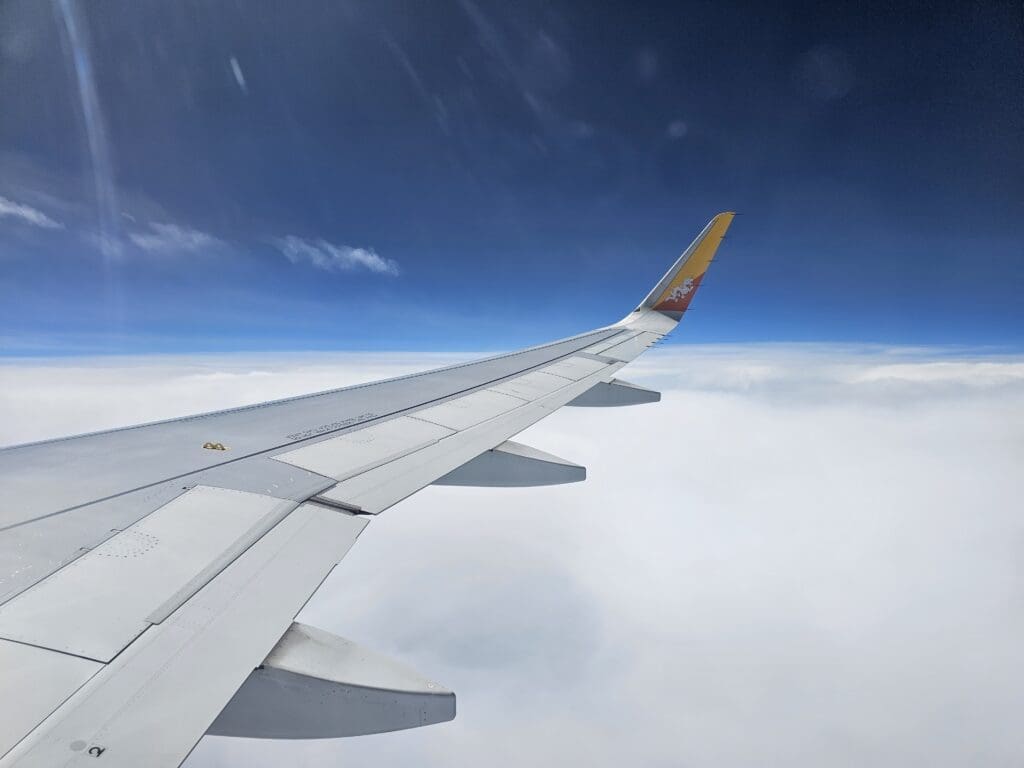
Returning my attention to the happenings inside the cabin, a short time after entering the skies of Myanmar, a flight attendant passed through the cabin distributing special meals to passengers who had pre-ordered these. Excited to experience the full delights of Drukair’s complimentary catering, a short time later, three service carts were rolled to the front of the Economy cabin, each of which was manned by a single flight attendant, with this service conducted in a unique yet seemingly efficient manner. Specifically, the first flight attendant distributed trays containing side dishes of a cabbage salad complete with a single black olive, a square of chocolate cake, and a bread roll with a small tub of Thai butter, plus a sachet containing wooden cutlery, a serviette, salt and pepper, a packaged wet-wipe, a sachet of creamer and a small plastic mug. The second flight attendant distributed the main meal, with three options offered: vegetable curry and dhal with rice, chicken masala with rice, or chicken noodles, each of which was served in a cardboard box and came with a smaller box containing a Bhutanese delicacy of green chillies and melted cheese. Finally, the third flight attendant handed out drinks, with a wide array of fizzy drinks, juices, alcohol and water on offer. That day, I decided to opt for the vegetable curry, and washed this down with an apple juice. Not only was this service efficient, but I also found each of the three flight attendants to be polite and friendly, with the level of service offered leaving me with absolutely nothing to complain about.
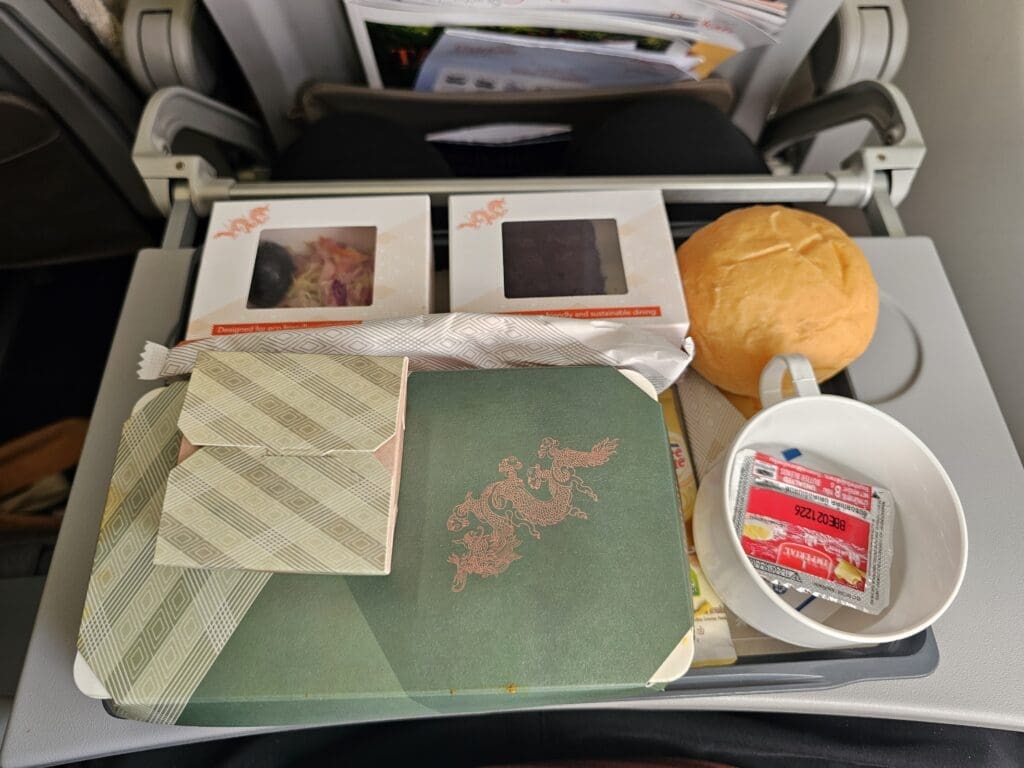
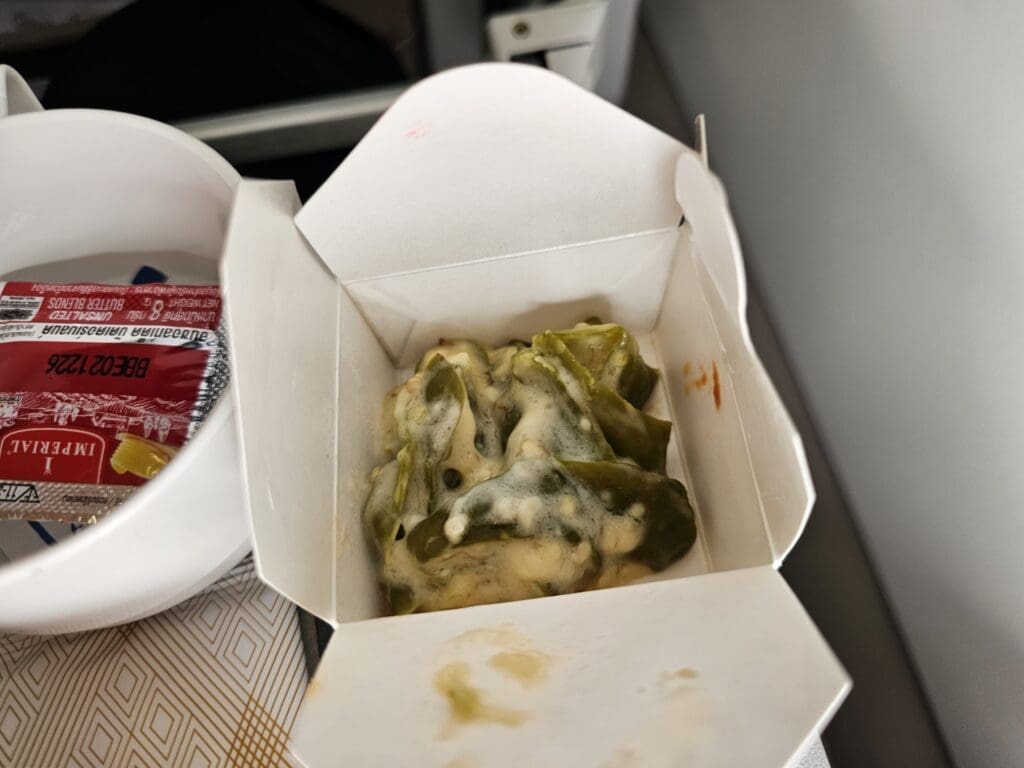
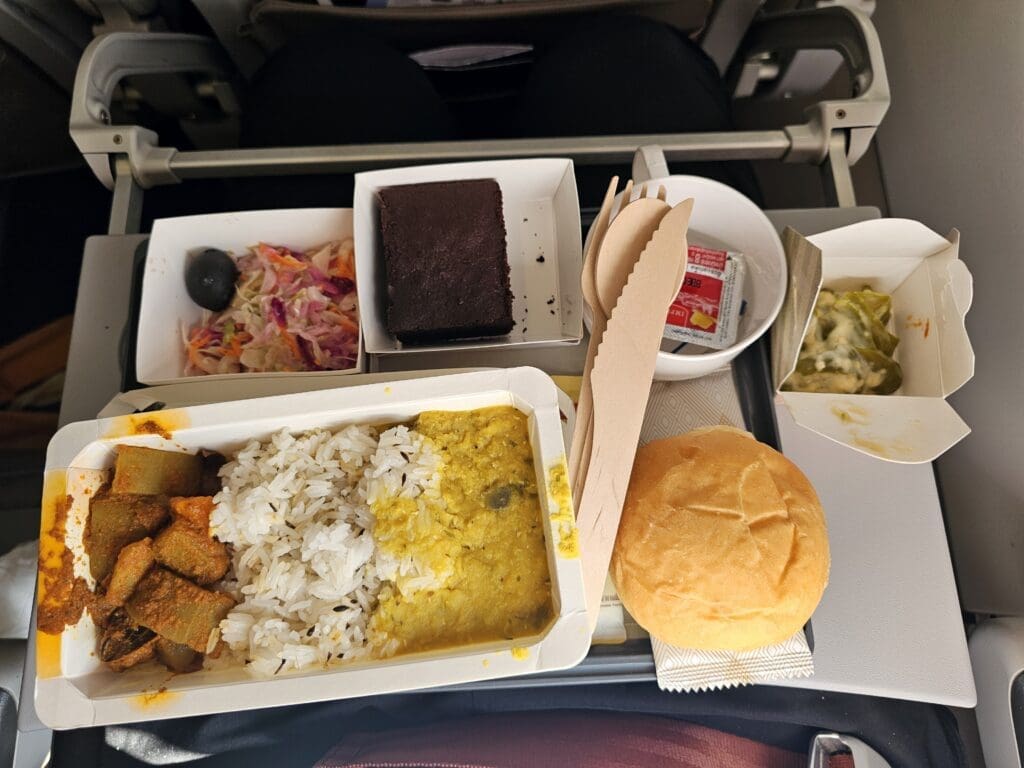
Soon getting stuck into the meal, this was of decent quantity and quality, and thereby left me with no complaints. Furthermore, the packaging was both sustainable, lacking any single-use plastic, and designed in a rather stylish manner, with each item coming in a well-branded container that featured a traditional Bhutanese pattern and Drukair’s dragon motif. Wolfing down lunch, I was left full and satisfied, and around thirty minutes later, a round of hot drinks was made, with a further fifteen minutes passing until the remains of the service were collected.
As I munched lunch, the calm-sounding Bhutanese Captain performed their first announcement of the flight. During this, they welcomed all those who had boarded in Guwahati, thanked passengers for flying with Drukair and apologised for the delay, although no reason was provided for this. They then moved on to give a comprehensive overview of our route down to Singapore, including the countries whose airspace we would cross, and highlighting some of the major cities that we would pass during our journey, before giving a detailed overview of the weather in Singapore both that evening and over the next couple of days for those who would be staying in the country. They then ended this with a final apology for the delay, and noted that we could expect to land in Singapore at 2000, thirty minutes behind schedule.
As we cruised down the Myanmar coastline, seated on the right-hand side of the aircraft, I could not see anything other than clouds and the blue waters of the Bay of Bengal as we trundled southwards towards Thailand. As seems to be becoming increasingly common with new deliveries, Drukair’s Airbus A320neo lacks both overhead and personal screens. However, as mentioned, a Wi-Fi-based in-flight entertainment streaming system is available, powered by Inflight Dublin’s Everhub system. Much to my delight, yet as is not always the case, I faced no issues connecting to the onboard wifi and was able to load up the portal quickly and with ease. Upon doing so, I was greeted by a welcome screen that featured a photograph of His Majesty Jigme Khesar Namgyel Wangchuck, surrounded by smiling members of Bhutan’s royal family. From there, I was taken to the language selection page where I was pleased to find a decent array of six languages available – Bhutanese, Chinese, English, French, Russian and Spanish, with the obvious missing language being Hindi, given Drukair’s India-focused route network and the entrenched ties between Bhutan and India. Without dwelling on this too much, I continued onwards and was given the option of films, television programmes, Bhutan Broadcasting Service Channel 3 content, audio items, as well as pages where I could read about Drukair, discover more about the artwork displayed at Paro International Airport, play games, examine the moving map, and browse the onboard shopping catalogue.
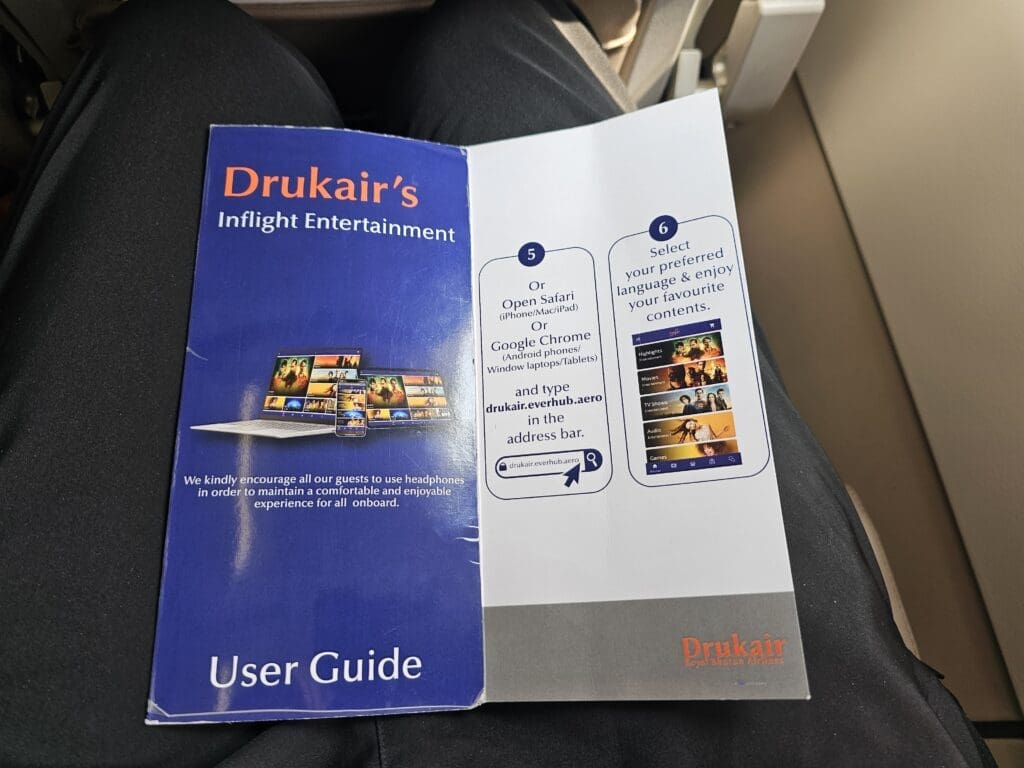

Turning to examine the content, whilst this system was most certainly appreciated, it was also rather compact. Focusing on the films, a total of sixteen titles were offered. These included eight Hollywood blockbusters, four Bhutanese titles, and two films each from India and Korea. For those fancying a shorter watch, ten Bhutanese television programmes were offered in addition to eight American shows, two shows each from India and Korea, and one programme each from China and Japan. Meanwhile, ten Bhutanese music videos were provided for those looking to discover some Bhutanese beats on their way to and from the Land of the Thunder Dragon. Each item commenced without any sort of advertisement, something that is, of course, becoming increasingly rare in today’s day and age! Continuing my browse of the system, the audio options consisted of nine different playlists – two country, two Hindi, two Western, two Korean and one Bhutanese. In addition to these, passengers could view a basic moving map, browse the onboard shopping menu, complete a survey on their experience with Drukair, read about the airline, and even order duty-free items from their seat. Whilst I do not usually partake in duty-free sales onboard, I could not resist trying this function and ordered a Drukair Airbus A320neo model in the hope that this would be delivered to my seat. However, sadly, this never came, and I hoped that I would have more luck when the crew made their round of duty-free sales later on during the flight.
Turning to Drukair’s inflight magazine, just like their wifi-based streaming system, this was an appreciated feature of the flight, especially considering the fact that more and more airlines are doing away with such offerings or moving them to digital-only publications. Flicking through this, it appeared that the magazine was clearly designed with inbound tourists in mind and was thus published in English only and focused almost exclusively on things to do in Bhutan, whilst this was also heavily laden with advertisements for an array of goods and services in Thimphu and Paro. Finally, copies of the Bangkok Post and the English-language Bhutanese newspaper Kuensel could be found in the literature compartments at the front and rear of the Economy cabin.
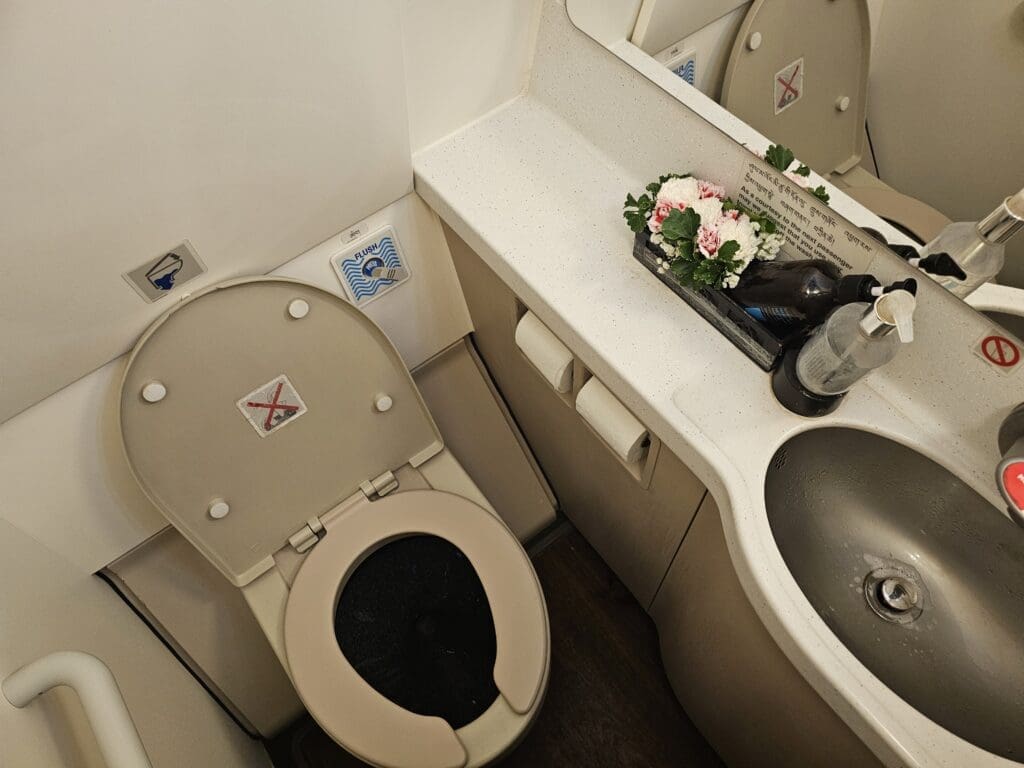
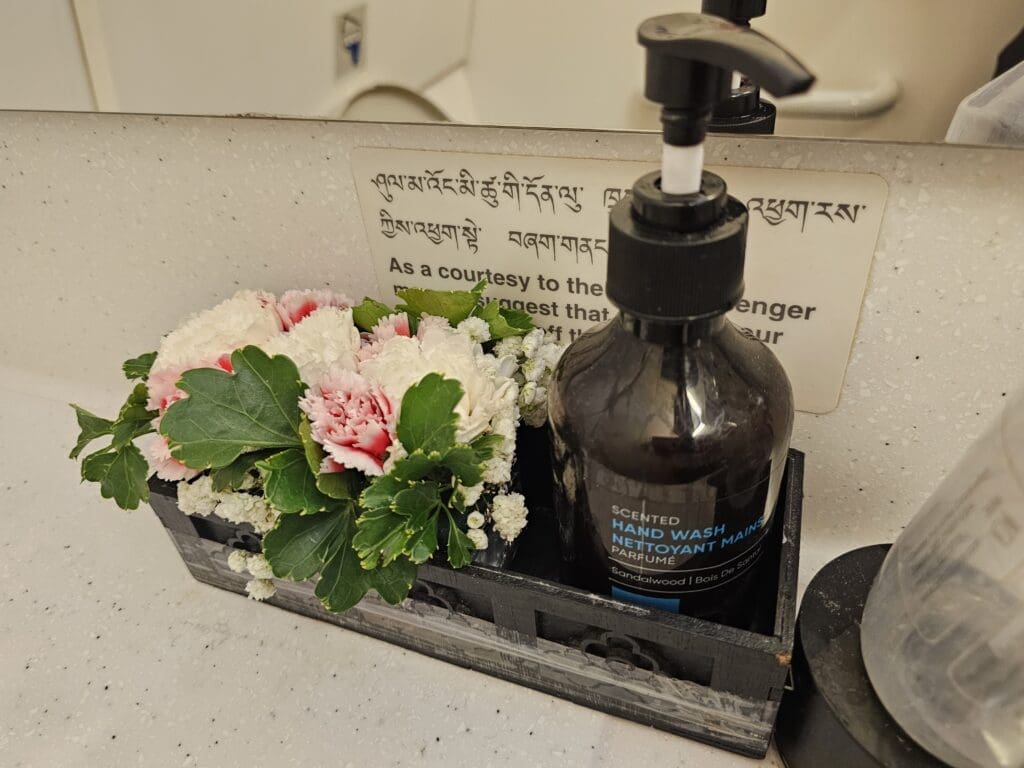
As we cruised southwards over Myanmar, the cabin lights were dimmed and it appeared that many passengers drifted off to sleep, following suit, being totally shattered from my long day of travel, I too closed my eyes in an attempt to get forty winks and largely succeeded, waking up as we sped southwards over the Gulf of Thailand, cruising at 37,000 feet just off the coast of the state of Pattani. A few short minutes later, the Airbus entered Malaysian airspace and, realising that there was not a great deal of the flight left, I stood up and made a pre-arrival visit to one of the two lavatories located at the rear of the cabin. Having the same idea as about half of the flight, a long wait was in store, and after about ten minutes, I made my way into one of these. Much to my delight, I found the lavatory to be in tip-top condition, with a wonderful perfumed scent, fancy hand wash and fake flowers, thereby leaving me rather impressed and with absolutely nothing to complain about.
By the time I returned to my seat, the aircraft was flying over the northern reaches of the Malaysian state of Pahang, gently bumping around, whilst lightning could be seen occasionally flashing in the picturesque dusk skies. Almost as soon as I had strapped myself in again, a pre-recorded announcement rang out that advertised the soon-to-commence duty-free service before a cart was rolled out to the front of the cabin, staffed by two flight attendants. Examining the onboard shopping catalogue, I found this to contain the usual array of cosmetics, perfumes, alcohols and electronics that can be found on just about any airline in the world; meanwhile, prices were very much standard. This did, however, feature a limited selection of Bhutanese souvenirs such as traditional Tshoglham boots, handmade board games and dolls, and other trinkets for those who had forgotten to go souvenir shopping in Bhutan. Upon reaching my row, I enquired about the aforementioned Airbus A320neo model, which would have set me back $30. Whilst this was available, I was informed that payment could only be made in cash, thereby sadly scuppering my plans to secure a souvenir from my Drukair experience.
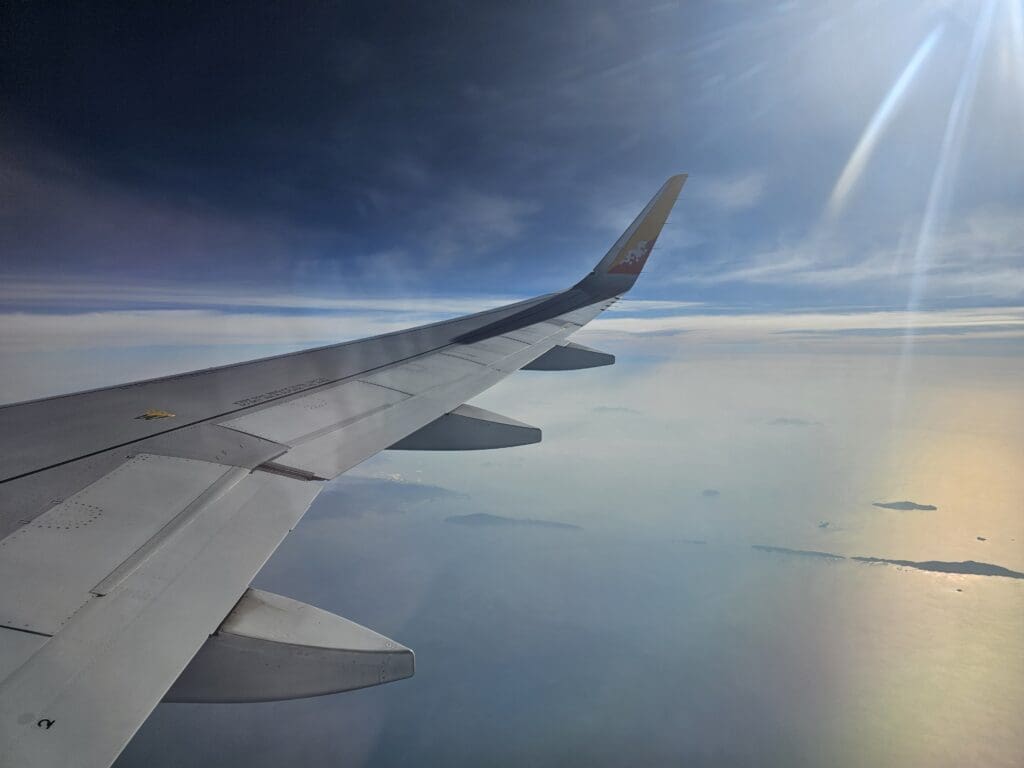
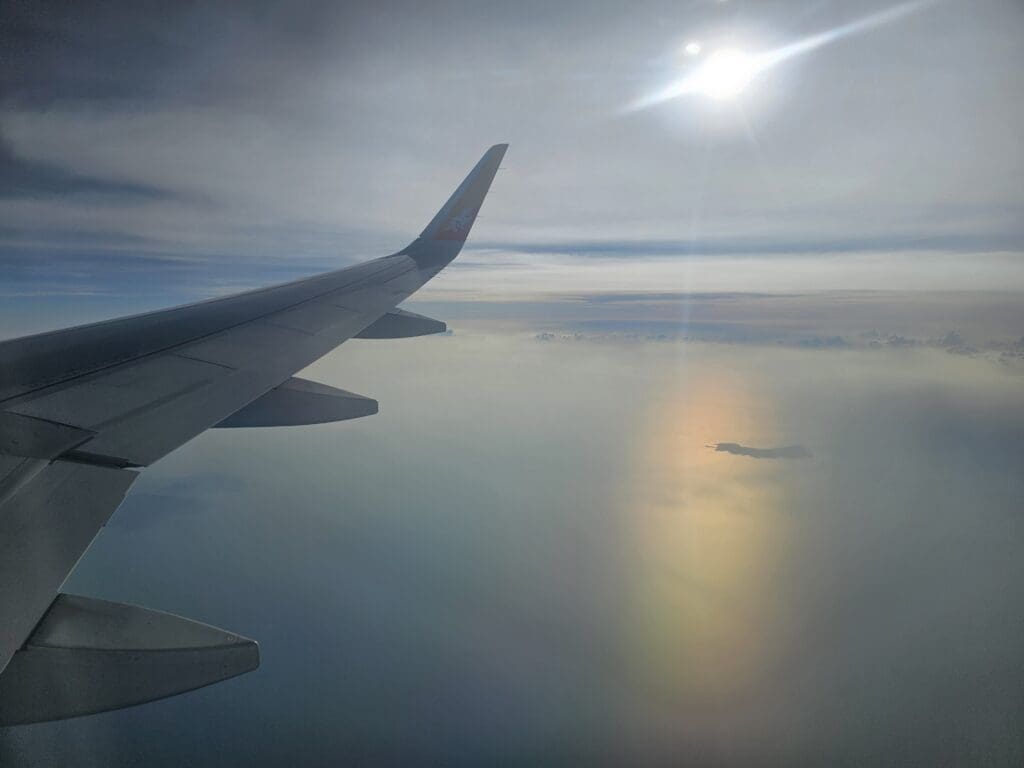
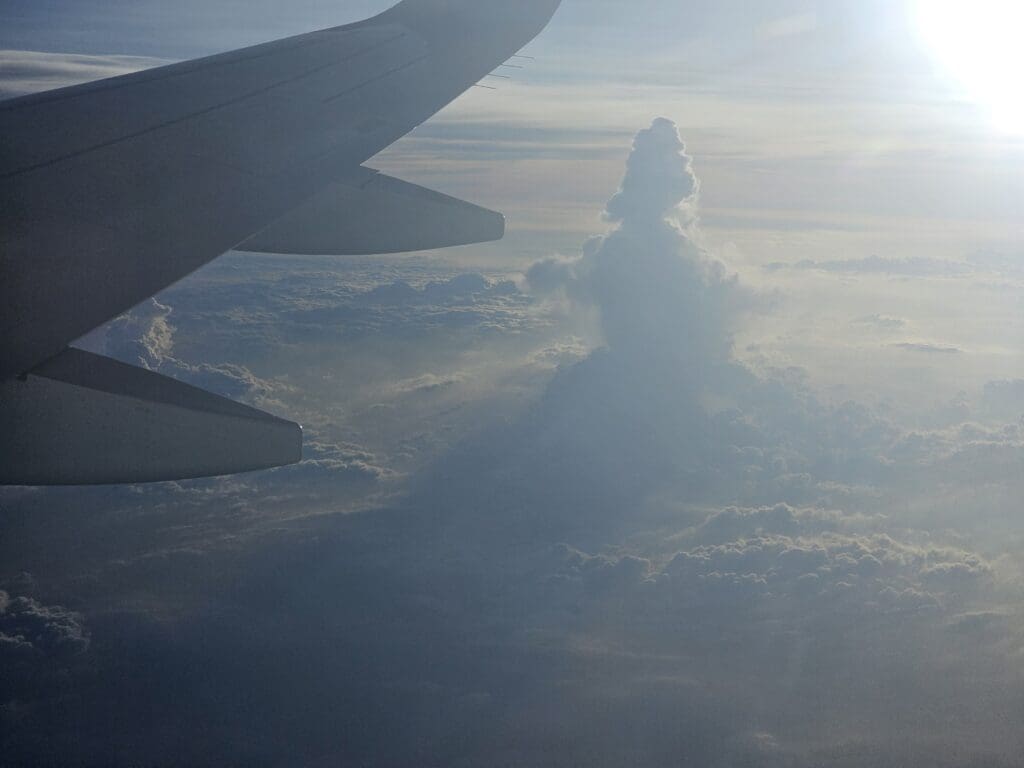
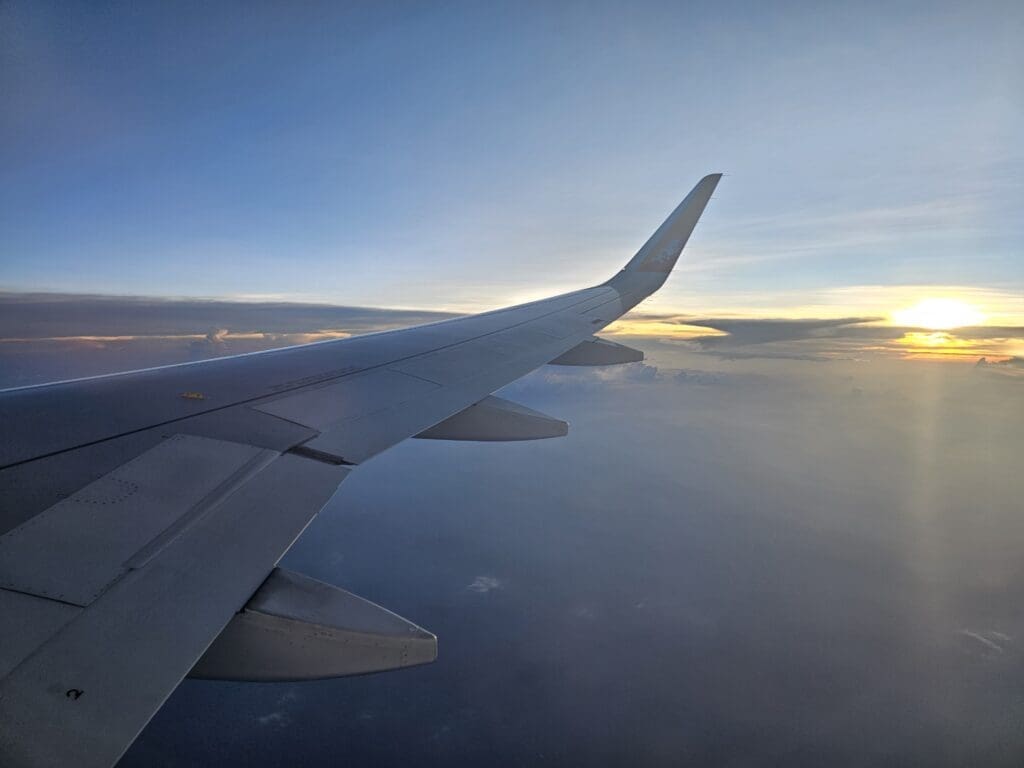
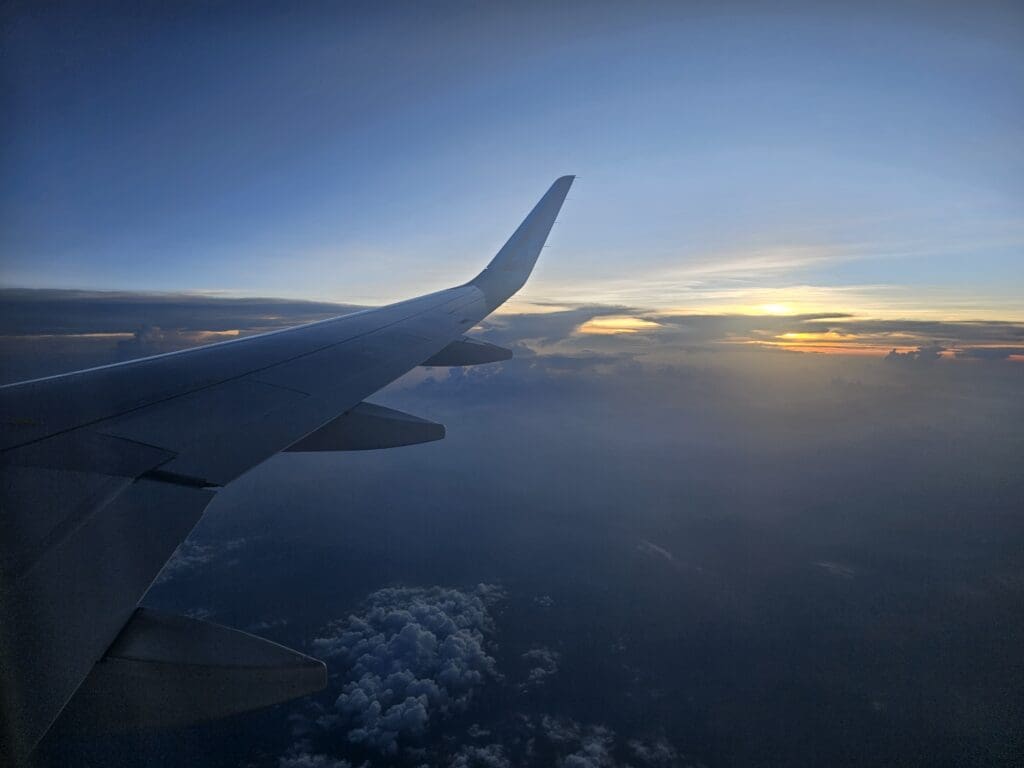
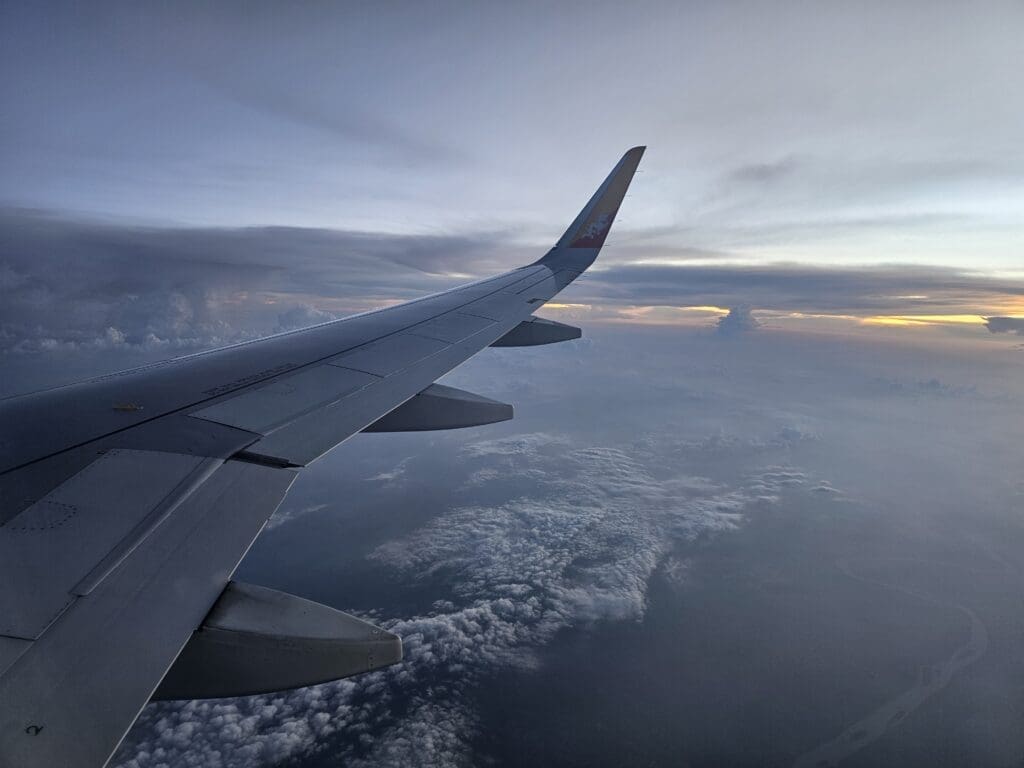
As the duty-free service neared its end, the aircraft passed just to the west of the city of Kuantan, and the Airbus could be felt commencing its descent, with this being shortly followed by the Captain’s second announcement. This time around, they provided a weather update, mentioned the route that we would take into Singapore, thanked passengers for flying with Drukair and apologised once again for the delay. With the skies now regularly flashing with lightning, unsurprisingly, the seatbelt signs were soon reilluminated, at which point the Purser performed a pre-arrival announcement in Bhutanese and English, which contained all of the usual information and warnings regarding seatbelts, tray tables, seatbacks and window shades, before the crew took to the aisles to ensure that everything was secure and in place for our arrival into Singapore.
From Kuantan, the Airbus headed out to sea and trundled southwards off the eastern coastline of Peninsula Malaysia, passing the likes of Tioman Island and Mersing, before making landfall over Tanjung Sedili in the state of Johor. There, we cut through the seemingly thick layer of clouds, and by the time we emerged from these, the aircraft had crossed over the Johor coastal town of Pengerang and was making its way southwards over the Singapore Strait towards the Indonesian island of Batam. At this time, seeing as we would be landing in darkness, the cabin lights were dimmed, enabling a decent view of the lights of Batam as the flaps were lowered into position and we turned to fly northwards, setting a course that would take us straight to Singapore Changi.
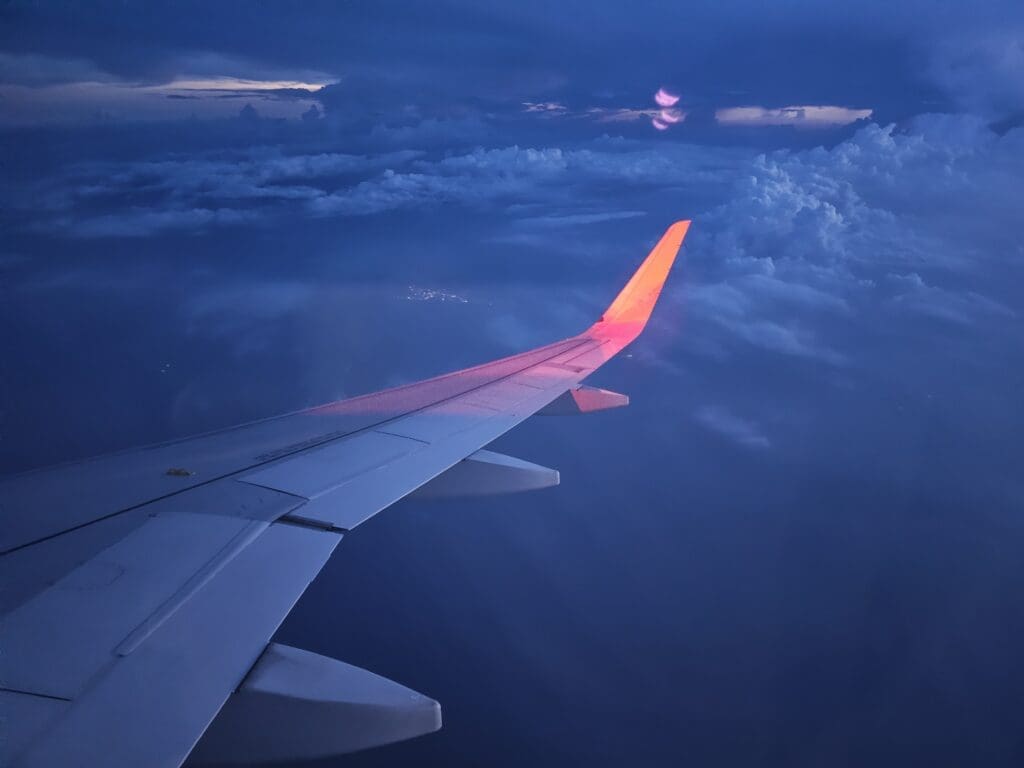
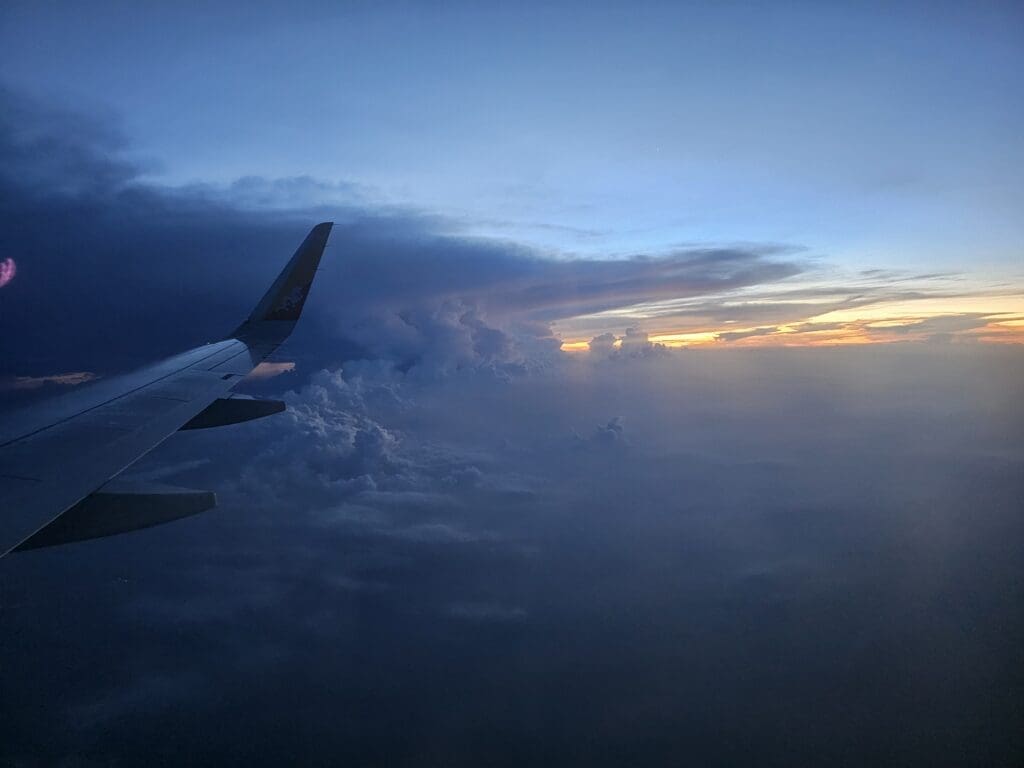
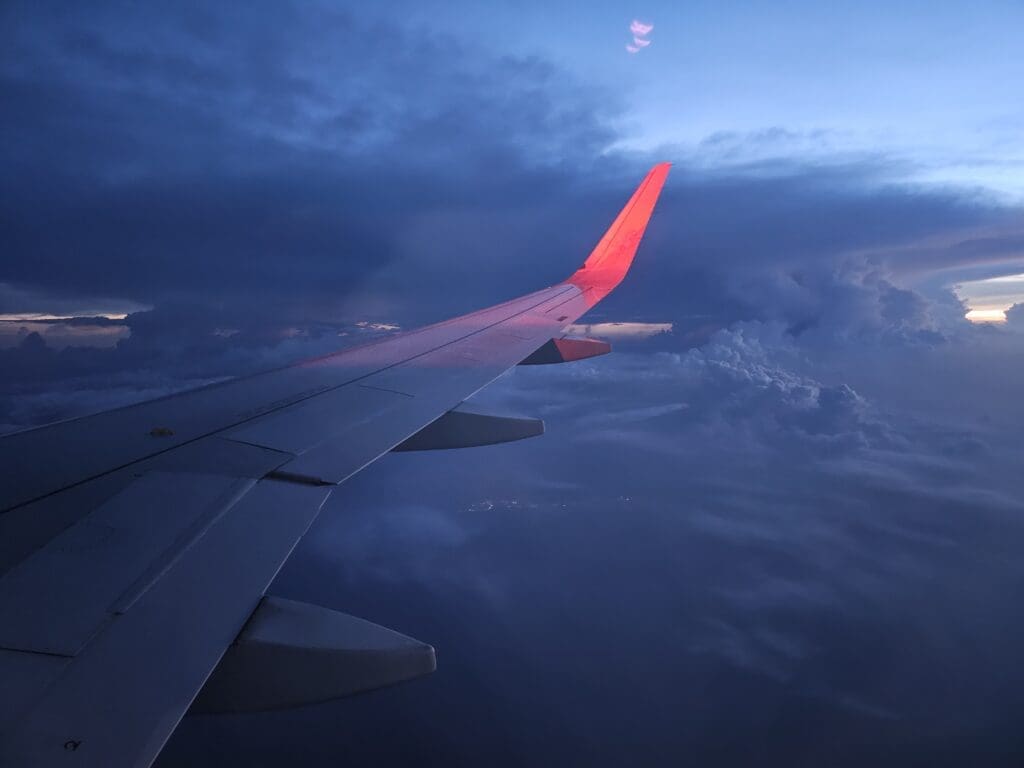
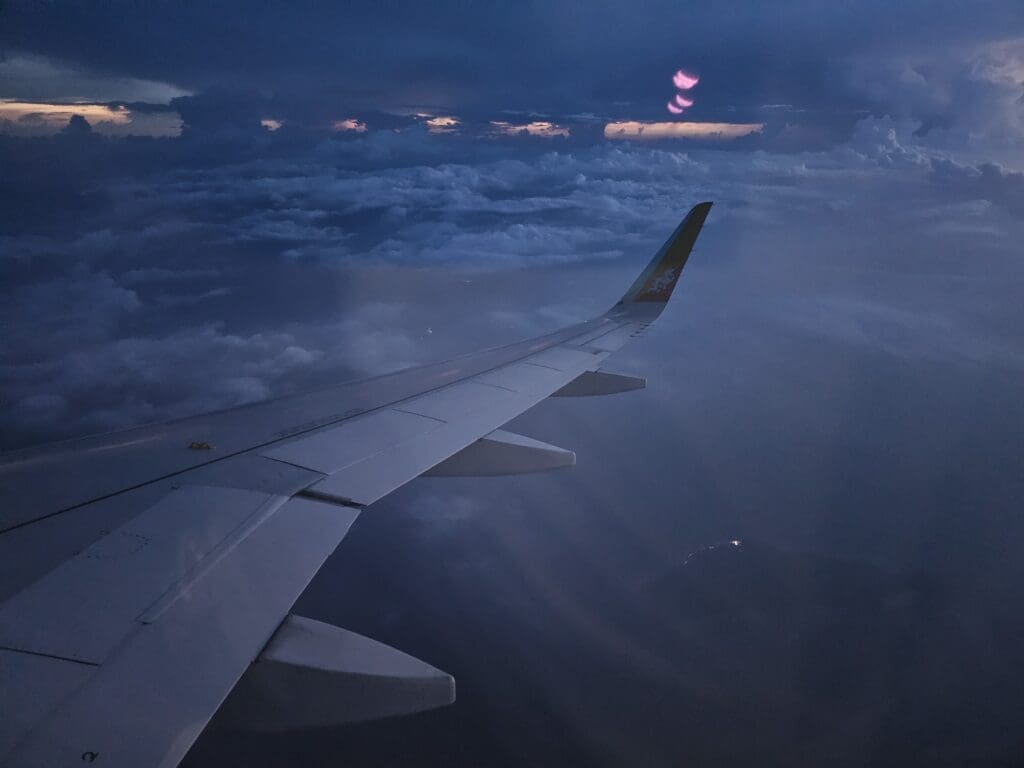
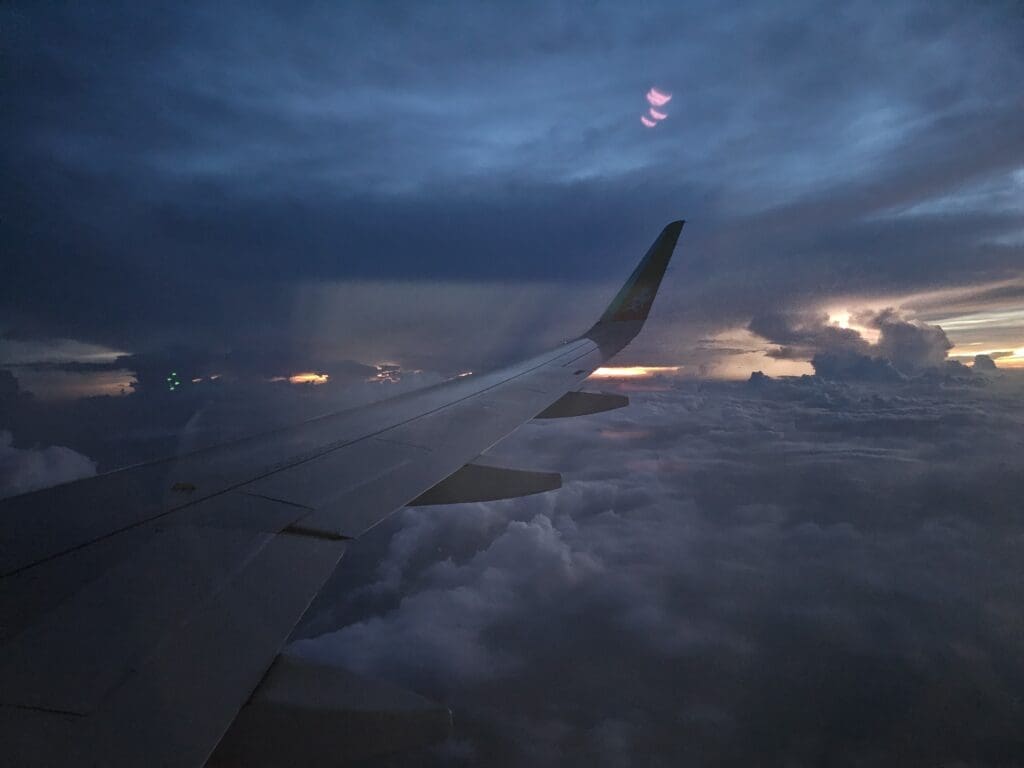
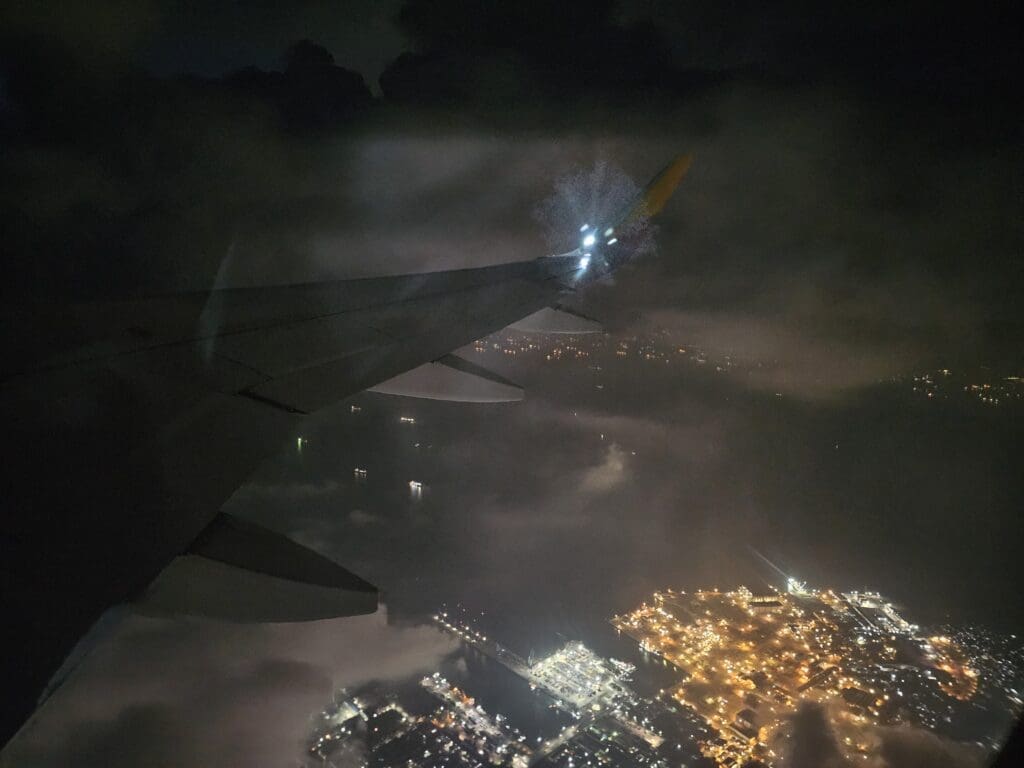
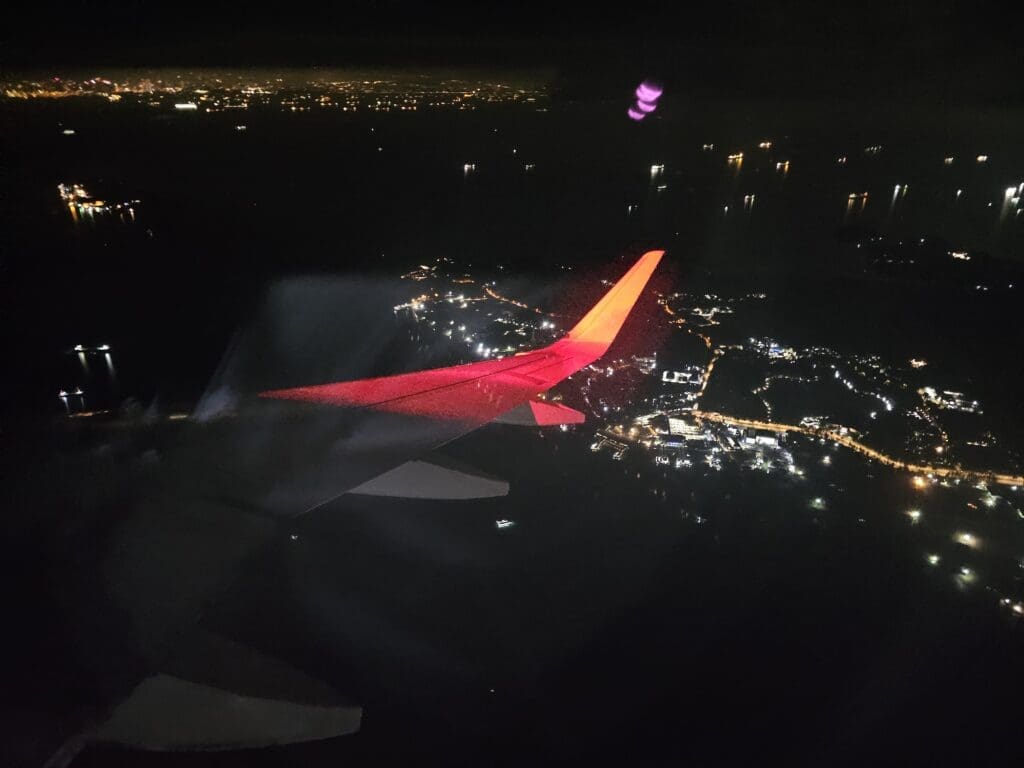
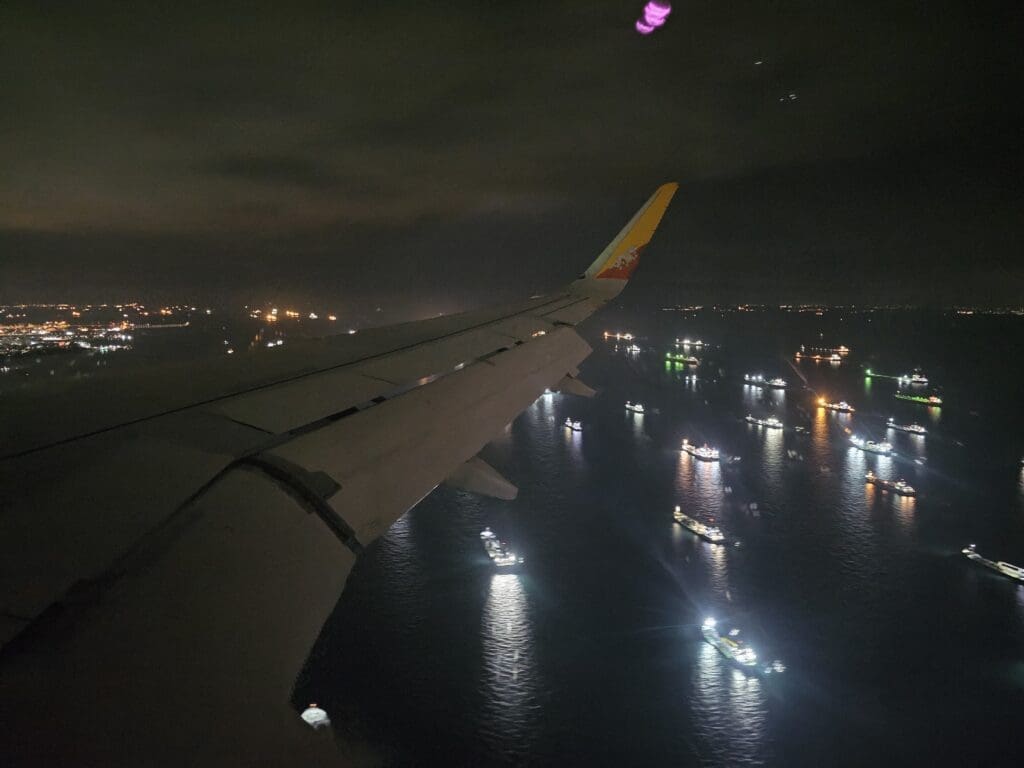
As the Airbus sank lower and lower, a seemingly endless flotilla of cargo ships could be seen in the Singapore Strait waiting to enter Singapore, as our landing gear could be heard locking into position with a firm clunk. With our approach being almost entirely over water, there was little to see other than ships and the lights of Malaysia in the distance as we sank lower and lower. Before I knew it, the Airbus descended over the airport’s southern perimeter, at which point rows and rows of both stored and active Scoot and Singapore Airlines aircraft appeared, serving as a clear reminder that we had arrived in Singapore. At 1959, a total of four hours and nine minutes after taking to the skies of Guwahati, the Airbus touched down with a firm bump on Singapore Changi’s four-kilometre-long Runway 02L. Whilst this runway was more than long enough for our Airbus A320neo, with a Juneyao Air Airbus A321neo following a short distance behind us, we decelerated rather harshly and soon vacated the runway to the right.
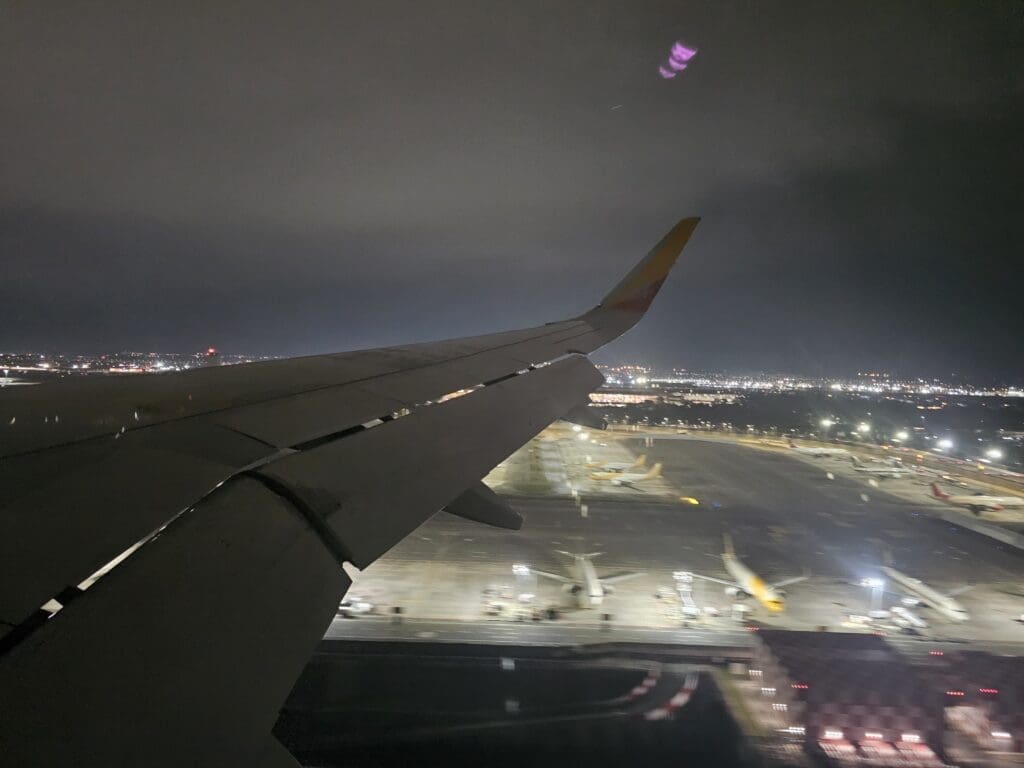
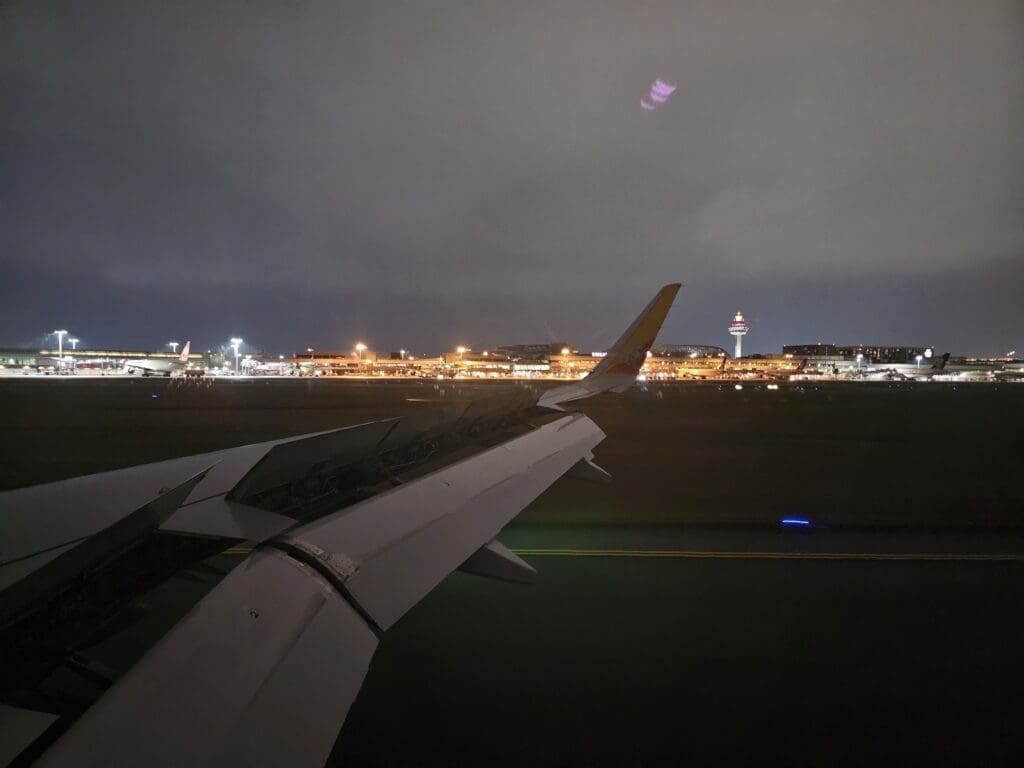
In the usual manner, once we were off the runway, the flaps were retracted with a loud whine, and the Purser welcomed all to Singapore, thanked passengers for flying with Drukair and advised all passengers to remain seated until we had arrived at our parking position and the seatbelt signs had been extinguished. Afterwards, a selection of ‘interesting’ songs rang out through the cabin, which included covers of the Bee Gees’ hit How Deep Is Your Love and The Police’s slightly sinister Every Breath You Take. With the aircraft spending the night on the ground in Singapore, unsurprisingly, this did not head to Terminal 3, but instead made its way to the remote stands at the south end of the airfield near Terminal 4. Nine minutes after touching down, the Airbus cautiously eased itself into Stand 477, coming to a halt 38 minutes behind schedule at 2008.
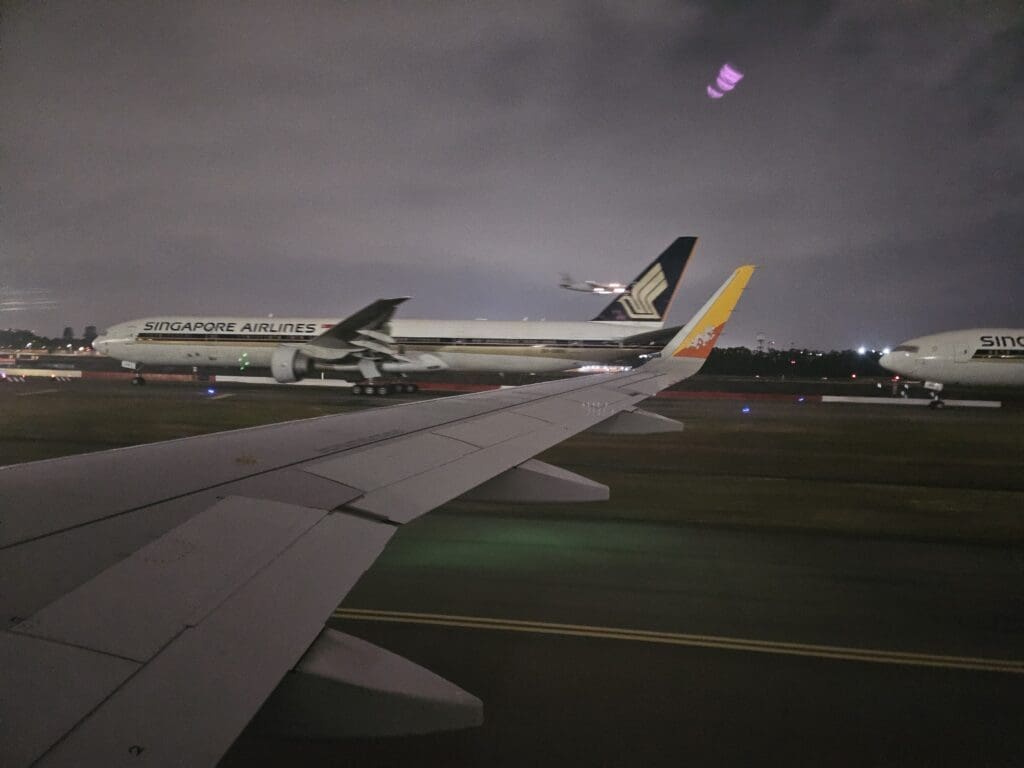
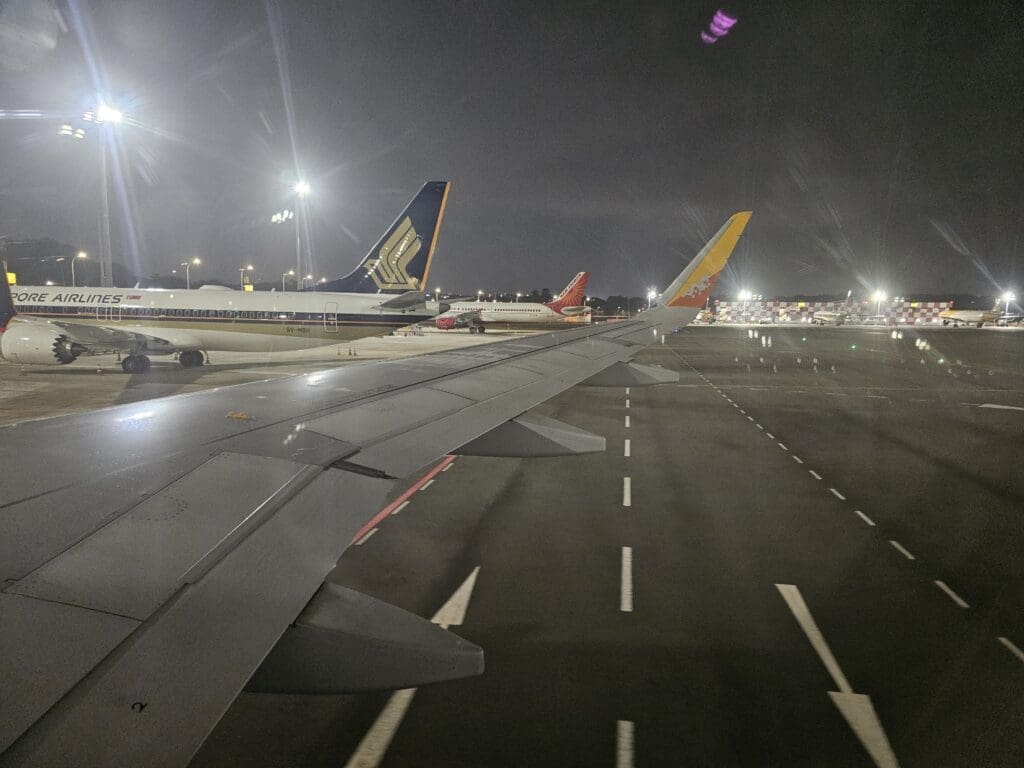
Once we had come to a halt, many passengers sprang up in an apparent rush to leave the aircraft, and, fortunately for those in a rush, it did not take long for the cabin door to be opened, at which point disembarkation commenced. After a while, I shuffled through the cabin, thanked the friendly crew members in the forward galley and made my way into the hot, humid and rainy Singapore air before darting onto the second bus. With all Economy passengers squeezed into two buses, once this was rammed with the final passengers, we commenced our long journey to Terminal 3’s international arrivals area. However, on the plus side, once there, it was a short walk to immigration, which, thanks to the focus on automation, was an impressively speedy process which saw me enter Singapore in no more than a minute. Slightly disappointingly, however, suitcases from the flight did take quite a long while to appear, although this was somewhat explained by the fact that we had arrived at a remote stand. Once these arrived, I picked up my soaking wet suitcase and steamed through customs, commencing my short stay in Singapore before heading off on a Jeju Air Boeing 737 MAX 8 to Busan.
Summary
Overall, I was left rather pleased with my Drukair experience. Onboard, I found the aircraft to be modern, clean and comfortable enough, whilst the crew were polite, warm and friendly, and the catering was superb given the length of the flight. Whilst there were a few areas where I would want to see some improvements, for example through the distribution of blankets to those in Economy, and the acceptance of payment methods other than cash for the duty-free service, overall, I would be more than happy to fly with Drukair again!