Flying into India’s Most Scenic Airport: Delhi to Leh on an Air India A320neo
You can read all the background information in report of my Air India A320neo ride from Bengaluru to Mumbai here.
Following a pleasant evening flight from Mumbai, the former Vistara Airbus A320neo that had shuttled me up from the City of Dreams came to a halt at the domestic portion of Delhi Indira Gandhi International Airport’s Terminal 3, thereby heralding the commencement of my long overnight connection in the Indian capital. That evening, a delay to boarding had meant that my inbound flight had arrived thirty minutes behind schedule. However, seeing as my planned itinerary would see me spend over eight hours in transit in Terminal 3, this late arrival was of no concern and failed to make much of a dent in my long stay.
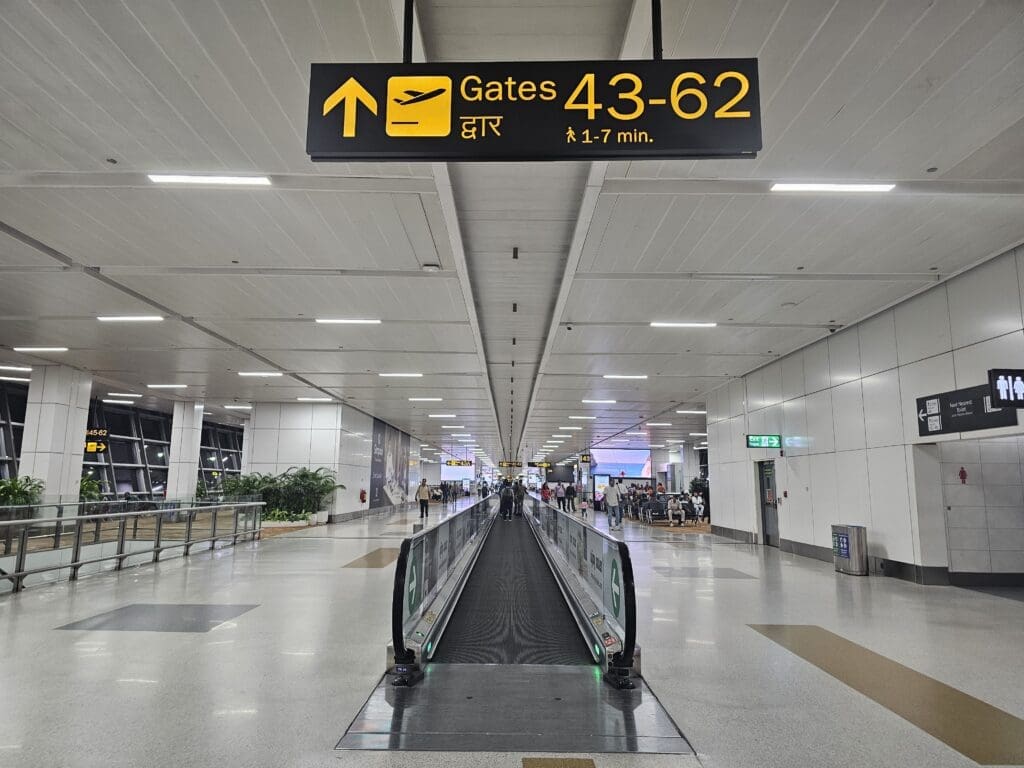
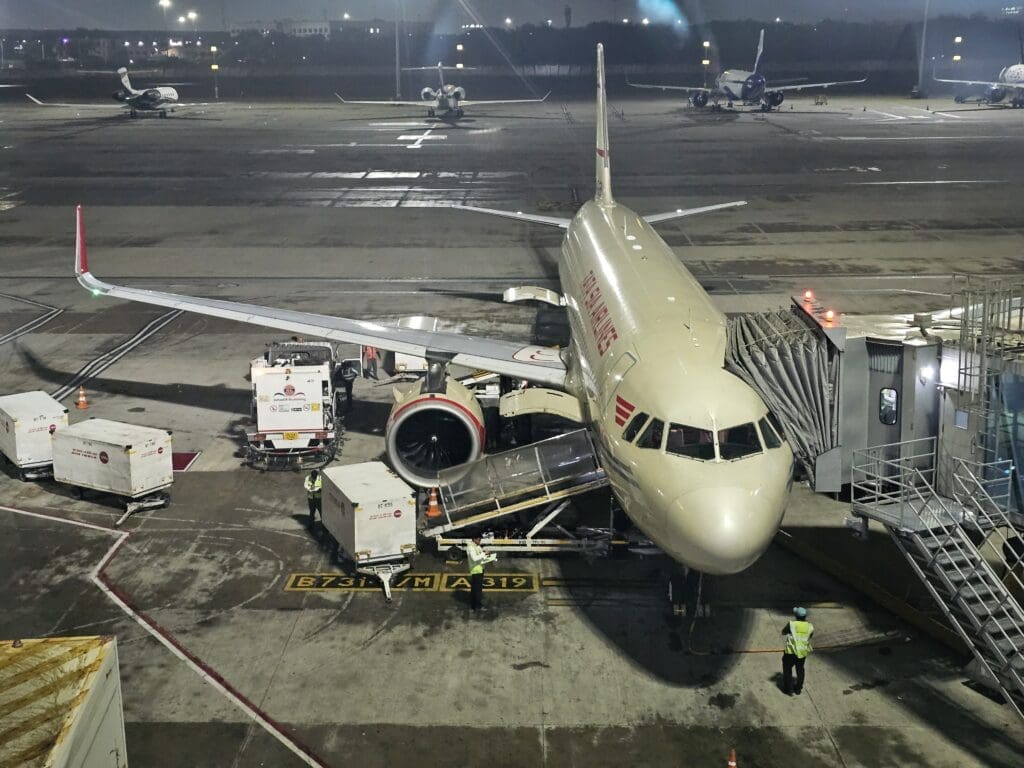
Once I had said my thanks and farewells to the friendly Air India crew that had looked after me on the ride up from Mumbai, I trekked up the jetbridge and commenced my transit in earnest. The domestic portion of Terminal 3 is laid out in a rather straightforward manner, consisting of a very long pier that hosts a seemingly endless number of both jetbridge and ground-level bus boarding gates. The length of this does mean that if your flight loses out at stand roulette, you may well be in for a long walk to reach the baggage collection hall. However, having pulled into Stand 39 that evening, this would not prove to be the case and nothing more than a fairly short saunter was in store to reach the foot of the pier. There, those bound for Delhi are filtered off from those connecting to flights bound for destinations across India. Whilst I had considered a stay in an airport hotel, unfortunately, Delhi seems to lack any reasonably priced on-site options, and not wanting to bother with the hassle of a shuttle bus or a taxi to a cheaper off-site hotel for nothing more than three hours of sleep, I made the frugal decision to camp out in the terminal. Although admittedly, being totally shattered by this stage of my long journey, this was something that I was trying my hardest not to regret!
Following the signs for domestic connections, I soon reached several automated gates, supervised by a somewhat bored-looking camouflage-clad Central Industrial Security Force agent. Perhaps looking for something to do, they took my boarding pass from me and scanned it on one of the gates, which, thankfully, despite my long connection, allowed me to pass through. From there, I walked several steps to the security checkpoint. Consisting of just a single scanner and a metal detector, given Delhi’s role as one of India’s most important transit hubs, I can only imagine that this gets rather busy during more sociable hours. Fortunately, at that time, I was the only passenger foolish enough to be passing through, and I was thus able to enjoy a hassle-free security experience, taking my time to remove and repack all my electronics from my bag before passing through the metal detector, after which, as is the norm in India, I was then swiped with a wand before being given the go-ahead to continue my journey.
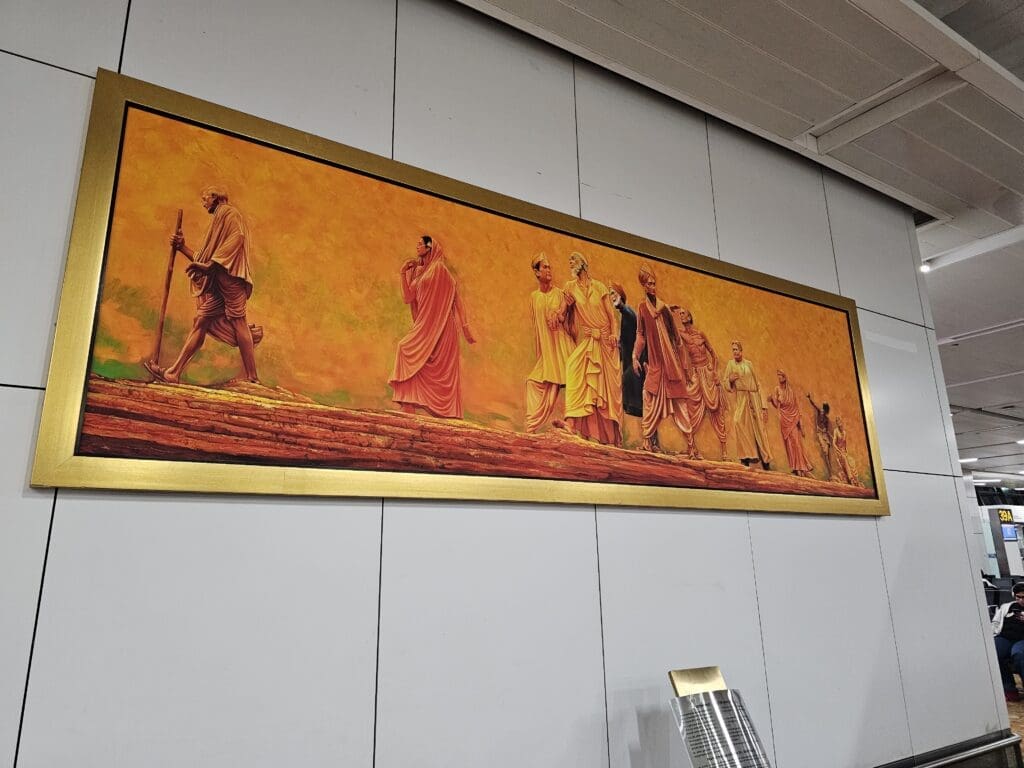
With the security check out of the way, I steamed onwards and arrived at the terminal’s central hub. Whilst this was not my first time departing from Terminal 3, it was my first time departing from the domestic portion of this, and so I was interested to find out how this experience compared to its conjoined international counterpart. Looking around, the domestic portion of the terminal appeared to be similar in its design and aesthetic to the international section, although I would say that the domestic side did feature fewer frills and was more basic in its aesthetic. As with the international portion, the vast majority of the terminal’s facilities are located in the central hub, and once through security, I found myself wandering past a row of rather expensive international outlets such as Birkenstock, Da Milano, Hugo Boss and Tommy Hilfiger, just to name a few. These came in addition to the usual smorgasbord of electronic stores, local produce and souvenir shops, and pharmacies that you would expect to find in any major Indian airport terminal. Despite the very late hour and the very small number of passengers milling around, virtually all of these shops remained open, with enthusiastic staff members standing at the entrances to these in an attempt to drum up custom. Above this space, a decent-sized food court could be found that was home to plenty of chain eateries from both India and beyond, including well-known names such as Domino’s, KFC, McDonald’s and Tim Hortons for those not fancying some overpriced local fare.
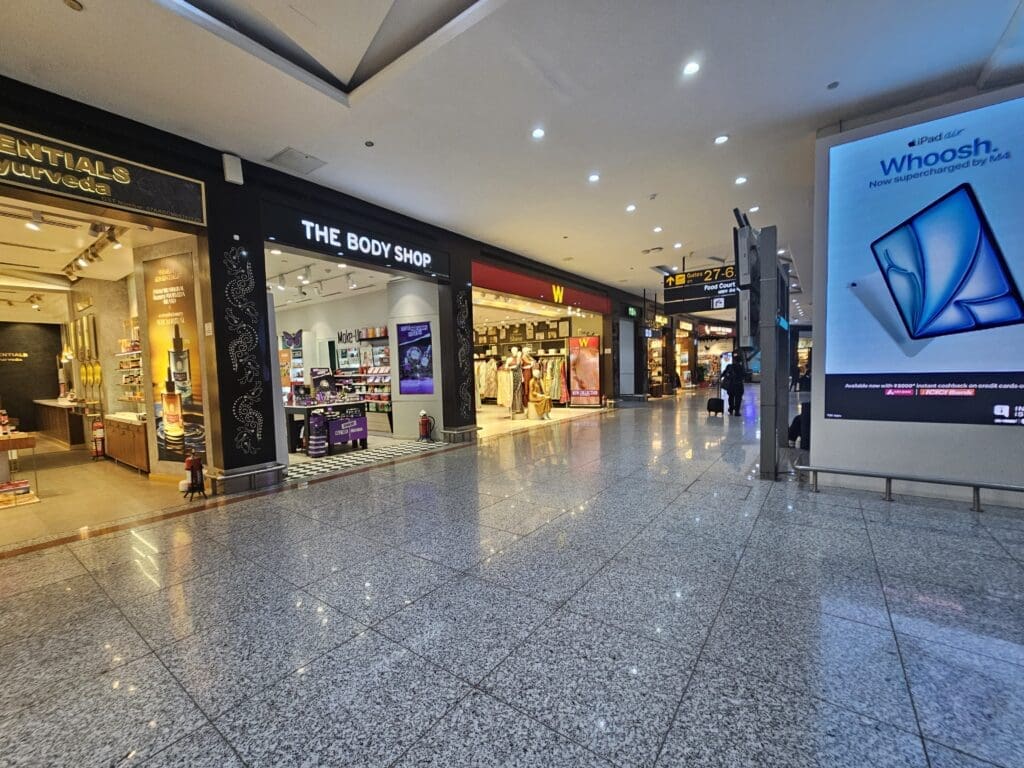
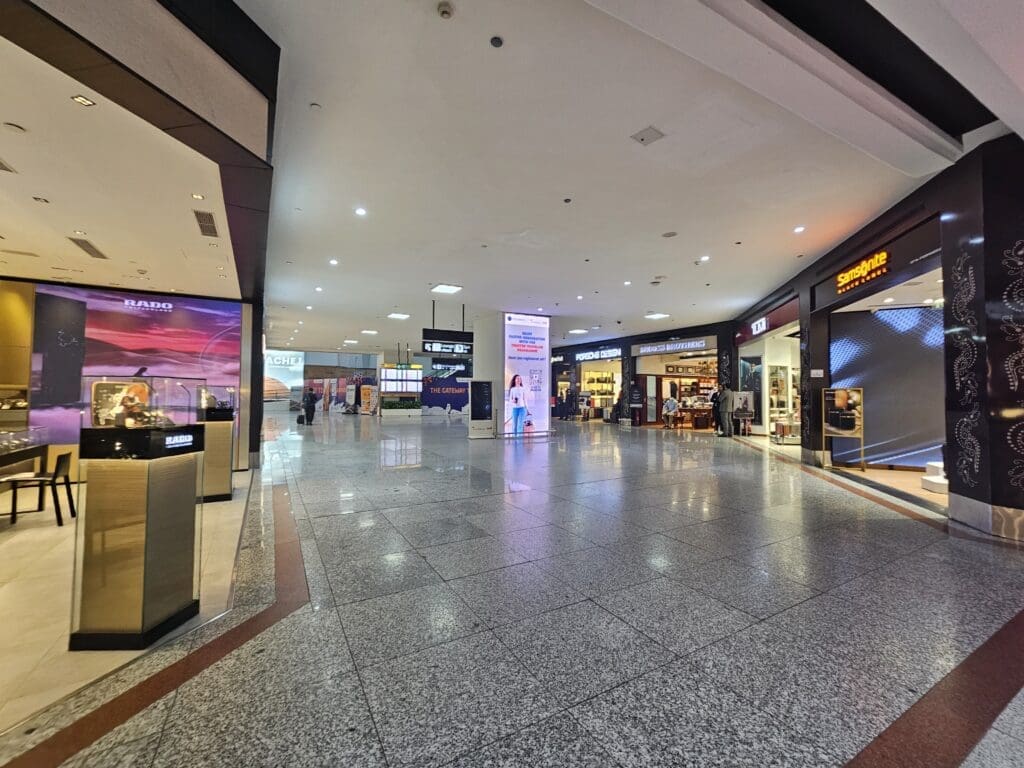
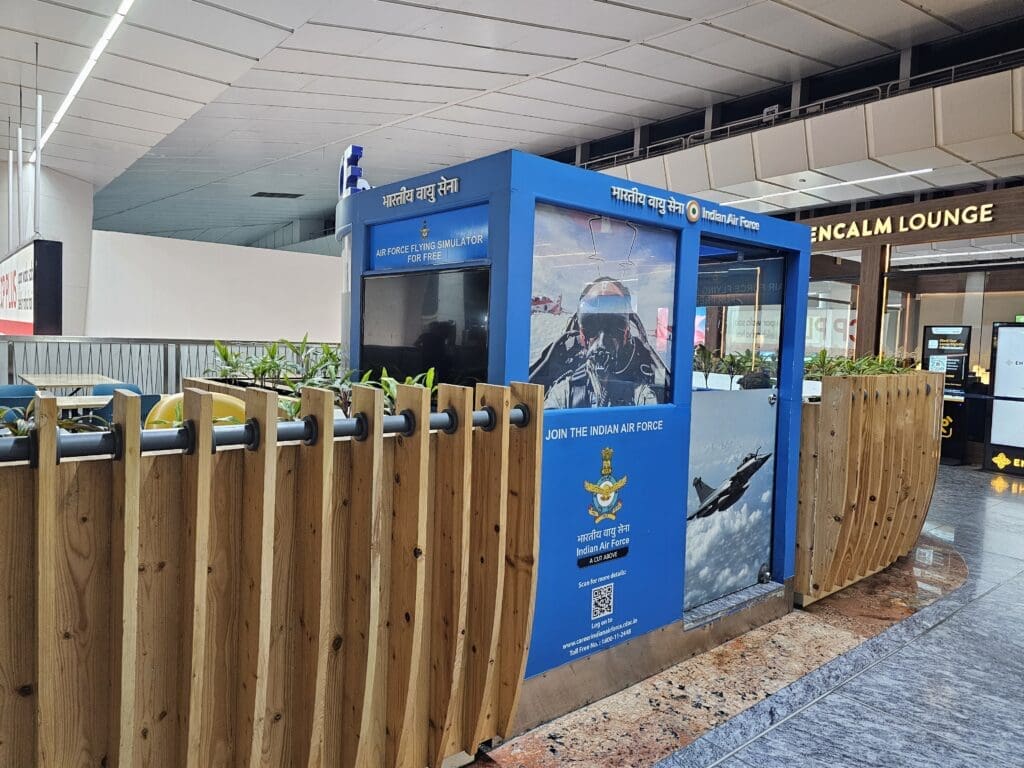
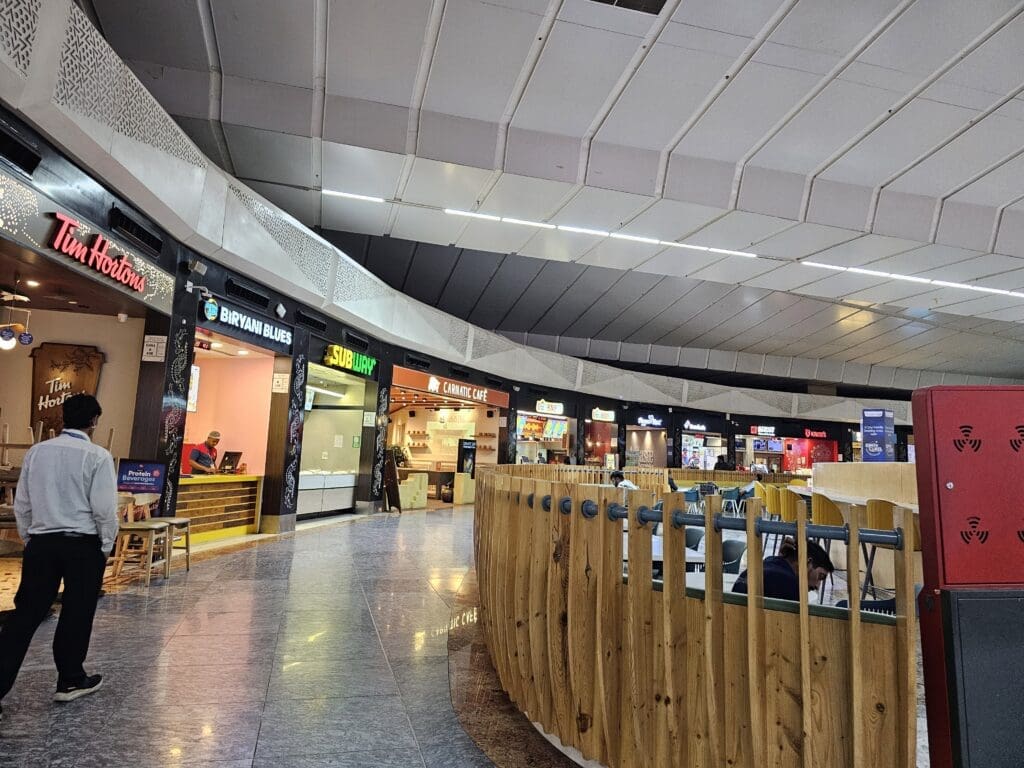
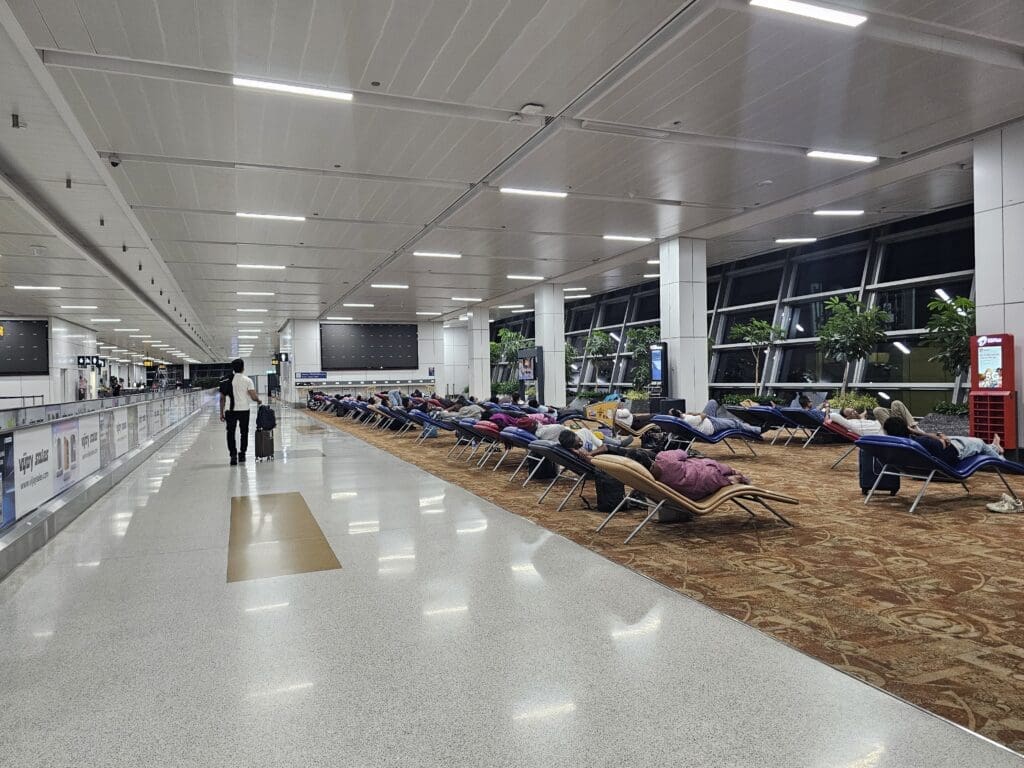
As I wandered around, I was pleased to find that, whilst the terminal was not the very best that I have ever passed through, it was decent enough and offered just about everything you would want and need from a domestic terminal. This was clean, modern and featured plenty of charging stations alongside ample space to sit and wait. Whilst not particularly relevant considering the darkness outside that accompanied most of my stay, the terminal boasts large floor-to-ceiling windows that offer superb views of the constant stream of movements outside from many of the terminal’s gates. However, I have to say that despite these positives, the terminal did not appear to be designed for any long overnight stays, and thus, quiet comfortable and dark areas suitable for a nap were non-existent, as were sleeping pods and the like. Furthermore, by the time I arrived in the terminal, all the comfortable recliner seating had already been taken, thus meaning I was in for a somewhat uncomfortable night spent upright in a firm airport chair.
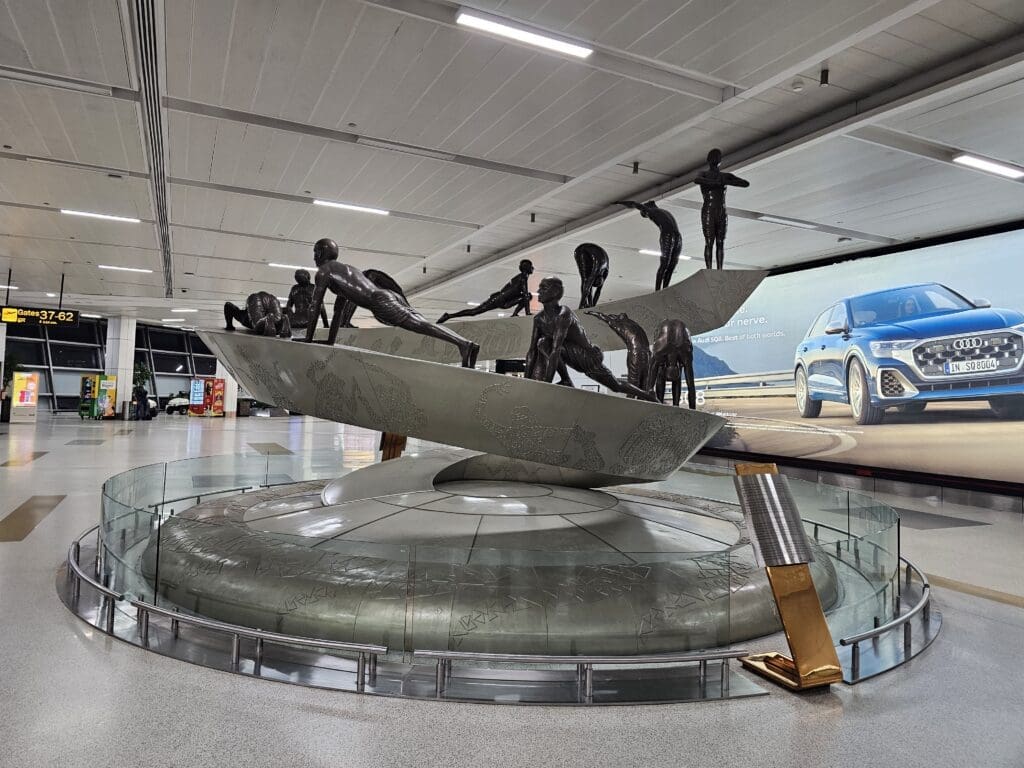
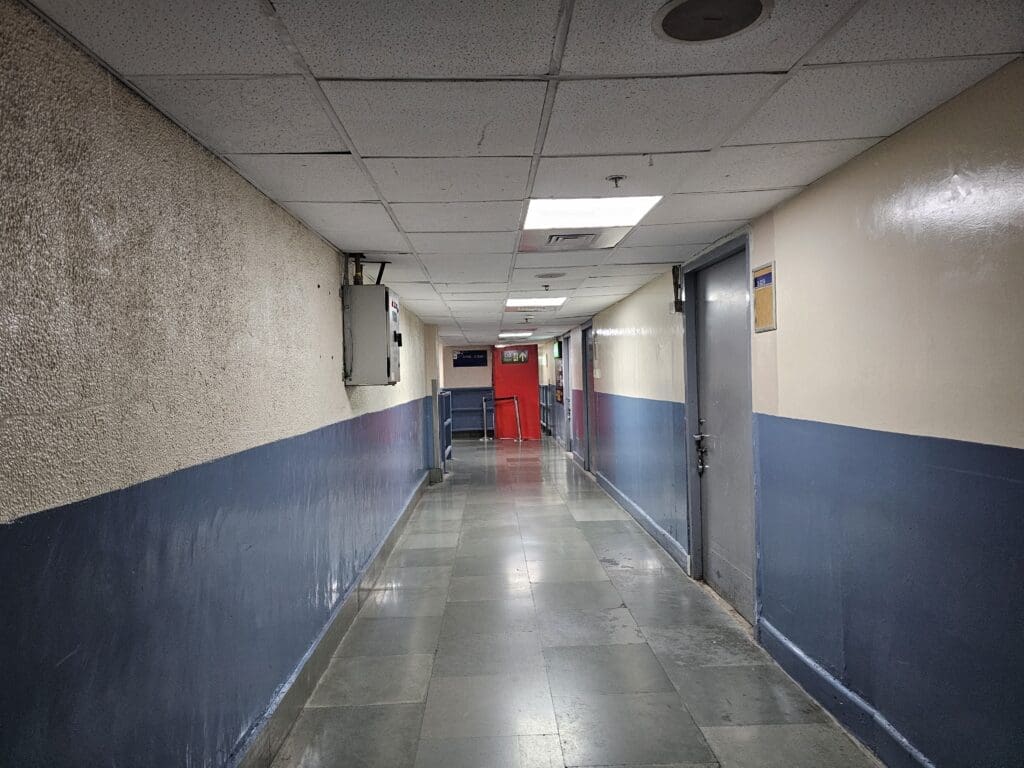
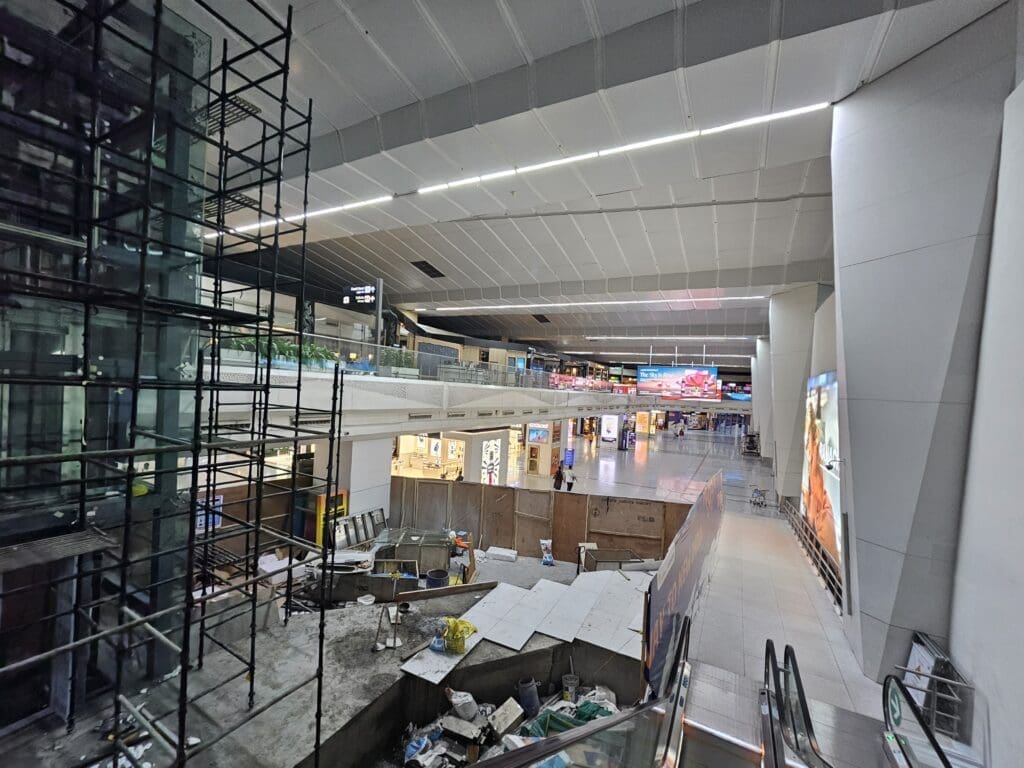
Additionally, with the terminal being in the midst of a programme of upgrade works, in parts, the terminal seemed to be akin to a building site. However, this was no major issue, and with work halting overnight, there was no loud noise heard from these areas. My other major complaint is that whilst vending machines were present throughout the terminal and offered a vast array of cheap drinks and snacks, these only accept Unified Payments Interface (UPI) as payment, and thus those without an account are dependent on buying their drinks and snacks from overpriced outlets. For example, had I been able to use the vending machines, a bottle of water would have cost me 9 rupees; however, this set me back an eyewatering total of 250 rupees when purchased from a nearby convenience store!
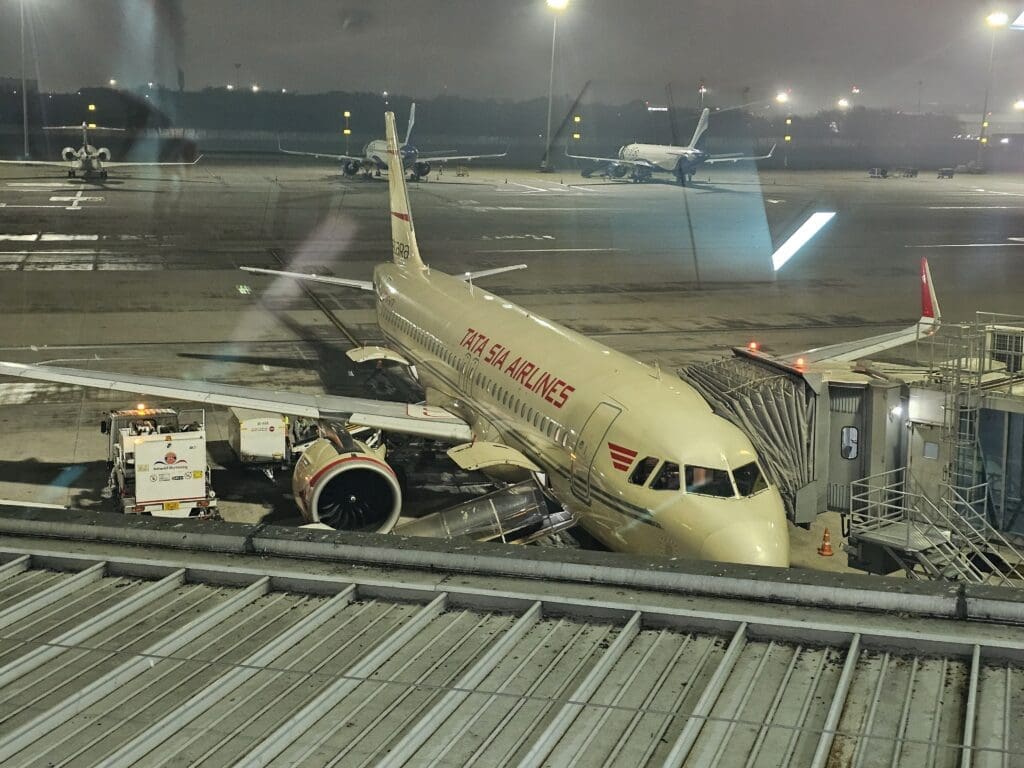
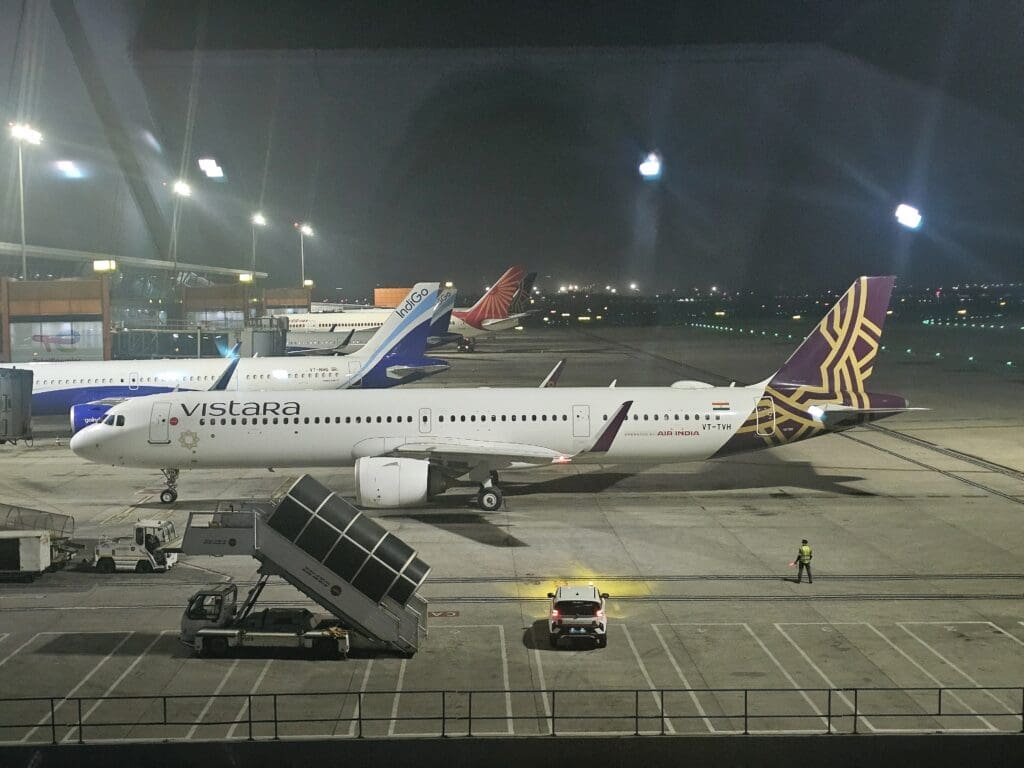
Spending my first hour exploring, once I had gotten the lay of the land, I plonked myself down near one of the windows and watched as the lights of aircraft coming and going whizzed past. The majority of these took the form of Air India and IndiGo Airbus A320neos arriving at the terminal’s stands after a long day of work, with this subtype having become impressively omnipresent within the Indian aviation scene over the past few years. Despite being shattered, the bright surroundings and the lack of comfortable seating meant that I managed to get no more than about thirty minutes of light sleep. With little else to do, I decided to go for another walk, and this time I stopped by at Tim Horton’s for a black coffee that would hopefully see me through the night and keep me awake until I arrived in Leh. Despite being a self-confessed airport enthusiast, admittedly, feeling rather fatigued, I reached a point where the hours began to drag, and I simply wanted to head off. As the hours passed, the terminal became markedly busier as passengers began to arrive for Air India and IndiGo’s morning bank of departures that approached on the horizon. However, despite becoming quite busy, I am pleased to report that the terminal never seemed to feel particularly crowded.
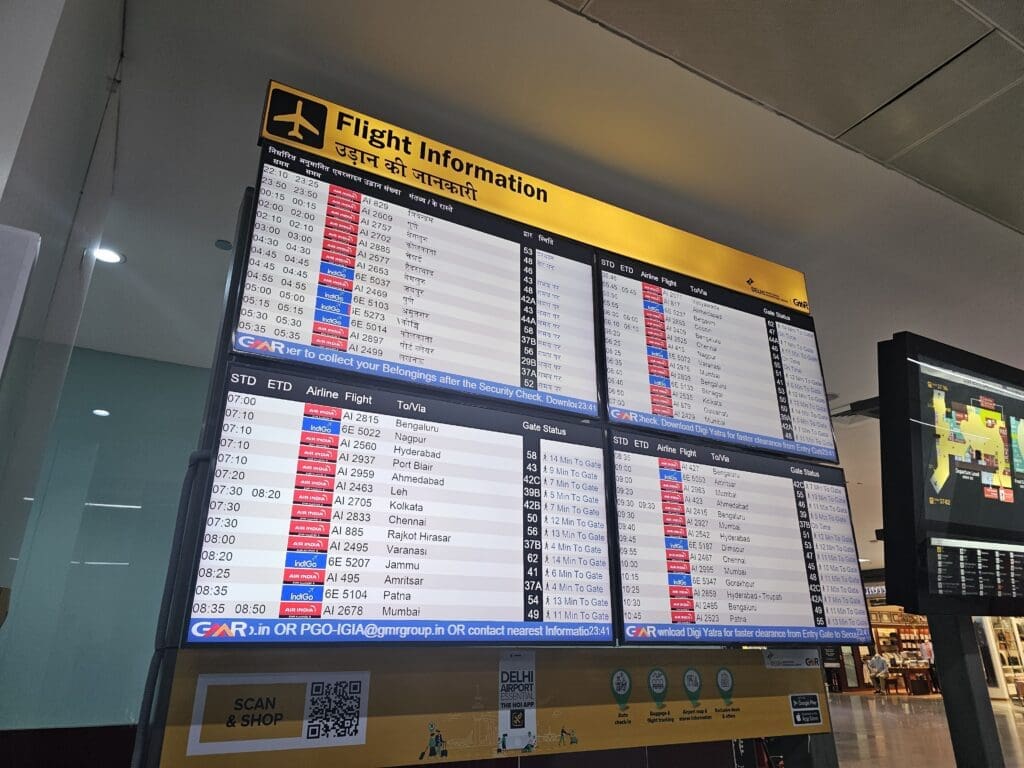
Given the size of Terminal 3, I would advise passengers to ensure that they are aware of their gate number so as to avoid any last-minute sprints. Carefully examining the departure boards, these revealed that my flight to Leh would depart from Gate 44B, and, as is the norm for all Air India flights, boarding was scheduled to commence an hour before departure. Interestingly, whilst my booking and boarding pass noted that the flight would depart at 0705, the departure boards advised that this would depart at 0720, although the flight had an ‘expected’ departure time of 0705! Playing things safe, I made my way over to the gate just before 0600, and as I neared this, I discovered that this was actually a bus boarding gate. Heading down two sets of escalators, I reached the bus boarding lounge, which was packed with passengers jetting off on various Air India and IndiGo services to destinations across India. By the time arrived there, a crowd of passengers could be seen surrounding the gate podium, and soon, the five-strong team of flight attendants that would be looking after us that morning arrived at the gate before being shuttled out to the aircraft.
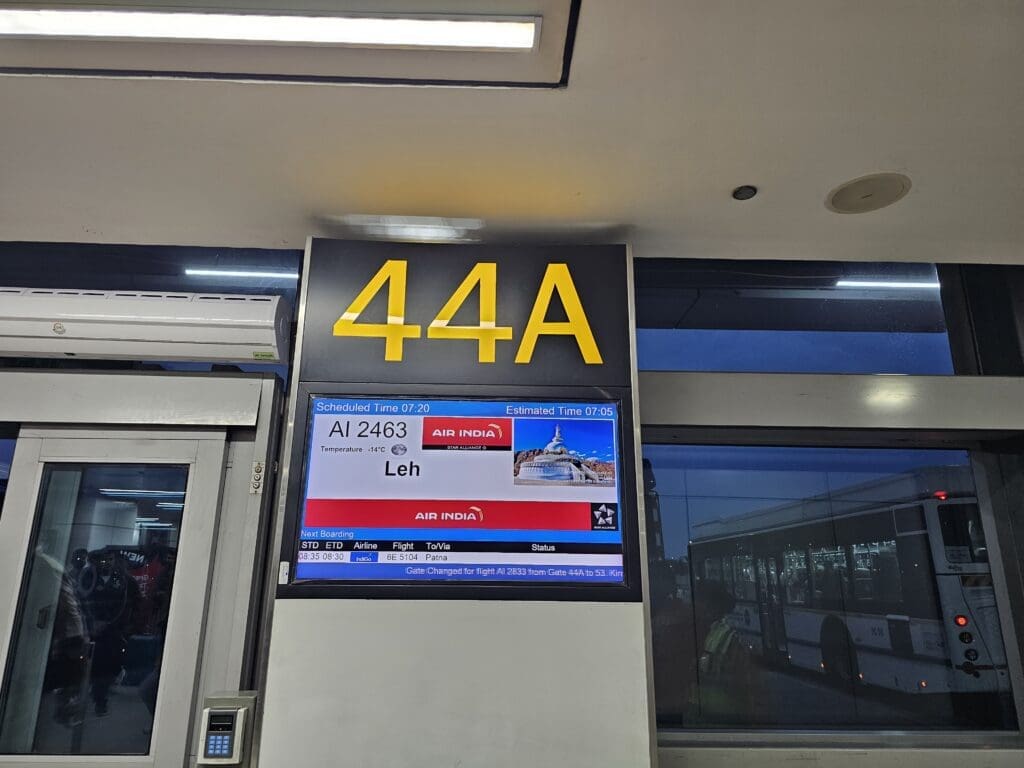
As I had suspected, boarding did not actually commence an hour before departure, but instead at 0630, an automated announcement rang out in English and Hindi inviting those in Business and elite members of Star Alliance frequent flyer programmes to head forward for boarding. However, seeing as we would be boarding by bus, and with no exclusive vehicle to take these passengers out to the aircraft without having to mingle with the masses, the Air India gate agent then made an announcement inviting all passengers to board, regardless of cabin class or boarding group. Joining the scrum of eager passengers, it wasn’t long before my boarding pass was scanned, at which point I darted outside through the humid Delhi air and made it to the waiting bus. Once this was comfortably full, the doors closed, and we commenced our trek to the aircraft.
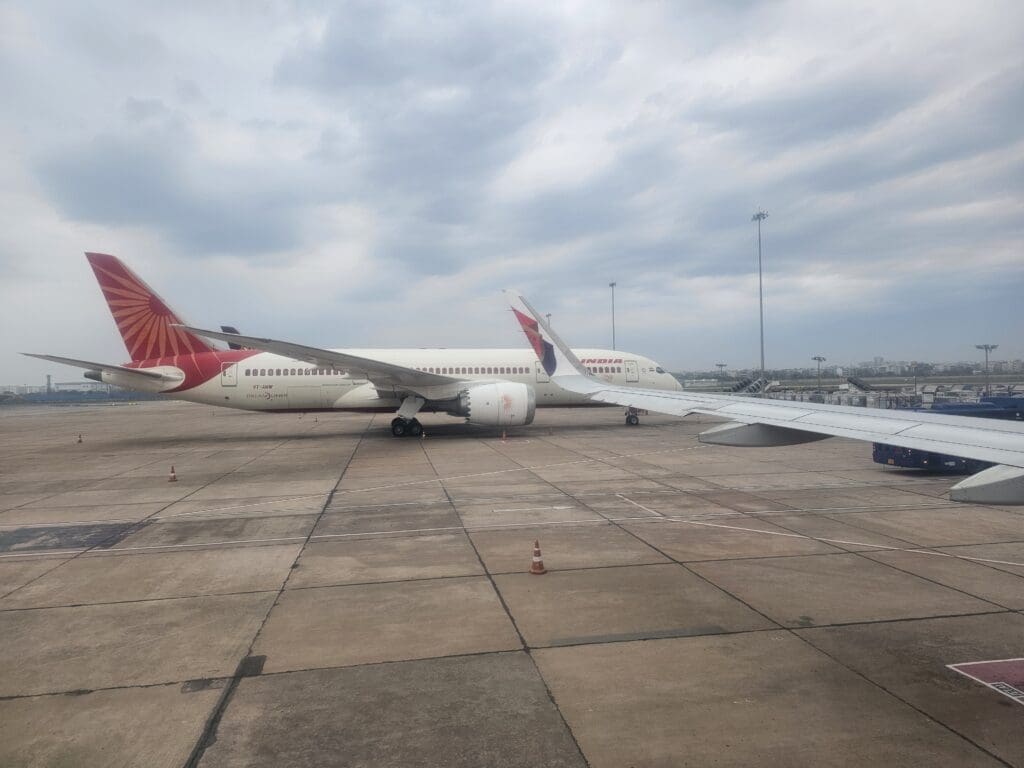
Whilst more ‘normal’ passengers may complain about having to ride a bus to their aircraft, enabling me to get the Terminal 3 ramp tour experience and have a gander at the interesting smorgasbord of aircraft there that morning, I most certainly could not complain. Skirting around the terminal, we passed a host of Air India’s largest jets, alongside several foreign visitors provided courtesy of Bhutan Airlines, Drukair, Finnair and Turkish Airlines. With the aircraft parked at a remote stand on the far side of Terminal 3’s apron, that morning, our bus journey took around five minutes and was accompanied by plenty of bumps and sways, some of which were significant enough to indicate that the road needed resurfacing! Soon, the bus darted across the apron, and we pulled up next to the Airbus that had been assigned to fly to Leh and Jammu that morning.
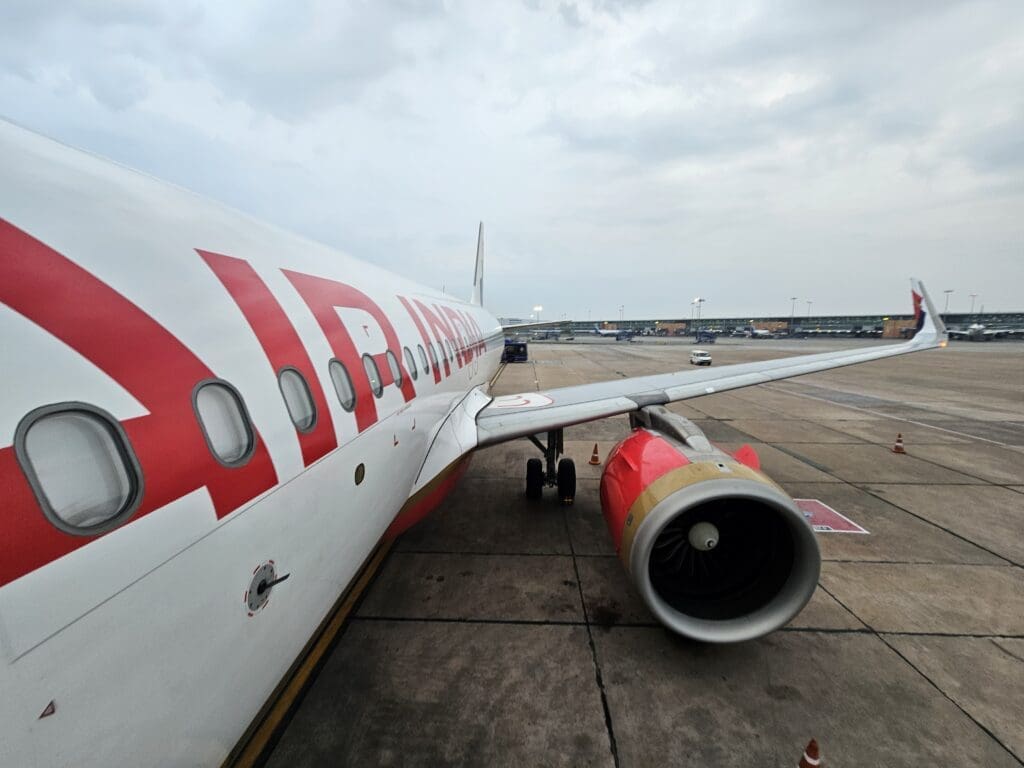
Seeing as my two other Air India Airbus A320neo rides of the trip had taken place on former Vistara aircraft, I was delighted to find that I would be travelling to Leh on board an ‘original’ Air India jet. This came in the form of A320-251N VT-EXT, which could be seen proudly standing in Air India’s smart new livery. Assembled at Airbus’ plant in Toulouse Blagnac, this particular aircraft first took to the skies with the test registration of F-WWIN in late March 2017, making the aircraft almost nine years old at the time of my flight and thus one of the oldest Airbus A320neos that I had flown to date. Destined for Air India, following three successful test flights, the aircraft was given its current registration and flown directly to Delhi, where it was soon pressed into service on a smorgasbord of short and medium-haul routes. Unfortunately, all has not been plain sailing for the aircraft, as during its short life, it has been involved in one notable incident, with this occurring in December 2024 when pilot error meant that the aircraft came near to taking off on a taxiway in Goa, accelerating to over one hundred knots before rejecting the takeoff. Today, this jet proudly sports Air India’s refreshed livery, having these colours in May 2025. This spends its days shuttling passengers across India, as well as to destinations further afield in the Middle East, South Asia, and Southeast Asia. In the week before my flight, this particular aircraft had primarily focused on domestic operations, connecting Delhi with Ahmedabad, Aurangabad, Bengaluru, Bhubaneswar, Cochin, Dehradun, Hyderabad, Jaipur, Leh, Lucknow, Mumbai, Nagpur and Raipur, however, in addition to this, the aircraft also operated a longer international rotation to Ho Chi Minh City.
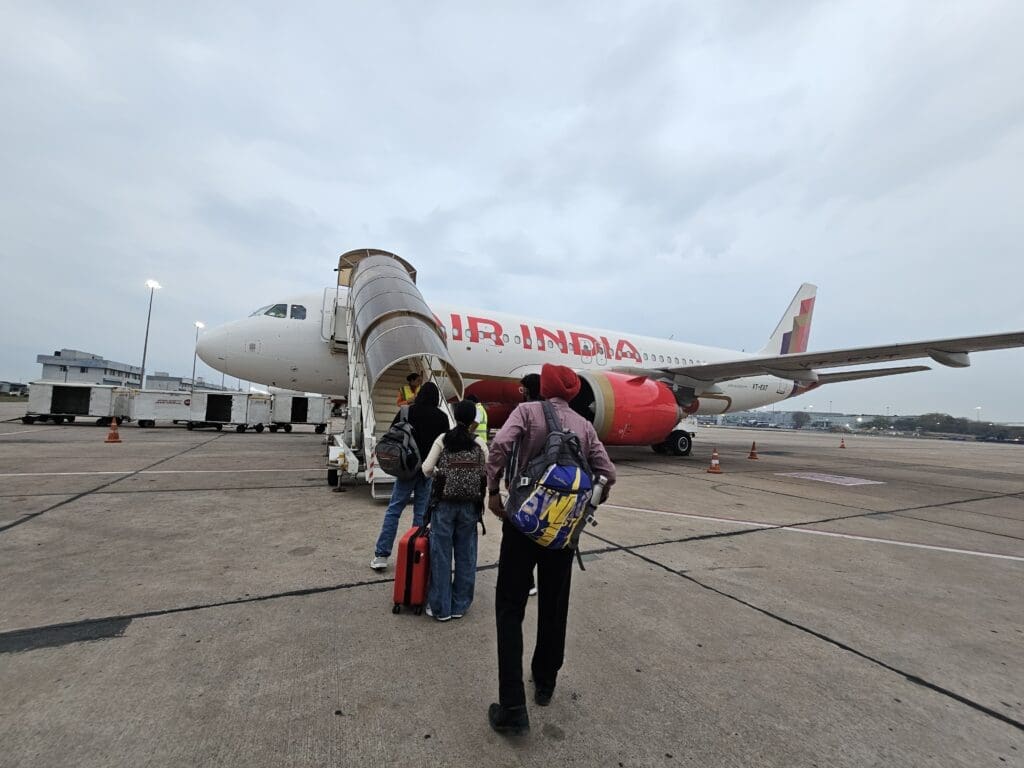
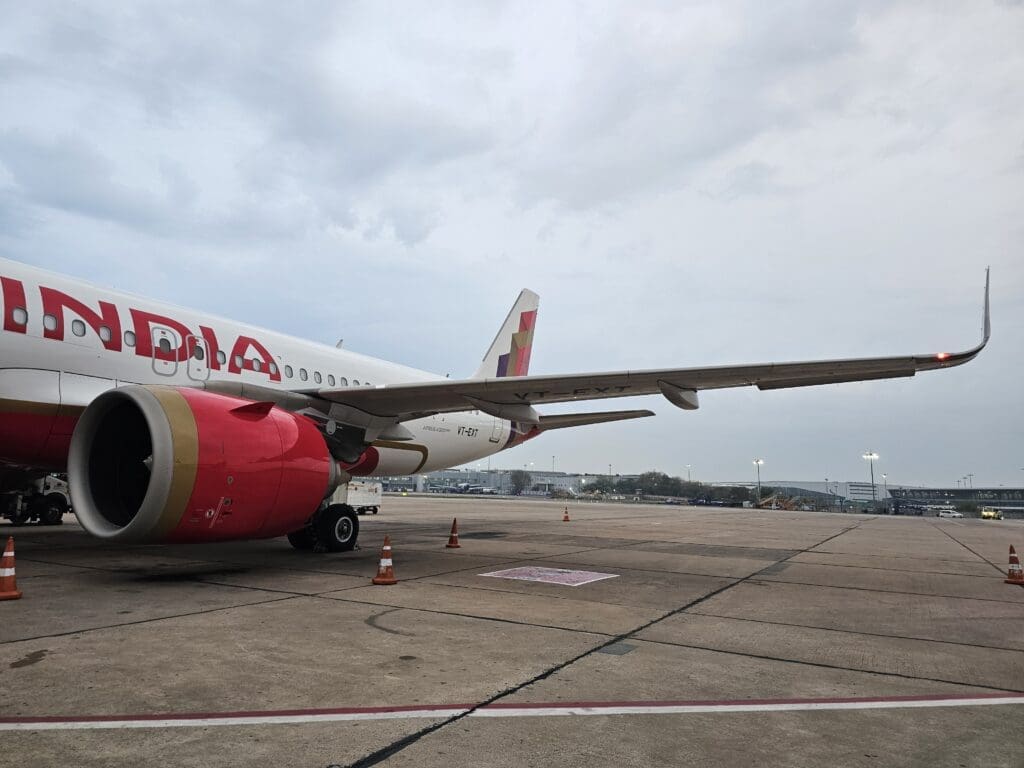
Once the bus doors slid open, I, like many passengers, snapped away at the waiting aircraft, something that the ground staff seemed to have no issue with. Soon, I made my way up the steps, and without waiting, I stepped into the forward galley where I received a warm and friendly ‘Namaste’ from the Cabin Supervisor and another flight attendant. Without the need for a boarding pass check, I turned right and immediately entered the Airbus’ small Business Class cabin.
At the time of my flight in March 2026, Air India’s 94-aircraft-strong Airbus A320neo fleet featured three different interiors. The majority of those aircraft that had previously flown for Vistara before being absorbed into Air India’s fleet still sport the mostly purple interior of their former master. Meanwhile, Air India’s newer deliveries and several retrofitted jets feature the refreshed Airbus A320neo cabin that was launched in July 2024, and some jets feature the airline’s old cabin with red and orange fabric-covered seats. Whilst Air India will one day standardise these, given the sheer number of Airbus A320neos in the airline’s fleet, this will not be a quick or easy task, and I imagine it will be several years until we see these aircraft all having an identical cabin. As I turned right, I was delighted to see that despite being one of Air India’s older Airbus A320neos, the aircraft had been retrofitted with the airline’s latest cabin, and I thus looked forward to sampling this new product on the ride up to Leh. Examining the Business cabin, this consisted of two rows of Collins Aerospace MiQ recliner seats in the standard 2-2 configuration. Being a far cry from the ‘Euro-Biz’ cabins that I am used to back home, these looked comfortably chunky, and I’m sure would have provided a relaxing ride up to Ladakh that morning. Each of these was covered in a dark blue fabric and was topped with a brown pleather-covered adjustable headrest.
Air India is one of the few airlines that features three different cabin classes on their Airbus A320neos, with the only other airline that I have come across that does this being China Southern Airlines. Thus, next up was Premium Economy, where four rows of Collins Aerospace Meridian seats could be seen. Despite the name of this cabin, it should be noted that these seats are not akin to your typical premium economy seat that you would find on a widebody jet. Instead, these are arranged in a 3-3 configuration and resemble your typical economy seat, albeit with slightly more legroom. However, unlike those in the economy, these come with an adjustable headrest and feature a red fabric cover. Whilst I imagine that few passengers complain about these on domestic routes, Premium Economy passengers on the longer routes that Air India’s Airbus A320neos serve, such as to the Middle East and Southeast Asia, may be left a little disappointed.
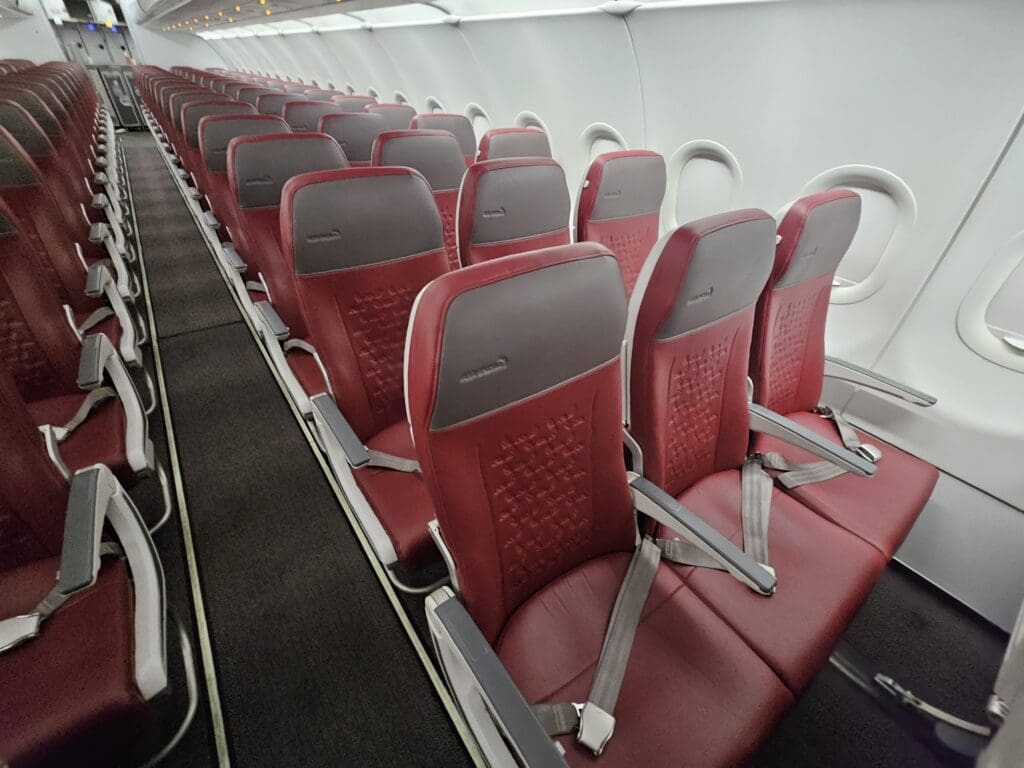
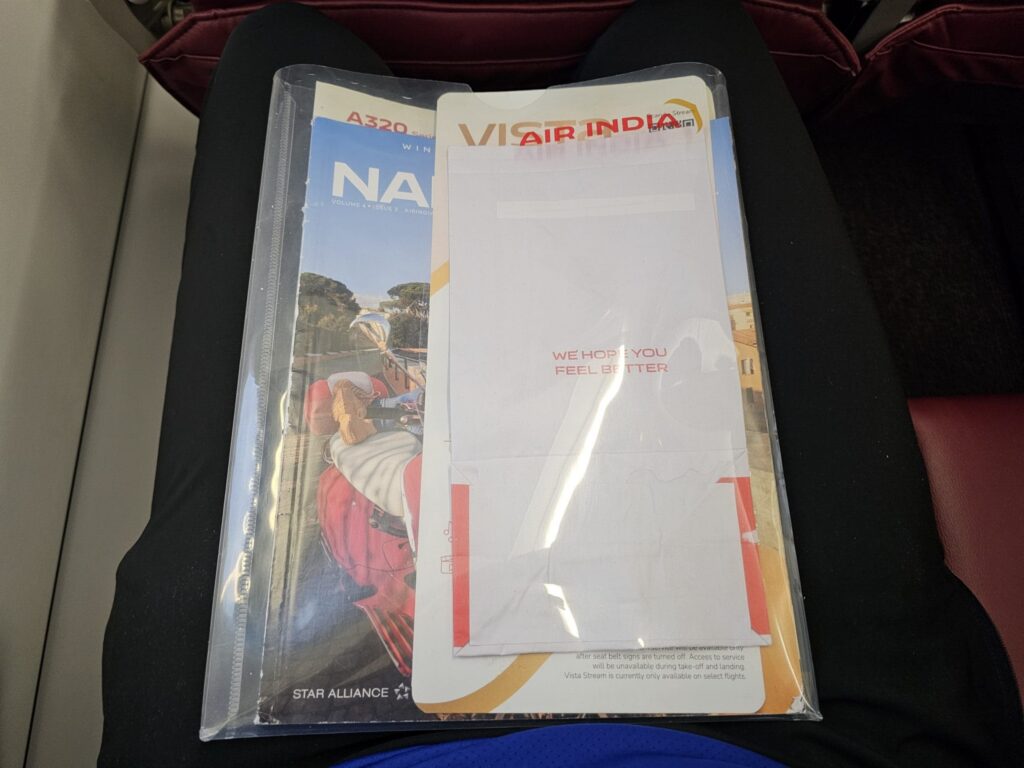
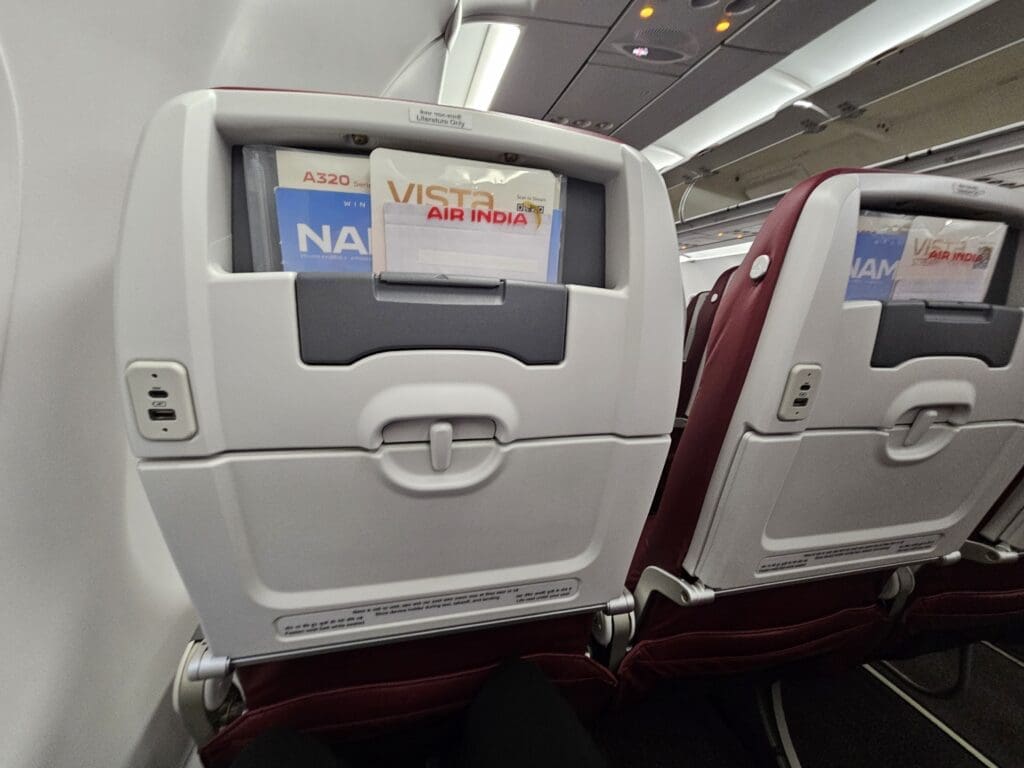
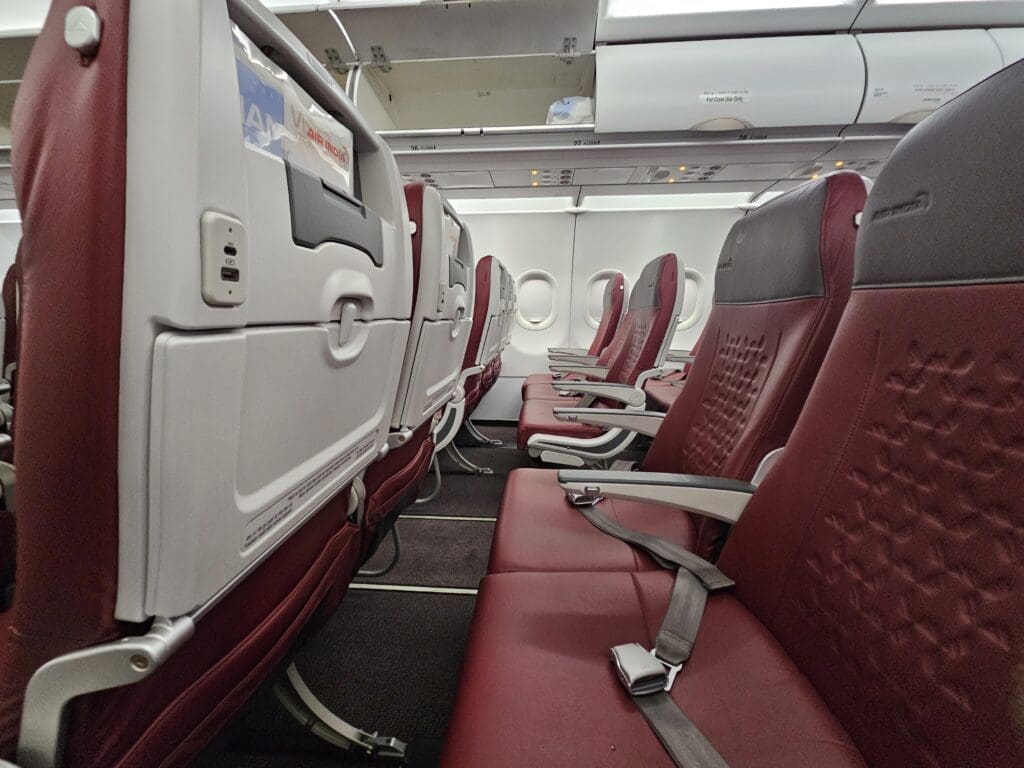
Soon, I entered the Economy cabin, where I was greeted by the sight of 132 Collins Aerospace Meridian seats. Each of these was covered by a pleather cover, most of which was red with a splash of gold, matching the colour palette of Air India’s new brand identity. Upon first glance, I have to say that despite appearing to be a little spartan, these seats appeared to be rather smart and modern in their appearance. Each of these came with a tray table, a coat hook, a seatback pocket, and a literature compartment which contained a plastic wallet in which the safety card, a sick bag, a promotional card advertising Air India’s Vista wifi-based streaming service, and the latest edition of the monthly Namaste.ai inflight magazine could be found. Meanwhile, at-seat power came in the form of USB-A and USB-C ports located in the seatback.
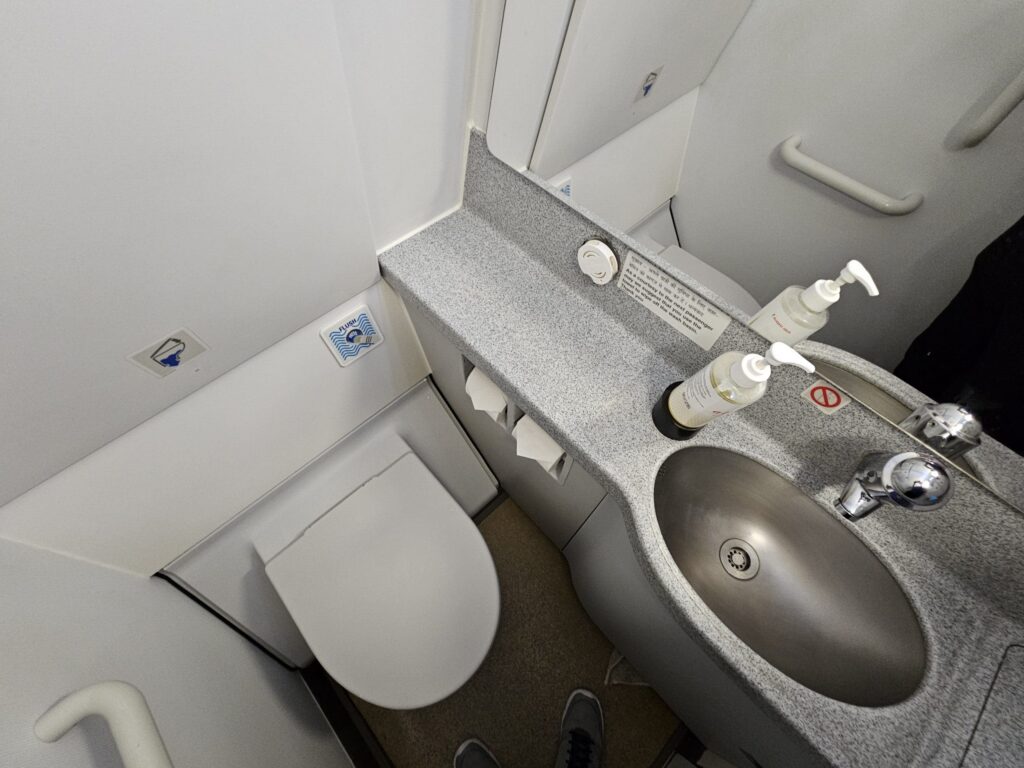
Speeding down the aircraft, I soon made it to Row 27 and stowed my bag in the overhead locker. On a side note, I was pleased to find that each crew member that I passed during this journey offered a warm and friendly ‘namaste’, and also assisted passengers in finding their seats. Meanwhile, as passengers stramed onto the aircraft, calming boarding music rang out through the cabin, which combined traditional Indian music with more modern beats, offering a nice and relaxing accompaniment to the boarding process. Before sliding into my seat, I decided to make a trip to one of the two lavatories at the rear of the cabin. Unlike on some Airbus A320neos, these are located at the rear of the passenger cabin, rather than squeezed into one corner of the rear galley, and were thus more spacious than on some other Airbus A320neos. Once inside, I was pleased to find the lavatory to be in a clean and tidy state, whilst this was stocked with the basics and devoid of any major signs of wear and tear, thereby leaving me with no complaints.
Returning to my seat, I slid into this and settled in for the comparatively short ride ahead. Starting with the positives, not only was the seat and area around this spotlessly clean, but I was delighted to fail to spot any notable signs of wear and tear around my seat. However, I did find the seat to be both somewhat firm, and the legroom was not particularly fantastic. However, seeing as I wouldn’t be sitting down for more than ninety minutes or so, this failed to provide me with any cause for complaint. That said, I may have been left a little uncomfortable had I been flying on a five-hour-plus flight to the likes of Jeddah or Kuala Lumpur at the far reaches of Air India’s Airbus A320neo route network.
A few minutes after taking my seat, all passengers from the first bus had boarded the aircraft, and it wasn’t long before the second bus appeared. At this point, the area around me began to fill up, and I found myself surrounded by a squad of soldiers. Given the strategic importance of Ladakh and its many military camps, unsurprisingly, it seemed that the vast majority of passengers took the form of young men heading off on deployment. Meanwhile, I would estimate the remaining quarter of the flight’s load to primarily consist of Indian tourists, bar a small group of elderly tourists, who were, like me, from Britain. Unsurprisingly, given the fact that many passengers were travelling with large military rucksacks, the crew seemed to have some difficulty in squeezing these into the overhead lockers; however, after playing Tetris with the bags, it appeared that they managed to find space for these, thereby alleviating the need for any bags to be checked into the hold at the last minute.
Following a short pause, the third and final bus appeared, and soon, boarding was complete. With the final passenger boarding just as the clock struck our scheduled departure time of 0705. At this point, a pre-recorded announcement in Hindi and English rang out through the cabin advising passengers that smoking, vaping, chewing tobacco, and consuming alcohol on board was strictly prohibited. With these warnings out of the way, the Cabin Supervisor performed a long welcome announcement in Hindi and English. This seemed to follow Air India’s usual format, starting with a word of thanks for flying with Air India, before moving on to the usual warnings, an introduction to the two pilots (both of whom were Captains, thereby reassuring me that we were in good hands), a mention of our 55-minute flight time, and informing passengers of the languages that the cabin crew spoke – namely English and Hindi. Once this announcement had come to an end, the calm and collected voice of the Captain filled the cabin as I was treated to my first flight deck announcement of the three Air India flights that I had taken thus far on the trip. During this, they thanked passengers for flying with Air India, apologised for the slight delay to our departure, which they noted was due to the fact that the aircraft was parked at a remote stand, and, reminding us all that this was no ordinary domestic hop, the Captain promised to make a speech later on, pointing out some of the Ladakhi mountains as we neared Leh.
As soon as the Captain had concluded their announcement, the cabin crew took to the aisles and performed the safety demonstration, which was undertaken to the soundtrack of a pre-recorded announcement. Whilst this was underway, seventeen minutes behind schedule at 0722, the aircraft jolted rearwards as our pushback from Stand 272 commenced just as Delhi was soaked in a morning rainshower. During this journey, the Airbus’ two large and powerful CFMI LEAP-1A26 engines quietly spooled into life, accompanied by a series of modern hums, whines and whirs, and once these had successfully powered up, the flaps were partially extended in preparation for our departure. That day, the aircraft was to depart from Runway 28, which conveniently was the closest runway to our parking position. This taxi took us past several Air India and IndiGo Airbus jets parked up at remote stands, alongside a single Alliance Air ATR 72. Beyond these, I was treated to a good view of aircraft as they rocketed away from Runway 28, amongst the stream of IndiGo and Air India Express jets, however, the highlights were undoubtedly an Indian Air Force Hercules, as well as a veteran Hindustan 748-2M.
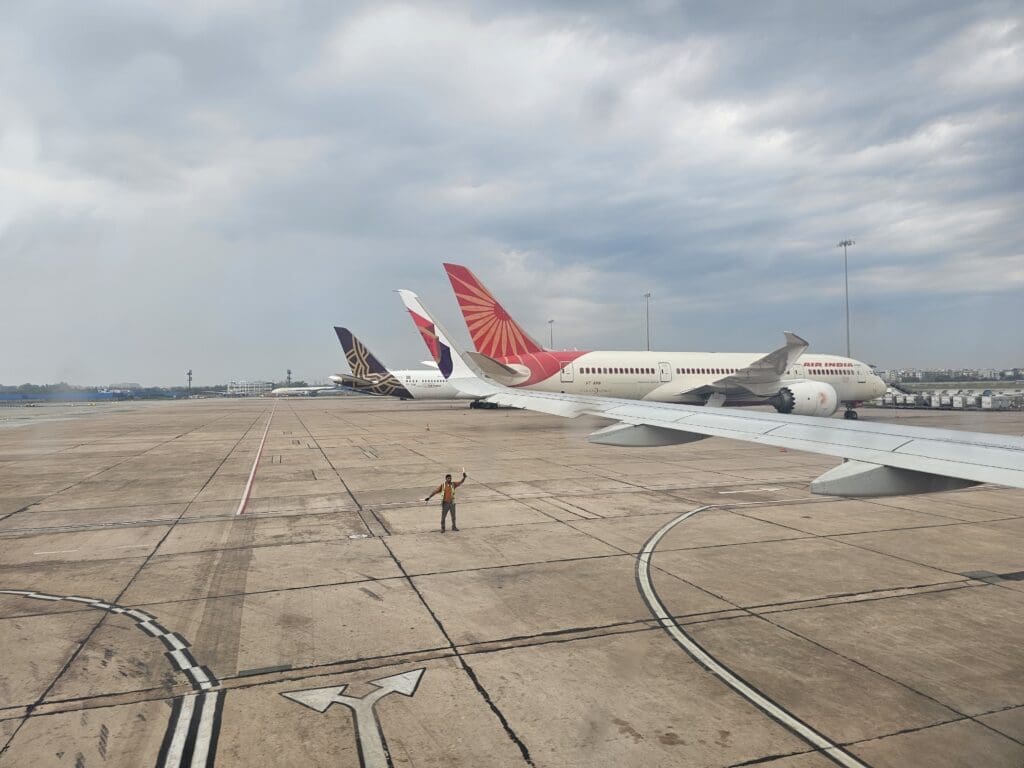
Whilst we did not have far to travel to reach the runway, the journey to this was reasonably slow, seeing as we would be departing during the morning rush. After several minutes of holding to allow for an Air India Airbus A320neo and an IndiGo Airbus A321neo to head off to Thoise and Silguri, respectively, the strobe lights were turned on, and the cabin crew was instructed to take their seats as we made our way onto the runway. As we turned onto this, I was offered a glimpse of what was for me, four rare sights – a trio of Ilyushin Il-76s and a lone Antonov An-32, all operated by the Indian Air Force. Following a short pause, the engines spooled up with a whine as the Airbus commenced a fairly long and gentle takeoff roll.
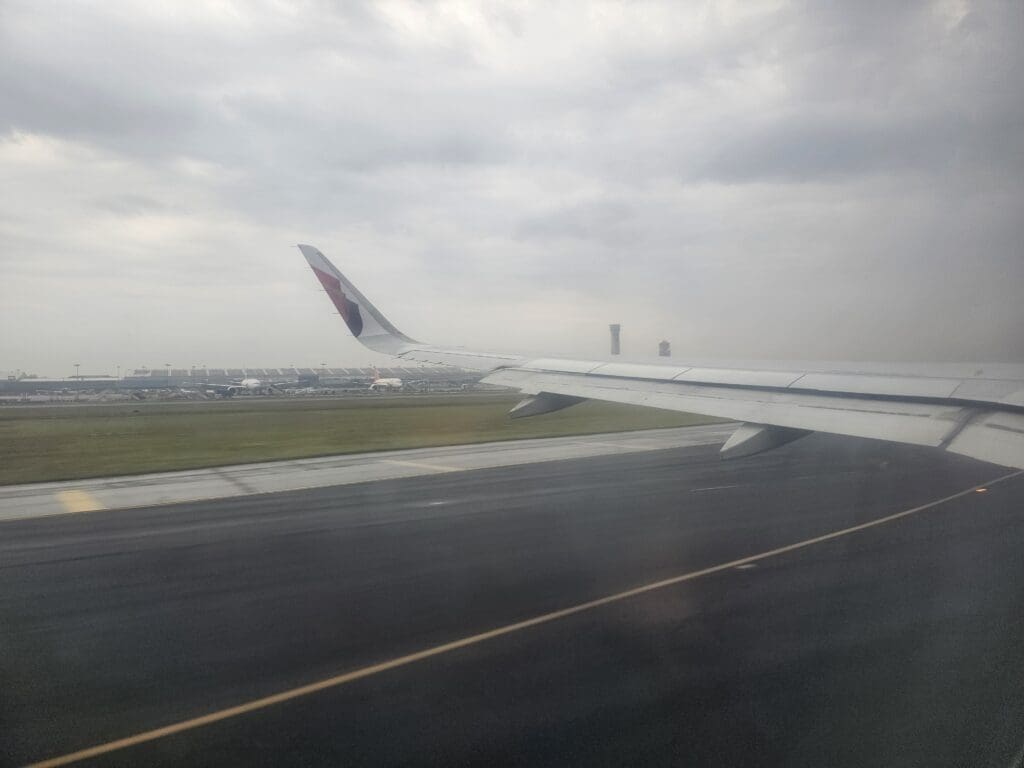
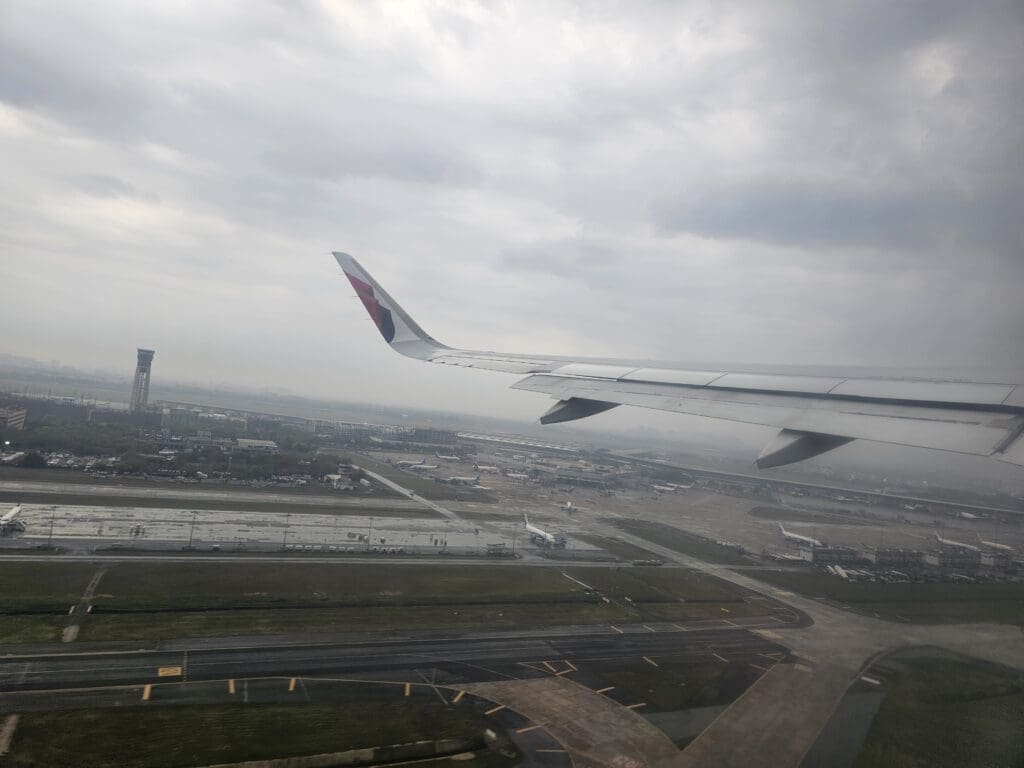
Eventually, the Airbus’ nose was pointed skywards, and we smoothly rotated upwards into the cloudy skies of Delhi. For the first few seconds of the flight, those on the left-hand side of the aircraft were treated to vistas of the vast expanse of Terminal 3 and the many aircraft waiting there, ready to jet off to destinations both near and far. Once the landing gear had been retracted with a clunk, the Airbus crossed the perimeter fence and climbed over the mostly residential neighbourhoods of Dwarka, Kakrola and Najafgarh. However, unfortunately, due to the lingering clouds, very little of these neighbourhoods could be seen before we turned onto a northerly heading and made our way up into the clouds for good. As we sliced through the clouds, the Airbus was thrown around a fair amount, which meant that both passengers and crew were kept in their seats for the first fifteen minutes of the flight. Meanwhile, at this time, the Cabin Supervisor performed another announcement reiterating those items and behaviours that were prohibited onboard, and reminded passengers to stay in their seats until the seatbelt signs had been extinguished.
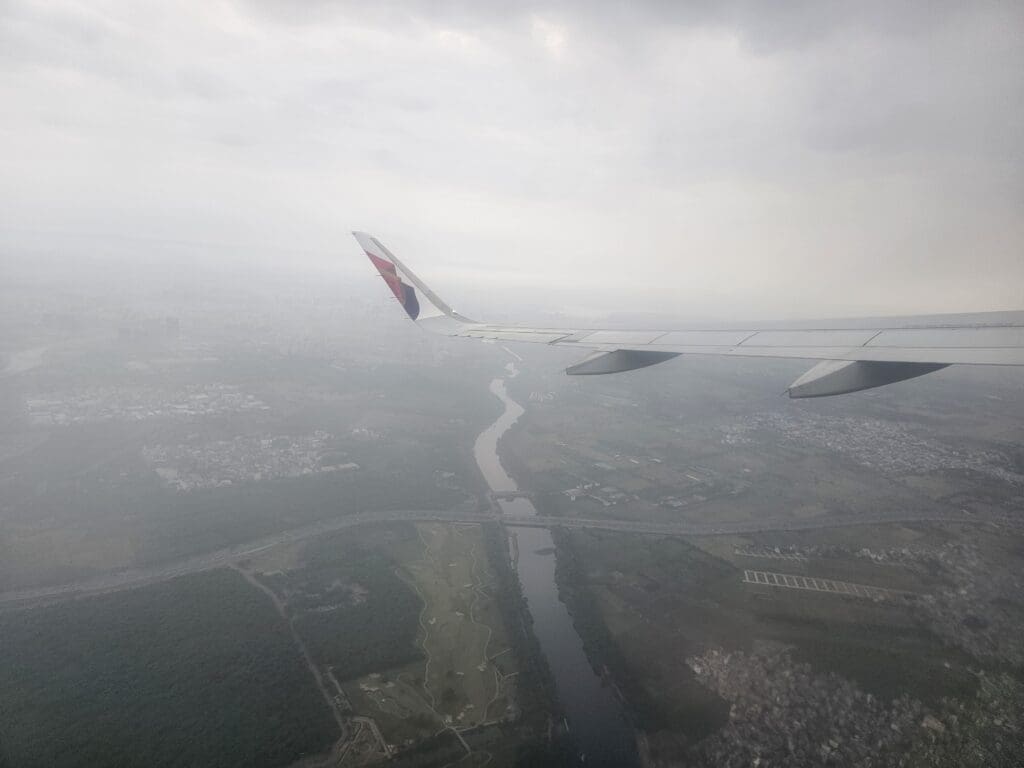
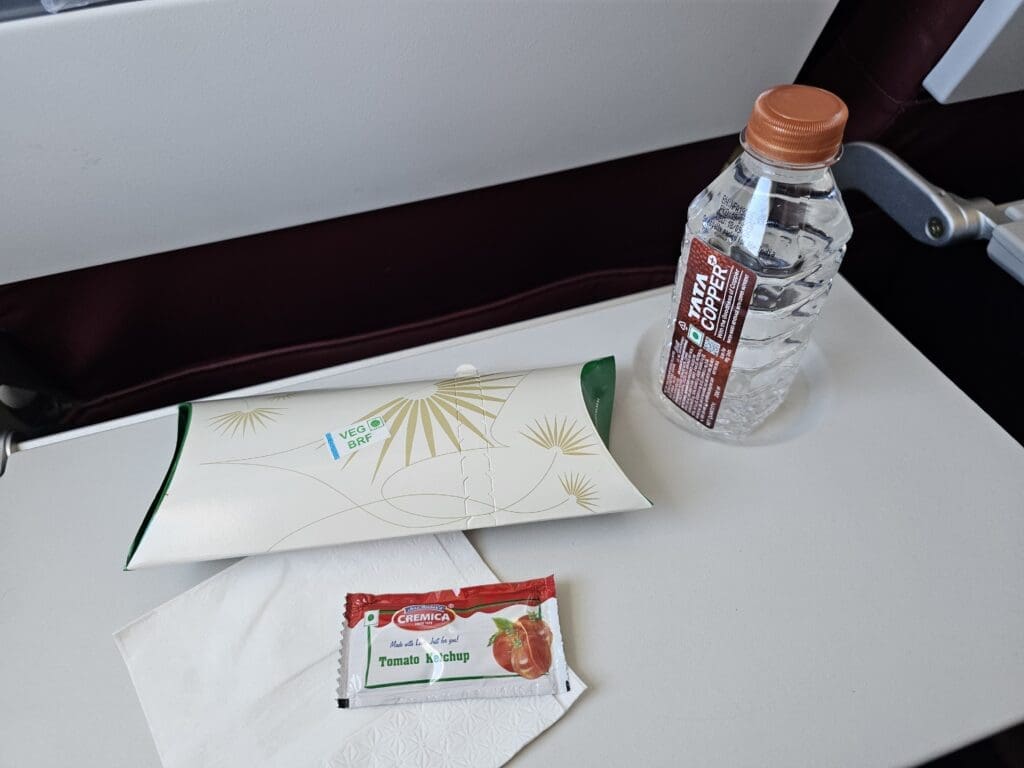
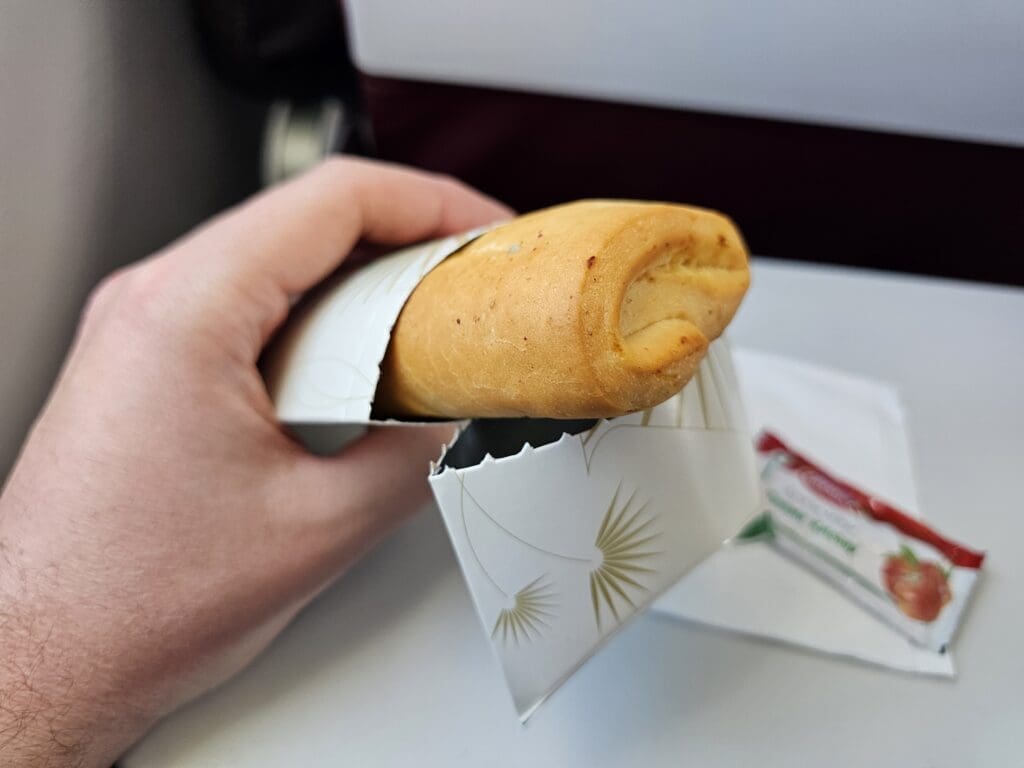
From Delhi, the aircraft passed over Rohtak, Panipat and Saharanpur, and eventually the crew were released from their seats. Despite the short flight time to Leh, all passengers would be treated to a complimentary hot snack. With the time to deliver this service already having been partially eroded thanks to the initial turbulence, once free from their seats, the flight attendants rolled out two service carts and wasted no time in handing these out. After a few minutes, a friendly flight attendant handed me a nicely designed cardboard box, in which a warm pastry with a vegetable filling could be found. This was accompanied by a small packet of ketchup, a 200ml bottle of Tata Copper water and a serviette. Getting stuck into this, whilst not quite the pinnacle of inflight cuisine, this left me with no complaints and was appreciated, far exceeding anything that you can receive on a similarly short flight back home in Europe!
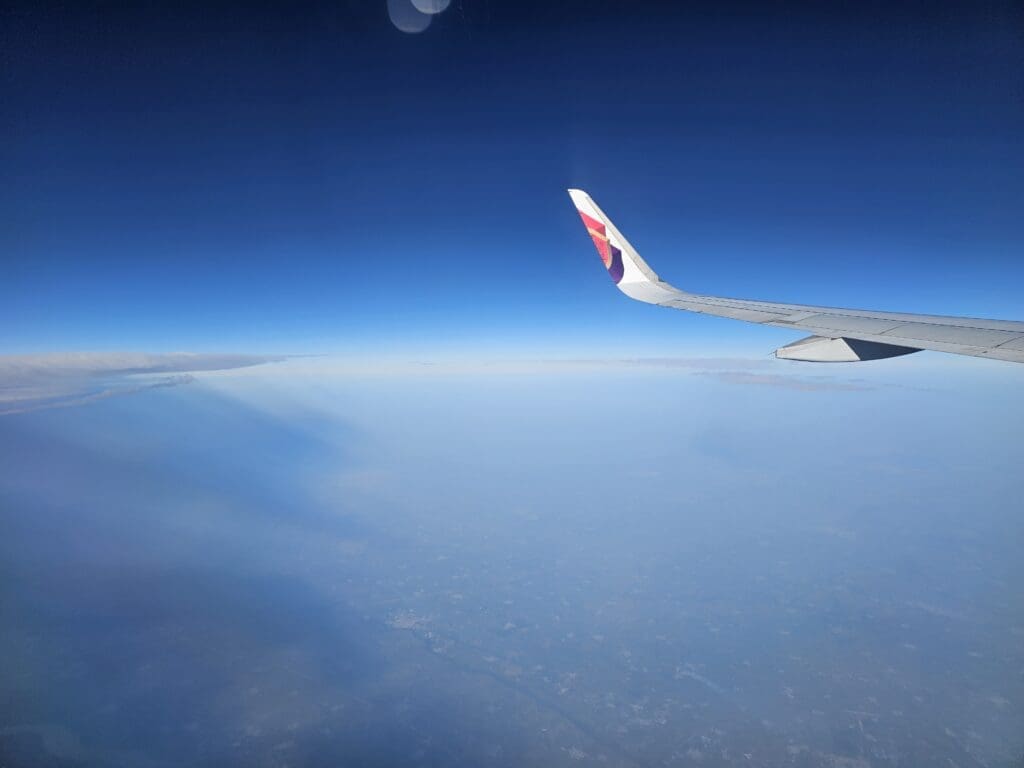
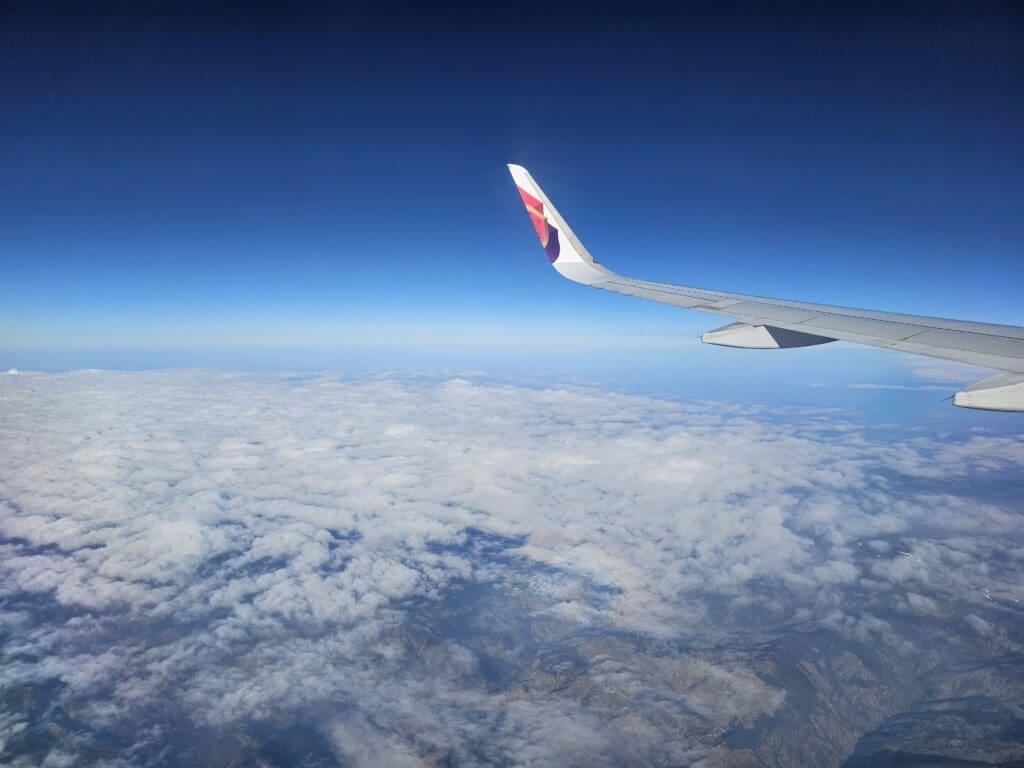
Soon, the Airbus reached the city of Chandigarh, where we levelled off at 33,000 feet, and after passing this, the clouds temporarily parted. This revealed the green hills which rose in height as we trundled northwards, as well as the famous hill station of Shimla. Soon, the terrain rose up and transformed into the snowy mountains of Himachal Pradesh, passing to the east of Kullu and Manali. However, by this time, clouds had rolled in and blocked any decent views of these.
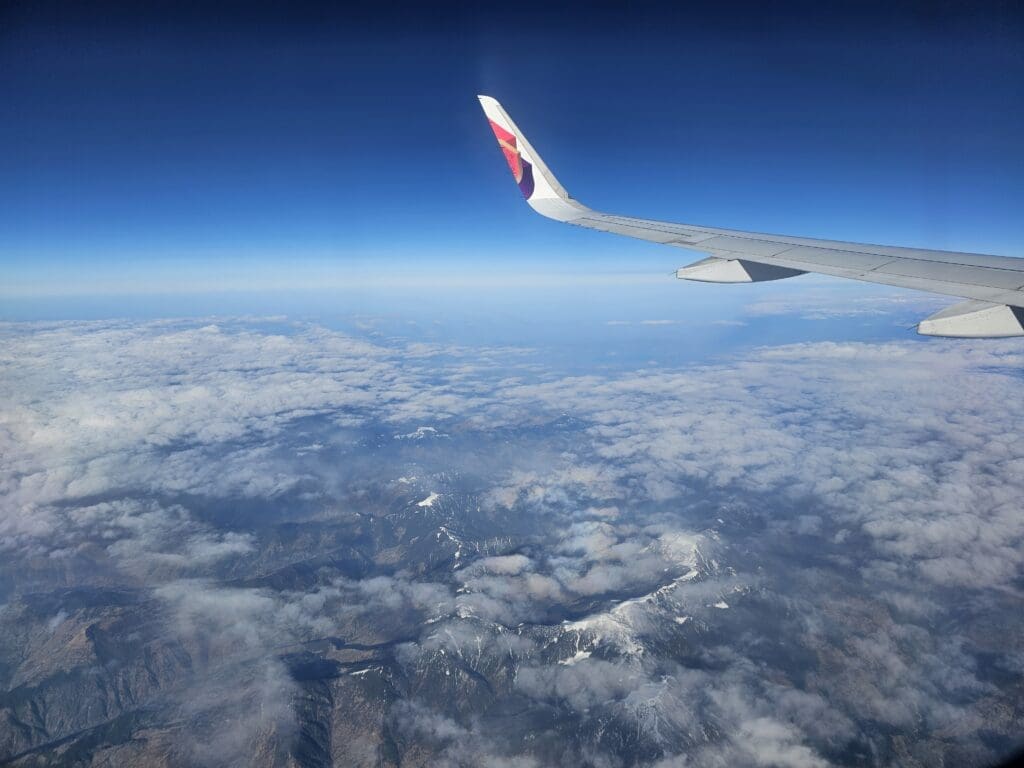
Those who were not particularly bothered by the spectacular scenery outside could turn to Vista, Air India’s wifi-based inflight entertainment streaming platform – a feature of the airline’s Airbus A320neos. Whilst I did not connect to the system on this short hop, I did sample this on my flight from Bengaluru to Mumbai and found it to work well and be loaded with a decent array of films, television programmes and music. Meanwhile, turning to Air India’s monthly inflight magazine, Namaste.ai, this featured a smorgasbord of articles on a wide array of subjects; however, as with many inflight magazines, there was a specific focus on articles promoting Air India’s destinations.
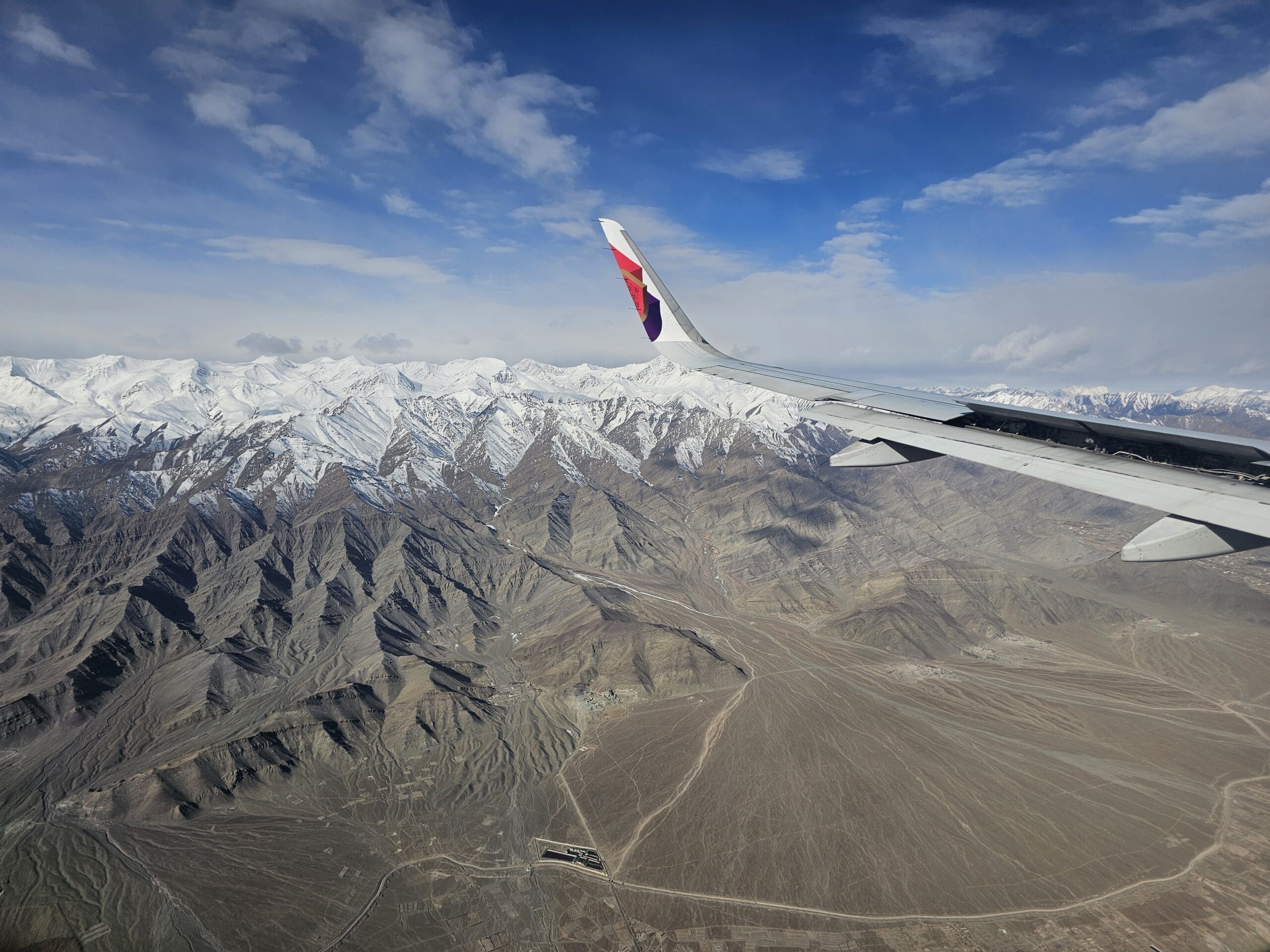
As we crossed from Himachal Pradesh to Ladakh, the clouds parted, and my eyes became fixated on the spectacular mountainous landscapes below. There, tall snowcapped peaks could be seen, separated by deep and dusty valleys, where the odd remote village could be spotted. After passing the 20,960-foot-tall peak of Spangnak Ri, the Airbus could be felt commencing its descent. At this point, keeping their promise, the Captain performed an announcement updating passengers on the flight’s progress before pointing out some of the nearby peaks and mentioning that we were flying right over the frozen waters of Tso Kar Lake. They then ended this by thanking passengers for flying with Air India and noting that we would likely be on the ground in twenty minutes’ time. This was then immediately followed by a pre-recorded announcement in Hindi and English giving the usual pre-arrival instructions regarding seatbelts, seatbacks, tray tables and windowshades, with another similar announcement then made by the Cabin Supervisor. Following this announcement, the crew took to the aisles where they seemed to have their work cut out to ensure that all was secure and in place for our arrival, with many passengers having reclined their seats and now deep in slumber.
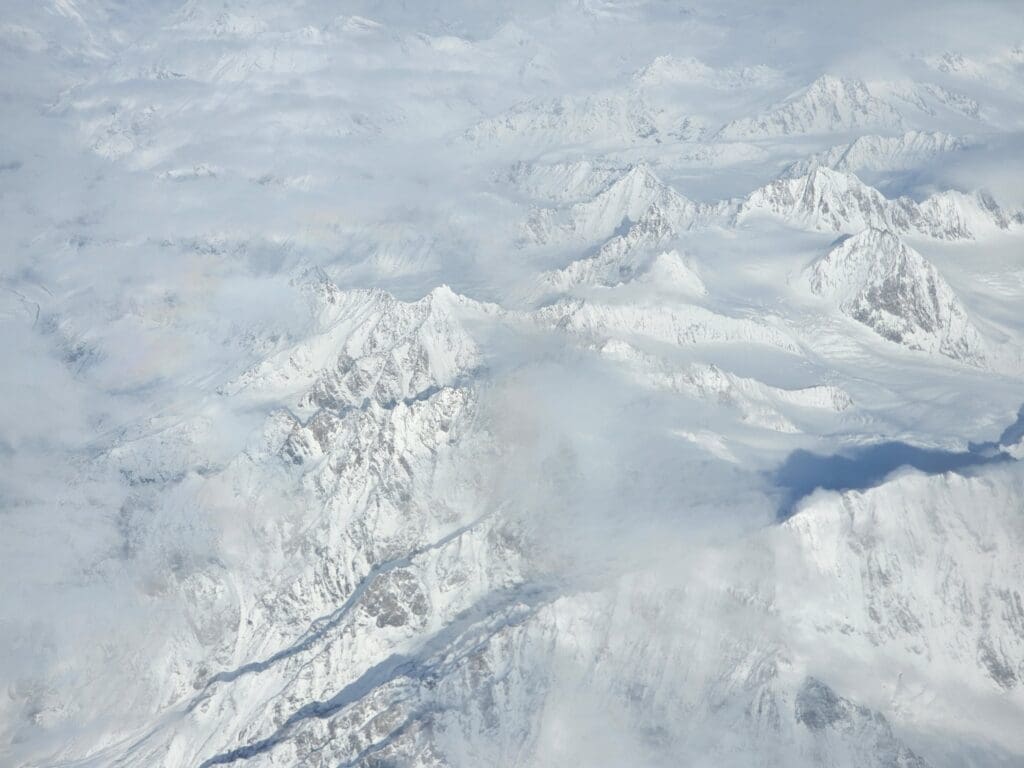
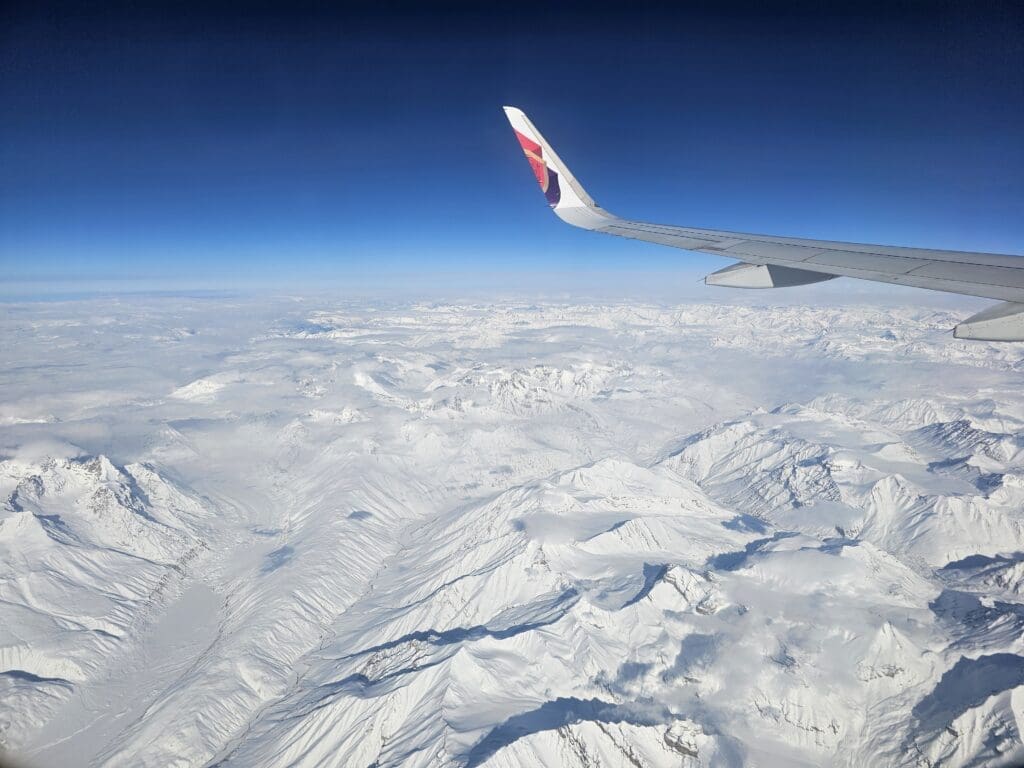
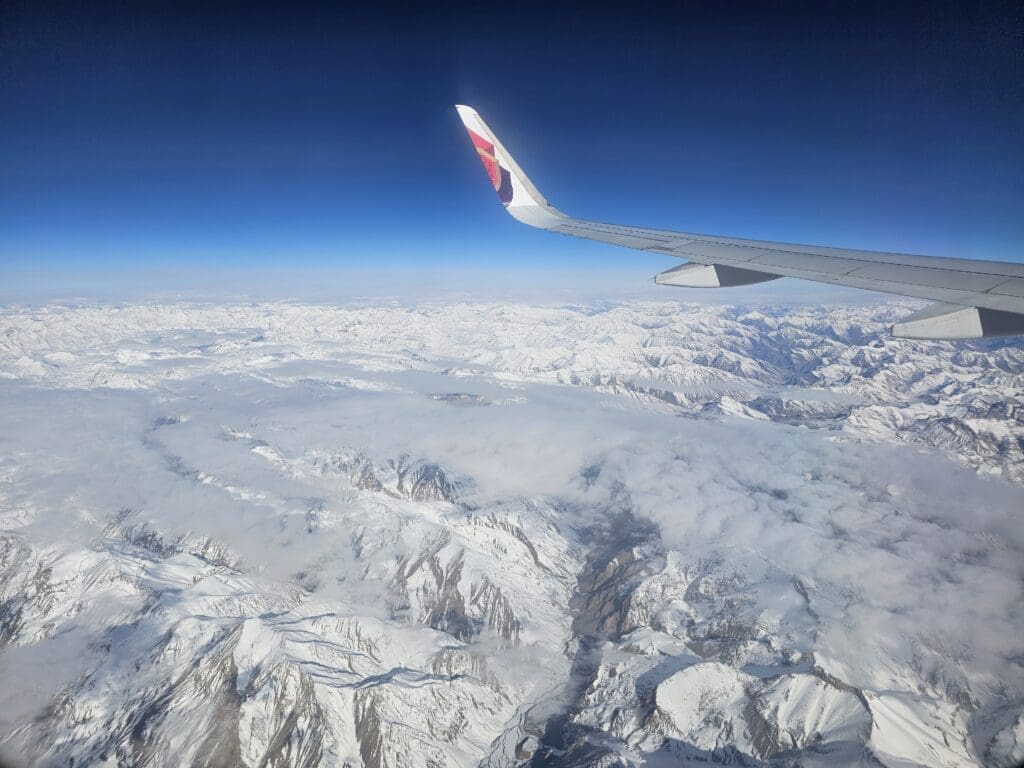
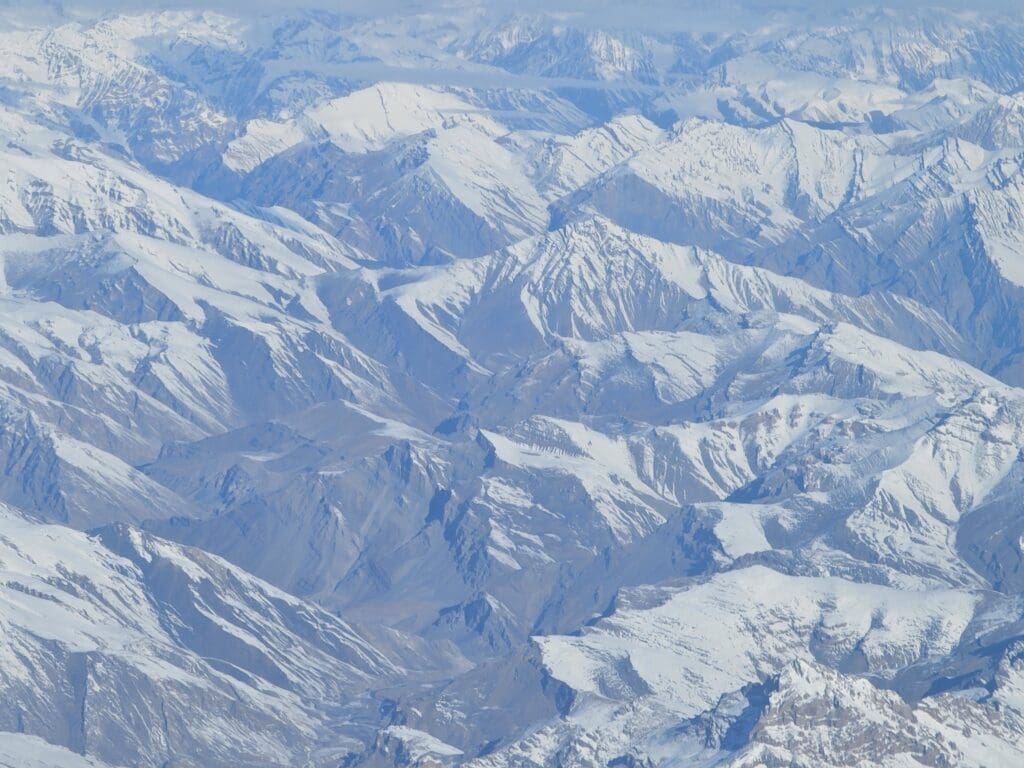
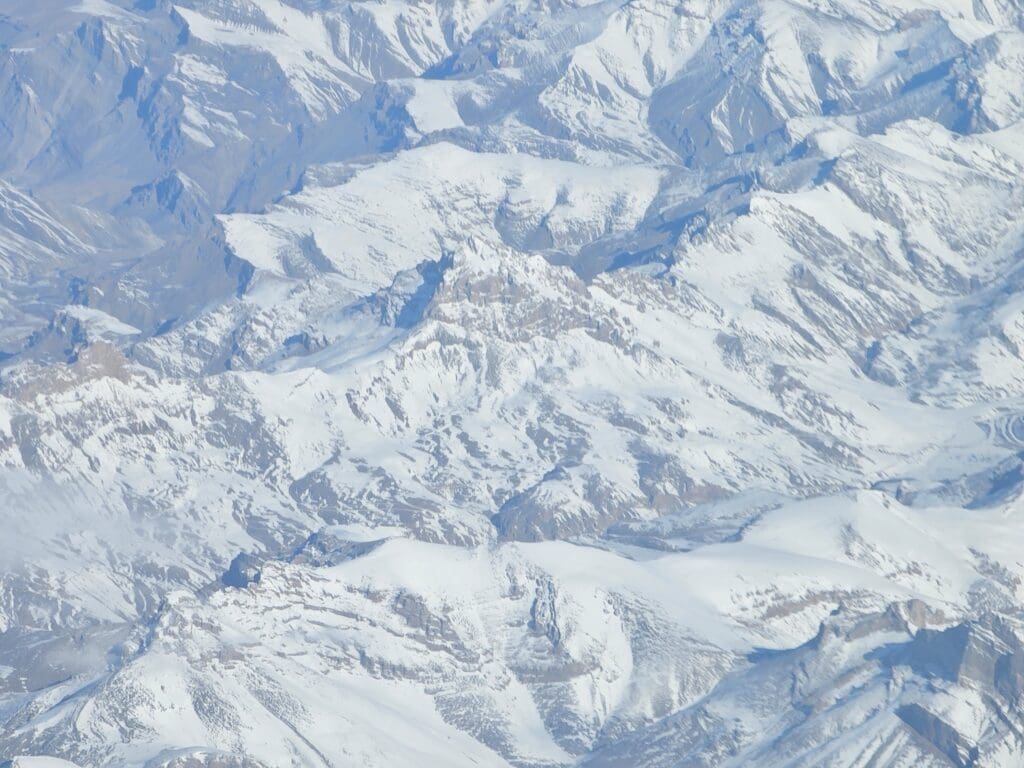
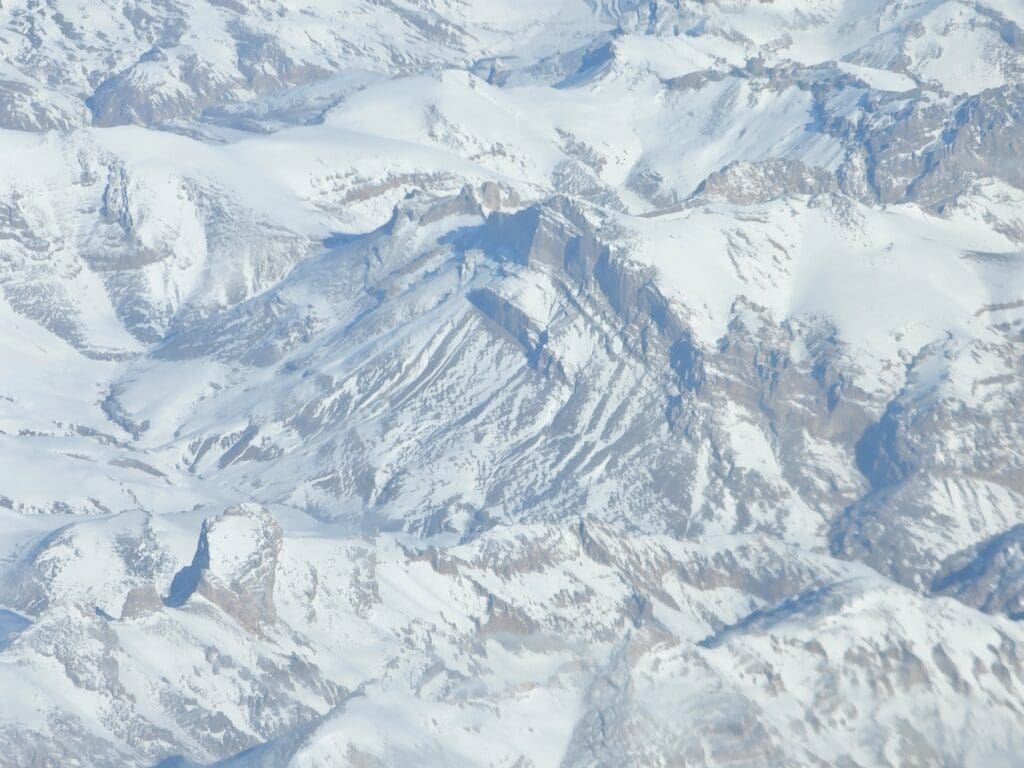
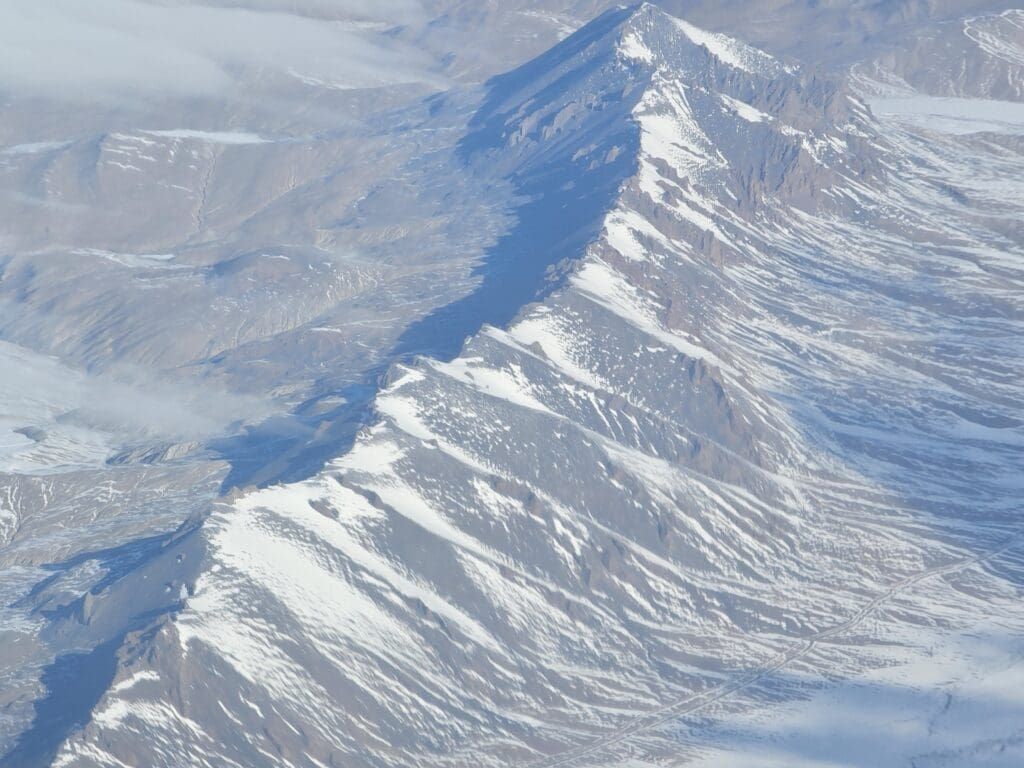
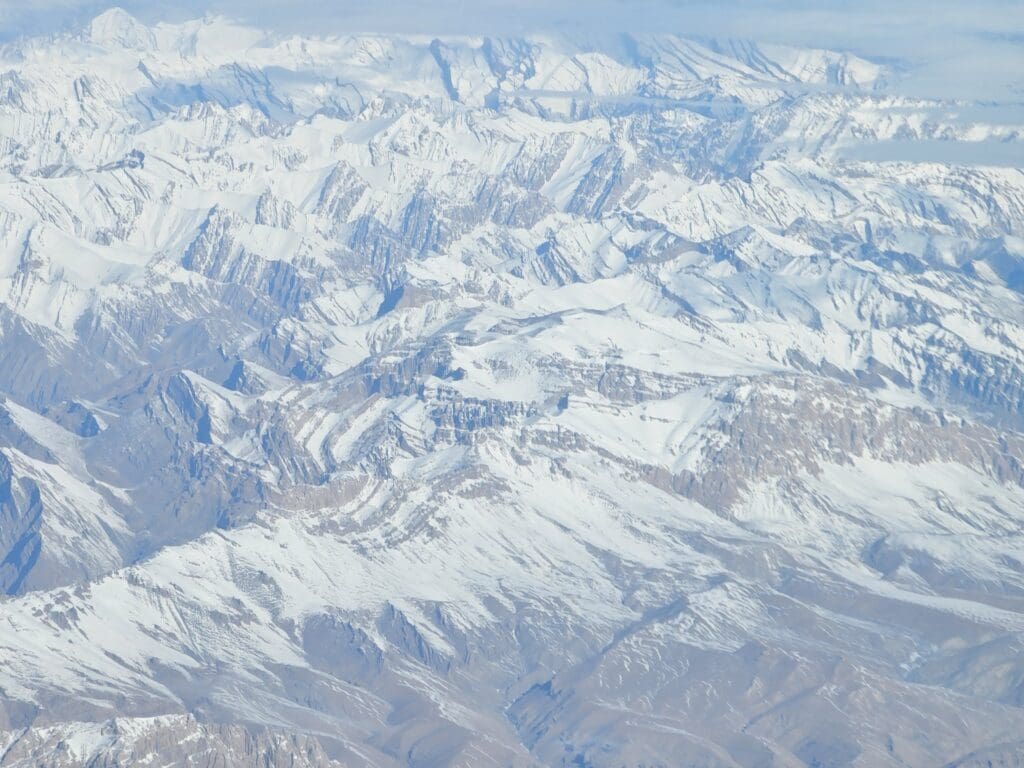
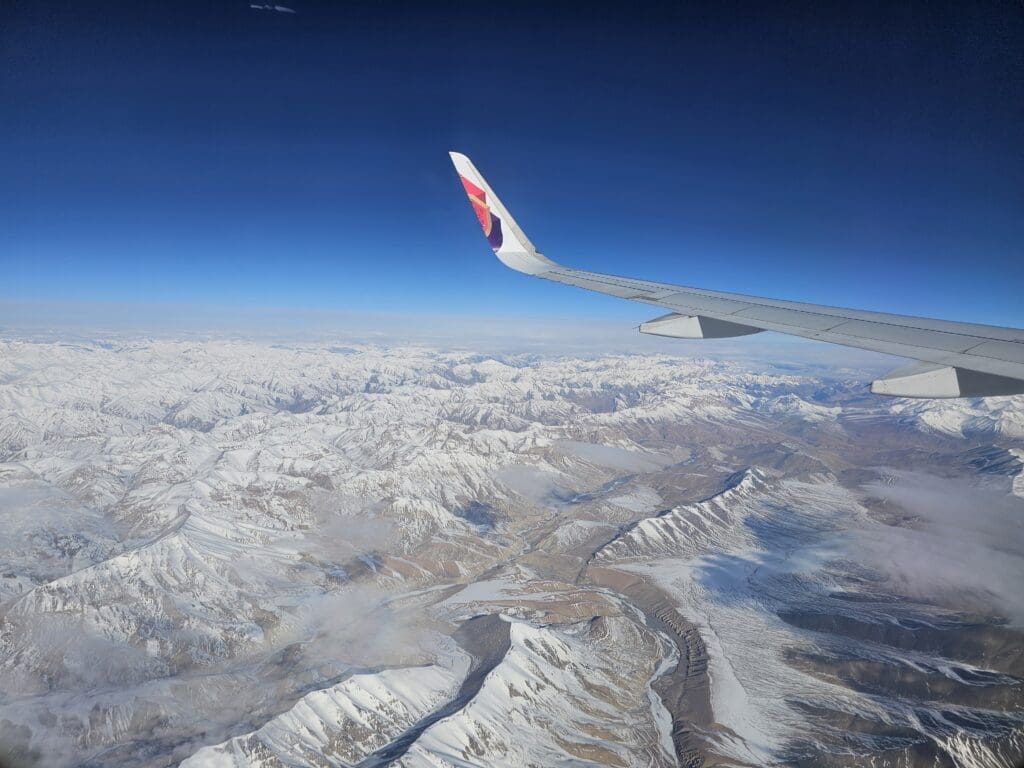
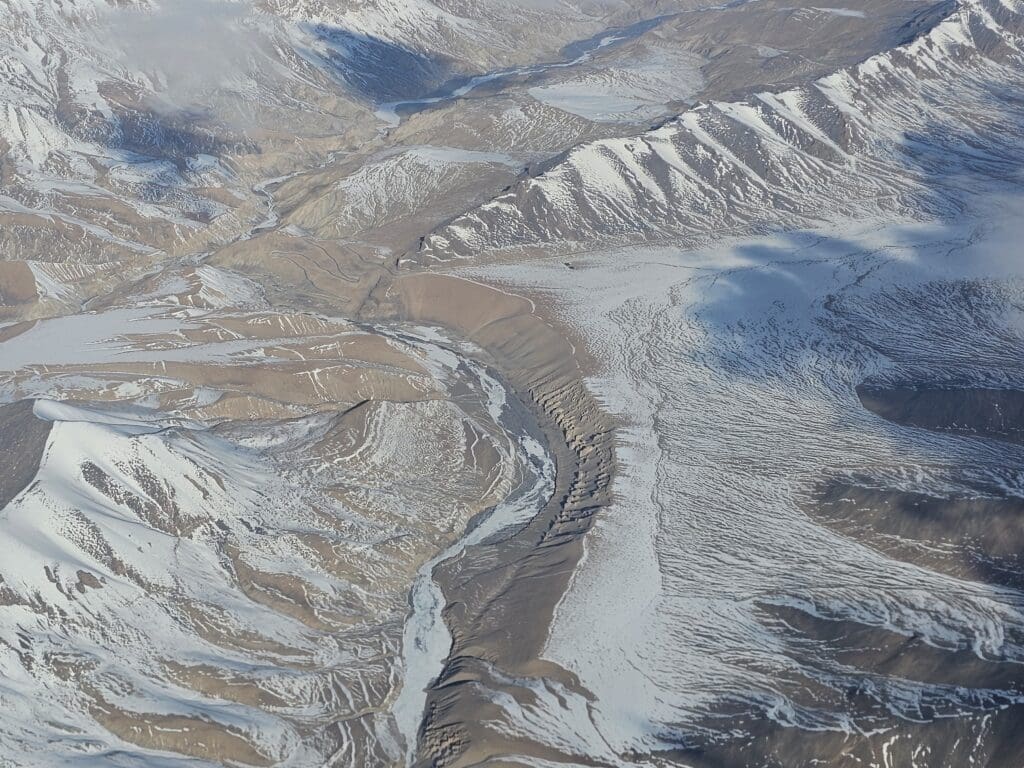

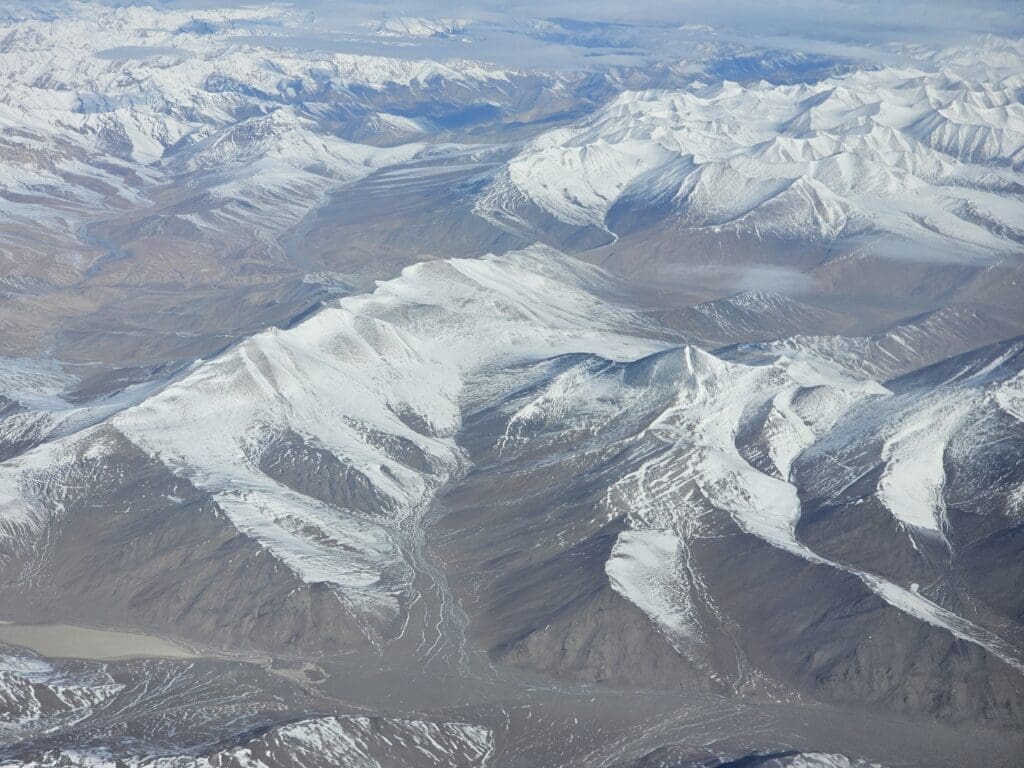
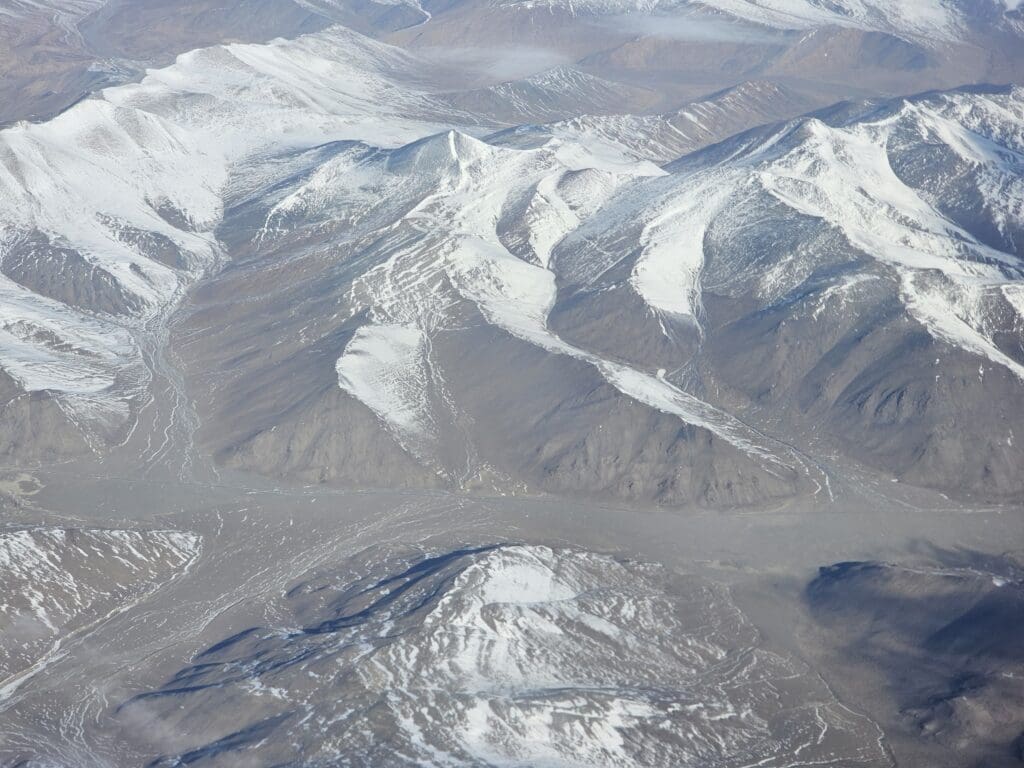
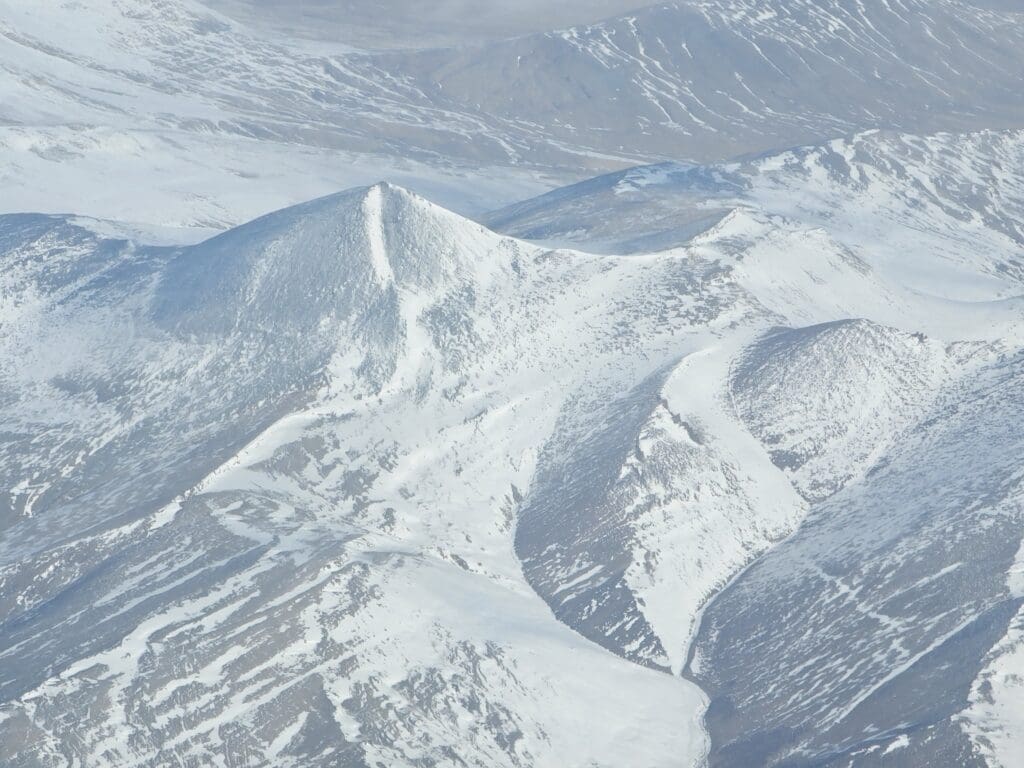
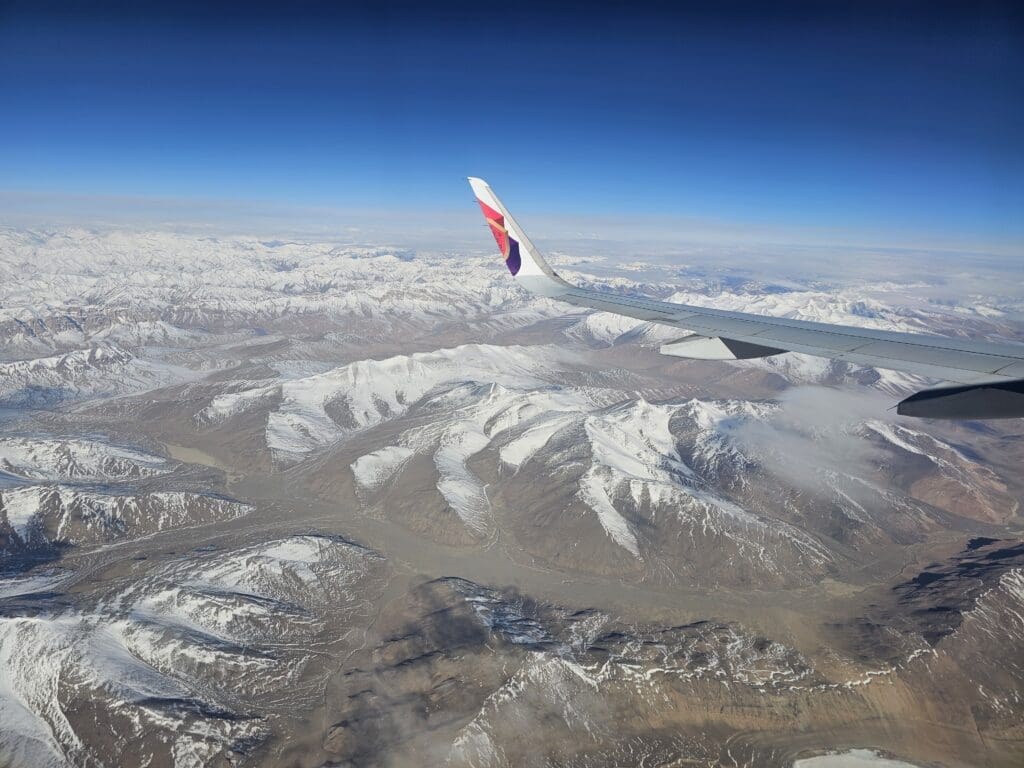
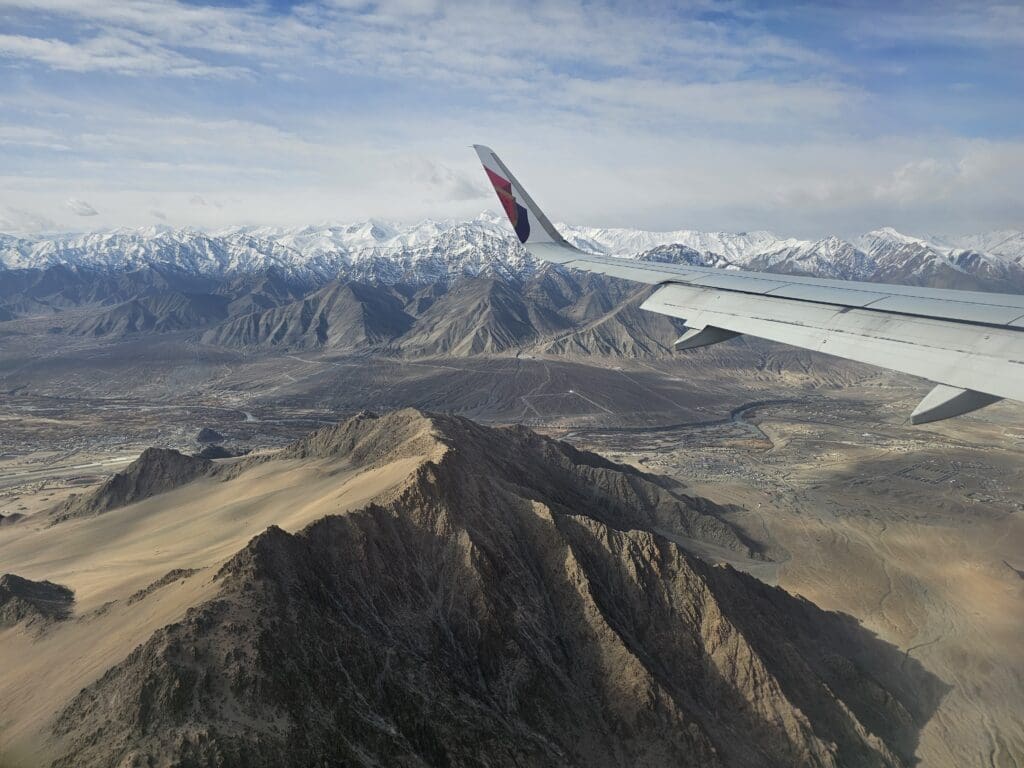
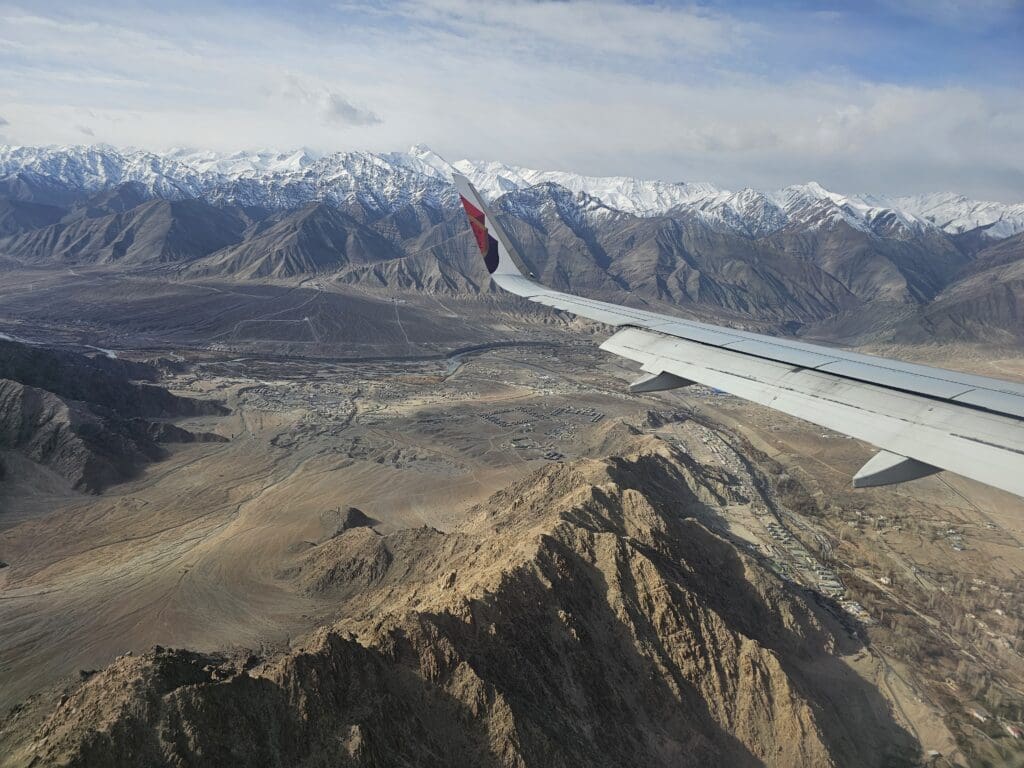
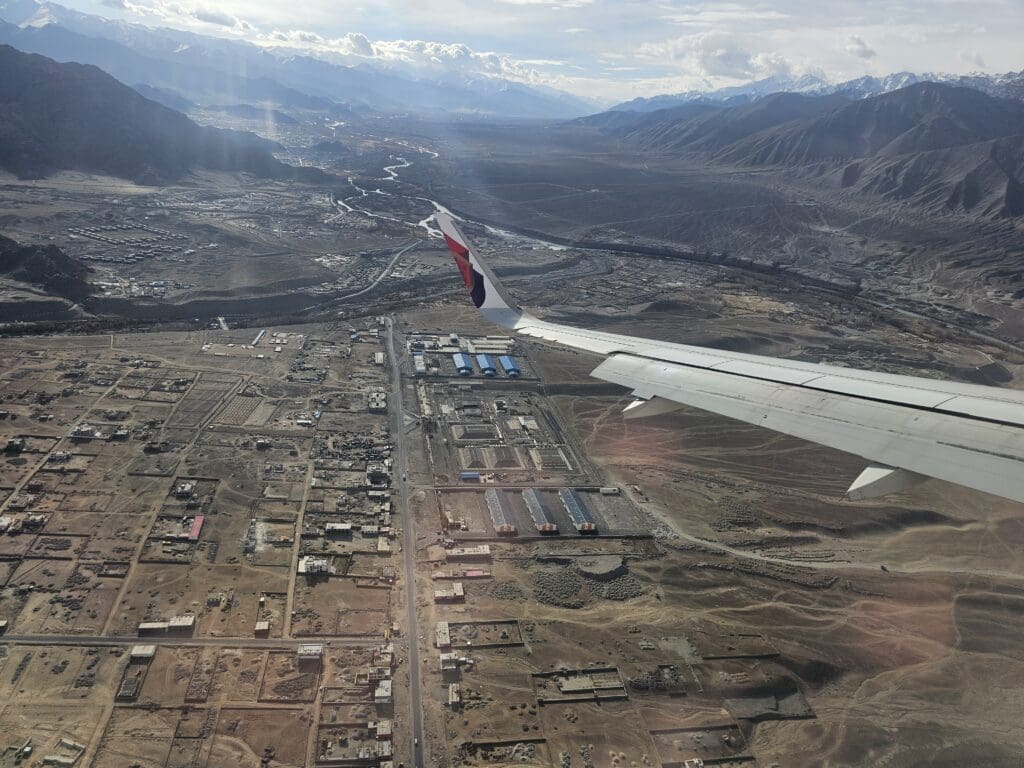
Remaining glued to the passing scenery below, I soon came to conclude that the approach into Leh was one of the most scenic that I have ever encountered and served as a wonderful introduction to the impressive sweeping landscapes of Ladakh. Soon, we passed the towns of Thiksey and Shey, famous for their hillside monastery and palace, respectively, at which point both the flaps and landing gear were extended. Soon, the aircraft passed over the town of Leh, where I was treated to views of the airfield where we would land several minutes later. At this point, the Cabin Supervisor performed an announcement in Hindi and English, noting that photography of the airfield and terminal was prohibited, as was any photography undertaken below 11,000 feet on the approach to Leh. Not wanting to flaunt this rule and end up in hot water, I decided to put my phone away and soak up my surroundings.
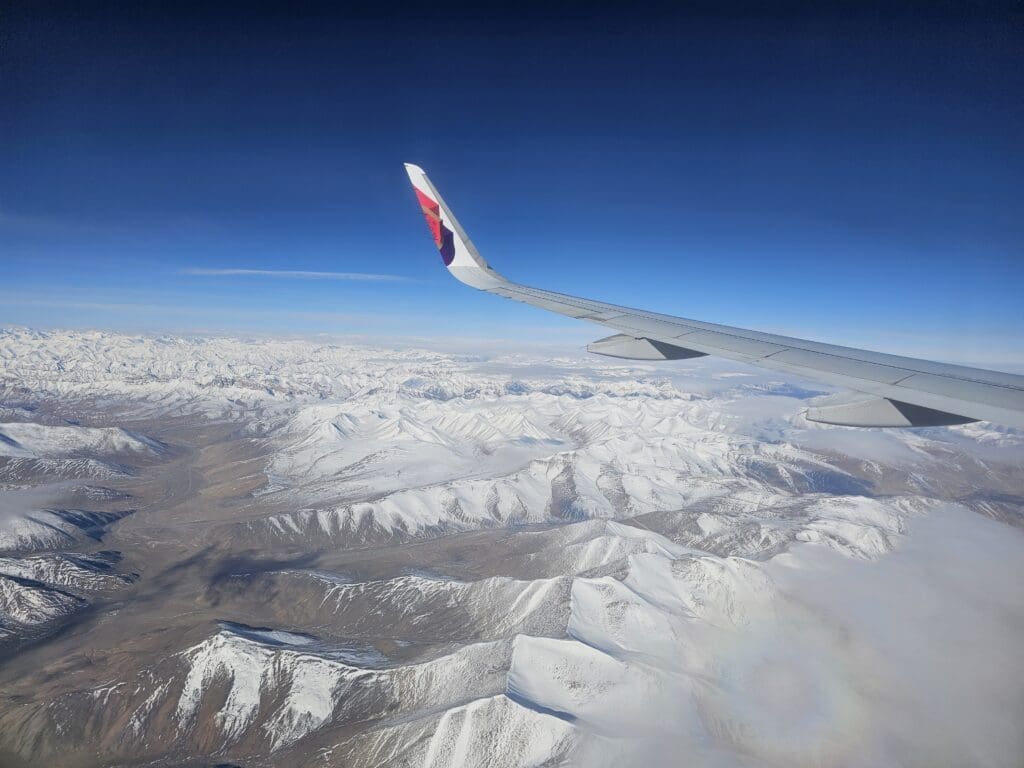
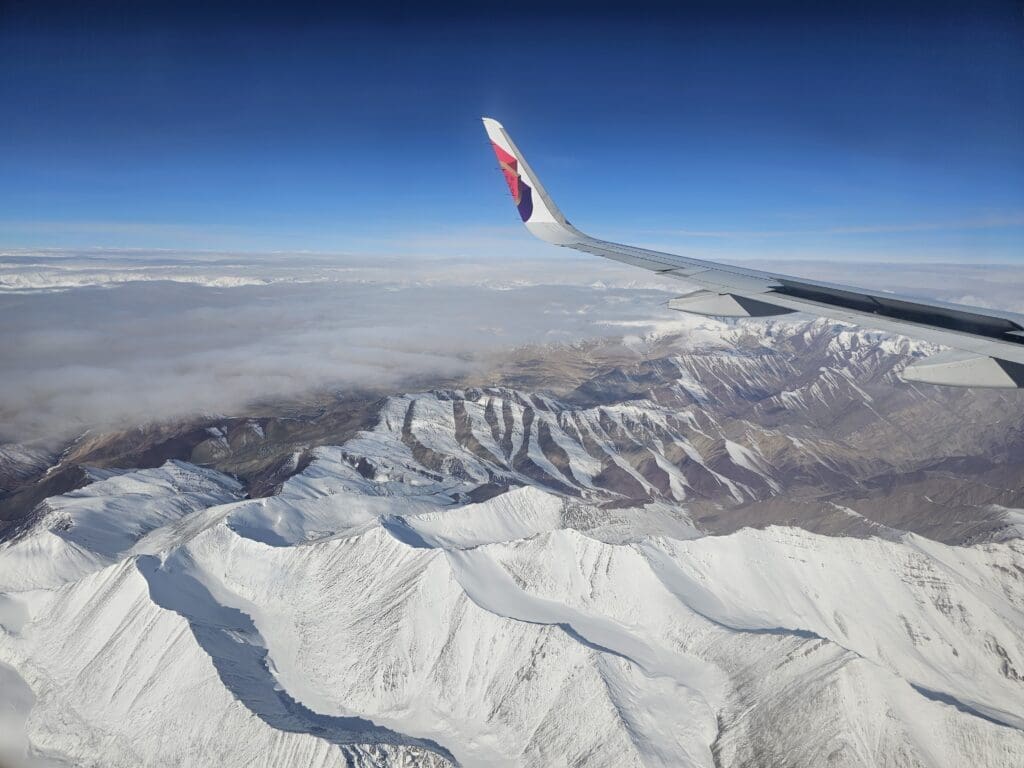
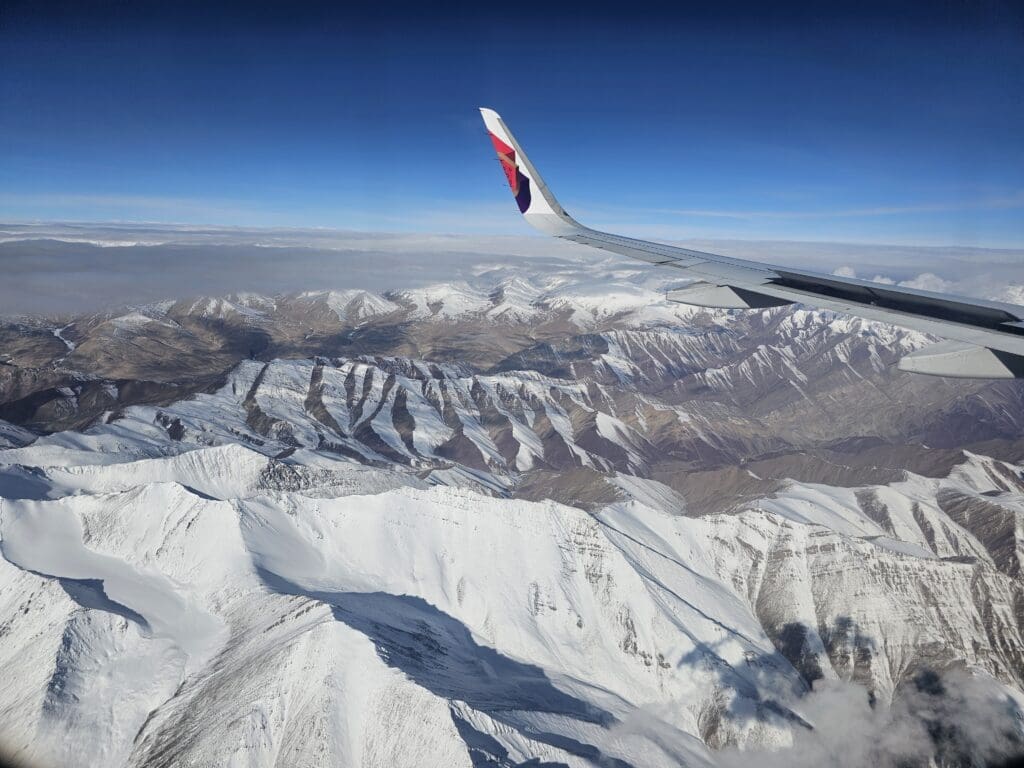
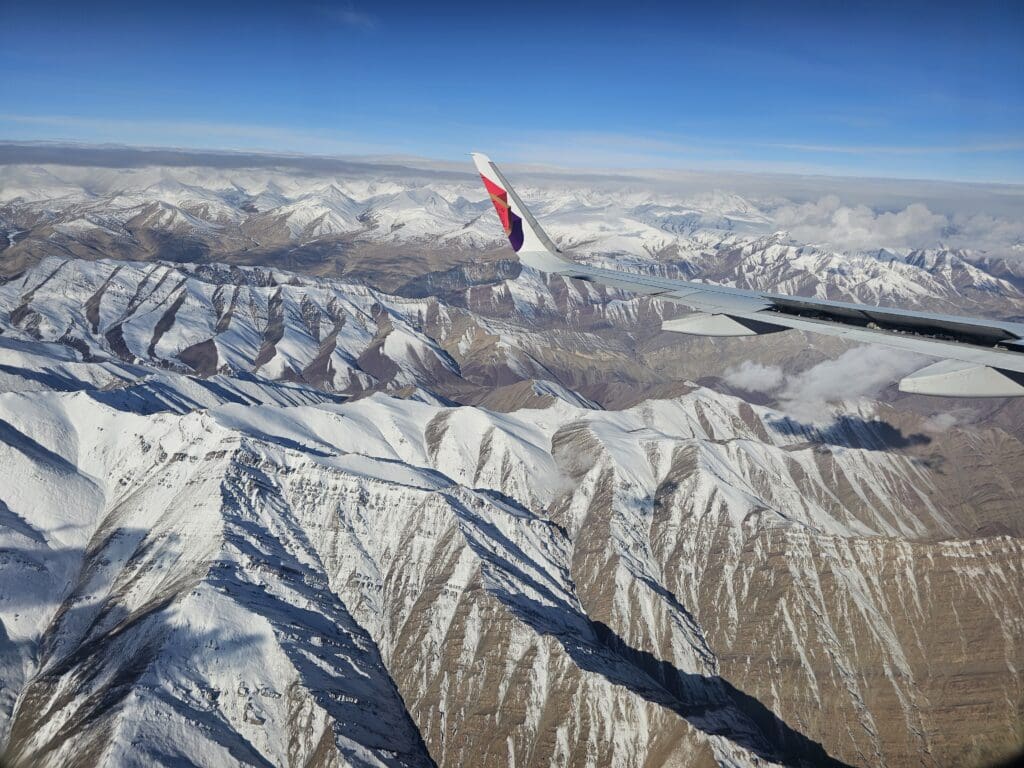
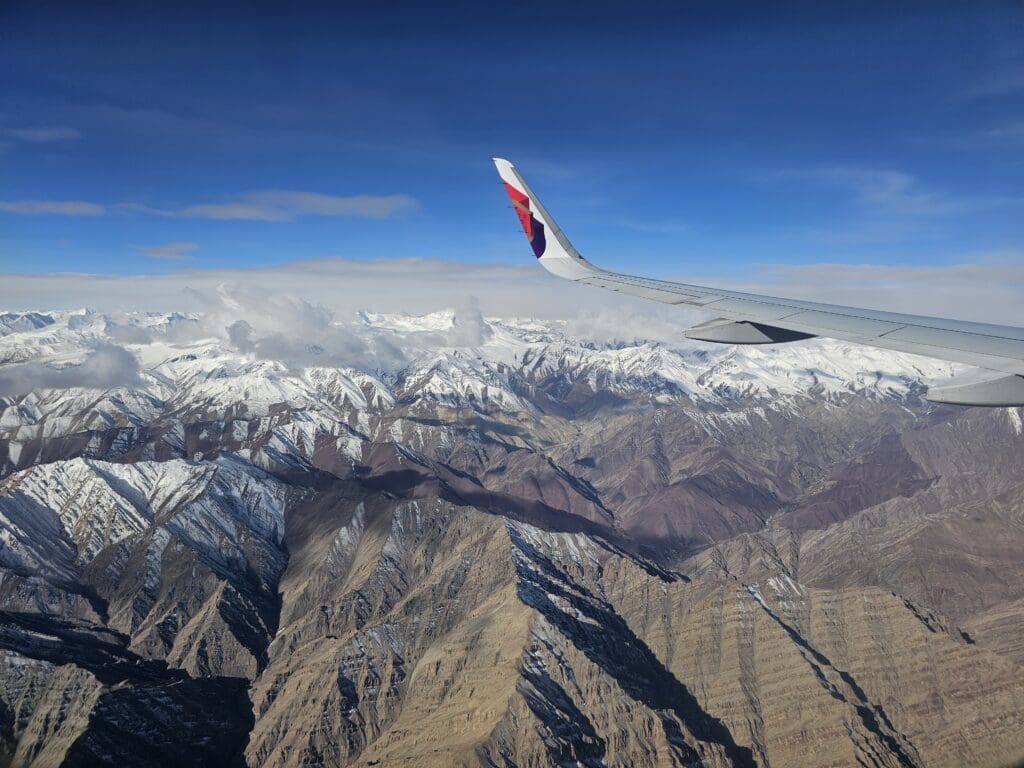
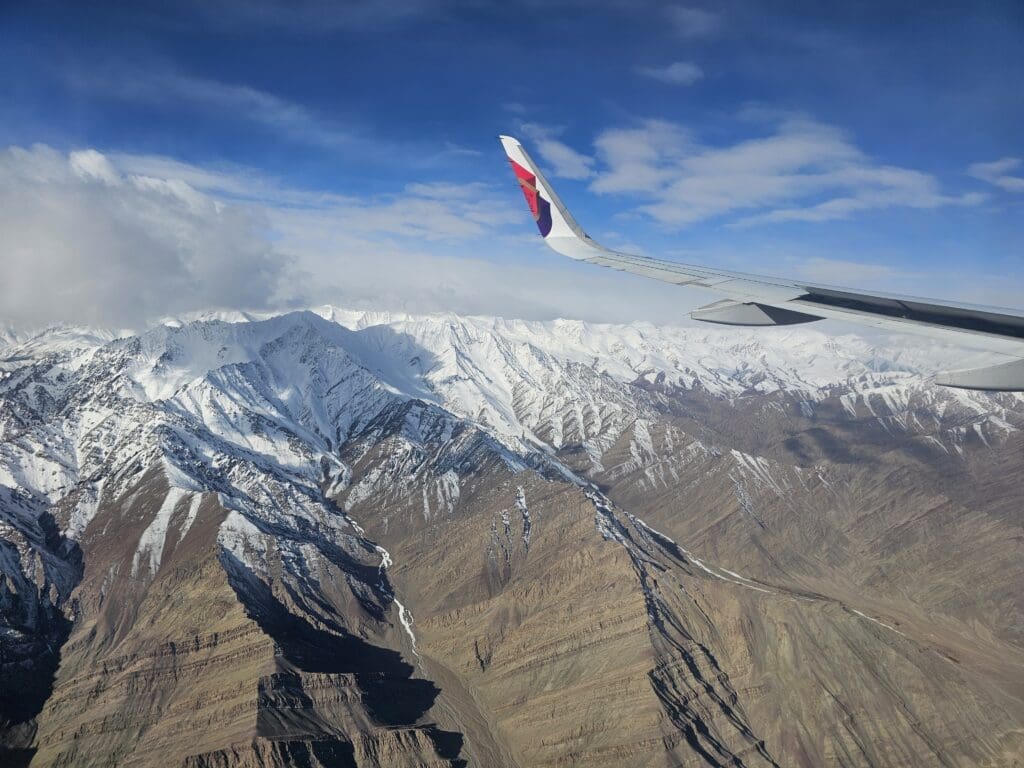
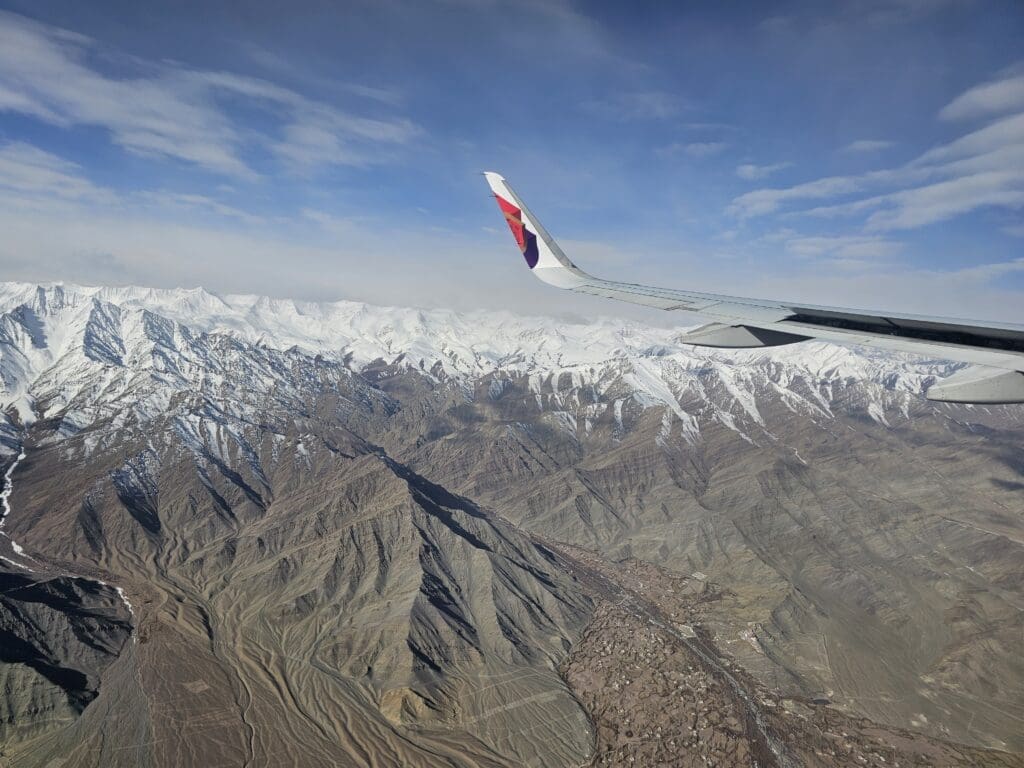
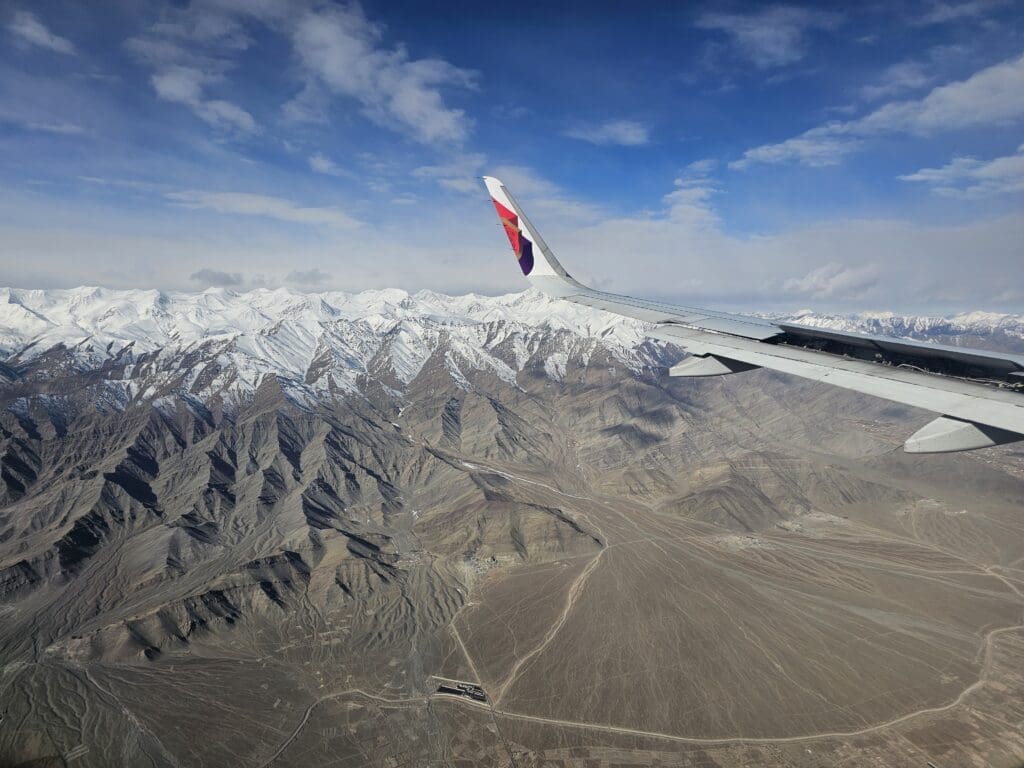
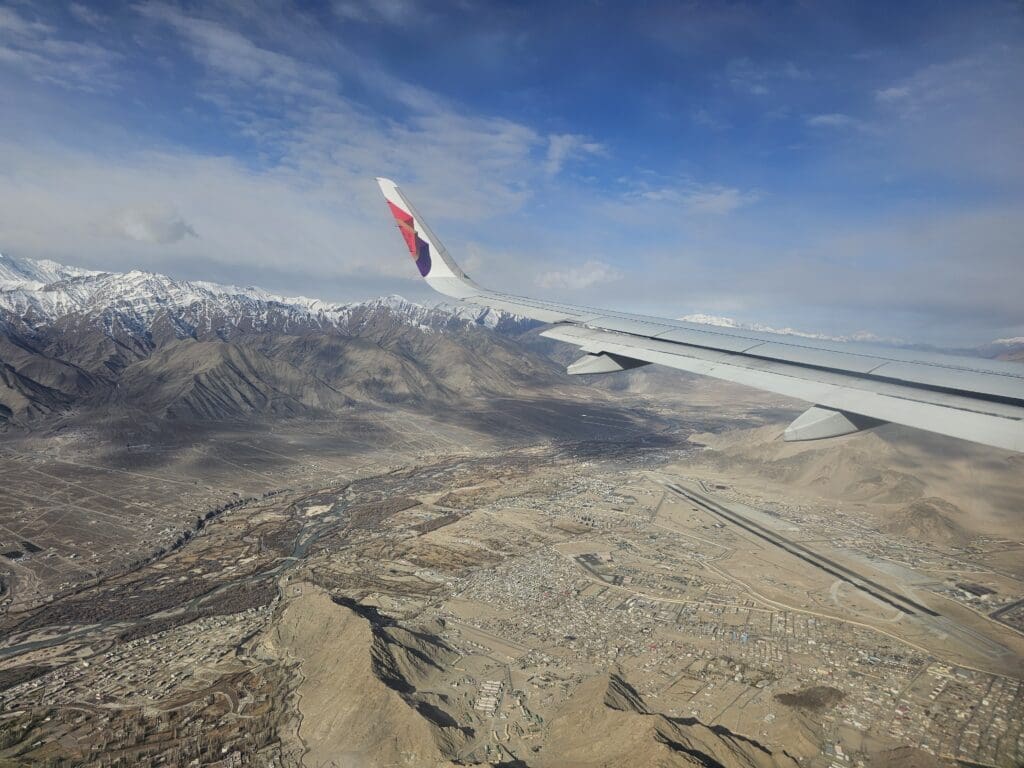
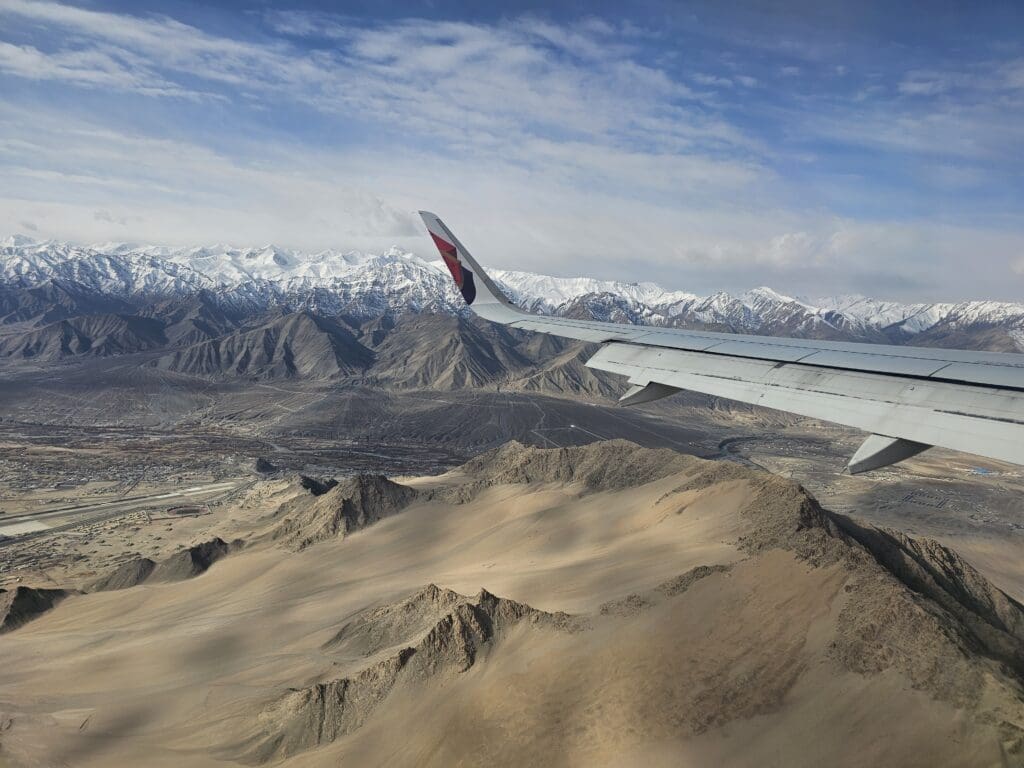
A short time after passing Leh, the aircraft turned around and dived into the Indus Valley. Once flanked by mountains on either side, the Airbus seemed to make a Paro-style approach, weaving in between the hills and mountains before levelling its wings a short distance above the ground as we passed Spituk Monastery and crossed the well-guarded perimeter fence. At 0844, the Airbus made a soft touchdown on Runway 07, just over an hour after departing Delhi, and soon decelerated with vigour. As we slowed, I was treated to vistas of an eclectic array of military types that included an Antonov An-32, a Chinook, an Ilyushin Il-76 and a Boeing C-17 Globemaster that was preparing for departure. Travelling to the end of the runway, once there, the Airbus vacated to this to the left, at which point the Cabin Supervisor performed an announcement welcoming everyone to Leh, thanking passengers for flying with Air India and reminding them of the no photo rule in place at the airport. Leh’s civilian terminal is located in the northeastern corner of the airfield, and so nothing more than a very short taxi was required until we came to a halt at Stand 2, at which point the two engines spooled down, and an army of ground crew moved into position.
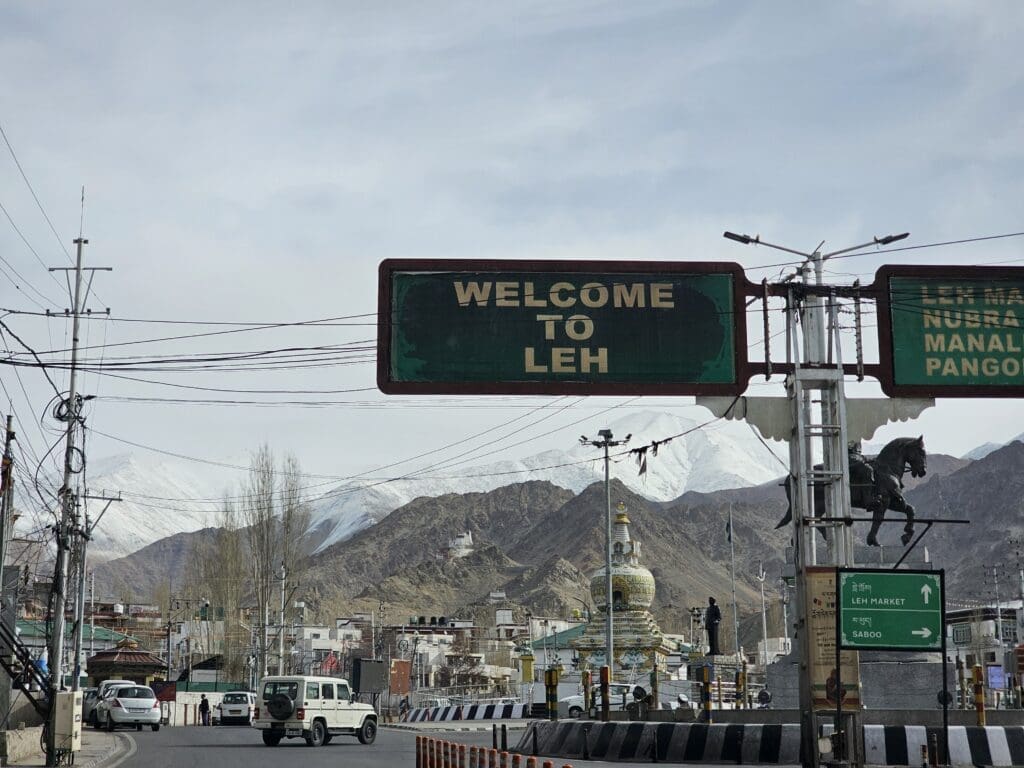
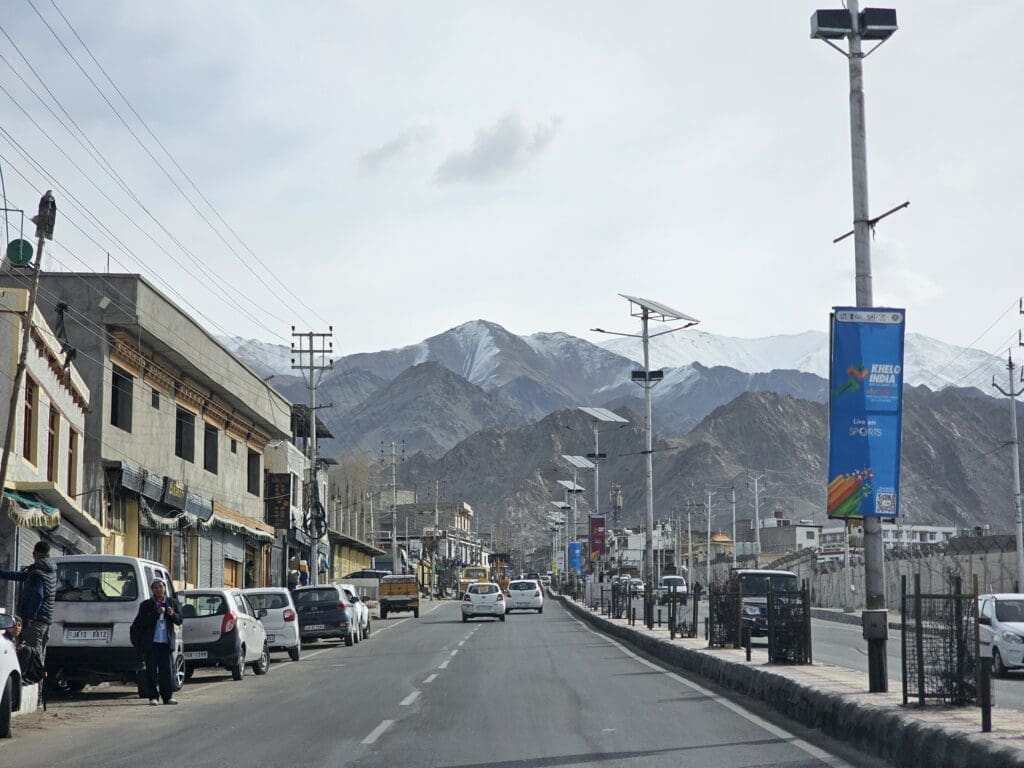
As often seems to be the case in India, the ground crew wasted no time in positioning steps up to the aircraft, and disembarkation soon began via both the front and rear steps. After picking up my bag, I made my way to the rear galley, where I thanked two flight attendants before heading out into the chilly Himalayan air. From there, I made my way down the steps and boarded a rather battered and beaten-up Air India-branded Ashok Leyland bus that soon took me over to the terminal. Once inside the small arrivals area, I was handed a foreigner registration form, and by the time I had filled this in, my suitcase could already be seen spinning around on the carousel. Without delay, I picked this up and walked the short distance out of the terminal to the open-air arrivals area, where I met my guide for the week.
Summary
Once again, I had a very good flight with Air India, and I was pleased with the warm and friendly crew. Meanwhile, the cabin was clean and in good shape and thus left me with few complaints other than the slightly uncomfortable seats. Nevertheless, given the comparatively short flight duration, this was not a problem.