What’s Lufthansa’s Short Haul Service Like in 2026: Manchester to Frankfurt on the A319
I took this flight to connect to a Lufthansa Boeing 747-400 from Frankfurt to Bangalore. You can read my report on this flight by clicking here.
Between booking my flights in December and departing in March, time had flown by, and before I knew it, it was time to head to India. Seeing as I would head off to flight school in Jerez just over a week after I returned from my six-week adventure, the months leading up to my trip had been rammed. During this, I had finished my job in aviation safety, gathered everything I would need for flight school, sorted out my Spanish visa, packed up everything that I had accumulated during my three years in Leeds and swapped my rented flat for my parents’ house in my hometown of Sheffield. Thus, by the time my big adventure rolled around, I was ready for a break!
As is the case for most Lufthansa services, online check-in opened thirty hours before my flight to Frankfurt was scheduled to depart. However, having already paid to pre-select a window seat on my Jumbo Jet slog to Bengaluru, and seeing as I would have to drop my suitcase off at the check-in desks in Manchester, I was in no major rush to check in online. Of course, being a full-service carrier, Lufthansa does not charge any Ryanair-esque check-in fees for those who check in at the airport. Despite this, my excitement to jet off, coupled with my eagerness to see which seat the check-in gods had assigned me for my hop over to Germany, meant that the day before departure, I opened up Lufthansa’s modern and user-friendly app in order to obtain my boarding passes. Much to my delight, despite having a one-way ticket to India, I found online check-in to be a straightforward and painless procedure. Once I had entered the details of my passport and Indian e-visa, I received my two boarding passes and was all set to head off. Furthermore, much to my delight, I had been assigned a window seat, Seat 11A to be precise, for my first leg, and thankfully, my pre-reserved window seat for the flight to Bengaluru remained unchanged. I should also note that had I wished to change the seat for my first leg, I could have done this for an additional fee, although even had I ended up in a dreaded middle seat, given the length of the flight, I would have probably not done this.
The Journey
Given Manchester Airport’s status as Britain’s third-busiest airport and its important role in connecting the North with the world, unsurprisingly, the airport is relatively well-connected to towns and cities across the region. Despite having lived in Sheffield during the era when it had its own airport, Sheffield City Airport, and later when it shared the nearby Doncaster Sheffield Airport, along with East Midlands Airport, I have always considered Manchester Airport to be my local airport. From Sheffield, Manchester Airport is a painless one-change ninety-minute train journey away. That said, getting to the airport on public transport in time for my 0605 departure would prove to be a struggle, and so I initially considered a night in an airport hotel. However, travelling on a Saturday morning at the start of the Easter holidays, unsurprisingly, bargain deals were non-existent. Coming close to spending a small fortune, much to my delight, at the last minute, I was offered a very early morning ride to the airport by car, and, given the circumstances, this was impossible to turn down.
Aiming to be at the airport a little over two hours before departure, and being a sucker for punctuality, we decided to leave home at 0230. Having packed everything in the days leading up to the trip, when my alarm rang at 0200, I had completed most of my pre-trip preparations and thus had little to do other than dart through the shower and undertake a final check of my bags to ensure that I had everything with me that I would need for the next six weeks or so. As the clock struck half-past, we hit the nearly totally deserted tree-lined streets of Southwest Sheffield and began the ascent into the glorious Peak District National Park. Sadly, the early morning darkness, coupled with the thick fog that lingered over the hills, meant that nothing could be seen of the Peak District as we sped towards the less glamorous side of the Pennines! With virtually no traffic, we made good progress, and it was not long before the approach lights at the end of Runway 23R popped into view, followed by the sprawl of the airport. Following signs for Terminal 2, around seventy minutes after leaving Sheffield, we came to a halt in the drop-off area just opposite the arrivals level on the ground floor of the terminal.
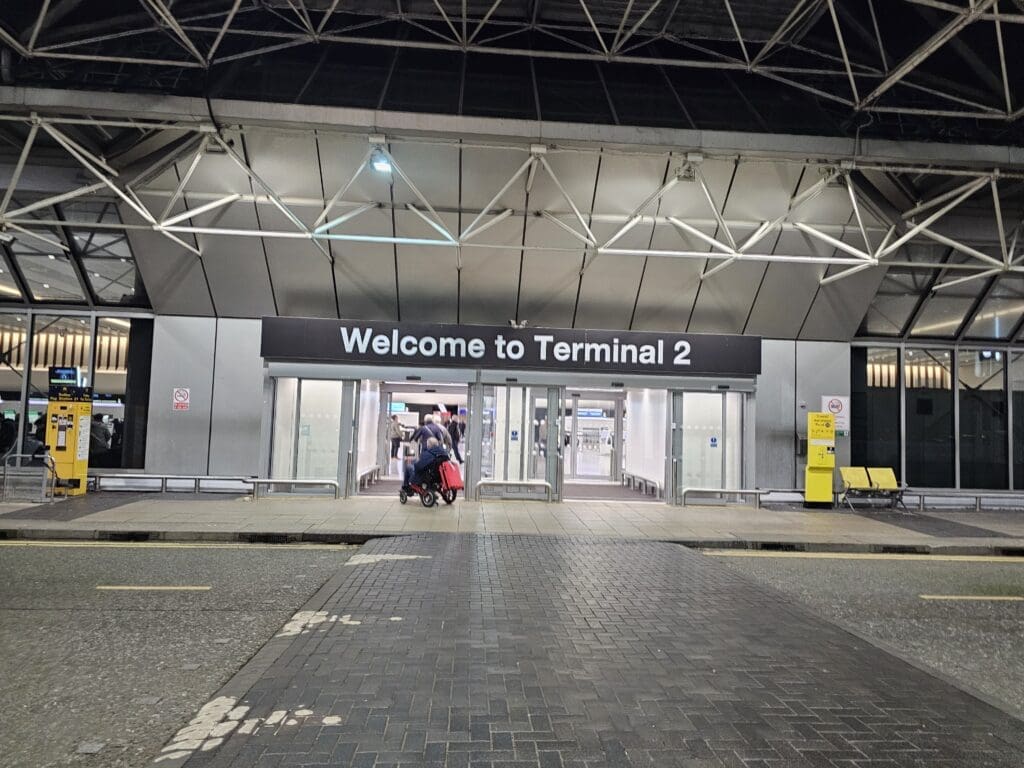
First opening its doors in 1993, Terminal 2 has been a longstanding feature of Manchester Airport and, over the past decade, has undergone a series of expansions and upgrades that have elevated it to the unofficial status of the airport’s flagship terminal. By all metrics, Terminal 2 is the largest of Manchester’s three terminals and serves all carriers to operate at the airport, bar Ryanair, who now enjoys a monopoly on operations at Terminal 3. Once I had said my farewells and thanks, I took one of the lifts up to the departures level and soon entered the terminal’s bright, modern and spacious check-in hall. There, check-in desks are spread across seven zones, logically named A to G, with each featuring self-check-in machines, and many coming with automated bag drop-off desks. As I had expected, seeing as I was travelling at the start of the Easter holidays, the check-in hall was rather busy, filled with a mixture of stressed-looking suitcase-wielding families, young international students likely to be excited to be heading home for the university break, and the inevitable hens and stags in uniform, heading off to the party capitals of Europe.
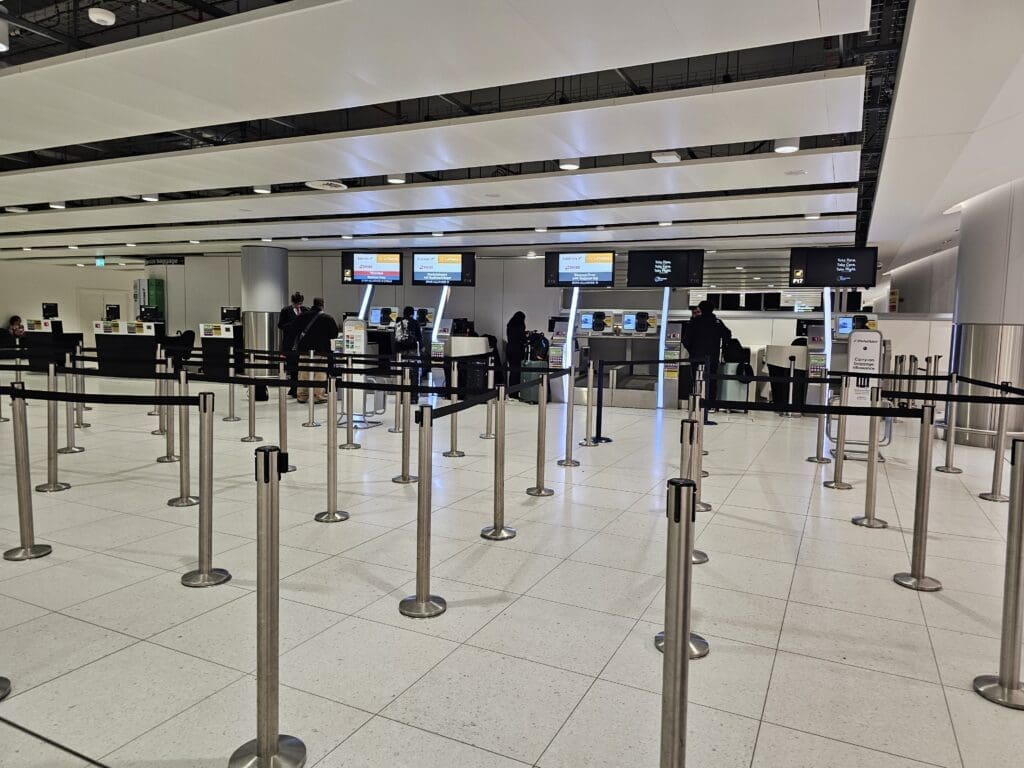
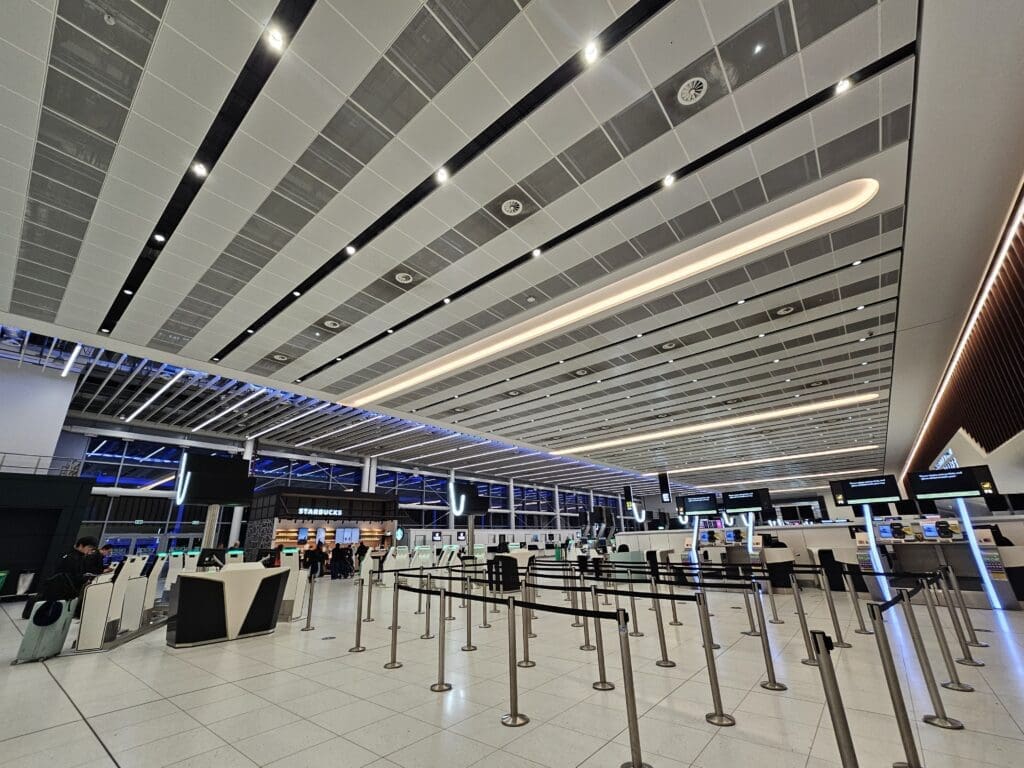
Looking to unburden myself of my suitcase as soon as possible, once inside, I checked the departure boards, which revealed that check-in for my flight to Frankfurt would take place at the desks in Zone F. Strolling over to this, I was greeted by the sight of three bag drop-off counters, as well as a single counter for those in the airline’s premium cabins. This is shared by Lufthansa and Swiss, and so that day would serve all those departing on the two airlines’ four flights to Frankfurt, three flights to Munich and two flights to Zurich. As is the case at many of the Lufthansa Group’s overseas stations, both front and back of house handling for all of these services was undertaken by ground handling giant, Swissport.
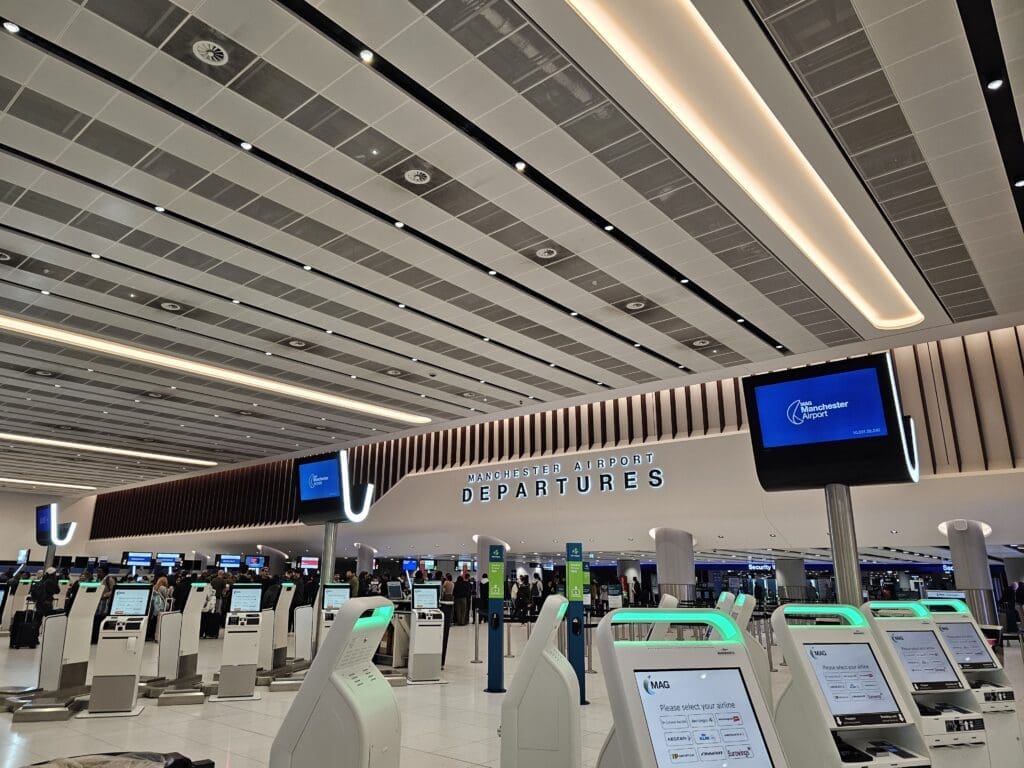
Upon arriving at the check-in desks, I was pleased to find these to be reasonably quiet, and so nothing more than a two-minute wait was required until I was able to stroll up to the next vacant desk. Despite the early hour, I was welcomed by a friendly Swissport agent who undertook the usual formalities. Ensuring that I had the correct documents to enter India, both my e-visa and arrival card were checked before a baggage tag was printed off and attached to my suitcase. Much to my delight, the check-in agent conveniently overlooked the fact that my suitcase was 1.7 kilograms overweight, and so I was not stung by any last-minute overweight baggage fees. Upon requesting them, two boarding passes were printed off before my bag was sent into the depths of the terminal, hopefully to be seen thirteen or so hours later on Indian soil. With my pleasant check-in experience successfully completed, the agent pointed me in the direction of security, and I continued on my journey.
With no reason to stay in the landside portion of the terminal, I made the short walk to the main entrance of the security area. Seeing as I was departing during the early morning rush, I was not too sure how busy this would be; however, once I passed through the automated gates, I was pleasantly surprised to find that this was nearly totally empty. Thus, once through, I was directed to an empty checkpoint where I temporarily parted with my belongings before passing through a full-body scanner. With no need for any additional checks, security was over and done with within about two minutes. Furthermore, I was delighted to find that all of the security staff that I encountered were pleasant and friendly, despite the early hour, thereby leaving me with no complaints about my initial experience at Manchester Airport that morning.
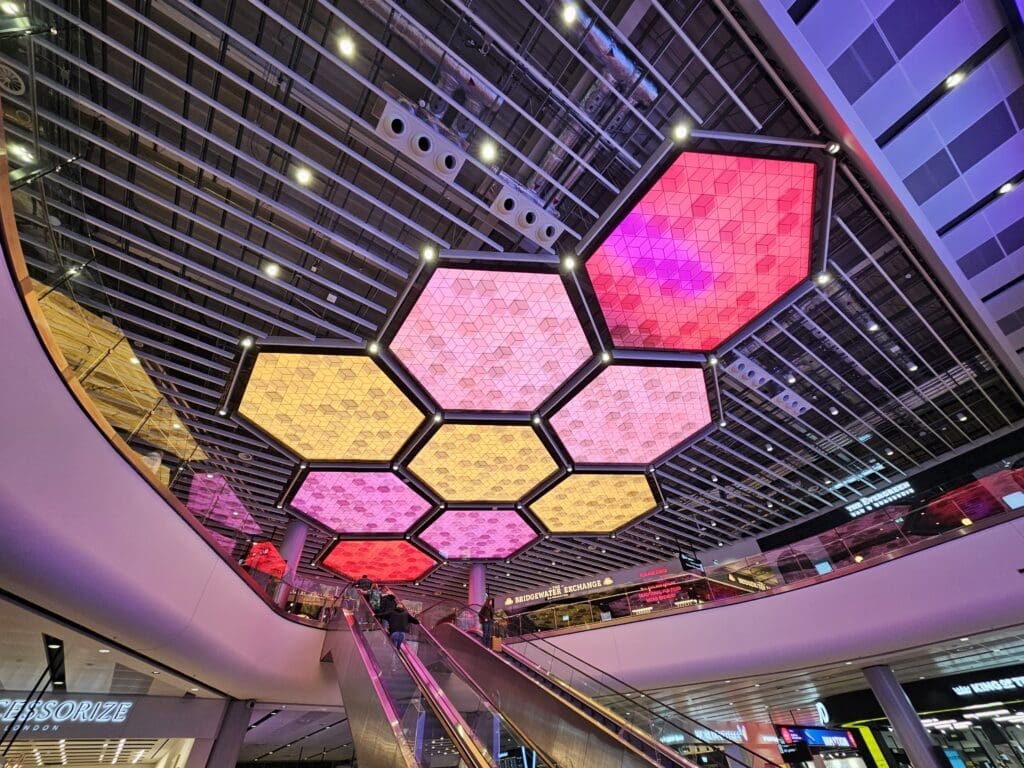
Once through security, I ascended the escalators and within a minute or so, found myself in the main airside atrium, which was initially surprisingly quiet; although as time passed, this filled with passengers. As you would expect, given the recent upgrade work, the airside portion of Terminal 2 is modern and features an appropriately Manchester-themed design, with plenty of worker bee-related imagery – a famous symbol of the city. As British airport terminals go, this is definitely one of the better major airport terminals, and for the most part, I have never really had a bad experience at Terminal 2. With my speedy journey through this that morning, serving to further strengthen my positive opinion of the terminal. Importantly, this was relatively clean and tidy, although that could perhaps be in part attributed to the lack of passengers. In terms of its facilities, the terminal features plenty of cafés, bars, restaurants and shops, although most outlets sell items with the usual airport mark-up, meaning that bargain eats are tricky to come by.
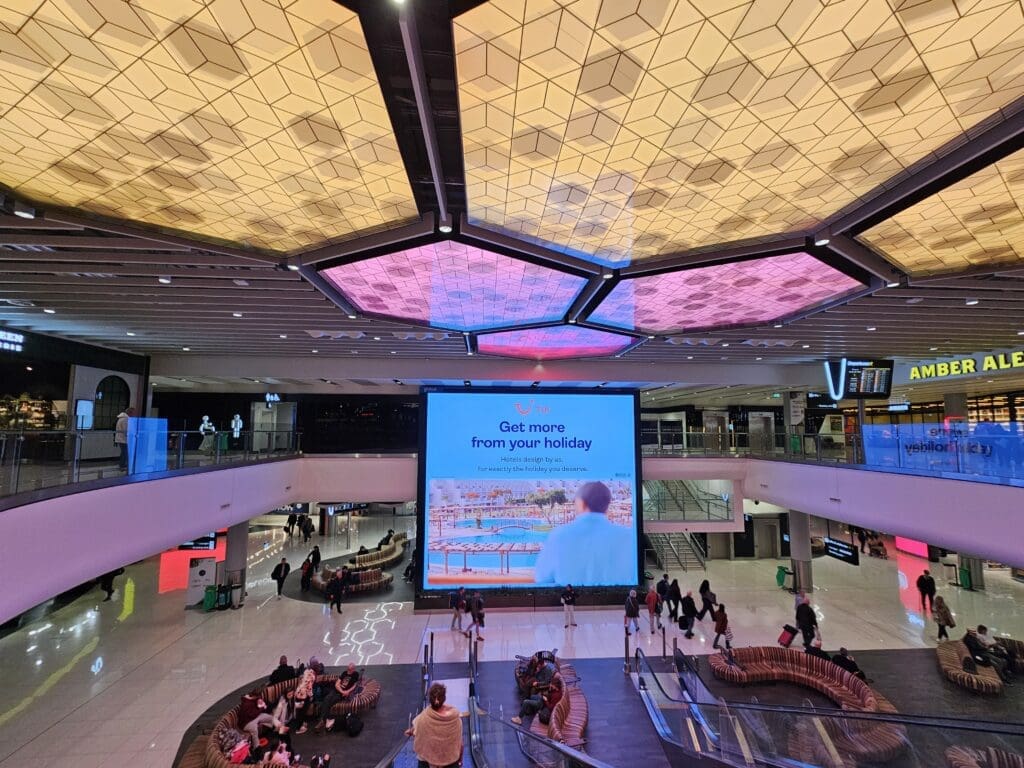
Being no stranger to the terminal, I had no particular desire to explore it that morning; after a glance around, I headed to Pret to indulge in my first coffee of the day. Needing to charge my laptop, I took my strong black filter coffee away and found a table with a plug socket next to one of the terminal’s large windows. Aviation enthusiasts will be happy to hear that throughout the terminal, large windows provide good views out onto the apron and the terminal’s stands, with this definitely being one of the more exciting terminals for spotting, given the overall busyness and the breadth of airlines that serve the terminal. However, given the early hour, no aircraft could be seen moving about outside until the first arrival of the day. This took the form of a Hainan Airlines Airbus A330 arriving after its overnight slog from Beijing, and opened the floodgates, after which widebody after widebody touched down from destinations across the world.
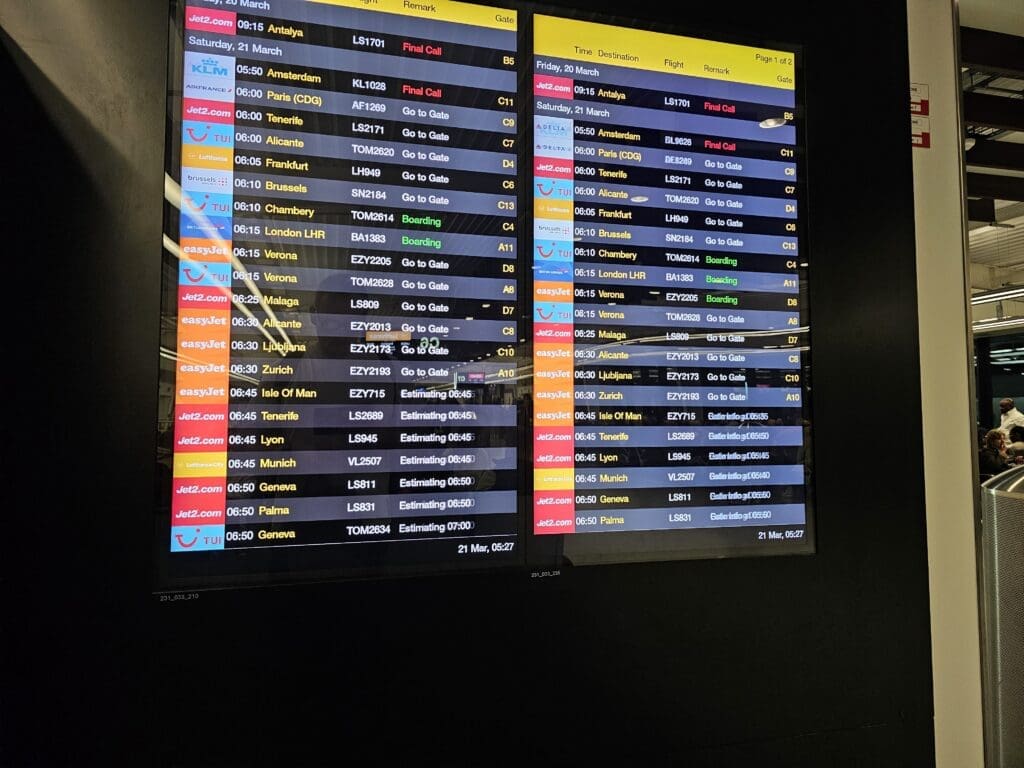
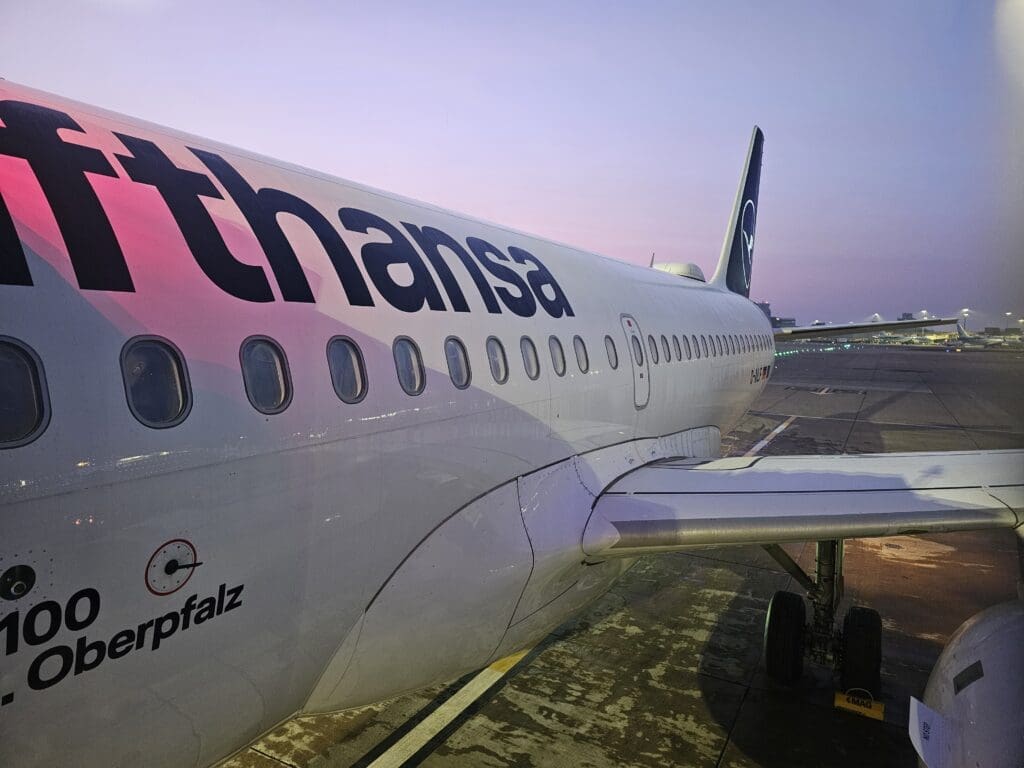
Unsurprisingly, the aircraft operating the first flight of the day to Frankfurt had spent the evening on the ground in Manchester. Therefore, as an aviation enthusiast, it was easy to decipher which gate my flight would depart from. That morning, the only Lufthansa Airbus A319 on the ground could be seen standing outside at Stand 206L, which corresponds to Gate C6. Whilst the vast expanse of Terminal 2 means that passengers can be in for a long walk to their gate, conveniently, this was one of the closest gates to the main waiting area. Upon arriving there, a few eager passengers could already be seen lingering around the gate area, whilst outside the Airbus that would take us all to Frankfurt could be seen basking under the floodlights as the skies began to slowly brighten, heralding the commencement of a new day.
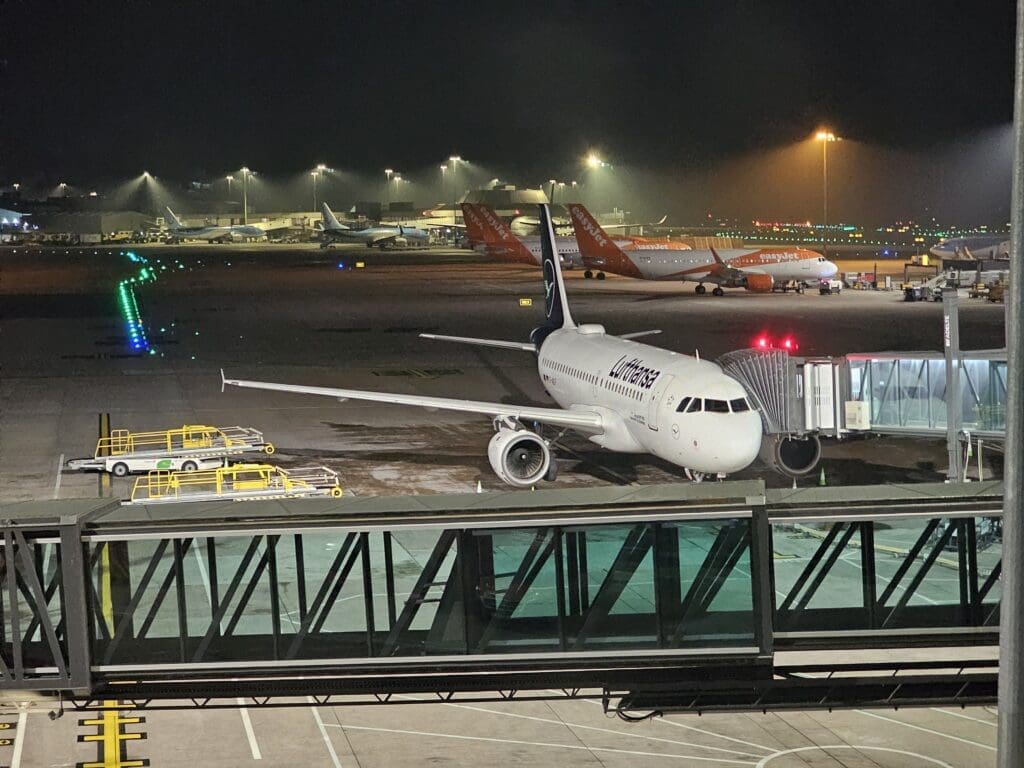
That morning, I would be flying to Germany on Lufthansa’s fifth-oldest Airbus A319, D-AILF, named after the Upper Palatinate town of Neumarkt in der Oberpfalz. A German jet through and through, this Airbus A319-114 was assembled at Airbus’ Hamburg Finkenwerder plant and commenced its long career with Lufthansa in December 1996. However, throughout its life, the aircraft has also spent short stints operating for Air Malta, Germanwings and Lufthansa Italia in 2001, 2004 and 2010, respectively. Today, the aircraft spends its days shuttling passengers here, there and everywhere within Europe. However, the past few months had been quiet for the aircraft, having only emerged from heavy maintenance in the Jordanian capital, Amman, three days before my flight. Since then, the aircraft had been operating short hops, connecting Frankfurt with Bremen, Geneva, Gothenburg, Hamburg, Hannover, Manchester, Milan Linate and Venice.
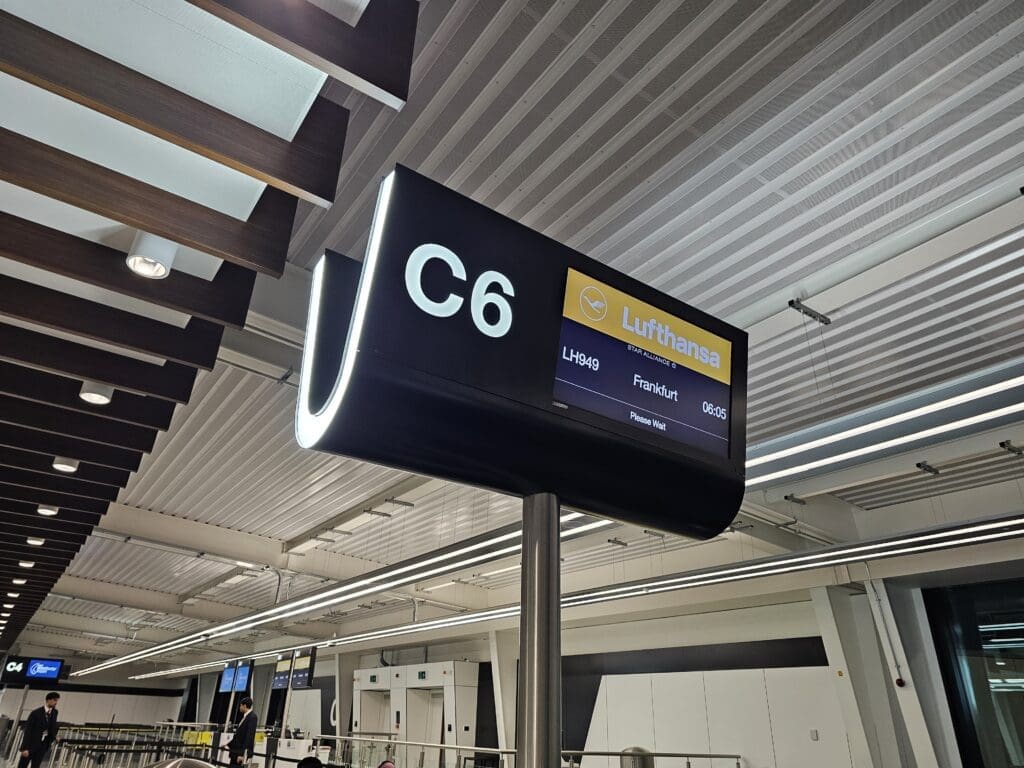
With forty minutes to go until our scheduled departure time, one of the two gate agents performed an announcement welcoming passengers to the Lufthansa service, and invited those requiring assistance and travelling with young children to board the aircraft. However, with few passengers falling into either category, the ground staff soon began to work their way through the numbered groups. No more than five minutes after boarding had commenced, at 0530, those in Group 3 were invited to board the aircraft, and with no reason to linger around, I joined the short queue leading up to the gate podium. Following a scan of my boarding pass and a quick check of my passport by the friendly Swissport gate agent, I headed down a corridor before reaching the stairwell that led to the jetbridge. Having timed things just right, upon arriving at this stairwell, the actual act of boarding had just commenced, and so the queue of passengers on the stairs began to budge, meaning that I was not in for any long waits.
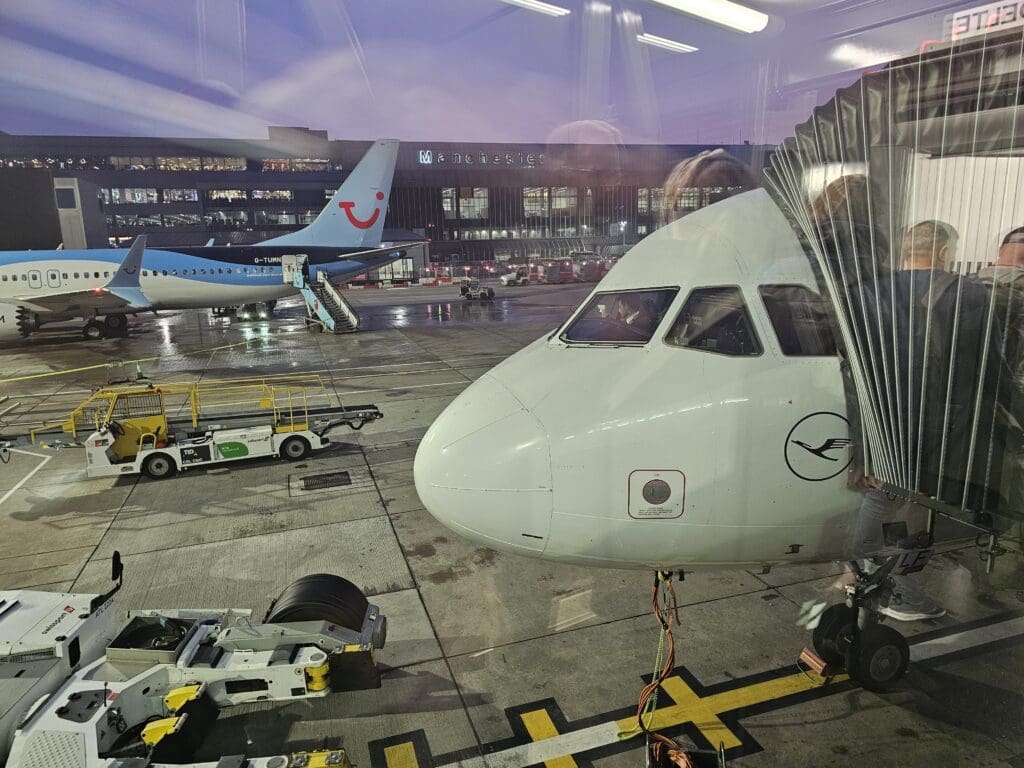
After spending a few minutes edging forward on the jetbridge, I stepped into the Airbus’ forward galley. Unfortunately, failing to give off a good first impression, there, two flight attendants did not welcome passengers, and were instead engrossed in a highly animated conversation. Thus, I turned right and entered the Airbus’ 138-seat cabin without a word. As with most European carriers, Lufthansa’s narrowbody jets feature a ‘Eurobiz’ style premium cabin, consisting of your standard Economy seats, albeit with a blocked middle seat and a curtain separating this section of the aircraft from the masses. That day, Business Class took up the first four rows of the aircraft, and upon boarding, all sixteen seats in this section had been filled. Steaming past the curtain that divides the two cabins, I soon reached my seat, which was located two rows behind the single emergency exit row.
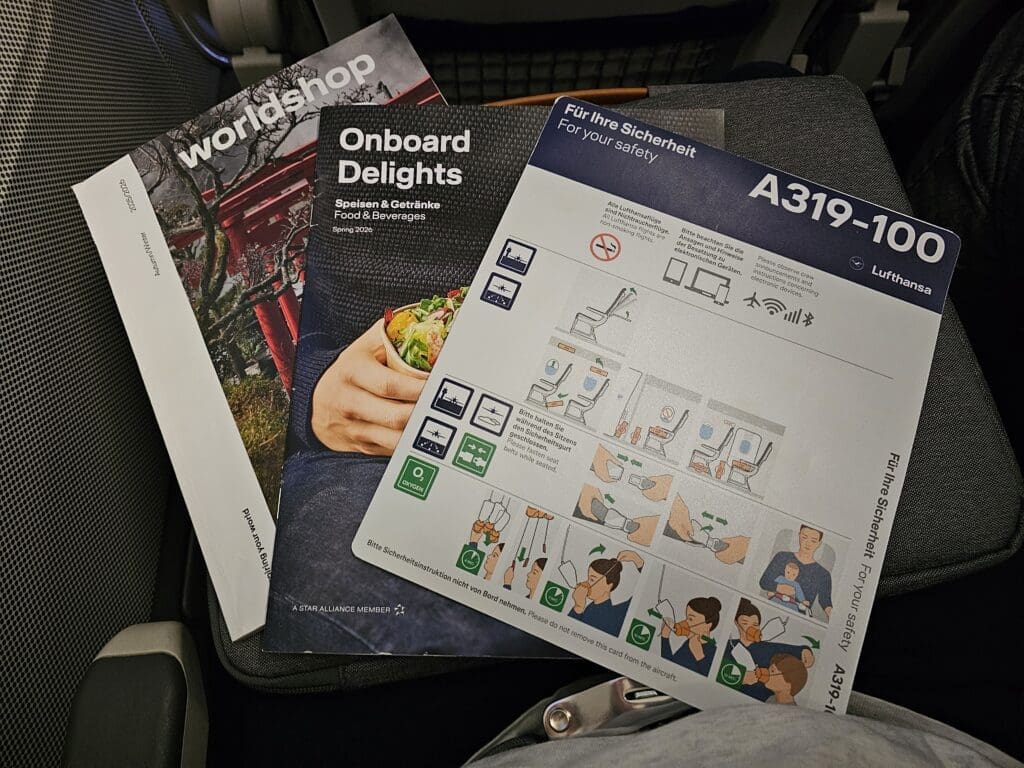
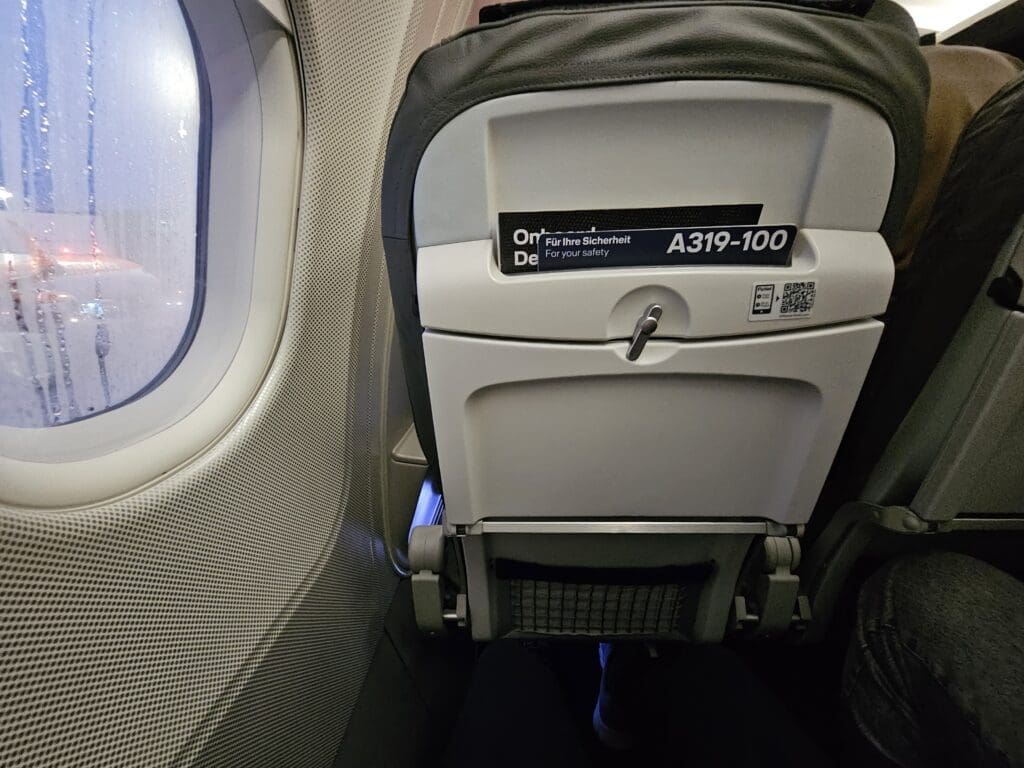
Onboard, that particular aircraft was fitted with the older of Lufthansa’s two Airbus narrowbody seats currently in service, the Recaro BL3520. This is a common slimline seat which can be found in service with carriers across the world. Each of these was covered in a grey pleather cover and topped with a smart antimacassar on which Lufthansa’s famous crane-focused logo was stitched. Each seat came with a tray table, a coat hook, a seatback pocket and a literature compartment which contained a copy of the safety card, the Onboard Delights buy-on-board menu, and the Worldshop duty-free catalogue.
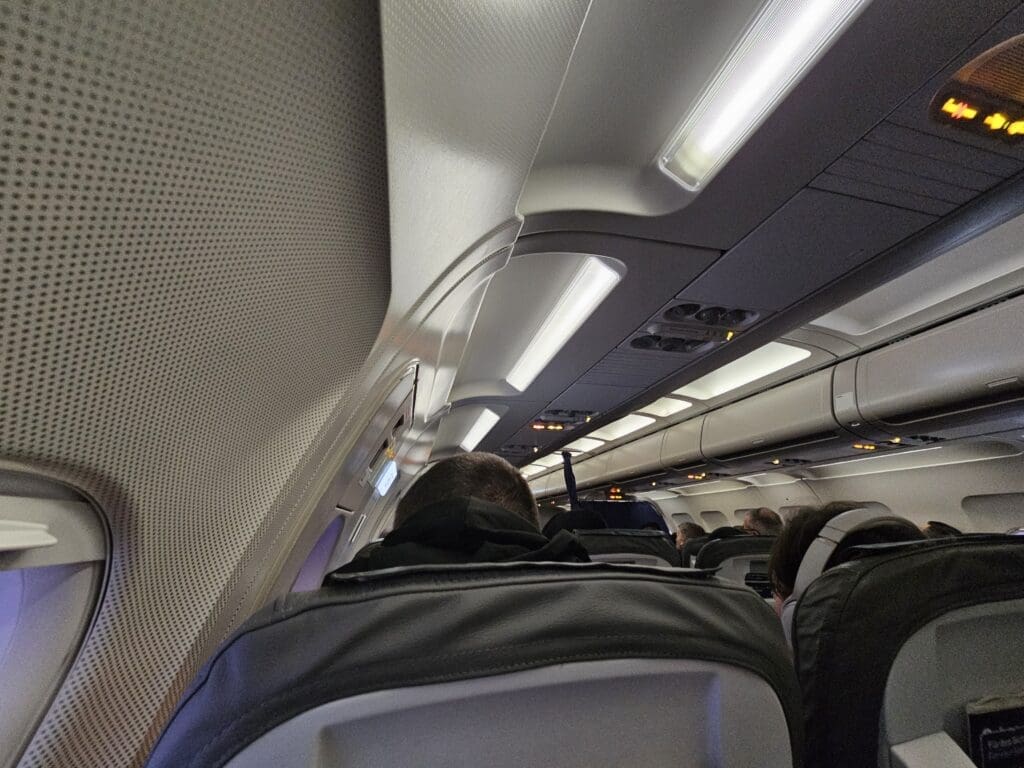
After sliding into my seat, I fastened my seatbelt and settled in for the short ride ahead. Taking the edge off my negative first impression of the crew, looking around, my first impressions of the seat and the area around it were largely positive. Whilst the seat itself was firm, and I am sure those on longer flights would likely end up shuffling around after two hours or so, this was reasonably spacious with a decent amount of legroom. Furthermore, despite the aircraft’s age, I failed to spot any noticeable signs of wear and tear, indicating a good level of care and attention in the upkeep of the aircraft’s cabin. Importantly, the aircraft appeared to have been thoroughly cleaned during its overnight stay in Manchester, and no dirt, rubbish, stains or crumbs could be spotted as I examined the area around my seat.
Perhaps eager to jet off, that morning, all passengers made it to the gate on time and filtered onto the aircraft at a reasonable pace. This meant that boarding was announced as complete, a full ten minutes ahead of our scheduled departure time at 0555. That morning, the flight appeared to be totally full, and as expected, most passengers seemed to be connecting in Frankfurt, with plenty of passengers bound for both East and South Asia, and North America. A few moments later, the Captain performed a brief announcement in German and English, during which they introduced themselves, the First Officer and the Purser, noted that we could expect an on-time departure, detailed the weather in Frankfurt, and of course thanked passengers for flying with Lufthansa. Contrasting with the calm coolness of the Captain, inside the cabin, the cabin crew could be seen playing Tetris with passengers’ bags in an attempt to ensure that nothing would have to be checked into the hold at the last minute, potentially resulting in a delay. Fortunately, they succeeded in this, and soon, all the overhead lockers were closed in preparation for our departure. At this point, the Purser welcomed all passengers aboard and provided all the usual cautions and warnings in both German and English.
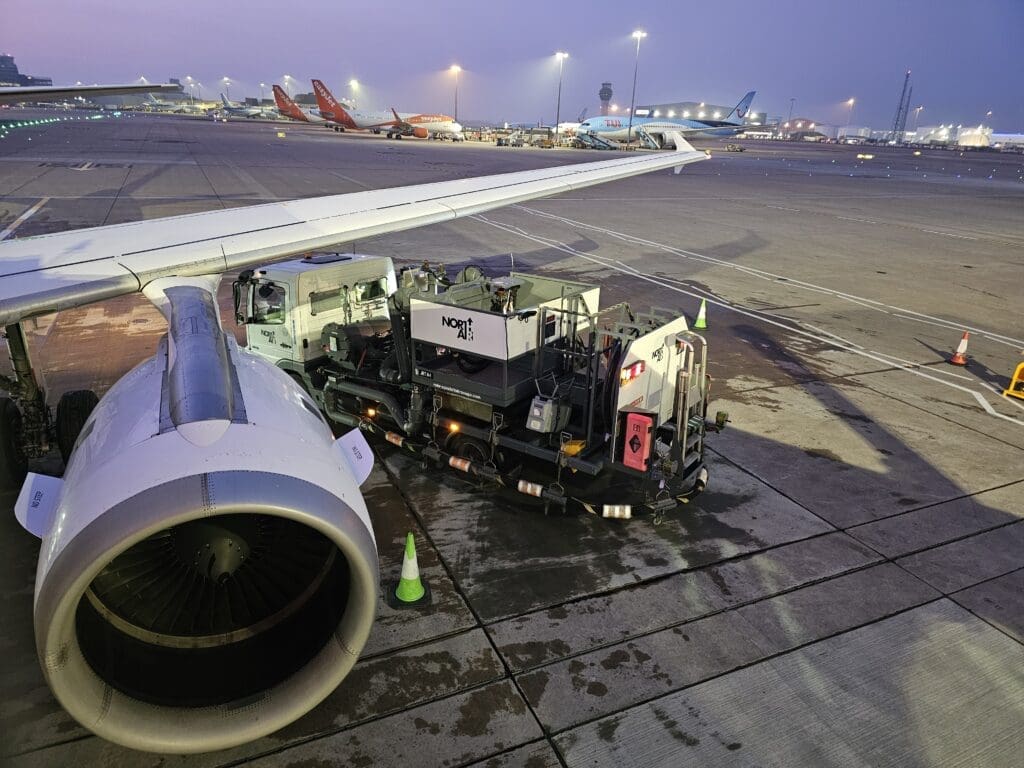
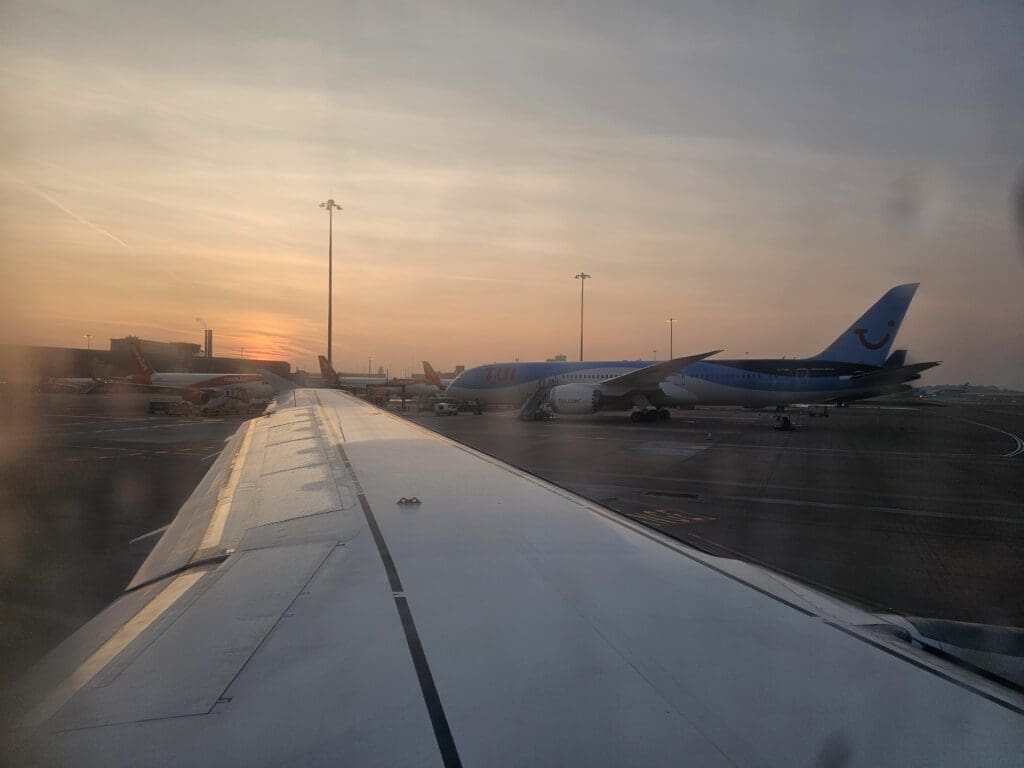
Once the Purser had completed their welcome announcement, the crew took their positions in the aisle and performed a safety demonstration along to a pre-recorded soundtrack in German and English, whilst outside, the ground crew undertook the last of their preparations for the aircraft’s departure and removed all cones and equipment from around the aircraft. Despite all being ready on time, seeing as we were departing in the midst of the early morning rush, a short wait was in store whilst a pair of TUI Airways Boeing 737 MAX 8s pushed back behind us at the start of their journeys to Chambéry and Salzburg. Ten minutes after our scheduled departure time, the Captain performed another short announcement, during which they reassured passengers that we would soon push back and advised that this delay was due to congestion on the ramp. With a long connection in Frankfurt, this delay was no disaster for me, and I appreciated the fact that the Captain kept us updated on the situation.
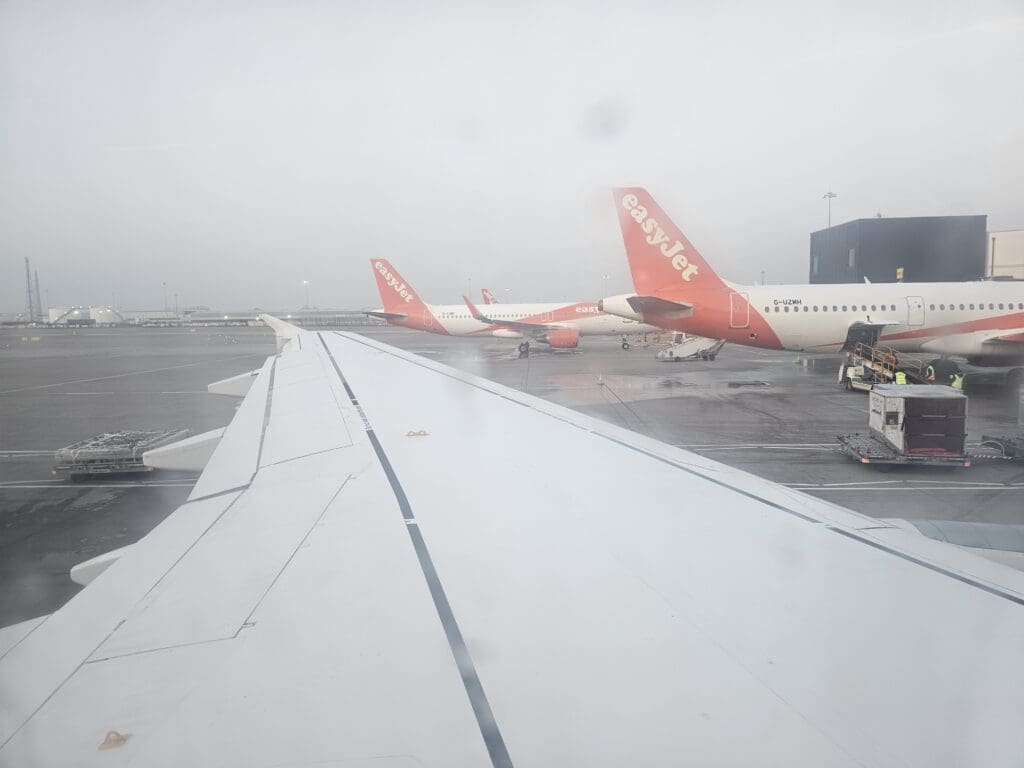
As soon as the two aforementioned TUI Airways Boeing 737s had commenced their taxi, at 0617, the Airbus jolted backwards, and the two CFMI CFM56-5A5 engines quietly spooled into life, accompanied by the infamous Airbus A320 Family ‘barking dog’ sound as the Power Transfer Unit worked its magic and balanced the hydraulic pressure between the aircraft’s systems. Afterwards, the flaps were partially extended with a whine, and once the pushback crew had cleared the aircraft, the Airbus slowly and cautiously powered away from the ramp and commenced its journey to the runway. From our parking position, the Airbus journeyed past Terminal 1, where, despite being closed, several of its stands could be seen occupied by EasyJet and TUI Airways aircraft, with passengers on these passing through Terminal 3 and being bused to and from their aircraft. At this point, I was treated to fantastic views as the bright red sun peeped up from the horizon and rose above the morning dew. However, sadly, good pictures of this were limited thanks to the poor state of the windows, which required a good clean.
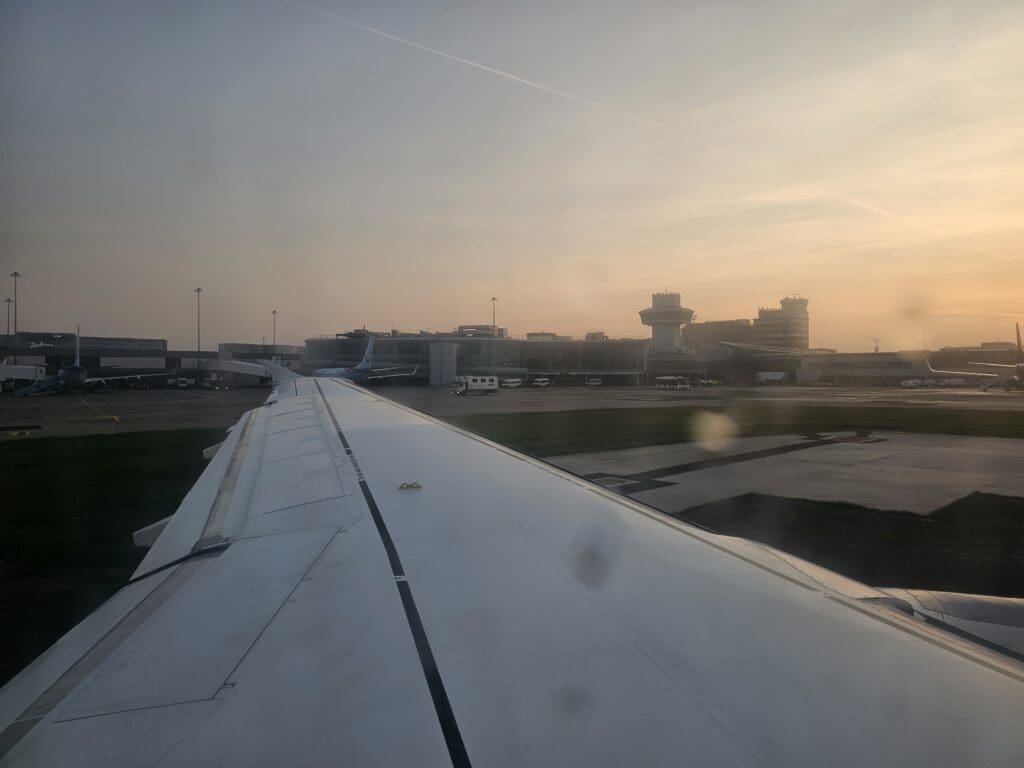
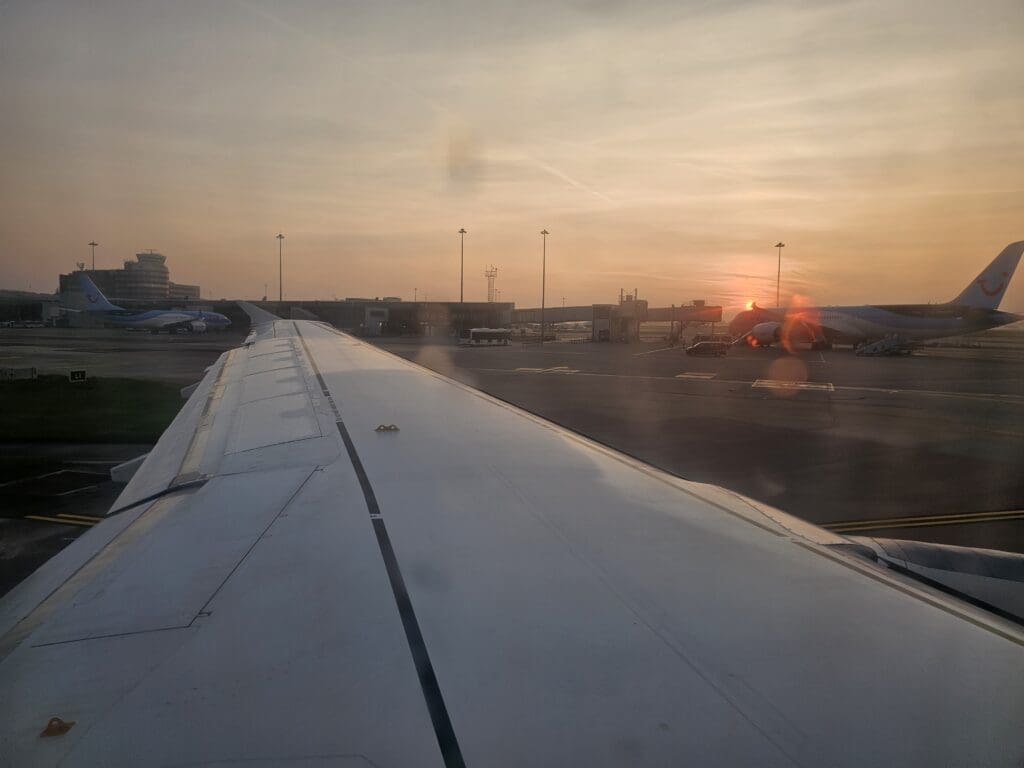
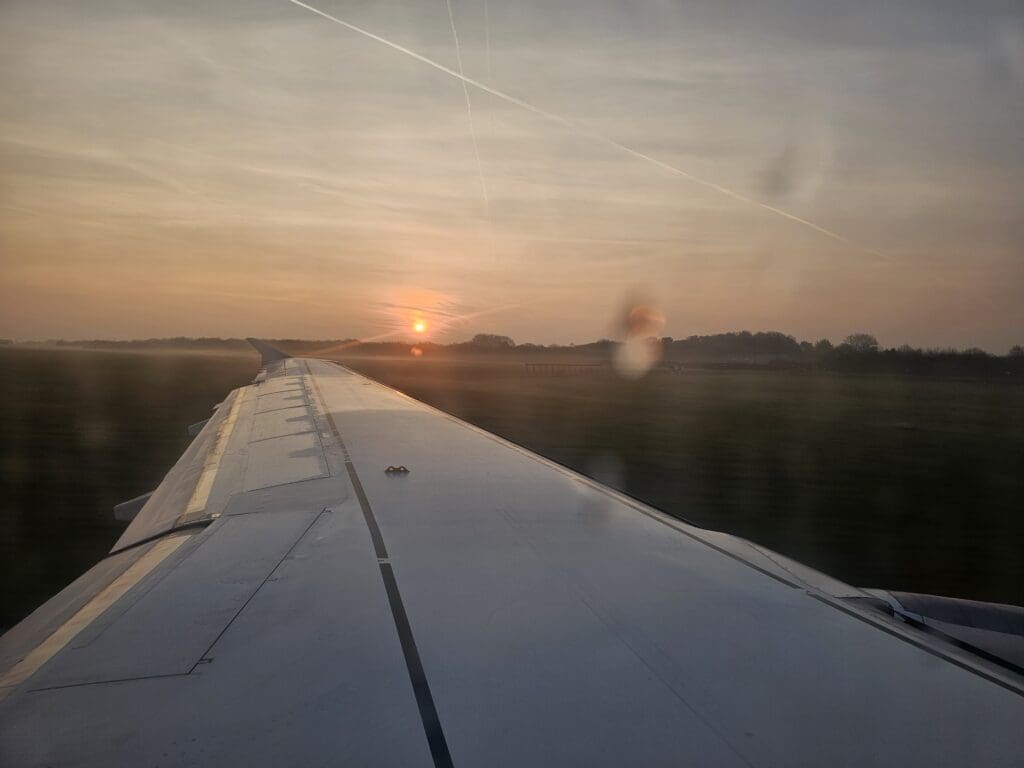
Whilst Runway 23L appeared to have been in use thus far that morning, soon, it became clear that we would depart from the parallel runway, Runway 23R. This meant that we soon came to a halt whilst a Ryanair Boeing 737 MAX 8-200 rocketed away, shuttling a load of holidaymakers to Tenerife. Once this had passed us, we crossed the runway and soon came to another halt. During our journey from Terminal 2, the Airbus had been tailed by a British Airways Airbus A320, which sneakily snuck in front of us, meaning that we would not have the accolade of being the first departure of the day from Manchester’s southerly runway. After a few minutes, the Airbus taxied onto the runway and paused for a few moments. Eventually, a grand total of 29 minutes after our scheduled departure time, at 0634, Lufthansa 4 Papa Lima began its short yet reasonably gentle take-off roll before the pilot flying pulled back on the sidestick, and we went rocketing into the picturesque pink dawn skies above Cheshire.
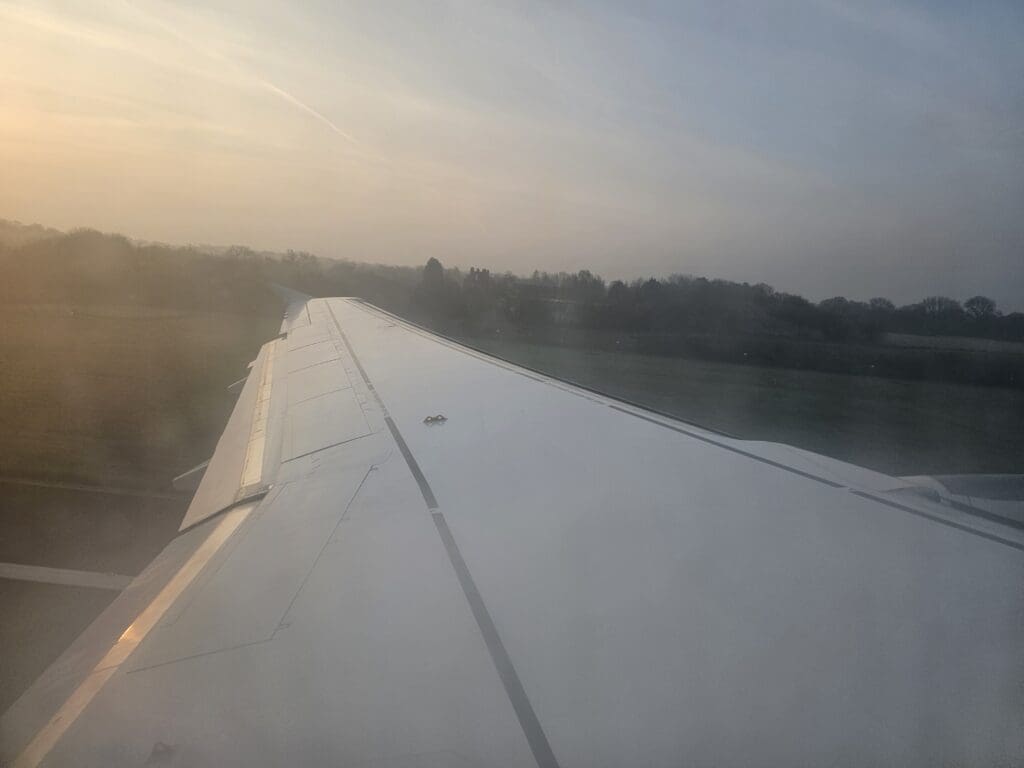
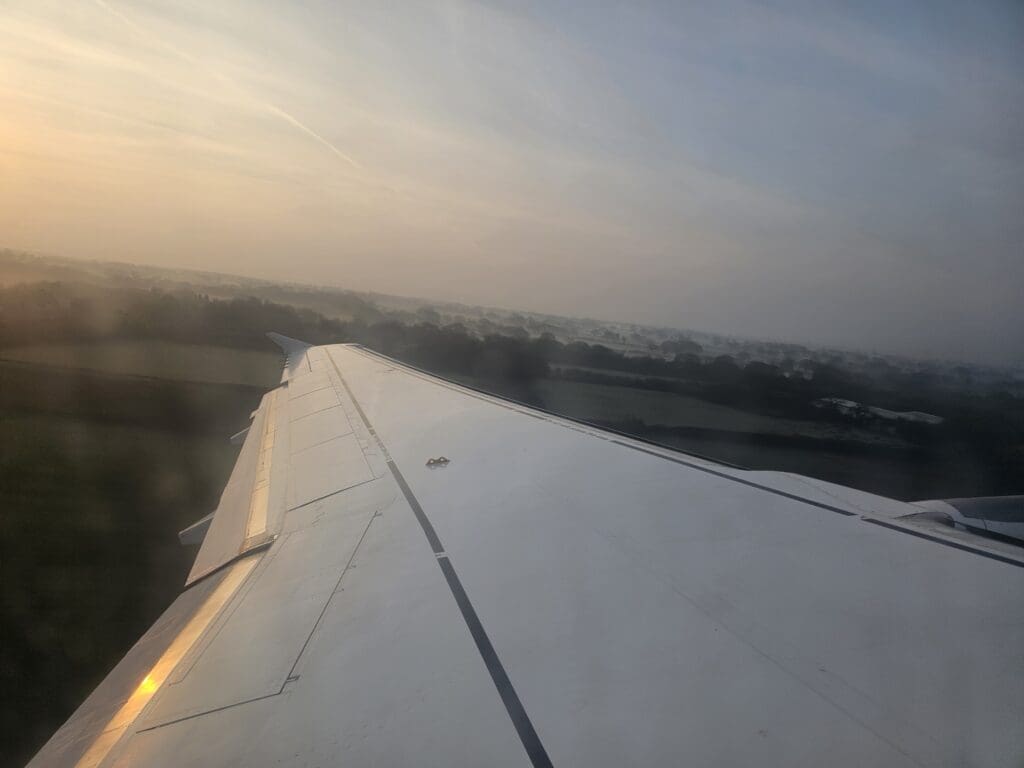
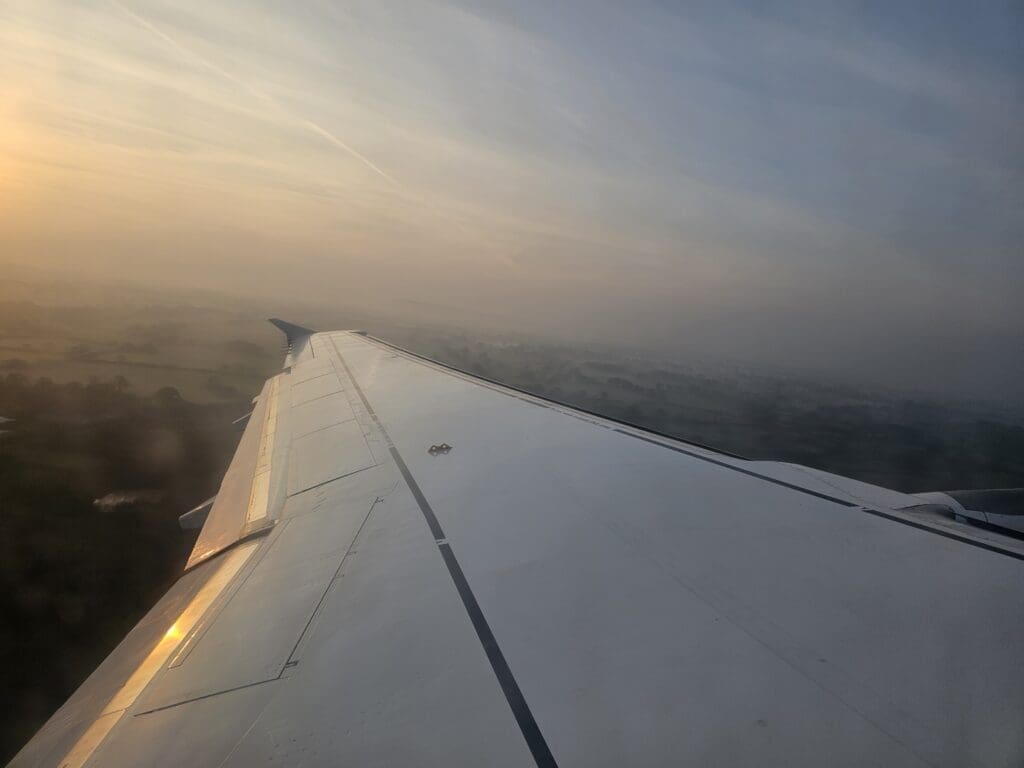
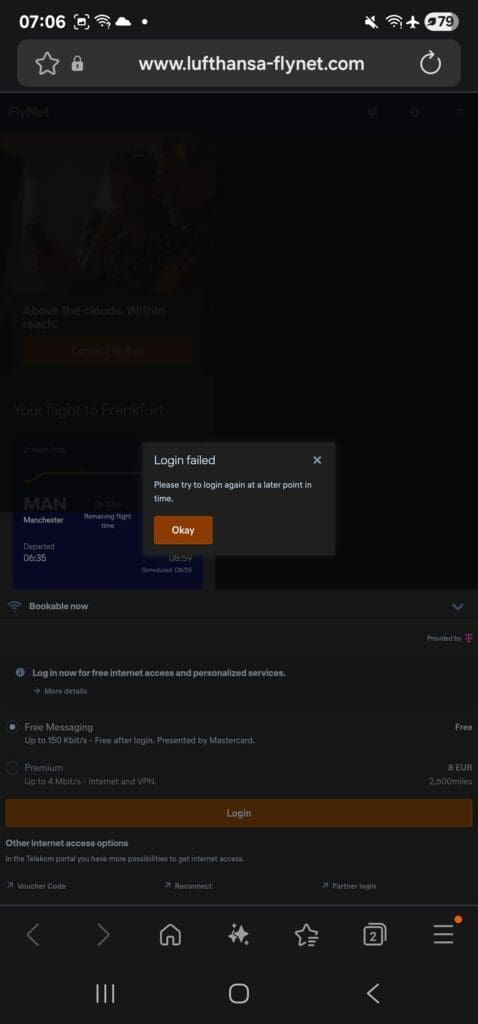
Upon leaving the airport behind, I was treated to scenic vistas of the dew-covered countryside; however, just before reaching the well-to-do town of Knutsford, the Airbus banked to the right and made a gentle U-turn that would put us on course for Frankfurt. As we banked, two pre-recorded announcements rang out in German and English. The first of these detailed all the usual warnings regarding seatbelts and advised passengers to keep an eye on electronic devices in case they decided to combust, with the other noting that the FlyNet onboard internet service was now available. Like many airlines, Lufthansa allows members of their frequent flyer programme, Miles & More, to connect to the wifi to use messaging services without payment, whilst those wanting to surf the internet could have done so for €8.00. However, upon attempting to use the complimentary messaging service, I repeatedly received an error message, thus rendering the wifi unusable for the duration of the flight.
By the time the aircraft had rolled out on an east-southeasterly heading, the Airbus had passed over Stockport and was now climbing over the hills of the Peak District National Park and towards my hometown, Sheffield. Whilst the tops of the peaks would have been lovely to spot as they poked out of the low-lying clouds, unfortunately, my seat over the wing meant that nothing of the Peak District could be seen as we sped towards my hometown, Sheffield. After soaring over Sheffield, the Airbus cut across a small portion of Nottinghamshire before reaching the county of Lincolnshire, which has a rich aviation history as its flat landscape and position near the east coast had made it ideal for the construction of air bases during the Second World War, some of which, most notably RAF Coningsby and RAF Waddington, remain active air stations today. Soon, we crossed the Lincolnshire coastline and headed out across the Wash, reaching the North Norfolk coastline a short time later, at which point we levelled off at our cruising altitude of 38,000 feet.
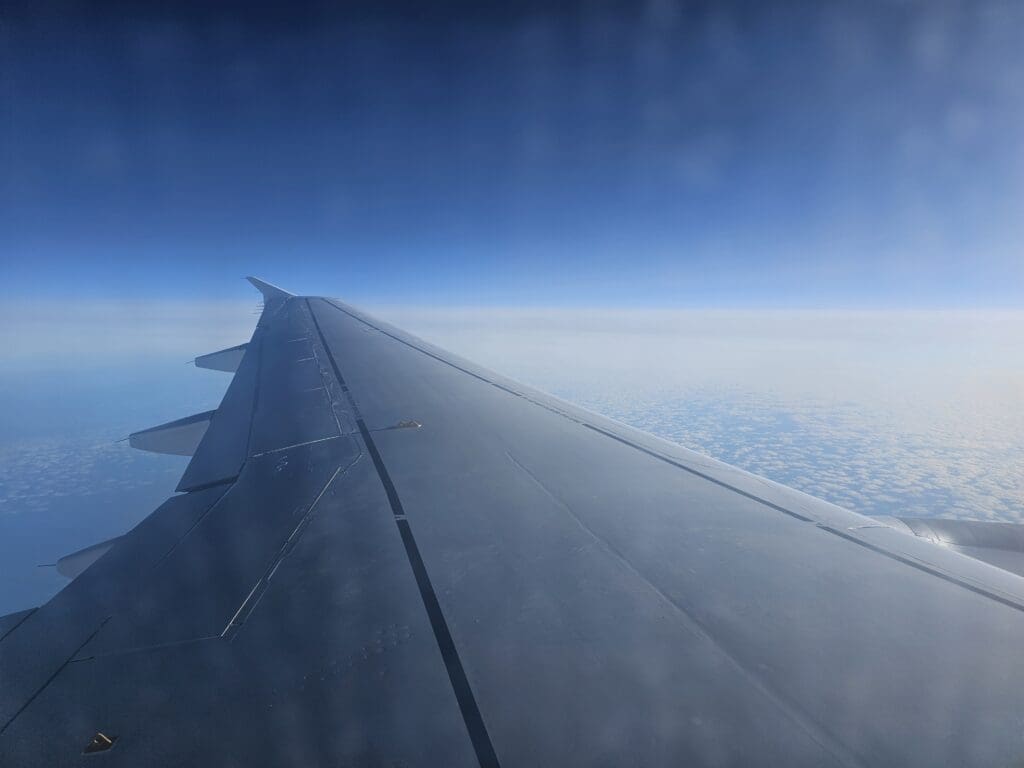
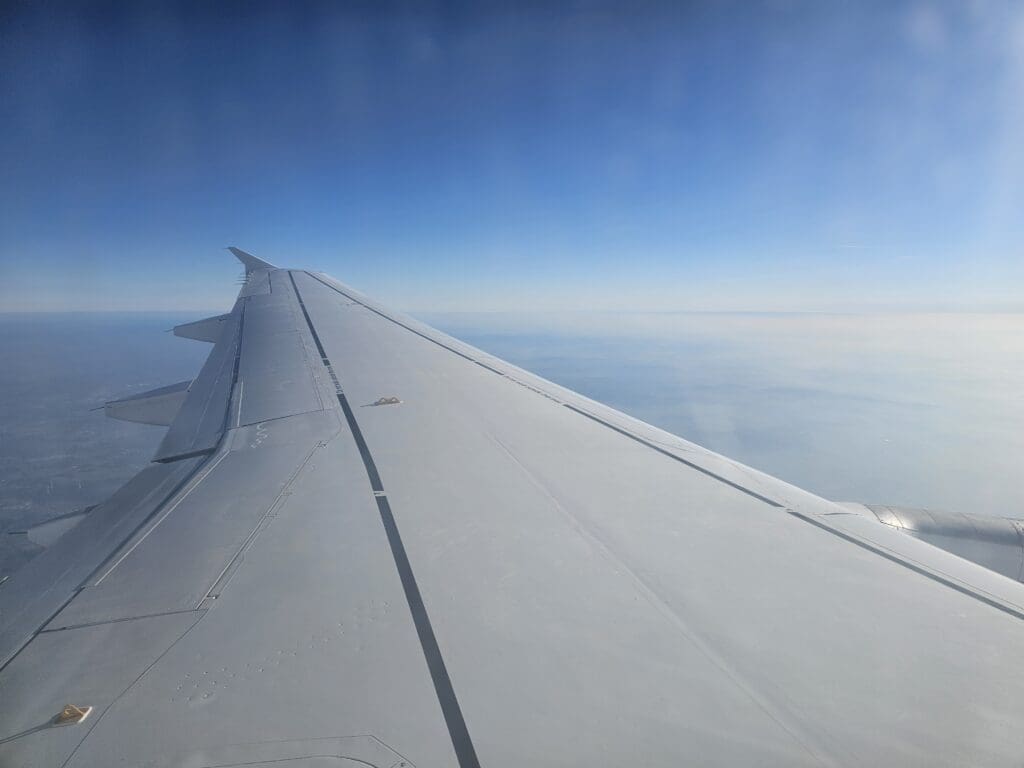
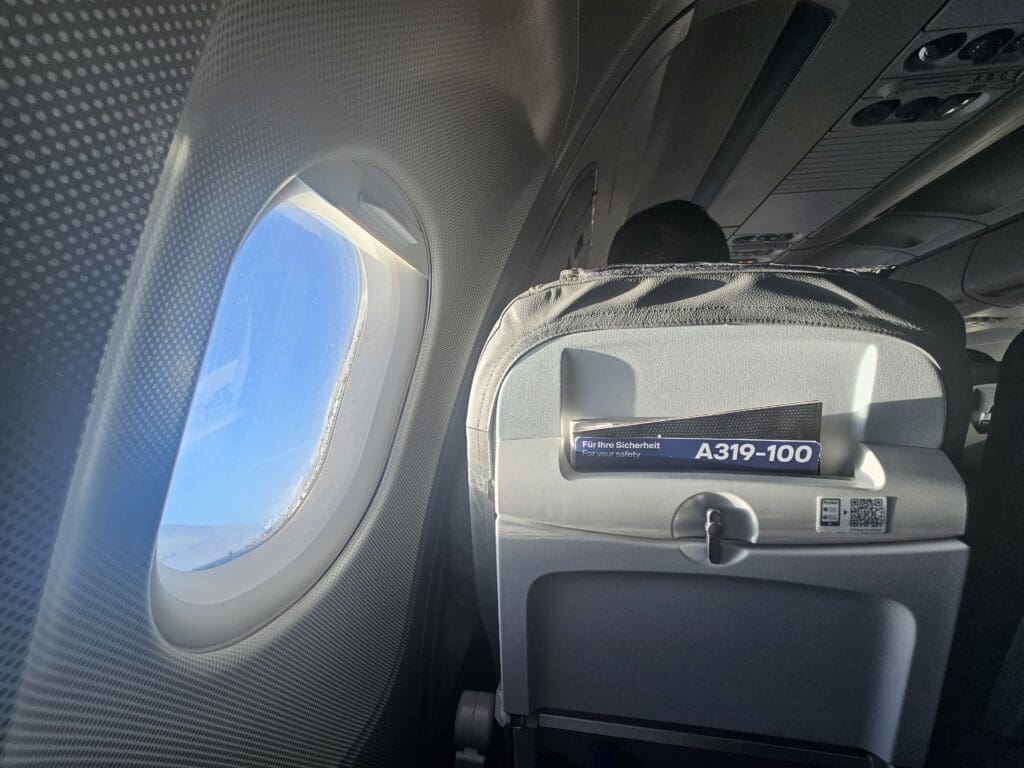
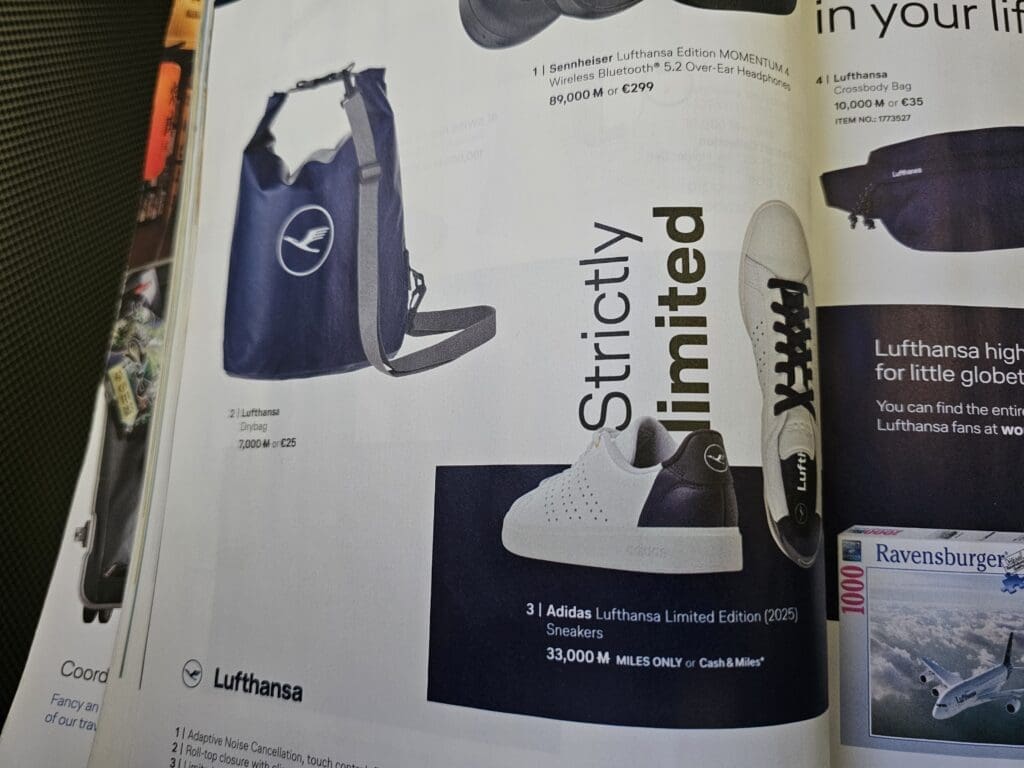
Once we had levelled off, the onboard service commenced. As with many European full-service carriers, service onboard Lufthansa’s short-haul flights consists of a hybrid service. In Economy, all passengers were handed a 300ml bottle of Aqua d’Or still water before a cart was rolled to the front of the cabin, at which point the Onboard Delights buy-on-board service commenced. Browsing the menu, this was neither expansive nor compact, and offered an array of hot and cold, hard and soft drinks, as well as snacks and light meals, such as pasta bowls and sandwiches. Many of these items were introduced in collaboration with German brands. For example, hot drinks and pastries are branded by Dallmayr, and the most substantial offerings by dean&david. In terms of prices, items appeared to be largely in line with those of other full-service and low-cost European carriers.
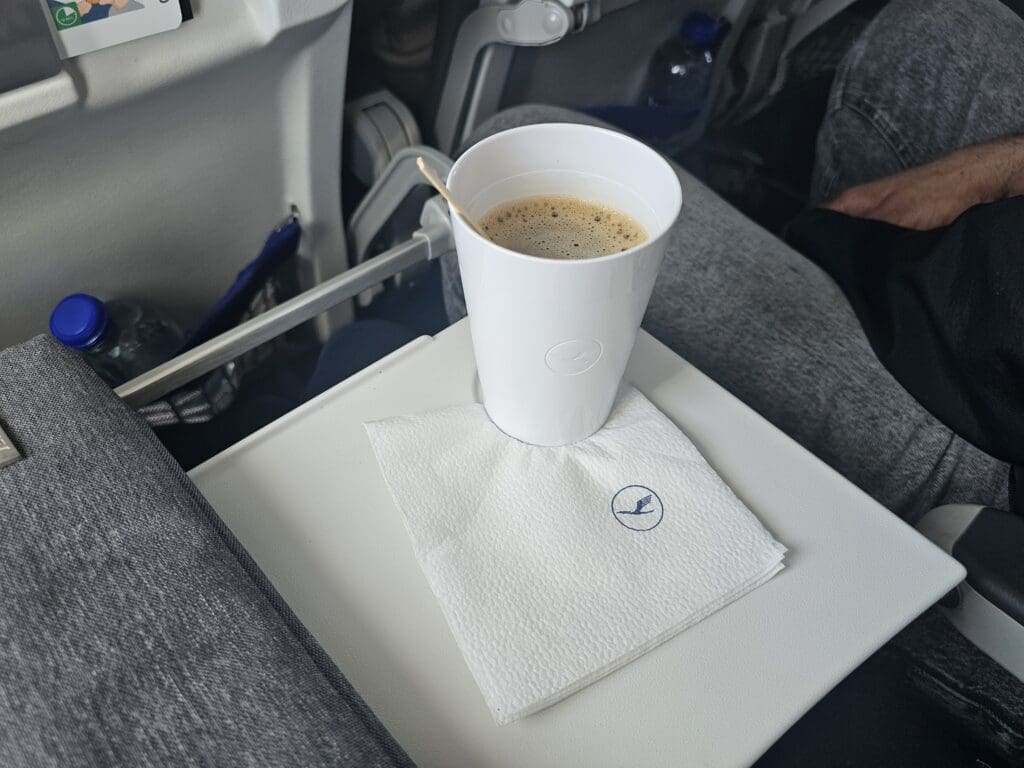
Wanting the full Lufthansa experience, I opted to have a 250ml black coffee for €3.70, which was soon passed over to me in a nice reusable plastic cup on which the Lufthansa logo was engraved. Ending the inflight service, a few minutes after this, the crew passed through the cabin handing out small Lindt chocolates in a nice Lufthansa-branded paper wrapper. Unfortunately, continuing with my relatively negative impression of the crew, that morning they were cold and distant, and undertook the service in a brash manner during which they had little interaction with passengers. This is something that I have also found to be the case on a number of my previous flights with Lufthansa.
As I sipped my coffee, fourteen minutes after leaving the Norfolk coastline behind, our crossing of the North Sea came to an end, as we made landfall near the famous Dutch city of The Hague. Heading inland over South Holland, the aircraft passed Delft, famous across the world for its ceramic products, followed by the country’s second largest city, Rotterdam. From there, we cut across the Netherlands, although sadly, the clouds below, coupled with my position, meant that nothing could be seen of the flat rural landscapes below. Making a quick crossing of the country, just twelve minutes after passing over the Dutch coastline, we passed the border city of Venlo and headed into the skies of Germany.
Almost immediately after entering German skies, the noise from the engines decreased, and the aircraft could be felt commencing its descent into Frankfurt. As we passed Düsseldorf, several dings could be heard, at which point the Purser performed their pre-landing announcement with the usual warnings regarding seatbacks, tray tables, seatbelts and window shades, before a quick rubbish collection round was undertaken. Once this had been completed, several crew members passed through the cabin, ensuring that all was secure and in place for our arrival.
From Düsseldorf, the Airbus made its way past Cologne and Bonn, passing from the skies of North Rhine-Westphalia to those of Rhineland-Palatinate. Outside, the weather looked good, and the aircraft descended without a single jolt of turbulence; however, as had been the case that morning in Britain, a layer of dew seemed to linger around much of the region, meaning that views of Germany were somewhat limited until we were on approach to Runway 07L. That day, our approach to Frankfurt was fairly straightforward, with no holding required. This took us southwards from Koblenz to Wiesbaden, before we entered the downwind leg, before turning back towards the airport, at which point the landing gear and flaps were extended for our arrival.
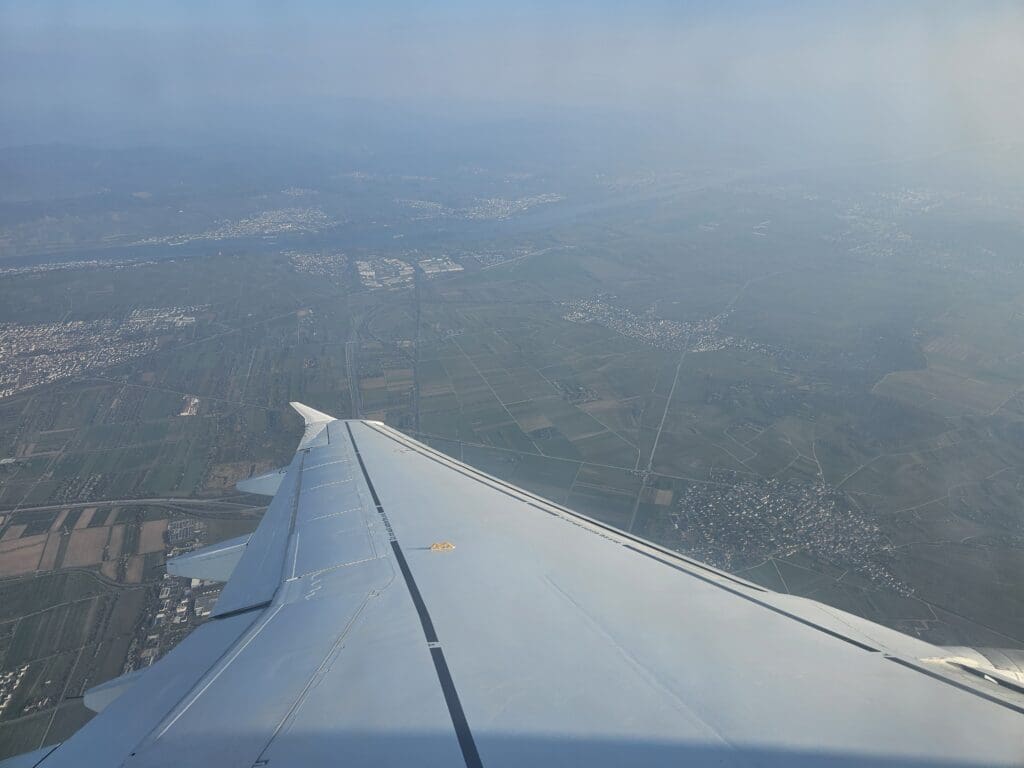
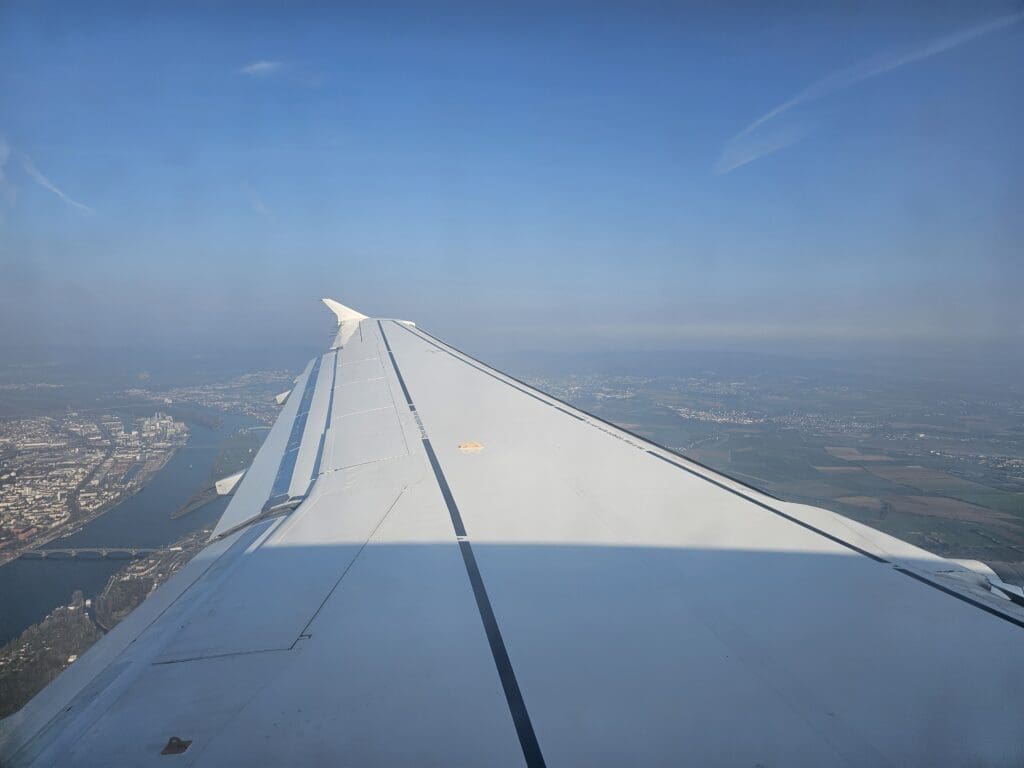
Once lined up for the runway, decent vistas of the Rhine appeared before we passed over the city of Mainz, the capital of Rhineland-Palatinate, before we entered the skies of the state of Hessen. Once on the northern side of the Rhine, we passed over the towns of Ginsheim-Gustavsburg, Hochheim am Main, and Flörsheim am Main. A grand total of 85 minutes after rocketing into the skies of Manchester, the Airbus touched down in Frankfurt with a soft bump before decelerating rather gently. Upon vacating the runway, the Purser welcomed all to Frankfurt and gave the usual cautions against moving around until the seatbelt signs had been extinguished as we crossed over the main railway line that heads west out of Frankfurt, as well as the Bundesautobahn 3.
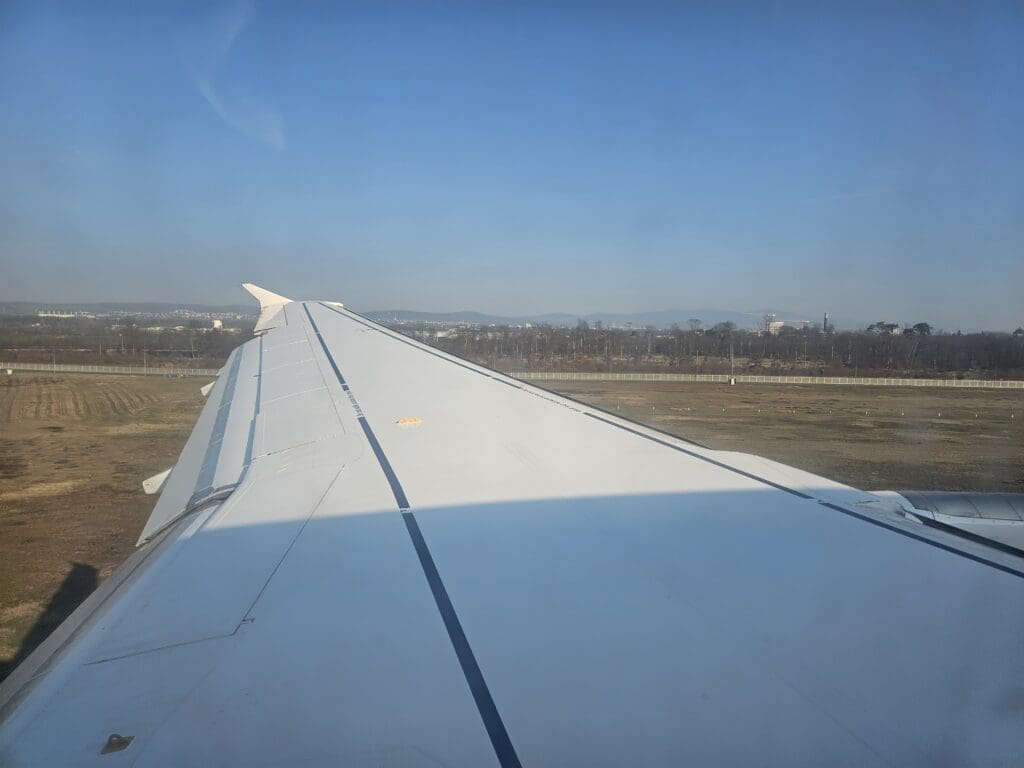
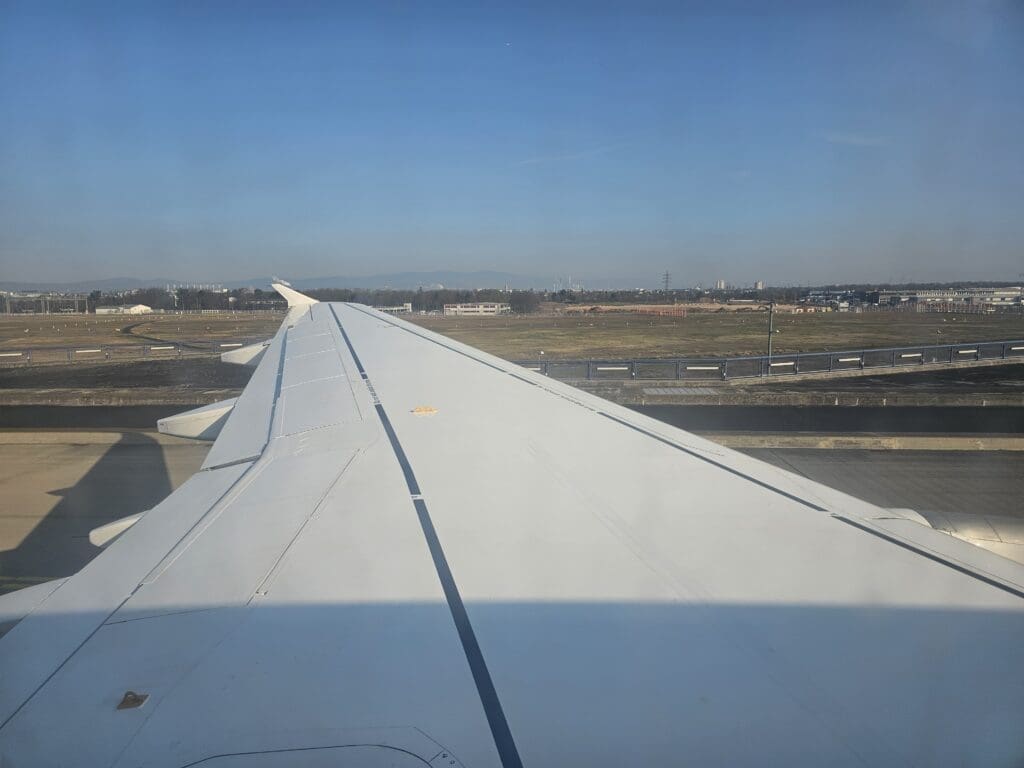
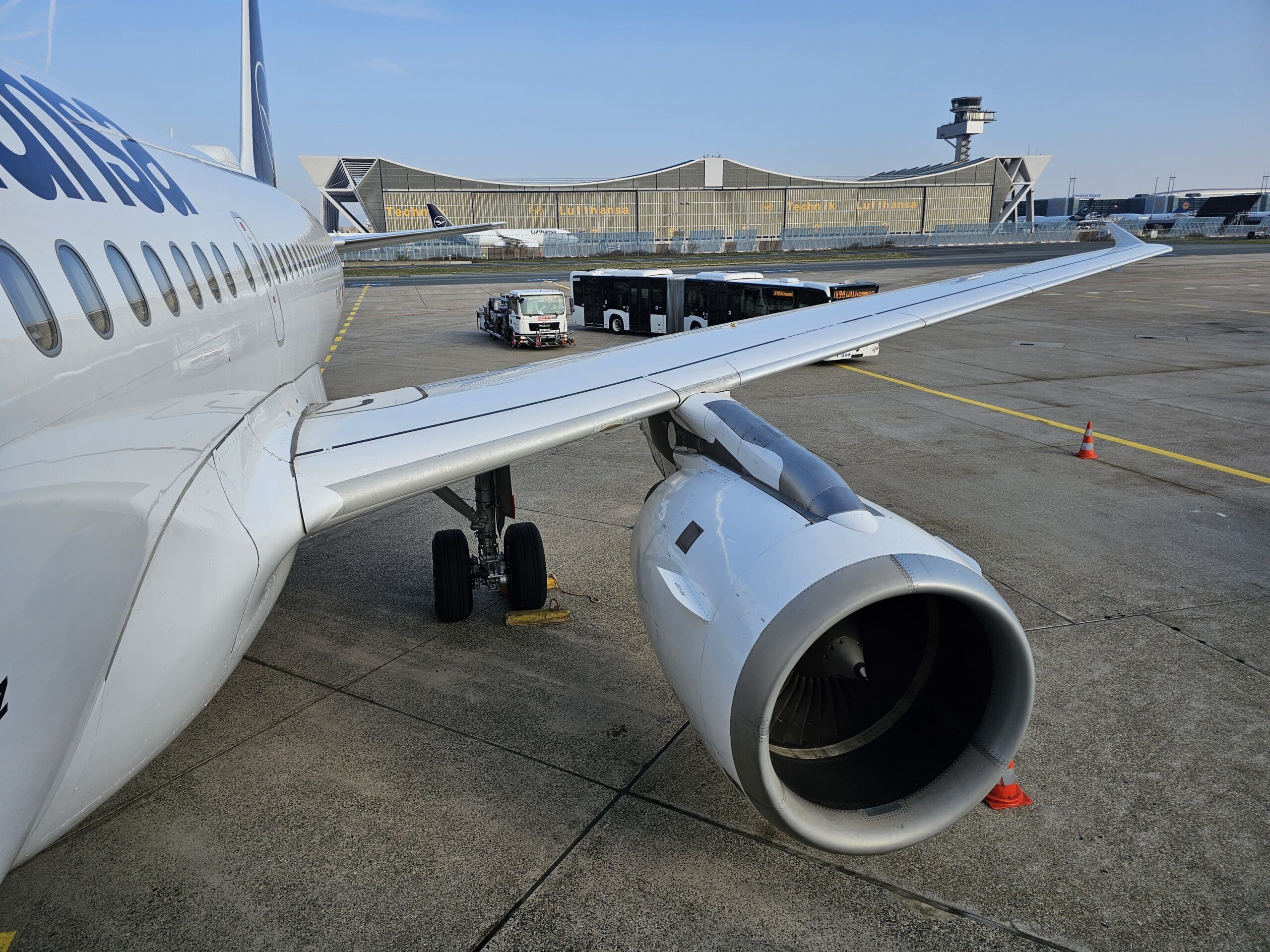
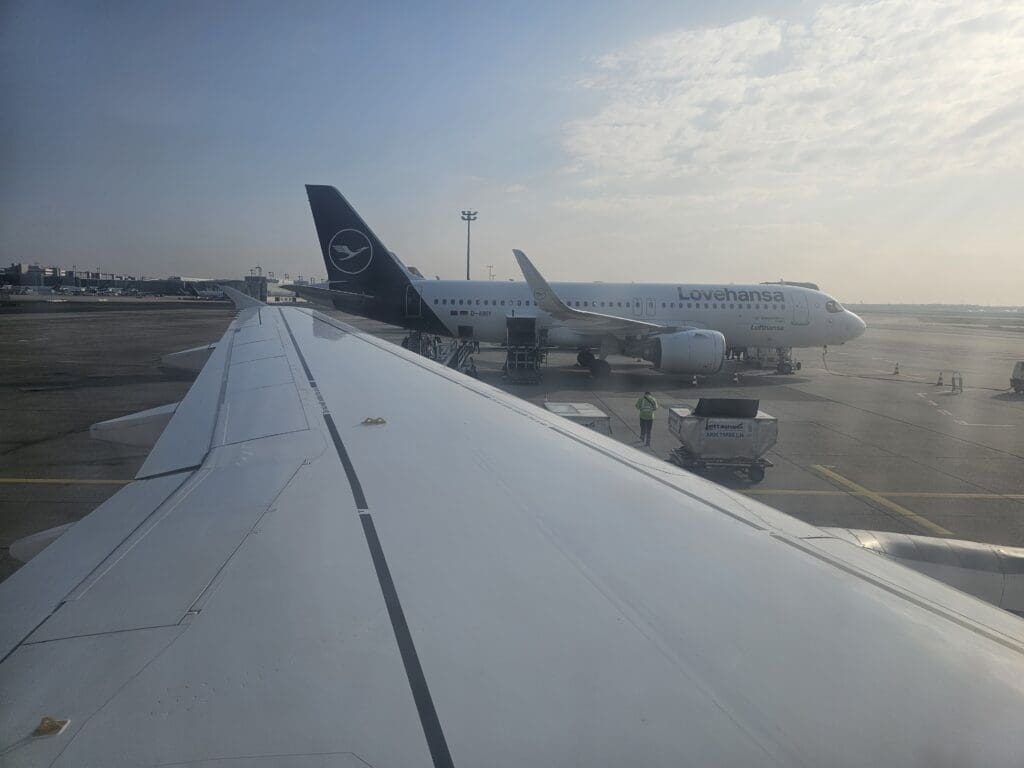
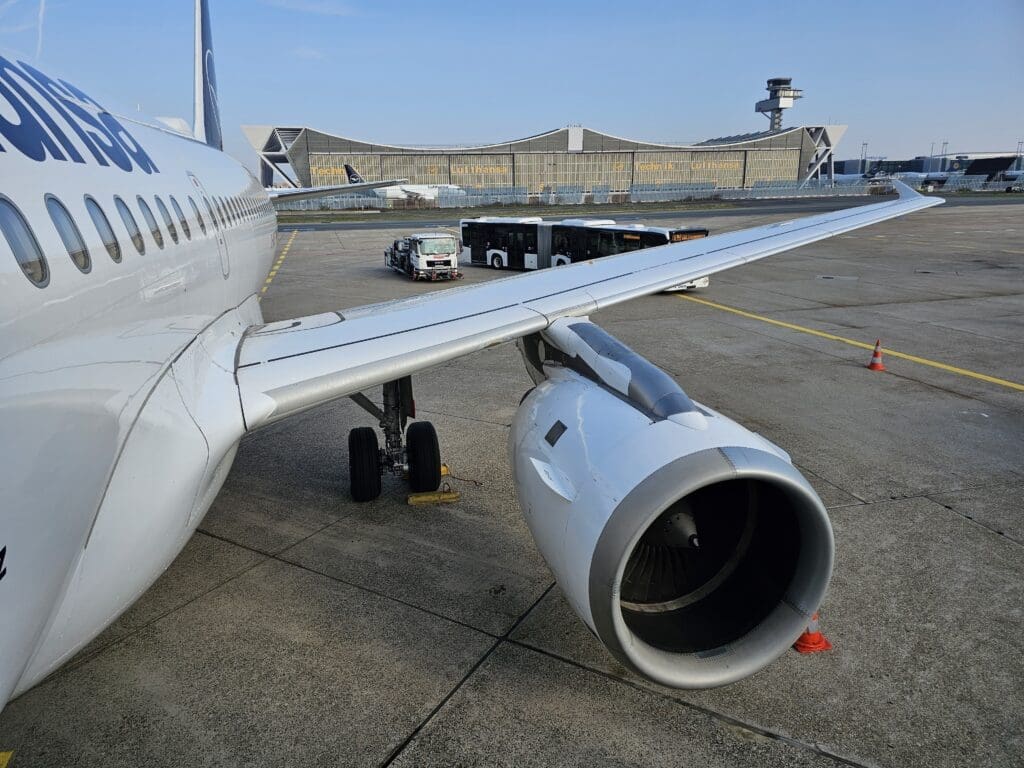
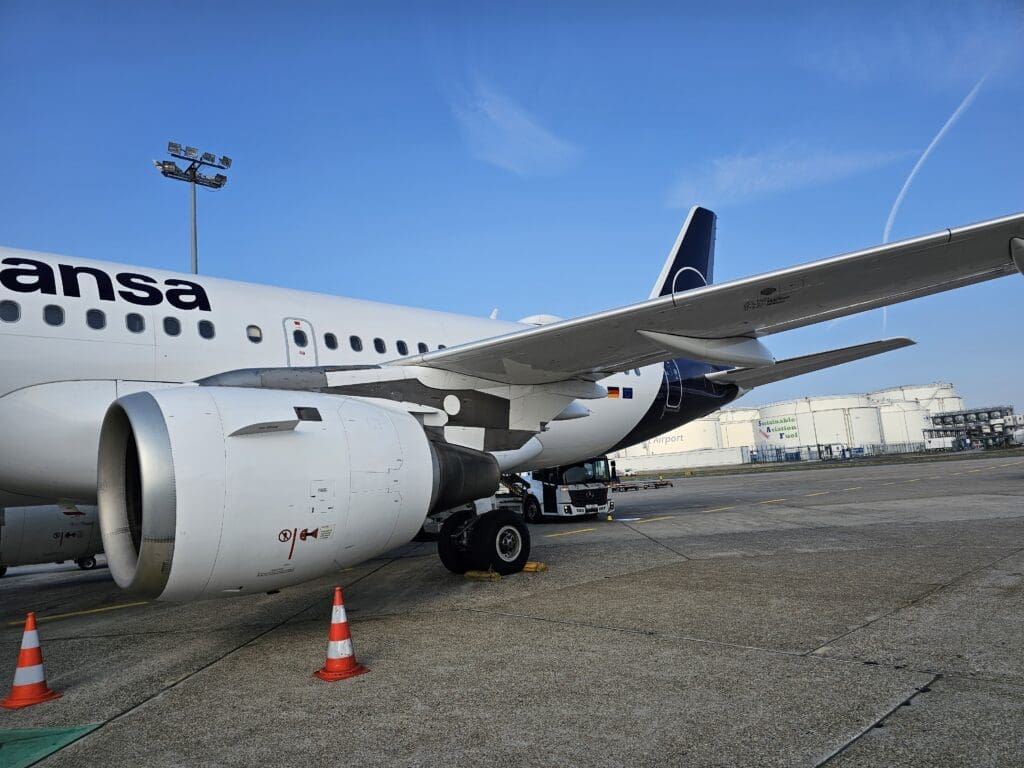
From there, we passed Lufthansa Technik’s large and iconic hangars, and, expecting a long taxi to Terminal 1, instead, the Airbus soon left the taxiway and came to a halt at a remote stand, Stand V162 to be precise, where we pulled up next to the Lovehansa jet as it was being readied for its next mission to Sarajevo. Coming to a halt nine minutes behind schedule at 0804, once the engines spooled down, plenty of passengers flocked to the aisles in an apparent desperate rush to escape; however, it took some time before the stairs were positioned. Around ten minutes after coming to a halt, the door was opened, and disembarkation commenced. Soon, heading out into the chilly yet refreshing Frankfurt air, I made my way down the steps and boarded the bus for the ride over to the terminal, ending my ride over from Manchester.
Summary
To be fair, I entered this flight with fairly average expectations, with my previous short-haul hops with Lufthansa having encouraged me not to expect too much when flying with Germany’s flag carrier. Thus, overall, I would say my experience was fairly average. Whilst the crew were not the friendliest and did not seem to be too happy to be at work that day, I was pleased to find that the seat was clean, comfortable and in good condition. Meanwhile, Lufthansa got me to Frankfurt in one piece, and not too long after we had been scheduled to arrive.