Flying the Boeing 747-400 for One Last Time: Frankfurt to Bengaluru with Lufhansa
Background
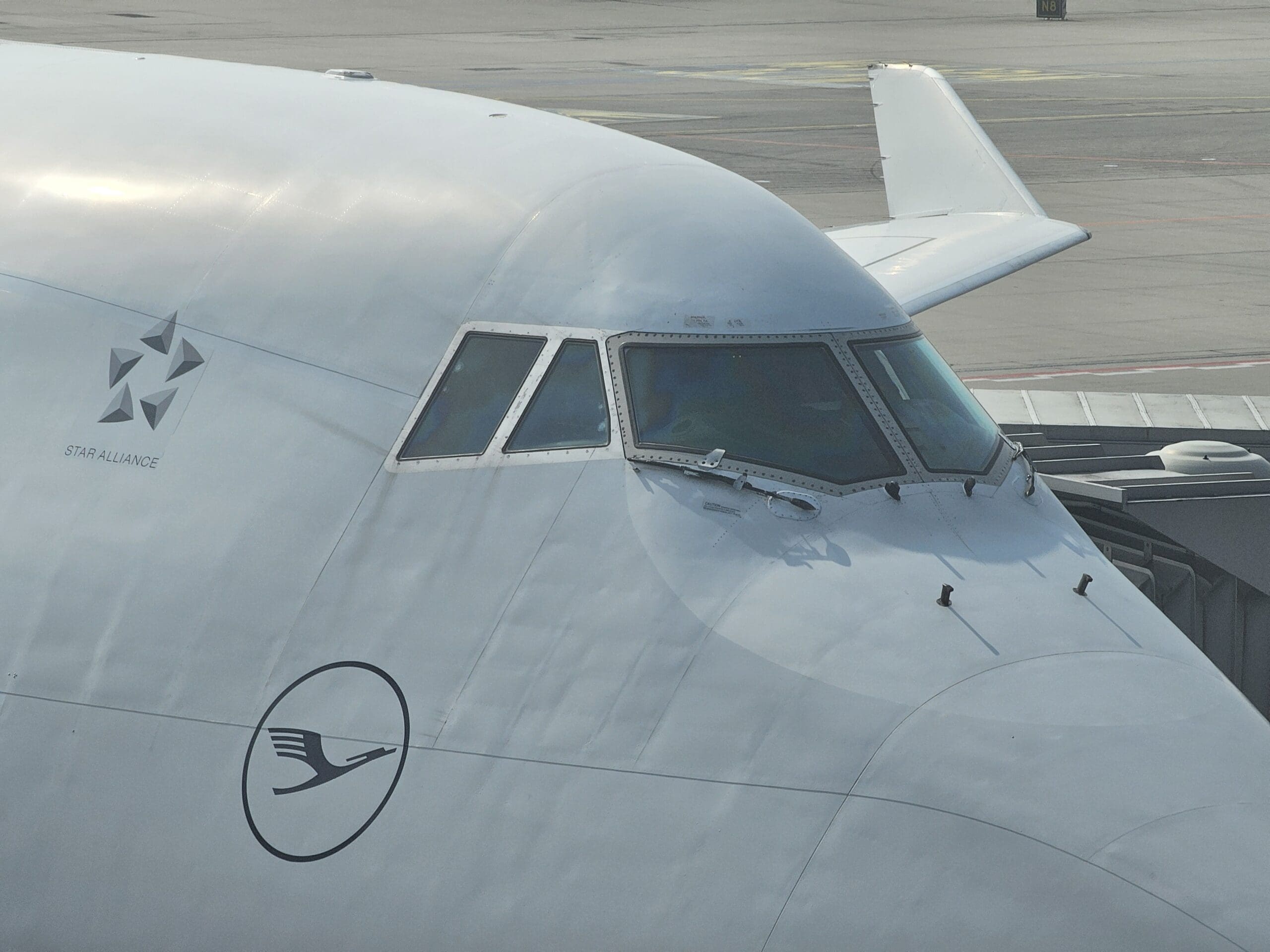
Even the most fairweather planespotter would likely agree that the Jumbo Jet is an iconic aircraft. Having been born in 1996 and a mostly-Britain-based aviation enthusiast since 2006, the Boeing 747 has been a common sight for most of my time as a planespotter. Growing up, on trips to Heathrow, this distinctive four-engine jet could be seen sporting the liveries of carriers from across the world, hauling passengers and freight to London from destinations far and wide. In fact, my first ever flight was on a Boeing 747-100, and my earliest well-remembered flight was on a Virgin Atlantic Boeing 747-400 in 2002. Assisted by stints in Korea, I have since flown the Jumbo Jet with Asiana Airlines, British Airways, KLM, Korean Air, and Lufthansa.
However, just like similarly aged types such as the British Aerospace BAe 146, the Boeing 737 Classic and the McDonnell Douglas MD-80, since the advent of the 2010s, the Boeing 747 has been slowly but surely fading from passenger service. Despite Virgin’s long-gone moniker of ‘4 Engines 4 Long Haul’, many carriers replaced their Jumbo Jets for more fuel-efficient twin-engined widebodies such as the Boeing 777-300ER, Boeing 787-10 Dreamliner and Airbus A350-1000. Meanwhile, the passenger model of the latest iteration of the type, the Boeing 747-8, failed to gain much commercial momentum, with just 48 manufactured. With such retirements exacerbated by the pandemic, today, just three carriers operate the Boeing 747 on scheduled passenger services – Air China, Korean Air and Lufthansa. However, all three intend to retire their passenger Boeing 747s over the coming years, and so as an enthusiast, it was only natural that I was drawn to flying on board these jets.
In March 2026, I would be required to head from Yorkshire to India for my sister’s wedding in the territory of Kashmir. With plenty of passengers travelling between the UK and India, getting between the two is an easy task, with a cornucopia of direct and one-stop options, the former including flights with Air India, British Airways, IndiGo and Virgin Atlantic. However, most flights are operated by your bog-standard widebody jets, such as the Airbus A350, Boeing 777 and Boeing 787. Looking for something more interesting and aware that Lufthansa was deploying its Boeing 747-400s on flights between Frankfurt and several destinations across India, I decided to examine flight options with the German flag carrier.
Following some experimentation, I discovered that if I wanted to fly on the Boeing 747-400, the only way to do this was to end my journey in Bengaluru. Although, as it happened, several weeks later the Delhi flight would also be swapped to a Boeing 747-400! Granted, this sits at the opposite end of India to where I would need to be for the wedding; however, this was a price I was willing to pay, and I soon booked a one-way flight from Manchester to Bengaluru via Frankfurt. Departing on a Saturday, I would rocket away from Manchester at the early hour of 0605 onboard an Airbus A319, touching down in Frankfurt at 0855. Following a 3h40 connection, I would then head to Bangalore at 1235, arriving at 0150.
Whilst I usually prefer to book directly with the airline, with tickets being cheaper via MyTrip, I decided to book it via their site instead. Fortunately, my booking reference enabled me to manage my booking and add additions as if I had booked with Lufthansa directly. Travelling on the cheapest fare class, I was required to pay for any additions, including hold luggage. In the end, not wanting to miss out on a good view of the outside world, I opted to pay around £30 to reserve a standard window seat, and parted with £57 for 23kg of checked-in luggage.
Admittedly, were it not for the fact that the flight would be operated by a Boeing 747-400, I probably would not have flown with Lufthansa to India unless they had been the cheapest option. Whilst the German flag carrier has a loyal core of supporters, my experience with the airline over plenty of flights had been mediocre at best, and more often than not, I had found the crew to be rather cold and distant. Nevertheless, I hoped that my experience this time around would be one of the better Lufthansa flights.
Lufthansa and the Boeing 747
Less than thirteen months after the Boeing 747-100 first took to the skies, in March 1970, Lufthansa received its first Jumbo Jet, becoming the world’s second operator of this revolutionary type. Christened Nordrhein-Westfalen, this was soon pressed into service between Frankfurt and New York, before being deployed to Lufthansa’s destinations across the world.
Like many major airlines, it was not long before the Jumbo Jet became the workhorse of Lufthansa’s long haul operations. In May 1971, Lufthansa received the more advanced Boeing 747-200 and its freighter variant, with these types remaining in service with the airline until 2004. Operating a combined total of 29 Boeing 747-100s and Boeing 747-200s, these could be seen at airports across the world, playing a vital role in connecting West Germany with the world. Unsurprisingly then, throughout the eighties, Lufthansa keenly followed the development of the Boeing 747-400, a variant which significantly modernised the Jumbo Jet and included the removal of the flight engineer’s position amongst a variety of other improvements. In 1986, Lufthansa placed a $2.1 billion order for fifteen Boeing 747-400s, with this then expanded, seeing the airline take delivery of 31 such aircraft. These included seven Boeing 747-400 Combis, capable of carrying both freight and passengers on the main deck.
Lufthansa’s loyalty to the Jumbo Jet persisted throughout the twenty-first century, and in 2006, the airline placed an order for 20 Boeing 747-8s. With Lufthansa being just one of three passenger carriers to take delivery of this type, the others being Air China and Korean Air, in terms of numbers constructed, this remains one of the rarest variants of Jumbo Jet in passenger operation.
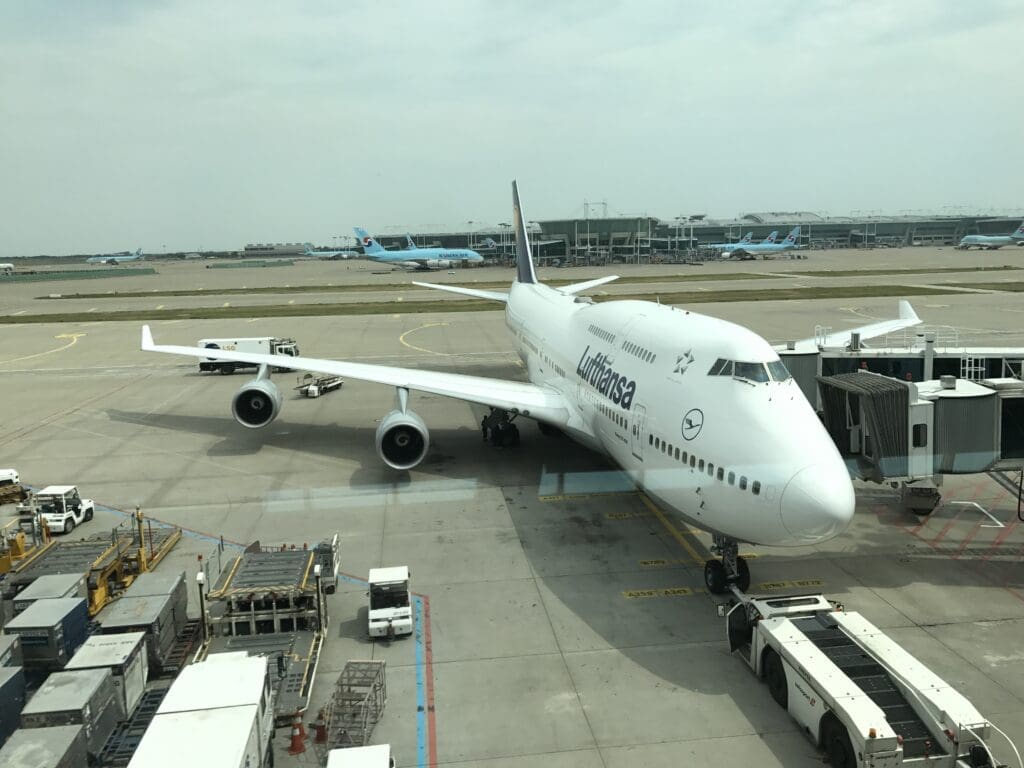
With the advent of increasingly fuel-efficient, large, wide-body twin-engine aircraft, airlines began to reassess the economic viability of operating four-engine jets. Advances in engine reliability and ETOPS regulations allowed twin-engine aircraft to operate long-haul routes that had previously required larger, less efficient aircraft such as the Boeing 747. As a result, many airlines initiated plans to phase out their Jumbo Jets. This trend was significantly accelerated by the pandemic, which caused an unprecedented collapse in long-haul passenger demand and forced airlines to reduce fleet complexity and operating costs. Consequently, both British Airways and KLM retired their Boeing 747 fleets earlier than originally planned. These developments left Lufthansa as the sole remaining European operator of the Boeing 747, underscoring the rapid shift in long-haul fleet strategy across the continent.
However, Lufthansa itself is also undergoing a period of fleet transition and consolidation. As of 2026, the airline operates what is arguably the most diverse wide-body fleet of any carrier in Europe. This includes the Airbus A330-300, Airbus A340-300, Airbus A340-600, Airbus A350, Airbus A380, Boeing 747-400, Boeing 747-8, and Boeing 787-9 Dreamliner, with further expansion planned through the introduction of the Boeing 777X.
From a purely operational and economic perspective, such fleet complexity offers limited advantages, as it increases training, maintenance, and logistical costs. Nevertheless, Lufthansa’s continued operation of comparatively rare aircraft types, most notably the Airbus A340 and the Boeing 747, has preserved a unique position for the airline within the global aviation landscape. These aircraft ensure that Lufthansa remains firmly on the radar of aviation enthusiasts worldwide, many of whom, myself included, are keen to experience these increasingly scarce wide-body types before they are ultimately withdrawn from service.
The Journey
Following a rather forgettable Airbus A319 hop over from Manchester, I touched down on German soil and came to a halt at a remote stand several minutes later. By this time, I was looking forward to my slog over to Bengaluru on the Queen of the Skies, and all that stood between me and this was the Frankfurt transit experience. As soon as we came to a halt, perhaps in a rush to make tight connections, in desperate need of the facilities, or simply wanting some fresh air, many passengers stood up in an apparent frantic rush to disembark. However, from my window seat on the left-hand side of the aircraft, I could see that it was taking some time for the airstairs to be brought up to the aircraft, and once these were in position, several more minutes of waiting was required before two bendy buses appeared to shuttle passengers to the terminal. Around ten minutes after the aircraft had come to a halt, the cabin door was opened and disembarkation commenced. Whilst not being the quickest disembarkation in the world, having heard several horror stories of much longer waits at Lufthansa’s largest hub, I counted my blessings as I stood up and made my way through the cabin. After thanking the crew, I ventured out into the refreshingly bracing Frankfurt air and ended up being one of the final passengers to board the first terminal-bound bus.
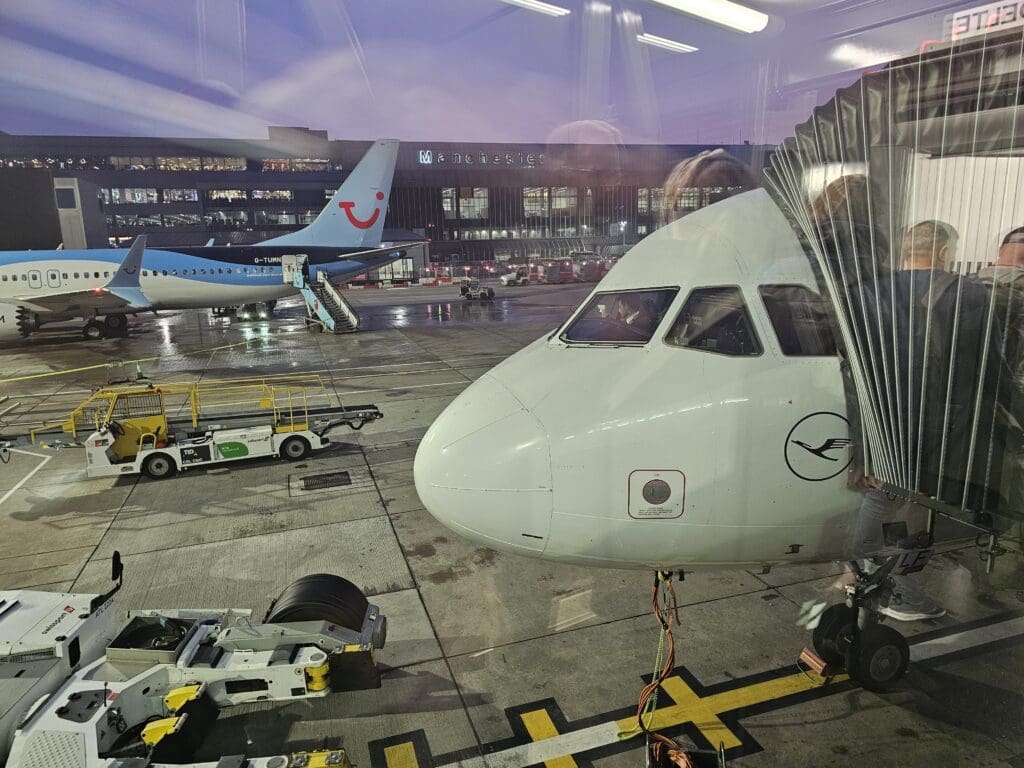
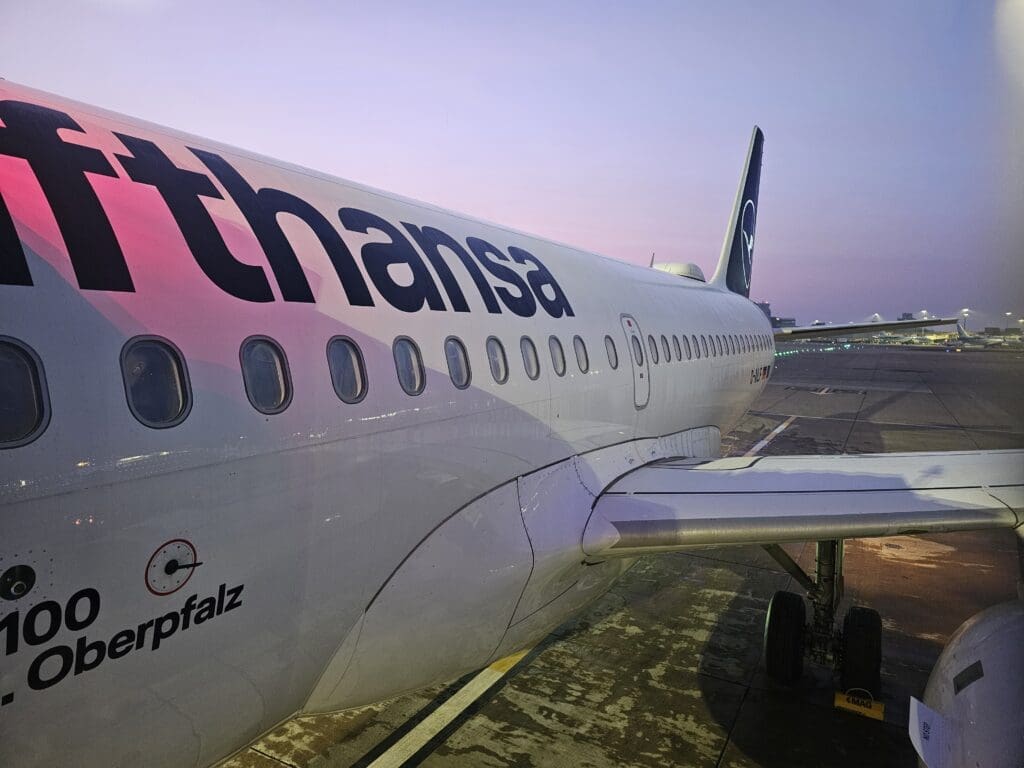
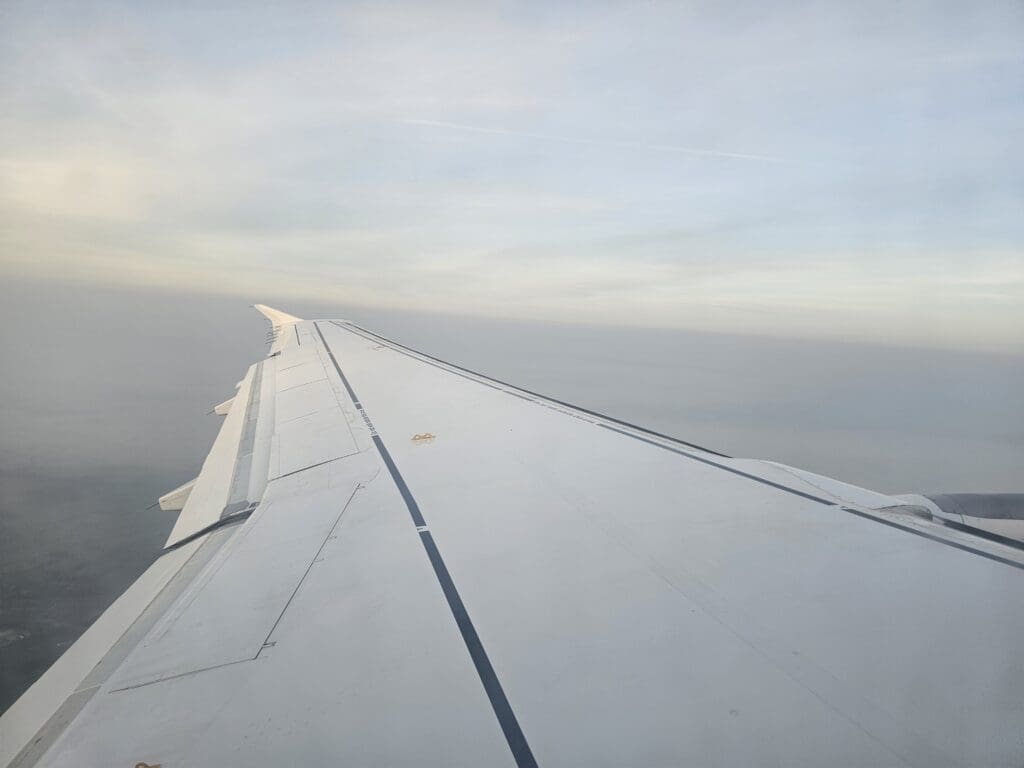
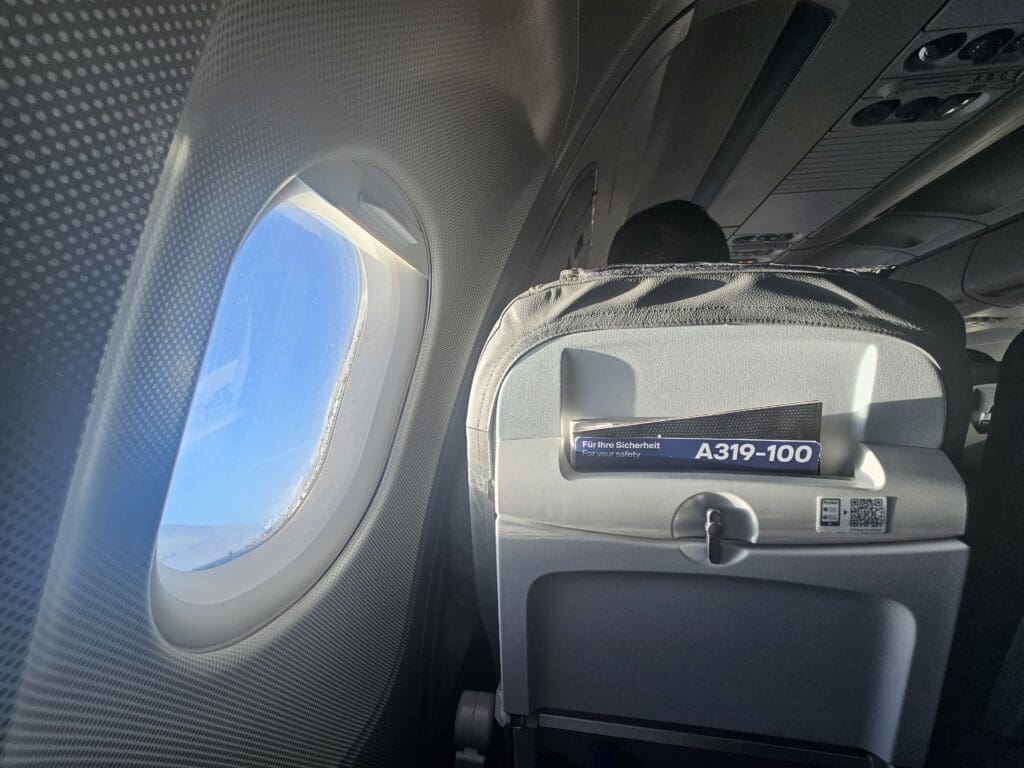
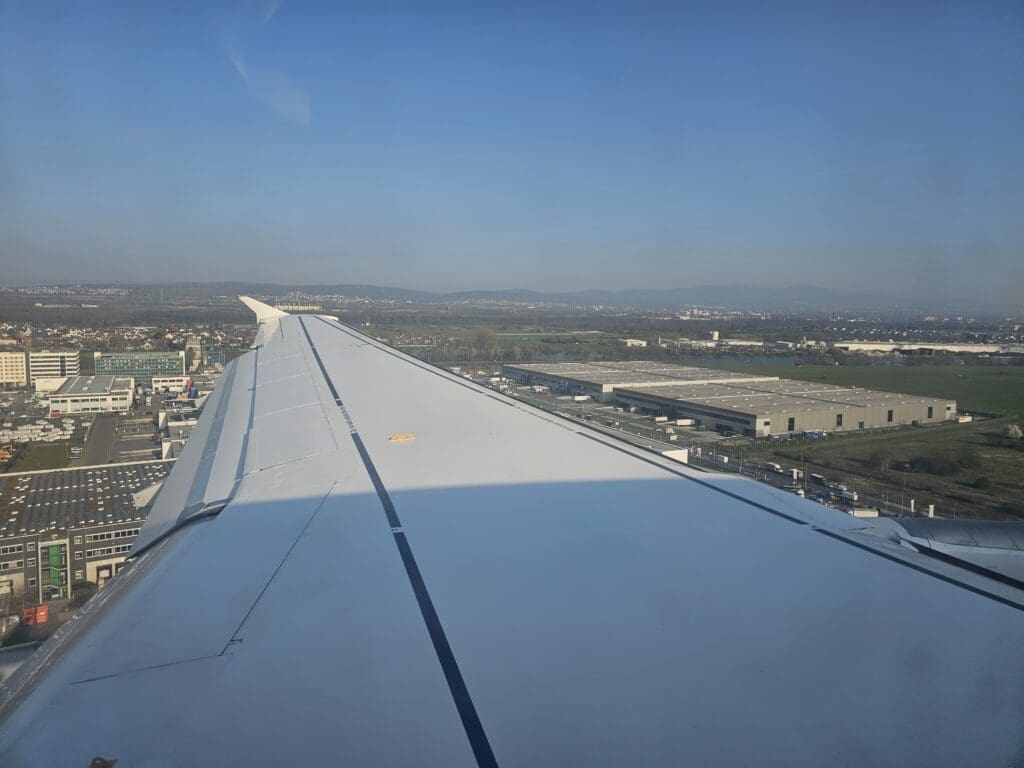
From the aircraft, we were whisked away on a short ramp tour, during which I spotted both the recently painted special liveried Airbus A320neo that celebrates Lufthansa’s centenary, as well as the ‘Super Star’ retro liveried Airbus A321. A few minutes later, we approached Terminal 1, at which point a pre-recorded announcement rang out, noting that the first stop was for connecting passengers only, and the second was for those ending their journeys in Frankfurt. Upon coming to a halt, unsurprisingly, it seemed that most passengers were simply connecting in Germany that day, bound for destinations across the world, and so most piled off the bus, leaving only a couple of passengers remaining.
As hubs go, I am no stranger to Frankfurt Airport, having passed through it plenty of times in the past few years, and thus I had a good idea of what to expect from my Frankfurt experience. Frankfurt Airport seems to have a polarising effect on many passengers, with some loving it and others loathing it. Whether it be vanishing bags, an illogical layout, endless queues, bus rides or long sprints to gates, the airport does not enjoy a unilaterally positive reputation amongst the transiting public. However, whilst admitting that the airport is far from the best in the world, for the most part, my experience of Germany’s busiest airport had been pretty average, and I hoped my three-hour stay there that day would be no different.
Frankfurt Airport consists of two conjoined terminals, Terminal 1 and Terminal 2, which combined cover a massive area. Terminal 1 serves as the hub of Lufthansa’s operations, whilst the airline also shares this terminal with other Star Alliance carriers, allowing for easy transfers between the German giant’s flights and those of its partner airlines. In terms of its layout, Terminal 1 is divided into three separate concourses – A, B and C, although somewhat confusingly, gates are preceded by the letters A, B, C, D and Z. Covering a large area, those arriving at one end of the terminal and needing to get to the other are in for a long trek, which could potentially prove to be problematic for those with short connections. However, that morning, my long transit combined with the fact that I would arrive and depart from Concourse C meant that I did not have to worry about such matters. Depending on your flight’s origin, those connecting in Frankfurt may or may not have to pass through an additional security check when transiting. Fortunately, those arriving from destinations across the United Kingdom are not required to undergo any additional screening. Thus, once off the bus, I simply headed up the escalators and found myself in the midst of the hustle and bustle of Concourse C.
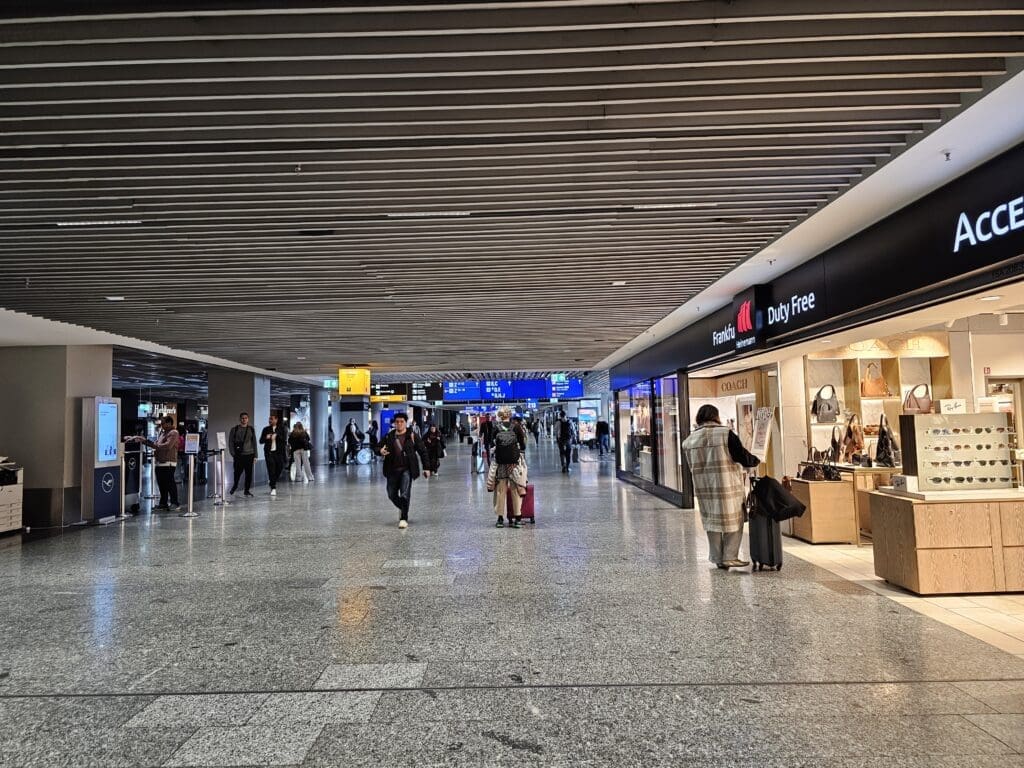
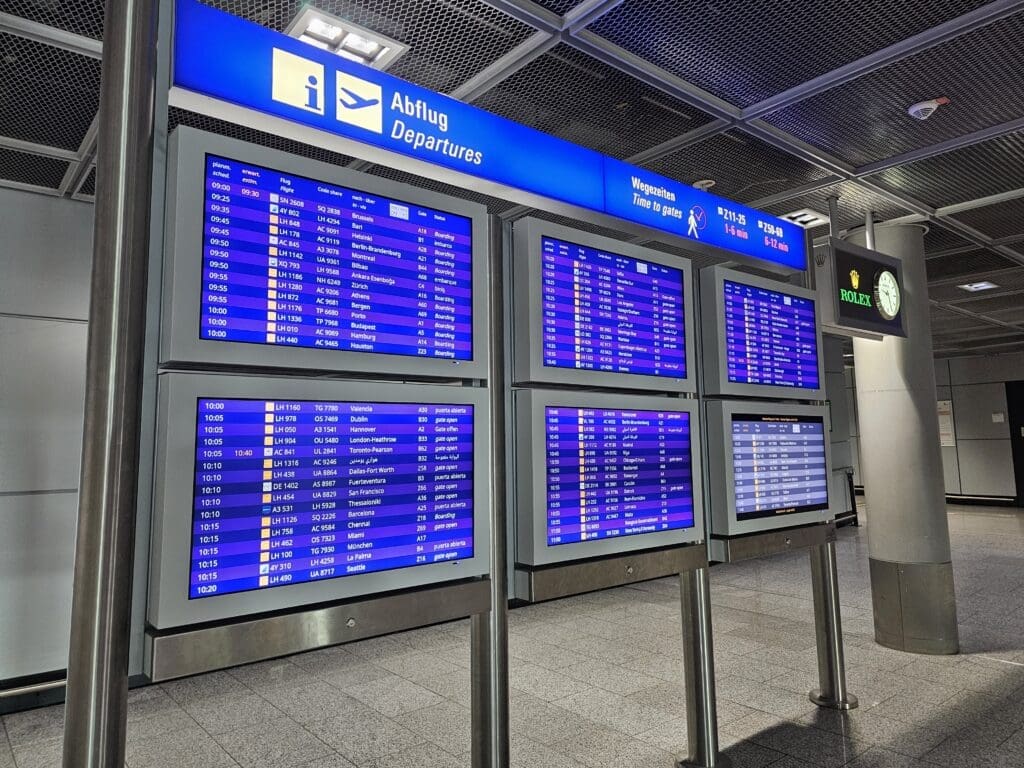
Once in the terminal, I found my bearings and got the lay of the land. That morning, this seemed to be far busier than when I had passed through this in the middle of the day on my way to the Azerbaijani capital, Baku, in October 2024 (you can read my report about this Airbus A320neo-operated service here). However, this was explained by the fact that at this time, the morning rush was in full swing and passengers could be seen scurrying about here, there and everywhere. Looking at the departure boards, the vast majority of flights that left this concourse during my stay were destined for North America and were operated by Lufthansa and its Star Alliance partner from across the pond, United Airlines. Indeed, this made sense, as it seemed that homeward-bound American tourists and the odd buzzcut GI Joe made up the bulk of passengers in the terminal for much of my stay. However, as time passed, the destinations on the departure boards shifted from daytime flights to North America, to overnight flights to Asia, with flights to India, Japan and Korea departing that afternoon and evening.
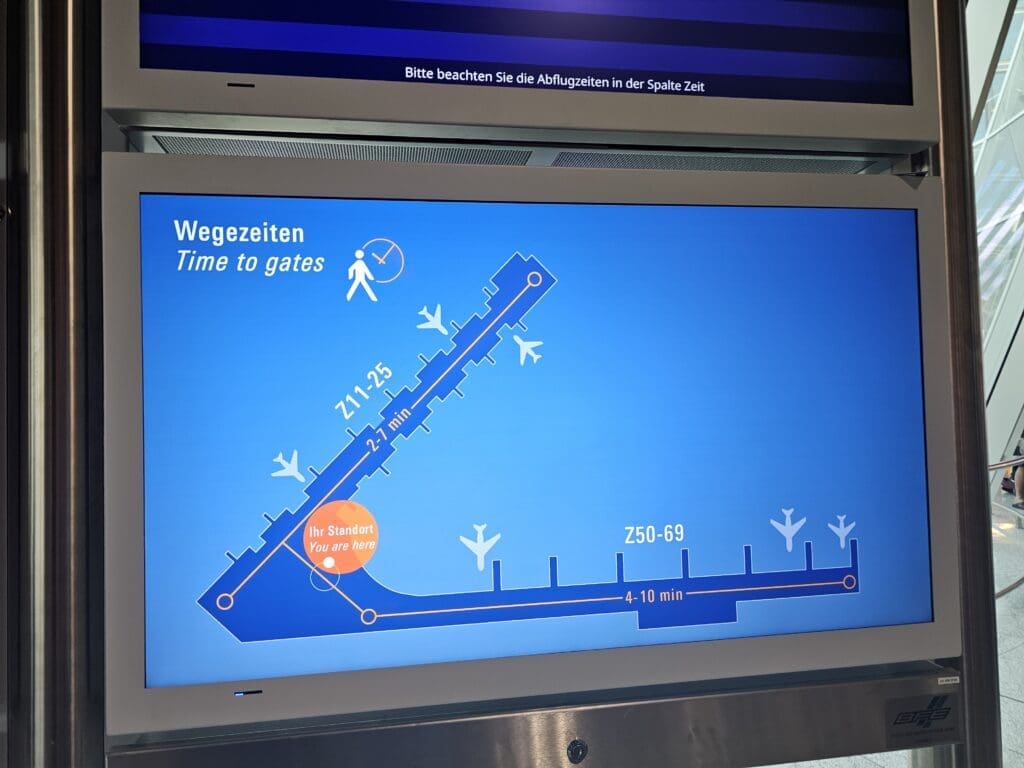
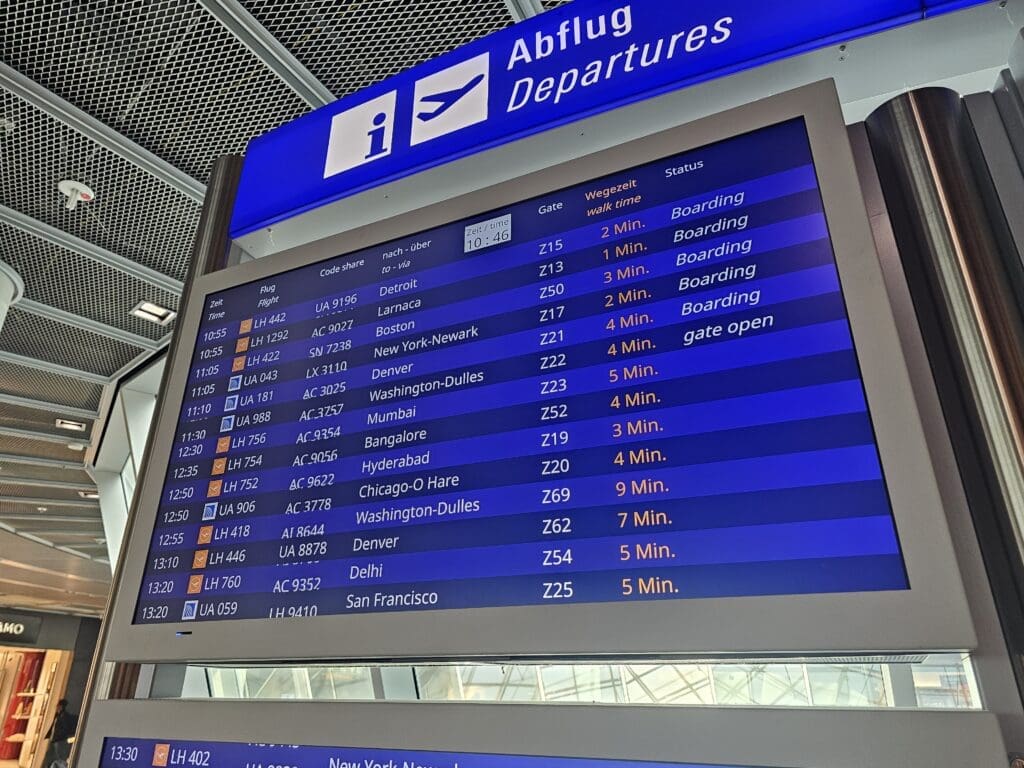
Given the fact that the terminal was rammed, space was at a premium, and many of the concourse’s seating areas were nearly totally full. However, in some cases, this was down to the fact that many passengers seemed to be keeping their bags on seats! Wandering around, unfortunately, and as I have previously found to be the case in Frankfurt, the terminal was not particularly clean, with rubbish seen strewn around in places, whilst some of the toilets were disappointingly filthy. After a short period of wandering around, many passengers will likely conclude that there is very little that positively sticks out about the design of Frankfurt Airport. Failing to compete with the impressive, distinctive architecture of hubs such as Beijing Daxing, Doha Hamad, Singapore Changi, or even Paris CDG, the airport lacks notable design features and serves its purpose in a functional yet not overly stylish way. As you would expect, given its size, Terminal 1 features a wide array of over seventy shops and eateries. These range from luxury brand outlets for those with money to splurge and likely seated towards the pointy end of the plane, to more down-to-earth convenience stores such as Relay. However, most of these are located in the terminal’s central hub, with options on Concourse C being slightly more limited, but not terrible. My only complaint would be the lack of reasonably priced food and drink options, meaning that those fancying a bite to eat before their flight will likely have to part with a small fortune. Having not had anything proper to eat that morning, I stopped to purchase a ham and cheese croissant for €4.50, which was definitely one of the more reasonably priced food options available.
One positive thing about Frankfurt Airport is that floor-to-ceiling windows offer good views of the aircraft waiting at most of the stands outside, something that I am sure aviation enthusiasts will appreciate. Thus, once I had munched on my croissant, I wandered from gate to gate, admiring the aircraft and watching the constant stream of aircraft taxying past on their way to and from the terminal’s stands. As you would expect, local airlines such as Lufthansa, Condor and Discover Airlines dominate the movements at Frankfurt; however, airlines from across the world can also be seen, making this a particularly exciting airport for planespotters. That being said, there were not too many aircraft types or airlines that I would not be able to spot back home; nevertheless, I still enjoyed my time spent watching the aircraft outside, especially seeing all of the Jumbo Jets in action.
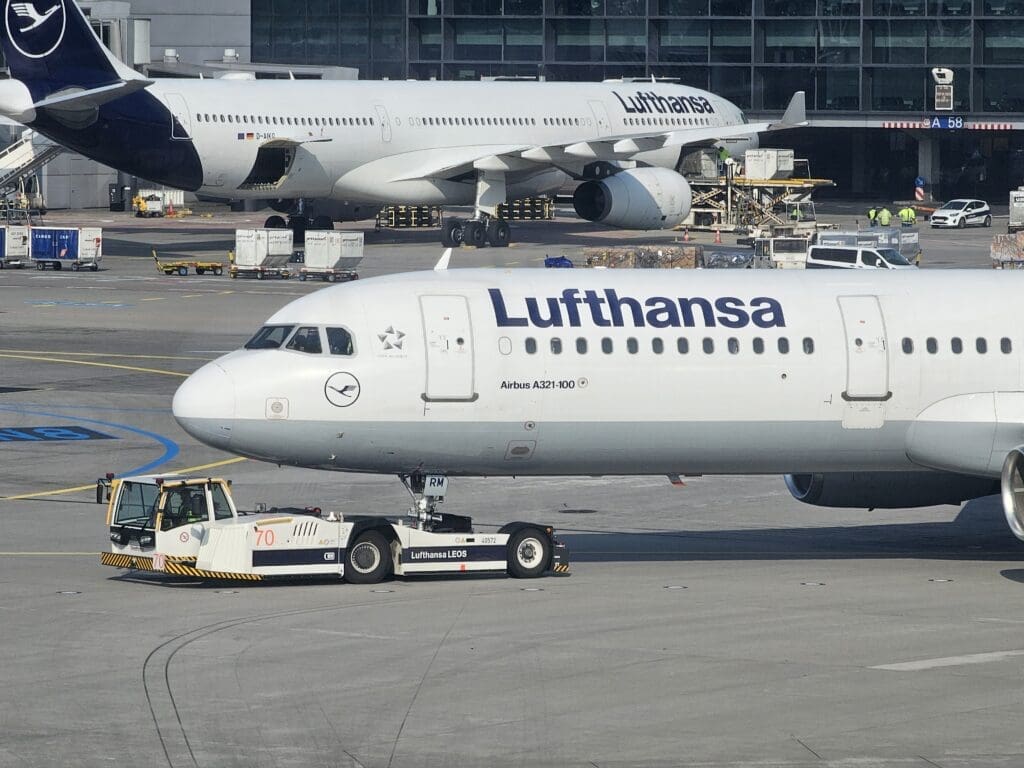
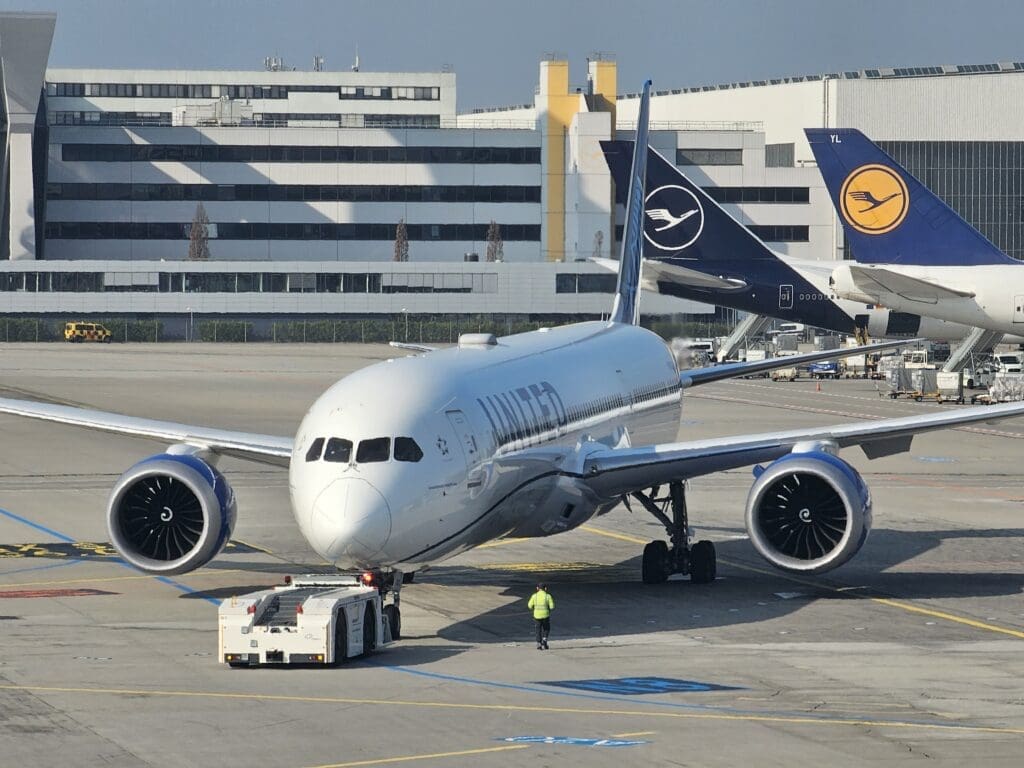
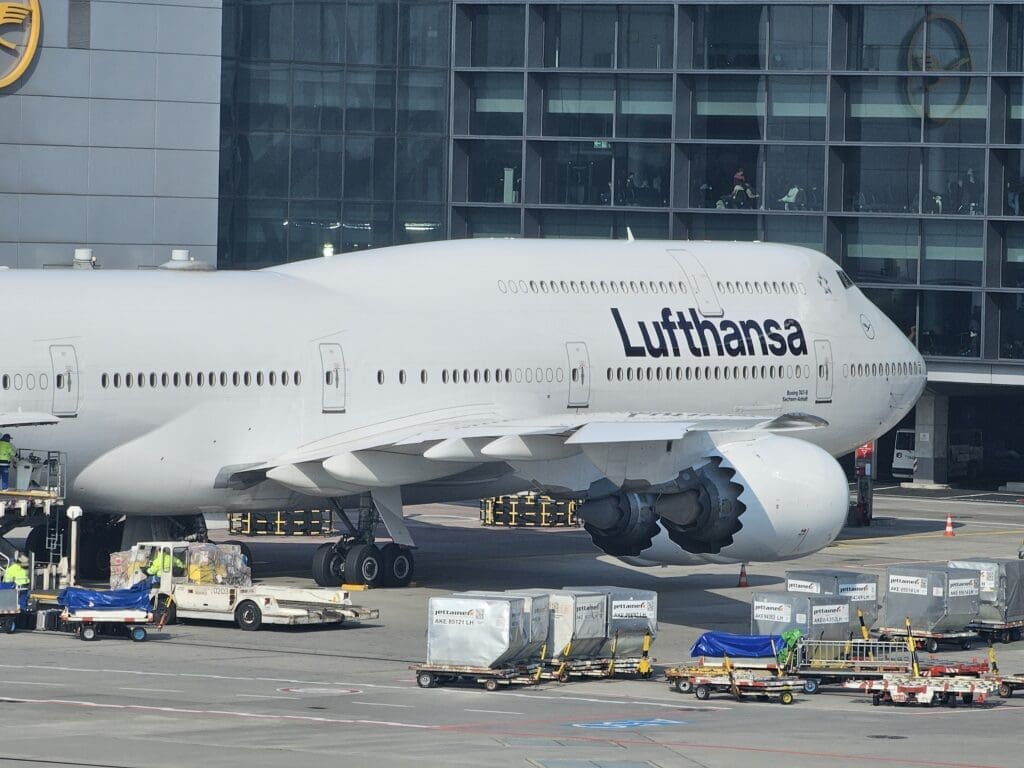
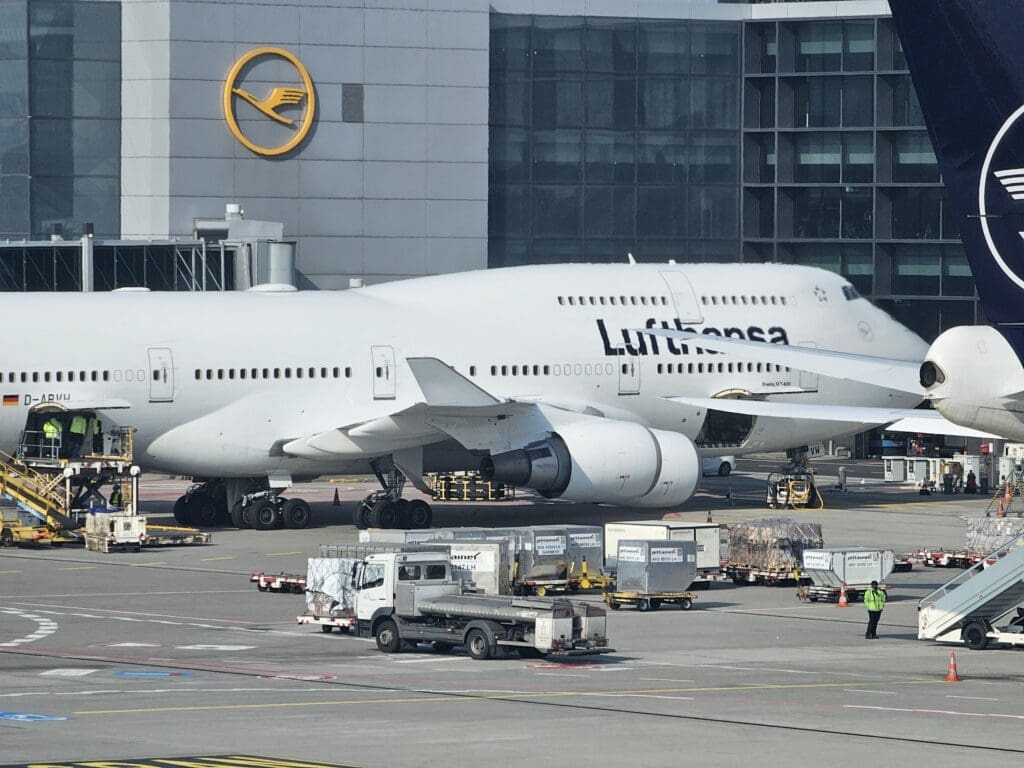
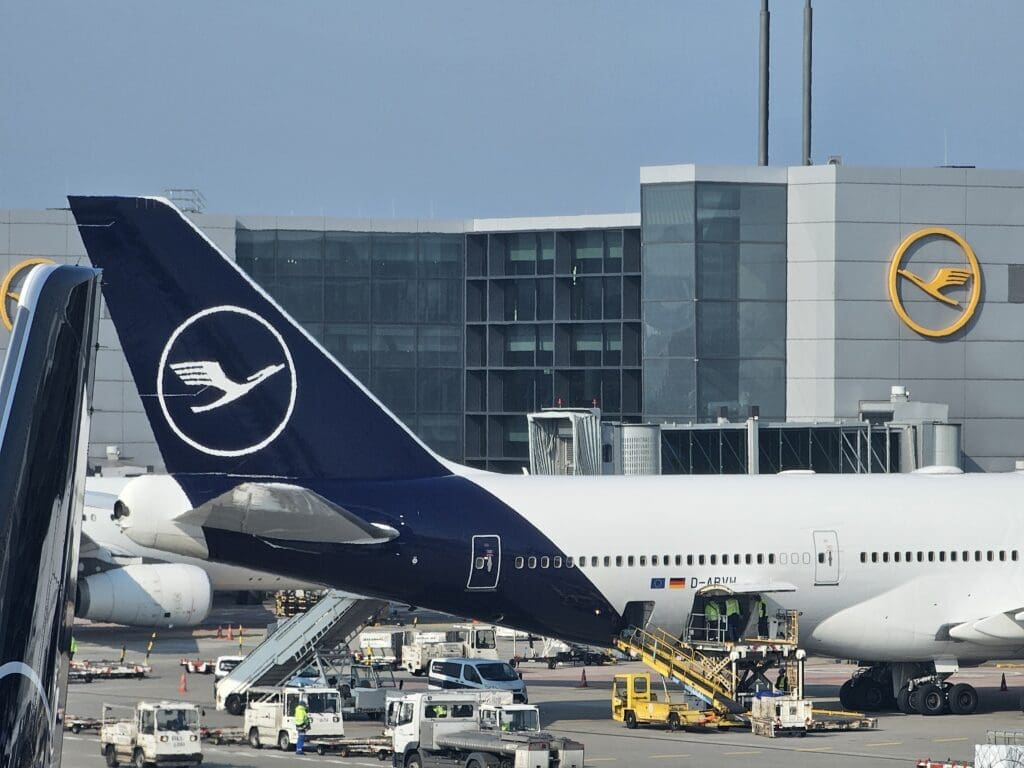
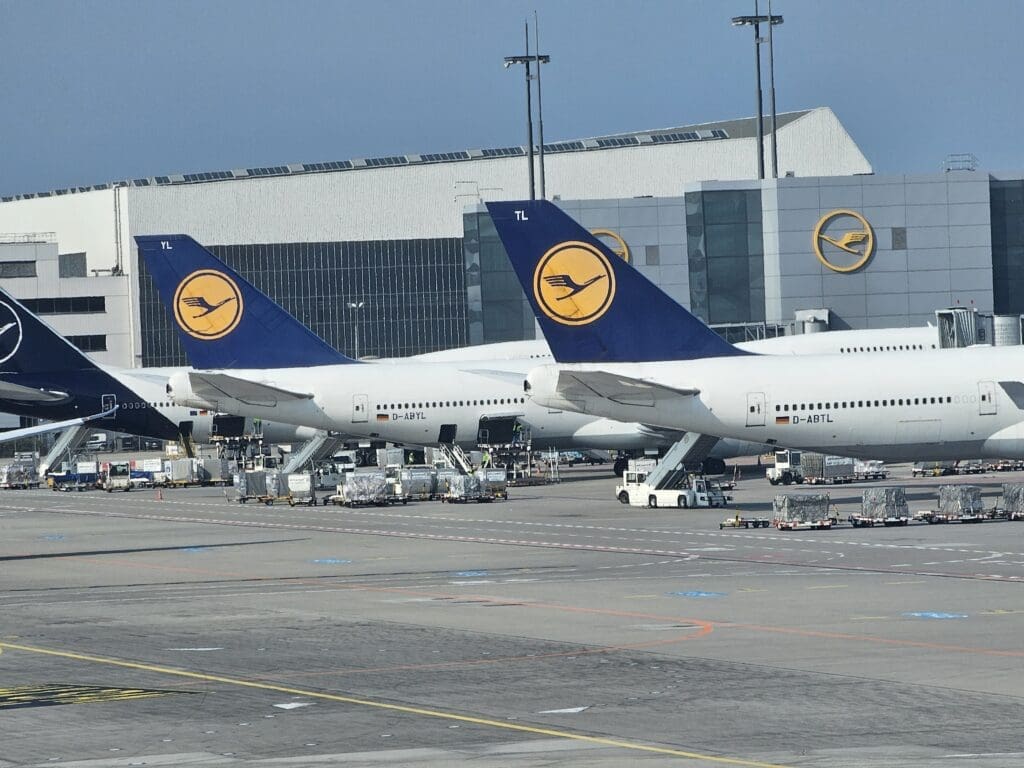
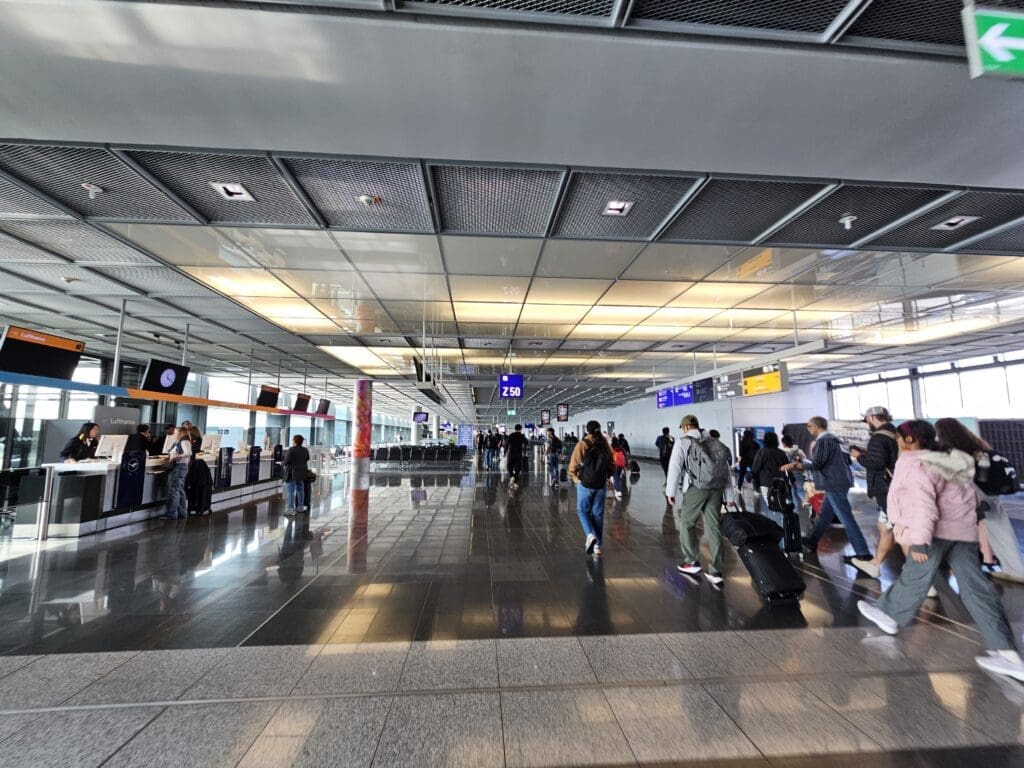
According to my boarding pass, my flight to Bengaluru would depart from Gate Z52, which corresponds to Stand A52. This hardly came as much of a surprise, seeing as the stands on the pier that hosts gates Z50 to Z69 were filled exclusively by the airline’s Boeing 747-400s and Boeing 747-8s, thus making it Lufthansa’s ‘Jumbo Jet Row’. Having tired myself out with a long wander, I thought it best to set up camp at the gate. However, upon making it to the entrance of the pier, it turned out that only those departing on services bound for the United States were permitted to enter this until 1115, with the mandatory document checks for such passengers in place at the entrance to this, thereby preventing anybody else from entering.
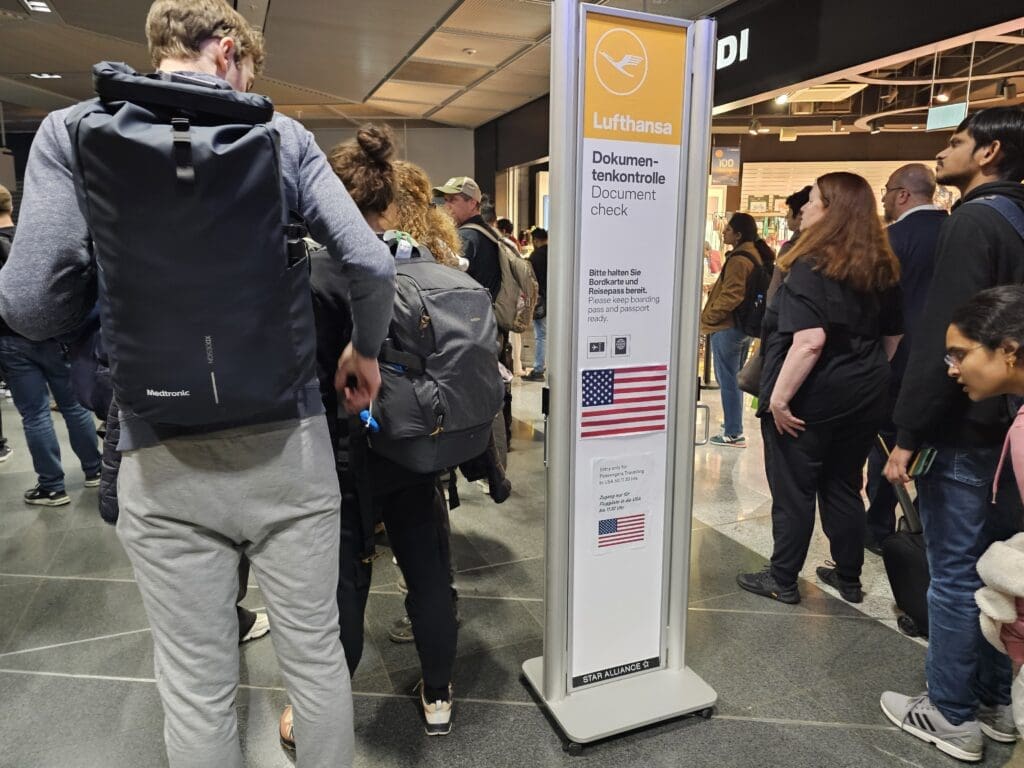
With no other choice, I plonked myself down in a seat near one of the windows and continued to pass the time by watching the constant stream of movements outside. Wandering back to the pier at 1110, by this time, a large crowd of mostly Bengaluru and Delhi-bound passengers could be seen waiting and eager to head off, with the checkpoint’s staff appearing to become increasingly frustrated by having to constantly prevent passengers from sneaking past their checkpoint to enter the pier. At 1115, the portable desks were wheeled to one side, at which point passengers charged forward as if they were about to miss their flights. Within a couple of minutes, I arrived at Gate Z52 where two checkpoints had been set up in order to verify passengers’ documents to ensure they had the relevant permissions to enter India. Joining a short queue for one of these checks, I had my passport, e-visa and digital arrival card checked and verified before the agent stamped my boarding pass. Needless to say, likely seeking to avoid large fines for inadmissible passengers, Lufthansa seemed to take its responsibilities far more seriously than Turkmenistan Airlines, which did not check either document when flying to Delhi with them the previous year!
Once my documents had been checked, I turned my attention to the exciting happenings outside on Jumbo Jet row where several Boeing 747s could be seen being readied for their long treks. One unique feature of Lufthansa’s app is that it enables passengers to see where their inbound aircraft has arrived from. Thus, I was aware that the aircraft operating my flight to Bangalore had arrived much earlier that morning from Boston. As expected, upon reaching the gate, Lufthansa’s oldest Jumbo Jet, Boeing 747-430 D-ABVM, could be seen glistening in the morning sunshine. It was also at this point that I was pleased that I had not booked the Delhi service, as this was to be operated by D-ABVW, an aircraft that I had flown from Seoul Incheon to Frankfurt in 2018, with this being readied at the neighbouring gate.
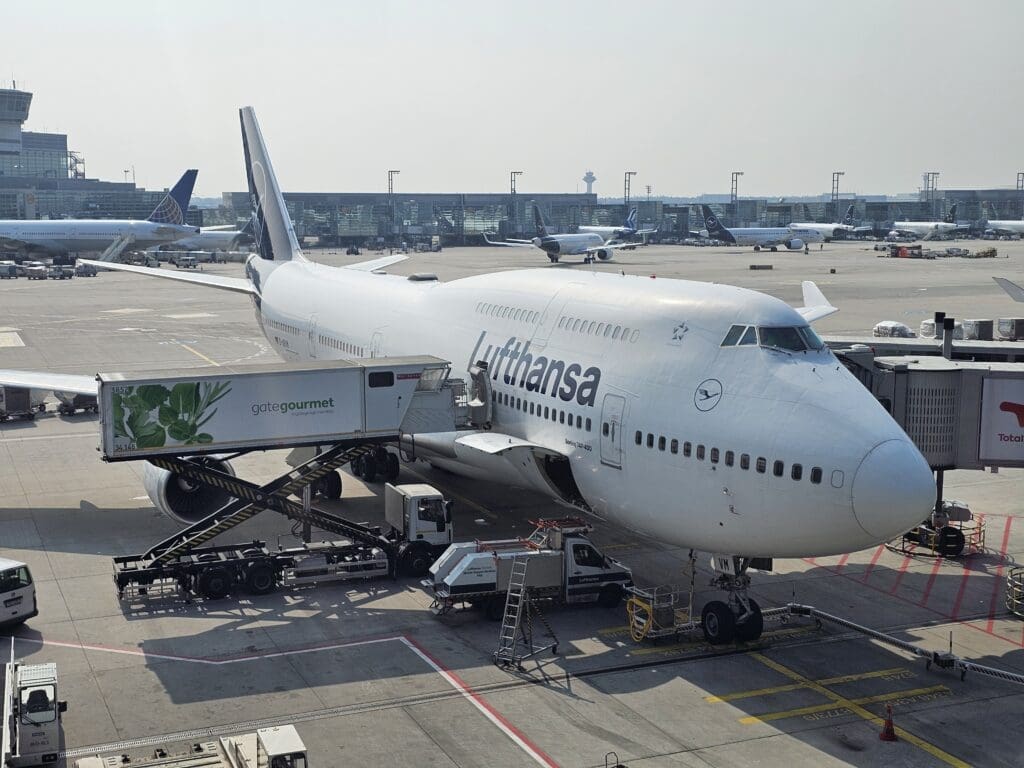
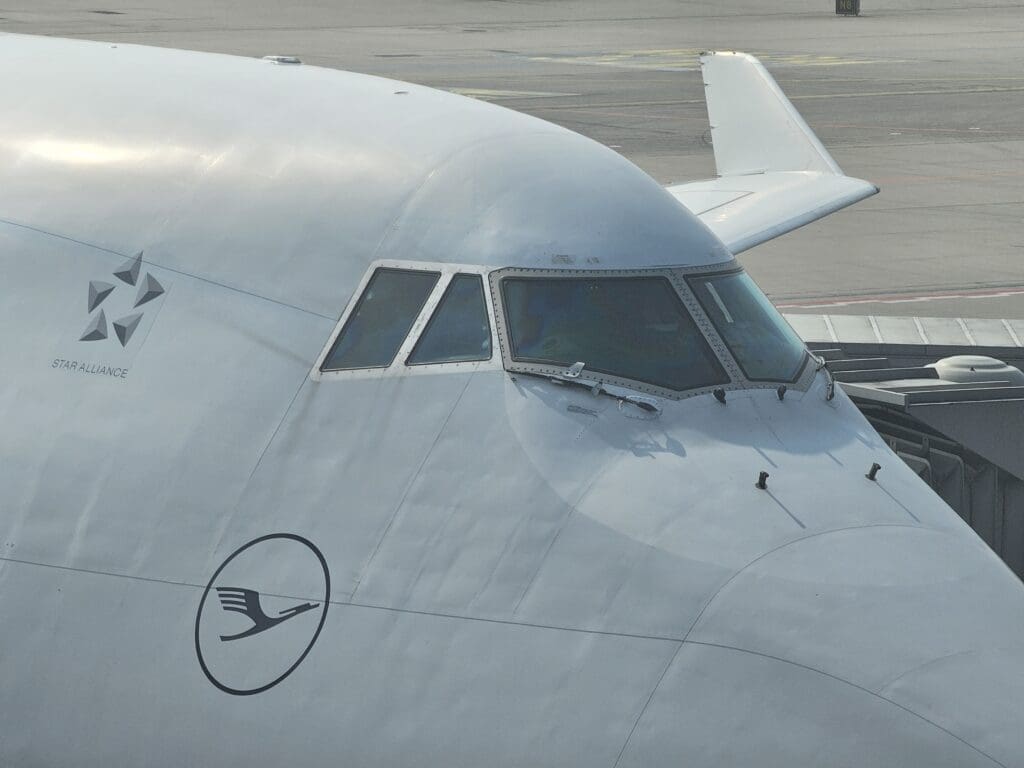
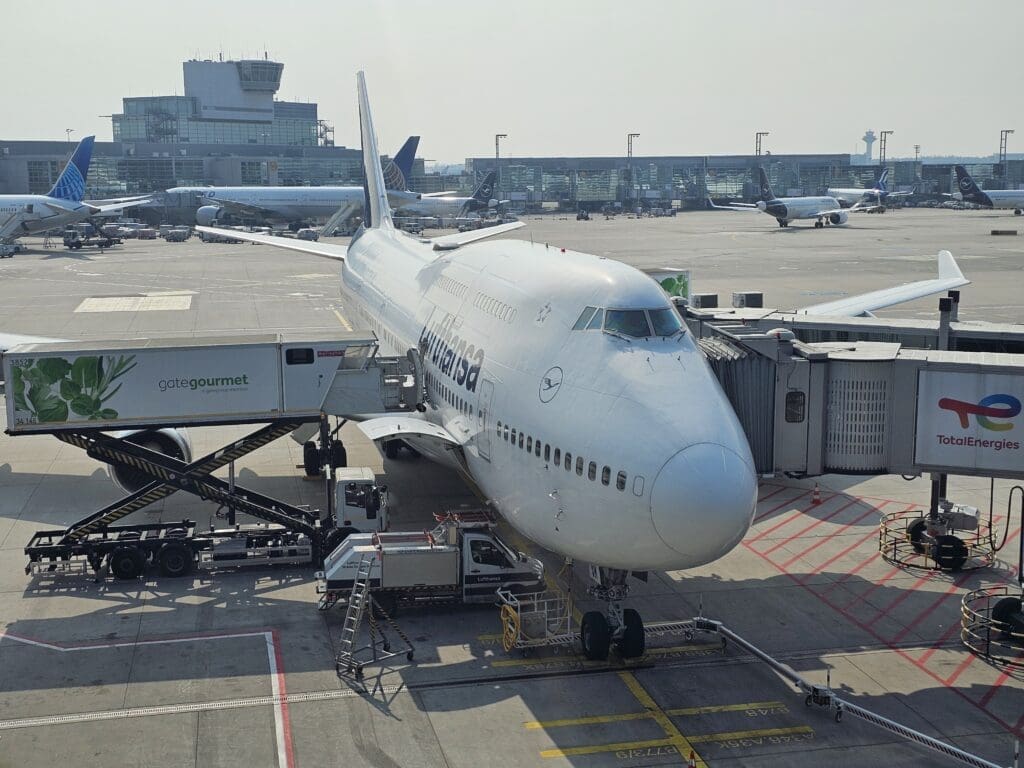
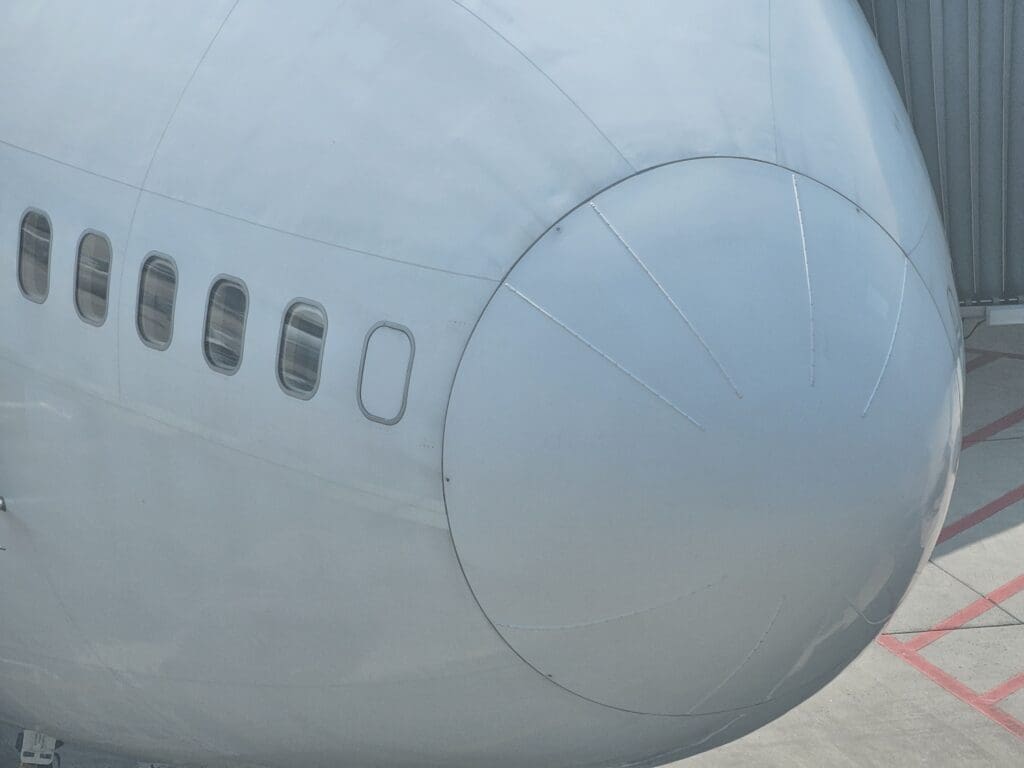
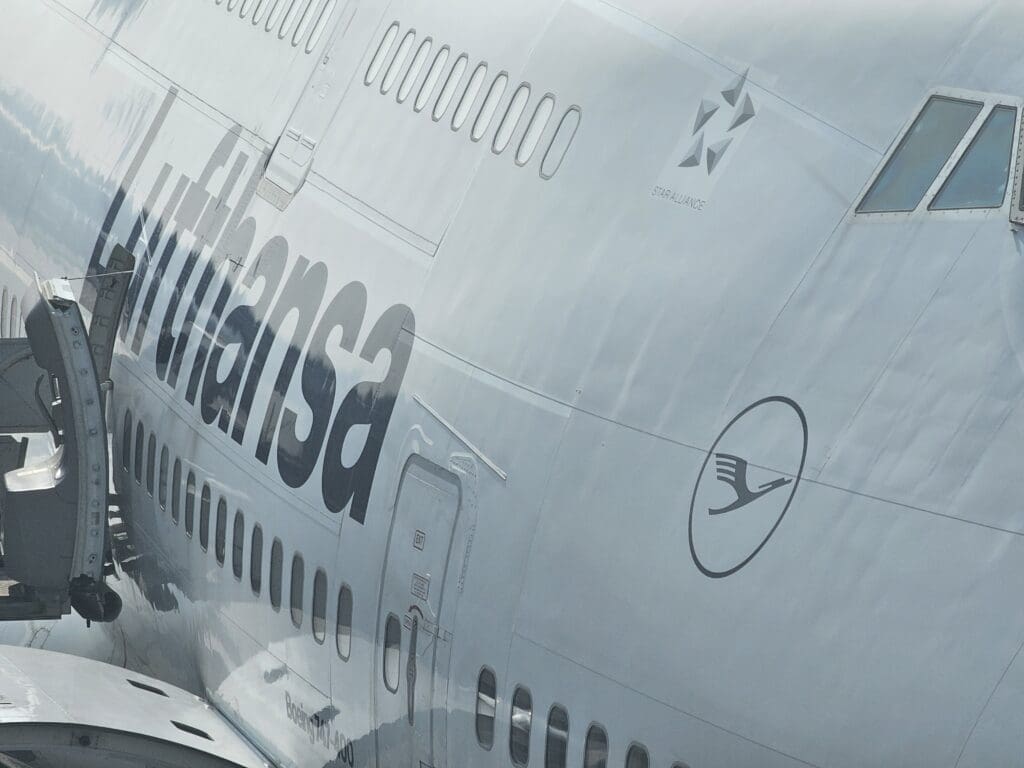
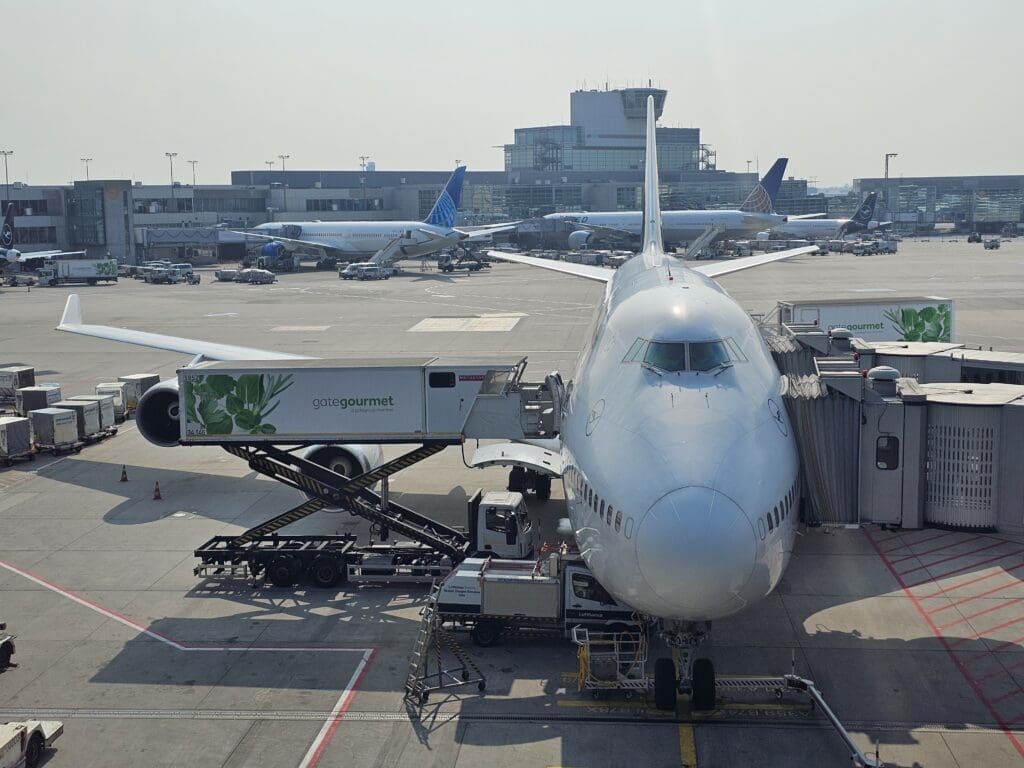
Manufactured at Boeing’s famed Everett Production Facility, this jet first took to the skies in January 1998, making it over 28 years old at the time of my flight. Following testing, in February 1998, the aircraft was ferried over to Frankfurt and soon commenced its life, carrying passengers from Lufthansa’s largest hub to destinations across the world, a role that it still fulfils to this day. Initially named after the state of Hessen in which Frankfurt sits, this name was removed in 2015. Remaining nameless for three years, in 2018, the aircraft received Lufthansa’s new livery, becoming the first Boeing 747-400 to wear these colours, at which point it was rechristened Kiel in honour of the northern German city when the aircraft received Lufthansa’s new livery. However for some reason, this name was removed in 2022 and thus at the time of my flight, the aircraft was nameless.
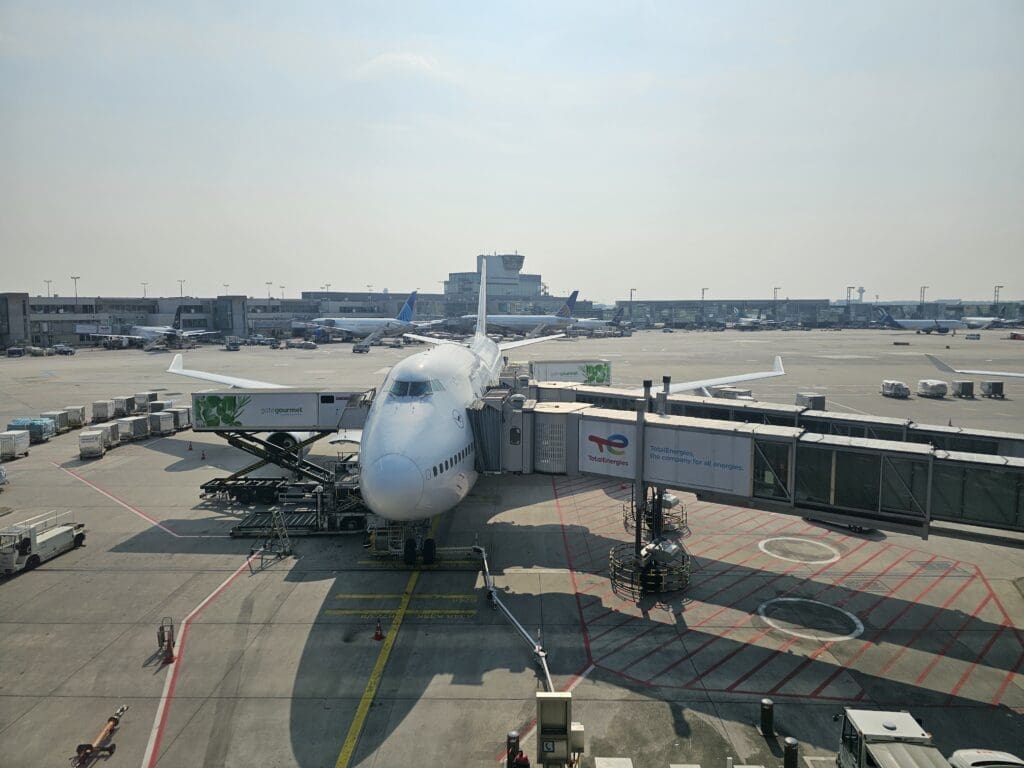
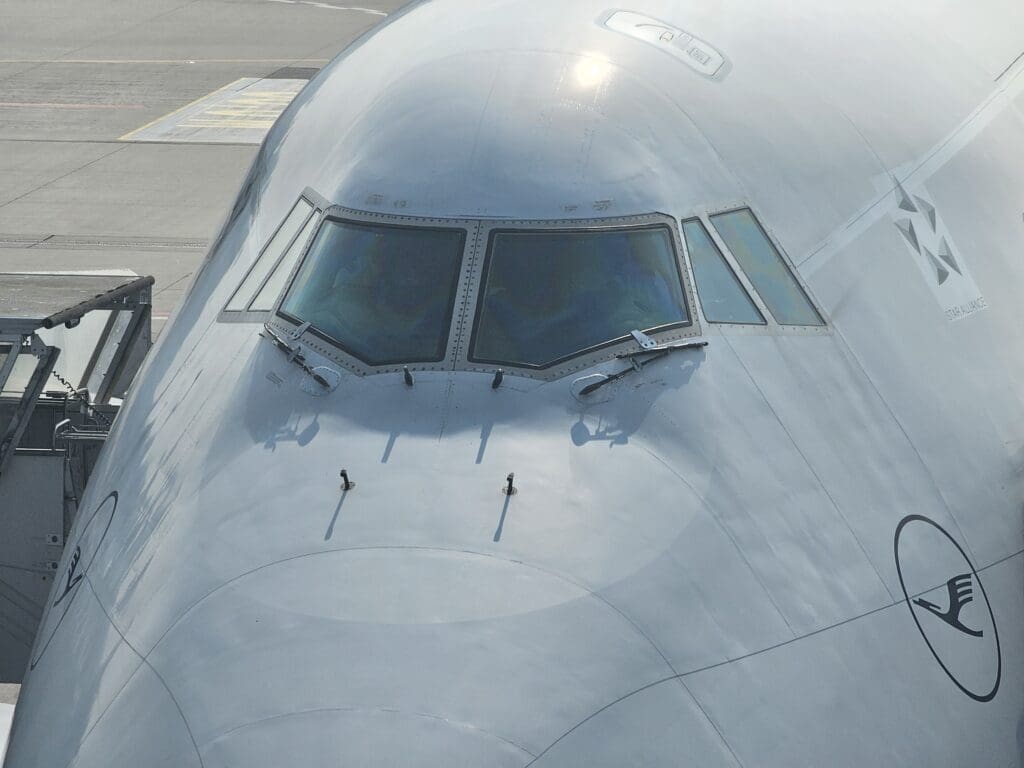
With the onset of the pandemic in 2020, the reduced demand saw D-ABVM enter storage in Frankfurt in April 2020, remaining there until July when it was ferried to Hamburg. This was then returned to Frankfurt one year later in July 2021, before re-entering service relatively early on in November 2021. In the week leading up to my flight, the aircraft had operated eight sectors, connecting Frankfurt with Bengaluru, Boston, Shanghai Pudong and Singapore.
According to my boarding pass, boarding for the flight to Bengaluru was scheduled to commence at 1150; however, this time came and went with no sign of boarding commencing. However, all was explained when a very friendly and lively gate agent performed an announcement advising that boarding would be slightly delayed as the aircraft was still being refuelled, after which, they explained the boarding arrangements in detail in English only. Two minutes later, another announcement was made inviting those requiring assistance and/or travelling with young children to proceed forward for boarding, with this soon followed by those lucky passengers who would be making the journey to India in First Class and Business Class. With four automated boarding gates and two manned counters available for boarding, plus two jetbridges connected to the aircraft, boarding was a quick and fairly painless procedure, and after about five or so minutes, Premium Economy and Economy passengers were permitted to board the aircraft. Soon, my boarding pass was checked to ensure that this had been stamped, before I headed forward and tapped this on the automated gates, which enabled me to pass through effortlessly and without issue.
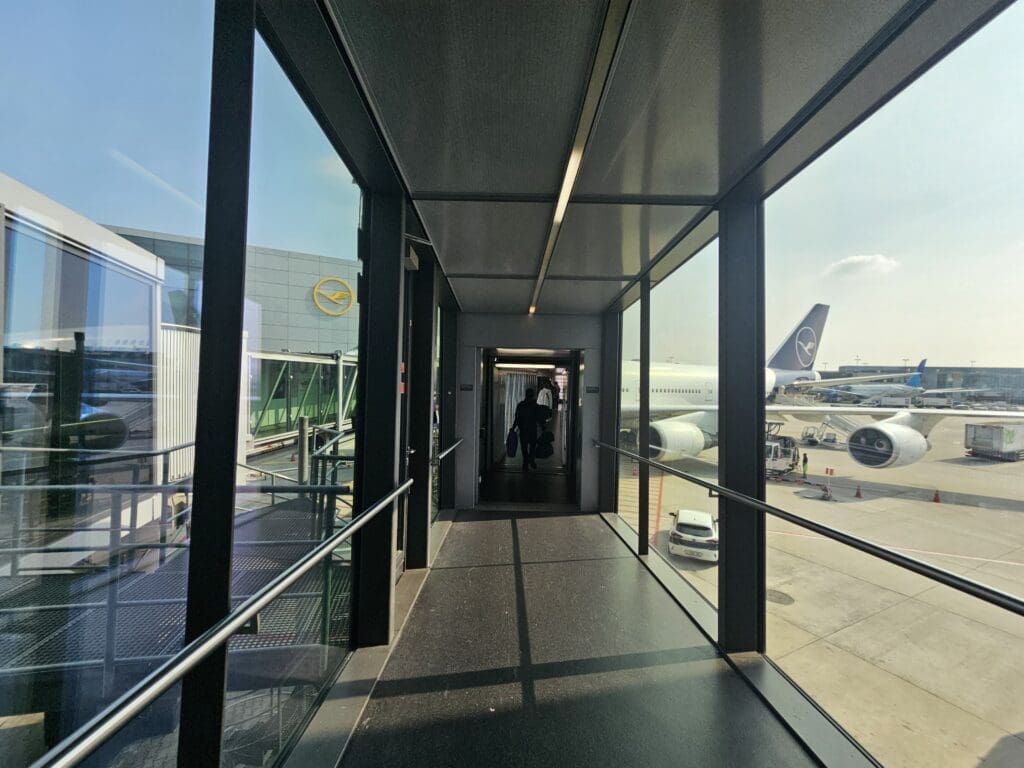
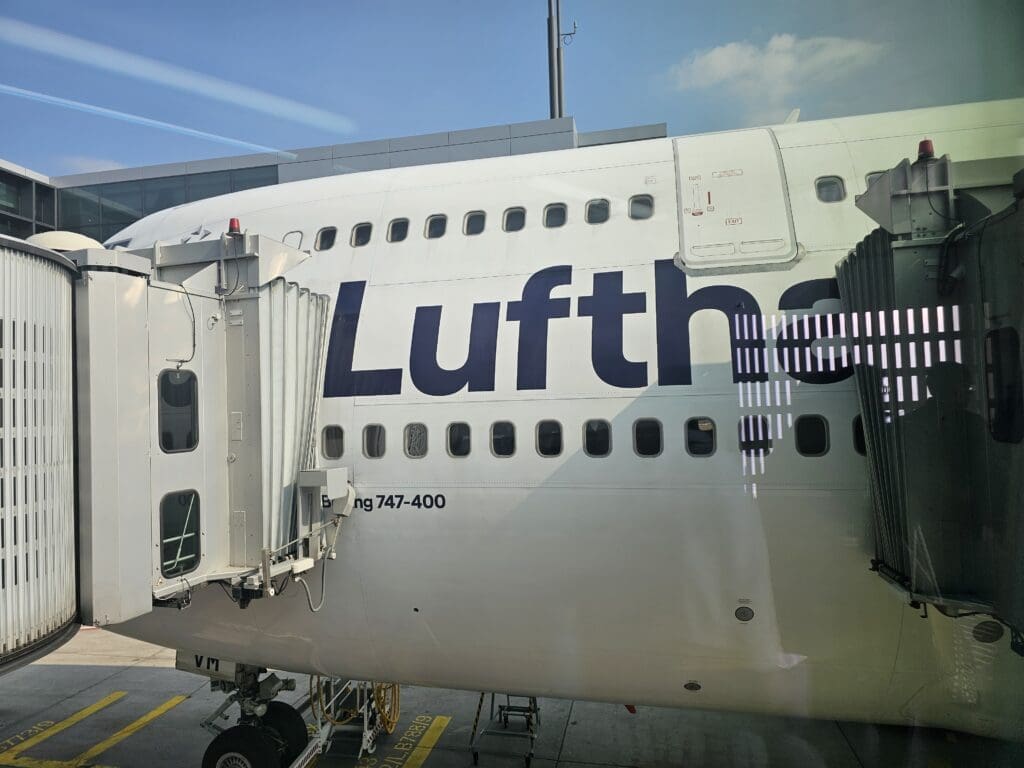
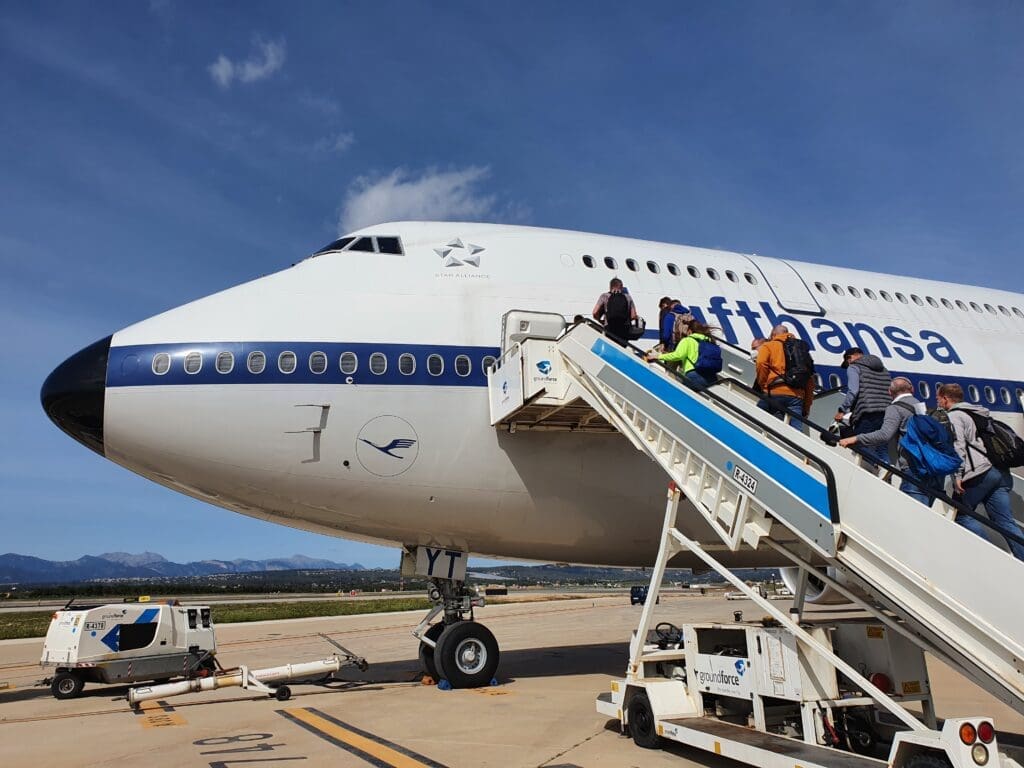
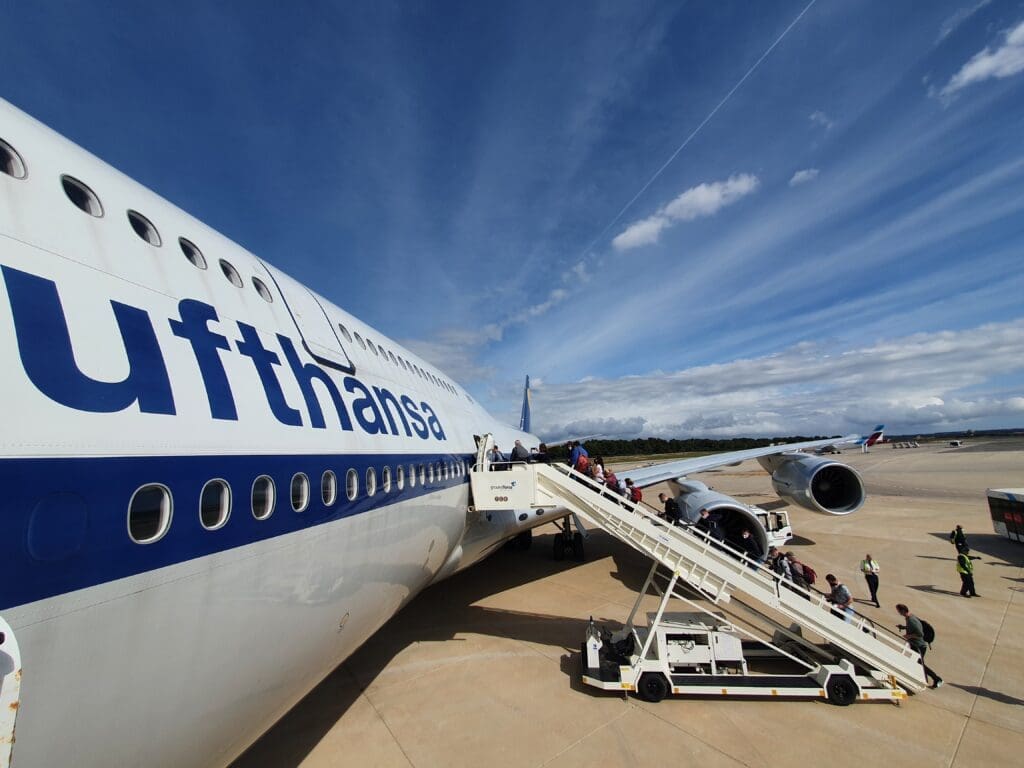
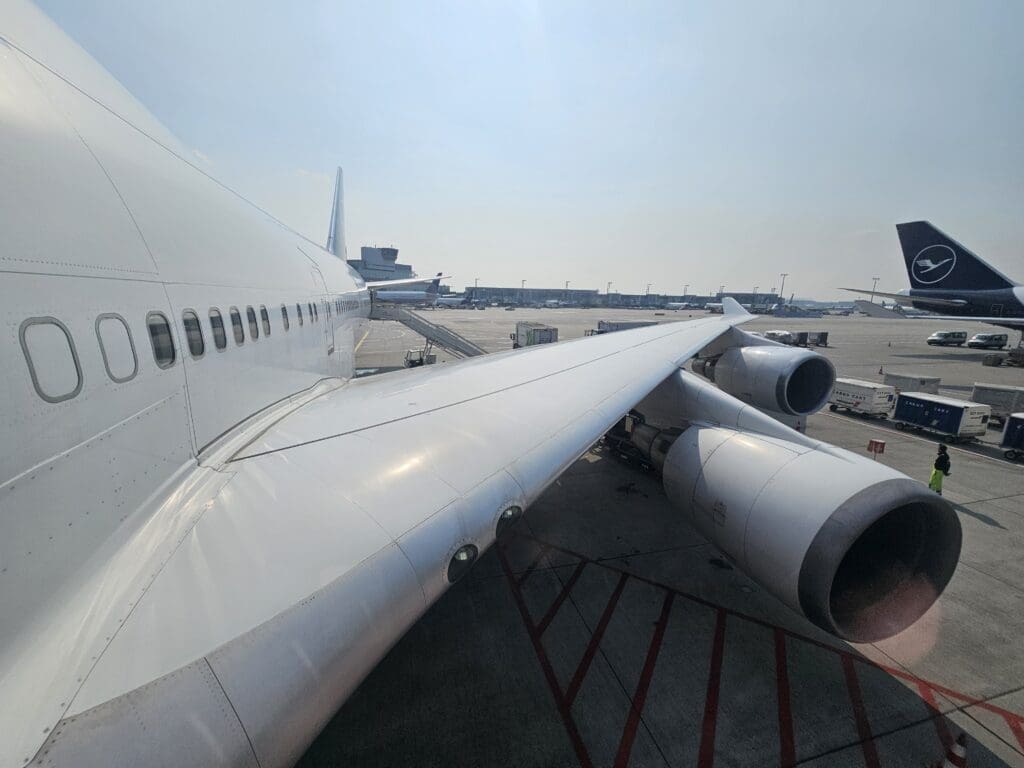
Heading down the jetbridge, I was afforded a good view of the venerable Queen of the Skies that would carry me over to India, and, as I neared the aircraft’s L2 door, a short queue was in order whilst passengers filtered onto the aircraft. However, as an aviation enthusiast, this was no cause for complaint, as it afforded me a fantastic close-up view of the Jumbo’s port wing and the two mighty General Electric CF6-80C2-B1F engines hanging down from it. After a couple of minutes or so, I stepped aboard and entered the large galley that separates the Business and Premium Economy cabins. Unlike my non-existent greeting when boarding the Airbus A319 several hours earlier in Manchester, as soon as I entered the aircraft, I was delighted to receive a warm and friendly welcome, which served to get my flight off to a positive start, and upon showing my boarding pass, I was directed down the second aisle.
After cutting through the galley, I turned right and entered the aircraft’s Premium Economy cabin. This featured a total of 32 ZIMmagic Premium Economy seats, arranged in the standard 2-4-2 configuration. Each of these was covered in a subtle and calming grey fabric and topped with a reasonably sized adjustable headrest that was partially covered by a pleather antimacassar on which Lufthansa’s crane-centred motif had been stitched. Meanwhile, chunky armrests separated each seat and ensured that seatmates would not be jostling for arm space. Whilst I would not have complained about an upgrade, there did not seem to be anything revolutionary about the Premium Economy cabin, and so, without stopping to gawk at any luxuries, I continued heading down the aircraft to the forward Economy cabin. Continuing with my positive first impressions of the crew, as I journeyed down the aircraft, I received a further two friendly greetings in German from both flight attendants that I passed on my way to Seat 42K.
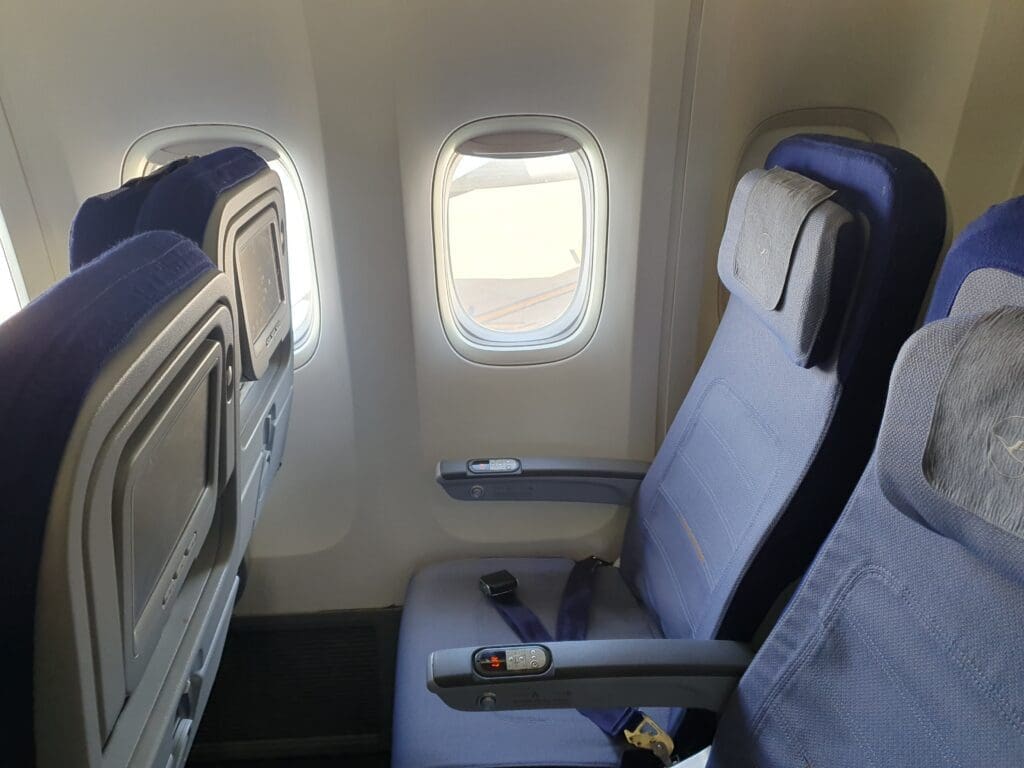
All of Lufthansa’s eight active Boeing 747-400s come with a total of 272 seats in Economy. These are spread out across the aircraft’s rearmost two cabins, whilst three rows of Economy are sandwiched between Premium Economy and the forwardmost Economy lavatories, thereby creating a rather small and intimate Economy section. As one might expect given the 747-400’s status as the fleet’s matriarch, the seats are somewhat retro compared to the airline’s newer A350 or 787-9 Dreamliner products. However, that is not always a bad thing, and each seat still features most of the modcons that you would expect to find onboard a long-haul airliner, such as a decent-sized inflight entertainment screen, a USB-A port and universal power outlets – with two shared for every bank of three seats. Each seat also came with a coat hook, a fold-out cup holder, a literature compartment that contained a sick bag and a copy of the safety card, a seatback pocket, and, of course, a bi-fold tray table.
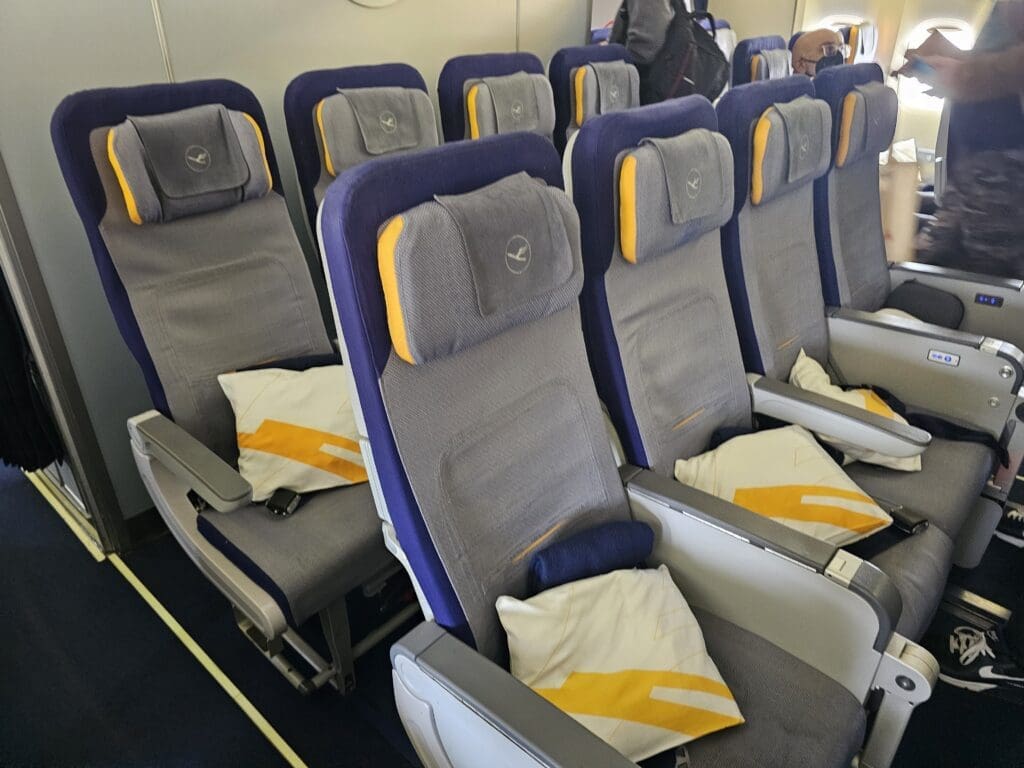
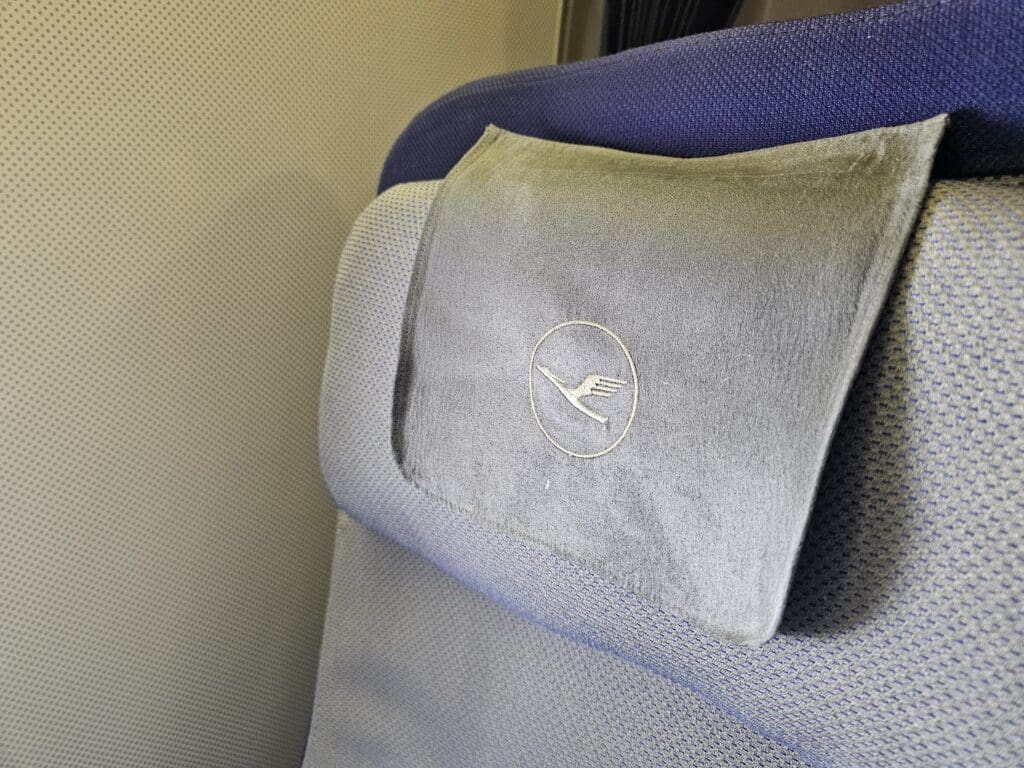
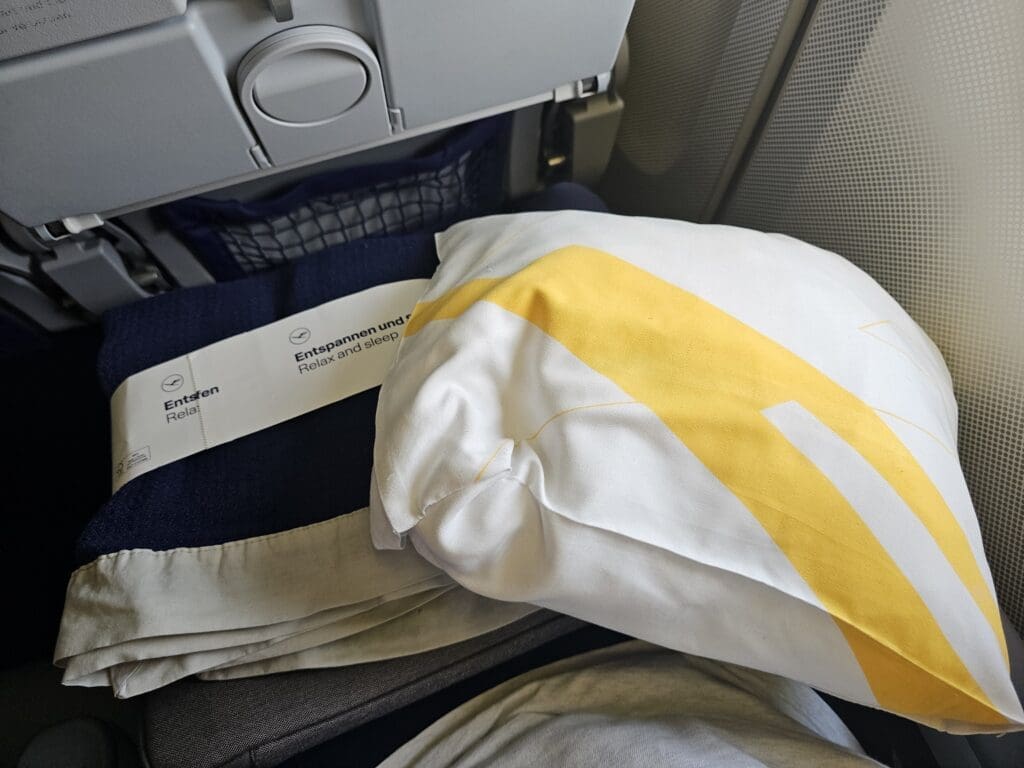
In keeping with Lufthansa’s brand identity, each seat was adorned with a blue and grey fabric cover, and was complete with a decent-sized adjustable headrest partially covered by a pleather antimacassar on which Lufthansa’s iconic logo was smartly stitched. Upon boarding, a blanket and pillow could be found on each seat, and, as is now the norm, no sort of amenity kit was provided to those in Economy. However, I should note that the blanket and pillow were both of above-average quality for Economy class and left me with no complaints.
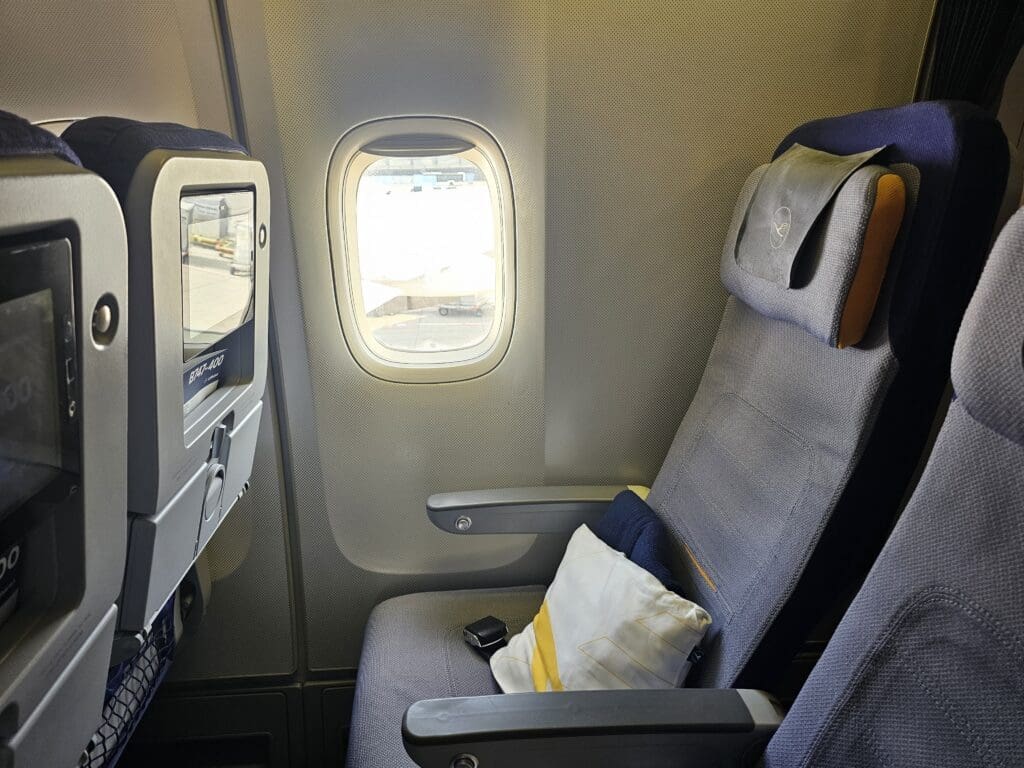
Upon making it to my row, yet to be joined by any seatmates, I stowed my bag in the Boeing 747’s somewhat squarish and comparatively small overhead lockers before sliding into Seat 42K and settling in for the long ride to India. Once seated, I was pleased to find the seat to be reasonably soft and, whilst not the most spacious Economy seat that I have ever sat in (that accolade goes to Air Premia!), this also offered a reasonable amount of legroom. Furthermore, whilst the cabin was slightly retro in its appearance, the seat and the area around it appeared to be well-kept, and I failed to spot any notable signs of wear and tear. Last but most certainly not least, the cabin appeared to have been cleaned to a high standard following its overnight flight from Boston and was in a spotless condition with no crumbs, stains, smudges or rubbish anywhere in sight.
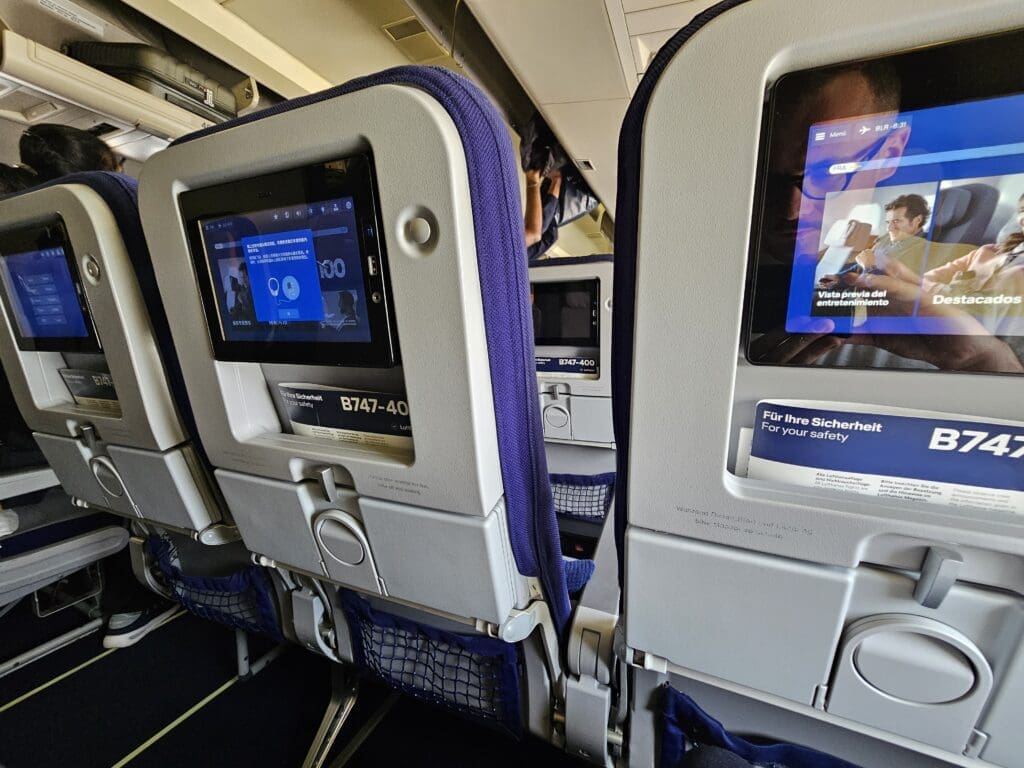
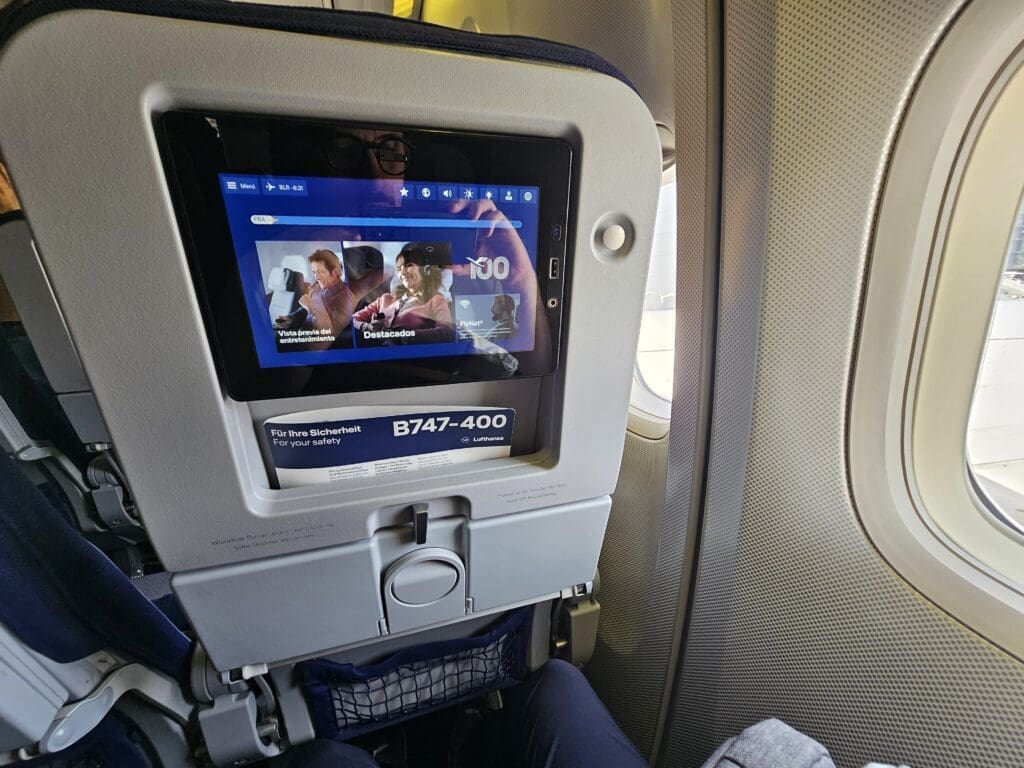
Being one of the first passengers in Group 4 to join the aircraft, it did not come as much of a surprise to see that the forward Economy section soon filled up. Perhaps as a result of the efficient and hard-working gate staff, boarding was a speedy affair, and for the next twenty minutes or so, passengers streamed onto the aircraft and took their seats. Unlike on some flights, that day, there did not appear to be any jostling for space in the overhead lockers, nor were passengers or crew required to play Tetris with bags to squeeze these in. Just like European competitor British Airways, Lufthansa times its services to India to maximise connection opportunities, particularly to and from its North American services. Furthermore, with the ongoing conflict and subsequent disruption in the Middle East, I had expected the flight to be full, and indeed, this proved to be the case, with plenty of passengers on long slogs between North America and India, as well as passengers who had connected from destinations across Lufthansa’s European route network. Soon, I was joined by two neighbours, who, in a brief conversation, revealed themselves to be a mother and her young daughter making the long journey from Detroit to Bengaluru to spend time with family.
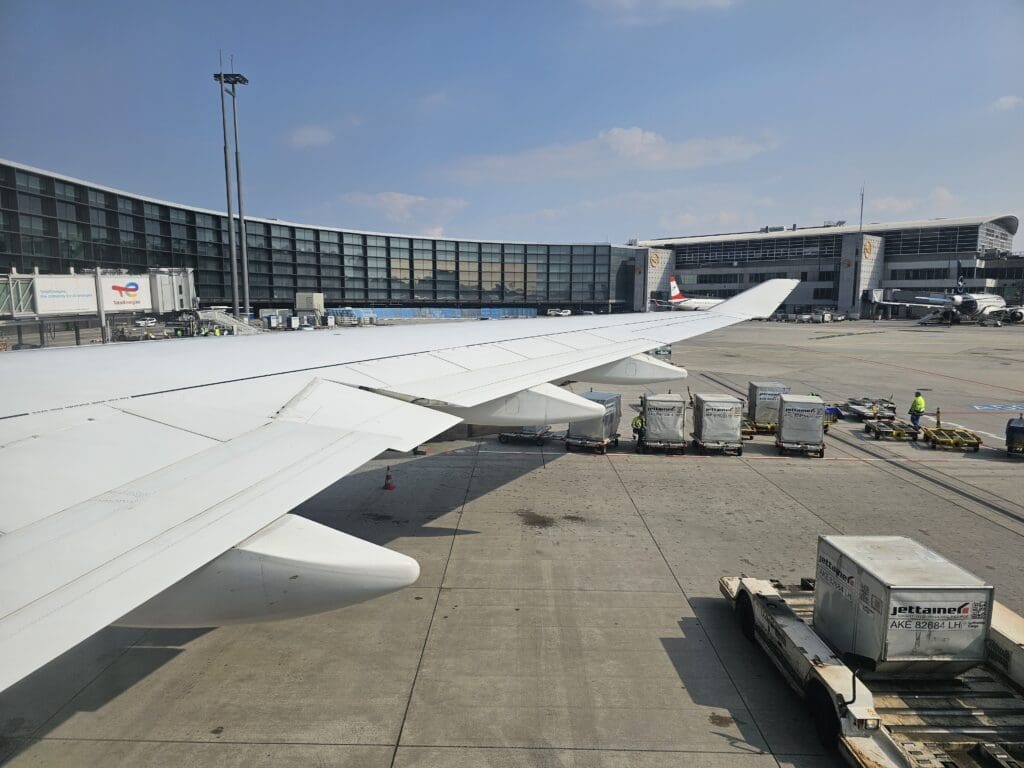
Despite being a full flight, boarding reached its conclusion at 1225, ten minutes before our scheduled departure time, giving passengers some hope that the flight would be able to depart on time. A short time later, the Captain performed their welcome speech in German and English, although sadly, this, and most announcements that would be made throughout the flight, were barely audible, with the cabin speakers being very quiet that day. From what I could make out, this consisted of the usual welcomes and thanks for flying with Lufthansa, before they introduced themselves, the two First Officers and the Purser, and advised passengers of the flight time and the weather in Bengaluru. This was then followed by a much longer but totally inaudible announcement from the Purser, which I assume consisted of the usual welcomes, warnings and thanks. That day, it appeared that passengers would be looked after by a seemingly veteran Lufthansa crew, with very few young faces amongst the army of flight attendants working the flight to Bengaluru.
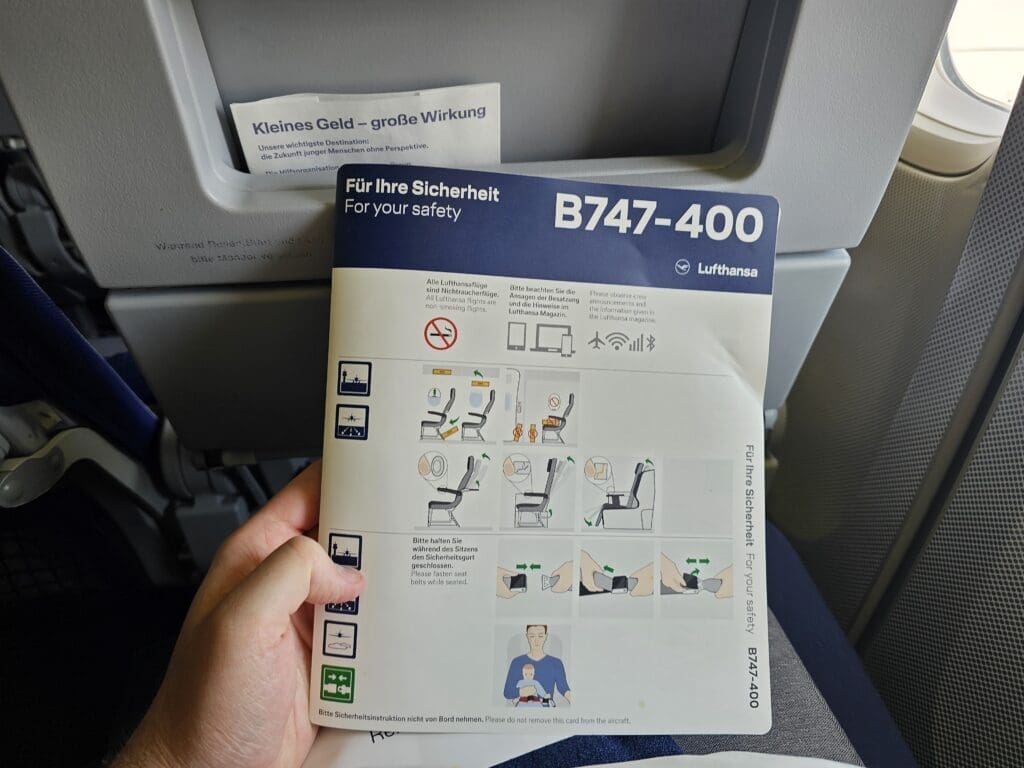
Whilst all passengers were onboard, looking outside, a seemingly endless stream of containers continued to be fed into the hold right up until our scheduled departure time, with this resulting in a few whines and clunks as these were moved into position below. Meanwhile, back in the cabin, indicating that our departure was nigh, the crew were asked to secure the doors, and Lufthansa’s safety video took over the inflight entertainment screens. Released in 2024, this video focuses on passengers who start their journey in Munich and go on a journey that takes them through Lufthansa’s destinations across the world before ending back in Munich. This was narrated in German and English, and was accompanied by German subtitles, although you may argue that, given our destination, it would have been better had this video come with Hindi captions instead. I should also add that, at this point, seeing as headphones were yet to be distributed, the low volume of the cabin speakers rendered this video nearly impossible to hear. Once this had concluded, the crew passed through the cabin, ensuring that everything was secure and in place for our departure.
Looking outside, as the crew were performing the final checks, the door to the cargo hold could be seen and heard being closed before the cones were removed from around the aircraft. At 1240, the Boeing jolted backwards as our pushback commenced, heralding the start of our journey to Bengaluru. This saw us travel back by a fair distance before being pulled forward, once again by some way. With the tug still connected, one by one, the Boeing’s four General Electric CF6 engines powered into life. Compared to the quiet Airbus narrowbody engines that I have become accustomed to as of late, this ended up being a comparatively loud start-up procedure that was accompanied by a fair amount of vibration, whilst the scent of jet fuel temporarily filled the cabin. Whilst nothing out of the norm, this was perhaps slightly unnerving to the more nervous flyers amongst us. Within a few minutes, all four engines had spooled into life, and the large wing flaps were partially extended to provide us with the amount of lift that we would need to safely take to the skies.
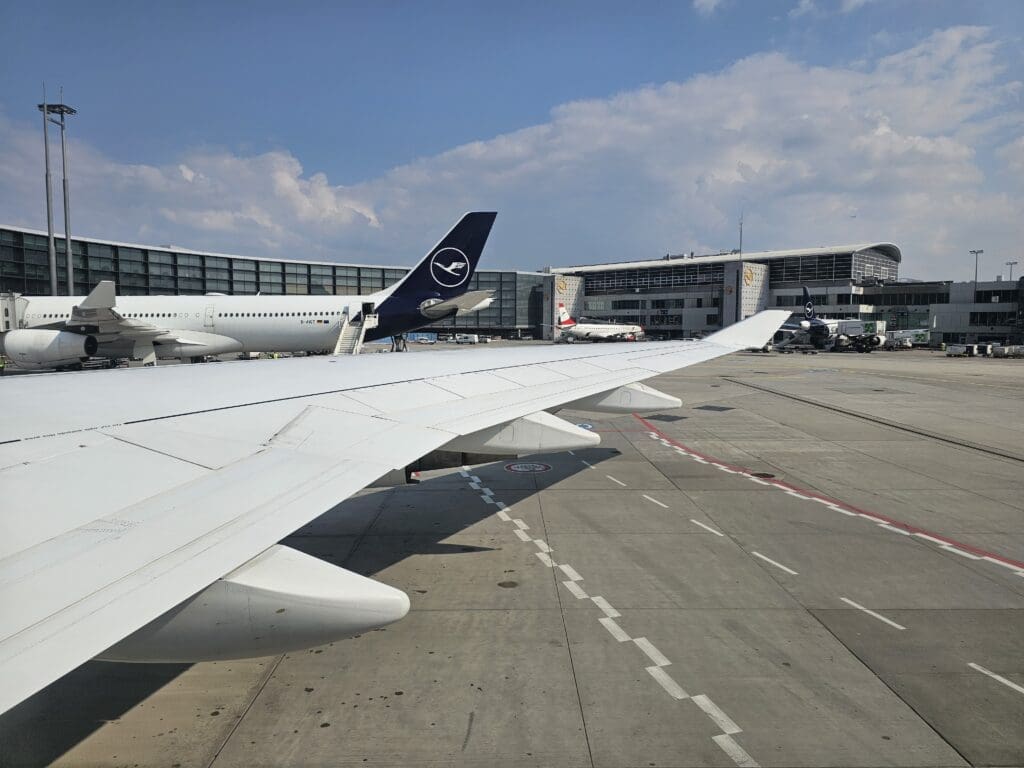
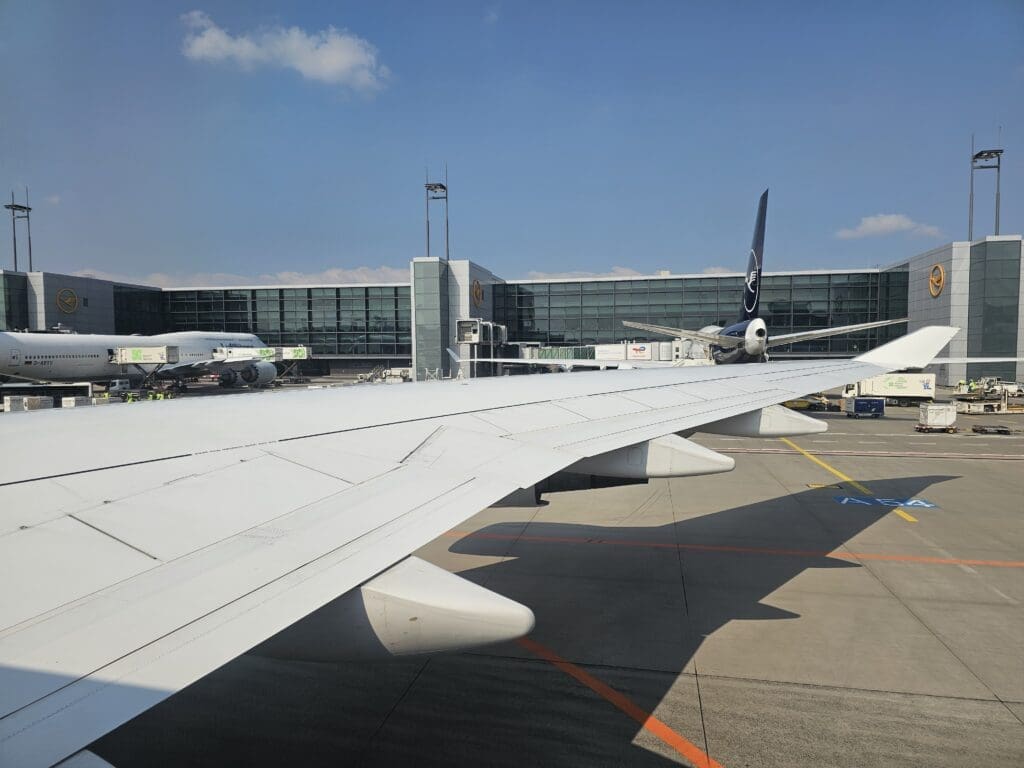
Following a short pause, the Boeing slowly and cautiously trundled away from the apron, passing Frankfurt Airport’s distinctive control tower before the massive Lufthansa Technik hangars popped into view, where a fellow Boeing 747-400 could be seen waiting outside. Trundling along, the Lufthansa hangars were replaced by Lufthansa Cargo’s hub, where several Boeing 777 Freighters operated by Lufthansa Cargo and their Leipzig-based partner, Aerologic, could be seen. After a few minutes, the aircraft came to a halt and remained stationary for about ten minutes.
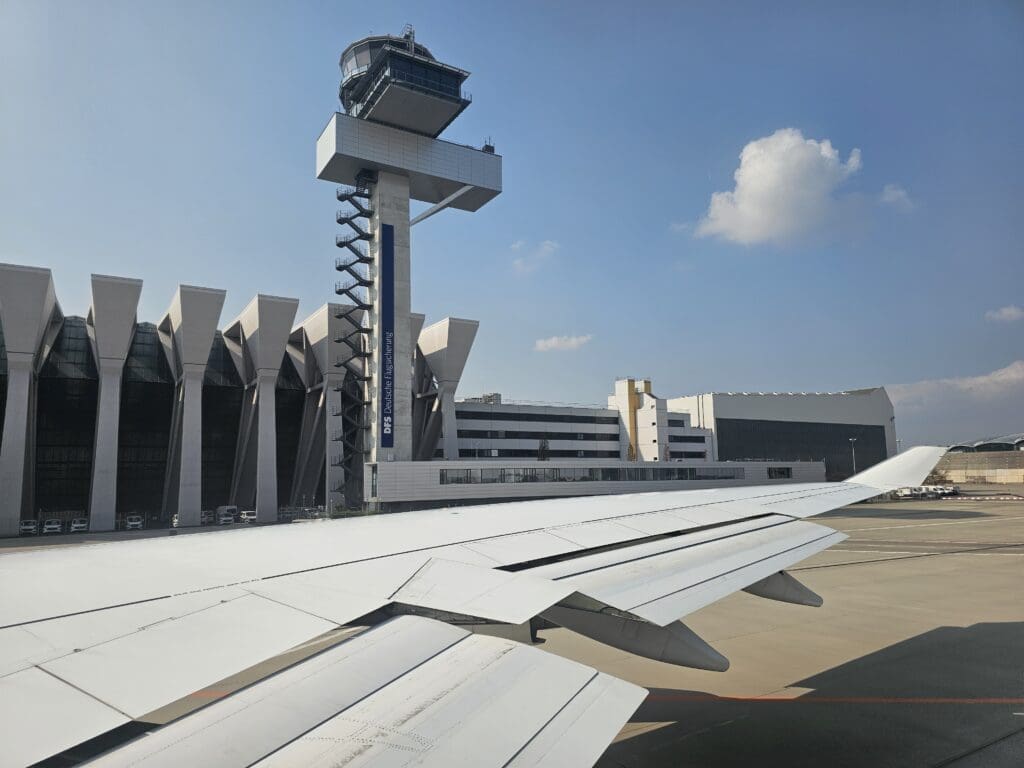
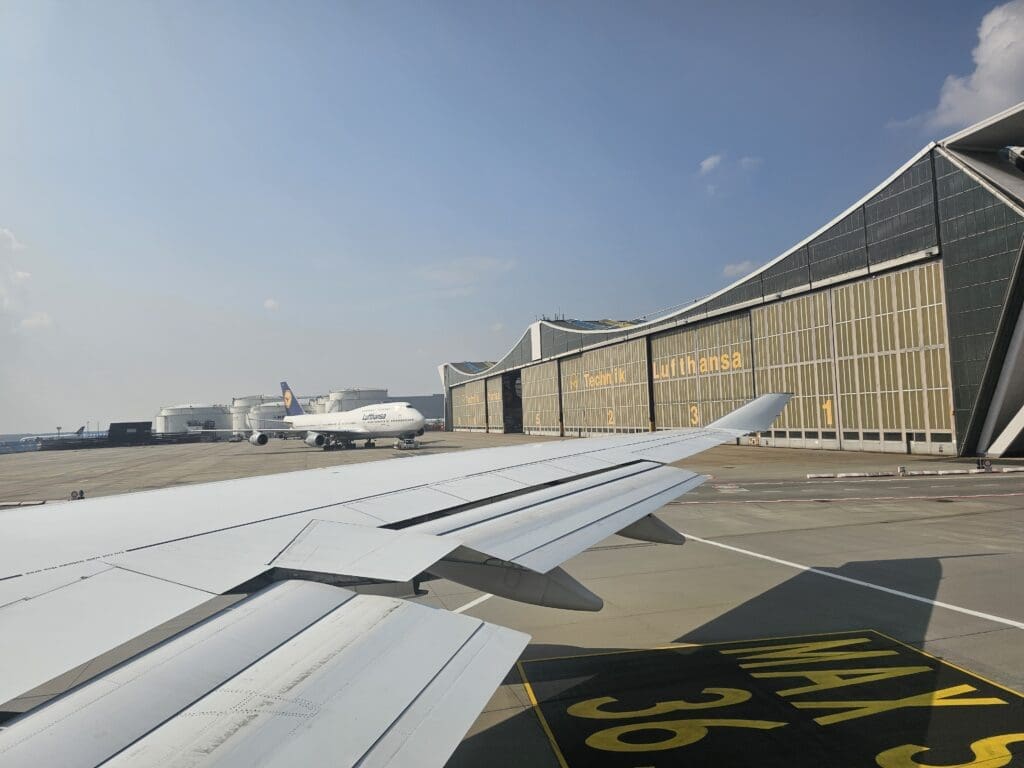
During the wait, I thought nothing of this and presumed that our journey had been interrupted owing to the usual air traffic control and slot-related restrictions. However, I became slightly alarmed when we vacated the taxiway and came to a halt at a cargo stand, Stand F237 to be precise. Once there, the engines spooled down, and soon, the Captain gave an update. This revealed that during the taxi, there had been some sort of computer fault in the cockpit, and we had come to a halt whilst the pilots worked with Lufthansa’s maintenance control in an attempt to rectify this. However, this proved unsuccessful, and so the aircraft pulled up to a remote stand so that engineers could attend in person.
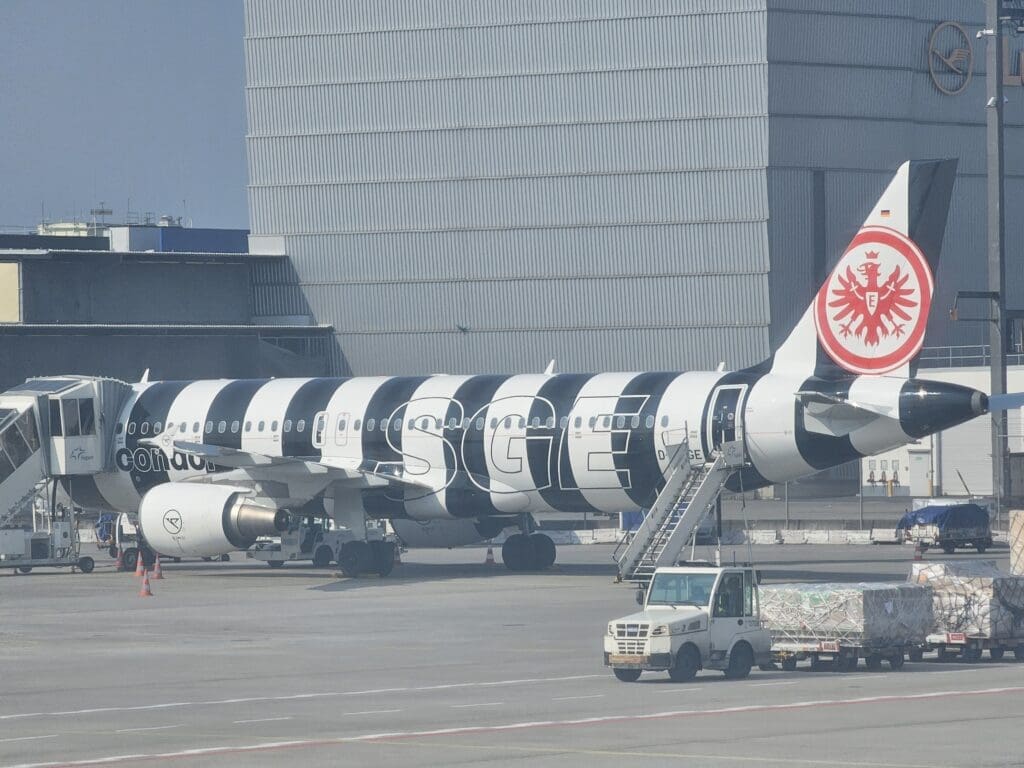
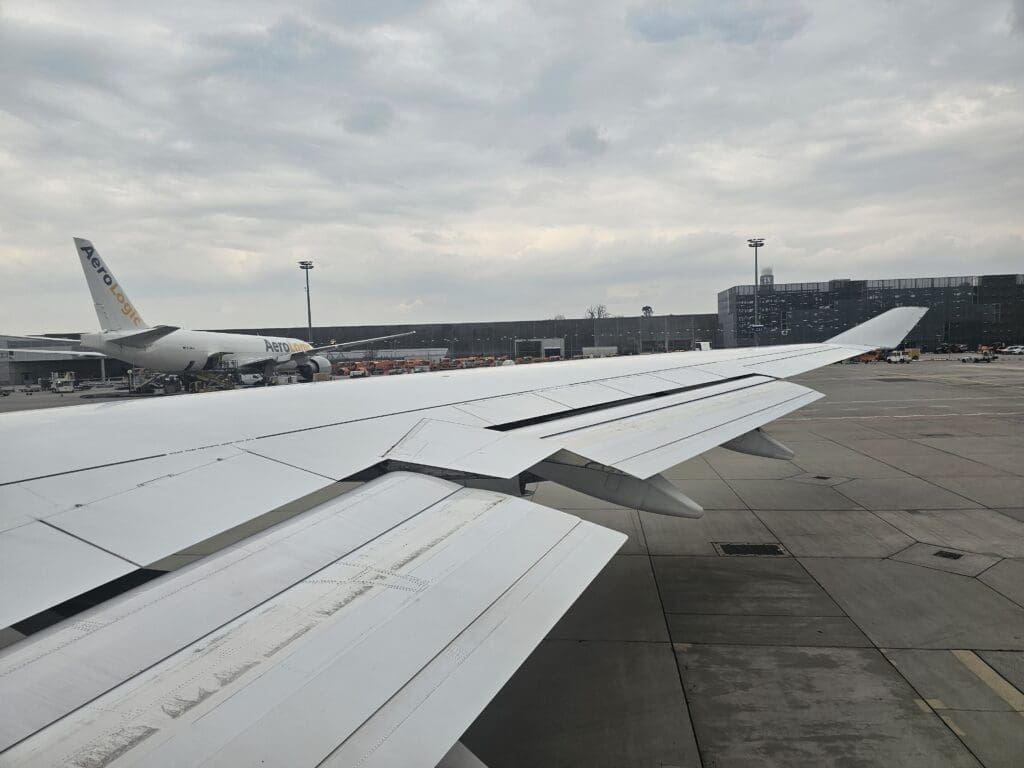
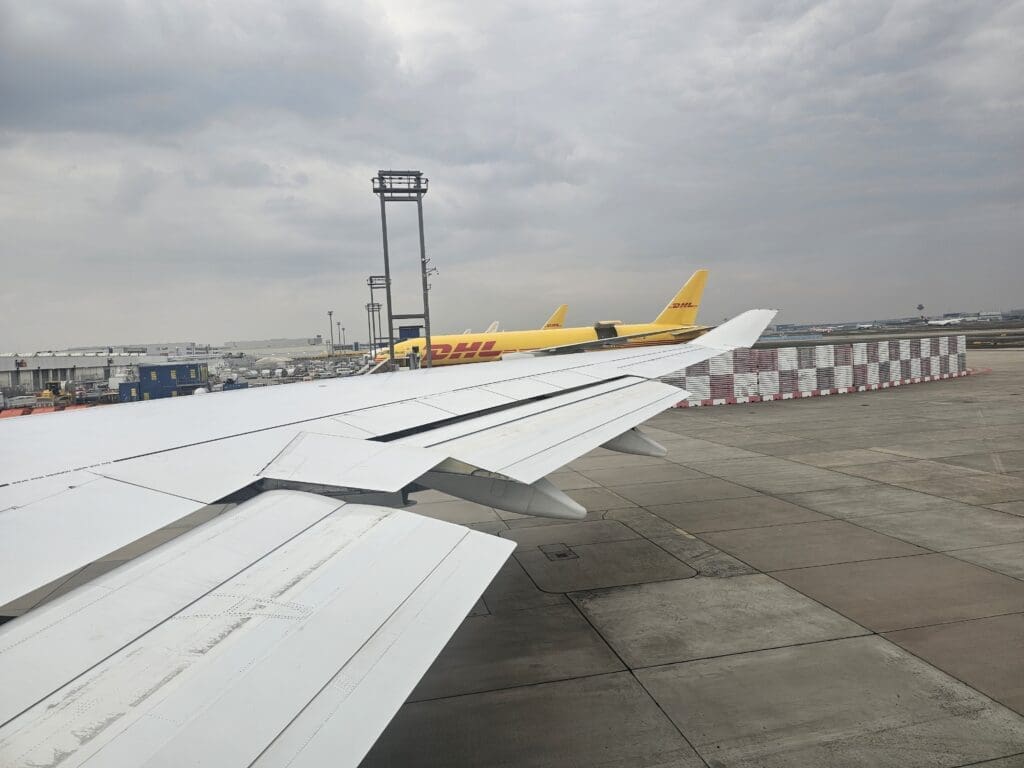
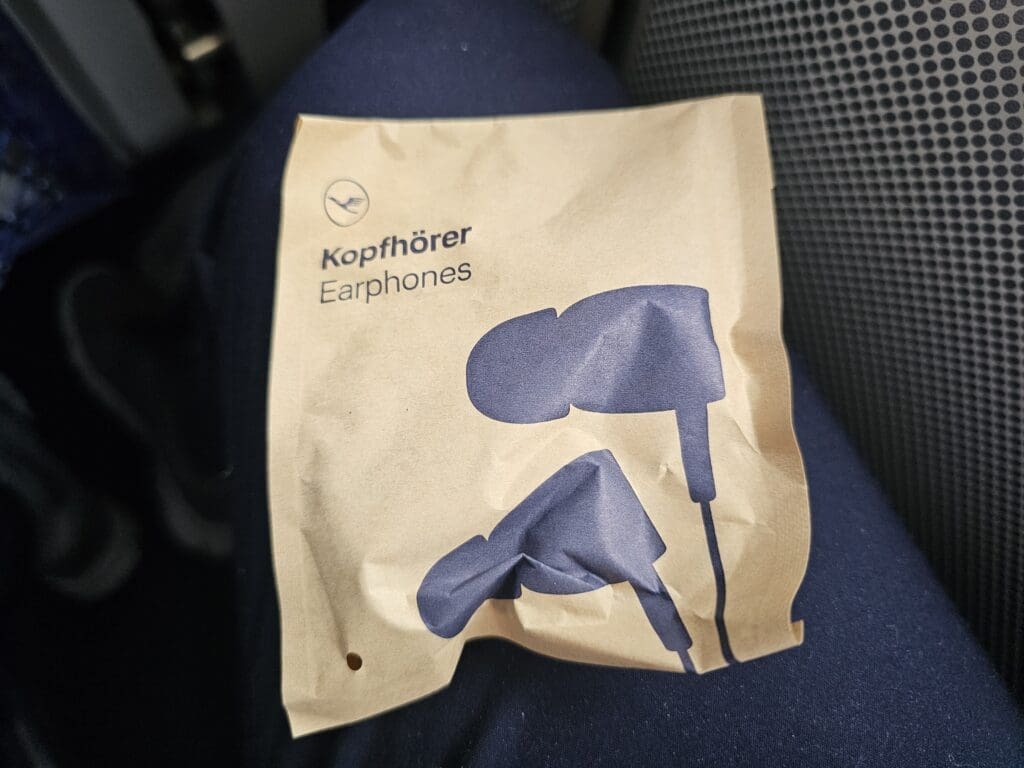
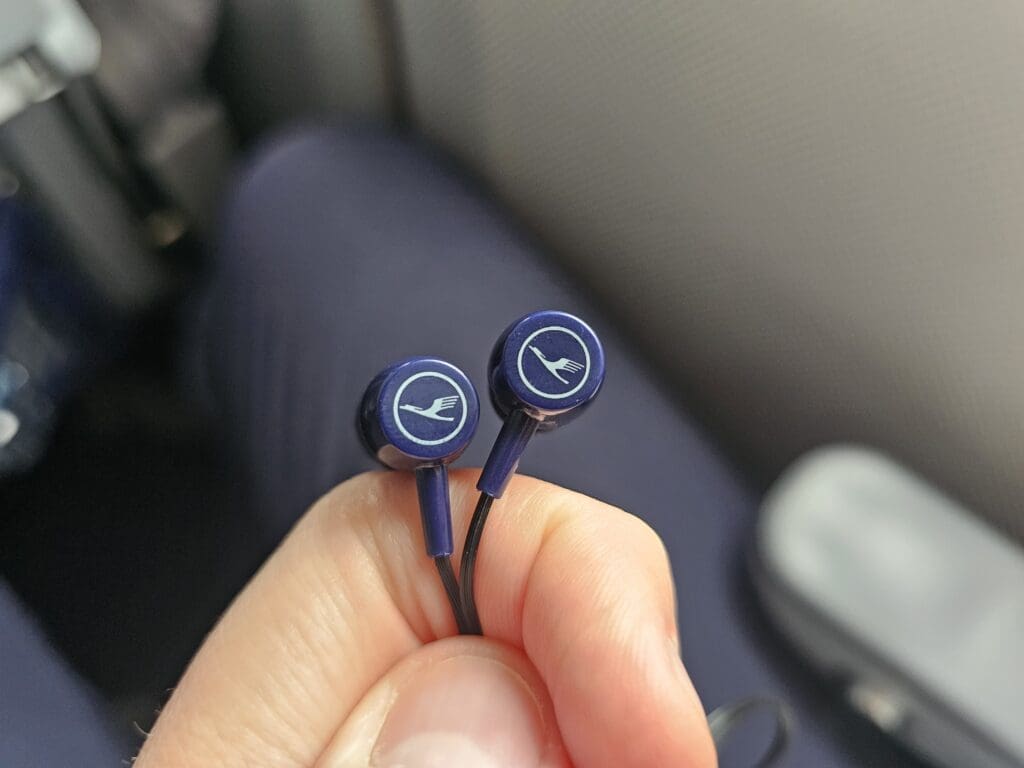
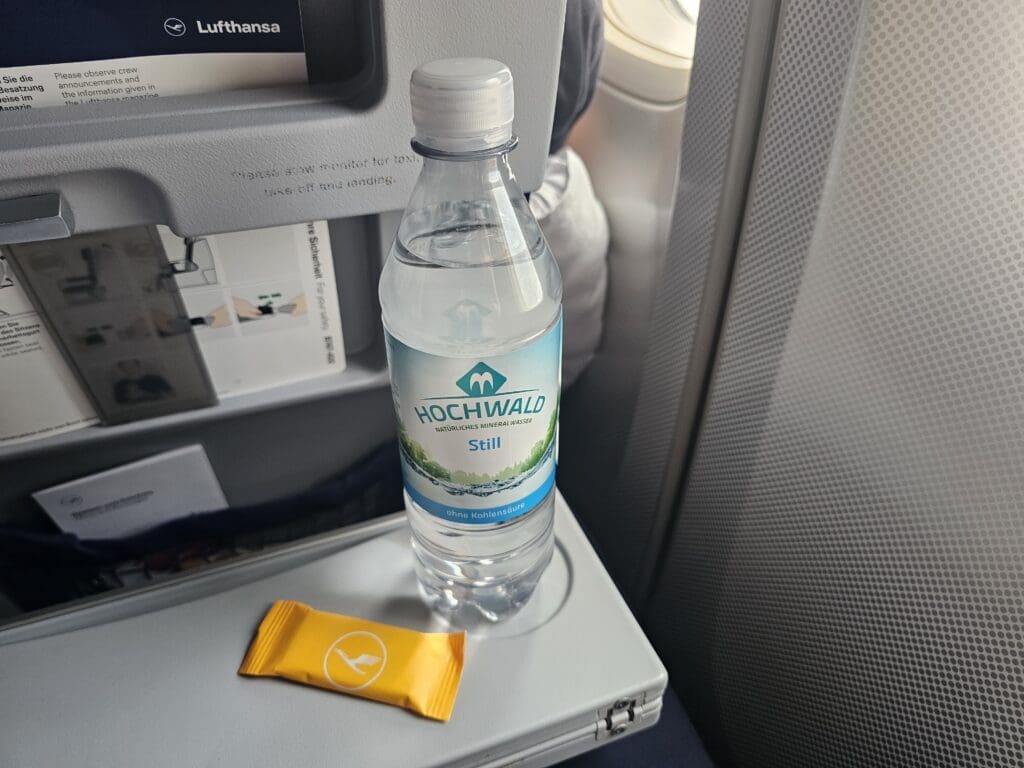
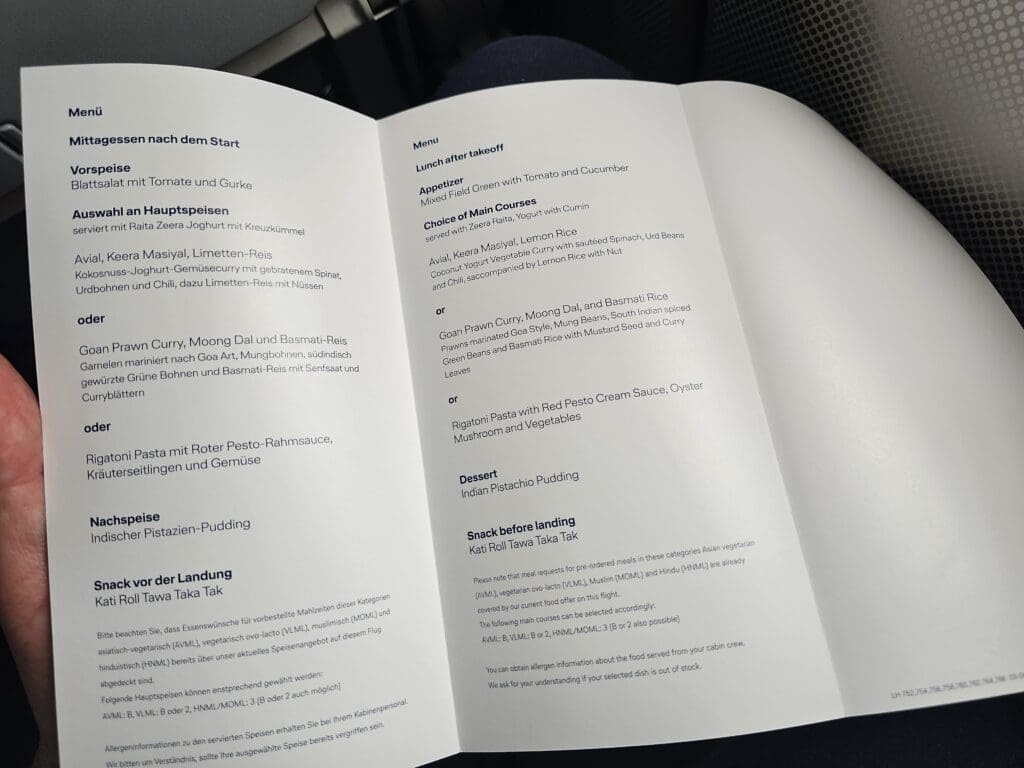
Understandably, no promises were made about when we could expect to be moving again, and so there was nothing to do but sit tight and wait. Fortunately for those who were starting to feel a little restless, the cabin crew soon passed through the cabin distributing headphones so that passengers could make use of the inflight entertainment system. Giving us all something to look forward to, this was then followed by the distribution of paper menus (something that is a real treat these days in Economy!), followed by a 500ml bottle of Hochwald still mineral water, and then finally, one of Lufthansa’s trademark Lindt chocolates. During this time, passengers were free to use the lavatories; however were encouraged to remain in their seats to allow for an efficient departure once everything had been sorted. Whilst this delay was not ideal, with my flight from Bengaluru to Mumbai not departing until 0830, I was not overly concerned at this stage and felt that the cabin crew handled the delay as best as they could have done. Furthermore, I appreciated the regular announcements from the cockpit, which, if you could hear these, kept passengers abreast of the situation. Looking around, I was delighted to see that passengers took the delay in their stride, with nobody appearing to be particularly concerned, nor anyone kicking off in frustration.
Around thirty minutes after the aircraft had come to a halt, the Captain provided another, and thankfully reassuring, update. During this, they mentioned that engineers were onboard and a hardware component in the cockpit was in the process of being replaced. They estimated that this would take fifteen minutes to install and test, and a further fifteen minutes to complete all the relevant paperwork to release the aircraft back into service. Seeing as I had been up since 0200 and managed just three hours of sleep the night before, by this time I was shattered and thus drifted off for an early afternoon nap. By the time I woke up, there was still no movement, although the Captain soon performed their final update during which they noted that the issue had been rectified; however, there was a slight further delay owing to flight planning and dispatch reasons, although they hoped that we would be able to push back in around fifteen minutes. Approximately ten minutes after this announcement had been made, a few dings could be heard, and the cabin crew suddenly sprang into life. At this time, the Purser made a totally inaudible announcement, which I assume was related to our imminent departure, whilst the army of flight attendants took to the aisles once again and, for the second time, ensured that everything was secure and in place for our departure.
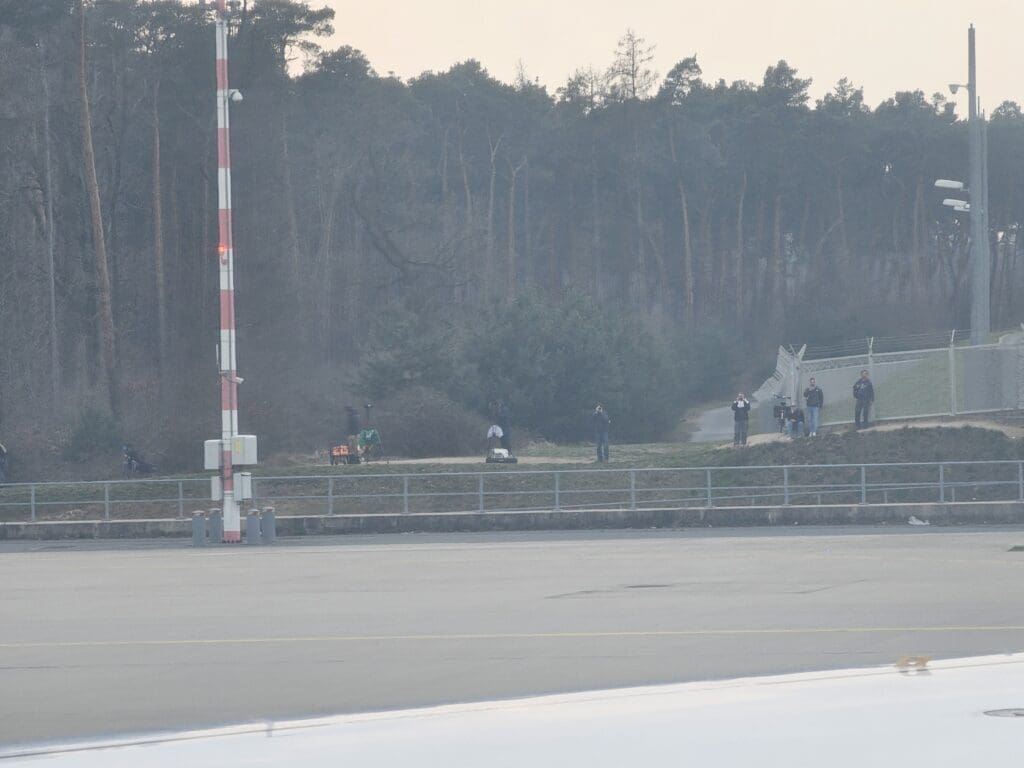
After about ninety minutes spent at a remote stand, the Boeing jolted rearwards as we commenced our pushback, before the now familiar sound of the General Electric CF6 engines powering into life filled the cabin once more, with these taking a few minutes to power up and stabilise before we commenced our taxi over to the runway. One advantage of our parking position was that, seeing as we would depart from Runway 15, nothing more than a very short two-minute taxi was in store before we reached the end of this. Once there, the Jumbo came to a temporary stop to allow an all-white Sky Express Airbus A320 to jet off back to its home base, Athens. Indicating that I was not on an ‘ordinary’ airliner, as we waited, I spotted plenty of spotters snapping away at the aircraft on the other side of the fence.
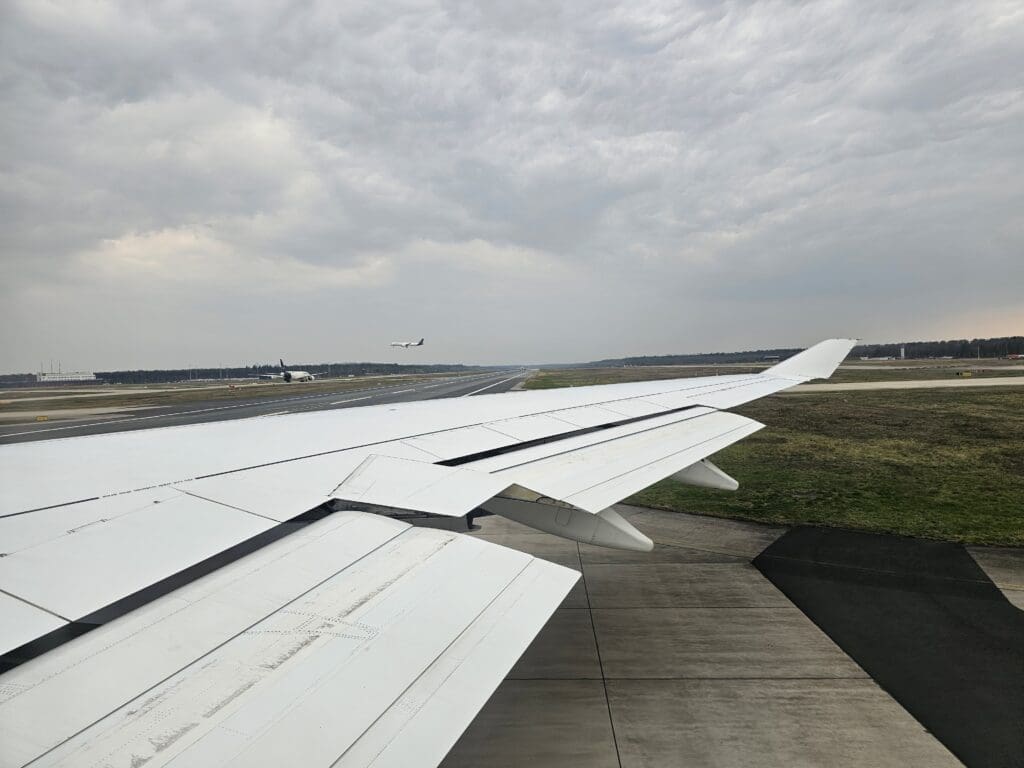
At 1438, now running a little over two hours behind schedule, the pilots pushed the four throttle levers forward, and the Boeing commenced a noisy and powerful take-off roll. Accompanied by the odd bump and sway, we picked up speed fairly quickly, and before I knew it, the nose was pointed skywards. As I have noticed when taking off on Jumbo Jets, our rotation was accompanied by plenty of shuddering for about five seconds before things calmed down and we made a smooth climb away from the runway.
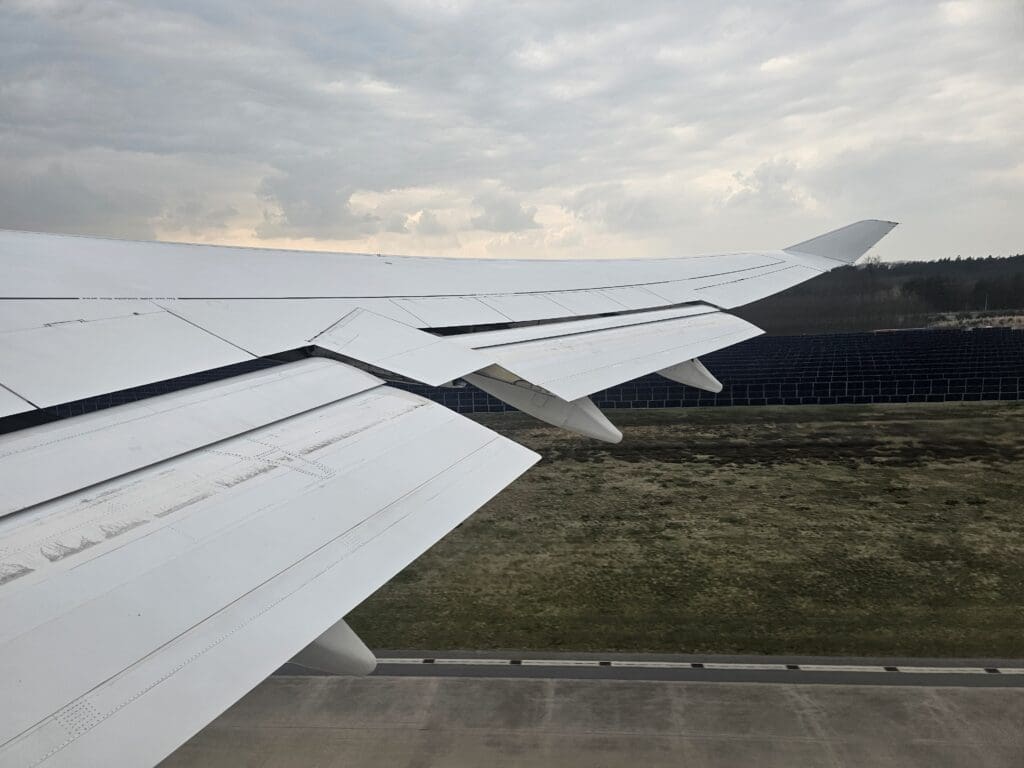
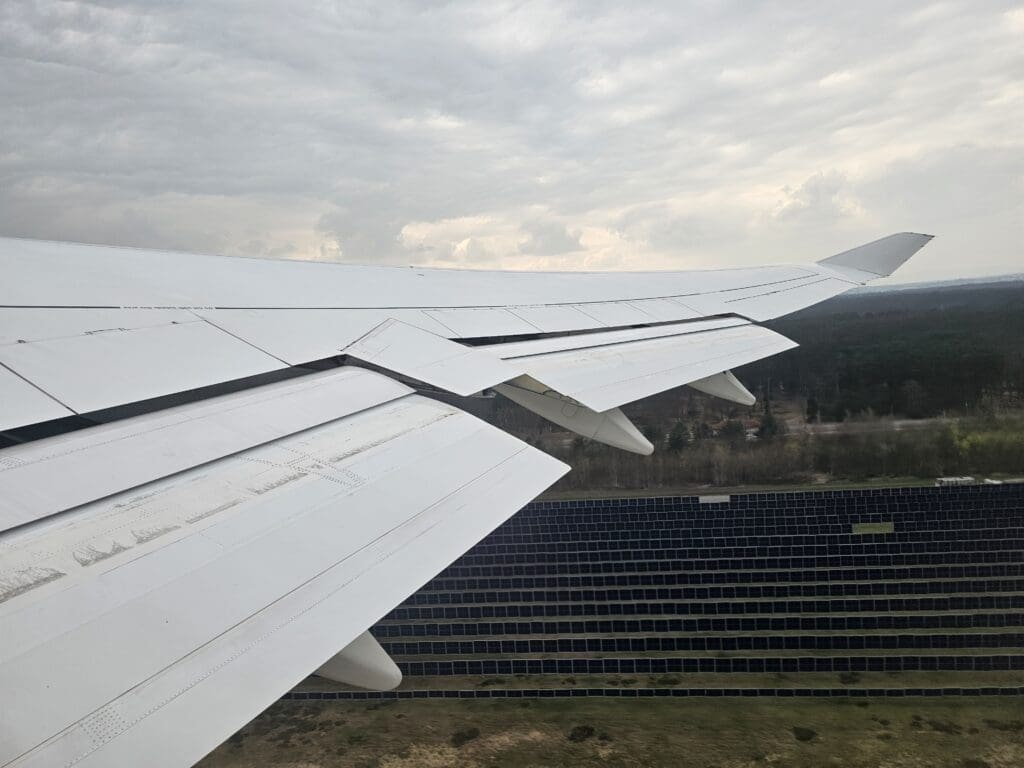
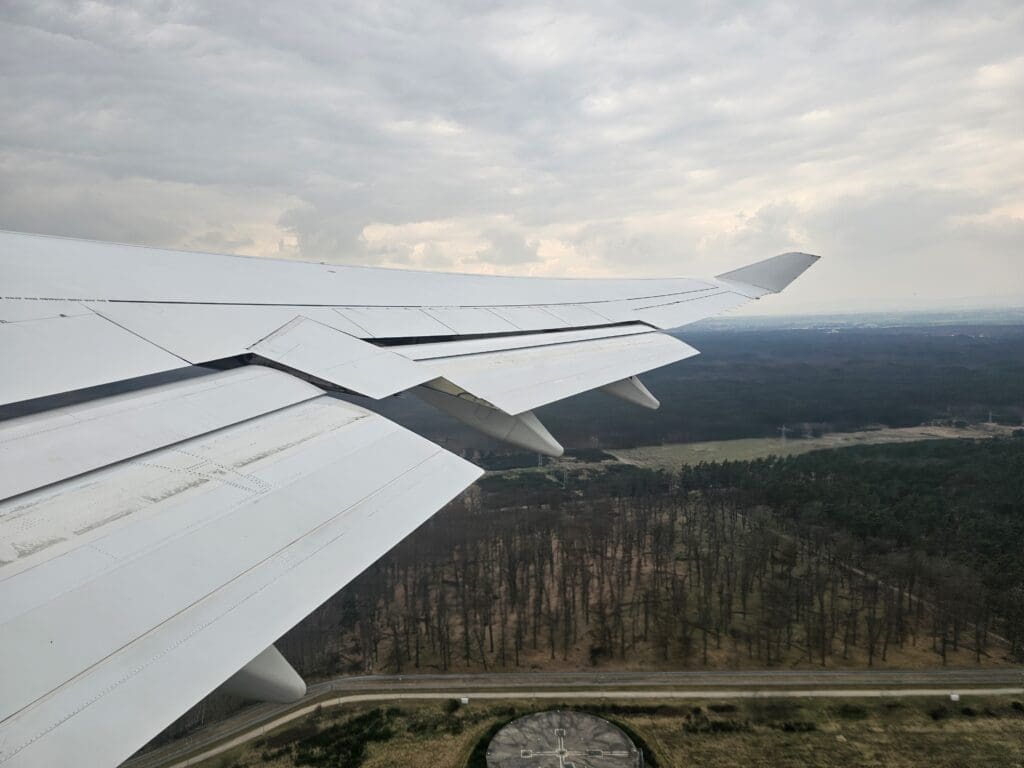
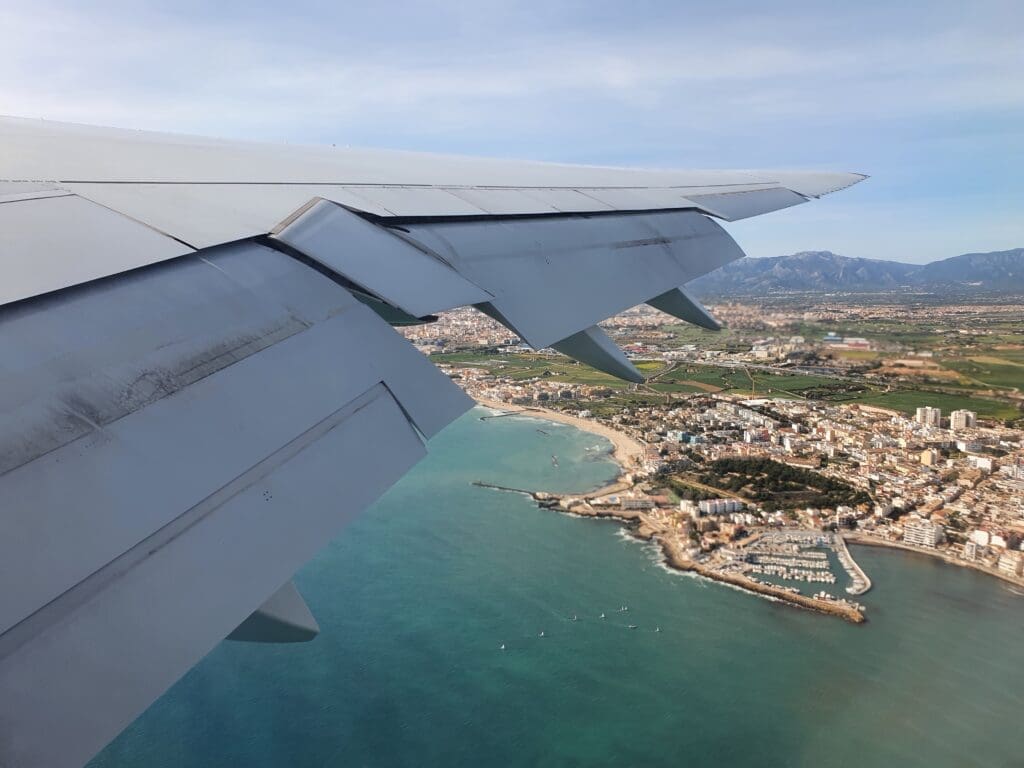
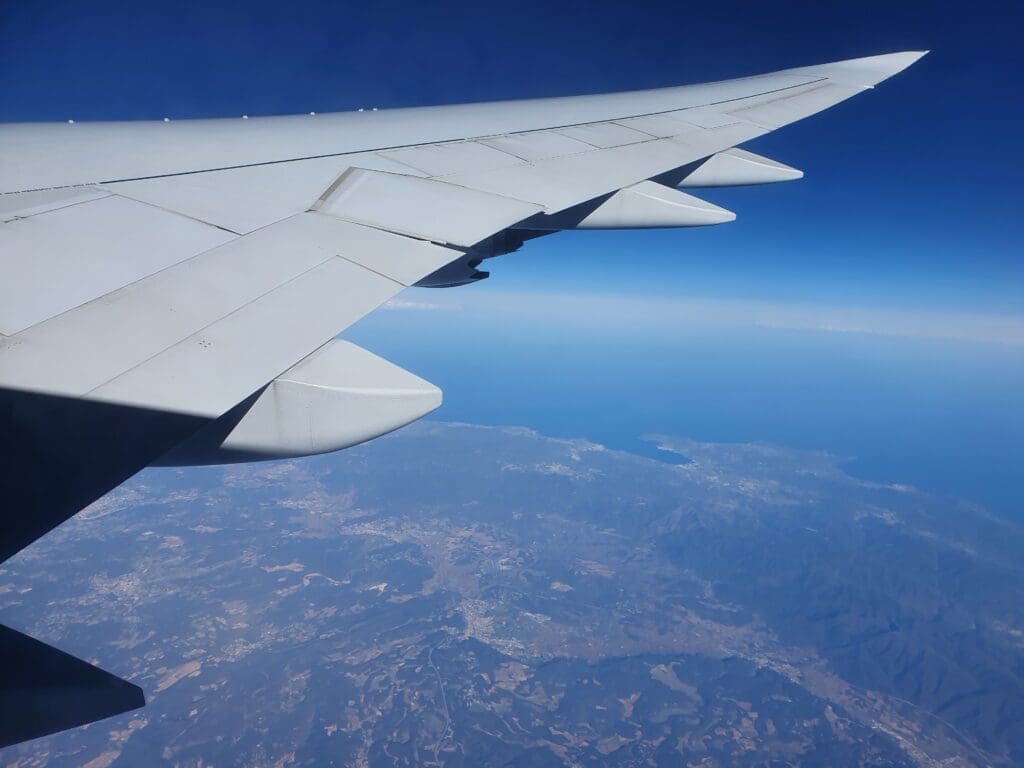
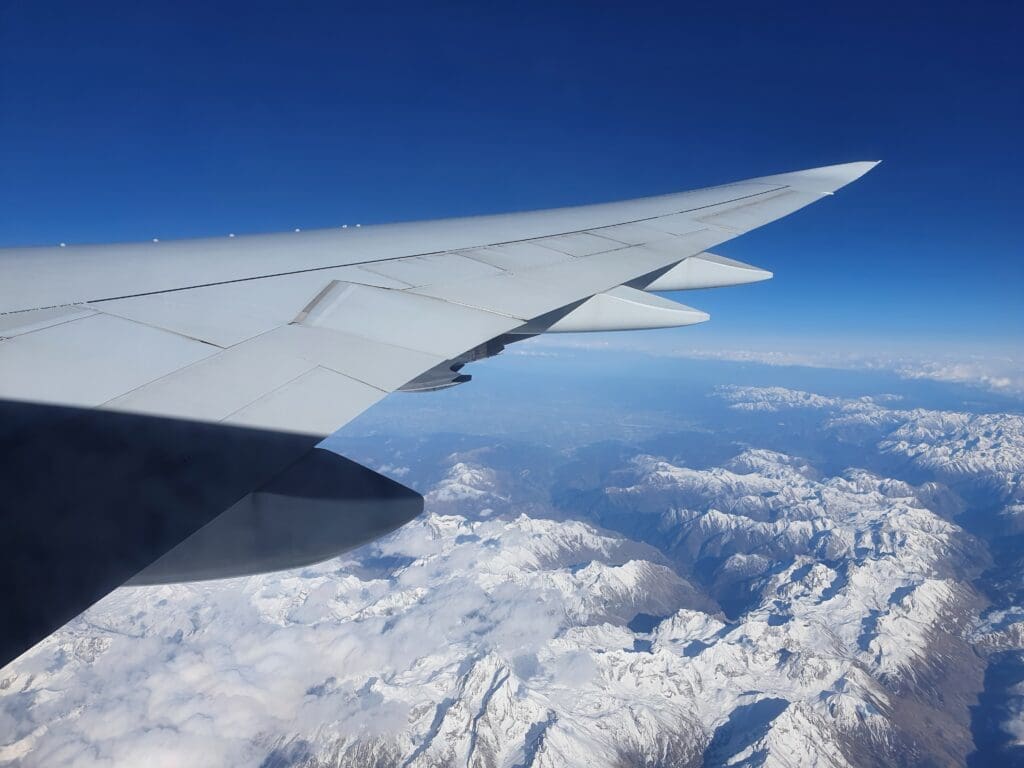
By the time we took to the skies, the morning sunshine had long gone and been replaced by lingering clouds; thus, little of Germany could be seen during the climb. However, I caught sight of the nearby towns of Rüsselsheim am Main, Groß-Gerau and Darmstadt during the first few minutes of the flight, offering me a parting glimpse of Germany before we rose into the clouds.
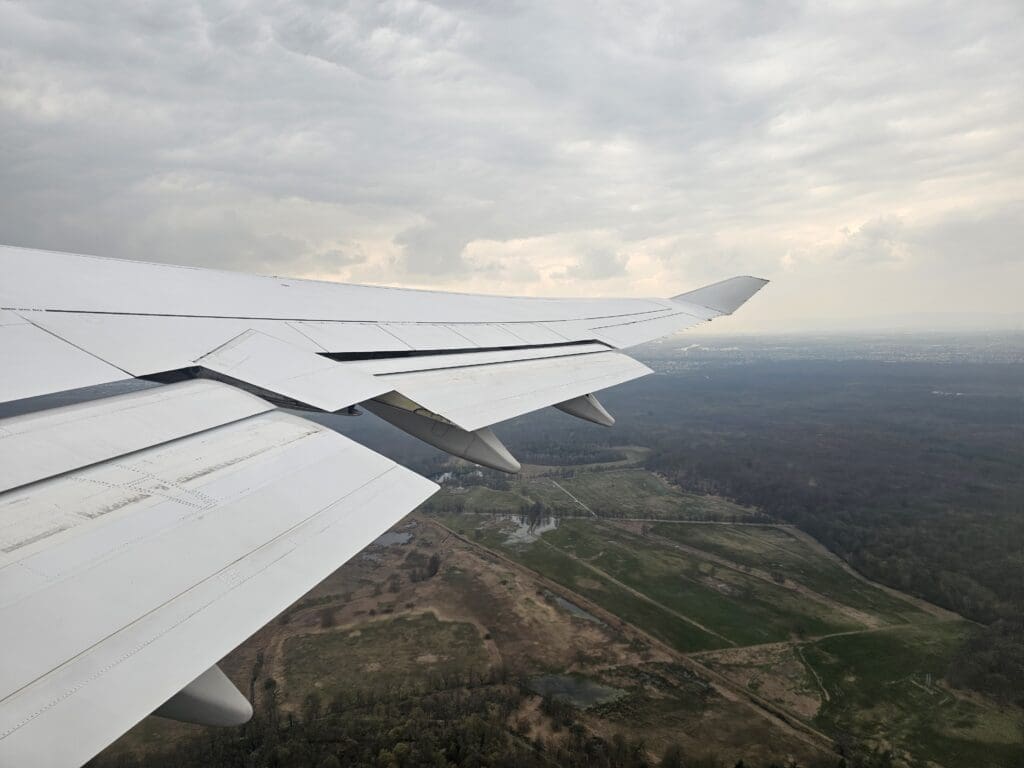
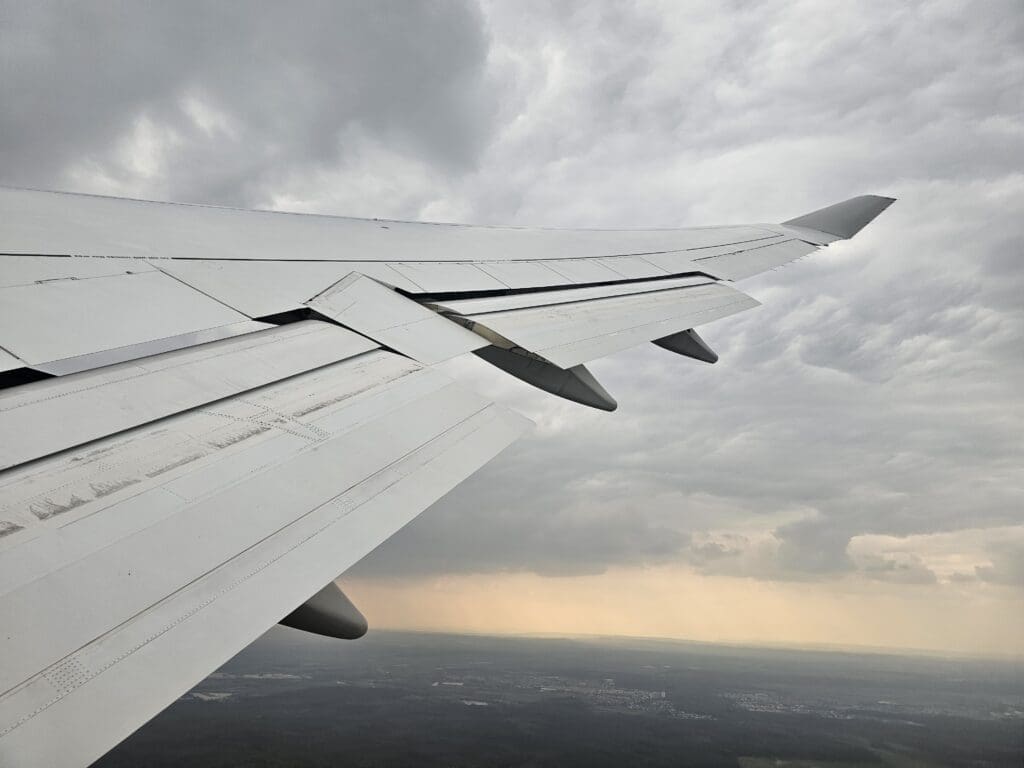
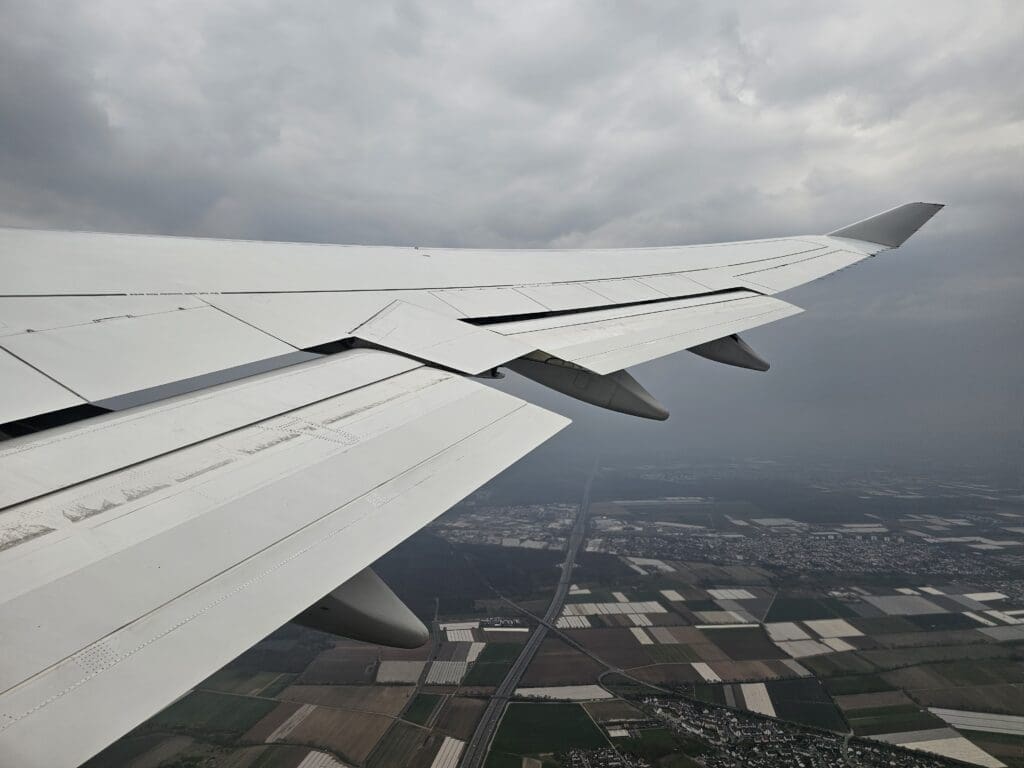
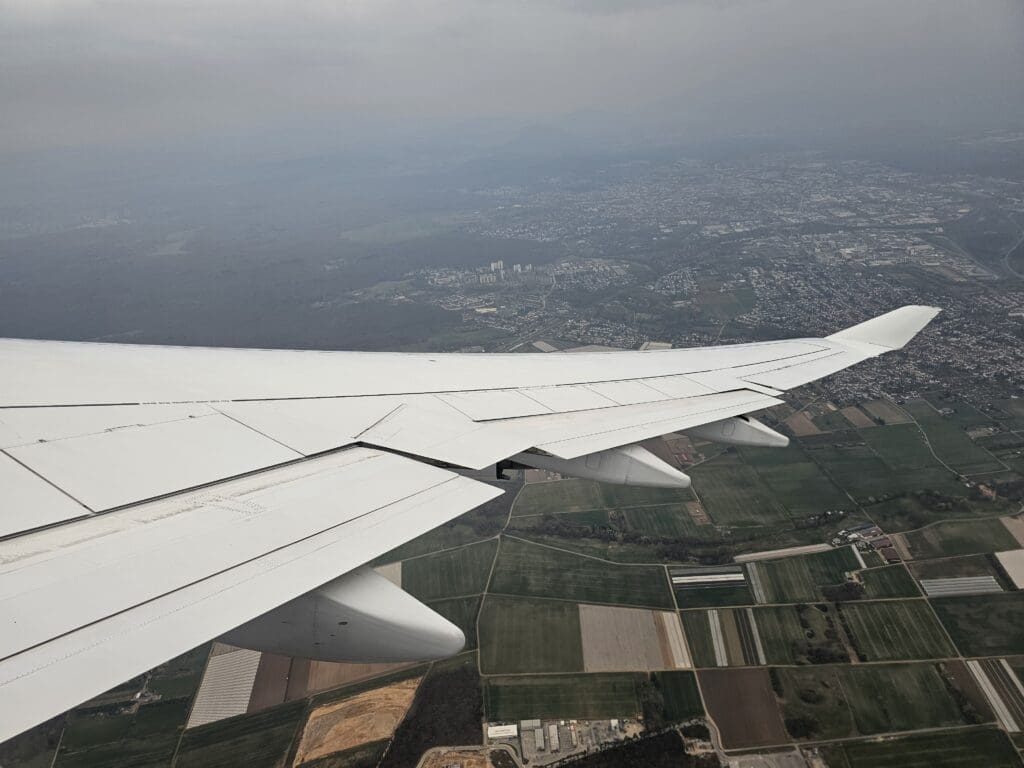
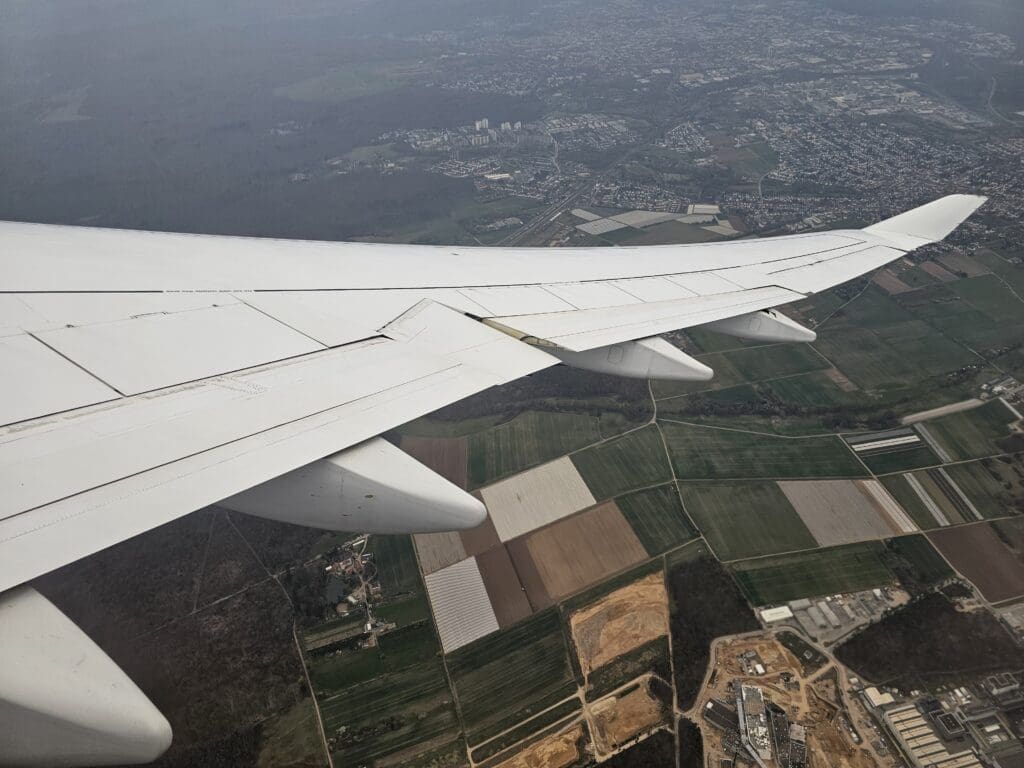
Once away from Frankfurt, the Purser made an announcement, and whilst unable to hear it, I assume it featured the usual warnings regarding seat belts and other tidbits of information. Despite the mean-looking appearance of many of the lingering clouds, that afternoon, the Jumbo sliced through these with ease, with very few lumps and bumps felt as we passed through these before the rich blue skies appeared above. With bright sunshine now pouring into the cabin and my two neighbours fast asleep, I opted to close my window blind, and, seeing as much of Europe was shrouded in cloud, I did not feel as if I was missing out on much by sliding this shut.
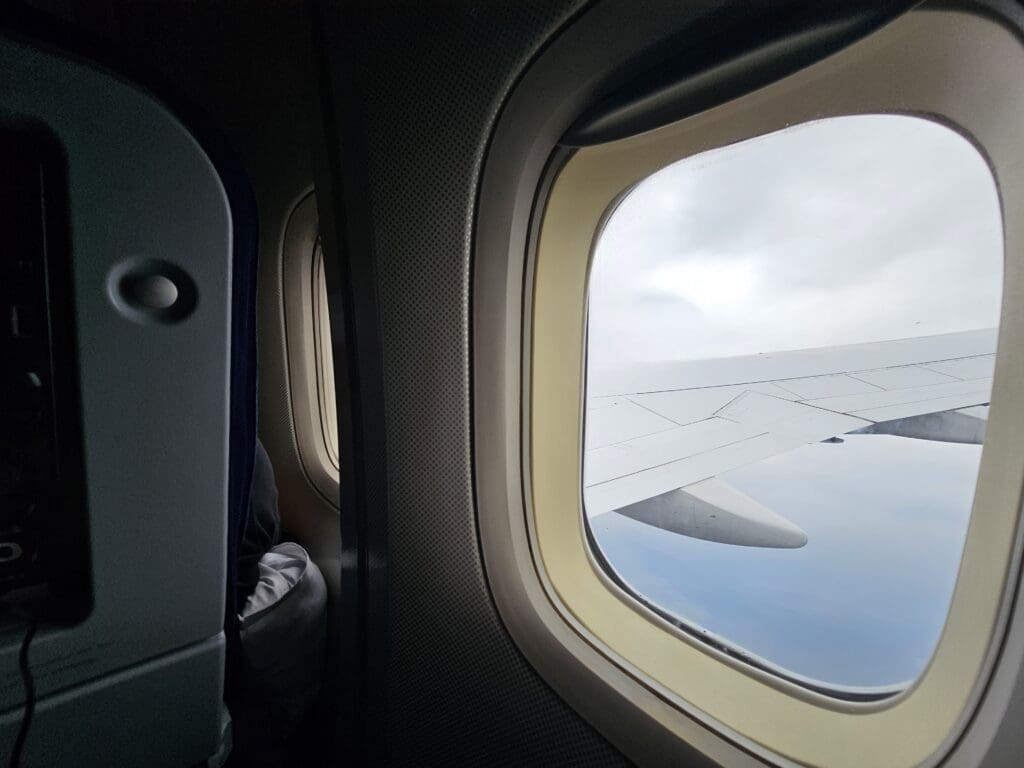
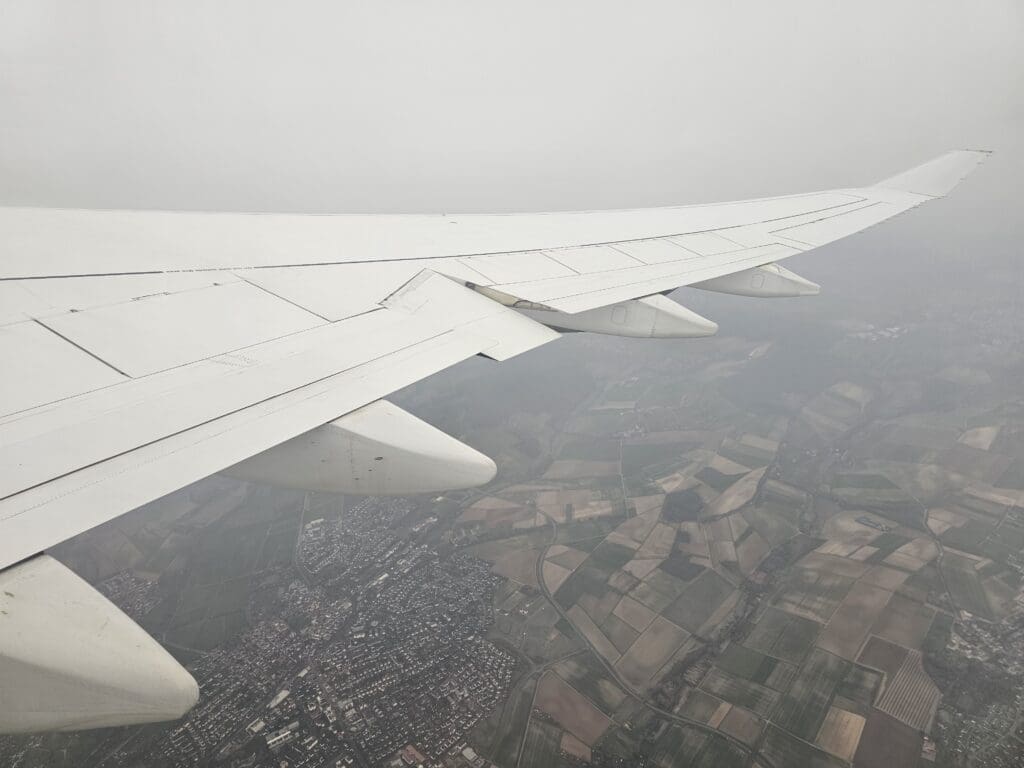
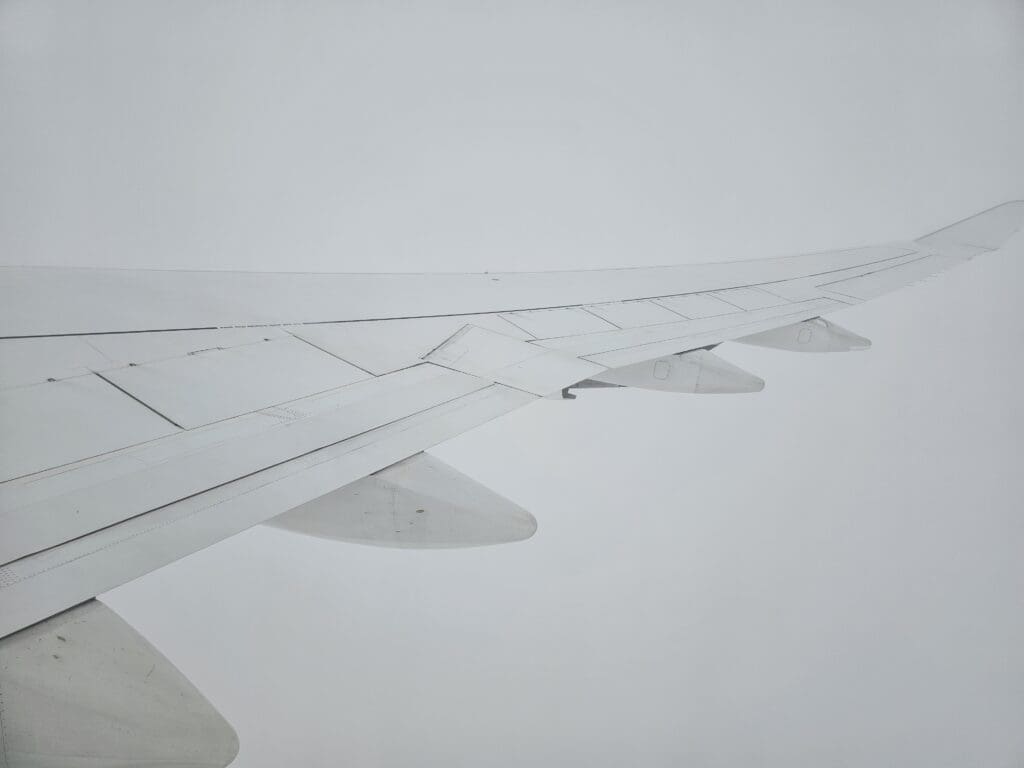
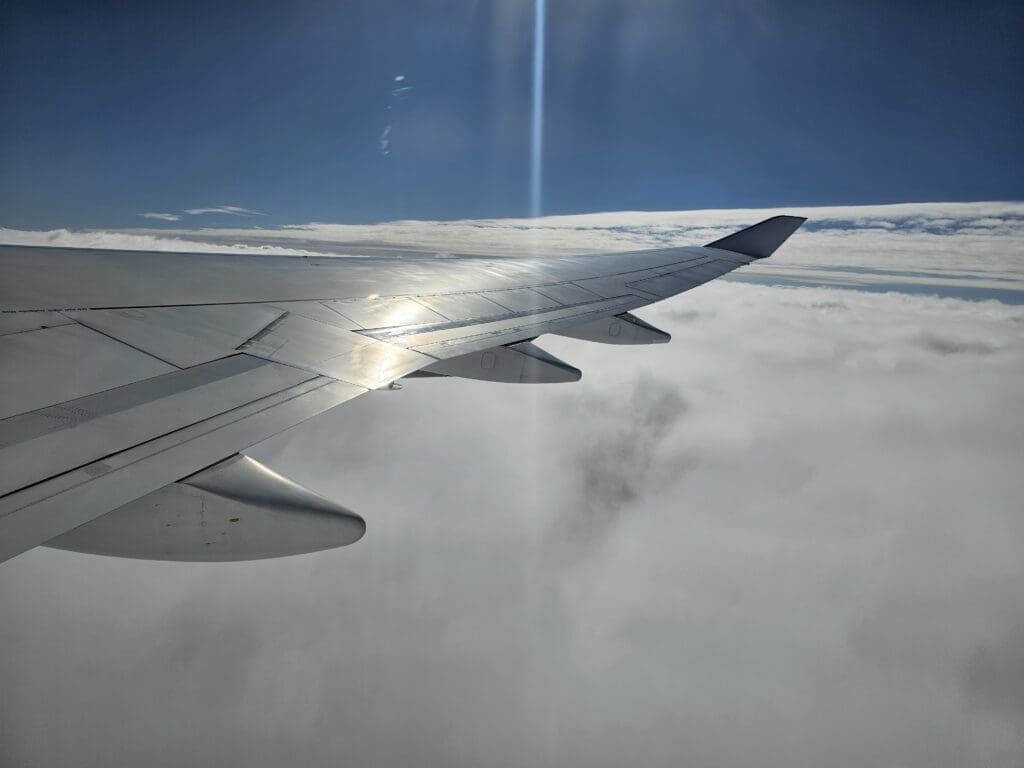
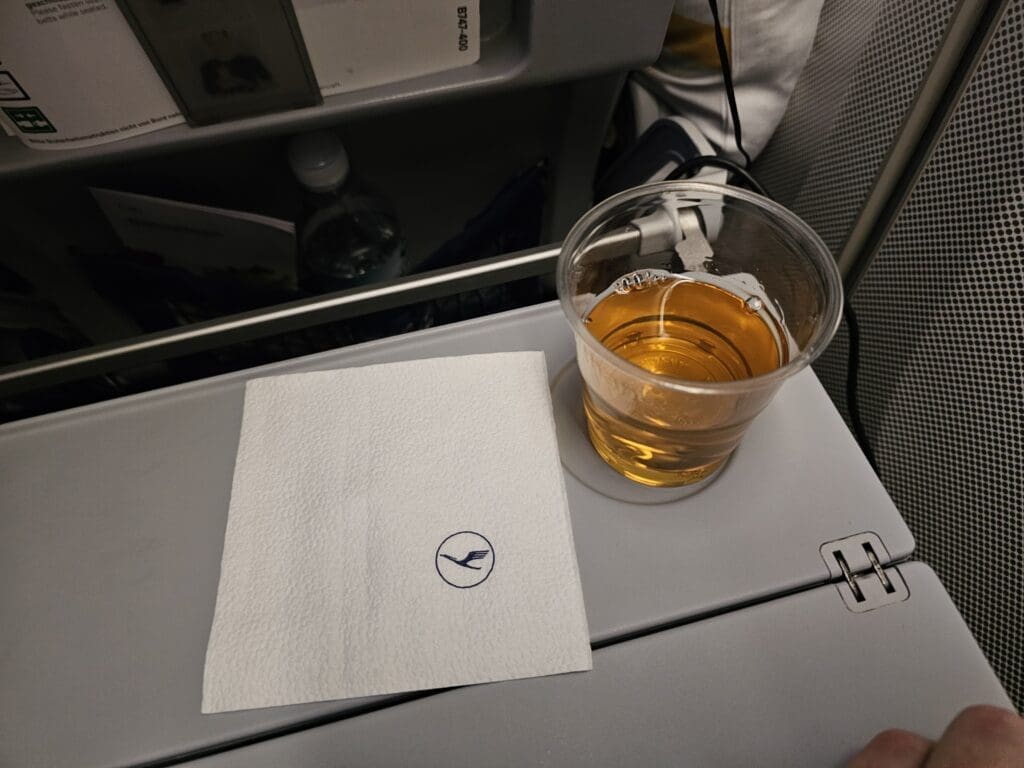
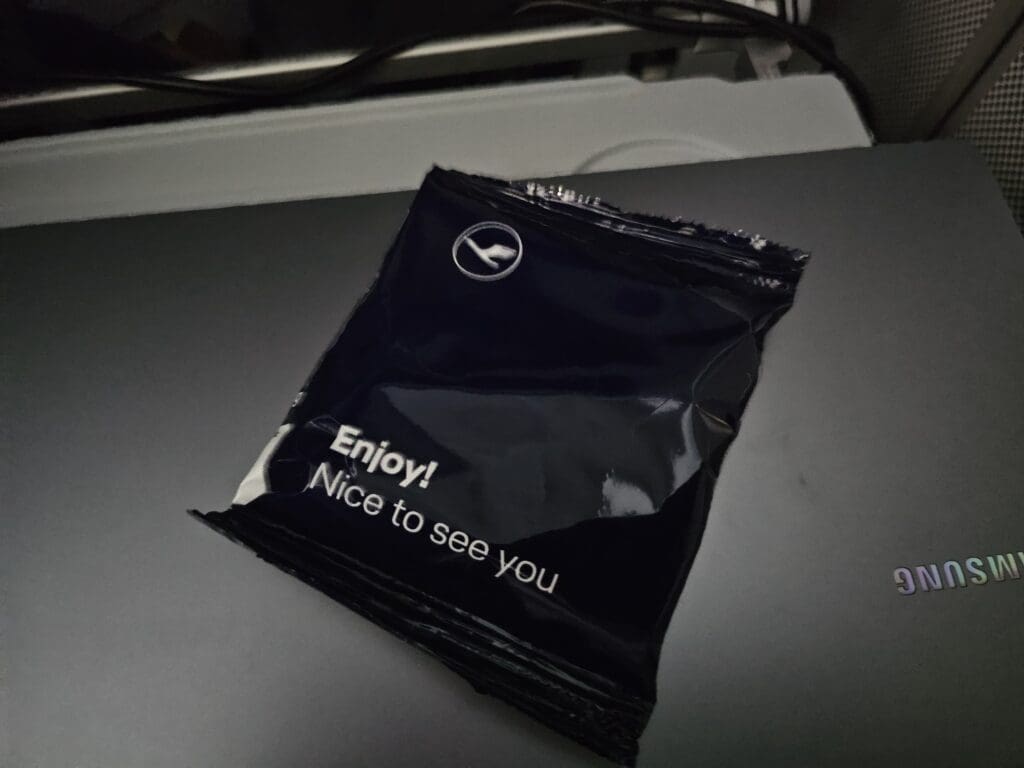
As soon as we had made it through the clouds, the pilots turned off the seatbelt signs, whilst just behind me in the galley, plenty of clattering could be heard, and the smell of warming food wafted through the cabin. Around thirty minutes after taking to the skies, the service carts were rolled out into the aisles and pushed to the very front of the Premium Economy cabin from where the crew commenced their service. First up was a small bag of salted crackers and a drink, with one flight attendant per aisle handing out the crackers, before returning to the front of the cabin to aid with drink distribution. Sitting at the very rear of the forward Economy cabin, I ended up being one of the last people to be served, and thus a reasonable wait of around twenty minutes was in store before the drinks cart reached my row. When flying long haul with Lufthansa, those in Economy can enjoy a reasonably expansive array of hard and soft beverages, including premium brands. However, not wanting to get too dehydrated, I played things simple and opted for an apple juice. This was poured and handed over to me in a plastic cup along with a serviette by a polite, but somewhat subdued flight attendant. Being absolutely shattered, once I had washed down the crackers with my apple juice, I drifted back off to sleep, coincidentally waking up just as the crew passed through the cabin collecting the remains of this service.
From Frankfurt, the aircraft journeyed southeastwards, soon passing from the skies of Hesse to Bavaria, and making its way directly over the centre of Munich, where we levelled off at our initial cruising altitude of 33,000 feet. Around thirty minutes after departure, we left Germany behind and quickly crossed Western Austria, passing over the states of Salzburg and Carinthia, before reaching Slovenia and passing over its capital, Ljubljana.
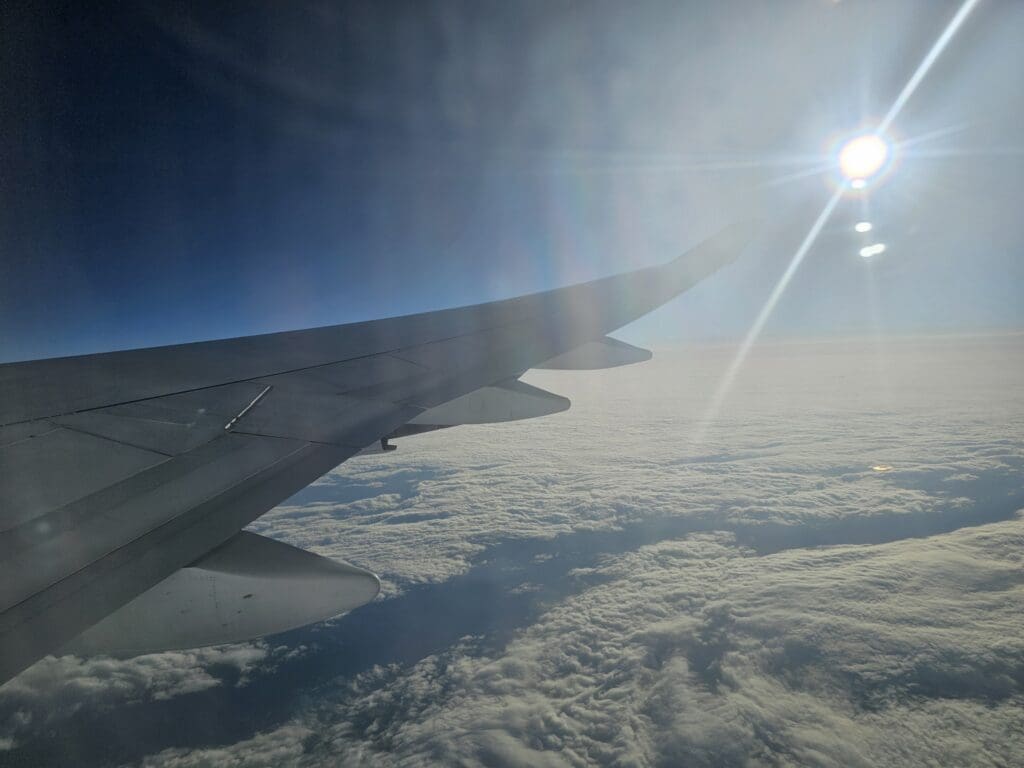
At around 1600 Central European Time, armed with service carts, the crew took to the aisles once again, heralding the commencement of the meal service, which, given our delay, had transformed from lunch to an early dinner. That day, passengers were offered three choices of main course, and not only did I have the opportunity to study these thanks to the paper menu, but these were also published online in the run-up to passengers’ flights, giving me plenty of time to study them before my trip. As I had experienced on my multiple slogs between Frankfurt and Munich, and Seoul Incheon, Lufthansa incorporates regional cuisines into their meal services, and my flight to South India was no different. That day, passengers could choose from a coconut yoghurt vegetable curry, a Goan prawn curry, or, for those wishing to leave the Indian food until India, a rigatoni in red pesto cream sauce. Once again, I ended up being one of the final passengers to be served, although thankfully, all options remained available, and thus, I decided to go for the vegetable curry. This was then cautiously handed over to me before I was offered a drink, and once again, I opted to go for an apple juice.
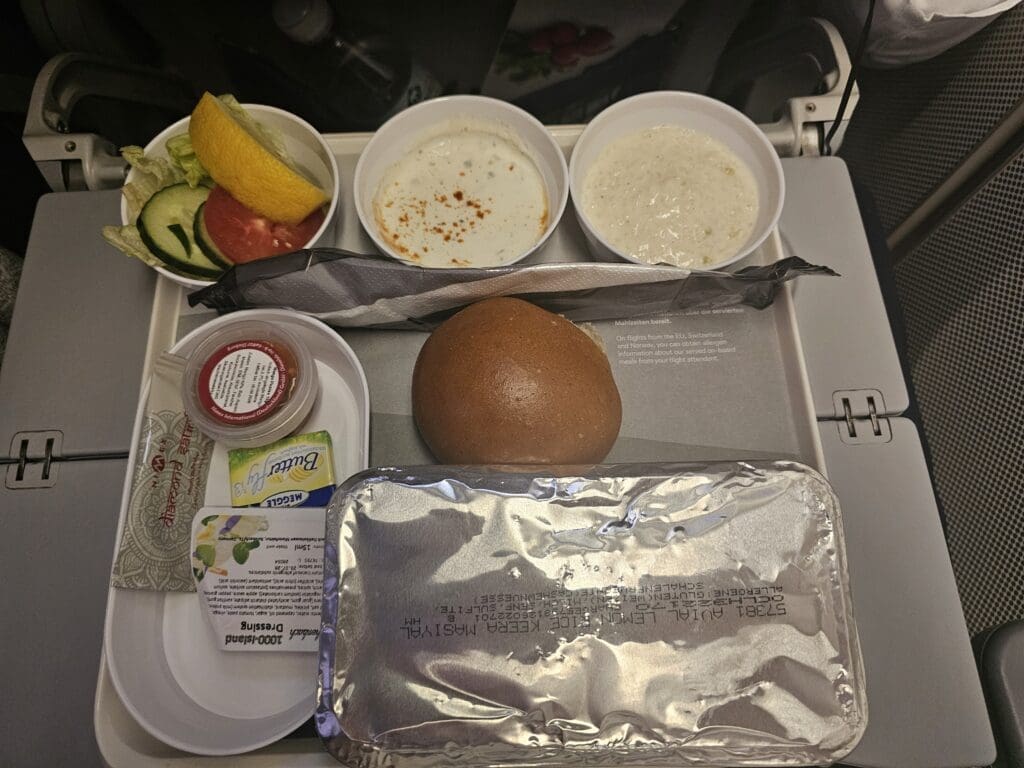
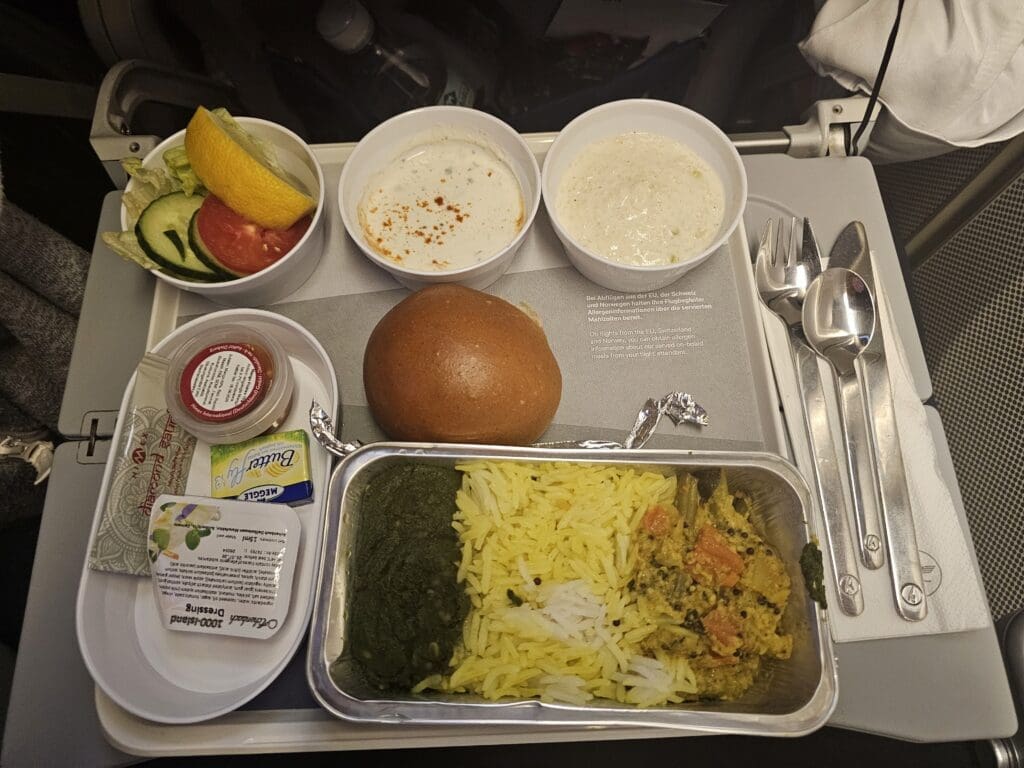
Seeing as this was my first proper meal of the day, by this time I was starving and wasted no time in digging into the meal. Peeling back the lid of the main dish, this revealed a piping hot feast consisting of two types of curry separated by a bed of rice. This was accompanied by a side salad consisting of several pieces of lettuce and a lemon, a raita dip, a breadroll, butter, salad dressing, a small tub of mango pickle and a sachet of mukhwas, or Indian mouth freshener, which consisted of seeds and spices designed to aid digestion and freshen breath. Meanwhile, the desert came in the form of a pistachio seviyan. Alongside the paper menus, a further touch of class was added by the provision of real metal cutlery on which Lufthansa’s motif could be seen engraved, with the airline being one of the few European carriers to offer such cutlery to those in Economy. Overall, I found the meal to be of good quality and quantity, leaving me with no complaints whatsoever. Around thirty minutes after this had been served, the crew passed through the cabin offering water, tea and coffee, before returning once more to collect the remains of this service.
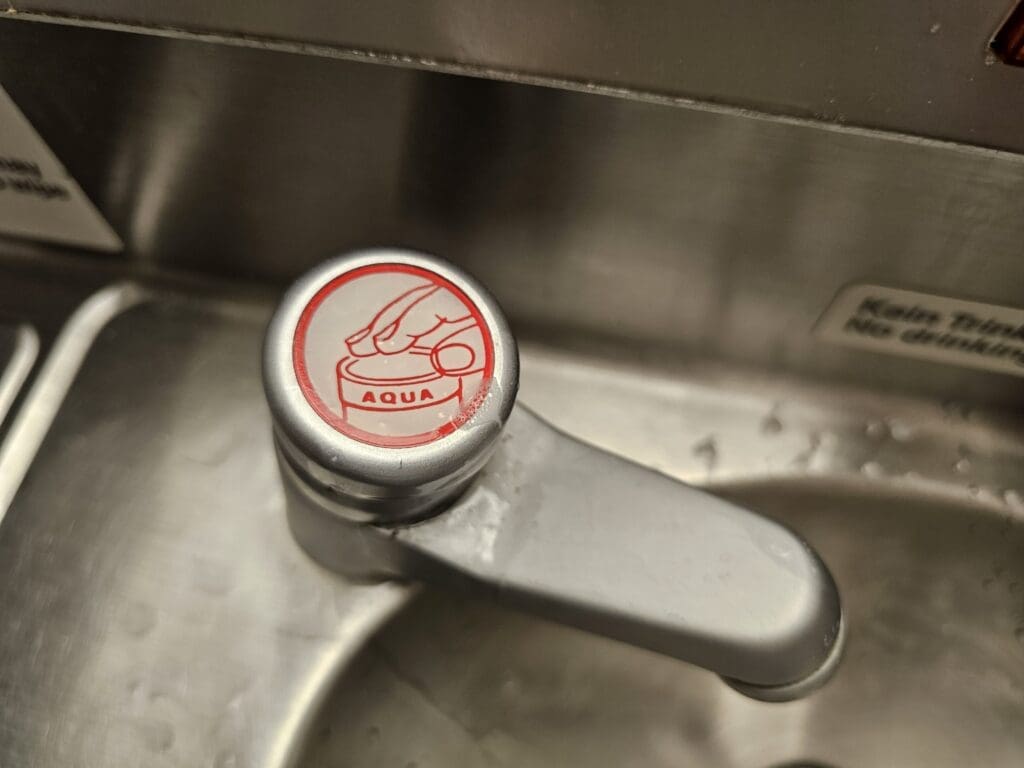
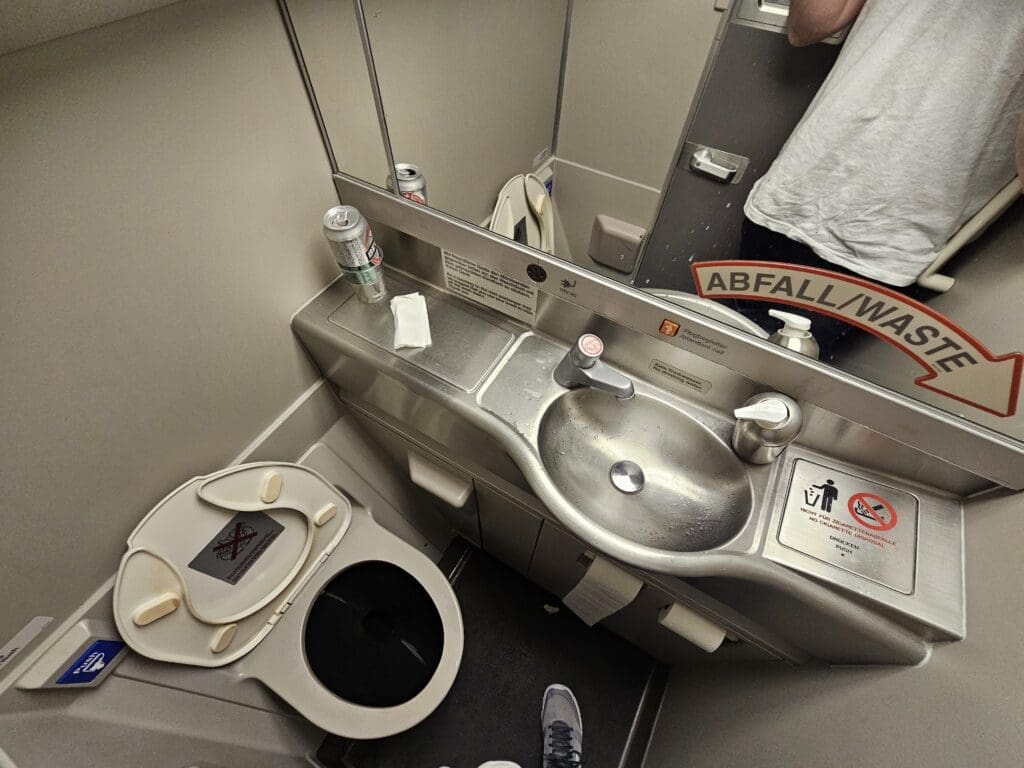
Once I had finished the meal, making the most of the fact that my neighbours had vacated their seats, I decided to pay a visit to one of the four lavatories sandwiched between the Premium Economy and Economy cabins. However, being one of many passengers with the same idea, a ten-minute wait was in store, although this was not an issue as I was in need of a leg stretch. Upon entering this, I found the toilet to be in reasonable condition despite its heavy usage, bar the strange addition of an empty plastic cup and accompanying Becks beer – I’m not too sure who came up with the idea of the Lavatory Pub!
By the time I returned to my seat, the aircraft had cut across Southeastern Europe, passing over Slovenia, Croatia, Bosnia and Herzegovina, Montenegro, Albania and Greece, and was now overflying the far eastern end of the island of Crete. Owing to the ongoing Middle East Conflict, Lufthansa’s service to Bengaluru now takes a less direct routing than before. Rather than overflying the likes of Turkey, Iran, Afghanistan and Pakistan, the flight now takes a much more southerly routing. This takes the aircraft down to Egypt before crossing the Red Sea and the Arabian Peninsula, followed by the Arabian Sea, before reaching India, and adds around an hour to the journey time compared to the previous route.
With lunch out of the way, the cabin crew dimmed the cabin lighting, and so I decided to turn my attention to the inflight entertainment system. Starting positively, I found the system to be both modern and sleek, and laid out in a simple manner that meant I faced no difficulties when attempting to navigate this. Furthermore, the system was available in a decent array of ten languages that are broadly representative of those spoken across Lufthansa’s route network, namely Arabic, Chinese, English, French, German, Italian, Japanese, Korean, Portuguese and Spanish. The real highlight of the system, however, was the breadth of content available. As I browsed this, I encountered a whopping total of 407 films, including both the latest releases and timeless black and white classics. As is often the case, many films took the form of Hollywood productions; however, there were also a reasonable number of European, Korean and South Asian films too. For those fancying a shorter watch, I counted 160 television programmes, which included major American shows, to those obscure documentaries that you only seem to find on board flights. Shows from my homeland included BBC classic Gavin and Stacey, mockumentary How Are You? It’s Alan (Partridge) and Amelia Dimoldenberg’s YouTube show Chicken Shop Dates. As is not particularly unusual these days, each item commenced with an unskippable advertisement. This also featured plenty of podcasts, playlists and albums, as well as several games, information about the airline and a live news feed. However, unlike on some airlines, no live television channels were offered.
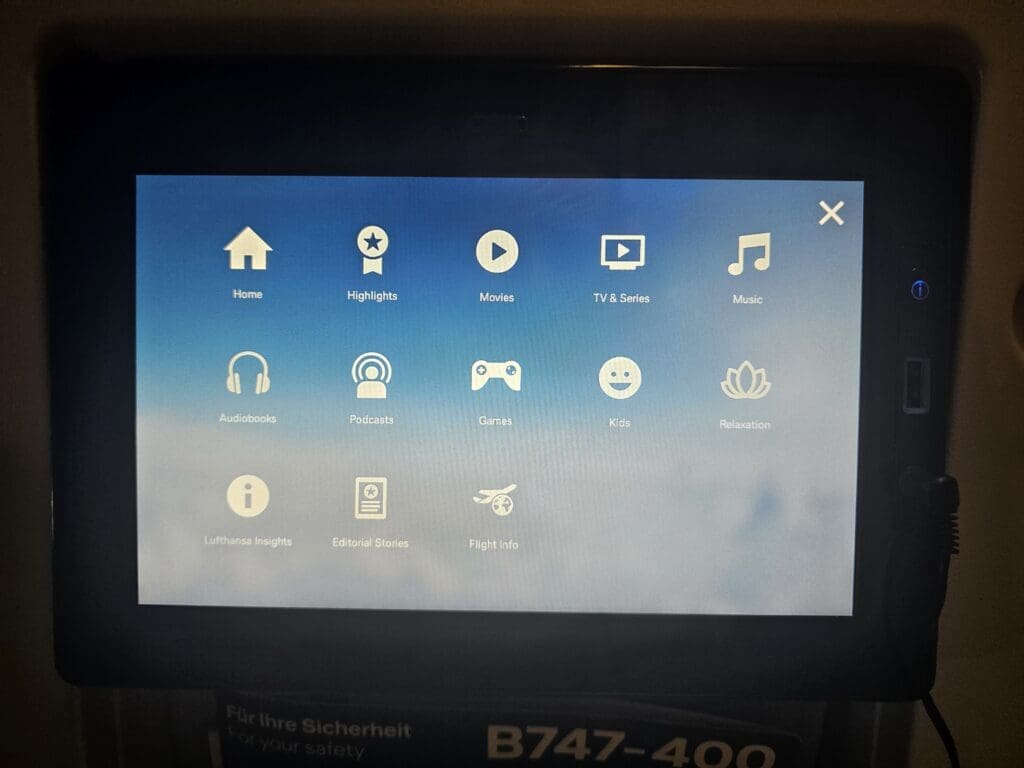
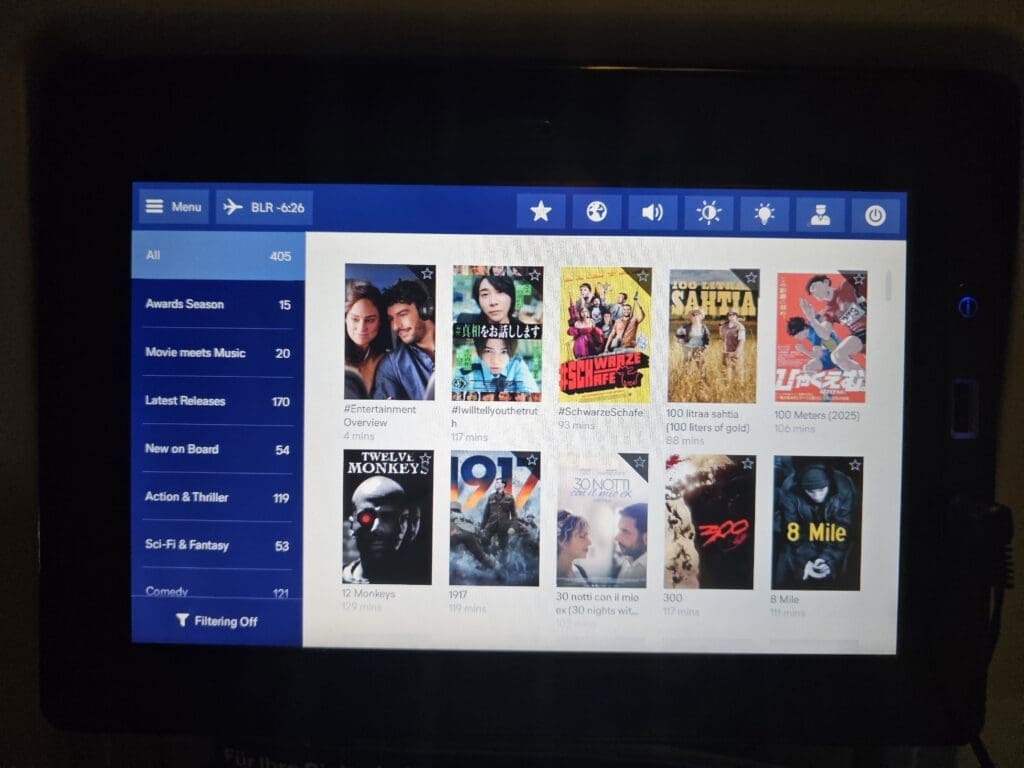
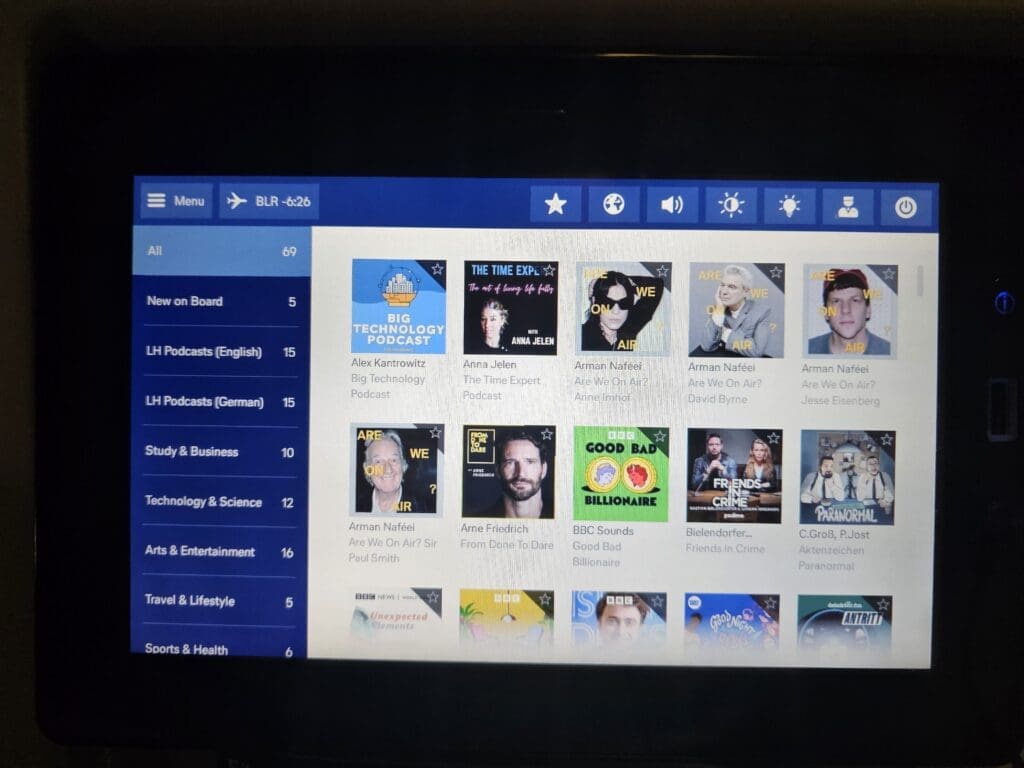
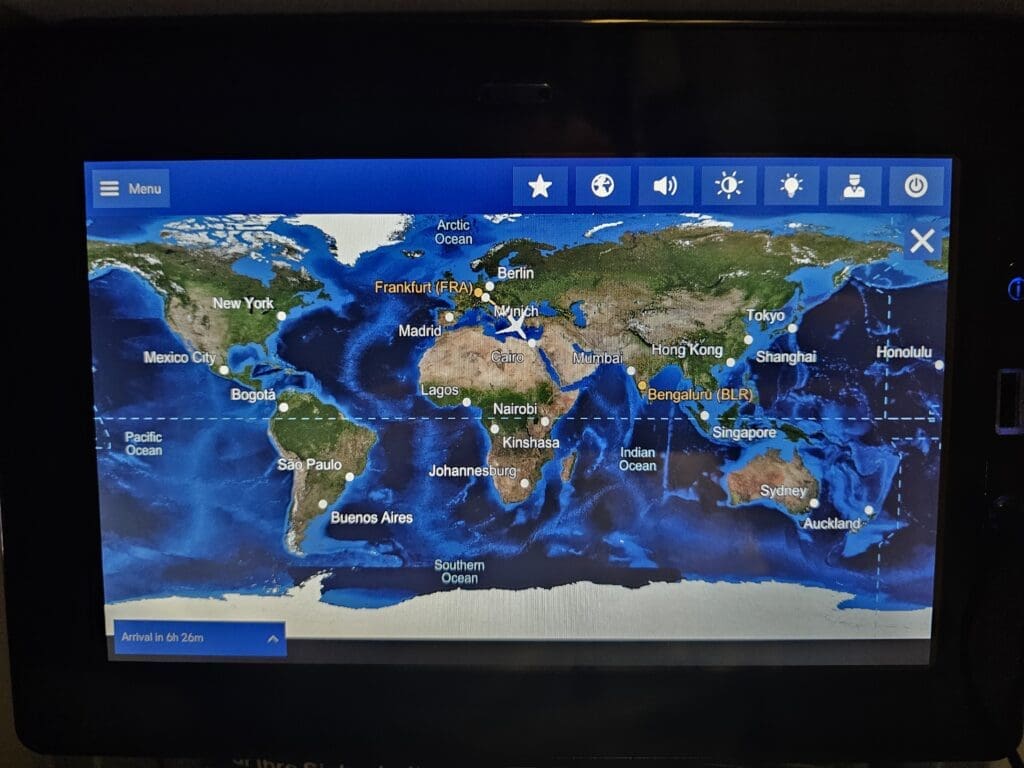
My only real complaint about the inflight entertainment system was the lack of an interactive moving map, as well as the inability to search for content. For example, if I were looking for a certain film, I would have to scroll through the films to find it. Additionally, theoretically, FlyNet wifi is available onboard, and one nice feature is that members of Lufthansa’s Miles and More frequent flyer programme can access this to use messaging apps without making any payment. However, as on my hop over from Manchester, sadly, I found this not to work. Whilst this was not a problem for me, I imagine there are some people who perhaps do need to stay connected on the long slogs that this aircraft undertakes, and would have likely been disappointed at the non-functionality of this.
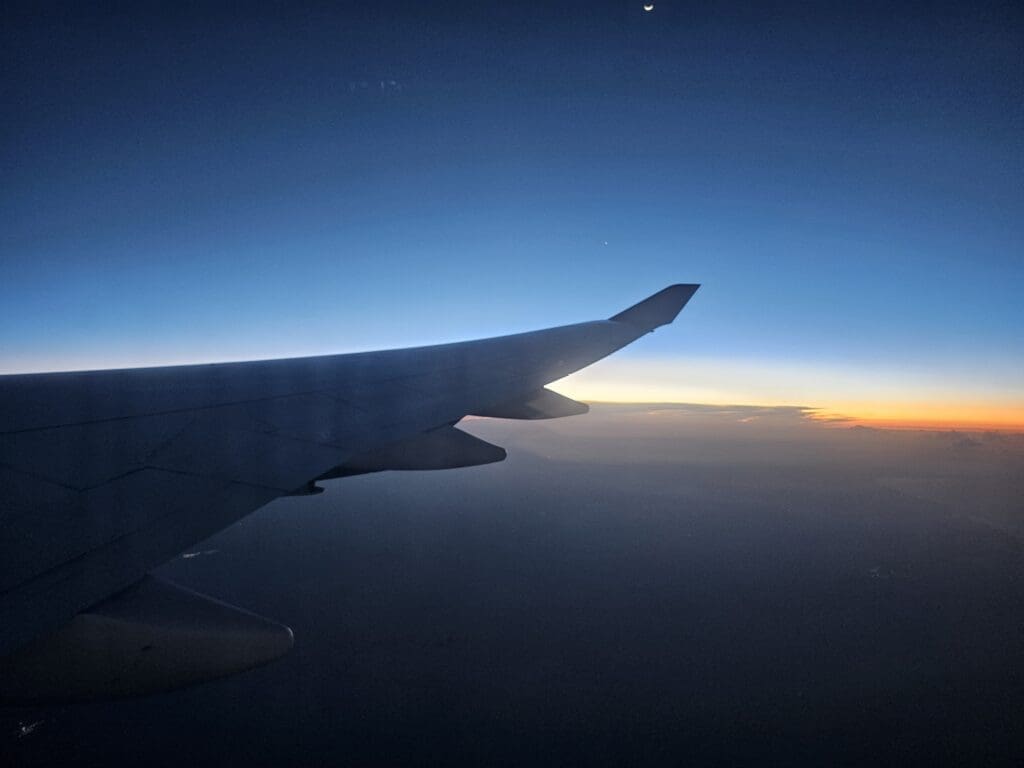
Returning to our route, crossing the southeastern Mediterranean, thirty minutes after leaving Crete, the Jumbo made its way over the Egyptian coastline to the west of Alexandria and headed southeastwards. As we crossed the Nile to the south of Cairo and the city of Faiyum, a cluster of lights from the towns that line the river could be seen in the rapidly fading light. From there, we headed towards the popular Red Sea city of Hurghada. After around forty minutes spent speeding through the Egyptian skies, we headed eastwards across the Red Sea, although sadly, by this time, night had arrived and so nothing of this could be seen. Following a quick crossing of the Red Sea, we made landfall near the city of Al-Wajh in the province of Tabuk and continued heading southeastwards, heading inland over the dark and vast desert. Below, little could be seen until all of a sudden, the orange glow of the lights of the famed city of Medina, well known for being one of the holiest places in Islam, as it is the burial place of the Prophet Muhammad, appeared below.
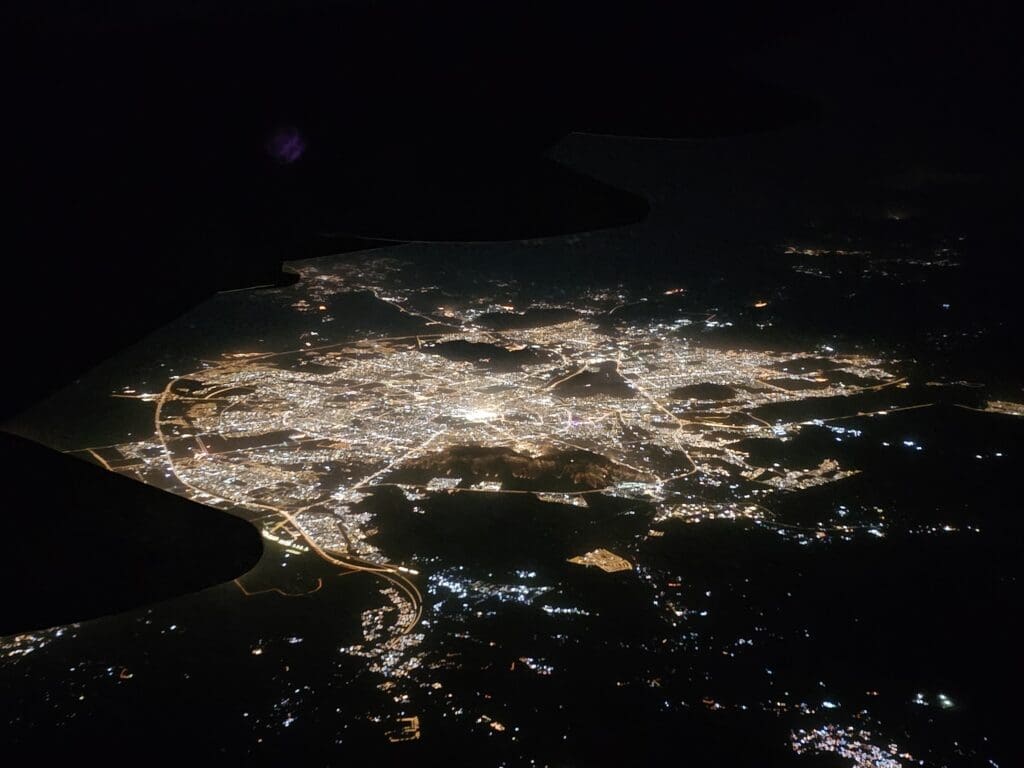
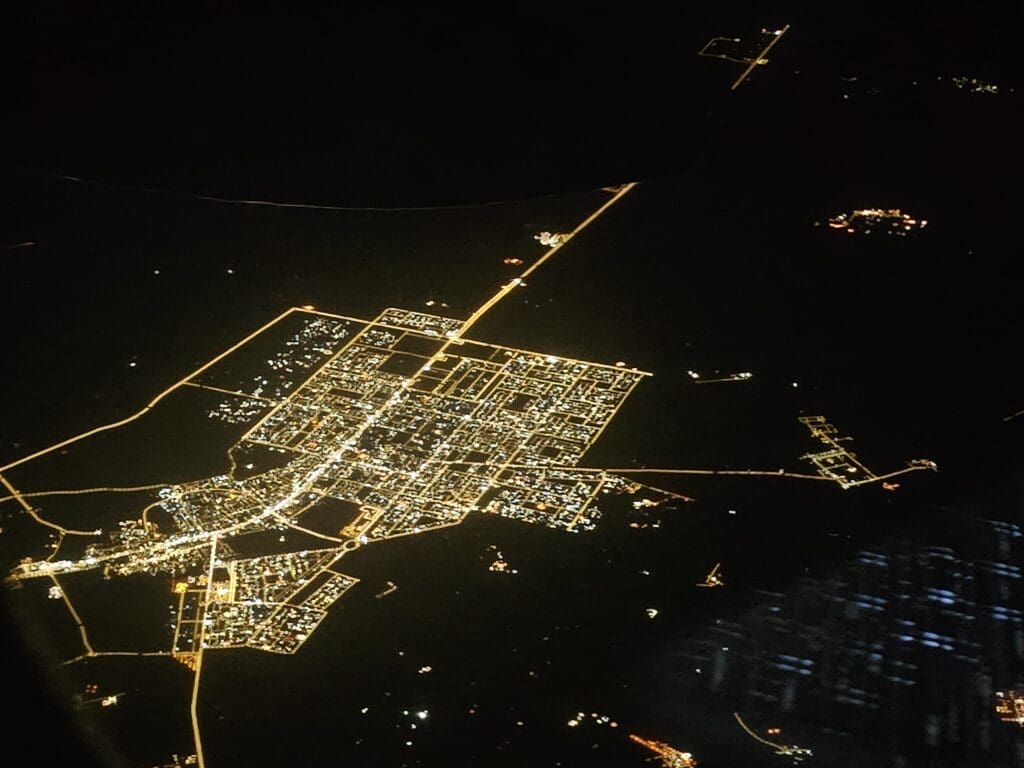
After admiring Medina from above, we continued speeding over the desert, with very little to be seen other than the occasional passing town and oil field as we crossed the Arabian Peninsula. At this time, the aircraft experienced its first notable bout of turbulence, which lasted for around twenty minutes, although this was not substantial enough to warrant the reillumination of the seatbelt signs. At this point, I drifted off to sleep, and by the time I awoke, we had left Saudi Arabia behind, crossed Oman, and were now speeding eastwards over the Arabian Sea.
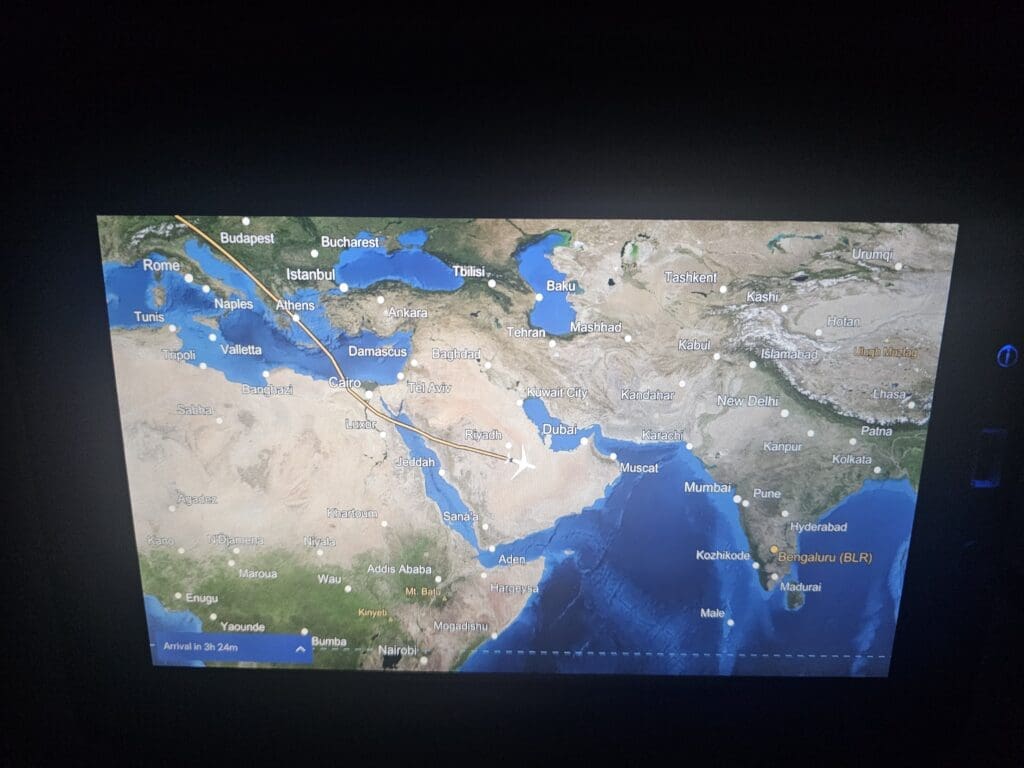
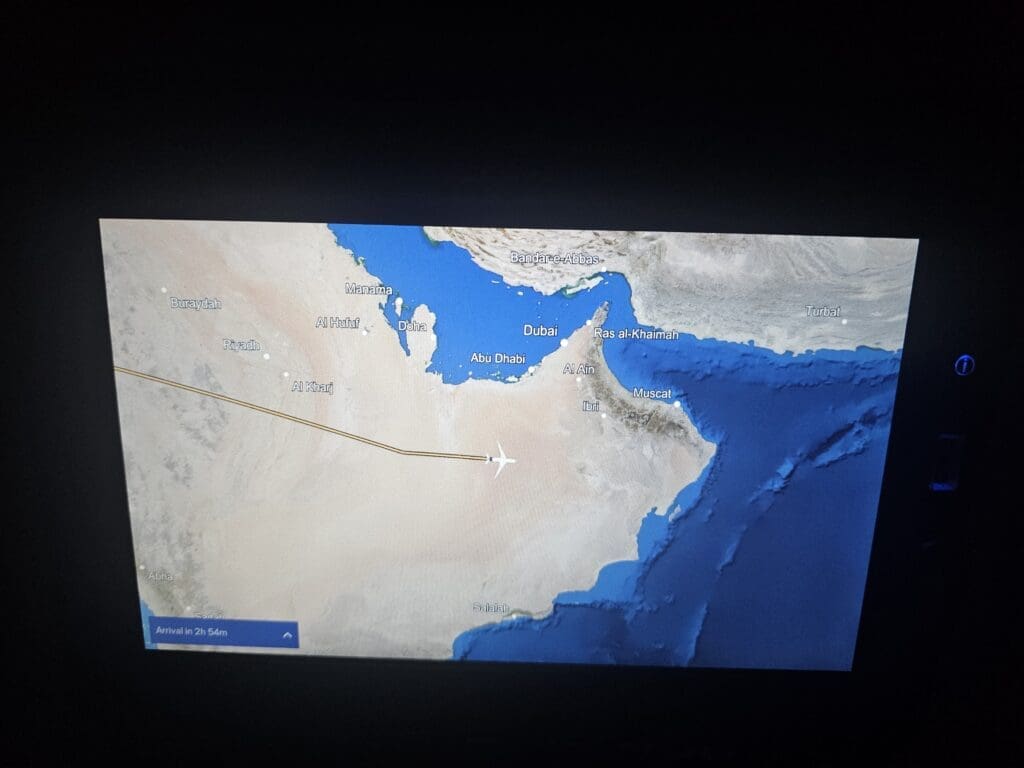
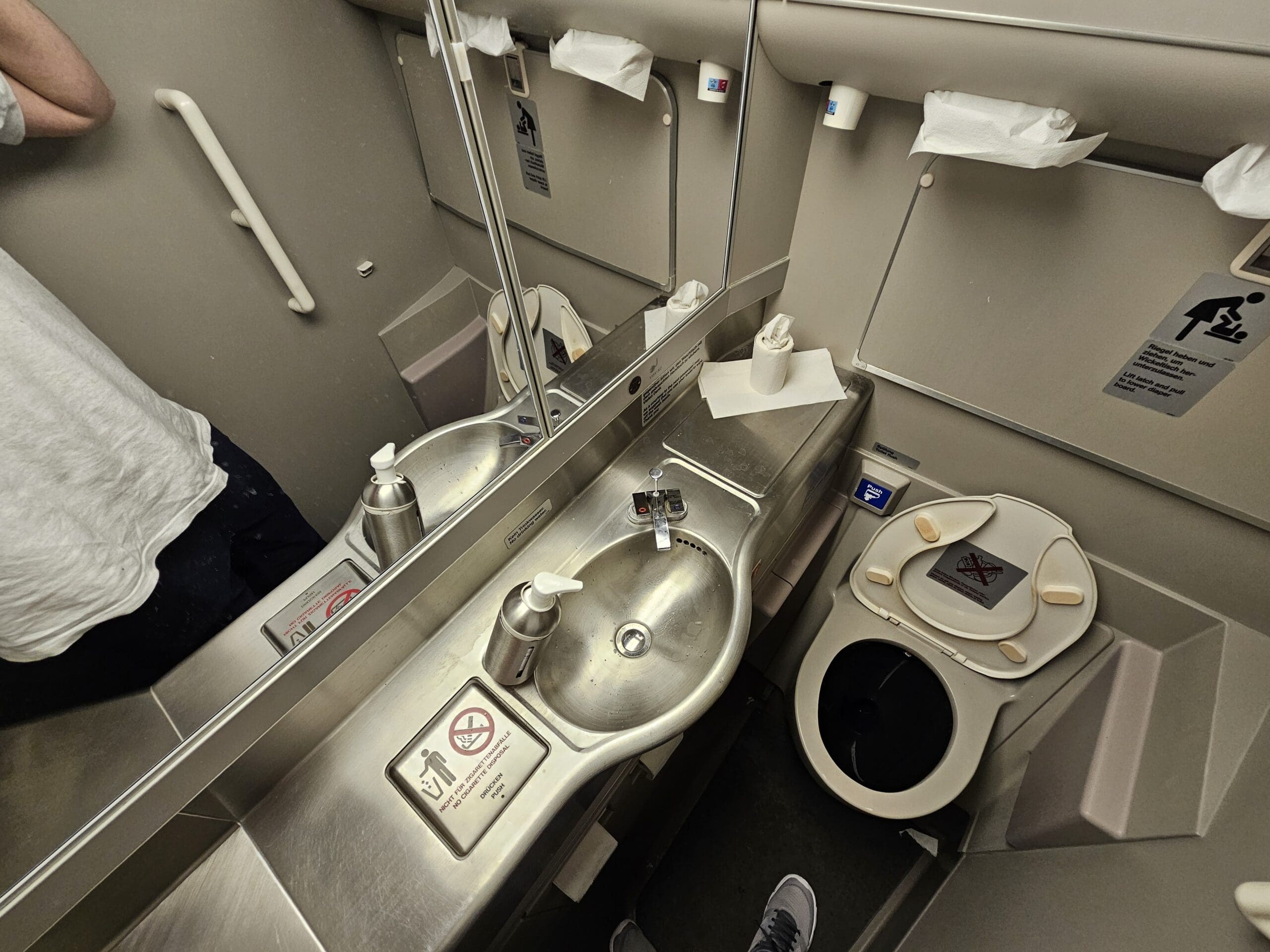
Around halfway into our crossing of the Arabian Sea, and with about two hours to go until we arrived in Bengaluru, the scent of warming food filled the cabin once more, indicating that it would soon be time for the pre-arrival snack. With my neighbours having woken up and vacated their seats, I decided to make a second and final trip to one of the aircraft’s lavatories, this time opting to visit one of the toilets at the very rear of the aircraft. Opening this up, like much of the cabin, this was a little retro in its aesthetic, yet being spacious and stocked with the basics, it served its purpose and left me with no complaints. Importantly, it appeared that this had been tended to during the flight and was in a clean and tidy state.
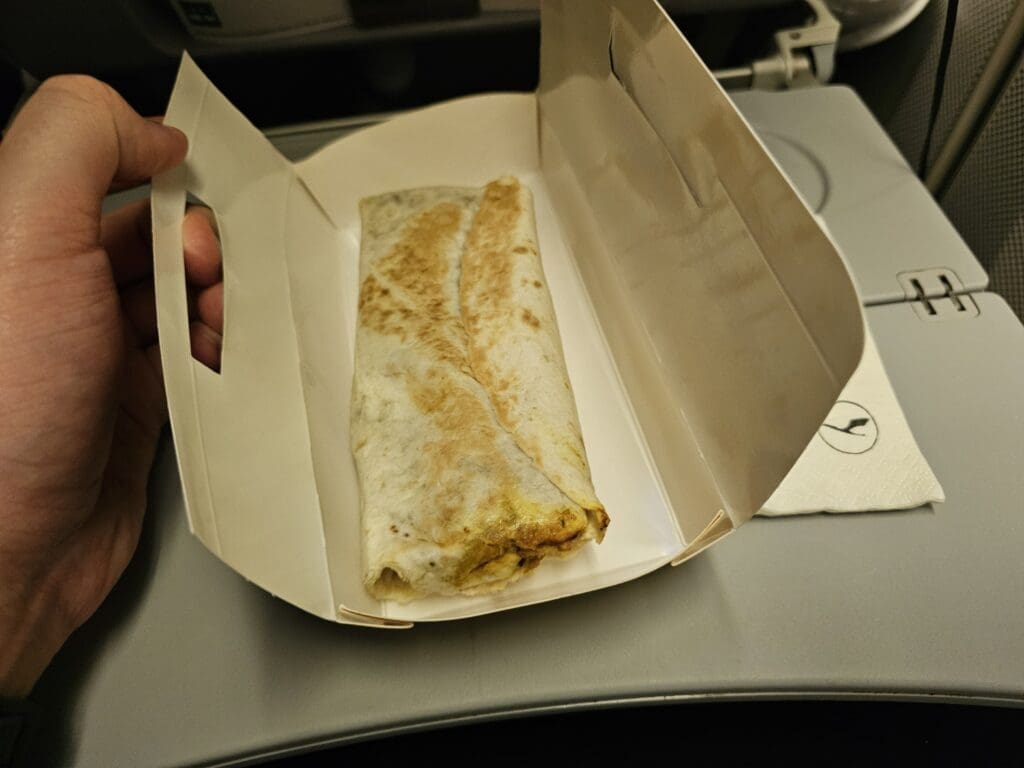
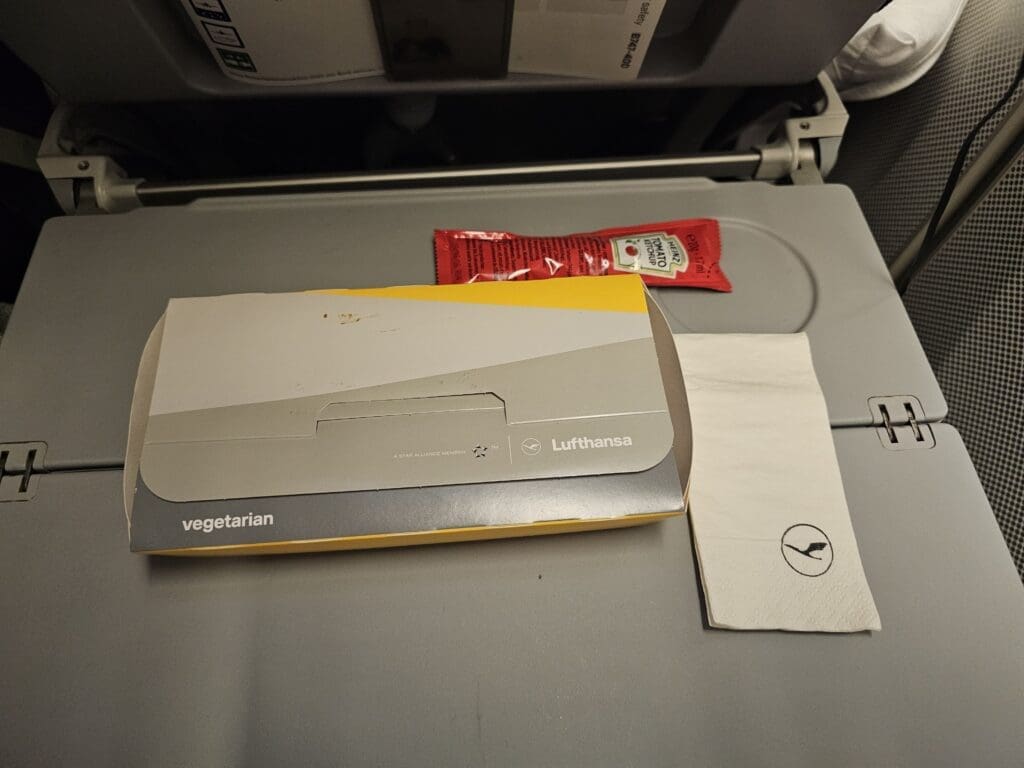
Returning to my seat, I strapped myself in and looked forward to the culinary delights that would soon be served. At 0150 Indian Standard Time, the cabin lights were suddenly turned back on, and a few minutes later, the service carts were rolled out into the aisles, with service commencing from the Premium Economy cabin once again. With a single option available for all, after a few minutes, I was handed a hot tawa roll with a vegetable filling, which came in a nicely designed cardboard box and was accompanied by a large sachet of Heinz ketchup and a serviette. This was followed several minutes later by the drinks card, with one flight attendant offering me a cold drink, and the other a choice of tea or coffee. Keeping with my theme throughout the flight, I went for my third and final apple juice, which I paired with a black coffee to help get me through the night. Turning to the wrap, this filled a gap and was pretty standard, being neither memorably fantastic nor below average.
By the time the remains of this final service were cleared away, the aircraft was an hour away from Bengaluru, and we were rapidly speeding towards the Indian coastline. Just under eight hours after leaving Frankfurt, the aircraft crossed over the Karnatakan coastal city of Karwar before we continued heading inland over the mostly rural interior of the state. As we passed the city of Shivamogga, the aircraft could be felt commencing its descent, and almost immediately afterwards, the Captain provided an update on the weather in Bengaluru, before they thanked passengers for their patience during the delay, and reassured passengers that safety was always the highest priority. After this, the seatbelt signs were reilluminated, at which point the Purser performed an announcement with all the usual warnings in advance of our arrival.
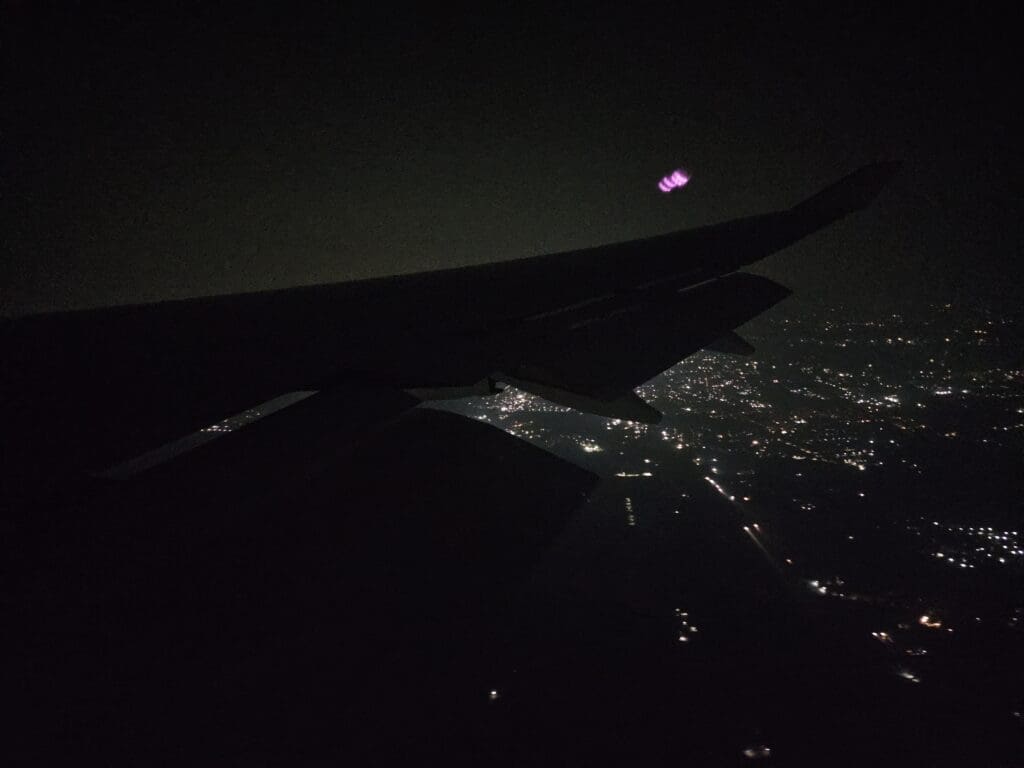
Several minutes after the Purser had performed their pre-arrival speech, the crew took to the aisles, ensuring that everything was secure and in place for our arrival. Meanwhile, below, the lights of the towns that surround India’s third-largest city could be seen. With a wind blowing in from the east, that day, we were to land on Runway 09L, which meant that very little banking was required to line us up for an approach to this runway. Making a smooth descent, soon the flaps were partially extended in preparation for our arrival, which was followed by the landing gear as the lights of Bengaluru appeared on the horizon to the south.
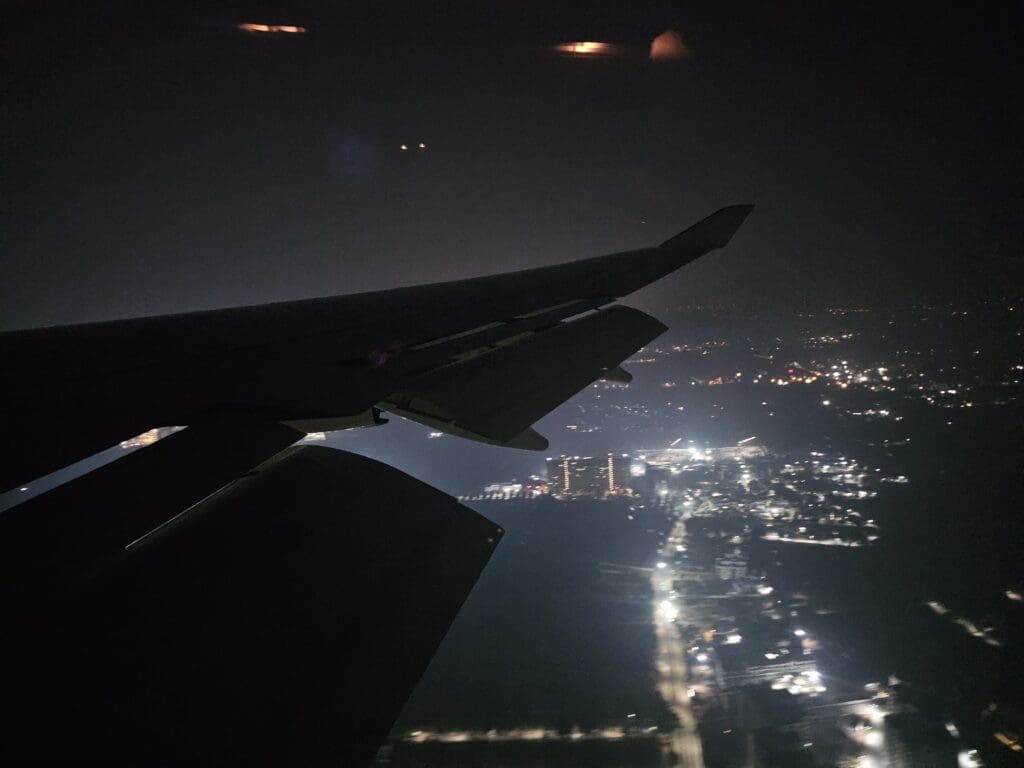
A grand total of just over eight and a half hours after taking to the skies, the Boeing whizzed over the perimeter fence before making a gentle touchdown on Runway 09L. This was followed by some fairly vigorous braking, and, reassuring me that we had definitely landed in India, I was greeted by the sight of rows and rows of IndiGo jets, plus a few others from SpiceJet and Star Air standing at Terminal 1 and its remote stands. Soon, the Boeing vacated the runway to the right and commenced a very short taxi over to Stand V61 at the international portion of Terminal 2. As we undertook this journey, the Purser welcomed all to Bengaluru, apologised for the delay and made the usual warning regarding keeping seatbelts fastened. Fortunately for them, all appeared to heed this instruction and remained firmly seated until we had arrived at the stand. At 0344, the Boeing slotted itself in between an Emirates Airbus A380 and a Virgin Atlantic Boeing 787-9 Dreamliner, coming to a halt just under two hours behind schedule. At this point, the engines spooled down, and the seatbelt signs were extinguished, at which point many in the cabin jumped up in a rush to leave the aircraft.
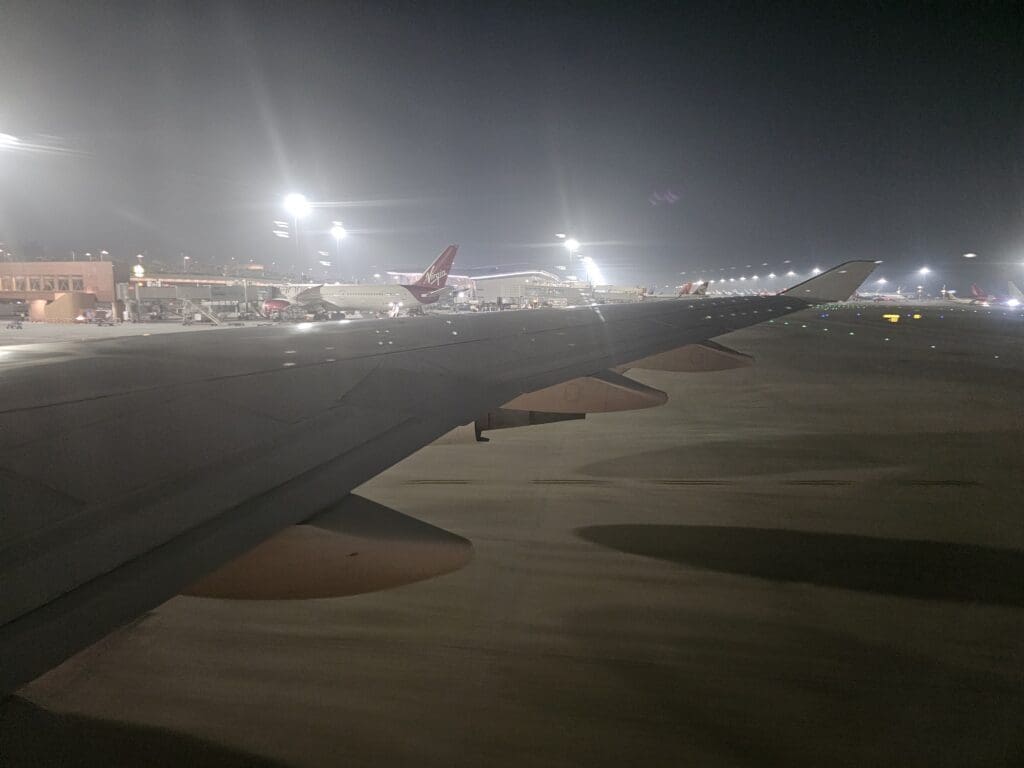
Fortunately for those who were desperate to escape, the jetbridge was soon connected, and it wasn’t long before the queue in the aisle began to budge. Not being in any particular rush, I savoured my last few moments on a Boeing 747-400, knowing that there was a reasonable possibility that, unless I ended up piloting a Boeing 747-400 Freighter one day, this could be my last ever flight onboard the type, before I stood up, retrieved my bag and wandered through the cabin, thanking the crew members that I passed along the way and receiving lukewarm responses. After stepping off the aircraft, I headed up the jetbridge and nothing more than a short walk was required to reach the large immigration hall. Unfortunately, arriving at the tail end of those who had arrived from London, immigration was a slow process, and it took me about an hour to officially enter India. Although on the plus side, by the time I had made it through, my bag was already spinning on the carousel, and I was thus able to make a quick exit before steaming through customs, thereby ending my Lufthansa experience.
Summary
Whilst my main reason for flying from Frankfurt to Bengaluru with Lufthansa was to fly the Boeing 747-400, overall I was left reasonably pleased by my experience on this flight, with this being one of the better flights with the airline that I have experienced. Importantly, the aircraft was clean, comfortable and in good condition, the catering was good, and the entertainment system was expansive. Thus, based on my experience that day, I would be happy to fly with Lufthansa again.